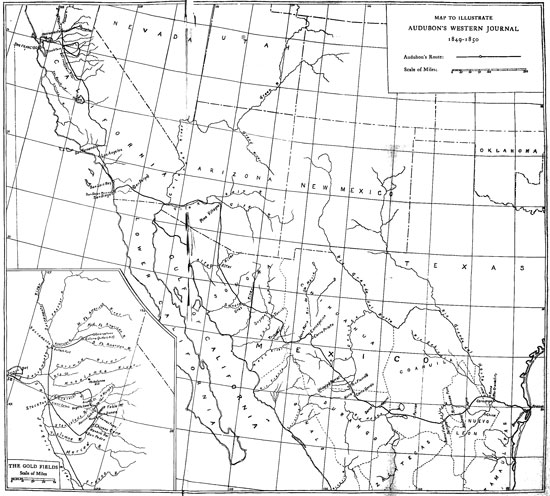
January 2d, 1850. Leaving Stockton we tramped
through mud and water, so like the coast of
Louisiana (the Mississippi) that it might have
been winter there, instead of in California. We
had packed the day before leaving, so left early
for our walk of twenty miles after our pack-mules,
and went over a partially sandy prairie to the
Stanislaus River, and at eight that night reached
good wood and water, and encamped about three
miles from the river. Next morning, January 3d,
we left in the rain for the ferry, but owing to the
bad weather, heavy roads and exhaustion of Bachman
and McGown, stopped at a good camping
ground, with excellent grass, after going only three
miles. The rain poured all day and all night, and
we lost two days here in consequence, for the river
rose so rapidly that we could not cross our mules.
The next day the most of us did get over, and
Clement and Hudson remained behind to look
after the mules.
January 6th. Leaving the middle ferry, known
as Islip's, our first day was over a good road with
occasional quicksands in the way. The next day,
January 7th, 1850, as we had a cold northeast
drizzle, we lay by, and the following morning,
January 8th, left for our destination, the Chinese
Mines. Many of the views before us, as we
mounted hill after hill looking towards the mountains,
are very beautiful park-like country; the
roads are a series of mud-holes and quicksands at
this season, and the trees, either swamp, or post-oak,
with occasionally a fine ridge of a species of live-oak.
At times we had to pack the cargoes of the
weaker mules, every few hundred yards, and at one
place, had nine mules mired at the same time, the
mud being so tenacious that even when the packs
were taken off, the poor animals could not get out
without our help. Three days of such travelling
brought us to our present camp, the soil red clay
and sand, mixed thinly with white quartz of various
sizes, but generally small, not more than two,
or at most, three inches in diameter, and generally
even smaller.
[No date.] We went up to the "diggings"[39] on
the morning after our arrival, and looked round to
see what prospects were ahead of us. We found
the little branches bored, and pitted, and washed
out in every direction, so much so that we tried to
"prospect" for ourselves, and we lost three days.
We found the men already there kind and polite,
showing the mode of working and washing, of
digging and drawing most willingly, and tomorrow
open a pit close beside some of the most
fortunate.
The uncertainty of digging renders the life of
the miner, for profit, that of a gambler, for most
of his good luck depends on chance. At times you
may see two pits side by side, one man getting two
ounces a day, and the other hardly two dollars:
we heard of one instance of much greater disparity;
two friends working next each other found that at
the end of the week, one had an ounce of gold,
worth about twenty dollars, the other gold worth
six thousand dollars. So it goes, and we shall all
have to work hard. Again and again I am overwhelmed
by the thought that I am at these dreary
mines—I, who started intent on drawing and
obtaining new specimens—to have so different a
destiny thrust upon me, is bewildering.
The ground here is beautiful rolling valley of
sandy clay, so like the post-oak country of Texas
that one might almost fancy himself there. A few
pines are scattered about, the cones are very large,
say six inches long, and three in diameter; the seed
is a pleasant nut, about the size and shape of a
small, shelled almond; the quantity of resin contained
is very great, and at the end of every leaf
of the cones, quite a lump is seen.
The ultramarine jay, and Steller's, the red-shafted
woodpecker and California quail are abundant,
and many finches, some new, and others that I
know, are everywhere; but I have no time to skin
and preserve specimens. Then too, the black-tailed
deer, California hare, and grizzly bear, are
common, as well as the small hare. There are
some few squirrels and a marmot or two, but I have
not been able to procure them; I have also seen
the robin of this country and many others. The
country is otherwise barren, I wish I was out of it.
January 20th, 1850. Chinese Diggings. It
does not seem possible, remembering the difficulties
of the road, that we are only seventy miles from
Stockton. The men began "rocking" yesterday,
one cradle, and get about a dollar an hour, but
hope to get more when in the way of it. Those at
work around us get an average of fourteen a day,
and at times much more; then again a week's work
is lost. The quantity of gold, so I am told by those
who know more of it than I do, is very great, but so
diffused that great labor is required to get it. The
lottery of the whole affair is beyond belief. The
richest gulches are supposed to be those on the river,
the Tuolome [Tuolumne], or the creeks leading to
the river. The pit, or piece of ground allotted to
each man is sixteen feet square, this having been
settled by the diggers, and the law is enforced by
an alcalde. Many is the week's work, the men
say, when they do not get the price of their board,
and again large amounts are found. One individual
told me he was getting two ounces a day,
and gave his claim up, to join a company in digging
out the bed of a river which they had drained off.
He worked a month at the river scarcely making
two dollars a day, while the man who bought his
first place, had accumulated several thousands. I
have heard fifty such stories, but as a whole this
country will pay the laborer and the mechanic
better than the miners, unless the latter have capital.
Had we come my route and reached here
with a hundred mules, a fortune could soon have
been made by packing. But, alas! against my
better judgment I allowed myself to be swayed by
Col. Webb, who had his own way at the cost of
twenty-seven thousand dollars, thirteen lives, and
the loss of many months to all the men who came
through.
Chinese Diggings. February 1st, 1850. Friday,
and a most beautiful day; birds all around are in
gay chatter, and the song of the raven, jay-like, but
sweet to listen to, from the attempt at softness, as
he nods and bows with swelling throat to his mate.
It is like March in Louisiana. Alas for the poor
fellows who have left the southern states to come
to this, and settle here as farmers; to be drowned
out in winter, and burnt up in summer! However,
when the excitement of the gold fever ceases, as
it must, California will find its level with the other
states, and many a hastily made fortune will be as
rapidly lost.
I am leaving for the North Fork of the Stanislaus,
twenty-five miles, to make one more effort to
keep the company together and to pay off our
indebtedness to the stockholders, but I fear my
efforts will be useless.
Murphy's Diggings. Sunday, February 10.
Everything seems against us—weather and season,
water and rain, interrupt us in all our attempts at
work, and ill-luck seems to follow us. After fruitless
labor at the Chinese Diggings I came here,
where the diggings are said to be very rich, but
where we have to wait for the waters to subside,
perhaps two months, and I have not the means to
keep the men for that length of time, even if the
date of their contract did not expire before then.
These diggings are said to be the richest in the
southern mining district and here I came to make
my last effort for the good of my men; for myself
my home is awaiting me, and ample means to pay
off all the indebtedness I have personally incurred;
many times a day I thank God I never asked one
man to join the venture, though I feel strongly
that some, notably Clement, Walsh, Boden, poor
fellow, my cousin Howard Bakewell, and a few
others joined because I did. Knowing this, and
knowing too how many have risked their all, I
hesitate to leave, as long as I feel I can be of help
in any way, and shall go into the matter very
carefully with the men, most of whom however I
know feel as I do.
February 25th, 1850. Today we all met together
and after much serious talk, I told the men
that their time was more than up, and that, consequently
they were their own masters and the company
dissolved. I told them, too, that I was ready
to help each and all to the best of my ability, poor
enough, but I believed we could do better in other
ways than mining. Not a word was said, and
silently all went to their tents; we had been a year
together, in sickness and trouble, in boisterous
mirth and sorrowful anxiety, and like old and tried
friends we felt the coming separation keenly; we
were all greatly depressed. I shall be with the men
for some weeks, and shall then try to make up for
part of what I have lost, making drawings and
sketches, and collecting such specimens as I can. I
am bitterly disappointed for the men who have
been so faithful, and who have stood by me so
staunchly, but as Tone said to me some hours after
our talk: "There's more money to be made here by
land speculations, and every kind of work than
there is in mining, and those who work will get on."
I quite agree with him, and when one hears of the
return of men with large fortunes, ask if speculations
in land or trade, bar-keeping or Monte
dealing has not swollen the first few hundreds, dug
and gained with hard labor, privation, or, in rare
cases, wonderful luck. Even then for one man who
has a thousand, there are hundreds who will not
average a tenth of it after expenses are paid.
March 6th. Again on the road from Stockton
east, towards the mines. I have been to San Francisco
and am now on my way to join Layton to
begin my tour of the mining and agricultural
districts of this now most fairy-like country, everything
so smiling and beautiful, flowers of the
smaller varieties by thousands; and the snow
melting sends its waters down all the little rills and
rivulets clear and pure, giving freshness and luxuriance
to the whole country; could it retain so much
beauty through the summer, I should pronounce
it, at once, the most enchanting land I had ever
seen, and yet, as I think of the beautiful shrubs of
the east, and where they do exist, of the magnolias,
wild roses, and flowering vines and trees we have,
I think the countries balanced, for here two species
of oak, three pines, the redwood and the laurel,
will almost enumerate the whole of the common
varieties of trees.
Farther south, back of San Diego, in the valley
of Santa Maria, I saw the finest sycamores I have
ever come across; they grow where they have room
enough to extend their gigantic limbs laterally,
instead of forcing their huge trunks in rivalry with
the oaks, to get fresh air and sunshine.
The country from Stockton is a clayey flat, so
little of an inclination to the land, that the water
appears to lie until evaporated, and the "sloughs"
in many places are sluggish and seem to be more
water-holes than running streams, until they reach
the Calaveras, which is a beautiful creek nearly
dry four months of the year, but the other eight
giving good water. The meadow-like flats about
it look just ready for the plough, though by using
that, a sward of good grass would be lost. The
country from here becomes very gradually more
and more undulating, changing the nature of the
soil every few miles. In some places the hills
are of clay, and valleys of greyish loam, or red
sand thickly mixed in with quartz; in many cases
water-worn, but all is so beautiful that were the
woods more dense, and the water-courses now so
inviting, "never-failing," the farmer would here
find his Paradise, and by selecting his land so as
to avoid the gravelly sub-soil, which is too abundant
for richness, and choosing that which has the
clay foundation, his plantation might be one of
great permanence, for the rains here do not wash
off much of the soil.
March 8th. Following up one of the north
forks of the Calaveras, we passed through beautiful
valleys, green and luxuriant, but very short
stretches of grass; the hills, at times, so close
together at the base that the valley was almost lost;
but the ascent was rapid, and we found ourselves
soon on the singular hills of this country within
a mile of the Mokolumne [Mokelumme] mines,
where we camped for the night.
March 9th, 1850. The ice this morning was
half an inch thick, and the cold at day-light,
intense. One hour after sunrise, the day began to
be summer, and at nine o'clock our coats were off,
and we were riding towards the beautiful view
made by the interesting lines of Mokolumne hill
and its adjacent fellows, all eccentric, and all interesting.
The soil in the ravines here is mostly clay, but
from time to time partakes of the sandy red clay
so common in this country, resembling very much
the gravelly hills of the post-oaks of Texas. The
ride up the stream to "Mokolumne rich gulch,"
is very interesting, passing between two hills, or
lines of hills, with occasional ravines leading down
to the creek we were following.
We passed an Indian village of six huts; the
squaws were pounding acorns to make "payote,"
in natural mortars, formed by the slight indentations
being used constantly; the pounding of the
stone (small granite boulders, water-worn smooth),
sometimes wear the holes a foot deep; but they
are generally deserted before that depth is reached.
A smooth, flat stone is usually preferred by the
Indians to begin on, and if the country suits their
purposes, and the lodges remain any length of
time in the neighborhood, the stone is often marked
with thirty or forty of these mortar holes.
[No date.] Leaving "Rich gulch," we took a
southerly course over the ridge, and wound down
the branches of the Calaveras, until the various
rivulets united and formed what is called the
"north branch of the Calaveras." Where we
crossed, it was about eighteen inches deep, and
runs over a rough bed of various-sized pebbles,
with larger lumps of granite and quartz for the
horses to stumble over, making the ford when the
stream is muddy from recent rains, very treacherous.
The soil is of the same character for a
mile or two, occasionally of a reddish loam, containing
both clay and sand, mixed with gravel, of
angular formation, very small, and with more or
less quartz, equally various as to the size and quantity
of the pieces.
The pits dug by the miners at the Chinese Diggings,
five miles from the Tuolome [Tuolumne]
River, and midway between the mountains and
plains, among the hills, present ordinarily a superficial
loam of from six to eighteen inches, rich, at
times, but again of the light bluish clay; the next
stratum is of reddish clay and gravel, and very
hard, ending in slatey rock, soft and dead to pick
at, and having the usual friability of the trap slate
that is so plentiful all over the country, sticking
up in places like the headstones of a deserted
churchyard. At Wood's Diggings the same
appearance is seen, but with the slate in more
upright strata and hard.
March 18th. At Murphy's New Diggings, the
gulch is full of lumps of granite and heavy gravel;
in the part called "The Flat" in the lower part of
the valley the soil is of great depth, in places eight
to ten feet, less in others.
March 20th. From Murphy's New Diggings
to Angel's Camp is six miles; the country just
undulating, inviting the squatter to put up his log
house, made from the few pines that, from time
to time, form little clusters, but so far apart as
always to arrest the attention, and call forth the
admiration of the wanderer through these lonely
hills, where the want of woods to me gives more
solitude than our densest forest; so much for habit,
for I recollect well that "Beaver," my Delaware
Indian guide in Texas, always was anxious for
the prairie, whenever I took him into the deep
swamps of the Brasos or Guadaloupe.
"Angel's Diggings" is one of the many repetitions
of the same thing seen every day. A beautiful
little brook, with precipitous sides, and gravelly
or rocky beds; high hills of red clayey loam, mixed
or sprinkled with bits of quartz and slate, forming
continual amphitheatres at almost every bend
of the creek. Here I met a gentleman who had,
for many years, been washing gold in the Carolinas;
he had a quicksilver machine of his own
invention, price one thousand dollars, which he
was working with six men. He told me he was
getting a pound a day from the sands he was washing,
which had been washed already in the
common rocker. He did not feel so sure of its
efficacy in the clay diggings, but for sand it certainly
was admirable. These diggings like all I
have seen that were worth anything were completely
riddled; first by the top washing, and "dry"
washing of the Mexicans, then by the hurried,
superficial "panning out" of the lucky American
who came first and reaped his fortune; next better
dug out by the gold digger for his three ounces
a day, and now toil and hard labor gave the strong
determined washer from small amounts to, occasionally,
an ounce a day, when the water will permit
him to work.
March 23d. Our road to Cayote [Coyote]
made a "V" from Murphy's, over a poor soil, with
nothing of interest along the six miles but a small
elevation of semi-basaltic sand-stone, mixed with
granite, with large particles of crystal-like spar.
The approach to Cayote is down a red clay hill,
of course, and is on a point made by two little rivers
(I should call them streams) which meet at the
lower end of the diggings. The larger one is
called the Cayote River, a branch of the north
fork of the Stanislaus, and the diggings are about
ten miles up if you follow the windings of the
creek, but by the road only five to the Stanislaus.
The first year these diggings were worked many
large amounts of gold were dug here with little
labor; the second year required harder labor for
poorer results, and it is its early reputation that
keeps it up, though some holes are still paying
well; I was told four, out of the fifty then being
worked. The largest amount taken in the time I
have been here, two days, was found by five
Englishmen, two pounds and three ounces; others
are well content with an ounce a day and do not
give up their holes if much less than that is the
result of ten hours or more work.
There are a few Indians near this place; poor,
miserable devils, dirty and half clothed, for they
have given up buckskin for Mexican blankets, their
faces begrimed with dirt and their whole appearance
one of neglect and filth. They dig a little
gold from time to time and leave a good share of
it with a French trader, Poillon by name. He
makes his trade pay by giving them presents in
the morning to secure their good-will, and a little
extra change at night, on his provisions. I saw
him selling the lowest part of a leg from the forequarter
of a very poor beef at an abominable price,
and he turned to me with a pitiful expression, and
asked if he ought to let it go for so small a price,
showing me an ounce of gold. All Indian trading
appears to be done in the same way, make them
presents, and then charge double the value of the
gift, on the first article they buy.
The food of these Indians is chiefly the "payote"
made from the acorns into a kind of gruel, rather
astringent to the taste of the white man, but to an
Indian digestion all seems good that can be swallowed.
I saw a papoose, too small to walk, with a stone
in his hand half as big as his head, shelling out
the nuts of the pine-cone, cracking and eating them
with the judgment of a monkey, and looking very
much like one.
Their wigwams faced the south, and formed an
irregular cluster of bark and mud cones; the usual
number of fox- and wolf-like dogs gave the same
effect that I am accustomed to, but the tribe is not
as handsome as the Indians of the east, or
even the Yumas, Pimos, or the Maricopas on
the Gila.
Leaving Cayote diggings, the trail for five miles
passes between two moderately high ridges to
Carson's Creek, where the soil changes to a much
poorer quality; crossing the creek we ascended a
fairly high hill, from which I took a sketch across
the Stanislaus. The sunset effect was fine, but
I had no colors with me.
March 25th. After crossing the Stanislaus we
ascended a long hill leading about southwest,
towards the "Mormon Gulch" three miles distant.
The road wound up ravines for the first
two miles, and would have made as beautiful a
walk as it did a ride. All nature was still and
calm, and the silent scene brought Sunday to both
our minds, and we agreed that whether in the
wilderness, or at home, the day brought a feeling
of tranquillity. We almost changed our minds
when we reached the diggings, so different was
the scene. The bar-rooms were all doing a
"thriving business," and the monte dealers were
doing even a better, gloating over the hard-earned
piles of gold dust which ought to have served a
better purpose.
Passing all this, and going up a beautiful
gorge, winding at times so as almost to form a
semi-circle, we turned our course, and came upon
a most exquisite cascade; the water split upon a
bold rock about fifty feet high and tumbled in
leaps of from six to ten feet until it reached the
rocky bed, where it rushed on boiling and bubbling
impetuously until it joined the Stanislaus.
Our walk to Wood's Creek was hot and tiresome,
and after cooling off we took a sponge bath, the
water being too cold for a plunge, and then sauntered
about looking for the best points at which
to take views of this most beautiful part of the
country. Situated, by comparison, in a basin, and
straggling up and down the creek are here situated
Wood's diggings, Jamestown and Yorktown. The
soil looks poor, and the rock is granite and sandstone
with some slate. On the high points and
peaks of "Table Mountain" huge masses of conglomerate
boulders, two feet and more in diameter,
are scattered everywhere, and give a dreary look
to all the north side of Wood's diggings. The
hill to the west has shot up into beautiful obelisks
of quartz, and you only cease to admire it to be in
raptures over the views seen by turning east, to
look over mountain beyond mountain, snowy peaks
bare of trees, and between them the rounded points
of hills, looking tiny by comparison. To the
south, bold, rounded but high mountains, full of
verdure and with most graceful outlines, enchant
you, while the verdant stretches at the foot of these
mountains have a pastoral air which made us think
of home.
March 27th. My day passed in a vain attempt
to transfer to canvas the scene before our tent;
when I had worked some hours I went into the
tent next to ours, where lies a poor man, ill, pale,
dejected, unable to move even a few steps. His
mud roof leaks, the soil forming the side of his
cabin is so porous that it admits such quantities of
water that a ditch is necessary to carry it off from
the dirt floor. This man came round the Horn,
and the long voyage and poor food left him such a
victim of scurvy that since he arrived in California,
the first of last October, he has worked only six
days; the relative with whom he came, and who
has toiled for both, has only been able to keep them
in provisions, with his best endeavors; he has no
money to get home, now his only wish. This
man is the brother of Barnum, the museum man;
he has written to him, and is awaiting a draft
which will enable him to return.
Day and night (these beautiful moonlight
nights), flock after flock of wild geese pass almost
hourly over our heads to the north. I give up in
despair trying to fathom the use of their migration,
when hundreds of their fellows are known to breed
so far south. Their courtship is kept up as they
fly high over the grassy plains where they fed last
fall, for if you look closely at the flock, you will
see that with the exception of the old gander, a
fourth larger than the others, as a rule all the rest
are in pairs, and the males follow the females so
closely that the line is composed of two very near
together, two a little distance from them, and so
on to the end.
March 28th. Wood's diggings having given
me such sketches as I could take, we took the
valley road to Chinese diggings, en route for
Hawkin's [Hawkins's] bar, on the Tuolomne. We
were assured before we left that "Woods" now only
giving five dollars at the most to good workers,
once gave as many ounces, and is now kept up on its
past reputation by the storekeepers, as all prospectors
must pay something; one takes a drink,
another some fresh meat, another a pair of boots;
all is sold at exorbitant prices, and storekeepers get
rich if no one else does. We are now leaving
Layton for Sonora Camp, and I, for Hawkin's
Bar.
Every turn gives some vista of beauty in this
Garden of Eden; the soft southerly breeze is perfumed
with the delicate odor of millions of the
smaller varieties of prairie flowers, in some places
so abundant as to color acres, whole hillsides, so
thickly as to hide the ground, and my mule had to
eat flowers rather than grass. One without home
ties might well feel all his days could be passed in
the beauties of these valleys, roseate yellow and
blue, so soft that the purest sky cannot surpass the
color for delicacy. Tangled masses of vines climb
everywhere, hiding the hard surfaces of the quartz
rocks, and beyond this exquisite vegetation always
some view, wild and impressive, meets the eye.
But to facts: Bob Layton says: "Don't bring
your wagons through Chinese Diggings;" and I
agree with him, unless you have nine yoke of
pretty good oxen to your load of three thousand
five hundred pounds. I believe that teams such as
these do get about three miles a day across the
boggy flat and post-oak quicksands of these diggings.
(In many places the body of the luggage
wagon is six inches deep in the mud.) This condition
lasts from December to March inclusive.
What this country must be in summer I cannot
say, but if it cracks as the soil does south of Los
Angeles, it must indeed be miserable, and the
stories of the Mexicans we met below the Colorado
must be true, when they said it was almost impassable.
A few miles on towards Hawkin's Bar on the
Tuolomne the country is very fine, and little plains
and valleys fill the six miles, all but the last one,
which is a steep descent, short and rugged, over
clay and rocks. On this ridge the grass is sparse,
and "arrow-wood" was plentiful. The day's
march over, you set up your tent, and find cool and
delicious water from the Tuolomne just as it leaves
its mountain gorge; a little creek on the left which
has taken its rise below the altitude of snow is
twenty degrees warmer, and so more welcome for
bathing purposes.
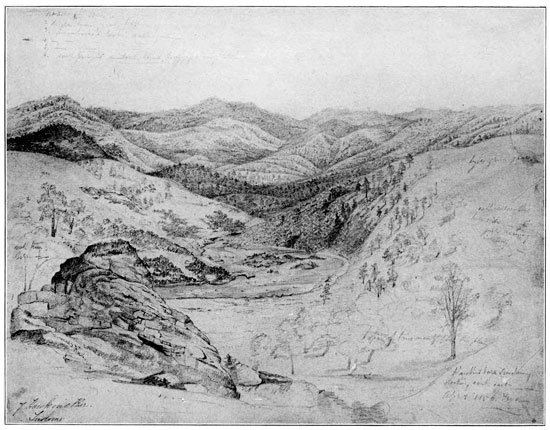
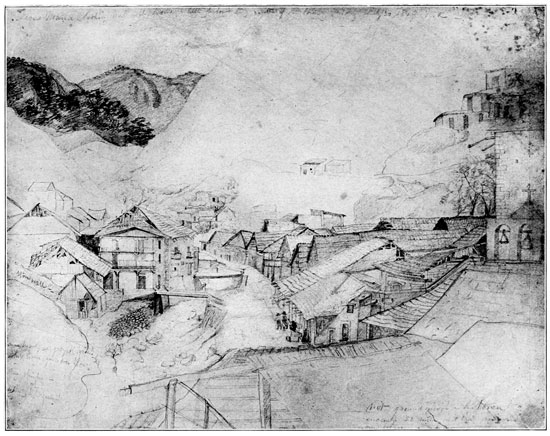
Hawkins's Bar, Tuolumne, Looking Southeast
April 1, 1850
March 29th. The Tuolomne here, one mile
above Hawkin's Bar, comes out of a gorge in the
hills, which is both steep and rocky, and sends
forth the troubled stream to be tossed and dashed
over rocks and shallow bars, for miles through
hills and chasms until it reaches the plains, when
it moves quietly, but still rapidly at this season,
as it makes its way to the San Joaquin, ninety or a
hundred miles from the mouth of that stream.
The river here rises and falls daily and nightly
almost with the regularity of the tide, not ordinarily
more than a foot or two, this being due to the
effect of the sun on the snows of the mountains;
the warmer the day the higher the water. At
night many men in parties of from twenty-five to
fifty are here engaged in digging canals to drain
the bed of the river at low water. I learn however
that they are greatly hindered in this by numerous
springs in the bottom of the river, and
though there is no doubt a great deal of gold, the
difficulties of getting it without machinery are
more than can be realized by any one who has not
been here and tried.
The buzzards in this upper country are just
pairing. I have seen three or four couples of the
California vulture but have not secured one yet.
The bar which was dug here last year is now
under water, but I am told it was very profitable
and many made five or six thousand from their
summer's work. There are many here waiting for
the plains to dry and snows to melt, when Hawkin's
celebrated bar may again be worked. While I
am here, I may as well try to give an idea of how
the work is done. When a spot has been selected
the digger opens a pit, ordinarily four to six feet
deep, but sometimes only the top soil has to be
removed before the digger can commence washing;
this depends on whether he comes to soil
tenacious enough to hold the gold, and keep it
from sinking down through light, sandy, or porous
soils, until it meets with a formation which prevents
it from going deeper into the earth. Sometimes
in such places are found large deposits
called "pockets," and doubtless there are still many
to be discovered. When suitable soil is found the
digger takes a panful for washing, and with doubt
and anxiety goes to the nearest water to see if his
"hole" will pay. He stirs the earth and sand in
his pan around, until all the soluble part floats off
over the sides of the pan, which is kept under
water; he then begins shaking backwards and forwards
with a regular movement what is left in
his pan, to settle what gold is in it; the gold sinks
and all the lighter gravel is tipped to the sides,
and the gold is quite below all except the black
sand, so like emery that when the gold is very fine
it is a great drawback, and difficult to separate.
Should the digger find gold enough to warrant
his washing the clay at the bottom of his pit, and
thereby gaining half an ounce a day he goes on
washing, but grumbles at his hard luck, hoping
that as he gets deeper in his hole he will get richer
also, and that when he comes to rock, he may find
a "pocket." The cradle is set up, the water poured
over, and the monotony of the digger's life begins,
a sort of voluntary treadmill occupation, until
homesick and tired, even if successful, he ties up
his wallet which contains his wealth, secretes it
about his body, and tramps off. A man who is
usually successful, and there are not so many, may
have acquired five or six thousand dollars, but he
has usually aged ten years.
April 5th. Leaving Hawkin's Bar for Green
Springs, we sauntered along the trail under the
beautiful post-oaks, just now in their greatest
beauty, with leaves half-grown and pendant catkins.
Now we shot a partridge or a hare, or
stopped to let "Riley," our pack mule, luxuriate in
some little patch of rich grass, in which he stood
knee deep. Overhead we saw the heavy, sweeping
motion of the vulture's wing, or watched his
silent circles. Around us are flowers innumerable,
brilliant, soft, modest, fragrant, to suit all
fancies, till, having finished our eight-mile journey,
the sun began to cast its evening light over the
landscape, for we had started late. Layton had
rejoined me, and we set up our tent and I made
a sketch.
April 6th. Four o'clock found us on our way
back to Hawkin's, to meet a friend of Layton's,
N. Howard, who was to be our companion. It
was cloudy but beautiful, and at Wedgewood's
tent we found our friend, and shelter, of which
we were glad, as rain was beginning to fall and
soon came down in torrents, swelling the little
brook near the tents to a roaring stream.
April 8th. After being delayed by rain, our
trio started for Don Pedro's Bar, eight miles down
the Tuolomne. The country to look at is most
beautiful, and our short walk was one of pleasure
and admiration.
April 9th. This morning we crossed the river
and after a trot of about five miles came to the
cañon. I made my way to the lower end called
Indian Bluff and my sketch was finished by probably
five o'clock; but having no watch I cannot
tell. Here I saw the nests of the California vulture,
but on the opposite side of the river, now an
impassable torrent.
The country on the south side of this river,
where we are, is very hilly, the soil tolerable, and
the trees still post-oak. We leave for Stockton
tomorrow.
April 10th. The road was pleasant on our way
back to Green Springs and for a mile further, and
when evening came we pitched our "line" tent,
and commenced cooking our supper. We had a
California hare, a mallard and a plover, all killed
out of season, but food we must have. Howard
boasted of his coffee, Layton is the baker of the
mess, whilst I parboiled my slices of pork to rid
it of its coarse flavor, fried out the lard, and have
turned and re-turned the loin and hindlegs of our
hare. "Riley" safely tethered near us had an
equally good supper of the grass and flowers that
were to be his bed, and we spread our blankets
and went to sleep, or rather the other two have
done so, and I, writing by the firelight, shall soon
follow their example.
April 11th. Our road today was almost the
same that I had travelled with the company going
from Stockton to Chinese Camp or diggings, but
how changed the scene. The road then was soft
mud and mire for miles; now it is as hard as brick,
and the hills then scarcely tinged with green by the
early sprouting vegetation are now fresh and
beautiful with every shade of green and brilliant
flowers of all colors. At every rise of ground we
paused and turned to look back at the range of the
Sierra Nevada softening and mellowing in the
hazy light of the sun, the brilliancy enhanced by
the deepening blue of the distant hills which form
the last outline on the eastern horizon.
Here I tried my hand again at oil painting for
landscape, but can only blot in what will answer
hereafter to give me local color. After painting
about three hours we packed up and started again,
as there was no water near us, and took our direction
westerly. We found the beds of the streams
that in January were beautiful little rivulets, now
bright sand bleaching in the sun, their waters dried
up or only a tiny trickle. As we descended from
one table land to another the rich vegetation
became broken by spots of barrenness, and at times
whole plains of weeds, not strong and rank showing
fertile land, but coarse, noxious, ungainly with
disgusting smell, extended for three or four miles
and we followed the dusty road almost feeling
that we were again on our terrible journey through
Mexico last summer.
All these valleys along the river look more fertile
in winter than at this season, as the wet and
moisture gives the appearance of richness, which
is now completely dissipated by the already
parched-up effect of the land.
To give you some little idea of the changes
occurring in this country: the ferry we crossed last
winter (and could only be taken over after great
bargaining for a dollar each), we crossed today,
all three of us, and our mule for the same sum of
one dollar. So at the mines, the same change has
taken place; last year an ounce was considered the
average of the produce of good working men per
diem; this year half an ounce is considered the
average, by equally good and better skilled workmen.
The people at home will not believe that
the roads are travelled by a continuous line of
miners; some on foot, some with packs, mules,
wagons, in search of "better luck."
The snows are melting so fast just now that the
river is within two feet of being as high as when
I crossed in the winter just after two nights of rain;
then it was muddy, and anyone could see was not
in a natural state, now though almost as rapid and
deep its clear waters do not give the angry look it
had then—so much for summer and its softening
effects.
The road from Stanislaus over broad prairies of
poor sandy soil extends for miles until nearing
the edge of the line of beautiful old oaks that
fringe French Creek and its swamps; then the
earth becomes richer and sends up a growth of
clover and beautiful grass knee high, until you
reach Stockton. Indeed all the best lands of the
San Joaquin River are admirably suited for planting
with proper drainage and cultivation.
The sea breeze at this season is cold and searching,
keeping the thermometer at 60 degrees and
62 degrees for days; when a lull comes the heat
is at once oppressive, and the mercury rises to
80 degrees or 85 degrees, and the heat dances
before us almost in palpable shapes; the water all
stagnant sends its odor of decaying vegetation
everywhere, accompanied by myriads of mosquitoes.
These conditions exist for miles over the
east side, towards the mountains of the San Joaquin.
April 16th. I am still at Stockton making
various excursions with Layton and his friend
Howard from New Orleans, and sketching constantly
and steadily. I am indeed crowding all
sail to start for home on the steamer which sails on
June 1st, with Capt. Patterson. I have made
nearly ninety careful sketches, and many hasty
ones, the most interesting I have been able to find
in these southern mines, and expect to leave in a
few days for Sacramento.
Stockton, April 18th. I am hardly fit to write
for I have just had most melancholy news from
Simson. Lieut. Browning, my dear and devoted
friend; to whom I owe a debt of gratitude which
I can never pay, for his friendship and kindness to
me last year, from the hour that he took my hand
on the accursed Rio Grande River until we parted
in San Francisco, has been drowned. With Lieuts.
Bache and Blunt he was examining the coast near
Trinidad Bay, and on attempting to land, the boat
"broached to" in the breakers and capsized. Five
were drowned, among them Lieuts. Browning and
Bache. Thus is added another victim to our
ill-fated expedition. Strange that from first to
last we have been so fatally followed. Night
after night Browning and I shared the same tent,
the same blankets; we knew each [other] well, we
were friends.
April 23d. The whole country to the north and
east of Stockton through to the Calaveras is most
rich and splendid soil, but in many places too low
for farming, but the grazing was excellent, quantities
of wild oats, rye grass (I think), clover and
a species resembling red-top. In many places the
grasses were breast high as I waded through them
but generally full knee-deep. As we neared the
Calaveras we lost our way trying to avoid some
bad arroyos, and followed a trail off to the eastward,
perhaps three miles, and the country if
changed at all, changed for the better. Finding
the trend of the trail we were following did not
suit our ideas of direction, we turned back at even
more than a right angle, and in half an hour
entered a wood of open timber, with here and
there a lagoon or quagmire of mud and mire; but
we worked through and Layton went ahead to
reconnoitre, and in about twenty minutes reported
the river, which we followed down on a good firm
cattle trail, and in half an hour more had come to
the upper settlement of the ferry, and were stopped
by the fences of newly made farms, and again
driven to the swamps to get only a few hundred
yards down to the ferry.
We crossed the river after having assisted some
Germans with about six hundred sheep, and
camped for the night tired enough, having made
only about ten miles, but walked nearly twenty of
hard travel.
April 24th. As the traveller leaves the north
side of the Calaveras and rises higher, the ground
becomes cold and has a bluish-looking clay for the
road, almost as hard as soft brick, and more
tenacious; there are streaks of sandy soil, and in a
few places good land; this is scarce however,
between the Calaveras and Mokulumne where the
Sacramento road crosses the plain. The last three
miles of the road is through a pleasant, half-wooded
country of live-oak and a few varieties
of other shrubs, for the whole of the wood is
small.
The sandy road was a great relief to us after
the lumpy one of the morning, and we tramped
merrily on, until we reached the Mokulumne, and
saw a comfortable (for this country), log and jacal
built house, and passing about two hundred yards
further on, spread our blankets under some half
dozen magnificent oaks, and after washing away
the dust and heat in the clear, cold little river, very
rapid but smooth, ate our lunch of fried pork and
bread, and stretched ourselves out to rest for an
hour, when we packed up, and being ferried across
in a pretty good flat-boat, the only one between
Stockton and Sacramento, we continued our walk
to Dry Creek over just the same description of
country we had had in the morning; but it became
more sandy if anything, and towards evening was
more of a rolling country. Before we camped for
the night we swam "Riley" across a creek about
twenty feet wide, and paid one dollar and fifty
cents for ourselves and belongings to cross in a sort
of canoe, which took us about five minutes.
At the ferry house was a comfortable looking
woman with four little children, one an infant;
like the Texans she told us they had plenty of cattle,
but only one milch cow, so we went on.
April 25th. This morning mounting a slight
rise of ground we at once found ourselves on a high
dry, too dry, prairie, facing a bracing northwest
wind, just strong enough to feel it stirring up our
spirits, and we went cheerily on for about eight
miles to a bridge, crossed it, and for about two
miles had a succession of sloughs to cross, some
boggy, some quicksand, others we had to swim.
By carefully sounding we kept our packs dry in
crossing, and safely reached the back of Murphy's
corral, where I skinned a magpie I had shot, and
Layton took a nap. We then went to admire Mr.
Murphy's fine stock of brood mares, and the young
horses he is raising. At three in the afternoon we
packed and left for Sacramento City, keeping to
the road for eight miles, when we came to a wood
where we collected sufficient fuel for our evening
cooking, and went on two miles or so to a lagoon
of excellent water, and camped. We had no tent
poles, so did as we had done often before, spread
one side of the tent on the ground and laid our
blankets on that, and covered ourselves with the
other part; a corner was put over my gun used as a
pole, which gave a place to sit, and also protected
our solitary candle from the wind, so we ate our
supper in comfort, and enjoyed a kill-deer and a
couple of snipe we had shot.
We did not hear a sound but the croakings of
hundreds of frogs from the pond by our side. Our
long campings out had accustomed us to solitudes
like this, but on our desolate, half starving march
of last year, doubt, anxiety, yes and fear, had always
taken from the complete enjoyment of such freedom
as this. The country was so flat that the
horizon was lost even in the bright moonlight, and
the perfect silence, the pure cloudless sky overhead,
the quiet little lake, tended to make everything
full of solemnity and peace.
April 26th. This morning half a gale was blowing
from the northwest and we were glad to wear
our blanket coats until the sun warmed up the earth.
We reached "Sutter's Fort" at noon, and lay down
under the adobe wall to take our lunch. I was
disappointed in the view I had hoped to take; here,
on a boundless plain, with two or three hospitals
around it, stands a sort of rancho, not so good in
many respects as those of New Mexico, but all in
the same style, the sides being a series of rooms,
one corner being better fitted up for the rancher
and his family.
Under some grand old oaks three hundred feet
to the eastward, is a cemetery containing a number
of graves all made, they tell me, last year when
miners and emigrants alike succumbed to illness
brought on in many cases by exposure, poor food,
and, in some cases, doubtless by disappointed hopes.
Sacramento City is a country village built on a
flat point, between a lagoon and the river just below
the junction of American River, so low as to be
eighteen inches under average high water mark.
It has been a source of such speculations as '36
never heard of. I was shown a plot of some half-dozen
half lots, which cost last fall two hundred
and fifty dollars. The gentleman who owned
them, Dr. Pierson, told me he had sold two of
them, about a quarter of the whole, for three thousand
five hundred dollars, after holding them six
months. Truly people did come to California to
make money, and some made it, but California will
for the present lower the moral tone of all who
come here.
There are few refining influences and men
become coarse and profane in language, while the
hard life does not improve the temper; the sight
of the gold they see dug, and the fortunes they
hear of that have been made in months, some few
even in weeks, make them avaricious.
Many lots of land, valued last year at one thousand
dollars, are now valued at ten thousand
dollars, but sooner or later the fall must come.
Sutter's Fort appears to have been built with
great care as to its means of defence, though at
first sight a visitor would be puzzled to know why
it was called a fort at all; closer examination shows
that it once had, from all appearances, four square
towers, some twenty-five feet high, one at each
corner, each tower mounting four, eighteen, or at
most, twenty-four pound carronades, and the
effect of these on the Indians was all that was
required for protection, for the Indians here are
a very low class and poor race, far inferior to the
eastern tribes, and like the Mexicans cowardice is
their chief trait, or at least their most prominent
one; and if Mr. Sutter could have had twenty
faithful followers, he must have been "monarch
of all he surveyed."
The swampy neighborhood, bad atmosphere,
and malarial conditions must render this section
of country unhealthy to a great degree for half the
year; for as autumn comes on the daily supply of
freshly-melted snow-water from the mountains
will no longer purify the lagoons and bayous of
the vicinity.
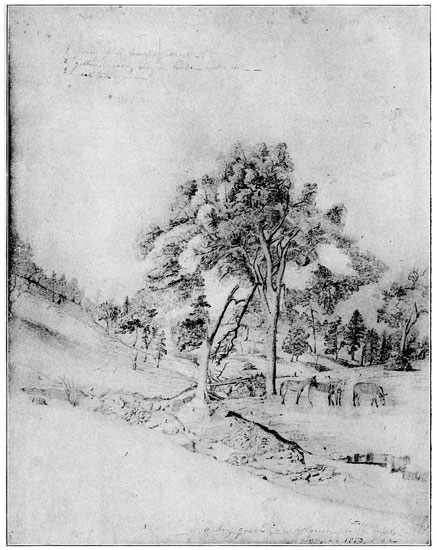
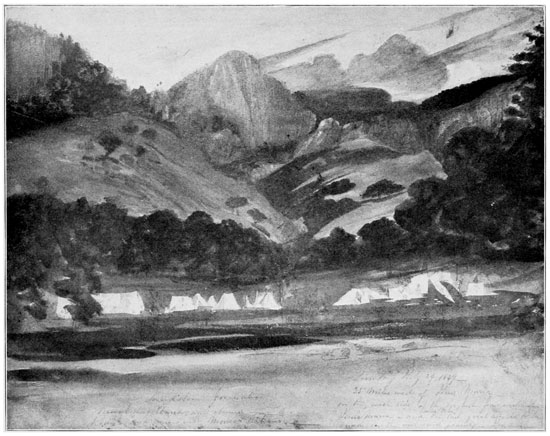
"A Dry Gulch" at Coloma, Sutter's Mills
May 2, 1850
Fever and ague is very prevalent now, and
dysentery feared by all. Many of the farmers I
find here tell me they are only working to get
money enough to get back with, and that nothing
would induce them to settle here. They have
unfortunately not seen the lower part of the valley
and what lies about Los Angeles and to the southward—that
is the flower of California.
April 29th. Alas, is it for good or for bad
luck, that I have just learned that Layton and
myself cannot travel with safety across the country
here, as below, on account of the ill-will of the
Indians, and that a party of less than six will be
unsafe up and across the middle fork of the American
River. How stories of Indians are told to
every traveller. Though often near them, I have
never found any who were not greater cowards
than myself, and we leave today for Sutter's Mills,
Georgetown, etc., in good health and spirits.
May 4th. Coloma. "Sutter's Mills" is about
fifty miles [distant], nearly east of Sacramento.
The road to it after passing the first four or five
miles runs through a sandy soil, covered at present
with what we call "sneeze-weed." There is no
water, until after leaving the river, American
Fork, we crossed a pretty little "spring branch"
as it would be called in Louisiana. The grass is
sparse and poor along the whole route, and the face
of nature looks like August in the eastern states, so
completely that as the refreshing cool breezes come
to us each morning, I almost fancy it is the first of
September. But in the valleys and on the hillsides
the heat is most oppressive, though, as in England,
if you stand still for only a few moments in the
shade, you soon feel chilled through.
The valley here is not as wide as at Stockton by
at least twenty miles, and the grand masses of snow
covered mountains seem almost within a day of
you, whilst south you still have distance to give
additional enchantment to the view. The oaks
here are small, not more than from eighteen inches
to two feet in diameter; if the soil in which they
grew had any richness, I should say the whole
forest was of forty years growth at most, but for the
occasional presence of a grove of magnificent pines,
from a hundred to nearly two hundred feet high.
I have measured many at the angle on the ground
and have proved it with rods so that I know I am
very nearly correct in my statement.
May 6th. Crossing the river at Coloma, on a
good bridge, we commenced our ascent of the long
and in many places very steep hill. We found a
start at dawn would have been much better than
at ten, which it now was, as our poor mule "Riley"
felt the heat greatly; but with occasional pauses up
we went, passing wrecked wagons and broken
pack-saddles in several of the narrow parts of the
cañons that the road wound through. We were
not sorry when we found we had reached
the last hill and mounted it, hoping to be repaid
by some distant view, but on no side could we see
more than a few miles; and we journeyed on,
wondering who would be[40] at the mushroom town,
Coloma, renowned for being the place where gold
was first found by the whites.
We were told that Captain Sutter had made a
large fortune by digging gold with many of the
Indians he had about him; how true the story is,
of course, I cannot say.
[No date.] Starting early we had time enough
to reach Georgetown, and after the first few miles,
were pleased to see a most favorable change in the
forest we passed through. A better class of white
oaks appeared, and following up a beautiful little
creek we gradually came to a pine growth large
and magnificent; both yellow and white pine were
there, also the long coned pine, and many superb
cedars over a hundred feet high. In many places
these trees were felled, and split into laths and
joists so straight and fine that but little dressing
was requisite to fit them for the buildings here
constructed, frame houses one story high. I saw
some maples, very like what we call "soft" maple,
an elm or two, and many specimens of Nuttall's
splendid dogwood in full bloom.
The ultramarine jay is here by dozens, robins,
fly catchers, chats, finches by hundreds. I see daily
new birds and plants that a year's steady work
could not draw, but if our government would send
good men, what a work of national pride could be
brought out! Geology, botany, entomology, zoölogy,
etc. The views are frequently superb, and
the hemlocks and pines of many species most
beautiful.
We reached Georgetown—two rows of poor
houses and sheds. The houses all one story, but
some with piazzas, and here we took our supper
at the "Pine settlement" as it is called.