1826-1829
THE EUROPEAN JOURNALS
1826-1829
ON the 26th April, 1826, I left my beloved wife Lucy
Audubon, and my son John Woodhouse with our
friends the Percys at Bayou Sara. I remained at Doctor
Pope's at St. Francisville till Wednesday at four o'clock
p. m., when I took the steamboat "Red River," Captain
Kemble, for New Orleans, which city I reached at noon
on Wednesday, 27th. Visited many vessels for my passage
to England, and concluded to go in the ship "Delos"
of Kennebunk, Captain Joseph Hatch, bound to Liverpool,
and loaded entirely with cotton. During my stay in New
Orleans, I lived at G. L. Sapinot's, and saw many of my
old friends and acquaintances, but the whole time of waiting
was dull and heavy. I generally walked from morning
till dusk. New Orleans, to a man who does not trade in
dollars or other such stuff, is a miserable spot. Finally,
discovering that the ship would not be ready for sea for
several days longer, I ascended the Mississippi again in
the "Red River," and arrived at Mrs. Percy's at three
o'clock in the morning, having had a dark ride through
the Magnolia woods. I remained two days, left at sunrise,
and breakfasted with my good friend Augustin Bourgeat.
Arrived at New Orleans, I called on the governor, who
gave me a letter bearing the seal of the State, obviating
the necessity of a passport. I received many letters of
introduction from different persons which will be of use to
me. Also I wrote to Charles Bonaparte, apprising him of
the box of bird skins forwarded to him.
On the 17th of May, my baggage was put on board, I
following, and the steamboat "Hercules" came alongside
at seven p. m., and in ten hours put the "Delos" to sea. I
was immediately affected with sea-sickness, which, however,
lasted but a short time; I remained on deck constantly,
forcing myself to exercise. We calculated our day of
departure to be May 18, 1826, at noon, when we first
made an observation. It is now the 28th; the weather
has been generally fair with light winds. The first objects
which diverted my thoughts from the dear ones left behind
me, were the beautiful Dolphins that glided by the vessel
like burnished gold by day, and bright meteors by night.
Our captain and mate proved experts at alluring them with
baited hooks, and dexterous at piercing them with a five-pronged
instrument, generally called by seamen "grain."
If hooked, the Dolphin flounces desperately, glides off
with all its natural swiftness, rises perpendicularly out of
the water several feet, and often shakes off the hook and
escapes; if, however, he is well hooked, he is played about
for a while, soon exhausted, and hauled into the ship.
Their flesh is firm, dry, yet quite acceptable at sea.
They differ much in their sizes, being, according to age,
smaller or larger; I saw some four and a half feet long,
but a fair average is three feet. The paunch of all we
caught contained more or less small fishes of different
varieties, amongst which the flying-fish is most prevalent.
Dolphins move in companies of from four or five to
twenty or more. They chase the flying-fish, that with
astonishing rapidity, after having escaped their sharp
pursuer a while in the water, emerge, and go through
the air with the swiftness of an arrow, sometimes in a
straight course, sometimes forming part of a circle; yet
frequently the whole is unavailing, for the Dolphin bounds
from the sea in leaps of fifteen or twenty feet, and so
moves rapidly towards his prey, and the little fish falls, to
be swallowed by his antagonist. You must not suppose,
however, that the Dolphin moves through the seas without
risk or danger; he, as well as others has vigilant and
powerful enemies. One is the Barracouta, in shape much
like a Pike, growing sometimes to a large size; one of
these cut off upwards of a foot of a Dolphin's tail, as if done
with an axe, as the Dolphin made for a baited hook; and I
may say we about divided the bounty. There is a degree
of sympathy existing between Dolphins quite remarkable;
the moment one of them is hooked or grained, all those in
company immediately make towards him, and remain close
to him till the unfortunate is hauled on board, then they
move off and will rarely bite. The skin of the fish is a tissue
of small scales, softer in their substance than is generally
the case in scaley fishes of such size; the skin is tough.
We also caught a Porpoise about seven feet in length.
This was accomplished during the night, when the moon
gave me a full view of all that happened. The fish, contrary
to custom, was grained instead of harpooned, but
grained in such a way and so effectually, through the forehead,
that it was then held and suffered to flounce and
beat about the bow of the ship, until the man who had first
speared it gave the line holding the grain to our captain,
slid along the bobstay with a rope, then, after some little
time and perhaps some difficulty, the fish was secured immediately
about its tail, and hoisted with that part upwards.
Arrived at the deck it gave a deep groan, much
like the last from a dying hog, flapped heavily once or
twice, and died. I had never before examined one of
these closely, and the duck-bill-like snout, and the curious
disposition of the tail, with the body, were new and interesting
matters of observation to me. The large, sleek, black
body, the quantity of warm, black blood issuing from
the wound, the blowing apertures placed over the forehead,—all
attracted my attention. I requested it might
be untouched till the next morning, and my wish was
granted. On opening it the intestines were still warm
(say eight hours after death), and resembled very much
those of a hog. The paunch contained several cuttle-fish
partly decayed. The flesh was removed from the skeleton
and left the central bone supported on its sides by two
horizontal, and one perpendicular bone, giving it the appearance
of a four-edged cutting instrument; the lower
jaw, or as I would prefer writing it, mandible, exceeds the
upper about three-fourths of an inch. Both were furnished
with single rows of divided conical teeth, about one-half
an inch in length, so parted as to admit those of the upper
jaw between each of those of the lower. The fish might
weigh about two hundred pounds. The eyes were small
in proportion to the size of the animal, and having a breathing
aperture above, of course it had no gills. Porpoises
move in large companies, and generally during spring and
early summer go in pairs. I have seen a parcel of them
leap perpendicularly about twenty feet, and fall with a
heavy dash in the sea. Our captain told us that there
were instances when small boats had been sunk by one of
these heavy fish falling into them. Whilst I am engaged
with the finny tribe (of which, however, I know little or
nothing), I may as well tell you that one morning when
moving gently, two miles per hour, the captain called me
to show me some pretty little fishes just caught from the
cabin window. These measured about three inches, were
broad, and moved very quickly through the water. We
had pin-hooks, and with these, in about two hours,
three hundred and seventy were caught; they were sweet
and good as food. They are known ordinarily as Rudder-fish,
and always keep on the lee side of the rudder, as it
affords them a strong eddy to support them, and enable
them to follow the vessel in that situation; when calm they
disperse about the bow and sides, and then will not bite.
The least breeze brings them all astern again in a compact
body, when they seize the baited hook the moment it
reaches the water.
We have also caught two Sharks, one a female about
seven feet long, that had ten young, alive, and able to
swim well; one of them was thrown overboard and made
off as if well accustomed to take care of himself. Another
was cut in two, and the head half swam off out of our
sight. The remainder, as well as the parent, were cut in
pieces for bait for Dolphins, which are extremely partial to
that meat. The weather being calm and pleasant, I felt
desirous to have a view of the ship from a distance and
Captain Hatch politely took me in the yawl and had it
rowed all round the "Delos." This was a sight I had not
enjoyed for twenty years, and I was much pleased with it;
afterwards having occasion to go out to try the bearings of
the current, I again accompanied him, and bathed in the
sea, not however without some fears as to Sharks. To try
the bearings of the current we took an iron pot fastened
to a line of one hundred and twenty fathoms, and made a
log-board out of a barrel's head leaded on one side to make
it sink perpendicularly on its edge, and tried the velocity
of the current with it fixed to a line by the help of a second
glass,[65] whilst our iron pot acted as an anchor.
Let me change my theme, and speak of birds awhile.
Mother Carey's Chickens (Procellaria) came about us,
and I longed to have at least one in my possession. I had
watched their evolutions, their gentle patting of the sea
when on the wing, with the legs hanging and the web
extended, seen them take large and long ranges in search
of food, and return for bits of fat thrown overboard for
them, I had often looked at different figures given by
scientific men; but all this could not diminish for a moment
the long-wished for pleasure of possessing one in the flesh.
I fired, and dropped the first one that came alongside, and
the captain most courteously sent for it with the yawl.
I made two drawings of it; it proved to be a female with
eggs, numerous, but not larger than grains of fine powder,
inducing me to think that these birds must either breed
earlier, or much later, than any in our southern latitude.
I should be inclined to think that the specimen I inspected
had not laid this season, though I am well satisfied that it
was an old bird. During many succeeding weeks I discovered
that numbers flew mated side by side, and occasionally,
particularly on calm, pleasant days caressed each
other as Ducks are known to do.
May 27, 1826. Five days ago we saw a small vessel
with all sails set coming toward us; we were becalmed and
the unknown had a light breeze. It approached gradually;
suspicions were entertained that it might be a pirate, as
we had heard that same day reports, which came undoubtedly
from cannon, and from the very direction from which
this vessel was coming. We were well manned, tolerably
armed, and were all bent on resistance, knowing
well that these gentry gave no quarter, to purses at least,
and more or less uneasiness was perceptible on every face.
Night arrived, a squally breeze struck us, and off we
moved, and lost sight of the pursuing vessel in a short
time. The next day a brig that had been in our wake
came near us, was hailed, and found to be the "Gleaner,"
of Portland, commanded by an acquaintance of our commander,
and bound also to Liverpool. This vessel had
left New Orleans five days before us. We kept close
together, and the next day Captain Hatch and myself
boarded her, and were kindly received; after a short stay
her captain, named Jefferson, came with us and remained
the day. I opened my drawings and showed a few of
them. Mr. Swift was anxious to see some, and I wanted
to examine in what state they kept, and the weather being
dry and clear I feared nothing. It was agreed the vessels
should keep company until through the Gulf Stream, for
security against pirates. So fine has the weather been
so far, that all belonging to the cabin have constantly
slept on deck; an awning has been extended to protect
from the sun by day and the dampness by night. When
full a hundred leagues at sea, a female Rice Bunting came
on board, and remained with us one night, and part of a
day. A Warbler also came, but remained only a few
minutes, and then made for the land we had left. It
moved while on board with great activity and sprightliness;
the Bunting, on the contrary, was exhausted, panted,
and I have no doubt died of inanition.
Many Sooty Terns were in sight during several days.
I saw one Frigate Pelican high in air, and could only judge
it to be such through the help of a telescope. Flocks of
unknown birds were also about the ship during a whole
day. They swam well, and preferred the water to the
air. They resembled large Phalaropes, but I could not
be certain. A small Alligator, that I had purchased for
a dollar in New Orleans, died at the end of nine days,
through my want of knowledge, or thought, that salt
matter was poisonous to him. In two days he swelled to
nearly double his natural size, breathed hard, and, as I
have said, died.
In latitude 24°, 27´, a Green Heron came on board, and
remained until, becoming frightened, it flew towards the
brig "Gleaner;" it did not appear in the least fatigued.
The captain of the brig told me that on a former voyage
from Europe to New Orleans, when about fifty leagues
from the Balize, a fully grown Whooping Crane came on
board his vessel during the night, passing over the length
of his deck, close over his head, over the helmsman, and
fell in the yawl; the next morning the bird was found
there completely exhausted, when every one on board
supposed it had passed on. A cage was made for it, but
it refused food, lingered a few days, and then died. It
was plucked and found free from any wound, and in good
condition; a very singular case in birds of the kind, that
are inured to extensive journeys, and, of course liable to
spend much time without the assistance of food.
June 4. We are a few miles south of the Line, for
the second time in my life. Since I wrote last we have
parted from our companion the "Gleaner," and are yet
in the Gulf of Mexico. I have been at sea three Sundays,
and yet we have not made the shores of Cuba. Since
my last date I have seen a large Sword-fish, but only saw
it, two Gannets, caught a live Warbler, and killed a
Great-footed Hawk. This bird, after having alighted several
times on our yards, made a dash at a Warbler which
was feeding on the flies about the vessel, seized it, and
ate it in our sight, on the wing, much like a Mississippi
Kite devouring the Red-throated Lizards. The warbler
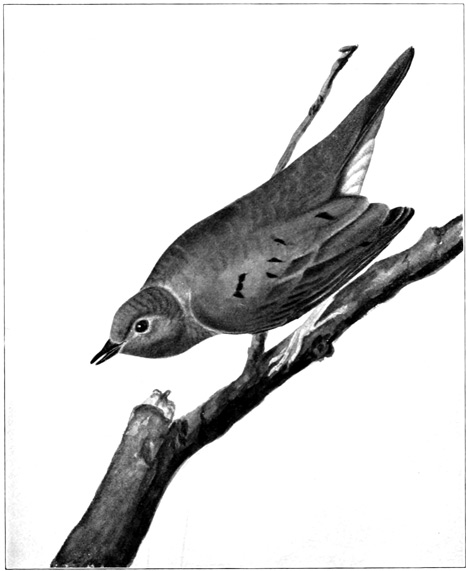
we caught was a nondescript, which I named "The Cape
Florida Songster." We also saw two Frigate Pelicans at a
great height, and a large species of Petrel, entirely unknown
to me. I have read Byron's "Corsair" with much
enjoyment.
June 17. A brig bound to Boston, called the "Andromache,"
came alongside, and my heart rejoiced at
the idea that letters could be carried by her to America.
I set to, and wrote to my wife and to Nicholas Berthoud.
A sudden squall separated us till quite late, but we boarded
her, I going with the captain; the sea ran high, and the
tossing of our light yawl was extremely disagreeable to
my feelings. The brig was loaded with cotton, extremely
filthy, and I was glad to discover that with all our disagreeables
we were comparatively comfortable on the
"Delos." We have been in sight of Cuba four days; the
heat excessive. I saw three beautiful White-headed
Pigeons, or Doves, flying about our ship, but after several
rounds they shaped their course towards the Floridas
and disappeared. The Dolphins we catch here are said
to be poisonous; to ascertain whether they are or not, a
piece of fish is boiled with a silver dollar till quite cooked,
when if the coin is not tarnished or green, the fish is safe
eating. I find bathing in the sea water extremely refreshing,
and enjoy this luxury every night and morning.
Several vessels are in sight.
June 26. We have been becalmed many days, and
I should be dull indeed were it not for the fishes and
birds, and my pen and pencil. I have been much interested
in the Dusky Petrels; the mate killed four at
one shot, so plentiful were they about our vessel, and
I have made several drawings from these, which were
brought on board for that purpose. They skim over the
sea in search of what is here called Gulf Weed, of which
there are large patches, perhaps half an acre in extent.
They flap the wings six or seven times, then soar for
three or four seconds, the tail spread, the wings extended.
Four or five of these birds, indeed sometimes as many as
fifteen or twenty, will alight on this weed, dive, flutter, and
swim with all the gayety of ducks on a pond, which they
have reached after a weary journey. I heard no note
from any of them. No sooner have the Petrels eaten or
dispersed the fish than they rise and extend their wings
for flight, in search of more. At times, probably to rest
themselves, they alighted, swam lightly, dipping their bills
frequently in the water as Mergansers and fishy Ducks do
when trying, by tasting, if the water contains much fish.
On inspection of the body, I found the wings powerfully
muscular and strong for the size of the bird, a natural
requisite for individuals that have such an extent of water
to traverse, and frequently heavy squalls to encounter
and fight against. The stomach, or pouch, resembled a
leather purse of four inches in length and was much distended
by the contents, which were a compound of fishes
of different kinds, some almost entire, others more or less
digested. The gullet was capable of great extension.
Fishes two and a half inches by one inch were found
nearly fresh. The flesh of these Petrels smelt strong, and
was tough and not fit to eat. I tasted some, and found
it to resemble the flesh of the Porpoise. There was no
difference in the sexes, either in size or color; they are
sooty black above, and snowy white below. The exact
measurements are in my memorandum-book.
June 29. This morning we came up with the ship
"Thalia," of Philadelphia, Captain John R. Butler, from
Havana to Minorca up the Mediterranean, with many
passengers, Spaniards, on board. The captain very
politely offered us some fruit, which was gladly accepted,
and in return we sent them a large Dolphin, they having
caught none. I sent a Petrel, stuffed some days previously,
as the captain asked for it for the Philadelphia
Society of Sciences.
June 30. Whilst sailing under a gentle breeze last
night, the bird commonly called by seamen "Noddy"
alighted on the boom of the vessel, and was very soon
caught by the mate. It then uttered a rough cry, not
unlike that of a young crow when taken from the nest.
It bit severely and with quickly renewed movement of
the bill, which, when it missed the object in view, snapped
like that of our larger Flycatchers. I found it one of the
same species that hovered over the seaweeds in company
with the large Petrel. Having kept it alive during the
night, when I took it in hand to draw it it was dull looking
and silent. I know nothing of this bird more than
what our sailors say, that it is a Noddy, and that they
often alight on vessels in this latitude, particularly in the
neighborhood of the Florida Keys. The bird was in
beautiful plumage, but poor. The gullet was capable of
great extension, the paunch was empty, the heart large for
the bird, and the liver uncommonly so.
A short time before the capture of the above bird, a
vessel of war, a ship that we all supposed to be a South
American Republican, or Columbian, came between us
and the "Thalia," then distant from us about one and a
half miles astern, fired a gun, and detained her for some
time, the reason probably being that the passengers were
Spaniards, and the cargo Spanish property; however, this
morning both vessels were in view making different routes.
The man-of-war deigned not to come to us, and none of
us were much vexed at this mark of inattention. This
day has been calm; my drawing finished, I caught four
Dolphins; how much I have gazed at these beautiful creatures,
watching their last moments of life, as they changed
their hue in twenty varieties of richest arrangement of tints,
from burnished gold to silver bright, mixed with touches
of ultramarine, rose, green, bronze, royal purple, quivering
to death on our hard, broiling deck. As I stood and
watched them, I longed to restore them to their native
element in all their original strength and vitality, and yet
I felt but a few moments before a peculiar sense of pleasure
in catching them with a hook to which they were
allured by false pretences.
We have at last entered the Atlantic Ocean this morning
and with a propitious breeze; the land birds have left
us, and I—I leave my beloved America, my wife, my
children, my friends. The purpose of this voyage is to
visit not only England, but the continent of Europe, with
the intention of publishing my work on the "Birds of
America." If not sadly disappointed my return to these
shores, these happy shores, will be the brightest day I
have ever enjoyed. Oh! wife, children, friends, America,
farewell! farewell!
July 9. At sea. My leaving America had for some
time the feelings of a dream; I could scarce make up
my mind fixedly on the subject. I thought continually
I still saw my beloved friends, and my dear wife and children.
I still felt every morning when I awoke that the land
of America was beneath me, and that I would in a short
time throw myself on the ground in her shady woods,
and watch for, and listen to the many lovely warblers.
But now that I have positively been at sea since fifty-one
days, tossing to and fro, without the sight or the touch of
those dear to me, I feel fully convinced, and look forward
with an anxiety such as I never felt before, when I
calculate that not less than four months, the third of a
year, must elapse before my wife and children can receive
any tidings of my arrival on the distant shores to which I
am bound. When I think that many more months must
run from the Life's sand-glass allotted to my existence
before I can think of returning, and that my re-union with
my friends and country is yet an unfolded and unknown
event, I am filled with sudden apprehensions which I cannot
describe nor dispel.
Our fourth of July was passed near the Grand Banks,
and how differently from any that I can recollect. The
weather was thick, foggy, and as dull as myself; not a
sound of rejoicing reached my ears, not once did I hear
"Hail Columbia! Happy land." My companion passengers
lay about the deck and on the cotton-bales, basking
like Crocodiles, while the sun occasionally peeped
out of the smoky haze that surrounded us; yet the breeze
was strong, the waves moved majestically, and thousands
of large Petrels displayed their elegant, aerial movements.
How much I envied their power of flight to enable me to
be here, there, and all over the globe comparatively speaking,
in a few moments, throwing themselves edgeways
against the breeze, as if a well sharpened arrow shot with
the strength and grace of one sprung from the bow of an
Apollo. I had remarked a regular increase in the number
of these Petrels ever since the capes of Florida were
passed; but here they were so numerous, and for part of
a day flew in such succession towards the west and
southwest, that I concluded they were migrating to some
well known shore to deposit their eggs, or perhaps leading
their young. These very seldom alighted; they were full
the size of a common gull, and as they flew they showed
in quick alternations the whole upper and under part of
their bodies, sometimes skimming low, sometimes taking
immense curves, then dashing along the deep trough of
the sea, going round our vessel (always out of gun-reach)
as if she had been at anchor. Their lower parts are
white, the head all white, and the upper part of the body
and wings above sooty brown. I would imagine that one
of these Petrels flies over as much distance in one hour, as
one of the little black Petrels in our wake does in twelve.
Since we have left the neighborhood of the Banks, these
birds have gradually disappeared, and now in latitude 44°,
53´ I see none. Our captain and sailors speak of them
as companions in storms, as much as their little relations
Mother Carey's chickens.
As suddenly as if we had just turned the summit of a
mountain dividing a country south of the equator from
Iceland, the weather altered in the present latitude and
longitude. My light summer clothing was not sufficient,
and the dews that fell at night rendered the deck, where I
always slept, too damp to be comfortable. This, however,
of two evils I preferred, for I could not endure the more
disagreeable odors of the cabin, where now the captain,
officers, and Mr. Swift, eat their meals daily. The length
of the days has increased astonishingly; at nine o'clock
I can easily read large print. Dawn comes shortly after
2 a. m., and a long day is before us.
At Sea—July, 1826. We had several days a stiff
breeze that wafted us over the deep fully nine miles an
hour. This was congenial to my wishes, but not to my
feelings. The motion of the vessel caused violent headaches,
far more distressing than any seasickness I had ever
experienced. Now, for the third or fourth time, I read
Thomson's "Seasons," and I believe enjoyed them better
than ever.
Among our live stock on board, we had a large hen.
This bird was very tame and quite familiar with the ins
and outs of the vessel, and was allowed all the privileges
of the deck. She had been hatched on board, and our
cook, who claimed her as his property, was much attached
to her, as was also the mate. One morning she imprudently
flew overboard, while we were running three
miles an hour. The yawl was immediately lowered, four
men rowed her swiftly towards the floating bird that
anxiously looked at her place of abode gliding from her;
she was picked up, and her return on board seemed to
please every one, and I was gratified to see such kind
treatment to a bird; it assured me, had I needed that
assurance, that the love of animals develops the better
side of all natures. Our hen, however, ended her life most
distressingly not long after this narrow escape; she again
flew over the side, and the ship moving at nine knots,
the sea very high and rough, the weather rainy and
squally, the captain thought it imprudent to risk the men
for the fowl; so, notwithstanding the pleadings of the cook,
we lost sight of the adventurous bird in a few moments.
We have our long boat as usual lashed to the deck; but
instead of being filled with lumber as is usually the case, it
now contained three passengers, all bound to Europe to
visit friends, with the intention of returning to America in
the autumn. One has a number of books which he
politely offered me; he plays most sweetly on the flute,
and is a man superior to his apparent situation. We have
a tailor also; this personage is called a deck hand, but
the fact is, that two thirds of his time is spent sleeping on
the windlass. This man, however, like all others in the
world, is useful in his way. He works whenever called
on, and will most cheerfully put a button or a patch on
any one's clothing; his name is Crow, and during the entire
voyage, thus far, he has lived solely on biscuit and raw
bacon. We now see no fish except now and then a shoal
of porpoises. I frequently long for the beautiful Dolphins
in the Gulf of Mexico; Whales have been seen by the
sailors, but not by me. During this tedious voyage I
frequently sit and watch our captain at his work; I do
not remember ever to have seen a man more industrious
or more apt at doing nearly everything he needs himself.
He is a skilful carpenter and turner, cooper, tin and black
smith, and an excellent tailor; I saw him making a pair
of pantaloons of fine cloth with all the neatness that a city
brother of the cross-legged faculty could have used. He
made a handsome patent swift for his wife, and a beautiful
plane for his own use, manufactured out of a piece of beechwood
that probably grew on the banks of the Ohio, as I
perceived it had been part of a flat-boat, and brought on
board to be used for fuel. He can plait straw in all
sorts of ways, and make excellent bearded fishhooks out of
common needles. He is an excellent sailor, and the more
stormy it becomes, the gayer he is, even when drenched to
the skin. I was desirous of understanding the means of
ascertaining the latitude on land, and also to find the
true rising of the sun whilst travelling in the uninhabited
parts of America; this he showed me with pleasure, and I
calculated our latitude and longitude from this time,
though not usually fond of mathematics. To keep busy
I go often about the deck pencil in hand, sketching the
different attitudes of the sailors, and many a laugh is
caused by these rough drawings. Both the mates have
shown a kindness towards me that I cannot forget. The
first mate is S. L. Bragdon from Wells, the second Wm.
Hobart from Kennebunk.
To-day we came in with a new set and species of Petrels,
resembling those in the Gulf of Mexico, but considerably
larger; between fifty and sixty were at one time close to
the vessel, catching small fish that we guessed to be herrings;
the birds swam swiftly over the water, their wings
raised, and now and then diving and dipping after the
small fry; they flew heavily, and with apparent reluctance,
and alighted as soon as we passed them. I was satisfied
that several in our wake had followed us from the Gulf of
Mexico; the sudden change in the weather must have
been seriously felt by them.
July 12. I had a beautiful view of a Whale about five
hundred yards from the vessel when we first perceived it;
the water thrown from his spiracles had the appearance of
a small, thick cloud, twelve or fourteen feet wide. Never
have I felt the weather so cold in July. We are well
wrapped up, and yet feel chilly in the drizzling rain.
July 15. Yesterday-night ended the ninth Sunday
passed at sea; the weather continues cold, but the wind is
propitious. We are approaching land, and indeed I
thought I smelt the "land smell." We have had many
Whales near us during the day, and an immense number of
Porpoises; our captain, who prefers their flesh to the best
of veal, beef, or mutton, said he would give five dollars for
one; but our harpoon is broken, and although several
handles were fastened for a while to the grain, the weapon
proved too light, and the fish invariably made their escape
after a few bounces, probably to go and die in misery.
European Hawks were seen, and two Curlews; these
gave me hope that we might see the long desired land
shortly.
July 18, 1826. The sun is shining clear over Ireland;
that land was seen at three o'clock this morning by the
man at the helm, and the mate, with a stentorian voice,
announced the news. As we approached the coast a
small boat neared us, and came close under our lee; the
boat looked somewhat like those employed in bringing in
heavy loads to New Orleans, but her sails were more
tattered, her men more fair in complexion. They hailed
us and offered for sale fresh fish, new potatoes, fresh eggs.
All were acceptable, I assure thee. They threw a light
line to us most dexterously. Fish, potatoes, and eggs were
passed to us, in exchange for whiskey, salt pork, and tobacco,
which were, I trust, as acceptable to them as their
wares were to us. I thought the exchange a fair one, but
no!—they called for rum, brandy, whiskey, more of everything.
Their expressions struck me with wonder; it was
"Here's to your Honor,"—"Long life to your Honor,"—"God
bless your Honor,"—Honors followed with
such rapidity that I turned away in disgust. The breeze
freshened and we proceeded fast on our way. Perhaps
to-morrow may see me safe on land again—perhaps to-morrow
may see us all stranded, perishing where the
beautiful "Albion" went ashore.
St. George's Channel, Thursday, July 20. I am approaching
very fast the shores of England, indeed Wales is
abreast of our ship, and we can plainly distinguish the
hedges that divide the fields of grain; but what nakedness
the country exhibits, scarce a patch of timber to be seen;
our fine forests of pine, of oak, of heavy walnut-trees, of
magnificent magnolias, of hickories or ash or maple, are
represented here by a diminutive growth called "furze."
But I must not criticise so soon! I have not seen the
country, I have not visited any of the historic castles, or
the renowned parks, for never have I been in England nor
Scotland, that land made famous by the entrancing works
of Walter Scott. We passed yesterday morning the
Tuskar, a handsome light on a bare rock. This morning
we saw Holyhead, and we are now not more than twenty-five
miles from Liverpool; but I feel no pleasure, and
were it not for the sake of my Lucy and my children, I
would readily embark to-morrow to return to America's
shores and all they hold for me.... The pilot boat that
came to us this morning contained several men all dressed
in blue, with overcoats of oiled linen,—all good, hearty,
healthy-looking men.... I have been on deck, and from
the bow the land of England is plainly distinguishable;
the sight around us is a beautiful one, I have counted
fifty-six vessels with spreading sails, and on our right are
mountains fading into the horizon; my dull thoughts
have all abandoned me, I am elated, my heart is filled
with hope. To-morrow we shall land at the city of Liverpool,
but when I think of Custom House officials, acceptancy
of Bills, hunting up lodgings,—again my heart fails
me; I must on deck.
Mersey River opposite Liverpool, 9.30 p. m. The night
is cloudy, and we are at anchor! The lights of the city
show brightly, for we are not more than two hundred
yards distant from them.
Liverpool, July 21. This morning when I landed it
was raining, yet the appearance of the city was agreeable;
but no sooner had I entered it than the smoke
became so oppressive to my lungs that I could hardly
breathe; it affected my eyes also. All was new to me.
After a breakfast at an inn with Mr. Swift for 2/6, we went
to the Exchange Buildings, to the counting-house of Gordon
and Forstall, as I was anxious to deliver my letters
to Mr. Gordon from Mr. Briggs. I also presented during
the morning my bill of exchange. The rest of the day
was spent in going to the Museum, gazing about, and
clearing my brains as much as possible; but how lonely I
feel,—not a soul to speak to freely when Mr. Swift leaves
me for Ireland. We took lodgings at the Commercial Inn
not far from the Exchange Buildings; we are well fed, and
well attended to, although, to my surprise, altogether by
women, neatly dressed and modest. I found the persons
of whom I enquired for different directions, remarkably
kind and polite; I had been told this would not be the
case, but I have met with only real politeness from all.
Liverpool, July 22. The Lark that sings so sweetly,
and that now awakened me from happy dreams, is nearly
opposite my table, prisoner in a cage hanging by a window
where from time to time a young person comes to
look on the world below; I think of the world of the
West and—but the Lark, delightful creature, sings sweetly,
yet in a cage!
The Custom House suddenly entered my head, and
after considerable delay there, my drawings went through
a regular, strict, and complete examination. The officers
were all of opinion that they were free of duty, but the
law was looked at and I was obliged to pay two pence on
each drawing, as they were water-colored. My books
being American, I paid four pence per pound, and when all
was settled, I took my baggage and drawings, and went
to my lodgings. The noise of pattens on the sidewalk
startles me very frequently; if the sound is behind me I
often turn my head expecting to see a horse, but instead
I observe a neat, plump-looking maid, tripping as briskly
as a Killdeer. I received a polite note from Mr. Rathbone[66]
this morning, inviting me to dine next Wednesday
with him and Mr. Roscoe.[67] I shall not forget the appointment.
Sunday, July 23. Being Sunday I must expect a
long and lonely day; I woke at dawn and lay for a few
moments only, listening to the sweet-voiced Lark; the day
was beautiful; thermometer in the sun 65°, in the shade
41°; I might say 40°, but I love odd numbers,—it is a foolish
superstition with me. I spent my forenoon with Mr.
Swift and a friend of his, Mr. R. Lyons, who was afterwards
kind enough to introduce us to the Commercial
Reading Room at the Exchange Buildings. In the afternoon
we went across the Mersey. The country is somewhat
dull; we returned to supper, sat chatting in the coffee
room, and the day ended.
July 24, Monday. As early as I thought proper I
turned my steps to No. 87 Duke Street, where the polite
English gentleman, Mr. Richard Rathbone,[68] resides. My
locks blew freely from under my hat in the breeze, and
nearly every lady I met looked at them with curiosity.
Mr. Rathbone was not in, but was at his counting-house,
where I soon found myself. A full dozen of clerks were
at their separate desks, work was going on apace, letters
were being thrown into an immense bag belonging to a
packet that sailed this day for the shores where I hope my
Lucy is happy—dearest friend! My name was taken
to the special room of Mr. Rathbone, and in a moment I
was met by one who acted towards me as a brother. He
did not give his card to poor Audubon, he gave his hand,
and a most cordial invitation to be at his house at two
o'clock, which hour found me there. I was ushered into a
handsome dining-room, and Mr. Rathbone almost immediately
entered the same, with a most hearty greeting.
I dined with this hospitable man, his charming wife and
children. Mrs. Rathbone is not only an amiable woman,
but a most intelligent and highly educated one. Mr.
Rathbone took me to the Exchange Buildings in order to
see the American consul, Mr. Maury, and others. Introduction
followed introduction; then I was taken through
the entire building, the mayor's public dining-hall, etc.
I gazed on pictures of royalty by Sir Thomas Lawrence
and others, mounted to the dome and looked over Liverpool
and the harbor that Nature formed for her. It was
past five when I went to keep my appointment with Mr.
Swift.
July 25. The day has passed quickly. In the morning
I made a crayon portrait of Mr. Swift—or rather
began it—for his father, then took a walk, and on my
return found a note from Mr. Richard Rathbone awaiting
me. He desired me to come at once with one of my
portfolios to Duke Street. I immediately took a hackney
coach and found Mr. and Mrs. Rathbone with Mr. James
Pyke awaiting me, to take me to the home of Mr. Rathbone,
Sr., who lives some miles out of Liverpool.[69] Their
youngest boy, Basil, a sweet child, took a fancy to me and
I to him, and we made friends during our drive. The
country opened gradually to our view, and presently passing
up an avenue of trees we entered the abode of the
venerable pair, and I was heartily made welcome. I felt
painfully awkward, as I always do in new company, but
so much kindness and simplicity soon made me more at
ease. I saw as I entered the house a full and beautiful
collection of the birds of England, well prepared and
arranged. What sensations I had whilst I helped to untie
the fastenings of my portfolio! I knew by all around me
that these good friends were possessed of both taste and
judgment, and I did not know that I should please. I
was panting like the winged Pheasant, but ah! these kind
people praised my Birds, and I felt the praise to be honest;
once more I breathed freely. My portfolio thoroughly
examined, we returned to Liverpool, and later the Rev.
Wm. Goddard, rector of Liverpool, and several ladies
called on me, and saw some drawings; all praised them.
Oh! what can I hope, my Lucy, for thee and for us all?
July 26. It is very late, and I am tired, but I will not
omit writing on that account. The morning was beautiful,
but for some reason I was greatly depressed, and it
appeared to me as if I could not go on with the work
before me. However, I recollected that the venerable Mr.
Maury must not be forgotten. I saw him; Mr. Swift left
for Dublin with his crayon portrait; I called at the post-office
for news from America, but in vain. I wrote for
some time, and then received a call from Mr. Rathbone
with his brother William; the latter invited me to dine on
Friday at his house, which I promised to do, and this
evening I dined with Mr. Rd. Rathbone. I went at half-past
six, my heart rather failing me, entered the corridor,
my hat was taken, and going upstairs I entered Mr. Rathbone's
drawing-room. I have frequently thought it strange
that my observatory nerves never give way, no matter how
much I am overcome by mauvaise honte, nor did they now.
Many pictures embellished the walls, and helped, with Mr.
Rathbone's lively mien, to remove the misery of the moment.
Mr. Edward Roscoe came in immediately,—tall,
with a good eye under a well marked brow. Dinner
announced, we descended to the room I had entered on my
first acquaintance with this charming home, and I was
conducted to the place of honor. Mr. Roscoe sat next,
Mr. Barclay of London, and Mr. Melly opposite with Consul
Maury; the dinner was enlivened with mirth and bon mots,
and I found in such good company infinite pleasure.
After we left the table Mrs. Rathbone joined us in the
parlor, and I had now again to show my drawings. Mr.
Roscoe, who had been talking to me about them at dinner,
would not give me any hopes, and I felt unusually gloomy
as one by one I slipped them from their case; but after
looking at a few only, the great man said heartily: "Mr.
Audubon, I am filled with surprise and admiration." On
bidding me adieu he invited me to dine with him to-morrow,
and to visit the Botanical Gardens. Later Mrs. Rathbone
showed me some of her drawings, where talent has
put an undeniable stamp on each touch.
July 27. I reached Mr. Roscoe's place, about one and
a half miles distant from Liverpool, about three o'clock,
and was at once shown into a little drawing-room where all
was nature. Mr. Roscoe was drawing a very handsome
plant most beautifully. The room was ornamented with
many flowers, receiving from his hands the care and treatment
they required; they were principally exotics from
many distant and different climes. His three daughters
were introduced to me, and we then started for the Gardens.
Mr. Roscoe and I rode there in what he called his
little car, drawn by a pony so small that I was amazed to
see it pull us both with apparent ease. Mr. Roscoe is a
come-at-able person, who makes me feel at home immediately,
and we have much in common. I was shown the
whole of the Gardens, which with the hot-house were in
fine order. The ground is level, well laid out, and beautifully
kept; but the season was, so Mr. Roscoe said, a little
advanced for me to see the place to the best advantage.
On our return to the charming laboratoire of Mr. Roscoe
the large portfolio is again in sight. I will not weary you
with the details of this. One of the daughters draws well,
and I saw her look closely at me very often, and she finally
made known her wish to take a sketch of my head, to
which I gave reluctant consent for some future time. Mr.
Roscoe is very anxious I should do well, and says he will
try to introduce me to Lord Stanley, and assured me nothing
should be left undone to meet my wishes; he told me
that the honorable gentleman "is rather shy." It was nine
o'clock when I said good-night, leaving my drawings with
him at his request. On my return to Dale Street I found
the following note: "Mr. Martin, of the Royal Institution
of Liverpool, will do himself the pleasure to wait upon Mr.
Ambro to-morrow at eleven o'clock." Why do people
make such errors with my simple name?
July 28. A full grown man with a scarlet vest and
breeches, black stockings and shoes for the coloring of his
front, and a long blue coat covering his shoulders and back
reminds me somewhat of our summer red bird (Tanagra
rubra). Both man and bird attract the eye, but the scientific
appellation of the man is unknown to me. At eleven
Mr. Martin (who I expect is secretary to the Royal Institution)
called, and arranged with me a notice to the members
of the Institution, announcing that I would exhibit
my drawings for two hours on the mornings of Monday,
Tuesday, and Wednesday following, at the Institution.
Later, feeling lonely and sad, I called on Mrs. R. Rathbone,
whom I found putting away in a little box, a dissected
map, with which, Edgeworth-like, she had been transmitting
knowledge with pleasure. She is so truly delightful a
companion that had it been possible I should have made
my call long instead of short, but I walked home by a
roundabout way, and found a note from Mr. Wm. Rathbone
reminding me of my promise to dine with him, and
adding that he wished me to meet a brother-in-law of his
from London who may be of use to me, so will I bring a
few drawings? At the hour named I found myself in
Abercrombie Street and in the parlor with two little
daughters of my host, the elder about thirteen, extremely
handsome. Mrs. Rathbone soon entered and greeted me
as if she had known me all my life; her husband followed,
and the guests, all gentlemen, collected. Mr. Hodgson,
to whom I had a letter from Mr. Nolté[70] was particularly
kind to me, but every one seemed desirous I should succeed
in England. A Swiss gentleman urged me not to
waste time here, but proceed at once to Paris, but he was
not allowed to continue his argument, and at ten I left
with Mr. Pyke for my lodgings.
July 29. To-day I visited Mr. Hunt,[71] the best landscape
painter of this city. I examined much of his work and
found some beautiful representations of the scenery of
Wales. I went to the Royal Institution to judge of the
light, for naturally I wish my work to have every possible
advantage. I have not found the population of Liverpool
as dense as I expected, and except during the evenings
(that do not at this season commence before eight o'clock)
I have not been at all annoyed by the elbowings of the
crowd, as I remember to have been in my youth, in the
large cities of France. Some shops here are beautifully
supplied, and have many customers. The new market is
in my opinion an object worth the attention of all travelers.
It is the finest I have ever seen—it is a large, high
and long building, divided into five spacious avenues, each
containing its specific commodities. I saw here viands of
all descriptions, fish, vegetables, game, fruits,—both indigenous
and imported from all quarters of the globe,—bird
sellers, with even little collections of stuffed specimens,
cheeses of enormous size, butter in great abundance,
immense crates of hen's-eggs packed in layers of
oats imported from Ireland, twenty-five for one shilling.
This market is so well lighted with gas that this evening
at ten o'clock I could plainly see the colors of the irids of
living pigeons in cages. The whole city is lighted with
gas; each shop has many of these illuminating fires, and
fine cambric can be looked at by good judges. Mr. A.
Hodgson called on me, and I am to dine with him on
Monday; he has written to Lord Stanley about me. He
very kindly asked if my time passed heavily, gave me a
note of admittance for the Athenæum, and told me he
would do all in his power for me. I dined at the inn to-day
for the second time only since my arrival.
July 30. It is Sunday again, but not a dull one; I have
become better acquainted, and do not feel such an utter
stranger. I went to the church of the Asylum for the Blind.
A few steps of cut stone lead to an iron gate, and under a
colonnade; at the inner gate you pay whatever you please
over sixpence. Near the entrance is a large picture of
Christ healing the blind. The general structure is a well
proportioned oblong; ten light columns support the flat
ceiling. A fine organ is placed over the entrance in a
kind of upper lobby, which contains also the musicians,
who are blind. All is silent, and the mind is filled with
heavenly thoughts, when suddenly the sublime music glides
into one's whole being, and the service has begun. Nowhere
have I ever seen such devotion in a church. In the
afternoon the Rev. Wm. Goddard took me to some institutions
for children on the Lancastrian system; all appeared
well dressed, clean, and contented. I dined with Mr. and
Mrs. Gordon;[72] Anne advised me to have my hair cut, and
to buy a fashionable coat.
July 31. This day has been one of trial to me. At
nine of the morning I was quite busy, arranging and disposing
in sets my drawings, that they might be inspected
by the public. The doors were thrown open at noon, and
the ladies flocked in. I knew but one, Mrs. Richard
Rathbone, but I had many glances to meet and questions
to answer. The time passed, however, and at two the
doors were closed. At half-past four I drove with Mr.
Adam Hodgson to his cottage, where I was introduced to
Mrs. Hodgson, a tall young woman with the freshness of
spring, who greeted me most kindly; there were three
other guests, and we passed a quiet evening after the usual
excellent dinner. Soon after ten we retired to our rooms.
August 1. I arose to listen to the voice of an English
Blackbird just as the day broke. It was a little after
three, I dressed; and as silently as in my power moved
downstairs carrying my boots in my hand, gently opened
the door, and was off to the fields and meadows. I
walked a good deal, went to the seashore, saw a Hare,
and returned to breakfast, after which and many invitations
to make my kind hosts frequent visits, I was
driven back to town, and went immediately to the Institution,
where I met Dr. Traill[73] and many other persons
of distinction. Several gentlemen attached to the
Institution, wished me to be remunerated for exhibiting
my pictures, but though I am poor enough, God knows,
I do not think I should do that, as the room has been
given to me gratis. Four hundred and thirteen persons
were admitted to see my drawings.
August 2. I put up this day two hundred and twenty-five
of my drawings; the coup d'œil was not bad, and the
room was crowded. Old Mr. Roscoe did me the honor
to present me to Mr. Jean Sismondi,[74] of Geneva. Mr.
and Mrs. Rathbone had gone to their country home,
"Green Bank," but I sent a note telling them how many
pictures I had added to the first day's exhibition. I have
decided to collect what letters I can for London, and go
there as soon as possible. I was introduced to Mr. Booth
of Manchester, who promised me whatever aid he could
in that city. After a call at Mr. Roscoe's, I went, with a
gentleman from Charleston, S.C., to the theatre, as I was
anxious to see the renowned Miss Foote. Miss Foote has
been pretty, nay, handsome, nay, beautiful, but—she has
been. The play was good, the playhouse bad, and the
audience numerous and fashionable.
August 4. I had no time to write yesterday; my morning
was spent at the Institution, the room was again
crowded, I was wearied with bowing to the many to
whom I was introduced. Some one was found copying
one of the pictures, but the doorkeeper, an alert Scotchman,
saw his attempt, turned him out, and tore his sketch.
Mr. A. Hodgson invited me to dine with Lord Stanley
to-morrow in company with Mr. Wm. Roscoe, Sr. Mr.
Sismondi gave me a letter to Baron von Humboldt, and
showed me a valuable collection of insects from Thibet,
and after this I took tea with Mr. Roscoe.
This morning I breakfasted with Mr. Hodgson, and met
Mrs. Wm. Rathbone somewhat later at the Institution;
never was a woman better able to please, and more disposed
to do so; a woman possessed of beauty, good sense,
great intelligence, and rare manners, with a candor and
sweetness not to be surpassed. Mr. William Roscoe sent
his carriage for me, and I again went to his house, where
quite a large company had assembled, among others two
botanists who knew every plant and flower, and were most
obliging in giving me much delightful information. Having
to walk to "Green Bank," the home of Mr. William
Rathbone, Sr., I left Mr. Roscoe's at sunset (which by the
way was beautiful). The evening was calm and lovely,
and I soon reached the avenue of trees leading to the
house I sought. Almost immediately I found myself on
the lawn with a group of archers, and was interested in
the sport; some of the ladies shot very well. Mr. Rathbone,
Sr., asked me much about Indians, and American
trees, the latter quite unknown here, and as yet I have
seen none larger than the saplings of Louisiana. When
the other guests had left, I was shown the new work on
the Birds of England; I did not like it as well as I had
hoped; I much prefer Thomas Bewick. Bewick is the
Wilson of England.
August 5. Miss Hannah Rathbone[75] drove me into
Liverpool with great speed. Two little Welsh ponies,
well matched, drew us beautifully in a carriage which is
the young lady's special property. After she left me my
head was full of Lord Stanley. I am a very poor fool, to
be sure, to be troubled at the idea of meeting an English
gentleman, when those I have met have been in kindness,
manners, talents, all I could desire, far more than I expected.
The Misses Roscoe were at the Institution, where
they have been every day since my pictures were exhibited.
Mrs. Wm. Rathbone, with her daughter—her
younger self—at her side, was also there, and gave me
a packet of letters from her husband. On opening this
packet later I found the letters were contained in a handsome
case, suitable for my pocket, and a card from Mr.
Rathbone asking me to use it as a token of his affectionate
regard. In the afternoon I drove with Mr. Hodgson to
his cottage, and while chatting with his amiable wife the
door opened to admit Lord Stanley.[76] I have not the least
doubt that if my head had been looked at, it would have
been thought to be the body, globularly closed, of one of
our largest porcupines; all my hair—and I have enough—stood
straight on end, I am sure. He is tall, well
formed, made for activity, simply but well dressed; he
came to me at once, bowing to Mrs. Hodgson as he did
so, and taking my hand in his, said: "Sir, I am glad to
see you." Not the words only, but his manner put me at
once at my ease. My drawings were soon brought out.
Lord Stanley is a great naturalist, and in an instant he was
exclaiming over my work, "Fine!" "Beautiful!" and
when I saw him on his knees, having spread my drawings
on the floor, the better to compare them, I forgot he was
Lord Stanley, I knew only he too loved Nature. At
dinner I looked at him closely; his manner reminded me
of Thomas Sully, his forehead would have suited Dr.
Harlan, his brow would have assured that same old friend
of his great mental powers. He cordially invited me to
call on him in Grosvenor Street in town (thus he called
London), shook hands with me again, and mounting a
splendid hunter rode off. I called to thank Mr. Rathbone
for his letters and gift, but did so, I know, most awkwardly.
Oh! that I had been flogged out of this miserable
shyness and mauvaise honte when I was a youth.
August 6, Sunday. When I arrived in this city I felt
dejected, miserably so; the uncertainty as to my reception,
my doubts as to how my work would be received, all
conspired to depress me. Now, how different are my sensations!
I am well received everywhere, my works praised
and admired, and my poor heart is at last relieved from
the great anxiety that has for so many years agitated it,
for I know now that I have not worked in vain. This
morning I went to church; the sermon was not to my
mind, but the young preacher may improve. This afternoon
I packed up Harlan's "Fauna" for Mr. E. Roscoe,
and went to the Institution, where Mr. Munro was to meet
me and escort me to Mr. Wm. Roscoe, Jr., where I was to
take tea. Mr. Munro was not on hand, so, after a weary
waiting, I went alone to Mr. Roscoe's habitation. It was
full of ladies and gentlemen, all his own family, and I
knew almost every one. I was asked to imitate the calls
of some of the wild birds, and though I did not wish to
do so, consented to satisfy the curiosity of the company.
I sat between Mr. Wm. Roscoe and his son Edward, and
answered question after question. Finally, the good old
gentleman and I retired to talk about my plans. He
strongly advises me not to exhibit my works without remuneration.
Later more guests came in, and more questions
were asked; they appeared surprised that I have no
wonderful tales to tell, that, for instance, I have not been
devoured at least six times by tigers, bears, wolves, foxes;
no, I never was troubled by any larger animals than ticks
and mosquitoes, and that is quite enough. At last one
after another took leave. The well bred society of England
is the perfection of manners; such tone of voice I never
heard in America. Indeed, thus far, I have great reason
to like England. My plans now are to go to Manchester,
to Derbyshire to visit Lord Stanley (Earl of Derby),
Birmingham, London for three weeks, Edinburgh, back to
London, and then to France, Paris, Nantes, to see my venerable
stepmother, Brussels, and return to England. I am
advised to do this by men of learning and excellent judgment,
who say this will enable me to find where my work
may be published with greatest advantage. I have letters
given me to Baron Humboldt, General La Fayette, Sir
Walter Scott, Sir Humphry Davy, Miss Hannah More,
Miss Edgeworth, Sir Thomas Lawrence, etc., etc. How I
wish Victor could be with me; what an opportunity to see
the best of this island; few ordinary individuals ever enjoyed
the same reception. Many persons of distinction
have begged drawing lessons of me at a guinea an hour.
I am astonished at the plainness of the ladies' dress; in
the best society there are no furbelows and fandangoes.
August 7. I am just now from the society of the learned
Dr. Traill, and have greatly enjoyed two hours of his interesting
company; to what perfection men like him can
rise in this island of instruction. I dined at Mr. Edward
Roscoe's, whose wife wished me to draw something for her
while she watched me. I drew a flower for her, and one
for Miss Dale, a fine artist. I am grieved I could not
reach "Green Bank" this evening to enjoy the company
of my good friends, the Rathbones; they with the Roscoes
and Hodgsons have done more for me in every way than I
can express. I must have walked twenty miles to-day on
these pavements; that is equal to forty-five in the woods,
where there is so much to see.
August 8. Although I am extremely fatigued and it is
past midnight, I will write. Mr. Roscoe spoke much of
my exhibiting my drawings for an admission fee, and he,
as well as Dr. Traill and others, have advised me so
strongly to do so that I finally consented, though not quite
agreeable to me, and Mr. Roscoe drew a draft of a notice
to be inserted in the papers, after which we passed some
charming hours together.
August 9. The Committee of the Royal Institution met
to-day and requested me to exhibit my drawings by ticket
of admission. This request must and will, I am sure, take
off any discredit attached to the tormenting feeling of
showing my work for money.
August 10. The morning was beautiful, and I was out
very early; the watchmen have, however, ceased to look
upon me with suspicion, and think, perhaps, I am a harmless
lunatic. I walked to the "Mound" and saw the city
and the country beyond the Mersey plainly; then I sat on
the grass and watched four truant boys rolling marbles
with great spirit; how much they brought before me my
younger days. I would have liked them still better had
they been clean; but they were not so, and as I gave
them some money to buy marbles, I recommended that
some of it be spent in soap. I begin to feel most powerfully
the want of occupation at drawing and studying the
habits of the birds that I see about me; and the little Sparrows
that hop in the streets, although very sooty with coal
smoke, attract my attention greatly; indeed, I watched
one of them to-day in the dust of the street, with as much
pleasure as in far different places I have watched the play
of finer birds. All this induced me to begin. I bought
water colors and brushes, for which I paid dearer than in
New Orleans. I dined with Mr. Edward Roscoe. As you
go to Park Place the view is extensive up and down the
Mersey; it gives no extraordinary effects, but is a calming
vision of repose to the eyes wearied with the bustle of the
streets. There are plenty of steam vessels, but not to be
compared to those on the Ohio; these look like smoky,
dirty dungeons. Immediately opposite Mr. Roscoe's dwelling
is a pond where I have not yet seen a living thing, not
even a frog. No moccasin nor copper-headed snake is near
its margin; no snowy Heron, no Rose-colored Ibis ever
is seen here, wild and charming; no sprightly trout, nor
waiting gar-fish, while above hovers no Vulture watching
for the spoils of the hunt, nor Eagle perched on dreary
cypress in a gloomy silence. No! I am in England, and I
cannot but long with unutterable longing for America,
charming as England is, and there is nothing in England
more charming than the Roscoe family. Our dinner is
simple, therefore healthful. Two ladies and a gentleman
came in while we were at dessert, and almost as soon as we
left the table tea was announced. It is a singular thing
that in England dinner, dessert, wines, and tea drinking
follow each other so quickly that if we did not remove to
another room to partake of the last, it would be a constant
repast. I walked back to Liverpool, and more than once
my eyes were shocked whilst crossing the fields, to see
signs with these words: "Any person trespassing on these
grounds will be prosecuted with the rigor of the law."
This must be a mistake, certainly; this cannot be English
freedom and liberty, surely. Of this I intend to know
more hereafter; but that I saw these words painted on
boards there is really no doubt.
Sunday, August 13. I am greatly disappointed that not
yet have I had letters from home, though several vessels
have arrived; perhaps to-morrow may bring me what I
long for inexpressibly. This morning I went again to the
church for the blind, and spent the remainder of the day
at my kind friend's, Mr. Wm. Roscoe.
August 14. This day I have passed with the delightful
Rathbone family at Green Bank; I have been drawing for
Mrs. Rathbone,[77] and after dinner we went through the
greenhouse and jardin potager. How charming is Green
Bank and the true hospitality of these English friends. It
is a cold night, the wind blowing like November; it has
been the first day of my exhibition of pictures per card,
and one hundred and sixty-four persons were admitted.
August 15. Green Bank, three miles from Liverpool. I
am now at this quiet country home; the morning passed in
drawing, and this afternoon I took a long walk with Miss
Rathbone and her nephew; we were accompanied by a
rare dog from Kamschatka. How I did wish I could have
conducted them towards the beech woods where we could
move wherever fancy led us; but no, it could not be, and
we walked between dreary walls, without the privilege of
advancing towards any particular object that might attract
the eye. Is it not shocking that while in England all is
hospitality within, all is so different without? No one dare
trespass, as it is called. Signs of large dogs are put up;
steel traps and spring guns are set up, and even eyes are
kept out by high walls. Everywhere we meet beggars, for
England though rich, has poverty gaping every way you
look, and the beggars ask for bread,—yes, absolutely for
food. I can only pray, May our Heavenly Father have
mercy on them.
August 17. Green Bank. This morning I lay on the
grass a long time listening to the rough voice of a Magpie;
it is not the same bird that we have in America. I drove
to the Institution with the Queen Bee of Green Bank, and
this afternoon began a painting of the Otter in a trap, with
the intention to present it (if it is good) to my friend Mr.
Roscoe's wife. This evening dined at Mr. Wm. Rathbone's,
and there met a Quaker lady, Mrs. Abigail ——, who
talked much and well about the present condition of England,
her poor, her institutions, etc. It is dreadful to know
of the want of bread here; will it not lead to the horrors of
another revolution? The children of the very poor are
often forced by their parents to collect daily a certain
amount by begging, or perhaps even stealing; failing to
obtain this they are cruelly punished on their return home,
and the tricks they resort to, to gain their ends, are numberless
and curious. The newspapers abound with such
accounts, and are besides filled with histories of murders,
thefts, hangings, and other abominable acts; I can scarce
look at them.
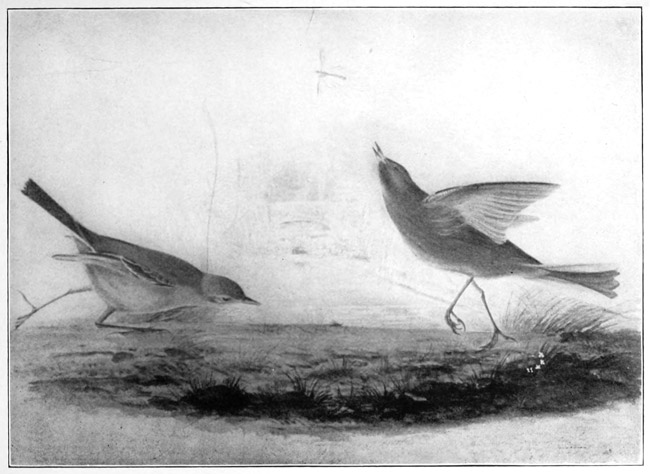
FLYCATCHERS.
(Heretofore unpublished.)
From a drawing made by Audubon in 1826, and presented to Mrs. Rathbone of Green Bank, Liverpool.
Still in the possession of the Rathbone family.
August 19. Dined with Mr. A. Melly in Grenville St.
The dinner was quite à la française, all gayety, witticism,
and good cheer. The game, however, was what I call
highly tainted, the true flavor for the lords of England.
August 21. I painted many hours this day, finished my
Otter; it was viewed by many and admired. I was again
invited to remove to Green Bank, but declined until I have
painted the Wild Turkey cock for the Royal Institution,
say three days more.
September 4. Having been too busy to write for many
days, I can only relate the principal facts that have taken
place. I have been to two very notable suppers, one at Dr.
Traill's in company with the French consul and two other
French gentlemen; I was much encouraged, and urged to
visit France at once. The other at the house of Mr. Molineux;
there indeed my ears were feasted; such entertaining
conversation, such delightful music; Mr. Clementi[78] and
Mr. Tomlinson from London were present. Many persons
came to my painting room, they wonder at the rapidity of
my work and that I can paint fourteen hours without
fatigue. My Turkeys are now framed, and hung at the
Institution which is open daily, and paying well. I have
made many small drawings for different friends. All my
Sundays are alike,—breakfast with Mr. Melly, church with
the blind, dinner with Mr. Roscoe. Every one is surprised
at my habits of early rising, and at my rarely touching
meat, except game.
Green Bank, September 6. When I reached this place
I was told that Lady Isabella Douglass, the sister of Lord
Selkirk, former governor of Canada, was here; she is unable
to walk, and moves about in a rolling chair. At
dinner I sat between her and Mrs. Rathbone, and I enjoyed
the conversation of Lady Douglass much, her broad Scotch
accent is agreeable to me; and I amused her by eating
some tomatoes raw; neither she, nor any of the company
had ever seen them on the table without being cooked.
September 9. Dr. Traill has ordered all my drawings to
be packed by the curator of the Institution, so that has
given me no trouble whatever. It is hard to say farewell
to all those in town and country who have been so kind,
so hospitable to me, but to-morrow I leave for Manchester,
where Mr. Roscoe advises me to go next.
Manchester, County of Lancashire, September 10, 1826.
I must write something of my coming here. After
bidding adieu to many friends, I went to Dr. Traill, who
most kindly insisted on my taking Mr. Munro with me for
two days to assist me, and we left by coach with my
portfolios, my trunk to follow by a slower conveyance. I
paid one pound for our inside seats. I felt depressed at
leaving all my good friends, yet Mr. Munro did all in his
power to interest me. He made me remark Lord Stanley's
domains, and I looked on the Hares, Partridges, and other
game with a thought of apprehension that the apparent
freedom and security they enjoyed was very transient. I
thought it more cruel to permit them to grow tame and
gentle, and then suddenly to turn and murder them by
thousands, than to give them the fair show that our game
has in our forests, to let them be free and as wild as nature
made them, and to let the hunter pay for them by the
pleasure and work of pursuing them. We stopped, I
thought frequently, to renew the horses, and wherever we
stopped a neatly dressed maid offered cakes, ale, or other
refreshments for sale. I remarked little shrubs in many
parts of the meadows that concealed traps for moles and
served as beacons for the persons who caught them. The
road was good, but narrow, the country in a high degree
of cultivation. We crossed a canal conducting from Liverpool
here; the sails moving through the meadows reminded
me of Rochester, N.Y. I am, then, now at Manchester,
thirty-eight miles from Liverpool, and nearly six thousand
from Louisiana.
Manchester, September 12. Yesterday was spent in delivering
my letters to the different persons to whom I was
recommended. The American consul, Mr. J. S. Brookes,
with whom I shall dine to-morrow, received me as an American
gentleman receives another, most cordially. The principal
banker here, Arthur Heywood, Esq., was equally
kind; indeed everywhere I meet a most amiable reception.
I procured, through these gentlemen, a good room to
exhibit my pictures, in the Exchange buildings, had it
cleared, cleaned, and made ready by night. At five this
morning Mr. Munro (the curator of the Institution at
Liverpool and a most competent help) with several assistants
and myself began putting up, and by eleven all was
ready. Manchester, as I have seen it in my walks, seems
a miserably laid out place, and the smokiest I ever was
in. I think I ought not to use the words "laid out" at
all. It is composed of an astonishing number of small,
dirty, narrow, crooked lanes, where one cart can scarce
pass another. It is full of noise and tumult; I thought
last night not one person could have enjoyed repose.
The postilion's horns, joined to the cry of the watchmen,
kept my eyelids asunder till daylight again gave me
leave to issue from the King's Arms. The population
appears denser and worse off than in Liverpool. The vast
number of youth of both sexes, with sallow complexions,
ragged apparel, and downcast looks, made me feel they
were not as happy as the slaves of Louisiana. Trade is
slowly improving, but the times are dull. I have heard
the times abused ever since my earliest recollections. I
saw to-day several members of the Gregg family.
September 13, Wednesday. I have visited the Academy of
Sciences; my time here was largely spoiled by one of those
busybodies who from time to time rise to the surface,—a
dealer in stuffed specimens, and there ends his history.
I wished him in Hanover, or Congo, or New Zealand, or
Bombay, or in a bomb-shell en route to eternity. Mr. Munro
left me to-day, and I removed from the hotel to the house
of a Mrs. Edge, in King Street, who keeps a circulating
library; here I have more quietness and a comfortable
parlor and bedroom. I engaged a man named Crookes,
well recommended, to attend as money receiver at the door
of my exhibition room. I pay him fifteen shillings per
week; he finds himself, and copies letters for me. Two
men came to the exhibition room and inquired if I wished
a band of music to entertain the visitors. I thanked them,
but do not consider it necessary in the company of so
many songsters. My pictures here must depend on their
real value; in Liverpool I knew I was supported by my
particular friends.... It is eleven o'clock, and I have
just returned from Consul Brookes' dinner. The company
were all gentlemen, among whom were Mr. Lloyd, the
wealthy banker, and Mr. Garnet. Our host is from Boston,
a most intelligent and polite man. Judge of my surprise
when, during the third course, I saw on the table a dish of
Indian corn, purposely for me. To see me eat it buttered
and salted, held as if I intended gagging myself, was a
matter of much wonder to the English gentlemen, who
did not like the vegetable. We had an English dinner
Americanized, and the profusion of wines, and the quantity
drank was uncomfortable to me; I was constantly
obliged to say, "No." The gentleman next me was a good
naturalist; much, of course, was said about my work and
that of Charles Bonaparte. The conversation turned on
politics, and Mr. Brookes and myself, the only Americans
present, ranged ourselves and toasted "Our enemies in
war, but our friends in peace." I am particularly fond of
a man who speaks well of his country, and the peculiar
warmth of Englishmen on this subject is admirable. I
have had a note from Lord de Tabelay, who is anxious to
see my drawings and me, and begs me to go to his domain
fourteen miles distant, on my way to Birmingham. I observed
that many persons who visited the exhibition
room investigated my style more closely than at Liverpool.
A Dr. Hulme spent several hours both yesterday
and to-day looking at them, and I have been asked many
times if they were for sale. I walked some four miles out
of the town; the country is not so verdant, nor the country
seats so clean-looking, as Green Bank for instance. The
funnels raised from the manufactories to carry off the
smoke appear in hundreds in every direction, and as you
walk the street, the whirring sound of machinery is constantly
in your ears. The changes in the weather are
remarkable; at daylight it rained hard, at noon it was
fair, this afternoon it rained again, at sunset was warm,
and now looks like a severe frost.
September 14, Thursday. I have dined to-day at the
home of Mr. George W. Wood, about two miles from the
town. He drove me thither in company with four gentlemen,
all from foreign countries, Mexico, Sumatra, Constantinople,
and La Guayra; all were English and had been travelling
for business or pleasure, not for scientific or literary purposes.
Mrs. Wood was much interested in her gardens,
which are very fine, and showed me one hundred bags of
black gauze, which she had made to protect as many
bunches of grapes from the wasps.
September 15. Frost. This morning the houses were
covered with frost, and I felt uncommonly cold and shivery.
My exhibition was poorly attended, but those who
came seemed interested. Mr. Hoyle, the eminent chemist,
came with four very pretty little daughters, in little gray
satin bonnets, gray silk spencers, and white petticoats, as
befitted them, being Quakers; also Mr. Heywood, the
banker, who invited me to dine next Sunday. I spent the
evening at the Rev. James I. Taylor's, in company with
himself, his wife, and two gentlemen, one a Parisian. I
cannot help expressing my surprise that the people of
England, generally speaking, are so unacquainted with the
customs and localities of our country. The principal conversation
about it always turns to Indians and their ways,
as if the land produced nothing else. Almost every lady
in England draws in water-colors, many of them extremely
well, very much better than I ever will do, yet few of them
dare to show their productions. Somehow I do not like
Manchester.
September 17, Sunday. I have been thinking over my
stay in Liverpool; surely I can never express, much less
hope to repay, my indebtedness to my many friends there,
especially the Roscoes, the three families of Rathbone, and
Dr. Thomas S. Traill. My drawings were exhibited for
four weeks without a cent of expense to me, and brought
me £100. I gave to the Institution a large piece, the
wild Turkey Cock; to Mrs. Rathbone, Sr., the Otter in a
trap, to Mr. Roscoe a Robin, and to many of my other
friends some small drawing, as mementos of one who will
always cherish their memories. I wrote a long letter to
my son John Woodhouse urging him to spend much of
his time at drawing from nature only, and to keep every
drawing with the date, that he may trace improvement, if
any, also to speak French constantly, that he may not forget
a language in which he is now perfect. I have also
written to the Governor of New York, his Excellency De
Witt Clinton, to whose letters I am indebted for much of
my cordial reception here. At two I started for Clermont,
Mr. Heywood's residence, where I was to dine.
The grounds are fine, and on a much larger scale than
Green Bank, but the style is wholly different. The
house is immense, but I was kindly received and felt at
ease at once. After dinner the ladies left us early. We
soon retired to the library to drink tea, and Miss Heywood
showed me her portfolio of drawings, and not long
after I took my leave.
September 18, Monday. Mr. Sergeant came for me at
half-past three and escorted me to his house. I am delighted
with him—his house—his pictures—his books—his
guns—and his dogs, and very much so with a
friend of his from London, who dined with us. The
weather has been beautiful, and more persons than usual
at my rooms.
September 19, Tuesday. I saw Mr. Melly this morning
at the Exchange; he had not long arrived from Liverpool.
He had been to my door-keeper, examined the Book of
Income, and told me he was sorry and annoyed at my want
of success, and advised me to go at once to London or
Paris. He depressed me terribly, so that I felt really ill.
He invited me to dine with him, but I told him I had already
engaged to go to Mr. Samuel Gregg[79] at Quarry Bank, fourteen
miles distant, to pass the night. Mr. Gregg, who is the
father of a large family, met me as if he had known me
fifty years; with him came his brother William and his
daughter, the carriage was ready, and off we drove. We
crossed a river in the course of our journey nearly fifty
feet wide. I was told it was a stream of great importance:
the name I have forgotten,[80] but I know it is seven miles
from Manchester en route to Derbyshire. The land is
highly improved, and grows wheat principally; the country
is pretty, and many of the buildings are really beautiful.
We turn down a declivity to Quarry Bank, a most
enchanting spot, situated on the edge of the same river
we had crossed,—the grounds truly picturesque, and cultivated
to the greatest possible extent. In the drawing-room
I met three ladies, the daughters of Mr. Gregg, and
the second daughter of Mr. Wm. Rathbone. After tea I
drew a dog in charcoal, and rubbed it with a cork to give
an idea of the improvement over the common stumps ordinarily
used. Afterwards I accompanied the two brothers
to a debating club, instituted on their premises for the advancement
of their workmen; on the way we passed a
chapel and a long row of cottages for the work-people, and
finally reached the schoolroom, where about thirty men had
assembled. The question presented was "Which was the
more advantageous, the discovery of the compass, or that
of the art of printing?" I listened with interest, and later
talked with the men on some of the wonders of my own
country, in which they seemed to be much interested.
Quarry Bank, September 20. Though the weather was
cloudy and somewhat rainy, I rose early, took an immense
walk, up and down the river, through the gardens, along
the road, and about the woods, fields, and meadows; saw
a flock of Partridges, and at half-past eight had done this
and daubed in a sketch of an Esquimau in a sledge,
drawn by four dogs. The offer was made me to join a
shooting party in the afternoon; all was arranged, and the
pleasure augmented by the presence of Mr. Shaw, the
principal game-keeper of Lord Stanford, who obligingly
promised to show us many birds (so are Partridges called).
Our guns are no longer than my arm, and we had two
good dogs. Pheasants are not to be touched till the first of
October, but an exception was made for me and one was
shot, and I picked it up while his eye was yet all life, his
feathers all brilliancy. We had a fine walk and saw the
Derbyshire hills. Mr. Shaw pocketed five shillings, and
we the game. This was my first hunting on English soil,
on Lord Stanford's domain, where every tree—such as
we should call saplings—was marked and numbered, and
for all that I know pays either a tax to the government or
a tithe to the parish. I am told that a Partridge which
crosses the river, or a road, or a boundary, and alights on
ground other than Lord Stanford's, is as safe from his gun
as if in Guinea.
September 21. I returned to town this morning with
my Pheasant. Reached my exhibition room and received
miserable accounts. I see plainly that my expenses in
Manchester will not be repaid, in which case I must move
shortly. I called on Dr. Hulme and represented the
situation, and he went to the Academy of Natural History
and ordered a committee to meet on Saturday, to see if the
Academy could give me a room. Later I mounted my
pheasant, and all is ready for work to-morrow.
September 22. I have drawn all day and am fatigued.
Only twenty people to see my birds; sad work this. The
consul, Mr. Brookes, came to see me, and advised me to
have a subscription book for my work. I am to dine with
him at Mr. Lloyd's at one next Sunday.
September 23. My drawing this morning moved rapidly,
and at eleven I walked to the Exchange and met Dr.
Hulme and several other friends, who told me the Committee
had voted unanimously to grant me a room gratis
to exhibit my drawings. I thanked them most heartily,
as this greatly lessens my expenses. More people than
usual came to my rooms, and I dined with Mr. Samuel
Gregg, Senior, in Fountain Street. I purchased some chalk,
for which I paid more than four times as much as in
Philadelphia, England is so overdone with duty. I visited
the cotton mills of George Murray, Esq., where fifteen
hundred souls are employed. These mills consist of a
square area of about eight acres, built round with houses
five, six, and seven stories high, having in the centre of the
square a large basin of water from the canal. Two engines
of forty and forty-five horse-power are kept going from
6 a. m. to 8 p. m. daily. Mr. Murray himself conducted
me everywhere. This is the largest establishment owned
by a single individual in Manchester. Some others, belonging
to companies, have as many as twenty-five hundred
hands, as poor, miserable, abject-looking wretches as ever
worked in the mines of Golconda. I was asked to spend
Monday night at Mr. Robert Hyde Gregg's place, Higher
Ardwick, but I have a ticket for a fine concert, and I so
love music that it is doubtful if I go. I took tea at Mr.
Bartley's, and promised to write on his behalf for the
bones of an alligator of a good size. Now we shall see if
he gets one as quickly as did Dr. Harlan. I have concluded
to have a "Book of Subscriptions" open to receive
the names of all persons inclined to have the best illustrations
of American birds yet published; but alas! I am
but a beginner in depicting the beautiful works of God.
Sunday, September 24. I drew at my Pheasant till near
eleven o'clock, the weather warm and cloudy. Then I
went to church and then walked to Mr. Lloyd's. I left
the city and proceeded two miles along the turnpike,
having only an imperfect view of the country; I remarked,
however, that the foliage was deeply colored with autumnal
tints. I reached the home of Mr. Brookes, and together
we proceeded to Mr. Lloyd's. This gentleman met us
most kindly at the entrance, and we went with him through
his garden and hot-houses. The grounds are on a declivity
affording a far view of agreeable landscape, the gardens
most beautifully provided with all this wonderful island
affords, and the hot-houses contain abundant supplies of
exotics, flower, fruit, and shrub. The coffee-tree was bearing,
the banana ripening; here were juicy grapes from
Spain and Italy, the sensitive plant shrunk at my touch,
and all was growth, blossom, and perfume. Art here helps
Nature to produce her richest treasures at will, and man in
England, if rich, may be called the God of the present
day. Flower after flower was plucked for me, and again
I felt how perfectly an English gentleman makes a
stranger feel at home. We were joined by Mr. Thomas
Lloyd and Mr. Hindley as we moved towards the house,
where we met Mrs. Lloyd, two daughters, and a lady
whose name escapes me. We were, of course, surrounded
by all that is rich, comfortable, pleasing to the eye. Three
men servants in livery trimmed with red on a white ground
moved quietly as Killdeers; everything was choice and
abundant; the conversation was general and lively; but
we sat at the table five hours, two after the ladies left us,
and I grew restless; unless drawing or out of doors I like
not these long periods of repose. After joining the ladies
in the library, tea and coffee were served, and in another
hour we were in a coach en route for Manchester.
September 25. Who should come to my room this
morning about seven whilst I was busily finishing the
ground of my Pheasant but a handsome Quaker, about
thirty years of age and very neatly dressed, and thus he
spoke: "My friends are going out of Manchester before
thee opens thy exhibition rooms; can we see thy collection
at nine o'clock?" I answer, "Yes," and show him my
drawing. Now were all the people here Quakers, I might
perhaps have some encouragement, but really, my Lucy,
my times are dull, heavy, long, painful, and my mind much
harassed. Five minutes before nine I was standing waiting
for the Quaker and his friends in the lobby of the
Exchange, when two persons came in and held the following
discourse. "Pray, have you seen Mr. Audubon's collections
of birds? I am told it is well worth a shilling;
suppose we go now." "Pah! it is all a hoax; save your
shilling for better use. I have seen them; the fellow ought
to be drummed out of town." I dared not raise my head
lest I might be known, but depend upon it I wished myself
in America. The Quakers, however, restored my
equilibrium, for they all praised my drawings so much that
I blushed in spite of my old age. I took my drawing of
the Pheasant to Mr. Fanetti's (?) shop and had it put in
a good light. I have made arrangements to have my
pictures in my new place in King Street, and hope to do
better next week. At four I took down two hundred and
forty drawings and packed them ready for removal. Now
for the concert. It was six o'clock and raining when I left
for Fountain Street, where already carriages had accumulated
to a great number. I presented my ticket, and was
asked to write my name and residence, for this is not
exactly a public affair, but most select; so I am told.
The room is full of red, white, blue, and green turbans well
fitted to the handsome heads of the ladies. I went to one
side where my ear and my intellect might be well satisfied,
and where I should not be noticed; but it would not do,
my long hair and unfashionable garments were observed
far more than was agreeable to me. But the music soon
began, and I forgot all else for the time; still between the
various performances I felt myself gazed at through lorgnettes,
and was most ill at ease. I have passed many uncomfortable
evenings in company, and this one may be
added.
Quarry Bank, September 26. Whilst putting up my
pictures in my newly granted "apartment" I received a
note from Mrs. Gregg inviting me here for the night to
meet Professor Smyth.[81] He is a tall, fine-looking gentleman
from Cambridge, full of knowledge, good taste, and
kindness. At dinner the Professor sat opposite the
Woodsman, and America was largely the topic of conversation.
One evening spent with people such as these
is worth a hundred fashionable ones.
Wednesday, September 27. It is a strange atmosphere,
warm, damp, rainy, then fair again, all in less than two
hours, which was the time consumed by my early walk.
On my return soon after eight I found four of the ladies
all drawing in the library; that in this country is generally
the sitting-room. At about ten we had breakfast, when
we talked much of duels, and of my friend Clay[82] and
crazy Randolph.[83] Much is unknown about our country,
and yet all are deeply interested in it. To-morrow I am
off to Liverpool again; how much I shall enjoy being once
again with the charming Rathbones.
Green Bank, near Liverpool, September 28. At five this
morning I left Manchester and its smoke behind me; but
I left there the labors of about ten years of my life, fully
one half of my collection. The ride was a wet one, heavy
rain falling continuously. I was warmly welcomed by my
good Liverpool friends, and though completely drenched
I felt it not, so glad was I to be in Liverpool again. My
being here is soon explained. I felt it best to see Dr.
Traill and Mr. Roscoe, and I dined with the latter; we
talked of Manchester and our friends there, and Mr.
Roscoe thought well of the subscription book. From
here to Green Bank, where I am literally at home. Mr.
Rathbone and Mr. Roscoe will both aid me in the drawing
up of a prospectus for my work.
Green Bank, September 29. It rained during the night
and all the early portion of the day. I breakfasted early,
and at half-past nine Mr. Rathbone and I drove in the
gig to Mrs. Wm. S. Roscoe.[84] After a little conversation
we decided nothing could be done about the prospectus
without more definite knowledge of what the cost of publication
would be, and I was again referred to Dr. Traill.
It happened that here I met a Mr. Bohn, from London,
not a publisher, but a bookseller with an immense establishment,
two hundred thousand volumes as a regular
stock. He advised me to proceed at once to London,
meet the principal naturalists of the day, and through
them to see the best engravers, colorists, printers, paper-merchants,
etc., and thus form some idea of the cost;
then to proceed to Paris, Brussels, and possibly Berlin,
with proper letters, and follow the same course, thereby
becoming able to judge of the advantages and disadvantages
attached to each country and to determine myself
when, where, and how the work should be undertaken;
to be during this time, through the medium of friends,
correspondence, and scientific societies, announced to the
world in some of the most widely read periodical publications.
"Then, Mr. Audubon, issue a prospectus, and bring
forth one number of your work, and I think you will
succeed and do well; but remember my observations on
the size of your book, and be governed by this fact, that
at present productions of taste are purchased with delight,
by persons who receive much company particularly, and
to have your book laid on the table as a pastime, or an
evening's entertainment, will be the principal use made
of it, and that if it needs so much room as to crowd out
other things or encumber the table, it will not be purchased
by the set of people who now are the very life of
the trade. If large public institutions only and a few
noblemen purchase, instead of a thousand copies that may
be sold if small, not more than a hundred will find their
way out of the shops; the size must be suitable for
the English market" (such was his expression), "and
ought not to exceed that of double Wilson." This conversation
took place in the presence of Dr. Traill, and
both he and Mr. Roscoe are convinced it is my only plan.
Mr. Bohn told Dr. Traill, as well as myself, that exhibiting
my pictures would not do well; that I might be in London
a year before I should be known at all, but that through
the scientific periodicals I should be known over Europe
in the same time, when probably my first number would
be published. He strongly advised me to have the work
printed and finished in Paris, bring over to England say
two hundred and fifty copies, to have it bound and the
titlepage printed, to be issued to the world of England
as an English publication. This I will not do; no work of
mine shall be other than true metal—if copper, copper,
if gold, gold, but not copper gilded. He admitted it
would be a great undertaking, and immensely laborious,
but, he added, my drawings being so superior, I might
rest assured success would eventually be mine. This plan,
therefore, I will pursue with the same perseverance that
since twenty-five years has not wavered, and God's will
be done. Having now determined on this I will return
to Manchester after a few days, visit thy native place,
gaze on the tombs of thy ancestors in Derby and Leicester,
and then enter London with a head humbly bent, but
with a heart intently determined to conquer. On returning
to this abode of peace, I was overtaken by a gentleman
in a gig, unknown to me quite, but who offered me a seat.
I thanked him, accepted, and soon learned he was a Mr.
Dearman. He left me at Green Bank, and the evening
was truly delightful.
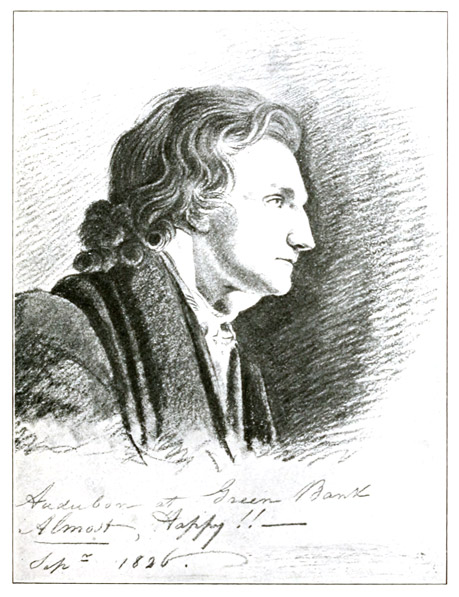
FROM A PENCIL SKETCH OF AUDUBON.
DRAWN BY HIMSELF FOR MRS. RATHBONE.
Now in the possession of Mr. Richard R. Rathbone, Glan-y-Menai, Anglesey.
September 30, Woodcroft. I am now at Mr. Richard
Rathbone's; I did not leave Green Bank this morning
till nearly noon. The afternoon was spent with Dr. Traill,
with whom I dined; there was only his own family, and
I was much entertained by Dr. Traill and his son. A man
of such extensive and well digested knowledge as Dr.
Traill cannot fail to be agreeable. About eight his son
drove me to Woodcroft, where were three other guests,
Quakers. The remainder of the evening was spent with
a beautiful microscope and a Diamond Beetle. Mr. Rathbone
is enthusiastic over my publishing plans, and I will
proceed with firm resolution to attempt the being an
author. It is a terrible thing to me; far better am I fitted
to study and delineate in the forest, than to arrange
phrases with suitable grammatical skill. For the present
the public exhibiting of my work will be laid aside,—I
hope, forever. I now intend going to Matlock, and from
there to my Lucy's native place, pass through Oxford,
and so reach the great London, and once more become
the man of business. From there to France, but, except
to see my venerable mother, I shall not like France,
I am sure, as I now do England; and I sincerely hope
that this country may be preferred to that, on financial
grounds, for the production of my work. Yet I love
France most truly, and long to enter my old garden on
the Loire and with rapid steps reach my mother,—yes,
my mother! the only one I truly remember; and no son
ever had a better, nor more loving one. Let no one
speak of her as my "stepmother." I was ever to her
as a son of her own flesh and blood, and she to me a true
mother. I have written to Louisiana to have forwarded
from Bayou Sara six segments of magnolia, yellow-poplar,
beech, button-wood or sycamore, sassafras, and oak, each
about seven or eight inches in thickness of the largest
diameter that can be procured in the woods; to have
each segment carefully handled so as not to mar the bark,
and to have each name neatly painted on the face, with
the height of the tree. These are for the Liverpool Royal
Institution.
Green Bank, October 1. Though the morning was bright
it was near four before I left my room and stepped into
the fresh air, where I could watch the timid birds fly from
bush to bush before me. I turned towards the Mersey
reflecting the calm, serene skies, and listened to the voice
of the Quail, here so shy. I walked to the tide-beaten
beach and watched the Solan Goose in search of a retreat
from the destroyer, man. Suddenly a poorly dressed man,
in somewhat of a sailor garb, and carrying a large bag
dashed past me; his movement suggested flight, and instinctively
I called, "Stop thief!" and made towards him
in a style that I am sure he had never seen used by the
gentlemen of the customs, who at this hour are doubtless
usually drowsy. I was not armed, but to my surprise he
turned, fell at my feet, and with eyes starting from his head
with apprehension, begged for mercy, said the bag only
contained a few leaves of rotten tobacco, and it was the
first time he had ever smuggled. This, then, was a smuggler!
I told him to rise, and as he did so I perceived the
boat that had landed him. There were five men in it, but
instead of landing and defending their companion, they
fled by rowing, like cowards, swiftly away. I was astonished
at such conduct from Englishmen. I told the abject
creature to bring his bag and open it; this he did. It was
full of excellent tobacco, but the poor wretch looked ill
and half starved, and I never saw a human being more
terrified. He besought me to take the tobacco and let
him go, that it was of the rarest quality. I assured him I
never had smoked a single cigar, nor did I intend to, and
told him to take care he did not offend a second time.
One of my pockets was filled with the copper stuff the
shop-keepers here give, which they call penny. I gave
them all to him, and told him to go. He thanked me many
times and disappeared through a thick hedge. The bag
must have contained fifty pounds of fine tobacco and two
pistols, which were not loaded, or so he said. I walked
back to Green Bank thinking of the smuggler. When I
told Mr. Rathbone of my adventure he said I had been
extremely rash, and that I might have been shot dead on
the spot, as these men are often desperadoes. Well! I
suppose I might have thought of this, but dear me! one
cannot always think over every action carefully before committing
it. On my way back I passed a man digging
potatoes; they were small and indifferently formed. The
season has been uncommonly dry and hot—so the English
say; for my part I am almost freezing most of the time,
and I have a bad cough.
October 2. This morning Mrs. Rathbone asked me if I
would draw her a sketch of the Wild Turkey, about the
size of my thumb-nail. I assured her I would with pleasure,
but that I could perhaps do better did I know for what
purpose. She colored slightly, and replied after a moment
that it was for something she desired to have made; so
after I had reached the Institution and finished my business
there, I sat opposite my twenty-three hours' picture and
made the diminutive sketch in less than twenty-three
minutes. The evening was spent at Woodcroft, and Mr.
Rathbone sent his servant to drive me in the gig to Green
Bank, the night being cold and damp. The man was quite
surprised I did not make use of a great coat which had
been placed at my disposal. How little he knew how
often I had lain down to rest, wet, hungry, harassed and
full of sorrow, with millions of mosquitoes buzzing round
me as I lay awake listening to the Chuckmill's Widow, the
Horned Owl, and the hoarse Bull-frog, impatiently awaiting
the return of day to enable me to hunt the forests and
feast my eyes on their beautiful inhabitants. I thought of
all this and then moved the scene to the hunter's cabin.
Again wet, harassed, and hungry, I felt the sudden warmth
of the "Welcome, stranger!" saw the busy wife unhook
dry clothes from the side of the log hut, untie my moccasins,
and take my deerskin coat; I saw the athletic
husband wipe my gun, clean the locks, hang all over the
bright fire; the eldest boy pile on more wood, whilst my
ears were greeted with the sound of the handmill crushing
the coffee, or the rye, for my evening drink; I saw the little
ones, roused by the stranger's arrival, peeping from
under the Buffalo robe, and then turn over on the Black Bear
skin to resume their slumbers. I saw all this, and then
arrived at Green Bank to meet the same hearty welcome.
The squatter is rough, true, and hospitable; my friends
here polished, true, and generous. Both give what they
have, freely, and he who during the tough storms of life
can be in such spots may well say he has known
happiness.
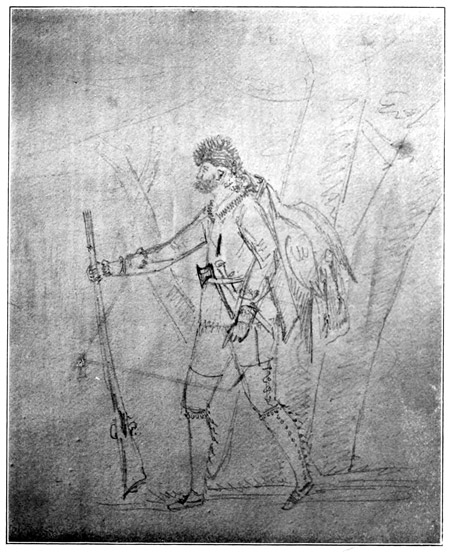
AUDUBON IN INDIAN DRESS.
From a pencil sketch drawn by himself for Miss Rathbone, 1826. Now in the possession of Mrs. Abraham
Dixon (née Rathbone), London, England.
Green Bank, October 3. To-day I have visited the jail
at Liverpool. The situation is fine, it is near the mouth of
the estuary that is called the river Mersey, and from its
walls is an extensive view of the Irish Channel. The area
owned by this institution is about eight acres. It is built
almost circular in form, having gardens in the court in the
centre, a court of sessions on one side and the main entrance
on the other. It contains, besides the usual cells, a
chapel, and yards in which the prisoners take exercise,
kitchens, store-rooms, etc., besides treadmills. The treadmills
I consider infamous; conceive a wild Squirrel in a
round cage constantly moving, without progressing. The
labor is too severe, and the true motive of correction destroyed,
as there are no mental resources attached to this
laborious engine of shame. Why should not these criminals—if
so they are—be taught different trades, enabling
them when again thrown into the world to earn their living
honestly? It would be more profitable to the government,
and the principle would be more honorable. It is besides
injurious to health; the wheel is only six feet in diameter,
therefore the motion is rapid, and each step must be taken
in quick succession, and I know a quick, short step is more
fatiguing than a long one. The emaciated bodies of the
poor fellows proved this to my eyes, as did my powers of
calculation. The circulation of air was much needed; it
was painful to me to breathe in the room where the mill
was, and I left it saddened and depressed. The female
department is even more lamentable, but I will say no
more, except that my guide and companion was Miss
Mary Hodgson, a Quakeress of great benevolence and
solid understanding, whose labors among these poor unfortunates
have been of immense benefit. I dined with
her, her sister and brother, the latter a merchant of this
busy city.
Manchester, October 6. This morning after four hours'
rest I rose early. Again taking my boots in my hand, I
turned the latch gently, and found myself alone in the
early dawn. It was one of those mornings when not sufficiently
cold for a frost; the dew lay in large drops on each
object, weighing down the points of every leaf, every blade
of grass. The heavens were cloudless, all breezes hushed,
and the only sound the twitterings of the Red-breasted
Warbler. I saw the Blackbird mounted on the slender
larch, waiting to salute the morning sun, the Thrush on the
grass by the mulberry tree, and the Lark unwilling to bid
farewell to summer. The sun rose, the Rook's voice now
joined with that of the Magpie. I saw a Stock Pigeon fly
over me, and I started and walked swiftly into Liverpool.
Here, arriving before six, no one was up, but by repeated
knockings I aroused first Mr. Pillet, and then Mr. Melly.
On my return to the country I encountered Mr. Wm.
Roscoe, also out for an early walk. For several days past
the last Swallows have flown toward the south, frosts have
altered the tints of the foliage, and the mornings have been
chilly; and I was rubbing my hands to warm them when I
met Mr. Roscoe. "A fine, warm morning this, Mr. Audubon."
"Yes," I replied, "the kind of morning I like a
fire with half a cord of wood." He laughed and said I
was too tropical in my tastes, but I was glad to keep warm
by my rapid walking. At eleven I was on my way to
Manchester, this time in a private carriage with Mrs. Rathbone
and Miss Hannah. We changed horses twelve miles
from Green Bank; it was done in a moment, up went a
new postilion, and off we went. Our luncheon had been
brought with us, and was really well served as we rolled
swiftly along. After plenty of substantials, our dessert
consisted of grapes, pears, and a melon, this last by no
means so frequently seen here as in Louisiana. We
reached smoky Manchester and I was left at the door of
the Academy of Natural History, where I found the man
I had left in charge much intoxicated. Seldom in my life
have I felt more vexed. When he is sober I shall give him
the opportunity of immediately finding a new situation.
Quarry Bank, October 7, Saturday. From Green Bank
to Quarry Bank from one pleasure to another, is not like
the butterfly that skips from flower to flower and merely
sees their beauties, but more, I hope, as a bee gathering
honeyed stores for future use. My cold was still quite
troublesome, and many remedies were offered me, but I
never take physic, and will not, even for kind Mrs. Gregg.
Sunday, October 8. I went to church at Mr. Gregg's
chapel; the sermon was good, and the service being over,
took Miss Helen a long ramble through the gardens, in
which even now there is much of beauty.
October 9. As soon as possible a male Chaffinch was
procured, and I sat to draw it to give an idea of what
Mrs. Gregg calls "my style." The Chaffinch was outlined,
daubed with water-colors, and nearly finished when we
were interrupted by callers, Dr. Holland among them, with
whom I was much pleased and interested, though I am
neither a craniologist nor a physiognomist. Lord Stanford's
gamekeeper again came for us, and we had a long
walk, and I killed a Pheasant and a Hare.
October 10. To-day I returned to Manchester to meet
Mr. Bohn. We went to the Academy together, and
examined my drawings. Mr. Bohn was at first simply
surprised, then became enthusiastic, and finally said they
must be published the full size of life, and he was sure
they would pay. God grant it! He strongly advised me
to leave Manchester, and go to London, where he knew I
should at once be recognized. I dined at the good
Quaker's, Mr. Dockray, where my friends Mrs. and Miss
Rathbone are visiting; there is a large and interesting
family. I sketched an Egret for one, a Wild Turkey for
another, a Wood Thrush for a third.
Bakewell, October 11. I am at last, my Lucy, at the
spot which has been honored with thy ancestor's name.
Though dark and rainy I have just returned from a walk
in the churchyard of the village, where I went with Miss
Hannah Rathbone, she and her mother having most kindly
accompanied me hither. It was perhaps a strange place
to go first, but we were attracted by the ancient Gothic
edifice. It seemed to me a sort of illusion that made me
doubt whether I lived or dreamed. When I think how frequently
our plans have been laid to come here, and how
frequently defeated, it is no great wonder that I find it
hard to believe I am here at last. This morning at breakfast,
Lady Rathbone spoke of coming to Matlock, and in
a few moments all was arranged. She, with her niece,
Mrs. Dockray, and Miss Hannah, with several of the
children and myself, should leave in two chaises at noon.
I spent the time till then in going over Mr. Dockray's
wool mill. He procures the wool rough from the sheep,
and it is cloth when he disposes of it; he employs about
seventy weavers, and many other people in the various
departments. I was much interested in the dyeing apparatus.
I packed up a few of my drawings to take with me.
We started, seven of us, in two chaises; all was new, and
therefore interesting. We reached Stockport, a manufacturing
town lying between two elongated hillsides, where
we changed horses, and again at Chapel En-La-Frith,
thirty miles from the point of departure. I saw a good
deal of England that I admired very much. The railways
were new to me, but the approach of the mountains dampened
my spirits; the aridity of the soil, the want of
hedges, and of course of birds, the scarcity of cattle, and
the superabundance of stone walls cutting the hills in all
sorts of distorted ways, made me a very unsocial companion,
but the comfortable inn, and our lively evening has quite
restored my cheerfulness.
Matlock, October 12. This morning I was out soon after
sunrise; again I walked round the church, remarked its
decaying state, and that of all the thatched roofs of the
humble cottages. I ascended the summit of the hill, crossing
a bridge which spanned a winding stream, and had a
lovely view of the country just lighted by the sun's first
beams, and returned to the inn, the Rutland Arms, in
time for the hour of departure, seven. The weather was
now somewhat fitful, but the road good, and the valley
charming. We passed the seat of the Duke of Devonshire,
and Matlock opened to our eyes in all its beauty, the hills
dotted with cottages and gentlemen's seats, the autumnal
tints diversifying the landscape and enriching beautiful
nature; the scenery reminds me of that part of America
on the river called the Clear Juniata. All is remarkably
clean; we rise slowly to more elevated ground, leave the
river and approach the New Baths Hotel, where our host,
Mr. Saxton, has breakfast ready. After this we took a
long walk, turning many times to view the delightful
scenery, though the weather had become quite rainy.
We visited the celebrated cave, each carrying a lighted
candle, and saw the different chambers containing rich
minerals and spars; the walls in many places shone like
burnished steel. On our return, which was down-hill, I
heard with much pleasure the repeated note of the Jackdaws
that constantly flew from hole to hole along the
rocky declivities about us. After dinner, notwithstanding
the rain, we rowed in a boat down the stream, to a dam
and a waterfall, where we landed, walked through the
woods, gathered some beautiful mosses, and saw some Hares,
heard a Kestrell just as if in America, returned to our boat
and again rowed, but this time up-stream, and so left the
Derwent River.
Matlock, October 13. Still rainy, but I found a sheltered
spot, and made this sketch. We entered part of the
grounds of Sir Thomas Arkwright, saw his castle, his
church, and his meadows. The Rooks and Jackdaws were
over our heads by hundreds. The steep banks of the
Derwent were pleasantly covered with shrubby trees; the
castle on the left bank, on a fine elevation, is too regular
to be called (by me) well adapted to the rich natural
scenery about it. We passed along a canal, by a large
manufactory, and a coal-yard to the inn, the Crumford,
and the rest of the day was employed in drawing. The
sketch I took was from "The Heights of Abraham," and
I copied it for Miss Hannah. About sunset we visited
the Rutland Cave, which surpassed all my expectations;
the natural chambers sparkled with brilliancy, and
lights were placed everywhere. I saw there some little
fishes which had not seen the daylight for three years, and
yet were quite sprightly. A certain portion of the roof
represented a very good head of a large tiger. I imitated,
at Mrs. Rathbone's request, the Owl's cry, and the Indian
yell. This latter music never pleased my fancy much,
and I well know the effects it produces previous to and
during an attack whilst the scalping knife is at work. We
had a pleasant walk back to the inn, for the evening was
calm and clear, and the moon shone brightly; so after a
hasty tea we all made for the river, took a boat, and seated
ourselves to contemplate the peace around us. I rowed,
and sung many of the river songs which I learned in
scenes far from quiet Matlock.
Manchester, October 14, Mr. Dockray's House, Hardwick.
By five o'clock this morning I was running by the Derwent;
everything was covered with sparkling congealed
dew. The fog arising from the little stream only permitted
us to see its waters when they made a ripple
against some rock. The vale was all mist, and had I not
known where I was, and heard the notes of the Jackdaws
above my head, I might have conceived myself walking
through a subterraneous passage. But the sun soon
began to dispel the mist, and gradually the tops of the
trees, the turrets of the castle, and the church pierced
through, and stood as if suspended above all objects
below. All was calm till a bell struck my ear, when I
soon saw the long files of women and little girls moving
towards Arkwright's Mills. Almost immediately we
started for Bakewell, and breakfasted at the Rutland
Arms. Proceeding we changed our route, and made
for the well known watering place, Buxton, still in Derbyshire.
The country here is barren, rocky, but so picturesque
that the want of trees is almost atoned for. The
road winds along a very narrow valley for several miles,
bringing a vast variety of detached views before us, all
extremely agreeable to the sight. The scantiness of
vegetable growth forces the cattle to risk much to obtain
food, and now and then when seeing a bull, on bent knee
with outstretched neck, putting out his tongue to seize
the few grasses hanging over the precipices, I was alarmed
for his safety. The Hawk here soars in vain; after repeated
rounds he is forced to abandon the dreary steep,
having espied only a swift Kingfisher. Suddenly the view
was closed, a high wall of rock seemed to put an end to
our journey, yet the chaise ran swiftly down-hill, and turning
a sharp angle afforded delight to our eyes. Here we
alighted and walked to view the beauties around at our
leisure, and we reached the large inn, the Crescent,
where I met the American consul, my friend Mr. Maury,
who has visited this place regularly for twenty-five years.
We had what my friends called a luncheon; I considered
it an excellent dinner, but the English eat heartily. On
our resuming our journey a fine drizzle set in, and as we
neared Manchester the air became thick with coal smoke,
the carts, coaches, and horsemen gradually filled the road,
faces became less clean and rosy, and the children had
none of the liveliness found amongst those in the Derbyshire
Hills. I dreaded returning to the town, yet these
days among the beauties of England in such delightful
society are enough to refresh one after years of labor.
Manchester, October 15, Sunday. I went to the Unitarian
Chapel to hear a sermon from the Rev. John Taylor,
but to my regret he had gone to preach elsewhere, and I
was obliged to content myself with another,—not quite so
practical a sermon as I care for. I dined and spent the
night at Mr. Bentley's; after retiring to my room I was
surprised at a knock; I opened my door and there stood
Mr. Bentley, who said he thought he heard me asking for
something as he passed by. I told him I prayed aloud
every night, as had been my habit from a child at my
mother's knees in Nantes. He said nothing for a moment,
then again wished me good-night, and was gone.
October 18. This evening I was to dine with Dr. Hulme
and (as he said) "a few friends;" so when at four
o'clock I entered his sitting-room, I was surprised to find
it filled with ladies and gentlemen, and felt awkward for a
moment. Some of my drawings were asked for, and at
five we went to dinner; after the ladies had retired, wine
and wit flowed till a late hour.
Quarry Bank, 12 miles from Manchester, October 19. At
five, my cane in hand, I made my way from Manchester,
bound on foot for Quarry Bank; the morning was pleasant
and I enjoyed my walk very much, but found myself quite
out of the right road; therefore, instead of twelve miles, I
measured sixteen, and was hungry enough when I reached
my destination. I was soon put at my drawing, and drew
the whole day; in the afternoon I began a sketch of Mr.
Gregg, and felt quite satisfied with my work, but not so
everybody else. Faults were found, suggestions made,
and I enjoyed the criticisms very much, especially those
of an Irish nephew of Mr. Gregg's, who, after several
comments, drew me confidentially aside, and asked who
it was intended to represent; after this, amid hearty
laughter, I concluded to finish it next day. Later we
took a walk and I entered a cottage where dwelt a
silk weaver; all was clean and well arranged, and I saw
the weaving going on for the first time since I left
France.
October 20. Drawing again all morning, and a walk
later. I was taken to a cottage, where to my great surprise
I saw two cases of well stuffed birds, the work of the
weaver who lived in the cottage. I was taken to the dairy,
where I saw the finest cattle I have yet met with in
England.
October 21. This has been a busy day. On my return
from Quarry Bank I saw Mr. Bentley, Mr. Heywood, and
other friends. Mr. H. gave me a letter to Professor Jameson,
of Edinburgh. Called on Dr. Hulme; paid, in all,
twenty visits, and dined with Mr. Bentley,[85] and with his assistance
packed up my birds safe and snug, though much
fatigued; it was late when we parted; he is a brother
Mason and has been most kind to me. I wrote down for
Mrs. Rathbone a brief memorandum of the flight of birds,
with a few little pencil sketches to make my figures more
interesting: Swallows, two and a half miles a minute;
Wild Pigeons, when travelling, two miles per minute; Swans,
ditto two miles, Wild Turkeys, one mile and three quarters.
Manchester, October 23, 1826, Monday. This day was absolutely
all spent packing and making ready for my start for
Edinburgh; my seat in the coach taken and paid for,—three
pounds fifteen shillings. I spent my last evening
with Mr. Bentley and his family. As the coach leaves at
5 a. m., I am sleeping at the inn to be ready when called.
I am leaving Manchester much poorer than I was when I
entered it.
Carlisle, Tuesday, October 24. The morning was clear
and beautiful, and at five I left Manchester; but as no
dependence can be placed on the weather in this country,
I prepared for rain later. I was alone in the coach, and
had been regretting I had no companion, when a very tall
gentleman entered, but after a few words, he said he was
much fatigued and wished to sleep; he composed himself
therefore and soon slept soundly. How I envied him!
We rolled on, however, and arrived at the village of
Preston, where we breakfasted as quickly as if we had
been Kentuckians. The coaches were exchanged, packages
transferred, and I entered the conveyance and met two
new gentlemen whose appearance I liked; we soon commenced
to chat, and before long were wandering all over
America, part of India, and the Atlantic Ocean. We discussed
the emancipation of the slaves, and the starvation
of the poor in England, the Corn Law, and many other
topics, the while I looked frequently from the windows.
The approach to Lancaster is beautiful; the view of the
well placed castle is commanding, and the sea view bounded
by picturesque shores. We dined at Kendal, having passed
through Bolton and Burton, but before this my two interesting
companions had been left behind at a place where
we stopped to change horses, and only caught up with the
coach by running across some fields. This caused much
altercation between them, the driver, and the guard; one of
the proprietors of the coach who was on board interfered,
and being very drunk made matters worse, and a complaint
was lodged against driver and guard. The tall gentleman
was now wide awake; he introduced himself as a Mr.
Walton, and knew the other gentlemen, who were father and
son, the Messrs. Patison from Cornwall; all were extremely
polite to me, a stranger in their land, but so have I ever
found the true English gentleman.
We now entered a most dreary country, poor beyond
description, immense rolling hills in constant succession,
dotted here and there with miserable cots, the residences of
poor shepherds. No game was seen, the weather was
bleak and rainy, and I cannot say that I now enjoyed the
ride beyond the society of my companions. We passed
through Penrith and arrived at Carlisle at half-past nine,
having ridden one hundred and twenty-two miles. I was
told that in hard winters the road became impassable, so
choked with snow, and that when not entirely obstructed
it was customary to see posts painted black at the top,
every hundred yards or so, to point out the road surely.
We had a miserable supper, but good beds, and I enjoyed
mine, for I felt very wearied, my cold and cough having
been much increased from my having ridden outside the
coach some thirty miles, to see the country.
Edinburgh, Scotland, October 25, Wednesday. We
breakfasted at Carlisle, left there at eight, but I was sadly
vexed at having to pay twelve shillings for my trunk and
portfolio, as I had been positively assured at Manchester
that no further charge would be made. For perhaps ten
miles we passed through an uncommonly flat country,
meandering awhile along a river, passed through a village
called Longtown, and entered Scotland at ten minutes
before ten. I was then just six miles from the spot where
runaway matches are rendered lawful. The country
changed its aspect, and became suddenly quite woody;
we ran along, and four times crossed a beautiful little
stream like a miniature Mohawk; many little rapids were
seen in its windings. The foliage was about to fall, and
looked much as it does with us about our majestic western
streams, only much less brilliant. This scenery, however,
lasted only one stage of perhaps twelve miles, and again we
entered country of the same dreariness as yesterday, mere
burnt mountains, which were not interesting. The number
of sheep grazing on these hills was very great, and they
all looked well, though of a very small species; many of
them had black heads and legs, the body white, with no
horns; others with horns, and still others very small,
called here "Cheviots." The shepherds were poor,
wrapped up in a thin piece of plaid, and did not seem of
that noble race so well painted by Sir Walter Scott. I
saw the sea again to-day. We dined at Hawick on excellent
sea fish, and for the first time in my life, I tasted
Scotch whiskey. It appeared very potent, so after a few
sips I put it down, and told Mr. Patison I suspected his
son of wishing to make me tipsy; to which he replied that
probably it was to try if I would in such a case be as
good-natured as I was before. I took this as quite a compliment
and forgave the son. The conversation at dinner
was very agreeable, several Scotch gentlemen having
joined us; some of them drank their native whiskey pure,
as if water, but I found it both smoky and fiery; so much
for habit. We passed through Selkirk, having driven
nearly the whole day through the estates of the young
Duke of ——, a young fellow of twenty who passes his
days just now shooting Black-cock; he has something like
two hundred thousand pounds per annum. Some of the
shepherds on this astonishing estate have not probably more
than two hundred pounds of oatmeal, a terrible contrast.
We passed so near Sir Walter Scott's seat that I stood up
and stretched my neck some inches to see it, but in vain,
and who knows if I shall ever see the home of the man to
whom I am indebted for so much pleasure? We passed a
few miles from Melrose; I had a great wish to see the old
abbey, and the gentleman to whom Dr. Rutter had given
me a letter, but the coach rolled on, and at ten o'clock I
entered this splendid city. I have seen yet but a very
small portion of it, and that by gaslight, yet I call it a
splendid city! The coach stopped at the Black Bull
Hotel, but it was so full no room could be procured, so we
had our baggage taken to the Star. The clerk, the guard,
the driver, all swore at my baggage, and said that had I
not paid at Carlisle, I would have been charged more here.
Now it is true that my trunk is large and heavy, and so is
the portfolio I carry with me, but to give an idea of the
charges and impositions connected with these coaches
(or their owners) and the attendants, remark the price I
paid; to begin with,—
| at Manchester, |
£3 15 00, |
|
| at Carlisle, |
12 00, |
and during the |
| two days to drivers and guards, |
18 06, |
|
| |
£5 5 06, |
nearly twenty-seven dollars in our money for two days'
travelling from Manchester to Edinburgh. It is not so
much the general amount, although I am sure it is quite
enough for two hundred and twelve miles, but the beggarly
manners used to obtain about one half of it; to see a fellow
with a decent coat on, who calls himself an independent
free-born Englishman, open the door of the coach every
ten or twelve miles, and beg for a shilling each time, is
detestable, and quite an abuse; but this is not all: they
never are satisfied, and if you have the appearance of
wealth about you, they hang on and ask for more. The
porters here were porters indeed, carrying all on their
backs, the first I have seen in this island. At the Star we
had a good supper, and chatted a long time, and it was
near one before the Messrs. Patison and I parted; Mr.
Walton had gone on another course. I thought so much
of the multitude of learned men that abound in this place,
that I dreaded the delivery of my letters to-morrow.
George St., Edinburgh, October 26. It was ten o'clock
when I breakfasted, because I wished to do so with the
Patisons, being so much pleased with their company. I was
much interested in the different people in the room, which
was quite full, and the waiters were kept skipping about
with the nimbleness of Squirrels. My companions, who
knew Edinburgh well, offered to accompany me in search of
lodgings, and we soon entered the second door in George
Street, and in a few minutes made an arrangement with
Mrs. Dickie for a fine bedroom and a well furnished sitting-room.
I am to pay her one guinea per week, which I
considered low, as the situation is fine, and the rooms
clean and comfortable. I can see, from where I am now
writing, the Frith, and the boats plying on it. I had my
baggage brought by a man with a tremendous beard, who
imposed on me most impudently by bringing a brass shilling,
which he said he would swear I had given him. I
gave him another, threw the counterfeit in the fire, and
promised to myself to pay some little attention hereafter
to what kind of money I give or receive. I walked to
Professor Jameson's[86] in the Circus,—not at home; to
James Hall, Advocate, 128 George St.,—absent in the
country. Dr. Charles Henry of the Royal Infirmary was
sought in vain, Dr. Thompson was out also, and Professor
Duncan[87] could not be seen until six o'clock. I only saw
Dr. Knox in Surgeon's Square, and Professor Jameson at
the college. This latter received me, I thought, rather
coolly; said that Sir Walter Scott was now quite a recluse,
and was busy with a novel and the Life of Napoleon, and
that probably I should not see him. "Not see Walter
Scott?" thought I; "I SHALL, if I have to crawl on all-fours
for a mile!" But I was a good deal surprised when he
added it would be several days before he could pay me a
visit, that his business was large, and must be attended to;
but I could not complain, as I am bent on doing the same
towards myself; and besides, why should I expect any
other line of conduct? I have been spoiled by the ever-to-be-remembered
families of Roscoes and Rathbones. Dr.
Knox came at once to see me, dressed in an overgown
and with bloody fingers. He bowed, washed his hands,
read Dr. Traill's letter, and promised me at once to do
all in his power for me and my drawings, and said he
would bring some scientific friends to meet me, and to
examine my drawings. Dr. Knox is a distinguished anatomist,
and a great student; Professor Jameson's special
science is mineralogy. I walked a good deal and admired
the city very much, the great breadth of the streets, the
good pavements and footways, the beautiful buildings,
their natural gray coloring, and wonderful cleanliness; perhaps
all was more powerfully felt, coming direct from dirty
Manchester, but the picturesqueness of the toute ensemble
is wonderful. A high castle here, another there, on to a
bridge whence one looks at a second city below, here a
rugged mountain, and there beautiful public grounds,
monuments, the sea, the landscape around, all wonderfully
put together indeed; it would require fifty different views
at least to give a true idea, but I will try from day to day
to describe what I may see, either in the old or new part
of the town. I unpacked my birds and looked at them
with pleasure, and yet with a considerable degree of fear
that they would never be published. I felt very much
alone, and many dark thoughts came across my mind; I
felt one of those terrible attacks of depression to which I
so often fall a prey overtaking me, and I forced myself to
go out to destroy the painful gloom that I dread at all
times, and of which I am sometimes absolutely afraid.
After a good walk I returned more at ease, and looked at
a pair of stuffed pheasants on a large buffet in my present
sitting-room, at the sweetly scented geraniums opposite to
them, the black hair-cloth sofa and chairs, the little cherubs
on the mantelpiece, the painted landscape on my right
hand, and the mirror on my left, in which I saw not only
my own face, but such strong resemblance to that of my
venerated father that I almost imagined it was he that I
saw; the thoughts of my mother came to me, my sister, my
young days,—all was at hand, yet how far away. Ah! how
far is even the last moment, that is never to return again.
Edinburgh, October 27, 1826. I visited the market this
morning, but to go to it I first crossed the New Town into
the Old, over the north bridge, went down many flights of
winding steps, and when at the desired spot was positively
under the bridge that has been built to save the trouble of
descending and mounting from one side of Edinburgh to
the other, the city being mostly built on the slopes of
two long ranges of high, broken hills. The vegetable market
was well arranged, and looked, as did the sections for
meats and fruits, attractive; but the situation, and the narrow
booths in which the articles were exhibited, was, compared
with the Liverpool market, nothing. I ascended the
stairs leading to the New Town, and after turning to the
right, saw before me the monument in honor of Nelson,
to which I walked. Its elevated situation, the broken,
rocky way along which I went, made it very picturesque;
but a tremendous shower of rain accompanied by a heavy
gust of cold wind made me hurry from the spot before I
had satisfied myself, and I returned home to breakfast. I was
struck with the resemblance of the women of the lower
classes to our Indian squaws. Their walk is precisely the
same, and their mode of carrying burdens also; they have
a leather strap passed over the forehead attached to large
baskets without covers, and waddle through the streets,
just like the Shawanees, for instance. Their complexion, if
fair, is beyond rosy, partaking, indeed, of purple—dull, and
disagreeable. If dark, they are dark indeed. Many of
the men wear long whiskers and beards, and are extremely
uncouth in manners, and still more so in language. I had
finished breakfast when Messrs. Patison came to see my
drawings, and brought with them a Miss Ewart, who was
said to draw beautifully. She looked at one drawing after
another, but remained mute till I came to the doves; she
exclaimed at this, and then told me she knew Sir Walter
Scott well, "and," she added, "he will be delighted to
see your magnificent collection." Later I called again at
Dr. Thompson's, but as he was not at home, left the letter
and my card; the same at Professor Duncan's. I then
walked to the fish market, where I found Patrick Neill, Esq.,[88]
at his desk, after having passed between two long files of
printers at their work. Mr. Neill shook hands cordially,
gave me his home address, promised to come and see me,
and accompanied me to the street, begging me not to visit
the Museum until Professor Jameson had sent me a general
ticket of admission. I went then to the Port of Leith,
distant not quite three miles, but missing my way, reached
the Frith of Forth at Trinity, a small village on the bay,
from whence I could see the waters of the German Ocean;
the shore opposite was distant about seven miles, and
looked naked and hilly. During my walk I frequently
turned to view the beautiful city behind me, rising in gradual
amphitheatre, most sublimely backed by mountainous
clouds that greatly improved the whole. The wind was
high, the waters beat the shore violently, the vessels at anchor
pitched,—all was grand. On inquiry I found this
was no longer an admiral's station, and that in a few more
weeks the steamboats that ply between this and London,
and other parts of the north of this island, would stop
their voyages, the ocean being too rough during the winter
season. I followed along the shores, and reached Leith in
about twenty minutes. I saw a very pretty iron jetty with
three arches, at the extremity of which vessels land passengers
and freight. Leith is a large village apparently,
mostly connected with Hamburg and the seaports of
Holland. Much business is going on. I saw here great
numbers of herring-boats and the nets for capturing these
fishes; also some curious drags for oysters, clams, and
other shellfish. The docks are small, and contain mostly
Dutch vessels, none of them large. An old one is fitted
up as a chapel for mariners. I waited till after sunset before
returning to my lodgings, when I told my landlady I
was going to the theatre, that I might not be locked out,
and went off to see "Rob Roy." The theatre not opening
till half-past six, I spent some little time in a bookseller's
shop, reading an account of the Palace and Chapel of
Holyrood. The pit, where I sat, was crowded with gentlemen
and ladies; for ladies of the second class go to
the pit, the superior classes to the boxes, and those of
neither class way above. The house is small but well
lighted. "God save the King" was the overture, and
every one rose uncovered. "Rob Roy" was represented
as if positively in the Highlands; the characters were natural,
the scenery perfectly adapted, the dress and manners
quite true to the story. I may truthfully say that I saw a
good picture of the great outlaw, his Ellen, and the unrelenting
Dougal. I would, were it possible, always see
"Rob Roy" in Edinburgh, "Le Tartuffe" in Paris, and
"She Stoops to Conquer" in England. "Rob Roy," as
exhibited in America, is a burlesque; we do not even
know how the hardy mountaineer of this rigid country
throws on his plaid, or wears his cap or his front piece,
beautifully made of several tails of the red deer; neither
can we render the shrill tone of the horn bugle that hangs
at his side, the merry bagpipe is wanted, also the scenery.
I would just as soon see "Le Tartuffe" in broken French,
by a strolling company, as to see "Rob Roy" again as I
have seen it in Kentucky. It is almost to be regretted
that each country does not keep to its own productions;
to do otherwise only leads to fill our minds with ideas far
different from the truth. I did not stay to see "Rosina;"
though I liked Miss Stephens pretty well, yet she is by no
means equal to Miss Foote.
Edinburgh, October 28, 1826. To-day I have visited the
Royal Palace of Holyrood; it is both interesting and curious,
especially the chapel and the rooms where the present
King of France resided during his exile. I find Professor
Jameson is engaged with Mr. Selby[89] and others in a large
ornithological publication, and Mr. Ed. Roscoe has written,
suggesting that I try to connect myself with them; but my
independent spirit does not turn to the idea with any
pleasure, and I think if my work deserves the attention of
the public, it must stand on its own legs, not on the reputation
of men superior in education and literary acquirements,
but possibly not so in the actual observation of Nature
at her best, in the wilds, as I certainly have seen her.
October 29, Sunday. With the exception of the short
walk to the post-office with my letters, I have been as
busy as a bee all day, for I have written much. Yesterday
at ten Messrs. Patison brought twelve ladies and the
Messrs. Thomas and John Todd of this city to see my
drawings; they remained full two hours. Professor Duncan
came in and was truly a kind friend. After my company
had left, and I had been promised several letters for
Sir Walter Scott, I took a walk, and entered a public garden,
where I soon found myself a prisoner, and where,
had I not found a pretty maid who took pity on my
étourderie, I certainly would have felt very awkward, as I
had neither letter nor pocket-book to show for my identification.
I then went in search of a Scotch pebble; one
attracted me, but a boy in the shop said his father could
make one still handsomer. I wanted not pebbles made by
man, I wanted them the result of nature, but I enquired
of the lad how they were made. Without hesitation the
boy answered: "by fire-heat, and whilst the pores of the
pebbles are open colored infusions are impregnated."
Now what will not man do to deceive his brother? I
called on Mr. Jeffrey,[90] who was not in; he comes from
his Hall, two and a half miles off, every day for two hours,
from two to four o'clock; therefore I entered his sanctum
sanctorum, sealed the letter, and wrote on my card that I
would be happy to see him. What a mass of books,
papers, portfolios, dirt, beautiful paintings, engravings,
casts, with such parcels of unopened packages all directed
"Francis Jeffrey, Esq." Whilst I looked at this
mass I thought, What have I done, compared with what
this man has done, and has to do? I much long to see
the famous critic. As I came away my thoughts reverted to
Holyrood Palace. What a variety of causes has brought
king after king to that spot; what horrors have been committed
there! The general structure is not of a defensive
nature; it lies in a valley, and has simply its walls to guard
it. I was surprised that the narrow stairs which led to the
small chamber where the murder was committed, communicated
at once with the open country, and I was also
astonished to see that the mirrors were positively much
superior to those of the present day in point of intrinsic
purity of reflection; the plates cannot be less than three-fourths
of an inch in thickness. The furniture is all decaying
fast, as well as the paintings which are set into the
walls. The great room for the King's audience contains a
throne by no means corresponding with the ideas de luxe
that I had formed. The room, however, being hung in
scarlet cloth, had a very warm effect, and I remember
it with pleasure. I also recall the view I then had from a
high hill, of the whole city of Edinburgh and the country
around the sea; the more I look on Edinburgh the better
I like it. To-day, as I have said, I have been in my rooms
constantly, and after much writing received Dr. Knox and
a friend of his. The former pronounced my drawings the
finest of their kind in the world. No light praise this.
They promised to see that I was presented to the Wernerian
Society, and talked very scientifically, indeed quite
too much so for the poor man of the woods. They assured
me the ornithological work now about being published
by Messrs. "Selby, Jameson, and Sir Somebody[91]
and Co.," was a "job book." It is both amusing and distressing
to see how inimical to each other men of science
are; and why are they so?
October 30. Mr. Neill took me to a Mr. Lizars,[92] in
St. James Square, the engraver for Mr. Selby, who came
with us to see my work. As we walked along under an
umbrella he talked of nothing else than the astonishing
talent of his employer, how quickly he drew and how well,
until we reached my lodgings. I lost hope at every step,
and I doubt if I opened my lips. I slowly unbuckled my
portfolio, placed a chair for him, and with my heart like a
stone held up a drawing. Mr. Lizars rose from his seat,
exclaiming: "My God! I never saw anything like this
before." He continued to be delighted and astonished,
and said Sir William Jardine[93] must see them, and that he
would write to him; that Mr. Selby must see them; and
when he left at dark he went immediately to Mr. Wm.
Heath, an artist from London, who came at once to see
me. I had gone out and missed him; but he left a note.
Not knowing who he might be, I went to see him, up three
pairs of stairs, à l'artisan; met a brunette who was Mrs.
Heath, and a moment after the gentleman himself. We
talked together, he showed me some of his work and will
call on me to-morrow.
October 31. So at last Professor Jameson has called on
me! That warm-hearted Mr. Lizars brought him this
morning, just as I was finishing a letter to Victor. He
was kind to me, very kind, and yet I do not understand
the man clearly; he has a look quite above my reach, I
must acknowledge, but I am to breakfast with him to-morrow
at nine. He says he will, with my permission,
announce my work to the world, and I doubt not I shall
find him an excellent friend. Dr. Thompson's sons came
in, tall, slender, and well-looking, made an apology for
their father, and invited me to breakfast on Thursday;
and young Dr. Henry called and also invited me to breakfast.
Mr. Patrick Symes, a learned Scotchman, was with
me a long time, and my morning was a very agreeable
one within, though outside it was cold and rained. Edinburgh
even in the rain, for I took a walk, is surprisingly
beautiful, picturesque, romantic; I am delighted with it.
Mr. Lizars has invited me to call at nine to spend the
evening with him; now I call it much more as if going to
spend the night. I met Mrs. Lizars when I stopped at
his house for a moment to-day; she is the first lady to
whom I have been introduced here, and is a very beautiful
one. Eleven and a half o'clock and I have just returned
from Mr. Lizars, where my evening has been extremely
pleasant. I have seen some of Mr. Selby's original drawings,
and some of Sir William Jardine's, and I no longer
feel afraid. But I must to rest, for I hate late hours and
love to be up before daylight.
November 1. I breakfasted at Professor Jameson's.
A most splendid house, splendid everything, breakfast to
boot. The professor wears his hair in three distinct, different
courses; when he sits fronting the south, for
instance, the hair on his forehead bends westwardly, the
hair behind eastwardly, and the very short hair on top
mounts directly upward, perhaps somewhat like the quills
of the "fretful porcupine." But never mind the ornamental,
external appendages of his skull, the sense within is
great, and full of the nobleness which comes from a kind,
generous heart. Professor Jameson to-day is no more
the man I took him to be when I first met him. He
showed me an uncommon degree of cordiality, and promised
me his powerful assistance so forcibly that I am sure
I can depend upon him. I left him and his sister at ten,
as we both have much to do besides talking, and drinking
hot, well creamed coffee; but our separation was not long,
for at noon he entered my room with several gentlemen
to see my drawings. Till four I was occupied showing
one picture after another, holding each one at arm's-length,
and was very tired, and my left arm once I thought had
an idea of revolutionizing. When my guests had gone I
walked out, took plenty of needed exercise, often hearing
remarks about myself such as "That's a German physician;"
"There's a French nobleman." I ended my walk at
Mr. Lizars', and while with him expressed a wish to secure
some views of beautiful Edinburgh; he went to another
room and brought in a book of views for me to look
at, which I did with interest. He then asked me to draw
something for him, and as I finished a vignette he pushed
the book of superb Edinburgh towards me; on the first
leaf he had written, "To John J. Audubon, as a very imperfect
expression of the regard entertained for his abilities
as an artist, and for his worth as a friend, by William H.
Lizars, engraver of the 'Views of Edinburgh.'" I saw—though
by gas-light—some of Mr. Lizars' work, printing
from copper, coloring with water-color and oils, etc.,
on the same, for the first time in my life. How little I
know! how ignorant I am! but I will learn. I went to
bed after reading Sir Walter's last novel till I was so
pleased with the book that I put it under my pillow to
dream about, as children do at Christmas time; but my
dreams all went another way and I dreamed of the beech
woods in my own dear land.
November 2, Thursday. I drew the bell at the door of
No. 80 George Street, where lives Dr. Thompson, just as
the great bell of St. Andrews struck nine, and we soon sat
down to breakfast. Dr. Thompson is a good, and good-looking
man, and extremely kind; at the table were also
his wife, daughter, son, and another young gentleman;
and just as my second cup of coffee was handed to me a
certain Dr. Fox entered with the air of an old friend, and
at once sat down. He had been seventeen years in
France, and speaks the language perfectly, of course.
After having spoken somewhat about the scrubbiness of
the timber here, and the lofty and majestic trees of my
country dear, I rose to welcome Mrs. Lizars, who came in
with her husband and some friends. Mr. Lizars had not
seen one of my largest drawings; he had been enamoured
with the Mocking-birds and Rattle-snake, but, Lucy, the
Turkeys—her brood, the pose of the Cock Turkey—the
Hawk pouncing on seventeen Partridges, the Whooping
Crane devouring alligators newly born—at these he exclaimed
again and again. All were, he said, wonderful
productions; he wished to engrave the Partridges; but
when the Great-footed Hawks came with bloody rags at
their beaks' ends, and cruel delight in the glance of their
daring eyes, he stopped mute an instant, then said, "That
I will engrave and publish." We were too numerous a
party to transact business then, and the subject was adjourned.
Fatigued and excited by this, I wrote for some
hours, and at four walked out and paid my respects to
young Dr. Henry at the Infirmary,—a nice young man,—and
at five I found myself at Mr. Lizars', who at once
began on the topic of my drawings, and asked why I did
not publicly exhibit them. I told him how kind and
generous the Institution at Liverpool had been, as well as
Manchester, and that I had a letter of thanks from the
Committees. He returned with me to my lodgings, read
the letter, and we marched arm in arm from Mrs. Dickie's
to Professor Jameson, who kept the letter, so he said, to
make good use of it; I showed Mr. Lizars other letters
of recommendation, and as he laid down the last he said:
"Mr. Audubon, the people here don't know who you are
at all, but depend upon it they shall know." We then
talked of the engraving of the Hawks, and it seems that it
will be done. Perhaps even yet fame may be mine, and
enable me to provide all that is needful for my Lucy and
my children. Wealth I do not crave, but comfort; and
for my boys I have the most ardent desire that they may
receive the best of education, far above any that I possess;
and day by day science advances, new thoughts and new
ideas crowd onward, there is always fresh food for enjoyment,
study, improvement, and I must place them where
all this may be a possession to them.
November 3, Friday. My birds were visited by many
persons this day, among whom were some ladies, artists,
of both ability and taste, and with the numerous gentlemen
came Professor James Wilson,[94] a naturalist, an agreeable
man, who invited me to dine at his cottage next
week. Mr. Lizars, who is certainly mon bon cheval de
bataille, is exerting himself greatly in my behalf. At half-past
three good Mr. Neill came, and together we walked
towards his little hermitage, a sweet spot, quite out of
town; nice garden, hot-house filled with exotics, and
house-walls peopled by thousands of sparrows secure in
the luxuriant masses of ivy that only here and there suffer
the eye to see that the habitat is of stone. The Heron's
sharp lance lay on his downy breast while he balanced
on one leg, silent and motionless; the Kittiwake Gull
screamed for food; the Cormorant greedily swallowed it;
whilst the waddling Gannet welcomed her master by
biting his foot, the little Bantams and the great rooster
leaped for the bread held out, the faithful Pigeon cooed
to his timid mate, and the huge watch-dog rubbed
against the owner's legs with joy. We entered the house,
other guests were there, and full of gayety we sat down to
a sumptuous dinner. Eyes sparkled with wit, sense,
knowledge. Mr. Combe[95] who was present has a head
quite like our Henry Clay. My neighbor, Mr. Bridges,[96] is
all life; but after a few observations concerning the birds
of our woods he retired to let the world know that many
of them are arrived in Scotland. It is unanimously agreed
that I must sit for my portrait to Mr. Syme,[97] and that
friend Lizars must engrave it to be distributed abroad.
On my return to my lodgings I was presented with some
pears and apples of native growth, somewhat bigger than
green peas; but ah! this is both ungrateful and discourteous.
To-morrow I am to meet Lord Somebody, and
Miss Stephens; she was called "that delicious actress"
so fervently and so frequently by my learned friends
that I reverse my judgment, or will at least suspend it,
until I see more of her.
November 4, Saturday. Now had I the faculties of my
good friend Mr. Bridges, I should be able to write all that
I feel towards him and the good people of this romantic
Edina's Academic Halls; I would set to, and write long
accounts of all I have enjoyed this day. But, alas! poor
me! I can only scratch a few words next to unintelligible,
and simply say that my little room has been full all day of
individuals good, great, and friendly, and I am very wearied
to-night; it is now past one. I dined at Mr. Lizars', where
were beauties, music, conviviality, and wit. I am working
hard withal; I do with four hours' sleep, keep up a great
correspondence, keep up my journal, and write many hours
on the letter-press for my "Birds" which is almost done.
November 5, Sunday. At ten o'clock my room was
filled with visitors. Friend Bridges came, and stayed a
long time. Miss Stephens the actress and her brother
also paid me a visit. Mr. Bridges insisted on my going
home to dine with him at four, and I never perceived I
was in my slippers till I reached the port of destination.
A Mr. Hovey dined with us. Mrs. Bridges is a stately,
handsome lady, and the diner en famille pleased me
exceedingly. I saw quite a stock of pictures and engravings,
well selected by my knowing friend. I returned
home early and found a note from Mr. John Gregg, who
came himself later bringing me a scrubby letter from
Charles Waterton,[98] and a sweet little sketch from fair Ellen
of Quarry Bank. I was delighted to see him; it seemed
like old times to me. With all this I am by no means
in spirits to write, I am so alone in this strange land,
so far from those I love the best, and the future rises
ofttimes dark before me.
Monday, November 6. The same sad heart to-day, and
but little work and much company. I was glad, however,
to see those who came, among others my coach companion
from Manchester, Mr. Walton, who invited me
in a very friendly manner to see him often. It snowed
this morning, and was quite a new sight to me, for I have
not seen any for about five years—I think. The papers
give such accounts of my drawings and of myself that
I am quite ashamed to walk the streets; but I am dispirited
and melancholy.
Sunday, November 19. I do not know when I have thus
pitilessly put away my journal for nearly two weeks. My
head and heart would not permit me to write, so I must
try to memorandum now all I have seen. What I have
felt is too much for me to write down, for when these
attacks of depression overwhelm me life is almost unendurable.
Every day I exhibited my drawings to those
who came to see them. I had many noblemen, among
whom I especially liked Sir Patrick Walker and his lady;
but I welcomed all ladies, gentlemen, artists, and, I dare
say, critics. At last the Committee of the Royal Institution
invited me to exhibit publicly in their rooms; I owe
this invitation, I know, to the astonishing perseverance
of some unknown friends. When my pictures were removed
there I was no longer "At Home." I painted
from dawn to dark, closely, and perhaps more attentively
than I ever have done before. The picture was large,
contained a Turkey Cock, a hen, and nine young, all the
size of life. Mr. Lizars and his amiable wife visited me
often; often I spent the evenings with them. Mr. David
Bridges, Mr. Cameron, and several others had regular
admittance, and they all saw the regular progress of my
work; all, apparently, admired it. I dined at many houses,
was always kindly received, and as far as my isolated
condition and unfortunate melancholy permitted, enjoyed
myself. It was settled by Mr. Lizars that he would undertake
the publication of the first number of the "Birds of
America," and that was enough to put all my powers
of acting and thinking at fever heat. The papers also
began to be more eulogistic of the merits of myself and
my productions, and I felt bewildered with alternate uncertainties
of hope and fear. I have received many letters
from my dear Liverpool friends, and one, most precious
of all, from the wonderful "Queen Bee" of Green Bank,
with a most beautiful seal of the Wild Turkey and the
motto "America, my country."[99] When my drawings
were exhibited to the public, professors, students, artists,
spoke well of them. I forwarded by post seventy-five
tickets to the principal persons who had been kind to me,
and to all the artists in Edinburgh. I sat once for my
portrait, but my picture kept me at home ever since.
I saw, and dined, and dined again with Sir William
Jardine, and like him very much. He visited me frequently,
and sat and stood watching me painting during
his stay in the city. The famous phrenologist George
Combe visited me also; spoke much of the truth of
his theory as exhibited and verified by my poor skill;
begged I would allow a cast of my head to be taken,
etc., etc., and sent me a card of admission to his lectures
this winter. The famous Professor Wilson of "Blackwood"
fame, I might almost say the author of "Blackwood's
Magazine," visited me also, and was very friendly; indeed,
every one is kind, most truly so. How proud I feel that
in Edinburgh, the seat of learning, science, and solidity
of judgment, I am liked, and am received so kindly. How
much I wish my Lucy could also enjoy it, that our sons
might have partaken of it, this would have rendered each
moment an age of pleasure. I have now determined to
remain here till my first number is published, when I shall
go to Liverpool again, with proofs in hand. I will forward
some of this number to the friends at home as well as
abroad, and will continue painting here the while, and watch
the progress of the engravers and colorists; two drawings
are now under the hand of the engraver, and God grant
me success. I am going to try to find time to spend
a week at Jardine Hall, and some days at Mrs. Fletcher's;
it will remove me from the pressure and excitement to
which I am hourly subjected, and be a complete change
for me in every way.
November 20. Whilst my breakfast was preparing, and
daylight improving, I sat at my little table to write a
notice of descriptive import about my painting of the
Wild Turkeys that now leaned against the wall of my
room, finished. My breakfast came in, but my pen carried
me along the Arkansas River, and so much did I long
for my beloved country that not a morsel could I swallow.
While writing, Mr. Bridges, who usually pays me a daily
visit, happened to come in. I read my description and told
him it was my intention to have it printed, or written out
in a clear hand, to lay on the table of the exhibition room,
for the use of the public. He advised me to go to Professor
Wilson for criticism; so I went at once to his residence,
and reached "Blackwood's" door about ten o'clock.
I did not even ask if Professor Wilson was in; no, I simply
told the man to say Mr. Audubon from America wished
to speak with him. In a moment I was conducted to a
room where I wished that all that had been written in it
was my own to remember, to enjoy, to profit by; but I
had not been here many minutes before a sweet child, a
happy daughter of this great man, asked me to go upstairs,
saying, "Papa will be there in a minute;" and truly,
almost at once the Professor came in, with freedom and
kindness of manner, life in his eye, and benevolence in
his heart. My case was soon explained; he took my
paper, read it, and said if I would allow him to keep it,
he would make one or two alterations and return it in
good time. Back to my lodgings and hungry by this
time, and cooled off, my mind relieved, my painting
finished, I dressed more carefully and walked to the
Royal Institution, and was pleased at seeing there a good
deal of company. But the disagreeable part of my day
is yet to come. I had to dine at Professor Graham's,[100] it
was five o'clock when I reached there, a large assembly
of ladies and gentlemen were there, and I was introduced
to Mrs. Graham only, by some oversight I am sure,
but none the less was my position awkward. There I
stood, motionless as a Heron, and when I dared, gazed
about me at my surroundings, but no one came near me.
There I stood and thought of the concert at Manchester;
but there was this difference: there I was looked at rudely,
here I was with polite company; so I waited patiently for
a change of situation, and the change came. A woman,
aye, an angel, spoke to me in such a quiet, easy way that in
a few moments my mal aise was gone; then the ringing
of a bell summoned us to the dining-room; I sat near the
blue satin lady (for her name I do not know) who came
to my rescue, and a charming young lady, Miss M——, was
my companion. But the sumptuous dinners of this country
are too much for me. They are so long, so long, that
I recall briefer meals that I have had, with much more
enjoyment than I eat the bountiful fare before me. This
is not a goûter with friend Bourgeat on the Flat Lake,
roasting the orange-fleshed Ibis, and a few sun-perch;
neither is it on the heated banks of Thompson's Creek, on
the Fourth of July, swallowing the roasted eggs of a large
Soft-shelled Turtle; neither was I at Henderson, at good
Dr. Rankin's, listening to the howlings of the Wolves,
while sitting in security, eating well roasted and jellied
venison,—no, alas! it was far from all these dear spots,
in Great King Street, No. 62, at Dr. Graham's, a distinguished
professor of botany, with a dinner of so many
rich dishes that I cannot remember them.
November 24. I have just finished a long letter to Mr.
Wm. Rathbone, telling him of my reception in beautiful
Edinburgh, and my present plans, which are to publish
one number at my own expense and risk, and with it
under my arm, make my way. If I can procure three
hundred good substantial names of persons or associations
or institutions, I cannot fail doing well for my family;
but, to do this, I must abandon my life to its success, and
undergo many sad perplexities, and perhaps never again—certainly
not for some years—see my beloved America.
The work, from what I have seen of Mr. Lizars'
execution, will be equal to anything in the world at
present, and of the rest the world must judge for itself.
I shall superintend both engraving and coloring personally,
and I pray my courage may not fail; my industry
I know will not. It is true the work will be procured only
at a great expense, but then, a number of years must
elapse before it is completed, so that renders payment an
easier task. This is what I shall try; if I do not succeed
I can return to my woods and there in peace and quiet
live and die. I am sorry that some of my friends, particularly
Dr. Traill, are against the pictures being the size of
life, and I must acknowledge it renders the work rather
bulky, but my heart was always bent on it, and I cannot
refrain from attempting it. I shall publish the letter-press
in a separate book, at the same time with the
illustrations, and shall accompany the descriptions of the
birds with many anecdotes and accounts of localities connected
with the birds themselves, and with my travels in
search of them. I miss my "Wild Turkeys," on which I
worked steadily and from dawn to dark, a long time
here,—for sixteen days. It would be impossible for me
to write down all my feelings and thoughts about my
work, or my life here; it may be that in time I shall be
reconciled or habituated to the life I now lead, but I can
scarce believe this, and often think the woods the only
place in which I truly live.
November 25, 1826. I have been drawing all day at
some Wood Pigeons, as they are emphatically called here,
though woods there are none. The day was cold, wet, and
snowy. Mr. Lizars, however, called with Dr. Brewster,[101]
an eminent and entertaining man. I received a note from
Geo. Combe, Esq., the phrenologist, who wishes to plaster
my poor head to take an impression of the bumps, ordinary
and extraordinary; he also invited me to sup with
him on Monday next. I was to dine at Dr. Monroe's, Craiglockhart,
near Slateford, so I dressed and sent for a coach
that took me two and a half miles for twelve shillings, and
I had to pay one shilling toll,—a dear dinner this. I
arrived and entered a house richly furnished, and was presented
to three ladies, and four gentlemen. The ladies
were Mrs. Monroe, Miss Maria Monroe, and Mrs. Murray;
amongst the gentlemen I at once recognized the amiable
and learned Staff-Surgeon Lyons. Mrs. Monroe I found
a woman of most extraordinary powers, a brilliant conversationalist,
highly educated, and most attractive. She sat
by me, and entertained me most charmingly, and the rest
of her company as well. I need not say the dinner was
sumptuous, for I find no other kind in hospitable Edinburgh.
After dinner we had music from Miss Monroe, a
skilled songstress, and her rich voice, with the pathetic
Scotch ballads which she sang so unaffectedly, brought
tears to my eyes. My return to my lodgings was very
cold, for snow lies all about the hills that surround this
enchanting city.
Sunday, November 26. I went to a Scotch church this
morning, but it was cold and the services seemed to me
cold also, but it may have been that I was unaccustomed
to them. Snow lay thick on the ground and my lodgings
looked cheerless, all but my picture, at which I worked on
my return. I had put my work on the floor, and was
standing on a chair to see the effect at a good distance,
when Mrs. Lizars entered with her husband; they had
come to invite me to dine with them on roasted sheep's-head
(a Scotch dish), and I was glad to accept, for I was
on the verge of a fit of depression, one of those severe
ones when I am almost afraid to be alone in my lodgings;
alone indeed I am, without one soul to whom I can open
my heart. True, I have been alone before, but that was
in beloved America, where the ocean did not roll between
me and my wife and sons. At four, therefore, I reached
James' Square and dined with these good people without
pomp or ostentation; it is the only true way to live. Found
the sheep's-head delicious, and spent the evening most
agreeably. I was shown many beautiful sketches, and two
plates of my birds well advanced. Mr. Lizars walked
home with me; the weather was intensely cold, and the
wind blew a gale; on turning a corner it almost threw me
down, and although warmly dressed I felt the chill keenly.
This morning seems a long way off, so many things have I
thought of this day.
Monday, November 27. As soon as it dawned I was up
and at work, and quite finished my drawing before breakfast.
Mr. Syme came to see me, and was surprised to
find it done. I had also outlined my favorite subject, the
Otter in a trap. At twelve I went to stand up for my
picture, and sick enough I was of it by two; at the request
of Mr. Lizars I wear my wolf-skin coat, and if the head is
not a strong likeness, perhaps the coat may be; but this is
discourteous of me, even to my journal. Mr. Lizars
brought a Mr. Key, an artist, to throw a sky over my
drawing, and the gentleman did it in handsome style, giving
me some hints about this kind of work for which I am
grateful. I dined at home on herrings, mutton-chops,
cabbage, and fritters. As I am now going to sup with Mr.
George Combe, I will write to-morrow what I may hear to-night.
A kind note from Professor Jameson, whom I have
not seen for some time, for he is a busy man, with a card
of admittance to the Museum.
Tuesday, 28th. After writing thus far I left my room
and went to watch the engravers at work on my birds. I
was delighted to see how faithfully copied they were, and
scarcely able to conceive the great "adroit" required to
form all the lines exactly contrary to the model before
them. I took a cup of coffee with Mr. and Mrs. Lizars,
went home to dress, and at nine was again with Mr. Lizars,
who was to accompany me to Mr. Combe's, and reaching
Brower Square we entered the dwelling of Phrenology!
Mr. Scot, the president of that society, Mr. D. Stewart,[102]
Mr. McNalahan, and many others were there, and also a
German named Charles N. Weiss, a great musician. Mr.
George Combe immediately asked this gentleman and
myself if we had any objection to have our heads looked at
by the president, who had not yet arrived. We both signified
our willingness, and were seated side by side on a
sofa. When the president entered Mr. Combe said: "I
have here two gentlemen of talent; will you please tell us
in what their natural powers consist?" Mr. Scot came up,
bowed, looked at Mr. Weiss, felt his head carefully all
over, and pronounced him possessed of musical faculty in
a great degree; I then underwent the same process, and
he said: "There cannot exist a moment of doubt that
this gentleman is a painter, colorist, and compositor, and
I would add an amiable, though quick-tempered man."
Much conversation ensued, we had supper, Miss Scot
and Miss Combe were present, the only ladies. Afterwards
Mr. Weiss played most sweetly on the flute, Mr.
Scot sang Scotch airs, glees and madrigals followed, and
it was after one o'clock when "Music and Painting" left
the company arm in arm. I soon reached my lodgings.
Mr. Weiss gave me a ticket to his concert, and Mrs. Dickie,
who kindly sat up for me, gave me a ship letter. I
hoped it was from my Lucy, but no, it was from Governor
DeWitt Clinton; it was dated thirty days previous to my
receiving it.
Tuesday, 28th. The fog was so dense this morning that
at nine o'clock I could hardly see to write. I put the
drawing of the Stock Pigeons in the Institution, framed
superbly, and it looked well, I thought, even though so
dark a day. I again stood for my picture, two dreadfully
long hours, and I am sure I hope it may prove a good resemblance
to my poor self. Whilst yet in my hunting-dress,
I received word that Sir Walter Scott was in the
Institution and wished to see me; you may depend I was
not long in measuring the distance, and reached the building
quite out of breath, but to no purpose. Sir Walter
had been compelled to go to preside at a meeting upstairs,
and left an apology for me, and a request that unless too
dark for him to see my work I would wait; but it very
soon became quite dark, and I therefore abandoned all
thought of meeting him this time. I dined at Mr. Lizars',
and saw the first-proof impression of one of my drawings.
It looked pretty well, and as I had procured one subscriber,
Dr. Meikleham of Trinidad, I felt well contented.
Wednesday, 29th. The day was cloudy, and sitting for my
portrait has become quite an arduous piece of business. I
was positively in "durance vile" for two and a half hours.
Just as I was finishing my dinner, Mrs. F——, the cousin
of Mr. Gregg, called; ladies having the right to command,
I went immediately, and found a woman whose features
had more force and character than women generally show
in their lineaments. Her eyes were very penetrating, and
I was struck with the strength of all she said, though nothing
seemed to be studied. She showed the effects of a
long, well learned round of general information. She, of
course, praised my work, but I scarce thought her candid.
Her eyes seemed to reach my very soul; I knew that at
one glance she had discovered my inferiority. The group
of children she had with her were all fine-looking, but not
so gracefully obedient as those of the beautiful Mrs. Rathbone
of Woodcroft. She invited me to her home, near
Roslyn, and I shall, of course, accept this courtesy, though
I felt, and feel now, that she asked me from politeness
more than because she liked me, and I must say the more
I realized her intelligence the more stupid did I become.
Afterwards I went to Mr. Lizars' to meet Dr. Meikleham,
who wishes me to go with him to Trinidad, where I shall
draw, so he says, four hundred birds for him, for a publication
of "Birds of the West Indies." On Friday I go to
Mrs. Isabella Murray's, to see her and some fine engravings.
I have omitted to say that the first impression of
the beautiful seal sent me by Mrs. Rathbone was sent to
my beloved wife; the seal itself is much admired, and the
workmanship highly praised. Mr. Combe has been to see
me, and says my poor skull is a greater exemplification of
the evidences of the truth of his system than any he has
seen, except those of one or two whose great names only
are familiar to me; and positively I have been so tormented
about the shape of my head that my brains are quite out
of sorts. Nor is this all; my eyes will have to be closed
for about one hour, my face and hair oiled over, and plaster
of Paris poured over my nose (a greased quill in each
nostril), and a bust will be made. On the other hand, an
artist quite as crazy and foolishly inclined, has said that
my head was a perfect Vandyke's, and to establish this
fact, my portrait is now growing under the pencil of the
ablest artist of the science here. It is a strange-looking
figure, with gun, strap, and buckles, and eyes that to me
are more those of an enraged Eagle than mine. Yet it is
to be engraved. Sir Walter Scott saw my drawings for a
few moments yesterday, and I hope to meet him to-morrow
when I dine with the Antiquarian Society at the Waterloo
Hotel, where an annual feast is given. My work is
proceeding in very good style, and in a couple of days
colored plates will be at the exhibition rooms, and at the
different booksellers; but with all this bustle, and my
hopes of success, my heart is heavy, for hopes are not
facts. The weather is dull, moist, and disagreeably cold at
times, and just now the short duration of the daylight
here is shocking; the lamps are lighted in the streets at
half-past three o'clock p. m., and are yet burning at half-past
seven a. m.
November 30. My portrait was finished to-day. I cannot
say that I think it a very good resemblance, but it
is a fine picture, and the public must judge of the rest.
I had a bad headache this morning, which has now passed;
to be ill far from home would be dreadful, away from my
Lucy, who would do more for me in a day than all the
doctors in Christendom in a twelvemonth. I visited the
exhibition rooms for a few minutes; I would like to go
there oftener, but really to be gazed at by a crowd is, of
all things, most detestable to me. Mr. Gregg called
about four, also Mr. Bridges and an acquaintance of the
famous "Alligator Rider," and I was told that Mr.
Waterton said that Joseph Bonaparte imitated the manners
and habits of his brother Napoleon; that is much
more than I know or saw. But St. Andrew's Day and my
invitation to dine with the Antiquarians was not forgotten.
At five I was at Mr. Lizars', where I found Mr. Moule
and we proceeded to the Waterloo Hotel. The sitting-room
was soon filled; I met many that I knew, and a few
minutes after the Earl of Elgin[103] made his entrée, I was
presented to him by Mr. Innes of Stow; he shook hands
with me and spoke in a very kind and truly complimentary
manner about my pencil's productions. At six we walked
in couples to the dining-room; I had the arm of my good
friend Patrick Neill, Mr. Lizars sat on my other side, and
there was a sumptuous dinner indeed. It at first consisted
entirely of Scotch messes of old fashion, such as marrow-bones,
codfish-heads stuffed with oatmeal and garlic,
black puddings, sheep's-heads smelling of singed wool,
and I do not know what else. Then a second dinner was
served quite à l'anglaise. I finished with a bit of grouse.
Then came on the toasts. Lord Elgin, being president
and provided with an auctioneer's mallet, brought all the
company to order by rapping smartly on the table with
the instrument. He then rose, and simply said: "The
King! four times four!" Every one rose to drink to the
monarch's health, and the president saying, "Ip, ip, ip,"
sixteen cheers were loudly given. The Dukes of York,
Argyle, and many others had their healths drunk, then
Sir Walter Scott (who, to my great regret, was not able
to be present), and so on and on, one and another, until
mine was proposed by Mr. Skene,[104] the first secretary of
the society. Whilst he was engaged in a handsome panegyric
the perspiration poured from me, I thought I should
faint; and I was seated in this wretched condition when
everybody rose, and the Earl called out: "Mr. Audubon."
I had seen each individual when toasted, rise, and deliver
a speech; that being the case, could I remain speechless
like a fool? No! I summoned all my resolution, and for
the first time in my life spoke to a large assembly, saying
these few words: "Gentlemen, my command of words in
which to reply to your kindness is almost as humble as
that of the birds hanging on the walls of your institution.
I am truly obliged for your favors. Permit me to say, May
God bless you all, and may this society prosper." I felt
my hands wet with perspiration. Mr. Lizars poured me
out a glass of wine and said: "Bravo! take this," which I
gladly did. More toasts were given, and then a delightful
old Scotch song was sung by Mr. Innes; the refrain was
"Put on thy cloak about thee." Then Mr. McDonald
sang. Wm. Allan, Esq.,[105] the famous painter, told a beautiful
story, then rose, and imitated the buzzing of a bumble-bee
confined in a room, and followed the bee (apparently) as
if flying from him, beating it down with his handkerchief;
a droll performance most admirably done. At ten, the
Earl rose, and bid us farewell, and at half-past ten I proposed
to Mr. Lizars to go, and we did. I was much
pleased at having been a guest at this entertainment, particularly
as Lord Elgin expressed a wish to see me again.
I went to Mr. Lizars', where we sat chatting for an hour,
when I returned to my lodgings and took myself to bed.
December 1. My portrait was hung up in the exhibition
room; I prefer it to be gazed at rather than the
original from which it was taken. The day was shockingly
bad, wet, slippery, cold. I had to visit Lord Clancarty
and his lady at noon, therefore I went. I met Mrs.
M—— and her children and the eldest daughter of Mr.
Monroe. Mrs. M—— began a long speech, telling me of
her father, Lord S——, and his loyalty to the Stuarts; the
details not only of that royal family but all the kings of
England were being poured out, and I should probably
be there yet, merely saying "Yes" from time to time, if a
lucky interruption had not come in the form of a message
from Lord Elgin, to say he desired to see me at the Institution.
I soon reached that place, where I met Lord Elgin,
in company with Secretary Skene and Mr. Hall the advocate,
in the art room. Mr. Hall is nephew to Lady Douglas,
and this gave me an opportunity to hand him her
letter. But the best thing to relate is my breakfast with
that wonderful man David Bridges. I was at his house at
a quarter before nine; a daughter was practising the piano,
the son reading, his wife, well-dressed, was sewing. I
conversed with her and looked at the pictures till the door
opened and my friend came in, attired in his robe de
chambre, shook my hand warmly, and taking his handkerchief
from his pocket, he began whisking and wiping
chimney mantel, tables, chairs, desk, etc., to my utter
annoyance, for I felt for the wife whose poor housewifery
was thus exposed. After breakfast we walked to see my
portrait and to criticise it, for both Mr. Lizars and Mr.
Bridges are connoisseurs. In the evening I visited Mr.
Howe, the editor of the "Courant" and then to the theatre
with Mr. Bridges to see Wairner (?) perform "Tyke" in
"The School of Reform." We met at the Rainbow
Tavern, and soon entered the theatre, which was thinly
attended; but I was delighted with the piece, and the performance
of it, though we left before it was concluded to
attend Mr. Weiss's concert in the Assembly Rooms in
George Street. The flute playing was admirable both in
execution and tone; Mr. Bridges supped with me. It is
now again one o'clock, and I am quite worn out.
December 2, Saturday. The weather was a sharp frost
till evening, when it rained. I was busy painting all day,
and did not put foot out of doors till I went to dine with
Dr. Brown, the professor of theology.[106] Mr. Bridges went
with me, and told me that Professor Wilson had prepared
a notice for "Blackwood's Magazine" respecting myself and
my work. I think the servant who called out my name at
Dr. Brown's must have received a most capital lesson in
pronunciation, for seldom in my travels did I hear my
name so clearly and well pronounced. Several other
guests were present, Professor Jameson among them, and
we passed a most agreeable evening. I must not forget
that Sir James Hall and his brother called to receive information
respecting the comfort that may be expected in
travelling through my dear country.
Sunday, December 3. My good friends, Mr. and Mrs.
Lizars came in as usual after church; they like the Otter
better than the Turkeys. It was nearly finished, to the
great astonishment of Mr. Syme and Mr. Cameron, who
came to announce that the rooms at the Institution were
mine till the 20th inst. Mr. Cameron looked long at the
picture and said: "No man in either England or Scotland
could paint that picture in so short a time." Now to me
this is all truly wonderful; I came to this Europe fearful,
humble, dreading all, scarce able to hold up my head and
meet the glance of the learned, and I am praised so highly!
It is quite unaccountable, and I still fear it will not last;
these good people certainly give me more merit than I am
entitled to; it can only be a glance of astonishment or surprise
operating on them because my style is new, and
somewhat different from those who have preceded me.
Mr. Bridges, who knows everybody, and goes everywhere,
went with me to dine with Mr. Witham of Yorkshire.
We dined—had coffee—supped at eleven. At twelve
the ladies left us; I wished to leave, but it was impossible.
Dr. Knox said he wished to propose me as an honorary
member of the Wernerian Society; our host said he would
second the motion; my health was drunk, and I finally
retired with Dr. Knox, leaving Mr. Bridges and the other
gentlemen making whiskey toddy from that potent Scotch
liquor which as yet I cannot swallow. It was now half-past
two; what hours do I keep! Am I to lead this
life long? If I do I must receive from my Maker a new
supply of strength, for even my strong constitution cannot
stand it.
Monday, December 4. I gave early orders to Mrs.
Dickie to have a particularly good breakfast ready by nine
o'clock because Mr. Witham had offered last night to come
and partake of it with me; I then took to my brushes and
finished my Otter entirely. I had been just thirteen hours
at it, and had I labored for thirteen weeks, I do not think
I should have bettered it. Nine o'clock—ten o'clock—and
no Mr. Witham. I was to accompany him to Dr.
Knox, whose lecture on Anatomy he was to hear. At last
he came with many apologies, having already breakfasted,
and giving me but ten minutes for my morning meal. We
then hurried off, the weather beautiful, but extremely cold.
We ascended the stairs and opened the door of the lecture
room, where were seated probably one hundred and fifty
students; a beating of feet and clapping of hands took
place that quite shocked me. We seated ourselves and
each person who entered the room was saluted as we had
been, and during the intervals a low beating was kept up
resembling in its regularity the footsteps of a regiment on
a flat pavement. Dr. Knox entered, and all was as hushed
as if silence had been the principal study of all present.
I am not an anatomist. Unfortunately, no! I know
almost less than nothing, but I was much interested in the
lecture, which lasted three quarters of an hour, when the
Dr. took us through the anatomical Museum, and his dissecting-room.
The sights were extremely disagreeable,
many of them shocking beyond all I ever thought could
be. I was glad to leave this charnel house and breathe
again the salubrious atmosphere of the streets of "Fair
Edina." I was engaged most certainly to dine out, but
could not recollect where, and was seated trying to remember,
when the Rev. W. J. Bakewell, my wife's first cousin,
and the son of Robert Bakewell the famous grazier and
zoölogist of Derbyshire, came in to see me. He asked
many questions about the family in America, gave me his
card and invited me to dine with him next Monday week,
which is my first unengaged day. I had a letter from Mr.
Monroe at Liverpool telling me I had been elected a member
of the Literary and Philosophical Societies of that
city. Not being able to recall where I was to dine, I was
guilty of what must seem great rudeness to my intended
hosts, and which is truly most careless on my part; so I
went to Mr. Lizars, where I am always happy. The wild
Turkey-cock is to be the large bird of my first number, to
prove the necessity of the size of the work. I am glad to
be able to retire at an early hour. It seems to me an
extraordinary thing, my present situation in Edinburgh;
looked upon with respect, receiving the attentions of the
most distinguished people, and supported by men of
science and learning. It is wonderful to me; am I, or is
my work, deserving of all this?
Tuesday, December 5. After I had put my Otter in the
exhibition room, I met Mr. Syme and with him visited
Mr. Wm. Nicholson,[107] a portrait painter, and there saw,
independent of his own work, a picture from the far-famed
Snyders, intended for a Bear beset with dogs of all sorts.
The picture had great effect, fine coloring, and still finer
finishing, but the Bear was no Bear at all, and the dogs
were so badly drawn, distorted caricatures that I am sure
Snyders did not draw from specimens put in real postures,
in my way. I was quite disappointed, so much had I
heard of this man's pictures of quadrupeds, and I thought
of Dr. Traill, who, although well acquainted with birds
scientifically, told me he had an engraving of birds where
both legs of each individual were put on the same side,
and that he never noticed the defect till it was pointed out
to him. This made me reflect how easily man can be impressed
by general effect and beauty. I returned to the
Institution and had the pleasure of meeting Captain Basil
Hall,[108] of the Royal Navy, his wife, and Lady Hunter.
They were extremely kind to me, and spoke of my dear
friends the Rathbones and Greggs in terms which delighted
me. The captain asked if I did not intend to
exhibit by gaslight, and when I replied that the Institution
had granted me so much favor already that I could not
take it upon myself to speak of that, said that he should
do so at once, and would let me know the answer from
Mr. Skene, the secretary. I wrote the history of my picture
of the Otter, and sent with a note to Professor Wilson,
who had asked for it.
Wednesday, December 6. After breakfast I called on
Professor Jameson, and as the Wild Turkey is to be in my
first number, proposed to give him the account of the
habits of the Turkey Buzzard instead; he appeared anxious
to have any I would give. I spoke to him about the presentation
of my name to the Wernerian Society; he said
it was desirable for me to join it as it would attach me to
the country, and he would give his aid gladly. I visited
Captain Basil Hall of the Royal Navy; as I ascended the
stairs to his parlor I heard the sweet sounds of a piano,
and found Mrs. Hall was the performer. Few women have
ever attracted me more at first sight; her youth and her
fair face are in unison with her manners; and her husband
also received me most kindly, especially when I recalled
our previous slight acquaintance. I spent here a most
agreeable hour. They spoke of visiting the States, and I
urged them to do so. Captain Hall, a man of extraordinary
talents, a great traveller, and a rich man, has made
the most of all, and I found him the best of company.
From thence to friend Neill's establishment in the Old
Town to see at what time my memoranda must be ready for
the press; to my astonishment I was told that to-morrow
was my last day, and I ran home to scribble. Professor
Monroe called on me with a friend and asked me what I
would take to draw skulls, etc., for him; then Mr. Syme
brought an engraver to consult with me on the subject of
my portrait being immortalized. Young Gregg paid me a
visit, and at last I dressed in a hurry and ran to Mr. Lizars'
to know the way to Mr. Ritchie's, where I was to dine.
Mr. Lizars sent a young man to show me the way, and I
arrived at the appointed spot just one hour too late. I
dined however, and dined well. Miss Scott was there, Miss
Combe, Mr. Weiss, and several others; but when dinner
was over and we ascended to the tea room, a crowd of
ladies and gentlemen not before seen were in waiting to
see the "Woodsman from America." We had music and
dancing, and I did not leave till a late hour and must now
write more for the printers. I must tell thee that someone
gave a false note of one pound at my exhibition rooms,
and therefore I paid him well to see my birds. A man
who met me to-day at the door of the Institution asked
me if they were very well worth seeing. Dost thou think I
said "Yes"? Not I! I positively said "No!" and off he
went; but a few yards off I saw him stop to talk to another
man, when he returned and went in.
Thursday, December 7. I wrote as hard as I could
till early this morning, and finished the paper for Professor
Jameson, who sent me a note desiring me to put down the
University of Edinburgh as a subscriber to my work.
I was highly pleased with this, being a powerful leader.
I saw in this day's paper that Charles Bonaparte had arrived
at Liverpool in the "Canada" from New York.
How I longed to see him! Had I been sure of his remaining
at Liverpool a few days, I positively would have gone
there by the evening mail-coach. I saw to-day two of
my drawings in proof; I was well pleased with them;
indeed one of them I liked better than the first that were
done. My dinner was at Mr. Howe's, the editor of the
"Courant." Mr. Allan the artist came in at nine, when his
lessons were just ended at the Academy of Arts,—an extremely
agreeable man, full of gayety, wit, and good sense,
a great traveller in Russia, Greece, and Turkey.
Friday, December 8, 1826. Men and their lives are
very like the different growths of our woods; the noble
magnolia, all odoriferous, has frequently the teasing nettle
growing so near its large trunk as to sometimes be touched
by it. Edinburgh contains a Walter Scott, a Wilson,
a Jameson, but it contains also many nettles of the genus
Mammalia, amongst which men hold a very prominent
station. Now I have run into one of these latter gentry.
To speak out at once, one of my drawings was gently purloined
last evening from the rooms of the Institution. So
runs the fact; perhaps a few minutes before the doors
closed a somebody in a large cloak paid his shilling, entered
the hall and made his round, and with great caution
took a drawing from the wall, rolled it up, and walked off.
The porter and men in attendance missed it almost immediately,
and this morning I was asked if I or Mr. Lizars
had taken it to be engraved. I immediately told Mr.
Lizars; we went to Mr. Bridges, and by his advice to the
court, where Captain Robeson—who, by the way, was at
the battle of New Orleans—issued a warrant against a
young man of the name of I——, deaf and dumb, who was
strongly suspected. Gladly would I have painted a bird for
the poor fellow, and I certainly did not want him arrested,
but the Institution guards were greatly annoyed at the
occurrence. However, I induced Mr. Lizars to call on
the family of the youth, which is a very good one and well
known in Edinburgh. I returned to my lodgings and on
the stairs met a beggar woman with a child in her arms,
but passed her without much notice beyond pitying her
in her youth and poverty, reached my door, where I saw
a roll of paper; I picked it up, walked in, opened it, and
found my drawing of the Black-poll Warbler! Is not
this a curious story? The thief—whoever he may be,
God pardon him—had, we conceived, been terror-struck
on hearing of the steps we had taken, and had resorted to
this method of restoring the drawing before he was arrested.
I was in time to stop the warrant, and the affair
was silenced. During the afternoon I was called on twice
by Capt. Basil Hall, who was so polite as to present me
with a copy of his work, two volumes, on South America,
with a kind note, and an invitation to dine with him on
Thursday next at eight o'clock. The weather is miserable.
Saturday, December 9. I wrote closely all morning
from six to twelve, only half dressed, and not stopping for
breakfast beyond a cup of coffee, and while thus busily
employed Mr. Hall came in and handed me a note from
Lady Hunter, requesting the honor of my company on
Saturday next to dine at six; he looked at me with surprise
and doubtless thought me the strangest-looking man
in the town. I had much running about with Professor
Jameson to the printer, and with my manuscript to Mr.
Lizars, who took it to Professor Brewster. We visited the
Museum together, called on a Mr. Wilson, where I saw a
most beautiful dead Pheasant that I longed to have to
paint. Then to Dr. Lizars' lecture on anatomy, and with
him to the dissecting-rooms, but one glance was enough
for me, and I hastily, and I hope forever, made my escape.
The day was extremely wet, and I was glad to be in my
room. I hear Mr. Selby is expected next Monday night.
December 10, Sunday. My situation in Edinburgh borders
almost on the miraculous. With scarce one of
those qualities necessary to render a man able to pass
through the throng of the learned people here, I am
positively looked on by all the professors and many of the
principal persons here as a very extraordinary man. I
cannot comprehend this in the least. Indeed I have received
here so much kindness and attention that I look
forward with regret to my removal to Glasgow, fifty miles
hence, where I expect to go the last of this month. Sir
William Jardine has been spending a few days here purposely
to see me, and I am to meet Mr. Selby, and with
these two gentlemen discuss the question of a joint publication,
which may possibly be arranged. It is now a
month since my work was begun by Mr. Lizars; the paper
is of unusual size, called "double elephant," and the
plates are to be finished in such superb style as to eclipse
all of the same kind in existence. The price of each
number, which will contain five prints, is two guineas, and
all individuals have the privilege of subscribing for the
whole, or any portion of it. The two plates now finished
are truly beautiful. This number consists of the Turkey-cock,
the Cuckoos on the pawpaws, and three small drawings,
which in the centre of the large sheet have a fine
effect, and an air of richness, that I think must ensure success,
though I do not yet feel assured that all will go well.
Yet on the other hand, all things bear a better aspect than
I expected to see for many months, if ever. I think that
if my work takes in Edinburgh, it will anywhere. I have
strong friends here who interest themselves in me, but I
must wait patiently till the first number is finished. Mr.
Jameson, the first professor of this place, and the conductor
of the "Philosophical Journal," gives a beautiful announcement
of my work in the present number, with an account,
by me, of the Turkey Buzzard. Dr. Brewster also announces
it, with the introductory letter to my work, and
Professor Wilson also, in "Blackwood's Magazine." These
three journals print upwards of thirty thousand copies, so
that my name will spread quickly enough. I am to deliver
lectures on Natural History at the Wernerian Society at
each of the meetings while I am here, and Professor
Jameson told me I should soon be made a member of all
the other societies here, and that would give my work a
good standing throughout Europe. Much as I find here
to enjoy, the great round of company I am thrown in has
become fatiguing to me in the extreme, nor does it agree
with my early habits. I go out to dine at six, seven, or
even eight o'clock in the evening, and it is often one or
two when the party breaks up; then painting all day, with
my immense correspondence which increases daily, makes
my head feel like an immense hornet's-nest, and my
body wearied beyond all calculation; yet it has to be
done; those who have my interests at heart tell me I must
not refuse a single invitation.
December 11, Monday. Though I awoke feeling much
depressed, my dull feelings were soon dissipated by letters
from my sweet wife and sons. What joy to know them well
and happy on the 14th and 27th of September. My day
was a busy one, and at seven I went to Mr. Lizars', having
engaged to go with him to the Antiquarian Society, where
I met many of my friends, saw a gun-barrel and other
things that had belonged to the Spanish Armada, and heard
a curious and interesting account of that vast fleet read by
Dr. Hibbert, and saw the Scottish antiquities belonging to
the society.
Tuesday, December 12. This morning at ten I went to
the house of Dr. Brewster, whom I found writing in a large
room with several fine pictures on the walls. He received
me very kindly, and in a few minutes I began
reading my paper on the habits of the Carrion Crow,
Vultur atratus. About midway my nervousness affected
my respiration; I paused a moment, and he was good
enough to say it was highly interesting. I resumed, and
went on to the end, much to my relief. He who has been
brought up an auctioneer, or on the boards of some
theatre, with all the knowledge of the proper usage of the
voice, and all the aplomb such a life would give, knows
nothing of the feelings of bashfulness which agitated me, a
man who never looked into an English grammar and who
has forgotten most of what he learned in French and
Spanish ones—a man who has always felt awkward and
shy in the presence of a stranger—a man habituated to
ramble alone, with his thoughts usually bent on the
beauties of Nature herself—this man, me, to be seated
opposite Dr. Brewster in Edinburgh, reading one of my
puny efforts at describing habits of birds that none but
an Almighty Creator can ever know, was ridiculously absurd
in my estimation, during all the time; besides, I also
felt the penetrating looks and keen observation of the
learned man before me, so that the cold sweat started
from me. As I wiped my forehead on finishing my
paper, a large black dog came in, caressed his master, and
made a merciful diversion, and as my agitation gradually
subsided I was able to talk with Dr. Brewster and was
afterwards introduced to his lady, who put me soon at my
ease, and told me I was to be introduced to Sir Walter
Scott on Monday next at the Royal Academy. Poor
me!—far from Sir Walter I could talk to him; hundreds
of times have I spoken to him quite loudly in
the woods, as I looked on the silvery streamlets, or the
dense swamps, or the noble Ohio, or on mountains
losing their peaks in gray mists. How many times have I
longed for him to come to my beloved country, that he
might describe, as no one else ever can, the stream, the
swamp, the river, the mountain, for the sake of future
ages. A century hence they will not be here as I see
them, Nature will have been robbed of many brilliant
charms, the rivers will be tormented and turned astray
from their primitive courses, the hills will be levelled with
the swamps, and perhaps the swamps will have become a
mound surmounted by a fortress of a thousand guns.
Scarce a magnolia will Louisiana possess, the timid Deer
will exist nowhere, fish will no longer abound in the rivers,
the Eagle scarce ever alight, and these millions of lovely
songsters be driven away or slain by man. Without Sir
Walter Scott these beauties must perish unknown to the
world. To the great and good man himself I can never
say this, therefore he can never know it, or my feelings
towards him—but if he did? What have I to say more
than a world of others who all admire him, perhaps are
better able to do so, because more enlightened. Ah!
Walter Scott! when I am presented to thee my head will
droop, my heart will swell, my limbs will tremble, my lips
will quiver, my tongue congeal; nevertheless I shall feel
elevated if I am permitted to touch the hand to which the
world owes so much.
December 13, Wednesday. I have spent the greater
portion of this day in the company of Mr. Selby the
ornithologist, who, in appearance is well formed, and in
manners clever and polite, yet plain and unassuming.
We were together some hours at the Institution,—he was
greatly pleased with my drawings,—and we then dined at
Mr. Lizars' in company with Dr. Lizars, and we all talked
ornithology. I wish I possessed the scientific knowledge
of the subject that Mr. Selby does. He wished to hear
my paper on the "Buzzard," and after doing so, took it
with him to read to Sir Wm. Jardine, to whom he goes
to-morrow, but will return on Monday. Later Dr. Brewster
came to my room with the proof of the paper on the
"Carrion Crow." He read it, and we both corrected.
He told me it was a question whether or no I could be
made a member of the Royal Academy, for only thirty
foreigners were allowed by law, and the number was
already complete; still he hoped an exception would be
made in my case. He thanked me very cordially for my
paper, and said Sir Walter Scott wished to meet me, and
would do so on Monday at the Royal Academy. Mr.
Bridges gave me a very fine notice in the Scotsman, and
has again invited me to dine with him to meet some
distinguished Germans, and before that I must call at
Lord Clancarty's to see Mrs. Murray.
Thursday, December 14. I paid my visit to Mrs. Murray
this forenoon, but the lady was out; so I handed my card
to the slender youth who had opened the door and who
stood before me looking at my hair like an ass at a fine
thistle, and then made off quickly to Dr. Brewster. My
business was before him in an instant; I wished not to be
introduced to Sir Walter in a crowd, and he promised me
not to do so. Much relieved I went to the University to
see Dr. Andrew Brown, Professor of Rhetoric. I found
him a very polished man, and after some conversation he
asked me to write him a paper on the manners and customs
of Indians. But I must promise less writing of this
kind, for I am too busy otherwise; however, immediately
on my return home I sat down to write a long list of memoranda
for a journey in America which I had promised Captain
Basil Hall, and I wrote till my head ached. Mr. Daniel
Lizars has invited me to dine with him on Friday at three,
and has procured two cats, which he wishes me to paint.
Now this suits me to a "T"—a long morning's work,
a short meal, and some hours more of work; very different
from to-day, for it was five minutes of seven when I reached
Captain Hall's. We dined delightfully with just the company
he had promised me, and I was not compelled to
ask any one to take wine with me, a thing in my opinion
detestable quite, a foppish art I cannot bear. I wish
everybody was permitted to drink when he is thirsty, or at
least only when he likes, and not when he dislikes it.
The ladies having left us, the map of my native land was
put on the table; I read my notes, the Captain followed
the course with his pencil from New York to New Orleans,
visiting besides Niagara, St. Louis, and a hundred other
places. We talked of nothing but his journey in my dear
country, and Mrs. Hall is delighted at the prospect. The
Captain wishes to write a book, and he spoke of it with as
little concern as I should say, "I will draw a duck;" is it
not surprising? He said to me, "Why do not you write
a little book telling what you have seen?" I cannot write
at all, but if I could how could I make a little book, when
I have seen enough to make a dozen large books? I will
not write at all.
Friday, December 15. I have just returned from the theatre,
where I saw for the first time "The Beggars' Opera"
and "The Lord of the Manor." They were both badly
represented, most certainly. Only one lady could sing, or
act her part at all well. It was most truly a Beggars'
Opera; I went with Mr. Daniel Lizars and his wife and
brother-in-law. They were all desirous to see a certain
Mr. St. Clair perform; but I truly think that the gentleman
in question had drank too much brandy this day, or
was it of the smoky whiskey which these Scots relish? I
did little work this day, but walked much to refresh myself
after all the hard work and constant writing I have lately
done. The weather was most inviting, and as pleasant
as Louisiana at this season. Upwards of two hundred
people were at my exhibition, and to-morrow it closes.
Baron Stokoe called whilst I was absent and left word he
wished to see me, that he had heard from a friend of mine,
whom I suppose to be Charles Bonaparte. Baron Stokoe
was formerly a physician of eminence in the British
service; when Dr. O'Meara was taken away from St.
Helena, where he was physician to Napoleon, this gentleman
was put in his place, but did not suit the peculiar
ideas of his barbarous governor, and was also dismissed,
not only from the island, but from the service, with a
trifling pension. He had become acceptable to Napoleon
even in the short time they were together, and when he
returned from that lonely rock was employed by Joseph
Bonaparte to attend his daughters from Rome to Philadelphia.
I met him with Charles Bonaparte during his
stay in America. So pleased was Joseph Bonaparte with
his conduct that he is now one of his pensionnaires, and
his general agent in Europe.
Saturday, December 16. I have really done much to-day.
At half-past nine I faced the inclement weather,
crossed the bridge, passed the college regretting such a
curious and valuable monument was quite buried among the
antiquated, narrow streets, and dismal houses that surround
it, then rang the bell, and was admitted to Baron S——'s
parlor. He was still snug asleep; so that I had enjoyed
four and a half hours of life while he slept. He saw me
at once in his bedroom and told me that if I wrote to
the Prince of Musignano at London this morning, the letter
would probably reach him. I returned home, wrote
my letter, or rather began it, when I received several
pages from my good friend Mr. Rathbone which quite
depressed me. He feared my work would not succeed
on account of the unusual size; and Mrs. Rathbone, Senior,
refused me the pleasure of naming a bird after her, on
account of the publicity, she said; yet I longed to do so,
for what greater compliment could I pay any lady than
to give her name to one of the most exquisite creations
of the Almighty? The whole made me most dismal, but
yet not in the least discouraged or disheartened about my
work. If Napoleon by perseverance and energy rose from
the ranks to be an emperor, why should not Audubon with
perseverance and energy be able to leave the woods of
America for a time and publish and sell a book?—always
supposing that Audubon has some knowledge of his work,
as Napoleon had great knowledge of his. No, no, I shall
not cease to work for this end till old age incapacitates me.
I thought long over Mr. Rathbone's letter, then finished
mine to Charles and put it in the post-office. I then purchased
a Pigeon, killed it, packed up my wires and hammer,
and at one o'clock took these things with my "position
board," called a coach, and went to the meeting of the Wernerian
Society at the University. Lady Morton had joined
me, hence my need for the coach. Mr. Skene met me at
the door, where I parted from Lady Morton, who made me
promise to visit her at Dalmahoy. She is a small, handsome
woman, who speaks most excellent French. Mr.
Lizars joined me, and we all entered the room of the Wernerian
Society of Edinburgh! The room is a plain one;
two tables, one fireplace, many long benches or seats, and a
chair for the president were all the furniture I saw, except
a stuffed sword-fish, which lay on one of the tables for examination
that day. Many persons were already present,
and I unrolled the drawing of the Buzzard for them to see.
Professor Jameson came in, and the meeting began. My
paper on the Buzzard was the first thing, read by Patrick
Neill,—not very well, as my writing was not easy reading
for him. Professor Jameson then rose, and gave quite a
eulogy upon it, my works, and lastly—myself. I then had
the thanks of the society, and showed them my manner of
putting up my specimens for drawing birds, etc.; this they
thought uncommonly ingenious. Professor Jameson then
offered me as an honorary member, when arose a great
clapping of hands and stamping of feet, as a mark of approbation.
Then Professor Jameson desired that the usual
law requiring a delay of some months between the nomination
and the election be laid aside on this occasion; and
again the same acclamations took place, and it was decided
I should be elected at the next meeting; after which the
meeting was ended, I having promised to read a paper on
the habits of the Alligator at the following assembly of
the society. Then came my dinner at Lady Hunter's.
At precisely six I found myself at No. 16 Hope St.
I was shown upstairs, and presented to Lady Mary Clark,
who knew both General Wolfe and General Montgomery,
a most amiable English lady eighty-two years of age.
Many other interesting people were present, and I had the
pleasure of taking Mrs. Basil Hall to dinner, and was
seated next her mother, Lady Hunter, and almost opposite
Lady Mary Clark. I did not feel so uncomfortable as
usual; all were so kind, affable, and truly well-bred. At
nine the ladies left us, and Captain Basil Hall again
attacked me about America, and hundreds of questions
were put to me by all, which I answered as plainly and
briefly as I could.
At eleven we joined the ladies, and tea and coffee were
handed round; other guests had come in, card-tables were
prepared, and we had some music. Portfolios of prints
were ready for those interested in them. I sat watching
all, but listening to Mrs. Hall's sweet music. This bustle
does not suit me, I am not fitted for it, I prefer more solitude
in the woods. I left at last with young Gregg, but
I was the first to go, and we stepped out into the rainy
Sunday morning, for it was long, long past midnight, and
I hastened to my lodgings to commit murder,—yes, to
commit murder; for the cats Mr. Daniel Lizars wished me
to paint had been sent, and good Mrs. Dickie much objected
to them in my rooms; her son helped me, and in two minutes
the poor animals were painlessly killed. I at once
put them up in fighting attitude, ready for painting when
daylight appeared, which would not be long. Good-night,
or good-morning; it is now nearly three o'clock.
Sunday, December 17. I painted all day, that is, during
all the time I could see, and I was up at six this morning
writing by candle-light, which I was compelled to use till
nearly nine. Mr. Bridges called, and I dined at home on
fried oysters and stewed Scotch herrings, then went to
Mr. Lizars', where I nearly fell asleep; but a cup of coffee
thoroughly awakened me, and I looked at some drawings
of birds, which I thought miserable, by Mr. Pelletier. Mr.
Lizars walked home with me to see my cats.
Monday, December 18. My painting of two cats fighting
like two devils over a dead Squirrel was finished at
three o'clock. I had been ten hours at it, but should not
call it by the dignified title of "painting," for it is too rapidly
done for the more finished work I prefer; but I cannot
give more time to it now, and the drawing is good. I
dressed, and took the painting—so I continue to call it—to
Mrs. Lizars', who wished to see it, and it had rained so
hard all day she had not been able to come to my rooms.
At five I dined with George Combe, the conversation
chiefly phrenology. George Combe is a delightful host,
and had gathered a most agreeable company. At seven
Mr. Lizars called for me, and we went to the meeting of
the Royal Academy. Two of my plates were laid on the
table. Dr. Brewster and Mr. Allan wished the Academy
to subscribe for my work, and the committee retired to
act on this and other business. The meeting was very
numerous and no doubt very learned; Sir William Jardine
and Mr. Selby arrived a little before the society was
seated. The door of the hall was thrown open and we all
marched in and seated ourselves on most slippery hair-cloth
seats. The room is rich and beautiful; it is a large
oblong, the walls covered with brilliant scarlet paper in
imitation of morocco. The ceiling is painted to represent
oak panels. The windows are immensely large, framed to
correspond with the ceiling, and with green jalousies; large
chandeliers, with gas, light every corner brilliantly. The
president sat in a large arm-chair lined with red morocco,
and after the minutes of the last meeting had been read,
Professor —— gave us a long, tedious, and labored lecture
on the origin of languages, their formation, etc. It seemed
a very poor mess to me, though that was probably because
I did not understand it. My friend Ord would have
doubtless swallowed it whole, but I could make neither
head nor tail of it. A few fossil bones were then exhibited,
and then, thank heaven! it was over. Sir William
Jardine brought some birds with him from Jardine Hall,
and to-morrow will see my style of posing them for painting.
As I had promised to go to supper with Dr. Russell,
I left soon after ten, without knowing what decision the
committee had reached as to subscribing to my work. I
met several of the Academicians at Dr. Russell's, as well
as others whom I knew; but I am more and more surprised
to find how little these men, learned as they are,
know of America beyond the situation of her principal
cities. We sat down to supper at eleven,—everything
magnificent; but I was greatly fatigued, for I had been at
work since before five this morning, either painting or
writing or thinking hard. We left the table about one, and
I was glad to come home and shall now soon be asleep.
Tuesday, December 19. My writing takes me full two
hours every morning, and soon as finished to-day, I dressed
to go to breakfast with Sir William Jardine and Mr. Selby
at Barry's Hotel. It was just nine, the morning fine and
beautiful, the sun just above the line of the Old Town, the
horizon like burnished gold, the walls of the Castle white
in the light and almost black in the shade. All this made
a beautiful scene, and I dwelt on the power of the great
Creator who formed all, with a thought of all man had
done and was doing, when a child, barefooted, ragged, and
apparently on the verge of starvation, altered my whole
train of ideas. The poor child complained of want, and,
had I dared, I would have taken him to Sir William Jardine,
and given him breakfast at the hotel; but the world
is so strange I feared this might appear odd, so I gave the
lad a shilling, and then bid him return with me to my
lodgings. I looked over all my garments, gave him a
large bundle of all that were at all worn, added five shillings,
and went my way feeling as if God smiled on me
through the face of the poor boy. The hotel was soon
reached, and I was with my friends; they had brought
Ducks, Hawks, and small birds for me to draw. After
breakfast we all went to my room, and I showed these
gentlemen how I set up my specimens, squared my paper,
and soon had them both at work drawing a Squirrel.
They called this a lesson. It was to me like a dream, that
I, merely a woodsman, should teach men so much my
superiors. They worked very well indeed, although I perceived
at once that Mr. Selby was more enthusiastic, and
therefore worked faster than Sir William; but he finished
more closely, so that it was hard to give either the supremacy.
They were delighted, especially Mr. Selby,
who exclaimed, "I will paint all our quadrupeds for my
own house." They both remained with me till we could
see no more. At their request I read them my letter on
the "Carrion Crow;" but Dr. Brewster had altered it so
much that I was quite shocked at it, it made me quite sick.
He had, beyond question, greatly improved the style (for
I have none), but he had destroyed the matter.
I dined at Major Dodd's with a complete set of military
gentry, generals, colonels, captains, majors, and, to my
surprise, young Pattison, my companion in the coach from
Manchester; he was Mrs. Dodd's cousin. I retired rather
early, for I did not care for the blustering talk of all these
warriors. Sir William Jardine and Mr. Lizars came to my
lodgings and announced that I was elected by universal
acclamation a member of the Society of Arts of the city
of Edinburgh.
Wednesday, December 20. Phrenology was the order of
the morning. I was at Brown Square, at the house of
George Combe by nine o'clock, and breakfasted most
heartily on mutton, ham, and good coffee, after which we
walked upstairs to his sanctum sanctorum. A beautiful
silver box containing the instruments for measuring the
cranium, was now opened,—the box and contents were a
present from the ladies who have attended Mr. Combe's
lectures during the past two years,—and I was seated fronting
the light. Dr. Combe acted as secretary and George
Combe, thrusting his fingers under my hair, began searching
for miraculous bumps. My skull was measured as
minutely and accurately as I measure the bill or legs of
a new bird, and all was duly noted by the scribe. Then
with most exquisite touch each protuberance was found
as numbered by phrenologists, and also put down according
to the respective size. I was astounded when they
both gave me the results of their labors in writing, and
agreed in saying I was a strong and constant lover, an
affectionate father, had great veneration for talent, would
have made a brave general, that music did not equal
painting in my estimation, that I was generous, quick-tempered,
forgiving, and much else which I know to be
true, though how they discovered these facts is quite a
puzzle to me. They asked my permission to read the
notes at their next meeting, to which I consented. I then
went to court to meet Mr. Simpson the advocate, who was
to introduce me to Francis Jeffrey. I found Mr. Simpson
and a hundred others in their raven gowns, and powdered,
curled wigs, but Mr. Jeffrey was not there. After doing
many things and writing much, I went this evening to Mr.
Lizars', and with him to Dr. Greville, the botanist.[109] He
rarely leaves his house in winter and suffers much from
asthma; I found him wearing a green silk night-cap, and
we sat and talked of plants till 2 a. m. When I entered
my rooms I found Mr. Selby had sent me three most
beautiful Pheasants, and to-morrow I begin a painting of
these birds attacked by a Fox for the Exhibition in London
next March. Also I had a note from the Earl of
Morton to spend a day and night at his home at Dalmahoy,
saying he would send his carriage for me next
Wednesday, one week hence.
Thursday, December 21. To-day I received letters from
De Witt Clinton and Thomas Sully in answer to mine in
forty-two days; it seems absolutely impossible the distance
should have been covered so rapidly; yet it is so, as I
see by my memorandum book. I have written already
in reply to Thomas Sully, promising him a copy of my
first number when finished, say a month hence, with the
request that he forward it, in my name, to that Institution
which thought me unworthy to be a member. There is
no malice in my heart, and I wish no return or acknowledgment
from them. I am now determined never to be
a member of that Philadelphia Society, but I still think
talents, no matter how humble, should be fostered in one's
own country. The weather is clear, with a sharp frost.
What a number of Wild Ducks could I shoot on a morning
like this, with a little powder and plenty of shot; but I had
other fish to fry. I put up a beautiful male Pheasant, and
outlined it on coarse gray paper to pounce it in proper
position on my canvas. Sir Wm. Jardine and Mr. Selby
were here drawing under my direction most of the day.
My time is so taken up, and daylight so short, that
though four hours is all I allow for sleep, I am behind-hand,
and have engaged an amanuensis. I go out so much
that I frequently dress three times a day, the greatest bore
in the world to me; why I cannot dine in my blue coat as
well as a black one, I cannot say, but so it seems. Mrs.
Lizars came with a friend, Mr. Simpson, to invite me to a
phrenological supper, Dr. Charles Fox, looking very ill,
and two friends of Mr. Selby; the whole morning passed
away, no canvas came for me, and I could not have left my
guests to work, if it had. I looked often at the beautiful
Pheasant, with longing eyes, but when the canvas came and
my guests had gone, daylight went with them, so I had
lost a most precious day; that is a vast deal in a man's
life-glass. The supper was really a phrenological party;
my head and Mr. Selby's were compared, and at twelve
o'clock he and I went home together. I was glad to feel
the frosty air and to see the stars. I think Mr. Selby one
of those rare men that are seldom met with, and when
one is found it proves how good some of our species may
be. Never before did I so long for a glimpse of our rich
magnolia woods; I never before felt the want of a glance
at our forests as I do now; could I be there but a moment,
hear the mellow Mock-bird, or the Wood-thrush, to me
always so pleasing, how happy should I be; but alas! I
am far from those scenes. I seem, in a measure, to have
gone back to my early days of society and fine dressing,
silk stockings and pumps, and all the finery with which I
made a popinjay of myself in my youth.
December 22, Friday. I painted a good portion to-day
though it was quite dark by three of the afternoon; how
I long for the fair days of summer. My room to-day was
a perfect levee; it is Mr. Audubon here, and Mr. Audubon
there; I only hope they will not make a conceited fool
of Mr. Audubon at last. I received every one as politely
as I could, palette and brushes in hand, and conducted
each in his turn to the door. I was called from my work
twenty-five times, but I was nevertheless glad to see one
and all. I supped with Sir William Jardine, Mr. Lizars,
and Mr. Moule, Sir William's uncle, at Barry's Hotel;
we talked much of fish and fishing, for we were all sportsmen.
I left at midnight and found at my room a long
letter from Charles Bonaparte.
Saturday, December 23. I had to grind up my own
colors this morning; I detest it, it makes me hot, fretful,
moody, and I am convinced has a bad effect on my mind.
However, I worked closely, but the day was shockingly
short; I cannot see before half-past nine, and am forced
to stop at three....
The 24th and 25th I remained closely at my work
painting; on the 24th my drawings were all taken down
and my paintings also. I wrote to the president of the
Royal Institution and presented that society with my
large painting of the "Wild Turkeys." I should have
hesitated about offering it had I not been assured it had
some value, as Gally, the picture dealer, offered me a
hundred guineas for it the previous day; and I was glad
to return some acknowledgment of the politeness of the
Institution in a handsome manner. My steady work
brought on a bad headache, but I rose early, took a walk
of many miles, and it has gone.
December 26. My steady painting, my many thoughts,
and my brief nights, bring on me now every evening
a weariness that I cannot surmount on command. This
is, I think, the first time in my life when, if needed, I could
not rouse myself from sleepiness, shake myself and be
ready for action in an instant; but now I cannot do that,
and I have difficulty often in keeping awake as evening
comes on; this evening I had to excuse myself from
a gathering at Lady Hunter's, and came home intending
to go at once to bed; but I lay down on my sofa for
a moment, fell asleep, and did not wake till after midnight,
when I found myself both cold and hungry. I have taken
some food and now will rest, though no longer sleepy,
for to-morrow I go to Earl Morton's, where I wish, at
least, to keep awake.
Dalmahoy, eight miles from Edinburgh, December 27,
Wednesday. I am now seated at a little table in the
Yellow Bedchamber at Earl Morton's, and will give an
account of my day. After my breakfast, not anxious to
begin another Pheasant, I did some writing and paid some
visits, returned to my lodgings and packed a box for
America with various gifts, some mementos I had received,
and several newspapers, when Lord Morton's carriage was
announced. My porte-feuille and valise were carried
down, and I followed them and entered a large carriage
lined with purple morocco; never was I in so comfortable
a conveyance before; the ship that under easy sail glides
slowly on an even sea has a more fatiguing motion; I
might have been in a swinging hammock. We passed
the castle, through Charlotte Square, and out on the
Glasgow road for eight miles, all so swiftly that my
watch had barely changed the time from one hour to
another when the porter pushed open the gate of Dalmahoy.
I now began to think of my meeting with the
man who had been great Chamberlain to the late Queen
Charlotte. I did not so much mind meeting the Countess,
for I had become assured of her sweetness of disposition
when we had met on previous occasions, but the Chamberlain
I could not help dreading to encounter. This,
however, did not prevent the carriage from proceeding
smoothly round a great circle, neither did it prevent
me from seeing a large, square, half Gothic building with
two turrets, ornamented with great lions, and all the signs
of heraldry belonging to Lord Morton. The carriage
stopped, a man in livery opened the door, and I walked
in, giving him my hat and gloves and my American stick
(that, by the bye, never leaves me unless I leave it). Upstairs
I went and into the drawing-room. The Countess
rose at once and came to greet me, and then presented
Lord Morton to me—yes, really not me to him; for
the moment I was taken aback, I had expected something
so different. I had formed an idea that the Earl was
a man of great physical strength and size; instead I saw a
small, slender man, tottering on his feet, weaker than a newly
hatched Partridge; he welcomed me with tears in his
eyes, held one of my hands and attempted speaking, which
was difficult to him, the Countess meanwhile rubbing
his other hand. I saw at a glance his situation and
begged he would be seated, after which I was introduced
to the mother of the Countess, Lady Boulcar, and I took
a seat on a sofa that I thought would swallow me up,
so much down swelled around me. It was a vast room,
at least sixty feet long, and wide in proportion, let me
say thirty feet, all hung with immense paintings on a rich
purple ground; all was purple about me. The large
tables were covered with books, instruments, drawing
apparatus, and a telescope, with hundreds of ornaments.
As I glanced at the pictures I could see the Queen of
England fronting Mary of Scotland, a chamberlain here,
a duke there, and in another place a beautiful head
by Rembrandt. Van Dyke had not been forgotten;
Claude Lorraine had some landscapes here also; while
the celebrated Titian gave a lustre to the whole. I rose
to take a closer view, the Countess explaining all to me,
but conceive my surprise when, looking from the middle
window, I saw at the horizon the castle and city of Edinburgh,
a complete miniature eight miles off, a landscape
of fields, water, and country between us and it. Luncheon
was announced; I am sure if my friends complain that
I eat but little, they must allow that I eat often; never
were such lands for constant meals as England and Scotland.
The Countess of Boulcar rolled Lord Morton in
his castored chair, I gave my arm to Lady Morton, we
crossed a large antechamber, into a dining-room quite
rich in paintings, and at present with a sumptuous repast.
Three gentlemen, also visitors, entered by another
door,—Messrs. Hays, Ramsay, and a young clergyman
whose name I forget. After luncheon my drawings were
produced, the Earl was rolled into a good position for
light, and my "Book of Nature" was unbuckled. I am
not going to repeat praises again. The drawings seen,
we adjourned to the drawing-room and the Countess
begged me to give her a lesson to-morrow, which I shall
most gladly do. The Countess is not exactly beautiful,
but she is good-looking, with fine eyes, a brilliant complexion,
and a good figure; she is a woman of superior
intellect and conversation, and I should think about forty
years of age; she was dressed in a rich crimson gown,
and her mother in black satin. At six I re-entered the
house, having taken a short walk with the gentlemen, and
was shown to my room. "The yellow room," I heard
the Countess say to the lackey who showed me the way.
My valise had been unpacked, and all was most comfortable,
and truly yellow in this superb apartment. The
bed was hung with yellow of some rich material, and
ornamented with yellow crowns, and was big enough for
four of my size; a large sofa and large arm-chairs, all
yellow, the curtains, dressing-table, all indeed was yellow,
intensified by the glow of a bright wood fire. My evening
toilet is never a very lengthy matter,—for in my
opinion it is a vile loss of time to spend as many minutes
in arranging a cravat as a hangman does in tying his
knot,—and I was ready long before seven, when I again
gave the Countess my arm, and Lord Morton was again
rolled in, in his chair. The waiters, I think there were
four, were powdered and dressed in deep red, almost
maroon liveries, except the butler, who was in black, and
who appeared to me to hand fresh plates continuously.
After a dinner of somewhat more than an hour, the ladies
retired with the Earl, and I remained with the three
gentlemen to talk and drink wine. The conversation was
entirely of antiquities. Mr. Hays is a deeply learned and
interesting man, besides being quite an original. At the
hour of ten we joined the Countess, the Earl having
retired, and I have been much interested looking at the
signatures of the kings of old, as well as that of Marie,
Queen of Scots, and those of many other celebrated men
and women, while two of the gentlemen were examining
a cabinet of antique coins. The Countess looked very
brilliant, being attired in white satin with a crimson turban.
At midnight (coffee having been served about eleven),
the ladies bid us good-night, and we sat down to talk,
and drink, if we wished to, Madeira wine. What a life!
I could not stand this ceremony daily, I long for the
woods; but I hope this life will enable me to enjoy them
more than ever at a future period, so I must bear it
patiently. After a few moments I left the gentlemen, and
came to my yellow room.
Thursday, December 28. Daylight came and I opened
all my yellow curtains, and explored my room by daylight;
and I have forgotten to tell thee that the dressing-room,
with its large porcelain tub and abundance of clear water,
opened from it, and was warm with crimson of the color of
the Countess's turban. The chimney-piece was decorated
with choice shells, and above it a painting representing
Queen Mary in her youth. The house seemed very still,
but after dressing I decided to go down, for the morning
was clear and the air delightful. As I entered the drawing-room
I saw two housemaids busily cleaning; the younger
saw me first, and I heard her say, "The American gentleman
is down already," when they both vanished. I went
out to look about the grounds, and in about an hour was
joined by the young clergyman, and a walk was immediately
undertaken. The Hares started before our dogs, and
passing through various woods, we came by a turn to the
stables, where I saw four superbly formed Abyssinian
horses, with tails reaching to the earth, and the legs of one
no larger than those of an Elk. The riding-room was yet
lighted, and the animals had been exercised that morning.
The game-keeper was unkennelling his dogs; he showed
me a large tame Fox.
Then through other woods we proceeded to the Manor,
now the habitat of the great falconer John Anderson and
his Hawks. He had already received orders to come to
the Hall at eleven to show me these birds in their full
dress. We visited next the hot-houses, where roses were
blooming most sweetly, and then following a brook reached
the Hall about ten. The ladies were in the drawing-room,
and the Earl came in, when we went to breakfast. Neither
at this meal nor at luncheon are seen any waiters. The
meal over, all was bustle in the drawing-room; chalks,
crayons, papers, all required was before me in a few
minutes, and I began to give the Countess a most unnecessary
lesson, for she drew much better than I did; but I
taught her how to rub with cork, and prepare for water-color.
The Earl sat by watching us, and then asked to see
my drawings again. The falconer came, and I saw the
Falcons ready for the chase. He held the birds on his
gloved hands, with bells and hoods and crests; but the
morning was not fit for a flight, so I lost that pleasure.
The Countess asked for my subscription book and wrote
with a steel pen, "The Countess of Morton;" she wished
to pay for the first number now, but this I declined. She
promised me letters for England, with which offer I was
much pleased. Desiring some fresh Pheasants for my
work, she immediately ordered some killed for me. After
luncheon I walked out to see a herd of over a hundred
brown Deer, that like sheep were feeding within a few
hundred paces of the Hall. I approached quite close to
them, and saw that many had shed their horns; they
scampered off when they sighted me, knowing perhaps
what a hunter I was! Lady Morton wished me to remain
longer, but as I had promised to dine with Captain Hall I
could not do so; it was therefore decided that I should
return next week to spend another night and give another
lesson. My ride to Edinburgh was soon over, and a letter
and a book from Charles Bonaparte were at my lodgings.
Captain Hall told me at dinner that he was a midshipman
on board the Leander when Pierce was killed off New
York, and when I was on my way from France, when our
captain, seeing the British vessel, wore about round Long
Island and reached New York by Hell Gate. There is a
curious notice about me by Professor Wilson in "Blackwood's
Magazine."
Friday, December 29. I painted all day, and did this most
happily and cheerfully, for I had received two long letters
from my Lucy, of October 14 and 23. The evening was
spent with Captain Hall, Mr. Lizars, and his brother.
Saturday, December 30. So stormy a day that I have
not been disturbed by visitors, nor have I been out, but
painted all day.
Sunday, December 31. This evening I dined at Captain
Hall's, especially for the purpose of being introduced to
Francis Jeffrey, the principal writer in the "Edinburgh
Review." Following the advice given me I did not take
my watch, lest it should be stolen from me on my return,
for I am told this is always a turbulent night in Edinburgh.
Captain Hall and his wife received me with their usual
cordiality, and we were soon joined by Mr. McCulloch, a
writer on Political Economy and a plain, agreeable man.
Then Francis Jeffrey and his wife entered; he is a small
(not to say tiny) being, with a woman under one arm and
a hat under the other. He bowed very seriously indeed,
so much so that I conceived him to be fully aware of his
weight in society. His looks were shrewd, but I thought
his eyes almost cunning. He talked a great deal and very
well, yet I did not like him; but he may prove better than
I think, for this is only my first impression. Mrs. Jeffrey
was nervous and very much dressed. If I mistake not
Jeffrey was shy of me, and I of him, for he has used me
very cavalierly. When I came I brought a letter of introduction
to him; I called on him, and, as he was absent, left
the letter and my card. When my exhibition opened I
enclosed a card of admittance to him, with another of my
own cards. He never came near me, and I never went
near him; for if he was Jeffrey, I was Audubon, and felt
quite independent of all the tribe of Jeffreys in England,
Scotland, and Ireland, put together. This evening, however,
he thanked me for my card politely. At dinner he
sat opposite to me and the conversation was on various
topics. America, however, was hardly alluded to, as whenever
Captain Hall tried to bring that country into our
talk, Mr. Jeffrey most skilfully brought up something else.
After coffee had been served Mr. Jeffrey made some inquiries
about my work, and at ten I took my leave, having
positively seen the little man whose fame is so great both
in Scotland and abroad. I walked home briskly; this was
the eve of a New Year, and in Edinburgh they tell me it
is rather a dangerous thing to be late in the streets, for
many vagabonds are abroad at this time, and murders and
other fearful deeds take place. To prevent these as far as
possible, the watch is doubled, and an unusual quantity of
gas-lights are afforded. I reached my room, sat down and
outlined a Pheasant, to save daylight to-morrow, and was
about going to bed, when Mrs. Dickie came in and begged
I would wait till twelve o'clock to take some toddy with
her and Miss Campbell, my American boarding companion,
to wish all a happy New Year. I did so, of course,
and had I sat up all night, and written, or drawn, or sat
thinking by my fire, I should have done as well, for the
noise kept increasing in the streets, and the confusion was
such that until morning I never closed my eyes. At early
morning this first day of January, 1827, I received from
Captain Hall three volumes of his voyages, and from the
Countess of Morton four beautiful Pheasants and a basket
of rare hot-house flowers.
Edinburgh, January 1, 1827, Monday.[110] A Happy New
Year to you, my book. Bless me! how fair you look this
very cold day. Which way, pray, are you travelling? Travelling
wherever chance or circumstance may lead you?
Well, I will take you for my companion, and we will talk
together on all kinds of subjects, and you will help me to
remember, for my memory is bad, very bad. I never can
recollect the name of an enemy, for instance; it is only my
friends whom I can remember, and to write down somewhat
of their kind treatment of me is a delight I love to
enjoy.
January 6, Saturday. Ever since the first day of this
month I have been most closely engaged at my painting of
the "Pheasants Attacked by a Fox." I have, however,
spent another day and night at Dalmahoy. I have written
a long paper for the Wernerian Society on the habits of
Alligators, and am always very weary at night.
January 7. I keep at my painting closely, and for a
wonder was visited by Dr. Bridges. I have labored hard,
but my work is bad; some inward feeling tells me when it
is good. No one, I think, paints in my method; I, who
have never studied but by piecemeal, form my pictures
according to my ways of study. For instance, I am now
working on a Fox; I take one neatly killed, put him up
with wires, and when satisfied of the truth of the position,
I take my palette and work as rapidly as possible; the
same with my birds. If practicable, I finish the bird at
one sitting,—often, it is true, of fourteen hours,—so that
I think they are correct, both in detail and composition.
Monday, 8th. I rose this morning two and a half hours
before day, and wrote much before breakfast. Thanks to
my good spirit not a soul called upon me this day, and I
brushed away without losing a moment of the precious
light of these short days. This evening I saw my plate of
the Wild Turkey, and went to hear Captain Basil Hall lecture
at the Royal Society on the Trade Winds. The practical
as well as theoretical knowledge of this learned man
rendered this a most valuable evening to me. I was introduced
to Mr. Perceval, the son of the King of England's
Secretary of State,[111] who was shamefully and barbarously
murdered some years since.
Tuesday, 9th. Mr. Hays, the Dalmahoy antiquarian,
called on me, and brought me a copy of Bewick's "Quadrupeds."
At eight this evening I went to the Society of Arts,
of which I have been elected a member. Here I saw a
capital air-gun, and a steam-carriage in full motion; but I
had to operate, and showed my manner of putting up my
birds with wires, and I positively shook so that I feared I
should not be able to proceed to the termination; this
bashfulness is dreadful, how am I ever to overcome it?
January 10. The weather has been most strange, at
times so dark that I could not see to paint, and suddenly
the sun shone so brightly that I was dazzled. It rained,
it blew, it snowed; we have had all seasons. A Mr. Buchanan
from London came to see my work, and Professor
Wilson at the same time; both liked my painting, and
strangely enough the two had known each other twenty
years ago. I went to the theatre to see Miss Foote and
Mr. Murray; both were much applauded, and the house
was crowded. I am very fond of the theatre; I think it
the best of all ways to spend an evening for délassement.
I often find myself when there laughing or crying like a
child.
January 11. Scarce daylight at half-past seven, but I
was up and away with a coal porter and his cart into the
country. I wanted some large, rough stones for my foreground;
this was my reason for my excursion. I passed a
small, dirty, and almost lost building, where the union between
Scotland and England was ratified. At one o'clock
Professor Russell called in his carriage with Mr. Lizars, then
we went to see a picture of the famous Hondekoeter. To
me the picture was destitute of life; the animals seemed
to me to be drawn from poorly stuffed specimens, but the
coloring, the finish, the manner, the effect, was most beautiful,
and but for the lack of Nature in the animals was
a picture which commanded admiration and attention.
Would that I could paint like Hondekoeter! At eight
I went to the Phrenological Society, and may safely say
that never before was I in such company; the deepest
philosophers in this city of learning were there, and
George Combe read an essay on the mental powers of
man, as illustrated by phrenological researches, that astounded
me; it lasted one and a half hours, and will remain
in my mind all my life.
January 12. My painting has now arrived at the difficult
point. To finish highly without destroying the general
effect, or to give the general effect and care not about
the finishing? I am quite puzzled. Sometimes I like the
picture, then a heat rises to my face and I think it a miserable
daub. This is the largest piece I have ever done;
as to the birds, as far as they are concerned I am quite satisfied,
but the ground, the foliage, the sky, the distance are
dreadful. To-day I was so troubled about this that at two
o'clock, when yet a good hour of daylight remained, I left
it in disgust, and walked off to Dr. Bridges. I passed on
my way the place where a man was murdered the night
before last; a great multitude of people were looking at
the spot, gazing like fools, for there was nothing to be
seen. How is it that our sages tell us our species is much
improved? If we murder now in cool blood, and in a most
terrifying way, our brother, we are not a jot forward since
the time of Cain.
January 13. Painted five hours, and at two o'clock
accompanied by Mr. Lizars, reached the University and
entered the rooms of the Wernerian Society with a paper
on the habits of Alligators in my pocket, to be read to the
members and visitors present. This I read after the business
of the meeting had been transacted, and, thank God,
after the effort of once beginning, I went on unfalteringly
to the end. In the evening I went with Mr. Lizars to see
"As You Like It." Miss Foote performed and also Mr.
Murray, but the house was so crowded that I could scarce
see.
January 14. Could not work on my picture, for I have
no white Pheasant for a key-stone of light, but Professor
Jameson called and said he would write for one for me to
the Duke of Buccleugh. After receiving many callers I went
to Mr. O'Neill's to have a cast taken of my head. My
coat and neckcloth were taken off, my shirt collar turned
down, I was told to close my eyes; Mr. O'Neill took a
large brush and oiled my whole face, the almost liquid
plaster of Paris was poured over it, as I sat uprightly till
the whole was covered; my nostrils only were exempt. In
a few moments the plaster had acquired the needful consistency,
when it was taken off by pulling it down gently.
The whole operation lasted hardly five minutes; the only
inconvenience felt was the weight of the material pulling
downward over my sinews and flesh. On my return from
the Antiquarian Society that evening, I found my face on
the table, an excellent cast.
January 17 to Sunday, 21st. John Syme, the artist, asked
me if I did not wish to become an associate member of
the Scottish Artists. I answered, "Yes." I have promised
to paint a picture of Black Cock for their exhibition, and
with that view went to market, where for fifteen shillings I
purchased two superb males and one female. I have been
painting pretty much all day and every day. Among my
visitors I have had the son of Smollett, the great writer, a
handsome young gentleman. Several noblemen came to
see my Pheasants, and all promised me a white one. Professor
Russell called and read me a letter from Lord ——,
giving me leave to see the pictures at his hall, but I, poor
Audubon, go nowhere without an invitation.
January 22, Monday. I was painting diligently when
Captain Hall came in, and said: "Put on your coat, and
come with me to Sir Walter Scott; he wishes to see you
now." In a moment I was ready, for I really believe my
coat and hat came to me instead of my going to them.
My heart trembled; I longed for the meeting, yet wished
it over. Had not his wondrous pen penetrated my soul
with the consciousness that here was a genius from God's
hand? I felt overwhelmed at the thought of meeting Sir
Walter, the Great Unknown. We reached the house, and
a powdered waiter was asked if Sir Walter were in.[112] We
were shown forward at once, and entering a very small
room Captain Hall said: "Sir Walter, I have brought Mr.
Audubon." Sir Walter came forward, pressed my hand
warmly, and said he was "glad to have the honor of meeting
me." His long, loose, silvery locks struck me; he
looked like Franklin at his best. He also reminded me of
Benjamin West; he had the great benevolence of Wm.
Roscoe about him, and a kindness most prepossessing. I
could not forbear looking at him, my eyes feasted on his
countenance. I watched his movements as I would those
of a celestial being; his long, heavy, white eyebrows struck
me forcibly. His little room was tidy, though it partook a
good deal of the character of a laboratory. He was
wrapped in a quilted morning-gown of light purple silk;
he had been at work writing on the "Life of Napoleon."
He writes close lines, rather curved as they go from left to
right, and puts an immense deal on very little paper.
After a few minutes had elapsed he begged Captain Hall
to ring a bell; a servant came and was asked to bid Miss
Scott come to see Mr. Audubon. Miss Scott came, black-haired
and black-dressed, not handsome but said to be
highly accomplished, and she is the daughter of Sir Walter
Scott. There was much conversation. I talked little, but,
believe me, I listened and observed, careful if ignorant. I
cannot write more now.—I have just returned from the
Royal Society. Knowing that I was a candidate for the
electorate of the society, I felt very uncomfortable and
would gladly have been hunting on Tawapatee Bottom.
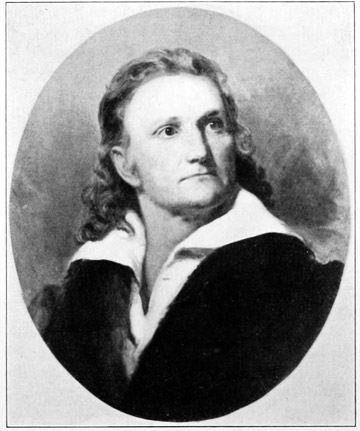
AUDUBON.
From the portrait by Henry Inman. Now in the possession of the family.
January 23, Tuesday. My first visitor was Mr. Hays
the antiquarian, who needed my assistance, or rather my
knowledge of French in the translation of a passage relating
to "le droit du seigneur." Dr. Combe called later
and begged me to go to Mr. Joseph, the sculptor, with
him, and through a great fall of snow we went through
Windsor Street, one of the handsomest in this beautiful
city. Mr. Joseph was in, and I saw an uncommonly good
bust of Sir Walter, one of Lord Morton, and several
others. I have powerfully in my mind to give my picture
of the "Trapped Otter" to Mrs. Basil Hall, and, by Washington,
I will. No one deserves it more, and I cannot
receive so many favors without trying to make some
return.
January 24. My second visit to Sir Walter Scott was
much more agreeable than my first. My portfolio and its
contents were matters on which I could speak substantially,[113]
and I found him so willing to level himself with me
for a while that the time spent at his home was agreeable
and valuable. His daughter improved in looks the moment
she spoke, having both vivacity and good sense.
January 28. Yesterday I had so many visitors that I
was quite fatigued; my rooms were full all the time, yet I
work away as if they were so many cabbages, except for a
short time taken to show them a few drawings, give them
chairs, and other civil attentions. In the evening I went to
the theatre to see the "Merchant of Venice;" the night
was violently stormy, the worst I remember for years. I
thought of the poor sailors, what hard lives they have.
January 30, Tuesday. The days begin to show a valuable
augmentation. I could this morning begin work at
eight, and was still at my easel at four. A man may do a
good deal on a painting in eight hours provided he has the
power of laying the true tints at once, and does not muddy
his colors or need glazing afterwards. Now a query arises.
Did the ancient artists and colorists ever glaze their work?
I sometimes think they did not, and I am inclined to think
thus because their work is of great strength of standing,
and extremely solid and confirmed on the canvas—a proof
with me that they painted clean and bright at once, but
that this once they repeated, perhaps, as often as three
times. Glazing certainly is a beautiful way of effecting
transparency, particularly over shadowy parts, but I frequently
fear the coating being so thin, and that time preys
on these parts more powerfully than on those unglazed, so
that the work is sooner destroyed by its application than
without it. I am confident Sir Joshua Reynolds' pictures
fade so much in consequence of his constant glazing.
Lord Hay, who has only one arm, called this morning, and
promised me White Pheasants by Saturday morning. So
many people have called that I have not put a foot out
to-day.
January 31, Wednesday. I had the delight of receiving
letters from home to-day; how every word carried me
to my beloved America. Oh, that I could be with you
and see those magnificent forests, and listen to sweet
Wood Thrushes and the Mock-Birds so gay!
February 1. I have just finished a picture of Black
Cock sunning and dusting themselves, with a view in the
background of Loch Lomond, nine feet by six, for which
I am offered two hundred guineas. It will be exhibited at
the Royal Institute rooms next week, and the picture of
the Pheasants, the same size, at the Scottish Society of
Artists, of which I am now an associate member.
February 5. None of my promised White Pheasants
have come, but I have determined the picture shall be
finished if I have to paint in a black Crow instead. Dr.
Brewster spoke to me of a camera lucida to enable me to
outline birds with great rapidity. I would like such an
instrument if merely to save time in hot weather, when
outlining correctly is more than half the work. At eight
o'clock I entered the rooms of the Royal Society. I opened
my large sheets and laid them on the table; the astonishment
of every one was great, and I saw with pleasure many
eyes look from them to me. The business of the society
was then done behind closed doors; but when these were
opened and we were called into the great room, Captain
Hall, taking my hand, led me to a seat immediately opposite
to Sir Walter Scott; then, Lucy, I had a perfect view of
that great man, and I studied from Nature Nature's noblest
work. After a lecture on the introduction of the Greek
language into England, the president, Sir Walter, rose and
we all followed his example. Sir Walter came to me, shook
my hand cordially, and asked me how the cold weather of
Edinburgh agreed with me. This mark of attention was
observed by other members, who looked at me as if I had
been a distinguished stranger.
February 9. I have been, and am yet, greatly depressed,
yet why I am so it is impossible for me to conceive,
unless it be that slight vexations, trifling in themselves, are
trying to me, because, alas! I am only a very, very common
man. I dined to-night at Professor Jameson's, and
as my note said "with a few friends," was surprised to
find thirty besides myself. The engineer, Mr. S——, was
here, and many other noted men, including the famous
Professor Leslie,[114] an enormous mass of flesh and an extremely
agreeable man, who had been in Virginia many
years ago, but recollects those days well.
February 10. I visited the Royal Institution this morning,
and saw my Black Cocks over the first of the first-room
doors. I know well that the birds are drawn as well
as any birds ever have been; but what a difference exists
between drawing one bird or a dozen and amalgamating
them with a sky, a landscape, and a well adapted foreground.
Who has not felt a sense of fear while trying to combine
all this? I looked at my work long, then walked round the
room, when my eyes soon reached a picture by Landseer,
the death of a stag. I saw much in it of the style of those
men who know how to handle a brush and carry a good
effect; but Nature was not there, although a Stag, three
dogs, and a Highlander were introduced on the canvas.
The Stag had his tongue out and his mouth shut! The
principal dog, a greyhound, held the Deer by one ear
just as if a loving friend; the young hunter has laced the
Deer by one horn very prettily, and in the attitude of a
ballet-dancer was about to cast the noose over the head
of the animal. To me, or to my friends Dr. Pope or Mr.
Bourgeat such a picture is quite a farce; not so here however.
Many other pictures drew my attention, and still
more so the different artists who came in with brushes
and palettes to tickle their pictures. I was to read a paper
at the Wernerian Society on the Rattlesnake, but had not
had time to finish it; nevertheless I went to the society
rooms, which were crowded. I was sorry I was not prepared
to read to those assembled that a Rattlesnake
rattled his tail, not to give knowledge to man of his presence,
but because he never strikes without rattling, and
that destitute of that appendage he cannot strike at all.
The wind blows a doleful tune and I feel utterly alone.
Monday, February 12. Mr. Lizars insisted on my going
to the Antiquarian Society, saying it was usual for a member
newly elected to be present on the first occasion
possible. I went, of course, but felt very sheepish withal.
We had an excellent paper by Mr. Hays respecting a bell
found in Argyle, of very ancient date.
Tuesday, February 13. This was the grand, long promised,
and much wished-for day of the opening of the
Exhibition at the rooms of the Royal Institution. At one
o'clock I went, the doors were just opened, and in a few
minutes the rooms were crowded. Sir Walter Scott was
present; he came towards me, shook my hand cordially,
and pointing to Landseer's picture said: "Many such
scenes, Mr. Audubon, have I witnessed in my younger
days." We talked much of all about us, and I would
gladly have joined him in a glass of wine, but my foolish
habits prevented me, and after inquiring of his daughter's
health, I left him, and shortly afterwards the rooms; for I
had a great appetite, and although there were tables
loaded with delicacies, and I saw the ladies particularly
eating freely, I must say to my shame I dared not lay my
fingers on a single thing. In the evening I went to the
theatre where I was much amused by "The Comedy of
Errors," and afterwards "The Green Room." I admire
Miss Neville's singing very much; and her manners also;
there is none of the actress about her, but much of the
lady.
Tuesday, 20th. A week has passed without writing here
because I have done nothing else but write—many letters
for Captain Hall, and at his request a paper to be read at
the Natural History Society. I pitched on the "Habits of
the Wild Pigeon." I began on Wednesday, and it took me
until half-past three of the morning, and after a few hours'
sleep I rose to correct it, which was needed, I can assure
thee. Were it not for the facts it contains, I would not
give a cent for it, nor anybody else, I dare say. I positively
brought myself so much among the Pigeons and in the
woods of America that my ears were as if really filled
with the noise of their wings; I was tired and my eyes
ached. I dined at a Mr. Tytler's and met among the guests
Mr. Cruden, brother of the compiler of the famous concordance.
On Sunday I made for the seashore, and walked
eight miles; the weather was extremely cold, my ears and
nose I thought would drop off, yet I went on. Monday
Captain Hall called to speak to me about my paper on
Pigeons; he complained that I expressed the belief that
Pigeons were possessed of affection and tenderest love, and
that this raised the brute species to a level with man. O
man! misled, self-conceited being, when wilt thou keep
within the sphere of humility that, with all thy vices and
wickedness about thee, should be thine. At the exhibition
rooms I put up my drawing of the Wild Pigeons and
Captain Hall read my paper. I was struck with the silence
and attention of the audience. The president invited me
to supper with him, but I was too excited, so excused
myself.
February 21. I wrote again nearly all day, and in the
evening went to the theatre to see "The School for Grown
Children."
February 23. Young Hutchinson came about the middle
of the day, and I proposed we should have an early dinner
and a long walk after for the sake of exercise, that I now
find much needed. We proceeded towards the village of
Portobello, distant three miles, the weather delightful, the
shore dotted with gentlemen on horseback galloping over
the sand in all directions. The sea calm and smooth, had
many fishing-boats. The village is a summer resort, built
handsomely of white stone, and all was quietness. From
here we proceeded across country to Duddingston, about
a mile and a half, to see the skaters on the lake, a mere
duck puddle; but the ice was too thin, and no skaters
were there. We gradually ascended the hill called Arthur's
Seat, and all of a sudden came in full view of the fair city.
We entered in the Old Town and reached my lodgings
by the North Bridge. I was quite tired, and yet I had
not walked more than ten miles. I thought this strange,
and wondered if it could be the same body that travelled
over one hundred and sixty-five miles in four days without
a shade of fatigue. The cities do not tempt me to walk,
and so I lose the habit.
February 24. To the Wernerian Society at two o'clock,
my drawing of the Mocking-Bird with me. The room was
completely filled, and a paper on the rhubarb of commerce
was read; it was short, and then Professor Jameson called my
name. I rose, and read as distinctly as I could my paper
on Rattlesnakes, a job of three quarters of an hour. Having
finished I was cheered by all, and the thanks of the
Assembly unanimously voted. My cheeks burned, and after
a few questions had been put me by the president and some
of the gentlemen present, I handed my manuscript to
Professor Jameson, and was glad to be gone. Young Murray,
the son of the London publisher, accompanied me to
the Scottish Society Exhibition, but I soon left him as so
many eyes were directed to me that I was miserable.
February 27. It blew and rained tremendously, and
this morning I parted from Captain Hall, who goes to
London. His leaving Edinburgh affects me considerably;
he is a kind, substantial friend, and when we finally shook
hands, I doubt not he knew the feeling in my heart. This
evening was spent at Mr. Joseph's the sculptor. There
were a number of guests, and music and dancing was proposed.
My fame as a dancer produced, I am sure, false
expectations; nevertheless I found myself on the floor
with Mrs. Joseph, a lively, agreeable little lady, much my
junior, and about my Lucy's age. After much dancing,
during which light refreshments were served, we sat down
to supper at twelve o'clock, and we did not leave till
three.
February 28. I have been reading Captain Hall's "Voyages
and Travels," and going much about to rest my eyes
and head; but these few days of idleness have completely
sickened me, and have given me what is named the Blue
Devils so effectually that the sooner I drive them off the
better.
March 1. Mr. Kidd,[115] the landscape artist, breakfasted
with me, and we talked painting a long time. I admired
him for his talents at so early a period of life, he being
only nineteen. What would I have been now if equally
gifted by nature at that age? But, sad reflection, I have
been forced constantly to hammer and stammer as if in
opposition to God's will, and so therefore am nothing
now but poor Audubon. I asked him to come to me
daily to eat, drink, and give me the pleasure of his company
and advice. I told him my wish was so intense to
improve in the delightful art of painting that I should begin
a new picture to-morrow, and took down my portfolio
to look for one of my drawings to copy in oil. He had
never seen my work, and his bright eyes gazed eagerly on
what he saw with admiration.
March 2. Mr. Kidd breakfasted with me, and we
painted the whole day.
March 3. I painted as constantly to-day, as it snowed
and blew hard outside my walls. I thought frequently
that the devils must be at the handles of Æolus' bellows,
and turned the cold blasts into the Scotch mists to freeze
them into snow. It is full twenty years since I saw the
like before. I dined at Mr. Ritchie's, reaching his house
safely through more than two feet of snow.
March 4. The weather tolerably fair, but the snow lay
deep. The mails from all quarters were stopped, and the
few people that moved along the streets gave a fuller idea
of winter in a northern clime than anything I have seen
for many years. Mr. Hays called for me, and we went to
breakfast with the Rev. Mr. Newbold, immediately across
the street. I was trundled into a sedan chair to church.
I had never been in a sedan chair before, and I like to
try, as well as see, all things on the face of this strange
world of ours; but so long as I have two legs and feet
below them, never will I again enter one of these machines,
with their quick, short, up-and-down, swinging motion, resembling
the sensations felt during the great earthquake in
Kentucky. But Sydney Smith preached. Oh! what a
soul there must be in the body of that great man. What
sweet yet energetic thoughts, what goodness he must possess.
It was a sermon to me. He made me smile, and he
made me think deeply. He pleased me at times by painting
my foibles with due care, and again I felt the color come
to my cheeks as he portrayed my sins. I left the church
full of veneration not only towards God, but towards the
wonderful man who so beautifully illustrates his noblest
handiwork. After lunch Mr. Hays and I took a walk
towards Portobello, tumbling and pitching in the deep
snow. I saw Sky-Larks, poor things, caught in snares as
easily—as men are caught. For a wonder I have done
no work to-day.
March 5. As a lad I had a great aversion to anything
English or Scotch, and I remember when travelling with
my father to Rochefort in January, 1800, I mentioned this
to him, for to him, thank God, I always told all my
thoughts and expressed all my ideas. How well I remember
his reply: "Laforest, thy blood will cool in
time, and thou wilt be surprised to see how gradually prejudices
are obliterated, and friendships acquired, towards
those that at one time we held in contempt. Thou hast
not been in England; I have, and it is a fine country."
What has since taken place? I have admired and esteemed
many English and Scotch, and therefore do I feel proud
to tell thee that I am a Fellow of the Royal Society of
Edinburgh. My day has been rather dull, though I painted
assiduously. This evening I went to the Society of Arts,
where beautiful experiments were shown by the inventors
themselves; a steam coach moved with incomprehensible
regularity. I am undetermined whether to go to Glasgow
on my way to Dublin, or proceed overland to Newcastle,
Liverpool, Oxford, Cambridge, and so on to London, but
I shall move soon.
March 7. This evening I was introduced to Sydney
Smith, the famous preacher of last Sunday, and his fair
daughters, and heard them sing most sweetly. I offered
to show them some of my drawings and they appointed
Saturday at one o'clock. The wind is blowing as if intent
to destroy the fair city of Edinburgh.
March 8. The weather was dreadful last night and still
continues so; the snow is six feet deep in some parts of
the great roads, and I was told at the Post Office that
horsemen sent with the mail to London had been obliged
to abandon their horses, and proceed on foot. Wrote a
letter to Sir Walter Scott requesting a letter of introduction,
or shall I say endorsement, and his servant brought me
a gratifying reply at eight of the evening. At one Dr.
Spence came with Miss Neville, the delightful singer at
the theatre, her mother, and Miss Hamilton. They sat
with me some time, and I was glad to see near-by the
same Miss Neville whom I admire so much at the play. I
found her possessed of good sense and modesty, and like
her much; her mother asked me to spend the evening of
next Saturday with them, and said her daughter would
sing for me with pleasure. Had a note from Sydney
Smith; the man should study economy; he would destroy
more paper in a day than Franklin in a week; but all great
men are more or less eccentric. Walter Scott writes a
diminutive hand, very difficult to read, Napoleon a large,
scrawling one, still more difficult, and Sydney Smith goes
up-hill all the way with large strides.
March 9. My first work this day was to send as a
present to Miss Anne Scott a copy of my first number.
Professor Wilson called and promised to come again on
Monday.
March 10. I visited Mr. James B. Fraser,[116] a great
traveller in Asia and Africa, and saw there a large collection
of drawings and views in water-colors of the
scenery of these countries. The lecture at the Wernerian
Society was very interesting; it was on the uses of cotton
in Egypt, and the origin of the name in the English language.
I dined at Mr. Neill's; among the guests was a Mr.
Blair, the superintendent of the Botanical Gardens here;
he has been in different parts of America frequently. There
were several other gentlemen present interested in like
subjects, and we talked of little else than trees and exotic
plants, birds and beasts; in fact it was a naturalists' dinner,
but a much better one than naturalists generally have who
study in the woods. I was obliged to leave early, as I had
an engagement at Miss Neville's. Tea was served, after
which Miss Neville rose, and said she would open the
concert. I was glad to see her simply but beautifully
dressed in a plain white gown of fine muslin, with naught
but her fine auburn hair loose in large curls about her neck,
and a plain scarf of a light-rose color. She sang and
played most sweetly; the gentlemen present were all more
or less musical, and we had fine glees, duets, trios. The
young lady scarcely left off singing, for no sooner was a
song finished than some one asked for another; she immediately
replied, "Oh, yes," and in a moment the room
was filled with melody. I thought she must be fatigued,
and told her so, but she replied: "Mr. Audubon, singing
is like painting; it never fatigues if one is fond of it, and I
am." After a handsome supper we had more singing, and
it was past two o'clock when I rose, shook hands with
Miss Neville, bowed to the company, and made my exit.
March 12. I can scarcely believe that this day, there
is in many places six feet of snow, yet with all this no
invitation is ever laid aside, and last evening I went to
dinner in a coach drawn by four horses. At noon to-day
I went with Mr. Lizars to the Assembly Rooms, to see the
fencing. About a thousand persons, all in full dress,
gathered in a few minutes, and a circle being formed,
eight young men came in, and went through the first
principles of fencing; we had fine martial music and a
succession of fencing turns till two o'clock, when the assault
began between the two best scholars. Five hits were
required to win the prize—a fine sword—and it was
presented to the conqueror, a Mr. Webster. At half-past
six I dined at Mr. Hamilton's, where a numerous and
agreeable party was assembled. At ten Miss Neville and
her mother came with still others. We had dancing and
singing, and here I am, quite wearied at half-past three;
but I must be up early to-morrow morning.
March 13. The little I slept had a bad effect on me, for
I rose cross of mind and temper. I took a long walk on
the London road, returned and reached Brae House, and
breakfasted with the famous Mrs. Grant,[117] an old lady very
deaf, but very agreeable withal. Her son and daughter
and another lady formed our party. We talked of nothing
but America; Mrs. Grant is positively the only person I
have met here who knows anything true about my country.
I promised to call again soon. This evening I dined at
Sir James Riddell's, and I do not know when I have
spent a more uncomfortable evening; the company were
all too high for me, though Sir James and his lady did all
they could for me. The ton here surpassed that at the
Earl of Morton's; five gentlemen waited on us while at
table, and two of these put my cloak about my shoulders,
notwithstanding all I could say to the contrary.
Several of these men were quite as well dressed as
their master. What will that sweet lady, Mrs. Basil
Hall think of a squatter's hut in Mississippi in contrast
with this? No matter! whatever may be lacking, there
is usually a hearty welcome. Oh! my America, how
dearly I love thy plain, simple manners.
March 14. I have been drawing all day, two Cat-birds
and some blackberries for the Countess of Morton, and
would have finished it had I not been disturbed by visitors.
Mr. Hays came with his son; he asked me if it would not
be good policy for me to cut my hair and have a fashionable
coat made before I reached London. I laughed, and
he laughed, and my hair is yet as God made it.
March 17. I had long wished to visit Roslyn Castle
and the weather being beautiful I applied to Mrs. Dickie
for a guide, and she sent her son with me. We passed
over the North Bridge and followed the turnpike road,
passing along the foot of the Pentland Hills, looking back
frequently to view Edinburgh under its cloud of smoke,
until we had passed a small eminence that completely hid
it afterwards from our sight. Not an object of interest lay
in our way until we suddenly turned southeast and
entered the little village of Roslyn. I say little, because
not more than twenty houses are there, and these are all
small except one. It is high, however, so much so that
from it we looked down on the ruined castle, although the
elevation of the castle above the country around is very
great. On inquiry, we were assured that the chapel was
the only remaining edifice worthy of attention. We
walked down to it and entered an enclosure, when before
us stood the remains of the once magnificent Chapel of
Roslyn. What volumes of thoughts rushed into my mind.
I, who had read of the place years before, who knew by
tradition the horrors of the times subsequent to the founding
of the edifice, now confronted reality. I saw the
marks of sacrilegious outrage on objects silent themselves
and which had been raised in adoration to God. Strange
that times which produced such beautiful works of art
should allow the thief and the murderer to go almost unpunished.
This Gothic chapel is a superb relic; each
stone is beautifully carved, and each differs from all the
others. The ten pillars and five arches are covered with
the finest fret-work, and all round are seen the pedestals
that once supported the images that Knox's party were
wont to destroy without thought or reason. I went down
some mouldering steps into the Sacristy, but found only
bare walls, decaying very fast; yet here a curious plant
was growing, of a verdigris color. To reach the castle we
went down and along a narrow ridge, on each side of
which the ground went abruptly to the bottom of a narrow,
steep valley, through which a small, petulant stream
rushed with great rapidity over a rocky bed. This guards
three sides of the promontory on which Roslyn Castle
once was; for now only a few masses of rubbish were to be
seen, and a house of modern structure occupies nearly the
original site. In its day it must have been a powerful
structure, but now, were it existing, cannon could destroy
it in a few hours, if they were placed on the opposite
hills. A large meadow lay below us, covered with bleaching
linen, and the place where we stood was perfectly
lonely, not even the reviving chirp of a single bird could
be heard, and my heart sank low while my mind was engaged
in recollections of the place. In silence we turned
and left the Castle and the little village, and returned by
another route to busy Edinburgh. The people were just
coming out of church, and as I walked along I felt a tap
on my shoulder and heard good Mr. Neill say, "Where
are you going at the rate of six miles an hour?" and he
took me home to dine with him, after we had been to my
lodgings, where I put my feet in ice cold water for ten
minutes, when I felt as fresh as ever.
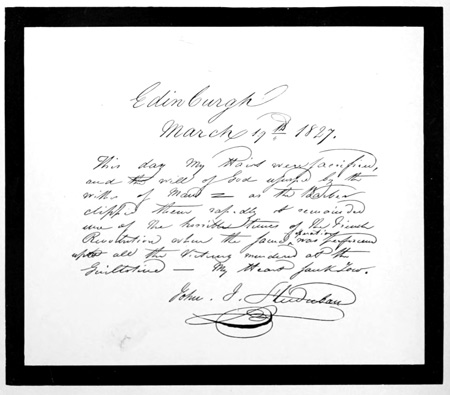
FACSIMILE OF ENTRY IN JOURNAL
March 19, 1827. This day my hair was sacrificed, and
the will of God usurped by the wishes of man. As the
barber clipped my locks rapidly, it reminded me of the
horrible times of the French Revolution when the same
operation was performed upon all the victims murdered at
the guillotine; my heart sank low.
John J. Audubon.[118]
Shortly after breakfast I received a note from Captain
Hall, and another from his brother, both filled with entreaties
couched in strong terms that I should alter my hair
before I went to London. Good God! if Thy works are
hated by man it must be with Thy permission. I sent for
a barber, and my hair was mowed off in a trice. I knew I
was acting weakly, but rather than render my good friend
miserable about it, I suffered the loss patiently.
March 20. I visited Mr. Hays at his office, and had
the pleasure of seeing all the curious ancient manuscripts,
letters, mandates, Acts of Parliament, etc., connected with
the official events of Scotland with England for upwards
of three hundred years past. Large volumes are written
on parchment, by hand, and must have been works of
immense labor. The volumes containing the mere transfers
of landed estates filed within the last forty years
amounted to almost three thousand, and the parcels of
ancient papers filled many rooms in bundles and in bags of
leather, covered with dust, and mouldering with age. The
learned antiquarian, Mr. Thompson, has been at great
pains to put in order all these valuable and curious documents.
The edifice of the Registry is immense, and the
long, narrow passages proved a labyrinth to me. Mr.
Hays' allotted portion of curiosities consists of Heraldry,
and I saw the greatest display of coats of arms of all sorts,
emblazoned in richest style on sleek vellum and parchment.
March 21. Called on Miss D——, the fair American.
To my surprise I saw the prints she had received the
evening before quite abused and tumbled. This, however,
was not my concern, and I regretted it only on her
account, that so little care should be taken of a book that
in fifty years will be sold at immense prices because of its
rarity.[119] The wind blew great guns all morning. Finding
it would be some days before my business would permit
me to leave, I formed an agreement to go to see the
interior of the Castle, the regalia, and other curiosities of
the place to-morrow. I received a valuable letter of
introduction to the Secretary of the Home Department,
Mr. Peel, from the Lord Advocate of Scotland, given me
at the particular request of the Countess of Morton, a most
charming lady; the Earl of Morton would have written
himself but for the low state of his health.
March 22. After lunch the Rev. Wm. Newbold and I
proceeded to the Castle; the wind blew furiously, and consequently
no smoke interfered with the objects I wished
to see. We passed a place called the "Mound," a thrown-up
mass of earth connecting now the New with the Old
city of Edinburgh. We soon reached the gates of the
Castle, and I perceived plainly that I was looked upon as
an officer from the continent. Strange! three days ago I
was taken for a priest, quick transition caused only by the
clipping of my locks. We crossed the drawbridge and
looked attentively at the deep and immense dried ditches
below, passed through the powerful double gates, all
necessary securities to such a place. We ascended continually
until we reached the parapets where the King
stood during his visit, bowing, I am told, to the gaping
multitude below, his hat off, and proud enough, no doubt,
of his high station. My hat was also off, but under different
impulses; I was afraid that the wind would rob me of
it suddenly. I did not bow to the people, but I looked
with reverence and admiration on the beauties of nature
and of art that surrounded me, with a pleasure seldom felt
before. The ocean was rugged with agitated waves as far
as the eye could reach eastwardly; not a vessel dared
spread its sails, so furious was the gale. The high mountains
of wild Scotland now and then faintly came to our
view as the swift-moving clouds passed, and suffered the
sun to cast a momentary glance at them. The coast of
the Frith of Forth exhibited handsome villas, and noblemen's
seats, bringing at once before me the civilization of
man, and showing how weak and insignificant we all are.
My eyes followed the line of the horizon and stopped at a
couple of small elevations, that I knew to be the home of
the Countess of Morton; then I turned to the immense
city below, where men looked like tiny dwarfs, and horses
smaller than sheep. To the east lay the Old Town, and
now and then came to my ears the music of a band as the
squall for a moment abated. I could have remained here
a whole day, but my companion called, and I followed
him to the room where the regalia are kept. We each
wrote our names, paid our shilling, and the large padlock
was opened by a red-faced, bulky personage dressed in a
fanciful scarlet cloth, hanging about him like mouldering
tapestry. A small oblong room, quite dark, lay before us;
it was soon lighted, however, by our conductor. A high
railing of iron, also of an oblong form, surrounded a table
covered with scarlet cloth, on which lay an immense sword
and its scabbard, two sceptres, a large, square, scarlet
cushion ornamented with golden tassels, and above all
the crown of Scotland. All the due explanations were
cried out by our conductor, on whose face the reflection
of all the red articles was so powerfully displayed just now
that it looked like a large tomato, quite as glittering, but
of a very different flavor, I assure thee. We looked at all
till I was tired; not long did this take, for it had not one
thousandth portion of the beauties I had seen from the
parapet. We left the Castle intending to proceed to the
stone quarries three miles distant, but the wind was now so
fierce, and the dust so troubled my eyes, that the jaunt was
put off till another day. I paid young Kidd three guineas
for his picture. Have just had some bread and butter and
will go to bed.
March 23. Young Kidd breakfasted with me, and no
sooner had he gone than I set to and packed up. I felt very
low-spirited; the same wind keeps blowing, and I am now
anxious to be off to Mr. Selby's Newcastle, and my dear
Green Bank. My head was so full of all manner of
thoughts that I thought it was Saturday, instead of Friday,
and at five o'clock I dressed in a great hurry and went to
Mr. Henry Witham's with all possible activity. My Lucy,
I was not expected till to-morrow! Mr. Witham was not
at home, and his lady tried to induce me to remain and
dine with her and her lovely daughter; but I declined, and
marched home as much ashamed of my blunder as a fox
who has lost his tail in a trap. Once before I made a
sad blunder; I promised to dine at three different houses
the same day, and when it came I discovered my error,
and wrote an apology to all, and went to none.
Twizel House, Belford—Northumberland, April 10,
1827. Probably since ten years I have not been so long
without recording my deeds or my thoughts; and even
now I feel by no means inclined to write, and for no particular
reason. From Friday the 23d of March till the 5th
of April my time was busily employed, copying some of my
drawings, from five in the morning till seven at night. I
dined out rarely, as I found the time used by this encroached
too much on that needed by my ardent desire to improve
myself in oil and in perspective, which I wished to study
with close attention. Every day brought me packets of
letters of introduction, and I called here and there to make
my adieux. I went often in the evening to Mr. Lizars';
I felt the parting with him and his wife and sister would
be hard, and together we attended meetings of the different
societies. The last night I went to the Royal Society.
Sir Wm. Hamilton[120] read a paper against phrenology,
which would seem to quite destroy the theory of Mr.
Combe. I left many things in the care of my landlady,
as well as several pictures, and at six o'clock on the morning
of April 5, left Edinburgh, where I hope to go again.
The weather was delightful. We passed Dunbar and Berwick,
our road near the sea most of the time, and at half-past
four, the coach stopped opposite the lodge of Twizel
House. I left my baggage in the care of the woman at
the lodge, and proceeded through some small woods
towards the house, which I saw after a few minutes,—a
fine house, commanding an extensive view of the country,
the German Ocean, and Bamborough Castle. I ascended
the great staircase with pleasure, for I knew that here
was congeniality of feeling. Hearing the family were
out and would not return for two hours, I asked to be
shown to the library, and told my name. The man said
not a word, went off, and about ten minutes after, whilst
I was reading the preface of William Roscoe to his "Leo
X.," returned and said his master would be with me in a
moment. I understood all this. Mr. Selby came in, in
hunting-dress, and we shook hands as hunters do. He
took me at once out in his grounds, where Mrs. Selby,
his three daughters, and Captain Mitford his brother-in-law
were all engaged transplanting trees, and I felt at
home at once. When we returned to the house Mr. Selby
conducted me to his laboratory, where guns, birds, etc.,
were everywhere. I offered to make a drawing and Captain
Mitford went off to shoot a Chaffinch. We had supper,
after which the eagerness of the young ladies made me
open my box of drawings; later we had music, and the
evening passed delightfully. I thought much of home
I assure thee, and of Green Bank also, and then of my
first sight of thee at Fatland, and went to bed thanking
God for the happy moments he has granted us. The
next morning I felt afraid my early habits would create
some disturbance in the repose of the family, and was
trying to make good my outing at five, and thought I
had already done so, when to my surprise and consternation
the opening of the hall door made such a noise as I
doubted not must have been heard over the whole establishment;
notwithstanding, I issued into the country fresh
air, and heard all around me the Black-birds, Thrushes,
and Larks at their morning songs. I walked, or rather
ran about, like a bird just escaped from a cage; plucked
flowers, sought for nests, watched the fishes, and came
back to draw. All went well; although the shooting season
(as the English please to call it) was long since over, we
took frequent walks with guns, and a few individuals were
the sufferers from my anxiety to see their bills, and eyes,
and feathers; and many a mile did I race over the moors
to get them. More or less company came daily to see
my drawings, and I finished a drawing for Mr. Selby of
three birds, a Lapwing for Mrs. Selby, who drew fully
as well as I did, and who is now imitating my style, and
to whom I have given some lessons. Also I finished a
small picture in oil for the charming elder daughter
Louise; the others are Jane and Fanny. So much at home
did we become that the children came about me as freely
as if I had long known them; I was delighted at this, for
to me to have familiar intercourse with children, the most
interesting of beings, is one of my greatest enjoyments,
and my time here was as happy as at Green Bank; I can
say no more. The estate is well situated, highly ornamented,
stocked with an immensity of game of the country,
and trout abound in the little rivulets that tumble from
rock to rock towards the northern ocean. To-morrow I
leave this with Captain Mitford for his country seat.
Mitford Castle, near Morpeth, Northumberland, April 11,
1827. I rose as early as usual, and not to disturb my
kind friends, I marched down the staircase in my stockings,
as I often do where the family are not quite such
early risers; instead of opening the hall door I sat down
in the study, and outlined a Lapwing, in an extremely
difficult position, for my friend Selby, and did not go
on my walk until the servants made their appearance,
and then I pushed off to the garden and the woods to
collect violets. I felt quite happy, the fragrance of the
air seemed equal to that of the little blue flowers which
I gathered. We breakfasted, and at ten o'clock I bid
farewell to Mrs. Selby; good, amiable lady, how often
she repeated her invitation to me to come and spend
a goodly time with them. Mr. Selby and the children
walked down to the lodge with the captain and me, and
having reached the place too early we walked about the
woods awhile. The parting moment came at last, all too
soon, our baggage was put on the top of the "Dart," an
opposition coach, and away we rolled. My good companion
Captain Mitford kept my spirits in better plight
than they would otherwise have been, by his animated
conversation about game, fishing, America, etc., and after
a ride of about twelve miles we entered the small village
of Alnwick, commanded by the fine castle of the Duke
of Northumberland. Having to change horses and wait
two hours, we took a walk, and visited the interior of that
ancient mass of buildings, the whole being deserted at
present, the Duke absent. I saw the armory, the dungeons,
the place for racking prisoners, but the grotesque
figures of stone standing in all sorts of attitudes, defensive
and offensive, all round the top of the turrets and bastions,
struck me most. They looked as if about to move, or to
take great leaps to the ground, to cut our throats. This
castle covers five acres of ground, is elevated, and therefore
in every direction are good views of the country. From
it I saw the cross put up in memory of King Malcolm
killed by Hammond. At two precisely (for in England
and Scotland coaches start with great punctuality) we
were again en route. We passed over the Aln River, a
very pretty little streamlet, and reached Felton, where
we changed horses. The whole extent of country we
passed this day was destitute of woods, and looked to me
very barren. We saw little game; about five we arrived
within two miles of Morpeth, where the captain and I
alighted; we walked to a pretty little vale and the ruins
of the old castle lay before us, still doomed to moulder
more, and walking on reached the confluence of two
small, pretty streams from which originated the name
of my friend's ancestors, Meetingford. We reached the
house, and having heard of his brother's indisposition,
the captain and I entered quietly, and I was presented to
the owner of the hall. I saw before me a thin, pale, emaciated
being who begged I would go to him, as he could
not rise. I shook his withered hand and received his
kind welcome. During the evening I had ample opportunity
to observe how clever and scientific he was, and
regretted the more his frail body. He was extremely
anxious to see my drawings, and he examined them more
closely than I can ever remember any one to have done
before, and was so well acquainted with good drawing
that I felt afraid to turn them over for his inspection.
After looking at probably a hundred without saying a
single word, he exclaimed suddenly: "They are truly
beautiful; our King ought to purchase them, they are too
good to belong to a single individual." We talked much
on subjects of natural history, and he told me that he
made it a rule that not a gun was ever fired during the
breeding season on any part of his beautiful estate;
he delighted to see the charming creatures enjoy life
and pleasure without any annoyance. Rooks, Jackdaws,
Wood-Pigeons, and Starlings were flying in hundreds
about the ruined castle. We sat up till after twelve, when
hot water and spirits were produced, after which we said
good-night; but I needed nothing to make me sleep, for
in five minutes after I lay down I was—I know not where.
April 12. I am now at last where the famous Bewick
produced his handsome and valuable work on the birds of
England. It is a dirty-looking place, this Newcastle, and
I do not know if it will prove at all pleasant. This morning
early the captain and myself took a good ramble about
Mitford Hall grounds; saw the rookery, the ruins of the
castle, and walked some way along the little river front.
We breakfasted about ten with his brother, who wished to
see my drawings by daylight. Afterwards my baggage
was taken to Morpeth, and the captain and I walked
thither about twelve. Our way was along a pretty little
stream called the Wansbeck, but the weather changed and
the rain assured me that none of the persons we expected
to see in the village would come, on this account, and I was
not mistaken. At half-past four I mounted the coach for
this place, and not an object of interest presented itself in
the journey of thirteen miles.
Newcastle-upon-Tyne, April 13. At ten o'clock I left
the inn, having had a very indifferent breakfast, served on
dirty plates; therefore I would not recommend the "Rose
and Crown," or the hostess, to any friend of mine. Yet
my bed was quite comfortable, and my sleep agreeably
disturbed about one hour before day by some delightful
music on the bugle. I often, even before this, have had a
wish to be a performer on this instrument, so sure I am
that our grand forests and rivers would re-echo its sonorous
sounds with fine effect. I passed through many streets,
but what a shabby appearance this Newcastle-upon-Tyne
has, after a residence of nearly six months in the beautiful
city of Edinburgh. All seems dark and smoky, indeed I
conceive myself once more in Manchester. The cries of
fish, milk, and vegetables, were all different, and I looked
in vain for the rosy cheeks of the Highlanders. I had
letters to the members of the Johnson family, given me by
Captain Mitford, and therefore went to St. James Square,
where I delivered them, and was at once received by a tall,
fine-looking young gentleman, who asked me if I had
breakfasted. On being answered in the affirmative, he
requested me to excuse him till he had finished his, and
I sat opposite the fire thinking about the curious pilgrimage
I had now before me. Will the result repay the
exertions? Alas! it is quite impossible for me to say, but
that I shall carry the plan out in all its parts is certain
unless life departs, and then I must hope that our Victor
will fall into my place and accomplish my desires, with
John's help to draw the birds, which he already does well.
Mr. Edward Johnson soon re-entered, bringing with him
Mr. John Adamson, secretary to the Literary and Philosophical
Society of this place. I presented the letter for him
from Mr. Selby, but I saw at once that he knew me by
name. Soon after he very kindly aided me to find suitable
lodgings, which I did in Collingwood Street. We
then walked to Mr. Bewick's, the engraver, son of the
famous man, and happily met him. He is a curious-looking
man; his head and shoulders are both broad, but his
keen, penetrating eyes proved that Nature had stamped
him for some use in this world. I gave him the letters I
had for him, and appointed a time to call on his father. I
again suffered myself to be imposed upon when I paid my
bill at the inn on removing to my lodgings, and thought of
Gil Blas of Santillane. Five persons called to see my
drawings this afternoon, and I received a note from Mr.
Bewick inviting me to tea at six; so I shall see and talk
with the wonderful man. I call him wonderful because I
am sincerely of the opinion that his work on wood is
superior to anything ever attempted in ornithology. It is
now near eleven at night. Robert Bewick (the son) called
for me about six, and we proceeded to his father's house.
On our way I saw an ancient church with a remarkably
beautiful Lanterne at top, St. Nicholas' Church I was told,
then we passed over the Tyne, on a fine strong bridge of
stone, with several arches, I think six or seven. This is
distant from the sea, and I must say that the Tyne here is
the only stream I have yet seen since my landing resembling
at all a river. It is about as large as Bayou Sara
opposite the Beech Woods, when full. I saw some of the
boats used in carrying coals down the stream; they are
almost of oval shape, and are managed with long, sweeping
oars, and steerers much like our flat-boats on the Ohio.
My companion did not talk much; he is more an acting
man than a talker, and I did not dislike him for that.
After ascending a long road or lane, we arrived at Bewick's
dwelling, and I was taken at once to where he was at work,
and saw the man himself. He came to me and welcomed
me with a hearty shake of the hand, and took off for a
moment his half-clean cotton night-cap tinged with the
smoke of the place. He is tall, stout, has a very large
head, and his eyes are further apart than those of any man
I remember just now. A complete Englishman, full of
life and energy though now seventy-four, very witty and
clever, better acquainted with America than most of his
countrymen, and an honor to England. Having shown
me the work he was at, a small vignette cut on a block of
box-wood not more than three by two inches, representing
a dog frightened during the night by false appearances of
men formed by curious roots and branches of trees, rocks,
etc., he took me upstairs and introduced me to his three
daughters—all tall, and two of them with extremely fine
figures; they were desirous to make my visit an agreeable
one and most certainly succeeded. I met there a Mr.
Goud, and saw from his pencil a perfect portrait of Thomas
Bewick, a miniature, full-length, in oil, highly finished, well
drawn and composed. The old gentleman and I stuck to
each other; he talked of my drawings, and I of his woodcuts,
till we liked each other very much. Now and then
he would take off his cotton cap, but the moment he became
animated with the conversation the cap was on, yet
almost off, for he had stuck it on as if by magic. His eyes
sparkled, his face was very expressive, and I enjoyed him
much more, I am sure, than he supposed. He had heard
of my drawings and promised to call early to-morrow
morning with his daughters and some friends. I did not
forget dear John's wish to possess a copy of his work on
quadrupeds, and having asked where I could procure one,
he answered "Here." After coffee and tea had been
served, young Bewick, to please me, brought a bagpipe
of a new construction, called a "Durham," and played
simple, nice Scotch and English airs with peculiar taste;
the instrument sounded like a hautboy. Soon after ten
the company broke up, and we walked into Newcastle.
The streets were desolate, and their crookedness and
narrowness made me feel the more the beauty of fair
Edinburgh.
April 14. The weather is now becoming tolerable and
spring is approaching. The Swallows glide past my windows,
and the Larks are heard across the Tyne. Thomas
Bewick, his whole family, and about a hundred others have
kept me busy exhibiting drawings. Mr. Bewick expressed
himself as perfectly astounded at the boldness of my undertaking.
I am to dine with him to-morrow, Mr. Adamson
to-day, and Mr. Johnson on Wednesday if I do not go on
to York that day.
April 15. Mr. Adamson called for me at church time,
and we proceeded a short distance and entered St.
Nicholas' church. He ordered an officer to take me
to what he called the mansion house and I was led along
the aisles to a place enclosed by an iron railing and
showed a seat. In looking about me I saw a large
organ over the door I had entered, and in front of this
were seated many children, the lasses in white, the lads
in blue. An immense painting of the Lord's Supper
filled the end opposite the entrance, and the large Gothic
windows were brilliant with highly colored glass. A few
minutes passed, when a long train of office bearers and the
magistrates of the town, headed by the mayor, came in procession
and entered the mansion house also; a gentleman
at my elbow rose and bowed to these and I followed his
example; I discovered then that I was seated in the most
honorable place. The service and sermon were long and
tedious; often to myself I said, "Why is not Sydney Smith
here?" Being in church I sat patiently, but I must say I
thought the priest uncommonly stupid. Home to luncheon
and afterwards went to Heath, the painter,[121] who with
his wife received me with extreme kindness. He showed
me many sketches, a number of which were humorous.
He likes Newcastle better than Edinburgh, and I would
not give an hour at Edinburgh, especially were I with
friend Lizars, his wife, and sister, for a year here. So
much for difference of taste.—I have just returned from
old Bewick's. We had a great deal of conversation, all
tending towards Natural History; other guests came in as
the evening fell, and politics and religion were touched
upon. Whilst this was going on old Bewick sat silent
chewing his tobacco; the son, too, remained quiet, but
the eldest daughter, who sat next to me, was very interesting,
and to my surprise resembles my kind friend Hannah
Rathbone so much, that I frequently felt as if Miss Hannah,
with her black eyes and slender figure, were beside me. I
was invited to breakfast to-morrow at eight with Mr.
Bewick to see the old gentleman at work.
April 16. I breakfasted with old Bewick this morning
quite sans cérémonie, and then the old man set to work to
show me how simple it was to cut wood! But cutting wood
as he did is no joke; he did it with as much ease as I can
feather a bird; he made all his tools, which are delicate
and very beautiful, and his artist shop was clean and attractive.
Later I went with Mr. Plummer, the officiating
American consul at this place, to the court-rooms, and
Merchant Coffee House, also to a new fish market, small
and of a half-moon form, contiguous to the river, that I
have forgotten to say is as dirty and muddy as an alligator
hole. The coal boats were moving down by hundreds,
with only one oar and a steerer, to each of which I saw
three men. We then went to the Literary and Philosophical
Society rooms; the library is a fine, large room with
many books—the museum small, but in neat order, and
well supplied with British specimens. Since then I have
been showing my drawings to at least two hundred persons
who called at my lodgings. I was especially struck with
a young lady who came with her brother. I saw from my
window a groom walking three fine horses to and fro, and
almost immediately the lady and gentleman entered, whip
in hand, and spurred like fighting-cocks; the lady, with a
beaver and black silk neckerchief, came in first and alone,
holding up with both hands her voluminous blue riding-habit,
and with a ton very unbecoming her fine eyes and
sweet face. She bowed carelessly, and said: "Compliments,
sir;" and perceiving how much value she put on
herself, I gave her the best seat in the room. For some
time she sat without a word; when her brother began to
put questions, however, she did also, and so fast and so
searchingly that I thought them Envoies Extraordinaires
from either Temminck or Cuvier. Mr. Adamson, who sat
by all the time, praised me, when they had gone, for my
patience, and took me home to dine with him en famille.
A person (a glazier, I suppose), after seeing about a
hundred pictures, asked me if I did not want glass and
frames for them. How I wish I was in America's dark
woods, admiring God's works in all their beautiful ways.
April 17. Whilst I was lying awake this morning waiting
for it to get light, I presently recollected I was in
Newcastle-upon-Tyne, and recalled the name of Smollett,
no mean man, by the bye, and remembered his eulogium
of the extraordinary fine view he obtained when travelling
on foot from London to this place, looking up the Tyne
from Isbet Hill, and I said, "If Smollett admired the
prospect, I can too," and leaped from my bed as a hare
from his form on newly ploughed ground at the sound
of the sportsman's bugle, or the sight of the swift greyhound.
I ran downstairs, out-of-doors, and over the
Tyne, as if indeed a pack of jackals had been after me.
Two miles is nothing to me, and I ascended the hill
where poor Isbet, deluded by a wretched woman, for her
sake robbed the mail, and afterwards suffered death on
a gibbet; and saw—the sea! Far and wide it extended;
the Tyne led to it, with its many boats with their coaly
burdens. Up the river the view was indeed enchanting;
the undulating meadows sloped gently to the water's edge
on either side, and the Larks that sprang up before me,
welcoming the sun's rise, animated my thoughts so much
that I felt tears trickling down my cheeks as I gave praise
to the God who gave life to all these in a day. There was
a dew on the ground, the bees were gathering honey from
the tiniest flowerets, and here and there the Blackbird so
shy sought for a fibrous root to entwine his solid nest of
clay. Lapwings, like butterflies of a larger size, passed
wheeling and tumbling over me through the air, and had
not the dense smoke from a thousand engines disturbed
the peaceful harmony of Nature, I might have been there
still, longing for my Lucy to partake of the pleasure with
me. But the smoke recalled me to my work, and I turned
towards Newcastle. So are all transient pleasures followed
by sorrows, except those emanating from the
adoration of the Supreme Being. It was still far from
breakfast time; I recrossed the Tyne and ascended the
east bank for a couple of miles before returning to my
lodgings. The morning afterward was spent as usual.
I mean, holding up drawings to the company that came
in good numbers. Morning here is the time from ten to
five, and I am told that in London it sometimes lengthens
to eight of the evening as we term it. Among these visitors
was a Mr. Donkin, who remained alone with me when
the others had left, and we had some conversation; he is
an advocate, or, as I would call it, a chancellor. He
asked me to take a bachelor's dinner with him at five; I
accepted, and he then proposed we should drive out and
see a house he was building two miles in the country. I
again found myself among the rolling hills, and we soon
reached his place. I found a beautiful, low house of
stone, erected in the simplest style imaginable, but so
well arranged and so convenient that I felt satisfied he
was a man of taste as well as wealth. Garden, grounds,
all was in perfect harmony, and the distant views up and
down the river, the fine woods and castle, all came in
place,—not to satiate the eye, but to induce it to search
for further beauties. On returning to town Mr. Donkin
showed me the old mansion where poor Charles the First
was delivered up to be beheaded. He could have escaped
through a conduit to the river, where a boat was waiting,
but the conduit was all darkness and his heart failed him.
Now I should say that he had no heart, and was very unfit
for a king. At Mr. Donkin's house I was presented to
his partners, and we had a good dinner; the conversation
ran much on politics, and they supported the King and Mr.
Canning. I left early, as I had promised to take a cup of
tea with old Bewick. The old gentleman was seated as
usual with his night-cap on, and his tobacco pouch in one
hand ready to open; his countenance beamed with pleasure
as I shook hands with him. "I could not bear the
idea of your going off without telling you in written
words what I think of your 'Birds of America;' here it is
in black and white, and make whatever use you may of
it, if it be of use at all," he said, and put an unsealed
letter in my hand. We chatted away on natural-history
subjects, and he would now and then exclaim: "Oh that
I was young[122] again! I would go to America. What a
country it will be." "It is now, Mr. Bewick," I would
retort, and then we went on. The young ladies enjoyed
the sight and remarked that for years their father had
not had such a flow of spirits.
April 19. This morning I paid a visit of farewell to Mr.
Bewick and his family; as we parted he held my hand
closely and repeated three times, "God preserve you."
I looked at him in such a manner that I am sure he understood
I could not speak. I walked slowly down the hilly
lane, and thought of the intrinsic value of this man to the
world, and compared him with Sir Walter Scott. The
latter will be forever the most eminent in station, being
undoubtedly the most learned and most brilliant of the
two; but Thomas Bewick is a son of Nature. Nature
alone has reared him under her peaceful care, and he in
gratitude of heart has copied one department of her works
that must stand unrivalled forever; I say "forever" because
imitators have only a share of real merit, compared with inventors,
and Thomas Bewick is an inventor, and the first
wood-cutter in the world! These words, "first wood-cutter"
would, I dare say, raise the ire of many of our hearty squatters,
who, no doubt, on hearing me express myself so
strongly, would take the axe, and fell down an enormous tree
whilst talking about it; but the moment I would explain to
them that each of their chips would produce under his chisel
a mass of beauties, the good fellows would respect him quite
as much as I do. My room was filled all day with people
to see my works and me whom some one had said resembled
in physiognomy Napoleon of France. Strange simile
this, but I care not whom I resemble, if it be only in looks,
if my heart preserves the love of the truth.
Saturday, April 21. I am tired out holding up drawings,
I may say, all day; but have been rewarded by an
addition of five subscribers to my work. Am off to-morrow
to York. God bless thee, my Lucy.
York, Sunday, April 22, 1827. Left Newcastle at eight;
the weather cold and disagreeable, still I preferred a seat
on top to view the country. Passed through Durham, a
pretty little town with a handsome castle and cathedral,
planted on an elevated peninsula formed by a turn of the
river Wear, and may be seen for many miles. It is a rolling
country, and the river wound about among the hills;
we crossed it three times on stone bridges. Darlington,
where we changed horses, is a neat, small place, supported
by a set of very industrious Quakers; much table linen
is manufactured here. As we approached York the woods
became richer and handsomer, and trees were dispersed
all over the country; it looked once more like England,
and the hedges reminded me of those about "Green Bank."
They were larger and less trimmed than in Scotland. I
saw York Minster six or seven miles before reaching the
town, that is entered by old gates. The streets are disgustingly
crooked and narrow, and crossed like the burrows of
a rabbit-warren. I was put down at the Black Swan.
Though the coach was full, not a word had been spoken
except an occasional oath at the weather, which was indeed
very cold; and I, with all the other passengers, went at
once to the fires. Anxious to find lodgings not at the
Black Swan, I went to Rev. Wm. Turner, son of a gentleman
I had met at Newcastle, for information. His
father had prepared him for my visit at my request, and I
was soon installed at Mrs. Pulleyn's in Blake Street. My
present landlady's weight, in ratio with that of her husband,
is as one pound avoirdupois to one ounce apothecary!
She looks like a round of beef, he like a farthing candle.
Oh that I were in Louisiana, strolling about the woods, looking
in the gigantic poplars for new birds and new flowers!
April 23, Monday. The weather looked more like approaching
winter than spring; indeed snow fell at short
intervals, and it rained, and was extremely cold and misty.
Notwithstanding the disagreeable temperature, I have
walked a good deal. I delivered my letters as early as
propriety would allow, but found no one in; at least I was
told so, for beyond that I cannot say with any degree of
accuracy I fear. The Rev. Mr. Turner called with the
curator of the Museum, to whom I showed some drawings.
After my dinner, eaten solus, I went out again; the Minster
is undoubtedly the finest piece of ancient architecture I
have seen since I was in France, if my recollection serves
me. I walked round and round it for a long time, examining
its height, form, composition, and details, until my neck
ached. The details are wonderful indeed,—all cut of the
same stone that forms the mass outwardly. Leaving it
and going without caring about my course, I found myself
in front of an ancient castle,[123] standing on a mound,
covered with dark ivy, fissured by time and menacing its
neighborhood with an appearance of all tumbling down at
no remote period. I turned east and came to a pretty
little stream called the Ouse, over which I threw several
pebbles by way of exercise. On the west bank I found a
fine walk, planted with the only trees of size I have seen in
this country; it extended about half a mile. Looking up
the stream a bridge of fine stone is seen, and on the
opposite shores many steam mills were in operation. I
followed down this mighty stream till the road gave out,
and, the grass being very wet and the rain falling heavily,
I returned to my rooms. York is much cleaner than
Newcastle, and I remarked more Quakers; but alas! how
far both these towns are below fair Edinburgh. The
houses here are low, covered with tiles, and sombre-looking.
No birds have I seen except Jackdaws and Rooks.
To my surprise my host waited upon me at supper; when
he enters my room I think of Scroggins' ghost. I have
spent my evening reading "Blackwood's Magazine."
April 24. How doleful has this day been to me! It
pleased to rain, and to snow, and to blow cold all day.
I called on Mr. Phillips, the curator of the Museum, and
he assured me that the society was too poor to purchase
my work. I spent the evening by invitation at the Rev.
Wm. Turner's in company with four other gentlemen.
Politics and emancipation were the chief topics of conversation.
How much more good would the English do by
revising their own intricate laws, and improving the condition
of their poor, than by troubling themselves and their
distant friends with what does not concern them. I feel
nearly determined to push off to-morrow, and yet it would
not do; I may be wrong, and to-morrow may be fairer to
me in every way; but this "hope deferred" is a very
fatiguing science to study. I could never make up my
mind to live and die in England whilst the sweet-scented
jessamine and the magnolias flourish so purely in my
native land, and the air vibrates with the songs of the
sweet birds.
April 25. I went out of the house pretty soon this morning;
it was cold and blowing a strong breeze. I pushed
towards the river with an idea of following it downwards
two hours by my watch, but as I walked along I saw a
large flock of Starlings, at a time when I thought all birds
were paired, and watched their motions for some time, and
thereby drew the following conclusion, namely: that the
bird commonly called the Meadow Lark with us is more
nearly related to the Starling of this country than to any
other bird. I was particularly surprised that a low note, resembling
the noise made by a wheel not well greased, was
precisely the same in both, that the style of their walk and
gait was also precisely alike, and that in short flights the
movement of the wings had the same tremulous action
before they alighted. Later I had visitors to see my pictures,
possibly fifty or more. It has rained and snowed
to-day, and I feel as dull as a Martin surprised by the
weather. It will be strange if York gives me no subscribers,
when I had eight at Newcastle. Mr. P—— called
and told me it would be well for me to call personally on
the nobility and gentry in the neighborhood and take
some drawings with me. I thanked him, but told him
that my standing in society did not admit of such conduct,
and that although there were lords in England, we of
American blood think ourselves their equals. He laughed,
and said I was not as much of a Frenchman as I looked.
April 26. I have just returned from a long walk out of
town, on the road toward Newcastle. The evening was
calm, and the sunset clear. At such an hour how often have
I walked with my Lucy along the banks of the Schuylkill,
Perkiomen Creek, the Ohio River, or through the fragrant
woods of Louisiana; how often have we stopped
short to admire the works of the Creator; how often have
we been delighted at hearing the musical notes of the timid
Wood Thrush, that appeared to give her farewell melody
to the disappearing day! We have looked at the glittering
fire-fly, heard the Whip-poor-will, and seen the vigilant
Owl preparing to search field and forest! Here the scene
was not quite so pleasing, though its charms brought youth
and happiness to my recollection. One or two Warblers
perched on the eglantine, almost blooming, and gave
their little powers full vent. The shrill notes of Thrushes
(not ours) came from afar, and many Rooks with loaded
bills were making fast their way towards the nests that
contained their nearly half-grown offspring. The cattle
were treading heavily towards their pens, and the sheep
gathered to the lee of each protecting hedge. To-day
have I had a great number of visitors, and three subscribers.
April 27. A long walk early, and then many visitors,
Mr. Vernon[124] among them, who subscribed for my work.
All sorts of people come. If Matthews the comic were now
and then to present himself at my levees, how he would act
the scenes over. I am quite worn out; I think sometimes
my poor arms will give up their functions before I secure
five hundred subscribers.
Saturday, 28th. During my early walk along the Ouse
I saw a large butterfly, quite new to me, and attempted to
procure it with a stroke of my cane; but as I whirled it
round, off went the scabbard into the river, more than half
across, and I stood with a naked small sword as if waiting
for a duel. I would have swam out for it, but that there
were other pedestrians; so a man in a boat brought it to
me for sixpence. I have had a great deal of company, and
five subscribers. Mr. Wright took me all over the Minster,
and also on the roof. We had a good spy-glass, and
I had an astonishing view of the spacious vales that surround
the tile-covered city of York. I could easily follow
the old walls of defence. It made me giddy to look directly
down, as a great height is always unpleasant to me.
Now I have packed up, paid an enormous bill to my landlady.
Leeds, Sunday, April 28. The town of Leeds is much
superior to anything I have seen since Edinburgh, and I
have been walking till I feel quite exhausted. I breakfasted
in York at five this morning; the coach did not
start till six, so I took my refreshing walk along the Ouse.
The weather was extremely pleasant; I rode outside, but
the scenery was little varied, almost uniformly level, well
cultivated, but poor as to soil. I saw some "game" as
every bird is called here. I was amused to see the great
interest which was excited by a covey of Partridges. What
would be said to a gang of Wild Turkeys,—several hundred
trotting along a sand-bar of the Upper Mississippi? I
reached Leeds at half-past nine, distant from York, I believe,
twenty-six miles. I found lodgings at once at 39
Albion Street, and then started with my letters.
April 30. Were I to conclude from first appearances as
to the amount of success I may expect here, compared with
York, by the difference of attention paid me at both places
so soon after my arrival, I should certainly expect much
more here; for no sooner was breakfast over than Mr.
Atkinson called, to be followed by Mr. George and many
others, among them a good ornithologist,[125]—not a closet
naturalist, but a real true-blue, who goes out at night and
watches Owls and Night-jars and Water-fowl to some purpose,
and who knows more about these things than any
other man I have met in Europe. This evening I took a
long walk by a small stream, and as soon as out of sight
undressed and took a dive smack across the creek; the water
was so extremely cold that I performed the same feat back
again and dressed in a hurry; my flesh was already quite
purple. Following the stream I found some gentlemen
catching minnows with as much anxiety as if large trout,
playing the little things with beautiful lines and wheels.
Parallel to this stream is a canal; the adjacent country
is rolling, with a number of fine country-seats. I wish I
had some one to go to in the evenings like friend Lizars.
May 1, 1827. This is the day on which last year I left
my Lucy and my boys with intention to sail for Europe.
How uncertain my hopes at that time were as to the final
results of my voyage,—about to leave a country where
most of my life had been spent devoted to the study of
Nature, to enter one wholly unknown to me, without a
friend, nay, not an acquaintance in it. Until I reached
Edinburgh I despaired of success; the publication of a
work of enormous expense, and the length of time it must
necessarily take; to accomplish the whole has been sufficient
to keep my spirits low, I assure thee. Now I feel like
beginning a New Year. My work is about to be known, I
have made a number of valuable and kind friends, I have
been received by men of science on friendly terms, and
now I have a hope of success if I continue to be honest,
industrious, and consistent. My pecuniary means are
slender, but I hope to keep afloat, for my tastes are simple;
if only I can succeed in rendering thee and our sons happy,
not a moment of sorrow or discomfort shall I regret.
May 2. Mr. George called very early, and said that
his colleague, the Secretary of the Literary and Philosophical
Society, would call and subscribe, and he has done so.
I think I must tell thee how every one stares when they
read on the first engraving that I present for their inspection
this name: "The Bonaparte Fly-catcher"—the very
bird I was anxious to name the "Rathbone Fly-catcher"
in honor of my excellent friend "Lady" Rathbone, but
who refused to accept this little mark of my gratitude. I
afterwards meant to call it after thee, but did not, because
the world is so strangely composed just now that I feared
it would be thought childish; so I concluded to call it
after my friend Charles Bonaparte. Every one is struck
by the name, so explanations take place, and the good
people of England will know him as a great naturalist, and
my friend. I intend to name, one after another, every one
of my new birds, either for some naturalist deserving this
honor, or through a wish to return my thanks for kindness
rendered me. Many persons have called, quite a large
party at one time, led by Lady B——. I am sorry to say
I find it generally more difficult to please this class of persons
than others, and I feel in consequence more reserved
in their presence, I can scarcely say why. I walked out
this evening to see Kirkstall Abbey, or better say the
ruins of that ancient edifice. It is about three miles out
of Leeds and is worthy the attention of every traveller. It
is situated on the banks of the little river Ayre, the same
I bathed in, and is extremely romantic in its appearance,
covered with ivy, and having sizable trees about and
amongst its walls. The entrance is defended by a board
on which is painted: "Whoever enters these ruins, or
damages them in the least, will be prosecuted with all the
rigor of the law." I did not transgress, and soon became
very cautious of my steps, for immediately after, a second
board assured every one that spring-guns and steel-traps are
about the gardens. However, no entreaty having been expressed
to prevent me from sketching the whole, I did so
on the back of one of my cards for thee. From that spot
I heard a Cuckoo cry, for I do not, like the English, call it
singing. I attempted to approach the bird, but in vain; I
believe I might be more successful in holding a large
Alligator by the tail. Many people speak in raptures of the
sweet voice of the Cuckoo, and the same people tell me in
cold blood that we have no birds that can sing in America.
I wish they had a chance to judge of the powers of the
Mock-bird, the Red Thrush, the Cat-bird, the Oriole, the
Indigo Bunting, and even the Whip-poor-will. What
would they say of a half-million of Robins about to take
their departure for the North, making our woods fairly
tremble with melodious harmony? But these pleasures are
not to be enjoyed in manufacturing towns like Leeds and
Manchester; neither can any one praise a bird who sings
by tuition, like a pupil of Mozart, as a few Linnets and
Starlings do, and that no doubt are here taken as the
foundation stone of the singing powers allotted to European
birds generally. Well, is not this a long digression for thee?
I dare say thou art fatigued enough at it, and so am I.
May 3. Until two o'clock this day I had only one
visitor, Mr. John Marshall, a member of Parliament to whom
I had a letter; he told me he knew nothing at all about
birds, but most generously subscribed, because, he told me,
it was such a work as every one ought to possess, and to
encourage enterprise. This evening I dined with the
Messrs. Davy, my old friends of Mill Grove; the father, who
for many months has not left his bed-chamber, desired to
see me. We had not met since 1810, but he looked as fresh
as when I last saw him, and is undoubtedly the handsomest
and noblest-looking man I have ever seen in my life, excepting
the Marquis de Dupont de Nemours. I have at
Leeds only five subscribers,—poor indeed compared with
the little town of York.
May 5. I breakfasted with young Mr. Davy, who after
conducted me to Mr. Marshall's mills. We crossed the
Ayre in a ferry boat for a half-penny each, and on the
west bank stood the great works. The first thing to see
was the great engine, 150 horse-power, a stupendous structure,
and so beautiful in all its parts that no one could, I
conceive, stand and look at it without praising the ingenuity
of man. Twenty-five hundred persons of all ages and
both sexes are here, yet nothing is heard but the burr of
machinery. All is wonderfully arranged; a good head
indeed must be at the commander's post in such a vast
establishment.
Manchester, May 6 1827. My journey was uneventful
and through the rain. I reached Mr. Bentley's soon after
noon, and we were both glad to meet.
May 7. The rooms of the Natural History Society
were offered to me, to show my work, but hearing accidentally
that the Royal Institution of Manchester was holding
an exhibition at the Messrs. Jackson's and thinking
that place better suited to me, I saw these gentlemen and
was soon installed there. I have had five subscribers.
I searched for lodgings everywhere, but in vain, and was
debating what to do, when Dr. Harlan's friend, Mr. E. W.
Sergeant, met me, and insisted on my spending my time
under his roof. He would take no refusal, so I accepted.
How much kindness do I meet with everywhere. I have
had much running about and calling on different people,
and at ten o'clock this evening was still at Mr. Bentley's,
not knowing where Mr. Sergeant resided. Mr. Surr was
so kind as to come with me in search of the gentleman;
we found him at home and he gave me his groom to go
for my portmanteau. Of course I returned to Mr. Bentley's
again, and he returned with me to see me safely
lodged. Mr. Sergeant insisted on his coming in; we had
coffee, and sat some time conversing; it is now past two
of the morning.
May 8. I saw Mr. Gregg and the fair Helen of Quarry
Bank this morning; they met me with great friendship. I
have saved myself much trouble here by exhibiting no
drawings, only the numbers of my work now ready. Mr.
Sergeant has purchased my drawing of the Doves for
twenty pounds.
May 13, Sunday. My time has been so completely
occupied during each day procuring subscribers, and all
my evenings at the house of one or another of my friends
and acquaintances that my hours have been late, and
I have bidden thee good-night without writing it down.[126]
Manchester has most certainly retrieved its character, for
I have had eighteen subscribers in one week, which is more
than anywhere else.
Liverpool, Monday, May 14. I breakfasted with my
good friend Bentley, and left in his care my box containing
250 drawings, to be forwarded by the "caravan,"—the
name given to covered coaches. I cannot tell how extremely
kind Mr. Sergeant has been to me during all my
stay. He exerted himself to procure subscribers as if the
work had been his own, and made my time at his house
as pleasant as I could desire. I was seated on top of the
coach at ten o'clock, and at three was put down safely
at Dale St. I went immediately to the Institution, where I
found Mr. Munro. I did not like to go to Green Bank
abruptly, therefore shall spend the night where I am, but
sent word to the Rathbones I was here. I have called on
Dr. Chorley and family, and Dr. Traill; found all well and
as kind as ever. At six Mr. Wm. Rathbone came, and
gave me good tidings of the whole family; I wait impatiently
for the morrow, to see friends all so dear.
May 19, Saturday night. I leave this to-morrow morning
for London, a little anxious to go there, as I have
oftentimes desired to be in sight of St. Paul's Church.
I have not been able to write because I felt great pleasure
in letting my good friends the Rathbones know what I
had done since I was here last; so the book has been in
the fair hands of my friend Hannah. "Lady" Rathbone
and Miss Hannah are not at Green Bank, but at Woodcroft,
and there we met. While I waited in the library how
different were my thoughts from those I felt on my first
entry into Liverpool. As I thought, I watched the well-shaped
Wagtails peaceably searching for food within a few
paces of me. The door opened, and I met my good,
kind friends, the same as ever, full of friendship, benevolence,
and candor. I spent most of the morning with them,
and left my book, as I said, with them. Thy book, I
should have written, for it is solely for thee. I was driven
into Liverpool by Mr. Rd. Rathbone, with his mother and
Miss Hannah, and met Mr. Chorley by appointment, that
we might make the respectful visits I owed. First to
Edward Roscoe's, but saw only his charming wife; then to
William Roscoe's. The venerable man had just returned
from a walk, and in an instant our hands were locked.
He asked me many questions about my publication,
praised the engraving and the coloring. He has much
changed. Time's violent influence has rendered his cheeks
less rosy, his eye-brows more bushy, forced his fine eyes
more deeply in their sockets, made his frame more bent,
his walk weaker; but his voice had all its purity, his language
all its brilliancy. I then went to the Botanic
Gardens, where all was rich and beautiful; the season
allows it. Then to Alexander Gordon's and Mr. Hodgson.
Both out, and no card in my pocket. Just like me. I
found the intelligent Swiss[127] in his office, and his "Ah,
Audubon! Comment va?" was all-sufficient. I left him to
go to Mr. Rathbone's, where I have spent every night except
the last. As usual I escaped every morning at four for
my walk and to write letters. I have not done much work
since here, but I have enjoyed that which I have long
desired, the society of my dear friends the Rathbones.
Whilst writing this, I have often wished I could take in the
whole at one glance, as I do a picture; this need has frequently
made me think that writing a good book must be
much more difficult than to paint a good picture. To my
great joy, Mr. Bentley is going with me to London. With
a heavy heart I said adieu to these dear Rathbones, and
will proceed to London lower in spirits than I was in
Edinburgh the first three days.
Shrewsbury, May 20. After all sorts of difficulties with
the coach, which left one hour and a half late, we reached
Chester at eleven, and were detained an hour. I therefore
took a walk under the piazzas that go all through the
town. Where a street has to be crossed we went down
some steps, crossed the street and re-ascended a few steps
again. Overhead are placed the second stories of every
house; the whole was very new and singular to me. These
avenues are clean, but rather low; my hat touched the top
once or twice, and I want an inch and a half of six feet,
English measure. At last we proceeded; passed the village
of Wrexham, and shortly after through another village,
much smaller, but the sweetest, neatest, and pleasantest
spot I have seen in all my travels in this country. It was
composed of small, detached cottages of simple appearance,
divided by gardens sufficiently large for each house,
supplied with many kinds of vegetables and fruit trees,
luxuriant with bloom, while round the doors and windows,
and clambering over the roofs, were creeping plants and
vines covered with flowers of different hues. At one spot
were small beds of variegated tulips, the sweet-scented
lilies at another, the hedges looked snowy white, and
everywhere, in gentle curves, abundance of honeysuckle.
This village was on a gentle declivity from which, far over
the Mersey, rising grounds were seen, and the ascending
smoke of Liverpool also. I could not learn the name of this
little terrestrial paradise, and must wait for a map to tell
me. We dined in a hurry at Eastham, and after passing
through a narrow slip in Wales, and seeing what I would
thus far call the most improved and handsomest part of
England, we are now at Shrewsbury for five hours. Mr.
Bentley and I had some bread and butter and pushed out
to see the town, and soon found ourselves on the bank of
the Severn, a pretty little stream about sixty yards wide.
Many men and boys were doing what they called fishing,
but I only saw two sprats in one of the boys' hats during
the whole walk. Some one told us that up the river we
should find a place called the "Quarry" with beautiful
trees, and there we proceeded. About a dozen men, too
awkward to be sailors, were rowing a long, narrow, pleasure
boat, while one in the bow gave us fine music with
the bugle. We soon reached the Quarry, and found ourselves
under tall, luxuriant, handsome trees forming broad
avenues, following the course of the river, extremely agreeable.
Indeed, being a woodsman, I think this the finest
sight I have seen in England. How the Severn winds
round the town, in the form of a horse-shoe! About the
centre of this horse-shoe, another avenue, still more beautiful,
is planted, going gently up the hill towards the town.
I enjoyed this walk more than I can tell thee, and when I
thought of the disappointment I had felt at five hours delay
at Shrewsbury, and the pleasure I now felt, I repeated
for the more than one thousand and first time, "Certainly
all is for the best in this world, except our own sins."
London, May 21, 1827. I should begin this page perhaps
with a great exclamation mark, and express much
pleasure, but I have not the wish to do either; to me
London is just like the mouth of an immense monster,
guarded by millions of sharp-edged teeth, from which if
I escape unhurt it must be called a miracle. I have many
times longed to see London, and now I am here I feel a
desire beyond words to be in my beloved woods. The
latter part of the journey I spent closely wrapped in both
coat and cloak, for we left Shrewsbury at ten, and the
night was chilly; my companions were Mr. Bentley and
two Italians, one of whom continually sang, and very well,
while the other wished for daylight. In this way we continued
till two of the morning, and it was then cold. From
twelve until four I was so sleepy I could scarcely hold up
my head, and I suffered much for the want of my regular
allowance of sleep which I take between these hours;
it is not much, yet I greatly missed it. We breakfasted
at Birmingham at five, where the worst stuff bearing the
name of coffee that I ever tasted was brought to us. I
say tasted, for I could do no more. The country constantly
improved in beauty; on we drove through Stratford-on-Avon,
Woodstock, and Oxford. A cleaner and
more interesting city I never saw; three thousand students
are here at present. It was ten o'clock when we entered
the turnpike gate that is designated as the line of demarcation
of London, but for many miles I thought the road
forming a town of itself. We followed Oxford Street its
whole length, and then turning about a few times came to
the Bull and Mouth tavern where we stay the night.
May 23. Although two full days have been spent in
London, not a word have I written; my heart would not
bear me up sufficiently. Monday was positively a day of
gloom to me. After breakfast Mr. Bentley took a walk
with me through the City, he leading, and I following as
if an ox to the slaughter. Finally we looked for and
found lodgings, at 55 Great Russell Street, to which we at
once removed, and again I issued forth, noting nothing but
the great dome of St. Paul's Cathedral. I delivered several
letters and was well received by all at home. With
Mr. Children[128] I went in the evening to the Linnæan Society
and exhibited my first number. All those present pronounced
my work unrivalled, and warmly wished me
success.
Sunday, May 28. Ever since my last date I have been
delivering letters, and attending the meetings of different
societies. One evening was spent at the Royal Society,
where, as in all Royal Societies, I heard a dull, heavy
lecture. Yesterday my first call was on Sir Thos. Lawrence;
it was half-past eight, as I was assured later would
not do. I gave my name, and in a moment the servant
returned and led me to him. I was a little surprised to
see him dressed as for the whole day. He rose and shook
hands with me the moment I pronounced my good friend
Sully's name. While he read deliberately the two letters
I had brought, I examined his face; it did not exhibit the
look of genius that one is always expecting to meet with
in a man of his superior talents; he looked pale and pensive.
He wished much to see my drawings, and appointed
Thursday at eight of the morning, when, knowing the
value of his time, I retired. Several persons came to see
me or my drawings, among others Mr. Gallatin, the American
minister. I went to Covent Garden Theatre with Mr.
Bentley in the evening, as he had an admittance ticket.
The theatre opens at six, and orders are not good after
seven. I saw Madame Vestris; she sings middling well,
but not so well in my opinion as Miss Neville in Edinburgh.
The four brothers Hermann I admired very
much; their voices sounded like four flutes.
May 29. I have been about indeed like a post-boy,
taking letters everywhere. In the evening I went to
the Athenæum at the corner of Waterloo Place, expecting
to meet Sir Thomas Lawrence and other gentlemen; but
I was assured that about eleven or half-past was the fashionable
time for these gentlemen to assemble; so I returned
to my rooms, being worn out; for I must have
walked forty miles on these hard pavements, from Idol
Lane to Grosvenor Square, and across in many different
directions, all equally far apart.
Tuesday, May 30. At twelve o'clock I proceeded with
some of my drawings to see Mr. Gallatin, our Envoy extraordinaire.
He has the ease and charm of manner of a
perfect gentleman, and addressed me in French. Seated
by his side we soon travelled (in conversation) to America;
he detests the English, and spoke in no measured
terms of London as the most disagreeable place in Europe.
While we were talking Mrs. and Miss Gallatin came in, and
the topic was changed, and my drawings were exhibited.
The ladies knew every plant, and Mr. Gallatin nearly every
bird. I found at home that new suit of clothes that my
friend Basil Hall insisted upon my procuring. I looked
this remarkable black dress well over, put it on, and thus
attired like a mournful Raven, went to dine at Mr. Children's.
On my return I found a note from Lord Stanley,
asking me to put his name down as a subscriber; this
pleased me exceedingly, as I consider Lord Stanley a man
eminently versed in true and real ornithological pursuits.
Of course my spirits are better; how little does alter a
man. A trifle raises him, a little later another casts him
down. Mr. Bentley has come in and tells me three poor
fellows were hanged at Newgate this morning for stealing
sheep. My God! how awful are the laws of this land, to
take a human life for the theft of a miserable sheep.
June 1. As I was walking, not caring whither, I suddenly
met a face well known to me; I stopped and warmly
greeted young Kidd of Edinburgh. His surprise was as
great as mine, for he did not know where I had been since
I left Edinburgh. Together we visited the exhibition at
the British gallery. Ah! what good work is here, but
most of the painters of these beautiful pictures are no
longer on this earth, and who is there to keep up their
standing? I was invited to dine with Sir Robert Inglis,[129]
and took a seat in the Clapham coach to reach his place.
The Epsom races are in full activity about sixteen miles
distant, and innumerable coaches, men on horseback,
barouches, foot passengers, filled the road, all classes from
the beau monde to the beggar intent on seeing men run
the chance of breaking their necks on horses going
like the wind, as well as losing or gaining pence, shillings,
or guineas by the thousand. Clapham is distant from
London five miles, and Sir Robert invited me to see the
grounds while he dressed, as he came in almost as I did.
How different from noisy London! I opened a door and
found myself on a circular lawn so beautifully ornamented
that I was tempted to exclaim, "How beautiful are Thy
works, O God!" I walked through avenues of foreign
trees and shrubs, amongst which were tulip-trees, larches,
and cypresses from America. Many birds were here,
some searching for food, while others gave vent to their
happy feelings in harmonious concerts. The house itself
was covered with vines, the front a mass of blooming roses
exuberant with perfume. What a delightful feast I had in
this peaceful spot! At dinner there were several other
guests, among them the widow of Sir Thomas Stanford
Raffles, governor of Java, a most superior woman, and
her conversation with Dr. Horsfield was deeply interesting.
The doctor is a great zoölogist, and has published a fine
work on the birds of Java. It was a true family dinner,
and therefore I enjoyed it; Sir Robert is at the head of
the business of the Carnatic association of India.
Friday, June 2. At half-past seven I reached Sir
Thomas Lawrence, and found him writing letters. He
received me kindly, and at once examined some of my
drawings, repeating frequently, "Very clever, indeed!"
From such a man these words mean much. During breakfast,
which was simple enough and sans cérémonie, he
asked me many questions about America and about my
work. After leaving him I met Mr. Vigors[130] by appointment,
who said everything possible to encourage me, and
told me I would be elected as a foreign member to the
Athenæum. Young Kidd called to see me, and I asked
him to come and paint in my room; his youth, simplicity,
and cleverness have attached me to him very much.
June 18. Is it not strange I should suffer whole weeks
to pass without writing down what happens to me? But I
have felt too dull, and too harassed. On Thursday
morning I received a long letter from Mr. Lizars, informing
me that his colorers had struck work, and everything was
at a stand-still; he requested me to try to find some persons
here who would engage in that portion of the business,
and he would do his best to bring all right again. This
was quite a shock to my nerves; but I had an appointment
at Lord Spencer's and another with Mr. Ponton; my
thoughts cooled, I concluded to keep my appointments.
On my return I found a note from Mr. Vigors telling me
Charles Bonaparte was in town. I walked as quickly as
possible to his lodgings, but he was absent. I wrote him
a note and came back to my lodgings, and very shortly
was told that the Prince of Musignano was below, and in
a moment I held him by the hand. We were pleased
to meet each other on this distant shore. His fine head
was not altered, his mustachios, his bearded chin, his keen
eye, all was the same. He wished to see my drawings,
and I, for the first time since I had been in London, had
pleasure in showing them. Charles at once subscribed,
and I felt really proud of this. Other gentlemen came in,
but the moment the whole were gone my thoughts returned
to the colorers, and my steps carried me in search of
some; and this for three days I have been doing. I have
been about the suburbs and dirtier parts of London, and
more misery and poverty cannot exist without absolute
starvation. By chance I entered a print shop, and the
owner gave me the name of a man to whom I went, and
who has engaged to color more cheaply than it is done
in Edinburgh, and young Kidd has taken a letter from
me to Mr. Lizars telling him to send me twenty-five copies.
June 19. I paid a visit to Sir Thomas Lawrence this
morning and after waiting a short time in his gallery he
came to me and invited me into his painting-room. I had
a fair opportunity of looking at some of his unfinished
work. The piece before me represented a fat man sitting
in an arm-chair, not only correctly outlined but beautifully
sketched in black chalk, somewhat in the style of Raphael's
cartoons. I cannot well conceive the advantage of all that
trouble, as Sir Thomas paints in opaque color, and not as I
do on asphaltum grounds, as I believe the old masters did,
showing a glaze under the colors, instead of over, which I
am convinced can be but of short duration. His colors
were ground, and his enormous palette of white wood
well set; a large table was literally covered with all sorts
of brushes, and the room filled with unfinished pictures,
some of which appeared of very old standing. I now had
the pleasure of seeing this great artist at work, which I
had long desired to do. I went five times to see Mr.
Havell the colorer, but he was out of town. I am full
of anxiety and greatly depressed. Oh! how sick I am of
London.
June 21. I received a letter from Mr. Lizars that was
far from allaying my troubles. I was so struck with the
tenure of it that I cannot help thinking now that he does
not wish to continue my work. I have painted a great
deal to-day and called on Charles Bonaparte.
June 22. I was particularly invited to dine at the
Royal Society Club with Charles Bonaparte, but great
dinners always so frighten me that I gave over the
thought and dined peaceably at home. This evening
Charles B. called with some gentlemen, among whom
were Messrs. Vigors, Children, Featherstonehaugh, and
Lord Clifton. My portfolios were opened before this set
of learned men, and they saw many birds they had not
dreamed of. Charles offered to name them for me, and I
felt happy that he should; and with a pencil he actually
christened upwards of fifty, urging me to publish them at
once in manuscript at the Zoölogical Society. These
gentlemen dropped off one by one, leaving only Charles
and Mr. Vigors. Oh that our knowledge could be arranged
into a solid mass. I am sure the best ornithological
publication of the birds of my beloved country might then
be published. I cannot tell you how surprised I was when
at Charles's lodgings to hear his man-servant call him
"your Royal Highness." I thought this ridiculous in the
extreme, and I cannot conceive how good Charles can
bear it; though probably he does bear it because he is
good Charles. I have no painting to do to-morrow morning,
or going to bed at two would not do. I was up at
three this morning, and finished the third picture since in
London.
June 28. I have no longer the wish to write my days.
I am quite wearied of everything in London; my work
does not proceed, and I am dispirited.
July 2. I am yet so completely out of spirits that in
vain have I several times opened my book, held the pen,
and tried to write. I am too dull, too mournful. I have
finished another picture of Rabbits; that is all my consolation.
I wish I was out of London.
Leeds, September 30, 1827. I arrived here this day, just
five months since my first visit to the place, but it is three
long months since I tarnished one of thy cheeks, my dear
book. I am quite ashamed of it, for I have had several
incidents well deserving to be related even in my poor
humble style,—a style much resembling my paintings in
oil. Now, nevertheless, I will in as quick a manner as
possible recapitulate the principal facts.
First. I removed the publication of my work from
Edinburgh to London, from the hands of Mr. Lizars into
those of Robert Havell, No. 79 Newman St., because the
difficulty of finding colorers made it come too slowly, and
also because I have it done better and cheaper in London.
I have painted much and visited little; I hate as much as
ever large companies. I have removed to Great Russell
St., number 95, to a Mrs. W——'s, an intelligent widow,
with eleven children, and but little cash.
Second. The King!! My dear Book! it was presented
to him by Sir Walter Waller, Bart., K.C.H., at the request
of my most excellent friend J. P. Children, of the British
Museum. His Majesty was pleased to call it fine, permitted
me to publish it under his particular patronage,
approbation, and protection, became a subscriber on the
usual terms, not as kings generally do, but as a gentleman,
and my friends all spoke as if a mountain of sovereigns
had dropped in an ample purse at once, and for me. The
Duchess of Clarence also subscribed. I attended to my
business closely, but my agents neither attended to it nor
to my orders to them; and at last, nearly at bay for means
to carry on so heavy a business, I decided to make a sortie
for the purpose of collecting my dues, and to augment my
subscribers, and for that reason left London this day fortnight
past for Manchester, where I was received by my
friends à bras ouverts. I lived and lodged at friend Sergeant's,
collected all my money, had an accession of nine
subscribers, found a box of beautiful bird-skins sent
Bentley by my dear boy Johnny,[131] left in good spirits, and
here I am at Leeds. On my journey hither in the coach
a young sportsman going from London to York was my
companion; he was about to join a shooting expedition,
and had two dogs with him in a basket on top of the
coach. We spoke of game, fish, and such topics, and
presently he said a work on ornithology was being published
in London by an American (he told me later he
took me for a Frenchman) named Audubon, and spoke of
my industry and regretted he had not seen them, as his
sisters had, and spoke in raptures of them, etc. I could
not of course permit this, so told him my name, when he
at once shook hands, and our conversation continued
even more easily than before. I am in the same lodgings
as formerly. My landlady was talking with a meagre-looking
child, who told a sad story of want, which my good
landlady confirmed. I never saw greater pleasure than
sparkled in that child's face as I gave her a few pieces of
silver for her mother. I never thought it necessary to be
rich to help those poorer than ourselves; I have considered
it a duty to God, and to grow poorer in so doing is a
blessing to me. I told the good landlady to send for one
of the child's brothers, who was out of work, to do my
errands for me. I took a walk and listened with pleasure
to the song of the little Robin.
October 1. I called at the Philosophical Hall and at
the Public Library, but I am again told that Leeds, though
wealthy, has no taste; nevertheless I hope to establish an
agency here.
October 3. I visited the museum of a Mr. Calvert, a
man who, like myself, by dint of industry and perseverance
is now the possessor of the finest collection I have seen in
England, with the exception of the one at Manchester.
I received a letter from Mr. Havell only one day old;
wonderful activity this in the post-office department. I
have been reading good Bewick's book on quadrupeds.
I have had no success in Leeds, and to-morrow go to
York.
York, October 5. Mr. Barclay, my agent here, I soon
found had done almost nothing, had not indeed delivered
all the numbers. I urged him to do better, and went to the
Society Hall, where I discovered that the number which
had been forwarded from Edinburgh after I had left there
was miserably poor, scarcely colored at all. I felt quite
ashamed of it, although Mr. Wright thought it good; but
I sent it at once to Havell for proper treatment. Being
then too late to pay calls, I borrowed a volume of Gil Blas,
and have been reading.
October 6. No luck to-day, my Lucy. I am, one would
think, generally either before or after the proper time. I
am told that last week, when the Duke of Wellington was
here, would have been the better moment. I shall have
the same song given me at Newcastle, I dare foretell. I
have again been reading Gil Blas; how replete I always
find it of good lessons.
October 8. I walked this morning with Mr. Barclay to
the house of Mr. F——, a mile out of town, to ascertain if
he had received the first number. His house was expressly
built for Queen Elizabeth, who, I was told, had never been
in it after all. It resembles an old church, the whole front
being of long, narrow windows. The inside is composed of
large rooms, highly decorated with ancient pictures of the
F—— family. The gardens are also of ancient appearance;
there were many box-trees cut in the shape of hats,
men, birds, etc. I was assured the number had not been
received, so I suppose it never was sent. On our return
Mr. Barclay showed me an asylum built by Quakers for
the benefit of lunatics, and so contrived with gardens,
pleasure-grounds, and such other modes of recreation, that
in consequence of these pleasant means of occupying
themselves many had recovered.
October 9. How often I thought during these visits of
poor Alexander Wilson. When travelling as I am now, to
procure subscribers, he as well as myself was received with
rude coldness, and sometimes with that arrogance which
belongs to parvenus.
October 11. It has been pouring down rain during all
last night and this day, and looks as if it would not cease
for some time; it is, however, not such distressing falls of
water as we have in Louisiana; it carries not every object
off with the storm; the banks of the rivers do not fall in
with a crash, with hundreds of acres of forest along with
them; no houses are seen floating on the streams with
cattle, game, and the productions of the husbandman. No,
it rains as if Nature was in a state of despondency, and I
am myself very dull; I have been reading Stanley's Tales.
October 12. This morning I walked along the Ouse;
the water had risen several feet and was quite muddy. I
had the pleasure of seeing a little green Kingfisher perched
close to me for a few minutes; but the instant his quick
eye espied me, he dashed off with a shrill squeak, almost
touching the water. I must say I longed for a gun to have
stopped him, as I never saw one fresh killed. I saw
several men fishing with a large scoop-net, fixed to a long
pole. The fisherman laid the net gently on the water, and
with a good degree of force he sank it, meantime drawing
it along the bottom and grassy banks towards him. The
fish, intent on feeding, attempted to escape, and threw
themselves into the net and were hauled ashore. This
was the first successful way of fishing I have seen in England.
Some pikes of eight or ten pounds were taken, and
I saw some eels. I have set my heart on having two
hundred subscribers on my list by the first of May next;
should I succeed I shall feel well satisfied, and able to have
thee and our sons all together. Thou seest that castles are
still building on hopeful foundations only; but he who
does not try anything cannot obtain his ends.
October 15, Newcastle. Yesterday I took the coach and
found myself here after an uneventful journey, the route
being now known to me, and came to my former lodgings,
where I was followed almost immediately by the Marquis
of Londonderry, who subscribed at once. Then I called
upon friend Adamson, who before I could speak invited
me to dinner every day that I was disengaged. He
advised me to have a notice in the papers of my being
here for a few days, so I went to the Tyne Mercury; saw
Mr. Donkin, who invited me to breakfast with him to-morrow
at half-past seven, quite my hour.
October 17. During the day Mr. Wingate, an excellent
practical ornithologist, came to see me, and we had much
conversation which interested me greatly. Also came the
mayor, who invited me to dine with him publicly to-morrow.
I have written to Mr. Selby to ask if he will be at Alnwick
Castle on Friday, as if so I will meet him there, and try to
find some subscribers. Several persons have asked me
how I came to part with Mr. Lizars, and I have felt glad
to be able to say that it was at his desire, and that we
continue esteemed friends. I have been pleased to find
since I left London that all my friends cry against my
painting in oil; it proves to me the real taste of good
William Rathbone; and now I do declare to thee that I will
not spoil any more canvas, but will draw in my usual old,
untaught way, which is what God meant me to do.
October 18. This morning I paid a visit to old Mr.
Bewick. I found the good gentleman as usual at work,
but he looked much better, as the cotton cap had been
discarded for a fur one. He was in good spirits, and we
met like old friends. I could not spend as much time with
him as I wished, but saw sufficient of him and his family
to assure me they were well and happy. I met Mr.
Adamson, who went with me to dine at the Mansion
House. We were received in a large room, furnished in
the ancient style, panelled with oak all round, and very
sombre. The company all arrived, we marched in couples
to dinner and I was seated in the centre, the mayor at
one end, the high sheriff at the other; we were seventy-two
in number. As my bad luck would have it, I was
toasted by John Clayton, Esq.; he made a speech, and I,
poor fellow, was obliged to return the compliment, which
I did, as usual, most awkwardly and covered with perspiration.
Miserable stupidity that never will leave me! I had
thousands of questions to answer about the poor aborigines.
It was dark when I left, and at my room was a
kind letter from Mr. Selby, inviting me to meet him at
Alnwick to-morrow.
Twizel House, October 19. I arrived at Alnwick about
eleven this morning, found the little village quite in a
bustle, and Mr. Selby at the court. How glad I was to
see him again I cannot say, but I well know I feel the
pleasure yet, though twelve hours have elapsed. Again
I dined with the gentlemen of the Bar, fourteen in number.
A great ball takes place at Alnwick Castle this night, but
Mr. Selby took me in his carriage and has brought me
to his family,—a thousand times more agreeable to me
than the motley crowd at the Castle. I met again Captain
Mitford, most cordial to me always. To my regret many
of my subscribers have not yet received the third number,
not even Mr. Selby. I cannot understand this apparent
neglect on the part of Mr. Lizars.
Sunday, October 21. Although it has been raining and
blowing without mercy these two days, I have spent my
time most agreeably. The sweet children showed their
first attachment to me and scarce left me a moment during
their pleasure hours, which were too short for us all.
Mrs. Selby, who was away with her sick brother, returned
yesterday. Confined to the house, reading, music, and
painting were our means of enjoyment. Both this morning
and this evening Mr. Selby read prayers and a chapter
in the Bible to the whole household, the storm being so
severe.
Edinburgh, October 22. I am again in the beautiful
Edinburgh; I reached it this afternoon, cold, uncomfortable
and in low spirits. Early as it was when I left this
morning, Mrs. Selby and her lovely daughter came down
to bid me good-bye, and whenever I leave those who show
me such pure kindness, and especially such friends as
these dear Selbys, it is an absolute pain to me. I think
that as I grow older my attachment augments for those
who are kind to me; perhaps not a day passes without
I visit in thought those mansions where I have been
so hospitably received, the inmates of which I recall with
every sense of gratitude; the family Rathbone always first,
the Selbys next, in London Mr. Children, in Manchester
the Greggs and Bentleys and my good friend Sergeant,
at Leeds Mr. Atkinson, at Newcastle dear old Bewick,
Mr. Adamson, and the Rev. William Turner, and here Mr.
Lizars and too many to enumerate; but I must go back
to Liverpool to name John Chorley, to whom I feel warmly
attached. It rained during my whole journey here, and
I saw the German Ocean agitated, foaming and dark in
the distance, scarce able to discern the line of the horizon.
I send my expense account to you, to give Victor an idea
of what the cost of travelling will be when he takes charge
of my business here, whilst I am procuring fresh specimens.
I intend next year positively to keep a cash
account with myself and others,—a thing I have never yet
done.
October 23. I visited Mr. Lizars first, and found him
as usual at work; he received me well, and asked me
to dine with him. I was sorry to learn that Lady Ellen
Hall and W. H. Williams had withdrawn their subscriptions,
therefore I must exert myself the more.
October 27. Anxious to appoint an agent at Edinburgh,
I sent for Mr. Daniel Lizars the bookseller, and made
him an offer which he has accepted; I urged him not
to lose a moment in forwarding the numbers which have
been lying too long at his brother's; many small matters
have had to be arranged, but now I believe all is settled.
W. H. Lizars saw the plates of No. 3, and admired them
much; called his workmen, and observed to them that
the London artists beat them completely. He brought
his account, and I paid him in full. I think he regrets
now that he decided to give my work up; for I was
glad to hear him say that should I think well to intrust
him with a portion of it, it should be done as well as
Havell's, and the plates delivered in London at the same
price. If he can fall twenty-seven pounds in the engraving
of each number, and do them in superior style to
his previous work, how enormous must his profits have
been; good lesson this for me in the time to come,
though I must remember Havell is more reasonable
owing to what has passed between us in our business
arrangements, and the fact that he owes so much to
me.[132] I have made many calls, and been kindly welcomed
at every house. The "Courant" and the "Scotchman"
have honored me with fine encomiums on my work.
The weather has been intolerable, raining and blowing
constantly.
October 31. Mr. W. H. Lizars has dampened my spirits
a good deal by assuring me that I would not find Scotland
so ready at paying for my work as England, and positively
advised me not to seek for more subscribers either here
or at Glasgow. It is true, six of my first subscribers have
abandoned the work without even giving me a reason;
so my mind has wavered. If I go to Glasgow and can
only obtain names that in the course of a few months
will be withdrawn, I am only increasing expenses and
losing time, and of neither time nor money have I too great
a portion; but when I know that Glasgow is a place of
wealth, and has many persons of culture, I decide to go.
November 2. I called on Professor Wilson this morning
who welcomed me heartily, and offered to write something
about my work in the journal called "Blackwood";
he made me many questions, and asked me to breakfast
to-morrow, and promised me some letters for Glasgow.
November 3. My breakfast with the Professor was very
agreeable. His fine daughter headed the table, and two
sons were with us. The more I look at Wilson, the more
I admire his originalities,—a man not equal to Walter
Scott, it is true, but in many ways nearly approaching
him; as free from the detestable stiffness of ceremonies
as I am when I can help myself, no cravat, no waistcoat,
but a fine frill of his own profuse beard, his hair flowing
uncontrolled, and in his speech dashing at once at the
object in view, without circumlocution; with a countenance
beaming with intellect, and eyes that would do justice
to the Bird of Washington. He gives me comfort, by
being comfortable himself. With such a man I can talk
for a whole day, and could listen for years.
Glasgow, November 4. At eleven I entered the coach for
my ride of forty-two miles; three inside passengers besides
myself made the entire journey without having uttered
a single word; we all sat like so many owls of different
species, as if afraid of one another, and on the qui vive,
all as dull as the barren country I travelled this day. A
few glimpses of dwarflike yellow pines here and there
seemed to wish to break the dreariness of this portion
of Scotland, but the attempt was in vain, and I sat watching
the crows that flew under the dark sky foretelling
winter's approach. I arrived here too late to see any
portion of the town, for when the coach stopped at the
Black Bull all was so dark that I could only see it was
a fine, broad, long street.
November 8. I am off to-morrow morning, and perhaps
forever will say farewell to Glasgow. I have been here
four days and have obtained one subscriber. One subscriber
in a city of 150,000 souls, rich, handsome, and with
much learning. Think of 1400 pupils in one college!
Glasgow is a fine city; the Clyde here is a small stream
crossed by three bridges. The shipping consists of about
a hundred brigs and schooners, but I counted eighteen
steam vessels, black, ugly things as ever were built. One
sees few carriages, but thousands of carts.
Edinburgh, November 9. In my old lodgings, after a
journey back from the "City of the West" which was
agreeable enough, all the passengers being men of intellect
and social natures.
November 10. I left this house this morning an hour
and a half before day, and pushed off for the sea-shore,
or, as it is called, The Firth. It was calm and rather cold,
but I enjoyed it, and reached Professor Jameson's a few
minutes before breakfast. I was introduced to the "Lord
of Ireland," an extremely intelligent person and an enthusiast
in zoölogical researches; he had been a great traveller,
and his conversation was highly interesting. In the
afternoon I went to the summit of Arthur's Seat; the day
was then beautiful and the extensive view cheered my
spirits.
November 13. I arrived at Twizel Hall at half-past
four in good time for dinner, having travelled nearly eighty
miles quite alone in the coach, not the Mail but the Union.
Sir William Jardine met me on my arrival. I assure thee
it was a pleasure to spend two days here,—shooting while
it was fair, and painting when rainy. In one of our walks
I shot five Pheasants, one Hare, one Rabbit, and one
Partridge; gladly would I remain here longer, but my
work demands me elsewhere.
York, November 18. I have been here five hours. The
day was so-so, and my companions in the coach of the
dormouse order; eighty-two miles and no conversation is
to me dreadful. Moreover our coachman, having in sight
a coach called the "High-Flyer," felt impelled to keep up
with that vehicle, and so lashed the horses that we kept
close to it all the while. Each time we changed our
animals I saw them quite exhausted, panting for breath,
and covered with sweat and the traces of the blows they
had received; I assure thee my heart ached. How such
conduct agrees with the ideas of humanity I constantly
hear discussed, I leave thee to judge.
Liverpool, November 22. I left Manchester at four this
morning; it was very dark, and bitterly cold, but my
travelling companions were pleasant, so the time passed
quite quickly. At a small village about half-way here,
three felons and a man to guard them mounted the coach,
bound to Botany Bay. These poor wretches were chained
to each other by the legs, had scarcely a rag on, and those
they wore so dirty that no one could have helped feeling
deep pity for them, case-hardened in vice as they seemed
to be. They had some money, for they drank ale and
brandy wherever we stopped. Though cold, the sun rose
in full splendor, but the fickleness of the weather in this
country is wonderful; before reaching here it snowed,
rained, and cleared up again. On arriving I went at once
to the Royal Institution, and on my way met William
Rathbone. I recognized him as far as I could see him, but
could easily have passed him unnoticed, as, shivering with
cold, I was wrapped up in my large cloak. Glad was I to
hold him once more by the hand, and to learn that all my
friends were well. I have seen Dr. Traill, John Chorley,
and many others who were kind to me when I was here
before. All welcomed me warmly.
November 22. This day after my arrival I rose before
day and walked to Green Bank. When half my walk was
over the sun rose, and my pleasure increased every moment
that brought me nearer to my generous, kind "Lady"
Rathbone and her sweet daughter, Miss Hannah. When I
reached the house all was yet silent within, and I rambled
over the frozen grass, watching the birds that are always
about the place, enjoying full peace and security. The
same Black Thrush (probably) that I have often heard
before was perched on a fir-tree announcing the beauty
of this winter morning in his melodious voice; the little
Robins flitted about, making towards those windows that
they knew would soon be opened to them. How I admired
every portion of the work of God. I entered the hot-house
and breathed the fragrance of each flower, yet sighed at
the sight of some that I recognized as offsprings of my
own beloved country. Henry Chorley, who had been
spending the night at Green Bank, now espied me from
his window, so I went in and soon was greeted by that
best of friends, "Lady" Rathbone. After breakfast Miss
Hannah opened the window and her favorite little Robin
hopped about the carpet, quite at home. I returned to
Liverpool with Mr. B.[133] Rathbone, who, much against my
wishes, for I can do better work now, bought my picture of
the Hawk pouncing on the Partridges.
November 26. Visited Dr. Traill, to consult with him
on the best method of procuring subscribers, and we have
decided that I am to call on Mr. W. W. Currie, the president
of the Athenæum, to obtain his leave to show my
work in the Reading Room, and for me to have notes of
invitation printed and sent to each member, for them to
come and inspect the work as far as it goes. I called on
Mr. Currie and obtained his permission at once, so the
matter is en train.
November 30. I have spent the day at Woodcroft with
Richard Rathbone. Mrs. Rathbone wishes me to teach
her how to paint in oils. Now is it not too bad that I
cannot do so, for want of talent? My birds in water-colors
have plumage and soft colors, but in oils—alas! I
walked into town with Richard Rathbone, who rode his
horse. I kept by his side all the way, the horse walking.
I do not rely as much on my activity as I did twenty years
ago, but I still think I could kill any horse in England in
twenty days, taking the travel over rough and level grounds.
This might be looked upon as a boast by many, but, I am
quite satisfied, not by those who have seen me travel at
the rate of five miles an hour all day. Once indeed I
recollect going from Louisville to Shippingport[134] in fourteen
minutes, with as much ease as if I had been on
skates.
December 3. This morning I made sketches of all the
parts of the Platypus[135] for William Gregg, who is to deliver
a lecture on this curious animal. To-day and yesterday
have been rainy, dismal indeed; very dismal is an English
December. I am working very hard, writing constantly.
The greater part of this day was spent at the Athenæum;
many visitors, but no subscribers.
December 4. Again at the library and had one subscriber.
A letter from Charles Bonaparte tells me he has
decided not to reside in America, but in Florence; this I
much regret. I have been reading the "Travels of the
Marquis de Chastelleux" in our country, which contains
very valuable and correct facts.
December 10. Mr. Atherton, a relation of friend Selby's,
took breakfast with me, and then conducted me to see a
very beautiful bird (alive) of the Eagle kind, from the
Andes.[136] It is quite unknown to me; about the size of the
Bird of Washington, much shorter in the wings, larger
talons and longer claws, with erected feathers, in the form
of a fan, on the head. The bill was dark blue, the crest
yellow, upper part of the body dark brown; so was the
whole head and neck, as well as the tail and vent, but the
belly and breast were white. I soon perceived that it was a
young bird; its cry resembled that of almost every Eagle,
but was weaker in sound on account of its tender age,
not exceeding ten months. Were I to give it a name, it
would be the Imperial Crowned Eagle. It was fed on raw
beef, and occasionally a live fowl by way of a treat to the
by-standers, who, it seems, always take much pleasure
in cruel acts. The moment I saw this magnificent bird I
wished to own it, to send it as a present to the Zoölogical
Gardens. I received a letter from Thomas Sully telling
me in the most frank and generous manner that I have
been severely handled in one of the Philadelphia newspapers.
The editor calls all I said in my papers read
before the different societies in Edinburgh "a pack of
lies." Friend Sully is most heartily indignant, but with
me my motto is: "Le temps découvrira la vérité." It is,
however, hard that a poor man like me, who has been so
devotedly intent on bringing forth facts of curious force,
should be brought before the world as a liar by a man
who doubtless knows little of the inhabitants of the forests
on the Schuylkill, much less of those elsewhere. It is
both unjust and ungenerous, but I forgive him. I shall
keep up a good heart, trust to my God, attend to my work
with industry and care, and in time outlive these trifles.
December 13. I went this evening to hear the Tyrolese
Singers, three brothers and their sister. They were all
dressed in the costume of their country, but when they
sang I saw no more; I know not how to express my feelings.
I was in an instant transported into some wild glen
from which arose high mountain crags, which threw back
the melodious echoes. The wild, clear, harmonious music
so entered into my being that for a time I was not sure
that what I heard was a reality. Imagine the warbling of
strong-throated Thrushes, united with the bugle-horn, a
flute, and a hautboy, in full unison. I could have listened
all night.
December 14, 1827. By the advice of our consul, Mr.
Maury, I have presented a copy of my work to the President
of the United States, and another to the House of
Congress through Henry Clay.
December 16, Sunday. I went to the service at my favorite
church, the one at the Blind Asylum; the anthems
were so exquisitely sung that I felt, as all persons ought
to do when at church, full of fervent devotion.
December 18. It was with great regret that I found my
friend Wm. Roscoe very unwell. This noble man has had
a paralytic attack; his mind is fully sensible of the decay
of his body, and he meets this painful trial with patience
and almost contentment. This only can be the case
with those who in their past life have been upright
and virtuous. I finished drawing a little Wren for my
good friend Hannah, as well as artificial light would
allow.
December 20. I have done nothing to-day; I have had
that sort of laziness that occasionally feeds upon my senses
unawares; it is a kind of constitutional disease with me
from time to time, as if to give my body necessary rest,
and enable me to recommence with fresh vigor and alacrity
whatever undertaking I have in hand. When it has
passed, however, I always reproach myself that I have lost
a day. I went to the theatre with John Chorley to see
"The Hypocrite;" it is stolen from Molière's famous
"Tartuffe,"—cut and sliced to suit the English market.
I finished my evening by reading the Life of Tasso.
December 24. The whole town appears to be engaged
in purchasing eatables for to-morrow. I saw some people
carrying large nosegays of holly ornamented with flowers in
imitation of white roses, carnations, and others, cut out of
turnips and carrots; but I heard not a single gun fire, no
fireworks going on anywhere,—a very different time to
what we have in Louisiana. I spent my evening with Dr.
Rutter looking at his valuable collection of prints of the
men of the Revolution. Poor Charette,[137] whom I saw shot on
the Place de Viarme at Nantes, was peculiarly good, as were
General Moreau, Napoleon, when Consul, and many others;
and Dr. Rutter knew their lives well.
December 25. At midnight I was awakened by Dr.
Munroe, who came with a bottle of that smoky Scotch
whiskey which I can never like, and who insisted on my
taking a glass with him in honor of the day. Christmas
in my country is very different indeed from what I have
seen here. With us it is a general merry-making, a day
of joy. Our lads have guns, and fire almost all night, and
dance all day and the next night. Invitations are sent to
all friends and acquaintances, and the time passes more
gayly than I can describe. Here, families only join together,
they go to church together, eat a very good dinner
together, I dare say; but all is dull—silent—mournful.
As to myself, I took a walk and dined with Mr. Munroe
and family, and spent a quiet evening with John Chorley.
This is my Christmas day for 1827.
December 28. Immediately after breakfast the box came
containing the fifth number, and three full sets for my new
subscribers here. The work pleased me quite.
December 29. This morning I walked to "Lady" Rathbone's
with my fifth number. It is quite impossible to
approach Green Bank, when the weather is at all fair, without
enjoying the song of some birds; for, Lucy, that sweet
place is sacred, and all the feathered tribe in perfect safety.
A Redwing particularly delighted me to-day; I found something
of the note of our famous Mock-bird in his melody.
January 1, 1828, Manchester. How many times since
daylight reached my eyes, I have wished thee, my Lucy,
our sons, and our friends, a year of comfort, of peace and
enjoyment, I cannot tell, for the day is to me always one
on which to pray for those we love. Now, my Lucy, when
I wished thee a happy New Year this morning I emptied
my snuff box, locked up the box in my trunk, and will take
no more. The habit within a few weeks has grown upon
me, so farewell to it; it is a useless and not very clean
habit, besides being an expensive one. Snuff! farewell to
thee. Thou knowest, Lucy, well that when I will I will. I
came here straight to friend Sergeant's; I need not say I
was welcomed; and Bentley soon came in to spend the
evening with us.
London, January 5, 1828. At six last evening I was in
the coach with three companions; I slept well after we
stopped for supper at nine o'clock, but not long enough.
I cannot sleep in the morning, and was awake four long
hours before day. The moon, that had shone brightly,
sunk in the west as day dawned, the frost appeared thickly
strewn over the earth, and not a cloud was in sight. I saw
a few flocks of Partridges on their roost, which thou knowest
well is on the ground, with their heads all turned to
east, from which a gentle waft of air was felt; the cattle
were lying here and there; a few large flocks of Starlings
were all that interested me. The dawn was clear, but
before we left Northampton it rained, snowed, and blew
as if the elements had gone mad; strange country, to be
sure. The three gentlemen in the coach with me suggested
cards, and asked me to take a hand; of course I said yes,
but only on condition that they did not play for money, a
thing I have never done. They agreed very courteously,
though expressing their surprise, and we played whist all
day, till I was weary. I know little about cards, and never
play unless obliged to by circumstances; I feel no pleasure
in the game, and long for other occupation. Twenty-four
hours after leaving Manchester, we stopped at the Angel
Inn, Islington Road. I missed my snuff all day; whenever
my hands went into my pockets in search of my box,
and I discovered the strength of habit, thus acting without
thought, I blessed myself that my mind was stronger than
my body. I am again in London, but not dejected and
low of spirits and disheartened as I was when I came in
May last; no, indeed! I have now friends in London, and
hope to keep them.
95 Great Russell St., January 6. I took a famous walk
before day, up to Primrose Hill, and was back before anyone
in the house was up. I have spent the whole day
going over my drawings, and decided on the twenty-five
that are to form the numbers for 1828. The new birds I
have named as follows: Children,[138] Vigors,[139] Temminck,
Cuvier.[140] Havell came and saw the drawings; it gave him
an idea of the work to be performed between now and next
January.
January 8. I have ordered one set of my birds to be
colored by Havell himself, for Congress, and the numbers
already out will soon be en route. My frame maker came
in, and the poor man took it for granted that I was an
artist, but, dear me! what a mistake; I can draw, but I
shall never paint well. The weather is extremely dull and
gloomy; during the morning the light was of a deep
yellow cast.
January 9. Had a long letter from John Chorley, and
after some talk with my good friend J. G. Children, have
decided to write nothing more except the biographies of my
birds. It takes too much time to write to this one and that
one, to assure them that what I have written is fact. When
Nature as it is found in my beloved America is better
understood, these things will be known generally, and
when I have been dead twenty years, more or less, my
statements will be accepted everywhere; till then they may
wait.[141] I have a violent cough and sore throat that renders
me heavy and stupid; twenty-five years ago I would
not have paid it the least attention; now I am told that
at my age and in this climate (which, God knows, is indeed
a very bad one), I may have trouble if I do not take some
remedy. I walked out at four this morning, but the air
was thick and I did not enjoy it.
January 10. I am going to surprise thee. I had a
dentist inspect my teeth, as they ached; he thought it was
the effect of my cold, as all are quite perfect and I have
never lost one. My throat continuing very sore, I remained
in my rooms, and have had Havell, Robert Sully, and Mr.
Children for companions.
January 14. I feel now much better, after several feverish
days, but have not moved from the house; every one of
my friends show me much kindness.
January 17. A long morning with Havell settling accounts;
it is difficult work for a man like me to see that I
am neither cheating nor cheated. All is paid for 1827, and
I am well ahead in funds. Had I made such regular settlements
all my life, I should never have been as poor a man
as I have been; but on the other hand I should never
have published the "Birds of America." America! my
country! Oh, to be there!
January 18. Spent the morning with Dr. Lambert and
Mr. Don,[142] the famous botanist; we talked much of the
plants and trees of America and of Mr. Nuttall[143] while
opening and arranging a great parcel of dried plants from
the Indies. This afternoon I took a cab and with my
portfolio went to Mr. Children's. I cannot, he tells me,
take my portfolio on my shoulder in London as I would in
New York, or even tenacious Philadelphia.
January 20. Oh! how dull I feel; how long am I to be
confined in this immense jail? In London, amidst all the
pleasures, I feel unhappy and dull; the days are heavy, the
nights worse. Shall I ever again see and enjoy the vast
forests in their calm purity, the beauties of America? I
wish myself anywhere but in London. Why do I dislike
London? Is it because the constant evidence of the contrast
between the rich and the poor is a torment to me, or
is it because of its size and crowd? I know not, but I long
for sights and sounds of a different nature. Young Green
came to ask me to go with him to see Regent's Park, and
we went accordingly, I rather an indifferent companion, I
fear, till we reached the bridge that crosses the waters
there, where I looked in vain for water-fowl. Failing to
find any I raised my eyes towards the peaceful new moon,
and to my astonishment saw a large flock of Wild Ducks
passing over me; after a few minutes a second flock
passed, which I showed my young friend. Two flocks of
Wild Ducks, of upwards of twenty each! Wonderful indeed!
I thought of the many I have seen when bent
on studying their habits, and grew more homesick than
ever.
January 21. Notwithstanding this constant darkness of
mood, my business must be attended to; therefore soon
after dawn I joined Havell and for many hours superintended
his coloring of the plates for Congress. While I
am not a colorist, and Havell is a very superior one, I
know the birds; would to God I was among them. From
here I went to find a bookseller named Wright, but I
passed the place twice because I looked too high for his
sign; the same occurs to young hunters, who, when first
they tread the woods in search of a Deer, keep looking
high, and far in the distance, and so pass many a one of
these cunning animals, that, squatted in a parcel of dry
brush-wood, sees his enemy quite well, and suffers him to
pass without bouncing from his couch. The same instinct
that leads me through woods struck me in the Haymarket,
and now I found Mr. Wright. Our interview over, I
made for Piccadilly, the weather as mild as summer, and
the crowd innumerable. Piccadilly was filled with carriages
of all sorts, men on horseback, and people everywhere;
what a bustle!
January 22. I was so comfortless last night that I
scarcely closed my eyes, and at last dressed and walked
off in the dark to Regent's Park, led there because there
are some objects in the shape of trees, the grass is green,
and from time to time the sweet notes of a Blackbird strike
my ear and revive my poor heart, as it carries my mind
to the woods around thee, my Lucy. As daylight came a
flock of Starlings swept over my head, and I watched their
motions on the green turf where they had alighted, until
I thought it time to return to breakfast, and I entered my
lodgings quite ready for my usual bowl of bread and milk,
which I still keep to for my morning meal; how often
have I partaken of it in simple cabins, much more to my
taste than all the pomp of London. Drawing all day long.
January 23. How delighted and pleased I have been
this day at the receiving of thy letter of the 1st of November
last. My Lucy, thou art so good to me, and thy
advices are so substantial, that, rest assured, I will follow
them closely.
January 24. To my delight friend Bentley appeared
this evening. I was glad I could give him a room while he
is in London. He brought news of some fresh subscribers,
and a letter from the Rev. D—— to ask to be excused
from continuing the work. Query: how many amongst
my now long list of subscribers will continue the work
throughout?
January 25. I usually leave the house two hours
before day for a long walk; this morning it was again to
Regent's Park; this gives me a long day for my work.
After breakfast Bentley and I paid a long visit to Mr. Leadbeater,
the great stuffer of birds. He was very cordial, and
showed us many beautiful and rare specimens; but they
were all stuffed, and I cannot bear them, no matter how
well mounted they may be. I received to-day a perpetual
ticket of admission to Mr. Cross's exhibition of quadrupeds,
live birds, etc., which pleased me very much, for
there I can look upon Nature, even if confined in iron
cages. Bentley made me a present of a curiosity,—a
"double penny" containing a single one, a half-penny
within that, a farthing in that, and a silver penny within
all. Now, my Lucy, who could have thought to make a
thing like that?
January 26. Of course my early walk. After breakfast,
Bentley being desirous to see Regent's Park, I accompanied
him thither and we walked all round it; I think it
is rather more than a mile in diameter. We saw a squadron
of horse, and as I am fond of military manœuvres, and
as the horses were all handsome, with full tails, well
mounted and managed, it was a fine sight, and we both
admired it. We then went to Mr. Cross, and I had the
honor of riding on a very fine and gentle elephant; I say
"honor," because the immense animal was so well trained
and so obedient as to be an example to many human
beings who are neither. The Duchess of A—— came in
while I was there,—a large, very fat, red-faced woman, but
with a sweet voice, who departed in a coach drawn by
four horses with two riders, and two footmen behind;
almost as much attendance as when she was a queen on
the boards of —— theatre, thirty years ago.
January 28. I received a letter from D. Lizars to-day
announcing to me the loss of four subscribers; but these
things do not damp my spirits half so much as the smoke
of London. I am as dull as a beetle.
January 31. I have been in my room most of this day,
and very dull in this dark town.
February 1, 1828. Another Journal! It has now twenty-six
brothers;[144] some are of French manufacture, some from
Gilpin's "Mills on the Brandywine," some from other parts
of America, but you are positively a Londoner. I bought
you yesterday from a man across the street for fourteen
shillings; and what I write in you is for my wife, Lucy
Audubon, a matchless woman, and for my two Kentucky
lads, whom I do fervently long to press to my heart again.
It has rained all day. Bentley and I paid a visit to the
great anatomist, Dr. J. Brookes,[145] to see his collection of
skeletons of divers objects. He received us with extreme
kindness. I saw in his yard some few rare birds. He was
called away on sudden and important business before we
saw his museum, so we are to go on Monday. Mr. Cross,
of the Exeter Exchange, had invited Bentley and me to
dinner with his quadrupeds and bipeds, and at three o'clock
we took a coach, for the rain was too heavy for Bentley,
and drove to the Menagerie. Mr. Cross by no means
deserves his name, for he is a pleasant man, and we dined
with his wife and himself and the keepers of the Beasts
(name given by men to quadrupeds). None of the company
were very polished, but all behaved with propriety
and good humor, and I liked it on many accounts. Mr.
Cross conversed very entertainingly. Bentley had two
tickets for Drury Lane Theatre. It was "The Critic"
again; immediately after, as if in spite of that good lesson,
"The Haunted Inn" was performed, and the two gentlemen
called Matthews and Litton so annoyed me with their
low wit that I often thought that, could Shakespeare or
Garrick be raised from their peaceful places of rest, tears of
sorrow would have run down their cheeks to see how
abused their darling theatre was this night. Bentley was
more fortunate than I, he went to sleep. At my rooms I
found a little circular piece of ivory with my name, followed
by "and friends," and a letter stating it was a perpetual
ticket of admission to the Zoölogical Gardens. This
was sent at the request of Mr. Brookes.
February 2. Bentley and I went to the Gardens of the
Zoölogical Society, which are at the opposite end of Regent's
Park from my lodgings. The Gardens are quite
in a state of infancy; I have seen more curiosities in a
swamp in America in one morning than is collected here
since eighteen months; all, however, is well planned, clean,
and what specimens they have are fine and in good condition.
As we were leaving I heard my name called, and
turning saw Mr. Vigors with a companion to whom he introduced
me; it was the famous Captain Sabine,[146] a tall, thin
man, who at once asked me if among the Eagles they had,
any were the young of the White-headed Eagle, or as he
called the bird, the Falco leucocephalus. Strange that such
great men should ask a woodsman questions like that,
which I thought could be solved by either of them at a
glance. I answered in the affirmative, for I have seen
enough of them to know.
February 4. I made a present to Bentley of the first
number of my work, and some loose prints for his brothers.
Then we went to Mr. Brookes, the surgeon, and saw his
immense and wonderful collection of anatomical subjects.
The man has spent about the same number of years at this
work as I have at my own, and now offers it for sale at
£10,000. I then called on Vigors and told him I wished
to name my new bird in No. 6 after him, and he expressed
himself well pleased. This evening I took my portfolio to
Soho Square and entered the rooms of the Linnæan Society,
where I found I was the first arrival. I examined the
various specimens till others came in. The meeting was
called to order, and I was shortly after elected a member;
my drawings were examined, and more than one told me
it was a sad thing they were so little known in London.
February 7. Havell brought me the sets he owed me
for 1827, and I paid him in full. Either through him or
Mr. Lizars I have met with a loss of nearly £100, for I am
charged for fifty numbers more than can be accounted for
by my agents or myself. This seems strange always to me,
that people cannot be honest, but I must bring myself to
believe many are not, from my own experiences. My
evening was spent in Bruton Street, at the Zoölogical Society
rooms, where Lord Stanley accompanied me, with
Lord Auckland and good old General Hardwicke, and my
portfolio was again opened and my work discussed.
February 10. This morning I took one of my drawings
from my portfolio and began to copy it, and intend to
finish it in better style. It is the White-headed Eagle
which I drew on the Mississippi some years ago, feeding
on a Wild Goose; now I shall make it breakfast on a Catfish,
the drawing of which is also with me, with the marks
of the talons of another Eagle, which I disturbed on the
banks of that same river, driving him from his prey. I
worked from seven this morning till dark.
February 11. Precisely the same as yesterday, neither
cross nor dull, therefore, but perfectly happy.
February 12. Still hard at it, and this evening the
objects on my paper look more like a bird and a fish than
like a windmill, as they have done. Three more days and
the drawing will be finished if I have no interruptions.
February 14. No drawing to-day; no, indeed! At nine
this morning I was at the house of friend Hays, No. 21
Queen Street, to meet the Secretary of the Colonial Department.
Mr. Hays showed me a superb figure of a Hercules
in brass, found in France by a peasant while ploughing,
and for which £300 has been refused.
February 16. Yesterday I worked at my drawing all
day, and began this morning at seven, and worked till half-past
four, only ceasing my work to take a glass of milk
brought me by my landlady. I have looked carefully at
the effect and the finishing. Ah! my Lucy, that I could
paint in oils as I can in my own style! How proud I should
be, and what handsome pictures I should soon have on
hand.
February 24. I heard to-day of the death of Mrs. Gregg
of Quarry Bank. I was grieved to know that kind lady, who
had showed me much hospitality, should have died; I have
hesitated to write to her son-in-law, Mr. Rathbone, fearing
to disturb the solemnity of his sorrow. At the Linnæan
Society this evening, my friend Selby's work lay on the
table by mine, and very unfair comparisons were drawn
between the two; I am quite sure that had he had the
same opportunities that my curious life has granted me,
his work would have been far superior to mine; I supported
him to the best of my power. The fact is, I think, that no
man yet has done anything in the way of illustrating the
birds of England comparable to his great work; then
besides, he is an excellent man, devoted to his science, and
if he has committed slight errors, it becomes men of science
not to dwell upon these to the exclusion of all else. I was
to-day elected an original member of the Zoölogical Society.
I also learned that it was Sir Thomas Lawrence
who prevented the British Museum from subscribing to my
work; he considered the drawing so-so, and the engraving
and coloring bad; when I remember how he praised these
same drawings in my presence, I wonder—that is all.
February 25. A most gloomy day; had I no work what
a miserable life I should lead in London. I receive constantly
many invitations, but all is so formal, so ceremonious,
I care not to go. Thy piano sailed to-day; with
a favorable voyage it may reach New Orleans in sixty days.
I have read the Grand Turk's proclamation and sighed at
the awful thought of a war all over Europe; but there, thou
knowest I am no politician. A fine young man, Mr. J. F.
Ward, a bird-stuffer to the King, came to me this afternoon
to study some of the positions of my birds. I told him I
would lend him anything I had.
February 28. To-day I called by appointment on the
Earl of Kinnoul, a small man, with a face like the caricature
of an owl; he said he had sent for me to tell me
all my birds were alike, and he considered my work a
swindle. He may really think this, his knowledge is
probably small; but it is not the custom to send for a
gentleman to abuse him in one's own house. I heard his
words, bowed, and without speaking, left the rudest man I
have met in this land; but he is only thirty, and let us
hope may yet learn how to behave to a perfect stranger
under his roof.
February 29. A man entered my room this afternoon,
and said: "Sir, I have some prisoners to deliver to
you from the town of York." "Prisoners!" I exclaimed,
"why, who are they?" The good man produced a very
small cage, and I saw two sweet little Wood Larks, full
of vivacity, and as shy as prisoners in custody. Their
eyes sparkled with fear, their little bodies were agitated,
the motions of their breasts showed how their hearts palpitated;
their plumage was shabby, but they were Wood
Larks, and I saw them with a pleasure bordering on
frenzy. Wood Larks! The very word carried me from
this land into woods indeed. These sweet birds were
sent to me from York, by my friend John Backhouse, an
ornithologist of real merit, and with them came a cake of
bread made of a peculiar mixture, for their food. I so
admired the dear captives that for a while I had a strong
desire to open their prison, and suffer them to soar over
London towards the woodlands dearest to them; and yet
the selfishness belonging to man alone made me long to
keep them. Ah! man! what a brute thou art!—so often
senseless of those sweetest feelings that ought to ornament
our species, if indeed we are the "lords of creation."
Cambridge, March 3. I arrived at this famous University
town at half-past four this afternoon, after a tedious
ride of eight and a half hours from London, in a heavy
coach in which I entered at the White Horse, Fetter
Lane, and I am now at the Blue Boar, and blue enough
am I. But never mind, I was up truly early, took a good
walk in Regent's Park, and was back before any one in
the house was up. Sully took breakfast with me, and
took charge of my Larks, and saw me off. I thought we
never would get rid of London, it took just one hour to
get clear of the city. What a place! Yet many persons
live there solely because they like it. At last the refreshing
country air filled my lungs; I saw with pleasure
many tender flowers peeping out of the earth, anxious to
welcome the approaching spring. The driver held confidences
with every grog shop between London and Cambridge,
and his purple face gave powerful evidences that
malt liquor is more enticing to him than water. The
country is flat, but it was country, and I saw a few lambs
gambolling by their timorous dams, a few Rooks digging
the new-ploughed ground for worms, a few Finches on the
budding hedges. On entering Cambridge I was struck
with its cleanliness, the regular shape of the colleges, and
the number of students with floating mantles, flat caps,
and long tassels of silk, hanging sideways. I had a letter
for a lodging house where I expected to stay, but no numbers
are affixed to any doors in Cambridge. I do not
know if it is so in order to teach the students to better
remember things, but I found it very inconvenient; I
hunted and searched in vain, and as the students in their
gay moods have been in the habit of destroying all the
door-bells, I had to knock loudly at any door where I
wished to make inquiries, but not finding the good lady
to whom my letter was addressed, I am still at the inn.
March 4. One of my travelling-companions, Mr. ——,
an architect, offered to show me some of the Colleges,
and put me in the way of delivering some of my letters; so
we walked through the different courts of Trinity, and I
was amazed at the exquisite arrangement of the buildings,
and when we arrived at the walks I was still more pleased.
I saw beautiful grass-plats, fine trees, around which the
evergreen, dark, creeping ivy, was entwined, and heard
among the birds that enlivened these the shrill notes of
the Variegated Woodpecker, quite enchanting. As I
passed under these trees I tried to recollect how many
illustrious learned men have studied within the compass
of their shade. A little confined, but pure streamlet,
called the Cam, moved slowly on, and the air was delicious.
We went to St. John's, where my companion was
engaged in some work, and here I left him, and continued
on my way alone, to deliver my letters. I called on
the Rev. H. Greenwood, Professor Sedgwick,[147] and Professor
Whewell;[148] all were most kind, as were the Rev.
Thos. Catton, Mr. G. A. Brown, Mr. George Heath, and
Professor Henslow,[149] and I have made several engagements
to dine, etc.
March 5. Since I left Edinburgh, I have not had a
day as brilliant as this in point of being surrounded by
learned men. This morning I took a long walk among
the Colleges, and watched many birds; while thus employed,
a well dressed man handed me a card on which
was written in English, "The bearer desires to meet with
some one who speaks either French, Italian, or Spanish."
I spoke to him in Spanish and French, both of which he
knew well. He showed me a certificate from the consul
of Sweden, at Leith, which affirmed his story, that he
with three sailors had been shipwrecked, and now wished
to return to the Continent, but they had only a few shillings,
and none of them spoke English. I gave him a
sovereign, just as I saw Professor Sedgwick approaching;
he came to my room to see my birds, but could only
give me a short time as he had a lecture to deliver. I
returned to my rooms, and just as I was finishing lunch
the Vice-Chancellor made his appearance,—a small old
man, with hair as white as snow, dressed in a flowing
gown, with two little bits of white muslin in lieu of
cravat. He remained with me upwards of two hours; he
admired my work, and promised to do all he could. I
was delighted with his conversation; he is a man of wide
knowledge, and it seemed to me of sound judgment.
Professor Henslow invited me to dine on Friday, and
just as I finished my note of acceptance, came in with
three gentlemen. At four I went to Mr. Greenwood's to
dine; as I entered I saw with dismay upwards of thirty
gentlemen; I was introduced to one after another, and
then we went to the "Hall," where dinner was set. This
hall resembled the interior of a Gothic church; a short
prayer was said, and we sat down to a sumptuous dinner.
Eating was not precisely my object, it seldom is; I
looked first at the convives. A hundred students sat apart
from our table, and the "Fellows," twelve in number,
with twenty guests constituted our "mess." The dinner,
as I said, was excellent, and I thought these learned
"Fellows" must have read, among other studies, Dr.
Kitchener on the "Art of Cookery." The students gradually
left in parcels, as vultures leave a carcass; we
remained. A fine gilt or gold tankard, containing a very
strong sort of nectar, was handed to me; I handed it,
after tasting, to the next, and so it went round. Now a
young man came, and as we rose, he read a short prayer
from a small board (such as butchers use to kill flies
with). We then went to the room where we had assembled,
and conversation at once began; perhaps the wines
went the rounds for an hour, then tea and coffee, after
which the table was cleared, and I was requested to open
my portfolio. I am proud now to show them, and I saw
with pleasure these gentlemen admired them. I turned
over twenty-five, but before I had finished received the
subscription of the Librarian for the University, and the
assurance of the Secretary of the Philosophical Society
that they would take it. It was late before I was allowed
to come away.
Thursday, March 6. A cold snowy day; I went to the
library of the University and the Philosophical Society
rooms, and dined again in "Hall," with Professor Sedgwick.
There were four hundred students, and forty "Fellows;"
quite a different scene from Corpus College.
Each one devoured his meal in a hurry; in less than half
an hour grace was read again by two students, and Professor
Whewell took me to his own rooms with some
eight or ten others. My book was inspected as a matter
of courtesy. Professor Sedgwick was gay, full of wit
and cleverness; the conversation was very animated, and
I enjoyed it much. Oh! my Lucy, that I also had received
a university education! I listened and admired
for a long time, when suddenly Professor Whewell began
asking me questions about the woods, the birds, the aborigines
of America. The more I rove about, the more I
find how little known the interior of America is; we sat
till late. No subscriber to-day, but I must not despair;
nothing can be done without patience and industry, and,
thank God, I have both.
March 7. The frost was so severe last night that the
ground was white when I took my walk; I saw ice an
eighth of an inch thick. As most of the fruit trees are in
blossom, the gardeners will suffer this year. Inclement
though it was, the birds were courting, and some, such as
Jackdaws and Rooks, forming nests. After breakfast I
went to the library, having received a permit, and looked
at three volumes of Le Vaillant's "Birds of Africa,"
which contain very bad figures. I was called from here
to show my work to the son of Lord Fitzwilliam, who
came with his tutor, Mr. Upton. The latter informed
me the young nobleman wished to own the book. I
showed my drawings, and he, being full of the ardor of
youth, asked where he should write his name. I gave him
my list; his youth, his good looks, his courtesy, his refinement
attracted me much, and made me wish his name
should stand by that of some good friend. There was no
room by Mrs. Rathbone's, so I asked that he write immediately
above the Countess of Morton, and he wrote in a
beautiful hand, which I wish I could equal, "Hon. W. C.
Wentworth Fitzwilliam." He is a charming young man,
and I wish him bon voyage through life. On returning to
my lodgings this evening, my landlord asked me to join
him in what he called "a glass of home-brewed." I accepted,
not to hurt his feelings, a thing I consider almost
criminal; but it is muddy looking stuff, not to my taste.
Saturday, 8th. The weather bad, but my eyes and ears
were greeted by more birds than I have seen yet in this
country. I dined at the Vice-Chancellor's, and found myself
among men of deep research, learning, and knowledge,—mild
in expressions, kind in attentions, and under
whom I fervently wished it had been my lot to have received
such an education as they possess.
Sunday, March 9. Cambridge on a Sunday is a place
where I would suppose the basest mind must relax, for the
time being, from the error of denying the existence of a
Supreme Being; all is calm—silent—solemn—almost
sublime. The beautiful bells fill the air with melody,
and the heart with a wish for prayer. I went to church
with Mr. Whewell at Great St. Mary's, and heard an impressive
sermon on Hope from Mr. Henslow. After that
I went to admire Nature, as the day was beautifully inviting.
Professor Heath of King's College wished me to see
his splendid chapel, and with a ticket of admission I resorted
there at three. We had simple hymns and prayers,
the former softly accompanied by the notes of an immense
organ, standing nearly in the centre of that astonishing
building; the chanters were all young boys in white surplices.
I walked with Mr. Heath to Mr. Whewell's, and
with him went to Trinity Chapel. The charm that had
held me all day was augmented many fold as I entered
an immense interior where were upward of four hundred
collegians in their white robes. The small wax tapers,
the shadowy distances, the slow footfalls of those still
entering, threw my imagination into disorder. A kind
of chilliness almost as of fear came to me, my lips
quivered, my heart throbbed, I fell on my knees and
prayed to be helped and comforted. I shall remember
this sensation forever, my Lucy. When at Liverpool,
I always go to the church for the blind; did I reside
at Cambridge, I would be found each Sunday at Trinity
Chapel.
March 12. I was introduced to Judge ——, on his way
to court,—a monstrously ugly old man, with a wig that
might make a capital bed for an Osage Indian during the
whole of a cold winter on the Arkansas River.
London, March 15. The scene is quite changed, or
better say returned, for I am again in London. I found
my little Larks as lively as ever, but judge of my pleasure
when I found three letters from thee and Victor and
Johnny, dated Nov. 10, Dec. 19, and Jan. 20. What
comfort would it be to see thee. Havell tells me a hundred
sets of No. 6 are in hand for coloring. Mr. David
Lyon called to see my work, and said it had been recommended
to him by Sir Thos. Lawrence. This seems
strange after what I heard before, but like all other men
Sir Thomas has probably his enemies, and falsehoods
have been told about him.
March 20. Called on Havell and saw the plate of the
Parroquets nearly finished; I think it is a beautiful piece
of work. My landlady received a notice that if she did
not pay her rent to-morrow an officer would be put in
possession. I perceived she was in distress when I came
in, and asking her trouble gave her what assistance I
could by writing a cheque for £20, which she has promised
to repay. This evening I went to Covent Garden to
see "Othello;" I had an excellent seat. I saw Kean,
Young, and Kemble; the play was terrifyingly well
performed.
Saturday, March 20. To-day I was with friend Sergeant
most of the time; this evening have paid Havell in
full, and now, thank God, feel free to leave noisy, smoky
London.
Oxford, March 24. I am now in Oxford the clean, and
in comfortable lodgings. I arrived at four o'clock, shrunk
to about one half my usual size by the coldness of the
weather, having ridden on top of the coach, facing the
northern blast, that caused a severe frost last night, and
has, doubtless, nipped much fruit in the bud. As I travelled
I saw Windsor Castle about two miles distant, and
also witnessed the turning out of a Stag from a cart, before
probably a hundred hounds and as many huntsmen.
A curious land, and a curious custom, to catch an animal,
and set it free merely to catch again. We crossed the
Thames twice, near its head; it does not look like the
Ohio, I assure thee; a Sand-hill Crane could easily wade
across it without damping its feathers.
March 25. My feet are positively sore battering the
pavement; I have walked from one house and College to
another all day, but have a new subscriber, and one not
likely to die soon, the Anatomical School, through Dr.
Kidd.[150] He and I ran after each other all day like the
Red-headed Woodpeckers in the spring. I took a walk
along two little streams, bearing of course the appellation
of rivers, the Isis and the Charwell; the former freezes
I am told at the bottom, never at the top. Oxford seems
larger than Cambridge, but is not on the whole so pleasing
to me. I do not think the walks as fine, there are
fewer trees, and the population is more mixed. I have
had some visitors, and lunched with Dr. Williams, who
subscribed for the Radcliffe Library, whither we both
went to inspect the first number. When I saw it, it
drew a sigh from my heart. Ah! Mr. Lizars! was this
the way to use a man who paid you so amply and so
punctually? I rolled it up and took it away with me, for
it was hardly colored at all, and have sent a fair new set
of five numbers. I dined at the Vice-Chancellor's at six;
his niece, Miss Jenkins, did the honors of the table most
gracefully. There were ten gentlemen and four ladies,
and when the latter left, the conversation became more
general. I was spoken to about Wilson and C. Bonaparte,
and could heartily praise both.
March 27. Breakfasted with Mr. Hawkins, Provost of
Oriel College, and went immediately after with him to
the Dean of Trinity. The large salon was filled with
ladies and gentlemen engaged with my work; my drawings
followed, and I showed them, but, oh, Lucy, how
tired I am of doing this. The Dean has, I think, the finest
family of daughters I have ever seen; eight blooming,
interesting young ladies; from here to Dr. Kidd, where
was another room full of company to see my drawings.
Among my visitors was Dr. Ed. Burton,[151] who invited me
to breakfast to-morrow.
March 28. Never since I was at the delightful Green
Bank, or at Twizel House have I had so agreeable a
breakfast as I enjoyed this morning. I was shown into a
neat parlor giving on a garden, and was greeted by a very
beautiful and gracious woman; this was Mrs. Burton. Dr.
Burton came in through the window from the garden; in
a moment we were at table and I felt at once at home, as
if with my good friend "Lady" Rathbone. Dr. and Mrs.
Burton have an astonishing collection of letters, portraits,
etc., and I was asked to write my name and the date of
my birth as well as the present date. The former, I
could not do, except approximately, and Mrs. Burton was
greatly amused that I should not know; what I do know
is that I am no longer a young man. A letter from Mr.
Hawkins told me Dr. Buckland[152] was expected to-morrow,
and I was asked to meet him at dinner at his own house
by Mrs. Buckland. I dined with the Provost of Oriel and
nine other gentlemen, among them the son of the renowned
Mr. Wilberforce.
March 29. To-morrow, probably, I leave here, and
much disappointed. There are here twenty-two colleges
intended to promote science in all its branches; I have
brought here samples of a work acknowledged to be at
least good, and not one of the colleges has subscribed. I
have been most hospitably treated, but with so little encouragement
for my work there is no reason for me to
remain.
London, March 30. Left Oxford at eleven this morning,
the weather still intensely cold. We had a guard
dressed in red with sizable buttons, a good artist on the
bugle, who played in very good style, especially fugues
and anthems, which were harmonious but not cheerful.
I saw a poor man and his wife trudging barefoot this
weather, a sight which drew the rings of my purse asunder.
Almost as soon as I reached my lodgings a gentleman,
Mr. Loudon,[153] called to ask me to write zoölogical
papers for his journal. I declined, for I will never write
anything to call down upon me a second volley of abuse.
I can only write facts, and when I write those the Philadelphians
call me a liar.
April 1, 1828. I have the honor to be a Fellow of the
Linnæan Society of London, quite fresh from the mint,
for the news reached me when the election was not much
more than over. Mr. Vigors tells me Baron Cuvier is to
be here this week. I had some agreeable time with a
gentleman from Ceylon, Bennett[154] by name, who has a
handsome collection of fish from that place.
April 2. Called on Mr. Children, and together we
walked to Mr. Havell's, where he saw the drawings for
No. 7. How slowly my immense work progresses; yet
it goes on apace, and may God grant me life to see it
accomplished and finished. Then, indeed, will I have
left a landmark of my existence.
April 3. I have had many corrections to make to my
Prospectus, which have taken much time. I also examined
many of my drawings, which I thought had suffered
exceedingly from the damp; this quite frightened me.
What a misfortune it would be if they should be spoiled,
for few men would attempt the severe task I have run
through, I think. And as to me, alas! I am growing old,
and although my spirits are as active as ever, my body declines,
and perhaps I never could renew them all. I shall
watch them carefully. Indeed, should I find it necessary,
I will remove them to Edinburgh or Paris, where the
atmosphere is less dangerous.
April 6. I have not written a word for three days,
because, in truth, I have little to mention. Whenever I
am in this London all is alike indifferent to me, and I
in turn indifferent. Ah! my love, on a day like this in
America I could stroll in magnificent woods, I could listen
to sounds fresh and pure, I could look at a blue sky.
Mr. Loudon called and said he was anxious to have a
review of my work in his magazine, and would write to
Mr. Wm. Swainson,[155] a naturalist and friend of Dr.
Traill's, to do so. He again begged me to write an
article for him, for which he would pay eight guineas;
but no, I will write no more for publication except, as
has been urged, to accompany my own pictures.
April 10. I have now only one set on hand; I had fifteen
when I went to Cambridge. I hope soon to hear
from Liverpool; the silence of a friend sometimes terrifies
me; I dread to learn that my venerable, good "Lady"
Rathbone is ill.
April 14. I cannot conceive why, but my spirits have
been much too low for my own comfort. I thought
strongly of returning to America; such a long absence
from thee is dreadful. I sometimes fear we shall never
meet again in this world. I called on Havell, who showed
me the White-headed Eagle, a splendid plate indeed, and
nearly finished.
April 17. I did but little yesterday, I was quite unwell;
in the afternoon I walked to Bruton St. and saw
Mr. Vigors, who assisted me in the nomenclature of the
Hawk for Lord Stanley. This afternoon I received a letter
from Mr. Wm. Swainson, inviting me to go to spend
a day with him. My work continues to be well received,
and as I have a tolerable list of subscribers I hope it will
continue to improve.
April 21. The same feelings still exist this year that
I felt last, during my whole stay in London. I hate it,
yes, I cordially hate London, and yet cannot escape from
it. I neither can write my journal when here, nor draw
well, and if I walk to the fields around, the very voice
of the sweet birds I hear has no longer any charm for
me, the pleasure being too much mingled with the idea
that in another hour all will again be bustle, filth, and
smoke. Last Friday, when about to answer Mr. Swainson's
letter, I suddenly thought that it would be best for
me to go to see him at once. The weather was shocking;
a dog would scarce have turned out to hunt the finest
of game. I dined at two, and went to a coach office,
when, after waiting a long time, the coachman assured me
that unless I had been to Mr. Swainson's before, it
would be madness to go that day, as his house lay
off from the main road fully five miles, and it was a
difficult place to find; moreover, the country, he said,
was swimming. This is the first advice I have ever
had from a coachman to stop me from paying my fare;
I thanked him, and returned home, and wrote to Mr.
Swainson; then walked twice round Kensington Gardens,
most dull and melancholy. Ah! cannot I return
to America?
April 24. I have been so harassed in mind and body,
since ten days, that I am glad to feel partially relieved at
last. All the colorers abandoned the work because I
found one of their number was doing miserable daubing,
and wished him dismissed unless he improved; but now
they are all replaced.
May 1. Mr. Swainson has published a review of my
work in Mr. Loudon's magazine, and how he has raised
my talents. Would that I could do as well as he says I
do; then indeed would my pencil be eager to portray the
delicate and elegant contours of the feathered tribe, the
softness of their plumage, and their gay movements.
Alas, now I must remain in London overlooking engravers,
colorers, and agents. Yet when I close my eyes I
hear the birds warbling, nay, every sound; the shriek of
the Falcon, the coy Doves cooing; the whistling note
of the Grackle seems to fill my ear, again I am in the
cornfield amidst millions of these birds, and then, transported
afar, I must tread lightly and with care, to avoid
the venomous Rattler. I sent the first proof of the
White-headed Eagle to the Marquis of Landsdowne; he
being the president of the Zoölogical Society, I thought
it courteous to do so.
Sunday, May 4. Immediately after breakfast I went
out with George Woodley, and walked to the pretty village
called Hampstead. The rain that fell last night
seemed only sufficient to revive nature's productions; the
trees were lightly covered with foliage of a tender hue;
the hawthorns dispersed along the thickets had opened
their fragrant cups, the rich meadows showed promise of
a fair crop. Here and there a shy Blackbird's note burst
clearly, yet softly, while the modest Blackcap skipped
across our way. I enjoyed it all, but only transiently; I
felt as if I must return to the grand beauties of the Western
World, so strong is the attachment impressed in man
for his own country. I have been summing up the pros
and cons respecting a voyage to America, with an absence
of twelve months. The difficulties are many, but I am
determined to arrange for it, if possible. I should like
to renew about fifty of my drawings; I am sure that now
I could make better compositions, and select better plants
than when I drew merely for amusement, and without the
thought of ever bringing them to public view. To effect
this wish of mine, I must find a true, devoted friend who
will superintend my work and see to its delivery—this is
no trifle in itself. Then I must arrange for the regular
payments of twelve months' work, and that is no trifle;
but when I consider the difficulties I have surmounted,
the privations of all sorts that I have borne, the many
hairbreadth escapes I have had, the times I have been
near sinking under the weight of the enterprise—ah!
such difficulties as even poor Wilson never experienced—what
reasons have I now to suppose, or to make me
think for a moment, that the omnipotent God who gave
me a heart to endure and overcome all these difficulties,
will abandon me now. No! my faith is the same—my
desires are of a pure kind; I only wish to enjoy more of
Him by admiring His works still more than I have ever
done before. He will grant me life, He will support
me in my journeys, and enable me to meet thee again in
America.
May 6. I walked early round the Regent's Park, and
there purchased four beautiful little Redpolls from a
sailor, put them in my pocket, and, when arrived at
home, having examined them to satisfy myself of their
identity with the one found in our country, I gave them
all liberty to go. What pleasure they must have felt rising,
and going off over London; and I felt pleasure too,
to know they had the freedom I so earnestly desired.
May 10. I received a long letter from Charles Bonaparte,
and perceived it had been dipped in vinegar to
prevent it from introducing the plague from Italy to
England.
June 2. I was at Mr. Swainson's from May 28 till yesterday,
and my visit was of the most agreeable nature.
Mr. and Mrs. Swainson have a charming home at Tittenhanger
Green, near St. Albans. Mrs. Swainson plays
well on the piano, is amiable and kind; Mr. Swainson
a superior man indeed; and their children blooming with
health and full of spirit. Such talks on birds we have
had together. Why, Lucy, thou wouldst think that birds
were all that we cared for in this world, but thou knowest
this is not so. Whilst there I began a drawing for Mrs.
Swainson, and showed Mr. Swainson how to put up birds
in my style, which delighted him.
August 9. More than two months have passed since I
have opened my journal—not through idleness, but because,
on the contrary, I have been too busy with my
plates, and in superintending the coloring of them, and
with painting. I wished again to try painting in oil, and
set to with close attention, day after day, and have now
before me eight pictures begun, but not one entirely finished.
I have a great desire to exhibit some of these in
this wonderful London. One of these pictures is from
my sketch of an Eagle pouncing on a Lamb,[156] dost thou
remember it? They are on the top of a dreary mountain;
the sky is dark and stormy, and I am sure the positions
of the bird and his prey are wholly correct. My drawing
is good, but the picture at present shows great coldness
and want of strength. Another is a copy of the very
group of Black Cocks, or Grouse, for which Mr. Gaily
paid me £100, and I copy it with his permission; if it is
better than his, and I think it will be, he must exchange,
for assuredly he should own the superior picture. The
others are smaller and less important. With the exception
of such exercise as has been necessary, and my journeys
(often several times a day) to Havell's, I have not
left my room, and have labored as if not to be painting
was a heinous crime. I have been at work from four
every morning till dark; I have kept up my large correspondence,
my publication goes on well and regularly,
and this very day seventy sets have been distributed; yet
the number of my subscribers has not increased; on the
contrary, I have lost some.
I have met a Mr. Parker, whom I once knew in Natchez;
he asked me to permit him to paint my portrait as a
woodsman, and though it is very tiresome to me, I have
agreed to his request. The return of Captain Basil Hall
to England has rather surprised me; he called on me at
once; he had seen our dear Victor, Mr. Sully, Dr. Harlan,
and many of my friends, to whom I had given him
letters, for which he thanked me heartily. He has seen
much of the United States, but says he is too true an
Englishman to like things there. Time will show his
ideas more fully, as he told me he should publish his
voyage, journeys, and a number of anecdotes.
August 10. My usual long walk before breakfast, after
which meal Mr. Parker took my first sitting, which consisted
merely of the outlines of the head; this was a job
of more than three hours, much to my disgust. We then
went for a walk and turned into the Zoölogical Gardens,
where we remained over an hour. I remarked two large
and beautiful Beavers, seated with the tail as usual under
the body, their forelegs hanging like those of a Squirrel.
August 13. I wrote to Mr. Swainson asking if he could
not accompany me to France, where he said he wished to
go when we were talking together at Tittenhanger.
August 19. My absence from this dusty place has
prevented my writing daily, but I can easily sum up.
Thursday afternoon on returning from Havell's, I found
Mr. Swainson just arrived. He had come to take me to
Tittenhanger Green, where the pure air, the notes of the
birds, the company of his wife and children, revived my
drooping spirits. How very kind this was of him, especially
when I reflect on what a short time I have known
him. We procured some powder and shot, and seated
ourselves in the coach for the journey. Just as we were
leaving London and its smoke, a man begged I would
take a paper bag from him, containing a Carrier Pigeon,
and turn it out about five miles off. The poor bird could
have been put in no better hands, I am sure; when I
opened the bag and launched it in the air, I wished from
my heart I had its powers of flight; I would have ventured
across the ocean to Louisiana. At Tittenhanger Mrs.
Swainson and her darling boy came to meet us, and we
walked slowly to the house; its happy cheer had great influence
on my feelings. Our evening was spent in looking
over Levaillant's[157] work. We discovered, to the
great satisfaction of my friend, two species of Chatterers,
discovered by the famous traveller in Africa; until now
our American species stood by itself, in the mind of the
naturalist. My time afterwards was spent in shooting,
painting, reading, talking, and examining specimens.
But, my Lucy, the most agreeable part of all this is that
we three have decided to go to Paris about the first of
September, from there probably to Brussels, Rotterdam,
and possibly Amsterdam.
August 20. Messrs. Children and Gray[158] of the British
Museum called to see me this afternoon, and we talked
much of that establishment. I was surprised when Mr.
Gray told me £200 per annum was all that was allowed
for the purchase of natural curiosities. We were joined
by Captain Basil Hall. I now feel more and more convinced
that he has not remained in America long enough,
and that his judgment of things there must be only superficial.
Since these gentlemen left I have written to
Charles Bonaparte a long letter, part of which I copy for
thee: "My Sylvia roscoe, is, I assure you, a distinct species
from Vieillot's; my Turdus aquaticus is very different
from Wilson's Water Thrush, as you will see when
both birds are published. Mine never reaches further
south than Savannah, its habits are quite different.
Troglodytes bewickii is a new and rather a rare species,
found only in the lowlands of the Mississippi and Louisiana.
I have killed five or six specimens, and it differs
greatly from Troglodytes ludovicianus; I wish I had a specimen
to send you. I particularly thank you for your
observations, and I hope that you will criticise my work
at all points, as a good friend should do, for how am I to
improve if not instructed by men of superior talents? I
cannot determine at present about 'Stanleii,' because I
never have seen the Falco you mention. My bird is
surely another found in the south and north, but a very
rare species in all my travels; when you see the two figures,
size of life, then you will be able to judge and to
inform me. My journey to the mouth of the Columbia is
always uppermost in my mind, and I look to my return
from that country to this as the most brilliant portion of
my life, as I am confident many new birds and plants
must be there, yet unknown to man. You are extremely
kind to speak so favorably of my work, and to compare it
with your own; it would be more worthy of that comparison,
perhaps, if I had had the advantages of a classical
education; all I deserve, I think, is the degree of encouragement
due to my exertions and perseverance in figuring
exactly the different birds, and the truth respecting their
habits, which will appear in my text. However, I accept
all your kind sayings as coming from a friend, and one
himself devoted to that beautiful department of science,
Ornithology." My subscribers are yet far from enough
to pay my expenses, and my purse suffers severely for
the want of greater patronage. The Zoölogical Gardens
improve daily; they are now building winter quarters for
the animals there. The specimens of skins from all parts
of the world which are presented there are wonderful, but
they have no place for them.
August 25. I have had the pleasure of a long letter
from our Victor, dated July 20; this letter has reached me
more rapidly than any since I have been in England. I
am becoming impatient to start for Paris. I do not expect
much benefit by this trip, but I shall be glad to see
what may be done. Mr. Parker has nearly finished my
portrait, which he considers a good one, and so do I.[159] He
has concluded to go to Paris with us, so we shall be quite
a party. Mr. Vigors wrote asking me to write some papers
for the "Zoölogical Journal," but I have refused him
as all others. No money can pay for abuse. This afternoon
I had a visit from a Mr. Kirkpatrick, who bought
my picture of the Bantams.
August 29. I packed up my clothes early this morning
and had my trunk weighed, as only forty pounds are allowed
to each person. I also put my effects to rights, and
was ready to start for anywhere by seven.
August 30. While Mr. Swainson was sitting with me,
old Bewick and his daughters called on me. Good old
man! how glad I was to see him again. It was, he said,
fifty-one years since he had been in London, which is no
more congenial to him than to me. He is now seventy-eight,
and sees to engrave as well as when he was twenty
years of age.
Dover, September 1, 1828. Now, my dear book, prepare
yourself for a good scratching with my pen, for I have
entered on a journey that I hope will be interesting. I
had breakfast at six with Mr. Parker; we were soon joined
by Mr. and Mrs. Swainson and proceeded to the office in
Piccadilly, where we took our seats in the coach. At the
"Golden Cross" in Charing Cross we took up the rest of
our cargo. Bless me! what a medley! A little, ill-looking
Frenchman—who fastened a gilt balancing-pole under
the coach, and put his wife and little daughter on top,—four
men all foreigners, and a tall, rather good-looking
demoiselle, with a bonnet not wanting in height or breadth
or bows of blue ribbon, so stiff they must have been
starched. She took her seat on top of the coach and
soared aloft, like a Frigate Pelican over the seas. We
started at eight and were soon out of London. The pure
air of the country animated my spirits, and all were gay.
We passed over Black Heath, through Hartford and
Canterbury, the first a poor, dirty-looking place, the latter
quite the contrary. The majestic cathedral rose above
every other object, like one of God's monuments made to
teach us His glory. The country more hilly, on an average,
than any part of this island I have yet seen, but the land
very poor. We saw the Thames several times, and the sea
at a great distance. The river Medway, which we crossed
at Rochester, is influenced by the tides as far as that town.
About six miles from this little seaport we suddenly saw
Dover Castle, which with the sea and the undulating landscape
made a pretty picture. As soon as we arrived we
all went to see the cliffs that rise almost perpendicularly
along the shore, the walks crowded with persons come to
see the regatta to-morrow.
Paris, September 4. I arrived here this morning at
seven o'clock, and I assure thee, my Lucy, that I and all
my companions were pleased to get rid of the diligence,
and the shocking dust that tormented us during our whole
journey. We left Dover at one, on Tuesday, 2d; the wind
blew sharply, and I felt that before long the sea would
have evil effects on me, as it always has. We proceeded
towards Calais at a good rate, going along the shores of
England until opposite the French port, for which we
then made direct, and landed after three and a half hours'
beating against wind and water. As soon as we landed
we left our luggage and passports with a Commissionaire,
and went to dine at Hôtel Robart, where we had been
recommended. Our still sickly bodies were glad to rest,
and there our passports were returned to us. I was much
tickled to read that my complexion was copper red; as the
Monsieur at the office had never seen me, I suppose the
word American suggested that all the natives of our
country were aborigines. We then entered the diligence,
a vehicle ugly and clumsy in the extreme, but tolerably
comfortable unless over-crowded, and it travelled from six
to seven miles an hour, drawn generally by five horses, two
next the coach, and three abreast before those; the driver
rides on the near wheel-horse dressed precisely like the
monkeys in shows of animals. Calais is a decaying fortified
town; the ditches are partly filled with earth, and I cannot
tell why there should exist at this time a drawbridge. As
we proceeded it did not take much time to see already
many differences between France and England. I will
draw no parallel between these countries, I will merely tell
thee what I saw. The country is poorly cultivated, although
the land is good. No divisions exist to the
eye, no cleanly trimmed hedges, no gates, no fences; all
appeared to me like one of the old abandoned cotton
plantations of the South. I remarked that there were more
and taller trees than in England, and nearly the whole
road was planted like the avenue to a gentleman's house.
The road itself was better than I had expected, being
broad, partly macadamized, and partly paved with square
stones; I found it much alike during the whole journey.
Night coming on we lost the means of observation for a
time, and stopped soon after dark for refreshment, and had
some excellent coffee. I assure thee, Lucy, that coffee in
France is certainly better than anywhere else. We passed
through St. Omer, and a little farther on saw the lights of
the fires from an encampment of twelve thousand soldiers.
Breakfast was had at another small village, where we were
sadly annoyed by beggars. The country seems very poor;
the cottages of the peasants are wretched mud huts. We
passed through the Departments of Artois and Picardy,
the country giving now and then agreeable views. We
dined at Amiens, where the cathedral externally is magnificent.
After travelling all night again, we found ourselves
within forty miles of Paris, and now saw patches of
vineyards and found fruit of all kinds cheap, abundant,
and good. We were put down at the Messagerie Royale rue
des Victoires, and I found to my sorrow that my plates
were not among the luggage; so I did what I could about
it, and we went to lodgings to which we had been recommended,
with M. Percez. Mrs. Swainson's brother, Mr.
Parkes, came to see us at once, and we all went to the
Jardin des Plantes, or Jardin du Roi, which fronts on a
very bad bridge, built in great haste in the days of
Napoleon, then called Le pont d'Austerlitz, but now Le pont
Ste. Geneviève. I thought the gardens well laid out, large,
handsome, but not everywhere well kept. We saw everything,
then walked to the entrance of the famous Musée;
it was closed, but we knocked and asked for Baron
Cuvier.[160] He was in, but, we were told, too busy to be
seen. Being determined to look at the Great Man, we
waited, knocked again, and with a certain degree of firmness
sent our names. The messenger returned, bowed, and
led the way upstairs, where in a minute Monsieur le Baron,
like an excellent good man, came to us. He had heard
much of my friend Swainson and greeted him as he deserves
to be greeted; he was polite and kind to me, though my
name had never made its way to his ears. I looked at
him, and here follows the result: age about sixty-five;
size corpulent, five feet five, English measure; head large;
face wrinkled and brownish; eyes gray, brilliant and
sparkling; nose aquiline, large and red; mouth large,
with good lips; teeth few, blunted by age, excepting one
on the lower jaw, measuring nearly three-quarters of an
inch square. Thus, my Lucy, have I described Cuvier
almost as if a new species of man. He has invited us to
dine with him next Saturday at six, and as I hope to have
many opportunities of seeing him I will write more as I
become acquainted with him. After dinner Mr. Parker
and I went roving anywhere and everywhere, but as it
grew dark, and Paris is very badly lighted, little can I
say, more than that we saw the famous Palais Royal, and
walked along each of its four avenues. The place was
crowded, and filled with small shops, themselves filled with
all sorts of bagatelles.
September 5. After breakfast, which was late but good,
consisting of grapes, figs, sardines, and French coffee,
Swainson and I proceeded to Les Jardins des Plantes, by
the side of the famous river Seine, which here, Lucy, is
not so large as the Bayou Sara, where I have often watched
the Alligators while bathing. Walking in Paris is disagreeable
in the extreme; the streets are paved, but with
scarcely a sidewalk, and a large gutter filled with dirty
black water runs through the centre of each, and the people
go about without any kind of order, in the centre, or near
the houses; the carriages, carts, etc., do the same, and I
have wondered that so few accidents take place. We saw a
very ugly bridge of iron called the Pont Neuf, and the
splendid statue of Henri Quatre. We were, however, more
attracted by the sight of the immense numbers of birds
offered for sale along the quays, and some were rare
specimens. A woman took us into her house and showed
us some hundreds from Bengal and Senegal, and I assure
thee that we were surprised. We proceeded to our appointment
with Baron Cuvier, who gave us tickets for the
Musée, and promised all we could wish. At the Musée
M. Valenciennes[161] was equally kind. Having a letter for
M. Geoffroy de St. Hilaire,[162] we went to his house in the
Jardins, and with him we were particularly pleased. He
proved to me that he understood the difference in the ideas
of the French and English perfectly. He repeated the
words of Cuvier and assured us my work had not been heard
of in France. He promised to take us to the Académie
des Sciences on Monday next. I left Swainson at work in
the Musée, and went to the Louvre. There, entering the
first open door, I was shown into the public part of the
King's Appartement, a thing I have never been able to
accomplish in England. I saw the room where the grand
councils are held, and many paintings illustrating the
horrors of the French Revolution. Then to the galleries
of painting and sculpture, where I found Parker, and saw a
number of artists copying in oil the best pictures. This
evening we went to the Théâtre Français, where I saw the
finest drop curtain I have yet beheld, and a fine tragedy,
Fiésque, which I enjoyed much.
September 6. The strange things one sees in this town
would make a mountain of volumes if closely related; but
I have not time, and can only speak to thee of a few.
After our breakfast of figs and bread and butter, Swainson
and I went down the Boulevard to the Jardins Royaux.
These boulevards are planted with trees to shade them,
and are filled with shops containing more objects of luxury
and of necessity than can well be imagined. The boulevard
we took is a grand promenade, and the seat of great
bargains. I mean to say that a person unacquainted with
the ways of the French petit marchand may be cheated
here, with better grace, probably, than anywhere else in
the world; but one used to their tricks may buy cheap
and good articles. In the afternoon we went again to the
Louvre, and admired the paintings in the splendid gallery,
and lunched on chicken, a bottle of good wine, vegetables
and bread, for thirty-five sous each. Evening coming on,
we proceeded, after dressing, to Baron Cuvier's house to
dine. We were announced by a servant in livery, and
received by the Baron, who presented us to his only remaining
daughter,—a small, well-made, good-looking lady,
with sparkling black eyes, and extremely amiable. As I
seldom go anywhere without meeting some one who has
met me, I found among the guests a Fellow of the Linnæan
Society, who knew me well. The Baroness now
came in—a good-looking, motherly lady, and the company,
amounting to sixteen, went to dinner. The Baroness
led the way with a gentleman, and the Baron took in
his daughter, but made friend Swainson and me precede
them; Swainson sat next mademoiselle, who, fortunately
for him, speaks excellent English. I was opposite to her,
by the side of the Baron. There was not the show of opulence
at this dinner that is seen in the same rank of life in
England, no, not by far, but it was a good dinner, served
à la française. All seemed happy, and went on with
more simplicity than in London. The dinner finished, the
Baroness rose, and we all followed her into the library. I
liked this much; I cannot bear the drinking matches of
wine at the English tables. We had coffee, and the company
increased rapidly; amongst them all I knew only
Captain Parry, M. de Condolleot (?), and Mr. Lesson,[163]
just returned from a voyage round the world. Cuvier
stuck to us, and we talked ornithology; he asked me the
price of my work, and I gave him a prospectus. The
company filled the room, it grew late, and we left well satisfied
with the introductory step among les savans français.
Sunday, September 7. The traveller who visits France
without seeing a fête, such as I have seen this day at St.
Cloud, leaves the country unacquainted with that species
of knowledge best adapted to show the manners of a people.
St. Cloud is a handsome town on the Seine, about
five miles below Paris, built in horseshoe form on the undulating
hills of this part of the country. These hills are
covered with woods, through which villas, cottages, and
chateaux emerge, and give life to the scene. On the west
side of the village, and on its greatest elevation, stands the
Palace of the Kings, the Emperors, and the people. I say
the people, because they are allowed to see the interior
every day. With Parker, I took a cab directly after breakfast
to the barrière des bons hommes, and walked the remaining
distance, say three miles. We had the Seine in
view most of the way, and crossed it on a fine iron bridge,
one end of which forms the entrance to St. Cloud, in front
of which the river winds. We reached the gates of the
palace, and found they were not opened till twelve o'clock;
but a sergeant offered to show us the King's garden,—an
offer we accepted with pleasure. The entrance is by an
avenue of fine trees, their tops meeting over our heads,
and presenting, through the vista they made, a frame for a
beautiful landscape. We passed several pieces of water,
the peaceful abode of numerous fish, basking on the surface;
swans also held their concave wings unfurled to the
light breeze—orange trees of fair size held their golden
fruit pendent—flowers of every hue covered the borders,
and a hundred statues embellished all with their well-modelled
forms. So unmolested are the birds that a Green
Woodpecker suffered my inspection as if in the woods of
our dear, dear America. At the right time we found ourselves
in the King's antechamber, and then passed through
half a dozen rooms glittering with richest ornaments,
painted ceilings, large pictures, and lighted by immense
windows; all, however, too fine for my taste, and we were
annoyed by the gens d'armes watching us as if we were
thieves. It was near two o'clock when we left, the weather
beautiful, and heat such as is usually felt in Baltimore
about this season. The population of Paris appeared now
to flock to St. Cloud; the road was filled with conveyances
of all sorts, and in the principal walk before the
Palace were hundreds of petits marchands, opening and
arranging their wares. Music began in different quarters,
groups lay on the grass, enjoying their repasts; every one
seemed joyous and happy. One thing surprised me: we
were at St. Cloud ten hours,—they told us fifty thousand
(?) were there, and I saw only three women of noticeable
beauty; yet these short brunettes are animated
and apparently thoughtless, and sing and dance as if no
shadow could ever come over them. At four o'clock all
was in full vigor; the sounds of horns and bugles drew us
towards a place where we saw on a platform a party of
musicians, three of whom were Flemish women, and so
handsome that they were surrounded by crowds. We
passed through a sort of turnstile, and in a few minutes an
equestrian performance began, in which the riders showed
great skill, jugglers followed with other shows, and then
we left; the same show in London would have cost three
shillings; here, a franc. We saw people shooting at a target
with a crossbow. When the marksman was successful
in hitting the centre, a spring was touched, and an inflated
silken goldfish, as large as a barrel, rose fifty yards in the
air,—a pretty sight, I assure thee; the fins of gauze moved
with the breeze, he plunged and rose and turned about,
almost as a real fish would do in his element. Shows of
everything were there; such a medley—such crowds—such
seeming pleasure in all around us, I never remarked
anywhere but in France. No word of contention did I
hear; all was peace and joy, and when we left not a disturbance
had taken place. We had an excellent dinner,
with a bottle of Chablis, for three francs each, and returning
to the place we had left, found all the fountains were
playing, and dancing was universal; the musicians were
good and numerous, but I was surprised to remark very
few fine dancers. The woods, which were illuminated,
looked extremely beautiful; the people constantly crossing
and re-crossing them made the lights appear and disappear,
reminding me of fireflies in our own woods in a summer
night. As we passed out of the gates, we perceived
as many persons coming as going, and were told the merriment
would last till day. With difficulty we secured two
seats in a cart, and returned to Paris along a road with a
double line of vehicles of all sorts going both ways. Every
few rods were guards on foot, and gens d'armes on horseback,
to see that all went well; and we at last reached our
hotel, tired and dusty, but pleased with all we had seen,
and at having had such an opportunity to see, to compare,
and to judge of the habits of a people so widely different
from either Americans or English.
September 8. We went to pay our respects to Baron
Cuvier and Geoffroy St. Hilaire;[164] we saw only the first,
who told us to be at the Académie Royale des Sciences in
an hour. I had hired a portfolio, and took my work. As
soon as we entered, Baron Cuvier very politely came to us,
ordered a porter to put my book on a table, and gave me
a seat of honor. The séance was opened by a tedious lecture
on the vision of the Mole; then Cuvier arose, announcing
my friend Swainson and me and spoke of my work; it
was shown and admired as usual, and Cuvier requested to
review it for the "Mémoires of the Academy." Poor Audubon!
here thou art, a simple woodsman, among a crowd
of talented men, yet kindly received by all—so are the
works of God as shown in His birds loved by them. I left
my book, that the librarian might show it to all who wished
to see it.
September 9. Went to the Jardin du Roi, where I met
young Geoffroy, who took me to a man who stuffs birds
for the Prince d'Essling, who, I was told, had a copy of my
work, but after much talk could not make out whether it
was Wilson's, Selby's, or mine. I am to call on him to-morrow.
I took a great walk round the Boulevards, looking
around me and thinking how curious my life has been,
and how wonderful my present situation is. I took Mrs.
Swainson to the Louvre, and as we were about to pass one
of the gates of the Tuileries, the sentinel stopped us, saying
no one could pass with a fur cap; so we went to another
gate, where no such challenge was given, and reached the
Grand Gallery. Here amongst the Raphaels, Correggios,
Titians, Davids, and thousands of others, we feasted our
eyes and enlarged our knowledge. Taking Mrs. Swainson
home, I then made for L'Institut de France by appointment,
and gave my prospectus to the secretary of the
library. Young Geoffroy, an amiable and learned young
man, paid me every attention, and gave me a room for
Swainson and myself to write in and for the inspection of
specimens. How very different from the public societies
in England, where instead of being bowed to, you have to
bow to every one. Now, my Lucy, I have certainly run the
gauntlet of England and Paris, and may feel proud of two
things, that I am considered the first ornithological painter,
and the first practical naturalist of America; may God
grant me life to accomplish my serious and gigantic work.
September 10. Breakfast over, I made for the Boulevards
to present the letters from good friends Rathbone
and Melly. I saw Mr. B——, the banker, who read the
letter I gave him, and was most polite, but as to ornithology,
all he knew about it was that large feathers were
called quills, and were useful in posting ledgers. From
there to the Jardin du Roi, where I called on Monsieur L.
C. Kiener, bird stuffer to the Prince of Massena (or Essling),[165]
who wished me to call on the Prince with him at
two, the Prince being too ill to leave the house. Mr. and
Mrs. Swainson were to go with me to see the collection he
had made, of many curious and beautiful things, and when
we reached the house we were shown at once to the
museum, which surpasses in magnificence and number of
rare specimens of birds, shells, and books, all I have yet
seen. This for a while, when I was told the Prince would
receive me. I took my pamphlet in my arms and entered
a fine room, where he was lying on a sofa; he rose at once,
bowed, and presented his beautiful wife. As soon as I had
untied my portfolio, and a print was seen, both exclaimed,
"Ah! c'est bien beau!" I was asked if I did not know
Charles Bonaparte, and when I said yes, they again both
exclaimed, "Ah! c'est lui, the gentleman of whom we have
heard so much, the man of the woods, who has made so
many and such wonderful drawings." The Prince regretted
very much there were so few persons in France able to
subscribe to such a work, and said I must not expect more
than six or eight names in Paris. He named all whom he
and his lady knew, and then said it would give him pleasure
to add his name to my list; he wrote it himself, next
under that of the Duke of Rutland. This prince, son of
the famous marshal, is about thirty years of age, apparently
delicate, pale, slender, and yet good-looking, entirely
devoted to Natural History; his wife a beautiful young
woman, not more than twenty, extremely graceful and
polite. They both complimented me on the purity of my
French, and wished me all success. My room at the hotel
being very cramped, I have taken one at L'Hôtel de France,
large, clean, and comfortable, for which I pay twenty-five
sous a day. We are within gun-shot of Les Jardins des
Tuileries. The retraite is just now beating. This means
that a few drummers go through the streets at eight o'clock
in the evening, beating their drums, to give notice to all
soldiers to make for their quarters.
September 12. I went early to Rue Richelieu to see the
librarian of the King, Mr. Van Praët, a small, white-haired
gentleman, who assured me in the politest manner imaginable
that it was out of the question to subscribe for such a
work; he, however, gave me a card of introduction to M.
Barbier, a second librarian, belonging to the King's private
library at the Louvre. On my way I posted my letters for
London; the inland postage of a single letter from Paris
to London is twenty-four sous, and the mail for London
leaves four days in the week. M. Barbier was out, but
when I saw him later he advised me to write to the Baron
de la Bouillerie, intendant of the King's household. So go
my days.—This evening we went to the Italian Opera; it
was not open when we arrived, so we put ourselves in the
line of people desirous to enter, and at seven followed
regularly, with no pushing or crowding (so different from
England), as the arrangements are so perfect. We received
our tickets, the change was counted at leisure, and we were
shown into the pit, which contains three divisions; that
nearest the orchestra contains the most expensive seats.
The theatre is much less in extent than either Drury Lane
or Covent Garden, but is handsome, and splendidly decorated
and lighted. The orchestra contains more than
double the number of musicians, and when the music began,
not another sound was heard, all was silence and attention.
Never having been at the opera since my youth, the music
astounded me. The opera was Semiramis, and well executed,
but I was not much pleased with it; it was too
clamorous, a harmonious storm, and I would have preferred
something more tranquil. I remarked that persons who
left their seats intending to return laid on their seats a hat,
glove, or card, which was quite sufficient to keep the place
for them. In London what a treat for the thieves, who are
everywhere. I walked home; the pure atmosphere of Paris,
the clear sky, the temperature, almost like that of America,
make me light-hearted indeed, yet would that I were again
in the far distant, peaceful retreats of my happiest days.
Europe might whistle for me; I, like a free bird, would sing,
"Never—no, never, will I leave America."
September 13. I had to take my portfolio to Baron
Cuvier, and I went first to Geoffroy de St. Hilaire, who
liked it much, and retracted his first opinion of the work
being too large. Monsieur Dumesnil, a first-rate engraver,
came to see me, sent by Prince de Massena, and we talked
of the work, which he told me honestly could not be published
in France to be delivered in England as cheaply as
if the work were done in London, and probably not so well.
This has ended with me all thoughts of ever removing it
from Havell's hands, unless he should discontinue the
present excellent state of its execution. Copper is dearer
here than in England, and good colorers much scarcer.
I saw Cuvier, who invited us to spend the evening, and
then returned to the Pont des Arts to look for bird-skins.
I found none, but purchased an engraved portrait of Cuvier,
and another of "Phidias and the Thorn." I have just
returned with Swainson from Baron Cuvier's, who gives
public receptions to scientific men every Saturday. My
book was on the table; Cuvier received me with special
kindness, and put me at my ease. Mademoiselle Cuvier
I found remarkably agreeable, as also Monsieur de Condillot.
The first very willingly said he would sit to Parker
for his portrait, and the other told me that if I went to
Italy, I must make his house my home. My work was
seen by many, and Cuvier pronounced it the finest of its
kind in existence.
September 14, Sunday. Versailles, where we have spent
our day, is truly a magnificent place; how long since I have
been here, and how many changes in my life since those
days! We first saw the orangerie, of about two hundred
trees, that to Frenchmen who have never left Paris look
well, but to me far from it, being martyrized by the hand
of man, who has clipped them into stiff ovals. One is
407 years old. They produce no golden fruit, as their
boxes are far too small to supply sufficient nourishment,
and their fragrant blossoms are plucked to make orange-flower
water. From this spot the woods, the hunting-grounds
of the King, are seen circling the gardens, and are
(we are told) filled with all kinds of game. The King's
apartments, through which we afterwards went, are too full
of gilding for my eyes, and I frequently resorted to the
large windows to glance at the green trees. Amongst the
paintings I admired most little Virginia and Paul standing
under a palm-tree with their mothers; Paul inviting the
lovely child to cross a brook. In the stables are a hundred
beautiful horses, the choice of Arabia, Australasia, Normandy,
Limousin, etc., each the model of his race, with
fiery eyes, legs sinewy and slender, tails to the ground, and
manes never curtailed. Among them still remain several
that have borne the great Napoleon. From here we
walked again through woods and gardens; thus, my Lucy,
once more have I been at Versailles, and much have I
enjoyed it.
September 15. France, my dearest friend, is indeed
poor! This day I have attended at the Royal Academy of
Sciences, and had all my plates spread over the different
large tables, and they were viewed by about one hundred
persons. "Beau! bien beau!" issued from every mouth,
but, "Quel ouvrage!" "Quel prix!" as well. I said
that I had thirty subscribers at Manchester; they seemed
surprised, but acknowledged that England, the little isle
of England, alone was able to support poor Audubon.
Poor France! thy fine climate, thy rich vineyards, and the
wishes of the learned avail nothing; thou art a destitute
beggar, and not the powerful friend thou wast represented
to be. Now I see plainly how happy, or lucky, or prudent
I was, not to follow friend Melly's enthusiastic love
of country. Had I come first to France my work never
would have had even a beginning; it would have perished
like a flower in October. It happened that a gentleman
who saw me at Versailles yesterday remembered my face,
and spoke to me; he is the under secretary of this famous
society, and he wrote for me a note to be presented to the
Minister of the Interior, who has, I am told, the power to
subscribe to anything, and for as many copies of any work
as the farmers of France can well pay for through the
enormous levies imposed on them. Cuvier, St. Hilaire,
and many others spoke to me most kindly. I had been
to Cuvier in the morning to talk with him and Parker
about the portrait the latter is to paint, and I believe I
will describe Cuvier's house to thee. The footman asked
us to follow him upstairs, and in the first room we caught
a glimpse of a slight figure dressed all in black, that
glided across the floor like a sylph; it was Mlle. Cuvier,
not quite ready to see gentlemen: off she flew like a Dove
before Falcons. We followed our man, who continually
turned, saying, "This way, gentlemen." Eight rooms we
passed filled with books, and each with a recessed bed,
and at last reached a sort of laboratory, the sanctum sanctorum
of Cuvier; there was nothing in it but books and
skeletons of animals, reptiles, etc. Our conductor, surprised,
bid us sit down, and left us to seek the Baron. My
eyes were fully employed, and I contemplated in imagination
the extent of the great man's knowledge. His books
were in great disorder, and I concluded that he read and
studied them, and owned them for other purposes than
for show. Our man returned and led us back through the
same avenue of bed-chambers, lined with books instead of
satin, and we were conducted through the kitchen to
another laboratory, where the Baron was found. Politeness
in great men is shown differently from the same quality
in fashionable society: a smile suffices to show you
are welcome, without many words, and the work in hand
is continued as if you were one of the family. Ah! how
I delight in this! and how pleased I was to be thus welcomed
by this learned man. Cuvier was looking at a
small lizard in a tiny vial filled with spirit. I see now his
sparkling eye half closed, as if quizzing its qualities, and
as he put it down he wrote its name on a label. He made
an appointment with Mr. Parker, and went on quizzing
lizards. Being desirous of seeing a gambling house, young
Geoffroy took me to one in the Palais Royal, a very notorious
one, containing several roulette tables, and there we
saw a little of the tactics of the gentlemen of the trade.
The play, however, was not on this occasion high. The
banquiers, or head thieves, better call them, are lank and
pale, their countenances as unmoved as their hearts.
From here we went to the establishment of Franconi,
where I saw wonderful feats of horsemanship.
September 17. There is absolutely nothing to be done
here to advance my subscription list, and at two o'clock I
went with Swainson to a marchand naturaliste to see some
drawings of birds of which I had heard. They were not
as well drawn as mine, but much better painted.
September 18. I went to install Parker at Baron Cuvier's.
He had his canvas, etc., all ready and we arrived
at half-past nine, too early quite. At ten, having spent
our time in the apartment of the Giraffe, Parker went in
to take a second breakfast, and I to converse with Mlle.
Cuvier. The Baron came in, and after a few minutes to
arrange about the light, sat down in a comfortable arm-chair,
quite ready. Great men as well as great women
have their share of vanity, and I soon discovered that the
Baron thinks himself a fine-looking man. His daughter
seemed to know this, and remarked more than once that
her father's under lip was swelled more than usual, and
she added that the line of his nose was extremely fine.
I passed my fingers over mine, and, lo! I thought just the
same. I see the Baron now, quite as plainly as I did this
morning; an old green surtout about him, a neck-cloth,
that might well surround his body if unfolded, loosely tied
about his chin, and his silver locks like those of a man
more bent on studying books than on visiting barbers.
His fine eyes shot fire from under his bushy eyebrows,
and he smiled as he conversed with me. Mlle. Cuvier,
asked to read to us, and opening a book, read in a clear,
well accentuated manner a comic play, well arranged to
amuse us for a time, for sitting for a portrait is certainly
a great bore. The Baroness joined us; I thought her
looks not those of a happy person, and her melancholy
affected me. The Baron soon said he was fatigued, rose
and went out, but soon returned, and I advised Parker not
to keep him too long. The time was adjourned to Sunday
next. In Connecticut this would be thought horrible,
in England it would be difficult to effect it, and in Paris it is
considered the best day for such things. Again I went to
the Louvre, and this evening went with young Geoffroy to
the celebrated Frascati. This house is a handsome hôtel,
and we were introduced by two servants in fine livery into
a large wainscoted room, where a roulette table was at
work. Now none but gentlemen gamble here. We saw,
and saw only! In another room rouge et noir was going
on, and the double as well as the single Napoleons easily
changed hands, yet all was smiling and serene. Some
wealthy personage drew gold in handsful from his pockets,
laid it on a favorite spot, and lost it calmly, more than
once. Ladies also resort to this house, and good order is
always preserved; without a white cravat, shoes instead
of boots, etc., no one is admitted. I soon became tired
of watching this and we left.
September 19. Friend Swainson requested me to go
with him this morning to complete a purchase of skins,
and this accomplished I called on M. Milbert, to whom I
had a letter from my old friend Le Sueur,[166] but he was
absent. I now went to the Jardin du Roi, and at the
library saw the so-called fine drawings of Mr. H——.
Lucy, they were just such drawings as our boy Johnny
made before I left home, stiff and dry as a well-seasoned
fiddle-stick. The weather and the sky are most charming.
This evening M. Cainard, whom I have met several
times, asked me to play billiards with him, but the want
of practice was such that I felt as if I never had played
before. Where is the time gone when I was considered
one of the best of players? To-morrow I will try to see
M. Redouté.[167]
September 20. I had the pleasure of seeing old Redouté
this morning, the flower-painter par excellence. After reading
Le Sueur's note to him, dated five years ago, he looked
at me fixedly, and said, "Well, sir, I am truly glad to become
acquainted with you," and without further ceremony
showed me his best works. His flowers are grouped with
peculiar taste, well drawn and precise in the outlines, and
colored with a pure brilliancy that depicts nature incomparably
better than I ever saw it before. Old Redouté dislikes
all that is not nature alone; he cannot bear either the
drawings of stuffed birds or of quadrupeds, and evinced a
strong desire to see a work wherein nature was delineated
in an animated manner. He said that as he dined every
Friday at the Duke of Orleans', he would take my work
there next week, and procure his subscription, if not also
that of the Duchess, and requested me to give him a prospectus.
I looked over hundreds of his drawings, and found
out that he sold them well; he showed me some worth
two hundred and fifty guineas. On my way to the Comte
de Lasterie, I met the under secretary of the King's private
library, who told me that the Baron de la Bouillerie had
given orders to have my work inspected and if approved of
to subscribe to it. I reached the Comte de Lasterie's
house, found him half dressed, very dirty, and not very
civil. He was at breakfast with several gentlemen, and
told me to call again, which I will take into consideration.
I must not forget that in crossing the city this morning I
passed through the flower market, a beautiful exhibition to
me at all times. This market is abundantly supplied twice
a week with exotics and flowers of all sorts, which are sold
at a cheap rate.
September 21. The weather is still beautiful, and Parker
and I took the omnibus at the Pont des Arts, which vehicle,
being Sunday, was crowded. I left Parker to make a
second sitting with Cuvier, and went to the Jardin du Roi,
already filled with pleasure-seekers. I took a seat beside
a venerable old soldier, and entered into conversation with
him. Soldier during more than thirty years, he had much
to relate. The Moscow campaign was spoken of, and I
heard from the lips of this veteran the sufferings to which
Napoleon's armies had been exposed. He had been taken
prisoner, sent to the interior for two years, fed on musty
bread by the Cossacks, who forced them to march all day.
He had lost his toes and one ear by the frost, and sighed,
as he said, "And to lose the campaign after all this!" I
offered him a franc, and to my surprise he refused it, saying
he had his pension, and was well fed. The garden was
now crowded, children were scrambling for horse-chestnuts,
which were beginning to fall, ladies playing battledore
and shuttlecock, venders of fruit and lemonade were calling
their wares, and I was interested and amused by all.
Now to Baron Cuvier again. I found him sitting in his
arm-chair; a gentleman was translating the dedication of
Linné (Linnæus) to him, as he was anxious that the Latin
should not be misconstrued; he often looked in some
book or other, and I dare say often entirely forgot Parker,
who notwithstanding has laid in a good likeness. The
Baron wishes me to be at the Institute to-morrow at half-past
one.
September 22. I was at the Institute at half-past one—no
Baron there. I sat opposite the clock and counted
minutes one after another; the clock ticked on as if I did
not exist; I began the counting of the numerous volumes
around me, and as my eyes reached the centre of the hall
they rested on the statue of Voltaire; he too had his share
of troubles. Savants entered one after another; many
bowed to me, and passed to their seats. My thoughts
journeyed to America; I passed from the Missouri to the
Roanoke, to the Hudson, to the Great Lakes—then
floated down the gentle Ohio, and met the swift Mississippi
which would carry me to thee. The clock vibrated in my
ears, it struck two, and I saw again that I was in an immense
library, where the number of savants continually increased,
but no Cuvier; I tried to read, but could not; now it was
half-past two; I was asked several times if I was waiting for
the Baron, and was advised to go to his house, but like a
sentinel true to his post I sat firm and waited. All at once
I heard his voice, and saw him advancing, very warm and
apparently fatigued. He met me with many apologies,
and said, "Come with me;" and we walked along, he explaining
all the time why he had been late, while his hand
drove a pencil with great rapidity, and he told me that he
was actually now writing the report on my work!! I
thought of La Fontaine's fable of the Turtle and the Hare;
I was surprised that so great a man should leave till the
last moment the writing of a report to every word of which
the forty critics of France would lend an attentive ear.
For being on such an eminence he has to take more care
of his actions than a common individual, to prevent his fall,
being surrounded, as all great men are more or less, by
envy and malice. My enormous book lay before him, and
I shifted as swift as lightning the different plates that he had
marked for examination. His pencil moved as constantly
and as rapidly. He turned and returned the sheets of his
manuscript with amazing accuracy, and noted as quickly
as he saw, and he saw all. We were both wet with perspiration.
It wanted but a few minutes of three when we
went off to the Council room, Cuvier still writing, and
bowing to every one he met. I left him, and was glad to
get into the pure air. At my lodgings I found a card asking
me to go to the Messageries Royales, and I went at once,
thinking perhaps it was my numbers from London; but no
such thing. My name was asked, and I was told that
orders had been received to remit me ten francs, the coach
having charged me for a seat better than the one I had
had. This is indeed honesty. When I asked the gentleman
how he had found out my lodgings, he smiled, and
answered that he knew every stranger in Paris that had
arrived for the last three months, through his line of employees,
and that any police-officer was able to say how I
spent my time.
September 23. The great Gérard, the pupil of my old
master, David, has written saying he wishes to see my work,
and myself also, and I have promised to go to-morrow
evening at nine. To-day I have been to the King's library,
a fine suite of twelve rooms, filled with elegant and most
valuable copies of all the finest works. I should suppose
that a hundred thousand volumes are contained here, as
well as portfolios filled with valuable originals of the first
masters. The King seldom reads, but he shoots well.
Napoleon read, or was read to, constantly, and hardly knew
how to hold a gun. I was surprised when I spoke of
Charles Bonaparte to notice that no response was made,
and the conversation was abruptly turned from ornithologists
to engraving. I have now been nearly three weeks
in Paris and have two subscribers—almost as bad as Glasgow.
I am curious to see the Baron's report, and should
like to have it in his own handwriting. This is hardly possible;
he seldom writes, Mlle. Cuvier does his writing for
him.
September 24. To have seen me trot about from pillar
to post, across this great town, from back of the Palais
Royal to the Jardin du Luxembourg, in search of M. Le
Médecin Bertrand and a copy of Cuvier's report, would
have amused any one, and yet I did it with great activity.
Such frailty does exist in man, all of whom are by nature
avaricious of praise. Three times did I go in vain to
each place, i. e., to the house in the Rue d'Enfans, and
the Globe Office, three miles asunder. Fatigue at last
brought me to bay, and I gave up the chase. I proceeded
to the King's library. My work had had the
honor to have been inspected by the Committee, who had
passed a favorable judgment on its merits. I was informed
that should the King subscribe, I must leave in
France a man authorized by act of attorney to receive my
dues, without which I might never have a sol. The
librarian, a perfect gentleman, told me this in friendship,
and would have added (had he dared) that Kings are
rarely expected to pay. I, however, cut the matter short,
knowing within myself that, should I not receive my
money, I was quite able to keep the work. In the evening
I dressed to go to M. Gérard's with M. Valenciennes;
but he did not come, so there must have been some
mistake—probably mine.
September 25. Went with Swainson to the Panthéon,
to see if the interior corresponds with the magnificence
of the exterior; it is fine, but still unfinished. All, or
almost all, the public edifices of Paris far surpass those
of London. Then to see Cuvier, who was sitting for his
portrait, while the Baroness was reading to him the life
of Garrick. He had known Mrs. Garrick, and his observations
were interesting. The likeness is good, and Cuvier
is much pleased with it; he gave me a note for M. Vallery
the King's librarian. Parker had received a note from
M. Valenciennes, saying he had forgot my address, and
had spent the evening going from place to place searching
for me, and requested I would go with him to Gérard next
Thursday. Did he forget to question the all-knowing police,
or did the gentleman at the Messageries exaggerate?
September 26. I spent some time in the Louvre examining
very closely the most celebrated pictures of animals,
birds, fruits, and flowers. Afterwards we all went to the
French Opera, or, as it is called here, L'École de Musique
Royale. The play was "La Muette," a wonderful piece,
and the whole arrangement of the performance still more
so. There were at one time two hundred persons on the
stage. The scenery was the finest I have ever beheld,—at
the last, Mount Vesuvius in full and terrific eruption; the
lava seemed absolutely to roll in a burning stream down
the sides of the volcano, and the stones which were apparently
cast up from the earth added to the grand representation.
The whole house resounded with the most vociferous
applause, and we enjoyed our evening, I assure thee.
September 27. Found old Redouté at his painting.
The size of my portfolio surprised him, and when I
opened the work, he examined it most carefully, and
spoke highly of it, and wished he could afford it. I proposed,
at last, that we should exchange works, to which
he agreed gladly, and gave me at once nine numbers of
his "Belles fleurs" and promised to send "Les Roses."
Now, my Lucy, this will be a grand treat for thee, fond
of flowers as thou art; when thou seest these, thy eyes
will feast on the finest thou canst imagine. From here
to the Globe office, where I saw the rédacteur who was
glad to have me correct the proof sheets as regarded the
technical names. I did so, and he gave me, to my delight,
the original copy of Cuvier himself. It is a great eulogium
certainly, but not so feelingly written as the one by
Swainson, nevertheless it will give the French an idea of
my work.
September 28. I have lived many years, and have only
seen one horse race. Perhaps I should not have seen
that, which took place to-day at the Champ de Mars,
had I not gone out of curiosity with M. Vallery. The
Champ de Mars is on the south side of the Seine, about
one and one half miles below Paris; we passed through
Les Jardins des Tuileries, followed the river, and crossed the
Pont de Jéna opposite the entrance to l'École Militaire,
situated at the farther end of the oval that forms the
Champ de Mars. This is a fine area, and perfectly level,
surrounded by a levee of earth, of which I should suppose
the material was taken from the plain on which the course
is formed. Arriving early, we walked round it; saw with
pleasure the trees that shaded the walks; the booths
erected for the royal family, the prefect, the gentry, and the
canaille, varying greatly in elegance, as you may suppose.
Chairs and benches were to be hired in abundance, and
we each took one. At one o'clock squadrons of gens
d'armes and whole regiments of infantry made their
appearance from different points, and in a few minutes the
whole ground was well protected. The King was expected,
but I saw nothing of him, nor, indeed, of any of
the royal family, and cannot even assert that they came.
At two every seat was filled, and several hundreds of men
on horseback had taken the centre of the plain divided
from the race track by a line of ropes. The horses for
the course made their appearance,—long-legged, slender-bodied,
necks straight, light of foot, and fiery-eyed. They
were soon mounted, and started, but I saw none that
I considered swift; not one could have run half as fast
as a buck in our woods. Five different sets were run, one
after another, but I must say I paid much greater attention
to a Mameluke on a dark Arab steed, which with wonderful
ease leaped over the ground like a Squirrel; going at
times like the wind, then, being suddenly checked by his
rider, almost sat on his haunches, wheeled on his hind legs,
and cut all sorts of mad tricks at a word from his skilful
master. I would rather see him again than all the races
in the world; horse racing, like gambling, can only amuse
people who have nothing better to attend to; however, I
have seen a race!
September 30. I saw Constant, the great engraver, Rue
Percie, No. 12; he was at work, and I thought he worked
well. I told him the purpose of my visit, and he dropped
his work at once to see mine. How he stared! how often
he exclaimed, "Oh, mon Dieu, quel ouvrage!" I showed
him all, and he began calculating, but did so, far too largely
for me, and we concluded no bargain. Old Redouté visited
me and brought me a letter from the Duc d'Orléans, whom
I was to call upon at one o'clock. Now, dearest friend, as
I do not see Dukes every day I will give thee a circumstantial
account of my visit. The Palais of the Duc
d'Orléans is actually the entrance of the Palais-Royal,
where we often go in the evening, and is watched by many
a sentinel. On the right, I saw a large, fat, red-coated
man through the ground window, whom I supposed the
porter of his Royal Highness. I entered and took off my
fur cap, and went on in an unconcerned way towards the
stairs, when he stopped me, and asked my wishes. I told
him I had an engagement with his master at one, and gave
him my card to take up. He said Monseigneur was not
in (a downright lie), but that I might go to the antechamber.
I ordered the fat fellow to have my portfolio
taken upstairs, and proceeded to mount the finest staircase
my feet have ever trod. The stairs parted at bottom in
rounding form of about twenty-four feet in breadth, to
meet on the second floor, on a landing lighted by a skylight,
which permitted me to see the beauties of the surrounding
walls, and on this landing opened three doors,
two of which I tried in vain to open. The third, however,
gave way, and I found myself in the antechamber, with
about twelve servants, who all rose and stood, until I had
seated myself on a soft, red-velvet-covered bench. Not a
word was said to me, and I gazed at all of them with a
strange sensation of awkwardness mingled with my original
pride. This room had bare walls, and a floor of black
and white square marble flags. A man I call a sergeant
d'armes, not knowing whether I am right or wrong, wore
a sword fastened to a belt of embroidered silk, very wide;
and he alone retained his hat. In a few minutes a tall,
thin gentleman made his entrance from another direction
from that by which I had come. The servants were again
all up in a moment, the sergeant took off his hat, and the
gentleman disappeared as if he had not seen me, though I
had risen and bowed. A few minutes elapsed, when the
same thing occurred again. Not knowing how long this
might continue, I accosted the sergeant, told him I came
at the request of the Duke, and wished to see him. A
profound bow was the answer, and I was conducted to
another room, where several gentlemen were seated writing.
I let one of them know my errand, and in a moment was
shown into an immense and superbly furnished apartment,
and my book was ordered to be brought up. In this room
I bowed to two gentlemen whom I knew to be members of
the Légion d'Honneur, and walked about admiring the
fine marble statues and the paintings. A gentleman
soon came to me, and asked if perchance my name
was Audubon? I bowed, and he replied: "Bless me, we
thought that you had gone and left your portfolio; my
uncle has been waiting for you twenty minutes; pray,
sir, follow me." We passed through a file of bowing
domestics, and a door being opened I saw the Duke
coming towards me, to whom I was introduced by the
nephew. Lucy, Kentucky, Tennessee, and Alabama have
furnished the finest men in the world, as regards physical
beauty; I have also seen many a noble-looking Osage
chief; but I do not recollect a finer-looking man, in form,
deportment, and manners, than this Duc d'Orléans. He
had my book brought up, and helped me to untie the
strings and arrange the table, and began by saying that he
felt a great pleasure in subscribing to the work of an
American, for that he had been most kindly treated in the
United States, and should never forget it. The portfolio
was at last opened, and when I held up the plate of the
Baltimore Orioles, with a nest swinging amongst the tender
twigs of the yellow poplar, he said: "This surpasses all I
have seen, and I am not astonished now at the eulogiums
of M. Redouté." He spoke partly English, and partly
French; spoke much of America, of Pittsburgh, the Ohio,
New Orleans, the Mississippi, steamboats, etc., etc., and
added: "You are a great nation, a wonderful nation."
The Duke promised me to write to the Emperor of
Austria, King of Sweden, and other crowned heads, and
asked me to write to-day to the Minister of the Interior. I
remained talking with him more than an hour; I showed
him my list of English subscribers, many of whom he knew.
I asked him for his own signature; he took my list and with
a smile wrote, in very large and legible characters, "Le Duc
d'Orléans." I now felt to remain longer would be an intrusion,
and thanking him respectfully I bowed, shook
hands with him, and retired. He wished to keep the set I
had shown him, but it was soiled, and to such a good man
a good set must go. At the door I asked the fat porter
if he would tell me again his master was out. He tried in
vain to blush.
October 1. Received to-day the note from the Minister
of the Interior asking me to call to-morrow at two. At
eight in the evening I was ready for M. Valenciennes to
call for me to go with him to Gérard. I waited till ten,
when my gentleman came, and off we went; what a time
to pay a visit! But I was told Gérard[168] keeps late hours,
rarely goes to bed before two, but is up and at work by
ten or eleven. When I entered I found the rooms filled
with both sexes, and my name being announced, a small,
well-formed man came to me, took my hand, and said,
"Welcome, Brother in Arts." I liked this much, and was
gratified to have the ice broken so easily. Gérard was all
curiosity to see my drawings, and old Redouté, who was
present, spoke so highly of them before the book was
opened, that I feared to discover Gérard's disappointment.
The book opened accidentally at the plate of the Parrots,
and Gérard, taking it up without speaking, looked at it, I
assure thee, with as keen an eye as my own, for several
minutes; put it down, took up the one of the Mocking-Birds,
and, offering me his hand, said: "Mr. Audubon,
you are the king of ornithological painters; we are all
children in France and in Europe. Who would have expected
such things from the woods of America?" My
heart thrilled with pride at his words. Are not we of
America men? Have we not the same nerves, sinews, and
mental faculties which other nations possess? By Washington!
we have, and may God grant us the peaceable use
of them forever. I received compliments from all around
me; Gérard spoke of nothing but my work, and requested
some prospectuses for Italy. He repeated what Baron
Cuvier had said in the morning, and hoped that the Minister
would order a good, round set of copies for the Government.
I closed the book, and rambled around the rooms
which were all ornamented with superb prints, mostly of
Gérard's own paintings. The ladies were all engaged at
cards, and money did not appear to be scarce in this
portion of Paris.
October 2. Well, my Lucy, this day found me, about
two o'clock, in contemplation of a picture by Gérard in
the salon of the Minister of the Interior. Very different,
is it not, from looking up a large decaying tree, watching
the movements of a Woodpecker? I was one of several
who were waiting, but only one person was there when I
arrived, who entered into conversation with me,—a most
agreeable man and the King's physician, possessed of fine
address and much learning, being also a good botanist.
Half an hour elapsed, when the physician was called; he
was absent only a few minutes, and returning bowed to me
and smiled as my name was called. I found the Minister a
man about my own age, apparently worn out with business;
he wore a long, loose, gray surtout, and said, "Well, sir,
I am glad to see you; where is your great work?" I had
the portfolio brought in, and the plates were exhibited.
"Really, monsieur, it is a very fine thing;" and after some
questions and a little conversation he asked me to write to
him again, and put my terms in writing, and he would
reply as soon as possible. He looked at me very fixedly,
but so courteously I did not mind it. I tied up my
portfolio and soon departed, having taken as much of
the time of M. de Marignac as I felt I could do at this
hour.
October 4. Went with Swainson to the Jardin du Roi
to interpret for him, and afterwards spent some time with
Geoffroy de St. Hilaire, hearing from him some curious
facts respecting the habits and conformation of the Mole.
He gave me a ticket to the distribution of the Grand Prix
at the Institut. I then ascended four of the longest staircases
I know, to reach the cabinet of M. Pascale, the
director of the expenses of S.A.R. the Duc d'Orléans.
What order was here! Different bookcases contained the
papers belonging to the forests—horses—furniture—fine
arts—libraries—fisheries—personal expenses, and so on.
M. Pascale took out M. Redouté's letter, and I perceived
the day of subscription, number of plates per annum, all,
was noted on the margin. M. Pascale sent me to the
private apartments of the Duchesse. Judge of my astonishment
when I found this house connected with the Palais-Royal.
I went through a long train of corridors, and
reached the cabinet of M. Goutard. He took my name
and heard my request and promised to make an appointment
for me through M. Redouté, who is the drawing-master
of the daughters of the Duchesse. With Parker I
went to see the distribution of prizes at L'Institut Français.
The entrance was crowded, and, as in France pushing and
scrambling to get forward is out of the question, and very
properly so, I think, we reached the amphitheatre when it
was already well filled with a brilliant assemblage, but
secured places where all could be seen. The members
dress in black trimmed with rich green laces. The youths
aspiring to rewards were seated round a table, facing the
audience. The reports read, the prizes were given, those
thus favored receiving a crown of laurel with either a gold
or silver medal. We remained here from two till five.
Sunday, October 5. After a wonderful service at Notre
Dame I wandered through Les Jardins des Plantes, and
on to Cuvier's, who had promised me a letter to some one
who would, he thought, subscribe to my book; but with
his usual procrastination it was not ready, and he said he
would write it to-morrow. Oh, cursed to-morrow! Do men
forget, or do they not know how swiftly time moves on?
October 6. Scarce anything to write. No letter yet
from the Minister of the Interior, and I fear he too is a
"To-morrow man." I went to Cuvier for his letter; when
he saw me he laughed, and told me to sit down and see
his specimens for a little while; he was surrounded by
reptiles of all sorts, arranging and labelling them. In half
an hour he rose and wrote the letter for me to the Duke
of Levis, but it was too late to deliver it to-day.
October 7. While with M. Lesson to-day, he spoke of
a Monsieur d'Orbigny[169] of La Rochelle; and on my making
some inquiries I discovered he was the friend of my early
days, my intimate companion during my last voyage from
France to America; that he was still fond of natural
history, and had the management of the Musée at La
Rochelle. His son Charles, now twenty-one, I had held in
my arms many times, and as M. Lesson said he was in
Paris, I went at once to find him; he was out, but shortly
after I had a note from him saying he would call to-morrow
morning.
October 8. This morning I had the great pleasure of
receiving my god-son Charles d'Orbigny. Oh! what past
times were brought to my mind. He told me he had often
heard of me from his father, and appeared delighted to
meet me. He, too, like the rest of his family, is a naturalist,
and I showed him my work with unusual pleasure. His
father was the most intimate friend I have ever had, except
thee, my Lucy, and my father. I think I must have asked
a dozen times to-day if no letter had come for me. Oh,
Ministers! what patience you do teach artists!
October 11. This afternoon, as I was despairing about
the ministers, I received a note from Vicomte Siméon,[170]
desiring I should call on Monday. I may then finish
with these high dignitaries. I saw the King and royal
family get out of their carriages at the Tuileries; bless
us! what a show! Carriages fairly glittering—eight
horses in each, and two hundred hussars and outriders.
A fine band of music announced their arrival. Dined at
Baron Cuvier's, who subscribed to my work; he being the
father of all naturalists, I felt great pleasure at this. I
left at eleven, the streets dark and greasy, and made for
the shortest way to my hotel, which, as Paris is a small
town compared to London, I found no difficulty in doing.
I am astonished to see how early all the shops close here.
October 13. At twelve o'clock I was seated in the
antechamber of the Vicomte Siméon; when the sergeant
perceived me he came to me and said that M. Siméon
desired me to have the first interview. I followed him
and saw a man of ordinary stature, about forty, fresh-looking,
and so used to the courtesy of the great world that
before I had opened my lips he had paid me a very handsome
compliment, which I have forgot. The size of my
work astonished him, as it does every one who sees it for
the first time. He told me that the work had been under
discussion, and that he advised me to see Baron de la
Brouillerie and Baron Vacher, the secretary of the Dauphin.
I told him I wished to return to England to superintend
my work there, and he promised I should have the
decision to-morrow (hated word!) or the next day. I
thought him kind and complaisant. He gave the signal
for my departure by bowing, and I lifted my book, as if
made of feathers, and passed out with swiftness and alacrity.
I ordered the cab at once to the Tuileries, and
after some trouble found the Cabinet of the Baron de
Vacher; there, Lucy, I really waited like a Blue Heron
on the edge of a deep lake, the bottom of which the bird
cannot find, nor even know whether it may turn out to
be good fishing. Many had their turns before me, but I
had my interview. The Baron, a fine young man about
twenty-eight, promised me to do all he could, but that his
master was allowed so much (how much I do not know),
and his expenses swallowed all.
October 14. Accompanied Parker while he was painting
Redouté's portrait, and during the outlining of that
fine head I was looking over the original drawings of the
great man; never have I seen drawings more beautifully
wrought up, and so true to nature. The washy, slack,
imperfect messes of the British artists are nothing in
comparison. I remained here three hours, which I enjoyed
much.
October 15. Not a word from the minister, and the
time goes faster than I like, I assure thee. Could the
minister know how painful it is for an individual like me
to wait nearly a month for a decision that might just as
well have been concluded in one minute, I am sure things
would be different.
October 18. I have seen two ministers this day, but
from both had only promises. But this day has considerably
altered my ideas of ministers. I have had a fair
opportunity of seeing how much trouble they have, and
how necessary it is to be patient with them. I arrived at
Baron de la Brouillerie's at half-past eleven. A soldier
took my portfolio, that weighs nearly a hundred pounds,
and showed me the entrance to a magnificent antechamber.
Four gentlemen and a lady were there, and after
they had been admitted and dismissed, my name was
called. The Baron is about sixty years old; tall, thin,
not handsome, red in the face, and stiff in his manners.
I opened my book, of which he said he had read much in
the papers, and asked me why I had not applied to him
before. I told him I had written some weeks ago. This
he had forgot, but now remembered, somewhat to his
embarrassment. He examined every sheet very closely,
said he would speak to the King, and I must send him a
written and exact memorandum of everything. He expressed
surprise the Duc d'Orléans had taken only one
copy. I walked from here to Vicomte Siméon. It was
his audience day, and in the antechamber twenty-six
were already waiting. My seat was close to the door of
his cabinet, and I could not help hearing some words
during my penance, which lasted one hour and a half.
The Vicomte received every one with the same words,
"Monsieur (or Madame), j'ai l'honneur de vous saluer;"
and when each retired, "Monsieur, je suis votre très
humble serviteur." Conceive, my Lucy, the situation of
this unfortunate being, in his cabinet since eleven, repeating
these sentences to upwards of one hundred persons,
answering questions on as many different subjects.
What brains he must have, and—how long can he keep
them? As soon as I entered he said: "Your business is
being attended to, and I give you my word you shall have
your answer on Tuesday. Have you seen Barons Vacher
and La Brouillerie?" I told him I had, and he wished
me success as I retired.
October 19. About twelve walked to the plains d'Issy
to see the review of the troops by the King in person. It
is about eight miles from that portion of Paris where I
was, and I walked it with extreme swiftness, say five and
a half miles per hour. The plain is on the south bank of
the Seine, and almost level. Some thousands of soldiers
were already ranged in long lines, handsomely dressed,
and armed as if about to be in action. I made for the top
of a high wall, which I reached at the risk of breaking my
neck, and there, like an Eagle on a rock, I surveyed all
around me. The carriage of the Duc d'Orléans came
first at full gallop, all the men in crimson liveries, and
the music struck up like the thunder of war. Then the
King, all his men in white liveries, came driving at full
speed, and followed by other grandees. The King and
these gentry descended from their carriages and mounted
fine horses, which were in readiness for them; they were
immediately surrounded by a brilliant staff, and the review
began, the Duchesses d'Orléans and de Berry having
now arrived in open carriages; from my perch I saw
all. The Swiss troops began, and the manœuvres were
finely gone through; three times I was within twenty-five
yards of the King and his staff, and, as a Kentuckian
would say, "could have closed his eye with a rifle bullet."
He is a man of small stature, pale, not at all handsome,
and rode so bent over his horse that his appearance was
neither kingly nor prepossessing. He wore a three-cornered
hat, trimmed with white feathers, and had a broad
blue sash from the left shoulder under his right arm.
The Duc d'Orléans looked uncommonly well in a hussar
uniform, and is a fine rider; he sat his horse like a
Turk. The staff was too gaudy; I like not so much gold
and silver. None of the ladies were connections of Venus,
except most distantly; few Frenchwomen are handsome.
The review over, the King and his train rode off. I saw
a lady in a carriage point at me on the wall; she doubtless
took me for a large black Crow. The music was uncommonly
fine, especially that by the band belonging to
the Cuirassiers, which was largely composed of trumpets
of various kinds, and aroused my warlike feelings. The
King and staff being now posted at some little distance, a
new movement began, the cannon roared, the horses galloped
madly, the men were enveloped in clouds of dust and
smoke; this was a sham battle. No place of retreat was
here, no cover of dark woods, no deep swamp; there would
have been no escape here. This was no battle of New
Orleans, nor Tippecanoe. I came down from my perch,
leaving behind me about thirty thousand idlers like myself,
and the soldiers, who must have been hot and dusty enough.
October 20. Nothing to do, and tired of sight-seeing.
Four subscriptions in seven weeks. Slow work indeed.
I took a long walk, and watched the Stock Pigeons or
Cushats in the trees of Le Jardin des Tuileries, where they
roost in considerable numbers, arriving about sunset.
They settle at first on the highest trees, and driest, naked
branches, then gradually lower themselves, approach the
trunks of the trees, and thickest parts, remain for the
night, leave at day-break, and fly northerly. Blackbirds
do the same, and are always extremely noisy before dark;
a few Rooks are seen, and two or three Magpies. In the
Jardin, and in the walks of the Palais-Royal, the common
Sparrow is prodigiously plenty, very tame, fed by ladies
and children, killed or missed with blow-guns by mischievous
boys. The Mountain Finch passes in scattered
numbers over Paris at this season, going northerly, and
is caught in nets. Now, my love, wouldst thou not believe
me once more in the woods, hard at it? Alas! I
wish I was; what precious time I am wasting in Europe.
October 21. Redouté told me the young Duchesse
d'Orléans had subscribed, and I would receive a letter to
that effect. Cuvier sent me one hundred printed copies
of his Procès verbal.
October 22. The second day of promise is over, and
not a word from either of the ministers. Now, do those
good gentlemen expect me to remain in Paris all my life?
They are mistaken. Saturday I pack; on Tuesday morning
farewell to Paris. Redouté sent me three volumes of
his beautiful roses, which thou wilt so enjoy, and a compliment
which is beyond all truth, so I will not repeat it.
October 26. I received a letter from Baron de la
Brouillerie announcing that the King had subscribed to
my work for his private library. I was visited by the
secretary of the Duc d'Orléans, who sat with me some time,
a clever and entertaining man with whom I felt quite at
ease. He told me that I might now expect the subscriptions
of most of the royal family, because none of them
liked to be outdone or surpassed by any of the others.[171]
Good God! what a spirit is this; what a world we live in!
I also received a M. Pitois, who came to look at my book,
with a view to becoming my agent here; Baron Cuvier
recommended him strongly, and I have concluded a bargain
with him. He thinks he can procure a good number
of names. His manners are plain, and I hope he will
prove an honest man. He had hardly gone, when I received
a letter from M. Siméon, telling me the Minister
of the Interior would take six copies for various French
towns and universities, and he regretted it was not
twelve. So did I, but I am well contented. I have
now thirteen subscribers in Paris; I have been here two
months, and have expended forty pounds. My adieux
will now be made, and I shall be en route for London
before long.
London, November 4. I travelled from Paris to Boulogne
with two nuns, that might as well be struck off the
calendar of animated beings. They stirred not, they
spoke not, they saw not; they replied neither by word
nor gesture to the few remarks I made. In the woods of
America I have never been in such silence; for in the
most retired places I have had the gentle murmuring
streamlet, or the sound of the Woodpecker tapping, or the
sweet melodious strains of that lovely recluse, my greatest
favorite, the Wood Thrush. The great poverty of
the country struck me everywhere; the peasantry are beggarly
and ignorant, few know the name of the Département
in which they live; their hovels are dirty and uncomfortable,
and appear wretched indeed after Paris. In Paris
alone can the refinements of society, education, and the
fine arts be found. To Paris, or to the large cities, the
country gentleman must go, or have nothing; how unlike
the beautiful country homes of the English. I doubt not
the "New Monthly" would cry out: "Here is Audubon
again, in all his extravagance." This may be true, but I
write as I think I see, and that is enough to render me
contented with my words. The passage from Calais was
short, and I was free from my usual seasickness, and
London was soon reached, where I have been busy with
many letters, many friends, and my work. I have presented
a copy of my birds to the Linnæan Society, and
sold a little picture for ten guineas. And now I must to
work on the pictures that have been ordered in France.
November 7. To-day is of some account, as Mr. Havell
has taken the drawings that are to form the eleventh
number of my work. It will be the first number for the
year 1829. I have as yet had no answer from the Linnæan
Society, but thou knowest how impatient my poor
nature always is.
November 10. I have been painting as much as the
short days will allow, but it is very hard for me to do so,
as my Southern constitution suffers so keenly from the
cold that I am freezing on the side farthest from the fire
at this very instant. I have finished the two pictures for
the Duc d'Orléans; that of the Grouse I regret much to
part with, without a copy; however, I may at some future
time group another still more naturally.
November 15. We have had such dismal fog in this
London that I could scarcely see to write at twelve
o'clock; however, I did write nearly all day. It has been
extremely cold besides, and in the streets in the middle
of the day I saw men carrying torches, so dark it was.
November 17. I anticipated this day sending all my
copies for Paris, but am sadly disappointed. One of the
colorers employed brought a number so shamefully done
that I would not think of forwarding it. It has gone to
be washed, hot pressed, and done over again. Depend
upon it, my work will not fail for the want of my own
very particular attention.
December 23. After so long neglecting thee, my dear
book, it would be difficult to enter a connected account of
my time, but I will trace the prominent parts of the lapse.
Painting every day, and I may well add constantly, has
been the main occupation. I have (what I call) finished
my two large pictures of the Eagle and the Lamb, and
the Dog and the Pheasants, and now, as usual, can scarce
bear to look at either. My friends the Swainsons have
often been to see me, and good Bentley came and lived
with me for a month as a brother would. I parted from
him yesterday with pain and regret. Several artists have
called upon me, and have given me false praises, as I have
heard afterwards, and I hope they will keep aloof. It is
charity to speak the truth to a man who knows the poverty
of his talents and wishes to improve; it is villanous
to mislead him, by praising him to his face, and
laughing at his work as they go down the stairs of his
house. I have, however, applied to one whom I know to
be candid, and who has promised to see them, and to give
his opinion with truth and simplicity; this is no other,
my Lucy, than the president of the Royal Academy, Sir
Thomas Lawrence. The steady work and want of exercise
has reduced me almost to a skeleton; I have not
allowed myself the time even to go to the Zoölogical
Gardens.
December 26. I dined yesterday (another Christmas
day away from my dear country) at a Mr. Goddard's; our
company was formed of Americans, principally sea-captains.
During my absence Sir Thomas Lawrence came
to see my paintings, which were shown to him by Mr.
Havell, who reported as follows. On seeing the Eagle
and Lamb he said, "That is a fine picture." He examined
it closely, and was shown that of the Pheasants,
which I call "Sauve qui peut." He approached it, looked
at it sideways, up and down, and put his face close to the
canvas, had it moved from one situation to two others in
different lights, but gave no opinion. The Otter came
next, and he said that the "animal" was very fine, and
told Havell he would come again to see them in a few
days. I paid him my respects the next morning, and
thought him kinder than usual. He said he would certainly
come to make a choice for me of one to be exhibited
at Somerset House, and would speak to the Council
about it.
The remaining three months before Audubon sailed for
America, April 1, 1829, were passed in preparations for
his absence from his book, and many pages of his fine,
close writing are filled with memoranda for Mr. Havell,
Mr. J. G. Children, and Mr. Pitois. Audubon writes:
"I have made up my mind to go to America, and with
much labor and some trouble have made ready. My business
is as well arranged for as possible; I have given the
agency of my work to my excellent friend Children, of
the British Museum, who kindly offered to see to it during
my absence. I have collected some money, paid all
my debts, and taken my passage in the packet-ship
'Columbia,' Captain Delano. I chose the ship on account
of her name, and paid thirty pounds for my passage.
I am about to leave this smoky city for Portsmouth, and
shall sail on April 1." The voyage was uneventful, and
America was reached on May 1. Almost immediately
began the search for new birds, and those not delineated
already, for the continuation and completion of the "Birds
of America."
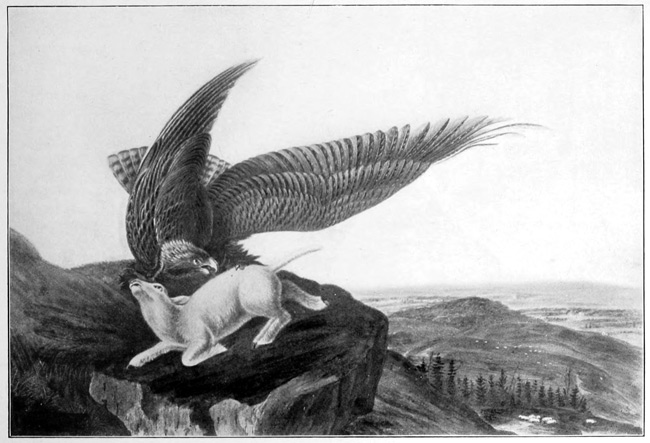
EAGLE AND LAMB.
PAINTED BY AUDUBON, LONDON, 1828. IN THE POSSESSION OF THE FAMILY.