<This, the most elaborate of these 'Brief Lives,' occupies by itself
MS. Aubr. 9. For the letters introductory to it, see supra, pp. 17-20.
The various papers of which the MS. is composed are bound up
confusedly, and the separate notes are in some cases entered on a page,
or a page and its opposite, in no order. Considerable re-arrangement
has therefore been necessary; but the exact MS. references have
been given throughout. Some few notes relating to Hobbes, found
in other Aubrey MSS., have here been brought into their natural
place.>
[1205]The Life of Mr. Thomas Hobbes, of Malmesburie[1206].
The writers[1207] of the lives of the ancient philosophers
used to, in the first place, to speake of their lineage[1208]; and
they tell us that in processe of time severall great[1209] families
accounted it their glory to be branched[1210] from such or
such a Sapiens.
Why now should that method be omitted in this
Historiola of our Malmesbury philosopher? Who though
but[1211] of plebeian descent[1212], his renowne haz and will give
brightnesse to his name and familie, which hereafter may
arise glorious and flourish in riches and may justly take it
an honour to be of kin to this worthy person, so famous,
for his learning[1213], both at home and abroad.
 [1214]... Hobbes, m. ...
                  |
        +---------+----------+
        |                    |
  1. Francis Hobbes,   2. Thomas Hobbes,   m.  ... Middleton, of Brokenborough
  obiit sine prole.    vicar of Westport.  |   (vide Camden[1215]).
                                           |
        +----------------------------+-----+--------------------+
        |                            |                          |
  1. Edmund Hobbes,  m. ...    2. Thomas Hobbes,      ..., a daughter, m. ...
                     |         philosophus, obiit
                     |         coelebs Dec. 4, 1679.
                     |
      +--------------+--------------+------------------------+
      |                             |                        |
  1. Mary, m. ... Tirell.   2. Eleanor, m. ... Harding.   Francis  m. ...
           |                            |                 Hobbes,  |
                                                                   |
               +------------------------+-----------------------+--+---+------+
               |                        |                       |      |      |
         1. Thomas, a clothier,   2. <Edmund>. When a child
         about 23, 1679.          his genius lyes to drawing.
                                  He can engrave and something
                                  resembles the philosopher.
                                  I have a lyon of his
                                  engraving.
This heraldique way of expressing a genealogie is most
intelligible and makes the best impresse in the memory or
fancy; but[1216] will it not be thought here to<o> pompous and
affected by his enemies and the nation of critiques?
Prescribe Trebate.
My brother[1217] W. A. will set all this right[FF].
[1218]Thomas Hobbes[FG], then, whose life I write, was second
son of Mr. Thomas Hobbes, vicar of Westport juxta
Malmesbury, who maried ... Middleton of Brokinborough
(a yeomanly family).[1219]He was also vicar of Charlton
(a mile hence): they are annexed, and are both worth 60
or 80li. per annum.—[1220]Memorandum, Brokenborough
also is appendant to Charlton vicaridge—160li. per annum—from
Philip Laurence, whose father-in-law was vicar.
[[1221]The vicaridge of Malmesbury is but XX nobles per
annum = 6li. 13s. 4d.; but Coston and Radbourne belongs
to it, which addition is equal to 50 or 60li. per annum.]
[1222]Thomas, the father[1223], was one of the ignorant
'Sir Johns[1224]' of queen Elizabeth's time; could[1225] only read
the prayers of the church and the homilies; and disesteemed[1226]
learning (his son Edmund told me so), as not
knowing the sweetnes of it.
[1227]As to his father's ignorance and clownery,
'twas as good metall in the oare which wants excoriating
and refineing. A witt requires much cultivation, much
paines, and art and good conversation to perfect a man.
[1228]He[1229] had an elder brother[FH] whose name was
Francis, a wealthy man, and had been alderman[XC.] of the
borough; by profession a glover[XCI.], which is a
great trade here[XCII.], and in times past much
greater. Having no[1230]child, he contributed
much to, or rather altogether maintained, his
nephew Thomas at Magdalen hall in Oxon; and
when he dyed gave him an agellum (a moweing-ground[1231])
called the Gasten-ground, lyeing neer
to the horse-faire, worth 16 or 18 poundes per
annum; the rest of his landes he gave to his
nephew Edmund.
[1232]At Sherston about 3 miles hence (vide
map) are groundes likewise called the Gasten-grounds—perhaps
'tis Garston grounds. At Sherston was heretofore
a castle, and perhaps (and quaere) if these grounds
are not where the vallum or bulwarkes might be drawne.
Gaer, Britannicè, signifies some such thing, vide Dr. Davys'
British Dictionary.
In Hexham's Dutch dictionary Gast signifies 'a guest';
so that Gasten-ground will be 'the ground for the guests';
probably to putt the horses of the guests (that came to lye
at the abbey) to grasse. They speake broad in our
countrey, and do pronounce guest, gast, etc. Monasterys
had their guest-halls; and it should seeme they had likewise
their guest-grounds for the strangers' horses: as here.
[1233]Thomas, the vicar of Westport, maried ... Middleton[FI]
of Brokenborough[XCIII.] (of a yeomanly family), by whom he
had two sonnes and one daughter (quaere my
brother William Aubrey)—Edmund, his eldest
(was bred-up to[1234] his uncle's profession of a
glover); and Thomas (philosopher), second son, whose
life I now write. Edmund was neer[1235] two yeares elder
then his brother Thomas, and something resembled him
in aspect[1236], not so tall, but fell much short of him in his
intellect, though he was a good plain understanding
countrey-man[1237]. He had been bred at schoole with
his brother; could have made theme, and verse, and
understood a little Greek to his dyeing day. He dyed
(quaere William Aubrey) about 13 yeares since, aetat.
circiter 80.
This Edmund had only one son named Francis, and two
daughters maried to countreymen (renters) in the neighborhood.
This Francis pretty well resembled his uncle
Thomas, especially about the eie; and probably had he
had good education might have been ingeniose; but he
drowned his witt[1238] in ale[XCIV.]. He was left by his
father and uncle Thomas, 80 li. (quaere W. A.)
or better per annum, but he was an ill husband. He
dyed about two yeares after his father, and left five
children.—His eldest son is Thomas, a clothier, now about
23, living at[XCV.] ... (quaere W. A.[1239]). The second,
<Edmund>, lives at ...[XCVI.], and has some lines
of Thomas the philosopher. When he was
a child[1240], his genius inclined him to ([1241]quaere W. A.)
draweing[1242] and engraving in copper. He is now about 21.
<As may be seen from his intended preface (supra, p. 19) Aubrey
thought of beginning the life of Hobbes with an account of Malmsbury.
For this purpose in MS. Aubr. 9 he has drawn three plans[1243]:—
(a) plan of environs of Malmsbury (a slip at fol. 31v).
(b) plan of Malmsbury (fol. 31v).
(c) a drawing of the house in which Hobbes was born (fol. 31v).
These are reproduced in facsimile at the end of this edition.
He gives there (fol. 31v) these dimensions of the town:—'From
St. John's Bridge <south limit of the town> to the abbey <north> is
about a quarter of a mile; and from the same bridge to Westport
church <west limit> is neer about a mile. Height of the borough from
the levill belowe is about 100 foot high.'
The references on the plan of Malmsbury (see the facsimile) are:—
- 'α = the house of his birth.
- ω = Westport church.
- W = the West port (olim).
- β = the smyth's shop.
- δ = the private house where Mr. Latimer taught him.
- ξ = Three Tunnes (as I take it), opposite to the smyth's shop.
 = the religious <house> dedicated to Our Lady: the chapell is yet standing.
- H = <Hobbes's> house at the upper <end> faces the Horse fayre.
 = quaere if not a chapell here?'
On fol. 31v of MS. Aubr. 9, Aubrey has these remarks about these
plans, etc.:—
'If these notes are not now inserted, probably they will be lost: or
should it not be a marginall commentary?'
'I have drawne this rude sketch meerly for your clearer understanding,
not that I think it worth while to grave it for 'tis at randome.
I intended if it had pleased God that I had prospered in the world to
have had taken an exact map[1244] of Malmesbury.'
'Whitechurch, about a mile ferè off:—quaere ubi stat?' 'Vide
Speed's mappe in Wiltshire.'
'Burnevall, quasi Bournevall.'>
[1245]Westport[FJ] is the parish without the west-gate (which
is now demolished), which gate stood on the neck of land
that joines Malmesbury (vide verses[FK]) to Westport. Here[FL]
was, before the late warres, a very pretty church, consisting
of 3 aisles, or rather a nave and two aisles (which
tooke up the whole area[1246]), dedicated to St. Mary; and
a fair spire-steeple, with five tuneable bells, which, when the
towne was taken (about 1644; quaere William Aubrey)
by Sir W. Waller, were converted[1247] into ordinance, and the
church pulled-downe to the ground, that the enemie might
not shelter themselves against the garrison. The steeple
was higher then that now standing in the borough, which
much added to[1248] the prospect. The windowes were well
painted, and in them were inscriptions that declared much
antiquitie; now is here rebuilt a church like a stable.
Thomas Hobbes, Malmesburiensis, Philosophus, was borne
at his father's house in Westport, being that extreme howse
that pointes into, or[1249] faces, the Horse-fayre; the farthest
howse on the left hand as you goe to Tedbury, leaving the
church on your right. To prevent mistakes, and that hereafter
may rise no doubt[1250] what house was famous for this
famous man's birth; I doe here testifie that in April, 1659,
his brother Edmond went with me into this house, and into
the chamber where he was borne. Now things begin to be
antiquated, and I have heard some guesse it might be at
the howse where his brother Edmund lived and dyed.
But this is so, as I here[1251] deliver it. This house was given
by Thomas, the vicar, to his daughter[XCVII.] ... whose
daughter or granddaughter possessed[1252]
it, when I was there.[1253]It is a firme house, stone-built
and tiled, of one roome (besides[1254] a buttery, or the like,
within) below, and two chambers above. 'Twas in the
innermost where he first drew breath.
The day of his birth was April the fifth, Anno Domini
1588, on a Fryday morning, which that yeare was Good
Fryday. His mother fell in labour with him upon the
fright of the invasion of the Spaniards—
[[1256]Fama[1257] ferebat enim, sparsitque per oppida nostra
Extremum genti classe venire diem;
Atque metum tantum concepit tunc mea mater
Ut pareret geminos meque metumque simul.]
—[1258]he told me himself between the houres of four and
six: but by rectification his nativity is found to be
at ...[XCVIII.].
His horoscope[FN] is Taurus, having in it a
satellitium of 5 of the 7 planets. It is a maxime
in astrologie—vide Ptol. Centil.—that a native
that hath a satellitium in his ascendent becomes[1259]
more eminent in his life then ordinary[1260], e.g. divers which
see in Origanus, etc., and Oliver Cromwell had so, etc.
At four yeares old[FO] he went to schoole in Westport
church, till eight; by that time[1261] he could read well, and
number four figures. Afterwards he went to schoole to
Malmesbury, to Mr. Evans, the minister of the towne;
and afterwards to Mr. Robert Latimer, a young man of
about nineteen or twenty, newly come from the University,
who then kept a private schoole in Westport, where the
broad place (quaere nomen) is, next dore north from the
smyth's shop, opposite to the Three Cuppes[1262] (as I take it).
He was a batchelour and delighted in his scholar, T. H.'s
company, and used to instruct him, and two or three
ingeniose youths more, in the evening till nine a clock.
Here T. H. so well profited in his learning, that at fourteen
yeares of age, he went away a good schoole-scholar to
Magdalen-hall, in Oxford. It is not to be forgotten, that
before he went to the University, he had turned Euripidis
Medea[1263] out of Greeke into Latin Iambiques, which he
presented to his master. Mr. H. told me that he would faine
have had them, to have seen how he did grow in....
Twenty odde[1264] yeares agoe I searcht all old Mr. Latimer's
papers, but could not find them; the[1265] good huswives
had sacrificed them.
I have heard his brother Edmund and Mr. Wayte (his
schoolefellowe) say that when he was a boy he was
playsome enough, but withall he had even then a contemplative
melancholinesse; he would gett him into a
corner, and learne his lesson by heart presently. His
haire was black, and his schoolfellows[1266] were wont to call
him 'Crowe.'
This Mr. Latimer was a good Graecian, and the first
that came into our parts hereabout since the Reformation.
He was afterwards minister of Malmesbury, and from
thence preferred to a better living of 100 li. per annum,
or +, at Leigh-de-la-mere within this hundred.
At Oxford Mr. T. H. used, in the summer time especially,
to rise very early in the morning, and would tye the leaden-counters
(which they used in those dayes at Christmas,
at post and payre) with pacthreds[1267], which he did besmere
with[1268] birdlime, and bayte them with parings of cheese, and
the jack-dawes would spye them a vast distance up in the
aire[XCIX.] and as far as Osney-abbey, and strike at
the bayte, and so be harled in the string,
which the wayte of the counter would make
cling about ther wings. He did not much
care for logick, yet he learnd it, and thought himselfe a
good disputant. He tooke great delight there to goe to
the[1269] booke-binders' shops, and lye gaping on mappes, of
which he takes notice in his life written by himselfe in
verse:
Ergo ad amoena magis me verto, librosque revolvo,
Quos prius edoctus, non bene doctus eram.[1270]
Pascebamque animum chartis imitantibus orbem,
Telluris faciem, et sydera picta videns,
Gaudebam soli comes ire, et cernere cunctis
Terricolis justos qua facit arte dies; etc.
[1271]Quaere A<nthony> W<ood> what moneth and day
he was matriculated?
[He[1272] came[1273] to Magdalen hall in the beginning of an.
1603, at what time, Dr. James Hussee, LL.D., was
principall. This James Hussee was afterwards knighted
by king James and was made Chancellour of Sarum.
This Dr. Hussee was a great encourager of towardly youths.
But he resigning his principallity about 1605, Mr. John
Wilkinson succeeded him: so that Mr. Hobs was under
the government of two principalls.[FP]—Thomas Hobs was
admitted to the reading of any book of logic ('ad[1274]
lectionem cujuslibet libri logices'), that is, he was admitted
to the degree of Bachelaur of Arts, 5 Feb., 1607[1275], and
in the Lent that then began did determine[1276], that is, did
his exercise for the completion of that degree. Vide
Hist. <et Antiq. Univ.> Oxon., lib. 2, pag. 376 a.]
[1277]After he had taken his batchelor of Arts degree
(quaere A. Wood de hoc), the than principall of Magdalen-hall
(Sir James Hussey[1278]) recommended him to his yong
lord when he left Oxon, who had a conceit[1279] that he should
profitt more in his learning if he had a scholar of his owne
age to wayte on him then if he had the information of
a grave doctor. He was his lordship's page, and rode
a hunting and hawking with him, and kept his privy-purse.
By this way of life he had almost forgott his Latin;
vide Latin verses. He therefore[1280] bought him bookes of
an Amsterdam print that he might carry in his pocket
(particularly Caesar's Commentarys), which he did read
in the lobbey, or ante-chamber, whilest his lord was making
his visits.
The Lord Chancellour Bacon loved to converse[C.] with him.
He assisted his lordship in translating severall of
his Essayes into Latin, one, I well remember,
is[1281] that Of the Greatnes of Cities: the rest
I have forgott. His lordship was a very contemplative
person, and was wont to contemplate in his delicious
walkes at Gorambery[FQ], and dictate to Mr. Thomas
Bushell, or some other of his gentlemen, that attended him
with inke and paper ready to sett downe presently his
thoughts. His lordship would often say that he better
liked Mr. Hobbes's taking his thoughts[1282], then any of the
other, because he understood what he wrote, which the
others not understanding, my Lord[1283] would many times
have a hard taske to make sense of what they writt.
It is to be remembred that about these times, Mr. T. H. was
much addicted to musique, and practised on the base-violl.
1634: this summer—I remember 'twas in venison
season[1285] (July or August)—Mr. T. H. came into his native
country[1286] to visitt his friends, and amongst others he came
then to see his old school-master, Mr. Robert Latimer[CI.],
at Leigh-de-la-mer, where I was then at
schoole[CII.] in the church[1287], newly entred into my
grammar by him. Here was the first place and
time that ever I had the honour to see this
worthy, learned man, who was then pleased to
take notice of me, and the next day visited[1288] my
relations[1289]. He was then a proper man, briske,
and in very good habit[1290]. His hayre was then
quite black[1291]. He stayed at Malmsbury and
in the neighborhood a weeke or better. 'Twas
the last time that ever he was in Wiltshire.
[1292]His conversation about those times was much about
Ben: Jonson, Mr. Ayton, etc.
[1293]He was (vide his life) 40 yeares[1294] old before he looked
on geometry; which happened accidentally. Being in a
gentleman's library in ..., Euclid's Elements lay open,
and 'twas the 47 El.[1295] libri I. He read the proposition.
By[CIII.] G—,' sayd he, 'this is impossible!' So
he reads the demonstration of it, which referred
him back to such a proposition; which proposition
he read. That referred him back to another, which
he also read. Et sic deinceps, that at last he was demonstratively
convinced of that trueth. This made him in
love with geometry.
I have heard Sir Jonas Moore (and others[FR]) say
that 'twas a great pity he had not began the study of
the mathematics sooner, for such a working head[1297] would
have made great advancement in it. So had he donne[1298],
he would not have layn so open to his learned mathematicall
antagonists[1299]. But one may say of him, as one (quaere
who) sayes of Jos. Scaliger, that where he erres, he erres
so ingeniosely, that one had rather erre with him then
hitt the mark[1300] with Clavius. I have heard Mr. Hobbes
say[1301] that he was wont to draw lines[1302] on his thigh and
on the sheetes, abed, and[1303] also multiply and divide. He
would often complain that algebra[CIV.] (though
of great use) was too much admired, and so
followed after, that it made men not contemplate
and consider so much the nature and power
of lines, which was a great hinderance to the
groweth of geometrie; for that though algebra did rarely
well and quickly, and easily in right lines, yet 'twould not
bite in solid (I thinke) geometrie. Quod N.B.
[1304]Memorandum—After he began to reflect on[1305] the
interest of the king of England as touching his affaires
between him and the parliament, for ten yeares together
his thoughts were much, or almost altogether, unhinged
from the mathematiques; but chiefly intent on his De Cive,
and after that on his Leviathan: which was a great putt-back
to his mathematicall improvement[1306]—quod N.B.—for
in ten yeares' (or better) discontinuance of that study
(especially) one's mathematiques will become very rusty[1307].
[1308]Vide Mr. Hobbes considered, p. 4: printed London
1662 (since reprinted, 1680, by William Crooke):—
1640: 'when the parliament sate that began in April
1640 and was dissolved in May following, and in which
many pointes of the regall power, which were necessary for
the peace of the kingdome and safety of his majestye's
person, were disputed[1309] and denyed, Mr. Hobbes wrote
a little treatise in English, wherin he did sett-forth and
demonstrate, that the sayd power and rights were inseperably
annexed to the soveraignty, which soveraignty
they did not then deny to be in the king; but it seemes
understood not, or would not understand, that inseperability.
Of this treatise, though not printed, many gentlemen had
copies, which occasioned much talke of the author; and
had not his majestie dissolved the parliament, it had
brought him in danger of his life.'
[1310]Vide Mr. Hobbes considered, if more may not be
inserted, scilicet as to the politiques. Sed cave—
Incedis per ignes
Suppositos cineri doloso.
Horatius ad Asin. Pollionem, ode 1, lib. 2.
Memorandum the parliament was then sitting and runne
violently against the king's prerogative.
[1311]Memorandum he told me that bp. Manwaring[1312]
(of St. David's) preach'd his doctrine; for which, among
others, he was sent prisoner to the Tower. Then thought
Mr. Hobbes, 'tis time now for me to shift for my selfe,
and so withdrew[1313] into France, and resided[1314] at Paris. As
I remember, there were others[1315] likewise did preach his
doctrine. This little MS. treatise grew to be[1316] his book
De Cive[1317], and at last grew there to be the so formidable
and ... Leviathan; the manner of writing of which
booke (he told me) was thus. He walked much and
contemplated, and he had in the head of his staffe[1318] a pen
and inke-horne, carried alwayes a note-booke in his pocket,
and as soon as a thought[1319] darted, he presently entred it
into his booke, or otherwise he might[1320] perhaps have lost it.
He had drawne the designe of the booke into chapters,
etc. so he knew whereabout it would come in. Thus that
booke was made.
'He wrote and published the Leviathan far from the
intention either of disadvantage to his majestie, or to flatter
Oliver (who was not made Protector till three or four
yeares after) on purpose to facilitate his returne; for there
is scarce a page in it that he does not upbraid him.'—Mr.
Hobbes considered, p. 8.
[1321]''Twas written in the behalfe of the faithfull subjects
of his majestie, that had taken his part in the war, or
otherwise donne their utmost endeavour to defend his
majestie's right and person against the rebells: wherby,
having no other meanes of protection, nor (for the most
part) of subsistence, were forced to compound with your
masters, and to promise obedience for the saving of their
lives and fortunes, which, in his booke he hath affirmed,
they might lawfully doe, and consequently not bear arms
against the victors. They had done their utmost endeavour
to performe their obligation to the king, had done all they
could be obliged unto; and were consequently at liberty
to seeke the safety of their lives and livelihood wheresoever,
and without treachery.'—<ibid.> p. 20.
'His majestie was displeased with him' (at Paris) 'for
a while, but not very long, by means of some's complayning
of and misconstruing his writing. But his majestie had
a good opinion of him, and sayd openly that he thought
Mr. Hobbes never meant him hurt.'—p. 28.
'Before his booke De Homine came forth, nothing of the
optiques writt intelligibly. As for the Optiques of Vitellio[1322],
and several others, he accounts them rather geometry than
optiques.'—p. 54. [Will not this p. 54 more aptly come in
in another place?]
'So also of all other arts; not every one that brings
from beyond seas a new gin, or other janty devise, is
therfore a philosopher. For if you reckon that way, not
only apothecaries and gardiners, but many other sorts of
workmen will put-in for, and get the prize—
'Then,[1323] when I see the gentlemen of Gresham Colledge
apply themselves to the doctrine of motion (as Mr. Hobbes
has done, and will be ready to helpe them in it, if they
please, and so long as they use him civilly), I will looke
to know some causes of naturall events from them, and
their register, and not before; for nature does nothing but
by motion.
'The reason given by him, why the drop of glasse so much
wondred at shivers into so many pieces by breaking only
one small part of it, is approved for probable by the Royall
Societie and registred in their colledge:[CV.] but
he has no reason to take it for a favour, because
hereafter the invention may be taken, by that
means, not for his, but theirs.'—p. 55.
'As for his selfe-prayse[CVI.], they can have very
little skill in morality, that cannot see the justice
of commending a man's selfe, as well as of any
thing else, in his own defence.'—p. 57.
'Then for his morosity and peevishnesse, with which
some asperse him, all that know him familiarly, know the
contrary. 'Tis true that when vain and ignorant young
scholars, unknowne to him before, come to him on purpose
to argue with him, and fall into undiscreet and uncivill
expressions, and he then appeare not well contented, 'twas
not his morosity, but their vanity, which should be blamed.'—<Mr.
Hobbes considered> p. 59.
[1324]During his stay at Paris he went through a course
of chymistry with Dr. ... Davison; and he there
also studied Vesalius's Anatomie. This I am sure was
before 1648; for that Sir William Petty (then Dr. Petty,
physitian) studyed and dissected with him. Vide pag.
18b. A. W.[1325]
[1326]Anno 165-[CVII.], he returned into England,
and lived most part[CVIII.] in London, in Fetter lane,
where he writt, or finished, his booke De Corpore, ...[1327],
in Latin and then in English; and writt
his lessons against the two Savillian professors
at Oxon[1328], etc.; vide the anno Domini when
printed. (Puto 1655 or 56.)
[1329]1655 or 1656: about this time he setled the piece
of land (aforesayd), given to him by his uncle,
upon his nephew Francis[CIX.] for life, the remaynder
to his nephew's eldest son, Thomas
Hobbes. He also not long after[1330] dischardged
a mortgage (to my knowledge[CX.], to Richard
Thorne, an attorney) of two hundred pounds,
besides the interest thereof, with which his
nephew Francis (a careles[1331] husband) had
incumbred his estate.
He was much in London till the restauration of his
majesty, having here convenience not only of bookes, but
of learned conversation, as Mr. John Selden, Dr. William
Harvey, John Vaughan, etc., wherof anon in the catalogue
of his acquaintance.
I have heard him say, that at his lord's house in the
countrey[1333] there was a good library, and bookes enough
for him, and that his lordship stored the library with what
bookes he thought fitt to be bought; but he
sayd, the want of learned[1334] conversation[CXI.] was
a very great inconvenience[1335], and that though
he conceived[1336] he could order his thinking
as well perhaps as another man, yet he found
a great defect[1337].
Amongst other of his acquaintance I must not forget our
common friend, Mr. Samuel Cowper, the prince of limners
of this last age, who drew his picture[CXII.] as like
as art could afford, and one of the best pieces
that ever he did: which his majesty, at his
returne, bought of him, and conserves as one
of his great rarities in his closet at Whitehall.
[1339]1659. In 1659 his lord was—and some
yeares before—at Little Salisbury-house (now
turned to the Middle-Exchange), where he
wrot, among other things, a poeme, in Latin
hexameter and pentameter, of the encroachment of the
clergie (both Roman and reformed) on the civil power[FS].
I remember I saw then 500 + verses, for he numbred
every tenth as he wrote. I remember he did read
Cluverius's Historia Universalis, and made-up his poeme
from thence. His amanuensis remembers this poeme, for
he wrote them out, but knows <not what became of it>.
His place of meditation was then in the portico in the
garden.
His manner[1340] of thinking:—he sayd that he sometimes
would sett his thoughts upon researching[1341] and contemplating,
always with this rule[1342] that he very much and deeply
considered one thing at a time (scilicet, a weeke or
sometimes a fortnight).
There was a report[CXIII.] (and surely true) that in
parliament, not long after the king was setled,
some of the bishops made a motion to have
the good old gentleman burn't for a heretique.
Which he hearing, feared that his papers might be
search't by their order, and he told me he had burn't
part of them.—I have received word[1343] from his amanuensis
and executor that he 'remembers there were such
verses[1344] for he wrote them out, but knowes not what
became of them, unlesse he presented them to Judge
Vaughan[1345], or burned them as I did seeme to intimate.'
☞ But I understand since by W. Crooke, that he can
retrive a good[1346] many of them.
[1348]1660. The[1349] winter-time of 1659 he spent in Derbyshire.
In[FT]March following was the dawning of the
coming in of our gracious soveraigne, and in April the
Aurora.
[1350]I then sent a letter to him in the countrey to advertise
him of the Advent[1351] of his master the king and desired him
by all meanes to be in London before his arrivall; and
knowing[1352] his majestie was a great lover of good painting
I must needs presume he could not but suddenly see
Mr. Cowper's curious pieces, of whose fame he had so
much heard abroad and seene some of his worke, and
likewise that he would sitt to him for his picture, at
which place and time he would have the best convenience[1353]
of renewing his majestie's graces to him.[1354]He
returned me thankes for my friendly intimation and came
to London in May following.
It happened, about two or three dayes after his majestie's
happy returne, that, as he was passing in his coach
through the Strand, Mr. Hobbes was standing at Little
Salisbury-house gate (where his lord then lived). The
king espied him, putt of his hatt very kindly to him, and
asked him how he did. About a weeke after he had[1355] orall
conference with his majesty at[1356] Mr. S. Cowper's, where, as
he sate for his picture, he was diverted[1357] by Mr. Hobbes's
pleasant discourse[1358]. Here his majestie's favours were
redintegrated to him, and order was given that he should
have free accesse to his majesty, who was always much
delighted in his witt and smart repartees.
The witts at Court were wont to bayte him. But he
feared none of them[1359], and would make his part
good. The king would call him the beare[CXIV.]:
'Here comes the beare to be bayted!'
Repartees. He was marvellous happy and ready in his
replies, and that without rancor (except provoked)—but now[1360]
I speake of his readinesse in replies as to witt and drollery.
He would say that he did not care to give, neither was he
adroit[1361] at, a present answer to a serious quaere: he had as
lieve they should have expected an[1362] extemporary solution to
an arithmeticall probleme, for he turned and winded and
compounded in philosophy, politiques, etc., as if he had
been at analyticall[1363] worke. He alwayes avoided, as much
as he could, to conclude hastily (Humane Nature, p. 2).
Vide[1364] p. 15 b.
[1365]Memorandum—from 1660 till the time[CXV.]
he[1366] last went into Derbyshire, he spent most of
his time in London at his lord's (viz. at Little
Salisbury-howse; then, Queen Street; lastly,
Newport-house), following his contemplation
and study. ☞ He contemplated and
invented (set downe a hint with a pencill
or so) in the morning, but compiled[1367] in the
afternoon.
1664. In[1370] 1664 I sayd to him 'Me thinkes 'tis pitty that
you that have such a cleare reason and working[1371] head did
never take into consideration the learning of the lawes';
and I endeavoured to perswade him to it. But he answered
that[1372] he was not like to have life enough left to goe through
with such a long and difficult taske. I then presented him
the lord chancellor Bacon's Elements of the Lawe (a thin
quarto), in order therunto and to drawe him on; which he
was pleased to accept, and perused; and the next time I
came to him he shewed me therin two cleare paralogismes in
the 2nd page (one, I well remember, was in page 2), which
I am heartily sory are now out of my remembrance.[1373]
I desponded, for his reasons, that he should make any
tentamen[1374] towards this designe; but afterwards, it seemes, in
the countrey he writt his treatise De Legibus[FU] (unprinted)
of which Sir John Vaughan, Lord Chiefe Justice of the
Common Pleas, had a transcript, and I doe affirme that he
much admired it.
[1375]Insert here part of his lettre to me about it.
'Tis thus, viz., in a letter to me[1376], dated Aug. 18, 1679,
among severall other things, he writes[1377]:—
'I have been told that my booke of the Civill Warr is
come abroad and am heartily sorry for it, especially because
I could not get his majestie to license it, not because it is
ill printed or hath a foolish title set to it, for I beleeve that
any ingeniose man may understand the wickednes of
that time, notwithstanding the errors of the
presse[CXVI.].
'The treatise De Legibus (at the end of it)
is imperfect. I desire Mr. Horne[1379] to pardon
me that I cannot consent to his motion; nor
shall Mr. Crooke himselfe get my consent to print it.
'I pray you present my humble thankes to Mr. Sam.
Butler.
'The privilege of stationers is, in my opinion, a very great
hinderance to the advancement of all humane learning[1380].
'I am, sir, your very humble servant,
'Th. Hobbes.'
[1381]1665. This yeare he told me that he was willing to doe
some good to the towne where he was borne; that his
majestie loved him well, and if I could find out something
in our countrey that was in his guift, he did beleeve he could
beg it of his majestie, and seeing[1382] he was bred
a scholar, he thought it most proper to endowe[1383]
a free-schoole there; which is wanting now[CXVII.]
(for, before the reformation, all monasteries had great
schooles appendant to them; e.g. Magdalen schoole and
New College schoole). After[1384] enquiry I found out a piece
of land in Bradon-forest (of about 25 li. per annum value)
that was in his majesties guift[1385], which he designed[1386] to
have obtained of his majestie for a salary for
a schoolmaster; but[CXVIII.] the queen's priests[1387]
smelling-out the designe and being[1388] his
enemies, hindred[1389] this publique and charitable
intention.
[1674[1390]. Anno[1391] Domini 1674 Mr. Anthony à Wood sett
forth an elaborate worke of eleven[1392] yeares study,
intituled the History and Antiquities of the
University of Oxford, wherin, in every respective
Colledge and Hall, he mentions the writers
there educated and what bookes they wrote.
The deane of Christ Church having plenipotentiary[1393]
power of the presse there], perused
every sheet before 'twas to be sent to the
presse[1394]; and maugre the author and to his[1395] sore
displeasure did expunge and inserted what he
pleased. Among other authors[CXIX.], he made
divers alterations in Mr. Wood's copie in the
account he gives of Mr. T. Hobbes of Malmesbury's life,
in pag. 444, 445[1396], Lib. II—
'Vir sane de quo (inter tot prosperae et adversae famae
qui de eo sparguntur hominum sermones) hoc verissime
pronuntiare fas est, animum ipsi obtigisse, uti omnis scientiae
capacissimum et infertum, ita divitiarum, saeculi, et invidiae
negligentissimum; erga cognatos et alios pium et beneficum;
inter eos quibuscum vixit, hilarem et apertum, et sermone
libero; apud exteros in summa semper veneratione habitum,'
&c.; this and much more was quite dashed out of the
author's copie by the sayd deane.
[1397]These[CXX.] additions and expunctions being
made by the sayd deane of Christ Church,
without[1398] the knowledge or advice of the authour
and quite contrary to his mind, he told him
it was fitt Mr. Hobbes should know it[1399], because that
his name being set to the booke and all people knowing
it to be his, he should be liable to an answer, and so consequently
be in perpetuall controversie. To this the deane
replied, 'Yea, in God's name; and great reason it was
that he should know what he had done, and what he had
donne he would answer for,' etc.
1674. Hereupon[1401], the author acquaints[1402]J. A., Mr.
Hobbes's correspondent, with all that had passed; J. A.
acquaints Mr. Hobbes. Mr. Hobbes takeing it ill, was
resolved to vindicate himselfe in an Epistle to the Author.
Accordingly an epistle, dated Apr. 20, 1674, was sent to
the author in MS., with an intention to publish it when the
History of Oxford was to be published. Upon the reciept
of Mr. Hobbes's Epistle by Anthony à Wood, he forthwith
repaired, very honestly and without any guile, to the dean
of Christ Church to communicate it to him[1403]. The deane
read it over carelesly, and not without scorne, and when
he had donne, bid Mr. Wood tell Mr. Hobbes, 'that he
was an old man, had one foote in the grave, that he should
mind his latter end, and not trouble the world any more
with his papers,' etc., or to that effect.
In the meane time Mr. Hobbes meetes with the king
in the Pall-mall, in St. James's parke; tells him how he
had been served by the deane of Christ Church, in a booke
then in the presse (scilicet the 'History' aforesayd), intituled
the History and Antiquities of the Universitie of
Oxon, and withall desires his majestie to be pleased
to give him leave to vindicate himselfe. The king seeming
to be troubled at the dealing of the deane, gave Mr. Hobbes
leave, conditionally that he touch no-body but him who
had abused him, neither that he should reflect upon the
Universitie.
Mr. Hobbes understanding that this History would be
published at the common Act at Oxon, about 11 July,
the said yeare 1674, prints his Epistle[1404] at London, and
sends downe divers copies to Oxon, which being dispersed
at coffee-houses and stationers' shops, a copie forthwith
came to the deane's hands, who upon the reading of it
fretted and fumed[1405], sent[1406] for the author of the History
and chid him, telling withall that he had corresponded
with his enemie (Hobbes). The author replied that surely
he had forgot what he had donne, for he had communicated
to him before what Mr. Hobbes had sayd and written;
wherupon the deane recollecting himselfe, told him that
Hobbes should suddenly heare more of him[1407]; so that
the last sheete[1408] of paper being then in the presse and
one leafe thereof being left vacant, the deane supplied it
with this answer. Both the epistle and answer I here
exhibite.
[1409]Here insert the Epistle[1410] and Answer[1411].
To this angry[1412] answer the old gentleman never[1413] made
any reply, but slighted[1414] the Dr's passion and forgave it.
But 'tis supposed it might be the cause why Mr. Hobbes
was not afterwards so indulgent, or spared the lesse to
speake his opinion, concerning the Universities and how
much their doctrine and method had contributed to the
late troubles [e.g. in his History of the Civill Warre].
1675, mense ..., he left London cum animo nunquam
revertendi, and spent the remaynder of his dayes in
Derbyshire with the earl of Devonshire at Chatsworth
and Hardwyck, in contemplation and study. He wrote
there[1415] ... (vide vitam).
[1416]Then[1417], <insert an account of> his sicknesse, death,
buriall and place, and epitaph, which send for[1418].
[1419]Extracted out of the executor's lettre (January 16,
1679) to me:—
'To his highly honoured friend, Jo. Aubrey, esq., these.'—
(His sicknesse) 'Worthy sir—he fell sick about the
middle of October last,' etc.[1420]—
[1421]☞ 'He dyed worth neer 1000 li., which (considering
his charity) was more then I expected: vide his verses[1422]
in the last page.—From W. Crooke, from Mr. Jackson
who had 500 li. of his in his hands.—
[1423]Describe face, eyes, forehead, nose, mouth, eyebrows,
figure of the face, complexion; stature of body; shape
(slender, large, neat, or otherwise); figure of head and
magnitude of head; shoulders (large, round, etc.); arms,
legs, how?—
[1424]Mr. Hobbes's person, etc.:—hazel, quick eie, which
continued to his last. He was a tall man, higher then
I am by about halfe a head (scil.... feet), i.e. I could
putt my hand between my head and his hatt.—When
young he loved musique and practised on the lute. In
his old age he used to sing prick-song every night (when
all were gonne and sure nobody could heare him) for his
health, which he did beleeve would make him live two or
three yeares longer.
[1425]In his youth unhealthy; of an ill yellowish complexion:
wett in his feet, and trod both his shoes the same way.
[1426]His complexion. In his youth he was unhealthy,
and of an ill complexion (yellowish).
His[CXXI.] lord, who was a waster, sent him
up and downe to borrow money, and to
gett gentlemen to be bound for him, being ashamed
to speake him selfe: he tooke colds, being wett in his
feet (then were no hackney coaches to stand in the
streetes), and trod both his shoes aside the same way.
Notwithstanding he was well-beloved: they lov'd his company
for his pleasant facetiousnes and good-nature[1427].
From forty, or better, he grew healthier, and then he
had a fresh, ruddy, complexion. He was sanguineo-melancholicus;
which the physiologers say is the most
ingeniose complexion. He would say that 'there might be
good witts of all complexions; but good-natured, impossible.'
Head. In his old age he was very bald[1428] (which claymed
a veneration); yet within dore, he used to study, and sitt,
bare-headed, and sayd he never tooke cold in his head,
but that the greatest trouble was to keepe-off the flies
from pitching on the baldnes. His head was ... inches
in compasse (I have the measure), and of a mallet-forme
(approved by the physiologers).
[1429]Skin. His skin was soft and of that kind which my
Lord Chancellor Bacon in his History of Life and Death
calles a goose-skin, i.e. of a wide texture:—
Crassa cutis, crassum cerebrum, crassum ingenium.
Face not very great; ample forehead; whiskers
yellowish-redish, which naturally turned up—which is
a signe of a brisque witt, e.g. James Howell, Henry Jacob
of Merton College.
<Beard.> Belowe he was shaved close, except a little
tip under his lip. Not but that nature[1430] could have afforded
a venerable beard (Sapientem pascere barbam—Horat.
Satyr. lib. 2), but being naturally of a cheerfull and pleasant
humour[1431], he affected not at all austerity and gravity and
to looke severe. [Vide[1432] page 47 of Mr. Hobbes considered—'Gravity
and heavinesse of countenance are not so good
marks of assurance of God's favour, as a chearfull, charitable,
and upright behaviour, which are better signes of
religion than the zealous maintaining of controverted
doctrines.'] He desired not[1433] the reputation of his wisdome
to be taken[1434] from the cutt of his beard, but from his
reason—
Barba non facit philosophum. 'Il consiste tout en la
pointe de sa barbe et en ses deux moustaches; et, par
consequence, pour le diffaire il ne faut que trois coups de
ciseau.'—Balzac, Lettres, tom. 2, p. 242.
[1435]Eie. He had a good eie, and that of a hazell colour,
which was full of life and spirit, even to the last. When
he was earnest in discourse, there shone (as it were)
a bright live-coale within it.[1436]He had two kind of
looks:—when he laugh't, was witty, and in a merry
humour, one could scarce see his eies; by and by, when
he was serious and positive[1437], he open'd his eies round (i.e.
his eie-lids). He had midling eies, not very big, nor very
little (from Sir W<illiam> P<etty>).
[1438]Stature. He was six foote high, and something
better (quaere James Wh<eldon>), and went indifferently
erect, or rather, considering his great age, very erect.
Sight; witt. His sight and witt continued to the last.
He had a curious sharp sight, as he had a sharpe witt,
which was also so sure and steady (and contrary to that
men call bro<a>dwittednes) that I have heard him oftentimes
say that in[1439]multiplying and dividing he[1440] never
mistooke a figure: and so in other things.
He thought much and with excellent method and stedinesse,
which made him seldome make a false step.
His bookes, vide page[1441] 22. [1442]☞ He had very few
bookes. I never sawe (nor Sir William Petty) above halfe
a dozen about him in his chamber. Homer and Virgil
were commonly on his table; sometimes Xenophon, or
some probable historie, and Greek Testament, or so.
[1443]Reading. He had read much, if one considers his
long life; but[1444] his contemplation was much more then his
reading. He was wont to say that if he had read as much
as other men, he[1445] should have knowne no more then other
men.
[1446]His physique. He seldome used any physique
(quaere Sir W<illiam> P<etty>). What 'twas I have forgot,
but will enquire of Mr. Shelbrooke his apothecary at the
Black Spread-eagle in the Strand.
Memorandum—Mr. Hobbes was very sick and like to
dye at Bristoll-house in Queen Street, about 1668.
[1447]He had a sicknes, anno....
He was wont to say that he had rather have the advice,
or take physique from an experienced old woman, that had
been at many sick people's bed-sides, then from the learnedst
but unexperienced physitian.
[1448]'Tis[1449] not consistent with an harmonicall soule to be
a woman-hater, neither had he an abhorrescence to good
wine but ...—this only inter nos.
[1450]Temperance and diet. He was, even in his youth,
(generally) temperate, both as to wine and women, (et
tamen haec omnia mediocriter)—
Homo sum, humani nihil a me alienum puto.
I have heard him say that he did beleeve he had been
in excesse[1451] in his life, a hundred times; which, considering
his great[1452] age, did not amount to above once a yeare.
When he did drinke, he would drinke to excesse to have
the benefitt of vomiting, which he did easily; by which
benefit neither his witt was disturbt longer then he was
spuing nor his stomach oppressed; but he never was, nor
could not endure to be, habitually a good fellow, i.e. to
drinke every day wine with company, which, though not to
drunkennesse, spoiles the braine.
For his last 30+ yeares, his dyet, etc., was very moderate
and regular. After sixty he dranke no wine, his stomach
grew weak, and he did eate most fish, especially whitings,
for he sayd he digested fish better then flesh. He rose
about seaven, had[1453] his breakefast of bread and butter; and
tooke his walke, meditating till ten; then he did putt
downe the minutes of his thoughts, which he penned in
the afternoon.
[1454]He had an inch thick board about 16 inches square,
whereon paper was pasted. On this board he drew his
lines (schemes). When a line came into his head, he
would, as he was walking, take a rude memorandum of
it, to preserve it in his memory till he came to his
chamber. ☞ He was never idle; his thoughts were
always working.
[1455]His dinner was provided for him exactly by eleaven,
for he could not now stay till his lord's howre—scil. about
two: that his stomach could not beare.
After dinner he tooke a pipe of tobacco, and then threw
himselfe immediately on his bed, with his band off, and
slept (tooke a nap of about halfe an howre).
In the afternoon he penned his morning thoughts.
Exercises. Besides his dayly walking, he did twice or
thrice a yeare play at tennis[CXXII.] (at about 75 he
did it); then went to bed there and was well
rubbed[CXXIII.]. This he did believe would make him
live two or three yeares the longer.
[1456]In the countrey, for want of a tennis-court,
he would walke up-hill and downe-hill in
the parke, till he was in a great sweat, and then
give the servant some money to rubbe him.
[1457]Prudence. He gave to his amanuensis, James Wheldon
(the earle of Devon's baker; who writes a delicate
hand), his pention at Leicester, yearly, to wayte on him,
and take a care of him, which he did performe to him living
and dying, with great respect and diligence: for which
consideration he made him his executor.
Habit. In cold weather he commonly wore a black
velvet coate, lined with furre; if not, some other coate so
lined. But all the yeare he wore a kind of bootes[1458] of
Spanish leather, laced or tyed along the sides with black
ribons.
Singing. He had alwayes bookes of prick-song lyeing
on his table:—e.g. of H. Lawes' etc. Songs—which at
night, when he was abed, and the dores made fast, and
was sure nobody heard him, he sang aloud (not that he
had a very good voice) but[1459] for his health's sake: he did
beleeve it did his lunges good, and conduced much to
prolong his life.
[1460]Shaking palsey. He had the shaking palsey in his
handes; which began in France before the yeare 1650,
and haz growne upon him by degrees, ever since, so that
he haz not been able to write very legibly since 1665 or
1666, as I find by some of his letters[1461] to me.
[1462]His goodnes of nature and willingnes to instruct any
one that was willing to be informed and modestly desired
it, which I am a witnesse of as to my owne part and also
to others.
[1463]Charity. His brotherly love to his kinred hath
already been spoken of. He was very charitable (pro
suo modulo) to those that were true objects of his bounty[1464].
One time, I remember, goeing in the Strand, a poor and
infirme old man craved[1465] his almes. He, beholding him
with eies of pitty and compassion, putt his hand in his
pocket, and gave him 6d. Sayd[1466] a divine (scil. Dr. Jaspar
Mayne) that stood by—'Would you have donne this, if
it had not been Christ's command?'—'Yea,' sayd he.—'Why?'
quoth the other.—'Because,' sayd he, 'I was in
paine to consider[1467] the miserable condition of the old man;
and now my almes, giving him some reliefe, doth also
ease me.'
Aspersions and envy. His work was attended with envy,
which threw severall aspersions and false reports on him.
For instance, one (common) was that he was afrayd to lye
alone at night in his chamber, [I have often heard him say
that he was not afrayd of of sprights, but afrayd of being
knockt on the head[1468] for five or ten pounds, which rogues
might thinke he had[1469] in his chamber]; and severall other
tales, as untrue.
I have heard some positively affirme that he had a
yearly pension from the king of France,—possibly for
having asserted such a monarchie as the king of France
exercises, but for what other grounds I know not, unles it
be for that the present[1470] king of France is reputed an
encourager of choice and able men in all faculties who
can contribute to his greatnes. I never heard him speake
of any such thing; and, since his death, I have inquired of
his most intimate friends in Derbyshire, who write to me
they never heard of any such thing. Had it been so, he,
nor they, ought to have been ashamed of it, and it had
been becoming the munificence of so great a prince to
have donne it.
Atheisme[1471]. Testimonie[1472]. For his being branded with
atheisme, his writings and vertuous life testifie[1473] against it.
No man hath written better of ..., perhaps not so well.
To prevent such false and malicious reports, I thought fit
to insert and affirme as abovesayd.[1474]And that he was
a Christian 'tis cleare, for he recieved the sacrament of
Dr. <John> Pierson, and in his confession to Dr. John
Cosins, at ..., on his (as he thought) death-bed, declared
that he liked the religion of the church of England best
of all other.
He would have the worship of God performed with
musique (ad me[1475]).
[1476]Though he left his native countrey[1477] at 14, and lived
so long, yet sometimes one might find a little touch of our
pronunciation.—Old Sir Thomas Malette[1478], one of the
judges of the King's Bench, knew Sir Walter Ralegh, and
sayd that, notwithstanding his great travells, conversation,
learning, etc., yet he spake broade Devonshire to his
dyeing day.
[1479]Memorandum—'twas he (as he him selfe haz told me)
that <invented> the method of the oeconomie of the earle
of Devon's family and way of stating or keeping of the
accounts.
<i.>[1480]Desire Sir Christopher Wren or Mr. Thomas
Henshawe to speake to the king for his picture[1481] of
Mr. Hobbes for Mr. <David> Loggan to engrave it.
<ii.>[1482]He did, anno 16.. (vide the date[1483], which is on
the backside) doe me the honour to sitt for his picture to
Jo. Baptist Caspars, an excellent painter, and 'tis a good
piece, which I presented to the <Royall> Societie 12
yeares since (but will it not be improper for me to
mention my owne guift?).
[1484]Hanc
Thomae Hobbes
Malmesburiensis effigiem
ad vivum depictam (1663)
Regiae Societati
Londinensi
D.D.D.
Johannes Aubrey
de Easton-Piers
ejusdem Soc.
S.
1670.
Gett a brasse wyer to hang it[1485] by.
<iii.>[1486]Mr. Hobbes's motto upon his owne picture at
Sir Charles Scarborough's:—
Si quaeris de me Mores inquire: sed Ille
Qui quaerit de me, forsitan alter erit.
(Sir Charles Scarborough confessed to me that he made
this distich.)
<iv.>[1487]Memorandum—there was a good painter at
the earl of Devonshire's in Derbyshire not long before
Mr. Hobbes dyed, who drew him with the great decayes
of old age. Mr. William Ball hath a good copie of it.
<v.>[1488]His motto about his picture:—
En quam modicè habitat philosophia.
[1489]This—
..., a bend engrailed between 6 martletts ...,
was the seale[FV] he commonly sealed his letters with,
but 'twas not his coate.
Quare whose coate it may be—if Hobbes?
Quaere James Wheldon the executor if this be his
coate of armes—for 'tis some seale—and what the colours
are.—Respondet that the heralds did offer him a coat of
armes but he refused it.
[1490]Sir William Dugdale (Clarenceux), and Sir Edward
Bisshe, the heralds, had an esteeme and respect for him,
in so much that they would have graunted him a coate of
armes; but he refused it—which methinkes he neede[1491] not
have donne.
Vide Alexander Broome's poemes:—
He that weares a brave soule and dares honestly doe
Is a herault to himselfe and a godfather too.
[1492]Vide Ben Jonson's Underwoods—that 'the most worthy
men have been rock't in meane cradles.'
[1493]'Tis of custome in the lives of wise men to putt downe
their sayings. Now if trueth (uncommon) delivered clearly
and wittily may goe[1494] for a saying, his common discourse
was full of them, and which for the most part were sharpe
and significant.
Here insert the two printed papers of his sayings.
[1495]Quaere Mr. Ben. Tuke at the Ship in Paule's Church-yard
for the paper of his sayings, which Dr. Francis
Bernard and his brother Charles, etc.—a club—made.
[1496]The sheet[1497] of old Mr. Hobbes sayings was not
published by his executor, as is there printed. 'Twas
(indeed) donne by Mr. ... Blunt, Sir Henry Blunt's sonne,
and 'tis well donne.
[1498]I sayd, somewhere before, that (though he was
ready and happy in repartying in drollery) he did not
care[1499] to give a present answer to a question, unless he had
thoroughly considered it before: for he was against 'too
hasty concluding,' which he did endeavour as much as
he could to avoid.—This is in p. 12[1500].
[1501]Thomas Hobbs <said> that if it were not for the
gallowes, some men are of so cruell a nature as to take
a delight[1502] in killing men[FW] more than I should to kill
a bird.—Entred[1503] in idea.
[1504]When Spinoza's Tractatus Theologico-Politicus first
came out <1670>, Mr. Edmund Waller sent it to my
lord of Devonshire and desired him to send him word what
Mr. Hobbes said of it. Mr. H. told his lordship:—
Ne judicate ne judicemini[1505].
He told me he had cut thorough him a barre's length,
for he durst not write so boldly.
[1506]I have heard him inveigh much against the crueltie
of Moyses for putting so many thousands to the sword
for bowing to[1507] ... vide text.
I have heard him say that Aristotle was the worst
teacher that ever was, the worst polititian and ethick—a
countrey-fellow that could live in the world <would be>
as good: but his rhetorique and discourse of animals
was rare.
[1508]T. H.'s saying:—rather use an old woman[1509] that
had many yeares been at sick people's bedsides, then the
learnedst young unpractised physitian.
[1510]☞ I remember he was wont to say that 'old men
were drowned inwardly, by their owne moysture; e.g. first,
the feet swell; then, the legges; then, the belly; etc.'—This
saying may be brought in, perhaps, as to the
paragraph of his sicknesse and death.
<From> Elizabeth, viscountesse Purbec. When Mr. T.
Hobbes was sick in France, the divines came to him,
and tormented him (both Roman Catholic, Church of
England, and Geneva). Sayd he to them 'Let me alone,
or els I will detect all your cheates from Aaron to yourselves.'
I thinke I have heard him speake something to this
purpose.
Mr. Edmund Waller sayd to me, when I desired him
to write some verses in praise of him, that he was afrayd
of the churchmen: he quoted Horace—
Incedo per ignes
Suppositos cineri doloso:
that, what was chiefly to be taken notice of in his elogie
was that he, being but one, and a private person, pulled-downe
all the churches, dispelled the mists of ignorance,
and layd-open their priest-craft.
<Aubrey several times notes his intention of drawing up a list of
Hobbes' writings. In MS. Aubr. 9, fol. 53v, is a memorandum 'An
exact Catalogue of all the bookes he wrote,' with a mark showing
that it was to be brought in before the notice of Hobbes's death,
supra, p. 346. MS. Aubr. 9, fol. 22, is headed 'Catalogus librorum ab
autore scriptorum,' and is left blank for their insertion.
In MS. Aubr. 9, fol. 18v, is James Wheldon's answer to the inquiry
suggested (ut supra) on fol. 53v:—viz.>
His Latine poem of the wonders of the Peake.
His translation of Thucidides out of Greek into English.
His Humane nature, and De corpore politico in English.
His Leviathan in English.
{De corpore }
His philosophy in three parts {De homine } in Latine.
{De cive }
His dialogue of the Civill Warr, in English, printed
lately against his will.
Of his disputations with Dr. Wallis and what he has
written in philosophy and mathematicks Mr. <William>
Crook can best give you the titles with the order and times
of their edition, some Latine, some English; as also of
His translation of the Odysses and Iliads of Homer.
There is also a small peece in English called A Breefe
of Aristotle's Rhetorick printed by Andrew Crooke, which
was his, though his name be not to it.
There is a little booke called Mr. Hobbes considered,
wherein there is some passages relating to his life.
<In MS. Aubr. 9, fol. 54v, Aubrey notes the omission of a list of
Hobbes's writings, and on fol. 55 he adds a transcript (with some notes
of his own) of a list by William Crooke, Hobbes' publisher, supplementary
to that given in Anthony Wood's Hist. et Antiq. Univ. Oxon.
ii. 377.>
[1512]I have no time now (in this transcript) to write the
catalogue of his bookes, and I thought to have sent your
paper[1513] (which I keepe safe) but Dr. Blackburne desires
the perusall of it.—This catalogue here I received last
night from William Crooke.
[1514]A supplement to Mr. A.[1515] Wood's catalogue (in his
'History') of Mr. Hobbes his workes: viz.—
The travells of Ulysses, being the translation of the
9, 10, and 11 bookes of Homer's Odysses into English;
London, printed 1674.
Epistola ad D. Ant. à Wood, Latin, 1675[1516].
A translation of the 24 bookes of Homer's Iliads and
the 24 bookes of his Odysses.
Also, his preface about the vertues of heroique poesie,
in English, printed 1675, and 1677.
A letter to the duke of Newcastle about liberty and
necessity, printed 1676, and 1677. [I have this somewhere
among my bookes, printed about 30 yeares since.
It was edited first by John Davys of Kidwelly; and there
is a preface to it with S. W., i.e. Seth Ward, who then
had a high esteeme of him.]
De Mirabilibus Pecci[1517]—English and Latin, 1678—a
New-year's guift to his lord, who gave him 5 li., about
1627.
Decameron Physiologicum, or ten dialogues of naturall
philosophy, to which is added the proportion of straight
line to halfe the arc of quadrant, English, 1678[1518].
Considerations upon the reputation, loyalty, manners,
and religion of Thomas Hobbes, written by himselfe,
printed 1680, with part of severall of his letters to W. Crooke.—[This[1519]
was first printed by Andrew Crooke 1662, ἀνονυμῶς.]
Vita Thomae Hobbes, 4to, printed 1680; in Latin verse;
quarto.
Idem, in English, translated by ...; 1680, folio.
An historicall narration concerning heresie and the
punishment thereof, English, 1680.
[Where[1520] is the book against Dr. Wallis in 4to that came
out in Jan. 1679/80?].
[1521]He haz omitted here Aristotel's Rhetorique, printed
long since by Andrew Crooke, but without his name;
but Dr. Blackburne, W. Crooke, and I will lay our heads
together and sett these things right.
☞ It ought not to be forgotten that there is before
Sir William Davenant's heroique poem called Gondibert,
a learned epistle of Mr. Hobbes's concerning poetrie, in
answer to Sir William's.
And there is also a shorter letter of Mr. Hobbes's, which
the Honourable ... Howard has printed before his heroique
poem, 8vo, called I thinke Bonduca, about 1668 or 9.
Mr. Hobbes wrote a letter to ... (a colonell, as I remember)
concerning Dr. Scargill's recantation sermon,
preached at Cambridge, about 1670, which he putt into
Sir John Birkenhead's hands to be licensed, which he
refused (to collogue and flatter the bishops), and would
not returne it nor give a copie. Mr. Hobbes kept no
copie, for which he was sorry. He told me he liked it
well himselfe.—[1522]Dr.[1523] Birket, my old acquaintance, hath
the ordering of Sir John Birkenhead's bookes and papers.
He hath not found it yet but hath found a letter of
Mr. Hobbes to him about it, and hath promised me if he
finds it to let me have it. ☞ Memorandum—Sir Charles
Scarborough told me that he haz a copie of it, but I could
not obtaine it of him; but I will try again, if Dr. Birket
cannot find it.
<There are several scattered notes about Hobbes' writings dispersed
throughout MS. Aubr. 9, which may be most conveniently brought
together here.>
His Latin Leviathan is altered in many particulars, e.g.
the doctrine of the Trinity, etc., and enlarged with many
considerable particulars.—MS. Aubr. 9, fol. 42v.
The Leviathan is translated into Dutch.—MS. Aubr.
9, fol. 7v.
Quaere Ph. Laurence what volume the Dutch Leviathan
printed and what volumine.—MS. Aubr. 9, fol. 7.
Humane Nature, London, by Thomas Newcombe, 1650,
12mo.—Anno 1684/5 is printed by Mr. Crooke Humane
Nature, and Libertie and Necessity, in 8vo, which they call
his 'Tripos.'—MS. Aubr. 9, fol. 7v.
Before Thucydides, he spent two yeares in reading
romances and playes, which he haz often repented and
sayd that these two yeares were lost of him—wherin
perhaps he was mistaken too. For it might furnish him
with copie of words.—MS. Aubr. 9, fol. 42v.
Thucydides, London, imprinted for Richard Mynne in
Little Brittain at the signe of St. Paul, MDCXXXIV.—MS.
Aubr. 9, fol. 7v.
Mr. Henry Birchit of the Middle Temple promised to
gett for me Mr. Hobbes' letter to ... of Mr. Scargill's
recantation, which he left with Sir John Birkenhead.—MS.
Aubr. 9, fol. 54v.
T. Hobbes—quaere Mr. H. Birchet de letter of Scargill's
recantation which Sir John Birkenhead would not licence.—MS.
Aubr. 8, fol. 8.
<In MS. Aubr. 9 at the end are some of the printed
tracts issued by Hobbes in his controversy with Dr. John
Wallis, viz.:—
(1) A folio sheet[1524], headed
'To the right honorable and others the learned members
of the Royal Society for the Advancement of the
Sciences, presenteth to your consideration your most
humble servant Thomas Hobbes (who hath spent much
time upon the same subject) two propositions, whereof the
one is lately published by Dr. Wallis, a member of your
society....
Dr. Wallis: de motu, cap. 5. prop. 1. | Thomas Hobbes,
Roset. prop. 5.'
(2) A quarto sheet[1525], headed:
'To the right honourable and others the learned members
of the Royal Society for the Advancement of the Sciences,
presenteth to your consideration your most humble servant
Thomas Hobbes a confutation of a theoreme which hath a
long time passed for truth.'
(3) A quarto tract[1526] (the 'Propositions' occupy 3 pages,
the 'Considerations,' 4 pages), entitled:—
'Three papers presented to the Royal Society against
Dr. Wallis, together with considerations on Dr. Wallis his
answers to them, by Thomas Hobbes of Malmsbury;
London, printed for the author and are to be had at the
Green Dragon without Temple Bar: 1671.'>
With Mr. Hobbes's small tracts inscribed to the Royal
Society came a letter offering that some of the small pieces
of his might be published in the Transactions; which was
not donne, through Mr. Oldenburgh's default.—MS. Aubr.
9, fol. 47v.
<At the end of MS. Aubr. 9 is a quarto tract of 14 pages,
entitled:—
'Thomae Hobbesii Malmesburiensis vita, authore seipso[1527],
Londini, typis, anno MDCLXXIX.'
The last two lines of it are:—
Octoginta annos complevi jam quatuorque
Et prope stans dictat Mors mihi, Ne metue.
On these Aubrey notes (MS. Aubr. 9, fol. 68v)—
'These two last verses Dr. Blackburne altered (because of
qu[=a] in quatuor, long) in the copie printed with Mr. Hobbes's
life in Latine, and some other alterations he made, but me
thinkes the sense is not so brisque.'>
What did he write since he left London? Quaere <his>
executor.—MS. Aubr. 9, fol. 22v.
His executor acquaints William Crooke (the author's
printer[1528]) and me, in a lettre[1529] under his hand January 16,
1679, that neither Mr. Halleley (Mr. Hobbes's intimate
friend and confident) nor him selfe have any thing in either
of their hands of Mr. Hobbes's, the very little of that kind
that he left behind him being disposed of 'according to his
own order' before he removed from Chatsworth. Quaere
what was that order?—MS. Aubr. 9, fol. 22v.
Mr. Thomas Hobbes <has left> in MSS.
----A dialogue concerning the common lawes.
----An epitome of the Civil Warres of England from
1640 to 1660.
----Answer to The Catching of the Leviathan by
Dr. Bramhall.
----A historical narration concerning heresy and the
punishment thereof.—MS. Aubr. 9, a slip at fol. 27v.
Translation of 1, 9, 10, 11 and 1<2> bookes of Homer's
Odysses in English verse.
Ecclesiastica Historia in Latin verse, Amsterdam.—MS.
Aubr. 9, a slip pasted on to fol. 27v.
Quaere Dr. Blackbourn and Mr. Crooke to know where
lies or what is become of Mr. Hobbes' Historia Ecclesiastica
Romana? Resp.—Dr. Blackbourne haz it; gett copie of
it.—MS. Aubr. 7, a slip at fol. 8v.
In May 1688, his Ecclesiastica Historia carmine elegiaco
conscripta, in Latin verse, was printed at Augusta Trinobantum,
scil. London. The preface was writt by Mr.
Thomas Rymer, of Graie's Inne, but ἀνονυμῶς.—MS. Aubr.
9, fol. 54v.
Memorandum.—Mr. Hobbes told me he would write, in
three columnes, his doctrine, the objections, and his answers,
and deposit[1530] it in the earle of Devon's library at ... in
Derbyshire. Dr. <Thomas> Bayly, principall of New-Innhall
in Oxon, tells me he hath seen it there.—MS. Aubr.
9, fol. 2.
<MS. Aubr. 28 is a copy of the tract (63 pages).
'Mr. Hobbes considered in his loyalty, religion, reputation,
and manners, by way of letter to Dr. Wallis'; London,
printed for Andrew Crooke, 1662.
On the title-page Aubrey has the note:—
'This letter was writt (indeed) by Mr. Thomas Hobbes
himselfe—Jo. Aubrey de Easton-Pierse':
and at the end
'The second impression[1531] of this booke was from this very
booke of mine.—'Twas not to be bought.'>
[1532]Insert the love verses he made not long before his
death:—
[1533]1.
Tho' I am now past ninety, and too old
T' expect preferment in the court of Cupid,
And many winters made mee ev'n so cold
I am become almost all over stupid,
2.
Yet I can love and have a mistresse too,
As fair as can be and as wise as fair;
And yet not, proud, nor anything will doe
To make me of her favour to despair.
3.
To tell you who she is were very bold;
But if i' th' character your selfe you find
Thinke not the man a fool thô he be old
Who loves in body fair a fairer mind.
[1534]Catalogue[1535] of his learned familiar friends and acquaintances,
besides those already mentioned, that I remember
him to have spoken of.
Mr. Benjamin Johnson, Poet-Laureat, was his loving and
familiar friend and acquaintance.
<Sir Robert> Aiton, Scoto-Britannus, a good poet and
critique and good scholar. He was neerly related to his
lord's lady (Bruce). And he desired Ben: Johnson, and this
gentleman, to give their judgement on his style of his
translation of Thucydides.[1536]He lyes buryd in Westminster
Abbey, and hath there an elegant monument and
inscription[1537], which I will insert here or so much as may be
pertinent.
Memorandum next after ... Ayton should in order be
named Sydney Godolphin, esq., who left him, in his will,
a legacy of an hundred poundes: and Mr. Hobbes hath
left him an eternall[1538] monument in lib.... pag.... of
his Leviathan.
Lucius Carey, lord Falkland was his great friend and
admirer, and so was Sir William Petty; both which I have
here enrolled amongst those friends I have heard him
speake of, but Dr. Blackburne left 'em both out[1539] (to my
admiration). I askt him why he had donne so? He
answered because they were both ignote to foreigners.
Mr. Henry Gellibrand, Astronomy professor at Gresham
Colledge.
[1540]James Harrington, esq., who wrote against him in his
Oceana.
Henry Stubbes[1541].
Mr. Charles Cavendish[1542], brother to the duke of Newcastle,
a learned gentleman and great mathematician.
Mr. Laurence Rooke, Geometry and Astronomy professor.
Mr. ... Hallely, his intimate friend, an old gent.
[1543]When he was at Florence (16..; vide vitam) he contracted
a friendship with the famous Galileo Galileo, ...[1544],
whom he extremely venerated and magnified; and not only
as he was a prodigious witt, but for his sweetnes of nature
and manners. They[1545] pretty well resembled one another
as to their countenances, as by their pictures doeth[1546] appeare;
were both cheerfull and melancholique-sanguine; and had
both a consimilitie of fate, to be hated and persecuted by
the ecclesiastiques.
16..[1547], Petrus Gassendus[1548], S. Th. Doctor
et Regius Professor Parisiis,—vide his titles—whom
he never mentions but with great honour
and respect[CXXIV.], 'doctissimus, humanissimus';
and they loved each other entirely.
As also the like love and friendship was
betwixt him and
Marinus ... Mersennus;
Monsr. Renatus Des Cartes[1549];
as also—
<Johan. Franc.> Niceron;
Samuel Sorbier, M. D.—vide his epistle and Gassendus's
before his De Cive.
... Verdusius, to whom he dedicates his ... Dialogi ([1550]vide
my Dialogi for his Christian name—'tis dedicated to him).
[1551]T. H. would say that Gassendus was the sweetest-natured
man in the world.
Des Cartes and he were acquainted and mutually respected
one another. He would say that had he kept himself to
Geometry he had been the best geometer in the world but
that his head did not lye for philosophy.
[1552]Mr. Hobbes was wont to say that had Mieur Des
Cartes (for whom he had a high respect) kept himselfe to
geometrie, he had been the best geometer in the world;
but he could not pardon him for his writing in defence
of transubstantiation, which he knew was absolutely against
his opinion[1553] and donne meerly to putt a compliment[1554]
<on> the Jesuites.
[1555]I have heard Mr. Oates say that the Jesuites doe
much glorie that he <Des Cartes> had his education under[1556]
them. 'Tis not unlikely that the Jesuites putt him upon
that treatise.
Edmund Waller[1557], esq., poet.
[1558]Sir Kenelm Digby, amicus T. H.
[1559](1648 or 49[1560], at Paris.) Sir William Petty (of
Ireland[1561]), Regiae Societatis Socius, a person[1562] of a stupendous
invention[1563] and of as great prudence and humanity, had an
high[1564] esteeme of him. His acquaintance began at Paris,
1648 or 1649, at which time Mr. Hobbes studied Vesalius'
Anatomy, and Sir William with him. He then assisted
Mr. Hobbes in draweing his schemes[1565]for his booke of
optiques, for he had a very fine hand in those dayes for
draweing[1566], which draughts Mr. Hobbes did[1567] much commend.
His facultie[1568] in this kind conciliated them the sooner to
the familiarity[1569] of our common friend.
Mr. S. Cowper aforesayd[1570], at whose house they often
mett.—He drew his picture twice: the first the king
haz, the other is yet in the custody of his widowe; but
he gave it, indeed, to me (and I promised I would give
it to the archives at Oxon,[1571] with a short inscription
on the back side, as a monument of his friendship
to me and ours to Mr. Hobbes—sed haec omnia inter
nos)[1572]but I, like a foole, did not take possession of
it, for something of the garment was not quite finished,
and he dyed, I being then in the countrey—sed hoc
non ad rem.
[1573]<Sir William Petty.> I have a very fine letter from
Mr. Hobbes to me where he gives him thanks and for his
booke of Duplicate Proportion I sent him, which letter
I will insert (so much as concerns it). Sir William Petty
would keepe the originall honoris ergo and gave me a copie
of it, which I have not leisure to looke out.
[1574](At Paris.) Mr. Abraham Cowley, the poet, who
hath bestowed on him an immortal pindarique ode, which
is in his poems.
(1651 or 52.) William Harvey, Dr. of Physique and
Chirurgery, inventor of the circulation of the bloud, who
left him in his will ten poundes, as his brother told me at
his funerall. Obiit anno 1657, aetat. 80, sepult. at Hempsted
in Essex, in their[1575] vault.
Mr. Edmund Waller of Beconsfield was his great friend,
and acquainted at Paris—I believe before.
When his Leviathan came out, he sent by his stationer's
(Andrew Crooke) man a copie of it, well-bound, to Mr. John
Selden in Aedibus Carmeliticis. Mr. Selden told the
servant, he did not know Mr. Hobbes, but had heard much of
his worth, and that he should be very glad to be acquainted
with him. Wherupon Mr. Hobbes wayted on him. From
which time there was a strict friendship between <them> to
his dyeing day. He left by his will to Mr. Hobbes a legacy
of ten poundes.
Sir John Vaughan, Lord Chiefe Justice of the Common
Pleas, was his great acquaintance, to whom he made visitts
three times or more in a weeke—out of terme in the
morning; in terme-time, in the afternoon.
Sir Charles Scarborough, M.D. (physitian to his royal
highnesse the duke of Yorke), who hath a very good and
like picture (drawne about 1655)[1576]of him,
under which is this distich (they say of
Mr. Hobbes's making[CXXV.]),
Si quaeris de me, Mores inquire, sed Ille
Qui quaerit de me, forsitan alter erit;
and much loved his conversation.
Sir Jonas Moore, mathematicus, surveyor of his
majestie's ordinance, who had a great veneration
for Mr. Hobbes, and was wont much to
lament[CXXVI.] he fell to the study of the mathematiques
so late.
Mr. Richard White, who writt Hemispherium Dissectum.[1578]
I have heard Mr. Thomas Hobbes commend Richard
White for a solid mathematician and preferred him much
before his brother Thomas de Albiis[1579] for it.
Sir Charles Cavendish[1580].
Edward, lord Herbert of Cherbery and Castle Island.
Sir William Davenant, Poet Laureat after B. Johnson,
and generall of the ordinance to the duke of Newcastle—at
Paris[1581] (e.g. epistle); perhaps before.
William Chillingworth, D.D.—he would commend this
doctor for a very great witt; 'But by G——' said he, 'he
is like some lusty fighters that will give a damnable back-blow
now and then on their owne party.'
George Eglionby, D.D. and deane of Canterbury, was
also his great acquaintance. He died at Oxford[1582], 1643,
of the epidemique disease then rageing.
[1583]Jasper Mayne, Doctor of Divinity (chaplain to
William, marquesse of Newcastle), an old acquaintance
of his.
Mr. Francis Osburne, author of 'Advice[1584] to a son' and
severall other treatises, was his great acquaintance.
John Pell, Dr. of Divinity, mathematicus, quondam
professor ...[1585] at Breda, who quotes him in his ... contra
Longomontanum de Quadratura circuli, for one of his
jury (of 12).
Sir George Ent, M.D.—In a letter to Mr. J<ohn>
A<ubrey> from Mr. Thomas Hobbes:—
'Worthy Sir,
I have receaved from Mr. Crooke the booke of
Sir George Ent of the Use of Respiration. It is a very
learned and ingeniose booke full of true and deepe philosophy.
I pray you to present unto him my most humble
service. Though I recieved it but three dayes since, yet,
drawen-on by the easinesse of the style and elegancy of
the language, I have read it all over, and I give you most
humble thankes for sending it to me. I pray you present
my service to Mr. Hooke[1586].
I am,
Sir, your most obliged and humble servant,
Tho: Hobbes.
Chatsworth,
March 25,
1679.'
Ralph Bathurst, S.T.D., now deane of Welles, who
hath writt verses before his booke of Humane Nature[1587].
Mr. Henry Stubbes, physitian, whom he much esteemed
for his great learning and parts, but at latter end Mr. Hobbs
differ'd with him for that he wrote against the lord
chancellor Bacon, and the Royall Societie. He wrote in
Mr. Hobbes' defence—vide librum[1588].
Walter Charleton, M.D., physitian to his majestie, and one
of the Colledge of Physitians in London, a high admirer of
him.
Mr. Samuel Butler, the author of Hudibras.
In his ... Dialogi (vide librum) he haz a noble elogie
of Sir Christopher Wren, then a young scholar in Oxon,
which quote; but I thinke they were not acquainted.
Mr. <Robert> Hooke loved him, but was never but once
in his company.
<Sidney Godolphin[1589].>
[1590]To conclude, he had a high esteeme for the Royall
Societie, having sayd (vide Behemoth pag. 242, part ...)
that 'Naturall Philosophy was removed from the Universities
to Gresham Colledge,' meaning the Royall Societie that
meetes there; and the Royall Societie (generally) had the
like for him: and he would long since have
been ascribed a member there, but for the
sake of one[CXXVII.] or two persons, whom he tooke
to be his enemies. In their meeting at Gresham
Colledge is his picture, drawen by the life,
166-(quaere date[1591]), by a good hand, which
they much esteeme, and severall copies have
been taken of it.
[1593]Memorandum:—Dr. Isaac Barrow hath mentioned
Mr. T. Hobbes in his mathematicall lectures, printed and
unprinted.
[1594]Edmund Waller, esq., of Beconsfield:—'but what he
was most to <be> commended for was that he being a
private person threw downe the strongholds (ὀχυρώματα) of
the Church, and lett in light.'
Robert Stevens, serjeant at Lawe, was wont to say of him,
and that truly, that 'no man had so much, so deeply,
seriously, and profoundly[1595] considered humane nature as he.'
[1596]Mr. John Dreyden, Poet Laureat, is his great
admirer, and oftentimes makes use of his doctrine in his
playes—from Mr. Dreyden himselfe.
[1597]Memorandum he hath no countryman living hath
knowne him so long (1633[1598]) as myselfe, or <any> of his
friends, &c. <who> doth know so much <about him.>
When he had printed his translation of Thucydides <1676:
edit. 2>, his life is writt by him selfe (at my request) in the
third person, a copie wherof I have by me, [to[1599] publish after
his death if it please God I survive him.]
[1600]Now as he had these ingeniose and learned friends,
and many more (no question) that I know not or now
escape my memory; so he had many enemies (though
undeserved; for he would not provoke, but if provoked,
he was sharp and bitter): and as a prophet is not esteemed
in his owne countrey, so he was more esteemed by
foreigners then by his countreymen.
His chiefe antagonists were
—[Dr.[1601] John] Bramhall, bishop of [Londonderry], afterwards
[archbishop of Armagh and] primate of Ireland.
—Seth Ward, D.D., now bishop of Sarum, who wrote
against him in his Vindiciae Academiarum[1602] ἀνονυμῶς, and
in.... With whom though formerly he had some
contest, for which he was sorry, yet Mr. Hobbes had
a great veneration for his[1603] worth, learning and goodnes.
—John Wallis, D.D., a great mathematician, and that
hath deserved exceedingly of the commonwealth of learning
for the great paines etc...., was his great antagonist
in the Mathematiques. 'Twas pitty, as is said before,
that Mr. Hobbs began so late, els he would <not> have
layn so open.
'Theophilus Pike' (<i.e.> [William[1604]] Lucy, bishop of
St. David's) who wrote ['Observations, censures, and
confutations of notorious errours' in his Leviathan, 1664;
they are but weak ones.]
Mr. [Richard] Baxter, who wrote....
[Edward[1605] Hyde, earl of Clarendon, who wrot against
the politicall part of his Leviathan: I have mentioned
this in some letter, but you have forgot it.]
[1606]Samuelis Siremesii; Praxiologia apodictica, seu Philosophia
moralis demonstrativa, pythanologiae Hobbianae
opposita: Francofurti, 1677, 4to.
[1607](In 16mo)—Liberty and Necessity asserted by Thomas
Hobbes and opposed by Philip Tandy, register-accomptant,
formerly minister and now established so again, Lond.
1656.
<A few scattered notes in MS. Aubr. 9 may be conveniently
brought together here.>
[1608]Meditationes Politicae iisdem continuandis et illustrandis
addita Politica parallela XXV dissertationibus
Academicis antehac exposuit Johannes Christopherus
Becmanus, LL.D., editio 3ª, Francofurti MDCLXXIX, vide
pag. 417 ubi magnopere laudat T. Hobbium—which
transcribe.
[1609]In 8vo:—Meditationes Politicae iisdemque continuandis
et illustrandis addita Politica Parallela XXIV
dissertationibus academicis antehac exposuit Johannes
Christopherus Becmanus, D. et Hist. prof. publ. ord. in
Acad. Francofurtanâ; additae sunt dissertationes de lege
regia et de quarta monarchia: editio tertia: Francofurti
ad Oderam, anno MDCLXXIX:—pag. 417, 418:—
'In Hobbesii libris eorum quae de cive et civitate agunt (nam
reliqua nobis neutiquam curatio est) scopus generalis est e primis
principiis naturae rationalis ac vitae socialis res politicas eruere (quo
quidem nomine prae caeteris laudandus est cum nemo politicorum
ante illum id ausus fuerit), specialis est dirigere principia sua ad
monarchiam (qui si genium gentis spectes in qua vixit non minori
laude dignus est, licebitque aliis eadem principia ad statum aristocraticum
et democraticum applicare, modo sciat istos potius quam
monarchiam reipublicae suae congruere).
In aliis scriptis quae publicavit itidem eo nomine laudandus est
quod e primis principiis moralibus, licet haud perinde vulgò notis, res
suas eruere conetur: sed rursus etiam culpandus quod sacra ad
conceptus suos trahat cum hos ad sacra pertrahere indeque perficere
debuisset. Profani tamen qui videntur apud eum occurrere loquendi
modi non possunt plenum atheismum inferre, nunquam enim qui
rebus moralibus mediocriter incumbit atheus esse potest, tanto minus
Hobbesius qui ad prima usque principia moralium progredi conatur.
Quod vero maxime sapere videtur, id vel securitatem dixeris vel
neutralismum quendam, ut Deum quidem colat sed modum colendi
a sacro codice derivandum esse non necessarium agnoscat; esseque
hunc animum ejus ex eo patet quod superius diximus, ipsum sacra
ad conceptus suos morales trahere cum e contrario moralia quae
habemus aut invenire etiam possumus e sacris peti debeant quippe
quae clarius semper rem exprimunt quam sine eis exprimi potest.
Acciditque hic[1610] ipsi quod chymicorum multis aliisque rerum naturalium
scrutatoribus qui, dum in causis secundis indagandis nimii sunt, eis ita
alligantur ut ulterius eoque ad Deum usque pergere non opus esse
judicent, unde similiter in neutralismum incidunt. Brevius—Hobbesius
principia vitae socialis vere explicat sed male applicat; unde omnis
illa in doctrina ejus perversitas quam tamen Christiano vitandam esse
merito cum piis probisque omnibus pronunciamus. Concludimus cum
judicio autoris Gallici in Itiner. Angl.[CXXVIII.] pag. (edit.
Germ.) 411, 412:—
[1611]Es[FX] werden sehr wenig gefunden welche die Sachen
genauer durchsehen denn Er und die der Natürlichen
Wissen-schafft eine so lange Erfahrung beygebracht
hätten. Ja Er ist ein überbliebenes von dem Bacon, unter welchem
Er in seiner Jugend geschrieben und an allem was ich von Ihm
gehöret und was ich in seiner Art zu sc<h>reiben mercke sehe ich wol,
dasz Er viel davon behalten. Er hat durch das Studieren seine Weise
die Dinge zu wenden und greiffet gerne in die Gleichnüssen.
Aber Er hat natürlich viele von seiner schönen und guten Eigenschafft
ja auch von seiner feinen Leibes Gestalt. Er hat der Priester-schafft
seines Landes, den Mathematisten zu Oxfurt und ihren
Anhänge<r>n eine Furcht eingejaget, darumb Ihre Majestät mir Ihn
einem Bähren[1612] ver<g>l<e>ichen, wider welche Er die doggen, umb sie
zu üben anreitzet; sonder Zweiffel hat Er die gekrönte Häupter in
den Gründen seiner Welt Klugheit höchlich verbunden, und wenn Er
die Lehren der Religionen nicht berühret, oder sich begnüget hätte
d<i>e Presbyterianer und genannte Bischöffe seines Landes anzugreiffen,
find ich nichts darin zu tadeln.'
[1613]Casparis Zeigleri de juribus majestatis tractatus
Academicus; Wittenbergae, 1681. Vide pag. 112 § IV
ubi honoris gratiâ citat Hobbium de differentiis inter
pactum et legem ex element. philosoph. de Cive, cap. 14.
[1614](In 12mo)—Epistolica dissertatio de principiis justi
et decori continens Apologiam pro tractatu clarissimi
Hobbaei de Cive ἀνονυμῶς Amstelodami apud Ludovicum
Elzevirium, MDCLI.
James Harrington, esquire: Oceana, vide.
[1615]... Zeigler, a German jurisconsultus, quotes him
with great respect, as also some other German civilians,
of which enquire farther.
[1616]Samuelis Pufendorf: Elementa Jurisprudentiae Universalis[1617],
1672: in praefatione—
'Nec parum debere nos profitemur Thomae Hobbes, cujus hypothesis
in libro de Cive, etsi quid profani sapiat, pleraque tamen caetera
satis arguta ac sana.
Quos heic velut in universum allegasse voluimus, in ipso autem
opere quoties eorundem expressa fuit sententia ipsos numerare supersedimus,
quia, praeter taedia crebrae citationis, rationes eorum potius
quam autoritatem secuti sumus. Nam quando ab iisdem atque aliis
veritatis studium dissentire nos subegit, nomina eorundem ideo dissimulavimus
ne magnorum virorum naevos vellicando gloriolam
captare velle videremur. Et stultum semper judicavimus, cum ipse
te hominem noris ab erroribus haudquidquam immunem, aspera in
alios censura reliquos ad paria tibi reponenda irritare.'
[1618]Samuel Pufendorfius, professor in jure naturae apud
regem Sueciae: in praefatione sui libri De Jure Naturae
et Gentium, Amstelodam, 1688:
'Sic et Thomas Hobbius in operibus suis ad civilem scientiam
spectantibus plurima habet quantivis pretii et nemo cui rerum ejusmodi
est intellectus negaverit tam profunde ipsum societatis humanae
et civilis compagem rimatum fuisse ut pauci priorum cum ipso
heic comparari queant. Et qua a vero aberrat, occasionem tamen
ad talia meditanda suggerit quae fortasse aliàs nemini in mentem
venissent. Sed quod et hic in religione peculiaria sibi et horrida
dogmata finxerit, hoc ipso apud multos non citra rationem sui
aversationem excitavit. Quanquam et illud non raro contingere videas
ut ab illis maximo cum supercilio condemnetur abs quibus minime
lectus fuit aut intellectus.'
[1619]I would have, just before FINIS,
Pascitur in vivis Livor: post fata quiescit;
Tunc suus ex merito quemque tuetur honos.
Ovid. Eleg.[1620]
[1621]Last of all insert the pindarique ode on Mr. Hobbes
made by Mr. Abraham Cowley; and after that, in the
next page, the verses made by Dr. Ralph Bathurst of
Trinity College in Oxon, which are before Mr. Hobbes's
Humane Nature.
i. Thomas Hobbes to Josias Pullen.
[1622]For my much honored friend Mr. Josias Pullen,
Vice-principall of Magdalen Hall in Oxon.
Honour'd Sir,
I understand by a letter from Mr. Aubry that you
desire to have the bookes I have published to put them into
the library of Magdalen Hall. I have here sent them you,
and very willingly, as being glad of the occasion, for I assure
you that I owe so much honour and respect to that society
that I would have sent them, and desired to have them
accepted, long agoe, if I could have donne it as decently
as now that you have assured me that your selfe and some
others of your house have a good opinion of them so that
though the house refuse them they are not lost. You
know how much they have been decryed by Dr. Wallis
and others of the greatest sway in the University, and
therfore to offer them to any Colledge or Hall had been
a greater signe of humility than I have yet attained to.
For your owne civility in approving them, I give you many
thanks; and remain
Sir,
Your most humble servant,
Tho. Hobbes.
1672[1623], London,
Febr. 1st.
ii. Thomas Hobbes to John Aubrey.
[1624]Noble Sir,
I am very glad to hear you are well and continue
your favours towards me.
'Tis a long time since I have been able to write my selfe,
and am now so weake that it is a paine to me to dictate.
But yet I cannot choose but thanke you for this letter of
Jan. 25th which I receaved not till the last of ffebruary.
I was assured a good while since that Dr. Wallis his
learning is no where esteemed but in the Universities by
such as have engaged themselves in the defence of his
geometry and are now ashamed to recant it. And I
wonder not if Dr. Wallis, or any other, that have studyed
mathematicks onely to gaine preferment, when his ignorance
is discovered, convert his study to jugling and to
the gaining of a reputation of conjuring, decyphering, and
such arts[1625] as are in the booke[1626] you sent me.
As for the matter it selfe, I meane the teaching of a man
borne deafe and dumbe to speake, I thinke it impossible.
But I doe not count him deafe and indocible that can
heare a word spoken as loud as is possible at the very
entrance to his eare, for of this I am assured that a man
borne absolutely deafe must of necessity be made to heare
before he can be made to speake, much lesse to understand.
And he that could make him heare (being a great and
common good) would well deserve both to be honoured
and to be enriched. He that could make him speake
a few words onely deserved nothing. But he that brags
of this and cannot doe it, deserves to be whipt.
Sir, I am most heartily
Your most faithfull and most humble servant,
Thomas Hobbes.
Hardwick,
March the 5th, 1677[1627].
[1628]To my most honored frend Mr. John Awbry, esqre,
to be left for him at Mr. Crooke's, a bookseller, at the
Green Dragon without Temple barre, London.
iii. Thomas Hobbes to William Crooke, with an enclosure
to John Aubrey.
<Hobbes' letter to Crooke is found as fol. 11 of MS. Aubr. 9: the
enclosure to Aubrey, as foll. 12, 13. Both are in James Wheldon's
handwriting.
It appears by the post-stamps on the backs of these letters that the
charge for a letter was 3d., with 3d. for each enclosure. Thus the
letters of Aug. 18, 1679, March 5, 1679/80, Sept. 7, 1680, are all marked as
costing 3d. postage (MS. Aubr. 9, foll. 15v, 10v, 21v); while this letter
to Crooke, with its enclosure, cost 6d. (ibid., fol. 11v); and the letter
of Jan. 16, 1679/80, with its two enclosures, cost 9d. (ibid. fol. 17v).>
[1629]Sir,
I have receaved Sir George Ent's booke and Mr.
Aubrey's letter, to which I have written an answer, but I
cannot tell how to send it to him without your helpe, and
therefore I have sent it to you here inclosed, for I believe
he comes now and then to your shop, and I pray you
doe me the favour to deliver it to him.
I rest, your humble servant
Tho. Hobbes.
Chatsworth,
March the 25th 1679.
[1630]For Mr. William Crooke,
Bookeseller,
At the Green Dragon without Temple barr
London.
[1631]Worthy Sir,
I have receaved from Will: Crooke the booke of Sir
George Ent of the use of respiration. It is a very learned
and ingenious booke, full of true and deepe philosophy,
and I pray you to present unto him my most humble
service. Though I receaved it but three days since, yet
drawn on by the easinesse of the style and elegance of the
language I have read it all over. And I give you most
hearty thankes for sending of it to me, and to Mr. Ent[1632]
who was pleased to bestow it upon me, and I am very
glad to hear that Sir George him selfe is alive and in good
health, though I believe he is very near as old as I am.
I knew not how to addresse my letter to you, but at all
adventure I sent it inclosed in a letter to Mr. Crooke at
whose shop I suppose you sometimes looke in as you
passe the street.
I pray you present my service to Mr. Hooke and thanke
him for the honour of his salutation.
I am, Sir, your most obliged and humble servant,
Thomas Hobbes.
Chatsworth,
March the 25th, 1679.
[1633]To my most honoured frend,
Mr. John Aubrey.
iv. Thomas Hobbes to John Aubrey.
[1634]Honored Sir,
I thanke you for your letter of Aug. 2d, and I pray
you present my humble thanks to Sir George Ent that he
accepteth of my judgment upon his booke. I fear it is
rather his good nature then my merit. I am sorry for the
news you write of his son.
I have been told that my booke of the Civill Warr is
come abroad, and am sorry for it, especially because I could
not get his majestye to license it, not because it is ill printed
or has a foolish title set to it, for I believe that any
ingenious man may understand the wickednesse of that
time, notwithstanding the errors of the presse.
The treatise De Legibus, at the end of it, is imperfect.
I desire Mr. Horne to pardon me that I consent not to his
motion, nor shall Mr. Crooke himselfe get my consent to
print it.
I pray you present my humble service to Mr. Butler[1635].
The priviledge of stationers is (in my opinion) a very great
hinderance to the advancement of all humane learning.
I am, Sir, your very humble servant,
Tho. Hobbes.
Chatsworth,
Aug. the 18th, 1679.
[1636]To my much honoured frend Mr. John Aubrey, at
Mr. Hooke's lodging in Gresham College, London.
v. James Wheldon to William Crooke, with enclosure to
John Aubrey, and a copy of Hobbes' will.
<Wheldon's letter to Crooke is found as foll. 16 and 17 of MS. Aubr.
9; the enclosure to Aubrey, as foll. 18, 19.>
[1637]Hardwick, January the 16th, 1679[1638].
Sir,
Three days since I receaved your letter of the 9th
instant together with one from Mr. Aubrey, and because
they containe both the same particulars I thinke it unnecessary
to repeat to you what I have written back to that
gentleman.
All that I can add is onely this, that neither Mr. Halleley
nor I have anything in either of our hands of Mr. Hobbes's
writing, the very little of that kind that he left behind him
being disposed of according to his own order before he
removed from Chatsworth.
According to Mr. Aubrey's direction I have here inclosed
my letter to him, which I pray you present to him with my
humble service as soon as you shall see him.
I am, Sir, your most humble servant,
James Wheldon.
[1639]To my much respected frend
Mr. William Crooke
at the Green Dragon without Templebarr
In London[1640].
[1641]Hardwick, January the 16th, 1679[1642].
Worthy Sir,
Having been abroad about businesse for some days,
I receaved, at my coming home, your letter of the third of
this month, which evidences the great esteeme you have for
Mr. Hobbes, for which I returne you my humble thanks,
and particularly for the paines you have been pleased
to take in the large account of what you your selfe,
Mr. Anthony a Wood, and Sir George Ent designe for
Mr. Hobbes his honour.
I am glad Mr. Crooke has receaved his Life in Prose,
which was the onely thing Mr. Halleley got possession of,
and sent it to him[1643] by my hand. Mr. Halleley tells me now,
that Mr. Hobbes (in the time of his sicknesse) told him he
had promised it to Mr. Crooke, but said he was unwilling
it should ever be published as written by himselfe; and I
beleeve it was some such motive, which made him burne
those Latine verses Mr. Crooke sent him about that time.
For those Latine verses you mention about Ecclesiasticall
Power, I remember them, for I writ them out, but know
not what became of them, unlesse he presented them to
judge Vaughan, or burned them, as you seem to intimate.
He fell sick about the middle[1644] October last. His
disease was the strangury, and the physitians judged it
incurable by reason of his great age and naturall decay.
About the 20th of November, my Lord being to remove
from Chatsworth to Hardwick, Mr. Hobbes would not be
left behind; and therefore with a fether bed laid into the
coach, upon which he lay warme clad, he was conveyed
safely, and was in appearance as well after that little journey
as before it. But seven or eight days after, his whole right
side was taken with the dead palsy, and at the same time
he was made speechlesse. He lived after this seven days,
taking very little nourishment, slept well, and by intervalls
endeavoured to speake, but could not. In the whole time
of his sicknesse he was free from fever. He seemed therefore
to dye rather for want of the fuell of life (which was
spent in him) and meer weaknesse and decay, then by the
power of his disease, which was thought to be onely an effect
of his age and weaknesse. He was born the 5th of Aprill, in
the year 1588, and died the 4th of December, 1679. He was
put into a woollen shroud and coffin, which was covered
with a white sheet, and upon that a black herse cloth, and
so carryed upon men's shoulders, a little mile to[1645] church.
The company, consisting of the family and neighbours that
came to his funerall, and attended him to his grave, were
very handsomely entertained with wine, burned and raw,
cake, biscuit, etc. He was buried in the parish church of
Hault Hucknall, close adjoining to the raile of the monument
of the grandmother of the present earle of Devonshire, with
the service of the Church of England by the minister of the
parish. It is intended to cover his grave with a stone of
black marble as soon as it can be got ready, with a plain
inscription of his name, the place of his birth, and the time
of that and of his death.
As to his will, it is sent up to London to be proved there,
and by the copy of it, which I here send you, I beleeve you
will judge it fitt to make no mention of it in[1646]what you
designe to get written by way of Commentary on his life.
As for the palsey in his hands, it began in ffrance, before
the year 1650, and has grown upon him by degrees ever
since; but Mr. Halleley remembers not how long it has
disabled him to write legibly.
Mr. Halleley never heard of a pension from the ffrench
king and beleeves there was no such thing ever intended.
He desires you to accept of his thanks for your favourable
remembrance of him, and of the returne of his respects to
you by me. And if hereafter you should want any thing
which we know, that might contribute[1647] to the honour of
Mr. Hobbes's memory, upon the least notice, shall readily
be imparted to you.
In the mean time, with much respect, I rest,
Sir, your much obliged and humble servant,
James Wheldon.
[1648]To my highly honoured frend, John Aubrey, esq., this
humbly present.
[1649]A true copy of Mr. Hobbes's will.
The 25th day of September in the 29th year of the raigne
of our Soveraigne Lord, King Charles the Second, and in
the yeare of our Lord God, 1677.
I, Thomas Hobbes, of Malmesbury, in the county of
Wilts, gent. make this my last Will and Testament.
First, I bequeath to Mary Tirell, daughter of my deceased
brother, Edmund Hobbes, forty pounds. Item, I bequeath
to Elenor Harding, daughter also of my deceased brother,
Edmund Hobbes, forty pounds. Item, I bequeath to Elizabeth
Alaby, the daughter of Thomas Alaby, two hundred
pounds, and because she is an orphan, and committed by
me to the tuition of my executor, my will is, that she should
be maintained decently by my executor, till she be 16 yeares
of age, and that then the said two hundred pounds be
delivered into her hands, being intended for her furtherance
in marriage, but let her dispose of it as she please; and if it
happen that the said Elizabeth Alaby die before she come
to the age of 16 yeares, then my will is, that the said 200 li.
be divided equally between the said Mary Tirell and Elenor
Harding.
Item, whereas it hath pleased my good lord, the earle
of Devonshire, to bid me oftentimes heretofore, and now at
the making of this my last will, to dispose therein of one
hundred pounds, to be paid by his lordship, for which
I give him most humble thanks; I doe give and dispose of
the same in this manner: There be five grand-children of my
brother, Edmund Hobbes, to the eldest whereof, whose name
is Thomas Hobbes, I have heretofore given a peece of land,
which may and doth, I think, content him, and therefore to
the other four that are younger, I dispose of the same 100 li.
the gift of my lord of Devonshire, to be divided equally
amongst them, as a furtherance to bind them apprentices.
And I make and ordaine James Wheldon, servant to the
earle of Devonshire, my executor, to whom I give the
residue of my money and goods whatsoever; and because
I would have him in some sort contented for the great
service he hath done me, I would pray his majestie to what
I left him to add the arreare of my pension, or as much of
it as it pleases his majestie.
(His name and seale.)
Sealed, signed and published
in the presence of
John Ashton,
Willm. Barker.
Item I give unto Mary Dell the sum of ten pounds.
I pray[1650] you keep his will private to your selfe and
Mr. Hobbes's frends onely.
vi. James Wheldon to John Aubrey.
[1651]Chatsworth, Sept. the 7th, 1680.
Honoured Sir,
Although for these three weekes, since I receaved
your letter, I have made all the enquiry I can, yet all
that I hear of the death and buriall of Sir Charles Cavendish
is that he was interred at Bolsover in the vault belonging
to the family of the duke of Newcastle about the year
1652 or 1653. I will continue to make further inquiry,
and if I can learne the day and the month of his death or
buriall will give you notice of it.
I have sent you underwritten Mr. Hobbes's epitaph
written by himselfe, which is but lately come to my hand
from a person that copyed it from the originall.
With much respect, I rest, Sir,
Your most humble and obliged servant,
James Wheldon.
My lord of Devonshire has paid the hundred pounds to
Mr. Hobbes's kinred, which he bid Mr. Hobbes dispose of
in his will.
Condita hic sunt ossa
Thomae Hobbes
Qui per multos annos servivit
duobus comitibus Devoniae
(patri et filio).
Vir probus, et fama eruditionis.
Domi forisque bene cognitus
Obiit Anno Domini 1679, mensis Decis die 4º,
Aetatis suae 91.
[1652]To my much honoured frend John Aubrey, esq.
To[1653] be left at Mr. William Crooke's at the Green Dragon without
Temple barr, London.
vii. William Aubrey to John Aubrey.
[1654]Kington, June 5th, 1680.
Deare brother,
I sopose I shall be here more then a week longer
as ... I know not whether Mr. John Stokes or Sir
John Knight have the key of the study.
Jo. Tay ... buried 16 of July 1580.
Nicholas Fauckener, vicar, buried 20 July 1612.
Richard Hine[1655]....
I shall e<n>devour to set the family of the Powers to
rights. It was honest parson P<ower's> grandmoth<er
I> think and Jonath. Deekes grandmother was Thomas
Lyte's sisters. Alderman Lyte's grandm. was a P<ower>
of Stanton ..., which James Power, Mr. J. G. nephew
might purchase againe with a wife, with 1500 li., but which
formerly was worth 360 li. per annum, but he's goeing to
creep into one of Jon. Deeks' woolpacks, viz. his daughter.
I was at Malmesbury but did see <neither> the church
nor register but desired Mr. Binnion the parson to doe
against I come againe; but Francis Hobbes' widow's
good memory did give me much satisfaction. The register
at Westport is not 80 yeares old (not more): the paving[1656]
is all new[1657].
The old vicar Hobs was a good fellow and had been
at cards all Saturday night, and at church in his sleep
he cries out 'Trafells is troumps[1658]' (viz. clubs). Then quoth
the clark, 'Then, master, he tha<t> have ace doe rub.'
He <was> a collirice[1659] man, and a parson (which I thinke
succeeded him at Westport) provoked him (a purpose) at the
church doore, soe Hobs stroke him and was forcd to fly
for it and ... in obscurity beyound London; died there,
was about 80 yeares since.
Mr. William Hobs, a great clothier (old Graye's predisessor
in the same house). He had at Cleverton 60 li.
or 80 li. per annum, and was first or 2 cousin to the philosipher.
But his line is extinct. He was parson Stump's godfather,
and brake in his trade. He had 1000 li. left and was
1000 li. in debt; and at London challenged one to throw
with him one throw on the dye for 1000 li., and wonn, payd
his debt, and afterwards flourished in his trade, and if there
be any inscriptions of H<obbes>, it must be for him, in the
abbye.
[1660]Mr. William Gale of Chipnam was buried yesterday.
I was at Dracot, Wensday last; Sir J. and his lady was
writing to you. They are in mourning for the earl of
Marleborow. He died to-morrow will be three week[1661].
Sir J<ames> L<ong> is quartring his coat of arms.
To be left at Mr. Hooks lodgings
in Gresham Colledge
in Bishopsgate Street, London[1662].
<The lower part of this letter gave the following pedigree, but a piece
has been torn off and is now MS. Aubr. 8, fol. 2.>
<Pedigree of Hobbes.>
                          ... Hobbes
                               |
        +----------------------+----------------------+
        |                                             |
  1. Francis Hobbes m.  Katherine, daughter    2. Thomas m. ... Midleton.
  (This Francis lived   of ... Phillips, a     Hobbes,   |
  in Burnevall at       phisition at           vicar.    |
  Malmsbury, and        Malmsbury. She                   |
  died about 40 yeares  afterwards maried Mr.            |
  since, sine prole).   Potluck of Cirencester.          |
        +---------------------------------+--------------+
        |                                 |              |
  1. Edmund m. Frances Ludlow,    2. Thomas,         Anne Hobs m. Thomas
  Hobbes    |  of Shipton, com.   'of Malmsbury.'  (see infra).   Laurence.
            |  Glocester.
      +-----+-------------+---------------------------+
      |                   |                           |
  1. Mary m. Roger    Elinor m. John Harding,  Francis Hobs m. Sarah
  Hobbes  |  Tirell,  Hobbes |  of Sadlewood   (see infra).    Alexander.
          |  of Westport.    |  in Glouster.
          |                  +--------------------------------+
       +--+------+----------+------------+---------+          |
       |         |          |            |         |          |
  1. Roger.  2. Isaac   1. Alce[1663].  2. Sarah.  3. Mary.    |
             (25 years                              +---------+-+--------+
             old).                                  |           |        |
                                               1. Roger,   2. James,   Mary.
                                               aged 28,    23.
                                               Aprill last.


                Anne Hobs (supra: the   m.  Thomas Laurence.
                philosopher's sister)   |
       +------------+--------+-------+--+-------+-----------+-----------+
       |            |        |       |          |           |           |
  1. Thomas,  2. William.  Henry,  John.  1. Frances,   2. Mary     3. Anne
  sine prole.       |      sine      |    m. Richard    maried      Laurence
                    |      prole.    |    Dicks, a      William     maried
             +------+------+         |    souldier of   Povey, of   Richard Gay
             |      |      |         |    the garison,  Malmsbury.  of Kington.
       1. William.  |      |         |    and now not       |            |
              2. Thomas.   |         |    heard off.        |            |
                     3. Francis.   Thomas.           (One daughter.)     |
                                           +----------+----------+-------+--+
                                           |          |          |          |
                                     1. Thomas. 2. Robert, 3. Richard. 4. John.
                                                (R. Wiseman's
                                                godson).


           Francis Hobs (supra: the     m. Sarah Alexander, of
           philosopher's nephew). Obiit |  Malmsbury.
           May 6, 12 yeares agoe: his   |
           estate 80 li. per annum,     |
           and more.                    |
        +--------------------------+----+-------+-----------+-----------+
        |                          |            |           |           |
  1. Thomas      m. Anne      2. Edmund,  3. William.  1. Sarah,   2. Francis
  Hobbes, a      |  Player,   aetat. 19,               m. James    <i.e.
  tanner at      |  of        Nov. last.               Tyley, Nan  Frances>.
  Malmsbury,     |  Malmsbury.                         Exon<'s> son
  aetat. 27,     |                                     of the Priory
  December last. |                                     of Kington.
  His estate, 30 |
  li. per        |
  annum.         |
      +----------+----------+
      |                     |

  \--------------------------------------------------/
     These are the only heires males of the Hobbes.
It is uncertaine whether Anne Gay have any brother or
sister living, but it is pitty the poor woman should
have somthing if it be but 5 shillings. If you know the
executor speak for her.
I was saying to Francis Hobbes's widow (who remembers
her service to you) that her son should get one of Mr. Thomas
Hobbes's printed pictures.
In hast,
Your very affectionat brother,
William Aubrey.
Keep a copie of Rogers' pedegree[1664].[1665]
These to my honoured freind,
Mr. John Awbrey
present.
viii. Hon. Charles Hatton to William Crooke.
<MS. Aubr. 9, fol. 26. The letter is written by a secretary, the
signature C. Hatton being in a different hand. Crooke has endorsed
it (fol. 27v) 'Mr. Hatton's letter about Mr. Hobs': to which Aubrey
has added 'scil. the lord Hatton's son.' On fol. 27 is a note, probably
by Crooke, of the 'tracts' referred to, viz. 'Life[1666], Rheto<ric>[1667], Considerations[1668],
Natural Philosophy[1669].'>
[1670]Mr. Crooke,
I thanke you for the perusall of Mr. Hobbs his tracts
which wase a civility I did not expect or desire, for
I wou'd not have you at any time deliver any booke to any
person who comes in my name unless he then payes you
for it. I did desire only to know exactly the particular price
of each tract bound apart in marble'd leather, guilt on the
backe and ribbed, which pray send me by the bearer by
whom I returne you your booke.
I have cursorily looked over Mr. Hobbs his life in Latine
which I beleeve will be a very vendible booke both here
and beyond sea, for ther is noe lover of learning but will
have the curiosity to be particularly informed of the life
of soe eminent a person. And truly the reading of it wase
very satisfactory to me, for in my apprehension it is very
well writ, but I cou'd have wish'd the author had more
dilated upon some particulars; and because you intimate
a designe to publish it in English I shall hint to you that
the author of the life in Latine hath either not taken notice
of at all, or too slightingly, some things very remarkeable
relating to the temper of Mr. Hobbs his mind or to the
infirmity of his body, as his extraordinary timorousnes
which he himself in his Latine poem doth very ingeniously
confess and attributes it to the influence of his mother's
dread of the Spanish invasion in 88, she being then with
child of him. And I have been informed, I think by your
self, that Mr. Hobbs wase for severall yeares before he died
soe paralyticall that he wase scarce able to write his name,
and that in the absence of his amanuensis not being able to
write anything he made scrawls on a piece of paper to
remind him of the conceptions of his mind he design'd
to have committed to writing. But the author[1671] of his
life in Latine only sa<i>th that about 60 yeares of age
he wase taken with a trembling in his hands, the forerunner
of the palsy; which in my apprehension deserves to be
enlarg'd upon, for it is very prodigious that neither the
timorousness of his nature from his infancy, nor the decay
of his vital heat in the extremity of old age, accompagnied
with the palsy to that violence, shou'd not have chill'd the
briske fervour and vigour of his mind, which did wonderfully
continue to him to his last; which is a subject fit
to be discours'd on by a genious equally philosophicall
with Mr. Hobbs, wase that now to be hoped for. It is
soe considerable to me that I cou'd not refrayne acquainting
you that in my apprehension it wase convenient you tooke
notice therof in his life you are setting forth in English.
I am, your assured freind,
C. Hatton.
[1672]Mr. Crooke, at the Green Dragon,
nere Temple-bar.
Note that, on fol. 42v of MS. Aubr. 9, is a note 'to the earl of Devon, then
in Great Queen Street,' with a mark referring it to the opposite page. The
then opposite page is, in the present foliation, fol. 48, but has now nothing to
which the note can be attached. There are traces, however, which show that
a slip has been torn off it.
Thomas Hobbes' life, by himself.
<Aubrey's preface.>
[1681]This was the draught that Mr. Hobbs first did leave
in my hands, which he sent for about two yeares before
he died, and wrote that which is printed in his Life in
Latin by Dr. Richard Blackburn which I lent to him and
he was carelesse and not remaunded it from the printer and
so 'twas made wast paper of.
<Hobbes' autobiography.>
[1682]Thomas Hobbes, natus Apr. 5, 1588, Malmesburiae
agri Wiltoniensis, literis Latinis et Graecis initiatus, annum
agens decimum quartum missus est Oxonium: ubi per
quinquennium mansit, operam impendens studio Logicae
et Physicae Aristotelicae.
Cum annum ageret vicesimum commendatus ab amicis,
Oxonio relicto, recepit se in domum domini Gulielmi
Cavendish, baronis de Hardwick et (paulo post) comitis
Devoniae: ubi filio ejus primogenito, adolescenti sibi fere
coaetaneo, servivit, placuitque tum filio tum patri, temperans,
sedulus, hilaris.
Anno sequente cum domino suo in urbe perpetuo fere
degens, quod didicerat linguae Graecae et Latinae magna
ex parte amiserat.
Deinde per Italiam et Galliam peregrinantem dominum
sequutus, gentium illarum linguas eousque didicit ut
intelligere eas mediocriter potuerit. Interea Graecam et
Latinam paulatim perire sibi sentiens, Philosophiam autem
Logicamque (in quibus praeclare profecisse se arbitrabatur)
viris prudentibus derisui esse videns, abjecta Logica et
Philosophia illa vana, quantum temporis habebat vacui
impendere decrevit linguis Graecae et Latinae.
Itaque cum in Angliam reversus esset, Historias et
Poetas (adhibitis grammaticorum celebrium commentariis)
versavit diligenter, non ut floride sed ut Latine posset
scribere, et vim verborum cogitatis congruentem invenire,
itaque verba disponere ut lectio perspicua et facilis esset.
Inter Historias Graecas, Thucididem prae caeteris dilexit
et vacuis horis in sermonem Anglicum paulatim conversum
cum nonnullâ laude circa annum Christi 1628
in publicum edidit, eo fine ut ineptiae democraticorum
Atheniensium concivibus suis patefierent.
Eo anno comes Devoniae, cui jam servierat viginti annos,
diem obiit, patre ejus biennio ante defuncto.
Anno sequente, qui erat Christi 1629, cum attigisset
annum quadragesimum, rogatus a nobilissimo viro domino
Gervasio Clinton ut vellet filium adolescentem suum
comitari in Galliam, accepit conditionem. In peregrinatione
illa inspicere coepit in elementa Euclidis; et delectatus
methodo illius non tam ob theoremata illa quam ob
artem rationandi diligentissime perlegit.
Anno Christi 1631 revocatus est in familiam comitissae
Devoniae ut filium suum comitem Devoniae, natum annos
13, in literis instrueret; quem etiam circiter triennium
post comitatus est in Galliam et Italiam, studiorum ejus
et itinerum rector.
Dum moraretur Parisiis, principia scientiae naturalis
investigare coepit. Quae cum in natura et varietate
motuum contineri sciret, quaesivit inprimis qualis motus is
esse posset qui efficit sensionem, intellectum, phantasmata,
aliasque proprietates animalium, cogitatis suis cum reverendo
patre Marino Mersenno, ordinis Minimorum, in omni
genere philosophiae versatissimo viroque optimo, quotidie
communicatis.
Anno Christi 1637 cum patrono suo in Angliam rediit et
apud illum mansit; unde de rebus naturalibus commercia
cum Mersenno per literas continuavit.
Interea Scoti, depulsis episcopis, sumpserunt arma contra
regem, faventibus etiam ministris Anglis illis qui vocari
solent Presbyteriani. Itaque convocatum est in Anglia
Parlamentum illud notissimum quod inceptum est Nov. 3,
1640. Ex iis quae in illo Parlamento tribus quatuorve
diebus primis consulta viderat, Bellum Civile ingruere et
tantum non adesse sentiens, retulit se rursus in Galliam,
scientiarum studio Parisiis tutius vacaturus cum Mersenno,
Gassendo, aliisque viris propter eruditionem et vim in
rationando celeberrimis—non enim dico philosophis, quia
nomen illud, a plurimis nebulonibus jamdiu gestatum,
tritum, inquinatum, nunc infame est.
Cum jam Parisiis ageret, libellum scripsit De Cive, quem
edidit anno 1646, quo tempore, praevalentibus Parlamentariis,
multi eorum qui partes regis sequuti erant, et in illis
princeps Walliae (qui nunc est rex Angliae), Parisiis confluxerunt.
Statuerat circa idem tempus,[1683]hortatu amici
cujusdam nobilis Languedociani, migrare in Languedociam,
et praemiserat jam quae sibi necessaria erant, sed commendatus
principi ut elementa Mathematicae illi praelegeret,
substit<it> Parisiis.
Quod ab hoc munere temporis habuit vacui consumpsit
in scribendo librum qui nunc non solum in Anglia sed in
vicinis gentibus notissimus est, nomine Leviathan; quem
etiam in Anglia edendum curavit, ipse manens adhuc
Parisiis, anno 1651, annum agens 63m. In eo opere jus
regium tum spirituale tum temporale ita demonstravit tum
rationibus tum authoritate scripturae sacrae, ut perspicuum
fecerit pacem in orbe Christiano nusquam diuturnam esse
posse nisi vel doctrina illa sua recepta fuerit vel satis magnus
exercitus cives ad concordiam compulerit: opus ut ille
sperabat concivibus suis, praesertim vero illis qui ab episcopis
steterant, non ingratum. Quanquam enim unicuique,
illo tempore, scribere et edere theologica quae vellet liberum
erat, quia regimen ecclesiae (potestate declarandi quae
doctrinae essent haereses, ipsius regis authoritate sublata,
episcopis exutis, rege ipso trucidato) tum nullum erat, diligenter
tamen cavit ne quid scriberet non modo contra
sensum scripturae sacrae sed etiam contra doctrinam
ecclesiae Anglicanae qualis ante bellum ortum authoritate
regia constituta fuerat. Nam et ipse regimen ecclesiae per
episcopos prae caeteris formis omnibus semper approbaverat,
atque hoc duobus signis manifestum fecit. Primo, cum in
oppido Sti. Germani prope Parisios morbo gravissimo lecto
affixus esset, venit ad eum Mersennus, rogatus a quodam
amico communi ne amicum suum extra ecclesiam Romanam
mori pateretur. Is lecto assidens (post exordium consolatorium)
de potestate ecclesiae Romanae peccata remittendi
aliquantisper disseruit, cui ille 'Mi pater,' inquit. 'haec
omnia jamdudum mecum disputavi, eadem disputare nunc
molestum erit: habes quod dicas amoeniora,—quando
vidisti Gassendum?' Quibus auditis, Mersennus sermonem
ad alia transtulit. Paucis post diebus accessit ad illum
Dr. Johannes Cosenus, episcopus (post) Dunelmensis, obtulitque
se illi comprecatorem ad Deum. Cui ille cum gratias
reddidisset, 'Ita,' inquit, 'si precibus praeiveris juxta ritum
ecclesiae nostrae.' Magnum hoc erga disciplinam episcopalem
signum erat reverentiae.
Anno 1651 exemplaria aliquot illius libri, Londini recens
editi, in Galliam transmissa sunt, ubi theologi quidam
Angli doctrinas quasdam in illo libro contentas, tum ut
haereticas tum ut partibus regiis adversas, criminati sunt;
et valuere quidem aliquamdiu calumniae illae in tantum ut
domo regia prohibitus fuerit. Quo factum est ut, protectione
regia destitutus, metuensque ne a clericis Romanis,
quos praecipue laeserat, male tractaretur, in Angliam conatus
sit refugere.
Rediens in Angliam concionantes quidem invenit in
ecclesiis sed seditiosos; etiam preces extemporarias, et illas
audaces et nonnunquam blasphemas; symbolum autem
fidei nullum, decalogum nullum; adeo ut per tres primos
menses non invenerit quibuscum in sacris communicare
potuerit. Tandem ab amico ductus ad ecclesiam a suo
hospitio[1684] plusquam mille passus distantem ubi pastor erat
vir bonus et doctus, qui et coenam Domini ritu ecclesiastico
administravit, cum illo in sacris communicavit. Alterum
hoc signum erat non modo hominis partium episcopalium
sed etiam Christiani sinceri; nam illo tempore ad ecclesiam
quamcunque legibus aut metu cogebatur nemo. Quae
igitur episcopo cuiquam cum illo causa irae esse potuit,
nisi ei qui neminem a se dissentire pati per superbiam
posset?
Interea doctrinam ejus academici et ecclesiastici condemnabant
fere omnes; laudabant nobiles, et viri docti, ex
laicis. Refellebat nemo: conati refellere, confirmabant.
Scripsit enim non ex auditione et lectione ut scholaris, sed
ex judicio proprio cognita et pensitata omnia, sermone
puro et perspicuo, non rhetorico. Stantem inter amicos et
inimicos quasi in aequilibrio, fecerunt illi ne ob doctrinam
opprimeretur, hi, ne augeretur. Itaque fortuna tenui, fama
doctrinae ingenti, in patroni sui, comitis Devoniae, hospitio
per caeterum vitae tempus perpetuo delituit, studio vacans
geometriae et philosophiae naturalis; ediditque jam senex
librum quendam quem inscripsit De Corpore, continentem
Logicae, Geometriae, Physicae (tum sublunaris, tum coelestis)
fundamenta, deducens Logicam quidem a significatione
nominum, Geometriam autem et Physicam ex figurarum
et effectuum naturalium generationibus.
Hominis ergo neque genere neque opibus neque negotiis
belli aut pacis assueti vitam scribo et in publicum emitto,
sed in omni genere scientiae excellentis et fere singularis.
Cujus ingenium ut cognoscerent, partim etiam ut sua ostentarent,
convenerunt <ad> eum viri innumeri tum nostrates
tum exteri, et inter illos nonnulli legati principum aliique
viri nobilissimi; adeo ut conjectura inde facta de voluntate
hominum eruditorum qui posthac erunt, non ingratum fore
posteritati existimavi si quem vidisse voluerunt illius vitam
literis posteritati tradiderim, praecipue quidem ut quae
scientiis ille primus addidit, deinde etiam caetera vitae ejus
quae a lectoribus desiderari posse videbuntur cognoscerent.
Quae scripsit de jure naturali, de constitutione civitatum,
de jure eorum qui summam habent potestatem, et de
officiis civium, in libris Leviathan et De Cive (quia domi
forisque nota et maxime celebrata sunt) praetereunda
censeo.
In Physicis causam sensuum, praecipue visus, una cum
doctrina omni optica et natura lucis, refractionis reflectionisque
causas naturales, ignotas ante, primus demonstravit,
in libro De Homine. Item causas qualitatum sensibilium
nimirum colorum, soni, caloris, et frigoris. Somnia autem
et phantasmata quae antea pro spiritibus et mortuorum
animis habebantur et rudi vulgo terriculamenta erant,
omnia profligavit. Causam autem aestuum marinorum et
descensionis gravium, a motu quodam telluris praecipue
derivavit. Nam phaenomena illa omnia ad motum refert,
non ad rerum ipsarum potentias intrinsecas neque ad qualitates
occultas, ut ante illum omnes physici. De motu
autem in libro De Corpore satis fuse scripsit et profundissime.
In Ethicis ante illum nihil scriptum est praeter
sententias vulgares. At ille mores hominum ab humana
natura, virtutes et vitia a lege naturali, et bonitatem[1685]
maliciamque actionum a legibus civitatum, derivavit. In
Mathematicis principia geometriae nonnulla correxit;
problemata aliquot difficillima, a summis geometris (ab
ipsis geometriae incunabulis) summo studio frustra quaesita,
invenit, nimirum haec—
1º. arcui circuli lineam rectam, areae circuli quadratum
aequale, exhibere, idque variis methodis—in diversis
libris.
2º. datum angulum dividere in data ratione;
3º. cubi ad sphaeram rationem invenire—in Problematibus
Geometricis.
4º. inter duas rectas datas medias continue proportionales
invenire quotcunque—in Problematibus Geometricis.
5º. polygonum regulare describere quotcunque laterum—in
Roseto.
6º. centrum gravitatis invenire quadrantis circuli et
bilinei quod continetur arcu quadrantis et subtenta ejus—in
Roseto.
7º. centra gravitatis invenire paraboli-formium omnium,
in libra De Corpore.
Haec omnia primus construxit et demonstravit, et praeterea
alia multa quae (quia legentibus occurrent et minoris
sunt) praetereo.
Facient opinor haec ut vita ejus non indigna videatur
quae tum ad exteros tum ad posteros scientiarum studiosos
transmittatur, praesertim hoc tempore, cum scribuntur
vulgo vitae obscurorum hominum nulla virtute insignium,
desiderante nemine.
Scripsit praeterea, circa annum aetatis suae octagesimum,
historiam belli civilis Anglicani inter regem Carolum
primum et parlamentum ejus, anno ...; item ortum
et incrementa potestatis pontificiae, carmine Latino, versuum
duûm millium, sed non sinebant tempora ut publicarentur.
Silentibus tandem adversariis, annum agens octagesimum,
<pri>mum, Homeri Odyssea edidit a se conversum in
versus Anglicanos, ...; deinde, proximo, etiam Iliada;
denique Cyclometriam, annum agens <...>gessimum primum,
integram nondum editam.
Quod ad formam attinet, vultu erat non specioso sed cum
loqueretur non ingrato. Effigies ejus ad vivum a pictore
excellente descripta, qualis erat anno aetatis suae septuagesimo,
in conclavi regis Caroli secundi conservatur. Extant
etiam ejusdem imagines ab aliis pictoribus diversis temporibus
factae rogatu amicorum in Anglia non paucae et in
Gallia aliquot.
Natura sua et primis annis ferebatur ad lectionem historiarum
et poetarum; et ipse quoque carmen tentavit, nec
(ut plurimi judicabant) infoeliciter. Postea autem cum in
congressu quodam virorum doctorum, mentione facta de
causa sensionis, quaerentem unum quasi per contemptum
'quid esset sensus?' nec quemquam audivisset respondentem,
mirabatur quî fieri potuerit ut qui sapientiae titulo homines
caeteros tanto fastu despicerent suos ipsorum sensus quid
essent ignorarent. Ex eo tempore de causa sentiendi saepe
cogitanti, forte fortunâ mentem subiit quod si res corporeae
et earum partes omnes conquiescerent aut motu simili semper
moverentur[1686]sublatum iri omnium rerum discrimen
et (per consequens) omnem sentionem, et propterea
causam omnium rerum quaerendam esse in diversitate
motuum: atque hoc principio usus est primo. Deinde, ut
cognosceret varietates et rationes motuum, ad geometriam
cogebatur, et a principiis suis ingenio suo theoremata illa
quae supra commemoravi foeliciter demonstravit. Tantum
interest inter illos qui proprio genio et illos qui in archivis
veterum aut ad quaestum docentium scientiarum veritatem
quaerunt.
In colloquiis familiaribus jucundus erat, praeterquam
illorum qui ad illum venerant disputandi causa contra
ea quae jam ediderat (nec revocari poterant) de jure
summarum potestatum civili aut ecclesiastico; nam cum
his vehementius aliquando disputabat quam erat necessarium.
Naturaliter apertus erat, et inter adversarios qui multi
potentesque erant innocentia magis quam consilio tutus.
Justiciae erat cum scientissimus, tum tenacissimus. Nec
mirum, cum esset pecuniae neglegentissimus, et pro tenuitate
fortunarum suarum ultra modum beneficus. Sed
beneficio patronorum suorum et regis optimi dulcissimique
Caroli secundi satis copiose senex vixit.
William Holder (1616-1697/8). — Note.
[1687]William Holder[FY], D.D., the ...d son[1688] of ... Holder;
his mother's mayden name was Brudenell. He was borne
the ... in Nottinghamshire; went to schoole at ...;
went to Pembroke-hall[1689] in Cambridge, where he had
a Greeke-scholar's place. Anno <1636/7>, Artium Baccalaureus;
anno <1640> Artium Magister.
About 1640, he maried ... the ... daughter of
<Christopher> Wren, deane of Windsore and rector of
Knowyll in Wiltshire.
Anno Domini 1642, had his institution and induction for
the rectorie of Bletchington in com. Oxon.
In the troublesome times he was with his father-in-lawe
Wren at the garrison of Bristowe. After the surrender of
it to the Parliament, he lived ... year at Knowyll
with him.
Anno about 1646[1690], he went to Bletchington to his
parsonage, where his hospitality and learning, mixt with
great courtesie, easily conciliated the love of all his
neighbours to him. The deane came with him thither,
and dyed and is buryed there.
He was very helpfull in the education of his brother-in-law,
Mr. Christopher Wren (now knighted), a youth of
a prodigious inventive witt, and of whom he was as tender
as if he had been his owne child, who[1691] gave him his first
instructions in geometrie and arithmetique, and when he
was a young scholar at the University of Oxford, was
a very necessary and kind friend.
The parsonage-house at Bletchington was Mr. Christopher
Wren's home, and retiring-place; here he contemplated,
and studied, and found-out a great many curious things
in mathematiques. About this house[1692] he made severall
curious dialls, with his owne handes, which are still there
to be seen. ☞ Which see, as well worthy to be seen.
But to returne to this honest worthy gentleman—he is
a good poet. I have some very good verses (about 100)
in Latin on St. Vincent's-rocks and the hott-well, neere
Bristowe. He is very musicall, both theorically and
practically, and he had a sweet voyce. He hath writt an
excellent treatise of musique, in English, which is writt
both doctis et indoctis, and readie for the presse. He is
extremely well qualified for his[1693]place, of Sub-Deane of
the King's Chapell, to which he was preferred[1694] anno
167<4>, as likewise of the Sub-Almoner, being a person
abhorring covetousnes, and full of pitty[1695].
Anno 16—(vide his ...) ... Popham (the only son of ...
Popham, admirall for the Parliament), being borne
deafe and dumbe[1696], was sent to him to learne to speake,
which he taught him to doe: by what method, and how
soon, you may see in the Appendix concerning it to his
Elements of Speech, 8vo, London, printed <1669>. It is
a most ingeniose and curious discourse, and untouched by
any other; he was beholding to no author; did only
consult with nature. This booke I sent to Mr. Anthony
Lucas, at Liege, who very much admires it and I have
desired him to translate it into French. Dr. John Wallis
unjustly arrogates the glory of teaching the sayd young
gentleman to speake, in the Philosophical Transactions,
and in Dr. Robert Plott's History of Oxfordshire; which
occasioned Dr. Holder to write a ... against him, a
pamphlet in 4to, 167-.
He has good judgement in painting and drawing.
In anno <1652> he was made a prebendary of Ely.
Anno <1663> had the parsonage of <Northwold> in
Norfolk.
He is a handsome, gracefull person, and of a delicate
constitution, and of an even and smooth temper; so that,
if one would goe about to describe a perfect good man,
would drawe this Doctor's character. Of a just stature;
grey eie; tall and well-sett; sanguine; thin skin; roundish
face; gracefull elocution; his discourse so gent. and
obligeing; cleer reason.
They say that morum similitudo conci<li>at amicitiam;
then it will not be found strange that there should be such
a conjunct friendship between this worthy gentleman and
the right reverend father in God, Seth Ward, lord bishop
of Sarum, his coetanean in Cambridge.
It ought not to be forgott the great and exemplary love
between this Doctor and his vertuose wife, who is not lesse
to be admired, in her sex and station, then her brother
Sir Christopher; and (which is rare to be found in a woman)
her excellences doe not inflate her. Amongst many other
guifts she haz a strange sagacity as to curing of wounds,
which she does not doe so much by presedents and reciept
bookes, as by her owne excogitancy, considering the causes,
effects, and circumstances. His majestie king Charles II,
167-, had hurt his ... hand, which he intrusted his
chirurgians to make well; but they ordered him so that
they made it much worse, so that it swoll, and pained him
up to his shoulder; and pained him so extremely that he
could not sleep, and began to be feaverish. ... told the
king what a rare shee-surgeon he had in his house; she
was presently sent for at eleven clock at night. She
presently made ready a pultisse, and applyed it, and gave
his majestie sudden ease, and he slept well; next day she
dressed him, and in ... perfectly cured him, to the great
griefe of all the surgeons, who envy and hate her.
Non Illo melior quisquam, nec amantior aequi
Vir fuit: aut Illâ reverentior ulla Deorum.
Ovid. Metam. lib. i.
Wenceslaus Hollar (1607-1677).
[1701]Winceslaus Hollar, natus Pragae 23 Julii, st<ilo>
v<etere>, 1607, about 8 A.M.
[1702]Winceslaus Hollar, Bohemus, was borne at Prague.
His father was a Knight of the Empire: which is by
lettres patent under the imperiall seale (as our baronets).
I have seen it[1703]: the seale is bigger then the broad seale of
England: in the middle is the imperiall coate; and round
about it are the coates of the Princes Electors. His father
was a Protestant, and either for keeping a conventicle, or
being taken at one, forfeited his estate, and was ruined by
the Roman Catholiques.
He told me that when he was a schoole-boy he tooke
a delight in draweing of mapps; which draughts he kept,
and they were pretty. He was designed by his father to
have been a lawyer, and was putt to that profession[1704], when
his father's troubles, together with the warres, forced him
to leave his countrey. So that what he did for his delight
and recreation only when a boy, proved to be his livelyhood
when a man.
I thinke he stayd sometime in Lowe Germany, then he
came into England, wher he was very kindly entertained
by that great patron of painters and draughts-men <Thomas
Howard> Lord High Marshall, earl of Arundell and Surrey,
where he spent his time in draweing and copying rarities,
which he did etch (i.e. eate with aqua fortis in copper
plates). When the Lord Marshall went ambassador to the
Emperor of Germany to Vienna, he travelld with much
grandeur; and among others, Mr. Hollar went with him
(very well clad) to take viewes, landskapes, buildings, etc.
remarqueable in their journey, which wee see now at the
print shopps.
He hath donne the most in that way that ever any one
did, insomuch that I have heard Mr. John Evelyn, R.S.S.,
say that at sixpence a print his labour would come to ...
li. (quaere J<ohn> E<velyn>). He was very short-sighted
(μυοψ[1705]), and did worke so curiously that the curiosity
of his worke is not to be judged without a magnifying-glasse.
When he tooke his landskaps, he, then, had a glasse
to helpe his sight.
At Arundel-house he maried with my ladle's wayting
woman, Mrs. ... Tracy, by whom he haz a daughter,
that was one of the greatest beauties I have seen; his
son by her dyed in the plague, an ingeniose youth, drew
delicately.
When the civil warres brake-out, the Lord Marshall had
leave to goe beyond sea[CXXXI.]. Mr. Hollar went
into the Lowe-Countries, where he stayed till
about 1649.
I remember he told me that when he first came into
England, (which was a serene time of peace) that the people,
both poore and rich, did looke cheerfully, but at his returne,
he found the countenances of the people all changed,
melancholy, spightfull, as if bewitched.
I have sayd before that his father was ruined upon the
account of the Protestant religion. Winceslaus dyed a
Catholique, of which religion, I suppose, he might be ever
since he came to Arundel-howse.
He was a very friendly good-natured man as could be,
but shiftlesse as to the world, and dyed not rich[1707]. He
maried a second wife, 1665, by whom he has severall
children. He dyed on our Ladie-day (25 Martii), 1677,
and is buried in St. Margaret's church-yard at Westminster
neer the north west corner of the tower. Had he lived till
the 13th of July following, he had been just 70 yeares old.
Robert Hooke (1635-1703). — Scripsit. — Notes.
[1711]Mr. Robert Hooke, curator of the Royall Societie
at London, was borne at Freshwater in the Isle of Wight,
A.D. <1635>; his father was minister there, and of the
family of the Hookes of Hooke in Hants.
[1712]July 19th, 1635, baptized Robert Hooke, the son
of Mr. John Hooke.
[1713]Mr. Robert Hooke[FZ], M.A.:—his father, Mr. John
Hooke,[1714]had two or three brothers all ministers:
quaere Dr. <William> Holder. He was of the family of
Hooke of Hooke in Hampshire, in the road from London to
Saram, a very ancient family and in that place for many
(3 or more) hundred yeares.
[1715]His father was minister of Freshwater in the Isle
of Wight. He maried ... ..., by whom he had two sonnes,
viz. ... of Newport, grocer (quaere capt. Lee) and had
been mayer there, and Robert, second son, who was borne[1716]
at Freshwater aforesayd the nineteenth day of July, Anno
Domini 1635—vide register, et obiit patris.
At ... yeares old, John Hoskyns, the painter, being
at Freshwater, to drawe pictures for ... esqre, Mr. Hooke
observed what he did, and, thought he, 'why cannot I doe
so too?' So he getts him chalke, and ruddle, and coale,
and grinds them, and putts them on a trencher, gott a
pencill, and to worke he went, and made a picture: then
he copied[1717] (as they hung up in the parlour) the pictures
there, which he made like. Also, being a boy there, at
Freshwater, he made an ... diall on a round trencher;
never having had any instruction. His father was not
mathematicall at all.
When his father dyed, his son Robert was but ... old,
to whom he left one hundred pounds, which was sent up to
London with him, with an intention to have bound him
apprentice to Mr. Lilly[1718], the paynter, with whom he was
a little while upon tryall; who liked him very well, but
Mr. Hooke quickly perceived[1719] what was to be donne, so,
thought he, 'why cannot I doe this by my selfe and keepe my
hundred pounds?' He also had some instruction in draweing
from Mr. Samuel Cowper (prince of limners of this age);
but whether from him before or after Mr. Lilly quaere?
☞ Quaere when he went to Mr. Busby's, the schoolemaster
of Westminster, at whose howse he was; and he
made very much of him. With him he lodged his C li.[1720]
There he learnd to[1721] play 20 lessons on the organ. He
there in one weeke's time made himselfe master of the
first VI bookes of Euclid, to the admiration of Mr. Busby
(now S.T.D.), who introduced him. At schoole here he
was very mechanicall, and (amongst other things) he invented
thirty severall wayes of flying, which I have not only
heard him say, but Dr. Wilkins (at Wadham College at
that time), who gave him his Mathematicall Magique
which did him a great kindnes. He was never a King's
Scholar, and I have heard Sir Richard Knight (who
was his school-fellow) say that he seldome sawe him in
the schoole.
Anno Domini <1658> (vide A. Wood's Antiq. Oxon.)
he was sent to Christ Church in Oxford, where he had
a chorister's place (in those dayes when the church
musique was putt-downe[1722]), which was a pretty good
maintenance. He was there assistant to Dr. Thomas Willis
in his chymistry; who afterwards recommended him to
the honble Robert Boyle, esqre, to be usefull to him in
his chymicall operations. Mr. Hooke then read to him
(R. B., esqre) Euclid's Elements, and made him understand[1723]
Des Cartes' Philosophy. He was Master of Arts
anno Domini....
Anno Domini 166<2> Mr. Robert Boyle recommended
Mr. Robert Hooke to be Curator of the Experiments of
the Royall Society, wherin he did an admirable good worke
to the Common-wealth of Learning, in recommending the
fittest person in the world to them. Anno <1664> he was
chosen Geometry[1724] Professour at Gresham College[GA]. Anno
Domini 166- Sir John Cutler, knight, gave a Mechanicall
lecture, ... pounds per annum, which he read.
Anno Domini 166<6> the great conflagration of London
happened, and then he was chosen one of the
two surveyors[CXXXII.] of the citie of London; by
which he hath gott a great estate. He built
Bedlam, the Physitians' College, Montague-house, the Piller
on Fish-street-hill, and Theatre there; and he is much
made use of in designing buildings.
He is but of midling stature, something crooked, pale
faced, and his face but little belowe, but his head is lardge;
his eie full and popping, and not quick; a grey eie. He
haz a delicate head of haire, browne, and of an excellent
moist curle. He is and ever was very temperate, and
moderate in dyet, etc.
As he is of prodigious inventive head, so is a person of
great vertue and goodnes. Now when I have sayd his
inventive faculty is so great, you cannot imagine his memory
to be excellent, for they are like two bucketts, as one goes
up, the other goes downe. He is certainly the greatest
mechanick this day in the world. His head lies much
more to Geometry then to Arithmetique. He is (1680)
a batchelour, and, I beleeve, will never marie. His elder
brother left one faire daughter[GB], which is his heire. In fine
(which crownes all) he is a person of great suavity and
goodnesse.
...
...
'Twas Mr. Robert Hooke that invented the Pendulum-Watches,
so much more usefull than the other watches.
He hath invented an engine for the speedie working of
division, etc., or for the speedie and immediate finding out
the divisor.
An instrument for the Emperor of Germany, 1692/3.
[1725]The first thing he published was—An attempt for the
explication of the phaenomena observeable in the XXXV
experiment of the honourable Robert Boyle, esq., touching
the aire: printed for Sam. Thomson at the Bishop's head
in Paule's churchyard, 1661, 8vo: not now to be bought,
and, though no bigger then an almanack, is a most ingeniose
piece.
The next moneth he published another little 4to pamphlet,—Discourse
of a new instrument he haz invented to make
more accurate observations in astronomy then ever was[1726]
yet made, or could be made by any instruments hitherto
invented, and this instrument (10 or 12 li. price) performes
more, and more exact, then all the chargeable apparatus
of the noble Tycho Brache or the present Hevelius of
Dantzick.
<In MS. Aubr. 6, fol. 30, 31, is this letter from Aubrey to Anthony
Wood, enclosing a communication from Hooke.>
September 15, 1689.
Mr. Wood!
Mr. Robert Hooke, R.S.S. did in anno 1670, write
a discourse, called, 'An Attempt to prove the motion of
the Earth,' which he then read to the Royal Society; but
printed it in the beginning of the yeare 1674, a strena[1727] to
Sir John Cutler to whom it is dedicated, wherein he haz
delivered the theorie of explaining the coelestial motions
mechanically; his words are these, pag. 27, 28. viz.:—
['In[1728]the Attempt to prove the motion of the earth, etc.,
printed 1674, but read to the Royall Society, 1671: pag.
27, line 31—
'I shall only for the present hint that I have in some of
my foregoing observations discovered some new motions
even in the Earth it self, which perhaps were not dreamt
of before, which I shall hereafter more at large describe,
when further tryalls have more fully confirmed and compleated
these beginnings. At which time also I shall
explaine a systeme of the world, differing in many particulars
from any yet known, answering in all things to
the common rules of mechanicall motions. This depends
upon 3 suppositions; first, that all coelestiall bodys whatsoever
have an attractive or gravitating power towards
their own centers, whereby they attract not only their
own parts, and keep them from flying from them, as we
may observe the Earth to doe, but that they doe also
attract all the other coelestial bodys that are within the
sphere of their activity, and consequently that not only the
Sun and the Moon have an influence upon the body and
motion of the Earth, and the Earth upon them, but that
Mercury also, Venus, Mars, Saturne, and Jupiter, by their
attractive powers have a considerable influence upon its
motion, as, in the same manner, the corresponding attractive
power of the Earth hath a considerable influence upon
every one of their motions also. The second supposition is
this, that all bodys whatsoever, that are putt into direct
and simple motion will soe continue to move forwards in
a straight line, till they are by some other effectuall powers
deflected and bent into a motion describing a circle,
ellipsis, or some other uncompounded curve line. The
third supposition is, that these attractive powers are soe
much the more powerfull in operating, by how much nearer
the body wrought upon is to their own centers. Now what
these severall degrees are, I have not yet experimentally
verified.'—But these degrees and proportions of the power
of attraction in the celestiall bodys and motions, were communicated
to Mr. Newton by R. Hooke, in the yeare 1678,
by letters, as will plainely appear both by the coppys of the
said letters, and the letters of Mr. Newton in answer to
them, which are both in the custody of the said R. H., both
which also were read before the Royall Society at their
publique meeting, as appears by the Journall book of the
said Society.—'But it is a notion which if fully prosecuted,
as it ought to be, will mightily assist the astronomer to reduce
all the coelestiall motions to a certaine rule, which I doubt
will never be done true without it. He that understands the
natures of the circular pendulum and circular motion, will
easily understand the whole ground of this principle, and
will know where to find direction in nature for the true stating
thereof. This I only hint at present to such as have ability
and opportunity of prosecuting this inquiry, and are not
wanting of industry for observing and calculating, wishing
heartily such may be found, having my self many other
things in hand, which I will first compleat, and therefore
cannot soe well attend (to) it. But this I durst promise
the undertaker; that he will find all the great motions of
the world to be influenced by this principle, and that the
true understanding thereof will be the true
perfection of Astronomy.']
About 9 or 10 years ago, Mr. Hooke writt to
Mr. Isaac Newton, of Trinity College, Cambridge,
to make[CXXXIII.] a demonstration of this
theory, not telling him, at first, the proportion
of the gravity to the distance, nor what was the
curv'd line that was thereby made. Mr. Newton,
in his answer to the letter, did expresse that
he had not known[1729] of it; and in his first attempt
about it, he calculated the curve by supposing
the attraction to be the same at all distances:
upon which, Mr. Hooke sent, in his next letter,
the whole of his hypothesis, scil. that the
gravitation was reciprocall to the square of the distance,
['which[1730] would make the motion in an ellipsis, in one of
whose foci the sun being placed, the aphelion and perihelion
of the planet would be opposite to each other
in the same line, which is the whole coelestiall theory,
concerning which Mr. Newton hath a demonstration,']
not at all owning he receiv'd the first intimation of it
from Mr. Hooke. Likewise Mr. Newton haz in the same
booke printed some other theories and experiments of
Mr. Hooke's, as that about the oval figure of the earth
and sea: without acknowledgeing from whom he had
them, ['though1730[1730] he had not sent it up with the other
parts of his booke till near a month after the theory was
read to the Society by Mr. Hooke, when it served to
help to answer Dr. Wallis his arguments produced in the
Royal Society against it.']
Mr. Wood! This is the greatest discovery in nature
that ever was since the world's creation. It never was so
much as hinted by any man before. I know you will doe
him right. I hope you may read his hand. I wish he
had writt plainer, and afforded a little more paper.
Tuus,
J. Aubrey.
Before I leave this towne, I will gett of him a catalogue
of what he hath wrote; and as much of his inventions as I
can. But they are many hundreds; he believes not fewer
than a thousand. 'Tis such a hard matter to get people to
doe themselves right.

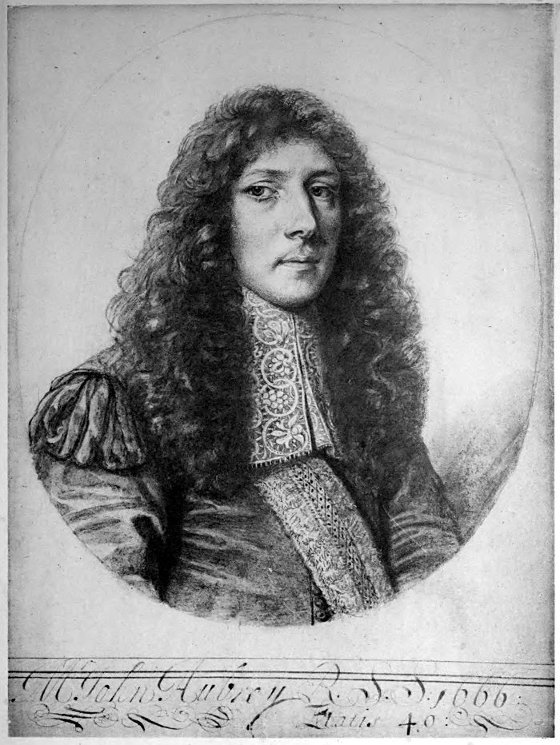

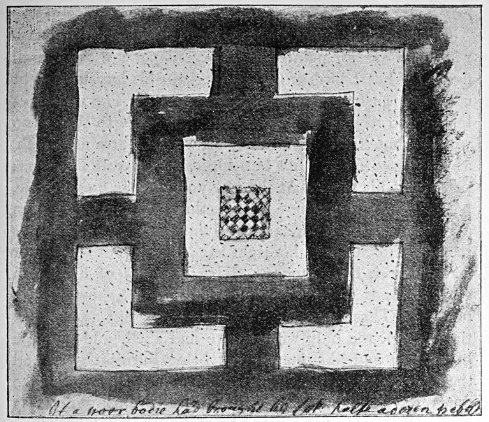
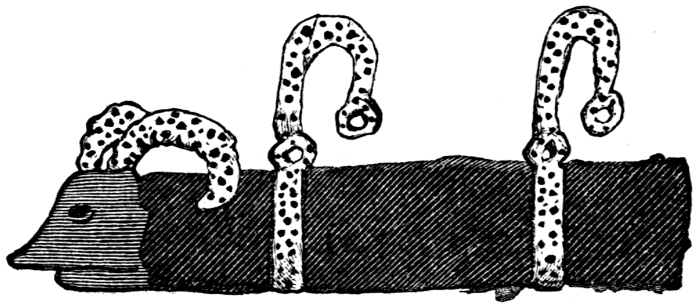
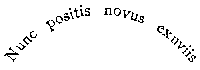



 , the balls of a dusky yellow.—The next picture is
also distinguished by a pillar on the chimney to the
right side: this <is> quite obscured by smoake.
, the balls of a dusky yellow.—The next picture is
also distinguished by a pillar on the chimney to the
right side: this <is> quite obscured by smoake.