THE course of irresponsible amusement which C. Bailey, Jr., continued
to pursue at intervals with the fair scion of the
house—road-house—of Greensleeve, did not run as smoothly as it might
have, and was not unmixed with carping reflections and sordid care on
his part, and with an increasing number of interruptions, admonitions,
and warnings on the part of his mother.
That pretty lady, flint-hardened in the igneous social lava-pot,
continued to hear disquieting tales of her son's doings. They came to
her right and left, from dance and card-table, opera-box and supper
party, tea and bazaar and fashionable reception.
One grim-visaged old harridan of whom Manhattan stood in fawning fear,
bluntly informed her that she'd better look out for her boy if she
didn't want to become a grandmother.
Which infuriated and terrified Mrs. Bailey and set her thinking with
all the implacable concentration of which she was capable.
So far in life she had accomplished whatever she set out to do.... And
of all things on earth she dreaded most to become a grandmother of any
description whatever.
But between Athalie and Clive, if there had been any doubts concerning
the propriety or expediency of their companionship neither he nor she
had, so far, expressed them.
Their comradeship, in fact, had now become an intimacy—the sort that
permits long silences without excuse or embarrassment on either side.
She continued to charm and surprise him; and to discover, daily, in
him new traits to admire in a character which perhaps he did not
really possess.
In this girl he seemed to find an infinite variety. Moods, impulsive
or deliberate, and capricious or logical, continued to stimulate his
interest in her every time they met. On no two days was she exactly
the same—or so he seemed to think. And yet her basic qualities were,
it appeared to him, characteristic and unvarying,—directness,
loyalty, generosity, freedom from ulterior motive and a gay confidence
in a world which, for the first time in her life, she had begun to
find unexpectedly exciting.
They had been one evening to a musical comedy which by some fortunate
chance was well written, well sung, and well done. And they were in
excellent spirits as they left the theatre and stood waiting for his
small limousine car, she in her pretty furs held close to her throat,
humming under her breath a refrain from the delightful finale, he
smoking a cigarette and watching the numbers being flashed for the
long line of carriages and motors which moved up continually through
the lamp-lit darkness.
"Athalie," he said, "suppose we side-step the Regina and try
Broadway. Are you in the humour for it?"
She laughed and her eyes sparkled in the electric glow: "Are you,
Clive?"
"Yes, I am. I feel very devilish."
"So do I,—devilishly hungry."
"That's fine. Where shall we go?"
"The Café Arabesque?... The name sounds exciting."
"All right—" as his car drew up and the gold-capped porter opened the
door;—so he directed his chauffeur to drive them to the Café
Arabesque.
"If you don't like it," he added to Athalie, drawing the fur robe over
her knees and his, "we can go somewhere else."
"That's very nice of you. I don't have to suffer for my mistakes."
"Nobody ever ought to suffer for mistakes because nobody would ever
make mistakes on purpose," he said, laughing.
"Such a delightful philosophy! Please remind me of it when I'm in
agony over something I'm sorry I did."
"I'm afraid you'll have to remind me too," he said, still laughing.
"Is it a bargain?"
"Certainly."
The car stopped; he sprang out and aided her to the icy sidewalk.
"I don't think I ever saw you as pretty as you are to-night," he
whispered, slipping his arm under hers.
"Are you really growing more beautiful or do I merely think so?"
"I don't know," she said, happily; "I'll tell you a secret, shall I?"
He inclined his ear toward her, and she said in a laughing whisper:
"Clive, I feel beautiful to-night. Do you know how it feels to feel
beautiful?"
"Not personally," he admitted; and they separated still laughing like
two children, the focus of sympathetic, amused, or envious glances
from the brilliantly dressed throng clustering at the two cloak rooms.
She came to him presently where he was waiting, and, instinctively the
groups around the doors made a lane for the fair young girl who came
forward with the ghost of a smile on her lips as though entirely
unconscious of herself and of everybody except the man who moved out
to meet her.
"It's true," he murmured; "you are the most beautiful thing in this
beauty-ridden town."
"You'll spoil me, Clive."
"Is that possible?"
"I don't know. Don't try. There is a great deal in me that has never
been disturbed, never been brought out. Maybe much of it is evil," she
added lightly.
He turned; she met his eyes half seriously, half mockingly, and they
laughed. But what she had said so lightly in jest remained for a few
moments in his mind to occupy and slightly trouble it.
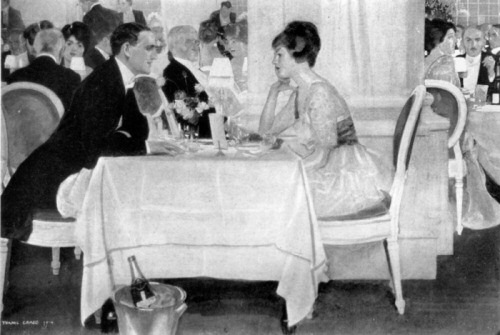
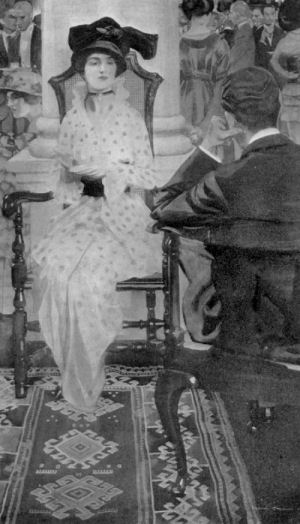
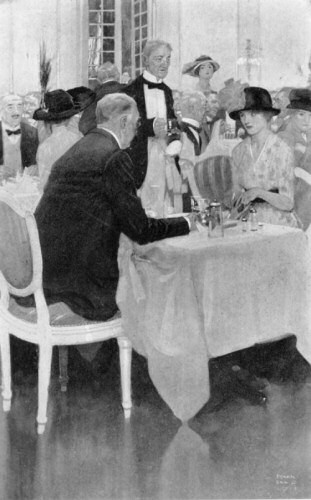
From their table beside the bronze-railed gallery, they could overlook
the main floor where a wide lane for dancing had been cleared and
marked out with crimson-tasselled ropes of silk.
A noisy orchestra played imbecile dance music, and a number of male
and female imbeciles took advantage of it to exercise the only
portions of their anatomy in which any trace of intellect had ever
lodged.
Athalie, resting one dimpled elbow on the velvet cushioned rail,
watched the dancers for a while, then her unamused and almost
expressionless gaze swept the tables below with a leisurely absence of
interest which might have been mistaken for insolence—and envied as
such by a servile world which secretly adores it.
"Well, Lady Greensleeves?" he said, watching her.
"Some remarkable Poiret and Lucille gowns, Clive.... And a great deal
of paint." She remained a moment in the same attitude—leisurely
inspecting the throng below, then turned to him, her calm
preoccupation changing to a shyly engaging smile.
"Are you still of the same mind concerning my personal
attractiveness?"
"I have spoiled you!" he concluded, pretending chagrin.
"Is that spoiling me—to hear you say you approve of me?"
"Of course not, you dear girl! Nothing could ever spoil you."
She lifted her Clover Club, looking across the frosty glass at him;
and the usual rite was silently completed. They were hungry; her
appetite was always a natural and healthy one, and his sometimes
matched it, as happened that night.
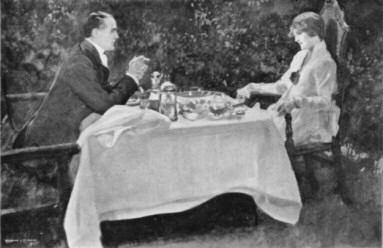
"Now, this is wonderful," he said, lighting a cigarette between
courses and leaning forward, elbows on the cloth, and his hands
clasped under his chin; "a good show, a good dinner, and good company.
What surfeited monarch could ask more?"
"Why mention the company last, Clive?"
"I've certainly spoiled you," he said with a groan; "you've tasted
adulation; you prefer it to your dinner."
"The question is do you prefer my company to the dinner and the
show? Do you! If so why mention me last in the catalogue of your
blessings?"
"I always mention you last in my prayers—so that whoever listens will
more easily remember," he said gaily.
The laughter still made the dark blue eyes brilliant but they grew
more serious when she said: "You don't really ever pray for me,
Clive. Do you?"
"Yes. Why not?"
The smile faded in her eyes and in his.
"I didn't know you prayed at all," she remarked, looking down at her
wine glass.
"It's one of those things I happen to do," he said with a slight
shrug.
They mused for a while in silence, her mind pursuing its trend back to
childhood, his idly considering the subject of prayer and wondering
whether the habit had become too mechanical with him, or whether his
less selfish petitions might possibly carry to the Source of All
Things.
Then having drifted clear of this nebulous zone of thought, and
coffee having been served, they came back to earth and to each other
with slight smiles of recognition—delicate salutes acknowledging each
other's presence and paramount importance in a world which was going
very gaily.
They discussed the play; she hummed snatches of its melodies below her
breath at intervals, her dark blue eyes always fixed on him and her
ears listening to him alone. Particularly now; for his mood had
changed and he was drifting back toward something she had said earlier
in the evening—something about her own possible capacity for good and
evil. It was a question, only partly serious; and she responded in the
same vein:
"How should I know what capabilities I possess? Of course I have
capabilities. No doubt, dormant within me lies every besetting sin,
every human failing. Perhaps also the cardinal, corresponding, and
antidotic virtues to all of these."
"I suppose," he said, "every sin has its antithesis. It's like a chess
board—the human mind—with the black men ranged on one side and the
white on the other, ready to move, to advance, skirmish, threaten,
manœuvre, attack, and check each other, and the intervening squares
represent the checkered battlefield of contending desires."
The simile striking her as original and clever, she made him a pretty
compliment. She was very young in her affections.
"If," she nodded, "a sin, represented by a black piece, dares to stir
or intrude or threaten, then there is always the better thought,
represented by a white piece, ready to block and check the black one.
Is that it?"
"Exactly," he said, secretly well pleased with himself. And as for
Athalie, she admired his elastic and eloquent imagination beyond
words.
"Do you know," she said, "you have never yet told me anything about
your business. Is it all right for me to ask, Clive?"
"Certainly. It's real estate—Bailey, Reeve, and Willis. Willis is
dead, Reeve out of it, and my father and I are the whole show."
"Reeve?" she repeated, interested.
"Yes, he lives in Paris, permanently. He has a son here, in the
banking business."
"Cecil Reeve?"
"Yes. Do you know him?"
"No. My sister Catharine does."
Clive seemed interested and curious: "Cecil Reeve and I were at
Harvard together. I haven't seen much of him since."
"What sort is he, Clive?"
"Nice—Oh, very nice. A good sport;—a good deal of a sport.... Which
sister did you say?"
"Catharine."
"That's the cunning little one with the baby stare and brown curls?"
"Yes."
There was a silence. Clive sat absently fidgeting with his glass, and
Athalie watched him. Presently without looking up he said: "Yes, Cecil
Reeve is a very decent sport.... Rather gay. Good-looking chap. Nice
sort.... But rather a sport, you know."
The girl nodded.
"Catharine mustn't believe all he says," he added with a laugh. "Cecil
has a way—I'm not knocking him, you understand—but a
young—inexperienced girl—might take him a little bit too
seriously.... Of course your sister wouldn't."
"No, I don't think so.... Are you that way, too?"
He raised his eyes: "Do you think I am, Athalie?"
"No.... But I can't help wondering—a little uneasily at times—how
you can find me as—as companionable as you say you do.... I can't
help wondering how long it will last."
"It will last as long as you do."
"But you are sure to find me out sooner or later, Clive."
"Find you out?"
"Yes—discover my limits, exhaust my capacity for entertaining you,
extract the last atom of amusement out of me. And—what then?"
"Athalie! What nonsense!"
"Is it?"
"Certainly it's nonsense. How can I possibly tire of such a girl as
you? I scarcely even know you yet. I don't begin to know you. Why you
are a perfectly unexplored, undiscovered girl to me, yet!"
"Am I?" she asked, laughing. "I supposed you had discovered about all
there is to me."
He shook his head, looking at her curiously perplexed: "Every time we
meet you are different. You always have interesting views on any
subject.
You stimulate my imagination. How could I tire?
"Besides, somehow I am always aware of reserved and hidden forces in
you—of a character which I only partly know and admire—capabilities,
capacities of which I am ignorant except that, intuitively, I seem to
know they are part of you."
"Am I as complex as that to you?"
"Sometimes," he admitted. "You are just now for example. But usually
you are only a wonderfully interesting and charming girl who brings
out the best side of me and keeps me amused and happy every moment
that I am with you."
"There really is not much more to me than that," she said in a low
voice. "You sum me up—a gay source of amusement: nothing more."
"Athalie, you know you are more vital than that to me."
"No, I don't know it."
"You do! You know it in your own heart. You know that it is a
straight, clean, ardent friendship that inspires me and—" she looked
up, serious, and very quiet.
—"You know," he continued impulsively, "that it is not only your
beauty, your loveliness and grace and that inexplicable charm you seem
to radiate, that brings me to seek you every time that I have a moment
to do so.
"Why, if it were that alone, it would all have been merely a matter of
sentiment. Have I ever been sentimental with you?"
"No."
"Have I ever made love to you?"
She did not reply. Her eyes were fixed on her glass.
"Have I, Athalie?" he repeated.
"No, Clive," she said gently.
"Well then; is there not on my part a very deep, solidly founded, and
vital friendship for you? Is there not a—"
"Don't let's talk about it," she interrupted in a low voice. "You
always make me very happy; you say I please you—interest and amuse
you. That is enough—more than enough—more than I ever hoped or
asked—"
"I said you make me happy;—happier than I have ever been," he
explained with emphasis. "Do you suppose for a moment that your regard
for me is warmer, deeper, more enduring, than is mine for you? Do you,
Athalie?"
She lifted her eyes to his. But she had nothing more to say on the
subject.
However, he began to insist,—a little impatiently,—on a direct
answer. And finally she said:
"Clive, you came into a rather empty life when you came into mine.
Judge how completely you have filled it.... And what it would be if
you went out of it. Your own life has always been full. If I should
disappear from it—" she ceased.
The quiet, accentless, almost listless dignity of the words surprised
and impressed him for a moment; then the reaction came in a faint glow
through every vein and a sudden impulse to respond to her with an
assurance of devotion a little out of key with the somewhat
stately
and reserved measure of their duet called friendship.
"You also fill my life," he said. "You give me what I never had—an
intimacy and an understanding that satisfies. Had I my way I would be
with you all the time. No other woman interests me as you do. There
is no other woman."
"Oh, Clive! And all the charming people you know—"
"I know many. None like you, Athalie."
"That is very sweet of you.... I'm trying to believe it.... I want
to.... There are many days to fill in when I am not with you. To fill
them with such a belief would be to shorten them.... I don't know. I
often wonder where you are; what you are doing; with what stately and
beautiful creature you are talking, laughing, walking, dancing."—She
shrugged her shoulders and gazed down at the dancers below. "The days
are very long, sometimes," she added, half to herself.
When again, calmly, she turned to him there was an odd expression on
his face, and the next second he reddened and shifted his gaze.
Neither spoke for a few moments.
Presently she began to draw on her gloves, but he continued staring
into space, not noticing her, and finally she bent forward and rested
her slim gloved fingers on his hand, lightly, interrogatively.
"Yes; all right," he muttered.
"I have to go to business in the morning," she pleaded.
He turned
almost impatiently:
"If I had my way you wouldn't go to business at all."
"If I had my way I wouldn't either," she rejoined, smilingly. But his
youthful visage remained sober and flushed. And when they were seated
in the limousine and the fur rug enveloped them both, he said
abruptly:
"I'm getting tired of this business."
"What business, Clive?"
"Everything—the way you live—your inadequate
quarters—your having to work all day long in that stuffy office,
day after day, year after year!"
She said, surprised and perplexed: "But it can't be helped, Clive! I
have to work."
"Why?"
"What do you mean?"
"I mean—what good am I to you—what's the use of me, if I can't make
things easier for you?"
"The use of you? Did you think I ever had any idea of using you?"
"But I want you to."
"How?" she asked, still uneasily perplexed, her eyes fixed on him.
But he had no definite idea, no plan fixed, nothing further to say on
a subject that had so suddenly taken shape within his mind.
She asked him again for an explanation, but, receiving none, settled
back thoughtfully in her furs. Only once did he break the silence.
"You know," he said indifferently, "that row of
houses, of which
yours is one, belongs to me. I mean to me, personally."
"No, I didn't know it."
"Well it does. It's my own investment.... I've reduced rents—pending
improvements."
She looked up at him.
"The rent of your apartment has been reduced fifty per cent.," he said
carelessly; "so your rent is now paid until the new term begins next
October."
"Clive! That is perfectly ridiculous!" she began, hotly; but he swung
around, silencing her:
"Are you criticising my business methods?" he demanded.
"But that is too silly—"
"Will you mind your business!" he exclaimed, turning and taking her by
both shoulders. She looked into his eyes, searching them in silence.
Then:
"You're such a dear," she sighed; "why do you want to do a thing like
that when my sisters and I can afford to pay the present rent. You are
always doing such things, Clive; you have simply covered my
dressing-table with silver; my bureau is full of pretty things, all
gifts from you; you've given me the loveliest furniture of my own, and
books and desk-set and—and everything. And now you are asking me to
live rent-free.... And what have I to offer you in return?"
"The happiness of being with you now and then."
"Oh, Clive! You know that isn't very much to offer you. You know that
our being together is far more to me than it is to you! I dare not
even consider what
I'd do without you, now. You mould me, alter my
thoughts, make me such a delightfully different girl, take entire
charge and possession of me.... I don't want you to give me anything
more—do anything more for me.... When you first began to give me
beautiful things I didn't want to take them. Do you remember how
awkward and shy I was—how I blushed. But I always end by doing
everything you wish.... And it seems to give us both so much
pleasure—all you do for me.... But please don't ask me to live
without paying rent—"
The limousine drew up by the curb; Clive jumped out, aided Athalie to
descend; and started for the grilled door where a light glimmered.
"This is not the house!" exclaimed Athalie, stopping short. "Where are
you taking me, Clive?"
"Come on," he said, "I merely want to show you how I've had the new
apartment house built—"
"But—it's too late! What an odd idea, taking me to inspect a new
apartment house at two in the morning! Are you really serious?"
He nodded and rang. A sleepy night porter opened, recognised Clive,
and touched his hat.
"Take us to the top, Mike," he said.
"Have you the keys, sorr?"
"Yes."
They entered the cage and it shot up to the top floor.
"Wait for us, Mike."... And to Athalie: "This is Michael Daly who will
do anything you ask of him—won't you, Mike?"
"I will that, sorr," said the big Irishman, tipping his hat to
Athalie.
"But, Clive," she persisted, bewildered, still clinging to his arm, "I
don't understand why—"
"Little goose, hush!" he replied, subduing the excitement in his voice
and fitting the key into the door.
"One moment, Athalie," he added, "until I light up. Now!"
She entered the lighted hallway, walking on a soft green carpet, and
turned, obeying the guiding pressure of his arm, into a big square
room which sprang into brilliant illumination as he found the switch.
Green and gold were the hangings and prevailing colours; there were
rugs, wide, comfortable chairs and lounges, bookcases, a picture or
two in deep glowing colours, a baby-grand piano, and an open fire
loaded for business.
"Is it done in good taste, Athalie?" he asked.
"It is charming. Is it yours, Clive?"
He laughed, slipped his arm under hers and led her along the hallway,
opening door after door; and first she was invited to observe a very
modern and glistening bathroom, then a bedroom all done in grey and
rose with dainty white furniture and a white-bear rug beside the bed.
"Why this is a woman's room!" she exclaimed, puzzled.
He only laughed and drew her along the hall, showing her another
bedroom with twin beds, a maid's room, a big clothes press, and
finally, a completely furnished
kitchen, very modern with its
porcelain baseboard and tiled walls.
"What do you think of all this, Athalie?" he insisted.
"Why it's exquisite, Clive. Whose is it?"
They walked back to the square living-room. He said, teasingly: "Do
you remember, the first time I saw you after those four years,—that
first evening when I came in to surprise you and found you sitting by
the radiator—in your nightie, Athalie?"
"Yes," she said, laughing and blushing as she always did when he
tormented her with that souvenir.
"And I said that you ought to have an open fire. And a cat. Didn't I?"
"Yes."
"There's your fire, Athalie;" he drew a match from his tiny flat gold
case, struck it, and lighted the nest of pine shavings under the
logs;—"and Michael has the cat when you want it."
He drew a big soft arm-chair to the mounting blaze. Athalie stood
motionless, staring at the flames, then with a sudden, nervous gesture
she sank down on the arm-chair and covered her face with her gloved
hands.
He stood waiting, happy and excited, and finally he went over and
touched her; and the girl caught his hand convulsively in both of hers
and looked up at him with wet eyes.
"How can I do this, Clive? How can I?" she whispered.
"Any brother would do as much for his sister—"
"Oh, Clive! You are different! You are more
than that. You know you
are. How can I take all this? Will you tell me? How can I live
here—this way—"
"Your sisters will be here. You saw their room just now—"
"But what can I tell them? How can I explain? They know we cannot
afford such luxury as this?"
"Tell them the rent is the same."
"They won't believe it. They couldn't. They don't understand even now how it is
with you and me—that you are so dear and generous and kind just because you
are my friend—and no more than my friend.... Not that they really
believe—anything—unpleasant—of
me—but—but—"
"What do you care—as long as it isn't so?" he said, coolly.
"I don't care. Except that it weakens my authority over them....
Catharine is very impulsive, and she dearly loves a good time—and she
is becoming sullen with me when I try to advise her or curb her....
And it's so with Doris, too.... I'd like to keep my influence.... But
if they ever really began to believe that between you and me there
was—more—than friendship, I—I don't know what they might feel free
to think—or do—"
"They're older than you."
"Yes. But I seem to have the authority,—or I did have."
They looked into the leaping flames; he threw open his fur coat and
seated himself on the padded arm of her chair.
"All I know is," he said, "that it gives me the deepest and most
enduring happiness to do things for you. When the architect planned
this house I had him design a place for you. Ultimately all the row of
old houses are to be torn down and replaced by modern apartments with
moderate rentals. So you will have to move anyway sooner or later. Why
not come here now?"
Half unconsciously she had rested her cheek against the fur lining of
his coat where it fell against his arm. He looked down at her, touched
her hair—a thing he had never thought of doing before.
"Why not come here, Athalie?" he said caressingly.
"I don't know. It would be heavenly. Do you want me to, Clive?"
"Yes. And I want you to begin to put away part of your salary, too.
You might as well begin, now. You will be free from the burden of
rent, free from—various burdens—"
"I—can't—let you—"
"I want to!"
"Why?"
"Because it gives me pleasure—"
"No; because you desire to give me pleasure! That is the reason!"
she exclaimed with partly restrained passion—"because you are
you—and there is nobody like you in all the world—in all the
world, Clive!—"
To her emotion his own flashed a quick, warm response. He looked down
at her, deeply touched, his pride gratified, his boyish vanity
satisfied. Always had the simplicity and candour of her quick and
ardent gratitude corroborated and satisfied whatever was in him of
youthful self-esteem. Everything about her seemed to minister to
it—her attention in public places was undisguisedly for him alone;
her beauty, her superb youth and health, the admiring envy of other
people—all these flattered him.
Why should he not find pleasure in giving to such a girl as
this?—giving without scruple—unscrupulous too, perhaps, concerning
the effect his generosity might have on a cynical world which looked
on out of wearied and incredulous eyes; unscrupulous, perhaps,
concerning the effect his too lavish kindness might have on a young
girl unaccustomed to men and the ways of men.
But there was no harm in him; he was very much self-assured of that.
He had been too carefully brought up—far too carefully reared. And
had people ventured to question him, and had they escaped alive his
righteous violence, they would have learned that there really was not
the remotest chance that his mother was in danger of becoming what she
most dreaded in all the world.
The fire burned lower; they sat watching it together, her flushed
cheek against the fur of his coat, his arm extended along the back of
the chair behind her.
"Well," he said, "this has been another happy evening."
She stirred in assent, and he felt the lightest possible pressure
against him.
"Are you contented, Athalie?"
"Yes."
After a moment he glanced at his watch. It was three o'clock. So he
rose, placed the screen over the fireplace, and then came back to
where she now stood, looking very intently at the opposite wall. And
he turned to see what interested her. But there seemed to be nothing
in particular just there.
"What are you staring at, little ghost-seer?" he asked, passing his
hand under her arm; and stepped back, surprised, as she freed herself
with a quick, nervous movement, looked at him, then averted her head.
"What is the matter, Athalie?" he inquired.
"Nothing.... Don't touch me, Clive."
"No, of course not.... But what in the world—"
"Nothing.... Don't ask me." Presently he saw her very slowly move her
head and look back at the empty corner of the room; and remain so,
motionless for a moment. Then she turned with a sigh, came quietly to
him; and he drew her hand through his arm.
"Of what were you thinking, Athalie?"
"Of nothing."
"Did you think you saw something over there?"
She was silent.
"What were you looking at?" he insisted.
"Nothing.... I don't care to talk just now—"
"Tell me, Athalie!"
"No.... No, I don't want to, Clive—"
"I wish to know!"
"I can't—there is nothing to tell you—" she laid one hand on his
coat, almost pleadingly, and looked up
at him out of eyes so dark
that only the starry light in them betrayed that they were blue and
not velvet black.
"That same thing has happened before," he said, looking at her, deeply
perplexed. "Several times since I have known you the same expression
has come into your face—as though you were looking at something
which—"
"Please don't, Clive!—"
"—Which," he insisted, "I did not see.... Could not see!"
"Clive!"
He stared at her rather blankly: "Why don't you tell me?"
"I—can't!"
"Is there anything—"
"Don't! Don't!" she begged; but he went on, still staring at her:
"Is there any reason for you to—not to be frank with me? Is there,
Athalie?"
"No; no reason.... I'll tell you ... if you will understand. Must I
tell you?"
"Yes."
Her head fell; she stood plucking nervously at his fur coat for a
while in silence. Then:
"Clive, I—I see clearly."
"What?"
"I mean that I see a—a little more clearly than—some do. Do you
understand?"
"No."
She sighed, stood twisting her white-gloved fingers, looking away from
him.
"I am clairvoyant," she breathed.
"Athalie! You?"
She nodded.
For a second or two he stood silent in his astonishment; then, taking
her hand, he drew her around facing the light, and she looked up at
him in her lovely abashed way, yet so honestly, that anybody who could
recognise truth and candour, could never have mistaken such eyes as
hers.
"Who told you that you are clairvoyant?" he asked.
"My mother."
"Then—"
"It was not necessary for anybody to tell me that I saw—more
clearly—than other people.... Mother knew it.... She merely explained
and gave a name to this—this—whatever it is—this quality—this
ability to see clearly.... That is all, Clive."
He was evidently trying to comprehend and digest what she had said.
She watched him, saw surprise and incredulity in conflict with
uneasiness and with the belief he could not avoid from lips that were
not fashioned for lies, and from eyes never made to even look
untruths.
"I had never supposed there was such a thing as real clairvoyance," he
said at last.
She remained silent, her candid gaze on him.
"I believe that you believe it, of course."
She smiled, then sighed:
"There is no pleasure in it to me. I wish it were not so."
"But, if it is so, you ought to find it—interesting—"
"No."
"Why not? I should think you would!—if you can see—things—that
other people cannot."
"I don't care to see them."
"Why?"
"They—I see them so often—and I seldom know who they are—"
"They?"
"The—people—I see."
"Don't they ever speak to you?"
"Seldom."
"Could you find out who they are?"
"I don't know.... Yes, I think so;—if I made an effort."
"Don't you ever use any effort to evoke—"
"Oh, Clive! No! When I tell you I had rather not see so—so
clearly—"
"You dear girl!" he exclaimed, half smiling, half serious, "why should
it distress you?"
"It doesn't—except to talk about it."
"Let me ask one more question. May I?"
She nodded.
"Then—did you recognise whoever it was you saw a few moments ago?"
"Yes."
"Who was it, Athalie?"
"My mother."
 Dust Jacket
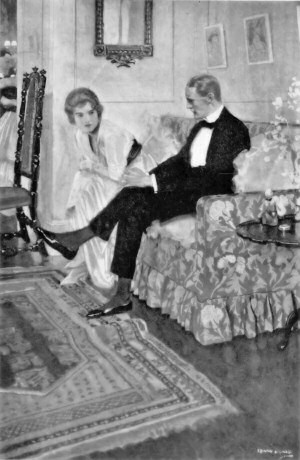 "'Clive is a good deal of a man....
I never had a better companion.'"
[Page 242.]
"'Clive is a good deal of a man....
I never had a better companion.'"
[Page 242.]