Fellow citizens!—I beg pardon,
I mean ladies
and gentlemen!
You see I've just
come from a political
meeting, and
that sort of thing gets on your
nerves. I went to hear my
friend Isaacstein talk. His
subject was "Why should the
Jew have to work?"
They did a lot of whitewashing
at that meeting. I
suppose it's all right. Of
course you can't make a new
fence with a pail of whitewash,
but you can cover up the mothholes.
But we mustn't be too hard on the politicians. If
it wasn't for politics a good many fellows that are
too lazy to earn a living with their hands would be
paupers. But some of 'em are all right. There's
Isaacstein for instance. As good a man as ever
sauntered down Hester Street. He joined the noble
army of grafters two years ago and worked so hard
at his profession that he got appendicitis.
A friend of Isaacstein's met another acquaintance
of his in Hester Street and asked:
"Haf you heard aboudt Isaacstein?"
"No. Vat iss it?"
"He vas sick. They take him by der hospital,
and vat you tink they do to him?"
"Vell. Vell. Vat iss it?"
"They put him in
a room all by himself
und take his appendix
away from him."
"Na! Na! Na!
Vat a pity, ain't it, he
didn't have it in his
wife's name?"
Why, I was taken
sick myself lately—such
thing will happen even in the best regulated
families, you know.
The doctor came and said that he
Would make another man of me.
"All right," said I, "and if you will,
Just send that other man your bill."
While I was on my way here there was a fire
down in one of those thickly populated streets
where twenty families and more live, like sardines, in
a tenement. The fire engine came booming along,
and as usual created tremendous excitement.
I noticed a small chap on a
bicycle riding zigzag in front of
the machine, evidently anxious
to keep up with it and get to the
fire in time to watch it begin
work.
Half a dozen times the driver
had to pull up suddenly to avoid running over the
nervy little Hebrew, and this of course made the
firemen riding with the machine furious.
Just in front of where I was standing one of the
gallant life savers jumped down
from the engine, caught hold of the
boy and pulled him off to one side,
at the same time saying:
"You miserable little
Sheeney, you ought to be
arrested for getting in
the way! I've a good
mind to spank you."
The boy looked at
the fireman in surprise
and whimpered:
"If it wasn't for the Jews you wouldn't have anything
to do."
I often squander an hour or two down in Hester
Street, where I have some rare acquaintances
among the second-hand dealers.
Of course you understand that I only go there to
study human nature, and I remember some months
ago being delightfully entertained at a Jewish wedding,
where my esteemed friend Moses Schaumburg
gave his cherished Rebecca into the keeping of
young Silverstein, a progressive Broadway salesman.
This fact was brought to my mind when, only the
other day I saw the bridegroom rush into his
father-in-law's establishment bearing a look of
excitement, and also a few very positive scratches
upon his olive face, and exclaiming dramatically:
"Mister Schaumburg, I vants
you to dake back your
daughter Rebecca."
The old man threw
up his hands.
"I dakes not dot
Repecca back. Ven
a man comes to my
house, picks out himself a piece of goots,
and dot goots vas received by him in goot order, I
vould be a fool to dake pack dot goods. No, sir,
you schoost keep dot Repecca."
My brother Tom was hit on
the head some time ago, and
at the hospital they said they
would have to amputate half
his brain. I didn't want them
to, because he is absent-minded
anyway.
"We'll have to give him
something to make him sleep,"
said one of the surgeons.
"That won't be necessary,"
said another; "he's a policeman."
That made Tom sore, and he snapped: "I've
got half a mind to cave in your ribs for you."
"You won't feel that way in a minute," said the
surgeon, "because that's the half of your mind we're
going to cut out."
It was a great operation. When I told my wife
of the surgeon's little joke and how Tom came back
at him she said she never knew a time when Tom
wasn't ready to give anybody a piece of his mind.
Tom was a confirmed dyspeptic, too, and when
the operator was taking an X-ray photograph of the
seat of his troubles,
this waggish
brother of mine,
with a ghastly
attempt to be
facetious, said:
"This, I suppose,
is what
might be called
taking light exercise on an empty stomach."
Perhaps it may surprise you to hear me say that
some years ago I was connected with the newspaper
business.
I don't tell this to everybody, you know, but there
are some little things connected with my experience
that drive away the blues in these times when the
ghost refuses to walk regularly on pay day.
It was out in old Kaintuck, the Blue Grass
country famous for its fast horses, fair women and
old Bourbon.
Say, have you ever been in the land of Daniel
Boone and Davy Crockett, the original Tennessee
Congressmen?
You don't know what you've missed then—grand
scenery, splendid cooking, and the most
original people in the mountains, where they make
that moonshine whiskey you've heard about.
I used to hustle right lively looking
for news, and during the course of
my journeyings I ran across a grizzled
old farmer from the back
settlements, who looked
like he might be a good
judge of double distilled mountain
dew that had paid no revenue
to Uncle Sam.
Of course I tackled him right away, and first
lining him up in the tap-room of the tavern, asked
what news there might be up in his section, for it
was a warm corner of the State, and could usually
be depended on for some lively incidents during the
week.
His answer rather disappointed me at first.
"They ain't nothin' doin' up our way," he said,
"'cause we're all too busy with our crops to bother
about anything else. All quiet in our neighborhood
for sartin."
"Pretty good crops this year?" I inquired.
"Bully," says he. "I ought to be in my field this
minute, an' I would be if I hadn't come to town to
see the coroner."
"The coroner?" I began to feel interested, because
you know there's only one kind of harvest
that needs a coroner.
"Yep. Want him to hold an inquest on a couple
of fellers down in our neighborhood."
"Inquest? Was it an accident?"
"Nope. Zeke Burke did it
a-puppus. Plugged George Rambo
and his boy Bill with a pistol. Got to
have an inquest."
"What caused the fight?"
"There wasn't no fight. Zeke
never give the other fellers a
show. Guess he was right, too,
'cause the Rambos didn't give Zeke's father an'
brother any chance. Just hid behind a tree and
fired at 'em as they came along the road. That was
yistiday mornin', an' in an hour Zeke had squared
accounts."
"Has Zeke been arrested?"
"Nope. What's the use? Some of old man
Rambo's relatives came along last night, burned
down Zeke's house, shot him an' his wife, an' set
fire to his barn. Nope, Zeke hasn't been arrested.
But I ain't got time to talk to you. Have to git
back to my harvestin'. But there ain't no news
down our way. If anythin' happens I'll let ye know."
One of my best friends down there
was an old judge who knew
more about whiskey than
he did about law. One day
a young lawyer came to town
and hung up his shingle.
Up to that day the judge had
been the only member of the
legal fraternity there.
Old Si Corntassle, a close-fisted
farmer, sizing up the situation,
thought it a good chance
to corner some legal advice without cost, so he
hastened to call upon the young man, told him he
was very glad he had come into the town, as the
old judge was getting superannuated, and then
contrived in a sort of neighborly talk to get some
legal questions answered.
Then thanking the young sprig of the bar, he put
on his hat and was about to leave, when the lawyer
asked him if he should charge the advice, for which
the fee was five dollars.
The old fellow went into a violent
passion and swore he never would
pay, but the
young lawyer
told him he
would sue him
if he didn't.
So old Si trotted down to see the judge, found
him hoeing in his garden, and said:
"That young scamp that's just come into town!
I dropped in to make a neighborly call on him and he
charged me five dollars for legal advice."
"Served you right," said the judge, who sized up
the situation, and saw a chance to pay off an old
score; "you had no business to have gone to him."
"But have I got to pay it, judge?"
"Of course you have."
"Well, then," said the man, "I suppose I must,"
and he started off.
"Hold on!" said the judge; "aren't you going to
pay me?"
"Pay you? What for?" said old Si.
"For legal advice."
"What do you charge?"
"Ten dollars."
And consequently as old Si had to settle with
both he rather overreached himself in the transaction.
Some of you people doubtless
find benefit in visiting
the country, but I imagine
Snellbaker, who has a gents'
furnishing-goods emporium on
the corner of a Brooklyn
Street, rather carries off the
prize in a profitable trip.
I met him the other day, well
sunburned, and with a twinkle
in his eye.
"I say, Mr. Niblo, did you hear about my luck?" he
asked, slapping me on the shoulder.
"Why, no, what's happened
now?" I replied, wondering
if he had drawn
the grand prize in a
lottery, or if his
children had the measles.
"Well, you know when
I went away to the
country, I only took my
five children and I brought ten
home with me."
"How was that?" I asked, in surprise.
"Well, they ate green apples and got doubled up."
Singular what queer things do happen on the electric
cars of a great metropolis. The other day I
was riding down to the City Hall in a pretty crowded
car when something happened.
All the other passengers in the car were men
except one; and she was a girl, a nice, pretty, young
thing of that peculiar pinkish clarity of complexion
more commonly designated
"peaches and
cream."
The conductor had
just collected her fare
and was proceeding on
his way to the rear
platform when the girl
grabbed at the left arm of
her jacket and emitted a gaspy little
scream.
"What is it, miss?" asked the conductor.
"Oh, what shall I do?" moaned the girl. "I've
lost it! I've lost my Yale pin!"
And she looked as if she would topple over on
the man next to her. The conductor stooped and
looked about the floor of the car. All of us passengers
did the same. The pretty young thing shook
out her skirts vigorously. All hands lent their aid to
lift up the gratings and to search the space beneath
them. There was, however, no signs of the
cherished emblem. About the time everybody was
beginning to feel exhausted the girl suddenly
exclaimed:
"Oh, I remember now! It's all right. Don't bother
any more. I gave it back last night."
"City Hall!" yelled the conductor, and I was glad
to get off.
Last time I rode in a trolley car I got a scare for
sure. Honestly now, it gave me a queer feeling up
and down my spine when I noticed that the car
number was 1313, and what made it worse we
were just passing Thirteenth Street at the time.
I thought I would mention the fact to the conductor,
especially when upon counting the passengers
I found there were just that fatal number aboard.
It was the thirteenth of the month too, and bless
you if that conductor's number wasn't just 3913.
So I grimly paraded these significant facts
before the attention of the knight of the fare
register.
"I should think it would make you nervous!" I
remarked.
"Only once't that I
remember," said the
conductor, with a grin.
"When and how?"
"There was thirteen
babies in this here car yellin'
in thirteen different keys all
at the same time," replied the
conductor.
Some people are so superstitious,
you know, always carrying home old
horseshoes and nailing them up over
the door—why, a pagan nation like the Japanese
have the same custom with other embellishments.
The fun of it is, while some stoutly maintain the
horseshoe must be nailed with the forks pointing
upward, there are others just as
set in their belief that if a chap
wants real good luck to swoop
down upon his domicile it is
absolutely imperative that the
opening must be left below.
Why Ketcham actually
grew hot under the collar the
other day because I sneered
when he chanced to mention what horrible bad fortune
had come to him since his propitiation to the
gods was stolen from his barn door by a wandering
dago junk-man.
"Don't you believe then that there's good luck in
finding a horseshoe?" he demanded, fiercely.
"Why, yes, under certain conditions," I replied;
"for instance when you find it on the winning horse."
Ketcham is quite a gay fellow, and a member
of many clubs, so that he can seldom be found
home of an evening.
I once remonstrated with
him, as a true friend should.
"See here," I said, seriously,
"you are out every night
until the 'wee sma' hours.'
Isn't midnight late enough
for you?"
"Well," he replied, "I
find when I show up at midnight
my wife can talk to me, but when I get
home at three, words fail her."
Say, my wife came home from shopping the other
day filled with righteous indignation, and, of course,
while men are not supposed to have any curiosity,
you know, my peace of mind was somewhat disturbed.
I began to have vague fears that perhaps some
miserable detective in one of the department stores
might have insulted her—perhaps accused her of
having too warm an affection for the lace counter.
At length, however, seeing that I would not ask
the question she was burning to hear, she burst
out with:
"I wish the shopkeepers would be more careful
how they put mirrors in conspicuous places."
"What's the matter? Been trying to dodge your
own reflection?" I asked, for do you know it was the
first time I had ever heard a woman complain of
too much looking-glass.
"No; but you know there is one
of those triple mirrors in one of
the department stores, and poor
dear Fido spent fifteen minutes
chasing around it trying
to find the other dog. I
thought I'd never get him
out of that store."
Ever been through the Chinese quarter down
around Mott Street, where you can smell the incense
of the joss-sticks burning before the ugly
little idols?
I saw in the paper the other day about a fellow
who had come from Korea with
samples of idols that he wanted an
American firm to manufacture, and
it begins to look as though
presently our enterprising
Yankees might corral this
trade along with everything
else.
That gave me an inspiration
which I set down in verse—if you'd like to
hear the result I don't mind one bit, so prepare to
weep, for here it goes:
The heathen in his blindness
Bows down to wood and stone—
Some idol inexpensive
He puts upon a throne;
But now we'll teach the heathen
The error of his way,
And sell him modern idols
Made in the U. S. A.
We'll lift the foolish heathen
From groping in the dust.
And change and civilize him—
We'll form an Idol Trust.
For ages he has groveled
In superstition dim
But now we'll help his progress
By making gods for him.
No seven-handed figures;
No gods with coiling tails:
No birds, no bugs, no serpents,
No animals, nor whales—
No, sir! He'll have our idols:
A shovelful of coal,
A meter, and an oil can
To terrify his soul.
A bonnet and a ribbon:
A bargain ad.—the strife
They'll cause will make the heathen
Yearn for a better life.
The poor benighted pagan
Will come out of the dark
And bow before our idol—
The mighty dollar mark!
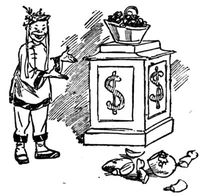
Mr. Carboline, our druggist at the
corner, has troubles of his own,
though I never realized the
fact until I saw a perspiring
individual rush
in upon him with a
thermometer in his hand
the other day, and in
an excited tone exclaim:
"Here, take back this darned machine before I
freeze to death."
He looked so heated just then that we began to
imagine he must be a little out of his mind, but
Carboline ventured to ask humbly enough what was
the matter with the mercury register.
"It's out of whack somehow, and won't register
correctly. Darn it, I've been shivering in my room
for a week, and just couldn't keep warm. I had the
thermometer over my writing desk, and the other
morning when the steam went down a little I looked
at the mercury. It showed forty degrees.
"I knew nothing less than a polar bear could work
in that temperature, and went hustling after the
janitor.
"He shook up his furnace, and the steam began to
sizzle, but the room wouldn't get warm enough to
raise that mercury above 50.
"We ran short of coal for a day, and she went
down to 40 again, and I went over to stop with a
friend till we got more coal.
"Then the steam sizzled once more, but the north
wind seemed to come in through the window cracks
and the shivers had me all over.
"I struck for window strips, and had a row with
the landlord.
"The mercury showed 50 degrees right along, and
though I made it hot for the janitor I couldn't get
any of it into the blamed thermometer.
"Yesterday I gave
notice that I would
get out if they didn't
keep me warm. I'm a
bachelor tenant paying
a good price and
generally no kicker,
and they didn't want
me to leave.
"About an hour ago
the janitor came in to see how I was getting along.
"He found me at my desk with a blanket around
me. He asked if I were sick. I told him I was
frozen.
"He said he thought the room was very warm.
Before licking him I showed him the thermometer
and told him that was the real test.
"The mercury stood at 50.
"The janitor swore and went out.
"He came back in a minute with another thermometer
and hung it alongside of mine. It was a
fine one, guaranteed to keep perfect records.
"It marked 65 degrees when he brought it in, and
in a minute or two it showed 71. Mine stood still
at 50.
"The janitor looked at the two machines and began
to grin. I began to unwind the blanket that was
around me. The janitor looked scared, but I told
him not to run; that I wasn't going to lick him. The
only man that I felt like licking was the one who
sold me a thermometer that wouldn't go.
"You're the one.
"Now, it's up to you to apologize, give me a machine
that is true, or be licked. I've paid my money
and you can take your choice."
Mr. Carboline preferred to make the change.
By the way, before I forget it, let me tell you
about young Charlie Suitz, a friend of mine, who is
really as modest a chap as you would care to meet.
Charlie has a girl upon whom he calls very frequently,
and, they tell me, at the most unexpected
times.
That was probably how it happened he dropped in
one afternoon and was informed by her mother that
she was upstairs taking a bath, so he told the old
lady he only wanted to speak to her for a minute;
and she called out:
"Mamie, come right down, Mr. Suitz wants to see
you down here."
So Mamie called back, "Oh, mother, I can't; I have
nothing on."
"Well, slip on something right away, and come
down."
And what do you think? Mamie slipped on the
stairs, and came down.
Talking of your level-headed young Lochinvars of
to-day, who use automobiles in their elopements instead
of horses as in the old times, there was
Charlie's brother who fell in love with the only
daughter of old Squeezer, the richest skinflint in
Stringtown, and was bound to have her, even if he
had to resort to strategy.
"Oh, Bob," she whispered, sliding
down into the outstretched
arms of the
lover who stood at the
bottom of the ladder,
"are you sure the coast
is clear?"
"To a dead certainty," he
replied, bitterly. "I succeeded
in boring a hole in
the water pipe. Your father has discovered it, and will
keep his finger over the hole until the plumber
arrives. Come!"
I dined at the Waldorf the other night, and somehow
in the long list of courses found my mind wrestling
with an item that had caught my eye in one of
the yellow sheets, where a certain well-known doctor
declared that the simple cooking of savage tribes
was far superior to that of the present civilized
races.
When I reached home the thought, and perhaps
the menu I had so gallantly assailed, so impressed
me, that I sat down and rattled off a few verses
covering the ground. This is how the song goes:
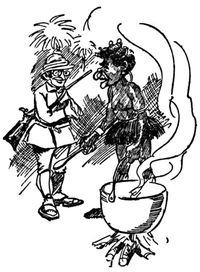
"You cook," I observed to the African chief,
"With a truly remarkable skill;
With your soups and your entrees you ne'er come to grief,
You seldom go wrong when you grill.
Your roast leg of pork or of mutton is—well,
It's a privilege simply to view it;
And I feel I could fatten for weeks on the smell!
How on earth do you manage to do it?"
With a gratified simper the chieftain explained,
"Ah, well, for that matter, the fact is,
Whatever ability I may have gained
Is simply the outcome of practice.
In the days of my youth, e'er I quitted my land,
Not content with the usual rations,
I made it a habit to practice my hand
On my numerous friends and relations.
"I strove with a will toward my ultimate end,
Surmounting each obstacle gayly.
I speedily ran through my circle of friends,
Diminished my relatives daily.
My brothers gave out, and my uncles as well;
My cousins went faster and faster;
Until—in a word a long story to tell—
I found I could cook like a master."
In silence I stood till he came to the end,
For his tale had delighted and thrilled me;
Then thoughtfully thanking my cannibal friend,
I owned that with envy he filled me.
For many's the man whom I'd thankfully boil,
And countless relations beset me,
Whom I'd eagerly stew (without grudging the toil),
If only the law would abet me.
Some people have such remarkable ideas connected
with the bringing up of children. There's
Rossiter's young wife for example.
I was invited to an evening dinner
party recently where she was
the guest of honor.
This charming young matron
is the proud mother of two
fine boys, both under four
years of age.
In their education she endeavors
to follow a system,
like many other young mothers, and
she is very careful to live up to any rules she may
have formulated for them.
During an early course in the dinner, and in the
middle of an animated conversation with her host,
she suddenly ceased talking.
Her face took on a most startling expression. Then
finding her voice, she exclaimed:
"Mercy, I have forgotten those boys again! May
I use your telephone?"
She was taken to the 'phone by the host, and the
murmur of her voice in most earnest conversation
was wafted back to the dining room.
After a short time she returned.
"I beg a thousand pardons," she said, "but you
must know I have always insisted that Sam and
Dick say their prayers for me before they go to
sleep.
"In the hurry of getting off to-night I entirely forgot
my usual duty.
"So I called up the nurse. She brought them to
the 'phone and they said their prayers over the wire.
I feel quite relieved."
Speaking of boys reminds me of my friend Toddlekins'
young hopeful, who marched into the library the
other day when I was engaging his pa in a scientific
discussion.
I may remark just here that Tommy had a new
gun under his arm, which I understood his fond parent
had recently presented to him—you know Toddlekins
is a great admirer of the strenuous life and
likes to encourage it all he can in his offspring, who
appears to be a chip of the old block.
"Say, pa," was what he exploded,
"is it true that cats have nine
lives?"
Always ready to impart information
to the inquiring mind of youth,
his fond parent replied such was the
common saying, which might be accepted
as truth.
"Well, I am glad of that,"
said the boy, heaving a genuine
sigh of relief, "because then
our old tortoise-shell's got eight coming
to her."
I'm afraid my smallest chap is going to take after
his proud father—it's about time, since I've taken
after him on many an occasion.
For instance now, at school, in the course of his
astronomy lesson, the teacher happened to ask:
"What supports the sun in the heavens?"
"Why, its beams, of course," was the prompt answer
given by the flower of the family.
He was not encouraged to exercise the propensity
further.
But it is not always the boys who can be depended
on to furnish material for a good story.
I knew a little tot of a girl once, Helen they called
her, the pride and joy of a young couple with whom
I used to dine occasionally in my happy bachelor
days.
I discovered, however, one night, that the little
lady was very much afraid of the dark, just as some
of her older sisters are prone to be, and all her
mother's persuasive eloquence was required to induce
the child to leave the brilliantly lighted dining
room for her own dark bedroom.
A whispered colloquy between mother and child
finally resulted in the little
one's departure to her room
without further protest.
When the mother returned
to the dining room she explained:
"It's so easy to handle children
if you just know how. I told her
there was no reason to be afraid; that the dark was
filled with angels, all watching over her. Now she is
quite content to be left alone and——"
"Mamma! Mamma!" piped a small, far-away voice
at this point, "please come quick. The angels is
a-biting me."
While I was talking with Mike who
should drop in but the archbishop?
Now, because a man's a priest
is no reason he shouldn't have a
big streak of humor in him, and
the archbishop can appreciate a
joke as well as the next one.
They say that when he was up in the Harlem district
last winter, for the purpose of administering confirmation,
he asked one nervous little girl what matrimony
was, and she answered:
"A state of terrible torment, which those who
enter it are compelled to undergo for a time to prepare
them for a brighter and better world."
"No, no," remonstrated the pastor; "that isn't matrimony;
that's the definition of purgatory."
"Leave her alone," said the archbishop; "maybe
she's right. What do you or I know about it?"
Thinking to test his knowledge of history, some
one once remarked in his hearing:
"I wonder who made the
first after-dinner speech?"
"Adam did," replied the
archbishop, promptly, "for
you know we read that
after he had eaten that
apple down to the core,
he arose and said, 'the
woman tempted me'."
And you will agree with me he was pretty nearly
correct that time.
I always take considerable interest in the yacht
races for the America's Cup, and when my friend
Donovan informed me recently that the next boat
would have a wonderful rudder filled with air, to add
to the buoyancy and save weight, I began to consider
whether the advantages might not be offset
by the new dangers accompanying a pneumatic
rudder.
If a yacht should happen to get a puncture in her
rudder during the race she would be compelled to
drop out, owing to the difficulty of cementing or plugging
it while sailing.
And in a race a yacht is liable to be on a tack at
any moment.
A week ago I took a spin on my
wheel, along country roads
where the festive bull
loiters in the shade of the
tree, waiting for a victim.
If you have ever taken
the trouble to notice, there
are funny things sometimes
happening on these dusty
highways of the hobos, and
more than a few times the shrewd city man finds
himself the sport of Rube's wit.
Having become somewhat confused as to my
bearings on this particular occasion, I thought to
make inquiries of a slab-sided youth, who leaned on
a fence and sucked at a straw meditatively.
"I say, my good fellow, am I on the right road to
Jericho?" I asked, with my most patronizing smile.
He surveyed me a minute and then said slowly:
"Ya-as, stranger, but I kinder reckon you're goin' in
the wrong direcshun."
Say, as I was walking along Sixth Avenue a man
thumped me on the back and yelled out:
"Sure, Michael, ye're the broth av a bhoy. Len'
me ten."
And I did; I couldn't refuse it. That's like the
Irish; they're so hearty and will share your last cent.
There's one bright Irishman
that I'm greatly interested in.
Terence Sullivan came over
here with the idea that he
could pick up money in the
streets; and sure enough the
first day he landed he found
a nice new ten-dollar bill on
one of the seats in Battery
Park. Since then he's gone on doing well.
Sullivan was never much of a reader, and I had
often wondered at this until on a certain occasion he
gave his prejudice an airing.
"And faith," said he, "Oi don't see the since in
noospapers. They kin only print what's already
happened."
As affairs prospered with the honest fellow, like
all true-hearted Irishmen, he must needs send for
the mother, and install her in a comfortable home.
I remember meeting the old lady once, and under
conditions that often make me smile.
I had a friend, a lawyer, who had an office away
up in one of the skyscrapers downtown, and here
Mrs. Sullivan, after much persuasion, had been induced
to come and pay her rent.
The lawyer's office was on one of the upper
floors of a large office building.
After the rent had been paid and the receipt
given, the old woman was shown out into the hallway
by the office boy.
I found her in the hallway
a few minutes later, when I
chanced along. She was wandering
about opening doors
and otherwise acting in a
strange manner.
"What are you looking for?"
I asked.
"Shure," she said, in her simplicity, "I'm lookin' for
the little closet I came up in."
I suppose you will believe me when I tell you
that my theatrical ventures have frequently brought
me in contact with ripe episodes that impressed
themselves strongly upon my memory.
Sometimes they were too ripe, and gave occasion
for much toil ere they could be wholly eradicated
from my unfortunate coat.
I long ago lost my
taste for eggs in any
shape.
On a barn-storming crusade
with a small show, I remember,
at an afternoon rehearsal, the
flute player in the orchestra
made me nervous by playing off
key. After vainly endeavoring
to correct
the man, I lost my
temper and exclaimed:
"Cut out the flute for goodness' sake!"
Thereupon the musician arose with fire in his eye.
"Oh! you want to get rid of the flute, do you?"
he asked.
"Yes," I drawled carelessly, "I guess we'll get
along all right without your assistance."
"Oh! you will, will you! Well, see here, young fellow,
if I don't play the flute, you don't sing that
song—and there'll be no show to-night. You understand?"
"Who'll prevent?" I demanded.
"Only the flute," was the answer. "I'm the mayor
of this place, I am, and I issue the permits. See?"
And I saw.
On my last whirl around the circuit I went by
way of the New York Central.
There was a newly-married couple in our car, and
of course lots of us were
more or less interested
in their carrying-on.
Once the train plunged
through a tunnel, and I
suppose the newly-made
Benedict took advantage
of the golden opportunity
to kiss his spouse.
"Morris-sinia!" yelled the
brakeman as we came to daylight
again.
"I don't care if he did," snapped the woman, "we're
married."
At our first stop in a bustling town up in York
State I was in the box office, when I was addressed
by a young man who in hollow tones declared
he had heard that to see so great an actor
as myself was good for any form of ailment.
"You might help me," the young man declared
with labored breathing; "anyway, I'd like to enjoy
myself once more before I die. I have consumption,
you know.
Could you let me have
a pass?"
I couldn't help but feel
sorry for such a woebegone-looking,
hard-luck
chap, so I at once
wrote him out a pass.
The man took the
card, looked at it,
coughed even more distressfully
than before, and asked:
"Couldn't you make it two? I would like to take
a friend."
"Has your friend consumption, too?" I asked,
solicitously.
"N—no—not yet," faltered the man.
"Ah! then, I'm afraid I can't accommodate your
friend. You see, I never give passes except to persons
with the consumption."
Some people think there is little in a name, but I'm
a great believer in an attractive title. I could mention
scores of reasons for thinking as I do, and you
can better believe I'm not alone in this thing.
Passing the Academy of Music a short time ago,
one matinee day, I met my friend Shackleford coming
out, and the play only half over.
"What is the matter?" I asked; "play bad?"
"No," he replied, "but it is too hot in there; the
house is literally packed with women. You see it's
the name—'Ninety and Nine'—that catches them.
Why, it's better than an actual horse-race or a locomotive,
to draw. They fancy that the admission has
been marked down from a dollar and can't resist the
bargain."
Whenever I meet Chauncey Billings on Broadway
the sparks are sure to fly in the fireworks display of
dry wit that passes between us, just as though you
struck flint and steel smartly.
The other day he approached, looking very happy,
as though anticipating overwhelming me, so being
forwarned I prepared to resist boarders.
"My dear Niblo," said he,
"you will be surprised to
learn I've taken up a new
business."
"Indeed, What are you
now?" I asked.
"I'm a detective in a pool room."
"What do you do?"
"Oh, I spot balls."
"That's nothing," I remarked, casually, "I used to
work in a cheese factory."
"And what did you do?"
"Oh, play baseball."
"What, baseball in a cheese factory, Mr. Niblo!"
"Sure, I used to chase flies. That got tiresome
and I went to work in a barber shop."
"What were your duties there?"
"I used to mix lather."
"And what did you mix lather for?"
"Oh, to lather Irishmen and Dutchmen, etc."
"I have a brother who works in an
eye hospital," said Chauncey, soberly.
"What does he do?"
"Oh, he makes goo-goo eyes."
"That's nothing, I have a sister
who works in a watch factory
making faces."
And so we pass the retort discourteous, and exchange
pleasantries as only old friends may.
In the Catskill village, where we delight to spend a
portion of the heated term and all our hard-earned
capital, there is a boarding-house run by an eccentric
genius, who knows how to set a good table and
never has an empty room through the season, though
over the gate leading up to his
hotel he has painted a sign
that might well cause consternation
in the breast of
many a would-be sojourner,
for it reads:
"Boarders taken by the
day, week or month. Those
who do not pay promptly will
be taken by the neck."
There were some rumors floating around that this
remarkable Boniface, as a Christian Science advocate,
had been benefited to an astonishing extent in
the recovery of his health.
Being of an investigating turn of mind, and anxious
to learn all that was possible concerning the latest
fad, I cornered old Bijinks out near the hog-pen and
engaged him in conversation, during which he made
a positive assertion that rather staggered me.
"Do you mean to tell me that you actually believe
Christian Science cured you?" I demanded, eagerly.
"Sure," he said, nodding.
"Of appendicitis?"
"B'gosh, no—of Christian Science."
There was a crusty old bachelor at the house who
got disgusted with the spoony couples and came up
to my room to talk it over with me.
"What is love, anyway?" he demanded.
"Intoxication," I answered, unguardedly.
"Right," he quickly said, "then possibly marriage
must be delirium tremens."
Before I could recover my breath he fired another
hot shot at me.
"There's three things I never could stand if I ever
married."
"And what are they?" I asked.
"Triplets."
I tried to give him the old gag about a woman's
heart being a gold mine.
"That's right," he said; "you've got to prospect it
before you find out what it's worth; and I know a
whole lot of fellows who've gone broke prospecting."
That landlord of ours up in the glorious Catskills
was a hard subject to catch napping, and many a
time I've watched him crawl out of a hole with hardly
an effort.
Probably it requires considerable nerve to run a
summer resort hotel, and meet all the requirements
which the traveling public seem to expect.
On one occasion I heard a tourist who had just
arrived ask him the old chestnut:
"Is this a good place, landlord, do you think, for a
person affected with a weak chest?"
"None better, sir, none better."
"I've been recommended, you know, by the doctor,
to spend the summer in some mountain region where
the south wind blows. Does it blow much here?"
"Why sure, it's always the south
wind that blows here," replied
the landlord, stoutly.
"Ah, indeed, then how do you
account for it blowing from
the north just now?"
"That's easy enough, sir—you
see it's the same old
south wind on its road back again."
That landlord was a jewel, and afforded me considerable
entertainment during my sojourn; but he
had a neighbor, a stout German farmer, who took the
cake when it came to doing business.
Le'me tell you about his experience with the insurance
agent, for it was certainly laughable, though
old Platzenburger didn't see it that way.
It seems that the house of the farmer, insured for
a thousand dollars, had burned down. The privilege
of replacing a burned house is reserved by insurance
companies and the agent, having this in mind, said
to the farmer:
"We'll put you up a better house than the one you
had for six hundred dollars."
"Nein!" said Platzenburger, emphatically. "I vill
have my one tousand dollar or notings! Dot house
could not be built again for even a tousand."
"Oh, yes, it could," said the insurance man. "It
was an old house. It doesn't cost so much to build
houses nowadays. A six-hundred-dollar new house
would be a lot bigger and better than the old one."
Some months later, when the insurance man was
out for a day's shooting, he rode up again to the farmer's
place.
"Just thought I'd stop while I was up here," he
said, "to see if you wanted to take out a little insurance."
"I got notings to insure,"
said Platz, "notings but my
vife."
"Well, then," said the insurance
man cheerfully, "insure
her."
"Nein!" said the farmer,
with determination. "If she
die, you come out here and say, 'I not give you one
tousand dollar. I get you a bigger und a better vife
for six hunded.' No, sir, I dakes no more insurance
oud!"
You must excuse me if I have to call a temporary
halt upon these proceedings and indulge in a little
vociferous sneeze, for a cold in the head is no respecter
of persons. This is the sneeze, sung in a
sad, sobbing minor:
I've got a cold with snuffles in;
What kind of a cold have you?
I've got the kind that makes me sin
By craving fizzes made of gin
And other stuff with bad booze in—
What kind of a cold have you?
I've got the kind that makes one hoarse;
What kind of a cold have you?
To speak requires my utmost force;
My voice is rough, and harsh, and coarse,
And strains its laryngital source—
What kind of a cold have you?
I've got a cold that makes me mad—
What kind of a cold have you?
That makes me reticent and sad,
That puts me plainly to the bad,
The worstest cold I ever had—
What kind of a cold have you?
I suppose you know I was on a tour in Florida
and other parts of the Sunny South last winter?
There is a tradition down there that if a mule
kicks a darky on the head the wretched mule is sure
to go lame.
When I was down there I happened to
notice a little colored girl limping along the
street, her feet done up in immense bandages
of sacking.
"What's the matter with your
feet?" was my natural inquiry.
"My fadder done hit me on de
haid while I was standin' on an iron cellar door," was
the response.
When I got to Charleston there was a circus in
town, and after doing my matinee stunt at the local
theatre, I got around to the circus.
There was a pretty fair menagerie along with the
show, and it was a treat to me to stand around and
hear the original and quaint remarks of the negroes,
many of whom had never before in their lives seen
lions and elephants.
One big ugly gorilla seemed to attract them above
all other living curiosities, and he was a fierce sight,
I assure you.
I saw an old wizened-up aunty stand in front of
his cage a long time, speechless with awe, and finally
heard her vent her feelings in the words:
"Foah massa sakes alibe, if he ain't jest like de ole-time
culled folks."
Another queer old chap tried to make the acquaintance
of the uncouth and hairy monster.
"How is you?" said the old black man, bowing before
the monstrous ape.
No answer.
"How is you?" Eph repeated, with another profound
bow, and still no answer. Then, after a long
pause, Eph exclaimed:
"You's right, ole man; keep yo' mouf shet or dey'll
put a hoe in yo' hand and make yo' raise cotton."
The menagerie always fascinates me. Why, I'm
just like a boy again when I get among the animals,
and catch that well-remembered odor always connected
with a show.
I've even dreamed about 'em, and strange as it
may appear, they always seem to be passing before
me in a great hurry, just as though on a wager.
As I say, I was kind of fascinated and thinking of
boyhood's days and all that sort of thing, you know,
when some one spotted me.
"By de great horn spoon, if dar ain't George
Niblo!"
I tried to look shy and turned on my best blush.
Then the manager turned to me politely, gave me
the glad hand and asked if I wouldn't sing a little
song.
I said "sure"; and I did. Here's the song I sung:
The animals thought they would have a race;
The Monkey was referee;
The Bull was stakeholder, for, as he said,
It was his nature to be.
The Camel got a hump on himself;
The Lion ran with might and mane;
The Tiger stood off, for a beast of his stripe
Was not let to enter again.
The Elephant took his trunk along,
In case he won the prize;
The Peacock was starter, and missed no one,
For, you see, he was all eyes.
Some spotted the Leopard for winner sure;
The old ones chose the Gnu;
While those who leap to conclusions quick
Bet on the Kangaroo.
The Ostrich plumed himself on his speed;
All tried the record to wreck;
The Hippopotamus blew his own horn,
But the Giraffe, he won by a neck.
I was in court the other day.
There is no use of any vulgar curiosity concerning
the reason of my being present; but I will say right
here that I won my case, and when a fellow does
that he's all right. Yes, sir; I had the dough with me.
While I was waiting my turn a disreputable-looking
chap was brought before the judge, I believe
charged with vagrancy or something of the sort.
"What is your name?" inquired
the justice.
"Pete Smith," responded the
vagrant.
"What occupation?" continued
the court.
"Oh, nothing much at present;
just circulatin' round."
"Retired from circulation for thirty days," pronounced
the court, dryly.
In another case where one of the witnesses had
been severely baited by a counsel, the question arose
as to the authenticity of a letter of which the witness
was reputed to be the author.
"Sir," said the lawyer, fiercely, "do you, on your
oath, swear that this is not your handwriting?"
"I think not," was the reply.
"Does it resemble your handwriting?"
"I can't say it does."
"Will you swear that
it does not resemble
your handwriting?"
"I will."
"You will positively
take your oath that this
writing does not resemble yours?" persisted the
lawyer, working himself into a state bordering on
frenzy.
"Ye-s-s, sir."
"You seem less positive," remarked his interrogator;
"perhaps we had better have a specimen of
your handwriting for purposes of comparison."
The witness caused it to be understood that this
was impossible, whereupon the lawyer, scenting
his approaching triumph, smiled serenely at the
court.
"Oh, sir, it is impossible, is it? And may I ask why?"
"'Cause I can't write," returned the man.
"Step down; I'm done with you," said the smart
lawyer.
Which reminds me of an occasion when an Irish
judge was on the bench, and took occasion, in my
hearing, to address the jury.
"Gentlemen," he said, seriously, "you have heard
the evidence. The indictment says the prisoner was
arrested for stealing a pig.
"The offense seems to be becoming a common
one. The time has come when it must be put a stop
to; otherwise, gentlemen, none of you will be safe."
As I came out of court that day it was only natural
that I should run across an old friend, Dr. Case,
and hear of more courting. Ah, I thought you'd see it!
"Great news about McGregor—he's to be married
again."
I expressed my surprise, for let me tell you I had
already enjoyed the pleasure of an acquaintance with
three wives of this same gentleman.
"Fourth time—that's going it pretty steep, doctor,"
I remarked.
"It would appear so. Beats all how the rage for
collecting will take hold of a man. Sometimes it's
old books or playbills, and sometimes it's postage
stamps. In McGregor's case it appears to be wives."
When I looked in on
Bob Lightwate the
other day, at his office,
expecting him to accompany
me to the
hospital, where a mutual
friend had been taken, I
found him clipping an item
from a newspaper, which he was
very careful to place in his note book.
"It tells how a house was robbed, and I want to
show it to my wife," he explained.
"What good will that do?" I inquired.
"A whole lot," was the reply. "You see, this
house was robbed while a man was at church with
his wife."
"B'Gosh!" I exclaimed, excitedly, "you haven't got
a duplicate copy of that paper, have you?"
Before we could get away Bob had a caller.
You see he owns a lot of real estate in the suburbs
and his tenants pester the life half out of him
on account of trivial troubles.
This party was plainly embarrassed, for he kept
twirling his hat in his hands.
"What can I do for you, Mr. Sorter?" asked Bob.
"I came to tell you, sir, that our cellar—"
"Well, what about the cellar?"
"It's full of water, sir."
"Is that all? Humph, I don't see that you've any
kick coming, Mr. Sorter. You surely didn't expect a
cellar full of champagne for ten dollars a month."
The matter was of course satisfactorily adjusted,
after Bob had enjoyed his little joke, and we went
on our way to the hospital.
Now, a hospital isn't the most cheerful place in
the world, and yet now and then there is some gleam
of humor breaks out there.
Human nature is a queer
combination, and I've known
men who would joke even
under the surgeon's knife.
When we entered the
room where poor Huggins
lay, we found that two physicians
were beside his cot holding
a consultation over him, and that it was suspected
he had a severe case of appendicitis concealed
about his person.
"I believe," said one of the surgeons, "that we
should wait and let him get stronger before cutting
into him."
Before the other prospective operator could reply
the patient turned his head, and remarked feebly:
"What do you take me for—a cheese?"
I rejoice to tell you that this hero survived the
operation, and is about again.
Lightwate has always been a great lover of the
weed, and it is a rare thing to find him without a
cigar or a pipe in his mouth.
When taken to task he never fails to joke about
the matter, and turn the tables on a fellow.
I remember of asking him plainly once why he
smoked so much, and he immediately replied:
"I suppose because I'm too green to burn."
While Bob and myself were on the way back to
his office we saw a commotion ahead, and pretty
soon a wild-looking citizen
rushed up to a policeman
who stood on the curb,
and shouted:
"Officer, officer, I've been robbed,
and yonder goes the wretch who
snatched my watch!"
The vigilant guardian of the peace waved him majestically
aside, as he answered:
"Don't bother me with such very trifling affairs
when I'm timing an automobile."
Bob said things had come to a pretty pass when a
man's time-piece might be stolen with impunity because
of the necessity for securing the time-pace
of a machine.
Our walk took us along the Bowery, and as I was
passing, a man seemed to be busily engaged in
shoving some bank-bills, together
with a straw-colored
ticket into his pocket. I was
surprised to hear him give
way to sentiment and exclaim:
"Alone at last!"
Just then Bob, with a grin, called
my attention to the three golden
balls over the door of the shop from
which he had evidently just emerged, and I tumbled
to the game.
On the corner of Grand Street I was halted for a
minute by an Irishman whom I knew as a steady fellow,
a machinist by trade, and with a buxom better-half
who ruled his home like a queen.
"Sure it's a bit av advice I'd be after beggin' sorr.
I'm puzzled to know phwat to do wid a case loike
that," he said, mysteriously.
"Tell me the circumstances, Mike."
"Will, it's jist this way, yer honor, the walkin' diligate
has ordhered me to sthroike, and me ould
woman tills me to ka-ape on wur-rkin', an' for me loife
I don't know phwat to do."
It was a hard case, and I
felt sorry for Mike, but under
the circumstances any advice
I might give would have been
wasted, for to tell you the truth,
knowing Mrs. Casey as I did, I realized
that he was between the devil
and the deep sea.
I've often wondered how he made out.
My having been a theatrical man off and on for
years, it is nothing out of the way for me to spend
some of my spare time lounging about agencies where
they give out the prizes.
There is one such on Broadway, and it chanced
that in taking up quarters near the Criterion they
were given the telephone number of a fish market
that had moved away.
This little but significant fact gives rise to occasional
mistakes on the part of housewives who have
been in the habit of ordering their sea-food by wire.
For instance, when I was in there the other day
the bell rang violently, and a message, loud enough
to be heard all over the
office, and in a decidedly
feminine voice, came
over the wire.
"Send up two quarts
of oysters at once."
"Sorry to say we
haven't any just now,"
said the polite gentleman in
the theatrical office; "but if they
would do as well, we have a few fine lobsters we
could let you have, madam."
Another order came for "crawfish" which were
especially desired for dinner.
"Sorry," called the agent, "impossible to supply
you with crawfish, but we can send you up a fine lot
of assorted coryphees."
"Coryphees," said a dazed feminine voice, "I don't
know what they are—I said crawfish."
"Sorry, but crawfish are no good in our business;
but we can send up nice selected coryphees, all
dressed—make any dinner go off well."
"You must be a fool," we heard over the wire, and
no doubt the receiver was slammed into the holder
while the lady hurried to get a dictionary to discover
what manner of sea-food coryphees might be.
Perhaps she found that they might be called nymphs.
Speaking of nymphs, reminds me of my next-door
neighbor, Miss Snappe, whose tongue is surcharged
with cayenne pepper when she is ruffled.
I remember she once had a squabble with another
neighbor, Miss Antique, and as they had once been
good friends, my wife, in her warm-hearted way, tried
to soothe the ruffled plumage
of Miss Snappe, and
pour oil on troubled
waters.
"Come now," said the
dear little peacemaker, "why
don't you and Miss Antique become
friends again?"
"Oh, I don't see the sense of going to all that
trouble for her!"
"But it isn't any more trouble for you to make up,
than it is for her."
"Don't you believe it. She's used to making up,
for she's been doing it for years."
Nevertheless I've found that same Miss Antique
something worth cultivating, for she possesses more
genuine wit than any other woman of my acquaintance.
It was only recently the doctor said to her:
"My dear Miss Antique, you must really take exercise
for your health."
"All right, doctor,"
she replied, "I will certainly
jump at the first
offer."
To win the matrimonial race—
Oh, all ye maids who try—
You're lucky if you get a place
Resulting in a tie.
I remember asking this frisky old maid whether, in
her opinion, women were really as brave as men.
She gave me a look of scorn.
"Far braver, sir; if you notice carefully all accounts
upon the subject, you will learn that the scientists
who keep on talking with alarm and even terror concerning
the dreadful bacilli in a kiss, are every one of
them males."
She has also very decided views as to the future
of this glorious country, and while we were discussing
the chances of America ever being dominated
by a combined Europe, she said, emphatically:
"That will never happen, sir, so long as eminent
Europeans continue to marry American girls."
I agreed with her, knowing from experience what
an influence in the household the average American
wife must ever be.
Speaking of marrying
brings to my mind a very
eccentric old minister
out in Oklahoma at the
time the boom was in
full progress.
He was the only parson
for miles around,
and it kept him busy splicing
couples, for a regular fever seemed to have broken
out, and everybody thought of taking a mate.
I asked a resident if the stories I had heard
about the domine were true, and that in his
wholesale business he had actually married thirty
couples within an hour, that being high-water
mark.
"Yes, stranger," responded the boomer, "and we
call him the 'torpedo-boat minister.'"
"Why so?"
"Because he made thirty knots an hour."
By the way, I forgot to tell you several amusing
things that happened while I was down in Dixie.
When in Alabama, I spent some time with an old
friend who owned a big plantation.
Among his negro hands was his coachman, who
up to that time had invariably persisted in getting in
his vote, despite the plain hints of the white election
officers that he would do better to stay at home.
On that particular Election Day he returned home
in the afternoon with a countenance that looked like
it had been taking some familiarities with a buzz saw.
"What's the matter, Zack?" I asked, with some
solicitude.
"It's this way, boss; I went up dar to the votin'
place, and there wuz the county undertakah, sah,
a-sittin' with a big book open 'foah him, and he sez
to me right sharp like:
"'What's your name?'
"'Zack Taylor', I sez, humble.
"'Let's see?' says the undertakah, and he turned
over the leaves of the book. All of a sudden he
stopped turnin' and begin to run his fingers down the
page, mutterin' to himself.
"'Taylor, Taylor, Taylor, Taylor—Zack.' And
pretty soon he hollered out:
"'Heah it iz. You
black scoundrel. I dun
buried you ten year
ago. What you mean
by tryin' to vote?'
"Just then a passel
of white men tuk and
threw me out, and den I dun
come home 'fore they could bury me
again."
They were having a genuine old-time revival in the
darky church near by, and of course I went to see
the enthusiasm.
You remember it was at such a place a devout
and practical old mammy was heard to shout:
"Good Lawd, come down fru de roof, an' I'll pay
for de shingles."
I wanted to see if the affair was all it had been
cracked up to be.
It happened that in order that the revival spirit
should be quickened, it was arranged that the
preacher should give a signal when he thought the
excitement was highest, and from the attic through
a hole cut in the ceiling directly over the pulpit, the
sexton was to shove a pure white dove, whose
flight around the church and over the heads of the
audience was expected to have an inspiring effect,
and, as far as emotional excitement was concerned,
to cap the climax.
All went well at the start; the church was packed;
the preacher's text was, "In the form of a dove,"
and as he piled up his eloquent periods the excitement
was strong.
Then the opportune moment arrived—the signal
was given—and the packed audience
was scared out of its wits on looking
up to the ceiling and beholding a
cat, with a clothesline around its
middle, yowling and spitting, being
lowered over the preacher's
head.
The preacher called to the
sexton in the attic:
"Whar's de dove?"
And the sexton's voice came down through the
opening so you could hear it a block:
"Inside de cat!"
But, say, I want to tell you about a genuine farmer
that I struck down South.
He lived from hand to mouth, was about as ugly a
specimen as the sun ever shone upon, and yet would
you believe it this fellow actually thought himself
to be the Robby Burns of Alabama?
One of his shadow hogs chanced to be wandering
on the railway, and, as sometimes happens, was
transformed into bacon ready for the pan.
Naturally he started to collect damages, even
while he smoked the remains, and here is the result:
"My razorback strolled down your track
A week ago to-day;
Your 29 came down the line
And snuffed his light away.
"You can't blame me—the hog, you see,
Slipped through a cattle gate;
So kindly pen a check for ten,
The debt to liquidate."
However, the game didn't pan out as he expected,
for there chanced to be a match for his genius in the
office of the railroad, and shortly after Skeezer received
the following poetic reply:
"Old 29 came down the line
And killed your hog, we know;
But razorbacks on railroad tracks
Quite often meet with woe.
"Therefore, my friend, we cannot send
The check for which you pine,
Just plant the dead; place o'er his head:
'Here lies a foolish swine.'"
As I have said, old Skeezer was always so dilapidated,
and his person so soiled, that he had become
a by-word of reproach in the neighborhood.
Even respectable darkies scorned to be seen in
his society, and he found his only solace among his
swine.
Why, his boy, just turned six, barelegged and far
from clean himself, had some knowledge of his pa's
shortcomings.
I proved this to my satisfaction.
Having some business
over at the farm,
I went to the house
and knocked.
This little chap came
to the door.
"Is this where Skeezer,
Nathan Skeezer, lives?" I asked.
"It be," he replied.
"Is he at home?"
"Reckon he is, sah—you'll find him over yonder
cleanin' out the pigpen."
I thanked the youngster, and was moving away
when he called out:
"Say, mister, you'll know dad, 'cause he's got his
hat on."
While I'm at it, let me relate an experience I had
with homely men, and I remember it the better because
it cost me five dollars.
I chanced to be on one of the Old Dominion
steamers at the time, in company with Tom Plunger,
whose game it was to play the races.
Tom was a mighty good fellow, and his only fault
lay in the fact that he stuttered dreadfully.
That's an awful infliction, but it sometimes adds
piquancy to a joke, just as Worcestershire sauce
does to your chops.
We hadn't been long on the water, when I observed
a most remarkable-looking individual pacing the deck.
I've seen some ill-looking men in my day, but this
specimen was surely the very worst that had ever
crossed the scope of my vision, and beat that old
Alabama farmer out of sight.
I said as much to my friend, whereupon Tom
offered to wager a five-dollar bill that he had seen
a worse one in the steerage.
I at once accepted, and Tom started for his man
for comparison.
He found the fellow a bit of a wag, as an intolerably
homely man is apt to be, and, after the
promise of a nip, nothing loath to exhibit himself.
As they appeared on deck, my friend, with an
air of conscious triumph, turned
to direct my attention to his companion,
who was making sure of his success by concocting faces.
"St-st-st-stop!" ordered Tom. "No-no-none of
that! You st-st-stay just as you were made. You
ca-ca-ca-ca-can't be beat!"
And he wasn't.
It takes an Irishman to be a Job's comforter.
Patrick Brannagan, whose face was so plain that his
friends used to tell him it was an offense to the
landscape, happened to be as poor as he was homely.
One day a neighbor met him, and asked:
"How are you, Pat?"
"Mighty bad! Sure, 'tis starvation that's starin'
me in the face."
"Begorra!" exclaimed his neighbor, sympathetically,
"it can't be very pleasant for either of yez!"
Say, have you ever tried the Christian Science
cure? It's simply great.
And the cost is so little, too.
Apparently there are some people though who
can't see things in the right way.
They simply lack faith.
I remember when out in the
country, I dropped in to see
friend Wilkins, the editor of
the local sheet.
He was endeavoring to give
some medicine to his little
chap, who writhed and twisted
in contortions.
Of course it was a case of too many green apples,
and I could sympathize with Teddy.
We've all been there.
Now, it happened that a good woman next door
had been called in.
She was a devout Christian Scientist, and the way
she assured the boy he must be deceiving himself,
and there could not be anything the matter with him,
would have convinced you or me right away.
But Teddy stubbornly refused to take comfort.
"I think I ought to know," he groaned. "I guess
I've got inside information."
Speaking of these fads
puts me in mind of the widow
McCree, whose husband
when alive was noted as a
tough case, but he left her
well provided for, and she
tries to make people believe she
mourns for him.
Once she even went to a medium,
hoping to hear some message of consolation from the
dear departed.
But I rather guess that same medium had been
acquainted with Billy during his lifetime.
"Is there any message from my dear husband?"
asked the widow, anxiously.
"Yes, there is," snapped the medium, "and it's hot
stuff, too."
By the way, on that Old Dominion steamer
there was a newly-married couple—there always
is.
I soon discovered that the lady
had been something of a
yachtswoman, and seemed
perfectly at home on the
heaving ocean.
Not so the newly-made
Benedict.
As soon as the swell off the capes set us to
dancing he rushed to the side and started lightening
the ship.
This he repeated many times, but was too game
to seek his berth.
So, as night came on, they sat there, she chipper
as a lark, and he about as dejected a bridegroom
as could be found in seven counties.
Perhaps she thought a touch of the romantic
might get him out of his mood, so she tried this:
"The moon is up, isn't it,
darling?"
"Yes," I heard him reply,
languidly; "that is, if
I swallowed it."
It isn't often that a
shrewd lawyer gets two
set-backs on the same
day.
Yet I once witnessed
such a thing.
It was in a Western
city—never mind the name.
This lawyer was cross-examining a woman who it
seemed was the spouse of a burglar of considerable
notoriety.
It was his intention to shatter her testimony, and
he went about it in the usual
browbeating way.
"Madam, you are
the wife of this man?"
"Yes."
"You knew he was a
burglar when you married him?"
"Yes."
"How did you come to contract a matrimonial
alliance with such a man?"
"Well," the witness said, sarcastically, "I was getting
old, and I had to choose between a lawyer and
a burglar."
The cross-examination ended there.
In the other case, the gentleman of the green bag
received even a worse dose, and he was such a bulldozing
character that no one felt sorry.
"Now, sir," began the attorney, knitting his brows
and preparing to annihilate the witness whom he was
about to cross-examine, "you say your name is Williams?
Can you prove that to be your real name? Is
there anybody in the courtroom who can swear that
you haven't assumed it for purposes of fraud and
deceit?"
"I think you can identify
me yourself," answered the
witness, quietly.
"I? Where did I ever
see you before, sir?" demanded
the astonished
lawyer.
"I put that scar over your
right eye twenty-five years
ago, when you were stealing peaches out of father's
orchard. Yes, I'm the same Williams."
Which must have shattered some of the nerve of
that same legal gentleman.
But that's nothing to the nerve of a Western landlord!
One of them roped me in for fair. You see
the blamed hotel burned down while I was there,
and—would you believe it?—the next day I got a bill
from the proprietor for a fire in my room.
I've been abroad more than once during my checkered
career, the last time with a company that played
the "Children of the Ghetto." When it was staged in
New York, in order to get the best effect of the mob
scene the manager went into the New York Ghetto
and engaged the real article, employing at the same
time an interpreter to explain to them in Yiddish the
stage directions. The plan was successful.
But when the production was taken to London
we abandoned this scheme.
The English manager had employed the usual group
of cockney supers, and spent a good deal of English
gold in buying make-ups for them. When our manager
saw the lot he was furious.
"Why," he screamed, "that band of mutts looks
like a gang of sneak thieves trying to dodge the
police! They'll ruin the play!—ruin it!—do you hear
me? They'll ruin it! Look at those whiskers!"
And he yanked off the beard of one of the
supers, threw it on the floor and stamped on it.
"And look at that wig!" and a bit of false head-dressing
followed the whiskers to the floor, and was
shredded under the American's angry heel. "And
that one, too!" Another
wig went to destruction.
"And that
nose!—that nose!"
Here he made a
grab at the very prominent
and highly Roman
nasal organ of a
very short super, and
tweaked it as through he would throw it,
too, to the floor and stamp on it.
The super's eyes filled with tears, he uttered a cry
of pain, indignantly grabbed and pulled away the
manager's wrenchlike fingers, and then backing away,
bowed and explained very humbly:
"Hi begs your pardon, sir, but that's me hown."
But, after all, it takes a young woman of the
present day, to rub it in with a free hand.
There's Miss Gutting, for
instance, whose father roped
me in on many a deal on Wall
Street. He made his little
pile, and of course the daughter
is considered a great catch,
and among those who hover about
the bright flame are several young
society swells whose brains have never come out of
their swaddling clothes.
She gave Softleigh an awful jolt the other day
when he thought to get off a poem, which somehow
seemed to lose all its point in his hands.
"I think, Mr. Softleigh, you will become quite a
distinguished man if you live long enough," she said.
"Ah, thanks, awfully, doncher know. It's very
good of you to say that. By the way, what do you—aw—think
I will be distinguished for?"
"Longevity," said the minx.
It was cruel, perhaps, but I've no doubt she enjoyed
it.
But Miss Gutting sometimes finds her match in
the grim old Wall Street operator whom she calls
papa.
She has a passion for hats, and
of course her Easter creation
was a dandy.
"Isn't it a duck of a hat?" she
asked the old gentleman, parading
it before him.
"Certainly; only I'd call it a pelican,"
he said, grimly glancing at the
account on his desk, "judging from the size of the bill."
I suppose you've noticed that I've done a good
deal of chin-scratching to-night. Some people do
that when they're thinking hard, but not so with me.
Oh, no, the simple fact is I got shaved by a new
barber and I guess I'll grow a beard in future. Some
people say there's lots of comedy in a barber shop.
They mean tragedy. Again some people think
there's poetry in the prattlings of the knight of the
brush. I know one man who thinks different. Little
Archie Rickets has a horror of the tribe and has a
scheme to head 'em off.
Whenever he has to patronize a strange barber
during the course of his travels, it is his invariable
custom to immediately hand out a piece of money
before sitting down in the chair, and whisper:
"Here, put this in your pocket for yourself."
The barber, delighted of course, always declares
that he has never before received
a tip before commencing
operations.
Whereupon Rickets will
frown and cut him short with:
"That is not a tip—it's
hush money."
And in every case the barber
tumbles to the racket, and puts a lock on his lips.
Rickets was telling me the other day about a
wonderful bookkeeper his father used to have in
his office.
"An all-around athlete," he declared, with a grin.
"Indeed," I replied, knowing he had a card up his
sleeve, for Rickets is quite prone to have his little joke.
"Yes, indeed," he continued,
"you ought to have
seen him balancing the books.
Why, he could keep the day-book
in the air while he juggled
the ledger on his nose
and totaled up the journal
with either right or left hand.
Oh, he was fine, but pop
had to let him go."
"How was that?" I asked.
"He was too much of an adept at the horizontal
bar."
"Yes," I remarked, "that same bar has doubtless
been the cause of many a fine fellow's downfall.
But it is becoming the fashion now among men who
lead a strenuous life to give up their tippling. I was
just reading that Santos Dumont, the celebrated
Brazilian air-ship navigator, does not indulge at all."
"Quite right," remarked Rickets, soberly; "probably
he is afraid of taking a drop too much."
There's poor old Juggins, who used to be a great
friend of mine till he took to drink.
I knew he would get his desserts if he continued
his habit of a periodical spree, and the other day
sure enough he turned up in the pen
when the cases of drunk and disorderly
were called.
"Officer," said the police-court
judge, "what made you think the prisoner
was drunk?"
"Well, your honor, as he was
going along the sidewalk he ran
plump into a street lamppost. He
backed away, replaced his hat on
his head, and firmly started forward again, but once
more ran into the post.
"Four times he tried to get by the post, but each
time his uncertain steps took him right into the
iron pole.
"After the fourth attempt and failure to pass the
post he backed off, fell to the pavement, and clutching
his head in his hands, murmured, as one lost to
all hope:
"'Lost! Lost in an impenetrable forest.'"
"Ten days;" said the court.
Juggins has been given to this sort of thing ever
since he lost his chance of marrying a belle in Washington,
and the daughter of a rich senator.
As a newspaper man Juggins was rather free with
his criticism of public men and measures, and one of
his letters, written before he became infatuated with
the young lady in question, had rubbed it in so hard
that the senator had gone to the trouble of finding
out just who the writer was.
His hour of revenge arrived when Juggins summoned
up courage to ask for his daughter's hand.
Then he arose in all his awful majesty.
"Only a year ago, Mr. Juggins, you referred to me
emphatically as an old pirate," he said.
Juggins was naturally overwhelmed.
His sins had found him out.
Of course he tried to stammer
out excuses, and how he
had regretted his indiscreet
act ever since.
"No, I'm not a pirate, Mr.
Juggins, I wish you to distinctly
understand that—I'm
only a sort of freebooter.
This (biff-bing) won't cost you
a cent."
And Juggins went out of that senatorial mansion
a sadder and a wiser man.
That was why he took to drink.
I've known the poor fellow to have the delirium
tremens, and see all manner of goblins.
Did you ever run across a ghost, any of you?
Not the nicest experience in the world.
Perhaps you'd like to hear of an exciting adventure
in that line that once befell me.
I was out West at the time, traveling on horseback,
and pulled up at a tavern when night came on.
There I learned to my chagrin that as a crowd
was attending the races—it was in Kentucky, of
course—the landlord did not have a single place
to stow me.
When I pressed the old chap, he admitted that
there was one unoccupied room.
"But," he said, "no one can sleep in that room, for
it's haunted. You must go on to the next village."
"I'll sleep in the room,
ghost or no ghost," I declared,
determined to go no
further, as it promised to be
a stormy night.
The landlord tried to persuade
me; but I had established myself
over the fire and called for supper.
Reluctantly the landlord gave orders to prepare
the haunted chamber.
Meantime I was enlightened by the other guests
as to the nature of the ghostly visitant.
Every night at a certain hour a sepulchral voice
was heard outside the casement, saying:
"Do you want to be shaved?"
"And then, what happens?" I demanded.
No one could certainly say.
The last gentleman who slept in the room had
fled, shrieking, on hearing the voice, and had spent
the rest of his days in an asylum.
Some said that if you allowed the ghostly barber
to approach and commence operations on your chin,
your throat would infallibly be cut.
Fortified by this information, I retired early to rest,
leaving the company engaged in an exciting game at
cards, each with his pile of cash on the table before
him.
Waking up from my first sleep, a hoarse, croaking
sound seemed to come from the casement.
To my half-awakened senses the sound seemed
to take form in the words:
"Do you want to be shaved?"
I jumped up and went to the window. The creaking
branch of an old pear tree was swaying in the
wind and scraping against the sash. This was the
origin of the ghostly voice.
"What about those fellows
downstairs?" I immediately
asked myself, not
thinking it fair that I should
enjoy all of the fun.
I went to the door and
listened. They were still
at their cards.
So I dressed myself up
in a sheet, took my razor
in one hand, and a well-lathered brush in the other,
and went downstairs.
Opening the door of the room where the card-players
were still eagerly engaged in their game, I
looked around. Every eye was fixed on me in terror.
Advancing a step into the room, I waved my razor,
and said, in a hoarse voice:
"Do you want to be shaved?"
There was a general stampede for the opposite
door, and the ghost was left in possession. I walked
around the table, and swept the
various piles of money into
my pocket. Retiring to bed,
I slept soundly till the next
morning. When I came
down to breakfast, eager
inquiries were made by the
others as to what had happened.
"Well," I answered,
"there was some one came, and asked, 'Do you want
to be shaved?' So I said, 'No, I don't; but there are
some chaps downstairs who do.'"
That's as near as I ever got to meeting a spectre.
But I have seen a dead man galvanized into life.
This is the way it happened.
It was on the stage.
We were playing Juliet at the time. I used to
affect Shakespeare when I was young and foolish.
Paris had
been duly
slain, and
Juliet lay
stretched
upon her bier.
Just then
a portion of
the scenery
caught fire
somehow, but some of us behind managed to extinguish
it before much damage was done.
Juliet, with commendable presence of mind, did not
move an eyelid, but the corpse of Paris was plainly
nervous.
He raised himself to a sitting posture, gazing up at
the fire in alarm, then scrambled to his feet and
scuttled off the stage, the liveliest dead man you
ever saw.
The danger being removed, his courage returned,
and the audience shrieked with laughter at the
spectacle of a corpse crawling along from the wings
bent upon taking up his proper position for the final
curtain.
I was around with the editor of the New York
"Flapdoodle" yesterday, working up a sensational item
about myself, when I heard a crash in the composing
room. The editor and I dashed
upstairs and found that a nervous
printer had dropped the
form of the first page and pied
the whole business. The editor
looked grimly at the wretch,
and then remarked, mournfully:
"I wish you had broken the
news more gently."
Now, we've got our quick-change artists on the
stage, but to tell you the honest truth, I believe they
can't hold a candle to some in private life.
There's Mrs. Stubb, for instance. You know her
husband likes an occasional quiet game with the
boys—the trouble is he is too confiding.
That sort of people always run up against a
buzz saw for their pains.
"Maria," he said, penitently, one morning
at breakfast, "last night I played
poker and"——
"Played poker!" interrupted
Mrs. Stubb. "How dare you
spend your money gambling, sir!"
"As I was saying, I played
poker and won enough to buy
you a set of furs"——
"You did? Oh, John, you are so good! I knew
those sharps could not get the best of you."
"And just as I was about to quit I dropped it all
and fifty more."
"You brute! To think I should have married a
gambler!"
I'm really sorry for Stubb.
He's a good fellow in the main, too, though somewhat
henpecked at home.
You see he's at the head of a big syndicate, and
lately the rumor went around that they might sell
out if the right customer turned up.
I chanced to know this, and believed I could bring
in a man who would pay their price.
It turned out that he also represented a company.
"Well," said Stubb, finally, "our price is just
$150,000, not one cent less."
"Make it just that much less," suggested
the promotor, "and I
think we can cinch the deal."
"How do you mean?"
"Make it $149,999.99.
The head of our syndicate is
a woman."
Stubb always prided himself
on what he was pleased
to call his wonderful gift of reading character.
I've often wondered how such a genius ever came
to make such a mistake before he married.
But then love, they say, is blind.
And like Rip Van Winkle's drink, that one didn't
count.
To tell you the truth he was
a pretty good hand at guessing
character, and I've known
him to tell five out of six
men's occupation or trade
just by keen analysis of their
appearances and actions.
Of course Stubb went in
for reading all such books as Sherlock Holmes.
"After all," he said to me one day as we rode in
a Broadway car, "it is really a very simple thing; requires
nothing but close observation.
"For instance, it is easy to tell a man's occupation.
"His facial expression, his actions, even his dress,
are stamped by his daily work.
"You see that man sitting
opposite us? Well, I am
just as sure as though he
had told me that he is a
barber."
"You are mistaken," I replied,
quickly. "That man is
a butcher."
"Impossible!" exclaimed Stubb. "You never saw
a butcher with slim, white hands, like his?"
"Perhaps not," I admitted, shaking my head, "but
he is a butcher just the same."
"How do you know he is?"
"How do I know? Faith, I have very good reasons
for persisting in my assertions, since the scoundrel
shaved me once."
Our last servant girl is a daisy.
Only yesterday morning I heard my wife ask her
why she left the alarm-clock on
the kitchen table all night alongside
the buckwheat batter.
"Sure, mum, so it would
know what time to rise."
Her brother Mike has a
saloon down on the Bowery.
The other day I went in to
give him a message from Nora, and found him examining
some sort of patent contraption guaranteed,
if fastened in the furnace smokepipe, to
effect a wonderful saving in the consumption of
coal.
And just then such a thing
was an object in New York,
with hard coal soaring out of
reach.
"And you say that wid wan
av these patent dampers in
me sthovepipe I'd save half
me coal?" Mike was saying as I went in.
"That's it. It will do the work every
time and save half your coal bill," declared
the agent, eagerly.
"All right," says Mike, "thin, be jabers, phwat's the
matter wid me takin' two and savin' the whole
av it?"
Riding uptown on the elevated the
other night, I noticed a parson
sitting on one of the cross-seats,
and he was evidently
trying to extend sympathy
to the cadaverous-looking
young man who sat opposite
him.
"Pardon me, sir," said the churchman; "but you look
worn out. You know he who dissipates——"
"No, parson, it ain't dissipation. The truth is I'm
most dead. I had about forty letters to write this
afternoon."
"Why didn't you dictate them?" asked the parson.
"No typewriter."
"What's become of her?"
"I married her."
"Get another."
"Can't."
"Why not?"
"Costs too much to live now."
I can sympathize with
that poor fellow.
Ah, me! What life
was like in those old, old
bachelor days, when a
million hearts were at my
feet. My wife came to
me only this morning with
an angelic smile on her face
and, pointing to a book she
held open, she said:
"George, dear, I have a little surprise for you. I
have been going around among the girls who knew you
before we were married and I have put down here
the names of all those
women you have
kissed, and I'm going
to ask you to give me
a dollar for every
kiss."
I had to pawn my watch to settle that
terrible bill.
Talking about old days, when I was in budding
manhood I thought I was in budding poethood as
well. I wrote a little ballad for a grocery clerk, and
he was so effusive he
made me blush. But the
glad hand he gave me
started me on the road
to ruin. By some
strange freak of fortune,
I butted up against a
real live versifier who had actually had
his lines printed.
"Keep at it, my young friend," he said to me.
"That's the only way to win. The railroad magnates
are the first persons to recognize real
genius. Why, before I was
seventy years old, I was
travelling on a pass!"
I steered away, for I
reckoned if I'd have
to wait till I was
three-score-and-ten
before passes came
my way I wouldn't need 'em then.
I walked to a neighboring village and bribed the
editor of the local paper to print a five-line poem
which I had written. The poem was entitled "To
Hell," and was pretty hot stuff for a youngster.
Next day I trotted off to the paper
office to preserve the original manuscript.
As I was leaving some one
shouted:
"That's the villiain, Jake,
that makes love to your wife
by writin' poetry to her."
"Aha!" roared Jake, "that
'ar shunk! the fellow what
wrote the poem about Nell!
Whoop!"
I caught a flash of a big
farmer getting his gun in position. I waited for no
more, but did a flying scoot.
Great Scot! There's the stage bell. I'll have to
shut down, or the manager will be here with a club.
Ting-ting!


