CONCLUSION.
ALL through that terrible Sunday morning, the little family at the Blue
Boar watched and prayed by turns, and still the fire grew apace, they
could see.
Mrs. Aylmer and Audrey grew sick with despair at last.
"Why does not Launcelot come back?" exclaimed the anxious mother. "We
shall certainly be burnt; nothing can save the town now! Oh! God's
judgments are very sore; will He never stay His hand from smiting this
guilty city?"
"My mother, God loves London as well as us," said Bessie through her
tears. "We cannot understand it or see the mercy while this terrible
fire is raging, but it is there all the same, and we must try to
believe it."
"Oh, Bessie! To talk of mercy with half the town in flames, and poor
women and children made homeless! But God is just, I know; we have
brought this destruction upon ourselves by our sins, and we know God
hates sin."
"Yes, but He loves the sinner, my mother—loves him so much as to give
His only Son to die for him. And therefore, there 'must' be mercy and
love even in this sore judgment."
At this moment, Audrey, who was standing by the window, uttered a loud
groan. And at the same instant came the terrible crash of some falling
building, while the roaring of the flames seemed increased tenfold.
"Oh, what is it?" exclaimed Mrs. Aylmer, rushing to Audrey's side.
"Look, look, mother! All the boats and barges are on fire, and several
of the houses on London Bridge; and see how the flames sweep this way!"
Mrs. Aylmer did see; and as she looked at Bessie, she wrung her hands.
"I must carry you myself to a place of safety," she said; "Audrey and I
can do it easily."
But now the most wonderful thing occurred.
As Mrs. Aylmer was about to raise Bessie from her couch, she suddenly
raised herself and put her feet to the floor.
"Oh, my mother, I can stand!" she exclaimed in a tone of rapture.
But Mrs. Aylmer and Audrey could only stand and look, with such awe in
their faces as rendered them speechless for a time.
Bessie looked at them, holding out her hands, and then looking down at
her feet, with a happy light of wondering surprise in her face for a
minute or two, until she was aroused by her mother's exclamation of joy.
"And there is Launcelot," she said, as footsteps were heard on the
stairs.
Audrey flew to the door, fairly screaming with delight. "Bessie can
stand! Bessie can stand!"
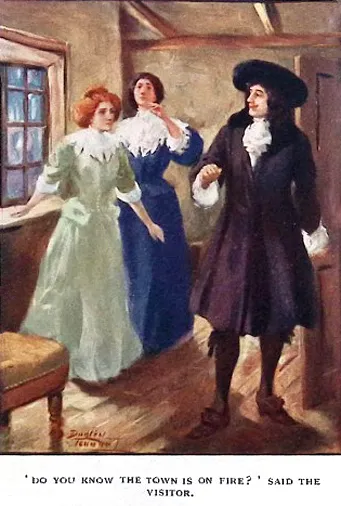
"Odd's fish, girl; do you know the town is on fire?" said the visitor,
as he came in.
At the sound of that voice, Mrs. Aylmer started forward, and with a
grace that only one accustomed to Court etiquette would know how to use
bowed herself before the stranger. "Sire, you have come to tell me of
my son?" she said in a tone of trembling earnestness.
"It is the king!" whispered Audrey, retreating to her sister's side.
"Who have we here?" said Charles, in no small surprise that he had been
recognised, for he had ridden out to see the fire with only one or
two attendants, and hearing in the street that there were only women
in the house, and one of them unable to leave her bed, he had come to
tell them they had better get away before the fire came closer, for the
wharves by the river-side were being gradually engulfed by the flames.
"It is—surely it is Dame Aylmer," said the king in a tone of
recognition.
"Yes, sire—and my son—does he live? Or—tell me the worst!" for only
Launcelot's death could account for this visit, she thought.
"Your son is well for aught I know, madam!" said Charles a little
stiffly.
And then looking across at the two girls standing together in
the window, recollections of other days conquered the returning
ill-feeling, and he exclaimed, "Odd's fish, we will let bygones be
bygones. Come, Mistress Audrey, let me look at you; and my little
monitor, Bessie, what has she to say to Charles now?"
"Oh, please your Majesty, Bessie has not walked or stood on her feet
for three years, until this minute!" said Audrey with scant ceremony.
"Risen in honour of her king," laughed Charles. "But this is no place
for an Aylmer," he said, looking round the room.
"We should like to go back to Aylmer Court," said Audrey eagerly, who
thought this chance of pleading with the king was too good to be lost.
"Hush, hush!" said her mother warningly.
She was shocked at the girl's want of Court manners in addressing the
king.
But it evidently amused Charles, and he was not at all displeased.
"Well, well! You cannot stay here, and you may as well go to Aylmer as
anywhere else. My brother York will grumble a little at first, for he
holds the manor, I trow, though I doubt whether he has ever made any
use of it. Pack up at once, and I will send for a wagon to take you and
your goods to Aylmer without delay. Give me pen and paper to write the
order necessary to take with you."
And Charles seated himself at the table, and wrote a few words,
ordering the steward who had charge of the estate to give it up at once
to Mrs. Aylmer.
The lady was too much overwhelmed with surprise to do more than murmur
a few words of gratitude, as she knelt to receive the order that was
to restore them to their own again. But anxiety for Launcelot overcame
every other feeling at last, and she sobbed out, "My son, my son! Have
you no tidings, sire, of my son?" for she still feared that the king
had heard of his death, and meant to console her in this way.
"Nay, nay! Pepys mentioned him to me as having done good service for
us in the Navy Office, which proves that ye are all loyal still; and I
meant to do something for him after the war was over. But ye must have
another house at once; and so, as ye want Aylmer Court, ye shall have
it. But I have not seen or heard of Launcelot to-day," he added.
"Then, I pray God he may be safe still; but he has gone to help at the
fire."
"He will speedily return," said Charles lightly. "Pack quickly what
goods ye want to take to Aylmer, dame; for there is little time to
lose;" and the king hurried away, leaving word at the last that a wagon
would be at the door shortly.
"Let us kneel, and thank God, and then we shall understand it better,"
said Bessie, when her mother returned, after conducting the king to the
street door.
And Bessie fell on her knees by the couch where she had so long lain
helpless, and returned thanks for the wonderful mercy that had been
showered upon them, praying, too, that God would help and provide for
the helpless ones whom this fire would render homeless.
Then, as Bessie rose from her knees, Audrey suddenly recollected that
she had no shoes on, and shoes and stockings had to be searched for.
And while the oak chest was being turned out, she walked across the
room to try and assist in the packing; for Mrs. Aylmer had speedily
decided that they must take all they could with them, for fear they
should find the house empty when they got there.
Mrs. Aylmer would not allow Bessie to do much in the way of packing.
Audrey would have made a little festival of her sister's putting on
shoes and stockings again, in spite of the awful crashing and roaring
of the fire that was now rapidly making its way towards them, for the
efforts that were made to stay its progress were useless; but Mrs.
Aylmer said they had no time for rejoicing even over Bessie: they must
pack a few things and get away, for the lower part of the house was
full of inflammable material, as well as the surrounding wharves. And
the sparks were now falling so thickly that each moment they were in
imminent danger of being surrounded by flames.
The king kept his word, and a wagon was soon at the door, and the men
carried out the goods without much regard to Mrs. Aylmer's directions,
urging her to make haste, and seat herself in the wagon, or they would
not be able to get out of the city before the fire was upon them. Mrs.
Aylmer tried to delay the removal, in the hope of seeing Launcelot
return, but the men hurried everything out so fast that she feared
they would have to go without any tidings of him, when, just as they
were about to descend the stairs, Bessie leaning on her mother's arm,
Launcelot rushed in.
"Thank God, you are safe!" he panted, too much overcome to notice that
Bessie was standing before him, until she laid her hand upon his arm
and said:
"Indeed we have much to thank Him for, Launce."
"Bessie!" uttered her brother, scarce believing the evidence of his own
senses.
"Yes; I have lain here, at the Beautiful Gate, like the lame man; but I
am healed at last."
"And we are going to Aylmer Court, Launce," interrupted Audrey. "The
king has been here, and sent a wagon to fetch us."
"Where are you going, mother?" said the young man, ignoring what seemed
like Audrey's wild talk.
"Now then, the streets are getting so full, we shall never get out of
London if we don't start at once!" called one of the men from the foot
of the stairs.
"We must go. I will carry Bessie," said Launcelot, taking his sister in
his arms.
The men had packed the goods so as to form some comfortable seats
for the family, and here they soon bestowed themselves, and the men
whipped up their horses without asking which way they should go. It
was needless at present, for they could but go westwards. London
Bridge being the only one built at present, there was no possibility
of crossing the river, and they could but fall in line with the stream
of vehicles that was bearing the unfortunate Londoners and their goods
away from the fire.
The poorer people had carried all they could save to Finsbury Fields
and other adjacent open spaces, but the wealthy merchants were anxious
to get farther away, and it was no easy task in the crowded state of
the road to get along at all. As they sat in the wagon, Mrs. Aylmer
told her son all about the king's visit, and showed him the order he
had written, empowering them to take up their residence at Aylmer
Court. But, instead of being delighted, as he would once have been,
Launcelot only looked puzzled and distressed.
"I can never go to Court and take up the old life, mother," he said.
"At present, I cannot leave the Navy Office; I have promised Mr. Pepys
I will return to him to-night, as soon as I have taken you to a place
of safety he has told me of."
"But we are going to Aylmer Court," said Audrey quickly.
"But you cannot get there to-night," said her brother; "it is evening
now. You must stay at the farm-house Mr. Pepys has recommended. And
to-morrow, it will be as well, perhaps, to push on, and take possession
at once."
Audrey clapped her hands. "Only think, we shall see our own dear home
to-morrow!" she exclaimed.
"I cannot come with you unless the fire is put out to-night," said
Launcelot. "I have promised Mr. Pepys that I will not be away long, for
fear it should be needful to move the Navy Office papers; for I know
just where to put my hand on everything, and it would cause endless
confusion now if these should be burnt."
"I am sorry, but you will do your duty to the king, and I will not
hinder you," said Mrs. Aylmer.
"I will try and write some letters to Mr. Maitland and Rosalind. She
must come back to us now, mother," he said.
Audrey uttered an exclamation of dissent, and Bessie looked as though
she would like to prevent it if she could.
But Mrs. Aylmer said quietly, "Of course we shall have Rosalind with us
now."
This conversation had to be carried on in snatches, as they could make
themselves heard above the roaring of the fire and the crash of falling
buildings. And very little more could be said for some time beyond
making the driver understand where he was to go.
The farm-house where they were to stay the night was only a little way
beyond Holborn Fields, and here Launcelot left them, and returned to
London.
The next morning, when they got up, they could see by the lurid pall of
smoke that overhung them that the fire was still burning. And it was
not until they were half-way to Aylmer Court, that they got beyond the
stifling smoke and out into the clear sunshine.
How sweet and peaceful everything looked round their old home, as they
drew near it in the warm sunshine of that September afternoon! Mrs.
Aylmer was greatly overcome when her eyes first saw the well-remembered
scene, and even Audrey's spirits were somewhat subdued as they came
within sight of the quiet, empty house.
As the wagon drew up at the entrance gates, an old man came from a
lodge at the side, and demanded what they wanted. But the moment he saw
Mrs. Aylmer, he recognised her as his old mistress, and she knew him at
once as a faithful servant.
"It is Tomkins, our butler!" exclaimed the lady joyfully.
And the next moment, the gates were thrown wide open, and the old man
was bidding them welcome with tearful earnestness. He had the keys of
the house, and had taken care to keep it aired, and had not allowed it
to fall into ruin since the departure of the last tenant, and he did
not need to see the king's order before granting Mrs. Aylmer admittance.
To her great joy, she found it little changed from what it had been
when she left it. Furniture was made to last a generation or two in
those days, and as none of this had been removed, it would be easy to
make things homelike again.
Tomkins soon brought two of his daughters to light fires and make
things comfortable. But the old man could do little more than walk
behind Mrs. Aylmer as she went over the house, and ask questions of the
past, for it was little news he had heard lately of the family he had
served so long.
The next day and the next passed with no news of Launcelot. But on
Thursday afternoon, he arrived very tired and exhausted after his
exertions in London. The fire was out at last, but nearly half the city
was in ruins, and hundreds were homeless. He had written to Rosalind,
and so she might be expected any day, as she would doubtless leave Eyam
the first opportunity she had.
"I have also written to Mr. Maitland, telling him all that has
happened. And when the king has settled matters with the Duke of York,
and duly transferred the estate to your mother, we will invite him to
come and be our chaplain."
In truth, Launcelot was afraid to take any step until this necessary
business had been done; for although it was but the barest justice
that this should be done, he knew the grasping disposition of the duke
and the careless prodigality of the king so well now that he refused
to give up his position in Mr. Pepys' office until their position at
Aylmer was quite secure.
"I don't believe Launcelot cares whether he lives here or at the Blue
Boar," said Audrey, pouting, when she heard that her brother would
return to London in a day or two.
"Oh yes, I love the dear old place," said Launcelot, "but I learned to
know of my other inheritance while I lived at the Blue Boar—the dear,
shabby old home: it is in ashes now, but I shall never forget it,
or the lessons I learned there. But for these, I should have been a
thoughtless gallant of King Charles' Court. But now, if I am spared to
come to this earthly inheritance, I trust I shall use it in my Master's
service."
But although Launcelot said this cheerfully, Bessie knew that he was
not glad to come back to their old home—that he was afraid—afraid of
himself, and afraid of the wealth God had given them again. And as she
slipped her arm in his, to walk in the garden, she whispered, "Trust in
Him, Launce: we have trusted in tribulation, and He has helped us; now
He says to us, in all times of wealth, 'Trust Me still.'"
"But if it should dim the holy Light for us, Bessie?" said Launcelot
with a sigh.
"But it cannot, unless we make it. We are weak, but God is
mighty—mighty to save even in times of wealth. How we shrank from
poverty before! But God took away the sting, and made it very sweet at
last; and so He can make our wealth as rich a blessing to us, for we
may now become His almoners, feeding His poor, teaching the ignorant of
His flock, and holding up the holy Light of our Saviour's life and love
wherever we go. Think how much we can do for the villagers here now!
Mother will teach them that to be clean is the best way to keep off the
plague; and Mr. Maitland will have a school, and if he cannot preach in
the church, he can in our own big stone kitchen. Oh, Launce, my heart
is brimming over with joy and gladness!"
There was no need to ask whether Audrey was glad. She was in a constant
ripple of contented gladness, not even grumbling when she heard that
Rosalind might arrive the very next week.
But, alas! Rosalind never came to Aylmer Court. The next week brought
a letter, full of sorrow, from Mr. Stanley, saying that his niece had
died of the plague. The village of Eyam was almost depopulated by its
ravages. He and Mr. Mompesson, the vicar, had done all they could
for the relief of the sufferers, and must have carried the infection
to their homes; for Mrs. Mompesson died of it first. And, although
Rosalind had been careful not to go near any of the sick, she took it,
and died soon afterwards. This was the substance of the letter, and it
cast a gloom over their happiness; for, little as Rosalind was liked,
it was sad to think how, by her own impatience, she had again and again
defeated herself, and at last come to an untimely end, just as her
hopes of gaining ease and luxury might have been realized.
But cheerful news came from Mary Maitland. They were all well and
happy; only her father was pining for work, and fretting against the
restraint upon him by the "Five Mile Act," which debarred him from all
active service as a teacher and minister.
Meanwhile, the necessary law business for the transfer of Aylmer
Court and the whole estate belonging to it to its rightful owners was
pushed forward as rapidly as possible, by the order of the king. How
he managed to satisfy his rapacious brother nobody knew, but it was
significant that Sir William Coventry suddenly recollected, when he met
Launcelot, that he had seen him before. And it was generally understood
that Mr. Pepys had contrived to push his interests at Court; so that it
was not long before Mrs. Aylmer was able to write and ask Mr. Maitland
to become her domestic chaplain. This, as she knew, would give him the
long-desired work which he craved; for, as the representative of a
well-known Royalist family, he would be above suspicion, and could do
much that a private minister could not, although the odious "Five Mile
Act" would still prevent him doing a good deal that he might wish.
Need we add that the Aylmer family became a blessing to the
neighbourhood where they lived, and far beyond their own particular
locality; that the poor and ignorant for miles around had good reason
to thank God, as well as Launcelot, for the lessons He had taught them
at the sign of the Blue Boar?
THE END.
Printed by MORRISON & GIBB LIMITED, Edinburgh