I am a plain man, and to do a plain man’s
work was ever more to my taste than to
set down with a clerk’s skill such happenings
as have befallen.
Nevertheless, something within me spurs
me onward; for, to tell the truth, I am loath
to die leaving no record of the sights that I
have seen; sights to brand the memory and
stir the blood, and doings to turn one hot and
cold, years after the doers thereof have crumbled
into dust.
Fate, fickle jade, has willed a peaceful end
for me—a man from whom peace has ever
been afar off. Yet by my fireside I am not
alone: Zobo, the Mighty, wrestles in the
2flames; Astolba, my fair white dove Astolba,
gently smiles upon my waking dreams, and
she, the Queen with deadly wondrous beauty,
like some fair poisonous flower, flaunts before
my eyes.
But enough of fancies. I must on to the
beginning of the marvellous tale in which I
was to play so large a part. A tale strange
beyond common reckoning; strange beyond
belief, were I not known not only as a man
whose inches well may bear him out, but
also as one little versed in the art of embroidering
blunt facts with fine imaginings.
It chanced in this wise:—
We sat by the fire, Gaston Lestrade and
I, one dark and stormy evening, for this was
the end of the rainy season. We were in the
African interior; fortune had dealt hardly
with us. It is not needful to the purpose of
this tale to tell by what and by whom we had
come to so dismal a pass; enough that we
found ourselves wet, hungry, surrounded by
hostile savages, and, worse than all, poor to
nakedness after four months’ irksome traffic
in ivory and gum. Lestrade sat pulling his
3fine black mustache, for all his present
wretchedness, with the air of a dandy on the
Parisian boulevard, though there was not a
petticoat within miles, and death, from one
cause or another, more like to be our portion
than amorous adventure.
A quick eye for a woman had my comrade,
and a heart big enough to hold all the sex,
or, at least, such as were personable. But
over and above all this, Gaston Lestrade was
a man to die for a friend, albeit with a jest
on his lips, and I forbore to meddle with his
pastimes.
For myself, I cannot deny that women
have ever held me in esteem, and once or
twice have urged me to retreat by hot advances.
The reason of this has ever seemed
to me that I am big of limb and brawny
withal; that I am slow to speech and anger,
yet enduring in that to which I have
set my mind. And this is not commonly the
manner of the sex, who look up to the power
or strength such as the Lord has not given
them, whose tongues are nimble, and whose
fancies float hither and thither with every
4breath, like thistledown before the wind.
And so they take to that which is not of
their fashion.
Every man to his taste, say I—the wooing
of maids to one, the clash of arms to another,
and for me comfort and plenty, and as little
danger as possible, which is in itself a strange
thing, since it has been decreed that all my
life till now be spent for war and women.
But I must hark back to the fireside. We
had taken stock of our resources, and with
the less trouble, inasmuch as they were few.
“Four biscuit, mon ami,” said Lestrade,
“and a few strips of smoked meat. Truly,
Africa is an excellent place to starve in.”
And he yawned as though the subject did
not closely concern him.
Which nettled me, and I spoke sharply:
“Our powder and shot are nearly spent. The
king, next whose village we lie, loves us not;
his fourth wife can perhaps tell the reason.”
Here Lestrade yawned again.
“A spiritless wench, but not uncomely,”
he murmured in his own tongue.
“The palm-oil wine is gone,” I finished.
5Here my comrade was pricked to interest.
He raised the flask and set it down with a sigh.
“Hélas, thou art ever right, my Dering.
What shall it be? Do we fight our way to
shore, or on through the jungle, or does it
meet with thy judgment that we await here
the tender mercies of our royal neighbor
yonder?”
I gave the fire an ill-tempered shove with
my foot, for I was cold and hungry, and it
has ever been my experience that a man’s
sweetness of temper will suffer from the
emptiness of his stomach. “You know it is
equally impossible to go or to stay,” I answered
shortly. Lestrade held up his hand
for silence, and through the heavy patter of
the rain on the roof of our hut came a noise
that was not of the jungle. Gaston looked
to the priming of his rifle; I held my finger
on the trigger of my own.
“Some one running, and for his life,” said
Lestrade, under his breath, and even as he
spoke, the door of our cabin was thrust open,
and a man leaped into the fire-lit circle.
He stood a hunted creature, quivering and
6amazed for an instant, the next, an arrow
sped through the doorway and buried its
point in his shoulder.
A yell of triumph rang through the forest,
and two Fan warriors, hideous in war-paint,
followed. They faltered on seeing Lestrade
and me, but quickly plucked forth their spears
to do us injury.
It was not the time or place for argument.
The report from Gaston’s rifle rang out sharply,
and the first savage pitched headlong and
lay still, a thin, dark stream trickling from
the body over the earthen threshold. The
second, I dropped also, but not so neatly, for
he wriggled like a big black snake into the
underbrush, and was lost to sight. Seeing
which I turned to look at our visitor, but here
again Lestrade was quicker than I.
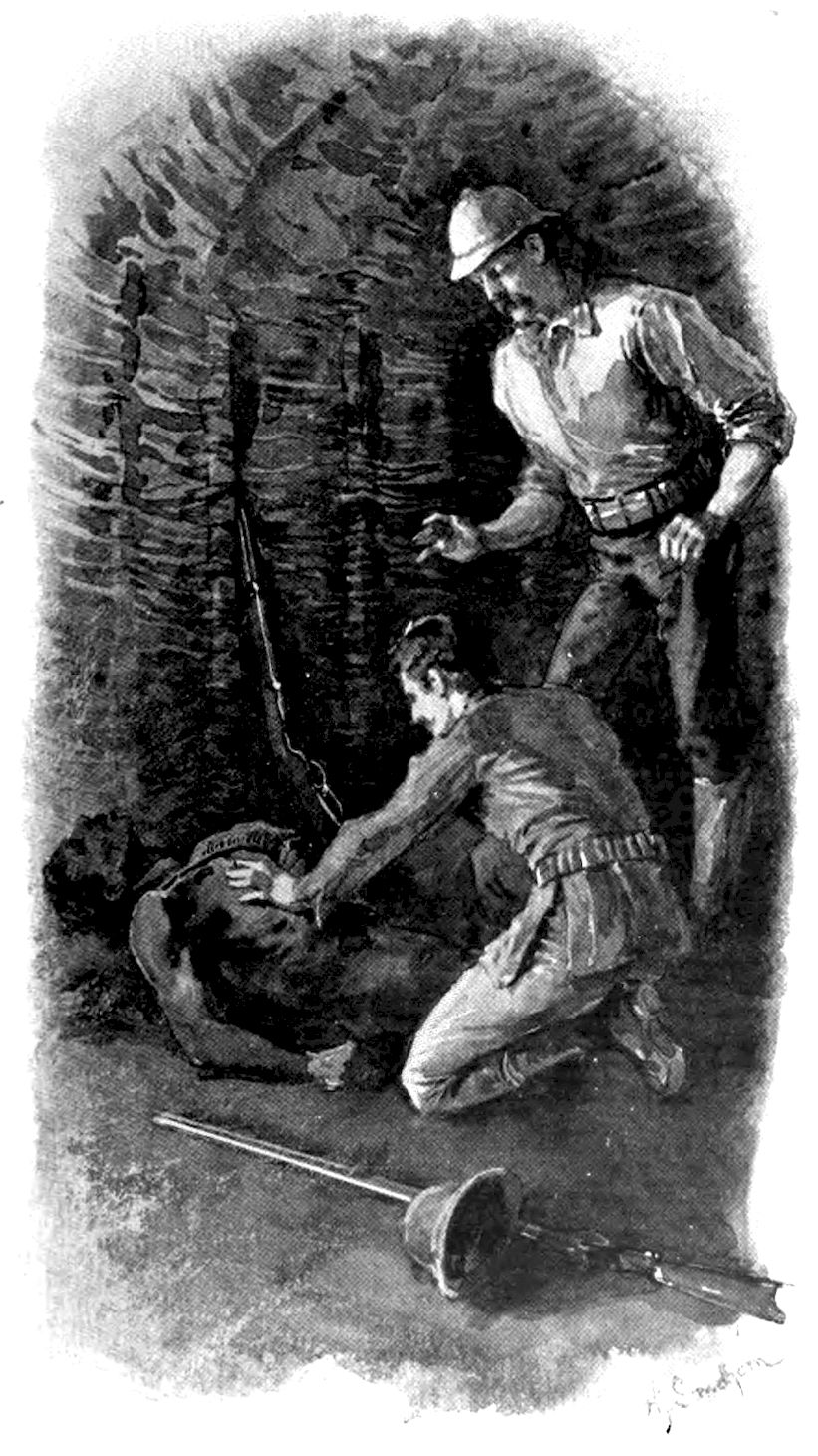
The negro was leaning heavily against the
side of the hut, and Gaston held in his hand
the slender arrow which he had plucked from
the man’s shoulder.
“A pin prick,” I began, with some contempt,
for indeed the stranger’s pallor, black
though he was, and my comrade’s grave face,
7seemed greater tribute than was needful for
so slight a hurt.
“Poisoned,” Gaston answered briefly, and
even as he said it I knew that it was so.
I took the piece of bamboo in my hand.
It was some ten inches long and sharpened
at one end. I stooped and picked up the bag
of skin that lay on the floor beside the body,
still warm, of our fallen foe. Arranged in
careful order within were other arrows like to
the first, each red-tipped, each a swift and
fatal messenger.
There was no hope, and the wounded man
knew it.
He was a tall, muscular savage, a little
stooped and grizzled with age, but powerful,
save for the death sickness that had begun
already to loosen his joints.
Many lines crossed and recrossed his face,
and as I looked on him more closely, I saw
that his features were not those of the neighboring
tribe, nor indeed did his face resemble
the natives that I had seen. Furthermore,
his skin was more bronze than black.
A curious woven strip falling from one
8shoulder over the right breast bound his
middle. Save for this, the man was naked,
and I saw that some strange torture had
twisted and distorted his wrists and hands.
Moreover, his body bore in several places
the mark of hot iron, and my gorge rose at
the thought of the infernal cruelties that had
been practised.
Meanwhile Lestrade, with something of a
woman’s touch, and in that was I ever far
behind my comrade, well-known as he is for
skill and nicety in sickness,—Gaston, I say,
had helped the stranger down, had placed a
packet beneath his head, and now stood waiting,
helpless to do more and pitiful of the
drops of agony that stood bead-like upon the
forehead of the dying man.
The end would not be long. Presently the
savage spoke, and in the dialect of the neighboring
tribe, but with the words somewhat
clipped and altered as one speaking a strange
language to strange ears.
“I am Sagamoso, priest of the Council,”
he said, “and the door of Shimra opens.” He
raised himself with pain, upon his elbow, and
9his eyes glittered strangely in the firelight.
“Nevertheless, promise, O men of white
countenance, that you will bury me, my feet
to the rising sun, ashes upon my breast, in
the name of Edba and of Hed; and deep, deep,
so that no beast shall rend me, no enemy
loose me from my grave. Inasmuch shall I
escape the last evil.”
“Christian burial, and no heathen mummery
shall you have,” said I; for in truth I
was sore that this savage should have fled to
us, as if our case was not evil enough, and so
was like to bring the whole tribe of Fan, like
a swarm of angry bees, about our ears.
Lestrade was silent, and the stranger catching
at my tone looked from one to the other
of us, for a space, in silence also.
Then, as if some inward power thrust from
him words he fain would have held back, he
burst forth:—
“O men of white countenance! My hour
is at hand. Swear by Edba and by Hed to
bury me as I have besought, and the place of
the woman and of the treasure shall be known
to you, and, moreover, the secret way.”
10“The woman!” said Lestrade, drawing in
his breath quickly.
“The treasure!” I cried, and neither of us
thought of the strangeness of such words
from the lips of a savage.
Then by Edba and by Hed we swore; for
the man’s words had somehow taken hold
upon our minds, and afterwards, all-curious,
half-believing, for the very strangeness of its
telling lured us on, we heard the story of
Sagamoso, one time priest of the people of
the Walled City, now outcast and slave.
I cannot tell it as he told it there in the
African forest, with the rain falling heavily
without, and the fire casting strange shadows
on the face of the dying man, convulsed
now and again by the action of the poison
that was eating out his life. But the things
that he said are set down in due order, though,
as I told you, I am no scribe and cannot cunningly
interweave and polish my words as the
learned do.
“I am not of this people nor of this
place,” said Sagamoso; “my home is many
miles hence, and the path is hidden and beset
11with peril. But two of the people of white
countenance like to yours have ever come so
far,—one a man old, not so much with years
as with weariness and the toil of wanderings;
the other, his daughter, straight and slender,
and fair above the common lot of woman.
“Him we slaughtered there at the outer
gate, as is the law for strangers. The maid
was at the Queen’s behest brought to the
palace, but whether as the bride of Hed, I
know not. Such service rendered to our god
is like to be her portion: nevertheless, three
moons must wax and wane before the feast,
wherefore you who are of her people can yet
save her from the death marriage, unless, indeed,
Hed be wroth, or Lah, the Queen, set
her will to thwart you.
“Yet even so, surely of maids there are
many, but of treasure like to that in the
secret storehouse of Edba, there is not in
the whole world.
“I, Sagamoso, priest of the Council, tell it
you. O men of white countenance! torture
like to this,”—and he raised his twisted
claw-like hands,—“torture of hot iron and
12seared flesh could not have wrung it from
me. But if I be not buried with the rites of
the dread god whose servant I yet am, I must
walk forever in the outer darkness, weariness
unutterable my portion throughout all ages.
Because of the sin that I have sinned, the
door of Shimra indeed is shut before my face,
but the peace of nothingness is still within
my grasp, and for that peace will I betray
the secret of the city that has cast me forth,
the secret of the jewels and the fragrant
gums, the ivory and precious woods, the gold
and rich garments and the wines of price,
that lay hid within the bowels of the earth,
and guarded by the name that may not be
spoken.”
Here the stranger’s voice faltered and was
still, and Lestrade and I looked at each other
in amazement that was yet half belief, for the
passion in the tones rang through the hut,
and that the manner of this heathen burial
was to him that asked it of vital import, none
might doubt.
“This maiden,” said Lestrade, as though
the thought of the treasure had passed him
by, “what dreadful fate threatens her, and
where is this walled city?”
13The poison was doing its work all too well.
Thickly and with difficulty the words came
from the swollen lips of the dying man. He
thrust aside the woven strip that covered his
breast.
“Look!” he gasped; “the secret way.”
Lestrade and I bent close and there sure
enough, tattooed in lines of blue and red,
on a spot above the heart as big as a man’s
palm, we saw a rude map.
“Straight through the jungle northward,”
breathed the priest, “by the swamp, by the
waterfall, through the mountains, where beyond
lieth the Pass of Blood! Behold the
sign!”
His wavering forefinger touched the woven
garment, and we saw the fantastic outline
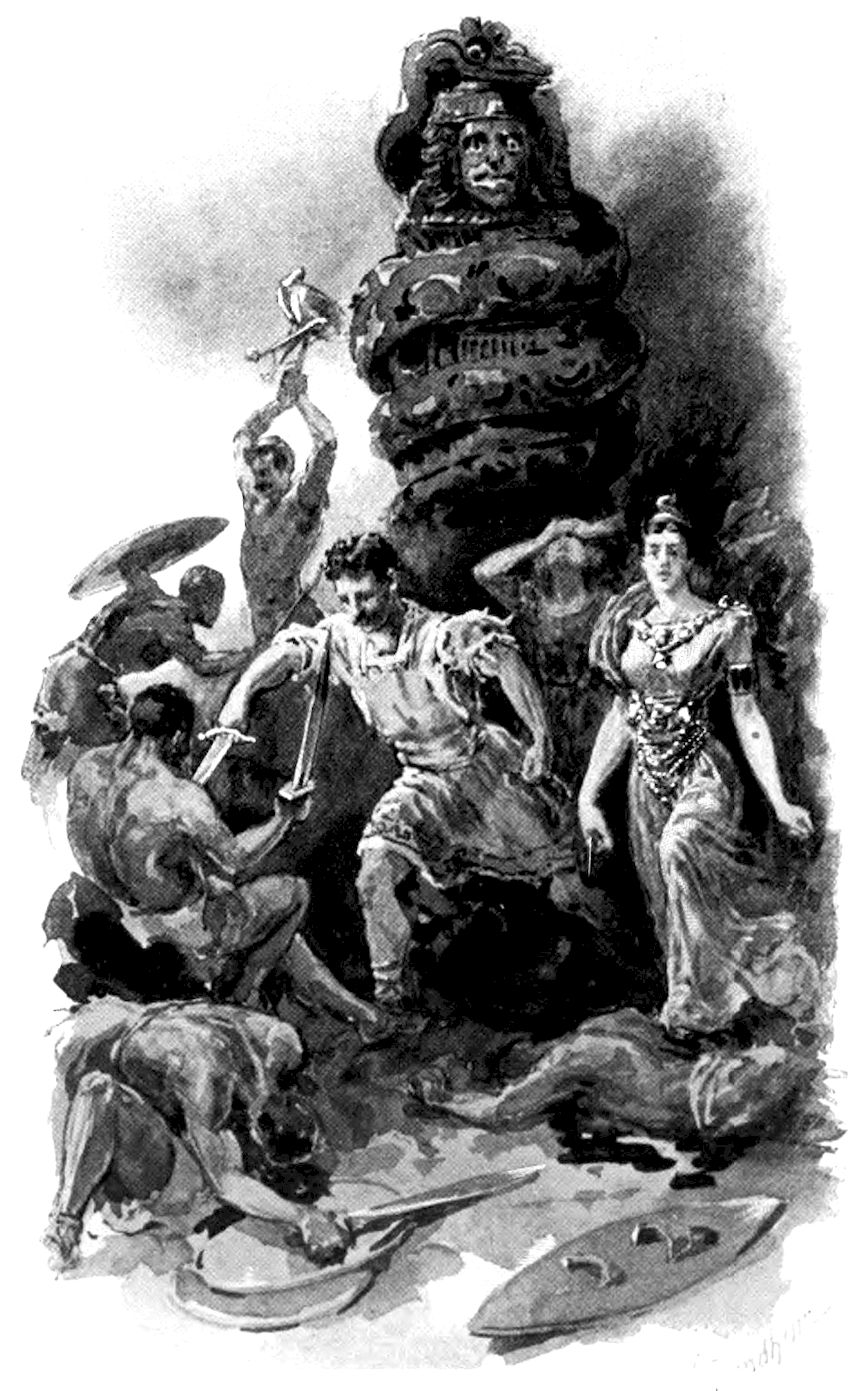
of an evil, leering god, about whose squat
and crooked body twined a monstrous serpent.
“Bid the gate open in the name of
Hed!” he continued, his voice growing full
and resonant once more. “And look you—speak
14not of Sagamoso, the betrayer of
the trust, the defiler of the sanctuary. Him,
they think long since dead. Let his name
be forgotten lest it be cursed before the
Council.”
“But the maid, the maid!” cried Lestrade.
The eyes of the stranger narrowed. A
curious light blazed in their depths. With
a superhuman effort, the dying man raised
himself from the ground.
“I am a priest of the Council,” he cried,
in a strange, chanting kind of voice. “I
have been traitor. I have been slave. To
Edba and to Hed have I turned my back.
But my gods remember, my gods are strong,
my gods punish. Think not to wrest from
the Snake, his bride.”
The strange, triumphant note broke. “By
Edba and by Hed have you sworn,” he
muttered, and so passed.
Lestrade and I had learned the slave’s
secret, and the leaven for good or ill was working
within us, silently indeed, but with a
strange, persistent, and fateful power.
First, without more words, we buried him,
15and with the rites he had demanded, for I
am a man of my word, and Lestrade follows
my leading easily in that which affects him
not nearly.
Then—for the day was at hand—we considered
briefly that which had taken place
and that which was to come.
Our present fortunes could well bear mending.
The priest’s words of a woman to be
saved, and a treasure to be gained, had fired
our blood. Life held little of safety for us
here, and the end of it was that Lestrade’s
daring spirit weighed down my more prudent
advices, and the die was cast.
Once having resolved upon the enterprise,
I put from me, as is my habit, all thought
against the wisdom of the undertaking,
though to perish in the jungle in the pursuit
of a phantom city, or to be slain at
its gates in reality, seemed like to be our
portion.
Sagamoso’s last words echoed in my mind.
That hatred of the white stranger had lurked
in the eyes of the dying man I doubted not,
but needs must when the devil drives.
16Wherefore, without more speech upon the
matter, our scanty goods were packed, and
Lestrade, with a gay tune upon his lips,
and I, the more silent for his light-heartedness,
set forth upon our journeyings.
Chapter II The Pass of Blood
17
The first step now was to flee from the
wrath of the Fan tribe.
Cannibals were they, and over and above
their just cause for offence I felt that they
had long been tempted to try the flavor of a
white-man roast. However, I was not minded
to end my days in so inglorious a manner;
neither would Gaston’s high spirit brook the
thought of such disgrace. We pushed our
canoe, therefore, with all good-will up stream,
and by dint of hard paddling, in the art of
which I stand second to none, we had soon a
comfortable distance between ourselves and
our neighbors.
Lestrade had copied with feminine painstaking,
on a strip of hide, every line of the
rude map tattooed upon Sagamoso’s brawny
18chest. I, for my part, had taken with us the
woven garment, which I saw was made of the
hair of some animal, a goat probably, and
which was colored with vivid dyes in orange,
crimson, and blue.
Following, as well as we might, the chart
that was now our only guide, towards nightfall
we beached our canoe, and I, by great
good-luck, speared a small monkey that chattered
in the branches of a tree overhead. We
quickly made a fire, and Lestrade served a
steak which, garnished with plantains, left
nothing to be desired.
The howling of a panther sounded faintly
through my slumbers that first night of our
encampment, but the protecting fire kept the
great cat at bay, and he had gone by day-break.
We arose refreshed and ready to look lightly
upon our quest, all undisturbed by the slenderness
of our ammunition and stores. So
one hour passed and another. We had begun
to suffer much from the thorns that tore our
flesh, from innumerable flies that ran their
red-hot needles into every unprotected inch
of our bodies and even through our clothes.
19Our shoes, too, had by this time been cut
in strips, and our feet were swollen and bleeding.
But these were hardships that every traveller
looks to, and we were consumed with the
desire to find the Walled City and behold
the maiden and the treasure that its temple
held.
Indeed, we talked of little else. Gaston
turned the slave’s tale this way and that, and
his nimble tongue wove pictures all different
in form, but all ending happily with processions
of triumph, where crowned as kings we
bore away the damsel and the gold.
Even to my sober thought, these tales
lightened much the journey; yet, though I
am not given to fancies, the eyes of the
heathen god outlined upon the dead priest’s
garment, at such times seemed to gleam, with
a kind of horrible joy and malice, and the
snake’s crest reared, and I could almost hear
the thick hiss in which the python vents its
rage.
It is not my purpose to relate each adventure
as it happened. Perils from man and
20beast there were. Once we were captured by
a strange tribe and escaped narrowly, leaving
behind us much of vital use to us in our
journeying. Once I saved Lestrade, helpless
and unarmed, from the fury of a gorilla.
Once we fled for our lives before the onslaught
of an army of brown ants, that strip to the
bone every living thing that ventures in the
line of its strange march.
So on, and at last we reached the waterfall
set down upon our chart, and here a thing
happened that kindled anew the fire of our
drooping hearts.
It was a thing wonderful in itself, more
wonderful as explaining the parting words of
the slave Sagamoso, and it clearly showed us
that we had not strayed from the right path,
and that the jungle had given up its secret.
This waterfall was higher than any I had
seen in Africa. It fell with a rush and a roar
loud enough to be heard very far off, and it
was split at its lowest part by a tall pillar of
stone, on which was carved—and this was
what cheered us like wine—the grotesque
image of the snake-encircled god.
21How such a pillar could have been set up
by mortal hands in such a place, exposed as
it was to the fury of the downpour of this
great body of water, was in itself a marvel,
and threw a new light on the people that,
with our small store of weapons, we two men
had set out to brave.
“The waterfall must have been turned from
its course,” said Lestrade.
And I, seeing no better way out of it, agreed.
Yet was this no time to stop and argue the
matter, so we took up our burdens once more,
and, with renewed hope, pressed on; and
the more certainly in that here the jungle
broke, leaving before us a broad track, as
though an army of elephants had fled or been
driven along the way.
This did not astonish us at the moment,
for there are many such clearings in the
African forest; but as we sped onward, and
the broad thoroughfare still stretched before
us, as far as eye could see, we knew this was
no common happening.
Night found us yet on this untrammelled
and solitary highway; and as the shadows
22closed, I am not ashamed to confess that
a chill settled on my heart, and that even
Lestrade grew silent.
However, naught chanced to disturb our
slumbers, and looking well to our arms, we
marched briskly forward.
Lestrade was a little ahead, and on a
sudden he gave a sharp cry and—disappeared.
The ground had opened and swallowed
him. I pressed forward, and my
horrified gaze took in at a flash the devilish
trap into which he had fallen.
A pit thirty feet in depth, twenty feet or
more in width, stretched, as I afterwards
found, from one side of the road to the other.
It had been artfully covered with a fine mesh
of woven grass, and this mesh by several
inches of earth, so that the fiendish contrivance
was hidden from the most careful gaze.
Air-holes, the use of which I will tell presently,
were so arranged as to be concealed by the
dense foliage of the jungle. The plaited
grass of course could not bear up any weight
of moment, although small animals might
safely venture across.
23But this was not all. A loathsome mass
of serpents crawled and twisted upon the
bottom of this pit; and hanging by his fingers
from a slight projecting rock on the side,
some twelve feet down, I saw the agonized
form of my friend.
“Courage, Gaston!” I cried, and cheerfully,
though my soul was sick within me. “I will
save you—or shoot you,” I added inwardly.
Even in that moment of horror the old
mocking smile played for an instant on the
white face beneath.
“Agreed,” Lestrade answered, in a voice
that he fain would have copied after my
own.
I slipped the woven garment of the priest
Sagamoso from about my body, and knotted
it into a running noose. This I tied securely
to the stock of my rifle, and leaning over the
pit, I swung it down in the hope that I might
fasten it under Gaston’s shoulders and so
ease the terrible strain that I could see grew
instantly more unbearable.
I beheld the white bones of animals or
men in the pit beneath. The fetid odor of
24that nameless place assailed my nostrils, and
I saw, merciful heaven! that it should be so—the
noose fell short.
I looked heavily upward, and there, carved
on a tree that overtopped the pit, I beheld the
horrid image of the snake-encircled god.
The face leered down upon me, and the
eyes taunted me, vile slits that they were, in
the impassive cruelty of that smooth countenance.
Then a frenzy seized me and lent strength
to bone and sinew.
“I will save you, man, or I will die with
you.” The sound came thickly from between
my teeth.
I thrust my spear deep into the ground
beside the pit. I tied about me one end of
the garment of the dead priest, and fastened
the other to the spear. Then with my naked
hands I made a kind of foothold in the close
packed earth, and let myself down over the
edge. If there was a flaw in the iron forged
by savage hands, the spear would snap. The
woven strip of cloth that cut into my flesh
might part under the strain, or the stake be
25pulled from its earthen bed. I dared not
look below, but I heard Lestrade’s quick,
hard breathing.
That twelve feet seemed a hundred, and
the snail pace all the slower for the galloping
pulses of my heart.
All at once—for the ear grows keen in
danger—I heard Gaston’s fingers slipping,—slipping
along the rock.
“Friend, I can do no more.”
The faint whisper was borne upward from
the pit. With a superhuman effort I let go
my hold with one hand, and my fingers closed
upon the collar of Lestrade’s shirt.
He hung a dead weight, limp in my grasp,
and I thought my arms would start from their
sockets. The spear above us swung to one
side; the sweat from my forehead ran down
and blinded my eyes.
With an animal instinct I clung to the side
of the pit. I could feel the veins in my temples
full to bursting, and for one brief moment,
ease from that terrible rack seemed more to
be desired than a friend’s life; more precious
than sunlight; a better thing than honor itself.
26The next instant, and my foot, by the Lord’s
mercy, touched the stone that had stayed
Lestrade’s fall.
Inch by inch, I, John Dering, lifted that
unconscious body, while the birds twittered
in the branches overhead, and the pitiless
sun beat down, and the god of the people
of the Walled City kept evil watch, and the
serpents hissed and writhed in the pit beneath.
At last I had one arm over the edge of
that place of torment. One final mighty
effort, and Lestrade was safe, while the spear
shot from its socket, and fell tinkling into the
depths below. How I drew myself up to lie
upon the edge beside my friend, I do not
know. My blood had turned to water in my
veins, and I was as weak as a new-born babe.
I could not have lifted a finger to have escaped
a thousand deaths. Earth and sky came together
in one black threatening mass; the
next I knew Lestrade was pouring water on
my forehead, and moreover kissing me on
both cheeks—a foreign practice I could never
stomach, and one which soon brought me to
my senses.
27That day we rested. The next we tore the
cover of grass from that foul trap, and left it
open to the gaze of men and beasts.
Then because I am a religious man and
believe in the right conduct of human undertakings,
I swore to set my face the more
earnestly towards the object of our travelling.
Neither to seek peace or comfort till the
Walled City be found; praying that Providence
might deliver into my hand the maker
of that death pit, that I might presently bring
him to a repentance that would be beyond the
pale of backsliding forever.
“The Lord do so to me, and more also, if
I follow not the leading of my conscience in
this matter,” said I, and Lestrade answered,
“Amen.”
Then, because we were not to be put aside
like children, from that to which we had set
our minds, we felled a tree, and bridged the
pit and so crossed.
Much more slowly we now proceeded, for
we had been taught caution, yet we marched
onward, with little thought to the map, for
the course lay plain before us. We were now
28in a mountainous country, and it had grown
cool, a matter for much thanksgiving. We
guessed by this and other signs that now our
quest was well-nigh over, and we were right;
for at length after much toil of travel we came
without mishap to our journey’s end. Massed
across the open appeared a pile of rock, and
as we neared, I saw the lines in Lestrade’s face
deepen. Nor was I untouched, for we did not
doubt that before us lay the entrance to the
City that we sought. We looked to our guns
and came up with all caution.
The noise of the jungle was in our ears,
but of human sight or sound there was none.
The mass in front towered above us to the
sky, and we saw that it had been set in place
by some gigantic machinery unknown to the
civilized world. The massive barrier was
formed of rock, fitted together with cunning,
and smooth like glass.
The nature of the rock was strange to
us, for it was splashed here and there by
great red stains, like gouts of blood; and the
fancy was further heightened by a scarlet
creeper that clung and fed itself, and well-nigh
29covered the base of the ponderous
mass.
There was no gate nor doorway nor visible
opening of any kind, and on each side of the
great wall grew dense a prickly thorn, so
tough that it turned the edges of our axes,
and we saw the hopelessness of cutting
through our way, even if the wall of stone
extended not further in the African forest
than eye could see.
That this was the mocking work of the
people we had come to seek was plain; for
here, as before, by the waterfall and overlooking
the pit, here on the central rock and
far above our heads, was painted the same
gross image of their god.
We hoped to find some hidden entrance,
and we went over the wall’s surface, Lestrade
and I, with patient fingers, all the long morning,
and again and again, till night had well-nigh
settled down upon us. But all in vain.
The unyielding mass barred our further progress,
and, as before, the serpent god gloated
over the failure of our hopes. Mad at this
ending, I seized my gun, and aimed it
30straight at the hideous face above. The
ball sped surely, as my shots ever do. It
flattened itself against the surface of the
rock, between the creature’s eyes.
There was a dull rumbling, a sound as of
chains that slid and struck against stone or
metal. Then the central stone slowly turned,
as on a pivot, and forth from the opening
poured a wild stream of men.
Chapter III What Next Befell
31
On they came, like a swarm of angry
bees from a hive; and I saw that they
were mostly men of great stature, though
mine, I judged, would still overtop the tallest,
the which I do not say boastfully, but
as one bearing witness to the truth.
Now that we had come at last to open war,
my mind was clear, as my hand and heart
were steady, and I could take calm note of
this, as of other matters.
Lestrade was humming a gay tune at my
side, his rifle well aimed, his finger on the
trigger.
These people were clearly brethren of the
dead priest Sagamoso, for they were of the
same bronze color; and as they drew nearer,
I perceived the regularity of their features,
like to his.
32They carried spears and swords that flashed
bright in the rays of the setting sun. They
called to us in a strange language and with
threatening gestures; but I am, as I have
said, a peaceful man, and loath to shed blood,
so with a word I restrained my more fiery
Lestrade, and we abode their onslaught.
Then a spear hurtled through the air and
clove the fleshy portion of my arm, and with
that, the lust of conflict fell upon me, and my
eyes saw red, and verily I was mad with the
joy of battle.
The foremost dropped before me, shot
through the heart, and the second.
They paused for an instant in their onward
rush, but I thought not so much with fear
or surprise, as in obedience to a command.
Then they pressed forward. My rifle emptied
itself into the compact living mass.
Lestrade was close behind. I seized the
barrel in my hand, and the first oncomer fell
like an ox beneath the blow.
So, thrusting, beating down the line of
shining weapons, I clove my way through,
and for me there was no weariness, nor fear,
33nor prick of bodily hurt. Only that fierce
gladness, that inasmuch as it is the man’s
portion, transcends the lot of woman. There
was one strange thing I noted even in the
midst of the tumult. The warriors seemed
bound by some observance to disable rather
than to wound us. They struck heavily, it
is true, but with the flat of their swords, and
this I could see was from no love of the
stranger.
Hate flashed from their eyes and rang in
their voices; so as I laid stoutly about me, I
did so with the more good-will in that I felt
myself reserved with Lestrade for some more
devoted sacrifice than was possible at the
moment.
On a sudden the howling horde melted
away, and a new enemy appeared. Down
the open space, with great leaps, and with a
cry, half bestial, half human in its malice,
it came. A gray, furry body, fantastically
striped in red and blue, two shining, bead-like
eyes. This I saw; the next instant two
sinewy claw-like hands were at my throat, and
we were rolling over and over in the dust, the
34creature biting and striving to smother me in
its embrace. It was strong, and it knew the
tricks of wrestling. For a time neither one
of us could boast of vantage.
The fight had ceased, and I dimly saw
Lestrade trussed into a helpless bundle and
lying upon the ground. The people of the
Walled City stood in silence, resting upon
their arms, like warriors of bronze.
Then the inward fury that consumed me
stiffened my muscles to steel. My knee
rested on the creature’s hairy chest. I
seized its jaw in my hand, and forced its
head slowly, slowly back.
Its eyes rolled in helpless fury; its great
teeth were ground together in a rage that defied
me to the worst; the tongue protruded.
There was a quick snap like the breaking
of sugar-cane. The giant head rolled limply
to one side; the long arms relaxed their
pressure. A wail of sorrow and of anger
rose from the waiting throng; I stood one
instant, conqueror and free! In another, I
was brought heavily to my knees, and the
meshes of a net encompassed me. The horde
35of warriors fell into line. A litter of crossed
spears was quickly made, and Lestrade and I
were hoisted up and so with ignominy carried
onward as is a bale of goods to the warehouse.
Through the cleft in the wall of the
Pass of Blood, which closed with ominous
silence behind us; on through a passage-way,
deep, narrow, hewn out of the solid rock; so
once more were we borne close guarded, into
the sunlight, and within the City of the
worshippers of the serpent god, the City
of our golden dreams and the dead priest’s
promise.
The street that opened was straight and
wide, and bordered by houses of good size,
generally of one story only, but built in every
case of stone. Lestrade and I had never
seen the like in all Africa, and the smooth,
hard roadbed over which we were carried
was another proof of the skill of this strange
people.
Now that the stress of battle was over, I
could look about me. From the open doorways
of the houses peered a curious throng,
men, children, and women also, but these last
36were close veiled, much to my good Gaston’s
disappointment, as I could see.
Our bodyguard were fine, stalwart fellows;
each man had filed his two upper and two
lower front teeth to a point, a custom I have
elsewhere observed, and one giving the countenance
a singularly wolfish look. Their
long black locks were braided, and the plats
were interwoven with strands of golden wire.
They bore spears, and long curved knives
stuck in girdles of panther skin. They carried
also shields of hide, and on their feet
were curious sandals that were laced to the
calf with leathern strips.
The heads of the leaders were decorated
with feathers held in place by a jewelled
clasp, and the size of the gems sent the
blood tingling through my veins.
I could now see that one man commanded
this array, and I was the more sorry for that
inasmuch as the steely glitter of his eye
when turned our way, boded his prisoners
little good. He was an old man and unlike
the rest, covered from neck to heel by a flowing
white garment around whose hem appeared
37strange characters writ in scarlet. A
long gray beard fell over his breast, and his
hair was bound by a plain gold fillet that
crossed the forehead. In his hand he carried
a short rod of ebony, and I noted with growing
pain the reverence with which his followers
observed his every gesture.
On a sudden, he raised his staff, and like
one man the warriors halted.
We had stopped before an archway that
spanned the street, and which was guarded
by a gate of woven bamboo made strong by
bars of iron, and bristling with points of the
same metal. This gate swung on a pivot,
and a man appeared who held earnest conference
with our aged leader.
This newcomer looked to be about thirty
years of age. I judged that he was not more
than five feet tall, but the spread of his
shoulders was so enormous that he might
well have looked shorter than his real height.
His massive arms were covered with bracelets
of the precious yellow metal; his garments
were striped with gold and blue. He
carried no spear or buckler, but a short,
38straight two-edged sword hung from his
side.
The talk was brief but earnest, and its import
was clearly not to the satisfaction of our
venerable friend. At last, with a vindictive
backward glance at me, he pointed his long,
bony finger at the body of the dead ape, for
now I knew the kind of creature whose neck
I had broken.
He of the broad shoulders looked at it and
then at me again with more discernment, and
I thought with no less liking than before.
Then as the tide of remonstrance from him
of the evil eye and white beard did not cease,
the other took from a fold in his garments a
thing that glistened and glittered like a molten
rainbow in the fading light, a girdle whose
links were gold fastening squares studded
with gems that defied, in their brilliance, the
noonday sun.
This he laid upon the outstretched hand of
the elder, and his clamor ceased, hushed to
muttered murmuring. The armed throng
passed the open gate, and as they defiled
before him with the jewelled girdle, each
39touched, with outstretched palm, the breast
and forehead, and the broad-shouldered one
gravely bent his head in answer to their
salute.
So were we borne along through a maze of
streets like to that through which we had
first come.
At length a halt was called, and we found
ourselves before a temple built, indeed, of
stone, but ornamented with carvings of fruit
and flowers and strange figures of beasts and
birds, covered with a curious lacquer in brilliant
tints, red, green, violet, and gold.
Six men received us. They wore short,
white tunics, and had shaven crowns bound
by silver fillets, and they looked, I thought,
with ill-concealed pleasure on the body of
the dead ape.
Only a small bodyguard followed Lestrade
and myself within the portals of this temple.
We were borne along a curious labyrinth of
passages all going downward and towards a
common centre. A door of iron, heavily
barred, was loosened and turned upon its
pivot. We were carried within. Here our
40bonds were struck off by order of the chief
with broad shoulders, but contrariwise, a
metal girdle was locked about our waists,
and this in turn was fastened by a stout but
sufficiently long chain to a staple in the wall
of our prison chamber.
Then the guards withdrew, and through
the bars of the door I saw the leader bind the
outer bolts with a small cord. This he sealed
with wax, and likewise stamped the seal with
a square of the jewelled girdle in such manner
that none could enter without having first
broken the wax itself. Then he also left
us, and Lestrade and I were once more alone.
We turned with one consent, and after we
had each spoken somewhat to the other on
the marvels of our capture and present escape
from death, and had rubbed our arms and
legs to a more comfortable complexion, for
our bonds had been drawn about us with no
light hand, we then took, what was plainly
the next thing in order, and examined with
due care our forced abiding-place.
The worst thing to be said against it was
the darkness, for all light filtered from a distance
41through slits in the roof. The room
was airy enough, however, and cool. The
walls were closely overlaid with sticks of
bamboo, and the floor was of earth pressed
into bricks and colored with some show of
art. Two woven sacks were filled to a pleasant
thickness with some sweet-smelling
leaves, and were each provided with a soft,
wide strip of cloth, so that in the matter of
beds, these heathen had given us nothing
of which to complain.
A long, low settle of heavy black wood was
also given over to our use, and this made
complete the furnishing of the place.
After some hours of converse, and when
darkness had settled like a pall upon the
chamber, we heard approaching footsteps, and
a lighted torch was thrust through the bars
of the upper part of the door and into a socket
set for the purpose. Then from the same
hand came a wooden platter piled high with
steaming meat and plantains, a gourd of water,
and three small stone pitchers brimming with
palm wine.
The three pitchers, and the fact that the
42meat was also divided into three portions,
puzzled, at the time, both Gaston and myself,
but we found afterwards that as I had killed
the sacred ape belonging to the service of
Hed, I was supposed to be possessed of a
devil to whose strength was due this feat.
One portion of all our food was therefore
set apart for the use of this same familiar.
That I, who am, as I have said, a religious
man, should be so thought of, filled me,
when I knew the facts, with righteous indignation;
but at the time, in my ignorance,
I cheerfully abode the insult, and the portion
of the evil spirit said to dwell within
me was consumed like to the other victuals,
with all the zeal and constancy of a hungry
man.
After our first prison meal, Lestrade and
I betook ourselves to bed, and being a heavy
sleeper, I knew no more until a hand shook
me roughly by the shoulder. Now I could
never abide being broken of my rest, a
thing which was the less to be desired after
the wearying events of the bygone day. So
it was with little ceremony I struck out, and
43should perhaps, between sleeping and waking,
have done some damage, had not the
same hand deftly emptied the gourd of water
over my head, while Gaston’s familiar voice
cried, with less courtesy than need be,
“Fool!”
This brought me briskly to my senses,
and I was about to argue the point with
him, when a new sound hushed my tongue
to silence, and I needed not Lestrade’s command
to listen.
A curious sound it was, and awesome,
there in the midnight hour,—a sound not
all a wail, not all a chant, but holding a
note of jubilee so coldly cruel that it pierced
with icy fear the very marrow of him who
heard it.
Three times this strange song rose and
fell distinctly to our waiting ears. Then it
grew fainter and fainter, and died away, at
length, in the distance.
I thought of my past sins and of my present
straits, and I wished, with all earnestness,
that I and my good rifle had not been
parted.
44Then sleep bore heavy upon my eyelids,
and I turned over on my sack of leaves,
leaving Lestrade still sitting with the white
moonlight shining down through the slits in
the roof above us upon his face.
Chapter IV At the Queen’s Mercy
45
The next day passed without event of
any kind, save the welcome advent of
three good meals. I can say, for my part,
that no sweet adventure could so well have
satisfied my palate; and I bore the lack of
present peril with all fortitude. But Lestrade
was not of my mind, and ate moodily
and more sparely than is fitting for the wellbeing
of a Christian stomach. He spoke,
moreover, ungratefully of “fattening for the
sacrifice,” which, I take it, was neither a wise
nor a comfortable saying, inasmuch as there
appears, to my way of thinking, little profit
in vain forebodings of that which is to come,
and much mischief in despising present good
for fear of future evil.
To be tied like a dog to a ring in the wall
46vexed him also, and sorely; nor did my pointing
out to him the value of a submissive
spirit, and its purpose in mastering the carnal
pride of the flesh, greatly avail him.
For myself, I believe in patience until the
time be ripe for the chastisement of the
enemy, to the hurt, indeed, of his mortal
body, but to the everlasting benefit of his
heathen soul. But Lestrade is of a fiery
nature, that cannot brook delay. Still the
day wore on, and at nightfall the sound of
footsteps and the clang of metal resounded
once more through the rock-hewn corridors
without.
Nearer came the approaching feet, and
soon the light of torches could be seen by
us dimly in the distance.
Then he of the broad shoulders appeared,
accompanied by a guard of armed men. The
seal of our prison was cut asunder, the door
opened, we were loosed from our chains, and
cords were bound about our wrists. Then a
sign to follow was given, and we went forth.
We passed from the temple into the
street, and so on through many other streets,
47until we halted before a great building,
whose walls were set with marbles of rare
tints, and embellished with silver that glistened
in the moonlight.
No time was given us to look and wonder;
the massive gates swung open, and we went
within. From Lestrade and myself there
broke an exclamation of wonder, for we had
come from darkness into the brightness of a
hall, the like of which is not, I verily believe,
in all Africa.
For a little the glare was blinding, but soon
my eyes became used to the light, and I began
to look attentively about me.
This then is what I saw. The audience
room was brilliant with thousands of torches
that hung from silver sockets set in the wall,
and depending also from pillars of carved
wood that held up the roof. These torches
burned clearly and with a sweet smell, and
their light was shed on a countless multitude
of men that lined the room itself.
The walls, too, of this great hall, though
of stone, were enriched with panels of rare
woods in pink and in amber, polished like
48the supporting pillars to a rare excellence
of mirror-like brightness.
The floor was fashioned of huge blocks of
marble set close and in a curious pattern, and
covered towards the centre with a silk rug
woven with pictures of strange beasts and
birds like to those carved upon the temple
we had just left.
The corners of this room were filled with
plants bearing vivid flowers that gave forth
a strong but very sweet scent. One end of
this strange apartment was fenced off from
what might be called the outer court, by a
silver screen of fine open-work. Opposite
this, at the further end, stood a low chair
of ebony, round which coiled a carven serpent
wrought in the same black wood, but
with scales overlaid also in silver.
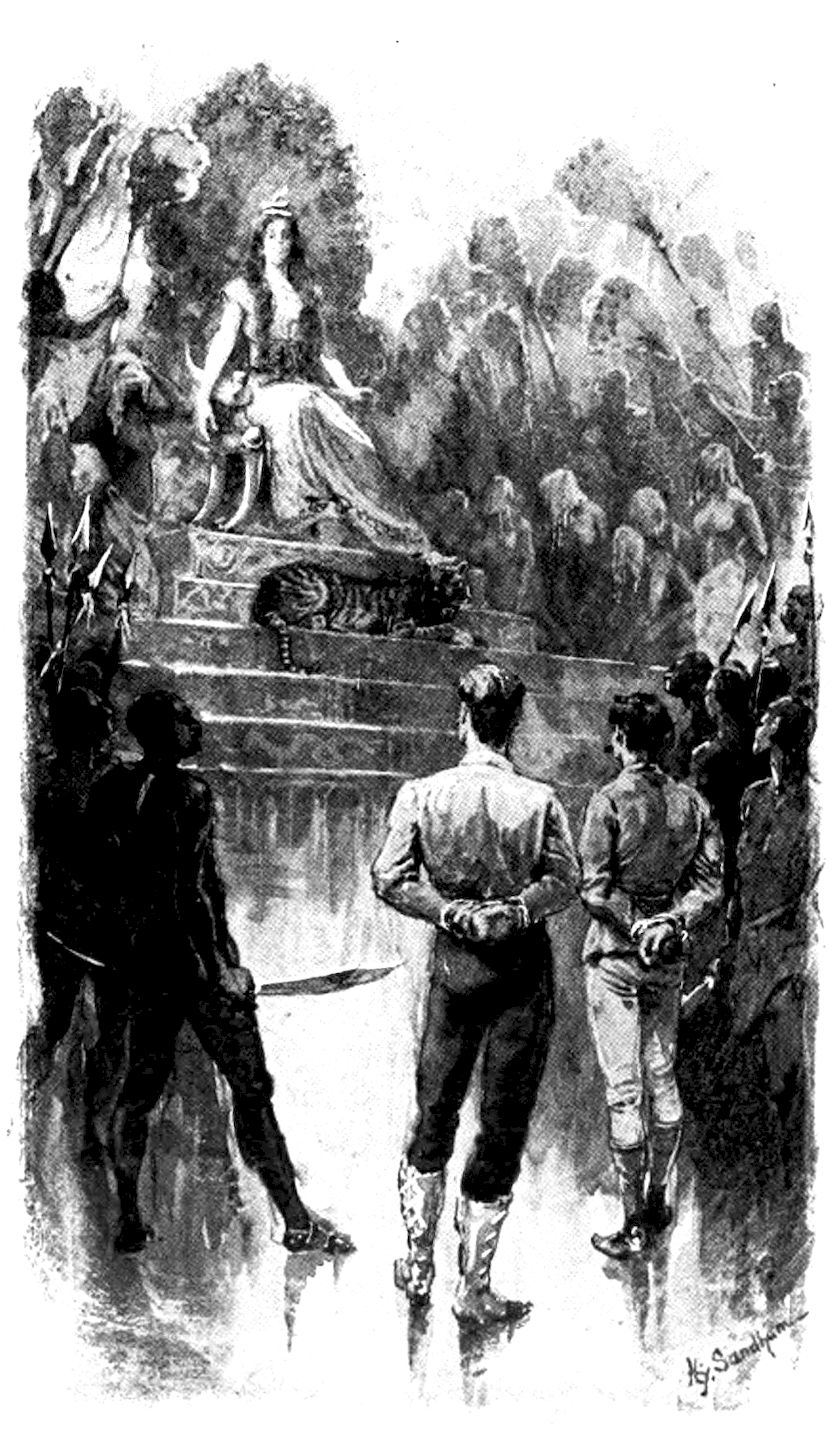
On this seat, or throne, I beheld the aged
man who had commanded the force that had
captured us, and whom I felt must be the
High Priest of the dread god Hed.
He sat now, his chin in his hand, and he
regarded us, I saw, with the same dark disfavor.
49Surrounding him were men with shaven
crowns and wearing woven garments like to
those of the dead priest Sagamoso, and without
this circle stood another line of men, but
these were clothed in white like the six who
had received us at the entrance of our prison
house.
Beyond these again were massed warriors,
naked save for their leopard-skin girdles, their
shields and swords. The outer ring was composed
of a curious throng of every age and
condition, with women closely veiled, and
even children.
Near the silver screen, on each side of the
hall, sat, cross-legged, six negroes, natives of
a tribe I had never seen. These were richly
dressed, and before each was a drum ornamented
with gold, and these they beat constantly
with long spoon-shaped pieces of
wood.
Behind them stood still other negroes
thrumming on rude harps; the whole producing
a strange, not unmusical sound, very
soul-stirring in effect on him who listened.
Suddenly there came from behind the silver
50screen the clash of cymbals. The people
bent to the earth, and even the white beard
of the haughty High Priest swept the ground.
The warriors clashed their shields together;
a cry of reverence and of welcome broke from
the waiting throng; the silver screen parted.
It slipped noiselessly back into the wall on
either side.
Lestrade drew a quick breath, and at the
same instant my eyes rested on the most
beautiful woman that I had ever seen. For
a little her loveliness held me fixed as though
some spell had been wrought upon my vision.
It was not until her voice, full and musical,
broke the tense silence, that I turned my
eyes away to see what setting held so fair
a jewel.
And truly it was worthy. For the throne
was of pure gold, and the back a peacock’s
tail, so encrusted with gems as to quite hide
the precious yellow metal, and the seat supported
by four elephants’ tusks banded at the
top by a row of egg-shaped emeralds. Behind
the throne crouched a circle of mute veiled
women before negro fan-bearers, erect and
51naked save for turban and loin cloth of golden
tissue. Surrounding with drawn swords their
royal mistress stood the guard of the household,
each a perfect specimen of manhood and
each plainly but richly dressed.
Lah, the Queen, was arrayed in some Eastern
fabric, not silver and not silk, but partaking
of the nature of each, and bound about
the waist by the girdle that I had seen in the
hands of him who had committed us to the
safe keeping of the temple.
This garment was held in its place over
the bare shoulder, by a clasp whereof the diamonds
were as big as hazel nuts. A fillet
shaped like a serpent encircled the Queen’s
head and kept back from her face the long,
braided locks of blue-black hair that hung,
heavy also with jewels, to her knees. She
alone of all the women present was unveiled.
I drank in the glory of her unfathomable eyes
darker than midnight. I saw the scarlet of
her lips, the warm olive of her skin, the
graceful lines of her strong, supple, beautiful
body.
But I have little skill in such portraying.
52To Lestrade that task. Enough that Lah,
Queen of the people of the Walled City, was
not only fair above the need of woman,—the
Lord knoweth the ruin that hath followed
the working of the tenth part of such charm,—but
she held also a subtle something in
the serene cruelty of her gaze, a something
in the calm command that curved her lips, to
drive men mad, to fill the heart with a love
that was half hatred, and a hate that could
not do its worst because of the love that
stayed its ordering.
So much let me say in my defence for
what has followed. I am a man not easily
prone to fall into the toils of women; to
whom has been given subtlety to offset their
weakness. But to Lah, a man’s brain and a
woman’s wit; a man’s will and a woman’s
will; a man’s strength and a woman’s beauty.
Aye! more than woman’s. Look to it, you
who would judge me, and remember likewise
the end, the end also with the beginning.
But enough. I will now set down for the
better ordering of this tale, what befell at
53the Queen’s audience, although it was not
for days after that I learned the true import
of that fateful evening.
Lah then spoke in this wise:—
“Who are these two strangers, whence
their coming, and what their purpose?”
Then arose Agno, the High Priest, and
his eyes glowed with a strange fire, and we,
watching, saw his aged hand clench fast the
staff of office that it held. With a fine gesture
of mingled scorn and anger, he threw out
the other, palm open, towards us, where, still
close guarded, we stood in silence.
“Behold!” he cried, “the invaders of our
City, the murderers of the sacred ape, whose
hands are red with the blood of our warriors,
whose sacrilegious weapons have been turned
against the dread god. Yes, I have said it—violators
of Hed himself!”
A sudden thrill ran through the people,
and there was something in the faces turned
towards us, so pitilessly cruel, that a cold
chill settled on my heart, and I was well put
to it to preserve the calm disdain that sat, as
was fitting, upon my countenance.
54Only Lah, the Queen, looked straight before
her at the speaker, and her lips, I
thought, curved slightly with a little smile
whose meaning was not plain to me.
Agno turned towards the listening throng
with a sudden change of voice and manner.
“O worshippers of the Serpent and of
Edba! Shall the wrath of the gods fall upon
your heads because they look down from
the appointed place and see such deeds
unpunished?
“Nevertheless warmed and fed and unhurt
have these two rested by royal order till now
in the sacred temple, and the wrath above
grows black, and the thirst of the Serpent is
not slaked.”
I thought I beheld again a swift change
pass over the face of the Queen, like a cloud
that covers for an instant the glory of the
sun, but when I looked closer I saw that I
was wrong, since her lips still wore that same
curious half-smile.
“Doubtless,” went on the High Priest
smoothly, “doubtless the Queen, who is ever
zealous for the glory of the gods, but bides
55her time, lest in too swift a death, some pang
of body or soul be lost to these defamers.
Surely such thought for the honor of Hed
and of Edba shall not be without reward.
But I warn you,” and here his voice rang
out with its old passion, “the patience of the
Serpent is at an end; the god clamors for
vengeance. Woe! woe! to him who setteth
a stumbling-block in the way of rightful
punishment.
“Let Lah, the Queen, command it! Let
the torture that is the portion of these begin!
Let their death and the manner of their
passing plead for us and turn away, while
there be yet time, the wrath that is to
come!”
A hoarse murmur of applause rang through
the multitude, and of their number, a man
richly dressed and I judged a warrior, stepped
out from among his fellows and stood in the
centre, alone.
“Agno, the High Priest, has said it. We,
the people, repeat it. Oh Queen, let the
blood of the stranger flow freely that the gods
may be appeased.”
56Lah turned, and I saw then, what, bewildered
by the rising storm, I had not noticed;
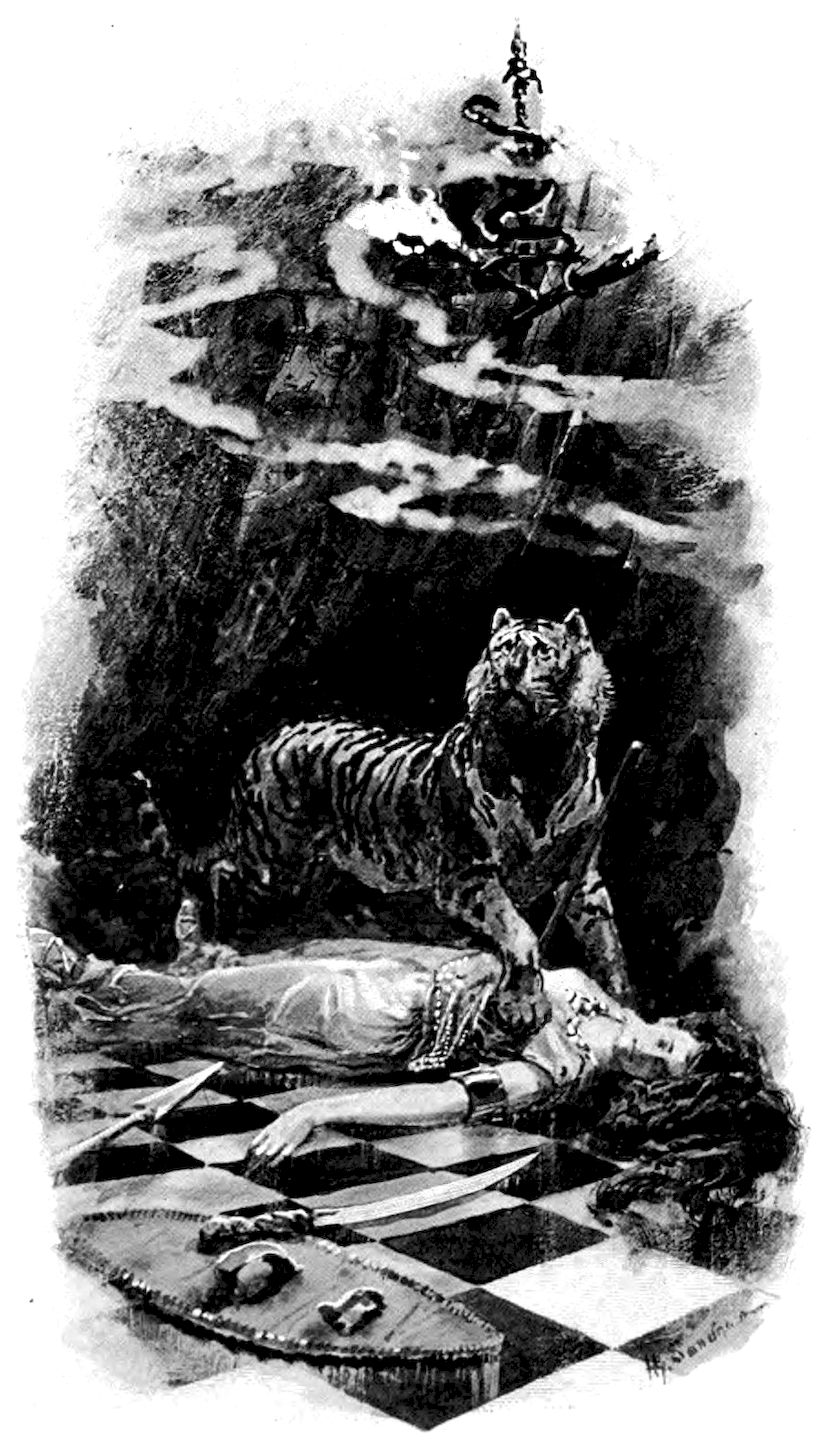
namely, that the Queen’s sandalled foot rested
upon the head of an enormous tiger that lay
motionless before the throne.
She uttered a low, brief word of command,
and the great beast rose, stretched
himself lazily, and then stepped noiselessly
forth.
A shudder ran through the throng. I saw
the face blanch of the man who had spoken.
The soft, padding footfall sounded now through
the tense silence as the tiger drew slowly near.
At length when about ten paces from the
warrior, the beast paused. The victim tried
to speak, but no words came. His fixed distended
eyes were on the lithe form before
him. The great cat was crouched to spring,
its tail waving gently, its tawny head raised.
Lah’s voice broke the silence, caressingly,
once more.
The creature bounded lightly through the
air. The next instant the warrior lay prone
on the marble floor, a swift, wide-spreading
pool of blood speaking dumbly yet to heaven,
57of the doom that had fallen. The Queen
turned to Agno.
“Behold,” she said, “your answer.”
With a graceful gesture she stopped the
rising murmur of the multitude, and again
her wonderful voice changed. It hid not the
majesty of the speaker; no, truly, it hinted at
power to enforce the words, but it was sweet,
sweet and persuasive, over and above anything
that I have ever heard.
“O my people!” thus spoke the Queen.
“When, before to-night, has the highest in
the land received an order of him who standeth
next unto the throne? When before this
hour has the chief servant of the Snake set
a limit to the will of her who calls herself,
and truly, the Snake’s Bride? Have I not
borne the embrace of the holy one, the
python? In the dread hour in the pit itself
has not the marriage rite been held, and for
this?
“Turn, O my people, ere it be too late!
The fate of yonder man,” and she pointed to
the loose-limbed, weltering form upon the
pavement, “the fate of such as he is naught
58to the vengeance that shall surely fall on him
who sets his neck stiffly against the will of
her, the best beloved of Hed. Aye! of the
highest! I have said it. Look you to it.
“I am Lah, the Queen, and the just gods
have given unto the hollow of my hand all
power. As for these,” and she turned her
beautiful face an instant towards us, “rest
quietly. The defamers of the Serpent may
not hope for mercy. Nevertheless, in mine
own time, and after mine own choosing, shall
they pay the penalty.
“Guards, lead the prisoners behind the
veil!” She turned smiling to the High
Priest.
“More prudence would better befit thy
white hairs, most pious Agno,” she said,
and the clash of cymbals answering to her
nod drowned the bitter answer that writhed
upon his lips, and proved that the Queen was,
after all, but yet a woman, and so holding
fast to the sex’s dear privilege of the final word.
Obedient to Lah’s command, six stalwart
negro warriors, gorgeous in loin cloths of
scarlet and gold, advanced, and laying hands
59upon us, hurried us, Lestrade and me, through
the gaping multitude, on past the silver screen,
by the Queen’s glittering throne, the host of
slave girls, the musicians, the courtiers, onward
still, until we reached a shimmering network
of silk and steel that draped securely an
entrance at the back.
With averted eyes the guards drew aside
this heavy veil, and we passed within, the
plaudits of the fickle throng still ringing in
our ears.
Chapter V Astolba’s Errand
60
Lestrade and I looked about us. The
face of Lah was still so potently present
in my friend’s memory that he seemed hardly
conscious of the aspect of this new prison.
I am, however, of a colder nature, and I
scanned with eager gaze the inner hall in
which we found ourselves. The guards had
halted without the veil that screened from
the profane this entrance to the palace of the
Queen.
We stood, therefore, quite alone, in a large
recess, arched and windowless and tiled with
bricks painted in bright colors that showed,
I judged, a kind of sacred pictured story.
Hanging lamps in red, green, and blue, curiously
wrought and giving forth a sweet heavy
perfume, depended from the roof above our
61heads. Another curtain, also formed of tiny
rings of silk and steel, screened the further
end of this strange anteroom.
I plucked Gaston by the arm, for he was
still in a day-dream, and together we walked
along, till I, stretching forth my hand, parted
the heavy woven folds before us. A massive
door of some dark metal that looked like
bronze now barred the way, but only for an
instant. Invisible hands touched some hidden
spring, and again we entered. This time
the chamber in which we found ourselves
was far richer than the one which we had left,
and to which we might not return, since the
door had locked into place behind us. Here
the floor was of sandalwood, and covered
with a rug so thick that our feet sank deep
as though we walked on moss, while fair
flowers woven in soft hues, still further
cheated the eye that gazed upon their beauty.
The walls were hung with silken tapestries;
four slaves marvellously carved in ebony and
clothed in rich garments, stood each in his
respective corner, and these held high in one
hand a scented torch, while the other grasped
62a curved and glittering knife. There were
couches also here and there, covered with
rare stuffs, and a shimmering gauze enriched
with silver and turquois veiled here, as before,
the further end of the apartment.
Lestrade’s interest quickened. His swift
gesture tore aside the curtain and revealed a
gate of beaten gold.
My blood leaped at the sight. I put forth
my hand and shook the massive bars about
which twined garlands of yellow, yellow
flowers. My clumsy fingers touched the
delicate wreaths of roses and of leaves.
They did not melt away before my eyes;
not a petal, not a spray so much as trembled.
It was all gold; solid, beautiful, wonderful
gold.
I grasped Lestrade by the shoulder, but
with an impatience new to him he shook off
the touch and pointed to the gate. It was
slowly opening; we passed, and it closed behind
us. I saw pillars of ivory, the sheen of
precious metal, the pink of tulip-wood walls
inlaid with silver. I saw tiger skins upon the
floor, and stuffed leopards bent to spring; I
63saw their jewelled eyes and claws of gold.
Strange, sweet music floated through the
air. I heard the tinkle of distant fountains.
Then the blaze of light from the great star
above ceased. The darkness of the pit
wrapped us round, the thick hiss of a serpent
pierced the night. I heard the rustle of garments
and struck out valiantly.
There came a mocking peal of feminine
laughter, then strong hands seized us from
behind, and despite our struggles we were
bound hand and foot and carried on and on
through a tangled labyrinth, now to the right,
now to the left, now doubling on our tracks,
and all in the midnight darkness, with the
indescribable noises in our ears of a silent
attending multitude.
I thought the bearers walked along ground
that gradually sloped downward. Afterward
I found that I was right. At the moment
there was so much else to think of that the
true force of this fact did not strike me. I
say this that you may note that I am a just
man, as well as a modest, that I do not lay
claim to a foresight or an understanding of
64the inwardness of things, over and above that
which nature has bestowed on me. This I
may say has so far been sufficient for the
purpose, as indeed the event has in time
borne out. And without former knowledge
who could have guessed the hidden secrets
of Lah’s palace, or the mysteries that gathered
thick about the dwelling-place of Edba
and of Hed.
I heard Lestrade whistling softly there in
the darkness not ten paces away. The sound
heartened me wonderfully. We were still
together, and what might befall lost half its
terror.
All at once our bearers halted. I was
gently laid upon a couch. My bonds were
loosened, and as I sprang to my feet a light
flashed from above, and I found myself standing
beside Lestrade. The throng had melted
away as if by magic. A woman closely veiled
and draped in a white garment, alone stood
waiting. Ere I could speak she turned with
a quick gesture and threw back the filmy
covering that hid her face. Lestrade and I
uttered a smothered exclamation, for the
65woman’s skin was fairer than our own, and
as she spoke, we knew on the instant that
the tale of Sagamoso was true, and that the
daughter of the murdered explorer stood
before us. The girl was trembling so that
Gaston made haste to lead her to a couch,
while I stood stolid, my eyes fixed upon her
eyes, luminous and wide with mingled fear
and joy, while I waited in breathless silence
for her words.
“How I have suffered,” she said half to
herself, and the English was sweet to me, and
the sound of her voice yet sweeter. She
looked about her as a frightened fawn looks
when the dogs are upon her. “These walls
have ears,” she said under her breath. “This
horrible place is full of treachery. Still I
must ask you, for I cannot wait. You
are of my people. Have you come to save
me?”
Lestrade took her hand in his and kissed
it, and his voice was the voice of a mother
soothing a tired child.
“It is our sacred purpose, and naught shall
turn us,” he said.
66“That and vengeance on your enemies,”
I added.
“Hush!” she answered, with a warning
gesture. She listened in silence for a
moment, and then the folds of her veil once
more hid her face, but I had seen the pretty
color come back to her lips and cheek, and
her smile of trust and gratitude had stirred
me mightily. “I am Astolba, handmaid of
Lah, the Queen,” she continued aloud, and
with a subtile change of manner that Lestrade
was quick to note and imitate.
As for me, I stood still gazing dumbly, yet
drinking in the music of her speech.
“She, the beloved of the gods, has sent
me hither, that you may learn from me the
language of the people of the Walled City;
that their customs and rites may be made
known to you. So that, strangers though
you be, you may yet stand within the inner
circle,—if so the Queen will,—and bring
knowledge and power to the followers of
Edba and of Hed.”
She looked with pleading towards me, for
with a woman’s quick instinct she saw that
67Gaston had no scruples at learning aught, let
it but come from her fair lips.
For me, I have, thank the Lord, small
stomach for heathen follies; little patience
with holy serpents and sacred apes, with
bloody chanting and such like deviltries.
Nevertheless, when Astolba added softly,
“It is the Queen’s order; will you learn
of me?” I nodded, and she, I think, was
puzzled and not best pleased, not knowing
for certain which argument had changed the
habit of my mind. And that is, let me
tell you, an excellent manner to deal with
women.
Astolba, therefore,—for so she was called,
and the word meaning “white dove” did indeed
singularly befit her,—Astolba having
told her errand and won consent, began at
once her mission.
I cannot fit with nicety the meaning of all
she told into the jewelled setting of her
speech. I am, as I have said, a plain man,
and can but repeat the substance of the strange
lesson begun that hour, and continued in due
order during many succeeding days, until the
68language and customs of this strange people
became at length known to us.
For Astolba herself, her own story was
simple. We already knew much from the
dying words of the fugitive priest. Her
future fate was to her, as to us, a sealed
book, and we forbore to let her see the red
light cast upon it by those same last words.
The maid had so far been treated well,
with a kind of contemptuous pity, by her
beautiful mistress. Lah was curious of all
that pertained to Saxon life and usage. She
had even learned the language; she had questioned
her white prisoner closely about the
arts, the doings, the manufactures of the
stranger. She had copied in some measure,
but secretly, such things as pleased her fancy,
or seemed like to extend her power.
“She is wonderful,” said Astolba, “but she
is terrible. The Queen’s nature is like a
bottomless well. You drop a pebble into its
depths, and you listen and listen, and you hear
no sound. It is falling, falling, falling. And
so with Lah. No one can judge that hidden
depth. She is all in one. Childlike, lovable,
69gentle, then fierce, treacherous, and oh so
unspeakably cruel!”
The girl covered her face with her hands
as if to shut out some horrid sight.
“You could not bear, strong men that you
are, the things that I have seen,” she said in
a whisper. Then she went on more calmly,
to speak of other matters, but the vision of
the icy fear that had pierced her was by me
not soon forgotten.
As I look back on it all now, I see how,
little by little, we learned the belief of the
people of the Walled City.
For better comprehension of this tale, I
will now briefly set forth the substance of
their strange faith.
Lah and her subjects worshipped chiefly,
and with dread, two singular powers: Hed,
the serpent god whose spirit dwelt in the
body of a monstrous python, called the holy
Snake; and Edba, the moon goddess.
Hed gave victory in battle, revenge over
enemies, success in various undertakings.
Edba gave the crops and increase to the
people.
70Hed was worshipped by bloody sacrifices;
Edba, by offerings of fruit and flowers, save
on the great yearly feast, when she, too, demanded
that a human life be poured forth
before her altar.
Hed was the god of fear; Edba, the goddess
of love. Once every twelve months, a
maiden, fair and without blemish, became the
bride of the Snake. That is, with songs and
rejoicing, the rose-crowned victim was thrown
to the python, and crushed to death in the
reptile’s horrid folds, in the presence of a
frenzied multitude.
Two years before our coming a King had
ruled with a heavy hand the people of the
Walled City. Unlike his royal predecessors,
he had made war upon the neighboring country,
and he had brought home vast treasure
and many slaves, so that the High Priest
dared not lift his voice against the practice.
To leave the City on any pretext whatsoever
was a thing forbidden alike to the Ruler and
his people; a thing unheard of for generations,
and a thing accursed by Hed. But the King
brooked no restraint; the masses were drunk
71with their new-found liberty, and Agno’s
maledictions were looked upon as little more
than the impotent murmurings of a feeble
old man.
Then one day the King returned with a
captive, none knew from whence, a woman
who despised the customs of the people, the
beauty of whose unveiled face made glad like
wine the heart of him who beheld it. Her,
the King married; one month from that day
he died, suddenly, at a banquet, and Lah,
upheld by the High Priest, had seized the
sceptre.
No woman had ever sat before upon the
throne, and the people and army rebelled,
the priests alone remaining faithful to their
new sovereign.
But Lah faced the rising storm with calm
authority. She appealed to an ancient test
almost forgotten. She became, by her own
wish, the bride of the Snake, and before the
very eyes of her wondering subjects, she came
forth from the pit, not only alive, but unhurt.
From that moment she became a sacred
person. The chief ringleaders of the revolt
72were cruelly butchered by their quondam
followers, and Lah was Queen indeed.
So much for what had taken place before
our coming. That there was no longer peace
between the High Priest and his sovereign,
I already guessed, but I did not know then
how near the crisis was, or how the scale of
power trembled in the balance.
This, for Astolba’s errand. I must now
turn to the events that thickly followed on
her coming.
Chapter VI The Cup of the Beast
73
On the noonday that followed Astolba’s
last visit, our usual meal was not
brought to us, but on the hour, a turbaned
slave appeared, bearing rich vestments of the
barbarous kind worn by the attendants at
the Queen’s court. These he flung upon the
floor of our gilded cage, and by signs, showed
us that we were to divest ourselves of our
Christian garments and don instead these
heathenish trappings.
Lestrade, glad of any divertisement—for
of a surety our enforced leisure had become
a burden to him—Lestrade, I say, bent himself
with something of a child’s glee to this
mummery, and I must needs confess showed
in the issue bravely enough. But I, with
some stubbornness to the messenger’s mute
74importunities, shook my head, and having
now achieved some knowledge of the language,
I put to the fellow a few questions as
to our state, and the term of our imprisonment.
But the slave was silent; and at length,
wearied by his sullenness, I seized him by
the shoulder, and (it shames me) with no
gentle grip, for I was bent on forcing something
more reasonable from between his
thick lips than the senseless gibbering with
which he had so far replied to my inquiries.
The fellow’s eyes rolled with fear, and opening
his mouth, he pointed inward, dumbly,
and I saw that his tongue had been shorn
off close to the roots. The sight filled me
with such mingled feelings of rage at the
hellish cruelty that had been practised, and
of pity for the helpless victim, that when
the poor creature took from beneath his
cloak two covered silver goblets, and with
mute entreaties offered one to me and one
to Gaston, I followed without a thought my
friend’s example, and drank off at a draught
the spiced wine that the cup contained.
75Almost on the instant a mist arose before
my eyes, and I saw, as in a dream, Lestrade
fall on the marble floor of our prison house.
The slave vanished as he had come; sweet
music from a distance sounded in my ears,
a great joy took hold upon my heart. I
looked up and beheld the unveiled countenance
of Lah, shining with its wondrous
beauty, like a star, above me. I stretched
forth my arms to draw the vision nearer,
and—I knew no more.
How many hours passed while I lay close
wrapped in that dreamless sleep, I cannot
say. After a time, long or short as it may
be, I awoke, and, piece by piece, what had
befallen came back to my mind. I was still
calm, still strangely happy, and loth to break
the charmed spell that held my being. But
after a little my manhood struggled in the
toils. I opened my eyes, and saw, without
wholly understanding all as yet, that I was
in another chamber, hewn, it appeared, out
of solid rock, yet softly draped with silken
tapestries. I lay upon a couch covered with
the skin of a lion. I idly noted that the
76claws were of gold and the eyes of emerald.
I saw that I was dressed in the garments
that the slave had brought; but the sight
awoke no anger. I glanced about me, and
I beheld Lestrade, sitting motionless, with
bowed head, in a distant corner of the room.
I spoke to him, but he did not reply. Then
I roused me, and again I spoke, and still
silence. At this, the fumes of that accursed
potion left my brain, and springing to my
feet, I went swiftly to him, and again
spoke; and this time Gaston raised his head,
and his eyes encountered mine. His eyes!
Not his, but those of an unthinking beast,
with no show of meaning, of friendliness,
aye, of barest humanity, in their depths.
With trembling hand I touched him upon
the shoulder.
“Gaston!” I cried. “Gaston! what has
happened? Speak! do you not know me?”
Then, as he answered not, I shook him
roughly, in my terror and amazement, and
he turned,—turned like a savage dog that
is disturbed,—and snapped at my hand.
His lips drew back over his white teeth in
77an angry snarl, a beast-like snarl, and I,
sick with horror, let go my hold, and there,
with the same smile of cruel, conscious sovereignty,
by my side stood Lah.
Then the rage that was in me broke loose;
and forgetting everything, her womanhood
with her power, I saw only the foul wrong
that had been wrought upon the body of my
friend, and I seized her soft arm in my hand,
and gripped it savagely.
“Cursed sorceress,” I cried, “this is your
work!”
For an instant the Queen’s eyes blazed,
and had I not been beside myself with rage,
I needs must have blanched before them;
then a look of wonderful sweetness came
into her face, and she said, with simple
dignity, in the language of her people:—
“I will cure your friend.”
I let go my hold and such a flood of
mingled feeling overbore me, that I knew
not what to do or say, or what construction
to put upon the matter.
My usual slow thinking but unmoved self
was far from me. I was on fire with new
78thoughts, new feelings, that I knew not how
to meet.
I turned from my friend, crouched in bestial
fear in the royal presence, to the red marks
that I had just brought in my blind fury to the
satin surface of the Queen’s beautiful bare arm.
Then, with an effort, I shook off the spell
of Lah’s wonderful presence. I felt myself
once more my own master. My eyes looked
into her eyes, and I did not flinch.
“Is this your work?” I asked.
Again a subtile change passed over the
Queen’s face, but whether of anger or no, I
could not tell. She motioned me to sit beside
her on the couch from which I had just
now risen, and I obeyed.
Then she pointed to the marks of my fingers
on her flesh.
“This is your work,” she answered, “and
you yet live.”
I looked in silence on Lestrade’s cowering
form, and again my heart was hot within me.
The Queen followed my gaze, and once more
she spoke.
“Do you not fear?” she asked. “See to
79what an end I can bring the gay spirit of
your friend. Like a whipped hound he will
come to my call. See him cringe as to the
lash before my face. Take heed lest his fate
be your fate, and your pride in like manner
be humbled.”
“O Queen,” I answered, and my anger
made me now again as cold and as calm as
I had before been hot and troubled within
me. “In your power we are indeed; nevertheless,
think not that it can touch, as you
have said, the spirit of your captives. Lestrade’s
body indeed trembles before you,
your cruelty has lost him his reason, but
his soul has but fled to its innermost retreat.
You cannot lay so much as your
little finger upon Gaston’s real self. It
defies you, it remains unchanged despite
you. You have turned his outer being by
your devilish arts into the likeness of a beast.
I doubt not your will or your power to do the
same to me.”
“Doubt not my power,” said Lah, gently,
“but doubt my will. Think you another
could have done so to me?” and she touched
80her bruised arm again. “Could so have used
me, the Queen, and have not repaid the insult
by a thousand deaths in one? But in you, my
Dering,” and the name took music on her
tongue, “I behold my mate. The people
and the priests cry out for your blood. The
one shall be appeased; the other balked.”
She laid her hand, light as a snow flake
upon my brawny arm, and her beautiful
face was raised to mine. “What matters
this broken slave, once friend to you? I
do not command your fear, O my prisoner!
but I do beseech your love.”
Beneath her touch all my slow nature turned
to fire. Her wonderful loveliness beat upon
my soul, like the unclouded vision of the noonday
sun, unbearable to the eyes. I felt a wave
of turbulent and searching passion flood my
being, my veins throbbed with the quick pulsing
of my heart, and then—then the shivering,
grovelling form of my once gallant friend
came between me and the sunlight, and I shut
my eyes to the beauty that tempted me to
disloyalty and dishonor.
Once more Lah’s spell was broken. Once
81more I was my own master. But with self-control
came prudence coldly back. I felt
that Gaston’s life and mine trembled in the
balance, and life is strangely sweet. And so
it was that I turned to the Queen and bent
my head, and kissed in silence the bruise upon
her arm, and I felt her tremble, and knew
that, for the time at least, I was her master
also. And I knew then what to do, and did
it as readily as one possessing intimately the
knowledge of an instrument plays upon its
keys.
“Give back first to my friend his reason,”
I said and somewhat coldly, and Lah with
meekness took from her bosom a golden
box, and opening it, plucked forth a strange-shaped
nut. With the dagger from her girdle
she scraped part of this off to a powder, and
this in turn she mixed with water from a
pitcher at hand, and poured the whole into a
bowl. This cup she raised to Gaston’s lips,
and he drank greedily and with noise, lapping
up the water like a beast. Then at a word
he crouched before her, and after a moment
his limbs relaxed,—the vacant look passed
82from his face, he breathed quietly, now once
more asleep.
“He will wake,” said the Queen to my
mute question, “in an hour, and you will
once more have your friend.”
“I thank you,” I answered.
“And is that all?” she asked, still tenderly,
but with a warning note of passion in her
voice. “Is that all, when men have died,
and joyfully, that they might but kiss the
hem of my garment, the print of my sandal
in the dust?”
“No,” said I, boldly, “that is not all; but,
Lah, in my country, men’s hearts beat not to
the ordering of aught save their own will.
Neither do they love as slaves, but as masters.
Beautiful above all women as you are, O my
Queen, think not I will stoop before you. I
am not cold. I could love, strongly, faithfully,
to the uttermost, with a passion far outweighing
that of these servants who you have said
have died content but to kiss the hem of
your robe, the print of your sandal. But
not, O my Queen, as they, not as the subject
to the ruler, not as vassal to his mistress.
83You can rend my soul from my body if you
will. You cannot make me bend my heart to
your ordering. Not fear, not even love, shall
sway me. For I love, O most proud, most
beautiful of women, even as I have said, not
as the slave, but as the master.”
Lah turned quickly as if stung. I waited
breathless in silence for her answer. Then
at last she spoke, and there was new majesty
in her bearing, and though she bent her
head with a strange humility, I knew not
the secret of her inmost thought. Yet the
words came. “Be it so,” she answered, and
in obedience to a secret signal, the door of
the cell slowly opened, Lah passed through
beyond, and I, save for the presence of my
sleeping comrade, was again alone.
Chapter VII The High Priest’s Council
84
Heavy still with the fumes of the
Queen’s sleeping-potion that the black
had brought me, I sat with my head in my
hands after Lah’s departure, thinking yet but
lamely, on all that had just now passed,
while Lestrade slumbered in peace in the
corner of our prison.
It might have been an hour or mayhap
two, when my friend stirred, stretched himself,
and at last sat up, his usual happy-go-lucky
air giving way to a look of surprise
when he saw our new abiding-place.
“How feel you, Gaston?” I asked
anxiously, for I still distrusted the Queen’s
medicine, and the enduring nature of this
sudden cure.
“Never better,” Lestrade answered
brightly; “but what means this sudden
85change of quarters? As for thyself, man,
no popinjay of the tropics ever pricked it
more blithely, no strolling mountebank bright
with gold and scarlet and jingling bells, no,
nor Solomon himself, of a verity, so much as
touched the height of thy magnificence.
Why, comrade! thy raiment shineth like
the sun, and thou in the midst of grandeur,
solemn as any owl.”
And with that he fell a-laughing mightily,
so that I was nettled, and without more ado
related briefly, and perchance too sharply, all
that had chanced since the slave’s coming,
save, as was fitting, the last passage between
Lah and myself.
And at my story Lestrade grew grave
once more, but not as one would fancy
because of the danger he had but now
passed, but all, if one would believe it,
because of the figure he had cut in the
Queen’s presence. And I was hard put to it,
to answer with discretion his many questions,
without wounding him to the quick on the
one hand, or ministering to his vanity and
vain hope of Lah’s favor, on the other.
86Indeed, I was sore beset, when the door
of our cell swung open, and Astolba came
in, whereat Lestrade forgot apparently altogether
and on the instant, his interest in the
Queen’s bearing, and turned, with all singleness
of mind, to the entertainment of his fair
visitor.
She, poor child, was in great spirits, and it
was a pretty sight to watch the swift color
come and go in her cheek, and note the many
innocent little coquetries with which she met
Gaston’s warm advances.
Not that he took toll of every look and
word; there were plenty still for me, of
another, and, I could not help thinking, of
a deeper nature. However that may be,
the reason for her light-heartedness was soon
made known to us.
The Queen, she told us, was on our side,
and she would bring to naught the cruelty of
the priests of Hed. Lah had spoken softly
to her, almost as one sister to another, of us
whose lives were forfeit to the gods; had
promised us powerful protection, and bade
Astolba bear to us, with all speed, the message.
87Yesterday, it seemed, a missive had reached
the throne, which read that Agno plotted, in
the name of his unholy office, to tear us from
the sanctuary of the very palace itself, and
bear us to the altar of torture and of death.
Hearing this, Lah had hidden her wrath,
but had given orders to two mutes that we
be drugged with a harmless potion, and
borne by a secret way back to the Temple
of Edba, whence we had come.
“You are now,” said Astolba, “in a hidden
chamber that is next the Council Room
itself. The Queen bids me tell you that at
midnight the priests will meet there, and your
fate will be the subject of their speech.”
She drew back the tapestry that masked the
wall, and put her finger on the head of a
painted snake that was revealed, for the stone
was covered with pictured emblems of Hed’s
most revolting worship.
Once, twice, and once again, she pressed
the chosen spot, and noiselessly a huge block
of stone slipped back and disclosed a leathern
curtain.
Astolba motioned us to silence, and drew
88forth the jewelled knife that hung from my
much bedizened girdle. With it she slit the
drapery of hide that screened the opening
she had made.
Then she pushed back the heavy folds, but
with all caution, and stooping at a sign from
her, we gazed through the rent and saw indeed
the High Priest’s Council Room.
Lestrade, when I had done, scanned the
place also with curious eyes. Then we fell
back, and Astolba, again pressing, this time
a painted emblem of the moon, the huge stone
slipped noiselessly into its appointed socket.
“Now,” said Astolba, “I have delivered to
you the Queen’s message, save for this scroll,
which I have been also bidden to hand to
you.” And she placed, I fancied a shade
reluctantly, in my hand an ivory tablet.
And in the language of the people of the
Walled City, I read:—
“The wiles of the Serpent shall be brought to naught.
Behold, even at the twelfth hour the crystal globe shall
fall, and into thy hand be delivered the secret of thine
enemy. But the wisdom and the power of the lioness
no man may measure. Wherefore beware! Yet walk
89in the light openly, despising not the good gifts of the
gods, and all shall, in the day to come, be well.”
The Queen’s signet, the same as that cut
upon the middle stone of her girdle, a hand
grasping a writhing snake, was engraved on
this missive, which I again read carefully,
and at Lestrade’s impatient asking, this time
aloud.
“A precious epistle,” said Gaston, with
an expressive shrug; for he was nettled, I
make no doubt, that the Queen’s majesty
had addressed itself to me rather than to
him.
“What is this crystal ball of which the
letter speaks?” I asked, to change, if might
be, the current of my friend’s thought.
“Look up,” Astolba answered, “and you
will behold this people’s strange clock. It
works, I think, by water. Every hour a
ball of lead curiously and differently marked,
will drop from the plate above, into the brazen
bowl which you see below. At midnight
a crystal ball will show you by its fall that
the hour to act has come. And now I must
say farewell.” She smiled upon us each in
90turn. “Good by for a little, dear friends,”
she said; “be brave, be fortunate,” and had
gone.
After Astolba’s departure we waited with
what patience we might for the appointed
hour. A mute, black as ebony, like his
brother of the goblets, brought us a supper
that did no shame to the hospitality of his
royal mistress. Delicious fruits were served
to us in massive silver dishes; there was, beside,
a steak, from what animal I know not,
that was rarely toothsome. There were flat
cakes of grain and a jar of ruby-tinted wine
that would have made an anchorite forswear
himself. So we dined together, Lestrade
and I, and little by little, a moodiness that
before had wrapped us round, now fell from us
like a cloak; the potent grape juice warmed
us through, and we were gay.
After the banquet the slave departed, silent
as he had come, and Gaston, stretched upon
the lion skin, sang snatches of fair French
ditties, while I, in a reverie strangely sweet,
with Lah’s face floating in a glory through
the waking dream, watched, motionless and
91content, the leaden balls fall clanging, on the
hour, into the bowl of brass beneath.
At length the longed-for moment came,
and with it the crystal ball. Lestrade rose,
yawned, and was about to speak, but I, with
a warning gesture, pressed thrice the serpent’s
head painted on our prison wall.
Back, slow and noiseless as before, slipped
the massive stone. With a courteous gesture
Gaston bade me look. I plucked at the rent
in the curtain of hide, and even as I gazed,
with measured step, two by two, the priests
of Edba and of Hed entered from the farther
end of the Council Room.
Lestrade cut with my knife another slit in
the folds of the heavy drapery of skins, and
together we watched in silence.
The chamber into which we looked was of
great size, and seemingly hollowed like our
prison cell, from out the solid rock. Massive
pillars of stone supported the roof, and these
were carved with hideous, leering figures
grotesquely entwined.
The walls of the place were covered with
painted pictures, rudely drawn but strangely
92and horribly lifelike. These represented victims
suffering all the tortures that a cruel
and fertile mind could think of, and through
all the horrid story appeared at intervals the
emblem of Hed, the serpent, and the sign of
Edba, the silver moon; and these were shown
forth also on curtains of hide that draped, as
before our hiding-place, certain portions of
the apartment.
The room was bare, but there was a throne
of ebony on a raised platform at the further
end, and in front of this stood a round stone
altar with a deep groove running through it,
that slanted and ended in a large basin or
trough. Before this altar burned a fire in
a three-cornered and very large brazier,
holding not coals, but fagots. From this
there shot forth forked tongues of blue flame,
and from it also came the only light that illuminated
the Council Hall.
Back of the throne I beheld a gigantic
figure of black marble, but painted in glaring
colors. The eyes of this image were of
blazing jewels worth a king’s ransom, and in
the squat figure I recognized my old enemy,
93Hed, the snake-encircled god. The firelight
shone on the serpent’s silver scales, and the
reptile seemed to move. With an effort I
looked away and saw that beside the revolting
figure of Hed, there stood, on a pedestal,
a tall, veiled, and graceful statue, all of white
and luminous stone, and holding in its hand
a crescent jewelled moon. This, then, was
Edba.
I turned once more to the advancing priests,
and as I did so, a wild blood-curdling chant
broke from the on-moving ranks. I looked
at Lestrade; his face was white, and I saw
that he recognized the song that we had
heard once before, at midnight, in our other
prison cell beneath the temple. Slowly
the priests drew near, forty in number, and
ranged themselves about the sides of the
apartment, near unto the throne. One
brawny fellow took his stand almost in
front of me, and so near that I could easily
have plucked him by the shoulder.
Twenty of these ministers to the gods
were clothed in white garments, and twenty
wore robes blood red in hue, and I thought
94from the glances cast one at the other, that
there was little love lost between the two
parties. They stood there chanting their
heathenish song, and at the end fell flat on
their faces on the stone pavement. As they
did so, the further door swung open, and
Agno advanced through the prostrate ranks,
clad in a flowing gown of white and scarlet,
and seated himself on the throne. His piercing
glance swept the Council Room, and had
I not been aware of the thickness of the
shadow, the strength of my right arm, and
the justice of my cause, even I would have
shrunk back before him into the safety of
my hiding-place.
The High Priest waited an instant, then
struck the dais twice with his staff of office,
and these ministers of evil arose.
Then at their leader’s command, forth
from the red-robed ranks came the foremost
of their number, who advanced, thrust his
naked hand into the very centre of the blazing
pile and drew forth a flaming brand.
Then he turned to the waiting throng,
and no sign of pain writhed upon his lips,
95though he must indeed have been terribly
burned.
“I, priest of Hed, do swear for myself and
my brethren, by the Snake’s head, by the
Snake’s bride, by the power of blood, by the
flame on the altar, to keep secret the counsels
of this holy meeting, and of our office,
and to obey him sitting upon the throne.
May the body of him who betrayeth the trust
be tortured to the uttermost, and body and
soul forever hereafter! Let Hed himself
bear witness.”
He paused, and every man, worshipper
of the Serpent, bent his head in silent
affirmation.
Agno turned to the white-robed throng,
and again the foremost stepped from the
ranks, caught out from the flames another
brand, and spoke: “I, priest of Edba, do
swear for myself and my brethren, by the
moon’s light, by the yearly victim, by the
earth’s fruits, by the flame on the altar,
to keep secret the counsels of this holy
meeting, and of our office, and to obey him
sitting upon the throne. May the body of
96him who betrays the trust be tortured to
the uttermost, and body and soul forever
hereafter! Let Edba herself bear witness.”
And again as with the followers of Hed, his
nineteen companions gave in solemn silence
their consent.
“Friends,” said Agno, “the time is ripe,
the hour of vengeance is at hand. Let the
followers of Edba and of Hed forget their
impious quarrels, and unite in peace and
strength against the stranger. Yes, brethren,
our altar has been defamed, the sacred ape
murdered, the power of the gods scorned,
and even we threatened in the exercise of
our holy office. Aye, and worst of all, the
sacrilegious wretches are sheltered beneath
the royal mantle of the Queen.”
A low murmur broke from the listening
throng, and the wily Agno hastened to say
on.
“Nay, brethren, think not that I bear
malice against the throne. Rather as a
father would I defend the person of our
mistress from the sorceries of the stranger.
Surely are the eyes of Lah bewitched, since
97she protects these outcasts, and as surely will
their blood, and their blood only, make true
again her vision. Look to it, ye priests of the
temple. The gods are angry; Hed and Edba
cry out, ‘Why are my servants slothful?
Why do they sit with folded hands appeasing
not our outraged majesty?’ Shall they withdraw
their favor from their ministers? Shall
the light of their countenance be turned from
us? Shall we perish, that the strangers live?”
Again a low, fierce murmur broke from the
assembly. Agno’s eyes gleamed, for he saw
that his words now sank deep—seed in fruitful
soil.
“Nay, more, mark you, followers of Edba,
and you, too, worshippers of Hed, already the
people scorn us for our weakness.
“Already the gold runs scantily in our
coffers; already have fallen away the gifts
to the temple. Not twelve hours since, a
blemished goat was offered at the altar;
already the voice of the multitude is raised
against us. Aye, even as I approached this
sacred meeting-place, a drunken soldier of the
Queen stumbled rudely against me, and when
98I cursed him for his awkwardness, he laughed,—yes,
my brethren,—laughed in my very
face. May the flames consume him! May
the Serpent eat his heart!”
Again an angry murmur confirmed his
words, and the foremost of the band of Edba
spoke in answer.
“We, followers of the Moon, ask peace
rather than bloodshed,” he began. “Nevertheless,
we join with thee, most holy Agno,
in clamoring for the punishment of the
stranger. Only this much must be granted.
Give to us the victims. For long have the
worshippers of Hed lorded it over the
adorers of Edba. Now grant to us the sole
honor of bringing to the altar these unbelieving
dogs, and rest assured, their fate
shall be such as to content even the thirsty
souls of our red-robed brethren.”
“Never!” shouted, as with one voice, the
followers of the Serpent; and an angry
tumult arose on the instant, hardly stilled
when Agno commanded peace by all that
was sacred, and with mingled threats and
prayers enforced his words.
99The calm ranks of the forty priests were
broken, and the worshippers of Edba and of
Hed mingled together. Eyes gleamed hatred,
and hot words broke from the lips of the
humblest.
At length one voice bore down the rest,
and the clamor was hushed for the moment.
It came from him of the scarlet garment,
who had thrust his hand into the burning
pile.
“My brothers, my brothers, let there be
no strife amongst us,” he cried aloud. “Rather
turn this burst of fury upon the strangers.
Are there not two victims? Let the priests
of Edba give one unbeliever, bound hand
and foot, unto the mercies of the Mad Man
of the Moon; we, of Hed, will take care that
the Serpent be avenged upon the other.”
A troubled silence succeeded this speech,
and I saw that each side feared to give advantage
to the other by the renewal of the strife.
Clearly, if nothing happened to prevent it,
a temporary peace, bad indeed for our prospects,
would prevail.
I looked at Lestrade, and I saw the same
100dare-devil thought spring into his mind. I
noted that the sacred fire burned low, unnoticed
in the tumult. The room was well-nigh
wrapped in darkness. A scarlet robe
and a white were well within reach. Gaston
and I, as one man, thrust forth our arms
through the rents made in the curtain by
our knives.
I struck him of the red robe, right joyously,
a well-planted buffet on the cheek.
He reeled with the shock, and I saw Gaston
slyly prick, with his dagger, the fat side of
the priest before him.
In an instant all was confusion. A cry of
treason was raised, and the sons of Edba and
of Hed flew like a pack of ill-bred curs
straight at each other’s throats.
Agno shouted in vain; and I promise you
the sight was such a merry one, that forgetting
the risk we ran, I laughed aloud for very
joy of it.
In the general scuffle over went the brazier,
and the only light in the Council Room came
now from a few dying embers.
Gaston’s rash spirit rose within him, and
101before I could utter a word, he had pushed
aside the heavy folds of the leathern curtain,
and leaped through the opening in the wall
of our prison, straight into the thickest of
the fray. I could not leave my comrade,
though my cooler spirit saw little glory and
much danger in the adventure into which he
had plunged us, and through which I was
bound to follow him.
Hoping much from the friendly darkness,
however, I also sprang forth, and it would seem
unnoticed; and then the lust of battle that
abides still in the sinful heart of man arose
in me, and in the good giving and taking
of blows I forgot all else. On a sudden,
as I was struggling right gladly with a fellow
in a red cloak, who wrestled all too well to
have been a follower of false gods, just, I say,
as I had tripped him—for the heathen knew
not the trick, and so went down like a bullock
under me, but still holding fast manfully;
just then Agno—and may the evil one repay
him!—Agno threw a powder upon the dying
flames, and at once the Hall was brighter than
day.
102I gave mine enemy a parting blow and
sprang for cover, and I saw Lestrade throw
back a sturdy fellow, and start to follow.
But his foot tripped over a fallen priest,
and I, turning to his rescue, was seized
and held fast by a dozen eager hands.
We were prisoners again, and in much
worse case, and as I stared about me with
late repentance that I had ever left my cell,
the only comfortable thought for me at all
lay in the still fresh evidence of the havoc
we had wrought amongst the enemy in
whose toils we once more found ourselves.
If I live to a ripe old age, which seems
likely though I be now at seventy but little
past my prime, I shall, I am sure, never forget
the look of rage and triumph upon those
dark faces bent above us. We lay, Lestrade
and I, bound and helpless on the stone floor
of that bloody Council Room.
Agno would fain have played with us
awhile, even as a cat with a mouse, for the
sheer love of the sport, but the High Priest’s
hot-headed followers would have none of it.
They clamored for a swift judgment on the
103culprits, and their wily leader saw their
demands had best be satisfied.
So from the throne before the grim and
silent images of the gods we had dared, came
forth the solemn sentence of our doom.
Lestrade was given over to the worshippers
of Hed. A week hence on the high
festival day he was to be tied to the horns of
the altar, and there done to death. My fate
was swifter, but as terrible. Two nights
hence the moon would be at its full, and
Edba would claim in me her chosen victim.
“Let the stranger,” said Agno, “be bound
to the stone that stands in the centre of the
cleared space within the holy grove. There
has Izab, the Mad Man of the Moon, his
abiding-place, and there, unpitied, and alone
save for the avenger, shall this dog of
an unbeliever meet his doom.”
“What is your meaning?” I began, for I
have always held it the wiser part to learn
the worst at once; but in the hoarse roar of
satisfied revenge that rose from the priests
about, my words were lost, and before I
could speak again a gag was thrust, none too
104tenderly, into my mouth. I saw Lestrade
wave his fettered hand to me, in parting, and
the brave smile on his white lips made my
eyes strangely dim.
Four lusty sons of Edba raised me up, and
I was borne from the Council Room and
carried through a multitude of passages.
At length my bearers stopped; a door
opened, a massive door, but so low that a
short man must stoop to enter. The foul
smell of a noisome dungeon assailed my
nostrils. I was thrust within, still fettered,
and so rudely that for a little my head swam
with the force of the blow I had received in
falling, so that I could not note at once the
quality of my new prison.
This, alas! I found quite soon enough,
matched but too well the state of my changed
fortunes. The hole was unfit for a beast,
much less for the chamber of a Christian
gentleman. Nevertheless, I had been placed
there, and it was cold comfort to reflect that
I was not long to trespass on the hospitality
of my entertainers.
However, it is ill crying over spilt milk, nor
105am I a man to waste good time in such
thankless observance. So I disposed myself
upon the damp floor of the dungeon, as well
as the painful tightness of my bonds would
permit, and by dint of thrusting my swollen
tongue this way and that, I at last got rid, to
my great joy, of the foul gag that had so
unceremoniously stopped my speech.
My mouth was sore and my throat parched.
A rare thirst consumed me, and it was with
delight that I observed the slimy coating on
the walls made by the constant fall of water
from above. I put my lips close to the cold
stone, and with much greater patience than I
thought could abide in my nature, I waited
till little by little, drop by drop, my suffering
was assuaged.
It was dark in my prison house. Four
small holes pierced the stone roof, and from
these came some air and, I hoped, by morning,
light also.
I heard the scuffling of a legion of rats;
from whence I know not, unless the earthen
pipe that thrust its nozzle through the floor
gave access to the cell. This, I think, was
106the case, for soon I felt the pattering of their
feet upon my body; the boldest even nibbled
at the belt of leather that I wore, and had I
not shown signs of life, they might have been
yet more uncivil in their advances.
A hundred years passed by, and I was still
a prisoner: let one who would assure me that
I am wrong, take but my place in that foul
spot, and see the bitter truth that lies within
such reckoning as mine.
No visitor, grim or otherwise, approached
my cell. I would, I believe, have welcomed,
in my extremity, Satan himself, but he came
not, nor his ministers. The Queen’s hand
could not reach me here; Gaston, my faithful
comrade, he too was absent, perhaps in pain
like me, perhaps in bonds, forgotten and, like
me, well-nigh mad.
My head was light from want of food and
drink and sleep. I tossed about from side to
side in unavailing anguish, and it was not the
agony of the bonds eating into my flesh, that
cowed me, but the darkness and the solitude.
There in that place of torment my manliness
fought against such odds as even now I
107dread to think on. But praise to Him whose
servant I am, at last my braver self prevailed,
and when, after those hours of interminable
horror, Agno appeared, I did not grovel at
his feet, but faced him calmly and, at least
in outward seeming, unafraid.
A day had come and gone; the High Priest
said my hour was at hand. By his order my
bonds were loosed, and the blood rushed painfully
through my numbed body, that pricked
as with millions of needles.
“What of my friend?” I managed to ask.
Agno smiled with subtile malice.
“The stranger waits his doom in the company
of fair woman, with revel and sweet
minstrelsy. Goodly wines and rich meats
are his portion, and soft garments wrap him
round. Yet in six short days shall the Snake
receive his own.”
At least he knows not the torments of such
a dungeon as this, I thought, and my heart
was a little lightened, which I think fell
hardly within the reckoning of the High
Priest of Hed when he disclosed the fate of
my fellow captive.
108But there was no time to ponder this or
other matters. At a sign from their leader
the guard closed in upon me. I was led along
through a maze of underground passages as
before, and at last into the open. Before we
reached the outer wall my eyes were blindfolded,
my hands tied, and I was muffled in
the folds of a cloak.
In this fashion I was marched along, to my
great inward misgiving; but at length a halt
was called and the bandage was taken from
my eyes.
Chapter VIII In the Cage
109
Though I knew from all that had gone
before that change of quarters was little
likely to bring me comfort, pleasure, or
ease, either of mind or of body, my spirits
rose, despite my better sense, as I turned my
back upon the place of torment that had held
me captive.
Neither did the triumphant malice of
Agno’s dark countenance daunt me. Whatever
befell, it was good. Good to be alive
and breathe again the pure open air; good
to be dazzled, half-blinded even, by a sun I
had thought never to shine on me again save
in death.
But I had not long in which to rejoice over
my shackled freedom; for, still chained, I was
thrust rudely into a new and curious prison;
110a barbarous invention of a barbarous people,
a cage like a wild beast’s den.
In this, still closely guarded, I was borne
along, and through its open bars of stout bamboo,
a gaping crowd beheld me, and it sent a hot
wave of righteous wrath surging through my
veins to feel that I could not, at least, stand
upright like a man, and fling back scorn for
scorn; but on account of the lowness of my
prison, needs must crouch, beast-like, in
shameful silence before the taunts of the
rabble, this offscouring of the people of the
Walled City.
Thus with ignominy was I carried through
the broad streets of Lah’s capital, and
still caged thus, I was placed upon the
central stone of the great open market-place,
and here, at the High Priest’s command,
was I left with the staring crowd for
company.
Agno himself had gone. I noted, through
the open bars of my foul den, that the walls
of the storehouses about were hung with gay
carpets, and that the business of buying and
selling had ceased in favor of the still more
111urgent and exciting business of seeing an
enemy put to scorn, mayhap to death.
The multitude were wreathed with flowers
as for a festal day. They jostled one another,
it is true, to get a nearer look at the man
about to suffer the extremest wrath of the
mighty gods; they pushed one another aside,
but with merry words and no anger. Their
anger was all for him who had defiled the
sanctuary. The very women held up their
children and taught them words of infamy
for me, the captive.
A man loves not to be called a coward. It
was not for this that with patience I had
learned from Astolba’s lips the language of
this people.
The time was long. The sun beat down
upon my unprotected head. I shook the bars
of my cage with savage strength, and the
people shrank back, only to return with new-born
laughter at my impotence.
And Lah came not.
Thus dragged the weary hours. At last,
a few of them that tormented me, bolder or
more cruel than the rest, began to fling not
112only taunts, but stones. Yet some unknown
power restrained even these, for the stones
they chose were small, and did but sting and
bruise the flesh, nor did one of all draw blood.
But it was merry sport for them, my enemies.
As they warmed to it, ’twas like enough that
the unknown bond that held them would have
snapped, and I been given over, then and
there, to an easy death thus at their hands,
when once more an ever-watchful fate stepped
between me and vengeance.
The sound of chanting and of bells rose
faint from the distance, and, as at a command,
the throng fell back, while I, with straining
ears and beating heart, waited for what this
might portend.
Was it the Queen bent on rescue?
The thought thrilled me with new hope,
but the strange chant came nearer yet, and
hope died. For I heard it now for the third
time. The song of wrath, the song of the
Temple of Edba, of the High Priest’s Council—the
song of death to the stranger, to him
within the gates.
The dull beating of drums and the clash of
113weapons mingled with the hymn. Then the
first of a band of warrior priests came into
sight, and the people herded together, near
to the walls, that the holy ones might have
room to pass.
The strange procession circled about my
cage. Of them that marched, some bore
shields and swords; some carried wands of
office; others swung open silver cups laden
with sweet-scented spices consumed to the
honor of the gods. Some bore wreaths of
many-colored flowers. All were in spotless
white, and all kept step with order and rhythm
to the cadenced measures of that horrible
hymn of praise.
But now an awed murmur rose from the
waiting throng. Some fell on their faces, and
some, and these were women, rushed forward
in a kind of frenzied joy of welcome. The
men drew aside with reverent haste to let
them pass, and the object of their devotion
came in sight.
I saw a canopied litter swung aloft; I saw
fan-bearers and all the jewelled trappings of
royalty. And again my pulse beat thick with
114joy, for a veiled figure sat within the litter,
and for one fleeting moment I believed that
Lah had come to claim me, prisoner. Another
instant pricked the bubble of my hope.
One woman and another from out the
throng fell, face downward, on the wayside,
in the path of her who rode thus immovable,
in state, herself, no woman truly, but Edba,
the Moon Goddess, come to behold her fallen
enemy.
The priests marched steadily along over the
prostrate bodies in the dust, nor turned aside
for any self-devoted victim. Only when the
silver statue reached the centre of the cleared
space before my cage, was a halt called.
Then with much speech-making, and many
strange observances, was I once more committed
to my doom.
Surely had I no need to complain of lack
of ceremony about my end, save only the
incivility with which these pious persons
received my own attempt at answer.
But of a truth they may have feared, and
rightly, the effect of Christian eloquence.
For though I be but a plain man, and one
115more of deed than of word, I was roused in
that hour to a flow of language, a subtlety of
wit, and a power of rebuke, that would, I think,
have shamed the boldest into silence, and
carried me perchance a conqueror, victor not
victim, from that place of torment.
But it was not so to be. The beat of
drums drowned my voice; at a sign, the
bearers of the litter resumed their march.
Edba, too, had gone; another hour had
sped. I was still caged, still fettered, still a
prisoner.
Some of the people, my former tormentors,
had gone on with the Moon Goddess and her
train. Others stayed to bear away the victims
left behind her in the market-place. Of these
some groaned mournfully, others rent the air
with cries, and one, a tall woman of some
beauty, rose, swayed for a moment, and then
fell heavily, and lay motionless, but with a
strange smile on her parted lips.
I still had a few spectators of my misery,
but their zest at the sight had somehow departed.
No one now flung either taunts or
pebbles. I began to solace myself with the
116idea of an hour’s quiet before nightfall in
which to think; bitter comfort undisturbed
my own thoughts, when a group of chattering
slave girls neared my prison. They gathered
round it with unseemly jests and laughter.
Their tinkling anklets were of gold, and of
gold also were the bracelets on their bare
brown arms. They belonged, I saw, to some
great house, but the thought of them and
their concerns did not affect me.
Lestrade, now, in such a case, even such an
evil case as mine, would have held discourse
with them. He would have saluted, I doubt
not, with flattering words, such as through
their hampering veils seemed comely.
But I am of sterner stuff. Their chatter
irked me, and their light-heartedness was an
insult and a cruelty. I would not be a show
and a delight to such as these. So I held
my head down, and drew my cloak about
me, and alike to their questioning and their
jibes, maintained a sullen silence. Seeing
which, she who seemed the leader in their
merriment drew nearer.
“I will have speech of the monster,” she
117cried, somewhat in this wise: “Behold neither
sweet words from fair lips, nor jibes, nor hard
stones move him. Yet, by the Veiled One
I swear it, this I warrant shall quicken his
sense—the moody one;” and she drew from
her hair a long gold pin. “At least, will I
see if his blood be red like that of other
mortals.”
At these words the other slaves fell back,
and some would have stayed her, but with a
light laugh she flung aside alike their restraining
hands and words, and came close, close to
the bars of the cage. Now, I am not a man
to fear the prick of a weapon wielded by a
woman, nor, for that matter, in fair fight with
any man; but I was mad that my quiet be
broken, and over and above that, her boldness
vexed me, for I was one who never could
bear the forwardness of maids.
So, as the pin-point touched my flesh, I
seized the bodkin ’twixt thumb and finger,
and in my grasp it broke, or came apart,
I know not which, and I saw that it was
hollow.
At the instant the slave’s veil slipped aside
118a little. I saw her finger seek her lip to caution
me to silence. The next moment her
shrill scream rang through the air.
“The brute! He has my golden pin,” she
cried, and wrung her hands, and thus bewailing
her loss, passed, after a little, with her
companions out of sight.
Then, as soon as I could, being unobserved,
I looked closer on the bodkin, and, as I held
it this way and that, to catch the meaning of
some characters graven faintly on the surface,
a small round pellet slipped from out the hollow
pin, and rolled along the floor of my cage.
It lay upon the very edge, but I had caught
the Queen’s name in the short sentence before
me, so stooped not to pick it up, until I
read:
“Within, find help when all fails;”
and the royal signet,
“Lah.”
I scanned the words with all care. Then
my eager fingers sought the fallen pellet, but,
in my haste I jarred the cage so that the little
ball rolled over the edge, and was gone.
119As I gazed upon it, lying there on the bare
earth not four feet away, but as much out of
my reach as though the world’s breadth was
between it and me, a dog came up, one of
the many that hunt for scraps and offal
among the refuse of the market-place. One
of these scraps, a strip of dried beef, I think
it was, lay, as luck would have it, close to
my treasure. The half-starved brute greedily
seized on the fragment, and his long tongue
licked up as well the pellet,—gift to me
from the Queen.
With a wrathful cry I shook my clenched
hand at the already retreating brute.
He was not three paces off, but almost on
the instant a convulsive tremor seized upon
the creature. The mongrel’s legs stiffened,
he raised his head and gave a despairing howl,
a sound choked in the uttering; for, with another
shuddering spasm, he dropped and lay
still.
A cry of terror rose from the multitude.
“Behold, the captive looked upon the dog
in anger, and he is dead! Let us leave this
place! Let us fly!”
120A panic seized the people at the words.
Women snatched up their offspring, covering
them from harm beneath their mantles.
Strong men trampled upon the weak, that
they might escape.
The crowd melted away as if by magic.
The sun beat down pitilessly as before, but
on an empty market-place. Empty, save for
the hapless prisoner crouched within his cage,
and for the dead body of the brute beside it,—victim
to the mercy of Lah, the Queen.
Chapter IX The Mad Man of the Moon
121
Thus it was that Agno and his ministers
found me. Again, I may say their coming
added no new horror to these last hours.
It is the interminable waiting that wears to a
thread a man’s courage. I would, of my own
wish, have that which was to come, over
quickly. Already was the strain beginning
to tell. It would not be an easy death, this
I knew, for it was a death of the High
Priest’s contriving. It was a death feared
by Lah, a death from which she would fain
have saved me,—and how? After all, I was
glad that the Lord had put temptation from
me. Brought face to face with unknown
terrors, I felt that my strength might have
given way before the trial. I set this down
plainly with the rest.
122Read on, and see what fair foundation of
truth had I for doubting mortal strength in
such extremity.
Well, a day had come and gone, and
Satan’s chiefest emissary was at hand. The
lagging feet of justice quickened. By Agno’s
order was I again blindfolded, and by his
order was I loosed from my cage.
Supported by two of the priests of Edba,—for
my cramped legs refused to do my
bidding,—I was half dragged, half led, away.
Still blindfolded, I was laid upon a stone
and fastened there securely by a band about
my middle, and by thongs that tied me,
wrist and ankle, to rings set in the altar’s
side.
Then my bandage was taken off, but it
was some minutes before my dazzled eyes
could see clearly, and then I found, to my
surprise, that the High Priest and his followers
had vanished. For all I knew to the
contrary, I was quite alone. I looked about
me, and I saw that I was in a cleared space
in the form of a circle. This was guarded
by a high and thorny hedge of some tropical
123plant, strange to me, whose narrow leaves
bristled like so many bayonets.
The sun beat pitilessly upon my uncovered
head, but I knew from its position that night
was not far off. I was bound to a rude
granite-hewn altar, and carved upon it in
many places, amid a throng of grotesque
images, I saw the familiar sign of Edba, the
crescent moon.
This altar stood at one side of the circle;
directly opposite, was reared a hut shaped like
a bee-hive, and made of close-woven branches.
There was no door to this strange dwelling,
but a thin veil of plaited grasses partly hid
the entrance. I strained my eyes in a vain
effort to see beyond this curtain. Once or
twice a faint rustling from within broke the
deathly silence, and that was all. These singular
noises made my heart beat faster, for I
judged, and rightly, that here was the abode
of my enemy, perhaps of my executioner.
The hours wore on. I was giddy from the
length of my fast, the horrors of my imprisonment,
and the nameless dread of what was
to come. A chill crept over me, and though
124the day was hot, I shivered so that the rings
of the altar rattled. I thought I saw two
fiery eyes gleam for an instant upon me, from
behind the curtain that veiled the entrance
to the hut, but when I looked again I
knew my own base fears had called up the
vision.
I turned my head resolutely away, and
scanned the ground about me. As my eyes
travelled along the thorny hedge that circled
the place, I saw something that gleamed
through the green, half hidden by the underbrush.
Idly I looked, but the next instant
my pulse quickened; for as I gazed, the
horrid meaning of the thing leaped to my
mind. I had seen the white bones of a
mouldering human skeleton.
I set my teeth lest any sound escape me,
and some watchful priest staying behind his
fellows to gloat over my misery, hear my cry
and so have joy over my weakness.
The sun went down, and night fell. A
wind arose, and it blew from the silent hut to
me, and I smelled the breath of the charnel
house, and my stomach turned within me.
125But the stars came out, and the moon rode
in the sky; a full moon, round and glorious.
Then the curtain of grass was pushed
aside, and the Thing that dwelt within leaped
into the circle. It was white, with a loathsome
whiteness, naked, and painted with
spots of red and blue, and it mowed and
mumbled and danced uncouthly there in the
moonlight.
I watched it with a thick sense of impending
horror. It flung its arms wildly about
its head and laughed shrilly at its own fantastic
shadow.
It rolled over and over on the ground and
stretched its limbs in content, while the
moonlight bathed them, just as a beast will
stretch out comfortably in the warm sunshine.
I moved a little on my bed of stone, and
again the rings of the altar rattled.
Then the Thing raised its head, and its
eyes rested on me with a look of greed and
cunning.
It stopped its hideous play and began to
crawl warily but surely towards me.
126Nearer it came, and yet nearer. My throat
was parched, and I shut fast my lips lest a
womanish shriek shame me forever.
At last it reached my resting-place, stood
upright, and craftily touched my shackled
hands and feet.
Then the Thing, half beast and half human,
bent over me, and its teeth met in the flesh
of my right arm.
The vengeance of Agno, High Priest of
Edba and of Hed, had fallen. The whole
sickening knowledge pulsed through my soul,
even as the agony of my wound racked my
spent body.
My doom was sealed.
I was to be eaten alive by the Mad Man of
the Moon, that the gods of the people of the
Walled City might be avenged.
Suddenly the Thing let go its hold and
raised its shaggy head, and I noted, even in
the stupor of horror that had come upon me,
that it was listening.
Then a man stepped out from the thorny
hedge into the cleared circle—a man naked
and quite unarmed.
127I saw, as in a dream, the breadth of his
massive shoulders, and that he was mighty
above his fellows, and as I looked, the truth
came to me, and I knew that this was Zobo,
the commander of the bodyguard of Lah, the
Queen.
The Mad Man of the Moon gave a low
snarl, and sprang at the throat of the intruder.
Then began a wrestling match between the
two, made terrible by the time and place, by
the bestial noises of my would-be murderer,
and by the knowledge I somehow had, that
this duel was to the death.
Back and forth they strained and fought.
I had looked to see my enemy snap like a
reed in Zobo’s iron grip, but I soon found
the demon the creature served had given it
unholy powers. It was supple like a snake,
and its muscles were of steel. I saw great
drops of sweat stand out upon the bare body
of the Queen’s servant, and, too, the veins in
his forehead stand out like whipcord, with
the strain of the conflict.
The unclean Thing bit, and foamed at the
mouth, and strove with a devil’s strength
128and a man’s cunning for the mastery. Zobo
fought with a kind of grim patience; while I,
chained hand and foot, waited helpless for
the issue.
Suddenly a cloud passed before the moon,
and I saw the Mad Man falter. It was only
for an instant, but that instant the Keeper of
the Seal was quick to seize.
He gripped my foe by the throat, and the
two fell, rolling over and over on the hard
ground, not far from where I lay.
The man-beast writhed in fury, and tore
at the hands that held him, but in vain. I
saw his head fall limply back, and his limbs
relax. Zobo, with a deep breath, let go his
hold, and I beheld on his face a look of
mingled fear and loathing for the deed he
had done.
Then I looked back on the prostrate form
of mine enemy, and I cried out in warning,
for the Mad Man had but feigned death.
Quick as thought, the Queen’s soldier
turned also, but too late. Izab had seized
a stone that lay at hand, and the missile
struck Zobo full on the forehead as he tried
129to rise. The Keeper of the Seal fell backward
and was still. I looked to see my
enemy rise and trample on the prostrate body,
but it was not to be.
The Mad Man’s arms moved once above
his head; a hoarse, guttural murmur came
from beneath his clenched teeth.
The moon shone forth glorious indeed, but
the body of my friend and the body of my
foe alike lay motionless.
Then the bayonet thicket was parted yet
once more, and the form of a woman thickly
veiled and wrapped in a mantle appeared in
the open.
With a swift, gliding motion she crossed
the space; looked once at me and then
towards the quiet bodies in the moonlight.
She passed the Mad Man’s lifeless form
and spurned it contemptuously with her foot.
Then she turned to where Zobo lay, with
upturned face and staring eyes, before her.
Motionless as he, she stayed an instant;
then, with an indescribably graceful gesture,
she took her cloak from her shoulders, and
spread it over Edba’s victim.
130Once more she faced me, flinging back the
veil that shrouded her, and I saw that she
was none other than Lah, the Queen.
What happened next is only dimly present
in my remembrance. As in a dream, I knew
that her lips met mine; that my bonds fell
from me at her touch, and that I walked a
free man once more, but not firmly, because
of weakness, towards the bodies of the dead.
My hand instinctively sought Zobo’s heart;
and without surprise, because in my weak
state nothing could have surprised me, I
found that it still beat, though faintly.
“Come,” said Lah, imperiously; “I have
risked more than you dream of to come thus,
and at this hour, and to you. My life with
your life trembles in the balance. Now,—even
at this moment,—Agno himself may
come, and then no power of mine could save
us. Leave here the body of my servant to
die as he would wish, at my command, for
me.”
These words I remember sounded in my
ears, and more, but I had never yet left a
fallen friend in trouble, still less would I
131desert now one who had all but given his
life for mine.
Something of this I said to her, and seeing
that I was bent upon my purpose, Lah bade
me lift the wounded soldier.
“If you can bear him hence with my aid,
not a dozen steps from here in a secret place
in the thicket help will meet you,” said the
Queen, but as one who grudged to yield her
will to mine.
How I did it I never knew. Weakness
and long fast had made even my own weight
a sore burden, but I steeled my shrinking
muscles to their duty, and Lah, with supple
strength beyond her sex, helped me in the
task.
So, half dragging, half supporting, the unconscious
form we went, till at a word from
the Queen I halted.
Lah stooped and knocked twice and then
twice again upon a block of granite that rose
from the ground.
I heard a dull noise sounding distantly
from somewhere, and behold, before us, the
earth itself had opened.
132At Lah’s command I swung myself down
into the black depth.
Strong hands seized me; Lah called that
she and Zobo followed, and—I knew no
more.
Chapter X The Red Witch holds her Revel
133
It may have been hours or days. I do not
fix the space of my captivity.
A man in my state,—may it be reckoned
with heavy reckoning against this son of
darkness, this foul priest of Hed,—a man, as
I say, in my condition of mind and body
notes not the flight of time. Neither do I
deny that I may perchance have dreamed
somewhat. That witch’s cave wherein at
length I came again to life was a likely
enough nest for the hatching of nightmares,
aye! and worse things to follow. But this
I hold,—upon my honor as an honest man
and a God-fearing gentleman, and to defend
the truth of the same, I will do violence to
him who doubts me,—I saw, and saw with
waking eyes, and waking brain, the things I
now relate to you who read these pages.
134So, defending if need be every jot and
tittle of my tale, I will set forth in plain
unvarnished words what fate set me to see of
the red witch and her revel.
The last thing I remember was the fall of
some heavy substance above my head, as
half-carried by Lah, the Queen, I was let
down into that dark hole, beyond which lay
the moment’s safety, and perchance escape.
Then came a swift rushing and surging as
of mighty waters about and above me; fiery
darts shot through my brain and danced before
my eyes. Then distant voices, and figures passing
and repassing, but ever afar off. Lastly,
a glimmer of light, and the touch of cooling
bandages bound tight about my head. After
a time the darkness wholly passed; I lay on
a couch of skins, and a bowl full of some evil-smelling
mixture was pressed against my lips.
At this, I remember I was wroth, and would
have smote the unseen nurse that teased me,
but my hand, when I tried to raise it, fell, heavy
as lead, by my side. I heard a hoarse cackling
laugh, and against my will I drank of the
cup held out to me.
135Nor, save for a slightly bitter flavor, was
the draught nauseous. Indeed, it warmed like
wine. I felt new strength run tingling from
limb to limb, and I opened my eyes, my own
man once more, a little weak and stiff in the
joints still, yet whole and sound again and
ready for the morrow and its burden.
Looking about me I found that I lay in a
corner of a cave barely six feet high, whose
end was lost in darkness. This cavern was
lighted from above, by torches stuck in rude
brackets here and there in the rocky wall. I
saw, too, that the earth of the floor had been
pounded hard and smooth, and was covered
over with intermingling lines of black and
white, red, blue, and yellow.
I followed these lines with my eyes, and I
beheld, without understanding it, that the network
had a meaning. Sometimes a line would
end abruptly with a star, sometimes it was
cut clean across, often other lines met the
first, so that the colors ran thickly together;
but at all times there was a certain
order like the lines of a map, or a puzzle in
geometry.
136After a time I grew giddy watching this
never-ending maze, and I turned upon my
side that I might better see the other portion
of my prison house. A fire smouldered
in a distant corner, and a leaping flame showed
the edge of a great cauldron that stood in the
cave’s centre, from which came the quick
shimmer and sparkle of precious metal and
of gems. A dark mass near by uncoiled
itself slowly, and two unwinking, lidless, fiery
eyes looked straight at me and beyond. The
thing slipped away without noise into the
farther darkness, and I sat up. A draught
of air played about my head. It was damp,
and pleasantly cool in this underground
retreat, and save for the crackling of the
fire all was silent.
I am not, I trust, a coward, but I tell this
as it happened, leaving out nothing, altering
nothing. For all I knew I was alone, safe
and alone, but on a sudden my heart began
to beat thickly, my hair stood erect, and my
tongue clave to the roof of my mouth. Cold
sweat stood in beads upon my body, and some
inner force compelled me to look where I
would not.
137And there, crouching by the fire, I saw the
bent figure of a woman, hardly larger than a
child, but old beyond man’s counting.
She swayed backward and forward. She
was perfectly bald, and her face was a mass
of wrinkles, though the ashen, parchment-like
skin was drawn tight over the bones.
I saw that the creature was wrapped in a
red mantle. She turned her head and
opened her eyes full upon me. Such eyes!
Two sparks of living fire, deep set, that ate
through bone and muscle, flesh and sinew,
and laid bare the soul. I shrank back, and
the head of the red witch dropped down once
more between her shoulders. I felt the terror
that had seized me pass, but I had lost all
wish to move. So I waited, in patience and
unsurprised, the pleasure of the shrivelled
hag, to whose lair the Queen had brought
me.
For a space the red witch sat still as some
carven image. As the firelight fell on the
wizened, peering face, the peaked features
took on new shapes of ugliness; the lips
writhed in a terrible smile, yet stirred not,
138and I drew back into the shadows and waited
for that which was to come. As I did so, the
hag arose. For an instant I feared that she
was about to approach my couch, but she
passed into the outer darkness with never
a backward glance.
Another moment and she had come again,
walking slowly and with evident pain, and
indeed with so much feebleness that I
thought every step would be her last.
Upheld by her skinny arms was a curious
image in painted stone, the god Hed, as I
saw at once.
The weight of the thing must have been
a tax on the strength of a man even of my
inches, but this strange woman now held it
aloft, and without pausing, lightly as though
lifting a feather, set the god in a niche prepared
for him above and opposite the cauldron.
Then she drew from her withered bosom
a small bag, and took from it a pinch of
powder. This she threw into the pot, and
at once a thin blue vapor arose from its
depths.
139The hag squatted beside her brew, and
began a monotonous beating with her hands
upon a hollow log, across either end of which
a tanned skin had been tightly drawn.
Then she commenced to sing in a curious
cracked voice, and the song had no melody,
but instead a kind of rhythm that met with
the drum beats, and stirred, I know not how
or why, to frenzy him who listened.
This is a fragment of the song as near as
I can remember. For reasons that I shall
tell presently I stopped my ears in horror
before its end. It was no common chanting;
for even as it rose, the thin blue smoke
took on form and substance and imaged what
she sang.
“I am Hubla the witch, and I hold in my palm the lives of men.
Blood shall flow that I may not thirst; and the white dove shall flutter in the net at my command.
I am the ruler of the night, and the things that fly in the darkness.
And the things that crawl are mine, and jewels and gold are to me as grains of sand.
I alone hold the flower of death, I alone read the scroll of days.
140Come, hatred and strife, that Hubla may have joy.
Come, devils and men, and work my will.
Come, you fair Queen, and you white maid, you, stranger, and you, priest of Hed.
Here by my brew I sit and sing;
Come ye and do my pleasuring.”
And here it was that as a Christian man
I stopped my ears. For I come of honest
yeoman stock, and God forbid that I should
so much as listen to such foul mouthings.
That the devils the witch called were there,
I doubted not, for as I have said, even as the
words passed her lips, the blue vapor from
the cauldron took shape, and I saw floating
therein all those whom she had named. But
more was still to come. For presently my
own image was joined to theirs and was
swept with them into a kind of evil dance.
Faster and faster the vapor figures whirled.
There was despair and envy, and wrath and
sorrow and dismay, on the swift revolving
faces. I could not turn my eyes away, and
my heart was as water in my breast.
Then on a sudden the lips of the hag ceased
to move, and like drifted smoke the vision
passed.
141I would have cried aloud in wrath against
such practices, but the sound died in my
throat.
Then Hubla spoke, but not to me.
She had risen, and now stood before the
hideous image of the Serpent god, and in one
hand she held a slender iron rod whose end
was white hot, and whose middle part glowed
red from the flames.
“False and perjured god!” I heard her
cry, and the tones struck ice to my breast,
so full were they of malice and of rage.
“Between me and thee is the struggle yet
to come. Think not that Hubla fears thee.
Take this, and this, in token of thy shame and
thy defeat.”
And as she spoke she smote with all her
force, with the rod, the stolid squatting figure.
Drops of foam fell from the witch’s lips,
and again her shrill voice rang through the
cavern.
“I have shielded thine enemy. Out of the
toils of thy priests I have delivered him. Lo!
he shall live, and the blast of thy anger shall
not smite him. Neither shall thy breath consume
142him. For I have thrown my mantle
about him, and he shall live to mock thee in
thy courts.”
Then once more, with all her might she
smote, and the stone image fell with a crash
from its narrow ledge, and lay prone in the
glowing embers beneath the cauldron.
Peal after peal of shrill laughter came from
the shrivelled figure, and straightway the
witch began to dance,—a strange heathenish
dance, in which she flung about her withered
arms, and took grotesque steps with bare feet
that trod upon the smouldering logs strewn
about her fallen enemy.
Then at length she threw upon the flames
another powder. A deafening report followed;
the cavern shook, and a column of
red flame shot up to the ceiling. The heat
was intolerable, and the place was crimsoned
as with blood.
I gasped for breath, and shielded my face as
well as I might from the awful scorch of that
fiery pillar, nor, I think, could my mortal body
have withstood the flame; but after a moment’s
space Hubla clapped her hands, and
on the instant the fire died down.
143Save from the flickering light from the
torches, all was darkness; the red witch
crouched as before, motionless, before the
embers.
For a little she sat thus; then once more
those fiery points that lay behind her eyelids
glowed on me, and I saw the skinny hand
beckon.
“Rise, son,” said the red witch. “Thy
hour is come. Go boldly forward. Death lies
waiting with open maw, but Hubla bids you
fear him not. Rise! the treasures of the ages
await thee.”
Chapter XI The Treasure House of Edba and of Hed
144
As a man in a dream, I rose at her behest,
and found that little of my old
strength had left me. Only my feet and
legs prickled as though I walked through
nettles, but this in turn passed off.
Hubla, the witch, had vanished into the
darkness of the cavern’s other end. I followed,
stumbling over bones and other
litter that strewed the earthen floor, and
once something slipped, all too softly, out
from beneath my tread. I am no coward,
as I have said, but I take no shame to
myself that I was glad when I felt the
cool night air upon my face, and saw
that I had left the cave’s mouth.
The red witch still appeared some paces
ahead, and old as she was, I had all that I
145cared to do to keep the distance from widening
between us. She walked on and on,
evenly, and without word or sign to me
who followed. Once she stopped and listened
with head raised and nostrils distended
like a beast. Our course was
winding, and I thought we doubled on
our tracks. Sometimes it was grass that
my feet walked upon, sometimes smooth
rock, and again we crossed a torrent bridged
by a single tree trunk.
All at once Hubla vanished. I stared
stupidly at the empty air, and I think another
in my place would have run with all
good speed from the spot where such devil’s
tricks and things of ill omen could happen.
I did indeed commend me to the holy four,
Matthew, Mark, Luke, and John, as is my
wont before I lay me to rest. It is a
worthy practice, and a comfort to a
man in my evil case. And that it was
Hubla, the red witch, who answered, shakes
not my faith, seeing even the end with the
beginning. Her words coming almost from
beneath my feet did both startle and enrage
146me. It was, indeed, well for her who
spoke that she was old, and if a foul she-monster,
that she still wore the shape of
woman.
“Son of a pig! Why standest thou staring?
Is the golden apple of fortune overripe
that it should fall into that gaping
mouth of thine?”
At the same time I felt an iron clutch
about my ankle, and the solid earth gave
way beneath my feet. Also, at the moment,
a chain slipped through my fingers.
“Struggle not and hold, on your life,”
said the same voice in my ear, and I obeyed,
because it was borne in upon me, that to
obey was all that there was left to do. I
felt about me the swift fall of gravel and
small stones that went tinkling down into
some abyss on which I dared not think.
Then once again I found a foothold, and
clung to it with vigor and all earnestness.
I stood now upon a narrow platform bridging
a bottomless well, and the chain had
vanished, pulled from my grasp by the turn
of an invisible windlass. At the opening
147far above me I saw the dark blue sky and
a single golden star.
There was many a thing a man might
have said to such a guide as this, but Hubla
waited not the hot words that burned upon
my tongue. Instead, she thrust into my
hand a crooked piece of iron, and by signs
showed me how it might be made to fit an
opening in the rock before me. She had
held her claw-like hand like a vice upon my
wrist, but now she relaxed her hold, and in
another instant had gone, cat-like,—only no
cat could have done it,—up and up the side
of this strange prison, until, reaching the
top, she sprang over the edge, without so
much as a backward glance, and I was left
alone.
Then, as one having no other outlet, I
put my shoulder against the rock, and with
all my might I leaned upon the bar of iron
that I held. Slowly, slowly the great stone
yielded to the strain, and presently there
yawned an opening big enough for a man
of substance, like myself, to crawl through.
I had no stomach for further acquaintance
148with my latest dungeon, so, grasping the
iron as my one hope and weapon, I plunged
feet foremost through the hole. I swung
for a moment thus, helpless, with no resting-place
within reach; then, as I could not
hope to better my lot by such procedure,
I commended my soul to Heaven, and loosed
my fingers from their hold upon the ledge.
Fortunately, the fall was not a bad one. I
picked myself up but little bruised and
shaken, and found that I was in a narrow
passage whose sides I could touch on either
hand.
Walking thus, and moving with all caution,
I advanced, until at length further
progress was barred by a door of stone.
I went carefully over its surface with my
fingers and found a small opening. Into
this I thrust my strange key, and the rock
giving way on a sudden to my touch, I fell
headlong into the next chamber. For a
moment I was blinded by the dazzle of
light with which the room was flooded.
But after a little I opened my eyes, and as
I did so, my heart leaped in my breast, and
149a sudden faintness seized me, for I saw that
I stood on the threshold of the hidden
storehouse, and the treasure of the kings
of the people of the Walled City, aye, and
of their gods, had been delivered into my
hand.
I am an old man now, but my pulse beats
faster even to this day, when I think of what
it was mine to see in that same wondrous
treasure house. I noted not that the door
had closed behind me, and that there was no
opening on the inner side into which my
key might fit. I saw only that I stood on
piled-up ingots of yellow yellow gold; that
bags of skins lay bursting and brimming
over with pearls by my side; that half-opened
wooden chests held each its store
of many-colored jewels; that the gem-encrusted
weapons, crowns, and girdles of a
dead and bygone royalty littered the very
floor. I saw great rough-hewn blocks of
silver, curios of many kinds, and mass on
mass of ivory tusks. There were, also,
beautiful woven tapestries, and rugs of
silken lustre, and great sealed jars that I
150found held wine, fragrant and honey-colored,
and fit for an emperor’s banquet.
The room was an exact circle, not over
large, and lighted from above by countless
hanging lamps. The roof of solid rock was
held up by massive pillars. A hollowed
block of stone made a kind of altar at one
side. It was like the altar in the Council
Chamber, and it had the same red stain.
Above it leered the serpent god, a brazen
image with emerald eyes, and bracelets on
wrists and ankles of diamonds, such as Lah
in all her magnificence had never worn.
Twelve tiger skins, twelve lion skins, and
twelve skins of the panther, each one beyond
common size, of great beauty and quite perfect,
lay spread upon the rocky floor. With
some of these I made a couch, and, wearied,
sat me down to muse upon the secret of the
storehouse and to plan how I might best escape
with some prudently chosen portion of
the treasure; how meet Astolba and Lestrade,
and so journey swiftly and safely away from
this wicked city and its people, whose mad
lust for blood had well-nigh ended all our lives.
151It was sweet to dream of a peaceful homecoming,
and rare sport to let handful after
handful of glittering jewels trickle through
my fingers, as thus I sat and pondered. I
am not, I hope, a man covetous above my
fellows, but my soul within me warmed at
the sight of all this countless treasure, and
the gold and gems were as meat and drink
to my body. Neither felt I now any weariness
or fear. I laughed aloud, and the sound
echoed back from the rocky walls, and again
I laughed, and Hed the serpent god laughed
too, but silently.
And then, even then, I felt the touch of a
hand upon my shoulder, and looking upward
I saw Lah, the Queen! She stood smiling
and without words, for a moment, and I, not
knowing what the visit might portend, spoke
not.
Being a woman I knew she must soon
have speech with me, and that I should then
find whether the future should make peace
between us, or war.
When at length she did open her lips, I
found too that I had forgotten the power of
152that musical voice; at least its tones sent a
sudden thrill through all my being, and I
listened, spellbound, against my will.
“Thou art a man,” said Lah; “therefore I
say not to thee, let fear slip from thee as a
garment. Fear lodges not in this breast of
thine, else thou hadst not thrust thyself, by
what means I know not, thus into the jaws
of death; aye! into the secret storeroom of
the Kings of the House, where lies the very
treasure of the gods themselves.”
Now I liked not much this address, for
I saw the lady meant not all she said.
Nevertheless the time was ripe for action,
and so with a swift movement I put my arm
about the Queen’s waist, and pulled her
gently but firmly down beside me.
Then I slipped my hand beneath her chin,
and looked straight into her eyes. You who
have looked without blanching into the eyes
of a lioness aroused will know that I did this
deed yet boast not.
“Come you as friend or as foe?” I said.
I saw the Queen’s hand tremble as she
grasped the hilt of the dagger at her girdle.
153Then she relaxed her hold, and her beautiful
head bent with a kind of proud humility.
“My lord himself shall say,” she answered.
Then swifter than an arrow’s flight her mood
changed. With a regal gesture she drew
back from my embrace.
“Tell me, stranger to me and to my people.
Lay bare thy heart and lie not. Is it I
whom you love, or does thy fancy hold yet
to that weak thing, that white-faced girl
Astolba?”
The attack was so sudden that I knew not
well how to stand against it. For the first
time in my life I wished for the nimble
tongue of my friend Lestrade, and somewhat
too of his wider knowledge of the wiles of
women.
“Answer, slave!” cried Lah, imperiously.
I looked up, and the half-contemptuous
tone stung me to a sullen defiance.
“I love neither you nor the other,” I said
doggedly.
“By Edba and by Hed!” breathed the
Queen sharply, and I saw her face grow
ashen.
154She laughed, but not loudly, and I misliked
the sound; and again silence fell
upon us. Then once more Lah’s voice,
cruel, beautiful as her face, and as calmly
cold:—
“Thou shalt die a dog’s death,” she said.
“Even now is thy doom upon thee,” and she
pointed to the place where we stood.
I looked down, and saw as I did so that a
thin stream of water crawled upon the floor
and now had reached and wet the sole of
my sandal.
“What does this mean?” I asked, with
strange foreboding, and again the Queen
laughed noiselessly at the question.
The stream slowly widened; now it lapped
the foot of the altar of stone; a little further
and an ingot of gold blocked its course, but
only for an instant. The emerald-eyed god
looked on, serenely pitiless.
Then the horrible truth flashed across me.
I seized the Queen by the arm, and she
swayed backward and forward in my grasp.
“Woman,” I cried in my despair, “what
devil’s work is this?”
155Then, because I could not bear the terrible
joy in her eyes, I became by a mighty effort
calm once more.
“Little by little, and this rock-hewn
chamber shall be filled even to the roof with
water, as thou seest,” said Lah, smiling.
“I was passing by a secret way, and I heard
the noise of a fall in this the treasure house.
Without delay I touched the spring that sets
free the waters that they may do their work,
avenge the gods, keep clean from the touch
of thieves, this my heritage and theirs.
Then! O stranger, it was borne in upon me
that I should see the face in life of him who
thus boldly dared entrance to this place.
The face was thine.” She was silent for a
moment. “And there was time for flight,
for freedom before the waters came.”
“And you?” I asked.
“The first thin stream locked fast the door
behind me,” she calmly answered. “What
matters it? I also meet my doom.” She
turned and held forth her hand. “We die—together.”
There was silence for a space, and then her
156voice fell again on my ear, and now sweet
beyond human fancying.
“See,” she said softly. “The time is
short; we were mated from the beginning.
O lion heart, since so soon we both must
pass, forgive me, even as thus I forgive you.”
She stooped and kissed me once upon the
forehead, and I in a frenzy born of the hour
and of her beauty, caught her to me, and
kissed her also, not once, but many times, on
hair and hands and lips.
And all the time the water rose with a
swift relentless quiet that knew no rest. No
rest till its murderous task was done, and I,
fool that I was, and she, the Queen, should
die, like rats in a trap, inglorious, if together.
My brief passion grew cold at the thought.
Yet my despair was not all for myself. It
seemed too cruel a thing for truth, that one
like to this woman, so splendidly alive, so
perfect a work of nature, should be blotted
out of existence by this cold, creeping, ignorant,
pitiless force.
For now the water was ankle deep. I
looked into the eyes of Lah, and they met
157mine with a soft serenity. Women are queer
creatures. I do not doubt that in the very
face of this slow and evil death, she, the
Queen, was altogether happy.
I could not bear her gaze. Neither could
I stand idle, while the treacherous flood rose
about us.
It was wild and useless labor, but with
a frenzy of energy I pulled together two
jewel chests, piled on blocks of silver that
felt like featherweights to my mad strength,
took ivory tusks and casks of wine, and
built a throne higher than his who sat unmoved,
the serpent god looking upon our
misery. Then, bearing her in my arms, on
the topmost part I set the Queen, and she,
seeing that I would have it so, obeyed, while
I, a little lower, took my stand by her side.
And still the water rose, and still with
wide-open eyes, all undismayed, sat Lah,
while our swift heart-beats measured off the
time,—the all too little time that for us two
meant the whole remaining span of life.
The flood now had reached my knees,
and had wet the hem of the Queen’s garment.
158It seemed to rise more quickly. I
measured the space left to the roof of the
storehouse and saw that soon our torture
would be over.
Then a great rage took hold on me that
thus we two should perish. I would at
least make one more try for life. I would
swim close to the walls of this infernal
trap and see if somewhere, somehow, there
lay not a chance of rescue.
I turned to the Queen and told her of
my purpose. She smiled, but forbade me
not. “There is no hope,” she said, “or I
should know of it. But see, take this my
dagger, and just before the end—promise
me—I would go first along the dark way
that leads to the gate of Shimra. Swear to
me. I would not die alone.”
I was no Christian in that hour. I take
shame to me that it was so. The Queen
had her will with me, and I gave her the
promise that she craved.
Then I struck out boldly, for the time
was short. Round and round I circled,
swimming slowly and looking well for any
159crack or fissure in stone or pillar. But the
walls were as smooth as glass to my touch,
and I found no opening.
He of the emerald eyes gloated over me,
over us two. His massive knees lent me
a moment’s foothold, and in childish rage
I struck him furiously across the face with
my dagger’s hilt. And at the sound the
Queen sprang to her feet.
“Look!” she cried breathlessly; “look,
the god is hollow!”
Men’s wits work nimbly at such a time
as this. Without pausing, I swam behind
the great metal image—and it was true:
cleverly hidden in the back I saw a door.
But the water had now reached its base.
“Swim for your life!” I called to the
Queen, but she shook her head.
“I know not how the trick is done,”
she answered steadily. “Save then yourself.”
But I was half-way across the space between.
The rest seems now like some fantasy
of the brain. I have said evil things
of Hed. Let me now put down in black
160and white one good thing to his memory:
the door that saved us was not locked.
’Twas like the heathenish way of the
priests who set it there to taunt with bolts
the maddened wretch who thus sought safety.
Yet it was so, even as I have written it.
The door yielded to my pressure and revealed
a small winding staircase.
Already the water flowed a torrent through
the opening, but I had the Queen safe in,
and now had followed. Quickly I shut the
barrier in place behind me. And then—then
safe at last in the darkness it was Lah who
sighed, so strange are the ways of women:—
“I know not. But I had joy in death, and
now life has been yet once more thrust upon
me.”
Chapter XII The Dance of the Maidens
161
So I had come empty handed, after all,
from out the Treasure House of Kings.
We groped our way down the spiral staircase,
the Queen and I, and both were silent.
Far be it from me to guess the thoughts of
the woman at my side; as for my own, I fear
that man is but an ungrateful animal at best.
For I thought little of our wonderful escape,
and much of the rubies, the ivory and pearls,
and other goodly store of wealth that I had
left behind.
Some day, I vowed to myself, I would
wrest once more the secret of the entrance
to that room of death and gold, and then it
should go hard with me indeed, did I come
forth as now, with not so much as a yellow
ingot to show for the adventure.
I am a man of even temper, but I was cold
162and hungry and out of conceit with myself
and the world about me. Had some priest
of Edba or of Hed stayed our retreating
steps, I could have stopped his protesting
clamor with more good-will than brotherly
love. But we reached without let or hindrance
the last stair, and a door opening
to my touch showed a long corridor but
dimly lighted, and winding before us.
“Follow me,” whispered the Queen;
“make no noise, but come quickly. From
this spot I can reach my own Palace, and
once there, woe to him who should so much
as lay a finger on you, my lord.”
She led the way with swift and silent footsteps,
and I came close behind. Then on a
sudden she paused and signed to me to step
within a recess formed by the angle of two
walls.
I obeyed with rather an ill grace, I fear;
for I had heard nothing, and indeed was willing
to run some risk, that I might the more
readily find dry raiment and victuals even of
heathen cooking, but so that I might eat.
Yet Lah with finger on lip tarried, and I
163saw her bosom rise and fall with her quick
breathing. If such a woman could know
fear, it was fear now that looked from her
eyes, as I gazed into their depths. And
before the end I knew that it was terror that
blanched her face, and that the danger she
shunned was danger to me.
And then, just as I was about to protest
against this useless dallying, I heard in the
distance the patter of loosely tied sandals
upon the stone floor, and soon a light
showed forth like a glow-worm’s torch in the
blackness of the further end.
There were voices too. A goodly company,
I judged. Lah stood, a living statue,
her dagger drawn, the folds of her dripping
mantle spread to shield me as with unconscious
force she thrust me back into the
dark corner of the recess.
As for me, I pondered where and how it
were best to strike, and if I should find in
the leader my old acquaintance, Agno, the
High Priest. The voices came nearer. The
men were disputing, for now I caught stray
fragments of their speech.
164“Surely the god himself would strike
down the thief,” said one, “did not the
water do its work.”
“Since none of us knows the secret of the
entrance,” said a second, “we can do naught
but guard the corridor till Agno comes.”
“You are blind, both of you, as the bats
that hang in the Temple’s inner court,”
sneered a third. “The stranger has strong
magic. He has killed the sacred ape; he has
defied both Edba and Hed; he has escaped,
though bound, from the very Mad Man of
the Moon, whom first he slew. Why should
we stand like fools watching for that which
comes not? If the strangers seek the treasures
of the gods, why, let the gods defend
their own!”
“Blasphemer!” cried one in anger, and
there was a hoarse clamor of assent, and I
thought they would have fallen then and
there, like wolves, upon the grumbler, but
a new voice sternly bade the clamor cease.
“Get ye onward, and for him who lags
or murmurs there shall be both stripes and
fasting. For him who compasses the death
165of the thief of the Treasure House, honor and
riches here, and glory hereafter. Forward!”
The voices and the light were very near
now, and two by two, I saw the armed
company turn the angle of the wall and
march steadily on.
We crouched closer in the inky shadow
that befriended us, and I knew that if they
did but reach the further turning without
beholding us, we were safe.
There were eight in all, and so deep were
they in their now whispered talk, or so much
in awe of their leader, that they did not so
much as turn their heads our way, but
marched steadily by.
I began to breathe easily again. The whole
array had passed the place, the foremost had
even reached the next turning, when the last
man, with a muttered oath, tripped on the
loosened latchet of his sandal.
His companions hurried on, and he, kneeling,
stooped to fasten the leathern thong.
He had laid his torch beside him on the
stone, and now he turned to raise it. As ill-luck
would have it, the light flashed for a
166moment on our hiding-place. I saw his jaw
drop and his look of wonder. His fellow-guardsmen
had just now turned the corner.
I started forward, but I was too late.
With the noiseless, supple spring of a tigress,
Lah was upon him. There was a swift flash
of steel, and the thing was over. The Queen
even caught the reeling figure and laid it
quietly upon the stone.
“I knew his voice,” she said. “’Tis he who
called upon the gods to defend their own.
They will think that Edba and Hed have
avenged the insult. It is well. Let us come.”
And so once more, half dazed, I followed.
It was a very labyrinth we threaded, but at
length we reached its last winding, and I
found myself in the very chamber to which
Lestrade and I had first been taken.
The sight of it brought back my old
companion to my mind. False friend and
comrade that I was! The events of the last
hours had quite effaced his image from my
mind.
He had fallen victim like me into the
hands of these bloody and treacherous priests.
167How long had I been prisoner unconscious
in the lair of the red witch Hubla? what was
Gaston’s fate? and what of her whom I had
given my word to rescue?
Filled with shame, I caught the Queen’s
mantle as, with the promise of the quick
ministry of slaves, she turned to leave me.
“My friend!” I said, in an agony of fear.
“Tell me of his fate.”
“He lives,” Lah answered.
“Unhurt?”
“Unhurt—as yet.”
“And she—Astolba?”
The Queen’s eyes narrowed, but she spoke
calmly.
“She lives also, but the feast of Edba is at
hand.”
“When?” I asked, shuddering; for I could
not conceal the horror of my soul.
“To-night. At the sixth hour I will
come for thee. Meanwhile rest quietly; be
warmed, be fed. Thou hast my promise;
thou shalt see all.”
Then I flung myself before the Queen in
her pitiless beauty, and, as a man distraught,
168I raved and pleaded, that she would protect
this poor girl, that she at least would give
me the chance to die fighting by her side.
That she would save Astolba, sweet, innocent,
frightened child, alone in the hands
of demons. That she would save Gaston,
my friend—
And all the time the face of Lah was as
marble, and I saw no mercy in those firm
closed lips.
At length, wearying of my suit, without
a word she tore the hem of her garment
from my frantic grasp, and had gone.
I sat stupefied with grief, my head in my
hands. And then I raged in helpless passion
against fate, against a heaven that could let
such things be done, and against myself, thus
safe in hiding, while she whom I had sworn
to protect, and he, my best, my faithful
friend, went forth to meet the lingering
agony of a cruel death.
Slaves came, and against my will I was
clothed in warm and jewelled raiment. Meat
and wine and fruit were brought in golden
salvers and set before me. I turned from
169it all in loathing, and then the thought
came to me that the Queen had given her
word that I should see the end. I would
eat then and drink, and force myself to rest,
and it would go hard if, at the appointed
hour, I broke not my bonds, and took my
rightful place beside my friends.
Without knowing it, a tender feeling stole
into my heart for that poor child, about to
be thrown a sacrifice to the hideous god.
I could not bear that she should be hurt
or frightened. And the tenderness grew
until it was something very like to love
that found its place within my breast, and
I vowed that if the Queen should really
let this monstrous thing be done, that did
she care for me as she had said, I would
wring her heart without pity and without
remorse, in just revenge. But it should not
be. Neither should my brave and gallant
Lestrade perish, a victim to this horrid
worship.
I paced up and down the marble floor
like a caged beast, and then I remembered
that I must husband my strength, and so,
170with all my power of will, lay motionless
upon the couch and watched the weary
hours go slowly by.
But at length the fateful moment came,
and with it Lah, resplendent in her jewelled
garments, the crown upon her head, the
girdle of power about her waist. She had
never been more beautiful, and her beauty
had never touched me less. Indeed, it was
almost hatred that I felt for her in that
hour, and I said to her in her own language
that which was in my heart.
“If these two die, then never between me
and thee is there peace again. Thou shalt
be my bitterest foe, and may this right hand
of mine wither ere it clasp thine in friendship.
May I taste death rather than the
honeyed poison of thy lips. The choice is
thine. I have spoken. Thou knowest if I
keep my word.”
She turned proudly.
“He is a fool who breathes threats into
the ear of the Queen, and the portion of
fools is fire,” she said, and in the proverb I
read my answer.
171Then she signed to me to follow, and I
obeyed. The way led through the same dark
tangle of underground passages, as those we
threaded in our escape from the Treasure
House, but the journey was not so long, and
at length it ended in a kind of antechamber
richly hung with rugs and skins.
Two giant slaves advanced and fell prostrate
on the ground before the face of Lah.
“Take this man,” she said, “and array
him as a member of my household. See
that he is veiled and that his cloak covers
him from head to foot. When I am seated
upon my throne let him take his stand by
my right hand. As for you, choose well
your station. Watch your prisoner closely.
At his first movement, his first outcry, seize
him and bear him from the court. Let there
be no struggle and no noise. I have spoken.
Look you to it.” And without so much as
a backward glance at me, the Queen had
gone.
It was therefore after the manner now set
forth that I entered into the inner Temple of
Edba, and waited that which was to come.
172Already like thousands of ants, black and
brown, the people swarmed within the enclosure,
filled the wooden balconies to overflowing,
and massed themselves in crowds
upon the raised platform that lined the walls.
A band of musicians, stationed near the
centre, beat monotonously on their hidebound
drums and chanted a doleful hymn of praise.
With a refinement of cruelty, Lah had
placed me where I could at once see best the
torment of my friends, and do least to relieve
it. I watched with cold fury the holiday
look on the face and garb of the people.
They came to this hideous spectacle with the
light laughter and noisy bustle of a merrymaking.
Yet the slow-moving, solemn files of priests
pleased me no better, and the calm of the
close ranks of soldiery alike called forth my
wrath. There was not one in all that vast
multitude that thought with pity on the fate
of her destined to be the Snake’s unhappy
bride. Not one but longed for the fall of
the knife that was to sever for all time the
thread of life of him I called my friend.
173I thought how but the veil of silken tissue
that I wore stood between me and death; yet,
I say it not with boasting, my pulse beat not
faster for the fact. I was as a man carried
out of himself. I waited, immovable as the
very image of Hed himself whose squat figure
presided side by side with Edba, over
this heathen revel.
There was a stir among the people, as
when the wind blows through the trees of
the forest. I heard the royal salute, the
clash of arms, and Lah had taken her place
on the throne beside me. Then Agno raised
his staff, and the band of players in the
centre of the court struck from their rude
instruments the first measures of a dance.
At the wild fantastic prelude, two doors at
the Temple’s end swung back on their central
pivot, and from each appeared six maidens
clad in white. They wore silver girdles,
and the veils on their heads were caught
each with a crescent of silver.
These were the twelve, the fairest in the
land, chosen by the priests from out the
people. They were to dance before the
174statue of the god, and the god himself
would show by his nod, which of the number
was to be his bride.
I knew but all too well that on Astolba
the lot would fall; but these poor girls, her
companions, were ignorant of their fate, and
bound by their awful rites, as I knew them
to be, not one among them but looked her
anguish and her fear. With a slow gliding
movement in time to the music they took
their stand before the veiled figure of Edba
and the leering image of Hed. I saw
Astolba take her place with the rest, and I
glanced at the watchful eyes of my two
guards who hung, ready to spring, like eager
mastiffs at either hand.
Then the music changed. Again Agno
raised his staff, and, with a wild barbaric
gush of melody, the centre door swung open.
Four priests in costly scarlet raiment advanced,
bearing on their shoulders a litter
garlanded with flowers, and on this litter,
attired as a king, but bound a prisoner, I
saw my friend Lestrade.
The royal salute was given, and the people
175fell on their faces. Then the bearers put the
litter down and knelt with bowed heads before
their captive. Again Agno waved his
wand of office.
A deep shuddering sigh ran through the
waiting throng as they stood erect. The
bearers, too, had risen. I saw them strike
the fetters from the victim’s feet and hands.
Then, closely guarded, he was bound to the
horns of the altar, the sacrificial stone standing
in the centre of the inner circle, before
the statues of the gods. I noted that between
that stone and me lay a pit sunk in
the floor of the court, and in the pit a giant
python coiled asleep.
But once more the musicians struck their
instruments and began the fantastic strains
that heralded the dance. I saw the reptile
move uneasily. Then its great head was
raised. It swayed from side to side, as the
music rose and fell.
Agno gave the signal, and the maidens
began their dance. It was a kind of raised
platform of marble on which they moved,
and it was strangely inlaid with tiles both
176green and white. Only in the centre, just
before the image of Hed, was set a single
blood-red stone, and over this each maiden
was forced in the mazes of the dance to go.
I saw them tremble and falter with terror
as they stepped upon this tile, and how
their courage rose when once it was safely
passed.
The people watched with horrible eagerness
all the scene. I glanced covertly at
my guard, and I perceived with joy that I
was forgotten for the moment.
As for the Queen, she sat immovable, her
level brows knit, one bare sandalled foot
resting on her tiger’s head. Something
told me that the moment had come. I
saw Lah raise her hand. On the instant
the head of the serpent god fell forward,
his chin resting on his breast.
Astolba was standing, helpless as a bird
in the snare of the fowler, her feet resting
on the centre crimson stone.
A hush fell on the multitude. I saw a
wreath of roses flung upon the victim’s
head, while at the same time a slender
177cord, sent swift through the air by an unseen
hand, coiled itself about the body of
the shuddering girl.
“The great god Hed has chosen!” shrieked
the people. “To the pit with the bride! To
the pit!”
Then I knew my time had come. No
human power could have held me back. I
tore the clinging veil and mantle from my
limbs. I gave one burly slave a backward
blow that sent him reeling upon his fellows;
the other I tripped easily with my
foot as he started to lay hold upon me.
With a quick leap I cleared the amazed
circle of the guard. Zobo, back again in
life, and warned by the Queen’s cry, sprang
to seize me as I fled, but I slipped beneath
his outstretched arm.
The multitude seeing my face, which I
grant was hardly human in that hour,
screamed aloud for very fear. I saw them
huddled like sheep together.
A voice cried: “The Magician is upon us!”
I had passed the serpent pit and reached
the altar stone. The sacrificial knife, broad-bladed,
178sharp of edge, lay close to my hand.
Another moment and Lestrade was free.
Then together we had reached Astolba.
Gaston seized the brazier of live coals that
stood before Hed’s image, and flung it full
in the face of the first pursuing priest.
His cheerful voice rang out. Even in that
dread moment I could have sworn that his
gaze had rested with instant approval on
the shapely ankle of a flying white-robed
maiden. He swung the empty brazier with
right good-will, and I kept about me a clean
circle with my glittering knife.
But already the end was near. Like a
cloud of enraged insects the priests swept
down upon us, and the reluctant soldiery,
fearing they knew not what, came too at
Agno’s shrill command. I gave myself
three minutes yet of life. My shoulder
was bleeding from the stab of a spear, but
I felt no pain. With my back to the statue
of Hed I fought on blindly.
179The circle, bristling with swords and
spears, narrowed. Some one had thrown
his dagger at me from afar, and the hilt
had cut open my forehead just above the
eye. It was an irksome wound because I
needed then, if ever, clear sight, and the
blood that trickled down did the more sadly
vex me in that I found no instant when I
could pause and brush away the teasing
drops.
As I have said, the end was near. Gaston,
fighting still beside me, cried out that
it was so, and bade me “farewell and God
speed.” I saw the sword of a burly soldier
within an inch of my breast. There was no
time for thrust or parry. I gave but one
brief thought to the sweet earth, and not,
it shames me, to near heaven. Then on
the second I saw the sword struck upward.
There was the blue flash of a weapon wielded
strong and well, and there by my side, with
one foot on the body of a fallen foe, stood
Lah, a lioness at bay!
There followed a moment’s pause. Then
Zobo, with his tunic torn and bloody from
the struggle, leaped into the ring and took
his place by the woman he loved and served.
“Back!” cried the Queen, “back! The
180priests outnumber us and the people thirst
for blood. On to the Palace; the guards
will fight their way to me and follow.”
I saw the wisdom of her words, and it was
plain to me that we must do her bidding, and
urgently, for our lives’ sake. I thought with
longing of the door just at my back. It is a
comfortable thing, a strong-barred door, when
one has reached the side of safety and left
the howling mob without.
So with all caution, step by step, we slowly
gave way. There were still shrewd blows
struck, for the Queen’s presence had but
made the fight with the priests yet hotter,
though now the warriors hung back, and
would not be spurred forward to battle by the
curses freely poured forth on them by Agno.
A yard of ground thus counted by inches is
longer than many a mile. But the mighty
Zobo fought as never man fought before.
The Queen, unwearied, guarded now my left,
Lestrade, my right.
All honor to such goodly company—they
saved the day. Astolba, half led, half carried
by me, reached first the sheltering door.
181When all had entered, it was made fast, and
without a word Lah led onward.
Back through the honeycombed passages, till
the door of the harem swung open at the royal
order, a shattered remnant of the bodyguard
greeting us, and we were in the citadel at last.
Then I saw the true spirit that reigned in
the soul of her who ruled that place: how,
at her command, the gates were made fast,
the slaves armed, the secret entrance blocked,—one
sent to this post, one to that. This
woman with a man’s brain thought of all
these things and more; and I, beholding,
marvelled. And though I fain would have
had it otherwise, the marvel grew.
For all being done, she turned to me at
last, and proudly, though her eyes were filled
with tears.
“I, who have flung away a kingdom for
thy sake, ask now this question: between
me and thee, is it war or peace?”
And I, clasping her hand in mine, the
memory of her service wiping out the past,
answered right readily, and from my heart,
that it was peace.
Chapter XIII A Strange Story
182
What had befallen during my captivity
I shall now relate in the words of my
comrade, Gaston Lestrade. It was long after
that he thus set forth the matter, and I transcribe
it, leaving nothing out, not even such
reflections on me as have no bearing on the
story, but with which, nevertheless, he saw fit
to garnish his strange tale.
It was with pain [said he] that I saw you,
my good friend Dering, vanish in the distance
in the company of that black priest and his
followers.
It was my folly, and mine alone, that had
brought you to that pass, but I did not let
the thought deaden my hopes, or cause me to
dwell less confidently on plans for our escape.
The beautiful, the adorable Lah, she would
183see to it, I felt sure, that two gallant gentlemen
be not foully murdered; and I set myself
to compose on the moment a love ditty
in which I should relate to her not only
my admiration for her charms, but also my
earnest expectation of rescue at her fair
hands and speedy safety for my friend as
for myself.
Meanwhile I too was borne along out from
that blood-stained and evil Council Room,
and at a sign from that arch-traitor Agno,
I was carried down a long passage, hewn
also from solid rock, and ending in a massive
door.
This, after some delay, was opened, and I
was set once more upon my feet; my bonds
were loosed and my guards left me, going out
by the way they had come.
I was alone in an immense hall ornamented
with colored marbles and hung with colored
lights, but quite bare of furniture of any kind.
At one end of this apartment hung a heavy
curtain embroidered with mystic symbols in
both gold and silver.
Soft music and the rippling laughter of
184women came faintly from beyond, and without
more ado I pressed forward, for the
sound was strangely sweet and inviting to
a man perilously encompassed with dangers
as I was.
I found that the tapestry of which I have
spoken hid another door. This stood ajar,
and I entered without mishap into the next
chamber.
You, Dering, cold Puritan that you are,
cannot imagine the delight that filled my
heart as I stood on that threshold and gazed
about me.
Every sad thought fled on the instant, for
I had strayed before my time into Mahomet’s
paradise, and the houris that inhabit it were
not wanting.
That room, Dering, was lovely beyond a
poet’s dream and rich above a miser’s wildest
hopes. But it was not the room, beautiful
as it was, that caught and held me spellbound.
It was the multitude of fair and
gracious women that it contained, each one
a rare and perfect flower, and each bending
low in welcome and a kind of worship, as I
185approached. The foremost—a tall, willowy
creature, Dering, with blue-black waving
mass of hair and glorious violet eyes—advanced
and kneeling bade me look upon
her and her companions as my slaves.
“For seven days it is our mission to do
you homage,” said she; “for seven days you
are our lord, and your pleasure, ours.”
Then as she paused, I gallantly, as became
a gentleman, raised her up and taking the
thread of her discourse, I said:—
“And the seven days passing, what then,
loveliest of women?”
But she pointed back to the way by which
I had come.
“The door behind the veil shall open, and
we shall know you no more,” she answered.
“Yet till then what is the pleasure of my
lord?”
Now I am a man who lives from one
hour to the next. In this wise have I escaped
much bitterness of spirit, and garnered
in great store of sweet. It was
plainly, then, the part of wisdom to let the
future be, just as it was the part of a chivalrous
186man to let no shadow hang upon the
converse that I should hold with this beauteous
maid and her companions. So I drank
of the wine they pressed upon me. I tasted
of this flower-wreathed dish and that. I listened
to the songs they sang, and sang in
turn for their entertaining.
I was a king, but I was none the less a
gentleman. I think I may say with truth,
these fair ladies of my court grew fast to
think with dread on that veiled door, and
the moment that should mean farewell for
them and me.
So the time went smoothly. I had it even
in my heart to thank the dark-browed priest
to whose command I owed this interval.
Had it not been for the captivity of my
friend Dering and doubts of his fate, for
the continued absence of the lady we had
come to rescue, and for the cold reserve of
Lah, the Queen, I could have flung myself
with my whole soul into the delights that
by some unknown chance encompassed me,
a victim.
But as I have said, mine is a light and
187joyous nature, and so it was that when I
kissed the little hand that held my trencher,
my thoughts were more with the slender
fingers that I pressed and their beauteous
owner, than with black parting and divers
other sorrows yet to come.
And now I have to relate a strange thing,
and one, beginning with what was to me
an impulse stranger yet.
It was the evening of the sixth day. I
sat in the midst of my fair court, and was
glad of the event, however sinister, that had
brought me to that place.
Then on a sudden a yearning came to
me to be alone. I am ever one to spare a
woman’s feelings. If an ungracious thing
must indeed be said, I say it, but I wrap
the words about with tender nothings, and
the wound is dealt so gracefully, that oft
times the stricken one forgets the hurt in
dreaming on the manner of its coming.
Not so, alas! on this occasion, though I
grieve to say it. For I turned as bluntly
as ever did my trusty comrade Dering,
whose breadth of shoulder does with the
188fair sex what his tongue would ever again
undo, only that there is no counting on a
petticoat, and it is oft times the whim of
the fickle ones to follow, spaniel-like, him
who most derides them.
Well, as I have said, I turned in the midst
of the pretty tinkle of feminine laughter and
silvery speech, and asked almost roughly,
if there were not some spot in all that Palace,
where a man, prisoner though he be,
might find a welcome solitude.
Then she who chiefly tended on my wants
bent her sweet head, and with a new timidity
besought that I should go with her.
As in a dream I left behind the now silent
and wondering bevy of maidens, and my
guide, pointing to a door I oft had noted,
told me that beyond that portal I could rest
undisturbed by the idle chatter of my slaves.
“We are forbidden to enter there,” she
said, “but to the King all things are
possible.”
So I pushed open the door and passed
within, and the cold air as of a vault struck
full on my face as I did so. My heart, too,
189felt that icy chill, but I pushed on, as one
driven by another’s will, and when my eyes
had grown accustomed to the gloom of the
place, I looked about, and the truth came to
me: I stood within the Burial Hall of Kings.
The chamber was hewn from stone resembling
granite, and was supported by pillars
of the same dull gray hue. Lamps
hanging from these lit the Hall but dimly,
yet I could see with all distinctness the
thrones, also of massive rock, that lined the
walls. Save one in the centre each was
filled.
I love not the company of such as these,
yet something held me fast. I thought with
longing of that outer room, so bright, so gay;
of the flower-like faces and graceful forms I
had but now left behind, and all the while
I stood rooted to the spot, in the dark
shadow of a column, and waited, though I
knew it not, for that which was to be. The
flickering light of the lamps did strange
things to the grim faces about me.
There they sat, those kings who once
had ruled the people of the Walled City.
190A greater Ruler than they had touched
each with His sceptre, and the passing of
centuries was to each as the dry leaves that
are blown from the trees, in autumn, by
the wind.
I gazed upon them, and their silent
majesty awed me, as a living, breathing
presence never could have done. Even
now the dead king at my right grasped
in his hand the staff of power. Crowned
and robed with royalty sat he, yet the mouse
that gnawed his sandal’s strap was more potent
far, for good or ill.
As the thought crossed my mind I heard
a faint noise like the trailing of garments
upon the floor. It was an eerie sound in
such a place, but as before, I stood motionless,
held still by the same curious spell,
and the sound came nearer.
Then from between two thrones at the
Hall’s further end there glided a woman
clad all in white. It was impossible to
mistake that grace and dignity. I would
fain have flung myself at her feet, but
something in the hushed look of her face
191held me back. I even closed my eyes, that
look so plainly was not meant for me. For
the mask had fallen, and I saw straight into
the bared heart of her who was at once
more and less than other women, the heart
of Lah, the Queen. A stifled sob reached
my ears, and behold, she had thrown herself
upon the hard stone of the floor, and
with clasped hands, knelt, a suppliant, before
the unmoved figures of the royal dead.
Then her voice, her wonderful, beautiful
voice, broke the silence.
“O Rulers of the people of the Walled
City! I cry out to you. The gods have turned
away in anger. Edba, herself once a woman,
heeds me no longer. I am not of your race.
I have come a stranger to this land, but I
ask you, have I not given back good measure
for all that the land has given me? Surely,
has prosperity come upon your people, O
Throned Ones who sit and answer not.
Much riches have I brought to them; my
rule has been strong; my justice known
abroad. The wicked tremble before my face,
and the doer of brave deeds have I exalted!
192See, an empty throne awaits me in your
midst. Does that anger you that I, a woman
and a stranger, should there take my place?
Then listen, Great Ones. Give me but a
single little gift from out your store. Turn
to me the heart of the stranger. Behold, I
kneel to you, I, Lah, who kneel not even to
the gods. Hear then my oath: my throne
shall remain empty throughout the ages.
Take back your kingdom if it please you.
Strip from me my riches. Take all—I care
not, but turn to me this one heart. Leave
but my beauty and my lover.”
Her voice died away, and again there was
silence. Then the Queen rose from her
knees, and a splendid passion clothed her
from head to foot.
“Ye answer not, O Rulers of the people
of the Walled City! In peace have I come
to you. Look to it that I come not again
in war. For neither the dead nor the living
shall stay my will. Ye sit upon thrones indeed,
but at my pleasure. If the stranger
love me, it is well, for me and for ye also.
For I can scatter your ashes to the winds,
193and I can fling ye, one and all, upon a
funeral pyre. For Lah can hate, as well as
love, and when she comes again, she comes
your friend or foe.”
Then she passed. And I, in mute amazement
that was half terror, stayed her not,
but went back softly, groping in the dark
for the door that had let me within this
sepulchre.
For this woman was not as other women,
and her words were not meant for me to
hear. So I locked them away in my breast,
and only thus after many days do I set them
down, that he, my friend, may take from
them some comfort.
For I know now, without room for doubt,
whose love it was for which the Queen
pleaded of the silent dead, within the Burial
Hall of Kings.
Chapter XIV The Flower of Death
194
We were now in the Palace, and the place
was besieged. About its walls (and
they were thick indeed, or this tale had not
been written) a howling mob surged through
the day and still unwearied made hideous the
night.
The people of the Walled City, maddened
by their priests, cried out for blood, and it
added an unfailing interest to the cry that we
who heard it knew right well for whose blood
they were thus loudly clamoring.
But the Queen was deaf to the tumult, nor
did she seem to heed the fact that as the
days wore on, the multitude, grown bolder,
now cursed the name of her who shielded
thus the enemies of the gods.
Agno was not idle. Abroad the wolves
195leaped at the gates; the royal archers shot
them down by hundreds, and in turn were
slain. Grim death walked thus a hundred
paces off, and we within, moved by the will
of her who reigned supreme, lived softly and
spoke not of that which chiefly filled our
thoughts. That it was the beginning of the
end, we knew, but one forbade the hint of
danger, and we obeyed.
Meanwhile the serene, luxurious life of the
Palace flowed quietly on, like some broad,
placid stream that speeds not nor frets, for
all the thunder of the waterfall at hand.
Lestrade, grown strangely moody, and
Astolba, with white, hushed face, sat with
me, guests in the Queen’s banquet-hall; but I
alone drank from the royal cup, and on me
alone did the eyes of Lah rest with the look
that was at once both promise and fulfilment.
I am a prudent man, but a man has need
of more than prudence to guard against a foe
like this. For the Queen was to me all
woman in those days, and the spell of her
beauty and her new-born gentleness was on
me.
196Also the uncertainty of these golden hours,
and the sense of ever-present danger, went
to my head like wine. I set it down in
penance for the sin of my unfaithfulness. I
forgot the garnered store of wealth, whose
secret I had held; I forgot my friend; I forgot
the maid that I had sworn to save. And
it was in a mood like this, that Astolba found
me, the morning of the fifth day of the siege
of the Palace.
I was on my way to meet the Queen, and
my whole soul was in my errand, so that I
looked with the less kindness and the more
impatience on the hand that stayed me. It
was a small hand and white, but I am not
Lestrade, and I had little thought for its
beauty. None the less I am a man, and its
weakness should have held me as its fairness
might not do. Yet it was with more
haste than gentleness that I asked Astolba’s
errand. Had I been less amorously engaged
with my own purpose, I think the terror in
the upturned face would have touched me to
the quick; as it was, I set her story down
more to the vain fears of any maid in such a
197case, than to the score of her with whom the
tale chiefly dealt—for it was of the Queen
that Astolba spoke; the Queen, who, as I
have said, was all meekness and sweet
humility with me. Yet this is what Astolba
told me, and little did I think that I should
so soon see reason in her speech:—
“It was night at about the eleventh hour,”
she began; “I lay shivering upon my couch,
and I could not sleep. You remember that
I had asked Lah’s permission to go from
the banquet, and as I passed, you had turned
kindly to me, and bade me take courage,
while even as you spoke the hideous cries
from without came faintly to my ears.
Perhaps your notice stirred the hatred of
the Queen, for indeed of late she does hate
me. At least she looked at me, and her
look pierced me through and through. The
thought of it kept me awake. I was cold
with fear though the night was warm. I
shall die with terror in this evil place. Oh,
if you be a man, help me to escape or kill
me quickly! But I tell you I will not longer
live this life of horror.”
198So Astolba cried, and I, with a coldness
that I can never enough regret, asked her
to speak plainly and to the point; what
else of evil had the Queen done? Or had
she compassed all wickedness in a single
look?
But the maid, like a frightened child,
clung to me still, and half-weeping went on
with her story.
“It was late, as I have told you, and yet
I could not sleep. But at length I was so
worn with brooding on the dreadful past,
and the black future, that I think I must
have dropped into a light slumber. And
in my dreams a still more awful horror took
hold on me, and I would have cried out but
a hand was placed over my mouth, and I
awoke. The Queen stood by my side.”
Astolba covered her face with her hands.
“I shall never forget the anger, the hatred,
and the scorn of her look, yet when she
spoke, her voice was low, and calm with a
cruel quiet.
“‘Miserable white-faced slave,’ she said.
‘Have you wondered why I have so far
199spared you? Did you think because you
have escaped the serpent’s pit, that you
could hope to escape me? It would have
been all too easy to have thrown you to
those dogs without the gates, who would
have made short work of your slender prettiness.’
“Then her passion seemed to break out of
the bonds in which she held it. She took
hold of my arm—see the mark of her fingers
on the flesh. She dragged me half-fainting
from the couch, and I swayed to
and fro in her iron grasp.
“‘Look,’ she said, ‘look at me well, and
ask yourself if your white face can hold a
charm for him, now that he has gazed upon
my beauty? Yet will I make sure. You
have heard many a secret of the Palace;
yet you have not heard of the flower of
death. But fear not, for of that also you
shall know. You shall breathe its perfume,
when you think not, and you shall die.
Little by little your blood shall dry in your
veins, and your fair, white skin shall shrivel
and hang loose. Your eyes shall lose their
200lustre. You shall have pity, perchance, but
love shall pass you by. Day by day you
will wither. You will seek for death, and
death will come all too slowly. Yet in
the end, that also shall come, and with it
the first and last mercy that shall be rendered
to you from the hands of Lah, the
Queen—’
“Then she left me—”
“And you awoke,” said I, half-smiling, as
one comforting a child. “For surely, Astolba,
you cannot think that such a thing
as this could by any chance be true. The
flower of death! Are you not already a
little ashamed of all this nonsense? As for
the Queen, has she not shielded us all at
the risk of her own life? And while I am
here, and Lestrade, what do you fear?
Death could come to you only after it had
come first to us. And in truth, it shall go
hard if we do not soon find some way to save
you and ourselves. But we must trust the
Queen. Have patience a little—” and here
I stooped, and kissed as a brother might, the
soft cheek, now so pale and wan. “Meanwhile
dream no more dreams.”
201And so I left her, with drooping head like
a broken flower—left her and sought the
woman whose strong hand still held the
threads of the tangled web that men call
fate.
Chapter XV The White Dove’s Flight
202
Now I had gone from Astolba in the full
belief that she had dreamed this thing,
yet such is the strangeness of life, an hour had
not passed by, when I gave fullest credence
both to her story and her danger. For in
that hour the mask of womanly gentleness
had dropped from the Queen, and with it,
the blindness from my eyes. I saw, as long
ago I should have seen, had the charm of her
great beauty been less, that the Palace of the
Walled City was no fit resting-place, and that
there was a brave man’s work to be done,
and by me.
Astolba’s story had made me a little late,
and Lah loved not to wait the coming of
either subject or lover. A dozen slave girls
were seated on a rug in the room’s centre;
203as I took my tardy place beside the Queen,
they, at the royal word, began a love chant
that was strangely sweet and plaintive.
Perhaps I praised their voices over much;
perhaps the jealous humor that had seized
their mistress had not yet been spent. However
this may be, I know the musicians were,
at a word, dismissed, while, at Lah’s command,
one of the slaves attending on the
Queen’s person took the vacant place.
Soft strains of wild, sad music came from
a room beyond, and at the royal signal the
girl began to dance. Hers was a slender,
jewelled figure, and it floated hither and
thither, like some gaudy tropical blossom
blown by the wind. Her whole body responded
to the half-savage harmonies; her
arms wreathed themselves to the measures
of the melody; her bracelets and anklets
tinkled as she swayed.
Then as the strains grew wilder, discordant
and yet strangely sweet, I know not
how it happened, but the veil that covered
the girl’s face was thrown back. I saw that
she was beautiful, despite her red-bronze
204skin; saw for an instant only, it is true, but
in that instant the Queen beside me was
changed from a woman to a wild beast that
springs upon its prey.
At the first words I saw the poor girl sink
before the feet of Lah, in a mute agony of
supplication and of fear,—while from behind
the throne two burly blacks came forth to
do the Queen’s bidding. I do not know how
I had wit to use the words I did. Perhaps
Astolba’s story furnished me the key. But
I will say that never was human life in more
deadly peril. I thank Heaven that I have
not its ending, in some measure, to lay at
my door. Trembling from head to foot
the maid passed from the royal presence,
to disgrace and imprisonment indeed, but
not to death.
The sound of her weeping had not died
away before Lah had become her same,
sweet, gentle self of the last five days. But
I had seen that which could not be forgotten.
Astolba’s anguish was branded upon my mind.
Her white face came between the Queen and
me, yet I had learned dark wisdom in that
205same Palace, and I think I showed not the
change that had come upon me.
Nevertheless, I turned over and over in
my mind every device that could lead to
freedom. But I had now to guard against
an enemy more potent and subtle than Agno
or any of his priest-ridden mob. I walked
slowly, with bent head, towards the women’s
apartments, and there was little profit in my
musing.
Then the thought came to me to match
Astolba’s wit against the Queen’s; and even,
as half-smiling I pondered the conceit, a hand
fell lightly on my arm, and there before me
stood the maid herself.
Now the mild sweetness, even the fears of
my gentle fellow-captive held for me a new
charm in the light of the tigress’s fury of her
whose side I had but lately left. It won me
the more that she should lean on me. And
remorse burned within me that I had laughed
at her terrors and left her, hardly more than
an hour since, in heaviness of spirit, well
nigh in tears.
So I took in my two great hands her little
206one, and it nestled unresisting but trembling
like a bird ensnared by the fowler. Then I
looked into the depths of her innocent eyes,
and they drew me nearer with a strange
power. So near that my lips had in another
moment touched hers, and the words that
began “Forgive me”—ended with “I love
you.”
It was pretty to see the pink roses bloom
again in that sweet face, raised in perfect
trust to mine, and to myself I swore that,
come what might, I would do a man’s part to
keep them there.
“Where is Lestrade?” I asked, and Astolba
looking up, I added, “because we prisoners
must hold a counsel. I have seen that
which makes this Palace no fit shelter for my
future wife.”
At this she blushed, but after a few
moments’ dalliance the seriousness of my
business urged me to action, and at my repeated
question Astolba drew me to a further
room, where sat my comrade.
I greeted him with frankness as is my
way, and because we had been more like
207brothers than mere friends, I told him bluntly
at once of the good-fortune that had befallen
me.
It grieved me then, the more that I had so
little expected it, that Lestrade should act as
he did. For at my first words the smile left
his face, and with one long, and I could have
sworn reproachful, look at Astolba, he rushed
by me and was gone.
The maid, too, was strangely pale again.
Well, I was hurt and puzzled also. Astolba
I could see had felt deeply the manner in
which Gaston had treated my announcement.
But it was no time for idle questioning. The
hour to act had struck, and I passed over, in
silence, my friend’s new mood, and bade Astolba
think on that which should best lead to
our escape.
And with a woman’s instinct she put her
finger at once upon the plan most like to aid
us.
I had spoken of the dangers round about,
and of the new and great danger that was
ours in acting thus in secret without the
knowledge of the Queen.
208“In all this city we have not a friend,”
I said, when she with a new impatience
and insufficient deference cut short the
thread of my discourse.
“You have one both willing and powerful.
Zobo, the Captain of the Queen’s guard,
shall aid us.”
“Zobo!” cried I, in amazement at her
folly. “Zobo! the best friend of Lah!”
“And so yours,” she answered. “Can it
be you have not seen? He loves the Queen.
He fears you as he fears not death. And
he is a true man. He will find a way to
lead us from the Palace, yet neither will
he deliver us to the mob without. Have
speech with him at once. For your friend
Gaston Lestrade, have no fear. Make your
plan, and tell me but the time and place
and manner of your going. He and I will
follow.”
It was thus Astolba spoke, and there was
so much wit in what she said, and so much
new-born energy and strength in the manner
of the saying, that I was convinced of
the justice of her words.
209Thus she left me, going out by the door
through which Lestrade had fled, while I
turned my steps to the guard-room of the
Palace. Here a piece of good-luck awaited
me, for I found Zobo, and alone.
He looked not over pleased at my coming,
but with grave courtesy bade me sit.
Then I, with what craft I might, began
the task before me, and Zobo stood after
the first few words motionless,—a giant
statue of bronze. Only his eyes were alive,
and they glowed with a strange and savage
fire.
When my plan began to unfold, I saw him
start, and the great corded muscles of his
bare arms knotted as his hands gripped
tight the rod of metal that he held. When
his fingers relaxed their hold, I saw that he
had bent the inch-wide bar, as a child bends
a pliant twig. But I was then in the midst
of my discourse, and could not be turned
aside by trifles.
When I had done, there was silence, the
kind of silence that a man feels, like to that
which comes upon the face of nature before
210the tempest breaks. I saw that but a very
little thing was needed to turn the unfailing
loyalty of the man into its accustomed
channel. Then we should be dragged before
the Queen to meet the reward of our treachery,
for such would be our attempted escape
in the eyes of her who reigned over the
Walled City. Of that I had no single doubt.
Perhaps a man grows used to danger.
Perhaps my nerves were dulled by what
had gone before. At least, I can say this
with truth, I thought in that moment more
on the pattern of the rug at my feet than
on the chance of life or death that trembled
in the balance. The crucial moment passed.
Love triumphed. Zobo was ours.
An hour later I had left the place. We
were to make the attempt that night,—Lestrade
and myself disguised as priests, and
Astolba dressed as a singing-boy attached
to Edba’s Temple. According to a blessed,
if heathenish, custom, we could go veiled.
We should leave the Palace by one of the
many-tangled secret ways beneath it. The
entrance to this, as to all, was of course
211guarded, but Zobo held the Queen’s warrant,
and with that we might hope to
pass.
Once in the City, a friendly guide should
meet us. We should be to him inmates of
the royal household fallen under Lah’s displeasure,
to be saved by Zobo’s contrivance.
We were to make our way through our foes
as best we might, protected by our priestly
garb, and wait in hiding in a deserted hut
to which our guide would conduct us.
There we should be left. And then it
was that Zobo showed the greatest proof
of friendship. He held with the Queen
alone the knowledge of a hidden door
within the City’s wall. One by one, we
three swore by all that was sacred never to
reveal the secret.
Through this door we were to pass, and
once without, the wilderness stretched before
us. Save for famine, drouth, wild
beasts, and roaming savages, we should be
safe.
It was a wild and perilous enterprise, but
we caught at it with eagerness. The very
212air of the Palace had grown heavy in my
nostrils. I longed for freedom, as a shipwrecked
mariner dying of thirst longs for
water. Despite the thousand risks we ran,
my heart beat high with hope. In secret
I helped to pack the little store of food
and drink that we were to take with us,
and with due care I made our choice of
weapons.
Then the hour came. The common danger
knit us all closer together. Lestrade and
I once more, as in the old days, clasped
hands and wished each other luck. Astolba
moved before us clad all in white.
Zobo the Mighty led the way, his flickering
torch casting grotesque shadows on the
walls and floor of the underground passage.
Sometimes this corridor narrowed suddenly,
so that we had to crawl beast-like upon all
fours for as much as fifty paces; then it
arched high above our heads. I think we
were all three captives strangely lighthearted.
There was no presentiment of
evil. We reached the outer entrance in
safety, and in safety passed.
213Smoothly, as runs a play, we escaped the
multiform dangers that beset our every step.
The guide was not too curious; the people
of the Walled City gave way with respect
before our priestly garments.
We found the hut without misadventure;
and his duty done, our guide departed. A
little later we had passed from its friendly
shelter. A double line of overhanging trees
screened us from the curious, but indeed, at
that hour, there was none to question us.
We were in an old garden, and it reached
well-nigh to the City wall. When the
sentinel should have passed, we in turn
would step from beneath the shadow of
the trees, and then the opened door and
freedom!
My blood pulsed fast in my veins at the
thought. I heard the guard go slowly onward.
I whispered to Lestrade, “The White
Dove has brought us liberty.”
Then I stepped out from the tree’s
shelter, and at the same moment something
dropped from the branches above my
head. Two arms gripped me about the
214throat and a hoarse chuckle sounded in
my ears.
“I am thy friend Hubla,” said the voice.
“Back, you three! back to your kennel, or
I call the guard!”
Chapter XVI Zobo the Mighty Wrestles
215
I would have made a fight for it even
then. Had Lestrade and I been alone, I
would in truth have done so, but I knew that
the sentinel was in easy call of his fellows,
and Astolba’s presence held my hands.
The insolence of Hubla’s fiendish laughter
choked me with rage, but I met her taunts in
silence; and if Lestrade had but followed my
lead in the matter, the red witch would have
lacked food for merriment.
As for Astolba—the poor maid was
crushed. So near to freedom, and now back
to the manifold horrors of the gorgeous
gilded cage we called our prison. She followed
blindly, as one in a dream, and her
white face was the best spur to my resolve
to save her. This attempt should not be the
216last. Edba and Hed and all the powers of
darkness; the Queen, the priests, the ravening
mob,—all against one man’s promise;
yet even in the face of this disgraceful entry
to the Palace I bound myself again by a new
oath, Astolba should be saved.
I like not to think even now of that disgraceful
journey to the royal house. I saw
the frenzied people shrink from the hag who
drove us reluctant onward; even the priests
turned aside in fear at her approach.
Thus in the early dawn we came, unmolested
and unquestioned, to the secret entrance
by which we had left. The guard
received us. I saw Hubla whisper a word
into the ear of Zobo, and he ungraciously
bade us enter. The smiling, malicious face
of the red witch was for an instant pressed
close to mine. I drew back with a smothered
exclamation of disgust. Her jeering laugh
rang again through the stone corridor, and
she had gone. May she receive a just reward!
Through her we were once more
prisoners.
After an hour’s rest I sought the Queen,
217for it was no plan of mine to make, without
need, a new enemy. One glance at her face
assured me that, for reasons of her own,
Hubla had kept our secret. As for Zobo, I
had no fear. It was for his interest, as much
as mine, that he should be silent as to that
night’s doings.
Lah was pacing up and down the open
court where she was wont to receive me.
The tinkling fountain, the tapestries, the
jewelled banquet cups, the heavy perfumed
flowers, the Queen’s very beauty, filled me
with a new unrest, but I hid the feeling.
Lah was hardly mistress of herself in that
hour, else it was very like she would have
read me. As it was, I saw that something of
importance had happened, and that for the
time, at least, I was quite safe.
“Agno’s messenger has but now gone,”
she said. “Some day I will have the neck
of that arch-traitor, the High Priest, beneath
my heel. But now he knows his power, yet
knowing it fears mine.
“This then is his message. The justice of
our quarrel shall the gods decide. To-day, if
218so it be my will, Zobo shall wrestle with the
Head Man of Edba’s Temple. I know the
fellow; he is a giant in size and strength, but
slow of wit.
“Agno believes that my faithful Captain is
worn with lack of sleep and much watching.
It is also in the compact that the People’s
Champion be oiled from head to foot; he
alone, not Zobo. Then shall these two
wrestle, and from the gods, judgment. Zobo
holds the guard still loyal. If he be slain,
then I look for such mercy as the priests
may show. But if he be the victor—”
The Queen’s eyes glowed with a strange
fire. “Then am I once more in my rightful
place, the mistress of my people,—” she spoke
softly,—“and revenge is strangely sweet.”
I stood in silence before her, and Lah
took up again the thread of her discourse.
“Behold, every day we grow weaker, and
the food less. I had not thought to be
a captive in mine own Palace, nor had I
thought to give my heart into another’s
keeping, as weaker women do. Yet have
both issues come to pass.”
219She turned once more to me. “My
Dering, I had looked to ask thy wisdom
in this matter; but no. On me alone shall
rest the burden.”
She clapped her hands, and a slave came
forward and stood with folded arms and
bowed head, awaiting the royal word.
“Go, bid my ministers proclaim from the
Palace walls my answer, for which the High
Priest waits. Before the people, at the third
hour, shall Zobo the Mighty wrestle, and to
the friend of Edba and of Hed, victory.”
And thus the die was cast. I cannot
tell with what feverish eagerness I awaited
the result of this new move in the game,
whose stakes were life and death. Lestrade
was wild with alternate thrills of joy and
fear when I told him of the matter. That
was his nature. As for me, I saw well what
the Queen’s defeat would mean to us, her
captives, but I confess that the thought of
her victory raised little hope in my breast.
As for the maid, to the blackness of
Astolba’s despair there was just then no
light. The poor girl was haunted by the
220thought of the flower of death, and the horror
of it did what I much doubted the evil blossom
itself could do. She was wasting away, and
kisses, even mine, could not call back again,
as once, the pretty color to her white cheeks.
I did my best to comfort her, however, and
when the third hour—the time appointed
for the wrestling—came, Lestrade arrived
and took my place beside her.
So, knowing Astolba to be in good hands,
I again sought the Queen, and found from
her that the meeting was to be in the open
square before the Palace walls.
Already this was black with the mass of
waiting people. From within I could see all
that went on below, but it irked me that
Lah had forbidden me to join her.
A raised platform, richly ornamented and
hung with multicolored silks, had been hastily
set up directly before the great centre
gate. This gate had been opened, and there
the Queen was to sit enthroned and surrounded
by the guard.
As I watched all this, Zobo passed me,
coming from the royal apartments. His
221face wore a look of such pure and noble
resolve and such exalted happiness, that I
lowered my eyes before the light in his,
with a feeling near to envy, savage and
worshipper of idols though he was.
A few moments later and a roar from the
mob without bade me look quickly forth.
The Queen in all the magnificence of her
public presence had taken her place, and the
people, from mingled awe, or the force of
habit, had given the royal salute.
Even at the distance at which I sat, I
thought I could see, through my loophole,
the frown on Agno’s lowering face; but
again a tumult of cheers and cries drew my
wandering gaze.
The Head Man of Edba’s Temple had
stepped into the cleared circle. My spirits
raised by my ancient enemy’s discomfiture,
sank like lead, at the sight of this giant
figure. He stood motionless, stolidly waiting
for the tumult of welcoming cheers to
cease, till at last, at a signal from Agno,
silence fell.
Thus it was in the midst of an ominous
222calm that Zobo, the Queen’s Champion,
took his place. They stood together for a
moment, by an evil design of the High
Priest, I doubt not; for it was all too plain
that the Head Man’s enormous bulk dwarfed
even the burly form of the Captain of the
Royal Guard. But in that moment I remembered
the look that I had surprised on the
face of the friend of Lah, and remembering,
hoped on.
Then as I gazed thus, the High Priest’s
staff clanged once upon the stone beneath
his feet, and the two men fell back. They
stood eying each other warily, like two
great dogs set on to fight. This was to be
no common wrestling, for no common stake,
and at the latter end it was the victor alone
who should leave the field.
I looked at the Queen. She was gently
smiling, but I saw her hand tighten on the
arm of her throne. At the same moment
a savage, exultant roar broke from the waiting
throng. The two men had clenched.
I saw the glistening limbs of the Head Man
wound, snake-like, about the body of his
223enemy, and, snake-like, slip from the iron
grip of the Queen’s Champion. Now one
had the vantage, now the other.
It was so still that I could hear the hoarse
breathing of the wrestlers. Then I laughed
aloud, for Zobo’s mighty arms were about
the trunk of his foe, and I thought the
giant’s ribs would crack beneath the strain.
But the next instant the Head Man was free
again, and with a dexterous twist was interlocked
once more with his enemy. I knew
the trick of that fall and my heart sank.
Zobo staggered, and was down.
A mighty shout rose from the priestly
ranks, and I saw the Queen lean forward
and fix her eyes on the agonized face of her
gallant Captain. The giant was grinding
the life out of his fallen foe. I turned away,
sick with the horror of it, but a terrible
fascination drew me back. Zobo was looking
straight into the eyes of the woman he
loved, and as he did so, that strange, glad,
pure light in his, shone forth, undimmed,
once more.
With a superhuman effort he raised himself
224on his arm. The next, he was on his
feet once more, his hands at the Head
Man’s throat. I saw the giant beat the air
for an instant with a wild and futile motion.
Then the voice of the High Priest rose shrill
in the awful quiet, bidding the wrestlers cease.
But too late. For even as his words rang
out, the massive form of Zobo’s foe relaxed,
hung limp for a moment, then struck the
ground with a dull, lifeless thud.
Zobo, turning, walked straight to the
throne of Lah. As he reached it, I saw his
lips move in a vain effort at speech. Then
his giant body swayed and fell heavily. The
Queen’s Champion lay, face downward, at her
feet, his hand holding fast the hem of her
garment.
From the ranks of the people burst forth
the thunder of applause. For, behold the
gods had sat in judgment. The Queen was
guiltless, and the day was won.
Chapter XVII Check to the Queen
225
From my loophole I had seen it all.
From that same post of vantage, I now
beheld the arch-traitor Agno come forth at
the head of his fawning priests to do homage
to his Queen. Through all the false ardor of
his congratulations, Lah had not spoken.
Indeed, from the very beginning of the conflict
till now no word had passed her lips.
Only in the midst of Agno’s discourse, at a
sign from their royal mistress, four slaves
had raised the body of the fallen hero, and
borne him within the Palace. As they passed,
the Queen’s hand had rested lightly upon her
Champion’s forehead, in a mute caress. That
was all, but I knew that Lah was not ungrateful.
The High Priest’s long-winded flatteries
226were not done, when at another sign from
the Queen, the royal salute broke forth from
the guard and was echoed by the people.
The mighty clamor drowned the honeyed
words, and I saw Agno’s face writhe with passion,
as Lah, with an imperious gesture, bade
him stand aside. But for once her woman’s
hate had outrun her wisdom. The public
affront was too great to be silently borne.
Another moment, and Agno, surrounded by
his priests, had reached his raised seat of
honor, and from thence had begun a wild
address to the still waiting throng.
In the face of the late decision of Edba
and of Hed, the High Priest dared not impeach
the Queen. His words, however, were
aimed at her new-born power, and they were
full of painful interest to me who listened,
for they dealt with me and with my comrade,
and with Astolba, my promised bride.
“All glory, honor, and strength to Lah!”
he shouted. “Friend of the gods; heaven-born
mistress of the people of the Walled
City. Behold Zobo the Mighty has wrestled,
and to him belongs the victory. I, the High
227Priest of the Temple, proclaim a festival; a
feast of gladness and of thanksgiving.
“On the third day hence shall it be, and
on the altar of the gods will we slay the
strangers and do to death her, the Snake’s
chosen bride. So shall the Queen be rid of
her enemies, peace and prosperity given to
us, and the anger of the great ones turned
away.”
At these words the bloodthirsty crowd
went once again wild with joy. I saw the
Queen turn as though about to speak, but
the deafening clamor would have drowned
her voice. I think at least she saw Agno’s
evil, smiling face, and dared not run the risk
of insult. So in proud silence she drew
back. The Palace gates closed behind her,
and I, with a new anxiety gnawing at my
heart, turned also to seek my fellow-victims.
This was the sad end of a brilliant beginning.
As I passed the Queen’s private
audience room, the sound of a strange low
chant drew me closer. The tapestried curtain
was pulled a little aside, and within I
saw the red witch bending over a brazier,
228and showing dim through the blue smoke
that coiled upward, serpent-like, from the
living embers. She it was who chanted this
weird monotonous refrain, and as I looked
again, I beheld Lah, pale and rigid, listening,
with a look of mingled dread and longing, to
the evil song.
Then I passed onward, and as I did so, the
four slaves bearing the body of Zobo met
me in the passage. I signed for them to
stop, and they did so in submissive silence.
The Champion lay on his back. There were
red stains on the embroidered cloth that covered
him, and the giant frame bore marks
of the past struggle, that would never be
effaced. But I saw with joy that he still
breathed deeply and regularly enough, though
his wide-open eyes knew me not. They
were bringing him to the Queen and to
Hubla. The magic touch of the one or the
muttered spell of the other would call back
again the light of reason to those glazed,
unseeing eyes. So much I knew, for I had
sojourned already long enough in the Walled
City to learn somewhat of its dark wisdom.
229I drew aside therefore and let the slaves go
forward with their burden.
There was deep silence within now, instead
of that weird blood-curdling chant, but its
dull measures still beat upon my brain like
the heavy throb of a piston or the blow of a
hammer. The desire filled me to lie at rest
and let Astolba’s white fingers smooth with
light touch my weary head. So thinking, I
sought the spot where last we three had met,—Lestrade,
the maid, and I. But the place
was empty. First calmly, then with a secret
dread and fevered anxiety, I sought them,—my
fellow-captives, going from room to room.
But in vain. The deserted chambers mocked
me. A woman’s sandal lay upon the floor;
it was small and dainty like its owner, the
fair girl whom I had lost, but it bore no
message. I picked it up and hid it safe
within the folds of my tunic, near my heart.
Then I turned, and there in ominous silence
stood the Queen. Her eyes met mine, nor
did they drop or falter before the imperious
question that sprung to my lips. And when
her answer came, there was new depth and
230new sweetness in her voice, so that the very
memory of it, even in these days, is a charm
to bind me fast.
“What is the loss of these two to me and
to thee? O stranger to my gods and to my
people! through the lips of Hubla, fate
hath spoken. Out of all the world we two
stand apart. For life, for death; for good,
for ill; for joy, for sorrow, thou and I, together
and alone.”
Chapter XVIII The Wisdom of Hubla
231
At first, after the Queen had spoken thus,
I answered nothing. The light in her
eyes dazzled me, and the new tone of her
voice echoed in my heart. But when a second
time she broke the silence, a certain menace
lurked beneath the sweetness of her words,
and that acted as a spur to my faltering impulse.
So I wrestled with temptation and forgot
not the peril of my friends, and indeed I spoke
sternly, demanding to be told their fate.
“For I have searched, and they are gone
from here,” I said. “This is no hour for
idle dalliance. Your Palace, O Queen! has
much that I mislike. In which of its many
dungeons shall I look for these two, Astolba
and Lestrade?”
232At my words the quick color surged to
the face of Lah, but she answered calmly.
“Question Agno and his servants. In this
matter I have no part.”
“To believe you is to doubt your power,”
I said. “Do you tell me that the High Priest
has dared—”
But here she stopped me with uplifted
hand. “I pray thee, anger me not. O my
Dering,” and marvellously tender was that
wondrous voice, “I am not as other women,
even as thou art beyond and above the horde
of courtiers and of warriors to whom my
word is law, who kiss my sandal’s print,
rejoicing when I smile, trembling before my
frown. Yet even to the meanest of these,
comes love. To thy lips, beloved, I hold in
my turn the golden cup. Drink deep and
forget all care, all sorrow. Together we will
stand before Edba’s altar. There shalt thou
be crowned on the third day, with me, ruler
of the people of the Walled City. Agno
himself shall bless our union, nor dare to
lay a sacrilegious hand upon thy garment’s
hem.
233“Thus shalt thou escape death and gain
great glory, and length of years, and fulness
of power. Thus, O my Dering, Hubla the
red witch hath seen it written in the magic
vapor, and behold mine own eyes have been
unsealed, and I too have seen us there—we
two encircled by the serpent sacred to Hed.
And for this day, I thank the gods, and thank
them too that I am fair and that I come not
empty handed to my lord. Speak quickly,
for I bear not pain with patience, and indeed
my soul hungers for the love light in thine
eyes, and the touch of thy lips on mine.
Speak then, my lord. Lah, the Queen, awaits
thy answer.”
Then it was that I said a cruel thing. In
truth, between her beauty and her proffered
love, her tempting and the bond of my own
oath, I was as a man distraught. Before me
rose the sweet, pale face of her whom I had
come to save. The vision of Astolba came
between me and the Queen, and being made
savage by my own misery, I answered bitterly:
“Is it thus in thy country? The
woman woos the man?”
234For a moment’s space she looked at me,
and that look is branded forever on my memory.
The next, her hand leaped to her dagger’s
hilt. I did not move. In truth, death
held for me then no terrors. The flash of the
blade passed before my eyes. The point
struck through the flesh to the bone and
glanced off. Slowly the red stain spread
upon the fold of my white tunic. The
Queen’s eyes, wide with horror, followed it
in silence. Then with a wild cry, Lah flung
herself at my feet. She wept not as a woman
weeps, but as a man—not easily, but with
low, strangling sobs that caught and tore at
the throat.
Then because hers was no fit place for a
woman I raised her up. Well, I can bear
most things, but I cannot bear to hear a
woman cry. So I comforted her with words:
“Your tears against my blood; then we are
quits.” And kissed her once, and with the
kiss I signed away my freedom and my honor,
for I said:—
“Save but my friends, and on the third day,
if we both live, then will I meet you at
235Edba’s altar, and you shall have your will
with me, for at your bidding I am prisoner
of yours until the end.”
“Nay, not my prisoner, but my lord,” Lah
answered, and she plucked from her girdle
the centre ring, that one which bore the
signet stone, and this by a chain of gold she
hung about my neck, saying, “Nor yet my
lord alone, but master also of the people of
the Walled City.”
But I was silent, for I knew too well that I
was but fate’s plaything, and master not even
of my plighted word. Thus Hubla’s dark
wisdom triumphed, and I being but a man,—on
my head be the shame,—seeing the
Queen’s beauty, was not wholly sad.
Then it was that a strange thing happened.
Lah bade me take up the ring that held the
signet, and obedient to her wish in the matter,
I fixed my eyes upon the centre jewel. This
was a ruby as large as a hazel nut, and as
I looked into its glorious depth I thought
a crimson flame leaped from its heart, a
flame that waxed and waned, and changed
from violet to scarlet; a flame that, even as
236I gazed spellbound upon it, ceased suddenly
as it had come.
Then the Queen took my hand in hers, and
like a child I followed whither she led me, for
the dancing flame was still before my eyes; I
felt the jewel pulsing as it lay upon my breast,
and I had no will but her will, and no thought
for anything in this world or the next, save
of the ruby, the wondrous jewel that was
mine. So, in unbroken silence we went together,
out from the empty chambers that
had held my lost love, lost and too soon forgotten;
out through the long winding corridors,
and then ever downward.
At length Lah pushed aside a heavy curtain,
and we stood, still hand in hand, within
the Burial Hall of Kings. You have heard
already Lestrade’s account of this same fearsome
sepulchre. Now to his word I add my
own, for as I am a living man, thus I, too,
crossed the threshold of that awful place and
stood within.
The dead Kings stirred not as we came;
neither spoke they word of welcome. But
had they risen one and all to repel the
237stranger whose footfall thus boldly broke the
peace of centuries, I should still have been
unsurprised and unafraid. For it was of the
ruby, and of the ruby alone, that I thought,
and so I put forth no claim to bravery, other
than is natural to me, but relate the simple
truth of what then followed.
Without pausing, Lah drew me forward
until we reached the single empty throne, and
there, by a sign, she bade me sit. So, at her
command, I, a living man, as yet uncrowned,
took my place with these, the monarchs of
the past. Then, with averted face, the Queen
withdrew, and I, save for the awful presence
of the dead, was quite alone.
A curious drowsiness clouded my brain and
lulled to rest my every sense. I thought the
ruby’s fire scorched my flesh, and the pain of
it was not all pain, but pleasure, too, intermingled
in a way of which I now find it hard
to rightly tell, though to this day I bear upon
my breast a scar which up to that strange
hour was not there.
Thus for a time I sat, and then the dead
King at my right spoke, though his lips
238moved not, and his words fell coldly on the
silence.
“O my brethren, the hour is at hand; the
curse is fallen. The glory of Edba and of
Hed is darkened, and our bodies, reverenced
throughout the ages, shall crumble to dust,
and be scattered through the world by every
varying wind. A woman hath wrought great
things for the Walled City. A woman shall
pluck down even that which she hath set up.
Speak, O my brothers! What price shall
the stranger pay?”
Then a low, wrathful murmur filled that
ancient Hall, to which I, still gloating over
my treasure, my ruby without price, listened
without fear.
“He shall taste of love and die athirst,” said
one.
“He shall hold in the hollow of his hand
great wealth, and behold it shall avail him
not,” answered a third.
“Woe! woe!” cried another; “Death shall
stay from him afar off. The weariness of
years and the coldness of friends be his portion.”
239Then again there was silence, and as I
waited, lo! a great light filled the Burial
Hall, and from a distance came a glorious
voice not mortal, wholly sweet, yet full of
power. And before it the dead Kings bent
their heads, and at its sound I forgot the
jewel that I wore, and the voice spoke to me,
and of me, and with it both joy and sorrow
overflowed my heart. As for the words it
spoke I know them not.
But this I know, that it called me both
blessed and cursed in the love that raised me
above my fellows; and bade me be of good
cheer, for of the blackness of the night is
born the glory of the dawn, and both the
darkness and the light were to be mine
throughout the years; and in the latter end,
peace, unknowable in time, endless throughout
eternity.
Then the voice was stilled, and I awoke,
and descending from the throne I sought the
Queen’s presence. But all these things I
kept close locked in my heart, nor at her
eager questioning would I tell my dream.
Chapter XIX For Life, for Love, for Freedom
240
It was near to midnight. I was weary,
mind and body, for I had been urging the
Queen to tell me plainly of the fate of my
friends, and she had pleaded ignorance, and
either could not or would not give me satisfaction.
To a reasonable man like myself it is a
tedious process and one bearing little fruit, to
thread the mazes of a woman’s mind, yet this
had been my task, and after all these hours I
now laid me to rest with the comfortable
knowledge that I had perchance been cajoled,
and at any rate altogether baffled.
Yet she was beautiful, my Queen, and I
could not be wholly discontent. Her very
contrariness was a charm, or would have
been, had I felt less bondsman to the cause
241of my friends. And this was the more
strange, in that I have always loved obedience
in a woman, and reckoned docility the
chief of female virtues.
I put this down that men may read. You
that wonder at my folly may perchance go
further and with less cause, when the touch
of the blind god comes to you as to me. As
for you who smile on, knowing no better,
from your lonely height, you have missed
wholly the inwardness of life and its savor,
and so my pity may well match your own and
with the greater reason.
Well, I have said that it was close to midnight
when I sought my couch, and not five
minutes after when I was wrapped in deepest
slumber, therefore I cannot say when the
scent of coming trouble filled my nostrils, or
when the heavy burden of the foreknowledge
of sorrow broke my rest. But this I do
know: I breathed with difficulty. A heavy
weight seemed pressing on my chest, and in
the distance, even in my sleep, I heard a
thunderous rumble as of the chariot wheels
of the gods.
242With that thought I woke, and waking,
knew that the air was full of sulphur and that
something lay across me, motionless, in the
darkness. I put forth my strength and
pushed the thing away, and it was cold, and
it rolled from off the couch, and fell on the
floor beside it, with a dull sound I liked but
little.
The lamp that lit my chamber had gone
out, and the slave that was wont to sleep at
my feet had left his accustomed place. With
a strange inward shrinking I passed my hand
swiftly over the huddled shape on the pavement,
and as I thus learned the sickening
truth, a lurid flash of lightning showed the
distorted features of him whom I had called,
and proved the reason of his silence.
Then a clap of thunder shook the very
Palace. I heard the shrill scream of a
frightened woman, and I groped my way to
the door. As I reached it, a dull red glare
lit up faintly the stone corridor, and I saw
that it came from without and through a loophole
that pierced the massive wall.
There was an indescribable murmur also
243that was deadened by the thickness of outer
stone of the fortress Palace. This murmur
sounded to me very much like the angry hum
of a horde of bees. Hurrying feet, bare of
sandals, ran this way and that. The royal
household was astir and affrighted.
Soon I saw again a blinding flash of blue
light and heard the deafening peal of thunder
that followed. All this time there was no
sound of falling rain, but the air was heavy
and stagnant and full of a curious mineral
odor that stank in my nostrils.
Then as I groped my way onward through
the tangled labyrinth that lay between me
and the Queen, I felt a hand fall on my
shoulder, and a voice spoke low in my ear
through all the tumult. I turned, and the
voice whined on, and in a moment I had
caught the sense of that which it uttered.
“For behold, I have given gifts of price to
the Temple, yet doth fire from heaven even
now destroy my household. Woe is me!
but the magic of the white stranger is strong.
Follow, my lord, and I will lead you to your
friends. So shall the shadow of your protecting
244mantle fall upon me, and my miserable
life be spared.”
Thus the creature grovelled before me, and
even as he spoke, a forked tongue of light
struck a cornice above our heads, and a great
fragment of carved stone fell at my feet.
I bade the whimpering fellow rise and be a
man and lead me, as he valued his black skin,
with all speed, to the dungeon where lay my
comrade and the maid.
So at his word I turned me back once
more, and, drawing my knife, I let the shivering
wretch gaze on the bright polish of its
metal, that he might forswear all thought of
treachery. I think, however, that the deadly
fear of the storm that consumed him would
have kept him true.
At least, without mischance, he led me
downward, by a way new to me, till at length,
in the bowels of the earth, I rejoined my
friends. It was a hasty, if a joyous, greeting
that we gave one another. There was no
time to lose. Astolba’s face told me that, as
did the feverish pressure with which my
good comrade Lestrade grasped my hands.
245So with eloquent maledictions in the native
tongue, and in round English, I swore the
jailer, my trembling guide, to silence, and
once again we three together began the
business of escape.
Well for us that the friendly darkness
covered us, and that before the dreadful
onslaught of the storm the sentinels had
fled. Our hard-earned knowledge of the
network of dungeon, chamber, and corridor
stood us in good stead; fear lent us strength
and pricked us onward, and it was not long
as we count by minutes before we paused
for breath—we three together without the
Palace, and so far safe, within the shadow
of its wall.
Then it was that my heart sank like lead
within my bosom. In the excitement of the
flight, I had not thought of the Queen, and
that escape meant farewell and forever.
One lives long in an hour like that, and in
a flash I saw that I was bound to Lah by a
stronger chain than any that could be forged
by the word of a heathen priest before Edba’s
altar.
246But awful peril faced us, and if ever a maid
needed the service of two stalwart men, such
a one was Astolba, in the midst of this
terrible danger alike from the heavens and
from the beasts about us.
So, privately in the darkness, I kissed the
ruby that lay upon my breast. This also I set
down,—I care not who reads it,—and with
the kiss I sealed a compact that led me from
my desire to my duty.
Then I resolutely turned my back upon
the Palace.
The dull roar was not so distant or so
muffled now. It came from a maddened
crowd that surged about the royal entrance
gates.
Ghostly figures joined the mob, by twos
and threes, showing not white, but black,
against the red glare of burning buildings;
and over all hung the sulphurous vapor;
from above, peal upon peal of deafening
thunder—the serpent flash of light.
The people of the Walled City were mad
with fear, and in their terror lay our best
pledge of safety. Lestrade supported the
247maid and tenderly urged her onward, and I
in silence led the way, with naked sword to
answer him who should unwisely question us.
My comrade bore with him such weapons
as he had time to choose in our hasty flight,
and Astolba, with a woman’s foresight, had
carried from the cell provisions and a flask
of water.
The secret door of the outer wall was near,
and freedom within our grasp, but I took no
joy of it. Lah’s face, beautiful and reproachful,
rose before me and filled me with a
mighty longing that would not be stilled. I
even half hoped that we, or at least that I,
would be challenged, captured, and so stand
once more a prisoner in that queenly presence;
but no man stayed us, and without let or
hindrance we passed through the door in the
wall, and stood once again beyond the boundaries
of the City of the worshippers of Edba
and of Hed.
But even in that moment the shrill voice
of Hubla reached my ears, strangely broken
with wild, strangling sobs, and though I knew
it not, the voice of Hubla was the voice of
248fate. How or by what means she had tracked
us, I cannot tell.
Lestrade, mindful of her past malice, strode
forth quickly with upraised spear, but I withheld
his hand.
There was no power for evil in the shrunken,
huddled figure at my feet. Even her witch’s
deviltry had fallen from her as a garment.
It was not the sorceress who clasped my
knees, but an old old woman, half-mad with
frantic grief and terror; and at her first words
my blood leaped in my veins, for she bade me
save the Queen.
I saw Astolba come forward from the shelter
of Lestrade’s protecting arm, and as in a
dream, I heard her, with a strange hardness
in her voice, bid the red witch cease her
lamentations, for she said coldly, “What is
Lah’s fate to you?”
Then with something of her old fire, Hubla
stood upright.
“What is the Queen to me?” she repeated,
with scorn in look and tone. “For whom
have I toiled? For whom have I betrayed
the secrets of the gods? Who sits, by my
249contriving, upon the throne of Kings? For
whom have I shed without mercy the blood of
friend and foe? And she is all in all to me.
The wrath of Edba and Hed strike me alone.
I am their rightful victim; let them spare my
child.”
“Your child!” I cried in amazement, but she
turned upon me with her old savagery.
“And you, her lover, waste the time in idle
words. You stand here prating, while the
mob, maddened by the priests, fire the Palace
and tear in pieces Lah, their Queen.”
I turned, stricken dumb by the horror of her
words, and it was Lestrade who put the question
that trembled on my lips.
“The hag is distraught or worse,” he said,
with contempt. “Think not to cheat us by
so clumsy a trick. Did not Agno himself at
the wrestling do homage to the Queen?”
Hubla answered, but it was to me she spoke.
“If you have pity, hasten. By the gods I
swear I tell nothing but the bare truth. This
storm has set the people wild with fear, and
the crafty priests have dared to say that Edba
and Hed have sent it in punishment of the
250Queen’s sins. In mercy, come quickly, for
the end is near.”
“And if we believe this likely tale,” sneered
Lestrade, “what can one man do? what is my
friend among so many?”
“The fire of the pit smite you!” raved the
witch, beside herself with passion. Then once
again she clung to me, beseeching, “Come;
for she loves you.”
And I answered, “I will come.”
Then it was that Astolba spoke, and I knew
not till then how pitiless can be a woman’s
voice.
“Is this thing true?” she asked. “Promised
to me as you are, do you love this woman?”
The lash of her scorn cut me like a knife,
but I felt that the time for half-truths was
over. So I said humbly but yet steadfastly,
“I do not know. Nevertheless I cannot
leave her to perish. Remember she has
saved your life and mine.”
“Go then,” she cried bitterly. “We waste
time. I thank Heaven there beats yet one
loyal heart; one who will stand my friend.
If we part here, it is forever.”
251“Forever if it be your will,” I answered,
with sad pride.
And with that I saw Lestrade draw the
maid close, and together, without a word,
they passed from me, and the darkness swallowed
them; and I, turning, bade Hubla lead
onward to the Queen.
Chapter XX The Beginning of the End
252
How little a man sees of what is before
him. A week hence I would have
scorned the thought that, once free, I should
enter willingly again the City of heathen
gods; that monster city that stretched before
me, pitiless and dark, and full of mystery.
Full, too, of the thirst of blood and of nameless
deeds.
Surely the measure of its iniquity had
overflowed. Within its walls there was little
room for a man of peace like myself, but in
these days I was not the master of my acts
that I had once been; an inward fire consumed
me. I will not make out my case one
whit better than it was. Looking back in
the calm of these latter days, I see Astolba
was not all wrong.
253It was not duty simply that drove me
back; the duty of man to woman. It was,
too, a strange half-bitter gladness that rose
within me, as by Hubla’s side I went back,
to face death, if need be, with her whose peril
called me,—Lah, the Queen.
When the red witch had clutched my
knees beseeching, she had seemed too feeble
for further effort. Now, however, as once
before had chanced, as we sought the road
to the Palace, I had much ado to keep up
with the swiftness of her halting gait.
For all my efforts she was ever in front,
and as we had naught to say to each other, it
was not long before we reached one of the
secret entrances to the place, within which
the uncanny figure of Hubla vanished, flitting
like a bat through the darkness.
On the threshold I paused for an instant.
One wing of the Palace was already aflame;
the great square in front was packed with a
howling mob. It had not yet surrounded
the royal residence, but I knew it would
soon do so; for if the magic of the Queen’s
eloquence had, as I surmised, held it
254thus far in check, the spell now had lost
its power.
Already the maddened people swarmed up
the front of the massive building. The bodyguard
within was faithful, and hurled back
the rebels as they came. But the struggle I
knew was but too unequal.
Fascinated by the spectacle, I still lingered.
I saw one and another of the enemy bearing
off rich spoil: jewelled garments, costly furnishings,
goblets, skins, tapestries.
In the midst of the foe stood Agno, urging
on the plunderers by word and gesture.
His place was directly beneath the great
statue of the god, Hed, and even as I looked
a blue flame shot from above, and the stone
image reeled.
The High Priest with a cry of terror flung
himself back, but too late. The stone crashed
downward. In a moment’s space all was over.
Agno, the arch-traitor, had received from his
master a just reward.
With a lighter heart I stepped within the
Palace. Now that our chief enemy was dead
hope rose again within my breast. It would
255go hard indeed if having received from Heaven
this signal favor, I did not save the Queen.
Hubla had disappeared, but I had threaded
the labyrinth before me too often to need a
guide. The thick walls of the place deadened
the sound of the storm without. Only the
echo of my running feet jarred on the silence.
The lust of the battle was upon me. First,
I would give a lesson to these knaves, and
that before the face of Lah; then, if need be,
we would fly together. So would I pay my
debt.
The clash of arms and the cries of the
wounded told me all too surely which way to
turn. Breathless, I rushed into the Queen’s
own chamber. This place the last desperate
handful of her followers had made their
stronghold.
In their midst, clothed right royally, as
for a festal day, stood Lah, their mistress
and my own. When she saw me, the fire in
her eyes gave place to a look of such glad
wonder that I was humbled at the sight, and
would have knelt before her, save that the
hour and place were for more active service.
256The great tawny beast, the tiger that she
fondled, stood guard on one side; Zobo the
Mighty, with drawn sword, had taken his
stand on the other.
The same look of hostile jealousy leaped
into the eyes of both man and brute, as I
advanced; but Lah saw it, and with a word
made peace between us. She was so lovely,
so wondrously lovely, in that hour! All
Queen and yet all woman.
And not ten paces off, and drawing ever
nearer, came the ravening mob. Agno’s
death had not turned them from their purpose,
as I had hoped.
It was the beginning of the end; but I
swore within me that it was life with Lah, or
death for me. It is thus fate laughs at the
oaths of men. In this hour I am whole and
strong, while she—
But I must not let the bitterness of
memory stay my hand. I have, I know it
well, but little art in picturing out the past,
and even now I could not if I would dwell on
what followed next. The wound, for all
these intervening years, is still too fresh.
257She stood there thus, my Queen, the love
light in her eyes, in the full radiance of her
beauty.
With my oath freshly sworn, I stepped
forward to take my part in her defence.
That second a spear, flung from a distance,
clove the air and buried its point in Lah’s
fair breast. It needed no surgeon’s skill to
know the hurt was mortal. With a roar like
that of an angry beast Zobo sprang forward
to avenge the murder.
The Queen swayed heavily forward, and I
caught her in my arms. She clasped her
small hands round the spear’s shaft and tried
with a man’s courage to pull out the cruel
steel, but I saw the useless agony it gave
her, and gently begged her cease. The
tears rolled down my face, and I cared not
who should see them.
Lah’s beautiful head lay on my shoulder.
She rested there as a tired child rests in its
mother’s arms. The great brute, the tiger
she had loved, now lapped the hand that fell
in piteous helplessness by her side.
The roar of battle came nearer, but
258I heeded it not. For me the worst was
over.
With a mighty effort the Queen raised her
head. She spoke no word to me, but what
need was there of words between us in that
hour? But faintly, in a strange tongue, she
called to Zobo, and in the midst of all the
din and turmoil round about, he heard that
cry. I saw his face convulsed with agony,
but again Lah spoke, with a sweet beseeching
eagerness, and, falling on his knees
before her, the warrior kissed her garment’s
hem and bent his head in token of obedience.
Then he turned to me.
I looked once more into the depths of the
Queen’s beautiful eyes. Then their lids
drooped. The tiger uttered a long, terrible
cry.
Zobo picked me up like a child in his
giant arms and bore me from the chamber.
I saw the great tawny brute standing over
the body of his mistress. With burning
shame and anger, I struggled to be free, but
the Captain of the Guard held me close.
259A forked tongue of flame licked the curtained tapestry that screened the room from
which he carried me. The threads of gold
shone bright amongst those of baser metal.
The hanging fell into place behind us. At a
word from my captor four brawny slaves that
waited took hold on me and bore me onward.
Zobo tore down the burning tapestry and
smothered the flame in his hands. He knelt
beside the motionless body of the Queen.
As he did so, the last of the gallant guard
reeled back pierced by a hundred hungry
knives. Then a turn in the winding corridor
hid the room from sight.
Spurred by the fear of capture and of death,
but bound by I know not what strange spell
of obedience, my captors hurried onward, but
ever with their burden.
So ingloriously was I borne without the
Palace, and when at last they let me go, I saw
a sheet of flame rise from its massive roof.
The great palace with its fearsome Burial Hall,
its beautiful Throne Room, and its wondrous
Treasure Chamber, was even now a ruin—a
fitting funeral pyre for her whose fair body
lay within.
260So once more I turned. And because in
that hour, death would have been a sweet
and not a bitter draught, Heaven withheld
the cup from my thirsting lips. No man
molested me, and at last I stood utterly alone
once again and for the last time at the secret
door that led through the wall of the City to
the jungle without. Then that door, too,
slipped into place behind me.
The dawn was breaking, the great storm
was over, and I was free.
All this was, as I have said, many many
years ago. I am an old man now, and having
done my self-allotted task, I can die in peace
at the appointed hour.
I have never mated. I have seen fair
women, but none like her whose ashes lie
within the dark circle of the City of Edba
and of Hed. I have heard sweet voices, but
none like hers.
Astolba, a matron now, passed me by on the
arm of my one time gay comrade, Gaston
Lestrade. He bore himself not so lightheartedly,
I thought. Neither glanced at me
261as they passed on, but Astolba’s face turned
from rose to white. But I do not blame them.
I know too much which they would have forgotten.
So I sit beside the fire alone, save for my
dreams and for the ruby that hangs upon my
breast. When I hold the gem, I bear within
the hollow of my hand untold wealth. This
I know full well, but the riches of the universe
would not tempt me to sell the parting gift
of Lah, the Queen.
Is this love? Again I say I know not.
Only this: in life the jewel rests upon my
heart, and at my death he will be a bold
man and not wise, who shall dare to wrest
it from me.
THE END
TRANSCRIBER’S NOTES
Silently corrected obvious typographical errors and variations in spelling.
Retained archaic, non-standard, and uncertain spellings as printed.