“This looks like a good spot for fishing.”
“I don’t know but that you are right, Dave.
Those trees back of us cut off most of the sunlight,
and a hollow like that ought to be good for at least
one fair-sized trout.”
“Do you think any of the other soldiers have been
down to this part of the lake?”
“Hardly,” answered Henry Morris. “At least,
there are no signs of them,” he went on, as he examined
the ground with the care of an Indian
trailer.
“If we are the first to try this vicinity we certainly
ought to have good luck,” continued Dave
Morris, as he dropped several of the traps he carried
to the ground and began to prepare his fishing pole
2for use. “By the way, do you think there are any
Indians in this vicinity?”
“Only those who are under command of Sir William
Johnson. They sent all the French redskins
about their business in short order.”
“How long do you suppose our troops will be
kept around Fort Niagara?”
“I’m sure I don’t know, Dave. We may get
marching orders at any time. Now that the fort is
ours all Sir William has to do is to leave a small
force in command and then sail down the lake and
the St. Lawrence to Montreal and Quebec. We’ve
got the French on the run and we ought to keep ’em
on the run until they give up fighting altogether.”
“I wonder if General Wolfe has had a battle
yet.”
“I shouldn’t be surprised. Reckon we’ll get word
in a few days. But come, let us keep quiet, or we
won’t get even a perch, much less a trout,” concluded
Henry Morris.
David and Henry Morris were two young soldiers
in the Colonial army, stationed at present at Fort
Niagara, a stronghold located on the Niagara River,
close to where that stream emptied into Lake Ontario.
The two youths were cousins, and when at home
lived at Wills’ Creek, where the town of Cumberland,
3Va., stands to-day. The household consisted
of Dave’s father, Mr. James Morris, who was
a widower, and of Mr. Joseph Morris, his wife
Lucy, and their three children: Rodney, the oldest,
who was something of a cripple; Henry, already
mentioned, and little Nell, the family pet.
When James Morris’s wife died the man, who was
a trapper and a trader, became very disconsolate,
and leaving his son Dave in his brother’s charge,
he wandered to the West and established a trading-post
on the Kinotah, a river flowing into the Ohio.
This was at the time when George Washington was
a young surveyor; and in the first volume of this
series, entitled “With Washington in the West,”
I related many of the particulars of how Dave fell
in with the future President of our country, helped
him in his surveying, and later on, when war broke
out between the English and the French, marched
under Washington in Braddock’s disastrous campaign
against Fort Duquesne, located where the city
of Pittsburg now stands.
The defeat of General Braddock meant much to
James Morris. He had spent both time and money
in establishing his trading-post on the Kinotah, and
though a rascally French trader named Jean Bevoir
had done his utmost to cheat him out of his belongings,
Mr. Morris had considered his property safe
4until the trading-post was taken and he was made
a prisoner. Dave was also captured by the French,
but father and son escaped by the aid of White
Buffalo, a friendly Indian of the Delawares, and
Sam Barringford, an old frontiersman and a warm
personal friend of all the Morrises.
Both England and her American colonies were
now thoroughly aroused to the importance of a
strong attack on the French and their Indian allies;
and in the second volume of the series, entitled
“Marching on Niagara,” were given the particulars
of another campaign against Fort Duquesne,
which was captured and renamed Fort Pitt, and
then of a long and hard campaign against Fort Niagara,
in which both Dave and Henry took an active
part, accompanied by the ever-faithful Sam Barringford.
The march against Fort Duquesne and Fort Niagara
had come only after a bloodthirsty uprising by
the Indians, which even to-day is well remembered
by the people living in Virginia, Pennsylvania, and
New York, whose forefathers suffered from the attack.
Cabins were burned, cattle stolen, and men,
women, and children killed or mutilated. In some
instances children were carried off by the Indians,
and among these was little Nell, the sunshine of the
Morris household.
5The shock to Mrs. Lucy Morris was severe, and
for a long time she could not be comforted. From
various sources it was learned that the child had
been taken first to one place and then another by the
Indians, and at last it was ascertained that Nell was
in the hands of some Indians under the command of
Jean Bevoir, who had moved to the vicinity of
Niagara Falls, where he intended to keep the
little girl until the Morrises paid dearly for her
ransom.
As soon as the capture of the fort was accomplished,
and while some of the soldiers were hunting
for game for food, several wounded prisoners were
brought in, and among them was Jean Bevoir, who
had been shot through the leg. The rascally French
trader was now thoroughly cowed, and when threatened
by Henry confessed that little Nell was being
held a prisoner in a cave near the Falls. A march
was made in that direction, and after an exciting
chase of some Indians the little girl was
rescued.
At the fort the whole matter was laid before Sir
William Johnson, the Indian Superintendent, who
had charge of the red men aiding the English, but
who was now, because of the sudden death of General
Prideaux, in command of all the troops. By
Johnson’s order Jean Bevoir was placed in the hospital
6under military guard, to stand trial when physically
able to do so.
The two young soldiers were overjoyed over the
rescue of little Nell and promised themselves that
Jean Bevoir should suffer roundly for his misdeeds.
As for the little maiden, she was anxious to get back
to her home, and soon set off with old Sam Barringford,
the frontiersman having promised her folks
that, if she was once found, he would not let her
out of his sight again until she was safe in her
mother’s arms.
The days following the fall of Fort Niagara had
been comparatively quiet ones for the two young
soldiers. It had not yet been decided what should
be done with the French prisoners, although it was
certain a large part of them would be shipped to
England. The women and children who had followed
the French to the fort for protection were
placed under the guidance of some Catholic priests
and allowed to depart for Montreal and other settlements
in Canada.
The time was July, 1759, and the region for miles
around the Niagara River and Lake Ontario was an
almost unbroken forest, dotted here and there by the
remains of an Indian camp or a French or English
trading-post. Game had suffered but slightly from
the hunting tours of the red men, and while the soldiers
7from England took but little interest in such
sport, the frontiersman in the ranks seized the opportunity
to supply themselves with fresh meat and also
add a pelt or two to their scanty worldly store. Each
day they would bring in one or more deer, and occasionally
a buffalo, besides the skins of foxes, wild-cats,
and other small animals, and innumerable
birds, until the fort took on the look of a trading-post
in spite of itself.
Dave and Henry were not slow to join in the
hunting, and between them they one day brought in
a deer which was the pride of the camp, weighing
thirty-five pounds more than the next largest. This
game Dave had wounded by a shot in the foreleg,
and Henry had finished by a bullet through the
left eye, for Henry, as my old readers already know,
was a natural-born hunter and a skillful marksman
as well.
Two days after bringing down the deer, and while
the two had a half-day off-time, Dave proposed that
they go fishing. His cousin was more than willing,
and the pair lost no time in fitting up their poles
and in obtaining bait, and thus equipped both set off
for the lake front, tramped along until they came to
a spot that looked particularly inviting, and then,
as already described, prepared to try their luck.
CHAPTER II THE INDIANS IN THE CANOE
8
It was a warm, clear day, and out on the broad
bosom of the lake the sun shone brightly. There
was a faint breeze from the west which rustled the
leaves of the trees and sent an occasional ripple over
the water. From the forest came the notes of the
songbirds and the hum of countless insects.
Dave would have been satisfied to catch a good
mess of perch, but he knew Henry’s heart was set
on at least one fair-sized lake trout, so he did not
bait up at once, but stood by, watching his cousin
adjust his fishing outfit.
“There’s a fat fly fit to tempt any trout,” whispered
Henry, as he brought the bait from a small
box he carried. “Caught half a dozen of ’em down
at the horse stable. The glitter of those bluish wings
ought to fetch something. Here goes!”
Henry advanced to within six feet of the lake
shore, at a point where a large tree and some rough
9rocks overhung the water. Here was a rather dark
hole where the water was unusually quiet.
With the skill of a born fisherman, the young soldier
made his cast, and as the still buzzing fly struck
the water, he whipped it along by jerks, a few inches
at a time.
Of a sudden there came a splash, the appearance
and disappearance of something that might be a
fish, and then a strong pull on the line.
“Hurrah, you’ve got him!” cried Dave. “Be
careful how you play him, or he’ll break your line
for you.”
“Yes, I’ve got him!” answered Henry, slowly
and deliberately, playing his line as he spoke. “And
he’s no small one either. If only those roots don’t
tangle——Here he comes! Whoop!”
As the youth spoke, the fish made another dart.
But Henry was ready for him, and in a twinkling
the game lay on the moss between the trees, flopping
wildly in an endeavor to get back into the lake. But
both youths knew too much to let anything like that
happen, and in a minute more Henry had his prize
secure and strung on a twig with a forked end.
“What a fine haul for a start,” was Dave’s comment,
as he gazed at the trout, that weighed several
pounds. “I don’t believe we’ll get another fish
as good.”
10“No, and I don’t believe there is another trout in
this vicinity, Dave. A big fellow like this keeps his
territory to himself.”
Nevertheless, Henry tried his luck, not once but
several times. But the flies went begging until some
small fish came along and began to nibble at them,
and then Henry drew in.
“That spot just below here ought to be good
for perch,” said he, after a look around, and they
moved on to the place mentioned, where both baited
with worms dug up before starting on the trip.
Dave was the first to throw in, and his cousin
waited until the bait was taken with a sudden short
jerk. Dave pulled in steadily, and soon brought to
light a perch as round and fat as one would wish to
see.
“That’s a good start on perch,” observed Henry,
with a smile. “And to my mind they are just as
good to eat as trout, even if they are not so gamey.”
After this both fell to fishing with all the skill at
their command, Dave remaining at the spot where
he had made his first haul and Henry seeking a point
a few rods farther up the shore.
Although both of the young soldiers felt that no
enemy was in the immediate vicinity, yet they took
care to keep in sight of each other and kept a constant
watch on the forest behind them. Each had
11brought along his trusty flint-lock musket, and the
weapons, loaded and primed, were kept easy to hand.
“Do you think Sam Barringford has reached
home with Nell yet?” asked Dave, as Henry came
toward him to get more bait.
“Hardly yet, Dave; but he ought to get there by
the end of the week.”
“She’ll be glad to get back, won’t she? And how
glad all of them will be to see her!”
“Yes, indeed!” Henry’s eyes brightened at the
thought. “Do you know, it’s a wonder to me that
she didn’t die of fright when she was in the clutches
of those dirty redskins and that mean, miserable
Jean Bevoir,” he went on.
“Bevoir pretends to be in an awfully bad condition,
so one of the hospital surgeons told me. I
reckon he is afraid of standing trial.”
“To be sure. He’ll stay in the hospital till they
kick him out.” Henry gave a grave shake of his
head. “He ought to be hung; but I suppose they
won’t go as far as that.”
“It isn’t likely.”
The youths separated, and the fishing continued
steadily, until each had a mess of ten or a dozen fish
to his credit. The perch were all of good size, so
the load to carry back to the fort would be no light
one.
12“Let us go down the shore and see if we can’t
strike another trout hole,” said Dave. “I’d like to
bring up one, even if he didn’t match yours.”
They proceeded along the lake shore, and soon
reached another shady spot. Here they found two
small trout, which were both landed by Dave, Henry
in the meantime hunting in the forest and bringing
out some sassafras and birch, which both began to
munch as a relish.
“What a good trading-post one could establish
up here,” observed Henry. “The game——” He
broke off short. “What do you see?”
Dave was gazing out on the lake, and now he
climbed on the rock to get a better view.
“It’s a canoe,” said Dave slowly. “And unless
I am mistaken there are two or three Indians in it.”
“Some of Sir William’s followers most likely.
Are they coming this way?”
“They are not paddling at all. They seem to be
sleeping.”
“Sleeping? That’s queer.” Henry climbed up
beside his cousin and gave an equally searching
look. “I don’t believe they are sleeping at all, Dave.
Those Indians are either dead or else shamming
death.”
“Why should they come here shamming death,
Henry?”
13“Perhaps they are spies. We had better be on
guard and keep out of sight.”
“But I think we ought to watch them.”
“Certainty; we can do it from behind yonder
brushwood.”
It took but a minute to pick up their outfits and
their catches, and with these they slipped behind the
thicket Henry had mentioned. Here they kept themselves
well hidden, each with his firearm in hand,
ready for use should any shooting be required.
The canoe came closer slowly, and presently they
made out that it contained two red men, both in warpaint
and sporting the colors and feathers of the
Delawares.
“If they are Delawares they should be friendly,”
whispered Dave.
“Don’t be too sure. Remember, White Buffalo
said that even his tribe was divided, the old chiefs
standing up for the French and the young chiefs
swearing by Washington and Sir William.”
“One of the redskins has raised himself and he
is trying to paddle,” went on Dave, after a spell of
silence. “He has got a bandage around his left
forearm, as if he was wounded. See, he is talking
to his companion, but the other fellow won’t budge.
Do you know what I think? I think they are both
badly wounded.”
14“Even so, they may be enemies,” returned Henry,
who had learned by bitter experience not to trust anybody
until he proved himself a friend.
Gradually the canoe came up to the shore and
they could see the faces of the occupants plainly.
That they were suffering was evident, for the man
at the bottom of the canoe lay in a pool of half-dried
blood.
“I believe we ought to help them if we can,”
whispered Dave, as the Indian who had held the paddle
dropped in a heap on the seat. “I don’t believe
they could harm us, no matter how they tried.”
After some hesitation Henry agreed, and guns in
hand the pair stepped from the shelter of the bushes
and walked down to the spot where the canoe had
grounded.
“Hullo, redskins!” called out Henry. “What
brings you here?”
At the sound of the young soldier’s voice the Indian
on the seat stirred feebly. Then as he caught
sight of the two on the shore he uttered a faint cry.
“English soldiers!” he murmured in his native
tongue.
“I say, what brings you here?” repeated Henry.
“How?” muttered the red man in return, and
tried to brace himself up. “Blue Crow much hurt.
Got fire-water?”
15“No, we haven’t any fire-water,” answered Dave.
“How did you get hurt?”
“French soldiers shoot Blue Crow and Yellow
Nose,” answered the Indian, with an effort. “Good
English help um, yes?”
“Perhaps,” said Henry. “Where did you have
the fight?”
“Udder shore of lake. Want to find the Great
William. You help or Yellow Nose die,” went on
the Indian, pointing to his silent companion.
Dave and Henry drew closer and lowered their
muskets. What Blue Crow said was true—the Indian
in the bottom of the canoe was wounded both
in the breast and the stomach. He was breathing
in loud gasps, and it was easy to see that his earthly
career was fast approaching its end.
“I am sorry, but we can do nothing for your
friend,” said Dave softly.
“Nothing?” repeated the Indian on the seat.
“Nothing,—and Yellow Nose tried to do much for
his English brothers.” He drew his mouth down
bitterly. “His reward must come from the Great
Spirit alone.”
“If you want to find Sir William Johnson we can
take you to him,” said Henry. “The fort is only
a short distance up the lake. We can paddle the
canoe.”
16“Let us bind up your wounds first,” said Dave,
and this was done, and they also tried to do something
for the Indian at the bottom of the canoe. But
in the midst of their labors Yellow Nose breathed his
last.
Having covered the dead Indian with a coat, and
done all they could for Blue Crow, Dave and Henry
took up the two paddles the canoe contained and
lost no time in moving the craft up the lake in the
direction of the Niagara River. They soon reached
one of the usual boat landings, and here fell in with
a score or more of soldiers. By this time Blue Crow
had fainted away, and it took all the skill of one of
the fort surgeons to revive him.
“He wants to see Sir William Johnson,” said
Dave. “I believe he carries some sort of message.”
“Then we’ll take him up to the fort on a litter,”
said the surgeon. “I do not believe he can recover.
He has lost too much blood.”
By the time the fort was reached Blue Crow was
in danger of another relapse. Sir William Johnson
was speedily summoned. As he came in he recognized
the Indian as one he knew fairly well.
“I am sorry for you,” he said, taking the Indian’s
hand.
“Blue Crow is glad he has reached the Great
William,” replied the red man. “He was afraid he
17would die before he met his English friend face to
face. He comes many miles, from beyond the Thousand
Islands of the St. Lawrence.”
“With a message?”
“Yes. He was sent by General Wolfe.”
“And what has General Wolfe to say?” demanded
Sir William Johnson eagerly.
“He has fought the French, and—and has lo—lost.
He—says—help—the French have—slain—I—’tis
growing—dark—dark——”
The Indian gave a gasp, and tried to go on. Sir
William Johnson raised him up and called for the
surgeon. But it was too late—the red messenger
was dead.
CHAPTER III ON A DANGEROUS MISSION
18
To understand fully the importance of the news
brought to Sir William Johnson by Blue Crow we
shall have to go back a little and see what the
English and Colonial soldiers were trying to do in
this campaign of 1759 against the French.
Encouraged by the success at Fort Pitt and at
other points, the king and the military leaders of
the English had decided on a campaign which should
strike at the French in three different places. General
Prideaux and Sir William Johnson were to
advance on Oswego and Fort Niagara, General Amherst
was to push his way northward through the
Lake Champlain territory, and General Wolfe was
to sail from England with an army of eight thousand
troops and move up the St. Lawrence River
upon Quebec. As soon as the success of General
Prideaux and of General Amherst was assured,
these two branches of the English forces were to
19join Wolfe in his attack on the French stronghold.
As we have already seen, the attack on Fort Niagara
was a brilliant success. But the advance of
Amherst proved difficult. The French fled slowly
before him, doing all they could to hinder his progress,
and a succession of storms on the lake caused
him a heavy loss of ships and stores. Some of his
troops, the New Hampshire Rangers under Major
Rogers, went as far as the village of St. Francis,
which they destroyed, thus saving that part of New
England from further trouble on the frontier, but
with the coming of winter Amherst was compelled
to go into winter quarters at Crown Point.
In the meantime, General Wolfe, on board the
English fleet, reached the Canadian shore in June.
News of his coming had already spread among the
French, and it was felt that his attack would be
directed against Quebec.
“We must save our beloved city, no matter what
the cost!” was the cry throughout Canada; and to
Quebec flocked both the regular French troops and
also the French colonists, to the number of many
thousands. All of these soldiers were placed under
the command of General Montcalm, a wise and good
soldier and one known for his thorough bravery.
As most of my young readers know, Quebec is
20located on a high bluff, overlooking the St. Lawrence.
This bluff, or series of bluffs, extends along
the river front for miles, making the task of reaching
the city from the water a difficult one. But
Montcalm was not to be caught napping, and he lost
no time in fortifying the bluffs all the way from
Quebec proper down the river to the Falls of Montmorenci,
a distance of about five miles.
It was no easy task for the British fleet to sail
up the St. Lawrence, which was difficult of navigation
because of the many hidden rocks and shoals,
but at length they reached the Island of Orleans,
just below the city, and after a short brush with the
inhabitants, who soon fled, the army took possession.
Early on the following morning General Wolfe
went to the edge of the island and took a survey of
the situation.
“It will be no easy matter to capture Quebec,”
said one of his subordinates. “’Tis a regular
Gibraltar.”
“It must be done,” answered Wolfe quietly.
He well understood the difficulty of the task before
him. To scale those frowning walls would be
hard, especially in the face of the French batteries,
and back of the city were the still higher hills of
Cape Diamond, also well fortified. All along the
21rocky shore could be seen the frowning cannon of
Montcalm.
“General Wolfe must wait for help from Amherst
and Prideaux,” was the comment of more than
one old soldier, but Wolfe was resolved not to wait
too long, fearing Montcalm would also be re-enforced,
and that his own supplies would run short.
To destroy the English ships, Montcalm sent out
a number of fire-boats, filled to the gunwales and
rails with pitch, tar, and explosives. These made a
brilliant illumination, but failed to do much damage.
Advancing from the Island of Orleans, General
Wolfe captured Point Levi, where the town of
Levis now stands. This was directly opposite
Quebec, and from this point he was able to bombard
the city, only about a mile away. This new movement
of the English caused great alarm in Quebec,
and plans for an immediate attack on Wolfe were
begun by the armed townspeople, some Indians, and
a number of young men from the Seminary.
The attack was to be made on the 12th of July,
but as the motley collection of French and Indians
drew close to the English camp in the darkness there
was a sudden alarm, some of the crowd fired on their
own friends, and then followed a panic, and all
rushed back to the canoes which had brought them
over, and made haste to paddle back to Quebec.
22For this attack Wolfe made the French pay
dearly. His cannon were trained on the water front
before Quebec and on parts of the city itself, and
inside of twenty-four hours a Cathedral and eighteen
houses were burnt or wrecked by shot and shell.
Mad with terror, the inhabitants fled to the back
country, and sent word to Montcalm imploring the
general to save them.
But it was not Wolfe’s intention to waste his
ammunition by merely battering down the buildings
of Quebec. He wished to capture the stronghold,
and as it seemed to offer no chance at the front he
resolved to move down the river once again, make
a landing below the Falls of Montmorenci, and try
to find his way around to the enemy’s rear.
The Montmorenci River is a wild and turbulent
stream, flowing at the bottom of a deep gorge and
leaping into the St. Lawrence over a cataract two
hundred and more feet in height. On each side of
the gorge was a dense forest, so a camp was made
along the stream without molestation from the
French soldiers, who lay concealed in the woods on
the opposite side of the cataract.
General Levis was in command of the French detachment
on guard at the Montmorenci. He wished
to dislodge Wolfe at once, but was overruled by
Vaudreuil, the French governor-general. Nevertheless
23some French Indians crossed at a hidden ford
and drove back some of the English troops, from
which they took thirty-six scalps.
There now ensued a number of small skirmishes
in which the honors were about evenly divided.
Some of the English troops landed above Quebec
and gained a foothold, and there was a constant
cannonading from both sides which did but little
damage. Montcalm refused to move, and Wolfe
at last decided to make a bold attack, both by the
ford of the Montmorenci and by the river shore,
where the receding tide at times left a long stretch
of mud flats.
This was on the last day of July, just one week
after the fall of Fort Niagara. The day promised
fair, but in the afternoon there was a heavy downpour
of rain, which wet the ammunition of the soldiers
and made marching in the mud next to impossible.
The English troops fought desperately,
but were beaten back by the French batteries, and
soon saw that to climb the slippery slopes before
them would be impossible.
“We can’t make it,” said more than one, and
reluctantly Wolfe had the retreat sounded, and the
English withdrew, with a loss to the grenadiers and
the Colonials of over four hundred killed and
wounded.
24It was a bitter blow, but how bitter the colonists
at large did not know until some time later, for in
those days there was neither telegraph nor train to
carry the news. Among the Indians in the fight was
Blue Crow, and he and his companion, Yellow Nose,
were at once dispatched to Fort Niagara to tell
General Prideaux of what had occurred and to learn
when the force along Lake Ontario might be expected
to move down the St. Lawrence.
The news received by Sir William Johnson was
short and unsatisfactory, and both the bodies of the
dead Indians and their canoe were searched for a
possible written message, but without success. Sir
William was much disturbed, for some instructions
which had been forwarded to General Prideaux by
General Amherst were also missing, and he scarcely
knew how to turn next. General Gage, he knew,
was coming to take command in his stead, but in
the meanwhile time of great value might be
lost.
“I will send out some spies toward Oswego,” he
said, to several of his fellow officers. “If they are
not stopped they can move on as far as the St. Lawrence.
Perhaps they can bring in the news I
wish.”
In the course of a talk with Dave and Henry
regarding the manner in which the dead Indians had
25first been discovered, the commander mentioned that
he wished to send out the spies, and Henry at once
begged that he be allowed to go along.
“I take a deep interest, sir,” he said respectfully.
“And I would consider it an honor to serve you in
that way.”
“And so would I consider it an honor,” added
Dave.
“Perhaps but it is likewise a risk, my lads,”
answered the Indian Superintendent.
“We are used to taking risks,” went on Henry.
“Both of us are fair shots and have been serving
in the field ever since the war began.”
“I will think it over,” said Sir William. “One
thing is in your favor—a youth can sometimes get
through where a man is suspected and halted and
very often shot down.”
“We should expect the same treatment that older
men get,” answered Dave grimly.
Late that evening a party of six was made up,
composed of a sharpshooter named Silvers, who was
the leader, three backwoodsmen named Raymond,
Gilfoy, and Shamer, and the two young soldiers.
Silvers was given minute instructions as to what he
must do, and was told to impart these instructions
to the others after Fort Niagara was left behind.
They were told to move forward at early dawn, and
26all spent two hours in getting ready for the trip,
which they knew would be full of peril.
“It’s a big load on your shoulders,” said Shamer
to the youths. He was a Dutch pioneer and had
known them ever since they had joined the troops
under Prideaux. “Maybe you don’t know the risk
you are taking.”
“No larger on our shoulders than on yours,”
laughed Dave.
“There may be French and Indian spies all
around this lake,” went on Shamer.
“Why do you go?” demanded Henry.
“Me? Oh, I like the excitement.”
“Well, I reckon we like the excitement too,” said
Dave; and then there was a short laugh, for nobody
fully realized the great peril that the future held in
store for them.
It was hardly four o’clock in the morning when
Silvers came around and awakened the others, who
had gone into a little camp of them own down by the
lake front.
“No time to be lost,” he said. “We’ll get breakfast
just as quick as we can.” And the meal was
disposed of in short order.
It had been decided that the six should move
down the lake in two small rowboats, each carrying
its share of the stores taken along. Everybody was
27to take his turn at rowing, and the boats were to
move along in the dark as well as during the daytime.
By this means it was hoped that the distance,
about a hundred and thirty miles, would be covered
in less than three days.
“All ready?” asked Silvers, when the dishes
were put away.
“All ready,” was the answer, from one and another.
Then they entered the two rowboats, took
up the oars, and before the morning sun shone over
the surface of the placid lake the journey down the
broad sheet of water was begun.
CHAPTER IV A SQUALL ON LAKE ONTARIO
28
“If General Wolfe has suffered a heavy defeat it
means a hard blow to our cause,” observed Dave,
as the two rowboats glided over the water a short
distance from each other.
“You are right,” answered the backwoodsman
named Raymond. “Everybody was hoping he
would sail right up the St. Lawrence and capture
Quebec before the French were up to what he was
doing.”
“I don’t think this war is over yet,” put in Gilfoy,
a round-faced Irish-American. “Sure, when you
sift it down, the French can fight as well as any of
us, and they have just as many redskins to help ’em
out as we have.”
“I think they have more,” put in Henry. “They
have been buying up tribe after tribe with all sorts
of presents and bribes—I heard Sir William himself
say so.”
29“I wish they had sent George Washington to
Quebec,” came from Dave. “I don’t think he would
have failed.”
“What do you know of Washington?” questioned
Silvers.
“I used to work for him—when he was a surveyor
for old Lord Fairfax—and I served under him
when we marched against Fort Duquesne, at the
time Braddock was defeated. It was Washington
who saved what was left of us from being shot down
like so many rabbits, when the redskins surrounded
us in the forest.”
“Well, I know little of Washington, lad. But I
do know it is going to take a plucky commander to
capture Quebec, which is set up on high rocks like
a regular fort,” returned the leader of the expedition.
For the first two hours of their journey they kept
fairly close to the shore of the lake, gliding past long
stretches of forest which have long since fallen
before the axes of the pioneer and the lumberman.
Here and there was a rocky cove backed up by
sweet-scented shrubs and berry bushes, loaded down
with tempting fruit. The morning calls of the birds
could be heard, and the occasional howl of a lonely
wolf, or the sharp bark of a fox.
“No use in talking,” was Henry’s comment, as
30he cast a longing eye shoreward. “It’s a regular
paradise for game.”
“Then you like hunting, lad?” came from
Shamer. “So do I, and nothing would please me
better than to land and spend a day running down
something big. But duty is duty, and we haven’t
even a right to linger here,” and the tall sharpshooter
bent his back to the blade he was working,
and Henry, who was opposite, did the same.
The sun was now flooding the surface of the lake
with a golden sheen and the day promised to be a
hot one. Several of the soldiers had laid aside their
coats, and now they took off other garments, in order
that they might not perspire too freely.
By noon several of the party calculated that they
had traveled twenty-four miles, and by a vote it was
decided to pull into an inviting cove, where the
shade was dense, and rest for half an hour and
dispose of the midday meal.
“There is no use of our killing ourselves at the
very start,” said Raymond. “We want to save
ourselves a little, in case we get into some tight
corner and have to row to save our lives.” And
the others agreed with him.
The rest and meal on the grassy bank, overhung
by the branches of some trees which had likely stood
there for a century, came to an end all too soon, and
31once again they placed their traps in the rowboats
and took up the oars. As they glided out onto the
lake Silvers gave a look around.
“So far as I can see, not a soul is within sight
of us,” he announced. “If there are Indians near
they are not showing themselves at the water
front.”
Nevertheless, it was not deemed advisable to hug
the shore too closely, and they set a course which
soon took them at least quarter of a mile from
land.
It must be confessed that the rowing was
now beginning to tell upon both Dave and Henry.
But as they had enlisted to do their full share of
the work, neither complained.
“Sure, and it’s no easy job to row hour after
hour,” said Gilfoy presently. His experiences with
a rowboat had been very limited. “’Twouldn’t be
so bad if the sun wasn’t so hot.”
“Some clouds are coming up,” said Shamer a
little later. “And by the feeling in the air I
shouldn’t be surprised if we had a storm.”
The clouds he mentioned hung low down to the
westward, and it was not until about four o’clock in
the afternoon that they took a turn and came up
with remarkable rapidity. Then followed a rush
of cold air which was very pleasant.
32“The wind is beginning to blow,” said Henry.
“See the whitecaps it is tossing up.”
“The wind is all right, if it doesn’t get too
strong,” replied Silvers. “But to my idea we are
going to have more than we want of it presently.”
“Yes, and it’s coming now!” cried Shamer.
“Look across the lake.”
They did so, and each saw that he was right. The
dense clouds had circled around to the northwestward
and the wind was coming in short, sharp puffs
which piled the whitecaps one over the other. Then
came a sudden rush of air which sent the rowboats
careening in a dangerous fashion.
“Hi! we can’t stand this!” exclaimed Gilfoy.
“Before we know it we’ll all be at the bottom. Let
us make for shore.”
“Yes, and we can’t be too quick about it,” added
Raymond. “This squall is going to be a heavy
one.”
Silvers admitted that they were right, and without
delay the two rowboats were headed for shore,
at a point where a curving cove seemed to promise
safety.
All pulled with a will, yet long before the cove
was gained, the squall struck them, sending a shower
of spray in all directions and causing each craft to
rock violently.
33“Oh!” cried Dave, as some water hit him in the
ear. “This is as bad as was the storm we struck
when we rowed from Oswego to Fort Niagara.”
“Don’t say a word—it’s a regular Niagara in itself!”
gasped Henry, as a downpour of rain followed
the gust of wind.
“We can be thankful we are not further out on
the lake,” came from Raymond. “Now then, all
together, and we’ll soon be safe!”
They bent to the oars with a will, two in each
boat rowing and the third steering. Another gust
hit them, giving them a second ducking, and now
followed a veritable cloud-burst of rain. But in a
few minutes the cove was gained, and they glided
under some overhanging branches and thick bushes.
“We are well out of that!” said Henry, when he
could catch his breath. “Just listen to the wind
whistle!”
“It won’t last,” said Silvers. “In an hour from
now the sun will be shining as brightly as ever.”
The wind whistled through the treetops, but
down close to the water the breeze did not touch
them, and only a few drops of rain entered the rowboats.
Luckily they had covered their stores and
ammunition with tarpaulins, so no damage was done
in that direction.
“This is something we didn’t bargain for, eh?”
34came from Raymond. “Had we been far out on
the lake the chances are we should have been
swamped.”
As the leader of the little expedition had said, the
squall did not last, and in exactly three-quarters of
an hour after it began the clouds shifted, the sun
came out, and the rain ceased as if by magic.
“Now, men, we must make up for time lost,”
said Silvers. “We’ve all had a pretty good rest.”
“This squall has changed its course, but I’ll
wager a mug of cider it comes back by sundown,”
said Gilfoy.
“And I say the same,” added Shamer.
“In that case we want to get as far as possible
before it does come back,” came from Henry. “The
little breeze that is still blowing is in our favor.”
Once again the two rowboats were headed down
the lake, and each stroke sent the craft shooting on
their course. The water was still a trifle rough,
but what they lost by this was more than made up
by the breeze behind them.
“The air puts new life into a fellow,” said Dave.
“I feel fresher than I did when we started after
dinner.”
By sundown another ten or twelve miles had been
covered. The wind had now veered around and was
blowing strongly from the northeast. The sky
35looked heavy, and despite their best efforts it was
impossible to make headway down the lake.
“We’ll have to go ashore for the night,” said
Silvers. “More than likely the wind will die down
during the night.”
After their varied experiences of the day, Dave
and Henry were not sorry to leave the oars and take
it easy in a sheltered spot picked out by the leader
of the expedition. After a careful survey of the
location, to make certain that no enemies were near,
a tiny camp-fire was lit in a hollow, and over this
were broiled some fish which Henry and Raymond
caught.
Silvers had been ordered to keep a constant guard
both on the lake and on the land by Sir William
Johnson, and when it came time to lie down to sleep
he divided the night into watches of an hour and a
half each, so that all might share in the duty and
yet get the benefit of sufficient rest for the next
day’s work.
Henry was on guard from half-past ten until
midnight, when Dave relieved him.
“Have you seen anything?” asked Dave, as he
arose and stretched himself, for he had been sleeping
soundly.
“Nothing at all,” answered his cousin, in a
whisper, so as not to arouse the others. “It looks
36to me as if a guard is unnecessary; but we have
got to obey orders.”
But little more was said, and in a few minutes
Henry was sleeping peacefully, on a mossy bank
close to Raymond the backwoodsman. Dave took
up his musket and began to walk around the camp,
to awaken himself still more, for he was yet drowsy.
The fire had been allowed to die down, for in
spite of the storm nobody seemed to desire the heat,
and all had been wet a hundred times before.
After a walk lasting several minutes, and feeling
that all was safe, Dave sat down on a fallen tree
trunk to meditate. His thoughts were scattered,
but presently centered on home. In his mind’s eye
he could see the big living room of the cabin, with
its immense open chimney, its rude furnishings, and
its neatly sanded floor. In the easy chair in a corner
sat his crippled cousin, Rodney, doing some work
that did not require his moving about, and close at
hand was his Aunt Lucy, also busy, and with a
sweet face not easily forgotten. And then he
fancied he could hear a shout from without, and he
could see his aunt catch up the gun behind the door
in alarm. But the gun fell from her hands when
she saw it was her husband and Dave’s father approaching,
with faithful old Sam Barringford and
little Nell. And then he fancied he saw little Nell
37give a leap straight into her mother’s arms and then
into the arms of Rodney.
“I’d like to be there when she gets home,” he
thought. “I know Aunt Lucy’s cheeks will be wet
with tears of joy. And they’ll all be glad and the
neighbors will come in and there will be a regular
jubilee, and——”
Dave stopped his dreamings and leaped to his
feet. A noise in the brushwood back of the camp
had reached his ears. Holding his musket ready
for use, he strained his eyes to pierce the darkness,
but he could see nothing.
“Strange,” he thought, after a pause. “I am
sure I heard something. It must have been a night
bird or——Ha!”
He shut his teeth hard. Something was certainly
there—a dark form, moving slowly along, close to
the ground. But whether it was man or beast he
could not tell, until the form suddenly arose, and
then he made out that it was an Indian!
CHAPTER V PERILS OF THE FOREST
38
For the instant when Dave made the discovery
that the form in the darkness was that of
an Indian, the young soldier knew not what to
do.
He raised his musket to fire, but did not pull
the trigger, fearing the newcomer might be a
friend.
“Halt!” he called out, a second later. “Who
comes there?”
But the Indian did not halt. Instead he made a
sudden movement to one side, and instantly vanished
behind a neighboring tree.
“What’s the matter?” came from Silvers, who
had heard the young guard’s challenge. “What
did you see?”
“An Indian!” cried Dave. “He just leaped
behind a tree over yonder.”
“An Indian!” was the cry from several, and in
39a moment everybody was on his feet and had his
firearm in hand.
“We may be surrounded,” came from Raymond.
“Better lie low,” and his advice was obeyed. As
they scattered to the nearby rocks and bushes, Silvers
moved cautiously towards the spot where Dave
had discovered the red man.
“You are certain it was a redskin?” asked
Henry, who had placed himself beside his cousin.
“It’s pretty dark to see anything.”
“I know a redskin when I see him, Henry. But
I must admit that he was very low, and the way
he got out of sight was a marvel.”
“Oh, they can move in a hurry when they have
to. One thing is certain, he isn’t friendly to the
English, or he wouldn’t be afraid to show himself.”
The two young soldiers waited with bated breath.
Each had put a fresh priming on his gun and felt
to see that his flint-lock was in good condition.
Their very lives might depend upon the shots they
made.
Presently they heard voices at a distance, that of
Silvers and the guttural tones of a red man.
“If you are alone, come out here and we won’t
shoot you,” they heard the sharpshooter say.
“Boys don’t shoot this fellow!” he called back to
his companions.
40“We hear you, cap,” answered Raymond, and a
moment later Silvers appeared from the forest, followed
by the Indian, who carried only a bow and
several arrows.
“Why, it’s White Buffalo!” cried Dave in astonishment.
And he stepped forward to greet his
old Indian friend, while Henry did the same.
“How? how?” said the Indian chief, taking
their hands in his own. “White Buffalo think it
was Dave he see, but was not sure.”
“Do you know this Injun?” demanded Silvers.
“To be sure we do!” cried Dave. “He is White
Buffalo, an under chief of the Delawares. He has
often fought with us against the French, and he is
well-known to Washington and to Sir William.”
“In that case, I reckon it’s all right,” said Silvers,
and lowered his musket.
“Are you alone, White Buffalo?” questioned
Henry, with interest.
“Yes, White Buffalo is alone,” replied the red
chief. “He was out hunting and hurt his foot on
the sharp rocks.” He showed the injury, which
he had bound up with a bit of rag. “He could not
get back to his followers, so walked down to the lake
for water.”
“I reckon we can fix up that hurt a little better,”
41said Dave, and set to work without delay. While
he did this, the Indian chief told of his adventures,
and of how he had brought down a big deer with
an arrow and how his followers had started back
to the fort with the game.
“White Buffalo has seen the trail of the French
around here,” he went on. “The white brothers
must beware, or they will fall into a snare.”
“We’ll keep our eyes open,” answered Silvers.
White Buffalo said he would remain with the
soldiers until morning, and soon the camp settled
down once again to rest. His foot was badly
cut, but when Dave had put on some salve that had
been placed among the stores, he said it felt much
better.
“David is right,” he said, while talking to the
youth. “This war is not yet in sight of the end.
The French agents have been again among the red
men. They bring valuable presents and much drink,
and promise many things to the Indian if he will
but fight with them against the English.”
“But White Buffalo, you will not listen to them,”
cried Dave.
“Has not White Buffalo spoken before?” said
the Indian chief in a hurt tone. “And when he
has spoken, his mind is as fast as the rock upon
which he sits.”
42“I knew it!” cried the young soldier. “Oh,
I wish all the Indians were as trustworthy as
you.”
“The red man’s heart is full of trouble,” went on
the Indian chief sadly. “White Buffalo will stand
by the English, but when the war is at an end, when
the hatchet is buried and the smoke of the pipe of
peace floats on the evening air, who shall give to
the Indian the land that is rightfully his own? If
the French win they will keep the land, and if the
English win they will keep the land, and White
Buffalo and his brethren will have nothing—the
maize land and the hunting land will all be gone
from him.”
“It is a pity, White Buffalo, there is no denying
it,” put in Henry. “You ought to have the land
just as well as the white man. But the trouble is,
you won’t cultivate it as we do.”
At this the chief drew himself up. “The Indian
is a hunter, not a farmer,” he said proudly. “He
lives by the chase and by what Nature grows for
him.”
“That’s just what causes the trouble, White
Buffalo. A man who plants land can live on a few
acres, but one who lives by hunting must have miles
and miles of plains and forests for his roamings. I
like hunting myself, you know I do, so I can understand
43some of your feelings. But as more people
come over here, or are born on the land, we’ll have
to do less and less of hunting, and more planting
and stock raising. In Europe there are so many
people they couldn’t possibly live by hunting even if
they wanted to. What would you do if there were
so many Indians here?”
“The Great Spirit who rules the happy hunting
ground takes care of that.” The chief paused.
“And then there are wars.”
“Yes, I know you often lose plenty of warriors
by your tribal quarrels,” said Henry. “But to get
back to where we started from. If I have my say,
you shall never suffer so long as I have a roof over
my head.”
“When the war is over, I want White Buffalo to
go with me to the trading-post on the Kinotah,” put
in Dave. “The hunting and fishing there will delight
him, I know.”
At this the red man looked grateful.
“David and Henry are indeed my brothers,” he
said softly. “White Buffalo shall be their friend
to the death,” and he placed the back of the hand of
each up to his forehead.
The alarms of the night were not yet at an end.
It was still dark, and Dave and Henry, along with
White Buffalo, had dropped into a light sleep, when
44a cry from Gilfoy, who was on guard, awakened
them.
“Some wild beast prowling around,” he announced.
“Sounds to me like a wildcat.”
“Then I’m going to be on my guard,” said Dave.
He had not forgotten how a wildcat had once leaped
upon him while he was in bathing.
All in the camp were soon on the alert. Each
listened, but could hear nothing but the gurgle of
the tiny stream that poured over the rocks at this
spot and into the lake.
“Guess you must have been dreaming, Gilfoy,”
said Silvers, at length. “Was it another Injun?”
“No, it was no redskin, onless he was climbin’
the trees,” answered the Irish-American soldier.
“White Buffalo can hear it,” came from the Indian
chief, as they all listened again. “It comes
from over there,” and he pointed with his finger to
a clump of silver maples twenty feet away. “As the
white soldier says, it is a wild beast.”
“You must have keen ears,” put in Silvers. “I
can’t hear a thing but the brook.”
“White Buffalo lives by the hunt.”
“Perhaps you had better go forward and find
him then.”
“White Buffalo can do that, too,” was the quick
answer.
45“I’ll go along,” said Henry and caught up his
musket once more.
With extreme caution the two left the circle of
the camp-fire which had been started after the first
alarm. The Indian held an arrow to his bow, and
the young soldier had his finger on the trigger of his
firearm.
The advance was very slow and absolutely noiseless.
Henry now showed his training as a hunter.
Coming to the nearest of the maples, both halted
without a sound and peered upward.
There was nothing to be seen, and they moved
around to the next tree. Then both caught the dim
outline of some animal, crouching low on a thick
branch, ready to leap.
There followed the crack of a musket and the
whiz of an arrow almost simultaneously, and the
wild animal raised up, with a scream of pain. Then
it made a mad leap, striking Henry on the shoulder,
and both rolled to the ground in the dark.
“Help!” yelled the young soldier, “help!”
The fall had been a peculiar one, and as the youth
and beast rolled over, the animal got its foreleg entangled
in the strap of Henry’s musket. It snapped
at the weapon, burying its teeth deeply into the
wooden stock. Then, realizing its mistake, it let
the musket go and snapped at the young soldier,
46but by this time Henry had rolled out of
reach.
Hearing the cry for help, Dave rushed forward,
followed by the others, Raymond and Gilfoy carrying
torches snatched from the camp-fire.
“It’s a catamount!” cried Raymond. “Give it
to him, men!” And he opened fire with his own
musket.
Gilfoy threw his torch at the beast, and it landed
on the catamount’s head, causing it to turn and roll
over in alarm. Then the beast made another leap,
this time straight for Raymond’s throat.
As the catamount left the ground White Buffalo
fired a second arrow. His first had grazed the catamount’s
back. His second aim was more true, and
with a snarl the beast fell back with the point sticking
deeply in its side.
“Good for you, White Buffalo!” cried Henry.
He had scarcely spoken when Dave took a shot
at the beast, followed by Shamer and lastly Silvers.
All three of the shots went more or less true, and
the catamount whirled round and round, snapping
and snarling. Then it dropped in a heap, gave a
few kicks, and lay still.
“That was a wild one, and no mistake,” said Silvers,
after all had assured themselves that the catamount
was really dead.
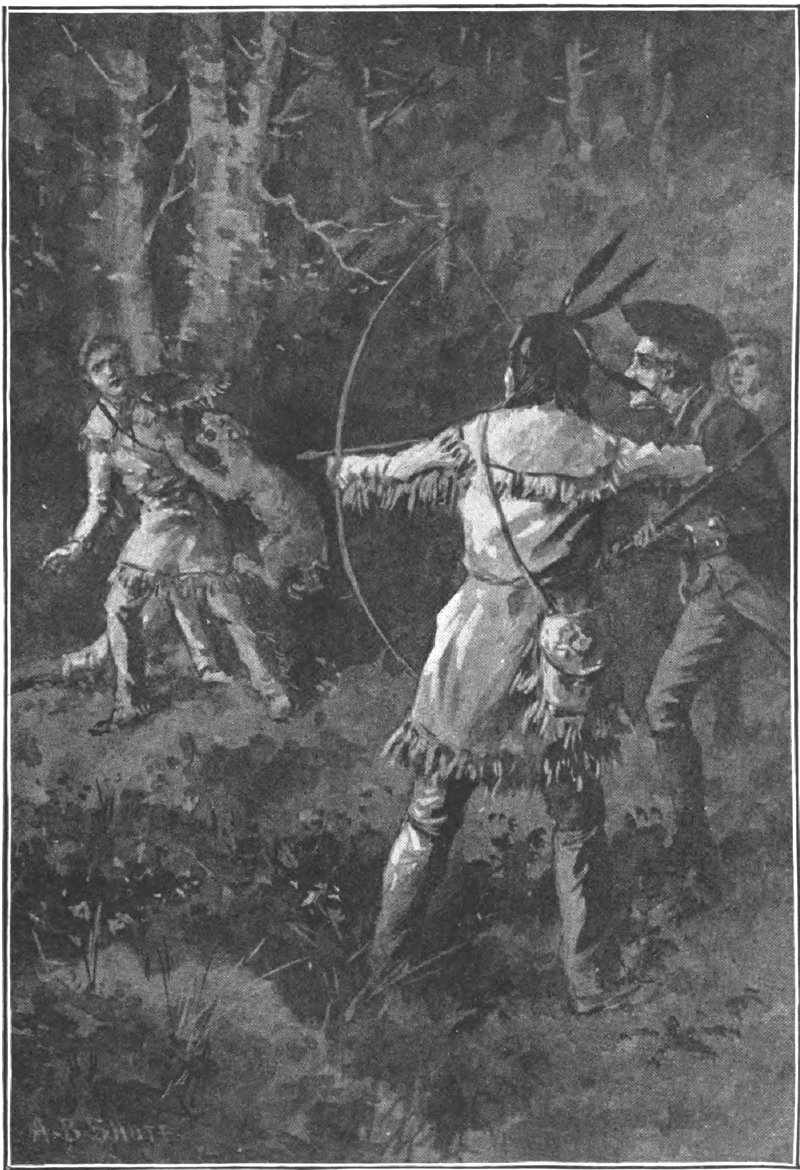
As the catamount left the ground White Buffalo fired a
second arrow.—Page 46.
47“He’s large, too,” said Gilfoy, and the Irish-American
soldier was right. The beast was nearly
three feet long, exclusive of the sweeping tail, and
had heavy-set legs and a powerful, “bullish” neck.
“We had better see if there are any more around,”
said Henry, and the search was started as soon as
the firearms were reloaded.
But no other wild beasts put in an appearance,
and at last, worn out by the work of the day just
past and by the numerous alarms, the soldiers lay
down once more, to snatch another nap ere the sun
came up.
CHAPTER VI AN UNEXPECTED SEPARATION
48
“I don’t believe the storms are entirely over
yet,” said Dave, on the following morning, after a
walk down to the lake shore and a look at the sky.
“It is going to be cloudy and windy,” answered
Henry, as he began to wash up in a neighboring
pool. “We’ll have to work hard for every mile we
gain.”
While the two were talking, White Buffalo joined
them. His foot was still very sore, but he said he
intended to turn back toward Fort Niagara as soon
as the morning meal was finished.
It did not take long for the soldiers to prepare
breakfast, and immediately after this the traps were
loaded on the boats and the young soldiers bid White
Buffalo good-by.
“Tell Sir William that you met us,” said Silvers,
“and tell him how the storm made us go into camp;”
and this the Indian chief promised to do.
49There was a strong, raw wind, and despite the
rising sun they were glad to keep on their coats as
they bent to the oars and sent the two rowboats
speeding on their way. Once more they hugged the
shore, Raymond stating that they might run into
another squall at any moment.
Although they kept their eyes on the alert, no
signs of white man or red were seen during the
morning. Once they saw an overturned canoe resting
in the mud, but by the appearance of the craft
they came to the conclusion that it had been rotting
there for several months, if not a year.
“The Indians have deserted this territory and
the French have all sailed to the north shore of the
lake,” said Dave. “It will be a long while before
another village or trading-post is established
here.”
But a few minutes later Shamer proved that Dave
was wrong. Standing up suddenly, he pointed to
a spot where the lake shore was thinly fringed with
trees and brushwood.
“What do you see?” demanded Silvers.
“Redskins—three or four of them,” was the low
answer.
“Where?”
“Back of those trees. They are gone now.”
“If that is so, we must be on our guard,” said
50the leader of the expedition, and called to those in
the second boat to pull further out into the lake.
They watched for a long time, but nothing more
was seen of the Indians, and presently Silvers asked
Shamer if he was sure his eyesight had not deceived
him.
“I am sure I saw them,” said the backwoodsman.
“I saw one of the Injuns myself,” put in Gilfoy.
“Just as I spotted him he dodged out of sight.”
Just ahead of the boats the shore made a deep
inward curve and Silvers decided that they should
row directly across the bay thus formed.
“The bay isn’t over a mile across,” he said.
“But if the redskins try to follow us up they will
have a good three or four miles to travel.”
“Unless they put out in canoes,” came from Raymond.
“If they do that we can easily see them and be
on our guard,” answered the leader of the expedition.
The constant rowing was beginning to tell on
Dave’s hands, and he was not sorry when it came his
turn to steer the craft occupied by himself, Henry,
and Raymond.
Good progress was being made when, about three
o’clock in the afternoon, the sky became unusually
black and the wind freshed up at a remarkable rate.
51“Now we are going to catch it,” said Raymond.
“And a good deal more of wind than of rain.”
The backwoodsman was right, and they had just
time in which to reach shore when the wind-storm
came rushing on them in all of its fury, hurling the
whitecaps one over another and causing the tall trees
to groan and bend beneath the blast.
“Don’t catch me under the trees in such a blow,”
said Gilfoy, and the others agreed that it would be
a foolhardy move to look for shelter there at such
a time. More than one branch came down with a
crack like that of a pistol, and further off they heard
half-decayed monarchs of the forest come down with
low booms.
The wind continued to blow, at first in irregular
puffs and then in a steady gale, directly from the
east. The raindrops were large and scattering and
scarcely wet the ground.
“It’s of no use to try rowing in this wind,” said
Silvers, after a careful look at the sky. “We’ll be
blown back and all our strength wasted.”
“How far are we from Oswego?” asked Henry.
“I should say about sixty miles.”
“We might tramp that distance,” put in Dave.
“But it would take not less than two days over this
rough ground.”
“It’s out of the question, lad. The ground is
52rougher than you imagine. No, I think we had better
rest until morning. This wind can’t last.”
This being decided, the party proceeded to make
themselves comfortable, moving inland to where a
series of rocks formed something of a cliff, thickly
overgrown with vines and bushes. Here they
formed a shelter by leaning long branches and saplings
against the rocks, and in a hollow a fire was
lit, where they made something hot to drink.
“We must be on our guard here,” said Silvers.
“Those Indians may be following us. This
cliff——”
He stopped short, having received a violent push
from Dave, who stood close at hand, under the shelter
of a thick tree branch. As the leader of the expedition
fell an arrow whizzed by his side, and
buried itself in the dirt between the rocks.
“The redskins!” cried Henry. “They are behind
us!”
“They are surrounding us,” put in Gilfoy.
Another arrow and still another whizzed through
the air, and Shamer was struck in the arm. Then
came a fierce yell from the forest, which was answered
by another from the lake front.
“They must number twenty or thirty,” said
Dave.
“We are caught like rats in a trap!” ejaculated
53Henry. His eyes began to blaze. “We’ve got to
fight for it—and fight our best, too!”
Another yell sounded out and several Indians appeared,
hideous in their warpaint. More arrows
were fired—one grazing Henry’s hand—and eight
of the warriors leaped toward the shelter, flourishing
their tomahawks.
“Fire on ’em. Don’t waste a bullet!” sang out
Silvers, and brought his long rifle to bear on the
leading Indian. As the weapon rang out the red man
leaped upward and fell in a heap, the bullet having
pierced his brain.
The firing now became general and soon the shelter
by the rocks was filled with smoke, so that but
little could be seen. Dave was beside Henry, and
both discharged their muskets at the enemy, and
they saw two more Indians stagger and fall back.
Then a tomahawk came whizzing through the air,
and poor Gilfoy went down to rise no more.
Shamer was also hit in the leg; and the din became
frightful.
“We must get out of here,” cried Raymond,
catching Dave by the arm. “Come on!”
“Come, Henry!” exclaimed Dave. “Follow
us!”
“All right,” was the answer, and in a second
more the three were running for the nearest
54patch of brushwood, loading their muskets as they
ran.
As the new shelter was gained, two tall warriors
leaped out to meet them. Tomahawks were raised,
but Raymond swung his musket over his head and
sent one Indian reeling to the earth. In the meantime
the second warrior threw his tomahawk at Dave,
but the youth dodged and before the red man could
recover from his throw Henry was on him with the
hunting knife he had carried since the breaking out
of the war.
“That for you!” cried Henry, wild with excitement,
and buried the knife in the Indian’s shoulder.
The warrior sank with a groan; and in a moment
more he and Henry were on the ground, in a fierce
hand-to-hand struggle for life.
Dave was somewhat bewildered by the quickness
of the various moves made, and when he could recover
somewhat he found himself by Raymond’s
side running up the lake shore. A fierce yell and
shouting came from a distance, interspersed with
gun and pistol shots.
“Whe—where is Henry?” he gasped.
“Reckon he is following us,” answered Raymond.
“Come on, don’t stop here. The Injuns will be
after us ag’in in a minute or two.”
“But I don’t want to—to leave Henry behind.”
55“Don’t worry but what he’ll follow, unless they
kill him, Dave. Come, it’s suicide to stay here,”
urged Raymond, and caught the youth by the hand
and dragged him forward.
The yells of the Indians now came closer, and
fearful of being surrounded once more the backwoodsman
and Dave plunged into the forest. They
chose a point where the tall timber was thick, and
they did not stop in their course until a hundred
yards or more had been covered. Sheltered by some
bushes, they reloaded their muskets, which had been
discharged four times since the struggle began.
“This attack has been a bad one, lad,” said Raymond,
who was breathing heavily. “Gilfoy is dead,
and I saw Shamer go down, too.”
“And Henry?” panted the young solder. “Oh,
do you think——” He could not go on.
“Let us hope for the best, lad.”
“If I thought I could help him I’d go back.”
“No, no, lad, don’t you try it. The Injuns are
three or four to one, and you’ll lose your scalp just
as sure as you are born.”
With great bitterness of mind, Dave was forced
to realize that this was true. Yet, he could not bear
to leave Henry to his fate.
“If he is killed I’ll never forgive myself,” he
thought.
56Listening intently, they heard the Indians moving
around the neighborhood, evidently trying to pick
up the trail the whites had left. Gradually they appeared
to come closer.
“We must get out of here,” whispered Raymond.
“Follow me, and don’t make a sound.”
As silently as a shadow he led the way through
the brushwood and to the open forest once more.
Fortunately the coming of night now favored them,
along with the heavy clouds which still hung low
in the sky.
Deeper and deeper they plunged into the growths
until they came to some rough rocks, back of which
was a hollow filled with stagnant water.
“Let us climb over some of the rocks,” whispered
the backwoodsman. “That will cut off the trail—in
case they do happen to strike it.”
With a heavy heart Dave did as advised, and the
pair covered another distance of a hundred yards.
Here the rocks were larger, forming a cliff considerably
higher than that where the fateful shelter had
been located.
“I see something of an opening,” announced Raymond
presently. “It ought to make a good hiding
place.”
He pointed to a split between the rocks. The
opening was high and just wide enough for them to
57squeeze through. To the rear was located a dark
cave of unknown depth.
“We’ll rest here,” said Raymond, and threw himself
on a rocky seat. “Keep your musket ready for
use.”
“It is all ready,” answered Dave, and sank beside
his companion, wondering what had become of
Henry, and how this unexpected encounter was going
to terminate.
CHAPTER VII A BEAR AND HER CUBS
58
Slowly an hour slipped by. To Dave it seemed
an age, and more than once he peered up and down
the rough rocks to see if there was any sign of
friends or enemies. From a distance had come two
shots, but after that all was quiet as a tomb, save for
the wind, which still swept through the forest, and
the occasional patter of a few drops of rain.
“Don’t go too far, lad,” said Raymond, by way
of caution, after Dave had climbed out on the rocks
for the fourth time. “Those Injuns may be closer
nor you think.”
“I must find out what has become of Henry,” was
the half-desperate answer.
“Yes, yes, I know, but——”
“Do you think any of our party escaped to the
boats?”
“It’s not likely they would expose themselves,
lad. If they tried to row away some of the redskins
59would be sure to see ’em and send a shower of arrows
after ’em.”
“But it is dreadful to think Henry may be killed,
or a prisoner!”
“I know that too, lad. Didn’t I lose my brother
Dan on the frontier only four years ago? I did my
best to save him, too, but it was no use. I was taken
prisoner, and they had just started to torture me
when some of the Gordon Rangers came up and
saved me. That was the fight in which they killed
old Tom Granby and his son Jabez, and carried off
Mrs. Williamson and little Ned Ford.”
“Did the prisoners ever escape?”
“All but little Ned. He was carried westward,
and they have never heard of him since,” answered
Raymond, with a sorry shake of his head.
A lump arose in David’s throat and he found great
difficulty in swallowing it. If Henry was dead how
would he ever be able to send the news to Mrs. Morris
and the others?
“It will ’most break Aunt Lucy’s heart,” he
thought. “And Uncle Joe’s heart too. With Rodney
a cripple they all depended on Henry so much!”
Raymond was about to take a look around, when
a curious sound from the rear of the cave-like opening
caused both the backwoodsman and the young
soldier to leap up in fresh alarm.
60“What was that?” cried Dave, as he brought up
his musket.
“Don’t know,” whispered Raymond. “Lay low!
The Injuns may be coming on us another way.”
Both crouched back into a niche of the wall and
waited. Soon the noise was repeated, and they heard
a scratching on the rocks at the back of the opening.
“Reckon I know what that is,” said Raymond at
length.
“What?”
“Bear’s cubs.”
“Do you really think so?” cried Dave. “If that
is true, this must be a bear’s den.”
“More’n likely, lad, and if it is we had better get
out.”
“You think the old she bear will be back?”
“To be sure. She won’t leave her cubs over
night. She’d be back before this, only it’s likely the
shots made her timid.”
“It’s queer we didn’t hear the cubs before.”
“They have been asleep and just woke up.
Hark!”
They listened and heard the scratching on the
rocks again. It came closer, but when Raymond
made a noise, it sounded fainter and fainter.
“They won’t touch us, that’s sure,” said Dave.
“But the old she bear——”
61“Something is coming!” interrupted Raymond.
“Reckon it’s her!”
He was right—the mother of the cubs—a black
bear of good size, was coming slowly along at the
foot of the rocks. She sniffed the air and looked
from side to side with keen suspicion.
“Hadn’t we better get out without being seen?”
whispered the young soldier. “If we kill her, the
Indians will hear the shots.”
“Yes, come on,” replied Raymond.
Side by side they started to leave the entrance to
the bear’s den. But as they stepped out the old
she bear uttered a whine, and the cubs in the cave
gave answer. Then the mother bear saw the intruders
in the semi-darkness and let out a growl
of savage rage.
“She’s going to fight!” cried Dave.
“She thinks we have hurt her cubs!” returned
the backwoodsman.
Raymond was right, and before they could take
a dozen steps up the rocks the black bear was
leaping after them, snarling viciously and showing
her long, white teeth.
“We’ll have to shoot—or be chewed up!” gasped
Dave, when the bear was less than fifty feet from
him.
He had scarcely uttered the words when Raymond’s
62rifle rang out. But the aim of the backwoodsman
was poor, and the bullet passed wide of
the beast. The report stopped the bear but a second,
then she came on as furiously as ever.
It was now Dave’s turn to shoot, and he lost no
time in blazing away. He was more fortunate, and
the black beast was brought to another halt, this
time with a bullet in her shoulder. But the fight
was not yet knocked out of her, and she tried to
limp over the rocks, uttering growl after growl.
“She won’t give in,” said Raymond, and both
started to reload. While they were doing this the
cubs, two in number, appeared at the entrance to
the cave-like opening.
On catching sight of her offspring, the wounded
bear paused once again. She evidently wished to
pursue her enemies and at the same time she wished
to make certain that her cubs were really unharmed.
Slowly she limped back to her own.
“Now is our chance!” cried Dave, and over the
rocks went the young soldier and the backwoodsman,
scrambling along with all possible speed. The
route was a rough one, and more than once they had
their hands and faces scratched and their uniforms
torn.
“Those shots will put the Indians on the watch,”
said Raymond, as they pushed along.
63“Perhaps they will bring some of our friends to
the vicinity,” returned Dave. “If Henry——Oh!”
Dave’s speech ended in a cry of pain. He had
slipped on the rocks and his left leg had received a
severe wrench at the knee. He tried to rise and then
fell back with a groan of agony.
“What’s the matter, lad?”
“I’ve twisted my knee.”
“Can’t you get up?”
“I’ll try it. Oh!”
Dave stood up on the limb that was uninjured and
tried to take a step. But the pain was too great and
he was forced to sit down on a rock.
“That’s too bad, certainly,” said Raymond sympathetically.
“If you can’t walk, I really don’t know
what we are to do.”
“Perhaps you had better go on alone.”
“No, I shan’t leave you, Dave—it wouldn’t be
human.”
“Yes, but—but we left Henry,” said the young
soldier bluntly.
“That was in the midst of a fight and a different
thing altogether. If you can’t walk, can you climb
yonder tree, do you think?”
“Perhaps, with your help.”
“Then let us both get up. The bear can’t climb
64with a wounded leg, and if she does I can give her
a shot right in the head when she comes up,” went
on the backwoodsman.
He picked the youth up in his arms and walked
over to the tree he had pointed out. The darkness
of night had now settled down, and it was with difficulty
that they made their way among the lower
limbs. Dave wanted to shriek with pain, but gritted
his teeth and kept silent.
It was a lonely and never-to-be-forgotten night.
In an hour or two the wind went down and it began
to rain steadily. Dave did not feel like stirring, and
all he could do was to rub the cords of his limb that
had become so sadly twisted. Raymond remained on
guard, but neither the bear nor anything else came
to disturb them.
At daybreak it was still raining, but the clouds
showed signs of breaking away, and before nine
o’clock the hot midsummer sun shone as brightly as
ever.
“We are in a bad plight, no two ways about it,”
said the backwoodsman. “What is best to do I
must say I don’t know.”
“I don’t believe I can walk very far yet,” answered
Dave despondently. “My knee feels as stiff
as if it was in a vise.”
“Perhaps I had better scout around a little, leaving
65you here. It is barely possible I may run across
some of the others and find out what became of
your cousin.”
“Then go, by all means!” cried Dave. “You cannot
do me a greater favor than to find Henry.”
“But you must lay low, lad. The Injuns may be
closer nor you think.”
“I will keep quiet. But I’d like to have a drink
before you go,” answered the young soldier.
Some water was obtained, and he gulped it down
eagerly, and bathed his sprained knee with what remained.
Then cautioning him once more, Raymond
left him, the backwoodsman setting off in the direction
of the lake front.
If the night had seemed lonely, the time now was
doubly so to Dave, who could do nothing but nurse
his bruise and keep a lookout for a possible enemy.
His thoughts traveled constantly to his cousin, and
he wondered if Raymond would bring in any news
of Henry.
“He ought to learn something,” he told himself
over and over. “I am sure I could if I was in his
place.”
Nine o’clock came and then ten o’clock, and still
the silence of the forest remained unbroken save for
the occasional song of some distant bird, and the
buzzing of bees around an adjacent bee-tree. The
66nearness of this bee-tree put Dave in mind of that
discovered by his uncle and himself while on their
trip to Annapolis some years before. What great
changes had occurred since that time!
“This war has been an awful thing, and I shall
be glad when it is at an end,” he thought. “But
unless we win, there will be trouble with the Indians
and the French for years and years to come.”
It was almost noon when he heard a faint sound
in the woods to the north of the tree. Instantly he
caught up his musket, which had been resting in a
crotch close at hand.
Slowly the sound came closer, and he could hear
the labored breathing of some man or animal. He
leaned as far down as possible to catch a glimpse of
the newcomer.
“Shamer!” he murmured.
He called the soldier’s name softly, and Shamer
paused in wonderment.
“Who is calling me?” he panted.
“I am, Dave Morris, Shamer. I am up in the
tree. Are you alone?”
“Yes, and I can hardly walk,” groaned the soldier.
“A bullet struck me in the calf of the leg.
Any Indians around here?”
“I haven’t seen any. My knee is hurt. Raymond
was with me, but he has gone down to the shore to
67take a look around. Do you know anything of my
cousin Henry and the others?”
“Gilfoy is dead.”
“Yes, Raymond said they had killed him. And
the others?”
“The Indians captured both Silvers and Henry
and carried them off,” was Shamer’s answer, which
caused Dave’s heart to sink like a lump of lead in his
bosom.
CHAPTER VIII IN THE HANDS OF FRIENDS
68
Shamer was completely exhausted, and reaching
the trunk of the tree in which Dave was perched he
threw himself down to rest and regain his breath.
His uniform was much torn and covered with dirt
and there were ugly scratches on his hands and
face.
“I had a terrible time of it after we got separated,”
he said, after a pause. “Four redskins attacked me,
and I had to knock over two of them before I could
get away. Then I ran down to the shore, and got
into another mix-up with an Indian and some
Frenchmen, who had just come down the lake in a
big flat-bottomed boat.”
“Was that when you saw Henry and Silvers?”
“No, I didn’t see them until two hours later, after
the fight came to an end. I hid in the rocks down
near the lake, and while I was there I saw the flat-bottomed
boat again. There were six Indians in it
69and two Frenchmen, besides Silvers and your
cousin.”
“Was Henry much hurt?”
“I can’t tell you about that. Both he and Silvers
were bound with ropes and crowded into the bow of
the boat, and I couldn’t get a very good look at them
on account of the others. I might have given the
Frenchmen and the redskins a shot or two, but I
was afraid they would come ashore again and catch
me, for I was too tired out to run. I went back into
the woods, and early this morning I got into a fight
with another Indian. But he was wounded, and I
soon got the best of him,” concluded the soldier.
“How was the flat-bottomed boat headed?” asked
Dave, after another pause.
“The last I saw of it it was headed almost due
north.”
“Then the Frenchmen and the Indians were bound
to Canada with their prisoners,” groaned Dave.
“It looks like it, Morris.”
A long spell of silence followed, Dave turning the
situation over in his mind and Shamer dragging
himself to the pool, to drink and to bathe his
wounds.
It was some time after the noon hour when Raymond
came back, skulking through the forest as
silently as a shadow. On catching sight of Shamer
70he raised his musket, but just as quickly lowered
the weapon.
“So you escaped, eh?” said he. “I am glad to
hear it. I saw poor Gilfoy’s body, scalped, and I
was afraid you and the others had shared the same
fate.”
He sat down and had the German-American soldier
tell his story, as it had already been told to
Dave.
“It’s too bad,” he declared. “And the worst of
it is, we are not yet out of this trap. The most of
the redskins are gone, and I saw no Frenchmen, but
at least four Injuns are still on guard—two at the
lake front and two down on a trail leading to Fort
Oswego.”
“That means that we are hemmed in,” said Dave,
who was leaning down from the tree branch listening.
“Yes, lad. How is the knee?”
“I am sorry to say it is just as bad as ever, if not
worse.”
Raymond climbed into the tree and inspected the
injured limb, which was considerably swollen.
“It certainty does look bad,” he said. “One thing
is certain, you are not able to sneak through the
woods now, and it’s doubtful if you can do it after
sundown.”
71“Well, I suppose I can’t remain here forever,”
returned the young soldier, rather helplessly.
“We can help him along, after I get my wind
back,” put in Shamer, who had bound up the arrow
wound he had received.
During his tour of inspection Raymond had been
able to pick up a few stores, left near the shelter by
the rocks, and he now offered both of his companions
something to eat. Shamer partook readily of
the food, but poor Dave was almost choked by it.
The young soldier’s thoughts were constantly with
Henry. Would he ever see his cousin again?
Raymond noticed how downcast the lad was, and
did his best to cheer him up.
“Don’t take it so hard, Dave,” he said kindly.
“Remember, he isn’t killed, and many a prisoner
has escaped ere this. Besides, if they put him in
prison, this war is bound to come to an end, sooner
or later, and then he’ll be set free.”
“That may be true,” returned the young soldier.
“But you know as well as I do what the French prisons
are like—the very worst holes on earth.”
“That may be only evil report, my lad. True it
is that some Frenchmen, even though they be our
enemies, are as good-hearted as any Englishman
ever dared to be.”
“That is true,” broke in Shamer. “A good man
72is a good man, and a bad one is a bad one, no matter
what his nationality. But I have no use for an
Indian.”
“Well, there are some good Indians,” added Dave
quickly. “White Buffalo, for instance. If he was
here I am sure he would help us out of our trouble.
But I can’t get Henry out of my mind,” he added,
with a sigh.
Dave was glad enough to leave his cramped position
in the tree and stretch himself at full length
on a bed of dry leaves in the sunshine. So the
balance of the day passed, with nothing coming to
disturb them. Raymond half expected to see the
old she bear, but she did not show herself, and he
was content to let her remain with her cubs.
“How far is the trail to Fort Oswego from
here?” asked the young soldier, when the darkness
began to gather.
“Not over half a mile.”
“I was thinking I might get that far on a pinch.
But even if we got to the trail, what then?”
“I’ve got a plan,” said Raymond. “I’ll carry
you on my back. We can take our time, and we
are bound to reach Fort Oswego sooner or later.”
“If we don’t fall into some redskins’ trap,” put
in Shamer.
“Well, I suppose we must take some chances,”
73said Dave. “It is very kind to offer to carry
me.”
The start was begun a short while later, Shamer
carrying the guns and what was left of the provisions,
and Dave perched on Raymond’s shoulders,
for that was the manner in which the backwoodsman
declare he could carry the load most comfortably.
It was a good hour before the trail to Fort
Oswego was gained—a rough, narrow path, first
used by the buffalo of upper New York State and
then by the Indians and traders. They advanced
with caution, Shamer leading the way with his
musket held before him, ready to fight at the first
sign of an enemy.
The night proved to be clear, with no moon, but
with countless stars. Along the trail all was silent—even
the night birds failing to utter their lonely
notes.
After a rest the journey along the trail was begun,
Shamer leading the way as before. The forest was
thick on either side, and in many spots there were
rough rocks to cross, which made Raymond puff
and blow over his load. More than once Dave
said he would get down and try to walk, but the
backwoodsman would not allow it.
“I’ve brought in a big deer on my shoulders
74more than once,” he declared. “And you don’t
weigh any more.”
By daylight ten or eleven miles had been covered,
and all were glad to rest again, by the side of a
brook flowing into the lake. The journey had been
no easier for Dave than for the others, and more
than once he had felt like crying out with pain
when Raymond gripped his sore limb harder than
usual.
“Ours has certainly been an ill-fated expedition,”
observed Raymond, as he munched a bit of biscuit,
while the others did the same. “If we ever get
out of it alive, it will be a sorry report we’ll have
to offer to the commander at Fort Oswego and to
Sir William Johnson.”
“I can’t see how we are to be blamed,” answered
Dave. “We were attacked by a superior force
and fought as well as we could.”
“Sir William told us to keep to the lake,” put
in Shamer. “But of course we couldn’t do that
with such a wind.”
It had been decided that it would be safest to
rest during the day and travel at night. Accordingly
Raymond and Shamer lay down for a nap
of four hours, leaving Dave on guard.
The four hours were almost up, and the young
soldier was beginning to feel sleepy himself, when
75a noise in the forest on the other side of the brook
caused him to start up.
“It must be either a man or a wild animal,” he
reasoned and placed his finger on the trigger of
his flint-lock musket, after satisfying himself that
the priming was in good condition.
Slowly the noise came closer, and presently he
heard two men talking in English.
“If they are English they must be friends,”
thought the young man joyfully, but still he continued
on guard. He awakened Raymond and
Shamer by a light touch.
“What is it?” came from Raymond.
“Two men are over yonder. I can hear them
talking.”
“Then we had better get out of sight until we
are sure of who they are,” put in Shamer.
Secreted in the bushes they waited until the two
unknown ones came down the edge of the brook.
They were dressed in the garb of frontiersmen and
each carried a rifle and a game-bag.
“Game is putty well scart off, Chester,” said one.
“The cap’n won’t git much fresh meat from us,”
and he gave a droll laugh.
“That’s about the size on it, Holden,” was the
reply. “Yet I reckoned on some b’ar bein’ around
here.”
76“I am sure they will be friends,” whispered
Dave. “They are probably from the fort.”
Raymond nodded. Then he called aloud:
“Hullo, there, friends!”
The two frontiersmen started, and each raised his
rifle.
“Who calls?” questioned the one named Chester.
“A lost soldier,” answered Raymond, and presented
himself to view. “I take it you are English,”
he added.
“We are. Where are you from?”
Raymond told them, and then Dave and Shamer
also presented themselves. The two frontiersmen
leaped the brook and listened to their story with
keen interest.
“You’ve certainty had a tough fight of it,” said
the man named Holden. “I held all along thet them
Frenchmen would be over here nosin’ ’round an’
thet they’d bring some redskins with ’em.”
“Are you from Fort Oswego?” asked Dave.
“We are. We are attached to Cap’n Neely’s
company o’ rangers. We came out lookin’ for a
bit o’ fresh meat. But now I reckon the best thing
we can do is to help you to git to the fort, ain’t
thet so?”
“If you will be so kind.”
77“Aint no kindness; it’s jest plain duty,” said
Chester.
The frontiersmen felt certain that no more Indians
were left in the vicinity. Yet they promised
to keep a strict guard, and a little later our friends
moved off once more in the direction of Fort Oswego,
the frontiersman named Chester carrying
Dave on his back for a mile or two and then being
relieved by his companion, and later by Raymond.
Thus the march was kept up all of that day and
also part of the next, and at two o’clock in the
afternoon they came in sight of Fort Oswego, with
the flag of old England floating proudly in the
breeze above it.
CHAPTER IX WHAT BEFELL HENRY
78
Let us now return to Henry, and see what happened
to him during the time that Dave was making
his escape to Fort Oswego.
As we already know, Henry had attacked one
of the Indians with his hunting knife. In a moment
more both were struggling on the ground, in
a close embrace which was truly desperate.
Henry was strong for his age and during his life
had been in more than one close encounter with both
red men and wild animals. He felt that he was
fighting for his life and he did not intend to give
the Indian the slightest advantage.
The young soldier felt the red man’s hand creeping
toward his throat, but he caught the wrist and
bent it backward, until the Indian had to squirm
to one side to prevent that member from being
broken. But then the Indian made another twist
79and got his arm over Henry’s neck, pressing him
closer and closer.
There was but one way left in which to throw
the Indian off, and this the young solder used without
delay. Drawing up his knee he set it against
the enemy’s chest and forced it forward, at the same
time holding the red man across the back by one
hand and by the leg with the other.
The awful pressure thus brought to bear was
more than the Indian could stand. Fearful of
having his ribs crushed in, he released Henry’s
throat. At once the youth threw up the leg he was
holding and the red man went spinning over on his
back.
By this time other Indians were at hand, and an
arrow hit Henry in the fleshy part of the arm.
Raising his hunting knife, he struck at one of the
newcomers, piercing his shoulder. Then he made
a leap up the rock and another to the bushes beyond,
and with the swiftness of a wild animal disappeared
into the forest.
The blood of the Indian who had been struck
was now aroused, as was also the anger of the one
who had been thrown down, and the pair made
after the young soldier, followed by two other
warriors.
Through the forest went pursued and pursuers,
80until, having run in something of a semicircle,
Henry came out on the lake front, at a spot some
distance above where the two rowboats had been
drawn up. Here he espied an Indian canoe, and,
leaping in, began to paddle out into the lake with
all speed.
The first intimation he had of the closeness of
his enemies was when an arrow flew by the canoe,
to land in the water beyond. Other arrows followed,
and then came the report of a gun, but he
remained untouched.
The Indians were now running along shore, and
soon they came upon the two Frenchmen already
mentioned in these pages. They belonged to the
Canadian militia and their uniforms were such in
name only. They had come to the south shore of
the lake for information, having been promised a
good reward by the Governor-General of Canada if
they succeeded in bringing back news of importance.
Under the directions of the Frenchmen four of
the Indians set off in one of the rowboats after
Henry, who was still paddling westward with all
the speed at his command. The red men were
ordered to capture the young soldier alive if possible,
but if not, to kill him.
It was not long before Henry discovered how
81the pursuit had been renewed. He had now reached
a good-sized inlet and was still some distance from
the shore. He turned in with all speed, knowing
that a fight of four to one on the water could only
end in his defeat.
“If I only had my musket,” he said, half aloud,
but the firearm had been left on the ground at the
camp, after the first hand-to-hand struggle.
The shore was almost reached, when the Indians
set up a yell, and while two of them continued to
row the other two rose up and fixed arrows in their
bows.
“White soldier stop!” cried one, in bad English.
“Stop, or be killed!”
“I reckon you’ll kill me anyway,” muttered
Henry, and as the canoe grated on the shore, he
dropped the paddle, caught up his hunting knife,
and leaped to land.
It is barely possible that the youth might have
escaped to the forest once more. But as he ran
for the trees, two Indians suddenly appeared before
him. One carried a stout stick, and without warning
he struck Henry a heavy blow on the head. The
young soldier uttered a moan, staggered from side
to side, and then fell senseless.
In a moment more, and just as the Indian who
had struck the blow was bending over the unconscious
82youth to scalp him, the Indians in the rowboat
came up.
“Rising Moon must stop,” called one of the
number. “He must not scalp the pale face.” He
spoke in his native tongue.
“Why does Falling Waters speak thus?” demanded
the other. “It was Rising Moon’s hand
who laid the English soldier boy low.”
“Rising Moon has earned the scalp,” went on
the first Indian. “But Falling Waters has orders
to bring the soldier back alive.”
At this Rising Moon’s face took on a sour look.
“Who gave the order?”
“The Frenchman, Jacques Volnier. He is here
with another. They seek news of importance from
the English. We have sworn to stand by them, and
we must obey,” added Falling Waters.
A long and angry discussion arose, but in the end
Falling Waters carried his point, and Henry was
taken to a rendezvous which the Canadian Indians
had once occupied on the south shore of Lake
Ontario.
The fight had by this time terminated, and the
Frenchmen and the Indians had come out on the
lake in a flat-bottomed boat. With his arms bound
behind him, Henry, who was just recovering from
the blow he had received, was made to march down
83to the boat. Here he found Silvers also a prisoner,
and suffering from several arrow wounds.
“Hullo, are you a prisoner?” cried the leader of
the expedition, when one of the Frenchmen arose
and clapped a hand over his mouth.
“Ze prisonair must not talk now,” he said, in
broken English. “Ze prisonair can talk when we
haf left ze shore.”
“All right,” muttered Silvers, and glad that the
Frenchmen had compelled the Indians to spare his
life, he relapsed into silence.
As for poor Henry, his head was in a whirl and
ached as if ready to split open. More than this, he
felt stiff and sore all over, and he sat in the
bow of the boat only with the greatest of difficulty.
As Shamer had told Dave, the boat contained
six Indians, besides the two Frenchmen and the
prisoners, so it was heavily loaded. The red men
were at the oars, and they rowed with a steadiness
that showed they had had practice in this art as well
as with a paddle. The boat shot forward with good
speed, and soon the south shore of the lake became
a dim, uncertain line in the distance.
“Now ze prisonairs can tell us who za air,” said
one of the Frenchmen, evidently the leader of the
party.
84“I am not ashamed of that,” answered Silvers.
“My name is Louis Silvers.”
“Ah, Louis—zat ees a good name. And you?”
went on the Frenchman, turning to the young
soldier.
“I am Henry Morris.”
“You belong to ze soldiers at Fort Oswego, not
so?”
“We do not,” answered Silvers.
“Zen where from you come?”
“We have been up at Fort Niagara.”
“Ah, I see—you help at ze capture of zat place,
eh?”
“Yes.”
The Frenchman shook his head thoughtfully.
“Zat was von bad work—zat fight. I no haf
been dair, but I hear, yes, I hear it all.”
“Who are you?” asked Henry boldly.
“Me? Ah, I am not much, my bold little
troopair, I am plain Jacques Volnier, a hunter and
trappair.”
“Then why have you captured us?” went on
Henry curiously.
At this the Frenchman shrugged his shoulders.
“Because—yes, because we want ze company,”
he answered, with a smile.
Henry frowned, and so did Silvers, and at this
85both Frenchmen laughed at what they thought was
a good joke. Then they talked to each other in
their own tongue, leaving the prisoners to themselves.
“What do you think they will do with us?”
asked Henry, in a low voice.
“Throw us into a French prison, more than
likely,” answered Silvers gloomily.
“What did you do with Sir William’s message?”
“Hush! I threw it overboard,” said the other,
in a still lower voice.
The strong sun was now beginning to tell upon
Henry, and he said no more. He wanted to keep his
senses, but presently all seemed to fade from him.
He felt himself pitch into Silvers’ arms, and then
he knew no more for the time being.
“Poor lad,” murmured Silvers.
“What is ze mattair?” demanded Jacques
Volnier.
“He has fainted. Won’t you untie me so that I
can do something for him?”
“Oui! oui!” was the answer, and in a moment
more Silvers was free. He untied Henry and bathed
his forehead, and presently the young soldier opened
his eyes. But it was not until long after sundown
that Henry felt anything like himself again, and
even then he was almost too weak to stand.
86The two prisoners wondered where they were
being taken, but could get nothing from either the
Frenchmen or the Indians. The rowboat was
headed to the northeast, and this showed that the
general direction was for the mouth of the St. Lawrence.
On and on swept the craft, through the
dismal night and still on when the morning
came.
“They are going quite a distance,” said Henry,
after he had swallowed a piece of bread that had
been given to him. “Can it be that they mean to
move right down the river?”
“It is possible,” answered Silvers. “Montreal,
you know, is not so very far away.”
At last the boat turned to the eastward, and that
evening a landing was made near what is to-day
Wolfe Island. There had been a small settlement
here, but this was abandoned, the inhabitants having
withdrawn to a fort on the mainland.
At the island the Indians left the party and some
other Frenchmen appeared, one owning a fair-sized
sloop, which boasted a small swivel gun. The
prisoners were made to board the sloop, and now
their hands were chained behind them. The sloop
had a small cuddy and into this they were forced,
the door being closed and locked after them.
“We are in a pickle now surely!” groaned
87Henry. “I believe they are going to take us down
the river.”
It was not until late at night when the anchor
was hoisted and the sails of the sloop were set. Then
the craft slipped by the island, and past Fort Frontenac,
and stood boldly down the stream in the
direction of the Thousand Islands.
CHAPTER X IN THE HANDS OF THE ENEMY
88
The night passed slowly to the two prisoners
confined in the narrow space of the sloop’s cuddy.
No one came to speak to them, and as hour after
hour went by first one and then the other dropped
off to sleep.
When Henry awoke it was broad daylight, and
the sloop was bounding along at a rapid rate of
speed. Through the one narrow window of the
cuddy he saw that they were passing a shore filled
with waving grass and dotted here and there with
low trees.
“We are going down the St. Lawrence, that is
certain. But to where?”
In vain he asked the question of himself, and then
of Silvers. The sharpshooter merely shrugged his
shoulders.
“I know nothing of these parts, lad,” he said.
“We must take what comes.”
89At noon they received a scanty meal and a drink
of lukewarm water. A sailor served this, and as
he could talk French only they learned nothing from
him.
It was nightfall when the sloop’s trip came to an
end. Cramped and stiff, the prisoners were made
to march ashore, to where was located an old convent,
now fallen mostly to decay. Some soldiers
were quartered here, and the prisoners were turned
over to a guard and promptly put into what had
once been the cell of a monk.
“Worse and worse,” said Henry. “What do
you think will happen next?”
Again Silvers shrugged his shoulders.
“I don’t know, lad, unless they march us out to
be shot.”
“Would they do that? They did not catch us
in French territory.”
“As we are in their power they can do with us
as they please.”
Early in the morning the pair were aroused by
the roll of a drum. Some of the soldiers were getting
ready to march away, and the prisoners were
told that they were to march with them.
“To where?” asked Henry.
“To Montreal, and perhaps to Quebec,” said the
officer addressed, who could speak excellent English.
90Henry wanted to ask more questions, but the officer
had no time to listen to him.
By eight o’clock the soldiers were on the march,
with the two prisoners in their midst. The way was
along the river trail, past many pretty farms and
handsome French estates, many of which, however,
were now abandoned. At one point in the road they
came upon several ladies on horseback, who stared
in wonder at the prisoners.
“They seem to think we are wild beasts,” laughed
Silvers. He bowed politely, but the ladies turned
and rode away.
It will be unnecessary to go into the details of
the weary march that followed the tramp along the
river trail. For four days the prisoners were kept
on the road. Montreal was passed, with only a faraway
glimpse of its large cathedral and its seminary,
and then the course was almost straight for Quebec.
So far the prisoners had been treated fairly well,
but now came a change in the command; and they
were given food that was hardly fit to eat.
“We can’t stand this very long,” was Henry’s
comment, as he threw away a moldy crust that it
was impossible to swallow. “I’d choke on such
stuff.”
The officer in charge of them saw the crust
thrown away, and came up shaking his fist at them.
91“Zat ees ze best you vill git,” he cried. “Of you
no eat zat, you starve!”
“All right, we’ll starve then,” replied Henry
recklessly.
“Bah! you think you are ze brave boy, eh? Ze
English za be all grand cowards!” And the Frenchman
went off in disgust.
“He’s a cheerful dog,” muttered Silvers.
The next day the fare was even worse, and both
of the prisoners were on the point of open rebellion.
At night the French officer brought in an aged
Englishman to talk to them. The Englishman was
a Canadian settler.
“They are bound to make you talk,” said the
Englishman. “If you will tell all you know they
will treat you better.”
“Tell what?” asked Silvers.
“Tell all the plans of the English soldiers.”
“But we know very little,” put in Henry.
“The French captain thinks you know a great
deal. He says the man who captured you, Jacques
Volnier, is certain one of you is a noted spy.”
“He must mean me,” said Silvers. “If so, he
is much mistaken. I am nothing but a plain
soldier.”
“And so am I,” added Henry.
“I am willing to believe that, for your faces are
92honest ones,” said the old Englishman. “But
you know how suspicious these Frenchmen
are.”
“How come you here?” asked Henry.
“It is a long story. Years ago I married a
young lady whose parents lived not far from Quebec.
When they died, they left her the farm and
all its fine buildings. We moved to this place and
have been here ever since. I am seventy-three years
old, and so far I have refused to take either side in
this struggle.”
“Did they send you here to bribe us?”
The old man drew himself up.
“They could not do that. They asked me to
talk to you, that is all. I am afraid if you will tell
them nothing it will go hard with you.”
“We cannot tell what we do not know,” said
Silvers.
“That is true.”
The old man asked them their names, and in return
said his name was Peter Merton. He said he
had a son, who had left home at the beginning of
the war, and what had become of his offspring he
did not know.
“I have an idea he joined the English army,”
he said. “If so, I sincerely trust that no harm
comes to him.”
93The old Englishman remained with them for the
best part of an hour. He told them that the camp
was located not far from the north bank of the St.
Lawrence, a few miles above Quebec.
“I cannot tell you what General Wolfe is now
doing,” he said. “We get very little news.”
“I heard some cannon firing last night,” said
Henry.
“Oh, yes, we get plenty of that. But very little
damage is done. I do not believe that General
Wolfe really means to demolish Quebec.” And in
this surmise the old man was correct.
When the old man was leaving, he shook hands
with them. As he did this he pressed into the hand
of each a piece of gold money.
“You may find it useful,” he whispered. And
before they could protest he was gone.
“He is certainly a good-hearted fellow,” said
Henry.
“He might have helped us to escape,” said Silvers,
as he slipped the gold piece in his pocket.
“No, I think he was too old for that,” returned
Henry, and then glancing on the ground he uttered
a low cry, for there lay a small and exceedingly
sharp dagger.
“He dropped that, and most likely on purpose,”
exclaimed the sharpshooter. “I’ll keep it, for it
94may come in handy,” and he placed the dagger in
his bosom.
Henry and Silvers had been confined for the night
in an old house. Two sleepy French soldiers were
on guard. As one of them came in to see that they
were up to no mischief Silvers motioned to him.
“Do you talk English?” he asked.
“Verra little,” answered the soldier, who was
of the peasantry and exceedingly stupid.
“We are hungry, and want something to eat and
to drink,” went on Silvers, and pointed to his
mouth.
At this the soldier shrugged his shoulders.
“We will pay for whatever you get us,” went
on the sharpshooter, showing the gold coin. “You
buy us something, and keep half the money.”
The eyes of the peasant opened widely at sight
of the gold coin, the like of which he had not seen
for months, for his pay as a soldier was but a few
francs per week.
“I no—you——” he stammered.
For reply Silvers made a motion as to cut the
coin in half. Then he pointed to the soldier’s
pocket and then to his own mouth and to Henry’s
mouth. The peasant comprehended and a dull smile
overspread his features. He went out to consult
the other soldier on guard.
95A few minutes later the fellow came back and
took the gold coin. Then, regardless of army regulations,
he left his gun with his companion and stole
away in the darkness.
“He has gone for the food,” whispered Silvers
to Henry. “Now the question is, shall we wait for
him to get back, or make a dash for liberty?”
“Let us try for liberty,” exclaimed the young
soldier eagerly. “If we can only get away, I
am sure we can find something to eat somewhere.”
“I have a plan,” said the sharpshooter. “Do
you see yonder chimney?”
“Of course.”
“We might pretend to run away and hide in that.
Then, when the soldiers disperse to hunt for us, we
can cut sticks and off.”
This plan was agreed to, and having examined
the chimney and found out how they could secrete
themselves inside, they both peeped out at the single
guard, who was walking up and down, humming to
himself.
“Now!” cried Silvers, and they made a racket
as if climbing through a side window, letting the
sash fall with a crash. Then both ran to the
chimney and hid with all possible speed.
The guard gave a cry in French and came running
96up. One glance showed him the empty room and
his eyes strayed to the window.
“Gone!” he muttered, in his native tongue.
“And through yonder window! Oh, the artful
rascals! But I shall catch them, or shoot them
down!”
He made off, and they heard him start to give
the alarm. But then he thought of his companion
and the gold piece. If the commanding officer heard
of how the one guard had gone off there would be
trouble ahead for both. He ran around wildly, at
length taking a road leading to the river bank.
“Now is our chance,” said Henry, and dropped
out of the chimney, covered with soot and as black
as a negro. Rushing outside, he caught up the gun
belonging to the guard who had gone for the food.
As he did this Silvers drew the dagger he had picked
up, and thus armed the pair started for the nearest
patch of woodland, several hundred feet away.
But the alarm was now general, in spite of
the guard’s effort to keep the affair quiet, and they
heard calls from several directions.
“If we get away it’s going to be a tight squeeze,”
said Silvers.
“We must get away,” cried Henry. “Come on,”
and he set off at a faster pace than ever.
CHAPTER XI ABOARD THE FIRE-BOAT
97
The edge of the woods was gained when a shot
rang out, but whether directed at Henry or the
sharpshooter neither could tell.
“They will be after us hot-footed in another minute,”
said the young soldier. “How shall we turn?”
“It will be folly to turn to the river just yet,” answered
Silvers. “They will be sure to hunt for us
there. Let us hide in the opposite direction until the
alarm is over.”
As the pair passed into the wood they saw a man
coming along a well-beaten path. He carried a bundle
under one arm and two bottles under the other.
As he came closer they recognized the soldier who
had taken the gold piece. He had brought food and
some wine from a chateau not far away, where he
was well known. He started to yell, but Silvers
stopped him.
98“Silence!” he cried. “Silence, if you value your
life.”
But the peasant was too frightened to listen, and
yelling loudly he dropped his bundle and bottles and
ran for the soldiers’ camp as swiftly as his slim legs
would carry him.
“This may come useful,” said Henry, as he picked
up the bundle, which was done up in a bit of white
cloth.
“Ditto one of these,” added Silvers, and slipped
a bottle of wine into his coat pocket.
The wood passed they came in sight of the chateau,
a pretty place, built of stone, covered with ivy,
and set in a park of shrubbery. Back of the chateau
were a barn and several other outbuildings.
A light was burning in an upper room of the chateau,
but otherwise the entire place was dark.
“Let us make for the barns,” whispered Silvers.
“They ought to afford some sort of a hiding place.”
Henry was willing, and in a trice they had leaped
the fence fronting a road and were running to the
nearest of the outbuildings, which loomed up
vaguely in the darkness. The shelter of the structure
gained, they found an open door and ran inside.
The barn was divided into two parts, one for the
horses, of which there were four, and the other for
99hay and grain. Back of the barn were a cow-shed
and a milk house.
“Shall we get into the hay?” whispered Henry.
They could already hear the pursuers on the roadway.
“They will be sure to search that,” answered Silvers.
“Wait a second.”
The sharpshooter bent down and tried several of
the boards of the floor. As he had hoped, one was
loose, and beneath was an opening of no mean size.
“Just the thing. In you go,” he went on, and
Henry dropped down, followed by his companion,
and the board was lowered into place over them.
It was a damp, foul-smelling hole, but to this they
did not just then pay attention. With bated breath
they strained their ears to catch some sound of those
who were after them.
It was a good five minutes before anybody came
into the place, to tramp loudly directly over their
heads. There were four or five soldiers, and the
two in hiding heard them move among the horses
and through the grain room and the hay mow. The
soldiers spoke in French, so neither Henry nor Silvers
knew what was said.
Following the examination of the barn, the soldiers
looked over the other buildings, and even into
the water vat of the milk house. Then they went
100outside and looked around the trees in the chateau
park, and among the bushes.
“They must have gone further,” said the corporal
in charge, in French. “They were afraid to
stay here.”
“Unless we catch them it will go hard with Gaston
and Pasmont,” said another. “The captain said
they must keep a good watch over the sly rascals.”
After the French soldiers had gone the barn became
as silent as a tomb.
“What an escape!” whispered Henry half joyously.
“Hush, lad,” warned Silvers. “We are not yet
out of the woods.”
For half an hour they remained under the flooring
of the barn, and then, unable to endure the smell
any longer, they left the hole and moved up into the
hay mow, now half filled with the summer crop.
Henry had brought the food in the cloth with
him, and, being hungry, both proceeded to make a
meal in the hay, Silvers drinking from the bottle
of wine and the young soldier procuring some water
from the milk house.
“What shall be our next move?” asked Henry,
feeling that the sharpshooter was the leader.
“Better stay here until to-morrow night,” answered
Silvers.
101“As long as that!”
“Why not? It’s more comfortable here than in
prison, and by to-morrow night the excitement will
have blown over and we’ll have a much better chance
to get away than we’ll have now.”
Henry could not help but see the force of this argument.
Yet to wait twenty-four hours under such
circumstances appeared to be a never-ending period
of time.
Slowly the balance of the night wore away and
day came on. A farmhand came to feed the horses
and hitch one to a cart, and a maid came out to milk
three cows, but otherwise they did not see or hear a
soul. As she worked around the milk house the
maid sang a gay song in French, as if no such thing
as a war existed.
“It takes a French girl to do that,” observed Silvers.
“No English girl could sing so happily with
danger at the very door of the home.”
“The French are a gay people,” answered Henry.
“But, just the same, they can fight when they want
to.”
At last the sun went down and night came on.
They had eaten the last of the food brought along,
and Silvers had long since finished his bottle of
wine. It was somewhat cloudy, which promised to
be in their favor.
102“Now we’ll see what fate has in store for us,”
said Silvers, after a long look around the outbuildings.
“Shall I carry the musket, or will you?”
“As you are the best shot, you had better take
it,” answered Henry.
“Then I’ll give you the knife,” went on the sharpshooter,
and passed over the dagger.
The gun was in the same condition as when taken
from the prison, and they had taken care to preserve
the powder for priming.
They left the barn by a back door and lost no time
in crossing a turnip and onion lot to a row of berry
bushes skirting a ditch. Once at the ditch, they
crawled along until they gained the shelter of the
woods.
“Now we can make for the river,” said Silvers.
“But how we are to get across remains a problem
still to solve.”
“Perhaps we can find a canoe or a rowboat. Or,
on a pinch, we can build a raft.”
“Not so easy, lad, without tools.”
The woods were thick with underbrush, and it
was no mean task to push a way through. Soon,
however, they came to a well-beaten path, and along
this they moved faster, Silvers in the lead, and both
with eyes and ears strained to the utmost, for a possible
sign of an enemy.
103“There is a building ahead,” said the sharpshooter,
after a quarter of a mile had been covered.
It proved to be a fair-sized summer house, standing
on a rocky cliff. Beyond was a series of rough
stone steps, leading to the river bank, far below. At
the shore was a rude dock, and here rested a long,
strange-looking object, half boat and half raft, piled
high with some straw and several barrels of pitch.
“Some kind of a craft,” murmured Henry, as
he looked forward in the uncertain light.
“Be quiet, there may be soldiers on guard here,”
whispered Silvers in return.
Making certain that they were not observed, the
pair stole down the rough steps. They were
almost at the bottom when a loose stone turned under
Silvers’ foot and went crashing downward.
The crash of the falling stone was followed by a
cry from a sentry stationed on the cliff. The cry
was answered by another sentry, and soon several
forms appeared.
“We must hide!” cried Henry, and ran away
from the steps.
“To the boat!” answered Silvers, and ran for the
rude craft.
The young soldier followed, and just as they
gained the boat a shot rang out. Then two soldiers
came rushing down the rough steps.
104“That will keep you back,” muttered the sharpshooter,
and fired the musket. One of the soldiers
was hit in the breast and fell, and the other lost no
time in seeking cover.
Once on board of the boat, the pair untied the
line which held it to the rude dock. Poles were
handy and they pushed off into the stream. Then
each took a paddle and did what he could to move
the craft to the south shore of the St. Lawrence.
“She’s a clumsy one, lad,” observed Silvers, as
they pushed the craft around only with the greatest
of difficulty.
“I never saw such a boat before,” answered
Henry.
“It’s a fire-boat, that’s what it is. The straw and
pitch will make a red-hot fire.”
“A fire-boat? What for?”
“To send out among the shipping. Most likely
the French thought to burn some of General Wolfe’s
ships with it.”
“I see. Hadn’t we better dump the straw and
the barrels overboard? She will move quicker with
no load.”
“No time now, lad. Pull, and pull for all you are
worth, if you want to get away.”
Both did their best, and as they worked they
105heard a dozen or more of their enemies running up
and down the river bank.
“They are looking for another boat,” said Silvers.
“I trust to luck they find none.”
Suddenly they heard the cry of a number of Indians,
who had joined the French sentries. Then
came several shots, one striking a barrel of pitch
and causing the stuff to overflow upon the straw.
“Keep out of range, lad,” cried Silvers.
“Yes, and you do the same,” panted the young
soldier. He was working with might and main to
move the fire-boat further from the shore. “Do
you see anything of another boat?”
“Not yet. But it can’t be that there are none
somewhere about,” went on the sharpshooter.
Presently they beheld what looked like several
torches flashing through the night. They were a
dozen or more feet apart.
“By Joseph! but I don’t like that!” cried Silvers.
“Don’t like what?” queried Henry.
Scarcely had he spoken when he understood what
the sharpshooter meant. There was a whizzing,
and the flaming arrows—for they were nothing
less—flew all around the fire-boat. One touched the
straw, but Silvers caught it instantly and hurled it
into the water.
106“They mean to fire the boat!” gasped Henry.
“If one of them plants itself in that pitch——”
He got no further, for at that moment came another
flight of the flaming arrows, seven or eight in
number. Four fell on the boat, one in the very spot
where the pitch had overflowed upon the straw.
The pair on the craft did their best to put out
the flames, and two of the arrows went overboard
the instant they landed. But the others could not
be removed, and in two seconds more there was a
flash and a roar, and the fire-boat burst into flames
from end to end!
CHAPTER XII GENERAL WOLFE’S CAMP
107
“We can’t put out this fire!”
“We must jump for our lives!”
Such were the exclamations which burst simultaneously
from the lips of Henry and the sharpshooter,
as the flames shot skyward from the fire-boat.
Both leaped to the stern of the craft, where there
was a plank extending over the water a distance of
a few feet.
“Let us haul the board overboard,” cried Silvers.
“That will give us something to rest on.”
This advice was followed with difficulty. But at
last the plank went down with a splash and the two
escaping prisoners went with it.
They were none too soon. The fire-boat now
blazed up with increasing fury, and Henry’s coat
was in a flame in two places. But the souse in the
108river saved the young soldier from more than a
scorching.
“Whi—which way now?” he sputtered as he
came up and caught hold of one end of the plank,
while Silvers grasped the other end.
“Let us see if we can’t make the opposite shore.
It’s our only chance.”
“The night won’t help us much, now the fire-boat
is ablaze,” said Henry. For the conflagration
cast a ruddy glare all around them.
The fire-boat had been located a short distance below
Sillery Cove, where the St. Lawrence was a little
over a mile wide. The tide, which had been high
in the afternoon, was running out rapidly, and this
carried both the fire-boat and the plank along with
it. Thus the Indians who had shot the flaming
arrows and the French soldiers who had given the
alarm were soon left far behind.
Both Henry and Silvers tried to guide the plank
towards the south bank of the river, but in this they
were only partly successful. Yet it was a great satisfaction
to both to see that they were getting further
and further away from the shore of the enemy.
“If we are not careful we will be washed right out
to sea,” said Henry, after a long spell of silence, in
which they gazed back in the semi-darkness, to see
if they were being pursued.
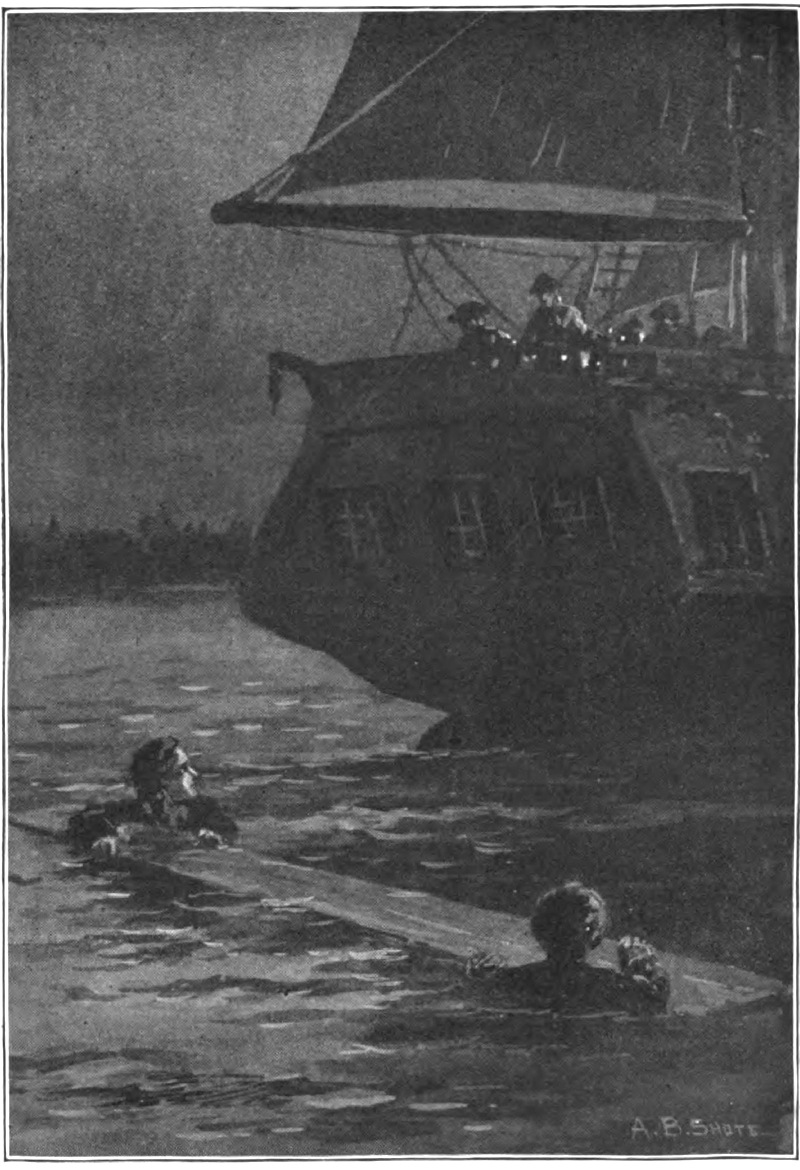
A short distance away was a broad-sterned brig.—Page 109.
109“We are still a long distance from the ocean,
lad,” responded Silvers.
“Are we close to Quebec?”
“A mile or two above it, I think.”
Another spell of silence followed, and then Henry
let out a faint shout.
“A ship! We are drifting directly upon a ship!”
His words proved true. But a short distance
away was a broad-sterned brig, standing slowly
down the stream.
“If it’s a French craft we are lost,” whispered
Silvers.
In a minute more the plank bumped up against
the side of the brig, and they could see half a dozen
sailors at the rail.
“Hullo there!” cried a rough English voice.
“Keelhaul me, if there are not two soldiers on a
board!”
“Frenchmen! spies!” put in another voice.
“No! no! we are not spies!” called back Silvers
joyfully. “We are prisoners escaped from the
French.”
“Harken to that, mate. Escaped prisoners! In
that case we must help ’em aboard.”
It was not long before a rope was thrown overboard,
and with great difficulty Henry and Silvers
climbed to the main deck of the ship, where they
110were immediately surrounded by the captain and
several other officers.
“Who are you?” demanded the captain sharply.
“Royal Americans, sir,” responded Silvers,
touching his forelock, while Henry did the same.
“We were captured by the French and Indians
about a week ago and made our escape last
night.”
“If you are Royal Americans where do you belong?
Certainly not in General Wolfe’s camp.”
“We belong to the army that was under General
Prideaux. But he is dead, and Sir William Johnson
took command.”
“Prideaux—at Fort Niagara? That is a long
distance from here.”
“We were on our way to Oswego when we were
taken. The French brought us across the lake, and
then marched us down the river road to a prison
near Sillery Cove.”
The captain of the brig listened to their tale with
much interest.
“If you have been among the French you ought
to be able to tell General Wolfe something worth
listening to,” he said, when they had finished.
“Some of the men on board are bound for his camp,
and you may go along if you wish.”
“Where is his camp?” asked Henry.
111“On the upper bank of this river, just below the
Falls of Montmorenci. The general has been sick,
but I heard this morning that he is now somewhat
better.”
“May I ask if you have been in a fight with the
French?” came from the young soldier curiously.
“Hardly a fight. We have been ordered to stand
up and down the river with the tide. This has kept
the enemy on the move, watching not only this brig,
but also a number of other ships, and is gradually
wearing the French soldiers out. Did you hear anything
of their colonists deserting?”
“I did,” cried Henry. “Two men who were on
guard said that a hundred men had left in one day,
so he had heard. I didn’t get any particulars.”
“Montcalm will find that this campaign is not
yet over,” responded the captain of the brig grimly.
“He thinks Quebec cannot be taken, but Wolfe will
teach him a trick or two ere we hoist anchor for
England.”
It was an hour later when the brig dropped anchor
in the stream, midway between the Island of
Orleans and the northwest shore of the St. Lawrence.
Not a battery from Quebec had fired on the
ship, and the English batteries on the southeast
shore were also silent.
“It is my duty to send you over to General
112Wolfe’s camp under guard,” said the captain of the
brig. “I do not doubt but that you are to be
trusted, but duty is duty, you know.”
“We’ll not complain,” answered Silvers.
A boat was soon lowered and the sharpshooter
and Henry entered this, followed by a coxswain
and his crew, and two army officers, who had
been on the trip of the brig. This boat was followed
by a second and a third, and then all three headed
for the shore below the Falls of Montmorenci.
It did not take long to reach the mud flats below
the rocks fronting the river bank. Here the party
was challenged by the grenadier guards, but quickly
passed, and Henry and Silvers were marched up the
bank by a rough trail.
Both the young soldier and the sharpshooter
were thoroughly worn out by the trials they had
endured, and having received some food on the brig,
and dried their clothing, they did not remain awake
long after having been assigned quarters.
It was Henry who was the first to stir in the
morning. The roll call of the long drums aroused
him, and gazing out on something of a parade
ground he saw the grenadiers forming to answer to
their names.
“This looks natural,” he observed to his companion,
who arose lazily and stretched himself. “I
113must say these soldiers of General Wolfe look as if
they meant business.”
It was not long after this that a guard came in
and told them to prepare for an interview with General
Wolfe. They at once brushed up as best they
could, and the guard supplied them with caps, to replace
those which had been lost.
General Wolfe’s headquarters were in a house
some distance back from the Falls of Montmorenci.
The general had been taken seriously ill about the
middle of August and was now slowly recovering.
At the time of this campaign, which was to make
him famous in the world’s history, General James
Wolfe was but thirty-two years of age. He was
tall and slender, with sloping shoulders and with a
face that showed more of quietness than determination.
But his eyes were bright and under certain
circumstances could flash forth a hidden fire that
meant much. His hair was red, and worn in a cue,
as was the fashion at that time.
James Wolfe came of fighting stock, his father,
Major-General Edward Wolfe, being a distinguished
officer before him. The son entered the King’s army
at the age of fifteen, and one year later served in
Flanders as the adjutant of a regiment. From Flanders
he went to Scotland, to fight gallantly at Culloden,
and then at Stirling, Perth, and Glasgow.
114At twenty-three he was a lieutenant-colonel, holding
that rank for five years, when he obtained leave of
absence and spent a long vacation in Paris.
With the breaking out of the war with France
Wolfe was again in his element. He sailed on the
expedition against Louisburg, where he served
with great honor to himself. Because of this service
he was chosen by Pitt to command the expedition
against Quebec. He sailed on the 17th of February,
his fleet consisting of twenty-two ships
of the line, and also numerous frigates, transports,
and other craft. We have already seen how he
landed on the Island of Orleans and at other points,
and how he tried to break in upon the almost impregnable
French position at the Falls of Montmorenci.
Henry had heard much about General Wolfe and
of what a sturdy and well-trained army officer he
was, and the young soldier was rather surprised to
find himself ushered into the presence of one who
looked so young and mild. Wolfe’s sickness had
left him pale and weak, yet he soon showed that he
had all his old-time determination to win still in
him.
“You may tell me your story, but be brief,” he
said, to Henry, who had been brought in first, and
then settled back in his chair to listen. He did not
115interrupt the recital, but when the young soldier had
finished he asked a number of questions, all of which
Henry answered as clearly as he could.
“You have certainly had your share of adventures,”
said General Wolfe. “I imagine you did
not expect to find yourself here when you started
out for Oswego.”
“That is true, sir,” answered Henry.
“And you wish to get back at once? That will
be rather difficult, I am afraid.”
“I do not care so much about getting back, sir.
But I should like to know what has become of my
cousin, David Morris, and the others.”
“You had better rest for a few days, and then I
will have one of my aids see what can be done for
you.”
“Thank you, general,” said Henry, and with a
salute he withdrew.
The interview accorded to Silvers was similar to
the foregoing, excepting that the sharpshooter was
questioned in regard to such French defenses as he
had seen along the river front. Then both were
told that they were no longer under guard, and
could come and go, within the limits of the camp,
as they pleased.
CHAPTER XIII SCALING THE HEIGHTS OF QUEBEC
116
Both Henry and Silvers were much interested
in the inspection of the camp General Wolfe had
established near the Falls of Montmorenci and along
the St. Lawrence River.
The falls at this point were a grand sight, tumbling
over the rough rocks that lined the gorge with
a thunder which to the young soldier seemed a second
Niagara. Below the falls was a stretch of
smooth water, and here was a succession of shoals,
dry, or nearly so, during low tide.
The French camp was within sight between the
trees, and it is said that the English and French
guards occasionally spoke to each other further up
the small stream, where the noise was not so loud.
But men as well as officers had to be careful, for
each army had its sharpshooters posted, ready to
bring down any enemy who showed himself.
During the time spent near the falls General
117Wolfe had not been idle. He had tried his best to
draw General Montcalm from his secure position by
making moves up and down the St. Lawrence and
by sending detachments hither and thither, to attack
and destroy various villages, towns, and isolated
chateaux and farmhouses. All were given over to
the flames, and night after night the sky was lit up
by the conflagrations.
All of these deeds made the Marquis de Montcalm
very angry, but he was too wily a general to
be drawn into any trap. “Wolfe cannot dislodge
me,” he said. “And soon his supplies will give out,
winter will be on him, and he and his fleet will have
to sail for home.”
His remarks were not mere guesswork. From
various sources he learned that the English supplies
were running low, and that many of the British
soldiers were sick. Those on the fleet were growing
tired of drifting up and down the river, and the admiral
in charge knew that winter came early around
Quebec.
“Something will have to be done between now
and the first of October,” said the admiral. “To
remain in these waters after that would be a hardship.”
“Something shall be done,” said General Wolfe,
and, still weak from his spell of sickness, he began
118to lay new plans to force Montcalm into a
battle.
Several days slipped by, and Henry was glad
enough to take the rest thus afforded. On the
fourth day a messenger appeared bringing in news
from Fort Oswego.
“Hurrah!” shouted Henry, as he ran up to where
Silvers sat smoking on a rock. “Dave is safe, and
so are Shamer and Raymond. Oh, how glad I
am!”
“That is good news!” returned the sharpshooter.
“Wonder how they managed to escape?”
“The messenger didn’t know the full particulars.
He says each was hurt a little, but not of any account.
I can tell you, I feel much relieved”
“I don’t doubt it, Henry. I know you think a
good deal of your cousin.”
“And why shouldn’t I? We have been playmates
for years, and we have hunted and fished and fought
together for ever so long, too. Dave is as close as
a brother to me.”
“Well, now you know he is safe, I reckon you
won’t be so anxious to get to Fort Oswego as you
was.”
“No, I am going to send word to him that I am
here, and then stay a while.”
“So am I going to stay,” went on Silvers. “I
119feel it in my bones that there will be a big fight here
before this campaign closes.”
General Wolfe had under him three brigadiers,
Murray, Monckton, and Townshend. He now called
them to him for consultation and submitted several
propositions. A debate lasting a long time followed,
and at last it was decided to attack the French at a
point some distance above the city of Quebec. By
doing this, Montcalm would be cut off from his base
of supplies and compelled to either fight or surrender.
The task which General Wolfe had set for himself
and his men was an exceedingly difficult one.
As already mentioned, the river was fronted by a
high wall of rocks, and to scale these seemed next
to impossible. Besides, the French were on constant
guard, and would be sure to sound the alarm quickly
and pour a hot fire into the advancing British.
In order to carry out the plan decided upon General
Wolfe had first to abandon the camp at the falls.
He knew the French would harass him as much as
possible, and so sent Monckton from Point Levi
with a number of soldiers, under pretense of attacking
Beauport, midway between the falls and the
city. Montcalm looked on this with new alarm and
sent his troops in that direction; and Wolfe withdrew
without further trouble.
Henry and Silvers were with the soldiers who
120abandoned the Montmorenci and soon found themselves
at Point Levi, where they joined a handful of
other Colonial English mixed in with the Royal
Grenadiers. This was early in September, and a
few days later the troops were transferred to the
ships under Admiral Holmes, and here General
Wolfe joined the expedition.
To the French it looked as if the English were
going to give up the campaign, and Wolfe and his
officers, as well as the admiral of the squadrons, did
all in their power to make the deception more real.
Cannon were taken up and placed aboard the vessels
in the most open manner, and soldiers were made
to pack away the camp outfits as if getting ready for
a long voyage. “The English are going to sail!”
cried the people of Quebec and vicinity, and their
hopes arose, to think that they would at last be free
from the grim terror which had hung over them
so long.
But Wolfe was not yet ready to force the attack.
The plan of action was still in the rough. There
was a high stone bluff, or cliff, to scale, and how to
do it in comparative safety was a delicate problem
to solve. The general listened patiently to what
several who were acquainted with the locality had to
say, and then surveyed the north shore with a telescope.
Near what was then Anse du Foulon, and
121now called Wolfe’s Cove, he discovered a narrow
path running between rocks and bushes from the
water’s edge to the top of the bluff.
“That is our course,” he said, quietly but firmly.
On the bluff at this point were but a dozen soldiers’
tents, so he concluded that the French guard there
could not be a heavy one.
But to have given the French an inkling of what
was in his mind would have ruined everything, so
once again Wolfe set to work to fool the enemy.
His ships sailed still further up the river, as if looking
for a landing, and the French batteries opened
with vigor, but without doing any harm.
A heavy downpour of rain now made further operations
impossible for two days. It was a cold, raw
storm, and the soldiers in the transports could not
stand it, and had to be landed once more on the
south shore, where they built camp-fires, sought
such shelters as were handy, and did what they could
to make themselves comfortable. The weather was
very trying on General Wolfe, but he refused to
take again to his bed, declaring that he was now going
to see the campaign to a finish.
On the 12th of September all seemed in readiness
for the attack. The French soldiers were worn
out through following the passage of the English
ships up and down the river, while the stay on the
122south shore had rested the grenadiers and others in
the English ranks.
For the daring expedition Wolfe selected forty-eight
hundred men. He knew that the enemy must
be at least twice as strong, and to engage Montcalm’s
attention once again in a different direction,
he had Admiral Saunders make a move as if to land
at Beauport. This deception was carried on in
grand style, with signals flashing from ship to ship,
cannons roaring, and boatload after boatload of
sailors and marines putting off as if to dash upon the
mud flats. In great haste Montcalm massed his
men at the Beauport batteries, satisfied at last that
this was to be the real point of attack, while the
movement up the river was only a blind.
Fortune now seemed to be at last in Wolfe’s favor.
He was ten miles away from the din at Beauport,
with nearly five thousand of his soldiers, and creeping
upon the north shore of the river with the silence of
a shadow. There was no moon, but otherwise the
night was clear. Wolfe occupied a place in one of
the foremost boats. Behind him came a long procession,
containing the Highlanders and grenadiers
and also a handful of Colonials, including Henry
and Silvers, who had been armed, and who were just
as anxious to aid in the taking of Quebec as anybody.
123Once or twice from out of the darkness came a
challenge.
“Who comes?” was the question, put in French.
“France!” was the answer, of one who could
speak the language well.
“What boats are those?”
“The provision boats. Hush, or the English will
hear. They are not far away.”
The sentry knew that some provision boats were
expected along that night, so said no more. As a
matter of fact, the order to send the provisions down
the river had been countermanded but a few hours
before, but without the sentry’s knowledge. Thus
fortune again favored the English.
At last the headland above Anse du Foulon was
gained. Here the tide swept along rapidly and some
boats were carried partly past the cove.
“No guard in sight,” whispered one of the lookouts.
“It is well,” murmured Wolfe.
Only the sound of a gurgling brook as it rushed
into the St. Lawrence broke the stillness of the night.
Before the boats lay the dark, frowning bluff, with
its loose rocks, and its straggling cedars, other trees,
and brushwood. The path was there, doubly uncertain
in the darkness.
Twenty-four volunteers, picked men, good shots,
124and with nerves of iron, led the way. In the meantime
those in the other boats waited by the shore,
for the signal to land if it proved safe, or to pull
away with might and main should the French have
led them into a trap.
“Tell you what, Henry, this is a ticklish task,”
whispered Silvers, as he examined the new firearm
he had received.
“It certainly is that,” answered the young soldier.
“But I reckon General Wolfe knows what he is doing.”
“Silence there,” came the low command, and the
two said no more.
A painful period of waiting followed. Far up the
bluff they could hear the volunteers climbing along.
Then came a shot, followed by others, and then a
ringing English cheer.
“We have them! We have them!” was the cry.
“Come up!”
“Hurrah!” came a mighty cry. “Up we go!”
And in a twinkle the soldiers were out of the boats
and scaling the rocks as best they could, some by
way of the path and others by rocks and bushes.
It was a climb that Henry never forgot. The
path was choked with grenadiers, each with his gun
slung over his back and each loaded down with
knapsack and blanket.
125“We can get up this way just as well,” said Silvers,
and up they went, side by side, over some
rough stones, and then hauling, pushing, and pulling
themselves from one point of vantage to another,
until, fairly panting for breath, they reached the top
and joined the forces gathering on the field above,
known as the Plains of Abraham.
CHAPTER XIV WOLFE’S VICTORY AND DEATH
126
A slight shower of rain was falling when Henry
and Silvers, still panting for breath, followed the
grenadiers and Highlanders to the Plains of Abraham,
so called after Abraham Martin, a Canadian
pilot who had once owned a stretch of land in that
locality. The plains were tolerably level, covered
here and there with grass and brushwood. To the
southward stretched the St. Lawrence, and to the
north and east the River St. Charles. Quebec stood
at the extreme southeast point, hidden from view by
a series of rocks and low hills, and partly protected
by the city wall.
“This is surely a surprise to the French,” remarked
Henry, as a distant cannon roared forth a
warning. “Outside of the guard that was routed
not a soldier has come into view.”
But it was not long before a detachment of the
127French appeared on the ridge before the city. They
were a battalion sent forward from an encampment
on the St. Charles. The soldiers were in their showy
white uniforms, in strong contrast to the red of the
British. Drums beat, the Highlanders piped bravely
on their pipes, and a skirmish ensued which quickly
forced the French to retire for consultation. An attack
was also made on the rear, by Bougainville’s
forces, but this was likewise repulsed.
Hearing the distant firing, Montcalm rode forward
in hot haste to learn what it meant. He still
imagined it might be a ruse, and that the main attack
would be at Beauport, but one glance at the
long and solid ranks of the English made him realize
the bitter truth—that Wolfe had outwitted him,
and that the English were now between him and his
supplies. He must either fight and win or surrender.
The French commander knew that he must act
quickly, for the English might start to intrench
themselves, or, worse yet, march on the city, at any
moment. Orders were rushed furiously in all directions,
and the troops came up pell-mell, some over
the plains, some by the St. Charles bridge, and some
by way of the city’s gates, the regulars in white,
the French Colonials in their nondescript tatters,
and the Indians in their savage warpaint. Drums
128beat, trumpets blared defiance, and proud banners
waved through the rainy air. But the English ranks
stood silent, the grim look on the men’s faces telling
how they were prepared to meet any shock that
might come.
The battle was not long in starting. The French
took possession of several rises of ground and of
some cornfields, and a scattering fire began, gradually
growing stronger and stronger.
“Be calm, men!” cried Wolfe, riding up and
down, in front and beyond his men. A short while
later a bullet struck him in the wrist, but he bound
the wound up with a handkerchief, and refused to
quit the field.
Henry and Silvers were firing with the rest. Soon
the fight caused them to drift apart. Henry was
with some grenadiers, tall, strong-looking soldiers,
who fought with a rare courage that nothing could
daunt. With Henry were fifteen or twenty Royal
Americans, who had been at first guarding the boats
at the landing, but who had now come up to do their
share of the fighting.
There was a constant rattle of musketry, punctuated
occasionally by heavy artillery. Montcalm’s
army was now at hand, and a fierce onslaught ensued,
the French general himself leading his men
and urging them to do their best.
129“Forward!” was the cry on the English side,
and the soldiers advanced a couple of hundred feet.
Then the French rushed to the front, while the English
reloaded their pieces. A solid volley was delivered
which created terrific havoc in the ranks of
the wearers of the white uniform, who were seen to
pitch in all directions, dead and dying.
“The day is ours!” was the British cry. “At
them! At them, Britons! At them!” And another
advance was made.
Begrimed with dirt and smoke, and perspiring
freely, Henry went on with the rest. He had fired
his musket several times, and now came the order
to fix bayonets. Bullets were whistling in all directions,
and the young soldier saw more than one companion
go down, several to their death. He himself
was “scotched” in the arm, but did not notice the
hurt until long afterward.
Slowly the French gave way, first in one direction
and then another. Then came the order to charge,
and a mighty yell went up as the grenadiers and
others ran over the field on the very heels of the retreating
French. To one side was a field in which
were stationed a number of French sharpshooters.
“They must be dislodged,” cried Wolfe, and led
the charge. Back of him came the Louisburg Grenadiers,
those men who had made such a record for
130themselves in other campaigns. With these grenadiers
was Louis Silvers, running with many others
into the very jaws of death.
Again the bullets whistled around them, and again
General Wolfe was hit. He was seen to stagger,
but kept on, when a third bullet took him in the
breast.
“The general is killed!” was the cry, and Silvers
ran to support him. But ere the brave sharpshooter
who had been Henry’s companion through
so much of peril could gain the general’s side, a
bullet hit him in the side of the head, and he fell
over on his face, dead.
Several officers and solders had seen General
Wolfe’s condition, and a lieutenant and two privates
ran to support him and carry him to the rear.
“Le—let me down, men,” he murmured. “Don’t
take me from the field.”
“General, you must have a surgeon,” said one.
“There is no need; it is—is all over with me,”
he gasped, and sank as in a faint.
“Run for a surgeon,” said another, and two
privates sped away on the errand.
At that moment came another yell from the end
of the field, some distance away:
“They run! They run! Hurrah! See them
run!”
131Breathing heavily, Wolfe raised himself up.
“Who—run?” he murmured.
“The enemy, general; they are giving ground in
every direction,” answered the officer who knelt
beside him.
Instantly the face of General Wolfe took on a
look of quiet satisfaction.
“Tell”—he murmured,—“tell Colonel Burton—march
regiment—Webb’s—Charles River—cut
off retreat!” He breathed heavily, and then with
a long sigh continued: “Now, God be praised, I
will die in peace!”
And but a short time later he expired.
The fall of Wolfe was disheartening to the
English, but victory was already in their grasp, and
on the French side General Montcalm had also been
hit, as he was riding in the midst of the soldiers
who were retreating toward the city. A shot passed
through his body and he was supported through the
St. Louis gate, now a place of intense excitement.
Those who were in the city became panic-stricken,
and many sought to get together their worldly possessions
and fly for their lives.
There was one body of the French soldiery that
had not as yet been defeated. These were the colonists,
who had been held at and near the city. They
now went forward and took possession of a hill
132and a cornfield, from which they were dislodged
only after a heavy loss by the English.
In the meantime the French general further up
the river did his best to gather together his scattered
guards and attack the British from the rear.
But by the time he came up General Wolfe’s army,
now under the command of Townshend, for Monckton
had also fallen with Wolfe, was safely intrenched.
From Beauport also came the Governor-General,
Vaudreuil, amazed and bewildered, and
able to do little but look on helplessly. He was met
by half of the demoralized French army, who insisted
upon it that all was lost.
In the city the confusion was tinged with a sadness
hardly to be described. Montcalm, the well-beloved,
was dying, and his second in command,
Brigadier Senezergues, was also mortally hurt.
What was to be done? Another day would find
the English strongly intrenched, for in the darkness
they were already bringing up cannon and training
them on the city walls.
“We must retreat—nothing more is left to us,”
said more than one French officer, and the word
swept the rounds with incredible swiftness. “Retreat!
retreat, ere it is too late!” was the French
cry, and away fled regulars and colonists, in a mad
rush that was little short of a panic. The red men,
133who before the battle had boasted of what they
would do, disappeared as if the ground had opened
and swallowed them up.
That night the Marquis de Montcalm, as brave
a soldier as ever lived, breathed his last. There
was no coffin at hand in which to bury him, and his
remains were placed in a rude pine box and deposited
under the floor of the Ursuline Convent. As
one historian has fitly said, the funeral of Montcalm
was the funeral of New France.
Wolfe and Montcalm! brave, generous soldiers
both of them. Is it a wonder that the people of
Canada, French and English combined love their
memory, and that on what was the Plains of
Abraham there stands to-day a pyramid raised in
their combined honor?
Ramesey was in command of Quebec, but under
the orders of the Governor-General. From a safe
distance Vaudreuil wrote to the commandant telling
him not to let the English carry the place by
assault.
“As soon as provisions fail, raise the white flag,
and make the best terms you can,” wrote the Governor-General,
and Ramesey prepared to obey. At
one time he hesitated, hoping to be relieved by
General Lévis, who wanted the army to march back.
But in a day or two matters grew worse, and at
134last the white flag was raised, and Quebec capitulated.
“The city is ours!” cried Henry. “What a
victory!”
It was indeed a victory, but one tinged with
sadness, for General Wolfe was loved by all. The
remains of the officer were tenderly cared for, and,
later on, sent to England, where another monument
to his memory was erected in Westminster Abbey.
It was a great shock to Henry to find that Silvers
had been shot and killed. The man was comparatively
a new acquaintance, yet their mutual experiences
of the past few weeks had made them feel
more like old friends. Silvers was buried in a
trench outside of Quebec, along with many others
who had fallen, and Henry was a sincere mourner
at the brief funeral. Later on, the young soldier
carved out a rude slab with his jackknife which he
erected over the mound. Fortunately Louis Silvers
was a bachelor, so there remained no wife or
children to mourn his loss.
CHAPTER XV NEWS FROM HOME
135
“Letters! letters! letters!”
This was the cry which circulated around Fort
Oswego one morning some weeks after Dave had
reached the stronghold, in company with Raymond,
Shamer, and the two hunters the party had met in
the forest.
Dave was slowly recovering from his hurt knee.
The twist had proved more severe than at first
anticipated, and he had found it necessary to go
to the hospital more than once, to have it examined
and dressed.
A courier from Albany had come in, with saddle-bags
filled with letters of all kinds, written on the
thinnest of paper, so that they should not weigh too
much, for postage went by weight and was very
high.
“A letter for me!” cried Dave, as it was handed
to him. It was addressed to Fort Niagara, but as
136some of the soldiers of that place were now coming
down to Oswego all the mail was sorted at this
point before any was forwarded further.
The letter proved to be one written by Dave’s
father, and filled four closely written sheets. In it
James Morris said that the summer had been a fairly
prosperous one at the homestead. The new cabin,
built to take the place of that burnt by the Indians,
was now in a comfortable condition, and both he
and his brother had had a large crop of corn and
hay, while garden vegetables had never done better.
Rodney, the cripple, had gone out considerable during
the warm days, and had on one occasion shot
a deer drinking at the brook below the cabin, and
had also brought in more than one acceptable string
of fish.
“Your Aunt Lucy is real well,” [the letter continued].
“She awaited the coming of Nell with
Sam Barringford with tremendous anxiety, and
when the two appeared on the trail, Sam on a horse
he had borrowed at Winchester and Nell on a pony,
the good woman almost fell dead with joy. We
were all affected, and although they came at ten in
the morning, no more work was done that day, excepting
such as was necessary to make them comfortable.
Sam told his story in detail and then we
137listened to Nell, and I must confess there was not
a dry eye among us when she told of the hardships
among the redskins, and of how Jean Bevoir had
treated her. I sincerely hope that scoundrelly trader
is sent to prison for a long term of years, for he
has earned it.
“The news that Fort Niagara was taken was
hailed with joy by all of us, and we are proud of
the part you and Henry played. Both of you must
be careful and not run into needless danger. Now
if Generals Wolfe and Amherst can only do as well
this cruel war will soon come to an end, and then
I can go and re-establish the post on the Kinotah,
where, so I have been told by an old frontiersman,
the game is now more plentiful than ever, since the
Indians have left the hunting ground to go to war
with the French.
“Sam wishes me to say that he is going to remain
here and at Winchester only about a week longer.
Then he is going to rejoin the army at Lake Ontario,
to keep his eye on you and Henry. Henry
will be sent a letter by his father in this same mail.”
Dave read the letter over three times before he
allowed it to drop in his lap. In his mind’s eye
he could picture the new cabin, and the joy of the
inmates over the safe arrival of little Nell and
138honest Sam Barringford. And then a spasm of pain
shot across his heart as he thought of Henry.
“If he was killed what a shock it will prove!”
he murmured with downcast face. “Poor Henry!
I’d give my right hand to know he was alive and
safe!”
“Bad news?” came from Raymond, who came
up at that moment.
“No,” answered Dave, and went on: “It is a
letter from home. They are all well and send best
wishes to me and to my cousin Henry. I was thinking
of how they will feel when they learn that—that——”
“Don’t take it so hard, Dave,” said the backwoodsman
sympathetically. “He may have escaped,
after all. Just as strange things have happened.”
The young soldier shook his head doubtfully.
“He had a hot fight—I don’t see how he could
escape if he was wounded. He is either dead or a
prisoner in some foul Canadian prison.”
Dave had been told to come to the hospital that
afternoon at four o’clock and have his knee looked
after again. He was on hand promptly, and the
surgeon gave it a careful examination.
“It is doing nicely,” he said. “Be a bit careful
of it for a week longer, and it will be as well as
139ever.” And then he gave the young soldier a box
of salve to be used each night and morning.
Dave was about to leave the hospital when his
attention was attracted to a number of patients who
had just been brought down in boats from Fort
Niagara. One of the men lying on a cot looked
familiar, and drawing closer he recognized Jean
Bevoir.
The French trader looked pale and thin, for he
had suffered not a little. He looked at Dave curiously,
and when the young soldier got the chance
he went up and spoke to the man.
“I suppose you know me, Bevoir?”
“Yees,” was the low reply. “You air Daf
Morris, not so?”
“Yes, I am Dave Morris, a cousin to little Nell
Morris.”
At these words the wounded man winced a little.
Being a prisoner and in the hospital had taken a
good deal of his former bravado out of him.
“You haf made von great mistake,” he whined.
“I am not ze bad man you think, no.”
“I know all about that,” returned Dave coldly.
“Must I stand ze trial when I am well?”
“Certainly.”
“It ees verra hard on a poor man, yes, verra
hard.”
140“You brought it on yourself, Bevoir. You have
caused our family a good deal of trouble.”
“You are ze son of James Morris, not so?”
“I am—the same James Morris that you tried
to rob of a trading-post on the Kinotah,” answered
the young soldier, bound that Jean Bevoir should
understand the situation fully.
“Zat was ze bad bus’ness, yes. I think ze
tradin’-post mine. I haf ze papairs to show of it.”
“The grant is my father’s, and always was,”
retorted Dave.
“Do not be too sure,” answered the trader
craftily. “I can bring ze men to swear it ees mine—two,
t’ree men.”
“Your title is no good.”
“We vill see ’bout zat. If I bring ze men ze court
will say it ees mine, and why not? I haf been dare
long before your fadder, yes.”
There was a pause, for Dave did not know how
to reply to this speech. The French trader looked
at the youth’s face searchingly.
“You listen,” he whispered, so that those around
might not hear. “I tell you something, yes.”
“What?” questioned Dave, wondering what
was coming next.
“If you send me to ze prison for two, t’ree year
what goot haf dat been? Nodding, no nodding
141to you! I go and I come out, and ze trading-post
still belongs to Jean Bevoir, not to your fadder.”
“I don’t believe it.”
“Still it ees so. But now listen—I haf ze gran’
plan—ze plan to do you goot! Ze tradin’-post ees
mine, but I gif it to you and your fadder, yes, efery-t’ing,
if——” And here the French trader paused.
“If what?” questioned Dave, although he
guessed what was coming.
“If you say noddings ’bout me here—if you help
me to get away,” answered Jean Bevoir, in a still
lower whisper.
“Help you to get away?” cried Dave.
“Sh-sh! Not so loud. Yes, help me. It vill
be easy to do zat. An English uniform, a dark
night, and it ees done. You haf ze tradin’-post, and
I also gif you dis.”
As Jean Bevoir spoke he drew from his bosom
a small bag tied with a long string. Opening the
bag he produced half a dozen English and French
pieces of gold, worth probably a hundred dollars
all told.
“You will give me that money if I help you to
get away?” said Dave slowly.
“Yees, efery piece of it. Now vat you say? Am
I not ze goot-hearted man?”
“Good-hearted?” said Dave scornfully. “I
142think you are a first-class villain, and if you weren’t
in the hospital I’d do my best to knock you down
for your impudence.” Dave was speaking loudly.
“You can keep your dirty gold, and I shall do my
best to put you in prison. And as for the trading-post——”
“Here, here, what is the trouble?” burst in the
voice of a surgeon, as he strode up. “We allow
no quarreling in this ward.”
“This rascal has been trying to bribe me into
helping him to escape,” answered Dave, his eyes
flashing. “He wanted me to get him an English
uniform on the sly.”
“What! Is this true?” ejaculated the surgeon.
“If it is, he deserves a flogging instead of medical
care.”
“No! no!” shrieked Jean Bevoir. “It ees all
von gran’ mistake.” He hurriedly stowed the gold
in his bosom. “How can I escape ven I haf ze
shot in ze leg——”
“It is getting better fast,” responded the surgeon.
“I fancy we had better keep an eye on you, and
by the end of the week I’ll pass you over to the
prison guard for safe keeping.”
“I hope you do, sir,” said Dave. “He is a great
criminal as well as a prisoner of war,” and he told
a few of the particulars of Jean Bevoir’s doings.
143“I am glad you did not let him tempt you,” said
the surgeon. “He is certainly a rascal of the first
water. But I don’t want you to talk to him any
longer. A quarrel will only excite the other patients
here,” and he led the way from the building.
As he was going out, Dave looked back to see what
Bevoir was doing. The French trader scowled at
him and shook his fist in rage.
“He will hate me worse than ever for this,”
reasoned the young soldier. “But I am glad I
showed him up to the surgeon. It would be a great
pity if he was allowed to slip away unnoticed.”
CHAPTER XVI A FIRE AND AN ESCAPE
144
The next day was an exceedingly hot one in and
around Fort Oswego, and Dave was content to remain
in the shade of some trees and take it easy.
Early in the morning a detachment of soldiers
from Fort Niagara arrived, having been sent down
by General Gage, who had now superseded Sir
William Johnson in command.
These soldiers were followed by others, who had
scouted through the woods lining the lake shore
and who declared that all the French and unfriendly
Indians had left the locality.
The soldiers brought with them two barge loads
of powder which the commandant at Oswego desired.
The powder did not come in until almost
dark, but it was decided to place it in the powder
house that night, rather than leave it on the lake
until morning.
For the want of something better to do, Dave
145walked down to the powder house and watched
the soldiers bring in the kegs of powder, and also
several boxes of flints. It was rather hard work,
in such warm weather, and it caused more than
one soldier to grumble.
“I didn’t enlist for this,” grumbled one pioneer.
“Between such work and working on the fort at
Niagara, I’ve toiled harder than when I built my
cabin on the Mohawk.”
“Never mind,” said another, who was more
cheerful. “Remember, it’s all for the good of the
cause.”
“Yes, the good of England,” growled the first
speaker. “After this war between England and
France is over, the Canadians will still be our
neighbors, and do you think they’ll like it because
we walloped them? Not to my style of thinking.”
One of the kegs of powder had burst open, and
this left a train of grains running from the lake
front almost to the powder-house door. Some of
the powder was spilt on a rough rock, but nobody
noticed this, until a soldier in passing scraped his
foot on the rock, when there was a flash which made
him jump high in the air and drop the keg he was
carrying.
“It’s powder!” he roared, and ran for his life.
A dozen others saw the flash, including Dave,
146and many leaped back, while half a dozen other
spurts of flame went up from the long grass, which
was now on fire. The keg the soldier had dropped
rolled into this long grass, and might have exploded
had not Dave rushed forward.
“Hi! what are you up to?” roared one soldier.
“Look out, or you will be killed!”
“I’ll risk it,” muttered the young soldier, and
sprang beside the keg. He gave it a vigorous kick,
which sent it spinning away from the dangerous
spot.
The train of fire had burnt backward as well as
forward, and it reached another patch of grass close
to where two half-kegs of powder rested, the last
taken from one of the barges. Nobody cared to go
near these, and a minute later one exploded with
a loud report, hurling stones, dirt, and the other
half-keg into the lake.
The sound of the exploding powder caused an
alarm in and around the fort, and soldiers came
hurrying from all directions.
“The grass is on fire in a dozen places!”
“It is creeping up to the powder house!”
“If the house goes up we had best all take to
the woods!”
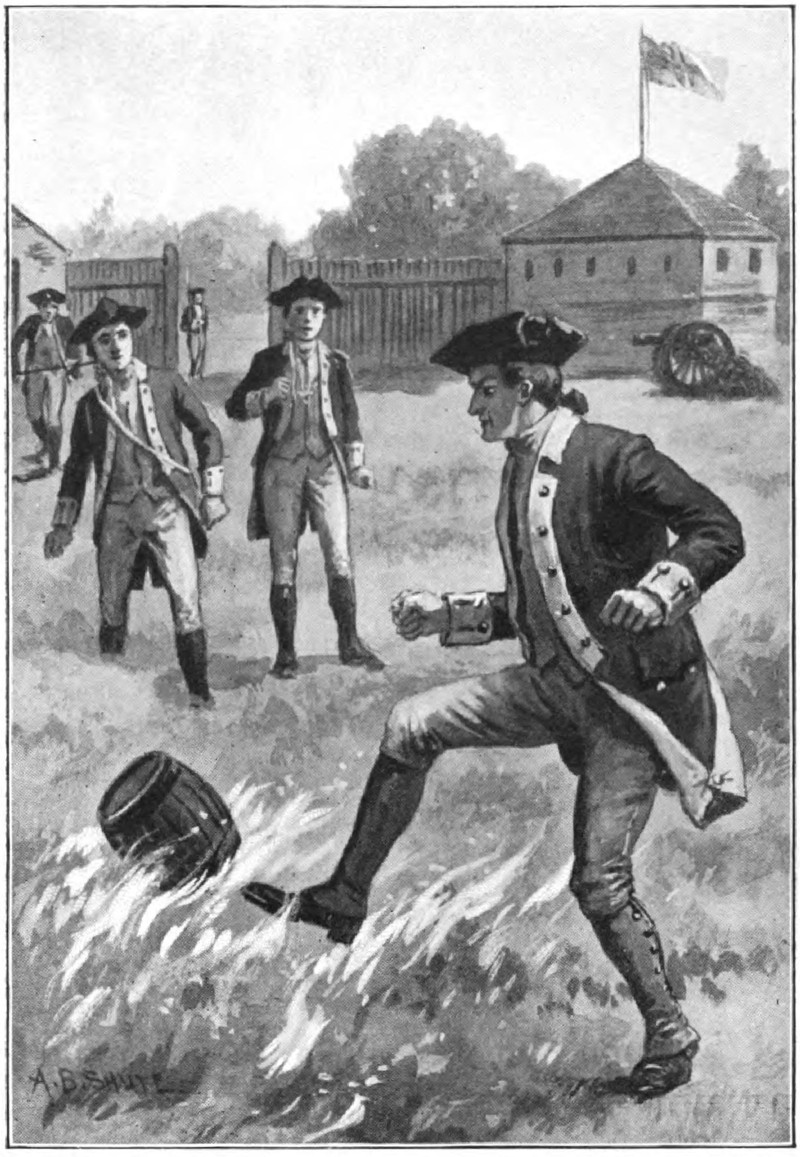
He gave it a vigorous kick, which sent it spinning away
from the dangerous spot.—Page 146.
These and other cries rang out, and for the moment
nobody knew what to do. A few began to
147stamp on the grass and thereby burnt their shoes,
but the majority felt like retreating in short
order.
“Form a bucket brigade!” at last shouted an
officer, and a rush was made for the leathern
buckets, while other, coming suddenly to their
senses, ran for picks and shovels, with which to
dig away the burning grass.
It was perilous work, for there was no telling
how soon the flames might leap to the powder
house and blow everything for rods around sky-high.
In the excitement Dave forgot all about his sore
knee, and catching up a bucket, he worked as manfully
as anybody to bring water. Two lines were
formed, one passing up the water and the other
returning the empty buckets, and soon the work
began to tell in spite of the dryness of the grass,
which seemed to burn like so much tinder.
It was a good hour before the excitement came
to an end, and to make sure that there should be
no more danger of fire, the grass all around the
powder house was dug up and cast to one side, and
the ditch thus formed was filled with water. Then
the remaining grass was thoroughly saturated; and
the danger was over.
“Rather a close call, Dave,” remarked Raymond,
148when the two were washing up, later on. “I
thought sure we’d all be blown to kingdom
come.”
“I thought that, too,” put in Shamer. “I felt
more like running than like trying to put out the
fire.”
“It was certainly exciting enough,” answered
Dave. “I forgot all about my knee,” and he rubbed
that member tenderly, for it had now begun to
assert itself once more.
“They tell me that two of the sick prisoners in
the hospital are missing,” came from a soldier
standing near. “They took French leave during
the confusion.”
“Two prisoners missing?” queried Dave with
interest. “Do you know who they were?”
“I do not.”
“I’m going to find out.”
“Do you think one was that rascal of a Bevoir?”
asked Raymond.
“It would be just my luck if it was,” answered
Dave, as he hurried away.
At the hospital the guards could give no information,
for they had been ordered to keep silent.
But a little later Dave found the surgeon who had
caught him talking to the French trader.
“Yes, one of the missing ones is Jean Bevoir,”
149said the surgeon. “The explosion of the powder,
and the fire, upset both the nurses and the guards,
and in the excitement Bevoir got away, with another
Frenchman named Chalette.”
“It’s too bad.”
The surgeon gazed at Dave sharply.
“You are quite sure you didn’t change your
mind about helping that man?” he demanded.
“Me? Not much, sir. Why, I’ve been out
fighting the fire.”
“He kicked away one of the kegs of powder,”
said a nurse, who had chanced to see the brave act.
“He couldn’t have been around here when the men
got away.”
A detachment of soldiers was sent out to roam
the woods and watch the lake front, in an effort to
locate Bevoir and his companion. But though the
search was kept up for four days, nothing was seen
or heard of the escaped prisoners.
“This is certainly too bad,” said Raymond to
Dave, when the search was practically given up.
“I suppose you reckoned on sending him to
prison.”
“Yes, and he deserved it.”
“You want to be on your guard against such
a man, Dave. He will not forget you, remember
that.”
150“I only wish I could meet him!” burst out
Dave.
“He will probably get over to Canada just as
fast as he can. He knows he won’t dare to show
himself around any English camp, or at that trading-post
again.”
Dave was still on the sick list, and to spend the
time went fishing the next day. He had just pulled
in a fine perch when a well-known voice reached
his ears, causing him to leap up from the rock on
which he was fishing and drop his pole.
“So here ye air, eh?” came to his ears. “Jest as
nateral as ever, bless my eyes if ye aint!”
“Sam Barringford!” exclaimed Dave, and
caught the old frontiersman by both hands. “Oh,
how glad I am to see you again! I’ve been looking
for you for several days.”
“Have ye now? Waal, it’s good to be looked
fer—better’n when folks hopes ye will stay away.”
Barringford winked one eye. “I had to stop at
Albany on business. How air ye, an’ where is
Henry?”
“Henry—oh, Sam, how can I tell you. He——”
“Don’t say Henry is dead, lad—no, no, not
that!” And all the color in the honest hunter’s
face seemed to die away. “He’s alive, o’ course
he is.”
151“I—I hope so. But I don’t know. We had a
fearful fight with the Indians, and Henry was captured
by them, and by some Frenchmen, and taken
away in a boat.” And Dave told the whole story,
just as it has been written in these pages.
Sam Barringford listened in utter silence, shaking
his head from time to time, to show that he
understood. Henry was very dear to him, as old
readers of this series know, and the pair had been
on many a hunting expedition together.
“I don’t think the Frenchmen would kill him,—not
in cold blood and they wearing the army uniform,”
he said slowly. “But the redskins are the
Old Nick’s own, and if they got Henry to themselves——”
“That is what I am thinking, Sam. Oh, it is
awful.”
“Ye got no news at all?”
“Not a word.”
“Have ye been back to the spot?”
“I couldn’t go. My knee——”
“Oh, yes, I forgot. How is the knee now?”
“A good deal better.”
“I’ll go up to thet spot to-morrow,” said Barringford
with sudden determination.
“But they went off in a boat.”
“Perhaps thet was a blind, lad.”
152Barringford had but little to tell outside of what
Dave had already learned through the medium of
Mr. Morris’s letter. The journey to Wills’ Creek
with little Nell and the Rose twins had proved
uneventful, but the neighbors had flocked from far
and near to see the restored children.
“It would have done your heart good to have
seen your aunt,” said the old hunter. “She nearly
went crazy, laughin’ one minit an’ cryin’ the next,
and little Nell and Rodney laughed and cried too.
Your father and Uncle Joe and me couldn’t stand it
nohow, and we went down to the barn and blubbered
too. Never felt so queer in my hull life afore.”
And Barringford rubbed his coat sleeve over his
eyes. The tears were in Dave’s eyes too, and he
was not ashamed of them either.
“I know I ought to write home about Henry,”
said the young soldier, when he could trust himself
to speak. “But, somehow, I can’t bring myself to
do it, although I’ve tried a dozen times. Every day
I live in the hope that the next day will bring good
news.”
“Wait until I’ve made thet trip I spoke about,
Dave.”
“Shall I go along?”
“Best not, with that hurt knee. A hurt knee
aint to be fooled with. Jack Pepper twisted his
153knee onct, and walked lame the rest o’ his nateral
life.”
“Oh, I hope I won’t have to do that!” cried
Dave. “I’ll take the best care I can of it.” And
he did.
CHAPTER XVII THE HOLE IN THE ICE
154
Sam Barringford kept his word, by starting on
his search early the next morning. Dave begged
to go along, but the old frontiersman shook his
head.
“No, lad, I’d like your company, ye know that,
but I can make time by going it alone,” he said.
The week to follow was an anxious one to the
youth. Day after day he looked for Barringford’s
return. In the meantime, he nursed his twisted
knee faithfully, until that member seemed as strong
and limber as ever.
The young soldier was now back in the ranks,
and it was whispered about that he would soon be
made an officer. But this honor he declined.
“Give the older heads a chance,” he said. “I
am content to do my duty as a private,” and Raymond
was elected in his stead.
155On the eighth day Sam Barringford came back,
thoroughly tired out by a tramp that had taken him
over many miles of the territory covering the lake
front.
“Didn’t see anybuddy but a couple o’ redskins,”
he said. “They were old men and could tell nuthin’.”
“And you found no trace?” faltered Dave.
“Nary a trace, lad. It’s too bad, but it can’t be
helped.” And Barringford’s voice almost broke
in spite of his effort to control it.
Drilling was now going on every morning and
afternoon, for it was felt that the Colonial militia
must be brought up as far as possible to the standard
of the royal troops. In the militia men were
constantly coming and going, suiting their own
convenience in spite of all the officers could do to
restrain them.
“We’ll not be able to do much more this season,”
remarked Barringford to Dave, one day. “It won’t
be long before winter is on us and then the campaign
will have to come to an end.”
One day there came the glorious news of Wolfe’s
victory on the Plains of Abraham, followed almost
immediately by the news that Quebec had been
taken.
The soldiers went wild with excitement, and the
156officers did not attempt to restrain them. In the
evening bonfires were lit and the general jollification
lasted until the next morning.
“That is the end of French rule in America,”
said Raymond. “Now if Amherst can only advance
we’ll soon have the garlic-eaters on the run.” But,
as already mentioned in these pages, Amherst’s advance
was so slow that the storms of early winter
drove his ships on Lake Champlain back and he was
compelled to go into quarters for the season at
Crown Point, leaving the British army at Quebec to
take care of itself.
“I must write home and tell of this victory,” said
Dave. “But—but—Henry——”
“Better wait a bit longer, Dave,” said Barringford.
“If the French are licked we may learn somethin’
o’ their prisoners, an’ Henry may be among
’em.”
Two days later came a pony express with letters
for many of the soldiers, some from home and some
from others in the various armies of the English.
“A letter from Quebec!” murmured Dave, as
he received the epistle. His hand shook so that he
could scarcely read the address. That handwriting
looked familiar. Oh, if only it was from Henry!
He breathed a silent prayer, and then broke the
seal.
157“Who is it from?” questioned Barringford, who
was standing near.
“Oh, Sam, it’s from Henry! He is alive! Think
of it!” The tears of joy stood in the young soldier’s
eyes. “He was with Wolfe—after escaping
from the French—he and Silvers. But Silvers,
poor man, was shot dead in the battle,” he went
on, reading rapidly.
“Is Henry all right?”
“Yes, and he says he has learned that I am safe,
too. A messenger from Oswego brought the news
some time ago.”
“Lad, ye can thank God for His many marcies,”
said Barringford reverently.
“Yes, Sam, and I do, from the bottom of my
heart,” returned Dave.
The letter was a long one, and the two walked to
an out-of-the-way spot, where Dave read it aloud,
while the frontiersman listened with close attention.
Henry gave many of the particulars of his capture
and escape, and also mentioned that he was now doing
guard duty in Quebec. He added that he had
sent home a letter, telling of his safety, and that for
the present he was going to remain where he was,
and hoped that sooner or later Dave and the command
to which he was attached would join him.
“This is the best news yet,” cried Dave, after the
158letter had been read twice. “Sam, my heart is as
light as air!”
“So is mine, Dave. It’s a heavy weight removed,
eh? I could ’most dance a jig.”
“What a big fight it must have been, and how
sad to think that General Wolfe had to die just
as he accomplished what he had planned so many
months.”
“’Twas better to die thus than to have the fate
of General Montcalm,” replied Barringford. “To
die in victory is nothing to dying in defeat.”
“I guess you must be right.” Dave paused for
a moment. “Now Quebec is taken, what do you
think will be the next move for our army to
make?”
“That is hard to say, lad. Maybe the French
will come back at Quebec before long. But come,
let us get back to the camp-fire. It is too cold to
stay here, even while discussin’ such good news.”
Barringford was right about it being cold. It
was the middle of September and the air was nipping.
A few days later came a cold rain that seemed
to penetrate to the very marrow of Dave’s bones,
for the lad from Virginia was not used to such
a climate as that of upper New York State.
“Ugh, but it’s awful!” he said, as he came in
from two hours of guard duty, with his clothing
159soaked. “It’s enough to give one his death of
cold.”
“Strip yourself, and rub down good,” said Barringford.
“It certainly is rough on a fellow o’
Southern blood.”
“I hope the rain don’t last.”
“This is what we call a pond-filler, Dave. As
soon as all the ponds fill up it will git colder, mark
what I tell ye.”
Barringford’s prediction was correct. The rain
came down until all the ponds and streams were
overflowing and then the storm came to an end. A
week after this came a flurry of snow, followed by
a high wind which blew down several old trees in
that vicinity.
“Winter’s coming now,” said more than one,
and the officers lost no time in giving the soldiers
directions for going into winter quarters. It was felt
by all that military operations must, for the time
being, come to an end.
At first Dave had thought to return home for
the winter. But Barringford did not care to make
another trip to Wills’ Creek and the young soldier
was not in the humor to go alone or in the company
of strangers.
“Might as well settle down right here,” said Barringford.
“We can fix ourselves a putty comfortable
160hut, and there will be sure to be plenty o’
huntin’ and fishin’ for whomsoever wants it.”
Many of the soldiers were quartered in the fort
and in the trading-posts scattered about, but there
was not room for all, and the others had to build
themselves shelters of boards and canvas. Barringford,
Raymond, and Dave formed a party by themselves,
and it was not long before the trio completed
a shelter of which they were justly proud.
The hut was about twelve feet square, of rough
logs and tree branches, interlaced with willow
withes. On one corner were several rocks and an
opening, where they could build a camp-fire, if they
wished, and three couches of cedar branches were
also provided, filling the air of the shelter with a
sweet and wholesome smell.
“Now we are about fixed fer the winter,” said
Barringford. “When the snow comes, we can bank
some up against the sides, to keep out the wind, and
then we’ll be as snug as bugs under a hearthstone.”
“I don’t believe provisions will be any too plentiful,
with so many of the soldiers coming in from
Fort Niagara and other points,” said Raymond.
“But as we are all good shots, and know something
about fishing through holes in the ice, we ought
not to go hungry.”
161It was not long after the shelter was completed
that winter came upon them in earnest. One evening
a light snow began to fall and in the morning
it was snowing more heavily than ever. This kept
up for two days and nights, leaving the ground covered
to the depth of a foot and a half.
“Now we can bank up the sides of the hut,” said
Barringford, and this was done without delay.
They also went into the woods and helped to cut
large quantities of firewood, which was brought to
the fort and the camp on drags drawn by horses.
The snow was followed by a spell of clear, cold
weather, which to Dave was far more acceptable
than the rain had been. The streams in the vicinity
were now frozen up and also a good part of the
lake front.
“I’d like to try fishing through the ice,” said
Dave, one morning when there was nothing for him
and Barringford to do.
“Jest the thing, Dave,” replied the old frontiersman.
“I’ve an idee they’ll bite well to-day.”
Preparations were soon made, and they passed
along the Oswego River to where there was something
of a sheltered cove. Here the ice was not
more than six inches in thickness, and they made
good-sized holes without much trouble.
Barringford knew exactly how to go about fixing
162their lines, and Dave stood by while the frontiersman
baited to his satisfaction.
“You take the upper hole and I’ll take the lower,”
said Barringford, when the lines were ready.
“We’ll see who can ketch the fust one.”
David did as told, and having allowed his hook
to go down almost to the bottom, waited patiently
for a bite.
“Ye want to keep movin’ it around a bit!”
shouted Barringford. “A fish likes to snatch a
bait on the fly. Ef ye——”
The rest of the sentence was lost in a pull and a
splash, followed by a flopping on the ice. The fish
tried its best to get back into the hole, but Barringford
was too quick for it and speedily strung it on
the end of a twig he had cut while coming over to
the cove.
From that time on fishing went forward with
more or less success for two hours, when each had
a mess of about twenty, mostly of fair size.
“Not bad by any means,” declared Barringford,
as he surveyed the catch. “But they’ll be fatter
in a month or six weeks more, an’ sweeter, too.”
“Whoop! I’ve got another!” cried Dave, a second
later. There came a savage tug on his line.
“Must be a big one, Sam!”
“Perhaps you had better play him a bit,” suggested
163the frontiersman, but just then Dave brought
the catch to light—an ugly water snake of a darkish
color and with cold, staring eyes.
“My stars!” ejaculated Dave, and as the snake
whipped toward him, he stepped back. Then the
snake, somewhat dazed at being brought to the
surface at this season of the year, made another
turn, and struck at Dave’s foot. The young soldier
gave a jump, and, like a flash, slipped into the
hole in the ice. He tried to clutch the edge of the
hole with his hands, but it was too slippery, and
before Barringford could grab him, he had disappeared
from view, and the water snake behind
him.
CHAPTER XVIII WINTER QUARTERS
164
For the instant after Dave disappeared under
the water of the river he gave himself up for lost.
The fearful chill struck him to the very heart, and
he could think of nothing to do to save himself.
As mentioned, the snake came down after him,
dragging a good part of the line, until the upper
end was stopped by Barringford. Then, by a chance
turn, the reptile loosened itself and lost no time in
sinking away to parts unknown.
Dave gave a gasp and the icy water filled his
mouth and some entered his lungs. Then his presence
of mind returned and he floundered around,
trying to reach the surface once more.
He came up, but not at the hole. Instead his
head bumped with considerable force against the
under side of the icy covering of the stream.
“I am lost! I shall die for the want of a
165breath!” was the horrible thought that crossed his
mind. And then he prayed that his life might be
spared to him.
It was by the merest chance that his hand came
in contact with part of the fishing line. The sharp
hook pricked his thumb and he at once recognized
what it was.
“The line,” he thought. “I must follow that
back to the hole!” And as well as he could he
felt along the line foot by foot, swimming and holding
on at the same time.
His senses were fast leaving him and he was still
some distance from the hole when he felt a jerk
on the line. He gave a jerk in return and then
half a dozen in quick succession. Then, as in a
dream, he wound the line around his wrist.
Dave could never tell, afterwards, what happened
directly after this. He felt himself drawn
along, and felt the ice scratch his nose and his
chin. Then a hand grabbed him by the hair and
by the arm, and he was lifted up, dripping like a
drowned rat, and too weak to open his eyes or make
a move.
“Got him, thanks to Heaven!” burst from Sam
Barringford’s lips. “An’ he aint dead nuther!
But I’ll have to hustle back to camp or he’ll be frozen
stiff!”
166Leaving the lines and the catches where they
lay, he took Dave by the heels and held him up head
downward. A little water ran from the young soldier’s
mouth and he gave a gasp and a shiver.
“Breathin’ yet,” muttered the old frontiersman.
“Wot he wants now is a hot blanket an’ a hot
drink, and he shall have it too, in jig time.”
With Dave slung over his shoulder, he set off on
a run through the woods for the fort, a distance of
nearly half a mile. The way was rough and the
jouncing helped to keep up the youth’s feeble circulation.
Soon Barringford came within sight of some of
the soldiers. They wanted to know what was
wrong, but he would not stop.
“Who has got the hottest fire here?” he demanded,
as he rushed into the camp, and being
directed to the spot, he requested some soldiers to
heat up a pair of the thickest blankets to be found.
He also asked for some steaming coffee, knowing
Dave would not touch liquor.
A short time later found Dave stripped and between
the hot blankets, and with jugs of hot water
placed at his feet and over his heart. He had also
been given some of the smoking coffee, and these
various applications soon put him into a perspiration.
167“Sam, you are very, very good,” he managed to
whisper, for he was almost too weak to speak. “If
it hadn’t been for you I wouldn’t have come——”
“Never mind now, Dave,” interrupted the backwoodsman.
“Jest you keep quiet an’ git back your
strength. Yes, I know it was a close shave.”
Barringford’s quick work saved Dave from serious
sickness, and the young soldier suffered nothing
more than a slight cold and a few pains in the
knee that had been wrenched. The frontiersman
went back the next day for the lines and the fish
that had been caught, and by Dave’s advice the fish
were distributed among those who had given their
aid to him.
After this the winter passed without special
incident. During the heavy snows the fort and the
camp were cut off for several weeks at a time from
communication with other points. Time often
hung heavily on the soldiers’ hands and they did
what they could to amuse themselves. One favorite
sport was to shoot at a target, and as the commander
was anxious to have all his soldiers good
shots he allowed his men to use more powder
and bullets than would otherwise have been the
case.
Dave was interested in the shooting, and went into
one of the contests, the captain of the company
168having put up three prizes—a new pair of boots,
a silk neckerchief, and a jackknife.
“I don’t suppose I’ll win a prize,” said the young
soldier. “But I am going to make all the points
I can.”
Each man was allowed three shots, and each shot
could count on the target from 1 to 5 points. On
his first shot the young soldier made 4 points.
“Not bad, lad,” said Barringford. “Be a leetle
more careful the next time and you’ll make it a 5.”
When Dave’s turn came again he did make it a
5. This was followed by another 4—giving him a
total of 13 points out of a possible 15 points.
The best shots of the company took their turns
last, among them Raymond and Barringford. Each
of these scored 15 points, and so did two other old
riflemen. Two scores of 14 were made, three of 13,
including Dave’s, and the others ranged from 12
down to 6.
“Thirteen isn’t bad, Dave,” said Barringford
encouragingly. “There are twice as many that are
worse than those that are better.”
“Henry could do better,” answered Dave. “But
then he’s a natural-born marksman and I am not.”
Much interest was displayed in the shooting-off
of the tie between the four who had made a full
15 points. The target was placed at twice the distance
169it had before been and each man was allowed
two shots.
Raymond was the first to shoot and scored a 4. He
was followed by a sharpshooter named Russell, who
also made a 4; and then came an old hunter named
Bauermann, who made a 3.
“Now, Sam, you must make a bull’s-eye,” whispered
Dave, and the old frontiersman did so, hitting
the target squarely in the center.
It was now Raymond’s turn to try his second
and last shot, and he took it with great care, making
a 5, giving him a total of 9. Then came Russell
with a 2, and Bauermann with a 4.
“Now, Sam, another bull’s-eye,” cried Dave,
who was more excited than was the old frontiersman.
“Not so easy,” answered Barringford, but there
was a quiet smile on his face. Up came his musket,
and on the instant there was a crack, and his second
bullet landed directly on top of his first.
“What’s the total score?” was the cry from a
dozen throats.
“Total score as follows,” sang out the man at
the target. “Barringford 10, Raymond 9, Bauermann
7, and Russell 6. Barringford, Raymond, and
Bauermann take the first, second, and third prizes
in the order named.”
170“Hurrah for Barringford!” cried Dave, and led
in the cheering. Then there was a call for a speech,
and the old frontiersman was hauled forward and
made to mount a flat rock.
“I don’t know what ye want me to say,” he remarked
half sheepishly. “I’ve done my best to
win them boots, and I guess I won ’em. They’ll
keep my feet warm, while Raymond, he kin keep
his neck warm with the kerchief, an’ old man Bauermann
kin sit by the fire and whittle sticks to his
heart’s content. I thank ye for your kindness, and
I vote we all thank the cap’n for the prizes an’ the
good time——”
“Whoop! Huzza!” cried the crowd. And then
somebody added: “All in favor of thankin’ the
cap’n will please march up and present arms to
him!” And then the crowd caught up their guns
and marched past the officer in a long line, each
presenting arms as he passed. And thus the shooting
match ended very pleasantly.
During the winter Dave and Barringford, and
occasionally Raymond, went out in the forest to
hunt. They brought in several small deer and two
bears, as well as a large quantity of rabbits and not
a few wild birds. Others went fishing through holes
in the ice, but Dave declared that he had had enough
of such sport.
171Only once came a letter from home. This was
around New Year’s, and brought the information
that all were doing well, excepting Rodney, who
was worse and who must now submit to another
operation by the surgeon. The folks had heard
from Henry and were glad to learn that he had
escaped from the French. In the letter Mr. James
Morris said he was sorry to hear that Jean Bevoir
had gotten away.
“He will surely try to make more trouble for
us,” he wrote. “You must beware of him. He is
worse than a snake in the grass.”
But Dave was more disturbed about Rodney
than he was just then about Jean Bevoir.
“It is too bad he must submit to another operation,”
he told Barringford. “I am afraid he will
get so he can’t walk at all.”
“It hurt him to travel when the old cabin was
burnt down,” answered the frontiersman. “He told
me so privately, but he didn’t want to say nuthin’
afore his folks, cause, ye see, it wouldn’t do no
good. That was a hard journey.”
“I have always suspected as much,” answered
Dave. “Rodney is a good deal of a hero, and I
know he won’t let folks know how much he suffers.
And it pains him, too, to think that he must
sit still or at the most shuffle around a little, while
172Henry and I can come and go as we please. I can
tell you what, Sam, a person’s health is a good deal
to him.”
“My lad, health is the greatest blessing ever God
give to ye, an’ don’t ye never forgit it, nuther. Wot’s
riches, if ye can’t live to enj’y it? Onct, when I
was down in the mouth because I hadn’t so much as
a farthing in my pocket, I was in Annapolis. There
I met a rich old merchant in his lordly coach, with
a driver and footman, an’ I don’t know what all.
Did he look happy? No, siree! He was bent almost
double with gout an’ rheumatism an’ other
diseases an’ sufferin’ tortures uncounted. Sez I to
myself, sez I: ‘Sam Barringford, you’re a fool to be
down in the mouth! You’ve got your health an’
strength, an’ you’re richer ten times over nor thet
feller with all his hoard o’ gold. Go back to the
woods an’ scratch fer a livin’ an’ bless God you kin
walk an’ run, an’ jump, and eat an’ drink as ye
please, an’ enj’y life.’ An’ back to the woods I
come, an’ been happy ever sence. Yes, Dave, health
is the greatest blessin’ a man ever had.”
CHAPTER XIX LOST IN THE SNOW
173
About the middle of February news came to the
camp that a French soldier and two French traders
had been captured at a post on Lake Ontario some
twenty miles to the northeast of Fort Oswego.
There had been a sharp fight between a detachment
of Colonial militia and the French, who had been in
the act of removing some stores which they had
left hidden in the woods months before, and one of
the enemy had been killed and two militiamen badly
wounded.
“I wonder if one of the traders can be Jean Bevoir,”
said Dave, when he heard of the affair.
“It is not impossible, Dave,” answered Barringford.
“He was around these ere diggin’s a long
time, when he was holding little Nell a captive, and
he must have brung some things with him when
he scooted away from your father’s post on the Kinotah.”
174“I’m going to try to find out who they are,”
went on the young soldier, and lost no time
in seeking the officer who had received the report.
From this person Dave learned that the French
soldier’s name was Hildegard. The traders were
sullen and refused to talk.
“Will they be brought to this fort?” asked
Dave.
“Why are you so interested?”
Upon this Dave told a part of his story.
“Ah, yes, I remember now, Morris. No, I am
sorry to say we have sent out orders that they be
taken down to Fort Stanwix. Some soldiers were
bound for that post, and we decided that the prisoners
should accompany them. You see, if we
keep them here, and they escape, it is too easy a
matter for them to get to Canada.”
“I would like to make sure that one is not Jean
Bevoir,” went on Dave.
“Well, you can take a run up there if you want
to and see. They will not start for Fort Stanwix
until day after to-morrow.”
“Then I will go by all means. Can I take Sam
Barringford with me? He is a member of our company,
and an old friend of mine.”
“Very well, you can take him. I will give you
175four days’ leave of absence. Do you know the
road?”
“I know something of it. But Barringford is
an old hunter and trapper, so we won’t have much
trouble keeping to the trail,” answered Dave.
Barringford was glad enough to get away from
the camp for a few days, and the preparations for
the journey were completed in short order.
“Like as not we’ll scare up some game on the
way,” he said. “So be prepared.” And each took
with him as much powder as could be spared and
also a new flint for his musket.
It was a clear, cold day, and the sun made the
ice and snow glitter like diamonds. There was no
wind, and in the forest all was as silent as a tomb.
They picked their way with care, Barringford
taking the lead.
“It’s as good as a holiday,” said Dave. “Now,
if we only had skates we could skate along the
edge of the lake for quite a distance.”
“Never mind, Dave; if we stick to land there
won’t be no danger of ye going into another hole
in the ice.”
Dave gave a shiver.
“You’re right, Sam; once is enough.”
For several miles the trail was a smooth one and
easily followed. But after that they had two gullies
176to cross, and some rough rocks, a task by no means
easy. In one of the gullies the snow lay to a depth
of twenty or thirty feet.
“If we fell in there it would be no easy task
getting out,” remarked Dave.
At noon they rested for an hour, building a camp-fire
in a sheltered spot. They carried some provisions,
and on the way Barringford had brought
down a fat rabbit, which was speedily done to a
turn, and as quickly eaten up.
“We have covered more than half the distance,”
said the old frontiersman. “But I don’t know if
we’ll be able to cover the balance o’ the way afore
nightfall.”
“Well, we can try,” answered Dave, and once
more they set off, at a brisk pace, for the nooning
had rested them greatly.
But now the trail was very rough, and more than
once they had to consider how to get around a
certain spot. It took Dave’s wind to climb up some
of the slippery rocks; and once, when the pull was
extra hard, he called on Barringford to halt.
“Got—got to—to get m-m—my wind!” he
gasped.
“We had better call it a day,” announced the
old hunter.
177It was four o’clock, and already growing dark.
A nook was found where some bushes grew between
the rocks. The bushes were cut down and
piled on top of the opening, and soon they had a
fairly comfortable “corner,” as Dave called it, with
a roaring fire to cheer them as they rested. More
rabbits had been brought low, and Barringford
fixed up supper in his own particular style. If the
cooking was not of the best, neither of the travelers
grumbled, for fresh air and hunger, real hunger,
are the best sauces in the world.
In such a lonely spot it was not considered necessary
to remain on guard, and after fixing the fire
so it would burn for a long while, they turned in,
and slept “like rocks” until daybreak.
A loud whistle from Barringford made Dave
leap from his couch of pine boughs. The old frontiersman
had breakfast ready, and this was quickly
eaten, and soon they were on the way once more.
Dave was a bit stiff, but did not complain.
“We’ll make it by noon,” said Barringford, and
it lacked a good hour of that time when they came
in sight of the post, flying its colors of the King
as bravely as did Fort Oswego. A guard stopped
them, but matters were quickly explained, and they
were conducted to the captain in charge.
178“I don’t know the prisoners,” said Captain Wilbur,
“although I have heard about Hildegard. You
can look them over.” And he called an aid.
The two traders were confined in a hut just outside
of the camp. They were chained to a stake,
so escape was next to impossible. They scowled
darkly at Dave and Barringford.
“A fool’s errand,” said Dave, after a glance at
the men. Neither of the prisoners was Jean Bevoir.
“That’s true,” returned Barringford. “But it
may be they can tell you something about Bevoir,
Dave.”
“If they can speak English,” returned the young
soldier.
It was speedily learned that neither of the traders
could speak English. Then an interpreter was
called in; but the Frenchmen refused to say whether
they knew Bevoir or not.
“Never saw such stubborn men,” said the interpreter.
“They won’t tell a thing. We’ve tried to
starve ’em into speaking; but it’s no use.”
The commander of the post was glad to listen
to what little news Dave and Barringford had to
tell, and treated them to the best dinner the post
afforded.
It was ten o’clock of the following morning
when Dave and the old hunter started to return to
179Fort Oswego. The day was a gloomy one, with a
promise of more snow.
“We don’t want to lose any time,” said Barringford.
“If we do, we may git snow-bound.”
Some hunters from the post went with them a
distance of a mile, but after that the pair were
allowed to shift for themselves. They took the
trail by which they had come, although they were
told they could save a mile or two by going a
different way.
“We know this one,” said Barringford. “And
it aint no use to take risks, ‘specially ef it’s goin’
to snow.”
It was not yet noon when the first flakes of the
coming storm floated lazily down upon them. The
flakes were large, and soon they increased so thickly
that it was impossible to see a dozen yards in any
direction.
“I am afraid that is going to be serious, Dave.”
“Big flakes can’t last very long, can they?”
“No, big flakes can’t, but we’ll have more snow,
even so.”
Barringford was right, the large flakes presently
gave way to smaller ones, and then the snow became
like salt, which the rising wind blew directly
into their faces.
“It’s goin’ to be a hummer!” exclaimed Barringford,
180as the wind suddenly rose with a shriek.
“Reckon as how we wuz fools to leave the post.”
“What shall we do, Sam? We can’t very well
go back.”
“True, lad, but——By gum!”
A wild animal of some kind had leaped up almost
in front of them. Around came Barringford’s
musket, and he blazed away, and then Dave did
the same. There were a roar and a snarl, and over
in the snow tumbled a small bear, clawing viciously
at everything around it.
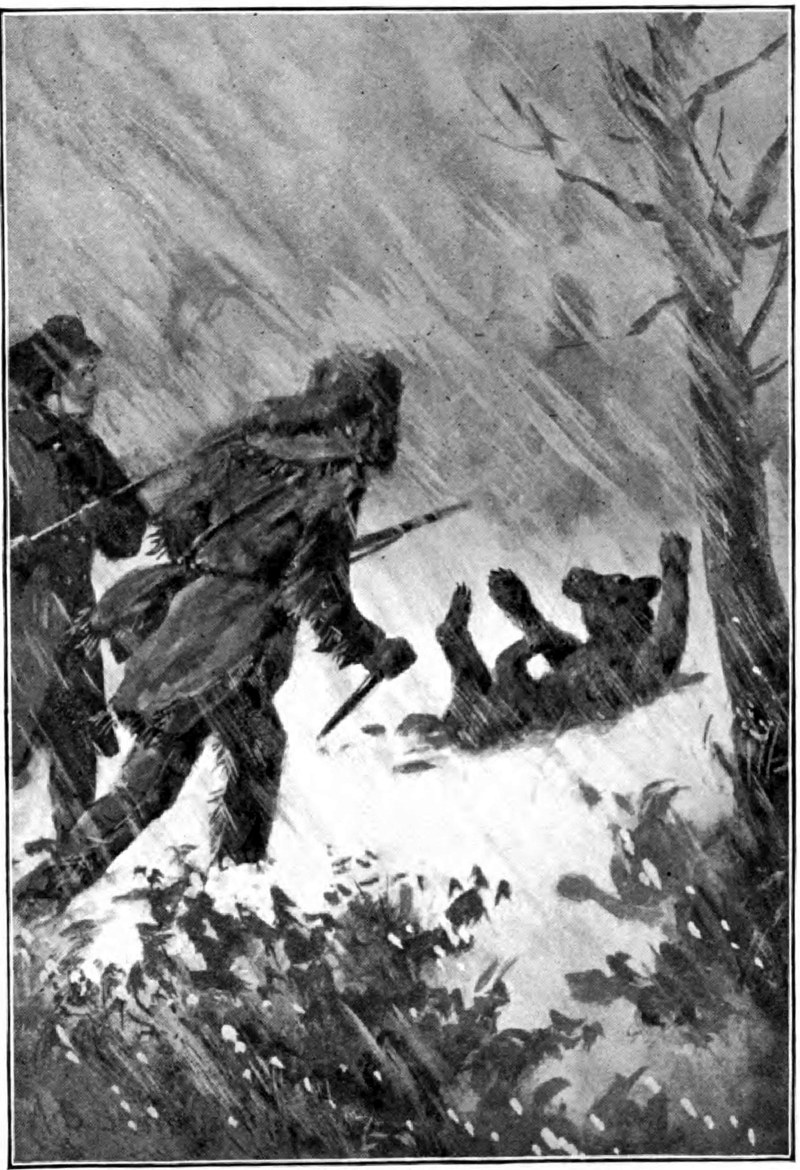
“B’ar meat!” yelled Barringford.—Page 180.
“B’ar meat!” yelled Barringford, and ran forward,
drawing his hunting knife. Watching his
chance he drove the knife into the wounded beast’s
throat, and soon the game breathed its last.
The wind was now blowing a regular gale,
causing the tree boughs to snap and crack in all
directions. Try their best they could scarcely
locate themselves, for every part of the trail had
been obliterated.
“We are lost in the snow!” exclaimed Dave
blankly. “And the storm is growing worse every
minute!”
“We must make some sort o’ shelter, Dave,”
returned the frontiersman. And then he added:
“It’s a rare good thing we shot the b’ar. It may
save our lives.”
181“You mean for food?”
“Exactly. Come with me, and ketch holt.”
Dragging the game between them, they pushed
forward until they reached the shelter of some
rocks. Here were several clumps of bushes and
some tall timber, and they lost no time in starting
up a fire, for the temperature had fallen greatly,
so that both were in danger of freezing to death.
With a hatchet they cut a quantity of firewood,
and made a lean-to against the tallest of the rocks.
They worked hard, and this helped to keep up the
circulation of their blood.
Hour after hour went by, and the storm showed
no signs of abating. Barringford skinned the bear,
and the pelt was hung upon the boughs of the
lean-to to keep off a portion of the wind. In the
hollow the snow was damp and could be packed,
and this they used to build a sort of house, of snow,
boughs, and bearskin combined. It was by no means
a comfortable dwelling but it was far better than
nothing. The fire was close by, and gave them not
only warmth, but also a good deal of smoke, when
the wind chanced to veer around, as it often did.
Slowly the balance of the day went by, and the
night to follow was one Dave remembered for many
a year after. It was bitterly cold, and they could
do but little more than pile the wood on the fire,
182and crouch by it, so closely that more than once
their clothing was singed. They cooked a huge
chunk of the bear’s meat, and ate of it several times;
and added some of the fat to the fire, in the hope
of gaining additional heat. Once, a lean and
hungry wolf came close, snarling viciously, and
looking wistfully at the meat, and Dave brought
it down with a bullet from his musket.
But morning came at last, and with it the end
of the storm. As the sun arose it became slightly
warmer, and by ten o’clock they were again on the
way, each carrying a load of bear meat, and Barringford
the pelt also. The walk was a tiresome
one, and it was two days ere they came in sight of
Fort Oswego.
“I am glad the trip is over,” muttered Dave.
And Barringford echoed the sentiment. Soon they
were among their friends, where they related their
experiences, and then took a long and much-needed
rest.
CHAPTER XX THE SITUATION AT QUEBEC
183
Immediately after the fall of Quebec, the English
resolved to hold the city at any cost, and to
that end every defense was strengthened without
loss of time.
As Wolfe was dead and Monckton wounded and
unable to act, the command fell upon General Murray.
Under his directions the soldiers leveled the
breastworks erected on the Plains of Abraham, so
that they might give no shelter to any advancing
French army, and strengthened the defenses of
Quebec proper. The men also cut and brought in
large quantities of firewood, for use during the
winter, which all felt would be long and bitter, and
likewise aided in storing the provisions sent ashore
from the fleet.
The ships could not winter very well in the river,
and it was not long before they left, taking with
them also a portion of the grenadiers and rangers.
184At Quebec were left ten battalions of grenadiers,
one company of rangers, a strong force of the
artillery, and likewise a sprinkling of Colonial free
lances and friendly Indians—the latter to be used
chiefly as scouts, spies, and messengers.
The city had suffered much from the bombardment
of the artillery. The cathedral was honeycombed
with cannon balls, and many public buildings
and private houses and shops had been
completely wrecked. The people who were left
in the place were almost terror-stricken, and it was
a long time before quiet, and even a semblance of
order, could be restored.
For over a week Henry was kept at work on the
outer defenses of the city. It was hard labor, but
he did not grumble, having already realized that
the path of the soldier is not one simply of glory.
The death of Silvers made him unusually sober,
and in his heart he was sincerely thankful that an
all-powerful Providence had spared his life.
The middle of the winter found Henry on guard
at the lower end of the city. Here were a number
of stores which had been broken down by the
bombardment, and some of the owners were missing.
A quantity of goods had been stolen, and
Henry and four other soldiers were set at the task
of guarding the property.
185On the second day that Henry was on guard he
noticed something which did not at all please him.
Two of the soldiers, named Fenley and Prent, were
unusually friendly, and, when they supposed they
were not being watched, one or the other would slip
into one of the stores. When the fellow would reappear,
he would have something concealed under
his coat, and this, later on, he would pass over to
another soldier, named Harkness, who had charge
of a watch-house a square away.
“I believe that those fellows are up to no good,”
thought Henry, after he had watched the movements
of the three soldiers several times. “They
act like a regular pack of sneaks.”
But Henry was too open-hearted and square to
suspect the trio of deliberate wrongdoing, until one
day Prent accosted him and asked him how he liked
his pay as a soldier.
“I think we get mighty little for what we do,”
said Prent. “And Fenley and Harkness think the
same.”
“It is certainty not much,” answered Henry,
totally unsuspicious that he was being “sounded.”
“Wouldn’t you like to have the chance to make
a bit more?” went on Prent, in a lower voice, and
with an anxious look around.
“What do you mean, Prent?”
186“Oh, nothing much, only if you’d like to make
some money on the outside, perhaps I can place you
in the way of it.”
“I am out to make any money that I can make
honestly,” answered the young soldier.
“Oh! Well, this isn’t—well, it isn’t just work,
you know. But you can make a neat sum if you
want to stand in the game.”
“I’ll stand in no game that isn’t strictly honest,”
burst out Henry, and now his suspicion was
aroused.
“Oh, all right!”
“What have you in mind to do?”
“Nothing—if that’s the way you feel about it,”
retorted Prent, and turning on his heel, he walked
rapidly away.
After that the other soldiers were more careful
than ever of their movements. But Henry could
not get the talk out of his mind, and he at last
resolved to play the spy, and see what they were
doing, or proposed to do.
One day Henry was on guard, from two in the
afternoon until six. At that hour Fenley came to
relieve him, while Prent came to relieve another
soldier named Groom. Groom at once retired to
his quarters, but Henry merely walked around the
corner, where he secreted his musket in an out-of-the-way
187place, and then crawled back in the darkness,
for the winter day was now at an end.
From the broken stonework of a house steps,
Henry saw Prent walk up and down his beat several
times, meeting Fenley at one end. Then Prent gave
a low whistle, to which Fenley instantly responded.
A moment later Prent disappeared into one of the
stores he had been set to guard.
“He is up to no good, that is certain,” reasoned
Henry. “I wish I could see just what he is doing.”
Watching his opportunity, he sped quickly across
the street, which at this point was not very wide.
The store, or shop, stood on a corner, and on the
side was a broken window, partly boarded up. A
board was loose at its lower end, and, lifting it
up, Henry crawled through the window.
All was dark around him, and, standing on the
floor, near some boxes, he listened intently. He
knew that Prent could not be far away.
Presently he heard a foot bang against a box or
barrel. “Hang the luck!” came in Prent’s voice.
“It’s as dark as the River Styx! I’ll have to make
a light, or I’ll break my neck.” The striking of a
flint in a tinder-box followed, and soon Henry saw
the faint light of a tallow dip.
Prent was moving toward a stairs leading into a
188cellar, and this brought him to within a few feet of
where Henry was crouching. But the young soldier
remained undiscovered, and in a moment more he
heard the other soldier shuffle carefully down the
stairs and walk across the cellar floor.
Henry’s curiosity was now aroused to a high
pitch, and he resolved to see what was taking place
in the cellar, no matter what the risk to be run.
He tiptoed his way to the stair, and went down step
by step on his tiptoes.
The stairs creaked, but the sound was not heard
by Prent, who was rummaging around a score of
small boxes, all of hard wood, bound with iron.
One of the boxes was open and showed that it
was filled with surgical and mathematical instruments.
“Bah! I cannot do much with that truck!”
Prent muttered, after looking some of the articles
over. “The other boxes probably contain things
more to my liking.”
The fellow had brought a hatchet and chisel with
him, and was soon at work prying open another
iron-bound box. Occasionally he paused to listen,
as if waiting for a signal from Fenley, but none
came, and he continued his work.
When the second box came open, Henry could
scarcely repress a cry of amazement. The box was
189filled with silverware, for the shop was one which
had been used by a gold and silver smith. There
were silver drinking cups and decanters, and also
half a dozen silver trays, and frames for miniatures.
“Ha! Now we have the right thing!” muttered
Prent, gazing at the collection with satisfaction.
“If we can only get it away without
being discovered we will be rich.”
“He has turned thief!” thought Henry. “What
a rascal! And I thought he was an honest soldier!”
He watched Prent examine the various silver
things, and place some in his pockets and his breast.
Then the fellow started to open up another of the
iron-bound boxes.
Henry was in a quandary, not knowing what to
do. He felt that it was his duty to report Prent,
and have the man arrested. But then he remembered
the order that had but recently been issued by
General Murray—that any man caught plundering
in Quebec should be hanged.
“I can’t see the fellow strung up,” thought the
young soldier. “That would be too horrible. Perhaps
if I talk to him he’d get out and leave the things
alone.”
At first Henry decided that he would talk to the
190would-be thief when he left the building. But then
he remembered that it would be best to have Prent
put the things back in the boxes and nail the latter
up. A few steps took him to the stairs, and once
there he called softly:
“Prent!”
Had a gun gone off at his ear the evil-doer would
not have been more astonished. He dropped the
silver mug he was examining and leaped back a
step.
“Wh—who calls?” he gasped.
“Prent, I have caught you fairly and squarely,
and I want you to leave those things alone.”
“Ha, so it is you, Henry Morris!” burst from
the other soldier’s lips. And then he added quickly:
“Are you alone?”
“I am.”
“What brought you here?”
“I came to find out what your little game was.
I reckon I know the truth.”
“You don’t know anything,” blustered Prent.
The exposure had come so unexpectedly he knew
not what to say.
“I know you are here for no good purpose. If
it were otherwise you would not come here like a
thief in the night.”
“Are you going to expose me?”
191“That depends on yourself. I have no desire to
see you hanged.”
At these words Prent gave a shiver, for he was
at heart a coward.
“I—I—you——” he stammered, and could not
go on.
“Listen to me, Prent, and you may save yourself
a whole lot of trouble,” went on Henry, as calmly
as he could. “I hate to play the spy on a fellow
soldier, but I felt that it was necessary, after what
you had said to me. You wanted to draw me into
this robbery. Now, as I said before, I don’t want
to see you hanged, or even sent to prison. But I
am not going to allow you to rob this place, either.”
“I haven’t said I was going to rob it yet,” burst
out Prent. “I—I haven’t taken a thing.”
“You have. Your pockets and your breast are
full of silverware. Now I want you——”
At this moment came a loud whistle from outside,
followed by the pounding of a musket butt on
an outer cellar door.
“An alarm! Let me get out of here!” yelled
Prent and made a leap for the stairs, which were
narrow and old.
Before Henry could stand on guard he found himself
in the other soldier’s grasp. Then Prent gave
him a shove which sent him over the side of the
192steps head first. Henry tried to save himself, but
went down between two barrels with a crash. Before
he could extricate himself from the tight position
his assailant had fled. Then the tallow dip
spluttered up and went out, and the young soldier
was left in total darkness.
CHAPTER XXI UNDER ARREST
193
For the moment after the tallow dip went out,
Henry, half stunned by his tumble, knew not what
to do.
“Hi, Prent!” he called out. “What do you
mean by knocking me over and leaving me?”
No answer came back to his query, and a few
seconds later he heard a crash of woodwork, followed
by several exclamations.
“What’s the meaning of this?” he heard a rough
voice demand.
“A thief is here,” answered another voice, which,
somehow, sounded familiar.
“A thief? Where?”
“I believe he is in the cellar.”
“After him, men. He must not escape. There
has already been too much looting here.”
There was the tramping of half a dozen soldiers
on the floor overhead, and then the flash of a bull’s-eye
194lantern. As the light reached Henry he staggered
up the cedar stairs.
“Ha! here he is!”
“Up with your hands, you rascal, or we’ll fire
on you!”
“Don’t fire,” gasped the young soldier. “I—I
am no thief.”
“Then what are you doing here?”
“I was after a thief. I followed——”
Before Henry could finish he saw Prent push his
way forward and catch the English officer of the
guard by the arm.
“That’s the man!” he bawled. “That’s the rascal!
Look out, I think he’s a desperate fellow!”
“Is this the man you saw sneaking around?”
demanded the officer.
“The same, sir.”
“If that’s the case, we’ve caught you red-handed,
fellow.”
“Caught me?” faltered Henry. He was so
amazed he could scarcely speak.
“Does it not look like it?”
“But I am no thief.”
“Then why are you here?”
“I came down after that man”—pointing to
Prent.
“Do hear that!” ejaculated the would-be thief
195in well-assumed surprise. “After me—when I’ve
been on guard outside this last hour, and can prove
it by the next guard.”
“This soldier told us you were here,” said the
officer of the guard. “He wasn’t here himself.”
“He was here!” cried Henry. “I saw him sneak
in, and I came after him, to see what he intended to
do. Then he knocked me over and ran away.”
“False! utterly false!” roared Prent. He strode
forward. “Say that again and I’ll knock you down
in truth. I am an honest man.”
“I’ve told the truth,” answered Henry doggedly.
“But we found you here, while he was outside,”
insisted the officer.
“He ran away, as I said, after knocking me down.
If you’ll search him you’ll find his pockets full of
stolen things.”
“Search me, by all means,” cried Prent, who
had thrown the stolen articles into a corner when
leaving the building. He pulled out several of
his pockets. “I haven’t a thing that is not my
own.”
“Men, make that fellow a prisoner,” cried the
officer of the guard, raising his finger and pointing
to Henry.
“But sir——” gasped the young soldier, with a
sinking heart.
196“And now answer my questions. What is your
name?”
“Henry Morris, sir. But——”
“To what command do you belong?”
“To Captain Werrick’s detachment, Royal
Americans. But, sir, if you’ll only listen——”
“Are you stationed anywhere?”
“I have been on guard here for the last week.”
“On guard here?” repeated the officer of the
guard. He turned to Prent. “And you are on
guard here, too?”
“Yes, lieutenant. He went off when I came on.
But he did not go to quarters, but hung around,
and so I suspected him. In fact, he tried, I think,
to get me into some of his plans day before yesterday.”
“How was that?”
“He came to me and said he could show me
a way to make money if I could keep my tongue
from wagging. He said——”
“You miserable wretch!” interrupt Henry.
“You know you are telling a falsehood.” He
turned to the officer of the guard. “As a matter of
fact, he came to me and wanted me to go into his
dirty game——”
“Stop!” interrupted the officer of the guard.
“We will examine into the details of this later.
197Men, make a search, and see if any other thieves
are about. But don’t let either of these men get
away.”
At once two of the soldiers stood guard over
Henry and Prent, while the others scattered through
the cellar, which was long and narrow. They had
but two lanterns, both small, so the search was made
under difficulties.
As one of the guardsmen reached the back end
of the cellar there was a slight scraping sound,
followed by the fall of a trap door. The men
started forward to investigate, but could see nobody.
“What was that, Jameson?”
“Flog me, if I know, Lowder. Somebody went
through a door, I think.”
“Exactly my notion. But where is the door?”
It was not long before they found the door, a
small, heavy oaken affair, leading to a shaft-like
opening, dark and dismal. A lantern was brought
forward and on the damp ground the footprints of
a man could be seen plainly.
“Another thief, and he has escaped!” cried the
officer of the guard.
The officer sent three men into the passageway,
the leader with one of the lanterns. They were
gone the best part of ten minutes, and when they
198returned they reported that the passageway led to
the cellar of a house on the next street.
“Was anybody in the house?” demanded the officer
of the guard.
“The place was deserted,” answered one of the
soldiers. “A back window was wide open and on
the window sill was some mud, the same as that of
the passageway down here.”
“Was anybody with you?” demanded the officer,
turning to Henry.
“No, sir. But there may have been somebody
down here with Prent.”
“At it again!” howled the soldier mentioned.
“I was never down here until now. I am an honest
man.”
“We will see about that later. At present I arrest
you both and will have you taken to the guard-house.
We must find out something about the rascal
who escaped—if we can.”
The officer of the guard was obdurate, and inside
of half an hour Henry found himself at the guard-house,
which, in this case, was a small private
dwelling, from which the owner had fled when first
Quebec was bombarded. He was placed in one
room, while Prent was placed in another.
As luck would have it, Prent was well acquainted
with one of the guards at the house, and through
199this fellow he managed to send a message to Fenley
and Harkness, in which he asked to see one or the
other. Fenley came, and saw him for a few minutes
on the sly, and a scheme was concocted by which
all promised to stand by Prent in the affair, declaring
Henry the sole guilty one.
It is easy to imagine that Henry felt thoroughly
miserable when he found himself in solitary confinement
in the temporary prison.
“Instead of taking chances with Prent, I should
have had him arrested on the spot,” he thought
dismally. “Now he has turned the tables on me,
and how I am to clear myself I do not know.”
The search for the man who had escaped
through the narrow passage was continued for several
days, but without success. In the meantime
Henry was held without examination.
But at last he was told that he was appear before
General Murray and a board of officers, and the
next day he was marched off to where the general
and his staff had their headquarters.
He could not help feeling nervous, and when he
saw the general and his fellow officers, sitting at a
long table, each in full uniform, his peace of mind
was not increased.
“Henry Morris, you are charged with attempted
robbery,” said one of the officers. “General Murray
200wishes to hear what you have to say for yourself.
Tell your story in as few words possible.”
As well as he was able, Henry told of his duty as
a guard, told of what Prent had said to him, and of
how he had followed the soldier to the cellar and
tried to get him to come away without taking anything.
Then he spoke of the alarm, and of how
Prent had knocked him from the stairs, and of how
the officer of the guard had come and placed him
under arrest.
The officers listened in silence, each watching his
face closely. All were evidently impressed by his
sincerity.
“Do you not know it was your duty to report
Prent when you saw him go into the building?”
questioned General Murray.
“I wanted to make sure of what he was doing,
sir. Besides, I didn’t want to see him turn thief
and be hanged for it.”
Henry was then removed, and Prent was called
in, followed by Fenley and Harkness. All three of
the conspirators told of how they had suspected
Henry for several nights and of how they had seen
him on one occasion carrying away something
bulky under his coat.
“Why did you not have him searched?” questioned
General Murray.
201“We couldn’t make ourselves believe that such a
young fellow could be a thief,” answered Fenley
glibly.
“We can’t say that he was a thief, exactly,” put
in Prent. “He may have been only looking at the
things.” Bad as the soldier was, he did not wish to
see Henry hanged.
“But what of that bundle you saw him carry
under his coat?”
“That might have been something else,” said
Fenley.
“Do you want to shield him?”
“Oh, no, general!”
“Do you know anything about this other man
who was in the cellar?” asked another officer, after
he whispered to General Murray. He addressed
Prent.
“No, sir.”
“Then you don’t know he was caught last
night?”
At this Prent’s knees began to knock together.
“Wh—who is he?” he faltered.
“Never mind just now. As he was in the cellar
he, of course, heard all that went on there.”
Prent grew white and it was with difficulty that
he kept his knees from sinking beneath him.
“I—I—he didn’t hear anything—that is, he
202doesn’t know anything about me,” he said weakly.
“He must be in league with Henry Morris.”
“Perhaps,” said the officer dryly. “But I imagine
not.”
At this moment an aid came in hurriedly, and
asked permission to deliver a message.
“What is it, Lieutenant Caswell?” questioned
General Murray.
“We have information that the French intend
to attack the post at Lorette this afternoon,” said
the aid.
“In that case, this hearing is postponed indefinitely,”
said General Murray. “Let the guards remove
the prisoners.”
CHAPTER XXII IN PRISON AND OUT
203
The man who had been in the cellar and who had
escaped, had not been caught, as one of the officers
of the court-martial had intimated. But he had
been heard from, and in the most unexpected manner.
Late the evening before, an old Canadian, living
in the most wretched quarter of Quebec, had appeared
at the headquarters of the officers with a
note, which he said had been given to him by a
man, muffled up in a military cloak, whom he had
met outside of the city, while bringing in a load
of firewood.
“The man gave me no time to speak with him,”
said the Canadian, in French. “He thrust this into
my hand, made me promise to deliver it here to-night,
pressed this silver piece in my palm, and then
rode off on horseback at a wild gallop.”
“Was he a French soldier?”
204“I believe, sir, he was,” answered the old Canadian.
“But he was dirty and unshaven and looked
as if he had not eaten his fill for a week or more.”
The note thus strangely brought to light ran as
follows, although written in French:
“To General Murray:
“I am a Frenchman leaving Quebec, an honest
man, but your enemy in war. I write this to
save the young soldier who was caught in the cellar
of the goldsmith’s shop. He is innocent and
the man who knocked him down is guilty. I write
this at my own peril, because I cannot stand idly
by and see the innocent suffer.
“Yours in truth,
“L. C. G.”
The note was a mere scrawl, written on a bit of
coarse paper and unsealed.
General Murray was much mystified by the communication,
and spoke of it to several of his brother
officers.
“I believe it is genuine,” said one. “The man
was probably a French spy.”
“It is more likely a fraud,” said another. “A
fraud gotten up by one of Morris’s friends to clear
him.”
205Here were the two sides of the matter, and General
Murray did not know which side to believe.
The examination of Henry threw no new light on
the affair, and it was then that one of the officers
suggested, in a whisper, that Prent be made to believe
that the stranger in the cellar had been caught.
The outcome of this the reader already knows.
Henry had been removed before the stranger
was mentioned, and he knew nothing of how nearly
Prent had come to breaking down and exposing
himself.
From the sounds which reached him in his prison,
Henry knew that something unusual had occurred
to break the quiet monotony of army life in the
captured city. Soldiers were hurrying in various
directions, and he heard some artillery being
dragged down the street by six or eight horses.
Drums were rolling, and from a great distance he
imagined he heard the sound of firing through the
clear, nipping air.
Ever since the English had taken Quebec and
signified their intention of holding it, at any cost,
there had been rumors that the enemy were coming
to the attack before the winter was over. The
alarm came in November, when the news went
flying in all directions that General Lévis was
206marching toward the city, at the head of fifteen
thousand men.
“He means to capture the city, and has sworn
to dine here with his army on Christmas day,” was
the report.
The guard was strengthened, and the watchfulness
of the outposts increased. But Lévis failed to appear,
for the simple reason that he was by no means
ready to make an attack. Then the holidays came
and went quietly, and for a few weeks the alarm
subsided.
The main outposts at this time were at St. Foy,
and at Old Lorette. At each place a strong guard
was placed, for the French were not far distant,
and bent on doing all the damage possible to the
English.
Old Lorette had now been attacked by a body of
French regulars, who came up when least expected,
and drove off a large herd of cattle upon which
the British had levied. This made the rangers in
that vicinity very angry. A hasty plan against
the French was arranged, and just as hastily carried
out, and the enemy fell back with one or two
men wounded, leaving the rangers to re-gather the
cattle, that had in the meantime strayed away in
various directions.
But it was not this firing that Henry heard. The
207French had come up during a storm and taken possession
of Point Levi, on the south shore of the
St. Lawrence. They dared the English to come
out and meet them, and a detachment under Major
Dalling was sent over the river on the ice, which
was now thick enough to bear almost any weight.
A sharp skirmish followed, and the French were
beaten back. A few days later there was another
encounter, in which General Murray himself took
part, and also a detachment of the Highlanders, and
this time the enemy fled in terror, leaving a handful
of their men to be captured.
During these exciting days nobody came near
Henry but the prison guards, and the majority of
these soldiers were rough fellows who had neither
sympathy nor pity for the youthful prisoner.
“It’s a bad hole ye have got yourself into,” said
one. “An’ if ye are hung ’twill but serve ye right.”
“’Tis hung he should be,” said another. “A thief
is no better than a murderer.” This fellow had
charge of the food served to Henry, and he gave
the youth stuff which was scarcely fit to eat.
As the days went by Henry grew more miserable,
and to tease him one of the guards told another,
in Henry’s hearing, that he had heard the prisoner
was soon to dance upon nothing, as a warning to
other thieves.
208It was a cruel joke, and gotten off so seriously
that Henry was much inclined to believe the report.
That night he could not sleep, and when he arose
in the morning his face wore a cold, calculating
look that had never been there before.
“They shan’t hang me,” he thought bitterly.
“I am innocent and I won’t suffer—not if I can
help it. What will mother and the others say, if
they hear I was hanged for a thief?”
A day later it snowed heavily, and the guards
around the house were more out of humor than
ever. They were not allowed to smoke, but did so
on the sly, and one man drank liberally of some rum
which one of the detail brought in from somewhere.
Henry was watching his chance as a hawk
watches young chickens, and late that afternoon
noticed that the guard seemed unusually drowsy.
The man sat on a bench in a front room of the improvised
prison, and if he did not sleep he was certainly
far from being wide awake.
There was a window in Henry’s room. It had
been nailed up, but one window pane was broken,
letting in cold air that nearly froze him to death
during the night time. Outside several slats of
wood had been placed across the window, which
happened to be without the heavy wooden shutters
so common at that period.
209Through the broken window pane Henry had
worked at two of the slats and now had them much
loosened. As night came on he noticed that the
guard still dozed. The man’s cap had fallen on the
floor, and his heavy coat had slipped beside it.
“If I could only get that cap and coat,” thought
the young prisoner. The door to the next room
was unlocked,—indeed, it had never had a lock on
it,—and it was an easy matter to step up to the
guard. In a moment more Henry had the articles
he desired. Then he turned back, for he knew that
another guard was in the street, near the door leading
to the thoroughfare.
“Hullo! How cold it is!” Henry heard the
guard mutter. He waited to hear no more, but
as the man stretched himself he ran to the window,
smashed out what remained of the glass, pushed
aside the loosened bars, and leaped out into the
snow of the yard.
There was now an alarm, and the youth knew
that in another moment three or four guards would
be after him, each with a musket, ready to shoot
him on sight. He leaped for the shelter of a nearby
woodshed, donned the cap and military overcoat,
and then continued to the back of the yard, where
he hopped over a fence, and darted into an alleyway
leading to another street.
210As Henry gained the alleyway the report of a
musket rang out on the early night air, and soon
the commotion in and around the prison increased.
“What’s the rumpus?” demanded the officer of
the guard, running up.
“Morris has escaped!”
“He attacked me like a savage beast,” said the
guard, who had been dozing. “He—he complained
of being half frozen, and then he turned
on me like a fury.”
“You’re a set of numskulls!” roared the officer
of the guard, in great wrath. “After him, and if
you do not bring him back, dead or alive, somebody
shall pay dearly for this blundering.”
One thing prison life had given Henry. That
was plenty of rest, and now as he ran through the
alleyway and out on the next street he felt as if
he could cover ten or twenty miles without stopping.
“They shan’t catch me,” he told himself. “I’ll
show them what an American can do when he is
put to it.”
On account of the darkness and the cold the street
was almost deserted, and the few people he met
hardly noticed him; doubtless thinking he was
merely some soldier hurrying to his quarters after
a chilling tour of guard duty on the ramparts.
During the time Henry had been free to come
211and go in Quebec he had visited nearly every part
of the city, which in those days was far from large.
Consequently, he knew where he was and how to
turn to get to where he wanted to go.
“I’ll have to leave the city to-night, that is certain,”
he told himself. “In the morning there will
be a warning sent out, and to pass any of the guards
will be impossible.”
But how to get out was a serious problem until
he caught sight of a covered wagon drawn by a
team of horses, moving slowly toward the gate of
St. John. This wagon contained supplies for the
hospital, located to the northward, on a bend of
the St. Charles River. The supplies were needed
at once, hence they were being sent out at night
instead of waiting until morning.
Climbing upon the wagon from behind, Henry
secreted himself between several boxes and bundles.
Neither the driver of the wagon nor his assistant
noticed the movement, and in a moment more the
wagon was at the gate.
“What wagon is that?” Henry heard a guard
call out.
“General Hospital Wagon No. 4,” was the
answer from the driver. And he showed a slip
of paper.
“Right; pass on,” answered the guard, and the
212gate was opened, the wagon passed through, and
then the gate was closed again.
Hardly daring to breathe, the young soldier remained
crouched between boxes and bundles, as
the wagon jounced over the rough road, deep with
snow in some places, and swept bare by the wind
in others. Then, when he calculated that half the
distance to the hospital had been covered, and they
came to another road leading westward, he dropped
off behind, and the hospital wagon rolled out of
sight without him.
CHAPTER XXIII FACE TO FACE WITH THE UNEXPECTED
213
So far Henry had given but scant thought to
where he was going. His whole mind had been
concentrated on getting away from Quebec, and
from those who wished to make him suffer for a
crime which he had not committed.
But now, as he stood in the middle of the
deserted roadway, with the gloom of night on
every side of him, and with a cutting wind blowing
the drifting snow into his face, he realized
that he must find shelter, and that quickly. He
was not accustomed to such a severe winter, and
the cold seemed to pierce him like a knife.
At a corner of the roadway stood a signboard,
a rough affair, with an arrow pointing to the northeast,
and under this the name St. Foy.
“That must lead to one of the outposts,” thought
the young soldier. “I can’t go there. I wonder
if there isn’t some French farmhouse in this vicinity
214where they will give me shelter for the night,
and some food?”
To keep warm he began to tramp along the road.
He had gone but a short distance when he came
to a cross road. Here everything was covered with
snow, and half blinded by the whirlings of the
wind he got onto the cross road without knowing it.
Two miles were covered, and poor Henry was
almost exhausted. More than once he thought to
sit down and rest. But he realized that this would
be madness. “I’d never get up again,” he told himself.
“It would be the sleep of death!”
At last, when he could scarcely drag one limb
after the other, he espied a light shining from the
upper window of a small house some distance away.
He fairly staggered toward this, and, reaching the
house, knocked loudly on the door.
After a moment of silence an upper window was
opened, and an old woman peered down from out
of her night-cap.
“Who is there, and what is desired?” she asked
in French.
“I am freezing!” said Henry in English. “Let
me in.”
The old women did not understand his words,
but she seemed to understand the situation, and soon
hobbled downstairs and threw open the door.
215Henry almost fell into the kitchen, and sank into
a heap before the fire which smoldered in the big
chimney-place.
“Poor fellow—and so young!” murmured the
old French woman. “He is almost frozen.” And
she bustled about, stirred up the fire, and put on
some fresh sticks of wood, and then made him some
hot tea to drink.
It was a good half-hour before Henry felt anything
like himself. He was given some bread and
butter, and some warmed-up meat and another cup
of tea. The old woman plied him with questions,
and he had a hard task to make her understand
that he wished to remain at the house until daylight.
But when he pointed to the fire, and then
at himself, and made out as if he was sleeping
and snoring, she smiled and nodded her head in
assent.
It must be confessed that Henry slept but little
that night, even though his couch on a blanket before
the smoldering fire was a fairly comfortable
one. His brain was racked with the question of
what to do on the morrow. Traveling during the
daytime would be extremely hazardous, so long
as he remained in the English lines, and when he
crossed into the French lines the situation would
be just as bad.
216“And it’s too cold to travel at night,” he thought
dismally.
The morning found the snow coming down at a
furious rate, so that the landscape was blotted out
on every side. The roadway was drifted high with
snow, which lay against the kitchen door to a depth
of three feet.
“I reckon I am safe here for the present,”
thought the young soldier. “Nobody will think
of visiting this house during such a snow-storm.”
The old woman came down as soon as it was
light. She found Henry fixing the fire, and he had
already set the pot of water for boiling.
“You are snow-bound,” she said, but of course
he did not understand her. He gazed thoughtfully
out of one of the windows, while she prepared a
simple morning meal from her scanty stock of provisions.
He wished he could pay her, but could
only point to his empty pockets, at which she smiled
again, as if that did not matter.
“A good, motherly sort,” he told himself.
“Mother at home couldn’t treat a French soldier
any better than this woman is treating me.”
The snow-storm kept up for several days, and
after that there were fierce high winds, which
sent the snow flying and drifting in half a dozen
directions at once.
217During those days Henry and the old woman
were left entirely alone. By an effort on the part
of both he learned that she was a widow with a
son somewhere in the French army, and that her
name was Garrot. She deplored the war, and
wished only for peace, no matter which side won.
“And at her age I cannot blame her,” thought
Henry. “Probably she has lost a great deal by
the forages of both armies.” And his surmise was
correct.
On the morning of the fourth day at the cottage,
the young soldier heard firing at a distance. The
sounds seemed to come closer at noon, but shortly
after that died away utterly.
“Some sort of a skirmish,” thought the youth.
“Can it be that the French have attacked Quebec?”
On the day following, the sun came out, and the
weather moderated greatly. Henry now thought
he must set off once more, fearing that some French
troopers might appear at any moment. As best he
could he thanked Madam Garrot for what she had
done for him, and then trudged off.
The young soldier had in mind to move up the
river bank a distance of several miles, and then
cross the St. Lawrence on the ice. Once in English
territory, he would strike out southward, trusting
to luck to reach some settlement. He carried a
218small stock of provisions, and also a pistol and some
powder, which he had begged of the old woman,
who seemed, strangely enough, much interested in
him.
Henry found walking through the snow as difficult
as ever. But after trudging along for half a
mile he reached a long stretch which the wind had
swept clear, and which he covered with ease. He
kept his eyes and ears on the alert, but neither
French nor English soldiers appeared to challenge
his progress.
That night found the young soldier a good many
miles up the St. Lawrence, at a place which had
in years gone by been a combined French and Indian
settlement. Most of the buildings were burnt
down, and the place was entirely abandoned. In
searching around he found one part of a log cabin
which could be used as a shelter, and into this he
crawled, and built a small fire in the half-tumbled-down
chimney-place.
“Not much of a tavern,” he thought grimly.
“But I can be content if I fare no worse during this
journey.”
His physical distress, even though great, was
nothing compared to the trouble he suffered in his
mind. He was branded as a thief, and even if he
escaped to his home, how was he to clear his name,
219and how escape the military judgment meted out
to him for the crime? Even if he was allowed to
go free, folks would point the finger of scorn at
him. And then his mother—he hardly dared to
think of her.
“This news will almost kill her,” he said to
himself. “She always expected so much of
me!”
The next day he continued his journey up the
river bank. He had now crossed a road where the
tracks of several sleighs could be plainly seen, and
was on his guard constantly.
It was almost nightfall when Henry reached a
large barn located in the middle of a field which was
deep with snow. A house had stood near by, but this
had been burnt down by the Indians at the outbreak
of the war. But some half-burnt sticks of timber
were still visible, and some of these he gathered,
and built himself a fire at which to thaw out his
half-frozen limbs.
The fugitive was utterly worn out, and, having
consumed the last of his scant stock of provisions,
he wrapped himself up in some hay in the barn,
and soon fell asleep.
How soundly he slept Henry did not know until
nearly daylight, when the kicking of a horse’s hoofs
on the side of a stall below awoke him. He listened
220intently, and heard several steeds moving
about.
“Some French troopers must be around,” he
reasoned, and his heart almost stopped beating at
the thought. With extreme care he peered below.
He could see two forms stretched out in the semi-darkness.
Listening, he heard snoring from
another quarter. Not less than six men were below
asleep.
“Now I’m as good as caught,” he thought, but
an instant after set his teeth hard. No, he would
not give in thus easily. He would fight first.
“They must have come in too late to notice the
fire I built,” he told himself. “But they’ll see it
when they awaken and start on a tour of discovery.
I must get away if I wish to save myself.”
There was a small window at one end of the
barn, and he found he could drop out and into the
snow with ease. But just as he was climbing out
another thought came to him—one that amazed
even himself, at the risk involved. Why not try
to appropriate one of the French troopers’ horses,
and perhaps a saber and some food as well?
The exposure had made Henry reckless and he
did not stop to consider the plan twice. Turning,
he found the rude ladder leading to the lower floor
and went down to the bottom.
221There were exactly seven of the troopers, all burly
fellows, and one an under-officer, who was snoring
lustily on the top of a feed box.
Henry’s first move was to untie the horse nearest
to the stable door. The snow had drifted in beneath
the door, and this helped to deaden the sounds of
the animal’s hoofs as it was led outside. Then
the young soldier returned and picked up the officer’s
saber, and also a pistol and a horn of powder and
balls. A knapsack was handy, and into this he
stuffed a mass of provisions taken from three other
knapsacks. The provisions were only army rations,
but they were vastly better than nothing.
As Henry slipped from the stable a second time
one of the men stirred uneasily and opened his
eyes.
“Who is there?” he asked sleepily, in French.
Of course Henry did not answer. Instead, he
swung himself into the saddle, which had been left
on the steed, and started away from the stable on
a gallop. Reaching the rude stone wall of the field,
he made the horse take it at a bound, and then continued
on his way along the river road.
He had not yet reached some timber ahead of
him, when a shot rang out, followed by another,
showing that he was discovered. The bullets, however,
flew wide of the mark, and soon he felt that
222he was practically out of range, for the muskets
and pistols of those days did not carry as far, nor
as accurately, as do those of modern construction.
“They will be after me,” thought the young soldier,
as he continued to urge the horse onward, and
at the same time fastened the knapsack to his back
and the saber to his waist. “Well, if they come,
I reckon I can fight for it,” he continued, and set
his teeth together more firmly than ever.
The timber was gained a few minutes later. Just
before passing out of sight between the trees he
looked back. Four troopers had left the barn on
their horses and were in hot pursuit.
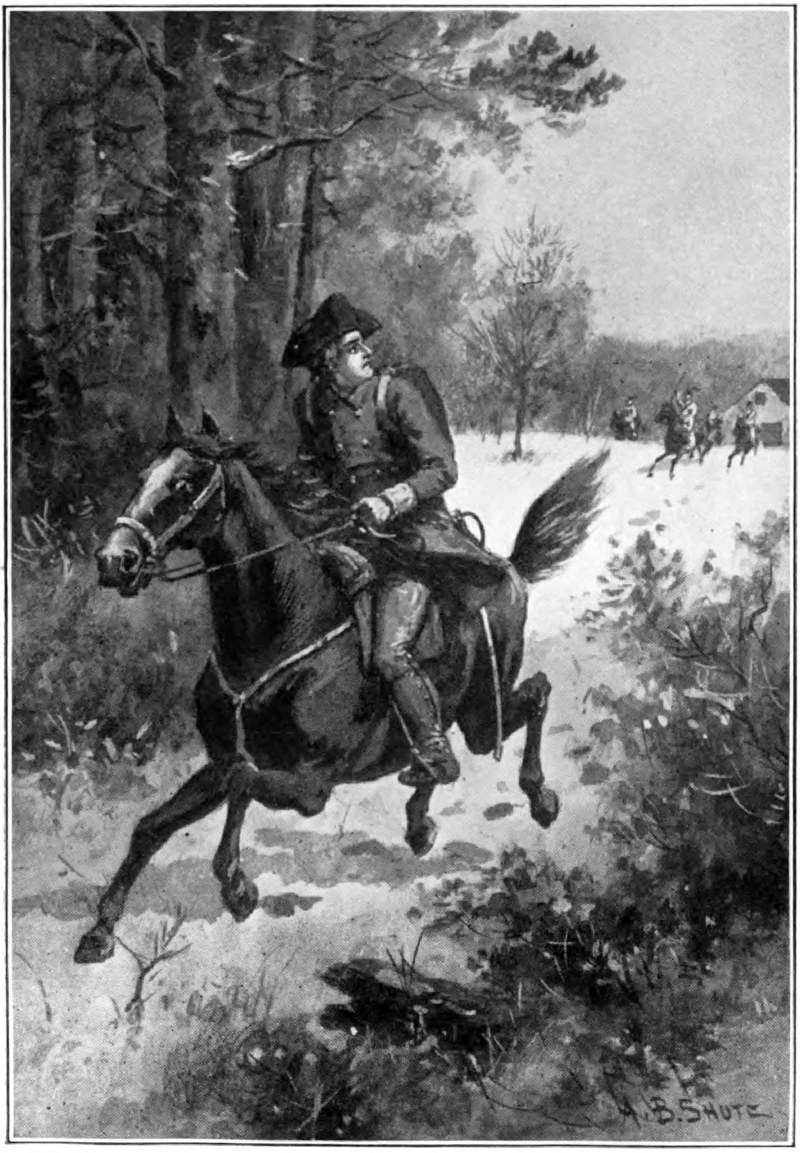
Four troopers were in hot pursuit.—Page 222.
CHAPTER XXIV A GAME OF HIDE AND SEEK
223
Fortunately for Henry, the road through the
timber was on a slight ridge, which the wind had
swept almost free of snow. Here and there the elements
had torn down branches, and even trees themselves,
but the horse the young soldier rode appeared
to know something of steeplechasing and
took every obstruction without difficulty.
For a distance of half a mile the way was straight,
and looking back he saw the four troopers plainly.
They were riding about as fast as himself, but no
faster.
“They won’t catch me just yet,” he reasoned, as
he sped onward. “And perhaps I’ll soon come to
some cross-roads, where I can give them the
slip.”
Once came another shot but it did not reach the
fugitive, and only made him urge his steed along
at a better speed. Then the road began to lead downward
224from the ridge, and soon Henry found his
horse plowing and panting through snow a foot
deep, and steadily growing deeper.
Here was cause for fresh alarm, and now the
youth’s heart beat anxiously. A turn had hidden
the troopers from view, but he could hear them
shouting to each other, for the horse of one had
stumbled over a log, and thrown his rider headlong
into a snowbank.
“They’ve got a chance to get up to me now,”
thought Henry, as he gazed at his almost exhausted
animal. “Oh, if only we could get to some spot
where there wasn’t so much snow!”
Another turn was ahead, and Henry made for
this, hoping it would disclose something to his advantage.
It did, for here were three other roads,
running in as many different directions.
“Too bad to give up the horse, but I guess it has
got to be done,” he thought. He turned the horse
up one of the side roads and brought him to a
standstill under a low-hanging tree. Then he leaped
into the branches and gave the steed a smart slap
with the flat side of the sabre. “Up with you!”
he cried. “Get along!”
Stung by the blow and urged on by the words,
the horse gave a leap forward, and started off at
a good pace that soon took him out of sight. Then
225Henry climbed up into the tree and lay among the
branches, hardly daring to breathe.
It was not long before the young soldier heard
the French troopers at the cross-roads. They came
to a halt, examined the ground, and then put on
after the riderless horse, passing directly beneath
the tree in which the fugitive was hiding.
“That was a lucky idea,” thought Henry, and
as soon as the party had passed he slid down out
of the tree. He did not take to the road at once,
but made a détour through the brushwood, to a point
on one of the other roads a quarter of a mile away.
Then he struck out bravely once again in the direction
of the river.
Henry found trudging along with a knapsack on
his back far from easy, and at the end of an hour
he was glad enough to seek the shelter of some
rocks and trees and rest. The sun was shining
brightly, and at a long distance he could make out
the frozen surface of the St. Lawrence, glistening
in patches like a mirror.
“I suppose I may as well make for the river and
cross it here, instead of farther up,” he mused.
“I’ve got to get to some place before all my supplies
give out.”
He took his time over the rations which the knapsack
afforded, keeping his eyes and ears open for
226the possible sound of pursuers. But nobody came
near him, and the country for miles around looked
absolutely deserted.
The distance to the river was fully as far as it
looked, and before half the space was covered Henry
was almost exhausted. He had found a deserted
farmhouse, and here he rested again, and then resolved
to remain at the farmhouse over night.
“One day won’t make any difference,” he reasoned.
The farmhouse had been looted of all of value,
yet a rude table, two benches, and a few old cooking
utensils remained, and close at hand was some firewood
ready for use. Growing reckless again, the
youth started up a fire, and warmed up some of his
rations, and also his half-stiffened body.
Slowly the day faded from sight and the stars
began to glitter in the sky. It was clear and quiet,
and never had the young soldier felt so lonely. His
thoughts traveled to home and then to Dave. What
would his cousin think of him when he heard of
what had happened?
“I’m sure Dave won’t think I turned thief,” he
reflected. “But that won’t help me any. Oh,
was ever a fellow in such a fix before!”
It was nearly midnight when Henry heard a
strange noise outside of the old farmhouse. He
227leaped up from his position in front of the fire and
gazed out of a window. In the dim light he saw
three men approaching on horseback.
“The troopers!” he told himself. He wanted
to flee, but there was not time. Gathering up his
pistol and saber he fled up the narrow stairs leading
to the sloping room above.
In a few minutes the door below was thrown
open, and the three men entered. They were talking
earnestly, but the sight of the smoldering fire cut
short the conversation. Some excited questions
followed, and presently one of the men opened the
door leading to the stairs.
“Is anybody up there?” he demanded in French.
Instead of replying, Henry tiptoed his way to a
corner of the room. Here was a sheltered nook,
between the chimney and the sloping roof, and he
squeezed himself into this.
“I say, is there anybody up there?” demanded
the Frenchman once more.
He waited a moment and then slammed the door
shut. More talking followed, but only an indistinct
murmur reached Henry’s ears. The young
soldier scarcely dared to breathe, and he tried in
vain to think of what would be best to do next.
“I reckon I’ll have to drop from the window,
just as I was going to do at the barn,” thought the
228youth, but before he could put the plan into execution,
the door below was thrown open once more
and the Frenchman reappeared, this time with a
torch taken from the fire, which he and his companions
had started up again.
“I’m in for it now,” Henry told himself, and he
was right. In a moment more the Frenchman discovered
him and drew a pistol.
“Who are you?” he demanded, in his native
tongue.
“Don’t fire,” answered Henry.
“Ha, you are von Englishmans, hey?” cried the
Frenchman, and now Henry saw that he was dressed
in civilian’s clothes.
“Yes, I am an English soldier,” answered Henry
recklessly. “What do you want of me?”
“You come de stairs down, an’ you make me no
trouble,” was the reply.
As there was no help for it, Henry descended to
the ground floor of the farmhouse. The talking
had brought the others to their feet and each
Frenchman had a pistol drawn as he appeared.
“Jean Bevoir!” gasped Henry, as his eyes rested
on one of the newcomers.
“Ha, you know me?” came in return. The
trader gazed at Henry sharply, and uttered an imprecation
in French. “It ees zat Henry Morris!”
229“Henry Morris?” repeated the man who had
remained below with Bevoir.
“Oui, Chalette;” and then he continued in
French: “Do you not remember seeing him at Fort
Niagara?”
“Yes. But he is not the Morris who came to
the hospital,” answered Chalette, who was the prisoner
who had escaped with Jean Bevoir, during
the powder-house excitement.
“No, this is a cousin—the brother to that little
Nell Morris.”
“Ah, I see. Is he alone? If he is, we have
made a fine haul,” was Chalette’s comment.
“He is the only person I saw,” said the third
Frenchman, a hunter named Gasse. “I will look
again. You watch this fellow.”
“To be sure we shall watch him,” cried Jean
Bevoir, and at the point of the pistol he disarmed
Henry and made him stand up in a corner, facing
the wall. The young soldier wanted to fight for
his liberty, but saw it was useless, for Chalette also
kept his pistol ready for use.
It was not long before Gasse returned, saying
that nobody else was anywhere around. Then
Henry’s hands were bound behind him and he was
tied fast to a bench, which was stood up on end for
that purpose.
230“Now, my fine fellow, you vill tell me how it ees
zat you came here,” began Jean Bevoir.
“I rode part of the distance and walked the rest,”
answered Henry, as lightly as he could. He felt it
would do him no good to “show the white feather.”
“Where did you come from, tell me zat and tell
ze truf.”
“I came from Quebec, if you want to know so
bad.”
“Ha, Quebec! You march all ze way from Fort
Niagara to Quebec?”
“No, I came part of the way by boat.”
“’Tis mooch ze same. Vat ees it zat you do
here?”
“That is my own affair.”
“You play ze spy on ze French, not so?”
“No, I am not a spy.”
“But ze English air not here—za know enough
to stay near to Quebec.”
“If you must know, I am trying to get home,”
answered Henry.
“Geet home? You leaf ze army?”
“Yes.”
“For vat?”
“I have my reasons.”
“You geet afraid of ze French bullets, hey?”
“Perhaps.”
231“Maybe you haf deserted ze army?” burst out
Jean Bevoir, and gave the young soldier a shrewd
look from his wicked eyes.
“If I have it is none of your affair, Jean Bevoir.
Now let me ask a few questions. How did
you get here? Did General Johnson let you go?”
“Yees,” answered Bevoir, without hesitation.
“He examine me an’ say I am free.”
The falsehood was told so readily that Henry was
staggered by it.
“General Johnson made a mistake to let you
free!” he cried. “If this war ever comes to an end,
you shall suffer for what you have done.”
“Ha, you threaten me, you, von prisonair!”
roared the French trader, shaking his fist in Henry’s
face.
“You don’t deserve your freedom, and you know
it.”
Bevoir drew a long breath. “Ve vill not talk
about zat,” he said. “I shall tell ze French commander
zat you are von spy—an’ Chalette an’
Gasse shall tell ze same. You vill soon learn zat
ze French know vat to do to ze spy, ha! ha!” And
he laughed wickedly.
At these words Henry’s heart sank within him.
He realized only too well what Bevoir’s words
232meant. If taken into the French camp as a spy he
would most likely be shot.
Truly in breaking out of the guard-house in Quebec
and coming to this place he had leaped “out of
the frying-pan into the fire.”
CHAPTER XXV TAKEN AS A SPY
233
The Frenchmen now began an earnest conversation
in their native tongue, and they spoke so rapidly
that Henry could understand little of what was being
said. But he knew that they were talking about
him, and more than once he heard his own name
and that of Dave, and of his Uncle James mentioned,
and once he heard them mention the trading-post
on the Kinotah.
“Jean Bevoir is going to square accounts if he
possibly can,” thought the young captive dismally.
“He is going to make me suffer for all his troubles.
How General Johnson could let such a rascal go is
more than I can understand.”
At length the Frenchmen turned to prepare themselves
something to eat, and one went out to care
for the horses, which were stabled in a lean-to of
the farmhouse. Then Henry’s bonds were examined
and an additional strap passed over his lower
234limbs, after which the bench was let down, that he
might lie at full length.
“Now, if you can sleep, you sleep,” said Bevoir
roughly. “But do not try to get away, or ze
bullet from a pistol shall find you verra soon.”
The Frenchmen laid down after this, and once
again the farmhouse became quiet. Henry tried
several times to free himself, but found the task impossible.
At last worn out by the struggle, he
too, passed into the land of dreams.
When the captive was released at daybreak he
found himself so cramped that he could scarcely
stand. His hands were now untied that he might
eat the little breakfast allotted to him, and were
then refastened in front of him.
Soon after this the farmhouse was left behind,
and the whole party started down the river road
single file, Henry taking turns in riding with each
of the others. It was still cold and clear, and traveling
was by no means easy. Yet the horses were of
large build and covered many miles before being
halted for midday lunch.
It was nightfall when the camp of a French outpost
was discovered, quarter of a mile back from
the St. Lawrence, and close to a settlement named
Girot, since entirely abandoned. Here some
fur traders, well known to Jean Bevoir, had erected
235something of a fort and stockade, and the French
soldiers had taken possession.
The flare of several camp-fires lit up the outside
of the fort, as the prisoner and his captors rode
through the stockade gate. Here were assembled
several companies of foot soldiers, and half a troop
of French cavalry, under the command of Captain
Rachepin, a burly fellow, who had won his position
by daring work in the campaigns gone by.
“An English prisoner, eh?” he said, as he gazed
at Henry. “That makes the third this week. Well,
the more the merrier.” And without further ado
Henry was thrown into a low, dirty hut, that did
duty as a prison.
Two other prisoners were already in the hut,
one an English grenadier, and the other a ranger
from New Hampshire. Both were half-starved,
and each had been captured while miles away looking
for game for their own camp larder.
“Hit’s ’ard luck, my boy,” sighed the grenadier
gloomily. “Hi didn’t hexpect nothink like hit when
I took the King’s shilling, Hi can tell ye that.”
“Never seed nothin’ like them pesky garlic-eaters,”
said the ranger. “Neow deown ter our
camp we treated the prisoners fair an’ square, but
here—gee shoo! Why, the eatin’ aint fit for hogs,
let alone human critters!”
236“Perhaps they haven’t enough for themselves,”
answered Henry.
“They ’ave that,” put in the grenadier. “Hi
’ave seen hit with my hown blessed heyes. But
the bloomin’ tykes are selfish. They ’ave flip and
spruce beer galore, but hit is nothink but cold water
fer us, with stale bread an’ salt pork as is worse
than stale!” And the grenadier heaved a long sigh.
“Hif ever Hi git ’ome again, strike me dead hif Hi
leave a second time!”
“An’ thet aint the wust on it, not by er jugful,”
continued the ranger, who rejoiced in the name of
Pity-All-Sinners Skinner, but was called Pit for
short. “When I got ketched I had a’most seven
shillin’s in my pocket, an’ neow I aint got a smell
on’t, flay ’em!”
“I don’t suppose you gave them the money,” remarked
Henry.
“Gave it to ’em? Not by er jugful! I’ll see ’em
all drawn an’ quartered fust! They took it—stole
it plain and simple. But yeou jest wait! This here
war aint done yet—an’ Pit Skinner aint dead yet
nuther!” concluded the ranger, with a wrathful
shake of his head.
For several days nobody came near Henry outside
of the guard who brought in the miserable
prison fare, already mentioned by the grenadier
237and the New Hampshire ranger. It was certainly
food scarcely fit to eat, and it was a whole day before
the young soldier could touch it. But a keen
appetite can overcome many objections, and at last
he ate just enough to satisfy the intense craving
of his stomach. Even the drinking water was poor,
and, as Pity-All-Sinners Skinner said, hardly fit for
washing.
On the Monday following Henry’s arrival at the
post a messenger came in with some important dispatches.
Following this there was a good deal of
bustle and excitement, and soon some guards appeared
and told the prisoners to get ready for a journey.
“Where are we going now?” asked Henry, but
the guard addressed either could not, or would not,
answer the question.
Chained together, hand-to-hand, the three were
made to march from the fort. The foot soldiers of
the French were already in the ranks and the prisoners
were placed in their midst. Then the little
column moved off by fours, up the St. Lawrence,
in the direction of Montreal.
“Something has happened, thet’s certain,” said
Skinner. “Looks ter me like a retreat.”
The march of the soldiers with their prisoners
was kept up for three days, when the outskirts of
238Montreal were reached. Then came other dispatches
for the commander of the little column, and
the prisoners were sent into the city under a guard
of six men, while the main body of the soldiery
moved eastward again.
At the time of which I write, Montreal, now a
large and flourishing city, was but a small town,
consisted principally of low one- and two-storied
houses, of logs and stone. There were several
stores, or rather trading shops and some little shipping
during the summer time, along the waterfront.
The people, mostly Catholics, were very religious
and had three churches and also a seminary,
which, on account of its towers, could be seen from
a great distance.
The defenses of the town were not many and
the place had suffered much from having quartered
the army of Montcalm on more than one occasion.
During those times the French soldiers had eaten
very nearly all the food in sight, leaving the town
people to famish. Business and trading were almost
at a standstill, and at times even money could not
procure the necessities of life.
On entering Montreal Henry saw but little of
the place, for he was hurried without ceremony to
a stone building which the French had turned into
an army prison. In this building were huddled
239over a score of prisoners of all descriptions—a
motley, half-dressed and half-starved crowd, some
grenadiers, some rangers, and some civilians.
Everybody in the crowd was out of humor, and
groans and curses were frequent. But the prisoners
did not dare to talk too loudly, for if they did, a
guard would appear and threaten them with solitary
confinement in a stone cell under one of the churches.
“What an awful place to stay in,” was Henry’s
mental comment. He found himself pushed hither
and thither, while the stench of the prison made
him literally sick. “This is Jean Bevoir’s work.
He will make me suffer as much as he possibly can.”
After a good deal of pushing and shoving, Henry
found himself in something of an alcove, and here
dropped on the bench which was built around two
sides of the room. Beside him sat an old soldier,
who was suffering from a heavy cold, and who
coughed continually.
“It is not fit for a dog here,” said the old soldier.
“I have been here two weeks, and I know. They
mean to kill us all off.”
“Two weeks—in this hole!” cried Henry.
“Yes, and that is nothing. Some of the poor
fellows have been here three months.”
“I couldn’t stand it—I’d—I’d die for the want
of fresh air.”
240“And that is what they want you to do. When
you die they won’t have to feed you any more.”
The cough of the old soldier grew steadily worse,
and, although, at the last moment a surgeon came
and gave him a little medicine, he died eight days
later, and was carried away for burial in a trench
outside of the town.
Henry had been separated from Pity-All-Sinners
Skinner and from the English grenadier, and so
knew absolutely nobody in the prison. More than
this, no one seemed to care for him, and, if the
truth must be told, he likewise cared for nobody.
Everybody felt miserable and it was in very truth
a struggle to keep body and soul together and to
keep from catching some fatal disease.
The young soldier was in the prison over a month
before Jean Bevoir came to see him. The French
trader could only speak to him through the rudely
slatted door and in the presence of the other captives.
“I trust zat you like ze surroundings,” said Bevoir,
with a sickly grin. “It ees just suited to you,
hey?”
“You’re a miserable scoundrel, Bevoir!” burst
out Henry. “What have you told the commander
about me?”
“I haf tole him zat you are a spy an’ a verra
241deep one, too! Some day, ven he has ze time, he
vill bring you up before ze military court.”
“And then?” questioned the young soldier.
Jean Bevoir shrugged his lean shoulders.
“Zen you can die ze death of ze spy, and it ees
vat you an’ all your familee deserve. Ees not zat
von pleasant thought, hey?”
And with a sinister leer the French trader moved
away from the slatted door and left the prison as
rapidly as he had entered it.
As for poor Henry, his feelings can be better
imagined than described. Walking to a corner of
the cell he threw himself down on the bench, almost
overcome. The last door of hope seemed to be shut
against him.
CHAPTER XXVI DAVE’S JOURNEY TO QUEBEC
242
It was not long after he was lost in the snow,
that Dave heard news from Quebec that disheartened
him greatly. This was that Henry had been arrested
for stealing and was likely to be hanged for
the offense.
The news came in through several messengers
who arrived at Fort Ontario on important business
for General Murray. One of the messengers knew
Sam Barringford well, and it was this man who
gave the news, first to the old frontiersman and then
to Dave.
“Henry arrested for stealing!” exclaimed the
young soldier. He could scarcely believe that he
heard aright.
“Sorry for you, young man, but it’s the truth,”
was the reply of the messenger, and he gave what
few particulars he knew. He had left Quebec before
Henry ran away, so knew nothing of this new
turn of affairs.
243It was to Barringford that the messenger told
how Henry was in danger of hanging. “General
Murray is bound that looting shall stop,” said he.
“So some time ago he had notices posted up giving
warning that a thief caught in the act would be
hanged.”
“I’ll wager my life on it, Henry aint no thief,”
said Barringford warmly. “Thet boy is as honest
as the day is long.”
“I know nothing of that. He is now in prison,
or, for all I know, he may be dead.”
Barringford considered it his duty to tell Dave
of the fate that overhung his cousin, and the
two talked the matter over for the best part of a
night.
“If I could get to Quebec I’d go,” declared
Dave. “Perhaps I could do something—if—if——”
He wanted to say if it was not too late but the
words stuck in his throat.
“Say the word an’ I’ll go with ye, Dave,” responded
Barringford. “Thar don’t seem to be no
ust o’ stayin’ here.”
“Can we make it, Sam? Quebec is a long distance
from here.”
“I aint afraid to try it, Dave. I allow as we are
goin’ to have a spell o’ good weather.”
“But the Indians?”
244“The Injuns don’t stir much in the winter. An’
if we have our muskets an’ a pistol or two I reckon
we kin hold our own ag’in ’em.”
The upshot of this conversation was that both
Dave and the old hunter went to lay the case
before their commander the next morning. The
general listened patiently to what they had to
say.
“To me such an undertaking is foolhardy at
this season of the year,” said the general. “But if
you feel that you really want to go, you have my
permission, and I will give you each a paper to that
effect. But if you lose your lives in the attempt
your friends must not blame me.”
Dave and Barringford set off the very next day,
in company with two of the messengers, named
Grassbrook and Heppy. Both of the messengers
were old hunters who knew the trails well, and it
was said that Heppy had a trace of Indian blood in
him.
The party was two days on its way when they
came to the Indian village of Kanankee, presided
over by an old chief named Leaping Elk. The
Indians were friendly, and the travelers were glad
enough to remain with them over night.
In the morning an agreeable surprise awaited
Dave. During the night six warriors of the Delawares
245had come in, under the command of White
Buffalo.
“White Buffalo!” cried the young soldier.
“Where did you come from?”
“From the southward,” answered White Buffalo.
“And where goes White Buffalo’s young friend
David?”
“To Quebec—if we can get that far.”
“It will take many days to make the journey.”
“I suppose so—but that cannot be helped.”
Dave then told the Indian chief why he was
making the journey. White Buffalo listened attentively
and his eyes flashed fire when he heard that
Henry had been arrested as a thief.
“The English chief at Quebec is a fool,” he said.
“My white brother Henry is no thief. I will tell
the English chief that to his face. He is a fool.”
“I want to save Henry if I possibly can,” answered
Dave.
“What will David do?”
“I don’t know yet. But I have some letters that
tell of Henry’s bravery in battle, and those may
help him.”
White Buffalo was silent after this and had but
little to say while supper was being prepared and
eaten. But before he retired for the night he came
to Dave again.
246“Would my white brother like White Buffalo
to go with him to Quebec?” he asked.
“Oh, White Buffalo, that is asking a good deal
of you!”
“Then White Buffalo may go?”
“If you want to go, certainly. But—but—haven’t
you anything else to do?”
At this the Indian chief shook his head sadly.
“No, White Buffalo has nothing much left. His
tribe is split and broken. Some have gone to the
French, many are dead, or wounded, or sick. Six
warriors only remain, but they are of the best, and
they have sworn by the Great Spirit to stay with
their chief to the finish. Let us go with you, and
if we meet unfriendly Indians, or the French, we
will do what we can to defend you.”
“Now ye air talkin’ right from the heart!” cried
Sam Barringford, as he caught White Buffalo’s
hand. “Come on by all means. Ye air the whitest
Injun I ever seed!” And his face glowed with
satisfaction, which pleased White Buffalo greatly.
The journey was resumed as soon as the sun
was fairly up. White Buffalo now took the lead,
in company with Heppy, and the others followed
on behind in close order.
White Buffalo had been over this ground but a
short time before, and knew even a better trail than
247did the messengers from General Murray. He also
knew where the snow was lightest, and took them
along a ridge where the walking was by no means
bad.
For several days the journey proceeded without
interruption. Not a sign of Indians or French was
seen, and the landscape at times looked utterly deserted.
Occasionally when they passed through
a patch of woods, or through the forest, they would
stir up some wild animal, and they were never without
game for a meal all the time they were on the
trip.
Half the journey to Quebec was accomplished
when there came a light fall of snow, followed by
a wind that for twenty-four hours constantly increased
in violence. For several hours they kept
on in this wind, but as last both the whites and the
Indians called a halt.
“White Buffalo knows of shelter close to this
spot,” said the Indian chief. “We had best go
there, and wait until the mighty wind has fallen.”
All willingly followed White Buffalo to the shelter,
which was the under side of a hollowed-out
cliff, fronted by some heavy brush and a row of
saplings. Here all set to work to clear out a space
for themselves and another for a camp-fire, for the
wind made the air seem much colder.
248Several of the men were taking it easy on some
boughs they had cut, while the others were huddled
around the camp-fire, warming up, and preparing
something to eat, when the wind arose with
greater violence than ever. It was a winter “fall,”
as it is called in that territory and it whistled and
shrieked with a fury that caused more than one in
the party to spring to his feet in alarm.
“By gum! This aint no June zephyr!” declared
Barringford, as he gazed from the shelter with an
anxious look on his bronzed face. “It’s a reg’lar
fall, thet’s wot it is!”
“High wind, truly,” put in White Buffalo.
“Great Spirit knock down many trees that are
proud.”
The Indian chief had scarcely spoken when there
came another whirl, which caused the camp-fire to
fly in several directions. Then, before anybody
could run away, there followed a crash on top of the
cliff and then one in front of it.
“The trees are coming down!” yelled Dave.
“We must git out—we’ll be buried under the
cliff!” came from Barringford.
As both spoke they tried to leave their dangerous
quarters. But the movement came too late. With
a thud the tree that had stood above them came
down in front of the opening, and an instant later
249another tree before the cliff landed on top of the
first.
A huge branch caught both Dave and Barringford
and hurled them flat. Then came another crash,
and Dave found himself buried under small stones
and dirt, and for the moment he felt as if the end
of the world had come.
CHAPTER XXVII THE ATTACK OF THE FRENCH
250
“Dave! are ye alive?”
“I—I—reckon so, Sam—bu—but I am not
sure!”
“We must git out o’ here, or we’ll run the danger
o’ being burnt up!”
Barringford was right; already the scattered
camp-fire, aided by the high wind, was commencing
to set fire to the tree limbs that rested under the
cliff.
On Dave’s breast was a mass of small stones, dirt,
and snow, and it was with difficulty that he managed
to sit up. Then he discovered that one leg was
held down tightly by a branch of one of the fallen
trees.
“I’m in a regular bear trap,” he panted.
“Both legs, lad?”
“No, only the left.”
“I’ll free ye,” answered the old frontiersman,
and set to work immediately.
251He was still laboring when White Buffalo crawled
over the fallen trees toward them. Close at hand
the flames were springing up, but the Indian stamped
them out. Then he chopped away at the limb, and
soon Dave was released.
“Are the others safe?” asked the young soldier.
“I had an idea we would all be killed.”
All were out of the wreckage but one Indian and
Heppy the messenger. These two had been lying
under a large rock, which had loosened, and it was
at first supposed that both were dead, but then came
a faint cry for help.
“They are in a hollow tree under the rock,” said
Grassbrook.
Such proved to be the case, and then arose the
question of how the unhappy pair might be released.
“We must put out all the fire first,” said Barringford,
and this was done, the flames being fought
with flat sticks and with chunks of snow and dirt.
As soon as the last of the fires were extinguished,
the large rock resting over the hollow was examined.
There was an opening to the space below, so the
prisoners beneath did not suffer from the want of
air.
“We are both all right,” announced Heppy.
“But we want to get out.”
252“We must pry the rock off the hollow,” said Barringford.
Two long and heavy poles were cut for that purpose,
and despite the wind and the cold, the whole
party set to work to move the big rock from its
resting place. The poles were placed under other
rocks, acting as fulcrums, and all of those who
could “get in line” were pressed into service.
“Hurrah! it is moving!” cried Dave.
He was right, and after straining for a minute
more the huge rock rolled over and went crashing
into another hollow below.
When Heppy and the Indian came out of the
hole it was found they were somewhat bruised, but
otherwise all right.
The wind still blew strongly, but the fury of the
blast had spent itself, and they easily made themselves
safe under the fallen trees, after looking to
it that the giants of the forest were in no danger
of rolling over and crushing them.
The next day found them again on the journey.
They now skirted a valley where, in a sheltered
spot, they saw a herd of deer. Two of the animals
were laid low by Barringford and White Buffalo,
and these gave them meat until the trip came to an
end.
It was nearly the last of March when the party
253came in sight of the St. Lawrence, almost opposite
to Quebec. An English outpost was not far distant,
and they marched to this, where they were
promptly challenged by a sentry, and escorted under
guard to the officer in command.
“You have come a long distance, truly,” said
the officer, after examining the passes they carried.
“It is more of a journey than I should wish to take
in such weather as this.”
“May I ask if you have had any battles with the
French since Quebec was taken?” asked Dave.
“Not of much account. They tried to rout us
out once or twice, but we beat them off easily. There
is, however, a rumor that they intend to descend
upon us in force early this spring, so if you remain
here a while you may see more fighting.”
The ice on the river was now breaking up, and
Dave and the others, after bidding a temporary
farewell to White Buffalo and his followers, crossed
the stream in a bateau which the English officer
loaned them. They were soon on the opposite shore,
and half an hour later found them in Quebec, and
on the way to General Murray’s local headquarters.
Dave and Barringford had a good hour to wait
before they could see the English commander, for
General Murray had just received additional news
concerning the expected attack by the French.
254“Who are you and what do you wish?” demanded
the general, tersely, as they came in.
Dave speedily introduced himself and Barringford,
and handed the commander the letter he had
brought from Fort Oswego, which Murray glanced
over hastily.
“You are a cousin to Henry Morris, eh?” he
said slowly.
“Yes, sir. May I ask have you—is he—he—still
in prison?”
“Why shouldn’t he be in prison?” questioned the
general keenly.
“I thought perhaps that you—you had punished
him. They told me, sir, that you had issued an
order——” Dave tried to go on, but could not.
“Oh, sir,” he burst out, “he is not guilty! I am sure
he is no thief!”
“Were you afraid I had put that order of mine
into execution against him?” questioned General
Murray, and now his tone was kindlier.
“I was, sir! That is why I came here—to save
him if I can! He is such a good fellow—he wouldn’t
steal from anybody.”
“That’s the truth, general,” put in Barringford.
“I’ve known him from a babby, an’ he’s as honest
as they grow ’em. Thar must be some mistake
somewhar. Can’t Henry explain himself?”
255“He has not tried,” answered General Murray
dryly.
“Hasn’t tried?” ejaculated Dave. “Why,
what——”
“He escaped from prison and left Quebec some
time ago.”
“Is it possible!” came from Dave, his face full
of conflicting emotions.
“Do you mean to say the boy up an’ run away?”
came from Barringford.
“Yes.”
Both Dave and the old frontiersman shook their
heads at this. The news was so unexpected it
stunned them.
“I am half inclined to believe that he was not
guilty,” went on General Murray. “I have learned
that one of the fellows mixed up in the affair, a
soldier named Prent, has a bad reputation, and one
of Prent’s friends, Harkness, is a man who once
served time in a Scotch prison. More than this,
I received a letter from some party unknown, which
would tend to prove that Henry Morris was the
victim of circumstances or a plot.” And here the
general drew out the letter already given in full in
a former chapter.
“And nothing has been seen or heard of Henry
since he ran away from here?” asked Dave.
256“Nothing. How he got out of Quebec is unknown,
and it is barely possible that he may be
in hiding here, although I do not think so. He
was foolish to run away.”
“But wouldn’t you run away if you were afraid
of being hanged?” asked Dave quickly.
At this a faint smile crossed General Murray’s
face. He was still a young man, and he could understand
Dave’s feelings fully.
“It would be better to stay and face a trial—especially
if innocent,” he said evasively; and after a
few words more they were excused.
“I don’t know whether to be glad or sorry,”
remarked Dave, as he and Barringford walked down
the street. “What do you say, Sam?”
“I’d rather see Henry run than be hanged,” was
the answer. “But it gits me whar he went, especially
in the freezin’ cold weather. I hope he didn’t
git lost in the snow and froze to death.”
Both Dave and Barringford soon found that Quebec
was in a state of suppressed excitement. Alarms
had been frequent, and now General Murray felt
certain that an attack by the French would not be
long delayed.
In this the young commander was correct. The
French leader, Lévis, angry to think that Vaudreuil,
the Governor-General, would not march on
257the city immediately after the English took possession,
chafed all winter with his troops to do the
enemy battle.
But the Governor-General was cautious. He knew
that General Amherst, at Crown Point, only wanted
a chance to fall upon Montreal, and so it was at
Montreal that the French army gathered, and here
the majority of them remained until early in April.
Presently came in reports that the English had
lost many men by desertion and through sickness,
and that Amherst at Crown Point could not yet
think of moving, and Vaudreuil at length consented
to listen to Lévis.
“We shall never have a better opportunity than
now,” said General Lévis. “Murray is at present
cut off from all outside supplies. If we wait until
summer comes he will obtain re-enforcements from
England, Boston, or New York, and then we will
have a task that may be beyond us.”
Lévis had his way, and at once the sleepy town
of Montreal awoke to life. The colonists who had
been allowed to go home on furlough were recalled,
drills were had daily, and large quantities of army
stores were collected. Some troops demurred at
what was required of them, but Vaudreuil was firm,
and told them that they must either fight or suffer
death.
258It was decided to descend upon Quebec by way of
the river, and for this purpose two frigates, two
sloops-of-war, and a perfect swarm of bateaux and
other small craft were pressed into service. The
army numbered about six thousand men, and was,
further down the St. Lawrence, increased to over
eight thousand.
Some distance above Quebec is the small stream of
Cap-Rouge, which flows into the St. Lawrence, and
just beyond this is the settlement of St. Augustin.
Amid much difficulty, for the river was still full of
floating ice, the army, half perished with the cold,
landed at St. Augustin, built a temporary bridge
over the Cap-Rouge, and marched forward on the
English outpost at Old Lorette.
It is likely that the outpost was taken somewhat
by surprise, and after a lively skirmish the English
garrison fell back to St. Foy, where active preparations
were made to combat the French as soon as
they should appear.
Had nature permitted it, it is possible that St.
Foy would have fallen as quickly as did Old Lorette,
for the marching enemy was strong in numbers.
But as General Lévis advanced, through a long
stretch of dangerous marshland, a heavy thunderstorm
came on, and the rain descended in torrents.
To this difficulty was added the darkness at
259night, and foot soldiers and troopers floundered
about, scarcely knowing where they were going.
The delay had aided the English, and when, the
next morning, the French appeared in front of St.
Foy, they found the village fortified with cannon.
There was an assault, and the French were driven
back, and then Lévis, not knowing how few English
soldiers were really intrenched before him, determined
to wait until night before meeting the English
again.
CHAPTER XXVIII IN THE RANKS ONCE MORE
260
Dave and Barringford had found quarters with
some rangers down near the river front, and here
the two remained day after day, each wondering
what they had best do next.
“I don’t feel much like returning to Oswego,”
said the young soldier. “I want to hear something
from Henry before I do that.”
“That’s jest my way o’ looking at it, Dave,”
answered the old frontiersman. “But it don’t seem
like we was to hear a word, does it?”
“I can’t imagine where Henry went to, Sam.
If he left Quebec he would be almost certain to fall
into the hands of the French or their murderous
Indian allies.”
Several of the rangers had work to do along the
river front, and this lasted until late one Saturday
night. Dave and Barringford had been helping the
men at their task, but when it was finished the young
261soldier did not feel in the humor to retire, and he
and Barringford sat in a little watch-house, the
frontiersman smoking and both talking over the
past, until it was well after midnight.
Down the dark stream floated huge cakes of ice
and masses of driftwood, for the day had been
rather warm and had freed much that had before
been ice-bound. As the two gazed out at this
they were suddenly aroused by a faint cry for
help.
“What’s that?” asked Dave.
“Somebuddy callin’,” answered Barringford,
peering forth on the river.
The cry was repeated, in a French voice, and
then, at a great distance from shore, they made out
the form of a man stretched flat on a big mass of
drifting ice.
“Some soldier!” ejaculated Dave. “More than
likely he is half dead from the cold.”
“If we had a boat we might save him,” said Barringford.
Both rushed around to see if a boat was handy,
and their actions aroused a number of others near
the watch-house.
In the meantime the mass of ice had drifted further
down the St. Lawrence, to where the frigate
Racehorse lay in her dock. The watch on the deck
262of the frigate also heard the sufferer and saw him
put up an arm pleadingly.
“A castaway, sir,” said the sailor, running to
Captain Macartney.
“Where?” demanded the master of the Racehorse.
“On a cake of ice, sir. He is about frozen.”
Captain Macartney wasted no time in ordering
a small boat to the rescue, and, running along the
shore, Dave and Barringford saw the man brought
in and taken aboard of the frigate.
The man who was rescued proved to be a French
cannoneer. At first he could not speak, but after
being warmed up he let out the information that,
while trying to land at Cap-Rouge with a number
of others, the boat had been upset. He was closely
questioned, and the news was obtained that General
Lévis was marching upon Quebec with all possible
speed, with a view to catching Murray unawares.
“Our commander must know of this at once,”
said the master of the Racehorse, and he had some
of his sailors carry the rescued Frenchman on a litter
to General Murray’s headquarters at three o’clock
Sunday morning.
Soon the drums and bugles were sounding, and
Dave and Barringford, who had retired to sleep
after seeing the Frenchman rescued, leaped up with
263the other soldiers. “The French are marching on
Quebec!” was the cry. “They have already attacked
the outposts at Lorette!”
By daybreak Murray was on the move, with about
a thousand men and several pieces of cannon. Most
of the field-pieces had to be pulled by the soldiers
themselves, and when Dave and Barringford asked
for permission to join the outgoing army, a captain
of artillery immediately pressed them into service.
“Ye can’t go as soldiers,” he said, with a grin.
“But come on as horses, and welcome.”
“I’m not afraid to do it,” responded Dave
quickly, and caught hold of the long rope, and seeing
this Barringford did the same.
A nasty, cold rain was falling, and though sixteen
men were dragging at the rope of each piece
of artillery, it was all they could do to move the
cannon through the mud and slush. Sometimes
some of the soldiers would drop out and others
would take their places, but Dave and Barringford
stuck to their posts.
It was not long before St. Foy was reached.
The garrison was being hotly pressed by the French
when General Murray’s artillery opened a fire on
the enemy, driving them back with considerable
loss.
“Make ’em run!” was the English cry, and soon
264the foot soldiers were charging straight past the
town. Dave and Barringford were in this charge,
and for ten minutes were exposed to a raking fire
from two sides. Neither was struck, although
Barringford had the sleeve of his coat torn by a
bullet.
But Murray knew that the French outnumbered
him, and that it would be foolish just then to try
to hold St. Foy. His object was to offer protection
to the various garrisons falling back on the city,
and in this he was successful. Soon St. Foy was
abandoned, and the church, containing a large
amount of military stores, blown up.
The fight had been a hard one, and when the men
got back to Quebec, some of them were half perished
with the wet and cold. Dave himself was in a shiver,
and when a big bonfire was lit in a public square
he got as close to it as possible to dry and warm himself.
Although he had fallen back on Quebec, General
Murray did not intend to remain there. He felt
that the walls of the city were in no condition to
withstand a bombardment at the hands of Lévis,
and that to raise earthworks outside would be an
almost impossible task, owing to the half-frozen
condition of the ground.
“If we remain here we shall have to stand
265a long siege,” said he to his fellow-officers.
“Lévis is exhausted by his forced marches. Let
us fall upon him without delay.”
Officers and soldiers were willing to meet the
French, and some even left the hospital that they
might take part in the coming contest. All was
bustle and excitement, and soon Murray had around
him his whole force of about three thousand soldiers.
The march forward was as tiresome as the one
to St. Foy had been. Five hundred men dragged
twenty-four pieces of artillery and the tumbrils containing
the ammunition. In spots the cannon and
carts sank down hub-deep, and had to be pried out
with logs and poles. More than one soldier fell
into a hole up to his waist and had to be dragged
out to save him from being frozen to death.
“It’s no fun, that is sure,” said Dave, as he
puffed for breath. He had hold of the rope attached
to a cannon.
“We long ago made up our minds thet war
wasn’t fun, Dave,” answered Barringford, who was
just in front of him, and also on the rope.
Besides the grenadiers and artillery there were
with Murray a company of rangers under Hazen
and another company of volunteers under MacDonald.
The rangers and volunteers were on the left
266flank, and with these went Dave and his old friend
when the time came for battle.
The English army had reached the ground occupied
by Montcalm when the French general was
shot down, and here they came to a temporary
halt. In the meantime General Lévis was moving
from St. Foy to a ridge of ground known as Sillery
Wood. He had not yet had time to place his whole
army in position.
“Now is the time to strike,” said General Murray,
and he ordered another advance.
In a moment more the cannon spoke up, followed
by the continued rattle of musketry. The onslaught
was a fierce one, and in certain quarters the French
were seen to give way. The smoke of battle was
thick, and cannon ball and bullet often sent the mud
and slush flying in all directions.
“The French are retreating!” was the cry a little
later, and again the English troops pressed forward.
But this surmise was incorrect. The enemy were
merely taking a new position, and soon the English
found themselves at a disadvantage, having given
up a stretch of high ground for one which was low
and uncertain.
The left flank of the army had been brought up
close to the edge of a wood, and soon the French
began to pour into the ranks a deadly fire that laid
267many a soldier low. Not far away were two block-houses,
and these were filled with Canadian sharpshooters,
who began to pick off the officers one after
another.
“We must take the block-houses,” was the order
received, and the volunteers rushed at one stronghold,
while the rangers rushed at the other.
The din of battle was now terrific, and for a few
moments Dave could scarcely hear when spoken to,
or when a command was given. Bullets were flying
in all directions, and he was struck twice, once in
the fleshy part of the arm, and once in the little
finger of his left hand. Barringford was also hit
in the shoulder, but kept on fighting, regardless of
the loss of blood.
“Up and at them!” was the constant cry. “Up
and at them!” And then the volunteers made
straight for one of the block-houses, and in a few
minutes the enemy were retreating with all possible
speed.
But the block-house could not be held, for the
French were now moving on the rangers and volunteers
in a larger number than before. The white
uniforms covered the edge of the wood, and in a
minute the command to which Dave and Barringford
had attached themselves was almost surrounded.
268“We can’t hold this nohow,” came from Barringford,
who was re-loading his smoking musket.
“Them Frenchm——”
“Down!” cried Dave, and shoved the old frontiersman
backward. Then came a report from behind
the block-house, and Barringford pitched over
on his side and lay as one dead.
Dave’s musket was up in an instant, and taking
careful aim he fired. He hit the man who had
brought Barringford low, and the Frenchman went
back with a ball through his breast.
“We must get out of here!” was the cry a few
minutes later, and the retreat was sounded.
Dave bent over Barringford and found the frontiersman
still breathing. He was shot in the
head, just above the right ear, and covered with
blood.
“Oh, if he only lives!” thought the young soldier.
The idea of losing his old friend was too horrible
to contemplate. Slinging his musket over his
shoulder, he raised Barringford in his arms and
gazed around helplessly.
“I’ll help ye, boy!” cried a ranger, who was running
past, and he took hold of Barringford’s lower
limbs, while Dave took him under the arms. Thus
they ran a hundred yards or more, when two other
volunteers came to their assistance, and Barringford
was carried to the rear, and, later on, back to
the general hospital.
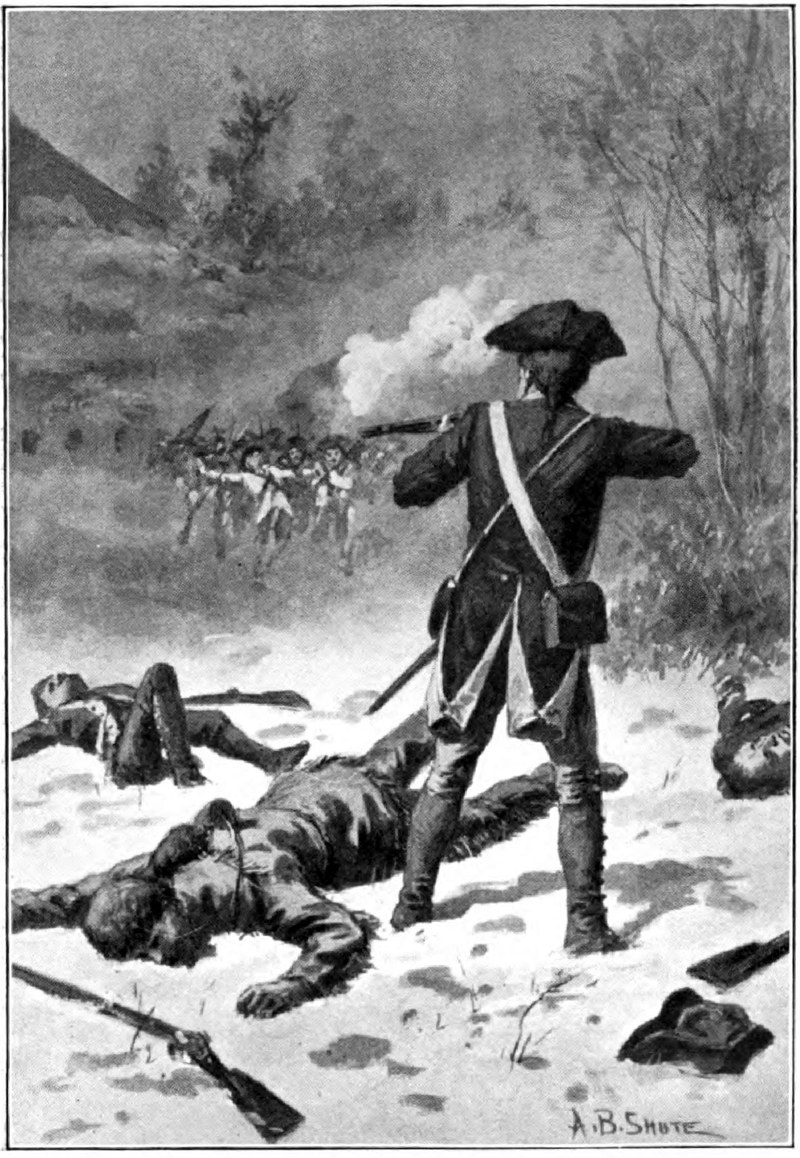
Dave’s musket was up in an instant.—Page 268.
269But the fighting was not yet at an end, and it continued
for half an hour longer, the English doing
their best to drive Lévis from the strong position
he now occupied. But this was impossible, and at
last General Murray’s army began to move back to
Quebec, keeping the retreat well covered.
“The victory is ours!” came the French cry, and
they started in pursuit. But General Lévis soon saw
that the English were not retreating in disorder,
and so ordered his soldiers to hold the ground they
had gained and go no further.
CHAPTER XXIX DARK DAYS
270
The days to follow the tattle just described were
gloomy enough, both for Dave and for the little
army now assembled at Quebec.
All told, General Murray had lost, in killed,
wounded and missing, about a thousand men, or
one-third of his force, while the loss to the enemy
was estimated at about the same. In addition, the
English had lost some cannon and also some of
their ammunition and muskets. When the army
got back to Quebec it was thoroughly exhausted,
and the men were hardly fit for work of any kind.
Confusion reined supreme, and had Murray permitted
it, there would have been a panic and perhaps
the place would have been abandoned.
“The jig is up,” said more than one soldier.
“We must surrender, or else the French will either
bombard us or starve us out.”
But General Murray was not so easily daunted,
271and soon brought a semblance of order out of apparent
chaos. The wounded were cared for, and
those able to work were immediately set to the task
of fortifying Quebec from every available point.
Bags were filled with sand and placed at the gates,
and the cannon were planted so as to command
every approach. Even the convalescent in the hospital
had to do their share by making wadding for
the cannon. Soldiers who would not obey orders
were promptly disciplined, and one man who was
caught plundering a house was promptly hanged as
a thief.
This public execution brought to Dave’s mind
the fate that hung over Henry. Would his cousin
come back, and, if so, what would General Murray
do to him? This thought made Dave shiver.
“He is certainly very stern,” thought the young
soldier. “And unless Henry can clear himself it
will surely go hard with him. But perhaps Henry
is dead!” And he shook his head sorrowfully.
Dave had gone with Barringford to the general
hospital and seen to it that the old frontiersman
had every attention. At first he was afraid
Barringford was going to die in a few days, but
now the surgeon in attendance held out a faint hope
of his recovery.
“But he was hard hit,” said the surgeon. “An
272inch nearer, and the bullet would have passed
through his brain.”
For days Barringford lay unconscious, knowing
nobody and breathing heavily. During that time
Dave came to see him as often as permitted, and
had his own wounds dressed. The young soldier
had lost the end of his little finger, but he counted
this as nothing in comparison with his other troubles.
“I’d rather lose the hand than see Sam go,”
was what he told himself.
General Lévis lost no time in strengthening his
position around Quebec. Extra cannon were sent
for, and the French commander waited anxiously
for some news of a French warship which was
expected.
“If he gets the help of a fleet we are doomed,”
said more than one English officer, and a watch
was set, to announce the coming of any sail up the
St. Lawrence. At the same time, the cannon planted
on the walls of Quebec did all they possibly could
to make Lévis keep his distance, and prevent him
from throwing up the intrenchments he so much
desired.
“A ship is in sight!” was the cry that was raised
in the city on the ninth day of May. “A ship! A
ship!”
“What is she?” was the question asked.
273This could not, as yet, be answered, and General
Murray lost no time in making his way to where
a good look could be had of the lower St. Lawrence.
Sure enough, there was a large ship, but without a
flag.
“Hoist the colors at Cape Diamond!” ordered
the English commander, and the flag was raised
without delay. In the meantime the warship came
closer and could be seen to be crowded with men.
Would she prove to be a friend or an enemy?
Slowly the flag mounted to the masthead, and
unfurled to the breeze. It was the red cross of St.
George.
“’Tis our own ship! Quebec is saved! Huzza!
huzza!” was the cry, and almost immediately the
soldiers went wild with joy, some dancing on the
ramparts of the city, in full view of the much-chagrined
French, who had hoped the vessel would
prove to be one of their own.
Soon the ship, the Lowestoffe, was firing a royal
salute, to which the city batteries replied with vigor,
the gunners making the river and rocky cliffs echo
and re-echo with their glad tidings. In the city the
grenadiers marched, sang, and drank toasts, and
the gloom of the days gone by was dispelled as if by
magic.
The ship that had come in brought news of an
274English fleet which was expected to reach Quebec
in a few days. In desperation Lévis began an
immediate attack on the city, but with poor success.
Then he assembled his own ships of war, but six
in number, and waited bravely for the coming of
the English vessels.
It was the middle of May when the English fleet
sailed up the river. The battle on the water was
of short duration, although the French sailors
fought desperately against overwhelming odds.
Seeing they could not win, one vessel threw her guns
overboard and sailed away and the others ran into
the mud flats, where their crews set fire to them,
and escaped by wading and in small boats.
“The day is ours; Lévis cannot stand this defeat
on the water,” said General Murray, and he was
right. The loss of the warships carried consternation
into the camp of the French, and that very
night they began to retreat, the English sending
shot and shell after them to hasten their departure.
In their hurry they left many cannon, muskets, and
army stores behind them.
“That was a victory worth the winning,” said
Dave, as he marched out, several days later, to help
bring in some of the abandoned army stores. “A
few more like that and I reckon the French will
leave Quebec alone.”
275“Well, we aint got so all-fired much to crow
about,” answered one of the rangers who was
working near. “Things looked mighty black all
around afore them ships hove in sight.”
“What do you suppose the French commander
will do next?” asked Dave, for he knew that the
ranger, although not a well-spoken man, was a
clever fellow.
“I don’t see how he kin do anything but fall
back on Montreal,” answered the ranger. “We’ll
blockade the St. Lawrence on him, an’ sooner or
later the army at Oswego will be a-comin’ this way,
and the army from Crown Point, an’ he’ll have to
look out for himself right sharp.”
A few days after this talk Dave called again upon
Barringford. He found the old frontiersman conscious,
but somewhat out of his head, the effect of
the bullet wound. Barringford did not know him
at first.
“Seems to me I know ye,” he said slowly. “But
it’s beyond me—a long way off. Air ye Henry, or
Dave, or thet Jameson boy?”
“I’m Dave, Sam. Don’t you know me?”
“Dave, eh?” The sufferer took the hand held
out to him. “All right, Dave, ef it’s you. But why
did ye shoot me in the head? I thought better o’
you than thet, yes, I did!”
276“I didn’t shoot you, Sam; it was a Frenchman
did that, and I laid the Frenchman low for it.”
“Did ye? Queer, I should think you shot me.”
Barringford tried to collect his thoughts, but failed.
“Mighty bad place this,” he went on. “Folks
shoving me all day an’ all night, an’ tryin’ to drive
wooden pins into my head.” And then he sank
back and dozed off.
“Will he remain this way?” asked Dave of
the surgeon, his heart fairly aching for his old
friend.
The surgeon shrugged his shoulders. “Let us
hope not, my lad.”
“But they do sometimes, is that what you
mean?” questioned the young soldier quickly.
“I am sorry to say that is true. You see, the
bullet grazed the brain. If he recovers it will be
very slowly.”
“Can I do anything for him?”
“No, we are doing all that can be done.”
“This is not a very nice place.”
“As soon as the weather moderates we will transfer
him to a hospital on the Island of Orleans.
There the accommodations will be much improved,
and I will see to it personally that he has every
attention.”
“If you will do that, sir, I shall be very thankful.
277He is one of my best and closest friends. I do
not want to leave him unless I am certain he is in
the best of hands.”
“Leave him? Do you mean you are going
away?”
“I belong to the army at Fort Oswego, and my
furlough is running out, so I must get back, if I
possibly can,” answered Dave.
What he said was true. He had already remained
at Quebec longer than intended. The very
next day found him going back to Fort Oswego,
in company with eight rangers and an English
officer. The officer belonged to General Amherst’s
staff, and from him Dave learned, later on, that
Amherst himself was going to take charge of the
expedition to move against Lévis at Montreal, by
way of Lake Ontario and the rapids of the upper
St. Lawrence.
The particulars of the trip back to Fort Oswego
need not be given here, for nothing out of the
ordinary occurred during the journey, which, because
of one delay and another, lasted over two
weeks. While still eight miles from the fort the
little expedition was joined by forty Indians who
were, much to Dave’s astonishment, under the
leadership of White Buffalo.
“Why, White Buffalo, I thought your braves
278had deserted you!” cried the young soldier, after
the first greeting was over.
“The old braves of my tribe have come back to
their reason,” answered the Indian chief with a
smiling face. “They have learned that the French
are their enemies, and gave their word only to
break it. Henceforth they will fight under White
Buffalo and Sir William Johnson to the end.”
“That is certainly good news,” said Dave. “I
suppose you are going to rejoin Sir William at
Fort Oswego.”
“Yes, and we bring with us an old Indian who
knows the swift waters of the St. Lawrence, if the
great Sir William sees best to move upon the
enemy by that course.”
“Most likely he will move down the St. Lawrence,
White Buffalo. But I have heard the rapids
are very swift, and more than one man has lost
his life trying to shoot them.”
The want of news about Henry and the sad
tidings concerning Barringford hurt White Buffalo
greatly, and he did not hesitate to show his
feelings.
“’Tis a black cloud hanging over us,” he said.
“May the Great Spirit roll it away, bringing Henry
back to us unharmed, and lifting the Demon Spirit
from Barringford’s mind.”
CHAPTER XXX THE RAPIDS OF THE ST. LAWRENCE
279
August of the year 1760 found General Amherst
at Oswego with a force of ten thousand men,
consisting of royal grenadiers, Colonial militia and
rangers and volunteers. To this body was also
attached over seven hundred Indians, under the
leadership of Sir William Johnson.
In the meantime the troops at Crown Point had
been left under the command of General Haviland.
They were ordered to move forward without delay,
and Haviland did so, his force numbering a little
over three thousand soldiers of all sorts, including
the now celebrated Roger’s Rangers. The first
point of attack was Isle-aux-Noix, fortified by the
French under Bougainville. Here the English were
victorious, and then the enemy were followed to
St. John and Chambly, and by the activity of the
rangers were compelled to give way once more,
280this time seeking the protection of the St. Lawrence.
Haviland now awaited the coming of Amherst,
and at the same time communicated with General
Murray at Quebec, with a view to a threefold attack
on Montreal.
General Amherst lost no time in getting his army
afloat. It mustered several ships, and a bewildering
number of bateaux and rowboats, while the
Indians moved down the lake in their canoes. The
larger boats carried many cannon and a great quantity
of ammunition, and it was felt by all that
Amherst’s advance would surely be one to victory.
During the days spent in Oswego getting ready
for this trip, a slight ray of hope had come to
Dave. This was the news that at Montreal were
a number of English prisoners, captured on the
battlefield, or while at work in the vicinity of
Quebec.
“Perhaps Henry was captured,” he thought.
“And if he was he may be in a Montreal prison
at this minute.”
Dave had returned to his old command, and his
fellow soldiers did all they could to comfort him.
All knew Henry and Barringford well, and many
were the words of sympathy poured into the young
soldier’s ears. Nobody believed that Henry was a
281thief, yet none could tell what General Murray
would do if the missing one was found.
“One thing is certain, Morris,” said one old
soldier. “Henry’s past record is in his favor. We
can all swear that he was honest while he was with
us.”
While the army was floating down the lake the
weather proved fair, and La Galette was reached
without mishap. Here a French brig named the
Ottawa was sighted. She began firing on the army
transports while they were yet at a distance.
“This will not do,” said General Amherst, and
had several of his gunboats attack the brig. The
fight was sharp, but likewise short, and soon the
French ship struck her colors. A few of the crew
escaped to the shore, but the others were made
prisoners.
The rapids of the St. Lawrence were now close
at hand, and General Amherst was considering the
problem of how to get his expedition through in
safety, when a new peril presented itself.
On an island in the river, just above the rapids,
was Fort Lévis, well fortified, and now under the
command of Captain Pouchot, he who had commanded
at Fort Niagara the year previous.
Pouchot was awaiting anxiously for a chance to
“even up” his defeat at Niagara, and no sooner did
282the leading boats of Amherst’s fleet appear than he
opened a heavy fire on them.
“So this is the game,” said General Amherst.
“Well, I think I can wait long enough to put you
out of the fight.”
He at once landed a portion of his army and
some cannon on the river bank, and on some nearby
islands, and began that very day to cannonade Fort
Lévis with vigor.
“What a noise!” said Dave, and he was right;
the din was terrific, for the French replied with
vigor. The fort was composed principally of logs
and dirt, which the cannon balls sent flying in all
directions. The soldiers had but little to do, and
Dave sat in the top of a tall tree watching proceedings.
The bombardment of the fort continued for three
days, when the stronghold was more than half battered
to pieces. Pouchot, seeing he could not hold
out, at last surrendered, and he and his brave men
became prisoners.
The Indians under General Johnson had waited
patiently for the surrender of the French, and when
they saw the flag go down many of them rushed
for their canoes, their intention being to visit the
fort, and kill and scalp Pouchot and those around
him. But Sir William Johnson would not allow this.
283“You must stay back; there will be no scalping
here,” he said.
“No scalping!” cried a hundred voices at once.
“We must have scalps or we will not fight,” said
others; and thereupon more than half of the Indians
withdrew from the expedition in disgust.
Dave was glad to see that White Buffalo had
not taken part in the attempted rush on the French
after the surrender. But when he spoke of it to
the chief the Indian hardly knew how to answer.
“White Buffalo cannot understand,” he said at
last. “Ten of his braves have left. The French
are our bitter enemies—then why not kill and scalp
them? The great Sir William must know what
is best—but the poor Indian cannot understand.”
“It isn’t Christian-like, that’s why, White Buffalo.
After an enemy gives in we ought to treat
him fairly and squarely.”
“The French would let their Indians kill and
scalp you, David.”
“Perhaps; but two wrongs don’t make a right,”
answered the young soldier. “War is war, but we
needn’t make it any worse than is necessary.”
With the fall of Fort Lévis, the army under
Amherst moved on again down the St. Lawrence.
Soon the rapids of the Galops, the Plat, the Long
Saut, and the Côteau du Lac came into view, followed
284by the Cedars, the Buisson, and the Cascades.
“That water is running mighty fast,” said Dave
to the others as he watched the rolling river, glistening
brightly in the sunshine. “Unless I am mistaken,
the current is powerful.”
“You are not mistaken,” replied an old ranger,
who sat near the youth. “These rapids are almost
as bad as the rapids of the Niagara. I tried to go
through ’em once, six years ago, and I know. There
were four of us in the canoe, which upset, and one
of the party was drowned while the other three
were almost dead before we got back to shore.”
“Well, the French and Indian pilots ought to
know how to direct the boats,” put in another soldier.
“General Amherst has several of the best
of them.”
On and on swept the long line of boats, stretching
out for a distance of over two miles. The
progress was growing faster and faster as the fierce
current just above the worst of the rapids caught
hold of one boat after another.
The craft in which Dave was seated was a long,
broad, flat-bottomed affair, containing twelve men,
an under-officer, and a small stock of ammunition.
Two men were at the sweeps, or oars, following
the directions of the officer, who stood in the bow,
285directing them to the right or the left as occasion
required.
“There is surely going to be trouble!” whispered
Dave, when a shrill cry came from ahead.
Looking in that direction they saw a boat had hit
on the rocks, and that half of the occupants were
struggling in the water, which boiled and foamed
all around them.
“To the right! To the right!” yelled the officer
in the bow. “Be quick, or we’ll run them down,
and smash our own boat!”
“Can’t we help ’em, leftenant?” queried one of
the soldiers.
Before an answer could be given, the boat had
swerved to the right and was sliding past the hidden
rocks. One soldier in the water made a frantic
clutch for the passing craft, and caught hold of a
but of tarpaulin which covered the ammunition.
“Hold tight, I’ll pull you in!” sang out Dave,
and with the assistance of another soldier he pulled
the suffering one on board of the boat. Then the
craft swept onward toward another soldier, and he
was likewise assisted. But the rest had to be left
behind, to shift for themselves. All but two were
picked up by other boats in the rear. Of the two
one managed to reach shore, and became a prisoner
286of the French, and the other was never seen or heard
of again.
It was now seen that more than one boat in front
and to the rear were in difficulty, and ever and anon
a sickening crash could be heard above the roaring
of the rapids. The nerves of all the soldiers were
strained to the utmost, and many sat rigid, fearing
that the next moment would be their last.
“We should have portaged our boats around the
rapids,” growled one old hunter. “I’d ruther walk
fifty miles than ride one in sech water as this,” and
more than one hearer agreed with him.
Some dangerous rapids had been passed, but one
still more dangerous was ahead. The lieutenant
had been warned of this, and was watching closely.
“To the left! To the left!” he sang out suddenly.
“To the left! Swing her over!”
“She won’t swing!” came stubbornly from one
of the men at the sweeps. “The current’s stronger
nor a mill-race.”
“We must bring her over,” said the officer.
“Now then, pull for all you are worth. We—ha!”
The last cry was echoed by half a dozen in the
boat, and several sprang to their feet regardless of
the first order given to them, to sit still. A boat
ahead of them had bumped into another craft, and
287both had dashed headlong on a hidden rock. Splintered
wood, soldiers, army stores, and foaming water
seemed hopelessly mixed, and from out of the mass
came shrieks of pain and piteous calls for help.
“To the left!” yelled the lieutenant once more,
but the cry did no good. The boat swept onward
with increased speed, directly into the midst of the
wreckage. A shock and a crash followed, and the
next instant Dave found himself in the water, surrounded
by a score of other soldiers, all fighting
madly to save themselves from drowning.
CHAPTER XXXI THE FALL OF MONTREAL
288
In his career as a soldier Dave had been in many
positions of peril, yet scarcely one had been as dire
as that which now confronted him.
The shock came so quickly that he hardly realized
what was happening before he was under water,
and somebody seemed to be doing his best to stand
on the young soldier’s shoulders.
Flinging the feet above to one side, Dave tried
to reach the surface of the river. In doing this he
slid past two more soldiers, both of whom clutched
at him, one catching him by the coat, and the other
by the neck.
To be held by the coat was of small importance
in comparison to being deprived of one’s wind, and
Dave lost no time in fighting off the fellow who
had him by the neck. The hold was a strong one,
and the youth feared he would be choked unless
he broke it without delay.
289There was a wild floundering on all sides, and
in the mêlée somebody above kicked out sharply
with his heavy boots. One boot struck the man
who held Dave by the throat, and the grip was
broken just when the youth was about to give up
in despair. Then the young soldier felt his coat
also freed, and he came up with a rush, to get a
badly needed breath of air.
The majority of the soldiers were struggling
madly to hold fast to the bits of wreckage floating
around. Yells and groans rent the air, with an
occasional prayer for assistance. Some had already
gone down to their death, and others were fast
losing what little strength was left to them.
“It’s no use trying to get hold of a board, or
anything,” thought Dave. “They are all fighting
like so many cats and dogs. I’ll save my strength,
and strike out for shore.”
But striking out with his clothing on was by no
means easy, and Dave had hardly covered a hundred
feet when he found himself well-nigh exhausted.
He tried to pull off his coat, but as he was doing
this another boat hove into sight, coming straight
for him.
“Hi! don’t run me down!” he screamed, and
then, as the boat swerved to one side, he made a
clutch at one of the oars. Willing hands were out-stretched
290to him, and in a moment more he was on
board, where he sank to the bottom, panting for
breath. Two others were picked up in similar
fashion, and then the boat swept on to its destination.
The shooting of the St. Lawrence rapids by the
army under General Amherst was never forgotten
by those who participated in it. During that reckless
ride over sixty boats were either totally wrecked
or greatly damaged, and more than eighty soldiers
lost their lives through drowning. As one boat
after another shot through the swirling waters the
French gathered on the upper bank of the river,
fully expecting to see every one of their enemy go
down to destruction.
The rapids passed, the boats, or what was left
of them, sailed down Lake St. Louis, and landed
at Isle Perrot, at a point about twenty miles above
Montreal. Here many of the half-drowned ones
were cared for, and some of the boats were temporarily
repaired.
“We are well out of that,” said Dave, when on
land once more. “I shall never attempt to shoot
those rapids again;” and he never did.
It had taken three weeks to reach Isle Perrot,
and now word came in by Indian messengers that
General Murray was also advancing on Montreal
291from the northeastward, and that General Haviland
was ready to strike whenever required.
“We now have the French as in a vise,” said
General Amherst. “They cannot get away from
us.” The next day, early in the morning, the army
left Isle Perrot again, and landed on the north bank
of the river at La Chine. Here there was some
slight show of opposition, but soon the French outposts,
and also a number of the inhabitants of La
Chine, fled towards Montreal, leaving the English
army to land its guns and stores at its leisure.
“On to Montreal!” was now the cry on all sides,
and the spirits of the soldiers revived wonderfully,
for all felt that a deathblow was soon to be struck
to the war which had now lasted for five long
years.
It was a beautiful day in early September, and
had Dave not been troubled by thoughts of Henry
and Barringford, he would have enjoyed the march
along the river bank. A regimental band played
the liveliest of military airs, and when the band did
not play a Colonial drummer and a fifer kept the
Royal Americans in step.
Yet it must be confessed that the soldiers were a
motley collection. Even the showy uniforms of the
grenadiers, and the Royal Artillery, were sadly in
need of repairs, while the so-called uniforms of the
292Royal Americans, never very good, and of a dozen
different designs, were practically in tatters. Dave’s
uniform confessed to half a dozen rents, and twice
as many patches, and his gun, a flint-lock dating
back to the war in Scotland, was a clumsy affair
that looked as if it was in danger of exploding
every time he discharged it.
The next day found Amherst’s army encamped
almost under the walls of Montreal, to which city
the French had flocked from all directions, pleading
for protection at the hands of Governor-General
Vaudreuil. As Amherst drew near from one
direction, Murray and his army came up from the
other, while Haviland encamped on the south shore
of the St. Lawrence, immediately in front of
Montreal.
The city was now in a state of siege, and the
French well knew that if they opened fire on the
English the enemy would retaliate by bombarding
houses, public buildings, and churches, with a great
loss of life and property. Many of the Canadians
had gone home to their farms, and some of the
French regulars had also deserted, so that the army
in the city did not number over twenty-five hundred
men.
“We cannot fight them,” said Vaudreuil. “They
have not less than seventeen thousand soldiers, and
293hundreds of cannon, and large quantities of ammunition.
If we fight, the city will be laid low from
end to end; and men, women, and children ruthlessly
slaughtered.”
Lévis, a born fighter, demurred at first, but soon
saw the wisdom of the advice; and a council of
war was held. It was a stormy scene, and it took
many hours to draw up a form of capitulation. The
French officers wished to march out of Montreal
with the honors of war, and wished many other
things; and these were all put into the paper
which was sent to General Amherst the next
morning.
“I cannot grant this form of capitulation,” said
Amherst, on looking the paper over. “I will grant
some conditions, but not others. The whole force
must lay down its arms, and not serve again during
the present war.”
When this answer was brought back, Vaudreuil
merely shrugged his shoulders, but Lévis went into
a rage, and vowed he would never submit.
“I will myself send a note to General Amherst
to show him that he is asking too much,” said
Lévis, and sent the note without delay. In return
Amherst stated that he was fully resolved to make
the army lay down its arms. He was horrified over
the way the French Indians had been allowed to
294massacre wounded and helpless English soldiers,
and he considered that the enemy must be taught
a stern lesson in retaliation.
It was a time of wild excitement in Montreal,
for the citizens, and those who had come into the
city for protection, were afraid that the English
might bombard the place at any moment. When a
cannon boomed out as a signal, a hundred cries
would ring out. Business had come to a complete
standstill, and many places were boarded and locked
up; and in some instances goods of value, and
money, and jewels, were buried.
For the time being those in the various prisons
about the city were practically neglected, and in
at least three cases the prisoners almost starved to
death because of this neglect. The keeper of the
jail in which Henry was confined went off one night,
and failed to appear during the next day.
“Something is wrong, that’s sure,” said one of
the prisoners. Then he yelled loudly for water,
but nobody came to answer his demand.
Henry was pale and thin, and suffered as much
for the want of fresh air as for proper food. The
jail was a vile place, and the conditions there were
steadily growing worse. One prisoner had committed
suicide, and another had gone stark, raving
crazy.
295“If this keeps on I’ll go crazy myself,” said
Henry. “The food is not fit for a dog to eat.”
Strange to say, he had not seen or heard of Jean
Bevoir since the French trader had threatened him
through the bars of the prison door. As a matter
of fact, Bevoir had attempted to have the youth
brought before the military court as a spy, but the
French commander had refused to listen to his
plea.
“You are too anxious in this, sir,” said the
officer sternly. “I think you must have a grudge
against the young fellow. I have no official report
against him, and in such a prison he is probably
suffering as much as he deserves.” And Jean Bevoir
sneaked away from headquarters feeling very
much as if somebody had kicked him.
Truth to tell, the French commander felt that a
crisis was at hand, and that it would not now do
to hang or maltreat any of the English prisoners.
He even ordered that the prisoners be given better
rations, but this order, in the case of the jailer at
Henry’s jail, was disobeyed, the jailer selling the
extra rations to the outsiders in the town at a handsome
profit.
On the night following the disappearance of the
jailer, matters reached a climax in the prison. There
was a fight for some water that still remained in
296a keg in one corner, and this quickly changed to
a revolt, in which the jail door was broken down.
The prisoners ran forth and scattered in all directions;
and although a French guard soon came on
the scene and shot down two of the men, the others
got away.
With the escaping ones went Henry, almost as
reckless as were the leaders. For a while he remained
with two of the soldiers who had been quite
friendly, but when the shooting began he ran
through a back yard, leaped over a stone wall, and
made his way along a street that was almost deserted.
He was now entirely alone, and, coming
to an open hallway, he slipped into a house. He
heard sounds of voices in a lower room, and, without
stopping to think twice, bounded up the stairs
to the second floor.
“Perhaps I’m running into a trap, but I’ve got
to risk it,” he told himself; and after a slight hesitation
opened a door near the head of the stairs.
The room was a bedchamber, and in the center
stood a large, square, “four-poster” bed, with the
top hangings partly drawn. A man lay on the bed,
tossing uneasily, as if in something of a fever. On
a chair rested a French uniform, showing that the
sleeper was an officer.
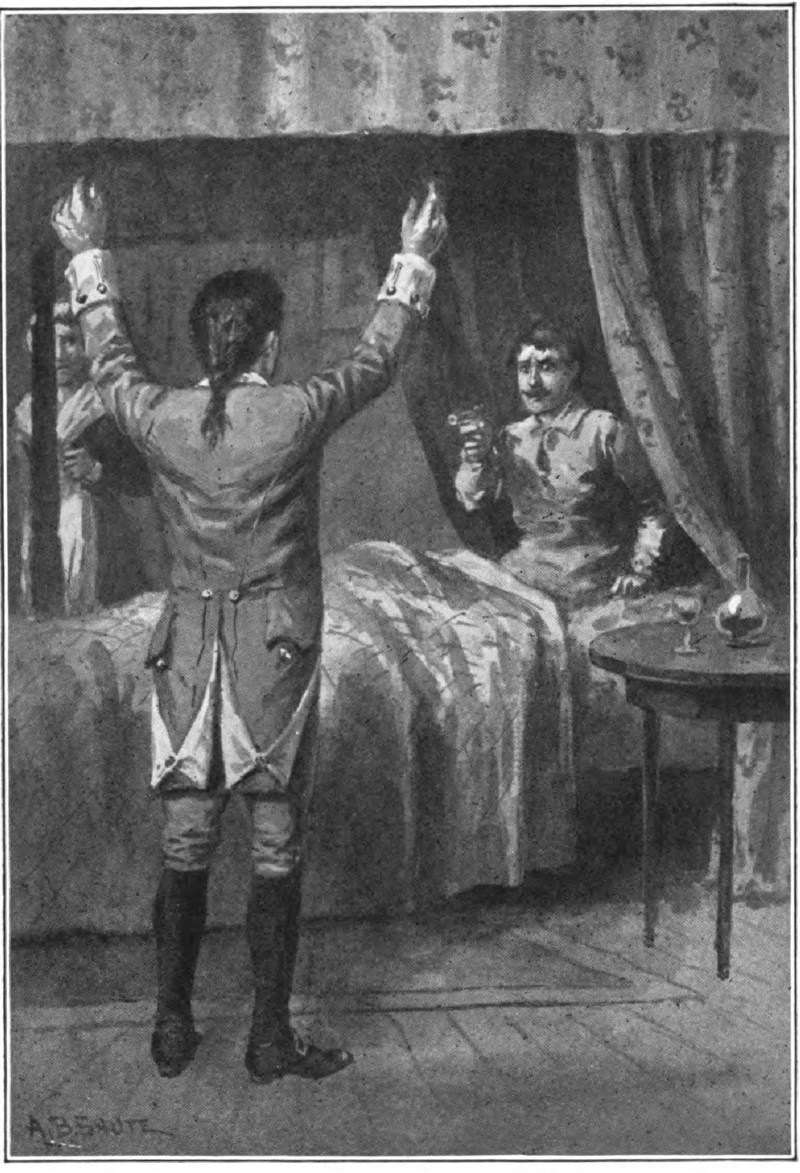
“Stand where you are,” ordered the sick man.—Page 297.
“It won’t do for me to stay in such hot quarters
297as these,” thought Henry. “I had better get out
just as fast as I came in.”
He started back for the hallway, but now came
steps on the stairs, and the rattle of dishes, followed
by some talking. Henry glanced around him, saw
a closet in a corner of the room, and dove into it.
Just as he closed the door of the closet he caught
a brief glimpse of a woman with a tray, followed
by a girl of about his own age. Both entered the
bedchamber, closing the door tightly behind them.
A murmur of voices followed, and Henry surmised
that the sleeping man had awakened, and
that the two women were urging him to partake
of the food they had brought. The talking was
in French, so he understood but little.
Presently the girl moved across the bedchamber,
and before Henry realized what was coming the
door of the closet was flung open. As the young
soldier was exposed to view, the girl gave a scream,
and then uttered several words in French:
“A man! An English soldier!”
“What is it you say?” demanded the man in
the bed, and, turning over, he drew a pistol from
under his pillow.
“A man—an English soldier,” repeated the girl.
“Oh, Louis, what shall we do?”
“Stand where you are!” ordered the sick man,
298and sat up in bed with the pistol pointed at Henry’s
head.
“Oh, Louis, my son, have a care!” put in the
woman. “He may kill you!”
“I am not afraid, mother,” was the answer.
“You forget what risks I have taken in the
past——”
“But you are still weak. The doctor——”
“The doctor doesn’t know me, mother. I am
worth a dozen sick men at this minute. Please let
me deal with him, and both of you stand aside, so
that the fellow can’t hide himself behind you.”
The girl and the woman were willing enough to
do this, and shrank away from the closet. Then,
struck by a sudden idea, the woman backed herself
up to the door leading to the hallway.
Feeling himself cornered, Henry threw up his
hands, and stepped out of the closet.
“Don’t fire,” he said as quietly as he could, although
his heart was thumping loudly in his breast.
“If you have a pistol throw it on the bed,” said
the Frenchman in excellent English.
“I am totally unarmed,” was Henry’s ready
answer.
“Is it possible! Where did you come from?”
Henry began to explain, when the French officer
suddenly interrupted him.
299“Am I mistaken, or have we met before?” he
said.
“I do not remember you,” returned Henry, puzzled
at the unexpected question.
“Did you come from Quebec?”
“I did.”
“You were on guard duty there?”
“I was.”
“At and near the shop of one Lavelle, a gold
and silver smith?”
“Yes, yes! But you—you——” faltered Henry.
At this the French officer gave a chuckle.
“I was there, too,” he said. “It was I who
escaped from the cellar that night. They tried to
catch me, but ha! ha! I was too quick for them. I
showed them what a French spy can do when he
is put to it!”
CHAPTER XXXII FROM WAR TO PEACE—CONCLUSION
300
“It looks as if we’d have to fight after all,
Morris.”
“What makes you think that?” questioned Dave,
who had just come in from four hours of guard
duty.
“I just got an inkling from headquarters,” said
the soldier who had first spoken. “The Frenchmen
don’t want to agree to General Amherst’s demands.”
“They will be foolish if they don’t,” said the
young soldier. “With a combined army of seventeen
thousand men to draw on we can knock
Montreal higher than a kite if we start in to
do it.”
“To be sure, Morris.”
“But I hope it doesn’t come to a fight,” went on
Dave, his face clouding.
“Why; you are not afraid, are you?”
301“No. I was thinking of the English prisoners in
Montreal. They will be sure to suffer, with no way
by which they can help themselves.”
“True for you. But the French sick will suffer,
too. A cannon ball goes where it pleases, once it is
fired.”
During the night had come one alarm. Some
Canadians had attempted to leave the city with some
plunder, taken from houses that happened to be deserted.
A part of this crowd was shot down within
the city walls by Lévis’ guards, and the others were
shot down by the guards under Amherst and Murray.
“No matter what may happen, I will have no
plundering,” said Vaudreuil; and Lévis, Amherst,
and Murray said the same.
It must be confessed that the outcome of another
council of war within the walls of Montreal was
anxiously awaited by the English on both sides of
the St. Lawrence. Each branch of the army was
held in readiness for immediate service, the soldiers
sleeping on their arms and the cannoneers under
their pieces.
In the city the hubbub was greater than ever.
The citizens gathered around headquarters and
begged for peace. The Governor-General had to
listen to endless advice. Lévis protested to the
302last that he wanted the honors of war accorded to
his troops. But Amherst, as said before, was unyielding;
and at last Vaudreuil signed the paper
which, in the course of time, gave all of the Canadian
possessions into the hands of the English government
and made of the French-Canadians British
subjects.
The news was carried far and wide as swift as
horses and messengers could travel. “Canada has
surrendered! The war is over!” was the glad
tidings, and in every portion of the English colonies,
as well as in England itself, there was great
rejoicing. Cannon were fired, bonfires lit, and
bells tolled, and in some places special church services
were held, to give thanks to God that the
agony of such long standing was at an end. Even
the Canadians rejoiced to think that peace was
come, and that they could again go to their farms
unmolested alike by soldier or Indian.
The capitulation took place on September 8,
1760. It was agreed that the French soldiers and
sailors should be allowed to return to France, and
that the Canadians should return to their homes,
unmolested. No one was to suffer because of his
religion, and it was further agreed that, with a few
exceptions, all military and political prisoners should
be set free. The Indians on both sides were to be
303held in firm check, so that the atrocities of former
campaigns should not be repeated. This last agreement
made the Indians on both sides very angry,
and the great majority of them tore up their wigwams
in disgust and departed for parts unknown.
Only a handful remained with Sir William Johnson,
this band including White Buffalo and four old
braves, the braves remaining to get some money
that had been promised to them and the chief that
he might be near Dave, to go home with the young
soldier when the latter was discharged.
“Montreal is ours after all!” cried the young
soldier, when the news reached camp. “And we
didn’t have to fire a shot, excepting at the scoundrels
who tried to plunder the place.”
Dave was anxious to get into Montreal, to learn
something concerning Henry if possible. But it
was a good two weeks before he got the chance to
enter the city. Then he was placed on a detail sent
to visit one of the hospitals.
As the detail was passing down a side street of
the city the young soldier chanced to look into the
window of one of the houses they were passing.
“Can it be possible!” burst from his lips. Then
he ran to the officer in command of the detail.
“Will you—you let me off a while—just a few
minutes, lieutenant?”
304“Why, what’s the matter, Morris?” queried
the officer. “You look as if you’d seen a ghost.”
“Perhaps it was a ghost. I thought I saw my
cousin Henry at the window of the house back
there.”
“Indeed! All right, go back and make sure.
But don’t stay too long.”
The caution was not yet finished when Dave
started back on a run. As he gained the door of the
residence the barrier was flung back and Henry
came forth, cap in hand.
“Dave!”
“Henry!”
“I thought I saw you passing!”
“And I thought I saw you at the window!”
And then the pair fell into each other’s arms,
while tears of joy stood in their eyes. They shook
hands over and over again, and it was fully a
minute before either could trust himself to speak
again.
“How pale and thin you look,” declared Dave,
at last. “Have you been sick?”
“I’ve been in prison.”
“You mean up at Quebec?”
“There and here too.” Henry’s face fell a
little. “Then you know the news?”
“Know the news? Didn’t Sam Barringford and
305I travel all the way to Quebec to help you? But
when we got there you were missing.”
“Good for you and Sam, Dave! How is Sam
now? I see you are in pretty good shape.”
“Poor Sam is in the hospital at Quebec. He was
struck in the head with a bullet and it made him
rather out of his head. But we’re hoping he’ll get
over it.” Dave paused a moment. “Henry, I’m
afraid you’ve gotten yourself into an awful hole,”
he went on anxiously.
“How so?” And a faint smile crept around the
corners of Henry’s mouth.
“Why, by running away after you were placed
under arrest.”
“But I didn’t want to be hanged.”
“I know, but now the case will look blacker
against you than ever. They will say you didn’t
dare to stand trial.”
“But I can prove my innocence, Dave,” cried
Henry triumphantly.
“What! How?”
“Easily enough, although the story is rather a
wonderful one. You see, while I was in prison here
we had a revolt, and all the prisoners broke jail. I
ran away by myself and hid in this house, to escape
the French soldiers. I was discovered by the lady
and daughter who live here, and by the lady’s son,
306who was sick in bed. The son began to question
me, and then he said he had seen me before. We
compared notes, and I learned that the son was
Captain Louis Gaulette, a noted French spy. Captain
Gaulette was in Quebec on a secret mission for
General Lévis, and he was in hiding in the cellar
of the gold and silver smith’s shop when I went
down there and tried to reason with Prent. He
sent a note to General Murray about it, and he supposed
I was set at liberty.”
“Good!” almost shouted Dave, and his face
began to beam. “In that case, Henry, you can establish
your innocence without much trouble.”
“That is what I expect to do,” answered Henry.
“And let me tell you, I am mighty glad this affair
has turned out as it has. But what about the war?
Is it really ended?”
“Yes, Henry, and I reckon our soldier-boy days
have ended with it,” answered Dave.
Let me add a few words more and then bring to a
close this story of military adventure before and
“At the Fall of Montreal.”
As both of the young soldiers had surmised, it
was an easy matter to prove Henry innocent of the
charge that had been made against him, and in the
end he received not only a full pardon from General
307Murray, but also a letter exonerating him from all
blame. For the despicable part he had played
Prent was sentenced to five years in an English
prison, and with him went Fenley and Harkness
for a period of three years. Louis Gaulette became
Henry’s firm friend and it may be mentioned here
that, years later, Gaulette entered the American
army under General Lafayette and served as a spy
for Washington during the last years of the War of
Independence.
As soon as Dave and Henry were free to come
and go as they pleased they took passage on a sloop
of war bound down the St. Lawrence to Quebec.
At this point they had a man with a rowboat take
them over to the Island of Orleans, which was still
being used as a hospital. They inquired for Barringford
of a guard they met and after some slight
trouble were taken to the ward in which the sufferer
belonged.
“Dave an’ Henry!” cried the old frontiersman,
on seeing them, and Dave’s heart leapt with joy to
see his eyes as bright and intelligent as ever. “Ef
this ain’t better’n a dose o’ medicine. Whar did ye
come from?” And he shook hands warmly.
“First tell us how you feel?” said Dave.
“Fust-rate, Dave, fust-rate. I had a mighty bad
spell o’ it though—somethin’ like a nightmare—an’
308the doctor says as how I aint quite strong enough
yit to walk around much. Lost some o’ my ha’r,
too,” the old hunter added, pointing to the scar over
his ear. “But thet don’t count—I’m thankful to
pull through with my life.”
“We can all be thankful,” said Henry.
“How is it you air free, Henry?” went on the
frontiersman, and on being told he slapped his thigh
in satisfaction. “Thet’s splenderiferous news. The
folks ter hum will be glad to hear on it.”
“That they will,” answered Henry, “and I have
already sent them a letter.”
“Be you goin’ home soon?”
“Just as soon as we can obtain our discharge
and as soon as you can go with us, Sam,” answered
Dave.
“Me?”
“To be sure. We wouldn’t go home without you;
you know that.”
“I might hev knowed it, Dave.” A tear glistened
in the old hunter’s eye, and he took their hands
again. “Both my boys, aint ye?—through thick
an’ thin!”
“Yes, we are, Sam,” said Henry.
“And glad of it,” added Dave.
The start for home did not take place until winter
had again set in. They went with a great number
309of other soldiers as far as Philadelphia, and then
struck out for themselves, in company with half a
dozen neighbors and White Buffalo.
At Winchester both James and Joseph Morris
met them, and the meeting between fathers and sons
was a most affectionate one. Nor were Sam Barringford
and White Buffalo forgotten. There were
many embraces, and the story of the boys’ doings,
and of the others, had to be told over and over
again.
“The best news from home is that Rodney is
improving fast,” said Joseph Morris. “The last
operation on his leg was a complete success, so the
doctors say, and by next spring they think he will
be almost as strong as any of us.”
“Next spring I am going back to the Kinotah,”
said James Morris. “My claim to that land is now
fully established, and with Jean Bevoir dead there is
little likelihood that anybody will ever try to disturb
me again.”
“Bevoir dead?” burst out Dave. “How do you
know that?”
“Why didn’t you hear of it?” queried his father.
“And you right on the ground too!”
“I heard nothing of him later than when he
threatened Henry at Montreal.”
“When Montreal was besieged Jean Bevoir joined
310a crowd of men who tried to loot many of the houses
and stores. The French guard got after the pilferers
and shot some of them down, and then they fled
out of the city, and the English soldiers shot down
the rest, or made them prisoners. Among the number
shot down was Jean Bevoir. This news came
straight to me from two soldiers who were at
Winchester last week.”
“Shot down!” repeated Dave. Then he drew
a deep breath. “Well, if he was shot down outside
of the city perhaps I had a hand in it. But I don’t
know for sure, and—and—I’m rather glad of it.”
“He deserved what he got,” came from Barringford.
“He was a traitor to everybuddy, even his
best friends.” And the others felt that the old frontiersman
spoke the exact truth.
Yet though they all thought Jean Bevoir dead
such was not a fact. The French trader was seriously
wounded, and for a long while lay between
life and death. But he ultimately recovered, and
how he crossed the path of our friends later on will
be told in another volume, to be entitled, “On the
Trail of Pontiac; or, The Pioneer Boys of the
Ohio,” in which we shall meet many of our old
characters again and learn something of what was
done to establish trading-posts on the Kinotah and
elsewhere after the war with France, and of how
311the wily Indian chief Pontiac did his best to wipe
out all white settlements in that territory.
The home-coming was an event long to be remembered.
As the riders came in sight of the new
cabin Mrs. Morris, Rodney, and little Nell rushed
out to greet them.
“Home again! Home again!” shouted Dave
and Henry, and flung themselves into the arms out-stretched
to receive them.
“My son!” murmured Mrs. Morris, as she kissed
Henry, “and my Dave!” she added, as she also
kissed her nephew.
“Oh, but aint I dreadfully delighted to see you
back,” piped up little Nell, and kissed them all
around, even to White Buffalo. “And now you
mustn’t go away again, none of you, but stay with
me for years and years and years!”
“That’s the way to talk, Nell,” said Rodney, also
beaming with pleasure. “We’ve had enough of this
going-away to last for a lifetime.” And then he
added: “Just watch how I can walk now!” and
led the way to the cabin, walking almost as well as
any of them.
It was an old-time feast that awaited those who
had come to the cabin, and it lasted far into the
night. During that time many neighbors dropped
in, wishing them well.
312“It would seem that all of our troubles are at an
end,” said Mrs. Morris. “Now if the Indians will
only keep the peace I am sure we will prosper.”
“They must keep the peace,” said White Buffalo.
“My war hatchet is buried, and White Buffalo will
not dig it up again unless there is no help for it.”
“I’ve had enough of war,” came from Dave.
“In the future let me till the soil and hunt game, and
I’ll be content.”
And here let us bid our friends, for the time being,
good-by.
313American Boys’ Life of Theodore Roosevelt
By EDWARD STRATEMEYER 325 pages Illustrated
from photographs $1.25
Ever since the enormous
success of Mr. Stratemeyer’s
“American Boys’ Life
of William McKinley” there
has been an urgent demand
that he follow the volume with
one on the life of our present
President, and this has now
been done with a care and
a faithfulness certain to win
immediate appreciation everywhere.
The book covers the whole
life of our honored executive
step by step, as schoolboy, college
student, traveler, author,
State assemblyman, Civil Service
and Police Commissioner, Governor of New York,
as a leader of the Rough Riders in Cuba, as Vice-President,
and finally as President. Many chapters have also
been devoted to Mr. Roosevelt’s numerous adventures as
a hunter and as a ranchman (true stories which are bound
to be dear to the heart of all boys who love the strenuous
life), and full particulars are given of the daring battles
for Cuban liberty, in which our worthy President, as
Lieutenant-Colonel of the Rough Riders, took such a
conspicuous part.
The Appendix contains a Chronology of Theodore
Roosevelt, and also brief extracts from some of his most
famous speeches and addresses.
For sale by all booksellers, or sent postpaid, on
receipt of price, by the publishers.
American Boys’ Life Of William McKinley
By EDWARD STRATEMEYER 300 pages Illustrated
by A. B. Shute, and from photographs $1.25
Here is told the
whole story of
McKinley’s boyhood
days, his life at school
and at college, his work
as a school teacher, his
glorious career in the
army, his struggles to
obtain a footing as a
lawyer, his efforts as
a Congressman, and
lastly his prosperous
career as our President.
There are many side
lights on the work at
the White House during the war with Spain, and in
China, all told in a style particularly adapted to boys
and young men. The book is full of interesting anecdotes,
all taken from life, showing fully the sincere,
honest, painstaking efforts of a life cut all too short.
The volume will prove an inspiration to all boys and
young men, and should be in every one’s library.
For sale by all booksellers, or sent postpaid, on receipt
of price, by the publishers.
THE FAMOUS “OLD GLORY SERIES”
By EDWARD STRATEMEYER
Author of “The Bound to Succeed Series,” “The Ship and Shore
Series,” “Colonial Series,” “Pan-American Series,” etc.
Six volumes - Cloth - Illustrated - Price per volume $1.25
UNDER DEWEY AT MANILA
Or The War Fortunes of a Castaway
A YOUNG VOLUNTEER IN CUBA
Or Fighting for the Single Star
FIGHTING IN CUBAN WATERS
Or Under Schley on the Brooklyn
UNDER OTIS IN THE PHILIPPINES
Or A Young Officer in the Tropics
THE CAMPAIGN OF THE JUNGLE
Or Under Lawton through Luzon
UNDER MACARTHUR IN LUZON
Or Last Battles in the Philippines
“A boy once addicted to Stratemeyer stays by him.”—The Living
Church.
“The boys’ delight—the ‘Old Glory Series.’”—The Christian Advocate,
New York.
“Stratemeyer’s style suits the boys.”—John Terhune, Supt. of Public
Instruction, Bergen Co., New Jersey.
“Mr. Stratemeyer is in a class by himself when it comes to writing
about American heroes, their brilliant doings on land and sea.”—Times,
Boston.
“Mr. Stratemeyer has written a series of books which, while historically
correct and embodying the most important features of the Spanish-American
War and the rebellion of the Filipinos, are sufficiently interwoven
with fiction to render them most entertaining to young
readers.”—The Call, San Francisco.
For sale by all booksellers, or sent, postpaid, on receipt of price by
LEE AND SHEPARD, Publishers,
BOSTON
THE COLONIAL SERIES
By EDWARD STRATEMEYER
Author of “Pan-American Series,” “Old Glory Series,” “Great
American Industries Series,” “American Boys’
Biographical Series,” etc.
Four volumes - Cloth - Illustrated by A. B. Shute - Price per volume, $1.25
WITH WASHINGTON IN THE WEST
Or A Soldier Boy’s Battles in the Wilderness
MARCHING ON NIAGARA
Or The Soldier Boys of the Old Frontier
AT THE FALL OF MONTREAL
Or The Soldier Boy’s Final Victory
ON THE TRAIL OF PONTIAC
Or The Pioneer Boys of the Ohio
“Mr. Stratemeyer has put his best work into the ‘Colonial
Series.’”—Christian Register, Boston.
“A series that doesn’t fall so very far short of being history
itself.”—Boston Courier.
“The tales of war are incidental to the dramatic adventures of
two boys, so well told that the historical facts are all the better
remembered.”—Boston Globe.
“Edward Stratemeyer has in many volumes shown himself
master of the art of producing historic studies in the pleasing
story form.”—Minneapolis Journal.
“The author, Edward Stratemeyer, has used his usual care in
matters of historical detail and accuracy, and gives a splendid
picture of the times in general.”—Milwaukee Sentinel.
“Told by one who knows how to write so as to interest boys,
while still having a care as to accuracy.”—Commercial Advertiser,
New York.
For sale by all booksellers, or sent, postpaid, on receipt of price by
LEE AND SHEPARD, Publishers
BOSTON
- Transcriber’s Notes:
- Missing or obscured punctuation was silently corrected.
- Typographical errors were silently corrected.
- Inconsistent spelling and hyphenation were made consistent only when a predominant
form was found in this book.