At the Emperor’s Wish — I
Far out toward the end of Lower
Timber Street, where incurious
visitors to the city seldom stray,
stands the house of Kudo Jukichi.
It is called Lower Timber Street, the Upper
end being down in the city where once the
stout castle of the Lord of the Clan was
the center of all the life of the place. But
the name is falsely descriptive, for it leads
straight up to the beautiful hills, and ends
abruptly in a sheer climb to the top of the
pine-clad cone where nestles a famous old
Shinto shrine. The narrow path that winds
up the steep hillside has been beaten smooth
by thousands of pious feet. Below, curving
down in gentle slopes, the verdure-covered
hills ring in the town, and beyond the billowing
roofs of blue-gray thatch and tile
stretches the shining, island-dotted sea, warm
and soft in the enormous blaze of summer.
To the casual observer there is nothing
about the house of Kudo Jukichi to indicate
the quality of those who dwell within. A
dilapidated fence of split bamboos, that once
was tall and fine, partly conceals the weather-beaten
little structure and partly reveals it,
with the tantalizing indistinctness of a veil
over a beautiful face. If a curious stranger
should stop and peer through the lattice-like
breaks in the fence he would gaze upon wood-work
grown soft and gray with age and the
flagellation of rains. Even the tiles of the
roof, laid with a care cognizant of earthquake
and bitter storm, seem to have lost patience
and outgrown their pride, and now to await
only the semblance of opportunity to loose
their hold and slide down. The shrubs along
the narrow path that leads from the gate are
all unkempt and ragged, and the lone plum-tree
that stands like the ghost of a garden
sentinel in the corner of the tiny yard, touched
by the general air of decay, struggles fitfully
in the raw, cloudy days of spring to send forth
here and there a spiritless blossom. One must
be to the manner born, or carefully instructed,
to detect, from the many signs of ruin all
about, the single indication of the state of the
householder. Such an one, perhaps, searching
closely under the warped roof of the gateway,
might find and read the cedar ticket
which proclaims, according to law, to any
who trouble to stop and read, that in this
house of little ease lives Kudo Jukichi, a Gentleman
of the Empire.
Kudo Jukichi, Gentleman! In the first year
of Meiji, when he fought for the restoration
of the young Emperor to the power that
rightfully belonged to the Throne, he wore
the two swords of a Samurai. But that was
long ago. Kudo-san is an old man now, and
thick gray hair covers the head where once
rose the shining black topknot of a warrior.
He sits on the soft mats of his little room
with a book, or his pipe, and often falls to
dreaming of the years of his youth, of the
stirring events that threw down the old established
order and brought the Emperor again
to his own. And if sometimes there comes to
him a twinge of sentimental regret for the
lost ways of life of the old régime, it is but
natural. It has not been easy for Kudo-san
to accept many of the changes that came with
the new Western thought. His was not the
cast of mind that accommodates itself readily
to novel sensations and experiences. Only his
passionate loyalty and devotion to the Emperor
enabled him to smother the feeling of
opposition within him, a feeling purely personal
and selfish, in his Japanese conception,
and therefore not entitled to much consideration.
Loyalty with him was something more
than a mere sense of duty. It was instinctive,
from the heart, the very essence of his nature,
and because of it he bore without complaint
the heavy blows the new order dealt him.
The abolition of feudalism left him helpless,
a dependant with none on whom to depend.
But the reorganization of the army,
and the promotion of the outcast Etas to
citizenship and the proud opportunity of
military service dazed him. The distinctive
privilege of Samuraihood, the right to bear
arms, was destroyed, and after that nothing
worse could befall. The capitalization of his
hereditary income followed as a matter of
course, and he accepted with uncomprehending
bewilderment the bonds given him by
the government he was no longer to serve.
The fabric of his life was crumbling and he
was powerless to stay its ruin. With hands
clasped before him and head reverently bowed
he stood in front of his little shrine and solemnly
communed with the shades of the Kudos gone before.
It was a new situation, and doubtful if they could understand.
But one thing he knew, and in gentle voice,
with unshaken faith, he announced it.
“It is the Emperor’s wish!”
Fate dealt neither vigorously nor kindly
with Kudo. It let him drift. While his
bonds ran their income was sufficient for all
his needs, but when the time of their redemption
came he looked in dismay at the heap of
money they brought him. Nothing in all his
experience told him what to do with it.
Skillfully invested, it would have furnished
ample return, but investment was a science
utterly beneath the contempt of a Samurai.
It was the business of merchants and traders,
the men who devoted their lives to the despicable
profession of gaining money. He
took his fortune home, from the bank where
it had been paid to him, wrapped up in a blue
cotton bundle-kerchief, and gave it to his
wife with the unconcern of complete scorn.
He knew that that bundle alone stood between
him and necessity, but he did not care. He
lived contentedly on his little capital, nor
ever let an anxious thought cross his mind
because of its constant decrease.
II

Scarce two hundred yards distant
from the house of Kudo Jukichi,
around the corner in Azalea Street,
there is a most striking evidence
of the change the new Western life has
brought to the Island Empire. The little
shingle at the gate duly sets forth that Mr.
Kutami Chobei, a Commoner, occupies that
comfortable dwelling, but all the city knows
it as the home of Chobei, the Eta. Prosperity
radiates from the substantial house and
wide grounds with their pleasant garden, and
all the place is enfolded in its ample mantle.
What cares the Commoner Kutami that his
humble station is placarded over his hospitable
doorway? But a handbreadth back in
the space of years even that poor title seemed
a measure of hopeless distinction to him. In
the yesterday when neighbor Kudo wore the
haughty swords of a Samurai his weapon
would have leaped from its scornful scabbard
if Chobei the Eta had dared pollute his
presence. It was a great advance to be one
of the multitude in the oblivion of the Commoners
instead of one of the marked few of
the Etas, despised, outcast, living apart from
all his fellows except the unfortunates of his
class. It had been a bitter life for Chobei,
for although his sheer force of will had
made him Chief of his village, a man of distinction
among his own, that very strength
of character made only more keen and
poignant the disgrace of his position. The
wealth he had accumulated in his business
of tanner had little pleasure to give him,
and it was the business itself, inherited from
his fathers, generation after generation, that
made him an Eta. That great stroke of the
Emperor’s which had shaken off the shackles
of his caste restored him to manhood, and he
blessed the fate that had brought the Western
ideas to Japan and had set noble and Samurai
and outcast all equal before the law, face to
face together with the problems of individual
responsibilities and rewards.
Money is not yet everything in Japan, however
rapidly its power may be advancing.
But it is something to the Commoner and it
was little better than nothing to the Eta. Kutami
was proud of himself, in an humble way;
proud that he had something to do with when
opportunity to do came to him. More than
all he was proud of the new nation, and loyal
to it with the last drop of his blood. He was
no soldier, but he did his part when the
forces of the Empire went over sea to meet
the armies of the Chinese in Korea and Manchuria.
The business of his outcast days had
grown with great strides under the incentive
of his new ambition, and from being merely a
tanner and dealer in leather he had become
as well a manufacturer of boots and shoes.
Now it was that the money he had won furnished
the means of making return to the
nation, and thousands of soldiers marched
and fought in the boots Kutami the Commoner
gave to his country.
There was no thought in Kutami’s heart of
anything but loyalty and gratitude to his
Emperor in this, but there was a result he did
not foresee. Kudo Jukichi had been shaken
out of his retirement by the war. All the old
fire was revived in him, and his heart was
heavy because he was neither able to offer
service himself nor was his son old enough
to take a soldier’s part. In spite of the fact
that they had lived for years at so little distance
from each other, for Kudo it was as if
Kutami had never existed. For though he
might admit that there was advantage to
the nation in some of the great changes of
his later years, Jukichi was still at heart the
Samurai of the old régime, and to him
Chobei was still an Eta. But the gift of the
boots touched his heart.
“Some men are called Samurai in name,
but are outcasts at heart,” he thought. “That
man was called outcast but has acted like a
Samurai.”
Straightway he put on his finest silk kimono
and stalking out of his gate turned
the corner into Azalea Street. There was a
flutter of excitement in the house of the
Commoner when it was known that Kudo
Jukichi had come to call. This was an honor
that had been beyond their dreams. For,
although there had never been a word between
the two families, well the Commoners
knew their gentle neighbors, and it was not
without a secret sympathy that Chobei had
noticed the evidence of hard and harder
fortune which increasing days brought to the
Samurai. The situation of the Kudos had
become, indeed, very much straitened. Jukichi
had contrived to sell a few of the treasures
of art that had been for generations
in the family. But his was no nature for
bargaining, and kakemono and vases that
were priceless to genuine collectors had gone
for the song the first unscrupulous dealer had
offered. Valiant soldier and skillful swordsman
that he had been, the Samurai was inept
in the rough-and-tumble scramble for existence,
and Chobei gladly would have made
his sympathy practical if he had but known
how.
It was truly a wonderful event for the
Commoner when Jukichi voluntarily came to
visit him. O-Koyo, his wife, herself fluttered
into the room where the distinguished
guest was sitting on the soft, white mat, and
brought him tea, that fine long leaf with the
heavy flavor of the straw mats that had kept
it always from the sun, so delightful to the
taste of the Japanese connoisseur. Though it
was the house of a man possessed of much
wealth, there was no display of riches, except
in the exquisite fineness of the wood, the
beautiful grain carefully brought out in the
soft polish and matched with an evenness
and skill that betokened unusual pains and
thought. In the alcove of the room where
Jukichi sat hung a single old kakemono of
rare merit, and the signature that caught his
eye told him at once of its great value. Beneath
it stood a vase of the famous ware that
had long distinguished the old artists of his
clan, and in it a single spray of blossoms. It
was in perfect taste, and the old Samurai, as
he sat down, felt a little glow of satisfaction,
as if he had come back at last to the realities
of the days before the inrush of Western
innovation had done so much to cheapen and
make vulgar all that it touched of the island
art.
The simple directness of his character had
not been changed by his years of vicissitude.
The formalities of greeting were hardly ended
when Jukichi plunged into the matter that
had brought about his visit.
“I have heard,” he said, “that you have
made a great gift to the army.”
A deprecatory smile crossed the face of the
Commoner and he bowed very low.
“Ah, it was nothing,” he replied, politely
belittling what he had done. “It was only a
few boots for the soldiers, who are worthy of
very much more than one so humble as I can
do for them.”
“Nevertheless it is a fine thing to do,”
declared Jukichi, and for an instant there
flashed in his eyes something of the old
fire. “It is a fine thing for one who is
not a soldier to give so much to the
army.”
Again Kutami bowed very low, and softly
protested the trifling character of his act.
“I have heard that it was an entire division
that you supplied,” continued Jukichi. “I
congratulate you. It is a very fortunate
thing to be able to do so much for the Emperor.”
Lower than ever Kutami bowed and for
some time his head remained bent forward.
At length he raised it and looked the old
Samurai in the face.
“It was nothing at all,” he said in a low
voice, “nothing at all. And the Emperor has
done everything for me.”
He wondered what Jukichi would do or say
to such direct reference to his former condition,
but loyalty knew no finer quality in the
heart of the Samurai than it found in the
breast of the Commoner, and though he insulted
his honored guest, or died for it on the
instant, Kutami would not have withheld that
acknowledgment to his Sovereign. And in
making it he touched the deepest chord in the
Samurai’s nature.
“I cannot be a soldier myself,” the Commoner
went on, after a little, “and my son
is not old enough to take my place. But the
Empire has given me a great deal, and I am
very glad that I can give a little something
to the sons of others who offer their lives
for it.”
“I, too, cannot be a soldier now,” said
Jukichi slowly, after a pause, “although in
other years it was my duty and my privilege.
And I, too, have a son too young to be of
service in this war. But he shall be a soldier
some day, and, if Heaven please, an officer
of the Emperor.”
The ring of the old clan pride was in the
voice and the eyes flashed as if the father
already saw the boy leading his men in the
swinging charge.
“You are indeed fortunate,” said Kutami
gravely; “it is a great honor to have such a
son, and it is but fitting that the son of such a
father should become an officer.” Again the
deprecatory smile crossed his face as he continued:
“But it is not for my son to think of
so glorious a future. He shall do his duty
when the time comes, and serve his country
as best he can, but after that I am afraid we
could not hope to attain such honor as it
would be to have him continue in the army.”
It was Jukichi’s turn to bow and smile in
deprecation. Then he rose to take his leave,
and when Kutami had thanked him for the
great honor he had conferred upon that poor
house, he went away with a satisfaction in his
heart he did not attempt to explain.
III
Jukichi’s son was a fine, sturdy
lad who already in the public
school was laying a solid foundation
for the technical training
which later was to fit him for an army career.
He did not belie his inheritance. His military
instinct manifested itself in the ease
with which he excelled his mates in the martial
exercises that formed part of his school
duties. Often, too, it was revealed in his
proud bearing toward his fellows. Ambition
found large room in his small breast, and it
was his determination to rival and even excel
the exploits and skill of that great ancestor,
Kokan, whose name he bore. Jukichi had
begun his instruction in swordsmanship early,
and often the old Masamune blade, that had
been the pride of the Kudos for generations,
was brought out to take its part in the lessons.
At fourteen Kokan was captain of a
company of his schoolmates, and the stuff
that was in him showed in his grief that his
years unfitted him to bear a soldier’s part in
the war with China.
But the disappointment did not warp him.
Rather it tended to confirm his ambition.
And if he had needed a spur he would have
found it in the boundless pride in him displayed
by his sister, who was the playfellow
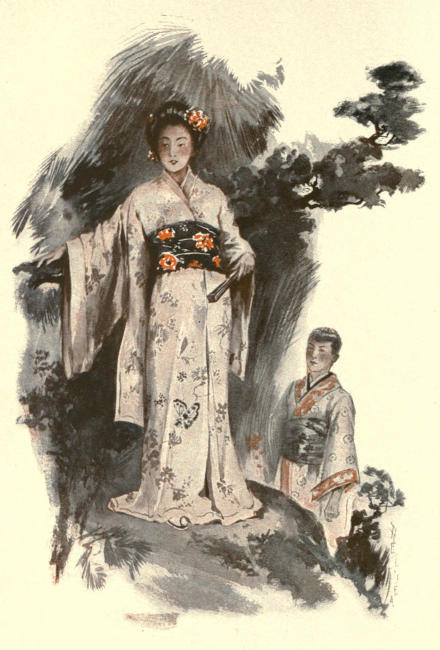
of his home. O-Mitsu-san was four years his
junior. As long as she could remember,
from the days when she first toddled out into
the yard on her small getas, and robed in the
wonderful kimono, gay with bright butterflies,
the days of her life had been devoted to
adoration of her brother. To her he was
everything that was fine and noble, and his
imperious spirit received as its just due the
deferential homage she paid to his years and
his sex. She was little more than a baby, in
the Western conception, when O-Haru, the
gentle mother, went away on the long journey
to the Meido and left the house of
Jukichi desolate, and it fell to her to take
her mother’s place in the management of the
household and the anxious care of the slender,
steadily diminishing means of support.
“Though the eagle be starving, yet will he
not eat grain,” say the Japanese, and Jukichi
fulfilled the saying. No one saw better than
he the inevitable end of the course he was
pursuing. No one felt more than he the need
of doing something to secure an income.
Kokan would soon finish with the public
schools, and before he would be sufficiently
far advanced to enter one of the Local Military
Preparatory Schools he must have some
years of higher instruction, which no school
in the city was fitted to give. The only means
of possible relief that presented itself to
Jukichi’s prejudiced view was some sort of
trade, a vile bargaining and selling for the
sake of gaining the money which all his life
he had despised. Moreover, he knew that
he was unfitted by training as well as by
nature for such work. The simple honesty of
the old soldier, to whom death was a small
price to pay for honor, was no match for the
unscrupulous cleverness of men whose native
sharpness had been developed by years of
practice in a profession from which nothing
else was expected. And so Jukichi drifted on.
Between O-Haru and Jukichi there had
existed a serene sweetness and depth of
love such as seems impossible to the Western
world, unused to the Japanese way, where
marriages are so often matters of arrangement
rather than sentiment. Perhaps it was
the recollection of what she had been to him,
and the profound sense of his loss, that kept
Jukichi a widower. But the death of her
mother brought some recompense to the little
girl in the transfer to her of much of the
calm and confident affection which had been
O-Haru’s happiness. More and more her
father grew to depend on her in many matters
in which he had followed the guidance of
her mother, and there developed in her a
judgment and self-reliance not often found in
one of her years. While yet a child in age
she was a woman in character. Not much of
her time was spent in school, yet her instruction
was not scanty for a Japanese girl. Most
of it had been given by her father, whose
mode of life left him ample leisure for her
lessons. She read well and she had the books
of the Bunko that had been her mother’s. Of
this “Japanese Lady’s Library” she was
diligently studious, and already had attained
familiarity with “Woman’s Household Instruction,”
and the “Lesser Learning for
Woman,” and was intent upon the main part
of the work, the profound “Greater Learning.”
Besides, she knew the “Hundred
Poems,” and often joined with her father and
brother in an evening game of quotations.
There was little interruption of the quiet current
of the family life, and Jukichi loved to
put aside pipe or book, when no visitor had
come, and play thus with his children. But
neither he nor Kokan ever gave a thought to
the future of the girl, or noticed the promise
she gave of beautiful womanhood.
She was a lonely child for one so bright
and winning. Her friends were very few,
not because of her condition, for poverty is all
too common in Japan to be disgraceful, and
many families of great rank have known its
bitter pinch. It was rather because of a
gentle, instinctive shyness that made her recoil
from the often boisterous gayety of her
schoolmates. But one there was who held
large place in her childish esteem. It was a
friendship that began with her schooling.
Her father had taken her to the school that
first day, for Kokan had finished the primary
grades and went to a different school in another
part of the city. The master was a
large, stern man, with solemn, forbidding
face, and O-Mitsu-san was filled with fear.
He took her into a great barren room, filled
with hard, high benches where sat a multitude
of other little boys and girls. He showed her
a bench and told her to sit down, and when
she took her place, the other children looked
at her and whispered together and laughed.
She was frightened, and presently, when the
master, with a big whip in his hand, called
her name in a loud voice, she put her head
down on her hands and sobbed with fear.
Then the other children laughed more and
the master commanded silence in a voice that
terrified her. She was very miserable and
wished only to get away from that dreadful
place and to go home again. By and by
a bell rang, and all the children stood up and
went out. But one little boy came to her
and said shyly:
“Don’t cry, little girl. Come and play.”
After a time, when she had ceased to sob,
she looked up into his round face and said:
“What is your name, boy?”
The boy smiled and answered:
“Soichi. Come and play.”
Then they went out and played, and by and
by, when it was time to go home, the little boy
walked along with her and she was glad. His
home was just around the corner from hers,
in the fine big house in Azalea Street. He
was a funny boy, for he asked her not to tell
her father that she had played with him, or
that he had walked part way home with her.
When she asked him why, he would not tell,
but said that some day she would find out,
and that would be time enough to tell if she
wanted to. Poor little Soichi! Already the
boy was learning the hard lesson that old disgrace,
however unmerited, cannot be put aside
lightly, even by law, and the wise young head
knew that the child of the Eta was no playmate,
in his world’s eyes, for the daughter of
a Samurai.
O-Mitsu cared not at all then. She knew
only that he had been kind to her in her
wretchedness, and she liked him loyally for
that, and loyally, too, she kept her promise not
to tell. So they met at school and played,
sometimes with other children but often by
themselves. Thus several happy months went
by and then O-Mitsu got her first great lesson
in the new life of the nation. She found out
about Soichi. There were plenty of children
to tell when it seemed there was a chance of
causing pain, for the Japanese child has no
less a barbarian heart than many who
live in the Western world. The little girl was
greatly troubled. She liked the boy and enjoyed
the games with him. But the daughter
of a Samurai knew her position. She had
learned now that the stern looks of the master
masked a kindly heart, and her first fear of
him was gone. To him she went in her perplexity.
“Why is it,” she asked, “that the Eta
boy comes to this school? Are not Etas outcasts?”
The wise teacher smiled gently and said:
“That was true, O-Mitsu-san, but it is not
so now. Did you not know that the Emperor
has promoted them, and given them the same
rights as all the rest of us?”
“Then are they like us now?” she asked.
“Yes, child,” replied the teacher softly, for
he, too, was a Samurai and knew what was
in the heart of his little questioner, “and because
it is the Emperor’s will they must no
longer be treated as they were.”
“I am glad,” said O-Mitsu shortly, and
went out into the yard to join the game in
which Soichi had a part.
But when school was over and Soichi was
walking toward home with her she kept silent
for a long time. At length, raising her eyes
and looking at him, she said:
“I know why now, Soichi.”
At once the boy stopped. The training of
bitter experience prepared him to hear her
proudly scornful decision. But when she was
silent he dared at length to ask:
“Why do you not say it?”
But she smiled and answered:
“I do not care, and I will not tell. Teacher
says it is right because the Emperor did it.
Come, let us go home.”
IV
Kutami the Commoner was fat and
jolly. He lived well and put
trouble behind him whenever it
showed its ugly head. He liked
to talk and smoke and visit with the friends
who came often to his comfortable house to
enjoy his hospitality. For though among the
Samurai and the gently born the old prejudice
against the Etas was far from extinction,
among the Commoners there was little inclination
to supercilious remembrance, especially
when one had been so successful as Kutami.
The visit of Jukichi to his house had had a
marked effect. Often since that memorable
afternoon the wagging tongues of Kutami’s
friends had discussed the proud old man and
his hard situation. Many a suggestion was
made as to how it might be improved, but
none which it seemed likely he would accept.
The generous impulses of his admirers were
barred by the stubborn pride they were not
willing to encounter.
Life in many of its details is not so different
in Japanese cities to what it is in the Western
world. Neighbors gossip just the same, and
pry out secrets and imagine motives just as
they do among Occidentals, and just as often
hit the mark. They knew Jukichi’s ambition
for Kokan, and how more and more doubtful
of fulfillment it was becoming.
“How foolish he is!” said Komatsu, the
cloth merchant, one evening when the subject
had been discussed for the fortieth time.
“With what he had from his pension he might
have done many things, and been as rich now,
perhaps, as Chobei here, who does not know
what to do with his wealth.”
“A curio shop, for instance,” said Uchida,
the ivory carver; “many Samurai have done
that, and with his knowledge of such things
and his friends to help him get them, or to
buy from, he might have made a great success.”
“But instead of that he has only sold some
of his own things for a child’s price, and
grows poorer every day!” Komatsu seemed
as near to being disgusted as was possible for
his good nature.
“How little you know him after all,” said
one of the group who until now had taken no
part in the gossip. It was Matsumoto, a
Samurai who had made his way in the very
fashion outlined by Uchida, and whose advertisement,
proclaiming his rank, is thrust into
the hand of every foreigner who steps ashore
at a Japanese port. But he had the native
genius for trade as well as the insight into
character which told him how utterly lacking
it was in Jukichi. “He could never be a merchant,”
Matsumoto continued. “The world
is just what a man’s heart makes it. Kudo-san
would find only misery and hatred in becoming
a trader, and would fail before he had
thoroughly begun.”
“Ah, that is true,” cried Chobei, “that is
quite the truth. I do not know what he could
do.”
“That is plain,” replied Matsumoto. “He
was a great swordsman in his day and has a
fine reputation. He could give fencing
lessons. He has taught his son, who already
excels the other boys in school. Let him teach
the sons of others.”
That was a practical suggestion of which
all felt the force. But the real difficulty lay
in approaching Jukichi. There was plenty of
talk about that, but the gossips went away
without having reached a conclusion. A long
time after his friends had gone Chobei sat
with his little pipe, in deep consideration of
the subject. In his abstraction he rapped so
hard on the hibachi, knocking out the ashes,
that O-Koyo came into the room to see what
was the matter. There had never been many
secrets between them, and now Chobei looked
up and began at once to speak of the problem
that was perplexing him.
“You know I have long been desirous of
assisting Kudo-san,” he said, “but have not
understood the means to be employed. To-night
Matsumoto-san has given me an idea.
It is that he can teach fencing; but how shall
we get him the pupils without his suspecting
that we do it to help him?”
“We have one,” replied O-Koyo. “We
could ask him as a favor to teach our son.”
“No, no,” said Chobei, at once. “That
would not do at all, for I have told him that
Soichi is not to be a soldier, and he knows
our son has no need of fencing.”
“Well, then,” said O-Koyo, “I do not
know what to do. It seems to me that he is a
very foolishly proud old man.”
“Ah, yes,” replied Chobei, “but he is one
of those who belong to the old Empire and
he cannot change. It is very strange and
very hard.”
“Hardest for his son,” said O-Koyo.
“How can that boy become an officer of the
army without education, and how can Kudo-san
give it to him? There is no school here
and he cannot send the boy away.”
As he listened to his wife speaking these
words a new light dawned upon Chobei. He
saw the way.
“We must make that school,” he exclaimed,
and drew in his breath so hard that
it whistled through his teeth. “We will
found a new one to fit boys for the Military
Preparatory Schools, and Kokan shall have
his education. Yes, yes! That is what we
must do! There shall be a place for Kudo-san.
I will ask him myself. It will be a
great honor to us if he will teach the fencing
and swordsmanship. Then when his son
must go away he will have something to meet
the expense.”
So the idea was born. There followed
much thought and talk among Chobei’s
friends, and one day the local newspapers
announced that the authorities had given
permission to Mr. Kutami Chobei to establish a
new school, which the founder agreed to
maintain. It would be the link between the
existing institutions of the city and those of
the central Government. The courses were
to be general, but there was to be special
instruction for such boys as desired to fit
themselves to enter any one of the six Government
Local Military Preparatory Schools
with a view to competing for a commission
in the army.
It was the shrewd Matsumoto who had
suggested this method of bringing the new
school to the notice of Jukichi, and his reading
of the old man’s character was not at
fault. Not a hint of the personal opportunity
offered came to the Samurai as he read
the news in his paper. To him it was only
another evidence of the patriotism of his
neighbor, and he was about to set out on a
second visit of congratulation, when a
messenger brought a letter from Chobei. It was
a very humble letter, as befitted the circumstance
of a promoted Eta writing to a Samurai.
The Commoner hoped that Kudo-san
had heard of the projected school and
that it would meet with his approbation.
There were some matters concerning its
administration and the courses of study to be
provided, about which it would be a distinguished
honor to him to consult with Kudo-san,
and in view of the previous marked
kindness, he dared to beg the condescension
of an appointment. The advice of Kudo-san
would be a very material assistance as well
as a great honor.
Jukichi thrust the letter into the sleeve of
his kimono and stalked around the corner into
Azalea Street. There was a smile on Kutami’s
face when he saw how his bait had been
swallowed, and he silently blessed Matsumoto
for his inspiration.
“It is a great presumption for such as I,”
he said when the tea had been brought and
Jukichi’s first congratulations were offered,
“to think of undertaking such a work. No
doubt it would have been better if some gentleman
had been willing to do it. But, as it
is, I am glad to have the opportunity. I have
observed for some time, and with much regret,
that many of the young men of the city
have been obliged to go away to complete
their preparatory education, especially those
who mean to enter the army, and I hope this
school will be able to remedy that fault.”
Jukichi bowed in his courtly fashion and
paused respectfully before replying.
“It is an honor to the city,” he said at
length, “to have so public-spirited a citizen.”
With profoundest salute Kutami acknowledged
the compliment and protested his unworthiness.
“There is very much to do,” he said
slowly, “and I am poorly fitted to make suggestions.
I hope you will not believe me rude
or unthinking if I venture to tell you it has
been suggested to me that perhaps you yourself
would be willing to help.”
The trial was made, and Kutami sat with
narrowing eyes, watching his visitor to note
the effect. For a moment or two Jukichi sat
perfectly still, with face completely masking
his feelings. Then he bowed deeply, with
strong sibilant inspiration.
“I?” he said, with show of surprise. “It
is an unexpected honor. I am quite unworthy
to assist in so valuable a work. I do
not know what I could do.”
The Commoner breathed more freely. He
had dreaded a fiery outburst from the hot-tempered
old man, and when it did not come
he could hardly conceal his relief. He felt
that Jukichi’s coöperation was more than
half promised when it was not at once indignantly
refused.
“Who in the city could do more?” he exclaimed.
“Who could confer such honor
upon so humble an undertaking?”
Jukichi did not reply. Since the day when
he saw the struggle for the Restoration successful,
the old man, still clinging fondly to
the life of the old régime, had been nevertheless
drifting unconsciously toward participation
in the new. But he was yet far
from open avowal, and the proposition of
Kutami came to him with a shock. He saw,
however, that he had opened the way for it
himself, and merely asked to be excused from
giving immediate reply. Then with renewed
congratulations and polite expression of
good-will, he went away, leaving the Commoner
uncertain but hopeful.
With genuine sorrow Kutami saw the Samurai
pass through his gate unpledged. But
he went on with the work, and soon the new
building approached completion. Every detail
was arranged but the most important of
all. For Jukichi still declined to commit himself.
If he failed to secure the Samurai,
though he succeeded in all else, Kutami felt
that the whole undertaking would fail. But
he exhausted his ingenuity without success.
The pride of his abolished caste still dominated
the Samurai. It was an incident beyond
the knowledge of either that determined
Jukichi.
Jealousy is not the curse of race or rank.
It finds its lodgment in the breasts of rich and
poor alike, in Occidental and Oriental. It
was O-Koyo who found the first evidence of
it in a newspaper wrapped around a casual
purchase, and with unconcealed emotion took
it to her husband, reviling herself for being
the bearer of ill news. Poor Kutami! Of
all the hard thrusts and unkind blows of his
none too easy life this was the meanest and
worst. It was a savage attack on his cherished
scheme. The school plan had been devised
in all sincerity, with the sole purpose
of giving aid, without its being known, to the
man who, he felt, had honored him by entering
his house, and whom he greatly admired.
But here he saw his honest, manly work
scornfully derided, his simple purpose wantonly
distorted and himself held up to ridicule
more bitter than his bitterest outcast days had
ever known. Every one could see what the
real object of the new school was, said the
paper. The spawn of the frog was hoping to
be hatched out into eagles. But fine dress
and large words did not hide the outcast.
The Eta, though he clothed an army and
built a thousand schools, was only an Eta.
Law might call him a Commoner; it could
not make him clean. Contamination was in
all that he touched. Out upon the upstart
with his vile wealth, who dared presume to
offer schooling to the sons of men of birth!
With heart too heavy for words Kutami
gave back the paper to his wife. The cruel
blow seemed to have struck down at once his
ambition and his energy. He sat like one
paralyzed and could neither think nor speak.
And O-Koyo, tearing up the wretched paper
in a frenzy of grief, as if thus to destroy the
slander, threw herself down on the mat and
sobbed aloud.
There was no fight left in Kutami. But
Matsumoto, the curio dealer, with the old
Samurai courage untouched in his heart,
strove to inspirit his friend, and the building
was finished. The Government officials had
taken no notice of the attack on the founder,
and the newspaper discussion provoked by it
died away with no immediately discernible
effect.
In the seclusion of his quiet home Jukichi
had not heard the bitter denunciation of the
new school. He was absorbed in the old problem
of Kokan’s future. The money he had
received from the Government was almost at
an end. His treasures were sold, his resources
exhausted. Swayed to and fro by the currents
of conflicting emotion he sat, still undecided,
still reluctant to grasp the proffered
relief.
From one of her old schoolmates O-Mitsu
heard the story and told her father. The old
man listened with flashing eyes, and when
she finished his decision was made. For himself
he would not take the step, but to help
another, even one who had been an Eta, appealed
to his sympathy and his sense of honor.
The day of the opening arrived, and then
the result of the slander appeared. No pupils
came to the new school. In painful embarrassment
the governor of the Ken stood in
the great, bare, main room and heard the pitiful
words of unhappy Kutami presenting his
gift to the city. Vain and empty sounded the
pompous response. The teachers, gathered
for their hopeful task, found nothing to do.
The ceremonies were over. The governor
and his officials turned to go away, glad the
disagreeable business was ended. In the
doorway stood an old man and a boy. With
grave and dignified salute they waited while
the governor passed out. Then into the
building they marched and up to the office of
the head-master. Five minutes later two students
were duly registered and the new school
was opened, with Kudo Jukichi and Kudo
Kokan its first pupils.
Jukichi had committed himself at last, but
the scandalous assault came very near to success.
For several days not another pupil
appeared. Then the word went abroad that
Kudo Jukichi, the Samurai, had registered his
son, who was in daily attendance, and that
Kudo-san himself had become instructor of
swordsmanship. Men who had hoped to have
their sons profit by the new institution, but
who had been held back by cowardly apprehension,
rejoiced at the relief, and some
who secretly sympathized with the attack,
and hated to see this evidence of the progress
of the upstart succeed, were shamed into supporting
it. The day was won for Kutami,
and it was a victory infinitely sweeter than his
bitterest calumniator could have imagined,
for a reason of which scarce half a dozen
persons in all the city had any inkling.
V
More and more as he grew older,
young Kudo Kokan betrayed the
haughty spirit that had characterized
his ancestors. To him Kutami
the Commoner was still Chobei the Eta.
With no hint of how intimately his own career
was connected with the success of the
new school, he was much opposed to having
anything to do with it. But as the days
passed, and others of his inherited standing
filled his classes, his active opposition relaxed
into scorn of the man and the institution from
which he profited so much.
Boys are boys just as much in Japan as in
any other country, and must grow to manhood
through the same struggles and with just as
much exhibition of their native barbarity. It
was in the second year of Kokan’s attendance
at the new school that Kutami entered his own
son, who was preparing for a course at the
university. Soichi was growing very tall and
strong, fonder of sports and games, of military
drill and marches than of books and hard
study. Now for the first time he met the
young Samurai. The early friendship with
O-Mitsu had run its course of vicissitudes
and pleasures, and seemed to have come to the
fork in the road. As the girl grew older and
learned more of the ways of her world, she
came to understand more fully what had been
intended by the little talebearer who first informed
her of Soichi’s social station. She saw
the proud attitude of her father toward the
Commoner, and her friendship with the boy
was not mentioned at home. Apparently that
was the only circumstance which distinguished
it from scores of other boy and girl friendships.
But the fact that it was not wise to say
anything about it gave it a fictitious importance,
and perhaps made it linger in a tenderer
corner of the girl’s recollection.
The appearance of Soichi at the school offered
occasion to Kokan for the revelation of
his least lovable qualities, and, boylike, he
promptly showed them. He took delight in
suppressed sneers and open snubs. And Soichi,
being a boy of high spirit and no mean
courage, cherished a sturdy resentment. Savagery
is indigenous with most real boys.
Before they have reached the age of reason
it crops out persistently, whether their skins
are brown or white, whether their eyes tilt
upward at the corners or lie straight across
the face. But it is of two kinds, merely exuberant
spirits, impersonal, horse-playful, or
vicious and vindictive. Kokan had no intention
to be mean, but often pranks played just
for the fun of it are none the less cruel, and
what starts in good-natured play ends in deadly
earnest. And Kokan misjudged the mettle
of Soichi. He had the easy confidence of assured
superiority and could not guess that beneath
the jacket of the boy he often derided
with the scornful name of Eta there beat a
heart as stout as his own.
Unconsciously, too, he had a large advantage.
For Soichi knew the secret Kokan did
not, of the real reason for the founding of the
school, and at any time could have given his
tormentor a thrust that would have brought
his insolent pride abjectly to the dust. Not
many American or European boys would have
stood proof against such a test, for they are
not trained in the ideas of filial obedience and
loyalty, that are the inheritance of the Japanese.
Soichi knew that a single word from
him would end his persecution, but at the same
time it might be the ruin of all his father had
tried to do, and he held his tongue. And, because
he thought he dealt with unresisting
putty, Kokan went from bad to worse. The
taunt that had been but a joke at first became
a thing of venom, and his easy, indifferent
contempt began to grow into something almost
hatred.
How little beyond their noses most boys
can see! Kokan came to believe there was no
flint at all in Soichi, for try as he would, he
could not strike fire. Then came the thunder-bolt.
The year’s work was almost finished. A few
days more and Kokan would be graduated.
It was with a sense of great relief that Soichi
saw the end so near. It had been a bitter year
for him. Not only had Kokan’s taunts and
persecution strained his endurance almost to
breaking; it had cost him the sympathy and
friendship of many of his fellows, who misconstrued
his silence and had come to believe with
his tormentor that he was a boy of no spirit.
He thought it all over by himself and a great
resolve came to him. As he walked alone to
the school one morning he planned his course.
Let the result be what it might, his mates
should see that it was not fear that had kept
him from open resentment.
The bell rang and the boys came trooping
in from the playground. Standing aloof, Soichi
watched until he saw Kokan. The Samurai
boy walked briskly, talking light-heartedly
with two or three companions. To enter the
building he must pass close to the spot where
the Commoner stood. Soichi waited until
Kokan and his friends were but a few feet
away, then stepped directly in front of them,
and turning his back, walked slowly toward
the door. Instantly Kokan understood that a
crisis had come. For a moment he was too
amazed to speak. Then he shouted:
“What do you mean, Eta? Get out of my
way!”
Soichi made no reply, and stepped more
slowly than before. Kokan was almost on his
heels.
“Jump, dog!” the young Samurai shouted
in sudden anger; “jump before I kick you!”
For answer Soichi turned and without a
word slapped him smartly across the mouth
with the flat of his hand.
A moment Kokan stood like one turned to
stone. It was as if the blow had paralyzed
every faculty, not by its force but by its shock.
Then in wild fury he sprang forward, his
hands outstretched as if to clutch and tear to
pieces the boy who had dared to strike him.
Soichi was ready. In strength and stature he
was quite a match for his frantic antagonist;
but it needed no force to meet that furious
rush. Swifter than sight his hands went forward,
caught the arms reaching out to seize
him, and with a single twitch hurled the Samurai
boy bodily over his head. Then like a
cat he whirled to meet a new attack. It was a
trick he had often played on the practice mats
of the gymnasium, where not in vain had he
worked that year with the master of jiu-jitsu.
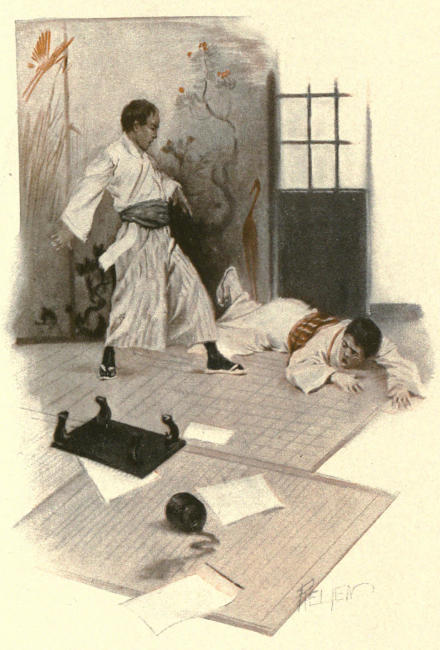
Hurled the Samurai boy bodily over his head.
Dazed by the force of his fall Kokan struggled
to his feet, mad with rage. Fortunate
then for them both that the wearing of swords
was no longer the Samurai’s privilege, else
Soichi would have been killed in his tracks.
But if passion had blinded Kokan, his friends
could still see, and before another wild rush
should give Soichi a second opportunity they
had seized both boys and held them apart. In
another moment the master, who from the
doorway saw and heard it all, had reached
them, and discipline was beginning to work.
“He insulted the Emperor and I struck
him,” said Soichi calmly, when they examined him.
“If I had had a sword I should
have cut him down.”
“What?” said the master, “insulted the
Emperor!”
“It is false!” cried Kokan, restored to outward
calm, but with heart burning with hatred.
“I did not!”
“He called me Eta,” retorted Soichi, “and
the Emperor has decreed that there are no
more Etas.”
Before that reasoning even Kokan was silent,
and because he was Jukichi’s son the
master found a way to let the matter drop.
Soichi had given a proof of his spirit, which
every boy in the school was ready to accept.
He had won his point, but the young Samurai
went away to his military school with a bitterness
rankling in his heart it was to take years
to cure. The quarrel had its effect in the
house in Timber Street no less than in the
home of Kutami. Jukichi at once left his place
as instructor and opened classes of his own.
It did not matter. The work for which the
school had been founded was done, and the
Commoner, grieving that it had come to such
result, nevertheless was satisfied, and more
than ever proud of the son who had shown
both his courage and his patience.
VI

The period of “Little Plenty” was
wearing to its close. Already the
wistaria blossoms were fading and
the gorgeous azaleas were dropping
their petals. In the fields the barley
heads had turned to yellow and the young rice
in the seed beds stood tall and strong in its
thick green rows awaiting the harvest that
should make room for it. It was a day when
even nature rested and basked in the smile of
heaven. The sun shone as if pouring the accumulated
experience of millions of years into
each moment, saturating earth and trees and
flowers and grass with a deluge of molten
gold. The vast blue arch gleamed like a great
aërial mirror, reflecting the wide expanse of
motionless sea that lay shimmering in the sunlight,
unmarked by a single ripple. On its
sleeping surface myriad fishing boats, with
dull gray hulls and red brown sails, drifted
and dozed. The noisy calls of the city were
hushed, and to the girl sitting among the trees
on the crest of the pine-clad cone beyond the
end of Timber Street there rose only now and
then a muffled sound, like the dull roll of surf
on a far-distant beach. Only life that was
wild sent its challenge to her. Natsu-zemi
shrilled his strident ji-i-iii from the branches
over the Shinto shrine in vigorous chorus, as
if determined to make the uttermost of such
a day, and Min-min-zemi chanted his ritual
over and over from scores of trees, singing
the prayer that has no end.
Six years had more than fulfilled the promise
of her childhood for Kudo O-Mitsu. At
eighteen she was the full-blown flower of
which at twelve she had been only the bud.
Such an one she was as would set the hearts
of half a city a-throb by a single glance,
even a city where men care not overmuch for
maidens, and passion is rarely of the tender
sort until years of association have coddled it
into flame. Her face was a long, narrow oval,
the stamp of her gentle birth, exquisitely
curved from cheek to chin and rounded to the
delicate point that emphasized her beauty and
yet revealed her determination. Narrow at
the top and broadening to the temples, her
ivory-white forehead disclosed the outline of
beloved Fujiyama, the sacred mountain of her
race. The full lips of her little mouth were
brilliant with the stain of luscious cherries.
Above a great mass of shining, jetlike hair
gleamed softly the green jade of the ornaments
that betrayed her years.
She sat leaning a little forward, the slender
fingers of one hand half supporting, half caressing
her chin, and gazed dreamily out at
the splendid pageant of sea and shore spread
before her. But its beauty was not in her
thought. The wonderful shimmer of the opalescent
water, now heliotrope, now tan, now
pearl, under the rapturous rays of the afternoon
sun, the soft blue of the roofs rising
here and there through the brilliant green
of the verdured hills, had now no charm for
her. The melancholy note of the wild dove,
calling sweetly from the deep recesses of the
pines, suited more her mood. For trouble had
come to O-Mitsu, of a kind she did not know
how to meet. Chukei, the nakodo, the professional
matchmaker, had called to see her
father.
To the old Samurai, hardly less than to the
girl, his message had come with a shock. For
as unconsciously as she had grown to womanhood,
so unconsciously had he seen her grow,
with never a thought of the demand for her
that time was certain to bring. The son of
whom he was so proud was gone to the army.
That year he had received his commission
and joined his regiment. The red cap-band
of the Guards was a badge of honor for Jukichi,
and he dwelt lovingly on the future of
the young officer who had begun his career by
winning appointment to the proudest service
in the land. But the old man missed the boy,
and honor could not entirely fill his place in
the lonely house. It was the girl who brought
sunshine into Jukichi’s daily routine. The
classes and the lessons that had earned their
humble subsistence still occupied part of his
time, but the old man had lost his zest for
them, and his urgent need had passed. Kokan’s
pay was enough for them all considering
their simple way of life, and Jukichi,
feeling his years, was beginning to contemplate
the time when he should resign his
cares, and as inkyo, live out his days in rest
and peace.
In all such dreams O-Mitsu had her share.
Jukichi did not mean deliberately to keep her
from the marriage to which every Japanese
girl looks forward, but he put the thought of
it from him as unpleasant, and Chukei had
forced it on him against his will. He turned
the nakodo away with evasive answer and
scant encouragement. Then for hours he sat
thinking of the girl and her future. After
supper, when she brought his pipe, he said:
“I have received a proposal of marriage for
you.”
She put down his tobacco pouch and sat
still, a sudden clutching about her heart as if
of suffocation. For some time Jukichi said
nothing more, then he added:
“Chukei-san, a nakodo, has been here to see
me about it.”
“Ah,” she said, with a pitiful little effort
to smile. Her father had given no hint yet
of his own feeling, and she dreaded what was
to come. She was not prepared for this. She
had not thought of it. Kokan and her father
had made up her world, and she did not know
what to say. The old man sat looking at her
fondly, and for a few moments neither spoke.
Then he said slowly:
“Yamamoto-san, the silk merchant, makes
proposal on behalf of his son.”
She smiled again, and with better will, for
somehow she found relief in the words and
manner of speaking. Besides, she did not
know the young man who had honored
her, and she began to feel that perhaps her
father might not consent. She had no wish
to marry, and she was not the girl to do so
simply for the asking. At length, as her father
said no more, she plucked up courage, and
bowing deferentially to him, said:
“I do not wish to marry yet. It is better
for me, if you will, to live here with you until
perhaps Kokan shall bring you another
daughter to keep the house.”
A smile of pleasure lighted the old man’s
face.
“Ha,” he said, “it is as I wished you would
feel.”
Then, if he had been an Occidental, he
would have kissed his daughter, and heart to
heart they would have talked until the matter
was settled. But deep and true though affection
may be among the Japanese, it finds small
show in outward expression, and caresses are
signs of weakness.
“I have made no answer,” he went on, after
a little. “I had no will to have you marry if
you were not ready.”
His hand moved a little as if to touch her
arm, and his eyes glistened with unusual emotion.
“I will tell Chukei-san.”
That was all. The incident was ended; but
the girl, wiser by instinct than her father, although
without experience, marked it for the
beginning. What was it that stirred her heart
in protest so strangely and so strongly? She
did not know. The ghost of some long dead
experience, perhaps. The wood dove in the
trees behind her called plaintively to its unseen
mate. The sun slid down the western heaven
and threw his long rays caressingly over her,
face to face with a world-old perplexity. Why
should she be sad at the prospect for which
other girls longed? It was the pleasant homelife
with her father, and the deep, quiet home
love, she thought at last; life and love that
knew no change. That was the way she
wished to go on, and with a sudden blaze of
anger she hated old Chukei for his unwelcome
interference. Gradually her mind recovered
its old poise, and she saw the course
she would take. Her father’s attitude was her
good fortune. As long as he continued in that
mood the menace was shorn of its power, and
after that—The huge red sun splashed into
the flaming sea, and with its parting fire flashing
back from her lambent eyes she rose and
started down the winding path toward home.
VII
There was joy in the house in Azalea
Street. Soichi had come home.
His work at the university was
finished, and despite his dislike for
study he had taken high place in honor of the
father who wished him to. Now he had returned
to make a beginning in the career Kutami
had planned for him. But for a time
there was to be no work. Father and mother
and son were to play a little together and give
rein to the pleasure of the reunion. After
that the new venture would take all the effort
of both men.
Kutami intended to branch out. The old
business was good enough for him, but the son
was worthy of something better. He should
be a banker, and already the Commoner had
arranged with some of his wealthy business
associates for the founding of the new institution
which should give Soichi his opportunity.
The friends who gathered at the comfortable
house to celebrate the joyful return
of the young man, discussed the new project
with unflagging enthusiasm, and all predicted
a proud success for Soichi. The sake cups
were often exchanged and many cigarettes
perfumed the air. There was no flaw anywhere.
It was the next afternoon that Kutami,
trudging along through Timber Street on his
way back from his office, and turning over in
his mind his plans for his son, passed the
house of Jukichi. A drizzling rain was falling,
but the Commoner, secure under the wide
shelter of his yellow, oiled-paper umbrella,
cared nothing for that. As he passed the
gate of the Samurai a gust of wind swirling
through the street tilted the umbrella sharply
back, and Kutami glanced up just in time to
see old Chukei, the matchmaker, coming out.
“Oho!” he said, as he saw the middleman,
“a wedding, eh? I wonder what lucky
young fellow it can be who is to have Kudo-san’s
daughter for his wife.”
He paused for a moment, looking after the
nakodo as he strode toward the city, then
turned and went on. It was no affair of his
after all, and before he had reached his own
home he was back again in the absorbing subject
of Soichi and the new bank, and had forgotten
all about Jukichi’s daughter.
Shrewd old Chukei had met a puzzling rebuff.
The circumstances were everything
that to his mind foreshadowed a successful
negotiation. But he had been sent away with
almost no explanation. The nakodo shook his
head and plodded along, wondering what
to do.
O-Mitsu was happy. Not soon again, she
thought, would this particular middleman return
to her father’s house with his annoying
business. With unwonted lightness of heart
she went about her work. Then when the
rain ceased and the sun came out, she stepped
out into the yard and on the tall getas that
guarded her dainty feet from the mud, took
her way up the path toward her favorite spot
among the pines by the old shrine. The world
was greatly changed for her since last she
looked out upon that familiar scene. The sails
of the fishing-boats bellied out under the fresh
breeze, the spray dashed over their bows, the
trees swayed and nodded, everywhere was life
and activity. The whole world sang and her
heart with it.
She stood a long time gazing down at the
spreading sea, quite unconscious that another
had climbed the steep path, one who now
found even a more entrancing picture before
his eyes than the wonderful view below them.
It was Soichi, come to visit the old shrine. All
unprepared for the vision that came so suddenly
before him as he turned to look down
on the well-remembered shore, it was hard to
stifle his admiration and surprise.
Leaning a little against a gnarled old pine,
she stood motionless, her strong profile and the
exquisite curve of her chin revealed unwittingly
to him as he paused, half concealed by a
clump of trees. Back over the years since he
had seen her, the rush of memory took him to
that day when she had told him that she knew
his secret. He saw her again standing in the
road and bidding him, with a smile, come on
with her. And now that little girl was this
beautiful woman! She had not changed, and
yet she was all changed.
Slowly the tide of emotion swelled within
him. He could not remember that he had ever
thought she was a pretty girl, and in the years
he had spent at the university he had scarcely
thought of her at all. He had seen many
pretty girls there, but never had one affected
him like this. Now he saw at a glance that she
was wonderfully beautiful, and the more he
looked the more wonderful she became. It
dawned on him that she was much the most
beautiful woman he had ever seen, and immediately
he had an almost irresistible longing
to go to her at once and tell her so.
An unhappy thought of himself restrained
him. They were no longer schoolfellows.
She was the daughter of a Samurai and he—Poor
Soichi! Not even his university life had
taken from his own consciousness all taint of
the old disgrace. He did not know, because
he had had no experience, that love is heimin
as well as shizoku, a Commoner as often as a
Gentleman, and that there is never advantage
in loving a girl unless you tell her so.
He moved a little, and a snapping twig told
her that some one was near. She turned
quickly and their eyes met. A long moment
they stood so and neither spoke, yet in that
moment the whole world changed for each of
them. Under his steady gaze she felt the
blush come tingling up her throat and spread
across her cheeks. Like one grown fast to
the ground on which he rested, he stood and
only stared. His brain refused to act, his
tongue to work. Then she moved, and the
spell was broken.
“O-Mitsu-san!” he cried, and tone and
glance told all he would have uttered.
With all her face rosy with warm blood she
gazed fearlessly back into his eyes, and murmured
softly a single word, yet one instinct
with the feeling of a thousand.
“Thou,” she said, in the old familiar language
of their childhood.
Even as eyes and look had spoken for him
when voice and tongue were mute, so had she
answered. His ugly doubts of himself fled at
first sight of her smile and it was the old Soichi
who sprang forward to her side. A thousand
questions trembled on his lips and struggled
in vain for utterance. His unruly tongue
refused its function, and he stopped in confusion,
even his bold eyes falling before her smiling
glance. It was the girl, older than he in
such matters by hundreds of years of heritage,
who said lightly after a little pause:
“I did not know that you had come home.”
A dozen emotions fought together for expression,
but all were crowded back, and he
answered in commonplace:
“I have been here nearly a week.”
“So long?” she said, questioning.
He fancied he caught a note of reproach in
her tone, so far had his self-esteem come back,
and a pang of regret crossed him at the
thought that he had lost those days.
“I am a fool,” he said irrelevantly, but with
air so dejected that one far less clever than she
would have followed his thought.
She laughed merrily, and the sound of her
voice completed his undoing. He was back to
elemental simplicity again, and the passion
that was uppermost in his heart came bursting
out with truthful bluntness.
“You are the most beautiful woman in all
the world,” he said.
Again the blush swept across her face and
the long lashes fell over the merry eyes. The
flood-gate of his speech was lifted at last. The
torrent of his emotion flowed forth with the
rush of waters long pent up, telling her the
ancient story he had known all his life, but
which only that last quarter hour had revealed
to him. And the girl, listening with fluttering
heart, heard more than he said, for he was answering
the question she had asked herself,
and she understood now her hot protest at the
message of the nakodo.
They sat down by the great rock on the far
slope of the hill, where the thick pines screened
them from the view of visitors to the shrine,
and where the sea lay blue, strong, and peaceful
below them. For an hour of which no
power ever could rob them, heart was laid
bare to heart. Innocently, simply, with the
peace of the glorious day, they prattled of the
wonder that was theirs, the discovery they
alone of all the world had made, and never a
thought cloud floated across their heaven to
disturb the serenity of its sunshine.
VIII

It was a good thing for Soichi that
he had received the proper Japanese
training in emotional self-repression
or he certainly would
have betrayed his secret very soon after his
return to the house in Azalea Street. It not
only filled him to the overflowing point; it
enveloped him roundabout. He was drowned
in it. Only the strong force of habit saved
him, and the preoccupation of his parents prevented
them from noticing his sudden distraction
and absent-mindedness. Four days
went by, two so long that night seemed never
to come, and two so short that he remembered
of each nothing but the blissful hour when
he had seen O-Mitsu. They had lived over
again the past and drunk the joy of the
present. Then came the specter. Boys and
girls who fall in love in Japan, where the
nakodo does most of the wooing, have even
less chance than Western lovers for the proverbially
rare smooth course of affection.
And when he is of such humble descent as
Soichi and she the daughter of a Samurai,
that little chance is very small indeed. But
they were true Japanese and had no lack of
courage. They looked their trouble squarely
in the eyes and questioned only how to
meet it.
“Do you remember the teacher who
frightened me so that first day at school?”
she asked, going back again to the beginning
of all things. “When they told me first that
I should not play with you I asked him if it
were so. Do you know what he said?”
“Yes, I know,” he answered, a little sadly,
for he saw how always the specter stood between
them.
“He was a Samurai,” she went on, “and
he knew. He said the Emperor had destroyed
the old distinction and we were all
alike.”
“Yes,” he replied, “before the law. But
there are some things that not even the Emperor’s
law can reach.”
“Treason!” she cried lightly. “The Emperor’s
law reaches everywhere and touches
everything.”
He looked at her with a smile. “Do you
think,” he said, “that the Emperor wishes us
two to be married?”
Her eyes dwelt fondly on his face, and she
answered bravely:
“He wishes the old barriers to be utterly
thrown down and all his people to be one.”
The picture of that day at his father’s
school when he had asserted his manhood
came back to him with a rush.
“Ah, yes,” he said soberly, “that is true.
Perhaps it might have been, but I spoiled it.”
“Thou?” she said, using again that fond
expression that sent the blood surging
through him.
“I struck your brother,” he answered.
“Perhaps but for that——”
“No, no!” she cried. “I know about that.
It was right. There would have been no hope
if you had not done it. You do not know
Kokan, how proud and hard he is, how he despises
fear. He thought you were afraid of
him, and he hated you for it. If you had not
shown him you were not, and—and this had
come, he would have killed you.”
“Perhaps,” he said coolly.
His tone startled her. It was only a little,
after all, that she knew of men, and there was
a side of Soichi that she did not suspect, because
of the difference in their training.
“Ah, but he would,” she declared earnestly.
“You do not know how quick and hot
his temper is.”
“Perhaps I should have killed him,” Soichi
answered. “It would have been a fight, not a
murder.”
The words surprised him almost as much
as they did her, but for a different reason.
That he had said them to her was the wonder
to him; that he should have the feeling
they disclosed was her amazement. It was
the spirit of the Samurai, the spirit that all
her training told her belonged only to them,
and yet he revealed it as lightly as if it were
a thing of supreme indifference, a commonplace,
the matter-of-fact possession of every
man. A new joy came to her with the unexpected
knowledge, and instantly new hope
sprang up, vague and undefined, but none the
less profound. Somehow, some way this
unimagined quality in him would throw down
the hateful barrier of prejudice and set them
free. There was a deepened tenderness in the
eyes that answered his gaze.
“You said there would have been no hope
if I had not done that,” he went on, after a
little. “Did you think Kokan would ever
forgive that blow?”
“He is brave and true,” she answered
softly, “even if he is proud and scornful.
Too brave himself not to admire bravery in
another. He thought you were afraid, but
now he knows and in time his anger will die
away.”
“You do not know him so well, I am
afraid,” he said. “To be struck by one he
despised so much was an insult he will never
forget or forgive. Hope, for us, must count
on something else, yet we must not be without
hope. You know the saying, ‘Even a
calamity, if left alone three years, may turn
into a fortune.’”
She was strangely happy again. It seemed
quite natural now that they should face hopefully
forward. She looked out over the
shining sea and began to build dreams, queer
dreams that left the Now by unknown paths
and reached the Then by unmarked roads.
But always they arrived there, and it was a
country of unclouded happiness where she
and he lived in perfect peace. A long time
he sat silent, watching her with eyes that
signaled his mood. At length she turned to
him with a little sigh.
“I must go home,” she said. “My father
will say I stay very long at the shrine and go
very often.”
“So long a time and yet so short,” he
said, and rose to his feet. An unpleasant
thought crossed his mind and she saw its
shadow.
“What is it?” she asked.
“To-morrow the work at the bank begins,”
he replied, “and I must go there.”
“Well,” she said, “are you not glad of it?
It is an honorable occupation.”
He gave her a puzzled, sorrowful look that
brought a peal of merry laughter.
“Is it so bad as that?” she asked.
“When I go to the bank I cannot come
here,” he said gravely. “Then when shall I
see you?”
At once her own face fell. “You are here
now,” she said, “and that was enough. I did
not think of to-morrow.”
“Not merely to-morrow,” he rejoined,
“but all the days after that.”
“Two,” she answered lightly; “there will
be always two in seven. We can thank the
new ways that have brought us Saturday and
Sunday.”
“Yes, two in seven,” he responded, so
gloomily that she laughed outright.
“Greedy!” she cried. “Know you not
that the avaricious man prepares his own
downfall? How much better are two days
than none, as it has been so long?” She held
up her slender fingers and made as if to count
the years he had been away. “And for the
other days,” she went on, “there are paper and
ink and brushes, when one knows how to
write.”
She was too happy at her new discovery of
him to let so small a matter as this conjure
up clouds. He caught the contagion and her
smile chased away his frown.
“Good thought!” he said. “Now I know
why that troublesome art was taught me.”
So, laughing and jesting, they started
down the hill. They had almost reached the
bottom when a new difficulty arose.
“If I send you a letter,” he said soberly,
“will not Kudo-san know it?”
She had thought of that, too, only it did not
disturb her.
“In the roof over the gate,” she said,
“there is a split in the shingle. Underneath
one could easily leave a letter that would
never be seen unless someone should look
for it.”
But he, more practical, at once objected.
It would be tempting fate to leave their letters
where any day her father might so easily
find them. If he should chance to look over-closely
at the gate, or perhaps to have it repaired
when a letter was there, discovery
would be certain.
“If you do not enter the tiger’s den,” she
said, “you cannot catch her cub.”
“Oh, yes,” he answered; “if one is patient
by and by the cub will come out. There is a
better place. In the corner of the yard by the
plum tree there is a big bamboo post in the
angle of the fence. To-night, after dark, I
will make a cap for it, and in the hollow
beneath shall be our letter box.”
“Yes,” she said, “that is best.”
Satisfied of his skill and ingenuity she gave
him her prettiest bow and a radiant smile, and
moved down the path toward Timber Street.
He watched until the far turn shut out from
his view the dainty figure in its silver-gray
kimono and iris-violet obi, and then thoughtfully
took his own way homeward.
It was in the time of “Little Heat” when
Soichi fitted the cap to the post. So cleverly
he did his work that no one could tell, except
by the closest examination, that there was a
seam in the bamboo. On the inside he made a
deep groove in the post and fastened a tongue
to the cap so that it should fit tight always in
the same place and never betray what had
been done. Often, after that, he would watch
his chance and when no one was in sight slip
up to the post and stealthily lift the cap to
take out or put in a letter.
The days passed swiftly, in spite of his inability
to see O-Mitsu, for the work at the
bank was new and hard, and as the business
prospered there was much for him to do. So
Handon and Donkatu (half Sunday and Sunday),
as the country people still call them,
came around more quickly than he had
thought, and nearly always they had contrived
to arrange a meeting. Oftenest it was
at their favorite big rock back of the pines,
where there was seldom a straggling sight-seer
to interrupt them. But sometimes, on
holidays and festivals, it would be at the big
Buddhist temple; and that they liked less, for
the crowd interfered, and it was difficult to
find a secluded place or to have more than a
few words together without observation.
The weeks ran on into months, and the
period of the “Cold Dew” came all too
quickly, with its short afternoons and early
descending sun, that cut down their brief
hour together and sent them home to write
more letters. For the conversation of lovers
is as never-ending in the Mikado’s realm as
in the less fettered courtships of happier lands,
and there was always so very much between
them that had to be said and answered.
And now a new, dread subject was looming
up. All over the land traveled the same sinister
whisper, and men said the Dragon was
rousing himself, and talked of the terrible
rustling of his great scales. The winds of
war were beginning to blow lightly from the
north, and far and near the people waited
anxiously to see if they could not be diverted.
As time went on, and stronger and stronger
came the hostile currents, more and more
soberly Soichi and O-Mitsu discussed the
darkening future. Much it meant to them,
for Soichi would be a soldier. His last birthday
had brought him to the age for conscription
service, and although his university
course would give him some exemption, he
was not one to claim it, if the Emperor were
engaged in deadly strife; nor indeed would
O-Mitsu have him. As autumn dipped into
winter the wrath of the people toward their
great antagonist grew and deepened, and
anxiety lest there should be war gave place to
desire for it.
They were sitting again by their great
rock one late fall afternoon when the grass
was brown and dead, and through the bare
branches that waved above the housetops the
wind blew bleak and cold from off a sullen
sea. They had talked of war and what it
might bring to them. Each felt it would be
the end of all their dreams, for a soldier’s duty
is to die for the Emperor, and Soichi would
not come back when once he had been called
to the front.
“It will be a very great honor for me,” he
said at length, turning from a long, silent
look at the wide-stretching water.
She glanced up at him questioningly.
“It is the first time a Kutami has had the
privilege of serving the Empire as a soldier,”
he went on, “and I shall be very proud to go.
It has done a great deal for us.”
She made no answer, but sat with her slender
hands folded across her lap.
“Will you pray to Kwannon when I am
gone?” he asked gravely.
“Yes, and to Shaka,” she said softly.
“Ah, to him also,” he returned; “yes, to
him, too. We commit it all to Shaka.”
The low-hanging sun warned them that
their all-too-short hour was ended, and they
started down the familiar path in silence. At
the turn, where they separated, he paused, and
she looked up into his eyes.
“To Shaka, too,” he said, and strode on.
IX
There was plenty of work at the
new bank, and Kutami divided his
time between it and his old affairs.
In the street one morning
as he was going to the bank he came upon
Chukei, the nakodo, of whom he had not a
thought since that day he saw him at Kudo-san’s
gate.
“Good morning, Chukei-san,” he said;
“what young people are you trying to make
happy now?”
“Not your son, surely,” answered the middleman,
instantly scenting the possibility of a
fortunate stroke, and bowing very low to
make a good impression.
“Ho, ho!” cried Chobei, with a hearty
laugh. “You are quite right. Surely not my
son. He has no thought of marrying yet.”
“Be not oversure,” replied the nakodo.
“One never can tell what is in the minds of
these likely young fellows.”
“That is so,” returned the banker; “but I
think I know my son quite well enough. I
saw you coming from Kudo-san’s house a
while ago. That must have been a proposal for
his pretty daughter?” He chucked at his
shrewdness in guessing.
Chukei was not much inclined to discuss his
clients’ affairs, but he was tempted by the
hope of gaining a new one, and besides, he
loved a bit of gossip.
“Yes,” he answered grinning sheepishly,
“and a very good proposal it was, too.”
“Indeed,” said Chobei, with neighborly interest.
“I had not heard of the wedding.”
“No, and you will not,” replied the matchmaker,
a little sourly, for it always angered
him to think of the good business he had lost
because of O-Mitsu’s refusal. “My proposal
was not accepted.”
“Dear me!” exclaimed Kutami; “that is
very strange. Who was the man?”
“Yamamoto-san, the silk merchant,” responded
the nakodo. “His son is one of the
finest young men in the city.”
“Yes, indeed,” said the banker, “I should
think any man would be glad to have his
daughter make such a fortunate marriage.
What did Kudo-san say?”
“That was the greatest surprise,” answered
old Chukei. “He said his daughter did not
wish to marry.”
“Well, well!” cried the banker. “Who
ever heard of a girl refusing to marry when
her father wished her too? Things have
changed very much in Japan when that can
happen.”
“They have indeed,” replied the nakodo.
“Least of all would one have thought it of
Kudo-san, but it is quite true. I have been
there three times since summer, each time
with a very excellent marriage to offer, and
always it has been the same answer.”
“I wonder what the reason can be,” said
the banker thoughtfully. “It is certainly
very strange. Good morning, Chukei-san,”
and Chobei went on to the bank, leaving
the middleman quite uncertain whether he
had made a good investment of his gossip
or not.
Jukichi’s neighbors had not missed the
visits of the nakodo to his house, and as he
had only one daughter and there was no wedding,
it was quite evident that several proposals
for O-Mitsu had been rejected. It was
whispered about, in Lower Timber Street, that
it was the girl herself who had made the refusals.
But if Jukichi had any regrets, they
never appeared. He loved the spirited girl
and her gentle ways about the house, and it
mattered nothing to him if the neighborhood
gossips talked of the scandal of a girl who
dared disclose a preference of her own contrary
to the wish of her father. Such a
wonder might not be heard of again in all
Japan. He did not care. He enjoyed his
home and his ease, and she was the great
factor in both.
Perhaps if he had been less fond, he might
have been more suspicious. Yet it had not
occurred to the simple Samurai that there
could be reasons for his daughter’s hot distemper
with the hopeful authors of Chukei’s
vicarious proposals other than her own demonstrative
desire to remain in the old home with
him. The clever girl was shrewder than he
guessed. But who shall follow the blind trail
of Love and pick out his footprints with the
certainty which may say, “There he stepped,”
or “Here he stopped,” or “See where he
ran!”
There was lively interest in the house in
Azalea Street that evening when Chobei recounted
his conversation with the nakodo.
O-Koyo listened with the kindly sympathy
that ever kindles the matchmaking maternal
heart. As for Soichi, he heard with a growing
feeling of impending disaster that made
it difficult for him to conceal his emotion.
O-Mitsu had never told him anything of this,
and if she had been rejoiced at the discovery
of qualities in him which she had not anticipated,
it was his turn to be surprised at
her ability to keep to herself a subject which
she knew would be so disquieting to him. He
got out his little writing-box and began a letter
to her. O-Koyo sighed fondly as she
glanced at the corner where he sat with his
ink and brush, busily covering a long roll of
paper with she knew not what words.
“Ah,” she said, “if only one of the proposals
had been for Soichi perhaps she would
not have refused.”
“Hut!” cried her husband sharply. “Our
son marry the daughter of Kudo-san! What
can you be thinking of?”
“Why not?” she replied quickly, undaunted
by his scornful look. “Strange
things happen nowadays. Stranger than that
have happened already, why not again? We
are rich and they are very poor.”
“Ah, yes,” returned Chobei soberly.
“That is true. But money is not so much yet,
in Japan, and many more very strange things
must come to pass before it is. Besides, we
are Eta and they Samurai.”
“No, no!” cried his wife, with unaccustomed
daring; “we were Eta and they were
Samurai. Now all that is ended, and you
have the best cause to know it who were yourself
associated so closely with this Kudo-san
in the school. To be sure we are only Commoners
yet, but who knows what may not
come? If there should be war, what opportunities
for advancement may it not bring?
One who can do for himself what you have
done may do a great deal more. Why should
not you, or Soichi himself, win the promotion
that would make old Kudo-san glad to consent?”
She paused, excited and trembling, surprised
at herself for making so much argument
against her husband. Chobei sat
looking at her in astonishment. Never before
had she shown such feeling.
“Whatever is the world coming to,” he
exclaimed at length, “when foolish women
can talk like that!”
He filled his little pipe and exhausted the
pellet of tobacco almost at one puff. But
Soichi said nothing at all, and went on making
his brush fly like a dragon over the paper
as if he had heard not a word of their talk.
O-Koyo said no more, and her husband
smoked furiously, rapping his pipe on the
hibachi to knock out the ashes, as if he meant
to smash it to pieces. At length Soichi
rolled up his yards of affectionate ideographs
and slipped them deftly inside the long, narrow
envelope, with sprays of delicate pink
cherry blossoms trailing over it. Then he
went out into the night and stole down to the
corner of Kudo-san’s fence. Only the plum-tree
saw him slip the cap of the bamboo post
and lay his love letter carefully inside. Then
he strode off toward the path up the hill. His
heart was in a tumult. Straight up to the
old shrine he went, paused a moment before
it, and hurried on to their trysting-place at the
big rock. There he sat down, and a long time
pondered the strange, exciting news he had
heard that evening. When he returned he
found his father still silently smoking rapid
pipefuls and O-Koyo sitting beside him with
never a word, her hands busy with sewing.
As he entered Chobei looked up and asked:
“Where have you been?”
“I went out to walk,” answered Soichi,
“and climbed up to the shrine on the hill-top.”
Perhaps it was his talk with the nakodo,
perhaps it was the suggestion of his wife that
had set Chobei to thinking definitely about the
future of his son. Theretofore there had been
only a vague recognition of the fact that
sometime Soichi would marry. Now suddenly
it came to him that the boy was grown
to man’s estate, that the condition he half
dreaded, half expected, was already come.
With the realization came back the mental
picture of old Chukei. It was time to look
about them, he thought, to consider the possibility
of finding a suitable mate for his
promising son, and, perhaps, to employ the
middleman. After a time Chobei put aside
his pipe and began to speak of what he had
been thinking. Soichi listened like the dutiful
son he was, and O-Koyo heard gladly, for
even if it were not to be the beautiful daughter
of the Samurai, she would be happy to see
the son of whom she was so proud well married,
and the daughter in the house would
make her cares much lighter. When at length
there came a pause in which Soichi could
speak, it was with an air of quiet unconcern
that he said:
“But first I must do my service in the
army. If war does come, perhaps there will
be no need for Chukei-san.”
Then, because they were alone in their own
privacy, where no outside eye or ear might
see or hear, and it was not necessary to conceal
their genuine emotions, they gave full rein
to the expression of their sober feelings, and
the mother, who would be proudly scornful
of tears or outward show of grief if the time
should come to send her boy to the hardships
and hazards of camps and battlefields, gave
the hot, protesting drops unheeded flow. But
Soichi showed the mettle that was in him,
saying calmly:
“But if the Emperor wishes it!”
Reverently the Commoner and his wife
bowed at the mention of that name and the
suggestion of his possible desire. There was
no more loyal family in all his realm than
they, and if he needed the sacrifice of all they
had, and life itself, they had only to know his
need to make the offering. The proudest opportunity
life held was to die for him, and it
was with heartfelt acquiescence that they
heard their son add:
“Then I should be sorry that I had only
one life to give him.”
X
“Three times, he told my father,
he had made offer of marriage
for you, and each time it was
refused.”
Soichi looked down upon her where she sat
by the big rock, and his black eyes shone with
a great tenderness. She did not look up, but
gazed away toward the sea and made no
reply. All the time since she had read his
letter she had wondered what to say to him.
For she had wished earnestly that he might
not know. There was trouble enough already
for them, and it could do no good to
tell him. It could only add to his disquiet,
and as it was they seldom met without some
shadow of their specter falling over them. So
she meant to bear this alone, and if by and by
the barriers were destroyed, then it would add
to their joy. But now it had come, through
the foolish gabble of old Chukei. She looked
up at him standing there, so strong and
manly, and the sadness she saw smote her
heart.
“Three times,” he repeated.
The old roguish smile came into her eyes.
“But none of them was from a banker,” she
said softly.
As always, she had only to seem merry to
drive away his sober mood, and now the
light-hearted answer brought its quick smile
in return.
“But why did you not tell me?” he demanded.
“Thou art dull, Big One,” she answered,
“to ask me such questions. Surely thou must
have guessed.”
“I am not quick with riddles,” he said.
Manlike he had but one way. He must
know it all and she must tell. The intuition
that would have conjured up the whole scene
for her was utterly lacking in him, and as she
watched him, she saw the shadow settle on
his brow that warned her of his shifting
mood.
“For one,” she said quickly, “how could
I tell when you were not here, and thought so
little of me you had not even told me where
you were?”
He did not understand, and she laughed at
his puzzled look. Then he saw.
“So long ago,” he said, “before I came
home?”
“Is it so very long?” she asked. “I do
not remember. It seemed but yesterday I saw
you here. How many years is it, man to
whom it has been so long?”
He gazed at her bewildered. He was no
match for her at such fencing of wits. He
flung himself down beside her and said
shortly:
“Have the kindness to explain, if you
please. Do you not see how I am tortured?”
“No, no!” she cried, “not that! Were they
not all refused? For what are you tortured?
Ah, if you had been a woman you would have
been taught in childhood how foolish it is to
admit jealous thoughts. Well, then, since you
insist so much, the first one was refused—I
did not know why. My father gave me my
wish and I said No. Then one day I went to
visit an old shrine I love very much, and I
found out why. After that, with the others—there
was no other reason. Now is the torture
ended?”
He turned to her and the smile in his eyes
was complete reward. “I am very glad,” he
said.
“And very foolish,” she added softly.
“I wished very much to know,” he said
after a pause. “To-morrow I am summoned
to the temple for examination.”
“To-morrow!” she cried. She knew it
was to come but had not thought it was so
near. “To-morrow!” she repeated, whispering,
as if to herself. “Are you glad to go?
Perhaps you will not be taken.”
“Nay,” he said, “if there is war I shall be
glad and proud, and if there is no war the
time will soon be ended.”
“Very soon,” she said demurely, and made
as if counting on her fingers. “When a few
months may seem so many years how long
will three years be?”
“Long enough for more refusals,” he answered,
and she laughed at the retort.
“But it is by lot that they are chosen,” she
said, “and it may not fall on you.”
He smiled fondly at her eagerness and innocence.
“Yes, by lot,” he answered. “But
your Samurai policemen know well where to
make the lots fall.”
She knew what he meant. Young men as
tall and sturdy as he did not escape, even
though the selection was by chance. There
was a keen-eyed, patriotic, military intelligence
that supervised the casting of the lots,
and the girl, who gloried in his strength, foresaw
the certainty that he would be chosen.
Nor was he, in truth, unwilling to go. If it
should happen that the wheel of the lottery
left him free to stay at home, as it did some
quite as fit as he for service, he would accept
the result with a clean conscience. For brief
and infrequent as were his opportunities for
seeing O-Mitsu, even they would be lost if
he were in the army. Thus far his loyalty and
sense of duty to the empire let him go. Before
the lots were drawn he could hope that
they would miss him. When the decision was
made, if he were taken he would set his heart
to his work with a will and devotion no tie
of home, no merely personal consideration,
would ever cause to waver for an instant.
And of all who knew and loved him none
would urge him on more eagerly than the girl.
She was looking at him proudly as he sat
before her, and it came to her that he was of
the build and stature sought for throughout
the empire for the distinguished regiments
which had the honor of bearing the imperial
name.
“You will go to the Guards,” she said.
“Oh, no,” he answered quickly; “I could
not hope for such an honor.”
“Honor!” she said with a smile. “It will
be an honor to the Guards to have such a
soldier.”
That was too much and he laughed at the
joke. “But I am not a soldier,” he protested.
“You will be,” she answered confidently.
“There are some things about you, Big One,
which you do not know yourself, but I know.
Come, it is time to go. You must drink no
sake to-night, and sleep well, to be ready for
the examination.”
There was plenty of company for Soichi at
the temple the next morning. All the young
men of his age in the district had been summoned,
and there was a clatter of eager talk
among them as they awaited their turns with
the examiners. But Soichi had little to say.
He heard with amusement the boastful words
of some who knew themselves to be at the
threshold of distinction and honor, and he
had a strange sympathy for some who hoped
to escape. For himself, a night of agitated
reflection, sleepless in spite of O-Mitsu’s
parting injunction, had brought him a day of
calm indifference. He was ready for whatever
might come. The businesslike surgeon,
working rapidly but carefully, pronounced his
verdict with prompt decision, and one after
another was set free or sent on to the recruiting
captain. At length it was Soichi’s
turn. The brusque doctor’s eyes glistened as
he saw the rippling muscles of the broad
shoulders, and an exclamation of professional
pleasure broke from his lips as he caught the
rhythmic note of the deep breathing.
“Lungs like a bellows,” he cried to his
assistant.
Weight, height, and measurements were
quickly taken, and with an enthusiasm he had
not displayed in many a day the surgeon
called to the recording sergeant:
“Ichiban” (first-class).
Already Soichi knew his fate. His university
degree would take the place of the recruiting
captain’s mental examination, and
after that there would be only the certainty of
the lots. It did not take the captain long to
repeat the surgeon’s “Ichiban,” and as Soichi
turned away from giving his record at the
desk, he heard the recruiting officer say to
the inspector major, who had just come in:
“There is one for the Guards. Just look
at him.”
O-Mitsu’s judgment was confirmed, and he
went home to await the notice of his selection,
and to write perhaps his last letter to
her. For he would not dare to write to her
home when he was away, and they had no
friend whom they would trust with their
secret. It was a sober letter. There seemed
little chance now that war would be avoided.
Already men said that the throat of the
Dragon had been touched, and throughout the
Empire preparations were going on rapidly
for the time when he should strike.
With simple directness Soichi told his
news, and spoke proudly of the intimation he
had had that he should go to the Guards.
There would be a few weeks of drill and preliminary
work, he supposed, in the barracks
at division headquarters in the near-by city,
and it might be that once or twice more he
should have the opportunity of seeing her before
he went to Tokyo to join his regiment.
After that would come the war and the
battlefield. She would know he did not say
it to boast, but he meant to do a soldier’s duty.
It would have been sweet, it there had been
no war (he spoke of it as if it were already
begun), to live on there with her, for in some
way it would have worked out for them. But
that was impossible now; a dream to be forgotten.
The dearest wish of his heart was to
die for the Emperor, and he prayed only that
Shaka would permit him to meet his fate
gloriously and with honor.
That was all. Not a word to her of the
love that filled his heart. Not a message of
hope or farewell, not a hint of constancy or
patience. All that was behind him. His duty
lay to the future and to the grim chance of
war.
It was a raw, cold night, with a bitter wind
searching through the bare branches of the
plum tree, and Soichi shivered as he lifted the
cap of the bamboo post and thrust in his letter.
Then he patted the cap back into place
and turned away, nor noticed that a telltale
corner of the envelope projected through the
joint he had not closed tightly. And of all
the evenings in the year, that was the one Jukichi
chose to visit the plum tree.
Next day the notification came. Soichi had
been selected for immediate service and was
to go to the Guards. His record in the military
work at school was such that the preliminary
training at adjacent division headquarters
would be waived and he would report
directly to his regiment. He would start the
following day.
He went to the bank and finished up his
work there in preparation for indefinite absence.
Then he wrote a little note to
O-Mitsu, telling her the orders he had received,
and started home. The early winter
evening had fallen before he reached the
house in Timber Street, and he stopped at the
bamboo post to leave his note and perhaps to
find a letter from her. He lifted the cap with
excited eagerness and felt in the hollow.
There, sure enough, was a letter. He took it
out with thumping heart and dropped in his
own; then hurried around the corner home,
impatient for light to read her words.
The first glance at the envelope sent a queer
sensation of coldness through his heart, as if
he had suddenly been struck chill. The writing
was strange. The delicate characters of
O-Mitsu, beautiful as the work of a famous
artist, were replaced by the strong, heavy,
brush strokes of an angry man. For an instant
he stared at them with mind a blank.
Then he knew. Someone had found them
out. He stood as if paralyzed by shock,
nerveless, inert, expecting some dire calamity.
Then he tore open the envelope.
A single glance was sufficient to tell the
story. The signature was the first thing his
eye caught, and after that he could hardly see
the other words. Those two dominated everything—“Kudo
Jukichi”—her father! The
new-clothed dignity of the law that made him
a Commoner slipped from him like a kimono
unfastened; the honor of his new service, the
pride of his regimental assignment faded
away, and he was again the Eta of the old
days, outcast, despised, a very pollution. All
that he had done, all that his father had done,
the position they had won in the community,
the consideration of their fellows were made
as nothing by the simple apparition of those
two words.
But after a little the old inborn pride of race
came back to him and he straightened up like
a new man. He was one of whom the Emperor
had deigned to think; what should he
care what others said? What mattered it
after all that her father had learned their
secret? Nothing but that was changed, and
sooner or later that must have come. He had
done no wrong. He was not changed. The
law that had given him citizenship was still
the law. The Emperor’s care was over him.
It was his Sovereign’s wish that he was what
he was. He took new heart and began to read
the letter. His brain was cooler now. In the
mental numbness that followed the first shock
he had felt only a vague terror of the fury of
Kudo. But as he read, the words that had
seemed so awful in anticipation lost some of
their dreaded force. The wild outburst of
rage was not there, but in its place a cool, fine
sarcasm that cut as if the Samurai who wrote
had wielded his sword instead.
A curious calm possessed him as he finished
the letter. The haughty pride of the Samurai,
his bitter contempt for the “outcast” who
dared presume to think of his daughter, his
jeers at the “upstart trader” had lost their
sting. It was a soldier of the Empire, a man
of the Guards, who folded the letter and replaced
it in its envelope. With a smiling face
he met his father and mother and sat down to
supper.
After the meal, when the pipes were
brought out, he handed the letter to his father
to read. It might as well be told now. His
poor little secret, stripped of its veil, seemed
very small and miserable. But he was going
away to-morrow, and unknown to-morrow
might do what it would with him. He listened
unmoved while Chobei slowly read aloud the
bitter, mocking words of the man for whom
he had done so much. O-Koyo covered her
face with her kimono sleeves and wept openly;
but father and son sat with steady features
and gave no sign, save that when the reading
was ended the Commoner laid his strong arm
across his son’s shoulder in shy, unaccustomed
caress, and said:
“My son! My son!” No more.
XI
“The bee stings the weeping face,”
they say in Japan, and Soichi
proved the truth of the proverb.
It was a queer little procession
that formed at the house in Azalea Street to
escort him to the railroad station whence the
train was to bear him away to a soldier’s life.
A dismal rain was sifting down from the
sodden clouds that seemed to hang just above
the housetops. But the banner that set forth
his name and the fact of his service was
borne none the less proudly by his old schoolmates,
and the friend who carried the small
bundle of his treasured belongings held his
head none the less erect because he strode
through muddy streets. Already the Dragon
was beginning to roar, and his voice rang
from end to end of the land. It was a last
farewell these friends were taking of the
young soldier, and they honored him and envied
the glory he would win. There was
nothing to say. In silence the little company
walked along. But as they passed the dilapidated
old house in Timber Street, where
the plum tree stood bare and desolate in the
corner of the yard, Soichi, daring a hasty
glance, raised his eyes for an instant to the
balcony under the gable end. Just for a moment
he looked, but that was enough to set
his heart a-thumping as it had not done for
many a day. For in that instant he caught,
at a parting of the shoji (paper windows), a
glimpse of a beautiful face and the flash of
eyes undimmed by tears, that sent him a message
of cheer and hope and constancy. His
heart was strangely light as he trudged along
behind his banner, and though the rain fell
never so hard it was a day of sunshine for
him.
Then came the weary miles of railway and
the army. In the car he met some others
going up to join his regiment, and talk of
peace and war beguiled the miles until at last
the train pulled into Tokyo and in a few minutes
Soichi was in barracks. The proverb
of the bee and the weeping face came home
to him when he was assigned to the company
in which Kudo Kokan was a lieutenant, the
old Kokan with the hot heart and ready insolence
he knew so well.
“Shikata-ga-nai” (it can’t be helped), said
Soichi, and set himself to do his work with all
his heart, as becomes a member of the Guards.
Fortunately for him there was much to do
and not much time which Lieutenant Kudo
could devote to personal animosity.
“Ha, the Commoner!” he cried with fine
scorn when he first saw Soichi.
The young soldier wondered what would
come next, but it was drill hour, and Kokan
had no chance for private spleen. He was
hampered now by the service, and the near,
sure approach of war. It would not have surprised
Soichi to see the lieutenant swing his
sword in execution of the revenge he doubted
not had been cherished all the years since that
day at school. But he did not comprehend
fully as yet the restrictions that hedged Kokan,
and that first taunt of “Commoner” gave
no clew. It was strange, he thought, that the
lieutenant had not said “Eta,” but the hours
of “goose step” and drill that followed left
him no time to think of other things. He had
been adept at such work in his school, but now
he found that the intervening years had cost
him much in facility and precision, and it was
hard work to be always ready for the sharp
command, to make himself again the machine
needed for perfection. When it was over and
he got back to barracks, he was tired out,
ready enough for his rice and fish, and after
that for his blankets. When he thought again
of Kokan’s taunt, there came to him also the
recollection of his defense at the school and
he understood. It had been passed over
lightly then that he had accused Kokan of
insulting the Emperor, but in the army it
might not go so easily again. It would be indeed
a serious charge for an officer to face.
It made the boy smile as he recognized the
new bridle on his lieutenant’s insolence.
He understood now, also, that there would
be no attempt at actual violence. For himself
he did not fear. Man to man, with equal
arms, he was ready to meet Kokan at any
time. He dreaded disgrace far more than
death, and if Kokan should attack him the dishonor
would affect also the lieutenant and all
his family, and that meant that O-Mitsu would
suffer. So he saw with deep relief the bearing
of his officer, so different to what he had
expected.
In scores of ways, however, the lieutenant
found occasion to give Soichi a taste of his
quality, and it was apparent that Kokan had
been informed how matters stood at home.
His first detail to guard duty brought Soichi
a test. He had had time to canvass the whole
situation and had reached his decision. He
was a soldier of the Emperor and war was
coming on. He would do his full duty always
to the very utmost and no personal distraction
or injury should deflect him. He would bear
the injustice of Kokan without complaint,
hoping only to win release by an honorable
death in battle. But if the persecution became
more than he could endure he would kill
Kokan and himself.
From a course thus deliberately mapped out
he was not the man to be easily turned, and
so he was ready when Kokan came by, inspecting
the posts, and greeted him with:
“So hinin!” (not human, outcast).
He brought his rifle sharply to salute, and
held his head erect and his eyes steadily front
as if he had not heard the insult or the instant
correction to “heimin” (Commoner) of the
cautious lieutenant. With searching eyes
Kokan looked him up and down, examined his
rifle and equipment, but could find no flaw.
Then he demanded the orders and listened
intently as Soichi repeated without a slip the
instructions he had received. With a sinister
smile the baffled officer passed on, and his victim
knew that was only the beginning.
There was a different sort of smile on
Soichi’s face as he thought how his lieutenant
had tried to catch him.
“If he keeps that up,” he said to himself,
“it will make me the best soldier in the regiment
to be always ready for him.” He nearly
laughed aloud at the idea. “I might even
win promotion. How angry he would be at
that!”
The warning was valuable. Soichi kept
himself ever on the alert, but in his heart he
began to despise the Samurai. It was a petty,
dishonorable trick he had played, saying
hinin and then correcting himself. Kudo-san
would never do such a thing, he thought,
and how O-Mitsu’s pretty lips would curl in
scorn if she knew. There was compensation,
after all, for what he must endure. If he kept
his own honor unstained Kokan could do him
no real harm.
The days wore on with many little stratagems
of Kokan to catch the Commoner napping.
But Soichi, always vigilant, escaped.
The endless preparations for active service
hurried along and there began to be talk of
the regiment being moved to a naval base,
ready for transport oversea.
Suddenly from end to end a great hush
fell over the land. It was as if the nation
were crouching, ready to leap and holding
its breath as it waited only the word to
spring. War had come, and all men knew.
The gossip ceased that had filled minds and
mouths, and men went to and fro in solemn,
awesome silence. Still there was no outward
show, and the stranger who looked on with
inexperienced eyes saw only the old round of
trade and work and cheerful amusement, with
never an indication of the dreadful business
at last undertaken.
Then came the first sign. From mouth to
mouth the whisper ran—the Reserves were
summoned to the colors. From never a
house to which the fateful finger pointed
came there a sound of grief or dismay.
Gladly, quickly, but in silence and in the
night the men responded. In twos and
threes they took their way to their meeting-places
and few they were who saw or heard.
Town and city wore their placid air of
peace. Even the winds of war, that had
blown so roughly over the land, were stilled,
as in ghostly stealth the nation answered
the call.
In the middle of the night Soichi found
himself in full kit marching swiftly to the station.
No banners waved, no bands blared,
no trumpets sounded. No throngs of eager
friends gathered to give the men farewell.
No loyal cheers encouraged them and urged
them to duty’s task. Through empty, silent
streets, between houses barred and darkened,
in the hush of a march to the grave, the regiment
passed to the waiting trains. Noiselessly
the men climbed into the cars and only
the hushed, brief orders of the officers broke
the stillness. No ring of bell or scream of
whistle marked their departure. Morning
dawned over a city ignorant of what had been
done, and only the Reservists coming to the
empty barracks knew that the forward movement
had begun.
In the corner of his car Soichi threw off his
heavy pack and curled himself up in his great-coat.
Near him no man spoke. In silent
peace they lay wrapped in their own thoughts
or already soundly asleep. Ahead, toward the
center of the car, a little group gathered
around the glow of their cigarettes and talked
in subdued, but excited whispers. So they
rumbled off down the road through the darkness,
headed toward War.
With a tranquil mind Soichi lay in his
comfortable corner and thought of what had
happened and what was to come. He had
no fear of the future. His only anxiety was
lest he should fail unwittingly or his opportunity
should not come. He belonged to the
Empire. It had made him all he was, and
now that it needed him he would give it
cheerfully all he had of muscle, brain, or life.
He had no expectation of coming back. That
day he had written his parents his last good-by.
He calmly and fully expected to die on
the field, and was concerned only to make his
death count for the most he could. He wondered
how the end would come, and hoped it
would be in the first line of battle.
Yet not all the men would be killed! He
knew that in the last war, when he was a boy,
only a few, comparatively, died. By far the
majority of them came back. What if it should
be his fate to go through the dangerous trial
and come out unscathed! The human heart
within him leaped at the thought, and his
mind came back with a start to the letter from
O-Mitsu he had received only that afternoon.
He smiled now at his surprise in getting it.
He had not thought it possible that she could
write to him. In his inability to send letters to
her it seemed, of course, she could not reach
him. He had even thought she did not know
where he was. Kokan must have written
home about the new member of his company
and unconsciously given her the information
he, most of all, would have withheld. Soichi
laughed at the thought of such a trick for fate
to play on the imperious lieutenant.
There the letter was now, safe in his pocket,
and he felt again, as he touched it, the thrill
with which he had read her good-by; the
simple straightforward statement of her unchanging
love for him, and how, after her
father’s discovery of his letter, there had been
a scene of terrible anger; how she had braved
him with the point of her dagger at her heart
and told him she would never marry. The
man for her was a soldier, as befitted the
daughter of a Samurai, and now her soldier
was going away to die for his country and
hers. So then, good-by. He was a soldier
and would do a soldier’s duty.
Yes, he would do a soldier’s duty, he had
no doubt of that. But suppose after doing it
to the utmost limit, life should still remain?
Ah, that would be the last crowning stroke of
cruel fate. Even her constancy held out no
promise to him. The honor he coveted waited
in a sable cloak on some unknown battlefield.
He shut his heart to other hope.
XII
The winter wind whistled drearily
through the rigging as the transport
came to anchor, and the men
shivered with cold in spite of their
heavy, fur-lined coats. The business of war
was begun in earnest now, and Soichi and his
fellows bustled about the ship making the
final preparations for debarkation. At last,
with kits tightly packed and every article
carefully stowed, so that nothing should be
lost, they stumbled down the gangway and
into the boats. The transport lay far off from
the shallow beach and it was a long hard
pull for the shore. A great bonfire was their
beacon, for they were landing late at night,
and the search lights of the war ships that had
convoyed them lighted up their course. With
his cap pulled down on his head as far as
it would go and the fur collar of his overcoat
turned up about his ears, Soichi stood
wedged among his mates. The keel touched
and into the icy water they plunged waist-deep
to wade ashore.
That was but the foretaste. They stood
around the fire they soon had blazing, warming
their aching feet, drying their clothes,
and talking of what was ahead. They had
said good-by to transportation. Now the
miles they had to cover would be made on
their feet, and many a man looked ruefully
at the heavy, unaccustomed boots and wondered
how he should endure the march.
Soichi found his muscles put to a new test.
It was one thing to drill for hours in the
barracks square and quite another to march
for hours along a frozen road carrying his
heavy kit.
It was bitter cold, far colder than he had
ever known it in Japan, and the big fur-lined
overcoat, although it kept his body warm,
hampered his legs in walking and made him
very weary. It was with the utmost effort,
when he went on sentry duty after a hard day
on the road, that he could keep awake, and
he thought regretfully that he was not doing
his full duty, because only the fear that Kokan
would catch him kept his eyes from closing.
No, it was not at all like barrack life.
There the rice and fish and pickles were always
ready when the day’s work was done,
but often now they had to wait for hours, far
into the night sometimes, for the big kettles
to come up and the rice to be boiled. And
now there was no sake. Such supplies as that
could not keep up with the march, and
though occasionally some of his comrades
managed to get a bottle of beer or two from
some terrified Korean as they passed or
camped in a village, Soichi dared not risk it.
It was only another chance for Kokan.
That young man busied himself with seemingly
increasing vigor, watching to trap his
victim in any slip. But day by day he saw
Soichi’s own prediction being verified, and
the sturdy young fellow becoming always a
better soldier, until other officers began to remark
it and Kokan was obliged to conceal his
wrath under a smiling assent.
They left many weary miles behind, and
now excitement began to grow among the
men, for each day brought them perceptibly
nearer the enemy and the actual clash of
arms. Daily the rumors from ahead grew in
size and portent. The scouts were in contact
with the enemy’s advance. There had
been a brush. The first shots had been exchanged,
and the sight of two or three
wounded men carried by on stretchers set
the whole regiment to shouting “Banzai!”
and put fresh vigor into their steps. They sang
the war songs they had learned in barracks
back in Tokyo, the precentors striding along
at the side of the column chanting the lines,
and the whole regiment roaring them out after
the leaders.
They were going over the ground from
which the men of their regiment, now awaiting
their call in the Second Reserves, had
helped to drive the scrambling Chinese in the
war that had been the forerunner of this one.
Every day brought them to some new point
of interest that set tongues to wagging with
increasing volubility and gave new impetus
to the march. Each night the kindly surgeon
looked them over and gave a helpful bit of
advice here, and a friendly word of warning
there, showed how to bathe and bandage the
blistered feet or massage the aching limbs,
added sober caution about the use of water
and told how to avoid taking cold.
So half the long march was covered. Far
ahead, they knew, was the wide river where
the enemy was expected to make his determined
stand. There would be their first battle,
and they pressed on toward it eagerly as
toward the goal of a life’s ambition. But one
morning, when the regiment had the head of
the column, all unexpectedly the sound of
rifle fire a little ahead drifted back to them,
and immediately the order to double brought
a roaring cheer as they sprang forward. The
enemy had made a dash with cavalry, and
the advanced guard was checked. Up they
swept with flashing eyes, hot for the fight.
Through Soichi’s brain whirled a wild vision
of a charge in the face of the foe and the
heavy pack grew lighter as he rushed forward.
But it was no charge. Deployed under
cover of a long stone wall they had
barely tasted the joy of using their rifles
when the enemy fled, leaving behind only four
or five of his dead to mark the place of his
defeat. It was hardly a skirmish, but it
served to fire the blood of the men, and serenely
they promised to wipe out the disappointment
when at last the great day should
come.
The winter wore away and spring came on.
Still they were tramping steadily toward the
river. Work was much easier now that they
had settled into it, and they made more miles
with less waste of energy. The grass turned
green in the valleys, and along the streams the
first wild flowers put forth their blossoms.
Fur-lined greatcoats gave place to wool, and
with these rolled on the shoulders instead of
flapping about the legs the men stepped along
lightly and gayly.
Now they learned a new exercise. Hardly
would they get into camp before half of them
would be turned out for instruction in field intrenchment.
The short-handled shovel Soichi
carried strapped to the side of his knapsack
was not very large, but he learned how to dig
a wide, deep hole with it in remarkably short
time. Morning after morning as they moved
on toward the north they left beside their
camp ground proof of their work in samples
of the different kinds of trenches they might
come to need in the field.
They saw very little of the enemy. After
that one brief clash he seemed unwilling to venture
another encounter and kept out of the
way, except that now and then a little group
of his horsemen appeared for a few minutes
on some far-off hill. It was march and dig
and sleep, and do it all over again. But all the
time they were nearing the river, and at last,
when they had been almost two months on the
road, they came to the range of bold hills that
flanked the stream and concealed the enemy’s
country from their view.
Here they camped several days. The scouts
and advanced guards had driven the Russians
back to the islands in the stream and the near
shore was their own. But before they could go
over the range and down into the town that lay
in the pockets of the hills on the river bank, another
kind of work was to be done. In little
squads they scoured the near-by country with
axes and ropes and brought in great bundles
of pine boughs from the scrub-covered hills,
and piles of mats and long cornstalks from the
huts. Then at night they crossed the hills and
flanked the river side of the road with tall
screens which shut off the view of the enemy’s
scouts on the high cross-river ridges. Where
the way led straight toward his camps they
built huge arches, whose broad tops made a
great curtain that covered the road entirely.
Then, sheltered by arches and screens, so that
no enemy could tell their strength, they
marched on into the town and were quartered
once more in comfortable houses. Soichi
dropped his pack with strange exaltation.
When they left this place it would be to go to
battle, and perhaps that fight would bring the
opportunity he desired.
XIII
It was ten o’clock the second night in
town, and Soichi had been asleep
in his warm red blankets two hours
or more when the sergeant shook
him awake and told him to get up. He was to
take rifle and cartridge belt and follow, making
no noise. In the darkness he joined a squad of
his mates and saw Omori, Ito, and two or three
others of his friends, all equipped as he was.
Presently an officer came up and Soichi recognized
Kokan. He saw the lieutenant give him
a sharp look, and heard him mutter something
he did not understand. Then without a word
Kokan strode away and the sergeant told them
to come on. Nothing had been said of the
duty, but Soichi knew it was not sentry-go
and guessed they were going scouting.
In silence broken only by the muffled footsteps
on the soft earth they followed Kokan
to the river’s edge. A man with a boat was
waiting and they stepped in softly, careful to
make no noise. The man stood up, and with
his long oar skillfully and silently drove the
boat out into the stream.
In a whisper the order was passed to load
magazines, but not to fire except to avoid capture.
The hard, metallic click of a magazine
spring betrayed the haste of one of the men in
shoving his cartridge home. In the ghostly
stillness it came like the crack of a rifle and
brought a sharp whisper from Kokan:
“Kutami, was that you?”
But Soichi had thought of that and muffled
his magazine with his blouse so that no sound
came from it.
“Even here!” he thought, surprised. “Will
he forget his duty to think of me now? Well,
he shall have no just complaint.”
Softly the boat came up to the bank of the
island, and noiselessly the men made their way
to land. Then, while they gathered about him
in a ring, Kokan whispered their instructions.
They were to spread out and endeavor to get
by the Russian outposts concealed in the
clumps of willows that dotted the island, to
work across to the next stream, note the width
of the island and the character of the ground,
the number of the outposts of the enemy they
saw and their position. They had three hours
for the work. At the end of that time they
must be back at the boat. Any who did not
return would be left to get back to camp as
best he could. They must estimate the time,
and in no case strike matches to consult
watches. Kokan asked each man if he understood,
and when all replied that they did he
sent them away one by one. Then he himself
started straight across the island alone.
Soichi had the downstream end of the line.
It was a bad time for such work, one of those
blue-black nights when the stars shine with
multiplied brilliance, and the white sand of the
island was a dangerous background for their
dark uniforms. He took a long look at the
heavens to select a guide and then pushed
away from the bank, and, crouching stealthily,
walked with long steps directly toward a single
willow that stood a few yards inshore. There
he paused and took stock of his situation. Off
to his right he saw dimly a dark figure crawling
across the sand. It was one of his comrades,
and he realized what a telltale his uniform
was. With sudden resolve he took it
Off, and smiled to see how his gray flannels
matched the sand. Then he pulled off his
boots, and with only his rifle and shells started
on. He walked upright, with the rifle held
close by his side, and moved as fast as he
could. His soldier’s instinct warned him to
avoid the clumps of trees and bushes, and
from tree to tree that stood alone he worked
his way. A queer fancy struck him to count
his steps the better to estimate the distance he
traveled, but he soon found that it distracted
his attention from his work. So he changed
his plan, and at each pause under a bush calculated
its distance from the last and mentally
kept the sum of the whole. To reckon the
time was the hardest, and after a little he gave
up guessing at that. He would do his work
first and let the time take care of itself.
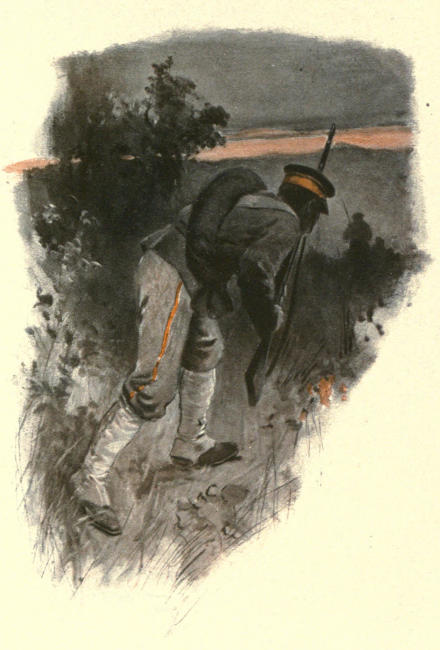
He saw dimly a dark figure.
Suddenly as he sat resting and thinking under
cover of a thick willow, he heard a sound
that seemed close at his left. With every sense
alert he gazed in the direction whence it came,
and waited. Presently it was repeated, and
now he recognized a man’s voice, husky and
guttural from the unsuccessful effort to whisper.
He lay face down on the sand to muffle
his heart, for it seemed that the enemy surely
must hear its beating. Then as he watched he
saw a match struck in a clump of willows
scarcely forty yards away, and presently
caught the glow of a lighted cigarette. Soon
another and another appeared, and then their
aroma came faintly to him across the night.
Three men awake, he thought; did that mean
a dozen in the post? He wasted no time in
guessing, but flat on his face wriggled away
across the sand. He was inside the line of
outposts now, and when he had crawled a long
distance and put some bushes between himself
and the men he had so nearly run into, he rose
and walked rapidly forward.
He had advanced what he calculated to be
nearly a mile from the boat, and thought he
must be nearing the stream he was seeking.
The ground became less sandy and there were
fewer trees and bushes. He thought it unlikely
that the Russians would have more outposts
there. He had almost concluded to make a run
for it to the river, when a rifle shot to his right
and behind him sent him flat to the ground in
breathless suspense. Someone had been discovered!
Other shots followed, and then a
fusillade that sounded like that morning brush
when he had first heard fire. He crawled to
the nearest bush and lay still.
No bullets whistled his way and he heard no
reports from the rifles of his men. The fire
was all Russian, and he hoped it was only a
scare and that his men had got away. Then he
saw that the firing was extending toward the
river, and the reports of Japanese rifles mingled
in the sound. They were caught back
there, and his heart stood still at the thought
that the success of the night’s work might depend
on him. From the direction in which
the firing came he thought the Russians must
be near his boat. Perhaps his party were all
cut off and killed, or worse than that, captured.
The firing ceased, and he lay under his bush
and wondered what to do. He remembered
that he had not yet reached the river, and he
rose and ran swiftly forward. Soon he caught
the gleam of water, and in a moment was at the
bank. He lay down and went over his calculation
of the distance he had come. Then he
looked up at the stars, marked out his course,
and started back.
He knew the location of one outpost, and he
thought at first his best chance was to go as
close to it as he had come. But he reflected
that all the sleeping men must have been
roused by the firing, and that if they had discovered
the boat they would watch to see if
any of the scouting party came back to it.
No, he must go another way and swim the
stream. But he wanted his uniform. He
dreaded what would be said to him if he went
back without it. How to get it was the question.
The aroused Russians were between
him and the bush where it lay.
The fire had not extended much to his right
and he judged that the line of outposts did not
reach far that way. He turned sharply downstream
and moved as rapidly as he dared. At
times, when the way was open, he ran; but in
the bushes it was slow work. At last he ventured
to turn back toward his own shore.
Cautiously he made his way until the soft lap
of the water on the bank caught his ear. Here
was the stream. Should he strike in, or try for
the uniform? He wondered how long he had
been on the island. It might be an hour, it
might be two. The night was yet far from
spent. A low ridge of sand ran parallel with
the bank, shutting the stream from his sight.
He moved stealthily to the river side of it and
made up his mind to go after his uniform.
The ridge would guide him to the bush where
it lay, and if worse came to worst a quick leap
would take him into the water and he would
trust to the darkness to escape the Russian
lead.
At first he walked upright, near the water,
and traveled rapidly. Then as he approached
the point where he judged the Russians might
be, he came close under the ridge and crawled
on hands and knees. It was ticklish work, and
the rifle bothered him badly. Not a sound
came to his alert ears. By and by he wriggled
to the top of the ridge and peered over. After
a time he thought he could make out the willows
where the smokers had been. His own
bush was not far off now and he crawled on.
A new thought stopped him like a blow.
Suppose the Russians had found his clothes
and were waiting for him to come for them.
That was a matter to be considered, and he
pondered it seriously for some time. Then he
went on. He would take the chance. Keeping
the ridge between himself and it he crawled
opposite the bush and lay a long time listening
intently. He was so near he thought he could
hear the breathing of any man waiting, and
knew he would hear a movement. Not a sound
came from the bush, and at length he ventured
on. It was but an instant’s work to gather up
trousers, blouse, and boots and scuttle back
over the ridge.
One foot was in a trouser leg when he
stopped. The river was wide and swift. It
would be hard enough to swim as he was, and
the thick uniform would hamper him terribly.
He thought it over a moment, then swiftly
rolled up blouse and boots and tied them with
the trouser legs in a bundle at the back of his
neck. Then he slung his rifle across his back
and waded in. The water was icy cold, but he
moved slowly lest he make a noise and arouse
some Russian. He was up to his waist and almost
ready to strike out when an unlucky step
brought his foot down on a stone that turned
and he stumbled forward with a loud splash.
Instantly there came a hoarse, Russian shout
from up the stream and he ducked. As he
went down he heard the loud report of a rifle
and felt the wind of a bullet over his head. He
plunged forward and swam rapidly out and
downstream. Low in the water, with head as
far down as he could keep it, he put all his
strength into his strokes. Behind him the Russians
along the shore fired as if charged by an
army. The bullets sang over his head and
hissed in the water beside him. He heard
the roar of the rifles and the shouts of the
men, and tried to dive, but under water the
bundle and rifle held him back, and he gave
that up.
Gradually the firing slackened, and when it
ceased he judged by the current that he was
in mid-stream. He was very tired now, and
very cold. He began to fear he could not get
across. But the thought of the disgrace of
failure after all he had done nerved him for
fresh effort. He had the information the party
had been sent to get, and it might be that none
of the others had secured it. He must go on.
In spite of his exertion the cold was agonizing.
His bones ached from it, and his heart was
bursting with the strain. He had done his best.
He could do no more. The bank that seemed
so near was yet out of reach. He had taken his
last stroke. No, one more, and now another.
A third, and his feet struck bottom. He staggered
out and fell exhausted on the sand.
How long he lay thus he did not know.
Aching from head to foot, shivering with cold
and with rattling teeth, he struggled to his
feet. Somewhere upstream lay his goal and
he reeled toward it. Presently the walking
warmed him a little. He unslung the bundle
from his shoulders and put on the sodden uniform.
Then he thrust his feet into the boots
and went on. Dawn was breaking when he
stood at his captain’s door and heard the voice
of Kokan saying:
“That fool Kutami aroused the Russians
and we could not go on. We just barely got
away. He spoiled it all, and probably was captured
as well.”
Then he went in and reported, and when he
finished, heard, like a voice in a dream, his
captain’s comment:
“That is the spirit of Yamato Damashii!”
(the soul of old Japan).
He turned and went out, with Kokan staring
after him in speechless amazement.
XIV
There followed a few days of grateful
inactivity for Soichi. The surgeon
said he must rest and recover
from the strain and exposure of
his night’s work, and he found it very pleasant
to lie in his blankets and smoke and receive
the congratulations of his comrades. The
story swept through the regiment and every
man knew what he had done.
Kokan was not so comfortable. He was
suffering from a mental difference with himself
which urgently demanded adjustment.
But pride stood in his way. He knew he had
been wrong and he hated to admit it. His accusing
self kept recalling to him the captain’s
queer look that morning after Kutami had
gone, when he turned to Kokan and said:
“I am inclined to think you are mistaken
about him, Lieutenant Kudo;” then added, as
if it were an afterthought, “it must have been
someone else who alarmed the Russians.”
“Yamato Damashii,” the captain had said
to Kutami, and it was true. He had acted with
the spirit of the Bushi, the soldier knights of
the old feudal days. With the bitterness of deserved
self-accusation Kokan admitted the justice
of Captain Minami’s judgment. He, the
Samurai, had failed, but Kutami, the Eta, had
succeeded.
Soichi was lying on his back rereading
O-Mitsu’s letter for the thousandth time, although
he knew it already by heart, when Kokan
came in without his sword. He sprang to
his feet and saluted, then stood at attention.
But Kokan said:
“Sit down. I am not here as an officer. I
came to talk a little with you.”
Surprised and curious Soichi obeyed, wondering
what it could be. His quarters-mates
were all away and he and Kokan were alone.
For some time they sat silent, the lieutenant
uncertain how to begin. He had had a hard
struggle with himself, but his sense of right
had triumphed. The last of the Kudos would
not stain the family honor, kept spotless for so
many scores of years.
“I blamed you unjustly,” Kokan said bluntly
at last. “It was not you who aroused the
Russians.”
“That is nothing,” replied the amazed Soichi,
and bowed respectfully. “I am only glad
that your expedition was successful.”
He cherished no animosity toward Kokan
now, and it distressed him to see his lieutenant
humbling himself in this manner. He had
forgotten the things that had passed and his
mind was set wholly on the future. His only
hope was to die gloriously in action. But Kokan
had made the plunge and now he was going
through.
“I have been unjust to you at other times,”
he went on. “It is not becoming the honor of
an officer or a Samurai to act meanly, and I
have come here to express my regret.”
Soichi was genuinely pained. His ready
sympathy understood how hard it must be for
the haughty Kokan thus to demean himself,
and he responded quickly:
“I beg you not to think of it, or to say such
things. I want only to do my duty, and you
have helped me to that.”
“I?” exclaimed Kokan, surprised in his
turn. “I helped you? Tell me how.”
“Please do not think me rude,” replied Soichi.
“It is hard to explain to you. You were
born a Samurai and have an inheritance of
honor to maintain. It is natural to you. It
comes without thought. It is merely to live in
the old way. I was born a Commoner, but
the son of one who had been despised as an
outcast. The Emperor gave us citizenship.
It is to him we owe everything. To win honor
is our first duty, for surely that is what he
meant when he promoted us. Honor lies in
his service. To give him true service, therefore,
is all my wish, and if sometimes I have
felt that you—that someone was watching
closely to catch me in failure, it has helped me
to be a better soldier, and perhaps brought me
nearer to winning honor.”
Kokan sat like one in a dream. This son of
an Eta was telling him things he had heard
from his father and read in the books of the
Samurai of generations long agone. It was
the old doctrine of the Bushi, but he spoke it
as if it were his own discovery.
“You talk like a Samurai,” he said, and rising
abruptly, went away.
He had caught a glimpse of the soul of
honor and it dazzled him. Here was honor
for honor’s sake. No other thought, no consideration
of self, no hope of reward, no seeking
for gain of any sort, the simple effort of a
faithful heart to show in loyal, devoted service
its gratitude for a great gift. In comparison
with the high standard of his life, the teachings
of his long line of soldier gentlemen, it
was a thing of wonder and amazement. Many
hours he pondered it, and from his meditation
rose with a new resolve. The service of the
Emperor had profited by that talk with the
Commoner.
Spring was full-blown. The sun shone with
summer warmth and fields and meadows were
clothed with green. The leaves hung thickly
on the trees, and masses of rhododendrons
robed the slopes of the hills in pink. Through
all the army ran the whisper of coming action.
In the afternoon the men were in their quarters.
In the evening, silently and swiftly they
moved out. They bivouacked for the night in
the little pockets among the low hills close to
the water’s edge, and in the starlight ate cold
rice from their ration baskets. Then, rolled
up in their blankets, they slept, rifles by their
sides.
The bark of a gun heralded the coming of
the day, and the men rose to see the battle
joined. All day they lay in their hollows and
heard the hoarse, angry roaring of the guns
and the vicious rush of shells, as if a mighty
wind beat through the tops of a forest of
pines. Darkness fell and the guns ceased
their frightful clamor. Then came the order
to move.
All night they toiled. As if by miracle
they saw the pontoons thrown across the rushing
streams, and the lumbering guns swing
forward. In the soft sand of the islands they
put their shoulders to the wheels the tired
horses could not turn, and on the cannon
moved into their new positions. The murky
gray of early dawn found the Russian hills
ringed in front with Japanese steel. The day
had come at last when Kutami Soichi was to
meet the test.
Fiercely through the lifting mist rang the
challenge of the guns, and over the heads of
the Guards, lying far out on the sandy island,
screamed the deadly shells, searching the
nooks and corners of the Russian lines. Soichi
was in the first line. Across his breast hung
his boxes of cartridges, and in the blue cloth
tied over his shoulder were his two little baskets
of rice. His rifle, polished and cleaned
with arduous care, was ready.
For half an hour the shells flew over their
heads, and then along the line rang a single
shrill blast of a whistle. Instantly they were on
their feet and surging ahead. One wild “Banzai!”
rolled from their throats and they settled
to their work. Suddenly the silent
trenches along the hills leaped into life and the
storm of Russian lead beat upon them. Steadily
they went forward, not a rifle making answer
to the fierce fire from the hilltops. Men
went down, but only those stopped who could
not go on. Into the last of the three broad
streams they plunged, and under that unceasing
sweep of bullets forged across. Then on
the double they sprang ahead, while above
them still hurtled the venomous messengers
from their own guns. The earth shook with
the concussion of the cannon, and the beautiful
day smiled on hill and river red with war.
Fairly at the foot of the Russian height they
halted, and for a brief breathing space stood
still.
At the left of the line, where the Guards
were to charge, the enemy held the crest of the
ridge with a double line of trenches terminating
in a square redoubt. There were the red-mouthed
guns belching their hail of iron
death. In front, on the slopes, were fences
and crisscrosses and tangles of wire, winding
in and about among traps and pits and jagged
stakes, and swept unceasingly by the murderous
fire of the rifles and machine guns in the
trenches.
Three things Soichi knew no soldier should
remember on the battlefield—his home, his
dear ones, and his own body. Calmly he surveyed
the terrible ground over which he was
about to undertake the desperate rush. Up
there, on the heights, were the lines to which
some of them must go through to plant the
flag of the Rising Sun, as the Emperor wished.
He wondered who would be the one to win
that coveted honor. As for him, this was
the hour in which he was to die his “glorious
death.”
Almost before he knew it the whistle shrilled
again and they were off, running steadily, in
wide open lines, straight up the rugged hillside.
They cheered once at the start, a full-throated,
rousing “Banzai! Banzai! Teikoku
Banzai!” but it took too much breath from the
running, and they stopped, that the work might
not suffer.
Now as he raced along, the young soldier
found himself curiously taking note of things
occurring around him. His right-hand man
went down, and Soichi, seeing him fall, knew
that he was dead. There was one, he thought,
who had gained the prize of glory. It seemed
strange that he, too, was not hit. And there
was Lieutenant Kudo, perhaps a pace ahead
of the line, running as hard as he could and
somehow finding breath to shout to the men.
He marveled at it, and with mind bent on
that wonder, ran full into a tangled wire that
stopped him with a jerk, almost throwing him
backward to the ground. It filled him with
sudden surprised rage, and he grasped the wire
and tugged away at it as if to pull it away by
main strength.
All the time he heard the soft voices of the
bullets flying close by his head, the little half
whisper like the cheep of tired chicks nestling
at dark under the protecting feathers of the
mother hen. The wire would not yield,
though all along its length the men had laid
hold as he had, and were putting forth all their
might. As he looked, Soichi saw a line of his
comrades who had fallen by the fence, struck
down on the measured range. He drew
back his rifle and brought the sharp bayonet
down on the wire with a savage swing, all
his weight in the blow. Clean to the ground
it went, through all the strands, and the way
was open.
On he dashed, not even looking to see
whether any followed. Blindly he knew that
Kokan was near him, still calling. He was so
tired he could hardly lift his feet, and yet he
kept on running, running, always running up
that death-swept slope. Now the men knew
the secret of the wires and there was little delay.
Soichi heard the machine guns rattle as
he had heard the typhoon rains beat on the
iron roof of his father’s warehouse. The
Russian guns sent their shells shrieking over
the slope and carrying away his mates in
groups. He saw men fall into the pits, stumble
and throw forward, crumple up and drop,
go down all about him. Still the prize was
not his. He went on.
Then, without warning, the world came to
its end. The whooping and whistling, the
shrieking and singing of shells and bullets
ceased, and with a far-off, muffled roar, the
solid earth rose beneath him and hurled him
headlong forward, him and Kokan together.
He wondered, curiously, as he was in the air,
if it were to be the trick of fate that he and the
lieutenant were to win death together. Then
he fell, and for an instant neither saw nor
heard nor felt nor thought. A voice calling in
tones he knew, brought him back to himself
and the riot and din of the horrible maelstrom.
He struggled to his feet to hear Kokan shouting
to him:
“Come on, Kutami! Now show if you can
fight!”
The quick blood leaped in him at the challenge
and he sprang forward. Over his shoulder,
as he turned, he caught a glimpse of the
great hole where the mine had exploded, and
beyond it, down the slope, he saw men going
back, Guardsmen, his own Guards! The horror
and shame of it filled him with rage, and
he began to run again, on up the hill. Something
was the matter with his head, he did not
know what, nor did he care. He and Kokan
were left, and if all the rest failed they two
would go on. He shouted in answer to the
lieutenant’s call, and strove to overtake him.
With the sword of his fathers flashing over
his head the Samurai boy ran, shouted, staggered,
went down. Of all the charge Soichi
alone was left.
Yet he went on. The Russians in the
trenches cheered him and held their fire, too
brave themselves to murder the brave. And,
in the sudden hush that fell on the awful day,
Soichi heard Kokan calling again:
“Come here, Samurai! I am wounded!
Take me back!”
Samurai! Kokan had called him Samurai!
All in a daze Soichi obeyed, thrust his arms
under those of the wounded lieutenant, heaved
him up on his back and staggered slowly down
the hill. He walked like one in a dream,
neither seeing nor caring where he stepped,
and yet by miracle not falling. And when
some of the men in the trenches, more ruthless
than the others, fired again, he shifted
Kokan in front of him lest he be thought to
shield himself by his burden.
He was halfway down when suddenly the
trenches burst into flame once more, and he
saw his Guards coming back. The reserves
were up! The charge was renewed! Methodically
he looked about him, found a pit,
carefully laid the wounded officer there out of
danger, wheeled and headed the new assault.
Oh, how tired he was! How hard it was to
keep his legs from doubling under him! And
yet he must! This was the day he was to die
a glorious death.
Back again by the mine-wrought hollow, the
fresh men up with him now, and some of them
ahead. One he saw with the colors, the clear
white banner with its broad red sun. A bullet
hit his rifle and struck it violently from his
hands. He paused, confused, and saw the
color bearer pitch forward on his face and the
colors fall. A voice seemed to shout in his
ear:
“It is the Emperor’s wish!”
He sprang forward, grasped the staff and
waved the flag over his head. Under the awful
fire the line was beginning to falter, but
the flag caught their eyes and a cheer rang
up the hill behind him. He filled his lungs
and shouted “Banzai!” It was as if new
strength came to him with the call. He dashed
on, reached the wall of the redoubt and scrambled
up, waving his banner and roaring “Banzai!”
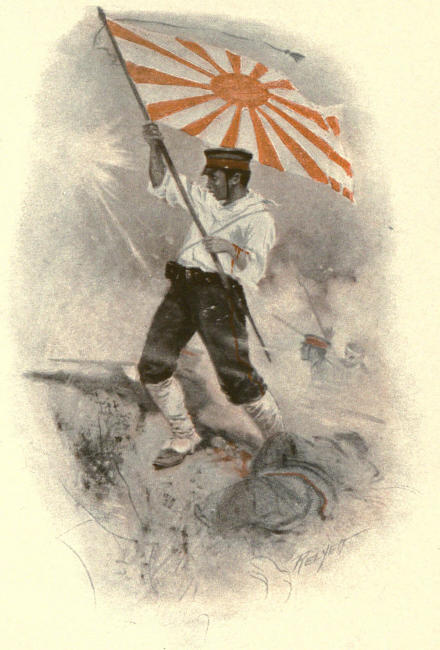
“Banzai!”
He saw his fellows swarming about him and
knew they had won. Then something struck
him a terrible blow on the shoulder and he fell
unconscious on the rampart.
XV
Lying on a board in the field hospital
at the foot of the hill up which
he had charged, Soichi opened his
eyes to see the slow sun dropping
behind the ridge across the river they had
won. The long line of carts and pack horses
filing by, told him the victory was complete,
the transportation was coming up. His head
and arm and shoulder were wrapped with bandages,
and when he turned slightly on his
hard bed a sharp pain warned him to lie still.
A man in a long white apron, with his sleeves
rolled up and a red cross on his arm came toward
him, and he recognized the spectacled,
kindly face of the surgeon. With a pleasant
smile the doctor looked him in the face and
touched his wrist a moment.
“You’ll do now,” he said.
Then two men came with a stretcher and
carried him to a soft bed of blankets in a big
white tent, and told him to go to sleep. It was
very comfortable in the warm bed, and he lay
there quietly, trying to recall the events of the
day. After a little, he turned his head slowly
and stared into the eyes of the man in the next
bed. It was Lieutenant Kudo.
“Oho,” said Kokan, and his eyes danced.
“It’s you, is it, Samurai? They say you won
the charge.”
But because he was a good soldier and it
was the order, Soichi calmly closed his eyes
and went to sleep.
Next morning stretcher men came again
and carried Soichi and all his tent mates into
the town they had helped to capture the day
before, and there, in a fine, big room in a solid
house, he found another bed of blankets ready
for him. Kokan was not with them; the
officers had a different hospital and there the
Samurai boy was taken. Wrapped in his soft
blankets Soichi rested and dreamed and slept.
One morning when the surgeon came to see
him he brought some officers of the staff, and
one of them, a grizzled colonel, with the star
of a great decoration blazing on his breast,
spoke to him and asked his name. Soichi
tried to stand up, as was proper for a man
answering an officer, but the colonel forbade
him and he lay still. Then the colonel said
in a loud voice, so that all the room could
hear:
“The general sends his compliments to Kutami
Soichi-san, first-class private, and grants
him a kanjo for his extraordinarily gallant
conduct in the charge of the Guards and at
the redoubt.”
Before Soichi could think, his wounded
comrades were shouting “Banzai!” the grizzled
colonel joining with all his voice. For a
moment he could not speak. He was overwhelmed
with the unexpected honor. A kanjo,
that certificate of merit and honorable service
more dearly prized than life itself. He had
never dared to dream of winning that. The
staff officers saw his confusion and smiled
in kindly encouragement, and the surgeon
beamed at him through the big spectacles.
He lifted his head a little and tried to reply
to the colonel.
“It was only a little,” he said feebly;
“nothing at all. I thought it was the Emperor’s
wish!”
He fell back on his blankets, and with flashing
eyes the staff officers saluted him and
stalked out of the room.
“Ha!” said the colonel, as he mounted his
horse, “there is a soldier!”
His comrades were miles away, daring the
Russians to renewed conflict, when Soichi had
recovered enough to walk about a little and
write to his father.
“I had hoped to win a glorious death,” he
said in his first letter, “as was fitting for the
first Kutami to be a soldier of the empire.
But now I have received this honorable kanjo
and I am happy to live and to come back to
see you and my mother again. I shall be quite
well in a little time, but my service is ended.
The surgeon says my rifle arm will not stand
that work again, and a better man must take
my place. I tried to do my duty, but now it
is finished.
“For one thing I am very glad. Kokan
and I are friends. We are coming home very
soon, as soon as we can travel, but Kokan will
return when he is quite well. He calls me
Samurai now, and says I ‘won it with the redoubt.’
We have talked much about the old
days and our homes, and even about O-Mitsu.
Perhaps if you send someone to ask Kudo-san
for her now he would not refuse.”
It was a different letter that Lieutenant
Kudo sent to the house in Timber Street.
Himself he spared not at all, and in long detail
told the story of the midnight scout and
described the day of battle.
“You do not know this Kutami,” he said.
“He may have the name of an Eta, but he has
the heart of a thousand Samurai. He has
taught me a great lesson. O-Mitsu will be
honored, and we too, if he still wishes to
marry her.”
When Jukichi read the letter he sat a
long time in silence, but O-Mitsu put her face
in the cushion and wept for joy.
Two gray-haired men stood together on the
landing watching the hospital ship swing into
her moorings. Together they stepped down
to the launch that puffed out into the bay, and
as the steamer’s anchor rattled down, together
they stood up and shouted “Banzai!” Together
Jukichi and Chobei climbed the gangway
to greet their soldier sons. That day the
Gentleman had accepted the Commoner’s proposal
for his daughter, and in the house in
Timber Street a happy girl was awaiting the
return of her lover.