The Amîr’s autograph letter. Medical consultation concerning the rearing of the
Prince. Conflicting customs of the Orient and the Occident. Conservative
nurses. The “Hakim fair to see”: the patient: his fate. Lessons in Persian
and lessons in English. Portrait painting. Dietary difficulties. Gracious acts
of His Highness. Amîr’s letter of condolence. The Royal visit by deputy.
Congratulations of the British Agent. The doleful dumps of illness and the
cheery Armenian. Accident to the favourite Page. The khirgar. Story of
the attempt upon the life of the Amîr. An earthquake. Afghan appreciation
of pictures and jokes. Generosity of the Amîr. The first winter Durbar. His
Highness’s invention. The Royal costume. The bearing of the men brought
before His Highness. The Amîr’s question: the Parable. Arrangement and
furnishing of the dining-room. The guests. The breakfast. The press of
State business. Amîr’s thoughtful kindness. The Armenian’s comment.
Visit to the Commander-in-Chief. The ride to the Hospital. Adventure with
the “fool horse.” Hospital patients in winter. “Two much and three much.”
At the beginning of October I received an autograph
letter from His Highness, directing me to consult with
the two chief Hakims, Abdul Wahid and Abdur
Rashid, and advise as to the best manner in which
to rear the infant Prince. This is a literal translation
of His Highness’s letter:—
Amîr’s Autograph Letter.
“To the Honourable and Righteous Dr. Gray,
“Be it known to you that my two Physicians,
Mirza Abdul Wahid Khan and Mirza Abul Rashid
Khan, are directed by me to consult you and take
your advice concerning the customs and ways in
which Europeans of to-day rear their children, and
also concerning the proper time for putting on and
removing the bandages, and the time of giving milk,
and of cradling and sleeping, and all things which
are necessary for the nourishment of a child, which
are written by the doctors and scientific men of
Europe. These physicians are acquainted with the
customs of the Greeks, and I desire that they be
informed concerning the customs of Europeans.”
Amîr Abdurrahman,
“Finis.” “I have written it.”
The Hakims arrived at half-past seven in the
evening. I have spoken of the courtly old Abdul
Wahid with his Roman face. He was Hakim to Amîr
Shere Ali. Abdul Rashid was the very fat man with
interminable words. He did the talking, because he was
ignorant, and Abdul Wahid sat silent. They were both
exceedingly polished as became Court physicians.
We compared the customs of Orientals and Occidentals
in the rearing of infants. The Hakims were
very surprised to hear that we did not bandage infants
closely from shoulder to ankle, and so prevent them
from moving a limb.
“How then can you ensure that the child’s limbs
grow not crooked? What other method is there for
keeping them straight?”
I said, “Cannot Allah who created each child
finish His work and cause its limbs to grow straight
without our help.”
“Beshak—undoubtedly, Allah is all-powerful and
all-wise; but our fathers, and our fathers’ fathers,
placed bandages on the children, and they were wise
men. How do you account for the fact that in some
children the legs are bent?”
I forthwith entered into an explanation of the
causes of rickets. How that want of pure air, of
sunlight, and free movement of the limbs, of suitable
food, produced a disease of the bones in which the
lime salts were absorbed, leaving only the soft
bendable gristle, and so on—but it was not any use:
they knew nothing about pathology, or anatomy either.
So we left that and went on to other matters.
The Rearing of Afghan Infants.
The Afghan baby—among the rich—is wrapped up
as to the head and neck by a stifling head-dress, rather
like that which an Arab wears to protect him from
the sun, and I could not make them understand the
advantage of dispensing with a head covering indoors.
The cradle is a massive wooden concern. It consists
of a hammock or shallow box, suspended at
either end from a longitudinal bar supported on
uprights, so that it will swing from side to side.
When the child is asleep every breath of air is
excluded by thick curtains, which fall from the bar
over the sides of the cradle—and this in a hot climate.
What could I say? We differed in almost every
detail; there was no common ground to start from.
The Sultana had expressed her desire that the
European doctor should attend the Prince medically.
I saw a cheerful future before me, for I found that the
nurses would diverge, not in the slightest degree, from
the customs of their ancestors. It is possible to move
a mountain—granted time and a sufficient amount of
blasting material—but no amount of blasting will
move an Oriental woman out of the rut that ages of
custom has made.
The Sultana did not nurse her child. A nurse
therefore was sought for to rear the little Prince.
Before the Hakims left my house the fat one
expressed his deep sense of gratitude that I had
granted him my friendship, and he ended a polite
speech by asking me to see a patient of his. I ought
to have remembered the poet’s lines:—
“I know a Hakim fair to see,”
(Only he was dark and fat, but that does not matter)—“Beware!
He can both false and friendly be—Beware!
Trust him not he is fooling thee.”
I went to see the patient: he was one of the
Chamberlains, Nasir Courbon Ali. He was exceedingly
ill with malarial fever, and his skin was yellow,
which was bad. I thought there was a chance of
saving his life if vigorous remedies were used.
I returned home and directed the compounder to
prepare a mixture and deliver it himself. I visited
the Nasir three times that day, but he did not seem to
be improving. The next day he was worse. I had
to go on to the Hospital, but when I returned home
I said to the compounder,
“You sent the Nasir’s medicine this morning?”
The compounder had picked up a little English
from the Armenian. He said,
“No, sir, I forget it.”
Forget it! I was exceedingly angry.
“A man’s life is in extreme danger, and you forget!”
Then he explained, or rather the Armenian did.
When he had delivered the medicine he found the
Hakim there: he left the medicine, noticing where it
was placed; he returned once or twice during the day,
but found the bottle just as it had been left. Not a
dose was given that day or afterwards. Why, therefore,
did the fat old fraud ask me to go and see his patient?
I do not know. The Nasir died the next day.
Lessons in English.
Towards the end of September the cases of
malarial fever among the soldiers and townspeople
began to decrease in number, and I had more leisure.
I commenced to study Persian, with the occasional
assistance of Munshi Amin Ullah, secretary to the
British Agent. The Armenian was not, at that time,
sufficiently learned to attempt to teach me. He had
very vague ideas as to moods and tenses: and pronouns
and prepositions bothered him considerably.
I tried to teach him English. He knew the letters,
but words, whose sound and meaning he knew well,
baffled him completely when written. I found this was
chiefly due to the fact that when he spelt out a word
he pronounced it exactly as it was spelt. “Enough”
was a complete stumper, because there was no “f” in
it. He considered it ought to have been “enuf,” and
wished to argue the point with me; so that his
English reading did not progress very rapidly. He
spoke fluently in Hindustani and some of the other
Indian languages, in Persian and Pushtu, and was
picking up Turki while we were in Turkestan;
English, too, he was becoming better acquainted with:
all these he learnt by ear, but Hindustani and Persian
he could both read and write.
About this time I found leisure to take up painting
again. Rather fancying myself in Afghan turban and
robes, I painted my portrait from the reflection in a
hand-glass. It happened to turn out a success, and
created quite a little mild excitement. The Armenian
was not the man to let my light shine under a bushel:
he looked upon me as a sort of possession of his.
Anything that I could do and others could not,
reflected, he seemed to think, a great deal of credit
upon him: so that he trumpeted the news abroad.
I had a great many visitors, and every second one
asked me to paint his portrait. The Armenian said:
“Sir, you not do. This man, who is?”
Which sentence, though it sounds odd, is simply
a literal translation of the Persian, “Sahib, shuma
ne kunēd. In mard, ki’st?”
However, I consented to paint my neighbour
the Mirza Abdur Rashid, and he gave me some
sittings. He had good features, and was dark-skinned
for an Afghan, so that when attired in green
velvet and gold he made rather a striking picture.
The matter reached the ears of His Highness the
Amîr, and he sent for the two portraits. They were
taken to the Palace just as they were, though the
Mirza’s turban was unfinished. When the pictures
were brought back I heard that His Highness was
pleased with them. My own portrait I rolled up and
addressed to England, intending to have it posted
home by one of the British Agent’s men, who was
returning to India on leave. In the evening, just as
I had addressed it, His Highness sent for it again.
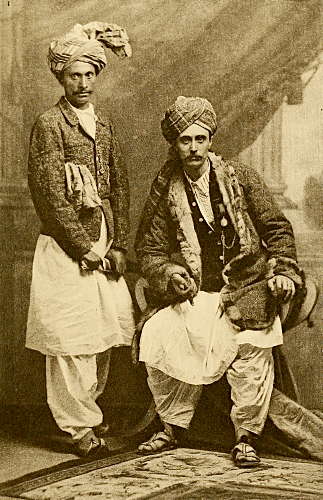
Dr. Gray and his Armenian Interpreter,
from a photograph by Van der Weyde.
I went to the military Durbar the next day, Tuesday:
His Highness was very gracious. He spoke some time
about the Moolah upon whom I had operated for goitre,
and desired me to instruct the native dressers: then
he spoke about the portraits, praising them highly, and
finally told me that he would himself give me sittings
for a portrait.
A day or two afterwards a carpenter arrived to
take instructions for the making of a frame to stretch
the canvas upon. The next day I caught a most
severe cold. It was the end of October, the sky was
clouded for the first time, and the weather seemed
suddenly to have become autumnal.
Dietary Difficulties.
Though the canvas was soon ready it was a long
time before I began the Amîr’s portrait. The cold I had
became better, but, after two or three days, instead of
feeling well I felt much worse. I could not rouse myself
to anything, and I had a constant backache. It
struck me suddenly I might have fever. I had; rather
severely. It was quite different in type from the first
attack I had had. Unfortunately, a few days before, I
had discharged my cook for some rascality or other,
I do not remember what, and the only man who could
cook in the European way for me was my syce, or
groom. This was the man who had been in the Burmese
Police, and who cooked dinner for me the day
we went to Takh-ta-Pul. He could roast meat and
make a rice pudding, but that was about the extent of
his capabilities in the cooking line. With the fever on
I did not seem to hanker after the grey, thin, greasy
liquid he denominated “soup,” neither did I seem to
desire the slippery, sloppy, watery dish he called
“custard” pudding. As bread was not to be obtained,
but only the leathery chupatti, which is not appetizing
when you are ill, the fact began to force itself upon
me that I should be obliged to undergo the Hakim’s
treatment of fever—that of starvation.
However, in a day or two it reached His Highness’s
ears that I was ill. He at once ordered the two chief
Hakims and all the Hindustani Hospital assistants to
wait upon me, and discuss what could be done for my
relief. It was kind and gracious of the Amîr; but it
appeared to me that if I submitted to the treatment of
all or any of them, I should be likely to find myself
in a great deal more danger of dying than there
otherwise seemed any immediate probability of. But
His Highness’s thoughtful kindness was not exhausted.
Hearing that food suitable for a sick European was not
to be easily obtained from the bazaars, he gave orders
to his chief Hindustani cook, a man who had been
imported from one of the hotels in India, to prepare
anything that seemed agreeable to me. The cook came
every day for orders. I had soups, bread, beeftea, jellies,
puddings, and fruit, and, in addition, His Highness
sent me some claret and a bottle of Chartreuse.
I learnt a good deal about malarial fevers from a
patient’s point of view before I was well again, for I
had three consecutive attacks of fever, each differing
from the preceding one in its manifestations.
When I had been ill rather more than a fortnight,
His Highness wrote me a very kind letter enquiring
after my health; this is a translation of it:
“To the Honourable and Respected Dr. Gray,—
“May Almighty God grant you health and safety.
I write to you for I wish greatly to hear of your
health. My prayer to God is that I may see you
always well and happy.”
“Amîr Abdurrahman,”
“Finis.” “I have written it.”
At different times salaams and messages of condolence
were received from the Commander-in-Chief
and other people. I was gratified to hear that the
soldiers and townspeople were wishing for my speedy
recovery, for, certainly, it is a privilege to feel you
have been of use.
I became better, and went for an hour’s ride, which
I enjoyed immensely, but the next day the second
attack came on violently. During this attack, when I
was becoming better, I had the honour of receiving a
Royal visit from the Amîr—by deputy.
The Royal Visit by Deputy.
His Highness sent one of his chief secretaries, Mir
Ahmad Shah, a tall and courteous man. I received
him, of course, in my bedroom, as I was not able to
get up. He brought me many kind messages. His
Highness had signified his intention of visiting me
personally, but explained that he was prevented by
his lameness and the press of State business. He was
greatly pleased with the work I had already done in
his service, and was convinced that I had no other
motive or desire than to serve him faithfully. I
endeavoured to express my gratitude for the honour
His Highness had done me, and for the many kindnesses
he had showed me while I was in his country.
The next day the secretary of the British Agent
arrived bearing the Sirdar’s congratulations to me,
upon being the recipient of such signal marks of His
Highness’s favour.
Some time before I was taken ill I had written to
Dr. Weir, the health officer of Bombay, to whom I
had been introduced when in India, for some vaccine
lymph, and a day or two after my “Royal visit” I
received a letter from him. He said that all our
mutual acquaintances were well, but that he himself
was suffering from a recurrence of the fever he had
caught some years before in Turkestan! This was
cheerful news, seeing that I had had the Turkestan
fever five weeks already. I said to the Armenian,
“I suppose then this will stick to me for the rest
of my days—even if I get better now, which seems
doubtful”—for my liver was touched.
But the Armenian was equal to the occasion.
Oh, no: that fever my friend had was quite
another kind: it was caught at such a place—I forget
where he said—and was a very bad fever.
Everybody knew that fever, it came on sometimes
years after. But this fever it was no-thing.
“Sir, if you very ill, how you can smoke papyrus—cigarette?”
and with other specious words did he
beguile me. I got better after some days, and wrapping
up carefully, for I concluded I must have got
a chill the time before, went for a short ride. I was
all right that day, and went out the next day for two
hours, and came home feeling utterly fagged and aching
in every bone. Back came the fever. The temperature
chart, this time, was quite different from either of the
other two.
The snow commenced, but we did not have very
much, not more than we often have in England, but
the winds sweeping across the plains were bitter.
This attack lasted about a month. In the middle of it
I heard that one of His Highness’s Page boys, rather
a favourite one, named Samander, had met with an
accident. While out riding his horse had become
unmanageable, and the boy’s leg had been dashed
against a tree.
The Hindustanis, who had been sent for, came
to me to make their report. There seemed some
doubt whether the leg was broken or not. They
had, however, put on a splint, but when I asked
what kind of splint, I found that it was one that
was quite unsuitable if the leg were broken. There
seemed nothing for it but to get up and dress and
go off and see. Wrapping up well, and taking a
stick, I hobbled off with the Armenian for the Palace.
The snow was not very deep, not more than six or
seven inches.
Attempt upon the Life of the Amîr.
I found Samander living in a Turkoman khirgar,
in the Palace gardens. The khirgar was a circular
dome-shaped wigwam, about fourteen feet across
by fourteen feet high, and was made of a number
of light but strong wooden uprights, which bent
inwards seven feet above the ground, their ends
fitting into a wooden ring above. It was covered
over with thick felt and then with canvas. A
wooden door was fitted on one side—this is not used
in the summer—and a carpet hung over the door.
Around the khirgar was a small trench to carry off
melted snow or rain. Inside, the floor was carpeted,
and my patient was lying on a mattress on the
ground. The khirgar was very warm, for in the
centre was a large brazier with glowing charcoal.
Light was to be obtained only by opening the door
or by lighting a lamp. In the summer, when the
felt-covering is dispensed with, light is obtained by
pushing back a flap of canvas.
On the boy’s thigh there was bandaged a
wretched little splint, quite useless if the bone were
broken. I soon had it off, and found that the bone
was broken in the lower third. It took some little
time to have a long splint made and to put it on.
Several Page boys, who were living in other khirgars,
came in, and also the official whose duty it is
to look after the boys. When I was putting on the
splint, I noticed the scar of a bullet in the upper
part of the boy’s thigh. I enquired how he had got
it, and then I heard the story of the attempt upon
the life of the Amîr which had taken place the year
before.
His Highness was reviewing the troops on the
plains outside the town of Mazar. The pain of his
Sciatica was troubling him so that he was not on
horseback, but sat in an arm-chair, which was placed
on a large square mound or platform some four or
five feet high, artificially made. His Highness sat
smoking a cigarette, the Commander-in-Chief, Page
boys, and officials were grouped around his chair,
and seated on the ground by his side was Captain
Griesbach, C.I.E., the geologist.
An Herati regiment was passing, and suddenly
one of the men stepped out of the line, threw up his
rifle, and fired point-blank at the Amîr. Just at
that moment His Highness leaned over to speak to
Captain Griesbach, and the bullet whizzed under
his arm, through the chair back, and caught
Samander just below the hip.
The Amîr continued what he was saying without
a pause, and still smoked the cigarette. The
Commander-in-Chief sprang instantly from the
mound and rushed on the man to cut him down.
Then the Amîr shouted “Stop!” But it was too
late, the Commander-in-Chief’s sword flew to pieces
on the man’s head, and the bystanders instantly dispatched
him.
The Amîr, presumably, wished to go into the
matter, for the Herati was a known shot, and to
enquire the motive of his action with a view of
determining if he were alone in the plot. But
whatever may have been suspected I never heard
that anything definite was found out. It was,
however, an evil day for the officers of that
regiment.
Samander receives a larger pay than any of the other
Page boys, and is naturally somewhat of a favourite.
It was two hours before the splint was made and
properly put on, and at the end of it I was quite done
up. I found that the fact of my arrival had been
reported to the Amîr, for His Highness most kindly
ordered the palanquin of one of the Princes to be
brought to the khirgar to convey me back to my
house. I visited Samander once or twice after that
to see that everything was all right, but my temperature
began creeping up in a way that was not at all
satisfactory, so that I had to give up going and simply
trust to reports from the Hindustanis.
An Earthquake.
We had an earthquake a few days after this, at
half-past five in the afternoon. The bed shook and
the door and windows rattled, but it was quite a
slight affair compared with the Kabul earthquakes.
I called out to the Armenian, who was in the next
room playing cards, to ask if he felt the shock. He
came in to know if I wanted anything.
“Didn’t you feel the earthquake?” I said.
“The what, sir?”
“The earthquake! Why, man, the house shook.”
“Ah!” said he, “I did think a little the earth
shivered, but I not notice.”
On Christmas day my fever departed. Some time
before, I had written to Mr. Pyne to ask him to send
me a cook, if he could find one, and on Christmas day
a cook arrived bringing a box of newspapers, Graphics
and Punches, and a case of briar pipes, which had
reached Kabul from London.
The Graphics and Punches were a constant source
of amusement to myself and my visitors, the older
as well as the younger ones. I was astonished to
find how little idea some of them had as to what a
picture was intended to represent.
For instance, in one of the Christmas numbers—it
was of the year before, but that didn’t matter—a
pig was represented standing up on his hind legs to
take a view of the world outside his stye. Little
Mahomed Omer, son of Perwana Khan, could not
make the picture out at all; finally he came to
the conclusion that it represented a horse in his
stable. The Armenian allowed him to remain with
that idea.
The pig is unclean to the Mahomedans, and he
would have been very disgusted if he had thought
that we ate such a nasty creature.
A frequent visitor at this time was a young man
named Shere Ali, who was, I was told, the second son
of the ex-Mir of Bokhara. A friendship commenced
at that time between us which, like that of the Mirza
Abdur Rashid, lasted till I left the country.
Shere Ali was greatly interested in “Misterre
Punch.” I had to go over the jokes and explain
them to the Armenian—sometimes, in the more subtle
ones, a matter of no little difficulty—and he translated
them to Shere Ali in Persian. Shere Ali
generally laughed, though I fancy from the little I
had picked up of Persian, that the Armenian made
his own point when he had missed mine. He was
quite capable of both seeing and making a joke, as
I found in after years when I brought him to
London.
With the aid of the pictures I gave the Armenian
vivid descriptions of London and the glories thereof.
One day, somewhat to my surprise, he said:—
“Sir, let me see London. If I die then—don’t
matter!”
The officer who had charge of the Page boys, came
to see me; he was a short thick-set man, and sensible.
He asked me many questions in surgery, and seemed
willing to learn a few simple remedies in case of
emergency. I was very glad to teach him.
Generosity of the Amîr.
At this time I was brought very low in the world
as regards tobacco. I had been reduced to smoking in
a pipe broken-up cigar stumps which, in view of this
difficulty, I had carefully saved. Tobacco, except
uncured, and to me unsmokable Persian tobacco, was
not to be obtained in Mazar. I said to the Armenian,
“I shall be cleaned out of tobacco soon—and then,
Chaos!”
He said, “Sir, I not know Chaos, what is; but
Amîr Sahib has plenty of cheroot and cig-rette.”
“That is very likely,” I said, “but I haven’t.”
“You not care it, I write him, Amîr Sahib, and
he give it you. What a few cigar or cig-rette!
no-thing!”
“No! you must not do that,” I said, “I can’t
cadge of His Highness.”
“Sir, please you kind, you say nothing. I write,
you not write.”
Sure enough he did write. I confess I was rather
ashamed when His Highness sent me ten boxes of
most delicious Turkish cigarettes, four boxes of cigars,
and a silver cigar-case and match-box.
His Highness had forbidden me to go out till I
was quite strong, and it was the 4th of January
before I ventured to do so. I went to see Samander
and found his leg was progressing satisfactorily.
The First Winter Durbar.
On the 7th, it was a Tuesday, was a military
Durbar, and after I had seen Samander and had tea
with him, I determined to go on to the Durbar and pay
my respects to His Highness: this was at eleven o’clock
in the morning. It was the first winter Durbar I had
ever been to.
The Armenian accompanied me. He was gorgeous
to look upon, being attired in a white turban, a yellow
leather postîn, and light blue trousers.
We walked from Samander’s khirgar along the paths
of the garden to the Palace. The trees were white
with snow, and great icicles hung from the branches.
The sky was grey, and the water and mud by the
paths frozen hard. Everyone looked nipped up in
the icy wind. In the far distance to the south were
the mountains dimly blue.
In the open space opposite the Palace was a large
crowd of people with petitions to offer or disputes to
settle. Near at hand was the Amîr’s guard with
fixed bayonets. On each side of a large open window,
which reached nearly to the ground, were secretaries
and other Court officials. At the window sat His
Highness.
The Armenian and I skirted the crowd and went
towards the window, the crowd very politely making
way for us.
I waited awhile, until His Highness had finished
speaking, then when he saw me I took off the
Astrakhan busby I had on, went forward and bowed.
His Highness enquired very kindly after my health,
expressed his pleasure at seeing me, and then directed
me to come into the room where he was sitting.
I was very glad to do so, for in spite of my furs
the bitter wind began to make me shiver.
I made my way through the door of the Pavilion
into the centre hall or passage, turned off to the left,
and raising the curtains over the door entered the
room where His Highness was. Compared with the
outside it was, in spite of the open window, delightfully
warm.
His Highness was seated in an arm-chair facing
the open window: at his left hand was a little table
with a cup of tea on it. He directed a chair to be
placed for me and some more tea to be brought. At
first the pages placed my chair some little distance from
the table, but His Highness ordered them to bring it
near. While I was drinking the tea His Highness continued
giving judgment in the cases brought before him.
Presently a man, apparently a carpenter, was
ushered into the room, bearing in his hand a curiously
shaped pair of wooden sandals with spikes of iron
fixed into them. His Highness examined them, and
then turning to me explained that he had invented
these things himself, that they were to fasten on the
boots to prevent a slip when one was out shooting
among the mountains in the winter.
The Amîr looked very handsome. He was dressed
in a postîn of dark purple velvet, trimmed and lined
with a valuable fur, called in Persian Pari-pásha, I
think a kind of sable. He had gold shoulder knots,
and a belt covered with bosses of gold. In his right
trouser pocket he had a small nickel-plated revolver,
for I saw him take it out when he was searching for
a seal to give to one of the secretaries. A fur rug
was thrown over his knees, and he wore a beaver
busby ornamented with a diamond star.
It was interesting to note the bearing and appearance
of the different men as they came before him.
Almost everyone, who was not attached to the Court,
turned pale, some went white to the lips, or yellow
if they were dark skinned. I understood so little
Persian then, that I could not follow what was being
said, and thus was unable to judge if there were any
reason for this emotion, beyond the awe that the
presence of majesty inspires.
Presently, with a suddenness that was quite startling,
the Amîr turned to me, and said in Persian:—
“Men in autumn and winter are blown upon by
cold winds, and at once take hot fever (tâp-i-gurrum).
In your eyes, what is the reason of this?”
It seemed pedantry to talk pathology, and I spoke
in a sort of parable. I said:—
“A gun is loaded with powder and shot, the
trigger is pulled, the cap flashes and the gun
explodes. The men of this country are the guns;
they are loading themselves with a poison rising from
the earth by breathing it constantly, the malarial
poison. A slight shock, the chill of the wind, brings
about the explosion, and fever seizes them.”
His Highness seemed struck by the plausibility of
this explanation, and presently he said,
“Darûst, darûst, it is right!”
He asked me several other questions, but I am
sorry I have forgotten what they were.
The Dining-room.
The room we sat in looked not unlike an English
drawing-room. The windows, however, were
different. They were wider than English windows
generally are: the larger ones were filled with plain
glass, the smaller with coloured glass; over the lower
part of one large window was a sort of fretwork of
wood, which, as the light was reflected from the snow
outside, was rather a relief to the eye than otherwise.
The door panels and the window jambs were somewhat
elaborately carved: they were neither painted
nor polished. Draped over the doors and by the side
of the windows were silk curtains of different colours.
The floor was covered with Persian and Turkestan rugs.
The walls were white, and the ceiling decorated rather
crudely with colours. The ceiling sloped up on each side
to a beam, supported at each end by a slender wooden
column carved in distinct imitation of a Corinthian
column, but not fluted. Ranged against the wall were
two or three arm-chairs covered with velvet, and some
small tables with writing materials, vases, and lamps
upon them. The table-covers were mostly of velvet
embroidered with gold: one or two were Indian. In
the middle of one wall was what looked like a white
“overmantel,” though there was no fireplace. This
was more Oriental in appearance than the rest of the
room, the keynote of the decoration being
the Saracenic arch.
 On the shelves and in
the recesses of this were small ornaments and vases
of various kinds. Below this decorative arrangement,
and in the position usually occupied by the fireplace,
was a table covered with heavily embroidered velvet,
and on it were two lamps and several brass candlesticks
with many branches, each holding a wax candle,
so that the whole looked rather like an altar in a High
church. In the window that had fretwork over it
was arranged a bank of flowers in flower-pots. The
centre of the room was clear, except that exactly in
the middle was a large brass brazier filled with
glowing charcoal.
On the shelves and in
the recesses of this were small ornaments and vases
of various kinds. Below this decorative arrangement,
and in the position usually occupied by the fireplace,
was a table covered with heavily embroidered velvet,
and on it were two lamps and several brass candlesticks
with many branches, each holding a wax candle,
so that the whole looked rather like an altar in a High
church. In the window that had fretwork over it
was arranged a bank of flowers in flower-pots. The
centre of the room was clear, except that exactly in
the middle was a large brass brazier filled with
glowing charcoal.
At the far end of the room, away from the Amîr,
were seated, cross-legged on the ground, the chief
officers of the army, with the exception of the
Commander-in-Chief, who was ill.
At about two o’clock in the afternoon the Durbar
was over, the petitioners and disputants disposed of,
and His Highness arose. We all stood up.
His Highness did not leave the room, but took
another chair in front of a small oblong table with a
white table-cloth which the servants had brought in.
I did not know whether I was to stop or go, and was
debating the point in my mind, when the Armenian,
who was standing behind my chair, leant over and
whispered:—
“Sir, please you stop, Highness wish it.”
The Breakfast.
His Highness sat at his table, and a small table
with a table-cloth was placed in front of my chair.
The officers sat where they were. In front of them
was spread a large leather cloth, and over it a white
cloth—I was going to say “table-cloth,” but it was
on the ground. Then lunch, or breakfast, was
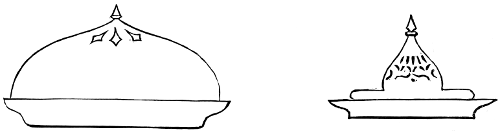
brought in. The dishes were protected with curiously
shaped covers, which were perforated in designs.
One or two were placed upon His Highness’s table,
and several more in front of the officers. His
Highness helped himself, and then the dish was
brought to me. A knife, fork, spoon, and plate were
provided for me, though they are not used in the East
except by Europeans.
I was glad of the fork and spoon, for in those
days I had not learned how to eat pilau with my
fingers. I was just in front of His Highness, and
the Armenian told me that the servants—who really
waited very well, considering—were reprimanded rather
sharply by His Highness for not bringing me
a clean knife and fork for each dish: they were not
used to such things.
First, I had a sort of pancake, tasting something
like that ancient sweatmeat called a “jumble;” after
that some meat, I didn’t know what it was, cooked in
a curious way; then some pilau. Altogether I thought
it very tasteful. Afterwards, they took away the white
table-cloths and put others in their place, mine was
blue velvet embroidered with gold, and fruit was
brought, mostly grapes, which had been kept from
the summer in cotton wool. His Highness lit a
cigarette, and I, pulling out the silver cigar-case, lit
a cigar. For the officers, the native chillim or
hubble-bubble was brought and handed round to
them one after another. Each drew a volume of
smoke into his lungs and handed back the pipe to
the servant, who, after blowing the smoke out of
the tubes, passed it to the next guest.
Then the officers got up, salaamed, and filed off.
I did not. I said to myself,
“I am a stranger, and it is the Armenian’s
business to direct me: he has not hinted that the time
has arrived to withdraw: meanwhile, I am very comfortable.
If an error is being committed, on his head
be it.”
There was no occasion to disturb myself. Presently,
tea was brought in and I had another cigar.
Meanwhile, His Highness was busily engaged:
secretaries came in, spoke, received their directions
and went. Letters or reports were brought
singly and in bundles. His Highness opened them
and generally answered each one there and then;
writing his answer on the flyleaf of the letter or
on the back of it. Then he placed it in a fresh
envelope, fastened it down, addressed it and threw
it on the ground. These letters were gathered up
by one of the secretaries. Other letters, after he
had read them, he handed over to a secretary to
answer, but these were comparatively few.
The Amîr’s Thoughtful Consideration.
In the midst of all this business a youngster,
about ten years old, dressed in tunic, trousers, and
turban, came into the room; as he entered the
silence of the room, he piped out in his young
penetrating treble the usual salutation,
“Salaam aleicoum,” “God be with you.”
The Amîr, who was engaged reading a letter,
answered mechanically,
“W’aleicoum”—“and with you.”
Then he looked up to see who it was: when
he saw the small Page boy he said something in
Persian, in which I recognized the word “Khunûk”—“cold.”
The boy disappeared and presently came
back with a postîn on. I was rather struck that
His Highness, in the midst of the great amount of
State business he transacts, should notice and give
orders about such a small thing as the possibility of
a little Page boy taking cold.
When the press of work was over, His Highness
turned and addressed some very kind remarks to me.
He said, among other things, that he had examined
and found that I was more intent upon doing my
duty and serving him faithfully than upon anything
else. In future, I was not his servant only
but his friend.
He appointed a time for me to vaccinate the
little Prince Mahomed Omer, and—which concerned
my comfort considerably—he, at a suggestion from
the Armenian, ordered the Afghan bath-rooms
attached to my house to be heated any or every
day, whenever I wished. This is rather an extensive
operation, and one to which, considering the
price of wood, my income hardly stretched. Wherefore,
I was duly grateful. I had some more tea,
finished my cigar, and then asked permission to
withdraw. Before I left, His Highness desired me
to visit the Commander-in-Chief, who was ill with
fever. I bowed and retired. We came away at
half-past four, and the Armenian was jubilant at
His Highness’s kindness and condescension. With
Oriental exaggeration he said that no man had been
so favoured as I.
“Highness very kind upon you: very much wish
you,” he said—meaning “like you,” I suppose.
We visited the Commander-in-Chief, drank the
necessary tea, and then I got home rather fatigued by
the excitement and the exercise out of doors. I
took off my furs and lit a pipe for a quiet evening,
but had to go out again to see a Page boy who was
very ill with fever.
I was on the watch that evening and the next
morning to see if I should have any return of fever
myself. As there was none, I had my horse saddled,
and started, after breakfast, on a visit to the Hospital,
where I had not been able to put in an appearance for
several weeks.
I enjoyed being out on horseback again. I was
riding a young horse that the Amîr had given me.
He seemed to enjoy being out also, for presently he
began to toss his head and snort and plunge.
The Armenian said, sagaciously,
“Sir, he very fool horse.”
The plunging was not sufficiently satisfying, and
he commenced rearing and kicking. Unfortunately the
fever, in addition to making my legs shaky, had taken
a large slice off the normal amount of pluck that one
ordinarily possesses, so that in proportion as his
jubilation increased mine diminished.
The road was very lumpy and frozen hard, and it
seemed to me that the “fool horse,” in his lunatic
caperings, must inevitably slip down and break my
leg. There was an evil time to come. We had got
through the Bazaar without any serious mishap when,
just outside, we happened to come alongside of another
man on horseback. This was what my “fool horse”
desired; the very thing he was waiting for—he
always was a regular bulldog for worrying with his
teeth, and was a ruffian at striking: up he reared
and simply pounced on the other horse. He caught
him by the neck and shook him, and drove him up
against a wall. Both reared upright, and then commenced
the screams and the strikings of two incensed
stallions. The other man was even less happy than I,
for my brute was getting the best of it. I wondered
which of us would be killed, and began to think it
would be the other man.
The Armenian shouted,
“Sir, please you hit him with spur.”
I hadn’t a spur to “hit” with, for, knowing the
horse would be “fresh,” I had not put any on. I tore at
his mouth with the curb, and hit him over the head with
my fist. It seemed to astonish him, for he let go the
other horse, and settled on his four feet again. It was
all the other man wanted: he was out of sight round
the corner before you could say “Parallelopipedon.”
We got outside the town and had a large open space
to cross. Some horses in the distance were neighing,
and, of course, mine answered them shrilly and fiercely,
and he tried to be off at a furious gallop to get another
little boxing match. This I was able to put a stop
to, fortunately, for the ground was much broken up
and very slippery. Having nothing better to do,
therefore, he reared and kicked again. We reached
the Hospital at last, and, with shaking knees and a
thankful heart, I dismounted.
The Hospital in the Winter.
There were a great many sick soldiers at the
Hospital, some sixty or seventy. I was not yet strong
enough to attend to them all, and I chose out about
a dozen who were very ill.
Some of them were mere lads, and there they lay
coughing and panting with acute inflammation of the
lungs. It was in times like this that I missed so
frightfully the well-appointed hospitals and the women
nurses of England. The soldier attendants did their
best, no doubt, but very few showed any sympathy or
gentleness with the sick. In many of the cases it was
necessary for the patient to sit up for me to listen to
the sounds of the chest. In England the nurse slips
her arm under the shoulders and head of the patient
and helps him up. Here a curt “sit up” was all.
One or two could not do it, and I had to lift them.
Coming away I decided that the Armenian should
ride the “fool horse” and I would take his. He
said:—
“Oh, yes, sir, I can ride him, but I ’fraid we make
late for your lunch. Better this—you take mine, I take
soldier’s horse. Other horse come afterwards. In my
o-pinion we get home soon this way.”
“Very well,” I said, “I can’t ride him home; it is
too much.”
“Yes, sir,” he answered, “it is three much! a
little you not strong, and he very fool horse.”
It was a long time before I could make him believe
it was “too much, and not two much.”




 Of course, it would go over my head then.
The Amîr enjoyed immensely the astonishment and
discomfiture of the Courtiers, and laughed heartily as
he mocked and jeered at them.
Of course, it would go over my head then.
The Amîr enjoyed immensely the astonishment and
discomfiture of the Courtiers, and laughed heartily as
he mocked and jeered at them.