Quite alone in a mountain village—Return to Rewa—Basaltic pillars—Rewa
pottery—Bau—New Year’s eve—King Thakombau as an elder
of the Wesleyan Church—Pre-Christian times,
A strange volcanic isle—Joeli Mbulu, a Tongan apostle—The conversion
of the people of Ono—Thakombau’s canoe—A royal gardener—A
small hurricane—Early prayers—Breakfast on Thangalei—Between
the breakers—At home at Nasova,
Life at Nasova—Farmyard—Convict thatchers—Native festival at Bau—Return
to Nasova—Battles with crabs—Beginning of cannibal
disturbance—Fijian fairies—A storm,
Isle Ngau—Mud-crabs—Albinos—Bathing in the tropics—An earnest
congregation—A typical village—Fijian students—The burnt
waters—A narrow escape—Wreck of the Fitzroy,
Taviuni—Tui Thakow—Missionary perils—Their fruit of peace—Ratu
Lala—Rambi Isle—Gipsy life—Vanua Levu—A mission conference—The
isle of Kia—A village feast,
The Chief of Mbua—Feudal rights—A night in a miserable village—Church
à la St Columba—Night on a desert isle—Savu Savu—Boiling
springs—Their use—Past and future,
Bewildering new surroundings—The Maori dragon—Breakfast at
Wairoa—The mission-house—The hot lake—White terraces—Sulphur
and mud volcanoes—An unjust claim resisted—Champions
from the Antipodes,
Notes on Fijian folk-lore—Legend of the rat and cuttle-fish: the crane
and the crab: essay of roast-pig: of gigantic birds—Serpents
worshipped as incarnate gods—Sacred stones worshipped—Mythology
and witchcraft,
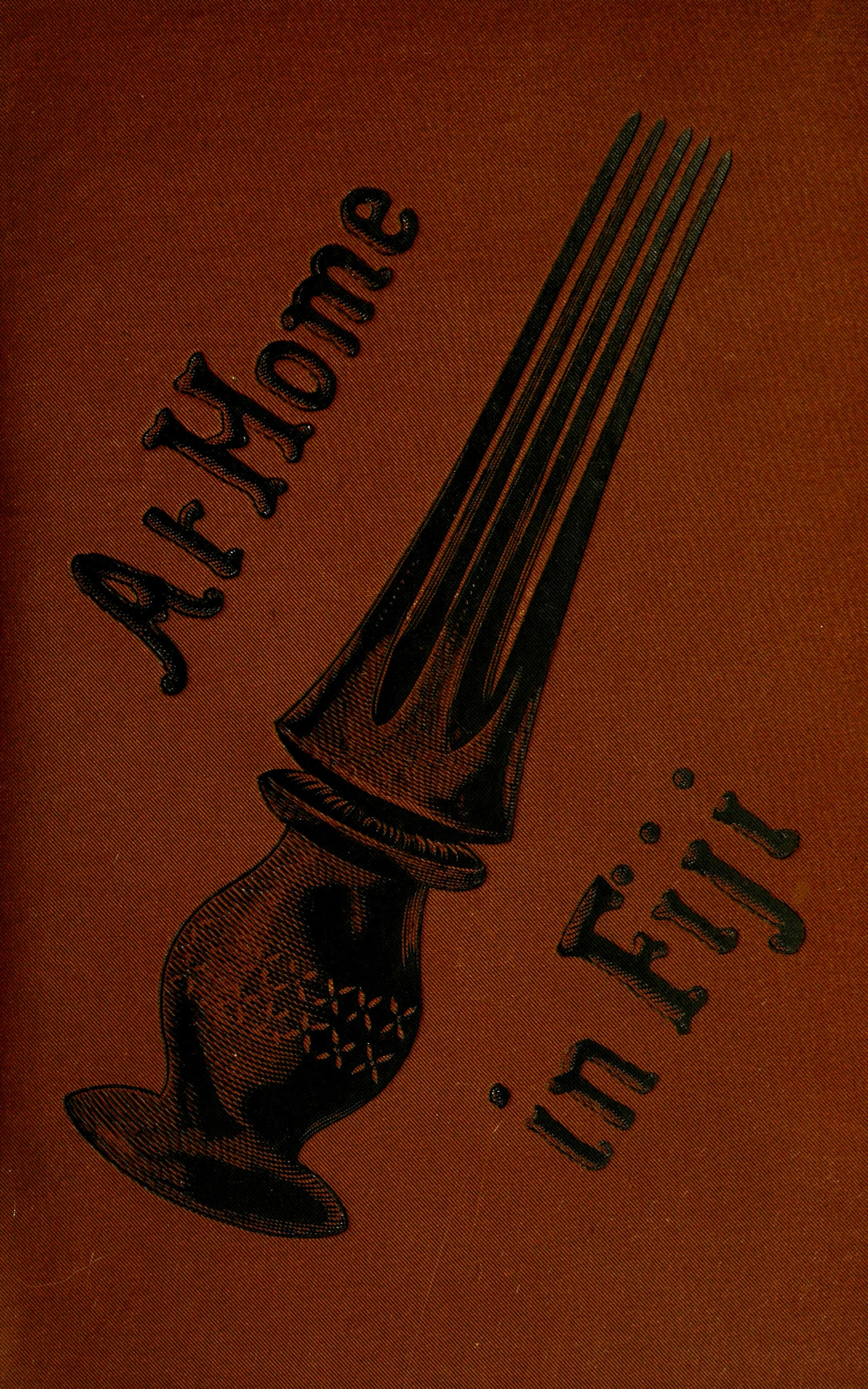
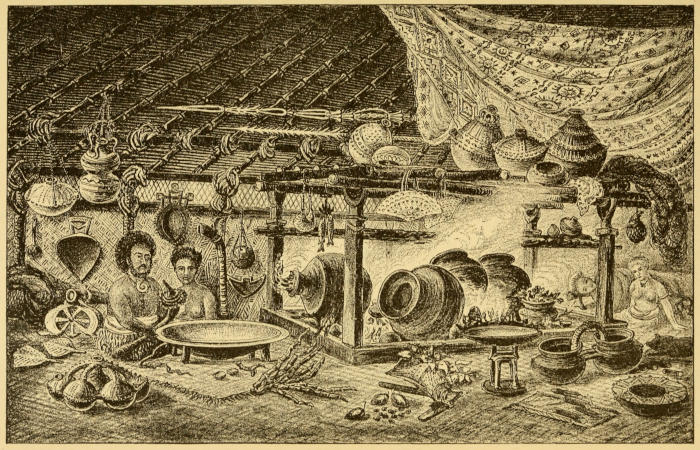
The Cannibal Fork represented on the binding of this book is a facsimile
of a fair average specimen. Some of the chiefs had forks eighteen inches
long, of dark polished wood, with handles richly carved.
With reference to the vegetables specially reserved for cannibal feasts,
Dr Seemann describes the Boro dina (Solanum anthropophagorum) as a
bushy shrub, seldom higher than six feet, with a dark glossy foliage, and
berries of the shape and colour of tomatoes. This fruit has a faint aromatic
smell, and is occasionally prepared like tomato-sauce. The leaves
of this plant, and also of two middle-sized trees (the Mala wathi, Trophis
anthropophagorum, and the Tudano, Omalanthus pedicellatus), were
wrapped round the bokola and baked with it on heated stones.
AT HOME IN FIJI. — INTRODUCTION.
In the autumn of 1874 it was announced that Fiji had been
formally annexed by Great Britain: in other words, that her
Majesty’s Government had finally decided to accept the offer of
cession of the group repeatedly made by the highest chiefs of
Fiji. To this course they were impelled chiefly by the conviction
of their own utter inability to cope with certain unscrupulous
white men, who had here established a footing beyond reach of
English law, and who, to promote their own selfish schemes, did
not scruple, by every means in their power, to foster the jealousies
of the chiefs, and so to keep up the bloody intertribal wars by
which the lands were laid waste, and the population decimated.
In the prolonged struggle for power, two great chiefs rose pre-eminent—namely,
Maafu, a powerful Tongan chief, who ruled
supreme in one portion of the group; and Thakombau, who (at
the instigation of the foreigners who had formed themselves into
a government of which he was the nominal head) had been
formally crowned as Tui Viti—i.e., King of Fiji. The position
thus assumed by Thakombau proved, however, untenable. An
adverse party of white men opposed every measure which the
Government strove to enforce; and at length this nominal king,
then upwards of seventy years of age, wearied by these unprofitable
contentions, persuaded the other great chiefs to crave the
protection of England’s Queen. Their petition was at first rejected;
but, when repeated as an act of absolute and unconditional
cession, it was deemed wise to accept it.
Sir Hercules Robinson, G.C.M.G., Governor of New South
Wales, was deputed by the Home Government to visit the group
in person. Accordingly, on 12th September 1874, he sailed from
Sydney in H.M.S. Pearl, Commodore Goodenough, and arrived in
Levuka (the headquarters of the white population of Fiji) on the
23d inst. Two days later he had a formal interview with Thakombau,
in which he explained her Majesty’s willingness to accept
the responsibility, and to endeavour to exercise her authority in
such a manner as should best secure the prosperity and happiness
of the people; adding, that such conditions as had been at first
attached would render impracticable the proper government of the
country. To this Thakombau replied—
“The Queen is right; conditions are not chief-like. I was
myself from the first opposed to them, but was overruled. If I
give a chief a canoe, and he knows that I expect something from
him, I do not say, ‘I give you this canoe on condition of your
only sailing it on certain days, of your not letting such and such
a man on to it, or of your only using a particular kind of rope
with it;’ but I give him the canoe right out, and trust to his
generosity and good faith to make me the return which he knows
I expect. If I were to attach conditions, he would say, ‘I do
not care to be bothered with your canoe; keep it yourself.’
“Why should we have any anxiety about the future? What
is the future? Britain.
“Any Fijian chief who refuses to cede cannot have much
wisdom. If matters remain as they are, Fiji will become like
a piece of drift-wood on the sea, and be picked up by the first
passer-by.
“The whites who have come to Fiji are a bad lot. They are
mere stalkers on the beach. The wars here have been far more
the result of interference of intruders than the fault of the inhabitants.
“Of one thing I am assured, that if we do not cede Fiji, the
white stalkers on the beach, the cormorants, will open their maws
and swallow us.
“The white residents are going about influencing the minds of
Tui Thakau and others, so as to prevent annexation, fearing that
in case order is established a period may be put to their lawless
proceedings.
“By annexation the two races, white and black, will be bound
together, and it will be impossible to sever them. The ‘interlacing’
has come. Fijians, as a nation, are of an unstable character;
and a white man who wishes to get anything out of a Fijian,
if he does not succeed in his object to-day will try again to-morrow,
until the Fijian is either wearied out or over-persuaded,
and gives in. But law will bind us together, and the stronger
nation will lend stability to the weaker.”
Sir Hercules Robinson next proceeded in H.M.S. Pearl to visit
the great chief Maafu at his capital, Loma-Loma. Tui Thakau,
another powerful chief, was present; and both declared their full
assent to the cession and to the document already signed by
Thakombau, which runs as follows:—
“We, King of Fiji, together with other high chiefs of Fiji,
hereby give our country, Fiji, unreservedly to her Britannic
Majesty, Queen of Great Britain and Ireland. And we trust and
repose fully in her that she will rule Fiji justly and affectionately,
that we may continue to live in peace and prosperity.”
Finally, on the 10th of October 1874, all the great chiefs
assembled at Nasova (which was, and still continues to be, the
seat of government, and is situated one mile from the town of
Levuka), and there signed the deed of cession.
The signatures affixed are as follows:—
CAKOBAU, R. Tui Viti and Vunivalu.
MAAFAU.
TUI CAKAU.
RATU EPELI.
VAKAWALETABUA. Tui Bua.
SAVENAKA.
ISIKELI.
ROKO TUI DREKETI.
NACAGILEVU.
RATU KINI.
RITOVA.
KATUNIVERE.
MATANITOBUA.
HERCULES ROBINSON.
Thus did Fiji pass from the dominion of misrule to the orderly
position of a British colony,—a change touchingly alluded to by
the old king (or, as he is called by his own people, the Vuni Valu,
or Root of War), who on this occasion desired his Prime Minister,
Mr Thurston, to present his war-club to Queen Victoria. Mr
Thurston interpreted the king’s words as follows:—
“Your Excellency,—Before finally ceding his country to her
Majesty the Queen of Great Britain and Ireland, the king desires,
through your Excellency, to give her Majesty the only thing he
possesses that may interest her.
“The king gives her Majesty his old and favourite war-club, the
former, and, until lately the only known, law of Fiji.
“In abandoning club law, and adopting the forms and principles
of civilised societies, he laid by his old weapon and covered it with
the emblems of peace. Many of his people, whole tribes, died and
passed away under the old law; but hundreds of thousands still
survive to learn and enjoy the newer and better state of things.
The king adds only a few words. With this emblem of the past
he sends his love to her Majesty, saying that he fully confides in
her and in her children, who, succeeding her, shall become kings
of Fiji, to exercise a watchful control over the welfare of his
children and people; and who, having survived the barbaric law
and age, are now submitting themselves, under her Majesty’s rule,
to civilisation.”
The king then handed the club to his Excellency, who informed
Thakombau that he would not fail to transmit to the Queen the
historic gift which he desired to present to her, and that he would
at the same time communicate to her Majesty, verbatim, the trustful
and gratifying message by which the gift was accompanied.
This magnificent club, together with Thakombau’s huge yangona
bowl, is now in the safe keeping of Mr Franks (of the British
Museum), and is kept with the Christie Collection in Victoria
Street. Both club and bowl are at least twice the size of any
others we have seen in the isles.
Five days later Sir Hercules held a farewell meeting with the
chiefs, many of whom had hitherto met only as open foes. In
closing his farewell speech, he said—
“I hope that all differences and animosities will now be forgotten
and subdued. The Vuni Valu’s (Root of War) war-club has been
sent with a dutiful and loving message to our Queen. I hope all
other weapons of strife have in like manner been buried at the
foot of the staff upon which we have raised the Union Jack.”
To this the two chiefs, hitherto rivals for the supreme power,
thus replied. First spoke Thakombau.
“I hope that all present will now understand that they are her
Majesty’s subjects and servants, and that, as the Governor has said,
their future is in their own hands. They will be judged according
to their behaviour and their deserts, and according to such
judgment they will stand or fall.
“We know that we are not here now simply as an independent
body of Fijian chiefs, but as subordinate agents of the British
Crown; and being bound together by strength and power, that
strength and power will be able to overcome anything which tends
to interfere with or interrupt the present unity.
“Any chief attempting to pursue a course of disloyalty must
expect to be dealt with on his own merits, and not to escape by
any subterfuge, or by relying upon any Fijian customs, or upon his
high family connections.”
Maafu then said—
“What more can any of us say? The unity of to-day has been
our desire for years. I have now been twenty years in Fiji, and
I have never before seen such a sight as I see to-day—Fiji actually
and truly united. We tried a government ourselves; we did not
succeed. That has passed away. Another and a better and more
permanent state of things has been brought into existence. I
believe that I speak the mind of all present when I say that we
are really and truly united in heart and will, and we are all gratified
with what we have heard. We are true men, and will return to
our homes knowing that the unity of Fiji is a fact, and that peace
and prosperity will follow.”
On the eve of Sir Hercules’s departure, a deputation of the
Wesleyan Mission waited upon him to express their intense satisfaction
with the deed of cession; but for which, they considered
that their work as Christian missionaries would have received
serious injury. They added: “We venture to remind your Excellency
that it is not forty years since missionaries representing the
British Wesleyan Churches came to Fiji, then in a state of savage
heathenism; and that, but for the blessing of God upon their
labours, there would have been no British Fiji at the present day.”
Sir Hercules’s reply must have been truly gratifying to his
hearers. Its conclusion was—
“I fervently trust that a new era has now dawned upon Fiji,
and that under British rule the moral as well as the material progress
of the new colony may, by the blessing of Providence, be
effectually secured. The great social advances which have already
been made within the last forty years from savage heathenism, are
due to the self-denying and unostentatious labours of the Wesleyan
Church; and I can therefore heartily wish to your missionary
enterprise in this country continued vitality and success.
“With renewed thanks for the good wishes which you are
pleased to express for myself personally, I have, &c.,
“HERCULES ROBINSON.
“To the Rev. Joseph Waterhouse, ”Samuel Brookes, ”D. S. Wylie.”
With reference to the provision to be made for the chiefs who
had thus voluntarily resigned their rights, without knowing to
what extent these might be really taken from them, Sir Hercules
suggested that Thakombau should receive a pension of £1500
a-year, and a present of £1000 to buy a much-coveted little vessel
for his own use; that in the event of his death, his queen, Andi
Lydia, should continue to receive £1000 a-year for her life. Their
three sons would probably find employment under Government,
with suitable salaries; as would also be the case with the principal
chiefs, all of whom would continue to hold their office of Rokos of
the twelve Provinces—a native dignity held in much reverence.
In January 1875 the Hon. Sir Arthur Hamilton Gordon,
K.C.M.G. (son of George, fourth Earl of Aberdeen), was appointed
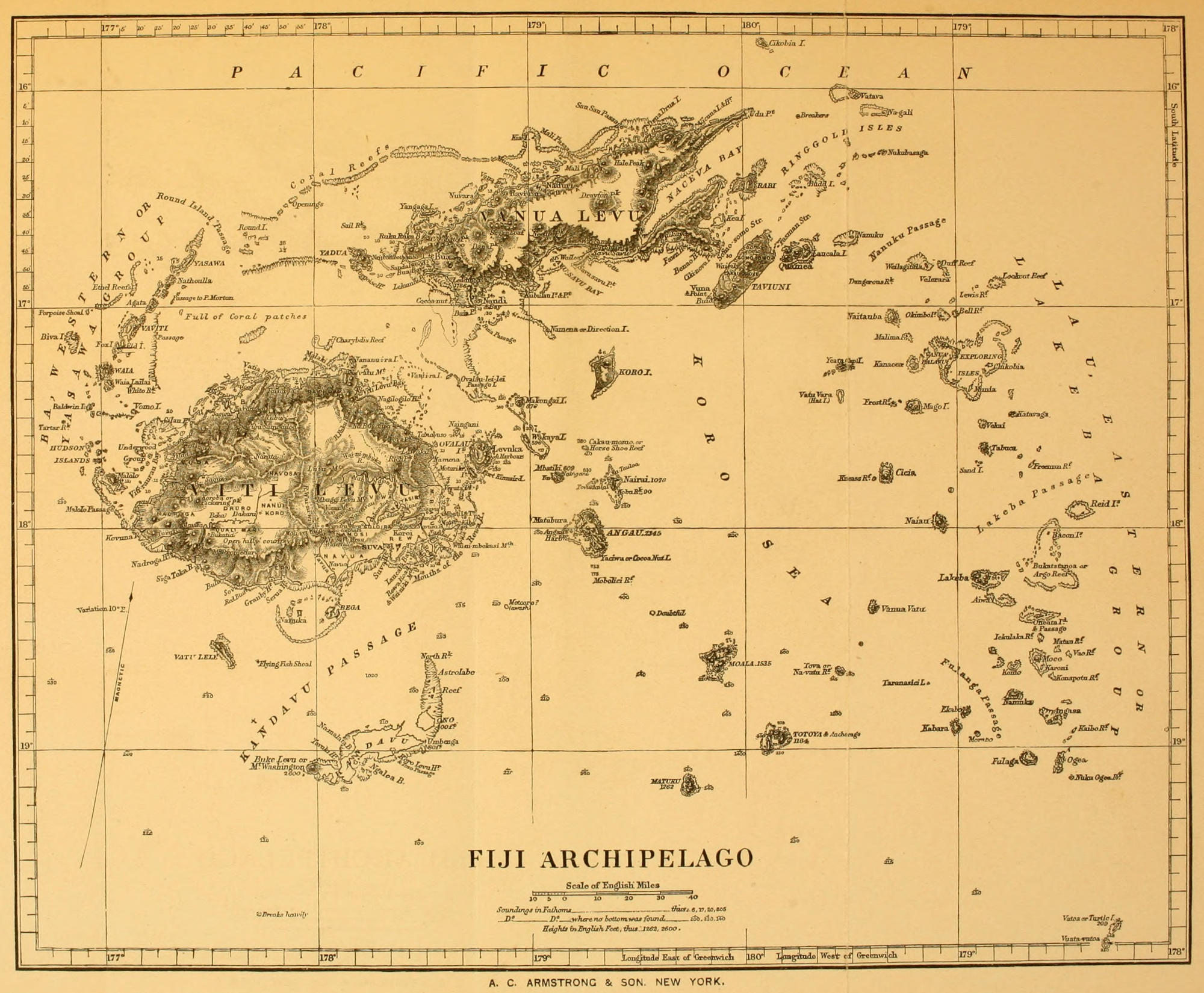
first Governor of Fiji,—an archipelago containing seventy or eighty
inhabited islands, some of which are of considerable size, the largest,
Viti Levu, or Great Fiji, being about ninety miles long by fifty
broad, nearly the same area as the counties of Kent, Sussex, Surrey,
Middlesex, Berkshire, and Hampshire. The next in size, Vanua
Levu, the Great Land, is upwards of one hundred miles long
by twenty-five wide, somewhat smaller than Cornwall, Devonshire,
and Somerset. Taviuni and Khandavu are each twenty-five
miles long; while Bau, the native capital, is scarcely a mile in
length. Besides these, there are upwards of one hundred and fifty
uninhabited islets; and each of the principal islands forms a centre
round which cluster from twenty to thirty minor isles, forming
groups as distinct and as widely separated as are the Orkneys, the
Hebrides, and the Scilly Isles, and their people are equally unknown
to one another. The climate is, for the tropics, unusually
healthy. At the time of the cession, they were inhabited by about
1500 whites and 150,000 natives.[1] It was June 1875 ere Sir
Arthur reached the colony, and, to quote his own words[2]—
“The state of things which disclosed itself to me on my arrival was not
encouraging. A terrible pestilence, heedlessly admitted, had swept away one-third
of the entire native population. Though its violence had diminished,
its ravages had not wholly ceased. Even where it had passed by, it had left
behind it terror and despair. The same cause had carried off many of the imported
labourers of the planters, who, from a variety of causes, were themselves,
for the most part, reduced to the greatest straits. The revenue had fallen short
of even the modest estimate of Sir H. Robinson, whilst the expenditure had
largely exceeded his anticipations. The introduction of labour from other
parts of the Pacific had almost ceased. The season had been unfavourable
for agriculture, wet, and unhealthy, and gloom and discontent pervaded all
classes.
“The white settlers had apparently imagined that, by some magical process,
the assumption of sovereignty by Great Britain was to be followed by an
immediate change from poverty to wealth, from struggling indigence to prosperity;
that their claims to land would be at once allowed; that an abundant
supply of labour would be at once found for them; and that their claims to
supremacy over the natives, which the Government of Cakobau—whatever its
faults—had steadily refused to recognise, would be at once acknowledged.
They were, therefore, bitterly disappointed to find their hopes not realised.
“The natives were cowed and disheartened by the pestilence, which they
believed to have been introduced purposely to destroy them,—a belief encouraged,
I am ashamed to say, by some of our own countrymen, and which
was probably the main cause of the disturbances in the Highlands of Viti
Levu in the following year. They were perplexed by reiterated assurances,
from the whites living among them, that by the mere fact of annexation to
Great Britain their own laws and customs had been abolished; that their rules
of succession, and for the transmission of property, had no longer any existence;
that many of their cherished habits were illegal; that their lands had
become the property of the Crown; and that they would themselves be expected,
if not required, to labour on white men’s plantations. They were told,
moreover, that all distinctions of rank among them were at an end,—a notification
more perplexing than pleasing, in its suddenness, to the people generally,
and which naturally caused irritation and distrust among the higher chiefs.
“A third element in the population, the immigrant labourers from other
parts of Polynesia, whose contracts of service had long expired, but whose employers
had no means to send them back to their homes, and who had remained,
in some cases, for many years in by no means voluntary servitude, were exasperated
by the bad faith they had experienced.
“At the end of the year 1875 I found myself with a revenue of £16,000,
from which I had to meet an expenditure of over £70,000, and at the head of
a dissatisfied and impoverished white population of some 1500 persons, in the
midst of a native population nearly one hundred times as large, suspicious,
watchful, and uneasy; while on but too many estates, bands of wrongfully
detained immigrants formed a real, though apparently unrecognised, source of
danger.
“It is not my object, in the present paper, to narrate the steps taken in the
administration of the government since that time. Suffice it to say, generally,
that the revenue of the colony has swelled rapidly from £16,000 in 1875 to
£38,000 in 1876; £47,000 in 1877, and over £61,000 in 1878,[3] while the expenditure
has been reduced to a level with the income; that the receipts from
customs, which were, in 1875, but £8000, amounted in 1878, under practically
the same tariff, to £20,000; that the imports have nearly doubled in value,
and the exports (which exceed the imports) have quite done so; that the Polynesian
labourers, whose term of service had expired, have been conveyed home
and replaced by labour newly recruited; that more than 800 land titles have
been settled after laborious and minute investigation; that measures have been
passed by the Legislative Council which do honour to those who framed them,
and compare favourably with those of many older colonies; that the Government
service has been organised, Courts of Law established; that a dangerous
disturbance has been put down quickly, cheaply, and effectually; that capital
is being invested; and that, after a careful investigation, extending over more
than a year, it has been reported to me, by most competent and most cautious
scientific authority, that the annual value of the agricultural exports of the
colony, when its powers of production have been fully developed, will probably
exceed £10,000,000 sterling.”
After alluding to the purely native organisation of Bulis, Rokos,
and other functionaries whom Sir Arthur found it desirable to continue
to employ in the same capacities, in the administration of
local government, and in carrying out various measures, he goes on
to speak of the system on which these were framed.
“It was always borne in mind that these regulations had, to a great extent,
to be administered by the natives themselves, and that a code which they
thoroughly understood and had taken part in preparing, and which was in harmony
with their own ideas and modes of thought, would be far more easily
worked, and far more willingly and intelligently obeyed, than much better regulations
imposed by external force, but which they might neither comprehend
nor appreciate, and which would therefore be of far less real utility....
“I may say that I have no reason to be dissatisfied with the results. I have
no doubt that the native magistrates make mistakes, and sometimes grave
mistakes; I have no doubt that in individual instances the Roko Tuis are
harsh and overbearing; but it is, I think, far better that they should now and
then be so than that all share in the administration should be taken away from
them. The employment of natives in the administration of the government
was, indeed, a financial necessity, for the means did not exist, and do not yet
exist, for the payment of such a staff of white officials as would have been required
had the services of natives been dispensed with. But had no such imperative
cause existed to render their employment inevitable, I should equally
have deemed it to be required by considerations of policy. Unless removed
from their habitual places of residence, and treated with a harshness wholly
incompatible with the understanding on which the islands had been ceded to
England, chiefs of intelligence, high rank, and great social influence, would
have become, if stripped of all authority, and deprived of all employment
except that of brooding over their own changed condition, very dangerous
elements in the colony. For, be it remembered, the legal non-recognition of
their position would not have in any way deprived them of the power they
possessed over those who yielded to them an instinctive and unquestioning
obedience. As it is, they are cheerful and willing assistants to the Government
in the performance of its duties.
“The results of the system actually adopted were apparent when the mountaineers
of Viti Levu attacked the Christian villages of the Singatoka. I
appealed to the Rokos for help, and named thirty men as the contingent each
was to send. Had the same state of mind existed that I found on my arrival,
sullen and reluctant submission would at best have been given to the order, and
more probably excuses would have been made for the non-appearance of the
force; the mischief would have spread, and a long and costly war would have
resulted. What was in fact the answer to the appeal? From almost every
province came double the number of men asked for—picked men out of a host
of volunteers—and the troubles were suppressed by native forces alone,
without delay and at a trifling cost....
“I will only say one word on the future prospects of the colony—namely,
that I believe Fiji to be an admirable field for the investment of large capital,
whether in sugar or coffee estates. Sugar grows spontaneously, is of the first
quality, and has a practically boundless market in Australia. As regards coffee
culture, Fiji is now in much the same position as Ceylon thirty or forty years
ago, and I have no doubt that those who now found estates there will find them
in no long time amply remunerative. I have never seen finer tobacco than
that raised in Fiji, and the cotton produced there is admitted to be of the best
description.”
Fiji lies 1760 miles N.-E. of Sydney, and 1175 miles N. of
Auckland. The value of its principal exports may be gathered
from the following table:—
Coppra.
Cotton.
Sugar.
1875,
£40,003
£28,706
£3,417
1876,
45,908
21,122
10,433
1877,
79,403
15,690
16,170
1878,
122,194
20,700
18,640
At the close of 1878 the area under cultivation was as
follows:—
Coppra—i.e., cocoa-nut,
9166
acres.
Cotton,
2390
”
Sugar,
1772
”
Maize,
1000
”
Coffee,
1219
”
The cultivation of coffee is as yet in its infancy.
Tobacco, arrowroot, cocoa, cinchona, tea, vanilla, rice, pepper,
&c., have been produced as yet only in small quantities, experimentally.
The export of green fruit for Australia and New Zealand
is a rapidly increasing item. Thus in 1877, 3100 bunches
of bananas were exported; in 1878, 21,316 bunches; in 1879,
43,062 bunches.
The form of Government is that of a Crown Colony, with
Executive and Legislative Councils.
CHAPTER I.
THE VOYAGE OUT.
On Board the Messageries Maritimes s.s. Anadyr, Nearing Point de Galle, April 17, 1875.
My dear Fellow-Arab,—You see I am “once more upon the
waters,” but whither I am now bound is a problem which I defy
you to guess. I had not time to write to you before my hurried
departure from England, but you see my locomotive demon has
allowed me a very short spell of rest (if rest it can be called, to
rush all over England and Scotland, visiting innumerable friends
and relations! Practically, I find such visiting involves more
wear and tear of mind and body, than any amount of travelling
in distant lands).
Well, as you know, it is not yet six months since I returned
home, after eighteen months of the most delightful wanderings in
every corner of beautiful Ceylon. It needed all the warmth of
family affection to make the bitter cold of an English winter even
endurable, and my yearning for tropical heat and sunlight was for
ever being reawakened by aggravating acquaintances, who invariably
asked me, “Where are you going next?” As I had not the
smallest prospect of ever again escaping from my native shores, I
always answered, “To Fiji,” as being the most absurd answer
that suggested itself to so foolish a question,—a place known to
me only as being somehow associated with a schoolboy song about
the King of the Cannibal Islands. Judge, then, of my amazement,
when, one morning, I received a letter to tell me that Fiji
had been annexed, and that Sir Arthur Hamilton Gordon had
been appointed first Governor, and gravely suggesting that I
should accompany Lady Gordon to her remote home. I need
scarcely tell you that the temptation proved irresistible.
To begin with, a cruise in the South Pacific has been one of the
dreams of my life; and the idea of going actually to live for an
indefinite period on isles where there are still a number of ferocious
cannibals, has a savour of romance which you can imagine
does not lack charm. And then to do it all so comfortably,
gliding into the adventure so easily, without the slightest exertion
on my own part, is far too rare a chance to be lost, in spite of the
remonstrances of my sisters, who consider it quite unnatural of
me to care to leave home again so soon.
Naturally, when I announced my intention of really going,
every one replied, “Of course you are only joking!” And
indeed, even now, I myself find it difficult to think of Fiji or
anything connected with it in any other light than that of a great
joke; its very name has always been considered funny!
Its whereabouts, and everything connected with it, are evidently
matters of the vaguest uncertainty to all my friends. I did my
best to appear astonished at their ignorance, but, between ourselves,
I honestly confess to having possessed the very haziest
ideas on the subject, up to the moment when that letter reached
me, when, of course, I got an atlas and hunted Fiji up. As you
probably have no map at hand, and are certain to be equally in
the dark, I may as well tell you that it is a group of about 250
islands, of which about 70 are inhabited. That it is in the South
Pacific, about ten degrees south of the Equator, thirty degrees
east of the north coast of Australia, and twenty degrees north
of New Zealand. This is a very rough description, but it is
sufficient to make you realise the position.
As yet, I only know of two people who have been there—one
of whom, Harry Leefe, started from Cresswell last year to join an
uncle who owns an island there, and grows cotton and cocoa-nuts.
This Robinson Crusoe of the South Seas has for years past been
to us enveloped in a halo of romance; and now I am looking forward
to seeing him in his own home, and myself becoming “a
resident in the South Seas.” Does it not sound delightful, and
don’t you envy me? Before leaving London, I managed to get
up some information by reading a cleverly compiled book on Fiji,
by a man who has never been there; but he vouches for the group
being a terrestrial paradise, where the soil need only be scratched
to yield abundant harvests of every sort, and where every form of
volcanic crag combines with tropical foliage to produce endless
beauties. So I have invested in a goodly stock of drawing paper,
and enough paints and brushes to last me a lifetime, and look
forward to a most interesting sketching tour. The ground will
have the advantage of being altogether new, which is an immense
charm.
And now we are fairly started, and a very large pleasant party
we are. We (the Fijian family) assembled in London on the 22d
March, for a short special service at King’s College Chapel, Somerset
House, and next morning started for Paris, where we halted
four days, embarking at Marseilles on Easter morning—an unsatisfactory
moment for starting, but travellers cannot always choose
their own times and seasons. This is a splendid steamer, 3600
tons, most comfortable in every respect, and with a capital table
for such as appreciate French cookery.
Our party consists of Sir Arthur and Lady Gordon, and two
particularly nice little ones—namely, Nevil, a picturesque girl of
six, with silky brown curls, and dark thoughtful eyes; and George,
aged four, who is always called Jack, because from his boyhood he
has worn real sailor’s clothes, made by a man-of-war’s tailor. Then
comes their cousin, Arthur Gordon, who has a fine talent for
drawing, and is Sir Arthur’s secretary. Captain Knollys, A.D.C.,
only joined us at Aden, bringing with him a very important member
of the family—namely, Snip, a tiny black and tan terrier.
Dr Mayo, Mr Mitchell, Mr Eyre, and Mr Le Hunte, at present
complete our party, the latter being a young lawyer, and, moreover,
our typical Briton,—a stalwart combination of Ireland and Yorkshire.
Mr Mitchell was a tried friend in the West Indies. And
Dr Mayo is a keen, clever man, a fellow of New College, Oxford,
who has followed his profession in every camp in Europe, and in
some in Asia, and now hopes to find an ample field for studying
new forms of the ills that flesh is heir to among the various races
of the Pacific. He is a good botanist and antiquarian, and is a
mine of information on all topics. All these spend several hours a
day learning Fijian, with the most exemplary patience and determination,
by the help of vocabularies and dictionaries. Last but
not least come the excellent Welsh nurse and faithful Portuguese
under-nurse; and Mr and Mrs Abbey, major-domo and general
heads of all departments, who have already lived with the Gordons
in Trinidad and Mauritius, and there proved themselves pillars of
Government House: a most comfortable and reliable couple, warranted
to take good care of everything and everybody. They have
two little boys—the youngest, Arky, a sunny-headed little mite.
Captain and Mrs Havelock, and Dr and Mrs Macgregor, are to
join us at Sydney, as are also the Judge and Attorney-General, Sir
William and Lady Hackett, and Mr and Mrs de Ricci, so that the
white population of Fiji will receive a large accession.
I will add no more at present, except to say that, with my usual
luck at this point, it was bitterly cold and very grey coming through
the Suez Canal and down the Red Sea. There had been a heavy
storm, which turned the sea to mud for some miles ere we reached
Port Said, which was dirty and dull as usual,—heavy waves dashing
over the breakwater, and Lake Menzaleh looking grey and
dreary....—Ever yours.
CHAPTER II.
SYDNEY—CAMELLIA TREES—ORANGE GARDENS.
Sydney, New South Wales, June 2.
Dear Nell,—My last letter home was posted at Rockhampton,
two days before we reached Brisbane. The latter lies twenty
miles up a river, so a little steamer comes down to meet the big
one and carry letters and passengers to and fro. On this occasion
there was a special one for Sir Arthur, and he and his party were
hospitably entertained by the Governor, Mr Cairns. His private
secretary at present is Mr Maudslay, a son of the celebrated engineer.
He has already travelled far and near for his own amusement,
and we think it probable that some day he will find his way
to Fiji and become one of our band of brothers, or Knights of the
Round Table, if you think that sounds better. I should scarcely
think Brisbane was a congenial atmosphere. It seemed to us a
singularly uninteresting place, its botanical gardens being almost
the only resource. Of course, in a semi-tropical climate like that
of Queensland, there is always the attraction of very varied foliage;
but we thought even this was somewhat stunted.
We had lovely weather on our two days’ voyage from Brisbane,
and also the day we arrived here. Unfortunately we just missed
seeing the festivities for the Queen’s birthday, when every ship in
the beautiful harbour was dressed, and there was an immense
volunteer review. There are no military here, and the volunteers
only meet on this one day. Lady Robinson is, however, to have a
great ball to-night, when she promises to show us any number of
Australian beauties.
The accommodation of Government House is so very limited,
and the family party so large, that it was as much as she could do
to find room for Lady Gordon and the children. All the gentlemen
have found quarters at an hotel; and Commodore and Mrs
Goodenough, a most hospitable and kind couple, have managed to
take me in. Never was there a better illustration of the old proverb
that “where there is heart-room there is hearth-room,” for
their house is tiny and yet shelters many friends. Lady Robinson
kindly says that, though not living under her roof, I am nevertheless
her guest. So I dine there most nights.
How you would revel in the exquisite loveliness of the camellias!
The dinner-table is most often decorated with delicate pink
camellias and maidenhair fern; and the loveliest white ones are
abundant as snowdrops in an English spring. Beautiful as these
are, I am not enamoured of what we have hitherto seen of Australia
as contrasted with Ceylon and India. To begin with, I have contrived
to catch a severe cold, not improved by all these starlight
walks to and from Government House, which is just too near to be
worth driving to; and the climate is apparently as changeable as
in England. We have had four consecutive days of incessant
rain and cold, raw air, so on every side you hear people coughing
and sneezing; and we are glad to cower over fires—for which, by
the way, the coal comes from Newcastle.
It is so absurd to hear the old familiar names out here. A man
tells you he has just come from Morpeth, Oxford, or Hyde Park,
Norwood or Sydenham, Waterloo, Waverley or Paddington, Birkenhead
or Liverpool, Brighton or Cremorne, Clifton, St Leonard’s,
Darlington, Anglesea, &c. It is quite a relief to hear so wholly
novel a name as Wooloomoolloo!
But truly all the attractions which have hitherto delighted me
in foreign lands are here conspicuous by their absence. Apparently
no native population. Certainly no rich colour; no statuesque
tropical undress; no graceful cocoa-palms. Everything is British,
even to the ploughman riding his horses home at night, and the
four-horse omnibuses, and the hansom cab which drives you about
the town at 4s. an hour, and the genuine unadulterated cockney
accents of men born and bred in the colony. Of course it is interesting
to see this Greater Britain mushroom, but it is difficult to
believe that we are 14,000 miles from London! and I hope, before
long, to get glimpses of bush-life.
But of Sydney itself we run some danger of getting more than
we wish, inasmuch as the difficulties of getting ready a house in
Fiji are very great, especially from lack of hands to labour—a
difficulty which has been sorely increased by a frightful plague of
measles, which, by news just received, have (at the lowest computation)
carried off one-fifth of the whole population of the Isles.
Some rate it far higher. And the survivors are all disheartened
and miserable, and unfit for work. So, although Sir Arthur is
buying his doors and windows and planking ready-made here to
facilitate his building, it may be months before he has a house
ready for us; and meanwhile we must have one here, and a very
difficult article it is to find. The gentlemen are house-hunting all
over the place, with very bad success; and the worst of it is that
there is so little time, as Sir Arthur must start for Fiji within ten
days, and leave us settled here,—a dull prospect for Lady Gordon,
and doubly so as she must be anxious at his running into such a
sink of measles, he being the only one of the party who has never
had them.
We went to the opera last night. The most remarkable thing
about it was the drop-scene, which was simply a huge advertisement
sheet, with puffs of all sorts, from the newest sewing-machine
to the most efficacious pills! Imagine the effect of this descending
between each act of Anna Bolena! I regretted much that I had
not rather accompanied Commodore and Mrs Goodenough, who
spent the evening with a large party of blue-jackets. It is quite
touching to see their cordial kindness to all the men, and extreme
interest in all that concerns them; and yet the Commodore has
the name of being stern. I can only say I never saw a face which
more thoroughly revealed the genial nature within.
June 10.
We have had several pleasant expeditions in the neighbourhood.
Last Monday, Sir Hercules having ordered a special train to take
us to see the Blue Mountains, we started early and went as far as
the wonderful zigzags by which the rail is carried across the
mountains. I had the privilege of sitting on the engine, so I
obtained an admirable view.
The following day Mr Gordon, Capt. Knollys, Dr Macgregor,
Dr Mayo, and Mr Eyre started for Fiji in H.M.S. Barracouta, so
our first detachment is fairly under weigh. Sir Arthur is waiting
for telegrams from England, and is to follow in H.M.S. Pearl with
Commodore Goodenough. It has been decided that we are to
remain at Pfahlert’s Hotel till he sends us orders to follow, which
we hope may come soon.
Meanwhile we find some attractions here. To-day we drove out
to the South Heads, and had a most lovely walk along the cliffs.
At the entrance to the harbour we came to a pretty little church
perched among the rocks, and listened to the choir practising “The
strain upraise,” while we sat basking in the sunshine, the whole
air fragrant with the honeyed blossoms of the red and white
epacris, which grows in profusion, and is suggestive of many-coloured
heaths. Though the everlasting gum-tree is apparently
the only indigenous growth, there is lovely foliage of all sorts in
the gardens of innumerable villas, which lie dotted all over the
countless headlands, and along the shores of the many creeks
which branch off from this immense and most lovely harbour.
In these gardens you find clumps of bamboo growing beside
weeping-willows; holly-bushes, with clusters of scarlet berries,
overshadowed by stiff date palms; broad-leaved plantains, contrasting
with leafless trees; frost-dreading heliotrope beside wintry
chrysanthemums and withered oak; while dark Norfolk Island
pines serve as a background to large camellia-trees, literally one
blaze of blossom, pink, white, crimson, and variegated. These
grow in such rank profusion wherever they receive the slightest
care, that we marvel to find them in so comparatively few gardens,
especially as their value is so fully recognised that good blossoms
fetch about 6d. a-piece; and market-gardeners allow millions to
drop unheeded, rather than lower their price.
There are lovely ferns in many of the little gullies, and delightful
spots at which to land for picnics. One of the favourite
“ploys” here is to start armed with a small hammer, a bottle of
vinegar or some lemons, and slices of bread and butter, and find a
feast of oysters on the rocks! Two days ago, the weather being
warm and sunny, Lady Robinson took us in her steam-launch
fourteen miles up one of the creeks. It was like a beautiful Scotch
lake; and we caught glimpses of many lesser creeks branching off
to right and left, all tempting us to explore. Now I must despatch
my letter. So good-bye.—Your loving sister.
Pfahlert’s Hotel, Sydney, Sunday, June 20, 1875.
I told you in my last that the first detachment of our party
started for Fiji in the Barracouta. Now so many have followed
that we feel quite forsaken. This day last week Sir Arthur and
Lady Gordon went to a farewell lunch on board H.M.S. Pearl with
Commodore and Mrs Goodenough, and on Monday the Barracouta
sailed. We sat in the beautiful botanic gardens to watch her pass
down the harbour, carrying away so many of our friends—Sir
Arthur, Mr Mitchell, and Mr Le Hunte of our own set, and the
good kind Commodore and his officers. I do so envy them going
off to the Isles, and of course it is a sore trial to Lady Gordon to
be left here: it will be fully three months before we are allowed
to follow. On Wednesday another detachment followed—namely,
Mr and Mrs de Ricci, Mrs Macgregor and her little girl, Mrs Abbey
and her two little boys. They went by the Meteor, a very small
sailing ship, and I fear they are likely to have a very uncomfortable
passage, lasting fully a fortnight.
The people here are not encouraging as to our prospects. Many
of them have lost a great deal of money which they had invested
in Fijian plantations; and those who have had friends or relations
there, in some cases ladies and children, give us most lamentable
accounts of the hardships they had to undergo from want of the
commonest necessaries of life, and dangerous voyages in open canoes.
From all we hear, I think there can be no doubt a planter’s life in
the Isles must be a most unenviable lot; but of course, as far as
we individually are concerned, the way will be made smooth.
I am preparing for emergencies by attending the infirmary
several days a week, to pick up a few ideas about simple nursing.
It is under the care of Miss Osborne, a cousin of Florence Nightingale.
Evidently her whole heart is in her work, and everything
is done thoroughly; and kindness and order reign supreme. I
have been very much interested in some of the patients, especially
in one poor sailor who hails from “the parish of Dyke.”[4]
Nothing strikes me more here than the exceeding loyalty of the
inhabitants. Every one speaks of England as “home,” though
neither they nor their parents or grandparents ever saw the old
country; and certainly our Queen has no more devoted subjects.
To-day being her Majesty’s Accession, the churches were crowded;
and at the cathedral this afternoon we had the “Coronation
Anthem,” and then “God save the Queen.”
I find here that it does not do to use the word native, as we are
wont to do, with reference to the brown races. Here it is applied
exclusively to white men born in the country, the hideous blacks
being invariably described as aborigines. Hideous indeed they
are, far beyond any race I have yet met with; and of so low a type
that it is impossible, in their case, to regret that strange law of
nature which seems to ordain the dying out of dark skinned races
before the advance of civilisation, and which is nowhere so self-evident
as in Australia, where they have simply faded away, notwithstanding
the strict observance of their own most elaborate
marriage laws, which set forth the various degrees of relationship
between different tribes, and the rotations in which alone they are
permitted to marry. Perhaps, however, if all tales be true concerning
the ruthless policy of extermination practised by too many
of the settlers on the frontier, and the manner in which tribes have
been shot down wholesale for daring to trespass on the lands taken
from them without any sort of right the extinction of the Australian
black may be found to be less a law of nature than an
illustration of the might that makes right. But certainly the few
specimens we have come across have been unspeakably wretched,
living in gipsy camps far more miserable than those of any British
tinker, altogether dirty and debased.
The Commodore rejoices us by saying that our Fijians are a very
superior race, many of them really handsome, fine, stalwart men.
He brought some Fijian yams on his return from the Isles, and
had a dinner party, that we might all taste them. Anything Fijian
is really as great a curiosity here as it would be in London. You
know the Pearl took Sir Hercules to Fiji to make final arrangements
about annexation; and when that business was settled, King
Thakombau and his sons came to visit Sir Hercules and see something
of civilisation. You can imagine how strange the great city
must have seemed to men whose notion of a king’s palace is a one-roomed
thatched house one storey high. The horses and carriages
were still more wonderful; and as to the railway, that was beyond
comprehension. But the old king took it all very philosophically,
and was never so happy as when Lady Robinson’s little grand-daughter,
a pretty little child with golden hair, crept on to his
knee, whispering, “You won’t eat me, will you?” Or else he
would lie down and rest on his own mat, keeping his big Bible
beside him,—not that the old man could read it, for I believe
his studies commenced rather too late in life, but he said “it made
him feel so good!”
Pfahlert’s Hotel, July 15.
Dear Eisa,—I have been all the morning waiting for the mail,
sure of a letter from you, but I again have drawn a blank in that
tantalising lottery. You can scarcely realise what a matter of
interest the mails become in a place like this—the perpetual coming
and going of the steamers, the signalling of their approach from
the Heads, then watching them come up the harbour, right past
Government House to their respective creeks. Such a lovely harbour
as it is, and every headland dotted with picturesque villas!
We have had both time and weather to enjoy it, the latter having
been faultless ever since the rainy week which greeted our arrival,
when it did pour with a vengeance. Now it is quite lovely, only
the nights are too chilly sometimes for perfection. It is midwinter,
you know, and all the deciduous trees are leafless. Leafless
oak and apple trees beside camellia and orange trees in full
flower and fruit! But the willows have not lost their leaves, but
grow beside great clumps of bamboo.
The days slip away pleasantly. Many very kind friends plan
delightful excursions for us, by land or water; and I learn what
carriage-springs are capable of enduring when I see the daintiest
little pony-phaetons driven, apparently at random, through the
bush, across fields, or over the roughest cart-tracks. When we
come to a paling, we deliberately take it down, and, of course, put
it up again. Sometimes we come to dells where the loveliest
maidenhair fern grows wild, and we fill the carriage with it and
the pink epacris. As to the sweet wild geranium which abounds,
it is thought quite extraordinary that we should care to gather it!
Yesterday we went by rail to Paramatta, and drove to the great
orange gardens, and noticed one group of trees from 40 to 45 feet
high, the stems being nearly a foot in diameter, and the lowest
branch three feet above my head. I do not remember any so large
in Malta or elsewhere. It seemed strange to see these gardens
with such wealth of fruit and blossom, while the neighbouring
peach and pear orchards were all leafless. We drove on to the
camellia gardens, and paid five shillings for quite a small basketful,
though millions of blossoms were wasting their loveliness, and
I would fain have carried off even those that lay unheeded on the
grass. To-night there is a great ball at the Masonic Hall, to which
we go, being bound to see everything.
CHAPTER III.
LIFE IN THE BLUE MOUNTAINS—DEATH OF COMMODORE
GOODENOUGH—LIFE IN THE BUSH.
From a tiny Cottage at the Weatherboard in the Blue Mountains, New South Wales, Begun Aug. 19, 1875.
You see I have contrived to escape from the region of fine clothes
and prolonged meals! Oh dear, what a trial it is to be invited to
luncheon at some lovely place, where you go expecting a pleasant
day out of doors, and find an immense party assembled for a stiff
dinner of many courses, which takes nearly the whole afternoon!
The donors of the feast console themselves by a quiet evening
stroll and late tea; but the poor guest has to return to undergo
a second long dinner as usual. Nevertheless I have had many
delightful days in the neighbourhood of Sydney.
You have no notion what a size the harbour is, and how immense
is the amount of shipping always coming and going!
Great ships, and steamboats, and yachts, and tiny steam-launches,—sometimes
I have counted eighteen or twenty steamers in sight
at once. And then the out-of-the-way creeks are numberless. I
think we have explored at least a score, sketching and picnicing,
and I flatter myself I know the beauties of the harbour as well as
the oldest Sydneyite. I learnt a good deal about it during a
most enjoyable fortnight I spent with the Wentworths, whose
lovely home, Greycliff, is close to the water, near the Heads,
which are grand crags guarding the entrance, about six miles
from the town. The Wentworths and Coopers own all the
prettiest places thereabouts. We were out almost every day
from morning till night, the boatmen making a fire and cooking
our dinner in regular bush fashion,—fish just caught, potatoes and
chops, &c.; and always bush tea, boiled with milk in a kettle,—and
very good it is under the circumstances, though I do not
advise you to adopt the fashion. Steaming a snapper is the
summit of culinary art—a snapper being a large fish, which is
cooked (cut up) with potatoes and scraps of bacon and onion.
I confess I prefer the various small fish fried. One of the boatmen
is Joe, a most jocular old black from Cape de Verd; the
other, Jamie Lee, a true gipsy. Of course kindred spirits fraternised
at once, and when he found I could pull a pretty strong
oar, the conquest was complete! So we had days of gipsying and
evenings of melody, Mrs Wentworth’s sister being one of the most
perfect musicians I ever met. I have also spent some pleasant
days with the Morts, whose lovely house, Greenoakes, is built as
a dream of Alton Towers,—all gables outside, and good old carved
oak inside. And such a garden of camellias, pink, red, and white—great
trees of them! Amongst other things, Mr Mort owns
one of the principal docks here, and an iron foundry; also a great
dairy-farm on the coast, with 500 cows, all in milk! But his
all-engrossing interest is a great freezing establishment for conveying
meat to England. He has it killed in the mountains,
brought to Sydney in iced trucks, and there received into genuine
arctic regions, into which you descend shivering, and see innumerable
carcases, all frozen as hard as stone. These are to be conveyed,
frozen, to England, about 200 tons at a time. It is a
gigantic experiment, on which Mr Mort has already sunk nearly
£100,000. Everything about it is on new principles, and it is
now all but in working order. It has been the labour of years,
and is now just about to see daylight.
You perceive my writing is shaky. I am in the train, returning
to Sydney, whirling past orange orchards, and endless dull
bush, all of gum-trees. But everywhere there is an undergrowth
of lovely bush flowers; and here and there, from the crevices of
the rock, there hangs a veil of creamy blossom,— I think they are
rock-lilies; and there are some scarlet lilies, like crowns of fire;
and strange blossoms of the waratau, which I cannot describe,
because it is so utterly unlike anything you ever saw,—something
between a scarlet dahlia and an artichoke. But the glory of the
bush is the feathery mimosa, which takes the place of our broom,
and is covered with sheets of fragrant gold. There is also a
lovely creeper (here they would say vine), with masses of lilac
blossom—the Kennedia—which climbs the mimosas, and droops
in richest trails of bright purply red. You can best realise the
effect by picturing a bough of lilac wistaria overhanging a golden
laburnum. Even the dull gum-trees, the eucalypti, become beautiful
when covered with delicate yellowish blossoms. The sheep-farmers
glory in the dreary tracts of land, the monotony of which
is not varied by one gay flower. Happily the bush revels in
colour, and I find upwards of fifteen totally different sorts of
epacris—crimson, white, pink, and yellow. I call them heaths,
but I am rebuked for so doing. Some are so fragrant that they
scent the air like honey. But when I revel in wild flowers every
one says, Oh, wait till you see the bush a month hence! It will
be one carpet of many colours.
I must account for being so much away from Lady Gordon.
Captain and Mrs Havelock have now joined us, and they were old
friends in Mauritius. Latterly Captain H. has been acting as
Governor of Seychelles, but Sir Arthur requested that he should
be appointed to Fiji, where, I believe, he is to act as treasurer.
Mrs Havelock shares Lady Gordon’s taste for remaining quietly at
home with the children, so they stay together at Sydney, while I
do the sight-seeing. Mrs Havelock has one little girl, Rachel,
Lady Gordon’s god-child,—such a quaint, nice, tiny child, whom
Jack and Nevil regard as an interesting doll, requiring great care.
They are the very nicest little couple possible,—coaxy, loving little
things, and most picturesque. They are quite inseparable, and
Lady Gordon has never left them for one night. Sir William and
Lady Hackett have also arrived from Penang. He is to be judge
in Fiji. Mr Maudslay, whom we met at Brisbane, has also joined
our party. He is to be Sir Arthur’s extra secretary, and if he
finds the country suits him, will perhaps get permanent work in
the Isles. He is devoted to botany, natural history, and kindred
subjects of interest. Mr Maudslay and another gentleman escorted
me to the Blue Mountains last week, where we put up at a very
cosy inn and expeditionised. The gorges with great cliffs are very
fine, and the valleys densely wooded. Sometimes we went down
into deep gullies with tree-ferns far above our heads—very beautiful.
When my two companions had to return to Sydney, I went
to the tiny cottage where I began this letter. My host was a wood-cutter,
with a clean, tidy wife, and a number of very neat children.
Such nice people! More independent and outspoken and self-respecting
than English of the same class; and the children are
all so well brought up. I had spent a long day alone on the
verge of a gorge edged with great precipices, and was walking
home calmly in the clear moonlight, when I perceived a small
regiment coming to meet me. These were all the sturdy youngsters,
in age ranging from five to ten, coming in search of my
remains! The lion and the mice! They escorted me home
cheerily, chatting right out on all subjects! It does seem odd
to think of my being so at home, alone in these wild mountains,
sitting all day by myself, miles from any human habitation, only
seeing a pair of great eagles soaring overhead—no other living
thing.
August 29, 1875.
The mails brought letters from you and your mother—both most
welcome. But alas! my pleasure in receiving them was marred
by terrible tidings, which reached us at the same moment, of a
most horrible tragedy (of which you must have heard ere now)—namely,
the treacherous murder of Commodore Goodenough, who,
as you know, was the one to welcome me on my arrival in Sydney,
and to give me house-room for the first fortnight of our stay. One
of the sunniest-hearted, most genial men I ever met, universally
popular, and justly loved by all under his command. He was
quite out of the common,—clever, the noblest type of an English
naval officer, and as good as good could be. I mean, thoroughly
religious,—the religion of a life showing itself in such care for his
men, and for whatever could advance Christianity in the Isles,
where he was constantly cruising about, and of which his knowledge
was very great. Personally, he had endeared himself to us
all as a genuine good friend. His last cruise was to take Sir
Arthur to Fiji, where he was present at his installation, when
King Thakombau formally made personal submission to him as
the Queen’s representative. After this the Commodore took Sir
Arthur in the Pearl to various Fijian isles; and then, dropping
him, went off to look up some other groups. And I particularly
want to impress upon you that these groups are as distinct as
Russia, England, and India; and that the people of one may be
incarnate devils, while the next are positively dove-like. Our
Christianised Fijians are of the latter sort. But alas! the Commodore’s
cruise was to Santa Cruz—the same group in which, in
1871, Bishop Patteson was murdered. (I suppose you have read
that most touching story.) Those islanders have always been
difficult to deal with, not understanding good white men, and
ready to avenge on them the kidnapping practised by the scum
who haunt these seas in the labour traffic. So on this occasion
the Commodore, as usual, landed unarmed, and went among the
natives in friendly conversation, as he had done on a previous
visit. Something unusual in their manner struck him, and he
proposed a retreat to the boat, when suddenly, without a moment’s
notice, one of them deliberately shot him with an arrow, which
pierced his side. He was able to walk to the boat; but a second
arrow struck him in the head, and four of his young sailors were
wounded. Even then, with what seemed mistaken kindness, he
would not allow any bloodshed in revenge, but made his men fire
blank-cartridge to frighten away the people, and then set fire to
their wretched huts as a sufficient punishment. Well, at first,
none of the wounds were considered dangerous, but, as almost
invariably happens in that climate, after a few days tetanus (i.e.,
lock-jaw) set in, which means certain death in torture. The Commodore
lingered eight days. When he found he could not recover,
he called each of his officers in turn, and kissed them, and said
good-bye. Then he made them carry him on to the quarter-deck,
where he said good-bye to all his men, and prayed for them. Then
came the bitter end. One young sailor died just before him; another
next day. All this time the Pearl was sailing southward to
get cooler climate for the sufferers, and so it came to pass that they
were within two days’ sail of Sydney when, on Friday, his spirit
passed away. On Monday the Pearl, with her ensign half mast,
and yard-arms topped on end,[5] in token of her burden of sorrow,
re-entered the harbour, and the terrible news spread like wildfire.
I think some blessed angel must have whispered the truth to poor
Mrs Goodenough, for she positively knew the moment the Government
House orderly came to summon her cousin, Mr Stanley of
Alderley, whose departure had providentially been delayed. The
only word he had to utter was “Santa Cruz.” That afternoon she
was able to go on board and sit for three hours beside him (in the
little cabin where they had spent so many happy hours, and where
they always spent most of Sunday, going on board for service with
the men). That was the one great comfort. On Wednesday she
was able to follow him to the grave, with her two little sons. It
was an immense public funeral. All the sailors, marines, naval
reserve, training-ship, N.S.W. artillery, all public men, and thousands
of citizens attended. His coffin was on one gun-carriage;
those of the two sailors on another. They were laid on either side
of him. He was only forty-four, and they were each about twenty
years of age....
I don’t suppose you can fully realise how home this comes to us
all. We have been so much thrown together, and we expected the
Commodore to be so valuable an ally for Sir Arthur. To him the
loss is not only that of a reliable friend, but literally of a right
hand. And it is so disheartening that this second terrible shadow
should overcloud the beginning of his work. It was bad enough
before, when the awful scourge of measles was sweeping over the
Isles, which literally carried off one-fourth of the whole population,
marking the beginning of British rule for ever as a time of
misery. You see my surroundings have become of awful earnest,
instead of the merry little joke which I thought I was taking up
in coming to Fiji. Not that I regret having come. On the contrary,
I only rejoice to think that about ten days hence, if all is
well, we shall be on our way there. A company of Royal Engineers
are expected by the Whampoa in a few days, and as soon as
they arrive, the Egmont is to take them and us to Fiji. I am
glad to hear they are commanded by our old friend Colonel Pratt.
I will write again in a few days.
Duntroon, near the Murrumbidgee Hills, N.S. Wales, Sept. 2.
Dear Eisa,—Here I am really in the Australian bush, though
I find it hard to reconcile the term with living in a fine large house,
with every appliance of the most advanced civilisation. I can
assure you we were glad to find such comfort at the end of a long
and very cold journey.
The last detachment of our Fijian party started about three weeks
ago—namely, the Havelocks and Sir William and Lady Hackett.
Since their departure, Lady Gordon and the children have been
living at Government House with the Robinsons; and Mr Maudslay
and I have improved our time, first by exploring the Blue
Mountains, where there is some grand scenery; and then we joined
the Bishop of Grafton and Armadale and Mr Turner, and we came
about two hundred miles, half by rail and half posting, to this
place to see a true station. It is the property of the sole descendants
of the old Campbells of Duntroon, on the Crinan Canal—most
hospitable Scots. There are about 30,000 sheep, 500 horses, and
1000 head of cattle on the station; a most comfortable house, and
everything most luxurious; lots of horses for riding or driving;
and I am getting over my belief that all Australian horses are
buck-jumpers. Yesterday we had a great picnic to a waterfall
eighteen miles off. I drove there, sketched, and rode back over
fine grassy country. It was characteristic; for, as we went along,
we picked up recruits till we numbered in all seventeen riders—the
brake with four horses, a dogcart, a buggie, and a cart. As
to roads, no one here thinks of them. Without the slightest hesitation
about springs, the brake and four will turn off into the bush,
drive in and out among the trees, grazing the old stumps which
stick up in every direction, and the felled or half-burnt timbers
with which the ground is everywhere strewn, dodging morasses,
and choosing the easiest bits of creeks (where you think you must
overturn), through fords, &c., &c., for mile after mile. In short,
I shall never again believe in the possibility of breaking springs;
for all carriages out here do the same thing, and they are all English
built. An English coachman would utterly refuse to take the
same carriage over a cart-road. A good deal of the country here is
open, rolling downs, which afford very pleasant riding—miles and
miles without a fence. We have just been to a ploughing match,
at which the chief noteworthy fact was seeing all the farm lasses
riding. Every lass has her pony; and a good many household
servants arrive at their new situation on their own horse, just turn
it out in their master’s paddock, and catch and saddle it whenever
they want to ride to the town. (This is necessary for fords rather
than distance.) The country is moderately pretty; but the weather
is so bitterly cold that I have been driven in almost every time I
have tried to get a sketch, generally by sleet, one day by downright
snow. Doesn’t that sound strange to you, who are basking
on heathery hills? One great charm of the bush here lies in the
multitude of lovely cockatoos of every conceivable colour, especially
pure white ones with lemon-coloured crests, or pearly-grey,
“trimmed” with delicate pink. Some are very dark and handsome;
and the green parrots are legion. The gentlemen have shot
several, and given us their plumes. They have also shot several
small bears,—most harmless little beasts.
Sir Arthur writes to Lady Gordon that the house he found ready
at Nasova is very tolerable, and that he has begun to build the new
rooms, so we hope to find our Fiji home ready when we arrive.
Good-bye.
CHAPTER IV.
ARRIVE IN FIJI—TROPICAL LUXURY IN LEVUKA—KING THAKOMBAU—PLAGUE
OF MEASLES.
From Mrs Havelock’s House, Levuka, Isle of Ovalau, Fiji, Sunday, Sept. 26, 1875.
Here we actually are, safely landed in Fiji! We embarked on
the Egmont on the 9th, and left Sydney at midnight. The
Egmont was specially chartered to carry the Engineers. Their
officers are Colonel Pratt, Captain Stewart, Mr Lake, and Dr
Carew. Our only other companions were the Rev. Frederick and
Mrs Langham, superintendent of the Wesleyan Mission, who have
lived in the group for seventeen years, and have seen Fiji in all
its changes; and many a tale of horror they have told me. They
are a kind, genial couple, while she is a gentle little woman, whom
it is hard to associate with such scenes as she has had to go
through. Mr Langham made great friends with some of the
Engineers; and a few of the more thoughtful men told him they
were thinking that perhaps they might be of some use to the poor
ignorant people,—perhaps teach some of them to read and write.
Mr Langham expressed his pleasure at their good intentions, but
added, “I think that you will find that some of them can read a
little. We have already established some schools in Fiji,—about
fourteen hundred schools and nine hundred churches!” I think
the Engineers were not the only people who opened their eyes at
this statement, which is strictly true!
Our voyage was not altogether pleasant. The Pacific proved
false to its name, and favoured us with “a northerly buster,” which
is a much more rare occurrence than the “southerly buster,” of
which we have heard so much, and which did not seem to find
much favour with any one except the beautiful albatross, who
evidently gloried in the gale. We were all more or less ill—even
the captain; and we liked it all the less, as the wind drove us out
of our course and allowed us no chance of touching at Norfolk
Island, as we had hoped to do.
Ten days’ steam brought us to Khandavu, a remote isle lying
far to the south of the group, and rarely visited by the regular
white inhabitants, yet the only Fijian isle ever seen by casual
travellers, and consequently the text for many a lengthened
description of the group.
On the following morning, Sunday 19th, we neared Ovalau, and
found ourselves surrounded by many isles, of which we caught
glimpses from time to time; but thick mist alternated with downpours
of rain, and the isles looked grey and cold, like many much
nearer home! It was early dawn when we found ourselves lying
off Levuka, the capital; but the land was shrouded in dense mist,
and not a glimpse could we obtain of the hills, which rise to a
height of 3000 feet just behind the town. What mattered more,
we were for nine hours in rough water outside the coral-reef (which
encircles the isle of Ovalau at about a mile from the shore), and
were actually within sound of the church bells, though we could
see literally nothing till a lull in the storm revealed the passage—i.e.,
the opening in the barrier reef, through which we passed into
the quiet harbour of Levuka.
Just then a bright gleam of sunshine fell like a ray of promise
on the little town, with its background of richly wooded hills, and
dark craggy pinnacles far overhead, appearing above the white
wreaths of floating mist. It was very lovely, and we were duly
charmed; but our delight on arriving was somewhat damped by
finding ourselves utterly unexpected. Great was the perturbation
in Levuka when the inhabitants, coming peacefully out of church,
perceived the Egmont quietly steaming in! Greater still was the
excitement at Nasova, for no one seemed to have believed Lady
Gordon was really coming, and her new house is still a mere
skeleton. Even the Engineers were not expected for some days.
Indeed, the official information of their having left England
arrived about an hour after themselves, by a mail viâ New
Zealand!
After some delay Sir Arthur came and took us ashore to Nasova,
where we had lunch in the house which was built to be the
council-chamber of Thakombau’s Government—a place of many
memories, the last being its use as a hospital-barrack during the
recent terrible scourge of measles, from which, in spite of most
tender nursing by Captain Olive, R.N., several of his men died.
(I must explain that Captain Olive came here with Commodore
Goodenough, and liked the place and people so much that he was
appointed head of the native constabulary; and now he is a sort of
additional A.D.C. to the Governor.)
In the evening we all returned on board the Egmont, as no other
quarters were ready for us. Early next morning Lady Gordon and
the children went ashore, but I stayed on board, thinking I might
as well secure a sketch of the town from the ship, as the view
thence was lovely. In the afternoon Captain Knollys brought
back the children, and Captain Havelock came to say that his wife
had prepared a corner for me in her wee bungalow, charmingly
perched on a breezy headland overlooking the harbour. This was
pleasant news; and I soon found myself cordially welcomed to a
most cosy little nest, very small, but one of the nicest little homes
here.
You need not imagine that the bungalows here are like those
bowers of delight I have described to you in other tropical countries.
There are no wide verandahs, over which veils of luxuriant
creepers weave garlands of delight, and no heavy scent of tropical
blossoms perfumes the night air. Here few people have had time,
or care, to cultivate flowers; and somehow those who have, have
only succeeded on a very small scale. Even the fireflies, which we
demand as a positive right in all tropical lands, are very few and
very dim. As to the houses, they are all alike hideous, being
built of wood (weatherboard is the word), and roofed with corrugated
iron or zinc, on which the mad tropical rains pour with
deafening noise; or else the burning sun beats so fiercely as wellnigh
to stifle the inmates, to whom the luxuries of punkahs and
ice are unknown; and even baths are by no means a matter of
course, as in other hot countries.
We have not come to a land flowing with milk and honey in
any sense. Daily food is both difficult to obtain and expensive.
Fish is scarcely to be had at any price, though the sea swarms with
many good kinds. Foreign vegetables are not to be got for love
or money. The supply of fruit is very scant, consisting only of
indifferent bananas, pine-apples, and oranges; and such as are
brought to market are very poor. Milk is 1s. a quart; eggs, 3s. a
dozen. Indifferent meat is about the same price as in England;
poultry a good deal dearer. Washing varies from 4s. to 6s. a
dozen, not including dresses or petticoats; and any lady who
ventures to have her cuffs and collars, or other small pieces, washed
at home, finds that not one of the scrubbing fraternity will undertake
her work. To people accustomed to washing in India and
Ceylon at 1s. a dozen, this is of itself a startling item. As to
house-rent in Levuka, it is simply exorbitant: four guineas a-week
being the moderate price paid, though taken by the year, for this
tiny little one-storeyed bungalow, the whole of which, offices included,
would easily fit into a moderately large room at home.
And this is the country to which the Colonial Office sends men at
ridiculously small salaries, because, as they were told ere leaving
England, living would cost them nothing, and they could save all
their pay! Why, a man without private fortune could hardly live
here at all! Of course, all imported goods are necessarily expensive,
having to pay freight first to Sydney and then to Levuka.
But oh, above all, the miseries every housekeeper must daily
endure in wrestling with a household of utter savages, even supposing
her to be fortunate enough to get a good well-meaning set!
Hitherto my ideas of native servants have been derived from the
faultless cooks and other excellent attendants of India, quick, wide-awake,
and neat-handed; whereas here you probably begin by
having one or two Fijians, who look very intelligent, but prove
hopelessly stupid, or rather utterly careless about learning our
strange new ways. Day after day you must show them exactly how
everything is to be done, and may be certain that each time it will
be done wrong, and that the moment your back is turned they will
proceed to twist up a bit of tobacco in a banana-leaf, and deliberately
smoke their cigarette before touching the work you have given
them. Probably they will follow you to ask where the matches
are, and the only answer to any remonstrance is “malua” (by-and-by),
a universal principle which is the bane of Fijian life.
They are very honest, though sometimes they cannot resist borrowing
large English bath-towels, which make most tempting sulus
(i.e., kilt); and nice cambric handkerchiefs are a tempting covering
for carefully-dressed hair. It would be quite right and proper that
they should use things belonging to their own chiefs, so we need
not wonder that they cannot always discriminate. But the would-be
housekeeper certainly needs boundless patience and unfailing
gentleness. Any other course would make a Fijian altogether give
up the attempt to learn anything.
Most people seem to prefer engaging servants from among the
“foreign labour”—i.e., men who have been brought from other
groups on a three years’ engagement to work. Most of these are
truly hideous, but they are generally more diligent, and more
anxious to learn their work, than the Fijians, who, as a rule, seem
to be chiefly taken up with the contemplation of their own beauty:
certainly many of them are unusually fine men, with strong
muscular frame and good features, set off by a splendid head of
frizzy hair—not so big as the gigantic mop they wore in heathen
times, but still very large and carefully dressed. Some have really
silky hair.
But in the matter of servants, the chief difficulty is to get a cook
who knows anything at all. The very unsatisfactory person known
as an English “plain cook” would here be a household treasure,
compared with the English or Chinese wretches who by turns
experiment on your unfortunate digestion, at not less than £1 per
week. I cannot tell how many changes Mrs Havelock, Mrs
Macgregor, Mrs de Ricci, Lady Hackett, and Mrs Abbey, have
already had in their respective households; but anyhow, it would
be a long list. Mrs Abbey and her husband have already done
wonders towards getting Nasova made habitable, and have also
started a farmyard and a garden; so, eventually, we shall have
poultry and vegetables secured. A room has been found for Lady
Gordon—very noisy and uncomfortable, however; and the children
are for the present living in a pretty little house close by, belonging
to the Thurstons, who will scarcely care to give it up for long; so
the work at the new rooms is being pushed on in earnest. Good-bye
for the present.
September 29, 1875.
... You may tell the boys that at last I really have seen
the King of the Cannibal Islands, and a fine stately old fellow he
is, with a bright intelligent countenance, and very chief-like, commanding
carriage. I am told he was born about 1815, but he
certainly appears older; his grey hair looks so strange round the
brown face. He and several other high chiefs from various parts
of the group have been staying at Driemba, a village of native
houses just beyond Nasova, where they have been exchanging
counsel on affairs of the State. I am told that he never appears
so dignified as when he is addressing his brother chiefs on disputed
questions. This afternoon they all came to Nasova for a farewell
meeting with Sir Arthur ere returning to their respective dominions.
Of course they had a solemn drinking of yangona, and one chief
was appointed Roko of his district (i.e., chief officer in charge);
after which there was a very pretty méké,[6] when a number of the
people assembled to dance and sing, dressed in native cloth, gracefully
worn as drapery, with kilts and fringes of black water-weed,
long reedy grass-coloured leaves or climbing ferns thrown over one
shoulder and round the waist, also round the arms and below the
knee. They danced a circular dance, turning sunwise, with many
varied figures, and with immense action, while the non-dancers
stood in the middle, making vocal music and beating time on a
drum. The words of these songs are very old, and never alter
from the dialect in which they were at first composed, so they are
not understood by the singers themselves. It was a very interesting
scene.
But I do regret not having seen the grand ceremony of Sir
Arthur’s arrival, when (on the 25th June) Thakombau and all his
sons, and five hundred vassals, came to Nasova, and formally did
homage to him,—the first time the old chief has acknowledged
any earthly superior. They brought the customary offerings of
yams, turtle, &c. Then Thakombau’s herald carried a yangona
root, of which the Vuni Valu (i.e., Root of War, as the old chief is
generally called) broke off a small piece, which he placed in Sir
Arthur’s hands, with a few words of greeting. Sir Arthur formally
accepted the root, and the Vuni Valu then addressed his people,
saying he was glad to welcome the Queen’s representative, and that
he and all his people would obey her law as their only safeguard.
Sir Arthur then addressed the chiefs, entreating them to put away
their rivalries and jealousies, and work together for the common
weal, suggesting to them as a parable, a canoe paddled by many
men, some pulling backwards and some forwards; what would
become of canoe and people?
A week later, Sir Arthur was invited by Thakombau to a great
meeting of chiefs at Bau, where there was a very solemn ceremonial,
yangona-drinking, when all present formally acknowledged
him as their feudal lord, and solemnly pledged him as such. There
were about two hundred chiefs present, a greater number than had
probably ever assembled before; indeed, hitherto, the majority had
lived in such a condition of ceaseless warfare, that they had never
met save as foes. Even the tiny isle of Bau, on which the meeting
was held, was formerly divided into seven antagonistic communities,
at war one with the other. So this meeting really was
a very important act of feudal homage, and all present joined in
the tama, a curious deep-toned acclamation of ndua woh! ndua
woh! which is the vassal’s salutation to his feudal lord, and which
on this occasion proclaimed the Queen’s representative as their
superior, the first chief of Fiji. Now all the people who pass
Nasova (Government House), either by sea or land, shout this
greeting.
Certainly these brown men are a fine race. Such a contrast to
the hideous blacks, of whom we saw a few, in Australia. The
latter are such a wretched race, that it seems rather an advantage
to humanity that they should die out; but it is a very different
matter with these stalwart intelligent fellows and bright friendly
women. And really it is too sad to hear of the awful ravages of
the measles in the early part of this year.
Do you realise that one-third of the whole population has died?—that
is to say, 40,000 have died out of a population of 120,000.
And the saddest thing of all is, that the terrible scourge was
brought here in an English man-of-war, H.M.S. Dido, in which,
last January, Thakombau and his sons returned from Sydney,
where they had gone to visit Sir Hercules Robinson, and so prove
their implicit confidence in their new friends and protectors. At
Sydney, Ratu Joe and Ratu Timothy, the king’s younger sons,
took measles of a mild type, as did also two servants; and on the
return voyage the old chief was slightly unwell,—so slightly, that
the question of quarantine was never even suggested, and on
reaching Levuka he was allowed at once to go ashore. Vassals
and kindred came from all parts of the group to receive him, and,
according to custom, fervently sniffed his hand or his face, thereby,
alas! breathing the unsuspected poison. A few days later
Mr Layard held a meeting on the Rewa, to which came chiefs
from all parts of the interior of Viti Levu, representing the
mountain tribes; there were about a thousand people present.
To this meeting went some from Levuka, who had already caught
the measles, without being as yet unwell. The infection spread,
and the seeds of the disease were thus carried by the mountain
chiefs to their respective districts, where it rapidly extended,
proving fatal to a vast number of the people, and to nearly all
the chiefs who had been present at the meeting with the white
chief (Mr Layard). Of course it was only natural that they
should attribute this to poison or witchcraft, and that the tribes
who had only recently accepted Christianity, or were on the eve
of doing so, should conclude that this was a Heaven-sent punishment
for forsaking the gods of their fathers and giving up their
lands to the white men. So they retreated to their mountain
strongholds, banished their teachers, returned to heathenism, and
openly repudiated the recently accepted British rule. We heard
of an instance in which one of the teachers having died, even the
Christian villagers deemed it expedient so far to return to their
old customs as to bury his wife and children in the same grave
with him as a propitiation to the spirit of the murrain. But, as
a rule, the Christians stood their ground firmly, and the marvel
is that so very few should have relapsed. Among the first victims
was a very good man, Ratu Savanatha, one of the most able and
intelligent of the chiefs, and who had done all in his power to
explain to the Kai Tholos (i.e., people of the mountains) the
advantages of English rule.
So from every corner of the group came tidings that the plague
was raging. Whole villages were stricken down—young men and
maidens, old men and children, lay dead or dying. The handful
of white people, as a rule, did their utmost to help, and gave all
the food and medicine they possessed; but their own labourers
and their own children were stricken, and needed more care than
they could give; nor were there lacking bad white men who went
about telling the natives that the disease had been purposely
introduced to kill them and get their lands. So the plain medical
directions which were at once published were ignored, and the
white man’s medicine too often refused, from a conviction that it
would cause certain death. Native medicines, and bad, ill-cooked
food, made matters worse. Of course anything like isolation of
the sick was impossible; nor could they be prevented from rushing
to the nearest water to cool their burning fever. How could
men who are continually bathing and swimming be persuaded that
this could harm them? So the rash was thrown in, and congestion
of the lungs and dysentery of the most malignant type were
brought on in thousands of cases.
Apart from this irresistible craving to lie down in cool streams,
it would have been a hard task for the poor sufferers to keep themselves
dry, for an unparalleled rainfall converted whole districts
into dreary swamps, where dysentery and starvation completed the
work of death. The people were too weak to go to their gardens
(which are often far away on some steep hillside), and so there
were none to carry food; besides, a cold wretched walk through
the long wet reeds was almost certain doom. At last the few who
were well began to herd together, forsaking the sick, and scarcely
exerting themselves to give them a drink of water, or prepare such
food as they had. In some districts, as in the isle of Ono, the
people were literally starving, digging up wild roots, and eating
old cocoa-nuts only fit for making oil. Then they lay down, all
alike stricken, for the most part awaiting the fate they deemed
inevitable, with that strange apathetic calm which characterises a
race wholly indifferent to life. At last the living were unable to
bury the dead, and there was good cause to dread lest a worse
pestilence, in the form of typhus, should be produced by the
horrible putrefaction which poisoned the air. On the king’s little
island of Bau (the special home of the nobles, and which is small
and overcrowded), all were ill at once. Canoes bearing the dead
were ceaselessly crossing to the mainland, where the graveyards
lie; the cries of mourners and the death-drums resounded day and
night. There, too, the people were starving; they had no strength
to go ashore to the mainland for food. Many of the finest chiefs
and teachers died.
At the Missionary Institute all the students were down; but
thanks to unwearied nursing day and night, most of them recovered.
Of course all the native constabulary were seized; but, thanks
to the devoted care of Lieutenant Olive, late of the Royal Marines,
comparatively few died. He turned Nasova into a great hospital,
and distributed his 150 patients all over it, appointing those who
were less ill guards over the very sick, to prevent their yielding to
the fatal impulse to rush into the cool blue sea, which lay so
temptingly at their very door. By dint of indefatigable exertions,
and a generosity that spared not the utmost expenditure of his
private means on comforts, and indeed necessaries, for his sick men,
he had the unspeakable satisfaction of saving all but ten, and these
fell victims to their own craving for the cool waters. They
managed to escape from their guards, and lay down in the sea,
thus sealing their own doom.
All the details that come from every isle are alike harrowing.
Whole towns are deserted, every house closed. The dead have
been buried in their own houses, and these having fallen, the raised
foundation on which every Fijian house is built has now become a
platform on which lie the graves of the whole family, marked by
the red leaves of dracæna or other plants. Perhaps one wretched
orphan alone survives. The coast towns seem to have suffered more
severely than those in the mountains, owing to the fact of their
being generally built in mangrove-swamps, or some other morass,
as being better concealed and more easily defended in the intertribal
wars which have hitherto been of ceaseless occurrence. We
are told of some teachers who fled from their villages, but were
overtaken by the disease and died. The majority acted as noble
examples to their flocks, but many died at their posts; indeed one
district alone has lost ninety, and the district next to it forty,
native ministers and teachers, all carefully trained men,—a loss not
to be quickly replaced. Of the 40,000 who are computed to have
perished, 35,000 were personally known to the Wesleyan teachers
as being either professedly Christians or under instruction.
It appears that the measles, which we consider such a simple and
infantile complaint, invariably assumes a character more like the
plague when first introduced in one of these South Sea isles. In
1860 it was unfortunately taken to the Mare Loyalty group, and
one-fifth of the population died. The Dido unfortunately put
three persons ashore on Norfolk Island, on her way to Fiji; they
also carried the measles, which spread to the whole community.
Afterwards she landed some time-expired labourers at the Isle
Malicolo, and there too, it is reported that many have died.
This is the first epidemic of any sort that has visited Fiji, and
its results naturally make the introduction of any other infectious
disease a thing to be dreaded. Just imagine how appalling would
be the results of small-pox, for instance! And as hitherto there
have been no quarantine laws, this might have been brought by
any vessel. Even now there is the greatest anxiety lest it should
be carried by the large steamers which call at Khandavu every
month, on their way to and from San Francisco, Australia, and
New Zealand. Of course the strictest quarantine regulations have
now been issued; and Dr Mayo is stationed at Khandavu to
enforce them, as also to vaccinate the whole population, and very
monotonous work he finds it, however necessary. Happily the
people take rather kindly to the operation. They have a fancy for
making scars on their skin, both as a remedy and an ornament, so
the process is rather attractive; and they come voluntarily to the
doctor (whom they call matai-ni-mate, “carpenter of death”) to
request his good offices. Now you will think I am never going to
stop writing, so I may as well say good-bye.
CHAPTER V.
LEVUKA—THE HARBOUR—CORAL-REEF—CHURCHES—ANIMAL LIFE—PLANTS—HOW
TO BREW YANGONA—PICNICS—SPEAR-THROWING.
With Mrs Havelock, Levuka, Saturday, October 2, 1875.
Dear Nell,—I cannot say how I long to have you here to share
the delight of sitting on this high headland overlooking the lovely
sea. The air is balmy, and we almost always have a faint delicious
breeze (sometimes it is anything but faint!) From this tiny garden
we look down through a veil of glittering palm-leaves, brightened
by a foreground of rosy oleanders, and vivid scarlet hybiscus; and
between these glimmer the blue waters of the Pacific, and dreamy
isles which seem to float on the horizon. I think, on a clear day,
we can count eight or ten of these.
Just below us lies the harbour, like a calm sea-lake, on which
ride vessels of all sizes: trading schooners and brigs, which carry
the produce of the isles to Australia and New Zealand. Larger
vessels trade with Germany. Then there is an occasional man-of-war
or merchant steamer, and always native canoes passing to and
fro, with great three-cornered yellow mat sails, and brown men, who
often sing quaint mékés as they approach the town, with an odd
sort of accompaniment on their lali, or wooden drum. The chiefs’
canoes carry a flag, and sometimes a fringe of streamers of native
cloth floating from the sail; and the canoe itself is adorned at both
ends with glistening white shells like poached eggs (Cyprea oviformis).
Sometimes several canoes pass us racing, or they meet, and
their sails at different angles form pretty groups. How striking a
scene it must have been, when, in the old days, the chiefs sailed
forth to war at the head of a large fleet of these! On one such
occasion, when Thakombau went to attack Verata, he mustered a
hundred and twenty-nine canoes. Only think how bravely they
must have flown before the breeze, with the golden sunlight on
the yellow sails! These canoes are balanced by large outriggers—that
is, a beam of wood, or piece of cocoa-palm stem, floating alongside,
and attached to the canoe by bamboos. They are most
picturesque, and the great mat sails, seen against the intense blue
of the water, are a valuable addition to the scene. Indeed the eye
that loves exquisite colour can never weary here.
The rich blue of the harbour is separated from the purplish
indigo of the great ocean by a submarine rainbow of indescribable
loveliness. This is caused by the coral-reef, which produces a
gleaming ray as if from a hidden prism. The patches of coral,
sea-weed, and sometimes white sand, lying at irregular depths,
beneath a shallow covering of the most crystalline emerald-green
water, produce every shade of aqua marine, mauve, sienna, and
orange, all marvellously blended. The shades are continually varying
with the ebb and flow of the tide, which at high water covers
the reef to the depth of several feet, while at low tide patches here
and there stand high and dry, or are covered by only a few inches
of water; treacherous ground, however, on which to land, as the
sharp coral spikes break under the feet, cutting the thickest leather,
and perhaps landing you in a hole several feet in depth, with still
sharper coral down below. The highest edge of the reef lies towards
the ocean, and a line of dazzling white surf marks where the
great green breakers wage their ceaseless warfare on the barrier;
but the passage through the reef is plainly marked by a break in
the white line, and a broad roadway of deep blue connecting the
inner waters with the great deep; and this, again, passes in gradual
gradations of colour, from the intense blue of the harbour to the
glittering green of the shallow water on the inner side of the reef.
Altogether it is most fascinating. The scene is loveliest at noon,
when the sun is right overhead, and lights up the colours beneath
the water on the coral caves. Also you must be some way up the
hill to get a good view of the reef. Of the radiant opal tints which
overspread sea, isles, and sky, at the outgoings of morning and
evening, I need not tell you; our own northern shores supply
sunrise and sunset colours more vivid than we often see in the
tropics.
This afternoon has been one of unmitigated enjoyment spent on
the reef, where for so many days I have enviously watched the
Fijian girls disporting themselves at low tide, and bringing back
baskets full of all sort of curious fish, many of them literally rainbow-coloured.
Some are most gorgeous, and are called parrot-fish.
They have large bony beaks, rather than ordinary mouths, to enable
them to feed on the coral, which at certain seasons are said to be
“in flower,” and very unwholesome; so we always eat these radiant
fish with some qualms, and not without good reason, for some people
have had the ill-luck to get poisoned, and have suffered severely in
consequence.
Our great authority on all questions of natural history is Mr
Layard (brother of Nineveh Layard), who, before annexation, held
the office of British Consul in this place. He and his son have a
special talent for capturing strange monsters of the deep, and I
never call on Mrs Layard without her showing me some new object
of interest. They live in a large old wooden house, built on the
very edge of the water; in fact, the sea washes up underneath the
verandah, which opens on to a long wooden pier in the last stages
of decay. I should think the position most unsafe, in view of possible
tidal waves, especially as a small mountain stream (which occasionally
becomes a torrent) washes one side of the house,—so that
from one window the inmates can have fresh-water fishing, and from
the other salt. That old pier has been a source of infinite pleasure
to many. It enables Mrs Layard to have a little fresh air, and a
small walk, without venturing among the broken bottles and mud
which form the beach; and her husband and son thence capture
many strange creatures when they have not time to row off to the
reef, which is, of course, the very ideal of a naturalist’s happy hunting-grounds,
and there they took me this afternoon. You really
cannot imagine anything more lovely than it was. The first essential
is to go in a boat which draws very little water, and which has
no new paint to be considered. Then when the tide is low, and
the sea without a ripple, you float idly over the coral-beds, suffering
your boat to lie at rest or drift with the current, as a stroke of the
oars would disturb the clear surface of the water, beneath which
lie such inexhaustible stores of loveliness. Every sort and kind of
coral grow together there, from the outstretched branches, which
look like garden shrubs, to the great tables of solid coral, on which
lie strewn shells and sponges, and heaps of brain and mushroom
corals.
These living shrubs assume every shade of colour: some are
delicate pink or blue; others of a brilliant mauve; some pale
primrose. But vain is the attempt to carry home these beautiful
flowers of the sea; their colour is their life. It is, in fact, simply
a gelatinous slime, which drips away, as the living creatures melt
away and die, when exposed to the upper air. So the corals we
know in England are merely skeletons, and very poor substitutes
for the lovely objects we see and covet in their native condition.
Besides, like everything in that submarine garden, much of its
charm is derived from the medium through which we behold it—the
clear translucent water, which spreads a glamour of enchantment
over objects already beautiful, glorifying the scarlet corallines and
the waving branches of green and brown weed, wherein play exquisite
fish of all vivid hues and sizes, from the tiniest gem-like
atoms which flash in the light like sapphires and rubies, to the
great big-headed parrot-fish, which has strong white teeth specially
adapted for crunching the coral, and thence extracting the insects
on which he feeds.
There are great red fish, and purple-green fish, and some of bright
gold, with bars or spots of black; but loveliest of all are the shoals
of minute fish, some of the most vivid green, others of a blue that
is quite dazzling. Some have markings so brilliant that I can only
compare them to peacocks’ feathers. These all congregate in families,
and a happy life they surely must have. Some of the loveliest
of these are so tiny that you can keep a dozen in a tumbler; others
are about the length of your finger. Only think what a prize they
would be if we could convey them safely to the great aquariums of
Britain! Besides these myriads of minute fish, there are all manner
of living creatures which peep out from their homes beneath the
ledges and crevices of the coral,—vigilant crabs of all sizes and
colours, and sea-anemones in endless variety, and wonderful specimens
of Echini.
Picture to yourself first cousins of the fragile sea-eggs which
used to rejoice our childhood, and make us marvel how they ever
came ashore unbroken. These Fijian relations are armed with
spikes like slate-pencils, nearly as thick as your middle finger, and
a good deal longer. I think Mr Layard said their name is Acrocladia.
To-day we captured a most extraordinary creature, a star-fish,
which seemed as if it must be nearly related to the sea-urchin,
for its fifteen arms were each covered with grey and orange spines,
very sharp, precisely like those of the echinus, while the under
side was a mass of pale-yellow fleshy feelers, like those of a sea-anemone,
with a sucker at the end of each. It was a strange and
most interesting creature when we first beheld it, but looked very
unhappy when it found itself in a bucket; and when reduced to
“a specimen,” it will be a poor ugly object.[7]
We saw a great number of large star-fish, of the deepest Albert
blue, and innumerable other beautiful things, which gained greatly
in interest from being shown to me by one so familiar with them
all as is Mr Layard. How you would delight in such an afternoon
as this has been, and how the boys would revel in it! It is not
altogether pleasant, however, to try walking on the reef, and you
generally have to get natives to dive for anything particularly good.
They never seem afraid of the many sharp teeth and stinging creatures
which may dart out from the coral; and not being troubled
by over-much raiment, they dive in and out like fishes (though, as
a general rule, they do dislike wetting their hair). To them the
reef is a source of endless amusement and profit, and at low tide
there are generally some canoes lying in the shallow water; while
the girls and young men are hunting for the spoils of the sea,
which they carry in three-cornered baskets, slung from the waist.
Of course they do not care to spoil their simple raiment with salt
water, so a considerable portion of their dress on these occasions
consists of deep fringes and garlands of many-coloured leaves, which
are a most becoming drapery, with their rich brown skin and
tawny head.
The existence of these barrier-reefs is an unspeakable benefit to
the isles, supplying them with natural breakwaters and harbours,
surrounding each with a lagoon of calm, shallow water, on which the
smallest boats can ply as safely as on an inland lake, and within
shelter of which they can, in most places, pass from one isle to
another. There is invariably a passage through the reef opposite
the mouth of any river, as the coral insect cannot live within the
influence of fresh water. Thus an entrance is secured to the haven
of rest, and a very strait and narrow way it often is, and one which
calls for careful steering, when the angry breakers are dashing in
mad fury on the reef on either side—great rolling waves curling upward
in a succession of mighty walls of green water, and falling in
such a surging cataract of foam as would make short work of the
luckless canoe that should drift within their reach. Once inside
the reef all is secure, save when some unusual storm troubles even
these calm waters, as it might ruffle the surface of any lake.
It is hard to realise that these mighty sea-walls are indeed the
work of microscopic insects,—star-like creatures, invisible to the
naked eye; but so it is. It is said they cannot live at a greater
depth than thirty fathoms, yet the height of the coral-wall is in
many cases double or treble this measurement, and in some cases a
sheer descent of two hundred fathoms has been found. The inference
is, that many of these isles, as well as the ocean-bed from
which the coral rises, are gradually subsiding, and the insects are
continually working upwards. In some cases the island has altogether
disappeared, and there remains only a circular or crescent
shaped reef, perhaps fringed with cocoa-palms, encircling a calm
lagoon of clear green water, the sea all round being of the deepest
blue. These are called atolls, and are sometimes many miles in
circumference. Some scarcely rise above the water-level, and only
a ring of white coral sand betrays their existence.
The coral-reef gives us various hints of the rise and fall in the
level of the ocean-bed, for while some islands have wholly disappeared,
others are even now emerging from the waters. In some
groups coral-cliffs have been found forty feet above the water-level—in
other words, above the height where the insect could live,
thus showing clearly that these rocks have been gradually upheaved.
But in the Fijian group there are few islands which are
not almost encircled by a barrier-reef of considerable depth, which
would seem to indicate that they are actually subsiding. However,
the process is likely to be a slow one, and a matter of no
great moment to the present generation, or their successors for
many years to come.
I have spun a longer yarn than I intended, but it will help you
to realise the sort of things that I am daily looking at, and will
make the boys wish they were with me.
Monday, 4th October.
Dear Jean,— ... I have just come in from such a scramble.
Certainly those hills of Ovalau are most tantalising. From the sea
they do look so attractive, and not particularly difficult to ascend;
but when it comes to the attempt, you find that even in the rare
instances where the semblance of a footpath exists, it takes a very
good scrambler to follow it, over great boulders of rock, or up
almost perpendicular banks of soapy mud. Should you attempt
to leave the path, you find it almost impossible to force a passage
through the dense underwood; and even the tracks, which from
the sea look like grass, turn out to be tall reeds, reaching far above
your head, and matted together with strong vines (which totally
prevent your advance), and large spiders’ webs, which cling to
your face and hair. Still, it is worth a considerable exertion, for
the reward of at length reaching some point whence you can look
down on the lovely sea and all the far-away isles.
This island is itself quite beautiful, though by no means a
desirable one on which to establish a capital, as it consists entirely
of very steep hills, rising to a height of about 3000 feet, crowned
with great crags, and rent by deep gorges densely wooded. The
only available building land is a narrow strip on the edge of the
sea; and though, of course, the lower spurs of the hills may
gradually be dotted with villas, there is no possibility of extending
the town unless by expensive terracing—a game which would certainly
not be worth the candle, as saith the proverb.
I must say the little town greatly exceeds our expectations.
We had imagined it was still the haunt of uproarious planters and
white men of the lowest type, described by visitors a few years
ago, instead of which we find a most orderly and respectable community,
of about 600 whites, inhabiting 180 wooden houses. We
are told that the reformation in the sobriety of the town is partly
due to the Good Templars, who here muster a very considerable
brotherhood. Doubtless their work is greatly facilitated by the
increased price of gin, which in former days flowed like water, at
the modest price of one shilling a bottle, but has now risen to five
times that sum. It used to be said that ships needed no chart to
bring them to Fiji, for they would find the way marked by floating
gin-bottles, increasing in numbers as they approached the group.
Those were the days when men meeting at noonday to discuss
grave matters of business found their deliberations assisted by a
jug of raw gin, to be drunk in tumblers as other men would drink
water! Certainly if the multitude of broken bottles which strew
the beach were any evidence of the amount of liquor consumed,
we might imagine that the old drinking days were not yet wholly
forgotten.
The principal shops (or stores, as they are called) lie along the
beach, and, without much outward show, are fully stocked with
all things needful, which a European can buy at about one-third
more than he would pay in England. But by a singular phase of
commercial morality, a native wishing to purchase the same article
is invariably made to pay a very much higher price, and this is
done quite openly, as a generally accepted condition of trade!
There are several respectable boarding-houses, and two or three
hotels, where the planters find quarters when they come to this
great metropolis.
I am rather afraid you will not have a very dignified idea of our
capital, when I confess that our great main street has only houses
on one side, and the street itself is only a strip of rocky, muddy,
or shingly sea-beach. Various attempts have been made to build
up a low sea-wall, but this is invariably washed away by the next
high tide. How the houses escape is a mystery.
One thing that would strike you as peculiar would be to see a
whole town without one chimney. There is a house which apparently
has a couple, but these are only ventilators. You would
also be impressed by our magnificent lighthouses—two wooden
pyramids, which, seen at a certain angle to one another, mark the
passage through the coral-reef. These are, I think, the only
representatives of lighthouses in this most dangerous group. But
at present the colony is too poor to build any, and Mother England
is too stingy to allow us any.
But whatever else is lacking, churches flourish. Besides the
Wesleyan native chapels, there are a large Wesleyan church for
the white population, a Roman Catholic church, and an Episcopal
one. We, of course, belong to the latter; but at present our parson,
Mr Floyd, is in New Zealand, so all the Governor’s staff take
it by turns to officiate, two in the morning and two in the evening.
They appear in surplices, and take their part well. Last Sunday
morning Mr Le Hunte read prayers, and Captain Havelock one of
Robertson’s sermons. Yesterday morning Captain Havelock read
prayers, and Mr Maudslay preached a Kingsley. In the evening
Mr Eyre read, and Mr Le Hunte preached; but I forget his subject,
for such a tremendous storm of rain came down on the
zinc roof that even his voice was drowned. After services we
waited in vain for half an hour, and then waded home, fully a
mile. Nurse and Mrs Abbey very sensibly left their dresses and
bonnets in church!
Mr Floyd has one of Bishop Patteson’s native clergy to assist
him in a mission to the foreign labour, the Church of England
most wisely judging it best to leave the Fijians wholly in the
care of the Wesleyans, whose mission here has been so marvellously
successful. But the foreign labour does seem almost a hopeless
field. They are brought here from a multitude of isles, all talking
different languages, and only remain three years in the group, so
that the very small numbers that can be reached, even of those
who find situations in Levuka, can scarcely be expected to learn
much before they have to be sent back to their own isles as “time-expired
labour.” Still, the little church does fill in the afternoons
with a strangely motley congregation, and doubtless some seeds of
good are carried back to the distant isles, which may bear fruit in
due season.[8]
There is yet another congregation which I have forgotten to
mention—namely, our fellow-passengers, the company of Royal
Engineers, who, finding the little English church already crowded,
hold service by themselves in a thatched shed on the shore, open
all round to admit the sweet sea-breeze, and overshadowed by
large dark trees. It makes a very cool chapel, and we often linger
as we pass to listen to the pleasant English voices and hearty
singing.
As I mentioned to you before, no preparation had been made
to receive the Engineers on their arrival here, so they had to find
temporary quarters for themselves till they could decide where to
place their barracks, and then build them. It was no easy matter
to find healthy quarters for so large a body of men in such a place,
and Colonel Pratt was at first somewhat perplexed. By great good
fortune a large empty storehouse was found half-way between
Nasova and the town, so there they are housed for the present,
and make the best of very uncomfortable quarters. They do look
so hot, poor fellows, going about in uniform, with small caps, under
just such a sun as that which makes men in India wear solah topees
and carry white umbrellas. Here (where the inhabitants take their
ideas from Australia or New Zealand) such precautions are considered
as unnecessary, as are all the luxuries which others, coming
from India or kindred lands, would deem necessaries. The
Engineers, however, have sun-helmets somewhere, but they are
supposed to have gone on a little voyage by themselves to Melbourne,
and are expected to arrive in the course of a few months!
Colonel Pratt had considerable difficulty in getting either cool
clothes or mosquito-nets for his men. The authorities could not
understand why he should require them; and when he suggested
that it was usual to supply such articles to troops on tropical
service, the reply he received was—“Why, you don’t mean to say
that Fiji is in the tropics?” That it is so we are all very well
aware, but I think this is the best tropical climate any of us have
yet found; there are few days when we have not a balmy breeze
and soft grey clouds, and even the midsummer heat of December
rarely shows a thermometer above 90°. I cannot find out that
there is any especially rainy season, or any which is exempt from
rain. Heavy thunderstorms are frequent at present, and I am told
that about Christmas there is often much rain and an occasional
hurricane. The latter, however, only happens once in several years;
so you need not be in any special alarm for the safety of your dearly
beloved sister,
C. F. G. C.
In one respect we are greatly disappointed in this place—there
are scarcely any flowers. This strikes us all the more, as we have
come here direct from Australia, where we left the whole country
literally aflame with blossom. You cannot fancy anything more
lovely. And here in the tropics, where people always vainly
imagine that flowers are so abundant, we have fewer than in any
place I have yet been to. Scarcely any house has even a flower-bed
round the windows; and the very best garden in the place
would, except for the beauty of its crotons and other shrubs,
scarcely be dignified with the name in England; and yet infinite
care is expended on it, and a handful of roses or other blossoms of
any sort is the greatest boon its owner can bestow on us. As to
wild flowers, I have walked day after day till I was weary, without
finding as many flowers as would fill a small vase.
The ferns, however, are exceedingly lovely. Innumerable species
grow in richest profusion in every damp ravine, and great tufts of
birds’-nest and other ferns cling to the mossy boughs of the grey
old trees. Every here and there you come on a rocky stream or
shady pool round which they cluster in such luxuriance and variety,
that it makes you long to transport the whole fairy-like dell to some
place where all fern lovers might revel in its beauty. And this is
only the undergrowth; for the cool shade overhead is produced by
the interwoven fronds of great tree-ferns—their exquisite crown of
green supported by a slender stem from twenty to thirty feet high,
up which twine delicate creepers of all sorts, which steal in and
out among the great fronds, and so weave a canopy of exquisite
beauty. Loveliest of all are the delicate climbing-ferns, the tender
leaves of which—some richly fringed with seed—hang mid-air on
long hair-like trails, or else, drooping in festoons, climb from tree
to tree, forming a perfect network of loveliness. It is a most fairy-like
foliage, and the people show their reverence for its beauty by
calling it the Wa Kolo, or God’s fern.
I ought to mention that though there are no flowers within reach,
there are several flowering trees with unattainable, and, happily, not
very tempting blossoms. They are all alike remarkable for having
a most insignificant calyx, and being almost entirely composed of a
great bunch of silky stamens which fall in showers on the ground
below. The most attractive of these is the kaveeka, or Malay apple,
which bears tufts of crimson blossom especially attractive to certain
lovely scarlet and green parrots with purple heads, and which in
due season bears a very juicy though insipid crimson or white fruit.
These parrots are few and far between; and I miss the flocks of
bright wings which so delighted me in my glimpse of Australian
bush.—Good-bye once more.
Sunday, 31st October.
Dear Eisa,—The anxiously expected mail came in this morning
and brought your welcome letter.... I am still staying with
Mrs Havelock, for the new rooms at Nasova progress slowly. It is
very difficult to push on work in a country where malua (by-and-by)
is the reigning principle in every action of life. But for myself,
individually, I am most cosy here, and we all meet continually.
Lady Gordon has instituted weekly picnics just for our own party,
chiefly to get the gentlemen away from their incessant writing.
We have already had three of these, so we have seen a good
deal of this isle of Ovalau, and very lovely it is. We always go
by boat; indeed there are no paths (except a footpath along the
shore) where a sane man would venture to ride even if there were
horses, which there are not. Only an enterprising butcher’s boy
ventures to clamber up day by day to bring needful supplies to
such houses as are perched on the steep hillsides. Captain Olive
also has a horse; and now Nasova owns a pony on which Abbey
gallops into Levuka to forage for the house. The astonishment
of the natives at first sight of a horse knew no bounds. They
gathered round it, exclaiming, “Oh, the great pig!” and one
rashly approached to pull its tail, and was considerably startled
by receiving a very severe kick.
I suppose you know that one of the remarkable peculiarities of
these isles is the strange lack of animal life. There were literally
no indigenous four-footed creatures except rats and flying-foxes,
and even the native rat has died out since foreign rats arrived
from ships. Even the pigs, which in some places now run wild
in the jungle, were originally introduced by the Tongans, who also
brought cats, ducks, and fowls. As to other animals, such names
as seepi (mutton), goti (goat), pussi (cat), ose (horse), collie[9] (dog),
and bullama kow (beef), sufficiently betray their foreign origin.
Really I do miss the troops of monkeys so familiar in India and
Ceylon.
Happily the list of Fijian reptiles is equally small, so that flies
and mosquitoes are almost the only creatures we have to combat,
and certainly they are an irritating plague. We know that centipedes
and scorpions do exist, but they are very rare. I wish I
could say as much for the cockroaches which infest every house,
and are in their turn devoured by large spiders. I lay awake this
morning watching the process. The unlucky cockroach contrived
to get entangled in a strong web, and old Mr Spider darted out
and tied him up securely, and then feasted at his leisure. Of
course we carefully cherish these spider allies, and glory in webs
which would greatly horrify your housemaids. The ants are also
most energetic friends, and organise burial parties for the cockroaches
as fast as we can kill them. Every morning we see
solemn funerals moving across the verandah to the garden, and
these are parties of about one hundred of the tiniest ants dragging
away the corpse of a large cockroach.
Happily serpents are almost unknown, and the few that exist
are not venomous. So we walk through densest underwood,
among dead leaves and decaying timber, without fear of meeting
anything more alarming than innocent lizards or an occasional
land-crab. Of lizards I have seen a large green kind, and scores
of a tiny blue and bronze, which flash like jewels in the sunlight.
Equally pleasant is the total absence of the countless species of
thorny plants with which the whole jungle in Ceylon seemed to
bristle. There I was for ever being torn and scratched by cruel
thorns, and every shrub seemed armed with sharp needles—even
the stems of certain kinds of palm-trees being covered with myriad
little daggers and darning-needles two or three inches in length.
Here the wild citron is the only thorny tree I have observed, and
even that was not indigenous; so the contrast is highly in favour
of Fiji, especially in the absence of serpents and other venomous
reptiles. But, on the other hand, Fiji has traps for the unwary
quite peculiar to itself. The commonest of these is the tree-nettle,
which really is a large forest-tree. Beautiful but treacherous are
its large glossy leaves, veined with red or white, most attractive to
the eye, but anguish to the touch;—days will pass ere the pain of
that burning sting subsides. However, forewarned is forearmed,
and you are in no danger of accidentally touching these large
showy trees, as you so often do the insignificant but obtrusive
little nettle of our own woods.
There are, however, several other trees which are so intensely
poisonous that it is dangerous even to touch them accidentally.
One of these is the kaukaro, or itch-plant, from which exudes a
milky juice causing agony, especially if the tiniest drop should
come, even near the eye. Instances have occurred when a man
has ignorantly selected this wood, either as timber from which to
fashion his canoe, or a spar suitable for his mast; and incautiously
sitting on the wood while carpentering, has discovered, when too
late, that the subtle poison had entered by every pore, and that his
whole body was rapidly breaking out in angry spots, causing an
irritation utterly unbearable, and lasting for months, sometimes years.
As regards the general foliage, it is almost identical with that of
Ceylon, though perhaps scarcely so rich. This, however, varies
much on the different isles, and Ovalau is more noted for cliffs
than for rich foliage. We shall see that in glory when we go to
Taviuni. Here the only palm-trees are cocoa-nuts very much
battered with the wind; and I miss the beautiful kittool and
several other palms which I loved in Ceylon. But I recognise
various old friends, especially the large croton-tree, with silvery
leaves and tufts of white blossom. Here it is known as the
candle-nut, and reigns as monarch over an immense family of
crotons of every shade of eccentricity both of form and colour.
But the most gorgeous varieties are imported from isles nearer
the equator.
There are several splendid trees which are quite new to me,
being peculiar to the South Seas. Such are the ivi[10] (pronounced
eevie), or Tahitian chestnut, and the ndelo,[11] with large glossy leaves
like the india-rubber tree. Both these are valuable as affording
cool, deep shade. There is also the vutu,[12] with its blossoms like
tufts of silk fringe; the tavola,[13] or native almond-tree; and the
ndawa, whose young leaves are bright crimson, and give a gleam
of colour to the general expanse of green. Then there is the
mbaka, which grows like the sacred banyan of India, beginning its
life as a humble parasite, and in old age presenting an intricate
network of white stems, pillars, and roots. It bears a very small leaf.
The commonest scrub-foliage is a hybiscus, with bluish-grey leaf,
and pale primrose-coloured blossom, with a dark claret heart: it is
a pretty flower on the tree, but dies when gathered. The inner
bark yields a fibre which is greatly valued by the natives, and
which they split and die yellow, red, or black, and make fringe
kilts, to be worn either as sole raiment or over the sulu. It is also
used by the fisher-folk for making their nets, especially the turtle-nets;
but several other fibres are used for this purpose.
On this island there really is no level ground at all; and you
would marvel where the people contrive to raise their crops, for the
steep hills rise from the sea-beach. But if you were to follow the
course of the picturesque streamlets which find their way down
dark-wooded ravines, you would find that every available corner is
laid out in tiny terraced fields, or rather miniature swamps, in
which are cultivated the yams, taros, and kumalas (sweet potatoes),
which are the staple of native food. In taste they somewhat
resemble coarse potatoes, especially the yams, which sometimes
attain a gigantic size—from one to ten feet in length—and are said
sometimes to weigh 100 lb. In some districts there are two yam
crops in a year.
The taro is of a bluish-grey colour, and both in appearance and
consistency resembles mottled soap. Still I rather like it. Its
leaves are like those of our own arum on a large scale (it is of the
same family, Arum esculentum). One kind grows to a gigantic
size, and its huge rich green leaves stand six or seven feet above
their watery bed. You may often see a few plants of this giant
arum close to the door of a house, and very ornamental they are;
but the object for which they were placed there is to ward off the
entrance of death or devils!
The leaves of the yam are like those of a convolvulus, as is also
its habit of growth, each plant being trained along a tall reed.
There are a great many different kinds, including one the root of
which is throughout of a vivid mauve.
There are also tiny banana-gardens in every little crevice of the
rock, and their great glossy leaves look cool and pleasant. There
are about thirty varieties grown on these isles, and some bear
immense pendent bunches with from one to two hundred fruits on
each. The young inner leaf, which has not unrolled itself, is like
the finest silk, and when warmed over the fire becomes quite waterproof,
and is used as such. It is also used to tie up little bundles
of sweet, oily pudding, in which the people delight. Do you
realise that a banana or plantain leaf is from three to four
feet long, and from ten to fifteen inches wide? Sometimes the
girls carry them as parasols, and a very attractive picture they
make.
There is one fruit-bearing plant here which is just like a natural
umbrella—namely, the papaw, which carries a handsome crown of
deeply indented leaves on a tall curiously diapered stem, round
which hangs a cluster of green and golden fruit, useful when unripe
as a vegetable, and when ripe as a fruit. I am told that the leaves
have the valuable quality of making tough meat tender if it is
wrapped up or cooked in them; and also that they are useful in
washing, being saponaceous, so that if soaked with dirty clothes
they save a considerable amount of soap.
Another plant, which to you is familiar as ornamental greenhouse
foliage, is the dracæna (or ti-tree, as it is called in the colonies),
which here is grown for the sake of its root, which is so large
as sometimes to weigh 40 lb., and which answers the purpose of
sugar. It is baked and used for puddings. It tastes like liquorice.
The crown of long glossy leaves is useful as fodder where cattle
exist; but here it is the equivalent of so many yards of green silk,
and supplies some pretty damsel with a decent petticoat.
The crimson dracæna is sacred to the dead, and is constantly
planted on the graves, and very beautiful is the effect thus produced;
while overhead droops the mournful dull green of the noko-noko,
or casurina-tree, which I can only describe as somewhat resembling
the Weymouth pine, and which seems to sigh with every
faint breath of wind that stirs its pendent foliage.
Here and there a small plantation of paper mulberry (Broussonetia),
the bark of which supplies material for native cloth, or a
patch of arrowroot, or perhaps a few tall sugar-canes or tufts of
Indian corn, complete the common produce of the native gardens,
and combine to produce an effect of rich and varied foliage.
But I must tell you about our picnics. As I before said, they
are always water-parties; so we muster several boats and canoes,
and start as early as we possibly can to try and profit by the
delicious cool of the morning. Our first expedition was to the
neighbouring isle of Moturiki, which is Thakombau’s own private
property, specially reserved from Europeans, so the people see few
white faces. There was, however, no staring or mobbing, and we
set them down as a very polite race. The moment we landed they
brought us fresh cocoa-nuts to drink, and took us to a large native
house with wide heavy thatch,—and very grateful was its cool
shade after several hours in the glaring sun. Fine mats were
spread for us at one end of the house, which is slightly raised for
use of “the quality”—an especially fine one, of a peculiar make
called tambu kaisi (forbidden to commoners), being placed for the
white chief; and on this, custom demands that he should sit alone,
as it would be contrary to all native manners that even a chief’s
wife should sit on his mat. Not that wives or women-folk are
looked upon in Fiji as inferior animals: quite the contrary; their
position is very good, and their influence acknowledged.
Sir Arthur considers that a punctilious observance of the principal
points in native etiquette is a means to secure respect and gain
influence with the people who now hail him as their highest chief,
so, amongst other ceremonies that have to be observed, is the invariable
brewing of yangona (which you have heard spoken of in
other groups as the kava). This, from a purely artistic point of
view, is a very attractive scene, so I will describe it to you minutely.
Picture to yourself the deep shade of the house, its brown smoke-thatched
rafters and dark thatch-roof, with a film of blue smoke
rising from the fireplace at the far end, which is simply a square in
the floor edged with stones, round which, on mats, lie the boatmen,
and a group of natives with flowers coquettishly stuck in their
hair, and very slight drapery of native cloth, and fringes of bright
croton-leaves. A great wooden bowl, with four legs, is then
brought in. It is beautifully polished from long use, and has a
purple bloom like that on a grape. A rope is fastened to it, and
the end of this is thrown towards the chief. The yangona-root is
then brought in, scraped and cleaned, cut up into small pieces, and
distributed to a select circle of young men to chew. The operation
is not quite so nasty as might be supposed, as they repeatedly rinse
their mouths with fresh water during the process, which occupies
some time; while all the company sit round most solemnly, and
some sing quaint mékés (i.e., choruses), very wild and characteristic.
They are so old that many of them are incomprehensible even to
the singers, who merely repeat the words in an unknown tongue,
as they learnt them from their parents.
When the chewing process is complete, each man produces a
lump of finely chewed white fibre. This is then deposited in a
large wooden bowl, and one of the number is told off to pour water
on the yangona, and wring it out through a piece of hybiscus fibre,
which is like a piece of fine netting. A turbid yellowish fluid is
thus produced, in taste resembling rhubarb and magnesia, flavoured
with sal-volatile. It is handed round in cups made of the shell of
large cocoa-nuts, the chief being the first to drink, while all the
onlookers join in a very peculiar measured hand-clapping. When
he is finished, they shout some exclamation in chorus, and clap
hands in a different manner. Then all the others drink in regular
order of precedence.
Though no one pretends to like the taste of yangona, its after-effects
are said to be so pleasantly stimulating that a considerable
number of white men drink it habitually, and even insist on having
it prepared by chewing, which is a custom imported from Tonga,
and one which has never been adopted in the interior of Fiji, where
the old manner of grating the root is preferred. It certainly sounds
less nasty, but connoisseurs declare with one voice that grated yangona
is not comparable to that which has been chewed![14] The
gentlemen all say that, sometimes when they have had a very long
day of hard walking, they are thankful to the native who brings
them this, the only stimulant which he has to offer, and that its
effect is like sal-volatile. Confirmed drinkers acquire a craving for
it. Its action is peculiar, inasmuch as drunkenness from this cause
does not affect the brain, but paralyses the muscles, so that a man
lies helpless on the ground, perfectly aware of all that is going on.
This is a condition not unknown to the British sailor in Fiji.
This was the first time we had witnessed the scene, so of course
we were exceedingly interested. Afterwards I had a long walk
through the bush with Sir Arthur, Mr Maudslay, and Mr Le
Hunte, Lady Gordon and Mrs Havelock preferring to rest. We
had a grand scramble through rich vegetation, and we rested awhile
in a quiet old graveyard partly overgrown with tall grasses, the
graves all edged with the black stems of the tree-fern; and on
many there is a low, red-leafed plant; on others, the tall red
dracæna, with which the Fijians love to adorn the resting-place of
their dead, as cypress or willow mark God’s acre in Old England.
From this calm spot we overlooked the blue Pacific, dotted with
many isles, chief of which is the clear-cut mountain outline of Viti
Levu, the great isle, which I hope to visit ere long. How beautiful
they all looked in the golden sunset light, as we rowed and
sailed back to Nasova!
Our next picnic was to the romantic Levoni valley at the back
of this island. We sailed past Moturiki and two smaller isles, and
then rowed two miles up a cool pleasant river with deep green shade
till we reached a landing-place, whence we walked a short distance
to the clean, tidy little native town of Baretta. Mr Maudslay and
Baron von Hügel walked all the way across the mountains, a tough
day’s work. I walked up the valley with Sir Arthur and Colonel
Pratt, but stopped half-way to sketch the splendid tree-ferns. We
hurried back, intending to start at four o’clock to catch the tide,
but found all the children of both the Roman Catholic and Wesleyan
schools assembled in separate flocks. They looked very nice
with their pretty necklaces and fringes of flowers and bright leaves
worn over the little kilt of native cloth, and across the chest. Each
party performed a small méké, and did a little reading and writing,
although Captain Knollys, as admiral of our fleet, deemed the delay
highly imprudent, for the tide was falling fast. As it was, we had
to walk some distance through mangrove-swamp and tall reeds, and
it was 6 P.M. (the invariable hour of sunset) ere we embarked. So
we had to row home in the dark, in danger from many coral
patches, but reached Nasova safely at 9 P.M., the children pretty
well tired out.
Last Tuesday our picnic was at a pretty sandy bay, shaded by
large trees, seven miles along the coast in the opposite direction;
but Sir Arthur and Mr Gordon were both unwell, and could not
come, and Sir William Hackett also failed. On our way back we
landed at Waitova, where the native police have their headquarters—a
pretty, shady place, with a pleasant stream, the upper pools of
which were Commodore Goodenough’s favourite bathing-place.
Captain Olive lives there with his men, in a regular native house,
and sleeps on a pile of about twenty fine Fijian mats. He has no
chair, and no furniture. His glass and crockery at present consist
of one cup and one tumbler. He feeds native-fashion, having his
food brought to him on plaited trays and banana-leaves, the only
remarkable object in the house being a large yangona-bowl. We
went down to spend an afternoon there one day, and he fed us
with sweet native puddings and pine-apples.
When we landed there on Tuesday there was a large gathering
of Fijians, playing at throwing spears, and a game called tinqua—which
consists in throwing reeds, with oval wooden heads, called
toa, that skim along the ground for 100 or 150 yards—and other
sports. They were all adorned with the usual festal garlands and
green leaves; their faces painted, some of a rich black, which is
truly hideous, though I do not consider scarlet or blue to be much
better. One man was painted all over spots like a leopard; some
wore white cloth sulus as full as an opera-dancer’s skirt; others
wore little but the fringe of long black water-weed, with a great
bunch of white tappa, en panier. The Vuni Valu’s daughter, Andi
Arietta Kuilla (Lady Harriet Flag), was looking on. She is a huge,
good-natured-looking woman; very clever, I am told.
There was quite a stir in Levuka last Monday in honour of Miss
Cudlip’s marriage to Mr Tucker. The bride’s family being very
popular in the isles, a large number of the planters came to it, and
they had a merry dance. The young couple started for their home
on the big isle, three days’ journey in an open boat, hoping, if wind
and tide prove favourable, to be able to touch at a friend’s house
each night. No nice yacht-cabins here. I wonder how you would
like such a life!
Now little Rachel has come to carry me off to tea, so I must say
good-bye.—Ever lovingly yours.
My dear George,—We are settling down into the quietest of
lives, and I have no special news to give you; but the day is so
lovely that I could not stay in the house, so I wandered up the hill
to a huge boulder of grey rock, fringed with the loveliest ferns, on
which I am now sitting, looking across the bluest of seas to the great
isle of Viti Levu, whose mountains lie dreamily on the horizon. I
must tell you that Viti Levu simply means Great Viti, which is
the name by which these islands are always called by their own
inhabitants, the name of Fiji, which we have adopted, being simply
the Tongan mispronunciation of the word. If you look at a map
of the group, you will see that this isle of Ovalau, though important
by reason of its being the site of Levuka, the white men’s capital,
is only a small isle lying off Viti Levu, as does also the tiny isle
of Bau, on which is King Thakombau’s own particular capital.
Owing to the peculiarity of orthodox Fijian spelling, you must
pronounce an m before the b—so that town is called MBau.
Moreover, the sound of th is represented by the letter c, so that
I ought to spell Thakombau, Cacobau; and Tholo, which is mountain,
should be Colo. Moreover, you must always sound the letter
n before d, g, and q. Now, isn’t this puzzling? I think you will
admit the wisdom of my spelling Fijian words and names as you
are expected to pronounce them. Certainly you could hardly be
expected to understand the delicate compliment conveyed to Sir
Arthur in the name of a new town which is called after him, Koro-i-aco,
aco being the equivalent of Arthur.
Speaking of new towns, one of the principal topics of conversation
here is the probability of the site of the capital being changed
ere long, as Levuka is manifestly unsuited to develop into a town
of such importance as it is hoped the capital of this new colony will
ere long become. The first whites were thankful to settle here,
because of being so near to Bau, and to friendly chiefs, and so it
answered their purpose very well; but it is a place where there is
no room for extension, and what land there is, is all in private
hands; and the 180 houses, such as they are, look as if they had
been accidentally dropped all over the small available space. They
are all temporary buildings, either reed houses with thatched roofs,
or wooden houses roofed with shingles or corrugated zinc,—most
of them are just poor little cottages. The best wooden house will
not stand this climate for more than eight or ten years, and then
involves ceaseless repairs, so everything about the place looks poor
and “disjaskit,” as the old wives in Scotland would say.
Then the situation is in every respect bad. There is no stone
suitable for building. The high hills of Ovalau attract the rain,
and the temperature is higher than on other isles, never lower than
70°, and rising to 90°. The town faces the east, so that from early
dawn the full heat of the sun beats on the hard cliffs of dark conglomerate
rocks, which rise abruptly close round the little strip of
land—in all not thirty acres—on which Levuka is built, and which
is only from five to eight feet above the ordinary high-water mark.
A considerable portion of this is devoted to swampy taro-fields;
and drainage on any system is impossible, because a drain would
simply find the water-level. Naturally, the place is not very
healthy, and various other sites are proposed. Each of these is
said to have a multitude of advantages, all of which will have
to be officially reported upon.
Nandi is recommended as having an admirable climate, several
fine rivers, good stone for building, and as being a good riding
country, and suitable for rearing cattle. But the chances seem in
favour of Suva on Viti Levu, which also has good building stone,
and a thermometer down to 72° occasionally. It is said to be the
best harbour of refuge and port of call in the group, with abundant
good anchorage for many vessels, and invariably smooth water—a
place where hurricane waves are unknown, and which is a central
position, and therefore suitable for all purposes. We are going to
see this paradise before long, so you will hear all about it.
Meanwhile the chance of any change is naturally most distasteful
to the people who have settled here, for poor as the houses are,
still they are homes, and any move would involve expenses which
few could possibly afford. I had no conception till I came here
that any whole community could be so poor. Before we arrived
we heard much about the iniquities of the white population, and I
have no doubt that there were many who were originally attracted
here by the freedom from all restraint of any civilised government,
and to whom the anarchy of the law was anything but a drawback.
But those days are now a tale of the past, and what we do find are
apparently good, well-intentioned people, struggling to keep up a
respectable appearance, but utterly crushed by poverty. Many
have battled for years in exile, enduring sore hardship and privation
of every sort.
Nothing can well be imagined harder than the present position
of the planting community in these isles. Many of them, gentlemen
by birth and education, came here long years ago and sank
what money they possessed in purchase of land and the necessary
outlay thereon. Or, still oftener, they started with the terrible
drawback of having to borrow money at high interest—a yoke
which, once assumed, could rarely be shaken off. Then followed
long, lonely years of hard toil, too often resulting only in bitter
disappointment from failing crops or devastating hurricanes, which
in a few hours swept away the fruits of months of toil. Even when
these disasters have not occurred, low prices and enormous expenses
of freight to the colonies, as they call Australia or New Zealand, of
storage there, and finally of transit to England, have reduced profits
to a mere cipher. And thus it is that, utterly ruined and overwhelmed
with debt, with health shattered by privation, and lack
of what we deem positive necessaries of life, a very large proportion
of the planters are left stranded,—literally without the means to
get away, helpless, and wellnigh hopeless,—living just like the
natives, on yams and wild pig, knowing no greater luxury than a
bowl of yangona, and unable from sheer poverty to obtain the commonest
comforts of civilised life. There are many houses in which
beef and mutton, rice, barley, or flour, wine or spirits, even tea or
coffee and sugar, are wellnigh forgotten luxuries.
I am told that on the occasion of Sir Arthur’s arrival, when
about two hundred of these gentlemen assembled at Levuka to
meet him, many were compelled to absent themselves from sheer
inability to face such small expenses as were involved by the
journey and hotel quarters. Others could only meet it by bringing
with them supplies of poultry and vegetables for sale in Levuka.
Many are unable, from sheer poverty, to hire a sufficient number
of labourers to work the estates, which at present they cannot sell,—all
land-titles being so insecure, that until they have been formally
examined and acknowledged by the British Government
(Lands Commission), no capitalist would dream of investing in
what might prove so worthless a speculation; and though the
Lands Commission are doing their utmost to push on their work,
it is a slow and difficult task, involving endless patient inquiry,
and weighing of conflicting evidence.
So, at the present moment, these people actually are worse off
than they were before annexation—a sad discovery for men who
had looked on that event as a magic spell which would at once
disentangle this disordered skein. And they are now more down-hearted
than ever.
Once their land-titles are proved, and they can sell their estates
to new-comers with full purses and fresh energy, times will doubtless
improve, and it will be shown what these isles are really worth.
As yet the golden age cannot be said to have dawned, and the
resources of the country are still unknown. The cotton trade,
which for a while was so flourishing, has for the present utterly
failed, the silky sort grown here having lost favour with manufacturers.
Coffee, sugar, and tobacco are all undeveloped. At
present the principal articles of trade in the isles are a preparation
of dried cocoa-nut known as coppra, from which oil is afterwards
extracted, and the Bêches-de-mer, a species of hideous, large, black
sea-slug, which, when dried, resemble lumps of india-rubber, and
from which the Chinese make a rich soup, said to be equal in
flavour to that produced from the far-famed gelatinous birds’ nests.
This, and the pearly shell of a huge oyster, being natural products,
afford occupation to many who have failed in more settled work.
Consequently a large proportion of the white men who find life in
Fiji so hard a struggle, are more or less directly engaged in the
Bêches-de-mer and pearl-shell fisheries; and there are not wanting
croakers who foresee a time when this supply will be exhausted.
I believe the only new settlers since annexation are two Chinamen
(as usual, always enterprising and cheerful in face of difficulties,
and making money where no one else can do so). They have just
rented ten acres of land here to start a vegetable garden, so we
foresee an abundant supply for the town, and wealth for the deserving
gardeners. Strange that no European should have thought of
trying this. I do not, however, think that it could ever answer
for poor working men to come here—certainly not as simple
workers—for, of course, no one would dream of paying wages at
European, or still less at colonial, rates, when he can get black
labour for so little.
The sum at which “foreign labour” is usually to be had is
about £10 for passage-money, and £9 for three years’ work. This
is generally paid in the form of goods to be taken home to the
distant isles, and is one of the points found to require special
Government inspection, the quantity and quality of goods supplied
to the unsophisticated natives by sundry traders (on receipt of a
planter’s order for £9 worth of stuff per head) being by no means
calculated to give the onlookers a high view of white men’s commercial
morality. The importation of foreign labour is now entirely
in the hands of a Government immigration agent, to whom
the owners and captains of all vessels employed in the labour trade
are responsible for strict observance of sanitary and other rules, and
through whom every master must engage his men and make all
payments, and to whom he must return them at the date when
their engagement expires, that they may be restored to their own
homes at the time agreed on. Of course during the term of
service the employer supplies food and tobacco, lodging (such as it
is, in most cases), medicine, and a very small amount of raiment.
But the hideous stories of kidnapping and brutal ill-treatment on
board ship, or even on plantations, are now happily tales of the
past.
The supply of labourers is one of the vexed questions of the
present, as each year the labour vessels bring back a smaller
number of volunteers from the other groups; and the employment
of Fijians on the plantations of white men is in no way encouraged
by Government, which recognises as its first duty the care and
preservation of these, the true owners of the soil, by whose own
invitation, and for whose welfare primarily, England here rules.
Considering how invariably dark races have been found to die
out before the advance of the white races, the problem of whether
this evil cannot be averted in the present instance is one of
the deepest interest. It is therefore considered of the utmost importance
that the natives should remain in their own villages,
subject to their own chiefs, and cultivating their own lands,
both for their own benefit and to enable them to contribute
their just proportion of the Government taxes, which it has been
found desirable to collect in produce from gardens specially cultivated
for this purpose by each village. Now that the number of
the people has been so appallingly reduced by measles, it is the
more desirable that those that survive should not be encouraged
to leave their homes. Consequently a comparatively small number
of Fijians are in the service of white men, who, as a rule, are not
anxious to secure the labour of men from neighbouring villages,
but endeavour to engage those from other isles, who thus are
virtually as much strangers in a strange land are as the labourers
imported from other groups. It is said that only under these circumstances
are Fijians found willing to work diligently on the
plantations—no great wonder, considering how easily they can
supply their own simple needs in their own homes.
It is probable that arrangements will shortly be made for importing
a large supply of Hindoo coolies from Calcutta, a measure which
does not at present meet with cordial welcome, as of course the cost
of transporting them to and fro will add materially to the expenses
of the planters who engage them.
Meanwhile, on all large plantations there are representatives of
half the Polynesian Isles, each lot living somewhat apart from the
others, in separate quarters, and all having distinctive characteristics
to be dealt with and considered, their dispositions being as
diverse as are their features and complexions. There are Tanna
men, with long hair done in a multitude of tiny plaits; straight-haired
Tokalaus from the Line Islands, with sallow skin and large
dark eyes; woolly heads and grizzly heads of every variety from
the Banks Islands and the Loyalty group, or Erromango.
The men most sought after as really hard workers come from
Tanna, in the New Hebrides; while some of their nearest neighbours
in the same group prove utterly useless. But the least
popular come from the Solomon Isles, these being literally untamable,
preserving the instincts of their race, who are all ferocious
cannibals and treacherous to a degree. Some even come from
Santa Cruz, that name of bitter association, which, twice over—first
in 1871, and again last August—has thrilled all the world
with horror, when two of the noblest men who ever sailed the
southern seas, striving so lovingly to do good everywhere, fell
victims to the treacherous arrows of the people they would fain
have helped. Of course you know I allude to Bishop Patteson
and Commodore Goodenough—names worthy for evermore to be
enshrined side by side among the foremost of Christian martyrs.
Just imagine what cheerful work it must be for a planter beginning
life in Fiji to watch for the arrival of a vessel freighted
with foreign labour, the wildest-looking creatures you can possibly
conceive; and then, having engaged a number of these for three
years, to start for some remote estate on a distant isle, accompanied
by a horde of utterly untutored savages from a dozen different
groups, all having different customs and different languages, alike
only in their total ignorance of the work required of them, and
requiring to be taught everything from the very beginning. Picture
to yourself having these for your only companions, and knowing
that they are certain to leave you at the expiration of their three
years’ service, just when you have, by dint of unwearied patience
and trouble, succeeded in training them in some measure.
There would be some compensation in such dismal work if it
were to result in coining gold, and so securing a speedy return to
England, or even the chance of making a really comfortable home
out here; but the road to wealth in Fiji seems to be like the
approach to heaven, strait and narrow, and few there be that
find it.
So you see that the prospect is not altogether inviting; and as
regards the present state of the Isles, I should certainly not advise
any one to come here at present to settle unless he has a good
lump of money to invest in land—say, at least, £2000—and plenty
capital to work it. The place is frightfully expensive, and for any
one dependent on his pay is simply ruinous. All Government
employés have very low salaries, and find it almost impossible to
live; and yet every post is eagerly sought by dozens of white men,
craving a morsel of bread.
Of course it is all very delightful for me who have nothing to
think about, but just what enjoyment can be got out of the beautiful
surroundings, with heaps of pleasant companions, and everything
to make life agreeable, including blessed good health, which, I am
thankful to say, is my invariable portion. I wish I could say as
much for all the others, most of whom have had some twinges of
illness; and all have had sore feet, arising, I fancy, from scratching
mosquito-bites, which, in this moist climate, frequently results in
very painful sores. So most of the party take it by turns to be
lame. Mr Gordon suffers horribly from neuralgia, which is much
encouraged by the mode of building here, the walls being merely
made of reeds, through which the draughts blow freely; and though
the air that thus comes in is generally celestial, sometimes a storm
blows up before morning, and a cold, wet, rainy wind blows in.
Last night we were all awakened by a noise like thunder on the
roof, which is of zinc, as with all foreign houses here. It was a
mad rain-storm beating right in at the open jalousies. Some people
were fairly flooded out. To-day the weather is clear and lovely.
I am still living with the Havelocks, who are kindness itself, and
make me heartily welcome to a corner of their sweet little cottage—the
nicest situation here. I am most fortunate to be with them,
as Nasova (Government House) is still in a horrible mess, full of
builders, carpenters, noise—no rest for any one anywhere—besides
being much too low for the breeze—actually on the sea-level. I
am going off soon to visit another island, Nananu, the property of
Mr Leefe’s brother. Mrs L. most kindly wrote to invite me, and
to say her husband would come in his boat to fetch me. One of
the drawbacks to these expeditions is, that you may be becalmed
and kept out at sea in a tiny schooner for several days,—which
might be awkward, to say the least of it.
We have had alarming rumours of the unsettled state of the disaffected
tribes on the Great Island, but later reports make us believe
them to have been greatly exaggerated. Sir Arthur intends
going there in person, without even a body-guard—only sending a
small body of native police beforehand. Now it is growing dark,
for it is past six o’clock, at which hour the sun sets all the year
round. We regret the long summer evenings, especially when returning
from any distant expedition. However, we shall have the
gain of no short days in winter. Now I must climb down from
my rocky perch and get home while I can see my way, so good-bye.—Ever
yours,
C. F. G. C.
Among other peculiarities of this small colony, our postage-stamps
would amuse you. They were struck by the Government
which crowned Thakombau king, and bear his initials, C. R. (Cacobau
Rex). In the present necessity for rigid economy no new
stamps are issued, but the letters V.R. partially obliterate the C.R.,
or rather, blend with them. Another curiosity is the bank-note of
the late Government, which wisely eschews any binding “promise
to pay,” and merely states that “the bearer is entitled to receive”
his due, with the sous entendu, “Don’t he wish he may get it!”
The suggestion may prove useful nearer home!
CHAPTER VII.
A CANOE ADVENTURE—SHARKS—FEVER—THE FEAST OF WORMS—RESULTS
OF MISSION WORK—NO MEANS OF LOCOMOTION—GODS ACRE.
Levuka, November 16, 1875.
The happiest of happy birthdays to you, my dear Nell. I suppose
you are not even awake yet, for you know our time is twelve
hours ahead of yours. I wish I could look in on you all and have
a long, long talk. Certainly it is a weary expanse of sea that
separates us at present. I was within an ace of bringing my
journeys to an end last Saturday; and as I don’t have many
adventures to relate, I may as well tell you about it.
We were going off for one of the Governor’s pleasant little
picnics along the coast, but somehow one of the boats was not
forthcoming, so, as I had always been anxious to go in a native
canoe, it was agreed that I should go with Mr Gordon, Mr
Maudslay, and Captain Havelock, and four Fijians, in the canoe
which carried the luncheon. A canoe is built on the principle of
having an outrigger alongside to balance her. When the big mat-sail
is up, she runs like the wind; but, of course, every small
ripple that breaks over the bow pours into her hold, so that a man
has to stand astern bailing incessantly, which he generally does by
kicking out the water with his foot. Some of the large canoes
belonging to the chiefs are quite beautiful; but, as luck would
have it, the luncheon-boat on this occasion was a very bad one,
and unusually small, so that really we perhaps overweighted her.
However, what happened was, that, as we were running full speed,
a strong puff of wind caught us, twisted the sail, and ran her head
under water. Of course she immediately filled, and apparently
about thirty seconds might elapse before we foundered. The
gentlemen instinctively tightened their girths to be ready for a swim,
when happily the presence of mind of the Fijians in jumping overboard,
and the sudden righting of the sail, changed the state of
affairs, and after a deal of hard bailing our position became somewhat
more satisfactory. The men rigged up a humble little sail,
with which we sped onward at a much less exciting, but, under
the circumstances, a good deal surer rate, and reached our destination
in capital time for luncheon.
Our halt this time was under one specially grand old tree close
to the shore (white sand and large trees are both sufficiently rare
to make them noteworthy on this isle of Ovalau). Of course, in
coming home, room was made for me in the big boat, and the
gentlemen agreed to walk home—rather a stretch for Mr Gordon,
who, as I told you in my last, has had a very sharp attack of fever
and neuralgia, and was still rather low when we came out. However,
he seemed quite brightened up by the day’s exertions, and has
now gone off with Mr Carew to the very wildest mountain district
in all Fiji, where the cannibal and disaffected tribes live. Baron
A. von Hügel went there some time ago to study the natives in
their wild state, and try to buy some good specimens of their work.
Of course these districts are the place of all others to collect curiosities.
I don’t mean that this is Mr Gordon’s reason for going
there. Sir Arthur is going very soon, and it is well to make
straight his path.
As concerns the boat incident, you may make your mind quite
easy about its not happening again; for all the gentlemen are
naturally in mortal fear of swimming in a sea swarming with
sharks, and they’ll take good care not to incur such a double risk
as having to look after me at the same time![15]
Since I last wrote to you there has been a good deal of sickness
going about of an unusual description; its principal feature being,
that while your pulse continues quite steady, your temperature runs
up to any extent, and you feel good for nothing. I’ve had a sharp
touch of it myself, enough to pull me up for boasting about never
being ill. I was laid up for a fortnight, which you can imagine
rather astonished me. Really it was worth a little touch of illness
to see how dear and kind every member of the Fijian family could
be. You yourself could not have taken more care of me than did
Mrs Havelock; and Lady Gordon, to whom walking is such an
exertion in this hot climate, came toiling up the hill every day to
see me, and sent me the strongest brown soups and port-wine to
take at short intervals. Knowing how unattainable such luxuries
are to most people on these isles, I marvel how they contrive to
shake off similar attacks. Dr Macgregor, too, has proved himself
a most kind friend and skilful doctor. He is such a good fellow.
He and his wife both hail from Aberdeen, then went to Mauritius,
whence Sir Arthur persuaded them to come here. To them, as
also to Colonel Pratt, the ‘Inverness Couriers’ afford unfailing
interest.
I find another centre of north-country sympathy in Mrs Havelock’s
nurse, a cosy woman who has taken great care of me during
my illness. She lived in Scotland for many years, till her husband’s
regiment was ordered to Seychelles, where Captain Havelock
was then acting Governor. She has a vivid recollection of
Roualeyn; so has the carpenter who comes to work here. But so
it is wherever I find Scotchmen. As to Dr Macgregor, he has
known his book[16] by heart since he was ten years old! Now I
really have nothing more to tell you. We are near midsummer,
and have cold blustering winds and sharp showers. A fine day is
quite exceptional. Good-bye. Love to each and all.
Monday, November 22, 1875.
Dearest Bessie,—I suppose Nell told you about my having
an attack of fever. I’m all right again now, though not very
strong yet. While I remember, I want you to tell the boys about
an extraordinary fact in natural history, which, is, I believe, peculiar
to these islands. It is called “The Balolo Festival”—in other
words, The Feast of Worms—and occurred yesterday. The balolo[17]
is a small sea-worm, long and thin as ordinary vermicelli. Some
are fully a yard long; others about an inch. It has a jointed
body and many legs, and lives in the deep sea.
Only on two days in the whole year do these creatures come to
the surface of the water. The first day is in October, which is
hence called “Little Balolo,” when only a few appear. The natives
know exactly when they are due, and are all on the look-out for
them. They make their calculations by the position of certain
stars. After this no more are seen till the high tide of the full
moon, which occurs between the 20th and 25th of November,
which hence takes the name of “Great Balolo,” when they rise to
the surface in countless myriads, always before daybreak. In the
Samoan Isles the day occurs about a fortnight earlier. At certain
well-known points near the reefs, the whole sea, to the depth of
several inches, is simply alive with these red, green, and brown
creatures, which form one writhing mass, and are pursued by shoals
of fish of all sizes, which come to share the feast with the human
beings. The latter are in a state of the wildest excitement, for it
is the merriest day of the year, and is looked forward to from one
November to the next by all the young folk.
About midnight they go out in their canoes, and anxiously
await the appearance of the first few worms, and great is the
struggle to secure these, which herald the approach of untold
myriads. For several hours there is the merriest sport and laughter,
every one bailing up the worms and trying who can most quickly
fill his canoe, either by fair sport or by stealing from his neighbour.
All is noise, scrambling, and excitement, the lads and lasses each
carrying wicker-baskets with which they capture the worms without
carrying too much salt water on board. As the day dawns, these
mysterious creatures with one accord sink once more to their native
depths, and by the moment of sunrise not one remains on the surface;
nor will another be seen for a twelvemonth, when, true to its
festival, the balolo will certainly return. Never has it been known
to fail, in the memory of the oldest inhabitant, white or brown.
Nor is there any record of any one having seen one rise to the surface
on any save the two appointed days, which are known as the
“Little Balolo” and “Great Balolo.”
Well do the natives know how needless it would be to look for
one after sunrise, so all the canoes then return to land, wrap their
balolo in bread-fruit leaves, cook them in ovens dug on the beach,
and have a great feast—a regular whitebait dinner, in fact. So
now you know the true meaning of the “Diet of Worms.” So
great is the quantity taken, that the supply generally lasts for
several days, being warmed up when required; and basketfuls are
sent to friends at a distance, just as we in Scotland send a box of
grouse. Such is our prejudice against all manner of worms, that
few Europeans appreciate this dainty, which nevertheless is really
not nasty, especially when eaten like potted meat, with bread and
butter. It is rather like spinage, with a flavour of the sea,—perhaps
I should compare it with the laver of the Scilly Isles. Captain
Olive brought us some to taste, which had been given him by
some of the Roman Catholic soldiers.
Sad to say, both this year and last year the full moon tide occurred
on Sunday morning, notwithstanding which, the irreligious
little worms rose to the surface with their wonted punctuality.
So rigid is the obedience of all the Wesleyans in the matter of
Sabbatical observance, that not one of their canoes went out;
whereas their Roman Catholic brethren, to whom more laxity is
allowed, went forth rejoicing. The latter, however, are a very
small minority, and you can imagine what an act of self-denial it
must be to give up this highly-valued harvest of the sea on two
following years. So rigid is the adherence to the letter of the old
Sabbatical law throughout the group, that not a canoe will put to
sea except to carry a teacher to a place of worship; nor will a native
climb a tree to fetch a cocoa-nut, even when bribed with much
coveted silver; in fact, the offer of silver is considered as a Satanic
temptation to trade on Singha tambu, the holy day. Of course, to
us this seems an overstraining of obedience, but then these people
are still like children, for whom a strictly defined law has many
advantages; and, moreover, many of them are still in the fervour
of their first faith, and they certainly are the most devout race (for
Christians) that I have ever seen.
Strange indeed is the change that has come over these isles since
first Messrs Cargill and Cross, Wesleyan missionaries, landed here,
in the year 1835, resolved at the hazard of their lives to bring the
light of Christianity to these ferocious cannibals. Imagine the
faith and courage of the two white men, without any visible protection,
landing in the midst of these bloodthirsty hordes, whose
unknown language they had in the first instance to master; and
day after day witnessing such scenes as chill one’s blood even to
hear about. Many such have been described to me by eyewitnesses.
Slow and disheartening was their labour for many years, yet so
well has that little leaven worked, that, with the exception of the
Kai Tholos, the wild highlanders, who still hold out in their mountain
fastnesses, the eighty inhabited isles have all abjured cannibalism
and other frightful customs, and have lotued (i.e., embraced
Christianity) in such good earnest as may well put to shame many
more civilised nations.
I often wish that some of the cavillers who are for ever sneering
at Christian missions could see something of their results in these
isles. But first they would have to recall the Fiji of ten years ago,
when every man’s hand was against his neighbour, and the land
had no rest from barbarous intertribal wars, in which the foe,
without respect of age or sex, were looked upon only in the light
of so much beef; the prisoners deliberately fattened for the
slaughter; dead bodies dug up that had been buried ten or twelve
days, and could only be cooked in the form of puddings; limbs
cut off from living men and women, and cooked and eaten in
presence of the victim, who had previously been compelled to dig
the oven, and cut the firewood for the purpose; and this not only
in time of war, when such atrocity might be deemed less inexcusable,
but in time of peace, to gratify the caprice or appetite of the
moment.
Think of the sick buried alive; the array of widows who were
deliberately strangled on the death of any great man; the living
victims who were buried beside every post of a chief’s new house,
and must needs stand clasping it, while the earth was gradually
heaped over their devoted heads; or those who were bound hand
and foot, and laid on the ground to act as rollers, when a chief
launched a new canoe, and thus doomed to a death of excruciating
agony;—a time when there was not the slightest security for life
or property, and no man knew how quickly his own hour of doom
might come; when whole villages were depopulated simply to
supply their neighbours with fresh meat!
Just think of all this, and of the change that has been wrought,
and then just imagine white men who can sneer at missionary work
in the way they do. Now you may pass from isle to isle, certain
everywhere to find the same cordial reception by kindly men and
women. Every village on the eighty inhabited isles has built for
itself a tidy church, and a good house for its teacher or native
minister, for whom the village also provides food and clothing
Can you realise that there are nine hundred Wesleyan churches in
Fiji, at every one of which the frequent services are crowded by
devout congregations; that the schools are well attended; and that
the first sound which greets your ear at dawn, and the last at night,
is that of hymn-singing and most fervent worship, rising from each
dwelling at the hour of family prayer?
What these people may become after much contact with the
common run of white men, we cannot, of course, tell, though we
may unhappily guess. At present they are a body of simple and
devout Christians, full of deepest reverence for their teachers and
the message they bring, and only anxious to yield all obedience.
Of course there are a number of white men here, as in other
countries, who (themselves not caring one straw about any religion)
declare that Christianity in these isles is merely nominal, adopted
as a matter of expediency, and that half the people are still heathen
at heart. Even were this true (and all outward signs go to disprove
it), I wonder what such cavillers expect! I wonder if they
know by what gradual steps our own British ancestors yielded to
the Light, and for how many centuries idolatrous customs continued
to prevail in our own isles! Yet here all traces of idolatry are
utterly swept away.
I wonder, too, if they ever remember that out of the four million
inhabitants of London, one million are not recognised as even
nominal members of any Christian sect; that of that million an
exceedingly small number have, even once or twice in their lives,
entered any place of worship; and of the remainder, I think, the
largest charity could scarcely recognise many by any mark of
special uprightness or devotion! It would be strange indeed,
therefore, if these new converts had suddenly acquired a monopoly
of Christian virtues.
It is painfully suggestive to know that the thing chiefly deprecated
by all who have the welfare of the people at heart, is their
acquiring English, or being thrown in the way of foreigners.
I hope you won’t think this a very long-winded letter. It is the
last I shall write to you from Mrs Havelock’s pleasant little home, for
the workmen have been getting on with the new house at Nasova,
and to-day I am going to rejoin Lady Gordon there. Of course
we have been meeting almost every day, as this house is on a small
hill close by. In fact, this is the better situation of the two, being
on a headland which catches every breeze; whereas Nasova is too
much sheltered, and actually on the sea-level. There are only a
dozen steps from the dining-room to the pier, from which, by the
way, the gentlemen bathe every morning, in utter defiance of the
sharks, which have been seen quite close to them. It certainly is
risky.
Nasova, November 30, 1875.
My dearest Nell,—Immense excitement prevailed here last
night, the Colonial Secretary coming down to rouse up the
Governor and staff, just as they had got comfortably to bed after
a grand Levuka ball, to announce that, after all our doubts and
fears, a large steamer has come with mails from San Francisco.
We fear she has only come once in a way, not knowing the cruel
decision of the New Zealand Government not to call here. Anyhow
she will take our letters this time, so I may as well begin
one, especially as it may be some time before I write again; for,
two days hence, I am going with the Governor, Lady Gordon, Mr
Maudslay, and the children, in the new little Government steamer
to Suva, on Viti Levu[18] (Great Fiji). There is a good deal of
work going on here, such as pulling down of old native huts, and
levelling of earth, and painting the new house; and Dr Macgregor
wants to get rid of us all till it is finished, so Sir Arthur has taken
the so-called hotel, an empty house, at Suva, the proposed site of
the new Capital. It will be very good for the children to have
change of air. When they are snugly settled we are to go on to
the Rewa, a very fertile district. If we have such lovely weather
as this last week has been, it will be pleasant. But last night it
poured, and looks as if it meant to do so again, which would spoil
everything.
From Rewa I am going on a grand expedition with the Langhams.
Mr L. is the head of the Wesleyan Mission here. He and
his wife travelled with us from Sydney, and we made great friends,
and now they have asked me to go with them on a three weeks’
cruise up the Rewa river. We shall sleep every night in Fijian
houses—large reed-huts—so we shall travel really in correct style,
and yet quite comfortably. It is a great thing for me to have this
chance, as none of our own set (Lady Gordon, Lady Halkett, Mrs
de Ricci, Mrs Havelock, or Mrs Macgregor) ever care to leave their
own roofs.
Since I last wrote I have moved down from Mrs Havelock’s
house to Nasova, where the new house is so far on that the children
are sleeping in the large new drawing-room, and I am in
possession of their nursery. But my own room is now quite
ready; and I was busy yesterday, with the help of an acute darkie
(Hindoo), in making it all cosy, putting up shelves, and hooks,
and brackets, and pictures; and by the time I come back the
garden in front of the windows will be quite in order and full of
flowers. They do grow well here when any one takes any trouble;
and Sir Arthur’s head man, Abbey, is possessed of an unbounded
energy, which delights in organising everything. He works himself,
and struggles to make a troop of idle careless Fijians do likewise,
so garden, farm, and everything else are taking shape. He
goes with us to Suva. Captain Knollys remains here in charge of
everything, and to try to get the work done. He has command of
a large body of Fijian police, or soldiers, who are always on guard
here—picturesque people—who keep the place alive, and are to us
a source of endless interest and amusement. There are also a lot
of Engineers living in a native house on the green in front, so
there is no lack of human beings about the place.
Two days ago a large German man-of-war came in, the Gazelle:
her band came and played here, and the Levuka world came to
listen. Last night the German residents gave them a ball; but
our distance from the scene of action (a long mile of vile footpath,
and no alternative but walking) franks us ladies from appearing
at any of these festivities.[19] There is literally no means of being
carried, such as we are accustomed to find in all Eastern lands.
Palanquins, sedan-chairs, dandies, kangos, and all such substitutes
for carriages, are alike unknown, and if imported, it would be
impossible to induce men to carry them (at least so we are told).
So there is nothing for it but to tramp, either in the fierce sun, or,
if after sunset, carrying lanterns to enable us to avoid the many
snares and pit-falls of the great highroad. Some of the officers of
the Gazelle lunched here yesterday, and some more dine to-night.
They talk very good English.
The only other events of the week have been two very sad
deaths. One was that of the contractor for part of this house, a
young man, only married three months ago; the other, a fine boy
of twelve, who climbed a keveeka-tree, overhanging a rocky burn,
to get bunches of red blossoms, and, alas! fell off on to the cruel
boulders, fracturing his leg and arm, and doing internal injury
besides. For a week they thought he might live, but the lock-jaw
set in, as it commonly does in these climates, from very slight
wounds (as in the cases of Bishop Patteson and Commodore Goodenough,
and their men), and the poor fellow died. He is one of a
large family; they are in dire grief, as you can fancy. His little
brother was in the tree with him, and says he almost fainted with
terror when he saw his brother fall, and can’t think how he got
down himself. It made us all think of ‘Misunderstood’! The
cemetery lies on a pleasant hill, one mile further along the shore,
so we saw both funerals go past. The poor carpenter’s coffin was
rowed in a boat, his friends following by the shore. But the boy’s
funeral, which was a Roman Catholic one, was more ceremonial,
and followed by a great number of children carrying flowers. I
think the poor little brothers and sisters go to the grave almost
daily.
I don’t think there’s anything else to tell you, and I must get
on with my preparations for the trip. I have got your photograph
in the white frame, just in front of me, with such a lovely red rose
and gardenia, and bit of stag’s-horn moss, beside it.
CHAPTER VIII.
LIFE ON VITI LEVU—SUVA—A FLORAL CLOCK—THE REWA RIVER—OBSOLETE
CUSTOMS—FIRST NIGHT IN A NATIVE HOUSE.
Suva, in Viti Levu (Great Fiji), December 10th.
Dear Eisa,—I find there is a chance of a mail to England, so,
though I am dead beat, I send just a line to say I am flourishing
and in lovely scenery, with many kind folk. Perhaps by the time
this reaches you, you will have seen my last to Nelly, written just
as we started on this cruise. The children wanted change, so Sir
Arthur rented this big house, which was formerly a hotel, and
brought us all here in the Government steamer. The house would
all go into one average room at home, but by means of partitions
half-way to the ceiling, the upper floor is divided into a sitting-room
and six stalls for sleeping in. Of course it is practically all
one room.
There is only one other house here, the home of Mr Joski, a
sugar-planter. His family are very kind, and do all in their
power to make us comfortable. There is a large sugar-mill here,
and the near hills are covered with cane; but this is, unfortunately,
one of the districts where sugar has failed, and the planters
are hopelessly ruined. It is so sad to see the deserted sugar-mill,
and the fields of cane that are not considered worth cutting. It
was absurd folly ever to plant cane at this place, the soil being
scanty and utterly unsuitable. But this is one of the sites which
runs the best chance of being chosen as the new capital (of the
pauper colony), in which case the landowners will some day be rich.
This harbour is simply lovely. From the flat (which is the
site of the town in the air) we look across to hills in form like
those of Torridon in Ross-shire, but covered with densest tropical
vegetation, and watered by many rivers, each lovelier than the
last. There are four of these quite near together, and every afternoon
we explore one or other in the Governor’s charming boat,
rowed by half-a-dozen brown beings with great fuzzy heads, and
wearing a becoming dress of white, trimmed with crimson.
This morning I had a good walk in the early morning to get a
sketch from a lovely site. Then after breakfast we rowed up one
of the rivers, and lunched on a grassy bank under a shady citron-tree,
as far up as we could take the boat. The vegetation was too
exquisite. We found several orchids new to us, and a lovely
pink-and-white wax-like creeper. I never saw such wealth of
ferns of every sort and kind, specially hundreds of tall tree-ferns,
with stems about thirty feet, and masses of one like a gigantic
Osmunda. I never can find seeds of the grandest, but I send you
such as I have.
We had an amusing expedition yesterday. I started early with
Miss Joski, and our route lay along the top of the ridge, tall reeds
far over our heads. Before we were aware of its approach, a
tropical shower came on, and we were drenched (of course my
dear shiny waterproof kept me dry, but my companion was
soaked), so we made for a house where a good old Irish couple
lived, with a troop of babies. They were just getting up. But
in we marched, and prayed for dry clothes; and the good woman
clothed Miss Joski from head to foot, and supplied me with dry
stockings and boots. Then we joined our picnic breakfast to
theirs. They insisted on killing a chicken in our honour; and
our mutton sandwiches were a rare prize in a district where
butcher-meat is unattainable. By this time the day was glorious,
and we sketched till afternoon.
Such a view, and such a flight of stairs down to the sea—a
quarter of a mile, and almost perpendicular!
To-morrow early we all start for the Rewa, another district,
where there is a great native gathering to meet the Governor.
Half of the charm of wandering in these mountains is the knowledge
that two years ago we should certainly have been eaten!
An express arrived yesterday from Levuka with English mails,
and brought me a letter from Janie. Tell her I nearly lost my
rings last Monday. We had been lunching up the inner harbour;
the gentlemen had all gone off expeditionising, and Lady Gordon
and I were sitting by the river with only Jack and Nevil, when a
native woman came and crouched beside us. We gave her cakes
and biscuits to encourage her, as we could not exchange words.
Then she pointed admiringly to our rings, wishing to try them on;
so I put mine on her hand, little dreaming that Fiji custom sanctions
asking for anything you happen to fancy, and that it is an
unheard-of breach of manners not to give it. So a moment later
I looked up from my drawing just in time to see the proud
woman disappearing in the bush with her prize! Of course I
rescued my treasures, but fear she will think we were very ill
bred!
On Sunday we walked along the shore, and then by a path
through the abandoned sugar-fields, till we came to the little
native church, where, much to our amusement, the teacher told us
that he regulates the hour of service by the opening of a Bauhinia
blossom. He has no clock, but when the flower opens he beats
the wooden lali, or drum, and then the people assemble. We
watched this floral timepiece expand its blossoms to the early
light; and then the congregation came trooping in to a quiet,
earnest service, with singing, prayer, and preaching—all very
devout. Of course the words spoken were to me only a sound,
but rich and musical, full of vowels, and very like Italian. There
is a great charm in such a scene; and as we sat on the mats
during the sermon, it was pleasant to look out from the cool shade
of the church, through the many open doors, to the calm blue sea
and sky, seen through a frame of golden-green sugar-canes, the
leaves just rustling in the faint breeze. Now I must stop; so
good-bye.
Dearest Eisa,—In my last letters home I mentioned that we
were just starting for Rewa, where there is a great meeting of chiefs
to welcome Sir Arthur and Lady Gordon, and it was arranged that
I was then to join the Langhams on a voyage far up the river,
where they are going to visit several new mission stations, among
tribes who only a few months ago determined to become Christian,
and requested that teachers might be sent to them. Native teachers
were accordingly sent, and it is partly to judge of their progress
that this expedition was planned.
Starting from Suva in a head wind, about six hours’ hard rowing
brought us to the Rewa, which is certainly a very fine river—the
largest of the main island, Viti Levu, and navigable for fifty
miles. It receives the waters of various mountain-streams (navigable
only by canoes), and itself becomes so large a body of water,
that, ere reaching the town of Rewa, its width is about equal to
that of the Thames at London Bridge. Here it divides into a network
of streams, and enters the sea by many mouths, all bordered
with the monotonous green of the mangrove, which overspreads
the dreary swamp with its extraordinary and intricate network of
roots. We passed through some miles of this strange mangrove
country, starting an innumerable number of wild duck, and at last
reached Rewa,[21] which is a large village of the invariable thatched
houses. Here we found a great gathering of the people to receive
the Governor, on his first visit to this town; and as his boat approached,
the river-banks were thronged with native chiefs and
their followers, all squatting on the ground, in the correct attitude
of respect—for Fijian etiquette prohibits an inferior from standing
in presence of a superior, as strictly as it forbids him passing
behind him.
So great a concourse of people had rarely, if ever, been seen at
Rewa: it was calculated that nearly 5000 were present, a number
the more remarkable as the ravages of the measles last spring were
peculiarly felt in this district, where it is computed that 8000
perished, including no less than ninety teachers, all carefully
trained men,—a loss which cannot easily be replaced.
Great were the preparations for the native festivities on the
morrow, and you can imagine my dismay on learning that, owing
to the irregularity of posts, and the day for this ceremony having
been repeatedly deferred, Mr Langham had made all his arrangements
for starting from Rewa that very day. And, in truth, we
had not landed five minutes, when the mission boat arrived from
Bau. Complicated arrangements had been made for teachers and
people to come from distant points and meet us at different villages
on each day of the week, so that delay was impossible. Consequently
I was obliged to give up one thing or the other, which was
intensely aggravating; but, on weighing both, the expedition into
the interior was voted the more important; and so, with many
regrets, I turned away from Rewa and its picturesque crowds,
merely halting long enough to get some tea from Mrs Webb at
the ever-hospitable Wesleyan mission station. Then we embarked
in the large mission boat,—Mr and Mrs Langham and myself,
rowed by half-a-dozen stalwart young students from the training
institution at Bau.
We had to row six miles up the river against wind and tide, and
we were all very weary, especially the student boatmen, who had
rowed nearly all the way from Bau, and whose time grew slower
and slower, till I counted twelve seconds between each stroke.
The sun was setting when we started, and shed a golden glow
over the low flat shores of the river, where we hailed the sight
of many cattle, pastured in real grassy meadows,—the first we
have seen in Fiji. The soil here is richly alluvial, and from fourteen
to fifteen feet in depth. It is expected to yield large returns
to sugar-planters.
Happily we had a glorious full moon, which made night clear as
day; but it was past ten ere we reached Navousi, the house of
Andi Kuilla, Thakombau’s favourite daughter, who was absent, and
her people did not expect us till two days later; so her house was
shut up, and there was some delay before a fire was lighted, water
brought, tea made, and supper eaten, and our mosquito-nets hung
up, and then family prayers in Fijian. So it was 12.30 before we
turned in. It was my first night in a native house, which consists
only of one large room for everybody. In a very fine chief’s house,
such as this, large curtains of native cloth are hung up at night to
divide the upper end into several snug compartments. There is no
furniture whatever; and a pile of soft mats is the only bedding
required. A Fijian pillow consists of a bamboo, or a bar of wood,
standing on two wooden legs, six inches high, which supports the
neck only (very much like the pillows of the Kaffirs, and on the
same principle as those of Japan). Here it was invented to avoid
spoiling the elaborately dressed hair, which formerly was a most
important consideration. We, being given to luxury, each carry
a soft pillow for our weary heads, and very fine nets to shield us
from the attacks, not only of mosquitoes, but of a vicious, virulent,
though scarcely visible, sand-fly, which infests the mangrove swamp
and many parts of the river. We also carry sheets and a blanket
in case of cold nights, and pieces, three yards long, of strong American
cloth, to keep our bedding dry; also plaids, which we can hang
up to build ourselves tiny rooms within the great public room, where
all the boatmen, and sometimes many other people, will sleep.
I was sorry that Andi Arietta Kuilla was not at home; I have
met her at Nasova, and also seen her fishing with her maidens of
noble birth, all clad in the lightest raiment, consisting chiefly of
daintily woven garlands—for fishing, you must know, means bathing,
and fun and frolic, in the warm bright sea. But here at
Navousi she is the dignified widow of a very high chief of this
district, which she rules with masculine vigour and wisdom.
At daybreak we again embarked and proceeded up the river, frequently
halting to call at the houses of English planters. Everywhere
we heard the same distressing tale of failure and loss:
worthless crops, or good crops lost by untoward delays of one sort
or another; falling prices and ruined markets, and the sickening
sinking of spirit by reason of hope deferred, because annexation
had failed to act as a magic wand, at whose mere approach all
grievances would be righted, and each man see his own heart’s
desire fulfilled. At every house where we halted, we profited by
that excellent institution of the colonies, tea at all hours—which
we accepted the more readily knowing that we were bidding a
long farewell to milk. But the tale of poverty was one which
needed no telling, for it was too plainly written on every side,
especially in the untidy, uncared-for homes. Of course there are
exceptions, and we called at two houses whose gardens bright with
scarlet hybiscus and other blossoms were pleasant to behold, and
where generous gifts of oranges, from laden trees, were a welcome
addition to our stores.
It was sunset ere we reached our destination, the village of
Delandamanu (i.e., the hill on whose top the damanu-trees grow),
where it was arranged that we should sleep in the church—somewhat
a startling idea at first, but one which seemed less unnatural
from the fact of the church being just like any other clean, well-matted
house; and of course all our food was brought in ready
cooked. So we rigged up our tents as usual, and, for once, slept in
church with full permission from the parson!
In truth we had good reason to rejoice in our position, commanding
a very lovely view of shapely mountain-ranges, and of the river
winding through rich green country. The church stands on the
side of a tiny hill, on the summit of which is the village graveyard.
I observe these are almost invariably on hill-tops, generally very
secluded, and in beautiful situations. They are often tasteful and
well cared for, overshadowed by the mournful casurina or ironwood
tree, called in Fijian noko noko, and adorned with tall red-leaved
shrubs, dracæna, and others. The graves themselves are sometimes
conical heaps of red earth, with white sand on the top, sometimes
covered with small green pebbles, brought from afar, and sometimes
merely edged with tree-fern wood. This one is peculiar, inasmuch
as, although the dead are buried horizontally, the external grave
slopes with the hill.
Here we lingered long in the clear, beautiful moonlight, and here
we returned with the first ray of dawn. A very old man, a Fijian
version of Old Mortality, lives on the extreme summit of the little
hill, and has charge of the village drums—I mean the wooden lalis,
which used to be called lali mbokolo (meaning the drum for the
cannibal feast), but which now send forth their deep booming tones
only to call the people to school or church. I should like to have
stayed a good while at this place to sketch, and Mr Langham promises
a longer halt on our return; but this time we had to hurry
on and start at 6 A.M., having previously had prayers and breakfast.
It did feel so odd to be living in a church! Happily it was
beautifully clean. And oh, what a contrast to the house of a family
of white planters where we called that day! The very picture of
a poverty-stricken home. An English cottager would refuse to live
in such a house, with its broken earthen floor. Such a contrast to
the comfortable, thick, clean mats in the native houses we have
been in. Yet white men in general seem to consider that they are
bringing their families low indeed when they adopt a purely native
house as home, and mats in lieu of chairs. Perhaps they are right,
though for my own part I think I must confess to having rather
a weakness for Fijian mat life. No doubt it tends to foster that
indolence which is the bane of the islanders; and there is no denying
that when once you have sunk down to rest on these soft, cool,
tempting mats in the semi-darkness of a Fijian house, you do feel
sorely disinclined to rise thence without very good cause. When
this becomes a habit, it is a recognised evil known as mat-fever!
Certainly the hard wooden chairs, or old, broken, worn-out sofas of
these poor white homes, are in no danger of pampering habits of
luxury. Yet at this place there were two bright lasses contriving to
grow up somehow, and one of them reminded me of ‘Cometh up
as a Flower,’ with her glorious halo of tangled yellow hair. This
was the furthest point at which we found a white family. There
were other neighbours, but after long battling with failing crops
and ever-deepening poverty, they have all left the country in
despair.
A messenger has just arrived from Rewa bringing us letters.
Mine is another proof of the utter irregularity of posts which
depend on vague sailing-boats. Six weeks ago I accepted an invitation
to go to the Leefes’ at Nananu, only a day’s sail from
Levuka. Receiving no further message, I wrote, a fortnight later,
to put off that visit for the present; and now I have a letter from
Mr Leefe, who had come to Levuka at great inconvenience to fetch
me; and though the distance is “only a day’s sail,” it may involve
a detention of many days.
We have been here for four days, as it is a large central district;
and are very cosily housed with “Richard,” the village teacher, a
fine handsome fellow of the upper class, and one who takes pride
in having his house a pattern of neatness and order, greatly to our
comfort. Yesterday being Sunday, our crew dispersed at daybreak
to hold services in many distant villages in remote valleys just
emerging from heathenism. I scarcely recognised them when they
all appeared in their clean white shirts and sulus, their ordinary
working dress being merely a sulu, with wreaths of green leaves
hanging in fringes from the waist and shoulders. But they are
very particular about their Sunday shirts being well starched and
ironed, and Mrs Langham’s nice Fijian girl, who helps them with
their washing, has to bestow greater care on their garments than on
her master’s. I think I told you that they are students from the
Mission Institute—fine young fellows destined to become teachers
or native ministers, according to their capacity, and in the meantime
doing what they can by teaching in the villages through which
they pass.
The mission has in each district a certain number of such lads
in training, and these, amongst them, do whatever work is required
in the house and about the premises. Thence the most promising
are drafted off to the college at Navouloa, which lies half-way between
Rewa and Bau, where, after careful training, their ultimate
destination is decided.
You can imagine it is by no means an easy matter to keep 1400
schools supplied with teachers, though the people themselves are
quite willing to support them. At the present moment this difficulty
is greatly increased, owing to the number of teachers who
died in the measles. Mr Webb has lost ninety, and Mr Langham
forty; and other districts have suffered in proportion.
The house is at this moment full of people, who have assembled
from far and near to talk to Mr or Mrs Langham—men, women,
and children. Naturally there is a considerable amount of chattering,
to me incomprehensible. But it sounds musical, and rather
like Italian, liquid, and full of vowels; not only simple vowels,
but compounds, in which each letter is distinctly sounded, as ai,
au, ei, eu, oi, ou, and iu. There are very few guttural or hissing
sounds. You constantly hear names in which every other letter is
a vowel, as, for example, Namosimalua, Natavutololo, Naivuruvuru,
Verata, Verani, Ndrondro-vakawai, Lewe-ni-lovo, Vaka-loloma, Toa-levu,
&c. The first words I learnt were of course the morning and
evening greetings. Siandra? (are you awake?) Sa mothe? (are
you asleep?) to which the people add na maramma (lady), or na
turanga (lord), or saka (sir). When they say Eo saka (yes, sir)
very fast, it sounds as if they were saying it in English, which at
first, hearing it from the students, I supposed to be the case. Few
and laconic are my own phrases. Maroroya is a prayer to those
around me to be careful; kusa kusa begs them to make haste; sara
sara (to look about one), fully satisfies any one who might wonder
what I was staring at, and comes home to the Fijian mind as quite
a natural condition; sa legge mothe, though no means courteous,
advises them to go to sleep and leave me alone. What chiefly
catches my ear are the number of words formed by reduplication,
as vesi vesi, a little spear; vale vale, a little house; kende kende, a
mountain; noko noko, ironwood; vula vula, white; dre dre, difficult;
mothe mothe, bed (mothe means sleep); yau yau, mist; kata
kata, boiling; lia lia, silly; wai wai, oil; levu is big; lei lei, small;
vulu vulu, cramfull; velo velo, a canoe; reki reki, joy; vuvu, jealous;
dronga dronga, hoarse, &c. And so in the names of places.
I hear of Loma Loma, Somo Somo, Sau Sau, Drua Drua, Ruku
Ruku, Savu Savu, and so on. In case you care to count in Fijian,
here are the numerals. One, two, three, &c. Dua, rua, tolu, va,
lima, ono, vitu, walu, ciwa (thiwa), tini. Then come tine ka dua,
tine ka rua, and so on up to twenty. There are certain nouns
which in themselves express numbers, as: sasa, ten mats; rara, ten
pigs; bure, ten clubs; bola, a hundred canoes; selavo, a thousand
cocoa-nuts. These are used in combination with ordinary numerals,
thus: Rua sasa, twenty mats; tini selavo, ten thousand nuts.
I am told that the language is remarkably rich, and expresses
minute shades of ideas. Thus there are three words for the possessive
pronouns, varying with the nature of the noun following,
as my food, my drink, or my canoe. Personal pronouns are equally
varied; there are no less than six words answering to our we.
There are seven words to express different conditions of weariness,
six to express seeing, a dozen for dirty, fourteen for to cut,
sixteen for to strike. There are separate expressions for washing
clothes, house, dishes, feet, hands, body, face, or head; also for such
varied movement as that of a caterpillar, a lizard, or a serpent, or
for the different manners in which it is possible to clap hands
ceremonially.
So you can understand that it is not only a very rich tongue,
but also an exceedingly troublesome one to learn accurately; and
as very slight mistakes are apt to convey to native ears very different
ideas to those we wish to convey, you can understand that I
prefer being very troublesome to my most patient companions,
rather than plunge headlong into such difficulties.
Of course both Mr and Mrs Langham talk it to perfection, for
they have lived entirely with the people for seventeen years, and
know every detail about all the native tribes and their chiefs, and
their quarrels, and their domestic troubles. Mr Langham was for
years going to and fro among the cannibal tribes, when they were
all at war, as mediator and teacher, urging them to make peace and
to abstain from the horrible customs of heathenism, and accept the
loving law of Christ. His way is smooth enough now, but there
was stiff work to do till very recent days; for he has seen Fiji in
all its phases,—all successive varieties of governments or anarchies.
And he and his gentle little wife have lived in the midst of fightings
and wars, in the days when the name of Fiji was synonymous
with cannibalism and cruelties of the most horrible description.
Now I am going out to explore some of the trails which lead to
higher ridges, that I may see the mountains in the interior, some
of which rise to a height of 5000 or 6000 feet, but are hidden
from us by nearer ranges. It makes me laugh now to remember
how, the first day I was walking alone on the hills of Ovalau, I
hid myself among the bushes from a solitary Fijian, the savage of
my imagination. Now, in far wilder country, I walk alone in
perfect security wherever fancy leads me.
CHAPTER IX.
BATHING AL FRESCO—THE UPPER REWA—BARTER—NATIVE HOUSES—A
FUNERAL—WEDDINGS—GRACE.
Nakoro Vatu (the Stone Town), December 19, 1875.
Dearest Jean,—You will have heard from Eisa of our start from
Rewa. Now we are a long way up the river, and indulging in a
sort of continuous picnic, which is full of interest to me, though
very difficult to describe so as to convey to you any idea of its
fascination to one actually living in it.
The stream, of course, narrowed rapidly as we ascended, and in
doing so gained immensely in interest. Gradually we approached
beautiful mountain-ranges, and whenever we landed and ascended
even the smallest rising ground, we found ourselves encircled by
a panorama of rare loveliness. But of course, so long as we were
on the water-level our horizon was bounded by the river-banks,
and after a while the mere loveliness of vegetation became almost
monotonous, and we found ourselves gliding unheeding past forests
of tree-ferns and grand old trees, festooned with a network of
lianas, rich and rare, such as a few days previously would have
driven us into ecstasies of delight. Here and there, where some
quiet pool in a rocky stream offered a tempting bathing-place, we
called a halt, and therein revelled, while the boatmen were boiling
the kettle and preparing breakfast or lunch in some shady nook at
a respectful distance. No words can describe to you how delicious
are such impromptu bathes in clear sparkling streams, embowered
in exquisite ferns, which meet overhead, throwing a cool shade on
the water, and forming a lovely tracery, through which you get
glimpses of the bluest sky. And the light that does reach you is
mellowed, and the colour of the great fronds is like that tender
green of beech-woods in early spring; and the water is so fresh
and delightful that you would fain prolong your bathe all day.
We halted several days at Navounindrala, where the river
branches off into two heads, the Wai Nimala and the Wai Nimbooco,
both too shallow at this season to admit of the large boat
going any further; so, leaving it at the junction, we transferred
our three selves to one very large canoe, while two ordinary ones
carried our necessary goods. Thenceforward we paddled and poled
by turns, as occasion demanded; and when any difficulty arose in
ascending rapids, we invariably found ready helpers willing to lend
us their aid.
We first proceeded up the Wai Nimbooco, sleeping at various
villages, in which no white women had previously set foot; nor,
indeed, any white teacher, for it is only a year since these people
were cannibal and heathen. The first native teachers sent to them
died in the measles, and those now sent to replace them are men
from the Windward Isles, half Tongan, and they find great difficulty
in mastering the mountain dialect, which differs greatly from
that of Bau and other coast districts. But the people seem eager
to make the very most of their small advantages, and everywhere
we find flourishing schools and most devout congregations; and
our party receives cordial welcome, the villagers crowding round to
shake hands, foreign fashion. I certainly prefer this to having my
hand sniffed impressively!
In some villages the people brought very curious bowls, clubs,
and spears for sale, and I have greatly enlarged my collection.
Some of the wood-carving is so fine that it fills me with wonder,
when I remember that hitherto the only implements of these
artists have been stone-axes, and rats’ or sharks’ teeth to do the
finer work. Imagine the patience and contrivance which every carved
spear-head represents. I bought several very tall carved walking-sticks,
used by the old men, which I think some of you will like
to adopt as alpenstocks, though you can never hope to look as picturesque
as the fine old men who brought them to me. They
generally ask for large strong knives, or so many fathoms of very
wide strong white calico, in preference to money, and are very discriminating
as to quality, having learnt by sad experience how
worthless are the cheap Manchester fabrics sent to these isles for
trade with natives—mere whitened shams, made up with dressing,
and useless when washed.
Each night we slept at a different native house, and became
quite expert at rigging up our mosquito-curtains to the rafters, and
constructing little rooms of matting, to give us each a corner to
ourselves, always planned so as, if possible, to include an open
door, to secure fresh air, for these people are as careful to exclude
the night air as any old woman in Scotland.
When our sleeping quarters are arranged, then comes the curious
evening meal, followed by family prayers, with reading and singing,
at which are present a troop of villagers, who have previously assembled
to see the strange white people eat the food presented by
themselves—happily with the addition of tea and sugar, and white
bread, which Mrs Langham (notable housekeeper) succeeds in baking,
on every possible occasion, in a small portable oven.
All the houses, whether of chief or vassal, are alike built on a
foundation of stones several feet high. Thus the house is raised
above the damp ground. Sometimes you enter by steps, rudely
hewn from one log; and a wooden bowl of water invites the
visitor to wash his feet before entering. We invariably take off
our boots to avoid dirtying the nice clean mats. Every house consists
of only one room, varying, of course, in size; but the largest
must be limited to the length of one piece of timber, which is the
ridge-pole, and with two other roughly hewn trees, laid lengthwise,
supports the frame-work of rafters, whereon rests the heavy
thatched roof, the whole sustained by upright trees, notched at
the top, and all bound together with strongly knotted stems of
some forest vine. The sides are supported, and doorways formed,
by black pillars, about ten feet in height, made of the stems of
beautiful tree-ferns, which here grow in such abundance that they
are commonly used for making fences, also for edging graves.
In building a large house about a hundred of these pillars are
required. Those forming the doorway are frequently bound with
sinnet (which is a kind of coarse string), black, brown, or yellow,
interwoven so as to form most elaborate patterns, extremely artistic
in effect. Sometimes in churches, all the rafters are thus adorned,
each being of a different design, telling of the patient care that has
been lavished on their decoration. Sometimes, too, they are ornamented
with pure white shells (the Cyprea ovula), strings of which
are also wreathed round the projecting ends of the ridge-pole, and
hang thence in long graceful festoons.[22]
The walls, both of houses and churches, are generally formed of
reeds, with a thick outer coating of dried leaves. You can fancy
how readily such buildings burn on the smallest provocation; the
only marvel is why fires are not far more numerous, considering
the extreme carelessness with which the blazing bamboos, which
act the part of candles, are carried about; to say nothing of the
fireplaces, of which there are occasionally several in one house, and
which are merely hollows sunk in the floor, with an edge of rough
wood dividing them from the mats. One of these is generally in
the centre of the house. Chimneys are unknown luxuries; so the
smoke floats about at random, and settles in rich brown layers on
the rafters, and on the household goods that rest thereon, which
sometimes include an old war-club of curious form, which probably
has made short work of many a foeman’s skull, or a long black
spear, with three or four feet of most beautiful and intricate carving
extending upward from the head.
There is generally a sort of scaffolding of rude posts and shelves
above the fire, which is used for cooking, and here, through the
thick blue wood-smoke you perceive various cooking-pots and
earthenware jars. Carved wooden bowls of various form and size
hang round the walls: some with curiously carved handles, of
which you never see two alike, are used to contain oil; others are
used in the manufacture of the noxious national drink called yangona
(elsewhere throughout the Pacific known as kava).
The large wooden bowls in which the yangona is prepared, and
the small cocoa-nut shells in which it is served, both acquire a
beautiful enamel, sometimes of a bluish colour, which is called the
bloom, and gives great value to the bowl. A few wooden pillows—merely
a stick or bamboo on two short legs—complete the scanty
household inventory. There is no more furniture of any sort.
All round the fires lie the family and their friends on their mats,
beneath which is spread a thick layer of soft dry grass.
We always occupy what I may call the “company bedroom;”
for though the whole floor of the house is alike covered with mats,
the best are reserved for the upper end, which is generally raised
about a foot, forming a sort of dais for the use of the principal
persons present, and often carpeted with a pile of fine mats. This
is invariably given up to us, and here, as I told you, we hang up
our mosquito-curtains, and with the help of a few mats and plaids
quickly rig up our simple tents.
The other end of the room is generally crowded all day. Happily
most of the natives clear out at night; but so long as the
rare spectacle of three white faces is to be seen we cannot wonder
at the interest created, one which, I am bound to say, is reciprocal.
Many of our visitors walk for miles across the mountains, bringing
us presents of food; for, however poor they may be themselves, the
customs of Fiji require that the utmost hospitality should be shown
to strangers; and in the case of such honoured guests as a missionary
and his party, every care must be taken that they, at least, shall
find no lack of whatever the villages can supply.
After spending a week on the Wai Nimbooco we returned to the
junction, and thence turned up the course of the other stream, the
Wai Nimala, and at sunset reached this town. We were greatly
tantalised by the charming position of the teacher’s house, on a
somewhat isolated hill, commanding a grand view; but, as a matter
of policy, we had to stay at the chief’s house, in the very middle
of the village, and felt it close and stuffy, though it is a large
house, very well built. Eight large trees form the main pillars,
while upwards of one hundred fine tree-ferns have been sacrificed
to make the small black pillars on either side. The walls are of
double reeds, crossed; very beautiful patterns of fine sinnet-work
(i.e., coloured string), on the lintels, and hanging curtains of long
grass. The chief himself is ill, lying before a blazing fire, which, with
a thermometer at about 80°, is scarcely our idea of comfort. The
only thing he seemed to enjoy is an occasional bowl of very sweet
tea, which Mrs L. makes for him, and which is a very great
luxury; though to us the lack of milk is a continual drawback.
Sometimes we make cream by grating cocoa-nut and squeezing it
through a cloth; but though delicious for very occasional use, it is
so rich that we very quickly take a strong aversion to it, and prefer
to do without. Occasionally we get an egg, which, beaten up, is
really an excellent substitute.
A poor fellow in the house next to us was very ill all last night,
and died this morning. He was a stranger, with no one to mourn
for him, so he was rolled up in an old mat, with head and feet
protruding, and thus carried to his grave. On reaching the place,
Mr Langham found it had been dug too short, so it had to be
lengthened at the last moment. It is a pretty burial-ground, the
graves, as usual, edged with tree-fern wood. I had a solitary walk
up the hill, through tall reeds, up gullies shaded by rank plantains,
all matted with lovely vines, and had a grand view from the high
ground. This village is clean and orderly.
To-day being Sunday there has been much church-going,—very
large and attentive congregations,—apparently most devout. After
morning service there were no less than thirteen weddings! Some
were new couples; others very old folk, who wished to be legally
wedded on the occasion of their becoming Christian and one-wived.
The superfluous wives are in large demand by men who hitherto
have failed to secure domestic bliss. We also had several baptisms—one
was a big child, who was so much alarmed at the sight of
the white teacher that he ran away howling.
At this moment I am surrounded by a crowd of brown women,
who have crept up to me very shyly and cautiously, and are watching
the progress of this letter with great interest. Already some of
them have begun to learn writing, and many can read quite fluently.
To-morrow there is to be a great school examination. Supper is
ready—roast pig and taro; and all are hungry, but waiting for
Mr L. to say grace,—so I must go. Good-night.—Your loving
sister.
CHAPTER X.
UPPER REWA—SUNDAY AMONG THE CONVERTS—SCHOOL EXAMINATIONS—A
“MISSIONARY MEETING”—SAVAGE ORNAMENTS—RED TAPE—MÉKÉS—EVENING
PRAYER—MARRIAGES.
Nirukuruku, on the Upper Rewa River, December 23d.
My dear Alexa,—I have not written to you since I started on
this trip, but of course you have heard all my news from the
others. We came here yesterday in the canoe, as the rapids are so
strong that the boat could not face them, and the men, strong as
they are, had to call others to their aid, and even then had hard
work to pull us up stream. But the scenery is most lovely, though
we rarely leave the water-level, and the glimpses we do get of the
grand mountains make us long to penetrate right up to them. But
this would involve far too much walking for either Mrs Langham
or myself, and there is no other means of locomotion. Oh, what I
would give to have my dear Himalayan dandie here, with a team
of strong Paharis (hill-men) to carry me! The Highlanders here
(the Kai Colos, men of the mountains) are just as strong, but the
idea of carrying a lady has not yet occurred to them; indeed we
are the first specimens of the race whom they have seen!
This is the furthest point to which we can go, and here we are
to spend Christmas, as Mr Langham is anxious to hold service himself
on that day, and the people will assemble from far and near.
I think it might well startle some of our sleepy congregations to
find themselves in a Fijian church (of which there are 900 in these
isles, for every village which becomes Christian begins by building
a church and a teacher’s house, and undertakes to feed and clothe
the latter, besides giving him small payment in kind for individual
schooling).
To say nothing of largely attended week-day evening services,
there are on Sundays three regular services, beginning with a prayer-meeting
at 6 A.M. Each of these is crowded, and a large number
also attend Sunday-school in the afternoon; and many prove how
attentively they have listened to the teacher by repeating on Monday
the whole substance of the sermons preached the previous
day.
The form of service is much the same as in a Presbyterian
church, with the addition of the Te Deum and Apostles’ Creed,
which are chanted in the native fashion, the missionaries having
wisely made use of native customs when practicable. The purely
national tunes, if such I may call them, have a certain attraction in
their drone-like monotony; those borrowed from us are generally
discordant, but certainly heartily rendered; and the apparent earnestness
in prayer of all present is most striking. Every one,
without exception, kneels on the matted floor (of course there are
no seats), and lies doubled up, with head resting on the earth,
touching the bare feet of the kneeler in front of him. Here and
there a tiny brown child stands beside its mother, the only creature
not prostrate. You can look at this scene as long as you please,
certain that no one will look up and catch you staring, for never a
head is raised. So you overlook a closely packed mosaic of tawny
frizzled heads, bare brown backs, and white sulus (kilts).
Nor is there the slightest reason for thinking that this is merely
an outward show of devotion. Everything in daily life tends to
prove its reality. The first sound that greets your ear in the
morning, and the last at night, is the sound of family worship in
every house in the village. I am positively assured that the
presence of the white missionary makes no appreciable difference
in the congregations, and that the churches are just as crowded
when there is only the native teacher to lead the simple worship.
One thing which strikes us forcibly in all our dealings with
these people is their exceeding honesty. Day after day our goods
are exposed in the freest manner, more especially on Sundays,
when for several hours not a creature remains in the house where
we happen to be staying, which is left with every door wide open,
and all our things lying about. Boxes and bags which are known
to contain knives and cloth and all manner of tempting treasures,
stand unlocked, and yet, though the village is invariably within a
stone’s-throw, we have never lost the value of a pin’s head. I
confess, however, it was some time before I could stifle all qualms
of misgiving on seeing a crowd of what some people might call
savages swoop down on our property and carry it off piecemeal to
the boat or village, as the case might be; but when day after day
passed and nothing was ever missing, I gradually acquired the
implicit trust which has proved so well founded.
Poor as these people are, their generosity is most remarkable,
and they give freely of such things as they have, both to those
among themselves who may be in need, and also for the spread of
the Christian cause. Not only does each village support its own
teacher, but considerable offerings for a general fund are made at
the annual school examinations and “missionary meetings.” Nothing
could be more distressing than to have nothing to give on
such a day, so those who have no money will walk miles across
the hills, bringing some treasured bowl or spear for sale; and
great is the anxiety to receive payment in numerous small coins,
that no member of the family may appear empty-handed on the
great feast-day. Very often, however, it is to obtain a copy of the
precious Fijian Testament that the household treasure is thus
offered for sale; for already an immense number can read, and are
as well instructed in Bible history and precepts as any Scotch
peasant of the good old school.
What a very tame scene a school examination at home will
seem after those we have here witnessed, with the multitude of
brown scholars, all so very attentive! Certainly we have no
cause to complain of over-dressing or use of artificial flowers; but
the usual wreaths of green, lilac, or yellow leaves, hanging in long
fringes from waist and shoulders, figure largely, also those made of
long narrow leaves of the screw-pine, gaily dyed red and yellow.
At one place we found the scholars, old and young, of eight
villages assembled to receive us. They began, as usual, by coming
up in procession, and each depositing an offering at the feet of the
missionary. This generally consists of one root of yam or taro, a
bunch of tobacco-leaves, a sugar-cane, or a yangona root; but on
this occasion some discriminating scholars brought old war-clubs
and bowls, to say nothing of a pile of the fringe dresses aforesaid!
Then followed a méké, which is a quaint national dance with
accompaniment of singing.
Some of the old mékés are not considered desirable, as, for
example, that dance of death which accompanied the carrying of
dead bodies to the temple, preparatory to cooking them, and
others of heathen or immoral association. The schools are therefore
encouraged to select new subjects. So they gave us a dance
and pantomime all about the capture of Jerusalem, and very
curious it was. Then they went through very creditable Scriptural
examination and recitation, with some reading and writing,
and finished off with a most extraordinary method of spelling and
doing mental arithmetic. I cannot attempt to describe it, further
than to say that though all the scholars as usual sat on the ground,
the whole body was in perpetual motion, swaying from side to
side, each row in opposite directions. There was incessant clapping
of hands, now on one side, now on the other, now on the
ground, now in mid-air, and all in measured time; while the
calculations were shouted aloud, and apparently produced a correct
result. The action gone through for the spelling and arithmetic
lesson was quite different, though wholly indescribable. In
all these movements the most accurate time is marked. In some
schools geography is also taught, the lesson being a series of
chanted questions and answers, which, however musical, can
scarcely be expected to convey much meaning to the mind of the
Fijian, who assuredly believes his own isles to be the greatest and
most important in the world. At the close of the proceedings,
each scholar approached in turn, and stripping off his or her green
wreaths, laid them in a heap at our feet, whence they were
removed by the boatmen for their own adornment. Such is a
school examination in Fiji.
As for the missionary meetings, they by no means resemble
those held in Exeter Hall! They are simply great days of native
merry-making, when the missionaries very wisely encourage the
people to keep up the most popular and innocent of their national
games and dances, and when all who attend bring offerings according
to their ability and inclination.
The first meeting of this sort at which I was present was held
at the junction of two heads of the great Rewa river, the Wai
Nimbooco and the Wai Nimala. On the first day, the people of
seventeen towns (or villages) assembled, and the crowd must have
numbered fully 2000. On the following day about ten more
towns arrived, and, with slight variations, the programme was
repeated. We sat under trees on the river-bank, facing the village
green, and each town came up in turn in procession, all quaintly
dressed up as if for a fancy ball, and marched slowly past us, every
one carrying his offering in his mouth for greater security—a purse
at once novel and self-acting; for, as both hands were often busy
with spear and fan, it was a saving of trouble, and by no means
disrespectful, just to spit out the coin on the mat spread to receive
offerings. Some had quite a mouthful to give—three or four
shillings. The latter was a sum much aimed at, as the donors of
such large contributions had the pride of knowing that their
names would appear in a printed list! an honour not wholly
without attraction even in Fiji.
The town then divided into two companies. One acted as
orchestra, sitting on the ground,—some clapping hands, sometimes
with the palms flat, sometimes hollowed, to produce diversity of
tone—some striking the ground with short, resonant bamboos,
held vertically, which produce a strange booming sound—all
singing old words, the meaning of which they have in many cases
forgotten. The chant is invariably commenced by one voice, and
the chorus takes it up after a few notes. The other company
danced,—the quaintest, wildest dances you can conceive, with
much pantomime and most graceful action. Every action and
posture one sees in a good ballet are found here; and such pretty
grouping with fans, spears, or clubs. Many of the figures are very
intricate, and the rapidity of movement and flexibility of the
whole body are something marvellous,— it seems as if every
muscle was in action, and all the postures are graceful. The
dance gets wilder and more excited as it goes on, generally ending
with an unearthly yell, in which all the spectators join.
They are all sitting round in every available corner, generally
spreading a bit of plantain-leaf on the ground to keep their dress
clean: for, of course, every one is attired in his very best—perhaps
a kilt of English long-cloth (or, far more attractive in our
eyes, native cloth of rich brown pattern). White native cloth
is worn as a girdle, and hangs behind in large folds; wreaths
of long hanging grass are worn round the arms and legs, as well
as on the body. Some even powder their hair black, or else
wear huge wigs of heathen days, and crowns of scarlet parrots’
feathers.
Most have their faces painted with every variety of colour, in
stripes, circles, and spots. Some are all scarlet, with black spectacles,
or vice versâ; some, of a very gaudy turn of mind, half
blue and half scarlet. Some are painted half plain and half
spotted, or striped like clowns. In short, fancy has free scope in
devising grotesque patterns of every sort. Many are entirely
blackened down to the waist, or perhaps have one side of the face
and one shoulder dyed dark-red; but the commonest and ugliest
freak of all is to paint only the nose bright scarlet, and the rest of
the face dead black, and very hideous is the result.
The paint-box on these occasions is simple: red ochre supplies
one shade, and the seeds of the vermilion-tree, so dull in the pod,
but so brilliant when crushed, supply another. The nearest wood-fire
yields black in abundance; while a dark-brown fungus is
found on the bark of certain trees, and finds immense favour with
many who cannot understand how infinitely more beautiful is the
rich brown of their own silky skin, with its gloss of cocoa-nut oil.
The gaudy blue is a recent addition to their stock—from English
laundries; and an unusually vivid scarlet likewise tells occasionally
of dealings with British traders.[23]
On great festivals the family jewels are all displayed. They
consist of necklaces of whales’ teeth rudely fastened together with
sinnet, or else most carefully cut into long curved strips like
miniature tusks, highly polished, and strung together in the form
of a great collar, which is worn with the curved points turning
outwards like a frill. The average length of each tooth is about
six inches; but some necklaces, which are treasured as heirlooms,
are nearly double this size, and all the teeth are beautifully regular.
Their effect when worn by a chief in full dress is singularly picturesque,
though scarcely so becoming as the large curved boar’s
tooth, which sometimes forms an almost double circle, and is worn
suspended from the neck, the white ivory gleaming against the
rich brown skin.
The most artistic and uncommon ornament of a Fijian chief is
a breast-plate from six to ten inches in diameter, made of polished
whale’s tooth, sliced and inlaid with pearly shell, all most beautifully
joined together. These, like all native work, whether wood-carving
or ivory, not only claim admiration, but fill me with
wonder at the patient ingenuity which could possibly produce such
results with the tools hitherto possessed by these people, to whom
metals were unknown, whose axes and hatchets were made of
smooth and beautifully polished green-stone (precisely similar to
the celts of our forefathers, and how they made these is to me
incomprehensible). I have bought several tied with coarse sinnet
to a rude handle of wood cut in the form of a bent knee. When
the stone axe had accomplished the first rough shaping of the
form required, a skilfully used fire-stick next came into use, and
then a lump of mushroom coral, or a piece of the rough skin of
the sting-ray, stretched on wood, acted as a rasp or file. A fine
polish was attained by patient friction with pumice-stone and
cocoa-nut oil. The only other tools of the Fijian workman consisted
of broken shells, the teeth of rats and fishes, or the sharp
spines of the echini, set in hard wood. Yet with these rude
implements these untutored savages (if so we should call them)
produced forms so artistic, and carving so elaborate and graceful,
as must excite the keen admiration of all lovers of art.
But alas for the vulgarising influence of contact with white men!
Already the majority of the islanders have sold their own admirable
ornaments, and wear instead trashy English necklaces, with perhaps
a circular tin looking-glass attached, or an old cotton-reel in the ear
instead of a rudely carved ear-ring. In the more frequented districts
this lamentable change thrusts itself more forcibly on the
attention, as almost all the fine old clubs and beautifully carved
spears have been bought up, and miserable sticks and nondescript
articles—including old European battle-axes—take their place.
Here in the mountains each company carried spears, clubs, or
fans, all of which played their part in the various dances—most of
which are so old, that the meaning of the songs and pantomime are
alike forgotten by the actors. In one long piece of by-play all the
men of the village appeared dressed alike, their heads being plastered
with lime, looking just like powdered footmen (only that they
were brown and naked to the waist). It was so very solemn that
we thought some terrible tragedy was being recounted; but we
were told it was only a story about an empty basket!
In one very odd dance, a queer, fluttering creature, with a huge
fan in each hand to represent wings, kept dancing round and round
a covey of cowering children, whom he bowled over, two at a time.
Then, as they lay prone, he fanned them to life again, and so drove
them along to join the orchestra. This is supposed to be a bird of
prey providing for her young, and of a species unknown in Fiji!
Somewhat similar is a dance in which half the men are armed
with spears, the other half carry large fans of palm-leaf, or of native
cloth stretched on a wooden frame, and adorned with blue and
white streamers. At the end of each movement every dancer holds
his fan high above his head with simultaneous action, uttering a
wild, high-pitched war-cry. After an intricate dance, in which extraordinary
feats of agility are displayed, these two companies form
into separate lines and have a sham fight. Again and again the
whole regiment of spearmen fall flat on the ground, as if all slain
simultaneously, and the others, bending over them, fan them assiduously
till life is restored, and they once more spring to their feet.
This is a particularly pretty dance: no carefully studied ballet
could be more effective.
Another, which is particularly characteristic, is a club-dance, in
which half the men present are armed with war-clubs of very varied
and curious forms, while the others carry long and beautifully
carved spears. Sometimes each man carries a spear in one hand
and a club in the other; and often, I regret to say, a number of
common muskets replace the old clubs, and look strangely out
of keeping with the barbaric surroundings. On festivals such as
these, many of the clubs are as carefully decorated as their owners.
Coloured strips of pandanus leaf or fibre-plaiting are wound around
them, adorned with fringe-like tufts; some are rather coarsely
touched up with scarlet or blue paint, which happily soon rubs off.
These war-parties always advance slowly, attitudinising and swinging
from side to side. Gradually they become more animated,
brandish their spears and clubs, go through all manner of evolutions,
keeping such perfect time that each line of warriors seems to
move like one man—every hand and foot moving in unison. The
speed and action go on increasing till each individual dancer seems
to be performing the closing movements of a Highland fling or a
sailor’s hornpipe, but with far more varied postures. At some of
the larger gatherings, from two to three hundred dancers will join
in the méké, and as they are generally the picked men of the district,
the scene is the more effective. In every dance there is a
leader, who by word and example regulates the time for every
change in the figures. This post of honour is often awarded to a
very small boy, son of the chief; and you cannot think how pretty
it is to see all these splendid fellows moving like clock-work in
obedience to the slightest action of a tiny child, most quaintly
dressed, and entering keenly into his duties. He begins in the
most dramatic manner by delivering a shrill exhortation to his
corps de ballet, and then leads them with perfect accuracy through
every manœuvre of advance, retreat, &c., &c.
Each district has certain dances peculiar to itself, and the people
of one neither can nor will join in the méké of another. Thus the
people of aristocratic Bau positively sneered when asked whether
they could not perform some of the dances of their neighbours at
Rewa, which monopolises the most graceful méké of all—namely,
one which represents the breaking of the waves on a coral-reef—a
poetic idea admirably rendered. Years ago I remember the delight
with which we hailed an exquisite statuette in Sir Noel Paton’s
studio, representing the curling of a wave, by a beautiful female
figure, supposed to be floating thereon; but I never dreamt that we
should find the same idea so perfectly carried out by a race whom
we have been wont to think of only as ruthless savages.
The idea to be conveyed is that of the tide gradually rising on
the reef, till at length there remains only a little coral isle, round
which the angry breakers rage, flinging their white foam on every
side. At first the dancers form in long lines and approach silently,
to represent the quiet advance of the waves. After a while the
lines break up into smaller companies, which advance with outspread
hands and bodies bent forward, to represent rippling wavelets,
the tiniest waves being represented by children. Quicker and
quicker they come on, now advancing, now retreating, yet, like
true waves, steadily progressing, and gradually closing on every
side of the imaginary islet, round which they play or battle, after
the manner of breakers, springing high in mid-air, and flinging their
arms far above their heads to represent the action of spray. As
they leap and toss their heads, the soft white masi or native cloth
(which for greater effect they wear as a turban with long streamers,
and also wind round the waist, thence it floats in long scarf-like
ends) trembles and flutters in the breeze. The whole effect is most
artistic, and the orchestra do their part by imitating the roar of the
surf on the reef—a sound which to them has been a never-ceasing
lullaby from the hour of their birth.
Another méké peculiar to this district represents a flock of flying-foxes
in act of robbing a garden of ripe bananas. Perhaps a couple
of hundred foxes will assemble, to say nothing of a company of
little foxes. A tree bearing the coveted fruit is fastened to a strong
pole in the centre of the ground—and it says much for the native
sense of humour that, instead of hanging up a bunch of real bananas,
they must needs devise an artificial bunch, with a square gin-bottle
filled with oil hanging from the tip, to represent the great
purple blossom. In the first figure of the dance scouts are sent out
to see that the coast is clear, and they flutter round the imaginary
garden with outstretched arms, imitating the cry of the flying-fox.
Soon the whole flock approach, chattering noisily over the prospects
of the feast, circling and fluttering round and round after the
manner of all bats. Then one proceeds to climb the tree, and
hangs himself up by the legs, head downwards, with outstretched
arms, flapping his wings and crying just like a flying-fox. A second
soon follows, and disputes his position. They squeal, and scratch,
and bite one another, and a battle of the bats ensues, in which the
first-comer is routed. After a while some one shoots the intruder,
who falls helplessly from the tree. All this time the rest of the
flock have been dancing and fluttering around, the peculiar movements
of bats being admirably rendered, even to the rushing sound
of wings, which is given by a jerk of the body, which causes all the
liqus to swing simultaneously; and these being made of dried leaves
of the pandanus or screw-pine, which are long and narrow as a
grass, rustle on the slightest movement, and their combined noise
produces a rushing sound, greatly resembling that of the black-winged
army.
As an illustration of a comic dance, I may mention a pantomime
representing a pig-hunt. He is supposed to be concealed in the
long grass, and the hunters, round whose necks hang large boars’
tusks, very suggestive of danger from such a hidden foe, advance
cautiously in search of him. At last he is found, captured alive,
and dragged in triumph to the village, amid the acclamations of the
spectators.[24]
But on this particular occasion the representations were chiefly
of such real warfare as that in which the dancers had so often been
engaged,—the stealthy advance of scouts—the surprise, skirmish,
and victory—dancers gradually working themselves up to a pitch
of wildest excitement, and breaking forth into ear-piercing yells, in
which the spectators did their part. This, and the painting and
blackening of the warriors, produced an effect so truly diabolic,
that it was hard to realise its being only a game. The méké had
gone on for nearly seven hours, when darkness closing in, compelled
the remaining towns to reserve their dances, and the presentation of
their offerings, till the following morning.
It occurred to us that there might very likely be some torchlight
dancing in the village, so after supper we strolled thither, but
scarcely saw a creature out of doors. But from within almost every
house we passed came the voice of most fervent family prayer, telling
how the household and their guests were closing that day of
much excitement.
A man has just come up from Nakorovatu with the horrible
news that a boy was killed there this morning by a shark, at the
very spot where we embarked yesterday. The brute caught him
by the leg, tore off the calf, and broke the bone. The shore was
lined with spectators, but they could not help, and by the time that
some men contrived to drag away the poor fellow he was so terribly
injured that he died almost immediately. Several of our men
bathed there yesterday, and we also occasionally bathe in the river
when we can find no pleasanter or more secluded stream. But this
really is most alarming, for we certainly thought ourselves safe
from sharks at this distance from the sea—fully thirty miles.
Lower down the river they are a fully recognised danger, and a
man was recently carried off while bathing at Nundiokar, one of
the villages where we halted, a few days ago.
There is a perfect crowd of interesting young couples just coming
in to be married, so I must watch the proceedings. The brides
appear shy, and the bridegrooms bashful. I am sorry to observe
that some of the brides are both ugly and old! They do not wear
such quantities of pretty white and brown cloth as the brides on
the coast; in fact, they wear exceedingly little of anything. Perhaps
they were too poor to buy a trousseau. Anyhow, this is
rather a dingy lot of weddings. Now good night—Your loving
sister.
CHAPTER XI.
CHRISTMAS IN GREAT FIJI—PIG FEASTS—WEDDINGS—FIJIAN NAMES—CANNIBAL
DAINTIES—CHRISTMAS CHIMES—SNEEZING—“OUR FATHER” IN
FIJIAN.
(From a native Fijian house at Nirukuruku, a moated town on the banks of the
Wai Nimala, one of the many heads of the great river Rewa, the richest land
in Viti Levu—i.e., Great Fiji.)
“And strangely fell our Christmas Eve.”
Christmas Day, 1875.
Dear Nell,—Do you remember the Christmas Eve at the
Bridge of Allan, when we first quoted that line to one another?
when we had seen the last of the dear old home, and the newly
fallen snow lay on our father’s grave, and we two looked down
past that unfamiliar spire to the cold white world beyond, and
wondered what might lie before us in the untried future? I have
had some strange Christmases since then, but this is the strangest
of all, as you would say could you only suddenly look in upon
us....
Though the people are so very friendly, and in many respects
very nice, still this is undoubted life among savages; and after a
while there is considerable sameness in halting at one village after
another, taking up our quarters in its best house, which invariably
consists only of one large room, the lower half of which is generally
full of natives all day. Most of them clear out at night; but generally
at least once a-day—sometimes twice in one day—they bring
us a feast, consisting of a pig roasted whole—a sucking-pig, or an
old one, as the case may be—wrapped up in large plantain-leaves,
many baskets of cooked yams and taros, and native puddings tied
up in leaves. Boiled vegetables (sometimes fish and crawfish) are
brought in and offered again in the evening.
Besides the regular feasts provided by each village, many of the
marriage-parties send in offerings of food, as the parson’s share of
their feast, so we are in no danger of starving. Yet the people
really are very poor, and, except on such festal occasions as these,
live only on yams. But wherever we have halted—and sometimes
several times in the course of a day—“a feast” has been brought
for us,—a procession of women carrying baskets full of cooked
vegetables, purple or white yams, taro, and sweet potatoes, fowls
in cooking-pots, fish, crawfish, prawns, and native puddings made
of banana, and grated cocoa-nut sweetened with sugar-cane, and
served in a large banana-leaf. At some places large fresh-water
mussels, greatly resembling those of our Scotch rivers, have been
supplied, and proved excellent. When served at table they resemble
poached eggs, and when their thick white skin is cut open they
yield a delicacy suggestive rather of a French cuisine than of a
Fijian hut. Where these abound they form an important article
of food, as is shown by the piles of purple-lined shells which lie
thickly strewn round the villages, and which made me wonder
whether the pearl-yielding mussel of our Scotch rivers might not
be found equally useful as an addition to the limited bill of fare of
our own poor.
Beef and mutton are luxuries which have only been introduced
by white men for their own use, and are probably not to be found
anywhere save in Levuka, the capital of the isles. But pigs were
imported at an earlier period, and quickly found such favour with
the people that they now roam at large in every village, and a feast
of roast pork is to a Fijian the very crown of bliss.
The highest honour, therefore, that can be shown to any guest,
is to present him with a pig, sometimes full grown, sometimes an
interesting suckling, but in any case roasted whole, which is accomplished
by filling him with red-hot stones, and baking him in a
hole in the ground, lined with more hot stones and green leaves.
Wrapped in this leafy covering, he is next placed on a carved wooden
tray, and borne triumphantly to the house where the stranger is
lodging, and there deposited, with all the other good things aforesaid,
on the mats near the furthest door, which naturally suffer a
good deal in consequence.
The feast is then formally presented, and as formally accepted,
with set speeches and measured hand-clapping. The pig is then
cut up, and the feast duly apportioned among all present, this distribution
being also made strictly according to rule; for in Fiji
rigid etiquette rules every action of life, and the most trifling mistake
in such matters would cause as great dissatisfaction as a breach
in the order of precedence at a European ceremonial. To apportion
the pig’s head to any save the principal person present would inevitably
result in that person leaving the house in high dudgeon;
and as chiefs of various villages may have arrived simultaneously
to visit the new-comer, it is sometimes an embarrassing question
how to satisfy the dignity of all. Happily in our case the feasts
are generally divided by Johnny, the head boatman, who, being
himself a chief of this district, is well informed on all such matters.
We are amusingly reminded of his nobility by hearing the clapping
of hands, with which an admiring circle invariably proclaim the
close of his meals.
To-day, in honour of Christmas, this oft-recurring pig festival has
been thrice repeated, and you can fancy how saturated with grease are
the unfortunate mats near the door! I have induced the owner of
the wooden tray which did duty both on this day and on Christmas
Eve, to sell it to me, and shall take it away as an interesting memorial
of the strangest Christmas dinner which has yet fallen to my share.
We had also a novel Christmas Eve, marked not by the bringing
in of a cheery Yule log, but by multitudinous marriages; for one
result of the murrain of measles which desolated the isles a few
months ago is that a matrimonial fever has set in. The widows
and widowers, instructed by their chiefs, have interpreted some
expressions of the great white chief as a recommendation to seek
mutual consolation, and the infection spreads among all classes of
the community, old and young. So it happened that on reaching
this place, Nirukuruku, three days ago, we found no less than forty
couples, belonging to this and the neighbouring villages, all waiting
to be married on the arrival of the missionary, preferring his good
offices to those of Aquilla, the native minister, just as a damsel
nearer home might deem the knot more satisfactorily tied by her
bishop than by the village curate. I cannot say, however, that
these weddings gained much in pomp of ceremonial by the arrival
of the great man; for, knowing the amount of inquiry involved by
each marriage, and how very slow a process this might prove, it
was deemed necessary to begin at once, so as to dispose of as many
as possible without loss of time.
All belonging to the village were therefore invited to present
themselves as soon as possible; so, just as we had finished supper
(sitting on our mats, and by the light of one dim candle, in a
lantern) all the couples arrived. Being dark, and the call so sudden,
few of the women had thought it necessary to put on the
short low-bodied article which acts the part of jacket, but were
dressed just like the men, with only a short white kilt (sulu they
call it); and very difficult it was, in the dim light, to tell which
were which, and to get them rightly paired, and arranged along
one side of the room; for, as a matter of course, the bashful couple
arrive and depart separately, and would rather place themselves
beside any one in the room than their own intended! Altogether,
it was a very curious scene.
Near us sat the native minister’s wife and family, diligently
sewing Christmas raiment, by the light of a wick and oil in an old
sardine-box, with the coaxiest of large-eyed brown babies looking
on admiringly. Beyond, a group of brown boatmen lay round the
fire, which, as usual, blazed in a sunken corner of the floor—no
chimney of course. Some houses have several such fireplaces,
merely enclosed by logs of cocoa-palm; and it certainly is a marvel
that fires are not more frequent, especially as the candles, which are
only bits of blazing bamboo, are carried about in the most careless
way over the mats; and these are laid over a deep layer of soft
dry grass.
When inquiry as to statistics began, it was found that a considerable
number of the couples were old hands—that is to say,
they were recent converts, who, having renounced polygamy, were
about to settle down in sober double harness, instead of the four-in-hand
(at the very least) of previous matrimonial arrangements.
The age and extreme ugliness of some of these brides suggested
great constancy in their lords, and greater attractions in the ladies
than mere personal beauty. The discarded wives invariably seem
in great demand, as under the old system of polygamy a large proportion
of the men were doomed to involuntary celibacy; the
emancipated women have therefore no difficulty in selecting new
homes, wherein they may hold undivided sway—an honour which
may perhaps scarcely prove a source of unmingled satisfaction, considering
the amount of hard work which falls to the lot of a Fijian
wife, in fishing, and other necessary labour, which the lords of
creation prefer generally to do by deputy, though he is accounted
a sorry idler who sends his wife to dig in the distant yam-garden.
The position of women in these isles has hitherto been as low, and
their lot as hard, as in most other uncivilised lands; but Christian
teachers are now doing their utmost to raise them in the social
scale, and with considerable success—their bright intelligent faces
telling, in many instances, how readily they will do their own
share in improving their condition when once such a possibility has
dawned on their minds.
Some of the brides and bridegrooms retained their old original
names, which, literally translated, are characteristic; those of the
women being such as Spray of the Coral-reef, Queen of Parrot’s
Land, Queen of Strangers, Smooth Water, Wife of the Morning
Star, Paradise, Mother of her Grandchildren, Ten Whale’s Teeth
(i.e., very precious).
Some were cruelly ill named from their birth. To any one who
has suffered from the sting of a Fijian nettle such a name as Lady
Nettle seems rather a cruel one to bestow on a little innocent.
Nor can Waning Moon, Drinker of Blood, or Mother of Cockroaches
be considered flattering, though Mother of Pigeons sounds
more kindly. Earthen Vessel is more complimentary than might
at first sight appear, when we consider the preciousness of the
water therein stored; while Waited for, Smooth Water, Sacred
Cavern, One who Quiets, are all more or less pleasant.
The men’s names are equally fanciful. Such are The Stone
God, Great Shark, Bad Earth, Bad Stranger, New Child, More
Dead Man’s Flesh, Abode of Treachery, Not Quite Cooked, Die
out of Doors, Empty, Fire in the Bush, Spark of Fire, Day, Night,
The Great Fowl, Quick as Lightning, Laggard, Imp, Eats like a
God, King of Gluttony, Ill Cooked, Dead Man, Revenge, Carpenter,—and
so ad infinitum.
Where Christian names have been adopted at baptism they are
almost invariably Scriptural names Fijianised, I had almost said
Italianised. Such are Taivita for David, Lydiana or Litia for
Lydia, Mirama for Miriam, Nabooco for Nebuchadnezzar, Setavenie
for Stephen, Zacheusa, Bartolomeo, Luki, Joeli, Amosi, Clementi,
Solomoni, Jacopi, Josephi, Isaia, and Epeli, the latter representing
Abel. In short, in any large assemblage you could scarcely fail
to find namesakes of all the patriarchs, prophets, and apostles, with
their mothers and wives, the Scriptures having been ransacked from
beginning to end to afford sufficient variety. Some few modern
names are heard, such as Alisi and Arietta, and occasionally the
surname of some revered white man has been adopted, the prefix
of Mr being especially insisted on!
The preliminary inquiries respecting the happy couples, and the
difficulty of ascertaining whether parents and guardians had, in
some cases, given the necessary consent, took up so much time,
that at last, wearied with the day’s journey, I could stand it no
longer, but crept inside my tent (the old green plaid which has
been the faithful companion of so many wanderings), and fell asleep
to the sound of the old story, “Till death us do part,” oft repeated
in Fijian tongue.
The giving of a ring forms no part of the wedding service—indeed
in this land of few personal ornaments even a tortoise-shell
ring is a rare treasure. Plain circles cut out of pearly shell form
bracelets for men, and equally common is a circle cut from a cocoa-nut
and polished. The men also have a monopoly of the necklaces
made of large whale’s teeth, and handsome breast-plates of pearl-shell
and ivory, beautifully inlaid and polished; also of the large
curly boar’s tusks, which form so becoming a neck-ornament.
The feminine jewel-case is far more limited. It probably consists
of one pink shell, tied on with a plait of sinnet, and English
beads (only very tiny beads, which can be plaited into the finest
patterns, find favour here). Sometimes a piece of carved whale’s
tooth is worn as an ear-ring, or a string of dog’s teeth as a necklace,—and
this pretty nearly exhausts the catalogue.
Nor was the amount of raiment worn in heathen days oppressive.
A thick fringe of coloured grass, or hybiscus fibre, from three to
four inches in length, was the full dress of a young lady in the
mountains,—indeed is so to this day among the tribes who have
not yet adopted Christianity, or who, since the scourge of measles,
have returned to heathenism. Most Christians, men and women
alike, now wear a cloth reaching from the waist to the knee, and
over this such decoration as fancy prompts—whether gay fringe
of coloured grass, delicate creeping ferns, or bright golden croton-leaves,
cunningly fastened so as to overlap one another, and form a
close short petticoat,—and a very becoming dress it is, especially
when worn by a group of pretty girls, perhaps standing beneath
the shadow of a plantain-tree, or holding one of its broad leaves
above their heads, to shield them from the burning rays of the
sun, the rich tones of their brown figures standing out in strong
relief against the vivid blue of the sky.
How long the wedding ceremonials were protracted I cannot say,
but when I awoke the following morning I learnt that nineteen
more couples were waiting their turn; and again the slow process
of inquiries had to be gone through, which occupied three hours.
At eleven we started in the canoe, and floated down the river to
Nivotheene, a very pretty moated village, tastefully laid out, with
neat paths. It is a new village built on an old site, the young
chief and his people of the Nathau tribe having returned to heathenism
during the wars, when their old town was burnt by Thakombau’s
people, since which time they have lived twelve miles farther
up the river for security. Now they have again embraced the lotu,
and come down from the mountains. But the tribe with whom we
are now staying (at Nirukuruku) were formerly their bitter foes,
and the under-current of distrust is still strong; and from various
indications, both Mr and Mrs Langham feel so far suspicious of
possible danger that they have yielded to the strongly urged advice
of the native minister, and have decided to give up our visit to the
inland town, as being unsafe. It would be foolish to get clubbed
in a savage fray. It was at no great distance from this place that
the Rev. Thomas Baker and seven Christian natives were treacherously
murdered by the heathen tribe of Na-vosa in the year 1867
(only eight years ago). They were all eaten. It is worthy of note
that at least half-a-dozen different villages have pretended to be in
possession of Mr Baker’s head—a case of multiplication of relics
worthy of medieval days. The moat and ditch which enclose
Nivotheene and so many other villages tell of the state of terrible
insecurity of life and property in which these tribes have hitherto
lived, but which, we would fain hope, has now become a story of
the past.
We lunched under a group of lovely trees, veiled with long trails
of creepers, falling some thirty feet in wreaths of tender green,
through which we looked down on the clear beautiful river, and to
the mountains beyond. Afterwards we adjourned to the house of
the young chief, and made friends with his pretty wife, whose
bright intelligent smile almost made us forget the hideous fact that
lines and curves of dark blue tattooing did their utmost to destroy
the beauty of her mouth. In some districts this disfiguring honour
is the portion of every married woman; in others it is reserved for
mothers. There is also some tattooing of the body; but this, even
in heathen undress, is invariably covered by the short liku, the
four-inch deep fringe—and of course Christian usage discourages
such painful adornment, which in the Fijian group has been always
considered exclusively feminine. In the Tongan group, on the
contrary, only the men indulge in it.
As soon as our arrival became known, the villagers crowded in
to inspect us, and to exchange sundry necklaces of whales’ teeth
and carved wooden bowls for fathoms of cloth and much-coveted
big knives. I bought from the villanous-looking old priest a couple
of large wooden spoons, or scoops, made purposely for human broth;
and we also got sundry cannibal forks, of carved wood, with four
long prongs, which were used exclusively for human flesh, this being
the only meat which might not be touched with the fingers, because
it was supposed to produce a skin disease.
Wishing to ascertain the truth of an assertion sometimes made,
to the effect that women were not allowed to share in these cannibal
feasts, we asked the young chief whether it was so. He
denied it emphatically, adding, “I’d like to see the woman who
would not eat her full share!” We then asked whether the
manner of preparing human flesh was not different from that in
which pork, for instance, was cooked. He misunderstood the question,
and answered, “Oh! there’s no comparison between them—human
flesh is so much the best!” Doubtless he has had good
experience, having from his childhood been engaged in tribal wars,
which afforded a rarely failing supply of dead foes. On every side
of us fierce battles have been fought; and on a hill at the head of
the valley stands Balavu, “the long town,” which, in 1871, was
surprised by neighbouring tribes, who therein slew and ate 260
persons! When they had finished eating them all they proceeded
to eat the pigs!
No less than three of our boatmen have lost their parents in
these wars, and pointed out to us the spots where they had respectively
been clubbed; one also pointed out the grave beside which
(only two or three years ago) he had watched for ten nights and
days, to be sure that his father’s body was not dug up and eaten.
Even then it was scarcely secure, as bodies have been dug up after
twelve days, at which stage (in the tropics!), as they could not be
lifted whole, they were made into puddings! One favourite phase
of cold-blooded revenge and insult was to collect the bones of bodies
thus eaten and reduce them to powder. Then, when peace was
restored, and the tribes next feasted together, this nice ingredient
was added to some favourite pudding. Afterwards, should war
again break out, it was the height of triumph to taunt the late
guests with having eaten the dishonoured bones of their kindred.
Yet the people who could plan and execute such deeds as these
were so punctilious in some respects that it would have been considered
the grossest breach of Fijian etiquette to take an enemy
unawares: even in the case of a besieged town, formal notice must
be sent to the foe that an assault was about to be made; it might
then be delayed for many days, but the intimation must be sent,
that the foe might be on their guard. Nevertheless tales of gross
treachery prove that this chivalrous law was not always carried out.
Another hideous act of revenge—one among many—was perpetrated
near this spot. A chief had one daughter, of rare beauty,
whom he loved dearly. The foes who could not conquer him in
battle contrived to waylay her, as she came down to the river to
fish. They carried her back to their village in the mountains, and
there made a great feast of her dainty flesh, giving part of it to the
pigs, as the grossest insult they could invent. Then her bones were
scattered before the doors of the houses, that all comers might constantly
walk over them and spit upon them.
Is it not hard to realise that such deeds as these can so recently
have been committed by the gentle friendly people among whom
we now travel so safely, and whose child-like earnestness and
devotion to the new religion of peace and love is so striking?
Nothing is to me more difficult than to reconcile this mixture of
utter heartlessness and indifference to the anguish of others, with
the high-bred refined courtesy which seems so perfectly natural,
not only to the chiefs, but to all these people. I can only account
for it by considering how many British children have delighted in
pulling off flies’ legs and wings, who, nevertheless, when they attained
years of discretion, have turned out excellent members of
the Humane Society. But then these people have always hitherto
possessed both characteristics simultaneously, and it is only since
they have become Christian that they have ceased to be cruel.
Horrible as these stories are, they are mere trifles compared with
many which are known to be facts, but which are utterly tales of
the past wherever the lotu has spread. I am sure that in all
England you have had no congregation more devout than that
which assembled here at dawn this morning.
We returned from Nivotheene late yesterday evening in a
drizzling rain, and found a great company waiting to present a
roast pig in a large wooden dish; and another party had brought
us puddings all the way from Nundiokar. So we spent Christmas
Eve feasting!
This morning—Christmas Day—the village was early astir, and
soon after six the beating of the lalis summoned us to morning
service. The lalis are the Fijian substitute for bells: a solid block
of wood, six or eight feet in length, is hollowed out, like a canoe,
and when struck with two sticks produces a deep reverberating
tone, which is heard at an immense distance. Most villages have
two of these lying side by side, and when struck by skilful players
they are capable of producing an immense variety of notes. So you
see we had Christmas chimes even in Fiji.
The church was large, but not large enough for the congregation
and the doors were, as usual in this district, so low that I had to
stoop double to enter. With no window overhead the atmosphere
may be imagined, though something has been done in the way of
a simple system of ventilation, by passing a number of hollow
bamboos through the roof, of course at such an angle as not to
let rain enter. Unfortunately the whole congregation seemed
afflicted with severe coughs and colds, and as yet it has not
occurred to any charitable people at home to send out a shipload
of pocket-handkerchiefs for the poor Fijians. I heartily
wished on this occasion that some one had done so.
In these mountain districts the intense heat of the day is often
succeeded at night by the rising of a dense mist, which lies in the
valleys like a quiet lake, and steals into the houses, chilling the
sleepers, few of whom own any warm covering to counteract the
sudden change of temperature, which, consequently, is very trying
indeed; and coughs and snuffles are almost as common as in a
British community.
I observe that the act of sneezing here, as in most other lands,
calls forth a kindly greeting. Here the familiar “Viva,” or “Bless
you,” takes the form of Mbula! “May you live!” or “Health to
you!” to which the sneezer replies, Mole, “Thanks;” in former
days custom required him to add, “May you club some one!” or
“May your wife have twins!”[25]
The ideas of distance, as described in miles, is vague indeed.
Hearing of a native service to be held in a neighbouring valley,
said to be only about two miles above the village where we had
halted on the previous day, Mr Langham started after breakfast,
intending to preach there. Knowing the valley to be of exceeding
beauty, I purposed accompanying him, but some hints of the difficulty
of the path happily made me change my purpose; knowing
full well the extreme fatigue of even a short walk on these steep
hill-paths, slipping and sliding in deep clay, a task not to be lightly
undertaken beneath a burning noonday sun. It was evening ere
the walkers returned, having never reached the village at all; for
when, after two hours of hard exercise, crossing the stream thirteen
times, and following a path so steep that it was suggestive of climbing
up and down a well-soaped wall, they were told that they were
about half-way, they deemed it well to give up the attempt, and so
called a halt, resting awhile at a deserted village ere retracing the
difficult way.
From the hints Mr L. had received from some of the people, he
deemed it advisable to carry a good revolver; for he mistrusted
the young chief, and was rather startled when the latter was suddenly
joined by four men carrying loaded muskets, and one with
a heavy club, which seemed an unnecessary adjunct to attending a
peaceful Christmas service. Whether there might have been real
danger had they proceeded, it is impossible to say. As it was, no
harm befell.
In the course of the walk Mr Langham discovered that food was
very scarce with these people, and that our friends of yesterday
were sorely put to it for a Christmas dinner. Great was their
satisfaction on being invited to send a canoe to bring back a share
of what had been presented to our party; some of whom, however,
could ill conceal their disgust at being called upon to resign so
delicious a morsel as roast pig, to these hereditary foes. The
practical working of the Christmas message of peace on earth and
goodwill towards men, as exemplified by the privilege of feeding a
hungering enemy, was one which they could not realise quite so
quickly. Thus ends our Christmas Day in the heart of Viti Levu.
And now it is high time to creep into my green plaid tent and
sleep—so good night, and many a merry Christmas to you all!
This house is beautifully clean, and wonderfully comfortable
considering all things. It is the home of Aquilla, the native
minister, who has a very nice neat wife, and four pretty little girls,
including the nicest baby I have seen in Fiji. This afternoon
little Mary was my sole companion on a long walk over steep hills,
following a narrow path through the tall reeds, till we came to the
place of graves (ai mbulu mbulu). We found a flat hill-top cleared,
with the graves in the centre, overshadowed by one noble old tree.
The view was magnificent. The Fijians invariably select a beautiful
spot wherein to lay their dead, and also one difficult of access,
and well concealed, pointing to the hideous dangers of cannibal
days.
I daresay you wonder if my dreams are not haunted by all the
horrible stories I hear of those old days. Happily they are not;
indeed the only thought that abides in my mind is of thankful
wonder at a change which seems almost miraculous, so gentle and
courteous are these people who, the last thing at night, and the
first thing in the morning, slip quietly into the house, and kneel
reverently while prayers are offered, invariably ending with the
familiar blessing, which now falls on my ear as naturally as if
uttered in our mother tongue:—
“A loloma ni noda Turaga ko Jisu Karisito, kei na loloma ni
Kalou ko Tamada, kei na veilomani ni Yalo Tabu me tiko vei keda
kieega ogo ka tawa mudu. Emeni.”
“The grace of our Lord Jesus Christ, and the love of God,
and the fellowship of the Holy Spirit, be with us all evermore.
Amen.”
You must not forget to sound an n before the letters d, g, and
q, and an m before b—thus: nonda—Turanga—Tamanda—Yalo
Tambu—kenda—ongo—mundu.
Now once more good night, and peaceful be your slumbers.
P.S.—In case you wish, to say the Lord’s Prayer in Fijian, here
it is:—
“Our Father.
“Tama i keimami mai loma lagi, me vakavokovoko taki na
yacamu, me yaco mai na nomu lewa, me caka na nomu veitalia e
vura vura me vaka mai loma lagi. Solia mai vei keimami e na
siga ogo nakakana e yaga vei keimami.
“Kakua ni cudru vei keimami e na vuku ni neimami vala vala
ca me vaka keimami sa sega ni cudru vei ira sa vala vala ca vei
keimami.
“Kakua ni kauti keimami ki na vere, ia mai na ca ga mo ni
vaka bulai keimami; ni sa nomu na lewa kei na kaukauwa kei na
vakarokoroko e sega ni oti. Emeni.”
The foregoing version of the Lord’s Prayer is that in general
use. The version used by the Lotu Katolika—i.e., the Roman
Catholic Church—is as follows:—
“Tama i keimami, ni sa tiko mai loma lagi, me tabu raki na
yaca muni; me yaco mai na nomuni lewa; me ia na loma muni e
vura vura me vaka mai loma lagi.
“Ni solia mai kivei keimami edai dai na keimani kakana ni vei
siga; mo ni vaka le cale cava mai na neimamii vala vala ca me
vaka keimami sa vaka le cale cava na nodra ko ira e rai vala vala
ei kivei keimami; ni kakua ni laivi keimami e nai vaka caba caba;
mo ni vaka bulai keimami mai na ca. Amene.”
CHAPTER XII.
QUITE ALONE IN A MOUNTAIN VILLAGE—RETURN TO REWA—BASALTIC
PILLARS—REWA POTTERY—BAU—NEW YEAR’S EVE—KING THAKOMBAU
AS AN ELDER OF THE WESLEYAN CHURCH—PRE-CHRISTIAN TIMES.
Nakamerousi, Monday, Dec. 27.
Dearest Nell,—I must begin a letter to you to-night, for the
strangeness of the situation exceeds any I have yet happened on.
I have left the Langhams at Nirukuruku, and am here quite by
myself, very much at home in a Fijian hut, and surrounded by
natives, most of whom were, till within the last two years, uncompromising
cannibals, and who, moreover, have never before beheld
the face of a white woman!
The way it came about was this. When we were going up the
river in hot haste, and with no time to loiter by the way, the
village of Nakamerousi had attracted my especial admiration. It
is perched on a steep bank, and looks right along a broad reach of
the river to a beautiful mountain-range. Being anxious to secure
a sketch from that point, it was agreed that I should take advantage
of the return thither of Reuben, the native teacher, who, with
the help of Joshua, one of the boatmen, accordingly paddled me
down in a small canoe. Great was the astonishment of the villagers,
and still greater that of Reuben’s exceedingly fat wife, in
whose house I am spending the night. We made great friends,
though I could hardly utter a word of Fijian, and probably few of
those around me had ever heard a word of English.
As seen from outside, this house promised well, but on entering
I perceived that the first effort of civilisation had not improved the
ordinary home. For the teachers have been encouraged to show
the advantages of a separate sleeping-room, by having a third of
the house screened off with a reed partition, but so little do they
appreciate the innovation that they generally convert the inner
room into a store-room for yams or lumber. So it is in this case.
However, the kind fat old lady resigned the post of honour for my
benefit, and here I have hung up my plaid-curtain and mosquito-net,
thereby greatly interesting a crowd of spectators, who had
previously watched the wonderful process of consuming chocolate
and biscuits. One kind woman has brought water in a bamboo,
and therewith filled my big brass basin (the old companion of my
happy tent life in the Himalayas).
Now a party of laughing brown children are holding up small
torches of blazing bamboo, by the light of which I am writing;
but the illumination seems to me so likely to end in a general blaze
that I will not be responsible for it. And so good night. The
girls are greatly delighted with my hair-brushes, especially my
tooth-brush. I shall have to keep jealous guard lest they experiment
with it! They themselves use wooden combs, sometimes
ornamented with coloured string and beads.
Really these falling sparks are too dangerous. Good night
again.
Navounindrala, Dec. 28.
Here we are back at the junction of the two streams, on which
we have spent so strangely interesting a fortnight. Our voyage in
the canoe is over, and we are once more on the main stream, at
the point where we left the boat.
I began this letter to you at beautiful Nakamerousi. As soon
as possible I disappeared within my shawl-tent, and then commenced
the family supper, followed by much smoking, in which
the young ladies joined freely. At last I could stand it no longer,
and begged them to desist, which they did forthwith with the
utmost courtesy. A few minutes later all present joined in family
prayers, then the house was cleared, and only Mrs Reuben and her
small boys remained with me.
On the following morning I with much difficulty escaped from
the infliction of a great feast which the kind villagers had prepared
for me, by contriving to make them understand that they should
reserve it for the mission party. The mountains were magnificently
clear, and I secured a satisfactory sketch ere the rest of the
party arrived. Of course the people crowded round to inspect
this new and extraordinary method of writing the mountains in
many colours; but they were most courteous and quiet, and as
usual my only cause of complaint was their vile habit of incessantly
spitting. From the first day that I commenced sketching
in Fiji I discovered that here, as with most other semi-civilised
races, white as well as coloured, the first sentence it was necessary
to learn was a request to abstain from this noxious practice in my
immediate neighbourhood!
Now we are back in Ratu Richard’s nice tidy house, which
to-day is like a botanical show; for on the way up I gave some
children small silver coins for bringing me fronds of a lovely fern
with ripe seed (which I enclose for Eisa), and also for other
curious plants; so the whole population have been ransacking the
bush, and have brought us many rare flowers. I never before saw
so many in Fiji. But I fear the poor people are sorely disappointed
that I do not want to buy them all. I have, however,
just bought a very fine necklace of whale’s teeth, which I hope
to show you some day. What a sensation it would make at a
Northern Meeting Ball!
Bau, New Year’s Eve.
Nothing special occurred on our return journey. We called at
the houses of several white men, and received most cordial welcome,
and many cups of tea with milk, which after our long
abstinence seemed true nectar. How strange it did seem once
more to sit on chairs and at tables! I fear I rather regret giving
up mat-life!
We spent a pleasant day at Rewa with Mr and Mrs Webb,
exchanging the news of the mountains for that of the great outer
world, and did not we enjoy a civilised breakfast!
Rewa is a large village of the invariable thatched houses, with
an unusually fine thatched church, round which have been set up
a series of rude stone pillars, some pentagonal,—which are supposed
to have been brought from the basaltic cliffs at Khandavu,
the outermost isle of the group. I noted a similar pillar among
the ruins of the heathen temple at Bau; and here, at Rewa, Mr
Webb has happily replaced several which formerly surrounded a
large barrow where three chiefs are buried, and which some ruthless
hand had overthrown. Mr Webb kindly took me all over
the place, and showed me every point of interest.
The town of Rewa consists of a cluster of villages, inhabited by
various divisions of tribes, all subject to a central power. Each
village is embosomed in luxuriant gardens of broad-leaved banana
and tall sugar-cane, and we passed from one to another by tidy
paths, bordered with ornamental shrubs, denoting unusual care.
Here, as in our own land, the fisher town stands quite apart
from the homes of the agricultural population, and intermarriage
is equally rare. Thither we wended our way, in search of the
curious pottery made by the very low caste women of the fisher
tribe. We had not the luck to catch the potters at work, but
from each little cottage specimens were brought to us, very varied
in form, and of a greenish-red earthenware, glazed. Many of the
forms are most artistic, the commonest consisting of a cluster of
vases resembling a bunch of oranges, sometimes as many as six,
all joined together by one handle. I grieve that their extreme
fragility should allow so small a chance of many specimens reaching
England in safety. However, I have ordered a good many to
be made. I had the good fortune to secure several really old
pieces in the mountains—finely shaped bowls and water-jars—and
these have travelled so far without damage.
ISLES OF OVALAU, MOTURIKI, BAU AND VIWA, FROM VITI LEVU.
In the afternoon we continued our voyage down one of the
many branches into which the river here divides, entering the sea
by many mouths, which are in fact salt-water creeks, winding
through the dense mangrove-forest. We called at Navouloa, the
training college for native students, now in charge of Mr Waterhouse.
Thence a few hours’ sail brought us here to Bau, the native
capital. It is a tiny island, lying close to the great isle of Viti
Levu, with which indeed it is connected by a low neck of land,
which is fordable at low tide. Small as it is, it holds a very important
place in the estimation of a Fijian, being the home of the
great chief Thakombau and all his family, and of nobles before
whom the tribes of other districts bow in humblest deference, and
to whom they grant special privileges. Its chief takes precedence
of all other chiefs; and the mere fact of belonging to Bau gives
a man a definite position. Moreover, the language of Bau is to
the isles of Fiji as the Latin tongue is to the civilised world—the
one language which all are bound to understand, however different
may be that of each country.
The town has great historic interest, but what with the ravages
of fire and the pulling down of all the old temples (whose high-pitched
roofs formerly gave some character to the town), it now
possesses no architectural features whatever—the house of Thakombau,
the ex-king (or, as he prefers to be called by his hereditary
title, the Vuni Valu, or Root of War), being as simple a thatched
cottage as any other round the beach. So this regal town consists
only of a cluster of cottages on the water-level, overshadowed by
several large trees. Each member of the royal family has his or
her own house. There is the king’s house and the queen’s house,
the king’s kitchen (which I think is rather larger than either), and
the homes of their sons.
The mission-station at Bau occupies the flat summit of the
green hill which composes the island, and is a good illustration of
how differently men estimate things. According to our views it
is by far the best site on the island, but the missionaries were only
allowed to build there because no native cared to leave the water-level,
and the summit of the hillock was the receptacle for all the
rubbish and filth of the town, and was, consequently, so undesirable
a place of residence, that only the policy of securing a footing
in the actual capital induced the mission to accept this site. But
it was Hobson’s choice,—that or none.
It must have been indeed a hateful home in those days, when
you could not look down from the windows to the town below
without witnessing scenes of unspeakable horror, the very thought
of which is appalling; when the soil was saturated with blood,
and the ovens were never cool, by reason of the multitude of
human victims continually brought to replenish them.
Now the site of the ovens is marked only by greener grass; but
an old tree close by is covered, branch and stem, with notches,
each one of which is the record of some poor wretch whose skull
was dashed against a stone at the temple, the foundations of which
are still to be seen a few steps further on. The tree is the sole
survivor of a sacred grove, which, like that at Rewa, was cut down
on account of the superstitious reverence in which it was held, and
the dark memories attaching to it. Beside it is the well, where
the bodies were brought to be washed, just below the mission
wicket.
Here, too, are the great wooden drums, which in those evil days
only sounded a doom of death, or summoned the people to some
scene of horrible revelry, but which now beat only to call them to
Christian worship, or to summon them to school; and near the
drums and the ovens the walls of a stone church are slowly
rising.
Very different, too, is the scene on the hill-top, where roses and
jessamines now perfume the air around a pleasant home—while on
one side cluster the mission buildings, where the students are fed
and taught; and beautiful is the panorama of sea and isles which
lies outstretched on two sides of the horizon, while on the other
lie the near shores and distant mountains of Viti Levu.
Great was the excitement of the juvenile population of this tiny
isle when we arrived late last night, and each little urchin was
trusted to carry some of our quaint treasures up the hill, and
deposit them in the verandah, which really looked very much
like a timber-yard when we looked out next morning! Such an
omnium gatherum of wooden pillows and clubs, spears and bowls,
wooden trays and sticks, to say nothing of sundry pieces of pottery,
and a pile of savage finery!
The first to welcome us on landing was the native minister,
Joeli Mbulu, a fine old Tongan chief. His features are beautiful,
his colour clear olive, and he has grey hair and a long silky grey
beard. He is just my ideal of what Abraham must have been,
and would be worth a fortune to an artist as a patriarchal study.
All the people are preparing for their New Year feast to-morrow,
and have been all day coming up in crowds to consult Mrs Langham
about their clothes and other matters.
10 P.M.—I must write a few words just to prove that I am
thinking of you all on this last night of the old year. You are
just about finishing breakfast. We are just starting for the midnight
service, which on this night (Watch-night the Wesleyans
call it) is held in every church all over these isles. I shall wish
you a glad New Year at the right moment.
First Sunday in 1876.—I left off to go to the midnight service.
It was a very impressive scene, though the church having recently
been blown down in a hurricane, and the large house for strangers
which was next used having been burnt in a recent fire and the
new one not being finished, the congregation have to meet in two
smaller buildings.
Churches here are just like the houses on a very large scale.
They are on a raised foundation of stones for drainage, and are all
built of trees and reeds, with high roof, thatched, and walls thickly
coated outside with dry leaves. Of course they burn very readily.
The pillars and rafters are often decorated with beautiful patterns
in sinnet-work—that is, coloured string made of cocoa-nut fibre
woven into elaborate patterns.
On New Year’s Eve the churches are beautifully decorated with
green leaves; and exquisitely made wreaths and necklaces of
berries, alternating with bunches of tiny leaves and flowers, hang
all about the lamps. They are very pretty, but of oppressive
scent. At the midnight service two of the native teachers gave
short addresses, and as the clock struck twelve there was a short
interval for silent prayer. Then the Vuni Valu, the fine old
ex-king, prayed, as a beginning of the New Year. They tell me
his prayers are generally very striking and very touching.
After service we all stood for a while in the bright starlight,
exchanging New Year greetings, while the children indulged in
noisily beating the lalis, the big wooden drums, and (alas for
British importations!) rattling old tin cases! and so making night
hideous. This New Year festival is an anniversary of purely
English origin, the native method of marking seasons being simply
by the yam crops.
Thakombau is a very fine old man, stately and chief-like in his
bearing, and with clear, penetrating eyes. It certainly was strange
to hear the first words of prayer uttered in the New Year flowing
from his lips, concerning whose youth and manhood we had heard
such appalling tales—tales, moreover, which we knew to be undoubtedly
true, beginning with that early feat of his childhood,
when at the tender age of six, the young Seru, as he was then
called, clubbed his first victim, a boy somewhat his senior.
The first fifty years of his life were passed in wars and fightings,
and disgraced by unspeakable barbarities, including the strangling
of his father’s five wives, after the death of that old miscreant.
But while still a determined heathen, he was not altogether unfriendly
to the missionaries, whose remonstrances he would often
endure, while rejecting their counsels. Their teaching was strongly
supported by his wife, Andi Lytia, and his daughter Andi Arietta
Kuilla (Lady Harriet Flag). The latter is a woman of masculine
intellect, who rules her own district splendidly, and is the king’s
best adviser. Like many another, however, Thakombau turned a
deaf ear to all their arguments so long as his way was prosperous.
It was not till 1854, when one tribe after another had thrown off
his yoke, and his fame as a warrior was dimmed, that he began to
lose faith in his own gods, and to listen with a more favourable
ear to the counsels of the Christian King George of Tonga, who
sent him a letter urging him also to become a worshipper of the
Saviour.
Like King David of old, in his heaviness of heart he thought
upon God, and determined to join the lotu; and on the 30th of
April he gave orders that the great drums (which ten days previously
had been beaten to call the people to the temples for a great
cannibal feast) should now sound to summon them to assemble in
the great strangers’ house to worship the true God. About three
hundred there met, and the Vuni Valu, with all his wives, children,
and other relatives, knelt together in solemn adoration of the
Christian’s God. Mr Calvert and Mr Waterhouse conducted the
service. This was a day for which they had long worked and
prayed, hoping against hope—a day ever to be remembered as one
of the most important in the annals of Fiji.
But the outward state of matters was very unsatisfactory.
Thakombau’s implacable foe, the chief of Rewa, had acquired
great power, and announced his intention of utterly destroying Bau
and its king and people, whom he would soon eat; and proclaimed
that he defied their new God Jehovah to save them. At the same
time he had the courtesy to send a message to Mr Waterhouse to
beg him and his family to leave the town before he set it on fire.
At such a time it certainly needed both faith and courage to stick
to his post, but both Mr Waterhouse and his devoted wife determined
to hold their ground, greatly to the satisfaction of the king.
Then followed a period of dire anxiety. There were fears within
the isle, and fightings without—fears of treachery from hostile
tribes living even on the little isle itself.
But at the darkest hour came deliverance. The King of Rewa
died of dysentery. His chiefs received Thakombau’s overtures of
peace favourably. King George of Tonga came to Fiji, and somehow,
unintentionally, drifted into the general war and helped to
bring it to a speedy end. Seventy towns returned to their allegiance
to Bau, and great was the wonder excited by the king’s clemency;
his whole aim being to secure a lasting peace, and to induce
all concerned to attend to the cultivation of the land and the interests
of trade.
All this time he had been carefully studying the doctrines of the
faith he professed; but in his case, as in many others, it was
deemed desirable to defer his baptism for a considerable period,
till his instructors were convinced of his being thoroughly in
earnest. It is a point on which the mission has always insisted
strongly, that every convert should continue for a long period on
probation, and receive careful individual training before being admitted
to baptism. It was not till January 1857 that, having
dismissed all his wives except one, Thakombau was publicly married
to Audi Lytia, and they were baptised together.
From that moment he has taken no retrograde step. Always
resolute in whatever line of conduct he adopted, he has shown himself
most truly so in the promotion of Christianity, and of every
measure that promised to be for the good of his people. Determined
and energetic in his relations to other chiefs, he has of late
years thrown all his influence on behalf of peace and order, and
now professes himself well content with the subordinate position
he has accepted, believing that he has thereby consulted the best
interests of all his countrymen.
His eldest son, Ratu Abel, cannot look so placidly on the resignation
of his birthright, and holds himself somewhat aloof from
the foreign rulers. His half-brothers, Ratu Timothy and Ratu
Joe, are more cordial, and, moreover, talk very good English.
They are fine handsome fellows, and inherit something of their
father’s stately carriage; indeed all the chiefs are distinguishable
from the common herd by their dignity and grace of movement,
the lack of which among some of the commoners is due, doubtless,
to the fact that no Fijian dare stand upright in the presence of a
superior: if at rest he must crouch before him (in no case presuming
to pass behind him), or if in motion, must either crawl on all-fours
or walk bending lowly. Even Thakombau’s own sons scarcely
venture to stand upright before him. Naturally such a custom,
continuing from generation to generation, becomes second nature.
At early dawn on New Year’s morning I went out, the better to
enjoy the loveliness of the scene, the soft balmy air, the dreamy
beauty of the far-away isles, and the wondrous calm of the wide
waters. I sat on a grassy hillock and watched the sun rise from
the sea, reflected in dazzling light. Below me lay the peaceful
village, where it seemed none were yet astir.
I was leaning against a rude wooden pillar which marks the
grave of Tanoa, Thakombau’s aged father, who to the last continued
a vicious and obstinate cannibal. Nothing delighted him
more than to return from tributary isles with the bodies of infants
hanging from the yard-arms of his canoe, as tribute exacted from
their parents! Horrible beyond description are the stories of his
brutalities. I may just tell you one as a sample of many.
One of his near kinsmen had offended him, and knowing how
little pity he had to expect, sought by every means in his power
to mollify him, humbly imploring his forgiveness. But the fiend
responded by cutting off his arm at the elbow, and drinking the
warm blood as it flowed. Then he cooked the arm, and ate it in
presence of the sufferer, who afterwards was cut to pieces, limb by
limb, while the brutal chief sat watching and gloating over the
dying agonies of the miserable victim. Afterwards he sentenced
his own youngest son to death, and compelled an elder brother to
club him.
When the time of his own death drew near—I think it was in
the year 1852—he gave special injunctions that his wives should
on no account fail to accompany him to the spirit-world. Two
English missionaries—Mr Calvert and Mr Watsford, who had for
years vainly striven to convert this atrocious old heathen—now
exerted their whole influence to try and persuade Thakombau to
refrain from carrying out his father’s wicked will. These felt
that success in this matter would be an earnest of wavering from
heathendom on the part of the king. So Mr Calvert offered a
princely gift of whale’s teeth, and even to have his own finger
cut off (Vaka Viti—i.e., Fiji fashion), if only the lives of the
women might be spared; but to no purpose. Mr Watsford offered
twenty muskets, the mission whale-boat, and all his own personal
property; but all in vain. Thakombau had just assumed the title
of Tui Viti—King of Viti—and felt that his dignity would suffer
by the omission of any customary ceremony. It is the privilege of
an eldest son first to strangle his own mother, and then to assist in
performing the same kind office for the other widows. So the five
ladies were dressed with all pomp, and placed the new cords round
their necks as proudly as though they had been precious ornaments;
and Thakombau himself assisted the men whose office it
was to strangle his mother and the four other women. Out of
deference to the white men’s prayer, he offered life to one victim;
but she refused it,—not from any love to her cruel lord, but simply
because it was the custom of Fiji.
So here they all lie side by side, on the green hillock overlooking
the broad blue Pacific and the isles where the name of Tanoa
was once so sorely dreaded.
I turned back to the peaceful, pleasant mission-home, and
lingered in the fragrant garden, looking across to Viwa, where the
early missionaries established themselves before gaining a footing
in Bau. Brave women were the wives of those men; and in many
a scene of horror, and many a peril, did they prove themselves
helps-meet for the men of earnest purpose whose lot they shared.
I will give you one instance of the part they took here in those
awful days—not remote days either; for the story I will tell you
happened just thirty years ago.
A piratical tribe, called the Mbutoni, had brought a large offering
of their spoil as tribute to the old king, Tanoa. Custom required
that a feast of human flesh should be prepared for them,
but the larder was empty, and no prisoners of war could be obtained.
Under these circumstances, it was the duty of Ngavindi,
the chief of the lasakau, or fishermen, to provide victims. Two
young men were accordingly entrapped; but these not being
deemed sufficient, the wary fisher went forth with his men. They
ran their canoes among the mangrove-bushes, and covered either
end with green boughs, and then lay in wait. Soon a company of
fourteen women came down to fish. They were seized and bound,
and carried off to Bau to furnish a feast for the morrow. News of
this reached Viwa, where Mrs Calvert and Mrs Lyth were living
alone with their children, their husbands having gone to teach on
another island. They determined to make an attempt to save the
lives of their luckless sisters; so having induced a friendly native
to take them across in his canoe, they started on their errand of
mercy. As they neared the shore it was evident that the cannibals
were in a state of frantic excitement: the death-drums were booming,
muskets firing, in token of rejoicing; and then piercing shrieks
rose above the wild din, and told that the horrid butchery had begun.
It needed desperate courage for these two lone (and apparently
unprotected) women to land on the isle and face that bloodthirsty
rabble. But with resolute courage and unfailing faith
they pressed on.
On the beach they were met by a Christian chief, who led them
through the crowd to Tanoa’s house, which it was death for any
woman to enter. But unheeding their own safety, they forced
their way in, with a whale’s tooth in each hand, as the customary
offering when making a petition. The old man was so amazed at
their courage, that he commanded that such as still lived should be
spared; and a messenger was despatched to see that the order was
obeyed. Nine had already perished; but five survived, and were
set at liberty, blessing their brave deliverers, who, not satisfied with
having gained their object so far, went straight to the house of
Ngavindi, the chief butcher, who was sitting in full dress, rejoicing
in his work. They spoke to him earnestly on the subject, and had
the satisfaction of seeing that his chief wife and that of Thakombau
cordially seconded their words. A few days later, H.M.S. Havannah
touched the isles, and Captain Erskine went to Viwa to call
at the mission. They had just sat down to tea, and he had just
been delicately hinting his belief that many of the missionary
stories about these nice well-conducted people were grossly exaggerated,
when Ngavindi came in to ask Mrs Lyth about the great
English ship. He was most kindly received, and took his place
at table with perfect ease. Captain Erskine described him as a
very handsome, prepossessing young fellow, of modest and gentle
manners. He could scarcely believe that he had just been chief
actor in this horrid business. Not long after this, Ngavindi was
slain in battle, when attempting to carry off a dead body. One of
his wives was sister to Thakombau, whose duty it now was to
strangle her; but the tribe petitioned that her life might be spared,
that her unborn child might become their chief. So the old mother
offered herself as a substitute, and the king strangled her with his
own hand—a hand which had already cut off the nose of one sister,
as a punishment for being unfaithful to her husband.[26] So Ngavindi
lay in state on a raised platform, with one dead wife at his
side, and the corpse of his mother at his feet, and an attendant
close by; and all were laid together in one grave.
The day after Captain Erskine had made acquaintance with the
gentle, courteous Ngavindi, he came to Bau, where he saw the
bloody stone on which the heads of multitudes of victims had been
dashed, when presented to the god at the chief temple. The
Mbutoni guests were still in the stranger’s house, and to prove how
well they had been received, they pointed out four or five large
ovens in which the nine women had been cooked; and also the
spot where a few months previously, after the capture of Lokia, a
town belonging to Rewa, eighty corpses of those slain in battle had
been heaped up, previous to being apportioned to the greedy warriors.
But in a greater or less degree this was the ever-recurring story,
and the days of joy and rejoicing for men, women, and little
children, were those on which canoes arrived bringing bokola,
which were thrown into the sea and ignominiously dragged ashore
with shouts of joy, and made the occasion for wild orgies and mad
dances of death.
It was only people who had been killed that were considered
good for food. Those who died a natural death were never eaten,—invariably
buried. But it certainly is a wonder that the isles
were not altogether depopulated, owing to the number who were
killed. Thus in Namena, in the year 1851, fifty bodies were
cooked for one feast. And when the men of Bau were at war with
Verata, they carried off 260 bodies, seventeen of which were piled
on a canoe and sent to Rewa, where they were received with wild
joy, dragged about the town, and subjected to every species of
indignity ere they finally reached the ovens. Then, too, just think
of the number of lives sacrificed in a country where infanticide
was a recognised institution, and where widows were strangled as a
matter of course! Why, on one occasion, when there had been a
horrible massacre of Namena people at Viwa, and upwards of one
hundred fishermen had been murdered and their bodies carried as
bokola to the ovens at Bau, no less than eighty women were
strangled to do honour to the dead, and the corpses lay strewn in
every direction round the mission station! It is just thirty years
since the Rev. John Watsford, writing from here, describes how
twenty-eight victims had been seized in one day while fishing.
They were brought here alive, and only stunned when they were
put into the ovens. Some of the miserable creatures attempted
to escape from the scorching bed of red-hot stones, but only to be
driven back and buried in that living tomb, whence they were
taken a few hours later to feast their barbarous captors. He adds,
that probably more human beings were eaten on this little isle of
Bau than anywhere else in Fiji. It is very hard indeed to realise
that the peaceful village on which I am now looking has really
been the scene of such horrors as these, and that many of the
gentle, kindly people round me have actually taken part in them.
Before we had finished breakfast, we had a New Year’s morning
visit from the old king’s daughter, Andi Arietta Kuilla, accompanied
by her beautiful youngest boy, little Timothy. She has
two other children, Ratu Beny (Benjamin) and a little girl rejoicing
in the name of Jane Emilia. We walked back with her
to her father’s house, at the foot of this hill, and found her mother,
Andi Lytia, the old queen, suffering from a very severe cough.
She was lying on her mats beside a central fireplace (i.e., a square
hollow in the floor). She wore only a long waist-cloth, a style of
dress which displayed her ample proportions to the utmost, and
being so huge, she did strike one as being rather undraped! But
no one thinks anything about it, so I suppose it is only prejudice.
Happily both these immense ladies are strikingly handsome, with
massive features and clever heads, which have been proved to
contain good brains.
Their home, like those of their neighbours, is simply a large
room strewn with mats, on which the family and their guests recline.
The king’s own house stands apart, but he reserves a corner
here, which is shut off by a heavy curtain of native cloth; and one
uncomfortable-looking chair revealed his wish to conform to foreign
customs. He thought it necessary to sit on this when I first
entered the house, but soon sacrificed dignity to comfort, and reclined
on his mat, while his family squatted round him.
A large number of lamps attracted my attention, as did also two
neck-pillows, each formed of a joint of the largest bamboo I have
ever seen, measuring 5½ inches in diameter. It had drifted ashore
from some unknown isle, and been brought to the Vuni Valu as a
rare prize. It is certainly a curiosity, but not quite one’s idea of
a comfortable pillow for a weary head. A Fijian pillow, however,
is merely a neck-rest; the head still supports itself as it was taught
to do in those days of the elaborate hair-dressing, on which the
chiefs prided themselves so greatly that each considered it necessary
to have his especial barber, whose joy and delight it was to
adorn the head of his master with curls and twists and plaits,
more numerous and more wonderful than those of any other chief.
It was strangely suggestive of a stormy past to hear the old king,
who was eager for particulars of our expedition up the Rewa, constantly
asking Mr Langham to explain exactly where the different
towns were of which we spoke. Then I found that neither he nor
his daughter (whose own district is actually on the Rewa) had ever
even heard of these towns; while as to seeing them, no tribe ever
saw anything beyond their own property unless they went as invaders
in time of war. I showed Andi Kuilla sketches of places within a
day’s march of her own property, but she had never seen any of them.
Another suggestive thought is awakened when, on shaking the
hand so cordially offered by these comely ladies, we are conscious
of the absence of at least one finger. By such sacrifice the women
of Fiji (like those of Tahiti and Hawaii) have hitherto shown their
mourning for the dead, or made their appeal to the gods to save
the sick. So you rarely meet a woman above middle age who has
not lost one or both her little fingers. The operation is performed
with a sharp shell, with which the mourner saws the first joint
till she cuts it off. On the next occasion of mourning, she sacrifices
the second joint. The little finger of the other hand supplies
a third and fourth proof of sorrow. After this, the Fijian equivalent
of wearing crape is to rub the poor mutilated stumps on rough
stones till they bleed.
I have been in sole possession of the house all the morning, every
other creature being at church, notwithstanding a thermometer at
about 90°, which decided my remaining on the hill-top in a fresher
atmosphere than that of the crowded church. But I am going this
afternoon to accompany Mr Langham, who holds service at a pretty
village on the big isle, some way up a lovely river, so I may as well
close this letter, ready for to-morrow’s mail.
CHAPTER XIII.
A STRANGE VOLCANIC ISLE—JOELI MBULU, A TONGAN APOSTLE—THE CONVERSION
OF THE PEOPLE OF ONO—THAKOMBAU’S CANOE—A ROYAL GARDENER—A
SMALL HURRICANE—EARLY PRAYERS—BREAKFAST ON THANGALEI—BETWEEN
THE BREAKERS—AT HOME AT NASOVA.
Nasova, January 14, 1876.
Dearest Nell,—You see I have got safely home from my
travels in the wilds, and I am bound to confess that there is a
good deal to be said in favour of the comforts of civilisation, however
strongly my gipsy instincts do at times assert themselves! I
must tell you, however, of several delightful expeditions we made
from Mrs Langham’s charming home at Bau. The first was to the
neighbouring isle of Viwa, which was one of the early mission
stations, and is now the home of Mr Lindsay, who has charge of a
large district, extending to the mountains of Viti Levu. It was a
pretty picture to see his two very fair delicate little girls in charge
of a little Fijian maiden scarcely bigger than themselves. After a
very pleasant afternoon we returned home by clear moonlight—a
lovely walk through the forest was followed by a calm row across
the bay. But a very common difficulty awaited us on reaching
the shore. The tide was low; the boat lay far out, I think nearly
a quarter of a mile, and the accepted way to reach it was to submit
to be carried like monstrous dolls by one, sometimes by two, strong
natives. However, nothing seems strange when you are used to it.
It is only one’s first experience of anything which is startling.
The two families agreed to devote the next day to exploring two
small islands, visible from both homes, but which, being uninhabited,
had never yet invited nearer inspection. You know I
always say it is my mission in life to stir up my friends in all
corners of the globe to take me to see places of interest close to
their own homes, but never before visited by themselves. So next
morning we all met at the small isle of Tomberrua, which is an
ancient place of burial. Many old chiefs lie beneath the cocoa-palms,
but their graves are all uncared for and overgrown. The
lovely white sand tempted us to bathe in the warm sunny sea—a
rare pleasure, for there are so few places tolerably safe from
sharks.
We then rowed to the other isle, Manbualau, which proved to
be the most extraordinary specimen of volcanic formation I have
ever seen; all one vast honeycomb of hard cutting rock, with deep
fissures intervening between ridges so close together that you can
step from one to the other. The rock is veiled with rank vegetation,
which adds to the danger and difficulty of the scramble; and
innumerable bats haunt the great Mbaka trees (a sort of Fijian
banyan), which overshadow the whole, their countless interlacing
stems finding a holding-ground in every crevice of the rock. It
is an exceedingly curious place, utterly unlike anything I know
elsewhere.
I walked across the isle to the other side with the gentlemen
but it was difficult to make our way, and the smell of bats was
positively sickening; so we were glad to hurry back and join the
rest of the party, who had kindled a fire and prepared a cheerful
tea in our absence.
The next few days slipped pleasantly by. I sketched various
points of interest, such as the great Mbaka trees near the old king’s
house, the foundations of the great temple, and the stone on which
the victims’ heads were dashed (which is a basaltic pillar from
Khandavu).
I went several times with Mrs Langham to see the noble old
Tongan minister, Joeli Mbulu, whose wife, Echesa, is very unwell;
such a nice, lady-like old woman, so kindly and so sensible. They
belong to that fine race of Tongans who were, in fact, the earliest
missionaries in these isles; for so soon as they themselves had
embraced the new faith (as preached by the Wesleyan teachers in
the Friendly Isles) they endeavoured to spread it wherever they
journeyed; and as they had frequent intercourse with some parts
of Fiji, it was not long before the Tongan sailors taught all they
had learned to such of their own kinsmen as had already colonised
here, and to such Fijians as could be induced to hear them. It
was the moving tale of awful horrors told by these men, and the
encouragement afforded by the sowing of that first seed, that
induced the Rev. W. Cross and the Rev. David Cargill to leave
the comparative comfort of their homes in Tonga to come and
establish the mission in Fiji, where they landed in October 1835,
at Lakemba, the principal island in a group at least 200 miles from
here, where a considerable number of Tongans had already settled.
These men proved invaluable helpers. Better pioneers could not
have been desired. Men of strong energetic character and determination,
keenly intelligent, physically superior to the average
Fijian, and therefore commanding their respect, they had always
taken the lead wherever they went; and as in their heathen days
they had been foremost in reckless evil, they now threw their whole
influence into the scale of good. Having an independent position
of their own, and considerable power, they were able at once to
establish all outward observances of religion, without fear of hindrance
from the chiefs. And so something of the nature of Christianity
was made, known more rapidly and more widely than it
could have been by any other means. Of course this is not
literally true of all the Tongans in the colony. There were many
who, although they professed the new faith, continued as proud
and haughty as ever, making themselves hated and feared as of
yore; but the majority proved themselves truly in earnest, and
many became most devoted teachers, ready to go forth to any distant
point where there might be a chance of doing good.
Foremost amongst these was Joeli Mbulu, a man whose faith is
evidently an intense reality. I have rarely met any man so perfectly
simple, or so unmistakably in earnest. He proved himself
so thoroughly worthy of confidence that in due time he was
ordained as a native minister, and sent to take charge of the remote
cluster of isles, of which Ono is the principal. This little group
lies about 150 miles south-east of Lakemba, to which it was
tributary, and is the southernmost part of Fiji. The story of its
early groping from its own deep darkness to the light, is so strange
and touching, that I must tell you something about it. It was
truly the story of
“An infant crying for the light,
And with no language but a cry.”
In the year 1835, just before the first white missionaries came
to Fiji, many events conspired to depress these poor people. An
unusual number had been slain in their incessant wars, when an
epidemic disease broke out which carried off many more. The
survivors, much alarmed, thronged the temples of their gods, bringing
large offerings of food, and such things as they possessed, and
all rites of worship were diligently observed, but to no purpose.
Just then a chief named Wai returned from Lakemba, where he
had met a Fijian chief called Takei, who had been in the Friendly
Islands, and had learnt something about Christianity. It amounted
to little more than that there was but one God, whom all must
serve continually, and that one day in seven was to be devoted to
His worship. It was but a faint glimmer of light, but they determined
to act on it. So on the sixth day they prepared their
food for the seventh, on the morning of which they dressed, as for
a festival, and assembled to worship this unknown God. But here
a difficulty arose, as to how to set about it. In their dilemma they
sent for the heathen priest, whose god they were now forsaking,
and requested him to officiate for them. This he did, to the best
of his power, offering a short and simple prayer for the blessing of
the Christian’s God, but intimating that he himself was merely
spokesman for his neighbours, being himself a worshipper of another
God!
This was the first act of Christian worship in the far-away isle
of Ono. A great longing now arose for fuller knowledge of the
truth; so when a whaling ship chanced to touch here for provisions
on her way to Tonga, a passage was engaged on board of her for
two men who were sent as messengers to ask for a teacher. But
several months elapsed ere an answer could reach them, and meanwhile
Christianity was spreading at Lakemba, and many Tongan
converts (whose chief attraction to Fiji had been the wildly licentious
life which they might there lead without let or hindrance), now
decided to return to their own homes. A canoe-load of these
started from Lakemba in May 1836, but were driven by contrary
winds to the isle of Vatoa (the Turtle), about fifty miles from Ono.
Here they heard of what had happened there, and one of their
number (who at his baptism had taken the name of Josiah, and
who had acted as their chaplain during the voyage), determined to
go to Ono and teach the people all he knew. Great was their joy
at his coming, and day by day he thenceforth led their devotions.
Soon they built a chapel, which would hold 100 persons. All this
was done ere the messengers from Tonga returned to tell that white
teachers had gone to Lakemba, and that to them they must apply
for help. Another long delay.
But meanwhile the desired teacher was being trained all unknown
to them. One of their own islanders, a wild Ono lad, had
contrived to wander all the way to Tonga, and you can fancy that
several hundred miles in an open canoe is no easy journey, especially
when every isle to which you may unintentionally drift is
inhabited by fierce cannibals of unfriendly tribes. An ordinary
canoe is a very unsafe vessel in a storm, and in heathen days shipwreck
invariably meant death; for even should the crew reach the
land in safety, and find themselves on shores which, under ordinary
circumstances, would be friendly, they were declared to have salt
water in their eyes, and were doomed to death and the oven. But
the lad in question reached Tonga in safety, and there he found
the people earnestly conforming to the new faith. He attended
their services, learnt much, and on returning to Lakemba became
truly converted, and for several years lived a consistent Christian
life, taking the name of Isaac Ravuata. He soon learnt to read
and write well, and acquired so much knowledge that he became a
useful assistant in the mission. When, therefore, the message
from Ono reached Lakemba, it was evident that he was the right
man for the work; he was accordingly despatched, and gladly was
he welcomed by his countrymen. He found that 120 persons had
given up idolatry, and were thirsting for further knowledge of the
Christian faith.
The following year a Tongan teacher was sent to assist him; by
this time three chapels had been built, and so anxious were the converts
for instruction, that the Christian crew of the canoe said they
had scarcely been allowed needful sleep, so eager were the people
to learn all that they possibly could teach them. They found
that the little isle of Vatoa had also become lotu, and all these
people prayed that they might be visited by a white missionary
who might administer the sacraments. It seemed hard to refuse
such a prayer, but labourers were few and the work was vast. Mr
Calvert and his wife were left quite alone at Lakemba, where Tui
Nayau, the king, and most of his chiefs and people, continued
heathen, and often antagonistic. Fifteen years elapsed before the
king determined to accept the lotu. As far as possible, Mr Calvert
travelled about this group of twenty isles, teaching the people, and
now this further claim on time and strength seemed beyond his
power. It was a long and dangerous journey to undertake in a
frail canoe, and involved an absence certainly of weeks, possibly of
months; and the thought of leaving his wife utterly alone in the
midst of ferocious cannibals was altogether appalling. At this
crisis it was she—a most gentle and loving woman—who came to
his help, and urged him to go. Still there was the difficulty of
getting a canoe sufficiently seaworthy for such a long and dangerous
voyage. However, not long afterwards, a Tongan chief came
to Lakemba in a large canoe, and consented to take Mr Calvert to
Ono. There he found that a wonderful and cheering work had
been accomplished, and that a large proportion of the people were
living genuine Christian lives, thoroughly blameless. Of these
he baptised upwards of two hundred, and married sixty-six couples,
and by his encouragement and presence greatly cheered the little
body of converts. It was not to be supposed that this movement
had progressed without serious opposition from many of the heathen
inhabitants, and many events occurred at this time, stranger than
any fiction.
Amongst other incidents, there was the baptism of Tovo, the
beautiful daughter of the chief of Ono. She had become a devoted
Christian, and delighted in doing all the good in her power,
visiting the sick and teaching in the schools. But in infancy she
had been betrothed to the old heathen king of Lakemba, who now
claimed her to be his thirtieth wife. She resolutely refused to
fulfil this heathen betrothal, her father and all the Christian chiefs
fully supporting her. On returning to Lakemba, Mr Calvert learnt
that the old king had fitted out a fleet of eleven canoes, manned
with warriors, and intended going himself to seize his bride. He
went to him, bearing the customary whale’s tooth as a peace-offering,
and besought him to refrain from this marauding expedition;
but finding his words were to no purpose, he solemnly warned him
that in fighting against these people, he was fighting against the
Almighty, whose care they had invoked. The king, nothing
daunted, set sail, and reached the Christian isle of Vatoa, where
he cruelly ill-treated the people, wantonly destroying their food
and property. There he remained several days, waiting for a fair
breeze; but he despatched four canoes with a hundred piratical
warriors, to await him at Ono. These canoes were never heard of
again. When the fair wind sprang up he started in person, but
though he actually sighted Ono, the wind shifted, and he was
blown far away to leeward. The breeze freshened; the canoes
and all on board were in imminent danger. Almost by miracle
they escaped and returned to Lakemba, when the king sent to Mr
Calvert the feast which, in his hour of danger, he had vowed to his
gods, and prayed that his words of warning might never follow
him again. He expressed his willingness to accept the customary
gift of property, in lieu of the young woman, that she might be
free to marry any other man. However, before it arrived, he had
again changed his purpose and kept the offerings, but still demanded
the damsel. Nevertheless he did not venture to return
to claim her, so she was left in peace and in the enjoyment of
single blessedness, as no other suitor dared to come forward, the
king not having relinquished his claim.
Meanwhile the heathen people of Ono had done all in their
power to persecute their Christian neighbours, who kept the peace
as long as possible, but finally were driven to fighting. A civil
war lasted for several weeks, which resulted in the complete defeat
of the heathen. To their utter amazement, and contrary to all
Fijian precedent, their lives were spared, and they were all freely
pardoned, a course which naturally inclined them to respect the
religion which taught such mercy. Consequently when, in 1842,
Mr Williams visited Ono, he found that out of the 500 inhabitants
only three persons were still nominally heathen, and these became
Christians ere long. He baptised 200 persons, who had been
waiting and longing for his coming. Portions of the New Testament
and the morning service from the Book of Common Prayer
were now printed in the Ono dialect, and eagerly sought by the
people; and three years later, when Mr Calvert touched at the
isle, he found all the population in a condition of religious fervour
which filled him with thankfulness and amazement: the people
were so intensely in earnest, and, on the whole, so calm and sensible.
It was like a story of the early days of the Church—so
wonderful was the flood of light and love that had been poured
on these men and women, in answer to their exceeding longing to
know the way of truth, and their whole-hearted acceptance of it.
Some notes of their prayers and mutual exhortations, as spoken at
the “love-feasts,” have been recorded, and, like many others which
have been translated to me at different places, breathe such intensity
of Christian love and devotion, as we are accustomed to look
for only in the lives of great saints. They so rejoice in the radiance
of this newly found Light, that they suppose it must flood
the whole world on which it has once shone; while we, conscious
of the dim grey faith which most prevails beneath our dim grey
skies, are more inclined to echo Keble’s sad words—
“And of our scholars let us learn
Our own forgotten lore!”
Many of the Ono men now desired to be allowed to go as
teachers to other parts of Fiji (of course in peril of their lives).
Of these, eight were selected, and in the simple prayer with which
that meeting closed, the Tongan teacher, Silas Faone, exclaimed—“They
go; we stay on this small isle according to Thy will. We
would all go, Thou knowest, to make known the good tidings.” At
the close of morning service 300 communicants knelt together at
the Holy Communion; and on the following morning all the
people assembled on the beach, and again knelt in prayer for
blessings on the teaching of the eight first missionaries sent forth
by the little lonely isle to preach the Gospel of Christ to the
vicious cannibal tribes throughout the group.
Urgently did these people desire the presence of a resident
clergyman amongst themselves, and for some time the Society
endeavoured so to arrange their districts as to comply with their
wish; but as there were only six white missionaries to work in the
eighty inhabited isles, it was found impossible to continue this.
And thus it was that Joeli Mbulu came to be sent to Ono as a
fully ordained minister; and zealously and efficiently did he work
there, until more urgent need for his presence elsewhere compelled
his removal to another district.
It seems to be one of the most serious difficulties in the organising
of all this great work, that excellent as are many of the native
teachers, so small a number are found fit to undertake the responsibilities
of higher work, such as the arrangement and control of an
infant church. They always require the direct guidance of the
missionary, and if this is long withheld, difficulties almost invariably
arise. Such a noble exception as dear old Joeli is rare
indeed.
In the last few days I have also made great friends with the
Vuni Valu and Andi Lytia, and some of her pretty attendants. I
fancy the latter are remarkable pickles, and up to any amount of
mischief in a quiet way, but in awesome terror of the old lady, as
also of her daughter. Not that the morality encouraged by these
is altogether in accordance with the views professed in civilised
countries, especially as regards certain feudal rights of the chiefs;
and we occasionally hear of little episodes in other parts of the
group which prove that the old nature is not wholly eradicated,
and that some of these courteous high-born dames are capable,
under the influence of jealousy, of such diabolical actions as I dare
not even hint at. Instances like these are, however, happily rare,
and we must not expect absolute perfection to be a fruit of such
very rapid growth. I am not quite sure that, if our police reports
are to be credited, we have attained to it even in London, after so
many centuries of all civilising and Christianising influences.
Thakombau was in great wrath when we arrived, because a
damsel who is his ward had married the chief of Rewa without his
sanction. In old days there would have been fierce war in consequence.
Now, however, he is gradually subsiding, and is much
interested about the Fijian mission to New Britain. He proposes
going himself in his yacht to look up the teachers, and take them
stores of mats and water-jars; and he invites Mr Langham to
accompany him, but of course this will not come off. He told us
of his amazement on beholding so vast a city as Sydney. He said
it gave him some idea of what heaven must be! We said we
wished he could see London and Westminster Abbey. He replied
that he could well imagine that the city of which Sydney was but
an offshoot must indeed be of surpassing grandeur. Would he
come to London? No; he feared to die at sea and be thrown
overboard. But we had run that risk to see his isles, and here we
were safe. Oh, it was only his age that deterred him; his son
might perhaps go. While we were sitting with him, his niece
arrived in a canoe, bringing her own mats and several loaves of
bread. She sat down silently in a corner; no greeting passed, but
her attendant mentioned the object of her visit, and the old couple
took no further notice of her.
One of the objects of interest in Bau is a very large canoe which
Thakombau is building for himself, and which will carry a hundred
persons, and much baggage. You can imagine that making such a
canoe as this, with such rude tools as these people possessed formerly,
was indeed a triumph of shipbuilding. First, there is the
keel, made of several pieces of timber strongly joined; then the
sides have to be built up without ribs, but they are closely fitted,
and caulked with native cloth and a sort of pitch made from the
bread-fruit tree; then the pieces are strongly sewed together with
sinnet (which is string made of cocoa-nut fibre); a large platform
is built over the middle of the canoe, and on this is a deck-house.
The whole is balanced by a heavy log of wood attached to one side
as an outrigger. Some large canoes are double—two are placed
side by side, and the platform connects them. There are holes in
the deck through which the sculling-oars are worked, and the helm
is a great steer-oar about twenty feet long with a blade about
eighteen inches wide. It can be worked from either end of the
boat; and the one great sail is also dragged from end to end with
infinite labour, so that at every tack bow and stern change parts.
Such a canoe flying before the wind, and throwing up a fountain
of white foam as it rushes through the water, is a very beautiful
object, and one which I am never weary of watching. But there
are many canoes which dare not approach Bau in this brave style,
but have to lower their sail while yet a great way off, and scull
humbly to the shore. If the canoes come from Somosomo (Taviuni)
the scullers dare not even stand, but must squat in token of lowliest
humility, shouting the tama (obeisance) from time to time.
In olden days the building of such a canoe as this would have
entailed a whole series of cannibal feasts. First, as rejoicing when
the keel was laid down; then feasts for the carpenters as each portion
was completed; then living rollers to facilitate launching the
canoe—and these, of course, were cooked and eaten; next, the
deck of the canoe must be washed with blood; and finally, a great
feast must be provided on the occasion of first taking down the
mast. Sometimes as many as fifteen men were sacrificed for such
a banquet. If a new canoe was brought to Bau which had not
received its due baptism of blood, the chiefs would attack a neighbouring
town to secure victims, that its reproach might be taken
away!
No fear of any such horrors now. The building of the great
canoe progresses slowly, for workmen are now scarce; but the old
king sits for hours watching it with pleasure, and then, taking
advantage of the low tide, he tucks up his drapery of tappa, and
wades almost knee-deep through the shallow water to the muddy
shore of the main island, where he goes to work with his own
hands in his yam-gardens,—chiefly to set a good example of honest
labour to his people.
Last Sunday Mr Langham took me to see another village, where
he was to hold service. The morning was lovely—a dead calm
and oppressive stillness. We had scarcely got home when the sky
darkened, and it began to pour. Rain was much wanted for the
yam crop, but this was decidedly in excess. We were to have
started for Levuka at daybreak the following morning, but deemed
it prudent to defer, as it was evident foul weather was approaching.
The students went to the main isle to cut mangroves with
which to bind the thatch, and make such preparations as they
could. Darker and darker grew the sky, heavy grey clouds closed
all round the horizon, hiding even the nearest isles. Then down
came the rain—such a downpour as I have rarely seen, even in the
tropics. Soon the wind rose in fitful gusts, howling and moaning.
It increased steadily till it was actually a small hurricane.[27] Not
such an awful one as they sometimes have even here, and not
nearly so bad as a West Indian one, but by far the worst I have
ever seen. It blew furiously all night, and one marvelled how any
trees stood it—the palms were tossed about like mad things. Of
course every blossom in the garden was gone. Even inside the
coral-reef the sea was thundering in great crested waves. In the
middle of the night the roof of my room began to leak so freely,
that we thought the whole thatch would blow off, so Mr Langham
rang a great bell, and all the young men, students at the mission,
came up and swarmed over the roof and bound it with planks and
long mangrove wands.
In the morning the storm partially subsided, and as soon as any
one could stand, the king’s fat handsome daughter came up herself
to get some milk for his breakfast. Her simple attire consisted of
a bath-towel worn round the waist and a pocket-handkerchief tied
across the capacious bosom, below the arms! The king has a cow
of his own, but rarely contrives to get any milk; so he generally
sends up to the Langhams for either a jug of milk or of ready-made
tea with bread and butter!
By evening the weather was quite settled, and there was a great
calm; so, as Mr Langham had business to do in Levuka, he decided
to start next morning. He kindly chartered a canoe to carry
my precious collection of clubs, spears, and bowls; it started at
midnight, and at 3.30 A.M. Mrs L. came herself to call me. She
gave us a comfortable breakfast by lamp-light. Then the boatmen,
according to invariable custom, came in to lotu (family prayers),
and with the first glimmer of dawn we started down the green
hill, and found dear old Joeli waiting to speed us on our way.
What a contrast to a cheerless start for the train on a January
morning in England!
We sailed before sunrise, and about 9 A.M. reached a pretty small
island called Thangalei, where we breakfasted under the shadow
of a magnificent Mbaka tree, whose many-pillared stem formed a
large enclosure, which some very utilitarian person had converted
into a pig-sty!
We started again as soon as possible, but there was no wind all
day, and rowing a heavy boat is slow work, and so it came to pass
that we missed the tide and could not get inside the reef at the
passage. We therefore had to row outside in the open sea, keeping
at a safe distance from the great, grand, awful breakers which fell
with such appalling force and thunderous roar on the massive coral
barrier, tossing vast volumes of white spray high in mid-air, and
concealing from us all the land except the mountain-tops. It was
very unpleasant, for though the sea was calm, it had not quite forgotten
its recent battle with the winds, and heaved in great swelling
rollers, which would have swept us on to the reef had not the
men pulled hard. At last we came to a very narrow passage, by
which we entered the calm shallow water; but it was an anxious
moment, for there was only just room for the boat to pass, and as
the huge walls of green water towered up on either side and fell in
cataracts of foam, it seemed as though they must swallow us up.
The men pulled steadily and strong, but it was an intense relief
when we glided safely into the peaceful blue water of that quiet
haven, and an hour later reached the pier at Nasova, where I found
all the party reassembled. They had come back from Suva in
H.M.S. Nymphe, with Captain Grant Suttie, just before the gale
on Monday night.
Great was the excitement of unpacking my canoe-load of curiosities;
for we are each trying who can make the very best collection—Sir
Arthur, Mr Gordon, Captain Knollys, Mr Maudslay,
Baron von Hügel, and myself. Our daily delight is to ransack
the stores in Levuka, where the natives may have bartered old
things for new, and great is the triumph of whoever succeeds in
capturing some new form of bowl or quaint bit of carving. All
our rooms are like museums, adorned with savage implements, and
draped with native cloth of beautifully rich patterns, all hand-painted.
The house has made great progress in our absence. The
large new drawing-room, built entirely of wood, is really a very
fine room, and has two large bow-windows, besides the usual multitude
of glass doors opening on to the verandah. The garden,
too, begins to reward Abbey’s care, and looks quite bright; and he
is diligently striving to make a small lawn, which, however, is very
difficult work. You really would say so if you saw the labour-boys
patiently snipping the grass with old scissors!
I have just been doing a round of visits to my especial friends,
Mrs Havelock, Mrs Macgregor, Mrs D. Ricci, and the Layards.
It seems as if I had been away for months; it is so pleasant
coming back to such cordial welcome from them all. Captain
Havelock took me to call on Mr Leefe, who is in Levuka for
surgical treatment, his hand having been lacerated in a fibre-crushing
machine. It was fearful agony, and he must have had a
dreadful journey coming here by himself. It was impossible for
his wife to accompany him, as all their live stock would inevitably
have been left to die of neglect in her absence.
Yesterday another of the Engineers died (his wife and children
are on their way from England). This morning at sunrise the
military funeral marched sadly past this house, with the Union-jack
for a pall, and a party of sailors from H.M.S. Nymphe, with
fife and drum. Several men fell out, overcome by the heat, which
is simply grilling.
Some officers from an American man-of-war have just come to
call, so I may as well close this letter.—Your loving sister.
CHAPTER XIV.
LIFE AT NASOVA—FARMYARD—CONVICT THATCHERS—NATIVE FESTIVAL AT
BAU—RETURN TO NASOVA—BATTLES WITH CRABS—BEGINNING OF CANNIBAL
DISTURBANCE—FIJIAN FAIRIES—A STORM.
Nasova, Fiji, March 1, 1876.
Dear Aunt Emma,—I have not yet written once direct to you,
but I trust you nevertheless consider yourself bound to write to
me; for you cannot realise how greatly we prize all home letters
out here, and how we do watch for the mails. We have been so
watching now for upwards of a week, the mail being long overdue,
and a hundred times a-day we look up to see if no faint line of
smoke on the horizon tells of its approach; and when it does come
in with a whole month’s European news, can you not fancy what
an anxious minute the opening of the mail-bag is? If only people
at home could realise the delight their letters are to wanderers in
far lands, I think they would surely write more regularly.
I wish I could look in at you all, just for a good chat, but I
should wish to carry with me a flood of sunshine, and this calm
blessed sea, for I fear London is hardly as pretty to-day as Fiji;
and whatever disadvantages this place possesses, it certainly has
no lack of beauty. At present, however, it is terribly isolated—a
small steamer to New Zealand being our only direct communication
with the outer world, the Australian boats having deliberately
dropped us, declaring that we don’t pay! However, for the last
three months the great steamers running between San Francisco,
New Zealand, and Australia have touched at Khandavu, our outermost
isle, bringing and taking mails and passengers; but they are
fighting hard to get off doing so, and only do it at all because their
agent signed a contract which they find they cannot at present
legally break.
March 7.—I began this letter a week ago, when we were waiting
and watching for the mail. At last, when we were beginning to fear
our little steamer had gone to the bottom, she returned with a few
Australian letters, but the aggravating steamer from San Francisco
never touched Khandavu at all; so all our English letters and
papers have gone to New Zealand, and we shall not see them for
six weeks. So much for being a poor colony, which cannot afford
to build proper lighthouses. And poor it is with a vengeance.
You cannot imagine anything more so. The whole white community
are only just above starvation-point, and yet everything is
very expensive.
I cannot give you a better proof of the general poverty than the
fact that scarcely any one in Levuka (the capital) owns a boat—the
only other means of locomotion being to tramp on weary feet
along the vilest of shingly footpaths. Even the officials—the
Colonial Secretary and Auditor-General—have none. The Judge
(Sir William Hackett) and the Attorney-General (Mr de Ricci)
have a rickety old tub between them, which they either pull themselves,
or man with two labour-boys, each great arm of the law
supplying one! Of course the Governor has his own boat, in
which Lady Gordon goes for a small row two or three times a-week;
but it takes six of the native police to man it, and they are not
always available. Moreover, it is such a good boat that there are
very few places where it can ever be allowed to touch; and above
all, it must keep a very respectful distance from the beautiful
coral-reefs and patches, which are to me the chief delight of this
place. I always envy the native women, who are for ever playing,
and fishing, and finding wonderful treasures on the reef, but here
the whites do not understand the interest of such pursuits. So
my enjoyment of the reef consists in looking down on it from the
hill above us, and lovely indeed it is.
Just behind the house is a steep glen, with a rocky wee burn,
overhung with good large trees, and these are matted with ferns
and creepers. It is not a very fine piece of tropical scenery, but
it is my own, in the sense that no one else ever takes the trouble
to climb up. So there are few days that I do not scramble up to
some pleasant perch among the grey boulders, whence I can look
down through the fringe and frame of green leaves to the lovely
blue sea, with the band of rainbow light that marks the coral-reef.
I am writing there just now, in a cleft between two great rocks,
and right glad to escape from the sound of many voices down at
the house. For one of the aggravations of house-building out
here (as in tropical countries generally) is, that to improve ventilation,
the partitions between rooms always stop short of the ceiling.
Consequently every word spoken in one is heard in all the others,
to the great aggravation of the unwilling listener. How the
gentlemen can concentrate their minds sufficiently to write business
letters in their very noisy quarters, with people of all colours
perpetually coming and going, is to me a standing mystery; and
the annoyance is further aggravated by the fact that, in these one-storeyed
houses, all rooms must of course be on the ground-floor,
and all windows are shutterless glass doors, opening on to a public
verandah; and you have to choose between sitting with several
doors wide open to all comers, or stifling for lack of air by closing
them. Certainly no one in Fiji can say that his house or his
room is his castle, where he may rest undisturbed. I think, of all
delights of a British house, there is none which we all shall henceforth
prize more thankfully than the privilege of sitting at our
own windows up stairs with closed doors. I am bound to say,
however, that I am far better off than any one else in the house
in this respect, having a very cosy nest in the new wing. But
being next the nursery, the system of open roof makes the rooms
virtually one; and though the two children, Jack and Nevil, are
the very clearest and best of little chicks, and their Welsh nurse
and Portuguese nursery-maid are likewise excellent, it does sometimes
suggest itself that silence would be preferable. So then I
creep up my glen and have an hour or two, with only the blue
and gold lizards as companions.
Happily in Fiji we have really no noxious creatures except
mosquitoes (and they do swarm). But the houses are full of
cockroaches, which eat everything—boots, shoes, clothes, &c.—and
what they spare the mildew destroys. My drawing-paper is
already spoilt, and our dresses and boots are green with mildew
every morning. So are our collections of spears, clubs, and bowls,
which require daily rubbing with oil. Another foe is a lovely
white cockatoo, which has a special fancy for eating the best table-cloths
and the gentlemen’s dress-clothes! We have a good many
parrots about the place, more or less tame, which will come and
perch on the tea-cups, upsetting more than they drink; and there
are tame kingfishers, which eat the cockroaches (in which useful
art they are assisted by huge spiders, which we love and cherish).
A pair of laughing-jackasses walk about the apology for a garden,
and jeer at everything; and sometimes they and the pigeons come
into the drawing-room, and have to be driven out; and all farmyard
creatures, carefully reared by Abbey since our arrival, roam
about on every side,—cows, sheep, turkeys, geese, and fowls; and
don’t they all cackle and gobble! You see there is so very little
available ground for anything here on this rocky island, that
everything is huddled up into no space at all. A very pet dog,
with her puppies of two generations, complete the family.
We are getting tolerably cosy at last; but it has been a slow
process,—and it is little more than a month since we were able to
take possession of the three new rooms which Sir Arthur has
added to the old house—namely, a large drawing-room, a nursery,
and bedroom, which last was built for Lady Gordon; but as she
prefers remaining in the old house, it falls to my share. It is a
simple wooden house; but so expensive is every detail of work
here, that I believe it has cost Sir Arthur upwards of £1000; and
as he refunds more than a third of his nominal salary as Governor
to this wellnigh empty treasury, it follows that the post is by no
means a lucrative one. Our new rooms are very nice; but in the
wish to make the building less hideous than other houses here,
Sir Arthur indulged in gable-ends, which, we are told, will probably
result in our being left roofless the night of the first hurricane,—for
which the weather prophets look about three weeks
hence.
They tell us that this intense heat will last about six weeks
longer, when, the rainy season being over, we may expect a long
spell of beautiful weather. Meanwhile we only have occasional
rain—very heavy when it does fall.
It was suddenly discovered that the roof of this old house (only
four years old) was quite rotten—the thatch, I mean. So one
hundred men were collected to repair it; and they are now crawling
all over the roof like a swarm of ants, or else passing down
the hill in long lines, bearing huge burdens of tall grass, ten feet
high, with great white plumes of silky blossom. It is a very
picturesque scene; but as they have been at it for about three
weeks (and indeed there are always a tribe of workmen at some
corner of the place, if not everywhere), we begin to wish they had
finished, especially as many of them are unhappy-looking prisoners.
One is a murderer, working in heavy chains; and though
he looks very happy, generally climbing nimbly about the roof,
notwithstanding this heavy weight, it makes me hot and miserable
to see him. He was found guilty of the murder of a planter of
the name of Burns, and his wife. It was a frightful story. I do
not know why he was not hanged. He is working in chains
because he has already escaped once and been recaptured; but
from his extreme activity, I should think his fetters might prove
a very slight impediment should he resolve to try his luck again.
Another large body of men are working at the rough ground
behind the house, turning it into a little garden. Already it is
taking shape, and will doubtless be very nice by the time the
capital is moved to another island, when it will probably be left
to its fate. Sir Arthur is very anxious to effect this move, which
undoubtedly will, in the long-run, prove a wise step; but in the
meantime it will, of course, entail various hardships on many of
these already hard-struggling people. But I daresay it will be a
good while before anything is done about it. Everything here is
very slow work, and the inhabitants have sore need of patience.
It is pleasant to turn from the many cares and sorrows of the
whites to the cheerier dark side of the picture; for the Fijians are
always laughing, and seem always ready to sing and dance. Certainly
they, too, are wretchedly poor; but they need very little,
and are well off, where a white man would starve.
March 10.—I have just returned from a most delightful expedition,
thanks, as usual, to the Wesleyan missionaries, to whose
kind help I really am indebted for all I have yet seen of native
life. Last week I had a letter from Andi Kuilla—i.e., Lady Flag—daughter
of Thakombau, asking me to go and stay with her at
Bau, the native capital, to be present at a grand gathering of the
chiefs, when all their most striking Bau dances would be performed
at the great annual missionary meeting. It is the custom here for
every district to hold an annual social gathering, to which all the
people bring their contributions for the funds of the mission.
These they generally carry in their mouth for safety, and spit them
on to a mat at the feet of the missionary. The advantage of this
self-acting purse to men who have no pockets, and whose hands
carry clubs or fans, is evident. Then they go off in grand procession
and have a dance, which combines ballet with pantomime, all
the dancers being dressed up in the most startling varieties of
Fijian style. Paint of all colours; garlands of every sort of
material, for every limb except the head, which is adorned with
its own magnificent halo of spiral goldeny curls—tiny ones—the
hair standing straight out from the head; it is dotted with one or
two blossoms or sprigs of grass, coquettishly stuck in.
Well, this invitation was most tempting, but there seemed at
first no means of accepting it—no boat was to be had, and no
escort. At last, in despair, I went off to ask a nice English girl,
who talks perfect Fijian, if she would venture on coming alone
with me (twenty-five miles in an open boat, supposing I could hire
one). She agreed, and we went together to consult Mr Wylie, the
missionary here. He at once solved all difficulties, and sent his
own good boat for us at daybreak, in charge of a native teacher,
who, he said, was only waiting for an opportunity to go to Bau.
At the last moment, Captain Havelock, the Colonial Secretary,
found he could manage to allow himself a holiday—the very first
since his arrival. So we started most happily. We had a lovely
day for our long row (no wind for sailing, however); halted for
luncheon at a small sandy island covered with cocoa-palms, and
rested under a splendid Mbaka tree (Fijian banyan); then on
again, and reached Bau at sunset. It is a tiny island just off the
mainland.
We found kind Mr Langham waiting at the pier to welcome us
and offer us comfortable quarters, as a Fijian house is not good for
sleep on such occasions. It seemed to me the dancing was going
on more or less for thirty-six hours, counting from the moment of
our arrival, when a most picturesque rehearsal was going on in the
bright moonlight! Of course there had been innumerable previous
ones; for the figures are most elaborate, the movements very varied
and like a complicated ballet in which every dancer (perhaps two
hundred at once) must move in faultless time.
As we came up to Thakombau’s quarters a hundred and fifty
ladies of Bau were beginning their dance, each carrying a paddle
of polished wood, which they waved and turned with simultaneous
action. The general effect was most stately. (I should have said
ladies and their attendants, for nowhere is all etiquette of rank and
birth so rigidly cared for. All rank comes through the mother.)
The dancers were led by Andi Lytia and Andi Kuilla, the ex-queen
and her daughter. Both are very tall and stout,—really fine stately
women. No high-bred English duchess could carry herself more
nobly than these born ladies leading their Tongan minuet. One
of the sons has just married a Tongan princess, a very pretty
woman.
Hitherto I had only seen them in the undress of their homes,
with a white waist-cloth, and sometimes a tiny pinafore only just
covering the breast. Even then no one could fail to be struck with
their true dignity. It is just the same with the men—the fine old
chief and his handsome sons. It is quite impossible to look at
these people now and realise the appalling scenes in which at least
the older ones have so often joined. Now the ladies were in full
dress, consisting of a waist-cloth of very rare black tappa, tiny
jackets of white silk edged with lace, and no ornament whatever
save a small English locket, and a small tuft of scarlet flowers in
their halo of hair—that of the old queen is quite grey. They both
looked really handsome.
Next day crowds of canoes kept arriving from every neighbouring
island, and dancing and feasting went on all day. The grand
mékés came off in the afternoon, but many of the occasional ones
were quite as pretty. Each district has dances peculiar to itself.
Here there was not one spear-dance,—all clubs or fans. The men
on these occasions are generally so painted and dressed up that you
cannot recognise your dearest friend; and we were quite puzzled by
the king’s handsome sons, Ratu Joe and Ratu Timothy, appearing,
one scarlet the other black, down to the waist. But we were chiefly
puzzled and attracted by one very fine fellow, all painted black,
with a huge wreath and neck-garland of scarlet hybiscus and green
leaves, and rattling garters made of many hanging strings of large
cockle-shells, and the usual liku (a sort of kilt or waist-drapery) of
fringes of coloured pandanus leaves, or fresh ferns, &c. Of course
he carried a club, and was barefooted. This man distinguished
himself greatly, and afterwards acted the part of a huge dog in a
dance where all the children appeared on all-fours as cats (“pussies”).
Eventually we discovered him to be a European known as Jack
Cassell.
One very pretty girl, Andi Karlotta, who is engaged to Ratu
Joe, wore a rose-coloured bodice and sulu, and a tinge of red
sprinkled over her hair, all to match. Very often now the girls
wear streamers of English ribbon; but these Bau ladies hold their
heads very high, and decided that, as girls on the mainland had
adopted ribbon, they would tambu it; so only a little lace-edging
was allowed. In addition to the actual kilt, many of the men
wear innumerable loops and folds, and even a trailing train, of
white tappa, the effect of which is graceful. Some wore a headdress
made of very delicate bands of it, from the forehead to the
back of the neck, looking like tiny white wreaths; others wore a
kind of turban of smoke-dried gauze, and large beautiful breast-plates
of pearly shell inlaid with ivory.
Just when the principal mékés were over, a tremendous shower
came on; happily not till the people had gone home to feast.
Later it cleared up, and they danced the whole night in the moonlight,
though the rain had converted half the grass into a lake.
But as they had no satin shoes to think about, they danced right
through it, and seemed very happy. Their commonest figure is a
great double circle, working opposite ways, the orchestra standing
in the middle, singing and beating time with bamboos; and sometimes
they dance off like a very curly letter S to join another
double circle.
We sat up watching them from the mission garden till past
1 A.M.; for though we were all tired, there was a solemn conference
going on at the house, the neighbouring brethren having all
assembled to sit in judgment on the alleged delinquencies of a
native minister. So, as their wives did not know whether they
were to go home that night or not, all they could do was to lay
their small children down to sleep in every corner. Finally one
family departed, with two little ones, to row to a neighbouring isle
and then carry the children a mile through the forest—one fair
little thing carried by a Fijian child not much bigger than itself,—such
a bright intelligent little monkey.
When we awoke next morning the dancers were still in full
swing; but soon after sunrise all departed in their canoes, singing
as they sailed away, and all declaring it had been a very pleasant
time.
We foolishly allowed ourselves to be detained till towards noon,
trusting to our host’s practice in catching tides (for only at certain
hours can you cross the coral-reefs, and that only at certain points,
miles apart). But a head-wind set in and made a nasty wobbly
sea. Our men were not very fresh, and when we neared the isle
where we had lunched on our way, we found we had lost the tide
and had to row a long way round outside the reef, and then come
in by a passage so very narrow that it was difficult to discern it in
the very fitful moonlight. It was an anxious moment passing between
the two great lines of breakers which mark the edge of every
reef. Once inside, the danger is only of running aground on coral-patches.
It was nearly 9 P.M. before we reached a small island where we
were carried ashore and had supper on the sands under the palm-trees
while our men rested. It was pleasant sitting in the moonlight,
but when we had re-embarked very heavy rain came on;
however, we had good waterproofs, and our men had a good coating
of fresh oil, so it did no harm. It was clear moonlight when at
last, at 1 A.M., we reached the pier, whereon lay sleeping a row of
labour-boys, who had chosen this al fresco bedroom for the sake
of the breeze. They are the servants from other isles, who work
harder than Fijians. Fijians make most graceful table servants
and good police. They look on their drill as a sort of méké, but
they utterly abhor all hard work. So half the isles of the South
Pacific are represented in the household. We woke the boys and
got our things carried up to the house, crept up the verandah to
my room without disturbing anybody, rigged up our mosquito-curtains,
and had no further adventures save two battles with
land-crabs, which came in and walked about clattering their claws
against the woodwork, so that they had to be turned out. (I
clubbed one one night in my anguish lest he should nip my toes,
but the result was so horribly nasty, that now I always catch them
and carry them down to the little stream hard by, to prevent their
coming back)—rather an aggravating episode to occur twice in a
night when you are very tired; and before I was well asleep again,
a pathetic little cry came from the nursery, “Oh, I am so sick, and
nurse has gone to bathe!” So I had to fly to the rescue, to find
dear little Jack on the sick-list. He is better to-day, but the
climate is a very trying one for children—debilitating, though not
positively unhealthy.
We have had intense heat and damp, but I think it is over now,
and we have a sweet breeze, so long as we can sit in it; but unfortunately
it does not reach rooms round the corner, so some are
always hot. However, thanks to moving about a good deal for
change of air, we all keep very fairly well.
Though our household party is nominally a large one, two or
three are generally absent. Captain Knollys and Mr Gordon have
just returned from an expedition to the camp up in the mountains,
in the heart of the disaffected district, among the wild big-heads,
the Kai Tholos, or people of the mountains. Captain Olive was
sent up there some time ago with a strong force of native police
(very fine men, and he glories in them, and lives like them and
with them). He made a regular fortified camp, on a plain in the
heart of the mountains, and at first the mountaineers thought he
certainly meant war; but by degrees they are getting tamer, and
the one tribe which is most seriously antagonistic has been vainly
trying to persuade others to back it up, and they have refused; so
now we hope all fear of fighting is over. But it was necessary to
send up some more armed men as a reinforcement, and a great mass
of stuff for barter; so these two went in charge of it, and have
brought us back very interesting sketches of places and people.
Mr Gordon is a real artist, and his sketches are very clever.
Up in the mountains the people are still heathen, and the dress
is yet primitive. For full dress, women wear a fringe of grass four
inches long. The men of the mountains when fully dressed wear
a strip of tappa tied in a very large bow, and trailing train. Their
heads are gigantic, about eighteen inches in diameter, and some
much larger; the stiff hair being very long and bent back in large
bunches, makes it grow inward among the roots: of course it is
rarely, if ever, dressed, and forms magnificent cover! As the
inmates are apt to tickle, every big-head wears a long pin stuck
through the hair to scratch with, and when the irritation becomes
unbearable, he kindles a fire of banana-leaves, and, placing his wooden
neck-pillow close to it, gets his head thoroughly smoked.
These wooden neck-pillows occupy a prominent position in the
annals of the Fijian police-courts. They are handy weapons; and
a bolstering match in which they figure is apt to be a serious one.
They are a great check on aggravating curtain-lectures, and are used
everywhere all over the isles. Most pillows are a stick about one
inch in diameter, resting on two legs.
These Kai Tholos (Highlanders) have many legends and fairy
tales which, unfortunately, no one who has really mastered the language
can find time to collect. One is, that the great dakua or
kaurie pine-forests are haunted by tiny men called Vélé, with high
conical heads. They carry small hand-clubs, which they throw at
all trespassers, who go mad in consequence; but (mark the coincidence
with German fairy tales) if you have the wit to carry in your
hand a fern-leaf, they are powerless, and fall at your feet, crying,
“Spare me.” Once they all fell in love with a pretty human girl
who strayed into the forest. They were so charmed with her that
they kept her there a year before she managed to escape.
I find that Mr Williams, one of the earlier missionaries, took
some notes on this subject. He says:—
“The Fijian peoples with invisible beings every remarkable spot:
the lonely dell, the gloomy cave, the desolate rock, and the deep
forest. Many of these, he believes, are on the alert to do him
harm; therefore, in passing their territory, he throws down a few
green leaves to propitiate the demon of the place. Among the
principal objects of Fijian superstition are demons, ghosts, witches,
wizards, fairies, evil-eyes, seers, and priests, all of whom he believes
to possess supernatural power. A very old Fijian used to talk to
me of ‘those little gods,’ with a faith as strong as that of a Highlander
in his fairies. And these ‘little gods’ are the fairies of Fiji.
‘When living near the Kauvandra mountains, I often used to hear
them sing,’ said the old man; and his eyes brightened as he went
on to tell how they would assemble in troops on the tops of the
mountains and sing unweariedly. They were all little—‘like little
children. I have often seen them and listened to their songs.’
These are the mountain fairies. There are other ‘little gods,’ called
luve-ni-wai, children of the waters. My list contains more than
fifty of their names, but I believe it is incomplete. They are
represented as wild and fearful, and at certain festivals they visit
their worshippers, who for several successive weeks assemble morning
and evening to allure them by drumming with short bamboos.
Little flags are placed at various inland passes to prevent these
water-gods from passing on to the forests; so they halt at an
enclosure where offerings have been prepared for them, and there
the worshippers seat themselves and beat their bamboos, and others
dance in most fantastic style, while one, called the Linga Viu, or
shade-holder, dances in a circle all round the others, waving a sunshade
which he alone is privileged to carry.”
“There is a warlock, called Ndrudru Sambo, who is very tall,
and of a grey colour, with a wide flat head; he breathes hard, and
makes a clattering noise as he moves. He steals fish from the
fishermen, and dainty bits of food wherever he finds them. If
touched with a spear he instantly takes the form of a rat.”
I find that is all I can learn of the fairies at present. Possibly
the reward of £100, offered at Max Müller’s instigation, for a collection
of such lore, may induce some one to find time to make one
before it all dies out, as it invariably does when the people become
civilised or Christianised and ashamed of old superstitions. Then
good and bad all pass away together. But I must say the missionaries
in Fiji have shown superlative common-sense in their method
of dealing with native customs, discriminating between the innocent
and the evil.
We are especially grateful to the Kai Tholos for proving that
Christianity has no connection with broadcloth, and in every way
discouraging the adoption of European garments. I have only seen
one man foolish enough to appear in such—a native minister—and
I rejoiced to hear his superiors indulging in gentle sarcasm, which
would certainly have its effect. But in some neighbouring groups—Tonga
for instance, where the people are even a finer race than
these—everything native is dying out. To encourage the import
of foreign goods, the people are forbidden by law to make or wear
native cloth, and they are encouraged to make themselves objects of
ridicule by adopting European dress. Imagine Parisian bonnets
and absurd hats on these picturesque heads. This is the last
news from Tonga just brought by H.M.S. Nymphe (Captain Grant
Suttie), which went there to take Mr Layard, Consul of Tonga, on
official duty. The cruise was delightful, but with some shadows.
One officer, Mr Grey, died quite suddenly; the armourer also died,
but he was very ill before they started.
Mr Gordon has gone off to-day to try and make an amicable
temporary arrangement between some natives and a white settler,
who all claim the same land. So the former spear the cattle of the
latter and drive them down into the sea. The wretched beasts are
dying of starvation; and as it may be a couple of years before the
Lands Commission can decide on the ownership of the innumerable
estates claimed by hundreds of people, the white man’s wife came
here to crave some temporary interference. She wore a white dress
and white lace, her hair in beautiful long ringlets, a large hat
and feather, and is very interesting to look upon. I hear she is a
splendid musician, and something of an artist. She is an Austrian
lady who had money of her own, which her husband has invested
in this charming way. I should think plantation life in Fiji was
hard enough in any case; but when you come to being at logger-heads
with the natives, it must be odious indeed.
Now I think I have given you a long enough screed. I am sure
dear old Lady Ruthven will like to hear “A letter from Fiji.”
Please give her my kindest love.
March 16.—After all, our letters have never gone. The weather
was so bad that it was impossible to finish necessary repairs to the
Government steamer (which recently discovered a new coral-reef,
greatly to her own discomfiture). The glass is falling steadily, and
there is every symptom of an approaching hurricane, which will
probably carry away our whole roof if it proves severe. Nor is
this our only danger. This morning when daylight broke we found
that my dear little burn in the rocky glen had swollen to an angry
mountain torrent, and was tearing along, making new little streams
and waterfalls in every direction—one right across the verandah.
A squad of men have been working at a dike all the afternoon;
but as it has rained steadily all day, and the bed of the stream is
not ten feet from the drawing-room and nursery windows, we fully
expect to be washed out to-night. So the drawing-room and my
room have been entirely dismantled, and present a hideous sight of
blank bare floors and packing-cases!
As for the poor little attempt at a garden, young rivers are
careering all over it. As yet our only flowers are balsams, raised
from seed, not very interesting flowers, but our only treasures in
this flowerless region. But really, what pleasure is there in making
anything nice in such a country? I thought I would have my
room very dandy, so I invested in a pair of tall vases to stand on
carved brackets and hold ferns and grasses. Almost the first day
I put them up, one sudden gust of wind blew them both over, and
I found only fragments!
The Governor has just come to despatch the gentlemen to dig
out Mrs Macgregor, the doctor’s wife, who is being buried by a mud
avalanche, and her husband is far too busy with his sick folk to
look after her. The hospital is quite full, and he has out-patients
in all directions. We certainly heard very false accounts of the
healthiness of this place, especially the utter absence of sunstroke.
At least three deaths have been due to it since we came. One
victim was a Fijian, who dropped down dead at his work on Saturday;
the other two were Engineers; and a labour-boy dropped
down dead yesterday, but I do not know from what cause. A
third Engineer died and was buried yesterday. They only landed
here in September, and out of their corps of sixty men three have
died, and many are on the sick-list. Just imagine that they have
never yet got their sun-hats, or any white clothing, though this is
by far the hottest place any of us have ever been in!
The cemetery lies on a hill beyond us, and it is so sad seeing all
the funerals pass. The last was that of a poor American sailor,
who died in hospital, and four labour-boys trotted past, carrying
him with no more ceremony than if the coffin had been an old
packing-case.
We have just had two interesting domestic events in the middle
of the storm. The first was the arrival of a fine litter of young
pigs, who chose this very awkward moment for their appearance.
The other was the ruthless destruction of a cherished nest, just in
front of the nursery window, where a Muscovy duck had made
her home at the root of an old tree overhanging the water. We
watched a sudden rush carry away her supporting-bank, and the
poor thing looked up in despair, as, one after another, her eggs
rolled into the stream. A Fijian rushed to the rescue up to his
waist in water, saved the last six, and carried them and her off to
the kitchen for safety, but she declines to sit on the surviving
eggs.
A fresh access of storm. My door has just blown violently
open. We are putting up hurricane-bars, and expect to have an
anxious night. The new roof of the old house is leaking all over.
March 17.—We have had a night of it, but as yet no hurricane.
However, old hands tell us we cannot hope we are through the
wood for ten days to come, after which we may count on six
months of pleasant weather. The rainfall yesterday was 4½ inches,
and all night the wind blew savagely; but the roof was very
slightly damaged, and the stream kept in its proper channel.
No harm was done, save that the boat-house was blown down.
Luckily all the boats had been dragged up to the verandah for
security.
Last night at sunset we were watching a poor little cutter trying
to beat in at the passage through the coral-reef. Then we
lost sight of her in the utter darkness. This morning we hear she
did reach a passage farther along the coast, but struck the reef
and went down like a shot. The men got to shore, but she and
her hard-earned cargo are lost. Her story may interest you. She
was the private property of a tribe near Khandavu, who had the
sense to see the advantages of owning a ship for themselves.
About eighty of the tribe bound themselves to work for three
years on plantations in order to pay off her price; and their long
service has only just expired. So you see it is a serious loss to
these poor folk.
March 18.—After a storm a calm. To-day is a dead calm—not
a ripple on the sea. We do not know whether it is merely a
case of reculer pour mieux sauter; but at all events, a vessel is to
be despatched to-night to Khandavu on the chance of still being
in time to catch the mail viâ Torres Straits. Anyhow, we hope
we shall get some English letters, unless the storm blew the mail-steamers
past us. We are rather anxious about Baron von Hügel,
as he has for months been wandering about the mountains alone
with natives, and a fortnight ago wrote that he was very ill. We
expected him by the steamer to-day, but have no word of him.
CHAPTER XV.
GOVERNMENT HOUSE—PETS—CURIOS—CRABS—NATIVE POLICE—DEATH
OF MRS DE RICCI.
Nasova, March 23, 1876.
Dear Nell,—We seem to have settled down to a quietly
regular home-life, which really is very pleasant. When I think
of the vile March winds which you are now enduring, and contrast
them with our lovely mornings and evenings, when every breath
is balm, I have only one exceeding longing, which is that you
were here to share their luxury. Now that everything is well
established, the house moves like a clock, of which Abbey and his
wife are the mainspring. They have trained a set of Fijians to
wait at table really admirably; they move gracefully and quickly,
and look exceedingly handsome in a uniform Lady Gordon has
devised. Simply a white kilt and shirt, trimmed with crimson,
with short sleeves and square-cut neck, to show a large boar’s
tooth against the clear brown throat. Then Sir Arthur has imported
a Hindoo cook, and two excellent Hindoo valets, who are
also upper housemaids. The rest of the household includes labour-boys
of every colour and nation. We adhere to regular English
hours—that is to say, coffee is brought to our rooms at seven A.M.,
and breakfast follows about nine; luncheon at one, tea at five,
dinner soon after seven. There is no particular reason for having
it later, as it is always dark by six.
I must tell you of one triumph of common-sense in the adoption,
by Sir Arthur and all his staff, of what we call the Nasova uniform—namely,
dispensing with the misery of a coat, and substituting
a bright-coloured silken waist-sash for braces: now all
the gentlemen look fresh and cool. It is a very sad evening when
first a new man-of-war comes in, especially one of some foreign
nation, and the presence of punctilious strangers involves full
dress. But as soon as ever friendly relations are established, they,
too, are privileged to adopt this comfortable costume, greatly to
their own satisfaction.
At present H.M.S. Nymphe and H.M.S. Sapphire are both in
harbour. Our cousin, Captain Grant Suttie, commands the former,
and Mr Gordon’s brother, Cosmo, is her first lieutenant. Captain
Murray commands the Sapphire, and prides himself, as well he
may, on the perfection of her every detail. His own cabins are
exquisitely dainty in every respect; and Jack and Nevil are
devoted to the lovely silky spaniels which are his inseparable
companions. Their own particular little black-and-tan terrier
Snip, has a child almost as big as itself, by name Bones. It has
attached itself to me; and now the family is further increased by
a fat and sportive puppy, of which Bones stands in great awe.
Sir Arthur has now acquired all manner of parrots—green and
yellow, scarlet and black and purple—which wander all over the
place. The most exquisite of all are the Kulas, tiny miniature
parrots, combining green, scarlet, and purple in their gem-like
plumage, and capable of being so thoroughly tamed that we have
had them walking about the table at breakfast, climbing over the
flowers, or sitting on our fingers, caressing us with their little rough
tongues, and eating brown sugar and water, which, I believe, is
the only safe food to give them. They are plucky little birds, and
walk about the verandah on guard, and drive away the great big
ducks, who stand in much awe of them. They also fight with the
beautiful wee kingfisher. The latter is useful in the way of killing
cockroaches. The other day Abbey observed one of the laughing-jackasses
half choking with the effort to swallow something, and
going to the rescue found the dear little kingfisher half-way down
its throat; neither seemed any the worse, however. A few days
afterwards he again heard a scuffle, and found both the jackasses
trying to swallow the same rat; as neither would yield its prize,
he carried out Solomon’s judgment with good effect, and both were
satisfied!
I have been very busy for some time in painting careful studies
of all the best objects of native art which come to any of us in
our several collections. All the different patterns of carved bowls,
with or without curiously shaped legs—some for oil, some for
drink; all the multiform clubs and spears; all curious necklaces
and ornaments; and a wonderful variety of wooden pillows. It is
really a very interesting occupation, and now I am beginning to
make drawings of every piece of pottery that any one of us acquires.
I determined to do this, both because the pieces are so brittle that
comparatively few will reach England in safety even with most
careful packing, and also because, as each old woman works just
according to her own fancy, the best pieces, many of which are
really most artistic, are never made in duplicate—at all events it is
rarely possible to obtain a second, and things made to order are
utter failures.
Lady Gordon has had large shelves made at one end of the
drawing-room, on which are placed some of our finest specimens of
pottery, and very handsome they are, of rich greenish yellow and
red, glazed with resin. For anti-macassars and sofa-covers we have
handsome white native cloth, with rich brown pattern. And instead
of a carpet, one large cool mat, on one corner of which Jack
and Nevil (and any of their grown-up friends whom they can entrap)
build vast castles with large wooden bricks which have just
been made here. The dining-room is now beautifully decorated
with trophies of spears and clubs, and great bowls, and native
cloth. The house is all so thoroughly in keeping with the country;
so infinitely preferable to any attempt at making a Europeanised
“Government House,” and so much more suitable to Sir Arthur’s
rôle of premier chief of Fiji.
There are one or two minor points, however, on which we should
be better pleased if our home was not so purely Fijian; if, for
instance, it were not so very attractive to the crabs—a family
which share all a Briton’s love for travelling and inspecting the
homes of other races. Here they bravely leave their native shore,
and walk inland, wherever fancy leads them; and this, I regret to
say, is frequently into our bedrooms, where they find hiding-places
in dark corners behind boxes and portfolios, whence at night they
sally forth to make further researches, clattering their shell-armour
against the woodwork, occasionally knocking down something
which wakens us with a sudden start, and up we spring to find
perhaps a great broad-backed chap like a “parten” brandishing
his powerful claws within a few inches of our unprotected toes.
Then follows an exciting chase—a regular game at hide-and-seek—which
probably awakens some of our sleeping neighbours,
greatly to their disgust. Of course it results in the capture of the
intruder, but then comes the question what to do with him. I
cannot bring myself to stab him with a spine of cocoa-nut leaf, as
the Fijian girls do (piercing him beneath the main claw, which is
his only vulnerable point); so I carry him down to the stream and
throw him in, hoping he will travel back to the sea. I have had
many such nocturnal adventures, and confess that I wish the inquisitive
crabs would stay at home.
Not that these are by any means the only members of the crab
family which explore our abodes. Nowhere have I seen such a
number of hermit-crabs as swarm on these isles, occupying every
shell on the beach, from the least to the greatest. There are literally
myriads of them, and sometimes the whole shore appears to
be moving. But these errant hermits are by no means content to
remain on the sea-beach,—they wander far up the valleys, and meet
us in most unexpected places, carrying their borrowed homes with
them; and we occasionally find them creeping up our mosquito-nets,
and in other equally startling hiding-places.
There are also land-crabs which climb the tall cocoa-nut palms,
and feed on the nuts, tearing them open with strong unpleasant-looking
pincers. And one kind is more troublesome than an English
mole or rabbit, from the aggravating manner in which it burrows
in the ground, making such innumerable holes as to render
any bit of grass quite honeycombed. It would be very dangerous
to ride on.
But by far the most attractive members of the crab family are
those which inhabit such muddy shores as those of Suva harbour,
near the mouths of the rivers, where they were to me an unfailing
source of amusement. I spent hours watching them stealing cautiously
out of their holes when they were sure the coast was clear,
but darting back like a flash of lightning at the faintest movement
of any living thing, even the vibration of the most cautious footstep.
But if I waited very patiently and motionless, they presently
reappeared one by one, till all along the shore I saw their strange
bright-coloured claws waving aimlessly in the air. These crabs are
tiny creatures, whose whole body rarely exceeds an inch in diameter;
but they own one huge claw as large as their whole body,
and when feeding they hold this up as a guard, as if shielding their
eyes, while with a tiny one they gather up their food on the shore,
lifting an atom at a time into their mouth. This large pincer is
invariably of some bright colour—yellow, rose-colour, or scarlet—while
the rest of the body is black and white, purply, or brown.
You cannot think how curious it is to see the whole shore dotted
with these waving yellow claws, which, on the very slightest movement
on your part, vanish in the twinkling of an eye, and leave
you standing alone on a dull expanse of brown mud, without a
symptom to suggest the existence of this great army of crabs.
How delighted Ran would be if he could only see the daring
little bronze lizards, with bright blue tails, which keep darting
about the verandah and all about the rooms. I am sitting on a
long wicker-chair, and a big lizard and a little one have been playing
hide-and-seek for the last two hours, the little one darting in
and out through the holes in the wicker-work, sometimes at my
back, sometimes darting under the chair and reappearing in front:
sometimes I catch a glimpse of a head whose diamond eyes peep
through the little round holes in the wicker; then a bit of blue
tail just reveals itself; sometimes it hides in the folds of my dress.
Altogether it is one of a family of great darlings.
Besides these various strange creatures, we find continual amusement
in watching the various natives who are constantly about the
place. A detachment of the native police live in several cottages
just on the other side of the rara, which is a small piece of rather
level grass (a most rare and valuable possession). Here they drill
morning and evening in correct European style; but I hope the
word police will not suggest to you visions of the British “bobby.”
These are a most picturesque force, and supply the Governor’s
guard, boat-crews, orderlies, &c. We are such near neighbours
that we hear their yangona mékés, whenever they brew their beloved
grog; and we also have full benefit of morning and evening
church parade and lotu. They have their own chaplain.
Some of them are exceedingly fine men, with strong muscular
frame and good features, set off by a splendid head of frizzy hair,
which, I am happy to say, Captain Knollys encourages them to
grow long. Of course it does not approach the gigantic mop of
heathen days, but still it is very large and carefully groomed.
They periodically dip the whole in coral-lime, and go about for a
day or two white-headed; and very becoming it is to them. I
cannot speak of this as of one of the mysteries of the toilet, for the
washing is done in public. The girls when undergoing this process
look like court beauties got up for a fancy ball; and as for the
men, we might almost think we had a staff of powdered footmen,
were it not for a scarlet hybiscus or tuft of coloured grass knowingly
stuck in on one side; I even sometimes see one long cock’s
feather. When the lime is washed off, the hair, now beautifully
clean, is combed out to its full length, and while the roots retain
their rich brown, the outer locks vary from a warm russet to a
tawny yellow, according to the quality of the lime. Both colours
harmonise well with the rich brown madder tone of the skin. This
also varies, ranging through senna to clear olive in the men of
Tongan or Samoan blood. The hair and body next share a coating
of cocoa-nut oil, and not till you have seen this applied can you
realise the force of the expression, “Oil to make him of a cheerful
countenance.” A Fijian who, from poverty or other cause, has
failed to oil himself, is a most wretched-looking creature.
We have had a good many visits lately from different chiefs,
several of whom have come to formal dinners, and have got through
that ordeal in the most creditable manner. I should think that
sitting on chairs for two hours, during a long series of courses of
strange dishes, eaten with unwonted knives and forks, must be very
trying to them; but they are so well bred, that they never allow
themselves to appear bored, nor do they make any mistakes,—and
of course the Fijian servants are on the alert to help them out of
any dilemma; besides, at least one of the Governor’s interpreters is
always of the party. Some of the ladies have been asked to dine,
but have invariably excused themselves. They do not mind coming
to luncheon, which is less alarming, and occasionally bring
pretty children,—greatly to little Jack’s delight. He does love
babies! Nevil rather despises them. A few days ago a party of
Fijian ladies were caught in a tropical shower, just as they reached
the house. All their pretty native finery was destroyed; but we
found no difficulty about supplying dry clothing, as so little was
required. Lady Gordon gave the principal lady a new shawl to
wear as a sulu, and begged her to accept it, which she did with
great satisfaction.
I forgot to tell you of one very pretty expedition I had last
week. Dr Macgregor had to visit the isle of Naingani to see if it
would do for a quarantine station, so he asked me to go with him.
He had the harbour-master’s boat, manned by six wild-looking
Solomon Island and New Britain boatmen. Three hours’ steady
rowing brought us to a pretty isle, with white coral shore, haunted
by myriads of hermit-crabs, and overshadowed by very fine old
ndelo trees. We lunched beside a pool of fresh water on the shore,
and found two good streamlets. The people seemed very poor.
The coral-patches were lovely, and I found much amusement
watching black and yellow sea slugs, with heads like flowers, and
black and white star-fish. Then I sketched the great trees, while the
doctor did his inspection; after which we had a lovely row home.
There is a good deal of sickness going about just now. Amongst
other sufferers is old Mrs Floyd, the mother of our parson, who has
nursed her with such unwearied devotion, that now he is quite
worn out. So last Sunday Captain Havelock undertook both services.
He makes a first-rate chaplain.
I have just been up the hill with Mrs Havelock. We sat under
the shadow of a great rock, with breezy sunshine all round us,
and the lovely harbour below. I wished you had been sitting
there with me. We watched the glowing sunset colours, though
we were facing due east. Every morning we see the sun rise out
of the sea; and at night we sit out in the starlight and watch the
Great Bear, which appears just over Levuka, and is very brilliant.
It seems strange, does it not, that we, so low in the southern hemisphere,
should look on such a familiar reminder of home?
We have had a sad death in the family from gluttony! One of
the omnivorous laughing-jackasses contrived to catch Mrs Abbey’s
pet canary, and swallowed it, feathers and all. Strange to say,
this actually proved too much for its digestion—or rather for its
throat, for it died of suffocation. We shall hear its derisive laughter
no more. Alas, poor jackass!
The English mail has just brought me a budget of home-letters,
and news of many matters that come to us as vivid reminders of
the far-away grey isles, which I do sometimes long to see, for the
sake of the many warm hearts they contain,—not that I find these
lacking in any corner of the earth. Good-bye, darling.—Your
loving sister.
Fiji, March 29, 1876.
Dearest Nell,—I have just received, and greatly enjoyed, my
budget of home-letters.... At present I am staying in Levuka,
nursing my pretty, nice little friend, Mrs de Ricci, who has a very
severe attack of fever. She has been for ten days in great danger,
and is even now in high delirium. She and I have been great
friends ever since we first met in Sydney; for she is a bright
sunny little woman, always ready to make the best of everything.
Her husband is the Attorney-General here; but their household,
like most others in this land of discomfort, consists of a rough
Irish girleen and an unkempt Fijian lad; so when the bonny little
woman was taken very ill, Dr Macgregor came to see if I would go
to help for a night. I have stayed on ever since, as she knows me
through her delirium, and is content generally to do what I ask
her. So hitherto we have rejected the various kind offers of help
from friendly neighbours, and have divided the watches between
us, and so manage very well. Nursing is much simplified in the
tropics, where you have not to think about fires, happing up clothes,
and keeping out draughts. On the other hand, nothing will keep,
and your milk and beef-tea and chicken-broth go bad almost before
you can use them. Our patient has to eat something every hour;
and sometimes it is difficult to keep things fresh. However, I
think she is getting on pretty well.
Nasova, Sunday, April 2.
Alas! our watching proved in vain. Yesterday morning, in the
grey dawn, the sweet soul passed quietly away, unconsciously and
without pain, in her early spring-time. She was only twenty-two.
She had battled through the fever and subsequent dysentery, and
we thought all danger was over, when suddenly a change for the
worse set in, and it became evident there was no hope. We have
the comfort of knowing that if human skill could have availed to
keep her here, we certainly had excellent medical advice, having
two very clever doctors—Macgregor and Mayo—in constant attendance,
and two more in consultation.... Her one regret, since
she arrived here, was that she had left her only child in England—a
lovely little fellow, aged three. She has missed him sorely.
Now we are glad to think that he is safe at home.... At sunset
we laid her to rest, under the shadow of a great boulder of red
rock, on a headland overlooking the sea, with palms and wild-citron
trees and tall reedy grass all round,—a most lovely spot, especially
at sunrise, when the sun comes up out of the sea—or in the
beautiful moonlight. I found it one day while exploring the bush
round the cemetery. It is within its boundaries, yet quite apart.
Captain Knollys had a narrow path cleared yesterday leading to it.
The evening was dreary beyond description. The sea and sky
were leaden. We had the first part of the service in church by
candle-light. Mr Maudslay had made a lovely cross of white
flowers, which lay on the coffin. By the time we came out it was
quite dark, and we stumbled along the wretched path through the
town to the shore, where boats were waiting. Of course we were
all present, and sad enough, as you may well believe; for this is a
heavy cloud for our small community.
It is two miles from the church to the cemetery (which lies a
mile beyond Nasova). Happily it did not rain while we were
going, but previous downpours had made the steep clay path leading
up to the hill from the sea-beach so slippery, that it was all
the sailors could do to carry the coffin (Captain Grant Suttie had
sent his boats and men from the Nymphe). The service was read
by the dim light of a lantern, and was scarcely ended when the
rain fell in torrents—a dismal night indeed....
To-day is clear and beautiful. Arthur Gordon went up the hill
to search for lovely mosses, and Baron von Hügel and I made a
large cross of ferns, white silky grass, and scarlet balsams, which
we carried to the now sacred headland—one more spot of earth to
recall our favourite motto, Ci rivedremo.[28] To-morrow a tall rude
cross of cocoa-nut palm will be placed there, to mark the spot, till
a permanent one of granite can come from England. On this
island there is no stone suitable for the purpose,—nothing but
coarse conglomerate. I do not need to tell you how closely this
has touched us all, and tended to draw us together. One of our
little sisterhood already gone, in her very prime.... Her
husband returns to England by the first steamer to see his child.
Sir William and Lady Hackett are also to leave almost immediately,
he having been appointed a judge of the Supreme Court in
Ceylon.[29]...
Nasova, April 6.
I have just received a most kind letter from the Langhams, who
are going for a month’s cruise among the small isles in the centre
of the group. They go in the mission-ship the Jubilee, and invite
me to go with them. Of course I have accepted gladly; and the
fact of the mission-house at Bau being thus left empty is such a
grand chance of a change for Lady Gordon and the chicks, that
the Governor has asked for the loan of it, which has been cordially
granted, and Mrs Havelock will accompany them.
We all felt that after such a trying time a change of scene would
be very desirable; but one of the many drawbacks of this colony
is, that there is literally no place to which ladies and children can
go for a few days, unless such a chance as this occurs. Even the
wretched house which Sir Arthur rented at Suva last December is
now turned into a public-house, where we could not stay again;
and however hospitably inclined our white neighbours may be,
there are probably not half-a-dozen in the whole group who have
even one spare room. So it happens that neither Mrs Havelock,
Lady Hackett, Mrs Macgregor (nor dear little Mrs de Ricci), have
had one day’s absence from Levuka since they landed here in July.
I believe the real secret of preserving health in this climate is
frequent change of air, and, as you know, I have been pretty constantly
on the move. But it is not every lady who could enjoy
the sort of prolonged gipsy or picnic life as much as I do. Now
we are starting to try it in a new phase.
H.M.S. Barracouta has just come into harbour, and Captain
Stevens dined here last night. He unfortunately got mixed in
the Samoan difficulties, and has brought Colonel Steinberger here
as a prisoner, which is rather embarrassing. A few days ago a
barque arrived here from Samoa, bringing eight wounded sailors
belonging to the Barracouta. They got into an apparently senseless
row with the natives, in which three blue-jackets were killed.
Doubtless this will involve some further complication.
CHAPTER XVI.
GOOD FRIDAY IN FIJI—ISLE KORO—PLANTERS’ HOUSES—LABOUR—MAKING
NATIVE CLOTH—GREAT FEASTS—WEDDINGS—SALARIES OF WESLEYAN
MISSIONARIES AND TEACHERS.
Namathu, Isle of Koro, Good Friday, 1876.
Dear Nell,—It is raining heavily, and the wind is foul, and
the Jubilee has had to run to safer anchorage, otherwise we were
to have started this afternoon, to spend Easter on another island.
I cannot say I regret the detention, as our surroundings here are
pleasant and peaceful, and it is time I sent you a report of my
wanderings.
This day last year we were all in Paris, and spent the whole
day in solemn crowded churches—La Madelaine and St Roch,—and
at the latter, after the office of Les Ténébres, I followed the stream
of people into the small dark chapel of the Entombment, where the
sole ray of light falls on the sepulchre, and on the strangely lifelike
groups of sculpture on either side, representing the Crucifixion
and the Entombment, all the figures life-size. A most impressive
scene.
Very different are our surroundings to-day, housed in a large
cool native house, the home of Isaaki, a fine old native minister,
who has charge of this beautiful island. It is an unusually nice
house, having actually two distinct rooms, so it is an easy matter
to partition the inner one, and thus we each have a really cosy
little nest, which is the more agreeable as this place is an important
centre, and we have been here for five days. Wonderful
to tell, the house has wooden doors, but it is a strange thing in a
country so richly wooded as this to see that, owing to the scarcity
of planks, all the doors are made of old, battered, and worm-eaten
canoes; so also are the bridges, in those rare cases where anything
is provided more elaborate than the slippery stem of a cocoa-palm.
Stranger still is it to hear that in many of these beautiful isles
stone is so rare that, when some time ago a white settler had procured
a sandstone slab to place on a grave, the people came from
miles round to sharpen their knives on it! The principal charm
of this house is that it stands a little way apart from the village,
on a quiet coral shore, close by the sea, with palms and other trees
round it, and in this respect is a perfect paradise compared with
some places, where our night quarters have been in some stuffy
overcrowded house, in the very heart of the village.
There is a fine church here (just a large native house, thatched
and matted, with open doors all round it, which is by far the most
suitable style of architecture for this climate), and this morning
there was a crowded attendance. I stayed at home, knowing that
the service would be very long; and the sound of a voice, or voices,
speaking continuously in an unknown tongue, becomes exceedingly
wearisome after a time, especially when the novel interest of watching
the undulating pavement of tawny heads, brown backs, and
white sulus has worn off.
I told you how kindly the Langhams offered to call for me at
Levuka, and take me with them on this cruise in the mission-ship
Jubilee, which is a 50-ton schooner. We started from Nasova at
daybreak on April 8th, intending to go to the isle Nairai, but
finding the wind favourable for Koro came here instead. Mrs
Langham and I were both very sick all day, and very thankful
when at sunset, we anchored off a village called Nambuna, where
the teacher gave us entire possession of his small but tidy house,
close to the sea, and embowered in tall plantains and cocoa-palms,
and, moreover, enclosed by a fence made of tree-fern stems. Here
we spent Palm Sunday, and had service under the shady ndawa
trees, which are like large walnut-trees, with young red leaves. It
was a very pretty scene. Also it was the first time I had been
present at an open-air celebration of the Holy Communion, and
this devout congregation of gentle savages, kneeling so reverently
on the grassy sward, beside the calm blue sea, made our Palm
Sunday service for 1876 one much to be remembered. In the
evening we had an English service, to which came several planters
and their families; and we walked home with one lady along the
white shore in the clear bright moonlight. It was most lovely.
The foliage is much richer than on Ovalau; and there are such
good paths along the shore that riding would be delightful, if there
were any horses.
We left Nambuna the following morning in a rowing-boat, but
owing to sundry delays lost the high tide, and only got on at all
by most careful steering through intricate patches of lovely coral.
Every few minutes we found ourselves in such shallow water that
all the crew had to jump overboard; Mr Langham and a friend did
likewise, not expecting to go above the knee, but before they could
get in again they were over the waist! Finally, we fairly stuck,
and the boat had to wait for the tide, while we were carried ashore,
and walked on to the next village.
We met a good many planters hereabouts,—all poor, many of
them having sunk quite large fortunes on their plantations when
Fijian cotton was selling at very high prices. Now they are sadly
down-hearted; and many seem grievously disappointed that annexation,
so far from working miracles of healing for shattered fortunes,
appears for the present to have only added to their difficulties in
many ways. But all were very kind to us, and seem cheered by
even a glimpse of faces from the outer world. We called at Mr
Chalmers’s very pretty estate, and he showed us all over his cocoa-nut
fibre-works. He grows cotton and maize, but his principal
crop is red and white arrowroot, which we saw in all stages of preparation.
Then climbing a very steep path, we were welcomed
by his pretty refined wife and daughters—bright handsome girls.
They gave us tea with milk, though their goat only yields about a
tumbler for the whole family, including several children. Certainly
life on a Fijian plantation does not mean luxury, or rather it means
such hardships as you, I am certain, cannot realise. Butcher-meat
unattainable; poultry and eggs too precious for domestic use; fish-supply
rare; fruit, as a rule, nil; even flour and groceries apt to
run short. Daily fare consists of native vegetables, and perhaps a
barrel of salt meat,—not an appetising diet, nor one to tempt a
jaded palate, nor yet easily varied. Of course the importation of
all sorts of preserved meats and fruits makes provisioning an easy
matter for occasional travellers, but their constant use in a large
family does not tend to economy.
We heard abundant instances of the invariable ill-luck which
seems to attend all efforts at improvement in this unfortunate
country. At one house where we called, the owner, Mr Morey,
had recently imported some valuable fowls. He discovered, when
too late, that they were tainted with disease, which rapidly spread,
and his own stock of two hundred fowls all died, besides turkeys,
ducks, and guinea-fowl. We found his wife suffering torture from
a form of ophthalmia which is very common in this country, known
as theeka, from which, for the time, she was positively blind.
Happily Mr Langham’s medical skill proved useful in relieving
her agony. One gentleman whom we met was suffering severely
from an illness called waanganga, which causes the muscles of the
arm to contract in such a manner that for several days you cannot
bend it.
At one plantation we found an unpleasant instance of a state of
things common enough hitherto, but now happily becoming impossible,
as fast as the new order of law can make it so: A plantation
worked by foreign labour, who declare that they were all
kidnapped under circumstances of varied brutality, from the isles
of Santo, Solomon, &c., and who have been illegally detained here
for six years without receiving any pay. (The law provides for
their being sent home after three years, with full pay.) Now an
additional six months have slipped away, during which they have
been detained, week by week, buoyed up by vain promises, and
seeing men on neighbouring estates receiving a shilling a-week for
every week they are detained, waiting for a ship to take them home.
Naturally they are savage and sullen by turns, and repeatedly
threaten the life of the young man left in charge of the estate, in
the absence of the principal. He tells them that if they kill him
they will be hanged for murder; but they say they would just as
soon be hanged as live on in slavery.
One says he left his wife and six children the morning he went
with his best pig to trade with the great ship; some say their
canoes were smashed by heavy weights dropped from the ship,
which left them helpless and at the mercy(!) of the white men;
others say they were inveigled on board to see machinery and other
strange sights, and when they came on deck the land lay miles
behind them. Some weeks ago one of them threw a spear at the
young overseer. It was caught and checked by another man; but
on his threatening the culprit with a licking, the whole body rose
en masse, and in the dead of night came and took possession of his
verandah, where he heard them all night consulting whether to kill
him or not. Just before our arrival, two men rushed at him with
knives, and he had just time to retreat to his house and snatch up
an (unloaded) revolver, whereupon they retired. Now he has pacified
them for the moment by distributing sulus, off a bale of cloth
sent up by his employer to barter for coppra (the men were literally
naked); and he further promises to take a number of them to
Levuka next week to tell their own story to the immigration agent.
Do not such cases as these suggest plainly enough what deep wrongs
to be avenged have led to such grievous results as the murder of
Commodore Goodenough or Bishop Patteson?
Even with respect to the Fijians, I am sorry to say that the niceness
of the natives depends greatly on how few whites they see.
The inhabitants of the isles frequented by whites are immeasurably
inferior to those in more remote districts, and far less trustworthy.
Our next halt was at Nasau, a very pretty village on the shore,
beneath palms and other foliage, with a steep wooded hill just behind
it, and a carefully kept burial-ground with red-leaved plants
on the graves. But I think the night was the most unpleasant we
have spent in Fiji. The house given to us was in the very middle
of the village, and so small as to have only one door and one small
window, both of which were continually blocked up by a crowd of
gaping spectators, who, contrary to all Fijian manners, would not
go away even when we were vainly attempting to sleep. Unfortunately
for us, a child died in a large house next door to us, and
the whole night was devoted to doing honour to the parents. So
while the mother and other women wailed at the top of their voices,
the young folk danced in a circle in front of the house, singing
their usual songs. This went on the whole night. You can fancy
we did not sleep much! In the morning I went to the door of
the house, where the family appeared as cheerful as usual, and
pleasantly invited me to enter. In so doing I narrowly escaped
treading on a mat at the doorway, which I then discovered was
thrown over the dead child, a five-year-old little one.
School and church service being over, I walked along the shore
with Mrs Langham. It is a lovely coast, shaded by grand old
trees, with here and there rich masses of creepers, which climb all
over them, so that a group of a dozen eevie trees appears like one
gigantic mass of lovely trailing foliage. We saw a whole valley
clothed with the great white convolvulus, which is excellent food
for cattle. The leaves take every shade of metallic green, yellow,
and bronze, and this effect is wonderfully lustrous.
Isaaki, the venerable grey-haired minister, came to meet and
welcome us. He is a very fine-looking old man, dignified and
gentle, a striking contrast to a large number of Kai Tholos—i.e.,
mountain people—who were sent here as prisoners by the late
Government, and who do look most miserable objects now. They
will soon be sent back to their own district. The women are
much and hideously tattooed round the mouth and all over the lips
and about the shoulders, and their only clothing is a fringe of dried
grass. The women of the coast happily indulge in an exceedingly
small display of tattooing. Some have slight patterns on the hands
and arms, which are considered attractive, but the majority only
submitted to so much as was compulsory.[30]
I have been much interested in watching various native manufactures.
In one village called Natheva—i.e., the South—the
women were making dresses of the streamers of pandanus, brightly
dyed, and others were plaiting mats made of tall flags or reeds,
which they cut into strips with a sharp shell. In another village
I sat in the chief’s house watching the girls rasping sandal-wood
with which to powder their hair and scent their hair-oil. One girl
held the stick, and another had a large piece of skin of the sting
ray-fish, stretched over another stick so rough as to act like a file
as she rubbed it over the sandal-wood. There was formerly a considerable
amount of this fragrant wood in these isles, but ruthless
traders have swept the land so thoroughly, without the slightest
thought of sparing young saplings, that now the tree scarcely exists,
and the smallest fragment is dearly prized.
Wherever we go, we find the women busy preparing native cloth
from the bark of the paper mulberry tree, which they take off in
long strips and steep in water to make the fibre separate from the
green outer bark, which is scraped off with a sharp shell. Then
the fibre is laid on a wooden board and beaten with a mallet, which
is grooved longitudinally. A strip two inches wide can be beaten
out to upwards of a foot in width, when it becomes gauze-like, and
is used for festal attire; or else, dyed in burnt sugar and smoke-dried,
it is a much-valued covering for the hair. But for general
use, two strips of the wet fibre are beaten together, their own gluten
causing them to adhere to one another; or if very strong cloth is
required, three or even four thicknesses may be used. A number
of such pieces are then neatly joined together with a glue made
from the taro, or from arrowroot, and thus a piece can be made of any
size or length required. Sometimes a great roll, a couple of hundred
yards long, is prepared for presentation to a chief; or else a double
square, twenty feet wide by perhaps thirty or forty in length, to be
hung up as mosquito-curtains. The masi at this stage is of a creamy
white colour, very becoming to the brown creatures who wear it.
So far it simply answers to calico. If gorgeous apparel or handsome
furniture is required, it has next to be converted into painted
tappa, and this is the prettiest part of the process, and requires
considerable taste and skill. The patterns produced are exceedingly
rich and handsome, generally in shades of brown, sometimes with
black or deep red. I have seen pieces imported from Samoa in
which a great deal of yellow is introduced; but though the Samoan
cloth is much stronger, it is less tasteful. To sketch the design,
the artist arranges thin strips of bamboo upon a convex board, and
between them the pattern is indicated by curved bits of the midrib
of a cocoa-nut leaf. The cloth is laid over this board and rubbed
with a dye, which displays the pattern below, and thus the ground-work
is prepared. Then the borders are very elaborately painted
by a sort of stencil-work, the pattern being cut out of a banana
leaf, heated over the fire, and laid on the masi. Then with a soft
pad of cloth, dipped either in vegetable charcoal and water, or red
earth liquefied with the sap of the candle-nut tree, or any other dye
that takes her fancy, the artist does her work with deft neat fingers.
I have succeeded in buying several small pieces of very beautiful
design. The larger ones are generally being made by the order of
some chief, or for some especial festivity.
Another process which I have watched with considerable interest
is that of the girls preparing mandrai, which is bread made of bananas
and bread-fruit. A Fijian baker’s oven is simply a pit lined
with plantain leaves and filled with bananas or bread-fruit, on
which the girls tread to compress them into a pulpy mass: this
they then cover with a thick layer of green leaves and stones, and
leave it to ferment, a process which begins about the third day.
The indescribable stench which poisons the air for half-a-mile round
on the day when these dreadful pits are opened is simply intolerable,—at
least to the uneducated nose of us, the papalangi (i.e.,
foreigners); but the Fijian inhales it with delight, therein scenting
the bread and puddings in which he most delights.
These puddings are sometimes made on a gigantic scale, on the
occasion of any great gathering of the tribes. One has been described
to me as measuring twenty feet in circumference; and on
the same occasion—namely, the marriage of old King Tanoa’s
daughter to Ngavindi, the chief of the fisherman tribe—there was
one dish of green leaves prepared, ten feet long by five wide, on
which were piled turtles and pigs roasted whole: there was also a
wall of cooked fish, five feet in height and sixty feet long. The
puddings are generally made of taro, cooked and pounded, and
made into small lumps, which are baked, and afterwards all heaped
in one great pit lined with banana leaves, and mixed up with sugar-cane
juice and pounded cocoa-nut. I have been told about one
great feast for which nineteen gigantic puddings were prepared, the
two largest being respectively nineteen and twenty-one feet in
circumference. Verily our familiar Scottish haggis must bow to
those Fijian cousins, and confess himself to be no longer the
“Great chieftain of the pudding race.”
Certainly the masses of food accumulated on these great days beat
everything we have heard of even at ancient Scottish funeral
feasts. Enormous ovens were prepared (they would be so still, at
any great gathering of chiefs). They are simply great pits, perhaps
ten feet deep and twenty in diameter, which are lined with firewood,
on which is arranged a layer of stones: when these are heated the
animals to be roasted are laid on them, with several hot stones inside
each to secure cooking throughout. Then comes a covering of
leaves and earth, and the baking process completes itself. This, on
a smaller scale, is the manner in which our daily pig is cooked. I
have seen a bill of fare which included fifty pigs roasted whole,
seventy baked turtles, fifteen tons of sweet pudding, fifty tons of
yams and taro, and piles of yangona root, besides many trifling
dainties.[31]
Happily for us, the puddings are not all nasty; some are rather
nice; and one preparation of arrowroot bread is excellent. Our
daily pork is not served here with the same unerring regularity as
it was on our mountain trip, where we lived in an ever-present
atmosphere of roast-pig, fatted-pig, or sucking-pig, as the case might
be,—pig it was always. Here fish, and even fowl and occasional
eggs, form a delightful variety; and of course we always have
tinned provisions in case of need.
One thing which I do not think I have yet mentioned, is that
in every village there is invariably one large house called the buré,
where all the young men sleep. It would be contrary to all notions
of propriety that they should occupy the same house as the women,
even their nearest relations. In fact, brothers and sisters, or
brothers-in-law and sisters-in-law, and various other near kinsfolk,
are forbidden even to speak to one another, or to eat from the same
dish. For a man to eat food left by a woman would be highly
infra dig.; and to unroll a mat belonging to a woman, or to lie
down upon it, would be the height of impropriety. The laws of
affinity in regard to marriage are very curious. First cousins, who
are children of brother and sister, may intermarry, but the children
of two men who are full brothers may on no account do so, indeed,
may hardly speak to one another. No word exists to express
uncle. All brothers are alike called father by their nephews, but
the nephew has various rights greater than those of a son. In the
matter of succession it is the brother, not the son, who succeeds as
head of the family, and he is succeeded by his brother; finally, the
succession reverts to the eldest son of the eldest brother. This
order is, however, liable to modification by the rank of the mother,
or the personal influence of the nephew, who enjoys most singular
privileges. He is called a vasu, and in certain districts is allowed
the extraordinary prerogative of claiming anything he wishes which
belongs to his uncle or the uncle’s vassals, especially the uncle on
the mother’s side. If the nephew is a vasu levu—i.e., the son of a
high-born woman by a high chief—there is practically no limit to
the exactions to which he may subject his unfortunate uncle. He
may appropriate his new canoe, his best garments, his valuable
curtains, mats, club, necklace—whatever he covets; and the uncle
has no redress,—the action is vaka Viti (custom of Fiji), and that
argument is unanswerable. I have even heard of a nephew of a
chief of Rewa who, having quarrelled with his uncle, exercised this
right to the extent of seizing his store of gunpowder, and employing
it against him.
In the last few days there have been a great many weddings:
and the people here are much more elaborately got up for the occasion
than our friends in the mountains. Here both bride and
bridegroom are swathed in so many yards of beautifully painted
native cloth, that it is scarcely possible for them to move. As
they could not walk any distance with this inconvenient weight of
magnificence, those who come from other villages let their friends
carry the wedding-garment, and then they dress under the trees
beside the sea—a process which I have often watched with much
interest. The cloth is rolled round the body in so many folds that
the victim is simply a walking bale of stuff; besides this, great
loops and folds are worn en panier, and a huge frill is so arranged
as to stand up like a fan at the back. A train of eight or ten
yards is carried by attendants; and the effect produced is really
very handsome and becoming, especially when several couples
arrive at church simultaneously. Some have come in the evening
by torchlight—the torches made of bundles of reeds, which blaze
brightly—and the scene has been a very pretty one.
We went one evening to a wedding-feast, hoping to see some of
the old distinctive ceremonies, such as Mrs Langham remembers in
old days. But the graceful customs have been abandoned, together
with the unseemly, and the young couple simply sat together, partook
of pig and yam, and washed their hands in one bowl. The
bride was the prettiest girl I have seen in Fiji. Her hair was
powdered with finely-grated sandal-wood, and her wedding-dress
consisted of folds of the finest gauze-like masi, crossed over each
shoulder and under the breasts. One of the couples seemed to
afford great amusement to the bystanders,—a very cheery little old
maid was marrying a kindly-looking old man. They seemed quite
happy about it themselves, so could afford to let the neighbours
laugh. One poor young couple were not allowed to marry, as, at
the last moment, Mr Langham discovered that the damsel was a
minor, and her father absent.
We were amused to see several brides and bridegrooms reappear,
in simple attire, to take their place as scholars in the school-examinations,
at which one charming brown baby appeared, toddling
about, dressed in the cover of an old umbrella as its sulu! All
the babies have the quaintest shaven heads, with odd little tufts of
hair left as fancy prompts. The little girls generally have a long
lock left on one side, forming a dozen very line plaits; many are
quite little dandies, in their small kilts of fine white masi, or Turkey-red,
and necklace of bright leaves, or the orange seed of the
pandanus. Some are very fully attired in a scarlet pocket-handkerchief,
tied across the breast, and forming a tiny petticoat. But the
jolliest baby of all had no clothes at all, and could only just toddle;
but it gravely followed the others, and tried to do méké, and dance
like the big ones, to the great delight of its parents. When a Fijian
woman carries her child, it invariably sits astride on her hip, her
arm clasping its little body.
Yesterday Mr Langham was busy the livelong day examining
candidates for baptism, and holding a quarterly meeting of school
teachers, from all parts of the isle. Mrs Langham had charge of
all the wives; so Mr Morey and his mother and sisters kindly came
to fetch me in their boat, and took me to a very pretty village, called
Mundoo, beside the sea, and backed by richly wooded cliffs. I got
a sketch from a rocky headland, commanding a fine view; and the
old chief of the village sat by me, watching my work with keen
interest.
Easter Day.
Last Easter morning we embarked at Marseilles. What a busy,
bustling day that was,—with all the inevitable fuss of a huge
crowded ship starting on a long voyage! I cannot say that this
has been a very quiet day, though peaceful enough.
There was a crowded early service in the church here; and after
breakfast Mr Morey brought his boat and took us all to Mundoo,
the pretty village I told you of. There Mr Langham held service,
after which he returned here for the afternoon work. I had a most
lovely walk with the Moreys, and arrived here in time for an English
service. We are to embark to-morrow at dawn, so I will only
add Good night.—Your loving sister.
I am quite sorry to leave Koro, and dear old Isaaki laments
our departure quite pathetically; but we are to visit all the villages
round the coast, while the Jubilee takes a run to other isles,
on some work for the mission.
Natauloa, chief Town in the Isle Nairai, April 21st.
We were ready before dawn, but had to walk a couple of miles
along the coast to the point where the Jubilee was lying, and
there found a native teacher, with his family and all their goods,
waiting to be taken on board; and as there was only one tiny
boat, it was 11 A.M. ere we sailed. Outside the reef there was a
good deal of sea on, and we were both very sick all day, and
could not get near Nairai. We spent a wretched night; for
though there is a small cabin, it is so very stuffy that we prefer
just lying on deck and making the best of it. At dawn we were
still off the coast of beautiful Koro. We neared Nairai in the
afternoon, but the wind fell, and we could not make the difficult
passage through the reef, which is six miles from the island; so
we had a second night lying on the deck, vainly seeking for a soft
plank, and longing for the mats of the native houses. Happily
the night was faultlessly lovely, and every cloud and star was
mirrored in the glassy ocean. We lay watching the Southern
Cross and the Great Bear; and Venus sank as Jupiter rose, casting
long reflections of sparkling light. It does seem strange to
look up night after night and see the old familiar stars, remembering
how very nearly we are standing sole to sole,—at least we are
within a week’s run of New Zealand, which is the exact antipodes
of Britain. You see we have gained twelve hours on you, and
often think of you as just sitting down to breakfast when we are
turning in for the night!
The singing at evening prayer on deck was actually pretty,—the
Fijian teachers and the Rotumah crew having nice voices.
Our captain (Martin by name) comes from Heligoland. His
opinion of life in Fiji is not high. “Ay! it is the country for
makeshifts!”
As the mention of our crew being Rotumans probably conveys
no definite idea to your mind, I may as well mention that Rotumah
is a little independent island lying by itself about three hundred
miles to the north of Fiji, which is the nearest inhabited
land.[32] It is a volcanic isle, with several long-extinct craters, now
clothed with rich vegetation. It has a population of about four
thousand; but owing to the strong propensity of the people for a
seafaring life, a large proportion of these are generally absent.
They are a small race, and of a clear copper colour. The story of
how the first tidings of Christianity were carried to this isle by
Tongan teachers,—of the vigorous hold which the new faith
quickly took—of the virulent persecution that ensued—of the
strongly rooted determination with which the converts held their
ground, so that, when first visited by a white teacher, it was
found that half the population were already professed Christians,
who eagerly hailed his coming,—this story, I say, is one of the
most remarkable episodes in the progress of Christianity in any
part of the world. So I looked on these Rotumah men with
especial interest as representatives of this people.
The beautiful night wore away, and in the morning a kindly
breeze sprang up and brought us straight to the passage, when,
with a few tacks, we made this anchorage. The village is pretty
enough, shadowed by large trees, actually on the shore; but the
people seemed unhealthy, and the flies multitudinous, and the
house prepared for us is buried in poor plantains, and is stuffy and
damp.
After due inspection, we determined on sleeping in the large
matted church, close to the teacher’s house, offered us. Of course
it is otherwise quite empty,—save for a pulpit adorned with white
shells. So we curtained off one end of it and there slept in peace,
while just beyond our screens, Mr Langham was holding a meeting
of all the native teachers on the island,—such a fine sensible body
of men. Next night there were four weddings, and so many
friends assembled that we did not venture on rigging up our
quarters till the very tedious ceremony was over,—tedious because
of the amount of inquiry and cross-questioning involved, and dismally
dark, as our one lantern was the sole light in the large dark
church. So many strangers assembled from other villages that the
teacher’s house, where we were by way of living, was crammed;
so we had our breakfast in church, where I am now writing to you
while waiting till the Jubilee is ready to sail,—the delay being
caused by shipping the native minister and all his family, who go
to another isle. We brought their successors with us. Also we
take half-a-dozen lads, whose parents give them to the mission for
special training at one of the institutions; then if they prove to
be good stuff they will be promoted to the training college, and
gradually advance to be teachers, and perhaps eventually native
ministers in charge of large districts. The organisation is most
perfect, and spreads like a web over every remote corner of the
isles, always excepting the still heathen mountain districts.
The work of a native teacher is no sinecure. To begin with, he
may be sent to a distant island, where the dialect is so different
from his own that he has to begin by learning the language of the
people. In this the men of Bau have a great advantage over all
others, their speech being the standard of pure Fijian, in which,
consequently, the Scriptures are published, so they are understood
by all the people; but the Bau men are themselves sometimes
sorely puzzled, just as you might be if addressed in broad Yorkshire
or Somerset. There are about sixteen distinct dialects
spoken in the group, some of which are as different as Spanish is
from Portuguese. Once appointed to a district, the teacher has to
hold school three mornings a-week for children, three evenings for
adults, one week-day service with address, two Sunday services
with sermon, and early prayer-meeting in church. He must conduct
daily morning and evening prayer in several houses; must visit
the sick; pray and read the Scriptures with them; look after the
people generally; bury the dead, and travel once a-week to report
himself to the native minister, who perhaps lives at a considerable
distance.
His pay varies from ten to twenty shillings, paid quarterly in
kind. Should the value of the gifts exceed the sum to which he
is entitled (decided by stewards in each village), the surplus, which
may be a few shillings, goes to eke out the pay of a man in a
poorer place. He is provided with a free house, and works in his
own garden. His dinner is provided for him on Sunday. Once
a-month an offering of food is made by the village, perhaps sufficient
to last for a couple of days. And once a-year there may
perhaps be an extra offering of yams.
A native minister is entitled to receive twenty-five shillings
a-quarter, and possibly a hundred yams as his annual offering, but
this is rarely paid in full. He is subject to the law of the Wesleyan
Mission Society, which forbids a missionary to possess any
land as private property, or to do any act of trade—i.e., buying to
sell again. The salary he receives from the Society is £5 a-year,
which is raised to £15 after fifteen years’ service. I think it may
interest you to see a sample of the manner in which the quarterly
contributions for teachers is paid. For instance, here is a table of
the offertory in each village on the isle of Ngau, one of the richer
districts. Others, such as the Ra coast, give much less. The sum
here represented is the quarterly salary of both native minister and
schoolmaster.
Bottles of oil.
Pieces of native cloth.
Whales’ teeth.
Hanks of sinnet.
Money.
Total value.
s.
d.
£
s.
d.
2
12
9
8
16
0
1
10
0
—
7
—
—
—
0
3
6
5 gallons.
5
1
—
1
6
0
8
0
7
2
2
1 basket.
—
0
13
0
—
2
1
3
2
0
0
8
0
5 gallons.
12
—
2
—
0
15
0
—
1
3
2
12
6
0
18
0
1
1
7
—
6
0
0
15
0
—
2
4
1
8
0
0
15
0
3
4
6
—
15
6
1
3
0
3
1
2
—
6
0
0
8
0
—
1
—
1
6
6
0
7
0
I cannot say that a practical acquaintance with mission pay
proves it to be of the very “fattening” character commonly supposed.
All white missionaries, from the superintendent downwards,
alike receive from the Society £180 per annum. For every
child they are allowed £12, 12s. a-year till they are sixteen years
of age, and an educational grant of £12, 12s. from eight till sixteen
years. The Society pays the extra insurance premium charged for
Fiji up to £500 (i.e., £5 out of £16). And the insurance must
be paid, being the sole provision for a widow. Thirty shillings
a-year is allowed for medical stores for the whole family; and for
these the natives are continually asking, and are never refused.
£3 extra is given in the event of a confinement. No yam-garden
is allowed, but a free house is furnished, and about £12 is allowed
to keep up a boat and crew for mission purposes. Goods are delivered
in Levuka freight free, and brought thence by the mission
schooner Jubilee. After ten years’ service a retiring pension of
£40 a-year is allowed, rising to £60 after twenty years, when a
gift of £50 is made to furnish a house. Forty years’ service
entitles a man to a pension of £140 a-year. A missionary may
receive no offerings from the people for his own use. Marriage
and baptism fees, which are respectively 4s. and 1s., are all handed
over to the general fund for circuit expenses, such as providing
canoes, &c. The yams, &c., given at school examinations are given
to poor teachers, or to the lads at the training institution. It is
compulsory on every missionary to pay £6, 6s. a-year to the Superannuated
Preachers’ Fund, and £1, 1s. a-year to the Educational
Fund. Servants must be clothed and fed, and constant gifts of
cloth, medicine, &c., made to poor teachers and others.
You may judge from these particulars that a missionary’s income
is not on that excessively luxurious scale which you might suppose
from reading the comments made by many travellers, who have
been hospitably entertained at mission stations as much-honoured
guests, for whom even the fatted calf has not been spared, and
who (seeing the air of bright comfort and neatness prevailing
around) have failed to give honour due to the careful and excellent
housekeeping which could produce such admirable results
with smaller means than are squandered in many a slatternly and
slovenly household.
Many even make this comfort the text for a discourse on the
superiority of the Romish missions, on the self-denial and ascetic
lives of the priests, quite forgetting that in teaching such races as
these, one of the most important objects is to give them the example
of a happy loving home, bright with all pleasant influences
of civilised life.
To me one of the strangest things here is the unaccountable
jealousy of the missionaries, and their marvellous influence with
the people, which pervades all classes of white men, old residents
and new-comers alike. To understand the position, you must recollect
that, forty years ago, two missionaries landed on these isles,
to find them peopled by cannibals of the most vicious type. Every
form of crime that the human mind can conceive reigned and ran
riot; and the few white settlers here were the worst type of reprobates,
who could find no other hiding-place; for the earliest
founders of this colony were a number of convicts, who, about
1804, escaped from New South Wales, and managed to reach
Fiji, where, by free use of firearms, they made themselves dreaded,
and the chiefs courted them as useful allies in war. So these
desperadoes gained a footing in the isles, and amazed the Fijians
themselves by the atrocity of their lives. One man, known as
Paddy Connor, left fifty sons and daughters to inherit his virtues!
Such men as these had certainly not done much to smooth the
way for Christian teachers; yet in the forty years which have
elapsed since the Wesleyan missionaries landed here, they have
won over a population of upwards of a hundred thousand ferocious
cannibals. They have trained an immense body of native teachers—established
schools in every village. The people themselves
have built churches all over the isles, each of which has a crowded
congregation; and there is scarcely a house which has not daily
morning and evening family prayer—a sound never heard in the
white men’s houses; and of course the old vile customs are
dropped, and Christian manners take their place. Such is the
system of supervision by the teachers, that any breach of right
living must be at once known, and visited by the moral displeasure
of those whom the people most respect.
This (and the fact that besides feeding and clothing the native
teachers, each village once a-year contributes to the general support
of the mission) is the ground which white men take as an excuse
for decrying the excellent missionaries. You hear of “their inordinate
love of power” and “greediness;” their excellent moral
influence is simply “priestcraft;” and though the speakers are
invariably compelled to acknowledge the good work they have
hitherto done, I have actually heard men in high position (who
have never been beyond Levuka, nor set foot in a native church)
speak as if that work was now finished, and it was high time the
contributions of the people should be diverted from the support
of the mission to the Government treasury; in fact, as if every
shilling paid to their teachers was so much of which Government
is being defrauded. It is the old story of kicking over the ladder
by which you have climbed. For most certainly, but for the missionaries
and their work here, England would have had small share
in Fiji to-day. A questionable gain, I confess! I must say I am
greatly disgusted by the tone in which I hear this matter discussed,—not
by any of our own party, however, for they, one and all,
hold the mission in the very highest honour, and constantly attend
the native services.
As you may possibly hear echoes of the anti-mission howl on
the subject of ecclesiastical exactions, you may remember that it is
invariably raised by men whose own poverty is certainly not due
to the extent of their almsgiving; also that the actual working
expenses of this great mission (with its 900 churches and 1400
schools, filled with ex-cannibals or their offspring) are between
£4000 and £5000 a-year, a sum of which not above half has ever
been collected in the isles, at the annual missionary meetings; and
in no case is there any offertory in church. Of course, in the
earlier years the mission was entirely supported by England and
the colonies, and Fiji gave no help at all; but, naturally, the
parent society expects each fully established church to become
self-supporting, and to do something in its turn to establish new
missions in districts or isles yet more remote, that so the little
grain may expand and become a wide-spreading tree.
CHAPTER XVII.
ISLE NGAU—MUD CRABS—ALBINOS—BATHING IN THE TROPICS—AN EARNEST
CONGREGATION—A TYPICAL VILLAGE—FIJIAN STUDENTS—THE BURNT
WATERS—A NARROW ESCAPE—WRECK OF THE FITZROY.
In a Teacher’s House at Vanuaso, Isle Ngau, April 26.
From Narai we had a fine run over to this isle, which is a land
of high hills, deeply scored with valleys, wooded on one side,
grassy on the other (at least apparently so, really covered with tall
reeds). They look golden green as light misty showers pass over
them while the sun shines. A gusty wind sprang up just as we
made the passage, and entailed a good deal of beating before we
could reach our anchorage off Sawaieke, which is the chief town on
this island. We had some difficulty in landing, as the tide was
low, leaving a broad expanse of mud; and the shore is fringed
with mangrove, which always implies rather a swampy situation.
We found cosy quarters in the house of Ratu Hosea, the native
minister, a chief by birth, and a fine man (at present suspended
from his office because he was so unfortunate as to box the ears of
a very aggravating wife, who happened to die soon afterwards; so
of course evil tongues gave him credit for having caused her death).
In the church at Sawaieke all the beams are covered with tappa,
with a pattern of large stars—very effective; and I was reminded
of the “mortification boards” in Scotch kirks by seeing a regular
churchwarden’s record, stating that “the doors and windows of
this church cost 3000 yams!”
I greatly enjoyed strolling along the shore here. A lovely path
leads under great eevie trees and through groves of cocoa-palms,
with young palms growing up so thickly under them as to form a
network of fronds, with an undergrowth of tall grasses, casting a
light shade, through which the sunlight flickered. All along the
shore are little streams with muddy banks, perforated with holes
made by tiny crabs, prettier than those we saw at Suva. Besides
those with the one large scarlet claw, we saw some with black back,
green-spotted, others with scarlet back and black body, some black
and green, with all their claws and legs scarlet, and some with bits
of blue and white—most fascinating little creatures. We caught
some, in spite of the marvellous rapidity with which they vanished.
Starting at early dawn in a big canoe, the men poled us along
the coast to the next village, Navukailange, which was less muddy
than the last, but the surroundings less pretty. A picturesque
crowd had assembled for the school examination; and a multitude
of pigs of all colours and ages, with infant broods, pervaded the
village, grunting cheerily. The same afternoon we visited two other
villages. The tide was too low to allow the canoe to take us, so
we walked along the beautiful shore by a good path, through rich
wood, till we reached Vione. It was quite dark when we arrived,
and we were very weary, but we went straight to the church, and
there lay down to rest in peace, and presently the canoe arrived,
having poled through the mangrove-swamp. A light was brought
us, just a wick in an old sardine-box, and we made a cup of tea,
without milk of course, and then the canoe brought us here, where
we found good quarters in a teacher’s house, close by the sea, but
were kept awake by a poor child coughing violently all night. All
the coast hereabouts is covered with mangrove, forming a dense
bush, intersected by salt-water creeks or rivers. The villages are
built close to the water, and having this dense grove all around
them, and no circulation of air, the heat is always very great, and
mosquitoes, flies, and sand-flies abound.
On this island we have seen three albinos, which, happily, are
very rare objects. Even a sun-browned European face looks pale
and lacking colour among these rich sienna and madder hues, but
these poor creatures are truly hideous. The first I saw was a boy
about eighteen years old; his flesh was pale pink, blotched on the
shoulders, and his hair a very pale yellow, and eyes very weak.
He was an unwholesome, naked-looking object, suggestive of a poor
hermit-crab dragged out of its shell. Poor fellow! he shrank
greatly from notice, and had clothed himself in all the fringe garments
he could collect, partly because the white skin suffered so
severely from exposure to the sun. The next albino I saw was a
child, which might almost have been mistaken for a European, but
it was purely Fijian. Of course half-castes exist, but they are not
very numerous. The third albino was a woman of quite a natural
white, with very fair hair, and pale-blue eyes. She was a Kai
Tholo, and had blue tattooing round her mouth, but really was not
an unpleasant object to look at. She seemed to have a natural
attraction to her white sisters, and came about us constantly. She
gave me a prettily woven basket, and seemed much gratified when
I presented her with some bright green calico, evidently perceiving
that it was becoming to her fair colouring. I am told that in one
instance albino twins were born—a boy and a girl—much whiter
than English children—and both grew up. We occasionally see
men suffering from a form of leprosy which blanches the feet and
hands. Though by no means “as white as snow,” the contrast
with the brown body is very marked and horrible.
The Teacher’s House at Lamiti, Isle Ngau, or Angau, April 27.
I am writing this letter in fragments,—just a few lines at a time—while
waiting for our starts; and as we depend wholly on the
tide, these are sometimes most inconvenient. Thus at the present
moment, 8 P.M., we would fain be rigging up our mosquito-curtains
in the large clean house which has been our home for the day.
But, alas! Mr Langham has accumulated such a pile of work—church
service, teachers’ meeting, school examinations, marriages,
and baptisms,—to get through to-morrow at the next large town,
that, to my unspeakable disgust, he cannot venture on waiting for
the morning tide, so we have to do about fourteen miles’ poling in
a canoe to-night, in total darkness, along a coast which by daylight
is quite lovely. Besides, we are pretty well tired to begin with,
having been up long before sunrise, and finished breakfast by
7 A.M., to catch this morning’s tide; and having got here before
9 A.M. have ever since been hanging about, looking at the village,
the shore, schools, and quaint scholars (from tiny toddles to grown-up
men and women), all more or less picturesquely dressed up,
some with gauze-like tappa worn over Turkey-red, with tufts of
crimson or blue dyed fibre in the hair.
While the Langhams were at a long church service, I stole off
for a bathe, but to-day was eminently unsuccessful in my quest,
from foolishly taking the advice of some Fijian women, whose
ideas of bliss in this respect are not ours, publicity being no drawback.
You really can hardly realise what an enchanting feature
in our travels is our daily bath. No humdrum tub, filled by a
commonplace housemaid, but a quiet pool on some exquisite stream,
sometimes a clear babbling brook, just deep enough to lie down full
length, beneath an overarching bower of great tree-ferns and young
palm-fronds, all tangled with trailing creepers, and just leaving
openings through which you see peeps of the bluest of skies, and
tall palms far overhead. And sometimes the stream widens into a
broad deep pool without a ripple, lying in the cool shade of a group
of eevie trees, which are the commonest foliage here, like grand old
walnut-trees. Conceive the delight of coming on such a stream
after a couple of days on board ship, or after escaping from a dark
Fijian house crammed with people, who, having presented various
trays of steaming food, vegetables, fish, &c. (yesterday we had
four pigs roasted whole, and two turtle, the latter invariably nasty),
deem themselves rewarded by sitting down deliberately to enjoy
a long fixed stare at the white pigs eating! Imagine, I say, escaping
from this stew—and getting hotter still by a scramble in the
grilling sun—and then following up the stream till you find a pool
perfect in all respects, especially one with a waterfall just big
enough to sit under, and therein plunging and rejoicing as you only
can in water so warm as this! Of course, we are not always burdened
with bathing-gowns, but a bathing-towel and a large white
umbrella form an excellent substitute; and Mrs Langham has a
Fijian girl whom we generally set to watch just in case of any
chance wanderer, and then we each choose a bath after our own
heart. But sometimes I come on such irresistible pools when I am
scrambling about alone, where the tall reedy grasses are matted
with large-leaved convolvuli, and not a sound is heard save the
ripple of the stream over the stones, or the rustle of the leaves in
the faint breeze, that I just slip in and revel, and go on my way
rejoicing. I need scarcely say that our toilet on these expeditions
is not very elaborate. Will you be shocked if I add, that having
two or three ripe oranges, just gathered from the tree, greatly enhances
the delight of the situation?
Saturday Night, April 29.
Well, we did start soon after eight, and passed five miles of
coast, with just enough glimmer of light to see that it was unusually
lovely; and even the boatmen (half-a-dozen fine stalwart fellows),
mostly teachers, who volunteered to pole the canoe, told me how
beautiful it was. But it was very dangerous coasting, with the
reef close inshore, and large breakers just beyond us. The canoe
rolled so that we had to hold on by both hands; and I confess to
a malicious feeling of delight when the men owned they did not
like it, and said they would rather wait for daylight. So we landed
close to a tiny village, and made our way by the light of a lantern
to the first house, where we found women, and a fire, and a welcome,
but it was so small that we were glad indeed to find a tiny
church close by. Here we had a cup of tea, with old cocoa-nut
grated and squeezed instead of cream, and then rigged up mosquito-curtains.
It was so tiny, that my green plaid hung across the
middle just divided it into two wee rooms; and the doors were so
low that we had to stoop double to crawl in.
I woke in time to see a rosy sunrise over the sea, and walked alone
along the coast till I found a delicious stream and a real “green-room”
of leaves to dress in. Then we had breakfast on the shore
(under palm-trees and broad-leaved plantains for a canopy), with
the addition of yams and a fowl, brought by an admiring circle of
villagers. And afterwards, according to invariable custom, “family”
prayers before starting, as we also have at night, wherever we are,—sometimes
on the deck, becalmed, in perfect moonlight, sometimes
on the shore, oftenest in the house where we sleep; but in any case
it is always interesting, were it only as a sight, when you see these
very devout people, and remember how recently they were all cannibals.
Even now we have adult baptisms at almost every island
we come to. For though the people abjured heathenism en masse,
and placed themselves under instruction, they are only baptised
after careful individual training; in some cases not till they have
been under tuition for four or five years.
How well this system works you might infer could you see the
crowd of earnest thoughtful-looking men and women who assemble
at Holy Communion. Last Sunday the morning congregation was
about 600, of whom 250 were communicants; and in the afternoon
the service was repeated at a village three miles off, where
there were about 100 more communicants. According to native
custom, all the women sit on one side and the men on the other.
The service is almost a literal translation from the English Prayer-Book
(it is all Wesleyan here). The elements used are Fijian
bread, generally of arrowroot and cocoa-nut, and for wine, the very
weakest claret and water, it being illegal to give a drop of wine or
spirits to any native—and the penalty is severe. It is a marvel
whereat I never cease to wonder, to know what this whole race
was, less than twenty years ago, and now to see what a fine race of
kindly helpful people they are. I often think of this, when perhaps
a dozen of them volunteer to escort me on any walk or
scramble I plan, and of their own accord cut or trample my path
through the tall reeds up the steepest hillside, and carefully help
me over the innumerable streams, which are generally bridged by
one slippery cocoa-nut stem. Of course my being with the missionary
party accounts for their being all on the alert to be useful.
Here, for instance, all the twenty native teachers of the island (we
are now on Ngau), and as many more stewards, and a number of
lay-preachers and female class-leaders, have assembled for their
quarterly meeting, and the place is full of them. The result is an
unusual crowd in the house, and a hideous amount of eating of
yams and pig, in honour of this great occasion. It is all in the way
of work, however; and, of course, to the people of these isles (where
there is not one white resident) the mere pleasure of sitting staring
at us, watching us eat and so forth, is a never-ending amusement.
Naturally we sometimes get very much bored by it; and it is a
triumphant moment when we contrive to give them the slip, and
get away to some quiet stream for our bathe, as aforesaid. Sometimes
two or three really pretty girls come with us to show us the
way, and help us to scramble over the boulders, and then to keep
watch that no one else may come near. I daresay they themselves
manage to get a peep at the strange white creatures; but we watch
them in their turn, and the gain is, I fear, undoubtedly on their
side. Many of them would delight an artist, being really pretty,
with lovely figures, only veiled by a short kilt of creamy white
native cloth, and perhaps over that a fringe and necklace of green
leaves, thrown over one shoulder and under the other. Perhaps
they carry a large fern or plantain-leaf as umbrella, and as they
skip over the grey boulders every attitude is a picture. To-night I
wish them all safe at home.
We are now at a village called Nougouloa—i.e., Black Sand. It
is a very pretty tiny town, circular, with double ramparts and double
moats, which in these peaceful days are used as taro beds. A very
large number of the inhabitants died in the measles—in some instances
whole families; and they were buried where they lay, on
the foundation of their houses, which were pulled down: and now
patches of crimson-leaved dracæna, growing on the raised terraces,
mark these “graves of a household.” Most of the little burial-grounds
are pretty and well cared for: they are generally shaded
by the noko-noko[33]—a dark, drooping foliage, which just now is
covered with dainty little pink tassels, like our own larch tree.
The great screw-pines, with the odd white pillared roots, are also
now in blossom, and bear a tuft of very fragrant flowers in a case
of white leaves.
Wednesday, May 3.
We are back at Sawaieke, and to-morrow morning return on
board the Jubilee, taking away several lads as students. All their
friends have come to see them off; and at the present moment no
less than fourteen visitors of all ages and sexes are lying on the
mats like herrings in a barrel, and have been gazing at us so
steadily that at last they are fairly mesmerised, and have all fallen
asleep, and of course will not stir till morning; so we shall have a
chorus of grunting and coughing all night. The coughs are really
dreadful; Mr Langham has to doctor the people right and left,—rather
expensive work, and each missionary is only allowed 30s.
a-year for medical stores!
Nasova, May 20.
I wrote so far before leaving Ngau. We got on board early,
and a very unpleasant morning it was—raining steadily.
All the relations came to the shore to weep over the emigrants
starting for the Bau Training Institution—a very short day’s sail
by canoe. They all blubbered freely (great big men), and smelt
one another all over! Up to this time we had been coasting all
about the isles of Koro, Ngau, Nairai, and Batique—the two
former large and very beautiful, reminding me much of Ceylon.
The mission ship, the Jubilee, took us from isle to isle, and then
we coasted round from village to village in a canoe. As I have
previously told you, each island is surrounded by an outer ring of
coral-reef, so there is invariably smooth water right round the
island where you can row or sail in perfect comfort. Of course it
is very dangerous for the boats, as coral crops up in all manner of
unexpected patches; and at low tide it is impossible in some
places to get along. But at high tide you can always do so; and
right round the coast there are picturesque villages at intervals of
four or five miles, so we halted perhaps two nights at all the chief
points—having previously sent word to the three or four nearest
towns to assemble there for church service, school examinations,
marriages, and baptisms. Of course there is apt to be a certain
sameness in these; but as I was not bound to attend them, I often
took advantage of the people being all occupied to go off for a
quiet bathe or sketch. Many of the open-air services were most
picturesque, being held under the great trees—sometimes by torchlight;
and the school-gatherings are very pretty sights—the dresses
being so fanciful. A large proportion of the scholars read and
write well, and are getting on wonderfully with arithmetic,—especially
in one village, where a poor leper, who in early life was
trained at the Mission Institute, now employs himself as amateur
assistant to the teacher. I have bought two very nice pieces of
native cloth, which acted as christening-robes to two juveniles;
the font was a cocoa-nut shell.
There is generally a lovely path running right round every
island, close to the sea-shore, under shadow of large trees with
grand foliage, but of names unknown to you.
We spent May-day at a town called Nawaikama—the Burnt
Waters,—because of the hot springs. These are built in artificially,
with a low wall, so as to confine them and form a warm
pool. A beautiful cool stream divides just above the springs, and
flows right round them; so when you have sat in the pool till you
are parboiled (and, by the way, it is a very odd sensation to feel
the hot water gushing up), you can take a plunge, or at least lie
down and cool in the cold fresh stream close by. It is a pleasant
bath-room, with tall palms for a canopy.
The only place where we came in for any interest rather out of
the humdrum ordinary of Fijian villages was the little island of
Batique, where it had been impossible to send word of the coming
of the great ecclesiastical powers; and as there is no anchorage,
and dangerous reefs, the vessel had to beat about outside all the
time we were there. So we only stayed one night, and on arriving
found the whole town in a fever of excitement (a town is a small
moated village), because the young women of Levuka had come
over by appointment to bring a great present of English cloth to
the chief, and to the women of Batique. Of course they expected
mats, and painted cloth, and cocoa-nut oil in return; so all the
Batique girls had been working for ages. We arrived just as the
presentation of goods was about to be made. All the people
assembled in the market-place—a square, overshadowed by great
trees on raised banks—and then every woman brought the mat
she had made, rolled up so as to show its bright edge of worsted
(modern substitute for the parrots’ feathers of olden days). There
were about 200 mats, and a good deal of fine painted cloth. After
whales’ teeth had been duly presented to the chief, the presents
were made, and much feasting ensued. It was a singularly inopportune
time for the mission work; but as it had to be then
or not at all, Mr Langham proceeded to hold service in the big
square, and when that was over, had his school examination by
moonlight and torchlight. The scene was picturesque, though the
scholars had no time to make their usual wreaths and garlands.
One pretty feature of such gatherings as these is, that at the close
of the ceremony all come and lay their (superfluous) garments of
native cloth and necklaces at the feet of the principal persons
present. I only mean pretty theoretically—for of course the
wearers look stripped and shabby after this, but the followers of
the great men assume the garments thus laid down. It was ten
o’clock before we left the square and betook us to our quarters in
the little church, at either end of which we had hung up our
curtains. Then we found there was a marriage to celebrate, so
Mr L. went on with that in the middle of the church, while his
wife and I slept the sleep of the weary—slept for a little while,
soon to be awakened by the shouts and measured hand-clapping
(like low thunder) of the crowd, who had again assembled in the
market-place for a grand méké—dancing and singing—which went
on the livelong night. At last it became so boisterous I thought
I must go down and see the fun; so crept near under the shadow
of the great plantain-leaves—but soon an envious gleam of moonlight
revealed my presence, which caused some perturbation. I
fancied I was less welcome than usual. The dancing I saw was
commonplace, and not pretty, so I soon went back to bed. This
was the end of my adventures.
Next day found us at Bau, the native capital, where, you
know, I have already stayed with the Langhams; and the following
morning a favourable wind brought me here in three hours
(last time I was fourteen hours). Everything is fresh and cosy.
Already Nasova is like a different place—tidy garden, and pretty
things all about, and my own room does look so very nice with
all its Fijian decorations. But of the humans, I found only Lady
Gordon and the chicks, and Baron von Hügel, the others having
gone in three different detachments, with all the native police, to
reinforce the camp already established in the great isle; for there
has been mischief brewing for long, and at last the wild heathen
mountaineers, Kai Tholos, have made a descent on several Christian
villages, burnt the houses, and murdered the inhabitants—chiefly
old men, women, and children, who had hidden in a cave.
The Christians made a good defence, and in one place thoroughly
beat the aggressors. It is a nasty business anyhow; but we trust
it is nearly over now. However, no one can tell, and of course
every one is anxious.
I return to find that a home worry has arisen. The nice Welsh
nurse is actually going to marry the Spanish washerman, and as
Lady Gordon had not bound her legally to stay, she has no
redress! Luckily, Mrs Abbey is willing to undertake the place,
in addition to her own already heavy work, though she has two
children of her own. Such an accident is really a serious matter in
a place like this, where good servants cannot possibly be replaced.
We have just heard of the total wreck of the steamer Egmont,
which brought us here from Sydney. You may remember that she
was specially chartered to bring the Royal Engineers to this place.
Colonel Pratt and almost all his men have gone to Suva to open
up a road into the interior of the great isle. There seems a fate,
however, about the removal of the capital. Nothing can be done
till the best harbours have been surveyed; and the survey was
stopped three months ago, in obedience to an imaginary law of
hurricanes, and the surveying ship Reynard, Captain Dawson, sent
back to the colonies. Now he returns only to have a relapse of
severe illness as soon as he enters Fijian waters, and has to go
straight away again. But it is time something was done. This
place, “in which fever and sunstroke are unknown,” is just a sink
of low fever—one case after another. Both Dr Cruikshank[34] and
Dr Carew have had it very severely. The latter (attached to the
Engineers) has been sent to the colonies to recruit. It is said that
till three years ago it really was unknown—now it is making up
for lost time.
Such a sad thing has just happened here. The captain of the
new Government steamer Fitzroy had five children whom he adored:
three died, and he had to leave his delicate wife and two remaining
children in Sydney. News came that the two last children had
died, but he had one point of comfort in the coming of his wife.
He was to meet her at Khandavu (where the mails stop, a day’s
steam from here). Instead of herself, came a letter from the doctor
to say she was dying at Sydney. The poor fellow utterly lost his
head, left his ship, and went off to Sydney. Luckily a passenger
on board had been in the navy, and managed to bring the steamer
safely back here, where a new captain has been found. We have
just heard that Lady Hackett is very ill with low fever, and are
going off to see her. Really there is no end to the amount of sickness
here at present.
Fiji, May 20, 1876.
Dear Eisa.—I have just got safe home from my cruise about
Koro, Ngau, Nairai, and Batique. I have one new fern—quite
new to Mrs Langham and myself, but Baron von Hügel knows it,
he thinks, in New Zealand. Most of the others, I think, I have
already sent; but I think it well to go on sending seed[35] in case of
previous packets having failed, or mildewed. The latter is the
curse of this country, and nowhere is it a more cruel foe than in
collecting plants. The Baron tells me he has collected in these isles
upwards of 2000 specimens of all sorts of things (vegetable), and
the mildew has destroyed about four-fifths of the whole!
This comes home to me with especial force, in attempting to do
Miss Bird’s behest of collecting ferns for her. In any case the pursuit
is to me a novel one, for I have always steadily set my face
against all manner of dried plants, and vowed nothing would ever
induce me to have anything to do with such. But in obedience to
her command, I started the largest portfolio in all Fiji, to enable
me to preserve at least small sections of the splendid giants which
form the glory of these isles (but which to my utterly ignorant eye
appear identical with those of Australia and New Zealand). But
after all, what can the biggest portfolio do when you have to deal
with fronds eight or ten feet long by four or five feet wide? You
can only preserve a fragment, which gives you no notion of the
lovely original. This is especially true of what I call the umbrella-fern,
one frond of which will quite cover a sleeping man lying down
full length. However, I did what I could—lugged about this
horrid great portfolio everywhere, full of blotting-paper and drying-paper,
and most conscientiously preserved all the loveliest things
I could get, I never knew before how long you have to search
among the ferns (which as a whole look so beautiful) before you
can get one quite perfect, especially one in seed. And I invariably
found such when we were on some difficult scramble, with enough
to do to get along with hands and feet; or else when we were
hurrying on to catch a tide, with the prospect of a long row in
either the canoe or a tiny boat, under a grilling sun; and generally,
on reaching our destination, found the great portfolio and other
superfluities all gone on board the ship, ready for the morrow’s
start. Even when it was there all right, and the last hour of daylight
devoted to the attempt to save the half-withered treasures of
the day, there was invariably the mortification of finding those of
the previous days covered with mildew—often the small fronds
fairly dropping off. And now that I have got back again, and
look at the result, I find nothing but page after page of smelly
mould, with shrunken brown corpses of bits of what were once ferns.
I only got half-a-dozen sketches on this trip, and they are all mildewed.
The scenery, however, is lovely. I had hoped to have
found some ferns collected for me here by one or two people whom
I had asked to help me, and who had agreed to do so. The majority
whom I asked at once refused point-blank; others said, “I
go, sir,” and went not. All jeered at me, and congratulated me on
my undertaking; some said “they had tried it once.” All agreed
that the only chance of success is to change all the papers at least
every other day—a pleasant prospect truly! However, the upshot
is that no one has as yet brought me one fern; and those I collected
with so much care are just a mass of mildew, the very smell
of which is sickening. So you must tell Miss Bird, that though
for love of her I will stick to the attempt, all I have done so far is
utterly worthless.
We have had a son of Mr Veitch, the seedsman, here lately.
He worked hard at ferns for some months, and though much disappointed
at getting nothing new, contrived with infinite trouble
to collect many lovely things, all of which are now at the bottom
of the sea, he having got wrecked on one of his expeditions—very
trying!
Tell your mother I have never yet had a chance of despatching
her pottery, but it is greatly to her advantage, as I have gone on
picking up bits here and there, and the case now contains nearly
double as many specimens as when I first wrote to her. Mail
closing—so good-bye.
Nasova, June 3.
If a heavenly climate, with balmy breezes, could make us happy,
we are now enjoying these in perfection; but, alas! we are very
down-hearted. It seems as if all our friends were forsaking us.
We went yesterday to say good-bye to the Layards, he having
been appointed Consul in New Caledonia. I shall miss them exceedingly.
Their house was always an attractive point for a walk,
which was invariably rewarded by seeing some interesting specimen
of ornithology, or learning some point in natural history, on which
Mr Layard is a first-rate authority. Our last afternoon together
was devoted to an awful and solemn experiment. We resolved
that we must bring ourselves to taste Bêches-de-mer soup (you
know about the horrible-looking black sea-slugs, so precious to the
Chinese, and which are so largely exported from here?). Well,
Mr Layard commissioned Houng Lee, a Chinaman living in Levuka,
to make a large tureen of this soup, and bring it to his
house at luncheon-time. Very dubiously did we venture on the
first spoonful; on the second still with caution: on the third with
avidity. Finally, we forgot all about the hideous slugs, and with
one accord returned for a second helping, and agreed that we had
thoroughly enjoyed our luncheon. Now, alas! all our pleasant
experiments are over—the big tumble-down old house, with the
familiar pier, are deserted; and at this very moment the Layards
are in the act of sailing out of harbour in H.M.S. Barracouta.
But grievous beyond expression to Lady Gordon and myself is
the fact that the Havelocks have decided on returning to England.
You, surrounded by friends without number, cannot possibly realise
to what an extent we shall miss these, our very greatest friends.
There has scarcely been a day of which we have not spent part
together—either we have gone up to their pretty cottage on the
hill, or they have come to us for a pleasant chat. And Jack and
Nevil are devoted to their dear little Rachel. Well, now it is all
over. Already they are beginning preparations for selling off their
furniture, and their very pretty glass and china,—of course at a
heavy loss; and next month they will sail with Sir William and
Lady Hackett, and all go home together. Our new Chief-Justice,
Mr Gorrie, is expected by next mail. He comes from Mauritius.
Now as concerns news since I last wrote. For a fortnight we
continued here alone—Baron von Hügel being our only gentleman.
He is “getting up” Fiji, and competes with Sir Arthur and Mr
Maudslay for the most thoroughly perfect collection of curiosities.
All the others were away in detachments in the mountains of Viti
Levu, where the wild tribes are in rebellion. The Governor could
not rest so far from the seat of action, so went off with Mr Maudslay.
We expected them back about the 16th May, but waited
and waited in vain, in much anxiety. At last they steamed
quietly in, and came in with the usual calm assumption of nothing
of the slightest interest having occurred. I hear, however, that
they ran into imminent danger, and escaped by a hair’s-breadth.
The Governor insisted on walking across country from Nandi to
Nandronga, about forty miles, attended only by Dr Macgregor and
about a dozen native police. Nandronga is a town in the disturbed
districts, where Arthur Gordon is now staying. Of course
it was a long two days’ march; and the first night, the party
halted at a village, without in the least realising that they had
run straight to one of the scenes of action. In the houses they
found only four or five helpless old men, all the rest having gone
to fight. A sudden blaze revealed that the enemy had surprised,
and were in the act of burning, the next village, two miles off, and
of course the villagers immediately expected to share the like fate.
Great was the consternation; and a council was held by Sir A.
and the doctor whether to retreat at once, and retrace their steps,
or advance many miles to the nearest plantation. Happily they
decided to stay where they were, the available handful of men
standing sentry round the village the whole night, watching for
prowlers coming to burn the reed houses. Evidently the enemy
were put off by finding them on the alert; for only one prowler
came suddenly on a sentry, and instantly vanished in the darkness.
Had they realised what a prize lay within their grasp, I think they
would not have let that village escape. At dawn the march was
continued—in fear and trembling, however; for it is not pleasant
to know that these tribes are still cannibals. Sir Arthur also went
himself to the camp at Nasauthoko, where Captain Knollys and
his native police have their headquarters.
Nasova, June 9.
We had a very curious ceremony here this afternoon. A large
body of our wild allies have arrived here from Bau on their way to
Viti Levu, and to-day they came here to report themselves to Sir
Arthur, and indulged in a little bole bole, which is a form of ceremonial
boasting, to describe the great deeds of prowess they purpose
to perform in the war. They are a magnificent body of men;
and as they advanced, with blackened faces and kilts of long black
water-weed like horse-hair, and streamers of white masi floating
from their arms and knees, brandishing their old Tower muskets,
which replace the club of old days, they certainly did look most
alarming. They performed a very striking “devil méké,” with wild
attitudinising, ending with such unearthly yells as would really
have made your blood run cold to hear, and were very suggestive
of what these people must have been in old heathen days.
When the wild men had received their gift of whales’ teeth,
and had gone off to feast on turtle and pig, we went on board
H.M.S. Pearl, which sailed into harbour under full canvas on
Monday evening just at sunset. The last time she left this harbour
was on the ill-fated expedition to Santa Cruz. It is not yet a year
since I left Commodore Goodenough’s hospitable roof, and watched
the Pearl sail out of Sydney harbour, bringing Sir Arthur to begin
the new life in Fiji. Then came her awful return. Now we hear
that she has been the scene of a series of brilliant balls, given by
Commodore Hoskyns at Sydney. Verily changes are rapid!
It was a great pleasure again to meet Captain Hastings and other
friends. Dr Messer has been too ill to come ashore, but to-day he
showed me some very interesting sketches of the New Hebrides
idols, and other things. In the absence of its new occupant, we
ventured to enter the cabin in which the sailor-martyr died—holy
ground indeed. The Pearl sails again to-morrow.
I have just been to see Mrs Macgregor. Both she and Mrs
Garrick are very seriously ill from frightfully ulcerated sore-throat.
Captain Stewart, R. E., has a sharp attack of fever; and Mr Lake
has just been invalided to New Zealand. Sir William Hackett is
quite laid up, and looks very ill indeed; Nevil, too, is very feverish.
Altogether we are not in a very flourishing condition.
Nothing amuses me more than the way in which people from
opposite ends of the world are for ever meeting in unexpected
places. The last instance I have come across was when two days
ago I was sketching near Levuka, and took refuge from a shower at a
carpenter’s shop. There I found a very old woman from Perthshire,
who discoursed at great length on all members of the Breadalbane
family, and the Baillies of Jarviswode, as she remembered them thirty-five
years ago. It reminds me of my meeting General Troup in
India, and his telling me he knew all my family intimately. But
when we failed to find our topics of common interest altogether fluent,
he added, “Well, it is fifty years since I have seen any of them!”
I have nothing else of special interest to tell you. History repeats
itself in so small a community. A considerable number of
white men and brown have been dining here. There have been
yangona mékés in the moonlight, with wild songs, which are always
attractive to me. We had a pretty méké, with fanciful dances, in
honour of the Queen’s birthday (the Maramma Levu, or Great
Lady). Jack, the little sailor, has been in his glory with so many
ships in harbour—the Sapphire, the Alacrity, and the Pearl. He
has had luncheon and tea on board of them all, and is an immense
favourite with the blue-jackets. His naval tailor comes, gravely to
measure him for his tiny garments; and his proudest days are those
when he is allowed to go on board alone with one of the gentlemen.
Mrs Abbey has planted tree-ferns round Mrs de Ricci’s grave; and
there are few days when either her children, or Jack and Nevil, do
not carry fresh flowers to lay on it. And I have sown scarlet and
blue convolvulus, and other vines, all over the little headland.
Good-bye.
Nasova, July 22.
... Our grievous separation is accomplished.
The Havelocks and Hacketts started for England on the 6th, and,
to know how sorely we miss them, you must needs come and live
out here—in this country, to which most people come, only to leave
it as soon as possible, and which has been accurately described as
one in which every difficulty in the way of progress exists in fullest
perfection. Why this should be, I really cannot tell, but it certainly
appears to be the case.
The mountain war continues, and Captain Knollys, as generalissimo,
is permanently absent; all the other gentlemen come
and go incessantly. The new judge, Mr Gorrie, accompanied Sir
Arthur on his last trip, just to see something of the mountain
tribes before they become civilised, like those of the coast. They
returned here on the 3d, bringing Arthur Gordon in the well-earned
character of “Conquering Hero,” he having, with a force of 1000
wild men, effectually quelled the disturbance in the district under
his charge. Next day the Vuni Valu came here to lunch, and
Maafu to dine. Both were anxious to hear all news of the war,
but each great chief was happier in the absence of the other.
A few days later a very fine body of picked men arrived here
from Taviuni and Thakaundrove on their way to the scene of action.
They did a war méké on the green in front of the windows, and
repeated the odd ceremony of “boasting,” which I have described
in previous letters. On the 10th, the Governor, Mr Gordon, and
his reinforcement of wild men, sailed in the Fitzroy to rejoin Captain
Knollys, and now we are anxiously waiting for her return
to take us across to Suva on a visit to Mrs Joski.
July 25.—We waited in vain. Yesterday Mr Wilkinson arrived,
having travelled five days and nights in an open canoe, to bring a
message from Sir Arthur, who is in the camp at Nasauthoko, to
the effect that the Fitzroy is a total wreck. She struck on a coral-reef
near the Singatoke river, having mistaken the entrance into a
passage. It was midnight, and the land clouded by much smoke
from burning the reeds for clearings. Captain Coxe and his crew
have arrived in the two boats. All hands safe; but he, poor fellow,
is sorely down-hearted at this mischance, and it certainly is
a serious loss to the colony.
July 28.—A letter from the Langhams to say the Jubilee will
call here to-morrow, and if I like to go in her to Bau, I can join
them in a cruise all round Vanua Levu (the Great Land), Taviuni,
and other isles. Of course such a chance is not one to be lost, so
I am busy getting ready for the expedition. Probably you will
not hear from me till my return.
(Becalmed in mid-ocean—i.e., about twenty miles from Taviuni, and the same
from Vanua Levu.)
Wednesday, August 2, 1876.
My dear Lady Gordon,—Is not this “riling”? To think
that we were due in Taviuni last Friday, and that we were thence
to have taken Mr J., the new missionary, to a great meeting with
all the teachers, and office-bearers of all sorts, on Vanua Levu (at
Nanduri). This meeting is to come off to-day: about 150 teachers,
&c., and ever so many friends, are there assembled, wondering
what delays the Jubilee; and here we are, doing the Ancient
Mariner business to perfection, and apparently likely to lie where
we are for an unlimited period. Of course when we do reach
Taviuni, we shall not be able to stay there at all,—only just pick
up Mr J., and, if possible, row along the coast to Wairiki and
Somo Somo to fetch a native minister, while the Jubilee beats
round the coast. This row will give us a small glimpse of the
coast, and so far, is the one redeeming feature of our cruise. It is
aggravating to know that if the captain had not wasted all the
early morning, the Langhams were ready on Saturday to row miles
to meet the Jubilee, as soon as she appeared, and start at once for
Taviuni. As it was, they sighted us so late in the day, that they
decided on waiting till Monday morning, by which time the wind
had changed, and we had it right in our teeth. Though we were
up at 3 A.M., we only made Ovalau that day, and were off Nasova
at sunset. I wonder if you saw us! Last night we were off Savu
Savu, and would fain have landed to see the hot springs, but
had to tack about remorselessly. Then came the calm; and all
night long, we rolled and rolled. Now the rolling has ceased, and
we are seesawing idiotically. Two consecutive nights have proved
to me that the boards of the deck are undoubtedly hard; and
till now Mrs Langham, little Annie Lindsay, and the Fijian girl
Penina, the great Johnnie, and I myself, have all been horribly
sick. Only Mr L. has been well. He is a very kind nurse; and
it is quite touching to see how devoted both he and Mrs L. are to
little Annie—a bright little five-year-old, full of life and fun, and
as fond of them as they are of her. She can talk nothing but
Fijian, and is a great pet with the natives,—a most joyous little
person, on terms of intimate friendship with all the live-stock at
Bau—cats, ducks, geese, fowls, and little pigs. Tell Jack and
Nevil the bottles of jujubes and acid drops are a great success,
both with big folk and small. As yet the only excitement has
been in feeble attempts at cookery. Yesterday, after a thirty-six
hours’ course of cold pork and dry bread (not feeling equal to
those tins of mutton-broth), I bethought me of that long-treasured
roll of Brand’s brown soup, which has never left my travelling-bag,
and cut up a couple of inches in thin slices, and boiled them in
the tea-kettle. The result was capital. But in spite of all commands
to scour the tea-kettle, it was found this morning thickly
coated with brown jelly! Well, this morning we tried the first
tin of condensed milk. I still think it makes tea nastier than
having none, but little Annie and Mr L. like it. Then we thought
we would make a mess of it and corn-flour. So Mr L. and I each
tried our hand at making a bowl. I made mine like arrowroot,
without boiling, and rather liked it; but his brew failed: so at
last he found an old black pot belonging to the ship, and boiled it
up. It looked rather dingy and odd, but they all avowed it was
better than mine; so we were each content. The two big pieces
of waterproof were very acceptable for our bedding.
I have no special Bau news to give you. Everything looked as
usual—good bloom of roses and jessamine, and fresh sweet air.
After morning church, I went to see Andi Kuilla, and gave her
your message. She could not wait to talk then, as it seems they
always hold a family prayer-meeting immediately after public service
(having previously attended early service). I confess I thought
that it showed wonderful powers of endurance. In the afternoon
we went over to Viwa, where Mr L. held service, the Lindsays
having gone to Namena. It is a very pretty place—a lovely walk of
about a mile to the church; and beyond that the native graves, on
a headland edged with big old trees, whose tangled roots twist
right over the cliff down to the sea. Andi Kuilla came to evening
tea, and to ask Mr L. for a copy-book, pen, &c., that she might improve
her hand before writing you a Fijian letter herself. Ratu
Timothy also sent up for lamp-wicks. There is scarcely an hour
of the day that some member of the “royal family” does not send
up for something or other. I found Mr L. had arranged that one
of the native ministers, Ratu Isaiah, is to meet him on the coast of
Viti Levu, about twenty miles from Nananu, and is to bring the
mail. So I gave him a note to Mr Maudslay, asking him to send
my letters also. If I have the luck to be dropped at Nananu, Mr
L. will get them sent on. Now I will add no more; for you have
no notion how hateful it is to write on your lap, holding a big
umbrella with one hand, and sea-sawing all the time. The faintest
little breeze is just springing up, and we are beginning to move—almost
imperceptibly.
Vuna Point (Navaca Mission-House), 3 P.M.
Just arrived, by dint of literally rowing the Jubilee the last few
miles,—such heavy mist and quiet rain that we could see nothing
of the isle as we approached—only a vision of very high land
and coast-line of rich foliage and fields. Instead of beach, coral
and black rocks run to the very edge of the land. It seems so
strange to see the branches of the trees literally overhanging the
coral; and just beyond, the water is quite deep. The Lands
Commission are living very near: we see their tents. Probably
we shall walk along the coast so far, after tea, to see Colonel Pratt
and the others. We sleep here, I am glad to say. No time for
more. Much love to the bairns.—Ever yours.
CHAPTER XVIII.
TAVIUNI—TUI THAKOW—MISSIONARY PERILS—THEIR FRUIT OF PEACE—RATU
LALA—RAMBI ISLE—GIPSY LIFE—VANUA LEVU—A MISSION CONFERENCE—THE
ISLE OF KIA—A VILLAGE FEAST.
Somo Somo, Isle Taviuni, August 4.
We had a very tedious passage coming here from Bau, but are
now repaid by finding ourselves on this lovely island, which is
generally called “the garden of Fiji,” because of the richness of
its vegetation. We have seen only a small part of the coast, but
that is one lovely tangle of natural foliage, which, seen from the
sea, resembles a succession of green waterfalls, so richly do the
vines of every graceful form shroud the great trees and tall ferns.
You see I have adopted the word vine in its colonial acceptation,
to describe all manner of creeping green things of the earth.
Taviuni has one disadvantage—it lacks the perfect ring of coral
which secures calm water and a sure harbour for most of its neighbours;
and in stormy weather the shore is swept by heavy seas,
unchecked by any protecting barrier-reef. It is about sixty miles
in circumference, and is apparently one great mountain, about
2000 feet high. It is said to be an extinct volcano. On its
summit lies a great lake which has formed in the crater, and
thence descends in a clear stream, which flows into the sea at this
village.[36]
We landed at Vuna Point, and were thankful to find ourselves
safely housed at the mission station. How we did enjoy a jug of
fresh milk sent to us by a kind neighbour! The houses of several
planters are here clustered within a very short distance of one
another, making quite a pleasant little society. We called at
several houses, each surrounded by orange-trees, scarlet hybiscus,
gardenia, and other tropical shrubs, with veils of a tiny scarlet
convolvulus; and we passed through a bit of the primeval forest—noble
old trees with wonderful roots forming natural buttresses.
Alas! they are all doomed to destruction. Here, as in every other
beautiful corner of the earth which I have ever visited, the glories
of the natural forest are rapidly vanishing before the planter’s
axe, to make room for a more profitable, if less interesting vegetation.
In the evening there was heavy rain, of which, I believe, this
green isle receives a plentiful allowance. Happily yesterday morning
was fine, and (while the Jubilee slowly beat up the coast to
Wairiki, a distance of twelve miles) we took the boat and rowed
close inshore. It was very lovely. Wairiki is one of the few
spots in Fiji where the Roman Catholic Church has established
something of a footing; and it is the home of two French priests,
whose care extends to Somo Somo. The lotu katolika, however,
has comparatively few adherents, the people in general having a
strong preference for what they call the lotu ndina—“the true
religion”—which, however, in this place seemed to be in a slovenly
condition. We found the house of the native minister so unpleasant
that we did not care to enter it, but made our way to the very
ill-cared-for little church, and had our luncheon brought there, as
it was raining heavily. We were now in the dominions of the
great chief Tui Thakow, a very fine specimen of a high chief,
second only to Thakombau, but, unfortunately, much addicted to
drinking and other vices. Though affording kindly protection
to both Catholic priests and Wesleyan teachers, he eschews the
guidance of either, and scandalises both, by pursuing his own
jovial views of domestic life, and keeping up as large an establishment
as in the old heathen days—the ladies of his harem being
practically without limit. His first queen, Andi Eleanor, is at
present out of favour, and lives at Wairiki in a very picturesque
house, of which I made a sketch when the rain stopped. She had
some enormous bales of native cloth lying in the house. She is
still very handsome, as is also her son Ratu Lala, whom I often see
at Mr Thurston’s house.
In the afternoon we had a heavy pull, rowing out to the Jubilee,
and found her at anchor, the captain objecting to proceed that
night, as the coral-patches make navigation dangerous in the dark.
This delighted me, of course. So after some deliberation it was
decided that we should row on to this place, Somo Somo, about
four miles further, taking our food and bedding, as we were utterly
uncertain where we should sleep, there being no teacher’s house
there. But news of our coming preceded us, and on landing we
were at once conducted to this very fine large house belonging to
Tui Thakow. He himself is absent (supposed to be drunk at a
neighbouring village), but Andi Luciana, the Fair Rosamond who
at present fills the position of chief wife, and who is a daughter of
Thakombau, did the honours with the innate dignity of her race.
She is a fine handsome woman, with a very pleasant face. She is
Andi Kuilla’s half-sister. Her first matrimonial venture was with
Koroi Ramundra, at Bau—notwithstanding her sister’s warning,
she having also tried him in the first instance, and found him unendurable.
Andi Luciana rued the day too late, but the Vuni
Valu came to the rescue, and divorced her, and then allowed her to
come and be prime favourite in Tui Thakow’s harem.
We went to call on Tui Thakow’s sister, Andi Eliza, a fine hearty
old lady—the great pillar of the Wesleyan Church in this district.
She cordially smelt all our hands, sniffing with especial devotion
that of the newly-arrived missionary, a man who had never in his
life been twenty miles from his own home in Cornwall, when he
was appointed to the sole charge of this immense district, where
there are vast arrears of lost ground to be made up. Fifty towns
without any teacher at all! For some time there has been no one
to undertake the charge of this district, and now the Society have
sent out the only man they could get, but one who, certainly, is
not very likely to impress these keen intelligent men; which is the
more to be regretted, as they are so ready to give all honour to their
white teacher and his message.
This is a very pretty place, and after tea we strolled out again
to see as much of it as we possibly could, first going through the
village, and then exploring the valley behind us.
We lingered a while beside the clear stream, resting under a
large shaddock-tree, the whole air scented with its fragrant flowers,
which are just like a very rich orange-blossom, and grow in large
clusters. Then turning aside beneath the dark shadow of the
bread-fruit trees, we sought the grave of Mr Cross—one of the two
first missionaries who came to these stormy and blood-stained isles.
As we stood by that grave in the quiet starlight, with scarcely a
sound from the peaceful village to disturb the stillness of night, we
could not but think of the strange change that has been wrought in
so short a time. It was in 1835 that these two pioneers landed at
Lakemba, far away at the eastern extremity of the group.
Two years later, the King of Somo Somo (who like the present
ruler was called Tui Thakow) came to Lakemba with his two sons
and several hundred followers. When he saw the knives and
hatchets, kettles and pots, which the Lakembans had received as
barter for food and work, he immediately coveted possession of the
goose which laid such golden eggs, so he urged the mission to come
at once and settle at Somo Somo, promising every sort of advantage—that
all the children should attend school, and that he and his
people would give heed to what was taught. The invitation was
of course accepted, though not without qualms, the people of Somo
Somo being so noted for their excess in every conceivable form of
crime, that their name was uttered with dread and even horror
throughout the group.
Upwards of a year elapsed ere it was possible to comply with
the king’s request, as it was necessary to obtain further supplies of
men and stores from England. (We do not find this rapid work
even now, and it was a far more difficult matter in those days.)
When, in the face of many difficulties, Mr Hunt and Mr Lyth
arrived with their families at Somo Somo, hoping for the promised
welcome, they found that, beyond being allowed the use of a large
empty house belonging to the old king, their presence was utterly
ignored.
They had scarcely landed when news came that the king’s
youngest son, Ra Mbithi, had been lost at sea; or rather, that his
canoe had drifted to the isle of Ngau, where, as a matter of course,
he was captured and eaten. Great was the lamentation made for
him, and utterly vain were the prayers of the new-comers that
the women doomed to death, according to custom, might be spared.
Sixteen women were forthwith strangled, and their bodies buried
close to the door of the great house in which the strangers were
lodged. Then in quick succession they were compelled to witness
scenes of cruelty and degradation too deep for words. Deeds of
darkest abomination were the familiar sights of everyday life, and
the people of Somo Somo proved themselves fully entitled to the
character they bore throughout the group, of being the vilest of the
vile. Cannibal feasts, attended by wildest orgies, were of constant
occurrence, the bodies being cooked in ovens close to the house in
which Mr Hunt and Mr Lyth had their quarters; and so great was
the offence they gave by closing the doors to try and shut out the
revolting scenes, that their own lives were endangered, and the
king’s son, Tuikilakila, came up furiously, club in hand, threatening
to kill Mr Lyth, who had ventured on remonstrance.
There was one awful night in particular, when they believed
their doom to be decided. There was no thought of defence, for
that was quite impossible; but they closed the frail doors, hung
up curtains of native cloth to hide them from the eyes that peered
in through the slight reed wall on the great gloomy house, and
throughout the long hours of that terrible night they knelt in
prayer, expecting each moment that the savages would rush in and
seal their doom. An awful brooding stillness prevailed, which suddenly
was broken by a wild ringing yell; but it was not a death-shout.
The people had determined to spare the strangers, and the
call was an invitation to all the women to come out and dance,
which they accordingly did.
Scenes such as these marked the early years of the mission.
So far from granting the promised protection, the chiefs opposed
the work in every possible way, forbidding the people to become
Christian on pain of death and the oven. The ladies and their
children dared not leave the close house in the heart of the town,
and their health suffered from the confinement.
After a while Mr Lyth’s medical skill brought him into some
repute, and the young chief was his first patient,—a man of magnificent
stature and physical development. Mr Lyth attended him
during a long illness, and had the satisfaction of seeing him recover
his health, and also of feeling that he had in a measure won his
friendship.
The old king, too, was seriously ill, and claimed medical aid;
but he was not a pleasant patient, as, on the slightest provocation,
he would seize his club and threaten to kill his doctor, who on
one occasion fled, leaving his coat-tail in the hand of his interesting
patient—a loss not easily replaced at Somo Somo! It was at
this time (1842) that Mr Cross came to stay here, to profit by Mr
Lyth’s medical skill; but it was too late. The constant wearing
anxieties of his life, first in the Friendly Islands, and afterwards
at Lakemba and Viwa—continually striving and struggling with
men fiercer and more degraded than any wild beasts—had utterly
worn him out; and he arrived here only to enter into his well-earned
rest, leaving a widow and five children. So he was laid
here; and some little graves beside him tell of the sorrowing
mothers whose little ones died in those sad years. Not long after
this came the ceremony of the old king’s death. For some time
he had gradually grown more and more feeble; and though a
virulent old heathen, and most inveterate cannibal, his appearance
was so venerable and benevolent, that the mission party had
become positively attached to him. Latterly they had begun to
acquire a little influence over him, and had succeeded in saving
some women from being strangled, and some war-captives from
being slain for the oven. Several large canoes had also been
launched, and suffered to make their first voyage, without the
sacrifice of one human victim,—a thing hitherto unprecedented;
and though all Christian teaching was strongly opposed, it had
not been wholly without result. Twenty-one persons had found
courage openly to profess themselves converts, one of these being
the king’s brother. So there was good reason to hope that the
old man would be allowed to die a natural death; and the chief
anxiety of Mr Williams, who had succeeded Mr Hunt as missionary
here, was to save the lives of the women. Having left the
old king apparently pretty well, he was much startled on hearing
next morning that he was dead, and that preparations were being
made for his funeral. He hurried back to the house, to find the
family in the very act of strangling two veiled figures. Each was
surrounded by a company of women, all sitting on the ground;
and on either side of each group a row of eight or ten strong men
were hauling a white cord, which was passed round the neck of
the victim. Too late to save these, he passed on to look at the
dead chief, and to his astonishment found him still alive, though
his chief wife was preparing him for the grave, by covering him
with a coat of black powder, tying streamers of white native cloth
round his arms and legs, a scarlet handkerchief on his head, armlets,
and head ornament of small white cowries, a necklace of large
whales’ teeth, with long curved points, and an immense train of
new native cloth, arranged in loose folds at his feet. This done, a
blast of trumpet-shells was blown by the priests, and the chief
priest, in the name of the people, hailed Tuikilakila as king, saying,
“The sun of one king has set, but our king yet lives.” It is
the Fijian rendering of “Le roi est mort; vive le roi!”
Seeing that all pleading for the life of the old chief must be
without avail, Mr Williams had to content himself with praying
that the two women already strangled might suffice; and to this
the young chief agreed, adding that, but for his intercession, all
the women present should have died. Those who had already
been put to death had been duly decorated, their faces covered
with vermilion, their bodies oiled, and adorned with garlands of
leaves and flowers. They were then wrapped in mats, and carried
to the sea-shore, where they were laid on either end of a canoe.
For some reason unexplained, the king might not be carried out
by a common doorway; so the side of his house was broken down,
and he too was carried to the canoe, where his queen sat by him,
fanning him to keep off the flies. She had asked, with well-assumed
grief, why she too might not be strangled, but was soothed
by being assured that there was no one present of sufficiently high
rank to act as her executioner.
So the funeral procession started for Weilangi, where the chiefs
of Somo Somo are buried, and the grave having been lined with
mats, the two women were laid in it, as grass for the king’s grave;
and then he too was laid therein (having first been stripped of his
necklace and shell ornaments). Cloth and mats were heaped over
him: and the poor old man was distinctly heard coughing while
the earth was being heaped on him.
So died the fierce chief Tui Thakow. A period of ceremonial
mourning followed, when men shaved their heads, and women
burnt their bodies and cut off their fingers, sixty of which were
inserted in hollow reeds, and stuck along the eaves of the king’s
house, as pleasant and fragrant tokens of sympathy.
Tuikilakila being now the great and all-powerful chief, his
determined opposition to the preaching of Christianity made the
work of the mission almost hopeless. He publicly repeated his
determination to kill and eat any of the people who should venture
to interest themselves in the matter. So after toiling for two
years more, in the face of this most disheartening opposition, Mr
Williams determined to abandon this unfruitful field for a season.
He had, however, to escape, almost by stratagem, as the mission
stores and articles of barter were precious in the eyes of the people,
who would have kept him prisoner had his intention been known.
So evil continued to run riot unchecked; and Tuikilakila, who
had assumed the royal title of Tui Thakow, continued his evil
ways till 1854, when he was murdered, while asleep, by his own
son. That son was murdered by his brother, to avenge the death
of the father, and this brother was himself murdered in his turn.
Then civil war broke out; the tribe became divided against itself;
every man’s hand was against his neighbour; and soon the land
was made desolate, and the town of Somo Somo, once the strongest
power in Fiji, was left utterly deserted.
Now that peace is established in the land, and that the successor
of the old Tui Thakows is responsible to England for the wise
government of his people, all might be well were it not for the fatal
influence of drink,—that curse which the chiefs have so wisely
made it a criminal offence to supply to their people, but which
some of themselves, and this noble-looking fellow above all others,
find it impossible to resist.[37]
I send you all this long story just to give you a faint idea of the
horrible scenes that formerly made up the simple incidents of daily
life in this now quiet lovely place; but of course I cannot possibly
expect you to realise them, as we do, who are actually on the spot—the
more so, as my companions have been eyewitnesses of very
similar scenes in different parts of the group, and have heard all details
of these events from people who actually took part in them,—many
of the worst cannibals of those days being now useful and
devoted Christians; some are even teachers and class-leaders.
The loveliness of the night tempting us to stroll further, we
came to an old graveyard, and noticed that the fence round it also
enclosed a large native house. Here it was that the father of the
present Tui Thakow was murdered, and his wife strangled at the
funeral. They were buried in the house, which was then abandoned
and rendered tambu (i.e., sacred or forbidden to touch) to
all Fijians.
We sat for long on a grassy hillock, rejoicing in the clear brilliant
moonlight and balmy air, and quite regretted the necessity of
sleep. Andi Luciana had most kindly given me her own especial
corner, with her large so-called mosquito-curtains of native cloth:
I took the precaution of hanging up my own, however. A similar
screen had been prepared for Mr and Mrs Langham, and our hostess
had retired with her ladies to sleep in a large house close by, called
her kitchen. I could not help contrasting our peaceful night, left
in possession of this clean new house, with that awful night of
dread, when Mrs Lyth and Mrs Hunt, with their little ones, watched
through the long hours in the dark, gloomy, old house, waiting for
the moment of their massacre. We all slept in peace, and no ill
dreams disturbed our rest.
This morning it is raining heavily, to which fact you are indebted
for this long letter. A kind white man—I think his name
is M’Pherson—has just sent us in a bottle of milk, with some nice
fresh bread, a pot of home-made marmalade, and a large basket of
lemons, which are most refreshing on board ship. It is a most
acceptable present, and we are about to enjoy our breakfast.
Extract from the ‘Fiji Times,’ Wednesday, August 11, 1880.
“Installation of Ratu Lala.
“The installation of Ratu Lala as Roko Tui Cakaudrove, in place of his
father the late Tui Cakau, took place at an early hour on Thursday morning
last at Somo Somo.
“His Excellency the Governor landed from H.M.S. Wolverene between
seven and eight o’clock, and immediately afterwards proclamation was made by
the Mati ni Vanuas of Cakaudrove that the chief was about to be installed; an
announcement which was met by the beating of all the lalis in the town,
and by peculiar cries and shouts by the people assembled from within their
houses, inside which, by immemorial usage, they were expected to remain during
the ceremony. After these regulation cries, the most death-like silence was
observed until the close of the proceedings. The elders of the province then
assembled in the large house occupied by the late Tui Cakau, and were all carefully
seated according to the rank and precedence of each, an operation requiring
some time. When this was accomplished, his Excellency and his staff entered
the building and the making of yaqona commenced. According to the etiquette
on these occasions, this was made in silence, without any song or méké; and,
when made, various set forms of speech and response were uttered, the names
and deeds of the ancestors of the new chief commemorated, and prayers for
blessings on the people, the fruits, the animals, &c., of the land, pronounced,
these being almost an exact counterpart of those formerly addressed to the
heathen gods, but which were now offered to the True God and the Holy
Spirit. On the conclusion of these ceremonies, his Excellency declared the
bowl of yaqona just taken from the tanoa, to be that for the drinking of the
‘Na Turaga ko na Roko Ratu Tui Cakaudrove,’ thereby conferring that designation
on Ratu Lala, who drank its contents.
“When he had done so, the Mati ni Vanua again made proclamation, and
the same beating of lalis and tumultuous shouting which had preceded the
commencement of the proceedings, was repeated, and the injunction on the
people to remain within doors removed.
“A dinner was now brought in by the ladies of the place and laid before the
new Roko Tui, who, according to precedent, ate a few mouthfuls. The native
ceremonial being thus concluded, the more European part of the ceremony
began. His Excellency took his seat on a raised platform covered with mats
and masi, and the young Roko, rising for the first time during the proceedings,
and having his long train of black and white masi, perhaps thirty yards
in length, supported by some of his followers, approached his Excellency, and
sitting before him, took the oath of allegiance to the Queen, and one of obedience
to the Governor, placing his hands within those of his Excellency as he
did so. The Governor then delivered to him the long staff of office, at the
same time pronouncing these words, ‘Take with this staff, authority to rule as
Roko Tui in the province of Cakaudrove. Take heed to the welfare of the
people submitted to your care. Be to them a father, not a taskmaster. Lead
them, guide them, teach them; and in all your doings remember that strict
and solemn account which you must one day render at the judgment-seat of
God.’
“The Roko having returned to his seat his Excellency made a few brief remarks
to those assembled, and the proceedings terminated.”
Nanduri, the Chief Town of Mathuata Vanua Levu, August 7.
We arrived here yesterday. But you will like to hear of our
voyage in detail. So to return to Somo Somo. When we went
to say good-bye to Andi Luciana, we found her, with all her attendants,
busily making native cloth, as were also most of the women
in the town. They are preparing for a great meeting of the chiefs,
at which all their finery will be required. However, I succeeded
in buying several pieces of very delicately painted tappa.
This great meeting, at which Sir Arthur is to be present, is
a topic of vast interest. Already four houses, each twelve fathoms
long, and tied with the best sinnet, have been built for guests, and
there is a special house for the kovana (governor). Already 150
turtle have been captured, and are kept in the turtle-fences, ready
for the great festival: so it is to be a great event. In one house
we found women making coarse pottery, but I was not tempted to
add it to my collection.
We had a long row to the Jubilee, and then made slow progress.
All the morning there was hardly a breath stirring; but at noon
the wind rose sharply, and about 3 P.M. it became so gusty, and
the weather altogether so threatening, that the captain, not knowing
the coast, and wisely avoiding unnecessary risk, decided to anchor
for the night off Rambi Island. The water was so deep that
we were able to anchor close to the shore, in a lovely bay. The
island belongs exclusively to two planters—Messrs Dawson and
Hill,—and the point where we landed was five miles from their
house—that of their overseer occupying a prominent position on a
high rock above us. He was, however, absent, and we found only
two Tanna men in charge of the place.
A tame cat, however, welcomed us with delight, and never left
us—trotting beside us in all our rambles. We found pleasant
paths leading through fine bush, the foliage very rich, and immense
specimens of the bird’s-nest fern growing as a parasite on the pandanus
and other trees; then passing through a field of maize I
gathered and ate half-ripe corn cobs, which were excellent—stolen
bread being proverbially so: it is a beautiful crop, growing far
above my head. Then we went on to inspect the deserted house,
which stands on a great mass of brown rock, in the crevices of
which grow huge hart’s-tongue and other ferns. It commands a
lovely view of the bay on either side, but is the flimsiest of all
the breezy houses I have seen in Fiji—merely built of open-work
reeds—and as a stiff wind was blowing, we thought we should gain
little by sleeping in it, so returned to the shore and took possession
of a forsaken boat-house, where we spread our waterproofs, blankets,
and pillows. The Fijian teachers who accompanied us prepared
beds of dried plantain-leaves for themselves, and kindled a
great fire on the beach, which they continually fed with dead palm-leaves
to keep up a cheery blaze. There we boiled our kettle for
tea, and had a cheery meal in the moonlight, and then explored the
white sands till we came to picturesque dark rocks, encircling a
tiny bay, with great trees overhanging the water—a gem of a bathing-place.
We dare not often venture on sea-bathing, as we never
know how close inshore the sharks will venture.
The night proved stormy, and we rejoiced greatly that we were
spending it on dry land. The island is about thirty miles in circumference,
and is chiefly a great cocoa-nut plantation. The nuts
are brought from all parts of the island to the machinery houses on
the beach, below Mr Hill’s house, where they are broken up, and
the kernel dried, either in the sun or by steam in the drying-house,
by which process it becomes coppra; and being then packed in
bags, is ready for export, to be converted into oil by great crushing-machines.
The outer husk is then passed into machines known as
“devils,” by which it is torn up, and the fibre combed out and cleaned,
and passed through a screw-press, by which it is compressed into
bales, and so prepared for the market, to reappear as mats and
brushes, and other familiar objects. I wonder how many people,
as they rub off English mud on such cocoa-mats, ever give a
thought to the beautiful isles where that fibre was grown, or to
the regiment of wild, almost naked, savages—the “foreign labour”—who,
from one circumstance or another, have each left the far-away
isle he calls home, to come and work the strange machinery
on the white man’s plantation!
At daybreak, after a hurried breakfast, we left the lovely island
with much regret. A strong wind and a heavy sea gave us a rough,
wet, unpleasant day while we crossed Natewa Bay, off Vanua Levu—thirty
miles of open sea. Then we once more neared the land,
entered the passage of Namooka, and were again in smooth water.
Oh the blessedness of being safe inside the reef!—the delight of
that sudden change from tossing in miserable discomfort on the
great waste of unreasoning waters, to the perfect repose of gliding
over the calm untroubled lake that lies within the mighty coral
breakwater which the raging breakers may never overpass!
We were now coasting close along the shore of Vanua Levu,
which at this point is very bare and unfertile, in striking contrast
to the luxuriant isles we had just left. The whole coast, with its
fine mountain-ranges, reminded me strongly of Argyleshire, the
noko-noko (casurina trees) taking the place of birch. But for some
stunted palms, and grotesque pandanus, we could not have told we
were in the tropics; and indeed the cold blue-grey foliage of the
latter is nowise suggestive of a land of sunny influences. Further
on, the coast is edged with the glossy green of the tiri (mangrove),
which always tells of a hateful swampy shore, over which the roots
of this water-loving tree spread in an inextricable network. Hidden
in this swamp, swarming with mosquitoes, lies the deserted town
of Mota, one of many which have been left desolate, either in consequence
of intertribal war, or the ravages of the measles. Just
before sunset we came to a lovely uninhabited isle, where we
anchored for the night. Determined not to sleep on board the
schooner, her cabin being stuffy, and her deck hard, we went ashore
to explore. We landed on a beach of fine white sand, shadowed
by palms and rich hardwood, and enclosed by high sandstone cliffs
of warm colours: and here we had supper, and hunted for sleeping-quarters.
We found an overhanging rock, just like the rock-temples
of Ceylon, where the sacred images of Buddha are carved; and I
really thought we looked rather like a row of Buddhas as we
lay beneath this rock-canopy. What with the calm sea, and the
mingled light of the red fires and the clear moonlight, glittering on
the great waving palm-leaves, and all the brown teachers cooking
their yams, it was a most picturesque scene; and the invariable
evening prayer and singing acquires deeper interest when one
thinks how recently a canoe, landing in such a place, would come
in cautiously, not knowing whether hidden foes might not be lying
in wait to club and eat its crew. The morning and evening family
prayer is invariable.
It was a lovely night, clear and beautiful. At sunrise we embarked,
and sailed with a fair wind, still keeping close inshore.
The scenery continued to suggest Argyleshire, range beyond range
of mountains, detached masses of rock and islands, pretty colouring,
but poor vegetation—a calm and pleasant sail.
About noon we reached this town, Nanduri, which is the capital
of this district of Mathuata. It is badly situated, being on a
muddy shore, densely overgrown with mangrove, but it is very tidy
and rather pretty. The quarters prepared for us were a tiny new
house, built of coral-lime, and nicely matted. This, to the Fijian
mind, is the very acme of architecture and foreign art. I confess
to infinitely preferring the purely native house, with reed or leaf
sides, and many doors. Food was immediately brought to us,
according to the usual hospitable custom. Several women each
carried a tray of plaited fibre, on which lay pieces of green banana-leaf,
with yams of different sorts, taro, and sweet potatoes. Another
had a black pot, in which was a fowl, which had been boiled with
taro tops, making an excellent soup; others had fresh-water prawns
and small fish; and then came the height of culinary triumph, in
several kinds of pudding with sweet sauce, all tied up in pieces of
young banana-leaf, warmed over the fire to make them oil-proof,
and looking like little green bags. Then came the formal customary
little speeches of offering and accepting all these good things—of
which we partook, and then went off to call upon the chief.
The worthy man deemed it necessary quickly to don a shirt,
with the tail worn outside, over his handsome chief-like drapery
of tappa. He stood facing us for fully two minutes while he
struggled with his buttons, ere he was ready to shake hands and
welcome us to his town. Then he took us into his house to see
his wife, after which ceremony our chief care was, as usual, to find
some quiet shady corner where we might enjoy a bathe undisturbed.
Our quest, however, proved unsatisfactory, the brook
being shallow, and the group of admiring women and children
unusually inquisitive. No wonder! Two white women were a
sight rarely seen; and one being so tall, the other small, added
interest to the spectacle. And when the pale creatures divested
themselves of successive articles of raiment, so needlessly numerous,
and then took off their boots, revealing stockings, and when the
stockings gave place to feet many shades paler than the sun-browned
face and hands, their curiosity on the subject knew no
bounds; moreover, we were accompanied by Mrs Langham’s god-daughter,
a very fair delicate little girl, whose sunny hair was
always a source of delight to the people wherever we stopped.
And indeed Mrs L. has herself such masses of beautiful long silky
hair as might well astonish these women, accustomed from their
childhood to have their own crisp locks cut within four inches of
the head, round which it stands out like a halo—being always of
a tawny sienna colour, from the lime with which it is so constantly
washed.
Having completed our toilet, we returned to the village, where
there was service in a large church, which was crowded with
a most devout congregation. Many strangers from surrounding
villages were present,—as were also all interested in the teachers,
schools and church matters generally,—to meet the superintendent,
and decide certain questions; moreover, the chief was anxious that
the annual mission meeting should be celebrated with unusual
demonstration. So a very large number of persons had assembled,
and many turtle had already been captured for the feast.
I devoted this morning to sketching the curious little jail, a
building of strong cocoa-nut posts, deeply sunken in the earth,
which is dug out to make the cell, the earth being heaped up outside,
almost to the eaves of the wide-thatched roof. It seemed as
if the principal and speedy result of imprisonment must be suffocation;
but the idea of having a jail at all is as novel as a black
coat, and as foreign to Fijian custom. A canoe is just starting
for some point whence letters are forwarded to Levuka, so I must
close this.
Nanduri, Vanua Levu, Friday, August 11.
My dear Jean,—I have already sent Nell a long letter from
here, now I will begin one to you, to carry on my story, though I
can only write occasional fragments, as there are so many interesting
things to see and do. It was a pleasant surprise in this remote
district to find a countryman—Mr Fraser from Nairn, and his
wife. They invited us to dine in their Fijian house, a simple one-roomed
cottage, but made pleasant and home-like by a few decorative
touches, and by the presence of the young mother and her
little ones.
The Langhams being necessarily much absorbed in matters relating
to their work, these kind new friends undertook to show me
as much as they could of the neighbourhood. So first we climbed
up a green valley to a village on the brow of the hill, whence we
had a fine view of this “Great Land” as we looked inwards to
its mountain-ranges. Here we first found the sago-palm with its
clusters of small nuts: and also gathered loads of lilac orchids.
On our way back, looking seawards, we saw quite a fleet of picturesque
canoes, with great yellow mat-sails, approaching the isle.
Loud and discordant blasts on their shell-trumpets announced that
they brought a large addition to the turtles required for the feast:
five or six have been cooked every day since we arrived, a small
item in the feeding of so great a multitude. They are cleaned and
then baked in their shells. The chief also gives one thousand
yams and three or four pigs daily. The amount of green fat that
has been bestowed on us would have rejoiced a true gourmet; but
his enjoyment would have been alloyed by the fact that the turtle
are invariably cooked before presentation, and very badly cooked
too, being invariably smoky and insipid.
We reached the shore just as the canoes were unloading, and in
a few moments fifteen large turtle lay on their backs on the grassy
bank, flapping and gaping piteously. These were an offering to
the chief from the new-comers. They have mustered in great
force. Fully three thousand people have assembled on this wild
coast. They have come from long distances, and from every direction,
to attend this meeting of such teachers as there are, and to
beg that a larger number may be provided. They say that sixty
towns are now without teachers. But the difficulty is to provide
the men fitted for the work, most of the candidates being simply
young students, not ripe for such responsible posts.
About twelve miles from Nanduri there is a small but very
picturesque rocky island, called Kia,—a bold mass jutting up from
the sea. I longed to see it nearer, and the Frasers most kindly
agreed to accompany me. The chief lent us his fine large canoe
and capital crew, which included several of his own kinsfolk—stalwart,
chief-like men.
We started soon after sunrise, and a fresh breeze carried us over
in a couple of hours. The island is a perfect triumph of careful
cultivation. By nature it was only a huge mass of bare rock; but
so diligently have its inhabitants filled up every crevice with soil
brought from the mainland, that they have succeeded in growing
so many palms and bananas, that now, when seen from the sea,
this once barren rock appears positively fertile. We landed at a
village where the chief was superintending the finishing of a huge
mat canoe sail, which was spread upon the ground in the cool
shadow of a group of old trees. Of course we had to go through
the form of being received in the house; but on expressing a wish
to breakfast beside the sea, we were invited to sit on the mat-sail,
and allowed to be happy in our own way.
I only wish it were possible to convey to you all the impressions
of delight of such a day as this—all the thousand details of beauty,
which give such light and gladness to the life I find so fascinating,
though it sounds so dry and dead when I try to put it into words.
Just try if you can, ever so faintly, realise the picture. A calm
glittering blue sea, white coral sands sparkling in the sunlight,
ourselves in deep cool shade of dense glossy foliage, whence
bunches of rosy silky tassels float down with every breath of air,
as playthings for tiny brown children in lightest raiment. And
then the multitude of wandering shells, each tenanted by a shy
hermit crab, assembling cautiously round us to gather up stray
crumbs. Close by are the graves of successive generations of these
hardy fishers, who have lived and died on this tiny isle, without an
aspiration beyond it. Now the graves are overgrown with tangles
of the marine convolvulus with lilac blossom, while the starry
white convolvulus hangs in light drapery from the rocks beyond.
And beyond the sea rise the blue mountain-ranges of Vanua Levu,
in ever-changing light and shadow.
Mrs Fraser had brought her two little ones with her; so she
decided to spend the day at this quiet spot, while her husband accompanied
me on a walk round the island. Her perfect knowledge
of the language makes her thoroughly at home with all these kindly
people. So we started on our walk, which we found practicable,
except at one point, where, the cliffs being precipitous, and the tide
having risen, I had to accept the offer of a strong native to carry
me round a headland to the next bay. He took me up in his arms
like a big baby, and though forced to confess that I was bimbi sara—i.e.,
very heavy—he carried me ever so far round in the sea!
We visited each of the four quaint little villages, and entered
innumerable houses, searching for baskets of a particular kind only
made here. In this quest we were tolerably successful, and stayed
some time to watch the women weaving them with dexterous
fingers: they are of very fine fibre and most intricate pattern. Of
course we were objects of mutual interest, and the astonishment of
the people at our sudden appearance knew no bounds. I doubt
whether any of these people had ever seen a white woman before—Mrs
Fraser’s presence, even at Nanduri, being purely accidental (her
husband having just been appointed to superintend the formation
of the new district gardens, by the produce of which every district
is henceforth to pay its taxes).
We succeeded in buying some interesting specimens of old manufactures,
carved bowls, and stone axes, then turned aside to visit
some most poetic burial-grounds. One of them haunts me still, it
was so peaceful—a lonely grassy headland, with half-a-dozen graves,
strewn with red or white coral, and shadowed by one palm. It
was sheltered by great red cliffs, and beyond it lay the calm wide
ocean bathed in glittering light. I would fain have lingered to
sketch the scene, but we had to hurry on as fast as we could possibly
walk. Such a scramble! As it was, we found on our return
that the wind had changed, and we could not return to the mainland
that night. At first we insisted on starting, and actually
embarked, but we saw that the crew wore really afraid of danger,
so of course we yielded and came ashore again, when the kind
islanders brought us a capital supper. The people are all fishers,
and a canoe-load of rainbow-coloured fish—some pure scarlet, some
vivid green, some silvery—had just been brought in, as also many
crabs.
Most mothers would have been somewhat perturbed at such a
contretemps; but Mrs Fraser took it quite calmly, and the people
provided us with fine mats, and as a matter of course conducted us
to the vale ni lotu (the house of religion), where we slept undisturbed—my
big sun-hat acting as my pillow. But after a while I
awoke, and crept out into the clear moonlight, and sat alone on the
silent shore, drinking in the delicious night breeze.
Towards morning it blew pretty hard, but at sunrise Mr Fraser
got a small canoe to enable me to reach a cliff which I wished to
sketch; but the canoe was so tiny, and the sea so rough, that it
was on the verge of swamping. We therefore landed, and walked
as far as was possible. Then I got in alone, and the boatman, a
’cute, sturdy little fellow, half paddled, half swam, while I rapidly
made my drawing.
We walked back, found breakfast ready, and once more embarked.
The fine canoe flew before the wind, cutting through the
water beautifully, of course shipping seas and involving much
bailing out—a process which is sometimes done with a wooden
scoop, but more frequently by throwing out the water with the
sole of the foot, using it like a hand. It needed half-a-dozen tacks
to bring us to land; and each of these, in a canoe of this size,
involves serious labour, as the base of the heavy triangular sail
must be lifted by main force, and carried to the opposite end of
the canoe by the combined strength of several men.
On the way a bit of the great mat-sail came unsewn, and the
men in charge (themselves high caste) were in such terror of arriving
with anything wrong that we ran in behind the mangroves to
sew it up ere they would venture to go on, as they dared not face the
chief with anything out of order. This, his own canoe, is the only
one which dares approach Nanduri with sail up and flag flying,
and as he was not on board, even we dipped the flag as we drew
near, the flag being a streamer of masi. All other canoes must
lower their sail while at a considerable distance, and row to shore,
as a mark of deep respect.
We called on the chief to thank him for the loan of his canoe,
and found his people dispensing food to their guests on rather an
extensive scale of entertainment. The business part of the meeting
was nearly over, and the people were all arriving for the solevu,
or great feast of the morrow. In the evening there was singing,
and some dancing by torchlight, but no Fijian cares to dance much
till the moon rises, and that was not due before midnight.
Next morning many more canoes arrived—such a pretty bustling
scene; and as it would be rash to put on festal array before
landing, all the best cloth and garlands came in baskets, and the
whole shore was one great dressing-room, where the mysteries of
the toilet were carried on in the sight of the sun. The weather
was greatly in our favour, for though heavy clouds hung threateningly
over us they merely shielded us from the sun, and no rain
fell.
Soon after breakfast we all went to the rara (i.e., village green),
where we were invited to sit beside the Roko (the chief, Tui
Ndreketi).
The principal business of the day was an exchange of presents.
First of all the teachers and their special followers gave gifts of
cloth and whales’ teeth to the great chief. So the six native
ministers and about sixty teachers advanced, dressed up in many
extra yards of native cloth, beautifully designed, and trailing on
the ground in trains many yards long. Then followed people
from other towns, also dressed up. They danced pretty dances,
and all shook off their fine drapery at the feet of the chief—an
example followed by the grave teachers, who made a pretty speech,
formally presenting the tappa to the Roko, and then retreated
much shorn. The cloth made two great heaps, which the chief
divided next morning among his followers. This giving took the
whole morning.
After lunch came what I may call the offertory, as every one
brought according to his ability for the furtherance and support of
Christian work. We now found our places set on the other side
of the village green; lest it might seem as if the offerings now to
be made were to the chief instead of the mission. First 1000
women advanced single file, each bringing a mat, or a bunch of
live crabs, or dried fish, or a basket of yams—one brought a ludicrous
roast parrot; then as many men came up, bringing six or
eight large turtle, seven or eight live pigs, fowls, yams, palm-cloth,
&c. One tiny child brought a large cock in his arms. He was
such a jolly little chap—well oiled, with scarlet sulu (kilt) of
turkey-red, and white native cloth, and quaint, partially shaven
head—they shave in such odd patterns, leaving little tufts and
curls. Then followed all the usual very graceful dances, which I
have so often described, and some new ones, in which every dancer
carried a dried fish, let into a piece of a split cocoa-palm leaf, and
waved it fan-like, just to mark them as fishers. Everywhere we
note the same wonderful flexibility and marvellous time kept in
most intricate ballet-figures. But coarse sticks take the place of
the old carved clubs, and some ungraceful traces of British trade
appear. Here one man was dressed in a large union-jack pocket-handkerchief!
and a woman wore the foot and stalk of a broken
wine-glass as an ear-ring! The people appear to be very poor, and
less tasteful in making their necklace-garlands and kilts. At sunset
there was a pause, and then Mr Langham gave the multitude
what seemed to be a most impressive little address, and a few
minutes later the whole 3000 were kneeling prostrate on the grass.
It was a very striking scene, remembering that these people are
only just emerging from heathenism; but they are so very cordial
to the mission, and so anxious to be taught, it seems hard that
there should be such difficulty in getting native teachers trained,
and this is greatly owing to the lack of white missionaries.
To-night there is a dance by torchlight, which will become fast
and furious when the moon rises. Already the people are having
a right merry time. I have just been out with Mrs Langham for
a little turn; but her husband was unable to come with us, and
we did not like to mix much in so large a crowd, or indeed to be
seen there, not knowing whether the dances might be such as we
should seem to sanction. But it is wonderful, when you come to
think of it, that two ladies and a little child should be able to go
about at all, on such a night, among 3000 wild people, as yet so
utterly untaught. But those who did notice us were all most
courteous, and I am glad to have had even a glimpse of this wild
weird scene, which, with its accompaniment of shouts, yells, and
measured hand-clapping, is the most savage thing I have yet witnessed.
Now we are back in our own coral-lime house. Mr
Langham has just married a couple, and is now busy with his
teachers. We leave this place to-morrow morning. It is a most
hospitable district, and sufficiently uncivilised even for me! This
morning a horrible old ex-cannibal crept close to Mr Langham,
and then, as if he could not refrain, he put out his hand and
stroked him down the thigh, licking his lips, and exclaiming with
delight, “Oh, but you are nice and fat!”
On board the Jubilee, off Neivaka Point, August 13.
We are lying at anchor here, and the others have gone ashore
to hold service. I would fain go and bathe in the lovely little
stream, but as such a proceeding would divide the attractions, and
might diminish the congregation, I had better have a chat with
you instead. We left Nanduri yesterday morning, after an incredible
amount of hand-shaking, and “love-giving,” as the Christian
Fijians say—Sa loloma being their kindly greeting to us.
They also have a graceful form of farewell, exactly answering to the
“A demain,” “Au revoir,” “A rivederla,” or “Auf Wiedersehen,”
of nations nearer home. When we say, Sa lakki mothe, which
means “go to sleep,” they reply, Roa roa, “to-morrow morning,”
meaning we shall meet again soon. Very pretty is their word for
the twilight, luma luma, which just answers to our gloaming.
I told you about our last evening at Nanduri.
In the early morning all the mats, cloth, &c., presented to the
mission were brought in and divided. I, as a visitor, was presented
with a live turtle, a whale’s tooth, and four mats, also a basket and
some fans from the chief’s wife. And when the pile of native
cloth presented to the chief had been divided among his followers,
I was able to buy some very beautiful specimens.
Having formally taken leave of the Roko and his family, we
embarked, leaving Mathuata with very pleasant impressions of the
hearty genial kindness of its people. The day was lovely, and we
were able to sail all the way inside the reef, so there was the
double advantage of being in smooth water and seeing the coast
to perfection. For the tropics, it is very barren, pandanus and
noko-noko being the principal foliage. At this season the people
in all parts of the isles have an annual burning of the tall reeds to
clear the land for their plantations. The smoky haze gives a rich
lurid colour to the atmosphere, and deepens the blue of the near
mountains, while it blends the distant ranges in soft dreamy lights.
We arrived here at sunset last night. Neivaka Point is a grand
rocky headland, with a very pretty village, on a palm-fringed shore,
with a clear stream, which here flows into the sea. We went ashore
for an hour or so, but as we have to push on early this morning, it
was decided that we must sleep on board. So we all lay on deck
in the bright starlight, and towards morning there was clear moonlight,
and then a lovely sunrise. I see the boat coming off from
the shore, so we shall soon be under way.
CHAPTER XIX.
THE CHIEF OF MBUA—FEUDAL RIGHTS—A NIGHT IN A MISERABLE VILLAGE—CHURCH
A LA ST COLUMBA—NIGHT ON A DESERT ISLE—SAVU SAVU—BOILING
SPRINGS—THEIR USE—PAST AND FUTURE.
Ni Soni Soni, Vanua Levu, August 16.
We are resting in great peace in a large clean church, built of
coral-lime. It stands apart from the village, on a grassy spit of
land, divided from the sea-beach only by a border of Fijian lilies—overhead
are tall cocoa-palms. It is a calm pleasant spot, and
we hope for a night of peace and rest, of which we stand sorely in
need.
We hoped to have reached Mbua about noon on the 13th, but
we had seventeen miles to make in a head-wind, so it was near
sunset ere we anchored in the bay, after which we had to row three
miles up the river, which, like the Rewa, has several mouths, and
we tried the wrong one first, and rowed a considerable distance up
a fine stream, dense with tiri (mangrove) on either side. Then,
retracing our ground, we made a fresh start for the town; but by
this time it was so dark that we could only discern dark palms
against the sky, and had to shout to people on the shore to learn
our way.
On reaching the mission station we found the inmates absent,
but the students lighted up the house, and prepared tea and milk;
and soon a kind neighbour (Miss Wilkinson) brought us a welcome
gift of fresh butter and bread. I regret to say her father is suffering
seriously from internal cramp, brought on by long exposure in
the canoe coming to Nasova with the news of the wreck of the
Fitzroy.
A wild storm beat up in the night, and we were thankful to be
on land. The country round is bleak and barren; but heavy rain-clouds
and mists glorified the very shapeless ranges of hills, and
suggested parts of Scotland.
In the morning we called on the chief, Tui Mbua, a middle-aged
man, with a pleasant-looking wife. Not long ago his favourite son
committed suicide, in his rage at finding his father’s laws enforced
against some of his peccadilloes, as if he had been a kai-see (i.e., of
low birth). Such very great laxity is allowed to chiefs by the
feudal system (which always has prevailed in these isles, and is
likely in a great measure to be continued), that it really must be
difficult for a man always to stop at the exact point where a chief’s
right becomes wrong.
There is a system in force called lala, by which a chief may
claim from his people whatever service or property is required for
any public work affecting the good and honour of the tribe. This
is considered right and proper, and his commands are willingly
obeyed. But the system is liable to great abuse, being constantly
called into action merely to gratify some whim or personal pleasure
of a chief—as, for instance, when he covets some expensive article,
and his people have to raise the payment. This abuse is called
vaka saurara—i.e., “taking by force,” and is simply an oppressive
form of levying black-mail. A common instance of the way in
which this is done is when a chief (or more probably his son) starts
on a journey with a party of his retainers, perhaps several canoe-loads
of people (in former days they would all have been armed
men). Perhaps they are going to some great feast (a solevu or
exchange of property), to which they must carry some offerings,
expecting to receive a good exchange, each district bringing its own
produce. They probably start literally empty-handed; but at every
village where they halt, they demand not only food but gifts, and
a Fijian thinks it shameful to refuse to give anything for which he
is asked. So these rolling stones disprove the old proverb, for they
gather as they go, and reach the solevu well provided—their progress
along the coast being marked by every manner of evil; for
they regard neither rights of property nor domestic ties, but are
simply a curse to the quiet hard-working villagers. They have
only to see and covet any man’s goods, and straightway appropriate
them.
I believe the system, in its true and legitimate working, is considered
both wise and good. It is apparently the only way to get
a semi-civilised race to work well together for the good of the tribe;
and it is a custom which, from time immemorial, has existed
throughout the group, being the tribute rendered by the people at
the bidding of their chief, to be repaid by protection and by a fair
share of all goods acquired by the tribe. It applies to planting
gardens, making roads, building houses and canoes, fishing for
turtle, or any other work requiring combined action. People even
from other districts may be summoned, and in return for their work
receive daily food, and presents of cloth and whales’ teeth on their
departure. Thus work is done quickly and well which would
otherwise be impossible.
Suppose a great canoe has to be built. All the best carpenters
in the tribe are lava’d, and the fittings of the canoe are lavaka’d
from every village in the chief’s district. Each is required to
furnish so many fathoms of narrow matting to make the great
mat-sails. This is provided by the women of the village. Ropes,
sails, tackling, and all the different fittings, are also thus provided.
So is the food for the carpenters. Then when the new canoe is
finished, the people must prepare a great feast at every place where
it calls. When one great chief visits another, food is lavaka’d for
the entertainment of the strangers; and I am told that this occasions
frightful waste, as each chief tries to outdo what others have
done, that he may appear liberal before his guests. So these visits
sometimes leave whole districts in a state of famine.
We heard sore complaints in this district of the chief’s exactions
of compulsory “presents” from the very poor villages hereabouts.
A short time ago he ordered all the people from far and near to
assemble and bring him 40,000 yams, 700 mats, and every man a
whale’s tooth, each of which represents upwards of a shilling in
value, but means far more. It symbolises goodwill; and the
giving of a whale’s tooth accompanies every action of the smallest
importance—from asking for forgiveness, or claiming the clubbing
of a foe, or bringing in his body. Well, of course, many of these
poor men had not got a whale’s tooth, so they had to go and beg
for them from their friends. One canoe which started on this
quest was upset, and six men drowned. Two of them left tiny
babies, who were brought to be christened at the most wretched of
all the villages we have seen—one from which you could not conceive
it possible to wish to extort the value of a pin. But it
struck me that this great chief was far more inclined to receive
than to give. After witnessing the generosity of the Mathuata
chief, I was much amused when this man, with considerable formality,
presented ten cocoa-nuts for the use of the teachers and
crew of the Jubilee, being, I understand, his sole offering to the
mission for the year. Evidently we have left the unsophisticated
regions, and returned to those where white influence prevails!
Returning on board, we found the wind was dead against us,
and after vainly beating in great misery for several hours, we had
to anchor for the night within sight of the Wilkinson’s house, and
sorely regretted not having taken their advice to stay where we
were. We had a hateful evening and night; and as the cabin was
unendurable, there was nothing for it but to lie on deck in the rain
and get soaked, which we did most thoroughly.
We tried a fresh start in the morning, but there was still a head-wind
and rain; and everything was so saturated and miserable,
that it was resolved to anchor off the first village we came to.
This proved to be Namau, a filthy village in the mangrove-swamp,
poorer and more miserable than any place where we have yet been.
The people looked diseased from sheer poverty, and we scarcely
liked to enter their houses, but we were driven to desperation by
the longing to try and dry our clothes; and their kindness and
hospitality knew no bounds. They seemed delighted to welcome
us to their poor homes, and heaped up blazing fires to dry us and
all our goods. The fireplaces (as I have told you, when speaking
of other isles) are placed wherever fancy prompts—just a sunken
oblong, anywhere on the floor, with a few rounded stones, on which
rest the large earthenware cooking-pots. Very picturesque!
We divided ourselves among the different houses, and our goods
were scattered all over the village; but everything, to the smallest
trifle, was brought safely back, and a few small gifts were received
with wonder and delight. The (very meagre) contents of my
travelling-bag were gazed at with much interest, especially some
photographs of sacred subjects in one of my books. They all
called one another to look at and discuss these; one of the Crucifixion,
Mary at the foot of the Cross, chiefly riveting their attention.
I often wonder, considering how many of our own impressions
of sacred things are due to pictures seen in early life, that
their use is so entirely neglected in all these schools. It may be
because the supply is not forthcoming. Certainly these highly
imaginative people have always shown themselves wonderfully
capable of realising things unseen; and even in their days of most
gross idolatry, their religion was entirely an appeal to the imagination—wild
legends of the gods, told in song, but very rarely reduced
to the visible form of any idol. The only pictures I have
seen in any native houses are portraits of (I think) Holloway,
whose advertisements are duly sent to all native ministers in the
group. The literature is of course thrown away on them, but the
portraits, sometimes several in a row, ornament some prominent
pillar.
As soon as we were moderately dry, we settled ourselves for the
night in the wretched little church, which is a miserable spot, with
mangrove-swamp all round it. It is the tiniest little building of
wicker-work—quite a St Columba style of architecture,[38] wattle
without the daub; and the rainy wind blew through it, and the
mosquitoes took refuge in it. We had a weary night. Being very
tired, we all hoped for a good night’s rest, but had hardly fallen
asleep when a cheerful brother missionary, in aggravating health
and spirits, chanced to anchor at a neighbouring village, and in his
delight at hearing his friends were so near, he came over and woke
us all, and kept the gentlemen talking the whole night. Pleasant
for Mrs L. and myself, who were vainly striving to sleep! At early
dawn the two little orphan babies I told you about were brought
to be christened, so we had to hurry over our dressing, and for once
were right glad to return on board ship. How any human beings
can deliberately build their villages in these mangrove-swamps
passes my comprehension. It simply means living in the mud,
with salt or brackish water on every side, and mosquitoes in
myriads.
Our quarters to-night seem strangely luxurious, and I must profit
by them and sleep now,—so good night.
August 17.
After all, I did not sleep long, for I woke to see such lovely
moonlight that I crept out of my corner made of mats and my old
green plaid, and went out to sit alone by the brink of the great
waters, and watched the earliest lights before dawn. Now all are
astir, and we are just starting.
Captain Barrack’s House, Savu Savu, Vanua Levu, August 22, 1876.
I have been here for some days greatly enjoying the blessings of
the land, and this most lovely scenery. We left Ni Soni Soni at
dawn on the 17th, purposing to make the isle of Taviuni, but finding
the wind fair for Levuka, steered for that port. Another change of
wind put a stop to that, and we could make but little way. After
a weary day of beating, we succeeded in nearing the small uninhabited
isle of Namena. Tempted by the lovely foliage which
overhung the white sands and drooped right over the water, we
landed in search of some shelter which might act as sleeping-quarters.
After a long hunt, during which I cut my boots to pieces on
the rocky coral shore, we found a slightly projecting rock—a poor
shelter, but better than the hard deck. So we brought our mats
and pillows ashore and made nests for ourselves by the light of the
blazing fires at which the students did their cooking. Of course
they were as much delighted as ourselves to escape the night on
board, and their presence lent human interest to the scene, as they
gathered in picturesque groups round the fires, or knelt together in
evening prayer. The night proved tolerably fine, only a few heavy
showers, which shot off the rock just past our toes, so we were
quite dry. And you know in these favoured isles we have no fear
of snakes or other noxious creatures; so we slept in peace, knowing
that nothing more hurtful than a wandering crab could possibly
assail us, and that he would run off in great fear the moment he
discovered what strange beings had invaded his isle.
Once more we embarked at dawn, and the wind blew us straight
to this port, which I exceedingly longed to see, but our destination
was Taviuni; so, much to my disgust, we tacked with the intention
of crossing thither. For several hours we battled with the
breeze—weary hours of tossing and sickness. We lost our main-topmast;
and at last, finding that the wind had driven us back to
this desired haven, it was resolved that the Langhams and myself
should come ashore, and the vessel go on to Taviuni with such of
the party as were thither bound, and return for us. So an hour
later I found myself under this hospitable roof; but the Langhams
make it a rule always to live in native towns, in order to be
amongst the people. How I do revel in a fresh clean room all to
myself, and abundance of new milk and scones!
This place has a special interest on account of its boiling springs,—not
that they are striking in themselves, but because there are so
few places in the group where any trace of such phenomena is
found. I have seen no other boiling springs except those at Ngau,
but I hear there are some at Loma Loma, and there is a hot stream
in Viti Levu called Wai Mbasanga. Here, too, occasional shocks
of earthquake suggest that volcanic action is only dormant and
may reawaken some day. The springs are quite boiling, but (as
was the case of those we saw on the isle of Ngau) a stream of cold
water flows close to them, and the people save themselves the trouble
of getting firewood by boiling all their food in the springs. They
take their crabs, bunches of bananas, yams or taro, wrap them up
in banana-leaves and deposit them in the boiling spring; then they
go and bathe some way off where the hot and cold streams have
mixed, and return to find their dinner ready cooked. The water
tastes utterly disgusting and very salt, but the food boiled in it
is excellent; and the people who bathe here are free from many
diseases. There are springs all along the shore for half a mile,
just at high-water mark. The three principal ones bubble up in
a circle like a small crater. They are intermittent, and the highest
makes a fountain about two or three feet high. There used to be
about fifteen springs in this circle, and the people came from far
and near to cook their food, especially if they had any bodies to
boil. But in 1863 Tui Wainoonoo, a neighbouring chief, came
and besieged the large strongly fortified town of Eroi further up
the lake. He could not take it, and raised the siege just when the
defenders were reduced to starvation, having only a few lemons
for food. He, however, captured sixteen men, and Ramasi-Alewa,
the old lady to whom the springs belonged. She was past seventy,
and must have been very tough and smoke-dried; but as in her
young days she had been a regular Joan of Arc, leading her tribe
to battle, and herself fighting hand to hand with a hatchet, he
determined to eat her. So he had her cooked with the sixteen
men, and made a great feast; and then, to spite the people, before
leaving the district, he attempted to choke up all the springs—in
which amiable effort he partially succeeded.
These springs were also a favourite place for depositing all superfluous
babies, especially girls, who never got much of a welcome.
They were popped in alive like so many lobsters, and treated with
quite as little ceremony. I am told that there is an intermittent
cold spring on a conical hill on the opposite side of the harbour.
Some of the hot springs bubble up through the salt water below
high-water mark.[39]
I think Savu Savu is about the prettiest place I have yet seen.
The harbour is so entirely enclosed by great hills that it is simply
a salt lake, dotted with many isles, all richly wooded—too richly,
for they are in consequence haunted by a plague of mosquitoes. Dr
Mayo, who, you will remember, was one of our party coming out,
has such a conviction that the hot springs will become important
in course of time, that he has bought one of these pretty islands
and built himself a house on it. It is not yet finished, and he is
obliged to live at Khandavu as quarantine medical officer, much to
his disgust, as his object in coming to Fiji was the hope of gaining
large experience of native races. He brought out as his assistant a
college servant, who lives by himself on the island and takes great
charge of everything. I have just been across to see the unfinished
house and tastefully planned shrubberies of foreign plants; but the
island is infested by hordes of such vicious mosquitoes that I was
fairly driven away.
Of course we have made expeditions to all parts of the lovely lake,
beginning with the native town of Eroi, to see the fortified hill
which was so bravely defended. It is surrounded by very deep
ditches, and only accessible by a very narrow path overgrown with
dense vines. The thatched roofs of the village are half hidden by
tall bananas and scarlet hybiscus, orange and lemon trees: the latter
are of the prickly sort, which was planted near many fortifications
as a natural defence. Another day we sailed across the bay to visit
friends who there own a large plantation. Here we saw something
of sugar-growing, sugar-crushing, and rum-distilling; also fields of
splendid pine-apples—by far the finest we have seen in the isles.
Turtles and pine-apples in abundance sound well, do they not?
But I fear they do not compensate for lack of beef and mutton, and
many another ordinary comfort.
I find that Captain Barrack is just sending a little schooner
across to Levuka, so I shall despatch this long journal to catch the
mail. I only wish it might give any of you a thousandth part of
the amusement which I have derived from the actual trip, notwithstanding
all the discomforts.—Your loving sister.
Dearest Eisa,—Here I am once more safely back from a long
cruise in the wilds, of which I have sent a full account to Jean.
Our last halt was at Savu Savu—a lovely bay, which I left with
great regret, resisting several cordial invitations to visit kind neighbours
there. We started yesterday morning at dawn, but found
the sails needed some repairs; so we waited five hours at the mouth
of the harbour, and whiled away the time by inspecting the old
buildings and machinery of a deserted plantation—the heavy cocoa-nut
crushers and other expensive plant, now standing idle and useless—always
a pitiful sight.
We embarked in the afternoon and had a head-wind, which has
been our evil fortune for every bit of open sea we have had on this
cruise. Verily I am sick of sailing vessels! We had a wretched
night—tossing about and lying on the very hard deck not venturing
to unfasten pillows or plaids, from momentary expectation of
shipping seas and downpours of rain. I confess it made me wish
many times that I had stayed at the head of exquisite Savu Savu
bay, which, they say, scarcely shows a ripple even when a hurricane
sweeps the land. At daybreak this morning we were off the isle of
Koro, and arrived here about breakfast-time to find that Lady
Gordon and the children are at Suva, and that Arthur Gordon has
returned from the mountain-war very seriously ill—from gastric, or
maybe typhoid, fever. The war itself has just been brought to a
very satisfactory conclusion, marking one bright point in Fijian
history—the first since annexation; and it has all been settled
quietly, without any sort of fuss.
The Governor, Captain Knollys, Mr Maudslay, and Baron von
Hügel, arrived last night. On their return from the mountains
they had gone to Suva to see Lady Gordon, but were summoned
here when Mr Gordon’s illness was found to be so serious. Happily,
Mrs Abbey and her husband are both excellent nurses, and
Abelak and the other Hindoo valet are most neat and patient
attendants. Of course Dr Macgregor is here, and himself had the
difficult task of conveying his patient all the way from the mountains,
where the fever first developed itself, owing, we suppose, to
exposure and want of proper food.
Wednesday, Sept. 13.
Everything continues much as when I last wrote to you. Lady
Gordon and the children are still at Suva, staying with Mrs Joski.
Of course they must not return here just yet, though Mr Gordon
is decidedly on the mend, and to day was able to walk into the
drawing-room with slight help from Abbey; but he was very soon
utterly tired out. Baron von Hügel is busy making an illustrated
catalogue of his huge collection of Fijian curios, and I have been
helping him a little, and also working up the sketches I got on my
last cruise while they are still fresh in my mind. Our time on
land was so cruelly short in proportion to that which we spent in
misery on the sea, that I generally had to content myself with
making very elaborate pencil-drawings with notes of colour, and
these I am now working out.
A terribly sad thing has just happened here, and cast quite a
gloom over the town. Do you remember my telling you, just after
our arrival here, of the marriage of a very popular girl to a young
planter? A few days ago she became a happy mother, and all
seemed well; but things went wrong, and she died yesterday.
Her husband, supposing all danger to be over, had gone on business
to another isle, and returned by the steamer this morning.
All the flags in harbour and in the town were hung half mast
during the funeral; and when the captain hailed the nearest
vessel to ask who was dead, the poor fellow heard his wife’s name
shouted back in answer.
I have just been to see Mrs Macgregor in her new house. She
is the only one of all our sisterhood of last year still remaining in
Fiji. Her new house is, unfortunately, a good deal further from
Nasova than the one she has hitherto had; but it is convenient
for the Doctor, being close to the pretty little hospital, which is
generally very full. I am sure you will be amused to hear that
the Doctor has enlisted my services in quite a new branch of art.
He is busy studying some curious skin diseases peculiar to certain
of the imported labour, which gives the patient the appearance of
being clad in moiré-antique, with a white watered pattern on a
dark ground. Of these patterns he has made various rough drawings,
which he has now set me to elaborate.
September 16.
Colonel Pratt has just been here to call, looking very ill. He
has had a long spell of work at Suva with his Engineers, getting
the land surveyed and the new road begun, which involves being
out a great deal in a blazing sun, and is exceedingly trying.
Sir Arthur rejoined Lady Gordon at Suva in the beginning of
the month, Captain Knollys escorting him. The latter returned
here two days ago, in a deluge of rain, having been four days
coming from Suva, beating against a head-wind. Of course his
boat was only provisioned fully for one day, so he and his men
had very short commons for the last three days.
Mr Gordon continues to improve very slowly, but we hope
surely. The Doctor says that so soon as he can be moved, he
must go to New Zealand for change of air. Our parson, Mr
Floyd, is also going there next week.
September 22.
Last Monday Captain Knollys started for Suva, in the Governor’s
beautiful new barge, which is a very handsome yet simple sixteen-oar
boat, built for him in Sydney. It was built on the principle
of the landlord who charged one of the Georges a guinea for a fresh
egg,—not because eggs were scarce, but because kings are so. In
this instance Fijian governors are scarce; and so, having ordered a
boat worth about £300, Sir Arthur is justly indignant at receiving
one charged £750, and apparently he can get no redress. Rather
too hard, considering how scarce money is in this colony.
The barge returned last night, bringing Sir Arthur and Lady
Gordon and the children, who look all the better for their change
of air. This house is really beginning to look quite cosy and home-like,
and we all quite enjoy coming back to it from our various
wanderings. Nevertheless I am already preparing for another start,
as Captain Knollys offers me the loan of his nice new boat (his
yacht, we call it); and it seems a good opportunity of paying my
long-talked-of visit to Mrs Leefe at Nananu. So, if all is well, my
next letter will be from her house.
War Letter.
Nasova, September 12, 1876.
Dear George,—You ask for some details of the war with the
mountain tribes. I wish you were here to hear about it yourself
from Captain Knollys and Dr Macgregor, who have been giving
me most thrilling accounts of some of their adventures.
Mr Gordon got through his work sooner than the others, and
returned here on the 3d of July, apparently in perfect health, and
in very high spirits. He then returned to the seat of war, and
joined Captain Knollys in the mountains, where they had some
very rough and exhausting work in routing the enemy out of caves
where they had taken refuge. This was satisfactorily done, and
then, what with bad and insufficient food, and exposure, Mr Gordon
utterly broke down: he had to be carried all the way to the
coast,—four days’ very difficult march up and down steep mountain-paths,
crossing and recrossing rivers and streams, and enduring
great hardships. On the second day they were compelled to march
thirty-six miles, and had to cross streams thirty-one times, &c., the
Singatoko river eighteen times, and another stream thirteen times,—very
exhausting and difficult work. At last a small steamer arrived
to bring back the troops; and so he was brought here, and has ever
since been very dangerously ill with low typhoid fever. However,
he is now beginning to mend, and we hope ere long to see him as
well as ever.
Well now, to tell you as far as I can in detail. You know that
soon after annexation, when the mountain tribes were only half
inclined to accept English rule, and still less friendly to the lotu
(Christianity), the isles were swept by the terrible scourge of
measles, which they assumed to be a judgment from their insulted
gods. They therefore “threw off the cloth,” which is a formula
for expressing that, by returning to total nakedness, they utterly
defy the matanitu or Government, and the lotu: they also allowed
their hair to grow to the fullest-sized mop; and having thus resumed
the part of heathen warriors or tevoro—i.e., devils—they
proceeded, on April 12, 1876, to attack and burn the Christian
villages of Nandi and Nandronga, and ate sundry women. They
also attacked several Christian villages on the banks of the Singatoko
river; but here the marauders were repulsed, and their own
villages burned. They then attacked a village in the mountains,
the people of which were Christians, and had supplied food to the
Government forces. The villagers, old men, women, and children,
took refuge in a cave, where the cannibals soon followed, guarding
the entrances, and firing on them at intervals during the night. In
the morning a party of friendly natives and police (or, as the people
still call them, sotiers—i.e., soldiers) came to the rescue, and routed
the tevoro.
Sir Arthur was from the beginning anxious to avoid anything
like a collision between white men and brown, and was therefore
determined, if possible, to treat this disturbance as a police question,
without requiring any aid from English troops. He was confident,
moreover, that with the assistance of friendly chiefs, the
matter could be satisfactorily settled, and that, too, at very small
cost, before troops could even arrive from the colonies or elsewhere;
so he resolved to dispense with all red tape—an article which only
appeared on the scene once, and that in a rarely useful capacity,
when Mr Maudslay, sorely puzzled how the Governor’s body-guard
could carry their ammunition, being clad in short kilts, with neither
pockets nor belts, instructed them how to make belts with bits of
canvas, sewed with red tape, which was happily found in the
Governor’s despatch-box. That was on a special occasion, when
Sir Arthur (determined to see everything for himself) insisted
on visiting the mountains in person, accompanied by Mr Maudslay.
Before starting on a march of some danger, it occurred to Mr
Maudslay to examine the arms of the guard. They consisted of
most rotten old muskets. He says he carefully avoided firing one
himself, but happily no accident occurred in testing them.
It certainly is a marvel that no lives were lost from the use of
such weapons—rusty old flint-lock or percussion-cap muskets, which
had been lying by in store for many years, all more or less decayed:
and these were in the hands of men accustomed to wield only
spears and clubs. I think Captain Knollys’ force had only twenty
Snider rifles, and a scanty supply of ammunition for even these,
which were the backbone of the force. As to the old Tower
muskets, some even of those selected as being the best, proved
useless on reaching fighting-ground. A considerable amount of
tiring was always necessary to clear the bush round any place where
they encamped, to frighten lurking foes.
When it was found that a collision with the Kai Tholos was
inevitable, Sir Arthur sent to all the friendly chiefs to ask each for
a small detachment of picked men. Double or treble the number
asked for were sent, and a magnificent body of men was thus mustered,
all eager for the fray. One body of 150 men from Bau
came to Nasova to report themselves to the Governor before starting
for the seat of war. All had their faces blackened to prevent
the sun from blistering them—and savage indeed is the effect of
this hideous cosmetic. They were almost all dressed alike in
drapery of white tappa, and the liku (fringe kilt) of black glossy
water-weed, like horse-hair: they had streamers of tappa floating
from their arms and head. All were armed with old Tower muskets.
They marched on to the rara—the green lawn before the
house—and there performed the wildest devil méké, ending with
unearthly yells. It was a very striking scene. Then they advanced,
two or three at a time, throwing themselves into wild attitudes,
brandishing their weapons, which formerly would have been spears
or clubs, and trying who could make the most valiant boast concerning
his intended prowess.[40] One cried, “I go to the mountains;
my feet shall eat grass.” This was to express his eager speed.
Another: “I long to be gone; I crave to meet the foe. You need
not fear; here is your safeguard.” “This is only a musket,” cried
another, flourishing his weapon; “but I carry it.” Said the next:
“We go to war, what hinders that we fill all the ovens?” (I fear
that man hankered after the flesh-pots of Fiji!) Another, holding
up his musket, cried, “This is the bridge over which you English
shall pass into the mountains.” “Why do you white men cry
out? We go to the mountains, and will bruise even the rocks.”
The second company came up stately, and only one acted spokesman.
“This is Bau, that is enough.” Others gambolled about,
extolling their (imaginary) club by name, as in olden days. When
each had had his say, one advanced with a green twig, which he
laid at the feet of the Governor’s native aide-de-camp. Then Mr
Wilkinson made a little speech for the Governor, and a gift of
symbolical whales’ teeth, which the messenger received crouching,
and carried them to the corps, who also crouched low to receive
them. Two huge turtles and other good food were then given,
that they might feast before re-embarking on the Government
steamer which carried them to the seat of war.
Nearly the whole force of native police had already been despatched
to the mountains, where a permanent camp had for some
time been established at Nasauthoko, on the Singatoko river, in
the western half of Viti Levu. Mr Gordon did a sketch of this
camp, showing two circular camps, each containing about a dozen
native houses inside a fence of reeds on an earthen wall, then a
ditch, and a second and third palisade. This stands on a small
piece of level ground, about 2000 feet above the sea, and surrounded
by hills of about 5000 feet. Round this the police force had made
large gardens, extending to the river, where they raise yam, taro,
and bananas for food.
The Governor appointed Captain Knollys commander-in-chief of
the police and all these irregular forces, with Mr Gordon and Mr
Le Hunte as sub-generals. Messrs Carew, Wilkinson, and Hefferman
accompanied them as interpreters, being all men thoroughly
acquainted with the chiefs and the people. Dr Macgregor was
surgeon to the forces. The little army was divided into three
bodies, whose common object was to prevent the enemy from
reaching the great forests near the Singatoko, where they would
have been very dangerous neighbours to the Christian tribes, and
very difficult to dislodge.
The contingent of which Mr Gordon had command, consisted of
1200 undisciplined undrilled men of different tribes, each accustomed
to render implicit obedience to their own chief only; and all
those chiefs were jealous one of another, and always on the alert to
scent out slights. Mr Gordon says his principal work consisted
not so much in ordering details of fighting, as in taking a general
direction, and preserving friendly relations between these chiefs,
and smoothing their suspicions one of another. His task was
rapidly and successfully accomplished. After sundry strongholds
had been stormed and captured, several villages burned, and a considerable
number of firearms seized, the cannibal tribes on the
Singatoko surrendered, and 848 prisoners were taken. Of these,
thirty-seven were known murderers, and were tried as such; thirty-five
were found guilty, and of these, fourteen were summarily and
most deservedly executed—the Governor being present to sanction
the proceedings, and confirm the sentences: nine were shot and
five hung. Their mode of death was regulated by the degree of
their guilt, the worst criminals being accounted those who were
actually receiving pay from the English Government, at the same
time as they were in league with the cannibals. The prisoners
were all distributed among friendly villages, where for a while they
will have to work as labourers, till it is judged safe to let them
return to their own districts. Once they have yielded themselves
prisoners, they never dream of escaping—that would be contrary
to the Fijian code of honour; so they merely require a nominal
guard. This was in the latter part of June.
Meanwhile Captain Knollys was greatly astonishing the foe in
his district by sparing their growing crops, which was quite a new
idea in Fijian warfare (where hitherto the first aim of an enemy
had been to ravage the land, cut down the bread-fruit and banana
trees, and burn the villages). He says the people at one place,
Nambutautau, fortified their town by digging pit-falls in the long
grass, and in these they placed sharp-pointed, bamboos, ready to
impale the unwary! The mountain-towns are perched in all sorts
of nooks, among great boulders of rock, or hidden in clumps of
bushes, or in cliffs of the rock. It is a country fortified by nature,
having precipitous crags honeycombed with caves, and clothed with
dense forest. The natives throw up earth-works and bamboo fences
further to strengthen their intrenchments. Sundry of these rock-fortresses
were places of very great strength, but were nevertheless
surprised and captured.
I think Mr Le Hunte was chiefly in charge of the camp at Nasauthoko,
which was a less exciting post, but one equally essential
to the success of the whole.
About July 10th, Captain Knollys learnt that a party of the
cannibals had retreated to a certain valley. Dr Macgregor was
with him, and they started in pursuit with about 200 men. They
halted for supper, then waited till the moon rose—the men whiling
away the time with quaint boasting, such as I have already described.
Then came a difficult night-march through the forest,
crossing streams and deep gorges. At daybreak they reached the
Naindua caves, where huge boulders of conglomerate rock have
fallen in, so as effectually to conceal the entrance. The whole
valley is a network of caves, with a river flowing at the bottom
of the gorge. The tevoro (devils) were firing from many hidden
crevices, their presence only betrayed by an occasional puff of smoke.
They were, however, driven out, and ten men and sixty women and
children captured. It was found that some of the worst men had
only returned from Levuka a couple of weeks previously. They
had been working for white men on a plantation in Taviuni, so
that process does not appear to be necessarily an improving one.
A nicely roasted human leg was lying on a mat, with cooked
taro, neatly laid out for breakfast for the devil priest, or rather
priest of the vatu kalou—i.e., war-god. This old bete—i.e., priest—was
hideous to look upon,—a noted cannibal and excessive drinker
of yangona, the result of which was that his skin was whitish,
and he had become a sort of albino. Very disgusting he was, and
yet his devotion to his son, a sickly lad, was so pathetic, that his
captors were really touched by it. He was taken in the act of
escaping from his appetising breakfast, which he doubtless sorely
regretted, and which received decent burial.
In the promiscuous firing that followed, several wounded men
fell over the cliffs into the river. As a party retreated, routed,
one man, thinking himself beyond the reach of fire, could not
resist a little bravado, and coming to a dead halt, he proceeded,
with all the dandyism of a feast-day, to arrange the long folds of
white tappa which floated in airy drapery, while he waved his
great war-fan and challenged the foe, Vaka viti (Fiji fashion), to
come and be eaten, and he would roast them all. Dr Macgregor
took a deliberate aim with his Snider rifle at 600 yards, and,
greatly to his own amazement, hit the astonished man, who fled
wounded in the left arm. A week later he was captured, and
became great friends with the Doctor, who naturally took especial
interest in healing the wounds of his own production.
The Doctor’s work has greatly astonished the cannibals, who
marvel to see a man tending and healing his foes. He has
taught them a new name for his profession, declaring himself much
aggrieved at being called “carpenter of death,” when he is truly
a “man of life;” so the Fijian dictionary owes him a new word.
He performed one very difficult operation quite alone, in presence
of a wondering crowd. It was necessary to amputate the leg of
one of the prisoners, so he made such preparations as were possible,
and commenced operations, when, as he was in the act of administering
chloroform (wai ni mothe, the water of sleep), he perceived
that his assistant was quite drunk. It was necessary to have him
at once forcibly removed, and the only other white man in the
place was Mr Gordon, who was very ill with fever. So here he
found himself alone with the patient under chloroform, surrounded
by a great circle of wild auxiliary tribes, all well accustomed to
cut up human limbs for the larder, but wholly unable to understand
the present proceeding. It was a difficult position. The
operation must be performed, or certain death was inevitable; so
he proceeded with a most difficult task, which happily proved
quite successful, and the amazement of the spectators knew no
bounds. The grateful patient, on recovering, demanded that the
Doctor, who had deprived him of a leg, should supply a new one,
and insisted on his keeping him into the bargain![41]
One very sad incident in the cave-warfare was the death of a
poor little girl aged seven, who was accidentally shot through the
heart.
The next places from which the foe had to be dislodged were
the Naquaquatambua caves, which are a nest of large caves round
a deep hollow—naturally a very strong post, and further fortified
by the inmates. The entrance to the principal cave is by a cleft
in the rock, not more than six feet wide, though perhaps twenty
in height, and well concealed by the network of roots of a great
Mbaka (Fiji banyan), the interstices of the roots being filled up
with rock-work, so as to form an outer wall, with loop-holes,
through which to fire at assailants. Within is a large high cave
in which were stored guns, ammunition, and provisions—yams,
pigs, and yangona; while in an inner cave, beside a stream of
water, were enormous stores of yams, whales’ teeth, masi, abundant
firewood, and all things needful to hold out for a long siege.
From the principal cave low passages lead to other caves, and
these again have outlets; and all these were carefully concealed
and well fortified: some could only be entered on hands and
knees.
Altogether the post was one which might have been held for
ever, and when first the little Christian army was descried, on the
hill facing them, the tevoro amused themselves by a little of the
usual boasting; but it seems their hearts failed them, for ere long
a chief came out with a soro (i.e., an atonement offering). This
was refused, so he returned to the cave, and presently reappeared
at the head of twenty-four men, vowing that only the women and
one old man remained within. However, there was reason to
believe that there were many more, and Captain Knollys explored
as far as he dared venture; but as many of the caves could only
be approached by crawling on hands and knees through low passages,
and as the enemy occasionally fired from hidden openings,
it was necessary to wait in patience. At last one man, who said
he was the chief of the caves, declared he would come out in the
morning, but not till then. Captain Knollys told him he must
not come out, whereupon, from sheer spirit of opposition, out he
came!
A friendly chief, called Rovobokolo, was appointed to guard one
cave full of people. He did so for two days and nights, but did
not at all appreciate being fired at by unseen foes; so by a happy
inspiration he suddenly cried out to bid them escape for their lives,
as the sotiers (soldiers) had effected an entrance, and were about to
fire into them. This was a pure romance, but it had the desired
effect of bringing the foe to light. Forthwith they rushed out,
and were of course taken prisoners—in all sixty-one men, and a
great many women and children.
There still remained a third set of caves at Nunuwai. It was, I
think, on the 23d of July that the besieging force reached them.
They lie along the bed of a stream, in a deep gulch, heavily wooded,
quite filled up by great boulders fallen from above, and forming
caves, only to be reached by crawling through crevices. These are
innumerable, each forming a loop-hole through which a hidden foe
could safely fire out upon assailants; consequently several of these
were killed, only discovering their danger by a sudden flash from
some hidden loop-hole. It was just as unpleasant a place to have
to storm as you can possibly imagine.
Happily the tevoro appeared to be divided in their own minds,
and, after much parley, one party agreed to surrender, but wished
to bring their women with them—and these were in an inner cave,
which could only be reached by diving through the water, under
a rock, but each time their heads rose from the water the non-surrender
party received them with levelled guns. They then expressed
their determination to die in the caves, but after two days
Captain Knollys hit on the odd expedient of enlisting some of the
prisoners already taken as his allies, by promising them easier terms
than they had any right to expect. So these entered the caves,
and held long parley with the besieged, persuading about half of
them to surrender. As the remainder still held out, they took up
their quarters in the cave for the night, and amused themselves by
blowing a war-shell, which so affected the delicate nerves of the
tevoro that they craved permission to come out—a permission which
was withheld till morning, in order to enhance its value. Amongst
other relics, Captain Knollys found the bones of one of his scouts,
who had been killed some time previously: he had been cooked
and his bones picked clean. About fifty men were here captured,
and the most grievous criminals having been tried again in presence
of the Governor, six were most deservedly executed, and the rest
condemned to various terms of imprisonment or servitude in the
villages of the allies, where they are sure of very kind treatment.
Of course the judicial part of this business was the most trying
to all concerned; but for once, I believe that all parties here are of
one mind in agreeing that the executions were positively necessary,
and a most wise measure. In every instance the man executed was
either a notorious murderer of the worst type, or else a deserter
from Government service, actually drawing Government pay. It
is believed that this example once set will deter future malcontents
from trying this little game again, and that much bloodshed will
thus be averted, and a source of perpetual danger entirely extinguished.
On the other hand, the leniency shown to the mass of
the prisoners, the care of the wounded by skilled hands, with all
medical appliances, are a wholly new, and to them incomprehensible,
phase of British warfare.
Our people (the Christians) were wonderfully quick in practising
the mercy commanded; and though they keep up the old wild
dances and songs round the body of each fallen foe as they bring
him in, there has been no tendency to make a bokolo of him, except
in one instance, when one of the wildest of the friendly tribes
(our allies) brought to Captain Knollys’ camp the body of a hostile
chief just slain, and after much palaver (being very hungry) craved
permission to eat him. Of course this was peremptorily refused,
and immediate burial ordered. But when Captain Knollys sent a
company of his own men in the morning to see that it had been
done properly, they found the body barely a foot deep, which
allowed room for just a suspicion that some hungry men were waiting
for a convenient season to dig it up. Of course the foe had no
scruples on the subject, and I fear they had several hearty meals at
the expense of the assailants.
It is fortunate they did not find out how short of provisions the
besiegers were, for at one time their commissariat was at such a low
ebb that for two whole days they had nothing to eat but a few taro-tops
which they had the good luck to find—taro-tops being something
like old turnip-tops and leaves. This, while the enemy had
abundant stores of provisions! It is wonderful too, that, intrenched
as they were in a series of positions, each of which was practically
impregnable, they should have yielded so readily; and marvellously
fortunate, too, that so few of their stray shots should have done
any damage. The only white man touched was Dr Macgregor,
who received a slight wound near the corner of the eye, which
happily was not serious.
There have been many most picturesque incidents in this little
war. To begin with, there is the way in which the warriors
march to battle, as if going to a dance, with scouts running on
ahead of them fluttering large grass or palm-leaf fans, adorned with
long streamers or ribbons like a Highlander’s bagpipes, only made
of native cloth. With these they pretend to sweep away any
hidden foes who may be lying in ambush.
Then, too, is it not wonderful to think of what a war in this
country has hitherto meant, and the appalling horrors involved?
And now to think that, among all these so-called savage warriors,
none should have in any way brought discredit on their character
of chivalrous Christian soldiers. On the contrary, each body of
men brought its own chaplain; and in all the excitement of a
struggle with hereditary foes, which but a few years ago would
have been a scene of horror and revolting bloodshed and crime, the
camps were kept free from taint.
It savours rather of an army of Puritans to know that every
morning, at the very first streak of dawn, each separate tribe composing
that little army mustered in array to join the teacher in
saying the Lord’s Prayer, and a short prayer suited to the requirements
of the day. And every evening, after the excitement of the
day was over, each house separately had reading of the Scriptures,
singing, and prayer; and every man in the force knelt as reverently
as he would have done at family worship in his peaceful
village home. I wonder of how many so-called civilised armies
all this could be said?
But to return to the caves. The last had scarcely been captured
when Mr Gordon became utterly prostrate from what has
proved to be a very serious attack of low typhoid fever. I told
you he had been here for a few days after finishing work in his
own district, and before proceeding to join Captain Knollys; and we
think he must have contracted it here, as there have been several
bad cases of the same type, and at least two men have died of it,
including the builder of this house. The caves were right in the
interior of Viti Levu; and as I mentioned to you, the return
march was fearfully trying, both for a sick man and those in
charge of him—Fijian mountain paths being pretty severe work
for the strongest man. Happily Dr Macgregor was able to be in
close attendance.
To make matters worse, they had literally nothing that he
could eat. The Doctor thought he had secured a prize in an old
hen belonging to a teacher, but the owner begged she might be
spared, as she was “giving milk”—a striking discovery in ornithology!
But it seems this is the Fijian equivalent for laying. I
suppose that as cows and hens are both imported animals, it was
assumed that the same term would be equally expressive. But
the teacher promised to bring some excellent eggs to make flip,
and soon returned with a dozen. On the first being cracked a
fine chicken appeared,—so that was not of much use! At last
they readied the coast, where a hospitable planter took care of the
patient till a steamer, specially chartered for the occasion, arrived
to take away most of the troops and about a hundred of the worst
prisoners, who are to have a turn of hard work for their country’s
good.
The said steamer is one hired temporarily from New Zealand;
but the luckless Government steamer Fitzroy, which was bought for
£7000 when we came here, ran on to a coral-reef last month, and
is a total wreck,—another bit of ill-luck for this poverty-stricken
land. Her captain was the steadiest and most experienced man
in the group, so it is a good proof of what dangerous navigation
this is.
Here Mr Gordon found an empty house, save for the presence
of Mr and Mrs Abbey, the excellent major-domo and his admirable
wife, who have nursed him with tenderest devotion, and are
now rewarded by seeing him steadily amending. But for some
days he was so very ill that an express was sent to Suva, in Viti
Levu, to summon the Governor, who, with Captain Knollys and
Baron von Hügel, had gone there, on their way back, to see Lady
Gordon and her children, who are staying there for change of air.
Just at this moment, I, knowing nothing of all this, returned
unexpectedly from a three weeks’ cruise round Vanua Levu with
my friends the Langhams, with whom I have now travelled for
thirteen weeks in districts which otherwise would have been to
me wholly inaccessible. But I have not time now to tell you anything
about our cruise, so you must be content with this letter for
the present. I forgot to tell you that we have a new inmate in
the house—a remarkably nice young cannibal. His father is one
of the worst cannibal chiefs captured by Captain Knollys, to
whom both father and son have quite a romantic attachment!
Note.—On the 28th October 1876 the Governor issued a proclamation
of free pardon to all the mountain-tribes who had fought
against Government, granting free permission to all who had been
carried as prisoners to other districts, and to those who might still
be concealed in the bush or in caves, to return to their own districts,
and rebuild their towns and cultivate their lands, only
stipulating that the fortified places must not be reoccupied, but
that sites should be selected more suitable to the peaceful inhabitants
of a quiet land. Even at the date of this proclamation, he
found that the disturbed districts were assuming an aspect of
security and civilisation hitherto undreamt of. New towns were
rapidly springing up by the rivers and in the plains, and cultivation
was carried on in perfect security, in places which hitherto could
not be worked at all, or only by armed men. Formerly constant
distrust reigned between the different tribes—especially between
the Christians and heathens; and not without good cause, as four
hundred inhabitants of one Christian town had been treacherously
clubbed by their heathen neighbours, having been induced by false
pretences to leave their town. Now the wild tribes had all adopted
the kilt of native cloth, and cut their hair to a reasonable length—sure
proofs of general respectability. They had also welcomed the
native Christian teachers, who had come to live in almost every village.
A year later—October 1877—Sir Arthur Gordon revisited these
districts. He found satisfactory progress everywhere—the people
devoting their energies to agriculture instead of war—all, nominally
at least, Christians; good new villages; good riding-paths (one
forty miles in length from the coast to the permanent headquarters
of native police at Fort Carnarvon); and these, though of purely
native construction, were led by easy gradients along the hillsides,
instead of following the steepest ridges, according to Fijian custom.
Everywhere peace, order, and plenty prevailed. He was especially
pleased to find one of the tevoro chiefs, whom he had pardoned
when under sentence of death (causing him to place his hands in
his and swear fealty), now a useful and zealous officer of the Government.
At Fort Carnarvon, about a thousand representatives of
the wild tribes assembled to meet him and hear his words; and
several hundred school-children, from the neighbouring villages,
gathered together for one of their picturesque school-examinations.
A large proportion of the children could read and write well—a
most satisfactory result of one year’s tuition. According to invariable
custom, the school-examination was enlivened by many of the
wild, but often graceful and poetic, mékés—i.e., descriptive songs
and dances. After several spear-dances, and one descriptive of a
cow protecting her calf, and another of a hawk fluttering, came one
which Sir Arthur thus describes in his private journal:—
“Nasaucoko fan méké. Nai kalukalu, the Stars. This was a
very curious méké. Two circular enclosures of bamboo, about five
feet high, were erected, within which two parties of dancers began
to whirl round, waving white masi fans over their heads. Gradually,
one by one, they came out of the door of their enclosure
opposite each other. This was the rising of the stars. They met,
danced the usual sort of dance, and, at one part of it, threw away
their fans. This was to represent the shooting-stars.”
On the following day he writes—
“Thursday.—To-day Buli Nadrau and all his people came to do
their homage. Very pretty they looked, coming over the hill in an
interminable line. The old gentleman was tremendously weighted
in his state-robes, which were only put on him by his attendants a
few yards before he reached me, and were, after he had passed me,
at once taken off again, and presented. Six hundred feet and more
of black (or rather grey) masi were heaped on him, and that not in
the shape of an enormous train, like Tui Cakau’s, but all draped
and festooned over his person and head.
“Friday.—Walked over to Korolevu, where I was received in
a fashion which I have never seen elsewhere. The people were
arranged in rows on each side of the rara. As I came into it, all
the folks inclined their heads to the left shoulder, and, as I passed
them, sank down into a slanting position to the left, like a row of
nine-pins.... Most picturesque was the offering to me of
the magiti (feast), by moonlight, as I sat on the marble steps of
the old buré (devil temple), destroyed long ago. Most striking too
was the scene in the village afterwards,—each household grouped
in front of its own door, and later the sound of prayers from the
various houses. Every one of the people here was, last year, a
prisoner. Later I strolled up and down by myself alone, but in
perfect security.... From one house I heard the voices of a
number of women repeating the Lord’s Prayer. What a change
from last year, when there was nothing here but heaps of ashes!”
CHAPTER XXI.
A PLANTER’S HOUSE—ANGORA GOATS—A LOVELY SHORE—SERICULTURE—THE
MOSQUITO PLAGUE.
Nananu, a small Isle off Viti Levu, Sept. 30, 1876.
Dear Nell,—At last I have reached the Robinson Crusoe home,
about which we used to conjure up such visions of romance, whenever
a letter from the far-away Fiji Isles reached the old vicarage
in Northumberland. I came here last Tuesday with Baron von
Hügel. Captain Knollys lent us his beautiful boat and a crew of
native police: we had the great luck of a fair wind, and made the
run in eight hours—which is exceptionally good time. You who
have never been much in the way of travelling in small ships and
boats can scarcely realise how tantalising are the constant delays
to which we are liable from wind and weather.
You would think that a home within eight hours’ run of the
capital cannot be very isolated. Yet such are the difficulties of
getting about and of leaving home, that since the day—now ten
years ago—when Mr Leefe brought his bride here—a bright pretty
girl of eighteen, with a tiny baby daughter—her sole expeditions
have been one three months’ trip to Australia, when she was very
ill, and one visit of six weeks to Levuka to stay with a friend,
whose two children died while she was there,—so that was not a
cheerful visit. And though a boat occasionally touches here, no
ladies have ever done so except once, when Mrs Havelock called
for three hours; and once also, some years ago, when a brother-planter
fled here with his wife and family for refuge from the cannibals,
and then the two families had to stow themselves as best
they could in the one house of two rooms.
Happily, there is now an extra house, or rather quite a group of
half-a-dozen small semi-Fijian houses, which severally act as feeding-room,
sitting-room, sleeping-rooms, kitchen, store-room, and silk-worm
house. These are all clustered beneath the cool shadow of a
couple of old trees, one of which spreads its great boughs towards
the kitchen, and acts as larder,—for from these branches hang such
pieces of kid or goat’s flesh as may be in stock. Here are the
rough-and-ready essentials of an open-air carpenter’s shop; and
beneath a central tree a small matted enclosure acts as the family
bath-room, to which the labour-boys bring buckets of fresh water to
fill a great wooden tub. But infinitely more pleasant is the delicious
sea-bathing, in which we can here indulge most freely, without
any dread of sharks. Imagine the charm of walking straight
out of your bedroom on to the purest white sand, and plunging
just as deep as you please in the very clearest water, warm enough
to make it delightful to lie and bask there at early morning and at
sunset! Sometimes two brown maidens come to disport themselves
with us in the water, and they and Ethel swim and dive like fishes—swimming
long distances under the water, and coming up, when
least expected, to seize me, in hopes of startling me with an impression
of sharks.
Ethel, the tiny baby of ten years ago, is now a picturesque tall
girl of eleven, a winsome wide-awake child, and a real little lady,
but a thorough bushwoman, versed in all arts of foraging and bush-cooking,
and her mother’s helper in many a care.
My arrival here was a funny example of how we do things in
Fiji. My visit has been under discussion for a whole year; and
once, owing to miscarriage of letters, Mr Leefe even came to Levuka
to fetch me when I had gone up the Rewa! This time I had
written about a week before starting, to announce my coming.
That letter has only just arrived a week after me. So of course I
was not expected; and further, both Mrs Leefe and Ethel were
suffering from severe cold and headache. However, I was most
cordially welcomed, and shown the various objects of interest, but
saw no symptom of any special quarters being awarded to me. At
bed-time I was hospitably invited to share a bed with my hostess
and her daughter—Mr L. and the Baron occupying a tiny house
outside. I preferred a shake-down in the drawing-room, and at
early dawn awoke in time to accompany Mrs Leefe and Ethel to
milk the goats—which on paper sounds very pretty, and which in
fine weather is really so. But when you come to the reality of having
to start at 5 A.M. every morning of your life—fine weather or
foul, in sickness or in health—and walk a mile and a half up and
down very steep slippery hill-paths, which in wet weather are mere
slides of red mud,—and, when the milking is done, return by the
same path, making a walk of three miles before the day’s work has
actually begun, you can imagine that this pretty pastoral scene becomes
a tolerably fatiguing item in daily life.
Of course to me there was the great charm of novelty—an early
morning in lovely sunlight, blue sea and cocoa-palms on every side,
and the very picturesque flock of goats. One of Mr Leefe’s most
anxious experiments has been the introduction of Angora goats,—lovely
white creatures, with long silky fleece. At great expense he
procured two pair, and having killed off all the wild he-goats on
the island, these beautiful strangers were established as monarchs
of the isle. So the flock is now exceedingly pretty. There are
230 mothers, of all varieties of colour, and each has either one or
two pure white kids, all, without exception, taking after their father.
Alas! many of them are already orphans, one of these splendid
fellows having met with a most untimely end. Its long fleece got
entangled in a thorny lemon-bush, which held it prisoner, and it
was not found till it was dead. The second narrowly escaped the
same fate. It got astray, and was caught in a thicket by its horns,
and was not discovered till the following day. It was, however,
reported missing at night, and all hands turned out to seek for the
lost father of the flock. Torches were lighted, and the search continued
for some hours; at last it was given up as being vain, and
all returned to sleep, when suddenly an alarm of fire was given,
and the whole hill was seen to be in a blaze: a torch, carelessly
dropped in the dry grass, had started a fire which spread rapidly,
destroying a multitude of promising young palm-trees recently
planted. Such are the risks of plantation life.
The fine silky hair is not the sole advantage of introducing the
Angora goat. Its flesh is said to be more tender than mutton,
with a slight flavour of venison; and, moreover, such a flock will
thrive where sheep could not find a living.[42]
It was nearly eight o’clock before we got back from the milking,
and from feeding the poultry and the pigs, and you may believe
we did enjoy our good hot tea. But Mrs Leefe was so ill that she
had to go to bed again. Generally she is very strong, and thinks
nothing of walking ten or twelve miles.
I thought it was now time to establish my regular sleeping-quarters.
My host most generously offered to give up his own
little grass hut for me; but on looking round, I discovered a tiny
lumber-room partitioned off the dining-room, which is a house apart,
and so close to the sea that I could almost step from the window
into the water. I petitioned for the use of this small room, and
with much help from Ethel and an acute Solomon Island girl, I
cleared out many sacks of cuttle-fish bones, maize, and “produce”
of all sorts, swept it out, laid down mats, fixed up a tiny bedstead,
drove in nails on which to hang up clothes, and hung one of my
waterproof sheets as a door, and so made quite a cosy wee den, in
which I am now comfortably established. A “bedstead” would
be quite an unnecessary adjunct in a Fijian house, with its flooring
of soft grass and many mats; but here we have a wooden floor
which would be too hard for comfort: besides, where maize has
been stored, rats are wont to congregate. My little room has only
one drawback, namely, that just at the window there remains one immovable
trace of its former use—that is, the corn grinder, in which
the men’s daily rations are ground, with such intolerable noise as
invariably to drive me up the hill to escape from it. What must it
be for the wretched native who has to do it, all the time receiving
general abuse for the hideous row which he cannot avoid making!
I think the plantation hands here are exclusively foreign labour,
all the Fijians having been turned off when Mr Leefe purchased the
whole island. He also has property on the mainland of Viti Levu,
where his nephew Harry lives as superintendent, and keeps a store
for the supply of cloth, lamps, sardines, tools, and other necessaries
of life—a great convenience in this remote place. Most of his
customers are natives.
On our way here from Ovalau, we sailed close along the north-east
coast of Viti Levu, which is most picturesque,—a fine rugged
land, with narrow valleys hemmed in by great cliffs, and running
down to the shore, where little villages nestle beneath great trees,
from which hang the fishers’ nets. I thought several points exceedingly
beautiful, and hope to retrace the ground more leisurely
and secure some good sketches. As we came nearer here, the scene
became bleaker and less attractive. Still the general effect of the
coast, as seen from this house, is like some of the better parts of
Ross-shire; and the narrow strait which separates this isle from
the mainland, is like a fine Highland loch.
Nananu itself is rather a low flat island, in shape something like
a star-fish, whence you perceive that you cannot walk far in any
direction without looking down on the sea—the bluest sea, with
lines and patches of vividly emerald green, marking where the
coral-reef rises almost to the surface. All the centre of the star-fish
is a great grassy hill, but each of its many arms is edged with
a belt of magnificent old trees, which overshadow the whitest of
coral-sand, and in some places quite overhang the water. You are
tempted to bathe at every turn. One bay in particular is quite
lovely. I have never seen another quite so fascinating in any
country. It is an immense horse-shoe of the purest white sand,
where for a mile and a half you can walk along the water’s edge,
shaded by noble old mdelo, mbaka, tavola, and eevie trees, making
a belt of dense cool verdure.
In every available corner of the land Mr Leefe is planting thousands
of young cocoa-nut trees, which are expected to yield a good
return some six years hence, provided no hurricane sweeps the
isles. Many planters are now trusting chiefly to their nuts since
cotton has so utterly failed. It is sad in so many places to see
great tracts of forsaken cotton-fields,[43] with their pods of white soft
fluff, which it no longer pays to collect.
The cotton-bush bears a lovely pale-yellow flower with a deep
claret-coloured centre, precisely similar to that of the vau, the
common hybiscus, which forms the scrub of the isles, and yields
the fibre so largely used by the natives. Curiously enough, an
almost identical blossom is borne by a troublesome but beautiful
weed which grows profusely in the deserted cotton-fields. A
peculiar kind of brilliant beetle swarms in the cotton.
The neglected fields are sadly suggestive of the fortunes of their
owners. For the invariable history of almost every planter is a
tale of trouble and loss,—of large sums of money sunk, and now
yielding no return whatever. The varieties in the story are generally
whether the crops have been destroyed by hurricanes, or the
house and all that it contained was burnt to the ground,—often both
in succession.[44]
I constantly hear lamentable stories of the hardships which some
of these gentlemen are, even now, enduring. I hear of some, personally
known to my hosts, who for months together have tasted
nothing but sweet-potatoes and yams, with water for their only
drink: occasionally they struggle to rear a few fowls, not for home
use, but to be exchanged for the luxuries of tea and sugar—and
even these fowls generally come to grief. Of course goats can only
be kept by the privileged few who possess a whole island. On the
mainland they would make havoc in the gardens of the natives,
and however carefully tended, would give rise to many difficulties.
Even a cow is not kept without much trouble on the score of trespass,
and involves a lad to look after her; and I am told that there
are families now living on Taviuni too poor to pay even one labour-boy
to help on the plantation; indeed I heard of one case in which
the father was too weak to work, and all the family were living on
wild roots, dug up by the children!
My host, being a man of unbounded energy, blessed with a wife
of the like temperament, has managed, by a hard struggle, to keep
his head above water, and now ranks as an exceptionally well-to-do
planter. Having his own “home farm,” he is able occasionally to
kill some sort of animal, and its flesh, fresh or salt, generally
furnishes the table with meat; but if press of work prevents his
having time to slay and prepare any beast, a large papaw tart, with
a dish of yams and a pot of tea, suffices for palates not vitiated by
over-much luxury. At present there is a sense of abundance in
the house, for Mr Leefe has himself killed, skinned, and cut up a
goat, the various portions of which now adorn the beautiful old
tree larder; moreover, a small vessel has called here and left a
barrel of flour, of which Mrs Leefe herself has made excellent
scones. We are indebted to her skill for almost all our meals, her
only assistant in the kitchen being a good-natured laughing boy
from the Tokalau Isles, whose talents are as yet undeveloped. He
manages to do the coarser laundry-work, with the help of a very
wide-awake girl from the Solomon Isles (who, by the way, talks
the prettiest English). But here, also, anything needing care or
refinement falls to the mistress, who also has to attend to the
family wardrobe; and hardest of all, to both mother and daughter,
she has sole charge of Ethel’s lessons, especially that most grievous
task, her music lesson. For she has managed to retain one pleasant
reminder of the old life in a most musical home, in her treasured
piano, the solace of many an evening when the toil of day is over.
I will not say that it is strictly in tune. No piano can be kept in
order in this land of mildew and damp.
So Ethel is well on in music, but infinitely prefers out-of-doors
occupations, and the companionship of all the living creatures, each
of whom is a personal acquaintance—the poultry, the goats, the
very pigs, whose name is legion. They live in a large pen by
themselves near the sea, but are allowed to roam at large through
the bush. At a given hour their supply of cocoa-nuts is carried to
their pen, and a wooden lali (drum) is struck to summon them,
when they assemble with a rush. They are hideously tame, and
come running up to meet any members of the family who may pass
in that direction, and gambol cheerfully round them.
But one of the principal daily cares is that of attending to a
great army of silk-worms, which have to be fed six times a-day:
that means going out six times to gather fresh mulberry-leaves, each
of which must be carefully dried. Then the trays have to be cleaned,
the eggs examined, the newly-hatched worms carefully separated
and placed on leaves to begin their new life. The cocoons have to
be attended to, and guarded from the attacks of insects; in short,
rearing silk-worms on this scale is a task requiring as much care
and patience as any human nursery. This industry is an altogether
new experiment in Fiji, where it might no doubt succeed, but for
what will, I fear, prove an insuperable obstacle—namely, the price
of labour here, as compared with that in the silk-growing districts
of China. Here the whole work is at present done by Mrs Leefe
and Ethel, as none of their people are sufficiently trustworthy to be
trained as assistants. So you see the life of a planter’s wife leaves
small time for idle day-dreams or novel-reading! It needs a brave
heart, and abundant courage and perseverance, to say nothing of
physical strength, to fulfil such daily tasks.
To me, who have only to enjoy myself, there is an unspeakable
charm in the easy-going open-air life here; and the air is wonderfully
keen and bracing as compared with the climate of Levuka.
We have had the thermometer at 74°, and have felt almost too
cold. So all day long I wander about the isle, passing from one
white sand bay to another, and keeping in the shelter of those
great overhanging trees, whose dark foliage forms so perfect a screen
from the ever-shining sun. The raised centre of the isle is, as I
have told you, generally grassy; and here I sit morning and evening,
overlooking the sea in every direction, and watching for the
rare appearing of a sail. The only shade there, however, is that of
the screw-pine, which grows abundantly, and makes an odd sketchable
bit of foreground, with its long prickly leaves set screw-wise,
and its roots like a cluster of white pillars, making the tree look
as if it were walking on stilts. It bears a large scarlet or orange
fruit, something like a pine-apple in appearance, but with so little
on its woody sections to tempt the palate, that none save goat-herds,
on whom the long day hangs heavy, care to gnaw them. True
pine-apples have been planted in abundance, as also orange, lemon,
and bread-fruit trees; so have the delicious native keveeka, which
bears a fruit resembling a large transparent pink pear and answers
the purpose of a cooling drink. Moreover, as I told you, Mr Leefe
is planting thousands of young palms in every available crevice, on
Sir Walter Scott’s principle of “Aye be stickin’ in a tree; it will
be growing while ye are sleeping.” Close round the house there
is a small kitchen-garden in which grow tiny tomatoes and the
tree-pea—a shrub which bears pods very like those of our common
green pea.
Whenever Ethel can be spared from her home-duties she comes
with me on my exploring expeditions, and sometimes carries a
kettle, a small bottle of milk, and a little packet of tea and sugar;
then, while I am sketching, she lights a fire and ministers to my
comfort. The only drawback to the delightful shady nooks, which
we prefer, is the multitude of mosquitoes which infest them. I am
sure they scent out a fresh prey in me. Never shall I forget my
first day here, when I settled down to make a careful study of a
magnificent old banyan (identical, I think, with the Ficus religiosa
of India). The mosquitoes assembled in myriads. Vainly did
Ethel and a wild-looking brown goat-herd sit, one on each side of
me, holding branches, with which to beat them off; and vainly did
I slay six or eight at a time, so often as I could pause to slap one
hand on the other. Thicker and thicker they swarmed (for there
was not a breath of air stirring in the thicket where we sat); so at
last we had to give it up and fly to cool our fevered hands and
faces in the sea; then we lay under the orange-trees in the old
garden, and ate ripe golden fruit to our hearts’ content. Next time
I go to sketch in any such sheltered spot, I shall hang up my mosquito-net
to a tree, so as to lessen this maddening distraction—though,
of course, it will be rather dazzling to draw looking through
a fine white net.
How funny some of our incidents of common life would seem to
you! Last night I was awakened by the grunting of pigs all round
my window, and guessed that they had broken through their fence
and got into the garden. So I jumped up and gave them chase
wildly, and succeeded in driving them all out.
Mr Leefe owns a second small island, separated from this by a
narrow channel; there he keeps another flock of goats, and yesterday
went over to count them. He took us with him, much to
Ethel’s delight, as the Fijian shepherd has a pretty baby, which is
her namesake and great pet. We saw a curious natural rock-bridge
on the coast, concerning which, tradition says, a shark jumped
through a cave and left this rock standing.
Baron von Hügel returned from the mainland this morning just
as we came back from the goat-milking. He has collected some
new curiosities, and gave me a funny old cannibal fork. He returns
to Nasova to-day, and takes this letter to the mail. He is
full of the loveliness of various places he has seen, and says I must
manage to go and do some sketching. But how? That is the
difficulty. Mrs Leefe, who has never yet seen anything, even
within a few miles of this place, says she would delight in going
if only it could be managed, but she does not see how she can be
spared from her many home-cares; and it is equally difficult for
either Mr Leefe or Harry to get away. And you know I never
dream of going anywhere alone; besides, Mr Leefe has sold his
good boat, and now has only a very small one. So really I do not
see how it can be managed, though it is most tantalising. However,
something may develop.
CHAPTER XXII.
THE POTTERY DISTRICTS OF VITI LEVU—A CANNIBAL’S REGISTER—A
NIGHT IN A CORN-SHED—FUNERAL OF RATU TAIVITA.
Ratu Philimone’s House, Na Vatu (The Rock), Raki Raki, October 10.
The difficulties have been overcome, and here I am on the mainland
of beautiful Viti Levu. This is a delightful place to which
Mr Leefe brought me about a week ago. Mrs Leefe provided
us with a large basketful of provisions—newly-baked bread, and
other good things; and on arriving here, we were most hospitably
welcomed by the kindly native minister, Ratu Philimone, and his
handsome pleasant wife Henrietta. The title Ratu marks the man
who bears it as being of good birth; and this couple and their
pretty children are of a very superior sort. Their house has quite
a nice inner room, which they insisted on giving up to me, so I
am really most comfortable here.
Mr Leefe was only able to stay one whole day, long enough to
take me over a good deal of the neighbourhood. Then as its rare
beauty proved more and more fascinating on further acquaintance,
he left me here in the hospitable care of Ratu Philimone, not, however,
till he had also placed me in the charge of the police! in the
person of Mr Jones, the officer of this district, who is most kind,
and does his utmost to further all my wishes. So also does his
friend and neighbour Mr Shinnock, who sends me a bottle of milk
every morning, and one day a little pig’s leg: and now I hear
that he has killed a kid for my especial benefit. He has also lent
me his horse Sweep, a steady old fellow, and able to canter, though
not much used to carrying a lady. I find I have left the girths of
my side-saddle at Nasova, but Mr Jones most kindly lends me his,
which are of leather, and he himself now uses a rope. He has a
wooden saddle with goat-skin-cover. Truly did Captain Martin,
our worthy skipper, remark that this is the country for makeshifts!
This place is well described by its name. It is really Na Vatu
(The Rock), being a huge rock-mass, quite detached from the great
Kauvandra range of mountains, and standing alone on a level
shore. The village in which I am living is on the sea-level, but
a steep path up the beautiful crag leads to a lovely village, called
Nai Songoliko, which consists of a number of small houses perched
wherever they can find room all over the cliff, almost hidden by
bread-fruit and other bowering trees, which cling to the rock as if
by magic. From this point a narrow spur runs inland, and the
view from there is quite beautiful—the bluest sea, dotted with
isles and tinted by patches of coral-reef, lying outspread to right
and left of the cliff. Each of these villages has a tidy well-built
church. I think I have explored every corner of the great rock,
and many of the tiny homes which lie so quaintly niched among
the rocky boulders. Some of the people produced hidden treasures,
which they offered me for sale; and I have bought several good
things, including some stone axes. I think I must have mentioned
to you that these are only just now passing out of common use
here: they are brought to us tied with native string to a piece of
wood shaped like a bent knee. Sometimes I see instances of the
actual transition from the stone to the iron age, when some lucky
man, having got a Birmingham adze, rejects his old stone celt and
ties his new acquisition on to the same wooden handle.
In one house I found a pretty young woman with a baby a fortnight
old. Both were covered from head to foot with turmeric,
with which their clothes were also smeared. I believe this is a
precaution against the devices of certain evil spirits, of whom many
of the people still stand in as great awe as many a devout old
Highlander does of the bogies and warlocks of our own mountains.
Those dark ranges of the Kauvandra are the especial haunts of
various fairies and brownies, and we have heard legends enough to
make us wish that some competent person would set about collecting
them ere the old lore dies away.
All over this crag and the neighbourhood there are luxuriant
masses of the intensely blue clitoria, as also of a bean which is
good for food, and bears white blossoms. The effect of the white
and blue is so charming that I have proclaimed a general offer of
fish-hooks, needles, and thread to all children who will collect seeds
for me. So every evening a little troop of traders await my return;
and I have now amassed a quantity of seed, which I intend to sow
broadcast all over the hill behind Nasova.
One of the chief places of interest in this neighbourhood is the
town of Na Sava, which is peopled by the former inhabitants of
the isle of Malaki, from which they were driven out by the whites
as an act of vengeance for the murder of a white man whose boat
touched on their inhospitable shore. That, at least, is one version
of the story. Malaki lies just off this coast, and Mr Leefe took me
to see it. It is a pleasant spot, grassy and wooded, but now left
desolate. To its people is attributed the honour of having been
the first in these isles to invent pottery, an art which is here carried
to a perfection far surpassing anything found in other groups of
the Pacific. I believe that pottery of some sort is found in all
parts of Melanesia—the best specimens having been brought from
New Guinea, and some also from the Admiralty Isles, New Britain,
New Ireland, the Solomon Isles, New Hebrides, and New Caledonia.
But these are all exceedingly coarse, and devoid of all
artistic pretension. In Polynesia, on the other hand, the manufacture
of pottery is apparently totally unknown.
The Fijians are, as you know, a mixed race—partly Polynesian,
partly Melanesian. Whether they derived their first idea of pottery
from their Melanesian ancestors, and then greatly improved upon
it; or whether, as they themselves say, their master in the art was
the mason-bee, it is impossible to determine. Certain it is that the
form of the cooking and water vessels in use in every Fijian home
greatly resembles that of the little clay nests which this busy
creature builds in every convenient corner. On our glass windows,
in the doorways, or under the eaves where the swallows of our own
land are wont to place theirs, we find these little earthen homes,
globular or oblong, with an opening at one side, terminating in a
narrow neck or passage with turned-back lip.
I have often succeeded in detaching these unbroken, and they
are perfect miniatures of the ordinary Fijian pots. They are made
of the same blue clay, which the potter has learned to mix with
sand. Once the idea was started, other objects in nature soon
suggested variety of form, such as the shell of the turtle and the
form of various fruits. Considering the coarseness of the clay used,
and the rude manner in which the pots are fashioned, wholly by
hand and by rule of thumb, and considering, also, that the manufacturers
are people whom the civilised world are wont to regard as
utter savages, I think that when you see my collection you will be
greatly impressed by the artistic beauty and immense variety of
form thus produced. Naturally what are made for ordinary domestic
purposes—i.e., cooking and water pots—adhere pretty much to
one type; but in the patterns with which these are decorated, and
the manufacture of what we may call fancy articles, every potter
follows her own taste, and the same exact form is very rarely
reproduced. We have occasionally tried to get duplicates made
to order, but the result has almost invariably been most unsatisfactory;
and in no case will the potters of one district attempt
to copy a piece which has been brought from some other island or
district.
It is for this reason that I have, as I mentioned to you, taken so
much trouble to paint careful studies of many of the principal pieces
which have passed through our hands, to whichever collectors they
have belonged. I suppose I have fully sixty such studies, several
of which include two or three pieces. The objects vary in size,
from small bowls or water-jars, six or eight inches in height, to
great cooking-pots, three feet deep; and the colours range from
richest golden to a deep red, running into green, the colour being
chiefly due to the glaze. That which is commonly used is the
heated resin of the ndakua pine, almost identical with the kaurie
pine of New Zealand, which yields the beautiful amber-like gum.
There are certain forms which find general favour, and are very
commonly made. Such are, clusters of four or six globes, the size
of an orange, all connected one with another, and each having a
hollow tube leading from one aperture at the top, by which all the
globes are filled. On the same principle are rude imitations of
canoes, joined together by one handle; also turtles, single or in
pairs. These are of a very conventional type.
When I was staying at Bau (which, tiny as it is, is divided into
six towns), I was greatly interested in watching the potters of So
So at work. So So is the fisher town, and the potters are generally
wives of the fishermen. There I spent some hours in the picturesque
hut of an old crone, trying to persuade her to model her
turtles from a living one which was walking about on the mats;
but she preferred her own monstrous ideal, and chuckled with delight
every time the fins and feet of mine fell off.
There, and I think also at Rewa, the women just beat out a flat
piece of clay on their hand, and then gradually mould it into a
cup-like form, with the help of a smooth stone held inside, and a
wooden spatula with which to beat the outer surface. When their
modelling is finished, the pieces are left to dry in a house for six or
eight days, and are then taken to a quiet sheltered nook betwixt
the sea and a great rock. Here a pile of light wood and small
sticks is built, and on this the pots are laid. Dry grass is lightly
piled over them, and small twigs over all. This pile is set on fire,
and kept burning for about half an hour. Then, while still hot,
the cooking-pots are well rubbed with an infusion of tiri—i. e.,
mangrove-bark—which is a dark-red dye, and gives the pots both colour
and a slight glaze. Ornamental pots, and those for water, are kept
in the house from four to eight days. They are first baked with a
light grass-fire, afterwards with wood, and while still hot are glazed
with the ndakua resin I mentioned previously.
There are slight variations in the process in different parts of the
group, as on the north of Vanua Levu, where all the pottery we
procured was unglazed. Several of the finest pieces I have seen
were said to come from Na Sava, which is only a few miles from
here; and I was the more anxious to see these people at work
because of the tradition that their ancestresses first discovered the
art. So Mr Jones sent word to the village chief that we proposed
visiting his town in the afternoon. We walked up to Mr Shinnock’s
house; and he welcomed us to a real planter’s bungalow,
and gave us kid, taro, and tea, which we consumed in presence of
a large circle of Fijian girls, who had assembled from other mountain-towns
to see the pale-faced woman. Na Maramma mbalavu—the
long lady—was the title by which I was invariably described.
The horses having, after much trouble, been caught and saddled,
we rode round the back of the rock till we came to Na Sava, which
is quite a large village. Here the chief called upon the potters to
assemble on the village-green and exhibit their skill. Of course
this was taking them rather at a disadvantage, but it enabled us to
see a good deal in a short time.
The pottery is made entirely by hand—nothing of the nature of
a wheel being known. The clay, having been mixed with fine sand,
is rolled into long sausages, and these are coiled, one above the
other, in a hollow circle, this forming the base of a round pot.
Having partly moulded this into shape, the potter takes a smooth
round stone in her left hand, and holds it inside the clay, while
with the other hand she beats the exterior with a flat piece of wood
like a spoon, and constantly moistens the clay. Fresh sausages are
then built up round the top, and gradually narrowed till there only
remains room to insert one finger (if for a water-pot), or the food
(if for a cooking-pot); and these are, in like manner, beaten to a
smooth surface, both inside and out. The rim of the vessel must
now be fashioned, and then comes a final wetting and smoothing
of the whole, and probably a very elaborate geometrical pattern is,
last of all, marked with a small sharp stick. Sometimes a pattern
is laid on in raised work, almost like clusters of grapes. The work
must be done ere the day wanes, as towards sunset the clay falls,
and will not mould obediently to the potter’s hand.
We stayed a couple of hours watching different women at work,
and tried hard ourselves to model a peculiar vase with three cups
on one stand, of which I had secured one unique specimen, without
being able to ascertain where it was made. I am very anxious to
procure others of the same pattern, which is singularly graceful; so
the women are to try and make several for me.[45]
When the waning sun warned the potters to desist from working
(and we found that the clay really did fall as fast as we attempted
to model anything), we adjourned to the house of the village teacher
to see his wife painting a very large and most beautiful piece of
tappa. It was a heavy curtain, to which she was just putting the
finishing touches. It was most artistic, and I coveted it exceedingly,
and tried hard to bribe her to sell it to me. I have no
doubt she coveted my dollars as much as I did her handiwork;
but she dared not sell it, as it had already been annexed by the
omnivorous Tui Mbua: so I had to content myself with watching
her at work. She had designed an admirable and most intricate
pattern, which she cut out on a heated banana-leaf, laid this on the
cloth, and rubbed it over with a scrap of masi, dipped either in
vegetable charcoal and water, or in red earth, liquefied with the sap
of the candle-nut tree—i.e., the silvery-leaved croton.
It is simply a form of stencilling, and only requires taste in
arranging the patterns and colours, and a neat hand in executing
them. But the result is handsome and artistic. And a great
curtain of tappa hung across a native house is such a striking and
uncommon-looking kind of drapery, that it is certainly a matter of
regret to know how surely this art is fated to die out before the
influx of common English or American goods. In New Zealand,
for instance, where it used to be made, it is now as wholly a thing
of the past as the woad of our own ancestors. In Tonga, too, its
use is greatly discouraged; and it is to be feared that future generations
who visit Fiji may look for it as vainly as we now do for
the wonderful hair-dressing which so amazed travellers in the last
generation, but which was so intimately associated with ideas of
war and cannibalism, that the Christians as a matter of course
desisted from it.
Yet it was really carried to such perfection as to rank as a high
art. Each great chief had his own hair-dresser, who sometimes
devoted several hours a-day to his master’s adornment, and displayed
quite as much ingenuity in his designs as the potters or cloth-painters
do in their work. The general aim was to produce a
spherical mass about three feet in circumference; but a very successful
hair-dresser has been known to bring this up to five feet!
This mass was composed of twists or curls or tufts—oftenest of
thousands of spiral curls, seven or eight inches long, shaped like
a cone, with the base turned to the outside, and each individual
hair turned inward. Others encouraged a tuft to grow so stiffly as
to resemble a plume of feathers. Many had a bunch of “love-locks,”
small long curls hanging on one side; others a few long
very fine plaits hanging from behind the ear, or from one temple;
or half the head was curled and half frizzled: it was also dyed
according to taste. And some dandies liked to have their heads
party-coloured, black, sienna, and red; in short, there was no limit
to the strange varieties thus produced—far more diverse than the
most fanciful devices of any fashionable lady in Europe.
Now all this is a forgotten art, and though the gentlemen of our
party who have returned from the war, saw a certain number of
“big-heads,” as the tevoro—i.e., “devils,” or rather devil-worshippers—are
called, I have seen no trace of it except in a few monstrous
wigs, which still occasionally appear in the dances. One of Lady
Gordon’s attendants, whose golden-brown hair is as soft and glossy
as silk, retains one long tuft, which occasionally floats at liberty, at
other times is plaited in a multitude of the finest braids, woven
by the deft fingers of his love.
We rode back from Na Sava along the shore, and had to cross a
muddy flat part of a mangrove-swamp, on which the horse of our
friend slipped and rolled over; but no serious damage was done,
and we reached Philimone’s house in safety ere darkness closed in.
The great cliff, shrouded in gloom, stood out dark against the golden
sky, and cast long reflections on the glassy sea, which at high tide
is so lovely, but at the ebb leaves a wide expanse of mud, not altogether
unpicturesque, but very aggravating when one has to cross
about a quarter of a mile of it to reach one’s boat. We had to do
this both going and coming to Malaki, the potter’s old home, and
the wretched boatmen had full benefit both of my weight and my
companion’s.
Bali Bali Police Station, October 12.
You see I really am in charge of the police!
After a very early breakfast this morning, I bade an affectionate
farewell to Ratu Philimone and his kind wife Henrietta, and all
their nice little brown children—such a pretty, well-behaved family
group. Mr Jones brought the horses and saddled them, and then
we rode over here, halting on the way to inspect a row of smallish
stones, extending about two hundred yards. These were to represent
the number of bokola (i.e., human bodies) actually eaten by
two chiefs, Wanga Levu and Undri Undri—one stone for each body!
Some one once suggested, as the very ideal of a hideous nightmare,
that we should find ourselves face to face with a resurrection
army, composed of every animal of whose flesh we have ever partaken—from
the chicken-broth of our infancy, to the present day—sheep
and oxen, calves and kids, red-deer and fallow-deer, rabbits
and hares, geese, ducks, fowls, pheasants and partridges, grouse and
woodcock, salmon and cod, herrings and trout, crabs and lobsters,
and so on ad infinitum,—some men’s nightmare including elephants
and giraffes, whales and hippopotami, and other zoological curiosities,
each rigidly demanding his pound of flesh. But what would such
a dream as this be compared with the horror of a similar vision in
which the plaintiffs were mighty men of valour, showing the broken
skull on which a treacherous club alighted, and claiming, not a
pound of flesh only, but their whole bodies!
For there were some of the more inveterate cannibals who allowed
no man to share with them, and gloried in the multitude of men
whom they had eaten, actually keeping a record of their number
by erecting such lines of stones as those we saw here, which even
now number 872, though at least 30 have been removed. Another
member of the same family had registered 48, when his becoming
a Christian compelled him to be satisfied with inferior meat!
These men were such noted cannibals that all bokola reserved
for their special use were called by a Fijian word describing captured
turtle, about to be deposited in the circular enclosures where
they are kept till required—meaning that this capacious monster had
room for all that came to him. His cannibal fork had also a distinctive
name, descriptive of the enormous work done by so small
a thing. In this country, where the precious imported whale’s tooth
is the only ivory known, and where formerly there existed no animal
to yield bone, human shin-bones were greatly prized to make sail-needles;
so this man’s tribe must have been well provided! I do
not think I have told you that at every cannibal feast there was
served a certain vegetable,[46] which was considered as essential an
adjunct to bokola as mint-sauce is to lamb, or sage to goose. Its
use, however, was prudential, as human flesh was found to be highly
indigestible, and this herb acted as a corrective. It was therefore
commonly grown in every village, to be ready when required.
It is a pretty ride all the way from Na Vatu to Bali Bali, and
we arrived here in time thoroughly to enjoy a second breakfast.
The view from this point is a very unusual one, overlooking the
salt-pans, which are artificially constructed shallow pools, in the
midst of a wide stretch of dark mangrove-swamp. These are flooded
at certain tides, and the evaporation yields a fair supply of salt.
Half hidden in the mangrove is Na Vua Vua, the chief town of
this district of Raki Raki, and in the distance lie the isles of
Malaki and Nananu.
After a short rest we rode up a very beautiful valley to see a
hill crowned with a grand mass of rocks—Vatu Damu—which, as
we approached, resembled Cyclopean fortifications. We climbed
the hill and found a pretty village nestled at the base of the great
rocks, and shaddock-trees loaded with blossom, which perfumed
the air. Then we rode to another grand rock, Kasia Lili. I made
a sketch of each, and then returned here. My host has most
kindly given up his house to me, and has found quarters for himself
with his “offisas,” as the people call the police.
October 13.
Another day filled with impressions of beauty. Few bits of
Scotland can compare with the mountain scenery of these isles. I
only wish it were possible to make expeditions inland, and explore
the dark ravines and corries which seam the great mountain-range
of the Kauvandra, along the base of which we have been riding
all day.
I was out before daybreak, and went down the hill to have a
near look at a true Kai Tholo house, which I had detected yesterday.
The Kai Tholo, i.e., mountain people, build totally different
houses from those on the coast: they are like beehives, with a roof
so high pitched as to suggest a tiny hive on the top of the first.
After breakfast we rode to the base of another grand rock-mass—Vatu
Mami—where a little colony of planters received us most
cordially, and welcomed us to a real planter’s dinner, served in
rough-and-ready style, but none the less acceptable, especially the
invariable hot tea. Then we rode homeward, skirting the dark
Kauvandra hills, and passing several villages more or less interesting
from their situation. It was quite dark for the last hour, and
we had several difficult creeks and gullies to cross, with banks
rather like the side of a house; but the horses are so steady, and
so perfectly used to this sort of ground, that they scrambled up
and down like cats, and I had only to sit still and wonder what
was going to happen next.
Finally, we got home all safe, and found that Harry Leefe had
arrived to take me back to Nananu. He was feasting on roast
goat—one which our friend Mr Shinnock had most kindly brought
over and killed during our absence. So we had a capital supper,
with true hunger sauce.
And now I may as well say good-night, as we start for Nananu
at daybreak.
Nananu, October 21.
Dear Nell,—You see I am still here, very much at home, and
quite happy. I find one becomes greatly enamoured of this sort
of life. The weather is perfect, and there is a wonderful charm
in the little isles, where the sea meets one at every turn, and from
which we see such lovely morning and evening lights. The mainland
is just far enough to be glorified; and I delight in the wide
horizon which encompasses us. Last Tuesday we were on the
highest ground, overlooking isles and coral-reefs, which intersect
the blue deep water with lines and patches of vivid green, marking
the shallows as clearly as if they were drawn on a map. We
made a fire and cooked our tea in a “billy.”[47] Just as we had
finished, H.M.S. Beagle hove in sight flying the Governor’s flag;
so we hurried back, and arrived in time to welcome him and Captain
Knollys. They were on their way to the camp at Nasauthoko,
where Mr Le Hunte is now stationed; and they sailed the
following morning.
I am delighted to tell you that Mr Leefe is planning another
expedition for me to the main isle. It certainly is most kind of
him to take so much trouble, for every arrangement here involves
many difficulties; and leaving home, even for a day, is very inconvenient.
Still I do long to see something of the beautiful coast of
which we had such tantalising glimpses on our way here.
The first plan was, that we should go up by a small trading
schooner which touched here yesterday, collecting produce; but at
the last moment one of the precious Angora nannie-goats was found
to be very ill, so Mr Leefe could not leave her. I regret to say
she died this morning—a loss of £25, to say nothing of the value
of her expected kid. They are such pretty refined creatures, and
so tame, that we are all quite sad about this.
Nvunindawa on Viti Levu, October 25.
Well, we have started on our trip. Mr Eastgate kindly lent us
his large police-boat, manned by a sergeant and four constables.
It arrived on Monday morning; but the wind was so very stormy
that we delayed our start till Tuesday, when, taking advantage of
the high tide to clear the reefs, we came to this village, to meet a
friend, who arrived so late that we could proceed no further. We
found the chief, Ratu Ezikeli, and his wife, Andi Thithilia, in
possession of the house of Caleb the teacher, while their own was
being rethatched; but they most courteously insisted on giving it
up to us.
When we unpacked the box of provisions so kindly prepared by
Mrs Leefe, we found she had forgotten the non-essentials,—not
one cup or plate, knife, fork, or spoon, was there. All we could
muster between us was my pocket-knife and Mr Leefe’s small dirk.
We sent a message to the chief to ask if he could lend us any
cups. He sent us back the only article of foreign manufacture
he possessed—which was the cover of a vegetable-dish! Mr Leefe
adopted this as a drinking-vessel; I, being content with a smaller
allowance, was provided with a cocoa-nut shell. Some pieces of
bamboo supplied spoons and egg-cups; and with ample store of
fresh banana-leaves to act as plates, we fared exceedingly well.
Heavy rain came on at night, and our slumbers were much disturbed
by the restlessness of the boatmen, who were, by way of
sleeping, in the house (which is of the usual pattern, only one
room); but Fijians, as a rule, are notoriously restless, and these
men have been going in and out all night. Now they are making
up for it by a long sleep, which is to us an unattainable boon.
The rain is pouring steadily, and I fear we have lost all the fine
weather.
In the Church at Na Sau in Viti Levu, October 26.
After all, the rain stopped quite suddenly, and we had a most
lovely day of bright sunshine and beautiful colouring—every distant
isle wonderfully distinct; in short, just that “clear shining
after rain” which the old Hebrew poets so fully appreciated.
We sailed at once, and reached Va Via about noon. This is
one of the places I most wished to see. It is a lovely village close
to the sea, built on white sand, and overshadowed by great ndelo
trees, with tufts of rosy tassels constantly dripping showers of
pink stamens on all around. High dark cliffs enclose this little
bay, casting a cool deep shadow during the morning and evening
hours. To appreciate the delight of this, you must realise the heat
of a tropical sun. One family there live in a cave with only a
front fence of wattle and leaves. We found the house of Phineas,
the village teacher, open, though the family was absent; so we
ventured to borrow his kettle and were enjoying our tea under
the dark trees, when his young wife returned and welcomed us
gracefully. Leaving Mr Leefe to do the civilities, I walked up to
the ridge which separates beautiful Va Via from this village.
From this point the coast-view, looking either way, is simply
exquisite—especially as seen in the radiant evening light. I
secured one sketch last night, and another this morning; and
when you see them, I know you will want to come to these lovely
isles.
When Mr Leefe rejoined me, we walked down to this village—the
boat having already gone round to announce our approach.
We were at once taken to the house of a most horrid-looking old
chief. It was so stuffy, and so full of people, that we voted it
quite unendurable, and adjourned to the church, too thankful to
know that in so doing we shocked no prejudice of the people. It
was cool and pleasant, and near the sea; and in its stillness we
slept as only the weary can, making up for the previous night’s
unrest.
At sunrise I returned to the ridge and worked steadily till
2 P.M.—breakfast being brought to me. When I came down I
found Ratu Ezikeli[48] and Mr Jones, who had arrived by canoe.
The latter accompanied us on a scramble up the bed of a very
rocky stream, which was unusually picturesque, from the fact of
a very remarkable series of waterfalls issuing from under huge
boulders: it was suggestive of weird German fairy-tales and bottomless
caverns. At last we reached a table-land of taro fields
on a very high level; there I found a woman bathing in a most
delicious pool, so I halted and joined her—the gentlemen finding
an equally fascinating bath further on. It was vinaka sara—that
is to say, “very good,” as you may well understand.
Refreshed and invigorated, we continued our wanderings till we
came to a small village perched on the very face of a cliff—a dizzy
site. A woman who had carried a heavy burden from the shore
up to this point, now turned along the path that led round the
cliff to her house,—a track so precipitous, that albeit not troubled
with nerves, I did not care to face it. We sat awhile at the
village overlooking a sea-view of exceeding beauty. While we
lingered there, a native climbed up in hot haste to tell Mr Jones
that the large canoe on which he had shipped all his household
goods to transfer them to his new quarters, had been swamped on
a reef,—a pleasant piece of news, which we thought might safely
have been delayed till our descent.
Returning to the village, where the rocky stream widens as it
enters the sea, we crossed it in a minute cockle-shell, the smallest
boat I ever saw in use. It had recently been washed ashore, and
a tiny brown urchin was in possession of it, and ferried us across,
one by one. The last thing washed up by the sea was a good
waterproof cloak, blown off some vessel.
One of the constables made a stew of salt goat and taro for our
supper, to which the gentlemen added very good scones of flour
and sweet-potato. So we fared sumptuously; and now I am
going to creep into my tent, which is in a corner of the church, so
I hope for a peaceful, undisturbed night.
Koro Tiko, in Viti Levu Bay, October 27.
This time we really are gipsying. I must just write a few lines
by combined lantern and moonlight.
We left the quiet church of Na Sau very early this morning. A
three hours’ sail of dreamlike loveliness brought us to Viti Levu
Bay, which is a blue sea lake, embosomed in great hills; its shores
are richly wooded in parts, but there is some flat ground where good
crops of maize are raised, and here and there, are strangely conical
hills and broken crags, on which villages nestle in most inaccessible
places.
First I climbed one hill, and secured a careful sketch of the bay
and the principal crag, while Mr Leefe went to call on a neighbouring
planter, an Ayrshire man, who made some money at the diggings,
and then settled here. Afterwards he took me there, and we
were cordially welcomed and urged to stay; but I need hardly tell
you that in fine weather I prefer any sort of camping out to a semi-European
house of this description, surrounded by swarms of foreign
labour. So I contented myself with admiring the wealth of golden
maize laid out to dry in the open courtyard before the house; and
then, having obtained leave to camp in a corn-shed beside the bay,
where we had left our boat, we returned here.
I greatly fear that our landlord is rather hurt at my preferring
the corn-store beside the sea to his rough bachelor quarters inland,
but I must hope he will forgive me. The building in question is
the only one in this part of the bay, and is just a rough wooden
shed, in which our friend stores his corn ready for shipping. The
boatmen soon heaped up these sacks so as to leave us each a clear
corner, and one for themselves. In one of these I hung up my tent
as usual—i.e., my mosquito-net, with a curtain of black waterproof
for a door. It is just like the little tents we used to make when
we were children, and played at being gipsies.
Having thus prepared our night quarters, we rowed across the
bay to Koro Viti Levu (koro means town), and here we found three
tiny villages of small houses, quaintly perched in every available
crevice of the rock, and on the summit of a great crag. There are
always either a few plants of large-leaved banana, tobacco, or sugar-cane—or
maybe a flowering shaddock, lemon, or hybiscus, with
tufts of scarlet or yellow blossom to lend grace to these rock-nests,
to say nothing of the interest of their brown inhabitants, who peep
curiously at us as we approach.
I stopped to sketch at the mouth of the Roko Roko river, then
we walked to the summit of the crag, and across the promontory
till we came to a cave where we found about a dozen very slightly
clad women making great cooking-pots, more than two feet deep
(some nearer three feet deep), and from twenty to thirty inches in
diameter. It was a very striking scene, as we passed from the glare
of the sunlight and of the glittering blue sea below us, and turned
into this dark workshop. We remained for some time watching
the women at work, while they chattered to the boatmen (the constables),
doubtless glad of our visit to break the monotony of the
day. It was wonderful to see with what skill they modelled such
very large pots, simply by eye—attaining perfect symmetry, without
a wheel or any other mechanical aid.
In the cool of the evening we rowed back here, and the men prepared
our supper, at which the grand centre dish was part of the
leg of a young pig, which we found had been sent on board yesterday
by a considerate young planter. While they were so occupied,
I went along the shore till I found a good bathing-spot, where the
roots of a great mbaku tree had fashioned themselves into a screen,
making an admirable dressing-room—so I had a delightful bathe
by moonlight.
Now the mosquitoes are becoming so troublesome that I shall be
happier under my net in the corn-shed, though I quite grudge
wasting this soft lovely moonlight. How the boatmen, who of
course have no nets, can endure the mosquitoes, is to me a mystery.
Nananu, Sunday 29.
We are back once more, you see, and enjoying the peace of a
calm, quiet day. The stillness here is wonderful and pleasant.
How I do hate all noise!
We found that many fellow-creatures had also arranged to spend
the night in the corn-shed. A multitude of rats had been attracted
by the maize, and held high revel. Happily, however, they only
disported themselves under the raised wattle-floor on which we and
the corn-sacks rested; and for my own part, I know I was too
weary to mind them, and soon slept in peace.
At sunrise we climbed to the summit of the great crag beneath
whose shadow we lay. It was a steep ascent, but a succession of
beauties of vegetation and scenery helped us up. Near the top
we found two villages, one of which was well fortified, in addition
to holding a natural position of great strength. Only three years
ago there was severe fighting here between two tribes, which resulted
in a massacre of about 450 people, most of whom were
eaten! Now the last possibility of disturbance is over, we believe,
for ever; and a lady may wander over these hills alone, in perfect
security.
At the tiny rock village on the upper crag, the people pointed
out a huge grave into which, they said, that last year, in the great
sickness (meaning the measles), they began by throwing in their
dead uncounted. After a while they did begin to keep count, and
from that time till the plague subsided, seventy bodies were laid
in that one pit.
We descended the hill by another path, very pretty but overgrown;
and we had to force our way through tall reeds, ginger,
and turmeric plants, which was hot and exhausting.
In the afternoon we started on our return cruise, and four hours
of alternate stiff rowing and sailing brought us back here last
night.
November 1, Sunrise.
Yesterday evening Sir Arthur arrived here in the sixteen-oar
barge on his return from the war district, where he has had final
arrangements to make. Now it is to be hoped that the last spark
of danger has been stamped out. Mr Le Hunte, having finished
his work there, returns with Sir Arthur, leaving Captain Knollys
for the present at the camp. They return to Nasova this morning,
so I will send my letter to catch the mail. Good-bye.
Nasova, November 13.
About three days after I last wrote to you, the little island-steamboat
suddenly arrived, and an hour later I had bidden adieu
to Nananu and to the kind friends who call it home. For a few
hours we lay off Viti Levu bay to take in those identical corn-sacks
with which we had become so intimately acquainted! The
following morning I arrived here, found Lady Gordon and the
children well, and everything about the place continuing to
become cosier and more home-like month by month. How it
was improved since we first arrived! The household pets have
received several additions—namely, some young Kai Tholos,
orphaned by the war.
Yesterday a fine young chief, Ratu Taivita (that is, David),
who was with Captain Knollys in the mountains, and has ever
since been very ill from the hardships which he there endured,
died. He was very popular, and his death is much mourned. It
was decided that he should have a military funeral, as he was an
officer in the native police, and that his companions in arms should
assemble in force to pay him the last tokens of respect. He was
buried this morning. I went to the funeral with Captain Olive
and the Baron. We assembled at his father’s house; and it was
a fine striking and touching picture that we there saw. Taivita
was a fine handsome fellow, and he looked grand in death, lying
on his mats, with dark native cloth thrown over him, and his mass
of tawny silky hair thrown back almost on the lap of his sister,
who sat on the mats at his head. The old chief, his father, sat at
his feet, as one crushed with sorrow. Thakombau’s sons, Ratu
Abel, Timothy, and Joe, with another very high chief, Ratu
Johnny, were the pall-bearers; and the old Vuni Valu followed
up the steep path which leads to the cemetery, where already so
many have found a quiet resting-place beneath the tall palms
and waving grasses. The grave was found to be too shallow,
and all had to stand for an hour in the burning sun while it
was deepened—a trying hour for both the father and the old Vuni
Valu.
There is a chance of sending letters to New Zealand, so I may
as well despatch this.
Nasova, December 22.
Dear Eisa,—There has been nothing special to tell you for a
good while. Our principal events have been attending a concert
in Levuka, given in aid of the hospital, and a dance given by
the Engineer officers, in the old house formerly occupied by the
Layards, and now by themselves. Happily, being on the sea-level,
we were able to go and return by boat. Now we are much
occupied with our approaching trip to New Zealand. Little Nevil
has had a very severe attack of influenza, followed by fever. So
Dr Macgregor has positively decided that the children must not
spend another hot season here; and we are to start immediately
for Khandavu, our outermost isle, which lies far to the south, and
where the three Pacific mail-steamers continue to call every month,
and tranship their passengers for San Francisco, New Zealand, and
Australia, although under protest. So they have kept us on tenter-hooks
for a year already, expecting that each month would be their
last call—a very inconvenient condition. Even now, though the
mail is due on Christmas Day, no one is sure that she will call, in
which case we are to go all the way to New Zealand in the very
uncomfortable little island-steamer, Star of the South. One thing
to which we look forward with positive delight, is the prospect of
once more seeing carriages and horses, and being able to enjoy comfortable
drives. Do you realise that for more than a year we have
not heard the sound of wheels![49] I believe the Engineers have
imported a few wheelbarrows, which the Fijians at first carried
about with great care. These are the only wheeled vehicles in the
group. As to telegraphy, we have a sort of dim recollection that
something of the sort exists, but it will be many a long day before
its imperative messages reach us here.
CHAPTER XXIII.
START FOR NEW ZEALAND—EXTINCT VOLCANOES—SIR GEORGE
GREY’S TREASURES—TREE-KANGAROOS.
Auckland, New Zealand, Sunday Night, December 31, 1876.
All best greetings to you, one and all. We arrived yesterday
in New Zealand, and it is now 10 P.M. on New Year’s Eve. We
had to leave Nasova on Christmas Eve (Sunday), but not till the
afternoon; so we had the pleasure of seeing our poor little church
all transformed, by the help of great tree-ferns and palm-fronds,
and a moderate amount of red cloth—simple but very effective
decoration. The palm-fronds especially are invaluable, as one on
each side of an arched window does all that is required.
After luncheon we embarked—our party consisting of Lady
Gordon, Jack and Nevil, Mrs Abbey and the Portuguese nurse,
Mr Maudslay, and myself. The cabin was such an uncomfortable
little hole that only the children were condemned to sleep there,
while we preferred remaining on deck, notwithstanding some rain-squalls.
We reached Khandavu on Christmas morning, and found
a very fine large American steamer, the City of Sydney, waiting
for the arrival of the mail from San Francisco, which was to give
her the New Zealand passengers, and go on to Australia. Our
little steamer did seem like a pigmy as we ran alongside of the
great mail-steamer, with her clear deck, allowing an unbroken walk
of about 300 feet.
We went on board at once, and the jovial old half-caste
stewardess told us that on the last trip they carried 250 cabin
passengers, besides an immense menagerie. We somewhat dreaded
the probability of so huge an influx, and anxiously awaited the
arrival of the San Francisco mail. She came, and a few moments
later up went the yellow flag. Dr Mayo had found a case of suspected
small-pox, so of course quarantined her at once. After the
frightful scourge of measles, brought on by allowing one infected
Fijian to land, you can quite understand that quarantine regulations
are strict. Great was the excitement and discussion. The
Australia wanted to give us all the New Zealand passengers, but
our captain happily stood firm, proving that such a course would
result in both ships being quarantined, and none available for the
mail-service next month. So it was decided that both should go
to Auckland. Our great ship was literally empty, and consequently
very dull. We sailed at the same moment as the
Australia, and though far apart, kept alongside of one another
the whole way, and never saw another sail.
Yesterday at dawn we neared Auckland, and the Australia slipped
quietly into quarantine harbour, the poor fellow who was ill having
settled all doubts by dying the previous day. He was buried at
sea. Two fresh cases have also appeared. It is very trying for all
the passengers, whose families are here, expecting them for the New
Year. Meanwhile we came calmly to our anchorage; but as no
one in Auckland seemed capable of realising that two steamers had
arrived, and that we were not also in quarantine, no friends came
to meet us; so we found our way to the principal hotel, which is
not much to boast of, and is at present crowded for the races.
However, the landlady managed to stow us away in a series of
pigeon-holes, and I then found my way to the post-office, where I
was assured there were no letters for any of us, but, after much perseverance,
succeeded in extracting an enormous budget, including
twelve home letters for myself, which kept me busy all the rest of
the day.
Our first impressions of Auckland are not imposing. It is a
town of moderate size, now in a transition state from the wooden-house
period to the brick era. What chiefly strikes me is, that
even at this time of the races it is so quiet and orderly, scarcely a
symptom of drink, and every one looks so comfortable and so tidily
dressed.
As yet I have seen no one who looks poor. Yet, on the other
hand, we see no symptoms of wealth, such as met us at every turn
in Sydney. But then, I fancy, all the rich people live down in the
southern provinces, Wellington, Christchurch, and Dunedin, which,
I fear, we shall not be able to visit. From what we hear of financial
difficulties in these parts, we are beginning to think that our
poor little Fiji is, after all, not so exceptionally pauperish. Imagine
this young colony having already contracted a national debt of
upwards of twenty millions! But she follows the example of her
mother, and bears the burden very cheerfully.
To-day, being Sunday, I have been at two English churches, each
having surpliced choir and bright Christmas decorations. This
morning just in front of me sat a body of native police, Maoris.
They are fine strapping fellows, like very good specimens of Englishmen,
only a shade darker; but their captain, a very handsome
man, is richly tattooed on both cheeks with dark-blue lines, like
moustaches. They are the first coloured race I have seen who can
assume the broadcloth of civilisation without being thereby hopelessly
vulgarised. I am also much struck by the beauty of the
Anglo-Maori half-castes, all previous experience in other lands
having led me in a great measure to sympathise with the aversion
commonly felt towards mixed races, who so often unite the worst
characteristics of both. Here this rule seems to be reversed, and
I am told that the mixed race is as superior intellectually as it is
physically.
At this season there are a large number of Maoris in town,
attracted by the annual gifts so freely dispensed by the English
Government. All the men are picturesque, and enliven their civilised
costume by some touch of bright colours: a brilliant scarf,
thrown round the hat or the shoulders, lends something of Spanish
grace to the wearer. But hats trimmed with loads of commonest
artificial flowers do not look in keeping with the shock of unkempt
hair overhanging the great dark eyes, and long green-stone ear-rings
of the girls, whose lips and chins are disfigured by curves of dark-blue
tattooing. Many of them wear bright tartan shawls; and all
seem sensitive to cold, for they are much wrapped up, even on these
hot midsummer days.
I have been amused at watching the meeting of several parties
of friends. Their form of salutation is neither kissing, as in
Europe, nor smelling one another, as in Fiji, but they press their
noses together, which to our unaccustomed eye looks truly absurd.
New Year’s Morning, 1877.
I had written so far when my candle went out, so I sat in the
dark listening to a real piper in the distance playing “The Campbells
are Coming.” Then the clock struck midnight, and the
Volunteer band marched down the street playing cheerily; and
many bursts of anything but music arose on every side, proving
the lungs of the people to be in exceedingly good condition.
Devonshire House, Hobson Street, January 8.
We moved into these lodgings as soon as possible, and have had
some pleasant drives and walks. Auckland lies, as it were, in a
cluster of extinct volcanoes. The largest and most perfect specimen
is Rangitoto—a great triple cone rising from a base of black
lava, very rough and uninviting. The principal crater, near the
town, is now known as Mount Eden, and its steep grassy slopes are
dotted with pleasant English houses. On its summit there are still
traces of the old Maori fortification, in artificially levelled terraces,
surrounding the deep crater, in which a whole tribe might lie concealed
in case of attack. I sat on the edge of the crater, and
sketched the town looking towards three volcanoes. The country
all round is dotted with these, but most of them are insignificant
little hills. Of course they give great interest to the town, but it
is not pretty, though the harbour is pleasant. It reminds me of
some towns in the south of England, with the addition of a good
land-locked harbour. All the beauty lies further south. The
primeval forest which formerly clothed this now barren land has
wholly disappeared. What the woodman’s axe spared has been
swept away by ruthless burning.
To-day we are going to stay with Sir George Grey on his island-home
at Kawau. Mr Whittaker, who is now Prime Minister, has
offered Lady Gordon the beautiful Government steamer Hinemoa,
to take us there. On our way we are to call at the Wai Wera hot
springs, which are much celebrated as a cure for rheumatism and
other ailments. But though they lie in a pretty bay, the waters
themselves have been imprisoned in baths; and a large hotel is built
close by to accommodate a hundred patients.
I am told, however, that there are some marvellously beautiful
geysers and terraces of natural baths somewhere in the Maori
country, not very far from here. I have not yet met any one who
has seen them; for, as you know, people never do go to see things
near home, but I hope to find my way there ere long.
Isle of Kawau, Twenty Miles from Auckland, January 9.
Yesterday morning Mr Whittaker came to escort us on board
the Hinemoa, which brought us here in great comfort, to receive
the most cordial of welcomes from kind Sir George Grey. I suppose
you remember that he was Governor here many years ago, and
proved himself the stanch friend, both of the Maoris and of the
white settlers; then he was made Governor of the Cape of Good
Hope (where he arrived just after Roualeyn returned from his lion-hunting).
After this he was a second time appointed Governor of New
Zealand. And so dearly does he love both the country and the
people, that, when his term of office had expired, he bought this
charming island, built a regular English house, and devoted himself
to making it a little Paradise—an effort in which nature
readily seconds him, so kindly does this good foster-mother (New
Zealand) adopt every living thing, animal or vegetable, that is
brought to her care.
So palms and pines of many sorts here grow side by side, with
all kinds of indigenous hard wood; hops and vines festoon orange-trees,
while mulberries and loquats, apples, quinces, pears, and
strawberries, all flourish. Peaches, apricots, and figs grow into
luxuriant thickets wherever they are once planted, and bear fruit
abundantly. Flowers are equally luxuriant,—and one tithe of
the care bestowed on a garden in Fiji is here rewarded by a glow
of blossom: sweet-peas, jessamine, mignonette, and many other
wellnigh forgotten delights, make the whole air fragrant.
The house stands at the head of a lovely little bay, and only a
green lawn and a belt of tall flowering aloes intervene between it
and the shore. This bay, like all the shores of the isle, is fringed
with large trees, called by the Maoris Pohutakawa—i.e., the brine-sprinkled—because
it loves to outstretch its wide boughs over the
salt sea; but the English settlers call it the Christmas-tree,[50] because
it invariably blossoms at Christmas-time, and boughs of its
scarlet flowers take the place of holly in church-decoration. When
in its prime, each tree is one mass of glowing scarlet; and the
effect of its flame-coloured branches overhanging the bright blue
water, and dripping showers of fiery stamens in the sea or on the
grass, is positively dazzling. Already the first burst of colour is passing
off, but enough remains to give marvellous beauty to the shores.
The house is like a cosy old English home—every room wood-panelled,
and full of strange treasures from many lands. Good
old engravings and pictures; wonderful specimens of old Maori
carving; weapons and robes of all sorts, including rare feather-cloaks;
precious objects from the Summer Palace, including a jade-tablet,
which was a page in the Emperor of China’s genealogy;
priceless ancient gold jewels from Mexico; the stone-axe of the
greatest monarch of the Sandwich Isles; and, strangest of all,
some beautiful old china, which for the last two centuries has lain
at the bottom of the sea, and has now been rescued from a vessel
which was sunk off the Cape two hundred years ago. In the
delightful library of carefully selected and valuable works are
many old manuscripts of the greatest interest, including about
fifteen bound volumes in Arabic character, but written in some
dialect of Central Africa which is as yet unknown. These are an
Ancient African history. Sir George knew of its existence, and
advertised for it when he was Governor of the Cape. Many years
afterwards, a case containing the volumes was brought to him by a
man-of-war, whose captain stated that a fine old Arab gentleman
at Zanzibar had brought it on board, and made him understand
that it contained manuscripts which he had succeeded in rescuing
from the interior. Only think what strange historical mysteries
may one day be solved, when some Arabic scholar shall take to
dialect-hunting in Central Africa, and return competent to read
these now sealed books!
The children are in Paradise, racing about and finding pets of
every sort, all at large,—gold and silver pheasants, and multitudes
of common ones. As to skylarks, the whole air seems musical
with their lovely warble. I can hardly realise that they, like the
too abundant thistles on the mainland, are all imported from Scotland.
Last night we strolled up to the dairy—a nice clean English
dairy. The path lay over swelling pasture-land—just like Sussex
downs—with sheep and cattle feeding. After so long a spell in
Fiji, where grass generally means tall reeds, meeting far above your
head, the mere fact of walking over short meadow-grass is charming;
and then to sit on it, watching the sun set over the sea, and
listening to the
“Busy crowd
Of larks in purest air.”
carried me right back to Gordonstown, and our own green hills
overlooking the Moray Firth. This is the purest air you can imagine.
It is just warm enough to be pleasant, and slightly bracing,
but not too sudden a change from the tropics.
I have just come in from an exquisite walk with our kind host.
He does love this island, which he has beautified with so much
care, and has been showing me all manner of interesting things.
Amongst others, in a quiet glade of most carefully preserved native
bush, we saw a large number of lovely little tree-kangaroos,
of which Sir. George imported the first pair from New Guinea,
and which have already multiplied exceedingly. They are small
animals, as beautiful as they are rare, with the richest brown fur,
and when feeding in the grassy glades you would naturally mistake
them for hares; but at the faintest sound they sit upright, and
standing on their long hind-legs, they bound away with a succession
of leaps, and reappear springing from bough to bough, and
peering cautiously from among the dark foliage.
Besides these squirrel-like beauties, there are large numbers of
common kangaroos, or wallabies, as they are commonly called; and
herds of Indian elk, fallow deer, and even red deer, roam at large.
Mr Maudslay looks forward to some pleasant days of pheasant-shooting,
and also in pursuit of wild cattle and wild pigs. As to
the wallabies, they are almost beneath the dignity of a true sportsman—so
very deliberate is their strange leaping retreat, and so
frequently do they pause to gaze wistfully at him. I believe that
even these are imported animals, and that New Zealand, like Fiji,
possessed literally no indigenous quadrupeds except a small rat.
There are some specimens of the wingless birds still living on this
isle as in a haven of refuge; and amongst the house treasures,
there is a skeleton of the great extinct moa, which is like a gigantic
ostrich.
January 12.
To-day we have had quite a novel excitement. A large party of
Maoris arrived in half-a-dozen good English boats. They were
fishing for sharks—not the common shark, though it also haunts
these seas, but a small kind, rarely exceeding six feet in length,
which they dry for winter food. As all the Maoris come here on
the most friendly terms, Mr George (married to Sir George Grey’s
niece) took Jack, Nevil, and myself on board their biggest boat.
They had already caught upwards of fifty, which were thrown into
the hold, and we saw ten more, caught with bait. When hauled
in, the sharks receive a violent blow on the nose, which apparently
kills them at once. In some seasons the Maoris catch as many as
15,000 off this island, and they take them to a small isle in the
neighbourhood where they hang them up to dry; you can imagine
how fragrant the atmosphere becomes! Mr George tells me he has
seen a wall three hundred feet long, and at least six feet high, of
this unsavoury winter store.
Of course to me this glimpse of true Maori life has been most
interesting. Afterwards the fishers came to see Sir George, for
whom they have a great affection and respect, and with good
cause. His knowledge of their language is said to be quite perfect.
He has collected a great number of their old songs and
legends, and published them; and now a sect called Hau-Hau,
who have thrown off their early faith in Christianity, and made up
an amalgamated religion for themselves, read this book in their
churches as being the Maori Bible, and more edifying to them
than the legends of Syria.
It is so strange to hear Sir George tell of all the changes he has
seen here since the days when he selected the sites of the settlements,
each of which is now a great city—Christchurch for the
English Church party, and Dunedin for the Scots. When he first
knew the latter it was the home of one old sailor. Later he visited
the place and found a flourishing village. After fifteen years, when
he returned from the Cape of Good Hope, about 7000 people came
out several miles to meet him, and took him by a back way to the
great town hall, built on the site where first he had pitched his
tent; then they led him to the front, where he was received by
upwards of a thousand well-dressed ladies.
In an Old Maori Pah, Kawau, Sunday, Jan. 28, 1877.
Dearest Eisa,—The day is so lovely that I have brought my
writing up to this pleasant old fort, and am sitting on the grassy
top of a yellow sandstone cliff which rises sheer from a sea so clear
that, as I look over the precipices, I can see the white-breasted cormorants
(the kawau) dive for fish, and swim after them under water
for ever so far. The only symptom of fighting which remains on
this peaceful spot is a deep ditch which runs round the land side;
but every marked headland hereabouts has been a pah or fort, where
in old days tattooed warriors fought to the death. Those on this
island were noted pirates, and at last all the neighbouring tribes
united to destroy them. It is peaceful enough now, but matters
are by no means over secure on the mainland.[51]
The state of things existing in this country ts most extraordinary.
Imagine that, within twenty miles of Auckland, there is a vast
tract of land on which no white man dare set foot. Only outlaws,
murderers, and suchlike, are there allowed to take refuge, and justice
cannot touch them. Sometimes out of respect to Sir George,
they will give a personal friend of his permission to travel through
the country; but when he sent Mr Maudslay up last week, they
turned him back.
A number of them come here to consult Sir George upon various
matters. Most of them are very fine men; and what particularly
strikes us is seeing how well they look in comfortable woollen
suits. I believe the Maoris always did wear plenty of clothes—at
least large blankets, beautifully made either of flax or kiwi
feathers. When Mr Maudslay was in their country last week,
he showed them a number of Fijian photographs, at which they
looked with keen interest; but were much shocked by the undress
of the girls, which, they remarked, was even worse than that of the
ladies at the Government House balls!
The climate here is delicious: each day is like a very lovely
English summer, or like our coolest days in Fiji. Indeed our life
here is much the same as if we were living on one of the Fijian
isles,—just as isolated and self-contained.
Only once a-week does a steamer call with the mails, and great
is the excitement it occasions. All the families living on the
island (numbering about six, gardener, carpenter, shepherds, and labourers)
assemble on the beach with all their babies. The six house-maidens,
three of whom are the daughters of one of the resident
families, also turn out. They wear neat cotton dresses, and large
straw-hats, trimmed with white muslin and black velvet; and very
nice and simple they look. Sir George extends to all his people
the same genial cordiality and genuine kindness by which he makes
us feel so thoroughly at home here. His one wish is that all
should enjoy this little paradise of peace and beauty as much as he
does himself. So every girl in the house is allowed two hours’
walk every afternoon, and the whole of Sunday afternoon; and once
a-week they have a dance, to which they invite the few swains within
reach, and have a very lively evening. Most of their fathers own a bit
of land somewhere, and they will probably marry small landowners.
Such a sad thing happened quite lately on the mainland just
opposite here. A young man had just received his bride elect from
her parents, and the two started alone to ride to Auckland (distant
about twenty-five miles), there to get married. In the dusk he
struck a match to light his pipe. His horse reared, threw him
down a bank, and he was killed instantly. The wretched girl had
to ride on alone till she reached a house, where she found people,
who returned with her to rescue his body. Certainly the dwellers
in thinly-peopled districts have to face many a rough bit on their
path through life.
As to ourselves, life goes on very peacefully, and very pleasantly.
We explore all the lovely bays and the little valleys and headlands,
and admire the care with which every natural advantage has been
preserved and fresh beauties added. Certainly this is a paradise
for acclimatisation; and in a very few years it will be hard to
guess what is indigenous and what imported. There are pines and
cypresses from every corner of the globe; Australian gums; silver-leaved
trees from the Cape; and all manner of fruit-bearing trees,
planted for the enjoyment of all alike. And these mingle freely
with all forms of hardwood peculiar to New Zealand, notably the
stately kauri pine (Dammara australis), which is peculiar to the
province of Auckland, and very similar to the ndakua pine of Fiji;
and neither of them would at the first glance be recognised by the
unlearned to be pines at all, their foliage being small oblong leaves,
and their cones insignificant; their stem is perfectly upright.
There is an indigenous palm here, called the nikau, a species of
areka; and the green dracæna (Cordyline australis) flourishes on
all moist soil. The settlers call it the cabbage-tree, though its
cluster of long handsome leaves crowning a tall stem is nowise
suggestive of that familiar vegetable. The Maoris call it the ti
tree—by which name the whites, in common with the Australian
blacks, call a scrubby shrub, somewhat resembling juniper or gigantic
heather, which to the Maoris is known as manakau. Its foliage
consists of tiny needles, while its delicate white blossoms resemble
myrtle. It grows in dense thickets, and spreads so rapidly as to
cause endless trouble to the settler who endeavours to convert the
hillsides into such pleasant slopes of English grass as those which
here appear so perfectly natural, that I could at first hardly believe
them to be the result of patient toil.
Just below the headland where I am now sitting, there are tufts
of handsome green flags. This is the precious New Zealand flax
(Phormium tenax). Its handsome stalk of red blossom (fully ten
feet high) is a special attraction to the bees; and great are the
treasures of wild honey to be dug out of the banks, by wily hunters.
The long leaves of this flax are nature’s ready-made cords and straps,
so strong is the fibre, and so readily do the leaves split into the
narrowest strips. At the base of each leaf there is a coating of
strong gum, which, I believe, is the chief difficulty in employing
machinery in the manufacture of this flax, so as to render it a
profitable article of commerce.
As to tree-ferns of many kinds, their luxuriance is not to be
surpassed. In some deep shady places I have seen them growing
stems fully thirty feet high; while other green gullies are wholly
overshadowed by great fronds which on the under side gleam like
silver. Imagine the delight of losing yourself in such a dream
of loveliness, and perhaps coming suddenly on a thicket of figs
or peaches, loaded with ripe fruit! Then wandering homeward
through the meadows, by the course of a sparkling brooklet, and
gathering mushrooms and water-cresses in abundance, while overhead
the larks are singing in chorus.
Another luxury is the abundance of oysters. The island has a
coast-line of about thirty miles, along which lie a succession of
oyster-beds. Not content with covering the rocks, they grow on
the lower branches of the beautiful “brine-sprinkled” pohutakawa
trees, which literally dip into the sea. And so we sit beneath their
shadow and knock the oysters off with a sharp stone, and have
feasts which any epicure might envy; for the oysters are of excellent
flavour. I own that at first I did feel considerable repugnance
to this method of eating my fellow-creatures (which certainly
seemed near akin to the Fijian taste for eating various small fish
alive); but having once been induced to try it, I plead guilty to
being now foremost at every oyster picnic, being fully satisfied that
the interesting mollusc must be devoid of nerves, and of all consciousness
of the pleasures of existence!
February 13.
I must tell you about a wonderful effect of phosphorescence which
I have seen on the last two nights while looking down from my
window to the lovely little bay. On Sunday the 11th there had
been violent thunderstorms, with vivid lightning and downpours
of rain, leaden skies, and a bright-green sea. So heavy were the
rain-storms that the whole bay was discoloured by the red mud
washed down by the streamlets—a strange contrast to its usually
faultless crystalline green. I chanced to look out about 11 P.M.,
and saw the whole bay glowing with pale white light; and fiery
wavelets rippled right up beneath the trees and round the rocks,
which stood out sharp and black. The effect was of a sea of living
light, and as I beheld it, framed by dark trees, with tall flowering
aloes cutting black against the dazzling light, it was a weird and
wonderful scene. For about ten minutes I watched it entranced,
then it slowly faded away, and the scene was changed to dense
obscurity. Last night I looked out at the same hour, and saw
nothing but darkness, but about midnight I was awakened by a
deafening crash of thunder, followed by heavy rain. I guessed
this would stir up whatever creatures caused the strange pallid
light. Perhaps they are disturbed by the rain-drops, or perhaps
they receive a small electric shock which starts them all dancing.
Whatever be the cause, the result proved as I expected. Ere I
could reach the window, the bay was illuminated by tiny ripples
of fire, which gradually increased in size and number till all was
one blaze of glowing dazzling light. This lasted for about five
minutes, and then died completely away.
March 4.
The Fiji mail has brought us most sad news—namely, the death
from dysentery of Mrs Macgregor, the last remaining of our original
sisterhood. I was with her the very day we left Levuka, and
within six weeks she had passed away, leaving one wee lassie, little
Nell, about three years old, also an older boy in Scotland. It
seems such a little while since we watched Mrs de Ricci pass
away from the same dread illness. And now we hear that Mr
Eyre is very ill at Nasova, and that he must be sent here on
sick-leave as soon as he can be moved. Colonel Pratt was invalided
some time ago, and has been for some weeks in Auckland.
Sir George invited him to come here, and we expected him by several
successive steamers, but each time he was too ill to come; once he
fainted twice in one day. Certainly he ought not to risk returning
to Fiji. It seems too foolish—and poor Mrs Macgregor’s death is
a terrible warning of how little resistance to dysentery can be made
by a constitution when once enfeebled by the climate, and Colonel
Pratt has long felt it to be trying and exhausting.[52]
CHAPTER XXIV.
GOLD MINES—A NEW CITY—NATIVE DEFENCES—KAURI FOREST—A HARD
RIDE—KATI KATI—TAURANGA GATE PAH, AND CEMETERY—OHINEMUTU—A
VOLCANIC REGION.
Grahamstown, Thames Gold-Fields, March 23, 1877.
My dear Alexa,—You see I have struck quite a new line of
country—very different to peaceful Kawau, which we left a fortnight
ago, returning to Auckland for a change. Now Lady Gordon
and the children have once more gone back to the isle, but I determined
to see something of the country, so in the first instance came
here to see real gold-diggings. Five hours by steamer brought me to
this great baby town, where kindest welcome awaited me in the home
of Captain Fraser, the warden of the gold-fields, an Inverness man,
who has lived out here for many years, and is immensely respected.
His wife comes from Fife, and I find we have several friends in
common. Though a gentle little lady, she must be a woman of
rare pluck, for all through the Maori war, when her husband had
contracts for commissariat, &c., she herself had, in his absence, to
superintend all the farrier and blacksmith work, do what she could
to prevent the men from drinking (in which task she was often
unsuccessful), and look after the packing and despatching of a
whole regiment of pack-horses. She had also to keep all the accounts,
and attend to many other matters. At other times she was
left quite alone—that is, with only one maid-servant, and was
warned every night that it would probably be her last. These are
the sort of incidents you gather in those new countries, in the history
of lives that seem so quiet!
I am amused to find that the gold-fields here are really great
rocky mountains, and that there is not a scrap of level ground in
the place, except what has been artificially constructed. So, after
all, I have not found my way to “the diggings” as I supposed. I
find that term only applies to the alluvial gold-fields, where gold
has been washed down from the mountains. Here it is all embedded
in quartz-veins running through the rocks, and needs hard work to
get it out.
Eight years ago this place was all wild New Zealand bush—the
mountains densely wooded to the shore. Now not a tree remains
(save those planted in gardens); and the well-scraped hills are all
burrowed, as if a colony of rabbits had been at work. When first
gold was found here there was a grand rush, and this great town
sprang up. Then it fell off; but within the last three weeks such
a quantity of gold has been found in the Moanatairi mine, that the
place is once more in a ferment, and large fortunes have been lost
and won in a day over mining shares.
Of course I went to see the lucky mine. We had to walk along
a main tunnel, three-quarters of a mile long, all lighted with gas,
and the whole roof sparkling with tiny green stars—the lamps of a
very ugly worm (not our glow-worm). From this main tunnel
shafts descend to the different mines, and, in some cases, side drives
diverge. The latter, being easier of access, suited me best, and
answered the purpose as well. I went into various burrows, where
the men were hard at work—generally two in partnership; and
some nice lads worked extra hard (with pickaxe) to try and find a
scrap of gold for me.
Then we went to see the batteries where the quartz is crushed
and the gold extracted by various processes (all this by mighty
machinery). But the most powerful of all is the huge pump, whose
shaft is 650 feet deep, and which pumps all the mines. The water
deposits silica in such quantities that the great tubes are coated
every few days with an incrustation about an inch thick, that has
to be removed with a chisel.
A good deal of the gold can only be got by pounding the quartz
till it becomes white mud (through which quicksilver is run to
amalgamate the gold). Then the quicksilver is boiled and distilled,
and it passes off in steam, leaving the gold pure. The gold is
brought to the bank to be melted again and made into bricks. I
was there yesterday when 12,000 ounces were brought in, in six
lumps larger than a man’s head. They had to be broken up with
wedge and sledge-hammer, into pieces small enough for the melting-pot,
out of which the red gold was poured, when liquid, into
moulds, already greased—or rather oiled—which oil blazed up; and
then the mould was cooled in water, and the golden brick produced.
I said red gold,—for so it looked when melted; but the bricks are
sickly-looking, owing to the amount of silver in the ore—30 per
cent.
So much for the gold which has produced this big baby town;
but the town itself astonishes me most, as the growth of eight years—a
large town, stretching along the shore for two miles; and apart
from the huge batteries and chimneys and mining buildings of all
sorts, it is quite a pleasant town,—great part of it built on land
actually reclaimed from the sea by the mining-stuff thrown out
(clean quartz and sandstone). Every miner has a nice house and
garden, quantities of fruit and flowers, and generally a tidy wife
and family.
On Sunday all work stops, and the whole population turn out,
well dressed and orderly. There are churches of every conceivable
denomination—all well filled. The Church of England, where we
were on Sunday, is large and handsome, with a £300 stained-glass
window. A very fine naval reserve corps, and a military cadet
corps, were present (all miners); and there is a strong volunteer
corps of Scotchmen (also miners). Altogether, I never saw a more
satisfactory community than this big baby mining city; and having
the beautiful sea is such an advantage—steamers always coming and
going. I cannot help comparing the advantages of life in New
Zealand with those of poor colonists in Fiji: why, in the matter
of house-rent alone,—Captain Fraser bought this pretty house, with
good garden and grounds, for £400; whereas at Levuka the Havelocks
were paying £218 a-year rent for a much smaller house, with
no garden to speak of.
Captain Fraser has just told me that he will make arrangements
to enable me to ride across country into the wonderful volcanic
district which I am longing to see. My luggage will return to
Auckland by one steamer, and go thence by another steamer to
Tauranga, where I shall find it, so I can only keep as much as can
be strapped to my side-saddle. When the plan was first suggested,
I was told the tracks would be impassable and the ride impracticable;
but Captain Fraser says that if I can stand some rough
work, I can do it well enough. So he is taking no end of trouble
to plan a pleasant expedition for me, and make my way easy; he
will lend me his own horses, and is writing to his friends all along
my route to request them to show me hospitality, and act escort
from one point to the next.
So next Tuesday I am to go by steamer up the river Thames to
Ohinemuri, and thence ride to the house of Mr Allom, who is here
now, but returns home to-morrow, and who will put me up for a
night; and next day he and his daughter will ride with me to Kati
Kati, a new Irish settlement of colonists from Belfast, headed by
Mr Vesey Stewart. The colony includes one Englishman—namely,
Arthur Fisher, Bishop Eden’s grandson! How I do stumble on
home-links everywhere! He is to be electrified by a telegram, requesting
him to meet us at the ford and guide us over. How
astonished he will be!
All further stages of the road are planned with equal care, so I
have the prospect of a very delightful expedition.
Kati Kati, March 29.
... I must tell you about my journey here from the Thames
gold-fields. First, three hours in a capital little steamer, the Te
Aroha, up the lovely river Thames, passing through forests of the
white pine (kahikatia), with shapely blue hills beyond, and the
banks of the river fringed with lovely vegetation—New Zealand
flax, convolvulus, tree-ferns, masses of sweet-brier (imported), and
splendid weeping willows, also imported, but now growing more
luxuriantly than I ever saw them do in England. And here and
there rich pasture-land and many cattle feeding, mostly the property
of the Maoris, for we were now passing through lands reserved
by the natives, and saw many of their villages.
We reached the steamboat’s destination at sunset, when the hills
were crimson and purple, and had the luck to see a real native pah
which the inhabitants have just fortified, to prevent a hostile tribe
from coming up the river. It was nothing to look at, only reeds
and posts, but interesting of course. All the wild unkempt women
came out to look at me, and we waved hands. Lucky for me that
we were safe out of nose-rubbing distance! The civilised Maoris
have taken to European ways in every respect—have English houses,
carriages, &c.; even dressing-tables with white muslin covers and
pink lining!
At the landing-place I was met by Mr Allom. One of Captain
Fraser’s horses had been sent for me; I have my own excellent saddle,
and we had a lovely moonlight ride of about five miles along the
beautiful Ohinemuri river (that means “the girl I have left”). I
received most cordial welcome from Mrs Allom, a handsome pleasant
lady (none the less so for many years of severe roughing), and
the mother of a large family. They are now living in a rough
wooden shanty, and themselves doing all their cooking, &c., in the
one living-room. They made me most comfortable; and at break
of day Mrs A. was astir, quietly and unaffectedly, preparing a
capital breakfast (having fed the horses herself at 4 A.M.), and at
7 A.M. Mr A., his eldest daughter, and I, started to ride here—a
twenty-five miles’ ride, which became twenty-eight by our having
to make a long circuit round a swamp, as the foot-track which we
were following crossed an innocent-looking creek, in which the foremost
horse got hideously bogged.
Our first mile lay through the most exquisite tract of bush I have
ever seen anywhere, though my experience in tropical isles has
made me somewhat fastidious in this matter. But here nature
seems to have surpassed herself, as if rejoicing in her own loveliness,
so artistic is the grouping of varied foliage and clumps of delicate
tree-ferns, and so rich the undergrowth of all manner of humbler
forms. I saw some clusters of tree-ferns whose stems were nearly
forty feet high, and matted with luxuriant creepers. These just
touched by gleams of sunlight, stealing through the dark masses of
foliage overhead; groups of the tall matai and rimu, the red or
white pine, mingling with the various kinds of hardwood. You
cannot conceive anything more lovely. Imagine my disgust on
hearing the practical comment of a settler on this dream of beauty:
“Oh yes, that block has been reserved for firewood!” implying that
all the now dull country round was equally beautiful till it was
“improved” by wholesome burning, to facilitate clearings. Such
is the march of civilisation in all lands!
On the hills just above us lay a magnificent forest of the giant
kauri pine, which is found only in this northern part of the north
isle. It is a noble tree, its tall upright stems standing ranged like
the pillars of some grand cathedral. It is so highly prized for
timber that it is largely exported both to the southern isle and to
Australia, consequently vast tracts which but a few years ago were
primeval forest are now utterly denuded. It is from the scrub-land
where these forests once stood that the precious kauri gum is
dug up in large clear lumps like amber. They are found within
two feet of the surface, and are supposed to have been formed by
the melting of the resin when the forests were burned.
High up on the mountain-side lies the new gold-field, “the
Ohinemuri,” only started two years ago. We could see the tiny
tents and huts of the gold-miners, most of whom have their wives
and families with them. It is a most romantic site for a camp,
and one which I would fain have visited. The quartz is brought
down thence by tramways to the batteries, which are placed further
down the hill; and hard labour it has been to drag all that
heavy machinery even so far, over hill and dale, through difficult
bush, without even the semblance of a road. Such a gold-camp as
this would be far more in keeping with our ideal, derived from
Bret Harte, than the civilised city of Grahamstown, so I greatly
regret that this was not included in my line of march; nothing
could have been simpler, as my friends Captain Fraser and Mr
Allom are in command of the whole.
As it was, I wistfully turned away from the exquisite fern
paradise and the dark kauri forests, and then commenced a long
ride across uninteresting plains bounded by commonplace hills.
Towards noon we overlooked the seaboard, and paused to learn our
day’s geography from the vast map outspread below us, the horses,
meanwhile, feasting on a kind of veronica, a shrub with purple
blossoms, evidently highly appreciated. We, too, were conscious
of having breakfasted at an unwonted hour, but could find no
cool shady spot where we could halt for luncheon, till we reached
a Maori settlement on the sea-coast.
Thence our way for the last few miles lay along the beach, on
broad beautiful sand, with the wavelets rippling right under the
horses’ feet. It would have been most enjoyable could we either
have gone leisurely, or unburdened. But as it was, we had to
hurry on, in order to cross a wide tidal creek at low tide, and
already the tide was on the turn. So we had to keep up a hard
swinging gallop, and (being as yet a novice in the arts of bush-travelling,
in a land where there are no patient coolies ever ready
to run miles and miles with luggage) I was encumbered with a
heavy travelling-bag insecurely strapped to the pommel—sketching
materials ditto—opera-glasses keeping time against my side, and
a large umbrella, which I dared not open, though the sun was
burning. Having to hold on to all these, and keep up our unflagging
pace, was to me desperately fatiguing, and after all, we
reached the creek too late, and there was nothing for it but to wait
patiently at the little lonely telegraph-station for a couple of hours,
when Mr Field, the civil young clerk, offered to row us to our
destination (four miles).
This proved fortunate, for the hard gallop in the sun had
exhausted me, and all in a minute I turned giddy and unconscious,
which would have been awkward had we been half-way across the
wide, and at all times unpleasant, ford; as it was, I was all right
in a few minutes, and Mr Field made me lie down in his wee
room till it was time to start, when we had a lovely moonlight
row, and landed here—all three, total strangers—to find that
Arthur Fisher and our host and hostess were all alike absent.
But we were most hospitably received by two sweet lady-like girls
under thirteen, and five sons, the youngest a dear little fellow of
four, with a kind good nurse. It had been intended that we
should continue the ride to Tauranga to-day, but when I found it
was forty miles, and no resting-place by the way, I cried off, and
am going down the lake (twenty-five miles) by boat. Mr Allom
and his daughter will return home from here.
Ohinemutu, Easter Day 1877.
Two years, this morning, since we sailed from Marseilles! This
is not very like Easter Day, but is certainly novel. I might say,
not suggestive of heaven so much as of the Inferno, for the land
on every side of us is but a thin crust, through which boiling
springs burst up in every direction, and clouds of hot steam rise
from every tuft of ferns or tempting bit of foliage. Each spring
seems to differ from all the others in the character of the water—the
mineral qualities I mean; so when they have been duly
analysed, there will be some to suit every complaint under heaven.
Even now many people have been cured by them of long-standing
rheumatism—but it is not safe to be the first to experimentalise.
Not long ago two gentlemen determined to try all the springs in
succession, and at last one of them became paralysed. However,
it is safe enough to indulge in the usual regulated baths, in which
you can remain as long as ever you please; and very delightful
they are—no matter how tired you may be, you seem to come out
all right. The regular thing, however, is for the whole population,
of both sexes, to bathe together in the warm mud, and then swim
about in the cool lake: and white gentlemen are apt to be rather
startled when a dusky damsel swims up to them and offers a whiff
of her pipe!
But I must take up the thread of my story where I left off—namely,
the voyage down the lake from the Irish settlement at
Kati Kati to Tauranga. It was in a small boat, rowed by one old
man. He accepted me as a “pal,” and told me off to steer, and
didn’t he just keep me in order! But owing to the tides and the
mangrove-swamps, which had to be avoided, it was 4 P.M. before
we were able to start, and it was 12 P.M. ere we reached Tauranga,
and my poor old boy was so exhausted that he could not row
round to the pier, so landed me on a mud-swamp half a mile off.
Luckily it was a bright moonlight night, and so bitterly cold that
a walk was quite a pleasure, though a good deal of it was ankle-deep
in mud; so we left my saddle in the boat till morning, not
without some qualms on my part, and started to find the house of
Mrs Edgecumbe, to whom I had been consigned by Captain Fraser.
Of course, the house was shut up, and I felt rather shy of walking
up and knocking at such an hour. Happily my host was a light
sleeper, and answered instantly; and in a second a cheery English
maid welcomed me, took me to the kitchen and warmed me, by
which time my host was dressed, and fed me with all good things.
His wife had gone to Auckland with a sick child. They had arranged
that Arthur Fisher was to be on the watch for me—on the
pier—till all reasonable hours had passed. And there he actually
did wait till 2 A.M., which, however, I did not know till next morning,
when he came to escort me over the town of Tauranga, which
has a deep interest, as the scene of one of the most dreadful fights
with the Maoris—that of the Gate Pah, where so many English
officers were killed. I found in the very picturesque cemetery the
names of various men I knew. It is a lovely spot by the sea, and
lovingly cared for—a green headland, where bright blossoms bloom
beneath the shelter of English willows, and scented geraniums grow
in wild profusion among the rocks.
This was on Good Friday, and Arthur and I had naturally intended
going to church; but we found closed doors, the parson and
his people being in a curious state of antagonism. In Auckland
all church services are elaborate, and the two bishops were holding
mission services, but I cannot say the country districts seem very
well cared for. As concerns the Maoris (who began by being as
warm Christians as our Fijians now are), a vast multitude who,
previous to the war, were apparently most reverent and devout,
have now a profound contempt for the white man’s religion: and
so, having either banished or murdered their teachers, they have
invented new religions for themselves—strange compounds of many
creeds, mingled with most utter absurdities. But even such as
continue to be Christians now seem to be deserted by their teachers,
and the churches stand empty. Even to-day—Easter—there has
been no service in this large settlement.
At Tauranga I was able to hire a good bush-carriage and strong
four horse team, with relay, for the forty miles’ drive. Most of it
lay through the bush, but its beauty has been destroyed by the
wholesale felling of the tree-ferns, whose black stems are closely laid
as sleepers across the worst parts of the very worst bush-road I ever
saw. It seemed a more cruel misuse of these lovely plants than
even the Fijian custom of employing them largely in house-building.
Here, from their low estate, many of the forgiving plants put
forth fresh fronds, and the muddy road was fringed with a border
of tender green.
On arriving here I found two tidy little hotels, and decided to
stay at Mrs Wilson’s, where I have received the utmost hearty
kindness, and am very well cared for. There are three ladies and
some gentlemen staying in the house, for the sake of the healing
waters.
Ohinemutu is a native settlement on the shores of Lake Rotorua,
situated in the very midst of boiling springs of every variety. As
you look down on the village you catch glimpses of the little brown
huts appearing and disappearing through veils of white vapour.
The whole country round seems to be steaming, and every step requires
caution lest you should carelessly plunge through the thin
and treacherous crust of crisp baked soil, into unknown horrors that
lie below. If you thrust a walking-stick into the ground, the steam
immediately rises from the opening thus made. At every few steps
you came to a boiling pool, often wellnigh concealed by a fringe of
rare and delicate ferns of the most exquisitely vivid green—a peculiarity
shared by all the plants which flourish in this perpetual
vapour-bath. In some places a greenish gelatinous or slimy vegetable
substance grows in the crevices of the rock where the boiling
spray constantly falls. It belongs to the family of algæ, and ranks
low in the scale of organisation. The marvel is, how any form of
life can exist in such a temperature. It is the salamander of the
vegetable kingdom.
Here, as in every other volcanic region I have visited, I am
struck by the exceeding coldness of springs and streams lying close
to boiling fountains,—a system of hot and cold water baths which
the Maoris readily adapt to use, by leading a small conduit from
each to a rudely constructed tank, in which they can regulate the
temperature by turning on the hot or cold stream. Some of the
ordinary bathing pools, which are not thus artificially cooled, are so
responsive to the influence of the north and east winds, that while
these blow the temperature rises from 100° to 190°, and bathing
becomes impossible till the wind changes. Very often the wind
blows from the north-east every morning for weeks together, and
dies away at sunset, when the water (which at noon had reached
boiling-point) gradually becomes comparatively cool.
The natives consider these luxurious baths to be a certain cure
for all manner of ills. And so they doubtless are; but, as each
pool differs from all its neighbours in its chemical combinations,
it follows that bathing here at random must be about as unsafe,
though decidedly not so unpleasant, as tasting all the contents of a
chemist’s shop by turns. But a certain number of the pools have
been so long tried by the Maoris that their beneficial results are
well proven; and many sufferers, chiefly those afflicted with rheumatism,
are carried up here totally helpless, and in most instances
derive immense benefit from drinking and bathing in these mineral
waters.
Of the many thousand hot and cold springs which bubble around
us in every direction, a limited number only have as yet been
analysed, but these prove that the various chemical combinations
are practically without number, no two pools being alike. All the
mineral waters of Europe seem to be here represented—Harrogate
and Leamington, Kreutznach and Wiesbaden, and many another—so
that doubtless ere long this district will become a vast sanatorium,
to which sufferers from all manner of diseases will be sent
to nature’s own dispensary to find the healing waters suited to their
need. There are mud-baths, containing sulphate of potash, soda,
lime, alumina, iron, magnesia, hydrochloric acid, sulphuric acid,
sulphuretted hydrogen, silica, and iodine. Other springs contain
monosilicate of lime, of iron, manganese, chloride of potassium, of
sodium, sulphate of soda and of lime, silica, phosphate of alumina,
magnesia, chloride of potassium, oxide of iron, and various other
chemical substances. I believe that carbonic acid has not been
found; but small quantities of lithium, iodine, and bromine are
present in almost every instance. In some cases iodine is found in
considerable quantities, notably in those springs to which the Maoris
chiefly resort for the cure of skin diseases.[53]
All the ordinary cares of housekeeping are here greatly facilitated
by nature. She provides so many cooking-pots that fires are needless—all
stewing and boiling does itself to perfection. The food is
either placed in a flax basket, and hung in the nearest pool, or else
it is laid in a shallow hole and covered with layers of fern and
earth to keep in the steam. In either case the result is excellent,
and the cookery clean and simple. Laundry-work is made equally
easy. Certain pools are set aside in which to boil clothes; and one
of these, which is called Kairua, is the village laundry par excellence.
Its waters are alkaline, and produce a cleansing lather; and they
are so soft and warm that washing is merely a pleasant pastime to
the laughing Maori girls. No soap is required. Mother Nature has
provided all that is needful: sulphate of soda, chloride of potassium
and of sodium, enter largely into her preparations for washing-day.
My good landlady has had a bitter grief connected with her
laundry-pool. About two months ago her youngest child toddled
down the garden and fell in, and was so terribly scalded that it
died immediately. I have heard several other cases of grown-up
people and horses falling into boiling caldrons, but it seems to me
marvellous that such accidents do not happen daily, so vague are
the little paths, and so numerous the dangers.
Even the narrow neck of greensward where the dead are laid in
their last sleep is all steaming, and boiling springs bubble round
the graves. We paused beside the grassy mound which marks
where the little child was laid. There are no headstones to tell
who lie there, but the place is marked by great wooden posts, with
rudely carved heads, which at one time formed part of a noted pah,
the greater part of which, however, has subsided beneath the lake.
Only a few very fine pieces of quaint, grotesque, old Maori carving
lie about the place, rotting on the ground; and none dare carry
them away, for their ownership is disputed, and the place is tapu.
The walls of the native council-house are entirely covered with
this grotesque carving—hideous figures, with faces much tattooed,
and oblique eyes of the Mongol type, formed of iridescent pearl-shell,
but this is all modern work, and less elaborate than that of
olden days, when time was not so marketable, and skilled labour
more abundant.
But I think the true village councils are held in the open air,
where the favourite lounge is an open space rudely paved with large
stones, which, by imprisoning the steam from some of the boiling
springs, become pleasantly heated; and here the grave fathers of
the hamlet love to recline, wrapped in their blankets or flax cloaks.
Of course it is still more luxurious to sit up to your neck in a hot
mud-bath, but it would not do to stay there all day. Some people
prefer sulphur-baths, and these they can have to their hearts’ content
within a short distance, as there are real sulphur-pools giving
forth the most horrible fumes: and the ground all round is primrose-hued,
being thickly incrusted with pure sulphur.
But I believe that sulphur is found more abundantly at Tiritere,
on the shores of Rotoiti, a beautiful lake, only separated from
Rotorua by an isthmus half a mile in breadth, and likewise surrounded
by chemical springs and bubbling mud-pools.
Each of the little hotels has its own natural hot baths, in which
it is the height of luxury and repose to lie for an hour or so
at night after a hard day’s scramble. But, as I before said, the
Maoris have no idea of such solitary enjoyment. To them bathing
is a social delight, to be indulged in at all times and seasons,
especially in the evenings, when young men and maidens, old men
and children, assemble in the lake, which is pleasantly warmed by
many hot springs. Certain pools are the special playgrounds of
the children, and it is a most amusing sight to see these brown
water-babies disporting themselves by the hour. They swim like
fishes, as do also their elders, an accomplishment inherited from
their beautiful ancestress, the lovely Hinemoa. She was the
daughter of a grand old chief, whose tribe lived near the shores
of this lake, and who would not suffer her to marry her heart’s
choice, whose name was Tutenekai, and who lived on the island of
Mokoia, in the middle of Lake Rotorua. They drew up all the
canoes lest she should be tempted to go to him; and as the island
is nearly four miles distant, they never dreamt that she would
attempt to swim. But love triumphed. One night the sound of
his lute came floating over the lake, and, determined not to be
baffled, she took six hollow gourds and fastened them to her
shoulders, three on each side. Then she fearlessly plunged into
the dark waters, and swam till she was exhausted. Buoyed up
by the gourds, she lay still and rested a while, then with renewed
strength she swam onward, guided by the sound of the lute, and
at last landed in safety. But having left her robe on the mainland,
she shrank from appearing before her lover in the garb of
Eve, so she hid herself in a warm spring, and there after a while
he found her, and wrapped his cloak around her, and took her to
his home, where she became his wife, and the mother of children
beautiful as herself. And to this day her descendants are noted
for their comeliness and for their clear olive complexion; and they
love to tell the tale of how Hinemoa swam across the lake in the
dark moonless night. On the Horo Horo ranges, on the road to
Taupo, they point out a tall rock which bears her name.
This island of Mokoia was formerly strongly fortified, and was
the scene of bloody fights between the Arawa and Ngapuhi tribes.
Here, for greater security, the Arawas kept the symbol of their
worship, which was merely a lock of human hair, twined round a
rope of paper mulberry bark. It was treated with deepest reverence,
and kept in a house of most sacred wood, thatched with
Manga Manga, a lovely climbing fern, similar to the Wa kolou,
or god fern, with which the Fijians used to adorn the ridge-pole
of their temples. Both Maoris and Fijians are remarkable for an
almost total absence of any outward and visible representation of
the gods whom they worshipped, so this curious symbol possessed
especial interest. The sacred lock of hair came to grief in A.D.
1818, when the pah was captured by the Ngapuhi tribe, and the
god of the conquered was ignominiously tomahawked.
I am now in the heart of a tract of marvellous volcanic country
which extends from the great Lake Taupo to the sea-coast, and
reappears at Whakari or White Island, about twenty-eight miles
from the land, thus forming a volcanic chain extending over 150
miles. White Island, which is only about three miles in circumference,
is itself an active volcano, and though the crater is not
more than 860 feet above the sea-level, it sends forth volumes of
steam which in calm weather are estimated to rise to a height of
2000 feet. Smaller geysers and hot sulphureous lakes cluster
round this centre; and although some scrubby vegetation has
sprung up, no living creature is here found.
As seen from the sea, the shores of the island are apparently
rich green meadows, but on nearer inspection these prove to be
composed of pure crystallised sulphur: and the whole land is so
heated that it is scarcely possible to walk over it. I have seen
some beautiful specimens of sulphur which had been brought from
there, resembling lumps of primrose-coloured rock.
At the farther end of the volcanic chain lies the great Lake
Taupo, which is about twenty by thirty miles in extent, and
beyond which rises the sacred mountain Tongariro, an active volcano,
vomiting fire and smoke from the cinder-cone, which rises
dark and bare from a base of perpetual snow. Its height is 6500
feet, but it is overtopped by Ruapehu, the highest point in the
island, one of its three snowy peaks rising to upwards of 9000
feet.
Geologists suppose the bed of Lake Taupo to have been one vast
crater; and it seems probable that it has some subterranean outlet,
from the fact that the lake receives a much larger supply of water
than that which it discharges by the Waikato river, which flows
through it. The Maoris dare not approach the sacred isle in the
centre of the lake for fear of an evil dragon which dwells there,
and swallows every rash canoe that presumes to draw near,—a
legend from which some infer that there really is a whirlpool there,
caused by the rush of water down the old chimney of the crater.
A great part of the lake is hemmed in by basaltic cliffs, rising sheer
from the water about 700 feet, and quite inaccessible. Over these
dash mountain torrents, which fall in silvery spray. The lake is
ofttimes swept by sudden storms, and its angry waters make a
gloomy foreground to the grand mountains beyond.
The country between Mount Tongariro and Lake Taupo is all
intensely volcanic; and the dark-green scrub which clothes the
hills is dotted by columns and wreaths of steam, rising from thousands
of boiling springs—those in the neighbourhood of the
Waikato river falling over its rocky banks in seething cataracts,
and depositing in their course a bed of white stalagmite, which
adds greatly to their apparent size. At certain seasons these
geysers are more active than at others. There is one which has
been said to eject water with such violence as to swamp canoes at
a distance of 100 yards; and another, the steam of which is visible
at a distance of fifteen miles.
Below the lake, on the Waikato river, is the Tewakaturou geyser,
which used to throw water right across the river—130 yards—but
is now nearly quiescent, and only gives a sobbing gasp and spout
every few minutes, throwing up a splash of scalding water, as if it
would drive away the ruthless thief who tries to steal “specimens”
of its work. The geysers thereabouts are so numerous that from
some points you can count from sixty to eighty columns of steam
in sight at one moment; and at the point where the Waikato
enters the lake there are upwards of 500 pools, either of boiling
mud or boiling water; while the neighbouring mountain of Kakaramea
seems to have been so thoroughly steamed as to be little
more than a soft mass of half-boiled mud, with scalding water and
steam issuing from every crevice. A tribe of Maoris were once
rash enough to build a village near here, but it was overwhelmed
by an avalanche of mud, and all the inhabitants perished.
There is a Maori settlement in the midst of a very wonderful
group of springs and terraces at Orakei-Korako, on the Waikato
river, and the little brown huts are actually built on the mounds
of white silica, with apparently no thought of danger. Chemical
deposits of all sorts have stained the earth and rocks with every
conceivable hue—copperas-green, ferruginous orange, the delicate
primrose of sulphur, and every shade of salmon and pale rose
colour, deepening to dark red, appear in marked contrast with the
dazzling white silica and the dark-green scrub. Both the river-bank
and the terraces are fringed with deep stalactites, streaked
with these varied hues.
Near this point there is a fairy-like alum-cave. The entrance is
veiled by tall silver tree-ferns, growing in rank profusion; and the
red walls of the cave are incrusted with pure white alum, deposited
from a pool of the loveliest light-blue warm water. This place is
about forty miles from Ohinemutu and thirty from the village of
Taupo, which stands on the shore of the lake.
Taupo is quite a large settlement, and possesses two hotels, a
post-office, and even a telegraph. About two miles off lie a group
of springs, which it is intended to treat as a sanatorium. They are
Government property, and the land around them is fertile, and is
laid out in gardens and grass fields. A picturesque blue river flows
near, between steep crags, finely wooded: the descriptions of the
spot are most attractive. One very singular boiling pool is known
as the Witches’ Caldron. It lies in a circular hollow in the river-bank,
about thirty feet above the stream. The water is pure blue,
but every shade of orange, brown, green, and red appear on the
rocks around it. Heavy clouds of steam are constantly thrown up
with a roaring noise.
It matters little in what direction you travel in this weird region,
fresh wonders reveal themselves on every hand. If, instead of
taking the coach-road to Lake Taupo, you prefer riding there, you
may follow a bridle-path along the Paeroa valley at the foot of a
range of boiling mountains. Literally the whole Paeroa range is
a boiling mass of chemicals, so thinly crusted over, that the most
foolhardy adventurer dare not attempt to climb it, for even what
to the eye appears solid ground, is all crumbling and brittle as pie-crust,
from the constant action of internal steam, and all manner of
gases. Sulphuric acid, sulphur and sulphuretted hydrogen, rise in
intermittent clouds from the whole surface of the range, which, from
base to summit, is covered with patches of yellow, grey, white, and
red, which tell of solfataras and fumaroles, mud-pools and sulphur-banks.
Some of the boiling springs take these colours, and the
water of one is bright yellow, while the next is clear green. Many
are fringed with purely tropical ferns, but the ordinary vegetation
of a New Zealand bush contrives to flourish on the lower slopes of
the range, and even fringes the Waikato river, which is quite hot.
There is a road all the way from Tauranga to Lake Taupo, and
thence to Napier, with coaches running weekly; and I regret more
than I can express, not having allowed myself time to make this
expedition, and to see all this marvellous region thoroughly. I could
easily have left Kawau a little sooner had I realised the amazing
interest that awaited me here—as it is, I dare not linger, for those
aggravating Pacific mail-steamers vow that they will call at Fiji
next month, positively for the last time. They have kept us thus
on tenter-hooks for a year—never knowing from one mail to the
next whether our letters would be dropped or not. About five
months ago, when Mr Gordon had been sent here on sick-leave he
hurried back much too soon, in order to catch the very last chance.
You know how, three months ago, we came to Khandavu, scarcely
venturing to hope the big steamer would call, and now we are told
that if we choose to be ready to return by next mail we shall be
dropped at Khandavu. How we are to get from there to Levuka
will be the next question, as it is a long day’s steam, and now poor
little Fiji possesses no steamer of any sort or kind! She cannot
afford even to hire the little steamer which she had when we came
away.
So, much as we shall regret leaving New Zealand so hurriedly,
we dare not lose this opportunity, as the option of going all the
way to Sydney, on the chance of a steamer from there to Levuka,
is not tempting. Therefore I must be satisfied with seeing the
chief objects of interest in the neighbourhood of Rotomahana, “the
hot lake,” round which are concentrated wonders of every description.
I do not know what link exists between the Maoris and the
Fijians, but some of the words in common use sound to me strongly
akin. For instance, the name of the river which receives the hot
springs is Waikato. In Fiji, boiling water is kata kata na wai—surely
the two are identical? The ovens in which food is cooked
are just the same as Fijian ovens, except that when the fire has
been kindled, and the stones heated, a wet mat is laid over the red-hot
stones, and over that a layer of green fern; then comes the food,
and next another layer of fern, over which water is thrown, and
the whole is quickly covered up with earth to prevent the steam
from escaping. I must say our Fijians are immensely superior to
these people in the matter of house-building. The Maori wharries
are wretched dirty little hovels, from which every breath of air is
carefully excluded: being built actually on the ground, they are
necessarily damp, and, in a rainy season, must be swamped, as there
seems no attempt at drainage. They contrast very unfavourably
with the clean comfortable Fijian houses, built on well-raised foundations,
in which we have lived so happily. I think that to have
to claim a night’s shelter in a Maori wharry would be quite as uninviting
as to be driven to accept the hospitality of a very poor
Highland bothy.
The people are alike in their love of smoking. Here men,
women, and children smoke incessantly. They grow their own
tobacco, and carve their own pipes from a sort of white stone found
in this neighbourhood. I am glad the Fijians are content with the
little cigarettes, which the girls twist up in bits of banana-leaf.
I am to start for Rotomahana to-morrow morning, and return
here just in time to catch the steamer at Tauranga. I hear there
are some very curious sulphur-springs, white cones, and mud-baths
at a place called Whaka-rewa-rewa, about three miles from here, so
I am just going off to see them. I have borrowed an execrable
side-saddle from a Maori girl, having left my own at Tauranga, and
have hired a horse for the afternoon. Sissie Wilson, daughter of
my landlady, is going with me—she rides a man’s saddle. I am
told that in January and February the principal geyser at this
place throws up a column of water from forty to fifty feet high at
intervals of eight minutes, but I fear it will probably be as sleepy
as the great geyser here, which is sometimes very active, but is now
at rest. Many of these fountains are intermittent. Sometimes
groups play alternately, at other times periodically, at intervals of
so many minutes. These geysers seem to be strangely influenced
by atmospheric changes. Captain Mair, whose headquarters are at
Ohinemutu, has made careful observations of these phenomena.
He says the geysers at Whaka-rewa-rewa are most active when the
wind blows from the west or south-west, when they frequently
throw up a fountain fifty or sixty feet high. From 7 to 9 A.M.
and from 3 to 4 P.M. are their working hours, while the noontide is
almost invariably a time of rest. There is one geyser known as
the Bashful Geyser (Whakaha-rua) because it only begins to play
after dark.
10 P.M.—It is something to be able to say that I have returned
here safely, for, indeed, exploring such a country as this is “no
canny.” Certainly, I thought to-day that we were nearing the
infernal regions. This morning I thought the springs here were
fearful and wonderful, but they are nothing compared with those
we have seen this afternoon. The great fountain refused to play,
but I was fascinated by the white marble-like cones from which it
and its smaller neighbours spout. They are like frozen snowdrifts,
or heaps of gigantic wedding-cakes, from ten to twenty feet in
height, with a thick coating of iced sugar. This is caused by the
white silica, which is constantly deposited by the falling waters,
rising from a funnel in the centre. To-day the geyser was so quiet
that we were able to peer down into its depths, and could hear the
water bubbling and boiling far below; but such prying is at all
times rash, for at any moment a column of scalding water may
shoot far overhead, and give one a shower-bath not to be quickly
forgotten.
These silvery cones seemed to be veined with gold, for each tiny
air-tube and fissure is incrusted with sparkling crystals of sulphur,
very tempting to touch, but hazardous—as the invisible steam
rushing through them is more scalding than that from any larger
surface. In the midst of the gleaming white cones there is one
which is pure yellow, being altogether composed of sulphur, though
a thin treacherous crust of black mud has partly overspread it,
luring the unwary to step on to very dangerous ground, which is
apt at any moment to give way. The most remarkable of these
cones and basins are clustered round, and on, a little hill, and I soon
scrambled to a higher level, to sketch the whole group, in spite of
the remonstrance of a picturesque Maori, who seemed to have some
dim idea that he could exact payment for allowing me this privilege.
He was accompanied by a little girl, with a tiny toddling
brother, the latter hugging a kitten in his small arms. It is a
strange home in which to rear a family, but all seem strong and
healthy. They live in a little wharry close by, where they offer
mineral specimens and petrifactions for sale.
All along the Puaranga creek there are literally hundreds of
geysers, solfataras, and boiling mud-pools, varying as much in temperature
as in chemical properties. In two basins lying close together
the thermometer registers respectively 185° and 55° Fahr.;
and the colour of the water is equally diversified, varying from
emerald-green or the clearest turquoise blue, to delicate rose or
bright yellow, according to the character of the decomposed rock
which chances to find itself in the great subterranean boiler. Some
of the jets hiss and roar with deafening, bewildering noise; and,
as the pools of black boiling mud gurgle and bubble, a feeling of
creeping dread comes over one lest the ground should give way, or
one’s foot slip, and so one should be engulfed in a grave of such
unspeakable horror.
I passed on from one new marvel to another, grieving to leave
any corner unexplored, not knowing what strange beauties might
lie hidden by each dark clump of bush; and yet fully warned that
every step off the beaten track was fraught with real danger. But
not till sunset could I turn away from scenes so fascinating—and
then, oh dear! how hateful was the ride home on the Maori child’s
saddle! I wished I had had courage to try riding like my companion.
However, once here, a blessed remedy awaited me in the
delicious natural hot bath, in which I have lain for the last hour,
and forgotten all my aches and bruises, and now need only a good
night’s rest to be quite ready for to-morrow’s journey in search of
scenes still more wonderful.
CHAPTER XXV.
BEWILDERING NEW SURROUNDINGS—THE MAORI DRAGON—BREAKFAST AT
WAIROA—THE MISSION-HOUSE—THE HOT LAKE—WHITE TERRACES—SULPHUR
AND MUD VOLCANOES—AN UNJUST CLAIM RESISTED—CHAMPIONS
FROM THE ANTIPODES.
In a tiny Tent near the White Terraces, Rotomahana, Tuesday Night, April 3, 1877.
Now indeed I have found a land of wonders, such as, I fancy,
has no equal, unless perhaps in the volcanic region of Hawaii,
which, from all descriptions, must stand pre-eminent.[54] But all that
I have seen here is truly amazing, and much as I had heard of it,
the reality far surpasses my expectations. It is heaven and hell in
alternate glimpses, so marvellous are some beauties, so dread the
horrors.
I can hardly persuade myself that it is only four days since I
left Tauranga, so infinitely varied are all the new impressions which
hour by hour have crowded upon me. I seem to have lived in a
bewildering maze of steam and steam-power gone mad—columns of
steam puffing up from every bush, steam roaring as though all the
engines in Europe were bellowing and snorting simultaneously, or
steam rising in quiet mists and wreaths as it is now doing even in
this tiny tent which the Maoris pitched for us on what they knew
to be one of the very few safe spots. Yet even here the steam is
rising through the ground; the sheet of American cloth, which I
laid beneath my blanket, is wrinkled like the hands of a washer-woman,
though our tent is floored with thick layers of fern and
manukau, and the paper on which I am writing is quite damp, as is
all my drawing-paper.
We have stood by to watch volcanoes being created, and then as
quickly destroyed—volcanoes of mud and volcanoes of sulphur;
we have watched geysers of every sort, active and quiescent, playing
in green pools and in blue pools; and, above all, we have
walked up and down, all over the wondrous marble stairways, till
their loveliness has become a familiar thing; and oh, wonderful
new sensation! new possibility in luxury! we have bathed in those
perfect marble baths, selecting from among a thousand, the very
pool of the exact temperature and depth that seemed most pleasant,
and therein have lain rejoicing like true Maoris, till we ourselves
were coated with a thin film of silica from the flinty water, so that
we feel like satin, a delight to ourselves.
It is so strange to look out from this little tent and see clouds
of white steam continually curling up from the thicket of dark
manukau scrub which lies between us and the blue lake, on the
other side of which rise more dark hills, and another flight of terraces,
not quite so large as these white ones, near which our tent is
pitched, but in some respects even more beautiful. They are called
the pink terraces, but are really of a pale salmon colour. You cannot
think how lovely they are by moonlight! At the base of these
pink terraces there is a great sulphur-volcano, which tinges all the
land and water near it of a clear lemon colour. And from all the
dark hills on every side rise columns of white steam, telling us how
thin is the crust which divides us from the wonderful laboratory
down below. Everything is so new and strange that I hardly know
what to tell you first. Perhaps I had better begin in detail from
the beginning.
I left Ohinemutu at 6 A.M. on Monday morning, and a coach-and-four
brought me fourteen miles over a road (if I may so call it) like
the bed of the wildest mountain torrent. How any springs in the
world can stand it I cannot imagine. We passed Lakes Tikitapa,
Roto Rua, and Roto Kahahi (the blue lake and the lake of shells).
Lake Tikitapa, which is overshadowed by steep wooded hills, is
the scene of an old Maori legend, which tells how Tu-whare-toa, the
St George of New Zealand, here did battle with Taniwha, the great
dragon, which he conquered, but did not slay, only stipulating that
it should thenceforth live quietly at the bottom of the lake. So
now the only sign of life it gives is occasionally to trouble the dead
calm of the deep blue waters, which rise in crested waves; and
strangers think that this is the work of the mountain breeze, but
the Maoris know that Taniwha is turning over restlessly, weary of
his long captivity.
We reached Wairoa in time to breakfast at a comfortable well-kept
little hotel, the present landlord of which is an Irish gentleman
of good family—son of a general in her Majesty’s army. I sat at
breakfast beside a private of the armed constabulary, in whom I
recognised a member of one of the best old families in Suffolk.
But having already found my coachman of the morning to be an
agreeable and well-informed Oxford man, the son of an English
vicar, who, like many another gentleman out here, has had his share
of life’s ups and downs, I began to realise that I have reached a
new world, in which every man must sink or swim on his own
merits, or his own luck, as the case may be, but wholly irrespective
of that of his forefathers.
In the village of Wairoa a deserted church and school still
stand to tell of the zeal of the early converts, whose Christianity
proved as evanescent as the morning dew. At the outbreak of the
war, they hanged one of their pastors, Mr Volkner; and the resident
clergyman had to fly for his life.
Once more I have had the good fortune to find myself in the
position of friend’s friend, for I had scarcely finished breakfast
when Mr Way (to whom Mr Edgecumbe had written about me)
came to escort me to his pretty home, the pleasant old mission
station, now, alas! no longer used in its former capacity, but still
held by a member of the family. For Mrs Way was a daughter
of the house, born and bred here, loving both place and people,
and marking with bitter pain the change that has crept over them
since evil white influence has worked as a poisonous leaven to
overthrow all the good that Christian teachers had so patiently
striven to instil, with apparently such good result.
Greatly to my delight, Mrs Way volunteered to accompany me
to the lakes, and to take with her a small tent, in which we might
sleep for two or three nights. She herself speaks Maori like a
native; and she has brought with her a dear old Maori nurse, who
has been with her from her childhood, and who does our cooking.
She also took a share in paddling our canoe.
Great was the noise and hubbub which arose when the Maoris
learned that we purposed going in a different canoe to that which
they had already determined on sending. No other travellers had
arrived that morning, and so the whole village was contending for
the fleecing of this one lamb. Horrible was the din which ensued.
A happy thought at length struck Mrs Way. She determined to
draw lots who should accompany us, and the novelty of the proceeding
at once restored amity, and a pleasant set of cheery good-natured
lads fell to our lot. They were all delighted with fate’s
decision, though well aware that my companion would allow no
rum in her canoe. The rum is an objectionable feature, which is
insisted on as an extra in all canoes engaged at the hotel, and
which does not tend to improve the efficiency of the crew. The
Maoris of the district have been so thoroughly spoilt by the English,
that they are now rapacious to a degree, and well it is for me
that I have Mrs Way to protect me. I was much amused to hear
the Maoris all address her by her Christian name—the natural
result of having all grown up together since childhood.
The canoes are of the rudest description—merely a tree hollowed
out—and, not being balanced by any outrigger, they are
peculiarly liable to overturn on the shortest notice. The large
canoes carry fourteen or fifteen persons sitting single file—two
paddles for each passenger. We had a row of about eight miles
across Lake Tarawara, a very beautiful lake at the foot of a mountain
of the same name—a truncated cone of bare rock 2000 feet
high, and so singularly symmetrical that it needs small imagination
to behold in it the form of a vast tumulus; for it is the place of
burial of the Arawa tribe, and is held so sacred that no traveller is
allowed to set foot on it: the Maoris themselves consider it strictly
tapu.
The lake is about five miles wide by seven in length. Its rocky
shores are fringed with fine old trees, and the whole scenery is
delightful. We passed close by a rock where custom demands
that tribute be paid to the Atua or guardian spirit of the lake, to
insure fair weather. It is an easily pleased spirit, for our offerings
were only scraps of our luncheon; nevertheless, the weather has
continued perfect—no trifling matter on such an expedition as this.
At the further side we ascended a creek with rapids, where we
found the water quite warm; and in a few minutes we reached
the hot lake, which lies about 900 feet above the level of the sea.
I am told that many people say that their first feeling on arriving
here is one of grievous disappointment. This, I confess, is to me
incomprehensible, for though the general scenery round Rotomahana
is not specially striking, it is certainly not ugly; and though
the surrounding hills are only clothed with dark scrubby vegetation,
they are relieved by countless wreaths of white vapour, marking
the site of innumerable boiling springs and terraces, and
suggesting the points of infinite interest, which lie hidden on
every side.
The lake itself is very small—not a mile long, and less than
half that width; and though it appears blue enough when seen
from the land, its waters are turbid and greenish, and no fish or
other creatures live in it, as you can well imagine, the boiling
springs being as active below its surface as on its shores. But an
immense number of wild-fowl of many sorts breed here, and are
jealously preserved by the Maoris, who during the breeding season
will not allow a canoe to pass up the creek, and under no circumstances
will suffer a gun to be fired here. They do not, however,
object to snaring, and the wild duck are so numerous that they
are easily captured. Oyster-catchers also abound, as do also the
Pukeho, a large and very handsome blue bird with scarlet head
and feet.
On entering the lake, we found ourselves at the foot of the
white marble terraces, which the Maoris call Te Tarata. I confess
I quite despair of being able, by any words, to give you such a
description as will enable you to form a true idea of their dreamlike
beauty. They are in nature what the Taj Mahal at Agra is in
architecture,—a thing indescribable—a fairy city of lace carved in
pure marble,—a thousand waterfalls suddenly frozen and fringed
with icicles. Perhaps you will best picture it to yourself as a
steep hillside, artificially terraced so as to form hundreds of tiny
fields—flooded rice-fields, such as we see in mountainous parts of
India, and elsewhere; but the stone-work enclosing and sustaining
each little lake is of white marble, fringed with stalactites resembling
the most creamy-white coral, which, if it escapes the barbarous
hands of tourists, should grow more beautiful year by year, as the
ever-trickling water drips over it. So rapid is the deposit, that
fern-leaves and sticks which drop into the water are in a few days
so thickly incrusted, that they look as if they had been crystallised
by a confectioner; and sometimes a dead bird falls in, and is apparently
petrified while its flesh is still quite fresh.
So there are feathers and ferns enough to supply travellers with
harmless mementoes, if only they would be content with these;
but I regret to say that the method of proving the rapidity of this
deposit which finds most favour with the snobs of all nations, is
that of writing their names in pencil on the smooth porcelain surface,
where, within a few hours, it is rendered indelible by a thin
transparent coating of silica. One crime against good taste leads
to another; and some ugly scars on the fair white surface show
where curiosity hunters have taken the trouble to cut out and
appropriate certain names of note.
To our shame be it spoken, this practice has called forth a grave
rebuke from the Maoris, who have had a notice printed, in English,
imploring visitors to abstain from defacing the beautiful terraces,
either by writing their names or by breaking off stalactites, the
slow deposit of ages.
The total height of the white terraces is only about 150 feet,
and the width at the base about 300 feet; but the amount of
beauty of detail crowded into this space defies description. While
some of the terraces are so deep and bold as to suggest marble
battlements of fairy citadels, others resemble gigantic clam-shells,
filled to the brim with the most exquisite blue water, sometimes
tinged with violet, which, as it drips from the lip of the shell,
forms a deep fringe of the loveliest stalactites, generally pure white,
but sometimes tinged with other colours. Each great shell-like
bath partly overhangs the one below it, so that in some the bather
can find shelter from the sun beneath this wonderful canopy with
its dripping gems. All the lovely forms of frost crystals are here
produced in enduring material, which alternately suggests rare
mosses and fine lace-work, all alike carved in white alabaster.
The source of all this beauty is a large boiling pool, situated
about 150 feet above the lake. It is about 30 feet in diameter,
and lies in a crater of about 260 feet in circumference, enclosing
it on three sides with steep reddish cliffs, while on the fourth side,
whence the marble terraces descend to the lake, there is a rocky
island about 12 feet high, which seems to suggest that the walls
of the crater may once have formed a complete circle, and have
gradually been decomposed by the action of steam. By watching
the ebb and flow of the boiling waves, it is generally possible to
reach this island and look into the water-crater. Here, from unfathomable
depths, wells a fountain of the most exquisite turquoise
blue, and through the crystalline waters you discern the coral-like
border which fringes both the inner and outer lip of the great
porcelain basin which lines the crater.
When the wind blows from the south, the water sinks far down
into the depths of the crater, and then, instead of the ordinary
cream colour, the dazzling whiteness of the basin, and of the whole
series of terraces, is like that of driven snow. At such times you
can look right down the funnel, which measures about eight feet
across: its sides are smooth, and as perpendicular as the shaft of
a well. But such a sight cannot be obtained without risk; for
occasionally, without a moment’s notice, a vast column of water
shoots far into the air, with a tremendous explosion, and the whole
stairway becomes the bed of one wide waterfall. Generally, however,
it is pretty safe to venture while the wind is southerly. But
so soon as it changes, the water rises at the rate of three or four
feet in an hour, heaving and roaring as it does so, till at length it
shoots heavenward in a dazzling column sixty feet high and above
twenty in diameter, and descends in blue ripples which overflow
the terraces. The ordinary condition of the pool is tolerably
equable, and only a slight upheaval of the centre, like that of a
boiling, bubbling pot, marks it as a geyser. Its temperature is
about 210° Fahr.; but the water gradually cools in its descent,
and the basins near the level of the lake are comparatively cool.
So this wonderful series of shell-shaped baths are not only of all
sizes and depths, but also of every shade of temperature; and the
height of luxury in bathing is to revel in each by turn, increasing
in warmth as you approach the summit, or decreasing as you descend
towards the lake.
Half the charm of these natural baths consists in the exquisite
colour of the water, which is a chemical turquoise blue, so vivid
that it is even reflected on the cloud of white steam which for ever
rises from the crater. The tone of the sky has no influence whatever
in imparting this hue, which never varies, and looks strangely
incongruous with a primrose or daffodil sunset, or when, as this
morning, the grey clouds were flushed with rose-colour, but not a
bit of blue was in the sky. Perhaps I may best describe the colour
as cobalt dissolved in milk, but then it is perfectly transparent,
and in some pools the water is tinged with amethyst, in others it
is like liquid opals. I am quite at a loss to account for these
varied colours, as all the pools are filled from one source, and the
lovely cream-coloured basins in which the water lies are all formed
by the continual deposit from the water itself.
I think the most plausible theory I have heard suggested as to
the formation of these terraces is, that before the wall of the crater
gave way, and allowed the imprisoned waters to escape, the hillside
was clothed with the same scrub of dark ti tree or manukau
and fern as covers all the country round; but as year by year the
fluid flint flowed over and incrusted it, the whole became the basis
for the series of pools, irregular in shape, size, and depth as we
now behold them. You can imagine readily enough how a shrub
like a gigantic heather-bush, thus bent forward by the pressure
of water, would eventually become the rim of a very deep pool, in
which swimmers would find ample room to move, while reeds and
ferns would form only a shallow basin,—a fit bath for children.
This theory, too, would account for the lip of some basins being
smooth, or like a coil of rope carved in marble, while others are in
just such clusters of stalactite as might be formed were a huge
manukau bush the foundation on which the deposit was commenced.
So delicate and apparently brittle is this nature-carved
lace-work, that at first I felt compelled to tread lightly so as not to
injure it; but I soon saw that this caution was needless, so I now
reserve all my care to avoid stepping unnecessarily into the hot
pools. I need scarcely tell you that such walking as this makes
short work of the strongest boots!
With the rashness of a “new chum” (which is the colonial term
to express a very green new arrival), I determined to ascend to the
red cliff overlooking the crater, much to the disgust of the Maori
who had taken charge of me, and whose experience had taught
him a wholesome dread of the thin treacherous crust over which
we had to climb. Finding his remonstrances were vain, he contented
himself with cutting branches of brushwood with which to
cover the most doubtful spots on which we had to tread. This
acted in the same manner as huge Canadian snow-shoes, in diminishing
the risk of the thin crust of soil giving way beneath our footsteps.
But certainly the peril is greater than I at first realised;
for the whole rock is so undermined and disintegrated by the perpetual
action of subterranean steam, that there is always danger of
its crumbling away on the slightest pressure. When I rejoined
Mrs Way, she heard my guide tell his companions that it was now
their turn to escort the rash white woman, but that he would not
risk his life again by accompanying her on such expeditions.
It seems that not long ago a gentleman persisted in thus exploring,
though the Maoris positively refused to follow him. In a very
few minutes a patch of apparently firm grass gave way, and he
sank up to the waist; most fortunately it proved to be only a
steam-hole. However, it was a sufficient warning, and he was
happily able to scramble out by himself, and quickly retraced his
steps.
It was difficult to turn away from anything so fascinating as the
fairy-like white terraces; but my companion told me of other wonders
in store. So she led me by a narrow path through the low
gloomy bush, with countless boiling springs bubbling and steaming
on every side of us,—some so veiled by overhanging ferns as
to be dangerously invisible, while others throw up jets of water
which at certain seasons attain a height of from thirty to forty feet—their
steam, of course, rising far higher. One of these forms a
small, clear, sea-green lake, which it lashes into boiling waves—literally
boiling—and ceaselessly breaking on the shore in white
foam. The temperature of the pool is 210° Fahr.
A few steps farther our path lay along a high ridge of rock, not
two feet wide, separating two water-craters. In one lies a dark
indigo-coloured pool, from which rises an upright column of dazzling
white; while on the other side the water shoots out in a horizontal
jet. Both are intermittent, and they play alternately. The
colour of the volcanic rocks at that point is wonderful. The most
vivid metallic gold, chrome yellow, green, brown, and red, appear
mingled as in some strange patchwork, and the whole is traversed
by myriad golden tubes of crystallised sulphur, through which the
scalding steam issues in little white puffs.
The noise of all these roaring fountains was something deafening,—vulgarly
suggestive of a crowded railway junction, with high-pressure
engines puffing and blowing on every side. Each moment
we were enveloped in clouds of steam which hid everything from
our view; and in places the fumes of sulphur almost choked us.
Occasionally there was a pause—a moment of awful silence, followed
by a subterranean rumbling of sulphureous gases, and then
came a deafening explosion. It was a weird scene, yet so fascinating
in its horror that only the recollection of how much there
was still to see urged us onward.
There are other geysers scattered all over the hill, each having
its own Maori name, which is generally descriptive—such as “the
sighing fountain,” “the quiet pool,” “the long water,” &c. Some
spout three or four times a-day, others at regular intervals of so
many minutes.
I believe there are about twenty-five terraces of the same sort as
the one I have described to you—not on so large a scale, but still
of some importance; and besides these there are an immense
number of smaller ones in this immediate neighbourhood. Some
of the geysers which produce these, occasionally throw up jets to
the height of from twenty to thirty feet.
We halted a long time near an intermittent spring, which was
playing in wild excitement, sometimes from one side of the basin,
then the other, dashing its boiling waves against the enclosing rock
walls with a mighty uproar. Sometimes for a few moments it
seemed weary, and the clear transparent waters lay still and calm;
then it uprose more turbulent than before, lashing itself into fury,
and tossing up jets of solid water to a height of from twenty to
thirty feet. Not far from this pool, there is a singular blowpipe
on the side of the hill. It is only about a foot in diameter, but
from it rushes a ceaseless column of steam, working at high-pressure,
and shrieking like some distressed spirit.
Still hurrying on through the dark manukau scrub, we next
found ourselves beside a lake of half-cooled liquid grey mud, dotted
all over with small mud volcanoes, each a perfect model of Vesuvius.
From every cone issued puffs of white steam, shortly followed
by a discharge of boiling clay, which, trickling down the cone,
gradually increased its size. So liquid was the mud, that each
miniature volcano was perfectly reflected in the pool.
On every side of us lay craters in which masses of thick boiling
mud were being slowly upheaved—rising and falling with a
dull muffled gurgle, and finally bursting in one huge bubble. It
was a hideous sight, and gave me a more horrible feeling of repulsion
than anything I ever remember. Dante might here have
borrowed a new phase of horror for his ‘Inferno.’ The bare idea,
that by the slipping of a foot one might be hopelessly engulfed in
so appalling a tomb, was too dreadful, and I confess I turned away
shuddering.
As we crossed a bed of dried-up cracked mud, our footsteps
echoed as if the ground below was hollow, and it gave me a thrill
of horror to think where we might land if that thin crust should
give way! All the ground hereabouts is just steaming mud, but
there are diversities in the degrees of horror. One mud-pool differs
essentially from another. Many of them throw out a greasy clay
of an ashen grey hue, which the Maoris eat with the greatest
relish, not merely to appease hunger, but as a delicacy. A greedy
man will swallow a pound weight of this edible clay immediately
after a very good meal, and seems none the worse of his peck of
dirt. Other mud-pools are full of dark slime, almost as black as
pitch, and very hot: it is these which gurgle and burst in huge
bubbles. Others, again, throw up enormous lumps of soft black
mud, which fall back, to be again thrown up, as if the earth-spirits
were indulging in a grim game at ball.
Though bewildered by the clouds of steam which encompassed
us on every side, we still pressed on, but in a few moments were
brought to a standstill by so deafening a roar that no thunder-crash
you ever heard could equal it. It proceeded from a deep fissure in
the rocks, whence rose blinding clouds of steam. We approached
this Devil’s Caldron as near as we dared, not able to hear a word
either of us uttered; then, fairly stupefied, we turned away, thankful
for the power of flight, and agreeing that we had surely been
standing at the very mouth of hell.
Two minutes later we paused beside a perfectly cold calm green
lake. Its water, though not clear, is green in itself, and, moreover,
reflects the green scrub and ferns which clothe the encircling hills.
It is not particularly pretty, but so very calm and peaceful that it
contrasted wonderfully with the appalling scene of turmoil and
noise we had just left.
Evening was now closing in, and it was time to think of supper,
so retracing our steps past the horrible mud-lake, and threading
our way cautiously among the craters, where we could hear the
boiling mud giving great gulps (wallops seems the only descriptive
word), we emerged from the dark copse, and found ourselves on
the shore of the lake just as the wonderful sunset tints shed their
glory on the bare volcanic mountains round us, lending them a
beauty not their own.
We found that the Maori lads had pitched our little tent and
made all ready for the night, and that some previous traveller had
here built a tiny hut, of which the men took possession as their
own quarters. Old Mary had cooked our food in a boiling pool
close by, using a flax basket (exactly like those you so commonly
see in England) as her cooking-pot. Presently the lads lighted a
fire, and formed a picturesque group on the edge of the lake, while
we sat listening to the mingled sounds of the night,—the rush of
steam from the larger and more distant springs, the bubbling of
those close round, and the shrill cries of the wild-fowl.
It had been a day of new sensations, and full of interest from
dawn till night. One more new experience remained, on which
good old Mary strongly insisted—namely, that we should bathe in
a pool of warm liquid mud. It is an artificially-constructed tank
on the edge of the lake, to which the Maoris have brought water
from a boiling spring by a small conduit. The old woman led
the way cautiously along a path beset with dangers even in broad
daylight. Finding the bath too hot, she dashed away the surface
water, when we found the lower portion comparatively cool,
whence we inferred that the water of the sulphureous hot spring
must be lighter than that of the lake.
Though not inviting to the eye, we found our mud-bath so
enjoyable that it was with the utmost reluctance we at length left
it, and plunged into the cold lake to avoid any fear of chill. It
was very calm and beautiful in the quiet moonlight. The night
air was keen, and we were glad of all our warm wraps, though the
steam which stole up through the ground below us must have
somewhat warmed the tent.
The Maoris have the greatest faith in mud-baths; and there are
certain pools to which they bring their sick from far and near.
Coming up the creek to Rotomahana, we passed a native house
built over a pool, in which a sick lad lives permanently. He was
carried there several months ago, suffering from some aggravated
hip-disease, and experienced considerable relief from lying in the
water. But having been left there for some hours he very naturally
fainted on being removed, so his kindred resolved to keep him
permanently in the water, and there he has lain week after week,
and will probably remain until he dies.
At early dawn this morning we started in the canoe in search
of fresh wonders, leaving the tent and our goods to take care of
themselves. We took most of our food with us, but the men,
having implicit trust in the honesty of all Maoris, left a piece of
mutton, which Mrs Way had given them, to cook itself in a boiling
spring, and on their return they found it had been stolen, contrary
to all custom.
We rowed first to the little isle Puai, part of which is actually
a small volcano, and the rest soft mud and fissured rock, through
which the steam comes hissing and puffing: nevertheless the existence
of a small native hut shows that some travellers have selected
this dangerous spot for their night-quarters. It certainly has the
advantage of commanding a capital view all round; and as we
looked back to our own camping-ground we saw the dark mountains
veiled by a thousand columns of white steam, which also
rose from the surface of the lake, mingling with the wreaths of
morning mist. Had time allowed we might have visited fresh
groups of geysers, terraces, fumaroles, and solfataras. As it was,
we devoted the morning to the pink terraces, which, I think, would
be the most fascinating place for camping, though the Maoris prefer
our site, as offering superior culinary advantages. But such vulgar
considerations would be outweighed by the charm of having perfect
command, at all hours, of this, the very queen of all baths,
and also by the beauty of the general view of the lake from the
hill overlooking this terrace.
This flight of marble basins differs from the others in that they
have none of the sharp coral-like stalactites which, while they so
greatly enhanced the beauty of the white terraces, do detract somewhat
from the comfort of bathing in them, especially to foolish
people who, like myself, cannot swim, and so dare not venture into
the deeper pools. The pink terrace has no such drawback, its
marble being so polished that you may walk barefooted over it, or
strike yourself against the curved edges of the basins without the
slightest discomfort. Rock and water are alike smooth and warm
and pleasant, and you can prolong the delight of the bath to any
extent, passing from one pool to another, sometimes receiving a
gentle shower as the sparkling drops trickle from the overhanging
rim of a pool, perhaps eight or ten feet above you, or else lying still
in passive enjoyment, and watching the changing lights that flit
across lake and hill, and all the time the kindly water is coating
you with a thin film of that silica which makes the bath so smooth
and the bather so silky.
I wonder how it would pay to start a “Silica Bath Company”
in London? We have certainly enough of flint in the old country,
so silica cannot be lacking.
These salmon-coloured terraces are subject to the same variations
as their white neighbours. They, too, are formed by a geyser
which plays in a basin about sixty feet above the lake. This lovely
blue pool is also encircled on three sides by high bare cliffs of many
colours. The pool is nearly fifty feet in diameter, and is surrounded
by a marble platform about twenty feet in width, where you can
generally walk in safety, but are always liable to a sudden rise and
overflow of boiling water. We walked all over the terraces dry-shod
this morning, but later in the day they were flooded to the
depth of five inches.
I got a large very careful drawing from the ridge overlooking
these terraces, with our tent and the white terraces on the other
side of the lake. From this point I observed a great cloud of
primrose-coloured steam rising from a cone—so returning to the
canoe, we rowed round to this spot, and found a large active volcano
of the purest sulphur. The whole of the crater is pure yellow,
and so are many of the rocks, and also the water of the lake for a
considerable distance, making a strange foreground to the vivid
blue of the distant lake and sky. In the afternoon we retraced
much of the ground we went over yesterday, as of course I am
anxious to secure drawings of some of the most striking scenes.
One might work here for months and find strange new subjects
every day. It certainly is not comfortable sketching-ground, as
there are few spots where it would be possible to sit down, and it
is no easy matter to hold a large block and work standing, even
when a faithful Maori stands by to hold your colour-box. One
man, Hémé, is very good and helpful, but the others rather hold
aloof, being greatly awed by a number of their countrymen, who
have arrived with other canoes, and are making themselves odious.
It seems that, at the instigation of a white man (who, for his
own reasons, was anxious to curry favour with the Maoris), they
have issued a printed notice, to the effect that no one shall take
photographs in this district without paying them a tax of £5 for
that privilege. From the first moment of my arrival at Wairoa,
my sketching-blocks became a source of keen interest to the natives,
who therein scented a possibility of extortion. From that moment
they have returned to the attack again and again; and though,
happily for me, they consider it useless to attack a stupid woman
who cannot understand them, they have never ceased to annoy Mrs
Way, whom they consider bound to take their part, and are very
angry indeed because she tries to make them understand that water-colour
painting and photography are distinct arts. They have decided
that I ought, on the contrary, to pay them a larger sum,
because the coloured drawings give a truer idea of the place, and
must therefore be more valuable. It was quite in vain to suggest
that the sight of these pictures would induce fresh visitors to come
and spend their much-coveted gold in the district. This only added
fresh fuel to the fire. They said it was certain I should make a
fortune by showing those pictures in Auckland, perhaps even in
Britain, while they, owners of the place, would have no share in
the profits. Of course I was determined not to pay the money,
both from a natural aversion to being done, and also because such
a precedent would have settled the question, to the detriment of all
future sketchers. But you can imagine the annoyance which these
noisy talkers have caused us: happily they are all camped at the
other side of the lake.
Now I am thoroughly tired, and am going to repeat the mud-bath
of last night, and then turn in for a good night’s rest.
Old Mission Station, Wairoa, April 5.
We were aroused at 4 A.M. by Mr Way, who had ridden all the
distance from Wairoa to bring us a loaf of bread, and to announce
the unexpected arrival at his house of a party of friends, who purposed
joining us in the course of the day. He had waded across the
creek at the head of the lake; and having thus provided us with
breakfast, he returned to rejoin his party at home.
Being now thoroughly awake, and dear old Mary being equally
so, we stole quietly out of the tent and went off to bathe at the
white terraces. It was a lovely sunrise; the water was delicious—temptations
to linger manifold. Altogether it was a good deal
later than we thought, when we returned along the shore, gracefully
draped in our plaids and blankets, but by no means fully attired.
To my dismay I perceived a large party of Maoris assembled round
our cooking-spring, and another canoe lying beside ours. Mary recognised
the party as being with two Scotch gentlemen, who had
arrived on the other side of the lake the previous day, and with
whom we had fraternised by small exchanges of fish and bread,
matches, and pepper and salt. Fortunately they had gone off to
the mud volcanoes; so having dressed with all speed, we were able
on their return to invite them to share our breakfast, just taken
out of the hot spring. Their arrival was most opportune; for the
Maoris, having talked themselves into great excitement, just then
came up en masse to inform Mrs Way that I must either at once
pay them the coveted £5, or leave the place instantly. They were
so very stormy and decided, that it would have been extremely unpleasant
had we been alone. Happily the quiet determination of
our new friends overawed them, and they fell back grumbling.
After this little episode we fell into home talk, and one of them
asked me if I was any relation to Colonel G. C. of Auchintoul. On
hearing I was his sister, he proceeded to tell me how, last year, he
was fishing on the Deveron, and, much to his embarrassment, had
hooked a seven-pound trout with a very light trout-line, when happily
Colonel G. C. espied him, came to the rescue, and gaffed the
fish. Strange, was it not, that Bill should have rescued a stranger
from a wild fish in Banffshire, and that in the following season the
fisher should come to the antipodes, just in time to rescue me from
the wild Maoris! Thanks to this seasonable reinforcement, I was
able to do a good deal of steady work for several hours.
In the course of the day, the other party of friends arrived, and
included two ladies. Arthur Fisher also arrived. The day I left
Tauranga he had been obliged to return to Kati Kati on business,
which entailed a walk of forty miles. He walked back to Tauranga,
which made forty more, before he was able to start on the
actual trip to Rotomahana. Unfortunately he arrived so late that
he had but a hurried glimpse of all the wonders.
Then we all started to row back here, and all the canoes raced
down Lake Tarawara. It was very amusing, and the rowers became
immensely excited. Arriving here, our kind hosts insisted on giving
up their own room to the other two ladies and me, and we
all had a very cheery evening. Early this morning, however, the
Maoris returned to the charge with renewed vigour, determined to
extort that wretched £5. They tell Mary that my pictures shall
never leave the district: that they will seize my portfolios and
destroy them all. Mary says it is only bluster, but Mrs Way is
not so sure; and as I should have no redress if irreparable damage
is done, we have packed the precious sketches securely in the
middle of a huge bundle of plaids and pillows, so as to escape
attention, and the faithful Hémé will carry it to the coach.
Mrs Wilson’s Hotel, Ohinemutu, 10 P.M.
Victory! we have triumphed! By good luck a large party of
Europeans happened to come up by coach, so we enlisted them, and
formed altogether a party of fourteen whites, with the baggage in
the middle. Then we marched through the village to the hotel,
just as the coach-and-four was ready to start. The foe mustered
strong, but apparently thought further attack undesirable, so we
drove off in safety. But I confess I am glad to know that we are
here on the territory of another tribe, who are not likely to sympathise
with the people of Wairoa. Mrs Wilson has welcomed me
back with the cordiality of an old friend, as have all the residents
and visitors in the house—kind, hearty people.
Auckland, Feb. 8.
Before daybreak the following morning I was out sketching the
steaming graveyard in the Old Pah; and after a very early breakfast
started by coach for Tauranga, leaving the little village still
shrouded in thick clouds of white steam, which sparkled in dewy
beads on the webs of myriads of gossamer spiders. A light fire
had passed over the ferny hills—so light that the skeletons of the
brackens were left standing; and it seemed as if each branch of
scorched fern, far as the eye could reach, was veiled with one of
these fairy webs. Arriving at Tauranga, I found that kind Mrs
Edgecumbe had, with her own hands, prepared a capital tea-dinner
for me, her maid having, according to colonial custom, gone off
suddenly, leaving her quite alone on her own resources, with four
children to look after!
An hour later I embarked in the coasting-steamer, where, much
to my delight, I found Mrs Ferguson coming up from her remote
station to see her sweet little daughter, who for the present is left
in Auckland. We spent the night together, lying on a sky-light,
tucked in beneath a pile of blankets, by the good old Scotch captain,
who had previously administered to us a most comfortable
glass of real hot toddy! It proved a dirty night of storm and rain;
but we were quite cosy, and Ella filled me with amazement by accounts
of the rides which she constantly has to do alone, often in
the dark, to get nails or anything else required by the builders of
her future home, and of the dangerous fords she has to cross, sometimes
swimming her horse. She makes very light of all the hardships
of her tent-life, which include cooking and baking for the
party. It is wonderful what fragile and delicate ladies can do when
they resolve to face colonial life!
We arrived here safely, and I found Lady Gordon and the
children and Colonel Pratt all ready for our return to Fiji, on
board the Zealandia, which sails next Thursday. Mr Maudslay is
expected from Wellington, just in time to accompany us. We all
feel much better for our trip here: and though I greatly regret
having seen nothing of the Southern Isle, we are not sorry to be
going back to our island home.... It is rather aggravating,
both to Lady Gordon and myself, that every one we meet insists
on congratulating us on our very fortunate investments in the
lucky Moanatairi mine. It is quite useless for us to assert that
we only wish we had had such good luck, but that, unfortunately,
the idea never entered our minds. The fact of my having been
there is quite sufficient, and we are now looked upon as millionaires!
We only wish it had been true! Poor Fiji stands greatly
in need of such. Good-bye.—Your loving sister.
CHAPTER XXVI.
FIJIAN RIVERS—SAMOAN ENVOYS—DEATH OF A TRUE APOSTLE—A
REVIVAL—MAKING A RACE-COURSE—MISSION TO NEW BRITAIN.
Suva, Viti Levu, Fiji, March 26, 1877.
My dear Nell,—Once more we are safely back in the isles.
We came from Auckland in the Zealandia—a noble vessel, upwards
of 3200 tons. You can imagine how horrible was the
change when she dropped us at Khandavu, and we found only the
Barb, a wretched little ketch of about 35 tons (the best vessel poor
Fiji had to send), and which was first to bring us here, and was
then to return to take the other passengers and the mails to
Levuka. We might well say “bad is the best,” for this, which
at present is the Government ship, has no accommodation of any
sort for ladies.
Fortunately we landed on a lovely day, and quite enjoyed our
row up the harbour, whence we walked across the isthmus to the
opposite bay, where the Barb was anchored. It is a lovely coast,
with white sand and many shells, and thickly fringed with palms.
We lunched on the shore, and then embarked. We had hardly
set sail when it commenced to rain heavily. The tiny cabin was
so stuffy that it seemed hard enough to condemn even the children
to stay in it. They and their nurse had a miserable night of sickness.
For ourselves, we considered a drenching to be the lesser
evil of the two, so when night came on, we lay down on the deck
with no awning and the rain pouring, while gusts of wind periodically
blew our umbrellas inside out. The gentlemen, saturated
and miserable, did their best to be cheery, and occasionally came
round to offer us creature comfort in the way of bits of chocolate
and biscuit, or a very needful nip of brandy or claret. So the
long night wore through. At daybreak we were off Suva, but the
mist was so dense that it was nearly noon before we could distinguish
the passage through the coral reef, and run into harbour.
You can imagine how glad we were to see the barge, and the gig
with the nice Fijian boatmen, all so pleased to welcome us back;
and soon we were comfortably housed in Mrs Joski’s pleasant
home. (Nasova is, as usual, undergoing re-thatching.)
Having landed us, the Barb returned to Khandavu to fetch the
mails and the other passengers (including two ladies and a baby).
Though the accommodation there was wretched enough, it must
have been Paradise compared with what followed. For five days
and nights they lay becalmed in pouring rain ere they reached
Levuka! Such are the pleasures of travelling in Fiji! And yet
its beauty atones for many discomforts; and the lovely days, when
they do come, make up for all the rainy ones. And I do feel so
glad once more to see canoes with quaint sails, and graceful living
bronzes with artistic drapery. What a country this would be for
an artist studying figure painting! The people love to see themselves
on paper, and will sit as still as a rock for hours to be
sketched. It is lamentable that such good models should be
wasted.
We had only been here one day when a messenger came from
Nasova to say that a vessel had arrived from Samoa bringing a
deputation of chiefs, representing the various conflicting parties
there, who had come to discuss the subject of British protection,
and to see for themselves how it is working in Fiji. So Sir
Arthur, escorted by Mr Maudslay, went off to receive them.
I think I have already told you that this is the spot which the
Home Government has just selected as the site of the future capital.
Great is the howl of dismay raised by the householders of Levuka
at the idea of the change; but there is no immediate prospect of a
serious migration from there, for as yet there are only four houses
here. From this verandah we have a lovely view of the harbour
and the beautiful mountain-ranges, seen through festoons of large-leaved
granadilla, the great passion-flower, which at present is
loaded with ripe fruit as big as a small pumpkin. These we eat
with milk and sugar, and find them excellent. We have had
some charming expeditions by boat and canoe, the latter being
available in many places where we cannot take the boats.
Nothing can exceed the loveliness of some of the many rivers
which flow into Suva harbour, none too wide to admit of full enjoyment
of the rich tropical foliage which clothes their banks,
overhanging the stream, and sometimes mirrored on the clear
waters. Delicate and beautiful creepers of every conceivable pattern,
assuming forms more or less akin to our own Virginian
creeper, convolvulus, and ash, only in infinite variety and luxuriance,
blend their foliage one with another in inextricable confusion,
and together overspread the tall trees, thence falling in long veils
as of dripping leaves. Verily these green things of the earth are
things of beauty. Loveliest of all is a climbing fern which the
natives call the Wa kolou, or god fern,[55] and with which they make
garlands either for their own shoulders, or to twine round the ridge-pole
of their houses. And nowhere have I seen tree-ferns in greater
abundance than here. You come upon banks so densely clothed
with them that you distinguish no other form. Still it is hard to
get reconciled to the wholesale destruction of so much beauty, which
results from the use of the stem for ordinary purposes, such as
making fences and supports for the interior of houses. Multitudes
of wild duck haunt these quiet streams, and tantalise the sportsman
by falling wounded, with just life enough to dive; and if only they
can reach the tangled roots of the mangrove, they are never seen
again.
One day Adolphe Joski rowed me up the lovely Tama Vua river
to see a village perched on a high crag. We landed, and climbed
up a rock-stair, which was like the stairs of a dozen cathedral towers
heaped one above the other, and as slippery as ice—rather a difficult
approach to one’s home! Yet in this eyrie we found several
families with their little ones, apparently perfectly content with
their quarters. According to custom, the graves of the village are
on a point still more difficult of access, in order that they may be
safe from the desecrating hands of foes. Of course, the position of
both village and graves tells of the days of war and cannibalism.
Already some of the people have come down to a more convenient
level; and we halted at a village near the river, and rested in the
house of a fine old chief, whose fireplace and great black cooking-pots
I sketched, while his graceful daughter sat by, watching my
work, and peeling ripe delicious oranges, with which she fed me,
while my companion talked to the old chief.
Another day we all went to a neighbouring village to see Andi
Clara, who is the nicest Fijian lady we know, and has such a pretty
new brown baby. Last year’s baby has grown quite beautiful. It
is Lady Gordon’s god-child, and called after her, Andi Racheli.[56] I
halted that afternoon, to sketch in the sugar-cane fields; but the
position proved bad for the arts, as my escort never ceased peeling
canes, and administering small juicy pieces, which, though irresistible,
were decidedly sticky.
One day last week I started alone at daybreak to sketch a group
of beautiful peaks; some points in the range are upwards of 4500
feet in height: my path lay through the deserted sugar-fields, where
the cane is now left to run wild. Though useless for commerce, it
is sufficiently luxuriant to reach far above my head, and that morning
I found it dripping from the previous night’s rain. Of course
I was soon soaked, and had enough to do to keep my paper dry.
Following a faint old native track, I got into a glen full of dark
eevie trees (the Fijian chestnut tree). I pushed on, passing occasional
patches of cultivation, yam and taro, thinking that where
these were, I must find my way all right. Then I came to a limpid
stream, overshadowed by a shaddock-tree, loaded with great ripe
fruit, like huge oranges, pink inside; so I rested and ate shaddock,
and then started afresh. Soon I lost all trace of the track, and I
could scarcely force my way through the dense reedy grass, which
is eight or ten feet high, and all matted with convolvulus. Whichever
way I turned, up hill or down, it was all the same weary waste
of tall reeds; and if by chance I found an old taro patch, there
remained no sign of any path. At last I concluded that I was
really lost, and shouted till I was tired, hoping that some villager
might have come to dig his yams; but no voice answered. Then
I bethought me if only I could strike the glen again, I could
scramble along in the bed of the stream till I hit the track; and
at last I happily did so, and got home pretty well tired out, as you
can imagine.
Bau, April 29, 1877.
After ten days at Suva it was decided that the whole party
should return to headquarters at Nasova without waiting for the
completion of the thatching, though it does cause a confusion and
a hubbub all about the place. So we started—ourselves in a large
new boat, the Abbeys in the gig, a third boat with luggage and
servants, towing the Baron’s canoe, and two beautiful cutters (belonging
to Mr Maudslay and Captain Knollys) bringing the rest of
the household goods. We were thus quite a fleet. Five hours’
sail brought us to Rewa, where we went to see the wife of the
chief, Andi Tartilia, who had a small daughter last week. This
atom is called “The Lightning of Heaven.” It was handed to me
on a tiny mat, very finely woven, and just its own size. It is
against all Fijian custom that the child of a chief should leave
nursing-arms for the first ten days, so many ladies of rank assemble
and relieve guard. Five were sitting together, cuddled up in a
huge piece of tappa, which was considered necessary to keep the
baby warm. The mother lay close to the fireplace, in the middle
of the floor, with a blazing fire, and an immense square of handsome
tappa thrown over her, covering a space of many yards. This
with a thermometer at about 85°!
We came here that same evening, and received our usual cordial
welcome from Mr and Mrs Langham. Lady Gordon had arranged
to proceed to Nasova the next day, but I gladly accepted an invitation
to stay here a few days. I was all the better pleased to do so,
as the party of Samoan chiefs having had their interview with the
Governor regarding British protection, have been sent here for further
information from the native chiefs, and of course their reception by
the Vuni Valu and his people is a matter of great interest. The
chiefs are representatives of the three parties who have been contending
for mastery in Samoa, and who now crave the help of the
British lion in settling their difficulties. Two of the party talk
excellent English, and all are most intelligent. The two ladies are
pretty, graceful girls.
A curious piece of old Fijian etiquette was observed on their
arrival. The little vessel which brought them from Ovalau had
anchored at Bau the night we arrived here. Of course with ten
Samoan gentlemen and two ladies on board so small a craft, the
pleasure of getting ashore would have been very great. But this
could not be dreamt of. Not till the following morning, when the
Vuni Valu sent messengers to swim off to them, with whales’ teeth
and other gifts, and invite them to land, could they do so. Then
they came ashore in great state, all very handsome chief-like men,
dressed in heavy drapery of the thickest hand painted tappa. They
were received by the Fijian chiefs, and conducted to Thakombau’s
house, where there was a great ceremonial drinking of yangona.
In the evening we went to call in due form on the Samoan
ladies, and found them at the house of the king’s son, Ratu
Timothy, and his pretty Tongan wife. Of course the great wooden
yangona-bowl occupied a central position, and the party lay in
picturesque groups on the mats all round. To-morrow they are
all to be taken an expedition up the Rewa, to show them something
of the country, the sugar-mills, &c.
This evening I have been a lovely expedition with Mr Langham,
up one of the beautiful little rivers on the mainland, to the village
of Na Ooa Ooa. The stream gradually narrowed as we ascended,
and we glided on beneath overhanging trees, in and out between
old mangroves, which dropped their strange weird roots into the
stream from a height of fully twenty feet. As we returned late in
the evening to the river’s mouth, the clouds on the horizon were
fiery as if at sunset, and the red moon rose from the sea like a
ball of molten gold, casting long gleaming reflections on the still
waters.
Late as it was, on our return we went to see dear old Joeli
Mbulu, the noble old Tongan minister of whom I have often
spoken to you. Alas! his work is wellnigh finished. He is
greatly changed this week—wasted to a shadow; but his face is
perhaps more beautiful than ever, from its sweetness of expression
and the bright look which at times lights it up,—just like some
grand old apostle nearing his rest. He is very tall and stately,
with a halo of white hair and long grey beard. His skin is very
fair, like that of all the Tongans and Samoans. Generally he wears
only his long white waist-cloth, almost to the feet, which are bare,
and folds of native cloth round his loins. He has been a Christian
teacher in Fiji for the last thirty years—that is, from the beginning—amid
noise and tumult of war, and in the thick of all the
devilry of cannibalism. He has been the old king’s special teacher,—and
many a difficult day he has had with him and all his handsome,
strong-willed sons and daughters. They are all very much
attached to him; and some of them are generally with him now,
fanning or just watching beside him.
There is no doubt that his magnificent physical development
has tended to increase his ascendancy over a race which naturally
looks up to one whose stature at once proclaims him to be tamata
ndina (a man indeed). That such he is, is testified by the deep
scars on one arm, which tell of such a triumph, and such power of
endurance, as no Fijian living can boast of.
Many years ago, he had a dream about an encounter with a
shark. This so haunted him, that for many days he refused to
swim, as was his wont, in the deep water near the mouth of the
river. At length, yielding to the persuasions of other bold swimmers,
he ventured in, and was far ahead of his companions, when
suddenly he beheld the monster of his dream coming straight towards
him. There was not a moment for hesitation. As the cruel
jaws opened, he plunged his arm down the throat of the shark, and,
grasping its tongue by the root, held it firmly, while with the other
arm he swam towards the shore, dragging the brute after him. As
he reached the bank he fell down in a dead faint from exhaustion
and loss of blood; but his wounds were speedily dressed, and the
arm recovered almost all its power.
Bau, May 6, 1877.
The Samoan party returned last Thursday, much pleased with all
they have seen. Next day the annual “missionary meeting” was
held here, when, as you know, the people of the district assemble
to bring their contributions for the support of the mission, and each
village exhibits its favourite dance. On this occasion, one descriptive
of catching a hundred fish had been specially ordered for the
amusement of the Samoans, and was particularly good, as was also
a fan dance. Then the ladies of Bau, headed by the old queen and
her daughter, and all the young ladies of noble birth, sang a very
fine méké, with appropriate stately gestures; and very well they
looked,—all alike wearing the little white jacket, with low neck
and short sleeves, and a fringe of bright yellow banana-leaf, torn
into strips, round the waist, over their skirts of native cloth.
As a study of colour, I specially noted one stalwart fellow wearing
a garland of these golden leaves thrown over his madder-brown
shoulders, and a gauzy film of sienna-coloured smoked tappa over
his hair, and folds of creamy-brown tappa round the waist. He
stood in relief against a clear blue sky—a study for an artist.
On the following day, the Vuni Valu had ordered the people of
four towns on the mainland to come over and perform a great méké
in honour of his guests, assembling as usual on the rara—i.e., the
village green. They came, very elaborately dressed. First two
hundred marched up, one hundred bringing rolled-up mats, and
one hundred bearing taro, to be laid as offerings at the strangers’
feet. Other dancers brought sugar-canes and divers gifts. The
first two hundred then stood up in double line facing us, one line
constantly advancing and retreating under the arms of the others.
This was exceedingly graceful. Their dress was almost uniform,
most having very handsome large neck ornaments of carved shell.
The measured hand-clapping was so regular that it sounded like one
pair of hands each time.
Then came a second company, bearing gifts of yams and pottery,
which they added to the first heap. They also performed a very
graceful dance like an elaborate ballet. This done, Thakombau
formally presented the property to the Samoans, whose principal
attendants proceeded to count the amount given, and return thanks
for so many articles. Then two of the party arose (they were all
dressed in kilts of rich brown native cloth, with necklaces of large
red berries and green leaves). These two then performed an extraordinary
dance, which greatly astonished the Fijians. They capered
wildly round and round the rara like a pair of spinning-tops, twirling
a club round their head, and springing into the air in most
wonderful style,—throwing the club up and catching it again.
The Vuni Valu, who was looking on with intense interest, recognised
this ceremony as an ancient Fijian form of accepting an
offering.
These Samoans are very handsome men, and their skin is a clear
olive colour. In dancing so energetically, their kilts of native
cloth very naturally became disarranged, and revealed complete knee-breeches
of the most elaborate close tattooing. I wonder whether
the woad of our own ancestors was as artistically put on!
They then proceeded to touch each offering, and next touched
the crown of their head in token of acceptance. One of their party
now made a speech, which their interpreter repeated to the Vuni
Valu, after which they divided the spoil—apportioning gifts of food
to the mission and to each house of note in Bau, and reserving the
mats and pottery as their own share. Of course their daily food is
given to them ready cooked.
After the dances they came up to tea here, sitting at the table in
most orthodox style, and were much amused looking at coloured
stereoscopes. They were also delighted because a lady who is
staying here played all the liveliest tunes she possibly could induce
the harmonium to give forth; and they joined in singing “Home,
sweet Home,” and similar old airs, which seemed familiar to them,—and,
moreover, they sang them quite in tune, which I cannot say
for most Fijians.
In the evening we were all invited to join the party at the old
king’s house. While waiting our summons we sat in the clear
moonlight under the great Mbaka trees among the huge grey stones,
which were formerly the foundation of the principal heathen temple,
and the scene of many a bloody sacrifice. Now all was still and
peaceful; for it was the hour of evening prayer, and each family
was assembled in its own home for a few moments of quiet worship.
Close by was the house in which lay dear old Joeli, fast
passing away from the scene in which he has so steadfastly worked
to bring about this great change.
After a while the old chief sent to fetch us. We found him and
his family seated on the mats in a semicircle—his guests in another
semicircle facing him, and all the retainers crouching round. We
were placed on mats at the upper end and the great wooden yangona-bowl
stood opposite. This night the nectar was to be brewed
by the Samoans, and we watched with interest to see wherein their
customs in preparing their national drink differed from those of
Fiji. In the first place, there were no songs during the process of
chewing, which I regretted, as I delight in the wild measured chants
which invariably accompany the yangona-brewing of Fiji, where
there are special songs and distinct varieties of hand-clapping for
each stage of the proceeding. Here, too, no woman touches the
bowl.
The Samoan girls not only helped in chewing, but one of them
strained the mixture in the great wooden bowl through the hybiscus
fibre, and most gracefully she did it. She had put off her heavy necklace
of large scarlet berries, and wore only a white sulu with fringe
of green leaves, and a scarlet hybiscus in her rich sienna hair. It
was a pretty picture. But the old king could scarcely conceal his
contempt at the idea of seeing a woman deputed to such an office.
It was not vaka Viti, he said—that is, not according to Fijian custom.
A Samoan attendant, wearing only a liku, or kilt fringe of
green leaves, carried round the cocoa-nut cup which the girl filled
for each drinker, while a herald proclaimed the name of each in his
social order. The name of a very high chief was whispered almost
inaudibly, while that of his messenger was shouted. There was
none of the measured hand-clapping so essential in Fiji while a
chief is drinking, and when he has finished. In Samoa only the
drinker himself claps his hands on returning the cup, which he
hands back, instead of skimming it across the mat, vaka Viti.
The chiefs had already held a great discussion on the state of
affairs in their respective countries, and their inability to protect
themselves against the wicked machinations of scheming white men
of all nations, without the aid of some civilised Government.
Much to our satisfaction, therefore, the old king, weary of talking
business, asked the Samoans to let him see one of their dances.
They at once consented; and, remarking that the highest chief was
the best dancer, four of them agreed to dance, while the others
sang and played a sort of accompaniment by clapping hands. At
first the four sat on the ground, going through violent action of the
arms, and hand-clapping all over their own bodies. They then
sprang to their feet and danced a sort of wild Highland fling.
Finally, they made most hideous faces at one another, and we
agreed it must be a fragment of some old devil-dance. Afterwards
they showed us a quieter dance, but it was utterly lacking in the
grace of the Fijian mékés. The songs were very pretty; some reminded
me of wild Gaelic airs, and they were sung in perfect tune,
with good seconds.
It was nearly midnight when we left the old king’s house; and
hearing that a canoe had arrived from Levuka, we went to the
Roko’s house to get our letters. Lady Gordon had sent a parcel of
jujubes and acid drops for dear old Joeli, which we took to him.
The noble face lighted up as we entered, and he greeted us as was
his wont—with holy and loving words. He was perfectly calm,
and the grand steadfast mind clear as ever; but it is evident that
he is nearing his rest.
To-day it is very hot; there is not a breath stirring. The sea is
perfectly calm, and reflects every delicate cloud and distant isle.
A canoe starts at daybreak, and will take this letter. So good-bye.
Bau, May 7, 1877.
Last night there was great wailing and lamentation in Bau, for
soon after midnight Joeli passed away, and died nobly as he had
lived. He was quite conscious to the very last, and the expression
of the grand old face was simply beautiful—so radiant, as of one
without a shadow of doubt concerning the Home he was so near.
No man ever more truly earned the right to say, “I have fought a
good fight—I have kept the faith;” and none ever was more truly
humble. If ever the crown of righteousness is awarded by a
righteous Judge to His true and faithful servants, assuredly Joeli
will not fail to stand in that blessed company.
This morning we went to look once more on the face we all
loved so truly. He looked grand in death as in life, lying on a
square of rich black-brown tappa, his head pillowed on a large
roll of native cloth, his beautiful white hair thrown back as a halo,
and his long white beard adding to his patriarchal beauty. Over
his feet were thrown two beautifully fine Samoan mats. His poor
widow Ekkesa, his pretty grand-daughter, and many other women,
and students from the college, were all weeping bitterly, as those
who had lost their wise and loving counsellor and guide. The
king and all his family also mourn sorely, for Joeli has ever been
their true and faithful friend and minister; and many a time has
he vainly pleaded with the old chief in the long years ere he could
be brought to abandon the vile customs of heathenism. All
through Joeli’s illness I have rarely entered the house without
finding some member of Thakombau’s family sitting by him, watching
his sleep, or fanning him.
According to native custom, the costly Samoan mats and native
cloth that lay beneath him and over his feet were buried with him;
and had the funeral been simply vaka Viti, the body should only
have been wrapped in many Fijian mats. But Thakombau, anxious
to do all honour to his old friend, wished that he should be
buried in a coffin. So as there chanced to be a half-caste carpenter
on the island building a boat, he made a coffin with some planks of
red cedar wood. He did not get the order till 10 A.M., and the
funeral was to start at 3 P.M. Just an hour beforehand it was
brought to the mission to be lined and covered, in which work I
assisted, and so gained my first experience of undertaker’s business.
The place of burial was a beautiful site near an old church on
the neighbouring isle of Viwa. The funeral procession was a very
touching one. One large canoe carried the dead and the chief
mourners. The old king and his three stalwart sons and two
daughters, as also Andi Eleanor, Tui Thakow’s real wife, followed
in others; and nearly all the people of Bau, and from many neighbouring
villages, came in canoes and boats, making a very great
procession. All the principal mourners, including the royal family,
wore a piece of coarse old matting, all frayed out, in token of
mourning. It is worn round the waist, over the ordinary dress.
We made a beautiful great wreath of white jessamine and blue-grey
flowers, with an outer wreath of scarlet leaves, and this we
laid on the coffin. The grave was upwards of a mile from the
shore; and about twenty young teachers—fine young fellows—took
it by turns to carry the coffin up a steep hill, and through
green forest-glades, to the place of rest. Part of our beautiful
funeral service was repeated in the rich Fijian tongue (which to
my ear always resembles Italian); and then Joeli was laid beside
his old friend and teacher, the Rev. John Hunt, one of the early
Wesleyan missionaries, with whom he had shared many an anxious
day, and who died here in 1848, at the early age of thirty-six.
I told you about Mr Hunt commencing the mission at Somo
Somo. For the last six years of his busy life of earnest work he
lived chiefly on this island, where he had established his printing-press;
and in the intervals of travelling from isle to isle, in danger,
storm, and privation—teaching the people and superintending
the schools—he found time to train a large number of native
agents, and also to produce and print an admirable translation of
the New Testament. If you think of the amount of labour represented
in acquiring so very elaborate a language by ear, reducing
it to writing, and then translating and printing so large a book,
with such rude appliances, and so little help, you will surely conclude
that this of itself would have been no light work for one
man to undertake. So it was no wonder that this over-willing
spirit should have outworn the frail body.
He had his reward in seeing a marvellous change pass over his
cannibal neighbours at Viwa. Here (where, five years before, one
of the most horribly treacherous massacres which ever disgraced
Fiji had been perpetrated, and the bodies of upwards of a hundred
poor fishermen deliberately murdered for the ovens of Bau, lay
strewn all round the mission premises, where Mr Cross and his
family, with the native teachers, had assembled, horror-stricken,
but utterly powerless to stay the butchery), Mr Hunt records the
story of a general awakening, before which all such revival meetings
as we have heard of elsewhere seem pale and colourless. He
had instituted special prayer-meetings (penitent meetings they were
called) on Saturday evenings, and was struck by the exceeding
earnestness which seemed to prevail amongst all present. This
was the commencement of a series of meetings held night and
morning in almost every house, when, like the men of Nineveh of
old, these people, with one accord, humbled themselves in the
dust, crying for mercy, with one heart and one voice. These
fierce murderers and cannibals seemed suddenly to realise the
awfulness of their guilt, and were overwhelmed by the sense of
their own wickedness. In deepest contrition they knelt before the
God of the Christians, weeping and wailing piteously, pleading for
forgiveness, and continuing in such agony of prayer that many
of these men—some of them the worst cannibals in Fiji—fainted
from sheer exhaustion, and no sooner recovered consciousness than
they again began to agonise in prayer till they again became insensible.
They had to be literally forced to take necessary food.
Those who heard their cry noted its strong earnest sense. They
simply bewailed their past wickedness, and implored God’s mercy.
This continued for several days, during which business, sleep, and
food were almost entirely neglected. But the cry of the people
was heard and answered, and soon a strange new peace—the peace
that passeth understanding—seemed to pervade the isle. The
people that had hitherto sat in darkness now saw a great light,
and those who hitherto had been noted only for their evil deeds
now became gentle and teachable, and began to lead simple, consistent,
Christian lives. Truly, if such a change as this were the
sole result wrought by the mission, the lives of Cross, Hunt,
Hazlewood, Polglaze, and Baker were not laid down in vain, when
one by one they died at their posts from sheer over-work. At
least the first four did so. Mr Baker was murdered, as I mentioned
in writing from Viti Levu.
We lingered on the beautiful and now peaceful isle of Viwa for
some hours, and then returned through the forest and over the
star-lit sea, and so back to the landing-place, at which Joeli had so
often met and welcomed us; and up the steep steps leading to the
mission, past the site of the horrid ovens, where he had so often
stood to rebuke the cruel rites that were there enacted. Altogether
it has been a very sad day, and the funeral was one of the
most pathetic and touching scenes you can imagine.
Nasova, May 9, 1877.
Yesterday morning I started very early with Mr Langham to
visit Moturiki, a rich beautiful island with lovely foliage. Our
destination was a village called Niu Mbasanga, meaning the “two-headed
cocoa-nut,” which we there saw, and which is quite as
great a deformity and wonder as a two-headed giant would be. I
have only heard of one other palm-tree which has indulged in any
freak of growth: that other is on the isle of Ngau, where five
stems are said to spring from one root.
We found the people of seven villages assembled for their
annual “missionary meeting.” There was the usual conference
with the teachers about church matters, and the usual festive
manner of presenting the annual offerings for the mission, the
people adorned with the accustomed gay wreaths of bright leaves,
and dancing joyously as is their wont. They looked happy and
picturesque. The dances were excellent, and very varied. Even
now, I constantly see something new to me. Yesterday most of
the dancers carried huge fans, and were dressed in floating folds of
native cloth, with kilt fringe of many-coloured ribbons of pandanus-leaf,
also floating lightly round them. You cannot think how
strange it is to see all the action and grouping of most admirable
ballets, with the surroundings of a Fijian village—thatched houses,
fine old trees, palms, a few big pigs and a multitude of little pigs
roaming at large, and crowds of gentlest savages looking on. We
rested at the house of Ratu Ben, a good-looking chief, who urged
us to remain; but we were obliged to push on, and sleep at a
village further along the coast, as it was necessary to cross the
only passage through the reef at high tide, which was at midnight.
It was sunset ere we could leave the first village, and of course we
were not expected at the next; but the people soon turned out to
meet us, and made torches of dry cocoa-palm leaves to light us
through the wood. This is always a pretty sight, as the red gleams
fall on great plantain or palm leaves, and ferns of every size and
shape. As usual, we took possession of one end of the teacher’s
house, and the student-boatmen and their friends had mats at the
other end. Early this morning we explored the village, which is
pretty, and overshadowed by great eevie trees. Then we walked a
mile along the shore to the boat, and started to row and sail by
turns, keeping inside the main reef all the way. It was a lovely
day for a sail, but it was only occasionally that we could venture
to hoist one, as the beautiful, but horribly dangerous, coral-patches
are very numerous. How you would enjoy such an expedition,
looking down at the endless wonders of the corals, and fishes of all
hues; and all this as you glide along in perfectly smooth water, inside
the great reef, where the white breakers form a wall of dazzling
surf—and how they do boom and roar!
We got here at noon, and found all well, except Sir Arthur,
who is laid up with a very painful knee: this is particularly awkward
just now, as the Samoan party have arrived, and have to be
formally received. There is to be a great Fijian méké in their
honour; and the native soldiers are now hard at work practising
their dances on the green, which greatly distracts my attention, as
I cannot resist watching them.
The house has just been rethatched, so it is full of caterpillars;
but as there are no biting creatures in all Fiji (except mosquitoes
and sand-flies, and a rare centipede), we do not mind the innocent
caterpillars. But the thatchers have destroyed all the beautiful
festoons of climbing plants which we had trained so carefully over
the pillars and verandah before our windows.
There goes the dressing lali—i.e., a fine deep-toned wooden drum—which
is our Fijian substitute for dressing and dinner gong, so I
must stop writing. You cannot think how handsome the dining-room
now looks. You know it was built as a council-chamber for
the old king. Now it is adorned with most artistically-arranged
trophies of spears, clubs, bowls, and all Fijian art-work, with richly-designed
native cloth as drapery. So everything is well in keeping.
Good-bye.
Nasova, May 25.
There has been a wonderful outburst of gaiety, chiefly due to the
presence of H.M.S. Sapphire, which has given an unwonted impetus
to cricket-matches, lawn-tennis, canoe-races, yacht-races, and all
such small amusements as the place affords. But the excitement
culminated yesterday, when, in honour of the Queen’s birthday,
Levuka had her first race-meeting!—real races! If only you could
see the island, you would understand the wonder, especially if you
recollect that, when we landed here eighteen months ago, Captain
Olive and the butcher owned the only two horses on Ovalau; and
Sir Arthur brought out two ponies. As the only place where these
could be used was the rough path, about one mile long, between
Nasova and Levuka, and the little break-neck paths leading to
different private houses, there seemed small reason to import more.
It has been done, however, and straightway the Anglo-Saxon colony
demanded a race-course. The question was where it could be
made; for it was difficult to find a bit of level ground, large enough
even for cricket. At last, however, a place has been found, seven
miles down the coast, where, by going several times round the
course, a fair distance may be run. It has been necessary, however,
to wage incessant war against the crabs, which perforate the
ground in every direction, and make it extremely dangerous for
horses. Notwithstanding all drawbacks, there were half a-dozen
races, and three or four horses or ponies entered for each. The
jockeys had colours; and Levuka’s first races were most amusing,
and voted a great success. The race-course in itself was extremely
pretty, being situated on the sea-shore, at the entrance to a fine
wooded gorge between high hills. Nearly a hundred boats, cutters
and canoes, had arrived from Levuka and along the coast; and
Europeans and Fijians formed picturesque groups beneath the
cocoa palms and other trees, while a grand stand had been erected
for the élite. The day was faultless, as beseemed the Queen’s
birthday,—and the scene was altogether very pretty, and quite a
novel experience for Fiji.
On our way back we went to tea on board the Sapphire, and
then there was a large official dinner here, to about fifty people.
To-morrow there is to be a regatta of all the boats and cutters
belonging to the place, or to the ships in harbour, ending with a
great native canoe race. It is sure to be a very pretty sight. We
are to lunch on board H.M.S. Reynard, and then go to five o’clock
tea on board H.M.S. Sapphire.
May 30.
Last night Lady Gordon and I went to dine with Mr Mitchell
and Mr Eyre, who are living in a purely Fijian house in the native
village. They gave us excellent soup, made of young taro leaves
boiled in sea-water, with the cream of squeezed cocoa-nut, prawns
boiled and curried with cocoa-nut, pigeons, Fiji puddings, and yams
and taro served on banana leaves.
Afterwards we sat at the door, watching the full moon rise from
the sea, framed by groups of palm-trees; then we walked up to the
quiet little cemetery on the hill, where the reedy grasses, shivering
in the night-wind, seemed like spirit voices, whispering of those
who there rest in peace.
June 1.
Yesterday we dined on board H.M.S. Sapphire. It savoured of
Fiji, that on going down to the pier we found it under repair, and
we had to climb down to the boat as best we could. Lady Gordon
was carried in her chair to another pier at some distance, to find
that also under repair; so she had to climb down after all, and of
course we were unpunctual in consequence. The dinner was most
récherché (larks stuffed with truffles, &c.), and perfect in every
detail, as are also Captain Murray’s lovely cabins. As we rowed
back by moonlight the ship burnt blue lights, displaying herself to
great advantage.
June 22, 1877.
This morning I went with Baron von Hügel to breakfast on
board the mission brig, John Wesley, with the Rev. —— and Mrs
Brown, who are just about to sail for New Britain, taking with
them a party of Fijian teachers to reinforce those already settled
there. This mission to New Britain and New Zealand is purely
Fijian—Mr Brown being the only white man connected with it.
At the present moment, when the colonisation of New Guinea is a
subject under so much discussion, and the desperate character of its
cannibal people acknowledged to be an obstacle which even the
thirst for gold does not make men willing to face, it certainly is
interesting to know that from Fiji (which has itself so recently
received the light of Christianity) has gone forth the first effort
which sooner or later will inevitably result in the civilising of these
wild tribes; and, to look at it from a mercantile point of view, will
open the door first to traders, and then to permanent settlers.
It was, I think, in June 1875 that the idea of this mission was
first suggested; and that Mr Brown, after fully explaining to all
the native teachers the imminent dangers it involved, asked if there
were any among them who would volunteer for the work. The
response was most cordial; and nine brave determined men (seven
of whom were married, and their wives true helpmeets in this great
work) announced their wish to undertake it. On hearing of this,
the English Consul considered it his duty to summon these teachers,
and lay before them, in glowing colours, the dangers they were
about to incur from climate and cannibals, and the almost inevitable
fate that awaited them should they persist in their rash determination.
They replied that they had counted the cost, and were ready to
accept all risks. One acting as spokesman for all, said: “We are
all of one mind. We know what those islands are. We have
given ourselves to this work. If we get killed, well; if we live,
well. We have had everything explained to us, and know the
danger. We are willing to go.” They added that all dangers had
been fully set before them by the missionaries, and that they had
determined to go, because of their own wish to make known the
Gospel of Christ to the people of other isles. Throughout the
Fijian Isles the native teachers receive a salary of £10 a-year, and
are supplied with food by their scholars. These men resigned all
claim to any definite salary. They gave themselves as volunteers,
without even the certainty of daily bread, resolved to face whatever
hardships might lie before them.
With something more than the zeal of the early saints (for we
never hear that they went to live amongst cannibals), this band of
brave men set sail in this same mission-brig, the John Wesley.[57]
Mr Brown had left his wife and children in New Zealand; and I
doubt if he was able to communicate once with them during the
two years of his absence. He has now returned to announce that
the mission is fairly established. He has been to New Zealand to
see his family; and his wife, being a brave little woman, and of
one mind with her husband, has resolved to return with him. So
they have placed their elder children at school, and are taking only
one baby with them; and now they have returned to Fiji to enlist
fresh volunteers, and a few days hence they will quietly sail away
on their errand of mercy. And though their departure from here
will hardly excite a passing comment, there is small doubt that
their work will leave an enduring mark on the future history of
the Pacific Isles. Mr Brown gave us many most interesting details
of all he had seen in New Britain, and of the country and people—none
of which I have time to tell you, as the mail closes to-day.
Good-bye.
Nasova, June 25, 1877.
Dear Jean,—I have just returned from a pleasant three days’
expedition to the island of Wakaya, which is so near here that the
wonder is why we have not been there long ago. It is the property
of the late American Consul, Dr Brewer, and is one of the
best examples of a fairly prosperous estate. Dr Brewer having
most kindly placed his comfortable house at our disposal for some
days, Captain Stewart, R.E., made arrangements to take another
lady and myself across in his little yacht. We had a favouring
breeze, and a rough but rapid passage, and arrived in such good
time that we were able to start at once to climb a rocky hill, on
the summit of which formerly stood a fortified town, which is the
chief point of historic interest on the isle. For there was a deadly
feud between the people of Wakaya and those of Ovalau, which
resulted in the total extermination of the former, who finally took
refuge in this stronghold, until, driven to desperation, the chief
and his wife together sprang over the cliffs to avoid falling into
the hands of their foes.
We wandered all about the beautiful hills, peering over crags
and down richly wooded ravines, and from every fresh point
obtained exquisite views of the wide calm Pacific Ocean, dotted
with many isles. There were ten different inhabited isles in sight,
including the two very large ones, and all were bathed in tones of
ethereal blue and lilac. As we came back through the forest, we
gathered huge pods of a monstrous vine. They were from three to
four feet long, and resembled gigantic beans.[58] I have brought
them back to convince all gainsayers of the accurate botanical
research displayed in the good old story of Jack and the Beanstalk.
I mentioned this fact to a midshipman, to whom I have just presented
one of my beans, but I fear he thought I was making game
of him!
The evening was so lovely that after supper we strolled down to
the beach, and sat beside a great bonfire of cocoa-nut shells, the
refuse of coppra making. The ruddy glare lighted up the tall
palm-trees, mingling with the white light of the full moon; and
the little wavelets rippled on the sand, making a pleasant picture.
In case you do not know what coppra is, I may as well explain
that it is the kernel of the cocoa-nut, which is dried in the sun
and thus prepared for exportation to the colonies, where it is subjected
to such pressure as to extract the oil. It forms one of the
largest exports from the isles. The shells and husks burn with so
fierce a flame that they destroy any oven or machine in which they
are used as fuel; and though the husk would be valuable for making
fibre, it is not considered to pay sufficiently well to make it
worth while to import a machine. A rough-and-ready contrivance
on a small scale has, however, been started here, where a machine
for combing out the fibre is turned by the action of two mules,
whose lives are spent in continually walking on a tread-mill. I do
not mean to imply that the same animals are incessantly at work!
Next morning Mr Mackay, the overseer (who had already done
much for our entertainment, having killed the fatted fowl for
supper, and shot a beautiful half-tame peacock for our dinner),
now put his Mexican saddle on the donkey, and by turning over
a flap, so as to bring both the great stirrups on one side, improvised
a very good side-saddle, on which we rode by turns. We
passed over wide extents of deserted cotton-fields, formerly under
careful cultivation, but abandoned owing to falling prices, and the
ravages of hurricanes.
One of the most promising experiments now is coffee-planting.
We saw coffee shrubs planted under the shade of cocoa-palms
and bread-fruit trees, at an altitude not exceeding seventy to a
hundred feet. In both these respects the practice here is at variance
with all that I have seen in Ceylon; yet this seems to be bearing
an excellent crop, and the example is already being followed on
several plantations, and seems likely to prove a success.[59]
At daybreak this morning I got a sketch of the fine old eevie
grove, and at noon we started on our return, and arrived here in
time for five o’clock tea. H.M.S. Wolverine in harbour.
July 1, 1877.
This morning H.M.S. Sapphire sailed for Sydney, taking Captain
Olive, who returns to England. He purposes, however, to return
here and settle as a planter, and hopes to buy part of Wakaya, the
island from which we have just returned.
July 9.
I have had some pleasant expeditions to the reef the last few
days, collecting strange beautiful creatures for the children’s aquarium,
and also for a series of ruder aquariums—buckets and tubs.
But it is unsatisfactory work, for our loveliest creatures will die;
and especially we find that to introduce the smallest bit of beautiful
coral is fatal—at least, before it is wholly bleached in the sun.
And you cannot think how tempting it is to arrange miniature
coral gardens of pink, blue, lemon colour, and greenish corals of
many different forms, and, if only for one day, to watch the many
coloured tiny fish playing among it in a great glass globe. But
this inevitably results in our finding most of them dead next
morning, whereas if we omit the coral the exquisite fish live for
many days.
July 14, 1877.
We have for some days been very anxious about Dr Mayo (who,
you will remember, came out with us). He has been living chiefly
at Khandavu, to enforce the quarantine regulations on vessels calling
there. A few days ago he was brought to Levuka suffering
very seriously from dysentery, and was carried to the hospital. At
first he seemed to improve; but clever doctors are apt to prove
bad patients, and the present instance has been no exception. He
became rapidly worse, and it has been decided that his only chance
of recovery lies in immediate change to the colonies; so he was
carried on board the Lyeemoon, which sailed for Sydney to-day.[60]
Mr Mitchell also started. He goes to Calcutta to make arrangements
about providing coolie labour for Fiji. He hopes to be able
to look after Dr Mayo, but is himself suffering severely from fever.
Dr Mayo’s English servant came to him from Savu Savu on hearing
of his illness, but he made him return at once to take care of
his little island, with the unfinished house and the shrubs, which
he has imported with so much care.
July 20, 1877.
We have been revelling in the most heavenly weather. But as
the thermometer has been down to 67° Fahr., a thing almost unprecedented
in the tropics, of course every creature, white and brown,
has got cold, cough, influenza, and we are all shivering in our
English winter clothes. I have been suffering from my very first
experience of Fijian sores, which are the curse of the land. I was
on the reef catching the most exquisite tiny fish for the aquarium—pale-blue,
dark-blue, bright-green, bands of black and white, but
especially gold, with sky-blue collar—when, incautiously slipping
my hand under a rock ledge, a horrid great sea-eel, called the dabea,
which lives in the coral, darted out and tried to swallow my little
finger. Happily it failed to bite it off, and I was able to drag
back my hand, but it bled very much. I came home at once and
soaked it in salt and brandy for fear of poison—a painful but efficacious
remedy. I think the finger is going on all right.
The wonder to me is that we do not hear of more frequent
accidents, considering the manner in which the unshod natives are
for ever walking on the reef, or swimming round ledges haunted
by dangerous biting and stinging sea-beasts. The worst accidents
I have heard of lately happened on the isles of Lakemba and
Cicia.
At the former a girl was diving for clam-shells, and seeing a
very large one wide open, she extended her arms intending to
encircle it, and so attempt to raise it. But missing her aim, she
plunged her hand into it, instead of beneath it. In an instant it
closed, and she was held prisoner (you know a clam is a strong
dentated bivalve, sometimes of enormous weight). Her companions
wondered at her staying below so long, and at last dived
in search of her, and found her dead body.
The other sad accident happened at Cicia, where a girl was on
the coral-reef catching crabs and other treasures of the sea, and
incautiously slipped her hand into a hole in the rock. By no
possible means could she succeed in drawing it out again. Her
companions were utterly unable to help her, and there the poor
girl was kept, while gradually the tide rose and closed over her,
and she too was drowned. Imagine the horror of feeling the tide
slowly but steadily creeping up, and awaiting a certain death.
I hope to see this isle of Cicia (pronounced Thithia) next week,
as I have just made arrangements for a visit to the Windward
Islands, which are the most easterly of the many groups into which
the 223 Fijian isles naturally divide themselves. The two chief
points of attraction are Loma Loma, which is the capital of the
great Tongan chief, Maafu, and the isle of Mago, which is the
pattern plantation of Fiji, and is the exclusive property of Mr
Ryder and his six sons, who all live on the island, and themselves
attend to every detail of their own business, with the happy result,
that throughout the most troublous times they have never ceased
to flourish. Every one tells me that my ideas of Fiji will be most
incomplete till I have seen Mago, and also Nandi, on Viti Levu.
So the first omission is now to be rectified, and the second as soon
as occasion presents itself. Accordingly next week, when Mr
Ryder returns home, I am to accompany him, and see various
places of interest on the way.
I am sitting under the shadow of a tall group of plantains.
Now the sun has set, and I am writing by moonlight, sitting on
the grass, which in such cold weather is scarcely prudent. So
good night.
CHAPTER XXVII.
VARIOUS PLANTATIONS—CROTONS—FOREIGN LABOUR—GREEN
BEETLES—LOMA LOMA—A TONGAN COLONY—HOT SPRINGS.
On Board the Black Swan, July 28, 1877.
You see our fortunes are once more looking up.
We have a steamer again!—an old tub recently chartered by
Government for this interinsular service. We left Levuka two
days ago, and ran across to the island of Koro, which we did not
reach till sunset, so dared not risk going inside the reef to collect
produce, and merely lay to, while a boat rowed ashore with the
letters. By this time there was rather a heavy sea on, and before
we reached the green shores of Taviuni it was very rough indeed.
Our party included several of the most successful planters of the
group, Mr Ryder, Mr Richardson, and Mr M’Evoy. After breakfast
we reached Selia Levu, a large sugar and maize plantation
belonging to Messrs Richardson and Elphinston.
Here we landed, and were most hospitably entertained. The
invariable blessed hot tea-pot having dissipated a savage headache,
born of steamboat, and generally restored life, I was able
thoroughly to enjoy a long walk over the estate, through flourishing
fields of sugar and maize, and was duly instructed in the
mysteries of the sugar-mills. I had already been initiated into
these, when on a visit to Mr Elphinston’s sister, Mrs Pillans, at
Savu Savu. There was a great quantity of produce to be shipped,
and for some reason the punt could not be floated, so it all had to
come off in small boat-loads, which detained us till 10 P.M. After
sunset it rained heavily, which cannot have improved the sugar.[61]
Early this morning we passed Vatu Vara, a small lonely island,
which is the chosen home of an American, Mr Thompson, and a
Tahitian wife. They have adopted several Tongan children, and
have only one labour-boy, who goes mad regularly every full
moon. Formerly they had three foreign labour-boys, but two
of them died of the measles, and have not been replaced. This
Robinson Crusoe is said to have considerable capital, so I suppose
he really chooses this existence for pleasure!
We next reached Cicia (pronounced Thithia), where Mr M’Evoy
has two flourishing properties, eight miles apart. He had a good
deal of cargo to ship, but the weather was so rough that it was as
much as he could do to unship what he had brought with him.
So our time ashore was very much curtailed, which I greatly
regret, this being by far the most attractive plantation I have seen.
Everything is so beautifully kept—so clean and tidy in every
respect, indoors and out. I have seen nothing like it in Fiji. It
was pleasant to see how delighted all Mr M’Evoy’s men looked
when they saw him return; and he had a pleasant word for each,
by name. He had several on board with him, who, having been
sent back to Levuka as time-expired labour, had re-engaged themselves
to him; and his kindness to them during the voyage had
already given me a pleasant impression of the relations of master
and servant.
The island is very pretty—high grassy hills and deep valleys,
richly wooded; a palm-fringed shore, and five Fijian villages. At
one end of the isle there are high wooded crags. Mr M’Evoy’s
own house is at the further side of the isle. That where we landed
is the home of Mr Borron, the Scotch overseer. The house, like
everything about the place, is a rare model of cosiness, with its
books and pictures, and a lovely nosegay on the table.
Equally marked is the care bestowed on every detail out of doors,—the
comfortable quarters provided for the foreign labourers—men
and women having good quarters quite apart, instead of herding
together like pigs, as they are often compelled to do. Moreover, a
comfortable hospital—a large clean house—is provided for the sick—one
for men and another for women—each divided into several
wards, with tidy raised beds, and standing apart in a nice cheery
garden. I thought of some of the slovenly discomfort I have seen
elsewhere, and marvelled why similar care was not more common.
The men and women here, really have a chance of improving by
contact with the superior race. We went through the cotton-ginning
establishment, where, as a matter of course, everything was
in apple-pie order.
This estate is chiefly laid out in cotton; but for once the beautiful
has not been wholly forgotten in the lucrative. The same good
taste, which is evident in all details, has planted most rare and
valuable crotons along the broad paths which intersect the cotton-fields.
These and other ornamental shrubs are also carefully cultivated
in every available corner. Mr Borron himself brought some
beautiful crotons from the New Hebrides, which seem to produce
some of the most exquisite varieties of these strange lovely shrubs,
which there and in Rotumah attain the size of small trees.
I believe some members of this large and very varied family are
to be found in each group of the Pacific,—indeed the large silvery-leaved
tree with fragrant blossoms, which we know in Fiji as the
candle-nut tree, forms a prominent feature in the foliage of all the
tropical isles I know, including Ceylon. The variety, both of
colour and pattern of leaf, exhibited by these plants is truly
wonderful. In most cases the leaf is tough and glossy. In some
species it is broad and large, in others a mere strip. Sometimes
the strip is spiral, and in other cases is divided across the middle
so as to form two leaves, connected by a short stem. As concerns
colour, the crotons are of every hue that it is possible for foliage to
assume. Some are vivid scarlet, some pure crimson, others richest
claret colour. Then come all shades of golden-yellow and pale
primrose, and every tint of green, from the most delicate to the
darkest, as well as greens shaded with chocolate or maroon. In
short, their beauty and variety seem to be without limit, and new
specimens are constantly brought from the isles near the equator.
Mr Thurston, the Colonial Secretary of Fiji, has devoted much care
to collecting all the most beautiful kinds, many of which he himself
discovered in Rotumah and other far-away isles. His garden at
Levuka positively glows with the gorgeous colour of some of these;
and from his own most valuable collection he generously sends
ample cuttings to friends and botanists in all parts of the world.
Now we are off the isle of Mago (which you must pronounce
Mango), and are just going ashore. As seen from the sea, it certainly
is very pretty, having a coast of steep cliffs and dense wood.
I believe it differs from all other isles in the group, in that the
whole centre is one great plain, admirably suited for cultivation,
which accordingly is here carried to perfection. We have just
passed a small isle devoted to grey rabbits,[62] and another haunted
by flying-foxes.
Mago, Saturday Evening.
We landed at Moruna,—a pretty bay, with a pleasant house and
garden, which is the home of two of the brothers. Thence a two
miles’ muddy walk towards the centre of the isle brought us here
to the principal house, where we were welcomed by Mr and Mrs
Ryder, their daughter Amy, and three more sons, all cordial and
kind. The sixth son, Mr Thomas Ryder, has lately gone to Sydney
with his wife and children, and I am most comfortably ensconced
in their nice large room. At the present moment, the youngest
son, a bright unaffected young fellow, is himself bringing up my
luggage in his tiny punt, by some creek which I have as yet failed
to discover. Tea has just been announced, and the letters must go
back to the steamboat. So good-bye for the present.
Sunday Evening, July 29.
We have had a pleasant idle day, and have just come in from a
long walk, which has given me a good general idea of the place.
The house itself is bowered with honeysuckle and roses, and the air
is scented with orange blossoms from the trees planted near. A
hedge of bright scarlet hybiscus separates the garden from the
cotton-fields, and its gay blossoms decorate many of the quaint
shaggy heads of the foreign labour. Just round the house the land
is all under cultivation, but there are many charming pieces of
natural wood left untouched; and in every available corner, fruit-bearing
trees are planted. Lime-trees in abundance, bread-fruit and
shaddock, date-palm and cocoa-nut, patches of banana and papaw,
and broad fields of maize, yams, taro, and sweet potato,—for the
multitude which have to be daily fed is very great, and the island
depends upon its own produce. Whether the date-palm will bear
fruit in this latitude is a question as yet unsolved; but a considerable
number of young trees have been raised, and promise well.
Coffee also thrives; and even the cotton-fields of Mago flourish as
of old. Indeed among all the vicissitudes that have so sorely
depressed and temporarily ruined trade in Fiji, this plantation has
been uniformly prosperous,—a condition ascribed chiefly to the exceeding
care bestowed on it by its large family of owners.[63]
In the course of our walk we passed over a good deal of grassy
land, fragrant with lilac orchids, not unlike those of England. Then
we wandered up a sheltered valley, planted entirely with fine bread-fruit
trees. It is enclosed by high wooded cliffs, and is a delightfully
shady retreat from the heat of the noonday sun. Here we
explored a cave in which the natives used to conceal their dead,
and near it was a favourite spot for cannibal feasts in olden days.
This isle of Mago was formerly tributary to Somo Somo, the
chiefs and people of which, as I have already told you, were noted
throughout Fiji for their exceeding ferocity. When Christianity
first began to make progress among the inhabitants of Mago, they
were subjected to fierce persecution for their faith, as were also the
people of the great isle of Vanua Mbalavu (the Long Land), which
we see from here. As usual, however, the converts stood firm,
and their numbers rapidly increased, notwithstanding the cruelty
of the Somo Somo chiefs.
Now Maafu, the Tongan chief, reigns supreme at Loma Loma,
the capital of Vanua Mbalavu (though now, of course, subject to
England); and Mago belongs exclusively to the Messrs Ryder, the
chiefs having agreed to sell the whole island, and remove the population
bodily. Consequently no Fijians now remain here, and the
island is worked by about 300 foreign labour—wild-looking men,
gathered from all the most uncivilised groups near the Equator—the
Tokalau, Marshall, and Gilbert Isles, Solomon Isles, Tanna, New
Hebrides, and many another far-away home—the most motley
group you can conceive, but many of them intelligent and hard-working.
In apportioning their quarters, the different nations
seem to keep quite separate, and a certain number have wives
and families.
They stop work early on Saturday, and are allowed perfect
liberty to spend the afternoon and the whole of Sunday as they
please. They have free leave to roam all over the island in search
of game, or to take out the canoes and fish on the reef. Of course
they do not fail to avail themselves of so good an opportunity of
adding to their rations, to say nothing of indulging their natural
love of sport. There is an immense number of wild pigs on this
isle, the descendants of imported pigs which have run wild in the
bush. So a regular hunt is organised every Sunday morning, and
to-day the sportsmen returned in triumph, having bagged thirty
pigs, and they are now preparing a grand feast.
I have been inquiring as to the truth of stories we have heard
of the way in which the men of the New Hebrides catch sharks.
I am told it is strictly true—that they actually dive below the
shark, and, in so doing, slip a noose round its tail, then rising to
the surface, haul it ashore by main force. Certainly these men are
almost as much at home in the sea as on land.
Mago, August 3.
We have had several days of incessant rain, and all the lowlands
are flooded. At last this morning it cleared just a little, and I
determined to secure a sketch of the lovely little inner harbour,
which is so curiously enclosed by two encircling arms of wooded
cliff, that there is literally only just room for a boat to sail in.
Once inside, there she lies safe in the wildest storms, with water
four fathoms deep—the snuggest berth you can possibly conceive,
and a quiet refuge for a multitude of wild duck, which find safe
breeding-ground in the mangroves which fringe the shore, and the
roots of which form an oyster-bed. One of the theories concerning
this curious island (which is shaped somewhat like a flat dish, with
a high rim of coralline rocks enclosing the level arable lands), is,
that it was originally an atoll—that is, a coral ring enclosing a sea-lake—and
that the whole having been upheaved by volcanic action,
the waters of the lagoon burst this narrow passage through the
encircling rock, and so drained the central plateau. Looking down
on the scene from any high point, this theory very naturally suggests
itself, and is further supported by the presence of crags of the
hardest igneous rock, which appear to have been forced up through
the original coral.
As a desirable sketching-ground, I had noted a high point on the
wooded crag above the bay, from which I was certain the view must
be splendid. The difficulty was to reach it. However, two of my
hosts agreed to escort me, and took with them two New Hebrides
men, who helped to clear a track, and open up the view, which was
most lovely, overlooking not only the blue harbour, with its setting
of rich foliage and crag, but the coral reefs beyond it, and the far-away
land of Loma Loma. I contrived to perch on a very uncomfortable
rock, made up of hard spikes, and secured my drawing,
while my companions went beating about the rocks till they started
a wild sow with five young ones. The New Hebrides men gave
chase; they caught two little pigs alive, and carried them home
rejoicing. One of these men has his hair dressed in a series of
hard round balls the size of a large orange, which look just as if he
had plastered them with pitch; while on the crown of the head the
hair stands up in a wild fuzz, in which he wears a long wooden
comb.
As we were coming down the hill, we came on a marvellous
swarm of metallic blue-and-green beetles, with heads and underside
golden,—just the same insect as our ladybirds. I have found these
in all corners of the earth, and in every variety of colour, but nowhere
have I seen anything in the slightest degree resembling this
swarm. The beetles hung in dense clusters on palm-fronds and
stems, on the vines hanging from tree to tree, and on both sides of
every leaf, so that not one atom of green could be seen. The palm-trees
seemed dressed in coats of mail of shining blue steel; and the
vines were like solid ropes of emeralds and sapphires, with golden
setting, the gold being the head of the ladybird. There must have
been many millions of these living gems, for they covered a space
of nearly half an acre in the forest, which truly suggested some
wonderful tale of fairyland, with real fairy jewel-trees, where,
instead of stupid dead minerals, the gems are all alive, ready to
fly away from covetous human touch. They were in such dense
masses that the shrubs were quite weighed down by them, and
when we shook a bough to make them fly off, it sprang up quite
light. They did not seem to be doing any harm. Certainly it was
a very pretty glimpse of fairyland. I have brought down a number
of the living sapphires, hoping to preserve them, alive or dead.
August 12.
It has gone on raining almost without intermission, and everything
is damp and mildewed. The fresh supply of new drawing-paper
I got just before starting is one mass of mildew. The clothes
hanging up on pegs feel quite clammy: even the handle of my
umbrella is covered with green mould. We cannot go one step
out of the verandah without picking up pounds of mud on our feet.
I am told that for the last three months there has been literally no
rain, and loads of fruit of all sorts. Now there is no fruit, but any
amount of rain; so I am unlucky. But we are very cosy and happy
indoors, and my only regret is not being able to explore the many
pretty spots on the isle.
I managed to get back to the gem-mine in the enchanted forest.
There I found the fairy jewels as thick as before, still clustered in
dense swarms on every leaf and stem. On the same hill I found
four kinds of land-snails, two of which are new to me. Two of my
hosts are keen naturalists, and have shown me many things of
interest—animate and inanimate. All the brethren are as busy as
bees from morning till night, personally overseeing the work of
their 300 men. No wonder their estate prospers.
August 18.
At last the clouds have relented, and we have had several days of
glorious weather. I have been taken to see and to sketch magnificent
old Fiji banyan-trees, on cliffs and in the heart of the forest.
And one evening there was a muster of the foreign labour for my
benefit. We went to their quarters to see them all dance and make
merry. Most of them are hideous, and their dances are strange and
uncouth—utterly devoid of grace. Certainly, from an æsthetic
point of view, these races are as inferior to those of Fiji, Tonga,
and Samoa, as the Australian blacks are to the noble Maoris of
New Zealand.
Of course the poverty which induced these people to forsake
their own homes, and accept a lot of exile and servitude, accounts
for their possessing few or no articles of personal adornment; but
I noticed one woman from Tanna who had her ears literally covered
with tortoise-shell ear-rings—some passed through the others like
links, so that she carried fully twenty on each ear. Others had large
metal ear-rings, apparently of lead, and of such weight as to drag
down the lobe of the ear to a length of several inches. Some
women’s ears were actually torn in two by this weight, and the
flesh hung in strips—a painful sacrifice to fashion.
Many, both men and women, had devoted great care to their
hair-dressing, which was grotesque in the extreme. My especial
friend, whose hair was dressed like balls plastered with pitch,
seemed nowise remarkable among his quaint neighbours—some of
whom had elaborate twists and plaits and rolls, though others left
their wild, unkempt shock-heads as rough as uncombed, unbrushed
nature could make them.
For many days past we have been waiting and watching for the
chance of some means of getting to Vanua Mbalavu, the long blue
island which lies on the horizon; but the weather has been so
stormy that we have not seen a sail, and almost despair of doing
so. It would be rather a fiasco to return to Nasova without having
seen Loma Loma; but at present it seems likely to be my
fate, as the monthly steamer will call here in a few days on her
way from Loma Loma to Levuka.
Dali Doni, Vanua, Mbalavu, August 21.
This morning was very rainy and blowy. To our amazement,
just after breakfast, a gentleman walked in, having come up from
Moruna to say that Mr Hennings had come across from Loma
Loma in his little schooner to fetch Miss Ryder and myself.
There was no option of delay on account of wind or rain; so we
packed at once, and a detachment of foreign labour came up to
carry our luggage over the steep muddy hill which lay between us
and the anchorage. We found it sufficiently hard work to carry
ourselves, so slippery was the ground. The strong gale was in our
favour, and the little vessel flew before the wind. Less than two
hours carried us from reef to reef, over a distance which often
takes many hours, sometimes days. So now we have reached the
long island; the little schooner is safely anchored inside the reef,
and we are spending a night at this very pretty place—the property
of Mr Levick, whose married overseer has given us hospitable
welcome.
Loma Loma, August 24, 1877.
We left Dali Doni at daybreak, and sailed to Mbalavu, where
Mr Hennings has an estate. Here we climbed a steep hill, passing
through much luxuriant forest, and some patches of cultivation.
From the summit we had a most lovely view of the harbour, which
is quite unique, from the multitude of little rocky isles which dot
its surface, all densely wooded. But so strongly has the ceaseless
wash of the tide marked its level, that it is vain to land on any of
these, as the overhanging ledge of rock makes it impossible to
ascend at any point. We halted at this beautiful spot long enough
to allow me to make a careful drawing of the scene, and then went
on to the house of the overseer, where a fine roast turkey awaited
us for luncheon. Then down another steep hill, to the beautiful
blue sea, of which we caught glimpses, framed by great forest-trees
and vines. Here lay the little vessel, with white sails flapping.
She had sailed round from the other side of the island, but the
wind had fallen, and ere we reached her she was becalmed. So
we took the small boat and rowed through a most lovely bay, past
richly wooded islands and steep rocky headlands, till we came to
the plantation of Mr Vecsey, a Hungarian, married to a handsome
Tongan woman, with two pretty, merry children. Here we were
most hospitably entertained; but according to custom, the native
wife would not sit at table with us, but waited near, and attended
to our wants.
In the bright early morning we started to explore the neighbourhood,
and when the sun rose high we followed a clear streamlet
overshadowed by dark eevie trees, and inhabited by thousands of
spiral black shells two inches long, with a very sharp point. I had
seen these in collections, but always with the point broken off, and
had heard it gravely asserted that this particular shell had always
an obtuse end. So it was rather a triumph to find all these, and I
carried off a number. On the sunny streamlet floated the fragrant
white blossoms of the shaddock, whose boughs, fruit-laden, overhung
the water. We gathered branches of the sweet blossoms, and
feasted on the huge orange-like fruit—which, however, is of very
uncertain excellence, some trees bearing juicy and delicious fruit,
while others are very dry, with a flavour of turpentine.
After breakfast (at which we had a capital broth of shellfish,
something like cockles, boiled with rice) we once more embarked
with a light breeze, and in the afternoon arrived here. This town,
which is spoken of throughout the group as the pattern of order
and neatness, is true to its reputation. It is a large, very clean,
and tidy village of thatched houses. Slight peculiarities, such as
the gable ends being round instead of flat, at once prove them to
be the homes of Tongans—i.e., colonists from the Friendly Isles.
We were most kindly welcomed by Mr and Mrs Levick to a
home, not only comfortable, but with all the graces of ornamental
civilisation. In the evening we wandered along the shore in the
moonlight, and turned aside to see the Botanic Garden, which is
under the especial care of our host, and where the collection of
crotons is particularly good.
At early dawn, tempted by the low rippling of the water on the
white sea-beach, just beyond the lawn, we ventured on the rare
luxury of a sea-bath, in defiance of the sharks; and, encouraged by
their non-appearance, we now repeat this indulgence every morning,
while troops of pretty brown children disport themselves around us,
swimming and diving like fishes. Our hostess has one charming
little girl, whose principal ambition is to walk into the sea up to
her neck, whenever she has been dressed with the greatest care!
We devoted our first morning here to rowing along the beautiful
shores, and exploring many creeks and inlets, which form secure
harbours, walled round by overhanging volcanic rock, and dotted
with picturesque islands. All are densely wooded, and tempting to
explore, but they are so water-worn that we rowed in and out and
all round, one after another, for several hours, before finding one
place where we could possibly land. At last we discovered a little
sandy bay, where we spread our luncheon in the cool shade of
glittering leaves, hoping afterwards to make our way to some high
point whence we could look down on the scene. We also wished
to discover some old native fortifications, which we knew to be
perched somewhere far above us. But we failed to discover any
track; and the dense growth of tropical vegetation was altogether
impenetrable, so we rowed quietly back to a pretty island just
facing the town, and there lingered till sunset.
On my return I found that the Lady Eleanor, Maafu’s wife, had,
at his bidding, prepared a mangete—that is, a feast—for me, which
had been sent to the house during my absence; and my host, unheeding
native custom, had, most unfortunately, refused to admit
it. I was exceedingly annoyed, knowing how dire an insult this
would be considered, but persuaded him to accompany me in the
evening to Maafu’s house, to call and smooth matters. Properly
speaking, notice of our coming should have been sent, and I fear
that Lady Eleanor and her ladies were not much pleased at being
taken unawares, and en déshabille. However, she is a very fine old
lady, and we parted excellent friends. Maafu himself had just
started for Levuka. He is a splendid man, stalwart and stately;
and whenever I have seen him he has always been dressed in native
tappa, thrown round his waist in handsome heavy folds. He has
the proud bearing of his race, for among the Tongans even the
common people walk as if they scorn the ground they tread on.
Maafu (or the Roko Tui Lau, which is his official title) has ever
been noted for the strength of character and vigour of action
whereby he secured his position as the great chief of this district.
We heard rather an amusing instance of his shrewdness in dealing
with a fanatical sect which most strangely sprang into existence
on one of his isles—Matuku. Several men and one woman declared
themselves to be angels, and began to hold religious services, and
to extract money from their converts, even administering corporal
punishment to those who failed to obey their precepts. Their
audacity won them many followers, till Maafu arrived in person,
and summoned the angels to answer for themselves. The woman
brought an angelic baby, whereupon Maafu asked her if it was
hers, and if she was married, and if she really thought she was an
angel, all which questions she answered in the affirmative. Whereupon
he asked her if she couldn’t read her Bible, and referred her
to St Matthew to prove that angels do not marry, whereas she had
not only married, but had a baby! He dismissed her amid the
derision of her late disciples, and, having equally turned the men
to ridicule (of all things most dreaded by a Fijian), he sentenced
them to work on the roads as rogues and vagabonds, and so the
new sect collapsed.
Both Maafu and his wife are stanch supporters of the Wesleyan
Church, to which we found our way on Sunday morning at 8 A.M.
There had already been a service at 6 A.M., which probably accounted
for the attendance being somewhat meagre. The building is of the
usual Fijian pattern, with thatched roof and matted floor, and many
open doorways,—a style of architecture which is always airy and
appropriate; but the ends of the church are circular, after the Tongan
fashion. The meeting seemed lacking in the perfect simplicity
of a Fijian service; and our tendency to laugh was only conquered
by our disgust, on seeing a regular verger, armed with a long stick,
who periodically rose from his knees and walked about administering
a resounding blow to any young woman who was not doubled
up, at what he chose to consider the orthodox angle of devotion;
while right in front of the pulpit was placed a bench, on which sat
a row of the principal men, all dressed in hideous black coats and
trousers, and who (doubtless from the same fear of injuring the
latter which so strongly affects white men) never pretended to
kneel at all; but the verger took care not to see them, and confined
his disciplinarian attentions to the women.
We returned in the afternoon to a service for children, which was
pretty, the young voices singing very sweetly.
The spread of Christianity in the groups on this side of the
Fijian archipelago has been marked by the same quiet and unobtrusive
but most steady advance which has been so strangely characteristic
of its work throughout these isles. I told you the story
of Ono, where the people, having gathered some dim idea of the
Unknown God, induced a heathen priest to offer on their behalf
(though not on his own) the first words of Christian prayer uttered
on the lonely little isle of Ono, which so quickly became a centre of
strength to the mission. As in apostolic days, the converts straightway
went forth to make known in other isles the new religion
of peace and love. One of these Fijian apostles started, like the
others, in his little canoe, and sailed a distance of wellnigh 300
miles, till he reached Oneata, an isle lying about twenty miles to
the south-east of Lakeinba, where the first white missionaries had
landed, and where Mr Calvert was then living alone, having only
arrived in Fiji about a year previously, as yet knowing little of the
people or their language, and yet endeavouring, with the help of
the Tongan teachers, to establish stations not only in the thirteen
towns on the large isles of Lakemba, but also on the twenty-four
isles (some 140 miles apart) which form that group. Few indeed
were the labourers in so wide a field.
Gladly was the new teacher from Ono welcomed. Soon one of
the chiefs of Oneata was convinced of the truth, and himself undertook
to persuade others; and so, one by one, new converts were
added to the faith, and others would fain have declared themselves,
but dreaded the wrath of the king of Lakemba, to whom Oneata
was tributary, and who had strictly forbidden any of his people
to adopt the new religion. Great was the amazement of all, when
a heathen priest arrived, bearing a message from the king, to say
that as so many had become Christians, he wished all the inhabitants
of the isle would do so, as it was for the good of the people
that all should be of one mind!
These men of Oneata were an industrious and enterprising race,
singularly independent in character, and much given to trading
with other isles. Now each canoe, as it went forth on its ordinary
business, became a little mission ship; and the sailors of
Oneata seemed never weary of teaching others all that they had
learnt, and urging them to adopt the new religion.
Amongst other isles where they were wont to trade was this
isle of Vanua Mbalavu, lying about ninety miles to the north of
Oneata. Landing here at Loma Loma, their first convert was a
chief of the name of Mbukarau, a rough and powerful man, and
strong of purpose. Hearing that there were Tongan teachers at
Lakemba, he at once got ready his canoe, and sailed thither, a
distance of seventy miles, to ask for a teacher for himself and his
people. One was sent; and soon they were joined by a little
company of nine persons, and these gradually increased to quite
a large congregation, and the new converts in their turn went and
taught their neighbours at Yaro. Vanua Mbalavu has a population
of about 3000 persons, and is divided into two distinct provinces—Loma
Loma and Yaro. A cruel war having broken out
between these, the Christians of both districts desired to keep
themselves clear of it, and appealed to the king of Yaro for permission
to settle on the little isle of Munia, where they might
continue neutral. This request was granted, and to the astonishment
of all, the king of Yaro sent a message to the inhabitants of
Munia, recommending them to lotu, and to abandon their fortresses
in the mountains, and come down to live peacefully with the Christians,
on the sea board. So, strange to say, this purely Christian
colony was founded by the advice of a heathen king, and soon a
new town was built on the most favourable site; its people were
permitted to sail wherever they wished, without hindrance, exempt
from the dangers and claims of war; and Munia was accounted a
sacred city of refuge, where any persons, fleeing from either of the
fighting districts, were in safety. So they cultivated their lands
in peace, but did not fail in their zealous endeavours to spread
the good tidings further and further among the outlying isles.
Amongst those whom they thus sought to influence were the people
of Thikombia, a rocky island, distant about twelve miles, all
the inhabitants of which lived in one town on the top of a high
crag, the face of which was a sheer precipice, on the brink of
which many generations of children had been reared in perfect
safety—no one having ever fallen over. These people heard and
believed, and thenceforth from that rocky home the voice of Christian
worship arose continually. And so from isle to isle the faith
continued to spread, notwithstanding waves of bitter persecution
which from time to time were raised by those who continued
heathen. We have seen those isles of Munia and Thikombia, but
have not been very near them.
Within a short distance of Loma Loma lies a group of hot
springs, which, though on a very small scale, are of course interesting.
Here, as at Savu Savu, some of them lie actually below
high-water mark, but the two principal ones are in a deep gorge—a
wilderness of almost inaccessible rocks, hidden by huge fallen
boulders and interlacing vines. They must have been discovered
by the merest accident, and we needed a good guide to show us
where they lay. It was a difficult piece of rock-scrambling, but
sufficiently interesting to repay the toil.
I think I have already mentioned that we only know of four
places now existing in the group where there is evidence of the
internal action of fire—namely, the springs at Savu Savu in Viti
Levu, a very hot stream on the western side of the same isle, the
boiling springs at Ngau, and these at Loma Loma.
We returned by Maafu’s excellent road, by far the best as yet
constructed in the group. A bevy of nice Fijian girls escorted
us, and pointed out, with much wonder, a small boat in which a
party of Samoans, weary of the strife in their own land, have ventured
to come all the way across the sea. It is a sort of whale-boat,
stitched with sinnet—i.e., native string of cocoa-nut fibre. I
do not know the exact distance between the two groups, but it
cannot be under 1000 miles. So I think the girls might well
wonder at the bold islesmen who ventured on such a journey in a
little open boat.
I spent part of the next day in a quiet valley, sketching a
native cemetery, with the usual dracæna and other red-leaved
plants, and tidy graves, many of which are thickly strewn with
small green stones, brought from some distant isle: others are
covered over with white wave-worn pebbles or white coral.
On Board the Black Swan, August 30.
Our departure was rather hurried by the unexpected arrival of
the steamer a day before its time. We have retraced the route by
which we came, calling at Mago, where Miss Ryder rejoined her
family, and at various points in Taviuni, where I had glimpses of
several friends, and a pleasant evening at the mission. I have been
much edified by hearing the conversation of an Anglo-Fijian of the
old type—a man who was not ashamed to entertain his audience
with anecdotes of his own kidnapping exploits and those of others,
of whom he spoke with much approbation. He referred to the
wretched victims as if they had been so many rats. Every such
anecdote I hear, makes me wonder less that the actions of such
miscreants should have led to reprisals which have resulted in the
loss of precious lives, like those of Bishop Patteson and Commodore
Goodenough. The speaker went on to boast of other
noble deeds by which some of his white friends had lent their
elevating influence to the dark races, mentioning one planter especially,
Mr L——x, who, finding himself utterly unable to make
the rapid fortune he expected by his estate, abandoned it; but ere
ridding the country of his presence, he set to work to cut down all
the bread-fruit trees (none of his planting!), determined that no
one else should profit by what he could not enjoy. Could a more
diabolical mind be conceived? Certainly if the establishment of a
strong-handed government in the country has no other effect than
to drive such men as these out of it, it will not have worked in
vain. The speaker seemed ready to favour us with many more
anecdotes of the past, but my expression of unmitigated disgust
unfortunately stayed the stream, which I now regret, as it is as
well to know facts, instead of only the vague rumours, which one
is apt to suppose exaggerated, like objects seen looming large
through a mist.
August 31.
Last night we anchored off Koro, to take in a cargo of arrowroot
and other produce. I spent the night with Mrs Chalmers and her
daughters, and at six o’clock this morning they brought me on
board. Now we are nearing Ovalau, our island home, which, as
usual, is looking lovely. The flag flying at Nasova tells me Sir
Arthur is at home. There are a good many vessels in harbour,
amongst others a large French man-of-war—the first we have seen
since we came here. I see the gig coming from Nasova to fetch
me, with the cheery bronze crew, in their white and crimson
liveries.
Nasova, Sept. 1.
To-day being the anniversary of annexation, three years ago, is
a red-letter day, and public holiday. The races last May were
voted such a success, that another race-meeting was held to-day,
and a very pretty scene it was, the lovely valley looking its very
best. All the officers from the French man-of-war, Le Seignelay,
were there, and were greatly amused. Several dined here last
night—a pleasant, gentleman-like set. The vessel is at present
taking the Roman Catholic Bishop of Samoa, Monseigneur Elloi,
on a tour of inspection of all places under his jurisdiction. Both
he and Commandant Aube, who is a very fine specimen of the old
French school, have been here a good deal, and seem to be very
much liked. Their visit is a pleasant episode, as they have seen so
much of exceeding interest in the isles they have already visited.
Their descriptions of scenery are tantalising.
September 4.
To-day Lady Gordon has had a great luncheon-party of about
forty people, and now they are all playing lawn-tennis on the
green. As for me, I am preparing for a wonderful and delightful
trip. For the last few days our French friends have been urging
me to complete “Le tour de la Mission” in the Seignelay,—and
so, see and sketch many lovely isles, which, under no other circumstances,
could I possibly visit. Of course, at first I treated the
suggestion as simply a polite form; but we found it was made
thoroughly in earnest, de bon cœur, and by one and all,—especially
by the occupant of the very best cabin, which had actually
been prepared for me before I dreamt of accepting it. At last
we were all so thoroughly convinced that the invitation was perfectly
genuine, that Sir Arthur has consented to my going, and
to-morrow we sail for Tonga, and then Samoa, where I am to visit
a friend, who is wife of the Consul, and has sent me many invitations.
Thence I am to return here.
Such at least is my intention. But my kind new friends scout
the idea of my turning back before we reach Tahiti, of which they
speak as of a dream of indescribable loveliness. Whether I may be
tempted to proceed there, I cannot possibly tell. Certainly I am made
to feel as if I were conferring a favour, instead of what I feel to be
accepting so great a one. We sail to-morrow, therefore it may be a
good while before you next hear from me. So good-bye for the
present.
CHAPTER XXVIII.
NOTES ON FIJIAN FOLK-LORE—LEGEND OF THE RAT AND CUTTLE-FISH: THE
CRANE AND THE CRAB: ESSAY OF ROAST PIG: OF GIGANTIC BIRDS—SERPENTS
WORSHIPPED AS INCARNATE GODS—SACRED STONES WORSHIPPED—MYTHOLOGY
AND WITCHCRAFT.
It has been a matter of great regret to me that I found so very few
opportunities of hearing the legends and fables which I believe
abound throughout these isles. The few persons who have chanced
to learn them from the natives were generally too busy to tell them,—still
more, unable to spare time to write them down, as I invariably
asked them to do. Those I did hear were fanciful, and
often poetic.
When I was staying on the island of Ngau, I succeeded in buying
some curious specimens of the bait used for cuttle-fish. It is a
very fair imitation of a rat, made of the backs of two brown cowries,
with a heavy stone between them,—a small brown cowrie to
represent the head, and a wooden tail. The shells are bored and
tied together with sinnet. Wishing to learn the origin of so quaint
a device, we inquired of our host, Zacheusa—a fine old Fijian
teacher, who did good work among the Kai Tholos in the early
days of the lotu, and who knows many legends. What he told us
was as follows:—
“A rat one day fell off a canoe into the sea, and landed on the
head of a cuttle-fish, greatly to the alarm of both. The cuttle-fish
was going to shake off the rat, when the latter prayed him to show
mercy on him, and to carry him to a place where his grandfather
and grandmother were waiting for him. So the kind cuttle-fish
swam on and on, till he was very weary; but the rat enjoyed this
new mode of travel, and urged him to go on further and further.
At last they neared a grassy bank, which was just where the rat
wished to land; but being an ungenerous animal himself, he feared
the cuttle-fish would play him some trick, so he cried, ‘Oh, please,
do not land me there: I shall surely die.’ But the cuttle-fish,
being weary of him, swam straight to the bank, whereupon the rat
jumped ashore, and instead of thanking his kind deliverer, he ran
away jeering. So now the cuttle-fish hates the rat, and is always
on the watch to seize him and punish him.” And this is why the
fisher-folk of Ngau make rats of cowrie-shells to bait their nets.
Here is a kindred fable, quoted from Sir Arthur Gordon’s private
journal:—
“In Camp, Nasaucoko, July 18, 1876....—After yangona
in the evening, all the party began to tell fables. ‘The crane and
the crab,’ say the Fijians, ‘quarrelled as to their powers of racing.
The crab said he would go the fastest, and that the crane might fly
across from point to point, while he went round by the shore. The
crane flew off, and the crab stayed quietly in his hole, trusting to
the multitude of his brethren to deceive the crane. The crane flew
to the first point, and seeing a crab-hole, put down his ear, and
heard a buzzing noise. “That slave is here before me,” said he, and
flew on to the next point. Here the same thing happened, till at
last, on reaching a point above Serua, the crane fell exhausted, and
was drowned in the sea.’
“Ratu Tabusakiu capped this by an almost exactly similar story,—only
in this case the competition was between a crane and a
butterfly. The latter challenged the crane to fly to Tonga, tempting
him to do so by asking if he was fond of shrimps. The butterfly
kept resting on the crane’s back, without the crane knowing it,
and whenever the bird looked round and said to himself, ‘That
kaisi (lowborn) fellow is gone; I can rest and fly slowly now,
without fear of his overtaking me,’ the butterfly would leave his
back and fly a little way ahead, saying, ‘Here I am, cousin,’ till
the poor bird died exhausted; and the butterfly, who had no longer
his back to rest on, perished also.”
Equally charming is a legend told to me in the mountains of
Viti Levu, which suggests that Charles Lamb must have visited
Fiji ere he wrote the ‘Essays of Elia,’ for here is a native version
of the “Essay of Roast Pig”! The legend tells how, many many
years ago, there had been a fight at Nandronga, and the dead bodies
of the slain were laid under the overhanging eaves of a house till
the living had time to bury them. The house accidentally took
fire and was burnt down, and the bodies were of course roasted.
The chief ordered that they should be removed, and the men who
lifted them burnt their fingers: they instinctively put their hands
to their mouths, licked, and liked the flavour. They called to their
friends, who followed suit; and thus the people of the isles discovered
how excellent a thing is roast flesh,—a fact which they
had previously had no chance of testing, as, with the exception of
a small rat, no animal of any sort existed on any of the isles, till
the men of Tonga imported pigs. Thus it was that cannibalism
originated in the isles. So says the legend of Nandronga.
A few legends, forming the subject of popular mékés, have
happily been preserved by the Rev. Thomas Williams. One of
these tells of a crab so large that it grasped a man in its claw, but
he fortunately slipped through between the forceps, and so escaped
injury. Another man ventured to climb on to the monster’s back,
and paid dear for his temerity, being dashed to pieces by a stroke
from a claw. That must have been a curiously constructed crab!
He quotes another which tells of a gigantic bird called “Duck of
the Rock,” which carried off Tutu Wathi Wathi, the beautiful wife
of the god Okova, and sister to Rokoua, while she was fishing on
the reef at Nai Thombo Thombo. The gods started in a large
canoe to search for the lady, and they came to an island inhabited
only by goddesses, who spent their lives in pleasant sport. Rokoua
suggested that they might as well remain here, and give up their
vain quest for Okova’s lost love; but the faithful husband scouted
the idea, and insisted on sailing to the Yasawas, the most westerly
isles of the group. Here they found the cave in which lived the
terrible bird. But the cave was empty, for the bird was fishing;
and they found only one little finger of Tutu Wathi Wathi. Yet
this Okova cherished as a special relic, and swore to avenge her
death. Presently they saw the devourer approach, and his vast
wings darkened the face of the sun. In his beak he carried five
large turtles, and in his talons ten porpoises, which he at once proceeded
to eat. Then Okova prayed to three other gods to aid him
by causing the wind to blow; and immediately a gust blew back
the feathers of the monster’s tail, and Rokoua instantly struck his
spear through it vitals. So great was the bird that, though the
spear was very long, it was entirely lost in its body. They took
one of its smallest feathers to make a new canoe sail, not venturing
to risk the use of a large feather. They then cast the dead bird
into the sea, causing such a surge as to “flood the foundation of
the sky.” So having accomplished their just vengeance, they
sailed safely back to Nai Thombo Thombo.
It seems strange, in writing of a country so recently pagan, to
have no occasion to allude to the religion of the past. This is
partly because the idols were few and insignificant. The different
gods dwelt enshrined in all manner of animals—fish, birds, reptiles,—and
even plants. The hawk, the shark, the land-crab, fowl, eel,
and, above all, the serpent, were thus held in reverence.
Of the latter, very few specimens are to be found in Fiji (so few,
that during my two years of continual travel and observation in
the isles, I have only seen two, both of which were gliding among
rocks on the sea-shore). These reptiles were worshipped under
different names in the various isles of the group. In some places,
when one was found it was anointed with cocoa-nut oil, and left
at liberty. In others it was reverently carried to the temple, and
there laid on a bed of native cloth and solemnly anointed and fed.
Under this form was worshipped Ndengei, the supreme god and
creator of all things. He it was who sent a great deluge to punish
the sin of his rebellious people; he also revealed fire by teaching
two of his human sons to rub two pieces of wood together. His
temple was at Raki Raki, a cave on the north-east of Viti Levu,
whither the people carried great offerings. One sacrifice is recorded
of two hundred pigs and one hundred turtles. But the most
acceptable sacrifices were human; and men have been known to
slay their own wives, rather than fail to propitiate the giver of
yams. The offerings were laid before the mouth of the cave, and
the priests crawled in on hands and knees. If the prayer were
granted, they reappeared all wet to show that needful rain-showers
would fall. Of course if the omen failed, subsequent sins were
alleged as the cause of failure in the compact.
Ndengei was supposed to love silence, therefore the noisy bats
near his cave were banished; the potters were likewise dismissed
to small islands, purposely created for them; and women going to
fetch water from the sacred mount were enjoined to be silent, else
their food would turn into serpents.
There appears reason to suppose that the serpent was commonly
worshipped throughout the Pacific—certainly in the Friendly or
Tongan Isles. When (A.D. 1830) Mr Williams visited this group,
he touched at a small isle near Tongatabu, and found a nest of sea-snakes.
He bade his men kill the largest as a specimen. At the
next island where they touched they carried it ashore, and prepared
to dry it, but the fishermen (who were preparing their nets) raised
a terrific yell, and seizing their clubs rushed upon the Christian
natives, shouting, “You have killed our god!” Williams stepped
between the two parties, and with difficulty restrained their violence,
on condition that the reptile should at once be carried back
to the boat.
The Fijian gods seemed to have fully appreciated the blessings
of quiet. Raitumaibulu, lord of life, god of the crops, was especially
careful of his own comfort in this respect. During the month
of December (midsummer), when he came to earth to cause all
fruit-bearing trees to blossom, the people were forbidden to make
any unnecessary noise: they might not blow the trumpet, nor
beat drums, nor dance, nor sing (not even at sea); they might
neither cultivate the soil nor make war, lest the god should be
disturbed in his operations, and deliver over the land to famine.
Here we mark the connection, common to all mythologies, between
the old serpent and the fruits of the earth. This Ceres of Fiji had
no serpent car to bring him to earth, but he himself took the form
of a serpent, and dwelt in a small cave near Mbau, where the
people flocked to do him homage.
A legend attaches to this cave, which makes us wish that more
attention could be given to the folk-lore of these isles ere it utterly
fades away, like the grey mists of night before the beams of morning.
Perhaps it is already too late, for the lotu (Christianity) has
brought in such a flood of newer stories, that doubtless the old
fables have fallen into disrepute, and probably (just as in Scotland)
the dread of a sneer or a rebuke from their teachers will cause those
who know them best to shrink from uttering them. The legend I
allude to was happily recorded by Mr Waterhouse, senior, one of
the earliest and most able of the Wesleyan missionaries. Such
men as these had little spare time, and probably less inclination, to
take much trouble in collecting foolish stories. However, enough
have been recorded to make us wish for more; and here is a sample
of Fijian folk-lore.
I have told you how the lord of the crops lay enshrined in the
likeness of a great serpent. But there was a sceptical chief, named
Keroika, who would not believe in this divinity, and rashly determined
to test the matter. So, taking with him a cargo of small
fish, he proceeded in his canoe to the sacred cave. There he was
greeted by a serpent of average size, who told him he was son of
the god: Keroika made him an offering of fish, and prayed for an
interview with his father. Another serpent came out to see what
was going on. He proved to be a grandson, and he likewise received
a gift of fish, and a request to induce his grandfather to
appear. And after a while an immense serpent came forth, and
Keroika knew that it was the Raitumaibulu himself. So he made
obeisance, and presented his offering of fish, which was graciously
accepted by the serpent-god; but as he turned to retreat to his
cave Keroika treacherously shot him with an arrow, and then,
horror-stricken at what he had done, fled in terror from the spot,
but he was pursued by a terrible voice, crying, “Nought but serpents!
Nought but serpents!” These ominous words were still
ringing in his ears when he reached his home, where, determined
to conquer his foolish fear, he called for dinner. But when the
servants uncovered the cooking-pot, and were about to lift out the
food, they started back in horror—the pot was full of serpents.
At least, thought the chief, I will drink; but as he raised a jar to
his lips he poured out serpents instead of water. Hungry and
thirsty, he threw himself wearily on his mat, hoping to find solace
in sleep, but from every corner hissing snakes glided round him,
and the wretched man fled from his house in terror. As he passed
the temple he saw a crowd collected to hear the priest make a
revelation, which was that the god had been wounded by a citizen,
and that in consequence evil would surely befall the city. So,
finding there was no use in further concealment, he confessed his
crime, made large offerings to propitiate the angry god, and received
pardon.
When the Rev. John Hunt visited the island of Vatulele, he
was invited by one of the chiefs to visit a cave about seven miles
distant, in which dwelt the gods of the island. He found a cave
about twenty feet in height and sixty in length, communicating
with an inner cave, in both of which the receding tide leaves a
clear pool, inhabited by a variety of crustacea somewhat larger than
a shrimp: these are common enough at certain places, and are brown
till cooked, when they become red. Those in this cave are all red,
and probably are therefore deemed supernatural. Their mother is
said to be of immense size, and dwells by herself in the inner cave;
but the children, who are called Ura, answer to their name, and
appear at the call of their worshippers—or rather did so in heathen
days.
Although an idol visibly representing a deity was almost unknown,
the personal appearance of the gods was minutely recorded.
Thus Thangawalu was a giant sixty feet in height, with a forehead
eight span high. Another had but one tooth, which was in the
lower jaw, but rose above his head. He had wings instead of arms,
and on these were claws wherewith to hook his victims. One had
eight arms, and was a skilful mechanic. Another had eight eyes,
and was full of wisdom. One had eighty stomachs. Another had
two bodies, male and female, united like the Siamese twins. There
was a leper god, and a murderer; a god of war, and one whose sole
delight was to steal women of high birth.
The carpenters, the fishermen, and agriculturists, each worshipped
special deities.
In addition to the principal gods, there was a vast number of
little gods, answering to our fairies, who were called “children of
the waters.” There were also numerous objects of veneration which
recall our own Scotch relics. Such was wairua, which was an
oval stone, the size of a swan’s egg, which, with several smaller
stones, children of the god, lay in the hollow of a small tree beside
the stream at Namusi in Viti Levu. There was another stone at
Mbau which gave birth to a little stone whenever a woman of rank
was confined in the town. This sympathetic deity has been removed,
but its children still mark the spot where it formerly lay.
At Ovalau there was formerly a black stone, which was once a
sacred pig killed and baked by sacrilegious hands, but which, on
being taken out of the oven, was found to have assumed this form.
There were also groves of sacred trees at Mbau, and in several other
places—too many of which have been destroyed by iconoclastic
zeal.
Certain war-clubs were treated with reverence approaching to
worship; and the men who had wielded them with the mightiest
arm, and had been specially distinguished in battle, ranked as
heroes and demi-gods, henceforth to be honoured with libations at
every ceremonial-drinking of yangona. As the water was poured
into the yangona-bowl, a herald cried aloud: “Prepare a libation
to the Loa-loa—to the Veidoti,” &c., &c., mentioning all the chief
temples reverenced by the tribe. “Prepare a libation to the chieftains
who have died on the water, or died on the land! Be gracious,
ye lords, the gods, that the rain may cease” (or whatever
prayer was to be offered). Then, as the cup was filled for the
highest chief present, the herald once more cried: “Let the gods
be gracious, and send us a wind from the west or from the east,”
according to the requirements of the day. Then as the king or
high chief took the cup, he poured the libation on the ground ere
he drank. Of course this ceremony has passed away with the old
faith in the gods.
As to notions concerning a future life, I fancy that the traditions
concerning the way of approach to the spirit-world varied in different
parts of the group. In Vanua Levu we were told that the beautiful
headland of Nai Thombo Thombo, the northernmost point of
the isle, was the spot where the gods were wont to assemble, and
whence the spirits of the dead departed to seek the abode of
Ndengei. It is a very eerie spot, with precipitous cliffs towering
above dense masses of foliage, and casting a deep gloomy shade—the
awful stillness of which is unbroken by the cry of any living
thing.
The way to Mbula, as the Fijian Paradise is called, was long and
difficult, and many enemies sought to waylay the spirits and take
them captive. One of these, called Nangga Nangga, was so bitter
a foe to all who had eschewed wedded bliss, that it is said not one
of these hapless ones has ever reached his bourne. Seized by the
vengeful demon, he was dashed to pieces on a large black stone.
At Nai Thombo Thombo the fortunate man, whose wives had so
loved him as to submit to be strangled on his death, was rejoined
by their spirits, and together they embarked in the canoe which
was appointed to carry them to the presence of the judge—notice
of their approach being given by a parrot, which cried once for each
spirit of the party, and so gave warning to a demon named Samuyalo,
“the killer of souls,” who lay in wait and endeavoured to
club them. If he succeeded in killing them, he feasted spiritually;
but if he only wounded them, they were doomed to wander sadly
among the mountains.
Those who escaped the club of the soul destroyer passed on to
one of the highest peaks of the Kauvandra mountains, where the
path to Mbula ends abruptly at the brink of a precipice, the base
of which is washed by a deep lake. Here an old man and his son
induced the wayfarers to sit on an overhanging oar, whence they
were thrown headlong into the deep waters below, through which
they passed to Muri Muria, which was a minor paradise in Mbula.
The true abode of bliss was Mburotu, a blessed region of scented
groves and pleasant glades, where all things most highly prized by
the Fijians were said to abound. Here they cultivated pleasant
gardens, lived in families, ate and drank, and even fought. Moreover,
like Mohammedan saints, they were supposed to attain exceeding
great stature. But the primary idea connected with death
seems to have been that of simple rest, as expressed in one of their
songs—
“A mate na vawa rawa;
Me bula—na ka ni cava?
A mate na cegu.”
Death is easy;
Of what use is life?
To die is rest.
Those spirits who had failed to please the gods were subjected
to divers punishments. Some were laid in rows on their faces, and
converted into taro beds. Men who had failed to slay a foe were
sentenced for evermore to beat a heap of filth with a club, this
being the most degrading punishment. Others were roasted and
eaten by hungry gods.
Opinions were divided as to the souls of inanimate objects.
Some people professed to have seen the souls of canoes, houses,
plants, pots, and other things swimming on the stream of the
Kauvandra well, which bore them to the regions of immortality;
and others averred that they had seen footmarks of the ghosts of
pigs and dogs round the same well.
Mburotu (which the Tongans called Bulotu and the Samoans
Pulotu) was the abode of the gods, into which favoured mortals
were admitted. The legends concerning it tell of a speaking tree
which was there, and a fountain of life. The Tongan legend tells
how Maui, the chief of the gods, fished up Tonga from the bottom
of the sea, and how some of the minor gods fled from Bulotu and
took up their abode on Tonga. To punish this rebellion they were
made subject to death, and forbidden ever to re-enter Bulotu; and
great was their wonder and sorrow when they realised the change
that had come over them. But they made the best of matters, and
became the parents of the noble Tongan race.
The Fijians believe that sometimes, as they sail from the Windward
Isles towards Khandavu, they see Burotu, with the sun shining
brightly on it. But when they steer towards it, it fades away,
and grows fainter and fainter, till it vanishes utterly, and they sail
in silent wonder over the spot where they distinctly saw it standing,
green and beautiful, in the midst of the waters.
In the course of our wanderings through the isles, we have heard
some curious statistics concerning the practice of witchcraft, which
in many details are almost identical with the superstitions which,
as you well know, were once so common in the British Isles, and
still linger there in many a corner little suspected.[64] Thus a person
having a grudge against his neighbour will try to obtain something
which he has touched—a bit of his dress, the refuse of his food,
or, above all, a piece of his hair,—and having uttered certain
charmed words, will conceal this about the house—generally in the
thatch—with a conviction that, ere long, the victim will waste
away. Should he bathe in running water before the fourth day,
the charm is broken, as it also would be should the charm be discovered.
Of course, persons professing Christianity are supposed
to lose faith in such matters; but in truth such superstitions are
slow to die out. There are also certain magical leaves which, being
carefully rolled up in a bamboo and buried in a man’s garden, insure
his being bewitched. In heathen days, the help of the priest
was sought in laying on the charm; and a common method pursued
was to bury a cocoa-nut beneath the temple hearth, where a
fire was constantly burning: then, as the nut dried up and perished,
so would the person represented sicken and die. Here, as in Scotland,
there were professional witches, whose power for evil was
always to be purchased. Persons believing themselves to be in
danger from any such, invariably applied to some dealer in witchcraft,
who wrought counter spells. Should the wizard be detected
in his evil deed—burying or hiding the charm—he was summarily
clubbed, and his house burnt.
Strange ordeals were also common, as proofs of guilt or innocence.
So were divers methods of divination.
Very curious, too, are the various forms of tambu or prohibition,
made use of to protect the gardens from robbery—such as planting
a cluster of reeds, the tops of which are all inserted in one cocoa-nut.
The rash thief who defies this tambu is certain to be afflicted
with boils.
Seers used formerly to be in high repute, and the class of visions
that we know as “second sight” were common.
Among the graceful forms of superstition, is that of courteously
exclaiming mbula (“life to you”) to a person who sneezes, who
invariably replies mole—“thanks.”
From these few meagre notes you may gather that there is
abundant interesting material to be collected in these isles, should
any one be found possessing unbounded leisure, perfect knowledge
of the people and of their language, and a disposition to devote
both to the search for these fast-fading traces of the past.
APPENDIX.
GOVERNMENT AND THE FIJIANS.
Among the many difficult problems which awaited solution when
Sir Arthur Gordon assumed the task of government, none seemed
more hopeless than that of devising a system of native taxation
which should be at once just and remunerative. The atrocious
wrongs connected with the poll-tax, devised by Thakombau’s
government, had led to its abolition in favour of a labour-tax,
the working of which, however, was found to be impracticable.
It was therefore necessary to devise some system which should
be more acceptable to the people, and more satisfactory in its
results. After mature consideration, Sir Arthur decided to adopt
the course so strongly recommended by Mr Thurston—namely,
to cause every district to make a garden or plantation, the produce
of which should be sold to the highest bidder. From the money
thus received the Government should claim the sum at which the
district had been assessed, and the surplus should be restored to
the cultivators. The promulgation of this scheme led to a storm
of the most virulent abuse. It was said that Government was
about to absorb the whole trade of the isles; that the measure
was cruelly antagonistic to every interest of the white planters;
that it was certain to prove a gigantic failure; and, in short, it
was about as unpopular a measure as was ever devised.
Sir Arthur is, however, one who has been well described as
“doing his own thinking for himself.” Unheeding the storm of
tongues, he caused the chiefs to establish gardens in every district,
and though, at first, from many causes beyond control, they seemed
in danger of utter failure, which should fulfil the prophecies of the
unfriendly, after a while they prospered to such a degree as to
astonish even the keenest advocates of the scheme, and became
not only a large source of revenue, but also produced a surplus
which has greatly enriched the several districts.
The matter is one of such importance to the colony that a few
further particulars may prove interesting.
The following extracts from the ‘Fiji Times’ reveal something
of the manner in which the poll-tax was collected, and the labour
market supplied, immediately prior to annexation—i.e., in 1874.
“The native poll-tax, and the manner of enforcing it, is creating
considerable dissatisfaction on all sides. Only last week, it appears,
a whole town was summoned for arrears of taxes. Nineteen men
and twenty women were sentenced, in default of payment, to hard
labour—the former for 35 weeks, and the latter to 19 weeks;
subsequently they were hired to planters at 1s. per week, until
the amount of the tax, together with 5s. for summons, and 10s.
for serving it in each case (although only one summons was issued),
be fully paid. This is collecting taxes with a vengeance, and such
proceedings are eminently calculated to engender ill-feeling on the
side of the natives, and to create disturbances in retaliation for
such extraordinary treatment. It is no wonder that Her Britannic
Majesty’s Consul and the Commodore were everywhere met by
natives, imploring to be relieved from the severe rule of the de
facto Government, and beseeching those high officers to annex the
islands to Great Britain.
“We know that but a few weeks back one minor chief proposed,
and was with difficulty prevented from, the commission of suicide,
simply because he and his people were deprived of liberty under
these most atrocious regulations.”
“To the Editor of the ‘Fiji Times.’
“Levuka, September 19, 1874.
“Sir,—At the risk of being troublesome, I have again to draw
attention to the manner in which this Government are oppressing
the unfortunate Ra Coast natives. From two labour boats which
arrived here this morning from that district, I gather the following
reliable information. My informant states labourers are obtained
as follows:—
“‘Any men and women whose taxes are in arrear are summoned
to appear before the warden, to answer to the same. The usual
method pursued is to send a general summons, embracing perhaps
all the adult population of a large town, and 1s. mileage is charged
individually for service of summons—a summons which in many
cases has never been served. These unfortunate natives are compelled
to attend the court, and, in the absence of any advocate, are
mulct in the sum of 5 or 1 dol., as the case may be (male or
female), together with the costs of court, including the mileage,
which amounts to about 4 dollars per man: of course they cannot
pay, and are then sentenced to work out the amount, at the rate of
1s. per week, and are compelled to engage with planters for one
year. Then what follows? Husbands and wives are dragged away
from their homes, their little surroundings become lost and destroyed.
They have to endure a bitter and compulsory bondage
of twelve months, with the prospect of returning to their cold and
desolate hearths—with fresh taxes in view, ad infinitum.’”
Another correspondent writes—
“I am informed that the wretched natives who are unable to
pay their taxes are made to work on plantations at the rate of
forty days for 4s., sixty days for 6s. At this rate, the unfortunate
wretches would have to work for 280 days in the year to pay the
yearly tax imposed upon a man and his wife.”
And yet another—
“The vile atrocious wrongs which have been perpetrated in connection
with the labour traffic and the collection of taxes upon the
helpless, frightened natives—of both sexes—by a cowardly set of
officials, assisted by a brutal, licentious soldiery, and connived at
by the executive, because the money—blood money, with God’s
curse surely stamped upon every coin—flows into the treasury, are
a foul blot, even upon the worst Government with which this unhappy
country has been afflicted; and yet, sir, we are met on all
sides with the canting cry, ‘Oh! what a good thing for these poor
natives to be taken away to the cotton plantations. You must
civilise them first, and then Christianise them.’”
In Sir Arthur Gordon’s report on this subject, he says:
“The tax imposed on natives by Cakobau’s government was a
uniform poll tax of £1 per man and 4s. per woman throughout the
group. I, however, find it difficult, and indeed impossible, to suppose
that revenue was the object contemplated in the imposition of
this tax, or that its payment was ever seriously looked for. If any
such expectations existed, they were doomed to disappointment.
The largest sum ever obtained in any one year from a population
of, at one time, certainly not less than 150,000, was £6000, and
of this sum a large part, as I will presently explain, was not, in
fact, received from natives as payment of their tax, or indeed from
natives at all.
“I believe that the main design of the native poll-tax, when
first imposed, and as it existed on the arrival of the British Commissioners
in Fiji in 1874, was that of furnishing through its
instrumentality a large supply of labour to the plantations of the
white settlers. And in this respect it no doubt worked successfully.
The unknown consequences of disobedience to the ‘Matanitu’
(the equivalent of the Indian ‘Sircar’) exercised a mysterious
terror over the minds of the natives, which induced them in many
cases, in consideration of the advance of their taxes on the part of
a planter, to contract with him for a year or more of gratuitous
service. These, however, were of course the exceptions. In the
majority of cases, the tax was simply not paid, and could not be
paid. When this happened the legal penalty for default was six
months’ imprisonment, which was spent in labour on the plantation
of any settler who would pay to the Government the amount of the
defaulter’s tax. But though six months was the limit allowed by
law for such assignment, the magistrates of that day were not very
scrupulous in their reading of the Act, and sentences of a year, and
even eighteen months, seem to have been pronounced; while by
the imposition of heavy costs, and the assumption that the default
of their payment might be similarly punished by ‘imprisonment
on a plantation,’ even these periods were almost indefinitely extended.
“Sir H. Robinson felt strongly the impossibility of maintaining
such a system, which he rightly described as one by which the
services of the entire male population of whole districts had been
in effect sold to European planters in other and distant islands.
He at once abolished it, and substituted an arrangement by which
all but adult males were excused from taxation, and the tax of
these men fixed at twenty days’ labour in the year, redeemable by
money payments of various amounts, according to the supposed
wealth, or poverty, of the district in which they lived.
“This, therefore, was the problem which I had presented to me:
Should I continue the labour-tax of 1874; should I re-enact and
attempt to enforce the direct tax in money of the old Fijian Government;
or should I endeavour to provide some substitute for the
existing system which should bring larger returns to the treasury,
and yet be neither oppressive nor opposed to the traditionary
habits and feelings of the people?
“The labour-tax in its existing form was clearly unsustainable.
It is impossible to transport the whole population for twenty days
to those places where public works are being carried on. Such
places are few, and in most districts of the colony there are really
no public works on which the inhabitants can be employed. In
such cases either works have to be invented which are not needed,
and which lead to an employment—(or rather a waste)—of labour
in no way beneficial to the colony, as well as an expense of supervision
wholly thrown away, or the tax must be quietly permitted
to fall into disuse.
“The practical alternative, therefore, was the renewal of the poll-tax
of the old Fijian Government, or the substitution of some as
yet untried system.
“If the idea of re-enacting a poll-tax be abandoned, no other
direct money-tax could be imposed. In fact, there is a species of
absurdity in the imposition of pecuniary taxation on a population,
nine-tenths of which possess no money. I know it has been said
that if they do not possess money, they, at least, might all become
possessed of it by engaging to work for planters. I confess I am
unable to see the force of this assumption. The ordinary wages
given by a planter to an able-bodied man were, in 1875, 1s. a
week, or £2, 12s. per annum. This is a small sum from which to
pay a tax ranging from £1 downwards, even if the wages be paid
in money, and not, as was invariably the case, in ‘trade,’ of often
questionable value. Whether it is to the native’s advantage to leave
his taro patch and yam plantations, his own village, his generally
comfortable home, and his family, to work on some distant estate
for 52s. a-year, may be questioned; nor do I think he can reasonably
be expected to do so, except under strong compulsion.”
Sir Arthur proceeds to give some of the reasons which led to
his deciding on the “district garden” scheme. With regard to its
practical working, he adds—
“The receipts from the native taxes, which in 1875, under the
old system of collection, amounted to but £3499, 2s. 5d., reached
in 1876 (during only a part of which year the new scheme was
in operation) the sum of £9342, 16s. 3d., in 1877 that of
£15,149, 14s. 8d., and in 1878 amounted to nearly £19,000.
The exact figures for this last year have not yet reached me.
“The expenses incurred in 1877 in collecting and shipping the
produce to Levuka, and in payment of the eighteen persons engaged
in these duties, amounted to £1341, 11s. 9d. A further
expenditure was also incurred for the purchase and gratuitous distribution
of seed, tools, bags, &c., amounting to £386, 5s. 10d.
I have not yet received the accounts for 1878, but if the expenses
be assumed as equal to those of 1877, there will be a clear profit to
the Treasury on this tax of over £17,000, while the expenses of
collection will not have reached £2000.
“Let us turn, however, to the more important question of the
social influence of the new law.
“To answer this question, the nature and working of its
machinery must be first described.
“The amount of the tax to be paid by each province, estimated
in pounds sterling, is annually assessed by the Legislative Council,
the assessment being based, as regards each province, on mixed considerations
of the amount of the population, the nature and productiveness
of the soil, and the degree of civilisation which the
province has attained.
“There are twelve such provinces, not including the two highland
districts of Viti Levu.
“Tenders are called for, for the purchase of the articles of produce
in which the tax may be paid.
“These articles have hitherto been: coppra, cotton, candle-nuts,
tobacco, and maize; to these, coffee, which the natives have now
begun to grow largely, will soon be added. Bêche de mer has also
been accepted from some places.
“The highest tender is accepted in the case of each article, and
to the successful tenderer all the produce delivered or collected in
discharge of the tax is transferred on its receipt by Government.
“The amount of the assessment fixed, and the prices offered for
various articles of produce by the successful tenderer or tenderers,
are intimated to the Roko Tui or native governor of each province.
“The apportionment of the shares to be borne by each district in
the province, and the selection of the article or articles of produce
to be contributed, are then made, nominally and according to law,
by a Board appointed under the Ordinance, but practically by
the Bose vaka Yasana, or Provincial Council, which, as I have
previously explained, consists of chiefs of districts, styled ‘Bulis,’
under the presidency of the Roko Tui, frequently, though not
always, aided by the presence of the Governor’s Commissioner.
“The next stage is the apportionment of the tax of each district
by the Bose ni Tikina, or District Council, consisting of the
town chief of the district, under the presidency of the Buli. By
this body the share of each several township in the district is
determined.
“Lastly, the individual share of produce to be contributed or
work done by each family in each village is settled by the town
chief, aided by the elders of the township.
“The mode in which the articles are raised is left to the people
themselves to determine, and the methods adopted have been very
various. In some places each village has grown its own tax produce
along with what it grew for sale or domestic use; in others,
several villages have combined to grow their produce in one large
plantation. These latter are what, by those who wish to discredit
the scheme, are called ‘Government gardens,’ but, in fact, no such
gardens exist. The soil and the produce both belong to the people
themselves.
“This machinery recognises the primitive community system, on
which all political and social institutions in Fiji are based, and
which, even in the matter of taxation, I found to be still in use as
regarded the rates for local purposes, such as payment of school-masters
and village police, which, quite irrespectively of the Government
(and, as some would say, illegally), were imposed by the
Provincial Councils in a species of voluntary assessment.
“This species of taxation is, consequently, familiar to the natives,
and thoroughly understood by them,—a fact which causes the
pressure of the impost to be more lightly felt than it would be if
demanded directly from the individual by the Government. It,
moreover, renders the natives themselves, to a very large extent,
active and responsible agents in the collection of revenue.
“Both of these are, I need hardly say, points of very considerable
importance.
“But these were not the only results which the system was aimed
to effect, nor are they the only objects which have been attained by
its adoption.
“As was anticipated by the framers of the Ordinance, the
cultivation of articles of export by the natives has been largely
promoted.
“Fijians are by no means habitually indolent, as by many careless
observers they are supposed to be; and they are passionately
fond of agriculture: but their cultivation, though very neat and careful,
is chiefly that of food plantations and articles for domestic use.
“Sugar, tobacco, and the paper mulberry are, and have long been,
almost universally grown in addition to root crops and plantains;
but they are not, as a rule, grown with a view to exportation;
although cocoa-nuts have been manufactured into coppra, and yams
in large quantities have long been sold, or rather bartered, by the
natives, to the white traders.
“Under the new system, the area of native cultivation is rapidly
increasing, and the lesson which it was desired to inculcate has been
already more than partially learnt.
“Another consequence of the adoption of this law has been that
of giving to the people a juster idea of the value of the produce
which they raise.
“When a money-tax was insisted on, it was necessary that at
certain fixed periods every man should make a payment in cash to
the tax collector.
“Very few natives (except perhaps in the province of Lau) hoard
or possess coin. Their wealth consists in the accumulation of
masses of property, not in money; and as the day on which the
coin had to be produced came round, an unscrupulous itinerant
trader (and such traders are not always remarkable for a high tone
of commercial morality) could obtain almost anything, and almost
any amount of anything in the possession or under the control of
natives, in exchange for the coveted and indispensable piece of coin
necessary to pay the tax. That coin the trader sold as an article of
barter on his own terms, and those terms were usually hard ones.
“Even at the best of times, when this pressure did not exist, the
native only received about half the price which the very same
traders, with the knowledge they still will obtain a handsome profit
by their purchase, are now ready to give to the Government for a
similar amount of produce.
“This has opened the eyes of the natives, and in their private
trading transactions they now in many cases ask and obtain prices
more nearly resembling the true market value of the article; while
for the surplus produce raised by them of those articles in which
the tax is paid, beyond what is required to meet it, the Government
practically obtains for them a price equal to that which it
receives itself from the contractor for the tax produce; and that
too paid in cash, and not (as had previously been the case) in goods
which the trader valued at his own discretion. As I have before
observed, the details of last year’s operations have not yet reached
me, but I know that several hundred pounds were in this manner
gained by one locality alone in 1877.
“Since this paragraph was written—indeed this very morning—I
have received letters from Fiji which inform me that the amount
of tax produce sent in during 1878 in payment of taxes, in excess
of the amount required to meet the demands of the assessment,
and which has been sold for the benefit of those contributing to it,
has realised between £1500 and £2000.
“It may seem strange when thus speaking of apparently large
transactions between the natives and white traders, that there
should have been any difficulty on the part of the former in finding
money to pay a money-tax; but in point of fact hardly any money
was received by them. Objectionable as it seems to be thought by
some to receive produce instead of money from the natives, these
same parties see no objection to forcing on the natives as payment
for their produce imported goods estimated at a wholly fictitious
value.
“A native, we will suppose, makes and wishes to dispose of
coppra, which he offers to the white trader who ‘works’ that district.
Say he has got half a ton. This, according to present prices
paid to the Government, would be worth £6, 10s.
“The trader probably offers about £3 (until, perhaps, very lately,
it certainly would not have been more, and probably less), and this
he pays in cloth, knives, &c., of which he estimates the value at
perhaps double the proper amount; so that he obtains £6, 10s.
worth of produce from the native for goods worth £1, 10s.
“The native was often aware he was imposed on; but until the
new system of taxation was introduced he had no alternative but
to take what was offered, or leave his produce unsold.
“He can now sell at the prices which have been publicly tendered.
“The system of making an unduly large profit is so regularly
recognised, that, in most of the shops in Levuka itself, there was
in 1875 a ‘native price’ on articles, which was usually double the
amount which would be asked of a European. There is still, I am
informed, a ‘native price;’ but whether the disproportion between
it and that asked of white customers is as great as formerly, I am
not aware.
“The action of the Government affords a most valuable protection
to the native producer, by insuring him a market where he
will receive cash for his produce at a fair rate; and, paradoxical as
it may seem, it is, nevertheless, strictly true that the reception by
the Government of produce in payment of taxes has been an important
step towards the introduction of cash transactions in the
dealings between the traders and the natives....
“It does not require half an eye to perceive that the people
have thriven under the new system. Everywhere the increased
areas of cultivation, the enlarged towns, the good new houses, the
well-kept roads, the cheerful and healthy-looking population, present
the strongest possible contrast to the aspect of the country in
1875. This was fully admitted to me, not long before I left Fiji,
by a leading planter, who said that nobody who had eyes in his
head could deny that the natives were very much better off than
they were three years ago; but he added (and there was much
significance in the admission), that this was by no means an advantage
to the planter, whose difficulties in obtaining labour were
thereby materially increased.
“Not three years have since passed by, and already we see that
it has secured an ample revenue, that it has stimulated the industry,
and has doubled the produce, of the colony; that under it the
population are more prosperous than they have been for a long
time, and are, notwithstanding the incessant efforts of mischief-makers,
content and trustful, as they will, I firmly believe, continue
to be.
“I am especially desirous that it should not be forgotten that
this is but one in a series of measures which should be regarded
together as a whole, and which have for their objects the preservation
and social development of the native race.
“A. H. G.”
THE END.
Transcriber’s Note: Map is clickable for a
larger version.
FIJI ARCHIPELAGO
A. C. ARMSTRONG & SON. NEW YORK.
FOOTNOTES
[1] The present population of Fiji, in 1880, is estimated at 110,000 natives, 1902
Europeans, and 3200 Polynesians.
[2] From a Paper read before the Royal Colonial Institute, 18th March 1879.
[3] The revenue for 1879 was estimated at £75,150.
[8] This little beginning promises to become an extensive movement, a visit from
Bishop Selwyn having stirred up interest in the matter. I hear that the Chief
Justice, and a considerable number of young men, now attend the afternoon meeting
as teachers, with the happiest results, the immigrants fully appreciating the
kindly feeling thus shown to them.
[9] More probably derived from the same root as the Maori word kuri, dog.
[14] This statement was repeated so often, that at last Dr Macgregor, curious to
discover a cause for so strange a fact, took the trouble to weigh six ounces of the
root, which he gave to be chewed in the usual manner. When deposited in the
bowl he weighed it again, and found it had increased to seventeen ounces! The
inference is obvious, and needs no comment. After this discovery the drinking of
yangona (Piper methisticum) fell greatly out of favour with the gentlemen of our
party, and was principally reserved for ceremonial occasions.
[15] That such fears would not be groundless, you may readily infer from the following
horrible story reported last year in the ‘Levuka Times’: “News reaches us
from windward of a sad accident which has resulted in the death of upwards of
twenty people. It appears that a canoe left Loma Loma with twenty-five natives
on board, bound for Totoya. They were going about when a sudden squall sent
the sail against the mast, capsizing the canoe. The unfortunate passengers clung
to the cama, and might have escaped with consequences no worse than those which
would have attended discomfort and exposure, but for the horrible fact that the
capsize occurred in a locality infested with sharks. These ravenous monsters seized
their victims one by one, devouring twenty-three out of the twenty-five unfortunates
whose lives were thus placed at their mercy. Of the two who escaped, one
is a woman; but her situation is very critical, the whole of the flesh having been
taken off one leg. The matter is altogether too dreadful to admit of comment.”
[16] A Hunter’s Life in South Africa. By Roualeyn Gordon Cumming.
[19] Before we left the isle, Captain Knollys succeeded in drilling a set of men to
carry Lady Gordon in a wicker-chair; and on the occasion of certain special festivities
in the town a second chair was rigged up for me. So probably future residents
will have chairs and bearers, as a matter of course.
[21] It was at this town that Jackson (an Englishman, who, thirty years ago, was
detained among these people for two years) witnessed an incident of peculiar
interest, as an illustration of sacrifice to the Earth spirits,—a custom which British
antiquarians tell us was formerly practised by our own pagan ancestors, and of
which traces have till very recently lingered among us. A new house was about to
be built for the chief, Tui Drekete, and the people assembled from all tributary
villages to bring their offerings, and dance and make merry. A series of large
holes were dug, to receive the main posts of the house; and as soon as these were
reared, a number of wretched men were led to the spot, and one was compelled to
descend into each hole, and therein stand upright, with his arms clasped round it.
The earth was then filled in, and the miserable victims were thus buried alive,
deriving what comfort they might from the belief that the task thus assigned to
them was one of much honour, as insuring stability to the chiefs house. The same
idea prevailed with respect to launching a chiefs canoe, when the bodies of living
men were substituted for ordinary rollers—a scene which Jackson also witnessed,
and quotes to prove how cruelly the tributary tribes were treated by these Rewa
chiefs, one of whom he accompanied to a neighbouring isle. They came to a place
called Na ara Bale (meaning “to drag over,” literally corresponding to our own
Tarbert), a low, narrow isthmus, joining two islands together. By dragging the
canoes across this half-mile of dry land, they were saved a long row round the
island. On landing, they found the villagers entertaining the people of another
village which had fallen under the displeasure of Rewa, and at the bidding of the
chief these people allowed their guests to be surprised in the night, when forty were
captured; and each being bound hand and foot to the stems of banana-trees, were
then laid as rollers, face uppermost, along the path by which the canoes were to be
dragged across the isthmus. The shrieks of the victims were drowned by the hauling
songs of their captors, and, with one exception, all were crushed to death. One
poor wretch lingered awhile in torture till the ovens were made ready, in which all
were cooked, the guests of the previous day affording the feast for this.
[22] The ridge-pole of a new house is frequently wreathed with long trails of the
exquisite God-fern, the Wa Kalo.
[23] I think the most incongruous instance that has come under our notice of this
adoption of certain English goods, was when a large number of the wild heathen
mountaineers assembled to meet the Governor—many of them atoning for lack of
raiment by the care bestowed on their mass of hair dressed in upright spiral curls,
which makes the head resemble a gigantic mop. Of course during the interview
they remained bareheaded (as essential a mark of respect in Fiji as is a huge turban
in India). But when they subsequently replaced the accustomed veil of thin
gauze-like tappa, they proceeded to tie it up with red tape, little dreaming what
visions of dull routine were therewith connected in the minds of the white
strangers.
[24] Mr Mandslay told us of some very quaint mékés sung by the children at Nandi.
They were reciting their lesson in natural history, and related many novel facts
wholly unknown to science, concerning birds and insects, whose cries and songs they
imitated. They specially described the mosquito, by humming and buzzing, all in
measured time, and with uniform action, clapping their arms, and legs, and bodies,
as if smarting from bites. Then, as if irritated beyond endurance, they threw their
arms wildly about, till in despair they ceased, as if nerved for endurance, and resigned
themselves to listen to the mosquito’s songs, whereupon the mosquitoes
applauded their patience, and shouted Vinaka! Vinaka! (good! good!) The
mosquito, it seems, is the only creature that truly mourns for man, for he can no
longer drink his blood and sing songs to him; whereas other beasts rejoice over his
death as that of a foe, more especially the ants, to whom his teeth are as precious
as those of a whale are to a Fijian!
[25] In Northern China I find the same greeting, “Ypaisui!” “May you live a
thousand years!”
[26] These are tales of the past. We must now look nearer home to find such barbarity.
In the long series of atrocities which, within the last few months, have distressed
Ireland (the shooting of landlords and burning of property), one incident
has forcibly reminded me of pre-Christian days in Fiji, when a poor fellow having
been put in charge of a house from which the tenant had been evicted, five or six
men in masks entered the house, seized him and nailed him to the door by his ears,
which they then cut off. And among the trifling incidents of daily life, we hear of
ladies and clergymen being pelted with large stones, and pursued for long distances,
solely for having ventured to examine the Protestant schools. Whether do
you consider Ireland or Fiji the safer place of residence in this year of grace 1880?
[27] We happily escaped any severe hurricane during the two years I remained in
the group; but the following extract from the ‘Times’ tells of a storm at the close
of 1879 which proves that the oft-told stories of devastation and ruin which at last
we heard almost incredulously, were only too true. The labours of years were all
swept away in a few hours, and crops of every sort totally destroyed.
“Cyclone in the Pacific.—A storm in December did very great damage in
Fiji. The banana plantations were laid level with the ground. At Naida a tidal
wave went two miles into the bush, sweeping away and destroying everything before
it. The cutter Alarm was washed up into the bush. The Byron, cutter,
foundered at Nunda Point, and the owner, Mr M’Pherson, and one Fijian were
drowned. Among the drowned was also J. B. Grundy, manager to Mr William
Bailey. S. L. P. Winter and two Fijians were lost in a half-decked boat at Bau.
Two natives were drowned and every house blown down at Radmarre and Madroch.
The whole country is described as denuded of timber, and the native food crops
destroyed. Her Majesty’s ship Emerald, which had on board Sir Arthur Gordon
and suite, en route for Rototumah, encountered a cyclone off that island, but managed
to weather it safely. The Stanley, of Queensland, 113 tons register, caught
the full force of the late gale. She had 150 islanders on board for Fiji, who were
kept under battened hatches for thirty hours at a time. Fifty subsequently died,
and one committed suicide on being discharged from Levuka Hospital. Ten more
deaths were expected.”
[29] A few weeks after his arrival in Ceylon, Sir William Hackett died at the dreary
rest-house in Newera Elya. Enfeebled by long residence in the tropics, he was
unable to rally from an attack of illness which he deemed too trivial for care. So
passed away a just judge, and a man who had made himself greatly respected in
the little infant colony, whose code of laws he had been selected to draw up and
administer.
[30] In old heathen days the tattooing of a woman was as important and compulsory
a religious ceremony as the circumcision of a lad. Special penalties in the future
world awaited the woman who contrived to evade this rite. Retributive furies
armed with sharp shells would fall on her and tear her flesh for ever and ever.
[31] At a great meeting of chiefs at Bau in January 1880, on the return of Sir
Arthur Gordon from England, the menu included 104 pigs and a large shark, cooked
whole; I suppose the latter is the modern substitute for the bokola of old days,
without which a feast would have been thought poor indeed. The speech made
by the Vuni Valu on this occasion is worthy of note. At the conclusion he said,
addressing the still powerful chiefs: “Now you have plenty of money, the native
officials receive their salaries regularly, the people are flourishing and have plenty
of goods. You chiefs are at rest mentally, not as of old. Need I ask you, Is it a
good thing to be under Great Britain? Would any one like to change again, I ask?
Let any one who will, speak, lest it should be said we have been deceived or robbed.
It is not so. We still hold our positions. The chiefs still are chiefs, whilst the
people are better off than they ever were before. If we had not given ourselves to
Great Britain, we should probably have been at war among ourselves long ago.
Let no man say we have given away our rights. No; we have secured them.”
[32] I believe the annexation of Rotumah to England has now been decided on.
[34] I regret to have to add the name of Dr Cruikshank to the number of those who
have passed away in their prime. He died at Levuka in 1880.
[35] I sent home seed, or morsels of seed-bearing frond, of many rare and beautiful
ferns, but notwithstanding all the care bestowed on them by experienced gardeners,
I do not believe that one has survived the voyage.
[36] Since writing the above, I have seen two springs of pure cold water on the
summit of the dormant volcano of Fuji Yama, in Japan, at an altitude of about
13,000 feet; also those in Haleakala, the great extinct volcano in the Sandwich
Isles—altitude 10,000 feet—whence it would appear to be the nature of extinct
volcanoes to produce such springs.
[37] The demon drink did its work, and this magnificent chief died not long after
the above was written. He is succeeded in his rank and office by Ratu Lala, his
son by Andi Eleanor—a fine young fellow, who has been brought up in the special
care of Mr Thurston, and has received a sound English education at Sydney. A
short account of his installation as Roko of the district will be found at the close
of this letter.
[38] In truth, such scenes as these often carried me back in fancy to our own Northern
Isles as they must have appeared 1300 years ago, when St Columba came
over from Ireland to Scotland in his open canoe, covered with hides, to preach
Christianity to the wild heathen tribes of Caledonia; the “painted men” (whether
tattooed or merely dyed, matters little), whom he found living in huts, probably
more miserable than these, and clothed, not as here in paper-cloth, but in the skins
of wolves and wild deer, and possibly wearing, as their most treasured ornament,
a wild boar’s tusk, much as these people do. We know that the celebrated monastery
on Iona was merely a collection of huts clustered round just such a humble
wattled church as the one here described; and having seen these, I can readily accept
the tradition which ascribes to St Columba the foundation of three hundred
churches, half in Scotland, and the rest in Ireland. For wherever he or his disciples
travelled, they established new monasteries on the model of Iona, and these in their
turn sent forth teachers, who preached everywhere; and each tribe or clan that accepted
the new faith, built for itself a church of wattle-work; and the building was
kept up, and the priest was supported by voluntary contributions of the clansmen,
paid either in kind or in labour, just as the teachers of a Fijian village are paid to-day.
And as in the olden days a very few advanced villages would make a mighty
effort to build a stone church, such as the famous Candida Casa of St Ninian in
Galloway, or the “White Kirk of Buchan,” so here, with far less reason or comfort,
a zealous tribe will (happily in but few instances) exert itself to the utmost to distinguish
itself by building a “White Church” of coral-lime—a landmark to be discerned
from afar.
[39] At the request of Professor Liversidge, of the Sydney University, I asked Dr
Bromlow, of H.M.S. Sapphire, to take water from these springs for analysis. The
following table gives the proportion of salts in a million parts of water, or milligrammes
per litre:—
Silica, insoluble,
131.33
” soluble,
5.78
Alumina and traces of iron,
74.92
Chlorine,
4506.06
Calcium,
1428.84
Magnesium,
3.04
Potassium,
72.03
Sodium,
1298.28
Sulphuric acid,
219.29
Undetermined or loss,
73.34
From the foregoing it will be seen that the greater part of the salts in solution consists
of the chlorides of calcium and sodium.
[40] This ceremony is called bole bole, meaning to challenge.
[41] This is by no means an exceptional instance. A favour conferred seems to be
generally considered as giving a claim to further kindness. The experience of the
missionaries has always been, that if their medical skill availed to restore the sick
to health, their patients considered themselves entitled to receive food and raiment,
and also to have a right to demand anything else they fancied. Mr Calvert
quotes the case of a native whose hand was shattered by the bursting or a musket.
The captain of a small fishing vessel took pity on the sufferer, had his hand amputated,
and kept him on board for two months. At parting, the patient told the
captain that he must give him a musket, in consideration of his having stayed on
board so long; and on this being refused, the man went ashore and proved his
sense of obligation by burning the drying-houses in which his benefactor stored
his fish.
[42] Last year this flock had increased to about two thousand five hundred head;
and so excellent is the quality of fine long silky hair yielded, that at the great
International Exhibition, held at Sydney in 1880, the second award for Angora
hair was made to R. B. Leefe of Nananu.
[43] By recent accounts, I hear that much of this cotton has again been taken into
cultivation, and that large areas of the flat land near the Raki Raki river have now
been ploughed and turned into a sugar plantation.
[44] Since the above was written, the home at Nananu has shared in this too common
fate. A few months later, the family were awakened by sudden cry of fire, and, as
usual with houses of such combustible material, a few moments sufficed to reduce
the pleasant Robinson Crusoe home to ashes. The long-treasured piano, books,
knick-knacks, all irreplaceable treasures, were gone, and the family left with only
the night-dresses in which they stood. Of course it does not take long to rebuild a
house in the Fijian style, and perhaps the new house is better than the ramshackle
old place; but in so remote a home, new ornaments and books and keepsakes accumulate
slowly; “and we cannot buy with gold the old associations.”
[45] We flattered ourselves that our description and illustration were fully understood;
but evidently the design had originated in some other district; for when, a
few weeks later, the specimens I had ordered were sent to Nasova, I received a
dozen hideous articles of ponderous weight, utterly worthless. These people can
only carry out their own ideas.
[46]Solanum anthropophagorum. It was also commonly used by the cannibal Maoris
of New Zealand.
[48] This fine chief died suddenly during the great meeting of chiefs at Ban in
January 1880.
[49] Wheels are no longer unknown in Levuka. A passable road having at length
been constructed along the beach, a covered cab now plies to and fro between the
furthest point of the settlement and the Government offices at Nasova, a distance
of nearly two miles, carrying passengers at 6d. a-head. Among further symptoms
of progress in 1880, I note the opening of a hotel on the upper Rewa River, and
another in Taviuni; also the establishment of regular steam communication all over
the group, as also with Tonga, New Zealand, and Sydney.
[51] During ten years of travel among brown and yellow races of every hue, continually
spending long days alone with my paint-box in most wild and remote
places, I have always done so fearlessly, being convinced that among these people
a white woman leads a charmed life. While revising these pages I have received
awful proof to the contrary from the following paragraph in the ‘Times:’—
“An English Lady Murdered in New Zealand.—New Zealand newspapers
to hand by the last mail contain details of the murder of Miss Mary Beatrice
Dobie, daughter of the late Major H. M. Dobie, of the Madras Army, by a Maori at
Taranaki, New Zealand, on the 25th of November. Miss Dobie, who was twenty-six
years of age, formerly resided at Irthington, Cumberland, with her mother and
sisters. At the time of the murder she was staying with her brother-in-law, Major
Goring, and her mother. On the afternoon of the 25th of November, Miss Dobie
had gone out for a walk towards Te Ngamu, and as she did not return a search-party
was organised, and bonfires were lighted along the coast-line. The body was
found forty yards off the main road. The throat was cut from ear to ear and
life was extinct. Near the body was a bunch of wild-flowers, evidently gathered
by the deceased. The ground showed traces of a desperate struggle, and the flax-bushes
were bespattered with blood. The spot is a very lonely one, about a hundred
yards from an uninhabited house at Te Ngamu. An inquest was held, at
which evidence was given implicating a Maori named Tuhi, who subsequently confessed
to the crime. Miss Dobie, who was well known in Auckland, had gone to
the place where she lost her life for the purpose of sketching Ngamu Bay. She was
an ardent admirer of New Zealand scenery, and many of her sketches have appeared
in the ‘Graphic.’”
This sad story comes home to me the more vividly as this attractive and accomplished
lady visited Fiji with an elder sister shortly after my departure. They
were for some time guests of Sir Arthur Gordon at Nasova, whence they made expeditions
to many parts of the group, and afterwards proceeded to New Zealand to
join their relations.
[52] He did, however, return with us to Fiji, and shortly afterwards was sent home
in command of his men. He died in Edinburgh, not long after his return.
[53] Here is the analysis of a famous sulphur-bath at Sulphur Point, about a mile
from Ohinemutu. The cures it has effected are so wonderful and undoubted that it
is generally known as The Painkiller.
Analysis.—Sulphate of potash, 2.96; of soda, 34.37; chloride of sodium, 59.16;
of calcium, 3.33; of magnesia, 1.27; of iron, 0.25; silica, 16.09; hydrochloric acid,
7.60; sulphuretted hydrogen, 2.01: traces of phosphate of alumina, lithium, and
iodine;—total, 127.04.
[54] Since the above was written I have spent two months in the Hawaiian Isles, and
have lived a never-to-be-forgotten week on the very brink of the great active crater.
I consider that it is wellnigh impossible to compare the two scenes, and that in
order to obtain a just idea of volcanic forces it is highly desirable to visit both—that
is to say, such an active volcano as that on Hawaii, and such groups of geysers
and solfataras as those of New Zealand. In the former, nature admits you, as it
were, to her mighty arsenal, and suffers you to stand and gaze while she is in the
very act of forging the strong ribs of the earth. There she shows you sometimes a
vast lake of molten fire—liquid lava—sometimes dancing fire-fountains—sometimes
all beauty, at others all awe; blackness of darkness, sulphureous fumes, fearful
detonations; sometimes a column of fire shooting heavenwards, and falling to
earth to pour down the mountain-side in overwhelming streams of fluid fire. Her
finished works, too, the varied lava-beds, whether smooth or contorted, are unlike
any other scenes in creation.
But nowhere on Hawaii have I seen or heard of anything in the slightest degree
resembling the strange and beautiful objects to be seen in the volcanic region of
New Zealand—which, like that of the Yellowstone in America, seems to be nature’s
laboratory, where chemical experiments of all sorts are being tried on a gigantic
scale, producing things of beauty in infinite variety.
[57] News has recently been received that four of these native teachers have been
treacherously murdered and eaten by the cannibal people of the Duke of York
Island, on which they, with their wives and little ones, had settled in the hope of
forming a separate mission. The murderers threatened also to kill and eat the
widows and orphans, and urged the natives of New Britain likewise to dispose of
their teachers, and especially of the white missionary. The latter, being a Christian
of the muscular type, deemed it wise, once for all, to teach these murderers
that the shedding of blood involves punishment in kind; so mustering his little
band of Fijian and Samoan catechists, he crossed over to the offending isle, rescued
the widows and orphans, and routed the horde of savages, who received a somewhat
severe lesson on this occasion. These distressing tidings reached Fiji just as
a fresh detachment of teachers was about to start for New Britain. Their determination
was in no degree shaken. One of them expressed the feeling of all when
he said: “If the people of New Britain kill and eat my body, I shall go to a place
where there is no more pain or death; it is all right.” One of the wives was asked
whether she still intended to accompany her husband to a scene of so great danger;
she replied: “I am like the outrigger of a canoe—where the canoe goes, there you
will surely find the outrigger!” Brave helpmeets these!
[59] Great was the dismay and alarm of all the men who have gone into coffee when
a most promising estate was recently found to be infested with that most grievous
plague, the leaf disease. The estate was taken possession of by Government. All
the bushes were burnt, the land strewed with lime, and the place put into strictest
quarantine, no man being permitted to set foot on it without a pass. It is hoped
that these stringent measures may have proved effectual in stamping out the
disease, which otherwise would blast all hope of success in this new undertaking.
[60] Alas! a very few hours ended the struggle for life. Ere the vessel reached
Sydney, one more of the little band, who in the spring of 1875 left England so full
of high hope, had passed away, and his body was committed to the deep.
[61] It may be considered a sure symptom of a reviving faith in the commercial
prospects of Fiji, that sundry capitalists in New South Wales are at this moment,
1880, engaged in the erection of large sugar-mills on the Rewa, Raki Raki, and
Taviuni, while others are in prospect. That on the Rewa is the property of the
Colonial Sugar Refining Company. All its appliances are to be of the most perfect
description, and it is estimated that its prime cost will be £100,000, that it will
give employment to 100 white men, and be capable of turning out 500 tons of
sugar per month. So at least we may now hope that the broad acres of sugar-cane
will no longer be left rotting in the ground for want of mills; and carriage will be
made easy by the use of steam-punts capable of navigating the rivers, and so collecting
produce.
It will be strange indeed if the speaking results of collecting native taxes in
kind, instead of, as heretofore, in coin, does not give an impetus to cultivators
throughout the group. Mr J. B. Thurston, the Colonial Secretary, who from the
time of annexation has been the strenuous advocate of this policy, says that when,
about four years ago, he distributed his first thirty bushels of maize to be sown in
native gardens, he was laughed at, and asked if he ever expected to see a bushel of
that maize grown? Last year he answered the question by exporting 30,000
bushels, and sees no reason why the amount should not ere long become 300,000.
Already the people have been taught to raise coffee, cotton, and sugar on these
district gardens, with the result that where five years ago the revenue derived from
native taxes was almost nil, it last year amounted to £22,500.
[62] The question whether it is desirable to introduce rabbits into the group is one
that has caused much discussion. There are a multitude of small isles on which
they might be reared with profit; but with the melancholy example of the devastation
caused by their introduction into Australia, the danger is one not to be lightly
incurred. We hear of large, once flourishing, stations in Victoria, which have been
literally abandoned owing to the multitude of rabbits, where the attempt to raise
crops has been given up as hopeless. One estate, not far from Melbourne, formerly
supported thirty thousand sheep. Now it scarcely yields grass for five goats; and
the man left in charge of the deserted house and farm-buildings has to buy meat for
himself and fodder for his horse. No wonder that the planters of Fiji do not care
to introduce the rabbit here.
[63] The sea-island cotton from Mago has now earned a world-wide reputation. It
has gained the gold medal both at the Paris and Philadelphia International Exhibitions.
That Fijian cotton should receive such high honour in America is indeed a
triumph.
[64] Our police records have quite recently reported cases in which waxen images
have been moulded to represent persons against whom some miscreant had a
grudge. So late as 1870 a man at Beauly in Scotland was proved to have made
an image of clay, which he buried near the house of a farmer to whom he owed a
grudge, fully believing that, as the rain washed away the clay, so his enemy would
pine and die. And in the same district a woman was found sticking lumps of mud
on the trees with the same object. In 1872, two onions, stuck full of pins, and
ticketed with the name of the intended victim, were found hidden in a chimney
corner in Somerset. And as regards other forms of witchcraft, I have just heard
(Aug. 1880) from a large landowner in Skye, that he has had a letter from his
tenants, signed by several influential members of the Free Church, complaining of
a family—a mother and five daughters—who, by evil arts, take away the milk from
their cows. Of this elaborate proofs are given. The case was mentioned to another
man of the same district, who was asked what he thought of it. He answered—“He
couldn’t say. His own cow had recently been thus charmed; but he knew
another skeely woman, and sent for her. She came and made a turn round the
cow, and twined red worsted in its tail, and the milk came back. For this he
paid her five shillings, but she told him that her charm would only work for three
months, and if after that the cow ought still to be giving milk, she must be sent
for again!”
For many curious statistics on these subjects, see ‘From the Hebrides to the
Himalayas,’ by C. F. Gordon Cumming.
The London Times says: “This work will be welcomed by a large number of readers.
The author has taken great pains to make the work at once accurate and full. He has
evidently had access to private sources of information, for he gives accounts of Mr. Bright’s
personal life that it would otherwise not have been possible to give.... He has followed
his subject through all the steps of his career.”
London News: “It is, in one sense, a history of England during the last half century.”
II.
THE NATURE AND FUNCTION OF ART.
By LEOPOLD EIDLITZ.
1 vol., octavo, 510 pages, $4.00.
“Mr. E. is a writer of remarkable strength and originality. His book may be classed
as one of the most valuable contributions to Art Literature published during the last
decade.... The work deals with the subject so broadly that any reader of artistic tendencies
will find a fascination in its pages.”—Boston Evening Transcript.
III.
HISTORY OF RELIGION IN ENGLAND, From the Opening of the Long Parliament to the End of the 18th Century.
By JOHN STOUGHTON, D.D.
6 vols., crown 8vo, $15.00. Comprising:
I. Church of the Civil Wars.
II. Church of the Commonwealth.
III. & IV. Church of the Restoration.
V. Church of the Revolution.
VI. Church in the Georgian Era.
“There is no need to eulogize Dr. Stoughton’s learned research, impartiality, thoughtfulness,
picturesque style, and thorough appreciation of the religious, political, and
social life of the 17th century. The monographs of individual lives are simply charming.
The characters, sketched with discrimination and vigor, seem to live and move before us.
The human actors and their surroundings can be realized as distinctly in these pages as in
any of the brilliant climatic passages of the elegant Macaulay.”—Christian World.
IV.
IN PROSPECT OF SUNDAY.
A Collection of Analyses, Arguments, Applications, Cautions, etc.,
for the use of Preachers and Sunday School Teachers.
By Rev. G. S. BOWES.
1 vol., 12mo, 438 pages, $1.50.
V.
Uniform with our Standard Edition of Hallam, Lamb, Disraeli and Michaud’s Crusades,
a New and Handsome Library Edition of
MILMAN’S COMPLETE WORKS.
With Table of Contents and full Indexes. Printed from large type, on laid,
tinted paper, in 8 vols., crown 8vo, strongly bound in extra cloth, price, $12.00
per set (reduced from $24.50). Comprising:
HISTORY OF THE JEWS, 2 Vols.
HISTORY OF CHRISTIANITY, 2 Vols.
HISTORY OF LATIN CHRISTIANITY, 4 Vols.
Dr. Milman has won lasting popularity as a historian by his three great Works, “History
of the Jews,” “History of Christianity,” and “History of Latin Christianity.”
These works link on to each other, and bring the narrative down from the beginning of
all history to the middle period of the modern era. They are the work of the scholar, a
conscientious student, and a Christian philosopher.
VI.
Armstrong’s Primer of United States History
FOR SCHOOL AND FAMILY USE.
1 vol., square 16mo, with 6 beautifully-colored Maps, from original drawings.
Price, 50 cents.
“A model historical primer, full in its statements, discriminating in its selection of
events, clear and direct in its style, and comprehensive in its general outline of American
affairs. The value of such a book is apparent at a glance. Of large histories of the
United States there is no lack, but of shorter histories there is great need. A work of this
character, thoroughly trustworthy in its statements, is of almost equal importance to the
young student and to the general reader. It represents an amount of work of which its
brief pages give no adequate impression. To condense, and yet to omit nothing essential
to the complete statement of events, requires the fullest command of the subject and
the most intelligent understanding of the mutual relations of all the facts involved. The
writer of this primer was well qualified for his task.”—N. Y. Christian Union.
ILLUSTRATED WORKS OF PERMANENT VALUE.
RAPHAEL; His Life, Works, and His Times.
From the French of Eugene Muntz.
Edited by WALTER ARMSTRONG.
With 200 engravings (50 full-page plates) reproduced from paintings or facsimiles
of drawings of Raphael by the first artists in Europe. Imperial octavo,
620 pages, half morocco, gilt top and full gilt edges, price, $15; turkey morocco,
$20; tree calf or crushed levant, $22.50.
A Picturesque Tour in Picturesque Lands.
FRANCE, SPAIN, GERMANY, SWITZERLAND, HOLLAND,
BELGIUM, TYROL, ITALY, SCANDINAVIA.
A magnificent imperial folio volume, printed on superfine paper. Illustrated
with 170 engravings, many of them full-page plates, from designs by the most
celebrated painters of the various countries described. Bound in richly ornamented
cloth, full gilt (in a neat box), price, $10.00; turkey morocco, $20.00.
THE MAY BLOSSOM;
Or, THE PRINCESS AND HER PEOPLE.
64 pages colored plates in a quarto volume, handsomely bound. Price, $2.50.
Quite in advance of its predecessors in engraving and color-printing, from original
paintings by the principal illustrator of “Afternoon Tea.”
“A fascinating book for children. Illustrations in the quaint fashions of the day. The
pictures are exceedingly pretty, and the art of printing in colors has been applied to them
with particularly brilliant and finished effect.”—N. Y. Tribune.
SHAKESPEARIAN TALES IN VERSE.
A Rhyming Version of some of the Popular Plays of SHAKESPEARE.
100 full-pages of colored illustrations, from original designs. Quarto volume,
elegantly bound in extra cloth, full gilt. Price, $3.00.
“One of the handsomest, brightest, and most charming of Juvenile Publications.
The illustrations all show superior workmanship, the figures are lifelike, and the colors
vivid and pleasing.”—Chicago Evening Journal.
Copies sent by mail, postpaid, on receipt of price.