Thoreau once spent the whole livelong night in the hush of the
wilderness; sitting alone, listening to its sounds—the fall of a nut,
the hoot of a distant owl, the ceaseless song of the frogs.
This night of mine was spent in the open; where men came and went and
where the rush of many feet, and the babel of countless voices could be
heard even in its stillest watches.
In my wanderings up and down the land, speaking first in one city and
then in another, often with long distances between, I have had the good
fortune to enjoy many such nights. Some of them are filled with the most
delightful memories of my life.
* * * * * * *
The following telegram was handed me as I left the stage of the Opera
House in Marshall, Mich., some months ago:
"Can you speak in Cleveland to-morrow afternoon at 2.30?
Important.—Answer."
I looked at my watch. It was half past ten o'clock. Cleveland was two
hundred miles away, and the Night Express to Toledo and the East, due in
an hour, did not stop at Marshall.
I jumped into a hack, sprang out at the hotel entrance and corralled the
clerk as he was leaving for the night. For some minutes we pored over a
railway guide. This was the result:
Leave Marshall at 1.40 A.M., make a short run up the road to Battle
Creek, stay there until half past three, then back again through
Marshall without stopping, to Jackson—lie over another hour and so on
to Adrian and Toledo for breakfast, arriving at Cleveland at 11.30 the
next morning. An all-night trip, of course, with changes so frequent as
to preclude the possibility of sleep, but a perfectly feasible one if
the trains made reasonable time and connections.
This despatch went over the wires in reply:
"Yes, weather permitting."
To go upstairs and to bed and to be called in two hours wouldn't pay
for the trouble of undressing; better pick out the warm side of the
stove, take two chairs and a paper two days old and kill time until one
o'clock. I killed it alone—everybody having gone to sleep but the night
porter, who was to telephone for the hack and assist with my luggage.
It was a silent night. One of those white, cold, silent nights when
everything seems frozen—the people as well as the ground; no wind, no
sounds from barking dogs or tread of hoof or rumble of wheels. A light
snow was falling—an unnoticed snow, for the porter and I were the only
people awake; at eleven o'clock a few whirling flakes; at twelve o'clock
an inch deep, packed fine as salt, and as hard; at one o'clock three
inches deep, smooth as a sheet and as unbroken; no furrow of wheels or
slur of footstep. The people might have been in their graves and the
snow their winding-shroud.
"Hack's ready, sir." This from the porter, rubbing his eyes and
stumbling along with my luggage.
Into the hack again—same hack; it had been driven under the shed,
making a night of it, too—my trunk with a red band outside with the
driver, my fur overcoat and grip inside with me.
There is nothing princely, now, about this coat; you wouldn't be
specially proud of it if you could see it—just a plain fur overcoat—an
old friend really—and still is. On cold nights I put it next to the
frozen side of the car when I am lying in my berth. Often it covers my
bed when the thermometer has dropped to zero and below, and I am
sleeping with my window up. It has had experiences, too, this fur coat;
a boy went home in it once with a broken leg, and his little sister rode
with her arm around him, and once—but this isn't the place to tell
about it.
From the hotel to the station the spools of the hack paid out two wabbly
parallel threads, stringing them around corners and into narrow streets
and out again, so that the team could find its way back, perhaps.
Another porter now met me—not sleepy this time, but very much awake; a
big fellow in a jumper, with a number on his cap, who caught the
red-banded trunk by the handle and "yanked" it (admirable word this!)
on to the platform, shouting out in the same breath, "Cleveland via
Battle Creek—no extras!"
Then came the shriek of the incoming train—a local bound for Battle
Creek and beyond. Two cars on this train, a passenger and a smoker. I
lugged the fur overcoat and grip up the snow-clogged steps and entered
the smoker. No Pullman on these locals, and, of course, no porter, and
travellers, therefore, did their own lifting and lugging.
The view down the perspective of this smoker was like a view across a
battle-field, the long slanting lines of smoke telling of the carnage.
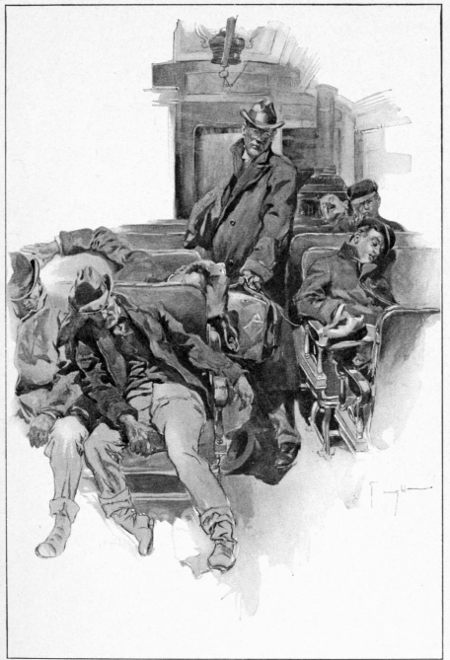
Bodies (dead with sleep) were lying in every conceivable position, with
legs and arms thrust up as if the victims had died in agony; some face
down; others with gaping mouths and heads hooked across the seats. These
heads and arms and legs made the passage of the aisle difficult. One—a
leg—got tangled in my overcoat, and the head belonging to it said with
a groan:
"Where in h— are you goin' with that——"
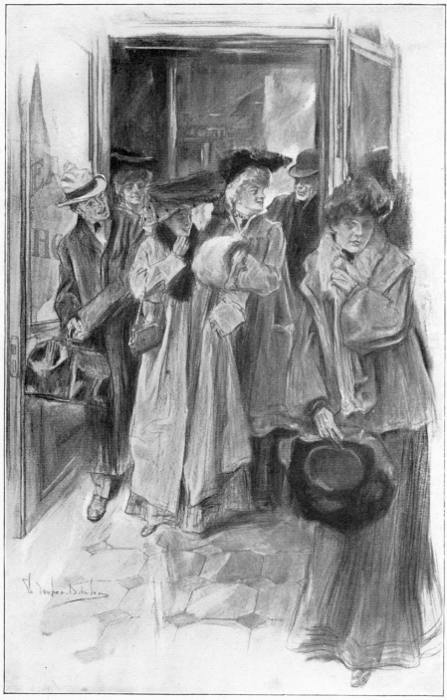
Heads and arms and legs made the passage of the aisle difficult.
But I did not stop. I kept on my way to the passenger coach. It was not
my fault that no Pullman with a porter attached was run on this local.
There was no smoke in this coach. Neither was there any heat. There was
nothing that could cause it. Something had happened, perhaps to the
coupling of the steam hose so that it wouldn't couple; or the bottom was
out of the hollow mockery called a heater; or the coal had been held up.
Whatever the cause, a freight shed was a palm garden beside it. Nor had
it any signs of a battle-field. It looked more like a ward in a hospital
with most of the beds empty. Only one or two were occupied; one by a
baby and another by its mother—the woman on one seat, her hand across
the body of the child, and both fast asleep, one little bare foot
peeping out from beneath the shawl that covered the child, like a pink
flower a-bloom in a desert.
I can always get along in a cold car. It is a hot one that incites me to
murder the porter or the brakeman. I took off the coat I was wearing and
laid it flat on a seat. Then came a layer of myself with the grip for a
pillow, and then a top crust of my old friend. They might have knocked
out the end of the car now and I should have been comfortable. Not to
sleep—forty minutes wouldn't be of the slightest service to a night
watchman, let alone an all-night traveller—but so as to be out of the
way of porterless-passengers lugging grips.
The weather now took a hand in the game. The cold grew more intense,
creeping stealthily along, blowing its frosty breath on the windows; so
dense on some panes that the lights of the stations no longer shone
clear, but were blurred, like lamps in a fog. The incoming passengers
felt it and stamped their feet, shedding the snow from their boots. Now
and then some traveller, colder than his fellow, stopped at the
fraudulent heater to warm his fingers before finding a seat, and,
strange to say, passed on satisfied—due to his heated imagination, no
doubt.
The blanket of white was now six inches thick, and increasing every
minute. The wind was still asleep.
"Guess we're in for it," said the conductor to a ticket stuck in the
hat of a man seated in front. "I hear No. 6 is stalled chuck-a-block
this side of Schoolcraft. We'll make Battle Creek anyway, and as much
furder as we can get, but there ain't no tellin' where we'll bring up."
I thrust my ticket hand through the crust of my overcoat and the steel
nippers perforated the bit of cardboard with a click. I was undisturbed.
Battle Creek was where I was to get off; what became of the train after
that was no affair of mine.
Only one thing worried me as I lay curled up like a cocoon. Was there a
hotel at Battle Creek within reasonable distance (walking, of course; no
hack would be out a night like this), with a warm side to its stove and
two more chairs in which I could pass the time of my stay, or would
there be only the railroad station—and if the last, what sort of a
railroad station?—one of those bare, varnished, steam-heated affairs
with a weighing machine in one corner and a slot machine in the other?
or a less modern chamber of horrors with the seats divided by iron
arms—instruments of torture for tired, sleepy men which must have been
devised in the Middle Ages?
The wind now awoke with a howl, kicked off its counterpane and started
out on a career of its own. Ventilators began to rattle; incoming
passengers entered with hands on their hats; outgoing passengers had
theirs whipped from their heads before they touched the platforms of the
stations. The conductor as he passed shook his head ominously:
"Goin' to be a ring-tailed roarer," he said to a man in the aisle whose
face was tied up in a shawl with the ends knotted on top of his cap,
like a boy with the toothache. "Cold enough to freeze the rivets in the
b'iler. Be wuss by daylight."
"Will we make Battle Creek?" I asked, lifting my head from the grip.
"Yes; be there in two minutes. He's blowin' for her now."
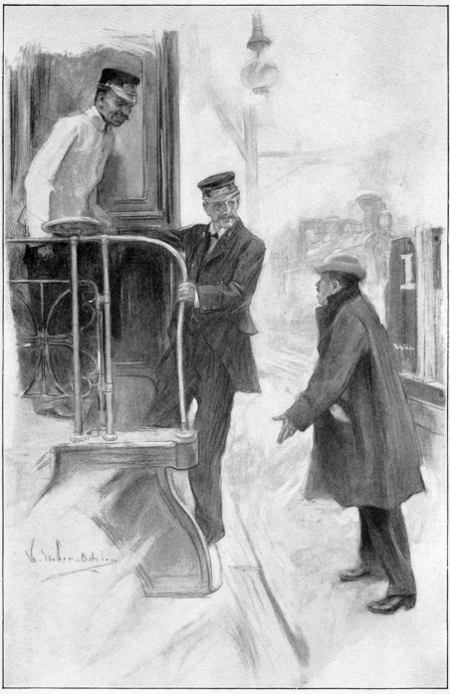
Before the brakeman had tightened his clutch on his brake I was on my
feet, had shifted overcoats, and was leaning against the fraudulent
heater ready to face the storm.
It would have been a far-seeing eye that could have discovered a hotel.
All I saw as I dropped to the snow-covered platform was a row of gas
jets, a lone figure pushing a truck piled up with luggage, one arm
across his face to shield it from the cutting snow, and above me the
gray mass of the station, its roof lost in the gloom of the wintry
night. Then an unencumbered passenger, more active than I, passed me up
the wind-swept platform, pushed open a door, and he and I stepped into—
What did I step into? Well, it would be impossible for you to imagine,
and so I will tell you in a new paragraph.
I stepped into a little gem of a station, looking like a library without
its books, covered by a low roof, pierced by quaint windows and fitted
with a big, deep, all-embracing fireplace ablaze with crackling logs
resting on old-fashioned iron dogs, and beside them on the hearth a huge
pile of birch wood. A room once seen never to be forgotten—a cosey box
of a place, full of curved alcoves and half-round recesses with still
smaller windows, and a table bearing a silver-plated ice-pitcher and two
silver-plated goblets, unchained (really, I am telling the truth),
and big easy chairs, five or six of them, some of wicker-work with
cushions, and a straw lounge big enough and long enough to stretch out
on at full length. All this, remember, from out a night savage as a pack
of wolves, and quite a thousand miles from home.
I gravitated instinctively toward the fire, threw my overcoat and grip
on the lounge and looked about me. The one passenger besides myself
tarried long enough at the ticket office to speak to the clerk, and then
passed on through the other door. He lived here, perhaps, or preferred
the hotel—wherever that was—to the comforts of the station.
The ticket-clerk locked his office, looked over to where I stood with my
back to the blazing fire, my eyes roving around the room, and called
out:
"I'm going home now. Hotel's only three blocks away."
"When is the down train due?" I asked.
"Three-thirty."
"Will it be on time?"
"Never stole it. Search me! May be an hour late; may be two," he added
with a laugh.
"I'll stay here, if you don't mind."
"Course—glad to have you. You'll want more wood, though....
John!"—this to the man who had been pushing the truck—"bring in some
more wood; man's going to stay here for No. 8. Good-night." And he shut
the door and went out into the storm, his coat-sleeve across his face.
John appeared and dropped an armful of clean split silver-backed birch
logs in a heap on the hearth, remarking as he bobbed his head
good-night, "Guess you won't freeze," and left by the same exit as the
clerk, a breath of the North Pole being puffed into the cosey room as he
opened and shut the door.
There are times when to me it is a delight to be left alone. I
invariably experience it when I am sketching. I often have this feeling,
too, when my study door is shut and I am alone with my work and books. I
had it in an increased degree this night, with the snow drifting
outside, the wind fingering around the windows seeking for an entrance,
and the whole world sound asleep except myself. It seemed good to be
alone in the white stillness. What difference did the time of night
make, or the place, or the storm, or the morrow and what it might bring,
so long as I could repeat in a measure the comforts and privacy of my
own dear den at home?
I began to put my house in order. The table with the pitcher and goblets
was drawn up by the side of the sofa; two easy chairs moved into
position, one for my feet and one for my back, where the overhanging
electric light would fall conveniently, and another log thrown on the
fire, sending the crisp blazing sparks upward. My fur overcoat was next
hung over the chair with the fur side out, the grip opened, and the
several comforts one always carries were fished out and laid beside the
ice-pitcher—my flask of Private Stock, a collar-box full of cigars,
some books and a bundle of proof with a special delivery stamp—proofs
that should have been revised and mailed two days before. These last
were placed within reach of my hand.
When all was in order for the master of the house to take his ease, I
unscrewed the top of the flask, and with the help of the pitcher and the
goblet compounded a comfort. Then I lighted a cigar and began a tour of
the room. The windows were banked up with the drift; through the
half-blinded panes I could see the flickering gas jets and on the snow
below them the disks of white light. Beyond these stretched a ruling of
tracks edged by a bordering of empty yard-cars, then a waste of white
ending in gloom. The only sounds were the creaking of the depot signs
swaying in the wind and the crackle of the logs on my hearth—mine now
in the isolation, as was everything else about me. Next I looked between
the wooden spindles of the fenced-in ticket office, and saw where the
clerk worked and how he kept his pens racked up and the hook on which he
hung his hat and coat, and near it the news-stand locked tight, only the
book posters showing over the top, and so on back to my fire and into my
fur-lined throne. Then, with a sip of P. S., I picked up my proof sheets
and began to work.
Before I had corrected my first galley my ear caught the sound of
stamping feet outside. Some early train-hand, perhaps, or porter, or
some passenger who had misread the schedule; for nothing up or down was
to pass the station except, perhaps, a belated freight. Then the door
was burst open, and a voice as crisp as the gust of wind that ushered it
in called out:
"Well, begorra! ye look as snug as a bug in a rug. What d'ye think of
this for a night?"
He was approaching the fire now, shaking the snow from his uniform and
beating his hands together as he walked.
I have a language adapted to policemen and their kind, and I invariably
use it when occasion offers. Strange to say, my delight at being alone
had now lost its edge.
"Corker, isn't it?" I answered. "Draw up a chair and make yourself
comfortable."
"Well, I don't care if I do. By Jiminy! I thought the ears of me would
freeze as I come acrost the yard. What are ye waitin' for—the 3.30?"
"I am. Here, take a nip of this," and I handed him the other goblet and
pushed the P. S. his way. Corrupting the Force, I know, but then
consider the temptation, and the fact that I was stranded on a lone
isle of the sea, or adrift on a detached ice floe (that's a better
simile), and he the only other human being within reach.
He raised the flask to his eye, noted the flow line, poured out three
fingers, added one finger of water, said "How!" and emptied the mixture
into his person. Then I handed him a cigar, laid aside my proofs and
began to talk. I not only had a fire and a pile of wood, with something
to smoke and enough P. S. for two, but I had a friend to enjoy them with
me. Marvellous place—this Battle Creek!
"Anything doing?" I asked after the storm and the night had been
discussed and my lighted match had kindled his cigar.
"Only a couple o' drunks lyin' outside a j'int," he answered, stretching
his full length in the chair.
"Did you run 'em in?"
"No, the station was some ways, so I tuk 'em inside. I know the feller
that runs the j'int an' the back dure was open—" and he winked at me.
"They'd froze if I'd left 'em in the drift. Wan had the ears of him
purty blue as it wuz."
"Anything else?"
"Well, there was a woman hollerin' bloody murther back o' the lumber
yard, but I didn't stop to luk her up. They're allus raisin' a muss up
there—it was in thim tiniments. Ye know the place." (He evidently took
me for a resident or a rounder.) "Guess I'll be joggin' 'long" (here he
rose to his feet), "my beat's both sides of the depot an' I daren't stop
long. Good luck to ye."
"Will you drop in again?"
"Yes, maybe I will," and he opened the door and stepped out, his hand on
his cap as the wind struck it.
Half an hour passed.
Then the cough of a distant locomotive, catching its breath in the teeth
of the gale, followed by the rumbling of a heavily loaded train, growing
louder as it approached, could be heard above the wail of the storm.
When it arrived off my window I rose from my seat and looked out through
the blurred glass. The breast of the locomotive was a bank of snow, the
fronts and sides of the cars were plastered with the drift. The
engineer's head hung out of the cab window, his eye on the swinging
signal lights. Huddling close under the lee of the last box car I caught
the outline of a brakeman, his cap pulled over his ears, his jacket
buttoned tight. The train passed without stopping, the cough of the
engine growing fainter and fainter as it was lost in the whirl of the
gale. I regained my seat, lighted another cigar and picked up my proofs
again.
Another half hour passed. The world began to awake.
First came the clerk with a cheery nod; then the man who had brought in
the wood and who walked straight toward the pile to see how much of it
was left and whether I needed any more; then the lone passenger who had
gone to the hotel and who was filled to the bursting point with
profanity, and who emitted it in blue streaks of swear-words because of
his accommodations; and last the policeman, beating his chest like a
gorilla, the snow flying in every direction.
The circle widened and another log was thrown on the crackling fire.
More easy chairs were drawn up, the policeman in one and the clerk in
another. Then the same old pantomime took place over the P. S. and the
goblets, and the old collar-box had its lid lifted and did its duty
bravely. The lone passenger, being ill-tempered and out of harmony with
the surroundings, was not invited. (What a lot of fun the ill-tempered
miss in this world of care!)
Some talk of the road now followed, whether the Flyer would get through
to Chicago, the clerk remarking that No. 8 ought to arrive at 3.30, as
it was a local and only came from Kalamazoo. Talk, too, of how long I
would have to wait at Jackson, and what accommodations the train had,
the clerk in an apologetic voice remarking, as he sipped his P. S., that
it was a "straight passenger," with nothing aboard that would suit me.
Talk of the town, the policeman saying that the woman was "bilin' drunk"
and he had to run both her and the old man in before the "tiniment got
quiet," the lone passenger interpolating from his seat by the steam
pipes that— But it's just as well to omit what the lone passenger said,
or this paper would never see the light.
At 3.30 the clerk sprang from his chair. He had, with his quick ear,
caught the long-drawn-out shriek of No. 8 above the thrash of the storm.
Into my overcoat again, in a hurry this time—everybody helping—the fur
one, of course, the other on my arm—a handshake all round, out again
into the whirl, the policeman carrying the grip; up a slant of snow on
the steps of the cars—not a traveller's foot had yet touched it, and
into an ordinary passenger coach: all in less than two minutes—less
time, in fact, than it would take to shift the scenery in a melodrama,
and with as startling results.
No sleeping corpses here sprawled over seats, with arms and legs thrust
up; no mothers watched their children; no half-frozen travellers
shivered beside ice-cold heaters. The car was warm, the lights burned
cheerily, the seats were unlocked and faced both ways.
Not many passengers either—only six besides myself at my end. Three of
them were wearing picture hats the size of tea-trays, short skirts, and
high shoes with red heels. The other three wore Derbies and the
unmistakable garb of the average drummer. Each couple had a double seat
all to themselves, and all six were shouting with laughter. Packed in
the other end of the car were the usual collection of travellers seen on
an owl train.
I passed on toward the middle of the coach, turned a seat, and proceeded
to camp for the night. The overcoat did service now as a seat cushion
and the grip as a rest for my elbow.
It soon became evident that the girls belonged to a troupe on their way
to Detroit; that they had danced in Kalamazoo but a few hours before,
had supped with the drummers, and had boarded the train at 2.50. As
their conversation was addressed to the circumambient air, there was no
difficulty in my gaining these facts. If my grave and reverend presence
acted as a damper on their hilarity, there was no evidence of it in
their manner.
"Say, Liz," cried the girl in the pink waist, "did you catch on to
the—" Here her head was tucked under the chin of the girl behind her.
"Oh, cut it out, Mame!" answered Liz. "Now, George, you stop!" This with
a scream at one of the drummers, whose head had been thrust close to
Mame's ear in an attempt to listen.
"Say, girls," broke in another—they were all talking at once—"why,
them fellers in the front seat went on awful! I seen Sanders lookin'
and—"
"Well, what if he did look? That guy ain't—" etc., etc.
I began to realize now why the other passengers were packed together in
the far end of the car. I broke camp and moved down their way.
The train sped on. I busied myself studying the loops and curls of snow
that the eddying wind was piling up in the cuts and opens, as they lay
glistening under the glow of the lights streaming through the car
windows; noting, too, here and there, a fence post standing alone where
some curious wind-fluke had scooped clear the drifts.
Soon I began to speculate on the outcome of the trip. I had at best only
three hours leeway between 11.30 A.M., the schedule time of arriving in
Cleveland, and 2.30 P.M., the hour of my lecture—not much in a storm
like this, with every train delayed and the outlook worse every hour.
At Albion the drummers got out, the girls waving their hands at them
through the frosted windows. When the jolly party of coryphées regained
their seats, their regulation smiles, much to my surprise, had faded.
Five minutes later, when I craned my neck to look at them, wondering why
their boisterousness had ceased, the three had wrapped themselves up in
their night cloaks and were fast asleep. The drummers, no doubt, forgot
them as quickly.
The conductor now came along and shook a sleepy man on the seat behind
me into consciousness. He had a small leather case with him and looked
like a doctor—was, probably; picked up above Battle Creek, no doubt, by
a hurry call. He had been catching a nap while he could. Jackson was ten
minutes away, so the conductor told the man.
More stumbling down the snow-choked steps and plunging through drifts
(it was too early yet for the yard shovellers), and I entered the depot
at Jackson—my second stop on the way to Cleveland.
No cry of delight escaped my lips as I pushed open the door. The Middle
Ages have it all their own way at Jackson and still do unless the
Battle Creek architect has since modernized the building. Nothing longer
than a poodle or a six months' old baby could stretch its length on
these iron-divided seats. "Move on" must have been the watchword, for
nobody sat—not if they could help it. I tried it, spreading the
overcoat between two of them, but the iron soon entered my soul, or
rather my hip joints, and yet I am not over large. No open wood fire, of
course, no easy chairs, no lounge; somebody might pass a few minutes in
comfort if there were. There was a sign, I remember, nailed up, reading
"No loiterers allowed here," an utterly useless affair, for nobody that
I saw loitered. They "skedaddled" at once (that's another expressive
word, old as it is), and they failed to return until the next train came
along. Then they gathered for a moment and again disappeared. No, the
station building at Jackson is not an enticing place—not after Battle
Creek.
And yet I was not unhappy. I had only an hour to wait—perhaps
two—depending on the way the tracks were blocked.
I unlocked the grip. There was nothing left of the P. S.—the policeman
had seen to that; and the collar-box was empty—the clerk had had a hand
in that—two, if I remember. The proofs were finished and ready to mail,
and so I buttoned up my fur coat and went out into the night again in
search of the post-box, tramping the platform where the wind had swept
it clean. The crisp air and the sting of the snow-flakes felt good to
me.
Soon my eye fell on a lump tied up with rope and half-buried in the
snow. The up-train from Detroit had thrown out a bundle of the morning
edition of the Detroit papers. I lugged it inside the station, brushed
off the snow, dragged it to a seat beneath a flaring gas jet, cut the
rope with my knife and took out two copies damp with snow. I was in
touch with the world once more, whatever happened! I soon forgot the
hardness of the seat and only became conscious that someone had entered
the room when a voice startled me with:
"Say, Boss!"
I looked up over my paper and saw a boy with his head tied up in an
old-fashioned tippet. He was blowing his breath on his fingers, his
cheeks like two red apples.
"Well, what is it?"
"How many poipers did ye swipe?"
"Oh, are you the newsboy? Do these belong to you?"
"You bet! How many ye got?"
"Two."
"Ten cents, Boss. Thank ye," and he shouldered the bundle and went out
into the night, where a wagon was standing to receive it.
"Level-headed boy," I said to myself. "Be a millionaire if he lives. No
back talk, no unnecessary remarks regarding an inexcusable violation of
the law—petty larceny if anything. Just a plain business statement,
followed by an immediate cash settlement. A most estimable boy."
A road employee now came in, looked at the dull-faced clock on the wall,
went out through a door and into a room where a telegraph instrument was
clicking away, returned with a piece of chalk and wrote on a
black-board:
"No. 31—52 minutes late."
This handwriting on the wall had a Belshazzar-feast effect on me. If I
lost the connection at Adrian, what would become of the lecture in
Cleveland?
Another man now entered carrying a black carpet-bag—a sleepy man with
his hair tousled and who looked as if he had gone to bed in his clothes.
He fumbled in his pocket for a key, went straight to the slot machine,
unlocked it, disclosing a reduced stock of chewing-gum and chocolate
caramels, opened his carpet-bag and filled the machine to the top. This
sort of a man works at night, I thought, when few people are about. To
uncover the mysteries of a slot machine before a gaping crowd would be
as foolish and unprofitable as for a conjurer to show his patrons how he
performed his tricks.
I became conscious now, even as I turned the sheets of the journal, that
while my flask of P. S. and the contents of my collar-box were admirable
in their place, they were not capable of sustaining life, even had both
receptacles been full, which they were not. There was evidently nothing
to eat in the station, and from what I saw of the outside, no one had
yet started a fire; no one had even struck a light.
At this moment a gas jet flashed its glare through a glass door to my
right. I had seen this door, but supposed it led to the baggage-room—a
fact that did not concern me in the least, for I had checked my
red-banded trunk through to Cleveland. I got up and peered in. A stout
woman in a hood, with a blanket shawl crossed over her bosom, its ends
tied behind her back, was busying herself about a nickel-plated
coffee-urn decorating one end of a long counter before which stood a row
of high stools—the kind we sat on in school. I tried the knob of the
door and walked in.
"Is this the restaurant?"
"What would ye take it for—a morgue?" she snapped out.
"Can I get a cup of coffee?"
"No, ye can't, not till six o'clock. And ye won't git it then if
somebody don't turn out to help. Sittin' up all night lally-gaggin' and
leavin' a pile o' dirty dishes for me to wash up. Look at 'em!"
"Who's sitting up?" I inquired in a mild voice.
"These 'ladies'"—this with infinite scorn—"that's doin' waitin' for
six dollars a week and what they kin pick up, and it's my opinion they
picks up more'n 's good for 'em."
"And they make you do all the work?"
"Well, ye'd think so if ye stayed 'round here."
"Can I help?"
She had been swabbing down the counter as she talked, accentuating every
sentence with an extra twist of her arm, the wash-cloth held tight
between her fingers. She stopped now and looked me squarely in the face.
"Help! What are you good for?" There was a tone of contempt in her
voice.
"Well, I'm handy passing plates and cutting bread and pie. I've nothing
to do till the train comes along. Try me a while."
"You don't look like no waiter."
"But I am. I've been waiting on people all my life." I had crawled under
the counter now and was standing beside her. "Where will you have this?"
and I picked up from a side table a dish of apples and oranges caged in
a wire screen. I knew I was lost if I hesitated.
"Lay 'em here," she answered without a word of protest. I was not
surprised. The big and boundless West has no place for men ashamed to
work with their hands. Only the week before, in Colorado Springs, I had
dined at a house where the second son of a noble lord had delivered the
family milk that same morning, he being the guest of honor. And then—I
was hungry.
The woman watched me put the finishing touches on the dish of fruit, and
said in an altered tone, as if her misgivings had been satisfied:
"Now, fill that bucket with water, will ye? The sink's behind ye. I'll
start the coffee. And here!" and she handed me a key—"after ye fetch
the water, unlock the refrigerator and bring me that ham and them baked
beans."
Before the "ladies" had arrived—half an hour, in fact, before one of
them had put in an appearance—I was seated at a small table covered
with a clean cloth (I had set the table) with half a ham, a whole loaf
of bread, a pitcher of milk that had been left outside in the snow and
was full of lovely ice crystals, a smoking cup of coffee and a smoking
pile of griddle cakes which the woman had compounded from the contents
of two paper packages, and which she herself had cooked on a gas
griddle—and very good cakes they were: total cost, as per schedule,
fifty cents.
Breakfast over, I again sought the seclusion of the Torture Chamber. The
man with the piece of chalk had been kept busy. No. 31 was now one hour
and forty-two minutes late.
When it finally reached Jackson and I boarded it with my grip and
overcoat, it looked as if it had run into a glacier somewhere up the
road and had half a snowslide still clinging to its length.
Day had broken now, and what light could sift its way through the
falling flakes, shone cold and gray into the frost-dimmed windows of the
car. I had lost more than two hours of my leeway of three, and the
drifts were still level with the hubs of the driving-wheels.
We shunted and puffed and jerked along, waiting on side tracks for
freight trains hours behind time and switching out of the way of
delayed "Flyers," and finally reached Adrian. (Does anybody know of a
Flyer that is on time when but a bare inch of snow covers the track?)
Out of the car again, still lugging my impedimenta.
"Train for Toledo and the East, did you say?" answered the ticket agent.
"Yes, No. 32 is due in ten minutes—she's way behind time and so you've
just caught her. Your ticket is good, but you can't carry no baggage."
The information came as a distinct shock. No baggage meant no proper
habiliments in which to appear before my distinguished and critical
audience—the most distinguished and critical which I ever had the good
fortune to address—a young ladies' school.
"Why no baggage?"
"'Cause there's nothing but Pullmans, and only express freight
carried—it's a news train. Ought to have been here a week ago."
"Can I give up my check and send my trunk by express?"
"Yes. That's the agent over there by the radiator."
One American dollar accomplished it—a silver one; they don't use any
other kind of money out West.
When No. 32 hove in sight—the Fast Mail is its proper name—and stopped
opposite the small station at Adrian, a blessed, beloved, be-capped,
be-buttoned and be-overcoated Pullman porter—an attentive, considerate,
alert porter—emerged from it and at a sign from me picked up my
overcoat and grip—they now weighed a ton apiece—and with a wave of his
hand conducted me into a well-swept, well-ordered Pullman.
"Porter, what's your name?" I inquired. (I always ask a porter his
name.)
"Samuel Thomas, sah."
"Sam, is there a berth left?"
"Yes, sah—No. 9 lower."
"Is it in order?"
"Yes, sah—made up for a gem'man at South Bend, but he didn't show up."
"Let me see it."
It was exactly as he had stated; even the upper berth was clewed up.
"Sam!"
"Yes, sah."
"Are you married?"
"Yes, sah."
"Got any children?"
"Yes, sah—two."
"Think a good deal of them?"
"Yes, sah." The darky was evidently at sea now.
"Well, Sam, I'm going to bed and to sleep. If anybody disturbs me until
we get within fifteen minutes of Cleveland, your family will never see
you alive again. Do you understand, Sam?"
"Yes, sah, I understand." His face was in a broad grin now. "Thank ye,
sah. Here's an extra pillow," and he drew the curtains about me.
* * * * * * *
At twenty-five minutes past two, and with five minutes to spare, I
stepped on to the platform of the Academy for Young Ladies in Cleveland,
properly clothed and in my right mind.
The "weather had permitted."
AN EXTRA BLANKET