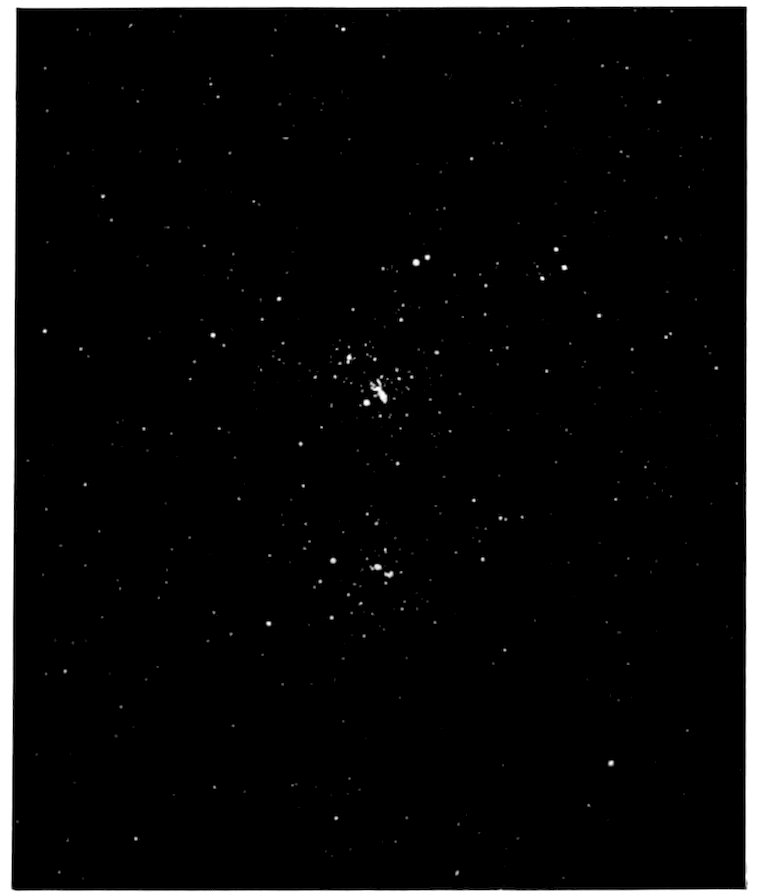
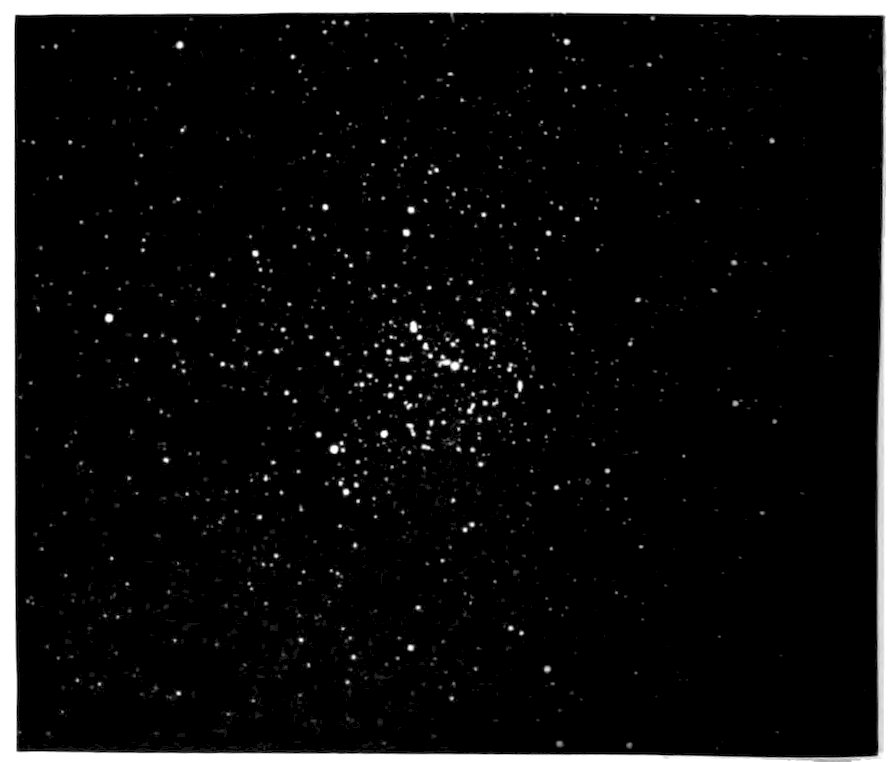
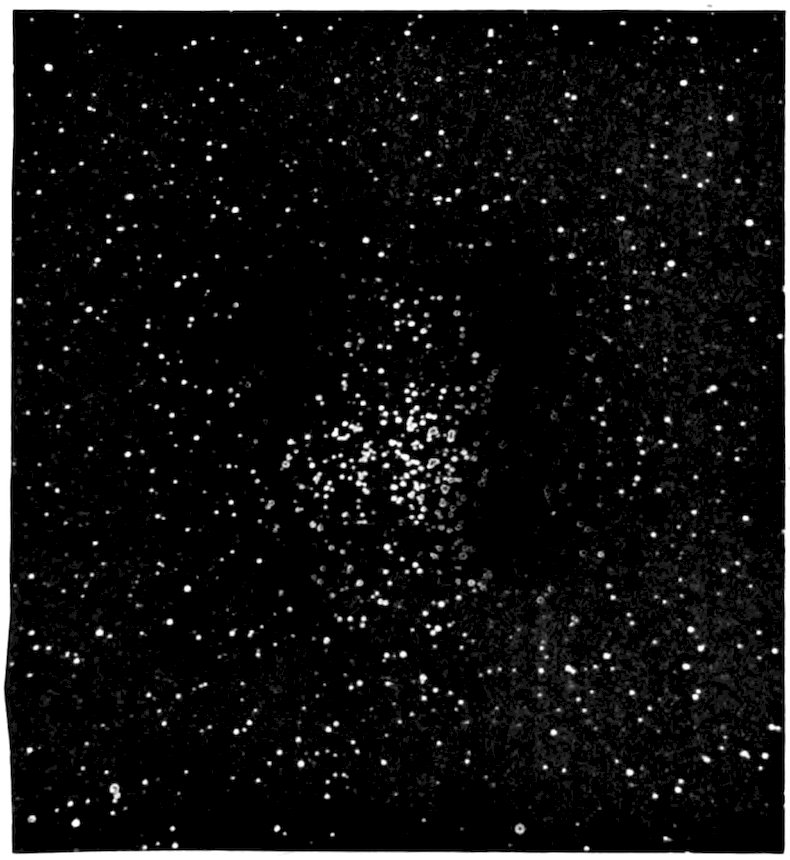
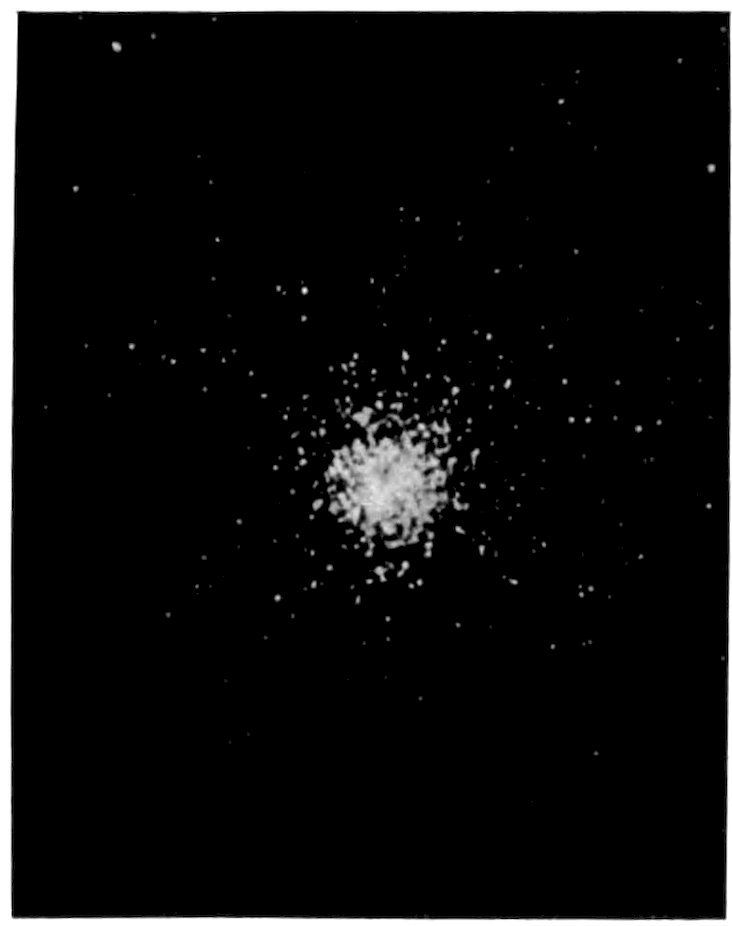
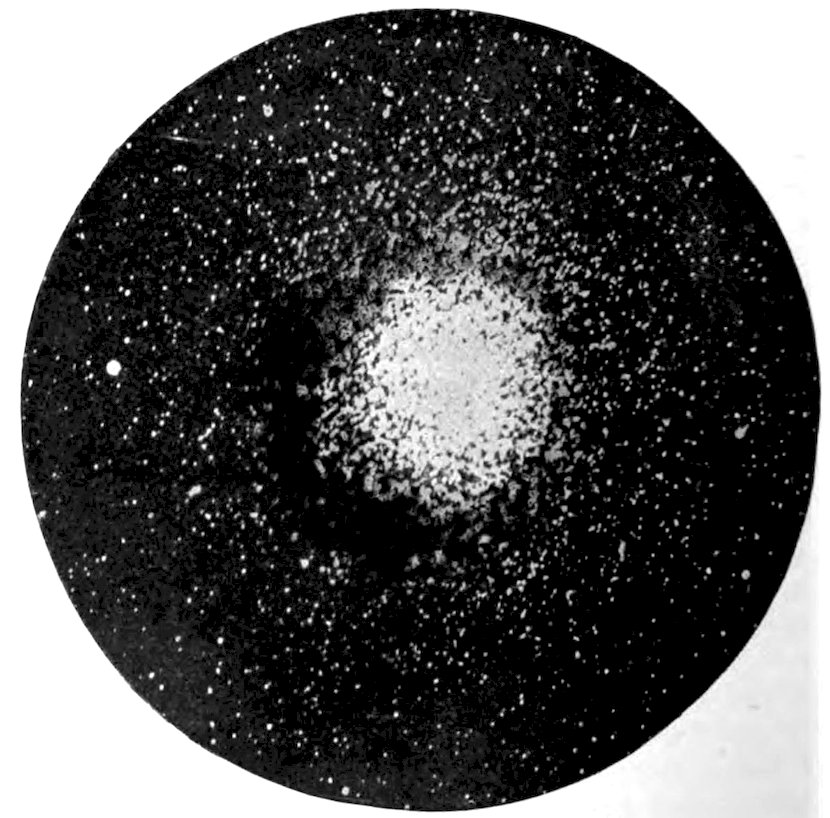
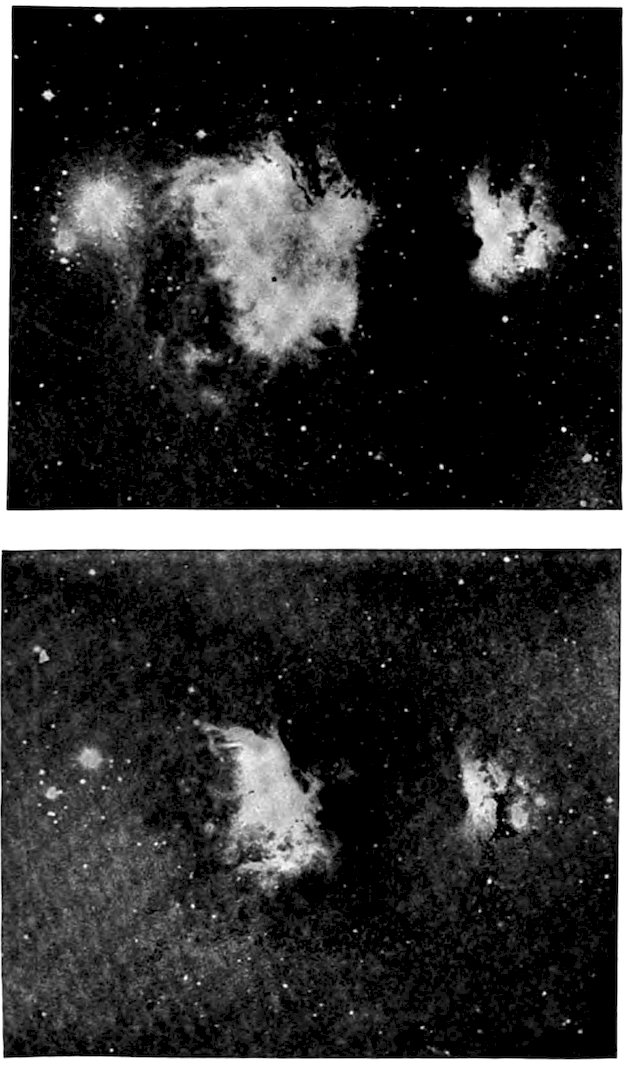
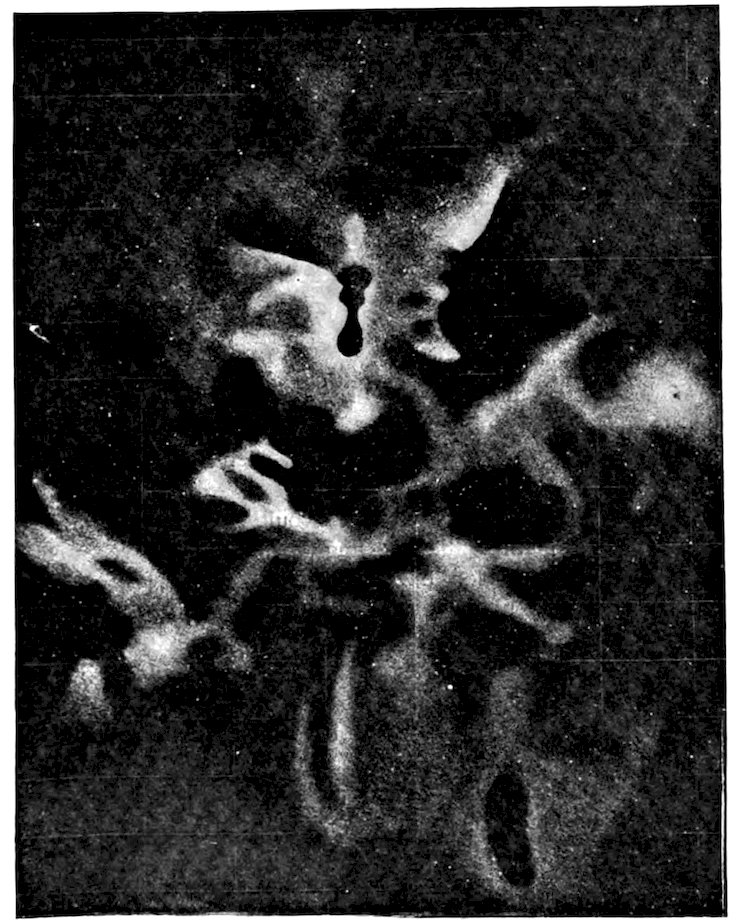
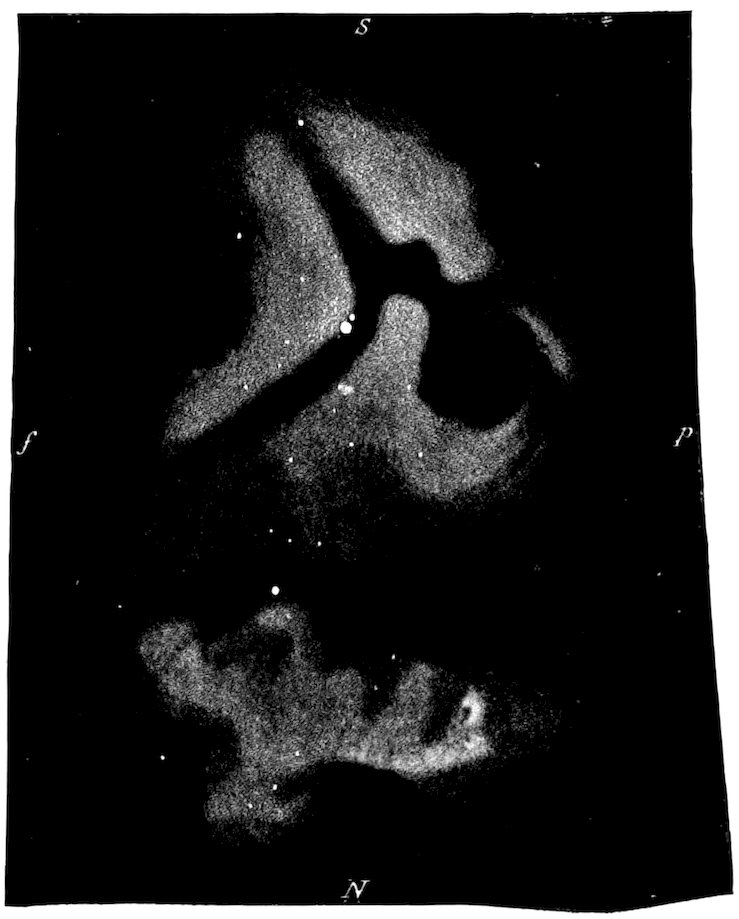
New original cover art included with this eBook is granted to the public domain.
THE
CONCISE
KNOWLEDGE
LIBRARY
ASTRONOMY
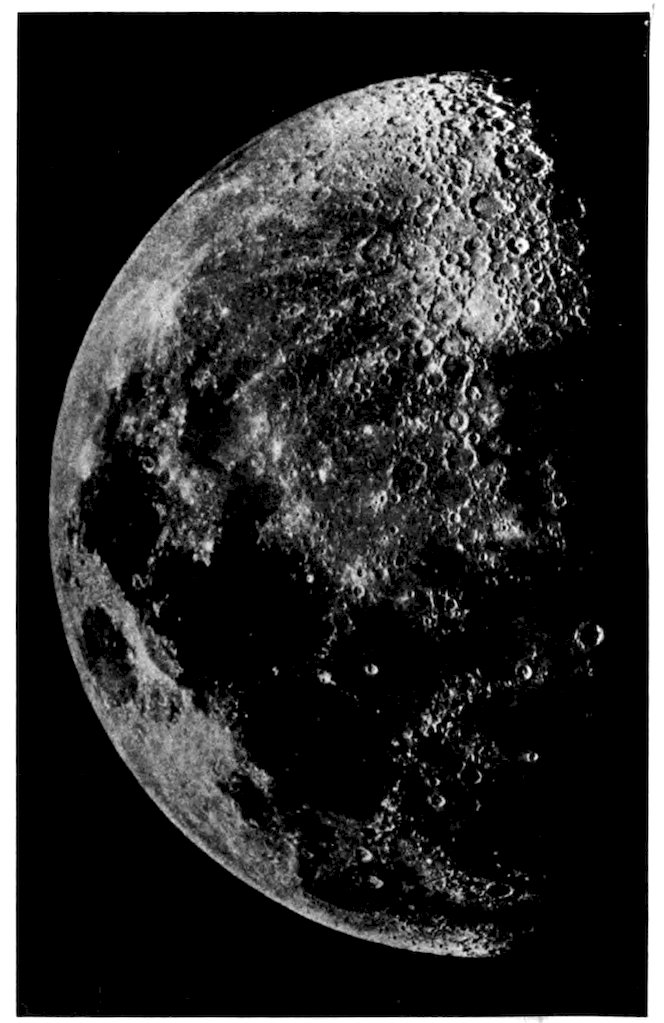
Photograph of the Moon taken at Paris by MM. Loewy and Puiseux with the great Coudé Equatorial, February 14, 1894.
THE CONCISE KNOWLEDGE LIBRARY
❧
BY
AGNES M. CLERKE
AUTHOR OF A POPULAR HISTORY OF ASTRONOMY DURING THE NINETEENTH CENTURY
A. FOWLER, A.R.C.S., F.R.A.S.
DEMONSTRATOR TO THE ROYAL COLLEGE OF SCIENCE
J. ELLARD GORE, F.R.A.S., M.R.I.A.
AUTHOR OF THE SCENERY OF THE HEAVENS, THE WORLDS OF SPACE, ETC.
NEW YORK
D. APPLETON AND COMPANY
1898
Authorized Edition.
PREFACE
vii
This work aims to present in concise form a popular
synopsis of Astronomical Knowledge to date.
In Section I., Miss Agnes M. Clerke, author of “A
Popular History of Astronomy during the Nineteenth Century,”
gives a brief historical sketch of the science from
Hipparchus to the present time. In Section II., an attempt
is made by Mr. A. Fowler, A.R.C.S., F.R.A.S., Demonstrator
of Astronomical Physics to the Royal College of
Science, to briefly outline the general principles of spherical
and gravitational Astronomy, and to describe the instrumental
means now at the command of observers in the
various branches of Astronomical research. The author begs
to record his indebtedness to Loomis’ “Treatise on Astronomy,”
and Young’s “General Astronomy,” which have
been frequently consulted, especially for memorial data; to
Mr. W. Shackleton, for assistance in proof-reading; and to
Mr. C. P. Butter, for valuable help in preparing the diagrams.
Section III., contributed by Miss Agnes M. Clerke,
deals with the Solar System; and Section IV., written by
Mr. J. Ellard Gore, F.R.A.S., M.R.I.A., treats of the
Sidereal Heavens.
The work is illustrated by a large number of diagrams and
other illustrations, prepared expressly for its pages, as well as
by a number of photographic and other reproductions of
photographs and drawings made by distinguished astronomers
viiiin Europe and America. In this connexion numerous
acknowledgments are due.
The Editor begs to express his sense of indebtedness to
the following astronomers and publishers, for kind permission
to reproduce original photographs and drawings from their
works:
To M. Loewy, Director de l’Observatoire, Paris, for permission
to reproduce the photograph of the Moon, which
forms the frontispiece of this volume; to Professor Edward
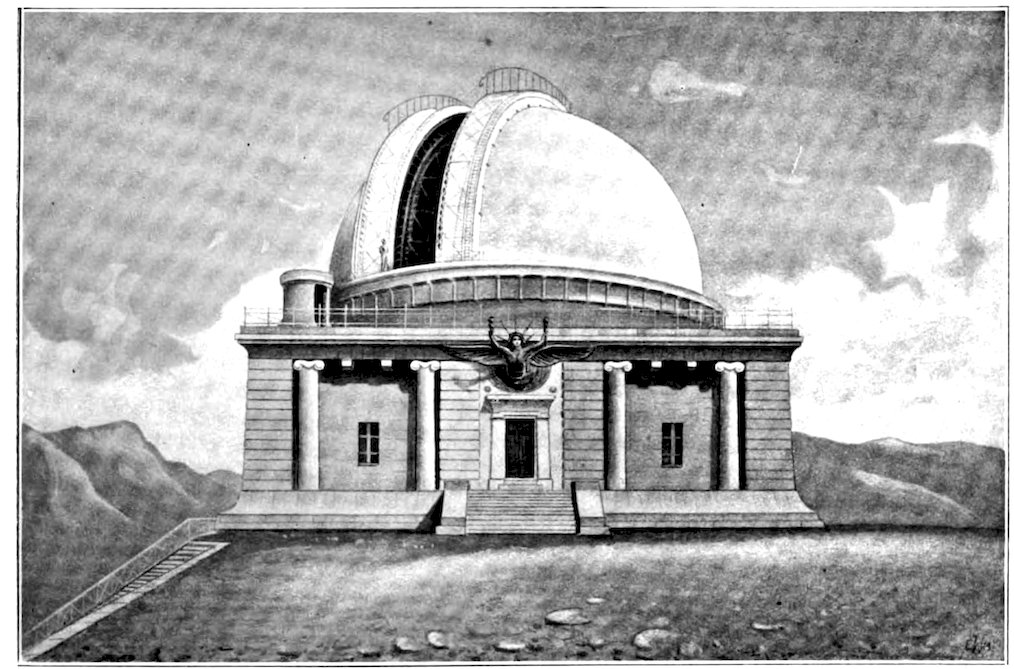
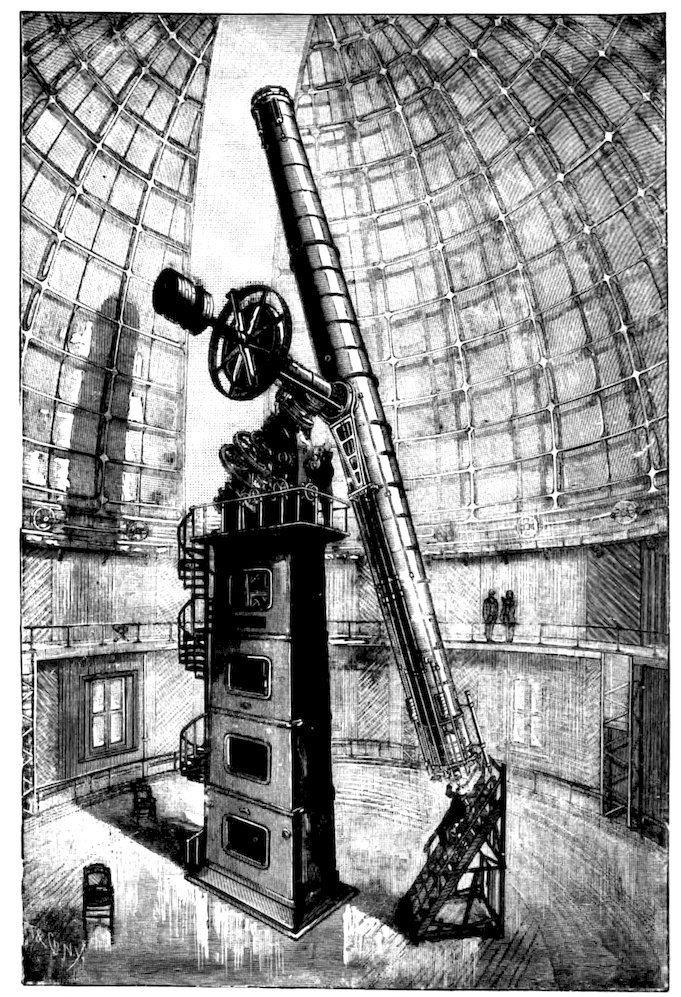
S. Holden, Director of the Lick Observatory, for permission
to reproduce drawings and photographs of the Observatory
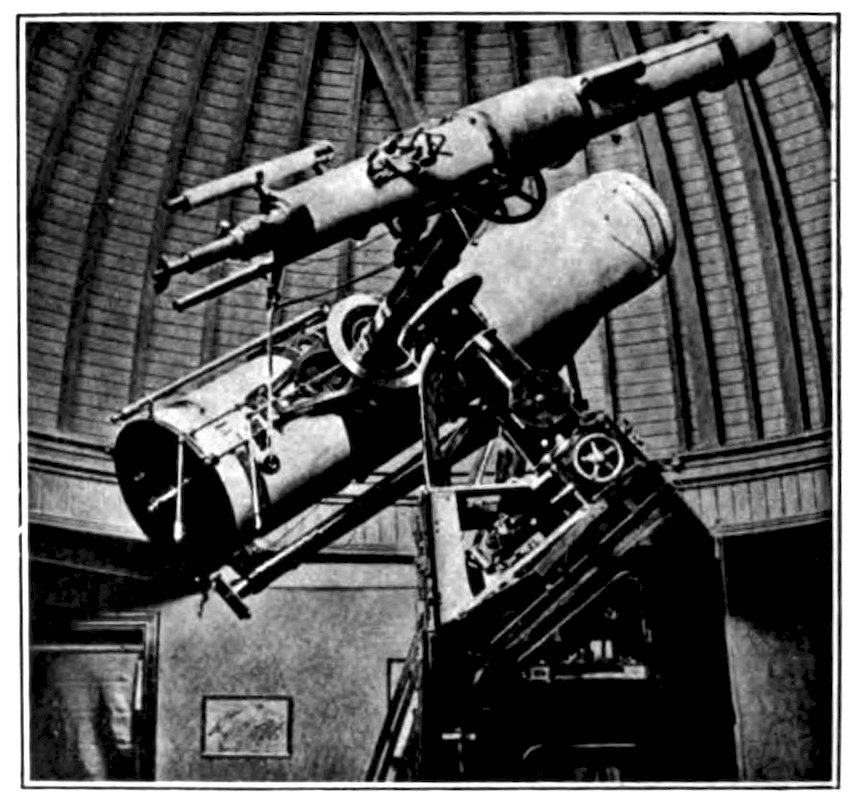
at Nice, p. 2; the Thirty-six Inch Reflector of Lick Observatory,
p. 40; the Meridian Circle of the Paris Observatory,
p. 203; the Spectroscope adapted to the eye end of the Lick
Telescope, p. 221; and Jupiter showing the Red Spot, p. 322; to
Dr. Isaac Roberts, for permission to reproduce his photograph
of the photographic telescope used by him, p. 196; to Messrs.
Trichnor & Co., of Berlin, for permission to reproduce two
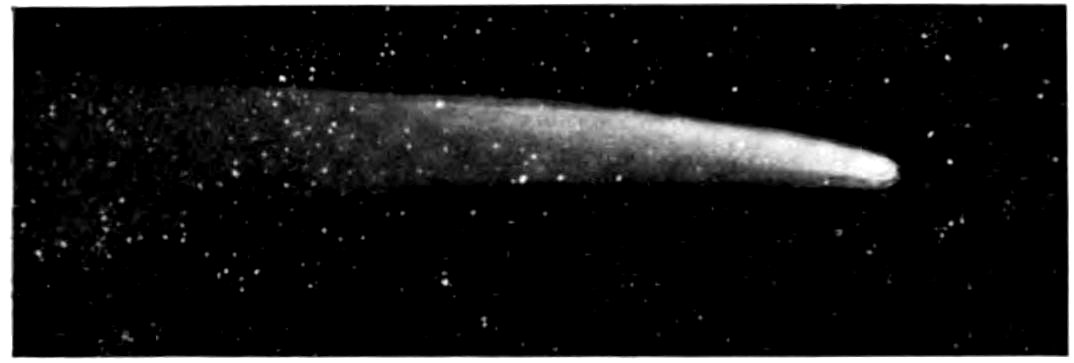
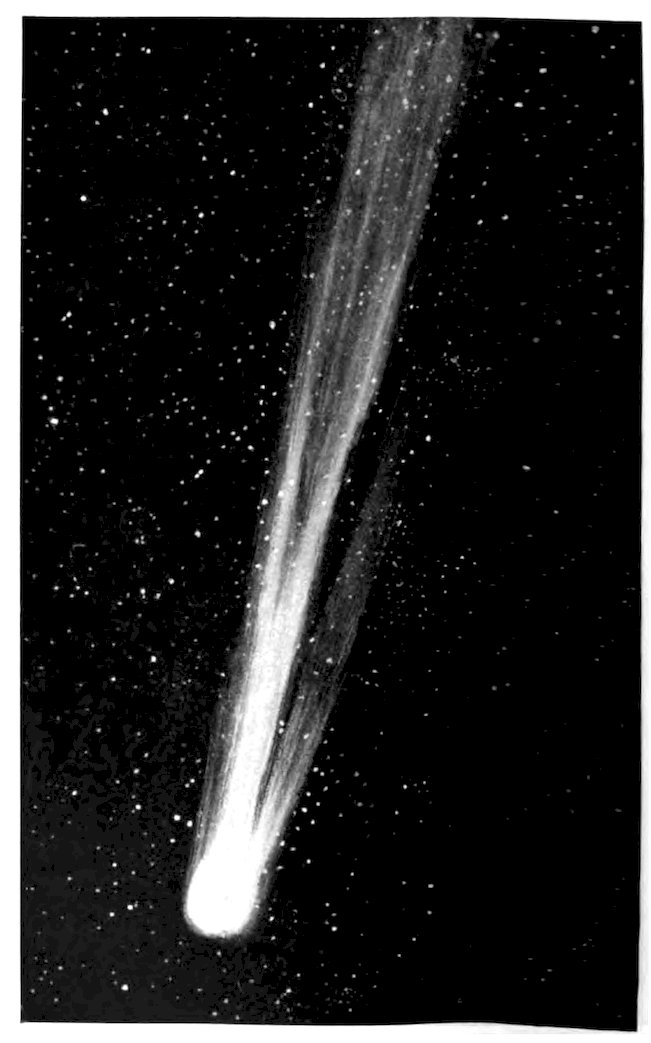
illustrations of Donati’s Comet, pp. 228 and 363; and one of
Sun-spots and Magnetic Variations, p. 246—all from Langley’s
“New Astronomy”; to Messrs. Witherby & Co., for permission
to reproduce the photograph of a Sun-spot by Janssen, p. 243;
the photograph of Jupiter, p. 328; the photographs of
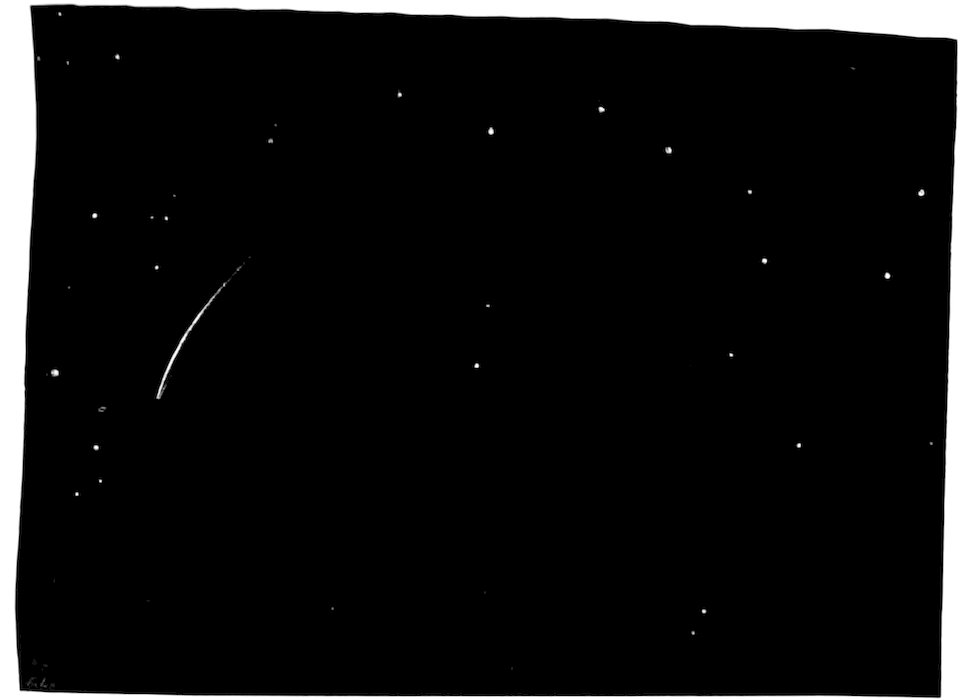
Swift’s Comet, pp. 374 and 375, Brooks’ Comet, p. 381, and
the Milky Way, p. 557, from Knowledge; to Messrs.
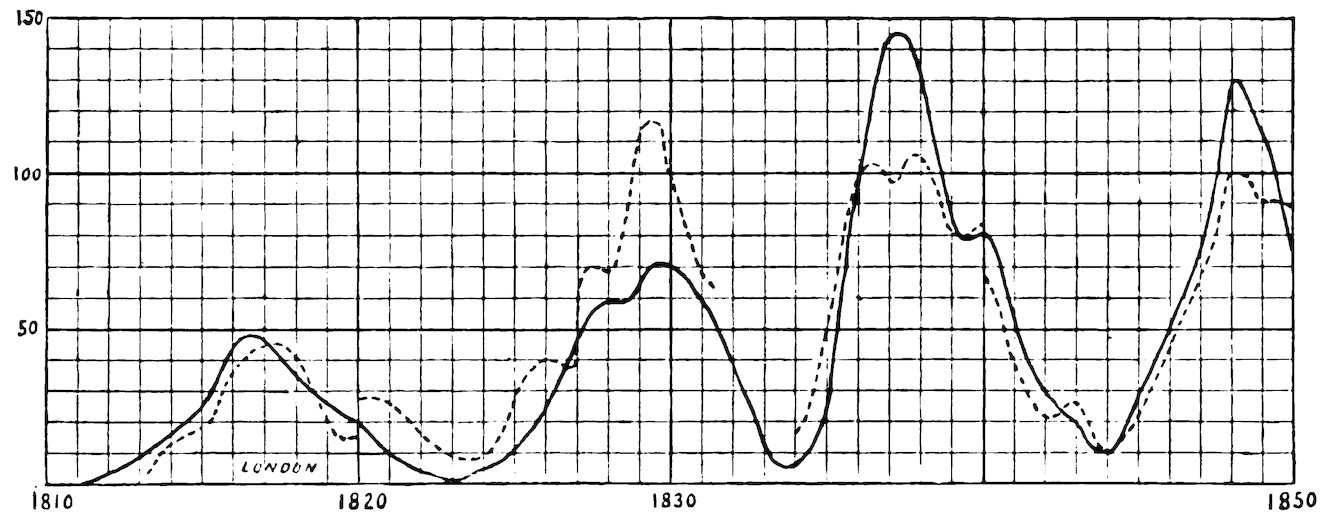
Taylor & Francis, for the diagram of curves showing the
development of Sun-spots, p. 257; to Professor George E.
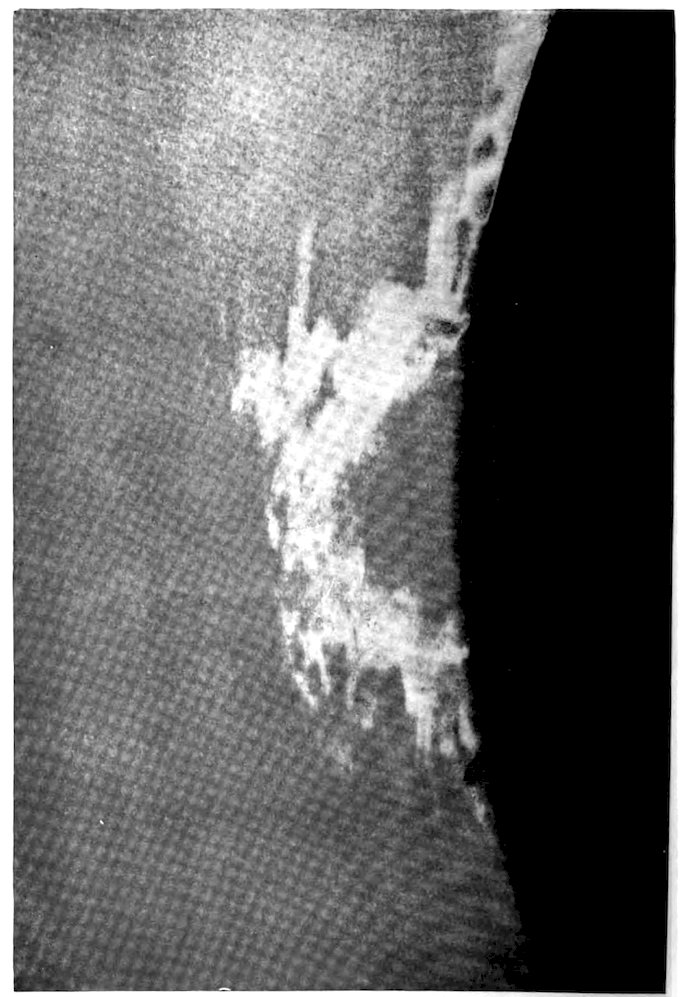
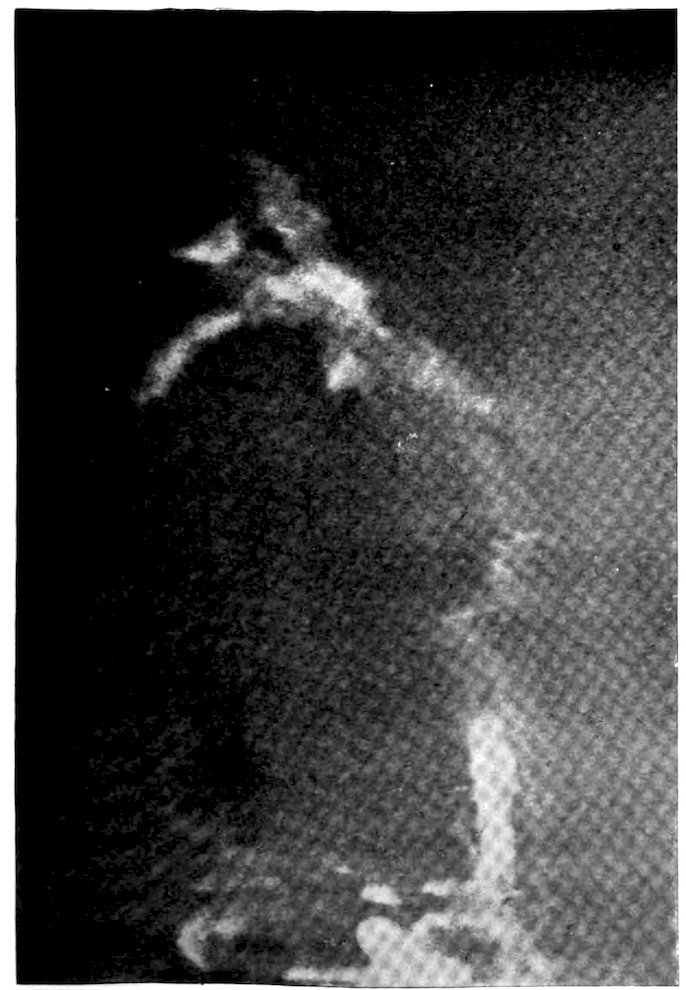
Hale, of Kenwood Observatory, Chicago, for his illustrations
of Eruptive Prominences photographed at Kenwood, March
24th, 1896, pp. 264 and 265, reproduced from the Astrophysical
Journal; to the Council of the Royal Society, for the
illustration of the Eclipsed Sun, p. 267, reproduced from
“Philosophical Transactions”; to Professor Barnard, for the
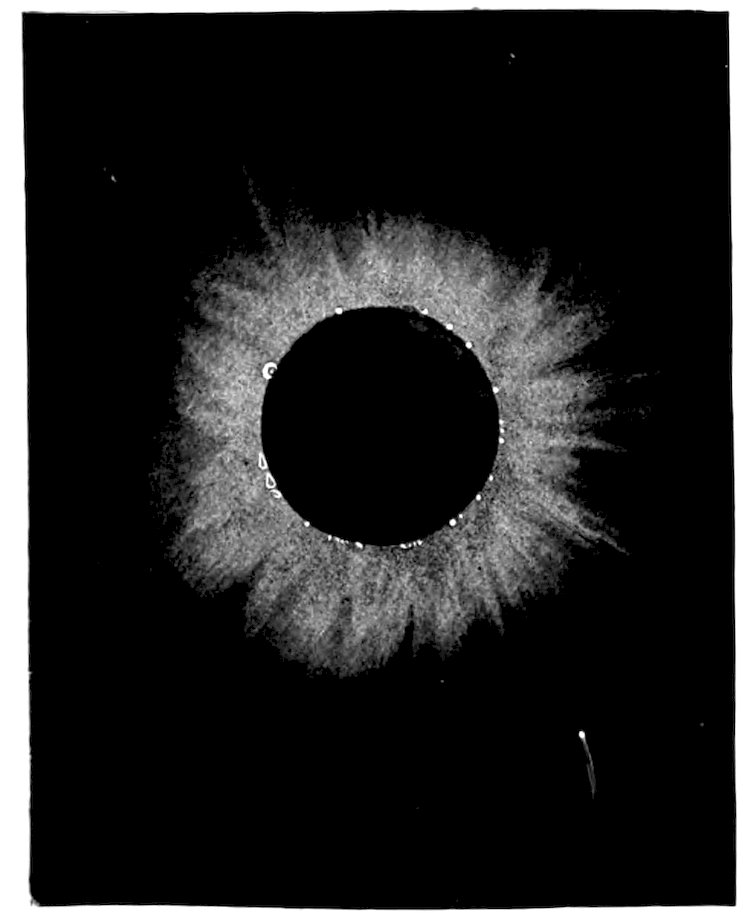
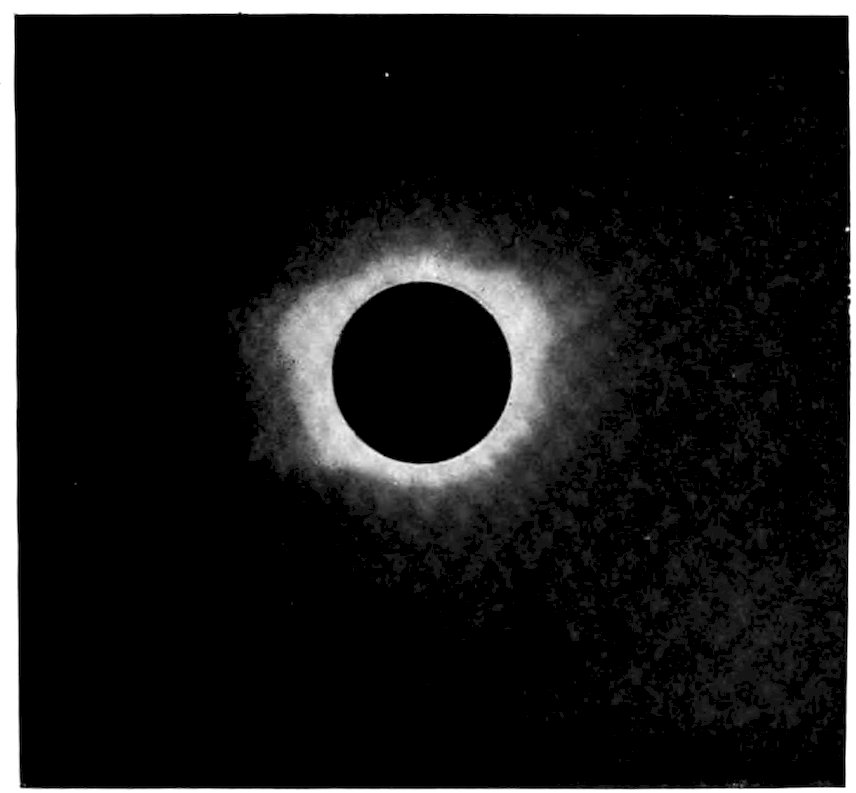
photographs of the Corona, reproduced on p. 269; and the
ixdrawings of the Transit of Jupiter’s Satellite, on p. 330, reproduced
from the Monthly Notices of the Royal Astronomical
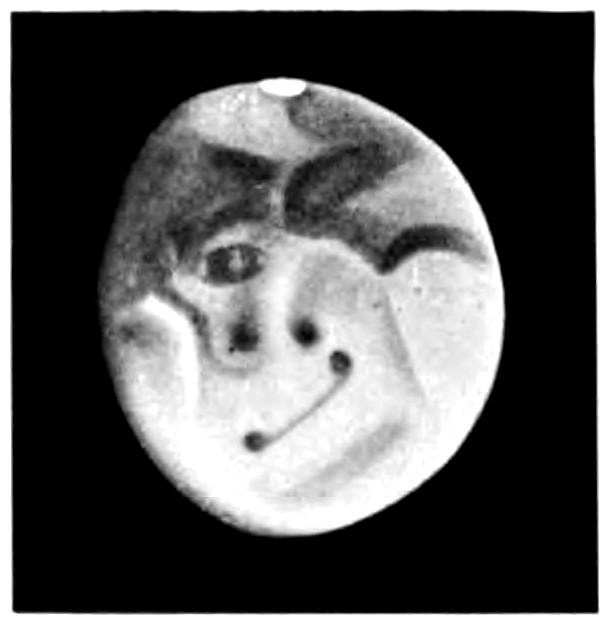
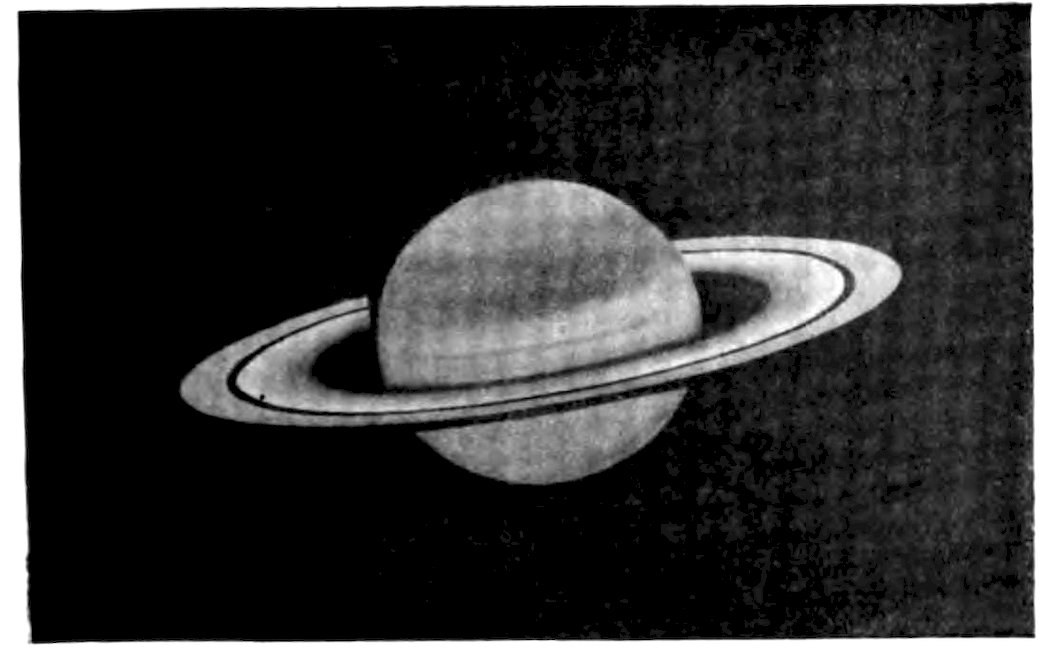
Society; the Eye of Mars, p. 302; and of Saturn and his
Rings, p. 335; to the editor of the Astronomische Nachrichten,
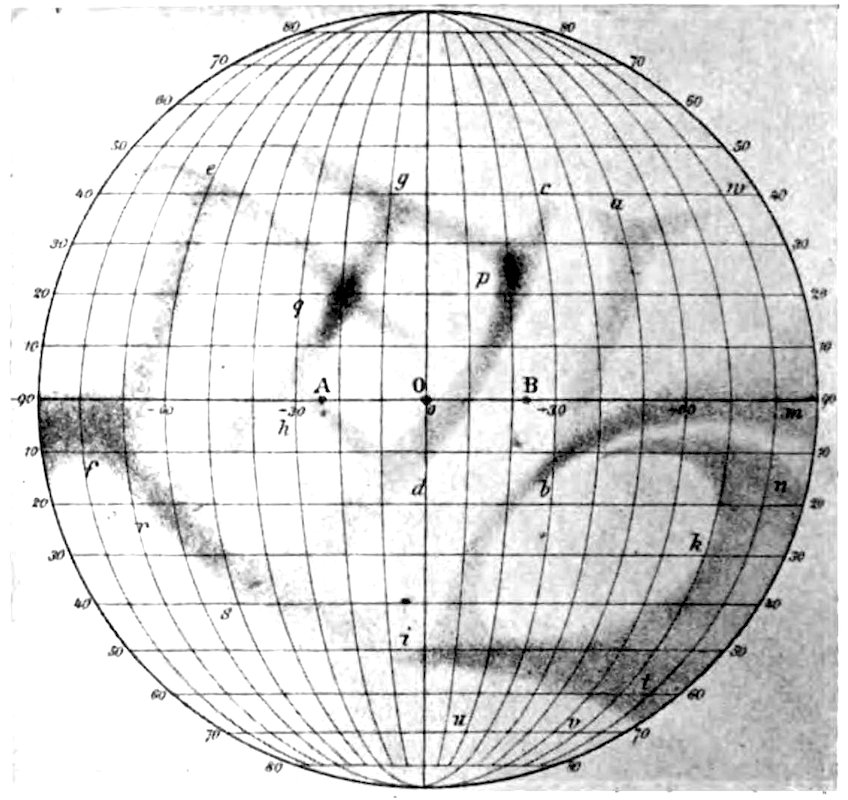
for the map of Mercury, by Schiaparelli, reproduced
on p. 276; to the editor of Nature, for the drawing of
Venus by Mascari, on p. 280; to Messrs. George Philip &
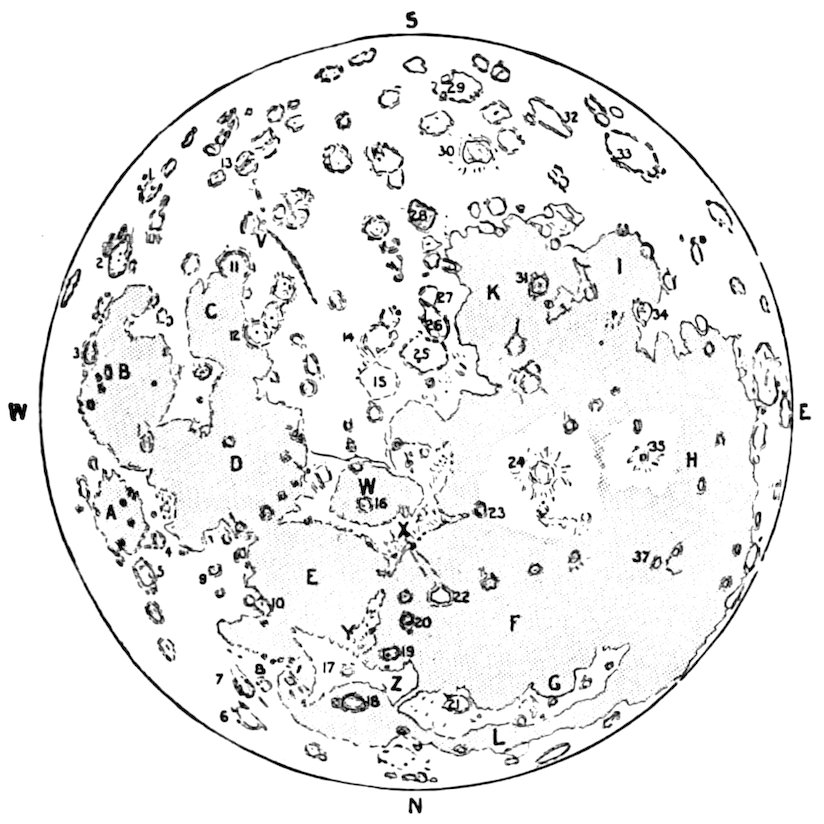
Son, for the map of the Moon, given on p. 291, from Fowler’s
“Telescopic Astronomy”; to Messrs. Longman, Green & Co.,
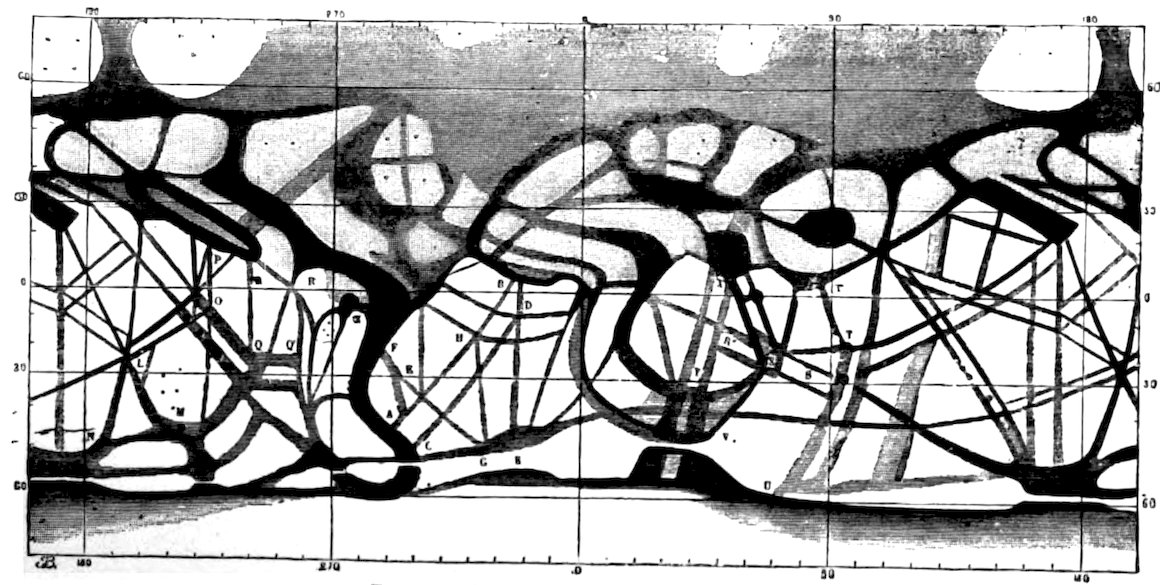
for the Chart of Mars, p. 300, and the diagram of the Apparent
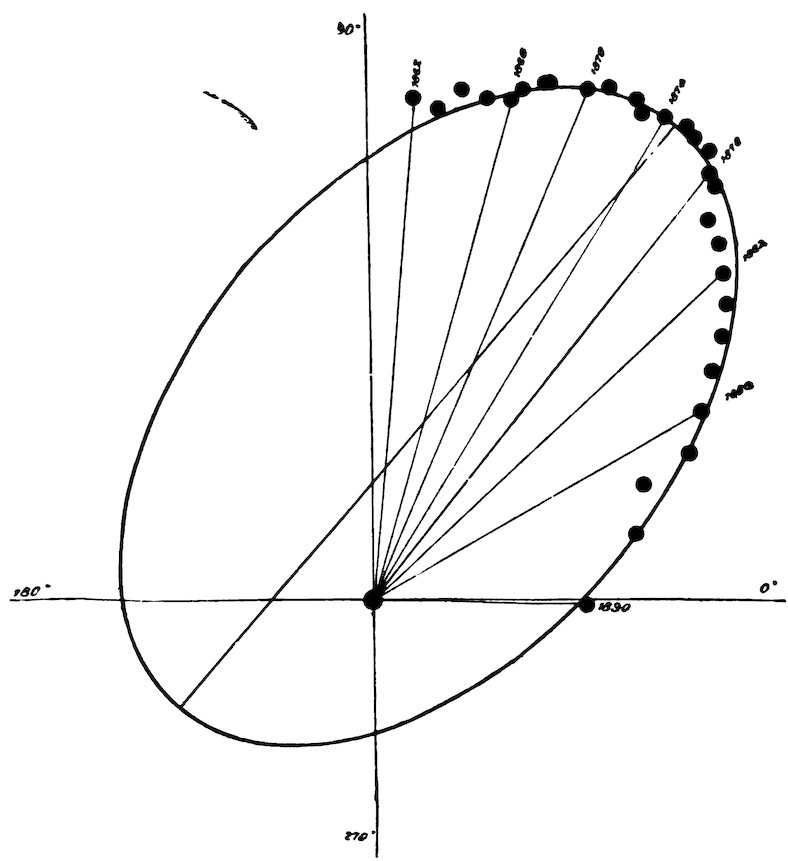
Orbit of the Companion of Sirius, p. 439, from Proctor’s “Old
and New Astronomy”; to Professor W. W. Payne of Goodsell
Observatory, for the use of the drawing of the Oases of Mars,
p. 304, from “Popular Astronomy”; and the photograph of
Holmes’ Comet, p. 378, from the same work; to Messrs.
A. & C. Black, for the illustrations of the Great Comet of
September, 1882, p. 361, reproduced from Miss Clerke’s
“History of Astronomy”; to Messrs. Crosby, Lockwood
& Co., for permission to reproduce the illustration of the
Nebula in Andromeda 31 Messier, p. 398, from the frontispiece
of Mr. J. E. Gore’s “Visible Universe”; and also for
the same authority, regarding the diagrams, showing the
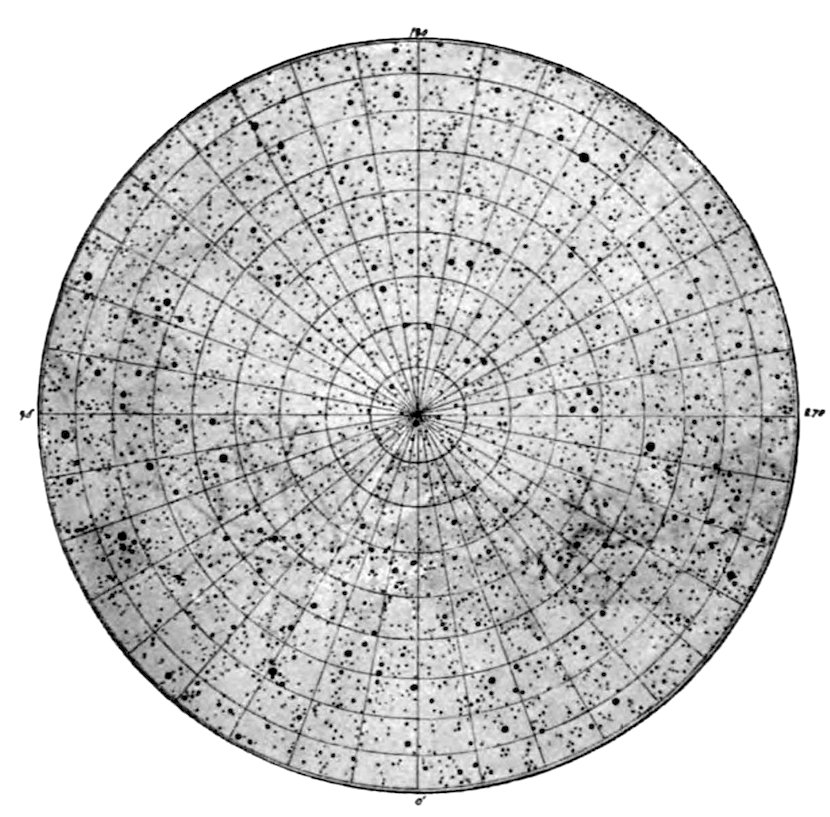
Stars visible in the Northern Hemisphere, p. 401; the Stars
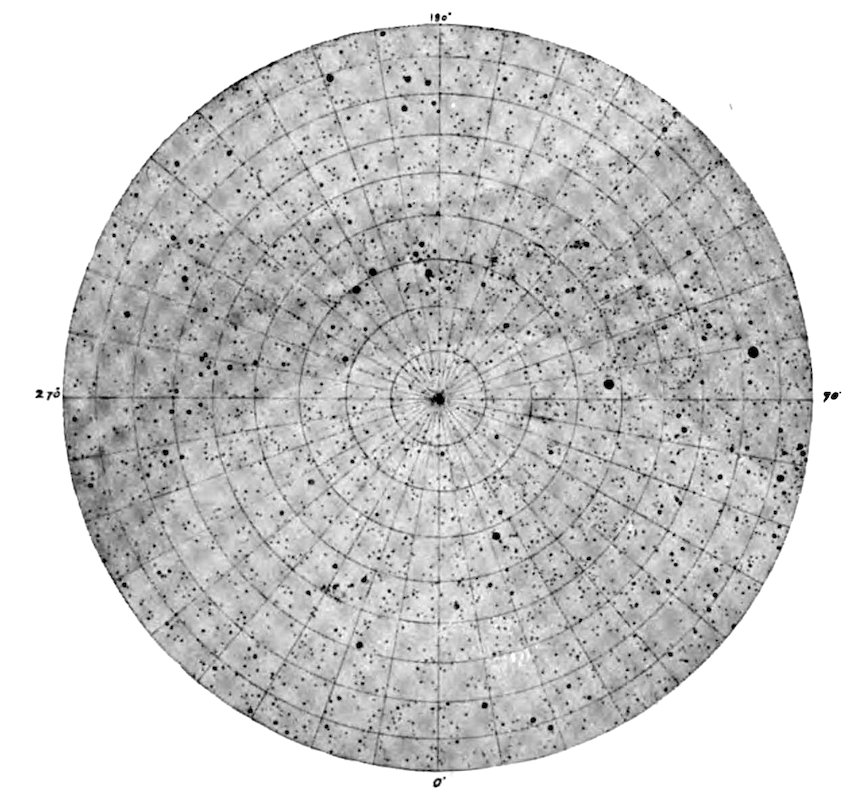
visible in the Southern Hemisphere, p. 403; the drawing
showing the position of the Solar Apex, according to different
computers, p. 429; and the photographs of the Spiral
Nebula 51 Messier, p. 533; and the Milky Way in Sagittarius,
p. 555, all from the same work; to Messrs. A. D. Innes & Co.,
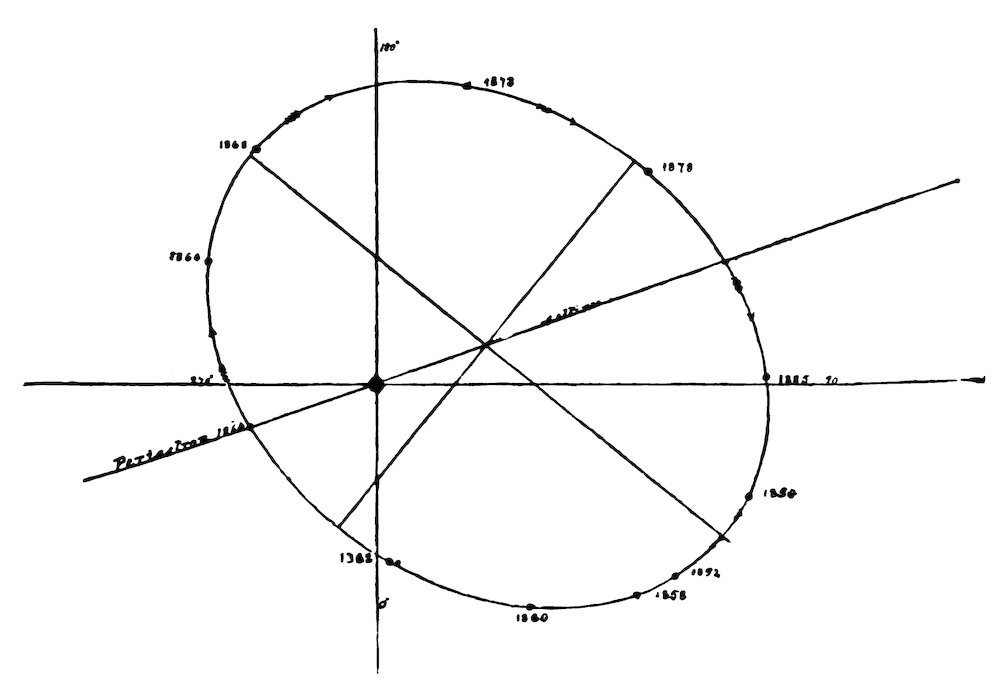
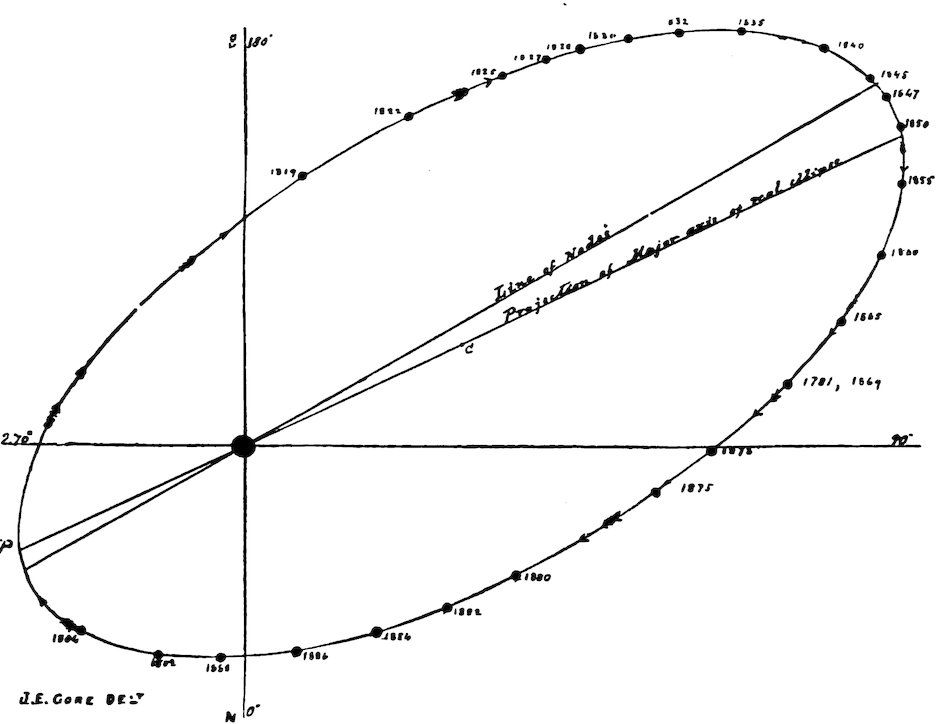
for the use of the diagram, Apparent Orbit of Zeta Herculis,
p. 436; Triple Stars, p. 451; and for permission to reproduce
the photographs, 37 Messier, p. 505; the star cluster, Omega
Centauri, p. 512; the Nebulæ of Orion, p. 521; and the
Magellanic Clouds, p. 537, from “The Worlds of Space”;
and to Messrs. Sutton & Co., for the use of the diagram
xof the Apparent Orbit of 70 Ophiuchi, p. 443; the photographs
of the Double Cluster of Perseus, p. 503; the Star
Cluster in Gemini, p. 504; the Star Cluster in Hercules, p. 507;
and the drawing of the Trifid Nebula, Sagittarius, p. 525,
from “The Scenery of the Heavens”; and the drawing of the
Temporary Star of 1572, p. 481, from “Planetary and Stellar
Studies,” both published by them.
SECTION I.—HISTORY. — CHAPTER I. FROM HIPPARCHUS TO LAPLACE. — CHAPTER II. A CENTURY OF PROGRESS.
3
By Agnes M. Clerke.
In the year 134 B.C., a temporary star blazed out in the constellation
Scorpio. It was observed by a man of extraordinary
genius, and furnished the incentive to one of his most memorable
works. This was the construction, on essentially modern
principles, of a catalogue of 1,080 stars. Hipparchus thus,
with deliberation and singular prescience, furnished a standard
by which future changes in the heavens might be detected.
He was a native of Rhodes, but belonged to the school of
Alexandria; and at Alexandria, after three centuries, he
found an able and ambitious successor.
Claudius Ptolemæus was one of the many “inheritors of unfulfilled
renown.” He combined, completed, and preserved
what his predecessors, eminent or obscure, had done. Gathering
materials from all quarters, and adding much of his own,
he reared an astronomical edifice so imposing, coherent, and
substantial, that the lapse of fourteen centuries left it virtually
4unassailed, and, to a superficial judgment, unassailable. Fitly,
then, this monument of industry and ingenuity kept the title
bestowed upon it by the Arabs of “Almagest,” signifying
“the Greatest.” It bears, nevertheless, perennial witness to
the possibility of satisfying the human mind with the truth of
appearances, apart from the truth of things. For although
the Almagest embodies a large amount of real knowledge,
that knowledge is throughout falsely interpreted. The
Ptolemaic system was constructed on the principle of “saving
the phenomena”—that is, of providing expedients geometrically
valid, even if physically inadmissible, by which to represent
the apparent movements of the heavenly bodies.
That they might, to a great extent, be apparent only, was
obvious to the cultivated Greek mind. The rotation of the
earth on an axis was a familiar Pythagorean doctrine; it was
adopted by Plato, and Aristarchus of Samos went to the
length of ranking our green world as a planet revolving yearly
round the sun. The idea, however, was too recondite for
vulgar apprehension; it was tainted with a suspicion of impiety,
and its development would, besides, have proved
extremely embarrassing to the nascent science of that age.
So Hipparchus chose the prudent alternative of treating
astronomy from the purely mathematical standpoint; he
submitted to the restrictions imposed by the hypothesis of
equable circular motion; and, with wonderful skill, fitted the
Apollonian eccentrics and epicycles to expound celestial
wanderings. Ptolemy inevitably followed suit. He set some
five dozen spheres in motion, while leaving the earth at rest;
and at rest it remained until, in long meditations by the foggy
shores of the Baltic, a grave-browed ecclesiastic elaborated
certain cogent arguments in favour of its motion.
During the interval between Ptolemy and Copernicus,
astronomy kept in the Alexandrian groove. Early in the
eighth century, the seat of learning having been transferred to
Baghdad, the charge of its crystalline machinery devolved
upon Arabs and Jews, men of fine technical acquirements,
but small originative power, men of the kind described in the
5“Vicar of Wakefield,” who, “had they been bred cobblers,
would all their lives have only mended shoes, but never made
them.” Not but that they executed the necessary repairs
with uncommon ingenuity, modifying the cumbrous structure
given into their keeping to suit the fresh inequalities brought
to light by their patient watchfulness. But their improvements
consisted in adding to already intolerable complications—in
piling orb on orb, in devising “trepidations” and oscillations,
of which nature took small heed; so that the better
they observed, the worse their system became.
The science was diligently cultivated. Al-Mamûm, son
and successor of “good Harûn-al-Raschid,” founded at
Baghdad a school of astronomy, of which Albategnius, called
“the Ptolemy of the Arabs,” was the brightest ornament. He
discovered, early in the tenth century, the movement of the
“sun’s apogee”—that slow revolution of the longer axis of the
earth’s orbit, regarded by astronomical glacialists as a factor
in the production of recurring Ice Ages. The Persian grandee,
Al-Sûfi (903–986) belonged to the same group. His “Description
of the Stars” was a revised edition, not a simple reprint,
of the Alexandrian list, and has the value derived from
personal consultation with the skies. Thus, Algol, now purely
white, is recorded in it as a decidedly red star. About a
century later, Aboul Wefa detected the moon’s “variation,”
independently noted, after five centuries, by Tycho Brahé.
Then the Tartars had their turn. Nasir Eddin (1201–1274)
was a native of Khorassan; but his love of learning drew him
to the city of the Khalifs, where he assembled a band of
experts for the construction of new planetary tables, the old
ones having lapsed into hopeless disaccord with the heavens.
Last came Ulugh Beigh, grandson of the furious Tamerlane.
He founded at Samarcand a kind of astronomical Solomon’s
House, built a grand observatory, and worked in it assiduously.
His vigorous and ennobling reign of forty years was
terminated by one of those domestic catastrophes which
ordinarily fix the chronology of Eastern dynasties. He was
murdered by his son in 1447, and the sands of the desert
6thereupon closed, so to speak, over his civilising efforts. His
star catalogue, edited by Francis Baily in 1843, is the outcome
of fresh observations made in the old way. A Tartar prince,
he ranks as an Arab astronomer.
Mohammedan science had already fulfilled its appointed
task. A torch, still alight, had been handed on from East to
West. Its extinction would have been a calamity. A total
break in the cultivation of astronomy, for instance, would have
cost ages to repair. The Ptolemaic system, it is true, disguised
rather than revealed nature; yet it constituted a regulated
body of knowledge, only looked at from a wrong point of view.
An unbiassed spectator had merely to shift his position and
open his eyes, in order to perceive the simplicity of the real
celestial mechanism. No better illustration could be adduced
of Bacon’s aphorism that “truth emerges more easily from
error than from confusion.”
It was from the Moors in Spain that Christian Europe took
its first lessons in antique science. The Alphonsine Tables
were due to Oriental industry. They were compiled at Toledo
about 1270 by an assemblage of Arab experts directed by
Hassan, the Jew delegate of Alfonso X. of Castile. But they
caught Western attention, and drew Western intelligence towards
the abstruse art they exemplified. Thus a little treatise
on the Sphere composed about 1230, by John Holywood, a
Yorkshireman, known to cosmopolitan fame as Johannes de
Sacrobosco, obtained astonishing popularity; at least sixty-five
Latin editions of it appearing between 1472 and 1647,
besides French, Italian, German, and Spanish versions, and
endless commentaries. With the revival of classical learning,
the Almagest, previously known in blundering Latin translations
from the Arabic, came to be read in the original Greek,
and thus re-emergent, roused fresh enthusiasm. Inspired by
the afflatus, George Purbach (1423–1461) and his brilliant
pupil, Johannes Müller of Königsberg in Franconia (Regiomontanus),
successively professors of mathematics at Vienna,
applied themselves to burnishing up the ancient epicyclical
apparatus; while in Italy, the seductive opinions of the
7Pythagorean school gained ground, as evidence came to light,
that there had been astronomers before Ptolemy no less than
kings before Agamemnon. The orthodox doctrine naturally
continued to be taught at the universities; but some of the
professors held esoteric opinions of a different cast, which they
freely imparted to privileged disciples. The earth’s rotation
was spoken of as a matter of common knowledge by
Lionardo da Vinci; it was inculcated in rhyme, before the
close of the fifteenth century, by Girolamo Tagliavia, a
Calabrese poet; it was debated by scholars and pedants; on
all sides influences wrought to shatter the integrity of
Ptolemaic convictions.
True progress, however, consists less in destruction than in
re-organisation. And this demands powers of a high order.
They were brought into play just at the right moment.
Nicholas Copernicus was born at Thorn on the Vistula,
February 19, 1473. At the age of twenty-three, having exhausted
the teaching resources of the university of Cracow, he
crossed the Alps in quest of instruction in Greek and mathematics.
Towards the close of 1496, then, he was enrolled as
a student at Bologna, and shortly afterwards became the pupil,
assistant, and friend of the Ferrarese astronomer, Domenico
Maria Novara. Here, beyond reasonable doubt, Copernicus
adopted Copernican opinions. The question, An terra moveatur?
was incessantly mooted at Bologna; advanced thinkers
replied in the affirmative; Novara himself most likely took his
intellectual beliefs from Plato and Aristarchus, while looking
to Ptolemy for his daily bread. The transalpine scholar, at
any rate, brought back with him to Poland in 1505, an unalterable
persuasion that the heliocentric system belonged to
the reality of things. He devoted eighteen years of his abode
within the cathedral precincts of Frauenburg—from 1512 to
1530—to demonstrating its detailed conformity with the
phenomena of the heavens; but allowed only a sketch of his
results to be published. It was only at the earnest request of
the Bishop of Culm that he finally delivered up to him the
manuscript of “De Revolutionibus Orbium Coelestium,” the
8first printed copy of which was laid on his deathbed, May 24,
1543.
The immediate effect was small. The new system of astronomy
was admired, but not adopted. It indeed contradicted
the evidence of the senses, and failed to compel assent from
the understanding. For its author had not completely broken
with tradition. He unfortunately retained the false supposition
of equable circular motion, and thus greatly marred the
simplicity of his scheme of the heavens. Orbs still kept
rolling upon orbs, Mercury alone demanding a combination
of seven to bear him over his course. But if seven, it might
have been asked, why not seven times seven? The principle of
representing appearances by transcendental means remained
the same as before. Ignorance of the laws of motion raised
other formidable objections. A whirling earth, it was thought,
should leave behind all detached objects; absolute repose was
taken to be the condition sine quâ non of stability. Then the
seeming immobility of the stars implied for them a remoteness
so extravagant, according to prevalent ideas, that even Kepler
admitted it to be “a big pill to swallow.” Copernicus was fully
aware that the earth’s orbital revolution must occasion stellar
perspective displacements; indeed, he staked the truth of his
theory upon future measurements of annual parallax. Nevertheless,
four centuries passed before they were successfully
executed.
Tycho Brahé was the last great mediæval observer. Like
Hipparchus, he was summoned by a star—the marvellous
“new star” of 1572; and, having obtained from Frederick II.
of Denmark the grant of an islet in the Sound, he built upon
it a mansion “royal, rich and wide,” erected magnificent
instruments, and used them, not only with consummate skill,
but also with a certain princely pomp, donning robes of state
before admitting the bright “populace of heaven” to audience.
His stormy temper, however, led to disputes with the young
King Christian IV.; he forsook Uraniborg, and died at
Prague in 1601. Curiously enough, the very accuracy of his
observations led him astray from speculative truth. For it
9enabled him to perceive the incompatibility of many facts with
Copernican expedients for harmonising them, and intensified
the difficulty raised to Copernican views by the absence of
stellar parallax. So he devised a system of his own, in which
the planets revolved round the sun, but the sun round the
earth. It scarcely survived its contriver.
The invention of the telescope created descriptive astronomy.
Without it, the mechanism of the solar system could
have been laid bare, and the law of force regulating its action
discovered; and in point of fact, Kepler’s achievements owed
nothing, and Newton’s very little, to the optician’s art. Inquiries,
on the other hand, into the nature of the heavenly
bodies were wholly inspired by it; it disclosed the amazing
multitude of the stars, and opened endless vistas of research.
No one could at first have divined the momentous character
of the accident by which Hans Lippershey, a spectacle-maker
at Middleburg in Holland, hit upon an arrangement of lenses
serving virtually to abridge distance. It happened in 1608;
and Galileo Galilei (1564–1642), hearing of it shortly afterwards
at Venice, prepared on the hint a “glazed optic tube,”
and viewed with it, early in 1610, the satellites of Jupiter, the
mountains of the moon, the star streams of the Milky Way,
and in 1611, the phases of Venus, the spots on the sun, and
the strange appendages of Saturn. Thus, amid a tumult of
applause, the telescopic revelation of the heavens began. It
was brilliantly illustrative, although not demonstrative, of
Copernican theory; and Galileo drove his own vivid conviction
on the subject home to general apprehension by the
literary skill with which he treated it in his famous “Dialogues”
(1632). He most substantially promoted the new
views, however, by his recognition of the laws of motion, and
of force as the cause of motion. The problem of the heavens,
stript thereby of metaphysical obscurities, was laid bare to the
reason as one of pure mechanics; the planets came to be
treated as ordinary projectiles, and distinct reasoning about
the nature of their paths was rendered possible. Newton’s
great task was thus prepared and defined by Galileo.
10Kepler’s (1573–1630) three generalisations formed a still
more indispensable prelude to its accomplishment. Their
immediate effect was to sweep away the Copernican remnants
of Ptolemaic lumber, and to disclose the harmonious plan
upon which our system is ordered. But it was a geometrical
plan only. Kepler indeed divined the influence of a central
power, which he surmised to be of a magnetic nature;
and he aspired towards the establishment of a truly physical
astronomy. Yet he was far from perceiving the full implications
of the laws he had himself, after half a lifetime of
trial and failure, at last triumphantly discovered. These laws
are:
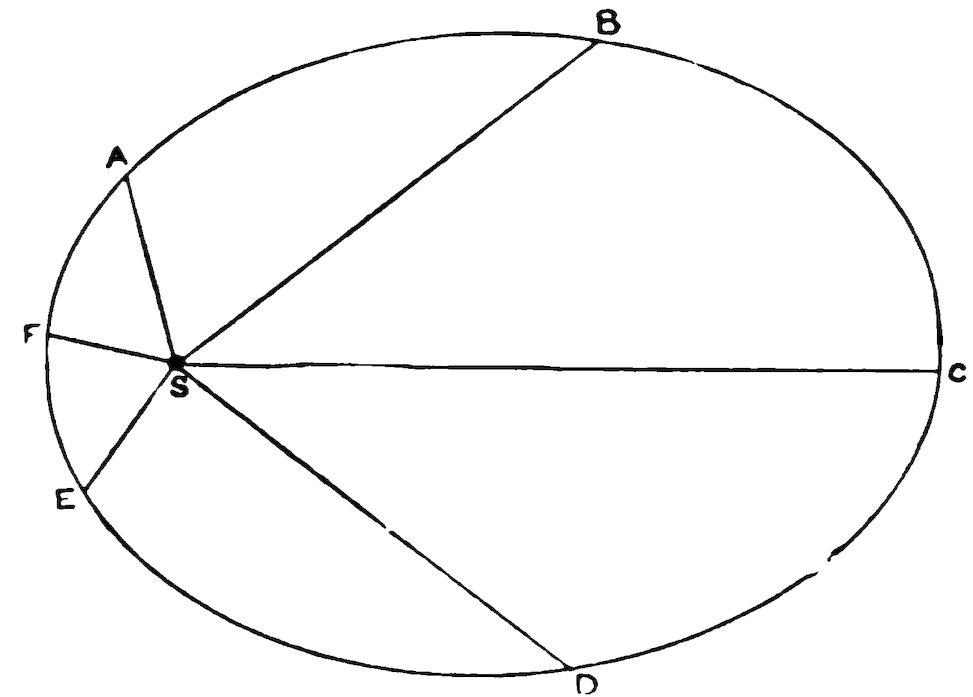
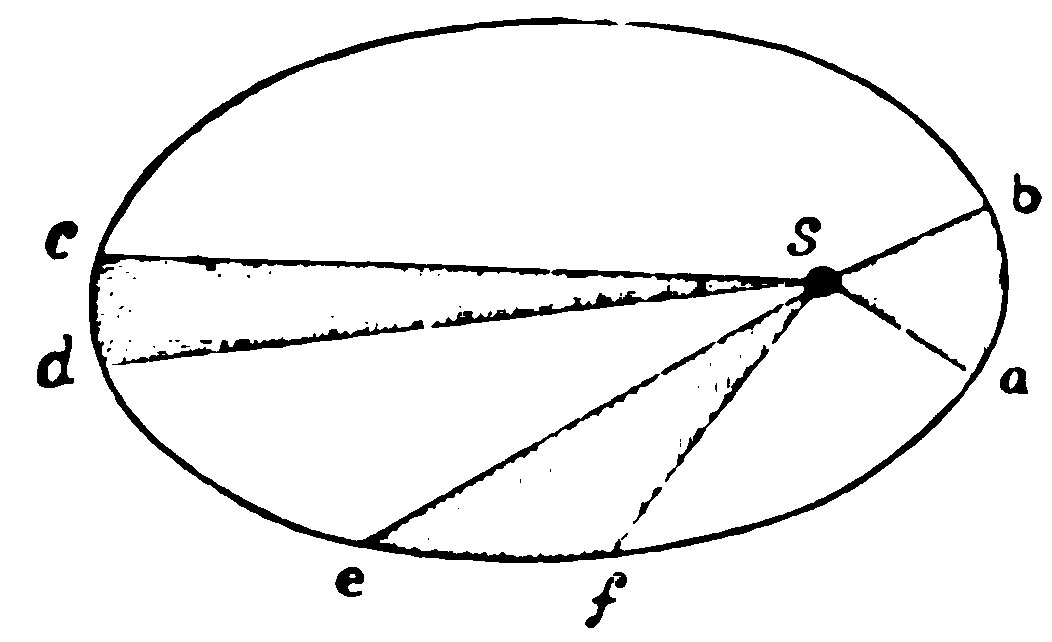
(I.) The planets travel in ellipses of which the sun occupies
one focus.
(II.) They travel at rates varying in such a manner that the
“radius vector”—or imaginary line joining each to the sun—describes
equal areas in equal times.
(III.) The cubes of their mean distances from the sun are
proportional to the squares of their periods of revolution.
Now these are precisely the conditions under which
planetary circulation should proceed if governed by a force
emanating from the sun, and decreasing as the square of the
distance from him increased. Moreover, Hooke, Halley, and
Wren separately got so far as to perceive that it could be explained
on this principle. But Isaac Newton alone could
demonstrate what they divined, and even his supreme faculties
were dangerously strained by the laborious process. This was
not all. He showed that the earth exerts on the moon just
the same kind of pull that the sun exerts on the planets; a
pull identical with the familiar “attraction of gravitation,” by
which the globe we inhabit holds integrally together, retains
its oceans in their beds, and bears with it through space its
“cloud of all-sustaining air.” Its domestic affairs are thus
guided by the same unchanging rule that dominates its foreign
relations.
The publication in 1687 of Newton’s “Principia” marked
an unprecedented advance in knowledge. The advance consisted
11in unification. A science of celestial physics, capable
of indefinite future expansion, was founded on the sure basis
of terrestrial experience. Canons of interpretation, derived
from immediate perception, were proved applicable to the
phenomena of the heavens. The line drawn in antique
philosophy between the “corruptible” things under our feet
and the “incorruptible” over our heads was forever rubbed
out. Sublunary and empyreal regions were thrown together
into one vast domain.
Although Newton’s law is, in itself, of extreme simplicity,
its actual workings are highly intricate. Because dependent
upon a universal and unintermittent influence, they are self-modifying,
so that each consequence becomes a cause, and to
each cause is attached an endless train of effects. They can
be dealt with only with the aid of the infinitesimal calculus,
and then, not directly, but by successive and tedious approximations,
or by arts and devices of almost superhuman
ingenuity. Hence Newton’s laurels would have remained comparatively
barren had he not found successors in a group of
men of extraordinary ability. What he had begun, Clairaut,
D’Alembert, Euler, Lagrange, and Laplace carried on by
showing the adequacy of a single law to account for every
traceable deviation from undisturbed elliptical motion. In
the course of a long and arduous campaign, they carried every
position that they attacked. Over and over again, the principle
of gravitation seemed to be compromised; over and
over again, it was vindicated by these intrepid champions.
This process of gradual verification began in 1747, when
Clairaut and D’Alembert sent to the Paris Academy of
Sciences, on the same day, the first satisfactory solutions of
the “Problem of three Bodies.” The motions of the moon,
nevertheless, did not at once fall in with the general theory;
they were rendered amenable only after years of anxious
toil. Barely the initial difficulties had been overcome when
Euler, in 1753, published his “Theory of the Moon,” from
which Tobias Mayer of Göttingen constructed lunar tables.
Now tables are the test of theories. Every row of figures
12they contain is a prediction, by the fulfilment, or non-fulfilment
of which the underlying scheme must stand or fall.
Through such comparisons, mathematical astronomers find
out the shortcomings of their methods, or the insufficiency of
their hypotheses, and are incited to refine the first, and correct
the second. Demands for the application of the nicer
criteria thus afforded suggest observational improvements,
which seldom fail to bring to light minor discrepancies with
theory, impelling to fresh efforts for their abolition. Such
alternations of advance along the abstract and the practical
lines result in a continual diminution in the scale of error,
although not in its annihilation; absolute exactitude being,
as it were, an asymptote, continually approached, but touched
only at infinity—that is, never, under subsisting conditions.
Even now the length of the moons tether is four or five miles.
To that extent, she may go astray from her computed path,
not without occasioning disquietude to the responsible
authorities.
So far as could be ascertained in the eighteenth century,
her subjection to known law was completed by the dispersal
of the mystery surrounding a slight, continuous acceleration
of her orbital velocity detected by Halley in 1693. It had
been in progress since the earliest recorded eclipse in 721 B.C.,
if not longer; there was no sign of its cessation or reversal,
and the grave question arose, Was the principle of universal
attraction, elsewhere unreservedly obeyed, here fatally complicated
by the action of a resisting medium involving the
eventual collapse of the earth-moon system? Laplace gave
the answer, November 19, 1787, by proving the observed
quickening of pace to be a necessary and simple consequence
of a secular diminution in the ellipticity of the earths orbit.
This, however, will not go on for ever in the same direction;
after many ages the tide of change will turn, and a complete
restoration to the status quo ante will ensue.
Another master-stroke of Laplace’s genius was his explanation,
also in 1787, of the “long inequality” of Jupiter and
Saturn. He demonstrated its strictly gravitational origin in
13the mutual disturbance of the two giant planets, rendered up
to a certain point cumulative by the approximate commensurability
of their periods. While Jupiter performs five circuits
Saturn accomplishes nearly two, and the perturbation set up
at their conjunction is hence both intensified and balked of
compensation for 918 years.
The epoch of trial and confirmation immediately following
the publication of the “Principia” lasted then a full century.
During its course, difficulties had arisen only to be overcome;
suggested qualifications of the single and simple
law of gravity had proved unnecessary; at its close, recalcitrance
had everywhere been overcome, and there was
victory all along the line. And not only were the workings
of the planetary system exhibited as depending upon
an elementary principle, but they were further shown to
be perfectly equilibrated. It contained within itself, so far
as could be ascertained, no seeds of decay; its destruction
could only come from without. This remarkable conclusion
was established in a series of splendid treatises by Lagrange
and Laplace. The special adaptation to permanence of the
solar mechanism was demonstrated in them. Ruinous disturbances
were shown to be excluded by the overwhelming
disparity of mass between the central body and its attendants,
no less than by the regularity and harmony of their movements
and distribution. Thus only slight oscillatory changes
can occur. Millions of years will elapse without producing
any fundamental alteration. The machine is so beautifully
adjusted as to right itself automatically through the mutual
action of its various parts. And it is the force which perturbs
that eventually restores.
The astronomical acquisitions of the century were embodied
in Laplace’s “Mécanique Céleste,” published 1799–1805.
This “Almagest of the eighteenth century,” as it has
been termed, is in a rare degree comprehensive and complete.
It leaves nothing enigmatical. Every question propounded
in it receives an answer, if not definitive, at least highly
authoritative; and the range of these questions is very wide.
14All the phenomena which the Greeks and Arabs had rightly
observed, but wrongly interpreted, are not merely “saved”
by geometrical artifices, but derived as a connected whole
from one physical cause, absolutely prescribing that they
should be thus, and no otherwise. The work is a record of
unmixed triumphs. It seems as if the author, for want of
more worlds to conquer, had laid down the sword of the
calculus to take up the pen of the chronicler. With grave
exultation, he proceeds from point to point, recounting the
events of the campaign, commemorating the battles won by
the brilliant staff of mathematical heroes to which he himself
belonged, and expatiating in the broad subjugated plain.
He scarcely looked beyond. There was indeed at that time no
“beyond” where his methods of investigation were applicable.
The “Mécanique Céleste” hints at no unsatisfied ambitions;
it is a book of the teres atque rotundus sort—a world in itself
well arranged and compact, to which outlying perplexities are
allowed no access. Nor should this be counted a defect. As
a monument to one of the greatest periods in the history of
science, its fitting character was that of an ordered collection
of acquired certainties.
The countrymen of Newton took no part in the striking
series of operations by which the intricate consequences of
the law of gravity were deduced and shown to correspond
with reality. During the whole of the eighteenth century,
they stood aside from the race towards verification. Their
effacement was due to no lack of ability, but to a mistaken
choice of means. Newton’s synthetic method was a veritable
Bow of Ulysses. It was too tough to be bent by other hands
than his own. Thus, no sequel could be given to the
“Principia.” There was no possibility of following up the
line of demonstration pursued in it. Newton himself would
have vainly attempted to carry it much further. In order to
advance, it was necessary, as Dr. Whewell remarked, to begin
afresh. This, British mathematicians were unwilling to do.
The easy and flexible analytical method brought to perfection
on the continent remained strange to them. With inadequate
15strength, they persisted in wielding the cumbrous weapon of
a giant—in using main force, so to speak, where skill and
agility were required. Our insularity in this respect lasted
until about 1816, when, by the joint efforts of the younger
Herschel, Charles Babbage, and George Peacock (afterwards
Dean of Ely), mathematical studies were revolutionised at the
University of Cambridge.
The neglect in England of theoretical research was, however,
partly compensated by the steady progress of practical
astronomy. For a century and a half after its foundation in
1675, the Royal Observatory at Greenwich continued to be
the main—almost the only source of information regarding
the places of the heavenly bodies. Thence were obtained the
data necessary for the correction of theory, since there alone
the visible positions of the sun, moon, and planets were
systematically determined. Actual, compared with predicted,
movements gave so-called “tabular errors”; and tabular errors
indicated theoretical shortcomings, the rectification of which
led gradually, but surely, towards a higher plane of knowledge.
John Flamsteed (1646–1719), the first astronomer-royal,
was, in Professor De Morgan’s phrase, “Tycho Brahé with a
telescope.” By his diligence and insight he set on foot
modern astronomy of precision. The “British Catalogue”
of nearly 3,000 stars, was, in its day, an unique and most
valuable work. His lunar observations were indispensable to
Newton’s calculations, which, indeed, through the insufficient
supply of them, now and again came to a halt; he constructed
new solar tables, and kept watch over the careers of planets
and comets. His completion, in 1689, of a seven-foot mural
quadrant, constituted a marked advance in the art of
instrument-making. It was firmly fixed in the meridian, so
that the distances from the zenith of the heavenly bodies at
the moment of culmination could be read off on the limb, the
time being simultaneously noted by a clock. Their positions
in the sky relative to a set of forty otherwise known stars
were thus completely determined, and they were determined
essentially after the manner still in use.
16On Flamsteed’s death in 1719, Edmund Halley (1656–1742)
succeeded to his place. An expedition to St. Helena
in 1677, for the purpose of observing stars invisible in these
latitudes, got him the name of the “southern Tycho.” They
were the very first so situated to be located on the sphere
(except those few that came within Ptolemy’s range), and a
list of them, to the number of 341, was appended to the
“British Catalogue.” The purpose to which Halley devoted
most sustained attention was, unluckily, that in which he
was least successful. Early in life he formed the design of
observing the moon through an entire revolution of its nodes,
so as to bring lunar tables to the perfection required for
solving the prize-problem of longitudes. But the contumax
sidus—his opprobrious term for our satellite—proved more
than a match for him. The eighteen years’ watch was kept,
notwithstanding that the watcher had reached the age of
sixty-five before he was able to set about it; but in vain;
nothing came of it. Halley’s varied performances were,
nevertheless, so considerable as to warrant Lalande in describing
him as “the greatest of English astronomers”; and he
ranked next to Newton among contemporary English men of
science.
His cometary labours alone sufficed to perpetuate his
name. He initiated the computation, on Newtonian principles,
of the orbits traversed by such bodies—then a most
toilsome process; and, among twenty-four, found three so
much alike as to suggest the identity of the great comets of
1531, 1607, and 1682. A renewed apparition might then be
expected in 1758, and he appealed to “candid posterity to
acknowledge that this was first discovered by an Englishman.”
The prediction roused widespread interest, and as
the epoch for its fulfilment drew near, Clairaut undertook the
formidable task of determining to what extent it might be
postponed by the retarding influence of Jupiter and Saturn.
Many times he despaired of its execution, even with the
efficient aid of Lalande and Madame Lepaute, the wife of a
Paris clock-maker; and at last, after months of wearisome
17calculation, having succeeded in forming the differential
equations representing the comet’s disturbed motion, he
threw down the paper on which they were written, with the
exclamation, “Now, integrate them who can!” Eventually
this, too, was done; and the comet, caught sight of on Christmas
Day, 1758, by Palitzsch, a rustic star-gazer in Saxony,
passed the sun within the month’s “law” permitted to it by
the French geometer. This signal triumph laid the sure
foundation of cometary astronomy.
In 1679, Halley drew attention to the importance of transits
of Venus for measuring the sun’s distance; and developed
later a method extensively used in observing the eighteenth
century pair of transits in 1761 and 1769. But the accuracy
actually attained in determining the instants of contact between
the limbs of the sun and planet fell far short of what he
had anticipated as attainable. The “black drop” interposed
its pernicious effects, and occasioned wide discrepancies. The
margin of uncertainty regarding the value of the great unit
was, none the less, diminished, although it still remained uncomfortably
wide; while the public interest excited by such
rare events, the adventurous character of the expeditions sent
to the uttermost parts of the earth for their utilisation, and the
combined efforts of various nations towards the same end,
served to popularise astronomy, and to give it something of
that cosmopolitan stamp now borne by it.
Besides the discovery of the secular acceleration of the
moon’s motion, that of the long inequality of Jupiter and
Saturn was due to Halley; he ascertained, in 1718, the proper
movements of Sirius, Aldebaran, and Arcturus, thereby virtually
demonstrating the non-existence of “fixed” stars; he
associated auroræ with terrestrial magnetism; noted the
globular star clusters in Hercules and Centaur; and divined
nebulæ to be composed of “a lucid medium shining with its
own proper lustre,” and filling “spaces immensely great.”
Yet, in spite of the comprehensiveness of his genius, his administration
at Greenwich was a failure. He was a better
astronomer than astronomer-royal.
18James Bradley (1693–1762), who came after him, gave a
narrower scope to his abilities, yet was of unsurpassed
sagacity in connecting effects with their causes. Robert
Hooke (1635–1703) had observed, in 1669, annual displacements
of γ Draconis, a star nearly crossing the zenith of
London, which he took for results of parallax; and Flamsteed,
in 1694, had similarly interpreted a similar affection
of the pole-star. They had both been misled by an “aberration,”
due to the progressive transmission of light combined
with the advance of the earth in its orbit. Bradley determined
to sift the matter thoroughly, and observed Hooke’s
star continuously from 1725 until 1728, first at Kew with
Molyneux, then at Wanstead in Essex. It evidently described
a small ellipse in the sky with a period of one
year; yet its place in the ellipse was not what it should
have been on the parallactic hypothesis; so he remained for
some time in the dark about it. During a water-party on the
Thames, however, in September 1728, he noticed that the
slant of the pennant varied with changes in the boat’s course,
the wind remaining steady throughout. This gave him the
clue he wanted; and his discovery of the “aberration of light”
was communicated to the Royal Society in the month of
January following. That of the nutation of the earth’s axis
followed in 1748. Both, setting aside their importance in
themselves, were indispensable as preliminaries to accuracy in
fixing the places of the heavenly bodies. For they are vital
elements in the process of “reduction,” by which the ore of
truth contained in observations is extricated from the dross of
casual circumstances. The raw material, collected by timing
transits and reading circles, must be so refined and purified that
the facts contained in it become mutually comparable. Before
Bradley’s time allowance was indeed roughly made for refraction
in our atmosphere, and for the precession of the equinoxes;
and, in the case of the moon, for parallax; but the effects of
aberration and nutation had remained mixed up with a mass
of disguising errors. Their elimination constituted an inestimable
improvement.
19In the immediate art of observation Bradley was a master.
He did not live to possess an achromatic telescope; neither
astronomical circles nor equatorial mountings were at his
disposal. His leading instrument was an eight-foot quadrant,
by John Bird, certainly of admirable workmanship; although
of a type long since, and for good reasons, superseded. He
amassed with it, nevertheless, a treasure of high-class observations.
The bulk of them remained in manuscript until
1798, so that it was reserved for this century to turn them to
account; but their value has only developed with the efflux
of years. Those relating to the moon and planets, reduced
by Sir George Airy, lent efficient aid towards perfecting the
theories of those bodies. Those of 3,222 stars formed into a
catalogue by Bessel were published in 1818 with the proud,
but not unmerited title of “Fundamenta Astronomiæ.” The
same original data, again in 1886 reduced with the utmost
nicety of care by Dr. Auwers of Berlin, afforded a splendid
accession to knowledge of stellar proper motions. Acquaintance
with Bradley’s stars now extends over 144 years; and
the amount and direction of their progress across the sphere
during that long interval have, for the most part, become
defined with tolerable certainty.
Nathaniel Bliss (1700–1764), the fourth astronomer-royal,
filled the post only two years. Yet the observations made
under his care form a sequel to Bradley’s well worth having.
The reign of his successor, Nevil Maskelyne (1732–1811),
extended over forty-six years. His determinations of the
sun, moon, and planets, were in great demand abroad for the
correction of tables, and as criteria of theories; while, of the
stars, he paid attention only to thirty-six, catalogued as
reference-points in 1790. Their proper motions served
Herschel for his second investigation, in 1805, of the sun’s
translation through space. By the close of the century,
Maskelyne’s instruments had lapsed into decrepitude; and
only the stimulus supplied by Pond’s strictures roused him to
order one of Troughton’s improved circles. But he died
before it was mounted, and its employment fell to the share
20of his critic, John Pond (1767–1836), the sixth astronomer-royal.
Maskelyne’s most enduring title to fame is his foundation,
in 1767, of the “Nautical Almanac.”
English observers were ably seconded by English artists.
Graham, Sisson, Cary, Bird, Ramsden, had, from the beginning
to the end of the eighteenth century, no foreign competitors
of note. Their quadrants and sectors were distinguished
both for stability and for refinement of execution.
The mechanical skill displayed in their construction was no
less necessary for the promotion of practical astronomy than
the subtlety of eye and hand needed to employ them to the
best advantage. Bradley’s work was conditioned by the
performances of Graham and Bird. Without Graham’s
sector he could not have discovered the aberration of light;
without Bird’s quadrant the perennial worth of his Greenwich
observations would have been impaired, if not destroyed.
Observatories all over the continent were furnished in the
latter half of the eighteenth century with instruments of
English make; the art of accurately dividing circular limbs
was invented in England, and nowhere else successfully
practised. The innovation of substituting entire circles for
quadrants was effectively introduced by Ramsden; and
Piazzi came from Palermo in 1788 for the purpose of securing
from him a five-foot altazimuth, at that date the finest sky-measuring
machine in the world. Edward Troughton (1753–1835)
ably carried on the tradition of his predecessors, and
brought the altazimuth, transit circle, and equatorial up to
the modern standard of efficiency. But they were no longer
in exclusive demand. The foundation, in 1804, of Reichenbach’s
Institute at Munich finally abolished the British
monopoly in supplying astronomers with their exquisite and
ingenious tools.
The improvement of refracting telescopes ran a somewhat
similar course. The essential step of combining flint and
crown glass, so as to bring differently-coloured rays to one
focus, was taken in 1733 by Chester More Hall, a gentleman
of fortune in Essex; but he published nothing, and the
21re-invention of the “achromatic” lens was left to John
Dollond (1706–1761) a Spitalfields weaver. “I obtained,” he
wrote in 1758, “a perfect theory for making object-glasses, to
the apertures of which I could scarcely conceive any limits.”
The excise duty on glass, however, which was repealed only
in 1845, drew these limits very narrowly in this country;
and it was through the extraordinary perseverance of a Swiss
artisan named Guinand, in overcoming the difficulties connected
with glass-making, and the genius of Joseph Fraunhofer
(1787–1826) in moulding the material thus placed at his
disposal, that refractors began at Munich to rise towards their
present power and perfection.
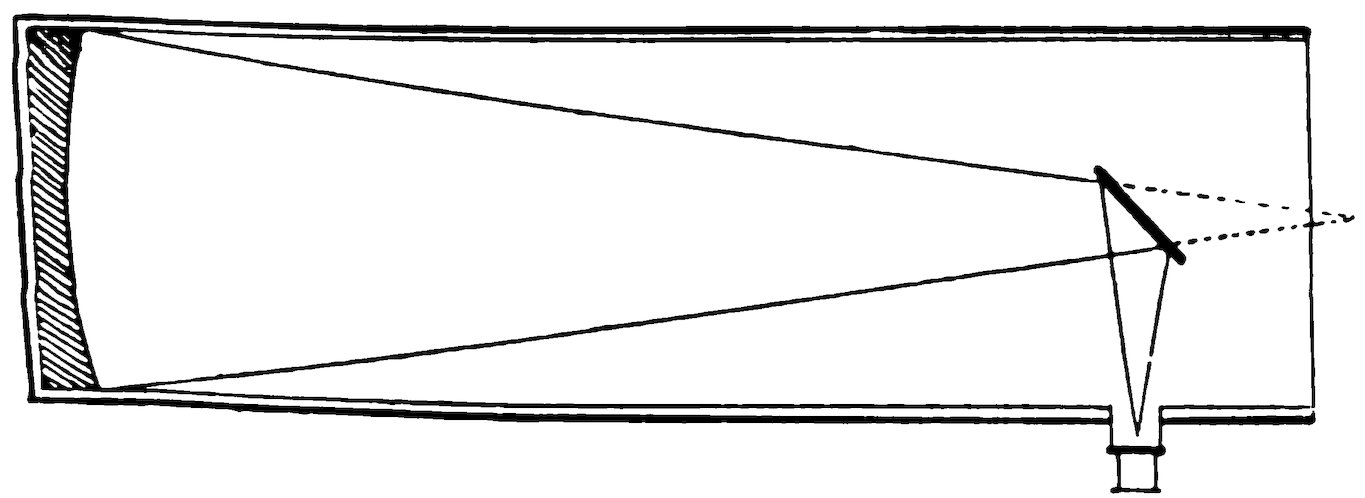
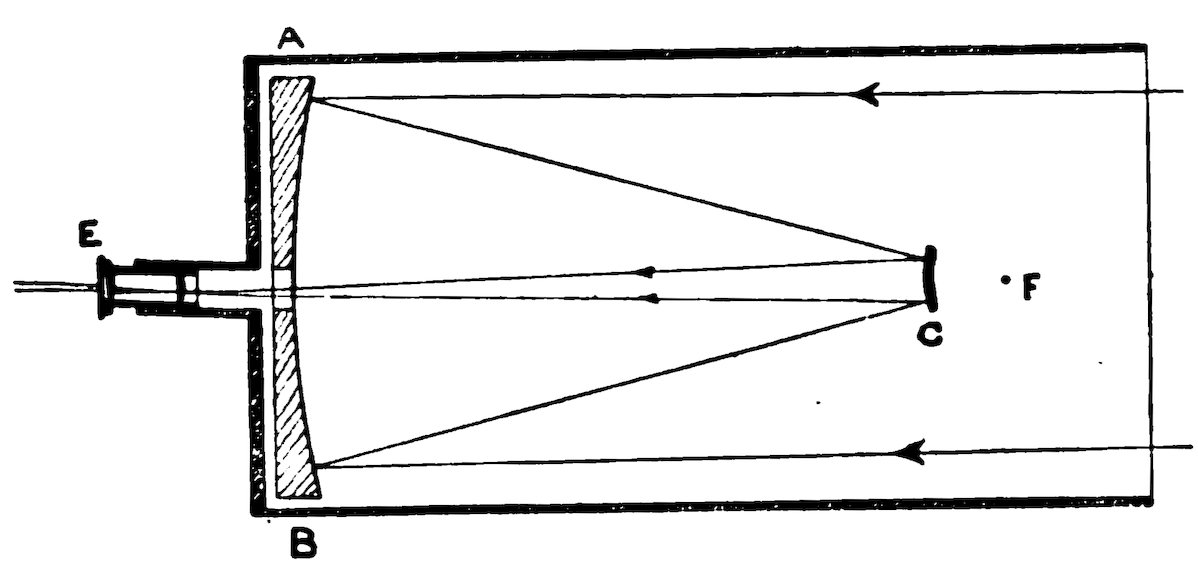
The history of the reflecting telescope is British throughout.
It was invented by Newton, made practically effective by
John Hadley (1682–1744), and brought very near to theoretical
perfection by James Short of Edinburgh (1710–1768); yet it
is remarkable that not a single observation of lasting
interest was made with any of his instruments, a few of
which have survived, and are regarded with admiration to
this day. The career of reflectors as engines of discovery
began, but did not end, with William Herschel.
On March 13, 1781, an event occurred without precedent
in the history of astronomy. A new member of the sun’s
immediate retinue was disclosed. A hard-worked music-teacher
at Bath performed this startling—indeed, according
22to antique notions—impossible feat; and the name of
Herschel became known urbi et orbi. It was far from being
by chance that the “new planet swam into his ken.” The
Octagon Chapel organist was no ordinary lucky amateur.
He had, some time previously, made two notable resolutions.
The first was to push the improvement of telescopes to the
furthest verge of what was possible; the second, to leave no
corner of the starry heavens unexplored. And he applied
himself with marvellous energy, in despite of accumulated
professional engagements, to carry them into execution. He
thus rapidly grew to be an adept in the art of constructing
specula, and a master in the art of using them.
Two lines of effort, accordingly, converged, in his case,
towards celestial discoveries. With all his diligence in “reviewing”
the heavens, he could not have distinguished at
sight Uranus from a fixed star, but for the uncommon
excellence of his seven-foot reflector; nor would the reflector,
had it been used in the ordinary erratic fashion of casual stargazers,
been at all likely to have encountered the little bluish
disc of the remote orb then slowly wending its way through
the constellation of the Twins. The direct, and a momentous
result of the discovery was to secure for astronomy the
undivided powers of the extraordinary man who had made it.
George III. attached him to his Court, delivered him from
the drudgery of teaching, and gave him the means of carrying
out his grand designs.
Their fulfilment involved the construction of great light-gathering
machines. Herschel ardently desired to see as
far and as much as the conditions of mortality permitted;
he was the first to connect depth of penetration into space
with extent of reflective surface; and he accordingly
strained every nerve to secure the means by which to
compass the end he had mainly in view. Nor was he
content with mere size. His mirrors were as remarkable
for beauty of figure as for breadth of aperture. They
bore, on proper occasions, enormously high magnifying
powers, and the precise roundness of the star-images formed
23by them excited the incredulous wonder of contemporaries.
The quality of some of his largest instruments was guaranteed
by the heavens themselves. Their approval was signified
to the seven-foot reflector through the detection with it
of Uranus; the “large twenty-foot,” with a speculum of
eighteen inches, revealed in January 1787, two Uranian moons,
Oberon and Titania; and the monster forty-foot, through the
tube of which George III. promenaded with the Archbishop
of Canterbury, brought into view, within three weeks of its
completion, Enceladus and Mimas, the innermost and hardest
to observe of Saturn’s numerous family of satellites.
The forty-foot was “Herschel’s furthest”; he fully recognised
that with it he had touched the line which divides failure
from success. If, indeed, he had not overpassed it; for the
subsequent career of the great telescope hardly bore out the
promise of its start. It was an unwieldy engine, demanding
vastly more time and labour to bring into play than the
twenty-foot; and Herschel took such account of minutes as
few men do of hours or days. His fiftieth birthday had in
fact gone by before his optical ambition was satisfied; while
his appetite for exploration was only whetted by what he had
already accomplished. He estimated, however, that a “review
of the heavens” with the forty-foot would have occupied 800
years; hence it was used only on special occasions. The
Orion nebula was the last celestial object upon which, January
19, 1811, “its broad, bright eye” rested; and it was then,
with due honour, placed on the retired list.
Two years before his death, which occurred August 25,
1822, the elder Herschel initiated his son into the secrets of
speculum-building. The pupil was worthy of the master.
John Herschel (1792–1871) aimed only at producing generally
available instruments, and his success was easy and unqualified.
His eighteen-inch mirrors seem to have been all but
faultless. They certainly afforded him better views of the
nebulæ than had been obtained by his father. Thus he first
saw the “Dumb-bell” in its true oval shape; and his remarks
upon annular lines of structure in elliptical nebulæ prove that
24features unmistakably imprinted upon Dr. Roberts’ photographs
had been antecedently visible to him, and probably to
him alone.
The next stride in the enlargement of reflectors was made
by an Irish nobleman, the third Earl of Rosse (1800–1867).
His leviathan telescope, six feet in aperture, and fifty-four in
length, has, in point of actual size, never been surpassed. Distinguished
rather for light-grasp than for precise definition, it
found its appropriate field in the nebular realms of the sphere;
and the discovery of spiral nebulæ, with which it made its
début, was one of high and wide significance.
William Lassell (1800–1881) of Starfield, near Liverpool, set
the example, in 1840, of mounting reflectors equatorially, so
as to enable them, by the application of clock-work, to follow
automatically the diurnal movement of the heavens. His
specula were of almost unrivalled perfection in form and finish.
One twenty-four inches in diameter, now at Greenwich, left a
splendid record. With it Lassell detected, October 10, 1846,
the satellite of Neptune; September 18, 1848, simultaneously
with W. C. Bond of Cambridge, U.S., Hyperion, the seventh
in order of distance and last in order of discovery of Saturn’s
eight moons; and October 24, 1851, Ariel and Umbriel, the
inner pair of Uranian satellites, of which Sir William Herschel
had possibly, although not very probably, caught transient
glimpses. He erected a similar instrument of fourfold capacity
at Malta in 1861, registered with its aid 600 new nebulæ, and
delineated the complex structure of many others, previously
less well seen.
The four-foot reflector built in 1870 by Thomas Grubb
of Dublin for the Melbourne Observatory disappointed expectation.
An apparatus so delicate that the abrasion of
1/20,000th of an inch makes all the difference between good
and bad definition, is ill-fitted to endure the rough-and-tumble
experiences of an ocean-voyage; and that it in some way
“suffered a sea-change” is scarcely doubtful. It was the last
great telescope of its kind, metallic specula, having, in the
seventies, been superseded by mirrors made of glass upon
25which a thin layer of silver has been chemically deposited.
These have many advantages over their predecessors. They
are considerably more reflective; they are more easily constructed;
their shape is less liable to injury; their brilliancy,
although more evanescent, can be readily restored. They
have the drawback, however, of being extremely sensitive to
changes of temperature. A three-foot mirror of this description
by Calver, was employed by Dr. Common at
Ealing with surprising success, early in 1883, for the purpose
of photographing the Orion nebula. It was mounted at the
Lick Observatory, California, in 1896. Dr. Common has since
himself constructed a similar instrument of five feet aperture,
which is the most potent light-collector ever yet turned to the
skies. It is curious to learn that the silver spread over its
surface weighs less than one of the “fourpenny bits” some
time ago withdrawn from circulation; the reflecting film is in
fact only 1/280,000 inch thick.
Reflectors are perfectly, and naturally, achromatic, rays of
all colours being thrown back at the same angle, and consequently
meeting at the same focus. This gives additional
brilliancy to the images formed by them, compared with
those given by object-glasses, the colour-correction of which
has hitherto been so imperfect that much light has to be
“thrown away” as worse than useless. New kinds and
combinations of optical glass have, however, of late been
invented, by which this grave defect may be cured. Reflecting
telescopes, on the other hand, are less manageable, and
suffer more from distortion through change of position.
Their cheapness recommends them to amateurs; but they
should, on principle, be reserved for special departments of
work, such as nebular photography and the chemical delineation
of stellar and nebular spectra.
The growth of refractors, like that of reflectors, has obtained
from time to time the sanction of unexpected disclosures.
Thus a superb fifteen-inch, turned out at Munich in 1847,
for Harvard College, Cambridge, U.S., showed Hyperion
to Bond, September 16, 1848, and on November 15, 1850,
26surprised him with a view of Saturn’s dusky ring. This
telescope was surpassed, after fifteen years, through the
energy and genius of Alvan Clark, the famous self-taught
American optician, originally a portrait-painter at Cambridgeport,
Massachusetts. Before it had left the workshop, an
eighteen-inch achromatic, now the leading instrument at the
Dearborn Observatory, Evanston, Illinois, won maiden honours
by disclosing to Alvan G. Clark, one of the maker’s sons,
January 31, 1862, the dim companion of Sirius, which, before
being seen, had made itself felt by gravitational disturbances
of its radiant primary. The Washington twenty-six-inch, by
the same firm, was rendered illustrious by Professor Hall’s
discovery, in 1877, of a pair of Martian moons; the Lick
thirty-six-inch, by bringing within the range of Professor
Barnard’s keen eyesight, September 9, 1892, Jupiter’s tiny
“fifth satellite.” The diploma performance of the Yerkes
forty-inch, mounted in 1896 at the Chicago University
Observatory, is yet to come. Meanwhile, several very perfect
refractors, up to thirty-two inches of aperture, have been
built on this side of the Atlantic by Sir Howard Grubb of
Dublin, and the MM. Henry of Paris; and a twenty-five-inch,
finished so long ago as 1868, and at the cost of his life
through the labours which it entailed, by Thomas Cooke of
York, after having lain for upwards of a score of years choked
by the fog and smoke of Gateshead, has recently begun a
promising career at Cambridge, under the care of Mr. Frank
Newall, son of the original owner.
And now we cannot but ask ourselves, has the ne plus ultra
in telescopic magnitude been attained? There is no reason
to suppose that it has, provided that due allowance be made
for inexorable conditions. Climate is one of these. The
largest instruments are those most readily crippled by
atmospheric hindrances. The greater their powers, the fewer
are the nights on which they are likely to be available. If
they are to “shine in use,” and not “rust unburnished,” they
must then be erected in exceptionally favourable localities,
such as the summit of Mount Hamilton (the site of the Lick
27Observatory), or the Harvard College southern station at
Arequipa in Peru. In South Africa, too, but “up country”—not
in the Cape peninsula—splendid facilities for astronomical
observation are to be found.
From Professor Keeler’s report it can readily be gathered,
and he indeed explicitly states, that the Yerkes forty-inch
marks the limit of useful size in equatorials. For the character
of the star-images formed by it slightly change their
character when it is directed to different parts of the sky; and
this implies that its lenses become, as it moves, infinitesimally
deformed through the effects of their own weight. No larger
instrument, accordingly, can safely be permitted to swing in
mid-air. The huge light-concentrating machines of the future
will lie in wait for the objects to be observed, instead of
pursuing them. They will either be supported horizontally,
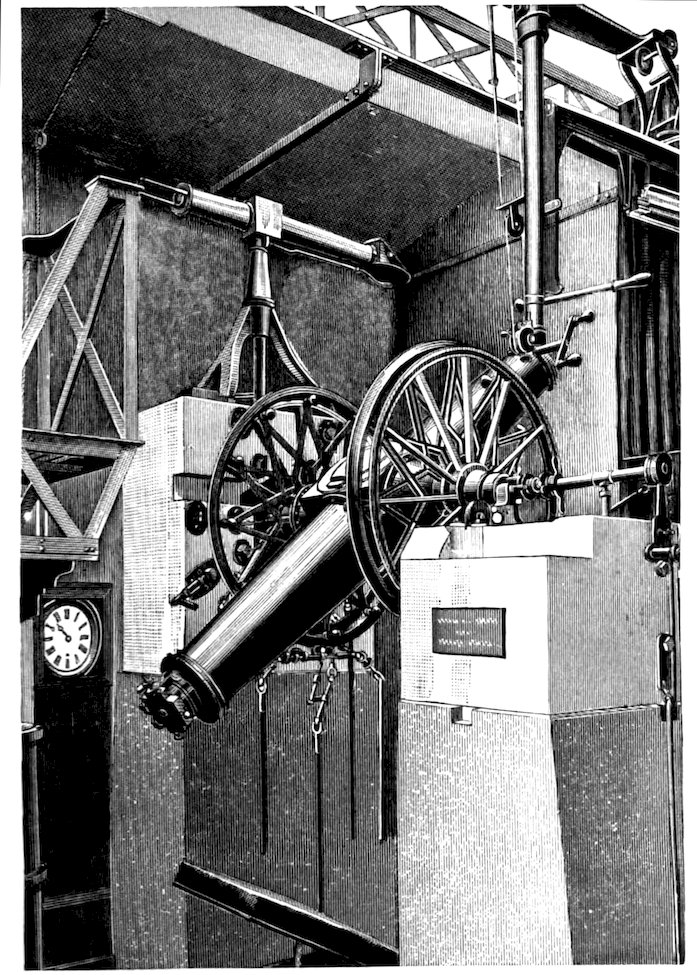
or mounted in the “Coudé” fashion invented by M. Loewy.
In either case, the necessary movement will be performed
vicariously by a plane mirror.
Thus, the optical and mechanical outlook is decidedly
better than the atmospheric. The question, How to build
giant telescopes? is more easily answered than the question,
Where to place them when built? The ultimate barrier to
seeing indefinitely far into space is the rigid circumstance that
we live on an air-girt globe. The prospects of astronomy are
deeply involved in the forecast of its hampering effects. The
dependence of those prospects upon telescopic improvements
became obvious when Herschel took the whole contents of the
sphere “for his province.” These are indefinitely numerous,
indefinitely far-off, indefinitely faint. The task of their correlation
undertaken by Herschel, and inherited from him by
modern astronomers, can at no time be more than approximately
fulfilled; but for each successive approximation more
light is needed. Those who would investigate the universe
can never get enough of that too scarce commodity.
Until Herschel conceived the novel idea of a comprehensive
science of the stars, they had been chiefly regarded as convenient
sky-marks, by which to track the wanderings of our
28nearer neighbours in space. When it was perceived that the
sky-marks were not fixed, it became necessary to determine
their movements; and this was very roughly done for fifty-seven
stars by Tobias Mayer of Göttingen, in 1757; and more
accurately for thirty-six by Maskelyne, a third of a century
later. But if the stars were travelling, the sun could not be
supposed to stand still; and the possibility of laying down
his line of march through space, by extricating a common element
from the confused network of mutually-crossing stellar
paths, occurred to Mayer, and was actually realised by
Herschel in 1783. His inquiry, with the scanty materials
then at command, was a wonderful stroke of audacity, which
very nearly hit the mark; yet few believed in his result until
it was confirmed by Argelander in 1837.
The various attempts made, prior to 1782, to measure the
parallaxes of some of the brighter stars were instigated by
the wish to find a demonstrative argument in favour of the
Copernican theory of our system. They had no reference to
sidereal structure. Herschel, however, took up the subject
simply for the purpose of fixing the scale of that vast edifice.
Before sounding the skies, he sought to ascertain the length
of his fathom-line. He never ascertained it. To the end of
his life, he could only make plausible assumptions as to the
distances of the stars. Their real parallaxes were insensible
with his instrumental means. But he fortunately chose for
his experiments Galileo’s “double-star method.” This consisted
in determining the relative positions of two close stars,
one of which, taken to be indefinitely remote, was designed to
serve as a standard of reference for the perspective shiftings
of the other. It was thus that Herschel’s attention was
directed to double stars. He found them to be astonishingly
numerous—far more numerous than could have been anticipated
by the doctrine of probabilities. In January, 1782, he
presented to the Royal Society a catalogue of 269 star-pairs,
and he had collected 434 more by December, 1784. From
their abundance alone, the Rev. John Michell inferred their
character of binary systems; and Herschel, after twenty years
29of observation, was able, in 1802, to announce the fact of their
mutual revolutions. Thus was taken the second great step
towards the unification of the Cosmos. Newton proved that
terrestrial gravity dominates the solar system; Herschel
showed that a law of attraction, presumably (and assuredly)
identical in its mode of operation, extends through sidereal
space.
One cannot reflect without amazement that the special
life-task set himself by this struggling musician—originally a
penniless deserter from the Hanoverian Guard—was nothing
less than to search out the “construction of the heavens.”
He did not accomplish it, for that was impossible; but he
never relinquished, and, in grappling with it, laid deep and
sure the foundations of sidereal science. No one before him
had thought of approaching the subject otherwise than by
way of speculation; he alone had the boldness to attack it
experimentally. Having invented for the purpose an ingenious
method of “star-gauging,” based upon the hypothesis
that the stars are, on an average, scattered evenly through
space, he concluded in 1784, from its application, that the
Milky Way is the visual projection of a disc-shaped stellar
aggregation, within which our sun is somewhat excentrically
placed. The progress, however, of his telescopic studies convinced
him that the continued action of a “clustering power”
had long ago drawn the stars into many separate allotments,
and annulled the original uniformity of their distribution. So
the disc theory was given up, and the Milky Way came to be
regarded as a collection of genuine clusters, arranged into an
irregular ring encircling the solar system. This view, implicitly
held by the elder Herschel from 1802, was explicitly
stated by his son in 1847. The results that Herschel expected
from star-gauging may, in the future, be derived from
the more elaborate process of star-gauging by magnitudes,
photographically executed; and the sky-charting work,
rapidly progressing in all parts of the world, will at least
supply ample materials for sounding the star-depths.
These are stored besides with the curious objects called
30“nebulæ.” They were little noticed until Herschel, on
March 4, 1774, made
“That marvellous round of milky light
Below Orion,”
the subject of his earliest recorded observation. Except, indeed,
as impediments to comet-hunting. Thus, Messier, one of the
keenest sportsmen in that line who have ever scanned the
sphere, tried to eliminate by enumerating them, and drew up
in 1771 a list of 45 such misleading objects, enlarged in 1781
to 103. And Lacaille, during an expedition to the Cape in
1752–1755, picked up 42 more. So far this department of
knowledge had been cultivated when Herschel began to
“sweep the heavens.” To sweep them, be it remembered.
Not merely to gaze at hap-hazard, or to look out for show
specimens, but to gather in the celestial harvest methodically,
zone by zone, so as to “leave no spot of the heavens unvisited.”
The fruits were proportioned to his diligence. The
nebulæ discovered by him amounted, in 1802, to 2,500. And
he did not merely discover; he investigated them as well.
He separated them into classes, noted the mode of their distribution,
and searched out their relationships. To begin
with, he believed them to be of a purely stellar nature—to be,
in fact, independent galaxies. Miss Burney was informed by
him in 1786 that he had “discovered fifteen hundred universes.”
A few years later, however, he reasoned out for himself the
gaseous nature of a great many nebulæ, such as that in Orion,
and those of the “planetary” sort; and published in 1811 a
complete theory, strikingly illustrated with examples taken
from his telescopic experiences, of stellar development out of
nebulous stuff. The supposition that they included the revelation
of “exterior universes” was thus rendered, to say the
least, superfluous; yet it was not perhaps, even by him,
wholly abandoned. It was, moreover, revived in consequence
of the performances of the great Rosse reflector, from 1845
onwards, in resolving apparent nebulæ into “bee-like swarms”
of stars. Meanwhile Sir John Herschel’s examination of
31those wonders of the southern heavens, the Magellanic Clouds,
had virtually decided nebular standing. For they contain
within a limited compass, as Dr. Whewell argued in 1853,
“stars, clusters of stars, nebulæ, regular and irregular, and
nebulous streaks and patches. These, then, are different
kinds of things in themselves, not merely different to us.”
That stars and nebulæ co-exist in every part of the heavens,
has since been fully established; while the laws respectively
governing their distribution over the sphere are related in
such a manner as to leave no doubt that these two classes of
sidereal objects unite to form the grand galactic whole.
Hence, to all reasonable apprehension, “island universes”
have vanished into the inane.
Sir John Herschel accomplished the unparalleled feat of
sweeping the heavens from pole to pole. Having, within eight
years from 1825, revised his father’s work at Slough, he conceived
the noble idea of rounding it off in the southern hemisphere;
and, in 1833–4, transported his instruments from
Slough to Feldhausen near Cape Town. During the four
years of his residence there, he not only executed his proposed
survey, registering 1,790 nebulæ—300 of them for the first
time—and discovering and measuring 2,100 double stars, but
carried out a number of special researches. He catalogued
the miscellaneous contents of the Magellanic Clouds—systems
sui generis, as he justly termed them—made a detailed and
laborious study of the Argo nebula, applied pretty extensively
the paternal method of star-gauging, observed Halley’s comet
at its second predicted return, measured the sun’s heat-emissions,
carefully watched the spot-maximum of 1837, and
finally, struck with a sudden rise in magnitude of η Argûs,
brought to general knowledge that star’s extraordinary character.
These varied results were embodied in a monumental
volume, published in 1847.
One of the greatest triumphs of modern science has been
the establishment of an “Astronomy of the Invisible.” It was
primarily due to Bessel’s inquiries into the disturbed proper
motions of the “Dog-stars,” Sirius and Procyon. They convinced
32him that each of these brilliant orbs is attended by a
massive satellite, round which it revolves as it advances, its
path in the sky being thus not straight but wavy. Telescopic
verification of his forecast was, nevertheless, delayed
until 1862 in the case of Sirius, until 1896 as regards Procyon.
The earliest, and still the most memorable result in this line
is the discovery of Neptune. Bessel knew that the thing was
to be done, and in 1840 planned the doing of it. But his powers
began, soon afterwards, to be crippled by deadly illness, to
which he succumbed, March 17, 1846. Uno avulso, non deficit
alter. Adams and Leverrier separately undertook the enterprise
he had relinquished, and each with perfect success. It
was a formidable one. The direct problem of perturbations
taxes the highest mathematical resources; the inverse problem
is not only more arduous, but was then untried. Laplace
and Lagrange had shown how to determine the perturbations
produced by a known disturbing body; it was left for Adams
and Leverrier to find an unknown body through its disturbing
effects. Irregularities in the movements of Uranus betrayed
the presence of Neptune, and by the powerful analysis
brought to bear upon them, were made to serve as an index to
his actual place in the heavens at a given epoch. This was
done by Adams in September, 1845; but his calculations, deposited
at the Royal Observatory in the hope that they would
incite to a telescopic search for the new planet, remained there
buried in a drawer. Sir George Airy had no faith in them,
and he unaccountably received no reply to a test-question addressed
to their author. In the following June, however, he
was roused by the intelligence of Leverrier’s advance towards
the goal already attained by Adams, to arrange an exploratory
campaign with the Cambridge “Northumberland
equatorial.” But here again, disbelief—reinforced by the
absence of a detailed star-map—stepped in to retard proceedings
conducted by Professor Challis in so leisurely a fashion
that the object “wanted” was found before he had sifted
his observations, September 23, 1846, by Galle of Berlin, acting
under Leverrier’s precise directions. It proved on inquiry
33to have been twice observed at Cambridge during the previous
couple of months.
Gravitational astronomy won its crowning distinction by
the discovery of Neptune. It afforded the first instance of a
body made known as an unseen power previously to being
visually detected. Many stellar systems, however, have since
then been ascertained to include members which can only be
felt, owing to their partial, if not total obscurity. Again, the
spectroscope tells of the existence of others entirely beyond
the range of direct vision with the most powerful optical
appliances; not because they do not shine (although this is
sometimes also the case), but because they revolve so close to
their primaries as to form with them single and indissoluble
telescopic objects.
The spectroscope and the photographic camera have been
mentioned as aids to astronomy. Their adoption has profoundly
modified the science, widening its borders, inviting it
to undertake novel tasks, endowing it with previously
undreamt-of powers. Realms of knowledge deemed inaccessible
to human faculties have, as if at the touch of a magician’s
wand, been thrown open; and of the many paths leading into
the interior, only a few have yet been pursued, and that for a
short distance. The prospects of exploration are hence
unlimited, and of bewildering variety.
Spectrum analysis is essentially a chemical method. It
depends upon the principle firmly established in 1859 by
Kirchhoff and Bunsen, two professors at the university of
Heidelberg, that different kinds of glowing vapour give out
distinctive rays of variously coloured light, commonly called
“lines,” simply because, for the purpose of getting rid of overlapping
images, and for convenience of measurement, they are
transmitted through a narrow slit. Thus, the presence of a
familiar, and almost ubiquitous deep-yellow line, named by
Fraunhofer “D,” and shown by a moderately powerful
apparatus to be double, infallibly testifies to the presence of
sodium; iron, rendered gaseous by heat, gives out several
thousand lines ranging from end to end of the spectrum, not
34one of which is common to any other substance; hydrogen
shows a radiant sequence exclusively its own; and so of all
the remaining elements. To apply this mode of detection,
the light from the source to be studied must be analysed, or
dispersed into its various component colours through the
unequal action upon them of a prism, or train of prisms.
Dispersion can also be effected by “diffraction”; and since
the spectrum thus produced is “normal,” or dependent wholly
upon wave-length, it is always employed where a high degree
of exactitude is aimed at. The coloured fringes of shadows
originate in this way, through the interference of ethereal undulations;
while the rainbow is a prismatic phenomenon,
drops of water performing the refractive office of actual
prisms.
The rainbow exemplifies too—although less perfectly than
the electric light—what is called a “continuous spectrum.”
Its tints merge one into the other insensibly, without any
sensible dark interruption. Now, incandescent liquids and
solids of every kind and quality give rainbow-like spectra;
they emit light which rolls out into an unbroken band of
colour. Hence there is nothing characteristic about them.
They are to the chemical enquirer absolutely uncommunicative.
Vapours and gases alone can be induced to show
the badge of their particular nature.
Celestial spectrum analysis began with the sun. The solar
spectrum is furrowed transversely by a multitude of fine dark
lines, known as “Fraunhofer lines,” because Fraunhofer brought
them within scientific cognisance by carefully mapping and
measuring them. Their significance remained a standing
puzzle until Kirchhoff, in 1859, furnished the key to it, by
demonstrating the correlation of radiation and absorption. In
other words, vapours and gases have the faculty of arresting
those precise rays of light which they are in a condition to
emit. Hence, the ignited, although relatively cool vaporous
envelope of a white-hot body like the sun, or the carbons of
the electric arc, acts predominantly as an intercepting medium,
stopping more than it sends out of its peculiar rays. There
35results a continuous spectrum crossed by dark lines of the
same chemical significance as if they were bright. They
would, in fact, show as bright if the brilliant background,
upon which they are seen projected, could be withdrawn.
The interpretation, upon this principle, of the Fraunhofer
lines, proved the sun to be surrounded by hydrogen in vast
quantities, by incandescent sodium, magnesium, iron, calcium,
and a number of other metals. Spectrum analysis in this
way assumed a double aspect. The hieroglyphics of coloured
light were rendered legible, whether positively or negatively
written. And the spectra of the heavenly bodies are actually
found to be inscribed, some in one way, some in the other;
not unfrequently, in both combined.
The new and marvellous power of investigation thus acquired
was in 1864 applied to the stars by Dr. Huggins and
his coadjutor, Professor W. A. Miller. They ascertained the
presence in the atmospheres of Aldebaran and Betelgeuse, of
nine or ten terrestrial elements, thereby setting on foot the
science of stellar chemistry. Moreover, on August 29, in the
same year, Dr. Huggins made the signal discovery of gaseous
nebulæ. Admitting the dim rays of a “planetary” in Draco
through the slit of his spectroscope, he perceived it to be composed
of three bright green lines, one of them Fraunhofer’s
“F”—an emanation of hydrogen. This one observation
verified after seventy-three years Herschel’s inference of the
existence in the heavens of a “fiery haze,” destined, according
to his long forecast of creative processes, eventually to
“subside into stars.”
By the discovery of celestial spectrum analysis, a third
stadium of progress towards the unification of the sciences
was reached. The first step was taken with the demonstration
that the force retaining the planets in their orbits is no
other than that which causes rivers to flow, and apples to fall
upon the earth. The extension of the same law to the stellar
universe through the discovery of binary stars, showing that
matter, wherever existing, possesses at least one unchanging
quality, constituted the second. It was now learned that the
36sun and stars were composed of the identical species of matter
scattered in the dust of the earth, dug up from its bowels, condensed
to make its oceans, entering into the very framework
of our own bodies. An universal chemistry was established,
based upon the relations of light to material molecules, and of
material molecules to the ether filling space; and, as an inevitable
consequence, the new branch of knowledge, termed
“astrophysics,” made its ardently welcomed advent. By it
astronomy has entered into close alliance with the rest of the
sciences. No laboratory experiment is any longer indifferent
to her; and laboratory experiments, on the other hand, derive
from the connexion vastly augmented importance. The youth
of learning seems renewed. Secrets of nature, formerly believed
to lie beyond the scope of investigation, have been
penetrated; nil desperandum is the motto which astro-physicists
have earned the title to adopt as their own.
The old art of direct observation has, during the latter half
of the present century, developed in sundry novel directions.
By the use of auxiliary appliances, the telescope has gained a
wonderful increase of subtlety and power. Modern astronomical
work may be divided into four classes:—telescopic,
spectroscopic, photographic, and spectrographic or spectrophotographic.
Daguerre’s invention was almost immediately
tried with the sun and moon; J. W. Draper and the two Bonds
in America, Foucault and Fizeau in France, and Warren de
la Rue in this country, being among the pioneers of celestial
photography. But it was not until after the introduction of
the collodion process that really useful results were obtained.
With the regular employment at Kew, from 1858 onwards,
of De la Rue’s “photoheliograph,” began the daily selfregistration
of sun-spots, suggested by Sir John Herschel in
1847; and pictures of the eclipsed sun, obtained with the same
instrument at Rivabellosa in Spain, July 18, 1860, terminated
a prolonged dispute as to the nature of the red prominences
by exhibiting them as undeniably solar appendages.
Lunar photography was meanwhile successfully
prosecuted, and Henry Draper’s picture, of September 3,
371863, remained unsurpassed for a quarter of a century.
Star-prints were first secured at Harvard College, under the
direction of W. C. Bond in 1850; and his son, G. P. Bond,
made, in 1857, a most promising start with double-star
measurements on sensitive plates, his subject being the well-known
pair in the Tail of the Great Bear. The competence
of the new method to meet the stringent requirements of
exact astronomy was still more decisively shown in 1866 by
Dr. Gould’s determination from his plates of nearly fifty stars
in the Pleiades. Their comparison with Bessel’s places for
the same objects proved that the lapse of a score of years had
made no sensible difference in the configuration of that immemorial
cluster; and Professor Jacoby’s recent measures of
Rutherfurd’s photographs, taken in 1872 and 1874, enforced
the same conclusion. To the “collodion period” also belongs
the earliest spectrograph, taken by Dr. Huggins in 1863; but
the analysed light of Sirius left an uncharacteristic, although a
strong impression. No lines were visible in it; a “virgin
page” was presented. Before prosecuting the subject, fresh
developments had to be awaited.
The invention of gelatine dry plates was the decisive event
in the history of celestial photography. Dr. Huggins turned
it to account with marked success for depicting the spectrum
of Vega, December 21, 1876, and was able, three years later,
to exhibit to the Royal Society photographs of the spectra of
six white, or Sirian stars, stamped with the ultra-violet series
of hydrogen lines, then for the first time recognised, whether
on the earth, or in the sky. The uses of the camera have
since then multiplied at a prodigious rate. Its versatility
appears unbounded. There are very few departments of
astronomy left in which the eye has the advantage over it.
A volume might be written on its successes; its comparative
failures would scarcely fill a page. Its extraordinary power
of penetrating space would have amazed and delighted
William Herschel. This is due to the indefinitely prolonged
exposures rendered practicable by the employment of dry
plates; and these exposures can be interrupted and resumed
38at pleasure. Three-night photographs are now quite commonly
taken, following the example given by Dr. Roberts
in 1889. Now every additional minute of exposure brings
intelligence from further and further sky-depths, owing
to the happy faculty of sensitive plates for accumulating
impressions. The eye sees at once, or not at all; the
chemical retina sees by degrees, storing up insensible effects
until they become sensible, and this without definable limit.
This is its most essential prerogative. For the portrayal of
nebulæ and comets, it is inestimable; and by its means
the boundaries of the sidereal system may be laid down
before the twentieth century is far on its way. A picture of
the great comet of 1882, standing out from a richly spangled
background, taken at the Cape Observatory under Dr. Gill’s
direction, was the object-lesson by which the advantages of
photographic star-charting were effectually learnt. They have
been practically illustrated in the Cape Durchmusterung, a
southern continuation, by photographic means, of Argelander’s
corresponding telescopic work at Bonn; and are being turned
to account on a magnified scale, in the International Survey of
the heavens, now in progress at seventeen observatories scattered
over the face of the globe. Special problems have,
meanwhile, been investigated with striking success, by the
chemical method, and its fresh applications are innumerable.
Hitherto, performance has usually outrun promise; but promise
has now so quickened its pace as to make the issue of
the race dubious. We can only be sure that the future will
be full of surprises.
39
ASTRONOMY
40
THE LICK REFRACTOR OF THIRTY-SIX INCHES APERTURE.
SECTION II.—GEOMETRICAL ASTRONOMY AND ASTRONOMICAL INSTRUMENTS. — CHAPTER I. THE EARTH AND ITS ROTATION. — CHAPTER II. THE EARTH’S REVOLUTION ROUND THE SUN. — CHAPTER III. HOW THE POSITIONS OF THE HEAVENLY BODIES ARE DEFINED. — CHAPTER IV. THE EARTH’S ORBIT. — CHAPTER V. MEAN SOLAR TIME. — CHAPTER VI. THE MOVEMENTS OF THE MOON. — CHAPTER VII. MOVEMENTS OF PLANETS, SATELLITES, AND COMETS. — CHAPTER VIII. ECLIPSES AND OCCULTATIONS. — CHAPTER IX. HOW TO FIND OUR SITUATION ON THE EARTH. — CHAPTER X. THE EXACT SIZE AND SHAPE OF THE EARTH. — CHAPTER XI. THE DISTANCES AND DIMENSIONS OF THE HEAVENLY BODIES. — CHAPTER XII. THE MASSES OF CELESTIAL BODIES. — CHAPTER XIII. GRAVITATIONAL EFFECTS OF SUN AND MOON UPON THE EARTH. — CHAPTER XIV. INSTRUMENTAL MEASUREMENT OF ANGLES AND TIME. — CHAPTER XV. TELESCOPES. — CHAPTER XVI. INSTRUMENTS OF PRECISION. — CHAPTER XVII. ASTROPHYSICAL INSTRUMENTS.
41
By A. Fowler, A.R.C.S., F.R.A.S.
It is a common remark that we are creatures of circumstances,
and in no sense is this truer than in its application to the
conditions under which we view the heavenly bodies. At the
commencement of a study of astronomy it is accordingly
important to first ascertain as far as possible the nature of the
earth on which we are situated, and to determine in what
way our observations are affected by our local conditions.
The Horizon.—When we look at the sky we see a vast
hemispherical vault of which we seem to occupy the centre.
If we are at sea, the water and sky appear to meet at a
certain distance, in whatever direction we look. Where these
meet we have what is called the visible horizon. On land,
the horizon is usually broken up by terrestrial objects, such
as hills, buildings, or vegetation, but otherwise the appearances
are the same as at sea.
Shape of THE Earth.—When we observe the horizon,
whether from land or sea, our eyes are at a certain elevation
above the level of the ground or water, as the case may be,
and the higher we are situated, the greater is the distance of
the visible horizon, although the circular outline is retained.
No matter where we may be, the same appearances are noted,
42and we are thus led to infer that the earth is a globe, as no
other shape could appear circular from all points of view.
There are other considerations which lead to the same
conclusion with regard to the shape of the earth. One of the
most familiar proofs that the earth cannot be flat is found in
the aspects of a ship putting out to sea or coming into port,
when observed from a somewhat elevated position on shore.
A ship does not become visible in its entirety, as it would if
diminishing distance were the only cause affecting its visibility;
the masts are seen first, and then the lower parts of
the vessel gradually make their appearance. This finds a
simple explanation in the curvature of the surface of the sea,
and as similar appearances can be seen in all parts of the
world, a globular form is indicated.
The fact that one may continue to travel westward and yet
return to the point of starting, is quite in harmony with the
supposition that the earth is globular, but it does not furnish
a proof. This facility would evidently be equally afforded by
a cylindrical earth, or even by a flat earth of which the Pole
occupied the centre.
Still another indication of the rotundity of the earth is given
by the phenomena of an eclipse of the moon. On these
occasions, as will appear later, the moon passes through the
shadow of the earth, and as this shadow is always circular,
nothing but a spherical, or nearly spherical, body can be in
question.
Size of the Earth Roughly Measured.—Granting
then that the earth is spherical, a measurement of its curvature
will enable us to determine its size. To do this it is necessary
to measure the distance of the visible horizon from the eye at
a known elevation. Then it can be shown that if the height
of the eye is only a small fraction of the diameter of the
earth, the diameter is as many times larger than the distance
of the horizon as that distance is greater than the height of
the eye. Thus, to an observer whose eye is 5 feet above sea
level, the horizon is 2¾ miles distant, while from the top of a
lighthouse 66 feet high the sky would appear to meet the sea
43at a distance of 10 miles. One way in which an approximate
measurement may be made is illustrated in Fig. 1. Three posts
are placed in line, with their tops at the same height above
the surface of some calm stretch of water such as is afforded
by a canal. A telescope fixed to the first post, so that its
centre is at the top, is directed to the upper end of the third
post, and it is seen to sight the middle one at some distance
from the top. When the posts are a mile apart, the line joining
the two extremes turns out to be 8 inches below the top
of the middle one.
Fig. 1.—Rough Measurement of Earth’s Diameter.
In our diagram this 8 inches is represented by the distance
b d, and if we imagine an arc of a circle d e concentric with
the surface of the water, the part which it intersects on the
end post, namely a e, will also be 8 inches. This means that
to an eye at a, 8 inches above the surface represented by d e,
the visible horizon at d would be a mile distant. Applying
the proportion named above, it results that the earth is 7,920
miles in diameter.
Owing to various causes, this method only furnishes a rough
indication of the dimensions of our globe; but, if we had no
other evidence, the result would suffice to explain that the
irregularities of the earth’s surface, though seeming so large
to us who dwell upon it, are not inconsistent with the idea
that the surface forms part of a sphere. The highest mountains
with which we are acquainted do not exceed 5½ miles in
height, and this is only ¹⁄₁₄₀₀th part of the earth’s diameter.
On a globe 14 inches in diameter, representing the earth, the
highest mountains would be less than a hundredth of an inch
44on the same scale; so that, taking the earth generally, it is
practically a smooth globe.
Different Horizons at Different Places.—So far
then we have learned that the earth is a globe about 8,000
miles in diameter. This enables us to understand that
persons in different parts of the earth will see the sky in
different ways. At any given place we can see only what is
above our horizon, and it results from the spherical form of
the earth that no two observers have precisely the same
horizon. If we consider
a section of
the earth, such as
is shown in Fig. 2,
an observer at the
point a will have
a horizon represented
in section
by the line b c,
while the horizon
of an observer at
d will be represented
be e f. It
is clear then that an external distant object, such as the sun
or a star, which may appear on the horizon in the direction
a b, as seen from the point a, will be at a considerable angle
above the horizon when seen from the point d.
Fig. 2.—Horizons at Two Places on the Earth.
Sensible and Rational Horizon.—Having this conception
of the horizon as a thing terrestrial, we may consider
its astronomical relationships a little further. If we imagine
the plane of the horizon prolonged until it cuts the distant
sphere on which the stars and other celestial bodies seem to
lie, it will meet that sphere in what is called the sensible
horizon. A parallel plane passing through the centre of the
earth is called the rational horizon, but as the starry sphere is
at an almost infinite distance, the rational and sensible
horizons coalesce into one celestial horizon.
Closely associated with the horizon is the point vertically
45overhead which is called the zenith, and the point vertically
below which is called the nadir. As the plane of the horizon
is tangential to the earth’s surface at the point of observation,
the zenith is simply the prolongation into space of the line
joining the centre of the earth with the place of observation;
at the point a in Fig. 2, for example, the zenith is in the
direction o a z.
The zenith as thus defined, however, is not the astronomical
zenith, but what is called the geocentric zenith. As will appear
later, the earth is not truly spherical, so that the direction
of gravity does not pass exactly through the earth’s
centre, and the astronomical zenith is overhead in the direction
of gravity.
Diurnal Motion of the Heavens.—In the day-time,
when the sky is clear, we see the sun; at night, we sometimes
see the moon, always some stars, and occasionally a comet.
If we continue our observations, even for a few hours, we
begin to recognise that the heavenly bodies have an apparent
movement towards the west, very similar to the daily motion
of the sun, with which everyone must have been familiar from
childhood.
Continuing such observations, it is found that the great
majority of the stars do not appear to change their positions
relatively to each other, although their apparent places in the
sky are different at different times. These have consequently
been called the “fixed stars,” but in the light of our present
knowledge, the name is not to be taken too strictly. On
account of this seeming fixity, the stars have been divided
from very remote times into constellations, or groups, which
enable us to name and identify individual members of the
starry host. Other bright objects having the appearance of
stars, when they are viewed merely by the naked eye, may be
seen to change their positions with regard to the stars in that
part of the sky in which they appear. These are the planets—the
“wandering stars” of the ancients, to whom five were
known, namely, Mercury, Venus, Mars, Jupiter, and Saturn.
Comets also are seen to share in the general westward
46movement of the heavenly bodies, but, in addition, they have
another movement relative to the stars situated in the same
part of the sky.
If we closely observe the stars in Europe, we shall find
some of them rising due east, and setting due west; others,
again, will be found to rise in the north-east, and to travel
nearly overhead; still others will be seen to rise south of
east, attain only a small elevation above the horizon, and pass
from our view as far south of west as they rise south of east.
One point in the heavens appears stationary, and all the stars
seem to traverse their daily courses round this as a centre.
This stationary point is the north celestial pole. It is marked
by no star, but a fairly conspicuous star is at present only
about a degree and a half removed from it The name given
to this star is the Pole Star, or Polaris. As seen from London,
stars within 51½° from the celestial pole never set, and such
stars are said to be circumpolar.
When our place of observation is changed from one of
middle latitude to one very near the Equator, these appearances
are modified. We still see the stars rising and setting
daily, but there will be two points which do not seem to
move, one on the northern and the other on the southern
horizon. One of these stationary points is identical with that
seen from higher latitudes, and the other, which is called the
south celestial pole, is diametrically opposite to it What is
more, stars which were not visible at all at our first place of
observation will be seen in the south. All the stars will rise
and set, and will alike be above the horizon for twelve hours.
If we could see the stars from the North Pole, the Pole Star,
which is on the horizon of places at the Equator, would be
found overhead, and all the stars visible to us would be ever
above the horizon. Not only this, not one of the glittering stars
which adorns the southern heavens would ever be seen at all.
In place of the rising and setting of stars, which lends such
a great interest to their observation in other parts of the
world, as seen from the poles the stars will simply travel round
and round in circles parallel to the horizon.
47To produce the apparent daily revolution of the heavens,
and the changes in the appearances observed at different
places, one of two causes must be at work; either the celestial
bodies themselves must be performing a daily majestic movement
from east to west round a motionless earth, or the earth
itself must be whirling round from west to east, and so changing
the situation of the observer’s horizon with regard to
external bodies. In the early days of astronomical observations
this observed revolution of the heavens was thought to
be real, but, with our present knowledge, we are no longer
justified in regarding the earth as occupying a place of any
such importance as that of the centre of the universe. By
the earth’s rotation, an observer, unless situated exactly at
the North or South Pole, is carried round in a circle, and his
horizon is gradually swept round so that on one side stars are
setting and on the other side rising. The appearances at
different places find a simple and sufficient explanation in
the varying inclination of the observer’s horizon to the
earth’s axis of rotation as the place of observation is
changed.
A very simple experiment will assist one to comprehend
the varying position of the horizon in different latitudes, and
its effect upon the apparent diurnal movement of the heavens.
Through the middle of an orange pass a knitting-needle, so
that the two together may be taken to represent the earth
and its axis. A circular piece of thin card pushed on to the
needle at one end will represent the polar horizon, and, if the
orange be rotated, it will be at once realised that such movement
produces no change in the plane of this horizon,
although different points on the visible horizon will be
successively brought in line with different groups of stars or
other external bodies.
Another piece of card should next be fixed on the orange
by means of a pin at a point corresponding to the Equator.
Again spinning the model earth on its axis, this horizon will
be seen to constantly change its plane with regard to outside
objects, and in a manner which perfectly accounts for the
48apparent movement of the heavens as observed from a point
on the Equator.
A third piece of card touching the surface of the orange at
an intermediate place will have an oblique movement, and as
referred to this plane, the stars appear to traverse their daily
rounds in oblique circles.
Experimental Proofs of Rotation.—Not only does
a supposed rotation of the earth accord perfectly with all that
we can glean from observations of the heavens, but actual
demonstrations of the reality of this movement are forthcoming.
Sir Isaac Newton suggested one experimental
method of setting the matter at rest. The further a thing is
removed from the centre of the earth, the greater is the circle
which it describes in a day, and the greater, consequently, the
speed with which it must travel. Thus the top of a high
tower moves more quickly than its base, and the surface of a
mine than the bottom of the shaft. A stone let fall from the
top of a tower thus starts with a greater forward velocity than
that of objects at the base, and when it reaches the earth’s
surface, it will be a little east of the point where a plumb-line
let down from its starting-point reaches the surface. This
experiment has been tried, but there are so many disturbing
causes affecting the movement of the falling stone that the
results are not very satisfactory, although generally confirming
the earths rotation from west to east. Evidently this
method would fail at the Pole, and would be most effective at
the Equator.
A much more beautiful and perfect proof is furnished by
the celebrated Foucault’s pendulum experiment. Again
fancying ourselves at the North Pole, let us imagine a long
and heavy pendulum, suspended in such a manner that the
plane in which it swings is not affected by the earth’s rotation.
The trace of such a pendulum on a bed of sand placed
beneath it would remain in a constant position if the earth
were at rest. As the earth rotates, the bed of sand is twisted
round, and the path of the pendulum apparently changes.
The experiment was first actually carried out by Foucault in
491851, at the Pantheon in Paris, and it created a widespread
interest. Since then, pendulums have been erected in various
parts of the world, and all agree in essential results. The
experiment can be seen in actual operation in the science
section of the South Kensington Museum. The pendulum
bob is a very heavy one, and before commencing the experiment,
it is held out of the vertical by a loose band, which is
fixed to the wall by a piece of string. On burning the string,
the band falls off, and the pendulum starts its swing with little
or no movement out of a plane. The pendulum bob is suspended
by a long piano wire which is attached to a bracket
carrying a conical pivot. The pivot rests on an agate plate
at the end of a
beam, and the
weight of the
bracket is compensated
by
an adjustable
weight (Fig. 3).
When swinging,
the pendulum
has a
constant tendency
to remain
in one plane, and
the turning of
the beam beneath
the pivot
has no effect on
the absolute
direction of the
plane of swing.
Beneath the pendulum
is a table
divided into degrees, and the hourly apparent movement of
the plane of swing at Kensington is observed to be nearly 12°.
Fig. 3.—Foucault’s Pendulum Experiment.
If the experiment could be performed at the North Pole, the
50pendulum plane would apparently rotate from east to west,
making a complete rotation once a day. At the South Pole
the direction of movement would be reversed, but the rate
would be the same as at the North Pole. The experiment,
however, fails altogether at the Equator, while at places between
the Poles and Equator the rate of movement varies
with the latitude.
A more compact piece of apparatus for demonstrating the
earth’s rotation is the gyroscope, which we also owe to
Foucault’s ingenuity. The principle is exactly the same as in
the case of the pendulum. A heavy disc is set in very rapid
rotation, and is suspended in such a way that its points of
support may be turned round without disturbing its plane of
rotation. The results obtained with this instrument substantiate
those derived from pendulums.
These experimental proofs of the rotation of the earth
further teach us the same fact that we learn from observations
of the stars, namely, that the earth makes a complete turn
on its axis once a day.
Latitude and Longitude.—Having thus arrived at the
conclusion that the earth is a globe turning on an axis once
in twenty-four hours, the North and South Poles may be defined
as the points where the axis of rotation meets the surface,
while the Equator is the circle passing through places midway
between the Poles. Imaginary circles passing round the earth
through the Poles are called meridians, while circles parallel to
the Equator are called parallels. These conceptions enable us
to define very precisely the situation of any particular place
upon the terrestrial sphere. We measure its angular distance
from the Equator, as seen from the centre of the earth, and
call this its latitude; London, for instance, is 51½° north of the
Equator, and this is abbreviated to lat. 51½°N. All places on
the same parallel have the same latitude, so that another
measurement is required to designate the exact location of
any one place. For this purpose the meridian passing
through some place is agreed upon as a start-point, and we
can then say that the place in question is so many degrees
51east or west; such a measurement represents the longitude of
the place. At present there is no universal agreement as to
the initial meridian, but in all British maps the meridian
passing through the centre of the transit instrument at the
Royal Observatory, Greenwich, is taken as the start-point.
Longitudes are reckoned up to 180° E. and 180° W. New
York, for example, is in long. 73° 58′ W., and Berlin in long.
13° 24′ E.
The Cardinal Points.—For general convenience in expressing
the situation of an object, it is usual to say that it is
towards the north, south, south-west, etc., as the case may be.
A north or south line at any place, or a meridian line, as it is
called, is in the direction of the terrestrial meridian passing
through the place. The north point of the horizon is thus the
point in which the meridian line meets the horizon towards
the North Pole. The opposite point is south; while the east
and west points lie in the directions at right angles. There
are various ways in which a meridian line may be drawn.
One of the simplest is to erect a vertical rod and to observe
when its shadow thrown by the sun is shortest; at that
moment the shadow marks the direction of north and south.
This method is not very exact, as it is so difficult to tell when the
shadow is shortest. A more accurate result may be obtained
by drawing a circle round the stick as centre, and noting the
points on this circle reached by the end of the shadow before
and after noon; the point midway between these, marks the
position of the shadow when shortest. By taking the average
result of observations made with more than one circle, a good
approximation can be obtained.
For a somewhat rough determination of the direction of the
cardinal points, a watch showing the correct time may be
utilised. Directing the hour hand to the sun, the south point
will lie midway between that and XII. In the case of a
watch having a dial marked up to XXIV., and reading XII.
at mid-day, the latter figure would always point to the south
when the hand indicating the hour was directed towards the
sun. This will be easily understood if it be remembered that
52the sun is in the south at intervals of (approximately) twenty-four
hours.
Fig. 4.—Day and Night.
Day and Night.—The succession of days and nights by
which our daily arrangements are regulated is at once explained
by the
fact that the
earth is round,
and turns on its
axis once a day.
At any particular
instant of time
the sun can only
shine on that
half of the earth
which is turned
towards it. At
all places included
in the illuminated part the sun will be above the
horizon, and it will be day. One half of the earth will be
turned away from the sun, and to all places in that part it
will be night. Under the conditions represented in Fig. 4, to
a person situated at the point P it will be midnight; he will,
however, be carried by the earth’s rotation along the circle
P Q R; when he arrives at a point on a b, the sun will be rising
to him, and his day will commence. On reaching the point
R the sun will be on the spectator’s meridian, and it will be
noon. After another interval he will arrive at the boundary
of light and shade, and his night will commence.
Atmospheric Refraction.—In common with other substances
through which light can pass, the atmosphere by
which the earth is surrounded has the effect of bending rays
of light out of their courses, and on account of this we do not
see the heavenly bodies in their true positions. If the air
were of uniform density the effect of this refraction would be
as illustrated to the left in Fig. 5. The light from a star S will
reach the observer at O after striking the atmospheric shell at
a and being refracted along the line a O; consequently the
53observer will see it in the direction O S′, and not in the
direction O S, which it would have if the air were absent. As
a matter of fact, the atmosphere becomes less dense in passing
upwards, so that the rays of light are subjected to a succession
of small deviations; two such refractions are illustrated at the
right of Fig. 5. When a star is overhead there is no refraction,
and the greatest displacements of a star’s positions are produced
on the horizon, where the light has to pass through a
great thickness of atmosphere.
Refraction always makes the heavenly bodies appear higher
in the sky than they otherwise would be, and some very
curious effects can be traced to it. Thus the sun becomes
visible on account of refraction some time before it has
actually risen, and remains visible for a little while after it
has really descended below the horizon. The amount of
refraction varies with the temperature and pressure of the
air, but the average amounts for different elevations above the
horizon are as follows:
Table of Mean Refractions.
Altitude.
Refraction.
0°
34′ 54″
2°
18′ 9″
4°
11′ 39″
6°
8′ 23″
8°
6′ 29″
10°
5′ 15″
12°
4′ 23″
14°
3′ 45″
16°
3′ 17″
18°
2′ 54″
20°
2′ 35″
25°
2′ 2″
30°
1′ 38″
40°
1′ 8″
50°
0′ 48″
60°
0′ 33″
70°
0′ 21″
90°
0′ 0″
Refraction is responsible, among other things, for the
curiously distorted appearances of the sun and moon, when
they are very near the horizon.
Twilight.—The atmosphere, or rather the solid and liquid
particles which it always contains, has the property of reflecting
light, and hence it does not suddenly become dark when
54the sun has set. Even until the sun has descended 18° below
the horizon, the upper parts of the air continue to reflect his
beams, and this is the origin of twilight. In the tropics the
sun sets almost vertically, so that it gets below the twilight
limit comparatively quickly, and this explains the short
twilight which is remarked by all who have visited a tropical
country. In our own country the sun has an apparent oblique
motion, and a relatively long period elapses before twilight
ends. The increase in the duration of twilight is, indeed, very
noticeable in merely travelling from London to the north of
Scotland in summer-time.
Fig. 5.—Atmospheric Refraction.
Within the Arctic Circle, at places where the sun itself is
never visible for months together, its reflected beams in the
form of twilight may be seen for months.
55
Apparent Movements of the Sun.—During any day on
which we may observe the sun, it will be seen to rise at a
certain place on the horizon, gradually ascend into the
heavens to a certain point, then as steadily sink towards the
west until it disappears at some point on the western horizon.
If we watch the sun about the 20th of March, we shall find it
to rise due east, and set due west; it will be above the horizon
for exactly twelve hours, and below for the same length of
time. When this happens, we have the vernal or spring
equinox, as the nights are then equal in all parts of the world.
From this time to the third week in June, we shall find the
sun to rise more and more to the north of east, and to set
gradually further north of west. This is accompanied by a
daily increase in the apparent height of the sun at noon, and
by increasing length of day and reduction of night. For
some days before the 21st of June the change of the sun’s
place of rising and setting is very slow, and after this day the
places of rising and setting begin to recede to the south.
We then have the summer solstice, so-called because the sun
seems to stand still, in so far as its northward travel is concerned.
The point of rising or setting of the sun goes on
moving nearer to the south point of the horizon, until about
September 22, we again have the sun above the horizon for
twelve hours, and below the horizon for an equal period; this
is the autumnal equinox. The southward movement is continued
until December 21, after which the rising begins to
take place further towards the north. When furthest south,
we have the winter solstice in the Northern Hemisphere, the
sun being above the horizon for only a short time, and reaching
only a small altitude at noon. From December 21 to
March 20, the sun rises further to the north, at first very
56gradually, and afterwards more rapidly. These varying
amounts of sunshine
correspond
to the short days
of winter, and the
long days of
summer. A diagrammatic
representation
of the
apparent path of
the sun at the
solstices and equinoxes
for some
place, such as London, is given in Fig. 6.
Fig. 6.—Apparent Paths of Sun at Equinoxes and Solstices.
It is clear, then, that our relations to the sun are very different
from our relation to the stars, inasmuch as the apparent
position of the sun, as projected upon the sky, is constantly
changing, but returns to similar conditions at the end of a
year. If our place of observation is changed, the apparent
diurnal movement of the sun is affected in the same way as
that of the stars.
To explain these annual changes of the sun, with regard to
an observer’s horizon, it is only necessary to suppose that the
sun marches northwards towards the celestial pole from the
winter to the summer of the Northern Hemisphere, and southwards
from summer to winter. It is not to be imagined,
however, that this apparent movement towards or from the
north celestial pole is necessarily a real movement of the sun;
we shall, in fact, very shortly see that it is only an apparent
movement due to the changing situation of the earth with
respect to the sun.
The Ecliptic.—A very small amount of actual observation,
without the aid of instruments, suffices to show that the
changes in the sun’s relation to any observers horizon at
different parts of the year are associated with a change in its
situation among the stars. If we direct our gaze towards the
south at midnight, we are looking towards that part of space
57which is directly opposite to the sun, as will be evident from
Fig. 4, and if the sun’s apparent movement were only in a
polar direction, we should always see the same stars in the
same part of the sky at the same hour. Such, however, is not
the case. The stars are found more and more towards the
west at the same hour as the year advances. Sirius, for
instance, is due south about midnight on December 31; but
at the end of January it will pass through the south point
shortly before ten P.M. Similar changes are noted in the
case of all the stars, and they indicate either an easterly
movement of the sun among the stars, or a westerly motion
of the stars with regard to the sun. If it were possible to see
the stars in the immediate neighbourhood of the sun, this
relative motion could be directly observed; but under the
actual circumstances, the apparent track of the sun amongst
the stars must be determined indirectly. When we make
observations at midnight, we know that the sun is opposite
to stars which are due south at that moment; and the
height which it reaches above the horizon at noon indicates
its angular distance from the celestial pole. It is thus possible
to trace the sun’s apparent path on a map of the stars, or upon
a celestial globe; this is called the ecliptic, and it is found to
be a great circle of the celestial sphere—that is, it is a circle
contained in a plane which passes through the centre of the
sphere.
The observed movement of the sun among the stars might
be produced either by a revolution of the sun round the earth
in a year, or by a revolution of the earth round the sun in the
same period, the stars being supposed at rest at a greater distance
than the sun. There are many phenomena which indicate
that it is the earth which moves round the sun, but the
most direct proof is found in what is known to astronomers
as the aberration of light.
Aberration as a Proof of the Earth’s Revolution.—While
engaged on an observation having for its
object the determination of the distance of a star, Dr. Bradley
made a discovery of very great interest and importance to
58astronomers. What he found practically amounts to this,
that in order to see a star exactly at the centre of the field of
view of a telescope we must direct the optical axis of the
instrument at a small angle to the line joining the earth and
star, irrespective of other deviations, such as that produced by
refraction. The direction of this displacement is constantly
changing throughout the year, but it is common to all the
stars, and the fact that the original apparent position is regained
at the end of a year at once associates aberration with
a revolution of the earth round the sun.
Fig. 7.—Aberrational Orbit of a Star.
In Fig. 7 we have a perspective view of the earth’s orbit
with the sun at S. A star s would appear in the direction
A s when seen from the earth, supposed at rest at the point
A; actually it is seen at a, ahead of its place, and in the course
of a year it describes the aberrational orbit, a b c d, these
points corresponding to positions A B C D of the earth in
its annual path.
As a result of aberration, then, each star appears to revolve
once a year in a small elliptic path about its average position.
59The breadths of these ellipses vary according to their angular
distances from the ecliptic, but all have precisely the same
length of about 41″. Half the length of the ellipses, which
amounts to 20″.5, is accordingly called the constant of
aberration.
The fact that the earth’s velocity in its orbit forms a
sensible fraction of the velocity of light is the cause of
aberration. If we let an object fall down the middle of a
tube which is at rest, it will fall to the bottom without touching
the side if the tube be held vertically. When the tube
has a forward movement, however, it must be inclined at an
angle in order that the falling body may pass clear to the
bottom, and the greater the speed of the tube the more it
must be inclined. So it is with light which comes from a
star and traverses the tube of a telescope situated on a
moving earth; the tube must be inclined to the actual path
of the light rays.
Other proofs that it is the earth which moves round the
sun are furnished by the parallaxes of the stars, and by spectroscopic
measures of the earth’s velocity.
Approximate Scale of Earth’s Orbit.—A very
beautiful application of the constant of aberration is in the
measurement of the distance of the earth from the sun. We
have only to bear in mind that the apparent size of the sun
does not change very much, in order to realise that the path
of the earth must be very nearly a circle; if the distance
changed very much there would be a correspondingly great
change in the sun’s apparent diameter. Now the constant of
aberration is a measure of the relative velocity of the earth in
its orbit and the velocity of light. There are several ways of
determining the velocity of light, and it is known to be very
nearly 186,300 miles per second. In a right-angled triangle
having one angle equal to the constant of aberration, the side
opposite to this angle would represent the velocity of the
earth, if the longer side represented that of light. In such a
triangle the proportion between these sides would be nearly as
1 to 10,000. That is, the velocity of light is about 10,000
60times that of the earth in its orbit. The earth’s velocity is
thus found to be about 18½ miles per second, so that the
distance which it traverses in a year is found by a simple
multiplication. In this way the circumference of the earth’s
orbit is obtained, and it is easily deduced that the radius of
the orbit, which is nothing more than the sun’s distance, is not
far from 93,000,000 miles.
The Zodiac.—The space about 8° above and below the
ecliptic constitutes what is called the zodiac. The zodiac is
of very great antiquity, and marks out the region traversed by
the sun and all the planets known to the ancients. It is
divided into twelve parts of 30° each, called signs of
the zodiac, from the supposed outlines of animals, etc.,
marked out by the stars. The names of these signs are probably
familiar to everyone from the well-known rhyme:
“The Ram, the Bull, the Heavenly Twins,
And next the Crab the Lion shines,
The Virgin, and the Scales,
The Scorpion, Archer, and the Goat,
The man that bears the Watering-Pot,
And Fish with glittering tails.”
The astronomical names and symbols corresponding to
these are as follows:—
♈︎
Aries,
The Ram.
♉︎
Taurus,
The Bull.
♊︎
Gemini,
The Twins.
♋︎
Cancer,
The Crab.
♌︎
Leo,
The Lion.
♍︎
Virgo,
The Virgin.
♎︎
Libra,
The Balance.
♏︎
Scorpio,
The Scorpion.
♐︎
Sagittarius,
The Archer.
♑︎
Capricornus,
The Goat.
♒︎
Aquarius,
The Water-Bearer.
♓︎
Pisces,
The Fishes.
61The sun enters the sign Aries at the vernal equinox in
March, and the others in successive months. On account of
the precession of the equinoxes (see p. 69), however, the
sun no longer enters the constellation Aries at the vernal
equinox, but it is still said to enter the sign Aries.
Inclination of the Earth’s Axis.—The revolution of
the earth round the sun provides us with a very satisfactory
explanation of the apparent easterly movement of the sun
among the stars. There is, however, another very important
point. We have seen that during a year the sun has a movement
towards and from the Pole, as well as an easterly
movement. The plane of the earth’s orbit, therefore, cannot
be coincident with the plane of the Equator; if it were, the
sun would have the same apparent movement every day—it
would always rise due east, and set due west, in all parts of
the earth. The ecliptic, moreover, would be coincident with
the celestial equator. When the ecliptic is determined by
observations in the way already explained (p. 57), it is
found to intersect the celestial equator in two points, and the
plane containing it is inclined at an angle of very nearly
23½° to the equatorial plane. This inclination of the Equator
to the ecliptic, or “obliquity of the ecliptic,” indicates that
the earth’s axis of rotation is inclined to the plane in which
the revolution round the sun is performed, the actual inclination
being about r66½°.
Further, the axis of rotation must remain parallel to itself
during the revolution of the earth. Otherwise, the situation
of the celestial pole would be seen to change, and the Pole
Star would no longer serve to show us which way lies
north.
It is precisely this inclination of the earth’s axis which
brings about the varying lengths of days and nights which we
associate with different seasons.
The Seasons.—Let us in the first place contrast the
conditions in summer with those which obtain in winter.
Imagine that we can view the sun and earth from a very
distant point lying in the plane of the ecliptic, and situated so
62that a line joining it with the sun is perpendicular to the line
joining the sun and earth in summer or winter.
Fig. 8.—The Sun’s Altitude in Summer and Winter.
The sun will thus appear in some position represented by
O in Fig. 8; in the summer of the Northern Hemisphere the
earth will be in the position S, and in winter in the position
W, since it travels half way round its orbit in six months’
time. An observer situated at London will be 38½° from the
North Pole, and he is represented by the point A in our
diagram. The horizon at noon of such an observer is represented
by the line H R, tangential to the surface of the sphere
at the point A. At noon, then, the altitude of the sun is
equal to the angle O A H. When it is winter in the Northern
Hemisphere, the earth’s axis is inclined away from the sun,
and our observer at London is so situated that at noon his
horizon is the line H′ R′, while the sun’s altitude is the angle
O A′ R′, which is no less than 47° smaller than in summer.
People who dwell in the Southern Hemisphere enjoy the long
days of summer at the time when our own days are shortest,
and vice versâ, and the reason for this is clearly that when the
position of the earth’s axis presents the greatest part of the
Northern Hemisphere towards the sun, the greater part of
the southern half of our globe is turned away from the sun.
At the equinoxes, which occur very nearly midway between
the solstices, the earth’s axis is directed neither towards nor
away from the great source of light and heat, so that both
63hemispheres are presented to the sun under exactly the same
conditions. This state of affairs is shown diagrammatically in
Fig. 9. The sun’s altitude at noon at the commencement of
spring is equal to that at the beginning of autumn, and
depends only upon the observer’s latitude. The half of our
globe which is then flooded with the sun’s rays comprises
both the North and South Poles, and it is evident that as the
earth turns round, every place upon it, whether in Arctic or
equatorial regions, receives the benefit of twelve hours sunshine,
and at the same time has a night of twelve hours
duration.
Fig. 9.—The Sun’s Altitude at the Equinoxes.
The Midnight Sun.—The facilities which are now offered
for foreign travel have induced many people to pay a visit to
the north of Norway, one of the objects in view frequently
being to witness the so-called “midnight sun.” It seems
somewhat paradoxical to speak of night when the sun is
above the horizon, but it simply means that in high latitudes
the sun may be seen over the northern horizon when it is
midnight at places further south which have the same longitude.
We have seen that in our own country there are certain stars
which never set, and when we get to the Pole itself, all the
stars which are there visible will present this peculiarity.
In order to see the sun at midnight, then, what we have to
do is to travel towards the Pole until we reach a latitude
64where the sun itself becomes circumpolar. At the Pole this
would be the state of things during the whole of the northern
summer, when the sun is north of the Equator, and since the
sun never travels northward more than 23½°, it can only be
circumpolar at places within that angular distance from the
Pole, that is, within the Arctic Circle.
Fig. 10.—The Midnight Sun.
Let A in Fig. 10 be such a place, the sun being to the left.
At noon the horizon of A is represented by H R, and the
sun will appear in the south at a certain altitude, S A H. At
midnight the earth’s rotation will change the observers
position to A′ and his horizon to H′ R′, but it will not have
taken him out of sunshine. The sun will then appear due north,
but, except at the Pole, its altitude, S A′ H′, will be lower than
at noon. At a place situated on the Arctic circle, latitude 66½°,
the midnight sun would only be visible for one night at the
summer solstice, were it not that refraction causes it to
appear above the horizon when it is geometrically more than
its own apparent diameter below.
At Tromsö the midnight sun is visible from May 19 to
July 22, and at the North Cape from May 12 to July 29.
65Nature, however, exacts compensation for this lavish share
of summer sunshine in high latitudes, and there is a correspondingly
number of dreary days in winter when the sun
does not rise at all.
Two Measurements Requisite.—In order to make a more
precise study of the movements of the heavenly bodies, it is
essential that we should have some very definite means of
specifying their positions upon the celestial sphere. To define
the position of any object, at least two measurements are required.
If, for example, one wishes to draw attention to a
particular letter on the page of a book, it is only necessary to
say that it is so many lines from the top, and a certain number
of letters from the end of the particular line on which it lies.
In the same way, latitude and longitude sufficiently indicate
the situation of a place on the surface of the earth, and
similar measures can be employed to indicate the places of
the heavenly bodies.
Altitude and Azimuth.—The horizon and zenith at
any place—being in a constant position with reference to the
earth—may be utilised for indicating the positions of external
bodies. We may say, for instance, that at noon on June 24,
the sun, as seen from London, is 62° above the horizon, or
28° from the zenith. Technically, the former is called
the altitude of the sun, being the angular distance above
the horizon, while the latter measure is called the zenith
distance.
66
Fig. 11.—Altitude and Azimuth.
We may next note that an object, besides having a certain
altitude, is a certain number of degrees from the north, south,
east, or west points, measured
horizontally; if we
reckon from the north point
through E, S, and W, from
0° to 360°, such a horizontal
measurement is called
azimuth; if reckoned north
or south of the east or west
points it is called the amplitude
of the body. Fig. 11
illustrates these terms. In this diagram the observer is placed
at O, N S and E W respectively representing a north and
south, and an east and west line in the horizon; the point Z
is the zenith, and S a heavenly body. A vertical circle drawn
from Z through S will meet the horizon at a point A. The
azimuth of S is thus the angle N O A, and its amplitude is
the angle E O A, while the altitude of S is simply the angle
A O S. Measurements of altitude and azimuth are made by
means of an instrument called the altazimuth, an account of
which will be found on page 202.
Declination.—Altitude and azimuth only specify the position
of a star for a particular place at a particular time. A
better system is evidently one which is independent of the
observer’s situation on the earth. Of the two measurements
required, one is readily decided upon; we can say that the
sun, or star, or other heavenly body is a certain number of degrees
from the north celestial pole; or, what is just as good,
we can state the number of degrees north or south of the
celestial equator, which lies midway between the poles. The
former measurement gives what is called the north polar
distance of the star, and the latter its declination.
Right Ascension.—Just as the latitude of a place on the
earth does not tell whether it is in Europe or North America,
so declination alone fails to locate a heavenly body. We must
have some measurement equivalent to terrestrial longitude,
67and it is therefore necessary in the first instance to select a start-point,
which shall do for stars what Greenwich does for our geographical
maps. By universal consent the fundamental point
for the stars is a point situated on the celestial equator where it
is crossed by that part of the ecliptic occupied by the sun at the
vernal equinox. This zero mark is called the First Point of
Aries, and is frequently denoted by the symbol ♈︎ identical
with that employed for the corresponding sign of the zodiac.
The location of this reference point being thus determined,
the right ascension of a celestial body may be defined as its
angular distance from the First Point of Aries, as measured
along the celestial equator. Like terrestrial longitude, it may
be stated in degrees, but it is more usually expressed in
hours, minutes, and seconds of time, for the reason that in
general the measurement of a right ascension consists of an
observation of the time at which the body in question comes
to a certain position.
The right ascensions and declinations of stars are best
determined when they are on the meridian of the place of
observation, and such measurements are made by means of a
transit instrument. When a star is on the meridian, its
declination is estimated by the angle at which the instrument
is inclined to the celestial equator when directed to the star.
The fact that the earth is turning on its axis furnishes us
with a simple method of finding the right ascensions of the
heavenly bodies. Imagine a plane passing through the
observers position on the earth and through the earth’s axis.
This, prolonged indefinitely, cuts the celestial sphere in his
meridian, and it is evident that on account of the earth’s
rotation it will turn completely round every twenty-four
hours. It may therefore be regarded as the hour-hand of a
clock, which is provided with figures ranging from I. to
XXIV. When this gigantic clock hand sweeps past the First
Point of Aries, all stars then seen in the plane—that is, all
stars which are on the meridian—will have zero right ascension.
After a complete rotation it will again sweep through the
First Point of Aries.
68Use of Star Time.—Meanwhile, suppose we have a
clock regulated so that it marks twenty-four hours between
these two meridian passages of the First Point of Aries.
Evidently, then, the time by this clock at which any object in
the sky is seen on the meridian will depend upon its angular
distance from the celestial meridian passing through the First
Point of Aries. As the earth is rotating through 360° in
twenty-four hours, reckoned by our clock, the meridian plane
will travel at the rate of 15° per hour, so that, for example,
a star 60° from the celestial meridian passing through
the First Point of Aries, will appear to cross the observer’s
meridian at IV. hours by the clock. A clock so regulated to
keep time with the stars is called a sidereal clock, and the
sidereal time at which a celestial body crosses the meridian, or
“souths,” is the right ascension of that object. Such a time
measurement can be converted into angular measure by
allowing 15° per hour, 15′ per minute, and 15″ per second of
time.
Celestial Latitude and Longitude.—In some astronomical
questions it is often convenient to adopt a different
system of co-ordinates to indicate the situation of a celestial
body. Just as the earth’s equatorial plane serves as a basis
for the measurement of declination, the earth’s plane of revolution—that
is, the plane of the ecliptic—is used as the
term of reference for celestial latitude, which may be defined
as the angular distance of an object above or below the
plane of the ecliptic. Celestial longitude is the angular
distance from the First Point of Aries measured along the
ecliptic.
A diagram such as that in Fig. 12 may assist the comprehension
of these co-ordinates. Here the observer is supposed
to be situated at the point O, at the centre of the celestial
sphere. To him the north and south celestial poles will
appear in some such positions as N and S, and the celestial
equator will be represented by a great circle at right angles to
the line joining these two points. The apparent path of the
sun—the ecliptic—will be indicated by another great circle,
69which is inclined to the Equator; and the poles of the ecliptic
will be represented by P and P′.
The Equator crosses the ecliptic at the First Point of Aries,
marked ♈︎. Considering now a star which the observer sees
in the direction of the line O S, its position would be reckoned
as follows in the two systems:—
Right
Ascension
=
Angle
♈︎ O R
}
Declination
=
„
S O R
}
Celestial
Longitude
=
Angle
♈︎ O L
}
„
Latitude
=
„
S O L
}
Either pair of co-ordinates can, by a mathematical process,
be expressed in terms of the other.
Fig. 12.—Right Ascension, Declination, Celestial Latitude, and Celestial Longitude.
Precession of the Equinoxes.—It is not too early to
remark that the First Point of Aries is not absolutely a fixed
point on the celestial equator. This is on account of the precession
of the equinoxes, which consists of a backward movement
70of the First Point, due to a change in the position of the
earth’s equator. As a point common to the ecliptic and
equator, it is conveniently retained as the starting-point of
right ascensions and celestial longitudes, but in consequence
of precession, these co-ordinates are subject to a constant
change. The amount of precession for a point on the
Equator is 50″·2 per annum, and this movement requires
25,800 years for a complete revolution.
Geocentric and Heliocentric Positions.—When
observing objects at a very great distance, they will appear in
the same direction to a spectator on the earth as they would
if he could by some means be transferred so as to be able to
see them from the sun. If, for instance, one sees the Peak of
Teneriffe from a distant ship, its apparent direction will be
very slightly affected by a change of a mile in the ship’s
position. But a similar change of place would produce a
greater difference of direction when a nearer body was under
observation. If an object is relatively near to the sun and
earth, its direction, and, therefore, its apparent position on the
celestial sphere, will be different, as seen from the earth and
sun. Such will be the case with planets and other bodies
which lie in our immediate neighbourhood, speaking astronomically.
Hence, it is often convenient to distinguish
between the geocentric position of a celestial body—referring
it to the position it would occupy if it could be seen from the
centre of the earth—and the heliocentric position, representing
it as it would appear to an observer occupying the centre of
the sun. We thus have geocentric and heliocentric latitudes
and longitudes of the nearer heavenly bodies.
Star Catalogues.—The problem of constructing catalogues
showing the positions of the stars is one of considerable
practical value, as well as one of great scientific importance.
In the first instance, such catalogues were of necessity
compiled from data acquired by naked eye observations, so
that the ancient catalogues comprise only a small number of
stars.
As far back as 295 B.C., the positions of stars were determined
71by Timocharis with sufficient accuracy to lead
Hipparchus to his great discovery of the precession of the
equinoxes about 170 years later. From observations at
Rhodes, Hipparchus drew up a catalogue of 1,022 stars, giving
their latitudes and longitudes; this is preserved for us in
Ptolemy’s “Almagest,” where the positions are corrected for
precession, and reduced to the epoch 150 A.D. The next
catalogue of importance was due to the industry of Tycho
Brahé (1546–1601), who gave the positions of 1,005 stars with
greater accuracy than had been previously obtained; indeed,
notwithstanding his want of optical aid, it has been estimated
that the probable errors of his measures were not more than
24″ and 25″ in right ascension and declination respectively.
The last of the naked eye catalogues is that of Hevelius,
giving the positions of 1,553 stars.
Coming to more recent times, in which the employment of
telescopes has vastly increased the power of accurate observation,
there are the catalogues of Flamsteed, Halley, Lacaille,
Lalande, Argelander, the British Association, and catalogues
of the stars in particular parts of the sky which have been
published by all the leading national observatories. Eighteen
observatories are now taking part in the construction of an
international star catalogue by means of photography, and
this is intended to record with great accuracy the positions of
nearly 3,000,000 stars. A modern star catalogue usually
places the stars in the order of their right ascensions, and,
in addition to the two co-ordinates, furnishes the necessary
data for determining the exact situations of the stars at any
particular time.
72
Exact Shape of the Orbit.—It will be clear that if we
made our annual journey in a circle we should always be at
the same distance from the sun, and the apparent size of that
luminary would never vary. This, however, is not the case.
Exact measurements, which are best made by means of the
transit instrument, indicate variations which, though not perceptible
to the unassisted eye, establish a want of circularity.
The observations bearing on this point consist of a measurement
of the time required for the sun to cross the meridian—the
larger its apparent diameter, the longer it will obviously
be in passing the meridian. An observation of the sidereal
time at which the centre of the sun passes the meridian
determines the right ascension, and from this one can calculate
the sun’s longitude.
Fig. 13.—Elliptic Form of Earth’s Orbit.
If such observations be made at intervals during a year, we
can utilise them for determining the shape of the earths orbit
independently of a knowledge of the actual size. In Fig. 13
let us suppose the sun to be situated at the point S; from S
we draw a line,
S A, representing
the line joining
the earth and sun
at the vernal equinox
when the sun’s
longitude is zero.
If our observations
include a measure
of the sun’s diameter
on that day,
let S A be drawn
on some convenient
scale. To plot the observations for other days, we must
73draw S F, S E, etc., at angles A S F, A S E, etc., equal to the
sun’s longitude, and make the lengths inversely proportional to
the apparent diameters, on the same scale as S A. The other
observations can be plotted in the same way, and the earths
orbit is then found to be an ellipse with the sun in one of its
foci. Actually, the earth’s orbit is much more nearly circular
than is shown in Fig. 13, and in illustration of this the following
numerical data may be given:—
1896.
Jan. 1
Greatest
apparent diameter of sun
= 32′ 35″·2
in long.
281°
July 3
Least
„ „ „
= 31′ 30″·6
„
102°
March 29
Mean
„ „ „
= 32′ 4″
„
9°
Oct. 5
„
„ „ „
= 32′ 4″
„
193°
It thus appears that in 1896 we were nearest to the sun on
January 1, as on that day the sun’s apparent diameter was
greatest, while we were furthest removed on July 3.
Fig. 14.—The Ellipse.
The ellipse is a curve of such importance in astronomy that
an understanding of some of its properties is essential for
further progress. This beautiful closed curve lies in one
plane, and its figure is such that the sum of the distances of
any point upon it from two fixed points within the curve is
74constant. These two fixed points, F F′ (Fig. 14), are called
the foci of the ellipse, and we have, for example, the sum of
the lengths P F and P F′, equal to the sum of P′ F and
P′ F′. The line A B passing through the foci is the
greatest distance across the ellipse, and is called the
major axis; at right angles to this is the minor axis C D.
Following our definition of the ellipse, we see that as B is
a point upon its circumference, B F + B F′ must be equal to
the sum of the distances of any point P from the foci. But
since B F is of the same length as A F′, the sum of the
distances of the point B from the foci, and therefore of all
other points, is equal to the major axis. Hence the average
or mean distance of the focus F from all points on the ellipse
is half the length of the major axis. It follows also that
C F is equal to the semi-major axis O B.
At the point O, where the axes intercept each other, we have
the centre of the ellipse, and the ratio between the distance
from the centre to either of the foci and the semi-major axis,
i.e., (O F)/(O B) is called the eccentricity of the ellipse. Thus, in
an ellipse of eccentricity 0·5, the foci would lie midway
between the centre of the ellipse and the extremities of the
major axis. The eccentricity is always less than unity; if it
become unity, the two foci merge together, and the curve
becomes a circle.
Fig. 15.—How to draw an Ellipse.
To draw an ellipse, two pins may be stuck into a
piece of paper at the points intended as foci. A loop
of thread is then made and
thrown over the pins. A
pencil placed inside the
loop, so as to stretch it, and
traced completely round,
will outline an ellipse. The
size and shape of the ellipse
may be varied by changing
the length of the thread
and the distance between
the pins. Such, then, is
75the curve in which our earth performs its annual journey
round the sun, the sun being relatively fixed in one of the
foci.
Aphelion and Perihelion.—When the earth is in that
part of its orbit where it makes its nearest approach to the
sun, it is said to be in perihelion; when at the point furthest
removed from the sun it is in aphelion. The line joining these
two points is obviously the major axis of the earth’s orbit, and
when this is imagined to be prolonged indefinitely into space
it is called the line of apsides, or apse line. When the earth is
in perihelion, the sun’s apparent diameter will be the greatest
possible, and when in aphelion it will be at a minimum. A
knowledge of these limiting values of the apparent solar
diameter enables us to determine the eccentricity of the orbit
of the earth. The sun’s apparent diameter when the earth is
in perihelion amounts to 32′ 35″·2, and to 31′ 30″·6, when the
earth is in aphelion, from which it results that the value of e
is 0·0167.
Unequal Speed of the Earth.—The observations by
which we are enabled to determine the true form of the
earth’s orbit are not quite exhausted of their usefulness; we
can utilise them still further for studying the varying rate of
the earth’s motion. If the earth moved through equal angles
every day, the apparent movement of the sun would always
be uniform, and in that case the sun’s daily increase of longitude
would be constant.
The following figures, however, prove that this uniformity
does not exist:—
1896.
Sun’s daily motion in longitude.
Jan. 1
1° 1′ 8″·5
Mar. 29
1° 0′ 6″·7
July 3
0° 57′ 12″·1
Facts such as these led Kepler in 1609 to the discovery of
his famous second law of planetary motion, namely, that the
76radius vector (the line joining
the sun and earth in the case
of the earth’s orbit) describes
equal areas in equal times.
For the sake of clearness,
imagine the earth’s orbit to be
represented by the elongated
ellipse in Fig. 16, with the sun
in the focus S. When the earth is near perihelion, it will move
over a certain distance, a b, in a given time; some time afterwards
it will be in another part of the orbit, and in the same
interval as before it will traverse the distance c d; again, in
another equal interval of time, it will move from the point e to
the point f. The law tells that the areas S a b, S c d, and S e f,
are equal so long as equal times are in question; in different
parts of its path, then, the earth’s rate of motion must vary,
c d, for example, being smaller than a b. It will be seen that
the motion is most rapid when the earth is in perihelion, and
least rapid when in aphelion.
Fig. 16.—Illustrating Kepler’s Second Law.
Changes in the Earth’s Orbit.—Owing to disturbances
caused by the proximity of other bodies, the earth’s
orbit is not always of the same shape. The eccentricity is
steadily diminishing, and in about 24,000 years the orbit will
be very nearly a circle; it will afterwards become more
elliptical again, until in another 40,000 years or so the
eccentricity will be about 0·02. So far as our knowledge
goes, the eccentricity will never exceed 0·07.
The direction of the major axis of the earth’s orbit, that is,
the line of apsides, moves forward at the rate of about 11″ per
annum, so that at this speed a whole revolution will be made
in a period of 108,000 years.
On account of precession, the equinox moves backwards
along the orbit at the rate of 50″·2 per annum, so that the
movement of the apse line with regard to the equinox is 61′
in a year; or, in other words, the perihelion point of the
earth’s orbit makes a complete revolution with respect to the
equinoctial point in a little over 20,000 years. The earth at
77present passes through perihelion in our northern winter, but
owing to this motion of the apse line it will in 10,000 years
time be at aphelion in winter. Northern winters will then be
somewhat colder than at present. The plane of the orbit itself
is subject to changes, with the result that the obliquity of
the ecliptic is variable in amount. In the course of ages the
obliquity may oscillate between the limits 24° 35′ 58″ and 21°
58′ 36″. The mean value during 1896 was 23° 27′ 9″·9.
The Earth’s Real Path.—In this and preceding
chapters, we have had occasion to consider various features of
the earth’s orbit, but it must now be pointed out that what
we call the orbit of the earth is not quite the same thing as
the earth’s actual path in space. The earth, as we know, is
accompanied by the moon, and these two bodies are bound
together in such a way that it is really the centre of gravity
of the earth and moon which describes an elliptic orbit round
the sun; the moon is so small in relation to the earth that
the centre of gravity of the two companions lies within the
earth’s surface, but, nevertheless, an oscillatory displacement
of the earth’s centre in space is produced by the moon’s
monthly circuit round the earth. We judge of the earth’s
movement by the apparent movement of the sun, and we
actually find a monthly inequality in the sun’s apparent
motion. A very good illustration of this may be found in
the varying celestial latitude of the sun. It will be clear that
if the earth always moved in the plane of the ecliptic, the
sun’s latitude would always be zero. If, on the other hand,
the earth has a motion round the common centre of gravity,
it will be above the ecliptic when the moon is below, and
vice versâ; the sun will, therefore, not always appear to be in
the ecliptic, and its latitude will depend upon that of the
moon. The following figures from the “Nautical Almanac”
will illustrate this point:
Sun’s apparent latitude.
Moon’s latitude.
1896,
April
1
0″·70 S.
5° 9′ S.
„
10
0″·01 N.
1° 41′ N.
„
16
0″·39 N.
5° 6′ N.
„
22
0″·07 S.
0° 48′ N.
„
29
0″·74 S.
5° 1′ S.
78The displacement in right ascension amounts to a little
over 6″, and is, therefore, large enough to be directly
measurable.
On account of this association with her satellite, the earth’s
centre moves some hundreds of miles above and below the
plane of the ecliptic.
The so-called “perturbations,” or disturbing effects of the
other planets, also cause the earth to depart more or less from
the plane of the ecliptic and from a geometrical elliptic path.
Nevertheless, these disturbances can be calculated and
allowed for, so that when we speak of the earth’s orbit we
really mean the path which the centre of gravity of the earth
and moon would traverse if subject only to the influence of
the sun.
Sun-Dial Time.—The changing directions of shadows
thrown by the sun have been utilised from very remote
periods for the measurement of time, the instrument usually
employed being a sun-dial. On account of the varying
declination of the sun, it is necessary to employ as a time-measurer
the shadow of a line which lies parallel to the earth’s
axis, that is, if we wish the same hour marks to be permanently
useful. Such a rod must lie in the plane of the
meridian, and be inclined to the horizon at an angle equal to
the latitude of the place. If the shadow be received on a
horizontal dial, hours may be marked upon it corresponding
to the duration of the longest day at the place where it is set
up. Sometimes, as on old churches, one sees a vertical sun-dial,
the rod, or style, as it is called, being still parallel to the
79earth’s axis, but as a dial facing the south is only serviceable
for twelve hours, another on the north wall is necessary
for times before six in the morning and after six in the
evening. As indicated by the sun-dial, it will always be
noon when the sun is on the meridian, that is, when it is due
south.
The time indicated by sun-dials is distinguished astronomically
as apparent time, and an apparent solar day is the
time which elapses between two successive southings of the
sun. It is longer than the sidereal day, for the reason that
the sun moves eastward among the stars.
Necessity for Mean Time.—The varying speed of the
earth in its orbit, or what comes to the same thing, the variable
rate of the sun’s apparent eastward movement, prepares
us for the discovery that the intervals between successive
noons as indicated by sun-dials are unequal. That is, the
apparent solar day is not of uniform length, and our clocks
could not be regulated to indicate noon at the same moments
as the sun-dial unless they were rated afresh every day. All
our daily actions are regulated by the sun, and our time-keepers
must also be controlled by its movement if they are
to be as convenient as is necessary for purposes of everyday
life. Our clocks and watches are therefore regulated to
measure twenty-four hours in the time corresponding to the
average duration of the apparent solar day throughout a year.
In other words, they are controlled by the movements of an
imaginary sun, called the mean sun, which is supposed to
come to the meridian after equal intervals, and in order that
it may do this while having a uniform motion, it must of
necessity move along the celestial equator. In this way the
time shown by our clocks and watches never departs very
greatly from that shown by sun-dials, the maximum discrepancy
being little more than a quarter of an hour. A
mean solar day is thus the average length of the apparent
solar days throughout a year.
The Equation of Time.—The difference between apparent
and mean solar time is called the equation of time, and a
80knowledge of its amount enables us to determine mean time
from an observation of apparent time.
One of the causes of this difference we have already seen
to be the varying speed of the earth in its orbital movement;
this produces a correspondingly irregular motion of the sun
amongst the stars, and in consequence the true sun comes to
the meridian after unequal intervals. Neglecting for a
moment another cause of the varying length of the day, the
relation of the apparent and mean solar days would be somewhat
as follows:—Let us suppose that when the earth is at
perihelion, we set our clocks to the same time as the sun-dial.
In the interval which elapses before noon next day the
true sun will have moved faster than the mean sun, because
the earth, which produces the apparent eastward movement
of the sun, is then travelling at its greatest speed. Consequently,
our meridian will overtake the mean sun before it
comes up to the true sun, and mean noon will occur before
apparent noon; the difference will be the equation of time
for the day, and it must evidently be added to apparent
time in order to give mean time. This will go on for a
certain period, when, in consequence of the reduced rate of
the earth’s orbital velocity, the suns eastward motion will be
less than that of the mean sun, and the two will again come
to the meridian at the same time when the earth reaches its
aphelion point; clocks and sun-dials would then give identical
times. After aphelion passage, the earth is moving slowly,
and the apparent eastward velocity of the true sun will be
less than that of the mean; our meridian will therefore come
to the true sun before it overtakes the mean sun, so that
apparent noon will precede mean noon, and the equation of
time will have to be subtracted from apparent time to give
mean time. The two suns would again come together when
the earth reached perihelion, and the equation of time, so far
as this cause was concerned, would vanish. As the earth’s
orbit is only slightly elliptical, the equation of time due to
this cause alone would never amount to more than seven
minutes.
81This, however, is by no means the whole cause of the equation
of time; a still greater source of variation is the obliquity
of the ecliptic. To investigate the part played by this
inclination of the fundamental planes, let us now suppose that
the true sun has a uniform angular motion in the ecliptic,
while the mean sun moves uniformly along the Equator.
Both these fictitious suns would have the same rate of movement
along their respective paths, since they come back to
the same places after the lapse of a year. If, then, these two
suns start together at the equinox, both would indicate noon
at that time, and there would be no equation of time. The
“ecliptic sun” would then be moving at an angle of 23½° to
the Equator, as along a b in Fig. 17. If the distance a b
represents the average
daily movement of the
“ecliptic” sun, and d c
the equal movement of
the mean sun, it is clear
that our meridian will
overtake the true sun at
b before the mean sun
at c, so that apparent
noon will precede mean
noon, and the equation of time must be subtracted from
apparent time to give mean time. The difference becomes
greater up to a certain limit, and then since both suns will
traverse 90° in the same time, they will pass the meridian
together at the solstice.
Fig. 17.—Effect of Obliquity of Ecliptic upon the Equation of Time.
In the next quarter of a revolution, from solstice to equinox
the difference is similar, but in the opposite direction, and
the same applies to successive quadrants described throughout
the year.
The net amount of the equation of time at any moment
is thus the added effects due to two causes.
In 1896 the greatest and least values of the equation of
time at Greenwich mean noon were as follows:—
82
M.
S.
Feb. 11
14
27
to be added to apparent time.
April 14
0
7
„ „ „
May 13
3
50
to be subtracted from apparent time.
June 13
0
6
„ „ „
July 25
6
17
to be added to apparent time.
August 31
0
0
„ „ „
Nov. 2
16
20
to be subtracted from apparent time.
Dec. 24
0
7
to be added to apparent time.
A somewhat notable effect, owing its origin to the equation
of time, is seen in the times of sunrise and sunset given in our
almanacs. On November 8, for example, the sun rises at Greenwich
at 6h. 58m., and sets at 4h. 31m., thus apparently making
the afternoon about half an hour longer than the morning. As
reckoned by the sun-dial, however, the morning and afternoon
would differ only by a few seconds, and the peculiarity noted
arises simply from the fact that our clocks keep time with
the mean, and not with the true sun.
Determination of Time.—Although the sun-dial may be
used to indicate the time of day with sufficient accuracy for
some purposes, its use is limited by the fact that it can only
be employed when the sun is visible at the place of observation.
Other modes of measuring the flow of time have,
therefore, long been adopted. In early days, the rate at which
a candle burned, or at which water or sand escaped through a
small aperture, was employed as a time-measurer. Coming
to more recent times, clocks and watches serve a similar purpose,
but from what has already been stated, it is evidently
necessary to regulate them according to the results of astronomical
observations.
The most precise determinations of time are made by means
of a transit instrument, that is, an instrument by which the
exact moment at which a celestial body passes the meridian
can be observed. The positions of certain fundamental stars
called “clock stars” have been determined with great accuracy,
and it is therefore known to within a very small fraction of a
second at what sidereal time one of these stars will pass the
83meridian. If the sidereal clock does not indicate this time
when the star is observed on the meridian, its error can be
noted and corrected. In this way the sidereal time is ascertained,
and its equivalent in mean solar time is only a matter
of simple calculation.
Another method is to observe, by means of a sextant, or
an altazimuth, the time, by a clock, at which the sun or a star
has a certain altitude before noon, and the time at which it
has the same altitude after noon. Midway between these
times marks the time at which the body passed the meridian;
the true sidereal time of passage is furnished by the known
right ascension, and the corresponding mean time can therefore
be calculated.
At sea, time is most frequently determined by observing
the altitude of the sun in the morning or evening, when it is
nearly in an east or west direction. The time by the chronometer
corresponding to a certain altitude of the sun is noted,
and by spherical trigonometry the apparent solar time is
deduced; mean solar time is then obtained by correcting for
the equation of time. The nearer the sun is to due east or
west, the more accurate are the results obtained by this method.
Time at Different Places.—In all these methods of
finding the time, local time is alone determined, whether it be
sidereal or solar. When solar time is in question, we have
seen that mean noon is determined by the passage of the
mean sun across the meridian. All places on the same
meridian will thus have equal times; but at places on different
meridians, the local times will be different. When it
is noon at Greenwich, it will be something before noon at
places to the west of Greenwich (for the reason that the sun
has not yet crossed their meridians), while at places to the
cast it will be afternoon, because the sun has already passed
the meridian. As the earth rotates through 360° in a day, it
will turn 15° in an hour, or 1° in four minutes. Hence at
places 15° east of Greenwich the time will be an hour in
advance of Greenwich time, while at places 15° west it will be
an hour earlier. For places in other longitudes, the difference
84of time is in the same proportion. The following are the
local times at several places when it is noon at Greenwich:—
A.M.
P.M.
Dublin
11.35
Paris
0.9
New York
7.4
Berlin
0.54
Toronto
6.42
Calcutta
5.53
Vancouver
3.38
Melbourne
9.40
Throughout the whole of England and Scotland, Greenwich
mean time is exclusively employed in preference to local
times. This has the very practical advantage of uniformity;
and as in no case does local time differ more than half an hour
from Greenwich time, there is little inconvenience in regard
to the beginning and end of day.
Until recently, the time systems of other countries have
been mainly based on the times corresponding to their various
national observatories. At present, what is called “zone
time,” in which the hours alone differ from Greenwich time,
has been adopted in several European states, as well as in
other parts of the world.
The present state of time reckoning on this much improved
plan is indicated by the following table:—
Country.
Standard time.
England Belgium Holland
Greenwich time.
Denmark Germany Italy Switzerland Norway and Sweden
Mid-European time, 1 hour fast on Greenwich.
Colony of Natal
2 hours fast on Greenwich.
United States Canada
4, 5, 6, 7, or 8 hours slow on Greenwich, according to longitude.
Japan
9 hours fast on Greenwich.
Western Australia
8 „ „ „
South Australia
9 „ „ „
Victoria, New South Wales, Queensland, and Tasmania
10 „ „ „
Telegraphing Time.—An important part of the work of
85the chief national observatories is the determination of correct
time, and its communication to the public at large. Railways
have especially created a demand for a uniform and accurate
system of time reckoning, and to meet this need there is
usually an organised service providing an automatic distribution
of time-signals by means of the electric telegraph. The
transmission of such time-signals was first established on a
large scale in connection with Greenwich Observatory, and at
the present time signals are sent to the General Post Office,
whence they are distributed automatically to post offices and
subscribers throughout the kingdom. In addition, signals are
sent direct to Westminster for the regulation of the great clock
on the Houses of Parliament, and time-balls are dropped at
certain hours at Greenwich and Deal, in order that navigators
may have the opportunity of rectifying their chronometers.
The Year.—The day is too small an interval of time to be
conveniently employed as a unit for chronological purposes,
so that at present the count of time by days is practically
limited to the number of days in a month. A greater unit,
but still too small, is supplied by the month, and the necessity
for a more serviceable unit early led to the adoption of the
length of the year. This is at once a natural division of time,
corresponding to the recurrence of the seasons, and sufficiently
answers all requirements for measuring extended intervals.
If we determine the exact time required by the sun to pass
from one fixed point in the heavens to the same point again,
we shall find the time in which the earth makes a complete
revolution round the sun, that is, the time in which a line
joining the earth and sun sweeps through an angle of 360°.
This interval, which is called the sidereal year, amounts to
365 days 6 hours 9 minutes 9 seconds of mean solar time. It
will be clear, however, that the most useful year is that which
will give us the same day of the month at the same season in
all years. If there were no precession of the equinoxes, this
would be of the same length as the sidereal year, but on
account of precession the passage of the sun from the vernal
equinox to the same equinox again occupies less than a
86sidereal year. In fact, this equinoctial, or tropical year
amounts to 365 days 5 hours 48 minutes 46 seconds; that is,
about 20 minutes less than the sidereal year. This is the
year which is always understood, unless it is otherwise stated.
If our calendars were regulated according to the sidereal
year, the same day of the month would in time run through
all possible changes of seasons, the 25th of December, for
instance, occurring at one time in winter, and gradually
changing through spring, summer, and autumn.
The Calendar.—The earlier calendars with which
history acquaints us were mainly based on the lunar month
of about 29½ days, twelve of which made up a lunar year of
354 days. The calendar year was thus more than 11 days
shorter than the actual year, and in order to bring the dates
into agreement with the seasons, arbitrary intercalations were
occasionally made by the authorities.
In the year 45 B.C. a great reform was introduced by Julius
Cæsar; 365¼ days was adopted as the length of the year, and
it was prescribed that ordinary years should be reckoned as
consisting of 365 days, while every fourth year divisible by
4 without remainder should be a leap year of 366 days.
Matters were so much simplified by this arrangement that
the Julian calendar remained unaltered until 1582, and is
even now retained throughout Russia.
The tropical year, as we have seen, is less than 365¼ days,
so that the Julian calendar does not quite keep course with
the seasons. Although the difference is only 11¼ minutes, it
amounts to an entire day in 128 years, so that if the vernal
equinox occurred on the 21st of March at one time it would
occur on the 20th after 128 years. If, then, it be desired to
bring the existing dates of any particular year into agreement
with dates at a previous period, as regards the seasons, a
correction in addition to that ordained by Cæsar must be
introduced. In the time of Pope Gregory, in the year 1582,
the vernal equinox fell on the 11th of March, and the
necessity of a new calendar came to be recognised. The
astronomer Clavius, with the authority of the Pope, devised
87our present “Gregorian” calendar. This arrangement, first
of all, altered the actual date of the equinox from the 10th to
the 21st of March, that is, to the day on which it occurred in
the year of the great Council of the Church at Nicæa, 325 A.D.
To bring about this alteration it was necessary to drop 10
days from the calendar, and it was therefore decided that the
day following the 4th of October, 1582, should be called the
15th instead of the 5th. To prevent subsequent changes in
the date of the equinox the Julian rule for leap year was
slightly modified. If the date number of a year is divisible
by 4 without remainder it is still to be a leap year, unless it
be a century year, in which case it must be divisible by 400
without remainder if it is to be called a leap year.
It was not until 1752 that the Gregorian calendar was
adopted in England, and as 1700 was a leap year according
to the Julian rule the old style date was 11 days behind the
Gregorian date. An Act of Parliament decreed that the day
following September 2, 1752, should be called the 14th. The
Act was carefully planned so as to prevent injustice in the
collection of rents and the like, but it was only accepted after
considerable opposition.
It has lately been pointed out that if we wish to make the
day of the year correspond with the seasons for all time, a
modification of the Gregorian calendar must be adopted. By
the Gregorian rule, three leap years are omitted every four
centuries; but Mr. W. T. Lynn has drawn attention to the fact
that if one were dropped every 128 years instead, the calendar
would be sensibly perfect, and the seasons would always
commence on the same dates.
The Moon’s Revolution.—Apart from the changes in
the appearance of the moon due to the ever-varying phases,
88the first fact which strikes the attentive observer is that the
moon has an eastward movement among the stars, and that
this motion is much more rapid than that of the sun. Indeed,
the moon gains a whole revolution upon the sun in a period
of about 29½ days, this being the interval between two
successive new or full moons. As referred to the stars,
however, it is found that the moon and any particular star
which cross the meridian together at a certain time will again
do so after the lapse of only 27⅓ days. Besides this eastward
movement among the stars, the moon moves towards and
away from the Pole; the full moon, for instance, is sometimes
seen high in the heavens at midnight, and at other times very
low. Indeed, the moon’s apparent movements resemble in a
very general way those of the sun, but they cannot be
attributed to a revolution of the earth round the moon, as
those of the sun are to a real movement of the earth
round the sun. We have seen that there are direct proofs of
the earth’s revolution round the sun, and a revolution round
the moon, even in a smaller orbit, would not be consistent
with the observed movements of the greater luminary. Being
convinced of the reality of the moon’s movements around the
earth, we can next proceed to investigate the circumstances
of its varied motions.
Just as we learn the conditions of the earth’s movements
by observations of the sun’s apparent movements which
are their natural consequence, we can determine the moon’s
motions by studying its varying situations with regard to the
much more distant stars. We can measure the moon’s right
ascension and declination at different times with the transit
instrument, and, if desired, we can mark out the apparent
path on our star charts or celestial globes. In this way
it is found that the moon moves in a plane which
is inclined at 5° 9′ to the plane of the ecliptic. As to
the shape of the orbit, we have only to observe the
changes in the moon’s apparent size; when it is nearest to
us it will appear largest, and when furthest removed its
apparent diameter will be least. Actual observations show
89that, like the orbit of the earth, the moon’s orbit is an ellipse,
with the earth in one focus. Owing to various causes, the
orbit is somewhat variable in shape, and its eccentricity ranges
from 0·07 to 0·045. When the moon is at the point of its
orbit nearest to the earth, it is said to be in perigee; and when
at the most distant part of its orbit, in apogee.
The earth’s orbit, as we shall see by and by, is very small
as compared with stellar distances, and the moon’s apparent
movement, with regard to the stars, is not affected by the
revolution of the earth and moon round the sun; consequently
the interval between its passing a star and overtaking the
same star again is a measure of the time in which the moon’s
movement round the earth is performed—this is 27 days,
7 hours, 43 minutes, and is called the moon’s sidereal period.
The direction of the moon’s motion is opposite to that of
the hands of a clock, a movement which is said to be direct
(motion in the reverse direction would be retrograde).
Phases.—Two circumstances lead us to suppose that the
light of the moon is borrowed from the vast store thrown out
into space by the sun. First, the fact that it puts on phases,
for if it were a body shining by its own light we should
always see a full moon. Second, the fact that the phase we
see depends absolutely on the moon’s situation with regard
to the sun and earth.
There is every reason to suppose that the moon is a dark
globular body, so that the sun can only illuminate that
hemisphere which is turned towards it. At new moon the
illuminated part is turned directly away from us, and we
are thus led to infer that when new the moon lies directly
between the earth and sun. At full moon, on the contrary,
the whole of the illuminated part is presented to us, and we
therefore conclude that at this time the earth lies between the
sun and moon. On account of the inclination of the moon’s
orbit to that of the earth, the sun, earth, and moon do not
always come exactly in a straight line at new or full moon;
when they do, the interesting phenomena of solar and lunar
eclipses occur. (Chapter VIII.)
90A diagram will help to elucidate the production of the
moon’s intermediate phases. Supposing the sun’s rays to
proceed from the left, the earth being at O, the moon will be
at A when new. Proceeding towards B, a small portion of
the illuminated side will be turned towards us, and the moon
will be a crescent. On reaching the point C, exactly half of
the sunlit hemisphere will be visible to us, and we have the
moon’s first quarter. Passing to the point D we see more
than half of the bright part of our satellite, and it appears
gibbous in form, until it reaches E, where it becomes full.
Similar phases occur in inverse order during the movement
along the other part of the orbit.
Fig. 18.—The Moon’s Phases.
Such would be the conditions as to the phases of the moon,
if the earth were at rest.
The Month.—If the earth were fixed in space with
regard to the sun, the moon’s phases would be repeated in
the time corresponding to its period of revolution round the
earth. This is 27 days 7 hours 43 minutes, and measures the
length of a sidereal month.
It is much more useful, however, to refer the month to the
phases actually observed. If in Fig. 19 we have the sun,
91earth, and moon represented at a full moon by S, E, and M
respectively, the next full moon will not occur until the three
bodies occupy the positions S, E′, and M′, the earth having
travelled about 30° along its orbit. Between two full moons,
then, the moon must make a complete revolution round the
earth, and through an additional angle, A E′ M′, which will
be equal to the earth’s angular motion in the interval. This
movement of the moon occupies 29 days 12 hours 44 minutes,
and is the duration of a lunar month. It also determines the
synodic period of our satellite, a term which, taken generally,
signifies the period in which a planet or satellite recovers the
same position with respect to the sun when observed from
the earth.
Fig. 19.—The Lunar Month.
A calendar month, of which there are twelve in a year,
must of necessity consist of a whole number of days, and the
average duration of such a month is longer than that of a
lunar month.
A remarkable relation exists between the synodic month and
92the length of the year. In 19 Julian years of 365¼ days there
are almost exactly 235 synodic months, so that after the completion
of this period full moons again occur on the same
days of the month. The discovery of this cycle is usually
ascribed to Meton, a Greek astronomer, 433 B.C. It is
accordingly known as the Metonic Cycle, and is still used in
the calculation of the moveable festival of Easter.[1]
Rotation and Librations.—Even observations made
without instrumental assistance show that the surface of our
satellite always presents the same face to us, and without
further inquiry one might suppose that it had no axial movement
corresponding to that of its primary. If there were no
rotation, however, we should in turn see all parts of the moon,
and the observed circumstances indicate that it must rotate
on an axis, in the same direction as that of its orbital movement,
and in the same time. In Fig. 20 let E represent the
earth, and a b c the part of the moon which is turned towards
us when it is at M. When the moon arrives at M′, observations
show us that the same part is presented to our view, so
that the part corresponding to that we saw in position M is
represented by a′ b′ c′. Now, if the moon had not rotated in
the interval, the line joining a and c would have retained the
same direction, and would have been in the position d e; the
part c′ e would thus have been carried out of sight, while
another part which was not seen when the moon was at M
would have come into view. In order that we may see the
same part of the moon in two different positions, M and M′,
the dividing-line a c between the visible and invisible portions
must turn through an angle equal to that between the lines
d e and a′ c′; and since this angle is equal to that described
by the moon in the same time, the period of the moon’s
rotation on its axis must be equal to that of its revolution
round the earth.
On account of the elliptical form of its orbit, the angular
movement of the moon is not quite uniform; like the earth, it
93is subject to the law of areas. Hence, as the rotation is
equable, the foregoing explanation does not strictly hold.
In fact, this varying velocity results in a libration in longitude,
which means that we sometimes see a little more of the
western edge and sometimes of the eastern edge. There is
also a libration in latitude on account of the fact that the
moon’s axis is inclined to the plane of its orbit, so that at
different times we see more of the North or South Pole, as
the case may be; in this respect the moon behaves to the
earth somewhat as the earth does to the sun in regard to the
seasons, but the inclination is not so great.
Fig. 20.—The Moon’s Rotation.
The moon is so near to us that the portion of it which we
see depends to a slight extent upon our terrestrial location.
When the moon is rising we see a little more of its western
edge than will be seen by an observer to the east of us, where
the moon is in the south, and more than we ourselves shall
see when it has come to our own meridian. Just before the
time of setting we get to see a little beyond the eastern edge.
This is called the diurnal libration, and never amounts to
more than a degree.
94Thanks to these librations, we are enabled to make telescopic
observations of 9 per cent. of the moon’s surface which
would not otherwise be open to our investigations.
Changes of the Moon’s Orbit.—The moon’s orbit is by
no means to be regarded as a hard and fast geometrical
figure. Indeed, it is subject to such great distortions in consequence
of “perturbations” that the computation of the
moon’s position at any future time is one of great complexity.
One of the most easily recognised changes in the orbit is the
revolution of its nodes, that is, of the points where it crosses
the plane of the ecliptic.
Fig. 21.—The Moon’s Nodes.
The latter being a plane of indefinite extent, to which the
moon’s orbit is inclined at 5° 9′, the moon will be alternately
above and below the ecliptic for about half its period of revolution.
The point where it passes from south to north of
the ecliptic, A in Fig. 21, is the ascending node, and the
corresponding point on its southward path is the descending
node of the orbit. Connecting these two points is the line of
nodes (A B), and by observations of the points where the
moon’s path intersects the ecliptic at different times it is
found that the line of nodes regredes or moves backwards.
95The rate of this revolution of the moon’s nodes is very
irregular, but a whole revolution is made in 18·6 years.
This retrogression of the moon’s nodes may be well
illustrated by the following heliocentric longitudes of the
ascending node as given in recent “Nautical Almanacs”:
1892
January 1
53° 51′·56.
1893
„
34° 28′·69.
1894
„
15° 19′·00.
1895
„
355° 49′·31.
1896
„
336° 29′·61.
The line of apsides of the moon’s orbit joins the perigee
and apogee; the direction of this line in space changes in a
very variable manner, but in the long run it makes a complete
revolution in 8·9 years.
When the sun is passing through the moon’s line of apsides
it temporarily increases the eccentricity of the orbit; when
at right angles to this line, the orbit becomes more nearly
circular. This disturbance of the moon has accordingly a
period equal to that required for two successive passages of
the sun over the apse line of the moon’s orbit.
Such are a few of the movements which come within the
province of the lunar theory, a fuller treatment of which is
beyond our scope.
The Harvest Moon.—The full moon which occurs
nearest to the autumnal equinox is called the harvest moon,
for the reason that it rises very nearly at the same hour for
several nights together, and so gives us a greater share of
moonlight, by which harvest operations may be extended.
At that time the sun will be at the autumnal equinoctial
point, and when it is setting in the west, the vernal equinoctial
point, and the moon with it, must be rising due east.
The part of the ecliptic then above the horizon will extend
from the east to the west point, but will lie wholly below the
celestial equator (Fig. 22). As the moon’s path is very slightly
inclined to the ecliptic, its movement will thus make only a
96small angle with the horizon, and for several nights together
it will rise at nearly the same time.
In March, when the sun is near the vernal equinox, the
full moon will be near the autumnal equinoctial point; when
the sun is setting, the moon will be rising as before, but in
this case the part of the ecliptic which is above the horizon
lies wholly above the celestial equator. The ecliptic is thus
inclined at an angle to the horizon greater by 47° than when
the vernal equinox is rising in autumn; the moons path
being near the ecliptic, its movement during a day will at this
time carry it a long way below the Equator, and it will rise
much later the following day.
Fig. 22.—Position of Ecliptic at Sunset at Vernal Equinox (E A W) and Autumnal Equinox (E B W).
In the Southern Hemisphere, the conditions are reversed,
the harvest moon occurring at our vernal equinox, which,
however, is the commencement of the southern autumn quarter.
The phenomena of the harvest moon recur, but are not so
marked, in the month of October, and it is then called the
hunter’s moon.
It is important to bear in mind that this rising of the moon
at nearly the same hour for several days occurs every month,
97but as the risings then occur either in daylight or after midnight,
and the moon is not full, no special attention is drawn
to them.
Again, since the phenomenon of the harvest moon depends
upon the small inclination of the path of the full moon to the
horizon when it is at the equinoctial point, the circumstances
will be modified by the latitude of the place of observation.
At the Equator, for example, there will be no harvest moon,
as there the ecliptic is always greatly inclined to the horizon;
in fact, it will be inclined at the same angle in spring as in
autumn.
The moon’s path being inclined to the ecliptic, the conditions
as to the harvest moon will depend to a small extent
upon the position of the moon’s nodes, which, as we have
seen, revolve in a period of a little less than 19 years. At
times, then, the moon’s path will be inclined 5° more, and 9
years afterwards 5° less, than is the plane of ecliptic, and
under the latter conditions the harvest moon will be most
pronounced.
High and Low Moons.—At the time of full moon, the
moon is in the opposite part of the heavens to that occupied
by the sun, sometimes being 5° above and other times 5°
below. Manifestly, then, if the sun be high in the heavens at
mid-day, it will be only a little below the northern horizon at
midnight, and the moon, consequently, will be only a small
distance above the southern horizon. In summer, then, quite
apart from the fact that the nights are shorter, there is less
moonlight. In winter, on the other hand, the sun descends
far below the northern horizon at midnight, and the full moon
has a high elevation in the southern part of the sky. By this
happy arrangement, the full moon is longest above the
horizon when its light is of greatest benefit to mankind.
98
Apparent Movements of Planets.—It has already been
pointed out that like the sun and moon, the planets also
have an apparent movement with respect to the more distant
stars. Mercury and Venus are never seen very far from the
sun, while other planets, among which are Mars, Jupiter, and
Saturn, may be seen in the part of the heavens opposite to
the sun.
One point, and that a very important one, which we notice
from our observations is that the planets never depart very
far from the ecliptic, so that the planes in which they perform
their movements are nearly coincident with the plane in
which our own annual journey round the sun is performed.
The apparent movements of the planets are such that it is
quite impossible to regard these bodies as circulating in
regular orbits round the earth itself. If they revolve round
any other body it is manifest that their apparent or geocentric
motions will be compounded of the real movements of the
planets and that of the earth. It is not necessary here to
trace the steps by which it has been determined that the
planets revolve in regular orbits around the sun. Suffice it to
say that their observed movements are simply and sufficiently
explained by supposing that, like the earth, which may now
be regarded as a planet, they travel in elliptic orbits with the
sun at one of the foci. Besides this revolution, the planets
have a rotatory motion about their axes, but this question
cannot be studied apart from the telescopic features, and will
therefore be treated in Section III. of the present work.
The circumstance that the planets Mercury and Venus are
never seen long after sunset or before sunrise, indicates that
their orbits must lie between us and the sun. Hence, they
are distinguished as the interior planets, while those outside
the earth’s orbit are called the exterior planets.
99Movements of Interior Planets.—Let us consider
briefly the conditions under which we observe the interior
planets. If such a planet be represented by M in Fig. 23,
while the earth is represented
by E traversing a larger orbit,
the planet is said to be in inferior
conjunction with the sun,
when it lies directly between
the sun and earth. The actual
movements of the planets
being direct—that is, anticlockwise—the
planet at M has
an apparent westerly motion
as seen by an observer situated
on the earth, and from
this we gather that it moves
more rapidly than the earth.
For simplicity let us regard the earth as being at rest
at the point E. Then, as the planet reaches the position
M′, where it is as far as possible to the west of the sun,
it is said to be at its greatest western elongation. Proceeding
in its orbit, the planet’s apparent movement is direct,
and it eventually comes in line with the sun on the further
side as seen from the earth; it is then said to be in superior
conjunction. From this point the planet moves to the east of
the sun until it comes to the point M, after which the
motion becomes retrograde, and the planet proceeds to
inferior conjunction again. When at its greatest distance
to the east of the sun, as at M‴, the planet is said to be at its
greatest eastern elongation. Taking the term elongation in
general, it may be regarded as a measure of the angular
distance of a planet from the sun as observed from the earth.
Fig. 23.—Movement of an Interior Planet.
If the orbits of the planets were perfect circles, the greatest
elongation distances of an interior planet would always be
the same; sometimes, however, we are nearer to the sun than
at the other times, and the apparent separation of the planet
from the sun would seem greater than at other times, even if
100there were no other cause at work. The variations of the
elongation distances are greater than can be accounted for by
our own varying distance, and are naturally attributed to the
elliptical form of the orbits of the interior planets themselves.
Mercury, for example, sometimes only departs 18° from the
sun, while at other times it reaches as far as 28° east or
west.
When we take account of the fact that the earth has also
a movement along its orbit, it will be seen that the same
conditions hold good with regard to elongations and conjunctions,
except that the intervals between them will be
longer.
Fig. 24.—Morning and Evening Stars.
Morning and Evening Stars.—From superior to inferior
conjunction an interior planet is to the east of the sun.
It then rises
after the sun,
and sets after
the sun, so that
it is visible for
a short time in
the early evening;
in other
words, it is an
evening star
during this part
of its path. Between
inferior
and superior
conjunctions,
the planet is
conversely a
morning star.
This is illustrated
in Fig.
24, where the
position of an
observer towards whom the sun is rising is shown at A. An
101interior planet at P is above the horizon at sunrise, but will be
below at sunset, the observer having been carried to A′ by the
earths rotation; it will thus be a morning star. When the
planet occupies the position P′ it is below the horizon at sunrise,
but will remain in sight after the sun has set in the
evening, the observer then having been transferred to A′ by
the earth’s rotation.
Phases of Interior Planets.—From the conditions
which have been stated with regard to the movements of the
interior planets, one is not surprised to find that telescopic
examination reveals that these bodies put on phases similar
to those of the moon. At superior conjunction the planets
exhibit a fully illuminated disc, at greatest elongations they
appear as a half moon, while at inferior conjunction their
dark sides alone are presented to us. The apparent sizes of
the planets, as measured with the aid of a telescope, are also
found to vary according to their positions; when at inferior
conjunction, the planet is much nearer to us than at other
times, and it consequently appears larger. The apparent
brightness of an interior planet also varies. At superior conjunction
the whole of the disc is illuminated, but the planet
is then so far removed from us that its light is very feeble.
On the other hand, at inferior conjunction, when it is nearest
to us, the dark side of the planet is turned towards us. The
greatest brightness thus occurs at some intermediate point.
In the case of Venus this is between the greatest elongations
and inferior conjunction, when it is 40° from the sun. It
is then bright enough to be seen with the naked eye in
full sunshine, and has sometimes, on such occasions, been
erroneously regarded by ignorant persons as the Star of
Bethlehem.
Transit of Venus.—If an inferior conjunction occurs
when the planet is very near to a node—this term having the
same significance as in the case of the moon (p. 94)—the planet,
whether it be Mercury or Venus, will be seen projected as a
dark spot upon the bright disc of the sun. Such an occurrence
is called a transit of Venus or of Mercury, as the case
102may be. Just as we do not get an eclipse of the sun every
month, so we do not get a transit of Venus every time the
earth and that planet have the same heliocentric longitude,
and for the same reason, namely, that the plane of the orbit
is inclined to the ecliptic. As we shall see in another chapter,
a transit of Venus has a most important application in the
determination of one of the fundamental constants of astronomy—the
sun’s distance. The conditions as to the recurrence
of transits are of great interest. In the case of Venus,
the synodic period is 584 days, this being the time which
elapses between two successive inferior conjunctions. Five
synodic periods are thus very nearly equal to eight years,
and 152 synodic revolutions are even more nearly equal to
243 years. As seen from the earth, the sun crosses the nodes
of the orbit of Venus on June 5 and December 7, and since
there can be no transit when the planet is more than 4½° from
the node, the transits will all occur about these dates. A
transit will be followed by another after the lapse of 8 years,
if the planet is not too far from the node; but there can be no
other transit with the planet at the same node until 243 years
have elapsed. There are, however, transits occurring at similar
intervals when the planet is at the other node. The following
dates on which transits have occurred, or will occur, will
illustrate the foregoing statements:—
8 years
December 7, 1631,
243 years.
December 4, 1639,
243 years.
8 years
December 9, 1874,
December 6, 1882,
8 years
June 5, 1761,
243 years.
June 3, 1769,
243 years.
8 years
June 8, 2004,
June 6, 2012,
Fig. 25.—Movement of an Exterior Planet.
Movements of Exterior Planets.—The exterior
103planets are at once recognised as such by their occasional
appearance in the part
of the sky opposite to
that of the sun. They
are then said to be in
opposition. When in the
same line as the sun, and
on the remote side of it,
as at P′ in Fig. 25, the
planet is in conjunction.
The apparent movements
of such a planet are very
complex. Neglecting for
a moment the earth’s
motion, it is evident that
the apparent rate of movement
of the planet with reference to the stars will vary very
considerably according as the planet is near opposition or
near conjunction, the movement appearing to be most rapid
when the planet is nearest to us. Upon this unequal rate of
motion is superposed a varying direction of motion produced
by the changing position of the earth. When the planet is
at P, and the earth at E, both are moving in the same direction,
but as the earth has the greater angular velocity, the
apparent motion of the planet will be retrograde, that is, the
planet will appear to go backwards in its path. If the earth
be near the point E′, its orbital movement will be directed
away from the planet, and will scarcely affect its apparent
position; accordingly, about this time the planet has a direct
movement in the heavens. Between these two points the
direction of the apparent movement of the planet has
changed, so that at some intermediate position it would seem
to have suspended its wanderings; here we have a stationary
point. For a certain time, before and after conjunction, the
linear directions of movements of the earth and planet will be
opposed to each other, and on this account the direct apparent
motion of the planet will be accelerated. Presently, as the
104earth gains on the planet, another stationary point will be
reached, and with the approach to opposition the planet will
again retrograde.
If both orbits were in the same plane, these apparent movements
would all be backwards and forwards along a great
circle of the celestial sphere coincident with the ecliptic, the
eastward movement predominating. The planes in which
the planets perform their revolutions are, however, inclined to
the ecliptic, and the result is that they appear to us to travel
in loops, some of which are illustrated in Fig. 26.
Fig. 26.—Apparent Paths of Ceres, Pallas, Juno and Vesta, in 1896.
From the fact that we are constantly within the orbit of an
outer planet, it is evident that we must always see more than
half of the planetary hemisphere on which the sun is shining.
Consequently, an exterior planet never puts on a crescent
phase, or presents the appearance of a half moon. The
nearer the planet the greater will be the dark area which it is
possible for us to observe. In the case of Mars, for example,
we sometimes see it gibbous like the moon about three days
from full, but in the more distant planets this gibbosity is
scarcely perceptible. The greatest phase of an exterior
105planet occurs when it is at quadrature, that is, when a line
joining the earth and sun is perpendicular to one joining the
earth with the planet.
Favourable and Unfavourable Oppositions.—A
little consideration of Fig. 25 will make it perfectly clear that
an exterior planet is very much nearer to us at a time of opposition
than at a conjunction. We are, in fact, then, nearer to
the planet by the diameter of the earth’s orbit, a matter of some
186 millions of miles. Accordingly, the planets, more especially
our neighbour Mars, are best studied in the telescope
about a time of opposition. Now, if we had to deal with
circular orbits, the distance of a planet at opposition would
remain constant, and we should see the planet equally well at
all oppositions. It is found, however, that this is not the
case, and the ellipticity of the orbits of the earth and planets
supplies a simple and sufficient explanation. Sir Robert Ball
illustrates this in the case of Mars by a diagram similar to
Fig. 27. It will be seen that, when the opposition occurs in
August, the earth
is much nearer to
Mars than when
it happens at
other times. The
least favourable
oppositions are
those which occur
in February, the
planet then being
nearly twice as far
removed from us
as at the nearest
approach during
an August opposition.
Fig. 27.—Opposition of Mars.
As regards the
more distant planets, the diameter of the earth’s orbit and
the variations of opposition distance are of less importance,
106since they form a much smaller proportion of the distances of
those planets from the sun.
Elements of a Planetary Orbit.—A complete study
of the apparent movements of the planets with which we are
acquainted shows that their real movements are performed
round the sun in ellipses, the sun being placed at a focus.
Each orbit, like that of the earth, has its perihelion and
aphelion points, and its apse line; not being coincident with
the ecliptic, it will have a line of nodes, and an ascending and
descending node. Each planet will further have a particular
inclination to the ecliptic, and a period of revolution peculiar
to itself. Consequently, to systematise our knowledge of any
particular orbit, certain conventions are adopted, and the
seven things we must know, in order that we may specify the
size of the orbit, its position in space, and the situation of the
planet in its orbit, are as follows:—
a =
Semi axis major of elliptic orbit.
e =
Eccentricity.
i =
Inclination to ecliptic.
Ω =
Longitude of ascending node.
π =
Longitude of perihelion.
P =
Period of revolution. (u, the mean daily motion, sometimes replaces P.)
E =
The epoch, giving the longitude of the planet at some particular time.[2]
The first two quantities indicate the size and shape of the
orbit, the next three its position with regard to the ecliptic,
and the last two are required to determine the situation of
the planet in its orbit. Some of the elements are illustrated
in Fig. 28.
107
Fig. 28.—Elements of an Elliptic Orbit.
Determination of a Planet’s Period.—Observations
enable us to determine the synodic period of a planet, and
knowing that the earth’s period is a year, it is a simple matter
to determine that of the planet. In the case of an exterior
planet, the interval from opposition to opposition furnishes
the best means of determining the synodic period. The
exact moment of an opposition cannot usually be directly
observed, and what one actually does is to measure the R.A.
and declination of the sun on several days about the time of
opposition, as also those of the planet; then, by reducing
these co-ordinates to celestial longitude and latitude, it is not
difficult to determine at what moment the longitudes differed
by 180°, that is, the moment at which opposition took place.
The problem of finding the planet’s sidereal period, then,
amounts to this: at what rate must the planet be moving in
order that the earth may make a complete revolution, and
move, in addition, through the same angle as the planet? In
other words, what must be the period of the planet in order
that the earth may gain a whole revolution in the interval
corresponding to the synodic period? The daily movement
of the planet will be 360°/P, and that of the earth 360°/365¼, if P denote
the number of days in the planet’s sidereal period. The
earth’s gain per day will thus be the difference between
108these two quantities, and since a whole revolution is gained
in the synodic period, the gain per day can be expressed
as 360°/S, where S represents the synodic period; thus we get
360° 365¼ − 360° P = 360° S
or
1 365¼ − 1 P = 1 S
The synodic period of Mars is 780 days, and the application
of the foregoing formula leads us to 687 days as the time
of its revolution round the sun.
A single determination of a synodic period does not give
precise results, for the reason that the orbits of the planets
are elliptical, and the intervals consequently dependent upon
whether the planet is near perihelion, or far removed from it
when an opposition is observed. It is, therefore, necessary to
determine the time of opposition at long intervals, and so
reduce the errors in measuring the length of a single period.
Movements of Satellites.—Telescopic observations
show that some of the planets are accompanied by satellites,
which revolve round their primaries as the moon revolves
round the earth. The apparent movements of these bodies,
with regard to the planets, are very similar to those of the
interior planets with regard to the sun, having similar points
of greatest eastern and western elongations. The facts which
have been collected show that each satellite, like our own
moon, moves in an elliptical orbit, with the planet in one of
its foci. With one exception, the satellites attending the
planets of our system have a direct movement; those of
Uranus, however, have apparently a movement in the same
direction as the hands of a watch, but this can be regarded as
direct, if we consider the plane of the orbit to be inclined
more than 90° to the plane of the ecliptic.
The Orbits of Comets.—Another class of bodies which
circulate round the sun now claims our attention. These are
the comets, some of which are never seen without the aid of
telescopes, while others have been brilliant enough to excite
109a widespread wonder and interest. They usually have a very
rapid movement relatively to the stars; and to learn something
as to their real motions, we commence by measuring
their right ascensions and declinations as frequently as possible.
When such observations are plotted, they give us the geocentric
movement of a comet, which generally seems very irregular,
and gives one the idea that it is subject to no law. Unlike
the planets, comets do not usually keep near the ecliptic, but
move in planes inclined at all angles to it. Their rates of
apparent movement also change very rapidly.
When the effect of the earth’s movement upon that of a
comet is eliminated, it is found that the movement of the
comet is performed either in an ellipse, a parabola, or an
hyperbola, the sun in each case occupying one of the foci.
From our definition of the eccentricity of an ellipse, it will
be seen that, when the eccentricity is zero, we have a circle.
When the eccentricity becomes unity, the ellipse becomes a
parabola, so that the latter curve may be regarded as part of
an ellipse, of which the foci are at an infinite distance apart.
In the case of the hyperbola, the eccentricity is greater than
unity.
Comets which move round the sun in ellipses are called
periodic comets, for the reason that they return regularly into
the sun’s neighbourhood. Those which traverse parabolic or
hyperbolic paths will pass once round the sun and continue
to journey into the depths of interstellar space until their
movements are changed by the proximity of other bodies into
the neighbourhood of which their wanderings may take them.
When a new comet is observed, one of the things which
astronomers endeavour to do is to determine its orbit, so
that its path may be predicted with sufficient accuracy to
enable it to be picked up readily with a telescope when it
becomes so feeble that it is no longer visible to the naked
eye. In the first instance, the motion is assumed to be parabolic,
and any deviation from such an orbit forms the subject
of a rigorous calculation by means of which the precise form is
determined.
110
Eclipses of the Moon.—As the various members of the
solar system shine only by virtue of the light which they
receive from the sun, they will cease to be visible if by any
means they are deprived of the sun’s rays. Each planet or
satellite must evidently cast a shadow which is turned directly
away from the sun, and any other body passing wholly or
partially within such a shadow will be proportionately
debarred from receiving the direct light of the sun.
Fig. 29.—The Earth’s Shadow.
Were the sun a mere point of light these shadows would be
parts of cones, the apex always being at the sun, and they
would be prolonged indefinitely into space. As a matter of
fact, every individual point upon the sun’s disc is competent
to cast a conical shadow, and the net result is that
only a relatively small space behind a planet or satellite is
really in total darkness. This will be readily understood
from Fig. 29, in which S is the sun, and E the earth. The
total shadow now becomes a cone, with the apex turned
directly away from the sun, but round this there is a region
of partial shadow which is only illuminated by portions of the
sun. If we imagine a section of the shadow across the line
a b, we should find a central disc of total darkness called the
111umbra, and surrounding this a ring of half shadow called the
penumbra.
From the known dimensions of the sun and earth, and the
distance between them, it is easy to calculate the size of the
earth’s shadow-cone, and its length is found to be greater
than the distance of the moon. The axis of this shadow
will, of course, always be in the plane of the ecliptic. If, then,
at the time of opposition, the moon is sufficiently near the plane
of the ecliptic, it will pass through the shadow, and we shall
have the phenomena of a lunar eclipse. When the moon is
wholly immersed in the umbra, the eclipse is total, and if it
further passes quite symmetrically through the shadow, the
eclipse is said to be central. This would always be the state
of affairs if the moon performed its monthly journey in the
plane of the ecliptic, and a total eclipse would occur every
month. The moon’s orbit, however, is inclined to the ecliptic,
so that for a central eclipse, the moon must be simultaneously
at opposition and at a node. If the moon be near the node
when at opposition, a total eclipse may occur, but it cannot
be central, and the duration of the total obscuration will be
reduced. Still further from the node, the moon will be above
or below the ecliptic, and will be only partially involved in the
shadow-cone; such an eclipse is called a partial one. Beyond
a certain distance from the node, the inclination of the moon’s
orbit will take the moon entirely out of the umbral shadow,
and no eclipse will be possible.
The circumstances of an eclipse of the moon thus vary very
considerably, and there is still another reason why we may
expect them to be different. We have seen that the earth’s
distance from the sun changes throughout the year, and, in
consequence, its shadow will be of varying length, and the
diameter of the shadow at any specified distance will not be
constant. The moon, again, is not always at the same distance
from the earth, and it will, therefore, pass through
varying depths of shadow in different eclipses, and with
different velocities.
The breadth of the earth’s umbral shadow at the point
112where the moon passes through it is, on the average, about
three times the moon’s diameter, and the time taken for the
moon to traverse this distance is about two hours. The
duration of totality in a central eclipse may, therefore, amount
to two hours, while an additional two hours may be occupied
by the partial phases.
Fig. 30.—The Lunar Ecliptic Limit.
The Lunar Ecliptic Limit.—The greatest distance
of the moon from a node at which a partial eclipse
is possible, is called the lunar ecliptic limit, and is
very easily calculated. In Fig. 30, let E N represent
a part of the ecliptic, N being the node of the moon’s
orbit, and E the centre of the earth’s shadow. As the orbit
of the moon is inclined about 5° 9′ to the ecliptic, it may be
represented by the line N M, inclined at an angle to N E. If
E A be the radius of the earth’s shadow, which, on the average,
is about three-quarters of a degree, and M A the moon’s
apparent semi-diameter (about a quarter a degree), it is clear
that the point beyond which no eclipse is possible is that in
which the line M E, perpendicular to N M, is equal to the
sum of the semi-diameters. All the quantities for solving the
triangle N E M are thus known, and it can be readily calculated
that N M, the greatest distance of the moon from the
node at which an eclipse would be possible, under average
conditions is about 11°.
Taking into account the varying distances between the sun,
earth, and moon, it is found that an eclipse must always
occur if the moon is within 9° of the node, and may occur if it
be 12° from the node. These figures refer to the passage of
113the moon through the umbra, as the effect of its entrance into
the penumbra is too slight to be observed.
The entrance of the moon into the earth’s shadow is a definite
phenomenon, which is independent of the observer’s
position on the earth, and the phases of the eclipse are seen
at exactly the same moment from all places where the moon is
above the horizon. The computation of the circumstances at
a given place is accordingly a simple one.
When a lunar eclipse is not total at any of its phases, it
is usual to specify its magnitude by the ratio of the greatest
measurement of the obscured part to the moon’s diameter.
Thus the magnitude of the partial eclipse of February 28th,
1896, is given in the “Nautical Almanac” as 0·870, the moon’s
diameter being taken as unity.
The conditions of lunar eclipses which have been stated
have reference to the moon’s passage through the earth’s
geometrical shadow, but the actual conditions are greatly
modified by the fact that the earth is surrounded by an
atmosphere which refracts the suns light so much that the
moon is seldom quite obscured during totality. The commencement
of the total phase is also rendered difficult of
observation by the somewhat indefinite boundary between
the umbra and penumbra.
Eclipses of the Sun.—If the moon performed its revolution
in the plane of the ecliptic, it is evident that it must
always come between us and the sun once in each month.
This it does not do, but occasionally it happens to be in the
ecliptic when in conjunction, and the moon is then seen to
be projected upon the sun. In other words, there is an
eclipse of the sun. Let us consider the circumstances, in the
first instance, to an observer placed at the centre of the earth.
If the centres of the moon and sun appear in the same
straight line, the eclipse will be total or annular, according
as the moon or sun has the greater apparent diameter. Both
these forms of eclipses are possible, on account of the varying
apparent diameters of the sun and moon consequent upon
their variable distances from the earth. If the moon appear
114the larger it will evidently cover up the whole of the sun, but
when it is the smaller, a ring of sunlight will be visible round
the dark holy of the moon, and the eclipse will be an
annular one. These conditions are illustrated in Fig. 31,
a and b representing a total and an annular eclipse respectively.
If the moon and sun be not quite in the same
straight line, the moon may still be seen partially projected
on the sun’s disc, in which case there will be a partial eclipse
of the sun, as in Fig. 31, c.
Fig. 31.—Eclipses of the Sun. (a) Total Eclipse, (b) Annular Eclipse, (c) Partial Eclipse.
In a total eclipse there are four so-called contacts: the first
when the moon is seen to encroach upon the sun’s disc, the
second when the advancing edge of the moon reaches the
opposite limb, the third when the following edge of the moon
first touches the sun’s boundary, and the fourth when the
projected moon finally passes off the sun. The interval between
the second and third contacts marks the duration of
115totality. As referred to our supposed observer at the centre
of the earth, the duration evidently depends upon the apparent
rate of the moon’s eastward movement as compared
with that of the sun, as well as upon the differences of the apparent
diameters of the two bodies.
The production of eclipses of the sun may also be considered
as arising from the immersion of an observer in the
shadow of the moon. This shadow has its axis turned from
the sun, but is so short that it does not always reach the
earth. If an observer comes near the axis of the conical
shadow, and within the apex, the eclipse will be total; if he
is in the axis, but outside the apex, the eclipse will be annular.
Fig. 32.—Duration of a Solar Eclipse.
The whole of the shadow of the moon is so small that only
a few places on the earth’s surface can be simultaneously immersed
in it, and when we come to discuss the conditions of
an eclipse with regard to a particular observer, the problem
becomes a complicated one. At some places the
eclipse may be total, at others it will be only partial,
while at others no eclipse will occur at all. These differences
are due to the fact that the sun is scarcely appreciably
displaced by the change of locality, while the apparent
position of the moon may be affected to the extent of
nearly a degree. Again, the observer situated on the earth’s
surface has a movement of his own, produced by the earth’s
rotation, and his rate of motion depends upon the latitude in
which he is situated. The effect of this movement upon the
conditions of the eclipse are very pronounced. Suppose for a
moment that the sun, moon, and earth, are fixed along the
same straight line S M E in Fig. 32, a terrestrial observer at
116a on the earth’s Equator would see an eclipse at noon; if he
were not in rotation, and the three bodies remained at rest,
the eclipse would be a perpetual one. He is, however,
carried onward by the earth’s rotation, and even if the moon
were at rest, it would appear to him to pass over the sun
in the reverse direction. This retardation of the moon
will be less in amount for observers away from the Equator,
and also for observers to whom the sun is not on the
meridian when eclipsed. The effect of rotation on an observer
at b (Fig. 32), for example, is to move him almost in
the direction of the line joining the moon and sun, and the
backward tendency of the moon due to rotation is very
slight. On account of the earth’s rotation, then, the duration
of a solar eclipse is lengthened, the greatest increase occurring
at those places where the sun is on the meridian at the
time of eclipse.
There is another source of gain of duration of an eclipse to
the observer who sees the phenomenon about noon. The
moon’s apparent diameter is then augmented by a greater
amount than at other places, because the observer is then
nearest to the moon; while the sun’s apparent diameter is
not appreciably affected. The greater the difference in the
apparent diameters of the sun and moon, the longer will
totality last.
These and other circumstances have all to be taken into
account in computing the conditions under which an eclipse
will be seen at any given place.
According to an eminent authority, Professor Young,
the greatest possible diameter of the moon’s shadow,
where it strikes the earth, is 167 miles. It may, however,
cover a larger space on the earth’s surface, because the latter
does not pass perpendicularly through the shadow. To all
persons within the shadow, the eclipse will be total, but to
those on its outer boundary the duration of totality will be
for an instant only. The penumbral shadow has a cross
section about 4,500 miles in diameter, covering sometimes a
space on the earth’s surface 6,000 miles across. To all
117persons within this area, but not in the central shadow, the
eclipse will be partial. The shadow spot travels over the
earth’s surface, because of the moon’s movement, but its
track and speed are greatly modified by the earth’s rotation.
The movement of the shadow, as affected by the earth’s
rotation, would be along a parallel of latitude; but its ultimate
direction of movement, though trending eastwards, depends
upon this, combined with the direction of the moon’s movement
at the time of the eclipse. Thus, a portion of the track
of the total eclipse of April 16, 1893, is as that shown in
Fig. 33.
Fig. 33.—Track of Eclipse of April 16, 1893.
These considerations will suffice to explain the necessity for
very precise calculations as to the position of the central line
of an eclipse, when observers are sent out for the purpose of
recording the phenomena.
Under the most favourable combination of conditions, that
is, when the eclipse occurs at noon at a place on the Equator,
an eclipse cannot be total for more than 7 minutes 58 seconds,
nor be annular for a longer time than 12 minutes 24 seconds.
From first to last contact may occupy as much as 2 hours,
when all the circumstances are similarly favourable. (Loomis.)
118The Solar Ecliptic Limit.—In order that an eclipse of
the sun may occur, the moon must be so near the ecliptic that
it can be seen projected on the sun, either wholly or partially,
from some point on the earth. It must therefore not be very
far from the node, and the distance it may be from the node,
while still being seen upon the sun, is called the solar ecliptic
limit. As in the case of lunar eclipses, this distance is
determined by the inclination of the moon’s orbit, and the
distances of the moon and sun from the earth. The latter
being variable quantities, the limit is not always the same.
It is calculated without much difficulty that an eclipse must
occur if the new moon happens when it is within 15° 21′ of the
node, and may occur within 18° 31′. These are called the
minor and major ecliptic limits respectively. For total or
annular eclipses, the limits are respectively 9° 55′ and 11° 50′.
Number of Eclipses in a Year.—If the moon’s nodes
were fixed, the sun would pass through the line of nodes
twice a year. At such times an eclipse of the sun must
necessarily occur if the moon were within 15° 21′ of the node
on either side. The sun requires more than a month to
traverse this space of 30° 42′, and the moon must therefore
pass through each node at least once while the sun is traversing
these limits. It follows, then, that there must be at least
two eclipses of the sun in a year. Since the line of nodes
of the moon’s orbit revolves backwards in a period of about
nineteen years, the sun returns to the same node after an
interval of 346·6 days, and there must accordingly be two
solar eclipses in this interval. If, then, there be an eclipse
early in January, there will be another about the middle of
the year, and another at the end of the year, so that on this
ground alone there is a possibility of three solar eclipses in a
year.
Again, while the sun is passing through the ecliptic limits,
it may happen that an eclipse occurs on its entrance, and
then another will occur before it gets beyond on the other
side of the line of nodes. In this way two eclipses may
occur in the region of each node passage, and if the first of
119the series occurs early in January, five eclipses of the sun
may occur in a single year.
The sun, however, is not a month in traversing the lunar
ecliptic limit. Consequently, a whole year may elapse without
the moon being sufficiently near the node to pass within
the earth’s shadow, and in many years there are accordingly
no eclipses of the moon. Only one full moon can occur
within the lunar ecliptic limits when the sun passes the node,
but if there be an eclipse at one node, there may also be one
six months later at the other node. As in the case of the
solar eclipses, the “eclipse year” is one of 346·6 days, so that
if there be an eclipse of the moon early in January, there may
possibly be three altogether in the course of the year, but
there could not be three lunar eclipses if the extra solar
eclipse were possible. Altogether, then, there may be seven
eclipses in the course of a year—five of the sun and two of the
moon. Usually there are four or five, some particulars of which
are furnished by all respectable almanacs. It will be observed
that the number of solar eclipses is much larger than that of
lunar ones, but as the latter are visible at all places having
the moon above the horizon, while the former are restricted
to small parts of the earth’s surface, more lunar than solar
eclipses are visible at any specified place.
Recurrence of Eclipses.—We have seen that the sun
requires only 346·6 days to travel from one of the moon’s
nodes back to the same node again, in consequence of the
regression of the nodes, while the moon requires 27·2 days.
Suppose, then, that the moon and sun are at a node, and there
is an eclipse at new moon; after 346·6 days the sun will return
to the same node, but the moon will not be at the node, nor
will it be exactly new. It will not be until the sun has
returned nineteen times to the node that the moon is also
very nearly new at the same node again. Nineteen returns of
the sun to the moon’s nodes occupy a period of 6,585·78 days;
223 intervals between successive new moons (synodic months)
cover 6,585·32 days, while 242 node passages of the moon
require 6,585·357 days. In this period of 18 years 11⅓ days
120(or 10⅓ days if there are five, and 12⅓ if there are three leap
years in the interval), the sun and moon thus return to nearly
the same conditions as affecting the possibility of eclipses.
This period was called the Saros by the Chaldeans, by whom
it was employed in the prediction of eclipses. The adjustment
of periods, however, is not quite precise, so that predictions
based upon the Saros are only approximations, which
serve as a guide for more accurate computations.
This eclipse period is still more remarkable from the fact
that it almost exactly represents 239 passages of the moon
through perigee, so that after the lapse of 18 years 11⅓ days
the moon is almost at the same distance from the earth, as
well as nearly at the same phase and the same distance from
a node.
As the Saros includes a fraction of a day, an eclipse is not
necessarily repeated at the same place after the lapse of 18
years 11⅓ days, for the reason that the eclipse will not occur
at the same time of day, and the sun may be below the
horizon. After three Saroses, however, the eclipse will be
repeated nearly at the same hour, but even then it will not be
seen under the same conditions, because the track of the
shadow will be in different latitudes, for the reason that the
moon does not return exactly to the node in the interval
between 223 new or full moons, and eclipses can only occur
when the moon is new or full.
Beginning as a partial eclipse, an eclipse of the moon will
gradually become of greater magnitude at successive intervals
of 18 years 11 days, until it becomes a total eclipse, and
will again gradually become of smaller magnitude, until it
ceases to be reproduced at all. Altogether, it would be repeated
once in every 223 months for 865 years.
Since the solar ecliptic limit is greater than the lunar, a
solar eclipse is repeated at similar intervals of 18 years for
about 1200 years. Most of these eclipses would be partial,
27 would be annular, and 18 total. During this period, the
track of the central eclipse would shift northwards if the
moon were at a descending node, and southwards if at an
121ascending node, until finally it passed altogether clear of the
earth.
It must be remarked, however, that, in the period corresponding
to a single Saros, about 28 eclipses of the moon, and
43 of the sun, usually appear, so that altogether about 71
series of eclipses are in progress. Of the solar eclipses which
occur during a period of 18 years, about 12 are total at some
places upon the earth.
Occultations of Stars and Planets by the Moon.—In
its monthly round, the moon is constantly passing in front
of some of the stars which lie in its apparent path, and these
luminaries will, therefore, at times, be hidden temporarily by
the moons disc. Occasionally a planet may appear in the same
line of vision as the moon, and that also will pass from view
until subsequent motion again removes the intercepting body.
These disappearances are closely allied to the phenomena of
eclipses, and receive the name of occultations. On account of
the moon’s eastward movement, it is evident that the disappearance
of stars or planets when occulted will take place
on the eastern edge of the moon; but since the moon trends
north or south in some parts of its orbit, the disappearance
near the northern and southern edges may occur slightly
on the western side of the north or south point of the moons
limb. Similarly, the reappearance generally occurs on the
western side of the moon, but occasionally may occur on the
eastern side—that is, when the northern or southern edge of
the moon does not much more than appear to graze the
stars.
The calculation of the circumstances of an occultation is
very similar to that involved in the computation of eclipses.
(A simple graphical method for working out the conditions
of an occultation is described by Major Grant, R.E., in the
Geographical Journal for June, 1896.)
Eclipses and Occultations of Satellites by
Planets.—Just as we find the moon eclipsed by passing
through the earth’s shadow, we find the satellites of other
planets to be at times invisible for a similar reason. We thus
122observe eclipses of the satellites. The satellites may also be
invisible to us for the reason that they are behind the planet,
and they are then said to be occulted. These satellite phenomena
are especially remarked in the case of Jupiter, and their
observation is one of great interest. When a satellite passes
between the sun and the planet it throws a shadow on the
surface of the planet similar to that of the moon upon the
earth. This is visible to us as a dark spot, and from the
centre of that dusky patch an inhabitant of Jupiter would undoubtedly
see a total eclipse of the sun. To us on the earth
the passage of such a shadow across the planet’s disc is but a
“transit of the shadow” with its “ingress” and “egress.”
The times of all these appearances are computed from a
knowledge of the movements of the satellites.
Determination of Latitude.—In order that we may
precisely define our situation upon the terrestrial sphere, we
have seen that two measurements are necessary, namely,
latitude and longitude. The first of these indicates the
angular distance from the Equator, and the latter the angular
distance east or west of an arbitrary initial meridian. It is
necessary for us then to learn something of how these important
co-ordinates can be determined.
In considering the apparent movements of the heavenly
bodies in different latitudes, we have already seen that at
places on the earth’s Equator the north celestial pole is on the
horizon, while at the North Pole it is in the zenith, and in
other latitudes is elevated at different angles. If one sails
from England to the Cape, for example, the Pole Star is seen
123to gradually get lower and lower in the sky, until, on crossing
the Equator, it descends below the northern horizon and
is no longer visible. Sailing northward, as to Norway, the
Pole Star is seen to get higher in the sky.
Now, although the Pole Star is not exactly at the north
celestial pole, it is a convenient guide to the eye as to the
location of that very important mathematical point, and what
we learn from its behaviour as our latitude is changed is that
the altitude of the Pole above the horizon is equal to the
latitude of the place of observation.
One of the methods employed for finding the latitude of a
place is accordingly to determine the altitude of the Pole.
This can be obtained by an instrumental measurement of the
altitude of the Pole Star, from which, if the time of observation
be known, the altitude of the true Pole, which occupies the
centre of the small diurnal circle traversed by the star, can be
computed. Tables which save an immense amount of labour
in the calculations involved are given in the “Nautical
Almanac,” and in “Whitaker’s Almanac.”
Another method of finding the elevation of the Pole is to
take advantage of the fact, that at intervals of twelve sidereal
hours the Pole Star passes the meridian alternately above and
below the Pole. If, then, one finds the altitudes at the upper
and lower transits, and corrects them for refraction, the
average of the readings is a measure of the altitude of the true
Pole, and therefore of the latitude. Other stars which are
circumpolar may be employed for the same purpose, and this
method has the great advantage that a knowledge of the
correct time, or of the exact position of the star observed, is
superfluous. The disadvantage is that the correction for refraction,
especially in low latitudes, cannot be made with the
necessary degree of accuracy. It must be remembered that
an error of only 1′ in latitude implies a mistake of a mile
measured on the earth’s surface.
Other methods, however, are available. As we go southwards,
not only does the Pole Star become lower in the sky,
other stars in the southern part of the sky become higher at the
124same rate that the Pole Star descends. Other stars can
therefore be utilised, and in order that refraction may affect
the observations as little as possible, stars of known declination
near the zenith are observed. Suppose an observer,
situated at O (Fig. 34) on the earth’s surface, observing a star
S on his meridian, O Z will represent
his zenith, and O E, parallel
to the Equator, will be the direction
in which he will see the celestial
equator where it crosses his meridian.
The declination of the star,
represented by the angle S O E,
has been previously determined
with great accuracy, and the angle
S O Z, the zenith distance of
the star, is the angle which he
measures. In the case illustrated
by the diagram, the difference between
the declination and the zenith distance will give the
angle Z O E, which is evidently equal to the latitude O C Q.
To get rid of the ever troublesome refraction of our atmosphere,
stars which pass as nearly as possible through the
zenith are selected for observation, and stars both to north
and south are observed.
Fig. 34.—Determination of Latitude.
Another way of determining the latitude, which is very
commonly employed, is known as Talcott’s method. The
observations are made with the aid of a zenith telescope.
The latitude being approximately known, two stars are
selected which transit nearly at the same time and nearly at
the same distance from the zenith, one to the north and the
other to the south. That which transits first is brought to the
centre of the field of view, which is marked by a spider thread.
The instrument is then reversed in its bearings so that it
points at the same angle on the opposite side of the zenith.
When the second star comes into the field, the telescope is
kept fixed, and a moveable spider thread is made to coincide
with the star passing through the field. The distance between
125the spider threads furnishes a measure of the difference in
zenith distances. Half the sum of the declinations added to
half the difference of zenith distances gives the latitude when
this method is employed.
Various other methods have been devised for the precise
determination of latitude, but the foregoing will sufficiently
serve to illustrate the processes followed when the observations
are made on land.
Before the invention of astronomical instruments, latitude
was approximately measured by the lengths of shadows. At
the summer solstice, at noon, the shadow of a vertical stick is
at its shortest, while at the winter solstice it is longest.
By measuring these
lengths, a diagram
can be made showing
the altitude of
the sun at noon on
each occasion.
Midway between
these will be the
altitude of the
celestial equator
where it crosses
the meridian.
Since the altitude
of the Pole is equal to the latitude, the altitude of the Equator,
subtracted from 90°, thus gives the latitude.
Fig. 35.—Ancient Mode of measuring Latitude.
It will be noted that this gnomon experiment also furnishes
a measure of the obliquity of the ecliptic. The gnomon was
in use by the ancient Chinese, and it is also believed that the
Egyptian obelisks which are now embellishing various cities
were originally erected for the same purpose.
Determination of Longitude.—As we have imagined
an observer travelling in a north or south direction in connection
with the measurement of latitude, let us consider
what will happen to an observer who travels only in longitude—that
is, east or west. At the starting-point, he will see the
126Pole at a certain altitude, and the stars will perform their
diurnal revolutions at a certain inclination to the horizon depending
upon his latitude. If he travels towards the east,
the Pole will remain at the same angle above the horizon, and
he will detect no difference in the apparent movements of the
stars. What then is there to indicate that he has changed
his place at all? The answer is simple; he will find that
the sun and stars cross the meridian earlier, and if he be 15°
east of his first station they will transit an hour sooner, because
it takes the earth an hour to turn through that angle.
If he travel westward in the same way, the earth must turn
through a greater angle to bring him back to the same star,
so that the stars will appear to cross the meridian later.
The determination of longitude is accordingly based upon
a measurement of the difference in the times of transit of sun
or stars at the place of observation, and the place from which
longitude is reckoned.
Let us take Greenwich as the start-point for our longitudes,
and suppose we are in Dublin. The sun, or a star, will cross
the meridian of Dublin at a certain interval after it has
passed that of Greenwich, and if we measure this interval,
the angle turned through by the earth in that time will
determine the longitude. With a transit instrument one can
readily tell the exact moment when the star crosses the
meridian of Dublin, but how is one to know the exact
moment at which the star crossed the meridian of Greenwich
without going there?
Looking at the question in another way, let us remember
that the clocks in Dublin register local time, that is time
reckoned from the passage of the sun over the meridian of
Dublin, while the Greenwich clock indicates times based on
the transit of the sun over the Greenwich meridian.
Evidently the difference of these times is the difference of
longitude, and our question becomes, how to find the time at
Greenwich when stationed at the observatory in Dublin.
In all modern work, the telegraph is employed whenever it
is available, the two stations being directly connected. An
127observer at Greenwich is thus enabled to transmit a signal to
the observer in Dublin at the exact moment a star passes
through the centre of his transit instrument, and the latter
observer then notes the interval which elapses before the
same star passes the central line of his own instrument. If
the signals were transmitted instantaneously, the interval
elapsed from the reception of the signal to the observed
transit of the same star would give the longitude as reckoned
in time.
Practically, what is done is for each observer to determine
his local sidereal time very accurately, with the aid of his
transit instrument, and in this way to find the error of his
clock. It is then only necessary to compare the two clocks,
and this is done in the following way: the clock at Greenwich
has an attachment by which an electrical contact is made
every second, and this is switched in to the telegraphic circuit,
so that the Dublin observer receives a signal every
second so long as the clock is connected. These signals are
automatically recorded by a chronograph, together with
similar signals from the Dublin clock, and the times to which
each of them corresponds is easily identified. Immediately
afterwards the Dublin clock is switched into the circuit, and
records its beats on the chronograph sheet at Greenwich,
alongside those sent by the Greenwich clock. In this way
the differences between the clocks can be very accurately
measured, and the longitude can then be reckoned in degrees
and minutes by allowing 15° for each hour. Before the invention
of the telegraph, less accurate methods were of
necessity employed. Among others the entrance of the moon
into the earth’s shadow during an eclipse was noted by an
observer desiring to know his longitude. As we have already
seen, this occurrence is independent of the observer’s position
on the earth, so that if he records the local time of the observation
and compares with the calculated Greenwich time
of the commencement of the eclipse, he can find his longitude.
Similarly, the eclipses of the satellites of Jupiter may be
utilised to signal Greenwich time to an observer situated
128elsewhere. Unfortunately, the shadows are too ill-defined at
the edges to permit very accurate determinations in this way.
Methods Employed at Sea.—One of the most important
applications of astronomy to the needs of everyday life is in
enabling the navigator on the open ocean to determine the
situation of his ship. Without the help supplied by astronomical
predictions the sea would be truly trackless, and commerce
by sea would be almost impossible.
A sextant and two or three good chronometers, together
with a copy of the current “Nautical Almanac,” furnish the
means of ascertaining the geographical position of a ship.
With the aid of the sextant, the sun’s greatest angular distance
above the sea horizon—that is, its meridian altitude—is
measured, and from the known declination of the sun at
the time, the latitude is deduced in exactly the same way as
in the case of an observation of a star (p. 124).
The sextant also enables the observer, by measuring the
sun’s altitude in the early morning or evening, to determine
the local time, as already explained (p. 83). Greenwich time
is kept by the chronometers, and the difference between this
and the local time is a measure of the longitude. More than
one chronometer is carried by a ship, for fear that a single one
might fail, through accident or other causes, to give correct
readings. The rate of each has been previously very accurately
gauged, and by taking the average indications,
Greenwich time is known with considerable accuracy.
Should the chronometers fail, or any doubt be thrown upon
their accuracy, there is another method by which the Greenwich
time, and thence the longitude, can be ascertained. This
is the lunar method, in which the heavens become the equivalent
of the dial of a clock, while the moon, with its rapid
easterly movement, plays the part of the hands.
In the words of Dr. Lardner, this is “a chronometer of
unerring precision; a chronometer which can never go down,
nor fall into disrepair; a chronometer which is exempt from
the accidents of the deep; which is undisturbed by the
agitation of the vessel; which will at all times be present and
129available to him wherever he may wander over the trackless
and unexplored regions of the ocean.”
From the known movements of the moon, its position with
regard to the sun, planets, or conspicuous stars, at definite
Greenwich times, can be calculated in advance, and “lunar
distances” are accordingly tabulated in our nautical almanacs.
We find, for instance, that the apparent distances of the moon
from the star Regulus, as they would appear from the earth’s
centre, were as follows on Jan. 1, 1896:—
6 P.M.
G.M.T.
35° 50′ 22″
9 P.M.
„
34° 3′ 23″
12 P.M.
„
32° 16′ 12″
To utilise these predictions for the purpose in hand, the
observer would measure with the sextant the apparent distance
of the moon from Regulus at a known local time, and
he would then compute what the apparent distance would
have been if his observation had been made from the earth’s
centre. From the tabulated distances, he would then be able
to find the Greenwich time at which his observation was
made; and, as we have seen, the difference between this and
local time is a measure of the longitude.
Geodesy.—We have already seen that the earth is a sphere,
or of some form which differs but little from a sphere, and a
rough method of determining its size, on this supposition, has
been indicated. Now we have to inquire more minutely into
130the size and shape of our planet, for, as we shall see presently,
a knowledge of these facts is essential to the adequate explanation
of the various movements of the heavenly bodies,
besides forming the basis of all our knowledge of the distances
which separate us from the other bodies which people space.
As an illustration of the importance of an exact knowledge of
the size of the earth, it may be remarked that Newton’s grand
law of gravitation was kept from the world for ten years,
owing to an error in the generally accepted value of the
earth’s radius, which was afterwards rectified by the labours of
a French astronomer, Picard.
A great amount of labour has been expended in the endeavour
to arrive at the true size and shape of the earth, and
the name geodesy is given to the science which deals with
these operations. As a secondary object, geodesy is concerned
with the measurement and description of tracts of
country.
An Arc of Meridian.—The measurement of the size of
the earth is accomplished by first measuring relatively small
parts of its surface, and then applying geometrical principles,
in order to determine the whole circumference. If the earth
were a true sphere, and we could measure the exact distance
in miles between two places on the same meridian, a subsequent
determination of the difference of latitudes of the two
places would enable us to find the length of a degree,
measured on the earth’s circumference. As there are 360° in
a circle, the circumference would be 360 times the length of a
degree, and the diameter of the earth would be the length of
the circumference divided by 3·14159, this number expressing
the constant ratio which exists between the circumference and
diameter of a circle of any size whatsoever.
The determination of the size and shape of the earth thus
involves two distinct sets of operations; first, measures of
distances; and second, astronomical observations to determine
the angular measurements of the arcs on the earth’s surface
comprised between stations separated by known distances.
When two such stations lie on the same meridian, the arc
131measured in this way is called an arc of meridian. We have
already seen what means are available for finding the latitudes
and longitudes of places on the earth, and it now remains for
us to apply a yard measure, or its equivalent, to the precise
measurement of the distance between places which are many
miles apart.
The Base Line.—In the first instance a line of unimpeachable
straightness is measured with scrupulous accuracy.
The measuring-rod which has been most successfully employed
is one consisting of a combination of brass and steel
bars, which automatically corrects itself for changes of temperature
in very much the same way that the balance-wheel
of a chronometer, or of a good watch, corrects itself so as to
perform its swing in equal periods at all temperatures.
Several of these compensated rods are used, and they are
enclosed in wooden boxes which are provided with levels and
sights. When in use the outer boxes rest on adjustable
trestles, and instead of putting the rods end to end they are
placed a certain definite distance apart by the use of microscopes,
which are themselves mounted on compensating bars.
The first rod is put in position and levelled, and the others
are successively placed in line with it by means of the sights.
As the ground ceases to be perfectly flat it becomes
necessary to raise the level of succeeding bars, but they are
kept in the same vertical plane. Six bars are frequently
employed in laying out a base line, and in order to protect
them from extremes of temperature they are usually kept
covered with long tents. In this way a distance of several
miles can be measured with no greater probable error than a
couple of inches, and the ends of such a measured base line
are marked on metal plugs built in columns of masonry.
The chief base lines measured in connection with British map
construction were on the sandy shores of Lough Foyle in
Ireland, 41,614 feet in length, and on Salisbury Plain, 36,578
feet long.
Triangulation.—When a base line has been accurately
measured in this way, a distant object which is clearly visible
132from both ends is observed with the aid of an instrument
called the theodolite, and the
angles between the base line
and the lines joining its ends
with the object are very carefully
determined. Thus if A
B in Fig. 36 represent the
base line, and C a conspicuous
object several miles away, the
angles C A B and C B A are
measured, and then it becomes
easy to determine the distances
A C and B C by
trigonometrical calculations.
A check on the accuracy of
the observations is obtained by transferring the theodolite
to C and measuring the angle A C B. The sides of the
triangle may then be employed as new base lines for the
measurement of other distances. With the theodolite at C,
another object, D, is sighted, and the angle D C A is
measured; similarly, with the theodolite at A, the angle
C A D is determined, and from these observations the
distances of D from the points A and C are easily computed.
These distances again become available for base lines, and so
the triangulation can be extended indefinitely.
Fig. 36.—Triangulation.
In a mountainous country, the sides of the triangles are
often as much as 100 miles in length. Signals on the
Wicklow Mountains in Ireland have been observed from Ben
Lomond in Scotland and from Scafell in Cumberland. The
stations are chosen so that none of the angles to be measured
are very small, and in this way the chances of error are
greatly reduced. Hence the triangles in the immediate
neighbourhood of the base line are comparatively small, but
the sides are gradually extended as the survey proceeds.
The process of triangulation forms the basis of the construction
of accurate maps, and for this purpose the great
triangles are subdivided by a secondary triangulation, so
133that the exact situations of a very great number of places are
determined. These, again, serve for another set of still
smaller triangles, with sides perhaps a mile in length; and
finally the details are filled in by local chain surveys and
draughtsmanship.
There is another point of some importance in connection
with these triangulations when on a large scale. The larger
triangles must be corrected for the curvature of the earth’s
surface. The construction of the theodolite is such that
two adjacent sides of any triangle, measured from their
intersection, are referred to the same horizon; but when the
instrument is transferred to another corner of the triangle,
the adjacent sides are referred to a new horizon. The sum
of the three angles of a triangle in these geodetical surveys
thus exceed two right angles, whereas in plane triangles they
are always equal to two right angles; the difference is called
the spherical excess, and in the computations the observed
angles have to be corrected on this account.
Thus, after an extremely laborious survey, it becomes possible
to determine with great accuracy the distance between
any two places whatever, and so the number of miles between
two places at the extremities of an arc of meridian is ascertained.
An arc of meridian extending nearly 18° has been
measured in India, and another over 25° long extends from
Hammerfest in Norway to the mouth of the Danube.
Exact Shape and Size of the Earth.—From the facts
which have been gleaned by the measurements of arcs of
meridian in different parts of the world, it is found that the
length of a degree of latitude as measured on the earth’s
circumference increases towards the Poles. In latitude 66° N.
a degree is about 3,000 feet longer than a degree near the
Equator. This means that the curvature of a meridional arc
is greatest at the Equator, whence it is concluded that the
earth is flattened at the Poles. The figure which best accords
with the observations is the ellipse, and thus it becomes
possible to calculate the polar diameter, although no arcs have
been measured in the immediate neighbourhood of the Poles.
134Arcs of longitude, extending between two places which
have the same latitude, have also been measured and applied
to the determination of the figure of the earth, and, indeed,
any arcs between two places of known latitude and longitude
can be utilised.
When all the facts are brought together it is found that the
earth’s polar diameter is about 26 miles shorter than the
average equatorial diameter, while an equatorial section of
the earth is also elliptical, the diameter passing through
longitude 14° E, being two miles longer than the one at right
angles to it. According to the calculations of Colonel Clarke,
R.E., we have the following principal dimensions:
Earth’s
mean
equatorial
semi-diameter
= 3,963·296 miles.
„
„
polar
„
= 3,950·738 „
Polar
compression
¹⁄₂₉₃.₄₆
A solid which has a shape like that of the earth, with three
axes of unequal lengths, is called an ellipsoid.
A very important consequence of the ellipsoidal form of
the earth is that lines which are vertical—that is, perpendicular
to the surface of water—do not pass through the centre of
the earth, unless they are at the Poles or at certain points on
the Equator.
There is every reason to suppose that at one time the
earth was in a molten condition, and in response to physical
laws, such a mass of matter could not retain a spherical form
when set in rotation, although the sphere would be its
natural shape if at rest. This has been demonstrated by
a variety of experiments.
Thus, taking it generally, the shape of the earth is very
intimately associated with its rotation, and it will subsequently
appear that the same holds good for the sun and
planets. Those bodies which have the most rapid rotation
show the greatest flattening in the direction of the polar
diameter.
In addition to direct measurements of the earth, there are
135other ways of studying the shape of our planet. One of these
depends upon observations of the swing of a pendulum at
different parts of the earth’s surface; as the time of oscillation
of a pendulum depends upon the force of gravity, which
itself varies with the distance from the earth’s centre, it is
evident that this method is a practicable one. It is true that
the matter is complicated in various ways, but after everything
has been taken into account, these pendulum observations
indicate, not only that the earth is flattened at the Poles,
but they show further that the amount of polar compression
deduced from geodetical work is in all probably very near
the truth.
Again, the movement of the moon around the earth is
found to be subject to certain irregularities which would not
exist if the earth were a perfect sphere. These inequalities
being deduced from observations of the moon’s position, the
amount of polar flattening necessary to produce them can be
calculated, and this is found to agree very closely with the
value derived from the measurements of arcs of meridian.
Different Kinds of Latitude.—If the earth were a
smooth spherical body, the latitude of a place would be
simply equal to the angle made by a line joining it to the
earth’s centre with the plane of the Equator. Owing to the
bulging out of the earth in its equatorial part, however, it
becomes necessary to distinguish between different kinds of
latitude. If we adopt the definition given above, the name
of geocentric latitude is given to the angular measurement.
Taking the earth as a smooth geometrical spheroid, and
assuming it to have certain dimensions, the angle which
a line perpendicular to the surface makes with the plane of
the Equator determines the geographical latitude. As the
line perpendicular to the surface does not pass quite through
the centre of the earth, the geographical and geocentric
latitude differ by as much as 11′ in mid-latitudes, although
nearly agreeing at the Poles and on the Equator.
As there are no direct means of finding the direction of a
line passing through the earth’s centre, or of one perpendicular
136to the imaginary standard spheroid, geocentric
and geographical latitudes must be calculated from the
astronomical latitude, which is determined by observations of
the elevation of the Pole, or its equivalent. The astronomical
latitude is the angle between the direction of gravity
and the Equator, and is therefore to a small extent dependent
upon local irregularities of the earth’s surface.
A knowledge of geocentric latitude is chiefly of use in
making corrections for parallax, in order that the data
calculated for the earth’s centre may be precisely corrected
for the place of observation, or vice versâ, as in the case of a
lunar distance measured for the determination of longitude,
or in the calculation of a solar eclipse.
Variation of Latitude.—For some years past a widespread
interest has been taken in the question of a possible
change in the position of the earth’s axis with regard to its
surface. The subject is by no means a new one, for as far
back as two thousand years ago, such variations were suspected.
Changes amounting to several degrees were then
believed to have occurred, but it is now certain that the
supposed variation was due solely to the imperfection of the
observations. As astronomical science became more and
more precise, even before the discovery of aberration, it
became evident that if any changes of latitude were taking
place at all, they must be very minute.
In its geological aspect, the possibility of great changes of
latitude having occurred in the past history of our globe is
evidently well worth serious investigation. Granted a
sufficient change in the position of the earth’s axis, the
climate of London might become Arctic, or that of Greenland
tropical. From this point of view the subject has been
mathematically investigated by Professor G. H. Darwin, and
it appears that if only the varying distribution of land and
sea indicated by the geological records be taken into account,
past changes of more than about three degrees are very
improbable. Admitting that at any time during the life-history
of our globe the earth was sufficiently plastic to be
137deformed by earthquakes or other disturbances, it is possible
that changes amounting to 10° or 15° may have occurred.
Opinion is perhaps best reserved as to what has happened
in the past. We are on surer ground when we consider the
variations of latitude which are now going on.
Many competent observers have investigated the present
movements of the Pole, and it has been conclusively demonstrated
that changes in the position of the earth’s axis do
really occur. Dr. Küstner, of Berlin, commenced a series of
observations for a different purpose in 1884, and found that
some anomalous results could only be explained by supposing
that the latitude of Berlin was from 0″·2 to 0″·3 greater
from August to November, 1884, than from March to May in
1884 and 1885. Great interest was excited by this striking
result, and steps were at once taken to test its truth. Old
observations were re-discussed and compared, and new observations
were made, with the final result that the movement
of the earth’s axis of rotation was placed beyond dispute. It
was not until Dr. Chandler attacked the problem, however,
in 1891, that the nature of the changes became clear. His
masterly analysis indicated that the observed variations in
latitude arise from two periodic fluctuations superposed upon
each other; one of these has a period of 427 days, and a
semi-amplitude of 0″·12, while the other is an annual change
which has ranged between 0″·04 and 0″·20 during the last
fifty years. The resultant of the two movements produces
changes which are seemingly very irregular in amount and
of varying period, but a cycle is completed about every seven
years. When the two sources of difference are at their
maximum at the same time, the total range reaches about
two-thirds of a second of arc. In consequence of the
inequality of the annual part of the change, the apparent
average period between 1840 and 1855 approximated to 380
or 390 days; widely fluctuated from 1855 to 1865; from 1865
to about 1885 was very nearly 427 days, afterwards increased
to near 440 days, and very recently fell to somewhat below
400 days.
138
Fig. 37.—Movements of the Earth’s Pole, 1890–95.
At the present time the variation of latitude is being very
carefully investigated by the International Geodetic Association,
and the latest results obtained are illustrated diagrammatically
in Fig. 37. The mean position of the Pole is at
the centre of the diagram,[3] and the horizontal line to the
right of this point is directed towards Greenwich. The remarkable
spiral curve shows the wanderings of the Pole about
its mean position during five recent years. To simplify
matters, the amount of deviation is represented in feet instead
of in angular measure, and it will be seen that although
the variation of latitude may be of considerable interest and
importance in astronomical matters, it really does not amount
139to very much in matters terrestrial, the greatest change in the
position of the Pole not amounting to more than 20 yards.
Nevertheless, it is not inconceivable that it may yet have to
be reckoned with in questions relating to boundary lines
which depend upon latitude determinations.
Parallax.—The problem of determining the distance of a
heavenly body resolves itself into a measurement of its
parallax, that is, of the apparent change of its position
brought about by a change in the situation of an observer.
If one be seated in a room, about a yard from a window, a
very simple experiment may be made to illustrate the meaning
of this term. Closing one eye, the observer will see a
vertical line, such as the partition between two panes, projected
upon some particular part of an opposite building;
when the other eye is used the line will apparently be displaced,
and the nearer one is to the window the greater will
be the displacement or parallax. As the heavenly bodies are
so far away, each of our eyes sees them in the same directions.
Indeed, the stars are so distant that to all persons situated on
our planet their apparent positions are identical. With the
members of the solar system, however, the case is different;
the earth has an appreciable size as seen from them, so that
when viewed from different parts of the earth they will not
appear in exactly the same part of the heavens.
The earth’s rotation changes the relation of an observer’s
position with regard to a heavenly body in pretty much the
same way as a change in his actual position on the globe.
140When an object in the zenith is observed, it will appear in
precisely the same part of the sky as if it were seen from the
centre of the earth, but as it approaches the horizon it will be
displaced. Hence the term diurnal parallax, meaning the
displacement of a heavenly body depending upon the
observer’s position as affected by the earth’s rotation. Taking
it in its general astronomical sense, the parallax of a heavenly
body is the angle between the two lines which join it to the
observer and to the centre of the earth respectively. Thus,
in Fig. 38, let O be an observer, Z his zenith, and C the
centre of the earth; then the parallax of a body S is the
angle O S C. As the observer’s
position is changed to O′ by the
earth’s rotation, the parallactic
angle is increased to O′ S C.
If S be on the horizon, that
is, when O′ C is perpendicular
to O′ S, the parallax is a
maximum, and is then called
the horizontal parallax. The
horizontal parallax of a body
is therefore the greatest angle
subtended by the earth’s
radius as seen from the body.
We have seen, however, that
the earth’s radius is not of the
same length in all parts, and it is therefore necessary to
specify more particularly which radius is in question. The
standard adopted is the equatorial radius, and, when this is
employed, our greatest parallactic angle is called the equatorial
horizontal parallax.
Fig. 38.—Parallax of a Heavenly Body.
In the case of all the heavenly bodies the parallaxes
are very small; that of the moon averages about 57′, while
that of the nearest planet does not exceed 40″. The
parallax of a body evidently diminishes as the distance
increases.
Distance Deduced from Parallax.—When the
141parallax of a heavenly body has been determined, it becomes
a simple matter to calculate the corresponding distance;
thus, in Fig. 38, the distance C O′ represents the earth’s
equatorial radius, O′ S C is the equatorial horizontal parallax,
C O′ S is a right angle, and the required distance is C S.
By a simple trigonometrical rule this distance is the earth’s
radius divided by the sine of the parallax. In the case of a
small angle, the sine is very nearly equal to the angle itself
divided by the angle corresponding to an arc of a circle equal
in length to the radius. As there are 206,265 seconds in an
arc equal to the radius, the sine of a small angle may be
taken as the angle itself, expressed in seconds, divided by this
number. Thus, if p be the equatorial horizontal parallax of
an object reckoned in seconds of arc,
Distance
= earth’s equatorial radius sine p
= 206,265 × earth’s equatorial radius p
We shall see presently that the average parallax of the sun
is 8″·80, and its average distance, as derived from the application
of this formula, is accordingly about 92,790,000 miles.
Diameters.—It is a familiar fact that the further an object
is removed from us the smaller it appears. The ascent of a
balloon at once suggests itself as an excellent example. It is
necessary, therefore, to distinguish very carefully between the
apparent and the true size of an object. A halfpenny at a
distance of nine feet from the eye will just cover the moon if
the line of sight be directed towards that body, but we should
not say the moon is the size of a halfpenny, because we know
perfectly well that a disc twice the size would produce just the
same appearance if removed to double the distance. Apparent
size must, accordingly, be reckoned in angular measure,
and we say, for example, that the moon has an apparent
diameter of a little more than half a degree.
When the angular diameter and distance have both been
142measured, the real diameter, in miles, can at once be deduced
by a simple inversion of the process of determining the distance
of an object from its known parallax. Thus, in Fig. 39
let A B represent the moon or other heavenly body, and E
the centre of the earth. The angle M E A is the angular
semi-diameter, and E M the required distance; then, since
the angle E A M is a right angle,
A M = M E × sine M E A
That is,
Semi-diameter in miles = distance in miles × sine of angular semi-diameter.
Or,
Diameter = twice the distance × sine of angular semi-diameter.
Fig 39.—Diameter of a Heavenly Body.
Since the apparent diameters are always small, the sine
may be taken as equal to the circular measure; that is, the
number of seconds which the angle contains divided by
206,265.
Distance and Size of the Moon.—If the moon were a
fixed body outside the earth, its parallax could be easily determined
by a single observer, who, in that case, would note
the apparent displacement produced by his rotation. It has,
however, a very complex movement, and it is therefore difficult
to separate the real change of position from the parallactic
143change. The best method is one in which two observers, far
removed from each other, can observe the moon’s position at
nearly the same instant, so that the effect of its movement is
very small and can be sufficiently allowed for. A necessary
consequence of this condition is that the two observers should
be placed as nearly as possible on the same meridian.
Observations with the object of determining the lunar
parallax have accordingly been made at Greenwich and the
Cape of Good Hope. From the known positions of these
places and the size of the earth, the distance between them is
very accurately known, and this serves as a base line in a
triangulation of the moon.
Fig. 40.—Measurement of the Moon’s Distance.
If G and C, in Fig. 40, represent Greenwich and the Cape
respectively, the celestial equators at the two places will be in
the directions G E and C E. M being the moon, its declination,
as measured at G, will be the angle M G E, and as
measured at C it will be the angle M C E′. Since G E is
parallel to C E′, the difference of these declinations (when
both are north declinations, as in the diagram) will be the
value of the parallactic angle G M C, which is about 1½°.
From these data it is easy to calculate the distance of the
moon either from Greenwich, the Cape, or the earth’s centre.
In this way the distance of the moon is found at some particular
moment, and the additional knowledge of the shape of
its orbit enables us to determine the semi-major axis of the
orbit, which is nothing more than the average or mean distance
144of the moon. The mean equatorial horizontal parallax of the
moon is 3,422″·5, and the corresponding mean distance from
the earth is 238,855 miles.
The average apparent diameter of the moon, as it would
appear from the centre of the earth, is 31′ 7″, from which it
results by the method already stated that the true diameter
is 2,162 miles.
The apparent diameter of the moon is affected by the
observer’s position upon the earth, as well as by the situation
of the moon in its orbit. An observer to whom the moon is
directly overhead is nearly 4,000 miles nearer to it than another
observer who has it on his horizon. Tables have accordingly
been drawn up to indicate the augmentation of the moon’s
apparent diameter as it rises above the horizon. The greatest
possible apparent diameter is about 36″.
Everyone must have noticed that when the moon is rising
or setting, it looks much larger than when it is high up in the
sky, an appearance which does not seem to accord with the
fact that its measured angular diameter is least when on the
horizon. It is evident, however, that the seeming increase of
size is a subjective phenomenon, due to our incapacity to
correctly judge distances.
Relative Distances of Planets.—The relative distances
of the planets from the sun were found long before
any of the actual distances were known with any reasonable
degree of accuracy. Kepler discovered the relation which
exists between these distances, and expressed it in his third
or harmonic law, which states that “the squares of the periodic
times of the planets are proportional to the cubes of their
mean distances from the sun.”
In the case of the interior planets, the angles of greatest
elongation furnish the means of finding their distances from
the sun as compared with that of the earth. Thus, if V in
Fig. 41 represents Venus, E the earth, and S the sun, the
angle E V S is a right angle when Venus is at greatest
elongation. The observed value of the angle S E V is 46°,
and this definitely determines the shape, though not the size,
145of the triangle S E V. The distance of Venus from the sun,
S V, is thus found to be 0·72 times the distance of the earth
from the sun, S E. If Venus be at inferior conjunction, that
is, at V′, its distance from the sun will be represented by 72,
if the earth’s distance from the sun be denoted by 100.
This method can also be applied in the case of Mercury,
but as the orbit is so eccentric, it is necessary to take the
average of a large number of greatest elongation angles.
The process of determining the relative distance of an exterior
planet, such as Jupiter, is a little more complex, but
involves no considerable difficulties.
Fig. 41.—Relative Distance of Venus.
There is a curious relationship between the relative distances
of the planets, which is commonly known as Bode’s
law. A series of figures, 0, 3, 6, 12, 24, 48, 96, 192, 384, each,
with the exception of the second, being double the preceding
one, is written down, and the number 4 added to each. Then
the resulting numbers approximately represent the relative
distances of the planets from the sun. Thus:—
4
7
10
16
28
52
100
196
388
Mercury
Venus
Earth
Mars
Asteroids
Jupiter
Saturn
Uranus
Neptune
It is interesting to note that this law was announced in
1772, when the asteroids and the planets Uranus and Neptune
were still unknown, so that there was a break in the
146series corresponding to the number 28. The discovery of
Uranus in 1781, and the fact that its distance agreed roughly
with Bode’s law, strengthened the conviction that an unknown
planet revolved round the sun in an orbit between
those of Mars and Jupiter. An association of astronomers
was then formed to search systematically for the missing
planet; but the actual discovery was made in 1801 by
Piazzi, the Sicilian astronomer, who had not joined the
association. The new planet was a very small one, and its
discovery was rapidly followed by the detection of several
others. At the present time, more than 400 of these asteroids,
or minor planets, are known, and their average distance fits
in very well with Bode’s law.
The Sun’s Distance.—One of the grandest problems
which astronomical science requires us to solve is the determination
of the sun’s distance. Starting with a knowledge
of the earth’s dimensions, the subsequent measurement of
the sun’s distance enables us to get a clear idea of the scale,
not only of the solar family to which we ourselves belong,
but of the whole sidereal universe. No wonder then that a
vast amount of astronomical energy has been expended on
this investigation.
The problem, however, is beset with many practical difficulties,
and the greatest possible skill is required to cope with
it. In the first place, the parallax of the sun is so small that
the method employed for the moon fails, and it can only be
determined by indirect means.
We have already seen that the constant of aberration gives
us a means of determining the size of the earth’s orbit, and
consequently the distance of the sun. When proper allowance
is made for the eccentricity of the orbit, this method is
a very valuable one.
Other methods which have been employed depend upon
the measurement of the parallax of one of the nearer planets,
from which the distances of all the planets, including the
earth, from the sun, can be found from our previous knowledge
of the relative distances. Mars and some of the asteroids
147have been thus utilised at their oppositions, and Venus
when at inferior conjunction.
Fig. 42.—The Parallax of Mars.
The parallax of Mars can be determined in the same way
as that of the moon, either by concerted observations at two
distant places, or by a single observer who utilises the earth’s
rotation to provide him with a base line. The actual
measurements do not consist of direct estimations of the right
ascension and declination of the planet, but of its angular
distances from stars among which it appears, the measurements
being made with micrometers or heliometers. In this
way certain errors due to refraction, etc., are minimised. To
take an extreme case, let the planet M (Fig. 42) be rising to
an observer at O; it will then be seen in the direction O M,
while a neighbouring star will be seen along the line O S.
After twelve hours the rotation of the earth will have carried our
observer to O′, and he will now see the planet in the direction
O′ M, while the star will remain in the same direction, O′ S′.
In each case he would measure the angle separating the
planet from the star, and would thus obtain the values of the
angles S O M and S′ O′ M, which, in the case shown in the
diagram, would be together equal to the angle O M O′.
When corrected for the observer’s latitude, and for the planet’s
change of place in the interval, the equatorial horizontal
parallax of Mars would be determined. Then the distance of
Mars from the earth would be known, and at opposition this
is the difference between the distances of the earth and of
Mars from the sun; the ratio between the latter is already
known, and their actual distances at once follow.
148
Fig. 43.—The Transit of Venus.
Transit of Venus.—The planet Venus at inferior
conjunction is near enough to the earth to have a considerable
parallax, but the method employed in the case
of Mars cannot be used, as the planet is not visible when
between us and the sun, except on the very rare occasions
when it transits across the sun’s disc. When a transit
occurs, the distance of the planet from the earth can be
measured in essentially the same way as that of Mars at
opposition, when two observers work together. The difference
is that the apparent place of the planet is referred to the sun’s
disc instead of to neighbouring stars. Suppose the conditions
to be as represented in
Fig. 43, E being the
earth, V the planet, and
S the sun. Two observers
on the earth, at
a and b, will see the
planet projected on different
parts of the sun’s
disc. If we at first
regard them as being
at rest, the observer at
b would see the planet
cross the sun along the
line C D, while to the one at a it would appear to cross the
line F G. The times of crossing would, under the assumed
conditions, depend upon the orbital velocity of Venus, and a
measure of these times at the two stations would determine
the relative lengths of the chords C D and F G. We already
know that the distance of Venus from the sun is to its distance
from the earth at inferior conjunction in the proportion
72 to 28. (See p. 145.) The rectilinear distance between
the two places is also known, and the distance x y between
the chords is ⁷²⁄₂₈ of that from a to b, whatever the actual distance
of the sun may be. We thus know the ratio of the
lengths of two parallel chords, and the distance between them
in miles, from which it is a simple matter to find the diameter
149of the sun’s disc in miles. The angular diameter of the sun is
measured with a transit instrument, and to find the sun’s
distance we have simply to calculate the distance at which a
body of known size subtends a known angle.
We have supposed the observers at rest, but they are in
reality carried forward by the earth’s orbital motion, and are
turned about the earth’s axis. The first of these movements
will affect both observers in the same degree, and will simply
lengthen the duration of the transit. The effect of rotation,
however, depends upon the position of the sun and planet,
with regard to the observer’s meridian. At sunrise, an
observer is carried by the rotation of the earth almost directly
towards the sun, while at sunset he is carried away from it.
The rate at which the planet traverses the sun’s disc would,
therefore, be little affected by the earth’s rotation at sunrise
or sunset. About mid-day, however, the effect of the earth’s
rotation is to accelerate the apparent motion of the planet,
and to shorten the time of transit. If the beginning of the
transit be observed at sunset, and the end soon after sunrise,
as it may well be in high latitudes, the duration of the transit
is retarded by the earth’s rotation. Corrections for rotation,
however, are not difficult to apply.
In this method of observing a transit of Venus, which was
suggested by Halley, when it was impossible that he would
live to see it carried out, the places of observation must be
widely separated in latitude, and the beginning and end of
the transit must both be observed.
Another method of utilising a transit of Venus is known as
Delisle’s method. In this case the two stations are near the
Equator, and each observer notes the Greenwich time of internal
contact, when the planet fully enters upon the sun’s
disc.
Owing to various causes, chief among which is the so-called
“black drop,” the time of ingress and egress cannot be actually
recorded with the desired degree of accuracy, and the transit
Venus is no longer looked upon as the best method of
determining the distance which separates us from the sun.
150Some of the results which have been obtained for the solar
parallax are as follows:—
Transit
of Venus,
1874,
contact observations,
8″·859
„
„
„
photographs,
8·859
„
„
1882,
contact observations,
8·824
„
„
„
photographs,
8·842
Gill’s
observation
of
Mars, 1877,
8·780
Galle’s
„
Flora, 1873,
8·873
Gill’s
„
Juno, 1874,
8·765
„
„
minor planets, 1896,
8·80
From a discussion of all the available data, Professor
Harkness considers the most probable value of the solar
parallax to be 8″·80905, with a probable error of 0·00567″.
Turning this into miles, we find the distance of the sun to be
92,796,950 miles, and this is in all probability not more than
60,000 miles in error. This agrees very closely with Dr.
Gill’s latest value, which has been accepted by the superintendents
of the British and American nautical almanacs.
The Sun’s Diameter.—The real diameter of the sun is
found from the parallax, and its mean angular diameter in
the manner already explained (p. 142). Taking the distance
as 92,780,000 miles, and the mean apparent semi-diameter as
962″, we have
Sun’s diameter
= 2 × 92,780,000 × 962 206,265
= 865,400 miles.
The sun’s diameter is the same in all directions, so far as
our measurements give any information on the point, so that
there is no appreciable polar flattening corresponding to that
of the earth and some of the other planets. This result is
what we should expect from the relatively slow rate at which
the sun turns upon its axis.
Distances and Diameters of Planets.—It has already
been pointed out that our knowledge of the relative distances
of the planets from the sun enables us to determine their
151absolute distances when the distance of one of them has been
ascertained. In this way the determination of the earth’s
distance leads us to those of the other planets.
Our additional knowledge of the planetary orbits further
permits the calculation of the distance of any planet from the
earth at a stated time. If, then, the angular diameter of a
planet be measured with a micrometer attached to a telescope,
the absolute diameter in miles can be determined in the same
way as that of the sun or moon.
To take an actual example, the equatorial angular diameter
of the globe of Saturn, as measured by Prof. Barnard with
the great telescope of the Lick Observatory on April 14,
1895, was 19″·4. It was then computed that if the observation
had been made from the sun this would have been reduced to
17″·9. The distance of Saturn from the sun being 9·5388
times the earth’s distance, it results from this measurement
that the true equatorial diameter of the ball of Saturn is
76,500 miles. A number of independent measures made at
intervals from March to July gave an average value of
76,470 miles for the diameter.
Mass and Weight.—As a matter of daily experience, we
know that a certain effort is required to prevent a body from
falling to the ground, and the larger the bulk of any particular
kind of matter, the greater is the effort demanded.
Again, equal bulks of different kinds of matter require unequal
efforts to sustain them in the hand. From facts such
as these we get the idea of weight, and we say that one body
is heavier than another when it has the greater tendency to
152fall to the ground. For the purposes of everyday life, the
weight of a body is used as a measure of the quantity of
matter which it contains, and the standard of weight in our
own country is that of a certain piece of platinum kept at the
Exchequer Office, in London, which is called a pound. The
weight of the same piece of matter varies at different parts of
the earth’s surface, and also at different distances from the
ground, and it is evident, therefore, that weight is not a very
scientific measure of the quantity of matter which a body
contains. The standard of comparison must be one which is
invariable not only in all parts of the earth, but, if we
wish to investigate the quantity of matter in the celestial
bodies, it must be unalterable through all parts of the universe.
One’s first idea is that the bulk, or space which a body
occupies, will furnish a means of measuring the quantity of
matter which it contains, but here again we find that the
volume of a body can be varied without either adding to or
subtracting from it, its weight remaining constant. A piece
of ice, for example, occupies a greater space than an equal
weight of water.
It is evident then that some other property of matter must
be used as a measure of quantities. Now, there is every
reason to believe that the same piece of matter, in whatever
part of space it may be situated, requires the same force to
set it moving with the same speed in a given time. By the
continued application of a force, a body will first be set in
motion, and at the end of a second it will have a certain speed;
in the next second the velocity will have increased by an
amount equal to that acquired at the end of the first second,
and so on for subsequent intervals. For example, if at the
end of a second the velocity were 3 feet per second, at the
end of the next second it would be 6 feet per second, and
after other equal intervals it would be successively 9, 12, 15,
and so on. In this way the velocity is increased uniformly,
and is said to be uniformly accelerated, while the gain per
second is called the acceleration. The greater the force
153applied, the greater will be the acceleration it produces, and
the acceleration can be used as a measure of the force at
work.
If the same force be applied to different quantities of the
same substance, the acceleration produced will be in inverse
proportion to the quantities. We thus arrive at the important
result that two bodies, whatever their nature, contain
equal quantities of matter, or have equal masses, when equal
forces give them the same acceleration. The mass of a body
can thus be ascertained by observing the acceleration due to
the action of a known force.
As a matter of observation, it is found that all bodies, whatever
their composition or size, fall to the ground from the same
height in the same time if the observations be made at one
place. This means that the forces corresponding to weights
produce equal accelerations in all bodies at the same place,
and it follows, therefore, that the weights of bodies at the
earth’s surface, are proportional to their masses. Hence, it is
that weight can be practically employed in comparing masses,
or quantities of matter, for the purposes of everyday life. It
must be clearly understood, however, that a mass of a pound
is in reality quite distinct from a weight of a pound, the
former specifying a certain quantity of matter, and the latter
its tendency to fall towards the earth.
The Law of Gravitation.—The idea that weight is due
to the attraction of the earth for all bodies in its neighbourhood
was first suggested by Newton, and an extension of
this idea led him to formulate the great law which underlies
the whole science of astronomy. All bodies near the earth’s
surface are acted upon by forces proportional to their masses,
and the same acceleration is produced in all of them if they
are allowed to fall to the ground. Falling freely for a second,
all bodies whatsoever, when the resistance of the air is
eliminated, pass through a little over 16 feet, and acquire a
velocity of just over 32 feet per second. The acceleration due
to gravity is thus 32⅙ feet per second for bodies near the
earth’s surface. If the experiment be made at the top of
154a high mountain, the distance fallen through and the acceleration
acquired in a second is found to be less.
If we could ascend still higher, the acceleration produced
in falling bodies would be again reduced, and, in the light of
what has gone before, it is evident that the force with which
bodies tend to fall to the earth is diminished as the distance
from the earth’s surface is increased. It was such considerations
as these which led Sir Isaac Newton to formulate the
law that the force with which a body is attracted towards the
earth diminishes in inverse proportion to the square of the
distance from the earth’s centre. Terrestrial means of testing
the truth of this statement are obviously very limited, and
hence it was that Newton looked to the moon for its verification.
If the law holds good at the distance of the moon, an
object so far removed and not acted upon by other forces,
should fall towards the earth, and as its distance is about
sixty times that of a body at the surface from the centre of
the earth, the acceleration produced should be only ¹⁄₃₆₀₀th
part of that imparted to bodies near the surface. In other
words, since a body near the surface falls through 16 feet in
the first second, one at the moon’s distance should only
fall through about ¹⁄₂₀th of an inch. If, then, the moon be
subject to the earth’s attraction, this fall towards the earth
must be exhibited in some form or other, although the fact
that the moon does not fall down upon the earth shows that
there is some counteracting tendency.
Observations have shown us that the moon moves in a
curved path. It has been put in motion somehow, and since
there is no reason why it should turn to one side or the other,
or come to rest, unless some forces are acting upon it, it
would tend to go on uniformly in a straight line for ever.
That its movement is curvilinear is at once an indication of
the action of a force besides that which originally set it in
motion. This force is directed towards the earth, and the
moon is drawn out of its rectilinear path just as far in any
specified time as it would fall towards the earth if at
rest.
155Let E and M in Fig. 44 represent the earth and moon
respectively. Then, if the moon were not hindered in any
way, it would move in the
direction M b, and would reach
the point b, let us say, at the
end of a second. It is, however,
found to be at the point
a, and it has therefore fallen towards
the earth through the
distance b a. The size of the
moon’s orbit and the angle
through which it moves in a second being known, it is easy
to calculate the distance a b, which is found to be about ¹⁄₂₀th
of an inch, as demanded by Newton’s law.
Fig. 44.—The Moon’s Curvilinear Path.
In his first attempt to thus verify the law of gravitation,
Newton failed for the want of a sufficiently accurate knowledge
of the earth’s diameter, but a few years later a new arc
of meridian was measured, and he had the untold satisfaction
of demonstrating its truth.
The curved path of the moon is, indeed, similar to that of a
projectile. A cannon ball thrown out horizontally will reach
the ground after describing a curved path; but if it could be
projected from a great elevation, with sufficient velocity, its
forward movement would prevent its ever reaching the earth’s
surface at all, and a new satellite of the earth would have been
manufactured.
The same kind of reasoning can be applied to the paths of
the earth and planets around the sun, and Newton demonstrated
that the laws of Kepler were a necessary consequence of the
law of gravitation extended beyond the system of the earth
and moon. By mathematical reasoning it was proved that if
one body describes an elliptic orbit around another, and
the line joining them describes equal areas in equal times, the
attractive force must be directed to the central body, and,
moreover, must vary inversely as the square of the distance between
the two bodies. In this way the movements of the planets
round the sun are perfectly explained by supposing that an attractive
156force, similar to that which causes bodies to fall to the
earth’s surface, is exerted between all masses of matter, and hence
the origin of the term Universal Gravitation. In its complete
form, the law of gravitation states that “any particle of matter attracts
any other particle with a force which varies directly as
the product of the masses, and inversely as the square of the
distance between them.”
Confirmation of this grand law, which controls the movements
of all the vast array of heavenly bodies, is furnished by
many other phenomena. We see one of its effects in the tides,
and another in the disturbances of the movements of planets
brought about by their mutual attractions. Even in the
depths of stellar space the same law holds good for those
systems of stars which are sufficiently close together for their
attractions to produce effects which we can study at our immense
distance from them.
The cause of gravity is still one of the greatest mysteries
of physical science, although many ingenious attempts have
been made to furnish an explanation of its mode of action.
Mass of the Sun.—When we know the distance of the
sun, and the time in which the earth travels completely round
it, it is easy to calculate the fall of the earth towards the sun
in the same way that the moon’s fall towards the earth is
determined.
The distance which a body 93,000,000 miles distant falls
towards the sun in a second is thus found to be 0·116 of an inch.
A body at the earth’s surface is about 4,000 miles from the
centre, and it falls 16¹⁄₁₂ feet in a second; if removed to a distance
of 93,000,000 miles, its fall towards the earth would be
reduced inversely as the squares of 4,000 and 93,000,000, and
would amount to ·000,000,349 of an inch. This is only
1/332,000th part the fall due to the sun’s attraction, and hence
it is concluded that the mass of the sun is 332,000 times that
of the earth.
Strictly speaking, the accelerations produced by the sun
and earth should be compared, but the fall during the first
second is proportional to the acceleration due to gravity, and
157the same result is therefore obtained. It may be observed
also that the fall of the earth towards the sun would not be
appreciably effected if it were twice the size. All bodies fall
towards the earth at the same rate, whatever their weights,
and so in the case of a planet, the distance fallen towards the
central sun is independent of the planet’s mass; the greater
the mass the greater the attractive force.
The sun occupies about 1,300,000 times the space occupied
by the earth, and as its mass is only 332,000 times that of the
earth, it follows that the sun’s density is only about a quarter
that of the earth.
Masses of Planets.—The process employed for the determination
of the sun’s mass can be utilised for finding the
masses of those planets which are accompanied by satellites.
From the known distance of the planet, the size of the orbit
of a satellite can be calculated in miles, and knowing the
period of revolution of the satellite, its fall towards the planet
can be determined. This fall is then compared with that of
the planet’s fall towards the sun, and the mass of the planet
in terms of the sun’s mass is thus arrived at.
A convenient way of employing this method is to make
use of a modification of Kepler’s third law. If m be the mass
of a planet in terms of the sun’s mass, M, a and T respectively
denote the semi-axis major of the orbit of the planet
and its time of revolution round the sun; a′ and T similar
quantities pertaining to the satellites’ revolution round
the planet: The following formula gives the relation of the
masses:—
m M = (a′ a)3(T T′)2
This formula can be applied in the case of Mars, Jupiter,
Saturn, Uranus, and Neptune, but fails in the case of Mercury,
Venus, and the asteroids, which, so far as we know,
have no satellites.
The mass of Jupiter obtained in this way can be further
checked by the influence of this giant planet upon other
158bodies in its neighbourhood. This planet has such an enormous
mass that it produces very notable effects on the motions
of Saturn, the asteroids, and of comets which travel in its
neighbourhood, and, by measuring the amounts of these perturbations,
the mass of the planet can be deduced.
This method of perturbations is at present the only one by
which we can obtain a knowledge of the masses of those
planets which have no satellites. The motion of Mercury is
disturbed by its nearest neighbours, Venus and the earth;
that of Venus by the earth and Mercury. The differences
between the observed positions of the planets and those
calculated on the supposition that the others did not affect
them, give the necessary data for the computation of the
masses. The process, however, is one requiring profound
mathematical knowledge, and even yet the mass of Mercury
is not very certainly known.
The asteroids, again, present no little difficulty. Their
feeble light and small size point to small masses, and their
mutual perturbations are almost insensible, except when two
of them come into line with the sun. They produce no appreciable
effects upon the movements of comets, so that it is
almost impossible to determine their individual masses.
Each asteroid, however, tends to produce a revolution of the
major axis of the orbit of the nearest planet, Mars, and all
tend to give it a motion in the same direction. If the total
mass of all the asteroids put together were a quarter of the
earth’s mass, a measurable displacement of the position of
Mars would be produced. Professor Newcomb has recently
shown that such a displacement actually occurs, but
cannot amount to more than 5″·5 per century. From this
it has been recently calculated that the total mass of
the asteroids is probably about ¹⁄₁₁₅th that of the earth’s
mass.
Mass of the Moon.—As the moon has no satellite, we
must again have recourse to indirect methods if we wish to
know anything as to its mass. Various processes are open to
us; but although the moon is so near to us, it is more difficult
159to determine its mass than that of the most remote planet in
our system.
It has already been explained (p. 77) that as the earth is
accompanied by the moon, it is really the centre of gravity of
the two bodies which obeys the laws of planetary movement.
As this point lies between the centres of the two bodies, at
distances which are in inverse proportion to the masses, the
centre of the earth describes a small monthly orbit, which, as
we have already seen, produces a small monthly inequality in
the sun’s apparent movement.
By a careful investigation of this monthly oscillation of the
sun, it has been found that the centre of gravity of the earth
and moon must lie within the earth at a distance of about
2,900 miles from the centre. This is about ¹⁄₈₁th of the moon’s
distance, whence it follows that the mass of the moon is
about ¹⁄₈₁th that of the earth.
Other methods of ascertaining the moon’s mass are also
available. Among these are the investigation of the parts
played by the moon in the production of the tides which
swell our shores, and in the displacement of the earth’s axis
which causes “nutation.”
Masses of Satellites.—The earth’s satellite is of exceptional
magnitude in comparison with its primary, and the
method of finding its mass from the situation of the centre of
gravity cannot be applied to the satellites attending other
planets. In the case of the satellites of Jupiter and Saturn,
the masses have been approximately determined by their
mutual perturbations, these generally resulting in a revolution
of the major axes of the orbits. Even this method fails for
the satellites of Mars, Uranus, and Neptune, so that practically
nothing is known with regard to their masses.
Mass and Density of the Earth.—So far we have
been concerned entirely with relative masses, referring the
masses of the various orders of the heavenly bodies either to
the earth or sun. Although this is usually all that is required
for astronomical purposes, it is of great interest to determine
the absolute mass of the earth, and from this the
160absolute masses of the heavenly bodies can at once be
deduced.
We already know the dimensions of the earth, and therefore
the number of cubic miles or feet which it occupies. We
know also the weight or mass of a cubic foot of water or lead,
and if the earth were of uniform specific gravity throughout
its bulk, and composed of water or lead, we could at once
calculate its total mass. It is, however, neither water nor
lead; but if we can compare the mass of the earth with what
it would be if composed of either of these substances, we can
deduce either its mass or its specific gravity.
A very simple method of “weighing” the earth has been
employed with much success by Professor Poynting. The
experiment was carried out at the Mason Science College,
Birmingham, with a large bullion balance in which the beam
was 123 centimetres long. Two spheres of lead and antimony,
each weighing about 21 kilograms, were suspended from the
arms of the balance. Another sphere of lead and antimony,
weighing 153 kilograms, was successively brought by means
of a turn-table under each of the two smaller weights. The
alteration in the weights of the attracted balls were measured
by observing the deflection of the beam, this being immensely
magnified by a simple optical arrangement in which a mirror
reflecting a pencil of light was made to turn through 150
times the angle moved through by the beam itself. The
weight corresponding to a given deflection of the beam was
determined by observing the disturbance produced by the
addition of “riders” of known weights. In order to reduce
the chances of error, the large weight was balanced on the
turn-table by another mass of half the weight and at twice
the distance from the centre, this being necessary in order
that the attracting weight should rotate horizontally. The
effect of this additional mass was calculated and allowed for,
and the weighings were also repeated with the weights in
various positions. The principle of the subsequent calculation
is briefly as follows:—A mass A of lead and antimony
of known bulk attracts another mass B with the force
161measured; if A were of the same size as the earth, the attraction
would be increased by as many times as the earth is
larger than A. If the average specific gravity of the earth
were the same as that of the mass A, this calculated attraction
would be equal to the weight of B. The ratio of this
calculated weight of B to the actual weight accordingly gives
the proportion between the specific gravity of the experimental
ball and the average specific gravity of the whole
earth. From this experiment it was estimated that the mean
density of the earth is 5·4934 times that of water.
The same principle is applied in the case of the famous
Cavendish experiment, and its subsequent modifications by
Baily, Cornu, and Boys.
Another method of finding the earth’s density, and therefore
its mass, is chiefly of historical interest. This is known
as the “mountain method,” and was carried out in 1774 by
Maskelyne, Hutton and Playfair on the Schiehallion Mountain,
in Perthshire. A plumb-line suspended at the north
side of the mountain is drawn towards the mountain, and so
will not hang quite vertically. If removed to the opposite
side of the mountain it will be deflected in the reverse direction.
The amount of this deflection can be measured by
reference to the stars, the positions of which are in no wise
influenced by the attraction of the mountain. A survey of
the mountain was next made in order to determine its bulk,
and then the average specific gravity of the rocks composing
it was determined with the greatest possible accuracy.
The volume of the earth is 9,933 times that of the mountain,
and its attraction would be this number of times greater
if it were composed of the same materials as the mountain
throughout. It was found to be in reality 17,781 times as
great as the attraction of the mountain, and as this is 1·79
times 9,933, it follows that the average specific gravity of the
matter composing the earth would be 1·79 times that of the
rocks which build up Schiehallion. The mean specific gravity
of the rocks being 2·8, the mean density of the earth was thus
found to be 5·012 times that of water.
162As a general result of all the observations which have been
made, the value of the earth’s density may with much probability
be considered to be not far from 5·576, or a little
over 5½ times that of water.
Whatever may be the composition of the earth’s interior,
it is clear that the density must increase as the centre is
approached.
This knowledge of the earth’s density, in conjunction with
the known number of cubic miles occupied by the earth,
readily enables us to determine that the total mass of the
earth is about 6,000,000,000,000,000,000,000 tons.
The Tides.—The familiar phenomena of the tides are of
such importance to commerce in so many parts of the world
that they have been carefully investigated from very early
times. The necessities of coast navigation would soon lead
to the recognition of a periodic character in the tides, as
well as to their association with the age and position of the
moon. With the march of science, an explanation of tidal
phenomena was therefore sought in the motion of the moon.
A great impetus was given to this inquiry by Newton’s
generalisation, and the tides were shown to be a necessary
consequence of the gravitational attraction of the sun and
moon. Regarding the earth merely as a cosmical particle,
we have seen that its orbital motion is perfectly explained by
the gravitational attraction of the sun, and some of its minor
movements by the attractions of other members of the solar
system. The law of gravitation, however, compels us, in a
closer investigation of these mutual attractions, to regard each
globe as an assemblage of particles, each of which individually
163influences and is influenced by other particles. If such a
collection of particles be spherical and perfectly rigid, it will
behave precisely as a simple particle in which the whole mass
is concentrated.
When we cease to consider the earth as a mere particle, we
must regard the waters of the oceans as being free to move
over the more rigid crust of the globe. Imagine our globe to
be a spherical mass completely surrounded by a liquid
envelope. At any moment one half of this is presented towards
the moon. The solid earth we may conceive to be
attracted by the moon as a simple particle; but the water on
the side nearest to the moon is attracted with a greater force
than the solid globe, because of its greater proximity to the
attracting body, and it has therefore a tendency to heap itself
up directly under the moon. Being free to move, the water
thus remains heaped up under the moon, notwithstanding the
earth’s rotation, and if there were only one such elevation,
there would only be one tide a day. Observation shows us
that there are two high tides a day, and the water must therefore
be heaped up on the side of the earth which is turned
away from the moon. This is perfectly true, though seemingly
at first sight inconsistent with the moon’s attraction.
The fact is that the solid earth is attracted by the moon with
greater energy than the water on the side most remote from
it, so that the heaping up of the water on the side away from the
moon is to be regarded as due to the earth having left it behind.
Fig. 45.—The Tides.
There is thus a double tidal wave produced by a spheroid of
water which, in the simple case we have considered, has its axis
directed towards the
moon, as in Fig. 45.
The earth, rotating
within this liquid shell,
successively brings different
parts of the solid
earth to the points of
high and low water. If
the moon were fixed, we should then experience two high and
164two low waters every day, but as it revolves in the same
direction that the earth rotates, the average interval between
two successive meridian passages is 24 hours 51 minutes.
This, then, is the period in which alternate high waters or
alternate low waters are experienced.
A similar train of reasoning applies to the attraction of the
sun upon different parts of our planet, so that there are solar
as well as lunar tides. Nevertheless, the moon is the dominating
cause, for although the total attraction of the sun upon
the earth is about 200 times that of the moon, its differential
attraction upon the opposite sides of the earth, which is alone
effective in producing tides, is only about ⅖ths that of the moon.
A simple mathematical investigation shows that the tide-raising
force of a body is proportional to its mass, and
approximately in inverse proportion to the cube of its distance
from the affected body. Thus, it appears that if the
moon were removed to 1·36 times its present distance, solar
and lunar tides would be equal.
At the times of new and full moon, the sun and moon will
produce two tidal spheroids of water upon our imaginary
earth, having their axes coincident, and an exceptionally high
tide will occur. This is a spring tide. When the moon is at
its quarters the two ellipsoids tend to neutralise each other,
and an exceptionally low or neap tide results. Two spring
tides and two neap tides thus occur in each synodic month of
29½ days.
The height of the tide will also be affected by the variations
in the distance of the moon. If the moon be at perigee the
tide will be greater because of the smaller distance, and if this
occur at new or full moon there will be a very high spring
tide, while a less notable spring tide will occur when the new
or full moon is at apogee.
The combination of the solar and lunar tides gives rise to
what is called the priming and lagging of the tides. At new
and full moons the combined tides will produce a spheroid
of water with its axis directed towards the moon. When the
moon is a few days old however, the crest will take up a
165position intermediate between the direction of the moon and
that of the sun, and high water will therefore be accelerated.
The same thing will happen during three or four days
after full moon. Three days before full or new moon the
combination of the two tides will displace the crest towards
the sun, and therefore in advance of the moon, so that high
water will be retarded. The retardation and acceleration
correspond to lagging and priming respectively.
At the quadratures the combined tides simply reduce the
height of the crest, since there is no reason why the deviation
should be to one side any more than to the other. On
account of priming and lagging, the tides on successive days
are accelerated or retarded by as much as 13 minutes when
the effects are greatest.
Sufficient has been said to indicate that tidal phenomena
are very complex even when we suppose the earth to be very
simply constituted. When we take into account the actual
configuration of the land and the consequent restrictions in
the movements of the water, these complications are increased
tenfold. Yet, by continued observations, the recurrence of
tides at any port can be predicted with tolerable accuracy.
It is observed that there is a certain pretty regular interval of
time between the moon’s meridian passage and the time of
next high water; this is different at different ports, but is so
nearly constant at a given place as to be called the establishment
of the port. Observations being made at a great many
places, the peculiar movements of the tidal wave can be
investigated. For this purpose, it is convenient to draw on a
map what are called co-tidal lines that is, lines passing through
places at which high water occurs at the same moment. It
then appears that it is only in the Southern Pacific where the
water is of sufficient extent to permit the formation of the
tide crest. The effect of this wave, which commences twice a
day, is gradually spread over different parts of the world, but
before it reaches most places other waves have commenced a
similar journey. The tide at London, for example, coming
round the north of Scotland and down the North Sea, really
166started in the Southern Pacific 66 hours before, and in the
same way the tide at New York is a little over 40 hours old.
The height of a tide is thus regulated by the conditions of
the sun and moon with regard to the earth when the primary
tide was formed, and not by their relation when a tide is
actually observed.
In the Pacific Ocean the tides are very feeble, but near the
coast they vary enormously, and sometimes reach great
heights. At Bristol the difference between high and low
water sometimes amounts to fifty feet, and in the Bay of
Fundy, Nova Scotia, it has been as much as a hundred feet.
The peculiarities of the tides at many places are due to
interference. The primary tidal wave striking the British
Islands travels partly up the English Channel, and partly
round to the North Sea by the north of Scotland. At some
places on the east coast the two waves almost neutralise each
other, while at others there are even four high tides in a day.
The circumstances under which tides occur at a given place
can only be determined by actual observations, as theory is
at present utterly inadequate to deal with the manifold complications
brought about by the configuration of the land, and
the varying depth of the water.
Tidal Friction.—The regular influx of the tide supplies
us with a source of mechanical energy, which in the future
will no doubt become of immense importance to mankind. A
great mass of water is raised to a higher level, and by suitable
contrivances it can be made to do useful work during its
subsequent flow to the ocean from which it came. Ordinarily,
however, the water simply rushes back without its energy
being utilised, and the potential power is merely transferred
to another locality. It is manifest, however, that a certain
amount of tidal energy is lost by friction as the water
rolls to and from the rocky shores. This energy is converted
into heat, and finally radiated into space, or dissipated.
Now, the principle of the conservation of energy
tells us that energy can neither be created nor destroyed,
although its form may change from a useful to a useless one.
167It follows, therefore, that the energy lost through the tides
must be abstracted from one source or another, and it has
been shown that this energy is really derived from the earth’s
rotation. As the earth steadily ploughs its way through its
liquid envelope, the tides act as a break, and its rotational
velocity is reduced; it is part of this lost energy of rotation
which is dissipated by the tides.
One tendency of tidal friction is accordingly to lengthen the
period of the earths rotation, and, therefore, to increase the
length of the day. There are, however, counteracting causes,
so that there is no certain direct evidence that the day has
actually lengthened in historical times.
All the energy of rotation which is lost by the earth is not,
however, dissipated by the tides. Some of it is transferred to
the moon, with the result that the velocity of our satellite, and
consequently the size of its orbit, must be increasing. From
this it is inferred that the moon was formerly very much
closer than at present, and an elaborate investigation of the
conditions of its retreat has led Professor G. H. Darwin to
his interesting theory of “tidal evolution.” (See p. 236.)
Professor Darwin has shown that if the term “tide” be
extended to include distortions of the earth and moon at an
earlier stage of their history, when both were fluid or viscous,
a similar grinding down of the energies of rotation of both
bodies must have taken place. The axial rotation of the
moon, under these circumstances, would be retarded by the
attraction of the earth on the tides raised in the moon,
while that of the earth would also be slowed down, but in
a less degree because of the moon’s smaller mass.
Cause of Precession.—On account of the spheroidal
form of the earth, we may regard it as a sphere which
is surrounded by a ring of protuberant matter at the Equator.
Now the attraction of the sun upon the spherical part
will be quite independent of the position of its axis of
rotation, and will, therefore, not affect the position of the
Equator. It is different, however, with the ring; at the
solstices the ring is inclined to the line joining its centre with
168the sun, and the near side is subject to a greater attraction
than the side more remote from the sun. On account of this
difference of pull, there is a tendency for the ring to move
into the plane of the ecliptic, and this is what would happen
if the ring were not in rotation. The practical outcome of this
tendency, combined with the rotation, is to produce the
twisting of the plane of the ring, and, therefore, of the plane
of the Equator. At the equinoxes the plane of the ring
passes through the sun, and although there is still a difference
of attraction on opposite sides of the ring, the differential
force is entirely directed to the sun, and therefore cannot
produce any precessional effect.
The ultimate tendency to turn into the plane of the
ecliptic thus depends upon the difference of the attractions
on opposite sides of the ring, or rather that part of the difference
which acts in a direction perpendicular to the Equator.
The terrestrial ring cannot change the position of its plane
without taking the whole earth with it, and the rate of
precession is thus very slow. The effect of solar precession
alone would cause the equatorial plane to twist round with
but little change of inclination; or the earth’s axis would
travel with a conical movement round a perpendicular to
the ecliptic passing through the earth’s centre.
It will be remarked that as the force-producing precession
is identical with that which is effective in producing the tides,
the moon must have a greater precessional effect than the
sun. This is quite true, and on the average the precession-producing
force of the moon is 2½ times that of the sun. When
the moon is on the celestial equator, as it is twice a month,
the differential force acts in the plane of the ring, and no precessional
effect results. On the other hand, the greatest
effect is produced by the moon when the earth’s Equator is
most inclined to the line joining the earth and moon. The
amount of this greatest inclination is different in different
months according to the position of the moon’s nodes. In
consequence of the revolution of the moon’s nodes, the moon’s
orbit is inclined to the Equator at all angles from 18° to 28°,
169and back again to 18° in a period of 19 years. The precessional
effect of the moon thus has a principal period of 19
years, while that of the sun has a period of a year during
which it has two maxima and two minima. The summation
of the effects of the sun and moon gives us the luni-solar precession,
which is very variable in its actual rate, but averages
about 50″·2 per annum.
Fig. 46.—Nutation.
Nutation.—If the precession-producing force were of constant
amount, there would be no change in the inclination of
the earth’s axis to the ecliptic. When the force is increasing,
the equatorial ring is slightly tilted towards the ecliptic, and
when it is decreasing the converse takes place. As the moon
has the preponderating effect, these changes in the inclination
will evidently depend mainly upon the changing value of the
moon’s precessional force; that is, they will have a period of
19 years. Thus, if P, Fig. 46,
represents the pole of the
ecliptic, the north celestial
pole would travel in a circle
of 23½° radius about P if precession
were uniform. Suppose,
then, the celestial pole to
be at a when the moon’s node
is on the Equator—that is,
when the inclination of the
moons orbit to the Equator is greatest—from this time the
integrated effects of the moon’s precessional force will be decreasing,
and the inclination of the Equator to the ecliptic will
be increased; the celestial pole will consequently recede a
little more than the average from the pole of the ecliptic, so
that after 9½ years it will be at b instead of c. During the next
9½ years the inclination of the moon’s orbit to the ecliptic will
be gradually getting smaller, the precessional force will be
proportionately reduced, and the obliquity of the ecliptic will
be increased, so that the north celestial pole will have arrived
at d after the lapse of 19 years. The prolongation of the
earth’s axis thus describes a wavy curve, each wave extending
170over 19 years, so that there are about 1,400 waves during the
great precessional cycle. This approach and recession of the
two poles is called nutation, or nodding of the earth’s axis.
The most recent investigation of its maximum amount, by Dr.
Chandler, gives it as 9″·202. Besides the principal nutation
there are others of very much smaller amount, due to the
monthly changes of the moon’s declination and to the annual
change of the sun’s declination.
The most obvious effect of nutation is that upon the inclination
of the earth’s axis to the ecliptic—the “nutation in
obliquity.” There is, however, a displacement of the equinoctial
point, and corresponding nutations in longitude and
right ascension.
As pointed out by Sir John Herschel, we have in nutation
a splendid example of a periodical movement in one part of
a system giving rise to a motion having the same precise
period in another.
Effects of Precession.—The effects of precession may
be conveniently summarised here, although some of them
have necessarily been mentioned elsewhere:
(1) The first point of Aries revolves completely round the
ecliptic, so that it passes through all the constellations of the
zodiac in a period of 25,800 years. The “signs” of the
zodiac, accordingly, no longer correspond with the constellations
after which they are named.
(2) The Pole Star is constantly changing, since the
north celestial pole travels round the pole of the ecliptic at
a distance of about 23½° in a period of 25,800 years. About
14,000 years ago the bright star Alpha Lyræ was the Pole
Star.
(3) The position of the north celestial pole is in time
changed by 47°, and there may accordingly be this change in
the north polar distances or declinations of all stars whatsoever.
As the position of the ecliptic is almost constant, the celestial
latitudes of stars will be but little affected by precession.
(4) The right ascensions and longitudes of stars, being
reckoned from the shifting first point of Aries, are themselves
171changeable, passing through all possible values in the
precessional period.
(5) The tropical year is shorter than the sidereal year by
the time taken for the earth to travel through 50″·2—that is,
20 minutes 23 seconds.
(6) Celestial globes and maps, as well as star catalogues,
can only represent the right ascensions and declinations of
stars at a specified epoch.
Graduated Circles.—Astronomy is essentially a science of
precision, and the progress of our knowledge has to a large
extent been dependent upon the increasing power of accurately
measuring angles and time.
Let us see, first of all, how to measure angles.
A circle is divided into 360 degrees, each degree again
into 60 minutes, and each minute into 60 seconds of arc; and
yet, a second of arc is not a small enough quantity for many
astronomical purposes. Now, unless a very large circle be
employed, it is mechanically impossible to even mark the
minutes of arc directly upon it, and if a very large circle were
constructed, the distortion of its shape produced by its own
weight would be sufficient to mar its accuracy.
What is actually done then is to get a circle of convenient
size, and to graduate it, as well as the highest mechanical
skill is capable of, into such parts as may leave distinct and
equal spaces between the separate divisions. A competent
instrument maker would, for instance, put 4,320 divisions on
the limb of a circle 16 inches in diameter, two consecutive
divisions thus being 5′ apart. For work of the highest precision
172it is necessary to strictly investigate the errors of the
divisions and to correct for them in all observations.
For the further subdivision of these graduations, verniers or
reading microscopes are introduced.
The Vernier.—A graduated circle being attached to an
instrument, what one has to do is to take a reading with
reference to some fixed mark. If the fixed mark is seen to
fall precisely on one of the divisions of the circle when
observed with a magnifying-glass, the reading can be written
down exactly. If there be no such coincidence, some means
are required for accurately reckoning the fraction of a
division. One method in general use on small instruments,
and where extreme precision is unnecessary, is to employ a
subsidiary scale which is called a Vernier, in honour of the
Frenchman who invented it. This can be applied indifferently
to a scale of degrees and parts of degrees on a graduated
circle, or to a straight scale. With the aid of this
device it becomes possible to measure angles with no greater
probable error than a few seconds of arc.
Fig. 47.
The Reading Microscope.—If a greater degree of
accuracy than 10″ be required, the vernier is superseded by a
reading microscope. This is a compound microscope (Fig. 48)
by which the scale can be observed,
and at the focus of its eye-piece is
a pair of spider threads which can
be moved by a fine screw S. Looking
into such a microscope, one sees
a magnified picture of a very small
part of the scale running through
the field of view, as in Fig. 47.
Running across the field, in the
same direction as the marks on
the scale, are the spider threads a b, which can be given
a right and left movement by means of the screw.
At the top of the field is the part called the “comb,”
having its edge cut with saw-like teeth; like the threads,
this is at the focus of the eye-piece. The scale is divided
173so that the smallest part is 5′, and in that case the teeth of
the comb are arranged so that five of them equal a scale
division. The reading microscope is a fixture, and the circle
is brought into the position in which its reading is required
by moving the instrument with which it is connected. The
zero of the microscope is a point at the middle of the comb,
and one has to determine what part of the scale corresponds
with it. In order to do this, the threads or “wires” are
moved until the next division lies between them, and the
amount which the screw has been turned from the position of
zero is read off on the graduated head of the screw. The
dimensions of the parts, and the magnifying power of the
microscope, are adjusted so that the screw must be turned
five times to carry the wires
through a space equal to a division
on the scale. One division,
therefore, will move the wires
through 1′, and as the screw head
is divided into 60 parts, a movement
of ¹⁄₆₀th of a revolution
will shift the wires through a
second of arc. Even fractions of
a second can be thus measured.
Fig. 48.—The Reading Microscope.
The introduction of this method
of measuring minute angles is
due to Ramsden, who first applied
it at the end of the last century.
The microscopes themselves
are used for measuring
fractional parts of the graduations
of the circles, and usually four
to six of them are applied to different
parts of the same circle.
In this way, errors arising from
flexure of the circle, fluctuations of temperature, want of exact
circularity, etc., are eliminated, so that finally, after taking
every conceivable precaution, the astronomer can measure
174angles with the accuracy which is absolutely necessary in
many branches of research.
Astronomical Clocks.—Means for the exact estimation
of time are of no less importance in an observatory than arrangements
for the accurate measurement of angles. Astronomical
clocks are constructed with extreme care, but in principle
they do not differ from ordinary time-keepers. As sidereal
time is of the greatest use in an observatory, the hour hand
only makes one revolution a day, and the face is provided
with a seconds hand, which is plainly visible. The pendulum
is of such a length that it performs its swing in a second.
One of the most important improvements in clocks was the
introduction of the “compensation” principle, whereby the
equivalent length of a pendulum remains constant in spite of
fluctuations of temperature. The mercurial pendulum which
one very frequently sees in a watchmaker’s establishment has
a glass or steel cylinder near the bottom partly filled with
mercury; as the rod lengthens by increased temperature, the
centre of gravity is raised by a corresponding amount, on
account of the upward expansion of the mercury, and the rate
of swing remains constant when the quantity of mercury is
properly adjusted. The chief defect of this plan is that the
mercury and the steel rod do not respond equally well to a
change of temperature.
In the most approved clocks the pendulum rod is a compound
one, consisting of rods, or concentric tubes, of zinc and
steel. The pendulum bob is hung on a steel rod suspended
from the top of a zinc tube, which in turn is fixed at the
bottom end to a larger tube of steel; a rod attached directly
to the latter is suspended by a flat spring in the usual manner.
By this arrangement the unequal expansions or contractions
of the different parts due to changes of temperature neutralise
each other, so that a constant rate is the result. The tubes
are pierced with numerous holes so that the inner and outer
ones acquire the same temperature almost at the same time.
The rate of a clock is disturbed slightly by changes in the
pressure of the atmosphere. When the air is densest there is
175a greater resistance to the swinging of the pendulum, and the
clock will go more slowly. Although this only amounts to a
small fraction of a second a day, it must necessarily be taken
into account in such an establishment as that at Greenwich, to
which all the country looks for the precise control of time-keepers.
In the standard clock at Greenwich a magnet is
raised or lowered by the changing height of a barometer, and
its varying attraction upon a certain piece of iron attached to
the pendulum compensates for the differences produced by
change of pressure.
Pendulum clocks are obviously unsuitable for use at sea, so
that chronometers are usually employed on ships. These are
like large watches, very carefully constructed, with “compensation”
balance wheels, and can generally be relied upon as
good time-keepers.
After all precautions, however, no astronomer would put his
faith in any clock for any length of time, as the best of them
is liable to change its rate rather irregularly. The “error” of
the clock is therefore very frequently determined by the observation
of certain standard stars with the transit instrument.
The stars can be relied upon to come to the meridian at the
proper time, and any apparent departure from this time
must be set down to the account of the clock.
The Chronograph.—A good clock, however, is not the
only requirement of an observatory. It is necessary further
to be able to record very precisely the moment at which an
observation is made. If the clock be in the immediate vicinity
of the observer, the time can be noted by counting the beats
of the pendulum, and a practised observer will, by this “eye
and ear” method, record times to the nearest tenth of a
second. Mere estimation, however, is not very reliable, so
that a mechanical method, which also permits greater subdivision
of the second, is very generally adopted. The instrument
is called a chronograph, and, although constructed in
various forms, its function is to record on a sheet or strip of
paper the regular beats of the clock, as well as the signals
made by the observer. In one form of the instrument the
176recording sheet is fixed on a cylindrical drum which is made
to revolve once a minute by a small clock. Beneath the
drum is a pair of prickers worked by the armatures of electromagnets.
One of these magnets is in connection with the clock,
and a simple arrangement sends an electric current through
it every second, with the result that the seconds are marked
by small punctures on the paper. As the cylinder revolves,
the marker travels slowly lengthwise, so that the clock record
runs spirally from one end to the other. To facilitate the
identification of the punctures, one is omitted at the end of
every minute. When an observation is made, the observer
presses a button, and a current is sent through the second
magnet, with the result that a puncture is made alongside
those made by the clock. In this way the exact moment at
which an observation is made can be easily registered, and
read off at any convenient time.
At Greenwich a room is set apart for a number of chronographs,
each in communication with an instrument in the
various observatories.
The Refracting Telescope.—The function of a telescope
is two-fold. First, to magnify the heavenly bodies, or, what
comes to the same thing, to make them look as if they were
nearer to us, so that we can see them better. Second, to
collect a much greater number of rays of light than the unassisted
eye alone can grasp, so that objects too dim to be
otherwise perceptible are brought within our range of vision.
There are two forms of telescope, distinguished as Refractors
and Reflectors. The simplest form of refracting telescope is
177exemplified by the common opera-glass, and large refractors
are not essentially different. Such instruments depend for
their action upon the formation of an image by a lens. One
can easily illustrate this by producing upon the wall of a
room an inverted image of a candle or gas flame with a
spectacle lens (one adapted for a long-sighted person), or with
one of the larger lenses from an opera-glass. Having such
an image, it may be magnified by means of another lens, just
as one may magnify a photograph with an ordinary reading
glass. Technically, the lens which forms the primary image
is called the object-glass of the telescope, and that which
is used to magnify this image is called the eye-piece. The
object-glass is usually a large lens, which is placed at one end
of a tube, while the eye-piece is a much smaller lens, placed
at the other end. Means are
provided for adjusting the distance
between the two lenses so
as to admit of distinct vision.
Fig. 49.—The Achromatic Object-Glass.
Matters are, however, not
quite so simple as has been
stated. There is a very great
difficulty introduced by the
fact that a lens made out of a
single piece of glass gives an
image which is surrounded by
fringes of colour, so that some
device has to be adopted in
order to destroy, as far as possible,
this enemy of good definition.
In the early history of the telescope, this so-called
chromatic aberration was considerably reduced by making
small object-glasses of very great focal length.[4]
Lenses of 100-feet focus, however, are not easy to
employ as object-glasses, and astronomy was, therefore,
greatly benefited by Dollond’s invention of the achromatic lens178in 1760. This is a compound lens, usually consisting of a
double convex crown-glass lens and a concavo-convex, or double
concave, lens of flint glass. The curvatures of the lenses,
and the optical properties of the two kinds of glass composing
them, are such that the colour due to one of them is
practically neutralised by that due to the other acting in opposition.
A section of such an object-glass, with the “cell”
in which it rests, is shown in Fig. 49.
In this way the focal length of the lens, and, therefore, the
length of the telescope tube, can be kept within reasonable
dimensions, while the definition is improved. There is, however,
usually a little outstanding colour, due to the imperfect
matching of the two lenses, and if one looks through a large
refractor, even of a good quality, a purple fringe will be
noticed round all very bright objects. This only affects a few
of the brighter objects, while millions of others which are
dimmer may be seen free from spurious colour.
It may be remarked that the curved surfaces of the lenses
forming telescopic object-glasses must not be parts of spheres.
If they are, the images will be rendered indistinct by spherical
aberration, and the optician has to design his curves to get
rid of this defect at the same time as chromatic aberration.
A new form of telescopic objective, consisting of three
lenses, which has many important advantages, has recently
been invented by Mr. Dennis Taylor, of the well-known firm
of T. Cooke & Sons, York.
Such a lens as this illustrates the perfection which the
optician’s art has now attained. Six surfaces of glass have to
be so accurately figured that every ray of light falling upon
the surface of the lens shall pass through the finest pinhole at
a distance of eighteen times the diameter of the lens.
The Reflector.—In a reflecting telescope, the object-glass
of the refractor is replaced by a concave mirror. In
order that such a mirror may reflect all the rays from a star
to a single point, its concave surface must be part of a
paraboloid of revolution, that is, a surface produced by the
revolution of a parabola on its axis. If a spherical surface be
179employed, all the rays will not be reflected to a single point,
and the images which it gives will be ill-defined. Yet it is
astonishing to find that the difference between a parabolic
and spherical surface, even in the case of a large mirror, is
exceedingly small. Sir John Herschel states that in the case
of a mirror four feet in diameter, and forming an image at a
distance of forty feet, the parabolic only departs from the
spherical form at the edges by less than a twenty-one
thousandth part of an inch.
Fig. 50.—The Newtonian Reflector.
An image being formed by a mirror, it is next to be viewed
with an eye-piece just as in the case of a refracting telescope.
Here there is a little difficulty, for if the eye-piece be applied
in the direct line of the mirror, the interposition of the
observer’s head will block out the light. Several ways of
overcoming this have been devised, but the plan most generally
followed is that which Newton adopted in the first
reflecting telescope which was ever constructed. With his
own hands Newton made a small reflector, 6¼ inches long and
having an aperture of 1⅓ inches, with which he was able to
study the phases of Venus, and the phenomena of Jupiter’s
satellites. This precious little instrument is now one of the
greatest treasures in the collection of the Royal Society of
London. The general design of this telescope is shown in
Fig. 50. The concave mirror is at the bottom of the telescope
tube, and normally it would form an image of a
star near the end of the tube. A plane mirror, however, of
small size intercepts the rays and reflects them to the side,
180where they converge to a focus. This image is observed and
magnified by an eye-piece, as in the refractor. It is true that
in this arrangement the plane mirror, or flat, renders the
central part of the principal mirror ineffective, but the loss of
light is very much less than would be the case if the eye-piece
were placed in position to view the image centrally.
In the hands of Sir William Herschel the reflecting
telescope was greatly developed. The great telescope with
which he enriched astronomical science had a mirror four feet
in diameter, and its tube was 40 feet in length. With the
view of utilising the whole surface of the mirror and dispensing
with a second reflecting surface, the four foot mirror was
placed at a small angle to the bottom of the tube, so that its
principal focal point was no longer at the centre, but at the
side of the tube.
In practice, however, it is found that the Herschellian form
of reflector does not give the best definition, and it is now
very seldom seen.
Among other forms, the “Cassegrain” is perhaps the most
important. During the last year or two this form has received
a great deal of attention, more especially in regard to its
special adaptability for photographic purposes.
In the Cassegrain telescope, the plane mirror of the Newtonian
form is replaced by a small convex mirror which is
part of a hyperboloid of revolution, its axis and focal point
being coincident with those of the primary mirror. The rays
are in this way reflected back to the mirror at the bottom of
the tube, and in order that the image may be seen, it is
necessary to cut out the middle part of the mirror to admit
the eye-piece.
Although the small mirror must theoretically be hyperbolic,
tolerable definition is obtained even if it be spherical or
ellipsoidal, and its actual departure from these forms is so
slight as to be beyond detection by measurement, so that the
figuring of such mirrors can only be tested in the telescope.
For photographic purposes this telescope has the very important
advantage that a short telescope is equivalent to a
181very long one of the Newtonian form, or refracting telescope,
so that the image of sun, moon, or planets formed at the
focus is very large in comparison with the size of the
telescope. A modification of this form of telescope, in which
the small mirror is out of the path of the rays falling upon
the larger one, and no longer obstructing the central part,
has been recently revived by Dr. Common, and has become
generally known as the “Skew Cassegrain.”
In reflecting telescopes the mirrors were formerly made of
speculum metal (an alloy of copper and tin), and the word
speculum is even now commonly employed to signify a telescopic
mirror, although it is usual to make the mirror of
glass, with the concave surface silvered and highly polished.
Fig. 51.—The Cassegrain Reflector.
One is frequently asked for an opinion as to which is the
better form of telescope, the reflector or refractor, and it is a
question that one finds some little difficulty in answering.
On one point, however, all are agreed, namely, that the reflector
has the advantage in regard to its achromatism; it is
indeed perfectly achromatic, while the so-called “achromatic”
refractor is at best only a compromise. For the rest, one
cannot do better than quote the evidence of Dr. Isaac Roberts
before the International Astro-photographic Congress:—“The
reflector requires the exercise of great care and patience, and
a thorough personal interest on the part of the observer using
it. In the hands of such a person it yields excellent results,
but in other hands it might be a bad instrument. The reflector
182gives results at least equal, if not superior, to those obtained
with the refractor, if the observer be careful of the
centering, and of the polish of the mirror, and keeps the instrument
in the highest state of efficiency; but when entrusted
to an ordinary assistant the conditions necessary for its best
performance cannot be so well fulfilled as the same could be
in the case of the refractor.” One great practical advantage
of the reflector is that there are fewer optical surfaces, so that
a large reflector may be obtained for the price of a much
smaller refractor.
Eye-Pieces.—So far we have regarded the eye-piece of a
telescope as a simple lens, but it is evident that the spherical
and chromatic aberration of such a lens will interfere with its
performance. For occasional use, however, even a simple lens
is very serviceable if the object observed is brought to the
centre of the field of view.
Compound eye-pieces are of various forms, each having certain
advantages, the desiderata being freedom from colour and
“flatness of field”—that is, stars in different parts of the field
are to be equally well in focus. Those most commonly employed
are the Ramsden and Huyghenian eye-pieces. The
former consists of two plano-convex lenses of equal focal
lengths, having their curved faces towards each other, and
being placed at a distance apart equal to two-thirds of the focal
length of either lens. Such an eye-piece can be used as a
magnifying-glass, and it is therefore placed outside the focal
image formed by the telescope with which it is used; on
this account it is called a positive eye-piece. This kind of eye-piece
is not quite achromatic, but its flat field of view gives it
a special value for many purposes.
In the Huyghenian eye-piece there are again two lenses,
made of the same kind of glass. That which comes nearest
to the eye has a focal length of only one-third that of the
field lens, and the distance between the two lenses is half the
sum of the focal lengths. This form of eye-piece cannot be
used as a magnifying-glass in the ordinary sense, and as the
field lens must be placed on the object-glass or mirror side of
183the focus, it is called a negative eye-piece. The Huyghenian
eye-piece is more achromatic than the Ramsden, and is more
widely used when it is only required to view the heavenly
bodies. In instruments employed for purposes of measurement,
a positive eye-piece is essential in order that the spider
threads may be placed at the focus of the telescope. The
images formed by an astronomical telescope are upside down,
and neither of the eye-pieces described reinverts them.
A special form of eye-piece is therefore used when a telescope
is employed for terrestrial sight-seeing. The desired
result is obtained by the introduction of additional lenses, but
there is a corresponding reduction of brightness.
For viewing the sun some device is necessary to reduce the
quantity of light entering the eye. To look at the sun directly,
even with a small instrument, is very dangerous. The arrangement
usually adopted is a solar diagonal, in which the
light is reflected from a piece of plane glass before entering
the eye-piece; the piece of glass is wedge-shaped, so that the
reflection from one surface only is effective; if the glass had
parallel sides, the solar image would be double.
Magnifying Power.—The magnifying power of a telescope
depends upon the focal length of the object-glass, or
speculum, and that of the eye-piece. Optically, it is equal to
the former divided by the latter, so that the greater the focal
length of an object-glass, or the smaller the focal length of the
eye-piece, the greater will be the magnifying power. In a
given telescope, the object-glass, or speculum, is a constant
factor, and the magnifying power can only be varied by
changing the eye-piece. The focal length of the Lick telescope,
for example, is about 600 inches; with an eye-piece
which is equivalent to a lens of one-inch focus, the magnifying
power would be 600; with a lens of half an inch focus, it
would be 1,200, and so on.
The magnifying power which can be effectively employed,
however, depends upon a great variety of circumstances.
First, the clearness and steadiness of the air; then there is
the quality of the object-glass, or speculum, to be considered;
184and also the brightness of the object to be observed, for when
the object is very dim, its light will be spread out into invisibility
if too high a power be used.
In practice, good refractors perform well with powers
ranging up to 80 or 100 for each inch in the diameter of the
object-glass. Thus, on sufficiently bright objects, a six-inch
telescope will work well with a power of about 500, while a
30-inch may be effectively employed with powers between
2,000 and 3,000.
Illuminating Power.—It has already been pointed out
that magnification is not the only function of a telescope.
As a matter of fact, the most powerful telescopes in the world
fail to produce the slightest increase in the apparent size of a
star, for even if these objects be brought to apparently a 3,000th
part of their real distances, they are still too far away to have
any visible size. But although a star cannot be magnified, it
can be rendered more visible by the telescope, for the reason
that the object-glass collects a greater number of rays than
the naked eye. The pupil of the eye may be taken to have a
diameter of one-fifth of an inch; a lens one inch in diameter
will have 25 times the area of the pupil, and will therefore
collect 25 times the amount of light from a star; a two-inch
lens will grasp 100 times, and a 36-inch 32,400 times as much
light as the pupil alone. Practically all these rays collected
by the object-glass, or speculum, of a telescope cannot be
brought into the eye; some are lost through the imperfect
transparency of the glass, or the imperfect reflecting power of
the speculum. Still, allowing a considerable percentage for
loss, there is an enormous concentration of light when a large
telescope is employed.
The Altazimuth Mounting.—Having got a telescope,
we have next to see how it can be best supported, for unless
it be a very small instrument indeed, it will be impossible to
hold it in the hand like a spy-glass. However a telescope be
mounted, provision must be made for turning it to any part
of the sky whatsoever. Very frequently one of the axes on
which the instrument turns is vertical, while the other is
185horizontal. Such a stand for a telescope is called an altazimuth
mounting, for the reason that it permits the instrument
to be moved in altitude and in azimuth.
As a rule, one finds only small telescopes mounted in this
manner. The objection to it is that, as one continues to
observe a heavenly body, two independent movements must
be given to the telescope in order to follow the body in its
diurnal movement across the heavens. If we commence
observing a star newly risen, for example, the telescope must
trace a stair-like path in order to follow it, as it ascends into
the heavens.
The Equatorial Telescope.—A much more convenient
method of setting up a telescope is to mount it as an
equatorial. The essential feature of this instrument is that
one of the axes of movement, instead of being vertical, is
placed parallel to the axis of the earth. This is called the
polar axis, and, when the telescope is turned around such an
axis, it traces out curves in the sky which are identical with
those described by the stars in their diurnal motions. If,
then, the telescope be directed to a star or other heavenly
body, it can be made to follow the object and keep it in view
by a single movement. The axis at right angles to the polar
axis is called the declination axis, and is necessary in order
that the telescope may be moved towards and from the Poles
so that all the heavenly bodies above the horizon may be included
in its sweep.
One very important advantage of the equatorial is that as
only one motion is required to keep a star in view, so long as
it is above the horizon, the necessary movement may be
furnished by clock-work. A good equatorial is accordingly
provided with a driving clock, which is regulated so that it
would drive the telescope through a whole revolution once a
day. Unlike an ordinary clock, the driving clock of a telescope
is regulated by a governor, in order that the instrument
may have a continuous and not a jerky movement.
The telescope is also provided with clamps and fine adjustments,
one each in R. A. and declination, in order that it may
186be under the control of the observer. It is evident that the
telescope must be capable of moving independently of the
driving gear, so that it may first be placed in the desired
direction; when this is accomplished, the R. A. clamp is used
to put the telescope in gear with the clock. The declination
clamp is them made to fix the telescope firmly to the declination
axis. Fine adjustments in both directions are necessary,
because it is impossible to sight a large instrument with such
precision as to bring an object exactly to the centre of the
field of view.
Some of the driving clocks fitted to equatorials are very
elaborate. As clocks regulated by governors are not such
reliable time-keepers as those regulated by pendulums,
arrangements are made by which the accuracy of a pendulum
can be electrically communicated to a governor clock. One
of the best forms of electrically-controlled clocks is that
devised by Sir Howard Grubb.
Another important feature of an equatorial is that it can be
provided with circles which enable the telescope to be pointed
to any desired object of known right ascension and declination.
One of these is the declination circle, attached to the
declination axis and read by a vernier fixed to the sleeve in
which the axis turns; this is adjusted so as to read 0° when the
telescope points to any part of the celestial equator, and 90°
when it is directed to the Pole. The other circle is attached
to the polar axis, and determines the position of the telescope
with regard to the meridian; this is called the hour circle, and
is divided into 24 hours. When the telescope is on the
meridian, the hour circle reads zero, so that its reading in
any other position gives the hour angle of the telescope.
Having given the right ascension and declination of a heavenly
body which it is desired to observe, the telescope is turned
until the declination circle reads the proper angle, and the
hour circle indicates the hour angle which is calculated for the
particular moment of pointing the telescope. [The hour
angle is the difference between the right ascension of the
object and the sidereal time of observation.] In this way it
187is easy to find objects of known position which are invisible
to the naked eye, and one can even pick up the planets and
brighter stars in full sunshine. Conversely one can determine
from the circles the right ascension and declination of any
object under observation, but for various reasons only
approximate results can be obtained in this way. The chief
use of the circles on an equatorial is therefore to provide a
means of pointing the telescope.
Telescopes of 4 inches aperture and upwards are usually
provided with a smaller companion called a finder. This has
a larger field of view than the main telescope, so that objects
which are of sufficient brightness can readily be picked up
and brought to the centre of the finder, the adjustments
being such that the object is then also at the centre of the
field of the large telescope.
There are, of course, many practical details connected with
the working of an equatorial with which space does not
permit us to deal. It may be remarked, however, that the
adjustment of the polar axis is very simply performed by first
inclining it at an angle approximately equal to the latitude of
the place where it is set up, and setting it as nearly as possible
in the meridian by means of a compass or by observations of
the sun at noon. The final adjustment is then made by a
series of observations of stars of known position.
Some of the World’s Great Telescopes.—Thanks to
the wide public interest taken in astronomical matters, a large
number of powerful telescopes has been set up in various
parts of the world. To the British Islands belongs the
honour of possessing the largest telescope in the world. This
is the giant reflector erected by Lord Rosse, in 1842, at
Parsonstown, the mirror being 6 feet in diameter, and the
focal length 60 feet. Many very valuable observations were
made with this instrument in its early days, but of late years
it seems to have fallen into disuse. One reason may be that
the mounting is not of the most convenient form, and makes
the telescope unsuitable for photographic work.
Coming next in point of size to the Rosse telescope is the
188reflector erected at Ealing, by Dr. A. A. Common. The
glass mirror of this telescope is 5 feet in diameter, 5 inches
thick, and weighs more than half a ton. Dr. Common aimed
specially at constructing the largest possible telescope which
could be equatorially mounted and provided with a driving
clock, and he was only limited to an aperture of 5 feet by the
impossibility of obtaining a glass disc of larger size. He has
attained such great skill in this work that he was able to produce
a perfect mirror 5 feet in diameter in three months time,
although no less than 410,000 strokes of the polishing machine
were required.
The telescope is of the Newtonian form, and the mounting is
quite unique. The polar axis consists of an iron cylinder,
made up of boiler plates, 7 feet 8 inches in diameter, and
about 15 feet long. From the top of the cylinder, near its
outer edge, two horns, each 6 feet long, project outwards, and
the tube of the telescope swings on trunnions attached to the
ends of the horns. The main part of the telescope tube is
square, built up of steel angle iron, and carries the mirror at
its lower end; the upper part of the tube, which carries the
“flat” and eye-piece, is round, and of tinned steel strengthened
by a skeleton framework.
It is evident that such an enormous instrument as this cannot
be made to travel by clock-work with the necessary uniformity
without some very efficient arrangement for reducing
friction. Dr. Common’s plan—and it is here that his instrument
is unlike others—is to make the hollow polar axis
water-tight, and to fix it in a tank of water. At the bottom
of the polar axis is a ball and socket joint to keep it in position,
and at the top is another bearing, which can be adjusted
so that the polar axis lies truly in the meridian. It was
found necessary to introduce 9 tons of iron into the bottom of
the hollow polar axis in order to sink it to the proper angle,
and to put sufficient weight on the bearings to give stability
to the instrument. In this way the great mass is brought
into the region of manageability, and the driving clock, which
is driven by a weight of 1½ tons, is able to do its work
189efficiently. Such, in general outline, is this wonderful telescope,
which, although not so large as Lord Rosse’s famous
instrument, is undoubtedly its superior in light-grasping
power and general utility, and more especially in its
adaptability for photographing the heavens.
Among other large reflecting telescopes now in use are the
four-foot reflectors at Melbourne and Paris, and the three-foot
reflectors at South Kensington and the Lick Observatory,
California.
The largest refracting telescope yet constructed is one of
40 inches aperture for the new Yerkes Observatory of the
University of Chicago. It is interesting to note here that
Professor Keeler, in his report as an expert upon the performance
of the object-glass, considers that there is “evidence
for the first time that we are approaching the limit of size in
the construction of great objectives.” Unlike a mirror, a
lens can be supported only upon its circumference, and it is
the bending by its own weight that proves detrimental to its
defining power. If the lens be made thicker with a view of
overcoming this defect, the absorption of light by the glass
increases, so that there is in the end no special gain by increasing
the size.
The length of the Yerkes telescope is 62 feet, and it will
be provided with all accessories pertaining to astrophysical
research. The Yerkes telescope, however, is not yet in actual
use, and meanwhile the world-renowned Lick telescope, of
36 inches aperture, keeps the lead among active big refractors.
The story of the foundation of this monster instrument
is not much less wonderful than the telescope itself. Brought
up in poor circumstances, with few opportunities for intellectual
development, James Lick, nevertheless, amassed a fortune
in business, and having few relations, he was anxious
to dispose of his wealth in such a way as to bring him that
fame which he had failed to achieve in other directions. Although
it is very probable that he had never looked through
a telescope in his life, the idea of a large telescope had taken
a very firm hold upon his mind, and, thanks to the influence
190of his advisers, it was definitely announced in 1873 that Mr.
Lick’s bid for immortality was to take this form. Several
sites were examined by experts, and finally Mount Hamilton,
California, 4,200 feet above sea-level, was selected. An excellent
road, 26 miles in length, made at the cost of the county
authorities, connects the observatory with the nearest town,
San José, 13 miles distant.
Owing to various delays, operations were not commenced
until 1880, and five years were consumed in clearing away
72,000 tons of rocks and in erecting the buildings.
Mr. Lick had stipulated for the erection of “a telescope
superior to and more powerful than any telescope yet made,”
and Messrs. Alvan, Clark & Co. contracted to supply a lens
of 36 inches aperture for the sum of 50,000 dollars. It turned
out, however, that it was much easier to make such a contract
than to fulfil it. To produce large discs of optically perfect
glass, even in the rough, requires the greatest possible skill
and patience, and this part of the work was undertaken by
Feil & Co. of Paris. The flint glass disc was safely delivered
in America in 1882, but the crown disc was cracked in packing.
The elder Feil having retired from business, the duty
of providing a new block of crown glass devolved upon his
sons, who, after two years spent in vain attempts, ended in
bankruptcy, and it was only through the elder Feil again
resuming business that the much-required disc was finally
completed in 1885. After the lapse of another year, the
rough discs were fashioned, in the workshops of the Clarks,
into the most marvellous of telescopic lenses.
The mounting of the object-glass is worthy of the occasion,
as will be seen from our illustration (see page 40). The
tube is no less than 57 feet long, and 4 feet in diameter in
the middle part. An iron pier, 38 feet high, beneath which
lie the remains of Mr. Lick, supports the equatorial head, and
a winding staircase enables the observer to reach the setting
circles. Inside the hollow pier is the powerful driving clock
which turns the telescope to follow the heavenly bodies in
their apparent movements. Finders of 6, 4, and 3 inches
191diameter, rods for the manipulation of the instrument, and
all necessary accessories, complete what must long remain one
of the most perfect instruments at the service of astronomical
science. The 200,000 dollars expended upon it have already
been amply justified by the work accomplished, while Mr.
Lick’s dream of immortality has become a reality.
The following list indicates some of the large refractors
now (Feb., 1897) doing active service:—
Aperture.
Observatory.
36 inch
[Lick] California.
30 „
Pulkowa, Russia.
30 „
[Bischoffeim] Nice.
28 „
Greenwich.
27 „
Vienna.
26 „
Washington.
25 „
[Newall] Cambridge.
24 „
[Lowell] Mexico.
23 „
Princeton, New Jersey.
It is right to add, however, that opinion is still greatly
divided as to whether these telescopes of large aperture really
repay the expense and labour involved in their erection and
use. On the very rare occasion when the “seeing” is practically
perfect—which occurs perhaps only a few hours in a
year—it is probable that the superiority of a large telescope
is very marked, but under average conditions there seems to
be little advantage over instruments of moderate size for many
classes of observations.
Certain it is that a great deal of valuable work is done with
comparatively small telescopes, ranging from six to fifteen
inches aperture, and this in all departments of astronomical
research. Hence, some of the most active observatories do
not figure in the above list; among them may be mentioned
the observatories of Harvard College (U.S.A.), Potsdam, Paris,
Heidelberg, Cape of Good Hope, Edinburgh, South Kensington,
Stonyhurst College, and the observatory of Dr.
Isaac Roberts at Crowborough, Sussex.
Housing of Equatorials.—The building which accommodates
192an equatorial telescope must evidently be designed
to admit of giving a clear opening to any part of the sky.
Usually this is accomplished by making the roof, or dome,
with a circular base, provided with wheels, which run on rails.
It is then only necessary to open a narrow portion of the
dome, extending from top to base, and to turn the dome until
this aperture is in the required direction. One of the most
elaborate domes now in existence is that built by M. Eiffel
for the great refractor of the Nice Observatory. The lower
part of the building is in the form of a square (see Frontispiece),
having a side of about 87 feet, and a height of about
30 feet. The dome itself is 74 feet in diameter, and the
moving parts alone weigh 95 tons.
As will be seen from the illustration, there are two
shutters, each a little wider than half the possible opening:
these run on short rails, and are moved simultaneously by
means of an endless rope. The whole of the dome is built
up of steel angle iron, covered with very thin sheet steel. In
order to facilitate the manipulation of the dome, its great
weight is buoyed up by means of a float attached to its base
and immersed in a circular tank of water of a little greater
size than the base of the dome. If any mishap occurs with
this gigantic tank, the dome rests on wheels which run on a
circular rail, so that the work need not be interrupted. The
whole arrangement is very easily turned with the aid of a
winch by one man when the dome is floating, but when resting
on the wheels several men are required at the winch.
This brief description will serve to illustrate some of the
problems which confront the possessor of a very large telescope.
For smaller instruments, the observatories follow
pretty nearly the same plan, except that it is unnecessary to
provide an arrangement for floating the dome.
The observatory which shelters a reflecting telescope need
not differ very greatly from one which contains a refractor.
If the instrument be a Newtonian, it is generally convenient
to sink the polar axis below the level of the floor in order
that the observer may not be at too great a height from the
193ground, and in that case, the dome, or its equivalent, is all
that is necessary. For his five-foot reflector, Dr. Common
designed an observatory which is not of the ordinary form,
but gives the necessary opening partly by means of large
shutters, and partly by a revolution of the whole house. It is
not everyone who is able to lay out £8,000 on such a dome
as that erected at Nice by M. Bischoffeim.
The varying position of the eye end of a telescope, when it
is turned to different parts of the sky, makes it necessary to
provide comfortable and safe seating accommodation for the
observer, more especially when the telescope is a very large
one. In the case of the Yerkes telescope, the eye-piece will be
30 feet higher when observing near the horizon than when observing
near the zenith, and the observer must necessarily
follow the telescope. The most convenient arrangement in
such a case is to raise or lower the floor of the observatory as
occasion demands. The floor of the Yerkes Observatory is 75
feet in diameter, and by means of electric motors it can be
given a vertical motion of 22 feet. A similar arrangement
was provided for the Lick telescope from the designs of Sir
Howard Grubb. With smaller instruments, observing ladders
and adjustable chairs of various forms are employed.
The Equatorial Coudé.—A form of equatorial telescope
which has possibly a great future before it is one introduced
at Paris under the name of the equatorial coudé, or elbowed
telescope. Its practical advantage is that the observer remains
in a constant and comfortable position, so that revolving
domes and elevating floors, or other arrangements
serving similar purposes, are no longer necessary. The telescope
tube is of two parts of nearly equal length, and what is
ordinarily the lower half of the tube forms part of the polar
axis, while the other half is attached to it at right angles. At
the point of intersection of the two halves of the tube is a
plane mirror, and there is another mirror in front of the
object-glass. If the latter mirror were removed, such a telescope
would only enable the observer to see objects lying
along the celestial equator, but by its means objects in all
194parts of the heavens can be brought within range to an
observer gazing down the hollow polar axis. The largest
instrument is that at the Paris Observatory, which has an
object-glass 23½ inches in diameter for visual observations,
and another of the same size for photographic purposes.
Fixed Telescopes.—There is still another method of
using a telescope. The telescope itself may be fixed, and the
light of the heavenly bodies may be reflected into it by means
of a mirror which is made to revolve so as to keep pace with
their movements. Foucault devised an instrument called the
siderostat for this purpose, and although it is not largely employed
for telescopic observations, it is very widely utilised
for spectroscopic work, where the spectroscope is of a kind not
readily attached to a telescope.
Another instrument used for the same purpose has recently
been brought forward under the name of the coelostat. This
is simply a mirror which is made to turn on a polar axis in its
own plane, and since a reflected ray of light moves through
twice the angle that the reflecting surface turns through, the
mirror is made to revolve at the rate of one revolution in two
days. As the name indicates, the whole heavens appear
stationary in such an instrument, whereas in a siderostat, only
one star at a time appears at rest, while its neighbours slowly
revolve round it.
Photographic Telescopes.—The application of photography
to the study of the heavenly bodies marks one of the
greatest advances of the present century. The instruments
which are employed for this purpose range from the ordinary
tourist camera to the largest telescope. Unlike a person sitting
for a portrait, the heavenly bodies cannot be made to
stand still for the purpose, and as instantaneous photographs
can only be obtained in the case of the sun and moon, it is
usually necessary to make the camera follow the stars very
exactly during the time of exposure, in order that the images
may fall on precisely the same parts of the photographic
plate.
Some guiding arrangement is, therefore, essential, and
195generally the photographic camera or telescope is attached to
an ordinary equatorial which is driven by clock-work, or very
carefully by hand if the camera be a small one. In the guiding
telescope are two spider threads at right angles to each
other, and it is by constantly keeping the image of a star at
the intersection of these “wires” that the operator ensures
the images remaining in a constant position upon the sensitive
plate.
An ordinary portrait camera, in the hands of a skilled observer,
yields very beautiful pictures, but they are naturally
on a small scale. The field of view of such an instrument is
so large that a whole constellation may be photographed with
a single exposure.
Portrait lenses of 6 inches aperture in the hands of Dr.
Max Wolf and Professor Barnard have given magnificent
delineations of the Milky Way, and of the extremely faint
nebulosities which are to be found in many parts of the
heavens.
For many purposes, however, telescopes of greater power
are required, and here it may be remarked that the distance
between the images of any two adjacent stars will vary in
direct proportion to the focal length of the telescope. In
the same way the size of the image of a planet, the moon,
or a comet, increases as the focal length of the objective is
increased.
Refracting telescopes which are employed for photography
require object-glasses which are specially “corrected” for
the photographic rays. White light is compounded of light
of all colours, but it is the blue and violet constituents which
are effective in producing photographic action on an ordinary
sensitive plate. Now, an object-glass which is intended for
visual purposes is made to focus at the same point as many
as possible of the rays which are most effective to the human
eye, that is the green, yellow, and red, and usually there is a
blue or purple halo round the images of the brighter objects,
which is, however, too feeble as a rule to interfere with
visual observations. This blue halo, will evidently result in
196defective definition if the lens be employed for photography.
By putting the plate at the point where the blue rays are
most nearly focused, a better image is obtained; but for
really good work a photographic object-glass must be so designed
that all the blue and violet rays are brought to one
and the same focus. Such a lens will consequently be a very
poor one for visual observations. At the present time, 18
photographic telescopes, each of 13 inches aperture, and
corrected in this way, are at work in various parts of the
world for the international star chart.
Fig. 52.—The Photographic Telescope employed by Dr. Isaac Roberts.
The new “photo telescopic” object-glass now manufactured
by Messrs. Cooke appears to be full of promise. In this lens
all the colours of the spectrum are brought to almost exactly
the same focal point, so that it serves equally well for photographic
or visual purposes.
This difficulty in regard to achromatism does not exist in
the case of the reflecting telescope, since rays of light of every
197colour are reflected at precisely the same angles. For this
reason reflectors, when properly managed, give the best
photographic results. Dr. Isaac Roberts and Dr. Common
are especially identified with the application of the reflecting
telescope for celestial photography. The instrument employed
by the former consists of a 20-inch reflector, and a
7-inch guiding telescope of the refracting form. The two
telescopes are mounted on the extreme ends of the declination
axis of an equatorial, a photograph of which we owe to
the kindness of Dr. Roberts.
Dr. Common does not employ a guiding telescope at all.
The photographic plate which he places at the focus of the
reflector is smaller than the field of view, so that by means of
an eye-piece fitted with a cross wire at the side of the dark
slide, he is able to watch a star near the edge of the field.
Both eye-piece and dark slide are attached to a frame which
can be controlled by two screws at right angles to each other.
If the guiding star leaves the cross wire through errors in
driving, or other causes, the eye-piece and dark slide are bodily
moved after it by means of the adjusting screws. This method
not only has the advantage of saving the cost of a guiding
telescope, but reduces the effects of vibration consequent
upon the correction of errors by moving the whole telescope.
For photographing the sun a special instrument called a
photoheliograph is usually employed. This differs only from
an ordinary photographic telescope in being provided with a
secondary magnifier, by which means the focal image formed
by the object-glass is amplified before falling upon the
photographic plate. On a bright clear day, pictures of the
sun 8 inches in diameter can be taken with an exposure of
about ¹⁄₅₀₀th of a second, and such a photograph will frequently
record more facts as to the state of the solar surface than a
whole day’s observation. Lenses or mirrors of very long
focus are also occasionally employed in solar photography,
and in this way a large image is obtained without the use of
a secondary magnifier.
Photographs of the moon and planets may be taken either
198with or without a secondary magnifier, but in either case the
exposures are longer than for the sun.
Finally, it may be added that the sensitive plates and
processes used in astronomical photography do not differ from
those employed by ordinary photographers.
The Meridian Circle.—The accurate registration of the
positions of the heavenly bodies is one of the most important
functions of an astronomical observatory. When the apparent
places of an object at a sufficient number of different
times have been duly recorded, it becomes possible to investigate
the laws upon which its changes of position depend,
and to predict its positions at subsequent times for the
benefit of navigators and others to whom such predictions are
of practical utility. For this purpose various instruments
have been devised, but in all cases where it can be employed,
the transit circle, or meridian circle, as it is indifferently
called, is generally conceded to give the most trustworthy
results.
With this instrument the observations are made when the
celestial body under observation is crossing the meridian of
the place where the instrument is set up, that is, when it
“transits,” or “souths.” At this time the accuracy of the
observations is least impaired by the ever-varying effects of
atmospheric refraction.
The meridian circle consists of a refracting telescope—seldom
exceeding 6 inches in aperture—which is fixed to a
hollow axis at right angles to itself, and this axis is supported
199horizontally in an east and west direction, so that the
telescope is only free to move in the plane of the meridian.
A large graduated circle—or frequently two such circles—attached
perpendicularly to the hollow axis, and read by
microscopes fixed to the walls or iron pillars which support
the axis, completes the essential parts of the instrument.
As the field of view of the telescope covers a considerable
area, it becomes necessary to provide some means of marking
the exact point within it which represents the meridional axis
of the instrument. This is accomplished by placing at the
common focus of the object-glass and the positive eye-piece a
system of “cross wires,” consisting of tightly-stretched spider
threads, two of which are fixed horizontally and nearly
in contact, and five or seven vertically at equal distances
apart. What the observer has actually to do is to incline the
telescope at such an angle that the star is seen to traverse the
space between the two horizontal threads, and then to record
the exact times, by means of a chronograph and sidereal
clock, at which the star appears to cross each of the equidistant
vertical threads. By thus making five or seven
observations and taking the average, greater accuracy is
attained.
The time observations, as we have already seen, determine
the right ascension of the star under observation, while the
declination is indicated by the readings of the graduated
circle, if the latter is so placed as to read 90° when the
telescope is directed to the Pole.
The ideal meridian circle is thus simplicity itself, but the
mechanical difficulties encountered in making such an
instrument are insuperable. Perfect right angles and perfect
circles exist only in our minds, so that after all the undoubted
skill and care bestowed on its construction, the actual
meridian circle is only an approximation to the ideal. Still,
when the instrument is provided with levels and other means
for estimating its deviation from the meridian plane in which
it ought to move, the actual observations are capable of
200correction by mathematical processes, so that the final statements
of positions sensibly represent those which would follow
from the use of a perfect instrument.
The greatest possible care is taken to secure rigidity in all
parts of the meridian circle. The hollow horizontal axis is
supported on bearings which rest either on heavy piers of
iron or walls of masonry, and the axis and telescope tube are
firmly joined together at their intersection. The bearings
for the axis are turned with extreme precision, and, to reduce
the friction upon them, the pressure of the instrument is
counterpoised by an arrangement of balancing weights.
Adjustments are provided for every needful purpose. The
cross wires are fitted in a small frame which can by suitable
fittings be given a small movement in the field of view until
the right place for them is found, while the horizontality of
the axis and its correct direction can be secured by other adjusting
screws.
Since most of the observations have to be made at night,
the field of view will generally be dark, and the exceedingly
delicate spider lines will be invisible unless some means of
illuminating them be provided. Usually a very tiny mirror is
fixed diagonally at the intersection of the axis and the telescope,
where it is held in position by a stiff wire. A light
shining through the hollow axis is thus reflected into the field
of view, and the threads are rendered visible. The intensity
of this illumination of the field can be regulated in accordance
with the brightness of the star under observation.
The instrument having been erected, one of the first tests
applied to it is to see that it is correctly collimated, or, in
other words, that the optical axis of the telescope is perpendicular
to the axis of movement. For this purpose the
telescope is directed to some distant object, such as a building,
and some mark which falls on the intersection of the
central spider threads is noted. The axis is then reversed
end for end by a mechanical arrangement, and the telescope
again pointed at the same object. If the mark again falls on
the intersection of the cross wires, the collimation is correct;
201if not, the wires are moved with the frame containing them
until the error is corrected.
To test the horizontality of the axis, a spirit-level long
enough to stretch across the bearings, and called the “striding
level,” is provided.
Various methods are employed for adjusting the instrument
so that the telescope moves as truly as possible in the plane
of the meridian. Collimation and level being correct, the
telescope will move in a vertical plane, whatever may be the
error in the direction of the horizontal axis, and therefore any
star passing through the zenith will cross the centre of the
instrument at the same moment that it crosses the meridian.
A star away from the zenith, however, will not be seen on the
cross wires when it crosses the meridian, unless the axis be
truly east and west. Hence, by taking the difference of time
between the observed transits of a star near the zenith and
one a long way from the zenith, and turning the whole instrument
in azimuth until this difference is equal to the
difference of right ascensions of the two stars, the instrument
is readily placed in the meridian.
Another useful method of adjustment is to observe the
upper and lower transits of a circumpolar star. If the instrument
moves truly in the meridian, the interval between
the two transits will evidently be twelve sidereal
hours.
Next, the declination circle has to be adjusted so that it
reads 90° when the telescope is directed to the celestial pole,
or zero when an equatorial star is under observation. An
obvious way of doing this is to take the readings when Polaris,
or other circumpolar star, is at upper and lower transits; the
celestial pole lying midway between these positions, the
average of the two readings, when corrected for refraction,
should be 90°, and the circle would be shifted round in its
fittings until this was the case.
Such, in mere outline, are the processes by which the
meridian circle is set up. In actual practice, the greatest
possible refinement is brought to bear on the adjustments,
202and every precaution taken to estimate the various errors so
that due allowance may be made for them in the reduction of
the observations. It has even been shown that the heat of the
observer’s body, by affecting the lower side of the telescope
tube more than the upper, introduces sensible errors in the
measures of declination. Hence it is important to use metals
of high conductivity in the construction of meridian instruments,
so that errors due to the varying temperatures of
different parts may be reduced to a minimum.
As an illustration of a modern meridian circle, we select
that of the Lick Observatory. (Fig. 53.) This instrument
has an aperture of six inches, and embodies all the improvements
which have been introduced by the Berlin firm of
Repsöld & Co.
The observatory containing a meridian circle is usually a
very simple structure, as it is only necessary to provide an
opening to the sky along a north and south line. This is
sufficiently provided for by a series of narrow shutters in a
building of ordinary construction.
To prevent confusion it may be pointed out that the term
“transit instrument” is frequently restricted to a meridian instrument
which is not supplied with large circles for the
accurate measurement of declinations, although it may have a
small circle to assist in directing the telescope. The use of
such an instrument is evidently limited to the determination
of time and right ascension.
203
Fig. 53.—The Meridian Circle of the Paris Observatory.
The Altazimuth.—Although the meridian circle furnishes
us with the most accurate method of determining
celestial positions, its use is somewhat restricted by the fact
that it can only be employed for the observation of objects on
the meridian. It sometimes happens, however, that bodies
cannot conveniently be so observed, and other methods become
necessary. This is especially the case with the moon
during the first and fourth quarters, when it crosses the
meridian in daylight, and it is then that an instrument called the
altazimuth is of special value. This is something like a transit
circle in which the base supporting the piers is made to
205turn on a vertical axis, so that the telescope can be directed
to any part of the heavens whatsoever. A fixed horizontal
graduated circle, read by verniers or microscopes attached to
the revolving part, gives the azimuth of the telescope when an
observation is made, and the altitude is furnished by the vertical
circles. The azimuth circle is adjusted to read zero when
the telescope is pointed due north, and the altitude circle to
zero when the telescope is horizontal. To secure the first adjustment,
after correcting level and collimation, a star may be
observed before it crosses the meridian, and again when it has
exactly the same altitude after passing to the west; midway
between the two positions would be due south, and the
circle should read 180°. In adjusting the vertical circle,
the telescope is made to point downwards to a trough
of mercury, and it is known that the telescope is truly
vertical when the reflected image of the cross wires is
coincident with the wires themselves; the circle should then
read 90°.
From a knowledge of the sidereal time at which a celestial
body has an observed altitude and azimuth, the more useful
co-ordinates of right ascension and declination can be calculated
by spherical trigonometry.
One of the largest instruments of this class has recently
been erected at Greenwich Observatory. The aperture of the
telescope is 6 inches, and the rigidity of the various parts may
be gathered from the fact that the instrument weighs something
like six tons.
A theodolite is a small portable form of altazimuth specially
adapted for the needs of surveyors, but occasionally employed
in astronomical work.
The Wire Micrometer.—Notwithstanding that an equatorial
telescope is usually furnished with circles for estimating
the positions of objects observed, or to serve as a guide in
directing the telescope to objects of known position, it is not
entitled to be called an instrument of precision in the sense we
are now considering. The provision for driving by clock-work
and other causes are antagonistic to constancy of adjustment,
206and hence determinations of positions by the circles alone
might be many seconds in error. Most large telescopes, however,
are provided with some form of micrometer which not
only serves for the measurement of planets, lunar craters, and
the like, but may also be used to measure the angular separation
of adjacent stars. In this way, by making a “triangulation”
of stars visible in the field of view, and including at
least two which have had their precise positions determined
by the meridian circle, the positions of objects can be
measured with great accuracy.
This method is especially valuable in the case of comets,
which may cross the meridian in daylight, and are often too
dim to be seen with the altazimuth.
Several forms of micrometers are in use, but the so-called
wire or filar micrometer is most commonly seen in our observatories.
The essential parts are very similar to those of
the reading microscope (p. 172). Two parallel spider threads
are so arranged on sliding frames that they may be brought
into coincidence, or separated, by means of very finely-cut
screws. Perpendicular to these are two fixed threads almost
close together. The system of “wires” is viewed by a
positive eye-piece, and the whole is attached to a draw tube so
that it may be placed in position at the eye end of the telescope.
In order that the wires and telescopic images may be
sharply defined at the same time, the plane of the wires must
be at the principal focus of the object-glass. The screws are
provided with large heads which are graduated so as to show
the hundredth of a revolution, and counting wheels register
the numbers of complete turns.
Matters are so arranged that when both counting wheels
indicate zero, the spider threads are coincident. Then, supposing
one of the screws be turned through a revolution, the
threads will be separated by a definite amount; an equal
and opposite movement of the other screw will double
the separation, and in all cases the distance between the
threads will be registered in turns, and fractions of turns of
the screws.
207The next proceeding is to ascertain what is called the
“value,” in angular measure, of the micrometer screw. This
value will evidently depend upon the pitch of the screw and
the focal length of the telescope to which the micrometer is
applied, so that measurements merely stated in terms of revolutions
of the screw would serve no useful purpose. It can
easily be calculated that the images of two stars which are
28′ 39″ apart will be separated by an inch at the focus of a
telescope of 10 feet focal length; then, if the screws have 100
threads to the inch, the angular separation of the wires corresponding
to a single revolution will be one-hundredth part of
28′ 39″, that is, 17″·15, and the latter would be the value of
that particular micrometer when used with the telescope in
question. If the focal length of the telescopic object-glass
were 20 feet, the linear separation of the images of two such
stars as we have considered would be 2 inches, and the value
would therefore be halved, so that measures of twice the accuracy
would be possible. Since the stellar images and the
cross wires are equally magnified by the eye-piece, the value of
the screw is in no way affected by using eye-pieces of different
powers.
In practice it is necessary to determine the value of the
micrometer screw by actual measurement. For this purpose,
the wires are separated by a known number of revolutions, say
twenty, and the micrometer is adjusted so that a star of known
declination travels exactly between the two fixed wires when
the telescope remains at rest. With the telescope still fixed,
the number of seconds required by the image of the star to
traverse the distance between the separated wires is noted, and
knowing the angle through which the star must have moved
in that interval, the angular value of one turn of the screw is
at once deduced. For work of extreme precision each individual
turn of the screw must be separately evaluated,
and allowances must also be made for changes of temperature.
When measuring the apparent diameter of a planet, the
two threads are separated until the image just lies between
208them, and the sum of the readings of the two screws multiplied
by the angular
value of one turn
gives the diameter
in seconds
of arc. The
distance having
been formed by
other observations,
the diameter
of the
planet in miles
can be determined
in the
manner to which
reference has
already been
made (p. 142).
Fig. 54.—The Micrometer applied to a Binary Star: a b, Fixed Threads; c d, e f, Movable Threads; s s, Components of Binary Star.
One of the
most important
applications of the micrometer is in the measurement of double
and binary stars. In this case the fixed threads are made
to enclose the two stars, and the movable threads are made
to bisect the star-images. (Fig. 54.)
The Position Circle.—It is frequently necessary to be
able to specify a direction, as in the case of a planet’s equator,
or the line joining the components of a double star. Such
directions are expressed by “position angle,” which may be
defined as the angle from the north point, reckoned from 0° to
360° through east, south, and west. For these observations, a
position circle is usually attached to the micrometer. This is
a circle graduated from 0° to 360°, which can remain fixed in
position as regards the telescope, while the part containing
the wires and micrometer screws can be rotated by means of
a rack and pinion. A vernier attached to the movable frame
indicates the required angles.
To adjust the position circle the vernier is set to zero, and
209the telescope directed to a star; the circle and micrometer
are then together turned round until the diurnal movement of
the star, which is east and west, makes its image to traverse
the space between the fixed wires. The movable threads will
then lie in a north and south direction. The circle remains
in this position during subsequent observations, while the
micrometer is rotated until the movable threads are in the required
direction, the position angle then being read off on the
circle.
The Heliometer.—Another means of measuring small
angles for astronomical purposes is afforded by the instrument
called the heliometer, which, as the name will at once suggest,
was invented for measurements of the sun. This instrument
is a telescope mounted equatorially, but differs from the
ordinary telescope, inasmuch as the object-glass is cut across
the centre, and means are provided for separating the two
halves by moving one or both parts in the direction of the line
of bisection, and also for measuring the amount of displacement.
The cell containing this somewhat peculiar object-glass
can be rotated so that the line of division of the lens
may be placed in the same direction as the line representing
the distance to be measured.
The action of the instrument depends upon the fact that
any small part of a lens is competent to form a complete image
of a celestial body, so that when an object-glass is bisected,
and the two halves separated laterally, two distinct images
will be produced, each differing only from the image formed
by the complete lens in being less bright.
To measure the distance from a star to a planet, let us say,
as in observations of the parallax of Mars, the lenses are separated
to such an extent that the image of the star formed by
one half, coincides with that of the planet formed by the other
half, and the amount of separation noted. As a check, the
measurement is repeated with the lenses separated in the
opposite direction. The angular value corresponding to a
known separation of the semi-lenses being determined, just as
in the case of the micrometer screw, the angle between star
210and planet at once follows. Angles ranging from a few
minutes to about two degrees can be measured in this way
with great accuracy.
In the hands of Dr. Gill, of the Cape Observatory, the
heliometer has yielded very valuable results in connection with
the distances of the sun and stars.
Other Instruments.—There are other instruments which
may fairly be classed as instruments of precision, but space
permits little more than a mention of their names.
The zenith telescope is a telescope specially designed for the
measurement of the angular distances of stars from the zenith,
for precise determinations of latitude by Talcott’s method.
The prime vertical instrument is nothing more than a transit
instrument, so arranged that the observing telescope swings
in a vertical plane which is perpendicular to the plane of the
meridian. From the observed times at which a star passes
the prime vertical on the eastern and western sides, the latitude
of the place of observation can be ascertained with great
accuracy.
It is perhaps at sea that the labours of astronomers are of
most direct value in everyday affairs, and it is precisely here
that the instruments of high precision cannot be employed, in
consequence of the absence of firm supports. Nevertheless,
there is one instrument—the sextant—which yields results
that satisfy all requirements when carefully constructed and
placed in good hands. A graduated arc extending over
about 60° (from which the name is derived) is supported by a
light framework, and pivoted truly on the centre of the arc is
the radius bar, or index arm, which carries a vernier for reading
off the angles to be measured. A plane mirror is fixed to
the index arm, over the centre of movement, and another, of
which only half is silvered, is fixed to the frame near its outer
edge. A small telescope parallel to the surface of the frame
is directed towards the fixed mirror, so that the continuation
of its axis is in line with the boundary between the silvered
and clear part of the glass. Thus, while one object may be
seen by direct observation through the clear glass, another, in
211quite a different direction, may be seen after reflection from
the surfaces of the two mirrors.
The sextant is chiefly used for measuring the altitude of the
sun, about noon for the determination of latitude, and in the
morning or evening for the correction of chronometers. In
such observations, the sextant is held in the right hand, with
its plane vertical, and the sea horizon is sighted directly with
the telescope; the index arm is then moved until the reflected
image of the sun is brought into coincidence with the
horizon. The reading is then taken, and if the adjustment is
such that zero is indicated when the reflected and direct
images of the same object are observed, it will give the altitude.
The actual angle recorded by the sextant is only half that between
the objects observed, but by numbering half degrees as
whole ones, the true angles are read off directly. For observations
of the sun the instrument is provided with coloured
glasses of different shades, attached so that they can readily
be interposed to reduce the intensity of the light.
So far we have been concerned with instruments which enable
us to ascertain the positions, dimensions, and appearances of
the various orders of heavenly bodies; but we can go further
than this, and learn something of the physical and chemical
constitutions of the glittering orbs by which we are surrounded.
We can, for instance, bring instrumental aid to bear upon the
determination of the brightnesses of the heavenly bodies, and
by means of that powerful appliance of modern astronomy—the
spectroscope—we can study the chemistry of all those
212bodies which shine by light of their own, and which are not
so feebly luminous as to be out of our range.
Photometry.—The naked eye was alone employed in observations
of stellar brightness until quite recently. Each
step in the advance of astronomical research, as in most other
branches of science, however, depends upon the greater precision
of observation which can be introduced, and so we now
find the eye to be assisted in these inquiries by a photometer
of some kind or other. The general purpose of photometry
will be familiar to all in connection with such practical matters
as the determination of the illuminating power of coal gas.
The methods here employed, however, are not directly applicable
to the comparatively feeble light-sources which have
usually to be dealt with in astronomical photometry.
As will be more fully explained in another part of this
work, the stars visible to the naked eye are divided into six
grades of magnitude. The brightest of them are classed as
first magnitude, while those only just visible to the naked eye
are of the sixth magnitude. Now that telescopes are used,
this division of stars into magnitudes must be continued in
some form or other, so as to include telescopic stars. From
photometric comparisons it has been ascertained that the
average star of the first magnitude may conveniently be
reckoned 100 times as bright as a sixth magnitude star.
Hence, the light-ratio corresponding to a difference of a single
magnitude is 2·5. Thus, a star which is 2½ times less bright
than one of the sixth magnitude ranks as seventh magnitude,
and so on. Fractions of magnitudes are also necessary to
express the results which can now be obtained.
Limiting Apertures.—For the reason that a large telescope
enables us to see stars which are too dim to be visible
in a smaller one, the brightnesses of stars may be compared
with more or less satisfactory results by reducing the aperture
of a telescope until the star in question ceases to be visible.
This is called the method of limiting apertures, and in practice
a telescope intended for this work would be provided with a
series of diaphragms, or other arrangement for conveniently
213reducing the effective area of its object-glass. A telescope
which has an object-glass 10 inches in diameter should just
show stars of the fourteenth magnitude under favourable conditions;
a star which could just be seen when this aperture
was reduced to an inch would be of the ninth magnitude, and
so on.
There are numerous reasons why this method fails to give
satisfactory results, but one of the most important is that the
image of a star becomes more diffuse with each reduction in
the aperture of the telescope. At best it must evidently fail
for a comparison of stars which are visible to the naked eye.
Wedge Photometer.—One of the simplest and best
methods of estimating star magnitudes is afforded by the
wedge photometer. This is a strip of neutral-tinted glass about
six inches in length, and a quarter to half an inch deep, tapering
from one end to the other, so as to present a gradual reduction
in depth of tint from the thick to the thin end. A
similar wedge of clear glass, tapering the opposite way, is
cemented to this, in order to get rid of prismatic action. Compensated
in this way, and mounted in a suitable frame, the
wedge is placed in front of the eye-piece of a telescope, and
is pushed along until the star under examination is just extinguished.
A scale is then read off, and from the results of
a previous evaluation of the wedge in the laboratory, the corresponding
star magnitude is easily deduced.
In order to eliminate the effects of differences in the state
of the sky, the position of the wedge at which a standard star,
such as Polaris, ceases to be visible, is determined, and then
it is the difference of wedge readings upon which the final
calculation is based.
The great value of the wedge in stellar photometry was demonstrated
by the labours of the late Prof. Pritchard, to whom
we owe the catalogue of the magnitudes of naked eye stars in
the northern hemisphere known to the astronomical world as
the “Uranometria Nova Oxoniensis.”
Other Photometers.—Some photometers depend for
their action upon comparisons with terrestrial sources of light.
214In some cases, an artificial star, consisting of a pinhole illuminated
by a standard lamp, is brought into the same field
of view as the star to be compared, and then, by polarising
apparatus, the brightnesses of the two images are equalised.
The amount of reduction of either of the stars is determined
by a scale which measures the rotation of the polariscope, and
in this way all the stars are compared with an artificial star of
known brightness.
One of the most notable achievements in this field of astronomical
work is that of Professor Pickering of the Harvard
College Observatory, who invented and made splendid use of
the so-called meridian photometer. Here the telescope has two
object-glasses of equal aperture side by side, and in front
of each is a silvered flat mirror inclined at an angle of 45° to
the optic axes. The telescope is supported in an east and
west direction, so that one mirror reflects the Pole Star into
its object-glass, while the other can be rotated so as to reflect
any other star which is on the meridian into the second object-glass.
Again, by a polariscope at the eye end of the telescope
the images of the two stars are made of equal brightness,
and the readings give the data for calculating the required
magnitude.
Photographs of the stars are also largely employed for the
estimation of magnitudes, stars of different magnitudes being
represented on the photographs by spurious discs of different
sizes. If all stars gave out light of the same quality, the
photographic method would be very trustworthy, but as the
colours of the stars vary, the photographic and visual magnitudes
are not invariably in agreement A bright, reddish star,
such as Betelgeuse, would photographically be only equivalent
to a white star which was much less bright to the naked eye.
The Prismatic Spectroscope.—Reference has already
been made in these pages to the wonderful field of astronomical
research which has been opened up by the discovery of
the action of a triangular glass prism upon rays of light, and
the subsequent improvements in the method of utilising this
effect.
215A prismatic spectroscope may be regarded as an arrangement
which will enable us to get a pure spectrum, and to
observe it to the best advantage. The light to be analysed
is admitted through a narrow aperture called the slit, which
is placed at the focus of a double convex lens. Emerging
from this collimator, as a parallel beam, the rays pass through
the prism, and after deviation and dispersion they fall upon
another double convex lens, which brings them to a focus in
the form of a spectrum. An eye-piece may then be employed
to view the spectrum, or a sensitive plate may be placed at
the focus to photograph it.
In a simple form of spectroscope the prism is supported at
the centre of a graduated circular plate, to which the collimator
is firmly fixed, while the observing telescope is attached
to an arm pivoted at the centre of the plate. A vernier
moving with the telescope indicates the position, on a scale
of degrees, of any colour brought to the centre of the field of
view.
The best results are obtained when the rays of light emerge
from the prism at the same angle at which they enter it, in
which case the prism is said to be at minimum deviation, for
the reason that the deflection of the rays from their original
path is then the least possible. As lights of different colours
are refracted unequally, it is clear that the prism can only be
at minimum deviation for rays of one particular colour at any
instant. Frequently, however, there is an automatic arrangement
by which, as the observing telescope is moved so as to
bring different colours into the field of view, the prism is
turned so as to be at minimum deviation for the colour
actually under observation.
The appearances observed in the spectroscope are a series
of images of the aperture through which the light is admitted.
If the source of light be yellow, such as that of a spirit lamp
flame when common salt is introduced, a yellow image of the
aperture will be seen, and so on for other monochromatic
radiations. When a white light is observed, images of every
gradation of colour are formed, and in such a “continuous
216spectrum” the separate images cannot be recognised. The
form of aperture most widely adopted is a narrow straight slit
with parallel sides. In this case there is the least possible
confusion, because the several images of the slit appear as so
many spectrum “lines.”
For observations of the sun, where the light is so intense, a
great number of prisms, each drawing out the spectrum into a
longer band, may be employed, so that the lines of the
spectrum may be widely separated, and the peculiarities of
each more closely investigated. For the fainter bodies, however,
the instrument must generally be one of comparatively
small dispersion, so that the light may not be spread out into
invisibility. It will be evident that the longer the spectrum
the greater will be the chances of accurate measurements.
Another way of obtaining great dispersion is to use prisms
of the new dense Jena glass, one of which is equal to three or
four of the flint glass prisms in general use.
There are various forms of the prismatic spectroscope. In
some of them reflecting prisms are introduced to turn the rays
back through the dispersive train, so as to get increased dispersion
without increasing the number of prisms. In the so-called
direct vision spectroscope, prisms of different kinds of
glass are combined so that the rays of light leave them in
nearly the same direction that they enter. Here the collimator
and observing telescope are in the same straight line, and
this is a great convenience in certain classes of observation.
The Grating Spectroscope.—Sometimes, especially in
instruments designed for solar observations, the prisms are
replaced by what is called a diffraction grating. Usually this
consists of a piece of highly polished speculum metal, upon
which is ruled a great number of equidistant parallel scratches
or lines. A portion of the light falling upon the grating is
simply reflected, while the remainder is spread out into two
series of beautiful spectra, one on each side of the directly
reflected beam. The two nearest to the directly reflected
beam are called spectra of the first order, while following
these are spectra of the second, third, and fourth orders; the
217length of spectrum increasing in each case, and all being
available for observation if the light dealt with be sufficiently
bright. The production of these spectra is due to the interference
of light waves.
All gratings produce exactly similar spectra, so that the
distances between identical lines as seen with one grating are
always strictly proportional to their distances as seen with
any other. With prisms, the relative separation of colours is
by no means constant; a prism made of one kind of glass
may, for example, separate the green and yellow more than
another prism made from different material, while the separation
of yellow and red might be the same in both cases. The
grating spectrum accordingly affords a constant standard of
reference, and what is called the “normal solar spectrum” is
the spectrum of the sun mapped with the various dark lines
in the relative positions shown by a grating spectroscope.
Prof. Rowland, of John Hopkins University, has introduced
a form of grating spectroscope, in which the grating is
ruled on a concave spherical surface of speculum metal.
After passing through the slit the rays of light fall directly
upon this concave surface, and are brought to a focus after
reflection, so that no lens except the eye-piece used for visual
observations is required. Several of these gratings, having
mostly a radius of curvature of about 21 feet, and a ruled
surface of about 5½ inches x 2 inches, with 20,000 lines to the
inch, are in use at the present time. Some idea of the
difficulties to be faced in making these magnificent aids to
research maybe gathered from the following remarks of Mr. J.
S. Ames:—“It takes months to make a perfect screw for the
ruling engine, but a year may easily be spent in search of a
suitable diamond point.... When all goes well it takes five
days and nights to rule a 6 inch grating having 20,000 lines
to the inch. Comparatively no difficulty is found in ruling
14,000 lines to the inch.”
With the aid of these wonderful gratings, the solar spectrum
can be photographed with perfect definition, and extending
218over a total length of several yards. Thousands of the tell-tale
Fraunhofer lines are rendered visible in this way.
Measurement of Spectra.—The spectra of many
substances, including hydrogen and iron, are so characteristic
as to be recognisable at a glance by an experienced observer,
but one must as a rule resort to measurement for the identification
of lines, or for the purpose of locating unknown lines
for future reference. One of the simplest methods of
measurement is that of reading the position of the observing
telescope upon a graduated circle, when the line is seen at the
centre of the field. If supplemented by a micrometer eye-piece,
for differential measures with regard to known spectra,
this method is extremely convenient. As recorded on
arbitrary scales of this character, the position of the same line
would be represented by a number which would be different
for every instrument, and it is therefore necessary to reduce
all measurements to a common scale; that now universally
adopted is the natural one of wave-lengths. The position of
a line in the spectrum depends upon the length of the waves
constituting the rays of light which produce it, so that a
measure of wave-length completely specifies the situation of
a line whatever spectroscope maybe employed. Light waves
are excessively minute, but by the use of the diffraction grating
they can be measured with great accuracy. So small are
they, that the most convenient unit of wave-length is the
ten-millionth part of a millimetre[5]—or tenth metre, as it is
technically named. Expressed in this way, the wave-length
of the glorious red line seen in the spectrum of hydrogen is
6563·07, while that of the blue line characteristic of the same
gas is 4861·51.
When the positions of a certain number of lines of known
wave-length have been read off on the scale of any spectroscope,
the required wave-lengths of other lines are ascertained
by a graphical interpolation, or by calculation. Elaborate
tables of the wave-lengths of the lines in the spectra of the
sun and chemical elements have been prepared by various
219investigators, and these are in constant demand by all workers
in the field of astrophysics.
The Telespectroscope.—For the examination of the
spectra of the heavenly bodies, a spectroscope is attached to
the eye end of a telescope from which the eye-piece has been
removed, such a combination forming a telespectroscope. The
slit is placed at the principal focus of the object-glass of the
main telescope, and an image of the object to be observed is
thus produced upon it. If the sun be under observation, any
special part of it, such as a sun-spot or the chromosphere, may
be separately investigated by bringing the corresponding part
of the image upon the slit.
In the case of the sun, moon, comets, planets, or nebulæ,
the image is one of sensible size and the spectrum lines have
a perceptible length. With a star, however, the image is only
an illuminated dot upon the slit, and the spectrum would have
no appreciable breadth, so that all but the strongest lines
would in general fail to show themselves. Accordingly, when
observing star spectra, a cylindrical lens is placed in front of
the slit, so that the stellar image is drawn out into a bright
line, and the necessary breadth of spectrum and length of the
spectrum lines are secured.
For photographing the spectra of the heavenly bodies it is
simply necessary to replace the eye-piece by a small camera,
and to expose a sensitive plate for a length of time dependent
on the brightness of the spectrum. The spectrum of a terrestrial
substance, such as hydrogen or iron, photographed in
juxtaposition, is always a great convenience, and is essential
for the investigation of stellar movements by the displacement
of spectrum lines.
The Lick Star Spectroscope.—Among the most complete
and perfect spectroscopes adapted for use with the telescope
is that designed by Prof. Keeler for the great refractor
of the Lick Observatory. It is illustrated in Fig. 55, and it
will be at once evident that there are ample means for keeping
the instrument under control. Towards the upper part of the
diagram, on the left, is the eye end of the telescope, without
220the eye-piece. Two stout brass rods 3 inches in diameter and
6 feet long are attached by clamps to a revolving jacket which
surrounds the end of the telescope tube, and on these the
spectroscope is supported by clamps which allow of it being
moved inwards or outwards from the focus of the telescope.
The collimator of the spectroscope lies midway between the
rods, and in order to facilitate the focussing of the image upon
the slit, it has a small longitudinal movement independently
of that of the whole spectroscope. The observing telescope is
seen on the left of the diagram, while the grating rests on
the circular graduated plate over which the observing telescope
can be moved. The grating has 14,438 lines to the
inch.
Three prisms can also be used with the spectroscope, two
of them being single prisms of 30° and 60° refracting angles
respectively, and the third a compound prism giving a very
high dispersion. Two observing telescopes are provided, one
being of extra power for use with the grating in solar
spectroscopy
The instrument is generously supplied with the small refinements
which contribute so largely to easy and successful
manipulation. Among these are a diagonal eye-piece for viewing
the image of the object on the slit plate, electrical illumination
of the graduated scale and wires of the micrometer
eye-piece, and an automatic arrangement for keeping the
prisms at minimum deviation.
There is a small totally-reflecting prism covering half of
the slit, by which the light from an electric spark, or other
source of luminosity, can be made to pass through the spectroscope
so as to produce a series of known reference lines
which serve as so many mile-posts for the measurement of the
spectrum of the celestial body under observation. The induction
coil, seen to the right of the diagram, is for the purpose
of producing these electrical sparks.
In mounting the spectroscope, which weighs no less than
200 pounds, the eye end of the great telescope tube is first
supported by a prop, and the long rods are inserted. The
223spectroscope is then placed on the rods, and balancing weights
equivalent to the weight of the spectroscope are removed from
the lower part of the telescope tube.
Fig. 55.—The Spectroscope adapted to the Eye End of the Lick Telescope.
The Objective Prism.—It is a very remarkable fact that
many of the recent advances in our knowledge of the spectra
of stars have followed from the revival of a method first employed
by Fraunhofer in 1814, in which the slit and collimating
lens, forming part of an ordinary spectroscope, are
dispensed with. The rays coming from a star being already
parallel, and the star itself being a virtual slit without length,
a large prism placed in front of the object-glass of a telescope
makes a complete stellar spectroscope. A prism employed in
this way is known as an objective prism.
In place of the image of a star, which would be seen in the
absence of the prism, a spectrum without appreciable width
appears at the focus of the telescope, and the spectrum lines
will be represented by mere dots. To turn these dots into
lines so that they may be better visible, a cylindrical lens
must be employed in conjunction with the eye-piece.
It is to the application of photography, however, that we
owe so much, and in this case the cylindrical lens is removed,
while a small camera replaces the eye-piece of the telescope.
In this form the instrument is often called a prismatic
camera.
The prism is so arranged that the spectrum lies along the
meridian passing through the star, and it is then only necessary
to allow the driving clock to be slightly in error in order
that the spectrum may trail a short distance perpendicular to
its own length, and in this way broaden the photographed
spectrum. On the proper regulation of the clock rate, and
consequent “trail” of the spectrum across the plate parallel to
itself, depends very largely the success of the photograph obtained.
The spectrum of a bright star must obviously be
made to travel more quickly than that of a fainter one, and a
short exposure suffices. For the same clock rate, and in the
same time, a star near the Pole will give a shorter trail than
one nearer the Equator, and declination must therefore be
224taken into account in adjusting the clock error for this method
of photography.
One great advantage of the objective prism in the photography
of stellar spectra depends upon the fact that all the
light passing through the object-glass is utilised in the production
of the spectrum, whereas in an ordinary telespectroscope
a large percentage of the light is lost in the jaws of the
slit. The large focal length of the telescope also enables a
long spectrum to be obtained even with a single prism of
small angle.
When the dispersion is only small, the spectra of stars as
faint as the tenth or eleventh magnitude can be photographed
by this method, so that sometimes as many as 200 spectra are
registered with a single exposure. Here, again, the objective
prism has an immense advantage over the telespectroscope.
Professor Pickering, of Harvard College, was among the first
to recognise the value of the objective prism for the photography
of stellar spectra, and the munificent endowment of
this research, by Mrs. Draper, as a memorial to Dr. Henry
Draper, has enabled him to produce the Draper catalogue of
stellar spectra, giving the chief characteristics of the spectra
of over 10,000 stars.
Professor Norman Lockyer, at South Kensington, has also
been conspicuously successful in this department of astrophysical
research. The chief instrument he employs is a
photographic telescope of only six inches aperture, with an
objective prism of 45° refracting angle. The spectra thus obtained
show hundreds of lines in such stars as Arcturus, with
very fine definition, so that they bear almost unlimited
enlargement.
An objective prism of twenty-four inches aperture will form
one of the accessories of the fine telescope which is now being
erected at the expense of Dr. Frank McClean, for the Cape
Observatory, and there can be no doubt that the use of this
gigantic prism will add greatly to our knowledge of the
chemistry of the fainter stars.
As yet there is no very practicable method of employing
225the objective prism for determining the velocities of stars in the
line of sight from the displacement of spectrum lines, and
herein lies its one great disadvantage as compared with the
telespectroscope. The difficulty is to ensure that the spectrum
always falls absolutely in the same position with respect to the
terrestrial spectrum, which must be photographed alongside
for purposes of measurements. It is true that the spectrum
of an approaching star is somewhat shorter, and of a receding
star slightly longer than that of one at rest relatively to the
observer, but these changes are so small as to little more than
indicate the direction of movement even when a large instrument
is employed.
Under the direction of Professor Norman Lockyer, the objective
prism was very successfully used for photographing the
spectra of the solar surroundings during the total eclipses of
1893 and 1896. In place of the picture of the solar corona,
which would appear in the absence of the prism, the prismatic
camera shows a spectrum consisting of bright rings. If, for
instance, the corona were wholly composed of hydrogen,
there would be a picture of it in red, blue-green, blue, and
violet, corresponding to the lines ordinarily seen in the
spectrum of that gas. These rings thus indicate the chemical
nature of the corona, and at the same time show, by their
differing forms, the distribution of different gases throughout
its extent. The spectra of the solar prominences and
chromosphere are also depicted during the brief time of their
visibility, during an eclipse, with such distinctness that a
series of “snap shots” is all that is required to give a lasting
record.
The Spectroheliograph.—A special form of spectroscope—called
the spectroheliograph—has been devised by
Prof. Hale, of Chicago, for photographing the sun in
monochromatic light. It consists of a spectroscope, arranged
for photography, in which the slit can be made to travel by
clock-work across the sun’s image, which is projected upon it
by the telescope to which the instrument is attached. In
front of the photographic plate there is a secondary slit, so
226that only a very restricted part of the spectrum reaches the
sensitive film. The secondary slit is connected by mechanism
with the primary one, so that as the latter traverses the sun’s
image, the former exposes different parts of the photographic
plate to the light which passes through it, and in this way
builds up an image of the sun in monochromatic light, matters
being so arranged that light of the same wave-length always
falls upon the secondary slit. By utilising the brightest lines
which appear in the spectrum of the solar prominences,
monochromatic images of those interesting appendages to
our luminary have been successfully photographed without
waiting for a total solar eclipse.
The Bolometer.—Besides the luminous effects of the
spectrum, there are heating effects which can be measured by
the bolometer, an instrument invented by Prof. Langley. A
very thin strip of metal is connected with a delicate galvanometer,
and is arranged so that it can be passed a long the
whole spectrum. The electrical resistance of the strip varies
according to its temperature, and the galvanometer at once
signals any fluctuations which may occur. If, for instance,
the strip comes to the place occupied by a dark line, there
will be a notable fall of temperature. In this way, the
bolometer is used to map the solar spectrum in the “infra-red”
region—a part of the spectrum invisible to the eye, and
of which we should otherwise have remained in ignorance.
227
ASTRONOMY
228
DONATI’S COMET, OCTOBER 9, 1858. (From Langley’s “New Astronomy”.)
SECTION III.—THE SOLAR SYSTEM. — CHAPTER I. THE SOLAR SYSTEM AS A WHOLE. — CHAPTER II. THE SUN. — CHAPTER III. THE SUN’S SURROUNDINGS. — CHAPTER IV. THE INTERIOR PLANETS. — CHAPTER V. THE EARTH AND MOON. — CHAPTER VI. THE PLANET MARS. — CHAPTER VII. THE ASTEROIDS. — CHAPTER VIII. THE PLANET JUPITER. — CHAPTER IX. THE SATURNIAN SYSTEM. — CHAPTER X. URANUS AND NEPTUNE. — CHAPTER XI. FAMOUS COMETS. — CHAPTER XII. NATURE AND ORIGIN OF COMETS. — CHAPTER XIII. METEORITES AND SHOOTING STARS.
229
By Agnes M. Clerke.
The solar system consists of one supereminent body, with a
train of miscellaneous attendants. By its immense gravitative
power, their movements are so governed that they not only
revolve round it as a common centre, but accompany its
march through space; they are, in various degrees, warmed
and enlightened by its copious emissions of heat and light;
they are linked with it by origin and destiny. Some, indeed,
much more closely than others. Planets, satellites, and
asteroids belong to the immediate family of the sun;
periodical comets and revolving meteoric rings have been
adopted into it. The planets are eight in number; the six
nearest the sun—Mercury, Venus, the Earth, Mars, Jupiter,
and Saturn—have been known immemorially; Uranus and
Neptune were discovered respectively in 1781 and 1846.
Mercury, Venus, and Mars form, with the Earth, a group of
“terrestrial planets,” so-called because they differ not very
greatly in scale from our globe, and are constructed on nearly
the same lines. The outer quartette of planets are giants by
comparison, and show obvious symptoms of being in a very
different physical condition. And it is noteworthy that the
zone of asteroids, lying between Mars and Jupiter, divides the
planetary classes.
230The asteroids are sometimes designated minor planets;
but the former term is preferable, as accentuating their
distinctive character. For they are not simply diminutive
planets. A planet revolves in solitary state within its own
broad domain. The asteroids traverse intercrossing and
entangled paths, indefinitely numerous, ranging widely in
celestial latitude, and covering with their network nearly the
entire chasm of space between Mars and Jupiter. The small
bodies moving in them have doubtless been formed in a
manner totally different from that by which the single
body they seem to replace would have taken shape.
Satellites bear in many respects the same relation to planets
that planets bear to the sun. They are united with them
into secondary systems, one of which is particularly well
known to us, since it is constituted by the earth and the
moon. The existence of twenty-one satellites has been
ascertained, and many more possibly remain to be detected.
Their apportionment is singularly unequal. Only three of
the twenty one belong to the four small interior planets, while
eighteen are attached to the four exterior giants. Moreover,
both Mercury and Venus are solitary; so that the solar
neighbourhood appears to be a region unpropitious to the
development of subordinate systems.
Seventeen comets certainly, and many more probably, are
domiciled in the solar kingdom. And even these preserve
traces of an alien origin. They revolve round the sun in
closed orbits, and are hence periodical in their apparitions;
but their periodicity has to be qualified by a saving clause.
They come up to time barring accidents. For their orbits, not
being adjusted to stability, are liable to violent changes
through the influence of the powerful masses, the tracks of
which they intersect. In running up to, or back from perihelion,
comets have to cross many railroads, so to speak, and
do not always escape disturbing or destructive encounters
with passing trains. Thus, many are entered in our astronomical
visitor’s book as lost or strayed. Halley’s is the
only well-secured cometary prisoner of the sun of imposing
231magnitude; the rest are of little spectacular, although of
very high theoretic, interest. Comets are the only self-luminous
members of the solar system.
Meteorites, besides being intrinsically obscure, reflect, owing
to their minuteness, so little sunlight that they remain invisible
until ignited in our atmosphere. They travel round the sun
in annular systems, each mote-like component of which
pursues its way, independently of the others, under the strict
regimen of gravitational law. The number of these meteoric
rings must be prodigious. Some hundreds have been brought
to our acquaintance, which can only include such as cut the
earth’s orbit; and these must be an insignificant fraction of
the whole. The innumerable closely-related orbits grouped
into each ring are ill-regulated for the safety of the bodies
moving in them, since they conform in no way to the rules of
planetary circulation. Hence the numerous encounters with
the earth announced by the luminous trails of shooting stars.
Our system, as at present known, is 5,585 millions of miles
in diameter. It is limited by the orbit of Neptune. But no
less than three trans-Neptunian planets have been, on some
show of evidence, alleged to exist. One of them, held by
Professor Todd of Amherst College, U.S., to be responsible
for some outstanding perturbations of Uranus, was placed by
him in 1877 at a distance from the sun fifty-two times that of
the earth (the radius of Neptune’s orbit being measured by
thirty of the same units); the two others, called into existence
by Professor Forbes of Edinburgh in 1880, to account for the
formation of two groups of comets with aphelia respectively
at one hundred, and three hundred astronomical units, were
believed to occupy those enormously remote positions. Although
none of the three, in spite of telescopic and photographic
search, has yet been found, the possibility is not excluded
that the appearance on a long-exposed sensitive plate
of a line in lieu of a dot as the representative of a seeming
star, may in the future announce the annexation by the sun
of a further immense slice of territory out in the depths of
232space. The boundaries of our system are thus only provisionally
fixed.
Intra-Mercurian planets have proved equally recalcitrant to
prediction; and it may safely be said that no globe of the
superficial dimensions of an English county lies concealed in
the comparatively narrow space available for its circulation.
The necessity for the presence of “Vulcan” was deduced by
Leverrier from an unexplained displacement of Mercury’s
perihelion, and a transit of the required body, supposed to have
been observed March 26, 1859, was thereupon, in all good
faith, brought forward by Dr. Lescarbault of Orgères. Another
pseudo-discovery—this time of a pair of Vulcans—was
made during the total eclipse of July 29, 1878; but neither
on nor off the sun has the body needed to satisfy the French
mathematician’s theory been genuinely seen, and few believe
that it will ever be forthcoming.
Professor Titius of Wittenberg pointed out in 1772 that the
relative distances of the planets from the sun could be expressed
by adding 4 to the series 0, 3, 6, 12, 24, 48, etc. Thus,
if the distance of Mercury were called 4, those of Venus, the
Earth, Mars, and so on, would severally be 7, 10, 16. The
validity of this relation—known as “Bode’s Law”—was
strengthened by the conformity to it of Uranus and Ceres,
neither of which had been discovered when it was enunciated;
Neptune, however, proved to be much nearer to
the sun than he should have been, and the formula hence
ranks as an empirical one, not grounded in the nature of
things.
Yet the grand outlines of the solar system are traced on a
visibly symmetrical plan. The larger bodies composing it
move nearly in the same plane, in orbits nearly circular, and
at regulated intervals, augmenting rapidly outward. All revolve
from west to east, or “counter clockwise,” and this
fundamental current of motion carries with it, besides the asteroids,
all the periodical comets, save Halley’s. Among
secondary systems only the Uranian and Neptunian escape
from its sway; there being a visible tendency towards deviations
233from rule towards the confines of the solar domain.
These deviations, however, are not of a subversive character.
The planetary machine may continue working forever without
a hitch. Such irregularities as would be likely to throw
it out of gear are found only in parts of almost evanescent
mass and negligeable influence. Two modes of action which
should, in the long run, bring about a collapse, are non-existent
or insensible. These destructive agencies are a resisting
medium, and the progressive transmission of gravity. The
presence of either should prove fatal in the same ultimate
fashion. Along slowly narrowing tracks, the planets would
descend, one after the other, into the ample lap of the sun.
Their circulation is, however, to the best of our present knowledge,
unimpeded and undeflected; the disturbances affecting
it are self-compensatory.
But while the mechanical stability of the system is assured,
its physical state is continually changing. And the change
is always in the same direction. A degradation of energy
steadily progresses. The sun is, in fact, spending his capital,
and even with a millionaire of his stamp this cannot last. The
time must come, if science is to be believed, when his radiative
powers will have become exhausted. Five millions of years
hence they will, in all probability, be much less efficacious than
they are now. Within twice or thrice that interval they may
have become almost extinct.
Planetary globes, too, grow old through the wasting of their
internal heat. The moon seems in a measure to prefigure the
future condition of all, should their decay not be arrested.
Possibly the lunar stage is not the last. Death may, in the long
ages to come, be succeeded by disintegration, when a ring of
rubbish will be substituted for our “wan-faced” companion.
To what purpose, then, our readers will ask, the mechanical
perfections of a system destined eventually to be involved in
darkness and destruction? To what purpose its exquisite
balance, the nicely-adjusted relations of its members, its self-righting
faculty, its compensatory springs? We can reply only
by recalling that the extreme conclusions of science are invariably
234pessimistic, because they are reached without taking any
account of the intelligent control perpetually, though insensibly,
overruling the workings of blind forces. If, in one
sense, heaven and earth pass away, we still know that, in good
time, “a new heaven and a new earth” shall inscrutably arise.
Not “faintly,” then, but boldly and ardently, we “trust the
larger hope” that renovation will succeed, or anticipate
subversion.
Whatever can have an end must have had a beginning, and
the origins of things have an especial fascination for our
minds. As regards the history of the planetary world, we are
not altogether in the dark. The problem of the maintenance
of the sun’s heat was satisfactorily solved by Helmholtz in
1854. Its radiative supplies, as he showed all but conclusively,
are derived from gravitative power. As they are
diffused into space, the cooled particles from which they proceed,
clash together, and their arrested motion is converted
into a fresh thermal stock. This implies a steady diminution,
although to a surprisingly slight extent, in the bulk of the
solar globe. It has been computed that a shortening of the
sun’s diameter by 380 feet yearly would suffice to keep this
grand heat-producing machine in full working order; and at
least ten thousand years should elapse before the contraction
became measurable by any instrumental means at our command.
Its progress should, nevertheless, eventually reduce
our glowing luminary to an obscure, inert mass.
Now, evidently, its shining in the past was sustained in the
same way as at present. The globe that blazes in our
summer skies is, accordingly, but the shrunken remnant of
what it once was. It is shrunken in proportion to the vast
quantity of its former emissions. Hence, the farther we
look back into the ages, the more voluminous its dimensions.
And, sounding the utmost profundities of time, we arrive at
an epoch when all the planets were swallowed up in a sphere
girdled by the present orbit of Neptune.
The tenuity of this distended body was unimaginable. At
ninety miles of altitude, our air is one hundred million times
235rarer than it is at sea-level; yet the primitive solar “nebula”
was considerably more attenuated still. This aerial mass had,
doubtless, been in some way impressed with a slow movement
of rotation, which, by mechanical necessity, quickened as condensation
progressed. The planets represent a few fragments
detached during the process; nearly the whole of its substance
being compacted into the sun. How the fragments came to
be detached is the crux of cosmogonists. According to
Laplace’s famous hypothesis, equatorial rings of matter
separated successively from the parent nebula at certain
critical epochs when gravity was overcome by the gaining
centrifugal tendency due to accelerating rotation. These
rings drew together into planets, from which satellites
were generated by a repetition of their own birth-process.
Many incongruities are, however, involved in this modus
operandi. Only two need here be mentioned. Reason and
experience teach us that globes of small interior consistence
easily break up into rings, while cosmic rings show not the
slightest tendency to collect into globes. Again, Laplace
supposed that the production of each planet relieved a long
antecedent strain. But nebulous stuff is almost absolutely
incoherent. Hence it cannot be stretched or strained. As the
nebula condensed and whirled, it would, accordingly, have left
behind innumerable disaggregated particles, but no massive
rings.
M. Faye of the French Academy has attempted to remedy
these defects. The planets, he considers, were not abandoned,
but formed at centres of condensation within the nebular
matrix. The order of their formation would thus have been
quite different from that assigned by Laplace, in whose theory
the exterior globes were necessarily the earliest to take shape.
M. Faye, on the contrary, argues Uranus and Neptune, from
their retrograde rotation, to be the youngest instead of the
oldest members of the solar system, while the terrestrial group
belong to the first era of planetary development.
Astronomers are now virtually agreed that “The world was
once a fluid haze of light,” but by what precise means, in what
236succession, under what compulsion, its constituent bodies
were set wheeling in the void, they are less ready to pronounce
than were their predecessors, who, dazzled with the
analytical triumphs of the eighteenth century, accepted unquestioningly
the plan of creation it complacently transmitted
to them. The complexities of world-making have, besides,
been instructively illustrated by Professor G. H. Darwin’s discovery
that tidal friction was essentially concerned in the process.
By an able mathematical investigation, he showed, in
1879, that it was particularly effective in modelling the
earth-moon system, owing to the fact that our satellite,
comparatively to its primary, is by far the largest in the
solar system.
Tidal friction may be regarded under a two-fold aspect.
Its effect in grinding down the speed of rotation has been explained
in Section II. (page 166). The energy, however, thus
apparently destroyed is only transformed. The rotational momentum
subtracted from the earth is added to the orbital
momentum of the moon, which thus travels (setting aside other
causes of change) along continually widening spires. This
retreat from the earth is even now going on, although with
elusive slowness, amid the rise and fall of secular change. Its
effects in past ages, nevertheless, coupled with those due to
the slackening of rotation by the friction of the tidal wave—the
two forming, as it were, the obverse and reverse of
one medal—must have been of overruling importance. Laying
hold of the clue they offer, Professor Darwin succeeded in
tracing back the history of the moon through a “corridor of
time” nearly a hundred million years long. It was then
spinning at a vertiginous rate, round, and nearly in contact
with the earth, which must have been fluid or plastic, while of
about its present size. The month of that epoch was three or
four hours in duration; the day was shorter still. The actual
existence of the moon convinces us of this latter fact. Otherwise,
the huge tidal wave raised by the moon upon the earth
should have lagged, however slightly. Its attraction would
have pulled the moon backwards at the decisive moment of
237its emergence into separate being, and led infallibly to its
re-engulfment.
The origin of the moon has been, by Professor Darwin’s
analysis, made clearer than that of any other heavenly body.
Certainty regarding such remote events is unattainable; but
it is highly probable that our globe, at a late stage of its development,
gave birth, amid the throes of disruption, to its
solitary offspring. But the case is unique. The terrestrial
system presents conditions not repeated elsewhere. Generalisations
founded upon them are sure to be misleading. We
have indeed gained, from all recent inquiries into cosmogony,
the profound conviction that no single scheme will account
for everything; that the utmost variety prevailed in the circumstances
under which the heavenly bodies attained their
present status; and that a rigidly constructed hypothesis can
only misrepresent the boundless diversity of nature.
The sun is an immense reservoir of radiant energy. For our
daily uses we have no other store worth mentioning to draw
upon, our fuel being the embalmed sun-heat of former ages;
and all the physical and vital operations carried on over the
whole globe derive their motive power from the same copious
source. Yet only 1/2,128,000,000th part of the sum total of solar
radiations strike its comparatively diminutive surface; while
all the planets combined intercept no more than 1/234,000,000th
of that inconceivable effluence.
The sun gives as much light as 600,000 full moons, or two
and a half billions of the most powerful electric lights, or as
1,575 billions of billions of standard candles. And since his
238disc is the projection of a hemisphere, and is thus equivalent
only to one-fourth the globular surface, these vast numbers
must be quadrupled to represent the whole luminous emissions
of this surpassing body. Their amazing profusion is the combined
result of immensity of shining area, and vivid intrinsic
brilliancy. Each square inch of the sun’s surface has been
estimated to integrate the lustre of twenty-five electric arcs,[6]
and Professor Langley, by direct experiment, proved it to be
5,300 times brighter, and 87 times hotter, area for area, than
the white-hot “pour” from a Bessemer converter; notwithstanding
that the circumstances of the comparison were exceedingly
“unfair to the sun.”[7]
Radiant heat and light do not indeed differ in themselves,
but only in their effects. The sun sends out into space ethereal
waves of various lengths, but all of the same kind, subject to
the same laws, and travelling with the same velocity of
186,000 miles a second. They appear, however, under diverse
forms of energy according to the qualities of the substances
upon which they impinge. Thus a small section of this long
range of undulations affects our eyes as light, the human
retina being so fashioned as to be able to see with their help.
There is nothing in the nature of the rays themselves to make
them visible, and it is in fact more than probable that other
living creatures perceive vibrations to which we are blind.
Our eyes are sensitive over nearly two octaves; from waves
measuring about 760 millionths of a millimetre, to those of
less than 400 millionths. In the solar spectrum the limits are
roughly marked at one end by a great dark band in the deep
red—Fraunhofer’s “A,”—and at the other by “H,” in the extreme
violet. Beyond H extend undulations so short as to
be visually imperceptible, while photographically active. This
means that certain salts of silver are capable of taking up the
energy they bring from the sun, and of using it to break their
chemical bonds; while on differently prepared plates similar
effects can be produced by rays in all parts of the spectrum,
239even in the ultra-red, where the undulations, too long to be
sensible as light, are mainly felt as heat. Here, as Professor
Langley has shown by “bolometric”[8] explorations, reside three-fourths
of the energy distributed throughout the solar spectrum;
nor is it impossible that this great stretch of heat waves
may merge, without interruption, into electrical rollers,
measured, not by millionths of a millimetre, but by metres,
or even by kilometres. The important point to be borne in
mind, however, is that the solar energy is diffused abroad by
means of ethereal vibrations of a single type, but immensely
varied size and frequency, and hence susceptible of dispersion
into a spectrum.
The “solar constant” expresses the quantity of heat
received by the earth from the sun. Its value, according to
the most trustworthy determinations, is three calories per
square centimetre per minute. This means that a vertical
sun pours down upon each square centimetre of the globe
heat enough (supposing the atmosphere out of the way) to
raise the temperature of three grams of water by one degree
centigrade in a minute. Putting it otherwise, the energy
imparted would suffice to keep an engine of three-horse power
continually at work on every square yard of the terrestrial
surface. Or, if the heat were distributed uniformly in all
latitudes, it would annually melt a complete ice-jacket one
hundred and seventy feet thick.
The temperature of the body lavishing heat at this
tremendous rate must obviously be very high; but enquiries
on the point are necessarily limited to the actual emitting
shell, or “photosphere.” Their success is testified to by a
noteworthy reduction of late in the range of uncertainty.
The difficulty attending them consists mainly in our ignorance
of any systematic relation between temperature and
radiation. Excessively hot bodies lose heat much more
rapidly, under the same conditions, than moderately hot ones;
and empirical “laws of radiation” have been, over and over
240again, arrived at as the upshot of long series of laboratory
experiments. But such laws are only too apt to turn traitors
if trusted without control; and since the thermal power of
the sun vastly exceeds that of any terrestrial source, they are
precarious guides in this particular research. Nevertheless,
as the outcome of various improvements and refinements, it
has, within the last few years, been prosecuted with excellent
results. That obtained in 1894 by Messrs. Wilson and Gray
deserves particular confidence. The effective temperature of
the sun was by them fixed at 8,000°, or allowing for absorption
in the solar atmosphere (measured by Wilson and Rambaud),
at 8,800° centigrade. This estimate, which makes the sun’s
surface more than twice as hot as the carbons of the electric
arc, is unlikely to be widely erroneous. The word “effective”
signifies the condition that the photosphere is equivalent in
radiative power to a stratum of lampblack; if it fall short of
this standard, as appears probable, then the temperature must
be raised by a corresponding amount.
The solar atmosphere, of which the absorptive effects have
just been alluded to, is a shallow envelope, stopping predominantly
the shorter wave-lengths of the light transmitted
through it. Hence, if it were removed, the sun would
appear, not only much brighter, but also much bluer than it
does at present. The general darkening of the limb due to
its action is apparent to visual, and conspicuous in photographic,
observations. By its aid, “faculæ”—brilliant and
elevated portions of the photosphere—were early detected.
Invisible on or near the middle of the disc, they stand out in
relief against its dusky edges as they are brought round, and
carried off again by the sun’s rotation.
The magnitude of this astonishing luminary fairly baffles
our conceptions. Its mass is 745 times that of all the planets
taken together. Its volume is such, that if Jupiter were
located centrally within it, two of his Galilean moons, besides
the lately discovered inner satellite, would have “ample room
and verge enough” to revolve round him, keeping well inside
the photosphere. The entire Uranian system could be easily
241accommodated in the same way; while Neptune and his
satellite, and the earth and moon, could very nearly perform
their evolutions side by side in the sun’s excavated
interior.
The sun is 865,000 miles in diameter, and in figure is
sensibly spherical. Its surface is 12,000 times, its volume
1,300,000 times that of the earth. In mass it is equal to
332,000 earths. Its mean density, then, is only one-quarter
that of the earth, or 1·4 times that of water. In other words,
the terrestrial globe, if equally bulky, would contain four
times the quantity of matter contained in the solar globe.
Yet we know that it is largely made up of iron and still
heavier metals; while gravity at its surface is 27·6 more
powerful than it is here. Thus, the sun’s materials are
weighed down by an inconceivable pressure, and would be
of a density utterly transcending our experience but for the
counteracting agency of heat. The comparative insubstantiality
of such a globe gives us some faint notion of the
violent molecular agitation affecting every particle of its mass.
Contrasted with the fires raging within, the surface temperature
of 8,000° or 9,000° might perhaps be deemed
moderate or cool. There is much evidence that it is throughout
gaseous, although of a consistence approaching more
nearly that of pitch or treacle than can easily be reconciled
with established ideas as to the qualities proper to an aerial
substance. Yet the laws governing the gaseous state are
plainly those obeyed in the sun.
Its function, as a great thermal engine, is to produce and
diffuse heat For these purposes it is essential that the
interior stores should be brought rapidly to the surface; and
this is accomplished, not, as in solids, by conduction, but by
actual transport, or “convection.” Only the enormous elasticity
of highly compressed gases could render this process
swift enough to sustain the incessant outpourings of heat
from the photosphere. It may be accompanied by an actual
rise in temperature. If the sun be truly gaseous throughout,
it must be so accompanied. The reason of this seeming
242anomaly is that a sphere of radiating and contracting gas
develops by shrinkage more heat than it can dispose of by
radiation. Whether or no the sun comes within the scope of
this principle, known as “Lane’s Law,” cannot at present be
decided. It is, in other words, an open question whether the
sun is growing hotter or colder. Help towards answering it
might have been expected from the study of geological
climates; but their variations have evidently been due to a
complexity of causes. At any rate, the sun’s decline, if the
inevitable turning-point has already been reached, is going
on with extreme slowness.
The visible structure of the photosphere, or lustrous
envelope of the solar globe, is, in itself, suggestive of the
vertical circulation by which the indispensable communications
between its interior and exterior are kept up. It is
composed of brilliant granules and dusky interstices, the
former representing, it is supposed, the vividly incandescent
summits of uprushing currents, the latter the cooled, descending
return-flows. It may be safely described as the limiting
surface of thermal interchange, and is often spoken of as a
cloud-sphere, or level of condensation, where the ascending
vapours, like mounting volumes of water-gas in our atmosphere,
are chilled into liquid droplets. To the brilliant
luminosity of these incandescent droplets, the blaze of the
solar emissions is ascribed. Or the droplets might equally
well be solid particles on the model of the ice-spicules
collected to form the delicate fields of cirrus in our upper
air. The cloud theory of the photosphere is, however,
hampered by the difficulty of finding a substance capable of
liquefying or solidifying at a temperature of 8,000° C. Carbon
has generally been selected as the material of the solar
“granules,” but carbon evaporates at about 4,000°, and although
its boiling point might be raised by enormous pressure, there
are no signs that the requisite conditions exist in the sun.
Hence, some speculators turn towards electricity as the exciting
agent of the photospheric radiance; but it would be
waste of time to attempt, at present, to discuss the vague
243possibilities connected with an hypothesis which offers no
holding ground for distinct reasoning.
Fig. 1.—Photograph of a Sun-spot. (From Knowledge, February, 1890.)
The photospheric texture is often rent and perforated. This
ragged condition (well exemplified in Fig. 1 from a photograph
taken by Dr. Janssen at Meudon) is accompanied or
caused by a violent disturbance of the sun’s bodily circulation.
A typical sun-spot consists of a dark opening, or “umbra,”
within which a still darker “nucleus” can often be discerned.
The umbra is garnished all round with a semi-luminous
“penumbra,” composed of elongated shining bodies placed
side by side, and all, when undisturbed, pointing radially inwards
towards the centre of the spot. The effect has been
compared to that of “straw-thatching,” although the solar
“straws” are, at times, thrown somewhat wildly about.
Where they hang over the eaves of the spot they are always
brightest, because set most closely together. The penumbra
244may be called a modified extension of the ordinary mottled
surface of the photosphere, the lustrous grains being drawn
out into filaments, the “pores” into obscure interspaces.
Spots commonly occur in groups (as in our Figure) belonging
to a single area of disturbance marked by the brightening,
and probably by an elevation of the photosphere. The
members of such families show curious and unexplained
mutual relations. The size of these extraordinary formations
is on the gigantic scale of all solar phenomena. They are
often visible, individually or collectively, to the naked eye,
and attracted notice accordingly in pre-telescopic times. In
1858, a spot opened to the extent of 144,000 miles, so that
sixteen earths, side by side, might have been engulfed in it.
A still more remarkable outbreak took place in February,
1892. Three thousand three hundred and sixty million square
miles of the photosphere were riddled as if by some tremendous
bombardment, the extreme dimensions of the affected
district being 150,000 by 75,000 miles. This spot, the
largest ever photographed at Greenwich, attained its acme on
February 13th, when a magnetic storm and widely diffused
auroral display attested the sympathy of the earth with commotions
in the sun. Five times brought back to view by the
sun’s rotation, its history was followed from November until
March; but this duration is not an extreme case, a spot having
been known to survive throughout eighteen rotations. Although
the group of February, 1892, covered ¹⁄₇₀₀th of the
sun’s entire surface, its proportions were outdone by those
of a spot and its immediate attendants, without counting outliers,
measured by Sir John Herschel at the Cape, March 29th,
1837.
Spots are always associated with faculæ. The two are
correlated phenomena. There is no certainty as to their
order of precedence, if any fixed order there be, but faculæ
both survive spots and develop apart from them. Not infrequently
the faculæ garlanding a spot throw a “bridge”
right across it (see Fig. 1). In stereoscopic views these
245brilliant projections show as veritable suspension bridges.
They float almost palpably at a high altitude above the black
gulf they span.
The distribution of spots is easily perceived to depend
immediately upon the sun’s rotation. Two zones of its surface,
parallel to the solar equator, are alone infested by them.
These may be defined as lying between 6° and 35° of north
and south latitude; but the prohibition of spot-development is
much more absolute in the polar than in the equatorial
direction. One solitary macula has been observed in 50°
north latitude.
The periodicity of sun-spots was first recognised by Schwabe
at Dessau in 1851. Since abundantly confirmed, it constitutes
one of the fundamental data of solar physics. Once in
about eleven years a “maximum” is attained; for months
together the photosphere is never calm and unbroken; its
agitated condition betrays the turmoil of the interior. The
superabundance of spots is succeeded, after some years,
by a scarcity, or “minimum,” when the perturbing agencies
appear to have sunk into repose, preparatory to another outburst
of activity. In this highly irregular, although well-marked,
cycle, the ascent is almost always much more rapid
than the descent; the upspringing of the disturbance occupies,
as a rule, not much more than half the time allotted to its quieting
down. Nor is its intensity by any means uniform. High and
low maxima alternate with, or succeed each other, with no
obvious regularity. Sometimes we have a divided or double
maximum, as in 1882–4, followed by an unusually swift ebb of
agitation. The minimum of 1889 was premature and brief;
for spots were again numerous in 1891, and developed prodigiously
throughout the years 1892 and 1893. Only in
January, 1894, a slight falling off became apparent, and the
tranquillity which set in with 1895 may very probably reign
with only temporary interruption for some time. The
cause of these vicissitudes is completely unknown; but they
so closely resemble, in character, the changes of variable stars,
that it seems impossible to exclude the sun from that category,
246spot-maxima corresponding with stellar light-maxima
and vice versâ.
Fig. 2.—Sun-spots and Magnetic Variations. (From Langley’s “New Astronomy.”)
Solar disturbances, however originating, are a sort of universal
pulse-beat, with
which the earth, and
doubtless every other
member of the solar
cortège, throb in unison.
The accompanying diagram
(Fig. 2) shows how
closely the magnetic
needle sympathises with
the variations in the
state of the sun. The
amplitude of its daily
oscillations is represented
by the dotted
curve, while the smooth
curve is constructed from
the relative numbers of
spots. The striking
conformity in point of
time-development, between
two effects so disparate
in their nature,
extends to minute details.
Violent commotions
on the sun seldom
fail to be reflected in
magnetic storms and
auroral manifestations
on the earth; and exact
correspondences have
sometimes been observed;
yet it does not
seem possible to trace these simultaneous effects to the
immediate magnetic action of the sun.
247No meteorological cycle corresponding with the spot-cycle
has yet been satisfactorily made out. The direct diminution
of heat and light through the obscuration of a small part of
the sun’s photosphere amounts, at the utmost, to ¹⁄₁₀₀₀th of the
whole. The spots are far from being totally dark or cool.
Their blackest nuclei are really no less brilliant than limelight;
while about half as much heat is derived from them as
from the surrounding disc when they are centrally situated,
and 80 per cent. when they are near the limb.[9] Their dimming
and cooling effects then are insignificant; they are probably
more than compensated by the quickening of the sun’s circulatory
processes, and consequent increase of emission,
through the disturbance of internal equilibrium of which outbreaks
of spots are among the consequences.
The spot-zones do not always occupy the same positions.
They shift with the progress of the eleven-year cycle. This
curious circumstance, discovered by R. C. Carrington in 1856,
illustrates, in his words, “the regular irregularity, and irregular
regularity,” distinguishing solar periodicity. At maxima, the
mean latitude of the zones in question is about 16°; but they
close down towards the equator as each wave of agitation
dies out, its few latest products appearing in quite low latitudes.
Then, when minimum is passed, a fresh start is made
with the opening of a few small spots in 30° or 35° north or
south latitude; and this newly-organised disturbance begins
to descend as before, gaining strength as it proceeds. Thus,
each impulse acts independently of the succeeding one.
The most cursory observation of sun-spots suffices to show
that the shining body marked by them rotates on an axis
from west to east, in the same direction as the planetary
revolutions. True, they emerge to sight on its eastern, and
vanish at its western limb; but this is because we are located
at its backside, and see their courses inverted. Attempts,
however, to fix the sun’s period of rotation were long baffled;
for the spots, instead of being carried round as if attached to
a rigid surface, gave signs of possessing “proper motions” of
248uncertain and inconstant amount. The subject was first
thoroughly investigated by Carrington; and he reached the
unexpected conclusion that the sun has no uniform period,
but gyrates in a composite fashion, quickest at the equator,
and gradually slower towards the poles. From less than
twenty-five days, he found the time of circuit to lengthen
steadily to twenty-seven and a half in 50° of latitude. The
axis round which this remarkably conditioned movement is
performed makes an angle of 7° 15′ with the pole of the
ecliptic; it inclines towards the earth’s northern hemisphere
from June to December, when the spots describe, in crossing
the disc, paths curved downwards (to the eye of a northern
observer); but the conditions being reversed between
December and June, their paths are then curved upwards;
while on June 3rd and December 5th, they pursue straight
tracks, the earth being on those two days in the line of intersection
between the sun’s equatorial plane and that of the
ecliptic.
Only a rough approximation, however, to the laws of solar
rotation can be derived from spots. For they do not simply
drift with the photospheric currents, but are subject to accelerations
and retardations connected with their internal economy,
as well as to mutual attractions and repulsions depending, it
is supposed, upon their electrical condition. Fortunately,
however, a method has been perfected by which these complications
are abolished. Something has already been said
as to spectroscopic determinations of motion in the line of
sight. They are evidently applicable to the sun’s axial
movement. For, through its effect, his eastern limb is always
advancing uniformly towards us, while the western limb is
retreating at the same rate. Thus, the whole Fraunhofer
spectrum is shifted slightly upward, or towards the blue, at
the left-hand edge of the solar disc, and as much towards the
red at the right-hand edge. The same lines of solar absorption,
in fact, taken from opposite sides of the solar equator, and
placed end to end, appear evidently notched, and can be
distinguished at a glance from terrestrial absorption lines,
249which, having nothing to do with the sun’s rotation, show
no break at the junction of their sections. They in this
way “virtually map” themselves, as Professor Langley proved
experimentally in 1877.
In 1887–9, M. Dunér, of Upsala, succeeded in extending
these delicate measurements to within fifteen degrees of the
sun’s poles, where the movement is so slow that it can only,
by incredible refinements, be dealt with successfully. The
upshot was to emphasise the law of slackening angular speed
detected by Carrington and confirmed by Spoerer. From
25½ days at the Equator, the sun’s period of rotation was
found to become protracted to 38½ days at the seventy-fifth
parallel of latitude. Its investigation from photographs of
faculæ has been lately carried out by M. Stratonoff at Taschkent
in Russia. The results of the three methods are collected
in the following little table.[10]
THE SUN’S ROTATION.
Mean Solar Latitude.
Period from Faculæ. (Stratonoff.)
Period from Spots. (Spoerer.)
Period from Spectroscopic Measures. (Dunér.)
0°
24d·66
25d·09
25d·46
15°
25 ·26
25 ·44
26 ·35
30°
25 ·48
26 ·53
27 ·57
These facts, although so various, are not necessarily discordant.
They apply to different parts of the great solar
machine, each one of which may rotate with a certain independence.
The spots drift, more or less passively, with the
photosphere. The faculæ are elevated above it, and appear to
be everywhere accelerated relatively to its systematic currents.
The strata originating the Fraunhofer lines, to which alone
the spectroscope is applied, display, on the contrary, effects of
retardation. “This peculiar law of the sun’s rotation,” Professor
Holden remarks, “shows conclusively that it is not a
250rigid body, in which case, every one of its layers in every
latitude must necessarily rotate in the same time. It is more
like a vast whirlpool where the velocities of rotation depend
on the situation of the rotating masses, not only as to latitude,
but also as to depth beneath the exterior surface.”
Solar chemistry progresses by successive interpretations;
and the characters to be read are so multitudinous and so
similar as to require very delicate discrimination. The work,
carried on simultaneously in the sun and laboratory, becomes
more arduous as it advances, and is still far from complete.
Indeed, the difficulties attending detailed comparisons between
the Fraunhofer lines and the innumerable components
of terrestrial spectra, would be insuperable but for the aid
of photography, here, as elsewhere, the versatile handmaiden
of physical astronomy.
Here is a list of 36 solar elements published by Professor
Rowland of Baltimore in 1891, and arranged according to the
number of their representative lines in the solar spectrum.
Iron (2000 +)
Nickel
Titanium
Manganese
Chromium
Cobalt
Carbon (200 +)
Vanadium
Zirconium
Cerium
Calcium (75 +)
Scandium
Neodymium
Lanthanum
Yttrium
Niobium
Molybdenum
Palladium
Magnesium (20 + )
Sodium (11 + )
Silicon
Hydrogen
Strontium
Barium
Aluminium (4)
Cadmium
Rhodium
Erbium
Zinc
Copper (2)
Silver (2)
Glucinium (2)
Germanium
Tin
Lead (1)
Potassium (1)
Only two of these substances, carbon and silicon, are non-metallic,
hydrogen ranking as a gaseous metal. Neither
oxygen, nitrogen, nor argon, have yet spoken their “Adsum,”
but it is not impossible that they may do so in the future.
Negative evidence, at any rate, is, in spectroscopic inquiries,
absolutely inconclusive.
The spectra of sun-spots are, as might have been expected,
251characterised by a great increase of absorption. There is a
general darkening which extends far up in the ultra-violet, and
is modified, in the green and blue, into remarkable dusky
gratings made up of closely-set fine rays; and some of the
ordinary Fraunhofer lines are besides thickened and blackened.
The formation in spots of oxides is thought by Dr. Scheiner
to be possibly indicated by these symptoms; “if so,” he adds,
“the presence of oxygen in the sun would thus be indirectly
suggested.”[11] Bright lines, too, flash out in the immediate
neighbourhood of sun-spots, especially the “great twin
brethren,” “H” and “K,” due to calcium, which stand in imposing
breadth and strength at the violet end of the Fraunhofer
spectrum, and are of corresponding importance as indexes to
solar phenomena. With this pair, brilliant hydrogen rays are
often associated, besides other “reversals,” by which, upon
the customary dark lines, flaming rays of identical wave-lengths
are superposed. But these signs of incandescence
evidently belong to the facular stratum high up above the
spot-umbra.
So long ago as 1769, the observations of Dr. Wilson of
Glasgow were believed to have established, once for all, that
spots are funnel-shaped depressions in the photosphere. But
the perspective effects from which he argued are certainly not
always, perhaps not very often, present. Mr. Howlett, after
thirty-five years—1859 to 1895—devoted to testing the truth
of the traditional conviction, has at last succeeded in shaking,
if not in overthrowing, it. Most solar observers now admit
that spots are of extremely various and extremely variable
construction, so that the obscure umbra, at times a sort of pit
or crater, in which vapours, cooled by expansion, well up from
below, may, at another stage in the life-history even of the
same spot, represent an actual accumulation of absorbent
material above the brilliant solar cloud envelope. In any
case, a spotted area appears to be an area of elevation. This
might be due to a wide-spreading relief of pressure, or an
accession of internal heat. The fact emerged clearly from a
252series of measurements of the sun’s diameter executed by M.
Sykora at Charkow, Russia, in 1895.[12]
The intensity of the agitations connected with sun-spots
can be most fully appreciated from spectroscopic observations.
Lines torn, displaced, and branching, testify to velocities in
the line of sight of the matter surrounding or overlaying them
up to three or four hundred miles a second! These tumultuous
uprushes and downrushes are not of a systematic nature;
they afford no insight, consequently, into the formative laws
of spots. Of these we are indeed far more ignorant than Sir
William Herschel supposed himself to be. Recent work on
the sun has provided a grand store of facts ascertained with
surprising skill and ingenuity. But they want colligating.
No framework has yet been constructed that will hold them,
each in its proper place. It has been truly said: “Considering
the rapid progress which has been made in the observational
or practical side of solar physics, it must be confessed
that the theoretical side has been very imperfectly developed.
Almost every student of solar physics has his own theory, and
usually he himself is the only one who believes in it.”
Since Sir John Herschel propounded his “cyclonic theory”
of sun-spots in 1847, there has been a marked tendency to assimilate
solar to terrestrial phenomena. But the circumstances
of the two bodies are so utterly unlike that such attempts can
only prove misleading. The earth is a solid globe warmed
from without, hence, with hot tropical and frigid polar regions.
This disparity is the prime motor in the circulation of its
atmosphere and oceans; a circulation, essentially in latitude,
directed towards the equalisation of temperature. The sun,
on the contrary, is heated from within; there is no appreciable
difference of temperature between its poles and equator; and
its circulation is of the bodily kind belonging to fluid masses,
and is carried on by vertical currents effecting exchanges of
heat between the surface and the profundities beneath.
Were these to stop, or even notably to slacken, the sun would
promptly cease to shine, and lapse into the condition of a
253“dark star.” It is not then surprising that the drifting
movements of the photosphere are along, not across, parallels of
latitude. Solar meteorology, in a word, has almost nothing
in common with terrestrial meteorology; and explanatory
schemes, based upon an analogy which does not exist, must
sooner or later be consigned to the limbo of vanities.
“What we ordinarily call the sun,” wrote the late Mr.
Ranyard, “is only the bright spherical nucleus of a nebulous
body.”[13] But it is only when the interposing moon cuts off
the dazzling rays of the nucleus that we see directly anything
of its nebular surroundings. Partial or annular eclipses are
of little or no use for this purpose; the revelation belongs
exclusively to the sombre, yet splendid moments of totality.
No sooner has the last glint of sunshine vanished than the
corona starts into view, encompassing the black lunar globe
with a sort of “glory” of silvery streamers. Its radiated
shape suggests vacillation of form and a flickering radiance;
yet its immobility is absolute. The awe and wonder of the
sight tend, for the moment, to supersede scientific curiosity,
and they are enhanced by the perception, at the base of the
corona, of the serrated scarlet “chromosphere” fringing the
moon’s circumference, while the towering “prominences” that
are usually seen to spring from it produce the startling effect
of a conflagration.
These marvellous appendages received no adequate notice
until their disclosure during the total eclipse of July 8, 1842.
Even the uninstructed crowds in the streets of Milan and
254Pavia shouted with amazement at what they saw; while by
solar students the recurrence of similar opportunities has ever
since been eagerly anticipated and diligently turned to
account. The question that first pressed for solution related
to the local habitation of prominences; for some unwisely
persisted in attaching them to the moon. A decisive answer
was given by photography at its first effective application to
eclipses on July 18, 1860. From a comparison of negatives
exposed at the beginning and end of totality, it became
clearly apparent that the moon had, in the interval, moved
over the prominences, uncovering, to a small extent, those on
the west side and concealing those on the east.
Their solar connexion having thus been established by
the camera, the spectroscope was called upon to determine
their physical and chemical nature. An admirable opportunity
for taking this further step was presented by the Indian
eclipse of August 18, 1868. The result was decisive. The
light of a huge spire of flame, 89,000 miles high, had no
sooner passed through a prism than its gaseous origin declared
itself. The spectrum consisted of several hydrogen lines, and
one unknown line in the yellow, slightly more refrangible
than the sodium-pair D1, and D2, and hence called D3.
“Je verrai ces lignes-là en dehors des éclipses!” M. Janssen
exclaimed, as they caught his eye; and on the following
morning, at Guntoor in the Neilgherries, he actually started
daylight spectroscopic work at the edge of the sun. He
owed his success to a perfectly simple principle. The
ordinary invisibility of prominences is due to the drowning of
their light in reflected sunshine. But sunshine, because it is
continuous—that is, made up of beams of all refrangibilities—can
be weakened to almost any extent by dispersion,
while the detached prominence-rays lose nothing by being
separated. Hence, the result of passing the mixed light from
near the solar limb through a train of prisms is that the
tell-tale bright lines stand out distinctly from an emaciated
prismatic background. The method was independently
discovered by Mr. Norman Lockyer in England, and his
255and Janssen’s communications on the subject were laid before
the French Academy of Sciences on the same day of October,
1868. It has proved of inestimable value, and was further
improved in 1869 by Dr. Huggins’s device for viewing these
objects in their proper shapes through an open slit, instead of
building them up in narrow sections by successive observations
through a narrow one. This was made possible by the
intensity of their light. They can be observed in variously
coloured images corresponding to the different rays they
emit; but the least refrangible of the hydrogen series—the
blood-red C (alias Hκ)—is generally chosen as being the
most brilliant and best defined.
The unrecognised substance giving the yellow prominence-line
was named by Dr. Frankland “helium.” It evidently
existed near the sun in enormous quantities, and in close
companionship with hydrogen. Yet no dark line corresponding
to its absorption was to be found in the Fraunhofer spectrum,
although it now and then emerged in spot-spectra.
Conjectures were rife as to its nature and relations. It
was generally believed to be specifically lighter than hydrogen,
and some held it a product of its dissociation, and so
of a different elemental standing. Everything about it,
however, remained doubtful until, in March, 1895, Professor
Ramsay produced a sample for inspection close at hand,
extracted by heat from the rare mineral “clevite.” The recognition-mark
was its emission, when electrically excited, of
the solar D3, with which were associated several other chromospheric
rays previously registered as of unknown origin,
but now linked together as vibrations of the same molecules.
A sudden and entirely unlooked-for advance was thus made
in the chemistry of the sun’s surroundings.
Helium is a colourless gas of about twice the density of
hydrogen. Its peculiar qualities are shared only by argon,
the new constituent of the earth’s atmosphere. Both have unusual
thermal relations; both are chemically inert. They
refuse to combine with any other element, and thus stand
apart from the round of multiform change involving the whole
256material world. Helium is nevertheless distributed freely
throughout the universe. Hydrogen itself is scarcely more
ubiquitous.
A considerable mass of information regarding the solar
prominences was rapidly collected by means of the Janssen-Lockyer
invention. They were at once divided into two
classes. The “quiescent” kind occur in all solar latitudes;
they change their shapes very gradually; they have no immediate
relationship with spots. In form they resemble
pillared clouds resting in banks like heavy cumuli, or floating,
like expanses of thin cirrus, high above the chromosphere
with which they are ordinarily connected by slender supports
or conduit-pipes. But these are at times invisible or non-existent.
Father Secchi occasionally watched isolated cloudlets
form and grow spontaneously as if by condensation from
saturated air; and on October 13, 1880, Professor Young
made a confirmatory observation. About 11 A.M. he noticed
a detached fiery mass at an elevation of 67,500 miles above
the limb. “It grew rapidly, without any sensible rising or
falling, and in an hour developed into a large stratiform
cloud, irregular on the upper surface, but nearly flat beneath.
From this lower surface pendent filaments grew out,
and by the middle of the afternoon the object had become
one of the ordinary stemmed prominences.”[14] The size of
these formations is enormous. They vary in height from
about 10,000 to 100,000 miles; and ranges of them 450,000
miles in extent have been photographed during total
eclipses.
Fig. 3.—Curves showing the development of Sun-spots and Prominences during the period 1880 to 1891. (Sidgreaves.)
The second class of prominences, known as “eruptive,” are
obviously manifestations of intense energy. In some of their
forms they suggest geyser-like spoutings of incandescent
vapours. They represent swords and scimetars, palms with
twisted trunks composed of mounting flames, igneous vegetation
of sundry types. Their chemistry is much more complex
than that of the quiescent sort. Not only hydrogen and
helium, but iron, magnesium, sodium, and a number of other
257metals enter into their composition. Belonging to the same
order of disturbance with spots, they are closely conjoined
with them, both in time and space. They conform to the
sun-spot cycle, as well as to the “law of zones,” showing that
photospheric and chromospheric disturbances spring from a
common cause. Fig. 3 (from the Observatory for March,
1893) embodies a comparison between the “spotted area”
as determined at Greenwich 1880–1891, and the “profile area”
of prominences (without distinction of kind) observed spectroscopically
at Stonyhurst during the years 1880–1892. The
agreement between the two curves is very striking; but the
258minimum of solar activity in 1889 is decidedly better represented
by the prominence-tracing. Father Sidgreaves, director
of the Stonyhurst Observatory, adds the important remark that
wide-spreading elevations of the chromosphere attend spot-maxima,
while depressions of equal extent occur at minima.
The chromosphere is a solar envelope, but not a solar atmosphere.
It completely surrounds the sun to the depth of
about 4,000 miles with a close tissue of scarlet flames, their
filamentous or tufted summits swaying and intercrossing as if
under the gusty sweep of fiery winds. Any of these summits
which attain an unwonted height become “prominences,” but
it is a mere matter of convention when the change of nomenclature
should take place. The chemical composition of the
chromosphere does not differ essentially from that of prominences.
Its permanent constituents were found by Professor
Young to be hydrogen, helium, “coronium,” and calcium, the
last represented only by “H” and “K.” But disturbances never
failed to be indicated by the blaze of metallic lines, of which
273 in all have been determined by the same authority. Their
appearance signified, without doubt, the injection from below
of the corresponding vapours, chiefly those of iron, titanium,
sodium, magnesium, strontium, barium, and manganese. At
moments the reinforcement of the spectrum with bright rays
was so extensive that it seemed as if the entire “reversing
layer” had been uplifted bodily into the chromosphere.
The reversing layer lies quite close to the photosphere. It
is scarcely more than 300 miles deep, and is hence invisible
except during about a second at the beginning and end of
total eclipses. Young was the first to be favoured with a sight
of it, on December 22, 1870. No sooner was the direct solar
spectrum intercepted by the moon, than “all at once, as
suddenly as a bursting rocket shoots out its stars, the whole
field of view was filled with bright lines, more numerous than
one could count. The phenomenon was so sudden, so unexpected,
and so wonderfully beautiful, as to force an involuntary
exclamation.”[15] It was afterwards frequently observed, and
259at last satisfactorily photographed by Mr. Shackleton, a member
of Sir George Baden-Powell’s expedition to Novaya
Zemlya, for the purpose of observing the total solar eclipse
of August 9, 1896. The permanent record then secured was
of peculiar importance as affording the means of confronting
in detail the components of the vario-tinted flash at the
eclipsed sun’s limb with the dusky legion of the Fraunhofer
lines. The correspondence is striking, and leaves no doubt
that Young’s stratum is the actual locality where the characteristic
solar spectrum is produced. It may be described
as an universal solar ocean of glowing metallic vapours, the
rays emanating from which, although vivid when seen off the
sun, are thrown out in dark relief by projection upon the white-hot
photosphere. The existence of just such a heterogeneous
absorbing layer had been predicted, on theoretical grounds,
some years before it came into view.
The movements taking place in eruptive prominences are
often of portentous speed. They are betrayed, so far as they
coincide with the visual ray, by spectroscopic line-displacements;
so far as they are directed across the visual ray, by
immediate observation of the spectroscopic images. Thus,
the up-and-downrushes of flaming hydrogen above spots on
the disc reach velocities of 320 miles a second; and solar
tornadoes (detected by Mr. Lockyer more than a quarter of a
century ago) are often observed to whirl at rates which would
be incredible were they less well authenticated. Vertical
explosions at the limb, on the other hand, of still more unruly
violence are rendered manifest by displacements, not of the
emitted lines, but of the radiating substances themselves.
On September 19th and 20th, 1893, Father Fényi, director
of the Kalocsa Observatory in Hungary, witnessed the
development and dissolution of a pair of objects perhaps the
most extraordinary in the astonishing record of solar phenomena.[16]
They broke out within nineteen hours of each other,
showed a close similarity of shape and structure, underwent
analogous changes, and, strangest of all, were situated at
260almost diametrically opposite points of the solar limb. The
first was already, when first viewed at 2 P.M., 168,000 miles
high; within half an hour, it had sprung up to 224,000 miles
(8′ 18″), and again subsided into a commonplace flame of the
modest dimension of 13,650 miles (30″). The rate of ascent,
directly measured (always necessarily through the medium of
the spectroscope), was 132 miles a second. This vast, though
transient construction, seemed to be formed of a multitude of
distinct fiery tongues, each leaping and flaring independently.
As a whole, it was also tongue-shaped, and “stood erect
nearly in the direction of the sun’s radius,” travelling, meanwhile,
towards the earth at an average rate of 186 miles a
second.
The companion-prominence began to show at nine next
morning, and, rising with a velocity of 300 miles per second,
attained in twelve minutes to a height of 220,000 miles. This
tremendous apparition was of the same “ragged” texture as
its predecessor, and shone, even in its loftiest fragments, with
the same intense glow. As might have been expected from
its opposite position, its radial movement was from the earth.
A prominence measured by the same observer, July 15, 1895,
was diminishing its distance from the earth with the extraordinary
velocity of 533 miles a second; and on September
30 of the same year, a colossal object resembling the bent
and riven trunk of a great tree, was in the course of half an
hour flung upwards to a minimum altitude of 313,000 miles,
and had again faded out of sight. “The appearance,” Father
Fényi wrote, “of all the numerous great eruptions which I
have observed has been such as would be produced by a kind
of explosion over a spotted region, which, seizing upon a
prominence already developed, hurls it upward from the
surface, tears it to pieces, and brings it to a speedy end.”
The matter thus acted upon is of enormous volume, but
negligeable mass.
Photographs of prominence-spectra, obtained by Dr.
Schuster during the eclipse of May 17, 1882, brought
out the remarkable predominance in their light of the
261“H” and “K” emissions of calcium. It was re-discovered
by means of spectrographs of those objects, taken in 1891
without an eclipse, by Professor Hale at Chicago, and by
M. Deslandres in Paris. Both investigators promptly seized
upon the advantage it offered for their chemical delineation
in full daylight. The lines in question are dark and abnormally
wide in the sun itself, bright and sharp in prominences.
Thus, at these particular parts of the spectrum, the obliterating
effects of scattered sunlight are non-existent. Just here, too,
photographic sensitiveness is at its maximum. Hence, by
working with either of these lines (K is preferable) nothing
could be easier than to get impressions of the brilliant
forms of prominences relieved against the background of
solar absorption. (See Figures 4 and 5.) The thin, bright
line is sheltered from daylight glare by the dusky, broad
one. By the use of a “double slit,” the method was completed.
This, again, was simultaneously invented by Hale
and Deslandres, although they had, without suspecting it,
been anticipated by Janssen in 1869. The second slit is
adjusted so as to exclude all but a single ray of the spectrum
formed by dispersing the light admitted through the first. An
unlimited power of selection is in this way afforded as to the
quality of light to be employed; but for general purposes, K
is not likely to be superseded.
In the Chicago spectroheliograph, two moveable slits,
together with a powerful diffraction spectroscope, are attached
to a twelve-inch refractor. With this instrument, monochromatic
impressions of the sun with its spots, faculæ, and flame-garland
are obtained without difficulty. To begin with, the
solar disc is covered with a metal diaphragm, then the first slit
is caused to traverse the artificially eclipsed image, the second
following at such a rate that the K line alone always falls upon
the sensitive plate. The result is a complete photographic record
of the chromosphere and prominences. The diaphragm
having been then removed, the return journey of the slits is
very quickly made, so as to guard against the formidable
actinic strength of even that small element of direct sunlight
262contained in the K line. The object of the second transit is
to insert an autographic print of the sun itself into the space
previously left blank to receive it. The entire operation occupies
less than one minute. Portrayed thus in calcium light, the
solar disc has a strange effect. It is entirely overspread with a
reticulation of irregular bright markings, greatly emphasized
over the spot-zones, and corresponding in general with the
positions of faculæ. According to Professor Hale, these masses
and wreathings of calcium vapour are faculæ. M. Deslandres
regards them rather as gaseous formations connected with
faculæ. Their extension and intensity are at times so great
that M. Deslandres has actually succeeded, through the
prevalence of their light, in photographing the sun as a
“bright-line star.” The double-slit method also affords the
means of studying the distribution of each element of the
reversing layer in the leisure of ordinary daylight, as M.
Deslandres has shown by some preliminary experiments.[17]
To this extent astronomers have made themselves independent
of eclipses. These momentous occurrences are, fortunately,
not needed for researches concerned with distinct
coloured rays separable by dispersion from diffuse sunshine.
But with the corona it is different. For here we have a white
glory to deal with. Coronal light is derived from three
sources: from the original incandescence of solid or liquid
particles, from sunshine reflected by them, and from gaseous
emissions. The most conspicuous of these is a green ray of
unknown chemical meaning. It proceeds from every part of
the corona, even from the dark rifts separating its brilliant
streamers, and the inconceivably tenuous substance to which
it owes its origin has, accordingly, received the name of
“coronium.” The coronal spectrum includes many other
bright lines, especially in the ultra-violet, photographed during
eclipses; but the hydrogen, helium, and calcium lines which
accompany them probably represent scattered chromospheric
light.
Fig. 4.—Eruptive Prominence photographed by Professor Hale at the Kenwood Observatory, March 24, 1895, at 22h. 40m. Chicago mean time. (The photosphere is covered with a metallic disc.)
Fig. 5.—The same, 18m. later.
(From the Astrophysical Journal, May, 1896.)
The green coronal ray is much too faint to be isolated with
267the spectroscope; but the continuous coronal spectrum has
maxima of intensity compared with ordinary daylight, which
suggested to Dr. Huggins, in 1882, a differential method of
photographing the entire structure apart from eclipses. It
has however, as yet come to nothing, and Hale and
Deslandres have been equally unsuccessful with their “double
slit” apparatus. Hence, it is only by favour of the moon
that this wonderful appendage can be investigated, and the
available moments have not been allowed to pass in vain.
Fig. 6.—The Eclipsed Sun, photographed at Sohag in Egypt, May 17, 1882. A Comet is almost involved in the Corona. (From “Philosophical Transactions,” vol. clxxv.)
One result fully ascertained is that it changes in form
268concurrently with the progress of the sun-spot period. The
maximum coronal type is entirely different from the minimum
type, and reappears in unmistakable connexion with
vehement solar disturbance. This cyclical relation was
first pointed out by Mr. Ranyard. On July 29, 1878, a
totality of 165 seconds was observed, under splendid
conditions of weather, in the Western States of North
America. No prominences worthy of note were visible, but
the corona wore a most surprising aspect. A pair of enormous
equatorial streamers stretched east and west of the sun
to a distance of at least ten millions of miles. Indeed, they
came to no definite end. They were best seen with the
naked eye, and made no show on sensitive plates, but the application
of low telescopic powers disclosed, near the base of
the effusions, a mass of delicate and complex detail. The
solar poles were as distinctively, although not so strikingly,
garnished as the solar equator. Each was the centre from
which diverged a dense brush of straight, electrical-looking
rays. The sun was at the time in a state of profound tranquillity;
and it was recalled that, at the previous minimum, in
1867, Grosch had delineated, at Santiago, just the same
equatorial extensions, and just the same polar brushes. The
connexion was emphasised during the maximum of 1882–4,
by the substitution, when the moon covered the sun on May
17, 1882, and May 6, 1883, of a dazzling stellate formation for
the winged corona of 1878. In Fig. 6 is reproduced a photograph
by Dr. Schuster of the Sohag, or Egyptian corona,
with the added embellishment of a comet hurrying up to
perihelion, conspicuous to the eye at the time, but never seen
again.
In 1889 the minimum type of corona reasserted itself. A
drawing made by Miss M. L. Todd during the eclipse of
January 1, gave the characteristic equatorial “fish-tails,”
reaching out on the west to four solar diameters.[18] And although
the camera, owing to special difficulties, has not yet
been able to pursue them so far, Professor Barnard’s exquisite
269picture (Fig. 7), taken at Bartlett’s Springs, California,
with an exposure of 4½ seconds, portrays the type to perfection,
with its suggested indefinite expansions, “the soft
feathery details of the inner corona, and the delicate fan-structures
at the poles.” Two minute notches mark the
points where a couple of prominences have, by the intensity
of their actinic power, eaten into the black circumference of
the lunar image.
Fig. 7.—The Corona of January 1, 1889, photographed by Professor E. E. Barnard.
Nine negatives were secured by the artist, but at a considerable
personal sacrifice. “So impressive,” he wrote, “was
the magnificent spectacle upon the crowd that had gathered
just outside our enclosure, that not a murmur was heard.
270The frightened, half-whining bark of a dog, and the click-click
of the driving clock, alone were audible. When the sun
suddenly burst forth, an almost instantaneous and highly-surprised
cackling of the chickens, that had hastily sought
their roosts at the beginning of totality, would have been
amusing could one have shaken off the dazed feeling at
the unexpectedly rapid termination of the semi-darkness.
My own feelings were those of excessive disappointment
and depression. So intent was I in watching the cameras
and making the exposures, that I did not look up to the
sun during totality, and therefore saw nothing of the
corona.”
On April 16, 1893, at the height of the last sun-spot maximum,
a shadow-track crossed South America and Central
Africa. Once more the coronal type had changed. Not a
trace remained of the equatorial “wings”; not a trace of the
polar “fans.” Instead, the “compass-card” aureole of 1882
and 1883, shaped regardless of heliographic latitude, reemerged
from beneath the veil of daylight. That the sun’s
filmy “crown” follows, after its own inexplicable fashion,
the general round of solar vicissitudes, no longer admitted of
a doubt. The fact is thus stated by M. Deslandres, who observed
the eclipse at Fundium, in the Senegal district.
“The form of the corona,” he says, “undergoes periodical
variations, which follow the simultaneous periodical variations
already ascertained for spots, faculæ, prominences, auroræ,
and terrestrial magnetism. This important relation, indicated
by preceding eclipses, is strongly confirmed by the eclipse of
1893.”[19]
Professor Schaeberle’s photographs, taken on the same occasion
at Mina Bronces in Chili, marked a decided advance
in coronal portraiture. The sun’s disc measured four inches
on his plates, exposed with a photoheliograph forty feet in
length; and the details of inner coronal construction came
out accordingly with unprecedented perfection. The corona
of August 9, 1896, reproduced the most striking features of
271the corona observed August 29, 1886; and both corresponded
to an intermediate epoch of the spot-cycle. The polar
brushes were present without the equatorial extensions, while
in both a protruding ray made an angle of some thirty or
forty degrees with the solar axis. This distinctive trait imprinted
itself with surprising emphasis on some of Sir George
Baden-Powell’s Novaya Zemlya photographs.
Researches, prosecuted under cover of eighteen eclipses,
have greatly strengthened the visible analogy between coronal
streamers, auroral coruscations, and comets’ tails. The persuasion
that electrical discharges in high vacua are concerned
in all these phenomena is not easily resisted. Repulsive
forces such as are at work in Crookes’ tubes perhaps come
into play, on the vast solar scale, to produce the strange and
beautiful luminous forms revealed during eclipses. Their
tenuity is certainly extreme. They probably contain very
much less matter, volume for volume, than the incredibly
exhausted tubes of modern physicists. The unresisted
passage of comets through the corona demands this supposition,
which is in complete accord with the fineness of the
Fraunhofer lines. The corona shows no increase of density
downwards, and the chromosphere very little. Hence neither
can be a true solar atmosphere, weighing freely upon the
sun’s surface. For, under the immense power of solar gravity,
the accumulated pressure of the superincumbent layers, even
if there were only one hundred miles’ thickness of them, could
not be intelligibly conveyed in figures; how much less when
the piling-up of the aerial strata is reckoned by thousands of
miles!
To recapitulate. Starting from the photosphere, we meet
first an envelope producing the general absorption, by which
sunlight is enfeebled and reddened as if by the interposition
of a slightly rufous shade. Next comes the reversing layer
composed of mixed incandescent vapours, giving rise, by
their selective absorption, to the Fraunhofer lines. No alterations
in correspondence with the spot-cycle have yet been
determined in either of these couches, which, close as they lie
272to the photosphere, remain, nevertheless, apparently indifferent
to its agitations. They are overspread by the chromosphere
and prominences; while above and beyond shines the
mysterious corona; both chromosphere and corona strictly
conforming, by manifest changes, to the sun’s periodicity.
One other solar appendage remains to be noticed.
After sunset in spring, and before sunrise in autumn, a
mass of soft luminosity, often brighter than the Milky Way,
may be seen tapering upward from the horizon along an
axis approximating to the line of the ecliptic. Its more
conspicuous visibility at those times just reverses the case of
the harvest moon. As a rule, the apex of the cone barely
reaches the Pleiades; but it does not really end here.
Thrice during the present century, by Brorsen, Backhouse,
and Barnard, the zodiacal “counterglow” has been independently
discovered and studied. This is a hazy, luminous
patch, ten to fifteen degrees across, and exactly 180°
from the sun. It represents the opposition aspect of the
Zodiacal Light, hence proved to be a formation in planetary
space, extending considerably beyond the earth’s orbit. Two
plausible hypotheses as to its nature have been proposed.
Professor Searle[20] holds it to represent the reflection of
sunlight from “an infinite number of small asteroids.” Professor
Bigelow[21] considers it as an amassment in the plane of
the sun’s equator—“a place of zero potential”—of the
particles electrically expelled from the poles. The Light is
then, if this view be correct, an extension of the corona—a
sort of “pocket or receptacle, wherein the coronal matter is
accumulated and retained as a solar accompaniment.” A
continuous spectrum is derived from it; no element of
original emission can be detected; so that the spectroscope
“holds the balance even” between the two theories. If,
however, the latter were true, the Zodiacal Light should spread
out from the sun’s equator; if the former, then its medial plane
273should deviate very slightly from that of the ecliptic, to
which the fundamental, or “invariable” plane of the solar
system is inclined only one and a half degrees. M.
Marchand’s observations from the Pic du Midi[22] appear to
be decisive on the point. During three years, he mapped
down the limits assigned by his observations night after
night, to an emanation which, in that pure air, was seen to
compass the entire sphere. The eventual comparison of his
collected data showed its axis to be a great circle sensibly
coincident with the sun’s equator. All reasonable doubt as
to the nature of the Zodiacal Light has thus been removed.
It is a reservoir for the sun’s waste matter—the sink, into
which are daily flung the particles rejected through the
agency of the aigrettes and streamers composing the wonderful
eclipse-vision of the corona.
The Interior Planets are those which revolve within the
earth’s orbit. They are two in number—Mercury and Venus.
Mercury, with a diameter of three thousand miles, is the
smallest of the eight principal planets. It pursues a track,
too, more eccentric and more highly inclined to the ecliptic
than any other planetary orbit. The zodiac had of old to be
made 16° wide in order to afford room for its excursions. These
irregularities are, however, quite innocuous as regards the stability
of the system, for the reason that they belong to a body of
insignificant mass. The successive approaches to it of Encke’s
274comet have afforded a means of ascertaining its gravitative
power; and, according to the latest report from this filmy
messenger, it is even less than had been supposed. Mercury,
it appears, weighs little more than one-ten-millionth of the
sun, or one-thirtieth of the earth. And since its volume is
about one-nineteenth the terrestrial, the matter of which it is
composed must be less dense in the proportion of 30 to 19.
So that the planet would turn the balance against one equal
globe of granite, or three and a half of water. We can hence
easily calculate that gravity, at Mercury’s surface, possesses less
than one-fourth its power at the earth’s surface. A man of
sixteen stone transported thither, would find himself relieved
of fully three-quarters of his habitual burthen.
The plane of Mercury’s orbit makes an angle of 7° with the
ecliptic, and he traverses it with a speed varying from 23 to
35 miles a second. The corresponding distances from the sun
are 43½ and 28½ million miles, while the mean distance, or
semi-major axis of the ellipse, measures just 36 millions. Independently
then of what we call seasons, Mercury is subject,
in the course of its year of 88 days, to considerable vicissitudes
of temperature. At perihelion it receives nine times, at
aphelion only four times, more heat than is imparted by the
sun to an equal area of the earth.
The crucial point as regards the physical condition of a
planet is the presence or absence of an atmosphere. And
there is decisive evidence that Mercury is in this respect
poorly provided. Certain luminous phenomena, often observed
during its transits across the sun, appear to be of purely
optical production, since they are less conspicuous with good
than with indifferent telescopes; while, on the other hand,
genuine refractive effects are absent. A corresponding indication
is afforded by the low “albedo,” that is, the slight reflective
power of this planet. Of the light flooding its surface only
17 per cent.[23] is returned; 83 per cent. is absorbed. Now the
albedo of clouds is about 72; a cloud-wrapt globe is little less
275brilliant than if it were covered with fresh-fallen snow.
Hence a high albedo accompanies a dense, vapour-laden atmosphere;
a low albedo indicates a transparent one. And
since Mercury, which sends back only about as much light as
if it were made of grey granite, has the lowest albedo of any
of the principal planets, it may be safely concluded to possess
the thinnest aerial covering. Yet it is not, apparently, a
totally airless globe. Spots upon its surface have been seen to
become effaced as if by atmospheric veilings; and the spectroscope
hints (although doubtfully) at aqueous absorption.
Mercury is “new” when nearest to the earth, and “full”
when most remote from it. At both these periods, moreover,
its position with regard to the sun renders it ordinarily invisible;
so that it is usually seen as either gibbous or
crescent shaped. The study of its phases has brought out
a noteworthy circumstance. It is easy to understand that
geometrical light changes will not proceed by the same
gradations upon a smooth and upon a rugged globe, where
they are complicated by irregular shadows and illuminations.
The laws of variation are quite different in each
case, and their respective prevalence can be distinguished
by steady observation. There seems no reason to doubt that
the latter are obeyed by Mercury. After several years’ watching
of its phases, Professor G. Müller[24] of Potsdam concludes
them to be such as characterise a broken and uneven surface.
276
Fig. 8.—Map of Mercury, by Schiaparelli. (From Astronomische Nachrichten, No. 2944.)
Little or nothing was known about the rotation of Mercury
when Schiaparelli of Milan undertook its determination in
1882. His observations were made in full daylight, in order
to reduce atmospheric disturbances to a minimum; and he
executed, in the course of a few months, a series of 150
Mercurian delineations upon which is founded the planisphere
exhibited in Fig. 8. The surface of the planet,
coloured light rose with a coppery tinge, was seen to be
diversified by brownish-red markings which became effaced
towards the limb as if through atmospheric absorption.
Although evidently of a permanent nature, their outlines
escaped precise definition. The most remarkable circumstance
about them was that they showed no effects of rotation.
During several consecutive hours of watching, they
remained sensibly fixed in their places. The conclusion was
finally arrived at that Mercury rotates on a nearly upright
axis in the same time that it revolves round the sun. Its
day, no less than its year, is equal to 88 of our days. Consequently
it turns at all times substantially the same face
towards the sun; and the “terminator,” that is, the dividing-line
between darkness and light, only “librates,” without
travelling right round the globe. The librations of Mercury
are, however, extensive in proportion to the eccentricity of
its orbit; hence, five-eighths of its surface come in for some
277share of illumination during the Mercurian year. Over the
remaining three-eighths darkness reigns supreme.
“There is no light in earth or heaven,
But the cold light of stars.”
Satisfactory confirmation of this curious result was obtained
by Mr. Percival Lowell at the Flagstaff Observatory in
Arizona during the autumn of 1896.[25] In Schiaparelli’s map,
the axis of rotation lies in the plane of the paper, and the centre
of the projected sphere thus represents the point on Mercury’s
surface where the sun is vertical at perihelion and aphelion;
A and B, 23° 41′ to the east and west of it respectively, marking
the places where the sun is vertical at the libration-limits.
That formidable luminary oscillates from the zenith of A to the
zenith of B and back in 88 days, occupying, in consequence of
the planet’s unequal motion, 51 in describing the arc from east
to west (left to right), but only 37 in retracing it from west to
east.[26]
The effects of these arrangements upon climate must be
exceedingly peculiar. They cannot readily be traced in
detail; but, thin as the Mercurian atmosphere is, it must be
to some extent operative in modifying the contrast in temperature
between the two hemispheres. Except in a few
favoured localities, the existence of liquid water must be
impossible in either. Mercurian oceans, could they ever have
been formed, should long ago have been boiled off from the
hot side, and condensed in “thick-ribbed ice” on the cold side.
Mercury is then, according to our ideas, totally unfitted to
be the abode of organic life. Nor can it at any time have
been more favourably circumstanced than at present. We
need not hesitate to assert that its rotation was reduced to its
actual minimum rate by the power of tidal friction. The
brake was, moreover, applied by the sun. The attainment
of rapid gyration was prevented by the resistance of solar
tides raised on a plastic mass. Disruption was accordingly
278rendered impossible. The planet was, by anticipation,
deprived of satellites, and remained undivided and solitary.
Venus, the earths nearest planetary neighbour, might be
called its twin. Its diameter being 7,700 miles, it is of nearly
the same size; it is not greatly inferior in mean density;
gravity at its surface is of more than four-fifths its terrestrial
strength, and it is supplied with an extensive atmosphere.
Its movements are placid and well-regulated. In a period of
225 days it revolves at the rate of 22 miles per second in an
almost circular track, deviating but slightly from the plane of
the ecliptic. Its distance from the sun is 67,200,000 miles;
hence it receives just twice as much heat and light as the
earth. Moreover, it reflects at least 65 per cent. of the light
incident upon it. Viewed in the same telescopic field with
Mercury during a close conjunction in 1878, it shone, James
Nasmyth reported, like burnished silver, while Mercury
appeared as dull as zinc or lead. Yet Mercury is illuminated,
on an average, three and a half times more intensely than its
neighbour.
Atmospheric effects are conspicuous on Venus. At the
beginning and end of transits, the part of the little black disc
off the sun, has constantly been seen silver-edged through
refraction; and when the planet, at inferior conjunction, passes
above or below the sun, its whole circumference is not unfrequently
bordered with a halo of solar rays, bent inwards as
if by the action of a lens. Just in the same way, the
geometrical rising of the heavenly bodies is visually anticipated,
and their setting delayed on the earth, by the curvature
of the beams refracted in passing through its atmosphere—or
rather, through half of it; while we, as spectators of Venus
from the outside, perceive the entire effect. Made on equal
terms, the comparison is greatly to the disadvantage of the
earth. Refraction, as directly measured on Venus, considerably
exceeds its terrestrial amount; and the measurable
refraction is only that produced in the higher part of the air
surmounting the shell of clouds which constitutes the planet’s
visible surface. Thus, at the cloud-level a barometer would,
279by the lowest estimate, stand at 35 inches, while at the
same altitude of, say, two miles, the column of mercury would,
on the earth, drop to 21 inches. It is, indeed, very likely
that the aerial envelope of Venus weighs twice as much as
our own.
The occasional visibility of the dark side of Venus is still
unexplained. The appearance is indistinguishable except in
scale from that of the “old moon in the new moon’s arms”;
but illumination by earthshine, which is fully competent to
produce the lunar effect, practically vanishes at the distance
of Venus. The “ashen light,” as it is called, ordinarily
shows only when the planet figures as a narrow crescent;
but M. Brenner of the Manora Observatory, who has a
knack of being unprecedented, saw it in June, 1895,[27] during
the gibbous phase. The appearances of this pale gleam
follow no traceable law. They occur unsought; and are
recalcitrant to vigilant expectation. Their closest analogy
is with our auroræ. The “phosphorescence” of the dark side
of Venus may quite reasonably be set down as of an electrical
nature. But it does not seem, like terrestrial auroræ, to
follow the lines of a magnetic system.
Distinct spectroscopic indications of aqueous absorption in
the atmosphere of Venus were perceived, during the transits
of 1874 and 1882, by Tacchini, Riccò, and Young. They
accord well with the “snow-caps,” which are one of the many
puzzling Cytherean features. Since these can be resolved
into groups of brilliant points, they represent, in the opinion
of the late M. Trouvelot, mountainous formations penetrating
the reflective stratum, and shining, lustrous with snow, in the
clear upper air. They might almost equally well be cloud-like
condensations of a permanent kind, called into existence
by topographical peculiarities, and hence, after a fashion,
rooted in the soil. On the other hand, Mr. Lowell questions
their reality in any form; and his drawings represent extraordinarily
sure seeing.
280
Fig. 9.—Venus, from a drawing by Mascari. (Nature, February 20, 1896.)
The only point regarding the planet’s rotation upon
which astronomers are agreed is that its axis is nearly
perpendicular to the place of its orbit. As to its period,
the divergence is enormous. It reaches all the way from 24
hours to 225 days. Bad as is the telescopic holding-ground
on Mercury, that afforded by Venus is worse still. The disc
falls off rapidly in brightness from the limb towards the
terminator, and is sometimes diversified by filmy and indefinite
markings, obviously of atmospheric origin (in Fig.
9 the shadings are much too pronounced).
Attempts to use them as
fiducial points are foredoomed to
failure. The period, accordingly, of
23h 21m arrived at by forcing into
artificial agreement the observations
of Cassini at Bologna, of Bianchini
and De Vico in Rome, obtained
small credit. The subject lay, as it
were, dormant until Schiaparelli made,
in 1890, the provisional announcement
that Venus rotates on the same plan
as Mercury. A clamour of contradiction
was immediately raised, and a large amount of evidence on
both sides of the question has since been collected. It is curious
to notice that, setting aside the opposite conclusions of
Terby and Brenner, the Alps mark a dividing-line between
the pros and the cons. Schiaparelli’s period of 224·7 days
(ratified by himself in 1895) is supported by Perrotin’s observations
both at Nice and Mont Mounier; by Tacchini’s
at Rome, Cerulli’s at Teramo, and Mascari’s at the complementary
establishments of Catania and Mount Etna; while
Niesten, Trouvelot, Villiger, Stanley Williams, and Flammarion,
all under some disadvantage as regards climate,
aver that the debated gyration is performed in “about”
24 hours. Now, in the first place, a period of 24 hours is
in itself open to suspicion, since all delicate observations are
liable to be affected by diurnal atmospheric variations; in
the second, it is mainly, if not entirely, based upon supposed
281changes in almost evanescent shadings, while the long period
of 224·7 days has been derived fundamentally, from the immobility
relative to the terminator, of definite and permanent
topographical features. The perfect roundness of the disc of
Venus affords independent proof of extremely slow rotation.
Spectroscopic evidence may before long become available.
The quantity to be measured by the exquisite method of line-displacements
is, indeed, at the most extremely small. The
equatorial velocity of Venus would, with the 24-hour period,
but slightly exceed a quarter of a mile a second; but this
effect being doubled by reflexion from the planet, and doubled
again by juxtaposition of light from its east and west limbs,
could probably be made distinctly perceptible. In the negative
case, the value of the support lent to the long-period hypothesis
can only be appraised by the degree of refinement
attained in the research.
The “long-period hypothesis” has, however, almost ceased
to need such support. Schiaparelli’s facts are inconsistent
with any other; and they are scarcely controvertible. They
have besides, as in the case of Mercury, been verified by
Mr. Lowell’s recent observations. Assuming, then, its truth,
we may consider what it implies. Since the rotation
and revolution of Venus synchronise, she always looks
inwards toward the sun, perpetual day reigning on one
hemisphere, perpetual night on the other. And these regulations
are much more strictly conformed to than on Mercury.
For the orbital motion of Venus is so nearly uniform that
libratory effects count for very little. The equatorial breadth
of the libration-zones, where light alternates with darkness, is
only thirty-three miles. On the other hand, the atmospheric
diffusion of sunshine is a powerful illuminating agency. The
meteorology of the planet presents great difficulties. Its
conditions are so remote from our experience that we can
barely sketch out their results. The most obvious of these is
the vehement aerial circulation which must proceed without
ceasing between the hemisphere upon which the sun never
rises and the hemisphere upon which the sun never sets. We
282should expect it to be accompanied by agitated conflicts of
winds, and surgings of the atmosphere from its lowest to its
highest strata, betrayed by rendings of the brilliant condensation-canopy,
by the rapid transport of torn scuds, and wheeling
vortices of clouds. But nothing of all this is telescopically
visible. The aspect of the morning star suggests serenity
rather than interior tumult.
One of the most remarkable instances of persistent optical
illusion refers to a supposed satellite of Venus. It was first
seen by Fontana at Naples in 1645; it was last seen by
Horrebow at Copenhagen in 1768; and the intermediate observations
were numerous, usually careful, and apparently
authentic. Yet the body, of which they affirmed the existence,
was purely fictitious; and it is a suggestive circumstance that
it never ventured into the field of view of an achromatic
lens.
Comparing the two planets nearest to the sun, the first spontaneous
impression is of astonishment at their unlikeness. One
travels in an almost circular, the other in a highly eccentric
orbit. One possesses a dense and extensive atmosphere; the
other is barely gauze-clad, and is hence exposed to almost unmitigated
extremes of temperature, while the conformation of
its solid surface is left open to telescopic scrutiny, impeded
only by the inconvenient glare of the sun. That surface is of
a reddish hue, and absorbs more than four-fifths of the light
with which it is flooded; the disc of Venus being, on the contrary,
of a dazzling whiteness, and little less reflective than a
summer cloud. Yet these two globes, so dissimilar individually,
have apparently had the same destiny prepared for them.
Deprived of all but a remnant of their rotation by the frictional
resistance of sun-raised tides, they were debarred from
the production of satellites, and subjected to what we, in our
ignorance, might be apt to call fantastic climatal conditions.
With due reserve it may be added that they have thus apparently
been rendered unfit to be the abodes of highly developed
organisms. Why this has been so ordained we are unable to
conjecture; we must wait to know.
283
The earth occupies a critical position in the solar system.
Its greater distance from the sun preserved it from the fate of
Mercury and Venus. The influence of solar tidal friction fell
short of predominance over the terrestrial future. All that it
could do was to defer to the latest possible moment (so to
speak) the separation of the moon, the comparatively large
size of which was doubtless due to this postponement. For
a viscous body, such as the earth must then have been, can
bear much more rotational strain than a less coherent mass;
but when the strain comes to be relieved, the needful sacrifice
of material is proportionally greater. The process of fission,
instead of being a mere incident, becomes a catastrophe.
The most violent explosions are precisely those which are
longest delayed.
Had the earth then been situated a few millions of miles
nearer to the sun there would have been, so far as we can see,
no moon; and the terrestrial day and year would have been
of equal length. This equalisation was rendered impossible
by lunar influence.[28] We are indebted to our satellite for the
alternations of day and night which make life possible. How
this came about is quite clear upon some brief consideration.
Lunar tides are now about three times more effective than
solar tides, and at their origin the disproportion was enormous.
Their power might be called exclusive. Now, how
was that power exercised? Primarily, in compelling an
agreement between the duration of the month and day—that
duration, to begin with, being of only a few hours. The day
might, and in the long run did, fall short, but it could not
possibly get ahead of the month. Hence the earth’s rotation
284was for ages protected against the destructive agency of solar
tidal friction. By the time that the moon left it, as it were,
to take care of itself, the plastic stage, during which alone
rapid change could take place, had passed, and the earth was
solid and secure.
Thus, the axial rotation of our planet in twenty-four sidereal
hours is the outcome of a delicate balance of relations established
in the “deep backward and abysm of time.” Its shape
matches, or has accommodated itself to the period, which
has perhaps not varied much since the epoch when interior
fires were first banked in by the formation of a rigid crust.
The compression of rotating globes is so connected with the
quickness of their spinning that one can be calculated from
the other; and the earth’s theoretical compression, or ellipticity,
is found to be practically identical with its measured
ellipticity of about ¹⁄₂₉₃. Its mean diameter is 7,927 miles;
the equatorial is 26 miles longer than the polar diameter;
so that the globe is belted with a protuberance, 13 miles
high, corresponding to the excess of centrifugal force at
the Equator.
The heat by which it was originally maintained in a liquid
condition is still in process of dissipation. A small part
escapes year by year, but enough remains to keep the earth
alive for ages to come. Were the supply exhausted, the
oxygen of our air, and the water forming our oceans, would be
rapidly absorbed, chemically and mechanically, and with
them, vitality should disappear. Volcanic action, in some
of its many forms, is accordingly a condition of existence.
One unmistakable symptom of central fires still glowing is
the increase of subterranean temperature. It averages one
degree Fahrenheit for fifty-five feet of descent. Below two
miles then, water can only remain liquid through the compulsion
of the overlying strata, the slightest relaxation of
which occasions it to flash explosively into steam; the
devastating power of “super-heated” water being one of the
chief causes of volcanic outbreaks. The growth of temperature
downward cannot be supposed to proceed indefinitely; otherwise,
285a fabulous thermal state would be reached long before
we got near the core of the globe; but the region of maximum
heat depends upon an unknown quantity—that is, the
lapse of time since the antique lava-globe began to crust over.
Assuming it to be fifty million years, Lord Kelvin showed
that the limiting temperature of about 5,400° F. is located not
more than fifty miles from the surface. But 5,400° approaches
the temperature of the electric arc, at which there is an
all but universal vaporisation of material substances, and
rocks liquefy while comparatively cool. Diabase, for instance,
a typical basalt, is completely fluid at 2,200° F. On the other
hand, the pressure at 50 miles beneath the earth’s surface is
of inconceivable power; and it is employed in resisting the
expansive tendency of heat. The condition of matter subjected
to these opposing and potent influences we are unable
to divine, and have no means of ascertaining. We do, however,
know from the results of various astronomical lines of
enquiry that the earth is effectively as rigid as steel. Its
mean density is about five and a half times that of water, the
entire globe being more than twice as heavy as if made of the
ordinary surface rocks. This, however, is not surprising, since
oxygen enters largely into the composition of the exterior
strata, while the subjacent materials are likely to be in large
measure metallic.
The epoch of the earth’s superficial solidification has again,
quite lately, been under discussion. “The subject,” Lord
Kelvin wrote, “is intensely interesting. I would rather know
the date of the Consistentior Status than of the Norman
Conquest; but it can bring no comfort in respect to the
demand for time in palæontological geology. Helmholtz,
Newcomb, and another (Kelvin) are inexorable in refusing
sunlight for more than a score, or a very few scores of
millions of years.”[29]
Improved data having been substituted, the problem was
solved anew, with the result of very notably diminishing the
“age of the earth.” It is for the present fixed at twenty-four
286million years, and upon such strong evidence as to “throw the
burden of proof upon those who hold to the vaguely vast
age derived from sedimentary geology.”[30]
The earth is the largest of the terrestrial planets; and it is
specifically the heaviest of all the planets. Its compactness
is more likely to be a consequence of a particular relation
between internal temperature and pressure, than of a difference
in chemical constitution.
The mass of its atmosphere can be directly determined.
We have only to look at a barometer in order to gain the
information that our “cloud of all-sustaining air” weighs as
much as a universal ocean of mercury thirty inches in depth.
The corresponding depth of air, were it of the same
density throughout, would be nearly five miles. But it is not
of the same density throughout. With each three and a
half miles of ascent, atmospheric pressure is halved; and the
interval is lessened by making due allowance for decrease of
temperature upwards. To the succession of these tenuous
strata, no definite end can be assigned. The duration of
twilight shows that, above forty-five miles, they cease to
reflect light; yet meteors can be set ablaze at heights up
to 120 miles, through the resistance offered to their motion
by air reduced to 1/250,000,000,000th its density at sea-level!
The cloud-bearing capability of the atmosphere has only of
late been fully recognised. Ordinary cirrus float about five
miles high. On December 4, 1894, an aeronaut, Dr. A.
Berson, passed right through a bank of them at an altitude
of five and a half miles, and was able to verify by actual
contact their composition out of snow-flakelets.[31] But since
1885, a still more delicate kind of floating formation has come
within our acquaintanceship. “Luminous night-clouds” were
first noticed by Ceraski; they have been systematically studied
by O. Jesse of Berlin.[32] They appear long after sunset, between
287May and July, and derive their silvery radiance from
the sun-rays which their elevated situation enables them to
intercept, while all below is wrapt in darkness. Their height
has been determined, from the comparison of photographs
taken simultaneously at different places, to average fifty-one
miles, and to range from fifty to fifty-four miles. They are
an entirely new order of phenomenon.
This globe upon which we dwell is a great magnet. Its
directive action upon the compass sufficiently proves the fact.
But it is a magnet probably only by virtue of the electric
currents which course round it. And since these currents
originate from diverse interacting causes, the laws of terrestrial
magnetism are necessarily complex. They are conditioned,
yet not prescribed by the earth’s rotation. The magnetic
and geographical systems of co-ordinates approximate,
but by no means coincide. The former is, indeed, both
complex and variable.[33] The inclination, or “dip,” of the
needle does not vary in the same way as the declination,
or horizontal position. There are two points on the earth’s
surface, called “poles of verticity,” where a magnetic needle,
freely swung, points vertically downward. One is situated
in the arctic peninsula Boothia, the other on the antarctic
continent within a few hundred miles of Mount Erebus.
An intermediate line where the needle poises itself
horizontally, corresponds roughly with the geographical
equator. Each hemisphere contains besides two centres of
maximum force, by the joint action of which magnetic
deviations from true north and south are determined. Their
mutual relations are highly intricate. The North American
focus is stationary, the Siberian focus oscillates. Their
relative and absolute intensity is probably also subject to
fluctuations. Hence the inconstancy of magnetic directive
influences. The variation of the compass varies.
It varies hour by hour, as well as year by year. The
needle performs a diurnal oscillation, reaching an eastward
maximum about eight A.M., and a corresponding westward
288maximum towards four P.M. Moreover, the range of this
vibration increases concordantly with the growth of spotted
area upon the sun, and falls off again as spots diminish (see
Fig. 2). The cosmical relations of terrestrial magnetism are
emphasised by the obvious connexion between a disturbed
state of the sun and the occurrence of “magnetic storms.”
During these crises, the smooth progression and regression
of the needle are superseded by violent and irregular movements.
The photographic tracing in which they are recorded
presents only a series of lawless zigzags; earth-currents are
set up; telegraph-wires transmit messages without batteries;
and the skies are at night draped with auroral streamers.
Auroræ are possibly a survival of our planet’s original
self-luminosity. If so, their dependence upon the terrestrial
magnetic system is highly significant. They obey the
magnetic period, they accompany magnetic disturbances,
they illuminate magnetic lines of force. That they are immediately
caused by electrical discharges in the high vacua of
our upper air is no longer doubtful. In these latitudes, the
auroral arch and crown are formed at a height of ninety
to one hundred miles, in (about) 1/1,000,000,000th of an
atmosphere; but in the polar regions they approach much
nearer to the earth. There, indeed, they more usually assume
the form of a curtain, undulating in luminous folds, and
traversed by vertical electric currents. That they are so
traversed is demonstrated by the behaviour of the magnetic
needle, the deviations of which change their sign as the
auroral drapery crosses the zenith.[34] Auroræ seem to be confined
to two zones of the earth, which, like the sun-spot zones,
approach the equator as the solar cycle advances. Their
frequency in temperate regions corresponds, accordingly, to a
scarcity in high latitudes. The auroral spectrum consists of
a number of bright rays, one of which is invariably present,
and seems to be essential and fundamental. Its origin is unexplained.
The velocity of the earth in its orbit exceeds more than
289sixty times that of a cannon ball just leaving the muzzle of an
eighty-ton gun. In other terms, the third planet from the sun
travels at an average rate of 18½ miles per second. Its albedo
has been estimated—probably under-estimated—at 0·30. This
would leave 70 per cent. of the solar emanations striking the
upper surface of its atmosphere available for interior consumption.
Most of this supply is absorbed or scattered in the
atmosphere. The proportion sent back to space after reflection
from the actual terrestrial surface must be extremely
small. Very little topographical detail could be made out by
telescopic scrutiny from the moon or Venus. At the most,
the trend of some great mountain ranges, such as the
Andes and Himalayas, and a dozen snow-clad peaks, could
be visible. No sign of the teeming organic life brought forth
by mother earth could be detected from without.
The more we know of the moon, the less inviting, from our
point of view as animated beings, it appears. It is a harsh
and inhospitable world, from which vital possibilities, if they
were ever present, have plainly long ago departed. The
diameter of our satellite is 2,162 miles. Its disc, so far as
the most exact measurements tell, is perfectly round. This
in itself indicates a slow rotation; and even casual observations
suffice to show that they relate to only one lunar hemisphere.
Rotation and revolution here again synchronise. In
27 days 8 hours (nearly), the moon executes one circuit of
the earth, and one gyration on its axis. The coincidence was
brought about in remote ages by the power of terrestrial tidal
friction. The averted hemisphere does not, however, remain
wholly invisible. Two-elevenths of it are, by the effect of
librations, both in longitude and latitude, brought piecemeal
into view. But the additional “lunes,” thus thrown open to
glimpses round the corner, are greatly foreshortened.
The area of the moon is somewhat less than one-thirteenth
that of the earth. Yet room could be found there for the
entire British Empire, with six million square miles to spare.
Its volume is ¹⁄₄₉th, its mass ¹⁄₈₂th, the volume and mass of
the earth. Hence the lunar materials are less dense than
290the terrestrial in the proportion of about three to five. But
this may be because they are under comparatively slight
pressure.
At the moon’s surface, gravity possesses only one-sixth its
power here, so that a stone thrown upward with equal force
would reach a six-fold height. Further, a projectile shot
straight from our satellite with a velocity of one and a half
miles a second would never return, while a speed of seven
miles a second is just controllable by the earth, to say nothing
of the immense efficacy of her dense atmosphere in hindering
escape from her precincts. No terrestrial bomb, it may
therefore be safely asserted, has ever been hurled into space,
although volcanic ejecta may very well, in past ages, have
made their way hither from the moon.
But lunar volcanoes are no longer active. Only their remains
stand as records of a fiery past. In guiding a telescope
across the scarred face of our satellite we seem to traverse a
volcanic charnel-house. The evidence of ancient seismic
action on the moon is overwhelming. Its surface is pitted all
over with cones and craters. Nearly 33,000 are marked on
Schmidt’s map, and the list is very far from being exhaustive.
The resulting chiaroscuro is obvious to the naked eye.
Dante tried to explain it in the “Divina Commedia”; Galileo
detected its cause and manner of composition. The chief
facts about it are these.
291
Fig. 10.—Map of the Moon. (From Fowler’s “Telescopic Astronomy.”)
1.
Furnerius
2.
Petavius
3.
Langrenus
4.
Macrobius
5.
Cleomedes
6.
Endymion
7.
Altas
8.
Hercules
9.
Römer
10.
Posidonius
11.
Fracastorius
12.
Theophilus
13.
Piccolomini
14.
Albategnius
15.
Hipparchus
16.
Manilius
17.
Eudoxus
18.
Aristotle
19.
Cassini
20.
Aristillus
21.
Plato
22.
Archimedes
23.
Eratosthenes
24.
Copernicus
25.
Ptolemy
26.
Alphonsus
27.
Arzachel
28.
Walter
29.
Clavius
30.
Tycho
31.
Bullialdus
32.
Schiller
33.
Schickard
34.
Gassendi
35.
Kepler
36.
Grimaldi
37.
Aristarchus
A.
Mare Crisum
B.
Mare Fecunditatis
C.
Mare Nectaris
D.
Mare Tranquilitatis
E.
Mare Serenitatis
F.
Mare Imbrium
G.
Sinus Iridum
H.
Oceanus Procellarum
I.
Mare Humorum
K.
Mare Nubium
V.
Altai Mountains
W.
Mare Vaporum
X.
Apennine Mountains
Y.
Caucasus Mountains
Z.
Alps
The general albedo of the lunar surface is 0·17; but portions
of the disc are as obscure as basalt or obsidian, while
isolated spots glitter like snow-peaks. The former are usually
admitted to be the oldest of conspicuous lunar formations,
the latter to be comparatively recent. The dusky spaces
too, are dead levels, if not depressions; they were formerly
taken for seas, and retain the name of “Maria.” One “ocean,”
extending over two million square miles, is included amongst
them. This is the “Oceanus Procellarum” (see Fig.
10), which is five times larger than its nearest rival, the
“Mare Nubium.” The late Mr. Gwyn Elger regarded the
lunar “seas” as lava outflows, by which certain earlier formations
292were all but obliterated. M. Suess explains them as
areas where the primitive thin “slag-crust” re-melted. To
the same category belong the vast “bulwark plains,” the
ramparts enclosing which are of so wide a sweep as to be,
not merely “hull-down,” but completely invisible to an imaginary
spectator placed at their centres. Yet Pelions by the
dozen are tumbled upon Ossas for their construction, with
here and there an Olympus flung on the top. Typical examples
are Ptolemæus, 115 miles across; and Plato (near the
Northern Pole), “sixty miles in diameter, with its bright
border and dark steel-grey floor.”[35]
The bottoms of lunar craters and “circuses” are nearly
always depressed—sometimes thousands of feet—below the
general level. Thus, the central peak of the great crater
Copernicus towers to 11,300 feet above the depressed plain
from which it rises, but surmounts by only 2,600 feet the
average level of the moon.
Successive stages of activity have left ineffaceable marks
upon this now stereotyped page. Groups of immense craters
mutually encroach, and seem to have been scooped out of
each other’s flanks, like Kilauea from Mauna Loa; craters
occur within craters, as Vesuvius inside the broken rampart
of Somma; and the most recent are invariably the deepest
and steepest. Cup-shaped depressions or “crater-pits”
are innumerable; they result, according to Suess’s theory,[36]
each from a single explosion, the bursting of a “big bubble”
of gas in a cooling lava-field. Mountain ranges are profusely
strewn with them. These lunar Alps and Apennines appear
to be as unmistakably igneous in their origin as Tycho or
Aristarchus. They are colossal slag-walls. There are apparently
no sedimentary deposits upon the moon. Aqueous
action had no concern with its geological history. Yet on
the earth water is essential to the production of volcanic
phenomena. If they are to be developed without it, M.
Angelot concludes, it must be by explosive escapes from
293solidifying materials, of gases absorbed by them when in a
state of fusion.
The mountains of the moon are much higher, proportionally,
than the summits of the Hindu-Kush, or of the Himalayas.
Mount Everest, reduced to the lunar scale, would be a
modest elevation of 8,200 feet; while pinnacles in the lunar
Apennines spring up to 22,000 feet, and crater-peaks of
eighteen or twenty thousand abound. The disparity is
scarcely surprising when it is remembered that there the convulsive
throes of cooling were restrained by gravity reduced
to one-sixth the power it exerts here.
Among the puzzles of selenography are the objects termed
respectively “rills” and “rays” The former are very numerous.
Considerably more than a thousand of them have been mapped
or photographed. They resemble the cañons of Colorado.
Some few run to 150 miles; most are a couple of miles wide,
and above a quarter of a mile deep. Their volcanic origin
cannot be doubted. The “rays” diverge in extensive systems
from such huge ring-craters as Tycho and Copernicus.
They cast no shadows, and come out best at full moon,
circumstances suggestive of their being immemorial lava-streams
bleached by the chemical action of fumes from the
interior. The whiteness of Aristarchus has been similarly
explained; but accumulations of pumice and snow-like
volcanic ashes perhaps enhance the effect. The flashing back
by this wonderful peak, of earthshine at determinate angles of
illumination, has often counterfeited the vivid glow of actual
eruptions. Their possibility, however, belongs to the past.
Nor have any of the rumoured alterations in lunar topography,
which from time to time excited interest and raised
controversy, made good their footing as solid facts. Agencies
of change are certainly there, in tidal strains and alternations
of temperature, but they work very slowly. There is
no erosion by air or water; no grinding by ice; no transport
of materials. Repose reigns apparently undisturbed. Lunar
landscapes exhibit abrupt transitions from the blinding
glare of crude sunlight to the blackness of absolute shadow.
294Their aspect excludes any but the thinnest possible atmospheric
remnant To all intents and purposes, the
moon is an airless globe. Occultations of stars afford
a very refined test of this condition; and their instantaneousness
alone suffices to demonstrate its reality. Spectroscopic
evidence is to the same effect. Dr. Huggins watched,
January 4, 1865, a prismatic occultation of the small star,
ε Piscium. Had there been the slightest inequality of
dispersion or absorption at the moon’s limb, it could not
have failed to be perceived. There was none. The spectrum
remained unaffected, and vanished abruptly, all the colours
together. And moonlight, analysed by the most powerful
apparatus, varies not an iota from sunlight. It is reflected
without the smallest selective change.
The absence of water is equally well attested. There are
no river-beds to be seen, no rounded surfaces, no alluvial
plains. A mosquito could not find a moist corner to lay its
eggs in. There is nothing to show that this was otherwise in
any past age, although it is not improbable that the lunar
rocks contain large volumes of oxygen once free. As regards
the earth, we can entertain no doubt that a goodly proportion
of its original atmosphere and oceans is now permanently
lodged in its bedded crust. But the geological histories of
the earth and moon probably diverged from the first.
Indeed water, as such, could probably not exist upon the
moon’s surface. It would promptly take the form of ice.
Professor Langley has shown that the temperature prevailing
there, under vertical sunshine, is about that of frost; while it
sinks, during the moon’s long night of fourteen days, almost
to absolute zero. This frigid state is due to the absence of
atmospheric protection, leaving heat free to depart into space
as fast as it is received. Thus, of the small quantity of heat
contained in moonlight, nearly the entire comes to us by
mere superficial reflection; a minute residuum only is absorbed
previously to being emitted. The distinction is
brought into view by comparing the solar and lunar heat-spectra,
when moonlight is found to contain longer invisible
295heat waves than can be detected in sunlight Moreover,
Professor Frank Very, through his experimental demonstration
that the equatorial are slightly hotter than the polar regions,
has established the fact of a slight retention of heat by
the moon’s substance. How slight the retention is, has been
proved by Dr. Boeddicker’s observations with the Rosse three-foot
speculum, showing that, during total eclipses, moon-heat
vanishes almost completely. Less than 1 per cent,
survives. The thermal phases are not, however, identical
with the luminous phases.
The eclipsed moon, on June 10, 1816, is said to have been
utterly lost to sight; but, as a rule, with very few exceptions,
our satellite traverses visibly the densest part of the earth’s
shadow. Even during “black eclipses,” such as that of October
4, 1884, a dusky spot remains as an index to its locality; while
in “red eclipses,” the great craters and bulwark plains can be
easily distinguished with an opera-glass. Occasionally, the
moon seems turned to blood, and the people cry out in the
streets with fear. Such a phenomenon was witnessed by the
writer at Florence, February 27, 1877. Its explanation is
not difficult The refractive power of the earth’s atmosphere
suffices to bring illumination to the lunar disc at the very
middle of the shadow-cone. It is shut off from direct solar
rays, not from those that are bent into convergence by the
lens of our air. That they must be reddened by the process,
sunset-effects on the earth tell plainly enough. But when the
air is vapour, or dust-laden, and consequently opaque, little
light is transmitted, and a scarcely mitigated eclipse ensues.
That of 1884 is believed to have been darkened by the outpourings
from Krakatoa. A photograph by Professor Barnard,
of the totally eclipsed moon, September 3, 1895, is reproduced
in Fig. 11. It was one of a search-series for a lunar
satellite. None was found: but the question of its possible
existence was set at rest.
De la Rue’s and Rutherfurd’s plan of photographing the
moon as a whole is no longer followed. Bit by bit photography,
on a large scale, has superseded it. Splendid pictures
296of individual formations and separate regions have in this
way been obtained, both at the Paris and the Lick Observatories;
and their microscopic study has given some interesting
results; yet it is undeniable that the “chemical retina”
cannot here claim its usual superiority. “The best photograph
of the moon ever taken,” Professor W. H. Pickering
avers,[37] “will not show what can be seen with a six-inch
telescope, under favourable atmospheric conditions. For
general outlines, for completeness of the coarser detail, and for
purposes of future testimony, the photograph evidently stands
without a rival; but as regards that which is really most
interesting upon the moon—the finer detail and more delicate
features—the photograph does not even hint at their existence.”
One of the most successful specimens of lunar
photography forms the frontispiece to this volume. It was
taken by MM. Loewy and Puiseux, with the large Coudé
equatorial, February 14th, 1894, at 7h 27m Paris time, and
cannot easily be surpassed in pictorial effect.
Fig. 11.—Photograph of the Totally Eclipsed Moon. By Professor Barnard. Exposure, 3 Minutes.
Atmospheric agitations are one cause of imperfection in
297lunar photographs. The eye can seize the instant of exquisite
definition; the camera must take what comes. Then the disparities
of actinic intensity in the various lunar formations are
so wide that, in order to get an ideal picture, a different length
of exposure should be given to each. What is enough for a
plain—to take an example—is too much for the crater rising
from it, or for the rampart enclosing it. Minute irregularities
in the following motion of the telescope during the few
seconds of exposure occasion further difficulties. A momentary
shifting, by half a millimetre, of the image upon
the sensitive plate, would suffice to blur the negative seriously,
if not fatally. For this, as for several other lines of work, the
instrument of the future may be of a type with which
the equatorial has little in common. Professor Pickering
considers it probable that “a horizontal telescope of three or
four hundred feet focus, and twelve to fifteen inches aperture,
would give the most satisfactory results. In such a
case, it might be found best that the mirror should remain
fixed during the exposure, while the plate was given an
uniform motion by clock-work.”
The suggestion is one among many signs that a revolution
in the mounting of telescopes is at hand.
The furthest terrestrial planet from the sun is Mars, the
“star of strength.” No other heavenly body, except the
moon, is so well placed for observation from our position in
space. As a superior planet, it does not merely, like Mercury
and Venus, oscillate about the sun, but is best seen
when in opposition. It is then “full”; it crosses the
298meridian at midnight, and is at its least distance from the
earth. These occasions recur every 780 days; but they are
not all equally favourable. The opposition distance of the
planet varies, owing to the eccentricity of its orbit, from
thirty-five to sixty-one million miles; so that the area of
the disc is three times larger when a perihelion than when an
aphelion passage coincides with a midnight culmination.
Under the best circumstances it is of the apparent dimensions
of a half-sovereign 2,000 yards from the spectator.
The diameter of Mars is 4,200 miles; its surface is equal to
two-sevenths, its volume to one-seventh those of the earth. But,
in consequence of its inferior mean density, nine such spheres
would go to make up the mass of our world. The superficial
force of gravity on Mars, compared with its terrestrial value,
is as thirty-eight to a hundred. A man could leap there a
wall eight feet four inches in height with no more effort than
it would cost him here to spring over a two-foot fence.
The planet’s rotation is performed in 24 hours 37 minutes on
an axis deviating from the vertical by 240° 50′. Hence its
seasons resemble our own, except in being nearly twice as
long, for the Martian year is of 687 days. They are modified,
too, by the considerable elongation of the ellipse traversed
by Mars, causing a difference of 26½ millions of
miles in its greatest and least distances from the sun. These
are respectively 155 and 128½ millions of miles, the mean
distance being 141½ millions. A polar compression of
¹⁄₂₂₀ is just what should be expected from its rotatory
speed. When at quadrature, it is plainly gibbous; but our
interior position with regard to it makes it impossible that it
should ever take the crescent form. Its albedo, according to
Zöllner, is 0·26—a figure intimating that sunlight is reflected
from no cloud-canopy, but by the soil itself. This atmospheric
transparency leaves the door open for researches into
the condition of a very curious little world.
The disc of Mars is diversified with three shades of colour—reddish,
or dull orange, dark greyish-green, and pure white.
The last shows mainly in two diametrically opposite patches.
299Each pole is surrounded by a brilliant cap, suggesting the
deposition of ice or snow over the chilly spaces corresponding
to our arctic and antarctic regions. Nor is this all. Each of
the polar hoods shrinks to a mere remnant as the local
summer advances, but regains its original size when wintry
influences are again in the ascendant. Here, and nowhere
else in the planetary system, we meet evidence of seasonal
change; and seasonal change is associated with vital
possibilities. Again, a globe upon which snow visibly melts
must contain water; hence the green markings cannot but
image to our minds seas and inlets sub-dividing continents,
the blond complexion of which may be caused by some native
peculiarity of the soil. It is in no way connected with vegetation,
since it neither fades nor flushes with the advent of
spring; and an atmospheric origin is excluded by the circumstance
that it becomes effaced by a whitish haze near the
limb, just where the densest atmospheric strata are traversed
by the line of sight.
The spots on Mars are by no means so sharply defined as
lunar craters and maria; yet they are fundamentally permanent.
Some can be recognised from drawings made over
two hundred years ago; and these antique records have served
modern astronomers to determine with minute accuracy the
rotation-period of the planet. There is accordingly no doubt
that “areography” has assured facts to deal with, although
the facts are not quite as “hard” as they might be. Continents
are somewhat vaguely outlined. Great tracts of them
are of an uncertain and variable hue, as if subject to inundations.
This peculiarity, thoroughly certified during the
favourable opposition of 1892, makes a strong distinction
between Mars and the Earth. Terrestrial oceans keep within
the limits assigned to them. On the neighbouring planet—as
M. Faye observed in 1892—“Water seems to march about
at its ease,” flooding, from time to time, regions as wide as
France. The imperfect separation of the two elements recalls
the conditions prevailing during the terrestrial carboniferous
era.
300
Fig. 12.—Chart of Mars on Mercator’s Projection.
(From Proctor’s “Old and New Astronomy.”)
The main part of the land of Mars is situated in the
northern hemisphere. It covers two-thirds of the entire
globular surface. Rather than land, indeed, it should be
called a network of land and water. Fig. 12, from a chart
301by Schiaparelli, illustrates the remarkable fashion of their
intermixture. The great continental block—so its orange
tint declares it to be—is cut up in all possible directions by
an intricate system of what appear to be waterways, running
in perfectly straight lines—that is, along great circles of the
globe—for distances varying from 350 to upwards of 4,000
miles. They are frequently seen in duplicate, strictly parallel
companions developing thirty to three hundred miles apart
from the original formations. This mysterious phenomenon
is evanescent, or rather periodical. Canal-duplication is a
recurrent change, depending upon the Martian seasons, and
becoming obvious, according to Schiaparelli, chiefly near the
equinoxes.
The canals invariably connect two bodies of water; hence
they need no locks or hydraulic machinery; their course is
on a dead level. The broadest of them are comparable with
the Adriatic; those at the limit of visibility, stretching like
the finest spider-threads across the disc, have a width of
eighteen miles. “The canals,” Schiaparelli says, “may intersect
among themselves at all possible angles, but by preference
they converge towards the small spots to which we
have given the name of lakes. For example, seven are seen
to converge in Lacus Phoenicis, eight in Trivium Charontis,
six in Lunae Lacus, and six in Ismenius Lacus.”[38]
These “lakes” evidently form an integral part of the canal
system. They resemble huge railway-junctions; and the
largest of them—the “Eye of Mars” (Schiaparelli’s Lacus
Solis)—seems, in Mr. Lowell’s phrase, like the hub of a five-spoked
wheel. It is depicted in Fig. 13 from a drawing
made by Professor Barnard with the great Lick refractor,
September 3, 1894. Mr. W. H. Pickering in 1892, and Mr.
Percival Lowell in 1894, were amazed at their extraordinary
abundance.
“Scattered over the orange-ochre groundwork of the
continental regions of the planet,” the latter wrote, “are any
number of dark, round spots. How many there may be it is
302not possible to state, as the better the seeing, the more of
them there seem to be. In spite, however, of their great
number, there is no instance of one occurring unconnected
with a canal. What is more, there is apparently none which
does not lie at the junction of several canals. Reversely, all
the junctions appear to be provided with spots.”
Fig. 13.—The “Eye of Mars,” drawn by Prof. Barnard with the great Lick Refractor. The southern snow-cap is visible much shrunken by melting.
Most of these foci are
about 120 miles in diameter,
and appear most
precisely circular when
most clearly seen.
“Plotted upon a globe,”
Mr. Lowell continues,
“they and their connecting
canals make a most
curious network over all
the orange-ochre equatorial
parts of the planet,
a mass of lines and knots,
the one marking being
as omnipresent as the
other. Indeed, the spots are as peculiar and distinctive a
feature of Mars as the canals themselves.”
Like the canals, too, they emerge periodically, and in the
same but a retarded succession. They “are therefore, in the
first place, seasonal phenomena, and, in the second place,
phenomena that depend for their existence upon the prior
existence of the canals.”[39]
Mr. Lowell terms them “oases” (see Fig. 14), and does
not shrink from the full implication of the term.
The most important result of the numerous observations
of Mars, made during the oppositions of 1892 and 1894, was
the recognition of a regular course of change dependent upon
the succession of its seasons. Schiaparelli had long anticipated
this result; he is commonly in advance of his time.
These changes, moreover, when closely watched, are really
303self-explanatory. The alternate melting of the northern and
southern snow-caps initiates, and to some extent determines
them. As summer advances in either hemisphere, the wasting
of the corresponding white calotte can be followed in
every minute particular. “The snowy regions are then seen
to be successively notched at their edges; black holes and
huge fissures are formed in their interiors; great isolated
fragments many miles in extent stand out from the principal
mass, dissolve, and disappear a little later. In short, the
same divisions and movements of these icy fields present
themselves to us at a glance that occur during the summer of
our own arctic regions.”[40]
Indeed, glaciation on Mars is much less durable than on
the earth. In 1894, the southern snow-cap vanished to the
last speck 59 days after the solstice; and the remnant usually
left looks scarcely enough to make a comfortable cap for Ben
Nevis. An immense quantity of water is thus set free. The
polar seas overflow; gigantic inundations reinforced, doubtless,
from other sources, spread to the tropics; Syrtis regions
of marsh or bog deepen in hue, and become distinctly
aqueous; canals dawn on the sight, and grow into undeniable
realities. We seem driven to believe that they discharge the
function of flood-emissaries.
Mr. Lowell does not hesitate to pronounce them of artificial
formation, and, on that large assumption, the purpose of their
connexion with his “oases” becomes transparently clear.
They bring to these Tadmors in the wilderness the water
supply by which they are made to “blossom as the rose.”
The junction-spots, we are told, do not enlarge when the
vernal freshet reaches them; they only darken through the
sudden development of vegetation. These circular “districts,
artificially fertilised by the canal system,” are strewn broadcast
over vast desert areas, the orange-ochreous sections
of Mars, covering the greater part of its surface, but deep
buried in the millennial dust of disintegrated red sandstone
strata.
304“Here, then,” Mr. Lowell remarks,[41] “we have an end and
reason for the existence of canals, and the most natural conceivable—namely,
that the canals are constructed for the express
purpose of fertilising the oases. When we consider the
amazing system of the canal lines, we are carried to this
conclusion as forth-right as is the water itself; what we see
being not the canal itself, indeed, but the vegetation along its
banks.”
Fig. 14.—The Oases of Mars. Drawn by Percival Lowell.
(From “Popular Astronomy,” April, 1895.)
The idea that we see the water only by its effects along the
shores of these prodigious troughs, originated with Professor
W. H. Pickering. It is strikingly illustrated by the aspect of
rivers from a balloon. Thus the Rhine, as M. Flammarion
305attests,[42] seen from a perpendicular altitude of 8,000 feet,
shows like a green thread drawn in the midst of a ribbon of
meadow. The Martian canals, it is suggested, correspond
to the “ribbon of meadow.”
The hypothesis is seductive, but should not be hastily
adopted. It gives no account of the doubling of the canals,
yet the process takes place on a grand scale, at determinate
epochs, and under fairly well ascertained conditions. It undoubtedly
belongs to the series of vernal changes going forward
upon the planet, and is accomplished with amazing rapidity.
A single canal may be transformed into a double canal within
twenty-four hours, and that simultaneously along its whole
course. The two stripes, so curiously substituted for one, “run
straight and equal with the exact geometrical precision of the
two rails of a railroad.”[43] The tendency is shared by the lakes
or “oases.” “One of these,” we learn from the same authority,
“is often seen transformed into two short, broad dark lines
parallel to one another, and traversed by a yellow line.”
This singular principle of subdivision offers at present no
hold for profitable speculation. Schiaparelli trusts to the
“courtesy of nature” for some ray of light by which, in the
future, to penetrate the mystery; but wisely deprecates recourse
being had to the intervention of intelligent beings.
Such arbitrary modes of dealing with perplexing problems
constitute, as he says, a grave obstacle to the acquisition of
just notions concerning them. They raise prepossessions by
which the progress of genuine research is impeded.
The proportion of water to land is much smaller on Mars
than on the earth. Only two-sevenths of the disc are
covered by the dusky areas, and of late the aqueous nature
of some, if not all of these, has been seriously called in
question. Professor Pickering was convinced by his observations,
in 1892 and 1894, “that the permanent water area upon
Mars, if it exist at all, is extremely limited in its dimensions.”[44]306He estimated it at about half the size of the Mediterranean.
Professor Schaeberle is similarly incredulous. If the dark
markings are seas, he asks, how explain the irregular gradations
of shade in them?[45] How, above all, explain their
apparent intersection by well-marked canals? Professor
Barnard, observing with the Lick thirty-six inch in 1894,
discerned on the Martian surface an astonishing wealth of
detail, “so intricate, small, and abundant, that it baffled all
attempts to properly delineate it.”[46] It was embarrassing
to find these minute features belonging more characteristically
to the “seas” than to the “continents.” Under the
best conditions, the dark regions lost all trace of uniformity.
Their appearance resembled that of a mountainous country,
broken by cañon, rift, and ridge, seen from a great elevation.
These effects were especially marked in the “ocean” area of
the hour-glass sea.
Evidently the relations of solid and liquid in that remote
orb are abnormal; they cannot be completely explained by
terrestrial analogies. Yet a series of well-attested phenomena
are intelligible only on the supposition that Mars is, in some
real sense, a terraqueous globe. Where snows melt there
must be water; and the origin of the Rhone from a great
glacier is scarcely more evident to our senses than the dissolution
of Martian ice-caps into pools and streams.
The testimony of the spectroscope is to the same effect.
Dr. Huggins found, in 1867, the spectrum of Mars impressed
with distinct traces of aqueous absorption, and the fact,
although called in question by Professor Campbell of Lick,
in 1894, has been re-affirmed both at Tulse Hill and at
Potsdam. That clouds form and mists rise in the thin
Martian air, admits of no doubt. During the latter half of
October, 1894, an area much larger than Europe remained
densely obscured. Whether or no actual rain was at that
time falling over the Maraldi Sea and the adjacent continent,
it would be useless to conjecture. We only know that with
307the low barometric pressure at the surface of Mars, the boiling
point of water must be proportionately depressed (Flammarion
puts it at 115° Fahrenheit), which implies that it
evaporates rapidly, and can be transported easily.
If the Martian atmosphere be of the same proportionate
mass as that of our earth, it can possess no more than
one-seventh its superficial density. That is to say, it is
more than twice as tenuous as the air at the summits of
the Himalayas.[47] The corresponding height of a terrestrial
barometer would be four and a half inches. Owing, however,
to the reduced strength of gravity on Mars, this slender
envelope is exceedingly extensive. In the pure sky scarcely
veiled by it, the sun, diminished to less than half his size at
our horizons, probably exhibits his coronal streamers and
prominences as a regular part of his noontide glory;
atmospheric circulation proceeds so tranquilly as not to
trouble the repose of a land “In which it seemeth always
afternoon”; no cyclones traverse its surface, only mild trade-winds
flow towards the equator to supply for the volumes
of air gently lifted by the power of the sun, to carry reinforcements
of water-vapour north and south. Aerial movements
are, in fact, by a very strong presumption, of the
terrestrial type, but executed with greatly abated
vigour.
Brilliant projections above the terminator of Mars were
first distinctly perceived at the Lick Observatory in 1890.
They have been re-observed at Nice, Arequipa, and Flagstaff
(Mr. Lowell’s Observatory), coming into view, as a rule, when
circumstances concur to favour their visibility. They strictly
resemble lunar peaks and craters, catching the first rays of the
sun, while the ground about them is still immersed in darkness;[48]
and Professor Campbell[49] connects them with “mountain
chains lying across the terminator of the planet,” and in
some cases possibly snow-covered. He calculates their height
308at about ten thousand feet. Their presence was unlooked-for,
since a flat expanse is a condition sine quâ non for the
minute intersection of land by water, which seems to prevail
on Mars.
Although the sun is less than half as powerful on Mars as
it is here, the Martian climate, to outward appearance, compares
favourably with our own. Polar glaciation is less extensive
and more evanescent, and little snow falls outside the
arctic and antarctic regions. Yet the theoretical mean temperature
is minus 4°C., or 61° of Fahrenheit below freezing.
This means a tremendous ice-grip. The coldest spot on the
earth’s surface is considerably warmer than this cruel average.
Fortunately, it exists only on paper. Some compensatory store
of warmth must then be possessed by Mars, and it can scarcely
be provided by its attenuated air. Possibly, internal heat may
still be effective, and we see exemplified in Mars the geological
period when vines and magnolias flourished in Greenland, and
date-palms ripened their fruit on the coast of Hampshire.
The climate of Mars, according to Schiaparelli,[50] “must
resemble that of a clear day upon a high mountain. By day
a very strong solar radiation hardly at all mitigated by mist
or vapour; by night a copious radiation from the soil towards
celestial space, and hence a very marked refrigeration; consequently,
a climate of extremes, and great changes of
temperature from day to night, and from one season to
another. And as on the earth, at altitudes of from 17,000 to
20,000 feet, the vapour of the atmosphere is condensed only
into the solid form, producing those whitish masses of suspended
crystals which we call cirrus-clouds, so in the atmosphere
of Mars it would be rarely possible to find collections
of cloud capable of producing rain of any consequence. The
variation of temperature from one season to another would
be notably increased by their long duration, and thus we can
understand the great freezing and melting of the snow,
renewed in turn at the poles at each complete revolution of
the planet round the sun.”
309But the anomalies in the Martian domestic economy cannot
thus easily be removed, and the only safe conclusion is
Flammarion’s, that “the general order of things is very
different on Mars and on the earth.”
The German astronomer, Mädler, searched in 1830 for a
Martian satellite, and although his telescope was of less than
four inches aperture, he satisfied himself that none with a
diameter of as much as twenty-three miles could be in
existence. As it happened, he was right. The pair of moons
detected by Professor Asaph Hall with the Washington
twenty-six refractor, August 11 and 17, 1877, are unquestionably
below that limit of size. Neither of them can well be
more than ten miles across. Their names, “Deimos” and
“Phobos,” are taken from the Iliad, where Fear and Panic
are introduced as attendants upon the God of War. Deimos
revolves in 30 hours and 18 minutes at a distance of 14,600
miles from the centre of Mars. And, since the planet rotates
in 24 hours 37 minutes, the diurnal motion of the sphere
from east to west is so nearly neutralised by the orbital
circulation of the satellite from west to east that nearly 132
hours elapse between its rising and its setting. During the
interval, it changes four times from new to full, and vice versâ.
Professor Young estimates that Mars receives from it when
full only ¹⁄₁₂₀₀th of full moonlight.
Phobos is more effective in illumination, both because it is
larger, and because it is less distant. At the Martian equator,
its brightness is equal to ¹⁄₆₀th that of our moon, but beyond
69° of latitude it is permanently shut out from view by the
curvature of the globe. This exclusion is an effect of its
uncommon closeness to its surface, the interspace being only
3,700 miles, while its distance from the centre is 5,800. Moreover,
the period of Phobos being only 7 hours 39 minutes, or
less than ⅓ the time of rotation of its primary, it rises in the
west, sets in the east, and courses across the heavens in 11
hours, during which interval it accomplishes one entire cycle
of its phases, and gets through half another. This is an
unique phenomenon, and points to an unique origin for the
310little moon. No other known satellite revolves more quickly
than its primary rotates, and the discovery of the fact has
dealt a fatal blow to Laplace’s method of planetary evolution.
Were Phobos capable of raising any appreciable tide on Mars,
its frictional effects would hence be of an opposite character
to those of other tidal waves; and instead of being pushed
outward, it would be drawn inward, and finally precipitated
upon the planet. But it derives safety, on the one hand, from
its small mass; on the other, from the insensibility of Mars to
tidal action. The satellite is incapable of exerting the
required influence; the planet is not in a state to respond to
it, were it exerted. For the configuration of land and water
upon its surface is such as effectually to prevent the flow of
tides, were the compulsive power a thousand-fold that possessed
by its pair of diminutive satellites.
Between the orbits of Mars and Jupiter is interposed a huge
gap. On one side of it lie the terrestrial planets; on the
other, the “major planets”—orbs belonging to a different
order, both as to magnitude and as to constitution. The hiatus
marks a change of front in planetary development, and its
existence gravely compromises the symmetry of the solar
system. Its inconsistency with Bode’s law of planetary distances
long troubled investigators. A member of the series
had somehow dropped out; it was sought for under the form of
a planet, and found, apparently, as its disintegrated constituents.
The discovery of Uranus nearly at the distance indicated
311for it by the law roused astronomers to the necessity
for a systematic chase; but before their organisation had got
into full working order, the missing occupant of the vacant
zone presented itself spontaneously. This was Ceres, the first
asteroid, discovered by Piazzi at Palermo, January 1, 1801,
the opening day of the present century.
A series of surprises followed. While watching its path,
Dr. Olbers, March 28, 1802, came across an associated body.
He named it Pallas, and it was at once proved by the calculations
of Gauss to revolve practically at the same distance
from the sun as Ceres. Both occupied nearly the position required
by Bode’s law. This double fulfilment was more
than was bargained for; it was unprecedented and perplexing;
but the anomaly was temporarily removed by Olbers’
daring hypothesis of an exploded planet. The prediction
based upon it that the acquaintance made with two specimen-products
of the catastrophe would be followed by an introduction
to many more, was strikingly verified by Harding’s
discovery of Juno, September 1, 1804, and by Olbers’ of
Vesta, March 29, 1807. By a further coincidence, both were
at the time situated in the positions suggested as the most
promising for a successful search—that is, near the line of
intersection which should necessarily be common to orbits
described by fragments of a single original mass.
The four asteroids received for many years no accession to
their numbers. They were found to deviate, in several
respects, from the example set them by the planets, properly
so-called. They revolve, indeed, from west to east, thus
following the current of systemic movement; but their paths
are considerably eccentric and highly tilted. Each one of
the quartette transgresses the zodiacal limits; and Pallas
travels at an angle of no less than thirty-five degrees to the
plane of the ecliptic.
Vesta, the brightest asteroid, can occasionally be seen
with the naked eye; but the natural inference that it is
the largest has lately been disproved. No trustworthy
measurements of the real discs of the asteroids had been
312made until Professor Barnard in 1894 successfully performed
the feat with a power of 1000 on the Lick refractor. The upshot
has been to substitute Ceres for Vesta as the leading
member of the group. Its diameter proved to be 485 miles,
Pallas coming next with 304, while those of Vesta and Juno
are respectively 243 and 118 miles. Now, Professor Edward
Pickering, by comparing the brightness of the same bodies,
and assuming for all indiscriminately an albedo equal to that
of Mars, had arrived at a diameter for Vesta of 319, for Pallas
of 169 miles. The disparity between his results and Barnard’s
can be reconciled only on the supposition of marked
differences in reflective power. Their reality was established
by G. Müller’s photometric observations at Potsdam.[51] Thus
Ceres is large and dull, Vesta comparatively small, but
exceedingly bright—almost incredibly bright, indeed, since
its albedo is estimated at 0·72, which represents a lustre midway
between those of white paper and fresh-fallen snow.
Ceres, on the other hand, is as obscure as Mercury, while
Pallas throws back proportionately somewhat less, and Juno
considerably more light than Mars.[52] The phases of these
last two bodies progress besides in such a manner as to
show that they are superficially uneven, and at quadratures
flecked with profound shadows.
The facts thus arrived at are disconcerting to the views
previously entertained. Few expected to meet with so much
individuality in the asteroids. They were looked upon rather
as loaves from the same batch. But now we find among
them bodies as physically unlike as Venus and the moon.
Ceres must be composed of rugged and sombre rock, unclothed
probably by any vestige of air. Vesta displays a
brilliant shell of clouds. And from Vesta alone among the
asteroids, Vogel derived in 1873 some uncertain indications
of atmospheric action upon the sun-rays reflected by it.
There is, nevertheless, great difficulty in supposing a body of
no more than one-thousandth the mass of Mars endowed with
313a dense atmosphere. Yet it must be dense and extensive in
order to maintain the heavy cloud-layer implied, so far as
our present knowledge goes, by an unusually high albedo.
The difficulty is this. All gases tend, by their nature, to
become indefinitely diffused through space. They can be
restrained within a sphere of finite radius only through
the exertion of some force capable of holding their
elasticity in check. This force is gravity; none other suitable
for the purpose is known. It acts as a counterpull to
the translational velocities of the gaseous particles which,
according to the dynamical theory of gases, constitute
their elasticity. But if the confining power be insufficient,
the roving particles will dart away, each on its own account,
and will cease to form an atmosphere. This condition
was adverted to some years ago by Dr. Johnstone Stoney,
and he calculated the mass needed to secure to a heavenly
body the lasting possession of an aerial envelope. It differs
naturally for different gases; the lightest particles being
affected by the swiftest movements, and hence being the
readiest to escape. The earth, on this view, is impotent to
retain hydrogen; since the critical velocity at its surface is
seven miles a second, and hydrogen-molecules can, now and
again, attain 7·4 miles, so that they would dribble away, one
after another, until the whole original supply was exhausted.
Mars (a projectile fired from which, with a speed exceeding
three miles a second, would depart irrevocably), can but just
hold oxygen, nitrogen, and water-vapour, all with more
massive and sluggish molecules than those of hydrogen;
while the moon has long ago been forsaken by whatever
gaseous substances primitively belonged to it. The mass of
Vesta, however, is only ¹⁄₃₁₂ the lunar mass (supposing their
mean densities the same); hence, if the relation just described
holds good under all circumstances, its surface ought to be as
bare and dry as any lunar volcano. The albedoes of the
asteroids raise, then, questions of fundamental importance in
planetary physics.
Endeavours to add to the asteroidal group, after having
314been relinquished for over a score of years, were resumed, in
1830, by a retired Prussian post-master named Hencke.
His watch was rewarded with the discoveries of Astraea,
December 8, 1845, and of Hebe eighteen months later.
Since then, every year has regularly brought its quota of
detections. About forty astronomers devoted themselves
systematically to the search, and some of them reckoned
their trophies by the score. No less than eighty-five were
credited, in 1893, to Palisa of Vienna; Peters of Clinton
(N.Y.), whose career closed in 1890, owned forty-eight;
Watson, another American professor, made testamentary
provision for his twenty-two clients, lest, for lack of computational
care, they should relapse into their former outcast
condition. The task is, indeed, a heavy one of keeping
guard over some hundreds of minute objects threading their
way through a maze of orbits, amid throngs of stars, from
which they are indistinguishable except by continuous observation,
and the question, Cui bono? has been asked, and
has only with hesitation been answered. But the business
has, up to the present, been kept going; the registry and
inquiry asteroidal office remains open at Berlin, and the
almost overwhelming mass of calculations, necessary for
identification, is punctually dealt with.
The work and responsibilities of this department have,
of late, been alarmingly augmented. Until five years ago
the telescope was the sole implement of research in connection
with it, but on December 22, 1891, Professor Max Wolf of
Heidelberg, discovered No. 323, afterwards named Brucia, on
a sensitive plate exposed with a six-inch portrait lens, of
thirty inches focus, and a field of seventy square degrees.
Before the year 1892 had closed, his photographic discoveries
of the same kind numbered eighteen, and they had, in
January, 1897, run up to fifty-six, of which five were
recorded on the same night. He picked up, besides,
several “lost” or strayed asteroids. M. Charlois of
Nice immediately adopted Wolf’s method, and emulated
his success. About ninety of these objects have already
315fallen to his share by telescopic and photographic means.
In either case they are discriminated from stars solely
by their motion; but on sensitive plates its effects are directly
visible, fixed objects being represented by round dots, travelling
objects by lines, the length of which is proportionate to
the amount of displacement during the hour, or hours, of
exposure.
About 440 asteroids are now established members of the
solar system. It has long been thought that numerical identification
is as much as they can properly claim; but the old and
inconvenient system of mythological nomenclature is still
pursued. Indeed, the supply of goddesses is running out,
and has to be reinforced by apotheosis or invention. Already,
to some extent, as Professor Holden remarks, the asteroidal
catalogue “reads like the Christian names at a girls’ school.”
Needless to say that the brightness of the objects annually
registered is in steady course of decline. Very few of those
now drawn to shore in the photographic net are likely to exceed
twenty miles in diameter. Yet although mere planetary
shreds, they are probably large compared with the grains of
planetary dust, numberless as the sands of the seashore,
which indiscernably revolve round the sun under analogous
conditions.
Their aggregate mass is very small. Leverrier assigned
for its superior limit one-fourth that of the earth, but the
limit, we may rest assured, is very far from being attained.
M. Niesten of Brussels estimated that the first 216 asteroids,
including all the larger ones, amounted to ¹⁄₁₀₀₀th the
earth’s volume, and we may add, since they are beyond
doubt specifically lighter, to about ¹⁄₈₀₀₀th the earth’s mass.
Mr. Roszl finds for the mass of 311 asteroids one-fortieth that
of the moon.[53] Still later, M. Gustave Ravené has attempted
to account for the superfluous movement of the perihelion of
Mars by the gravitational influence of these bodies.[54] He
computes the required mass to be two-thirds that of the moon.
316In other words, he assumes the group to be fairly represented
by 500 globes as large as Juno (124 miles in diameter), and
of terrestrial density. But he obviously puts some constraint
on nature in order to secure the desired agreement.
The distribution of these dwarfed globes is not without significant
features. It is such, at any rate, as absolutely to negative
Olbers’s hypothesis of their origin through the explosion of an
already formed planet. They represent, on the contrary, the
materials of a planet that never was, and never will be formed.
They follow paths curiously intertwined. D’Arrest noticed
forty-five years ago, as a proof of the intimate relation subsisting
among the members of what was then a small group,
“that, if their orbits are figured under the form of material
rings, these rings will be found so entangled that it would be
possible, by means of one among them taken at hazard, to
lift up all the rest.” They are not, however, scattered at
random over the wide zone appropriated to them which, at its
extreme limits, measures three times the radius of the earth’s
orbit. It includes blank spaces which seem as if cleared by
some expulsive agency. That agency, as Professor Kirkwood
divined in 1866, is the disturbing power of Jupiter.
For the blank spaces occur where there would be commensurability
of periods, and whence, accordingly, revolving
particles should be ejected by accumulated perturbations.
The clearing power was not exerted once for all; it is still
active. But its effectiveness in modifying distribution is now
perceived to be less complete than it seemed when our
acquaintance with the bodies in question was more limited.
It has produced in general only partial vacancies. M.
Parmentier[55] analysed in 1895 the arrangement in space of
390 orbits, with the result of finding that some of the
originally noted gaps had ceased to exist. The mean
distances, for instance, corresponding to periods two-sevenths
and three-sevenths the Jovian period, are fairly well
frequented; while, on the other hand, there is an unmistakable
thinning out where five revolutions are performed
317while Jupiter accomplishes two. He found again that no
asteroid circulates either in half, or in one-third the same
dangerous period. Yet, even since he wrote, No. 401 has
been detected occupying the former of these prohibited
spaces. But this apparent breach of rule may turn out to result
from a miscalculation, as in the case of Menippe, which
has in consequence never been recaptured since she first presented
herself in 1878, and was erroneously assigned
a period two-fifths that of Jupiter. There is no doubt
that the asteroids are collected most densely about the
mean distance 2·8 of the earth’s, just where conformity to
Bode’s law would place them. Nor is it less certain that
Kirkwood’s “rule of commensurability” has fundamentally
influenced their distribution.
He further discerned among them groups of two or three
moving in closely-related orbits. Additional examples of
this sort of connexion, which is far too close to be casual,
have been pointed out by M. Tisserand and Mr. Monck, and
eighty asteroids are at present known to have companions,
their actual ties with which indicate, as Kirkwood held,
original identity. Each group consists of fragments of a
primitive nebular mass torn asunder by the unequal attraction
of Jupiter shortly after its detachment from the great parent
sphere eventually condensed to form the sun. As an example,
we may take Juno and its twin Clotho. Both revolve
at a mean distance from the sun 2·67 times that of the earth,
in orbits of sensibly the same eccentricity, and of nearly the
same inclination to the ecliptic, their major axes diverging,
however, to the extent of ten degrees, obviously through unequal
perturbations. As surely as corresponding scars on
opposite cliffs vouch for their antique disruption, do these
concurrent paths attest the primitive unity of the pair of
planetules traversing them. And bodies similarly connected
occur not in pairs only, but in triplets as well.
From whatever point of view the “planetary cluster”
composed by the asteroids is regarded, the influence of
Jupiter is perceived as dominant in the background.
318The manner of planetary production underwent a marked
change subsequently to the separation of his mighty mass.
No interval of repose followed; but a constant shredding off
of chips and shavings. This may safely be attributed (in
accordance with Professor Kirkwood’s surmise) to the tide-raising
power of Jupiter at close quarters, by which strain in
the central rotating mass was almost prevented, through the
facility with which it was relieved. Hence the parent nebula
long remained incapable of parting with any appreciable portion
of its substance, and never resumed planet-making on
the ancient scale. The asteroids then came into existence
under Jupiter’s auspices; they were, while still in an inchoate
state, subdivided, or even pulverised by his disruptive
influence, and scattered over the zone allotted to them under
the compulsion of his perturbing power.
Jupiter is by far the most important member of the solar
family. The aggregate mass of all the other planets is only
two-fifths of his, which 316 earths would be needed to
counter-balance. His size is on a still more colossal scale
than his weight, since in volume he exceeds our globe 1,380
times. His polar and equatorial diameters measure respectively
84,570 and 90,190 miles,[56] giving a mean diameter of
88,250 miles, and a polar compression of ¹⁄₁₆th. The corresponding
equatorial protuberance rises to 2,000 miles, so that
the elliptical figure of the planet strikes an observer at the
first glance. This at once indicates rapid axial movement;
and Jupiter’s rotation is accordingly performed in nine hours
319and fifty-five minutes, with an uncertainty of a couple of
minutes. The cause of this uncertainty will presently appear.
The numbers just given imply that this great planet is of
somewhat slight consistence, and its mean density is in
fact, a little less than that of the sun. The sun is heavier
than an equal bulk of water in the proportion 1·4 to 1,
Jupiter in the proportion of 1·33 to 1. The earth is thus
more than four times specifically heavier than the latter
globe. Three Jupiters would keep in equipoise four equal
globes of water, while the earth would turn the scale against
five and a half aqueous models of itself. This low density,
an unfailing characteristic of all the giant planets, is
charged with meaning. It at once gives us to understand
that, in crossing the zone of asteroids, we enter upon a
different planetary region from that left behind. The bodies
revolving there are on an immensely larger scale of magnitude
than those on the hither side; they are of solar, rather
than terrestrial, density; they rotate much more rapidly, and
are in consequence of a more elliptical shape; they display,
and most likely possess, no solid surface; they are attended
by retinues of satellites.
Jupiter circulates round the sun in 11·86 years, in an orbit
deviating by less than one and a half degrees from the plane
of the ecliptic, but of thrice the eccentricity of the ellipse
traced out by the earth. With a mean distance from the sun
of 483 millions of miles, it accordingly approaches within
462 at perihelion, and withdraws to 504 millions of miles
at aphelion. And since the heat and light received from the
sun are inversely as the squares of these numbers, it follows
that Jupiter is better warmed and illuminated when at the
near than when at the far extremity of its orbit, in the proportion
of 109 to 100. Seasons it has none worth mentioning;
nor could they be of much effect even if they were
better marked. At its mean distance of 5·2 “astronomical
units”—that is, radii of the earth’s orbit—the sun’s potency
is reduced to ¹⁄₂₇th what it is here; we might accordingly
have expected to meet in this planet the conditions of a
320frozen world. But this anticipation has been singularly
falsified.
Under propitious circumstances Jupiter comes within 369
million miles of the earth. These occur when he is in opposition
nearly at the epoch of his perihelion passage. His maximum
opposition distance, on the other hand, is 411 million
miles. He is then at aphelion. Thus, at the most favourable
opposition, he is 42 million miles nearer to us than at
the least favourable. The effect on his brightness is evident
to the eye. When his midnight culmination takes place
in October, he in fact sends us one and a half times more
light than when the event comes round to April. We need
only recall the unusual splendour of his appearance in September
and October, 1892, when his lustre was double that of
Sirius. His opposition period, as we may call it, is 399 days.
The intrinsic brilliancy of his surface is surprising, especially
when we consider that it is somewhat deeply tinged with
colour. According to Müller’s determination (relative to
Mars), it actually returns 78 per cent. of the incident light.
But this would imply self-luminosity, the presence of which is
negatived by trustworthy evidence. Hence Zöllner’s absolute
albedo of 0·62 seems preferable. In either case, Jupiter does
not fall far short of being as reflective as white paper.
The minimum diameter of the visible disc considerably
exceeds the maximum of that of Mars. The latter never
measures more than 25″; Jupiter at conjunction, when (in
round numbers), 600 million miles distant from us, presents a
surface 32″ in diameter, widened at a favourable opposition
to 50″. Even with a low power it thus makes a beautiful and
interesting telescopic object Its distinctive aspect is that of
a belted planet, the belts varying greatly in number and
arrangement. As many as thirty have, on occasions, been
counted, delicately ruling the disc from pole to pole. They
are always parallel to the equator, but are otherwise highly
changeable, and cannot be too closely studied as an index
to the planet’s physical constitution. Two in particular are
remarkable. They are called the north and south equatorial
321belts, and enclose a lustrous equatorial zone. The poles are
shaded by dusky hoods.
This general scheme of markings, however, when viewed
with one of the great telescopes of the world, is so overlaid
with minor particulars as sometimes to be scarcely recognisable.
One cannot see the wood for the trees. Lovely colour-effects,
too, come out under the best circumstances of definition
and aerial transparency. The tropical belts may be
summarily described as red; but they are of complex
structure, and their subordinate features and formations are
marked out, under the sway of a ternating and tumultuous
activities, by strips and patches of vermilion, pink, purple,
drab and brown. The intermediate space is divided into two
bands by a line, or narrow riband, pretty nearly coinciding with
the equator, and rosy, or vivid scarlet in hue. The polar caps
are sometimes of a delicate wine-colour, sometimes pale grey.
Professor Keeler made an elaborate study of the planet
with the Lick 36-inch in 1889, and executed a series of
valuable drawings, one of which we are privileged to reproduce
(Fig. 15). With a power of 320, the disc, he tells us,
“was a most beautiful object, covered with a wealth of detail
which could not possibly be accurately represented in a drawing.”
Most of the surface was then “mottled with flocculent
and irregular cloud-masses. The edges of the equatorial
zone were brilliantly white, and were formed of rounded,
cloud-like masses, which, at certain places, extended into the
red belt as long streamers. These formed the most remarkable
and curious feature of the equatorial regions. They are
the cause of the double or triple aspect which the red belts
present in small telescopes.”[57]
Near their starting-points the streamers were white and
sharply defined, but became gradually diffused over the ruddy
surface of the belts. When at all elongated, they invariably
flowed backward against the rotational drift, and were inferred
to be cloud-like masses expelled from the equatorial
region, and progressively left behind by its advance. This
322hypothesis was confirmed by the motion of some bright points,
or knots, on the streamers. “The portions of the equatorial
zone surrounding the roots of well-marked streamers were
somewhat brighter,” Professor Keeler continues, “than at
other places, and it is a curious circumstance that they were
almost invariably suffused with a pale olive-green colour,
which seemed to be associated with great disturbance, and
was rarely seen elsewhere.”
Fig. 15.—Jupiter, October 3, 1890. Drawn by Professor Keeler with the great Lick Refractor. The Red Spot is visible.
Now, if the material of the streamers had been simply a
superficial overflow, it should have carried with it into higher
latitudes an excess of linear rotational speed, and should hence
have pushed its way onwards as it proceeded north and south.
But, instead, it fell behind; its velocity was less, not greater
than that of the belts with which it eventually became incorporated.
323What are we to gather from this fact? Evidently
that the currents issuing north and south were of eruptive
origin. Their motion, in miles per second, was slow, because
they belonged to profound strata of the planet’s interior.
Their backward drift measured the depth from which they
had been flung upward.
The spots, red, white, and black, constantly visible on the
Jovian surface, excite the highest curiosity. They are of all
kinds and qualities, and their histories and adventures are as
diverse as they are in themselves. Some are quite evanescent;
others last for years. At times they come in undistinguished
crowds, like flocks of sheep, then a solitary spot will
acquire notoriety on its own account. White spots appear in
both ways; black spots more often in communities; and it is
remarkable that the former frequent distinctively, though not
exclusively, the southern, the latter the northern hemisphere.
Red spots, too, develop pretty freely; but the attention
due to them has been mainly absorbed by one striking
specimen.
The Great Red Spot has been present with us for at
least nineteen years; and it is a moot point whether its beginnings
were not watched by Cassini more than two centuries
ago. Its modern conspicuousness, however, dates from 1878.
Then of a full brick-red hue, and strongly-marked contour, it
measured 30,000 by nearly 7,000 miles, and might easily have
enclosed three such bodies as the earth. It has since faded
several times to the verge of extinction, and partially recovered;
but there has never been a time when it ceased to
dominate the planet’s surface-configuration. More than once
it has been replaced by a bare elliptical outline, as if through
an effusion of white matter into a mould previously filled with
red matter; and just such a sketch was observed by Gledhill
in 1870. The red spot is attached, on the polar side, to the
southern equatorial belt. It might almost be described as
jammed down upon it; for a huge gulf, bounded at one end
by a jutting promontory, appears as if scooped out of the
chocolate-coloured material of the belt to make room for it.
324Absolute contact, nevertheless, seems impossible. The spot
is surrounded by a shining aureola, which seemingly defends
it against encroachments, and acts as a chevaux de frise to preserve
its integrity. The formation thus constituted behaves
like an irremovable obstacle in a strong current. The belt-stuff
encounters its resistance, and rears itself up into a promontory
or “shoulder,” testifying to the solid presence of the
spot, even though it be temporarily submerged. The great
red spot, the white aureola, and the brownish shoulder are
indissolubly connected.
The spot is then no mere cloudy condensation. Yet it
has no real fixity. Its period of rotation is inconstant. In
1879–80, it was of 9 hours, 55 minutes, 34 seconds; in
1885–86, it was longer by 7 seconds. The object had retrograded
at a rate corresponding to one complete circuit of
Jupiter in six years, or of the earth in seven months.[58] It is
not then fast moored, but floats at the mercy of the currents
and breezes predominant in the strange region it navigates.
A quiescent condition is implied by the approximate constancy
of its rotation-period during the last ten years. With
the paling of its colour, its “proper motion” slackens or
ceases. This must mean that, at its maxima of agitation, it
is the scene of uprushes from great depths, which, bringing
with them a slower linear velocity, occasion the observed
laggings. It is not self-luminous, and shows no symptom of
being depressed below the general level of the Jovian surface.
A promising opportunity was offered in 1891 of determining
its altitude relative to a small dark spot on the same parallel,
by which, after months of pursuit, it was finally overtaken.
An occultation appeared to be the only alternative from a
transit; yet neither occurred. The dark spot chose a third.
It coasted round the obstacle in its way, and got damaged
beyond recognition in the process. Its material, as Mr.
Stanley Williams observed, “was diverted and forced bodily
southwards, and obliged to pass round the southern side of
the red spot as if it were an island projecting above a stream.”
325Jupiter has no certain and single period of rotation. Nearly
all the spots that from time to time come into view on its disc
are in relative motion, and thus give only individual results.
The great red spot has the slowest drift of all (with the rarest
exceptions), while the black cohorts of the northern hemisphere
outmarch all competitors. Mr. Stanley Williams,[59] as
the upshot of long study, has delimitated nine atmospheric
surfaces with definite periods. They are well marked, and
evidently have some degree of permanence, yet the velocities
severally belonging to them are distributed with extreme
irregularity. Thus, two narrow, adjacent zones differ in movement
by 400 miles an hour. This state of things must
obviously be maintained by some constantly acting force, since
friction, if unchecked, would very quickly abolish such enormous
discrepancies. The rotational zones are unsymmetrically
placed; there is no correspondence between those north and
south of the Jovian equator; and, although the equatorial
drift is quicker than that of either tropic, it is outdone in 20°
to 24° north latitude. The stability of this anomalous mode
of rotation was remarkably illustrated by Dr. Rambaud’s
measurements of the “Garnet Spot” of October, 1895. Its
movement proved to be strictly conformable to that of the
zone in which it was situated (10° to 20° north latitude), and
to agree, moreover, within a fifth of a second with the value
deduced by Schröter in 1787 for that of a spot in the same
“zenographical” district.[60]
Jupiter’s equatorial rotation, as indicated by observations of
spots, is accomplished in 9 hours 50 minutes; but Bélopolsky’s
and Deslandres’ spectrographic determinations gave rates of
approach and recession falling somewhat short of the corresponding
velocity.[61] Possibly the spots forge ahead in the
medium that sustains them; or it may be, as M. Bélopolsky
suggests, that the planetary sphere itself has been measured
too large, owing to refraction in its atmosphere.
326However this be, the rotation of the great planet, albeit ill-regulated
(if the expression be permissible), is distinctly of the
solar type. It is itself a “semi-sun,” showing no trace of a
solid surface, but a continual succession of cloud-like masses
belched forth from within. Each series, in fact, of certain
classes of markings, such as the equatorial “port-holes,”
plainly owes its origin to the rhythmical activity of
a solitary, deep-buried focus.[62] Jupiter’s low mean density,
considered apart from every other circumstance, suffices to
demonstrate the primitive nature of his state. Under the
enormous pressure reigning in his interior, the same materials
should be vastly more massive, specifically, than within our
own small globe; their fourfold expansion gives us to understand
the intensity of that heat by which pressure has been so
much more than neutralised. Moreover, the agitations due to
the cooling of a fluid globe make their mark on its turbulent
surface. On a solidified body like the earth, circulation is
kept up by heat received from without, and is purely atmospheric,
and essentially horizontal. In a sun-like body, the
circulation is bodily and vertical. That the processes going
on in Jupiter are of this kind is beyond question. Exchanges
of hot and colder substances are effected, not by surface-flows,
but by up and down rushes. The parallelism of his belts to
his equator makes this visible to the eye. An occasional
oblique streak[63] betokens a current in latitude, but it is exceptional,
and might be called out of character.
Jupiter’s true atmosphere encompasses the disturbed shell
of vapours observed telescopically. Its general absorptive
action upon light is betrayed by the darkening of the planet’s
limb—another point of resemblance to the sun; while its
special, or selective, absorption can only be detected with the
spectroscope. The arresting effect of water-vapour was early
noticed by Huggins and Vogel, and they measured a strong
line in the red of unknown origin, but contained in banded
327star spectra. Atmospheric absorption is strongest above the
ruddy equatorial belts, which are hence concluded to be
placed at a lower level than the white surface.
Planetary photography was set on foot by Dr. Gould of
Boston, in 1879, when he obtained some promise of success
with Mars, Jupiter, and Saturn; and Dr. Lohse prosecuted
the subject in 1883. The actinic power of Jupiter’s light is
very remarkable. It surpasses that of moonlight nine times,
and that of Mars twenty-four times. Dr. Lohse further ascertained
that the southern hemisphere is twice as chemically
effective as the northern.[64] This superiority is doubtless connected
with the greater physical agitation of the same region.
A series of photographs of Jupiter, taken in 1891 with the
great Lick refractor, were the first of any value for purposes
of investigation. Each is one inch in diameter; the image
of the planet having been enlarged eight times before being
received upon the plate. Mr. Stanley Williams found them
full of interesting detail. Figure 16 shows an enlargement of
a striking photograph taken by Professor E. C. Pickering.
Jupiter’s satellites were the first trophies of telescopic observation.
They are, indeed, bright enough for naked eye
perception, could they be removed from the disc which obscures
them with its excessive splendour; and the first and
third have actually been seen, in despite of the glare, by a few
persons with phenomenally good eyesight. The mythological
titles of the Galilean group—Io, Europa, Ganymede, and
Calypso (proceeding from within outward) have been superseded
by prosaic numbers. The change was unlucky,
but is now probably irremediable.
The Jovian family presents an animated and attractive
spectacle. The smallest of its original members (No. II.) is almost
exactly the size of our moon; the largest (No. III.), with
its diameter of 3,550 miles, considerably exceeds the modest
proportions of Mercury. Satellite I. revolves in 42½ hours at
the same average distance from Jupiter’s surface that our
moon does from that of the earth. No. II. has a period of
3283 days 13 hours, and its distance from Jupiter’s centre is
415,000 miles. Both these orbits are sensibly circular; and
Nos. III. and IV. travel in ellipses of very small eccentricity,
the one at a mean distance of 664,000, the other at 1,167,000
miles, in periods respectively of 7 days 4 hours, and 16 days
16½ hours. All four revolve strictly in the plane of Jupiter’s
equator.
Fig. 16.—Photograph of Jupiter. Exposure, 87 seconds.
(From Knowledge, November, 1889.)
They constitute a system bound together by peculiar
dynamical relations, in consequence of which they can never
be all either eclipsed, or seen aligned at one side of
their primary, at the same time. They can all, however, be
329simultaneously hidden behind it, or in its shadow; although
this moonless condition is looked out for as a telescopic
rarity.
The varied phenomena of eclipses, occultations, and transits,
offer the interest, not only of predictions fulfilled, but sometimes
of discrepancies detected. The three inner satellites
plunge through the huge neighbouring shadow-cone at every
revolution; the fourth, owing to its greater distance, escapes
eclipse when the shadow makes an appreciable angle with
the plane of its orbit. When Jupiter is in opposition or
conjunction, occultations, but no eclipses, of his moons take
place; at other periods, the two kinds of obscuration merge
into, or succeed each other. “Time cannot stale their infinite
variety.”
From observations of the eclipses of Jupiter’s satellites,
Olaus Römer gathered, in 1675, the first intimations of the
finite velocity of light. He noticed that their visibility was
alternately retarded and accelerated as the earth withdrew
from, and approached the scene of their occurrence; and he
designated half the extreme difference, or the time occupied
by light in travelling from the earth to the sun, the “equation
of light.” Its value is 500 seconds; and until recently, no
other measure was available of that fundamental constant of
nature—the rate of luminous transmission.
The transits of the satellites across the Jovian disc present
many curious appearances, due to complicated and changeable
effects of light and shade both upon the planetary background,
and upon the little circular objects self-compared
with it. These, in the ordinary course, show bright while
near the dusky limb, then vanish during the central passage,
and re-emerge again bright at the opposite side. But, instead
of duly vanishing, they now and then darken even to
the point of becoming indistinguishable from their own
shadows, by which they are preceded or followed. This
difference of behaviour cannot be attributed wholly to
varieties of lustre in the sections of the disc transited; otherwise,
it could be predicted. But this has never been
330attempted; “black transits” come when least expected.
The third and fourth satellites are those chiefly subject
to these phases; the second has never been known to
exhibit them; and they but slightly affect the first. A
drawing by Professor Barnard of one of its bright transits
with an attendant shadow that Peter Schlemyl might have
envied, is reproduced in Figure 17. Its belted appearance,
detected by that eminent observer, will be noted. Indeed,
all the satellites, except perhaps No. II. are striped or
spotted; and this leads to seeming deformations in their
shape, as well as fluctuations in their brightness, the markings
being evidently of atmospheric origin, and hence changeable.
Their distinct and accurate perception has been made possible
by the excellence of the Lick thirty-six inch refractor.
Fig. 17.—Transit of Jupiter’s first Satellite, with Shadow, drawn by Prof. Barnard, November 19, 1893. (From Monthly Notices, January, 1894.)
Jupiter’s moons seem to resemble him in constitution.
The three first possess the same high reflective power. No.
II. is as bright as the planet’s brightest parts, so that
its albedo cannot fall short of 0·70. And even No. IV.
(formerly designated “Calypso” in reference to its frequent
obscurations) exactly matches, during its darkest phases, the
blue-grey polar hoods of its primary. On an average, too,
the satellites seem to be of about the same mean density as
Jupiter, No. I. being considerably the lightest for its bulk;
and their spectra, according to Vogel’s observations in 1873,
331are composed of solar rays modified in precisely the same
way as those reflected by the planet. Nothing is known
quite certainly about their rotation-periods. Sir William
Herschel concluded them to be of the same length with
their periods of revolution; but recent work throws some
doubt upon the reality of this agreement.
The discovery, September 9, 1892, of Jupiter’s “fifth
satellite” was one of the keenest astronomical surprises on
record. An accession to a system so symmetrically arranged,
so complete, to our judgment, as it stood, appeared superfluous,
and, considering the eager scrutiny devoted to it during
282 years, well-nigh incredible. But the extra member was
in truth out of reach until it was found; original discovery
being, as every one knows, a greatly more arduous feat than
subsequent verification. Nor could it have been casually
detected. Professor Barnard seized the opportunity, lent by
the specially favourable opposition of 1892, to rummage the
system for novelties. Keeping the telescopic field dark by
means of a metallic bar placed so as to occult the gorgeous
planetary round, he sought, night after night, for what might
appear. At length, on September 9, he caught the glimmer
he wanted, and made sure, September 10, that it truly intimated
the presence of a new satellite.
This small body revolves in a period of 11 hours, 57
minutes, 23 seconds, at a mean distance of 112,160 miles
from Jupiter’s centre, or 67,000 from his bulged equatorial
surface. Hence, it should by right be called “No. I.” instead
of “No. V.” The major axis of the ellipse in which it
circulates advances so rapidly, owing to the disturbance
caused by Jupiter’s spheroidal figure, as to complete a
revolution in five months. The implied eccentricity of its
orbit, as M. Tisserand has shown,[65] very slightly exceeds
that of the orbit of Venus, yet it has been made obvious
by Barnard’s observations of the differences between
its east and west elongations. Its orbital velocity of 16½
miles a second far surpasses that of any other satellite in the
332solar system. Close vicinity to a mass so vast as Jupiter’s
demands counter-balancing swiftness. Its period of revolution
being, however, longer by one hour than Jupiter’s period
of rotation, it so far conducts itself normally as to rise in the
east and set in the west. On the other hand, since its progress
over the sphere is measured by the difference between
the two periods, it spends five Jovian days in journeying from
one horizon to the other, running, in the meantime, four times
through all its phases. Yet it never appears full. Jupiter’s
voluminous shadow cuts off sunlight from it during nearly
one-fifth of each circuit.
It is an exceedingly elusive telescopic object. There is no
chance of catching a glimpse of it except with a powerful and
perfect telescope at its “elongations,” or furthest excursions
of about eight seconds of arc on either side of the planet
For the most part, it lurks within the blaze as closely as
Teucer behind the shield of Ajax. It is far too small to be
discerned in projection upon the disc, which, viewed from it
in mid-transit, is full with a diameter of 42° 2′, and an area
6,440 times that of our moon. Yet, since its intrinsic lustre
is less in the proportion of 2 to 15, the light shed by Jupiter
upon the “fifth satellite” equals the joint radiance of no
more than 860 full moons.
The new satellite is indistinguishable in aspect from a star
of the thirteenth magnitude. And its neighbour No. I. being
of 5·6 magnitude, we receive from it 910 times more light
than from the stranger. If both be equally reflective, the
diameter of the latter is ¹⁄₃₀th the diameter of the former, or,
approximately, 80 miles. But its albedo is unlikely to exceed
that of Mars. By a rough estimate, therefore, this interesting
object measures 120 miles across, and 9000 such miniature
globes would go to the making of one full-sized Jovian
attendant. Instead of being a late addition to the system, or,
so to speak, an afterthought, it may be presumed, from the perceptible
eccentricity of its path, to be the senior member of
the family. But the subject of its origin is not yet ripe for
discussion.
333
Nearly twice as far from the sun as Jupiter revolves a planet,
the spacious orbit of which was, until 1781, supposed to mark
the uttermost boundary of the solar system. The mean radius
of that orbit is 886 millions of miles; but in consequence
of its eccentricity, the sun is displaced from its middle point
to the extent of 50 million miles, and Saturn is accordingly
100 million miles nearer to him at perihelion than at aphelion.
The immense round assigned to the “saturnine” planet is
traversed in 29½ years, at the tardy pace of six miles a second.
His seasons are thus twenty-nine times more protracted than
ours, and are nominally more accentuated, since his axis of
rotation deviates from the vertical by 27°. But solar heat,
however distributed, plays an insignificant part in his internal
economy. In the first place, its amount is only ¹⁄₉₁th its
amount on the earth; in the second, Saturn, like Jupiter—even
more than Jupiter—is thermally self-supporting. The
bulk of his globe comparatively to its mass suffices in itself to
make this certain. The mean diameter of Saturn is 71,000
miles, or nine times (very nearly) that of the earth; if of
equal density, its mass should then be nine cubed, or 729
times the same unit The actual proportion, however, is 95;
hence the planet has a mean density of only ⁹⁵⁄₇₂₉, or between
⅐th and ⅛th the terrestrial, and being thus composed of
matter as light as cork, would float in water. Professor G.
H. Darwin has moreover demonstrated, from the movements
of its largest satellite, that its density gains markedly with
descent into the interior, so that its surface-materials must be
lighter than any known solid or liquid.
When at its nearest to the earth, Saturn is as large as a
sixpence held up at a distance of 210 yards.[66] But instead of
334being round like a sixpence, it is strongly compressed—more
compressed even than Jupiter. The spectra of the two planets
are almost identical. Both are impressed with traces of
aqueous absorption, and include the “red star line.” About
the albedo of Saturn there is some uncertainty. Zöllner
made it 0·50, a very probable value; Müller of Potsdam
determined it at 3·3 times that of Mars, the unit of his scale.
For the value of the unit, the only authority is Zöllner, who
found Mars to give back 0·26 of the light dispensed to him.
Multiplying then 0·26 by 3·3 we get for the albedo of Saturn
0·86, an impossible number for a non-luminous body, the
albedo of “untrodden snow” being, as already stated,
0·78.
Saturn resembles to the eye a large, dull star; its rays are
entirely devoid of the sparkling quality which distinguishes
those of Jupiter. But it shows telescopically an analogous
surface-structure. Its most conspicuous markings are tropical
dark belts of a greyish or greenish hue; the equatorial
region is light yellow, diversified by vague white spots;
while the poles carry extensive pale blue canopies. The apparent
tranquillity of the disc may be attributed in part to the
vast distance from which it is viewed; yet not wholly. For lack
of fiducial points, no attempt was made to determine the
planet’s rotation until 1794, when the elder Herschel, by following
an identified irregularity in a complex banded formation,
arrived at a period of 10 hours 16 minutes. The first possibility
of checking this result offered itself to Professor Hall of
Washington, after fourteen years of vain expectation, in the
emergence of a white spot just north of the equator, the movement
of which gave for the length of the Saturnian day, 10 hours,
14 minutes, 24 seconds. In 1891–2, Mr. Stanley Williams
made observations upon a good many such objects; and
their discussion by Mr. Denning afforded a mean period two
seconds longer than Hall’s. Individual variations, however, to
the extent of 14 seconds were brought out by it, proving that
Saturnian, like Jovian, spots have “proper motions,” and cannot
be depended upon to give the true rotation of the planet.
335Its compound nature may be suspected, but has not yet been
proved.
From measures executed by Barnard in 1895, it appears
that the equatorial diameter of Saturn is 76,470, its
polar diameter 69,770 miles, giving a mean diameter of
74,240, and a compression of about ¹⁄₁₂. Gravity, at its surface,
is only one-fifth more powerful than on the earth.
Thus, Saturn not only belongs to the same celestial species
as Jupiter, but is a closely-related individual of that species.
There is no probability that either is to any extent solid.
Both exhibit the same type of markings; both betray internal
tumults by eruptions of spots which, by their varying
movements, supply a measure for the profundity of their
origin; both possess identically constituted atmospheres, and
are darkened marginally by atmospheric absorption.
Fig. 18.—Saturn and its Rings. Drawn by Prof. Barnard, July 2, 1894.
Saturn is, however, distinguished by the possession of an
unique set of appendages. Nothing like them is to be seen
elsewhere in the heavens; and when well opened (as in Fig.
18) they form, with the globe they enclose, and the retinue of
satellites in waiting outside, a strange and wonderful telescopic
336object. The rings, since they lie in the plane of Saturn’s
equator, are inclined 27° to the Saturnian orbit, and 28° to the
ecliptic. The earth is, however, comparatively to Saturn,
so near the sun, that their variations in aspect, as
viewed from it, may in a rough way be considered the same
as if seen from the sun. They correspond exactly with the
Saturnian seasons. At the Saturnian equinoxes, the rings are
illuminated edgewise, and disappear, totally or approximately;
at the Saturnian solstices, sunlight strikes them nearly at the
full angle of 27°, first from below, then from above. At these
epochs, we perceive the appendage expanded into an ellipse
about half as wide as it is long. Two concentric rings
(generally called A and B) are then very plainly distinguishable,
the inner being the brighter. The black fissure which
separates them is called “Cassini’s division,” because that
eminent observer was, in 1675, the first to perceive it. A
chasm known as “Encke’s division,” in the outer ring (A), is
a thinning out rather than an empty space; and temporary
gaps frequently appear in A, while B is entirely exempt from
them. There are then two definite and permanent bright
rings, and no more; but with them is associated the dusky
formation discovered by W. C. Bond, November 15, 1850,
and described by Lassell as “something like a crape veil
covering a part of the sky within the inner ring.” It is
semi-transparent the limb of Saturn showing distinctly
through it.
The exterior diameter of the ring-system is 172,800, while
its breadth is 42,300 miles.[67] The rings A and C are each
11,000 miles wide; while B measures 18,000, Cassini’s
division 2,270, and the clear interval between C and the
planetary surface somewhat less than 6,000 miles. Each
ring, C included, is brightest at its outer edge; but there is
no gap between the shining and the dusky structures, B
shading by insensible gradations up to C, yet maintaining
distinctness from it. The earliest exact determinations of
the former were made by Bradley in 1719, since when they
337have been affected by no appreciable change.[68] The theoretically
inevitable subversion of the system is progressing with
extreme slowness.
The thickness of the rings is quite inconsiderable. They
are flat sheets, without (so to speak) a third dimension. For
this reason, they disappear utterly in most telescopes, when
their plane passes through the earth, as it does twice in each
Saturnian year. Only under exceptional conditions, a narrow,
knotted, often nebulous, streak survives as an index to their
whereabouts. On October 26, 1891, Professor Barnard,[69]
armed with the Lick refractor, found it impossible to see
them projected upon the sky, notwithstanding that their
shadow lay heavily on the planet It was not until three
days later, that “slender threads of light” came into
view. The corresponding thickness of the formation was
estimated at less than fifty miles. The phenomenon of
the disappearance of the rings will not recur until July 29,
1907.
The constitution of this marvellous structure is no longer
doubtful. It represents what might be called the fixed form
of a revolving multitude of diminutive bodies. This was
demonstrated by Clerk Maxwell in the Adams Prize Essay
of 1857. His conclusion proved irreversible. The pulverulent
composition of Saturn’s rings is one of the acquired
truths of science. An incalculable number of tiny satellites,
revolving independently in distinct orbits, in the precise
periods prescribed by their several distances from the planet,
are aggregated into the unmatched appendages of Galileo’s
tergeminus planeta. The local differences in their brightness
depend upon the distribution of the component
satelloids. Where they are closely packed, as in the outer
margins of rings A and B, sunlight is copiously reflected;
where the interspaces are wide, the blackness of the sky is
barely veiled by the scanty rays thrown back from the
thinly scattered cosmic dust. The appearance of the crape
338ring as a dark stripe on the planet results—as M. Seeliger
has pointed out—not from the transits of the objects themselves,
but from the flitting of their shadows in continual
procession across the disc.
The albedo of these particles is so high as to render it
improbable that they are of an earthy or rocky nature, such
as the meteorites which penetrate our atmosphere. The
rings they form are, on the whole, more lustrous than Saturn’s
globe; but this superiority is held to be due to the absence
of atmospheric absorption. Their spectrum is that of unmodified
sunlight.
An eclipse of Japetus, the eighth Saturnian moon, by the
globe and rings, November 1, 1889, was highly instructive as
to the nature of the dusky appendage. The satellite was
never lost sight of during its passage behind it; but became
more and more deeply obscured as it travelled outward;
then, at the moment of ingress into the shadow of ring B,
suddenly disappeared. Certainty was thus acquired that
the particles forming the crape ring are most sparsely
strewn at its inner edge—which is, nevertheless, perfectly
definite—and gradually reach a maximum of density at its
outer edge. Yet, while there is not the smallest clear interval,
a sharp line of demarcation separates it from the contiguous
bright ring. Professor Barnard was the only observer of
these curious appearances. The distribution of the ring-constituents,
like that of the asteroids, was governed by the law of
commensurable periods, Saturn’s moons replacing Jupiter as
the perturbing and regulating power. Kirkwood showed in
1867, that Cassini’s division represents a region of peculiarly
strong disturbance; since a body revolving there would have
a period connected by a simple relation with the periods of
no less than four satellites. Encke’s division, too, as Dr.
Meyer has indicated, and other lines of scanty occupation
and occasional vacancy, coincide with districts of space where
similar combinations occur.
The “satellite-theory” of Saturn’s rings has received
confirmation from apparently the least promising quarters.
339Professor Seeliger of Munich showed, from photometric
experiments in 1888, that their constant lustre under angles
of illumination ranging from 0° to 30° was proof positive of
their composition out of discrete small bodies.[70] And Professor
Keeler of Alleghany, by a beautiful and refined application of
the spectroscopic method, arrived at the same result in April,
1895.[71] “Under the two different hypotheses,” he remarked,
“that the ring is a rigid body, and that it is a swarm of
satellites, the relative motion of its parts would be essentially
different.” The former would necessarily involve increasing
velocity outward, the latter, increase of velocity inward,
just for the same reason that Mercury moves more swiftly
than the earth, and the earth than Saturn; while the sections
of a solid body, which could have but one period of rotation,
should move faster, in miles per second, the farther they were
from the centre of attraction. The line of sight test is then
theoretically available; but it was an arduous task to render
it practically so. The difficulties were, however, one by one
overcome; and a successful photograph of the spectra of
Saturn and its rings gave the required information in unmistakable
shape. From measurements of the inclinations of
five dusky rays contained in it with reference to a standard
horizontal line, rates of movement were derived of 12½ miles
per second for the inner edge of ring B, and of 10 miles for
the outer edge of ring A. The agreement with theory was, as
nearly as possible, exact; the components of the rings were
experimentally demonstrated to be moving, each independently
of every other, under the dominion of Kepler’s
laws.
For the globe of Saturn, Professor Keeler obtained, by
the same exquisite method, a rotational period of 10 hours,
14 minutes, 24 seconds, in precise accordance with that indicated
by the white spot of 1876, which thus seems to have
had no proper motion, but to have floated on the ochreous
equatorial surface as tranquilly as a water-lily upon a stagnant
340pool. The result, so far as it goes, hints that Saturn may be
really, as well as apparently, less ebullient than Jupiter.
Seers into the future of the heavenly bodies consider that
the rings of Saturn, like the gills of a tadpole, are symptomatic
of an early stage of development; and will be disposed
of before he arrives at maturity. They cannot be regarded
otherwise than as abnormal excrescences. No other planet
retains matter circulating round it in such close relative
vicinity. It was proved by Roche of Montpellier that no
secondary body of importance can exist within less than
2·44 mean radii of its primary; inside of that limit, it would
be rent asunder by tidal strain. But the entire ring-system
lies within the assigned boundary; hence, being where it is,
it can only exist as it is—in flights of discrete particles.
Will it, however, always remain where it is?
“Clerk Maxwell,” wrote Mr. Cowper Ranyard,[72] “used to
describe the matter of the rings as a shower of brickbats,
amongst which there would inevitably be continual collisions.
The theoretical results of such impacts would be a spreading
of the ring both inwards and outwards. The outward spreading
will in time carry the meteorites beyond Roche’s limit,
where, in all probability, they will, as Professor Darwin
suggests, slowly aggregate, and a minute satellite will be
formed. The inward spreading will in time carry the meteorites
at the inner edge of the ring into the atmosphere of the
planet, where they will become incandescent, and disappear
as meteorites do in our atmosphere.”
Yet it may be that collisions are infrequent in this conglomeration
of “brickbats.” There is the strongest presumption
that they all circulate in the same direction, in orbits
nearly circular, and scarcely deviating from the plane of the
Saturnian equator. Those pursuing markedly eccentric tracks
must long ago have been eliminated. Thus, encounters can
only occur through gravitational disturbances by Saturn’s
moons, and they must be of a mild character, depending upon
very small differences of velocity. The first sign of a
341“spreading outwards” should be the formation of an exterior
“crape ring,” of which no faintest trace has yet been
perceived.
Saturn’s rings are entirely invisible from its polar regions,
but occasion prolonged and complex eclipse-effects in its
temperate and equatorial zones. They have been fully
treated of from the geometrical point of view by Mr.
Proctor in “Saturn and its System.”
Of this planet’s eight satellites, the largest, Titan (No. VI.),
was discovered first (by Huygens in 1655), and the smallest,
Hyperion (No. VII.), last (by Lassell and Bond in 1848). The
five others were detected by J. D. Cassini and William
Herschel. Titan, alone of the entire group, equals our moon
in size. It measures, according to Professor Barnard, 2,720
miles across. Its period of revolution is nearly sixteen days,
its distance from Saturn’s centre, 771,000 miles. The orbit
of Japetus (No. VIII.) is the largest, and its period the longest
of any secondary body in the solar system. It circulates in
79⅓ days at a distance of 2,225,000 miles, equal to 59½ of
Saturn’s equatorial radii. Hence its path is of about the
same proportional dimensions as that of our moon. Japetus
is remarkable for its variability in light. It is capable of
tripling or quadrupling its minimum lustre. Sir William
Herschel noticed that these maxima coincided with a position
on the western side of the planet, and inferred rotation of the
lunar kind. “From the changes in this body,” he argued in
1792,[73] “we may conclude that some part of its surface, and
this by far the largest, reflects much less light than the rest;
and that neither the darkest nor the brightest side is turned
towards the planet, but partly one and partly the other,
though probably less of the bright side.”
This explanation, however, he admitted to be incomplete.
There was, and is, outstanding variability, which seems to
intimate the presence of an atmosphere and the formation of
clouds. But no positive knowledge has yet been gained regarding
the physical state of Saturn’s moons. We may
342nevertheless conjecture that, since tidal friction has destroyed
the rotation (as regards Saturn) of the remotest member of
the family, it has not spared those more exposed to its
grinding-down action. All presumably rotate in the same
time that they revolve.
The five inner satellites move in approximately circular
orbits; the three outer in ellipses about twice as eccentric as
the terrestrial path. All, Japetus only excepted, keep strictly
to the plane of the rings. And since this makes an angle
of 270 with the planet’s orbit, eclipses are much less frequent
here than in the Jovian system. They can only occur when
Saturn is within a certain distance (different for each) from
the node of the satellite-orbit. Even Mimas (No. I.), although
it wheels round the ring at an interval of only 34,000 miles,
often slips outside the obliquely-projected shadow-cone. Its
distance from Saturn’s centre is 118,000 miles, and it completes
a circuit in 22½ hours. Perpetually wrapped in the
glare of its magnificent primary, it is a very shy object, only
to be caught sight of in its timid excursions by the very finest
telescopes. Like all the Saturnian moons, except Titan, and,
by a rare conjuncture, Japetus, it is far too much contracted
to be visible in transit across the disc.
The movements of these bodies have been carefully
studied, and their mutual perturbations to some extent
unravelled. They have proved exceedingly interesting to
students of celestial mechanics. Titan has, in this department,
chiefly to be reckoned with. He exercises in the
Saturnian system a similar overpowering influence to that
wielded by Jupiter in the solar system. Mr. Stone finds its
mass to be ¹⁄₇₆₀₀th that of Saturn, showing that its density is
nearly equal to that of our moon. This seems to indicate an
advanced stage of cooling. On the other hand, its albedo is
evidently very high. The other satellites appear in the
largest telescopes as mere stellar points.
343
The four giant planets, closely allied as they are, and strongly
distinguished in physical constitution from the terrestrial
planets, divide again of themselves into two sub-groups.
Jupiter and Saturn have much more in common than either has
with Uranus or Neptune; while Uranus and Neptune present
peculiar analogies. Conclusions concerning one may
almost be said to apply to the other. Their enormous distance,
it is true, tends to efface minor differences; yet it is
insufficient to obliterate similarities of a peculiar kind.
Uranus is a globe 32,000 miles in mean diameter, and
decidedly elliptical in shape. Mädler and Schiaparelli
agreed in assigning to it a compression of ¹⁄₁₁; Barnard, in
1894, uninformed of their results, noticed the disc to be more
oval than Saturn’s. The indicated rotational movement must
be very swift; and a lucid spot watched by MM. Perrotin and
Thollon at Nice in 1884, seemed to fix it at about ten hours.
This was, however, only a vague estimate. Faint equatorial
belts, too, have with difficulty been seen. Remembering,
indeed, that the object they diversify is just large enough to
be annularly eclipsed by a cricket ball two miles off, there is
little cause for surprise at the indistinctness of its surface-markings.
They probably consist, like those of Jupiter and
Saturn, in dusky polar hoods, a brilliant equatorial zone, and
obscure intermediate bands. The last were seen as “the
merest shades on the planet’s surface,” and under a somewhat
deformed aspect, by the Lick observers in 1890 and 1891.[74]
By Professor Young in 1883, on the other hand, and by the
MM. Henry at Paris in 1884, they were observed to be
symmetrically placed, parallel one to the other, and of what
might be called the normal type for great planets. That they
344constitute, with the bright space they enclose, an equatorial
scheme of marking, was proved by Barnard’s comparison of
the trend (or position angle), determined for them by Young,
with the direction of the shortest axis of the little disc they
traverse.[75] Their considerable foreshortening in 1894 was,
doubtless, the reason why Barnard, with his acute vision, was
compelled to rely upon earlier observations, brought up to
date by computation. Unless, indeed, the markings are
intrinsically variable.
This was suspected at Nice in 1889, when a thirty-inch refractor
was available for their scrutiny.[76] Dusky rulings were
obvious on a strongly compressed spheroid; and they ran
parallel to the major axis of the spheroid—that is, to the
planet’s equator. But their appearance varied, and their
width seemed irregular. At the same establishment, but
with a fourteen-inch telescope, Uranus was observed, under
particularly favourable circumstances, March 18, 1884.[77]
An unexpected resemblance to Mars was apparent. The
ordinarily sea-green disc was divided into a sombre north-western
and a bluish-white south-eastern hemisphere. Dark
spots were visible, and a conspicuous white one at the limb
simulated a snow-cap. But ulterior observations resolved the
spots into belts, and showed the shining patch to be, not
polar, but equatorial. It was presumably of an eruptive
nature.
The axis upon which Uranus rotates is very much bowed
towards the plane of its orbit. Its seasons are hence abnormal;
but their vicissitudes can scarcely be sensible at a
distance from the sun more than twice that of Saturn. This,
as Mr. Proctor noticed, is the only case in which the ratio of
one to two is exceeded in the radii of two adjacent planetary
orbits. The radius of the Uranian track, pursued at the
leisurely pace of 4⅕ miles a second, is 1,782 millions of miles,
or more than 19 astronomical units. It consequently receives
345from the sun 370 times less warmth and light than the earth
does. Area for area, it is true, the sun shines with the same
intensity there as here; the difference lies in its apparent size.
Instead of the broad eye of day to which we are accustomed,
the luminary of Uranus presents a surface only 2¼ times that of
Jupiter, as seen from the earth at an unfavourable opposition;
and although Uranus is 166 millions of miles nearer to the
sun at perihelion than at aphelion, no conspicuous difference
would mark the passage from one to the opposite point.
This is accomplished in 42, the entire round in 84 years.
In point of size, as Professor Young remarks, Uranus compares
with the earth very much as the earth compares with
the moon. For its surface exceeds the terrestrial surface
about sixteen times, and its volume amounts to sixty-six
times the terrestrial volume. Its mass, however, is less than
fifteen times that of the earth, whence its density is represented
(in round numbers) by the fraction ¹⁵⁄₆₆. The large
globe is then nearly five times less dense than the small one,
its materials exceeding the weight of an equal bulk of water
by only one-fifth. Gravity is actually less at its surface than
at the sea-level on the earth. Every ton of coal, for instance,
delivered in that remote globe would fall short by two
hundred pounds. The albedo of Uranus differs little from
that of Jupiter; if anything, it is somewhat higher, and is
nearly represented by the brilliancy of white paper.
The spectrum of Uranus indicates an emphatic departure
from the planetary conditions so far met with. This body is
obviously surrounded by a powerfully absorptive atmosphere,
of a constitution foreign to our experience. The greenish hue
of the light which has traversed some of its strata gives a
preliminary indication of the manner in which it has been
affected. This its spectrum, first inspected by Secchi in 1869,
expounds in detail. He noticed a number of heavy dark bands
in the red, while the green and blue sections remaining open
gave to the planet its characteristic colour. A couple of years
later, Huggins and Vogel executed concordant measurements
of six pronounced bands, besides some faint streaks; and
346on June 3, 1889, the former obtained, with two hours’
exposure, a beautiful spectrographic impression extending
far up into the ultra-violet. A corroborative,
though less comprehensive, photograph was taken by Mr.
Frost at Potsdam, April 23, 1892. Both included many
Fraunhofer lines, the presence of which demonstrates that the
light of Uranus, although more powerfully stamped with
original absorption than that of the rest of the planets, consists
essentially of reflected solar rays. Professor Keeler’s
admirable series of visual observations with the Lick refractor
were undertaken in 1889 to test the truth of a suggestion
that this peculiar spectrum consisted of bright bands upon a
dark ground, and not of dark bands upon a bright ground.
His decision in favour of the latter alternative was without
appeal.
Of the six principal dark bands representing the arresting
action upon light of the planetary atmosphere, four are quite
distinctive; the fifth is the “red star line” common to the
spectra of Jupiter and Saturn; the sixth is the hydrogen
“F” (Hβ)—not definite and narrow as it is seen in the
solar spectrum, but hazy, and graduating in darkness towards
the middle, an undoubted outcome of native absorption.[78]
Now, this is a fact that implies a great deal. It gives direct
evidence of a very high temperature. Free hydrogen ceases
to be present in a body upon which water can form—given,
of course, the presence of oxygen, which it would be in the
highest degree arbitrary to exclude. At one epoch of its
development, the earth must have been surrounded by
immense volumes of hydrogen. But with the diminution of
heat, union with oxygen became possible, and the gas
vanished to reappear in the form of liquid oceans, with their
related hydrographic and cloud-systems. Uranus is presumably—almost
certainly—still too hot to permit the
combination of hydrogen and oxygen; and the absence from
its spectrum of the slightest trace of aqueous absorption
strengthens this inference. Doubtless, the time will come
347when the two elements will no longer be held at arms’
length; their affinities will come into play; the familiar, all-important
terrestrial liquid will be formed, and the geological
history of Uranus will begin.
Uranus is attended by four moons. They are named Ariel,
Umbriel, Titania and Oberon. Titania—the third in order of
distance from the primary—is the brightest of the group, and
has a diameter of possibly one thousand miles. Oberon is
slightly inferior. Both were detected by Herschel in 1787.
Ariel and Umbriel, captured by Lassell at Malta in 1851, are
insignificant bodies in themselves—their dimensions probably
differing but slightly from those of Hyperion, the seventh and
least Saturnian moon, estimated to measure five hundred miles
across. They are among the most difficult of telescopic
objects, since they circulate about as close to Uranus as
Mimas and Enceladus do to Saturn, are physically smaller,
and more than twice as remote from the earth. Both were
believed variable by Lassell, and Newcomb obtained in 1875
plausible, though not convincing, evidence that Ariel, at any
rate, is subject to light changes in the period of its orbital
circulation, showing that, here again, tidal friction has done
its work of synchronising rotation and revolution.[79] None of
the four orbits are appreciably eccentric; they all lie in the
same plane, and are described in periods ranging from 2½ to
13½ days.
The position of that plane is, however, exceedingly remarkable.
It is tilted at an angle of 98° to the ecliptic. This
means that the satellites move backward, against the succession
of the zodiacal signs. For direct becomes retrograde
motion automatically, so to speak, by turning the plane in
which it is performed beyond the limit of the vertical. The
same fact is merely expressed in two different ways by saying
that the bodies in question travel from west to east at an
angle of 98°, or from east to west at an angle of 82° to the
ecliptic. The planes of the ecliptic and of the Uranian orbit
deviate, it should be mentioned, by only two-thirds of a
348degree. The disturbance by which the Uranian system was
set topsy-turvy did not in the least affect the motion of
Uranus itself.
Another unusual circumstance about that system is that
the satellite-plane departs widely from the equatorial plane.
Our own moon, it is true, is similarly circumstanced; but, on
the Uranian scale, it is nearly eight times farther from its
primary than Ariel, and 2·6 times farther than Oberon; while
the enormous equatorial protuberance of Uranus almost
seems to impose conformity upon bodies revolving so
close to it. Conformity, none the less, is absent. The
direction taken by the equator of Uranus, as we have seen, is
indicated in a two-fold manner: first, by the trend of the
belts; secondly, by the lie of the major axis. And these
indications agree. Supposed discrepancies between them
have been reconciled by improvements in the conditions of
observation. But with the equatorial line the plane of
satellite-revolution cannot be brought to coincide. The
angle of divergence is uncertain, but may be put roughly at
20°. This would give 78° for the inclination of the Uranian
equator, so that the rotation of the planet is likely to be
direct. If so, the extraordinary anomaly is here met
with of a satellite-system circulating in a direction opposite
to that of its primary’s rotation.
Uranus can at times be perceived with the naked eye.
Indian traditions of an eighth “dark” planet have been thought
to refer to it, and its slow course among the stars had been
noted by savage tribes long before Herschel singled it out from
them by its tiny disc. It is about three times brighter than
Vesta; and Mr. Proctor stated that “in the summer of 1887
they were comparable under favourable conditions,” when
both, in the transparent skies of Florida, were “quite conspicuous
without telescopic aid.” Twenty chances of discovering
Uranus were missed before it came to Herschel’s
turn. So many times it had been located or catalogued as a
fixed star by astronomers far from indifferent to immortal
fame.
349Neptune is much nearer to the sun than it ought to be.
Both Leverrier and Adams assumed that Bode’s law would
hold good for the planet still below the horizon of knowledge;
they could do no otherwise; yet the rule played them false.
Some have even asserted paradoxically that the planet found
was not the planet sought. In point of fact, the distance of
the theoretical Neptune is thirty-eight, that of the real
Neptune thirty astronomical units. The mean radius of its
orbit measures 2,792 million miles. Hence the sun is
reduced to ¹⁄₉₀₀th its terrestrial brilliancy, and could be
replaced by 687 full moons. “As seen from Neptune,”
Professor Young remarks, “the sun would look very much
like a large electric arc lamp at a distance of a few feet. It
would give about forty-four millions the light of a first-magnitude
star.”[80] Accordingly, Neptune does not circulate
by any means in outer darkness. His orbit, although very
slightly eccentric, brings him at perihelion fifty millions of
miles nearer to the sun than at aphelion. It makes an angle
of less than 2° with the ecliptic, and is traversed, at the rate of
3⅓ miles a second, in a period of 165 years.
Neptune, being fainter than the eighth stellar magnitude,
is quite inaccessible to unaided vision. But a good telescope
at once displays the seeming star in the guise of a small
planetary nebula with a diameter of 2″·433. This mean
value, reduced to the mean distance of the planet from the
sun, was afforded by Barnard’s measures in 1895 with a
power of 1,000 on the Lick refractor.[81] It corresponds to a
linear diameter of 32,900 miles. Neptune accordingly, although
only 17 times more massive than the earth, is 72 times more
bulky, and composed of materials 4·2 times specifically lighter.
Gravity at its surface has almost precisely its terrestrial
power. The albedo of Neptune, combining Zöllner’s with
Müller’s results, is 0·65; and its spectrum appears identical
with that of Uranus. It may be inferred that this planet also
is too hot to contain water.
350Its satellite is believed to be of about the size of the
moon; but since it is 12,000 times more distant, it can be
distinguished only with the most powerful telescopes as a star
of the fourteenth magnitude. The radius of its orbit measures
225,000, that of our moon 238,000 miles; but Neptune’s attendant
completes a circuit in 5 days 21 hours; and it is through
this rapidity of movement that the large mass of its primary
has been learned. It resembles the moon besides in being
solitary, so far as can be ascertained by the most diligent
researches; and it is beyond doubt that if any companion-bodies
exist they are comparatively small or obscure. That
they do exist, appears probable on the face of it.
The one Neptunian satellite emphasises the problems set
by the Uranian four. These problems are concerned with the
origin and early mechanical relations of the solar system.
Here, at its utmost verge, we encounter a decided reversal in
the direction of systemic motion—a reversal prepared for, as
it might seem, by the nearly vertical position of the Uranian
plane of satellite-revolution. This diversity is in no sense
“accidental,” as some have unwisely asserted, invoking impacts
of comets, and such like futile devices, to account for
it; it belongs fundamentally to the design of planetary evolution.
Laplace’s scheme has no room for it; Faye’s, constructed
expressly to include it, requires that Uranus and
Neptune, instead of being the first, should have been the
latest formed of all the solar train. And their obviously rudimentary
condition favours the suggestion. Neptune’s satellite
revolves from east to west in a quasi-circular path, inclined
to the ecliptic at an angle of 35°; or, putting it otherwise, it
revolves from west to east at an angle of 145°.
As the only member of the solar system exempt from perturbations
by a third body (the sun being too remote to cause
perceptible deflections), it seemed admirably fitted to discharge
the functions of a standard celestial clock, greatly
needed, but nowhere to be found in our system.[82] But in 1886
Mr. Marth drew attention to certain divagations of this
351“ideal time-keeper” resulting from conspicuous changes
in the position and plane of its orbit. They were explained
almost simultaneously in 1888 by M. Tisserand,[83] late
director of the Paris Observatory, and by Professor Newcomb.[84]
The disturbance, which, in its mode of production, is analogous
to the precession of the equinoxes, results from the polar
compression of the Neptunian globe combined with a deviation
of the satellite’s motion from its equatorial plane. By
the action of the protuberant girdle, a slow gyration of the
secondary body’s orbital plane is produced, its inclination to
the primary’s equator remaining unchanged. Viewed under a
different aspect, the same phenomenon may be described as a
retrograde movement, in a period of at least five hundred years,
of the pole of the satellite’s orbit round the pole of the
planet’s equator. The radius of the circle described cannot
be less than 20°, implying a flattening of the Neptunian globe
of ¹⁄₈₅th, and may easily amount to 30°, with which an ellipticity
of ¹⁄₁₁₅ should be associated. But before the centre of this
circle—that is, the pole of Neptune’s axial movement—can
be satisfactorily located, several centuries must elapse. At
present we may affirm with reasonable certainty: first, that the
rotation in question is retrograde, like the satellite’s revolution;
secondly, basing the inference upon the comparatively slight
ellipticity of Neptune’s figure, that it is much slower than the
vertiginous spinning of Jupiter, Saturn, and Uranus.
Uranus and Neptune are, as has been said, companion globes.
In bulk and density they differ very slightly; their albedoes are
virtually the same, their spectra indistinguishable. They seem
perfectly alike in chemical and physical constitution, and to
be situated at precisely the same stage of development.
Both govern retrograde systems. In Uranus the peculiarity
appears as if in an incipient form; in Neptune, strongly
accentuated.
Viewed from the position of Neptune, all the planets are
morning and evening stars. They are tethered to the
352chariot-wheels of the sun, instead of having the run of the
sky. “The four terrestrial planets,” Professor Young writes,
“would be hopelessly invisible, unless with powerful telescopes,
and by carefully screening off sunlight. Mars would
never reach an elongation of three degrees from the sun; the
maximum elongation of the earth would be two, and that of
Venus about one and a half degrees. Jupiter, attaining an
elongation of about ten degrees, would probably be easily
seen somewhat as we see Mercury. Saturn and Uranus
would be conspicuous, though the latter is the only planet of
the whole system that can be better seen from Neptune than
it can be from the earth.”[85]
To a spectator retreating with the velocity of light, all the
planetary cortège would in a few hours disappear, and the
sun would shine alone. No sign would remain that his office
is purely ministerial—that he exists only to enlighten, rule,
and vivify the relatively minute globes shred from his mass
in the beginning, maintaining by his attractive power the
adjusted movements of the complicated piece of mechanism
they constitute. The skies perhaps hold millions of his
stamp; every solitary star telescopically visible may be the
centre of a planetary scheme like our own; or, on the other
hand, our own may, quite conceivably, have no counterpart
in the wide universe.
In the fourth year of the 101st Olympiad (373 B.C.), the
Greeks were startled by a celestial portent. They did not,
at that time, draw fine distinctions, and posterity would have
remained ignorant that the terrifying object was a great
353comet but for the description of it left by Aristotle, who saw
it as a boy at Stagira. It was mid-winter when it flared up
from due west at sunset, its narrow, definite tail running
“like a road through the constellations” over a third of the
heavens. Diodorus relates that it cast shadows like the
moon, which implies a very unusual, yet not impossible,
degree of brightness. The prompt engulfment by an earthquake
and its attendant tidal wave of the Achaean towns,
Helice and Bura, justified the apprehensions it aroused.
It never came back to retrieve its reputation. During at
least two thousand subsequent years, such objects lay
under the ban of popular superstition; and the counts
upon which they were accused of malefic influence were
so many and so vague that acquittal was impossible.
Their respect of persons was notorious; nor were they
consistent in their dealings with the great, to whom
alone they paid individual attention. A comet marked
the apotheosis of the great Julius; a comet announced
the death of Constantine; a comet illuminated the cradle
of Napoleon.
The very word “comet” takes us back to the Stagyrite;
for it is derived from the Greek word κόμη, hair, and signifies
a hirsute star. Shakspeare’s “crystal tresses” represent what
we now, in homely fashion, call the “tail,” while the “nucleus”
and “coma” make up the “head.” The nucleus, in great
comets, shines like a star of the first magnitude, sometimes
indeed surpassing the brilliancy of Jupiter. It is
usually of measurable dimensions, often of granular texture.
The planetary disc, round which the filmy appendages
of the comet of December 1618 were displayed,
was observed by Cysatus, a Jesuit astronomer at Ingolstadt,
to become transformed into the semblance of a
star cluster; Hevelius noticed a double nucleus in the comet
of 1652; and modern instances of the same kind abound.
There is indeed no likelihood that substantial globes are ever
included in the construction of comets.
The coma is of immense volume, and extreme tenuity.
354The rays of faint stars traverse, undimmed and unrefracted,
strata of it tens of thousands of miles in thickness. Yet strong
lines of structure develop in it through the influence of forces
emanating from the sun. As they approach our system out
of the depths of space, comets are scarcely distinguishable
from round nebulæ, and they relapse into a similar quiescent
condition on leaving it. Their temperature must then be
very near the absolute zero of cold, since they cannot be supposed
either to contain stores of native heat, or to retain
stores of borrowed heat. Thus the rapidly augmenting
power of solar radiation, as they rush with accelerated
velocity nearer and nearer to its source, produce upon them
stupendous effects. The nucleus blazes out into a coruscating
star; the coma, violently driven off from it, forms multiple
envelopes like thin gauze veils, one outside the other, flung
round the nucleus on the side next the sun, separated by
intervening dark spaces, and diversified by brilliant jets and
sectors. The tail is the outcome of a double repulsion.
Matter expelled by the nucleus towards the sun is, at a
certain point, thrown back to form an immense, oppositely
directed appendage, usually convex on the forward
side. Some tails resemble hollow cones, being bright at the
edges, and dark within: others are traversed by a shining
backbone; many, perhaps all, are composite. The magnificent
object first seen by Klinkenberg at Haarlem, December 9,
1743, was supplied with six, varying in length from 30° to 44°,
each, according to the extant representations, being separately
rooted in the head. Grouped into a lustrous fan, they presented
a very beautiful and surprising appearance, not again
to be displayed until the world and humanity have undergone
some unlooked-for changes. For the period of the comet
was computed to be one hundred thousand years! Tails,
less obviously and splendidly multiplex, are rather the rule
than an exception. Or rather, closer observations, chiefly
photographic, have made it manifest that the single efflux
of nebulous stuff generally designated as a comet’s tail can
be analysed into bundles of fibres, into straight rays and curved
355plumes of light, or into knotted and branching emanations.
Homogeneous outflows, such as are seen in drawings, do not
really exist. Tails pointing towards the sun have also been
occasionally noticed; but they are always feeble. Olbers recorded,
however, that, during eight days of January, 1824, the
comet then visible had a solar tail of 7°, while its anti-solar
tail was only 3½° long.
The great comet of 1680 will always be memorable for
having had its orbit calculated by Newton on gravitational
principles. It was not unworthy of the distinction. Approaching
the sun almost in a straight line, it penetrated the
corona at the rate of 370 miles a second, and passing within
140,000 miles of the photosphere, escaped by means of its
extraordinary velocity from those perilous precincts. Resulting
internal commotions became evident through the rapid
development of a tail more than a hundred million miles in
length. Newton calculated that particles from the head
reached its extremity in two days. He assigned to the
comet a highly elliptical orbit traversed in six centuries. But,
since its speed might be called parabolic, millenniums may
be nearer the mark than centuries. It cannot, therefore, be
identified with any earlier apparition.
The comet of 1682 was Halley’s, the predicted return of
which, in 1759, was unprecedented and memorable. At
its apparition in 1835, valuable observations of a physical
kind were made upon it by Bessel at Königsberg, and by
Sir John Herschel at the Cape. They were facilitated
by the circumstance that this far-travelling body, the
perihelion distance of which is 55 million miles, and the
aphelion-distance 2½ times that of Neptune, approached the
earth on this occasion within 4½ million miles. It was remarkable
for singular and sudden changes of aspect. To
Bessel the nucleus seemed like a burning rocket. Divergent
flames issued from it towards the sun, and he took especial
note of a blazing “sector,” which swung like a pendulum to
and fro, in a period of 4⅗ days. These emanations, accumulating
at the surface where the solar balanced the cometary
356repulsive force, were then swept back, as if by a tempestuous
wind, to form a tail, which, on October 15, measured at least
24°. The conviction was forced upon him that the body in
which these wonderful processes were going on was affected
by opposite polarities; and he fully concurred with Olbers in
the opinion that tail-production was a purely electrical
phenomenon.
During some time before and after its perihelion passage
on November 16, the comet wore the disguise of a star.
All its hairy appendages had vanished. On the 23rd of
January, 1836, it was sharply stellar; twenty-four hours later
it had acquired, besides a twenty-fold increase of light, a disc
like that of the planet Neptune, enclosed in a nebulous sheath
of about fourfold breadth. Later in its career, Sir John
Herschel[86] observed the nucleus under the form of “a miniature
comet, having a nucleus, head, and tail of its own,
perfectly distinct, and considerably exceeding in intensity of
light the nebulous disc or envelope” containing it, which was,
properly speaking, the “head” of the comet. At last, on
May 5, through the progress of distension, the last thin
shred of its substance melted into the sky. The next return
of Halley’s comet, somewhat accelerated by Jupiter’s influence,
is looked for in the year 1910.
The “vintage comet” lingered in northern skies during
510 days—from March 26, 1811, until August 17, 1812. It
was attentively observed by Sir William Herschel, who
gathered from it the then new truth that comets are self-luminous
bodies. “The quality of giving out light,” he
acutely remarked, “is immensely increased by an approach
to the sun.” But he failed to persuade his contemporaries or
successors. His inference had to wait for spectroscopic
demonstration. The nucleus of the comet of 1811 he found
to measure 428 miles. It showed a ruddy hue, and was
eccentrically placed within a greenish-blue “planetary body”
127,000 miles in diameter. This was again enclosed in a
shining atmosphere about four times as wide, round which
357was flung an envelope of a yellow tint, forming a thin hemispherical
shell on the side next the sun, and continued indefinitely
away from the sun as the hollow cone of the tail.
Owing to this mode of construction, the space between the
head and the hemispherical sheath, as well as the central part
of the tail, appeared dark. The latter extended, in October,
over 100 million miles of space, and was 15 million miles
broad. Its soft radiance resembled that of the Milky Way,
side by side with which it ran on November 9, 1811.
The comet’s path lay entirely outside the earth’s orbit,
and Argelander assigned to it a period of 3,065 years.
The restriction was needless. Between a period of infinite
length, and one of 3,000, or 1,000 years, no valid distinction
can, where comets are in question, be drawn. The short
sections of their tracks observable from the earth might
belong equally well to parabolas or to the far-stretching
ellipses which such protracted periods imply.
The apparition of 1811 suggested to Olbers the “electrical
theory” of comets’ tails. The uncommon impressiveness
with which it displayed not uncommon phenomena, was
perhaps a result of its considerable distance from the sun,
owing to which the interior force obtained an advantage over
the exterior, and the locus of equilibrium between solar and
cometary repulsion was pushed back further than usual from
the nucleus.[87] He calculated that the materials of the tail
spent 11 minutes in the journey from its root to its tip, indicating
ejection by a force greatly more powerful than the
opposing force of gravity. Olbers anticipated the modern
view that chemical differences determine the shapes of
comets’ tails, the various species of matter being diversely
acted upon by electrical repulsion. The long, straight ray,
for instance, issuing from the comet of 1807, must, he perceived,
have been composed of particles much more energetically
repelled than those aggregated in the inflected plume
with which it was associated. The curvature of these appendages,
in fact, depends upon the relation between the orbital
358velocity of the comet and the velocity of ejection imparted
to their constituent molecules. It has to be borne in mind,
however, that while curved tails may appear straight in projection,
straight tails can never appear curved
Olbers’ classification of comets is still of great significance.
He divided them into:
(1.) Comets which develop no matter subject to solar repulsion.
These are without tails, and may be regarded as
simple nebulosities devoid of solid nuclei.
(2.) Comets showing no trace of nuclear, while subject to
solar repulsion. They throw out no matter towards the sun;
the heads are consequently left bare of envelopes, and are of
simple structure. The comet of 1807 was of this kind.
(3.) Comets manifesting the effects of both species of action.
They are characterised by the presence of a dark hoop round
the head, and of a dark rift in the tail, by which it may be
judged to be a hollow conoid.
On February 28, 1843, a “short, dagger-like object” blazed
out at an interval of only fifty-two minutes of arc from the
sun’s limb. It was viewed with amazement in various parts
of the world; and spectators in Italy, by shielding their eyes
from the direct mid-day glare, were able to discern a tail already
several degrees long. The proportions of the appendage rapidly
grew. On March 3, it measured twenty-five degrees; on
March 11, an adjunct to it shot out, within twenty-four hours,
to nearly twice the apparent length of the main structure,
conveying, as Sir John Herschel said, “an astounding impression
of the intensity of the forces at work.” It was first
seen in this country after sunset on March 17, as “a perfectly
straight, narrow band of white cloud, thirty degrees in length,
and about one and a half in width.” On the following night,
Sir John identified this “luminous appearance” as the tail of
a grand comet, stretching over an extent of space (as it afterwards
proved) of no less than two hundred millions of miles.
The movements of this body were as surprising as its
aspect. It rushed past perihelion with a speed of 366 miles a
second, leaving an interval of 100,000 miles between its
359centre and the sun’s surface, and swinging through two right
angles in two hours and eleven minutes. The northern part
of its course was finished in two hours and a half; hence, it
was a “southern” comet. Very curiously, it seems to have
remained obscure throughout its journey towards the sun, reserving
its outburst for the day after perihelion. Periods
were assigned to it ranging from seven to six hundred years.
Strangest of all, it turned out to be but one member of a
whole family of similarly-conditioned bodies. The “great
southern comet” of February, 1880, seemed like its ghost.
It had no perceptible nucleus, but an inordinately extended
train, which rapidly faded; and it scarcely deviated by a
hair’s breadth from the track of its predecessor. That is to
say, so far as could be ascertained; for the object was so indefinite
as to elude exact observation. Its period could not
even be conjectured. The nature of the relationship between
the comets was thus left uncertain.
But after the lapse of two years and a half, the question
was reopened by the appearance of the leading constituent of
the group. Like the comet of 1843, the “great September
comet” of 1882, was first seen close beside the sun. At
Ealing, shortly before noon, on September 17, Dr. Common
was struck with the astonishing spectacle of a brilliant comet
hurrying up to perihelion. A transit was evidently imminent,
but clouds veiled the scene. Its completion was, however,
fortunately witnessed six thousand miles away by Mr. Finlay
and Dr. Elkin at the Cape Observatory. The comet was
watched by them “right into the boiling of the limb,” which
it had no sooner touched, than it utterly disappeared. This
cannot have been through the absence of contrast; for
although its intrinsic brilliancy was excessive, it must either
have shown bright against the sun’s dusky margin, or dark
when projected upon his dazzling centre. Since neither
effect was produced, it can only be inferred that the object
was translucent owing to insubstantiality. That it had not
passed behind the sun was later fully ascertained. During
three subsequent days the “blazing star near the sun” drew
360popular attention in the southern hemisphere, and many parts
of Europe. Nothing quite so extraordinary had ever been
seen before. The spectacle of 1843 was renewed, but outdone.
Meanwhile, an astonished public hung on the dicta of perplexed
astronomers. The speculation which obtained most
currency was that the three successive southern comets were
accelerated returns of the same body, destined, after a few
short, spiral circuits, to make fiery shipwreck in the glowing
solar ocean. The effects upon terrestrial life were unwarrantably
described as likely to prove disastrous; but only
an abortive panic ensued. Data, however, to serve as the
basis of a determinate conclusion, were on this occasion
collected in abundance. The comet of 1882 was not lost
sight of until June 1, 1883, when its distance from the earth
was more than five astronomical units—the greatest at which
any previous comet except that of 1729 had been observed.
Hence the general character of its orbit became thoroughly
known. It proved to deviate somewhat from the tracks
pursued by the comets of 1843 and 1880; it gave the sun a
slightly wider berth; above all, its period had unmistakably
a duration of several centuries. There could then be no
further question of its being a return of either, or both of
those bodies, although its close connexion with them
was assured. This can be most rationally explained by
supposing them to have primitively constituted a single body.
According to Professor Kreutz’s able and exhaustive research,
the period of the September comet is 772, that of the
comet of 1843, between five and six hundred years; and the
relative situation of their orbits indicates that the supposed
catastrophe of their disruption took place at perihelion, where
a large incoherent mass could scarcely fail to yield to the
strain of the sun’s unequal attraction at the excessively close
quarters it was brought into by the conditions of its movement.
The comet of 1880 is another splinter from the same
trunk; and yet one more fragment presented itself to M.
Thome at Cordoba, January 18, 1887, when he observed
361literally a “nine days’ wonder” in the guise of a shadowy
ray, thirty-five degrees in extent, following the lead of the
other “southern comets,” and taking rank (so far) as the last
and least of their company.
A tendency to still further disaggregation was evident in
the comet of 1882. It did not pass with impunity through
the fiery ordeal of its visit to the sun; internal agitations
supervened; abnormal appendages of rarefied texture, but
prodigious dimensions, issued from it sunward; the nucleus
broke up into six spherules like strung pearls; and it was
noticed in October to be surrounded by detached nebulous
masses, just launched perhaps on independent cometary
careers. The tail was two-fold. It consisted of a dim, straight
ray which temporarily attained a length of a couple of hundred
millions of miles, and a massive forked appendage,
strongly luminous and unusually permanent. Fig. 19 shows
one of a series of photographs of this comet taken with an
ordinary portrait lens under Dr. Gill’s direction in October,
1882. The observations of its transit proved to be of great
importance. Having been made just before perihelion, they
availed to demonstrate that no loss of motion had been
suffered in its plunge through the corona. This incontrovertible
fact implies an inconceivable degree of rarity in the
solar surroundings.
Fig. 19.—Great Comet of September, 1882. Photographed at the Royal Observatory, Cape of Good Hope. (From Clerke’s “History of Astronomy,” 3rd ed.)
So long ago as 1831, Clausen pointed out that many comets
are grouped together after the manner incomparably exemplified
362later by the southern comets. An analogous system,
composed of only two known members, is formed by the
comet of 1807, and Tebbutt’s comet of 1881. The former,
made by Bessel the subject of a masterly investigation, was
not again due at perihelion until the remote epoch 3346 A.D.,
so that the announcement of a reappearance so exceedingly
premature was startling. But when the new comet was
also found to have a period of several thousand years, it became
clear that no return had been observed, but only a companion
recognised. Tebbutt’s comet was a beautiful object.
Its head, adorned with interlacing arcs of light, was an overmatch
for Capella, while so translucent that a star of the
seventh magnitude seemed rather to gain than to lose brightness
by shining centrally through it. As the upshot of these
singular experiences, the difficulty of identifying comets has
been increased tenfold. Their aspects were always perceived
to be well-nigh interchangeable, but their movements were
held to be distinctive; now their very orbits are found to be,
to a considerable extent, common property.
A small, glimmering nebulosity descried at Florence by
Donati, June 2, 1858, gave little promise of coming splendour.
Yet few more picturesque celestial effects have been witnessed
than it presented, October 5, when Arcturus blazed
undimmed through the denser part of the tail, in brilliant
conjunction with the equal splendour of the nucleus. The ineffable
grace with which the comet spread its luminous plumage
was set off by the juxtaposition, as if for the purpose of
determining the amount of its curvature, of a long, perfectly
straight ray. The aspect of this beautiful object on October
3, is represented in Fig. 20; some idea of its rapid development
in size and brilliancy can be gathered from an inspection
of the Frontispiece to this Section. The apparition lasted,
to the naked eye, for 112 days, and will not again be visible
for 2,000 years. So that Donati’s comet may be reckoned
an “irrevocable traveller.”
363
Fig. 20.—Donati’s Comet, October 3, 1858. (From Langley’s, “New Astronomy.”) The Star to the left of the Comet’s head is Arcturus.
Twice during the present century the earth has traversed,
with impunity, the tail of a comet. First, on June 26, 1819,
365when a comet passed invisibly between us and the sun, sending
its tail our way. Again on June 30, 1861. The sun had
scarcely set that evening when a yellowish disc became apparent
at the horizon, from which issued an enormous double
train, enclosing our planet within its folds. The closing-up
and withdrawal of the “outspread fan” to which they were
compared was accomplished in a few hours. The head of the
comet had as many envelopes as a Chinese puzzle.
The first recognised “short-period” comet approached
within one and a half million miles of the earth, July 1, 1770.
Had it possessed ¹⁄₅₀₀₀th the mass of the globe which rushed by
it with entire indifference, a perceptible lengthening of the year
should have ensued; and its gravitational insignificance was
confirmed by the fact that it passed, in 1779, right through
the Jovian system without troubling the mutual relations of
its members. Lexell (with whose name it has continued to
be associated) fixed its period of revolution at five and a half
years; yet it had never been seen before. Astronomers, in
fact, caught it on its trial trip along a fresh orbit to which
it had been transported in 1767 by the disturbing power of
Jupiter, and whence it was removed by the same influence in
1779. An intermediate return in 1776 had doubtless occurred;
but circumstances precluded its observation. Further
encounters with the giant planet may, however, bring back
the vagrant, and the possibility was thought to have been
realised when the history of a comet discovered by Mr.
Brooks of Geneva, N.Y., July 6, 1889, came to be inquired
into. Its return about the predicted time in 1896 afforded
an opportunity for revising the laborious inquiry, with the
result of disproving the case for identity.
A comet, lost under very different circumstances, was
picked up February 27, 1826, by an Austrian officer, Wilhelm
von Biela. His calculations led him to the unlooked-for
discovery that it travelled in an orbit with a period of
6½ years, and had already been observed in 1772 and in 1805.
On its return in 1832, when it had become reduced to the
status of a telescopic object, Sir John Herschel watched its
366conjunction with a knot of minute stars, the rays of which
traversed it without the smallest obstruction. It had neither
tail nor nucleus; its aspect was that of the commonest type
of nebula. On December 29, 1845, however, a curious change
was seen to have affected it. The comet had split into two,
each of which immediately assumed the characteristic
cometary shape, by providing itself with a tail and bright
nucleus. Thus divided and regenerated, the pair advanced
side by side, 157,000 miles apart, without the least trace of
mutual action through gravity, but displaying vivid interchanges
of brightness, reasonably attributed to the play of
electrical forces.[88] They re-visited the sun in 1852, but have
never since, and most probably will never again, be seen.
Their end came through senile decay. It was that predicted
by Newton for all such bodies. Diffundi tandem et spargi
per universos cœlos.
The most rapidly-revolving comet of our acquaintance was
investigated in 1819 by Johann Franz Encke, of the Seeberg
Observatory, who assigned to it a period of 3½ years, and
predicted its return in May, 1822. It was punctually
recaptured at Sir Thomas Brisbane’s Observatory in New
South Wales. Encke traced back its appearances to 1786,
and identified it with a comet detected by Caroline Herschel
in 1795. At its last return in 1894–5, it was just at the limit
of naked eye visibility. It fluctuates, however, considerably,
at successive apparitions. M. Berberich[89] has sought to
associate these perplexing changes with solar vicissitudes;
but his arguments are not entirely convincing. Encke’s
comet, even if 45,000 billion times less dense than air at
atmospheric pressure—the consistence attributed by Babinet
to cometary matter—would still weigh twelve hundred tons.[90]
Its excessive rarefaction is a matter of ocular proof. On
October 21, 1881, Barnard observed a central passage of this
comet, then more than usually bright and condensed, over a
367ninth magnitude star, which “remained so remarkably
distinct during the entire progress of occultation, that it
formally impressed me with the idea of a transit of the star
across the comet—a pearly point floating between me and the
bright mass of vapour.”[91]
This object signally exemplifies the cometary peculiarity
of contracting near perihelion, and re-expanding after the
critical point has been passed. Thus, it measured 312,000
miles across, October 28, 1828, when 135 million miles from
the sun, but only 14,000 on December 24, when its distance
had been reduced to 50 millions; and in passing perihelion,
December 17, 1838, at an interval of 32 millions, its diameter
had shrunk to 3,000 miles. It fulfils, as regards Mercury,
the function of spying upon the planets, assigned to
comets by Airy; for, only through the Mercurian disturbances
of its motion has the Mercurian mass been at all definitely
ascertained; and a residual acceleration, which, at each
circuit, brings it back to perihelion a couple of hours before
the appointed time, has long been regarded as an index to
the condition of planetary space. Encke explained this
shortening of period by the action of an hypothetical “resisting
medium” augmenting in density towards the sun; but
accumulated facts have swept it out of existence. The
southern comets performed for our benefit, one after the
other, an experimentum crucis in the matter. The chief of
them, on September 17, 1882, swept through a region where
Encke’s medium should be two hundred thousand times
denser than it is at the perihelion distance of Encke’s comet;
yet suffered no appreciable loss of motion. Nor has the
comet itself of late complied with the requirements of the
theory it suggested. At its return to the sun in 1868, the
acceleration had fallen to one-half its customary, and until
then, constant value. And the change has proved to be
permanent. But the influence of the postulated medium is
evidently incapable of diminution. Thus, the movements of
Encke’s comet still remain problematical.
368
Comets reflect sunlight, and also emit light of their own.
But the combination was scarcely thought of as possible
until the spectroscope gave its verdict. The first analysis of
cometary rays was made by Donati at Florence, August 5,
1864. They were dispersed by his prisms into a yellow, a
green, and a blue band, with wide intervals between. Their
chemical interpretation was afforded by Dr. Huggins in 1868.
The subject of his experiments was Winnecke’s comet, an
insignificant object with a period of five and a half years.
He found it to be composed—at least in part—of acetylene,
or some other hydro-carbon gas. The coloured bands agreed
precisely in position with those in the spectrum of the blue
light at the base of a candle-flame, or of a gas-jet. The
spectra of the immense majority of comets is of this pattern,
with more or less of continuous light added. A portion of
this is borrowed, a portion inherent. A photograph of the
spectrum of Tebbutt’s comet (1881, III.), taken by Dr.
Huggins, June 24, 1881, demonstrated by its distinct impression
with several Fraunhofer lines the presence of solar
radiance; the association of which with native emissions of
the continuous sort has been made evident in various comets
by sudden outbursts of white light.
Comets do not then consist entirely of carbon-compounds;
but their remaining constituents make no distinctive show in
their spectra unless when sun-raised agitation is particularly
vehement. Thus, an approach within five million miles of the
sun evoked in comet Wells (1882, I.), sodium-luminosity, detected
by Dr. Copeland at Dunecht, June 17, 1882. The blaze
was so vivid that a crocus-tinted image of the entire head with
the beginning of the tail was visible, like a solar prominence,
through the open slit of the spectroscope. The same observer
witnessed an outbreak of both sodium and iron lines
369in the September comet (1882, II.). In both cases, the newly-kindled
emissions effaced the old, and, after a time, were
replaced by them. This mode of procedure is characteristic
of electrical action, and combines with other symptoms to
assure us that cometary illumination is produced by interior
electrical disruptive discharges due to solar induction.
Olbers’s felicitous conjecture has been developed into a
plausible theory of comets’ tails by M. Bredichin, late director
of the Pulkowa Observatory. He divided them into three
“types,” distinguished by the values of the repulsive forces
employed severally in their production. Those belonging to
type I. imply the exertion of a counter-influence fourteen
times stronger than gravity. They are long, straight rays,
the constituent particles of which are carried, in a torrent too
swift to be deflected, to the observed extraordinary distances.
Their outward velocity of five miles a second to start with is,
we must remember, constantly accelerated, and finally becomes
enormous. Halley’s comet and the great comets of 1811 and
1861 had tails of this type. Donati’s great plume exemplified
the second, in which the average strength of repulsion exceeds
that of gravity one and a half times. Tails of the
third type correspond to a ratio varying from three-tenths
to one-tenth. Solar attraction is, in them, only partially
neutralised. They are short, strongly-bent, brush-like appendages,
seldom seen apart from those of a more striking
kind.
These three types have a physical meaning of great interest.
The attractive force of gravity varies as the mass, the repulsive
force of electricity as the surface of the molecules
they sway; hence the ratio of repulsion is inversely as the
ratio of molecular weight, the lightest particles being the
most violently driven away from the sun. Assuming them
to be hydrogen-molecules, Bredichin found that the atomic
weights of hydro-carbon gases and iron would correspond
fairly well with the speed of projection signified respectively
by the curvatures of the second and third types of tail.
Materials of other kinds are not excluded; their presence is,
370indeed, demanded by the width of these appendages, which
obviously consist of bundles of emanations differently influenced,
and presumably of a different chemical nature.
Bredichin’s theory works admirably from a geometrical point
of view. All the varieties of cometary trains can be constructed
by strict calculation from the basis it supplies. Yet
there are spectroscopic difficulties in the way of accepting it
unreservedly. No evidence is at present forthcoming of any
connexion between the chemistry of tails and their shapes;
and hydrogen rays are conspicuously absent from cometary
spectra.
“Short period,” or “planetary” comets may be defined as
those revolving in periods of less than eight years. They
have much more in common, however, than the quickness of
their successive returns to the sun. All move from west to
east; they show some preference for the plane of the ecliptic;
and none of their orbits are excessively elongated. Thus,
they tend towards conformity with the regular ordinances
of the solar system, which its less accustomed visitants
completely ignore. All, too, have a used-up appearance.
This is easily understood. They have wasted their substance
spinning out nebulous appendages—sicut bombyces filo
fundendo, as Kepler said—at their frequent returns to perihelion.
They are thus visibly effete bodies. Before long,
they will drop out of individual existence, and survive
obscurely, reduced to the “dust of death.” Yet the supply
is not likely to become exhausted. Discovery proceeds
faster than disappearance.
“Lost comets” belong, without exception, to this class.
Two typical instances have already been mentioned in the
disaggregation of Biela’s, and the removal of Lexell’s comet.
The fate of Biela may have been shared by Brorsen’s, a
comet with an established period of five and a half years,
which has, nevertheless, remained submerged since 1879. It
is believed by Dr. Lamp to have exploded through internal
forces in 1881, and he recognises as one of its fragments a
faint comet detected by Mr. Denning at Bristol, March 26,
3711894. The adventures of displaced comets, such as Lexell’s
can be traced only by arduous and delicate inquiries. They
depend upon a single cause. Unsettled comets are those
which pass near Jupiter’s orbit, and are subject to encounters
with his mighty mass. And since they must necessarily return
to the point of disturbance, the series of their vicissitudes
can come to an end only by their being driven off finally from
the solar system along a hyperbolic path.
The condition of these bodies might be described by saying
that, in the regular course of things, they revolve round the
sun disturbed by Jupiter; while, during brief but energetic
crises, they revolve round Jupiter disturbed by the sun. Their
abnormal condition results from the situation of their aphelia
close to the Jovian track. This is the case, in a minor degree,
with many comets of comparatively settled habits. They
escape eviction and exile, and suffer only disquietment.
Such are Winnecke’s, D’Arrest’s, Faye’s comets, which, having
been continuously observed during half a century, are, as
Mr. Plummer expresses it, “well under control.”[92]
Short-period comets, with the solitary exception of Encke’s,
appear to be inevitably connected with Jupiter. The
peculiarity is rendered more significant by the circumstance
that the other great planets are also provided with cometary
clients. The Jovian group is the largest; it includes more
than two dozen recognised individuals. Saturn claims nine,
Uranus eight, and Neptune five. Halley’s comet belongs to the
Neptunian family. Another of its members was discovered
by Pons in 1812, and re-discovered by Brooks in 1883, so
that it has a period of 71 years. And the reappearance in
1887 of a comet first seen by Olbers in 1815, bore reassuring
testimony to the regularity with which Neptune’s comets
conduct themselves during their long periods of invisibility.
The nature of these planetary relationships was at once
conjectured. It seemed an open secret that the comets had
been taken prisoners by the attractive force of the great
globes they flitted past on their way to the sun. But
372astronomers can take nothing for granted; and preliminary
mathematical inquiries served rather to discredit the first and
easy surmise. The case had to be thoroughly sifted; and it
was only through the profound researches of Tisserand,
Callandreau, and Newton of Yale, that the “capture-theory”
has taken its place as a highly probable truth. With an unstinted
allowance of time and comets, it can perform all that is
required of it. “Captures” are not effected all at once; the
lasso is thrown many times over the escaping body before it
is definitively secured. Moreover, at each such effort, the
chances are even of its being made in the wrong direction.
We observe only the outcome of the hits; the misses are
beyond our reckoning. A multitude of happy accidents
have led to the domestication in our system of Faye’s,
Tuttle’s, Winnecke’s, D’Arrest’s comets. Mr. Plummer has
adverted to the likelihood that we are indebted to some
slight but well-directed pulls from Mercury for the permanent
addition of Encke to the solar company; and
Neptune exerted itself ages ago with similar success as regards
Halley’s comet, yet under great difficulties, since
retrograde comets, and those with highly inclined orbits are,
as a rule, exempt from capture. This is one of the reasons
why short-period comets show some degree of conformity to
planetary modes of motion.
These investigations remove all doubt as to the foreign
origin of comets. Those that are in the solar system are not
of it. They assuredly remained unaffected by the gradual
processes of its development. Yet they, as well as the multitude
of parabolic comets, belong to it in a wider sense. That
is to say, they accompany its march through space. Otherwise,
as M. Fabry has demonstrated, most of their orbits
should be strongly hyperbolic; and no such cometary orbits
are known. They should, besides, if casually encountered,
present themselves chiefly along the line of the sun’s way;
they arrive, on the contrary, indifferently from all quarters of
the heavens. They are then subject to the same mysterious
influences which govern his motion, and drift with the
373cosmic current which bears the solar family along, we know
not how or whither.
Fig. 21.—Photograph of Swift’s Comet. Taken by Prof. Barnard, April 6, 1892. Exposure, 1h. 5m.
Fig. 22.—Photograph of Swift’s Comet. Taken by Prof. Barnard 24h. later. Exposure, 50m.
377Comet-photography became possible only through the
introduction of highly-sensitive gelatine plates; and even
with them, exposures of an hour and upwards are necessary
in order to obtain the desired results. But these results are
of such importance as to deserve the closest attention. For
investigating either the forms or the spectra of comets, the
camera is unrivalled. Its systematic employment for these
purposes dates from 1892. It can also serve as an engine of
discovery. On October 12, 1892, a comet so faint that, had
it not been photographed, it would most likely never have
been seen, appeared as a nebulous trail on a plate exposed by
Professor Barnard to the Milky Way in Aquila. It proved
to be one of Jupiter’s dependents, pursuing, in a period of 6·3
years, a track so closely resembling the orbit of Wolf’s comet
in 1884, that Schulhof regarded them as the offspring of one
parent body.
In the year 1892, seven comets were detected; and all, by
one of those picturesque coincidences with which nature
loves to entertain her devotees, were, towards its close, visible in
the sky together. One of them was first noticed by Lewis
Swift—a specialist in that line—and passed perihelion April
6.[93] The head competed in brightness with a third-magnitude
star; the tail was 20° long, and came out, in a photograph
taken by Mr. Russell at Sydney, on March 22, self-analysed
into eight perfectly distinct rays. No such structure could be
seen with the telescope. Figs. 21 and 22 reproduce two pictures
of this object obtained by Professor Barnard, April 6 and 7
respectively. During the interval, a striking change had occurred.
In the first photograph, the tail is sharply separated
into two branches, and shows traces of further indefinite subdivisions.
The uneven, knotty texture of the main stream is
obvious. The matter composing it seems as if it had rushed in
a torrent over a rocky bed, whirling and foaming round the
378obstacles it encountered. Twenty-four hours later, this
powerful emanation left scarcely a trace on the plate. Its
dwindled remnant had split up into two faint streaks, while
the almost negligeable offset of the previous night had sprung
into unlooked-for prominence. A unique feature was added
in the apparent development of a secondary comet two
degrees behind the head. The anomalous enlargement
brightened gradually inwards, and can readily be seen upon
the plate to be the centre of an entirely new system of
tails.[94]
Owing to moonlight and clouds, the autobiography of this
planetary bud unfortunately remained a fragment; and since
Swift’s comet has an indefinitely long period, it will never
again exhibit for our benefit any of its caprices of change.
Fig. 23.—Photograph by Prof. Barnard of Holmes’ Comet near the Andromeda Nebula.
On November 8, 1892, Professor Barnard secured a very
perfect representation (shown in Fig. 23) of a peculiar-looking
comet grouped with the great Andromeda and its attendant
nebula. Discovered only two days previously by Mr.
379Edwin Holmes of London, it presented a great round disc
with definite edges visible to the naked eye. This contained
a tail in embryo, which subsequently opened out into a feeble
brush, the head being then pear-shaped, and granulated like
a remote star cluster.[95] A strictly continuous spectrum was
derived from it. “Its appearance,” Professor Barnard wrote,
“was absolutely different from that of any comet I had ever
seen. It was a perfectly circular and clean-cut disc of dense
light, almost planetary in outline. There was a faint, hazy
nucleus.”[96] A photograph taken by him, November 10,
showed, distant about one degree to the south-east, “a large
irregular mass of nebulosity covering an area of one square
degree or more, and noticeably connected with the comet by
a short, hazy tail.”
This object underwent extraordinary vicissitudes of aspect.
From a seeming planet it quickly degenerated by distension
into the thinnest of nebulosities; then suddenly, on January
16, 1893, gathered itself together into an ill-defined star of
the eighth magnitude. This evanescent outburst was
simultaneously observed in several parts of the world. After
some minor rallies and relapses, the comet finally, on April 6,
1893, melted into the sky-ground. Jupiter is responsible for
its introduction into the solar system, and it will again be
due at perihelion in May, 1899. Yet its reappearance is
considered doubtful.
It was perhaps caught sight of during a temporary crisis
of internal agitation, which may not recur. Certainly it
could not, if as bright as when discerned by Mr. Holmes,
have remained many nights unnoticed. Nevertheless, it had
passed the sun five months previously. Its orbit is more
nearly circular than that of any previously observed comet,
and it revolves wholly within the asteroidal zone. That is to
say, its perihelion lies outside the orbit of Mars, its aphelion
inside that of Jupiter. Hence, it ought to be visible like a
planet, at every opposition. Professor Barnard, however,
380sought vainly for it, when thus situated. The apparition was
in many ways enigmatical.
A comet discovered by Brooks, October 16, 1893, was
photographed by Barnard three nights later, when a tail was
disclosed, 3½° long, and flowing off in two branches with a
spine-like ray attached to each. A series of impressions
were fortunately taken, and that of October 21 (reproduced
in Fig. 24) proved to be of peculiar interest. Since the
night before, the tail had apparently met with an accident.
It imprinted itself upon the plate shattered, deformed, and
affected by a double curvature. A collision with some
external body was at first suggested as the cause of this untoward
state of things; but, knowing all that we do about
the violent interior paroxysms of comets, it seems more
rational to attribute it to extreme irregularities in the
quantity and direction of effluences from the nucleus. The
following night’s photograph gave evidence of a partial return
to normal conditions. Yet the appendage still looked
badly damaged; and an elliptical fragment, wrenched from
it during the convulsion, showed no tendency towards reunion.
At the time of this incident, Brooks’ comet was
situated well outside the orbit of the earth.
The facts already collected by the photographic study of
comets are concordant, and easily interpreted. One obvious
inference from them is “that the matter of a comet’s tail is
driven away from the nucleus in a very irregular and
spasmodic manner.”[97] At certain crises, outflows are only
accomplished by convulsions, compared by Mr. Ranyard to
the explosions of terrestrial volcanoes, or solar prominences.
Moreover, capricious as cometary forms are to the eye, they
are still more inconstant as recorded chemically. “The appearance
one day,” Professor Hussey says, “affords no indication
as to what it may be the next. The most radical
changes of form have been observed in almost every reasonably
bright comet that has been photographed; and they
381sometimes take place so rapidly as to become conspicuous in
an hour or two.”[98]
Fig. 24.—Brooks’ Comet, photographed by Prof. Barnard, October 21, 1893. Exposure, 35m.
383Comets’ tails appear very different in structure photographically
and visually. On the sensitive plate, they are
perceived to be composed of innumerable, distinct filaments,
sometimes tied up, as it were, into sheaves. The filaments,
or streamers may, however, according to the same authority,
“leave the coma in a single compressed bundle, or they may
spring from it in widely divergent and loosely connected
groups; they may be smooth, and straight, and distinct, or they
may be lumpy, crooked, interlacing, and spirally twisted; or
again, they may be broken into fragments, and scattered as
though they were smoke driven by the wind.” And these
effects often swiftly succeed each other in the same comet.
In photographs of Swift’s and Rordame’s comets in 1892
and 1893 (taken by Barnard and Hussey respectively), the
effects of a spiral outward movement in the grouped streamers
of the tail can be plainly recognised. They are indistinguishable
from “the twisted forms produced by an electrical discharge
in a magnetic field.”[99] Another much more common
peculiarity of such appendages brought into prominence by
chemical portraiture, is the occurrence upon them of knots,
or condensations. These are evidently accumulations of
outflowing matter. Again, in most of the comets recently
photographed, the tails start directly from the nuclei, which
appear destitute of genuine envelopes. This is the precise
criterion of Olbers’ first cometary division, in which solar
repulsion acts alone, nuclear repulsion being ineffective, or
non-existent. It comes out remarkably in Barnard’s photographs
of Gale’s comet in 1894.
We may now resume in a few words what we have learned
about comets. To begin with, they are of such small mass
that no gravitational effects from their closest vicinity have ever
yet been detected. Their bulk, on the other hand, is enormous.
The great comet of 1811 comprised a nebulous
384globe 2½ times larger than the sun, with a tail many thousand
times more voluminous. Hence the extraordinary tenuity
of such bodies. They must indeed contain solid matter;
otherwise they could not hold together even in the imperfect
way that they do; but it is probably in a state of very loose
aggregation. Their permeability to light may thus be
accounted for. The visibly granular texture of their nuclei
is confirmatory of the supposition. If, then, the nuclei of
comets are essentially “meteor-swarms,” all the constituent
particles must revolve round the centre of gravity of the
whole, in a common period, but with a velocity directly
proportional to distance from the centre—that is, increasing
outward. And the joint mass being so small, the utmost
speed attained would perhaps rarely exceed a couple of
hundred yards a second. Moreover, towards the centre,
where the components of the swarm would crowd most closely
together, motion would become so slow as to be scarcely
perceptible. Hence collisions would be infrequent and of
slight effect; while the probability of their occurrence should
diminish with the comet’s approach to the sun, which, by
its unequal attraction, would draw the revolving particles
asunder, and amplify their allowance of space. Internal
collisions may then fairly be left out of the account in considering
the phenomena of comets. The expansion of their
nuclear parts, due to tidal forces, is, however, usually disguised
by the contraction, near perihelion, of their nebulous
surroundings. The latter effect can be explained by the
immense predominance at that conjuncture of solar over
cometary electrical repulsion.
That the light-emissions of comets are largely of electrical
origin is no longer doubtful; so that the present
rush-ahead in this branch of knowledge cannot but
help to elucidate many of the still mysterious circumstances
connected with these strange visitants from the
uttermost verge of the sun’s empire. The tie of allegiance
hangs loosely there; but by the persevering efforts of
the great planets it is sometimes drawn closer, with the
385result of domiciling under their control a train of dilapidated
comets, verging towards dissolution.
Carbon, sodium, and iron, are the only substances directly
known to exist in these bodies. Spectroscopic evidence also
suggests the presence of nitrogen or hydrogen; and a
number of chemical elements which make no show in their
light doubtless enter into their composition. The state of
comets when remote from the sun can only be surmised.
Their gaseous constituents may be solidified by cold. They
can, in any case, scarcely be other than obscure and inert
bodies.
At Madrid, on the morning of February 10, 1896, the sunshine
was at 9.30 overpowered by a vivid flash of bluish light,
succeeded by a violent explosion. Much glass was broken,
and other devastation of a minor kind wrought; above all,
some hundreds of thousands of people were thoroughly
frightened. The origin of the commotion was visible in a
white cloud rushing across the sky, and leaving behind a
dusty train. Of this débris, scattered from a height of fifteen
miles, some fragments were picked up and analysed. They
were composed of silicates of magnesia and iron, with very
small quantities of aluminium, nickel, and calcium. These
specimens were strictly “aerolites,” a term used to designate
any solid meteoritic matter that reaches the earth.
Equally conspicuous apparitions of the sort are not always
equally clamorous. There are silent, as well as detonating
fire-balls. The cause of the difference cannot certainly be
assigned. It resides, perhaps, in the diverse constitution of
386the exploding bodies; it is, beyond doubt, unconnected with
their height in the atmosphere. Thus, a remarkable meteor
was seen, but not heard, by Dr. Rambaud, the astronomer-royal
for Ireland, at Dunsink, February 8, 1894. The
object, he says, “suddenly burst into view with an intense
brilliance, and shone out against the cloudless blue sky with
a greenish metallic lustre. It fell in a vertical direction until
it disappeared behind some trees. In shape it resembled a
very elongated pear, like most fire-balls of the sort. It
emitted no visible sparks, and disappeared quite noiselessly.”
When first observed, it was at a height of about 87 miles
above the Irish Channel; then crossing Lancashire, it descended
so rapidly on its way, probably, to engulfment in the
North Sea, that, when last noticed, it was scarcely, if at all,
higher above the earth’s surface than the Madrid meteorite at
the moment of its formidable disruption. Astonished rustic
beholders at Kingswood and Dudley averred that it burst
“in the next field”; but this is a common illusion. Professor
Langley relates that some witnesses of a marvellously
swift meteor at a presumable elevation of some fifty miles,
sallied out of their houses next day to make sure that it had
not struck their chimneys.
Such phenomena are tolerably frequent, and have been recorded
from the remotest antiquity. Homer lends a meteoric
aspect to Athene, when she descends from Olympus to take
the war-path by the shore of Scamander. Chronicles abound
with accounts substantially identical with the telegrams supplied
by Reuter’s Agency on February 10, 1896. The fall of
the “Crema meteorite” has a special interest as having been
depicted by Raphael in his “Madonna di Foligno.”[100] A
multitude of stones were discharged by it on the banks of the
Adda, six of which weighed each one hundred pounds and
upwards; the sulphurous smell characteristic of fresh-fallen
aerolites is mentioned in contemporary accounts of the event,
which occurred September 4, 1511; and it is further said that
387“sheep were killed in the fields, birds in the air, and fishes
in the streams.” No specimen of this sky-volley is known
to exist. In elder times, objects of this class were worshipped;
and Professor Newton[101] has collected many
curious facts about the meteoric cult traceable in classical
history. To this day, indeed, the central sanctuary of
Mahometanism—the Kaaba—owes its sacredness to the embedment
in its masonry of a blackened aerolite.
Until the beginning of the present century, only the
ignorant believed it possible that stones could come from
heaven; philosophers regarded them as generated in the
clouds. They were at last convinced that the popular view
was correct by Biot’s investigation of the meteoric tempest
which broke over L’Aigle, in the department of the Orne,
April 26, 1803. He estimated at two thousand the number
of fragments scattered over an area six by two and a half
miles, one of which, weighing five pounds, is now in the
South Kensington Museum. And at Pultulsk, January 30,
1869, one hundred thousand stones were reported to have
been showered upon the earth. It is not often, indeed, that
largesse from space is so lavishly made. Yet all meteors
(with the rarest exceptions) rendered luminous by the resistance
of its atmosphere, become, in one way or another, incorporated
with its mass. Their materials are no doubt often
reduced to fine dust and gas; yet six or seven hundred solid
masses per annum are computed to reach the surface of sea or
land, for the most part “unrecked-of and in vain.” Of late,
the scientific demand for them has grown keen, and their enhanced
value has raised the legal question of their ownership.
The decision of the American courts is that aerolites are not
“wild game,” but “real estate,” and, as such, belong to the
owner of the land upon which they fall.
No wonder they should be at a premium, those blackened
and wasted samples of immeasurably distant globes. The
velocities with which they entered our atmosphere alone
suffice to prove their cosmical origin. Had it not trapped
388them, many, circuiting the sun in a hyperbolic curve, would
have escaped for ever from our system. Their primitive disconnexion
from it is implied by their swift motions, which
considerably exceed, on an average, those of comets, and
point to interstellar space as their proper habitat. The earth’s
orbital pacing has, however, to be added or subtracted as the
case may be; so that the actual rate of encounter varies from
ten to forty-five miles a second. Most of this is spent before
the earth’s surface is reached. Only considerable masses
travelling at express speed bring any sensible proportion of
it with them to the ground. But what is lost as motion reappears
in other forms of energy, as light, heat, and sound.
In front of the rushing body, the air—despite its inconceivable
tenuity at elevations of fully one hundred miles—is suddenly
compressed and raised to an exceedingly high temperature,
while a corresponding vacuum behind gives rise to violent
reactive currents. Professor Dewar calculated, by way of example,
in 1887, that a body, three feet in diameter, moving
eighteen miles a second at an altitude of twenty-three miles,
where barometric pressure is reduced to one-fifth of an inch,
would compress the air in its path 5,600 times, the resistance
offered to its passage thus equalling that of thirty-seven
atmospheres. The abrupt increase of heat accompanying
compressions of this order amounts to thousands of degrees,
and tends to rend in pieces a body arriving from frigid abysses
where matter can only exist in a stark and, so to speak, lifeless
state. Explosions of occluded gases ensue; vaporised
and incandescent particles are blown behind in a luminous
train; and, at the most, some shattered solid remnants tumble
to our continents, or plunge into our oceans. The few that
are rescued for examination look much the worse for their
final adventure. The signs of the furnace and the hurricane
(both self-created), are visible in their jetty and fused surfaces,
“thumb-marked,” probably through the continual and irregular
changes in the pressure exerted upon them. The crust is,
however, a mere varnish, the interior, which is usually of a
greyish hue, being entirely unaffected by heat. It remains, on
389the contrary, sunk in the depths of cold. Agassiz compared the
aerolite which fell at Dhurmsala in India, in 1860, to the
Chinese chef d’œuvre, a “fried ice”;[102] and a large fragment of
it, which fell in moist earth, was found coated with ice.[103]
Aerolites, or meteorites, as they may equally well be
called, are roughly divided into “stones” and “irons”; the
former being composed of various and peculiar minerals, the
latter of iron, with a considerable percentage of nickel.[104]
All show a more or less distinctive crystalline structure.
Meteoric chemistry includes about thirty of the seventy or so
terrestrial elements. The chief of them are: iron, nickel, carbon,
oxygen, silicon, magnesium, sulphur, aluminium, phosphorus,
with smaller quantities of chromium, cobalt, tin,
copper, titanium, manganese, antimony, arsenic, lithium,
hydrogen, nitrogen, argon, and helium. Argon and helium
were expelled by heat from a piece of meteoric iron picked
up in Augusta County, Virginia, the former coming off nearly
a hundred times more plentifully than the latter. As the
light of argon makes no show in the spectrum of any heavenly
body, the proof of its cosmical diffusion thus obtained by
Professor Ramsay is of great value. Besides argon and
helium, hydrogen, carbonic acid, and carbonic oxide gases are
found included in meteorites. They seem, as it were, to
hybernate in the stony or metallic enclosures from which they
can only be boiled out.
Although these wind-falls from space contain no strange
elements, the manner of their composition is special to themselves.
Their study constitutes a separate branch of mineralogy.
They are certainly of igneous origin. They show no
sign of water-action, and but little of oxidation. The nearest
affinities of the minerals aggregated in them are with volcanic
products from great depths. Thus meteorites seem broken up
fragments of the interior parts of globes like our own.
A few among them contain solid carbon, either amorphous,
390or in the shape of graphite, or even crystallised into minute
diamonds. In the Cañon Diablo siderite, or meteoric iron, all
three varieties occurred together, some of the translucent
particles proving, when put to the test of actual combustion,
to be indeed “gems of purest ray serene,” dwelling
incognito in a strange environment!
The thin streaks of light called “shooting stars” differ
in several respects from explosive meteorites. In the first
place, they—probably without exception—form systems.
Innumerable multitudes of them travel in the same paths
round the sun. Moreover, those paths resemble cometary
orbits; they are very elongated ellipses, inclined at all angles
to the plane of the ecliptic, and traversed indifferently in
either direction. Their velocities are thus sensibly parabolic,
while fire-balls commonly attain hyperbolic speed. Finally,
they are soundless. They slide by in ghostly silence. Most of
them are probably not larger than a pea, yet were the shield
of its atmosphere withdrawn, the earth would be rendered
well-nigh uninhabitable by their pelting. Incredible numbers
of them are encountered. They come by the million daily to
be burnt, visibly to the naked eye, in the thin upper air.
Kleiber’s allowance is eleven, Newton’s twenty millions; and
these figures should be multiplied a score of times to include
telescopic fire-specks. Now, the combined mass of all these
particles goes to reinforce the mass of the earth; but it is
relatively so small that ages must elapse before the contribution
can become sensible. Our defeated meteoric assailants
surrender to us also the heat of their arrested motion; which
is, however, only as a spark added to the furnace of our
supply from the sun.
Shooting stars, as we have seen, move in closed orbits.
They are, then, a periodical phenomenon. Not that we ever
see the same individual twice; its visibility implies its dissolution,
but its companions are as the sands of the seashore.
Their association is recognised by their agreement in direction
and date. Unless their orbits intersected that of the earth,
nothing could be known of them terrestrially; they come to
391our notice only through actual encounters, and encounters
are possible only at the time of year when our planet is
passing through the node. This is the given rendezvous,
different, speaking generally, for each system; although,
speaking particularly, many meteoric streams are so wide
that the earth takes days, even weeks, to cut its way through
them, and so may be overtaken by fresh onsets before the
original one is exhausted. Each community is distinguished
by the lie of its orbit—that is, by the point in the sky from
which the flying arrows of light seem to diverge. This is
known as the “radiant-point” of the system, and is its special
characteristic.
The August meteors are a familiar example of such an
association. Their annual recurrence is no new discovery.
Long ago, in mediæval times, they were called the “tears of
Saint Lawrence,” because never looked for vainly on the 10th
of August. But they are so far from being limited to that
particular night, that Mr. Denning has picked up skirmishers
and stragglers from the main body all the way from July 8
to August 22. They are distributed with tolerable evenness
along an immensely long ellipse, traversed in 120 years; and,
because they radiate from near the star η Persei, are known
to science as the “Perseids.”
The scattering of the November meteors—or “Leonids,”
since their point of emanation is marked by ζ Leonis—is on
the same plan, with a difference: the Perseids might be
compared to a plain gold ring; the Leonids, to a ring with
a gem on it They send us some shots every year on
the 13th and 14th of November; but three times in a century
they open fire for a regular bombardment. An early
Leonid display took place in 902 A.D., noted in old
chronicles as “the year of the stars.” All night long on
October 19—the node advances 14½ degrees in a thousand
years—while the tyrant Ibrahim lay dying “by the judgment
of God” before Cosenza, beholders far and near viewed with
consternation the stars precipitating themselves from the
sky. Recurrences of the phenomenon every thirty-three
392years received curiously little attention until Humboldt
described, and insisted on the periodic nature of the meteoric
tempest witnessed by him at Cumana on the morning of
November 12, 1799. One scarcely less violent broke over
Europe and Asia in 1832, and the American continent in
1833. From the Gulf of Mexico to Halifax the stars were
seen to fall as silently as snow-flakes, and almost as thickly,
yet after a less undirected fashion. Rather they darted and
swooped, like falcons, with a purpose; and it was noticed
that the lines of their flight could, with essential invariability,
be traced back to one point, or small area in the heavens.
This remark gave the clue to their nature. They were perceived
to be necessarily cosmical bodies. For since the
focus of the meteors remained unaffected by the earth’s
rotation, they showed themselves plainly extraneous to its
domestic arrangements. “A new planetary world,” exclaimed
Arago, “has been disclosed to us!”
The anticipated repetition, in 1866, of the November
shower of 1833, came off with éclat. Many still remember
the amazing spectacle presented by the heavens in the early
morning of November 14, in that year. In 1867, when the
earth came round again to the same point of its orbit, the
star-rain was still falling heavily; and even in 1868 it
amounted to a fair sprinkle. Thus the swarm was, thirty years
ago, already so extended that it spent three years in sweeping
past the node, at the rate of twenty-seven miles a second.
“The meteors themselves,” according to Dr. Johnstone
Stoney,[105] “are probably little pebbles, the larger about an
ounce, or perhaps two ounces, in weight, and spaced in the
densest part of the swarm at intervals of one or two miles
asunder every way. The thickness of the stream is about
100,000 miles, which, however, is a mere nothing compared
with its enormous length. The width is such that the earth,
when it passes obliquely through the stream, is exposed to
the downpour of meteors for about five hours.” Each “pebble”
revolves round the sun, and suffers planetary perturbation, in
393complete independence of its fellows, their orbits being only
alike, not identical. The next full encounter with them will
take place November 14, 1899; but avant-couriers may be
looked for at the critical dates in 1897 and 1898, as well as a
strong rear-guard in 1900.
The orbit of the November meteors is roughly bounded by
the orbits of the earth and of Uranus. They pass perihelion
very near our meeting-place with them; and since they run
counter to the earth’s motion, the velocity of collision is
nearly equal to the sum of the two orbital velocities, or forty-four
miles a second. They are almost the swiftest shooting stars
of our acquaintance.
The successful calculation of meteoric orbits by Adams,
Schiaparelli, and Leverrier, promptly led to a discovery as
important as it was unexpected. Late in 1866, Schiaparelli
announced that the August meteors follow precisely the same
track with a bright comet (1862, III.) discovered in 1862 by
Tuttle, an American astronomer; and the reality of this
singular relationship was, in the following year, verified by
the detection of three similar examples. The Leonids, with
a period of 33¼ years, proved to be close associates of Tempel’s
comet (1866, I.); a meteoric stream flowing down upon
the earth annually on April 20, from the direction of the
constellation Lyra, was perceived to move in the vast ellipse
traced out in 415 years by the comet 1861, I.; finally a star-drift,
first noticed December 6, 1798, was rightfully claimed
as an appurtenance of Biela’s comet.
Thus the fact of a close connexion between comets and
meteors was at once rendered patent; and as to the nature of
the connexion, the history of Biela’s comet is particularly instructive.
Since its disappearance, the meteor-swarm sharing
its orbit has received a notable accession. The comet seems
to have broken up into meteors. And this, we can scarcely
doubt, is what has really occurred. Hence, when the earth
passes moderately, near where the comet would have been,
had it survived in cometary shape (a conjuncture happening
once in thirteen years), a vehement outburst of shooting
394stars is observed. On November 27, 1872, the “Bielids,”
or “Andromedes,” came in tens of thousands from near γ
Andromedæ, the very point whence the track of the disaggregated
comet intersects the earth’s orbit at an angle of twelve
degrees. Their movements were leisurely; for they came up
with our globe, instead of, like the Leonids, rushing to meet
it. They seemed to sail, rather than shoot, across the sky.
The calculated position of the originating body was, at this
date, two hundred millions of miles in advance of the node,
and it was three hundreds of miles behind the same point
when the display was renewed in 1885. It is then certain[106]
that at least five hundred millions of miles of Biela’s route are
densely strewn with meteoric fragments. The entire multitude,
moreover, necessarily separated from the comet subsequently
to an episode of disturbance by Jupiter in 1841.
This is plainly shown by the fact that the members of the associated
company pursue the modified track. The perturbation
of 1841 was exerted upon them no less than upon
the comet, with which, accordingly, they must then have
formed one mass.
Biela’s comet has thus taught us that such bodies meet
their end by getting pulverised into meteoric particles; and
further, that the particles disperse with extraordinary rapidity
along the length of their orbits. Solar and planetary
differential action produce this kind of effect, although they
hardly explain its amount. Subordinate swarms are also
created by disturbance. Such an one met the earth
November 23, 1892, when Professor Young estimated that at
least 30,000 Andromedes furrowed the sky at Princeton.
Heavy star-showers, however, are perishable phenomena.
They thin out with comparative rapidity into a continuous
drizzle. At each recurrence, diffusion is seen to have made
progress, until at last the “gem on the ring” has vanished.
With the Perseids this is already the case. The stream flows
without material interruption over a bed a hundred times
wider than that of the Leonids. These meteors, too, will no
395doubt eventually reach a similar condition. In the course of
a couple of centuries, their thirty-three year period will be
completely effaced. In 1799, the main body of them crossed
the node in less than a year; at the close of the present century,
the earth will probably make her annual round at least
four times, before the march-past comes to an end. Obviously,
it is about to become perennial. Leverrier concluded from his
researches that the Leonid comet and the Leonid meteors,
which then made part of its substance, were “captured” by
Uranus in 126 A.D., and so introduced into the solar domain.
The truth of the supposition may still be tested; should it be
established, this remarkable system affords yet another example
of the rapidity with which cometary materials become
disintegrated and scattered.
The number of meteoric radiants now distinctly known is
estimated by Mr. Denning at about three thousand; and we
need not hesitate to ascribe to all these streams a cometary
origin. It is true that the three thousand generating comets
have, all but three, “gone over to the majority.” But we
have witnessed the obsequies of Biela, and it seems only
logical to infer that those of its 2996 congeners were, in old
times, celebrated after the same fashion, and are still kept in
mind by the annual blaze, in their honour, of a few representative
sky-rockets.
No component of a star-burst has so far undoubtedly come
to the ground. The fire-works shown are of the most
innocuous kind. Two possible exceptions are, however, on
record. On April 4, 1095, a shower of Lyraids was visible in
Western Europe. The stars, according to the Saxon
Chronicle,[107] crowded “so thickly that no man could count
them.” And in France, one of the throng fell so accessibly
that a bystander, having noted the spot, “cast water upon it,
which was raised in steam with a great noise of boiling.”
But, unless the aerolite came from the same radiant as the
stars, their simultaneous arrival was an unmeaning coincidence.
It implied no connexion, physical or dynamical,
396between them. The same coincidence was renewed during
the Andromede shower of November 27, 1885. Just before
it began, a “ball of fire” struck the ground at Mazapil in
Mexico, and proved to be a substantial piece of iron containing
nodules of graphite. It weighed eight pounds. Yet
here again that essential circumstance, the direction of its
fall, remained unknown. We must then, for the present,
suspend our judgment as to whether aerolites may be regarded,
like shooting stars, as actual cometary débris.
Mr. Denning’s patient watch of thirty years has led him to
the singular discovery of “stationary radiants.” The direction
in which meteors appear to approach the earth is
determined by the combination of theirs with the earth’s
movements. The effect is strictly analogous to the aberration
of light. Meteoric radiants ought accordingly to
shift on the sphere just as the heavenly bodies change
their apparent places by the prescribed measure of aberration.
And most do in this respect conform to theory, the
Perseid radiant notably. On the other hand, certain well-known
radiants continue fixed night after night in seeming
independence of the earth’s orbital advance; and there are
a good many points in the sky whence shooting stars continue
to dribble without sensible interruption during many
months of each year. The fact is undeniable, although inexplicable.
The future progress of meteoric astronomy depends largely
upon the introduction of the photographic mode of observation.
Only by its aid can the precise determination of radiant-points
be effected; and this is the chief desideratum. Its
realisation before the close of the century may safely be predicted.
Dr. Elkin, director of Yale College Observatory, had
a “meteorograph” constructed for the purpose in 1894, and
hopes to use it for the registration of the Leonids now hastening
to meet us. Hitherto, only casual fire-balls have printed
their tracks on sensitive plates. Success in obtaining permanent
records of shooting stars diverging from a radiant will
mark a turning-point in meteoric investigations.
397
ASTRONOMY
398
NEBULA IN ANDROMEDA. 31 MESSIER.
(From a Photograph, by Dr. Roberts.)
SECTION IV.—THE SIDEREAL HEAVENS. — CHAPTER I. THE STARS AND CONSTELLATIONS. — CHAPTER II. DOUBLE, MULTIPLE, AND COLOURED STARS. — CHAPTER III. THE DISTANCES AND MOTIONS OF THE STARS. — CHAPTER IV. BINARY STARS. — CHAPTER V. VARIABLE AND TEMPORARY STARS. — CHAPTER VI. CLUSTERS AND NEBULÆ. — CHAPTER VII. THE CONSTRUCTION OF THE HEAVENS.
399
By J. E. Gore, F.R.A.S.
The study of the sidereal heavens is one of surpassing
interest, and tends to raise our minds above the sordid
things of time and the petty affairs of the little planet on
which we dwell,—a globe absolutely large, of course, when
compared with objects around us, but relatively very small in
comparison with the vast stellar universe which surrounds us
on all sides, a universe so vast that even the largest telescopes
can only partially fathom its immeasurable depths.
For the study of the sidereal heavens, as revealed to us by
the giant telescopes of modern times, it will be advisable to
begin by a consideration of the starry sky as seen by the
naked eye, without optical assistance of any kind. On a clear
and moonless night, when the vault of heaven is spangled
over with shining points of light, some bright, others fainter,
and many more barely perceptible to the unaided vision, we
are inclined to imagine that the stars visible to the naked eye
are innumerable, and that any attempt to count them would
be a hopeless task. This idea, however, is quite a mistake,
and, indeed, merely an optical illusion, due partly to the
scintillation or twinkling of the brighter stars, and stars near
the limit of vision, and partly to their irregular distribution
over the surface of the heavens. As a matter of fact, the
400stars visible to the naked eye can be easily counted; and they
have been counted and catalogued. As every book in the
catalogue of a large library can be identified, so every star
visible to the unaided vision—and thousands even fainter, and
only visible in telescopes—have been mapped, and their exact
positions are as well known to astronomers as those of every
town and village in Great Britain are known to geographers.
The number of stars which can be seen with ordinary eyesight
is, in fact, very limited, and does not exceed the number of
inhabitants in a small town. Some years ago, a German
astronomer, Heis, who was gifted with excellent eyesight
carefully mapped down all the stars visible to his eye without
optical aid, and found the total number visible in the middle
of Europe to be only 3,903. A similar work was undertaken
for the Southern Hemisphere by Behrmann, another German
astronomer, and the total number distinctly seen by both
astronomers in both hemispheres of the star sphere is 7,249.
Of course, at any given time and place only one half the star
sphere is visible, the other half being below the horizon. It
follows, therefore, that about 3,600 stars are visible at one
time from any point on the earth’s surface. As, however,
everyone does not possess the keen vision of the astronomers
referred to above, we may safely say that not more than 3,000
stars are, on the average, visible at a time to ordinary eyesight.
On the other hand, persons gifted with exceptionally keen
vision may possibly see even more than Heis and Behrmann
did; but even to such eyes, the total number distinctly visible
on a clear night without a moon would probably not exceed
5,000. We may easily satisfy ourselves as to the truth of this
statement by taking a portion of the sky, and counting the
number of stars which can be steadily seen. Everybody
knows the Great Bear, sometimes called the “Plough,” or
“Charles’ Wain.” Four of the well-known stars in this remarkable
group form a four-sided figure. Well, let the reader look
carefully at this figure, and see how many stars can be detected
within the space formed by imaginary lines joining the
bright stars. Probably surprise will be felt at the small
401number which can be distinctly seen. Heis, with his keen
vision, only shows eight on his map, and of these, four are
very faint, and near the limit of even good eyesight. Probably
very few eyes will see more than eight, and perhaps most persons
will fail to see so many. As the whole hemisphere is roughly
five hundred times larger than this spot, the number seen by
Heis in the quadrilateral of the Plough would give a total of
4,000 stars visible at one time. Of course, some portions of
the sky are much richer in stars than the spot selected; but,
on the other hand, others are much poorer, so that perhaps
this may be taken as a spot of average richness. From this
single example it will be seen that the idea of countless
multitudes of stars visible to the naked eye is a mistake.
Probably the effect of a great number is partly due to our
catching glimpses by “averted vision” of still fainter stars,
which cannot, however, be seen steadily when the eye is
turned directly towards them.
Fig. 1.—Stars visible in the Northern Hemisphere.
(From “Visible Universe.”)
402In speaking of stars visible to the naked eye, we do not, of
course, include the stars in the Milky Way, that arch of
cloudy light which spans the heavens; for although this
wonderful zone is composed of faint stars, these stars are not
individually visible without a telescope.
Notwithstanding the limited number of the visible, or lucid,
stars, as they are called, the aspect of the starry sky still presents
a spectacle of marvellous beauty and interest, and may
be viewed with pleasure and profit even without a telescope.
There are many interesting objects which may be seen without
optical assistance of any kind. Look at the middle star
of the three forming the “tail” of the Great Bear, or “handle”
of the Plough. This star was called Mizar by the old Arabian
astronomers. Close to it, good eyesight will see a small star,
known as Alcor. This little star was called by the Arabians
Alsuha, which means “the neglected small star.” The name
Alcor means the “test,” and is supposed to indicate that the
old astronomers considered it a test for keen vision; but
the Arabians had a proverb, “I show him Alsuha, and he
shows me the moon,” a saying which seems to imply that it
could be easily seen by these old astronomers. The faintest
star of the seven, the one at the root of the tail, was called
Megrez by the Arabian astronomers. This star is supposed
to have diminished in brightness since ancient times, as it was
rated of the third magnitude by Ptolemy, and of the second
by Tycho Brahé, while at present it is not much above the
fourth magnitude. It may possibly be variable in its light,
like many other stars in the heavens.
403
Fig. 2.—Stars visible in the Southern Hemisphere.
(From “Visible Universe.”)
Here it may be mentioned that the stars were divided into
magnitudes or classes according to their brightness by the
ancient astronomers, all the brightest stars being placed in the
first magnitude, those considerably fainter being called second
magnitude, those fainter still third magnitude, and so on to
the sixth magnitude, or those just visible to ordinary eyesight.
This classification has been practically retained by modern
astronomers, but, of course, there are stars of all degrees of
brightness from Sirius down to the faintest stars visible in the
largest telescopes. Sirius is the brightest star in the heavens,
and is equal to about six average stars of the first magnitude,
such as Altair or Aldebaran. According to the Harvard
photometric measures, the following are the brightest stars
in the heavens in order of magnitude:—(1) Sirius, (2) Canopus,
404(3) Arcturus, (4) Capella, (5) Vega, (6) Alpha Centauri,
(7) Rigel, (8) Procyon, (9) Achernar, (10) Beta Centauri, (11)
Betelgeuse (slightly variable), (12) Altair, and (13) Aldebaran.
Of these Canopus, Alpha, and Beta Centauri, and Achernar, do
not rise above the horizon of London. Of those brighter than
the second magnitude, the following are north of the Equator:
Alpha Cygni, Pollux, Castor, Eta Ursæ Majoris, Gamma
Orionis, Beta Tauri, Epsilon Ursæ Majoris, Alpha Ursæ Majoris,
Alpha Persei, and Beta Aurigæ; and south of the Equator:
Alpha Crucis, Fomalhaut, Antares, Spica, Beta Crucis, Gamma
Crucis, Epsilon Orionis, Zeta Orionis, Epsilon Canis Majoris,
Beta Carinæ, Epsilon Carinæ, Lambda Scorpii, Alpha Triangulum
Australis, Gamma Argûs, Alpha Gruis, Epsilon
Sagittarii, Alpha Hydræ, Theta Scorpii, and Delta Velorum.
Of those below the second magnitude, and brighter than the
third, there are about 34 in the Northern Hemisphere, and
61 in the Southern. As the brightness decreases, the numbers
increase rapidly. Indeed, the increase is in geometrical progression,
the number in each class of magnitude being about
three times as many as those in the class one magnitude
brighter. The exact magnitudes of all stars visible to the
naked eye in both hemispheres have now been determined by
the aid of photometers. These instruments are described in
Section II. of the present work, Chapter XVII.
The stars were divided by the ancient astronomers into
groups called constellations. Some of these were formed in
the earliest ages of antiquity. Orion and the Pleiades are
mentioned in Job (Chapter XXXVIII.), which is believed to
be one of the oldest books in existence. Josephus ascribes
the division of the stars into constellations to the family of
Seth, the son of Adam; and according to the Book of Enoch
the constellations were already known and named in the time
of that patriarch. The brightest stars of each constellation
are designated by the letters of the Greek alphabet, which
were assigned to them by Bayer in the year 1603, Alpha
generally denoting the brightest star, Beta the next in lustre,
and so on. This is not, however, invariably the case, and
405Bayer seems in many cases to have followed the outline of the
imaginary figure from which the constellation derives its
name, rather than the relative brightness of the stars composing
the constellation. For example, the seven stars in the
Plough are known as Alpha, Beta, Gamma, Delta (the faint
one), Epsilon, Zeta, and Eta, beginning with the northern of
the two in the square farthest from the tail, thus evidently
following the shape of the figure, and not the order of relative
brightness. When the letters of the Greek alphabet are exhausted,
recourse is had to numbers, those in Flamsteed’s
catalogue being usually employed. Those only visible in
telescopes are known by their numbers in various catalogues.
The exact positions of the stars are fixed by determining
their right ascensions and declinations, terms which on the
celestial sphere correspond to longitude and latitude on the
earth.
The stars Alpha and Beta of the Plough are called “the
pointers,” because a line drawn from Beta through Alpha
points nearly to a star of the second magnitude, called the
Pole Star, which lies near the pole of the celestial sphere, or
the point round which the whole star sphere seems to rotate,
owing to the rotation of the earth on its axis, in twenty-four
hours. The distance from Alpha to the Pole Star is about
five times the distance between Alpha and Beta.
If we draw an imaginary line from the star Epsilon through
the Pole Star, and produce it to about the same distance on
the opposite side of the Pole, it will pass through a well-known
group called Cassiopeia’s Chair. This consists of five fairly
bright stars arranged in the form of an irregular W. A sixth
star, much fainter than the others, forms with three of them a
quadrilateral figure. It was near this faint star—known to
astronomers as Kappa—that the famous “new,” or temporary,
star of Tycho Brahé, sometimes called the “Pilgrim Star,” suddenly
appeared in November, 1572, of which more hereafter.
If we continue the curve formed by the three stars in the
tail of the Great Bear, it will pass near a very bright star
of an orange colour. This is Arcturus, one of the brightest
406stars in the sky. If we can rely on the measures of distance
which have been made of this brilliant star, it must be one of
the largest bodies in the universe, much larger than our sun,
which, placed at the distance assigned to Arcturus, would only
shine as a small star, quite invisible indeed to the naked eye.
Returning again to the Great Bear, if we draw a line from
Gamma to Beta and produce it, it will pass near a bright star
of a yellow colour. This is Capella. It was called by the
Arabian astronomers the “Guardian of the Pleiades.” It is
the brightest star of the constellation Auriga or “the
Charioteer,” referred to by Tennyson in the lines:
“And the shining daffodil dies, and the Charioteer
And starry Gemini hang like glorious crowns
Over Orion’s grave low down in the West,”
evidently referring to the disappearance of Orion below
the western horizon in the evening sky of April. “Starry
Gemini” is marked by two bright stars, Castor and Pollux,
which may be found by drawing a line from Delta to Beta of
the Great Bear, and producing it. Another line drawn from
Delta to Gamma, and produced towards the south, will pass
near a bright star called Regulus, the brightest star in the
well-known “Sickle” in Leo or the Lion. Again, a line drawn
from Regulus to Gamma in the Great Bear, and produced, will
pass near another bright star, Vega in the Lyre. This is one
of the brightest stars in the Northern Hemisphere, the three,
Arcturus, Capella, and Vega, being nearly equal in brightness.
The name Vega seems to be a corruption of the Arabic name
vaki, or al-nasr al-vaki, “the falling eagle,” the wings
of the bird being represented by the stars Epsilon and Zeta
Lyræ, which form, with Vega, a small triangle, called by the
Arabians al-alsafi, “the trivet.” But what relation exists between
a “falling eagle” and the musical instrument known as
the Lyre (Persian al-lûra) is not very obvious. Possibly,
however, as suggested by Schjellerup, the Arabic word, al-schalzâk
“a goose,”—also applied to the constellation—refers to
the resemblance in shape between a plucked goose and a
407Greek lyre. The Greeks called the constellation χέλυς, a tortoise,
which also somewhat resembles a lyre in shape.
Of the two stars which form a triangle with Vega, the
northern, Epsilon, is a double star, which is said to have been
seen double with the naked eye by several astronomers, but,
probably, most people would fail to see it as anything but a
single star, as the component stars are very close. An opera-glass
will, however, show it distinctly. Each of the components
is again double, so that the object forms a most
interesting quadruple star when viewed with a good telescope.
To the east of Vega lies Cygnus, or the Swan, one of the
finest of the constellations. It may be distinguished by the
long cross formed by the principal stars which are known to
astronomers as Alpha, Beta, Gamma, Delta, and Epsilon;
Alpha, or Deneb, being the brightest and most northern of the
five, and Beta the most southern and faintest. The name
Deneb is derived from the Arabic word dzanab al-dadjâdja,
or “the tail of the hen,” referring to its position in the ancient
figure, which represents a hen or swan flying towards the
south.
To the south-east of Cassiopeia’s Chair, we find the well-known
festoon of stars which marks the constellation Perseus.
Its brightest star is sometimes called Mirfak, a name derived
from the Arabic word marfik, the elbow, referring, perhaps, to
its position in the curved line of stars. South of Perseus, and
the nearest bright star to Mirfak in that direction, is Algol, the
famous variable star. Further south, we come to the constellation
of Taurus, or the Bull, with the well-known groups of
the Pleiades and Hyades. The Pleiades form a remarkable
cluster, and when once recognised can never be mistaken. To
ordinary eyesight six stars are visible, but those having
keener vision can see more. A little south of the Pleiades is
a V-shaped figure, the Hyades, with a bright star of a reddish
colour. This is Aldebaran, a name derived from the Arabic
al-dabarân, the attendant or follower, because it appears to
follow the Pleiades in the diurnal motion. It was also called
aïn al-tsaur, “the eye of the bull,” and by several other names
408such as al-fanîk, “the great camel,” the other smaller stars
forming the Hyades being called al-kilas, “the young camels!”
South of Taurus and Gemini comes the magnificent constellation
of Orion, perhaps the most splendid collection of
stars in the sky. This brilliant asterism contains many fine
objects. Looking at it when it is visible in the winter sky, we
notice a large quadrilateral figure formed by four conspicuous
stars. The upper one to the left is called Betelgeuse, and is
decidedly reddish in colour—very much resembling Aldebaran
both in tint and brightness. Its name is derived from our
Arabic word meaning the shoulder, because it is situated on
the right shoulder of the giant Orion on the old celestial
globes. The upper one to the right is called Bellatrix, or the
female warrior! The real significance of some of those old
names is sometimes difficult to understand. Of the lower
stars, the one on the right is a fine white star of the first
magnitude known as Rigel. It is situated on the left foot of
the ancient figure of Orion, and its name is derived from the
first part of the compound Arabic name ridjl-al-djauzâ, “the
leg of the giant.” The lower star on the left is known to astronomers
by the Greek letter Kappa.
In the middle of the four-sided figure referred to above
are three stars of the second magnitude, nearly in a straight
line, forming “Orion’s Belt.” The upper one of the three is
slightly fainter than the others, and has been suspected of
being slightly variable in its light, but the variability is doubtful.
South of these three conspicuous stars are three fainter
stars, forming a nearly vertical line. This is “the Sword of
Orion.” The middle star of the three marks the position of
“the great nebula in Orion,” one of the finest objects in the
heavens, of which more hereafter. To some eyes a nebulous
glow is visible round this star. Even in a small telescope the
nebula is an interesting object. On a very clear night the
southern star of the three may be seen double with good eyesight.
The stars forming Orion’s Belt were called by the
Arabian astronomers mintakat al-djauza, “the Belt of the
Giant”; and the stars forming the “sword,” al-lakat, the
409“gleaned ears of corn,” and also saif-al-djabbâr, “the Sword
of the Giant.” Perhaps the latter word is the origin of the
name Algebar, formerly applied to Rigel.
The three bright stars in Orion’s Belt nearly point (to the
south-east) to Sirius, the brightest star in the heavens. This
is a splendid white star, and is so much brighter than any
other fixed star that its identity cannot be mistaken.
If we draw a line from the star Gamma in the Plough to
the Pole Star, and produce it, it will pass through a somewhat
similar four-sided figure, but of much larger size, and the stars
rather fainter. This is known as “the Square of Pegasus.”
The upper stars are known as Beta Pegasi (the one to the
right) and Alpha Andromeda. To the east of Alpha Andromedæ
is a star of the third magnitude, Delta, and to the east
of Delta, a star of the second magnitude called Beta Andromedæ.
A little north of Beta are two small stars, Mu and
Nu, nearly in a line with Beta, and to the north of Nu is the
famous “nebula in Andromeda” “the queen of the nebulæ,”
as it has been termed. It is just visible to the naked eye as a
hazy spot of light, and it may be well seen in a good opera-glass
or binocular. Even in a small telescope it is a really
splendid object. The reader should fix its exact position
carefully, as it has been frequently mistaken for a comet
by observers whose knowledge of the heavens is not very
accurate.
The following alignments may be found useful by beginners
in the study of the starry sky:—
Castor and Pollux, already mentioned, nearly point south
to the star Alpha Hydræ, an isolated reddish star of the
second magnitude. It is also called Alphard, from the Arabic
al-fard, “the solitary one,” because there is no other bright star
near it. It is described by Al-Sûfi, the Persian astronomer, as
red in the tenth century. In the Chinese annals it is called
“the Red Bird.”
An isosceles triangle is formed by Castor (at the vertex),
Alphard and Sirius. Procyon is nearly in the centre of this
triangle. Two other roughly isosceles triangles are formed,
410having Aldebaran at the vertex of each, namely: Aldebaran,
Castor, and Procyon, and Aldebaran, Procyon, and Sirius.
Castor, Alpha, Delta, and Beta Orionis are nearly in a
straight line; also Beta Pegasi, Alpha Pegasi and Fomalhaut.
A right-angled triangle is formed by Arcturus, Spica, and
Regulus, Spica being at the right angle.
In the Southern Hemisphere, the most remarkable group of
stars is the well-known Southern Cross. It consists of four
stars, known as Alpha, Beta, Gamma and Delta—Gamma
being at the top of the cross, and Alpha at the bottom.
These stars are popularly supposed to be of great brilliancy,
but this is a mistake; their magnitudes, according to recent
photometric measures, being Alpha, first magnitudes, Beta 1½,
Gamma, second magnitude, and Delta, third magnitude. A
little south of Delta is Epsilon, a star of the fourth magnitude,
which rather spoils the symmetry of the cross-shaped figure.
A little to the east of the Southern Cross are Alpha and Beta
Centauri, two of the brightest stars in the sky. Another fine
group of stars is Scorpio, or the Scorpion, of which the
brightest star is Antares, a reddish star of about magnitude
1½, which is visible near the southern horizon in the months
of June and July in England.
When the positions of the principal stars are known, it will
be easy to find any other required object by means of star
maps.
Many of the stars when examined with a good telescope are
seen to be double, some triple, and a few quadruple, and even
multiple. These when viewed with the naked eye, or even a
411powerful binocular, seem to be single, and show no sign of
consisting of two components. These telescopic double stars
should be carefully distinguished from those which appear
very close together with the naked eye, and which in opera-glasses
or telescopes of small power might be mistaken for
wide double stars by the inexperienced observer. These
latter stars, such as Mizar—the middle star in the tail of the
Great Bear, and its small companion, Alcor, referred to in the
last chapter—have been called “naked eye doubles,” but they
are not, properly speaking, double stars at all. Telescopic
double stars are far closer, and even the widest of them could
not possibly be seen double without optical aid, even by those
who are gifted with the keenest vision. Of these so-called
“naked eye doubles,” we may mention Alpha Capricorni,
which on a very clear night may be seen with the naked eye
to consist of two stars. On a very fine night two stars may
be seen in Iota Orionis, the most southern star in Orion’s
Sword. The star Zeta Ceti has near it a fifth magnitude
star, Chi, which may be easily seen with the unaided vision.
The star Epsilon Lyræ (near Vega), is, as mentioned in the
last chapter, a severe test for naked eye vision. Bessel, the
famous German astronomer, is said to have seen it when
thirteen years of age. Omicron Cygni (north of Alpha and
Delta Cygni) forms another naked eye double, and other
objects of this class may be noticed by a sharp-eyed observer.
The star Mizar, already referred to, is itself a wide telescopic
double, and it seems to have been the first double star discovered
with the telescope (by Riccioli in 1650). It consists
of two components, of which one is considerably brighter than
the other. It will give an idea of the closeness of even a
“wide” telescopic double when we say that the apparent distance
between Mizar and Alcor is nearly forty times the
distance which separates the close components of the bright
star. From this it will be seen that even a powerful binocular
field-glass would fail to show Mizar as anything but a single
star. The components may, however, be well seen with a
3-inch telescope, or even with a good 2-inch. The colours
412of the two stars are pale green and white. Between Mizar
and Alcor is a star of the eighth magnitude, and others
fainter. Mizar was the first double star photographed by
Bond.
The Pole Star has a small companion at a little greater
distance than that which separates the components of Mizar,
but owing to the faintness of this small star, the object is not
so easy as Mizar. A telescope with a good 3-inch aperture
should, however, show it readily. Dawes saw it with a small
telescope of 1³⁄₁₀-inch aperture, and Ward, who has wonderful
vision, with only 1¼-inch.
The star Beta Cygni is composed of a large and small star,
of which the colours are described as “golden-yellow and
smalt-blue.” This is a very wide double, and may be seen
with quite a small telescope. Another fine double star is that
known to astronomers as Gamma Andromedæ. The magnitudes
of the components are about the same as those of Mizar,
but a little closer. Their colours are beautiful (“gold and
blue”). This is one of the prettiest double stars in the
heavens. It is really a triple star, the fainter of the pair
being a very close double star; but this is beyond the reach
of all but the largest telescopes. The star Gamma Delphini
is another beautiful object, the components being a little more
unequal in magnitude, but the distance between them about
the same as in Gamma Andromedæ. I have noted the
colours with a 3-inch telescope as “reddish-yellow and greyish-lilac.”
Gamma Arietis, the faintest of the three well-known
stars in the head of Aries, is another fine double star, a little
closer than Gamma Delphini. This is an interesting object,
from the fact that it was one of the first double stars discovered
with the telescope—by Hooke, in 1664, when following
the comet of that year. He says:—“I took notice that it
consisted of two small stars very near together, a like instance
of which I have not else met with in all the heaven.” Eight
years previous to this, however, in 1656, Huygens is said to
have seen three stars in Theta Orionis, the well-known
multiple star in the Orion nebula; and in 1650, Riccioli, at
413Bologne, saw Zeta Ursæ Majoris (Mizar) double, as already
stated.
Another beautiful double star is Eta Cassiopeiæ, the components
being about equal in brightness to those of Gamma
Delphini, but the distance less than one half, so that a higher
magnifying power will be required to see them well. The
colours are, according to Webb, yellow and purple; but other
observers have found the smaller star garnet or red. This is
a very interesting object, the components revolving round
each other, and forming what is called a binary star.
Another fine double star is Castor, which is composed of
two nearly equal stars separated by a distance about half that
between the components of Gamma Andromedæ. This is
also a binary or revolving double star, but the period is long.
Gamma Virginis is another fine double star, with components
at about the same distance as those of Castor, and the colours
very similar. It is also a remarkable binary star, and further
details respecting it will be given when we come to speak of
the binary stars.
Among double stars of which the components are closer
than those mentioned above, but which are within the reach
of a good 3-inch telescope—a common size with amateur
observers—the following may be noticed:—Alpha Herculis,
colours, orange or emerald green; the light of this star is
slightly variable. Gamma Leonis, another binary star with a
long period; colours, pale yellow and purple. Epsilon
Boötis, a lovely double star, the colours of which Secchi
described as “most beautiful yellow, superb blue.” This has
been well seen with a 2¼-inch achromatic.
For observers in the Southern Hemisphere, the following
fine double stars may be seen with a 3-inch telescope:—Alpha
Centauri; this famous star, the nearest of all the fixed
stars to the earth, is also a remarkable binary; its period, as
recently computed by Dr. See, is 81 years, and the component
stars are now at nearly their greatest distance apart, the distance
being greater than that between the components of
Mizar, so that any small telescope will show them. Theta
414Eridani is a splendid pair, but closer than Alpha Centauri. It
is, however, an easy object with a 3-inch telescope, and with a
telescope of this size I noted the colours in India as light
yellow and dusky yellow. The star known as f Eridani is a
very similar double to Theta, but the components are fainter.
I noted the colours in India as yellowish-white and very light
green. There are, of course, many other double stars in both
hemispheres within the reach of small telescopes; but those
described above are perhaps the finest examples.
In addition to these comparatively wide double stars, there
are many of which the components are so close that they are
quite beyond the reach of a 3-inch or even a 4-inch telescope.
Some, indeed, are so excessively close as to tax the highest
powers of the largest telescopes yet constructed.
Of triple, quadruple, and multiple stars, there are several
which may be well seen with a small telescope. Of these may
be mentioned Iota Orionis, the lowest star in the Sword of
Orion, which consists of a bright star accompanied by two
small companions. In Theta Orionis, the middle star of the
Sword, four stars may be seen forming a quadrilateral figure,
known to observers as the “trapezium.” I have seen these in
India—where the star is higher in the sky than in this
country—with a 3-inch refractor reduced by a “stop” over
the object-glass to 1½ inch. There are two fainter stars in
this curious object, which lie in the midst of the Orion
nebula, but a somewhat larger telescope is required to see
them. Within the trapezium are two very faint stars, which
are only visible in the largest telescopes. In Sigma Orionis—a
star closely south of Zeta, the lowest star in Orion’s
Belt—six stars may be seen with a 3-inch telescope.
Indeed, Ward has seen ten with a slightly smaller telescope.
Epsilon Lyræ may be seen double with a low power, and
each star of the pair again double with a high power; but this
is more difficult than the other close stars mentioned above.
When carefully examined, many of the stars show differences
in colour. Among the brightest stars it will be
noticed that Sirius, Rigel, and Vega, shine with a white or
415bluish-white light; Capella is distinctly yellowish; Arcturus
yellow or orange; and Aldebaran and Betelgeuse have a well-marked
reddish hue. There are no stars of a decided blue
colour visible to the naked eye, at least in the Northern
Hemisphere. The third magnitude star, Beta Lyræ, is said to
be greenish, but its colour is not conspicuous. Betelgeuse is
perhaps the ruddiest of the brighter stars, and its reddish tint
contrasts strongly with the white light of Rigel, in the same
constellation. Aldebaran, which lies not far from Betelgeuse,
is of nearly the same hue. But the reddest star visible to the
naked eye in the Northern Hemisphere is the fourth magnitude
star, Mu Cephei. It is not, however, sufficiently bright
to enable its colour to be well seen without optical aid, but
with an opera-glass its reddish hue is beautiful and striking
when compared with other stars in its immediate vicinity. It
was called by Sir William Herschel the “garnet star,” and its
colour is certainly remarkable. Like so many of the red
stars, it is variable in light, but numerous observations by the
present writer seem to show that there is no regular period,
and its light often remains for many weeks with little or no
perceptible change.
Among other stars visible to the naked eye, the reddish
colour is also conspicuous in Antares, Alphard, Eta, and Mu
Geminorum, Mu and Nu Ursæ Majoris, Beta Ophiuchi,
Gamma Aquilæ, and others in the Southern Hemisphere·
Alphard was noted as red by the Persian astronomer, Al-Sûfi,
in the tenth century, and it was called “the Red Bird,” by the
old Chinese observers.
Ptolemy, in his catalogue, calls the following stars “fiery
red”: Arcturus, Aldebaran, Pollux, Antares, Betelgeuse, and,
curious to say, Sirius, which is now white. There is some
little doubt as to the reality of this change of hue in Sirius,
but Al-Sûfi distinctly describes the variable star, Algol, as
red, whereas it is now white, or only slightly yellowish.
The finest examples of red stars are, however, found among
those only visible with a telescope. Of these may be mentioned
the star numbered 713 in Espin’s edition of Birmingham’s
416“Catalogue of Red Stars,” which Franks describes as
“orange vermilion,” and the star Birmingham 248, which
Espin notes as “magnificent blood-red.” Another very fine
red star is the variable R Crateris, which Sir John Herschel
described as “scarlet, almost blood colour,” Birmingham
“crimson,” and Webb “very intense ruby.” Observing it in
India with a 3-inch telescope, I noted it as “full scarlet.”
It has near it a star of the ninth magnitude of a pale bluish
tint. No. 4 of Birmingham’s “Catalogue” is described by
Espin as of an “intense red colour, most wonderful.” The
variable star U Cygni is very red, and is described by Webb
as showing “one of the loveliest hues in the sky.” Another
red star is the remarkable, variable R Leonis, whose fluctuations
in light will be described in the chapter on Variable
Stars. Hind says: “It is one of the most fiery-looking
variables on our list—fiery in every stage from maximum to
minimum, and is really a fine telescopic object in a dark
sky about the time of greatest brilliancy, when its colour
forms a striking contrast with the steady white light of the
sixth magnitude, a little to the north.”
In the Southern Hemisphere there are some fine red stars.
Epsilon Crucis, one of the stars of the Southern Cross, is said
to be very red, and so are Mu Muscæ and Delta Gruis, the
southern star of a naked eye double. Pi Gruis is also a wide
double star, and Dr. Gould describes one of the pair as
“deep crimson,” while the other is “conspicuously white.”
The variable R Sculptoris is another fine red star, which Gould
describes as “intense scarlet,” and Miss Clerke says it “glows
like a live coal in the field,” a good description of these
telescopic red stars. With reference to a small star in the
field of view with Beta Crucis, one of the brightest stars in the
Southern Cross, Sir John Herschel says: “The fullest and
deepest maroon-red, the most intense blood-red of any star I
have seen. It is like a drop of blood when contrasted with
the whiteness of Beta Crucis.”
Among the double stars there are numerous examples of
coloured suns. Of these may be mentioned Alpha Herculis,
417the components of which are orange and emerald, or bluish-green,
and described by Smith as “a lovely object, one of
the finest in the heavens”; Epsilon Boötis, of which the
colours are described by Secchi as “most beautiful yellow,
superb blue”; Beta Cygni, “golden-yellow and smalt-blue”;
Beta Cephei, “yellow and violet”; Delta Cephei, “yellow and
blue”; Gamma Andromedæ, “gold and blue”; and Beta
Piscis Australis, of which the colours were noted by the
present writer in India as white and reddish-lilac.
It has been found that the red stars are most numerous in
or near the Milky Way, and one portion of the Galaxy—between
Aquila, Lyra, and Cygnus—was called by Birmingham
“the red region in Cygnus.” Yellow and orange stars
seem to be most abundant in the constellations, Cetus, Pisces,
Hydra, and Virgo, and the white stars in Orion, Cassiopeia,
and Lyra.
The determination of the distances of the stars from the
earth has always formed a subject of great interest to
astronomers. The earlier observers appear to have thought
that the problem was an insoluble one. The famous Kepler,
judging from what he called the “harmony of relations,”
came to the conclusion that the distance of the fixed stars
should be about 2,000 times the distance of Saturn from the
sun. Saturn was then the outermost planet of the solar
system. The distance of even the nearest star, as now known,
is about 14 times greater than that supposed by Kepler.
Huygens thought the determination of stellar distance by
observation to be impossible, but made an attempt at a
418solution of the problem by a photometric comparison between
Sirius and the sun. By this method, he found that Sirius is
probably about 28,000 times the sun’s distance from the earth,
but modern measures show that this estimate is far too small,
the distance of Sirius being probably over 500,000 times the
sun’s distance, or about 18 times greater than Huygens made
it.
When the Copernican theory of the earth’s motion round
the sun was first advanced, it was objected that, if the earth
moved in a large orbit, its real change of place should produce
an apparent change of position in the stars nearest to the
earth, causing them to shift their relative position with reference
to more distant stars. Copernicus replied to this
objection—and we now know that his reply was correct—by
saying that the distance of even the nearest stars was so great
that the earth’s motion would have no perceptible effect in
changing their apparent position in the heavens; in other
words, the diameter of the earth’s orbit round the sun would
be almost a vanishing point if viewed from the distance of the
nearest stars. This explanation of Copernicus was at first
ridiculed, and even the famous astronomer, Tycho Brahé,
could not accept such a startling conclusion. This celebrated
observer failed indeed to detect by his own observations any
annual change of place in the stars, but he fancied that the
brightest stars showed a perceptible disc, like the planets, a
fact which, if true, would imply that, if the distance of the
stars was so great as Copernicus supposed, their real diameter
must be enormous. The invention of the telescope, however,
dispelled this delusion of Tycho Brahé, and showed that even
the brightest stars showed no perceptible disc. This was
proved by Horrocks and Crabtree, who noticed that, in
occultations of stars by the moon, the stars disappeared
instantaneously, a fact which proved that the apparent
diameter of the stars must be a very small fraction of a
second of arc.
Galileo suggested that possibly the distance of the nearer
stars might be determined by careful measures of double stars,
419on the assumption that the brighter star of the pair—if the
difference in brilliancy is considerable—is nearer the earth than
the fainter star. He says (in his “Opere di Galileo Galilei”), “I
do not believe that all the stars are scattered over a spherical
superficies at equal distances from a common centre, but I am
of opinion that their distances from us are so various that
some of them may be two or three times as remote as others,
so that when some minute star is discovered by the telescope
close to one of the larger, and yet the former is highest, it
may be that some sensible change might take place among
them.” Acting on this idea, Sir William Herschel, at the close
of the eighteenth century, made a careful series of measures of
certain double stars. He did not, however, succeed in his
attempt, as his instruments were not sufficiently accurate for
such an investigation, but his labours were rewarded by the
great discovery of binary or revolving double stars, most
interesting objects, which will be considered in the next
chapter.
Numerous but unsuccessful attempts were made by Hooke,
Flamsteed, Cassini, Molyneux, and Bradley, to find the distance
of some of the stars. Hooke, in the year 1669, thought
he had detected a parallax of 27 to 30 seconds arc in the
star Gamma Draconis, but we now know that no star in the
heavens has anything like so large a parallax. It must be
here explained that to find the distance of any star from the
earth, we must first measure its “parallax,” which is the
apparent change in its place due to the earth’s motion round
the sun. As the earth makes half a revolution in six months,
and as the earth’s mean distance from the sun—or the radius
of the earth’s orbit—is about 93 millions of miles, the earth is,
at any given time, about 186 millions of miles distant from the
point in its orbit which it occupied six months previously.
The apparent change of position in a star’s place, known as
parallax, is one-half the total displacement of the star as seen
from opposite points of the earth’s orbit. In other words, it is
the angle subtended at the star by the sun’s mean distance
from the earth. The measured parallax of a star may be
420either “absolute” or “relative.” An “absolute parallax” is
the actual parallax. A “relative parallax” is the parallax
with reference to a faint star situated near a brighter star, the
faint star being assumed to lie, as suggested by Galileo, at a
much greater distance from the earth. As, however, the
faint star may have a small parallax of its own, the “relative
parallax” is the difference between the parallaxes of the two
stars. Indeed, in some cases a “negative parallax” has been
found, which, if not due to errors of observation, would imply
that the faint star is actually the nearer of the two. From
the observed parallax, the star’s distance in miles may be
found by simply multiplying 93 millions of miles by 206,265
and dividing the result by the parallax. To find the time
that light would take to reach us from the star—the light
journey as it is called—it is only necessary to divide the
number 3·258 by the parallax.
In attempting to verify the result found by Hooke for the
parallax of Gamma Draconis, Molyneux and Bradley found an
apparent parallax of about 20 seconds of arc, thus apparently
confirming Hooke’s result, but observations of other stars
showing a similar result, Bradley came to the conclusion that the
apparent change of position was not really due to parallax,
but was caused by a phenomenon now known as the “aberration
of light,” an apparent displacement in the positions of the
stars, due to the effect of the earth’s motion in its orbit round
the sun combined with the progressive motion of light. The
result is that “a star is displaced by aberration along a great
circle, joining its true place to the point on the celestial sphere
towards which the earth is moving.” The amount of aberration
is a maximum for stars lying in a direction at right angles to
that of the earth’s motion. The existence of aberration is an
absolute proof that the earth does revolve round the sun, for
were the earth at rest—as some paradoxes contend—there
would be no aberration of the stars. This effect of aberration
must, of course, be carefully allowed for in all measures of
stellar parallax. To show that “aberration” could not possibly
be due to “parallax,” it may be stated that aberration
421shifts the apparent place of a star in one direction, while
parallax shifts it in the opposite direction.
From photometric comparisons, the Rev. John Mitchell, in
the year 1767, concluded that the parallax of Sirius is less
than a second of arc; a result which has been fully confirmed
by modern measures. He considered that stars of the sixth
magnitude are probably 20 to 30 times the distance of Sirius,
and judging from their relative brilliancy alone, this result
would also be nearly correct. But recent measures have
shown that some of the fainter stars are actually nearer to us
than some of the brighter, and that the brightness of a star is
no criterion of its distance.
The first stars on which observations seem to have been
made with a view to a determination of their distance seem to
have been Aldebaran and Sirius. From observations made in
the years 1792 to 1804 with a vertical circle and telescope of
3 inches aperture, Piazzi found for Aldebaran an “absolute”
parallax of about 1½ seconds of arc. O. Struve and Shdanow,
in 1857, using a refractor of 15 inches aperture, found a “relative”
parallax of about half a second. This was further reduced by
Hall with the 26-inch refractor of the Washington Observatory
to about one-tenth of a second, and Elkin, with a heliometer
of 6 inches aperture, finds a relative parallax of 0″·116, or
about 30 years’ journey for light For Sirius, Piazzi found,
in 1792–1804, an absolute parallax of four seconds, but this
was certainly much too large. All subsequent observers find
a much smaller parallax, recent measures giving a relative
parallax of 0·370″ by Gill, and 0·407″ by Elkin. In the years
1802–1804, Piazzi and Cacciatori found an absolute parallax
of 1′·31 for the Pole Star; but this has been much reduced by
other observers. Pritchard, by means of photography, found
a relative parallax of only 0·073″, which agrees closely with
some other previous results, and indicates a “light journey”
of about 44 years!
For the bright star Procyon, Piazzi found a parallax of
about three seconds, but this is also much too large, a recent
determination by Elkin giving 0·266″, a figure in fair agreement
422with results found by Auwers and Wagner. For the
bright star Vega, Calandrelli, in the years 1805–6, found
an absolute parallax of nearly four seconds, but this has also
been much reduced by modern measures; Elkin, from observations
in the years 1887–88, finding a relative parallax of
only 0·034″. Brinkley found a parallax of over one
second for Arcturus, but Elkin’s result is only 0·018″. If this
minute parallax can be relied on, Arcturus must be a sun of
vast size.
Owing to the large “proper motion” of the star known as
61 Cygni, its comparative proximity to the earth was suspected,
and in 1812, Arago and Mathieu found, from measures
made with a repeating circle, a parallax of over half a second.
Various measures of its parallax have since been made,
ranging from about 0·27″ to 0·566″. Sir Robert Ball, at
Dunsink, Ireland, found 0·468″, and Pritchard, by means of
photography with a 13-inch reflector, found 0·437″. We may,
therefore, safely assume that the parallax of 61 Cygni is about
0·45″. This implies a distance of 458,366 times the sun’s distance
from the earth, or about 42 billions of miles, and a
“light journey” of about 7¼ years.
It is usually stated that 61 Cygni is the nearest star to the
earth in the Northern Hemisphere, but for the star known as
Lalande 21,185, Winnecke found 0·511″, and afterwards
0·501″. This has, however, been reduced by Kapteyn (1885–1887)
to 0·434″; and recently a parallax of 0·465″ has been
found by the photographic method for the binary star, Eta
Cassiopeiæ. 61 Cygni is a wide double star, but it seems
doubtful whether the components are physically connected,
although several orbits have been provisionally
computed.
Nearer to us than 61 Cygni is the bright southern star
Alpha Centauri, which, so far as is known at present, is the
nearest of all the fixed stars to the earth. The first attempt
to find its distance was made by Henderson in the years
1832–33, using a mural circle of 4 inches aperture and a
transit of 5 inches. He found an “absolute” parallax of
423about one second of arc, which subsequent measures have
shown to be rather too large. Measures in recent years range
from 0·512″ to 0·976″, but probably the most reliable are those
made with a heliometer of 4½ inches aperture by Dr. Gill
(1881–82), who found a “relative” parallax of 0·76″, and
by Dr. Elkin, using the same instrument, 0·671″. Gill’s result
would place the star at a distance of 271,400 times the sun’s
distance from the earth, or about 25 billions of miles, a distance
which light, with its great velocity of 186,300 miles a
second, would take over 4¼ years to traverse.
It will be understood that the parallaxes found for even the
nearest fixed stars are so small that their exact determination
taxes the powers of the most perfect instruments and the skill
of the most experienced observers. One thing, however,
seems certain, that the brightest stars are not necessarily the
nearest, and that comparatively faint stars may be actually
nearer to the earth than some of the brightest gems which
deck our midnight sky. Indeed, from a discussion of the
observed parallaxes and “proper motions” of 11 stars,
Gylden finds a mean parallax of only 0·083″ for stars of the
first magnitude. This agrees closely with the value 0·089″
found by Dr. Elkin.
In old times the stars were supposed to be absolutely
fixed in the celestial vault, that is to say, that their relative
positions did not change. This was a very natural conclusion,
for before the invention of the telescope it would have been
impossible to detect any “proper motion”—as it is called—by
naked eye observations. Hence the term “fixed stars,”
used to distinguish the stars from the planets, which are always
shifting their positions in the heavens. The existence of
proper motion, in some at least of the stars, seems to have
been discovered by Halley, who found from his observations
in 1715 that the bright stars, Sirius, Arcturus, and Aldebaran,
had apparently shifted their positions since the date of the
earliest observations. This discovery was confirmed by James
Cassini in 1738. He found that Arcturus had apparently
moved through some five minutes of arc in 152 years, or about
424two seconds a year, a result which agrees fairly well with more
exact modern measures.
This interesting discovery of stellar motion has been fully
confirmed by modern observations, and we now know that,
far from the stars being “fixed,” most of them have an
apparent motion on the celestial vault. These motions are,
however, very slow, and can only be detected by accurate
measurements and a careful comparison of their positions
after the lapse of a number of years. The largest proper
motion hitherto detected is that of a star known as 1830 of
Groombridge’s catalogue, a small star of about 6½ magnitude,
which lies in the constellation Ursa Major. This star has an
apparent motion of seven seconds per annum, which, though
relatively large, is of course absolutely small, as the observed
motion would only suffice to carry it through a space equal to
the moon’s apparent diameter in about 266 years. Assuming
a parallax of about one-sixth of a second found by Kapteyn,
this apparent motion would indicate a real motion of about
128 miles a second at right angles to the line of sight. As,
however, there may be also motion in the line of sight, the
above velocity would be a minimum—if the parallax can be
relied upon—and the actual motion may be considerably
more. From its rapidity, 1830 Groombridge has been called
by Prof. Newcomb “the runaway star.”
Next in order of rapidity of motion comes the southern
star known as Lacaille 9352, which lies in the constellation
Piscis Australis, a little south of Fomalhaut. This seventh
magnitude star has an apparent motion of 6·9 seconds, which,
with a parallax of 0·285″ found by Gill, indicates a velocity
of 71 miles per second. Next comes 61 Cygni, with a velocity
of 30 miles, and Epsilon Indi—another southern star—with a
velocity of nearly 68 miles a second. These velocities are,
however, exceeded by other stars if the measured parallaxes
are correct. Thus the star Mu Cassiopeiæ, with a proper
motion of 3·7 seconds, has, according to Pritchard’s photographic
measures, a parallax of only 0·036″, which would
indicate a velocity of no less than 302 miles a second! and
425the small parallax found by Elkin for Arcturus would imply
the startling velocity of 376 miles a second!
It is a remarkable fact that the eight stars with the largest
proper motions are all below the fourth magnitude in brightness,
and as a large proper motion probably indicates proximity
to the earth, the conclusion seems evident that the
brightest stars are not as a rule the nearest. Of twenty-five
stars, with proper motions greater than two seconds of arc,
there are only two—Arcturus and Alpha Centauri—whose
magnitude exceeds the third. Indeed, more than half the
stars with motions greater than one second are invisible to the
naked eye!
Many stars have proper motions of less than a second of
arc per annum. Very small proper motions have also been
detected, which only reveal themselves after the lapse of a
great number of years, and it seems probable that there are
no really “fixed stars” in the heavens. For stars of the sixth
magnitude, M. Ludwig Struve finds an average motion of only
eight seconds in a hundred years, or about one-twelfth of a
second per annum. If we assume that stars of the sixth
magnitude are, on the average, of the same size and brightness
as stars of the first magnitude, their distance from the earth
would be ten times greater. Consequently, stars of the first
magnitude should have an average proper motion of about
eighty seconds in one hundred years. This, however, is not
the case. The twenty brightest stars show an average motion
of only sixty seconds in a hundred years. And the motion
of stars of the second magnitude is relatively still slower.
Instead of an average motion of fifty seconds in a hundred
years—which they should have if the brightness were inversely
proportional to the distance—it has been found that twenty-two
stars of the second magnitude show an average motion
of only seventeen seconds. This result seems to show that
the brighter stars are not so near us as their brilliancy would
lead us to suppose, a conclusion which has been already
proved by actual measures of their distance.
From a consideration of the results found for stellar
426parallax, Mr. Thomas Lewis, F.R.A.S., of the Greenwich
Observatory, comes to the following conclusions[108]:—
“(1) Leaving out a few of the brightest stars, the parallaxes
are constant down to 2·70 magnitude.
“(2) After 2·70 mag. is reached, the parallaxes are doubled,
and remain practically constant to 8·40 mag.
“(3) Up to the 3rd mag. the velocities are very small,
averaging about 9 miles per second, while after the 3rd mag.
the velocity is 38 miles per second.
“Hence we may fairly deduce—
“(1) That there are a few stars (about 8) of exceptional
brilliancy in our immediate neighbourhood, and scattered
about amongst these a number of small stars (at present about
40 are known).
“(2) Stars of mag. 1·0 to 3·0 are, as a class, far outside this
inner space, and have very small velocities.
“(3) The small stars here dealt with have apparently large
velocities across the line of sight.
“These results show that the generally received idea that
parallaxes are to be sought for in stars with large proper
motion is correct, and we may add that this holds good, no
matter what may be the star’s magnitude.”
The “proper motion” of a star only indicates its motion at
right angles to the line of sight—that is, its motion on the surface
of the celestial vault—and gives us no information as to
whether the star is approaching to or receding from the earth.
This motion “in the line of sight” cannot be detected by
micrometrical measures with an ordinary telescope, and
would probably have remained for ever unknown had the
spectroscope not been invented. Dr. Huggins was the first to
show that motions in the line of sight could be determined by
measuring the displacement of the spectral lines caused by
the approach or recession of the source of light, the lines
being slightly shifted towards the blue end of the spectrum
427when the star is approaching the earth, and towards the red
end when it is receding from us. The effect would, of course,
be exactly the same if the star were at rest and the earth in
motion. By carefully measuring this observed displacement
of the spectral lines, the velocity in the line of sight can be
easily computed. Dr. Huggins’ observations were fully confirmed
by Dr. Vogel.
The earlier determinations of motion in the line of sight
were made by eye measurements with a micrometer, and
owing to the difficulty and delicacy of these measures, the
results were very discordant. The method has recently been
much improved by photographing the spectra and measuring
the positions of the lines on the photograph. Both methods
agree in showing that the following stars, among others, are
certainly approaching the earth: Arcturus, Vega, Procyon,
Pollux, Altair, Spica, Alpha Cephei, Alpha Persei, Alpha
Arietis, 61 Cygni, and the Pole Star; and the following are
certainly receding: Capella, Rigel, Betelgeuse, Aldebaran,
and Regulus.
Measures of photographic stellar spectra have yielded much
more accurate results than the old method. Some of the
velocities found in this way by Dr. Vogel—who has given
especial attention to this subject—are very considerable. For
the bright star Rigel he finds a velocity of recession of about
39 miles a second, for Aldebaran 30 miles, and for Capella 15
miles. He finds that the Pole Star is approaching the earth
at the rate of 16 miles a second, and Procyon about 7 miles.
Dr. Bélopolsky has recently investigated the absolute
velocity in space of the brighter component of 61 Cygni—that
is, the motion across the line of sight combined with the
motion in the line of sight. Assuming a parallax of half a
second and a proper motion of 5·2 seconds, he finds that the
motion across the line of sight, corrected for the sun’s motion
in space, is about 22½ miles per second. The motion in the
line of sight, also corrected for the sun’s motion, he finds, from
photographs taken at Pulkova, to be about 27 miles a second
towards the earth. Combining these motions, he finds the
428absolute velocity of the star in space to be about 35 miles a
second, or nearly double the velocity of the earth in its orbit
This method of measuring velocities in the line of sight has
also been applied to the nebulæ. Mr. Keeler has observed and
measured a displacement of the line known as the chief
nebular line in several planetary nebulæ, and finds considerable
motion in the line of sight. For example, in the nebula
numbered 6790 in the “New General Catalogue,” he finds a
motion of recession of about 38 miles a second. Some of
these motions may possibly be due, in part at least, to the
sun’s motion in space, carrying the earth with it, a motion
which will now be considered. The method has also led to
the discovery of the so-called “spectroscopic binary stars,” a
most interesting class of objects, which will be considered in
the next chapter.
The proper motions of the stars long since suggested the
idea that possibly the observed motion may be—to some
extent, at least—merely apparent, and due to the real motion
of the sun and solar system through space. The first investigation
of this interesting question was made by Sir William
Herschel in 1783, and he came to the conclusion that the sun
is moving towards a point near Lambda Herculis, a result not
differing widely from modern determinations. The reality of
Herschel’s result has been fully confirmed by subsequent
investigations, and Argelander placed it beyond doubt by a
comparison of the positions of a large number of stars determined
at Abo with those found by Bradley in 1752. The
accuracy of Argelander’s result was confirmed by Otto Struve.
According to the elder Struve, the results arrived at by
Argelander, O. Struve, and Peters, is to place the point
towards which the sun is moving, between the stars Pi and
Mu Herculis, “at a quarter of the apparent distance of these
stars from Pi Herculis,” and they estimated the annual motion
at about 33½ million miles geographical. The general accuracy
of this conclusion has been verified by modern researches,
although the results found by different astronomers vary to
some extent. The accompanying diagram shows some of
429the different positions found by various computers. The
later determinations seem to place the “apex of the solar
motion,” as it is termed, not far from the bright star Vega, or
further to the east than Herschel placed it. The velocity of
the sun’s motion in space has not been so well determined
as its direction. L. Struve’s computations would indicate a
velocity of about 14 miles a second; but other results give
a much smaller velocity.
Fig. 3.—Diagram showing “Solar Apex,” and the different Positions found by various Computers.
(From “Visible Universe.”)
From a recent investigation of the nature of the sun’s
motion in space by Mr. G. C. Bompas,[109] he considers that the
various positions of the sun’s “apex” show a tendency to a
drift along the edge of the Milky Way, and that this drift
“seems to point to a plane of motion of the sun nearly coinciding
with the plane of the Milky Way, or, perhaps, more
nearly with the plane of that great circle of bright stars first
described by Sir Wm. Herschel as inclined about 20° to the
galaxy, and which passes through Lyra, in or near which
constellation the solar apex lies,” and he concludes, from the
motion of the nearer stars, “that the sun moves in a retrograde
orbit from east to west, and in a plane inclined a few degrees
to that of the Milky Way.” With reference to this very interesting
conclusion, which may, perhaps, be confirmed by
further observations, Mr. Bompas quotes the following
passage from “The Visible Universe,” p. 197, by the present
writer:—“With reference to a possible motion of the stars in
some general system, M. Rancken has found, from an examination
of 106 stars, a tendency to drift along the course of the
Milky Way from Aquila towards Cygnus and Cassiopeia, and
past Capella through Orion to Argo. The larger motions,
shown in Proctor’s map of ‘proper motions,’ exhibit this
tendency in a marked degree between Cygnus and Capella, and
less clearly on the Sirius, but the smaller motions not so well,”
and Mr. Bompas points out that this apparent drift of the
stars in the Milky Way, from west to east, “is just such as
would be occasioned by a real motion of the sun in that plane,
in a contrary direction from east to west.”
430
Double and multiple stars may be either optical or real.
Optical double stars are those in which the component stars
are merely apparently close together, owing to their being seen
in nearly the same direction in space. Two stars may seem
to be close together, while, in reality, one of them may
be placed at an immense distance behind the other. Just as
two lighthouses at sea may, on a dark night, appear close together
when viewed from a certain point, whereas they may be
really miles apart. In the case of double stars it is, of course,
always difficult to determine whether the apparent closeness
of the stars is real or merely optical. But when, from a long
series of observations of their relative position, we find that one
is apparently moving round the other, we know that the stars
must be comparatively close, and linked together by some
physical bond of union. These most interesting objects are
known to astronomers as binary or revolving double stars.
The probable existence of such objects was predicted from
abstract reasoning by Mitchell in the eighteenth century; but
the discovery of their actual existence was made by Sir
William Herschel, while engaged on an attempt to determine
the distance of some of the double stars from the earth.
“Instead of finding, as he expected, that annual fluctuation to
and fro of one component of a double star with respect to the
other—that alternate increase and decrease of their distance
and angle of position, which the parallax of the earth’s
annual motion would produce—he observed, in many cases, a
regular progressive change; in some cases bearing chiefly on
their distance, in others on their position, and advancing
steadily in one direction, so as clearly to indicate a real
motion of the stars themselves,” and measurements made
during the subsequent 25 years fully proved the truth of
431the illustrious astronomer’s discovery. It was found that
in many double stars an orbital motion round each other
was evident after a number of years of careful observation of
their relative positions. Unlike the planetary orbits, which are
nearly circular, at least those of the larger planets of the
solar system, it was found that the orbits of these double
stars differ, in many cases, widely from the circular form, in
some cases, indeed, approaching in shape more the orbit of a
comet than a planet.
The binary stars are among the most interesting objects in
the heavens. The number now known probably amounts to
nearly one thousand. In most of them, however, the motion
is very slow, and in only about seventy cases has the change
of position, since their discovery, been sufficient to enable an
orbit to be computed. In most cases the plane of the real
orbit, or ellipse, described by the companion round the principal
star, is inclined to the line of sight. We therefore see the
orbit foreshortened into a more elongated ellipse.
The relation of the apparent ellipse—or the ellipse we see
described by one star round the other—to the real ellipse will
be easily understood by the following illustration. Suppose a
cylinder or rod of an elliptical, not circular, section to be cut
across obliquely to its axis. This oblique section will represent
the real orbit of a binary star, and the section at right angles
to the axis, the apparent orbit. The angle between these two
sections will represent the inclination of the real orbit to the
plane of projection, or background of the sky. In the apparent
orbit, the primary star, which is assumed to be situated in one
of the foci of the real ellipse, does not lie in the focus of the
apparent ellipse, and from its observed position in this latter
ellipse we can deduce, mathematically, the particular angle
at which the oblique section must be made to agree with the
observed place of the primary star, and other details respecting
the real ellipse.
Savary, in 1830, was the first astronomer who attempted
to compute the orbit of a binary star, namely, the star Xi
Ursæ Majoris. This remarkable pair was discovered by Sir
432William Herschel in 1780, and as the period of revolution is
about 61 years, a considerable portion of the ellipse had been
described in 1830, when it was attacked by Savary. Since
that year, orbits have been computed for a number of binary
stars by several computers, among whom may be mentioned
Sir R. Ball, Behrmann, Casey, Celoria, Doberck, Dunér, Elkin,
Fritsche, Glasenapp, Sir J. Herschel, Hind, Jacob, Mädler,
Mann, Schur, See, Thiele, Villarceau, and the present writer.
The computation of a double star orbit is a matter of considerable
trouble and difficulty, and cannot be described here. An
account of the principal results arrived at by astronomers in
this interesting branch of sidereal astronomy may, however,
prove of interest to the general reader.
We will first consider the binary stars with short periods of
revolution, which are, of course, the most interesting, and
those whose orbits can be computed with greater accuracy
than binaries having periods of considerable length. The
binary star with the shortest period known at present seems
to be the fourth magnitude star Kappa Pegasi. It was discovered
as a wide double star by Sir William Herschel in
1786, the companion star being of the ninth magnitude. In
August, 1880, Mr. Burnham, the famous American double star
observer, examining the star with the 18½ inch refractor of the
Dearborn Observatory, found the brighter star to be a very
close double, with a distance between the components of only
a quarter of a second of arc. A few years’ observations showed
that this pair were in rapid motion round each other, and from
measures up to the year 1892, Burnham finds a period of
11·37 years. A later determination by Dr. See makes the
period 11·42 years, so that we may conclude that the orbit is
now pretty accurately determined. The plane of the orbit is
highly inclined to the line of sight. Dr. See makes the inclination
81°.
Another binary star, with a period of about the same length,
is Delta Equulei, which was discovered to be a close double
by Otto Struve in 1851. As in the case of Kappa Pegasi, the
orbit is highly inclined to the line of sight. In the year 1887,
433Wrublewsky, the Russian computer, found a period of about
11½ years, with an orbit nearly circular. A new orbit was
published in 1895 by Dr. See, who finds a period of 11·45
years, and an orbit agreeing fairly well with that of Wrublewsky,
the orbit differing little from the circular form, and
inclined to the line of sight at the high angle of 79 degrees.
Burnham found only a “slight elongation” in the star with
the great 36-inch telescope of the Lick Observatory in July,
1889. The distance between the components does not at any
time exceed half a second of arc, so that it is always beyond
the reach of all but the largest telescopes.
Next in order of shortness of period comes the southern
binary star Zeta Sagittarii, for which an orbit was first computed
in the year 1886 by the present writer, who found a
period of 18·69 years. The orbit was re-computed in 1893,
with the aid of recent measures by Mr. J. W. Froley, who finds
a period of 17·71 years. The orbit of this star will, I think,
require still further revision, but the period of about 18 years
is probably not far from the truth.
Another remarkably rapid binary star is 85 Pegasi, for
which Schaeberle computed a period of 22·3 years, but a later
orbit by Prof. Glasenapp makes the period 17½ years, and
Burnham thinks it will certainly be less than 20 years. Dr.
See, however, finds a period of 24 years. The primary star
is about the sixth magnitude, and the companion only the
eleventh, a difference of five magnitudes, which implies
that the larger star is one hundred times brighter than the
companion.
Next in order of rapidity of motion we have the southern
binary star 9 Argûs. For this pair, Burnham finds a period
of 23·3 years, and Dr. See 22 years, the other elements of the
orbit being also in close agreement. In this case also the
orbit plane is highly inclined to the line of sight.
The star 42 Comæ Berenices has a period of about 25¾ years,
according to Otto Struve. The orbit is remarkable from
the fact that its plane passes through or nearly through the
earth, and is, therefore, projected into a straight line, the companion
434star oscillating backwards and forwards on each side
of its primary. I find that the plane of the orbit is at right
angles to the general plane of the Milky Way.
The star Beta Delphini—the most southern of the four stars
in the “Dolphin’s Rhomb”—is also a fast-moving binary,
discovered by Burnham in 1873, for which periods have been
computed of 22·97 years by Glasenapp, 26·07 years by
Dubjago, 27·66 years by Dr. See, and 30·91 years by the
present writer. Burnham thinks the period will prove to be
about 28 years. The spectrum of the light of Beta Delphini
is similar to that of our sun, so that the two bodies should be
comparable in intrinsic brilliancy. From my orbit of the
pair, the “hypothetical parallax” is 0·052″—that is, this is the
parallax the star would have on the supposition that the combined
mass of its components is equal to the mass of the
sun. Now, assuming the value of the sun’s stellar magnitude
which I have recently computed (Knowledge, June, 1895)—namely,
27·15—I find that the sun, if placed at the distance
indicated for Beta Delphini, would be reduced to a star of
5·84 magnitude. As the star was measured 3·74 at Harvard,
we have a difference of 2·1 magnitude, denoting that the
binary—if of the same mass as the sun—must be about seven
times brighter. As the spectrum is of the same type, this
seems improbable, and we must conclude that the star’s
parallax is more than 0·052″.
Another remarkable binary star with a comparatively short
period is Zeta Herculis. This pair have now performed three
complete revolutions since their discovery in 1782 by Sir
William Herschel. Several orbits have been computed, but
Dr. See’s period of 35 years is probably the best The companion
is now not far from its maximum distance (1½ seconds)
from the primary star, and is within the reach of moderate-sized
telescopes. The companion is, however, rather faint,
being only 6½ magnitude, while the primary star is of the
third. When at their nearest, some observers have spoken of
an “occultation” of one star by the other, but no real occultation
ever takes place, the components never approaching
435within half a second of arc. The companion merely disappears
owing to its faintness in telescopes of moderate power.
An occultation of one component of a binary star by the other
cannot take place except—as in the case of 42 Comæ—when
the plane of the orbit passes through the earth.
Fig. 4.—Apparent Orbit of Zeta Herculis. (From “Worlds of Space.”)
In the case of the binary star, Eta Coronæ Borealis, it was,
some forty years ago, uncertain whether its period was 43 or
66 years, but now that two complete revolutions have been
performed since its discovery by Sir William Herschel in
1781, the question has been finally decided in favour of the
shorter period. Numerous orbits have been computed, but
these by Dr. Doberck and Dr. Dunér are probably the best.
Those give a period of about 41½ years. The components
are nearly equal in brightness, but at their present distance
are not within the reach of small telescopes.
The brilliant star Sirius is also an interesting binary star.
The companion, which is relatively very faint—about tenth
magnitude,—was discovered by Alvan Clark in 1862. The
existence of some such disturbing body was previously
suspected by astronomers, owing to observed irregularities in
the proper motion of Sirius. Several orbits, giving periods of
about 50 years, have been computed. Some measures in
recent years, however, seemed to show that this period was
somewhat too short, but a period of about 58½ years, computed
by the present writer in 1889, will probably prove too
long. Some few years ago, Burnham found the companion
an easy object with the 36-inch refractor of the Lick Observatory,
but towards the end of the year 1890 it passed beyond
the power of even this giant telescope. It will probably,
however, emerge very soon now from the rays of its brilliant
primary.[110] Burnham finds a period of about 52 years, but the
German astronomer, Auwers, who has carefully investigated
the observed irregularities in the proper motion of Sirius,
adheres to a period of about 49½ years. The great brilliancy
of Sirius, the brightest star in the heavens, naturally suggests
a sun of great size. Recent investigations, however, do not
436favour this idea. Assuming a parallax of 0″·39 (about a mean
of the results found by Elkin and Gill), Auwers finds the mass
of the system to be about three times the mass of the sun, the
mass of the companion being about equal to the sun’s mass.
Placed at the distance of Sirius, the sun would, I find, be
reduced to a star of about 1½ magnitude. As Sirius is about
1 magnitude brighter than the zero magnitude—that is,
about 2 magnitudes brighter than a standard star of the
first magnitude—it follows that it is about 2½ magnitudes, or
about ten times brighter than the sun would be in the same
position. Its spectrum is, however, of the first type, and the
star is therefore not comparable with the sun in brilliancy.
The above result would indicate that stars of the first or
Sirian type are intrinsically brighter than our sun.
Sirius is about 11 magnitudes brighter than its faint
companion. This makes the light of Sirius about 25,000
times the light of the small star. If, therefore, the two bodies
were of the same intrinsic brilliancy, their diameters would be
in the ratio of 158·5 to 1, and if of the same density, the mass
of Sirius would be nearly five million times the mass of the
companion! But, according to Auwers’ calculations, the companion’s
mass is about one-half that of its primary. The two
bodies must, therefore, be differently constituted, and, indeed,
the companion must be nearly a dark body. It has been
suggested that the companion may possibly shine by reflected
light from Sirius; but this I have shown elsewhere to be quite
impossible.[111] Even with a diameter equal to that of the sun,
I find that with reflected light only it would be quite invisible
in all parts of its orbit, even with the great Lick telescope. It
must, therefore, shine with inherent light of its own, and it
seems probable that it is a large body, cooling down and
approaching the complete extinction of its light. If Sirius has
any planets revolving round it—like those of our solar system—they
must for ever remain invisible in our largest telescopes.
This remark, of course, applies to all the fixed stars, single
and double. They may possibly have attendant families of
437planets, like our sun, but if so, the fact can never be ascertained
by direct observation. I find that the plane of the
orbit of Sirius is at right angles to the general plane of the
Milky Way.
Fig. 5.—Apparent Orbit of the Companion of Sirius.
(From “Old and New Astronomy.”)
The star Zeta Cancri is a well-known triple star, the close
pair revolving in a period of about 60 years. Nearly two
revolutions have now been completed since its discovery by
438Sir William Herschel in 1781. All three stars probably form
a connected system, but the motion of the third star round
the binary pair is very slow and irregular. The motion of
this interesting system has recently been investigated by
Professor Seeliger, and he comes to the conclusion that,
to make the observations agree with calculation, it is
necessary to assume that the third star is in reality a very
close double, the components of which revolve round their
centre of gravity in about 17½ years, and both round the
known binary pair. If this be so, we have here a remarkable
quadruple pair; but it must be added that all efforts with
large telescopes to see the companion star double have failed,
and that the existence of the fourth star rests only on theory.
Burnham, in 1889, using a power of 1500, failed to see any
other component.
Another interesting binary star is Xi Ursæ Majoris. As
already stated, this was the first pair for which an orbit was
computed. More than a complete revolution has now been
performed since its discovery by Sir William Herschel in
1780. The period has, therefore, been well determined, and
seems to be about 60 years. Although the components are
not near their maximum distance at present, they are still
within the reach of moderate telescopes, the distance being
about 1¾ seconds, and the magnitudes of the components, not
very unequal, about 4 and 5.
The bright southern star, Alpha Centauri, the nearest of
all the fixed stars to the earth, so far as is known at present,
is also a remarkable binary star. It seems to have been first
noticed as a double star by Richaud in 1690. Several orbits
have been computed, ranging from about 75 to 88½ years, but
recent calculations by Mr. A. W. Roberts and Dr. See make
the period about 81 years, which agrees closely with Dr.
Elkin’s period of 80⅓ years. Combining Dr. Gill’s parallax
of 0″·76 with Elkin’s elements, I find the sum of the masses
nearly twice the mass of our sun, and the mean distance between
the components about 23 times the earth’s distance from
the sun, or somewhat greater than the distance between the sun
439and Uranus. Dr. Doberck finds a period of about 79 years,
and assuming a parallax of 0″·75, he finds the mean distance
between the components 24·6 times the earth’s distance from
the sun; and he points out that if we suppose that their
diameter does not differ much from that of our sun, each component
“would appear from the other as a mere star to unaided
vision, the distance being too great to show a disc.”[112]
From a recent investigation of the proper motion and position
of Alpha Centauri, Mr. A. W. Roberts finds that the
masses of the components are nearly equal, and the combined
mass equal to twice the mass of our sun, a conclusion in close
agreement with the result found above from the orbit. According
to Dr. Gill, the difference in brightness of the two
components is 1·25 magnitude, and Professor Bailey makes
their photometric magnitudes 0·50 and 1·75. As this difference
would make the brighter component over three times
brighter than the companion, it follows that its surface must
be much brighter, and Mr. Roberts concludes that the companion
has proceeded “some distance on the down track from a
sun to an ordinary planet.” Assuming my value of the sun’s
stellar magnitude (about 27), I find that the sun, if placed at
the distance of Alpha Centauri, would appear of about the
same brightness as the star does to us. As, according to
Professor Pickering, the spectrum of Alpha Centauri is of the
second or solar type, it would seem that in mass, brightness,
and physical condition, the star closely resembles our sun.
We next come to another very interesting binary star,
known to astronomers as 70 Ophiuchi. It is a very fine double
star, the magnitudes of the components being about 4 and 6,
and the colours yellow and orange. More than a complete
revolution has now been described by the components since
its discovery by Sir William Herschel in 1779. Numerous
orbits have been computed with periods ranging from 73¾ to
98 years. An orbit computed by the present writer, in 1888,
gave a period of 87·84 years, and this was confirmed in 1894
by Burnham, who found a period of 87·85 years. A subsequent
440investigation by Schur gives a period of 88·356 years.
My orbit, combined with Krüger’s parallax of 0″·162, give for
the combined mass of the components 2·777 times the mass
of the sun, and the distance between them 27·777 times the
earth’s distance from the sun, or somewhat less than the distance
of Neptune from the sun. Schur has, however, recently
found a parallax of 0″·286, which would reduce the mass of
the system, and also the distance between the components.
Recent observations show that the companion is now in
advance of the theoretical position indicated by Schur’s orbit,
and Dr. See thinks that the observed irregularities in the orbital
motion of the pair indicate the existence of a third body, and
that either the primary star or the companion, probably the
latter, is a very close binary star. Careful search, however,
for a third body, made with large telescopes, have failed to reveal
its existence, and so the matter remains in suspense.
Placed at the distance indicated by Krüger’s parallax, I find
that our sun would be reduced to a star of about magnitude
3½, which shows that the sun and star are of about equal
brightness. The spectrum is of the solar type, according to
Vogel. I find that the plane of the orbit is at right angles to
the plane of the Milky Way.
The star Gamma, in Corona Borealis, is a close and difficult
binary star. Dr. Doberck finds a period of 95½ years, and
Celoria about 85¼. As in the case of 42 Comæ, the plane of
the orbit nearly passes through the earth, and the apparent
orbit is, consequently, nearly a straight line. I find that the
plane of the orbit is at right angles to the plane of the Milky
Way.
The star Xi Scorpii is a remarkable triple star, like Zeta
Cancri, the magnitudes of the components being about 4½, 5,
and 7½. The components of the close pair have described a
complete revolution since their discovery by Sir William
Herschel in 1780. Dr. Doberck finds a period of about 96
years, and Schorr 105 years. The real orbit is nearly circular,
but owing to its high inclination, about 70°, the apparent
orbit is a very elongated ellipse. All three stars have
441a common proper motion through space, and, probably,
form one system, but the motion of the third star is very
slow, and its period of revolution must be several hundred
years.
APPARENT ORBIT OF 70 OPHIUCHI, COMPUTED BY J. E. GORE (1888).
(Showing positions of companion star in different years.)
(From “The Scenery of the Heavens.”)
442The star ο2, or 40 Eridani, is another interesting object. It
is a star of about 4½ magnitude, with a distant ninth magnitude
companion, which is a double and binary star. It is sometimes
stated that the bright star is the binary, but this is quite incorrect;
the large star is single—at least, as far as is known at
present. An orbit for the binary pair was computed, in 1886,
by the present writer, who found a period of 139 years; but
Burnham, using later observations, finds a period of 180 years.
A physical connexion may possibly exist between the binary
pair and the bright star, as both have the same common
motion through space, but the angular motion, if any, is very
slow. Professor Asaph Hall found a parallax of about one-fifth
of a second of arc, and this, combined with Burnham’s
orbit, gives the combined mass of the binary pair about two-thirds
of the sun’s mass, a result which seems remarkable, for
the sun, placed at the distance indicated by Hall’s parallax
would, I find, shine as a star of about the third magnitude, or
considerably brighter than the principal star of 40 Eridani.
Owing to the faintness of the binary pair, the nature of its
spectrum has not been determined. Computed by a well-known
formula, its “relative brightness”—that is, its brightness
compared with that of other binaries—is very small.
A very famous binary star is that known to astronomers as
Gamma Virginis. Its history is a very interesting one. It
lies close to the celestial equator, about one degree to the
south and about fifteen degrees to the north-west of the bright
star Spica (Alpha of the same constellation), with which it
forms the stem of a Y-shaped figure, formed by the brightest
stars of the constellation Virgo, or the Virgin, Gamma being
at the junction of the two upper branches. The brightness of
Gamma Virginis is a little greater than an average star of the
third magnitude. Photometric measures made at Oxford and
Harvard Observatories agree closely, and make its brightness
about 2·7 magnitude—that is to say, rather nearer the third
than the second magnitude. Variation of light has, however,
been suspected in one or both components, and this question
of light variation will be considered further on. The Persian
443astronomer, Al-Sûfi, in his description of the heavens, written
in the tenth century, rates it of the third magnitude, and
describes it as “the third of the stars of al-auvâ, which is a
mansion of the moon,” the first and second stars of this
“mansion” being Beta and Eta Virginis, the fourth star
Delta, and the fifth Epsilon, these five stars forming the two
upper branches of the Y-shaped figure above referred to.
Gamma was called Zawiyah-al-auvâ, “the corner of the
barkers!” perhaps from its position in the figure, which
formed the thirteenth Lunar Mansion of the old astrologers.
It was also called Porrima and Postvarta in the old calendars.
These ancient names of the stars are curious, and their origin
doubtful.
The fact that Gamma Virginis really consists of two stars
very close together seems to have been discovered by the
famous astronomer, Bradley, in 1718. He recorded the position
of the components by stating that the line joining them
was then exactly parallel to a line joining Alpha and Delta of
the same constellation. This was, of course, only a rough
method of measurement, and the position thus found by
Bradley being probably more or less erroneous, has given
much trouble to computers of the orbit described by the component
stars round each other, or, rather, round their common
centre of gravity. Bradley does not give the apparent distance
between the component stars; but we may conclude
from the orbit, which is now well determined, that they were
then at nearly their greatest possible distance apart. It is curious
that between Bradley’s time and 1794, the star was on several
occasions occulted by the moon; but none of the observers
refer to its duplicity. It was again measured by Cassini in
1720, by Tobias Mayer in 1756, and by Sir William Herschel
in 1780. These measures showed that the distance between
the components was steadily diminishing, and that the position
angle of the two stars was also decreasing. This decrease
in the position angle—measured from the north round by
the east, south, and west, from 0 to 360°—shows that
the apparent orbital motion is what is called retrograde, or in
444the direction of the hands of a clock, direct or “planetary
motion” being in the opposite direction. The star was again
measured by Sir John Herschel and South in the years
1822–38, by Struve in the same years, and by Dawes and
other observers from 1831 to the present time. The recorded
measures are very numerous, and have enabled computers to
determine the orbit with considerable accuracy. The rapid
decrease in the apparent distance from 1780–1834 indicated
that the apparent orbit is very elongated, and that possibly
the two stars might “close up” altogether, and appear as a
single star even in telescopes of considerable power. This
actually occurred in the year 1836, or, at least, the stars were
then so close together that the most powerful telescopes of
that day failed to show Gamma Virginis as anything but a
single star. Of course, it would not have been beyond the
reach of the giant telescopes of our day. From the year 1836
the pair began to open out again, and at present the distance
is again approaching a maximum. It is now within the reach
of small telescopes, and forms a fine telescopic object with a
moderate-sized instrument.
The general character of the orbital motion may be described
as follows:—In 1718, at the time of Bradley’s observation,
the companion star was to the north-west of the primary
star; it then gradually moved towards the west and south,
and in 1836, when at its minimum distance, it was to the
south-east. From that date it again turned towards the
north, and at present it is north-west of the primary star, and
not far from the position found by Bradley in 1718.
The first to attempt a calculation of the orbit described by
this remarkable pair of suns was Sir John Herschel, who in
the year 1831 found a period of about 513 years. In 1833, he
re-calculated the orbit, and found nearly 629 years. We now
know that both these periods are much too long; but the
data then available were insufficient for the calculation of an
accurate orbit. From these results Herschel predicted that
“the latter end of the year 1833, or the beginning of the year
1834, will witness one of the most striking phenomena which
445sidereal astronomy has yet afforded, viz., the perihelion passage
of one star round another, with the immense angular velocity
of between 60° and 70° per annum, that is to say, of a degree
in five days. As the two stars will then, however, be within
little more than half a second of each other, and as they are
both large and nearly equal, none but the very finest telescopes
will have any chance of showing this magnificent phenomenon.
The prospect, however, of witnessing a visible and measurable
change in the state of an object so remote, in a time so short,
may reasonably be expected to call into action the most
powerful instrumental means which can be brought to bear on
it.” This prediction was not verified until the year 1836,
when the pair “closed up out of all telescopic reach,” except
at the Dorpat Observatory, where a magnifying power of 848
still showed an elongation in the telescopic disc of the star.
The orbit found by Sir John Herschel was a tolerably elongated
ellipse, with its longer axis lying north-east and south-west.
This was not quite correct, for we now know that this
axis lies north-west and south-east, and that the apparent
orbit is much more elongated than Sir John Herschel at first
supposed. This was soon recognised by Herschel himself,
and he came to the conclusion that he and other computers
had been misled by Bradley’s observation in 1718. He then
rejected this early, and evidently faulty, observation, and
using the measures up to 1845, he found a period of about
182 years, which we now know to be near the truth. The
orbit was also computed by the famous German astronomer,
Mädler, who found periods of 145, 157, and 169 years; by
Hind, 141 years; by Henderson, 143 years; by Jacob, 133½,
157½ and 171 years; by Adams, 174 years; by Flammarion,
175 years; and by Admiral Smyth, 148 and 178 years. All
these periods, we now know, are too small. Fletcher found
184½ years, and Thiele 185 years. Two orbits were computed
by Dr. Doberck, in recent years, with periods of 180½ and 179½
years; but very recently (1895) the orbit has been re-computed
by Dr. See, and he finds a period of 194 years. A comparison
of the observed and computed positions shows, he thinks,
446that his elements are the most exact yet determined for any
binary star.
The apparent orbit of the pair is a very elongated ellipse,
and as Admiral Smyth said, “more like a comet’s than a
planet’s.” The real ellipse has a very high eccentricity, nearly
0·9—indeed, the greatest of all the known binary stars, and
not much less than that of Halley’s comet
As I said above, the variability of the light of one or both
components of Gamma Virginis has been strongly suspected.
So far back as 1851 and 1852, O. Struve paid particular attention
to this point. His observations in these years show that
sometimes the component stars were exactly equal in brilliancy,
and sometimes the southern star—the one generally
taken as the primary—was from 0·2 to 0·7 magnitude brighter
than the other. There seems to be little doubt that some
variation really takes place in the relative brightness of the
pair. This is clearly indicated by the measures of position
angle. For example, in the year 1886, Professor Hall recorded
the position as 154·9, evidently measuring from the northern
star as the brightest of the two; while, in 1887, Schiaparelli
gives 334°·2—or about 180° more—thus indicating that he
considered the southern star as the primary, or brighter, of the
pair. Burnham found 153°·4 in 1889, and Dr. See 332°·50 in
1891. This is also shown by earlier measures, for Otto Struve
found the southern star half a magnitude brighter than the
other on April 3, 1852, while on April 29 of the same year he
found them “perfectly equal.” He thought the variation was
about 0·7 of a magnitude, but that the climate of Poulkova,
where he observed, was not suitable for such observations.
This variation is very interesting, and the question should be
thoroughly investigated with a good telescope.
As the distance of Gamma Virginis from the earth has not
been determined, it is not possible to calculate the actual
dimensions of the orbit and the mass of the system. If we
assume that the combined mass of the components is equal
to the sun’s mass, I find from Dr. See’s orbit that the “hypothetical
parallax” would be 0·119″, implying a distance of
4471,733,319 times the sun’s distance from the earth. If, however,
we suppose that the mass of each of the components is
equal to the sun’s mass, or the mass of the system double that
of the sun—perhaps a more probable supposition—I find that
the parallax would be about one-tenth of a second, denoting
a distance of 2,062,650 times the sun’s distance from the earth.
Placed at this last distance, the sun would, I find, be reduced
to a star of about 4½ magnitude, or about 1¾ magnitudes
fainter than Gamma Virginis appears to us. This difference
implies that, supposing each of the component stars of the
binary to have a mass equal to the sun’s mass, their combined
light is about five times greater than the sun would emit if
placed at the same distance, and as the components are nearly
equal in brightness, each of them would be 2½ times brighter
than the sun. According to Vogel, the star’s light gives a
spectrum of the first or Sirian type, but according to the
Draper “Catalogue of Stellar Spectra,” the spectrum is of the
solar type. If the spectrum is of the first type, its brilliancy
is easily explained; for, as I have shown elsewhere, the Sirian
stars, are intrinsically much brighter in proportion to their mass
than those of the solar type. But if its spectrum is of the
solar type, it is not so easy to explain its brilliancy. Computing
by a well-known formula, I find its relative brightness
is nearly five times greater than that of Xi Ursæ Majoris, the
spectrum of which is of the solar type. If, to account for its
brilliancy, we assume that the star is nearer to the earth than
the parallax assumed above would imply, then the mass of
the system must be less than the mass of our sun. As we
have seen above, doubling the supposed mass increased the
distance; so, on the other hand, if we diminish the distance,
we must diminish the mass also. Thus, if we reduce the
distance to one-half, we must reduce the mass to one-eighth of
the sun’s mass. A distance of one-third would give a mass
of ¹⁄₂₇th, and a distance of one-fourth would imply a mass only
¹⁄₆₄th of the sun’s mass. To reduce the sun to the same brightness
as Gamma Virginis, it should be removed to a distance
indicated by a parallax of one-tenth of a second multiplied
448by the square root of five, or 0·223″. If, however, the
star’s parallax were so much as this, it is probable that it
would have been detected and measured long ago. In the
case of the binary star Castor, I find from the orbit and a small
parallax found by Johnson (about one-fifth of a second) that
its mass is only ¹⁄₁₉th of the sun’s mass, but in this case the
spectrum is of the Sirian type, and stars of this type are very
bright in proportion to their mass. The colours of the components
of Gamma Virginis, which are very similar to those of
Castor—white or pale yellow—would suggest that they may
belong to the same type.
Another interesting binary star is Eta Cassiopeiæ. The
components are about 4 and 7½ magnitude, and the pair have
described a considerable portion of their orbit since its discovery
in 1779 by Sir William Herschel, the distance diminishing
from about 11 seconds to 4¾. Periods ranging from 149
to 222½ years have been found by different computers. The
most recent computation makes it about 196 years. Assuming
a parallax of 0·154″ found by Struve, the mass of the
system will be from 5¾ to 10¾ times the mass of the sun,
according to the length of the period we assume. A much
larger parallax of 0″·3743 was, however, found by Schweizer
and Socoloff, which would considerably reduce the mass, and
recently a still larger parallax of 0″·465 has been found by
photography, which, with Grüber’s elements of the orbit,
would reduce the mass of the system to ⅙th of that of the sun.
The bright star Gamma Leonis, situated in the well-known
“Sickle in Leo,” is also a binary star, but only a small portion
of the orbit has been described since its discovery by Sir
William Herschel in 1782. Dr. Doberck finds a period of 407
years. It is remarkable for its very high “relative brightness,”
which is curious, as its spectrum is of the solar type. This
pair forms a fine object for a small telescope.
The star known as 12 Lyncis is a triple star, the components
being 5, 6, and 7½ magnitude. The close pair form a
binary system, for which an orbit has been computed by the
present writer, who finds a period of about 486 years. Sir
449John Herschel predicted in 1823 that the angular motion of
the pair would “bring the three stars into a straight line in 57
years.” This prediction was fulfilled in 1887, when measures
by Tarrant showed that the stars were then exactly in a
straight line.
Fig. 7.—Triple Stars.
(From “Scenery of the Heavens.”)
The bright star Castor is a famous double star, and has been
known since the year 1718, when it was observed by Bradley
and Pond. It was also observed by Maskelyne in 1759, and
frequently by Sir William Herschel from 1799 to 1803. Numerous
orbits have been computed, with periods ranging from
199 years by Mädler, and 1,001 years by Doberck. Wilson
found a period of about 983 years, and Thiele about 997
years, so that the longest period would seem to be nearest the
truth. According to a somewhat doubtful parallax found by
Johnson, the distance of Castor from the earth is about double
that of Sirius. With this distance, and Doberck’s elements of
the orbit, I find that the mass of the system of Castor is only
¹⁄₁₉th of the sun’s mass, a result which would imply that the
components are masses of glowing gas! The spectrum of
Sirius is of the first, or Sirian, type, another example of the
great brilliancy of stars of this type. Quite recently (1896),
Dr. Bélopolsky has found, with the spectroscope, that the
brighter component is a close binary star with a dark companion,
like Algol. The period of revolution is about 3 days,
and the relative orbital velocity about 20¾ miles a second.
Dr. Bélopolsky’s observations show that the system is receding
450from the earth at the rate of about 4½ miles per second.
Assuming the bright and dark companion to be of equal
mass, and hence the absolute orbital velocity of each one half
the relative velocity found by Bélopolsky, I find that, if the
orbit is circular, the distance between the components is about
85,400 miles, or slightly less than the sun’s diameter, and their
combined mass about ¹⁄₈₇th of the sun’s mass. This result
would imply a still smaller mass for the whole system of
Castor than that found from the orbit of the two bright components,
but tends strongly to confirm the opinion already
expressed, that the components of this remarkable system are
merely masses of glowing gas. Assuming that all three components
are of equal mass, the combined mass of the system
would be ¹⁄₅₈th of the sun’s mass. From this result we can
easily compute the stars’ parallax, which, from Dr. Doberck’s
orbit, I find to be 0″·2873, a quantity which might be measured
by the photographic method.
With reference to the colours of the components of binary
stars, the following relation between colour and relative
brightness has been established[113]:—
(1.) When the magnitudes of the components are equal, or
approaching equality, the colours are generally the same, or
similar.
(2.) When the magnitudes of the components differ considerably,
there is also a considerable difference in colour.
A new class of binary stars has been discovered within the
last few years by means of the spectroscope. These have
been called “spectroscopic binaries,” and the brighter component
of Castor, referred to above, is an example of the class.
They are supposed to consist of two component stars, so close
together that the highest powers of the largest telescopes fail
to show them as anything but single stars. Indeed, the
velocities indicated by the spectroscope show that they must
be so close that the components must for ever remain invisible
by the most powerful telescopes which could ever be constructed
by man. In some of these remarkable objects, the
451doubling of the spectral lines indicates that the components
are both bright bodies, but in others, as in Algol, the lines are
merely shifted from their normal position, not doubled, thus
denoting that one of the components is a dark body. In
either case, the motion in the line of sight can be measured by
the spectroscope, and we can, therefore, calculate the actual
dimensions of the system in miles, and thence its mass in
terms of the sun’s mass, although the star’s distance from the
earth remains unknown. Judging, however, from the brightness
of the star, and the character of its spectrum, we can
make an estimate of its probable distance from the earth.
Let us first take the case of Algol. This famous variable
star has, according to the Draper catalogue, a spectrum of the
Sirian type. It may, therefore, be comparable with that
brilliant star in intrinsic brightness and density. Assuming
the mass of Sirius at 2·20 times the mass of the sun, as found
by Auwers, and that of the brighter component of Algol at
four-ninths of the sun’s mass, as given by Vogel,[114] I find that
for the same distance Sirius would be about 2·8 times brighter
than Algol. But photometric measures show that Sirius is
about 22 times brighter than Algol, from which it follows—since
light varies inversely as the square of the distance—that
Algol is 2·77 times further from the earth. Assuming the
parallax of Sirius at 0·39″, this would give for the parallax of
Algol O·14″, or a journey for light of about 23 years. From
the dimensions of the system, as given by Vogel—about
3,230,000 miles from centre to centre of the components—this
parallax would give an apparent distance between the components
of less than ¹⁄₂₀₀th of a second, a quantity much too
small to be visible in our largest telescopes, or probably in
any telescope which man can ever construct From a consideration
of irregularities in the proper motion of Algol and in
the period of its light changes, Dr. Chandler infers the existence
of a third dark body and a parallax of 0·07″. As this
is exactly one-half the parallax found above, it implies a distance
just double of what I have found, and would, of course,
452indicate that Algol is intrinsically four times brighter than
Sirius. This greater brilliancy would suggest greater heat, and
would agree with its small density, which, from its diameter,
as given by Vogel—1,061,000 miles—I find to be only one-third
of that of water.
Let us now consider the case of Beta Aurigæ, which spectroscopic
observations show to be a close binary star with a period
of about four days, and a distance between the components of
about eight millions of miles. This period and distance imply
that the mass of the system is about five times that of the
sun. As in this case the spectral lines are doubled at regular
intervals of two days, and not merely shifted, as in the case of
Algol, we may conclude that both the components are bright
bodies, and we may not be far wrong in supposing that they
are of equal mass, each having 2½ times the mass of the sun.
As the spectrum of Beta Aurigæ is of the same type as Sirius,
we may compare it with that star, as we did in the case of
Algol. Assuming the same density and intrinsic brightness
for both Beta Aurigæ and Sirius, I find that Beta Aurigæ
should be about twice as bright as Sirius. Now, according to
the Oxford photometric measures, Sirius is 2·89 magnitudes,
or 14·32 times brighter than Beta Aurigæ. Hence it follows
that the distance of Beta Aurigæ should be about 5½ times
greater than the distance of Sirius. Hence, assuming the
parallax of Sirius at 0″·39, that of Beta Aurigæ should be
about 0″·061. From actual measures of the parallax of Beta
Aurigæ, made by the late Prof. Pritchard at Oxford, he found,
from two companion stars, a mean parallax of 0″·062, a result
in remarkably close agreement with that computed above from
a consideration of the star’s mass and light, compared with
that of Sirius. As the actual distance between the components
of Beta Aurigæ is equal to the sun’s diameter
divided by 11·625, we have the maximum angular separation
between the components equal to 0″·062 divided by 11·625, or
about ¹⁄₂₀₀th of a second, or nearly the same as in the case of
Algol.
The bright star Spica has also been found by the spectroscope
453to be a close binary star. Vogel finds a period of four
days with a distance between the components of about 6¼
millions of miles, and assuming that the components have
equal mass and are moving in a circular orbit, he finds the
mass of the system about 2·6 times the mass of our sun. This
would give each of the components 1·3 times the mass of the
sun, and it follows that the light of Spica—which gives a
spectrum of the Sirian type—should, for equal distances,
exceed that of Sirius about 1·4 times. Now, the photometric
measures at Oxford show that Sirius is 1·91 magnitude, or
5·8 times brighter than Spica. Hence it follows that the distance
of Spica should be 2·85 times the distance of Sirius.
This would make the parallax of Spica about 0″·137. So far
as I know, a measurable parallax has not yet been found for
this star. Brioschi, in 1819–20, observing with a vertical circle
of four inches aperture, found a negative parallax, which would
imply that its parallax is too small to be measurable. Still,
the above result would seem to indicate that its parallax
might be measurable by the photographic method. The
parallax found above would imply that the maximum distance
between the components of Spica would not exceed ⅒th
of a second, a quantity much too small to be detected
by the most powerful telescopes. In addition to its orbital
motion, Vogel finds that Spica is approaching the sun at the
rate of over 9 miles per second.
We now come to Zeta Ursæ Majoris (Mizar), which has
also a spectrum of the Sirian type, and which the spectroscopic
measures indicate is a close binary star with a period
of about 104 days, and a combined mass equal to forty times
the mass of the sun. Proceeding as before, we find that the
light of Mizar should be about 8·7 times that of Sirius. But
the photometric measures show that Sirius is about three
magnitudes, or about sixteen times brighter than Mizar.
Hence the distance of Mizar should be nearly twelve times
the distance of Sirius. This gives for the parallax of Mizar
about 0″·033. Klinkerfues found a parallax of 0″·0429 to
0″·0477, which does not differ widely from the above result.
454As the velocity of the orbital motion shown by the spectroscope
indicates a distance between the components of about
143 millions of miles, or about the distance of Mars from the
sun, it follows that the maximum distance between the components
would be 0″032, multiplied by 1½ or 0″·048, a quantity
beyond the reach of our present telescopes.
The well-known variable star, Delta Cephei, has recently
been added to the list of “spectroscopic binaries.” From observations
with the great 30-inch refractor of the Pulkowa
Observatory in the summer of 1894, M. Bélopolsky finds that
the star is probably a very close double, the companion being
a nearly, or wholly, dark body, as in the case of Algol, and
the orbit a very eccentric one. The observed variation of
light indicates, however, that there is no eclipse, as occurs in
Algol, so that the fluctuations in the light of Delta Cephei are
probably due to some other cause. The spectrum of the star
is of the solar type, so that in this respect it differs from the
other spectroscopic binaries referred to above. The observations
show that the system is approaching the sun at the
rate of about 15 miles a second. Spectroscopic observations
also suggest that the well-known variable star Beta Lyræ may
also consist of two close companions. Further details respecting
these observations will be given in the next chapter.
From a recent investigation of the proper motion of the
star Tau Virginis, Dr. Fritz Cohen thinks it is probably a close
binary, the companion star of which has not yet been detected.
It should be mentioned that in the case of Beta Aurigæ,
Spica, Zeta Ursæ Majoris, and Castor, as there is no variation
of light, as in Algol, the plane of the orbit is probably inclined
to the line of sight. This would have the effect of increasing
the computed mass of the system, and thus diminishing the
calculated parallax. As the above calculations have been
made on the assumption that the plane of the orbit passes
through the earth, it follows that the computed parallax is a
maximum, and that these remarkable objects may be really
further from the earth than even the minute parallaxes found
455above would indicate. As the parallaxes of the nearest stars,
such as Alpha Centauri, 61 Cygni, Sirius, and some other
stars, are considerably greater than those found above, it
would seem that our solar system is not situated in a region
of binary stars, and that these wonderful objects lie beyond
our immediate neighbourhood. It is also remarkable that, with
the exception of Delta Cephei, they have all spectra of the
Sirian type, including those Algol variables whose spectra have
been examined.
By the aid of the parallaxes computed above, we can easily
calculate the relative brightness of the sun compared with that
of the spectroscopic binaries. Assuming that the sun is 27
magnitudes brighter than the Zero magnitude, or 28 magnitudes
brighter than a standard star of the first magnitude, and
taking the parallax of Algol as 0″·07, I find that the sun,
placed at the distance indicated by this parallax, would be reduced
to a star of 5·35 magnitude, or about three magnitudes
fainter than Algol, which implies that Algol is about 15½ times
brighter than our sun. In the case of Beta Aurigæ, if the sun
were placed at the distance indicated by the parallax of
0″·061, it would be reduced to a star of 5·65 magnitude, or
about 3·7 magnitudes fainter than Beta Aurigæ, which would
imply that Beta Aurigæ is about thirty times brighter than
the sun. In the case of Spica we have the sun reduced to a
star of about the fourth magnitude, or about three magnitudes
fainter than Spica, indicating that Spica is, like Algol, about
15½ times brighter than the sun, although the mass of Spica
is only 2·6 times the mass of the sun. Finally, in the case of
Mizar, we have the sun reduced to a star of about the seventh, or
about five magnitudes fainter than Mizar, indicating that
Mizar is no less than one hundred times brighter than our sun.
These results show the great relative brilliancy of stars with a
Sirian spectrum, when compared with that of the sun, a consideration
which has already been arrived at from other
considerations.
456
To ordinary observers, the light of the stars seems to be constant.
Even to those who are familiar with the constellations,
the stars appear to maintain their relative brilliancy unchanged.
To a great extent this is, of course, true; the great
majority of the stars remaining of the same brightness from
day to day, and from year to year. There are, however,
numerous exceptions to this rule. Many of the stars, when
carefully watched, are found to fluctuate in their light, being
sometimes brighter, and sometimes fainter. These are known
as “variable stars”—one of the most interesting class of
objects in the heavens. Some of these have been known for
a great number of years, and their variations having been
carefully watched, the laws governing their light changes
have been well determined.
We will first consider the variable stars with long periods
of variation, as these generally show the largest fluctuations of
light. Among these, the first star in which variation of light
seems to have been noticed is the extraordinary object,
Omicron Ceti, popularly known as Mira, or the “wonderful”
star. It appears to have been first noticed by David Fabricius
in the year 1596. He observed that the star now called
Omicron, in the constellation Cetus, was of the third magnitude
on April 13 of that year, and that in the following year
it had disappeared. Bayer saw it again in 1603, when forming
his maps of the constellations, and assigned to it the
Greek letter Omicron, but does not seem to have noticed the
fact that it was the same star which had been observed by
Fabricius seven years previously. No further attention seems
to have been paid to it until 1638 and 1639, when it was observed
at Francker by Professor Phocylides Holwarda to be of
the third magnitude in December, 1638, invisible in the following
457summer, and again visible in October, 1639. From 1648 to
1662 it was carefully observed by Hevelius, and in subsequent
years by several observers. Its variations are now regularly
followed from year to year, and it forms one of the most
interesting objects of its kind in the heavens. Its light varies
from about the second magnitude to the ninth, but its brightness
at maximum is variable to a considerable extent. Heis
found its average brightness at maximum in the years 1840–58
to be about the third magnitude, but on November 6, 1799,
Sir William Herschel found it but little inferior to Aldebaran.
On the other hand, at the maximum of 1868, November 7,
Heis found it only of the fifth magnitude, and fainter than he
had seen it for twenty-seven years. Sawyer also observed a
maximum of about the fifth magnitude (4·9) on November 10,
1887. M. Dumenel finds (1896) that in the last twelve periods
the magnitude at maximum varied from 2·5 to 4·7.[115]
It is stated in several books on astronomy, on the authority
of Hevelius, that in the years 1672–76 Mira was invisible at
the epoch of maximum. This is, however, quite a mistake,
for it was long since (1837) pointed out by Bianchi that the
supposed non-appearance of Mira in those years can be
simply accounted for by the fact that the star was near the
sun at the time of maxima, and could not be observed.
If the star happens to be at a maximum in April or May, it
will be too near the sun to be seen, and as the mean period is
about 331 days, this occurs every ten years. For this reason
the maxima seems to have passed unobserved in the years
1852, 1853, and 1854, and again in 1883. The star will be
very favourably placed for observation in the year 1897, and
some following years. It has also been stated that Mira
wholly disappears at the maximum, but this is another error,
for the star never becomes fainter than 9½ magnitude at any
time, and always remains visible in a 3-inch telescope. The
colour of the star is decidedly reddish, but this hue seems to
be more marked at minimum than at maximum. The
spectrum is a remarkable one of the third type, in which
458bright lines have been seen by Espin, Maunder, and Secchi.
At the minimum of February, 1896, the spectrum was photographed
by Professor Wilsing, and he found it very similar to
a photograph taken by Professor Pickering some years previously.
The recent photograph shows the lines of hydrogen
broad and bright. There seems to be no other bright lines
except those of hydrogen. The blue end of the spectrum is
very similar to that of our sun, but towards the red end
there are “dark flutings, fading towards the red.” The
bright hydrogen lines have only been seen at maximum, but
the instruments used by Professor Wilsing were not sufficiently
powerful to show whether they are also visible at
minimum.[116] Professor Pickering thinks that “probably most
of the stars of long period give a spectrum resembling that of
ο Ceti, and having the hydrogen lines G, h, α, β, γ, and δ,
bright about the time of maximum. When the photographic
spectrum is faint, only the brighter lines, G and h, are visible.”
Within the last few years, Mrs. Fleming, while examining the
photographs of stellar spectra taken for the Henry Draper
Memorial, has detected a number of variable stars of long
period by the presence of bright lines in their spectra. These
are mostly telescopic stars.
Although the average period of Mira is about 331 days, it
is subject to marked irregularities, which Argelander has
attempted to represent by an elaborate formula. In recent
years, however, the epochs of maxima have deviated considerably
from the dates computed from this formula, and at the
maximum of February, 1896, the star did not reach its
maximum light until nearly two months after the predicted
time.
Perhaps the long period variable star next in order of
interest—at least to observers in the Northern Hemisphere—is
that known as Chi Cygni. It was discovered by Kirch in
1686. A mistake is often made about the identity of this
remarkable object It is sometimes confused with the neighbouring
star, 17 Cygni of Flamsteed’s catalogue. At the
459time of Flamsteed’s observation, the variable star—which is the
true Chi Cygni of Bayer’s map (made in 1603)—happened to
be faint, and Flamsteed, not being able to find Bayer’s star,
affixed the Greek letter χ to his No. 17. It was proposed by
Struve to call Flamsteed’s star χ1, and the variable χ2; but
there seems to be no necessity to perpetuate Flamsteed’s error,
which has been frequently pointed out. All authorities on the
variable stars now give this variable its proper designation—χ
Cygni. The star varies at maximum from 4 to 6½ magnitude,
and at the minimum it sinks to below the thirteenth magnitude.
At some maxima, therefore, it is easily visible to the naked
eye, and at others it is just below the limit of ordinary vision.
At the maximum of 1847, it was visible to the naked eye for
a period of 97 days. The average period is about 406 days;
but, according to Schönfeld—a well-known authority on the
variables—observations indicate a small lengthening of the
period. Observations in recent years show that the minimum
occurs about 185 days before the maximum. This gives 221
days for the fall from maximum to minimum, and illustrates
a feature common to many of the variable stars, namely, that
the increase of light is more rapid than the decrease. This
peculiarity is especially marked in the short period variables,
which will be considered further on. Chi Cygni is said to be
“strikingly variable in colour.” Espin’s observations in different
years show it “sometimes quite red, at others only pale
orange-red.” In the spectroscope, its light shows a splendid
spectrum of the third type (or banded spectrum, very characteristic
of these long period variables), in which bright lines
were observed by Espin in May, 1889. One of these bright
lines seems to be identical with the coronal line D3, the
characteristic line of helium.
R Leonis is another remarkable variable star, which is
sometimes visible to the naked eye at maximum. It lies
closely south of the star known as 19 Leonis. It was discovered
by Koch in 1782. At the maximum, its brightness
varies from 5·2 to 7 magnitude, and at minimum it fades to
about the tenth magnitude. The mean period is about 313
460days; but this is subject to some irregularities, and Chandler
finds “good evidence of cyclical variation of period, with a
long term.” The star is red in all phases of its light, and
forms a fine telescopic object. Close to it are two small stars,
which form, with the variable, an isosceles triangle. The
spectrum is a fine one of the third type, a type very characteristic
of these long period variables. Espin finds that the
bright bands of the spectrum are brighter when the star is
increasing in light, and fainter when decreasing. At the
maximum of 1889, he found bright lines in its spectrum.
Another long period variable star which is visible to the
naked eye at maximum is R Hydræ—the Upsilon Hydræ of
Bayer—but it is rather too far south to be well observed in
this country. Its variability was discerned by Maraldi in
1704; but the star was also observed by Hevelius in 1672.
Its light at maximum varies from 3½ to 5½ magnitude, and at
minimum it fades to nearly the tenth magnitude. The period
has diminished considerably since the year 1708, when it was
about 500 days. This had decreased to about 487 days in
1785, to 461 days in 1825, and to 437 days in 1870, and it
seems to be still diminishing. Formulæ have been computed
by Gould and Chandler, but do not agree. Schmidt found
that the minimum occurs about 200 days before the maximum.
The star is very reddish, and the spectrum is a fine one of the
third type, which Dunér describes as of “extraordinary
beauty,” the typical bands of this type of spectrum being very
large, and perfectly black. At the maximum of 1889, Espin
observed a bright line in its spectrum, and finds—as in R
Leonis—that the bright bands are brighter when the star is
increasing in light, and fainter as it decreases.
There is a very remarkable variable star in the Southern
Hemisphere known as Eta Argûs. It lies in the midst of the
great nebula in Argo, and the history of its fluctuations in
light is very interesting. Observed by Halley in 1677 as a
star of the fourth magnitude, it was seen of the second magnitude
by Lacaille in 1751. After this, it must have again
faded, for Burchell found it of only the fourth magnitude from
4611811 to 1815. From 1822 to 1826, it was again of the second
magnitude, as observed by Fallows and Brisbane; but on
Feb. 1, 1827, it was estimated of the first magnitude by
Burchell. It then faded again, for on Feb. 29, 1828, Burchell
found it of the second magnitude. From 1829 to 1833,
Johnson and Taylor rated it of the second magnitude; and it
was still of this magnitude, or a little brighter, when Sir John
Herschel commenced his observations at the Cape of Good
Hope in 1834. It does not seem to have varied much in
brightness from that time until December, 1837, when
Herschel was astonished to find its light “nearly tripled.”
He says:[117] “It very decidedly surpassed Procyon, which was
about the same altitude, and was far superior to Aldebaran.
It exceeded α Orionis, and the only star (Sirius and Canopus
excepted) which could at all be compared with it was Rigel,
which, as I have already stated, it somewhat surpassed.”
From this time its light continued to increase. On the
28th December it was far superior to Rigel, and could only be
compared with α Centauri, which it equalled, having the
advantage of altitude, but fell somewhat short of it as the
altitudes approached equality. The maximum of brightness
seems to have been obtained about the 2nd January, 1838, on
which night, both stars being high and the sky clear and pure,
it was judged to be very nearly matched, indeed, with α Centauri,
sometimes the one, sometimes the other, being judged
brighter; but, on the whole, a was considered to have some
little superiority. After this, the light began to fade. Already
on the 7th and 15th January, α Centauri was unhesitatingly
placed above, and Rigel as unhesitatingly below, it. On the
20th, it was “visibly diminished—now much less than
α Centauri, and not much greater than Rigel. The change
is palpable.” And on the 22nd, Arcturus (the nearest star in
light and colour to α Centauri which the heavens afford),
when only 10° high, surpassed η, the latter being on the
meridian; η was still, however, superior to β Centauri,
α Crucis, and Spica, and continued so (and even superior to
462Rigel) during the whole of February, nor was it until the
14th April, 1838, that it had so far faded as to bear comparison
with Aldebaran, though still somewhat brighter than that
star. In 1843, it again increased in brightness, and in April
of that year it was observed by Maclear to be brighter than
Canopus, and nearly equal to Sirius! It then faded slightly,
but seems to have remained nearly as bright as Canopus until
February, 1850, since which time its brilliancy gradually decreased.
It was still of the first magnitude in 1856, according
to Abbott, but was rated a little below the second magnitude
by Powell in 1858. Tebbutt found it of the third magnitude
in 1860; Abbott a little below the fourth in 1861. Ellery
rated it fifth magnitude in 1863, and Tebbutt sixth magnitude
in 1867. In 1874 it was estimated 6·8 magnitude at Cordoba,
and only 7·4 in November, 1878. Tebbutt’s observations from
1877–86 show that it did not rise above the seventh magnitude
in those years, and in March, 1886, it was rated 7·6 magnitude
by Finlay at the Cape of Good Hope. This seems to have
been the minimum of light, for in May, 1888, Tebbutt found
that it “had increased fully half a magnitude” since April,
1887, and might “be rated as a star of 7·0 magnitude.” From
photometric measures made with the meridian photometer in
Peru in the years 1889–91, Professor Bailey found its mean
magnitude to be 6·32, so that probably the star is now slowly
rising to another maximum. Bailey found the hydrogen lines
Hβ, Hγ, and Hδ, bright in the spectrum of its light. Wolf
suggested a period of 46 years, and Loomis, 67; but Schönfeld
thought that a regular period is very improbable. The star
is very reddish in colour.
There are many other variables of long period, but they are
too numerous to be described in detail in a work of this character.
Particulars respecting some of them will be found in
“The Scenery of the Heavens,” by the present writer.
We will now consider the variables of short period, which are
particularly interesting objects, owing to the comparative
rapidity of their light changes. The periods vary in length
from about 17¼ days down to a few hours. Perhaps the most
463interesting of these short period variables, at least to the amateur
observer, is the star Beta Lyræ, which is easily visible to
the naked eye in all phases of its light. It can be readily
identified, as it is the nearest bright star to the south of the
brilliant Vega, and one of two stars of nearly the same magnitude,
the second being Gamma Lyræ. The variability of
Beta Lyræ was discovered by Goodricke in the year 1784.
The period is about 12 days, 21 hours, 46 minutes, 58 seconds.
At maximum the star is about 3·4 magnitude, and there are
two minima, one of magnitude 3·9, and the other—the chief
minima—of 4·5 magnitude. That is, the star has at maximum
2¾ times the light of the chief minimum, and 1·6 times the
light of the secondary minimum. In other words, if we represent
the light of the star at maximum by 27 candles, placed
at a suitable distance from the eye, the secondary minimum
will be represented by 17 candles, and the chief minimum by
10 candles. These fluctuations, although not very great, can
be easily recognised with the naked eye by comparison with
the neighbouring star Gamma Lyræ. Professor Pickering
thought that this variation in the light of Beta might be explained
by supposing that the star rotated on its axis in the
period indicated by the variation, that the ratio of the axis of
the rotating spheroid is as 5 to 3, and that there is a darker
portion at one of the ends, which is “symmetrically situated as
regards the longer axis.” Recent observations with the spectroscope,
however, render this explanation doubtful, and
indicate rather that the star is a very close double or “spectroscopic
binary,” although it does not seem certain that an
actual eclipse of one component by the other takes place, as
in the case of Algol. Bright lines were detected in the star’s
spectrum by Secchi so far back as 1866. In 1883, M. Von
Gothard noticed that the appearance of these bright lines
varied in appearance, and from an examination of photographs
taken at Harvard Observatory in 1891, Mrs. Fleming found
displacements of bright and dark lines in a double spectrum,
the period of which agreed fairly well with that of the star’s
light changes. Professor Pickering thence concluded that the
464star consists of two components, one stellar and the other
gaseous, but this conclusion has been somewhat modified by
subsequent investigations. M. Bélopolsky, from photographs
taken with the great 30-inch telescope at the Pulkowa Observatory,
confirms the periodical displacement in the bright spectral
lines “in a period identical with that of the star’s usual double
fluctuation,” but Keeler and Vogel agree that the observed displacements
are incompatible with the supposed occurrence of
eclipses. Vogel, however, is “convinced that Beta Lyræ represents
a binary or multiple system, the fundamental revolutions
of which, in 12 days 22 hours, in some way control the light
change, while the spectral variations, although intimately associated
with the star’s phases, are subject, besides, to complicated
disturbances running through a cycle perhaps measured by
years.”[118] The helium line, D3, is visible in the spectrum.
Another interesting star of short period is Delta Cephei,
which is one of three stars forming an isosceles triangle a little
to the west of Cassiopeia’s Chair, the variable being at the
vertex of the triangle, and the nearest of the three to Cassiopeia.
Its variability was also discovered by Goodricke in
1784. It varies from 3·7 to 4·9 magnitude, with a period of 5
days, 8 hours, 47 minutes, 40 seconds. The amount of the
variation is, therefore, the same as in the case of Algol, the
star’s light at maximum being about three times its light at
minimum. The period and light curve, however, show, according
to Schönfeld, some irregularities, the computed times
of maxima and minima being sometimes in error to the extent
of over an hour. These are, however, small, and, on the
whole, the star seems to be very uniform in its fluctuations.
From seven years’ observations, Argelander found no deviation
from perfect uniformity. The curve representing the
light variations is not, however, very smooth, particularly
during the decrease of light, when a nearly stationary period
seems to occur from 16 to 24 hours after the maximum. The
rise from minimum to maximum occupies about one-third of
the period, another example of the feature so characteristic of
465variable stars, namely, that the increase of light is quicker than
the decrease. As already stated (Chapter IV.), observations
of the spectrum recently made by M. Bélopolsky, with the
great Pulkowa telescope, show that, like Beta Lyræ, the star
is probably a close binary, the period of the observed fluctuations
in the positions of the spectral lines agreeing with that
of the star’s light changes. In this case, however, the lines are
not doubled, as in Beta Lyræ, but merely displaced from their
normal position, indicating that, as in the case of Algol, one of
the components is a dark body. There are, however, no indications
that any eclipse of the bright star by its dark companion
takes place. Indeed, the nature of the light changes, which are
continuous and not confined to a few hours, as in Algol, are
inconsistent with the occurrence of an eclipse. We must,
therefore, conclude that the fluctuations of light are caused in
some way by physical disturbances produced by the approach
and recession of the two component bodies in an elliptic orbit
round their centre of gravity. The observations indicate that
the component stars, when furthest apart in their orbital revolution,
are separated by a distance three times as great as
when at their point of nearest approach. The observations
also show that Delta Cephei is approaching the earth at the
rate of about 8¾ miles a second. Its spectrum is of the second
or solar type, differing in this respect from the other spectroscopic
binaries, which show a spectrum of the first or Sirian
type. The colour of the star is yellow, and it has a distant
bluish companion of about the fifth magnitude, which may
possibly have some physical connexion with the brighter
star, as both stars have a common proper motion through
space.
Another remarkable star of short period is Eta Aquilæ, the
variability of which was discovered by Pigott in 1784. It
varies from magnitude 3·5 to 4·7, with a period of 7 days, 4
hours, 14 minutes, but Schönfeld found marked deviations
from a uniform period. It will be seen that the amount of the
light change, 1·2 magnitude, is the same as that of Delta
Cephei. Its colour is yellow, and its spectrum, like that of
466Delta Cephei, of the second or solar type. The minimum
takes place about three days before the maximum.
Zeta Geminorum is another variable star with a comparatively
short period. It varies from about 3·7 to 4·5 magnitude,
with a period of 10 days, 3 hours, 41½ minutes. Here the
variation of light is only 0·8 of a magnitude, or, in other words,
the light at maximum is about double the light of minimum,
as in the case of the Algol type variable, Lambda Tauri. Its
light curve, unlike that of Delta Cephei and Eta Aquilæ, is
nearly symmetrical; that is, the period occupied in the increase
of light is about the same as that of the decrease. Prof.
Pickering thinks that Zeta Geminorum is possibly a “surface
of revolution,” one side of the rotating star being about four-fifths
of the brightness of the other; but Prof. Lockyer finds it
to be a “spectroscopic binary,” like Beta Lyræ and Delta
Cephei.
Among variables with very short periods may be mentioned
the southern star R Muscæ, which is close to Alpha Muscæ.
It varies from 6·6 to 7·4, and goes through all its changes in
the short period of 21 hours 20 minutes. The minimum takes
place about nine hours before the maximum. It was discovered
at the Cordoba Observatory, and Dr. Gould remarks that “its
average brightness is so near the limit of ordinary visibility
in a clear sky at Cordoba, that the small regular fluctuations
of light place it every few hours alternately within or beyond
this limit.”
A remarkable variable star of short period was discovered
in 1888 by Mr. Paul in the southern constellation Antlia. It
varies from magnitude 6·7 to 7·3, with the wonderfully short
period of 7 hours, 46 minutes, 48 seconds, all the light changes
being gone through no less than three times in twenty-four
hours! It was for some years believed that the variation was
of the Algol type, but recent measures made at the Harvard
College Observatory show that it belongs to the same class
as Delta Cephei and Eta Aquilæ.
A telescopic variable with a wonderfully short period was
discovered by Chandler in 1894. It lies a little to the west of
467the star Gamma Pegasi, and has been designated U Pegasi.
It varies from magnitude 8·9 to 9·7, and was first supposed to
be of the Algol type with a period of about two days, but
further observations showed that the period was much shorter,
and only 5 hours, 31 minutes, 9 seconds. The light curve is
quite different from the Algol type, and also from that of Delta
Cephei and other short period variables, the times of increase
and decrease of light being about equal, as in the case of Zeta
Geminorum. This fact, combined with the remarkable rapidity
of its light changes, which are gone through four times in less
than twenty-four hours, makes this remarkable star a most
interesting object. Possibly there may be other stars in the
heavens with a similar rapidity of variation which have
hitherto escaped detection.
Several southern variables of short period have been discovered
in recent years by Mr. A. W. Roberts at Lovedale in
South Africa.
Unlike the variable stars of long period which seem
scattered indifferently over the surface of the heavens, the
great majority of the short period variables are found in a
zone which nearly coincides with the course of the Milky
Way. The most notable exceptions to this rule are W
Virginis with the comparatively long period of 17¼ days, and
U Pegasi, above described, which has the shortest known
period of all the variable stars. Another peculiarity is that
most of them are situated in what may be called the following
hemisphere, that is between 12 hours and 24 hours of
right ascension. The most remarkable exception to this rule
is Zeta Geminorum. The above rules do not apply to
variables of the Algol type, which we will now proceed to
consider.
Algol, or Beta Persei, is a famous variable star, and the
typical star of the class to which it belongs. Its name, Algol,
is derived from a Persian word, meaning the “demon,” which
suggests that the ancient astronomers may have detected
some peculiarity in its behaviour. The real discovery of
its variation was, however, made by Montanari in 1667, and
468his observations were confirmed by Maraldi in 1692. Its
fluctuations of light were also noticed by Kirch and Palitzsch,
but the true character of its variations was first determined by
the English astronomer, Goodricke, in 1782. Its fluctuations
of light are very curious and interesting. Shining with a constant,
or nearly constant, brightness for a period of about 59
hours as a star of a little less than the second magnitude, it
suddenly begins to diminish in brightness, and in about 4½
hours it is reduced to a star of about magnitude 3½. In other
words, its light is reduced to about one-third of its normal
brightness. If we suppose three candles placed side by side
at such a distance that their combined light is merged into
one, and equal to the usual brightness of Algol, then if two of
these candles are extinguished, the remaining candle will
represent the light of Algol at its minimum brilliancy. It is
stated in several books on astronomy that Algol varies to the
extent of two magnitudes, but this is quite incorrect, as a
change of two magnitudes would imply that the light at
maximum is over six times the light at minimum, which is
more than double the star’s real variation. The star remains
at its minimum, or faintest, for only about 15 minutes. It
then begins to increase, and in about 5 hours recovers its
normal brightness, all the light changes being gone through
in a period of about 10 hours out of nearly 69 hours, which
elapse between successive minima. These curious changes
take place with great regularity, and the exact hour at which
a minimum of light may be expected can be predicted with as
much certainty as an eclipse of the sun.
Goodricke, comparing his own observations with one made
by Flamsteed in the year 1696, found the period from minimum
to minimum to be 2 days, 20 hours, 48 minutes, 59½
seconds, and he came to the conclusion that the diminution
in the light of the star is probably due to a partial eclipse by
“a large body revolving round Algol.” This hypothesis was
fully confirmed in the years 1888–89 by Professor Vogel with
the spectroscope. As no close companion to Algol is visible
in the largest telescopes, we must conclude that either the
469satellite is a dark body, or else so close to the primary that no
telescope could show it. As has been stated in Chapter III.,
the motion of a star in the line of sight can be ascertained by
measuring displacements in the positions of the spectral lines.
Now, if the diminution in Algol’s light is due to a dark body
revolving round it, and periodically coming between us and
the bright star, it follows that both components will be in
motion, and both will revolve round the common centre of
gravity of the pair. A little before a minimum of light takes
place, the dark companion should therefore be approaching
the eye, and, consequently, the bright companion will be
receding. During the minimum there will be no apparent
motion in the line of sight, as the motion of both bodies will
be at right angles to the visual ray. After the minimum is
over, the motion of the two bodies will be reversed, the bright
one approaching the eye, and the dark one receding. Now,
this is exactly what Vogel found. Before the diminution in
the light of Algol begins, the spectroscope showed that the
star is receding from the earth, and after the minimum, that it
is approaching the eye. That the companion is dark and not
bright, like the primary, is evident from the fact that the
spectral lines are merely shifted from their normal position
and not doubled, as would be the case were both components
bright, as in the case of some of the “spectroscopic binaries”—for
example, Beta Aurigæ—which has been considered in
the chapter on binary stars (Chapter IV.). Vogel found that
before the minimum of light, Algol is receding from the earth
with the velocity of 24½ miles a second, and after the minimum
it is approaching at the rate of 28½ miles a second. The
difference between the observed velocities indicates that the
system is approaching the earth with a velocity of about
2 miles a second. Knowing, then, the orbital velocity, which
is evidently about 26½ miles a second, and assuming the orbit
to be circular, it is easy, with the observed period of revolution,
or the period of light variation, to calculate the diameter of
the orbit in miles, although the star’s distance from the earth
remains unknown. Further, comparing its period of revolution
470and the dimensions of the orbit with that of the earth
round the sun, it is easy to calculate, by Kepler’s third law of
motion, the mass of the system in terms of the sun’s mass, and
the probable size of the component bodies. Calculating in
this way, Vogel computes that the diameter of Algol is about
1,061,000 miles, and that of the dark companion 830,300 miles,
with a distance between their centres of 3,230,000 miles, and
a combined mass equal to two-thirds of the sun’s mass, the
mass of Algol being four-ninths, and that of the companion
two-ninths, of the mass of the sun. Taking the diameter of
the sun as 866,000 miles, and its density as 1·44 (water being
unity), I find that the above dimensions give a mean density
for the components of Algol of about one-third that of water,
so that the components are probably gaseous bodies, as
Hall has already concluded.
From the recorded observations of minima in past years, it
has been found that the period of variation of Algol’s light
has been slowly diminishing since Goodricke’s time, and Dr.
Chandler finds the present period is about 2 days, 20 hours,
48 minutes, 51 seconds, or about 8½ seconds less than
Goodricke made it. Chandler thinks that this variation in
the length of the period is cyclical, and that it has now about
reached its smallest value, and will soon begin to increase
again. He believes that this variation is probably due to the
orbital revolution of the pair round a third body in a period
of about 130 years. M. Tisserand, however, explains the
irregularities by supposing an elliptical orbit, and a slight
flattening or polar compression in the primary star. Professor
Boss is inclined to favour Chandler’s hypothesis.
It is a curious fact that Al-Sûfi, the Persian astronomer, in
his “Description of the Heavens,” written in the tenth
century, speaks distinctly of Algol as a red star (étoile,
brillant; d’un éclat, rouge), while at present it is white, or at
the most, of a yellow colour. A similar change of colour is
supposed to have taken place in the case of Sirius, but the
change in Algol seems more certain, as Al-Sûfi’s descriptions
are generally most accurate and reliable.
471Stars of the Algol type of variable are very rare objects,
only a dozen or so having been hitherto discovered in the
whole heavens. Those visible to the naked eye, when at
their normal brightness, are: Algol, Lambda Tauri, Delta
Libræ, R Canis Majoris, and U Ophiuchi. The variation of
Lambda Tauri was discovered by Baxendell in 1848. It
varies from magnitude 3·4 to 4·2, and its period from minimum
to minimum of light is about 3 days, 22 hours, 52
minutes, 12 seconds. Its fluctuations have not been so
well studied as those of Algol, but it is known that the
“period is subject to marked inequalities,” sometimes amounting
to 3 hours. The variation of light is less than that of
Algol, the light at maximum being only twice the light at
minimum. Two candles at a suitable distance would therefore
represent the maximum light, and one candle the minimum
brightness. All the light changes take place in a
period of about 10 hours. The star is white like Algol.
The variability of Delta Libræ was discovered by Schmidt
in 1859. It varies from magnitude 4·9 to 6·1, with a period
of 2 days, 7 hours, 51 minutes, 22·8 seconds. The period is,
however, according to Schönfeld, subject to some irregularities.
The variation of light is about the same as that of
Algol, the light at maximum being about three times the
light at minimum. The variation takes about 12 hours, of
which the decrease occupies 5½ hours. The star is white like
Algol.
The variability of R Canis Majoris was detected by Sawyer
in 1887. The variation is from 5·9 to 6·7 magnitude, or
about equal in amount to that of Lambda Tauri, and the
period 1 day, 3 hours, 15 minutes, 55 seconds.
U Ophiuchi was also discovered by Sawyer in 1881. Its
variation is from magnitude 6·0 to 6·7, or slightly less than
that of Lambda Tauri, and the period 20 hours, 7 minutes,
41·6 seconds, but subject to an apparent diminution. The
maximum brightness lasts for about 16 hours, and all the
fluctuations of light take place in the short period of 4 hours.
Its colour is white, like most stars of the Algol type.
472U Cephei is a very interesting variable of the Algol type,
discovered by Ceraski in 1880. It varies from 7·1 to 9·5, with
a period of 2 days, 11 hours, 49 minutes, 45 seconds. Here
the variation of light is greater than that of Algol, the light
at maximum being nearly seven times the light at minimum.
Its rapidity of variation is very great, sometimes exceeding a
magnitude in an hour. The light variations occupy about 6
hours, and the minimum lasts for about an hour and a half,
Professor Pickering thinks that the variation of light is, as in
the case of Algol, caused by an eclipsing satellite, but that in
this case the eclipse may possibly be total, the light at minimum
being that due to the satellite, which may have some
inherent light of its own. Lord Crawford examined the star
with the spectroscope, and found that at the minimum the
blue end of the spectroscope faded, and the red was intensified,
which seems to suggest that the light of the star in that
phase shines through a gaseous medium, and that the
eclipsing body may be surrounded with an atmosphere.
Another interesting Algol variable is that known as Y
Cygni, which was discovered by Chandler in 1886, while
using it as a comparison star for the short period variable X
Cygni. It varies from 7·1 to 7·9 magnitude, or about the
same amount as Lambda Tauri, with a period of 1 day, 11
hours, 56 minutes, 48 seconds. It has alternate bright and
faint minima, which suggest, according to Dunér, that the star
consists of two bright components, one of them being brighter
than the other, and both revolving round their common centre
of gravity in an elliptic orbit, with a period double that of the
light variation. Yendell, who has carefully observed the star’s
fluctuations, fully concurs in Dunér’s views, and says “the
substantial corrections of his fundamental assumption appears
to be proved beyond the possibility of a cavil.”
The variability of the star known as S Cancri was discovered
by Hind in 1848. It varies from 8·2 to 9·8, or it is
said, at some minima, to 11·7, with the comparatively long
period of 9 days, 11 hours, 37 minutes, 45 seconds. The
variations of light occupy about 21½ hours. If the minimum
473of 11·7 is correct, we have a variation of no less than 3½
magnitudes, which implies that the normal light of the star is
25 times its light at a faint minimum. If this be so, the
eclipse must be nearly total. Argelander found that after the
minimum the light increases very rapidly, and he thinks that
the descent from the maximum is even more rapid.
Some interesting examples of the Algol type of variable
have been discovered in recent years. One detected by
Chandler, in 1894, and now known as Z Herculis, varies from
about the seventh to the eighth magnitude, and has a period
of 3 days, 23 hours, 48½ minutes. Faint and very bright
minima alternate in periods of 47 and 49 hours, the ratios of
the light at maximum and minima being 3, 2, and 1. These
Professor Dunér considers, indicate that the star consists of
two revolving components of equal size, one of which is twice
as bright as the other, and he computes that the components
revolve round their common centre of gravity in an elliptic
orbit, the plane of which is in the line of sight, and the semi-axis
major about six times the diameter of the stars. If
we assume that the diameter of each component is equal to
the diameter of our sun, I find, from the above data, that the
combined mass of the system is about 1½ times the mass of
the sun.
Another remarkable example of the Algol type was discovered
by Miss Wells in 1895. The star lies a little north of the
“Dolphin’s rhomb,” and at its normal brightness is about
magnitude 9½. The period of variation is about four days.
The variation somewhat resembles that of U Cephei. Professor
Pickering says: “For nearly two hours before and after
the minimum it is fainter than the twelfth magnitude. It is
impossible at present to say how much fainter it becomes, or
whether it disappears entirely. It increases at first very
rapidly, and then more slowly, attaining its full brightness,
magnitude 9·5, about five hours after the minimum. One
hundred and thirty photographs indicate that, during the four
days between the successive minima, it does not vary more
than a few hundredths of a magnitude. The variation may
474be explained by assuming that the star revolves round a
comparatively dark body, and is totally eclipsed by it for two
or three hours, the light at minimum, if any, being entirely
that of the dark body.”[119] This seems to be an unique object,
and it should be carefully followed through its minimum with
a large telescope.[120]
With reference to the Algol type of variable stars, Chandler
finds that “the shorter the period of the star, the higher the
ratio which the time of oscillation bears to the entire period.”
Thus, in U Ophiuchi, with a period of about 20 hours, the
light changes occupy five hours, or one-fourth of the period,
while in S Cancri, which has a period of 227½ hours, the
fluctuations of light take up 21½ hours, or only about one-tenth
of the period. In all cases in which the Algol type
variables have been examined with the spectroscope, the
spectrum has been found to be of the first or Sirian type, and
they seem to be the only stars with spectra of the Sirian type
whose light is variable. It should be noted, however, that, on
the eclipse theory, the variation of light in these stars is due
merely to an occultation of one star by another, and not to
any physical change in the star itself. The bright star Spica,
although shown by the spectroscope to be a close binary star,
like Algol, is not variable, because, in this case, the plane of
its orbit is inclined to the line of sight, and hence the comparison
star does not transit the disc of its primary. Seen from
some other point in space, it would probably be an Algol
variable.
A remarkable peculiarity about the variable stars in general
is that none of them have any considerable proper motion.
As a large proper motion is generally considered to indicate
proximity to the earth, we may conclude, with great probability,
that the variable stars, as a rule, lie at a great distance
from our system. In other words, it appears that the sun
does not lie in a region of variable stars, and, with the exception
475of Alpha Cassiopeiæ and Alpha Herculis, a measurable
parallax has not yet been found, so far as I know, for any
known variable star.
Plotting the known variables on star charts, I find a marked
tendency to cluster into groups. Thus, in and near the constellation,
Corona Borealis, there are five; near Cassiopeia’s
Chair, five. In Cancer there are four in a limited area. Near
Eta Argûs there are several, and in a comparatively small
region in the northern portion of Scorpio there are no less than
fifteen variable stars.
We now come to the interesting and mysterious class of
objects known as “new” or “temporary” stars. These
phenomena are of very rare occurrence, and but few undoubted
examples of the class are recorded in the annals of astronomy.
Possibly in some cases they have been merely variable stars,
of irregular period and fitful variability; but others may have
been due to a real catastrophe, such as the collision of two
dark bodies in space, or, possibly, the passage of a bright
or dark body through a gaseous nebula.
The earliest temporary star of which we have any reliable
information seems to be one which is recorded in the Chinese
annals of Ma-tuan-lin, as having appeared in the year 134 B.C.
in the constellation Scorpio. Its position seems to have been
somewhere between the stars Beta and Rho of Scorpio. Pliny
informs us that it was the sudden appearance of a new star
which induced the famous astronomer Hipparchus to form
his catalogue of stars, the first ever constructed. As the date
of Hipparchus’ catalogue is 125 B.C., it seems highly probable
that the new star referred to by Pliny was the same as that
recorded by the Chinese astronomer as having appeared nine
years previously.
A new star is said to have appeared in the year 76 B.C.
between the stars Alpha and Delta in the Plough, but the
accounts are vague.
In 101 A.D., a small “yellowish-blue” star is said to have
appeared in the “sickle” in Leo, but its exact position is not
known. In 107 A.D., a new star is mentioned near Delta,
476Epsilon and Eta in Canis Major, three bright stars south-east
of Sirius. In 123 A.D., another new star is recorded by Ma-tuan-lin
to have appeared between Alpha Herculis and Alpha
Ophiuchi.
The Chinese annals record that on Dec. 10, 173 A.D., a
brilliant star appeared between Alpha and Beta Centauri in
the Southern Hemisphere. It remained visible for eight
months, and is described as resembling “a large bamboo
mat!”—a curious description. There is at present close to
the spot indicated, a known variable star—R Centauri—of
which the period seems to be long and the variation of light
irregular. Possibly an unusually bright maximum of this
variable star formed the star of the Chinese annals, or perhaps
the variable star is the remnant of the outburst which took
place in the first century. The variable is a very reddish star,
and at present varies from about the sixth to the tenth
magnitude
A new star is recorded in the year 386 A.D. as having appeared
between Lambda and Phi Sagittarii. Near the position
indicated, Flamsteed observed a star, No. 65 of his catalogue,
which is now missing; and it has been conjectured that the
star seen by Flamsteed may possibly have been a return of
the star mentioned in the Chinese annals.
Cuspianus relates that a star as bright as Venus appeared
near Altair in 389 A.D., during the reign of the Emperor
Honorius, and that he had himself seen it. There is some
doubt, however, about the exact date, as other accounts give
the year 388 or 398. The star seems to have disappeared in
about three weeks.
In the year 393 A.D., another strange star is recorded in the
tail of Scorpio. An extraordinary star is said to have been
seen near Alpha Crateris in 561 A.D. Here again a known
variable and red star—R Crateris—is close to the position indicated
by the ancient records.
The Chinese annals record a new star in 829 A.D., somewhere
in the vicinity of the bright star Procyon, and in this
locality there are several known variable stars.
477The Bohemian astronomer, Cyprianus Leoviticus, mentions
the appearance of new stars in Cassiopeia in the years 945 A.D.
and 1264, and it has been conjectured that perhaps these were
apparitions of Tycho Brahé’s famous star of 1572 (to be presently
described), forming a variable star with a period of over
300 years. Lynn and Sadler, however, have shown that the
supposed stars of 945 and 1264 were, in all probability,
comets.
Extraordinary stars are recorded near Zeta Sagittarii in 1011
A.D., near Mu Scorpii in 1203, and near Pi Scorpii on July 1,
1584. It is remarkable how many of these objects seem to
have appeared in this portion of the heavens.
A very brilliant star is mentioned by Hepidannus as having
appeared in Aries in May, 1012. He describes it as “dazzling
the eye.” Other temporary stars are mentioned in 1054 A.D.,
near Zeta Tauri, and in 1139, near Kappa Virginis; but the
accounts of these are very vague, and it seems by no means
certain that they were really new stars.
No possible doubt, however, can be entertained with reference
to the appearance of the object which suddenly
blazed out in Cassiopeia’s Chair in November, 1572. It was
called the “Pilgrim Star,” and was observed by the famous
astronomer, Tycho Brahé, who has left us a very elaborate
account of its appearance, position, etc. Although usually
spoken of as Tycho Brahé’s star, it seems to have been really
discovered by Cornelius Gemma on the evening of November
9. That its appearance was very sudden may be inferred
from Cornelius Gemma’s statement, that it was not visible on
the preceding night in a clear sky. Tycho Brahé’s attention
was first attracted to it on November 11. His description
of the new star is as follows—as quoted by Humboldt:[121]—“On
my return to the Danish islands from my travels in
Germany, I resided for some time with my uncle, Steno Bille,
in the old and pleasantly situated monastery of Herritzwadt,
and here I made it a practice not to leave my chemical
laboratory until the evening. Raising my eyes, as usual,
478during one of my walks, to the well-known vault of heaven, I
observed with indescribable astonishment, near the zenith in
Cassiopeia, a radiant fixed star of a magnitude never before
seen. In my amazement, I doubted the evidence of my
senses. However, to convince myself that it was no illusion,
and to have the testimony of others, I summoned my assistants
from the laboratory, and inquired of them, and of all the
country people that passed by, if they also observed the
star that had thus suddenly burst forth. I subsequently
heard that in Germany, waggoners and other common people
first called the attention of astronomers to this great
phenomenon in the heavens—a circumstance which, as in the
case of non-predicted comets, furnished fresh occasion for the
usual raillery at the expense of the learned. This new star I
found to be without a tail, not surrounded by any nebula,
and perfectly like all other fixed stars, with the exception
that it scintillated more strongly than stars of the first
magnitude. Its brightness was greater than that of Sirius,
α Lyræ, or Jupiter. For splendour, it was only comparable to
Venus when nearest to the earth (that is, when only a quarter
of her disc is illuminated). Those gifted with keen sight
could, when the air was clear, discern the new star in the day-time,
and even at noon. At night, when the sky was overcast,
so that all other stars were hidden, it was often visible
through the clouds, if they were not very dense (nubes non
admodum densas). Its distances from the nearest stars of
Cassiopeia, which throughout the whole of the following year
I measured with great care, convinced me of its perfect
immobility. Already, in December, 1572, its brilliancy began
to diminish, and the star gradually resembled Jupiter, but by
January, 1573, it had become less bright than that planet.
Successive photometric estimates gave the following results:
for February and March, equality with stars of the first
magnitude (stellarum affixarum primi honoris—for Tycho
Brahé seems to have disliked Manilius’ expression of stellæ
fixæ); for April and May, with stars of the second magnitude;
for July and August, with those of the third; for October
479and November, those of the fourth magnitude. Towards the
month of November, the new star was not brighter than the
eleventh in the lower part of Cassiopeia’s Chair. The transition
to the fifth and sixth magnitude took place between
December, 1573, and February, 1574. In the following
month the new star disappeared, and, after having shone
seventeen months, was no longer discernible to the naked
eye.” (The telescope was not invented until thirty-seven
years afterwards.) Humboldt adds:—“At its first appearance,
as long as it had the brilliancy of Venus and Jupiter, it
was for two months white, and then passed through yellow
into red. In the spring of 1573, Tycho Brahé compared
it to Mars; afterwards he thought it nearly resembled
Betelgeuse, the star in the right shoulder of Orion. The
colour for the most part was like the red tint of
Aldebaran. In the spring of 1573, and especially in May, its
white colour returned (albedinam quandam sublividam induebat,
qualis Saturni stellæ subesse videtur). So it remained
in January, 1574; being, up to the time of its entire disappearance
in the month of March, 1574, of the fifth magnitude,
and white, but of a duller whiteness, and exhibiting a
remarkably strong scintillation in proportion to its faintness.”
Fig. 8.—The Temporary Star of 1572.
(From “Planetary and Stellar Studies.”)
480According to a sketch of the position given in Tycho
Brahé’s work, referred to above, the star was situated a little
to the north of Kappa Cassiopeiæ, the faintest star in the
Chair. This position is confirmed by Argelander’s examination
of Tycho Brahé’s observations: The spot is a
rather blank one to the naked eye, and even with an opera-glass,
only a few faint stars are visible. Quite close to the
place fixed by Argelander, d’Arrest observed in 1865 a star of
the eleventh magnitude, which seems to have escaped Argelander’s
notice. Hind and Plummer observed this small star
in 1873, and thought they could detect fluctuations in its light
to the extent of about one magnitude. Espin has also
observed it, and the region has been photographed by Dr.
Roberts. Some have thought that Tycho Brahé’s star might
possibly be identical with the Star of Bethlehem, and this
idea has been supported by Cardanus, Chladni, and Klinkerfues,
but Lynn and Sadler have shown that the theory is quite
untenable, and it has now been rejected by all astronomers.
Ma-tuan-lin speaks of a star in 1578 “as large as the sun”(!)
but does not state its position.
The star known as P (34) Cygni is sometimes spoken of as a
“Nova,” or new star; but it is still visible to the naked eye as
a star of the fifth magnitude. It was observed of the third
magnitude by Jansen in 1600 and by Kepler in 1602. After
the year 1619, it appears to have diminished in brightness, and
is said to have vanished in 1621; but it may merely have
become too faint to be seen with the naked eye. It was again
observed of the third magnitude by Dominique Cassini in
1655, and it afterwards disappeared. It was again seen by
Hevelius in November, 1665. In 1667, 1682, and 1715, it is
recorded as of the sixth magnitude, and there is no further
481record of any marked increase in its light. A period of
about 18 years was assumed by Pigott; but this is now disproved,
and it seems probable that the star is a variable of
irregular period and fitful variability, and not, properly speaking,
a temporary star. Its present colour is yellow, and
bright lines have been seen in its spectrum.
Another remarkable object of the temporary class was
observed by Kepler in 1604 in Ophiuchus, and is described by
him in his work, “De Stella Nova in pede Serpentarii.” He
and his assistants were observing the planets Mars, Jupiter,
and Saturn, which were then near each other in this region of
the heavens, a few degrees to the south-east of the star Eta
Ophiuchi, and on the evening of October 10, Brunowski, a
pupil of Kepler’s, noticed that a new and very brilliant star
was added to the group[122]. When first seen, it was white, and
exceeded in brightness Mars and Jupiter, but seems not to
have quite equalled Venus in brilliancy. It slowly diminished,
and in January, 1605, it was brighter than Antares but less than
Arcturus. At the end of March, 1605, it had faded to the third
magnitude. Its proximity to the sun then prevented further
observations for several months. In March, 1605, it had disappeared
to the naked eye. It was also observed by Galileo
and by David Fabricius, whose observations place it about midway
between the fifth magnitude star Xi and 58 Ophiuchi. Its
exact position, however, does not seem to be known with such
accuracy as that of Tycho Brahé’s star, nor is there any known
star very close to the spot indicated by Schönfeld from an
examination of Fabricius’ observations. It seems possible
that Kepler’s star may have been seen previously by Ptolemy,
for in his catalogue he gives a star of the fourth magnitude
close to the position of Kepler’s star; but there is some doubt
about the exact position indicated by Ptolemy. The Chinese
annals mention a “ball-like” star as having appeared near
Pi Scorpii on September 30, 1604, and remaining visible until
March, 1606, which may possibly be identical with Kepler’s
star.
482A new star of the third magnitude was observed near Beta
Cygni by the Carthusian monk Anthelmus in 1670. It remained
visible for about two years, and is said to have
increased and diminished several times before its final disappearance.
Schönfeld computed its exact position from
observations made by Hevelius and Picard. Quite close to
the spot indicated, a star of the eleventh magnitude has been
observed at the Greenwich Observatory, and fluctuations of
light were suspected in this small star by Hind and others.
Hind says that, to his eye, “there is a hazy, ill-defined
appearance about it which is not perceptible in other stars in
the same field of view. Mr. Talmage received the same
impression; and I may add that Mr. Baxendell, who has
examined it with Mr. Worthington’s reflector, observed that
no adjustment of focus would bring the star up to a sharp
focus.” This hazy appearance is very suggestive, as it indicates
that the “Nova” may possibly have faded into a small
planetary nebula, as in the case of the new star in Cygnus,
observed by Schmidt in 1876, and the new star in Auriga,
found by Dr. Anderson in 1892. Near the position of
Anthelm’s new star is a known variable star, S Vulpeculæ,
discovered by Hind in 1861, which might be suspected to be
identical with Anthelm’s star; but Hind has shown that the
variable has no proper motion which would account for the
difference of position since 1670, and he concludes that, “from
the fixity of its position during eight years, it may be inferred
that the variable is distinct from Anthelm’s.” It has been
supposed that the star 11 Vulpeculæ in Flamsteed’s catalogue
is identical with Anthelm’s star; but Baily could not find any
evidence to show that Flamsteed’s star ever really existed, and
he says: “Under the presumption, however, that it may be a
variable and not a lost star, I have preserved its recorded
position with a view of inducing astronomers to look out for
it from time to time.”
On the evening of April 28, 1848, Hind, observing at Mr.
Bishop’s private observatory, in Regent’s Park, London,
noticed a new star of about the fifth magnitude, between
483Zeta and Eta Ophiuchi. Its colour was reddish-yellow, and
it seems to have subsequently increased in brightness to
nearly the fourth magnitude, but it soon faded to the tenth
or eleventh magnitude. This curious object has become very
faint in recent years. In 1866, it was of the twelfth magnitude,
and in 1874 and 1875, not above the thirteenth.
On May 28, 1860, Pogson discovered a new star in the
globular cluster, 80 Messier, which lies between Antares and
Beta Scorpii. When first noticed, it was about the seventh
magnitude, and its brightness was sufficient to obscure the
cluster. In other words, the cluster was apparently replaced
by a star. On June 10, the star had nearly disappeared, and
the cluster again shone with great brilliancy, and with a
condensed centre. The observations of Auwers and Luther
confirm those of Pogson. Pogson states that he examined
the cluster on May 9, but noticed nothing peculiar; and,
according to Schönfeld, the cluster presented its usual
appearance on May 18, when examined at the Königsberg
Observatory. The apparition of the temporary star was,
therefore, probably sudden, as in the case of other “new”
stars. The phenomenon was possibly caused by a collision
between two of the stars composing the cluster, which is, at
least, apparently very condensed.
A very remarkable star, sometimes called the “Blaze
Star,” suddenly appeared in Corona Borealis, in May, 1866.
It was first seen by the late Mr. Birmingham, at Tuam,
Ireland, about midnight, on the evening of May 12, when it
was of the second magnitude, and equal to Alphecca, “the gem
of the coronet.” Its appearance must have been very sudden, for
Schmidt, the Director of the Athens Observatory, stated that
he was observing the constellation on the same evening, about
2½ hours previous to Birmingham’s discovery, and observed
nothing unusual. He was certain that no star, of even the
fifth magnitude, could possibly have escaped his notice. On
the following night it was seen by several observers in
different parts of the world. M. Faye, the French astronomer,
in his work—“L’Origine du Monde”—attributes the discovery
484to M. Courbebaisse, a French engineer, and does not mention
Mr. Birmingham! He says M. Courbebaisse first saw it on
the evening of May 13. This may be true; he was not the
only observer who saw it on that evening; but it was,
undoubtedly, first seen by Mr. Birmingham on the preceding
night, and to Mr. Birmingham alone is certainly due the
credit of the discovery. The star rapidly diminished in
brightness, and on May 24 of the same year, had faded to
8½ magnitude. It afterwards increased to about 7·8 magnitude,
but soon diminished again. Soon after its discovery it was
found that the star was not really a new one, as it had been
previously observed at Bonn by Schönfeld, in May, 1855, and
March, 1856, while making the observations for Argelander’s
Durchmusterung, in which it appears as No. 2765, in degree
26. On both occasions it was rated as 9½ magnitude, and no
suspicion of variable light seems to have arisen. When viewed
with the naked eye at the time of its greatest brilliancy, it
was remarked by some observers that it twinkled decidedly
more than other stars in the vicinity, and that this peculiarity
made it very difficult to form a correct estimation of its
relative brilliancy During the years 1866 to 1876, fluctuations
in its light were observed by Schmidt, and he deduced
a probable period of about 94 days, with a variation from the
seventh to the ninth magnitude. This conclusion was
confirmed by Schönfeld, and the star would therefore seem to
be an irregular variable, and not a true temporary star.
A very remarkable and interesting variable star was discovered
by Schmidt at Athens, near Rho Cygni, on the
evening of November 24, 1876, when it was about the third
magnitude, and somewhat brighter than Eta Pegasi. Schmidt
stated that he had observed the vicinity on several occasions
between November 1 and 20, and was certain that no star of
even the fifth magnitude could possibly have escaped his
notice, so that the star probably blazed out very suddenly, as
most of these extraordinary objects have done. Between
November 20 and 24, the sky was overcast, so the exact
time of its appearance is unknown. The star would seem to
485be quite new, as there is no star in any of the catalogues in
the position of the “Nova,” the nearest being one of the ninth
magnitude, which occurs in the Bonn observations. The new
star rapidly faded, and on November 30 had descended to the
fifth magnitude. On the night of its discovery it was remarked
that its brightness was such as to render its near neighbour,
75 Cygni (a sixth magnitude star), invisible; while on December
14 and 15, 75 Cygni, in its turn, nearly obliterated the
light of the stranger. In the 48 hours following the night of
November 27, the star diminished in light to the extent of nearly
1½ magnitude! It afterwards faded very regularly to August,
1877, and showed no oscillations of brightness as have been
observed in other temporary stars. On the evening of its discovery,
Schmidt considered the star to be of a strong golden-yellow,
and that it afterwards remained of a deep golden-yellow,
but at no time was it as ruddy as 75 Cygni. I could see
no trace of colour in the star with a 3-inch telescope in the
Punjab on January 12, 1877, but it had then faded to the
eighth magnitude. On February 7, 1877, I estimated it ninth
magnitude. A few days after its discovery, it was examined
with the spectroscope, and its spectrum showed bright lines
similar to the “Blaze Star” in Corona, which appeared in
May, 1866. One of the bright lines was thought to be
identical with the line numbered 1474 by Kirchoff, visible in
the spectrum of the solar Corona during total eclipses of the
sun. The other bright lines were identified by M. Cornu of
the Paris Observatory with some of the lines of hydrogen,
sodium, and magnesium. In September, 1877, the star was
examined with a 15-inch refractor by Lord Lindsay (now
Lord Crawford), who found “the light coming from it almost
entirely monochromatic, that is, of only one colour, the star
appearing exactly the same as when looked at without the
spectroscope, the direct prism having no effect on it,” and he
considers that “there is little doubt that the star has changed
into a planetary nebula of small angular diameter!” On
September 3, the star’s magnitude was 10½; “faint blue, near
another star of same size rather red.” Lord Crawford remarks
486that no observer, discovering the object in its present state,
would, after viewing it through a prism, hesitate to pronounce
as to its nebulous character,[123] but no disc was detected with
powers ranging up to 1000 diameters. Ward found the star only
sixteenth magnitude in October, 1881, and it was estimated
fifteenth magnitude at Mr. Wigglesworth’s Observatory in
September, 1885. At Lord Crawford’s Observatory the exact
position of the star, with reference to above fifty closely
adjacent stars, was carefully determined with the micrometer.
The vicinity was photographed by Dr. Roberts on September
27, 1891, with an exposure of two hours, and “the Nova appears
as a star of about the thirteenth magnitude.” Observations
in 1894 and 1895, made its magnitude about 14·8, with
an apparently continuous spectrum.[124]
In August, 1885, a star of about the seventh magnitude
made its appearance close to the nucleus of the Great Nebula
in Andromeda (Messier 31), a remarkable nebula, which will be
described in the next chapter. The new star was independently
discovered by several observers towards the end of
August. It was not visible to Tempel at the Florence
Observatory on August 15 and 16, but is said to have been
seen by M. Ludovic Gully on August 17. It was, however,
certainly seen by Mr. I. W. Ward at Belfast on August 19, at
11 P.M., when he estimated it 9½ magnitude, and it was independently
detected by the Baroness Podmaniczky on August
22, by M. Lajoye on August 30, by Dr. Hartwig, at Dorpat,
on August 31, and by Mr. G. T. Davis, at Theale, near
Reading, on September 1. On September 3, the star was
estimated 7½ magnitude by Lord Crawford and Dr. Copeland,
and its spectrum was found to be “fairly continuous.” On
September 4, Mr. Maunder, at the Greenwich Observatory,
found the spectrum “of precisely the same character as that of
the nebula, i.e., it was perfectly continuous, no lines, either
bright or dark, being visible, and the red end was wanting.”
Dr. Huggins, however, on September 9, thought he could see
487a few bright lines in its spectrum, a continuous spectrum
being visible from the line D to F. The star gradually
faded away. On December 10, 1885, it was estimated of the
fourteenth magnitude at the Radcliffe Observatory, Oxford,
and on February 7, 1886, it was rated only sixteenth magnitude
with the 26-inch refractor of the Washington Observatory.
A series of measures by Professor Hall, from September 29,
1885, to February 9, 1886, showed “no certain indications of
any parallax,” so that the star and the nebula, in which it probably
lies, are evidently situated at a vast distance from the
earth. Seeliger has investigated the decrease in the light
of the star on the hypothesis that it was a cooling body,
which had been suddenly raised to an intense heat by the
shock of a collision, and finds a fair agreement between
theory and observation. Auwers points out the similarity
between this outburst and the new star of 1860, in the
cluster 80 Messier (already described), and thinks it probable
that both phenomena were caused by physical changes
in the nebulæ in which they occurred. Proctor considered
that the evidence of the spectroscope shows that the new
star was situated in the nebula, and in this opinion I fully
concur.
Several temporary stars have been detected in recent years
by Mrs. Fleming, from an examination of photographs of
stellar spectra, taken at the Harvard Observatory, for the
Draper Memorial. Plates of the constellation Perseus show
the existence of a star in 1887, the spectrum of which shows
the bright lines of hydrogen, and it was on this account assumed
to be a long period variable. During the following
eight years, however, 81 photographs of the same region show
no trace of the star, and it has been frequently looked for with
a telescope, but without success. It would, therefore, seem
probable that the star was a temporary one. Its magnitude
was about the ninth.
A remarkable and very interesting temporary star was discovered
in 1892 in the constellation Auriga. On February 1,
of that year, an anonymous post-card was received by Dr.
488Copeland at the Royal Observatory, Edinburgh, with the
following announcement:
“Nova in Auriga. In Milky Way, about two degrees south
of χ Aurigæ, preceding 26 Aurigæ. Fifth magnitude, slightly
brighter than χ.”
Such an announcement evidently required immediate attention,
and on that evening, Dr. Copeland and his assistants
looked for the new star, and easily found it with an opera-glass
at 6 hours 8 minutes. They estimated it of the sixth magnitude,
and equal to 26 Aurigæ. It was of a yellow colour. When
examined with a prism placed before the eye-piece of a 24-inch
reflector, its spectrum was seen to resemble the “Blaze
Star” of 1866 in Corona. “The C line was intensely bright, a
yellow line about D fairly visible; four bright lines, or bands,
were conspicuous in the green; and, lastly, a bright line in the
violet (probably Hγ) was easily seen.” Notice of the discovery
was at once telegraphed to Greenwich and Keil Observatories,
and the star was photographed at Greenwich on the same
night. It is not in the Bonn star charts, which show stars to
nearly the tenth magnitude. In Nature of February 18,
1892, a letter appeared, signed Thomas D. Anderson, in which
the writer stated that the post-card was sent by him, and he
gives the following details respecting the discovery:
“Prof. Copeland has suggested to me that as I am the
writer of the anonymous post-card mentioned by you a fortnight
ago (p. 325), I should tell your readers what I know
about the Nova.
“It was visible as a star of the fifth magnitude certainly
for two or three days, very probably even for a week, before
Prof. Copeland received my post-card. I am almost certain
that at two o’clock on the morning of Sunday, the 24th ult.,
I saw a fifth magnitude star making a very large obtuse angle
with β Tauri and χ Aurigæ, and I am positive that I saw it,
at least, twice subsequently during that week. Unfortunately,
I mistook it on each occasion for 26 Aurigæ, merely remarking
to myself that 26 was a much brighter star than I used to
think it. It was only on the morning of Sunday, the 31st
489ult., that I satisfied myself that it was a strange body. On
each occasion of my seeing it, it was slightly brighter than χ.
How long before the 24th ult. it was visible to the naked eye
I cannot tell, as it was many months since I had looked
minutely at that region of the heavens.
“You might also allow me to state, for the benefit of your
readers, that my case is one that can afford encouragement to
even the humblest of amateurs. My knowledge of the technicalities
of astronomy is, unfortunately, of the most meagre
description; and all the means at my disposal on the morning
of the 31st ult., when I made sure that a strange body was
present in the sky, were Klein’s ‘Star Atlas’ and a small
pocket-telescope, which magnifies ten times.”
Soon after the discovery of the new star, an examination
was made by Professor Pickering of photographs taken of the
region at Harvard Observatory, previous to Dr. Anderson’s
discovery. It was found that on eighteen photographs taken
between the dates November 3, 1885, and November 2, 1891,
there is no trace of the new star; but in those taken from
December 16, 1891, to January 31, 1892, a star of the fifth
magnitude is shown in the position of the new star. “In
another series of plates taken with the transit photometer, no
record of the new star up to December 1, 1891, was obtained,
although χ Aurigæ (magnitude 5·0) was always visible, but
the plates taken on the nights of December 10, 1891, and
ending January 20, 1892, indicated clearly the position of the
new star.” Professor Pickering says: “It appears that the
star was fainter than the eleventh magnitude on November 2,
1891, than the sixth magnitude on December 1, and that it
was increasing rapidly on December 10. A graphical construction
indicates that it had probably attained the seventh
magnitude within a day or two of December 2, and the sixth
magnitude on December 7. The brightness increased rapidly
until December 18, attaining its maximum about December
20, when its magnitude was 4·4. It then began to decrease
slowly, with slight fluctuations, until January 20, when it was
slightly below the fifth magnitude. All these changes took
490place before its discovery, so that it escaped observation nearly
two months. During half of this time it was probably brighter
than the fifth magnitude.”
It would seem from the above remarks that the star did not—like
some other temporary stars—attain its full brilliancy at
once, but increased gradually in brightness. After the decrease
of light in January, 1892, it seems to have again risen
to another maximum, for photographs taken at the Greenwich
Observatory after its discovery show that the star rose to a
magnitude of 3·5 (photographic) on February 3, and then
began to fade again slowly during February, but rapidly
during the month of March. Owing to cloudy weather in the
west of Ireland, I could not observe the new star until February
14. The following are my observations, made with a binocular
field-glass, the comparison stars being Chi Aurigæ, 26 Aurigæ,
and D M + 30°, 898:—February 14, 4·55 magnitude; February
15, 5·56; February 16, 5·84; February 18, 5·51; February 21,
5·56; February 24, 5·66; February 28, 5·44; March 1, 5·68;
March 5, 5·66; March 10, 7·3; March 11, 7¾; March 16, 8½,
or fainter; March 18, 9 magnitude, or less, “only very faint
stars seem near the place of the Nova; clear sky, no moon.”
The general accuracy of the above observations were confirmed
by the photographic estimates of the star’s light made at
Greenwich,[125] and also by Schaeberle’s observations of its
brightness.
After March 18, the light of the star steadily and
rapidly decreased, and on April 1, it had faded to nearly the
fifteenth magnitude, and afterwards to about the sixteenth.
In August, 1892, it brightened again, as it was found by Corder
of about the ninth magnitude on August 21. Dr. J. Holetschek
of the Vienna Observatory observed it from August 24
to September 2, 1892, and estimated it about 9½ magnitude.
In October, 1892, most observers rated it between 10 and
10½ magnitude. Observations by Mr. C. E. Peck, “from
October 3, 1893, to May 4, 1894, only vary from 10·1 to 11·0
magnitude, and observations up to the end of 1894 give the
491same results.”[126] In 1895 Professor Barnard found that it “is
still visible as a small star, and has not changed in physical
appearance since the autumn of 1892. It remains perfectly
fixed with reference to the comparison stars.”[127]
Examined with the spectroscope soon after its discovery,
many bright lines were seen in its spectrum, and it was found
that “the bright lines in the spectrum of the new star were
accompanied by dark ones on their more refrangible sides,”
that is, the dark lines were on the blue side of the bright ones.
This suggested the idea that the outburst was probably due to
a collision between two bodies, one of which, having a spectrum
of dark lines, was rushing towards the earth, and the other,
with a bright-line spectrum, was receding. Lockyer supposed
the outburst to be due to a collision between two swarms of
meteorites. Dr. Huggins advanced the view that the phenomenon
was due to the near approach of two gaseous bodies.
“But,” he says, “a casual near approach of two bodies of great
size would be a greatly less improbable event than an actual
collision. The phenomena of the new star scarcely permits
us to suppose even a partial collision, though, if the bodies
were diffused enough, or the approach close enough, there may
have been, possibly, some interpenetration and mingling, of
the rare gases near the boundaries.” But Maunder and
Seeliger consider this hypothesis to be untenable. Mr.
Monck suggested that a star or swarm of meteorites rushing
through a gaseous nebula might explain the phenomena.
Seeliger advocates a similar theory. Maunder also favours a
collision theory.
A photograph of the spectrum taken by Maunder on February
22, 1892 (when the photographic magnitude was 4·78, and
visual magnitude about 5·7), showed a displacement of the
dark lines, which implied a relative motion of the two supposed
colliding bodies of about 820 miles a second! Vogel
found that the bright lines showed a double maxima, and he
thought that these were due to “two different bodies moving
492with different velocities, so that the spectrum of the Nova
consists of, at least, three spectra superposed. The measurement
of the photograph gives the body showing the dark line
spectrum as approaching the earth with a speed of nearly 420
miles per second, one of the two bright line bodies as approaching
with a speed of 22 miles, whilst the other is receding
with a speed of 300 miles a second.”[128]
At the time of its increase of brightness, in August, 1892,
Professor Barnard, observing it with the great 36-inch Lick
telescope, says, the “Nova appeared as a small, bright nebula,
with a star-like nucleus of the tenth magnitude. The nebulosity
was pretty bright and dense, and was 3″ in diameter.
Surrounding this was a fainter glow, perhaps half a minute in
diameter.” At this time, Professor Campbell of the Lick
Observatory found that its spectrum showed the characteristic
nebular lines. This observation was confirmed by Dr.
Copeland on August 25 and 26, and by Herr Gothard, who
photographed the spectra of a number of nebulæ, and compared
them with his photograph of the spectrum of the new star.
He says, “Each new photograph increased the probability,
which may be considered as a proved fact, that the spectrum
not only resembles, but that the aspect and position of the lines
show it to be identical with the spectra of the planetary nebula.
In other words, the new star has changed into a planetary
nebula.”
A nebulous spectrum was also found by Espin. From observations
of the spectrum in November, 1894, Professor
Campbell finds that “the spectrum is not only nebular, but it
is approaching the average type of nebular spectrum,” and he
adds, “We may say that only five ‘new stars’ have been discovered
since the application of the spectroscope to astronomical
investigations, and that three of these had substantially
identical spectroscopic histories.” Espin found the star
distinctly nebulous on December 9, 1895, and its magnitude
about 10½.
Another new star was discovered by Mrs. Fleming by the
493photographic method in the southern constellation, Norma, in
the year 1893. When at its brightest, it seems to have been
about the seventh magnitude. It was situated in the Milky
Way, a little to the east of the pair of stars known as Gamma
one and Gamma two Normæ. Its spectrum was similar to
that of the new star in Auriga, when it first appeared, and,
like that object, the spectrum has now, according to Professor
Campbell, “become distinctly nebular.”
Another temporary star of about the eighth magnitude was
also discovered by Mrs. Fleming in 1895, in that portion of
the southern constellation Argo, known as Carina. It was in
or close to the Milky Way—like so many of these new stars—between
the variable star Eta Argûs and the star Lambda
Centauri, near the Southern Cross, and close to a star of
magnitude 5½. The photographic plates on which the discovery
was made were taken at the Arequipa Station, in
Peru. An examination of 62 photographs of the region
showed no trace of the star on May 17, 1889, and March 5,
1895, although stars so faint as the fourteenth magnitude are
visible on some of the plates. On nine plates, however, taken
between April 8, 1895, and July 1, 1895, the star is visible,
and during this interval the brightness diminished from the
eighth to the eleventh magnitude. The spectrum showed the
bright lines of hydrogen “accompanied by dark lines of
slightly shorter wave-length,” and in all its “essential features”
was “apparently identical” with the spectra of the temporary
stars in Auriga and Norma.
With reference to this outburst, and the similarity of the
star’s spectrum to that of the new star in Auriga, Professor
William H. Pickering points out “the improbability of two
successive collisions between stars, occurring nearly in the line
of sight, in both cases a bright and a dark line star being involved,
and in each case the bright-line star being the one to
recede from us. The same remark applies to the theory of a
collision of a star and a nebula. As a substitute I offered an
explosion hypothesis, in which a dark sun suddenly gave out
in all directions large quantities of hydrogen in an incandescent
494state. This would, of course, merely produce a spectrum
with bright lines. But if the expulsion of hydrogen continued,
the outer layers of gas would cool, producing absorption
lines in the spectrum of the approaching hydrogen, but still
leaving the spectrum lines of the receding hydrogen bright.
Finally, when the expulsion ceased, we should find a heated
spherical mass of gas, similar to a planetary nebula. It was
shown that the velocities which were observed in the cases of
these two novæ were less than fifty per cent. greater than had
been observed in our own sun. The discovery of this third
nova, with a spectrum identical with that of the two others, increases
many times the improbability of the collision theories,
and thereby strengthens the explosion hypothesis. If this
latter is correct, we must look upon the phenomena presented
by a nova not as indicating the birth of a new star, but rather
as a cataclysm testifying to the death and final disrupture of
an old one.”[129]
Another apparently new star was detected by Mrs. Fleming
in 1895, in the constellation Centaurus. It was situated about
three degrees north-west of the double star 3 Centauri, and
when at its brightest, seems to have been about the seventh
magnitude. Mrs. Fleming’s attention was first directed to it
by its peculiar spectrum, as shown on a photographic plate
taken at Arequipa in July, 1895. No trace of the star is
visible on 55 plates taken from May 21, 1889, to June 14,
1895, but on plates taken on July 8 and 10, 1895, it appears
of about the seventh magnitude. A photograph taken on
December 16, 1895, shows it as a star of about the eleventh
magnitude. On that date, and on December 19, it was seen
about the same magnitude by Mr. O. C. Wendell, with a
15-inch telescope. The spectrum at first resembled that of
the nebula 30 Doradus, and was unlike the spectra of the
temporary stars in Auriga, Norma, and Carina. When it had
faded to the eleventh magnitude, its spectrum seemed to be
monochromatic, and very similar to that of a neighbouring
nebula, N G C 5253, so that, like the new stars in Cygnus,
495Auriga, and Norma, “it appears to have changed into a
gaseous nebula.”
It is a remarkable fact that the great majority of the temporary
stars appeared in or near the Milky Way. The chief
exceptions to this rule are:—the star of 76 B. C., in the
Plough, the star recorded by Hepidannus in Aries, 1012, A.D.,
and the “Blaze Star” of 1866 in Corona Borealis.
Clusters of stars and nebulæ are frequently classed together
in one group. But this is incorrect. The term nebulæ
should be restricted to those objects which the spectroscope
shows to consist of gaseous matter, while the term cluster
should be applied to those groups of stars in which the components
are individually visible as distinct star-like points.
There may be, of course, intermediate forms, like the Great
Nebula in Andromeda, which, although not resolvable into
stars with powerful telescopes, the spectroscope shows to be
not gaseous. We will begin with clusters of stars, many of
which can be seen with telescopes of moderate power, and
some, like the Pleiades, even with the naked eye.
The Pleiades form perhaps the most remarkable group of
stars in the heavens, and are probably familiar to most people,
even to those whose knowledge of the constellations is limited
to a few of the brighter stars. The cluster is a very remarkable
and brilliant one, and forms a striking object in a clear
sky. There is no other group visible to the naked eye in
either hemisphere similar to it in the brightness and closeness
of the component stars. It seems to have attracted
the attention of observers since the earliest ages. Job says:
496“Can’st thou bind the sweet influences of Pleiades, or loose
the bands of Orion?”
Hesiod, writing nearly 1,000 years B.C., speaks of the
Pleiades in words thus translated by Cooke:—
“There is a time when forty days they lie,
And forty nights conceal’d from human eye;
But in the course of the revolving year,
When the swain sharps the scythe, again appear.”
This passage refers to the disappearance of the group in the
sun’s rays in summer, and their reappearance in the evening
sky in the east at harvest time. Hesiod also speaks of them
as the seven sisters, and in Cicero’s “Aratus,” they are represented
as female heads, bearing the names Merope, Alcyone,
Celæno, Electra, Taygeta, Asterope, and Maia, names by
which they are still known to astronomers. The origin of the
name Pleiades is somewhat doubtful. Some think that it is
derived from the Greek word pleia, to sail. Others from the
words pleios, full, a name perhaps suggested by the appearance
of the cluster. Although seven stars are mentioned by
Hipparchus and Aratus, Homer only speaks of six, and this
is the number now visible to average eyesight. A larger
number has, however, been seen with the naked eye by those
gifted with exceptionally keen eyesight. Möstlin, Kepler’s
tutor, is said to have seen fourteen, and he actually measured
and recorded the position of eleven, with wonderful accuracy,
without the aid of a telescope! In recent years, Miss Airy,
daughter of the late astronomer-royal, has seen twelve, and
Carrington and Denning fourteen. But to most eyes probably
six only are visible with any certainty. There is a tradition
that, although seven stars were originally visible, one disappeared
at the taking of Troy. Professor Pickering has
recently discovered that the spectrum of Pleione, which forms
a wide pair with Atlas, bears a striking resemblance to that
of P Cygni, the so-called “temporary star” of 1600. This
similarity of spectra suggests the idea that Pleione may possibly—like
the star in Cygnus—be subject to occasional fluctuations
497of light, which might perhaps account for its visibility to the
naked eye in ancient times.
The grouping of even six stars visible to the naked eye in
so small a space is very remarkable. Considering the total
number of stars visible without optical aid, Mitchell—writing
in 1767—calculated by the mathematical theory of probability
that the chances are 500,000 to one against the close arrangement
of six stars in the Pleiades being merely the result of
accident. He therefore concludes “that this distribution was
the result of design, or that there is reason or cause for such an
assemblage.”
Although to a casual observer the component stars may
appear of merely equal magnitude, there is considerable
difference in their relative brilliancy. Measures with a photometer
show that Alcyone—the brightest of the group—is of
the third magnitude, Maia, Electra, and Atlas of the fourth,
Merope about 4⅓, Taygeta 4½, Celæno about 5⅓, and Asterope
about the sixth. Pleione is about 5½, according to the photometric
measures made at Oxford, but it lies so close to Atlas
that to most eyes the two will probably appear as one star.
About thirty more range from the sixth to the ninth magnitude,
and this is about the number visible with an opera-glass.
Galileo counted thirty-six stars with his small telescopes, but
with modern instruments the number is largely increased.
Some years since, M. Wolf, the distinguished French astronomer,
published a chart of the Pleiades, showing about 500
stars made from his own observations. Photography has
further added to the number of stars visible in this interesting
group. On a photograph taken at the Paris Observatory in
1887, with an exposure of three hours, no less than 2,326 stars
can be distinctly counted on a space of about three square
degrees. The fainter stars on this photograph are supposed
to be of the seventeenth magnitude. Now, as Alcyone, the
brightest star of the group, is of the third magnitude, we have
a difference of fourteen magnitudes between the brightest and
the faintest. This implies that Alcyone is 398,100 times
brighter than the faintest stars visible on the photographic
498plate. If we could conclude that the fainter stars really
belonged to the cluster, they would be at practically the same
distance from the earth, and the great difference of brightness
would be very remarkable, and would suggest that Alcyone is
a vastly larger body than the smallest stars of the group.
The difference of brilliancy given above would indicate that
the diameter of Alcyone is 631 times greater than that of the
faintest stars revealed by photography. This is of course on
the assumption that all the stars of the cluster are, surface for
surface, of the same intrinsic brilliancy, and that this apparent
brightness to the eye depends simply on their diameter. As
spheres vary in volume as the cubes of their diameters, we
have the volume of Alcyone equal to the cube of 631, or over
250 million times the volume of the faintest stars of the group.
This startling result was very difficult to explain, for either we
must assume that Alcyone is an enormously vast body, or else
that the faint stars of the group are exceedingly small. If we
take the diameter of Alcyone as 1,400,000 miles, then the
diameter of the faintest stars in the group would be only
2,200 miles, or about the size of our moon, and it seems highly
improbable, if not impossible, that such small bodies should
shine with inherent light of their own. They would indeed
be “miniature suns.” On the other hand, if we assume that
the faintest stars are of about the same size as the planet
Jupiter, or about 87,000 miles, the diameter of Alcyone would
be nearly 55 millions of miles, a result which is also highly
improbable. The difficulty has, I think, been satisfactorily
cleared up by some photographs recently taken by Professor
Barnard at the Lick Observatory. A photograph taken with
a lens of six inches aperture, and 31 inches focal length, and
an exposure of 10 hours 15 minutes, shows that the sky
surrounding the Pleiades is, on all sides, as thickly studded
with small stars as the cluster itself. It seems clear, therefore,
that the faint stars in the Pleiades are merely some of the
“hosts of heaven” which happen to lie in that direction, and
have probably no connexion with the cluster, which is merely
projected on a starry background of faint and distant stars.
499The brilliancy of the Pleiades cluster would naturally suggest
a comparative proximity to the earth. Attempts to determine
their distance have, however, hitherto proved unsuccessful.
This would indicate that the distance is very great, and would,
of course, lead to the conclusion that the group is of vast
dimensions. An effort has been made to determine the distance
indirectly by a consideration of the “proper motion” of
the principal stars. Professor Newcomb finds a proper motion
for Alcyone of about 5·8 seconds of arc per century. This
motion is in a direction nearly opposite to that of the sun’s
motion in space, and may possibly be due to that cause. If
we assume that this apparent motion of Alcyone is wholly due
to the effect of the sun’s real motion at the rate of, say, fourteen
miles a second, the distance of Alcyone would correspond
to a “light journey” of about 267 years! Our sun, placed at
this vast distance, would, I find, be reduced in brilliancy to a
star of about the ninth magnitude, or six magnitudes fainter
than Alcyone. This would imply that Alcyone is about 250
times brighter than the sun! As, however, the spectrum of
Alcyone is of the first or Sirian type, it cannot properly be
compared with the sun.
There are six other small stars in the Pleiades having
proper motions similar in amount and direction to that of
Alcyone. As the other bright stars of the group have much
smaller motions, it has been suggested that the seven stars
with comparatively large, proper motions do not really belong
to the group, but are only optically associated with it. This
would imply that the real cluster lies much farther from us
than Alcyone, and the comparative brilliancy of some of its
component stars would still denote enormous size.
In the year 1859, the well-known astronomer, Tempel, announced
his discovery of a faint nebulosity extending in a
southerly direction from Merope, the nearest bright star
to Alcyone. This interesting discovery was practically confirmed
by other astronomers; but from its visibility to some
observers with small telescopes, and the failure of others to
detect it with much larger instruments, the variability of its
500light was strongly suspected. The question remained in
doubt for many years, but has now been finally set at rest by
photography, which shows not only a mass of nebulous light
surrounding Merope, but other nebulous spots involving
Alcyone, Maia, and Electra. Indeed, a photograph taken by
Dr. Roberts in 1889 shows that all the brighter stars of the
group are more or less surrounded by nebulosity. The nebula
surrounding Maia is of a somewhat spiral form, and its existence
was not even suspected until it was revealed by photography.
It was afterwards seen with the great 30-inch
refractor of the Pulkowa Observatory. Had, however, its
existence been unknown, it would probably have escaped
detection, even with this large telescope, as it is one thing to
see a faint object known to exist and another to discover it
independently. Maia is surrounded by several faint stars of
the twelfth to the fourteenth magnitude; and the Russian observers
believe that one of these is variable in light, as it was
seen distinctly on February 5, 1886, when its magnitude was
carefully determined with reference to the neighbouring stars;
but on February 24 of the same year, it could not be seen
with a telescope of 15 inches aperture. Some of the other
stars in the group seem to be connected by nebulous rays with
the principal nebulous centres, and in looking at this wonderful
Paris chart it seems impossible to avoid the conclusion that
the stars and nebulous masses are actually mixed up together,
and not merely placed accidentally in the same direction.
Indeed, Professor Barnard’s photograph referred to above
shows the whole group involved in dense nebulosity.
Other well-known clusters or groups of stars are the
Hyades, marked by the bright, reddish star, Aldebaran, the
Præsepe, or Beehive, in Cancer, and Comæ Berenices, but these
are larger and more scattered.
501
Fig. 9.—The Double Star Cluster in Perseus.
(From “Scenery of the Heavens.”)
Of other irregular clusters, somewhat similar to the Pleiades,
but not so bright, may be mentioned the double cluster in
Perseus, which is visible to the naked eye on a clear night as a
hazy spot of light in the midst of the Milky Way. Admiral
Smyth says they form “one of the most brilliant telescopic
objects in the heavens.” They may be seen with a binocular
field-glass, but, of course, a good telescope is necessary to see
them well. They have been beautifully photographed at the
Paris Observatory, the photograph showing no trace of
nebulosity. They have also been photographed by Dr.
Roberts, who says, “The photograph presents to the eye the
stars in the two clusters, and in the surrounding parts of the
sky, with a completeness and accuracy of detail never before
seen. The stars are shown in their true relative positions and
magnitudes to about the sixteenth, and among them are many
502apparent double, triple, and multiple stars. They also appear
to be arranged in clusters, curves, festoons, and patterns that
are suggestive of some physical connexion existing between
the groups; but it is premature to assert that these appearances
are not due to perspective effect by the eye arranging
numerous close points of light into various patterns. Similar
photographs to this, taken at intervals of several years between
them, will determine the reality, or otherwise, of these
remarkable groupings of the stars.”
Fig. 10.—Star Cluster in Gemini.
(From “Scenery of the Heavens.”)
A little north of the star Eta Geminorum is a pretty cluster
of small stars known as 35 Messier, which is just visible to the
naked eye. The component stars may be well seen with a
telescope of moderate power. This cluster has been also
503photographed at the Paris Observatory, and shows a well-marked
clustering tendency in the component stars. Admiral
Smyth says: “It presents a gorgeous field of stars from the
ninth to the sixteenth magnitude, but with the centre of the
mass less rich than the rest. From the small stars being inclined
to form curves of three or four, and often with a large
one at the root of the curve, it somewhat reminds one of the
bursting of a sky rocket.”
Fig. 11.—37 Messier.
(From “Worlds of Space.”)
About ten degrees to the north of the cluster just described
is another fine cluster known as 37 Messier. The accompanying
photograph will show its telescopic appearance.
504In the Southern Hemisphere there is a magnificent cluster of
small stars surrounding the star Kappa Crucis, a reddish star
of the seventh magnitude. It was thus described by Sir John
Herschel: “A most vivid and beautiful cluster of 50 to 100
stars. Among the larger there are one or two evidently
greenish. South of the red star is one, 13 minutes, also red,
and near it one, 12 minutes, bluish ... though neither a large
nor a rich one, is yet an extremely brilliant and beautiful
object when viewed through an instrument of sufficient
aperture to show distinctly the very different colours of its
constituent stars, which gives it the effect of a superb piece of
fancy jewellery.” He gives the positions of 110 stars, from
the seventh to the sixteenth magnitude. It lies near the
northern edge of the well-known “coal sack,” and Dr. Gould
says of it: “The exquisitely beautiful cluster, κ Crucis, contains
a large number of stars of various tints and hues, contrasting
wonderfully with each other, when viewed with a
telescope of large aperture.” Mr. Russell’s drawing of this
cluster, made at Sydney (N.S.W.) in 1872, shows several
changes in the relative positions of the stars as laid down by
Sir John Herschel, probably the result of proper motion.
About 2½° north of the star M Velorum, Sir John
Herschel describes “an enormous cluster, of a degree and a
half in diameter, very rich in stars of all magnitudes, from 8
minutes downwards, a sort of telescopic Præsepe.”
Another fine cluster is that known as 11 Messier. It lies a
little to the west of the star Lambda Aquilæ, and is just
visible to the naked eye on a clear night. It consists of stars
of about the eleventh magnitude, and Admiral Smyth compared
it to a “flight of wild ducks.” It has been beautifully
photographed by Dr. Roberts, who says: “The negative
shows the stars individually, though the print, owing to their
closeness, does not separate them.... It is entirely free from
nebulosity.”
There are many other similar objects in both hemispheres
too numerous to mention here, but those described are interesting
objects of their class.
505
Fig. 12.—Star Cluster in Hercules.
(From “Scenery of the Heavens.”)
We now come to the “globular clusters.” This term has
been applied to those clusters of stars which evidently occupy
a space of more or less spherical form. Some of these “balls
of stars,” as they have been called, are truly wonderful, and
are among the most interesting objects visible in the sidereal
heavens. Good specimens of the class are, however, rather
rare objects, and there are not many in the Northern Hemisphere.
The most remarkable, perhaps, is that called “the
Hercules cluster,” but known to astronomers as 13 Messier, it
being No. 13 in the first catalogue of remarkable “nebulæ”
formed by Messier, the famous discoverer of comets. It was
discovered by Halley in 1714. This wonderful object lies
between the stars Zeta and Eta in Hercules, nearer to the
latter star. It may be seen with a binocular or good opera-glass
as a hazy star of the sixth magnitude. Messier was
506certain that it contained no stars; but when examined with a
good telescope it is at once resolved into a multitude of small
stars, which can be individually seen, and even counted, with
large telescopes. According to Admiral Smyth, “No plate
can give a fitting representation of this magnificent cluster.
It is indeed truly glorious, and enlarges on the eye by studious
gazing.” And Dr. Nichol says: “Perhaps no one ever saw it
for the first time through a telescope without uttering a shout
of wonder.” The number of stars included in the cluster
was estimated by Sir William Herschel at 14,000; but
the real number is probably much smaller. Were the number
so great as Herschel supposed, I find that the cluster would
form a much brighter object than it does. Assuming the
average magnitude of the component stars at 12½, I find that
an aggregation of 14,000 stars would shine as a star of about
the second magnitude. But the cluster is only as bright
as a star of about the sixth magnitude, and, with this magnitude,
I find that the total number would be about 400.
Examining it with his giant telescope, Lord Rosse observed
three dark rifts radiating from the centre. These were afterwards
seen by Buffham with a 9-inch reflector, and also by
Webb. They were also observed at Ann Arbor Observatory
(U.S.A.), in April, 1887, by Professor Harrington and Mr.
Schaeberle, using telescopes of six and twelve inches aperture.
It has been well photographed at the Paris Observatory, and
also by Dr. Roberts and Mr. Wilson. In some of these
photographs the dark rifts are perceptible to some extent, but
owing to the over exposure of the central portion of the
cluster, they are not so distinct as in drawings made at the
telescope. Dr. Huggins, examining it with the spectroscope,
finds that the spectrum is not gaseous; but spectroscopic
evidence is not necessary to prove that the cluster consists of
small stars, as these are distinctly seen as points of light with
telescopes of moderate power, and with the great Lick telescope
the component stars are visible even in the central
portion of the cluster. Its globular shape is evident at a
glance, and we cannot doubt that the stars composing it form
507a gigantic system, probably isolated in space. Many people
might think that this cluster was a mass of double and
multiple stars; but this is not so. The components, close as
they are, are too far apart to constitute true double stars.
Mr. Burnham, the famous double star observer, finds one close
double star near the centre, and notes the remarkable absence
of close double stars in bright and apparently compressed
clusters.
In the same constellation, Hercules, between the stars Eta
and Iota, but nearer the latter, will be found another object of
the globular class, but not so bright or so easily resolvable
into stars as the cluster described above. It is known as 92
Messier. Buffham, with a 9-inch mirror, thought the component
stars brighter and more compressed than in 13 Messier.
Sir William Herschel found it seven or eight minutes of arc in
diameter. The brighter components are easily visible in
telescopes of moderate power, but even Lord Rosse’s giant
telescope failed to resolve the central blaze. This object was
photographed by Dr. Roberts in May, 1891, with a 20-inch
reflecting telescope, and an exposure of one hour. He says:
“The photograph shows the cluster to be involved in dense
nebulosity, which, on the negative, almost prevents the stars
being seen through it, and on the print quite obscures the
stars. The stars in this, as in all other globular clusters, are
arranged in various patterns, and many of them appear to be
nebulous.”
About three degrees north preceding the star 9 Boötis, is
another fine globular cluster, known as 3 Messier. Smyth
describes it as “a brilliant and beautiful globular congregation
of not less than 1,000 stars, between the southern Hound
and the knee of Boötis; it blazes splendidly towards the
centre, and has outliers.... This mass is one of those balls of
compact and wedged stars, whose laws of aggregation it is so
impossible to assign.” The idea of the component stars
being “compact and wedged” is, however, a mistake, as I
have shown elsewhere.[130] Sir John Herschel described it as a
508remarkable object, exceedingly bright and very large, with
stars of the eleventh magnitude. Buffham found it resolved
even in the centre with a 9-inch mirror. It was photographed
by Dr. Roberts in May, 1891, with an exposure of two hours,
and the photograph confirms the general descriptions given of
the cluster, though “the print fails to show the stars that
on the negative crowd the space covered by the dense
nebulosity.” Dr. Roberts remarks that “nebulosity seems
invariably to be present in globular clusters.” From photographs
of this cluster, taken at Arequipa in Peru, Professor
Bailey finds 87 stars of the cluster to be variable in light, the
variability amounting in some cases to two magnitudes, with
usually short periods.
Another fine globular cluster is that known as 5 Messier.
It lies closely north of the fifth magnitude star, 5 Serpentis.
It was discovered by Kirch in 1702, and was observed in 1764
by Messier, who found he could see it with a telescope of one
foot in length, but could not resolve it into stars. Smyth
says: “This superb object is a noble mass, refreshing to the
senses after searching for faint objects, with outliers in all
directions, and a bright central blaze, which even exceeds 3
Messier in concentration.” Sir William Herschel, with his
40-foot telescope, could count about 200 stars, but could not
distinguish the stars near the central blaze. Sir John Herschel
describes it as an excessively compressed cluster of a globular
form, with stars from the eleventh to the fifteenth magnitude,
condensed into a blaze at the centre. Lord Rosse found it
more than seven or eight minutes of arc in diameter, with a
nebulous appearance in the centre. This cluster was photographed
by Dr. Roberts in April, 1892. “The photograph
shows the stars to about the fifteenth magnitude, and the
cluster is involved in dense nebulosity about the centre. The
nebulosity hides the stars even on the negative.” With
reference to this latter remark, however, Dr. Common says[131]
that, in photographs of this cluster taken with a larger instrument,
“the stars are quite distinct, though the exposure was
509much longer, a result that might fairly be expected.” From
photographs of this cluster taken at Arequipa, Peru, by
Professor Bailey, he finds that the cluster contains about 750
stars, of which 46 are variable in light, or about 6 per cent.
of the whole. This is remarkable, for, of the stars visible to
the naked eye, less than 1 per cent. are variable, so far as is at
present known. A further examination of the photographs
made by Miss Leland shows that the periods of these variables
are in general very short, not exceeding a few hours.[132] One
star, situated about eight minutes of arc from the centre of the
cluster, has a probable period of 11 hours, 7 minutes, 52 seconds,
and varies from about magnitudes 13·50 to 14·73. The star
remains at the minimum light for about half the period, and
the maximum brightness is of comparatively short duration.
The rate of increase is more rapid than the decrease—as in
most short period variables—but in other respects the character
of the light fluctuations does not seem to be similar to
that of any other known variable star.
Another fine object of this class is that known as 15
Messier in Pegasus, discovered by Maraldi in 1745. Sir
John Herschel describes it as a remarkable globular cluster,
very bright and large, and blazing in the centre. Webb found
it a glorious object with a nine and one-third inch mirror.
It was photographed by Dr. Roberts in November, 1890, with
an exposure of two hours. He says: “The photograph
confirms the general descriptions, and the negative shows,
separately, the stars of which the cluster is composed distinctly
through the nebulosity in the centre. Many of the stars
have a nebulous appearance, and they are arranged in curves,
lines, and patterns of various forms, with lanes or spaces
between them.”
We may also mention the globular cluster known as 2
Messier, which is situated about five degrees north of the
star Beta Aquarii. It was discovered by Maraldi in 1746
while looking for Cheseaux’s comet. Sir William Herschel,
with his forty-foot telescope, could “actually see and distinguish
510the stars even in the central blaze.” Sir John
Herschel compared it to a mass of luminous sand, and
estimated the stars to be of the fifteenth magnitude. It is
about five or six minutes of arc in diameter, and Smyth says:
“This magnificent ball of stars condenses to the centre, and
presents so fine a spherical figure that imagination cannot but
figure the inconceivable brilliancy of the visible heavens to its
animated myriads.” Taking Sir John Herschel’s estimate of
the component stars at fifteenth magnitude, and the total
light of the cluster at sixth magnitude, I find that the total
number of stars it contains would be about 4,000.
Fig. 13.—The Star Cluster, Omega Centauri.
(From “Worlds of Space.”)
In the Southern Hemisphere there are some magnificent
examples of globular clusters, and indeed, this hemisphere
511seems to be richer in these objects than the northern sky.
Among these southern clusters is the truly marvellous object
known as Omega Centauri. Its apparent size is very large—about
two-thirds of the moon’s diameter—and it is distinctly
visible to the naked eye as a hazy star of the fourth magnitude,
and I have often so seen it in the Punjab sky. Sir John
Herschel, observing it with a large telescope at the Cape of
Good Hope, describes it as “beyond all comparison, the
richest and largest object of its kind in the heavens. The
stars are literally innumerable.... All clearly resolved into
stars of two sizes, viz., 13 and 15; the larger lying in
lines and ridges over the smaller.... The larger form rings
like lace-work on it. One of these rings, 1½″ diameter, is so
marked as to give the appearance of comparative darkness,
like a hole in the centre.... On further attention, the hole
is double, or an oval space crossed by a bridge of stars....
Altogether, this object is truly astonishing.” This wonderful
object has recently been photographed by Dr. Gill, at the
Royal Observatory, Cape of Good Hope, and also at Arequipa,
Peru, with a telescope of thirteen inches aperture. On the
latter photograph, the individual stars can be distinctly seen
and counted. The enumeration has been made by Professor
and Mrs. Bailey, and a mean of their counts gives 6,389 for
the number of stars in the cluster, but they consider that the
real number is considerably greater.
Another wonderful object is that known as 41 Toucani,
which lies near the smaller “Magellanic Cloud” in the
Southern Hemisphere. Humboldt found it very visible to
the naked eye in Peru, and mistook it for a comet.[133] Sir John
Herschel describes it as “a most magnificent globular cluster.
It fills the field with its outskirts; but within its more compressed
part I can insulate a tolerably defined circular space
of 90″ diameter, wherein the compression is much more
decided, and the stars seem to run together, and this part has,
I think, a pale pinkish or rose colour, ... which contrasts
evidently with the white light of the rest.... The stars are
512equal, fourteen magnitude, immensely numerous, and compressed....
It is completely insulated. After it has passed,
the ground of the sky is perfectly black throughout the whole
breadth of the sweep. There is a double star of eleventh
magnitude preceding the centre, ... condensation in three
distinct stages.... A stupendous object.” Dr. Gould calls
it one of the most impressive, and perhaps the grandest, of its
kind in either hemisphere, and he estimated its apparent
magnitude at 4½, as seen with the naked eye.
Another remarkable globular cluster is that known as 22
Messier, which lies about midway between Mu and Sigma
Sagittarii. Sir John Herschel says: “The stars are of two
sizes, viz., 15 ... 16 and 12m; and, what is very remarkable,
the largest of these latter are visibly reddish, one in particular,
the largest of all (12–11m) south following the middle, is
decidedly a ruddy star, and so, I think, are all the other
larger ones ... very rich, very much compressed, gradually
much brighter in the middle, but not to a nucleus ... consists
of stars of two sizes ... with none intermediate, as if
consisting of two layers, or one shell over another. A noble
object” I saw the larger stars well with a 3-inch refractor in
the Punjab.
Sir John Herschel remarks “the frequent association of
nebulæ in pairs forming double nebulæ,” and in his “Cape
Observations” he figures several examples of this class. One
of these is evidently a globular cluster, with two centres of
condensation, one nucleus being much brighter than the other.
Two others, much smaller, show two distinct nuclei. Another
drawing shows apparently two globular clusters in contact.
There are other examples in the Northern Hemisphere. Dr.
See considers that some of these double nebulæ represent an
early stage in the evolution of binary or revolving double
stars, and certainly some of the drawings of these nebulæ are
very remarkable and suggestive.
The actual dimensions of the globular clusters is an interesting
question. Are they composed of stars comparable in size
and mass with our sun? or are the component stars really
513small and comparatively close together? This is a difficult
question to answer satisfactorily, as the distance of these
objects from the earth has not yet been determined. They
may, on the one hand, be collections of suns similar to ours in
size and brightness, and situated at vast distances from the
earth; or, on the other hand, the stars composing them may
be comparatively small objects, lying at a distance from the
earth not exceeding that of some stars visible to the naked
eye. Perhaps the latter hypothesis may be considered the
more probable of the two. But there is really no reason to
suppose that these collections of suns are comparatively near
our system. The probability seems to be in favour of their
great distance from the earth. The question of the absolute
size of the component stars is one which, I think, has not been
hitherto sufficiently considered. Let us examine both alternatives,
and let us take the cluster Omega Centauri as one in
which the number of the component stars has been actually
counted. Assuming that the real number of stars in this
cluster is 10,000, and that they are individually equal,
on an average, to our sun in mass and volume, we may
estimate the probable distance and dimensions of the cluster.
Taking the stellar magnitude of Omega Centauri as four (as
estimated at the Cordoba Observatory), I find that, with the
number 10,000, the average magnitude of the component
stars would be fourteen. This agrees with Sir John Herschel’s
estimate of thirteenth to fifteenth magnitude. Now, to reduce
the sun to a star of the fourteenth magnitude, I find that,
assuming the sun to be 28 magnitudes brighter than an average
star of the first magnitude, it would be necessary to remove
it to a distance of about 158,500,000 times the sun’s distance
from the earth—a distance so great that light would take no
less than 2,500 years to reach us from the cluster! Taking
the apparent diameter of the cluster at twenty minutes of arc,
I find that its real diameter would be 922,000 times the sun’s
distance from the earth—a distance so great that light would
take over 14 years to pass across the cluster. These results
are certainly very startling, and might lead us to suspect
514that these globular clusters are external universes.
Judging, however, from the average distance recently found
for stars of the first and second magnitude (see p. 423), the
distance of ordinary stars of the first magnitude—on the
supposition that they are of the same size and brightness as
the sun, and that their light is simply reduced by distance—would
be about five times greater than that found above for
Omega Centauri. If, then, we increase the distance of the
cluster five times, it would be necessary to increase the diameters
of the component stars to five times that of the sun.
This would give them a volume 125 times that of our sun—a
result which seems improbable. If, on the other hand,
we do not like to admit that each of the faint points of light
composing the cluster is equal in volume to our sun, let us
diminish the distance ten times. If we do so, we must
also diminish the diameter of the component stars ten times.
This would make them about the size of the planet Jupiter,
and it seems improbable that such comparatively small bodies
could retain their solar heat for any great length of time.
They would probably have cooled down, as Jupiter has done—at
least to a great extent—ages ago, and would not now be
visible as a cluster of stars. Even this reduction of the
distance to one-tenth of the value first found would still leave
the cluster at an immense distance from the earth, a distance
represented by 250 years of light travel! A reduction of
the distance to one-tenth of this again, or 25 years of light
travel, would make the components about the size of the
earth, and that bodies of this small size could shine with
stellar light seems to be an untenable hypothesis. We seem,
therefore, forced to conclude that these globular star clusters
lie at an immense distance from the earth.
There is, however, another point to be considered with
reference to the size of the bodies composing a globular
cluster. This is the character of their light. I am not
aware that the spectrum of a globular cluster has yet been
thoroughly examined, but if that of Omega Centauri is of the
first or Sirian type, it would modify the above conclusions to
515some extent. It now seems probable that stars having a
spectrum of the Sirian type are intrinsically brighter than
our sun, and I have shown already that Sirius is considerably
brighter than the sun would be if placed at the same distance,
although the mass of Sirius is but little more than twice the
sun’s mass. The components of a star cluster, therefore—if
of the Sirian type of stars—might be as bright as the sun, and
at the same time have a smaller mass and volume. This, however,
would not make a very great difference in the computed
vast distance of the cluster, and the calculations given above
seem to point to the conclusion that these globular clusters
are probably composed of stars of average size and mass, and
that the faintness of the component stars is simply due to
their immense distance from the earth.
We will now consider the nebulæ, properly so-called, that
is to say, objects which the spectroscope shows to consist of
glowing gas. These are sometimes large and irregular in
form, like the great nebula in the “Sword” of Orion, sometimes
with spiral convolutions, and sometimes of a definite
shape, like the planetary and annular nebulæ.
Of the large and irregular nebulæ, one of the most remarkable
is that known as “the great nebula in Orion.” It surrounds
the multiple star, Theta Orionis, which has been
already referred to in a preceding chapter. It is a curious
fact that it escaped the searching eye of Galileo, although he
gave special attention to the constellation of Orion, for even
with a good opera-glass a nebulous gleam is distinctly visible
round the central star of the “Sword.” The nebula seems to
have been discovered by Cysat, a Swiss astronomer, in the
year 1618, and it was sketched by Huygens in 1656.
Huygens says: “While I was observing with a refractor of
twenty-five feet focal length, the variable belts of Jupiter, a
dark central belt in Mars, and some phases of this planet, my
attention was attracted by an appearance among the fixed
stars, which, as far as I know, has not been observed by anyone
else, and which, indeed, could not be recognised, except
by such powerful instruments as I employ. Astronomers
516enumerate three stars in the Sword of Orion, lying very near
one another. On one occasion when, in 1656, I was accidentally
observing the middle one of these stars through my
telescope, I saw twelve stars instead of a single one, which,
indeed, not unfrequently happens in using the telescope.
Three of this number were almost in contact with one
another, and four of them shone as if through a mist, so that
the space around them, having the form drawn in the
appended figure, appeared much brighter than the rest of the
sky, which was perfectly clear, and looked almost black.
This appearance looked, therefore, almost as if there were a
hiatus or interruption. I have frequently observed this
phenomenon, and up to the present time, as always unchanged
in form; whence it would appear that this marvellous object,
be its nature what it may be, is very probably permanently
situated at this spot. I never observed anything similar to
this appearance in the other fixed stars.”[134] It has been called
the “fish-mouth” nebula, from the fancied resemblance of
the centre portion to the mouth of a fish. A number of small
stars are visible over the surface of the nebula, and at one
time, Lord Rosse thought it showed indications of resolution
into stars when examined with his giant telescope; but this is
now known to have been a mistake, for Dr. Huggins finds,
with the spectroscope, that it consists of nothing but glowing
gas, of which hydrogen is certainly one constituent, and he
has succeeded in photographing the complete series of lines of
this gas in the spectrum of the nebula.
Referring to his earlier observations, Dr. Huggins says:—“The
light from the brightest parts of the nebula near the
trapezium was resolved by the prisms into three bright lines,
in all respects similar to those of the gaseous nebulæ. The
whole of this great nebula, as far as lies within the power of
my instrument, emits light which is identical in character.
The light from one part differs from the light of another in
intensity alone.” The brightest line in the nebular spectrum—the
“chief nebular line,” as it is called—has not yet been
517identified with that of any terrestrial substance. It was at
first supposed to be identical with a line of nitrogen, but this
was afterwards disproved. It was then incorrectly identified
with a line of lead, and more recently by Lockyer with the
edge of a “fluting” in the magnesium spectrum. Dr.
Huggins and Professor Keeler, however, have shown conclusively
that the nebular line does not coincide with the
magnesium fluting, although very close to it. Observations
by Dr. Copeland in 1886 showed the existence of the yellow
line, know as D3, which is visible in the solar spectrum during
total eclipses of the sun, and indicates the existence of a gas
in the sun’s surroundings, to which the name “helium” has
been given. Dr. Copeland says:—“The recurrence of this line
in the spectrum of a nebula is of great interest, as affording
another connecting link between gaseous nebula and the sun
and stars with bright line spectra, especially with that remarkable
class of stars of which the finest examples were detected
by M. M. Wolf and Rayet in the constellation of Cygnus.”[135]
As has been already mentioned in the chapter on variable
and new stars, the bright lines of hydrogen and helium have
also been observed in the spectra of these remarkable objects.
The gas, giving the line D3 in its spectrum, has quite recently
been discovered by Professor Ramsay in gases obtained by
heating certain terrestrial minerals, so that the objective
existence of the gaseous element “helium”—previously only
suspected—is now definitely established. From recent
spectroscopic observations of the Orion nebula, Dr. Huggins
thinks that “the stars of the ‘trapezium’ are not merely
optically connected with the nebula, but are physically bound
up with it, and are very probably condensed out of the
gaseous matter of the nebula.” With reference to this point,
Professor Keeler, who has carefully examined the spectra of
the nebula and the associated stars, says:—“The trapezium
stars have spectra marked by strong absorption bands; they
have not the direct connexion with the nebula that would be
indicated by a bright line spectrum, but are, in fact, on
518precisely the same footing (spectroscopically) as other stars
in the constellation of Orion. While their relation to the
nebula is more certain than ever, they can no longer be regarded
as necessarily situated in the nebula, but within
indefinite limits they may be placed anywhere in the line of
sight.” These results were confirmed by Professor Campbell.
He finds, “that of the twenty-five bright lines known to exist
in the spectrum of the Orion nebula, at least nineteen are
definitely matched by dark lines in the Orion stars, and at
least fifteen by dark lines in the six faint stars situated in the
dense parts of the nebula.”
Numerous drawings of this wonderful nebula have been
made. Of these, the best are those by Sir John Herschel,
made at the Cape of Good Hope in the years 1834–38, by
Bond in America, and by Lassell at Malta. The difficulty of
accurately delineating so difficult and delicate an object has
given rise to discrepancies in the drawings, which have led to
the idea that changes of form have occurred, but this seems
improbable. The nebula has been very successfully photographed
by Dr. Common and Dr. Roberts, and these photographs
confirm the general accuracy of the later drawings.
From a consideration of the apparent size of the Orion
nebula and its probable mass and distance from the earth, the
late Mr. Ranyard came to the conclusion that its average
density “cannot exceed one ten thousand millionth of the
density of atmospheric air at the sea-level.”[136]
Mr. W. H. Pickering and Dr. Max Wolf have photographed
another nebula surrounding the star Zeta Orionis—the
southern star of the “Belt,” which seems to be connected with
the nebula in the “Sword”; and, Prof. Barnard, using the
“lens of a cheap oil lantern” of 1½ inch aperture, and 3½ inches
focal length, has photographed “an enormous curved nebulosity”
stretching over nearly the whole of the constellation of
Orion, and involving the “great nebula.”
519
Fig. 14.—The Orion Nebulæ.
(From “Worlds of Space.”)
Prof. Keeler has recently found, with the spectroscope, that
the Orion nebula is apparently receding from the earth at the
rate of nearly eleven miles a second, but this motion may be,
in part at least, due to the sun’s motion in space in the
opposite direction. Prof. Pickering considers that the parallax
520of the nebula is probably not more than 0·″003, which corresponds
to a thousand years’ journey for light!
In the southern constellation, Argo is a magnificent nebula,
somewhat similar in appearance to the great nebula in Orion.
It surrounds the famous variable star Eta Argûs, whose remarkable
fluctuations in light have been already described in
the chapter on variable stars. It is sometimes spoken of as
the “key-hole” nebula, owing to a curious opening of that
shape near its centre. It was carefully drawn by Sir John
Herschel at the Cape of Good Hope in the years 1834–38.
It lies in a very brilliant portion of the Milky Way, and Sir
John Herschel thus describes it: “It is not easy for language
to convey a full impression of the beauty and sublimity of the
spectacle which the nebula offers as it enters the field of view
of a telescope, fixed in right ascension, by the diurnal motion,
ushered in as it is by so glorious and innumerable a procession
of stars, to which it forms a sort of climax, and in a part of
the heavens otherwise full of interest,” and he adds: “In no
part of its extent does this nebula show any appearance of
resolvability into stars, being, in this respect, analogous to the
nebula of Orion. It has, therefore, nothing in common with
the Milky Way, on the ground of which we see it projected,
and may therefore be, and not improbably is, placed at an
immeasurable distance behind that stratum.” Sir John
Herschel’s conclusion as to its physical constitution has been
fully confirmed by the spectroscope, which shows it to consist
of luminous gas. As in the Orion nebula, there are numerous
stars scattered over it. Some of these may possibly have a
physical connexion with the nebula, while others may belong
to the Milky Way. The nebula is of great extent, covering
an apparent space about five times the area of the full moon,
and its real dimensions must be enormous. It was photographed
by Mr. Russell, director of the Sydney Observatory,
in July, 1890, and the photograph shows that “one of the
brightest and most conspicuous parts of the nebula”—the
swan-shaped form near the centre of Herschel’s drawing—has
“wholly disappeared,” and its place is now occupied by “a
521great, dark oval.” Mr. Russell first missed the vanished
portion of the nebula in the year 1871, while examining it with
a telescope of 11½ inches aperture, and the photograph now
confirms the disappearance, which is very remarkable, and
shows that changes are actually in progress in these wonderful
nebulæ, changes which may be detected after a comparatively
short interval of time.
Fig. 15.—Sir John Herschel’s drawing of the Nebula round Eta Argus.
(From Flammarion’s “Popular Astronomy.”)
522Smaller than the nebula in Argo, but somewhat similar in
general appearance, is that known as 30 Doradus, which forms
one of the numerous and diverse objects which together constitute
the greater Magellanic Cloud. Sir John Herschel
drew it carefully at the Cape of Good Hope, and describes it
as “one of the most singular and extraordinary objects which
the heavens present,” and he says “it is unique even in the
system to which it belongs, there being no other object in
either nubecula to which it bears the least resemblance.” It
is sometimes called the “looped nebula,” from the curious
openings it contains. One of these is somewhat similar to the
“key-hole” opening in the Argo nebula. Near its centre is a
small cluster of stars, and scattered over the nebula are many
faint stars, of which Sir John Herschel gives a catalogue of
105 ranging from the ninth to the seventeenth magnitude. I
do not know whether this nebula has been examined with the
spectroscope, but its appearance would suggest that it is
gaseous. It is remarkable as being the only object of its class
which is found outside the zone of the Milky Way.
Among the nebula of irregular shape, although its spectrum
is said to be not gaseous, may be mentioned that known as
the “trifid nebula,” or 20 Messier. It lies closely north of the
star 4 Sagittarii in a magnificent region of the heavens. As
will be seen in the drawing made by Sir John Herschel at the
Cape of Good Hope, the principal portion consists of three
masses of nebulous matter separated by dark “lanes” or
“rifts.” Near the junction of the three “rifts” is a triple star.
A beautiful drawing of this nebula has also been made by
Trouvelot. It agrees fairly well with that of Sir John Herschel,
but shows more detail.
523
Fig. 16.—The Trifid Nebula, Sagittarius.
(From “Scenery of the Heavens.”)
Among other gaseous nebula may be mentioned that called
by Sir John Herschel the “dumb-bell” nebula. It lies a little
south of the sixth magnitude star 14 Vulpeculæ, and was discovered
by Messier in 1779, while observing Bode’s comet of
that year. In small telescopes it has the appearance of a
dumb-bell, or hour-glass, but in larger telescopes the outline is
filled in with fainter nebulous light, giving to the whole an
elliptical form. Several faint stars have been seen in it, but
these probably belong to the Milky Way, as Dr. Huggins
finds the spectrum gaseous. Dr. Roberts has photographed
524it, and he thinks that “the nebula is probably a globular mass
of nebular matter, which is undergoing the process of condensation
into stars, and the faint protrusions of nebulosity in the
south following and north preceding ends are the projections of
a broad ring of nebulosity which surrounds the globular mass.
This ring, not being sufficiently dense to obscure the light of
the central region of the globular mass, is dense enough to obscure
those parts of it that are hidden by the increased
thickness of the nebulosity, thus producing the ‘dumb-bell’
appearance. If these inferences are true, we may proceed yet
a step, or a series of steps, farther, and predict that the consummation
of the life-history of this nebula will be its
reduction to a globular cluster of stars.”
Among the gaseous nebula may also be included those
known as “annular nebulæ.” These are very rare objects,
only a few being known in the whole heavens. The most
remarkable is that known as 57 Messier, which lies between
the stars Beta and Gamma Lyræ, south of the bright star
Vega. It was discovered by Darquier, at Toulouse, in 1779,
while following Bode’s comet of that year. Lord Rosse
thought it resolvable into stars, and so did Chacornac and
Secchi, but no stars are perceptible with the great American
telescopes, and Dr. Huggins finds it to be gaseous. The
central portion is not absolutely dark, but contains some faint
nebulous light. Examined with the great telescope of the
Lick Observatory, Professor Barnard finds that the opening of
the ring is filled in with fainter light “about midway in brightness
between the brightness of the ring and the darkness of
the adjacent sky.”[137] “The aperture was more nearly circular
than the outer boundary of the nebula, so that the ends of the
ring were thicker than the sides.” The entire nebula was of a
milky colour. A central star, noticed by some observers, was
usually seen by Professor Barnard, but was never a conspicuous
object. He found the extreme dimensions of the nebula
about 81″ in length by about 59″ in width, or more than
double the apparent area of Jupiter’s disc. It has been
525beautifully photographed by Dr. Roberts, and he says “the
photograph shows the nebula and the interior of the ring more
elliptical than the drawings and descriptions indicate; and the
star of the following side is nearer to the ring than the distance
given. The nebulosity on the preceding and following ends of
the ring protrudes a little, and is less dense than on the north
and south sides. This probably suggested the filamentous appearance
which Lord Rosse shows. Some photographs of the
nebula have been taken between 1887 and 1891, and the
central star is strongly shown on some of them, but on others
it is scarcely visible, which points to the star being variable.”
On a photograph taken by MM. Androyer and Montaugerand
of the Toulouse Observatory, with an exposure of nine
hours (in multiple exposures), about 4,800 stars are visible on
and near the nebula in an area of three square degrees.
Another object of the annular class will be found a little to
the south-west of the star Lambda Scorpii. It is thus
described by Sir John Herschel: “A delicate, extremely faint,
but perfectly well defined, annulus. The field crowded with
stars, two of which are on the nebula. A beautiful, delicate
ring, of a faint, ghost-like appearance, about 40″ in diameter
in a field of about 150 stars, eleven and twelve magnitude
and under.”
Near the stars 44 and 51 Ophiuchi is another object of the
annular class, which Sir John Herschel describes as “exactly
round, pretty faint, 12″ diameter, well terminated, but a little
cottony at the edge, and with a decided darkness in the
middle, equal to a tenth magnitude star at the most. Few
stars in the field, a beautiful specimen of the planetary annular
class of nebula.”
The Planetary Nebulæ form an interesting class. They
were so named by Sir William Herschel from their resemblance
to the discs of the planets, but, of course, much fainter. They
are generally of uniform brightness, without any nucleus or
brighter part in the centre. There are numerous examples of
this class, one of the most remarkable being that known as
97 Messier, which is situated about two degrees south-east of
526Beta Ursæ Majoris—the southern of the two “pointers” in
the Plough. It is of considerable apparent size, and even
supposing its distance to be not greater than that of 61 Cygni,
its real dimensions must be enormous. Lord Rosse observed
two openings in the centre with a star in each opening, and
from this appearance he called it the “owl nebula.” One of
the stars seems to have disappeared since 1850, and a photograph
recently taken by Dr. Roberts confirms the disappearance.
Another fine object of the planetary class is one which lies
close to the pole of the ecliptic. Webb saw it “like a considerable
star out of focus.” Smyth found it pale blue in
colour. Dr. Huggins finds a gaseous spectrum, the first discovery
of the kind made. Professor Holden, observing it with
the great Lick telescope, finds its structure extraordinary.
He says it “is apparently composed of rings overlying each
other, and it is difficult to resist the conviction that these are
arranged in space in the form of a true helix,” and he ranks
it in a new class which he calls “helical nebulæ.”
A somewhat similar nebula lies a little to the west of the
star Nu Aquarii. Secchi believed it to be in reality a cluster
of small stars, but Dr. Huggins finds its spectrum gaseous.
A small nebula on each side gives it an appearance somewhat
similar to the planet Saturn, with the rings seen edgeways.
The great Lick telescope shows it as a wonderful object—“a
central ring lies upon an oval of much fainter nebulosity.”
Professor Holden says “the colour is a pale blue,” and he
compares the appearance of the central ring “to that of a footprint
left in the wet sand on a sea beach.”
About two degrees south of the star Mu Hydræ is another
planetary nebula, which Smyth describes as resembling the
planet Jupiter in “size, equable light and colour.” Webb saw
it of “a steady, pale blue light,” and Sir John Herschel, at the
Cape of Good Hope, speaks of its colour as “a decided blue—at
all events, a good sky-blue,” a colour which seems characteristic
of these curious objects. Although Sir William
Herschel, with his large telescopes, failed to resolve it into
527stars, Secchi thought he saw it breaking up into stars with a
“sparkling ring.” Dr. Huggins, however, finds the spectrum
to be gaseous, so that the luminous points seen by Secchi
could not have been stellar.
Sir John Herschel, in his “Cape Observations,” describes a
planetary nebula which lies between the stars Pi Centauri and
Delta Crucis. He says it is “perfectly round, very planetary,
colour fine blue ... very like Uranus, only about half as
large again, and blue.... It is of the most decided independent
blue colour when in the field by itself, and with no lamplight
and no bright star. About 10′ north of it is an orange-coloured
star, eighth magnitude. When this is brought into
view, the blue colour of the nebula becomes intense ...
colour, a beautiful rich blue, between Prussian blue and
verditer green.”
There are some rare objects called “nebulous stars.” The
star Epsilon Orionis—the centre star of Orion’s Belt—is involved
in a great nebulous atmosphere. The triple star Iota
Orionis is surrounded by a nebulous haze. The star Beta in
Canes Venatici is a 4½ magnitude star surrounded by a
nebulous atmosphere.
The term elliptical nebulæ has been applied to those of an
elliptical or elongated shape. This form is probably due in
many cases to the effect of perspective, their real shape being
circular, or nearly so. Perhaps the most remarkable object
of this class is the well-known “nebula in Andromeda,”
known to astronomers as 31 Messier. It can be just seen with
the naked eye, on a clear moonless night, as a hazy spot of
light near the star Nu Andromedæ, and it is curious that it is
not mentioned by the ancients, although it must have been
very visible to their keen eyesight in the clear Eastern skies.
It was, however, certainly seen so far back as 905 A.D., and it
Is referred to as a familiar object by the Persian astronomer,
Al-Sûfi, who wrote a description of the heavens about the
middle of the tenth century. Tycho Brahé and Bayer failed
to notice it, but Simon Marius saw it in December, 1612, and
described it “as a light seen from a great distance through
528half-transparent horn plates.” It was also observed by
Bullialdus, in 1664, while following the comet of that year.
It has frequently been mistaken for a comet by amateur observers
in recent years. Closely north-west of the great
nebula is a smaller one discovered by Le Gentil in 1749, and
another to the south, detected by Miss Caroline Herschel in
1783. The great nebula is of an elliptical shape and considerable
apparent size. The American astronomer, Bond,
using a telescope of 15 inches aperture, traced it to a length
of about four degrees, and a width of two and a half degrees.
A beautiful photograph taken by Dr. Roberts in December, 1888
(see p. 398), shows an extension of nearly two degrees in length,
and about half a degree in width, or considerably larger than
the apparent size of the full moon. Bond could not see any
symptom of resolution into stars, but noticed two dark rifts or
channels running nearly parallel to the length of the nebula.
In Dr. Roberts’ photograph these rifts are seen to be really
dark intervals between consecutive nebulous rings into which
the nebula is divided. Dr. Roberts says: “A photograph
which I took with the 20-inch reflector on October 10, 1887,
revealed for the first time the true character of the great
nebula, and one of the features exhibited was that the dark
bands, referred to by Bond, formed parts of divisions between
symmetrical rings of nebulous matter surrounding the large
diffuse centre of the nebula. Other photographs were taken
in 1887, November 15; 1888, October 1; 1888, October 2;
1888, December 29; besides several others taken since, upon
all of which the rings of nebulosity are identically shown, and
thus the photographs confirm the accuracy of each other, and
the objective reality of the details shown of the structure of
the nebula.” Dr. Roberts adds: “These photographs throw
a strong light on the probable truth of the Nebular Hypothesis,
for they show what appears to be the progressive evolution of
a gigantic stellar system.”
The largest telescopes have hitherto completely failed to
resolve this wonderful object into stars. Dr. Huggins, however,
finds that the spectrum is not gaseous, so that if the
529nebula really consists of stellar points, they must be of very
small dimensions. Assuming a parallax of one-fiftieth of a
second of arc—corresponding to 163 years of “light travel”—I
find that our sun, placed at this distance, would be reduced
in brightness to a star of about the eighth magnitude. If we
assume the components to have only one-hundredth of the
sun’s diameter, they would shine as stars of only the eighteenth
magnitude, which no telescope yet constructed would show as
separate points of light. A more probable explanation, however,
seems to be that the nebula may consist of masses of
nebulous matter partially condensed into the solid form, but
not yet arrived at the stage in which our sun is at present.
In other words, the whole nebulous mass may be in a fluid or
viscous state, which might perhaps account for the continuous
spectrum found by Dr. Huggins.
The question may be asked, What is the probable size and
distance of this wonderful nebula? and could it be an
external universe? Possibly its distance from the earth may
be even greater than that indicated by the small parallax I
have assumed above, but taking this parallax and the
apparent dimensions of the nebula as shown by Dr. Huggins’
photograph, I find that its real distance would be no less than
330,000 times the sun’s diameter from the earth, a diameter so
great that light would take over five years to pass from one
side of the nebula to the other! This result might lead us to
imagine that the nebula may be really an external universe.
But let us consider the matter a little further. The diameter
found above is not very much greater than the distance of
the nearest fixed star, Alpha Centauri, from the earth, and
the limits of our universe are certainly far beyond Alpha
Centauri. If we diminish the parallax to, say ¹⁄₂₀₀th of a
second, or a “light journey” of 652 years, the diameter of the
nebula would be increased to 1,320,000 times the sun’s
distance from the earth, or about five times the distance of
Alpha Centauri, and there are probably many faint stars
belonging to our system much farther from the earth than
this.
530The temporary star which appeared near the nucleus of the
nebula in August, 1885—already referred to in the chapter
on variable stars—was of the seventh magnitude. I find that
our sun, if placed at the distance indicated by a parallax of
¹⁄₂₀₀th of a second, would be reduced to a star of about
the eleventh magnitude, or four magnitudes fainter than
the temporary star appeared to us. That is to say, the star
would have been—with the assumed distance—about forty
times brighter than the sun. With any greater distance, the
star would have been proportionately brighter, compared with
the sun. This seems improbable, and tends to the conclusion
that the nebula is not an external galaxy, but a member of
our own sidereal system, a system which probably includes
all the stars and nebulæ visible in our largest telescopes.
Dr. Common, indeed, suggests that it may be comparatively
near our system. He says: “It is difficult to imagine that
such an enormous object, as the Andromeda nebula must be,
is not very near to us; perhaps it may be found to be the
nearest celestial object of all beyond the solar system. It is
one that offers the best chance of the detection of parallax, as
it seems to be projected on a crowd of stars, and there are
well defined points that might be taken as fiducial points for
measurement,” and he adds: “Apart from the great promise
this nebula seems to give of determining parallax, there is a
fair presumption that in the course of time, the rotation of the
outer portion may perhaps be detected by observation of the
positions of the two outer detached portions in relation to the
neighbouring stars.”[138] Prof. Hall’s failure to detect any
parallax in the temporary star, as mentioned in the last
chapter, is, of course, against Dr. Common’s idea of its
proximity to the earth. Referring to the latter portion of
Dr. Common’s remarks, Mr. C. Easton points out[139] that a
comparison of a drawing by Trouvelot, in 1874, with Dr.
Roberts’ photograph, suggests that the small elongated nebula—h
44—which lies to the north of the great nebula, “has
531turned about 15° from left to right. The globular nebula
(M 32), to the other side of M 31, seems to have slightly
shifted its position.”
Fig. 17.—Spiral Nebula, 51 Messier.
(From “The Visible Universe.”)
The spiral nebulæ are wonderful objects, and were discovered
by the late Lord Rosse, with his great six-foot
telescope. Their character has been fully confirmed by photographs
taken by Dr. Roberts. One of the most remarkable
of these extraordinary objects is that known as 51 Messier.
It lies about three degrees south-west of the bright star Eta
Ursæ Majoris—the star at the end of the Great Bear’s tail.
It was discovered by Messier while comet-hunting on October
13, 1773. Telescopes of moderate power merely show two
532nebulæ nearly in contact, but Lord Rosse saw it as a wonderful
spiral, and his drawing agrees fairly well with a photograph
taken by Dr. Roberts in April, 1889. The nebula has also
been photographed by Dr. Common. Dr. Roberts says:
“The photograph shows both nuclei of the nebula to be
stellar, surrounded by dense nebulosity, and the convolutions
of the spiral in this as in other spiral nebulæ are broken up
into star-like condensations with nebulosity around them.
Those stars that do not conform to the trends of the spiral
have nebulous trails attached to them, and seem as if they
had broken away from the spirals.” A tendency to a spiral
structure in the smaller nebula is also visible on the original
negative. Dr. Huggins finds that the spectrum is not gaseous.
The nebulæ known as 99 Messier is of the spiral form. It
lies on the borders of Virgo and Coma Berenices, near the
star 6 Comæ. In large telescopes it somewhat resembles a
“Catherine wheel.” D’Arrest and Key thought it resolvable
into stars. It has been photographed by M. Von Gothard.
Among the clusters and nebulæ, we may class the Magellanic
Clouds, or Nubeculæ in the Southern Hemisphere, as
they consist of stars, clusters, and nebulæ. These very remarkable
objects form two bright spots of milky light, which,
at first sight, look like luminous patches of the Milky Way,
but are in no way connected with the Galaxy. Sir John
Herschel, speaking of the larger cloud, says: “The immediate
neighbourhood of the Nubecula Major is somewhat less
barren of stars than that of the Minor, but it is by no means
rich, nor does any branch of the Milky Way whatever form
any certain or conspicuous junction with, or include, it,” and
again he says, with reference to the smaller cloud: “Neither
with the naked eye, nor with a telescope, is any connexion to
be traced either with the greater Nubecula, or with the Milky
Way.” The Nubeculæ are roughly circular in form, and,
viewed with the naked eye, they very much resemble irresolvable
nebulæ as seen in a telescope. The larger cloud,
or Nubecula Major, as it is called, is of considerable extent,
and covers about 42 square degrees, or over two hundred
533times the apparent size of the full moon. It was called by
the Arabs el-baker, or “the White Ox,” and is referred to by
Al-Sûfi in his “Description of the Heavens,” written in the
tenth century. When examined with a good telescope, it is
found to consist of about six hundred stars of the sixth to the
tenth magnitude, with many fainter ones, and about three
hundred clusters and nebulæ. Sir John Herschel, in his “Cape
Observations,” says: “The Nubeculæ Major, like the Minor,
consists partly of large tracts and ill-defined patches of irresolvable
nebula, and of nebulosity in every stage of resolution,
up to perfectly resolved stars like the Milky Way, as
also of regular and irregular nebulæ properly so-called, of
globular clusters in every stage of resolvability, and of clustering
groups sufficiently insulated and condensed to come under
the designation of ‘clusters of stars.’... It is evident, from
the intermixture of stars and unresolved nebulosity, which
probably might be resolved with a higher optical power, that
the nubeculæ are to be regarded as systems sui generis, and
which have no analogues in our hemisphere.”
The smaller Magellanic Cloud, or Nubecula Minor, is
fainter to the eye, and not so rich in the telescope. It covers
about 10 square degrees, or about fifty times the area of the full
moon. Sir John Herschel, in his “Cape Observations,” describes
it as “a fine large cluster of very small stars, 12 ... 18
magnitude, which fills more than many fields, and is broken
into many knots, groups, and straggling branches, but the
whole (i.e., the whole of the clustering part) is clearly resolved.”
It is surrounded by a barren region remarkably devoid of
stars. Sir John Herschel says: “The access to the Nubecula
Minor is on all sides through a desert.”... “It is preceded
at a few minutes in R. A. by the magnificent globular cluster,
47 Toucani (Bode), but is completely cut off from all connexion
with it; and with this exception, its situation is in one of the
most barren regions in the heavens.” Herschel found the
middle of the cloud clearly resolved into stars, while its edges
remained irresolvable with his large reflector. He says:
“The edge of the smaller cloud comes on as a mere nebula....
534We are now in the cloud. The field begins to be full of a
faint light perfectly irresolvable.... I should consider about
this place to be the body of the cloud which is here fairly
resolved into excessively minute stars.... It is not like the
stippled ground of the sky. The borders fade away, quite insensibly,
and are less or not at all resolved.” Herschel gives
a catalogue of 244 objects in the Nubecula Minor. Of these
about 200 are stars, and the remainder nebula and clusters.
From this it appears that the smaller nubecula contains a
much larger proportion of stars than the larger cloud.
Judging from their roughly globular form, the dimensions
of the Magellanic Clouds are probably small compared with
their distance from the earth, so that in these remarkable
objects—particularly in the larger cloud—we see stars of the
seventh, eighth, ninth, and tenth magnitude, apparently mixed
up with fainter stars, and “clusters of all degrees of resolvability,”
and Sir John Herschel says: “It must therefore
be taken as a demonstrated fact, that stars of the seventh or
eighth magnitude, and irresolvable nebulæ, may co-exist within
limits of distance not differing in proportion more than as 9
to 10.”[140] It should be remembered, however, that possibly
some of the fainter stars may—as in the Pleiades—lie far out
in space beyond the greater Magellanic Cloud.
The Magellanic Clouds have recently been photographed by
Mr. Russell at the Sydney Observatory. He finds the larger
cloud—the Nubecula Major—to be of a most complex form,
with evidence of a spiral structure, a feature also traceable, but
not so clearly, in a photograph of the Nubecula Minor, or
smaller cloud.
Dr. Dreyer’s new index catalogue of recent discoveries of
nebulæ, together with the general catalogue previously published,
gives the position of 9,369 nebulæ.[141] A very small proportion
of the new discoveries have been made by photography,
and more than half of them were found by M. Javelle
with the great refractor of the Nice Observatory. Most of the
535new objects are very small and faint, and form probably “only
a small portion of the number visible in large telescopes.”
Fig. 18.—Magellanic Clouds.
(From “Worlds of Space.”)
Several nebulæ have been suspected of variation in light.
One discovered by Dr. Hind in 1852 near the variable star T
Tauri was found to be an easy object with the great Lick
telescope in February, 1895, but in September of the same
536year it had “entirely vanished.” In the same instrument, “T
Tauri was involved in a small hazy nebulosity, but the definite
nebula in which it shone in 1890 did not exist in September,
1895.”[142]
The construction of the visible universe is one of great
interest, but of considerable difficulty. If we reflect that in
viewing the starry heavens we are placed at the centre of
a hollow sphere of indefinite extent, and that the distance of
only a few of the stars from the earth has hitherto been
ascertained with any approach to accuracy, the great difficulty
of framing a satisfactory theory of the construction of the
heavens will be easily understood.
In considering the subject, let us first inquire as to the
probable number of stars visible in our largest telescopes.
Are the visible stars infinite or limited in number? The
reply to this question is easy. As the number of stars visible
to the naked eye is limited, so the number of stars visible in
the largest telescopes is limited also. Those who do not give
the subject sufficient consideration seem to think that the
number of the stars is practically infinite, or at least that the
number is so great that it cannot be estimated. But this idea
is totally incorrect, and due to complete ignorance of telescopic
revelations. It is certainly true that, to a certain
extent, the larger the telescope used in the examination of the
heavens, the more the number of the stars seems to increase;
but we now know that there is a limit to this increase of
telescopic vision. And the evidence clearly shows that we
537are rapidly approaching this limit. Although the number of
stars visible in the Pleiades rapidly increases at first with
increase in the size of the telescope used, and although photography
has still further increased the number of stars in this
remarkable cluster, it has recently been found that an increased
length of exposure—beyond three hours—adds very few stars
to the number visible on the photograph taken at the Paris
Observatory in 1885, on which over 2,000 stars can be counted.
Even with this great number on so small an area of the
heavens, comparatively large vacant spaces are visible between
the stars, and a glance at the original photograph is sufficient
to show that there would be ample room for many times the
number actually visible. I find that, if the whole heavens
were as rich in stars as the Pleiades, there would be only
33 millions in both hemispheres.
On a photograph of the region surrounding Gamma Cassiopeiæ,
taken by Dr. Roberts in December, 1895, with a reflecting
telescope of 20 inches aperture, and an exposure of two
hours and twelve minutes, he finds 17,100 stars on an area of
four square degrees. This would give for the whole area of
the heavens—if equally rich in stars—a total of about 176
millions; but Gamma Cassiopeiæ lies in a rich region of the
Milky Way, and probably the great majority of the stars
shown on Dr. Roberts’ photograph belong to the Galaxy,
which we know to be especially rich in stars. One thing is
certain, that the heavens as a whole are not nearly so rich as
this particular spot. There may, perhaps, be richer spots elsewhere
in the Milky Way, but in other parts of the sky there
are many regions considerably poorer.
Let us consider a still more extreme case of stellar richness.
On a photograph of the great globular cluster, Omega Centauri,
recently taken in Peru, a count of the stars has been
carefully made by Professor and Mrs. Bailey, and, as stated in
the last chapter, the number of stars contained in the cluster
may be taken as 10,000. Now, if the whole sky were as
thickly studded with stars as in this cluster, the total number
visible in the whole heavens would be 1,650 millions, a very
538large number, of course, but not much in excess of the present
population of the earth, and I am not aware that the number
of the earth’s inhabitants has ever been described as “infinite.”
Clusters, such as the Pleiades and Omega Centauri, are, of
course, remarkable, and rare exceptions to the general rule of
stellar distribution, and the heavens in general are not—even
in the richest portions of the Milky Way—nearly so rich in
stars as the globular clusters. The fact of these clusters being
remarkable objects, proves that they are unusually rich in stars,
and there is strong evidence—evidence amounting to absolute
proof in the case of the globular clusters—that these collections
of stars are really, and not apparently, close, and that
they are actually systems of suns, and occupy a comparatively
limited volume in space. We cannot, then, estimate the probable
number of the visible stars by counting those visible in
one of the globular clusters.
That the number of the visible stars will not probably be
largely increased by any increase in telescopic power, is indicated
by the fact that Celoria, using a small telescope, of
power barely sufficient to show stars to the eleventh magnitude,
found that he could see almost exactly the same number
of stars near the north pole of the Milky Way as were visible
in Sir William Herschel’s great telescope! thus indicating that,
here at least, no increase of optical power will materially increase
the number of stars visible in that direction; for
Herschel’s large telescope certainly showed far fainter stars
than those of the eleventh magnitude in other portions of the
heavens. It should therefore have shown fainter stars at the
pole of the Milky Way also, if such stars existed in that
region of space. Their absence, therefore, seems certain proof
that very faint stars do not exist in that direction, and that,
here at least, our sidereal universe is limited in extent A
photograph, taken by Dr. Roberts not very far from the spot
in question, shows only 178 stars to the square degree. This
rate of distribution would give a total of only 7,343,000 stars
for both hemispheres!
539An examination by Miss Clerke of Professor Pickering’s
catalogue of stars surrounding the north pole of the heavens
shows that “the small stars are overwhelmingly too few for
the space they must occupy, if of average brightness; and
they are too few in a constantly increasing ratio.”[143] Here
again, a “thinning out” of the stellar hosts seems clearly
indicated, and suggests that a limit will soon be reached,
beyond which our most powerful telescopes and photographic
plates will fail to reveal any further stars.
Let us now consider the number of stars actually visible.
Maps of the northern portion of the heavens have been published
by Argelander and Heis, and charts of the southern
sky by Behrmann and Gould. Heis shows stars to about
magnitude 6⅓, and Behrmann to about the same brightness.
I find that the total number shown by both observers, as
visible to the naked eye, is 7,249. The total number, to the
sixth magnitude inclusive, shown by both observers, is 4,181.
Argelander gives 5,000 stars to the sixth magnitude inclusive,
and for stars to the ninth magnitude, the following numbers
in each magnitude:—First magnitude, 20; second magnitude,
65; third magnitude, 190; fourth magnitude, 425; fifth
magnitude, 1,100; sixth magnitude, 3,200; seventh magnitude,
13,000; eighth magnitude, 40,000; and ninth magnitude,
142,000, or a total of “200,000 for the entire number of stars
from the first to the ninth magnitude inclusive.”[144] This result
agrees closely with an estimate previously made by
Struve. From a formula given by Dr. Gould, deduced from
observations in the Southern Hemisphere, I find the number
of stars to the ninth magnitude inclusive would be 215,674, so
that Argelanders estimate of 200,000 stars to the ninth
magnitude inclusive cannot be far from the truth. It will be
seen from Argelanders figures that the number of stars in
each class of magnitude is roughly three times that in the
class one magnitude brighter. Supposing this progressive
increase continued to the seventeenth magnitude—the faintest
540visible in the great Lick telescope—I find that the total
number of stars would be nearly 1,400 millions, or less than
the number found from a consideration of the cluster Omega
Centauri. But it is evident from Celoria’s observation, referred
to above, and from Professor Pickering’s photographs
of stars near the North Pole, that the fainter stars do not
increase in the ratio assumed above. We must therefore
conclude that there is a “thinning out” of the fainter stars at
some point below the ninth magnitude. Taking into consideration
the rich regions of the Milky Way, and the
comparatively poor portions of the sky, it is now generally
admitted by astronomers, who have studied this particular
question, that the probable number of stars visible in our
largest telescopes does not exceed 100 millions, a number
which, large as it absolutely is, may be considered as relatively
very small, and even utterly insignificant, when compared
with an “infinite number.”
Let us see what richness of stellar distribution is implied
by this number of 100 millions of visible stars. It may be
easily shown that the area of the whole sky, in both hemispheres,
is 41,253 square degrees, or about 200,000 times the
area of the full moon. This gives 2,424 stars to the square
degree. The moon’s apparent diameter being slightly over
half a degree (31′ 5″), the area of its disc is about one-fifth of
a square degree. Hence, for 100 millions of stars in the
whole star sphere, we have 485 stars to each space of sky,
equal in area to the full moon. This seems a large number,
but stars scattered even as thickly as this would appear at a
considerable distance apart when viewed with a large telescope
and a high power. As the area of the moon’s disc
contains about 760 square minutes of arc, there would not be
an average of even one star to each square minute. A pair of
stars half a minute, or 30 seconds, apart, would form a very
wide double star, and with stars placed at even this distance,
the moon’s disc would cover about 3,000, or over six times the
actual number visible in the largest telescopes. In Dr.
Roberts’ photograph of the region surrounding Gamma
541Cassiopeiæ, which shows over 17,000 stars, on four square
degrees, or over 4,000 stars to the square degree, the stars do
not seem very crowded, and there is a good deal of black sky
visible between them.
But, in addition to the conclusive evidence as to the limited
number of the visible stars derived from actual observation
and the results of photography, we have indisputable evidence
from mathematical considerations that the number of the
visible stars must necessarily be limited. For were the stars
infinite in number, and scattered through infinite space with
any approach to uniformity, it may be proved that the whole
heavens would shine with the brightness of the sun. As the
surface of a sphere varies as the square of its radius, and light
inversely as the square of the distance (or radius of the star
sphere at any point), we have the diminished light of the stars
exactly counterbalanced by the increased number at any
given distance. For a distance of say ten times the distance
of the nearest fixed star, the light of each star would be
diminished by the square of 10 or 100 times, but the total
number of stars would be 100 times greater, so that the total
star light would be the same. This would be true for all
distances. The total light would therefore—by addition—be
proportional to the distance, and hence, for an infinite distance
we should have an infinite amount of light For an infinite
number of stars, therefore, we should have a continuous blaze
of light over the whole surface of the visible heavens. Far
from this being the case, the amount of light afforded by the
stars on the clearest nights is, on the contrary, comparatively
small, and the blackness of the background, “the darkness
behind the stars,” is very obvious. According to Miss Clerke
(“System of the Stars,” p. 7), the total light of all the stars, to
magnitude 9½, is about one-eightieth of full moonlight. M. G.
l’Hermite found for the total amount of starlight one-tenth of
moonlight; but this estimate is evidently too high. Assuming
the sun’s brightness as 28 magnitudes brighter than a star
of the first magnitude,[145] and Zöllner’s estimate that sunlight is
542618,000 times that of moonlight, I find that the total light of
the stars to magnitude 9½, as stated by Miss Clerke, would be
equivalent to the combined light of about 320,000 stars of the
sixth magnitude, or 3,200 stars of the first magnitude. Even
taking M. l’Hermite’s high estimate of one-tenth of moonlight,
the total starlight would be represented by 25,600 stars of the
first magnitude.
To explain the limited number of the visible stars, several
hypothesis have been advanced. If space be really infinite,
as we seem compelled to suppose, it would be reasonable to
expect that the number of the stars would be practically infinite
also. But, as I have shown above, the number of the
visible stars is certainly finite, and the number visible and
invisible must be finite also, for otherwise the amount of starlight
would be much greater than it is. To account for the
limited number of visible stars, it has been suggested that
beyond a certain distance in space, there may be an “extinction
of light,” caused by absorption in the luminiferous ether.
In a recent paper on this subject, Schiaparelli, the famous
Italian astronomer, suggests that if any extinction of light
really takes place, it may probably be due, not to absorption
in the ether, but to fine particles of matter scattered through
interstellar space. In support of this hypothesis, he refers to
the supposed constitution of comets’ tails, of falling stars, and
meteorites, and he shows that the quantity of matter necessary
to produce the required extinction would be very small—so
small, indeed, that a quantity of this matter scattered through
a volume equal to that of the earth, if collected into one mass,
would only form a ball of less than one inch in diameter. We
can readily admit the existence of such a minute quantity of
matter in a fine state of subdivision scattered through space,
but it seems to me much more probable that the limited
number of the visible stars is due, not to any extinction of
their light by absorption in the ether, or by fine particles
scattered through space, but to a real thinning out of the stars
as we approach the limits of our sidereal universe. Celoria’s
observation, mentioned above, seems to prove that near the
543pole of the Milky Way very few stars fainter than the eleventh
magnitude are visible, even in a large telescope, and Dr.
Roberts’ photographs, taken in the vicinity of the celestial
pole, confirm this conclusion. Now, this paucity of stars of the
fainter magnitudes cannot be due to any absorption of light
in the ether, for numerous stars of the sixteenth magnitude, or
perhaps fainter, are visible in other parts of the heavens, and
if in one place, why not in another? Sir John Herschel’s
observations of the Milky Way in the Southern Hemisphere
appear to render the hypothesis of any extinction of light very
improbable. He says that the hypothesis, “if applicable to
any, is equally so to every part of the Galaxy. We are not
at liberty to argue that at one part of its circumference our
view is limited by this sort of cosmical veil, which extinguishes
the smaller magnitudes, cuts off the nebulous light of distant
masses, and closes our view in impenetrable darkness; while at
another we are compelled, by the clearest evidence telescopes
can afford, to believe that star-strewn vistas lie open, exhausting
their powers, and stretching out beyond their utmost
reach, as is proved by that very phænomenon which the
existence of such a veil would render impossible, viz., infinite
increase of number and diminution of magnitude, terminating
in complete irresolvable nebulosity.”
How then are we to explain the limited number of the
visible stars? If space be infinite, as we seem compelled to
suppose, the number of the stars would probably be infinite
also, or at least vastly greater than the number actually visible.
It has been suggested that, owing to the progressive motion
of light, the light of very distant stars may probably not yet
have reached the earth, although travelling through space for
thousands of years. But considering the vast periods of time
during which the stellar universe has probably been in existence,
this hypothesis seems very unsatisfactory. The most
probable hypothesis seems to be that all the stars, clusters and
nebulæ, visible in our largest telescopes, form together one vast
system, which constitutes our visible universe, and that this
system is isolated by a starless void from other similar systems
544which probably exist in infinite space. The distance between
these separate systems—or “island universes,” as they have
been called—may be very great, compared with the diameter
of each system, in the same way that the diameter of our
visible universe is very great compared with the diameter
of the solar system. As the sun is a star, and the stars are
suns, and as our sun is separated from his neighbour suns in
space by a sunless void, so may our universe be separated
from other universes by a vast and starless abyss. On this
hypothesis, the supposed extinction of light—which may have
little or no perceptible effect within the limits of our visible
universe—may possibly come into play across the vast and
immeasurable distances which probably separate the different
universes from each other, and may perhaps extinguish their
light altogether.
Another hypothesis which also seems possible is that the
luminiferous ether which extends throughout our visible
universe may perhaps be confined to this universe itself, and
that beyond its confines, the ether may thin out, as our atmosphere
does at a certain distance from the earth, and finally
cease to exist altogether, ending in an absolute vacuum, which
would, of course, arrest the passage of all light from outer
space, and thus produce “the darkness behind the stars.”
Let us now consider the apparent distribution of the stars
and nebulæ on the celestial vault, and their probable relation
to each other in space. As already stated, Argelander considered
the number of stars of the first magnitude to be about
twenty, but modern photometric measures have reduced this
number to thirteen or fourteen. According to the Harvard
measures, the fourteen brightest stars in the heavens, in order
of magnitude, are: Sirius, Canopus, Arcturus, Capella, Vega,
Alpha Centauri, Rigel, Procyon, Achernar, Beta Centauri,
Betelgeuse, Altair, Aldebaran and Alpha Crucis. Seven of
these are in the Northern Hemisphere, namely: Arcturus,
Capella, Vega, Procyon, Betelgeuse, Altair, and Aldebaran;
and seven in the Southern Hemisphere: Sirius, Canopus, Alpha
Centauri, Rigel, Achernar, Beta Centauri, and Alpha Crucis,
545so that the brightest stars are pretty evenly distributed between
the two hemispheres. Of these bright stars, no less
than twelve lie in or near the Milky Way, Arcturus and
Achernar being the only two at any considerable distance
from the Galaxy. This is very remarkable and suggestive,
as the area covered by the Milky Way is probably not more
than one-fourth of the whole star sphere.
Of the stars fainter than the first magnitude, but brighter
than magnitude 2·0, there are about 10 in the Northern
Hemisphere, of which 4 lie in or near the Milky Way, and
about 19 in the Southern Hemisphere, of which no less than
14 are situated in or near the Galaxy.
Of those brighter than magnitude 3·0, I find 33 stars in or
near the Milky Way out of a total of about 95 in both
hemispheres. To extend this investigation to all stars visible
to the naked eye, I made, some years since, an examination
of all the stars in Heis’ atlas that lie in the Milky Way, and
found that number to be 1,186 out of a total of 5,356, or a
percentage of about 22. At my request, Col. Markwick,
F.R.A.S., made a similar count for the stars in Dr. Gould’s
charts of the Southern Hemisphere (Uranometria Argentina),
and found that, down to the fourth magnitude, there are 121
stars on the Milky Way out of 228, or a percentage of 53, and
for all stars to the seventh magnitude inclusive, there are
3,072 on the Milky Way out of a total of 6,694, or a percentage
of nearly 46. Col. Markwick finds that the Milky
Way in the Southern Hemisphere, as shown on Gould’s charts,
covers about one-third of the whole hemisphere. As will be
seen by the above figures, the percentage of stars, even to the
fourth magnitude, lying on the Milky Way is considerably
greater than this proportion.
The above results show that the brighter stars which are
apparently projected on the Milky Way probably belong to
that zone, and are not merely fortuitously scattered over the
surface of the heavens.
To extend the investigation still further, and include stars
to the eighth magnitude, I made an examination of the stars
546shown on Harding’s charts to that magnitude, in a zone of
30° in width—15° degrees on each side of the Equator—and
found a marked increase in the number of stars where the
zone crossed the Milky Way. The numbers per hour of
Right Ascension varied from a minimum of 275 (hours I. and
II.) to maxima of 601 in the Milky Way in Monoceros, and
611 in the Galaxy in Serpens and Aquila. A valuable investigation
by the late Mr. Proctor went further still. He plotted
all the stars shown in the charts of Argelander’s Durchmusterung,
which contains stars to 9½ or 10th magnitude. In
this remarkable chart the course of the Milky Way is clearly
defined by a marked increase of stellar density. Proctor says:
“In the very regions where the Herschelian gauges showed
the minutest telescopic stars to be most crowded, my chart of
324,198 stars shows the stars of the higher orders (down to
the eleventh magnitude) to be so crowded that, by their mere
aggregation within the mass, they show the Milky Way with
all its streams and clusterings. This evidence, I venture to
affirm, is altogether decisive as to the main question, whether
large and small stars are really intermixed in many regions of
space, or whether the small stars are excessively remote. It
is utterly impossible that excessively remote stars could seem
to be clustered exactly where relatively near stars are richly
spread. This might happen, no doubt, in a single instance;
but that it could be repeated over and over again, so as to
account for all the complicated features seen in my chart of
324,198 stars, I maintain to be utterly incredible.”[146]
From a careful examination of the Milky Way in Aquila
and Cygnus, Mr. Easton finds that “(1) In the zones considered,
the distribution of stars down to 9·5 magnitude
corresponds to the greater or less intensity of galactic light.
(2) There is a real correspondence of the general outlines of
the galactic forms with the distribution of 11 magnitude stars,
and with those of stars between 10 and 15 magnitude.
(3) Thus, in general, for the zones considered, the faint stars
which form the Milky Way are thickly or sparsely scattered
547in respectively the same regions as the stars in Argelander’s
last class; it follows, therefore, with a great degree of probability,
that there is a real connexion between the distribution
of 9 and 10 magnitude stars and that of the very faint
stars of the Milky Way. Consequently, the very faint stars
are at a distance which does not greatly exceed that of 9–10
magnitude stars. If stars of 13–15 magnitude were at their
theoretical distance, there would be no reason why they should
have the same apparent distribution in galactic latitude and
longitude as 9–10 magnitude stars separated from them by
enormous intervals.”[147]
There are some regions in both hemispheres especially rich
in naked eye stars. Of these the following may be mentioned
in the Northern Hemisphere:—the region including the
Pleiades, and Hyades in Taurus, the Northern portion of
Orion, and the adjoining part of Gemini, the constellation
Lyra, the northern portion of Cygnus, Cassiopeia’s Chair,
and Coma Berenices. In the Southern Hemisphere there are
several rich spots. A rich region extends from Canis Major
to the Southern Cross, and nearly coincides with the course
of the Milky Way. The richest spot of all, and perhaps
the richest in the whole heavens in naked eye stars—with
exception of the Pleiades—is that including the Southern
Cross. This spot has an average of three stars to five square
degrees, and if the whole heavens were as richly studded with
stars there would be about 24,000 visible to the naked eye!
The poverty of the adjoining “coal sack” is very remarkable.
Another rich spot surrounds the variable star Eta Argûs, and
the great nebula in Argo. There is another rich spot in the
constellation Hydrus, not far from the greater Magellanic
Cloud, and another will be found in Centaurus and Lupus,
with its centre about Alpha of the latter constellation.
According to Gould’s maps of the Southern Hemisphere, the
richest region in stars down to the seventh magnitude is the
southern portion of that part of the constellation Argo,
known as Puppis.
548In contrast to these rich regions, and in many cases closely
adjoining them, are some barren regions, very poor in naked
eye stars. For example, closely following the rich spot in
Cassiopeia and between Iota Cassiopeiæ and Eta Persei is a
remarkably poor spot, where a space of some sixty square
degrees does not contain a single star brighter than the sixth
magnitude! There is another poor region south of Alpha
Hydræ, and another in the southern portion of the constellation
Cetus.
A region of considerable extent, remarkably deficient in
bright stars, will be noticed in the Northern Hemisphere.
This comparatively barren region, which contains no star
brighter than the fourth magnitude, is bounded by Cepheus,
Cassiopeia, Perseus, Auriga, Gemini, Ursa Major, Draco, and
Ursa Minor, and forms a conspicuous feature in the north-eastern
portion of the sky in the early winter evenings. It
will be noticed that the surrounding constellations all contain
bright stars.
Whether the apparent crowding of stars in certain regions
of the heavens is caused by a real proximity in space, or
whether it is merely due to their being placed accidentally in
the line of sight, is a question difficult to determine. In the
case of star clusters, and especially the globular clusters,
there is a high mathematical probability, amounting almost
to absolute certainty, that they are comparatively close
together, but in groups scattered over a considerable area, like
those referred to above, the probability in favour of proximity
is not so great. As we know the distance of so few stars
from the earth, it is impossible to say whether the crowding
is real or only apparent, but the probability seems to be that
it is to some extent real.
A tendency to an arrangement of stars in streams was
pointed out by Proctor in his “Universe and the Coming
Transits.” This tendency to stream formation may be noticed
on a large scale among the naked eye stars, for example, in
Pisces, Scorpio, the River Eridanus, Aquarius, and the festoon
of stars in Perseus. In some of these cases, of course, the
549stars are so far apart that the formation may be more apparent
than real, but the tendency can also be clearly recognised
among the fainter stars, and even among those only
visible in telescopes and stellar photographs. This tendency
to run in streams is well marked on the photographs taken at
the Paris Observatory, and on those taken by Professor
Barnard, Dr. Max Wolf, and others. It is a suggestive fact
that these star streams are also very noticeable in star clusters,
where there can be little or no doubt of a physical connexion
between the component stars. With reference to a photograph
of the southern portion of Aquila taken by Dr. Max
Wolf in July, 1892, the late Mr. Ranyard, remarked: “Some
of the streams of fainter stars in this region are very striking,
and must convince the most sceptical of their reality. It is
possible to draw an arc of a circle through any three stars,
and a conic section through any five; but where we find ten
or twenty stars falling into line, not once, but in many cases,
and that there is a curious similarity between the strange
curves and branching streams which these phalanges of stars
mark out on the heavens, there is no room left for doubt that
the mind is not being led away by a tendency of the imagination
similar to that which finds faces in the fire, or sees a man
carrying sticks on the face of the moon. If it is proved that
a group of stars is arranged in line or marshalled in any
order, it would follow that the individuals of the group must
be actually as well as apparently close to one another, and
that they form some kind of system, having all of them had a
common origin, or been subject to some common influence.”[148]
The great majority of the star clusters are found along the
course of the Milky Way, while the irresolvable nebulæ seem
to congregate towards the poles of the galactic zone.
Dr. Gould is of opinion that “a belt or stream of bright
stars appears to girdle the heavens very nearly in a great
circle, which intersects the Milky Way at about the points of
its highest declination, and forms with it an angle not far
from 20°; the southern node being near the margin of the
550Cross, and the northern in Cassiopeia.” According to Gould,
this belt covers Orion, Canis Major, Columba, Puppis, Carina,
the Southern Cross, Centaurus, Lupus, and the head of
Scorpion in the Southern Hemisphere, its northern course
being indicated by the brightest stars in Taurus, Perseus,
Cassiopeia, Cepheus, Cygnus, and Lyra. Dr. Gould considers
that our sun may possibly be a member of this belt of stars,
which perhaps numbers less than 500, and which constitute
“a small cluster, distinct from the vast organisation of that
which forms the Milky Way, and of a flattened and somewhat
bifid form. The southern portion of this supposed stream of
bright stars had been previously recognised by Sir John
Herschel, who says in his ‘Cape Observations,’ (p. 385), ‘It
is about this region, or, perhaps, somewhat earlier, in the interval
between η Argus and α Crucis, that the galactic circle, or
medial line of the Milky Way may be considered as crossed
by that zone of large stars, which is marked out by the
brilliant constellation of Orion, the bright stars of Canis
Major, and almost all the more conspicuous stars of Argo, the
Cross, the Centaur, Lupus, and Scorpion. A great circle passing
through ε Orionis and α Crucis will mark out the axis of
the zone in question, whose inclination to the galactic circle
is, therefore, about 20°, and whose appearance would lead us
to suspect that our nearest neighbours in the sidereal system
(if really such) form part of a subordinate sheet or stratum
deviating to that extent from parallelism to the general mass
which, seen projected on the heavens, forms the Milky Way.’”
These conclusions might seem probable enough when we
compare the supposed zone of bright stars with the very
diagrammatic drawings of the Milky Way as shown in many
star maps; but when we consider the stars referred to with
reference to the more artistic and accurate delineations of the
Milky Way as drawn by Boeddicker, and even by Gould
himself, we see that most of them are involved in the milky
light of the Galaxy, and their connexion with the Milky Way
itself seems quite as probable as that they form a belt distinct
from the galactic zone. The apparent connexion of the stars
551in question with the Milky Way does not, however, disprove
the existence of Dr. Gould’s belt or zone of bright stars. If
the plane of the supposed belt nearly coincided with that of
the Milky Way, the apparent connexion might not be real.
Mr. J. R. Sutton advances the theory[149] that the Milky Way
consists of “a great ring of large stars”—Dr. Gould’s solar
cluster above referred to—“intersecting an equal ring of small
ones (the Milky Way) at the extremities of a common
diameter.” He considers that “the great star belt is a
genuine girdle of stars in space, in which also the foundations
of the sidereal system are laid, the Milky Way being an
appendant to it of lesser rank.”
That the Milky Way really forms a ring of stars in space
there is strong evidence to show. Sir William Herschel’s
original theory that the galactic gleam is due to our sun being
situated near the centre of an indefinite stratum of stars—the
“disc theory,” as it is termed—was abandoned by its illustrious
author in his later writings, and is now considered to be wholly
untenable by nearly all astronomers who have studied the
subject. Sir John Herschel remarks that the general aspect
of the galaxy near the Southern Cross indicates “that the
Milky Way, in this neighbourhood, at any rate, is really what
it appears to be, a belt or zone of stars separated from us by
a starless interval.” It certainly seems utterly improbable
that the nearly circular blank space near the Southern Cross,
known as “the coal sack,” should represent a tunnel through
a disc, of which the thickness is comparatively small, while its
diameter, on the “disc theory,” stretches out almost to infinity.
A straight, tunnel-shaped opening of great length, pointing
directly towards the earth, would form an extraordinary
phenomenon even in a solitary instance; yet there are several
somewhat similar openings to be found in the Milky Way, as
viewed both with the naked eye and with a telescope. That
all these openings should represent tunnels radiating from a
common centre is quite beyond the bounds of probability, and,
indeed, such an hypothesis does not deserve serious consideration.
552With reference to a photograph of the Milky Way in
the constellation Cepheus, Professor Barnard says, “the sky
(or Milky Way) is broken up into numerous black cracks or
crevices. Looking at these peculiar features, I cannot well
see how one can avoid the conclusion that they are necessarily
real vacancies in the Milky Way, through which we look out into
the blackness of space.”[150] Using a telescope with a low power,
Mr. S. M. Baird Gemmill says, “December 1, 1886. In sweeping
over the constellation of Monoceros, I was much struck
with the reticulated character of the arrangement of the
brighter stars upon the glimmering background, and the way
in which this background seemed to follow the reticulation.
By ‘brighter stars’ are meant stars of from 8 to 10 magnitude,
for it was among these that I noticed this peculiarity of
arrangement. It put me in mind of M. M. Henry’s photographs
of Cygnus. The region seemed, in fact, a vast network
of stars, the reticulations of which were separated by
desert, or comparatively desert spaces.”[151] I have noticed the
same thing myself while examining the Milky Way with a
binocular field-glass. On October 26, 1889, I noted as follows:
“North of Alpha Cygni, and near Xi and Nu Cygni, the
nebulous light of the Milky Way seems to cling round and
follow streams of small stars in a very remarkable way;
numerous small ‘coal sacks’ and rifts are visible, in which
comparatively few stars are to be seen with the binocular.”
This observation has been fully confirmed by photographs of
this region, taken by Dr. Max Wolf in 1891.
553
Fig. 19.—Photograph of Milky Way, Sagittarius.
(From “Visible Universe.”)
That the Milky Way is not indefinitely extended in the
line of sight seems clearly shown by Sir John Herschel’s
observations in the Southern Hemisphere. In his “Outlines of
Astronomy” (p. 578), he says: “When examined with
powerful telescopes, the constitution of this wonderful zone
is found to be no less various than its aspect to the eye is
irregular. In some regions, the stars of which it is wholly
composed are scattered with remarkable uniformity over
immense tracts, while in others the irregularity of their
distribution is quite as striking, exhibiting a rapid succession
of closely clustering rich patches, separated by comparatively
poor intervals, and indeed, in some instances, by spaces
absolutely dark and completely void of any star,[152] even of the
smallest telescopic magnitude.... In some, for instance,
extremely minute stars, though never altogether wanting,
occur in numbers so moderate, as to lead us irresistibly to the
conclusion that, in those regions, we see fairly through the starry
stratum, since it is impossible otherwise (supposing their light
not intercepted), that the members of the smaller magnitude
554should not go on increasing ad infinitum. In such cases,
moreover, the ground of the heavens, as seen between the stars,
is for the most part perfectly dark, which again would not be
the case if innumerable multitudes of stars, too minute to be
individually discernible, existed beyond. In other regions
we are presented with the phænomenon of an almost uniform
degree of brightness of the individual stars, accompanied with
a very even distribution of them over the ground of the
heavens, both the larger and smaller magnitudes being strikingly
deficient. In such cases it is equally impossible not to
perceive that we are looking through a sheet of stars nearly of
a size and of no great thickness compared with the distance
which separates them from us. Were it otherwise, we should
be driven to suppose the more distant stars uniformly the
larger, so as to compensate by their greater intrinsic brightness
for their greater distance, a supposition contrary to all
probability. In others again, and that not unfrequently, we
are presented with a double phænomenon of the same kind,
viz., a tissue, as it were, of large stars spread over another of
very small ones, the intermediate magnitude being wanting.
The conclusion here seems equally evident that in such cases
we look through two sidereal sheets separated by a starless
interval.”
An examination of the evidence at present available, with
reference to the distribution of the visible stars in space, has
recently been undertaken by Professor Kapteyn of Groningen,
and an account of the conclusions he has arrived at may prove
of interest to the reader.
555
Fig. 20.—The Milky Way.
(From Knowledge, Nov., 1894.)
We must first explain that in order to obtain a clear view
of the construction of the visible universe, it would be necessary
to know the relative distances of a large number of stars; but
as the distances of only a few stars from the earth have yet
been determined by actual measurement, and the results
hitherto obtained are open to much uncertainty, we must have
recourse to some other method of estimating the distances.
While travelling in a railway carriage, if we fix our attention
on trees, buildings, and other objects we pass on our journey,
556it will be noticed that all objects apparently move past us in
the opposite direction to that in which we are travelling, and
that the nearer the object is the faster it seems to move with
reference to distant objects near the horizon. So it is with the
stars. As we showed in Chapter III., the sun is moving
through space, carrying along with the earth all the planets,
satellites, and comets, forming the solar system. The effect
of this motion is to cause an apparent small motion of the
stars in the opposite direction, and the nearer the star is to
the earth, the greater will this apparent motion seem to be
as in the case of the railway train. In addition to this
apparent motion, the stars are themselves—like the sun—moving
through space, and this real motion is also visible. If
this real motion takes place in the opposite direction to that in
which the sun and earth are moving, it will add to the
apparent motion, and will increase the star’s “proper motion,”
as it is termed. If, on the other hand, the real motion is in
the same direction as the earth’s motion, the proper motion
will be diminished. In either case, the nearer the star is to the
earth, the greater will be its apparent annual displacement on
the background of the heavens. The amount of the “proper
motion” is, therefore, considered by astronomers to form a reliable
criterion of the star’s distance from the earth, and the actual
measures of distance which have been made show that this
assumption is approximately true. Of fourteen stars which have
proper motion of over three seconds of arc per annum, eleven
have yielded a measurable parallax, or displacement, due to the
earth’s annual motion round the sun; that is to say, eleven out
of fourteen fast-moving stars are within a measurable distance
of the earth, and are, therefore, near us, when compared with
the great majority of stars which are not within measurable
distance, or, at least, are beyond the reach of our present
methods of measurement.
In the case of small groups of stars, we may assume that the
real motions of the individual stars take place indifferently in
all directions, and that consequently, taking an average of all
the motions of the stars composing the group, the effects due
557to the real motions will destroy each other, and there will remain,
as the most reliable criterion, the effect due to the sun’s
motion in space. If, however, we compare the proper motions
of groups situated in different parts of the sky, there is a consideration
which, to a great extent, vitiates this conclusion.
For, near the point of the heavens, towards which the sun and
earth are moving, known as the “apex of the solar way,” and
probably situated not far from the bright star Vega, as indicated
by recent researches, and near the point away from
which the sun is moving known as the ant-apex, about 15°
south of Sirius, there will be no apparent displacement due to
the solar motion through space, as this motion takes place in
the line of sight with reference to these points of the sky. The
observed proper motion at these points will, therefore, be
solely due to the real motions of the stars themselves in those
regions. In other parts of the heavens, however, the total
proper motion will be a combination of the apparent and real
motions of the stars, and for stars in different parts of the sky,
it will not follow that stars having equal proper motions are
necessarily at the same distance from the earth. To make
this point clearer, let us suppose that there are two stars at
absolutely the same distance from the earth, one situated at or
near the solar “apex,” and the other at a point 90° from the
apex, and let us suppose that both stars are moving through
space with exactly the same velocity and in the same direction,
say at right angles to the direction of the solar motion. Then
in the case of the star near the apex, the observed “proper
motion” will be solely due to the star’s real motion, and in the
star 90° distant from the apex, the proper motion will be solely
due to the solar motion, as the star’s real motion, being in the
line of sight, will not be visible. Now, unless the stellar
motion and the solar motion happen to be equal, the observed
“proper motions” will not be equal, although both stars are
at the same distance from the earth. If both the stars are
really at rest, the star at the apex will have no proper motion,
while the star 90° distant will have an apparent proper motion
due to the sun’s motion. To overcome this source of error in
558estimating the distance of a star from its proper motion, Professor
Kapteyn made use of another measure, which is independent
of the solar motion. This is the component of the
proper motion measured at right angles to a great circle of the
sphere passing through a star and the solar apex. The
amount of motion in this direction will evidently not be
affected by the sun’s motion, and from a discussion of the stars,
contained in the Draper “Catalogue of Stellar Spectra,” which
were observed by Bradley (and of which the proper motions
are now known with accuracy), Professor Kapteyn finds that
this motion is “nearly inversely proportional to the distance,”
that is, the greater the motion, the less the distance of the
stars, and the smaller the motion, the greater the distance.
Excluding stars with proper motions greater than half a
second of arc per annum, Professor Kapteyn found that for
stars at various distances from the Milky Way this component
of the “proper motion” forms a good measure of distance.
As the result of his investigations on the subject, Professor
Kapteyn arrives at the following conclusions. Neglecting
stars with small or imperceptible proper motions, we have a
group of stars which no longer show any condensation in a
plane. Stars with very small or no proper motions show a
condensation towards the plane of the Milky Way. This
applies to stars of the second or solar type, as well as to
those of the first or Sirian type of spectrum, and evidently
indicates that the stars composing the Milky Way lie at a
great distance from the earth. The extreme faintness of the
majority of the stars composing the Galaxy seems in favour
of this conclusion. The condensation of stars of the first type
is more marked than those of the second, and this agrees with
the fact which has been noticed by Professor Pickering, that
the majority of the brighter stars of the Milky Way have
spectra of the Sirian type.
Professor Kapteyn finds that this condensation of stars with
small proper motions is very perceptible even for stars visible
to the naked eye, and is as well marked in those stars which
have spectra of the second type as for all the stars of the ninth
559magnitude; but for stars of the first type the condensation is
still more marked. He considers that this condensation is
either partly real, or that there is a real thinning out of stars
near the pole of the Milky Way. As already mentioned (in
the beginning of this chapter), Celoria’s observations with a
small telescope, compared with Sir William Herschel’s observations
with a large telescope, indicate clearly that there
is a real thinning out of stars near the poles of the Galaxy.
Professor Kapteyn concludes that the arrangement of the
stars suggested by Struve—a modification of the “disc
theory”—has no real existence.[153] He attributes the fallacy in
Struve’s hypothesis to the fact that the mean distance of stars
of a given magnitude in the Milky Way, and outside it, is not
the same.
Professor Kapteyn finds that the vicinity of the sun is
almost exclusively occupied by stars of the second or solar
type, a conclusion which evidently tends to strengthen Dr.
Gould’s theory of a “solar cluster.” He finds that the number
of Sirian type stars increases gradually with the distance, and
that beyond a distance corresponding to a proper motion of
about ¹⁄₁₄th of a second of arc per annum, the Sirian stars
largely predominate. In the group of stars known as the
Hyades, however, the components of which have a common
proper motion both in amount and direction, stars of the first
and second types appear to be mixed, and Professor Kapteyn
assumes that the two types represent different phases of
evolution, and that as the brightest stars of the group are
chiefly of the solar type, these stars must be the largest of the
group. From this fact he concludes the solar type stars are
in a less advanced stage of evolution than those of the Sirian
type. This does not agree with the generally accepted view.
Professor Vogel considers the Sirian stars to represent an
earlier stage of stellar evolution. Mr. Proctor held the same
opinion, and in Professor Lockyer’s hypothesis of increasing
and decreasing temperatures in stars of various types, he
560places the Sirian stars at the summit of the evolution curve,
and the sun and solar stars just below them on the descending
branch of the curve.[154] These hypotheses are in conformity
also with the current opinion that the sun is a cooling body.
The discrepancy may perhaps be explained by supposing that
the brighter stars of the Hyades form a connected group, and
that some, at least, of the fainter stars do not belong to the
group, but lie at a great distance behind it. In the case of
the Pleiades, which form a more evident cluster, I find from
the Draper “Catalogue of Stellar Spectra” that the great
majority of the brighter stars have spectra of the Sirian type.
Most of the stars in the Pleiades have a very similar proper
motion, both in amount and in direction, and there can be no
doubt that most of the brighter stars, at least, form a connected
system. As already stated, it seems highly probable
that the fainter stars in the Pleiades lie far beyond the brighter
components, and have merely an optical connexion with
them, and the same may be the case in the Hyades. The
superior brilliancy of the stars composing the Hyades would
suggest that they are nearer to the earth than the Pleiades
group, and they may possibly form members of Gould’s
“solar cluster.”
Assuming that the distances are inversely proportional to
the proper motions, Professor Kapteyn computes the relative
volumes of the spherical shells which contain the stars with
different proper motions (from one-tenth of a second to one
second of arc and more). Comparing these volumes with the
corresponding number of stars, we arrive at an estimate of the
density of star distribution at various distances. The result
of this calculation shows that the distribution of stars of the
Sirian type approaches uniformity when a large number of the
faint stars (ninth magnitude) are considered. With reference
to the stars of the second type, however, the larger the proper
motion the greater the number of the stars; or, in other
words, the second type, or solar stars, are crowded together in
the sun’s vicinity. Evidence in favour of this conclusion is
561afforded by the fact that, of eight stars having the largest
measured parallax (and whose spectrum has been determined),
I find that seven have spectra of the solar type. The exception
is Sirius, which is evidently an exceptional star with
reference to its brightness and comparative proximity to the
earth, no other star of the first magnitude having nearly so
large a parallax. Indeed, the average distance of all the first
magnitude stars is about forty times the distance of Sirius.
Professor Kapteyn finds that the centre of greatest condensation
of the solar type stars lies near a point situated about
ten degrees to the west of the great nebula in Andromeda,
and that this centre nearly coincides with the point which, according
to Struve and Herschel, represents the apparent centre
of the Milky Way considered as a ring. This would indicate
that the sun and solar system lie a little to the north of the
Milky Way, and towards a point situated in the northern portion
of the constellation of the Centaur. The fact is worth
noting, that the nearest fixed star to the earth, Alpha Centauri,
lies not very far from this point. Possibly there may
be other stars in this direction having a measured parallax,
as the southern portion of the heavens has not yet been
thoroughly explored.
Professor Kapteyn finds that for stars of equal brightness,
those of the Sirian type are, on an average, about two and
three-quarter times farther from the earth than those of the
solar type. Now, as light varies inversely as the square of the
distance, this would imply that the Sirian stars are intrinsically
brighter than those of the solar type. This conclusion is confirmed
by the great brilliancy of Sirius and other stars of the
same type in proportion to their mass. I have shown in
Chapter IV. that Sirius is about ten times brighter than the
sun would be if placed at the same distance, although its mass
is only twice the sun’s mass, as computed from the orbit of its
satellite.
The general conclusions to be derived from the above
results seems to be that the sun is a member of a cluster of
stars, possibly distributed in the form of a ring, and that outside
562this ring, at a much greater distance from us than the
stars of the solar cluster, lies a considerably richer ring-shaped
cluster, the light of which, reduced to nebulosity by immensity
of distance, produces the Milky Way gleam of our midnight
skies.
1. There is a very complete paper on “How to find Easter,” by Dr. Downing,
in the Journal of the British Astronomical Association, vol. ii., p. 264.
2. The application of Kepler’s third law gives us P = a³⁄₂ years, but as this is not
strictly true, both P and a must be given where the greatest possible accuracy is
desired.
3. The diagram is based upon one given by Prof. Albrech in the Astronomische
Nachrichten, No. 3333. The dotted part of the curve could not be directly
derived on account of insufficient observations.
4. The focal length of a lens is the distance from its centre at which an image of
a very distant object, such as the sun, is formed.
THE SUN. By C. A. Young, Ph. D., LL. D., Professor
of Astronomy in Princeton University. New and revised edition,
with numerous Illustrations. 12mo. Cloth, $2.00.
“In this book we see a master’s hand. Professor Young has no superiors, if he
has rivals, among astronomers in this country.... ‘The Sun’ is a book of facts and
achievements, and not a discussion of theories, and it will be read and appreciated by
all scientific students, and not by them alone. Being written in untechnical language,
it is equally adapted to a large class of educated readers not engaged in scientific pursuits.”—Journal
of Education, Boston.
“Professor Young’s work is essentially a record of facts and achievements, rather
than of theories and attempts at the interpretation of mysteries; yet the great questions
still remaining to be answered are of course discussed, and in a masterly manner.”—Philadelphia
Evening Bulletin.
“It is one of the best books of popular science ever written, and deserves a host of
readers.”—The Dial, Chicago.
“You feel throughout that a master is leading you amid the intricacies and mazes
of one of the most absorbing of studies.... Many a one whose views are hazy and
dim will find here just that enlightenment, without an overburdened technicality, that
will prove most useful.”—The Interior.
THE STORY OF THE SUN. By Sir Robert S. Ball,
F. R. S., author of “An Atlas of Astronomy,” “The Cause of an
Ice Age,” etc. 8vo. Cloth, $5.00.
“Sir Robert Ball has the happy gift of making abstruse problems intelligible to the
‘wayfaring man’ by the aid of simple language and a few diagrams. Science moves
so fast that there was room for a volume which should enlighten the general reader on
the present state of knowledge about solar phenomena, and that place the present
treatise admirably fills.”—London Chronicle.
“As a specimen of the publisher’s art it is superb. It is printed on paper which
entices the reader to make marginal notes of reference to other books in his library,
the type is large, the binding is excellent, and the volume is neither too large nor
too small to handle without fatigue.”—New York Herald.
AN ATLAS OF ASTRONOMY. By Sir Robert S.
Ball, F. R. S., Professor of Astronomy and Geometry at the
University of Cambridge; Author of “Starland,” “The Cause
of an Ice Age,” etc. With 72 Plates, Explanatory Text, and
Complete Index. Small 4to. Cloth, $4.00.
“The high reputation of Sir Robert Ball as a writer on astronomy at once popular
and scientific is in itself more than sufficient recommendation of his newly published
‘Atlas of Astronomy.’ The plates are clear and well arranged, and those of
them which represent the more striking aspects of the more important heavenly
bodies are very beautifully executed. The introduction is written with Sir Robert
Ball’s well-known lucidity and simplicity of exposition, and altogether the Atlas is
admirably adapted to meet the needs and smooth the difficulties of young and inexperienced
students of astronomy, as well as materially to assist the researches of those
are more advanced.”—London Times.
OUTLINES OF ASTRONOMY. By Sir J. J. W. Herschel.
With Plates and Woodcuts. Eleventh edition. 8vo.
Cloth, $4.00.
ORIGIN OF THE STARS, AND THE CAUSES OF
THEIR MOTIONS AND THEIR LIGHT. By Jacob
Ennis. 12mo. Cloth, $2.00.
SPECTRUM ANALYSIS, IN ITS APPLICATION TO
TERRESTRIAL SUBSTANCES, and the Physical Constitution
of the Heavenly Bodies. Familiarly explained by Dr. H.
Schellen, Director der Realschule I. O. Cologne. Translated
from the second enlarged and revised German edition by Jane
and Caroline Lassell. Edited, with Notes, by William Huggins,
LL. D. With numerous Woodcuts, Colored Plates, and
Portraits; also, Angström’s and Kirchhoff’s Maps. 8vo.
Cloth, $6.00.
“Certainly, as regards mere knowledge, the ‘Spectrum Analysis’ has let us into
many secrets of the physical universe which Newton and Laplace would have declared
impossible for man’s intellect to attain. The science is still in its infancy, but it is
prosecuted by some of the ablest, most patient, and most enthusiastic observers, and
some of the keenest thinkers at present existing on our little, insignificant physical
globe.”—Boston Globe.
STUDIES IN SPECTRUM ANALYSIS. By J. Norman
Lockyer, F.R.S., Correspondent of the Institute of France,
etc. With 60 Illustrations. 12mo. Cloth, $2.50.
“The study of spectrum analysis is one fraught with a peculiar fascination, and
some of the author’s experiments are exceedingly picturesque in their results. They
are so lucidly described, too, that the reader keeps on, from page to page, never flagging
in interest in the matter before him, nor putting down the book until the last
page is reached.”—New York Evening Express.
ASTRONOMY AND GEOLOGY COMPARED. By
Lord Ormathwaite. 18mo. Tinted paper. Cloth, $1.00.
THE STORY OF THE STARS. By G. F. Chambers,
F. R. A. S., author of “Handbook of Descriptive and Practical
Astronomy,” etc. With 24 Illustrations. Library of Useful
Stories. 16mo. Cloth, 40 cents.
“One can here get a clear conception of the relative condition of the stars and
constellations, and of the existent universe so far as it is disclosed to view. The
author presents his wonderful and at times bewildering facts in a bright and cheery
spirit that makes the book doubly attractive.”—Boston Home Journal.
RICHARD A. PROCTOR’S WORKS.
OTHER WORLDS THAN OURS. The Plurality of
Worlds, Studied under the Light of Recent Scientific Researches.
By Richard Anthony Proctor. With Illustrations, some
colored. 12mo. Cloth, $1.75.
Contents.—Introduction. What the Earth teaches us. What we learn from the
Sun. The Inferior Planets. Mars, the Miniature of our Earth. Jupiter, the Giant
of the Solar System. Saturn, the Ringed World. Uranus and Neptune, the Arctic
Planets. The Moon and other Satellites. Meteors and Comets: Their Office in the
Solar System. Other Suns than Ours. Of Minor Stars, and of the Distribution of
Stars in Space. The Nebulæ: Are they External Galaxies? Supervision and Control.
OUR PLACE AMONG INFINITIES. A Series of
Essays contrasting our Little Abode in Space and Time with the
Infinities around us. To which are added Essays on the Jewish
Sabbath and Astrology. 12mo. Cloth, $1.75.
Contents.—Past and Future of the Earth. Seeming Wastes in Nature. New
Theory of Life in other Worlds. A Missing Comet. The Lost Comet and its Meteor
Train. Jupiter. Saturn and its System. A Giant Sun. The Star Depths. Star
Gauging. Saturn and the Sabbath of the Jews. Thoughts on Astrology.
THE EXPANSE OF HEAVEN. A Series of Essays on
the Wonders of the Firmament. 12mo. Cloth, $2.00.
Contents.—A Dream that was not all a Dream. The Sun. The Queen of Night.
The Evening Star. The Ruddy Planet. Life in the Ruddy Planet. The Prince of
Planets. Jupiter’s Family of Moons. The Ring-Girdled Planet. Newton and the
Law of the Universe. The Discovery of Two Giant Planets. The Lost Comet.
Visitants from the Star Depths. Whence come the Comets? The Comet Families of
the Giant Planets. The Earth’s Journey through Showers. How the Planets Grew.
Our Daily Light. The Flight of Light. A Cluster of Suns. Worlds ruled by Colored
Suns. The King of Suns. Four Orders of Suns. The Depths of Space. Charting
the Star Depths. The Star Depths Astir with Life. The Drifting Stars. The Milky
Way.
THE MOON: Her Motions, Aspect, Scenery, and Physical
Conditions. With Three Lunar Photographs, Map, and many
Plates, Charts, etc. 12mo. Cloth, $2.00.
Contents.—The Moon’s Distance, Size, and Mass. The Moon’s Motions. The
Moon’s Changes of Aspect, Rotation, Libration, etc. Study of the Moon’s Surface.
Lunar Celestial Phenomena. Condition of the Moon’s Surface. Index to the Map
of the Moon.
LIGHT SCIENCE FOR LEISURE HOURS. A Series
of Familiar Essays on Scientific Subjects, Natural Phenomena,
etc. 12mo. Cloth, $1.75.
POPULAR ASTRONOMY. A General Description of
the Heavens. By Camille Flammarion. Translated from
the French by J. Ellard Gore. With 3 Plates and 288 Illustrations.
8vo. Cloth, $4.50.
“The fullest and most elaborate compendium of popular knowledge of astronomy....
The book might reasonably be pronounced the most desirable of its kind.”—New
York Sun.
“M. Flammarion has produced a work that charms while it interests. He has
classified astronomy so perfectly that any person of ordinary intelligence may learn
from his book practically all the men in the observatories know.”—New York Times.
“Flammarion talks, and his conversation is free from those technical expressions
which make the obscure style more obscure. He treats the most abstruse problems
in such a fashion that you see through them more clearly than you ever thought it
possible to do without years of study.”—New York Herald.
“While the translator has done excellent work, he has also added largely to the
value of the book by his carefully prepared notes, in which he brings every astronomical
theme down to date.”—Chicago Inter-Ocean.
“The book is one of extreme interest, and to our mind far surpasses in fascination
any novel that was ever written.”—London Literary World.
ASTRONOMY WITH AN OPERA-GLASS. A Popular
Introduction to the Study of the Starry Heavens with the
Simplest of Optical Instruments. By Garrett P. Serviss.
8vo. Cloth, $1.50.
“The glimpses he allows to be seen of far-stretching vistas opening out on every
side of his modest course of observation help to fix the attention of the negligent, and
lighten the toil of the painstaking student.... Mr. Serviss writes with freshness
and vivacity.”—London Saturday Review.
“By its aid thousands of people who have resigned themselves to the ignorance
in which they were left at school, by our wretched system of teaching by the book
only, will thank Mr. Serviss for the suggestions he has so well carried out”—New
York Times.
“We are glad to welcome this popular introduction to the study of the heavens....
There could hardly be a more pleasant road to astronomical knowledge than it
affords.... A child may understand the text, which reads more like a collection of
anecdotes than anything else, but this does not mar its scientific value.”—Nature.
“Mr. Garrett P. Serviss’s book, ‘Astronomy with an Opera-Glass,’ offers us an
admirable handbook and guide in the cultivation of this noble æsthetic discipline (the
study of the stars).”—New York Home Journal.
“The book should belong to every family library.”—Boston Home Journal.
WORKS BY ARABELLA B. BUCKLEY (MRS. FISHER).
“Mrs. Fisher has a positive genius for presenting the science of living things in shapes that
boys and girls can understand.”—Philadelphia Ledger.
“Mrs. Fisher’s apprenticeship as secretary to Sir Charles Lyell has resulted in a life-long
devotion to the natural sciences, the fruits of which have been a series of charming books valuable
to the young, and indeed to grown-ups.”—The Critic.
THE FAIRY-LAND OF SCIENCE. With 74 Illustrations.
Cloth, $1.50.
Contents.—The Fairy-Land of Science: How to Enter it; How to Use it; How to Enjoy
it.—Sunbeams, and the Work they do.—The Aërial Ocean in which we Live.—A Drop of Water
on its Travels.—The Two Great Sculptors, Water and Ice.—The Voices of Nature, and How we
Hear them.—The Life of a Primrose.—The History of a Piece of Coal.—Bees in the Hive.—Bees
and Flowers.
THROUGH MAGIC GLASSES, and other Lectures. A Sequel
to “The Fairy-Land of Science.” Cloth, $1.50.
Contents.—The Magician’s Chamber by Moonlight.—Magic Glasses and How to Use
Them.—Fairy Rings and How They are Made.—The Life History of Lichens and Mosses.—The
History of a Lava-Stream.—An Hour with the Sun.—An Evening with the Stars.—Little
Beings from a Miniature Ocean.—The Dartmoor Ponies.—The Magician’s Dream of Ancient Days.
LIFE AND HER CHILDREN: Glimpses of Animal Life,
from the Amœba to the Insects. With over 100 Illustrations. Cloth, $1.50.
Contents.—Life’s Simplest Children; How they Live, and Move, and Build.—How Sponges
Live.—The Lasso-Throwers of the Ponds and Oceans.—How Star-Fish Walk and Sea-Urchins
Grow.—The Mantle-covered Animals, and How they Live with Heads and without them.—The
Outcasts of Animal Life, and the Elastic-ringed Animals by Sea and by Land.—The Mailed
Warriors of the Sea, with Ringed Bodies and Jointed Feet.—The Snare-Weavers and their
Hunting Relations.—Insect Suckers and Biters which Change their Coats but not their Bodies.—Insect
Sippers and Gnawers which Remodel their Bodies within their Coats.—Intelligent Insects
with Helpless Children, as illustrated by the Ants.
WINNERS IN LIFE’S RACE; or, The Great Backboned
Family. With numerous Illustrations. Cloth, $1.50.
Contents.—The Threshold of Backboned Life.—How the Quaint Old Fishes of Ancient
Times have Lived on into Our Day.—The Bony Fish, and How they have Spread over Sea, and
Lake, and River.—How the Backboned Animals pass from Water-breathing to Air-breathing, and
find their Way out upon the Land.—The Cold-blooded Air-breathers of the Globe in Times both
Past and Present.—The Feathered Conquerors of the Air.—Their Wanderings over Sea and
Marsh, Desert and Plain.—From Running to Flying, from Mound-laying to Nest-building, from
Cry to Song.—The Mammalia or Milk-Givers, the simplest Suckling Mother, the active Pouchbearers,
and the Imperfect-toothed Animals.—From the Lower and Small Milk-Givers which find
Safety in Concealment, to the Intelligent Apes and Monkeys.—The Large Milk-givers which have
conquered the World by Strength and Intelligence.—How the Backboned Animals have returned
to the Water, and Large Milk-givers Imitate the Fish.—A Bird’s-eye View of the Rise and
Progress of Backboned Life.
A SHORT HISTORY OF NATURAL SCIENCE;
and of the Progress of Discovery from the Time of the Greeks to the
Present Time. New edition, revised and rearranged. With 77 Illustrations.
Cloth, $2.00.
“The work, though mainly intended for children and young persons, may be most
advantageously read by many persons of riper age, and may serve to implant in their
minds a fuller and clearer conception of ‘the promises, the achievements, and claims
of science.’”—Journal of Science.
PRINCIPLES OF GEOLOGY; or, The Modern Changes
of the Earth and its Inhabitants, considered as illustrative of
Geology. By Sir Charles Lyell, Bart. Illustrated with Maps,
Plates, and Woodcuts. Two vols., royal 8vo. Cloth, $8.00.
The “Principles of Geology” may be looked upon with pride not only as a representative
of English science, but as without a rival of its kind anywhere. Growing in
fullness and accuracy with the growth of experience and observation in every region of
the world, the work has incorporated with itself each established discovery, and has
been modified by every hypothesis of value which has been brought to bear upon, or
been evolved from, the most recent body of facts.
THE AUTOBIOGRAPHY OF THE EARTH. A
Popular Account of Geological History. By Rev. H. N.
Hutchinson, B. A., F. G. S. With 27 Illustrations. Crown
8vo. Cloth, $1.50.
“A scientific work, divested of technicalities, and put into a bright, narrative form
which can not but attract even the most general reader.”—Boston Transcript.
“It is hardly conceivable that the rich results of the science of geology can be so
treated as to prove uninteresting to thinking people, be they young or old. When,
therefore, we say that Mr. Hutchinson’s book is extremely interesting, no more might
be implied than that the author has skillfully used the vast materials at his hand. But
Mr. Hutchinson has successfully carried out a difficult design on an admirable plan,
and has adhered to that plan throughout. His sketch of historical geology has a
genuine continuity.”—Saturday Review.
A REPRINT OF ANNUAL REPORTS AND OTHER
PAPERS OF THE GEOLOGY OF THE VIRGINIAS.
By the late William Barton Rogers, LL. D., etc., Director
of the Geological Survey of Virginia from 1835 to 1841. With
numerous Maps, Colored Charts, etc. 12mo. Cloth, $5.00.
NATURAL RESOURCES OF THE UNITED
STATES. By Jacob Harris Patton, M. A., Ph. D. 8vo,
523 pages. Cloth, $3.00.
“This portly octavo of over 500 pages is an encyclopedic directory to its subject,
and a work of comprehensive scope, exhaustive research, scientific spirit, and good
literary form.... Capitalists, investors, railroad projectors, land speculators, and all
who need to know the distribution of land values, will find a vast amount of information
in this well-arranged work, the contents of which, it is safe to say, could not be
found assembled in similar compass elsewhere.”—Boston Literary World.
“As interesting to read as it is valuable to consult. By the employment of fine
white paper and large, clear type, the publishers have made it an elegant specimen of
the printer’s art.”—New York Sun.
BOOKS BY PROF. G. FREDERICK WRIGHT.
GREENLAND ICEFIELDS, AND LIFE IN THE
NORTH ATLANTIC. With a New Discussion of the Causes
of the Ice Age. By G. Frederick Wright, D. D., LL. D.,
F. G. S. A., author of “The Ice Age in North America,” “Man
and the Glacial Period,” etc., and Warren Upham, A. M.,
F. G. S. A., late of the Geological Surveys of New Hampshire,
Minnesota, and the United States. With numerous Maps and
Illustrations. 12mo. Cloth, $2.00.
The immediate impulse to the preparation of this volume arose in connection with
a trip to Greenland by Professor Wright in the summer of 1894 on the steamer
Miranda. The work aims to give within moderate limits a comprehensive view of the
scenery, the glacial phenomena, the natural history, the people, and the explorations
of Greenland. The photographs are all original, and the maps have been prepared
to show the latest state of knowledge concerning the region. The volume treats of
the ice of the Labrador current, the coast of Labrador, Spitzbergen ice in Davis Strait,
the Greenland Eskimos, Europeans in Greenland, explorations of the inland ice, the
plants and animals of Greenland, changes of level since the advent of the Glacial
period, and includes a summary of the bearing of the facts upon glacial theories.
The work is of both popular and scientific interest.
THE ICE AGE IN NORTH AMERICA, and its
Bearings upon the Antiquity of Man. With an Appendix on
“The Probable Cause of Glaciation,” by Warren Upham,
F. G. S. A., Assistant on the Geological Surveys of New Hampshire,
Minnesota, and the United States. New and enlarged
edition. With 150 Maps and Illustrations. 8vo, 625 pages, and
Index. Cloth, $5.00.
“The author has seen with his own eyes the most important phenomena of the
Ice age on this continent from Maine to Alaska. In the work itself, elementary
description is combined with a broad, scientific, and philosophic method, without
abandoning for a moment the purely scientific character. Professor Wright has contrived
to give the whole a philosophical direction which lends interest and inspiration
to it, and which in the chapters on Man and the Glacial Period rises to something like
dramatic intensity.”—The Independent.
MAN AND THE GLACIAL PERIOD. International
Scientific Series. With numerous Illustrations. 12mo. Cloth,
$1.75.
“The earlier chapters describing glacial action, and the traces of it in North
America—especially the defining of its limits, such as the terminal moraine of the
great movement itself—are of great interest and value. The maps and diagrams
are of much assistance in enabling the reader to grasp the vast extent of the movement.”—London
Spectator.
PIONEERS OF SCIENCE IN AMERICA. Sketches
of their Lives and Scientific Work. Edited and revised by
William Jay Youmans, M. D. With Portraits. 8vo. Cloth,
$4.00.
Impelled solely by an enthusiastic love of Nature, and neither asking nor receiving
outside aid, these early workers opened the way and initiated the movement through
which American science has reached its present commanding position. This book
gives some account of these men, their early struggles, their scientific labors, and,
whenever possible, something of their personal characteristics. This information,
often very difficult to obtain, has been collected from a great variety of sources, with
the utmost care to secure accuracy. It is presented in a series of sketches, some fifty
in all, each with a single exception accompanied with a well-authenticated portrait.
“Fills a place that needed filling, and is likely to be widely read.”—New York Sun.
“It is certainly a useful and convenient volume, and readable too, if we judge correctly
of the degree of accuracy of the whole by critical examination of those cases in
which our own knowledge enables us to form an opinion.... In general, it seems to
us that the handy volume is specially to be commended for setting in just historical
perspective many of the earlier scientists who are neither very generally nor very well
known.”—New York Evening Post.
“A wonderfully interesting volume. Many a young man will find it fascinating.
The compilation of the book is a work well done, well worth the doing.”—Philadelphia
Press.
“One of the most valuable books which we have received.”—Boston Advertiser.
“A book of no little educational value.... An extremely valuable work of reference.”—Boston
Beacon.
“A valuable handbook for those whose work runs on these same lines, and is likely
to prove of lasting interest to those for whom ‘les documents humain’ are second only
to history in importance—nay, are a vital part of history.”—Boston Transcript.
“A biographical history of science in America, noteworthy for its completeness and
scope.... All of the sketches are excellently prepared and unusually interesting.”—Chicago
Record.
“One of the most valuable contributions to American literature recently made....
The pleasing style in which these sketches are written, the plans taken to secure accuracy,
and the information conveyed, combine to give them great value and interest.
No better or more inspiring reading could be placed in the hands of an intelligent and
aspiring young man.”—New York Christian Work.
“A book whose interest and value are not for to-day or to-morrow, but for indefinite
time.”—Rochester Herald.
“It is difficult to imagine a reader of ordinary intelligence who would not be entertained
by the book.... Conciseness, exactness, urbanity of tone, and interestingness
are the four qualities which chiefly impress the reader of these sketches.”—Buffalo
Express.
“Full of interesting and valuable matter.”—The Churchman.
THE ANTHROPOLOGICAL SERIES.
NOW READY.
THE BEGINNINGS OF ART. By Ernst Grosse,
Professor of Philosophy in the University of Freiburg. A new
volume in the Anthropological Series, edited by Professor Frederick
Starr. Illustrated. 12mo. Cloth, $1.75.
“This book can not fail to interest students of every branch of art, while the general
reader who will dare to take hold of it will have his mind broadened and enriched
beyond what he would conceive a work of many times its dimensions might effect.”—Brooklyn
Eagle.
“The volume is clearly written, and should prove a popular exposition of a deeply
interesting theme.”—Philadelphia Public Ledger.
WOMAN’S SHARE IN PRIMITIVE CULTURE.
By Otis Tufton Mason, A. M., Curator of the Department of
Ethnology in the United States National Museum. With numerous
Illustrations. 12mo. Cloth, $1.75.
“A most interesting résumé of the revelations which science has made concerning
the habits of human beings in primitive times, and especially as to the place, the duties,
and the customs of women.”—Philadelphia Inquirer.
THE PYGMIES. By A. de Quatrefages, late Professor
of Anthropology at the Museum of Natural History, Paris.
With numerous Illustrations. 12mo. Cloth, $1.75.
“Probably no one was better equipped to illustrate the general subject than Quatrefages.
While constantly occupied upon the anatomical and osseous phases of his subject,
he was none the less well acquainted with what literature and history had to say
concerning the pygmies.... This book ought to be in every divinity school in which
man as well as God is studied, and from which missionaries go out to convert the
human being of reality and not the man of rhetoric and text-books.”—Boston Literary
World.
THE BEGINNINGS OF WRITING. By W. J. Hoffman,
M. D. With numerous Illustrations. 12mo. Cloth,
$1.75.
This interesting book gives a most attractive account of the rude methods employed
by primitive man for recording his deeds. The earliest writing consists of pictographs
which were traced on stone, wood, bone, skins, and various paperlike substances. Dr.
Hoffman shows how the several classes of symbols used in these records are to be interpreted,
and traces the growth of conventional signs up to syllabaries and alphabets—the
two classes of signs employed by modern peoples.
IN PREPARATION.
THE SOUTH SEA ISLANDERS. By Dr. Schmeltz.
THE ZUÑI. By Frank Hamilton Cushing.
THE AZTECS. By Mrs. Zelia Nuttall.
Recent Volumes of the International Scientific Series.
THE AURORA BOREALIS. By Alfred Angot, Honorary
Meteorologist to the Central Meteorological Office of
France. With 18 Illustrations. $1.75.
While there have been many monographs in different languages upon various
phases of this subject, there has been a want of a convenient and comprehensive survey
of the whole field. Professor Angot has cited a few illustrations of each class of
phenomena, and, without encumbering his book with a mass of minor details, he presents
a picture of the actual state of present knowledge, with a summary both of definite
results and of the points demanding additional investigation.
THE EVOLUTION OF THE ART OF MUSIC. By
C. Hubert H. Parry, D. C. L., M. A., etc. $1.75.
Dr. Parry’s high rank among modern writers upon music assures to this book a
cordial welcome. It was first published as “The Art of Music,” in octavo form. The
title of this revised edition has been slightly amplified, with a view of suggesting the
intention of the work more effectually.
WHAT IS ELECTRICITY? By John Trowbridge,
S. D., Rumford Professor and Lecturer on the Applications of
Science to the Useful Arts, Harvard University. Illustrated.
$1.50.
Professor Trowbridge’s long experience both as an original investigator and as a
teacher imparts a peculiar value to this important work. Finding that no treatise
could be recommended which answers the question, What is Electricity? satisfactorily,
he has explained in a popular way the electro-magnetic theory of light and heat, and
the subject of periodic currents and electric waves, seeking an answer for his titular
question in the study of the transformation of energy and a consideration of the hypotheses
of movements in the ether.
ICE-WORK, PRESENT AND PAST. By T. G. Bonney,
D. Sc., F. R. S., F. S. A., etc., Professor of Geology at
University College, London. $1.50.
In his work Professor Bonney has endeavored to give greater prominence to those
facts of glacial geology on which all inferences must be founded. After setting forth
the facts shown in various regions, he has given the various interpretations which
have been proposed, adding his comments and criticisms. He also explains a method
by which he believes we can approximate to the temperature at various places during
the Glacial epoch, and the different explanations of this general refrigeration are stated
and briefly discussed.
MOVEMENT. By E. J. Marey, Member of the Institute
and of the Academy of Medicine; Professor at the College of
France; Author of “Animal Mechanism.” Translated by Eric
Pritchard, M. A. With 200 Illustrations. $1.75.
The present work describes the methods employed in the extended development of
photography of moving objects attained in the last few years, and shows the importance
of such researches in mechanics and other departments of physics, the fine arts,
physiology, and zoölogy, and in regulating the walking or marching of men and the
gait of horses.