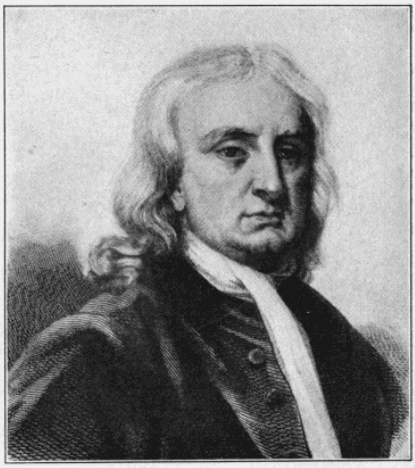
Sir Isaac Newton ought really to have been
the inventor of the spectroscope, because he
began by analyzing light in the rough with prisms,
was very expert in optics, and was certainly enough
of a philosopher to have laid the foundations of the
science.
What Newton did was to admit sunlight into a
darkened room through a small round aperture,
then pass the rays through a glass prism and receive
the band of color on a screen. He noticed the
succession of colors correctly—violet, indigo, blue,
green, yellow, orange, red; also that they were not
pure colors, but overlapping bands of color. Apparently
neither he nor any other experimenter for
more than a century went any further, when the
next essential step was taken by Wollaston about
1802 in England. He saw that by receiving the light
through a narrow slit instead of a round hole, he
got a purer spectrum, spectrum being the name
given to the succession of colors into which the
prism splits up or decomposes the original beam of
white sunlight. This seemingly insignificant change,
a narrow slit replacing the round hole, made Wollaston
and not Newton the discoverer of the dark
lines crossing the spectrum at various irregular intervals,
and these singularly neglected lines meant
the basis of a new and most important science.
Even Wollaston, however, passed them by, and
it was Fraunhofer who in 1814-1815 first made a
chart of them. Consequently they are known as
Fraunhofer lines, or dark absorption lines. Sending
the beam of light through a succession of prisms
gives greater dispersion and increases the power of
the spectroscope. The greater the dispersion the
greater the number of absorption lines; and it is the
number and intensity of these lines, with their accurate
position throughout the range of the spectrum
which becomes the basis of spectrum analysis.
The half century that saw the invention of the
steam engine, photography, the railroad and the
telegraph elapsed without any farther developments
than mere mapping of the fundamental lines, A, B,
C, D, E, F, G, H of the solar spectrum. The moon,
too, was examined and its spectrum found the same,
as was to be expected from sunlight simply reflected.
Sir John Herschel and other experimenters came
near guessing the significance of the dark lines, but
the problem of unraveling their mystery was finally
solved by Bunsen and Kirchhoff who ascertained
that an incandescent gas emits rays of exactly the
same degree of refrangibility which it absorbs when
white light is passed through it. This great discovery
was at once received as the secure basis of
spectrum analysis, and Kirchhoff in 1858 put in
compact and comprehensive form the three following
principles underlying the theory of the science:
(1) Solid and liquid bodies, also gases under high
pressure, give when incandescent a continuous
spectrum, that is one with a mere succession of
colors, and neither bright nor dark lines;
(2) Gases under low pressure give a discontinuous
spectrum, crossed by bright lines whose number and
position in the spectrum differ according to the substances
vaporized;
(3) When white light passes through a gas, this
medium absorbs or quenches rays of identical wave-length
with those composing its own bright-line
spectrum.
Clearly then it makes no difference where the light
originates whether it comes from sun or star. Only
it must be bright enough so that we can analyze it
with the spectroscope. But our analysis of sun and
star could not proceed until the chemist had
vaporized in the laboratory all the elements, and
charted their spectra with accuracy. When this had
been done, every substance became at once recognizable
by the number and position of its lines, with
practical certainty.
How then can we be sure of the chemical and
physical composition of sun and stars? Only by detailed
and critical comparison of their spectra with
the laboratory spectra of elements which chemical
and physical research have supplied. As in the sun,
so in the stars, each of which is encircled by a
gaseous absorptive layer or atmosphere, the light
rays from the self-luminous inner sphere must pass
through this reversing layer, which absorbs light of
exactly the same wave-length as the lines that make
up its own bright line spectrum. Whatever substances
are here found in gaseous condition, the same
will be evident by dark lines in the spectrum of sun
or star, and the position of these dark lines will show,
by coincidence with the position of the laboratory
bright lines, all the substances that are vaporized in
the atmospheres of the self-luminous bodies of the sky.
Here then originated the science of the new astronomy:
the old astronomy had concerned itself
mainly with positions of the heavenly bodies, where
they are; the new astronomy deals with their chemical
composition and physical constitution, and what
they are. Between 1865 and 1875 the fundamental
application of the basic principles was well advanced
by the researches of Sir William Huggins in England,
of Father Angelo Secchi in Rome, of Jules
Janssen in Paris, and of Dr. Henry Draper in New
York.
In analyzing the spectrum of the sun, many
thousands of dark absorption lines are found, and
their coincidences with the bright lines of terrestrial
elements show that iron, for instance, is most prominently
identified, with rather more than 2,000 coincidences
of bright and dark lines. Calcium, too,
is indicated by peculiar intensity of its lines, as well
as their great number. Next in order are hydrogen,
nickel and sodium. By prolonged and minute comparison
of the solar spectrum with spectra of terrestrial
elements, something like forty elemental
substances are now known to exist in the sun. Rowland's
splendid photographs of the solar spectrum
have contributed most effectively. About half of
these elements, though not in order of certainty, are
aluminum, cadmium, calcium, carbon, chromium,
cobalt, copper, hydrogen, iron, magnesium, manganese,
nickel, scandium, silicon, silver, sodium,
titanium, vanadium, yttrium, zinc, and zirconium.
Oxygen, too, is pretty surely indicated; but certain
elements abundant on earth, as nitrogen and chlorine,
together with gold, mercury, phosphorus, and
sulphur, are not found in the sun.
The two brilliant red stars, Aldebaran in Taurus,
and Betelgeuse in Orion, were the first stars whose
chemical constitution was revealed to the eye of man,
and Sir William Huggins of London was the astronomer
who achieved this epoch-making result. Father
Secchi of the Vatican Observatory proceeded at
once with the visual examination of the spectra of
hundreds of the brighter stars, and he was the first
to provide a classification of stellar spectra. There
were four types.
Secchi's type I is characterized chiefly by the
breadth and intensity of dark hydrogen lines, together
with a faintness or entire absence of metallic
lines. These are bluish or white stars and they are
very abundant, nearly half of all the stars. Vega,
Altair, and numerous other bright stars belong to
this type, and especially Sirius, which gives to the
type the name "Sirians."
Type II is characterized by a multitude of fine
dark metallic lines, closely resembling the lines of
the solar spectrum. These stars are somewhat
yellowish in tinge like the sun, and from this
similarity of spectra they are called "solars."
Arcturus and Capella are "solars," and on the whole
the solars are rather less numerous than the Sirians.
Stars nearest to the solar system are mostly of this
type, and, according to Kapteyn of Groningen, the
absolute luminous power of first type stars exceeds
that of second type stars seven-fold.
Secchi's type III is characterized by many dark
bands, well defined on the side toward the blue end
of the spectrum, but shading off toward the red—a
"colonnaded spectrum", as Miss Clerke aptly terms
it. Alpha Herculis, Antares, and Mira, together
with orange and reddish stars and most of the
variable stars, belong in type III.
Type IV is also characterized by dark bands, often
called "flutings," similar to those of type III, but
reversed as to shading, that is, well defined on the
side toward the red, but fading out toward the blue.
Their atmospheres contain carbon; but they are not
abundant, besides being faint and nearly all blood-red
in tint.
Following up the brilliant researches of Draper,
who in 1872 obtained the first successful photograph
of a star's spectrum, that of Vega, Pickering of
Harvard supplemented Secchi's classification by
Type V, a spectrum characterized by bright lines.
They, too, are not abundant and are all found near
the middle of the Galaxy. These are usually known
as Wolf-Rayet stars, from the two Paris astronomers
who first investigated their spectra. Type
V stars are a class of objects seemingly apart from
the rest of the stellar universe, and many of the
planetary nebulæ yield the same sort of a spectrum.
The late Mrs. Anna Palmer Draper, widow of Dr.
Henry Draper, established the Henry Draper Memorial
at Harvard, and investigation of the photographic
spectra of all the brighter stars of the
entire heavens has been prosecuted on a comprehensive
scale, those of the northern hemisphere at
Cambridge, and of the southern at Arequipa, Peru.
These researches have led to a broad reclassification
of the stars into eight distinct groups, a work
of exceptional magnitude begun by the late Mrs.
Fleming and recently completed by Miss Annie
Cannon, who classified the photographic spectra of
more than 230,000 stars on the new system, as follows:—
The letters O, B, A, F, G, K, M, N represent a
continuous gradation in the supposed order of stellar
evolution, and farther subdivision is indicated by
tenths, G5K meaning a type half way between G and
K, and usually written G5 simply. B2 would indicate
a type between B and A, but nearer to B than
A, and so on. On this system, the spectrum of a
star in the earliest stages of its evolution is made
up of diffuse bright bands on a faint continuous
background. As these bands become fewer and
narrower, very faint absorption lines begin to appear,
first the helium lines, followed by several series
of hydrogen lines. On the disappearance of the
bright bands, the spectrum becomes wholly absorptive
bands and lines. Then comes a very great
increase in intensity of the true hydrogen spectrum,
with wide and much diffused lines, and few if any
other lines. Then the H and K calcium lines and
other lines peculiar to the sun become more and
more intense. Then the hydrogen lines go through
their long decline. The calcium spectrum becomes
intense, and later the spectrum becomes quite like
that of the sun with a great wealth of lines. Following
this stage the spectrum shortens from the
ultra violet, the hydrogen lines fade out still farther,
and bands due to metallic compounds make their appearance,
the entire spectrum finally resembling that
of sun spots. To designate these types rather more
categorically:—
Type O—bright bands on a faint continuous background,
with five subdivisions, Oa, Ob, Oc, Od, Oe,
according to the varying width and intensity of the
bands.
Type B—the Orion type, or helium type, with additional
lines of origin unknown as yet, but without
any of the bright bands of type O.
Type A—the Sirian type, the regular Balmer
series of hydrogen lines being very intense, with
a few other lines not conspicuously marked.
Type F—the calcium type, hydrogen lines less
strongly marked, but with the narrow calcium lines
H and K very intense.
Type G—the solar type, with multitudes of metallic
lines.
Type K—in some respects similar to G, but with
the hydrogen lines fading out, and the metallic lines
relatively more prominent.
Type M—spectrum with peculiar flutings due to
titanium oxide, with subdivisions Ma and Mb, and
the variable stars of long period, with a few bright
hydrogen lines additional, in a separate class Md.
Type N—similar to M, in that both are pronouncedly
reddish, but with characteristic flutings
probably indicating carbon compounds.
The Draper classification being based on photographic
spectra, and the original Secchi classification
being visual, the relation of the two systems is
approximately as follows:
| Secchi Type |
I |
includes Draper B & A |
| |
II |
includes Draper F, G & K |
| |
III |
includes Draper M |
| |
IV |
includes Draper N |
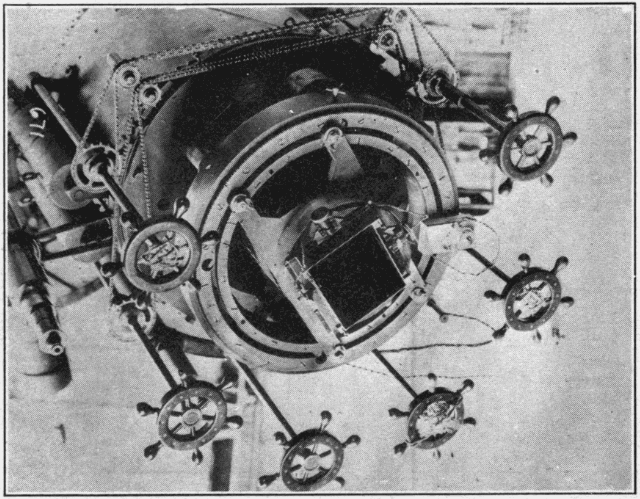
Pickering's marked success in organization and
execution of this great programme was due to his
adoption of the "slitless spectroscope," which made
it possible to photograph stellar spectra in vast
numbers on a single plate. The first observers of
stellar spectra placed the spectroscope beyond the
focus of the telescope with which it was used, thereby
limiting the examination to but one star at a
time. In the slitless spectroscope, a large prism is
mounted in front of the objective (of short focus),
so that the star's rays pass through it first, and then
are brought to the same focus on the photographic
plate, for all the stars within the field of view, sometimes
many thousand in number. This arrangement
provides great advantages in the comparison
and classification of stellar spectra.
When spectroscopic methods were first introduced
into astronomy, there was no expectation that
the field of the old or so-called exact astronomy
would be invaded. Physicists were sometimes
jocularly greeted among astronomers as "ribbon
men," and no one even dreamed that their researches
were one day to advance to equal recognition with
results derived from micrometer, meridian circle,
and heliometer.
The first step in this direction was taken in 1868
by Sir William Huggins of London, who noticed
small displacements in the lines of spectra of very
bright stars. In fact the whole spectrum appeared
to be shifted; in the case of Sirius it was shifted
toward the red, while the whole spectrum of Arcturus
was shifted by three times this amount toward
the violet end of the spectrum. The reason was not
difficult to assign.
As early as 1842 Doppler had enunciated the
principle that when we are approaching or are approached
by a body which is emitting regular vibrations,
then the number of waves we receive in a
second is increased, and their wave-length correspondingly
diminished; and just the reverse of this
occurs when the distance of the vibrating body is
increasing. It is the same with light as with sound,
and everyone has noticed how the pitch of a locomotive
whistle suddenly rises as it passes, and falls
as suddenly on retreating from us. So Huggins
drew the immediate inference that the distance between
the earth and Sirius was increasing at the
rate of nearly twenty miles per second, while Arcturus
was nearing us with a velocity of sixty miles
per second.
These pioneer observations of motions in the line
of sight, or radial velocities as they are now called,
led directly to the acceptance of the high value of
spectroscopic work as an adjunct of exact astronomy
in stellar research. Nor has it been found
wanting in application to a great variety of exact
problems in the solar system which would have been
wholly impossible to solve without it.
Foremost is the sun, of course, because of the
overplus of light. Young early measured the displacement
of lines in the spectra of the prominences,
and found velocities sometimes exceeding 250 miles
per second. Many astronomers, Dunér among them,
investigated the rotation of the sun by the spectroscopic
method. The sun's east limb is coming toward
us, while the west is going from us; and by
measuring the sum of the displacements, the rate of
rotation has been calculated, not only at the sun's
equator but at many solar latitudes also, both north
and south. As was to be expected, these results
agree well with the sun's rotation as found by the
transits of sun spots in the lower latitudes where
they make their appearance.
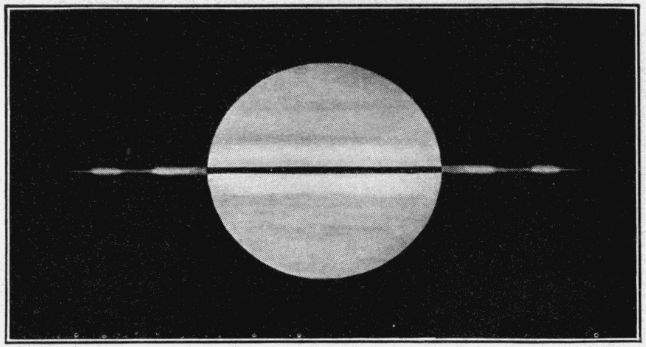
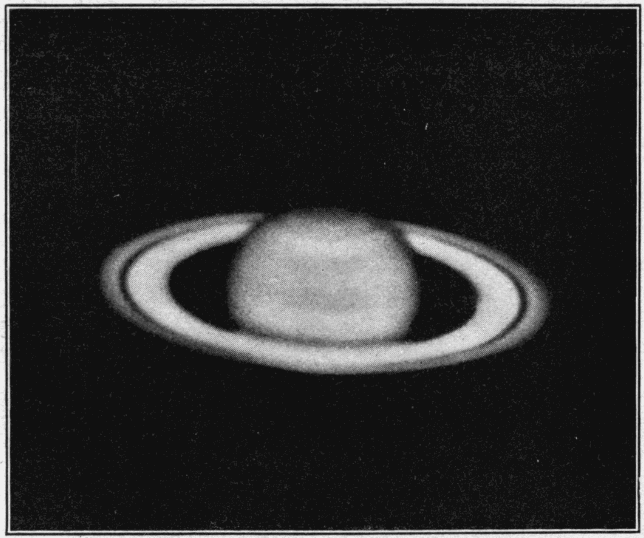
Bélopolsky has applied the same method to the
rotation of the planet Venus, and Keeler, by measuring
the displacement of lines in the spectrum of
Saturn, on opposite sides of the ring, provided a
brilliant observational proof of the physical constitution
of the rings; because he showed that the
inner ring traveled round more swiftly than the
outer one, thus demonstrating that the ring could
not be solid, but must be composed of multitudes of
small particles traveling around the ball of Saturn,
much as if they were satellites. Indeed, Keeler ascertained
the velocity of their orbital motion and
found that in each case it agreed exactly with that
required by the Keplerian law.
Even the filmy corona of the sun was investigated
in similar fashion by Deslandres at the total eclipse
of 1893, and he found that it rotates bodily with the
sun. But the complete vindication of the spectroscopic
method as an adjunct of the old astronomy
came with its application to measurement of the
distance of the sun. The method is very interesting
and was first suggested by Campbell in 1892.
Spectrum-line measurements have become very accurate
with the introduction of dry-plate photography,
and ecliptic stars were spectrographed, toward
and from which the earth is traveling by its
orbital motion round the sun. By accurate measurement
of these displacements, the orbital velocity of
the earth is calculated; and as we know the exact
length of the year, or a complete period, the length
of the orbit itself in miles becomes known, and thus,
by simple mensuration, the length of the radius of
the orbit—which is the distance of the sun.
If we pass from sun to star, the triumph of the
spectroscope has been everywhere complete and significant.
As the spectroscopic survey of the stars
grew toward completeness, it became evident that
the swarming hosts of the stellar universe are in
constant motion through space, not only athwart
the line of vision as their proper motions had long
disclosed, but some stars are swiftly moving toward
our solar system and others as swiftly from it.
Fixed stars, strictly speaking—there are no such.
All are in relative motion. Exact astronomy by discussion
of the proper motions had assigned a region
of the sky toward which the sun and planets are
moving. Spectrography soon verified this direction
not only, but gave a determination of the velocity
of our motion of twelve miles per second in
a direction approximately that of the constellation
Lyra. From corresponding radial velocities, we
draw the ready conclusion that certain groups or
clusters of stars are actually connected in space and
moving as related systems, as in the Pleiades and
Ursa Major.
Rather more than a quarter century ago, the
spectroscope came to the assistance of the telescope
in helping to solve the intricate problem of stellar
distribution. Kapteyn, by combining the proper
motions of certain stars with their classification in
the Draper catalogue of stellar spectra, drew the
conclusion that, as stars having very small proper
motions show a condensation toward the Galaxy, the
stars composing this girdle are mostly of the Sirian
type, and are at vast distances from the solar system.
The proper motion of a star near to us will
ordinarily be large, and, in the case of solar stars,
the larger their proper motion the greater their
number. So it would appear that the solar stars
are aggregated round the sun himself, and this conclusion
is greatly strengthened by the fact that of
stars whose distances and spectral type are both
ascertained, seven of the eight nearest to us are
solar stars.
In 1889 the spectroscope achieved an unexpected
triumph by enabling the late Professor Pickering to
make the first discovery of a spectroscopic double, or
binary star, a type of object now quite abundant.
Unlike the visual binary systems whose periods are
years in length, the spectroscopic binaries have short
periods, reckoned in some cases in days, or hours
even. If the orbit of a very close binary is seen
edge on, the light of the two stars will coalesce twice
in every revolution. Halfway between these points
there are two times when the two stars will be moving,
one toward the earth and the other from it. At
all times the light of the star, in so far as the telescope
shows it, proceeds from a single object.
Now photograph the star's spectrum at each of
the four critical points above indicated: in the first
pair the lines are sharply defined and single, because
at conjunction the stars are simply moving athwart
the line of sight, while at the intermediate points
the lines are double. Doppler's principle completely
accounts for this: the light from the receding companion
is giving lines displaced toward the red, while
the approaching companion yields lines displaced
toward the violet. Mizar, the double star at the
bend of the handle in the Great Dipper was the first
star to yield this peculiar type of spectrum, and the
period of its invisible companion is about 52 days.
The relative velocity of the components is 100 miles
a second, and applying Newton's law we find its
mass exceeds that of the sun forty-fold. Capella has
been found to be a spectroscopic binary; also the
pole star. Spectroscopic binaries have relatively
short periods, one of the shortest known being only
35 hours in length. It is in the constellation Scorpio.
Beta Aurigæ is another whose lines double on
alternate nights, giving a period of four days; and
the combined mass of both stars is more than twice
that of the sun. The catalogue of spectroscopic
binaries is constantly enlarging; but thousands
doubtless exist that can never be discovered by this
method, as is evident if their orbits are perpendicular
to the line of sight or nearly so. The history
of the spectroscopic binaries is one of the most interesting
chapters in astronomy, and affords a marvelous
confirmation of the prediction of Bessel who
first wrote of "the astronomy of the invisible."
Find a star's distance by the spectroscope? Impossible,
everyone would have said, even a very few
years ago. Now, however, the thing is done, and
with increasing accuracy.
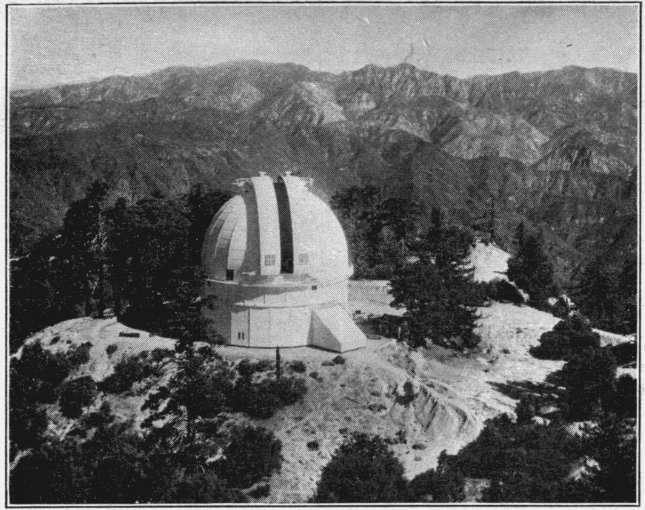
Adams of Mount Wilson has found, after protracted
investigation, that the relative intensity of
certain spectral lines varies according to the absolute
brightness of a star; indeed, so close is the correspondence
that the spectroscopic observations are
employed to provide in certain cases a good determination
of the absolute magnitude, and therefore of
the distance. To test this relation, the spectroscopic
parallaxes have been compared with the measured
parallaxes in numerous instances, and an excellent
agreement is shown. This new method is adding
extensively to our knowledge of stellar luminosities
and distances, and even the vast distances of globular
clusters and spiral nebulæ are becoming known.
In fact, but few departments of the old astronomy
are left which the new astronomy has not invaded,
and this latest triumph of the spectroscope in determining
accurately the distances of even the remotest
stars is enthusiastically welcomed by advocates
of the old and new astronomy alike.