ASTRONOMY EXPLAINED UPON Sir ISAAC NEWTON’s PRINCIPLES, AND MADE EASY TO THOSE WHO HAVE NOT STUDIED MATHEMATICS.
This book uses a number of astronomical symbols, including signs of the Zodiac (♈, ♉, ♊, ♋, ♌, ♍, ♎, ♏, ♐, ♑, ♒, ♓), and symbols for planets (☿, ♀, ⊕, ♂, ♃, ♄). If these characters do not display correctly, you may have to use an alternative font, such as Arial Unicode MS or DejaVu.
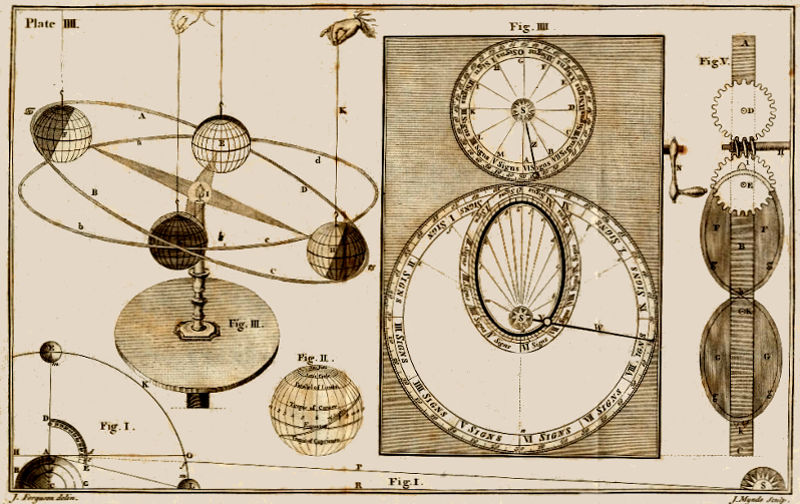
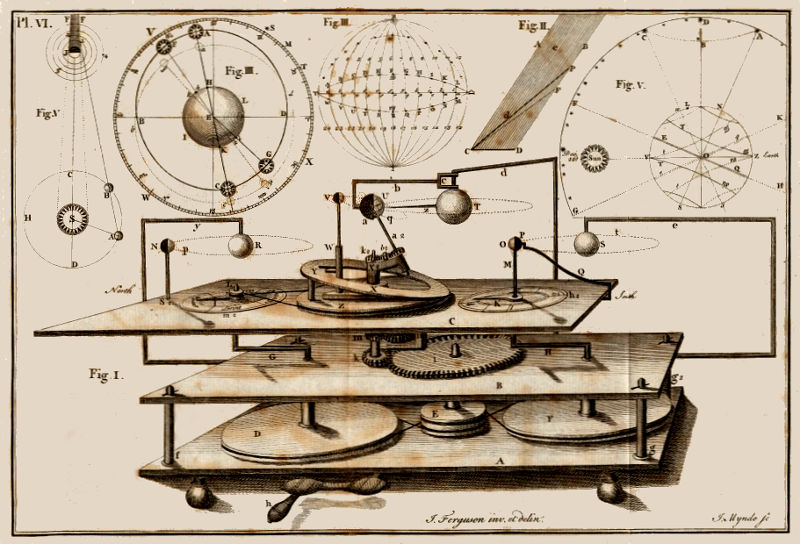
The ORRERY, made by JAMES FERGUSON.
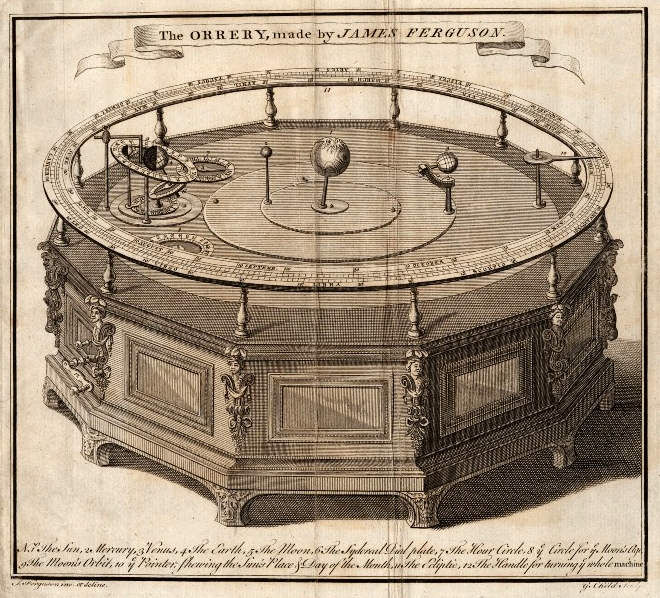
N. 1. The Sun, 2. Mercury, 3. Venus, 4. The Earth, 5. The Moon, 6. The Sydereal Dial plate, 7. The Hour Circle, 8. ye Circle for ye. Moon’s Age, 9. The Moon’s Orbit, 10. ye Pointer, Shewing the Sun’s Place & Day of the Month, 11. The Ecliptic, 12. The Handle for turning ye whole machine
J. Ferguson inv. et delin.
G. Child. Sculp.
THE CONTENTS.
| CHAP. I. | |
| Of Astronomy in general | Page 1 |
| CHAP. II. | |
| A brief Description of the Solar System | 5 |
| CHAP. III. | |
| The Copernican or Solar System demonstrated to be true | 31 |
| CHAP. IV. | |
| The Phenomena of the Heavens as seen from different parts of the Earth | 39 |
| CHAP. V. | |
| The Phenomena of the Heavens as seen from different parts of the Solar System | 45 |
| CHAP. VI. | |
| The Ptolemean System refuted. The Motions and Phases of Mercury and Venus explained | 50 |
| CHAP. VII. | |
| The physical Causes of the Motions of the Planets. The Excentricities of their Orbits. The times in which the Action of Gravity would bring them to the Sun. Archimedes’s ideal Problem for moving the Earth. The world not eternal | 54 |
| CHAP. VIII. | |
| Of Light. It’s proportional quantities on the different Planets. It’s Refractions in Water and Air. The Atmosphere, it’s Weight and Properties. The Horizontal Moon | 62 |
| CHAP. IX. | |
| The Method of finding the Distances of the Sun, Moon and Planets | 73 |
| CHAP. X. | |
| The Circles of the Globe described. The different lengths of days and nights, and the vicissitude of Seasons, explained. The explanation of the Phenomena of Saturn’s Ring concluded | 78 |
| CHAP. XI. | |
| The Method of finding the Longitude by the Eclipses of Jupiter’s Satellites: The amazing velocity of Light demonstrated by these Eclipses | 87 |
| CHAP. XII. | |
| Of Solar and Sidereal Time | 93 |
| CHAP. XIII. | |
| Of the Equation of Time | 97 |
| CHAP. XIV. | |
| Of the Precession of the Equinoxes | 108 |
| CHAP. XV. | |
| The Moon’s Surface mountainous: Her Phases described: Her Path, and the Paths of Jupiter’s Moons delineated: The proportions of the Diameters of their Orbits, and those of Saturn’s Moons to each other; and to the Diameter of the Sun | 124 |
| CHAP. XVI. | |
| The Phenomena of the Harvest-Moon explained by a common Globe: The Years in which the Harvest-Moons are least and most beneficial, from 1751 to 1861. The long duration of Moon-light at the Poles in Winter Page | 136 |
| CHAP. XVII. | |
| Of the ebbing and flowing of the Sea | 147 |
| CHAP. XVIII. | |
| Of Eclipses: Their Number and Period. A large Catalogue of Ancient and Modern Eclipses | 156 |
| CHAP. XIX. | |
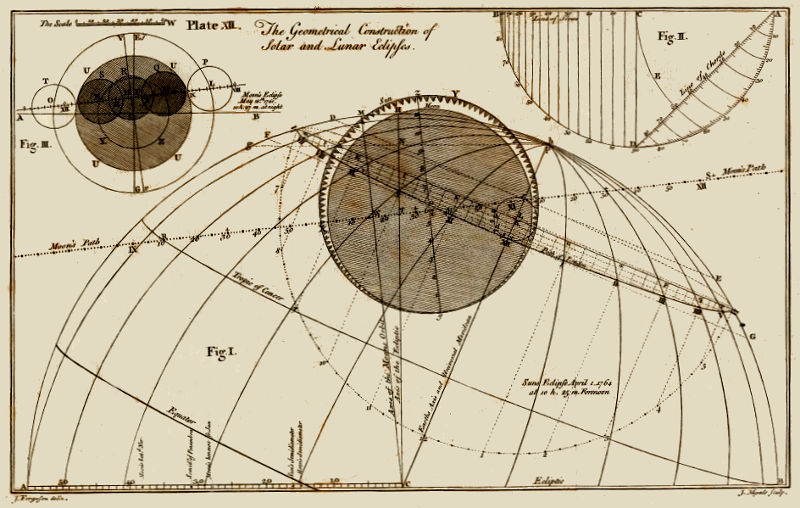
| The Calculation of New and Full Moons and Eclipses. The geometrical Construction of Solar and Lunar Eclipses. The examination of ancient Eclipses | 189 |
| CHAP. XX. | |
| Of the fixed Stars | 230 |
| CHAP. XXI. | |
| Of the Division of Time. A perpetual Table of New Moons. The Times of the Birth and Death of Christ. A Table of remarkable Æras or Events | 248 |
| CHAP. XXII. | |
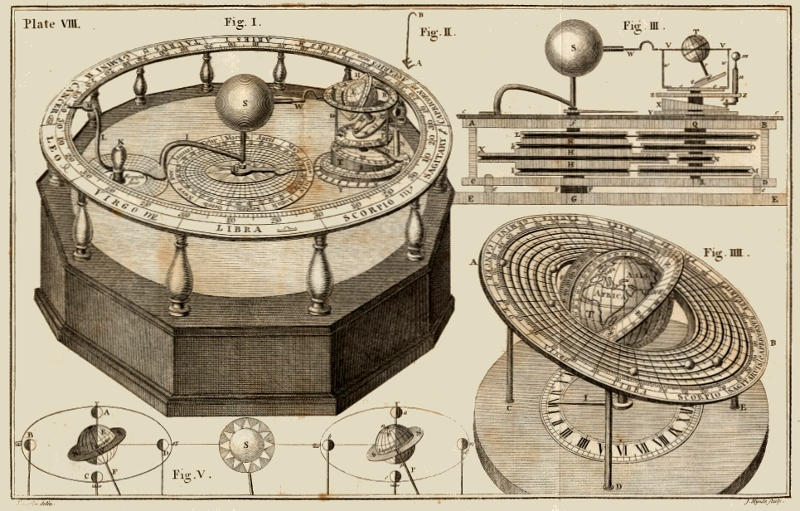
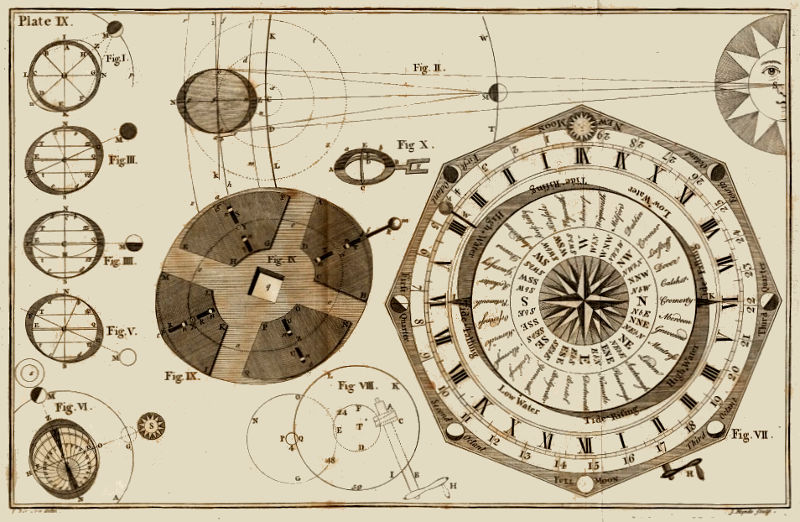
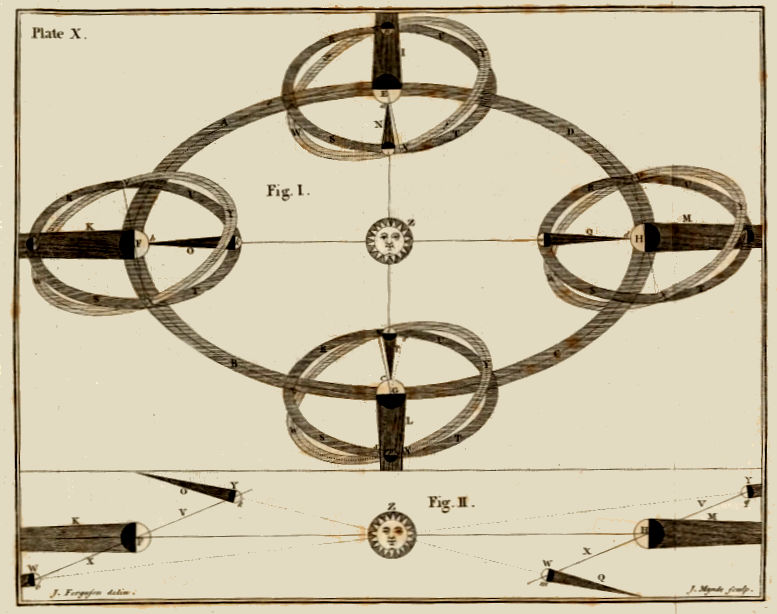
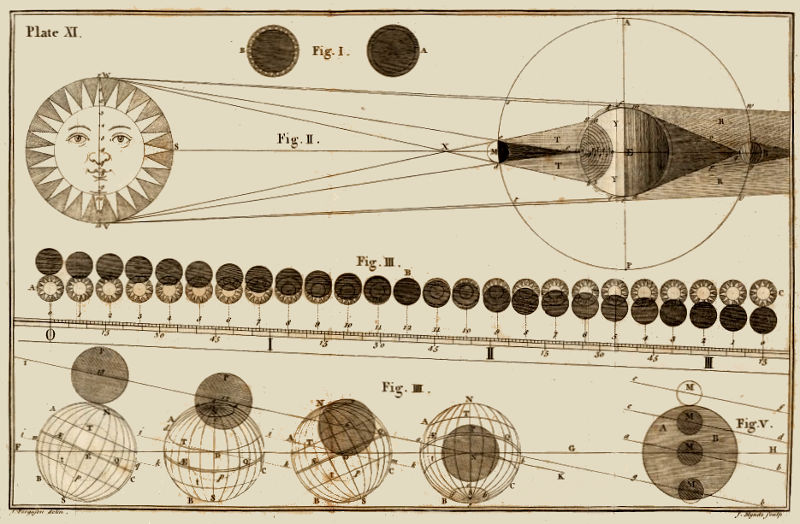
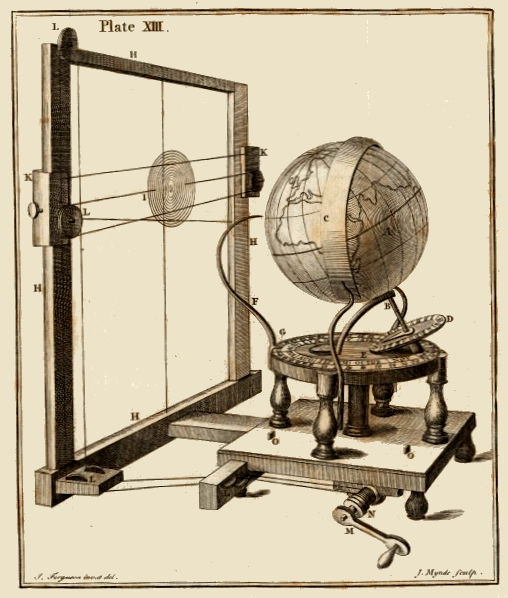
| A Description of the Astronomical Machinery serving to explain and illustrate the foregoing part of this Treatise | 260 |
ERRATA.
In the Table facing Page 31, the Sun’s quantity of matter should be 227500. Page 40, l. last, for infinite read indefinite. Page 97, l. 20, for this read the next. Page 164, l. 2 from the bottom, for without any acceleration read as above, without any acceleration. Page 199, l. 16 for XIV read XV. Page 238, l. 16, for 40 read 406. Page 240, l. 15 from the bottom, for Tifri read Tisri, Page 249 l. 13; from the bottom for XVII read V.
CHAP. I. Of Astronomy in general.
1. Of all the sciences cultivated by mankind, Astronomy is acknowledged to be, and undoubtedly is, the most sublime, the most interesting, and the most useful. For, by knowledge derived from this science, not only the bulk of the Earth is discovered, the situation and extent of the countries and kingdoms upon it ascertained, trade and commerce carried on to the remotest parts of the world, and the various products of several countries distributed for the health, comfort, and conveniency of its inhabitants; but our very faculties are enlarged with the grandeur of the ideas it conveys, our minds exalted above the low contracted prejudices of the vulgar, and our understandings clearly convinced, and affected with the conviction, of the existence, wisdom, power, goodness, and superintendency of the SUPREME BEING! So that without an hyperbole,
2. From this branch of knowledge we also learn by what means or laws the Almighty carries on, and continues the admirable harmony, order, and connexion observable throughout the planetary system; and are led by very powerful arguments to form the pleasing deduction, that minds capable of such deep researches not only derive their origin from that adorable Being, but are also incited to aspire 2after a more perfect knowledge of his nature, and a stricter conformity to his will.
3. By Astronomy we discover that the Earth is at so great a distance from the Sun, that if seen from thence it would appear no bigger than a point; although it’s circumference is known to be 25,020 miles. Yet that distance is so small, compared with the distance of the Fixed Stars, that if the Orbit in which the Earth moves round the Sun were solid, and seen from the nearest Star, it would likewise appear no bigger than a point, although it is at least 162 millions of miles in diameter. For the Earth in going round the Sun is 162 millions of miles nearer to some of the Stars at one time of the year than at another; and yet their apparent magnitudes, situations, and distances from one another still remain the same; and a telescope which magnifies above 200 times does not sensibly magnify them: which proves them to be at least 400 thousand times farther from us than we are from the Sun.
4. It is not to be imagined that all the Stars are placed in one concave surface, so as to be equally distant from us; but that they are scattered at immense distances from one another through unlimited space. So that there may be as great a distance between any two neighbouring Stars, as between our Sun and those which are nearest to him. Therefore an Observer, who is nearest any fixed Star, will look upon it alone as a real Sun; and consider the rest as so many shining points, placed at equal distances from him in the Firmament.
5. By the help of telescopes we discover thousands of Stars which are invisible to the naked eye; and the better our glasses are, still the more become visible: so that we can set no limits either to their number or their distances. The celebrated Huygens carries his thoughts so far, as to believe it not impossible that there may be Stars at such inconceivable distances, that their light has not yet reached the Earth since it’s creation; although the velocity of light be a million of times greater than the velocity of a cannon bullet, as shall be demonstrated afterwards § 197, 216: and, as Mr. Addison very justly observes, this thought is far from being extravagant, when we consider that the Universe is the work of infinite power, prompted by infinite goodness; having an infinite space to exert itself in; so that our imaginations can set no bounds to it.
6. The Sun appears very bright and large in comparison of the Fixed Stars, because we keep constantly near the Sun, in comparison of our immense distance from the Stars. For, a spectator, placed as near to any Star as we are to the Sun, would see that Star a body as 3large and bright as the Sun appears to us: and a spectator, as far distant from the Sun as we are from the Stars, would see the Sun as small as we see a Star, divested of all its circumvolving Planets; and would reckon it one of the Stars in numbering them.
7. The Stars, being at such immense distances from the Sun, cannot possibly receive from him so strong a light as they seem to have; nor any brightness sufficient to make them visible to us. For the Sun’s rays must be so scattered and dissipated before they reach such remote objects, that they can never be transmitted back to our eyes, so as to render these objects visible by reflection. The Stars therefore shine with their own native and unborrowed lustre, as the Sun does; and since each particular Star, as well as the Sun, is confined to a particular portion of space, ’tis plain that the Stars are of the same nature with the Sun.
8. It is no ways probable that the Almighty, who always acts with infinite wisdom and does nothing in vain, should create so many glorious Suns, fit for so many important purposes, and place them at such distances from one another, without proper objects near enough to be benefited by their influences. Whoever imagines they were created only to give a faint glimmering light to the inhabitants of this Globe, must have a very superficial knowledge of Astronomy, and a mean opinion of the Divine Wisdom: since, by an infinitely less exertion of creating power, the Deity could have given our Earth much more light by one single additional Moon.
9. Instead then of one Sun and one World only in the Universe, as the unskilful in Astronomy imagine, that Science discovers to us such an inconceivable number of Suns, Systems, and Worlds, dispersed through boundless Space, that if our Sun, with all the Planets, Moons, and Comets belonging to it were annihilated, they would be no more missed out of the Creation than a grain of sand from the sea-shore. The space they possess being comparatively so small, that it would scarce be a sensible blank in the Universe; although Saturn, the outermost of our planets, revolves about the Sun in an Orbit of 4884 millions of miles in circumference, and some of our Comets make excursions upwards of ten thousand millions of miles beyond Saturn’s Orbit; and yet, at that amazing distance, they are incomparably nearer to the Sun than to any of the Stars; as is evident from their keeping clear of the attractive Power of all the Stars, and returning periodically by virtue of the Sun’s attraction.
10. From what we know of our own System it may be reasonably concluded that all the rest are with equal wisdom contrived, situated, 4and provided with accommodations for rational inhabitants. Let us therefore take a survey of the System to which we belong; the only one accessible to us; and from thence we shall be the better enabled to judge of the nature and end of the other Systems of the Universe. For although there is almost an infinite variety in all the parts of the Creation which we have opportunities of examining; yet there is a general analogy running through and connecting all the parts into one scheme, one design, one whole!
11. And then, to an attentive considerer, it will appear highly probable, that the Planets of our System, together with their attendants called Satellites or Moons, are much of the same nature with our Earth, and destined for the like purposes. For, they are solid opaque Globes, capable of supporting animals and vegetables. Some of them are bigger, some less, and some much about the size of our Earth. They all circulate round the Sun, as the Earth does, in a shorter or longer time according to their respective distances from him: and have, where it would not be inconvenient, regular returns of summer and winter, spring and autumn. They have warmer and colder climates, as the various productions of our Earth require: and, in such as afford a possibility of discovering it, we observe a regular motion round their Axes like that of our Earth, causing an alternate return of day and night; which is necessary for labour, rest, and vegetation, and that all parts of their surfaces may be exposed to the rays of the Sun.
12. Such of the Planets as are farthest from the Sun, and therefore enjoy least of his light, have that deficiency made up by several Moons, which constantly accompany, and revolve about them, as our Moon revolves about the Earth. The remotest Planet has, over and above, a broad Ring encompassing it; which like a lucid Zone in the Heavens reflects the Sun’s light very copiously on that Planet: so that if the remoter Planets have the Sun’s light fainter by day than we, they have an addition made to it morning and evening by one or more of their Moons, and a greater quantity of light in the night-time.
13. On the surface of the Moon, because it is nearer us than any other of the celestial Bodies are, we discover a nearer resemblance of our Earth. For, by the assistance of telescopes we observe the Moon to be full of high mountains, large valleys, and deep cavities. These similarities leave us no room to doubt but that all the Planets and Moons in the System are designed as commodious habitations for creatures endowed with capacities of knowing and adoring their beneficent Creator.
The Solar System
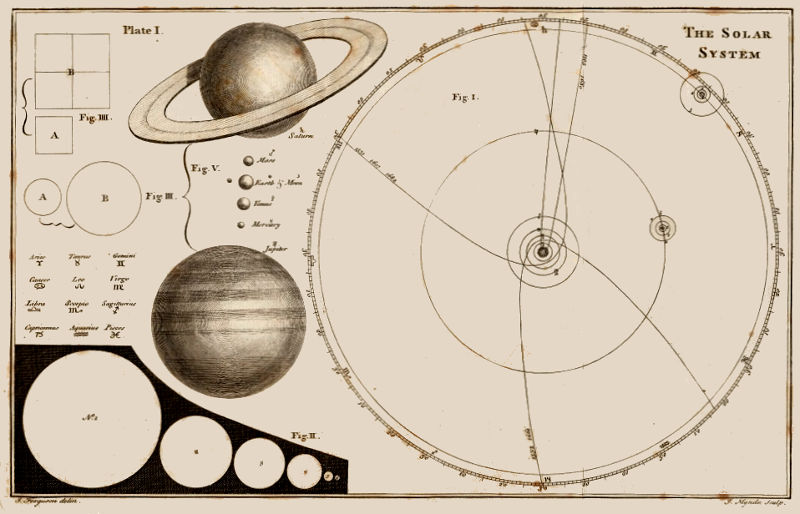
J. Ferguson delin.
J. Mynde Sculp.
514. Since the Fixed Stars are prodigious spheres of fire, like our Sun, and at inconceivable distances from one another, as well as from us, it is reasonable to conclude they are made for the same purposes that the Sun is; each to bestow light, heat, and vegetation on a certain number of inhabited Planets, kept by gravitation within the sphere of it’s activity.
15. What an august! what an amazing conception, if human imagination can conceive it, does this give of the works of the Creator! Thousands of thousands of Suns, multiplied without end, and ranged all around us, at immense distances from each other, attended by ten thousand times ten thousand Worlds, all in rapid motion, yet calm, regular, and harmonious, invariably keeping the paths prescribed them; and these Worlds peopled with myriads of intelligent beings, formed for endless progression in perfection and felicity.
16. If so much power, wisdom, goodness, and magnificence is displayed in the material Creation, which is the least considerable part of the Universe, how great, how wise, how good must HE be, who made and governs the Whole!
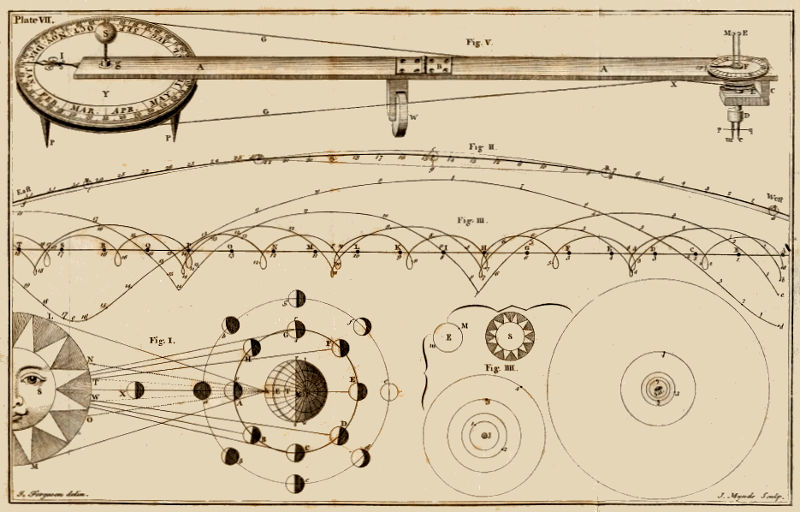
CHAP. II. A brief Description of the Solar System .
17. The Planets and Comets which move round the Sun as their center, constitute the Solar System. Those Planets which are nearer the Sun not only finish their circuits sooner, but likewise move faster in their respective Orbits than those which are more remote from him. Their motions are all performed from west to east, in Orbits nearly circular. Their names, distances, bulks, and periodical revolutions, are as follows.
18. The Sun
 , an immense globe of fire, is placed near the
common center, or rather in the lower[2] focus, of the Orbits of all
6the Planets and Comets[3]; and turns round his axis in 25 days 6 hours,
as is evident by the motion of spots seen on his surface. His diameter
is computed to be 763,000 miles; and, by the various attractions
of the circumvolving Planets, he is agitated by a small motion
round the center of gravity of the System. All the Planets, as seen
from him, move the same way, and according to the order of Signs in
the graduated Circle ♈ ♉ ♎ ♋ &c. which represents the great Ecliptic in
the Heavens: but, as seen from any one Planet, the rest appear sometimes
to go backward, sometimes forward, and sometimes to stand
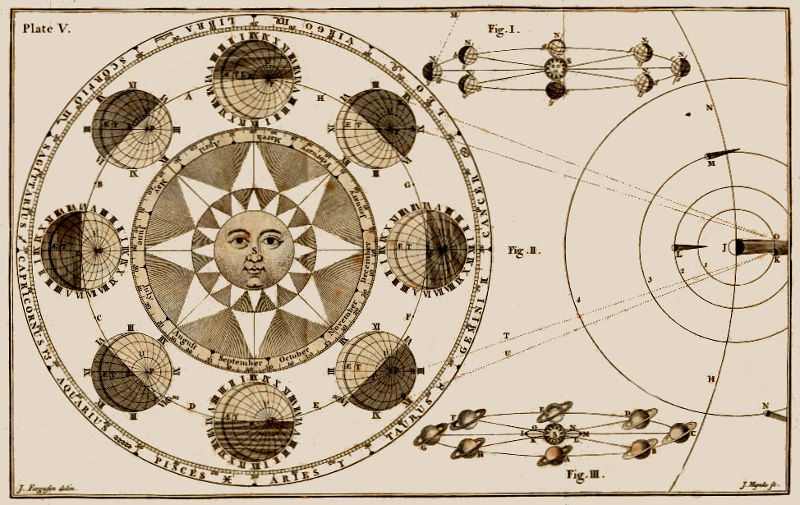
still; not in circles nor ellipses, but in[4] looped curves which never
return into themselves. The Comets come from all parts of the Heavens,
and move in all sorts of directions.
19. Having mentioned the Sun’s turning round his axis, and as there will be frequent occasion to speak of the like motion of the Earth and other Planets, it is proper here to inform the young Tyro in Astronomy, that neither the Sun nor Planets have material axes to turn upon, and support them, as in the little imperfect Machines contrived to represent them. For the axis of a Planet is a line conceived to be drawn through it’s center, about which it revolves as on a real axis. The extremities of this line, terminating in opposite points of the Planet’s surface, are called its Poles. That which points towards the northern part of the Heavens is called the North Pole; and the other, pointing towards the southern part, is called the South Pole. A bowl whirled from one’s hand into the open air turns round such a line within itself, whilst it moves forward; and such are the lines we mean, when we speak of the Axes of the Heavenly bodies.
20. Let us suppose the Earth’s Orbit to be a thin, even, solid plane; cutting the Sun through the center, and extended out as far as the Starry Heavens, where it will mark the great Circle called the Ecliptic. This Circle we suppose to be divided into 12 equal parts, called Signs; each Sign into 30 equal parts, called Degrees; each Degree into 60 equal parts, called Minutes; and every Minute into 60 equal parts, called Seconds: so that a Second is the 60th part of a Minute; a Minute 7the 60th part of a Degree; and a Degree the 360th part of a Circle, or 30th part of a Sign. The Planes of the Orbits of all the other Planets likewise cut the Sun in halves; but extended to the Heavens, form Circles different from one another, and from the Ecliptic; one half of each being on the north side, and the other on the south side of it. Consequently the Orbit of each Planet crosses the Ecliptic in two opposite points, which are called the Planet’s Nodes. These Nodes are all in different parts of the Ecliptic; and therefore, if the planetary Tracks remained visible in the Heavens, they would in some measure resemble the different rutts of waggon-wheels crossing one another in different parts, but never going far asunder. That Node, or Intersection of the Orbit of any Planet with the Earth’s Orbit, from which the Planet ascends northward above the Ecliptic, is called the Ascending Node of the Planet; and the other, which is directly opposite thereto, is called it’s Descending Node. Saturn’s Ascending Node is in 21 deg. 13 min. of Cancer ♋, Jupiter’s in 7 deg. 29 min. of the same Sign, Mars’s in 17 deg. 17 min. of Taurus ♉, Venus’s in 13 deg. 59 min. of Gemini ♊, and Mercury’s in 14 deg. 43 min. of Taurus. Here we consider the Earth’s Orbit as the standard, and the Orbits of all the other Planets as oblique to it.
21. When we speak of the Planets Orbits, all that is meant is their Paths through the open and unresisting Space in which they move; and are kept in, by the attractive power of the Sun, and the projectile force impressed upon them at first: between which power and force there is so exact an adjustment, that without any solid Orbits to confine the Planets, they keep their courses, and at the end of every revolution find the points from whence they first set out, much more truly than can be imitated in the best machines made by human art.
22. Mercury, the nearest Planet to the Sun, goes round him (as in the circle marked ☿) in 87 days 23 hours of our time nearly; which is the length of his year. But, being seldom seen, and no spots appearing on his surface or disc, the time of his rotation on his axis, or the length of his days and nights, is as yet unknown. His distance from the Sun is computed to be 32 millions of miles, and his diameter 2600. In his course, round the Sun, he moves at the rate of 95 thousand miles every hour. His light and heat from the Sun are almost seven times as great as ours; and the Sun appears to him almost seven times as large as to us. The great heat on this Planet is no argument against it’s being inhabited; since the Almighty could as easily suit the bodies and constitutions of it’s inhabitants to the heat of 8their dwelling, as he has done ours to the temperature of our Earth. And it is very probable that the people there have such an opinion of us, as we have of the inhabitants of Jupiter and Saturn; namely, that we must be intolerably cold, and have very little light at so great a distance from the Sun.
23. This Planet appears to us with all the various phases of the Moon, when viewed at different times by a good telescope; save only that he never appears quite Full, because his enlightened side is never turned directly towards us but when he is so near the Sun as to be lost to our sight in it’s beams. And, as his enlightened side is always toward the Sun, it is plain that he shines not by any light of his own; for if he did, he would constantly appear round. That he moves about the Sun in an Orbit within the Earth’s Orbit is also plain (as will be more largely shewn by and by, § 141, & seq.) because he is never seen opposite to the Sun, nor above 56 times the Sun’s breadth from his center.
24. His Orbit is inclined seven degrees to the Ecliptic; and that Node § 20, from which he ascends northward above the Ecliptic is in the 14th degree of Taurus; the opposite, in the 14th degree of Scorpio. The Earth is in these points on the 5th of November and 4th of May, new style; and when Mercury comes to either of his Nodes at his[5] inferior Conjunction about these times, he will appear to pass over the disc or face of the Sun, like a dark round spot. But in all other parts of his Orbit his Conjunctions are invisible, because he either goes above or below the Sun.
25. Mr. Whiston has given us an account of several periods at which Mercury may be seen on the Sun’s disc, viz. In the year 1782, Nov. 12th, at 3 h. 44 m. in the afternoon: 1786, May 4th, at 6 h. 57 m. in the forenoon: 1789, Dec. 6th, at 3 h. 55 m. in the afternoon; and 1799, May 7th, at 2 h. 34 m. in the afternoon. There will be several intermediate Transits, but none of them visible at London.
Venus.
26. Venus, the next Planet in order, is computed to be 59 millions of miles from the Sun; and by moving at the rate of 69 thousand miles every hour in her Orbit (as in the circle marked ♀), she goes round the Sun in 224 days 17 hours of our time nearly; in which, though it be the full length of her year, she has only 91⁄4 days, according to Bianchini’s observations; so that in her, every day and night together is as long as 241⁄3 days and nights with us. This odd 9quarter of a day in every year makes every fourth year a leap-year to Venus; as the like does to our Earth. Her diameter is 7906 miles; and by her diurnal motion the inhabitants about her Equator are carried 43 miles every hour: besides the 69,000 above-mentioned.
27. Her Orbit includes that of Mercury within it; for at her greatest Elongation, or apparent distance from the Sun, she is 96 times his breadth from his centre; which is almost double of Mercury’s. Her Orbit is included by the Earth’s; for if it were not, she might be seen as often in Opposition to the Sun as in Conjunction with him; but she was never seen 90 degrees, or a fourth part of a Circle, from the Sun.
28. When Venus appears west of the Sun she rises before him in the morning, and is called the Morning Star: when she appears east of the Sun she shines in the evening after he sets, and is then called the Evening Star: being each in it’s turn for 290 days. It may perhaps be surprising at first, that Venus should keep longer on the east or west of the Sun than the whole time of her Period round him. But the difficulty vanishes when we consider that the Earth is all the while going round the Sun the same way, though not so quick as Venus: and therefore her relative motion to the Earth must in every Period be as much slower than her absolute motion in her Orbit, as the Earth during that time advances forward in the Ecliptic; which is 220 degrees. To us she appears through a telescope in all the various shapes of the Moon.
29. The Axis of Venus is inclined 75 degrees to the Axis of her Orbit; which is 511⁄2 degrees more than our Earth’s Axis is inclined to the Axis of the Ecliptic: and therefore the variation of her seasons is much greater than of ours. The North Pole of her Axis inclines toward the 20th degree of Aquarius, our Earth’s to the beginning of Cancer; and therefore the northern parts of Venus have summer in the Signs where those of our Earth have winter, and vice versâ.
30. The [6]artificial day at each Pole of Venus is as long as 1121⁄2 [7]natural days on our Earth.
31. The Sun’s greatest Declination on each side of her Equator amounts to 75 degrees; therefore her[8] Tropics are only 15 degrees 10from her Poles; and her [9]Polar Circles as far from her Equator. Consequently, the Tropics of Venus are between her Polar Circles and her Poles; contrary to what those of our Earth are.
32. As her annual Revolution contains only 91⁄4 of her days, the Sun will always appear to go through a Sign, or twelfth Part of her Orbit, in little more that three quarters of her natural day, or nearly in 183⁄4 of our days and nights.
33. Because her day is so great a part of her year, the Sun changes his Declination in one day so much, that if he passes vertically, or directly over head of any given place on the Tropic, the next day he will be 26 degrees from it: and whatever place he passes vertically over when in the Equator, one day’s revolution will remove him 361⁄4 degrees from it. So that the Sun changes his Declination every day in Venus about 14 degrees more at a mean rate, than he does in a quarter of a year on our Earth. This appears to be providentially ordered, for preventing the too great effects of the Sun’s heat (which is twice as great on Venus as on the Earth) so that he cannot shine perpendicularly on the same places for two days together; and by that means, the heated places have time to cool.
34. If the inhabitants about the North Pole of Venus fix their South, or Meridian Line, through that part of the Heavens where the Sun comes to his greatest Height, or North Declination, and call those the East and West points of their Horizon, which are 90 degrees on each side from that point where the Horizon is cut by the Meridian Line, these inhabitants will have the following remarkables.
The Sun will rise 221⁄2 degrees[10] north of the East, and going on 1121⁄2 degrees, as measured on the plane of the [11]Horizon, he will cross the Meridian at an altitude of 121⁄2 degrees; then making an entire revolution without setting, he will cross it again at an altitude of 481⁄2 degrees; at the next revolution he will cross the Meridian as he comes to his greatest height and declination, at the altitude of 75 degrees; being then only 15 degrees from the Zenith, or that point of the Heavens which is directly over head: and thence he will descend in the like spiral manner; crossing the Meridian first at the altitude of 481⁄2 degrees; next at the altitude of 121⁄2 degrees; and going on thence 1121⁄2 degrees, he will set 221⁄2 degrees north of the West; so that, after 11having been 45⁄8 revolutions above the Horizon, he descends below it to exhibit the like appearances at the South Pole.
35. At each Pole, the Sun continues half a year without setting in summer, and as long without rising in winter; consequently the polar inhabitants of Venus have only one day and one night in the year; as it is at the Poles of our Earth. But the difference between the heat of summer and cold of winter, or of mid-day and mid-night, on Venus, is much greater than on the Earth: because in Venus, as the Sun is for half a year together above the Horizon of each Pole in it’s turn, so he is for a considerable part of that time near the Zenith; and during the other half of the year, always below the Horizon, and for a great part of that time at least 70 degrees from it. Whereas, at the Poles of our Earth, although the Sun is for half a year together above the Horizon, yet he never ascends above, nor descends below it, more than 231⁄2 degrees. When the Sun is in the Equinoctial, or in that Circle which divides the northern half of the Heavens from the southern, he is seen with one half of his Disc above the Horizon of the North Pole, and the other half above the Horizon of the South Pole; so that his center is in the Horizon of both Poles: and then descending below the Horizon of one, he ascends gradually above that of the other. Hence, in a year, each Pole has one spring, one harvest, a summer as long as them both, and a winter equal in length to the other three seasons.
36. At the Polar Circles of Venus, the seasons are much the same as at the Equator, because there are only 15 degrees betwixt them, § 31; only the winters are not quite so long, nor the summers so short: but the four seasons come twice round every year.
37. At Venus’s Tropics, the Sun continues for about fifteen of our weeks together without setting in summer; and as long without rising in winter. Whilst he is more than 15 degrees from the Equator, he neither rises to the inhabitants of the one Tropic, nor sets to those of the other: whereas, at our terrestrial Tropics he rises and sets every day of the year.
38. At Venus’s Tropics, the Seasons are much the same as at her Poles; only the summers are a little longer, and the winters a little shorter.
39. At her Equator, the days and nights are always of the same length; and yet the diurnal and nocturnal Arches are very different, especially when the Sun’s declination is about the greatest: for then, his meridian altitude may sometimes be twice as great as his midnight depression, and at other times the reverse. When the Sun is at his 12greatest Declination, either North or South, his rays are as oblique at Venus’s Equator, as they are at London on the shortest day of winter. Therefore, at her Equator there are two winters, two summers, two springs, and two autumns every year. But because the Sun stays for some time near the Tropics, and passes so quickly over the Equator, every winter there will be almost twice as long as summer: the four seasons returning twice in that time, which consists only of 91⁄4 days.
40. Those parts of Venus which lie between the Poles and Tropics, and between the Tropics and Polar Circles, and also between the Polar Circles and Equator, partake more or less of the Phenomena of these Circles, as they are more or less distant from them.
41. From the quick change of the Sun’s declination it happens, that when he rises due east on any day, he will not set due west on that day, as with us; for if the place where he rises due east be on the Equator, he will set on that day almost west-north-west; or about 181⁄2 degrees north of the west. But if the place be in 45 degrees north latitude, then on the day that the Sun rises due east he will set north-west by west, or 33 degrees north of the west. And in 62 degrees north latitude when he rises in the east, he sets not in that revolution, but just touches the Horizon 10 degrees to the west of the north point; and ascends again, continuing for 31⁄4 revolutions above the Horizon without setting. Therefore, no place has the forenoon and afternoon of the same day equally long, unless it be on the Equator or at the Poles.
42. The Sun’s altitude at noon, or any other time of the day, and his amplitude at rising and setting, being so different at places on the same parallels of latitude, according to the different longitudes of those places, the longitude will be almost as easily found on Venus as the latitude is found on the Earth: which is an advantage we can never enjoy, because the daily change of the Sun’s declination is by much too small for that purpose.
43. On this Planet, wherever the Sun crosses the Equator in any year, he will have 9 degrees of declination from that place on the same day and hour next year; and will cross the Equator 90 degrees farther to the west; which makes the time of the Equinox a quarter of a day (almost equal to six of our days) later every year. Hence, although the spiral in which the Sun’s motion is performed, be of the same sort every year, yet it will not be the very same, because the Sun will not pass vertically over the same places till four annual revolutions are finished.
44. We may suppose that the inhabitants of Venus will be careful to add a day to some particular part of every fourth year; which will keep the same seasons to the same days. For, as the great annual 13change of the Equinoxes and Solstices shifts the seasons a quarter of a day every year, they would be shifted through all the days of the year in 36 years. But by means of this intercalary day, every fourth year will be a leap-year; which will bring her time to an even reckoning, and keep her Calendar always right.
45. Venus’s Orbit is inclined 31⁄2 degrees to the Earth’s; and crosses it in the 14th degree of Gemini and of Sagittarius; and therefore, when the Earth is about these points of the Ecliptic at the time that Venus is in her inferiour conjunction, she will appear like a spot on the Sun, and afford a more certain method of finding the distances of all the Planets from the Sun than any other yet known. But these appearances happen very seldom; and will only be thrice visible at London for three hundred years to come. The first time will be in the year 1761, June the 6th, at 5 hours 55 minutes in the morning. The second 1996, June the 9th, at 2 hours 13 minutes in the afternoon. And the third in the year 2004, June the 6th, at 7 hours 18 minutes in the forenoon. Excepting such Transits as these, she shews the same appearances to us regularly every eight years; her Conjunctions, Elongations, and Times of rising and setting being very nearly the same, on the same days, as before.
46. Venus may have a Satellite or Moon, although it be undiscovered by us: which will not appear very surprising, if we consider how inconveniently we are placed for seeing it. For it’s enlightened side can never be fully turned towards us but when Venus is beyond the Sun; and then, as Venus appears little bigger than an ordinary Star, her Moon may be too small to be perceptible at such a distance. When she is between us and the Sun, her full Moon has it’s dark side towards us; and then, we cannot see it any more than we can our own Moon at the time of Change. When Venus is at her greatest Elongation, we have but one half of the enlightened side of her Full Moon towards us; and even then it may be too far distant to be seen by us. But if she has a Moon, it may certainly be seen with her upon the Sun, in the year 1761, unless it’s Orbit be considerably inclined to the Ecliptic: for if it should be in conjunction or opposition at that time, we can hardly imagine that it moves so slow as to be hid by Venus all the six hours that she will appear on the Sun’s Disc.
Fig. I.
It’s diurnal and annual motion.
47. The Earth is the next Planet above Venus in the System. It is 81 millions of miles from the Sun, and goes round him (as in the circle ⊕) in 365 days 5 hours 49 minutes, from any Equinox or Solstice to the same again: but from any fixed Star to the same again, as 14seen from the Sun, in 365 days 6 hours and 9 minutes; the former being the length of the Tropical year, and the latter the length of the Sidereal. It travels at the rate of 58 thousand miles every hour, which motion, though 120 times swifter than that of a cannon ball, is little more than half as swift as Mercury’s motion in his Orbit. The Earth’s diameter is 7970 miles; and by turning round it’s Axis every 24 hours from West to East, it causes an apparent diurnal motion of all the heavenly Bodies from East to West. By this rapid motion of the Earth on it’s Axis, the inhabitants about the Equator are carried 1042 miles every hour, whilst those on the parallel of London are carried only about 580, besides the 58 thousand miles by the annual motion above-mentioned, which is common to all places whatever.
48. The Earth’s Axis makes an angle of 231⁄2 degrees with the Axis of it’s Orbit; and keeps always the same oblique direction; inclining towards the same fixed Stars[12] throughout it’s annual course; which causes the returns of spring, summer, autumn, and winter; as will be explained at large in the tenth Chapter.
49. The Earth is round like a globe; as appears, 1. from it’s shadow in Eclipses of the Moon; which shadow is always bounded by a circular line § 314. 2. From our seeing the masts of a ship whilst the hull is hid by the convexity of the water. 3. From it’s having been sailed round by many navigators. The hills take off no more from the roundness of the Earth in comparison, than grains of dust do from the roundness of a common Globe.
50. The seas and unknown parts of the Earth (by a measurement of the best Maps) contain 160 million 522 thousand and 26 square miles; the inhabited parts 38 million 990 thousand 569: Europe 4 million 456 thousand and 65; Asia 10 million 768 thousand 823; Africa 9 million 654 thousand 807; America 14 million 110 thousand 874. In all, 199 million 512 thousand 595; which is the number of square miles on the whole surface of our Globe.
51. Dr. Long, in the first volume of his Astronomy, pag. 168, mentions an ingenious and easy method of finding nearly what proportion the land bears to the sea; which is, to take the papers of a large terrestrial globe, and after separating the land from the sea with a pair of scissars, to weigh them carefully in scales. This supposes the globe to be exactly delineated, and the papers all of equal thickness. 15The Doctor made the experiment on the papers of Mr. Senex’s seventeen inch globe; and found that the sea papers weighed 349 grains, and the land only 124: by which it appears that almost three fourth parts of the surface of our Earth between the Polar Circles are covered with water, and that little more than one fourth is dry land. The Doctor omitted weighing all within the Polar Circles; because there is no certain measurement of the land there, so as to know what proportion it bears to the sea.
52. The Moon is not a Planet, but only a Satellite or Attendant of the Earth, moving round the Earth from Change to Change in 29 days 12 hours and 44 minutes; and going round the Sun with it every year. The Moon’s diameter is 2180 miles; and her distance from the Earth 240 thousand. She goes round her Orbit in 27 days 7 hours 43 minutes, moving about 2290 miles every hour; and turns round her Axis exactly in the time that she goes round the Earth, which is the reason of her keeping always the same side towards us, and that her day and night taken together is as long as our lunar month.
53. The Moon is an opaque Globe like the Earth, and shines only by reflecting the light of the Sun: therefore whilst that half of her which is toward the Sun is enlightened, the other half must be dark and invisible. Hence, she disappears when she comes between us and the Sun; because her dark side is then toward us. When she is gone a little way forward, we see a little of her enlightened side; which still increases to our view, as she advances forward, until she comes to be opposite to the Sun; and then her whole enlightened side is towards the Earth, and she appears with a round, illumined Orb; which we call the Full Moon: her dark side being then turned away from the Earth. From the Full she seems to decrease gradually as she goes through the other half of her course; shewing us less and less of her enlightened side every day, till her next change or conjunction with the Sun, and then she disappears as before.
Fig. I.
54. The continual changing of the Moon’s phases or shapes demonstrates that she shines not by any light of her own: for if she did, being globular, we should always see her with a round full Orb like the Sun. Her Orbit is represented in the Scheme by the little circle m, upon the Earth’s Orbit ⊕: but it is drawn fifty times too large in proportion to the Earth’s; and yet is almost too small to be seen in the Diagram.
55. The Moon has scarce any difference of seasons; her Axis being almost perpendicular to the Ecliptic. What is very singular, one half of her has no darkness at all; the Earth constantly affording it a strong light in the Sun’s absence; while the other half has a fortnight’s darkness and a fortnight’s light by turns.
1656. Our Earth is a Moon to the Moon, waxing and waneing regularly, but appearing thirteen times as big, and affording her thirteen times as much light, as she does to us. When she changes to us, the Earth appears full to her; and when she is in her first quarter to us, the Earth is in it’s third quarter to her; and vice versâ.
57. But from one half of the Moon, the Earth is never seen at all: from the middle of the other half, it is always seen over head; turning round almost thirty times as quick as the Moon does. From the line which limits our view of the Moon, or all round what we call her edges, only one half of the Earth’s side next her is seen; the other half being hid below the Horizon. To her, the Earth seems to be the biggest Body in the Universe; for it appears thirteen times as big as she does to us.
58. The Moon has no such Atmosphere, or body of air surrounding her as we have: for if she had, we could never see her edge so well defined as it appears; but there would be a sort of a mist or haziness round her, which would make the Stars look fainter, when they were seen through it. But observation proves, that the Stars which disappear behind the Moon retain their full lustre until they seem to touch her very edge, and then vanish in a moment. This has been often observed by Astronomers, but particularly by Cassini[13] of the Star γ in the breast of Virgo, which appears single and round to the bare eye; but through a refracting Telescope of 16 feet appears to be two Stars so near together, that the distance between them seems to be but equal to one of their apparent diameters. The Moon was observed to pass over them on the 21st of April 1720, N. S. and as her dark edge drew near to them, it caused no change in their colour or Situation. At 25 min. 14 sec. past 12 at night, the most westerly of these Stars was hid by the dark edge of the Moon; and in 30 seconds afterward, the most easterly Star was hid: each of them disappearing behind the Moon in an instant, without any preceding diminution of magnitude or brightness; which by no means could have been the case if there were an Atmosphere round the Moon; for then, one of the Stars falling obliquely into it before the other, ought by refraction to have suffered some change in its colour, or in it’s distance from the other Star which was not yet entered into the Atmosphere. But no such alteration could be perceived though the observation was performed with the utmost attention to that particular; and was very proper to have made such a discovery. The faint light, which has been seen all around the Moon, in total Eclipses of the Sun, has been observed, during the time of darkness, to 17have it’s center coincident with the center of the Sun; and is therefore much more likely to arise from the Atmosphere of the Sun than from that of the Moon; for if it were the latter, it’s center would have gone along with the Moon’s.
She is full of caverns and deep pits.
59. If there were seas in the Moon, she could have no clouds, rains, nor storms as we have; because she has no such Atmosphere to support the vapours which occasion them. And every one knows, that when the Moon is above our Horizon in the night time, she is visible, unless the clouds of our Atmosphere hide her from our view; and all parts of her appear constantly with the same clear, serene, and calm aspect. But those dark parts of the Moon, which were formerly thought to be seas, are now found to be only vast deep cavities, and places which reflect not the Sun’s light so strongly as others, having many caverns and pits whose shadows fall within them, and are always dark on the sides next the Sun; which demonstrates their being hollow: and most of these pits have little knobs like hillocks standing within them, and casting shadows also; which cause these places to appear darker than others which have fewer, or less remarkable caverns. All these appearances shew that there are no seas in the Moon; for if there were any, their surfaces would appear smooth and even, like those on the Earth.
60. There being no Atmosphere about the Moon, the Heavens in the day time have the appearance of night to a Lunarian who turns his back toward the Sun; and when he does, the Stars appear as bright to him as they do in the night to us. For, it is entirely owing to our Atmosphere that the Heavens are bright about us in the day.
61. As the Earth turns round it’s Axis, the several continents, seas, and islands appear to the Moon’s inhabitants like so many spots of different forms and brightness, moving over it’s surface; but much fainter at some times than others, as our clouds cover them or leave them. By these spots the Lunarians can determine the time of the Earth’s diurnal motion, just as we do the motion of the Sun: and perhaps they measure their time by the motion of the Earth’s spots; for they cannot have a truer dial.
62. The Moon’s Axis is so nearly perpendicular to the Ecliptic, that the Sun never removes sensibly from her Equator: and the[14] obliquity of her Orbit, which is next to nothing as seen from the Sun, cannot cause any sensible declination of the Sun from her Equator. Yet her 18inhabitants are not destitute of means for determining the length of their year, though their method and ours must differ. For we can know the length of our year by the return of our Equinoxes; but the Lunarians, having always equal day and night, must have recourse to another method; and we may suppose, they measure their year by observing the Poles of our Earth; as one always begins to be enlightened, and the other disappears, at our Equinoxes; they being conveniently situated for observing great tracks of land about our Earth’s Poles, which are entirely unknown to us. Hence we may conclude, that the year is of the same absolute length both to the Earth and Moon, though very different as to the number of days: we having 3651⁄4 natural days, and the Lunarians only 127⁄19; every day and night in the Moon being as long as 291⁄2 on the Earth.
63. The Moon’s inhabitants on the side next the Earth may as easily find the longitude of their places as we can find the latitude of ours. For the Earth keeping constantly, or very nearly so, over one Meridian of the Moon, the east or west distances of places from that Meridian are as easily found, as we can find our distance from the Equator by the Altitude of our celestial Poles.
Fig. I.
64. The Planet Mars is next in order, being the first above the Earth’s Orbit. His distance from the Sun is computed to be 123 millions of miles; and by travelling at the rate of 47 thousand miles every hour, as in the circle ♂, he goes round the Sun in 687 of our days and 17 hours; which is the length of his year, and contains 6671⁄4 of his days; every day and night together being 40 minutes longer than with us. His diameter is 4444 miles, and by his diurnal rotation the inhabitants about his Equator are carried 556 miles every hour. His quantity of light and heat is equal but to one half of ours; and the Sun appears but half as big to him as to us.
65. This Planet being but a fifth part so big as the Earth, if any Moon attends him, she must be very small, and has not yet been discovered by our best telescopes. He is of a fiery red colour, and by his Appulses to some of the fixed Stars, seems to be surrounded by a very gross Atmosphere. He appears sometimes gibbous, but never horned; which both shews that his Orbit includes the Earth’s within it, and that he shines not by his own light.
66. To Mars, our Earth and Moon appear like two Moons, a bigger and a less; changing places with one another, and appearing sometimes horned, sometimes half or three quarters illuminated, but never full; nor at most above a quarter of a degree from each other, although they are 240 thousand miles asunder.
1967. Our Earth appears almost as big to Mars as Venus does to us, and at Mars it is never seen above 48 degrees from the Sun; sometimes it appears to pass over the Disc of the Sun, and so do Mercury and Venus: but Mercury can never be seen from Mars by such eyes as ours, unassisted by proper instruments; and Venus will be as seldom seen as we see Mercury. Jupiter and Saturn are as visible to Mars as to us. His Axis is perpendicular to the Ecliptic, and his Orbit is 2 degrees inclined to it.
Fig. I.
68. Jupiter, the biggest of all the Planets, is still higher in the System, being about 424 millions of miles from the Sun: and going at the rate of 25 thousand miles every hour in his Orbit, as in the circle ♃ finishes his annual period in eleven of our years 314 days and 18 hours. He is above 1000 times as big as the Earth, for his diameter is 81,000 miles; which is more than ten times the diameter of the Earth.
69. Jupiter turns round his Axis in 9 hours 56 minutes; so that his year contains 10 thousand 464 days; and the diurnal velocity of his equatoreal parts is greater than the swiftness with which he moves in his annual Orbit; a singular circumstance, as far as we know. By this prodigious quick Rotation, his equatoreal inhabitants are carried 25 thousand 920 miles every hour (which is 920 miles an hour more than an inhabitant of our Earth moves in twenty-four hours) besides the 25 thousand above-mentioned, which is common to all parts of his surface, by his annual motion.
70. Jupiter is surrounded by faint substances, called Belts, in which so many changes appear, that they are generally thought to be clouds: for some of them have been first interrupted and broken, and then have vanished entirely. They have sometimes been observed of different breadths, and afterwards have all become nearly of the same breadth. Large spots have been seen in these Belts; and when a Belt vanishes, the contiguous spots disappear with it. The broken ends of some Belts have been generally observed to revolve in the same time with the spots; only those nearer the Equator in somewhat less time than those near the Poles; perhaps on account of the Sun’s greater heat near the Equator, which is parallel to the Belts and course of the spots. Several large spots, which appear round at one time, grow oblong by degrees, and then divide into two or three round spots. The periodical time of the spots near the Equator is 9 hours 50 minutes, but of those near the Poles 9 hours 56 minutes. See Dr. Smith’s Optics, § 1004 & seq.
2071. The Axis of Jupiter is so nearly perpendicular to his Orbit, that he has no sensible change of seasons; which is a great advantage, and wisely ordered by the Author of Nature. For, if the Axis of this Planet were inclined any considerable number of degrees, just so many degrees round each Pole would in their turn be almost six of our years together in darkness. And, as each degree of a great Circle on Jupiter contains 706 of our miles at a mean rate, it is easy to judge what vast tracts of land would be rendered uninhabitable by any considerable inclination of his Axis.
72. The Sun appears but 1⁄28 part so big to Jupiter as to us; and his light and heat are in the same small proportion, but compensated by the quick returns thereof, and by four Moons (some bigger and some less than our Earth) which revolve about him: so that there is scarce any part of this huge Planet but what is during the whole night enlightened by one or more of these Moons, except his Poles, whence only the farthest Moons can be seen, and where their light is not wanted, because the Sun constantly circulates in or near the Horizon, and is very probably kept in view of both Poles by the Refraction of Jupiter’s Atmosphere, which, if it be like ours, has certainly refractive power enough for that purpose.
Their grand period.
73. The Orbits of these Moons are represented in the Scheme of the Solar System by four small circles marked 1. 2. 3. 4. on Jupiter’s Orbit ♃; but are drawn fifty times too large in proportion to it. The first Moon, or that nearest to Jupiter, goes round him in 1 day 18 hours and 36 minutes of our time; and is 229 thousand miles distant from his center: The second performs it’s revolution in three days 13 hours and 15 minutes, at 364 thousand miles distance: The third in 7 days three hours and 59 minutes, at the distance of 580 thousand miles: And the fourth, or outermost, in 16 days 18 hours and 30 minutes, at the distance of one million of miles from his center. The Periods of these Moons are so incommensurate to one another, that if ever they were all in a right line between Jupiter and the Sun, it will require more than 3,000,000,000,000 years from that time to bring them all into the same right line again, as any one will find who reduces all their periods into seconds, then multiplies them into one another, and divides the product by 432; which is the highest number that will divide the product of all their periodical times, namely 42,085,303,376,931,994,955,904 seconds, without a remainder.
74. The Angles under which the Orbits of Jupiter’s Moons are seen from the Earth, at it’s mean distance from Jupiter, are as follow: The first, 3ʹ 55ʺ; the second, 6ʹ 14ʺ; the third, 9ʹ 58ʺ; and the 21fourth, 17ʹ 30ʺ. And their distances from Jupiter, measured by his semidiameters, are thus: The first, 52⁄3; the second, 9; the third. 1423⁄60; and the fourth, 2518⁄60 [15]. This Planet, seen from it’s nearest Moon, appears 1000 times as large as our Moon does to us; waxing and waneing in all her monthly shapes, every 421⁄2 hours.
75. Jupiter’s three nearest Moons fall into his shadow, and are eclipsed in every Revolution: but the Orbit of the fourth Moon is so much inclined, that it passeth by Jupiter, without falling into his shadow, two years in every six. By these Eclipses, Astronomers have not only discovered that the Sun’s light comes to us in eight minutes; but have also determined the longitudes of places on this Earth with greater certainty and facility than by any other method yet known; as shall be explained in the eleventh Chapter.
of Jupiter.
The difference little in those of our Earth.
76. The difference between the Equatoreal and Polar diameters of Jupiter is 6230 miles; for his equatoreal diameter is to his polar as 13 to 12. So that his Poles are 3115 miles nearer his center than his Equator is. This results from his quick motion round his Axis; for the fluids, together with the light particles, which they can carry or wash away with them, recede from the Poles which are at rest, towards the Equator where the motion is quickest, until there be a sufficient number accumulated to make up the deficiency of gravity occasioned by the centrifugal force, which always arises from a quick motion round an axis: and when the weight is made up so, as that all parts of the surface press equally heavy toward the center, there is an equilibrium, and the equatoreal parts rise no higher. Our Earth being but a very small Planet, compared to Jupiter, and it’s motion on it’s Axis being much slower, it is less flattened of course; for the difference between it’s equatoreal and polar diameters is only as 230 to 229, or 35 miles.
77. Jupiter’s Orbit is 1 degree 20 minutes inclined to the Ecliptic. His North Node is in the 7th degree of Cancer, and his South Node in the 7th degree of Capricorn.
Fig. I.
78. Saturn, the remotest of all the Planets, is about 777 millions of miles from the Sun; and, travelling at the rate of 18 thousand miles every hour, as in the circle marked ♄, performs his annual circuit in 29 years 167 days and 5 hours of our time; which makes only one year to that Planet. His diameter is 67,000 miles; and therefore he is near 600 times as big as the Earth.
79. He is surrounded by a thin broad Ring, as an artificial Globe is by its Horizon. This Ring appears double when seen through a good 22telescope, and is represented by the figure in such an oblique view as it is generally seen. It is inclined 30 degrees to the Ecliptic, and is about 21 thousand miles in breadth; which is equal to it’s distance from Saturn on all sides. There is reason to believe that the Ring turns round it’s Axis, because, when it is almost edge-wise to us, it appears somewhat thicker on one side of the Planet than on the other; and the thickest edge has been seen on different sides at different times. But Saturn having no visible spots on his body, whereby to determine the time of his turning round his Axis, the length of his days and nights, and the position of his Axis, are unknown to us.
Fig. I.
80. To Saturn, the Sun appears only 1⁄90th part so big as to us; and the light and heat he receives from the Sun are in the same proportion to ours. But to compensate for the small quantity of sun-light, he has five Moons, all going round him on the outside of his Ring, and nearly in the same plane with it. The first, or nearest Moon to Saturn, goes round him in 1 day 21 hours 19 minutes; and is 140 thousand miles from his center: The second, in two days 17 hours 40 minutes; at the distance of 187 thousand miles: The third, in 4 days 12 hours 25 minutes; at 263 thousand miles distance: The fourth, in 15 days 22 hours 41 minutes; at the distance of 600 thousand miles: And the fifth, or outermost, at one million 800 thousand miles from Saturn’s center, goes round him in 79 days 7 hours 48 minutes. Their Orbits in the Scheme of the Solar System are represented by the five small circles, marked 1. 2. 3. 4. 5. on Saturn’s Orbit; but these, like the Orbits of the other Satellites, are drawn fifty times too large in proportion to the Orbits of their Primary Planets.
81. The Sun shines almost fifteen of our years together on one side of Saturn’s Ring without setting, and as long on the other in it’s turn. So that the Ring is visible to the inhabitants of that Planet for almost fifteen of our years, and as long invisible by turns, if it’s Axis has no Inclination to it’s Ring: but if the Axis of the Planet be inclined to the Ring, suppose about 30 degrees, the Ring will appear and disappear once every natural day to all the inhabitants within 30 degrees of the Equator, on both sides, frequently eclipsing the Sun in a Saturnian day. Moreover, if Saturn’s Axis be so inclined to his Ring, it is perpendicular to his Orbit; and thereby the inconvenience of different seasons to that Planet is avoided. For considering the length of Saturn’s year, which is almost equal to thirty of ours, what a dreadful condition must the inhabitants of his Polar regions be in, if they be half of that time deprived of the light and heat of the Sun? which must not be their case alone, if the Axis of the Planet be perpendicular 23to the Ring, but also the Ring must hide the Sun from vast tracks of land on each side of the Equator for 13 or 14 of our years together, on the south side and north side by turns, as the Axis inclines to or from the Sun: the reverse of which inconvenience is another good presumptive proof of the Inclination of Saturn’s Axis to it’s Ring, and also of his Axis being perpendicular to his Orbit.
In what Signs Saturn appears to lose his Ring; and in what
Signs it appears most open to us.
82. This Ring, seen from Saturn, appears like a vast luminous Arch in the Heavens, as if it did not belong to the Planet. When we see the Ring most open, it’s shadow upon the Planet is broadest; and from that time the shadow grows narrower, as the Ring appears to do to us; until, by Saturn’s annual motion, the Sun comes to the plane of the Ring, or even with it’s edge; which being then directed towards us, becomes invisible on account of it’s thinness; as shall be explained more largely in the tenth Chapter, and illustrated by a figure. The Ring disappears twice in every annual Revolution of Saturn, namely, when he is in the 19th degree both of Pisces and of Virgo. And when Saturn is in the middle between these points, or in the 19th degree either of Gemini or of Sagittarius, his Ring appears most open to us; and then it’s longest diameter is to it’s shortest as 9 to 4.
83. To such eyes as ours, unassisted by instruments, Jupiter is the only Planet that can be seen from Saturn; and Saturn the only Planet that can be seen from Jupiter. So that the inhabitants of these two Planets must either see much farther than we do, or have equally good instruments to carry their sight to remote objects, if they know that there is such a body as our Earth in the Universe: for the Earth is no bigger seen from Jupiter than his Moons are seen from the Earth; and if his large body had not first attracted our sight, and prompted our curiosity to view him with the telescope, we should never have known any thing of his Moons; unless by chance we had directed the telescope toward that small part of the Heavens where they were at the time of observation. And the like is true of the Moons of Saturn.
84. The Orbit of Saturn is 21⁄2 degrees inclined to the Ecliptic, or Orbit of our Earth, and intersects it in the 21st degree of Cancer and of Capricorn; so that Saturn’s Nodes are only 14 degrees from Jupiter’s, § 77.
generally believed.
All our heat depends not on the Sun’s rays.
85. The quantity of light, afforded by the Sun of Jupiter, being but 1⁄28th part, and to Saturn only 1⁄90th part, of what we enjoy; may at first thought induce us to believe that these two Planets are entirely unfit for rational beings to dwell upon. But, that their light is not so weak as we imagine, is evident from their brightness in the night-time; and also, that when the Sun is so much eclipsed to us as to have 24only the 40th part of his Disc left uncovered by the Moon, the decrease of light is not very sensible: and just at the end of darkness in Total Eclipses, when his western limb begins to be visible, and seems no bigger than a bit of fine silver wire, every one is surprised at the brightness wherewith that small part of him shines. The Moon when Full affords travellers light enough to keep them from mistaking their way; and yet, according to Dr. Smith[16], it is equal to no more than a 90 thousandth part of the light of the Sun: that is, the Sun’s light is 90 thousand times as strong as the light of the Moon when Full. Consequently, the Sun gives a thousand times as much light to Saturn as the Full Moon does to us; and above three thousand times as much to Jupiter. So that these two Planets, even without any Moons, would be much more enlightened than we at first imagine; and by having so many, they may be very comfortable places of residence. Their heat, so far as it depends on the force of the Sun’s rays, is certainly much less than ours; to which no doubt the bodies of their inhabitants are as well adapted as ours are to the seasons we enjoy. And if we consider, that Jupiter never has any winter, even at his Poles; which probably is also the case with Saturn, the cold cannot be so intense on these two Planets as is generally imagined. Besides, there may be something in their nature or soil much warmer than in that of our Earth: and we find that all our heat depends not on the rays of the Sun; for if it did, we should always have the same months equally hot or cold at their annual returns. But it is far otherwise, for February is sometimes warmer than May, which must be owing to vapours and exhalations from the Earth.
86. Every person who looks upon, and compares the Systems of Moons together, which belong to Jupiter and Saturn, must be amazed at the vast magnitude of these two Planets, and the noble attendance they have in respect of our little Earth: and can never bring himself to think, that an infinitely wise Creator should dispose of all his animals and vegetables here, leaving the other Planets bare and destitute of rational creatures. To suppose that he had any view to our Benefit, in creating these Moons and giving them their motions round Jupiter and Saturn; to imagine that he intended these vast Bodies for any advantage to us, when he well knew that they could never be seen but by a few Astronomers peeping through telescopes; and that he gave to the Planets regular returns of days and nights, and different seasons to all where they would be convenient; but of no manner of service to us, 25except only what immediately regards our own Planet the Earth; to imagine, I say, that he did all this on our account, would be charging him impiously with having done much in vain: and as absurd, as to imagine that he has created a little Sun and a Planetary System within the shell of our Earth, and intended them for our use. These considerations amount to little less than a positive proof that all the Planets are inhabited: for if they are not, why all this care in furnishing them with so many Moons, to supply those with light which are at the greater distances from the Sun? Do we not see, that the farther a Planet is from the Sun, the greater Apparatus it has for that purpose? save only Mars, which being but a small Planet, may have Moons too small to be seen by us. We know that the Earth goes round the Sun, and turns round it’s own Axis, to produce the vicissitudes of summer and winter by the former, and of day and night by the latter motion, for the benefit of its inhabitants. May we not then fairly conclude, by parity of reason, that the end and design of all the other Planets is the same? and is not this agreeable to that beautiful harmony which reigns over the Universe? Surely it is: and raises in us the most magnificent ideas of the SUPREME BEING, who is every where, and at all times present; displaying his power, wisdom, and goodness among all his creatures! and distributing happiness to innumerable ranks of various beings!
How the Sun appears to the different Planets.
87. In Fig. 2d, we have a view of the proportional breadth of the Sun’s face or disc, as seen from the different Planets. The Sun is represented No 1, as seen from Mercury; No 2, as seen from Venus; No 3, as seen from the Earth; No 4, as seen from Mars; No 5, as seen from Jupiter; and No 6, as seen from Saturn.
Fig. IV.
Let the circle B be the Sun as seen from any Planet, at a given distance; to another Planet, at double that distance, the Sun will appear just of half that breadth, as A; which contains only one fourth part of the area or surface of B. For, all circles, as well as square surfaces, are to one another as the squares of their diameters. Thus, the square A is just half as broad as the square B; and yet it is plain to sight, that B contains four times as much surface as A. Hence, in round numbers, the Sun appears 7 times larger to Mercury than to us, 90 times larger to us than to Saturn, and 630 times as large to Mercury as to Saturn.
88. In Fig. 5th, we have a view of the bulks of the Planets in proportion to each other, and to a supposed globe of two foot diameter for the Sun. The Earth is 27 times as big as Mercury, very little bigger than Venus, 5 times as big as Mars; but Jupiter is 1049 times as big as the Earth, Saturn 586 times as big, exclusive of his Ring; and the 26Sun is 877 thousand 650 times as big as the Earth. If the Planets in this Figure were set at their due distances from a Sun of two feet diameter, according to their proportional bulks, as in our System, Mercury would be 28 yards from the Sun’s center; Venus 51 yards 1 foot; the Earth 70 yards 2 feet; Mars 107 yards 2 feet; Jupiter 370 yards 2 feet; and Saturn 760 yards two feet. The Comet of the year 1680, at it’s greatest distance, 10 thousand 760 yards. In this proportion, the Moon’s distance from the center of the Earth would be only 71⁄2 inches.
89. To assist the imagination in conceiving an idea of the vast distances of the Sun, Planets, and Stars, let us suppose, that a body projected from the Sun should continue to fly with the swiftness of a cannon ball; i. e. 480 miles every hour; this body would reach the Orbit of Mercury, in 7 years 221 days; of Venus, in 14 years 8 days; of the Earth, in 19 years 91 days; of Mars, in 29 years 85 days; of Jupiter, in 100 years 280 days; of Saturn, in 184 years 240 days; to the Comet of 1680, at it’s greatest distance from the Sun, in 2660 years; and to the nearest fixed Stars in about 7 million 600 thousand years.
90. As the Earth is not the center of the Orbits in which the Planets move, they come nearer to it and go farther from it and at different times; on which account they appear bigger and less by turns. Hence, the apparent magnitudes of the Planets are not always a certain rule to know them by.
91. Under Fig. 3, are the names and characters of the twelve Signs of the Zodiac, which the Reader should be perfectly well acquainted with; so as to know the characters without seeing the names. Every Sign contains 30 degrees, as in the Circle bounding the Solar System; to which the characters of the Signs are set in their proper places.
92. The Comets are solid opaque bodies, with long transparent trains or tails, issuing from that side which is turned away from the Sun. They move about the Sun, in very excentric ellipses; and are of a much greater density than the Earth; for some of them are heated in every Period to such a degree, as would vitrify or dissipate any substance known to us. Sir Isaac Newton computed the heat of the Comet which appeared in the year 1680, when nearest the Sun, to be 2000 times hotter than red-hot iron, and that being thus heated, it must retain it’s heat until it comes round again, although it’s Period should be more than twenty thousand years; and it is computed to be only 575. The method of computing the heat of bodies, keeping at any known distance from the Sun, so far as their heat depends on the force of the Sun’s rays, is very easy; and shall be explained in the eighth Chapter.
Fig. I.
They prove that the Orbits of the Planets are not solid.
The Periods only of three are known.
They prove the Stars to be at immense distances.
2793. Part of the Paths of three Comets are delineated in the Scheme of the Solar System, and the years marked in which they made their appearance. It is believed, that there are at least 21 Comets belonging to our System, moving in all sorts of directions: and all those which have been observed, have moved through the ethereal Regions and the Orbits of the Planets without suffering the least sensible resistance in their motions; which plainly proves that the Planets do not move in solid Orbs. Of all the Comets, the Periods of the above-mentioned three only are known with any degree of certainty. The first of these Comets appeared in the years 1531, 1607, and 1682; and is expected to appear again in the year 1758, and every 75th year afterwards. The second of them appeared in 1532 and 1661, and may be expected to return in 1789 and every 129th year afterwards. The third, having last appeared in 1680, and it’s Period being no less than 575 years, cannot return until the year 2225. This Comet, at it’s greatest distance, is about 11 thousand two hundred millions of miles from the Sun; and at it’s least distance from the Sun’s center, which is 490,000 miles, is within less than a third part of the Sun’s semi-diameter from his surface. In that part of it’s Orbit which is nearest the Sun, it flies with the amazing swiftness of 880,000 miles in an hour; and the Sun, as seen from it, appears an hundred degrees in breadth; consequently, 40 thousand times as large as he appears to us. The astonishing length that this Comet runs out into empty Space, suggests to our minds an idea of the vast distance between the Sun and the nearest fixed Stars; of whose Attractions all the Comets must keep clear, to return periodically, and go round the Sun; and it shews us also, that the nearest Stars, which are probably those that seem the largest, are as big as our Sun, and of the same nature with him; otherwise, they could not appear so large and bright to us as they do at such an immense distance.
94. The extreme heat, the dense atmosphere, the gross vapours, the chaotic state of the Comets, seem at first sight to indicate them altogether unfit for the purposes of animal life, and a most miserable habitation for rational beings: and therefore [17]some are of opinion that they are so many hells for tormenting the damned with perpetual vicissitudes of heat and cold. But, when we consider, on the other hand, the infinite power and goodness of the Deity; the latter inclining, and the former enabling him to make creatures suited to all states and circumstances; that matter exists only for the sake of intelligence; and that wherever we find it, we always find it pregnant with life, or 28necessarily subservient thereto; the numberless species, the astonishing diversity of animals in earth, air, water, and even on other animals; every blade of grass, every tender leaf, every natural fluid, swarming with life; and every one of these enjoying such gratifications as the nature and state of each requires: when we reflect moreover that some centuries ago, till experience undeceived us, a great part of the Earth was judged uninhabitable; the Torrid Zone by reason of excessive heat, and the two Frigid Zones because of their intollerable cold; it seems highly probable, that such numerous and large masses of durable matter as the Comets are, however unlike they be to our Earth, are not destitute of beings capable of contemplating with wonder, and acknowledging with gratitude the wisdom, symmetry, and beauty of the Creation; which is more plainly to be observed in their extensive Tour through the Heavens, than in our more confined Circuit. If farther conjecture is permitted, may we not suppose them instrumental in recruiting the expended fuel of the Sun; and supplying the exhausted moisture of the Planets? However difficult it may be, circumstanced as we are, to find out their particular destination, this is an undoubted truth, that wherever the Deity exerts his power, there he also manifests his wisdom and goodness.
95. THE SOLAR SYSTEM here described is not a late invention; for it was known and taught by the wise Samian philosopher Pythagoras, and others among the ancients; but in latter times was lost, ’till the 15th century, when it was again restored by the famous Polish philosopher Nicholaus Copernicus, who was born at Thorn in the year 1473. In this, he was followed by the greatest mathematicians and philosophers that have since lived; as Kepler, Galileo, Descartes, Gassendus, and Sir Isaac Newton; the last of whom has established this System on such an everlasting foundation of mathematical and physical demonstration, as can never be shaken: and none who understand him can hesitate about it.
96. In the Ptolemean System the Earth was supposed to be fixed in the Center of the Universe; and that the Moon, Mercury, Venus, the Sun, Mars, Jupiter, and Saturn moved round the Earth: above the Planets, this Hypothesis placed the Firmament of Stars, and then the two Crystalline Spheres; all which were included in and received motion from the Primum Mobile, which constantly revolved about the Earth in 24 hours, from East to West. But as this rude Scheme was found incapable to stand the test of art and observation, it was soon rejected by all true philosophers; notwithstanding the opposition and violence of blind and zealous bigots.
2997. The Tychonic System succeeded the Ptolemean, but was never so generally received. In this the Earth was supposed to stand still in the Center of the Universe or Firmament of Stars, and the Sun to revolve about it every 24 hours; the Planets, Mercury, Venus, Mars, Jupiter, and Saturn, going round the Sun in the times already mentioned. But some of Tycho’s disciples supposed the Earth to have a diurnal motion round it’s Axis, and the Sun with all the above Planets to go round the Earth in a year; the Planets moving round the Sun in the foresaid times. This hypothesis, being partly true and partly false, was embraced by few; and soon gave way to the only true and rational System, restored by Copernicus and demonstrated by Sir Isaac Newton.
98. To bring the foregoing particulars at once in view, with several others which follow, concerning the Periods, Distances, Bulks, &c. of the Planets, the following Table is inserted.
| Sun and Planets. | Annual period round the Sun. | Diurnal rotation on it’s Axis. | Diameter in English miles. | Mean diam. as seen fr. the Sun. | Mean distance from the Sun in English miles. |
|---|---|---|---|---|---|
| Sun | ---- | 25d. 6h. | 763000 | ---- | ---- |
| Mercury | 87d 23h | Unknown. | 2600 | 20ʺ | 32,000,000 |
| Venus | 224d 17h | 24d. 8h. | 7906 | 30ʺ | 59,000,000 |
| Earth | 365d 6h | 1d. 0h. | 7970 | 21ʺ | 81,000,000 |
| Moon | 365d 6h | 29d. 123⁄4h. | 2180 | 6ʺ | 81,000,000 |
| Mars | 686d 23h | 24h. 40m. | 4444 | 11ʺ | 123,000,000 |
| Jupiter | 4332d 12h | 9h. 56m. | 81000 | 37ʺ | 424,000,000 |
| Saturn | 10759d 7h | Unknown. | 67000 | 16ʺ | 777,000,000 |
| Sun and Planets. | Excentricity of it’s Orbit in miles. | Axis inclined to Orbit. | Orbit inclined to Ecliptic. | Place of it’s Aphelion. | Place of it’s Ascending Node. | Proportion of Diameters. |
|---|---|---|---|---|---|---|
| Sun | ---- | 8° 0ʹ | ---- | ---- | ---- | 10000 |
| Mercury | 6,720,000 | Unkn. | 6° 54ʹ | ♐ 13° 8ʹ | ♉ 14° 43ʹ | 341⁄10 |
| Venus | 413,000 | 75° 0ʹ | 3° 20ʹ | ♒ 4° 20ʹ | ♊ 13° 59ʹ | 1031⁄2 |
| Earth | 1,377,000 | 23° 29ʹ | 0° 0ʹ | ♑ 8° 1ʹ | ---- | 1041⁄2 |
| Moon | 13,000 | 2° 10ʹ | 5° 8ʹ | ---- | Variable. | 281⁄2 |
| Mars | 11,439,000 | 0° 0ʹ | 1° 52ʹ | ♍ 0° 32ʹ | ♉ 17° 17ʹ | 581⁄6 |
| Jupiter | 20,352,000 | 0° 0ʹ | 1° 20ʹ | ♎ 9° 10ʹ | ♋ 7° 29ʹ | 10612⁄3 |
| Saturn | 42,735,000 | Unkn. | 2° 30ʹ | ♐ 27° 50ʹ | ♋ 21° 13ʹ | 8781⁄9 |
| Sun and Planets. | Proportion of Bulk. | Prop. of Gravity on the surface. | Proportion of Density. | Proportion of Light & Heat. | Propor. quantity of Matter. | Hourly motion in it’s Orbit. | Hourly motion of it’s Equator. |
|---|---|---|---|---|---|---|---|
| Sun | 877650 | 24 | 251⁄2 | 45000 | 227500 | ---- | 3818 |
| Mercury | 1⁄27 | Unkn. | Unkn. | 61⁄2 | Unkn. | 95000 | Unkn. |
| Venus | 1 | Unkn. | Unkn. | 13⁄4 | Unkn. | 69000 | 43 |
| Earth | 1 | 1 | 100 | 1 | 1 | 58000 | 1042 |
| Moon | 1⁄50 | 34⁄100 | 1231⁄2 | 1 ± | 1⁄40 | 2290 | 91⁄2 |
| Mars | 1⁄5 | Unkn. | Unkn. | 3⁄7 | Unkn. | 47000 | 556 |
| Jupiter | 1049 | 2 | 19 | 1⁄28 | 220 | 25000 | 25920 |
| Saturn | 586 | 11⁄2 | 15 | 1⁄90 | 94 | 18000 | Unkn. |
| Sun and Planets. | Square miles in surface. | Cubic miles in solidity. | Would fall to the Sun in |
|---|---|---|---|
| Sun | 1,828,911,000,000 | 232,577,115,137,000,000 | days h. |
| Mercury | 21,236,800 | 9,195,534,500 | 15 13 |
| Venus | 691,361,300 | 258,507,832,200 | 39 17 |
| Earth | 199,852,860 | 265,404,598,080 | 14 10 |
| Moon | 14,898,750 | 5,408,246,000 | 64 10 |
| Mars | 62,038,240 | 45,969,335,840 | 121 0 |
| Jupiter | 20,603,970,000 | 278,153,595,000,000 | 290 0 |
| Saturn | 14,102,562,000 | 155,128,182,000,000 | 767 0 |
| If the projectile force was destroyed. |
If the Moon’s projectile force was destroyed, she would fall to the Earth in 4 days 21 hours.
| Jupiter’s Moons. | Periods round Jupiter. | ||
|---|---|---|---|
| No | D. | H. | M. |
| 1 | 1 | 18 | 36 |
| 2 | 3 | 13 | 15 |
| 3 | 7 | 3 | 59 |
| 4 | 16 | 18 | 30 |
| Saturn’s Moons. | Periods round Saturn. | ||
|---|---|---|---|
| No | D. | H. | M. |
| 1 | 1 | 21 | 19 |
| 2 | 2 | 17 | 40 |
| 3 | 4 | 12 | 25 |
| 4 | 15 | 22 | 41 |
| 5 | 79 | 7 | 48 |
CHAP. III. The COPERNICAN SYSTEM demonstrated to be true .
99. Matter is of itself inactive, and indifferent to motion or rest. A body at rest can never put itself in motion; a body in motion can never stop nor move slower of itself. Hence, when we see a body in motion we conclude some other substance must have given it that motion; when we see a body fall from motion to rest we conclude some other body or cause stopt it.
100. All motion is naturally rectilineal. A bullet thrown by the hand, or discharged from a cannon would continue to move in the same direction it received at first, if no other power diverted its course. Therefore, when we see a body moving in a curve of whatever kind, we conclude it must be acted upon by two powers at least: one to put it in motion, and another drawing it off from the rectilineal course which it would otherwise have continued to move in.
101. The power by which bodies fall towards the Earth is called Gravity or Attraction. By this power in the Earth it is, that all bodies, on whatever side, fall in lines perpendicular to it’s surface. On opposite parts of the Earth bodies fall in opposite directions, all towards the centre where the force of gravity is as it were accumulated. By this power constantly acting on bodies near the Earth they are kept from leaving it altogether; and those on its surface are kept thereto on all sides, so that they cannot fall from it. Bodies thrown with any obliquity are drawn by this power from a straight line into a curve, until they fall to the Ground: the greater the force by which they are thrown, the greater is the distance they are carried before they fall. If we suppose a body carried several miles above the Earth, and there projected in an horizontal direction, with so great a velocity that it would move more than a semidiameter of the Earth, in the time it would take to fall to the Earth by gravity; in that case, if there were no resisting medium in the way, the body would not fall to the Earth at all; but continue to circulate round the Earth, keeping always the same path, and returning to the point from whence it was projected, with the same velocity as at first.
102. We find the Moon moves round the Earth in an Orbit nearly circular. The Moon therefore must be acted on by two powers or forces; one which would cause her to move in a right line, another 32bending her motion from that line into a curve. This attractive power must be seated in the Earth; for there is no other body within the Moon’s Orbit to draw her. The attractive power of the Earth therefore extends to the Moon; and, in combination with her projectile force, causes her to move round the Earth in the same manner as the circulating body above supposed.
103. The Moons of Jupiter and Saturn are observed to move round their primary Planets: therefore there is such a power as gravity in these Planets. All the Planets move round the Sun, and respect it for their centre of motion: therefore the Sun must be endowed with attracting force, as well as the Earth and Planets. The like may be proved of the Comets. So that all the bodies or matter in the Solar System are possessed of this power; and perhaps so is all matter whatsoever.
104. As the Sun attracts the Planets with their Satellites, and the Earth the Moon, so the Planets and Satellites re-attract the Sun, and the Moon the Earth: action and re-action being always equal. This is also confirmed by observation; for the Moon raises tides in the ocean, the Satellites and Planets disturb one another’s motions.
105. Every particle of matter being possessed of an attracting power, the effect of the whole must be in proportion to the number of attracting particles: that is, to the quantity of matter in the body. This is demonstrated from experiments on pendulums: for, if they are of equal lengths, whatever their weights be, they always vibrate in equal times. Now, if one be double the weight of another, the force of gravity or attraction must be double to make it oscillate with the same celerity: if one is thrice the weight or quantity of matter of another, it requires thrice the force of gravity to make it move with the same celerity. Hence it is certain, that the power of gravity is always proportional to the quantity of matter in bodies, whatever their bulks or figures are.
106. Gravity also, like all other virtues or emanations issuing from a centre, decreases as the square of the distance increases: that is, a body at twice the distance attracts another with only a fourth part of the force; at four times the distance, with a sixteenth part of the force. This too is confirmed from observation, by comparing the distance which the Moon falls in a minute from a right line touching her Orbit, with the space which bodies near the Earth fall in the same time: and also by comparing the forces which retain Jupiter’s Moons in their Orbits. This will be more fully explained in the seventh Chapter.
107. The mutual attraction of bodies may be exemplified by a boat and a ship on the Water, tied by a rope. Let a man either in 33ship or boat pull the rope (it is the same in effect at which end he pulls, for the rope will be equally stretched throughout,) the ship and boat will be drawn towards one another; but with this difference, that the boat will move as much faster than the ship as the ship is heavier than the boat. Suppose the boat as heavy as the ship, and they will draw one another equally (setting aside the greater resistance of the Water on the bigger body) and meet in the middle of the first distance between them. If the ship is a thousand or ten thousand times heavier than the boat, the boat will be drawn a thousand or ten thousand times faster than the ship; and meet proportionably nearer the place from which the ship set out. Now, whilst one man pulls the rope, endeavouring to bring the ship and boat together, let another man, in the boat, endeavour to row her off sidewise, or at right Angles to the rope; and the former, instead of being able to draw the boat to the ship, will find it enough for him to keep the boat from going further off; whilst the latter, endeavouring to row off the boat in a straight line, will, by means of the other’s pulling it towards the ship, row the boat round the ship at the rope’s length from her. Here, the power employed to draw the ship and boat to one another represents the mutual attraction of the Sun and Planets, by which the Planets would fall freely towards the Sun with a quick motion; and would also in falling attract the Sun towards them. And the power employed to row off the boat represents the projectile force impressed on the Planets at right Angles, or nearly so, to the Sun’s attraction; by which means the Planets move round the Sun, and are kept from falling to it. On the other hand, if it be attempted to make a heavy ship go round a light boat, they will meet sooner than the ship can get round; or the ship will drag the boat after it.
108. Let the above principles be applied to the Sun and Earth; and they will evince, beyond a possibility of doubt, that the Sun, not the Earth, is the center of the System; and that the Earth moves round the Sun as the other Planets do.
For, if the Sun moves about the Earth, the Earth’s attractive power must draw the Sun towards it from the line of projection so, as to bend it’s motion into a curve; and the Earth being at least 169 thousand times lighter than the Sun, by being so much less as to it’s quantity of matter, must move 169 thousand times faster toward the Sun than the Sun does toward the Earth; and consequently would fall to the Sun in a short time if it had not a very strong projectile motion to carry it off. The Earth therefore, as well as every other Planet in 34the System, must have a rectilineal impulse to prevent its falling into the Sun. To say, that gravitation retains all the other Planets in their Orbits without affecting the Earth, which is placed between the Orbits of Mars and Venus, is as absurd as to suppose that six cannon bullets might be projected upwards to different heights in the Air, and that five of them should fall down to the ground; but the sixth, which is neither the highest nor the lowest, should remain suspended in the Air without falling; and the Earth move round about it.
109. There is no such thing in nature as a heavy body moving round a light one as its centre of motion. A pebble fastened to a mill-stone by a string, may by an easy impulse be made to circulate round the mill-stone: but no impulse can make a mill-stone circulate round a loose pebble, for the heaviest would undoubtedly carry the lightest along with it wherever it goes.
110. The Sun is so immensely bigger and heavier than the Earth[18], that if he was moved out of his place, not only the Earth, but all the other Planets if they were united into one mass, would be carried along with the Sun as the pebble would be with the mill-stone.
The absurdity of supposing the Stars and Planets to move round
the Earth.
111. By considering the law of gravitation, which takes place throughout the Solar System, in another light, it will be evident that the Earth moves round the Sun in a year; and not the Sun round the Earth. It has been shewn (§ 106) that the power of gravity decreases as the square of the distance increases: and from this it follows with mathematical certainty, that when two or more bodies move round another as their centre of motion, the squares of their periodic times will be to one another in the same proportion as the cubes of their distances from the central body. This holds precisely with regard to the Planets round the Sun, and the Satellites round the Planets; the relative distances of all which, are well known. But, if we suppose the Sun to move round the Earth, and compare its period with the Moon’s by the above rule, it will be found that the Sun would take no less than 173,510 days to move round the Earth, in which case our year would be 475 times as long as it now is. To this we may add, that the aspects of increase and decrease of the Planets, the times of their seeming to stand still, and to move direct and retrograde, answer precisely to the Earth’s motion; but not at all to the Sun’s without introducing the most absurd and monstrous suppositions, which would destroy all harmony, order, and simplicity in the System. Moreover, if the Earth is supposed to stand still, and the Stars to revolve in free spaces about the Earth in 24 hours, it is certain that the forces by 35which the Stars revolve in their Orbits are not directed to the Earth, but to the centres of the several Orbits: that is, of the several parallel Circles which the Stars on different sides of the Equator describe every day: and the like inferences may be drawn from the supposed diurnal motion of the Planets, since they are never in the Equinoctial but twice, in their courses with regard to the starry Heavens. But, that forces should be directed to no central body, on which they physically depend, but to innumerable imaginary points in the axe of the Earth produced to the Poles of the Heavens, is an hypothesis too absurd to be allowed of by any rational creature. And it is still more absurd to imagine that these forces should increase exactly in proportion to the distances from this axe; for this is an indication of an increase to infinity: whereas the force of attraction is found to decrease in receding from the fountain from whence it flows. But, the farther that any Star is from the quiescent Pole the greater must be the Orbit which it describes; and yet it appears to go round in the same time as the nearest Star to the Pole does. And if we take into consideration the two-fold motion observed in the Stars, one diurnal round the Axis of the Earth in 24 hours, and the other round the Axis of the Ecliptic in 25920 years § 251, it would require an explication of such a perplexed composition of forces, as could by no means be reconciled with any physical Theory.
112. There is but one objection of any weight that can be made to the Earth’s motion round the Sun; which is, that in opposite points of the Earth’s Orbit, it’s Axis which always keeps a parallel direction would point to different fixed Stars; which is not found to be fact. But this objection is easily removed by considering the immense distance of the Stars in respect of the diameter of the Earth’s Orbit; the latter being no more than a point when compared to the former. If we lay a ruler on the side of a table, and along the edge of the ruler view the top of a spire at ten miles distance; then lay the ruler on the opposite side of the table in a parallel situation to what it had before, and the spire will still appear along the edge of the ruler; because our eyes, even when assisted by the best instruments are incapable of distinguishing so small a change.
113. Dr. Bradley, our present Astronomer Royal, has found by a long series of the most accurate observations, that there is a small apparent motion of the fixed Stars, occasioned by the aberration of their light, and so exactly answering to an annual motion of the Earth, as evinces the same, even to a mathematical demonstration. Those who are qualified to read the Doctor’s modest Account of this great discovery may consult the Philosophical Transactions, No 406. Or they may find 36it treated of at large by Drs. Smith[19], Long[20], Desaguliers[21], Rutherfurth, Mr. Maclaurin[22], and M. de la Caille[23].
114. It is true that the Sun seems to change his place daily, so as to make a tour round the starry Heavens in a year. But whether the Earth or Sun moves, this appearance will be the same; for, when the Earth is in any part of the Heavens, the Sun will appear in the opposite. And therefore, this appearance can be no objection against the motion of the Earth.
115. It is well known to every person who has sailed on smooth Water, or been carried by a stream in a calm, that however fast the vessel goes he does not feel its progressive motion. The motion of the Earth is incomparably more smooth and uniform than that of a ship, or any machine made and moved by human art: and therefore it is not to be imagined that we can feel it’s motion.
116. We find that the Sun, and those Planets on which there are visible spots, turn round their Axes: for the spots move regularly over their Disks[24]. From hence we may reasonably conclude that the other Planets on which we see no spots, and the Earth which is likewise a Planet, have such rotations. But being incapable of leaving the Earth, and viewing it at a distance; and it’s rotation being smooth and uniform, we can neither see it move on it’s Axis as we do the Planets, nor feel ourselves affected by it’s motion. Yet there is one effect of such a motion which will enable us to judge with certainty whether the Earth revolves on it’s Axis or not. All Globes which do not turn round their Axes will be perfect spheres, on account of the equality of the weight of bodies on their surfaces; especially of the fluid parts. But all Globes which turn on their Axes will be oblate spheroids; that is, their surfaces will be higher, or farther from the centre, in the equatoreal than in the polar Regions: for, as the equatoreal parts move quickest, they will recede farther from the Axis of motion, and enlarge the equatoreal diameter. That our Earth is really of this figure is demonstrable from the unequal vibrations of a pendulum, and the unequal lengths of degrees in different latitudes. Since then, the Earth is higher at the Equator than at the Poles, the sea, which naturally runs downward, or towards the places which are nearest the centre, would run towards the polar Regions, and leave the equatoreal parts dry, if the centrifugal force of these parts did not raise and carry the 37waters thither. The Earth’s equatoreal diameter is 35 miles longer than its Axis.
117. Bodies near the Poles are heavier than those towards the Equator, because they are nearer the Earth’s centre, where the whole force of the Earth’s attraction is accumulated. They are also heavier because their centrifugal force is less on account of their diurnal motion being slower. For both these reasons, bodies carried from the Poles toward the Equator, gradually lose of their weight. Experiments prove that a pendulum, which vibrates seconds near the Poles vibrates slower near the Equator, which shews that it is lighter or less attracted there. To make it oscillate in the same time, ’tis found necessary to diminish it’s length. By comparing the different lengths of pendulums swinging seconds at the Equator and at London, it is found that a pendulum must be 2169⁄1000 lines shorter at the Equator than at the Poles. A line is a twelfth part of an inch.
118. If the Earth turned round it’s Axis in 84 minutes 43 seconds, the centrifugal force would be equal to the power of gravity at the Equator; and all bodies there would entirely lose their weight. If the Earth revolved quicker they would all fly off, and leave it.
119. One on the Earth can no more be sensible of it’s undisturbed motion on it’s Axis, than one in the cabin of a ship on smooth Water can be sensible of her motion when she turns gently and uniformly round. It is therefore no argument against the Earth’s diurnal motion that we do not feel it: nor is the apparent revolutions of the celestial bodies every day a proof of the reality of these motions; for whether we or they revolve, the appearance is the very same. A person looking through the cabin windows of a ship as strongly fancies the objects on land to go round when the ship turns, as if they were actually in motion.
120. If we could translate ourselves from Planet to Planet, we should still find that the Stars would appear of the same magnitudes, and at the same distances from each other, as they do to us here; because the width of the remotest Planet’s Orbit bears no sensible proportion to the distance of the Stars. But then, the Heavens would seem to revolve about very different Axes; and consequently, those quiescent Points which are our Poles in the Heavens would seem to revolve about other points, which, though apparently in motion to us on Earth would be at rest as seen from any other Planet. Thus, the Axis of Venus, which lies almost at right Angles to the Axis of the Earth, would have it’s motionless Poles in two opposite points of the Heavens 38lying almost in our Equinoctial, where the motion appears quickest because it is performed in the greatest Circle. And the very Poles, which are at rest to us, have the quickest motion of all as seen from Venus. To Mars and Jupiter the Heavens appear to turn round with very different velocities on the same Axis, whose Poles are about 231⁄2 degrees from ours. Were we on Jupiter we should be at first amazed at the rapid motion of the Heavens; the Sun and Stars going round in 9 hours 56 minutes. Could we go from thence to Venus we should be as much surprised at the slowness of the heavenly motions: the Sun going but once round in 584 hours, and the Stars in 540. And could we go from Venus to the Moon we should see the Heavens turn round with a yet slower motion; the Sun in 708 hours, the Stars in 655. As it is impossible these various circumvolutions in such different times and on such different Axes can be real, so it is unreasonable to suppose the Heavens to revolve about our Earth more than it does about any other Planet. When we reflect on the vast distance of the fixed Stars, to which 162,000,000 of miles is but a point, we are filled with amazement at the immensity of their distance. But if we try to frame an idea of the extreme rapidity with which the Stars must move, if they move round the Earth in 24 hours, the thought becomes so much too big for our imagination, that we can no more conceive it than we do infinity or eternity. If the Sun was to go round the Earth in a day, he must travel upwards of 300,000 miles in a minute: but the Stars being at least 10,000 times as far as the Sun from us, those about the Equator must move 10,000 times as quick. And all this to serve no other purpose than what can be as fully and much more simply obtained by the Earth’s turning round eastward as on an Axis, every 24 hours, causing thereby an apparent diurnal motion of the Sun westward, and bringing about the alternate returns of day and night.
Pl. II.
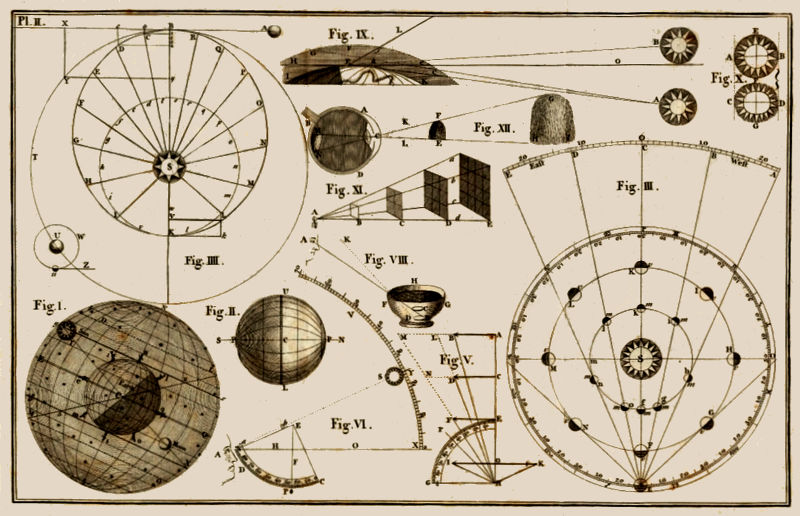
121. As to the common objections against the Earth’s motion on it’s Axis, they are all easily answered and set aside. That it may turn without being seen or felt to do so, has been already shewn, § 119. But some are apt to imagine that if the Earth turns eastward (as it certainly does if it turns at all) a ball fired perpendicularly upward in the air must fall considerably westward of the place it was projected from. This objection, which at first seems to have some weight, will be found to have none at all when we consider that the gun and ball partake of the Earth’s motion; and therefore the ball being carried forward with the air as quick as the Earth and air turn, must fall down again on the same place. A stone let fall from the top of a main-mast, if it 39meets with no obstacle, falls on the deck as near the foot of the mast when the ship sails as when it does not. And if an inverted bottle, full of liquor, be hung up to the cieling of the cabin, and a small hole be made in the cork to let the liquor drop through on the floor, the drops will fall just as far forward on the floor when the ship sails as when it is at rest. And gnats or flies can as easily dance among one another in a moving cabin as in a fixed chamber. As for those scripture expressions which seem to contradict the Earth’s motion, this general answer may be made to them all, viz. ’tis plain from many instances that the Scriptures were never intended to instruct us in Philosophy or Astronomy; and therefore, on those subjects, expressions are not always to be taken in the strictest sense; but for the most part as accommodated to the common apprehensions of mankind. Men of sense in all ages, when not treating of the sciences purposely, have followed this method: and it would be in vain to follow any other in addressing ourselves to the vulgar, or bulk of any community. Moses calls the Moon A GREAT LUMINARY (as it is in the Hebrew) as well as the Sun: but the Moon is known to be an opaque body, and the smallest that Astronomers have observed in the Heavens and shines upon us not by any inherent light of it’s own, but by reflecting the light of the Sun. If Moses had known this, and told the Israelites so, they would have stared at him; and considered him rather as a madman than as a person commissioned by the Almighty to be their leader.
CHAP. IV. The Phenomena of the Heavens as seen from different parts of the Earth.
PLATE II. Fig. I.
Antipodes.
Axis of the World. It’s Poles. Fig. II.
122. We are kept to the Earth’s surface on all sides by the power of it’s central attraction; which, laying hold of all bodies according to their densities or quantities of matter without regard to their bulks, constitutes what we call their weight. And having the sky over our heads, go where we will, and our feet towards the centre of the Earth, we call it up over our heads, and down under our feet: although the same right line which is down to us, if continued through and beyond the opposite side of the Earth, would be up to the inhabitants on the opposite side. For, the inhabitants n, i, e, m, s, o, q, l stand with their feet toward the Earth’s centre C; and have the same 40figure of sky N, l, E, M, S, O, Q, L over their heads. Therefore, the point S is as directly upward to the inhabitant s on the south Pole as N is to the inhabitant n on the North Pole: so is E to the inhabitant e, supposed to be on the north end of Peru; and Q to the opposite inhabitant q on the middle of the island Sumatra. Each of these observers is surprised that his opposite or Antipode can stand with his head hanging downwards. But let either go to the other, and he will tell him that he stood as upright and firm on the place where he was as he now stands where he is. To all these observers the Sun, Moon, and Stars seem to turn round the points N and S as the Poles of the fixed Axis NCS; because the Earth does really turn round the mathematical line nCs as round an Axis of which n is the North Pole and s the South Pole. The Inhabitant U (Fig. II.) affirms that he is on the uppermost side of the Earth, and wonders how another at L can stand on the undermost side with his head hanging downwards. But U in the mean time forgets that in twelve hours time he will be carried half round with the Earth; and then be in the very situation that L now is, although as far from him as before. And yet, when U comes there, he will find no difference as to his manner of standing; only he will see the opposite half of the Heavens, and imagine the Heavens to have gone half round him.
123. When we see a globe hung up in a room we cannot help imagining it to have an upper and an under side, and immediately form a like idea of the Earth; from whence we conclude, that it is as impossible for persons to stand on the under side of the Earth as for pebbles to lie on the under side of a common Globe, which instantly fall down from it to the ground; and well they may, because the attraction of the Earth, being too strong for the attraction of the Globe, pulls them away. Just so would be the case with our Earth, if it were placed near a Globe much bigger than itself, such as Jupiter: for then it would really have an upper and an under side with respect to that large Globe; which, by it’s Attraction, would pull away every thing from the side of the Earth next to it; and only those on the top of the opposite or upper side could keep upon it. But there is no larger Globe near enough our Earth to overcome it’s central attraction; and therefore it has no such thing as an upper and an under side: for all bodies on or near it’s surface, even to the Moon, gravitate towards it’s center.
124. Let any man imagine that the Earth and every thing but himself is taken away, and he left alone in the midst of indefinite Space; 41he could then have no idea of up or down; and were his pockets full of gold, he might take the pieces one by one, and throw them away on all sides of him, without any danger of losing them; for the attraction of his body would bring them all back by the ways they went, and he would be down to every one of them. But then, if a Sun or any other large body were created, and placed in any part of Space several millions of miles from him, he would be attracted towards it, and could not save himself from falling down to it.
One half of the Heavens visible to an inhabitant on any part
of the Earth.
Phenomena at the Poles.
PLATE II.
125. The Earth’s bulk is but a point, as that at C, compared to the Heavens; and therefore every inhabitant upon it, let him be where he will, as at n, e, m, s, &c. sees one half of the Heavens. The inhabitant n, on the North Pole of the Earth, constantly sees the Hemisphere ENQ; and having the North Pole N of the Heavens just over his head, his [25]Horizon coincides with the Celestial Equator ECQ. Therefore all the Stars in the Northern Hemisphere ENC, between the Equator and North Pole, appear to turn round the line NC, moving parallel to the Horizon. The Equatoreal Stars keep in the Horizon, and all those in the Southern Hemisphere ESQ are invisible. The like Phenomena are seen by the observer s on the South Pole, with respect to the Hemisphere ESQ; and to him the opposite Hemisphere is always invisible. Hence, under either Pole, only one half of the Heavens is seen; for those parts which are once visible never set, and those which are once invisible never rise. But the Ecliptic YCX or Orbit which the Sun appears to describe once a year by the Earth’s annual motion, has the half YC constantly above the Horizon ECQ of the North Pole n; and the other half CX always below it. Therefore whilst the Sun describes the northern half YC of the Ecliptic he neither sets to the North Pole nor rises to the South; and whilst he describes the southern half CX he neither sets to the South Pole nor rises to the North. The same things are true with respect to the Moon; only with this difference, that as the Sun describes the Ecliptic but once a year, he is for half that time visible to each Pole in it’s turn, and as long invisible; but as the Moon goes round the Ecliptic in 27 days 8 hours, she is only visible for 13 days 16 hours, and as long invisible to each Pole by turns. All the Planets likewise rise and set to the Poles, because their Orbits are cut obliquely in halves by the Horizon of the Poles. When the Sun (in his apparent way from X) arrives at C, which is on the 20th of March, he is just rising to an observer at n on the North Pole, and setting to another at s on the 42South Pole. From C he rises higher and higher in every apparent Diurnal revolution ’till he comes to the highest point of the Ecliptic y, on the 21st of June, and then he is at his greatest Altitude, which is 231⁄2 degrees, or the Arc Ey, equal to his greatest North declination; and from thence he seems to descend gradually in every apparent Circumvolution, ’till he sets at C on the 23d of September; and then he goes to exhibit the like Appearances at the South Pole for the other half of the year. Hence the Sun’s apparent motion round the Earth is not in parallel Circles, but in Spirals; such as might be represented by a thread wound round a Globe from Tropic to Tropic; the Spirals being at some distance from one another about the Equator, but gradually nearer to each other as they approach nearer to the Tropics.
Fig. I.
126. If the observer be any where on the Terrestrial Equator eCq, as suppose at e, he is in the Plane of the Celestial Equator; or under the Equinoctial ECQ; and the Axis of the Earth nCs is coincident with the Plane of his Horizon, extended out to N and S, the North and South Poles of the Heavens. As the Earth turns round the line NCS, the whole Heavens MOLl seem to turn round the same line, but the contrary way. It is plain that this observer has the Poles constantly in his Horizon, and that his Horizon cuts the Diurnal paths of all the Celestial bodies perpendicularly and in halves. Therefore the Sun, Planets, and Stars rise every day, and ascend perpendicularly above the Horizon for six hours, and passing over the Meridian, descend in the same manner for the six following hours; then set in the Horizon, and continue twelve hours below it. Consequently at the Equator the days and nights are equally long throughout the year. When the observer is in the situation e, he sees the Hemisphere SEN; but in twelve hours after, he is carried half round the Earth’s Axis to q, and then the Hemisphere SQN becomes visible to him; and SEN disappears, being hid by the Convexity of the Earth. Thus we find that to an observer at either of the Poles one half of the Sky is always visible, and the other half never seen; but to an observer on the Equator the whole Sky is seen every 24 hours.
The Figure here referred to, represents a Celestial globe of glass, having a Terrestrial globe within it; after the manner of the Glass Sphere invented by my generous friend Dr. Long, Lowndes’s Professor of Astronomy in Cambridge.
127. If a Globe be held sidewise to the eye, at some distance, and so that neither of it’s Poles can be seen, the Equator ECQ and all Circles parallel to it, as DL, yzx, abX, MO, &c. will appear to be 43straight lines, as projected in this Figure; which is requisite to be mentioned here, because we shall have occasion to call them Circles in the following Article[26].
The Circles of perpetual Apparition and Occultation.
128. Let us now suppose that the observer has gone from the Equator e towards the North Pole n, and that he stops at i, from which place he then sees the Hemisphere MElNL; his Horizon MCL having shifted as many [27]Degrees from the Celestial poles N and S as he has travelled from under the Equinoctial E. And as the Heavens seem constantly to turn round the line NCS as an Axis, all those Stars which are as far from the North Pole N as the observer is from under, the Equinoctial, namely the Stars north of the dotted parallel DL, never set below the Horizon; and those which are south of the dotted parallel MO never rise above it. Hence, the former of these two parallel Circles is called the Circle of perpetual Apparition, and the latter the Circle of perpetual Occultation: but all the Stars between these two Circles rise and set every day. Let us imagine many Circles to be drawn between these two, and parallel to them; those which are on the north side of the Equinoctial will be unequally cut by the Horizon MCL, having larger portions above the Horizon than below it; and the more so, as they are nearer to the Circle of perpetual Apparition; but the reverse happens to those on the south side of the Equinoctial, whilst the Equinoctial is divided in two equal parts by the Horizon. Hence, by the apparent turning of the Heavens, the northern Stars describe greater Arcs or Portions of Circles above the Horizon than below it; and the greater as they are farther from the Equinoctial towards the Circle of perpetual Apparition; whilst the contrary happens to all Stars south of the Equinoctial: but those upon it describe equal Arcs both above and below the Horizon, and therefore they are just as long above as below it.
129. An observer on the Equator has no Circle of perpetual Apparition or Occultation, because all the Stars, together with the Sun and Moon, rise and set to him every day. But, as a bare view of the Figure is sufficient to shew that these two Circles DL and MO are just as far from the Poles N and S as the observer at i (or one opposite to him at o) is from the Equator ECQ; it is plain, that if an observer begins to travel from the Equator towards either Pole, his Circle of perpetual Apparition rises from that Pole as from a Point, and his Circle of perpetual Occultation from the other. As the observer advances 44toward the nearer Pole, these two Circles enlarge their diameters, and come nearer one another, until he comes to the Pole; and then they meet and coincide in the Equator. On different sides of the Equator, to observers at equal distances from it, the Circle of perpetual Apparition to one is the Circle of perpetual Occultation to the other.
130. Because the Stars never vary their distances from the Equinoctial, so as to be sensible in an age, the lengths of their diurnal and nocturnal Arcs are always the same to the same places on the Earth. But as the Earth goes round the Sun every year in the Ecliptic, one half of which is on the north side of the Equinoctial and the other half on it’s south side, the Sun appears to change his place every day, so as to go once round the Circle YCX every year § 114. Therefore whilst the Sun appears to advance northward, from having described the Parallel abX touching the Ecliptic in X the days continually lengthen and the nights shorten, until he comes to y and describes the Parallel yzx, when the days are at the longest and the nights at the shortest: for then, as the Sun goes no farther northward, the greatest portion that is possible of the diurnal Arc yz is above the Horizon of the inhabitant i; and the smallest portion zx below it. As the Sun declines southward from y he describes smaller diurnal and greater nocturnal Arcs, or Portions of Circles, every day; which causeth the days to shorten and nights to lengthen, until he arrives again at the Parallel abX; which having only the small part ab above the Horizon MCL, and the great part bX below it, the days are at the shortest and the nights at the longest; because the Sun recedes no farther south, but returns northward as before. It is easy to see that the Sun must be in the Equinoctial ECQ twice every year, and then the days and nights are equally long; that is, 12 hours each. These hints serve at present to give an idea of some of the Appearances resulting from the motions of the Earth; which will be more particularly described in the tenth Chapter.
Parallel, Oblique, and Right sphere, what.
131. To an observer at either Pole, the Horizon and Equinoctial are coincident; and the Sun and Stars seem to move parallel to the Horizon: therefore, such an observer is said to have a Parallel position of the Sphere. To an observer any where between the Poles and Equator, the Parallels described by the Sun and Stars are cut obliquely by the Horizon, and therefore he is said to have an Oblique position of the Sphere. To an observer any where on the Equator, the Parallels of Motion, described by the Sun and Stars are cut perpendicularly, or at Right angles, 45by the Horizon; and therefore he is said to have a Right position of the Sphere. And these three are all the different ways that the Sphere can be posited to all people, on the Earth.
CHAP. V. The Phenomena of the Heavens as seen from different Parts of the Solar System.
132. So vastly great is the distance of the starry Heavens, that if viewed from any part of the Solar System, or even many millions of miles beyond it, its appearance would be the very same to us. The Sun and Stars would all seem to be fixed on one concave surface, of which the Spectator’s eye would be the centre. But the Planets, being much nearer than the Stars, their appearances will vary considerably with the place from which they are viewed.
133. If the spectator is at rest without their Orbits, the Planets will seem to be at the same distance as the Stars; but continually changing their places with respect to the Stars, and to one another: assuming various phases of increase and decrease like the Moon. And, notwithstanding their regular motions about the Sun, will sometimes appear to move quicker, sometimes slower, be as often to the west as to the east of the Sun; and at their greatest distances seem quite stationary. The duration, extent, and points in the Heavens where these digressions begin and end, would be more or less according to the respective distances of the several Planets from the Sun: but in the same Planet they would continue invariably the same at all times; like pendulums of unequal lengths oscillating together, the shorter move quick and go over a small space, the longer move slow and go over a large space. If the observer is at rest within the Orbits of the Planets, but not near the common center, their apparent motions will be irregular, but less so than in the former case. Each of the several Planets will appear bigger and less by turns, as they approach nearer or recede farther from the observer; the nearest varying most in their size. They will also move quicker or slower with regard to the fixed Stars, but will never be retrograde or stationary.
134. Next, let a spectator in motion view the Heavens: the same apparent irregularities will be observed, but with some variation resulting from his own motion. If he is on a Planet which has a rotation on it’s Axis, not being sensible of his own motion he will imagine 46the whole Heavens, Sun, Planets, and Stars to revolve about him in the same time that his Planet turns round, but the contrary way; and will not be easily convinced of the deception. If his Planet moves round the Sun, the same irregularities and aspects as above will appear in the motions of the Planets: only, the times of their being direct, stationary and retrograde will be accelerated or retarded as they concur with, or are contrary to his motion: and the Sun will seem to move among the fixed Stars or Signs, directly opposite to those in which his Planet moves; changing it’s place every day as he does. In a word, whether our observer be in motion or at rest, whether within or without the Orbits of the Planets, their motions will seem irregular, intricate and perplexed, unless he is in the center of the System; and from thence, the most beautiful order and harmony will be observed.
135. The Sun being the center of all the Planets motions, the only place from which their motions could be truly seen, is the Sun’s center; where the observer being supposed not to turn round with the Sun (which, in this case, we must imagine to be a transparent body) would see all the Stars at rest, and seemingly equidistant from him. To such an observer the Planets would appear to move among the fixed Stars, in a simple, regular, and uniform manner; only, that as in equal times they describe equal Areas, they would describe spaces somewhat unequal, because they move in elliptic Orbits § 155. Their motions would also appear to be what they are in fact, the same way round the Heavens; in paths which cross at small Angles in different parts of the Heavens, and then separate a little from one another § 20. So that, if the solar Astronomer should make the Path or Orbit of any one Planet a standard, and consider it as having no obliquity § 201, he would judge the paths of all the rest to be inclined to it; each Planet having one half of it’s path on one side, and the other half on the opposite side of the standard Path or Orbit. And if he should ever see all the Planets start from a conjunction with each other[28]; Mercury would move so much faster than Venus as to overtake her again (though not in the same point of the Heavens) in a quantity of time almost equal to 145 of our days and nights; or, as we commonly call them, Natural Days, which include both the days and nights: Venus would move so much faster than the Earth as to overtake it again in 585 natural days: the Earth so much faster than Mars as to overtake him again in 778 such 47days: Mars is much faster than Jupiter as to overtake him again in 817 such days: and Jupiter so much faster than Saturn as to overtake him again in 7236 days, all of our time.
136. But as our solar Astronomer could have no idea of measuring the courses of the Planets by our days, he would very probably take the period of Mercury, which is the quickest moving Planet, for a measure to compare the periods of the others by. As all the Stars would appear quiescent to him, he would never think that they had any dependance upon the Sun; but could naturally imagine that the Planets have, because they move round the Sun. And it is by no means improbable, that he would conclude those Planets whose periods are quickest to move in Orbits proportionably less than those do which make slower circuits. But being destitute of a method for finding their Parallaxes, or, more properly speaking, as they could have no Parallax to him, he could never know any thing of their real distances or magnitudes. Their relative distances he might perhaps guess at by their periods, and from thence infer something of truth concerning their relative bulks, by comparing their apparent bulks with one another. For example, Jupiter appearing bigger to him than Mars, he would conclude it to be much bigger in fact; because it appears so, and must be farther from him, on account of it’s longer period. Mercury would seem bigger than the Earth; but by comparing it’s period with the Earth’s, he would conclude that the Earth is much farther from him than Mercury, and consequently that it must be really bigger though apparently less; and so of the rest. And, as each Planet would appear somewhat bigger in one part of it’s Orbit than in the opposite, and to move quickest when it seems biggest, the observer would be at no loss to determine that all the Planets move in Orbits of which the Sun is not precisely in the center.
137. The apparent magnitudes of the Planets continually change as seen from the Earth, which demonstrates that they approach nearer to it, and recede farther from it by turns. From these Phenomena, and their apparent motions among the Stars, they seem to describe looped curves which never return into themselves, Venus’s path excepted. And if we were to trace out all their apparent paths, and put the figures of them together in one diagram, they would appear so anomalous and confused, that no man in his senses could believe them to be representations of their real paths; but would immediately conclude, that such apparent irregularities must be owing to some Optic illusions. And after a good deal of enquiry, he might perhaps be at a 48loss to find out the true cause of these inequalities; especially if he were one of those who would rather, with the greatest justice, charge frail man with ignorance, than the Almighty with being the author of such confusion.
Fig. I.
138. Dr. Long, in his first volume of Astronomy, has given us figures of the apparent paths of all the Planets separately from Cassini; and on seeing them I first thought of attempting to trace some of them by a machine[29] that shews the motions of the Sun, Mercury, Venus, the Earth and Moon, according to the Copernican System. Having taken off the Sun, Mercury, and Venus, I put black-lead pencils in their places, with the points turned upward; and fixed a circular sheet of paste-board so, that the Earth kept constantly under it’s center in going round the Sun; and the paste-board kept its parallelism. Then, pressing gently with one hand upon the paste-board to make it touch the three pencils, with the other hand I turned the winch which moves the whole machinery: and as the Earth, together with the pencils in the places of Mercury and Venus, had their proper motions round the Sun’s pencil, which kept at rest in the center of the machine, all the three pencils described a diagram from which the first Figure of the third Plate is truly copied in a smaller size. As the Earth moved round the Sun, the Sun’s pencil described the dotted Circle of Months, whilst Mercury’s pencil drew the curve with the greatest number of loops, and Venus’s that with the fewest. In their inferiour conjunctions they come as much nearer the Earth, or within the Circle of the Sun’s apparent motion round the Heavens, as they go beyond it in their superiour conjunctions. On each side of the loops they appear Stationary; in that part of each loop next the Earth retrograde; and in all rest of their paths direct.
Plate III.
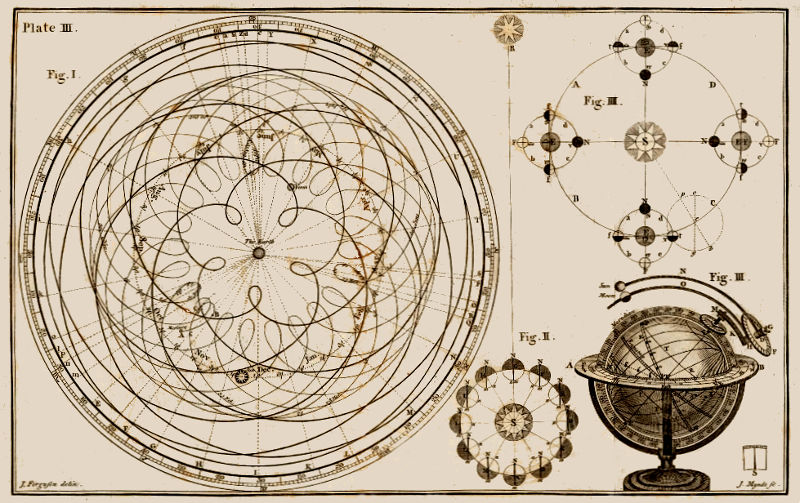
J. Ferguson delin.
J. Mynde Sc.
If Cassini’s Figures of the paths of the Sun, Mercury and Venus were put together, the Figure as above traced out, would be exactly like them. It represents the Sun’s apparent motion round the Ecliptic, which is the same every year; Mercury’s motion for seven years; and Venus’s for eight; in which time Mercury’s path makes 23 loops, crossing itself so many times, and Venus’s only five. In eight years Venus falls so nearly into the same apparent path again, as to deviate very little from it in some ages; but in what number of years Mercury and the rest of the Planets would describe the same visible paths over again, I cannot at present determine. Having finished the above Figure of the paths of Mercury and Venus, I put the Ecliptic round them as in the Doctor’s Book; and added the dotted lines from the Earth to the 49Ecliptic for shewing Mercury’s apparent or geocentric motion therein for one year; in which time his path makes three loops, and goes on a little farther; which shews that he has three inferiour, and as many superiour conjunctions with the Sun in that time, and also that he is six times Stationary, and thrice Retrograde. Let us now trace out his motion for one year in the Figure.
Suppose Mercury to be setting out from A towards B (between the Earth and left-hand corner of the Plate) and as seen from the Earth his motion will then be direct, or according to the order of the Signs. But when he comes to B, he appears to stand still in the 23d degree of ♏ at F, as shewn by the line BF. Whilst he goes from B to C, the line BF goes backward from F to E, or contrary to the order of Signs; and when he is at C he appears Stationary at E; having gone back 111⁄2 degrees. Now, suppose him Stationary on the first of January at C, on the tenth thereof he will appear in the Heavens as at 20, near F; on the 20th he will be seen as at G; on the 31st at H; on the 10th of February at I; on the 20th at K; and on the 28th at L; as the dotted lines shew, which are drawn through every tenth day’s motion in his looped path, and continued to the Ecliptic. On the 10th of March he appears at M; on the 20th at N; and on the 31st at O. On the 10th of April he appears Stationary at P; on the 20th he seems to have gone back again to O; and on the 30th he appears Stationary at Q having gone back 111⁄2 degrees. Thus Mercury seems to go forward 4 Signs 11 Degrees, or 131 Degrees; and to go back only 11 or 12 Degrees, at a mean rate. From the 30th of April to the 10th of May, he seems to move from Q to R; and on the 20th he is seen at S, going forward in the same manner again, according to the order of letters; and backward when they go back; which, ’tis needless to explain any farther, as the reader can trace him out so easily through the rest of the year. The same appearances happen in Venus’s motion; but as she moves slower than Mercury, there are longer intervals of time between them.
Having already § 120. given some account of the apparent diurnal motions of the Heavens as seen from the different Planets, we shall not trouble the reader any more with that subject.
CHAP. VI. The Ptolemean System refuted. The Motions and Phases of Mercury and Venus explained.
139. The Tychonic System § 97, being sufficiently refuted by the 109th Article, we shall say nothing more about it.
140. The Ptolemean System § 96, which asserts the Earth to be at rest in the Center of the Universe, and all the Planets with the Sun and Stars to move round it, is evidently false and absurd. For if this hypothesis were true, Mercury and Venus could never be hid behind the Sun, as their Orbits are included within the Sun’s: and again, these two Planets would always move direct, and be as often in Opposition to the Sun as in Conjunction with him. But the contrary of all this is true: for they are just as often behind the Sun as before him, appear as often to move backwards as forwards, and are so far from being seen at any time in the side of the Heavens opposite to the Sun, that they were never seen a quarter of a circle in the Heavens distant from him.
141. These two Planets, when viewed with a good telescope, appear in all the various shapes of the Moon; which is a plain proof that they are enlightened by the Sun, and shine not by any light of their own: for if they did, they would constantly appear round as the Sun does; and could never be seen like dark spots upon the Sun when they pass directly between him and us. Their regular Phases demonstrate them to be Spherical bodies; as may be shewn by the following experiment.
Hang an ivory ball by a thread, and let any Person move it round the flame of a candle, at two or three yards distance from your Eye: when the ball is beyond the candle, so as to be almost hid by the flame, it’s enlightened side will be towards you, and appear round like the Full Moon: When the ball is between you and the candle, it’s enlightened side will disappear, as the Moon does at the Change: When it is half way between these two positions, it will appear half illuminated, like the Moon in her Quarters: But in every other place between these positions, it will appear more or less horned or gibbous. If this experiment be made with a circular plate which has a flat surface, you may make it appear fully enlightened, or not enlightened at all; but can never make it seem either horned or gibbous.
51142. If you remove about six or seven yards from the candle, and place yourself so that it’s flame may be just about the height of your eye, and then desire the other person to move the ball slowly round the candle as before, keeping it as near of an equal height with the flame as he possibly can, the ball will appear to you not to move in a circle, but rather to vibrate backward and forward like a pendulum; moving quickest when it is directly between you and the candle, and when directly beyond it; and gradually slower as it goes farther to the right or left side of the flame, until it appears at the greatest distance from the flame; and then, though it continues to move with the same velocity, it will seem to stand still for a moment. In every Revolution it will shew all the above Phases § 141; and if two balls, a smaller and a greater, be moved in this manner round the candle, the smaller ball being kept nearest the flame, and carried round almost three times as often as the greater, you will have a tolerably good representation of the apparent Motions of Mercury and Venus; especially, if the bigger ball describes a circle almost twice as large in diameter as the circle described by the lesser.
143. Let ABCDE be a part or segment of the visible Heavens, in which the Sun, Moon, Planets, and Stars appear to move at the same distance from the Earth E. For there are certain limits, beyond which the eye cannot judge of different distances; as is plain from the Moon’s appearing to be no nearer to us than the Sun and Stars are. Let the circle fghiklmno be the Orbit in which Mercury m moves round the Sun S, according to the order of the letters. When Mercury is at f, he disappears to the Earth at E, because his enlightened side is turned from it; unless he be then in one of his Nodes § 20, 25; in which case, he will appear like a dark spot upon the Sun. When he is at g in his Orbit, he appears at B in the Heavens, westward of the Sun S, which is seen at C: when at h, he appears at A, at his greatest western elongation or distance from the Sun; and then seems to stand still. But, as he moves from h to i, he appears to go from A to B; and seems to be in the same place when at i as when he was at g, only not near so big: at k he is hid from the Earth E by the Sun S; being then in his superiour Conjunction. In going from k to l, he appears to move from C to D; and when he is at n, he appears stationary at E; being seen as far east from the Sun then, as he was west from him at A. In going from n to o in his Orbit, he seems to go back again in the Heavens, from E to D; and is seen in the same place (with respect to the Sun) at o as when he was at l; but of a larger diameter at o, because he is then nearer the Earth E: and 52when he comes to f, he again passes by the Sun, and disappears as before. In going from n to h in his Orbit, he seems to go backward in the Heavens from E to A; and in going from h to n, he seems to go forward from A to E. As he goes on from f a little of his enlightened side at g is seen from E; at h he appears half full, because half of his enlightened side is seen; at i, gibbous, or more than half full; and at k he would appear quite full, were he not hid from the Earth E by the Sun S. At l he appears gibbous again; at n half decreased, at o horned, and at f new like the Moon at her Change. He goes sooner from his eastern station at n to his western station at h than from h to n again; because he goes through less than half his Orbit in the former case, and more in the latter.
The Elongations and Phases of Venus.
The greatest Elongations of Mercury and Venus.
144. In the same Figure, let FGHIKLMN be the Orbit in which Venus v moves round the Sun S, according to the order of the letters: and let E be the Earth as before. When Venus is at F she is in her inferiour Conjunction; and disappears like the New Moon because her dark side is toward the Earth. At G she appears half enlightened to the Earth, like the Moon in her first quarter: at h she appears gibbous; at I, almost full; her enlightened side being then nearly towards the Earth: at K, she would appear quite full to the Earth E; but is hid from it by the Sun S: at L, she appears upon the decrease, or gibbous; at M, more so; at N, only half enlightened; and at F she disappears again. In moving from N to G, she seems to go backward in the Heavens; and from G to N, forward: but, as she describes a much greater portion of her Orbit in going from G to N than from N to G, she appears much longer direct than retrograde in her motion. At N and G she appears stationary; as Mercury does at n and h. Mercury, when stationary seems to be only 28 degrees from the Sun; and Venus when so, 47; which is a demonstration that Mercury’s Orbit is included within Venus’s, and Venus’s within the Earth’s.
145. Venus, from her superiour Conjunction at K to her inferiour Conjunction at F is seen on the east side of the Sun S from the Earth. E; and therefore she shines in the Evening after the Sun sets, and is called the Evening Star: for, the Sun being then to the westward of Venus, he must set first. From her inferiour Conjunction to her superiour, she appears on the west side of the Sun; and therefore rises before him, for which reason she is called the Morning Star. When she is about N or G, she shines so bright, that bodies cast shadows in the night-time.
53146. If the Earth kept always at E, it is evident that the Stationary places of Mercury and Venus would always be in the same points of the Heavens where they were before. For example; whilst Mercury m goes from h to n, according to the order of the letters, he appears to describe the arc ABCDE in the Heavens, direct: and whilst he goes from n to h, he seems to describe the same arc back again, from E to A, retrograde: always at n and h he appears stationary at the same points E and A as before. But Mercury goes round his Orbit, from f to f again, in 88 days; and yet there are 116 days from any one of his Conjunctions, or apparent Stations, to the same again: and the places of these Conjunctions and Stations are found to be about 114 degrees eastward from the points of the Heavens where they were last before; which proves, that the Earth has not kept all that time at E, but has had a progressive motion in it’s Orbit from E to t. Venus also differs every time in the places of her Conjunctions and Stations; but much more than Mercury; because, as Venus describes a much larger Orbit than Mercury does, the Earth advances so much the farther in it’s annual path before Venus comes round again.
147. As Mercury and Venus, seen from the Earth, have their respective Elongations from the Sun, and Stationary places; so has the Earth, seen from Mars; and Mars, seen from Jupiter; and Jupiter, seen from Saturn. That is, to every superiour Planet, all the inferiour ones have their Stations and Elongations; as Venus and Mercury have to the Earth. As seen from Saturn, Mercury never goes above 21⁄2 degrees from the Sun; Venus 41⁄3; the Earth 6; Mars 91⁄2; and Jupiter 331⁄4: so that Mercury, as seen from the Earth, has almost as great a Digression or Elongation from the Sun, as Jupiter seen from Saturn.
148. Because the Earth’s Orbit is included within the Orbits of Mars, Jupiter, and Saturn, they are seen on all sides of the Heavens; and are as often in Opposition to the Sun as in Conjunction with him. If the Earth stood still, they would always appear direct in their motions, never retrograde nor stationary. But they seem to go just as often backward as forward; which, if gravity be allowed to exist, affords a sufficient proof of the Earth’s annual motion.
149. As Venus and the Earth are superiour Planets to Mercury, they shew much the same Appearances to him that Mars and Jupiter do to us. Let Mercury m be at f, Venus v at F, and the Earth at E; in which situation Venus hides the Earth from Mercury; but, being in opposition to the Sun, she shines on Mercury with a full 54illumined Orb; though, with respect to the Earth, she is in conjunction with the Sun and invisible. When Mercury is at f, and Venus at G, her enlightened side not being directly towards him, she appears a little gibbous; as Mars does in a like situation to us: but, when Venus is at I, her enlightened side is so much towards Mercury at f, that she appears to him almost of a round figure. At K, Venus disappears to Mercury at f, being then hid by the Sun; as all our superiour Planets are to us, when in conjunction with the Sun. When Venus has, as it were, emerged out of the Sun beams, as at L, she appears almost full to Mercury at f; at M and N, a little gibbous; quite full at F, and largest of all; being then in opposition to the Sun, and consequently nearest to Mercury at f; shining strongly on him in the night, because her distance from him then is somewhat less than a fifth part of her distance from the Earth, when she appears roundest to it between I and K, or between K and L, as seen from the Earth E. Consequently, when Venus is opposite to the Sun as seen from Mercury, she appears more than 25 times as large to him as she does to us when at the fullest. Our case is almost similar with respect to Mars, when he is opposite to the Sun; because he is then so near the Earth, and has his whole enlightened side towards it. But, because the Orbits of Jupiter and Saturn are very large in proportion to the Earth’s, these two Planets appear much less magnified at their Oppositions or diminished at their Conjunctions than Mars does, in proportion to their mean apparent Diameters.