The planets, in their motions after birth, come into
certain relations with the planets in the horoscope of
birth, and also form aspects among themselves owing
to the diversities of their motions in the Zodiac. In
Astrological science there are two separate means of
calculating the time of events, but both methods consist
of bringing the body of one planet to the body or aspect
of another, which process is called “Directing,” and the
arc described by the moving body is called an “Arc of Direction.”
The first of these methods is the discovery of Claudius
Ptolemy, the famous mathematician and geographer, the
author of the Syntaxis, as set forth in his work the
Tetrabiblos, or Four Books on the influence of the Stars.
This method had the support and confirmation of the great
Kepler. It has respect to the rising, setting, and meridian
passage of the planets after birth, whereby they are brought
to the places or aspects of the planets in the Radix (the
Root), which is the horoscope of birth.
The limits and nature of this work do not permit
of a thorough exposition of this method, which entails
some little knowledge of spherical trigonometry, but the
reader who desires to perfect himself therein is referred
to the author’s work, entitled “Prognostic Astronomy.” A
facile application of the method is here given, by which
any one may, by the aid of the Tables of Houses, make certain
of the more important calculations by rule of thumb, and
predict thence the times of remarkable events.
The principle involved is this: The number of degrees
which pass over the meridian between the moment of
birth and the rising or culminating of a planet, will equal
the number of years which must elapse from birth until the
influence of that planet becomes dominant.
Thus, if Jupiter at birth is coming to the meridian, that
is to say, if it be in the 10th, 11th, or 12th House, count
the number of degrees between the meridian and Jupiter,
and in so many years from the time of birth there will be
an access of good fortune. Similarly, if Saturn or other
of the malefic planets be coming to the meridian, the number
of degrees between it and the Midheaven will indicate the
age at which troubles will abound.
Also, when the planets have passed the meridian, the
measure is made in the same way, by bringing the Midheaven
to the place of the planet, counting the degrees between
the planet and Midheaven for the number of years at which
it will operate.
But the same and other planets may be directed to the
horizon, by taking the Table of Houses for the latitude of
the birthplace (Sect. I., chap. iii.) and finding therein under
the column marked “Ascen.” (Ascendant) the longitude held
by any of the planets. Observe then what degree is on the
Midheaven in the column marked 10 (10th House), and count
the number of degrees between this Midheaven and the Midheaven
at birth. The result will give the age at which the effects
of such planets will be experienced.
Thus, for a person born in or near Liverpool or in the
same latitude, suppose the Midheaven at birth to be in
Scorpio 0, and Saturn to be in the 2nd House in
Aquarius 8 degrees. I wish to bring Saturn to the
horizon. In the Table of Houses I find that Aquarius 8
is on the Ascendant when Sagittarius 9 is on the Midheaven,
and I therefore count from Scorpio 0 to Sagittarius 9. This
gives the age of 39 years, and as Saturn is in the 2nd House
at birth, I say that at 39 years of age the Subject would
experience financial disaster, and because Saturn comes then
to the Ascendant, I also say there would be serious illness
and depression of spirits.
When planets are setting at birth they are brought to
the opposition of the Ascendant in a similar manner, only
the opposite point of the zodiac must be found in the Tables
under the Ascendant. Thus, if Mars were in the 7th House
at birth in the 11th degree of Cancer, I find the opposite
point (Capricornus 11) under the column of the Ascendant,
and I note that Scorpio 19 is then on the Midheaven, so that
from Scorpio 0 to Scorpio 19 gives 19 years, at which age
the Subject would have a serious illness due to inflammatory
action in the stomach and probably produced by overwork and
worry, as indicated by the sign Cancer and the planet Mars,
or if there be indications of an accident, then an accident
by scalding with hot water or acids would be predicted.
Planets are brought to the opposition of the Midheaven
by counting the degrees which intervene between the
longitude on the lower meridian at birth and that held by
the planet.
In all such directions the conjunctions of benefic
planets are advantageous when directed to the Midheaven
or Ascendant, and the conjunctions of the malefics are
indicated of periods of bad fortune. The oppositions are
uniformly evil, whether the planet involved in the direction
be a benefic or malefic. (Sect. I., chap. iv.)
These are the directions of the planets to the two
Significators, the Midheaven and Ascendant. The Midheaven
appertains to honours and credit, while the Ascendant has
relation to the personal and bodily welfare and the general
fortunes.
To direct the Midheaven or Ascendant to the other
aspects of the planets, such as the sextile, trine, semisquare
or square, it is only necessary to note the degrees in which
these aspects fall and bring them to the Midheaven or Ascendant
as if the body of the planet were itself there, and in the
manner already indicated.
The Sun is directed after birth by its motion in the
zodiac, which can be found in the Ephemeris for the
year of birth, and the aspects it forms to the planets
in the horoscope and in the daily progress should be
tabulated. In most Ephemerides they are already calculated,
so that the labour is considerably lightened. Each day after
birth will represent one year of life, the mean motion of
the Sun being about 1 degree per day. All that is necessary,
therefore, is to count the number of days from birth to the
date when the Sun forms an aspect, and that will give the
age at which the planet aspected will produce its effects.
As the Sun goes through the zodiac the other bodies
make progress along with it, in which course they form
aspects to the Midheaven, Ascendant, the Sun and Moon
in the horoscope of birth. These are called “Secondary”
directions, and in connection with the Sun’s aspects
after birth, constituted the system in use among the
Arabian astrologers.
Minor periods of good and bad fortune, subsidiary to
the above periodic influences, are taken from the Moon’s
progress after birth, in which one day equals one year of
life, and two hours equal one month. These directions of
the Moon afford a monthly prognosis of the course of events,
and are useful in the conduct of minor affairs in life.
When they are contrary to the general trend and import of
the periodic directions made to the Midheaven, Ascendant
and Sun, they act indifferently, and frequently produce
only passing benefits or annoyances; but when they are in
agreement with the Primary Directions cited above, then they
accentuate and define the nature and time of events. As if
the Primaries be good and the Lunar directions evil, then
there will be a predominance of good fortune with some current
disturbances; but both being good there will be abundant
success and satisfaction; while if the Primaries be evil
and the Lunar directions good, the latter will serve only
to moderate the effects for the time being of the Primary
evil indications.
An intelligent apercu of the principles of directing will
greatly enhance the value of any prognostications made from
the horoscope of birth, as it will enable the student to
select those periods in the life when the effects due to
any planet are most likely to eventuate. Thus, if Saturn
be in the 2nd House at birth, it may be said that there
would follow some periods of great financial stress, and
the rising of Saturn by direction after birth would show
the time when one, at all events, of such periods would
be experienced.
And here is the great fact upon which astrologers the
world over are prepared to stand or fall. If the planets
have no effect in the lives of men, their directions to the
angles of the horoscope can have no effect; but never was
it found that a man had evil fortunes at the period when
the planet Jupiter was directed to the Midheaven or Ascendant,
or anything but bad fortune when Saturn was similarly directed.
The fact is there, and we cannot get away from it. The only
question is as to how far we can intelligently carry our investigations
beyond that point, and intelligibly convey our discoveries to
the world by their application to the affairs of daily life.
The reader may judge for himself from a perusal of these
pages.
The directions being calculated and tabulated in order
of their occurrence, the time and general nature of the
influences operating in successive periods of the life will
stand revealed. The particular nature of the events indicated
by the several directions may be known from (a) the House
in which the directed planet is situated; (b) the Sign it
occupies; and (c) the aspect it forms, considered in relation
to the nature of the planet. For example: If Uranus at birth
were in the 9th House and the sign Gemini, its direction to the
Midheaven would be the index of litigation in connection with
writings, publications, or means of transit; because the 9th House,
among other things, has relation to litigation and legal affairs,
and Gemini (the 3rd House sign) to communications, writings, &c.,
while Uranus denotes sudden and unexpected events, ruptures,
alienations, and complexities.
So if Saturn were in the 6th House in the sign
Aquarius, its direction to the opposition of the Ascendant
would indicate chills to the blood, anemia, &c., constituting
a serious illness with probability of low fever; because
the 6th House rules sickness, and Aquarius rules the blood,
while Saturn is the cause of chills, paucity, and impediments.
Thus the time and nature of events may be known
with great certainty.
Among the number of important indicators to which
Astrologers refer in making a forecast of concurrent
events, there are the transits of the planets over the
places of the Significators at birth, the positions of
Eclipses, and those of the lunations.
The first of these chronocrators depends upon the
revolutions of the planets in their orbits. Each planet
has a period in which it completes its revolution in the
heavens, in the course of which it passes the places of
the Sun, Moon, Midheaven, and Ascendant of the horoscope.
This passage over the radical Significators is technically
termed its “transit,” and it will be found that such transits
afford a very precise and reliable source of prognostication,
for the time of a planet’s transit is known in advance of
its occurrence (see Sect. II., chap. iv.), and the effects
of such transit are in exact terms of the nature of the planet
concerned. It is only necessary to add that the Midheaven
and the Sun have relation to the position and honour of the
Subject, while the Moon and Ascendant have relation to the
personal health and general fortunes. The Sun and Midheaven
also signify the father, and the Moon has general signification
of the mother. Venus signifies domestic and love affairs,
the affections and sentiments; while Mercury signifies the
mental disposition. So Uranus in transit over the place of
Venus will give a love affair, a romantic attachment. Mars
over the place of Venus will engender passionate love. Saturn
over Venus will give disappointment or bereavement; and Neptune
thereover will bring entanglements and complications, with
danger of being led astray. Saturn over Mercury will produce
melancholy and many errors of judgment. Mars over the same
planet will excite the mind and dispose to impulse and unreasoning
anger, quarrels and disputation. Uranus over Mercury will
render the mind wayward and headstrong, disposed to erratic
courses and egotistic methods. Neptune passing the place
of Mercury produces deceits, treacheries, and apprehension
of impending evil, a sense of espionage and ambush. It involves
the mind in tortuous and complicated schemes, and disposes
to secrecy and wariness.
The transits of the major planets are of chief significance,
and their effects are rendered more weighty and lasting when
at the time of transit they are retrograde in the zodiac; while
their stationary positions on the places of the Significators
have almost the same power as Primary Directions.
An Eclipse of the Sun or Moon falling on the place of
any Significator in the horoscope of birth is of a sinister
import, and cannot be too seriously considered. Falling
on the Ascendant or the Moon they affect the health and
general fortunes very seriously, and only a series of
subsequent good directions can avail to restore the
Subject to his normal condition. On the Midheaven or
the Sun, the honour and fortunes may both be affected,
and in the same serious degree. The Eclipses falling on
the places of the other planets will produce effects in
accord with the nature of those planets and the Houses
they occupy. To have any appreciable effect, the
Eclipses must be within two degrees of any of the
radical positions, or of their opposition aspects.
The Lunations recur in the same part of the Ecliptic
every nineteen years. Considered in relation to the
current indications they afford the means of a monthly
forecast of events. Thus, if the lunation for the month
falls on the place of Jupiter in the horoscope of birth, it
will produce good effects in that department of life which
is governed by the House in which Jupiter is situated; as
if in the 11th, through friends; in the 4th, through property
or rental; in the 6th, through servants and health; in the
8th, through a financial colleague, &c.
The effects of Lunations are subsidiary to the current
Lunar directions, and these in turn are subsidiary to the
transits, and the transits to the Primary Directions. By
this it is not meant that they are inoperative, nor that
they fail to indicate the events of the month, but their
power and degree of influence is subject to the greater
influence of superior causes. And as a general observation
it may be affirmed that the less frequently any celestial
position occurs in a horoscope, the greater is its influence.
This fact gives to primary directions their great influence
in the life, for they can only occur once in a lifetime; and
for the same reason Eclipses have a major significance, for
the same Eclipse only recurs after an interval of 649 years.
The transits of Neptune, of Uranus, of Saturn and Jupiter
and Mars follow in their order of frequency. Neptune has a
revolution of about 165 years, Uranus 84 years, Saturn 30
years, Jupiter 12 years, and Mars 1¼ years.
Major effects must not therefore be referred to inferior
causes, and minor effects must not be referred to superior
causes. In universal or even national cataclysms, individual
fortunes are submerged.
Before leaving the exposition of this subject, it may be
of advantage to the reader if I give some idea of the method
to be pursued in the complete handling of a horoscope.
First, then, erect the figure of birth, taking care to
use the Ephemeris of the year of birth, and also the
correct Table of Houses for the latitude of the place of
birth.
Next proceed to attempt a description of the chief
personal traits of the Subject, following in succession
with a well-considered judgment on the constitution,
hereditary tendencies, the health and pathological predispositions,
the mental traits and disposition, considering these latter
in relation to the state of health indicated. Then pass to
a consideration of the environing conditions of life; the
financial condition and outlook; the position in life; the
occupation; prospects and conditions of marriage; of progeny.
Judge next concerning voyages and journeys. Finish with a
statement regarding the predominance of friends or enemies,
and select dates by Solar positions, as already instructed.
In cases where it is not objected to, an approximation may
be made to the time and nature of death.
Throughout the whole of this judgment, the periods
when these predicted effects will come into force should
be made by reference to the rising, setting, and meridian
passage of the planets, the solar aspects, and transits.
Care should be taken to weigh justly and impartially
the evidence set before you in the figure of the heavens
for birth. Major importance should be given to those planets
which are in angles, and those which are in elevation, for
the nearer a planet may be to the Midheaven, the greater is
its influence for good or ill, according to its nature and
aspect.
Read what you see, not what you imagine should be
the destiny of an individual. If you are in complete
ignorance of his person, position, and environment, so
much the better. If you follow carefully the various
rules which are contained in this book, you may at first
make some errors of judgment, but as you become familiar
with the task, even these errors will become few and far
between, and in the end the language of the horoscope will
become so intelligible and clear that it will interpret itself,
and the whole trend and potentiality for good or ill of any
birth-figure will force itself upon you in just the same
way as when a man walks into your presence with his character
clearly stamped upon his face, so that you have only to look
and know.
Having become proficient in the judgment of birth-figures,
you will do well to proceed to a closer study of the mathematics
of astrology, making yourself proficient in the various methods
of directing, so that you may at any time refine upon your
general prognostics, and make predictions which are clear,
sharp, and to the point.
Undoubtedly there is a modicum of intuitive perception
at work in the judgment of any horoscope, which
will enable you to seize upon the small details and exact
pointing of any matter, and this perhaps constitutes the
whole difference between the rule of thumb worker and the
inspirational reasoning of the intuitive worker. The one
exhausts the books and the other embellishes them. It is
so with science in every department. The books will take
you up to a certain point of proficiency, and a strict regard
for the formulæ will keep you within the bounds of safety.
But if you are ever to make a discovery or become a recognised
exponent of any science, you must be naturally gifted with
what is called the “scientific imagination,” another name
for intuition. But at no point does true intuition part company
with exact reasoning. There is no lesion. The one is an
extension of the other. It is the higher reason, which
argues from the known to the unknown. And the
Astrologer is in this respect as the poet, “born, not
made.” But a moment’s reflection will suffice to
convince you that the more facile you may become
with the book-learning and technique of Astrology,
the more you will leave the intuition free to act.
When a lad is struggling with his multiplication tables,
his appreciation of the binomial theorem or the differential
calculus cannot be said to amount to much. And, in the same
way, a person who is stuffing down the Alphabet of Astrology
cannot be expected to intuit anything concerning the potential
of the Sun’s direction to the quadrature of Saturn.
I take it that nobody nowadays can afford to fritter
away time in the study of subjects which are not likely
to become a source of benefit to himself and others. If
there be such people among my readers, which I consider
unlikely, I may dismiss them offhand with the
remark that they will never become successful
astrologers, for the first word of practical astrology is
Utility. If the science had not its practical application
to the affairs of everyday life, if its principles contained
no word of assurance and hope for the myriad toilers of
this world, no word of admonition for the self-indulgent
parasites of modern social life, if, in short, it did not
make for the betterment of human life and thought, it would
never have attracted the attention of Aristotle, Cicero,
Galen, Claudius Ptolemy, Thales, and others of the old world,
and such men as Bacon, Cardan, Archbishop Usher, Naibod,
Mercator, Ashmole, Kenelm Digby, Sir Christopher Heydon,
Dryden, Dr. John Butler, Sir George Wharton, Vincent Wing,
George Witchel, Tycho Brahe, Kepler, and Flamstead of more
recent biography. Indeed, in whatever age or country we
may elect to make our inquiries concerning Astrology,
there are to be found a host of intelligent and even
illustrious advocates in every department of life and
learning. Suffice it to say that the modern student of
this most ancient of all sciences is at all times in very
good company.
Let it first be understood that there is an object to be
attained in the study of Astrology, and that the pursuit
of it in the gratification of an idle curiosity alone will
inevitably entail the waste of time which invariably attaches
to idleness of all descriptions, and we may then profitably
consider whether or not the subject is worth the labour which
it will demand from the man who has something to do in the
world and little enough time in which to do it. These are
stressful times, and we have to be economical in our efforts.
We have strength enough to carry us through, but neither strength
enough to thresh the wind nor time enough to fish in puddles.
What, then, does Astrology offer to the patient
worker, the man who would become a successful
Astrologer?
First and foremost it will enable him to gain an
insight into individual motive and character which no
other science can possibly afford. It will enable him to
know himself, his own strength and weakness, and so fit
him to deal harmoniously and justly with others. It will
enhance his opportunities to the extent that he is able
to foresee and make use of all benefic influences operating
through his own environment. It will give him timely warning
of his approach to the quicksands and pitfalls which occur
in his passage through life. He will discern his special
physical weaknesses, and the times of his predisposition
to sickness, the nature thereof, and the precautions which
are necessary. He will know whom to cultivate and whom to
avoid, and in selecting a partner in business or a wife for
his home, he will be guided by a foreknowledge of evils to be
avoided and of good things to be gained. He will choose
his path in life with the confidence that it is for him
the line of least resistance and therefore that of
greatest progress. He will not become obsessed by
ambitions beyond his power to achieve. He will learn
the power of adaptation to environment, and thereby
effect his work in the world with the least possible
friction and waste of force. He will know when to
make provision against sickness, accident, and death.
He will not invest capital where interest is not to be
gained. He will see the end from the beginning. It
may not make him a brilliant success in the world, but
it will assuredly save him from being a failure. He will
find causes for inexplicable things, and his mind will rest
content in the knowledge hat while he is working out the
highest potentialities of his own horoscope, the major problems
and intricacies of life are not of his making or needful
of his solving. And finally, when his time comes to “shuffle
off this mortal coil,” he will be prepared, and will know
that it is the will of Heaven, expressed and determined from
the moment of his birth. Rightly employed, Astrology cannot
fail to improve the man who makes of it a serious study,
fitting him to be of greater use to others and of higher service
to the race at large.
But to become a successful Astrologer he must study
patiently for several years, testing each statement that is
made in the books by reference to his own and several other
horoscopes. He must be able to erect a figure of the Heavens
with mathematical accuracy for any given time and place,
work out directions by the use of the sphere or trigonometrical
tables, and have a competent knowledge of the motions and
periods of the various planetary bodies. When thus satisfied
in his own mind that Astrology is a dependable science, and
that he is capable of demonstrating it under test conditions,
he must be generous in the use of it. Here and there he will
find one who is opposed to the belief that the stars have
any influence in human affairs. Let him not waste logic with
such a man, but go straight to the task of convincing him
by an appeal to facts.
For preference, select a period when the directional
influences are such as seem likely to hit the sceptic with
considerable force, define the event, make a careful calculation
of the time of its fulfilment, and put them on paper, which,
being yet unread by the man of Common-sense, should be placed
under cover, sealed, and endorsed to be opened only after
a certain date.
Now a man who has been hammered rather severely
and in quite an unexpected manner, is usually open to
conviction of truth when he finds that the nature and
date of his disaster have been accurately foretold. Being
a man of “common-sense” and not of intuition, he will probably
think that the Astrologer might even have saved him from
the consequences of his own lack of foresight. So indeed
might the Astrologer have done had he taken the management
of affairs from the beginning; but to step in half-way to
arrest causes which are already in operation and charged
with inevitable effects, is requiring too much of any man
short of a Prime Minister!
There are certain things which even the most astute
deductive reasoner cannot foresee, and these are the points
that should be utilised by the Astrologer who seeks to convince
others of the truth of his science. A man cannot reason from
his doorstep to a street accident. If he could he would avoid
it. All men are not subject to accidents, however. But almost
all are subject to bereavements, losses, sicknesses, and changes
of fortune. Those are the points which the Astrologer intent
on proselytising, usually makes use of. But events need not be
in futurity to carry conviction. If it can be shown that by
mathematical calculations the events of the past can be
recited with precision and exactness, it is evident to the
meanest intellect that nothing hinders from an extension
of such calculations into the future. And once convinced
of the reliability of such claims to foreknowledge, the
practical man of the world is not slow to avail himself of
its uses.
But Astrology is not exhausted in the study of individual
horoscopes, for there are other departments of this extensive
science. The influence of the planets upon the weather,
as embodied in Astro-meteorology; the rise and fall of Empires,
political changes, the outbreak of wars, of revolutions, of
epidemics, as defined by State Astrology so much in repute
among the Oriental rulers; the occurrence of tidal waves,
earthquakes, and other seismic phenomena, all form a part
of the complete equipment of the practical Astrologer.
It would be superfluous to recite here the numerous
and strikingly accurate forecasts which have been made
by modern exponents of the science, but it is only right
to say that they reflect considerable credit upon their
authors, for the above-mentioned departments of astrological
learning are by no means in the same efficient state as
Genethliacal Astrology, to an outline of which this work
is devoted. Anciently it was otherwise, and even in the
East at this day they hold some secrets of traditional knowledge,
concerning which they are unduly mysterious and of which
we have only the evidence afforded by more exact prediction
upon certain points.
Prejudice and Ignorance are the twin giants which bar
the path of the world’s progress to-day, even as they
have ever done. Step by step they have been beaten
back, baffled by the light of Reason, harassed by the
arrows of Truth. The world is redeeming its ancient
heritage. All that is now required to establish the
paramount truth of Astrology as a science is an impartial
and thorough investigation, preferably at the hands of scientific
men, of its methods and principles. Not that the truth is
to be ratified at the hands of modern scientists, seeing
that their own teaching constitutes a mere shifting orthodoxy,
liable at any moment to undergo a fundamental change in theory
by the discovery of a single new fact—but that to such men
rightly belongs the duty of disproving the claims of Astrology
to be considered as a science, for it is a fact to be regretted
that certain members of their body have written against the
subject in a spirit of prejudice and without adducing any
data in support of their contention, which ill becomes any
man of scientific pretensions and is above all things detrimental
to the cause of Truth.
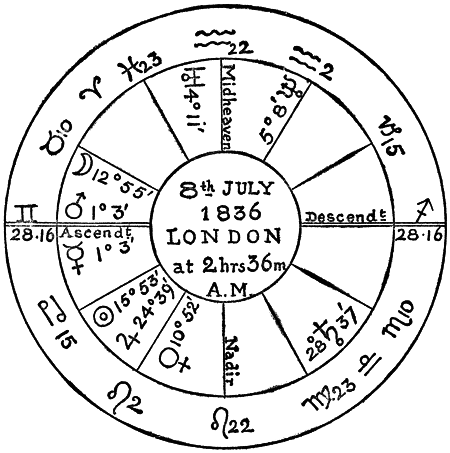
In order to summarise and illustrate the principles which
have been enunciated in the course of this work, I shall
avail myself of the horoscope of Mr. Joseph Chamberlain,
who was born on the 8th of July, 1836, at Highbury, the
time of birth being stated to have been at about 2.30 in
the morning. Calculations have since enabled us to fix the
exact time of birth as at 2 h. 36 m. a.m. I subjoin the
horoscopical figure for that time, the calculation of which
is as follows:—
|
H. |
M. |
S. |
| Midheaven in R.A. at Noon |
7th |
July, |
1836… |
7 |
1 |
58 |
| Add time elapsed since |
… |
… |
… |
14 |
36 |
0 |
| Equation for 14h. 33m. at 10 secs. |
|
2 |
25 |
| Midheaven in Right Ascension at Birth |
… |
21 |
40 |
23 |
Born under the sign Gemini, with Mercury rising in
the sign Cancer, the Sun near the conjunction with
Jupiter and in close sextile to the Moon, there is little
doubt that the late Colonial Secretary is by nature gifted
with an excellent constitution. The sextile of the luminaries
is a powerful co-ordinator, and whenever sickness supervenes
there will be a speedy recovery. The semisquare aspect of
Mars, while disposing to gouty affections of the hands and
feet, will contribute vital energy and power to throw off
diseases, while at the same time predisposing to accidents
and wounds to the right shoulder or clavicle.
The rising sign gives nervous energy and enormous
capacity for work, which is due to high nervous tension
supported by a sound vitality. The only hereditary predisposition
is that indicated by Mars, which induces to fevers, and
gouty affections due to acidity.
The Moon is strong in the sign Taurus, but not particularly
well placed in the 12th House. It has, moreover, the square
aspects of Neptune and Venus from fixed signs. These indications
point to functional disorders of the heart, throat and excretory
system. On the other hand, there are the good aspects of the
Sun, Jupiter and Uranus to counteract these adverse tendencies,
and it is certain that strong recuperative powers together
with a normally good co-ordination of functions would induce
a speedy recovery from any illness to which he may be liable.
Considerable immunity from sickness of all sorts may therefore
be predicated.
The majority of the planets being in Cardinal signs,
with three planets (including the Moon) in Fixed signs,
indicates a character that is energetic, ambitious, active,
sharp, ingenious, lively, and persevering; capable of cutting
out a line in life for himself and making headway against
obstacles; disposed to ride roughshod over the weaknesses
and prejudices of those who oppose him; gifted with a pioneer
spirit, incisive manner, and disposed at times to effect
his ends regardless of the feelings and opinions of others.
At the same time there is sufficient patience, method, caution,
and watchfulness to make this extreme definition of purpose
very effective. Laborious, firm (at times obstinate), systematic,
and self-reliant, he is capable of waiting for opportunities.
But finally he carries his purpose with a tour de force.
That which he lacks is adaptability, suavity, and
ability to enter into the feelings of others. He is too
ambitious to be self-centred, but yet too intent to be
sympathetic.
The rising of Mercury in trine aspect to Saturn and
Uranus gives considerable mental capacity, a wide
grasp of facts, a well-informed, apt and business-like
mind; some originality, constructiveness, and power of
marshalling facts and figures; patience, caution, and
secrecy. There is not much imagination, and the sympathies
are not wide. His methods and actions are governed by literal
fact and mathematical certainty. He is an omnivorous devourer
of the accessible. He takes the small fish by the handful
and makes a meal of them; but he leaves the ponderous whales
for those of greater imagination and more leisurely habit.
The quadrature of Mars to Uranus will induce
momentary outbursts of temper and some irritability
of nature, but the character I am delineating is not such
as can easily be played upon, for it is remarkably lacking
in emotional susceptibility. Nevertheless, the inspirational
faculty is by no means absent, and the presence of Neptune
in the 9th House in trine to the rising Mercury, is an index
of considerable inventive genius, extreme range of mental
perception, and telescopic discernment of future events.
Venus in the 3rd House shows some artistic tastes and fancies,
considerable appreciation of art and culture, a fondness for
flowers, bright lights, &c. But dominant above all are the two
angular influences of Uranus and Mercury, which render the
mind mathematical and precise, commercial, apt, business-like,
energetic, and eminently magnetic.
The position of the Sun in conjunction with Jupiter in
the sign Cancer, in sextile to the Moon, is the index of a
high fortune and means exceeding a competence. It is here
worthy of note that Cancer, which in this horoscope holds
the Sun, Jupiter, and Mercury, is the ruling sign of South
Africa, with which Colony Mr. Chamberlain’s fortunes have
been for a long time so intimately associated. It is also
worthy of note that both Cecil Rhodes and Barney Barnato
were born on the same day of the year, the 5th of July, with
the Sun in the 14th degree of Cancer. In the former case the
Sun was conjoined with Moon and Venus, in sextile to Uranus
and trine to Neptune, while in the latter case the Sun was
in trine to Jupiter. In regard to Mr. Chamberlain’s horoscope,
it will be observed that Jupiter, which holds such effective
power for increase in the 2nd House, is also the ruler of
the 7th, and it is to be remembered that all partnerships,
commercial or social, which he has contracted have so far
proved highly satisfactory from a merely monetary point of
view. Further, the Moon is affected with the good aspect
of the Sun in the 2nd House, which is a further indication
that on a purely financial basis Mr. Chamberlain is a man
worth going into partnership with.
All the planets except Neptune and Saturn are rising,
and this at once indicates a man ambitious of independence
and honours, one who is confessedly a candidate for responsibility.
Uranus in the Midheaven and close to the meridian
indicates that association with civic and governmental
bodies in which Mr. Chamberlain has rendered himself
so conspicuous a figure, and whereas the trine aspect of
Mercury in the Ascendant to Uranus in the Midheaven and
the sextile of the Moon to Uranus also are sure indications
of a wide popularity, the square aspect of Mars to Uranus
from the 12th House, will not fail to engender many veiled
enmities, machinations, and inimical plots, which have for
their object the overthrow of Mr. Chamberlain’s prestige,
and which, failing, will find expression in vituperative
abuse and bitter animosity. But those who understand the
virtue of the orientality of planets in a horoscope will
retain their confidence in Mr. Chamberlain’s ability to hold
his own against all opponents.
It will be observed that the direction of the Ascendant
to the place of Uranus in the horoscope coincides with
the age of Mr. Chamberlain at the outbreak of hostilities
in South Africa, while the direction of Midheaven opposition
Saturn coincides with the progress of the Boer War. Did
space permit it would be possible to adduce a long list
of directional arcs coinciding with the time and nature
of all the more important epochs in Mr. Chamberlain’s career.
The student is invited to make some test of this matter
by the aid of the rules already given in these pages.
Mr. Chamberlain has been thrice married. It will be
observed that not only is there a double-bodied sign on
the cusp of the 7th House, but the Moon also applies
to both the Sun and Jupiter in the sign Cancer. (See
Sect. III., chap. 8.) The aspect of the Moon being
benefic to both the Sun and Jupiter, the marital state
would be both harmonious and fortunate. It is, of
course, well known that Mr. Chamberlain has, from a
merely worldly point of view, married most advantageously.
This observation may be called “wise after the event,” but
I would observe that this geniture preceded my judgment of
it, and the rules from which I judge are to be found in the
Tetrabiblos of Ptolemy, written in the second century, and
since tested and found reliable by successive astrologers
during some seventeen centuries. Saturn’s aspect to Jupiter,
the ruler of the 7th House, and the Moon’s quadrature to Venus
must be held accountable for the successive bereavements which
have disturbed the conjugal life in this case.
The position of Saturn in the 5th House, and the
affliction of Venus by Neptune and the Moon, will serve
to account, in connection with the marriage conditions,
for the small family which has been born to Mr.
Chamberlain, for observe that Venus is the ruler, jointly
with Mercury, of the 5th House, while Saturn is in the 5th
and ruler of the 8th House. The same positions and aspects
threaten to curtail the succession.
The position of Mercury, joint ruler of the 5th, in the
sign Cancer, and just about to rise in the horoscope,
promises honours and distinctions to the first-born.
The Moon and Mars are cadent in the Horoscope, and
Mercury, the “winged messenger” (symbol of the
trading-ship), is rising. These are indications of many
journeys and changes and constant unrest. But fixed
signs being on the cusps of the 3rd and 9th Houses, and
the Moon also in a fixed sign, will suffice to account for
the fact that Mr. Chamberlain is not a great long-distance
traveller. Cancer and Leo holding the benefics and the Sun
also well aspected in Cancer, the Moon being in Taurus,
shows at once that France, South Africa, Holland, Scotland,
and Ireland are parts of the world in which the operations
of Mr. Chamberlain would meet with success, if it be not
superfluous to detail specific territories in face of the
abundant evidence of general success which this horoscope
affords.
It was the boast of Bismarck that he was the “best-hated
man in Europe,” and it would be strange indeed if Mr. Chamberlain
had passed through life and attained so prominent a position
without incurring the enmity, or arousing the envy and malice
of a considerable number of individuals. Nevertheless, there
are only two aspects in this horoscope which seem to point
to any sort of trouble from such causes. The points are those
of Neptune, which afflicts both the Moon and Venus, and of
Mars which afflicts Uranus in the Midheaven and the Sun in
the 2nd House.
By referring these two points to the Ecliptic we find
they correspond to the Sun’s position on or about the
24th of May, and the 26th of January, and I shall leave
the reader to look up his Almanac and find the individuals
(illustrious they must needs be to find chronicle in Whittaker)
who were capable of filling the requirements of the case.
As to friends, Mr. Chamberlain should lack nothing.
With the Moon in sextile to the Sun and Jupiter, the
ruler of the 11th House, in the same benefic relations
with the Moon, he would always be able to count upon
a strong adherence, and the only adverse indication in
this matter is that Mars, part ruler of the 11th House,
holds the 12th House in square aspect to Uranus in the
Midheaven. This would be interpreted to mean that
some of his friends will be disposed to become his
enemies, and to militate, although ineffectually, against
his credit and position. Why ineffectually? Because Mercury,
the ruler of the Ascendant and prime significator of Mr.
Chamberlain, is angular and well aspected, while Mars is
weak and afflicted by Uranus which is in elevation above it.
Let it not be thought that the fame and position which
Mr. Chamberlain has attained in the political world is
due entirely to the benefic position of the principal
planets in his horoscope of birth. Opportunity is not
everything. The ability to use it counts for much, and
only a man of exceptional industry, firmness, and
decision, could have won for himself such peculiar
distinction; and only a man of singular faculty could
have sustained his position in the face of so much
determined opposition. It will doubtless be a matter
of extreme interest to the student of this horoscope, as
to every one interested in the political situation of to-day,
to observe the concurrent influences at work in the year
1904–5. Mr. Chamberlain attained his sixty-eighth birthday
anniversary on the 8th of July, 1904, and by adding that
number of degrees to the 22nd degree of Aquarius we obtain
Taurus 0 as the point which has attained the meridian by
“direction.” This is called the Progressed Midheaven. Referring
this point of the Zodiac to the places of the planets at birth,
it is observed that the Midheaven is approaching the sextile
aspect of Mercury, having recently passed the opposition of
Saturn, and having attained that aspect in 1905, it passes
in 1908 to the sextile of Uranus, the planet which holds
the greatest elevation in the horoscope of birth. The Ascendant
under the Midheaven of Taurus 0 is Leo 16° 28′, which is the
Progressed Ascendant for the year 1904. It is in semisquare
aspect to Mercury, and is the occasion of many anxieties,
worries, and annoyances, and some journeys by water. It
also indicates some derangement of the health due to nervous
strain, and affecting the stomach (ruled by Cancer). The
Sun is directed in similar manner to the 24th degree of
the sign Virgo, where it meets the sextile aspect of Jupiter
in the 2nd House, in the sign of its exaltation, Cancer.
This gives access of good fortune, increase of honor and
prestige, and as Jupiter rules the 11th House, many adherents
and supporters. But being also in semisquare to Venus, Mr.
Chamberlain is in danger of losing a brother or other near
male relative. The Moon by the same measure is within 4 degrees
of the place of Jupiter, again marking the year 1908 as one
of exceptional advantage, and in July of that year Jupiter
passes over the Progressed Ascendant.
During the year 1904 Saturn has been close to the Midheaven
of the radical horoscope, being in Aquarius 21, and stationary
therein, during the month of June. In March, and again in
October, it transits the opposition of the Progressed Ascendant
in Aquarius 16, while in February, June, and December Uranus
is in transit over the opposition of the radical Ascendant
in Sagittarius 28° 16′.
In 1905, Saturn will transit the Midheaven in the horoscope
of birth, and in the summer of the same year Mars will be
Stationary in opposition to the place of the Moon at birth.
Both these periods will be fraught with cares and anxieties,
and the latter influence will act detrimentally on the health,
disposing to attacks of gout and inflammatory action in the
system.
But while the approaching and concurrent Primary
directions are of a highly benefic nature, there will be no
hint of a breakdown either in health or reputation, and
it needs only the additional good influence of a transit or
Secondary Lunar direction to carry Mr. Chamberlain at full
swing to the summit of popular esteem and political power.
The curious who seek for coincidences will not be surprised
and may be gratified to note that Merx, the root of the
name of Mercury, signifies trade, and that the planet Mercury
is rising in this horoscope of Mr. Chamberlain, who won
great distinction for himself as President of the Board
of Trade. Those who in more earnest vein seek for causes
will do well to trace the transits of the major planets
through this horoscope over the places
of the Significators, the Sun, Moon, Midheaven, and
Ascendant at all the important epochs in the life of the
late Colonial Secretary. The working out of the more important
directional arcs for the same period I can safely leave
to the reader whose desire to thoroughly test the claims
of Astrology has been sufficiently aroused by the perusal
of these pages. It is at all times easier to dispute than
to disprove, and this apparently is the reason for so much
that is said, and so little that is shown, against Astrology.
As to the modus operandi of planetary influence I conceive
that the brain cells are infilled with a nervous pabulum
of such delicate nature as to be capable of responding to
the finer etheric vibrations instituted by the planets; that
the electrostatic condition of the earth’s atmosphere at
the moment of birth determines the particular mode or modes
of vibration to which the individual brain is syntonically
responsive; and I could, did space permit, immediately adduce
hundreds of instances to show that whenever the same positions
or planetary aspects recur in the heavens as were in existence
at the moment of a birth, the individual immediately responds
to the excitation, and gives instant evidence of such excitation
by actions in agreement with the nature of the planets involved.
We now come to the point where it will be necessary to
explain more fully the various elements with which so
far the reader has only been dealing in a more or less
mechanical way. It is, of course, of first importance that
the student of Astrology should have a correct method, and
this has been given as fully as space will permit in the
preceding pages. But it is also necessary that one should
know why he is doing a thing, as well as how to do it. Henry
Ward Beecher once said that if a man turned soil with a spade
knowing why he did it, the work was more effectively done than
if he did not know. For this reason it will be convenient
for the student to have a general view of the cosmical elements
that he employs in his calculations and of the factors that
enter into his consideration when studying a horoscope.
For purposes of calculation, the astronomer regards the
planets as moving around the Sun in circular orbits at a
uniform rate, and the positions thus obtained are called
the mean longitudes of the planets. But it is known that
the orbit of a planet answers to the functions of an ellipse,
of which the Sun is presumed to occupy one of the foci.
Then it becomes necessary to correct the Mean Longitude
of the planet by an equation which is called the Centre
equation.
Let us make this quite clear. The circular orbit supposed
in the first instance is what may be called the Mean Orbit
of the planet, as compared with its true orbit, which is
elliptical. Similarly, the motion of the planet in the circular
orbit is called the Mean Motion, as compared with the true
motion, which is variable, being quickest at the perihelion
and slowest at the aphelion.
The difference between the Mean longitude and the True
longitude is determined by the Anomaly, which is the distance
of the planet from its Aphelion, or farthest distance from
the Sun. The anomaly is thus L-A, i. e., longitude minus aphelion.
But it will be seen that ellipses may be of greater or
less eccentricity, and the equation to centre depends on
the eccentricity. This may need a word of explanation. Suppose
a circular orbit. Draw the two diameters at right angles
to one another; they are of equal length. Now suppose another
figure in which the one diameter is longer than the other.
The circumference of this figure will be an ellipse. The
greater diameter is called the Major Axis, and the diameter
at right angles to it is the Minor Axis. The proportion of
one to the other axis determines the amount of eccentricity.
Twice the eccentricity gives the equation to centre, and to
reduce this to degrees and minutes of a circle it has to be
multiplied by the chord of 60 degrees, which is 57°·29578.
This gives the maximum equation to centre when the planet is
3 signs or 90 degrees from its aphelion, and therefore on the
Minor Axis.
The eccentricity of the various planets may be here
stated: Mercury, 0.2055; Mars, 0.0931; Jupiter, 0.0482;
Saturn, 0.9562; Uranus, 0.9467; Earth, 0.0168; Venus,
0.0068. These quantities undergo a gradual change. Thus
it is found that Jupiter, Mars, and Mercury are increasing
the eccentricity of their orbits, while Venus, the Earth,
and Saturn are reducing it. The orbit of Venus is now almost
circular, and it affords an example of the perfect astronomical
paradigm.
Thus by the mean motions and the equation to centre
the true longitudes of the planets in their heliocentric
orbits are obtained. But inasmuch as the orbits of the planets
do not lie in the same plane as the Sun, but cross its apparent
path at various angles of inclination, a further equation
is due to reduce the orbital longitudes of the planets to
the ecliptic.
To further reduce these true longitudes into their geocentric
equivalents, i. e., as seen from the Earth’s centre, we
have to employ the angle of Parallax, which is the angle
of difference as seen from two different points in space.
This will vary according to the relative distances of the
bodies from one another. The Moon’s longitude is always taken
geocentrically. When approximate longitudes are required,
the employment of a mean vector, which is equal to half the
minor axis of the planet, is found convenient. For the convenience
of astronomical students I may here give the constant logarithms
of the values of the tangent, which, being added to the logarithm
of the tangent of half the distance of the planet from the Sun
in longitude, will give the tangent of the complement.
Neptune, 9.97107; Uranus, 9.95479; Saturn, 9.90858;
Jupiter, 9.83114; Mars, 9.32457; Venus, 9.20812; Mercury,
9.63210.
To these add the bog, tangent of half the angle between
the planet and Sun, taken by heliocentric longitude, which
call A. Call the result B. For major planets add A and B,
and for minor planets subtract B from A. In either case
the result will be the angle of longitude between the planet
and the Sun as seen from the Earth, and hence its geocentric
longitude may be known.
But a more convenient method of obtaining the approximate
longitudes of the planets geocentrically is by means of
the Planetary Geocentric periods. Thus Uranus has a period
of 84 years, after which it returns to the same longitude
on the same day of the year and will be further advanced
in its orbit by 1° 5′. Saturn has a period of 59 years,
after which it comes to the same place in the zodiac and
will be further advanced by 1° 53′. Jupiter has a period
of 83 years, when it is found to be only 4′ advanced upon
its former longitude. Mars’ period is 79 years plus an advance
of 2° 4′. Mercury’s period is also 79 years, and its advance
is 5° 32′. Venus has a period of 8 years, when it is further
advanced in the zodiac by 1° 32′.
For the calculation of the approximate geocentric longitude
of the major planets these periods are very useful, but are
of less value in regard to the minor planets Venus and Mercury.
Suppose I want the longitude of Uranus in the year
A. D. 827. I have its longitude on the first of January,
1912, in Capricorn 28° 17′. Then 1912-827 gives 1,085 years,
which being divided by the period of Uranus (84 years),
yields 12 periods and 77 years. The increment for 1 period
being 1° 5′, that for 12 will be 13°, and 77-84ths of 1° 5′
will be another degree, making 14 degrees. As the date is
anterior, this amount must be subtracted from its longitude
on the first of January, A. D. 827, and in effect we obtain
Capricorn 14 degs. 17 mins. as the longitude of Uranus on
the first of January, 827, as seen from the Earth.
For the purpose of determining the effects, if any, due
to the presence of a planet in its Aphelion, Perihelion, or
Node, the following values are given for the year 1800 A. D.:
| Planet.
|
Aphelion.
|
Perihelion.
|
Node.
|
|
|
S.
|
°
|
′
|
S.
|
°
|
′
|
S.
|
°
|
′
|
| Mercury
|
8
|
14
|
21
|
2
|
14
|
21
|
1
|
15
|
57
|
| Venus
|
10
|
8
|
36
|
4
|
8
|
36
|
2
|
14
|
52
|
| Mars
|
5
|
2
|
23
|
11
|
2
|
23
|
1
|
18
|
1
|
| Jupiter
|
6
|
11
|
8
|
0
|
11
|
8
|
3
|
8
|
24
|
| Saturn
|
8
|
29
|
4
|
2
|
29
|
4
|
3
|
21
|
57
|
| Uranus
|
11
|
17
|
21
|
5
|
17
|
21
|
2
|
12
|
51
|
| Neptune
|
7
|
12
|
22
|
2
|
12
|
22
|
4
|
9
|
35
|
The longitudes of the Aphelia are increased in 100 years
by the following quantities: Neptune, 1° 25′; Uranus, 1° 28′;
Saturn, 1° 50′; Jupiter, 1° 35′; Mars, 1° 52′; Venus, 1° 43′;
Mercury, 1° 34′. These quantities are additive for years
after 1800, and subtractive for years before that epoch.
In the present state of astronomical science it is not
certain that these values are absolutely correct. Calculated
from the Tables of Kepler, the differences are only slight,
but still sufficient to make considerable error in testing
for exact conjunctions or ingresses.
Lilly, who predicted the Great Plague and Fire of London
some years previous to the event from the ingress of the
Aphelion of Mars to the sign Virgo, evidently made use of
the Rudolphine Tables constructed by Tycho and Kepler, and
according to these the ingress took place in 1654, while
according to more modern Tables it did not take place until
1672. It is probable, however, that the positions of the
Aphelia here given will be sufficiently close for all practical
purposes.
A word or two may now be said regarding the periodic conjunctions
of the planets.
As will be seen from the periods given, five periods of
Jupiter are nearly equal to two of Saturn. It is found
that the two planets form their conjunctions every 20
years. Thus there was a conjunction in Virgo in 1861,
another in Taurus in 1881, and another in Capricornus in
1901. The next will be in Virgo in 1921. The two planets
are thus now forming their successive conjunctions in the
Earthly Tripicity; but in 1981 will make their mutation
conjunction by falling together in the Airy sign Libra.
Uranus and Jupiter form their conjunctions every 14
years. Thus there was a conjunction in Sagittarius
in 1900, and there will be another in Aquarius in 1914, another
in Aries in 1928, and so on.
The conjunctions of Neptune with the other major planets
are necessarily in terms of the periods of the latter, those
of Neptune and Uranus being very infrequent, while those
with Jupiter will be proportionately more frequent. For
the period of Jupiter is only 12 years, while Neptune remains
in the same sign for 15 years. The conjunction of Jupiter
and Neptune in Cancer in 1907 will be followed by another
in Leo in 1919, and this again by another in Virgo in 1932.
Obviously, if the planets by their transits effect anything
whatsoever, the double transit of major planets must have
a correspondingly greater effect. The careful student of
Astrology will institute a number of tests in order to find
what effects are due to the combined action of the planets
when in conjunction at transit, and also when in opposition
or quadrature. The chief points to be noticed in connection
with the transits of the planets are the Midheaven, Ascendant,
and the places of the Sun and Moon, as already mentioned
in Chapter II of this section.
The ancients also included the places of the Moon’s
Nodes, and it is usually found that the transit of the
South Node over any of the Significators is attended by
unfortunate results.
With these observations as a general guide to the cosmical
factors involved in the planetary motions, the reader will
be able to take a more intelligent interest in the foundations
of his study than is the usual case from the pursuit of the
subject by rule-of-thumb methods.
When we come to the consideration of the Moon as a
cosmical factor we are face to face with one of the most
difficult and evasive problems. For many centuries astronomers
grappled with this inconstant factor with small success,
and at the present day the problems attaching to the vagaries
of lunar motion are in anything but a satisfactory condition.
Prior to the time of Ptolemy nothing was known of the Moon
except that it had a certain mean motion and formed its syzygies
at definite periods, the mean values of which were very closely
known. But certainly nothing was known regarding the inequalities
of motion which are found to exist. Ptolemy discovered the
equation due to the action of the Sun upon the Moon in its
orbit. This is called the Evection. Tycho later discovered
that a further equation was due to the disturbance caused
by the Sun along the vector. Both these equations were employed
by Kepler. But of these, later astronomers have added one
after another equation, going so far as to employ the action
due to Venus and Jupiter, while ignoring that due to the
action of the other planets upon the Moon. Buckhardt, whose
formulae were used in the calculation of the Nautical Almanac
for many years, employs no less than 37 equations of the
Moon’s mean longitude. Indeed, the whole business has become
farcical. The fact is that only three of these equations
are necessary in order to obtain the Moon’s true place in
the ecliptic at any time, and for the syzygy only one equation
is necessary. The trouble has arisen from the fact that the
eccentricity of the Moon’s orbit has been wrongly estimated,
and most of these equations now employed by astronomers are
effectual only in correcting this false estimate. Kepler
gives the maximum equation to centre as 4° 59′ 59′′, while
modern astronomers have given it as 6° 18′ 28′′. Neither
of these is quite correct, though Kepler is much nearer
the truth.
Another problem in connection with the Moon that has
puzzled astronomers for a long time and is still in the
region of experimental science is what is known as the
Secular equation. It is found that by taking the present
mean motion of the Moon and applying the various equations,
found necessary to bring the calculations into line with
observations of the Moon’s position in the zodiac, a considerable
difference is found to exist between the calculated place
of the Moon and its recorded position at the time of ancient
eclipses. According to our modern Tables, ancient eclipses
happened sooner than they should have done, or, in other words,
the Moon was more advanced in its orbit than our Tables require.
The inference is that the Moon was formerly moving quicker
in a smaller orbit than now, or conversely, the Moon is now
receding and getting farther from the Earth. Consequently its
action on the tides must be diminishing, and also its action on
the equatorial mass of the Earth, which is considered to
be the chief factor in the production of what is called the
Precession of the Equinoxes. Yet whereas by one statement
the disturbance due to the Moon is diminishing, another
statement shows that the Precession of the Equinoxes
is increasing! Voila le debacle.
All these anomalies and contradictions are due, as I
shall show in my new Tables and Thesis, to the importation
of false factors into the problem of the Moon’s motion,
which, in fact, is extremely simple, perfectly regular,
and affected only by its anomaly or distance from the
aphelion and, where the time equation is employed, by the
increase of radius. Jupiter and Venus have no more action
on the Moon than have Mars and Saturn, in fact none at all,
and the only body that has any action upon the lunar orb
is the Sun, which it exerts indirectly through its action
on the Earth.
These problems need not, however, vex the minds of
the student of Astrology. It is sufficient for him that he
has the place of the Moon calculated for him in the ephemeris
reduced from the Nautical or other official Almanac. It is
important, however, that he should know that such problems
exist.
Sir Isaac Newton was first led to the subject of Astronomy
by his thoroughness and scientific propensity. He studied
Astrology, and proceeded to the study of Astronomy the better
to understand and deal with the problems that the predictive
science presented. For it is to be observed that Astrology
in his day was entirely in the hands of astronomers, who
calculated their own ephemerides and pursued the higher methods
of astrological calculation as presented in my “Profnostic
Astronomy.” Kepler avowed himself to be convinced of the truth
of the science of Astrology, and showed himself to be a competent
critic as much by his understanding of the astronomical
problems involved as by his marvellous forecast of
the rise and fall of Wallenstein. Tycho, his colleague and
collaborator, also a great astronomical discoverer, was a
professed Astrologer, and added to his stipend by the calculation
of horoscopes. Astrology is quite a reputable study, and
needs but to be emancipated from the service of a horde of
half-educated plagiarists and parasites in order to take
its place once more among subjects of serious consideration
by the learned. Astronomy is interesting, but to be made useful
it must find interpretation in terms of our daily life and
common needs. It is in this connection that Astrology has played
Cinderella since the days of official science. The day is not
far off when it will come into its own.
Beyond the various time measures and indicators mentioned
in Section IV, Chapter II, there are others which have a
certain reputation among astrological students. The chief
of these, and one that has been in vogue for many centuries,
is the
or Birthday Figure, as it is sometimes called. It consists
in a map of the heavens for the return of the Sun to the
exact zodiacal position that it held at birth, and this
sidereal revolution is made the basis of an annual forecast
of the general trend of affairs in the life of the subject.
To find the time of the Sun’s return to its own place in
the zodiac is, of course, a simple matter of proportion from
the ephemeris for the current year. This is effected by comparing
the radical or birthplace of the Sun with the longitude of the
Sun in the Ephemeris on the anniversary day, which will give
the increment more or less required to be equated. Then with this
difference of the two positions of the Sun (a) at birth and (b)
at noon of the anniversary, find the diurnal proportional logarithm
and subtract from this the logarithm for the Sun’s motion
in 24 hours. The result will be the logarithm for the hours
and minutes from Noon at which the Sun was in the exact
position it held at the birth. Thus you have the time of
the solar return, and all that is necessary is to erect
a horoscope for this time and set the planets in the figure.
Then, if the benefic planets are in elevation and the
Lord or Ruler of the Ascendant is well placed and aspected,
there will be commensurate results, and a beneficial year
may be predicted; but if, on the contrary, the malefic planets
are elevated and the ruler of the horoscope is badly aspected,
the year ensuing will be fraught with many troubles and vexatious
events.
But inasmuch as the time-factor is here the return of
the Sun to its radical place, chief attention must be paid
to the aspects of the Sun, and conclusions agreeable to
the nature of the afflicting planets or those that favourably
aspect the luminary may be made accordingly.
As regards the time at which events signified by the
aspects may be expected to transpire, I have found that
they usually occur during the transit of the Sun over the
places of the planets in the annual horoscope. Thus a person
born in August may have the Sun in the annual horoscope
in square aspect to Saturn, the Sun being in Leo and Saturn
in Taurus. Then the evil signified by the aspect of Saturn
to the Sun would transpire about the date that the Sun passed
the opposition of Saturn in the sign Scorpio some time in
November, or again in May of the following year when the Sun
was in conjunction with the place of Saturn in the horoscope for the Solar return.
Events that are benefic in nature may be produced from
the transit of the Sun over the places of the benefics in
the Solar figure, or over the good aspects of the planet
which in the annual horoscope gives promise of benefit.
In similar manner the return of the Moon to its own
place may be taken as a monthly guide to the nature of
ensuing events, but it is to be observed that the Moon’s
place cannot be taken with the same degree of accuracy as
that of the Sun, owing to the varied acceleration of the
Moon from hour to hour. The Nautical Almanac gives this
hourly acceleration, so that by means of it the Moon’s longitude
can be arrived at with great accuracy for any time of the
day, but the cheaper ephemerides do not contain more than
the longitude for noon and midnight. The student will find,
however, that the general purposes of a Lunar horoscope may
be served with sufficient accuracy from this source if chief
regard be had to the aspects of the Moon at its return and
not to the mundane positions of the planets.
Arguing from analogy, one would suppose that a similar
horoscope could be made for the return of any of the
planets to their radical places, but until we have a popular
publication in which the planets’ places are given with
a greater degree of accuracy than at present, we cannot
pretend to indicate the true time of the revolutions of
these bodies.
Another means of prognosis to which some astrologers
have attached considerable importance is what is known as
This consists of a horoscope set for the time of the Moon’s
return to the same distance from the Sun that it held at
birth, which distance is called the elongation. This measure
is based upon the relative motions of the Sun and Moon in
the zodiac after birth. Thus if the mean motion of the Sun
for one day be taken as 59′ and that of the Moon as 13° 11′,
then the mean elongation of the Moon will be 12° 12′. But the
Sun and Moon are both subject to a variation from the mean
motion, and thus the elongation of the Moon is an inconstant
quantity. The only means of effecting the calculation, therefore,
is by reference to the ephemeris for the year of birth. Then,
having the Moon’s radical elongation, the successive dates at
which this elongation is repeated are to be noted, and each
of them is accounted as one year of life. Thus for the 20th
year of life one must count 19 synods or conjunctions of the
Sun and Moon after birth, and thereafter proceed to fix the
date after the last synod at which the Moon’s elongation is
the same as that of birth. This idea seems to give grounds for
the ancient belief in effects attaching to the Moon’s age. For
the Moon’s age denotes the distance of the Moon from the last
conjunction with the Sun, and if a person was born on the tenth
day of the Moon, then every tenth day of the Moon in successive
revolutions will be of importance, since the Moon will be
in the same relations with the Sun as at birth. The aspects
that the Moon bears to the other celestial bodies at these
times is held to be a guide to the nature of succeeding
events. But more attention is paid to such horoscopes
thus calculated wherein the Moon falls on the place of any
of the planets at birth.
are of two kinds, mundane and zodiacal. A mundane
ingress is made when a planet in the heavens comes to
the cusp of one of the Houses in the horoscope of birth—that
is to say, to the degree of the zodiac which held the cusp
of such House. Thus if the 8th degree of the sign Aquarius
were on the cusp of the 2nd House of the horoscope and Saturn
in the heavens made transit of that degree of the zodiac,
then the Ingress of Saturn to the 2nd House would be effected
and would be followed by a period of considerable financial
stress. Similarly with other planets in the horoscope. Each
will make its periodical transit through the several Houses
of the horoscope of birth, and these will be attended by events
in terms of the nature of the planet, the House it transits and
its affections at birth.
Zodiacal ingresses are those that are made by the planets
into the signs of the zodiac successively, and it is held
that a change in the trend of affairs will take place in
that department of the life ruled by the House wherein that
sign is placed at birth. This, however, appears to be an
extension of the former kind of ingress, and should be taken
with some reserve. Certainly it will be found that very marked
effects are due to the transits of the planets through the
Houses of the horoscope, and if the aspects of these planets
in the ephemeris are taken into account, it will be found that
a very accurate basis for a forecast of the various incidents
of individual life is thereby afforded.
In this connection the periodical synods of the planets
should be observed, for it is evident that if we ascribe an
influence to the transit of Saturn we must set a still more
important value upon the transit of that planet when in
conjunction or opposition with any other body in the heavens.
Thus the planets Mars and Saturn form their conjunctions
in successive signs after an interval of about two years,
during which period it may be said that the effects of the
last conjunction are in play. Thus Saturn and Mars formed
their last conjunction in August, 1911, in the sign Taurus,
and, according to the position of that sign in various horoscopes,
effects more or less detrimental and disturbing would be
experienced during the course of two years after that date.
Jupiter’s period of 12 years will be watched with interest
by those who are studying the effects due to its action,
for it passes through one sign or one House every year on
an average, and therefore constitutes a good chronocrator
or time-marker. But Jupiter can effect little for good if
at the time of its transit it is afflicted in the heavens by
the adverse aspect or conjunction of another planet. Similarly,
Saturn or Uranus or Neptune has to be judged according to
its condition and aspects at the time of transit or ingress.
whether of the Sun or Moon, are significant of evil according
to their positions and aspects in the horoscope. For if
an eclipse of the Sun happens it will afflict male members
of the family, and an eclipse of the Moon will denote evil
to female members. Eclipses falling in the sign occupying
the 10th or 4th Houses will afflict the parents, and those
which fall in the 3rd House will similarly affect collateral
relatives, such as brothers and sisters, according to the
sex indicated.
The effects of eclipses last for eighteen months, and will
be great or small according to the magnitude of the eclipse
and considerations due to aspects. When falling on the places
of benefic planets or those well aspected in the horoscope,
the eclipse will portend good arising out of some catastrophe
or bereavement. But when falling on the places of the malefics,
or on places in the horoscope that are badly aspected by the
planets at birth, they portend nothing but evil.
Falling in other parts of the figure, they are not of
such significance, but generally it may be said that eclipses
have a detrimental effect on such affairs as are governed
by the House wherein the eclipse falls.
It has been said that unless an eclipse is visible in that
part of the world where the subject was born, it will have
no effect upon his health or fortunes. But this cannot be
the case, for then those planets that are beneath the horizon
at the time of birth could with equal reason be exempt from
any share in our consideration, whereas, on the contrary,
we know full well that in whatever part of the circle the
planets may be situated at the moment of birth they will
affect the life and fortunes in equal degree, but especially
such department of the life as may be ruled by the House a
planet occupies.
The following is a list of the visible eclipses that will be
witnessed in Great Britain during the next ten years:
| 1914. |
— |
12th March, Moon eclipsed in the third hour of the morning, nearly total.
21st August, the Sun eclipsed about noon, two-thirds of the disc eclipsed. Total in Sweden and Norway. |
| 1916. |
— |
9th January, Moon sets in contact with the shadow.
3rd February, the Sun sets about half eclipsed. Total across the Atlantic.
15th July, Moon eclipsed about three-quarters of its disc in the fifth hour of the morning. |
| 1917. |
— |
8th January, Moon eclipsed in the eighth hour of the morning, just before sunrise. Total.
4th July, Moon totally eclipsed in the eleventh hour of the evening.
28th December, Moon begins to be eclipsed just before setting. |
| 1919. |
— |
7th November, in the twelfth hour at night the Moon is partially eclipsed.
22nd November, the Sun has one-fifth of its disc obscured near sunset. Annular in the South Atlantic. |
| 1920. |
— |
3rd May, Moon totally eclipsed in the second hour of the morning.
10th November, Sun sets half eclipsed. |
| 1921. |
— |
8th April, in the ninth hour of the morning the Sun is eclipsed, about five-sixths of the disc being obscured. Annular eclipse in the north.
16th October, the Moon has five-sixths of its disc overshadowed at eleventh hour of the evening. |
| 1922. |
— |
28th March, Sun eclipsed in the third hour of the afternoon, about one-sixth being obscured. Annular in Africa. |
The years 1805 and 1917 are great eclipse years, for in
both those years there are no less than seven eclipses.
From like causes we argue like effects, and therefore we
may anticipate a great convulsion in the political world
during the year 1917 and thereafter. At that time Mars and
Saturn will form their conjunction in the sign Leo together
with Neptune, and these successive conjunctions of the three
major planets cannot fail to produce great mutations, more
especially in those countries that are ruled by the sign Leo.
So far as individual horoscopes are concerned the effects
of these conjunctions and the eclipses which fall in the
sign Capricornus and Cancer must be judged by the particular
Houses of the horoscopes in which they occur. The general effects
due to any eclipse or conjunction of the larger planets are
distributed and find their expression through individual horoscopes,
the influence filtrating as it were through a variety of channels
for the ultimate purpose of human evolution and government.
Thus by many lines of evidence the patient student may
confirm his belief in the influence of the stars in human
life, which involves the yet higher concept of the government
of humanity by the greater Intelligences according to preordained
laws, divine in their origin and cosmical in their expression.
To this concept as a final expression of faith and of scientific
experience we must eventually submit our beliefs and opinions,
and haply our willing compliance.
Transcriber’s Note:
This e-text is based on the 1920 edition. Punctuation errors have
been tacitly corrected. The Table of Contents has been completed
to match the text. Inconsistent hyphenation and spelling (e.g., ‘every-day’/‘everyday’;
‘formulæ’/‘formulae’) have been retained.
Large tables have been split and rearranged.
The following typographical errors have been corrected:
# p. 6: ‘sublinary’ → ‘sublunary’;
‘towhich’ → ‘to which’
# p. 62: ‘Shakspeare’ → ‘Shakespeare’
# p. 107: ‘intuite’ → ‘intuit’
# p. 132: ‘Sagitarius’ → ‘Sagittarius’
# p. 135: ‘Viola’ → ‘Voila’