In the course of the preceding chapters a number of the more striking
modifications displayed by the different organs of plants have been
described briefly. Reference has been made to the increased length or
thickness of the roots in plants of dry places, and the weakness or
absence of root-system of many water plants. Corresponding variation in
stems has been noted. The remarkable leaves of desert and water plants
and of some carnivorous species have been mentioned. The profound
alteration in flowers which have adapted themselves to pollination by
insects has been sketched; as also the great variety in the shapes of
fruits and seeds, correlated to the methods by which they are dispersed.
It may be well to consider the question of plant structures on a broader
and more systematic basis, and, as before, to connect them where
possible with the external factors which have caused their modification
and to which they are the plant’s response. These factors are physical,
or chemical, or biological, and affect the plant mainly through the
agency of the soil, the atmosphere, or living organisms.
“The living plant is a synthetic machine.” Under proper working
conditions of heat, moisture, and light it builds up its body by
absorption of inorganic material, liquid and gaseous, through its roots
and leaves. For the present purpose we may take our typical plant as
consisting of subterranean roots and aerial leaves on the one hand, and
aerial flowers on the other—the roots and leaves concerned especially
with carrying on the life of the individual, the flowers with
perpetuating the race. In addition, an aerial stem is usually present,
on which the leaves and flowers are displayed, and through which the
food materials pass dissolved in water. Of these parts, the lower ones
(the roots, and sometimes the stems) are immersed in the soil, while the
upper ones (the leaves and the flowers—which are groups of modified
leaves—and usually the stems) are immersed in the atmosphere. All the
parts have acquired their form and fulfil their functions under control
of the particular medium which surrounds them: it becomes necessary to
preface any discussion of their characters and uses by a brief survey of
the characters of these envelopes.
While the atmosphere is familiar to us as the medium in which we
ourselves live and move and have our being, and while its chemical and
physical properties are known in outline to every schoolchild, it is
different with the soil; not only because, unlike the atmosphere, soil
varies much in composition and character, but also because the soil is
in fact a very complex product, offering many difficult problems to the
investigator; it is only of late years that the scientific study of the
soil has been placed on a sound basis; our knowledge of it is still far
from complete.
Whence does soil arise? How is it that the surface of the land is
usually covered with a layer of fertile material? The answer is to be
found, in the first place, in the decay of rocks under the influence of
natural agents. Heat and frost, rain and drought, by slow degrees break
up the surface of the hard material of which the solid crust of the
Earth is built up. The débris thus formed is washed into streams by
rain, or scattered by wind. A stream flowing into the sea, and charged
with the débris of the land, deposits the coarser material near its
mouth, while the finer particles are carried farther. In dry regions
wind plays a similar part. And so, while the materials which composed
the surface layer of the cooling primitive Earth may have been tolerably
uniform in composition, the débris derived from them has ever tended to
get sorted out, as, for instance, into sand and mud at river mouths, or
sand and dust in dry regions. In the course of ages the sorted
materials, buried beneath subsequent deposits, have been formed through
heat and pressure into rocks, which, when at length again brought to the
surface by earth movement and exposed to the agents of disintegration,
have been resolved once more into sands, clays, and so on. In the long
history of the Earth this sorting process has been repeated till now
large tracts of rocks and of soils are composed mainly of sand or mainly
of clay. The prevalence of these two kinds of material arises from the
abundance in the primitive crust of the substances of which they are
composed. Silica (oxide of silicon), the material of which ordinary
sand, as well as quartz, flint, etc., is composed, is of extreme
hardness and insolubility, and its small crystals and fragments,
disintegrated from the rocks, remain almost indestructible as grains of
sand. Clays, on the other hand, are derived from silicates (compounds
of silicon and oxygen with various metals such as aluminium, calcium,
magnesium, potassium, sodium, or iron). These substances mostly
disintegrate more completely into very small particles, which when wet
cohere into a sticky mass and form clays. Along with the humus matter
they include all the colloids of the soil. These latter bodies consist
of the extremely minute—indeed, ultra-microscopic—particles, having in
consequence of their small size a great total surface in proportion to
their mass. In virtue of this, they function as the chief absorbents of
the soil, holding water in enormous quantities, and abstracting and
retaining till used by the plants the bases of the various substances
applied as manures. Another constituent of the primitive crust was lime
(oxide of calcium). Unlike the preceding substances, lime is readily
soluble in acid water, and so is washed out of the rocks and carried in
solution to the sea. Marine animals of many kinds—such as Molluscs,
Corals, Foraminifera—extract the lime from the sea water and use it in
large quantities to build up their shells or skeletons. This material
slowly accumulates at the bottom of the ocean as generation after
generation of animals passes away, becomes at length consolidated by
heat and pressure, and through earth movements may eventually appear
above the sea to form land, in the form of limestone or chalk. Exposed
to the weather, it is once more slowly disintegrated; the lime passes
off again in solution, the impurities being left behind; a limy soil
results.
On a great plain, devoid of hills or rivers, composed of different
rocks, and subjected to the agents of disintegration, we can conceive
that over each kind of rock a soil would be formed corresponding closely
to the materials of which that rock is composed. In sections formed by
quarrying, by the cutting action of rapid streams, and so on, we may
often see this. Below is the solid rock. Its upper layers tend to be
loose and rotten owing to the action of percolating water, etc. They
merge into a layer of stony débris, where the harder portions still
retain their rock character, while the softer are disintegrating into
clay or sand. Above this the rock is wholly disintegrated into a soil,
the upper layers of which, mixed with plant débris, and consequently of
darker colour, are full of the roots of living plants descending from
the sward which covers the surface of the ground. In practice, however,
such close conformity of soil to underlying rock is not always found.
Various distributing agents are ever at work—wind, water in an especial
degree, and on sloping ground the action of gravity. In northern
countries, besides, the ice of the Glacial Period has in its passage
caught up all the loose surface material, added immensely to its volume
by grinding down the rocks, and flung the products broadcast over the
country, so that old sea bottoms may be strewn over coastal lands, sands
and gravels over clayey rocks, and limy soils over areas where no
limestone exists. The soil over much of the British Isles is formed from
the surface-layer of these glacial deposits, which—tough, intractable,
sterile—underlie the soil often to a great depth, where they rest on
rock. In southern England the covering of glacial deposits is absent,
since the ice-cap did not extend beyond the Thames valley; beds much
older than the Ice Age, often of a gravelly or clayey nature, occupy the
ground, and from these the present soils are derived.
There is another constituent of soils of primary importance for
vegetable life, which results from the decay of the generations of
plants which have gone before. When plants die, their bodies are
decomposed by the agency of bacteria. Some of the constituents pass off
as gas or water, but there remains an amount of solid matter (humus)
which mixes with the soil and is of the utmost importance for plant
growth. Nitrogen, which forms the greater part of the atmosphere, cannot
in the gaseous state be absorbed by plants, although they spend their
lives surrounded by it. It is a necessary substance in the plant’s
economy, and through the action of soil bacteria, which change the
nitrogenous matter in humus into soluble nitrates, plants are able to
utilize this store.
The ordinary soils of our fields may be defined as a mixture of sand,
clay, and humus. A soil which is too rich, or too poor, in any one of
the three will support plant life with difficulty.
The roots of plants require also a due amount of both water and air if
they are to fulfil their functions adequately. An examination of the
minute structure of the soil shows that it consists of angular particles
of very various size—the larger ones classed as sand and consisting
largely of silica; the smaller, which decrease in size beyond the limits
of microscopic vision, mainly of clay (silicates) and humus. A film of
water clings round each particle, and between the particles the chinks
are filled with air. For healthy plant growth a nice balance between
these constituents is required. Should sand be in excess, the soil is
impoverished, since silica contains no nutriment, and it is rendered too
dry, as on account of the relatively small surface of the sand grains in
proportion to their mass it retains but little water. Should there be
too little sand, percolation of air and water is hampered; the soil
tends to become water-logged and badly aerated, and turns sour. Should
humus be absent, the nitrogen-producing bacteria cease their activities
and the soil is sterile, as may be tested by digging up some subsoil,
or soil from the deeper levels to which roots or other organic matter
have never penetrated. An excess of humus, on the other hand, results in
the accumulation of acid products inimical to bacterial growth: in
consequence decay is arrested, and a mass of plant débris forms, highly
charged (for humus is very spongy) with acid water and badly aerated,
which is unsuitable for vegetable growth: we may study an extreme case
of such conditions in our peat bogs. Should water be in excess in soils,
air is forced out in proportion, and the roots cannot breathe. Too much
air means a corresponding diminution of water, and the plants suffer
from drought.
“The soil is not merely a reservoir for the mineral nutrients of plants,
but is the seat of complex physical, chemical, and biological actions
which directly and indirectly influence soil fertility. These actions
are intimately associated with the organic matter of the soil and its
bacterial inhabitants. Mineralogy and inorganic chemistry, though
helpful, are no longer capable of solving soil problems. Biochemistry
and bacteriology, with their modern conceptions of colloids, absorption
phenomena, enzymes, oxidizing, reducing, and catalytic actions, etc.,
are now rapidly extending our knowledge of the soil as a medium for
plant growth.”[8]
Such, then, is the nature of the soil in which plants grow, and from
which, by means of innumerable elongated cells (the root-hairs)
proceeding from near the tips of the roots, food materials dissolved in
water are absorbed; these food materials being produced partly by
solution of mineral constituents contained in the soil, partly by the
action of bacteria in breaking up organic matter. Soil suitable for
plant growth may be looked on as consisting of a mineral framework,
carrying in its meshes water (about three-tenths of its volume) and air
(about one-tenth of its volume); mixed with the mineral particles is
humus of varying amount; and supported largely by the humus is a vast
population of organisms, both animal and vegetable, from earthworms to
bacteria, whose activities are often essential, generally beneficial,
and occasionally prejudicial to plant growth.
The root of a young plant grows downward into the soil under the
influence of gravity. Its tip, which has to force its way through the
rough material of sand and clay, is beautifully protected by a special
root-cap, which covers the growing point as with a cushion. The
surface of the root-cap is slimy, to aid it in slipping forward, and its
cells, which are being worn away constantly, are replaced by the growth
of the interior. Should an obstacle such as a pebble be encountered, a
root will bend round it and then return to its former direction. Branch
roots are given off on all sides at an angle to the main stem, these
also tending in a mysterious way, if their course is disturbed by an
obstacle, to resume their former direction of growth; the branches again
divide, till at length a complicated root-mass is formed, sometimes of
great extent, and capable of extracting water from a large volume of
soil. Save for continued growth, the roots show little change in
comparison with those exhibited by the aerial parts of plants; safely
immersed in the soil, they heed not day or night, storm or calm, but
steadily pursue their main function of supplying liquid food material to
the green parts overhead.
In many instances roots do not accomplish their work single-handed, but
only in co-operation with certain lowly organisms; and these cases are
so interesting and of so much economic importance that reference should
be made to them. The little swellings or tubercles upon the roots of
Leguminous plants, such as Clover, are familiar to most of us. These are
caused by the stimulation due to colonies of bacteria (Bacillus
radicicola), which live in the root-tissues as internal parasites.
These bacteria feed on the sap and cell-contents of their host, but they
supplement this food-supply by absorbing nitrogen direct from the
atmosphere, which the host cannot do, though it can and does use the
nitrogenous compounds which the bacteria manufacture. It is a case of
symbiosis (see p. 79), each organism supplying food useful to the other;
but the significance of the phenomenon is that through this agency
nitrogen becomes added to the soil as the plants decay, and increases
its fertility; and thus the cultivation of a crop of, say, Lucerne
becomes a matter of great economic importance in farming operations,
and the presence of Clover in pasture is a source of increasing wealth.
Again, in the roots of most of our forest trees, both hardwoods and
conifers, and of many other plants such as the Ericaceæ and
Orchidaceæ, the root-hairs are replaced by minute fungi known as
mycorhiza, whose branches take on the function of absorption, while
the roots in turn absorb the material which the fungus collects. The
fungus obtains from the roots a direct and convenient supply of
carbohydrates; the host obtains from the fungus a ready supply of salts
and of nitrogenous compounds. In the case of the forest trees and some
other plants, the fungus forms a close felt around the roots; but in
the Heaths, etc., it penetrates the roots, living in the cells and in
some instances, as in the Ling (Calluna vulgaris), permeating the
whole plant, even to the seed-coat, so that seed and fungus are sown
together. Since the higher partner of the symbiosis cannot mature
without the lower, this is an obvious advantage to the former, as the
two develop together from the commencement of growth. Where the fungus
is not present in the seed, the seedling has to rely on its presence in
the soil. And so, if we wish to raise any of our common terrestrial
Orchids from seed, we try to ensure the presence of the fungus by using
soil in which the species has been growing already.
The state of mutual dependence existing between seed plants and
mycorhizic fungi sometimes ends in the higher organism ceasing to
manufacture its food by means of green leaves, and depending wholly on
the lower for its sustenance. This is the condition to which some of our
Orchids have come, such as the Bird’s-nest (Neottia Nidus-avis),
which does not produce leaves or chlorophyll, but sends up from its
fungus-infested roots merely a scaly brown stem topped with brown
blossoms, matching curiously the dead leaves among which it grows (Fig. 31, p. 182).
In contrast to these the case of certain other Orchids may be quoted,
which have also lost their leaves, but in a very different manner. In
their case the roots, creeping over the bark of trees on which the
plants perch as epiphytes, have become green and flattened, like the
fronds of some of our native Liverworts; they have assumed the functions
of leaves: in them the process of photosynthesis is carried on; and the
leaves themselves, thus supplanted, have by degrees disappeared.
Like many other parts of plants, roots are often used for the storage of
reserve supplies of food or of water. For this purpose they become much
thickened, and this thickening is the most conspicuous change which
roots usually undergo. Note the fat roots of many plants which grow in
dry or arid places, such as the Sea Holly, Dandelion, and many desert
plants and alpines. The thickening is often accompanied by increase in
length, as the roots range far in search of water. Another point to
notice is that though normally roots differ considerably from their
associated stems in general appearance, and also in their minute
structure, as in the arrangement of the vascular strands, the two are
related. Stem structures are often produced at various points on roots;
the suckers sent up by many kinds of trees offer an example. Conversely,
roots are readily produced even from the upper portions of many
stems—else how could we grow cuttings? Where roots are succulent—that
is, when they have a reserve of food stored in them—cuttings of them
will conversely produce stems. A classical instance of such
interchangeability of function is the young willow which Lindley bent
down and buried the top till it rooted; the original roots were then dug
up and raised into the air, when they produced leafy branches, and the
tree grew upside down henceforth. Underground stems, also, of which
there is a great variety, take on many of the characters of roots, and
from an examination of a small piece of one it is often difficult to
tell whether we are dealing with a root or a stem. The point at which
root joins stem is, in fact, in many instances, so far as function is
concerned, fixed only so long as the level of the surface remains fixed:
we can often alter it by “earthing up” or by stripping away the soil. In
Tropical forests, where the air is moist, hot, and still, roots—or
branches which serve only as roots—descend through the air from heights
almost equalling those to which stems ascend; while, on the other hand,
in hot, poorly aerated swamps, roots send up from the mud into the air
stem-like structures (pneumatophores) through which they may breathe, as
in the case of the Swamp Cypress (Taxodium distichum) of Florida. The
primary differences between the two, in fact, do not prevent the one
from taking on the general characters of the other, and from functioning
as the other, when the environment changes.
The STEMS of plants may be looked on from two points of view—as a
framework devoted to the display of the leaves and flowers, and as
pipe-lines connected with the nutrition of the plant, conveying raw
materials from the roots to the leaves, and manufactured products from
the leaves to all growing parts. It is the former relation which has
mainly determined the forms of stems. Even a very slender stem can
convey a vast amount of water and food to a plant which is transpiring
or growing actively, as we can test roughly by weighing a pot shrub as
it begins to come into leaf, and again a week later, or comparing the
growth of a pea with the size of its stem at the base. The surprising
variation in length, thickness, form, position, and branching of stems
is the plant’s response to external conditions—such as exposure, the
competition of neighbouring plants, and so on—which resolve themselves
ultimately into questions of wind-pressure, of temperature, of moisture,
and in particular of light. The first duty of most stems is to spread
out the leaves so that they may receive a maximum share of sunlight, and
the complicated systems of branches with which we are so well acquainted
are devoted to this object, the leaves themselves helping materially by
the positions which they assume. This familiar and typical kind of stem,
upright and column-like, beautifully constructed to bear the weight of
leaves and branches, and to resist wind-pressure, alone furnishes a
delightful study; but it can be dealt with only very briefly, as also
some of the modifications which it undergoes under special
circumstances.
To plants which have not taken to a terrestrial existence, and which
still inhabit their ancestral home in the water, the stem problem is
comparatively simple. A flexible shaft capable of withstanding wave and
current action suffices so far as mechanical considerations go; such
shafts—as we may observe by watching the Oar-weed (Laminaria) on an
exposed coast—are effective under very arduous conditions. Those Seed
Plants which, evolved on land, have later returned to the water, such as
the Pondweeds (Potamogeton), have often redeveloped a stem of a
similar kind—a flexible shaft possessing a sufficient tensile strength.
The specific gravity of such plants does not exceed that of the medium
in which they are immersed, and the stem has not to support the weight
of leaves and branches. It is, therefore, not surprising to find that
the longest, though by no means the bulkiest, of all plants, are found
in the sea. Some of the Oar-weeds (Macrocystis) of the southern and
western oceans attain lengths which have been estimated at 500 to 1,000
feet; but these gigantic Seaweeds are nevertheless slender plants,
suspended lightly in the water. But after the colonization of the land
by the aquatic flora numerous serious problems had to be encountered and
solved before plants in an aerial environment could rise boldly into the
air. Extremes of temperature unknown in the water had to be faced. Along
with a greatly increased loss of water owing to the presence of air and
direct sunlight, the area over which water might be absorbed became
largely reduced, the roots alone being now available. The whole weight
of branches and leaves and fruit had to be borne by the stem, not only
in calm but in storm. No wonder that to meet these conditions, or to
avoid such extremes as were avoidable, aerial stems often display great
complexity and diversity of structure and form. From the mechanical
standpoint the tall stem is especially interesting on account of the
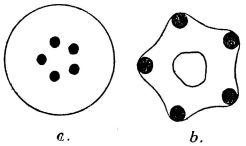
Fig. 19.—Arrangement of Strengthening Material in Root
(a) and in Stem (b) (DIAGRAMMATIC).
beautiful structural adaptations by which it meets the various stresses
to which it is subjected. The problem before the plant is to combine a
minimum quantity of material with a maximum of strength and rigidity.
Strands of toughened fibre, so disposed as to meet the stresses most
advantageously, are characteristic of such stems. In the case of many
tall annuals, such as the larger Umbelliferæ, the principle of the
hollow column is largely employed; in proportion to the strength
obtained, this is far more economical than a solid column: and economy
is particularly necessary in such annual stems, where the time available
for construction is short. Transverse partitions at intervals provide
stiffening of the whole; and as the efficiency of the toughened
longitudinal strands increases with their distance from the centre, the
stems are often ribbed, the strands occupying the ribs, with softer
substance between. This form of construction may be contrasted with that
obtaining in the roots. In the latter the greatest mechanical stress is
in the form of a longitudinal pull caused by swaying of the stem under
wind-pressure. To meet this the vascular strands are arranged, not
marginally, but in a central bundle, where they can best meet stresses
of the kind. In most trees the stems are solid; here economy of material
is less urgent, as a long period of years is available for their
building up; the great amount of cell-space thus made available for
food-storage is a valuable asset to the plant, as is evident from a
consideration of the vast amount of fresh tissue produced in a brief
period by a deciduous tree when it bursts into leaf. As this material,
stored in the stems and roots, has to be sent up to the twigs dissolved
in water, and as during the whole period of growth vast amounts of water
are transpired, an elaborate and complete pipe-system is intercalated
with the reinforced-concrete structure of the tree trunk. Pumped up by
the roots, and sucked up by the leaves, water and food pass rapidly from
the ground to the topmost twig of the loftiest tree.
To explain the massiveness of a tree trunk we have to remember that,
while the cross-section of any structure varies as the square of its
linear dimension, the volume varies as the cube of the same. If we
double the dimensions of a tree, we increase its weight eight times, but
the strength of the trunk is increased only four times. If a tree 100
feet high is supported on a stem 6 feet in diameter, a tree 200 feet
high of the same proportions would need a stem not 12 feet, but over 17
feet in diameter, to be supported equally efficiently. This proportion
increases rapidly: a similar tree 300 feet high would need a stem 30
feet in diameter; a tree 1,000 feet high would require a stem 180 feet
in diameter, or 32,400 square feet in cross-section. We see, then, why a
limit of tree growth is rapidly reached, at about 300 feet, and why the
trees which grow to that height have trunks which are one of the wonders
of the world, exceeding 30 feet in diameter, or about 100 feet in
circumference.
Climbing stems represent efforts on the part of plants to economize
material by utilizing the rigidity of neighbouring plants, and by
reaching to the light on their shoulders. Here, as in aquatics, the
rope type of stem is in evidence; it resembles a garden hose, offering
great flexibility and conducting capacity, but without rigidity to
support its own weight, much less that of the leaves and flowers which
it bears. To secure support, the stem itself (or branches of it), the
leaves, or the stipules (leafy projections on either side of the
junction of leaf and stem), are used. Sometimes support is obtained by
twining (compare Convolvulus, Grape-Vine, Vetch), sometimes by adherent
discs (Virginia Creeper), or aerial roots (Ivy), often by mere
scrambling, often aided by reflexed hooks on leaf and stem (Bramble,
Cleavers). The mechanism by which twining is accomplished is of great
interest. It is an effect of unequal growth of the different sides of
the stem. If the unequal growth were confined to one side, the stem
would eventually form a coil, or series of circles. But the region of
greatest growth keeps shifting round the stem, with the result that the
tip of the shoot describes a circle or ellipse, like the hand of a clock
pointing successively in all directions. The stimulus is due, as in the
case of the erect growth of ordinary stems (which usually display
similar movements in a less degree) to gravity. Sometimes the movement,
or nutation, is in the same direction as that of the hands of a clock
(e.g., in the Hop); more frequently it is in the opposite direction,
as of a clock-hand moving backwards. The result of this movement is that
if the shoot encounters, say, an upright stem, it will lap round it in a
spiral manner, and unless the said stem be quite smooth and unbranched,
the twining shoot will be eventually supported by it. How effective the
twining habit is as regards economy of building material may be seen
from comparing the weight of the stem of a Hop with that of some tall
herbaceous plant of the same altitude, and bearing an equal weight of
leaves and flowers. The tendril-climbers are still more efficient, for
they avoid the increased length of stem which arises from a twining
habit. They grow straight up towards the light. Both the top of the
growing shoot and the spreading tendrils which arise from it are
continuously revolving in search of a support. When a tendril encounters
one (such as a twig), the contact produces a stimulus which results in
the tendril taking several close turns round the support. Nor does the
action stop there, for usually the lower unattached portion of the
tendril contracts into a spiral, drawing the stem closer to the support,
and woody growth ensues, by which the tendril becomes exceedingly tough,
often stronger than the stem itself.
One other point concerning climbers may be noted. Did they exhibit in a
marked degree that bending towards the light which is characteristic of
most plants, they would often defeat their own object, as they would
grow away from possible supports. But they grow boldly up into an
overhanging canopy, apparently confident of their power to ascend into
the light and air which exist above. In the root-climbers, such as the
Ivy, this bending away from the light is very marked; the stem presses
closely to the bark or stone on which it creeps, probing every cranny,
and the numerous rootlets by which it is attached are developed only on
the dark side. But when the plant is old enough to flower, then branches
devoid of roots grow out towards the light, so that the blossoms may
be borne in the open, where they may be seen and visited by the numerous
insects which, in their search for nectar, pollinate them.
In contrast to the extreme development in length found in the stems of
climbing plants the extreme reduction of stem found in many plants of
dry places may be referred to. The Crocus, for instance, has an
abbreviated upright stem of which each year’s growth is distended for
the storage of food: one year’s growth dies away as the next enlarges,
so that the well-known bulb-like corm is produced. Compare the
“roots”—really the stem—of Montbretia, in which the annual growths
remain, the result being a knobby structure like a string of onions. In
bulbs reduction in length is carried still farther, the stem forming a
broad cone from the surface of which spring a number of modified leaves,
forming fleshy scales swollen with food material; these surround and
protect the bud, which when it grows produces green leaves and a
terminal flower-shoot; growth is continued by axillary scale-leaved
shoots situated among the scale leaves, which in due course themselves
produce green leaves and flowers. These compact food-charged stems take
up their position well below the ground, out of reach of intense heat or
drought, and during the favourable season send up rapidly into the air
their leaves and flowers, after which they remain dormant till the
following year.
It has been seen that unless a plant is a parasite or saprophyte, using
as food ready-made organic material, it is necessary that it should
possess a sufficient expanse of green (i.e., chlorophyll-bearing)
tissue for the purpose of assimilation. This is the essential function
of the leaves; but before leaving the study of stems it should be
pointed out that they usually assist, and sometimes entirely replace,
the leaves as organs of food-manufacture. We have seen how in dry
places—whether physically dry, from direct scarcity of water, or
physiologically dry, owing to reduced activity on the part of the plant
due to unfavourable conditions, such as obtain in cold regions, or on
poisoned ground like salt-marshes or bogs—leaf surface tends to be
reduced, to avoid excessive loss of water. In such plants as the Cacti,
and the Euphorbias which so closely mimic the cactus form, this
reduction is carried to its limit. Leaves are absent, and the stems,
greatly swollen so as to store water, take up the process of
assimilation, and perform it satisfactorily. In more rapid-growing
plants, a sufficient area for assimilation may be obtained by abundant
branching, as in the Gorse, in which leaves are present only in the
seedling stage. In the Brooms (Genista) the leaf-development is often
weak, but the stems sometimes make up for this by bearing green
flattened wings. In the Spanish Broom (G. sagittalis), a straggling
shrub inhabiting dry places in south-west Europe, the few ovate hairy
leaves, produced in spring, soon fall; but the slender branches bear
several (two to four) broad green wings, which act as
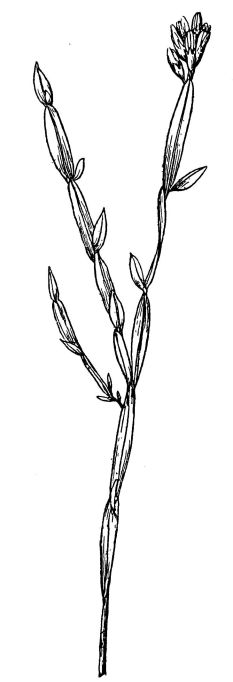
Fig. 20.—Genista sagittalis. 1/2.
leaves, and persist for a couple of years, when they pass away, leaving
slender, round, brown stems. In our native Broom (Sarothamnus
scoparius) a similar modification may be observed, though of less
degree. Sometimes stem-structures assume a very leaf-like form, as in
the Butcher’s Broom (Ruscus aculeatus), where the ultimate branches
are ovate and quite flat, and might be taken for true leaves but for the
fact that they bear on their surface flowers, and subsequently berries.
The leaves themselves are in this plant reduced to minute scales, and
from their axils these flattened branches spring. In fact, where leaf
reduction takes place, the process of assimilation is often shared in
varying degree by the leaves, the stipules, and the stems. Among our
native plants, as, for instance, in the Leguminosæ and Rosaceæ, the
reader may find for himself many interesting examples for examination.
But the large majority of the Seed Plants bear well-developed leaves, to
which the process of assimilation is practically confined.
Leaves vary surprisingly in size, shape, and arrangement, features which
are closely related to the characters of the stems which bear them, the
object being the most advantageous display of the chlorophyll in
relation to the light-supply. In general they naturally take the form of
a broad thin blade, protected as may be necessary against extremes of
weather, and guarded against the obvious danger of being dried up by a
thin waterproof covering or cuticle outside the epidermal layer of
cells. In leaves we find the same beauty of mechanical construction as
is seen in stems. The problem is again that of securing maximum
efficiency with minimum expenditure of material. To give as great a
surface as possible, the leaves are as broad and thin as is consistent
with safety, the question of damage by wind being an important
controlling factor. The veins, or vascular bundles, act efficiently as
strengtheners of the thin surface; to prevent tearing at the leaf-edges
the veins are often looped along the margin; while in indented leaves
the extremities of the indentations are strengthened with special
tissue. When one surface of the leaf faces the sky, as in most cases it
does, this surface is strengthened against the weather, and the stomata
are arranged mostly on the lower surface. Where occasionally the leaves
hang normally in a vertical position, as do the mature leaves of the Gum
Trees (Eucalyptus), both sides are protected, and the stomata are
borne on the two faces equally. In the Water Lily, again, whose leaves
float, the upper face, which alone is exposed to the air, bears the
stomata, which are present in unusual numbers—nearly 300,000 to the
square inch; the leaf surface is toughened to resist rain and wind, and
waxy to prevent water from lying on it and so interfering with
transpiration. The presence or absence of a leaf-stalk, again, is often
clearly related to the light question. In the Water Lilies the continued
lengthening of the elongated petiole causes the older leaves to float
clear outside of the younger ones. In many biennial herbs, where food is
stored up during the first season in preparation for the flowering
effort in the second, a similar arrangement prevails—note the
leaf-rosettes displayed by Spear Thistle (Carduus lanceolatus) and
Herb Robert (Geranium Robertianum), as also especially in winter by
perennials like the Dandelion (Taraxacum officinale) and Ribwort
(Plantago lanceolata). Where stems spread horizontally, as the lower
branches of trees, the leaves are arranged more or less in one
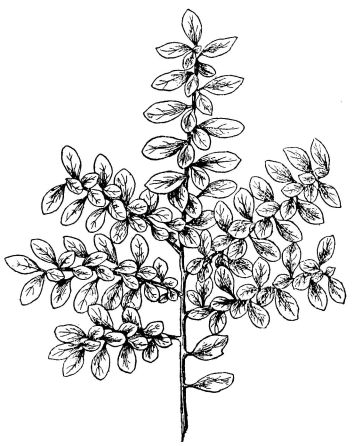
Fig. 21.—Azara microphylla. 1/2.
plane, in such a manner that overlapping is reduced to a minimum (Fig. 21). This is well seen in horizontal branches of the Elm and other
familiar trees. In the plant chosen for illustration (Azara
microphylla, a Chilian shrub), an interesting arrangement obtains. One
of the pair of stipules which subtends each leaf is itself leaf-like,
and stands at an angle, so that a mosaic is formed of true leaves (the
larger ones) and stipules (the smaller alternating ones). On all stems
the leaves are arranged not at haphazard, but according to definite
rules. Sometimes they
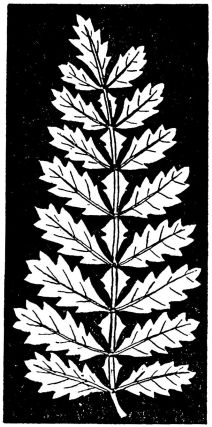
Fig. 22.—Leaf of Weinmannia trichosperma. 1/1.
are grouped in circles (whorls) at certain points of the stem, as in
the Bedstraws; often in opposite pairs, arranged criss-cross, as in the
Sycamore; most frequently in a series of spirals. The result in all
cases is the same—it allows of as great an interval as possible between
any leaf and the one immediately below or above it, and gives to all an
equal share of light. The indenting of leaves, as in the Sycamore, or
their division into separate segments, as in the Ash and Horse Chestnut,
is of undoubted advantage as allowing light to pass through to lower
layers of leaves; it also materially diminishes the danger arising from
excessive wind-pressure. In the former case there is often a wide space
between the divisions of the leaf; but where this is not required, the
parts of the leaf fit closely together, to secure a maximum of surface.
A particularly pretty example is seen in the Chilian shrub Weinmannia
trichosperma (Fig. 22). Here, to avoid the loss of the area between the
leaflets, the mid rib steps in, developing triangular wings which fill
the spaces. It might be objected that the plant might have saved itself
much trouble by producing, while it was about it, a simple undivided
leaf covering the whole area. It is difficult to answer such
suggestions. Probably the present form of the leaf best meets the
conditions of wind, rain, and light under which it lives. Possibly its
present form is bound up with its ancestral history. “It must be
acknowledged,” says D. H. Scott, “that nothing is more difficult than to
find out why one plant equips itself for the struggle with one device
and another attains the same end in quite a different way.”
During cold and tempestuous weather the presence of leaves may be a
danger to the plant rather than a help; and where seasonal variations
are such that strongly contrasted periods of favourable and unfavourable
weather occur, such as the summer and winter of our own climate, many
plants have adopted the device of shedding all their leaves: this is
especially characteristic of the largest plants (the trees), which would
naturally suffer most from unfavourable weather. The fall of the leaf is
accomplished by means of the formation of a transverse layer of corky
tissue across the base of the leaf-stalk, combined with a weakening of
the layer of cells immediately above. Prior to the perfecting of these
arrangements for dropping the leaf, all the useful materials in it are
withdrawn down the stem, so that only an empty skeleton is shed; the
scar that remains is not an open wound, but is well protected by the
corky layer before mentioned.
Stipules and bracts need not delay us in this sketchy survey of plant
organs. They are leaves, generally of rather small size, placed, the
former one on either side of the point where a leaf-stalk emerges from
the stem, the latter singly below a flower; they are present in some
plants, absent from others. They function in the same way as ordinary
leaves, and in the earlier stages of growth are of use protectively.
Occasionally the stipules exceed or even replace the leaves, as in the
native Lathyrus Aphaca, where the leaf is reduced to a tendril, and
the pairs of broad “leaves” are really the stipules. The bracts, in
their turn, sometimes take on the “advertisement” function of the
petals, as we have already seen (p. 87) in the case of certain
Euphorbias.
The leaves of water plants offer several points of interest. Where they
are entirely submerged, and, protected against the drying influence of
wind and sun, they are of filmy texture. Broad blades are seldom met
with, the leaves being usually either finely dissected or strap-shaped.
The floating leaf, on the contrary, as already described in the Water
Lily, is strongly built up, to withstand wave action and rain; it is
usually broad and entire, which simplifies the
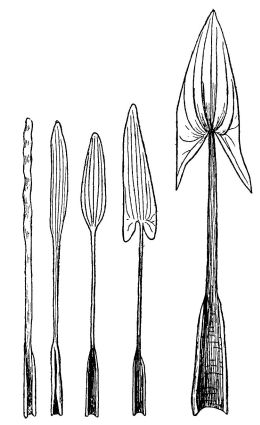
Fig. 23.—Spring Succession of Leaves of Mature Plant of
Arrow-head (Sagittaria sagittifolia). 1/3.
problem of avoiding submergence; and the stomata are confined to the
upper side, which alone is in contact with the atmosphere. Those water
plants which raise their leaves into the air, on the other hand, have
leaves of a variety of shapes, which in most respects approach those of
land plants. An interesting progression of leaves illustrating all
three stages may be watched in spring in the Arrow-head (Sagittaria
sagittifolia). The first leaves produced are entirely submerged, and
conform to the usual ribbon shape and delicate texture. Those which
follow float on the surface. In them the lower part is contracted into a
flaccid winged petiole, the upper part being expanded into an oblong
floating blade with a waxy surface to keep the leaf dry on the upper
side. These in turn give way to the characteristic aerial arrow-shaped
leaves of summer, which approach in character the leaves of land plants,
and are borne on stout, stiff petioles capable of resisting wind and
wave.
Coming now to FLOWERS, it is possible here to refer only to a few
macroscopic or “naked-eye” characters and modifications; the full study
of the flower and its essential functions being a matter for the
laboratory and the high-power microscope, as very minute structures are
involved. As briefly described in Chapter IV., flowers are groups of
modified leaves arranged mostly very close together at the ends of
branches, the tip of the shoot being often expanded into a receptacle
(very well seen in the Compositæ—e.g., Dandelion) for the
accommodation of the crowded floral leaves. Just as the foliage leaves
have become modified to carry on to the best advantage the process of
assimilation, so the different series of floral leaves are specially
adapted to their several functions. The sepals, which compose the
calyx, having usually a protective rôle, in most cases enclose the
young flower with a tough envelope; they usually retain their primitive
green colour, and take part in the process of assimilation. They may
drop off as the flower opens (e.g., Poppy), or wither as the petals
wither, or remain fresh until the fruit is ripe. Sometimes, as in many
Ranunculaceæ (compare Anemone, Caltha, Helleborus), they take on
the advertising rôle usually assigned to the petals, being large and
coloured, while the petals themselves are minute. In the Monocotyledons
they usually join with the petals in adorning the flower. The next
whorl, lying inside (that is, above) the sepals, is formed of petals,
constituting the corolla. The connection of colour and form of petals
with the visits of insects, and their relative insignificance in
wind-pollinated flowers, has already been referred to (p. 81). The
marvellous variety of colour and form observable in the corolla has for
its main object the attracting of insects to the flower. The petals have
departed much farther from the ordinary leaf-form than the sepals. They
assume brilliant hues of every tint, the pigment being due either to
colouring matter dissolved in the cell-sap (pinks and blues) or to small
coloured solid bodies (chromoplasts) contained in the cells (reds and
yellows). Chlorophyll being absent, the coloured petals do not assist
assimilation: they are purely advertisements, though incidentally they
often fulfil a useful protective rôle for the important organs which
they surround. In this latter connection their sensitiveness to changes
of light and temperature, which causes them to close in dark or cold
weather, is a very familiar phenomenon; as is also the excellent
protection which they provide in flowers such as those of the Labiatæ,
where, fused together into a tube, they form a kind of cave in which the
stamens and pistil nestle securely.
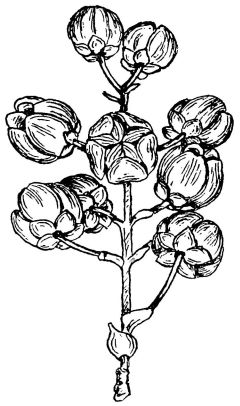
Fig. 24.—Fruit of Coriaria japonica. 1/1.
An exceptional use of petals, where indeed they are used for the
purposes of advertisement, but to secure the dispersal not of the
pollen, but of the seeds, is illustrated in Fig. 24. In the genus
Coriaria the staminate and pistillate organs are borne on separate
flowers. The flowers of both kinds are small and inconspicuous. But in
the “female” flowers the petals persist after flowering, and, becoming
fleshy and comparatively large, enclose the seed in a pulpy berry-like
envelope, which no doubt serves the same purpose as a true berry in
securing seed-dispersal by being devoured by birds. In C. terminalis,
which comes from the Himalayas, the “ripe” corolla is bright orange; in
C. japonica, from Japan, it is at first coral-red, and when mature
velvet-black.
The stamens, which form the next ring (sometimes a double ring or a
close spiral), are much less leaf-like than the sepals or petals, yet
there can be no doubt that they are descended from leaf-shaped organs;
this is especially clear from the study of certain primitive fossil
types, in which the corresponding organs which bear the pollen are
actually leaf-like. In most of the present-day Seed Plants the stamens
conform to a uniform type—a slender stalk (filament) bearing a head
(anther) containing four chambers, in which are produced pollen
grains, which escape when the flower is mature by the splitting of the
enclosing walls. The ways in which the pollen is then conveyed to the
pistil of other flowers have been referred to briefly on a previous page
(p. 82). The stamens in many flowers are few, and their number usually
bears a relation to the number of the other floral parts; in other
flowers, for instance Rose and St. John’s wort (Hypericum), they are
of large and indefinite number. The peculiar arrangement of the pollen
in Orchids has been already noted (p. 94).
The final ring of modified leaves in our typical flower constitutes the
pistil, formed of one or many carpels, the essential structure of
which has been touched on already (p. 82). In the present place it is
desired only to point out some of the leading modifications which the
pistil undergoes, so that its structure as seen by the naked eye may be
understood. In the simpler forms of carpel, the affinity to leaves is
still evident, though in forms of pistil made up of a number of carpels
this may be very difficult to trace. With the Pea, for instance, we may
begin, as presenting a very simple example. Take an oblong leaf like
that of a Laurel, and fold it down the mid rib till the two edges are in
contact. There is our pea-pod complete. The young seeds, or ovules,
are borne in a row along the mid rib, a very usual arrangement. Examine
next the young fruit of a Columbine (Aquilegia). Here there is a group
of five separate erect carpels, but each is essentially like a pea-pod
in structure. Compare the fruit of a Saxifrage. This clearly consists of
two carpels which are grown together save at the tips, where the two
styles stand out like little horns. From this we may go on to other
pistils in which several carpels are completely fused together. Next,
the compact body thus formed may be sunk down in the expanded top of the
stem (the receptacle). Or the other parts of the flower—sepals, petals,
stamens—may in their lower part be fused with the walls of the pistil,
and may thus appear to spring from the top of it. In such cases the
structure of the flower may easily be wrongly interpreted, and reference
to a work on systematic botany is necessary if pitfalls are to be
avoided. It is indeed to be noted that in flowers, as in other parts of
plants, complicated structure or multiplication of parts is not
necessarily an indication of advanced evolution; on the contrary, it is
often indicative of a primitive condition. Just as in machinery or in
organized human effort simplification often accompanies improvement, so
it is with plant structures. Many of the more primitive types of
flowers, such as Buttercups or Water Lilies, have a multitude of petals
or stamens or carpels, while in many of the most specialized, such as
Composites or Campanulas, the number of parts is much reduced. The
primitive wind-pollinated flowers produce large quantities of pollen;
in those which have adopted the improved method of utilizing insects,
the amount of pollen is much less; in the highly specialized Orchids, a
most successful group, the pollen is reduced to two small bundles.
Once the act of pollination is effected, the duty of the petals and
stamens is finished, and they generally fade. The sepals often remain,
as in the Rose. By the growth of the pollen tube from the stigma into
the ovary, fertilization is effected, and mature seed is produced. The
fruit—that is, the seed and its coverings or appendages—offers the
most varied forms of any of the plant organs—compare Hazel, Strawberry,
Pea, Apple, Cranesbill, Dandelion; the variety is endless. Many of these
forms are connected with the means by which seed-dispersal is effected:
this subject has been touched on in Chapter III. But in numerous
instances we can no more assign a reason for their beautiful or
fantastic forms than we can account for the infinite variety of shape
assumed by leaves and flowers.
Summing up, then, what has been sketched in this chapter, we must think
of our plant as a very complicated and wonderful machine, of which the
terrestrial Seed Plant is the highest expression. Water is the basis on
which its activities are founded—the currency in which all business is
transacted. The amount of water contained in a growing plant is seldom
realized. Even solid timber, when growing, is half wood, half water. A
fresh lettuce loses 95 per cent. of its weight if the water is driven
off by drying. Living in an aerial medium which tends to deprive it of
moisture continually, and which furnishes water to the soil only
intermittently in the form of rain, and often in sparing quantity, the
plant envelops itself from end to end of its exposed portions in a
waterproof cuticle; the only openings in its surface layer are the
spongy tips of the root hairs on the one hand, and in the stomata on the
other. These minutest of openings—so small that the number on a square
inch of leaf surface often far exceeds a hundred thousand—might prove
danger-points were they not most jealously watched over. But each is
provided with a pair of guard-cells ready to close the opening at any
moment; and where drought threatens, the whole of the stomata are found
in concealed positions. An ample pipe-system extends from root, through
stem, to leaf, but it does not communicate directly with the openings at
either end. All material, whether liquid or gaseous, absorbed or given
out, has to run the gauntlet of the living cells, which are jealous
watchmen, and allow only selected substances to pass through them. The
crude building materials and food materials are assembled in the leaves,
where in cells spread out to the light the chlorophyll is massed. Under
the microscope, the chlorophyll is seen to be located in minute granules
embedded in the semifluid contents of the cells. Well may we gaze in
wonder at these tiny green specks. Each is so small that although a
couple of hundred of them are often present in each cell, they occupy
but a very small proportion of its volume. The cells themselves are of
microscopic size. The chlorophyll itself occupies only quite a small
portion of the corpuscle in which it is immersed; yet on its activity as
spread in this infinitesimal quantity through the leaves the whole
organic world, animal as well as vegetable, depends.[9] Utilizing the
energy which comes through space from the sun, it builds up organic
compounds; from the energy thus stored comes all the varied life and
vital movement which fill our world—the opening of flowers, the hum of
insects, the march of armies, and our own restless thought; while its
work in the distant past, laid by in coal and oil, warms our houses and
drives our trains, factories, and steamships.
The work of the living chlorophyll accomplished, the food materials
produced by its agency are sent by the pipe-system to all parts of the
plant, for present use, or to be stored in root, stem, or leaf for
future requirements.
Nor is our plant the passive, motionless thing that it may appear to be
in comparison with animals and their larger movements. Active motion,
local and general, though usually of relatively small amount,
accompanies all plant-growth. Throughout root, stem, leaf, and flower
transference of material is going forward vigorously. The root hairs and
stomata are working at high pressure; the chlorophyll never ceases its
activities while daylight lasts. Externally, the growing branches,
leaves, and flowers also display incessant movement, sweeping the air in
small circles, or in the case of climbing plants in curves of
considerable amplitude. Alterations of illumination or of temperature
produce other movement—bendings towards or away from light, the
drooping of leaves and closing of flowers at nightfall, and so on.
All these phenomena of growth and movement culminate in the production
of flowers, and in the remarkable developments by which, through the
agency of pollen and ovule, a new generation is produced.