| | | PAGE |
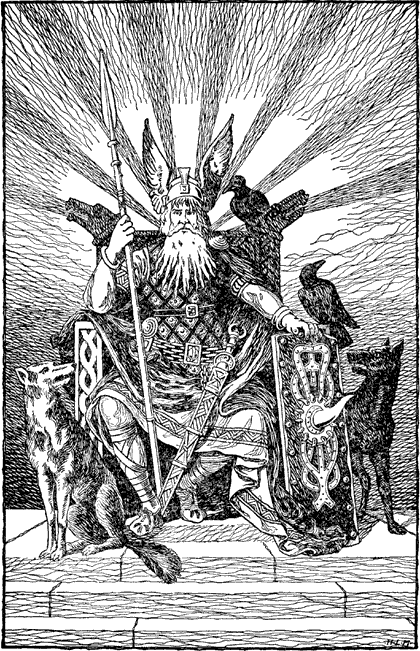
| Odin, the Allfather | Frontispiece |
| The Norns | | 5 |
| Thor Chaining Fenrir | | 19 |
| Freyja in the Cave of the Dwarfs | | 27 |
| Thor and Loki in the Chariot | | 41 |
| Thor’s Battle with the Frost Giants | | 53 |
| Iduna giving Loki the Apple | | 69 |
| Skadi hunting in the Mountains | | 79 |
| The Punishment of Loki | | 99 |
| Thor fighting the Serpent | | 105 |
The people who lived
long ago, in the far-off
lands of the north,
watched the wonderful
things that happened out
of doors every day, just as we do; but they did not
know about the one loving God, who is the Father
of all, who made them and the world, and rules it by
his wise laws; so they thought there must be a great
many unseen powers, living in the clouds, in the wind,
in the storms, and the sunshine, and doing all those
wonders that no man could do.
And so those northern people, who were our own
forefathers, came to believe in many gods—one for
the sun, another for the thunder, another for the
flowers, and so on.
In the long, dark winters, when the bright sun had
gone away from them, these northmen had time to
think many thoughts about the powers of frost, and
wind, and storms, which they called giants, and they
used to tell stories and sing songs about the short,
bright summer, the thawing out of the streams and
lakes, the coming of the birds and flowers.
With great joy the people saw the bright sun-god,
Baldur, come back to them in the spring, after the
long darkness, and knew that they owed their lives to
his friendly warmth and light.
As we read the stories, or myths, told by those
people long ago, we can see that they were meant to
tell about the world around us. At first the stories
were told and sung from father to son—that is, from
one generation to another; but later, when people
learned how to write, these myths were written down,
and kept with great love and care.
This is the story they told of the Beginning. At
first, before living creatures were in the world, it was
all rough and without order. Far to the north it was
very cold, for ice and snow were everywhere. Toward
the south there was fire, and from the meeting of the
fire and the cold a thick vapor was formed, from which
sprang a huge giant. On looking about for some food,
he saw a cow, who was also searching for something to
eat. The ice tasted salt, and when the cow began to
lick it, a head appeared, and at last the whole figure
of a god stood before her.
From these two, the giant and the god, came the
two great races of giants and gods, who were always
enemies to each other. The giants were constantly
trying to break into Asgard, the home of the gods, in
the sky; the gods, on the other hand, watched and
planned to keep out the giants, and to drive them
back to their own stronghold, Utgard. Our world,
where men and women lived, was between Utgard
and Asgard; it was called Midgard, and around this
Midgard world, under the ocean, was coiled a monstrous
serpent, who grew so long that his tail grew
down his throat. He was called the Midgard serpent.
A wonderful tree, named “Yggdrasil,” connected all
the worlds. This great ash tree had its roots in
Utgard, and the tops of its branches reached up so
high as to overshadow Asgard. Its three main roots
were watered by three fountains, and near one of them
sat the wise giant Mimir, of whom we shall hear later.
The Norns, three sisters, also lived at the roots of
Yggdrasil, and were careful to see that it was watered
every day.
A little gray squirrel was always running up and
down the tree, jerking his tail and hurrying to tell
the news to every one along the way. He was so
anxious to be the first one to carry the news, that
many times he brought trouble to himself and to
others, because he was not always careful to tell a
story just as he had heard it, and often every one
would have been happier if the squirrel had kept the
story quite to himself.
The gods and goddesses, all together, were called
the Æsir, and the chief and father of them all was
Odin. His lofty throne rose high in the midst of
Asgard, the sacred city, which the gods had built for
their beautiful home.
From Asgard, arching over and down to the lower
world, was a rainbow bridge, called Bifröst—“the
trembling bridge”; upon this the dwellers in Asgard
could travel every day, all except the mighty Thor.
His thunder chariot was too heavy for “the trembling
bridge,” so he had to go around a longer way.
After the gods had made men and women, and had
taught them to dwell on the earth, in the world of
Midgard, Odin looked forth one morning from his
heavenly seat, to see what further work was waiting
for his helping hand.
He noticed, far away below him, a race of small
beings, some of them busy, doing mischievous deeds,
while others sat idle, doing nothing. Odin sent for
all these little people to come to him, and when they
had reached Asgard, and were admitted to his palace
of Gladsheim, they entered the great judgment hall,
where they found all the Æsir sitting, with Father
Odin at their head.
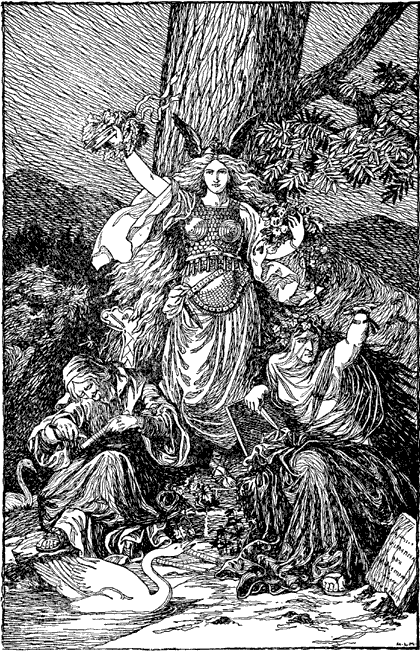 After the painting by Ehrenberg,
THE NORNS.
The little people waited in a crowd near the door,
wondering what was going to happen to them, while
Hermod, the messenger of the gods, ran to his master
to say that they had come.
Then the Allfather spoke to the little dwarfs about
their evil deeds among men, and he told the naughtiest
ones that they must go and live down underground,
and look after the great furnace fire in the middle of
the earth, to keep it always burning. Some must get
coal to feed the fire, and others still were to have charge
of the gold, and silver, and precious stones, under the
rocks. Not one of these busy dwarfs must ever appear
during the day; only by night might they venture to
leave their tasks.
“And now,” said Odin, turning to the idle ones,
“what have you been doing?”
“We were doing nothing at all, so we could not
have harmed any one, and we pray you to spare us!”
cried they.
“Do you not know that those who sit idle when
they should be doing good deserve punishment, too?”
said Odin. “I shall put you in charge of all the trees
and flowers, and shall send one of the Æsir to teach
you, so that you may be doing some good in the world.”
Then the little elves went to work among the
flowers, and Frey, the bright god of summer and sunshine,
was a kind master to them. He taught them
how to open the folded buds in the sunshine, to fill
the honey cups, and lead the bees along the flower
passages to find their food, to hatch the birds’ eggs,
and teach the little ones their songs, and then each
night to fetch the water for dewdrops, to be hung on
every leaf and blade of grass.
When their work was finished, and the moon had
risen, these busy elves and fairies enjoyed many a
happy evening, dancing and frisking on the green by
moonlight. And so our world of Midgard was filled
with busy work and play.
Even now, in our time, the people in the lands of
the north, and in Germany, have many old sayings
and stories that have come down to them from the
days long ago. There is a beautiful white flower in the
north, which is called Baldur’s Brow, because it is so
pure and bright, like the face of the dear sun-god,
Baldur; and in some places, when the farmers gather
in their harvest of grain, they leave a little bunch of it
standing in the field, for Father Odin’s horse.
We have some English names to remind us of
those old tales of our forefathers, for we have Tuesday
named for Tyr, or Tiu, the brave god who gave
his right hand to save his friends; Wednesday, or
Wodensday, named for Odin; Thursday, for Thor,
the thunder-god; and Friday, for either the goddess
Frigga, or Freyja, or for Frey, the god of summer,
who ruled the fairies.
One night when
all was quiet in Asgard
and the Æsir had gone to rest,
Odin, the Allfather, sat awake on
his high throne, troubled with many
thoughts. At his feet crouched his two faithful wolves,
and upon his shoulders perched the two ravens of
thought and memory, who flew far abroad every day,
through the nine worlds, as Odin’s messengers.
The Allfather had need of great wisdom in ruling
the worlds; after thinking a long time on the matters
which needed his care, he suddenly started up,
and went forth with long strides from his palace of
Gladsheim into the night. He soon returned, leading
his beautiful, eight-footed steed, Sleipnir, and it
was plain that Odin was going on a journey. He
quickly mounted Sleipnir, and rode swiftly away
toward Bifröst, the rainbow bridge, which reached from
Asgard, the city of the gods, down through the air
to the lower worlds.
When Sleipnir stepped upon the bridge it trembled,
and seemed hardly strong enough to bear the horse
and his rider; but they had no fear of its giving
way, and Sleipnir galloped swiftly onward.
Soon Odin saw Heimdall, the watchman of the
bridge, riding toward him on a fine horse, with a
golden mane that reflected light upon the noble face
of his rider.
“You must be bound on some important errand,
Father Odin, to be riding forth from Asgard so late
at night,” said Heimdall.
“It is indeed a most important errand, and I must
hasten on,” replied Odin. “It is well for us that we
have such a faithful guardian of the ‘trembling bridge’;
if it were not for you, Heimdall, our enemies might
long ago have taken Asgard by storm. You are so
watchful, you can hear the grass grow in the fields,
and the wool gather on the backs of the sheep, and
you need less sleep than a bird. I myself stand in
great need of wisdom, in order to take care of such
faithful servants, and to drive back such wicked
enemies!”
They hurried over the bridge until they came to
Heimdall’s far-shining castle, at the farther end of it.
This was a lofty tower which was placed so as to
guard the bridge, and it sent forth into the land of
the giant enemies such a wonderful, clear light, that
Heimdall could see, even in the darkest night, any one
who came toward the bridge. Here Odin stopped a
few moments to drink the mead which the good
Heimdall offered him.
Then said Odin, “As I am journeying into the land
of our enemies, I shall leave my good horse with you;
there are not many with whom I would trust him,
but I know that you, my faithful Heimdall, will take
good care of him. I can best hide myself from the
giants by going on as a wanderer.”
With these words the Allfather quitted Heimdall’s
castle, and started off toward the north, through the
land of the fierce giants.
During all the first day there was nothing to be
seen but ice and snow; several times Odin was nearly
crushed as the frost giants hurled huge blocks of ice
after him.
The second day he came to mountains and broad
rivers. Often when he had just crossed over a
stream, the mountain giants would come after him
to the other bank, and when they found that Odin
had escaped them, they would send forth such
a fierce yell, that the echoes sounded from hill to hill.
At the end of the third day, Odin came to a
land where trees were green and flowers blooming.
Here was one of the three fountains which watered
the world tree, Yggdrasil, and near by sat the
wise giant, Mimir, guarding the waters of this wonderful
fountain, for whoever drank of it would have
the gift of great wisdom.
Mimir was a giant in size, but he was not one of
the fierce giant enemies of the gods, for he was kind,
and wiser than the wisest.
Mimir’s well of wisdom was in the midst of a wonderful
valley, filled with rare plants and bright flowers,
and among the groves of beautiful trees were
strange creatures, sleeping dragons, harmless serpents,
and lizards, while birds with gay plumage flew and
sang among the branches. Over all this quiet valley
shone a lovely soft light, different from sunlight, and
in the center grew one of the roots of the great world
tree. Here the wise giant Mimir sat gazing down
into his well.
Odin greeted the kind old giant, and said, “Oh,
Mimir, I have come from far-away Asgard to ask a
great boon!”
“Gladly will I help you if it is in my power,”
said Mimir.
“You know,” replied Odin, “that as father of gods
and men I need great wisdom, and I have come to
beg for one drink of your precious water of knowledge.
Trouble threatens us, even from one of the
Æsir, for Loki, the fire-god, has lately been visiting
the giants, and I fear he has been learning evil ways
from them. The frost giants and the storm giants are
always at work, trying to overthrow both gods and
men; great is my need of wisdom, and even though
no one ever before has dared ask so great a gift, I
hope that since you know how deep is my trouble,
you will grant my request.”
Mimir sat silently, thinking for several moments,
and then said, “You ask a great thing, indeed,
Father Odin; are you ready to pay the price which
I must demand?”
“Yes,” said Odin, cheerfully, “I will give you all
the gold and silver of Asgard, and all the jeweled
shields and swords of the Æsir. More than all, I
will give up my eight-footed horse Sleipnir, if that
is needed to win the reward.”
“And do you suppose that these things will buy
wisdom?” said Mimir. “That can be gained only by
bearing bravely, and giving up to others. Are you
willing to give me a part of yourself? Will you
give up one of your own eyes?”
At this Odin looked very sad; but after a few
moments of deep thought, he looked up with a bright
smile, and answered, “Yes, I will even give you one
of my eyes, and I will suffer whatever else is asked,
in order to gain the wisdom that I need!”
We cannot know all that Odin bravely suffered in
that strange, bright valley, before he was rewarded
with a drink from that wonderful fountain; but we
may be quite sure that never once was the good
Allfather sorry for anything he had given up, or
any suffering he had borne, for the sake of others.
Odin, the Allfather, sat one
day on his high air-throne,
and looking around him, far
and wide, saw three fierce monsters.
They were the children
of the mischievous fire-god Loki, and Odin began to
feel anxious, for they had grown so fast and were
getting so strong that he feared they might do harm
to the sacred city of Asgard. The wise father knew
Loki had given strength to these dreadful creatures,
and he saw that all this danger had come upon the
Æsir from Loki’s wickedness.
One of these monsters was a huge serpent, that
Odin sent down into the ocean, where he grew so
fast that his body was coiled around the whole world,
and his tail grew into his own mouth. He was called
the Midgard serpent.
The second monster was sent to Niflheim, the home
of darkness, and shut up there.
The third, a fierce wolf, named Fenrir, was brought
to Asgard, where Odin hoped he might be tamed by
living among the Æsir, and seeing their good deeds,
and hearing their kind words; but he grew more and
more fierce, until only one of all the gods dared to
feed him. This was the brave god, Tyr. He was
a war-god, like Thor, and is sometimes called the
Sword-god. Tyr was loved by all because he was so
true and faithful.
Each day the dreadful wolf grew larger and
stronger, till all at once, before the Æsir thought
about it, he had become a very dangerous beast.
Father Odin always looked troubled when he saw
Fenrir, the wolf, come to get his evening meal of meat
from Tyr’s hand, and at last one night, after the wolf
had gone growling away to his lair, Odin called a
meeting of the Æsir. He told them of his fears,
saying they must find some plan for guarding themselves
and their home against this monster. They
could not slay him, for no one must ever be killed,
and no blood must be shed, within the walls of the
sacred city.
Thor was the first to speak: “Do not fear, Father
Odin, for by to-morrow night we shall have Fenrir so
safely bound that he cannot do us any harm. I will
make a mighty chain, with the help of my hammer,
Miölnir, and with it we will bind him fast!”
When the Æsir heard these words of Thor, they
were glad, and all went home rejoicing—all save the
Allfather, who was still troubled, for he well knew
the danger, and feared that even the mighty Thor
would find this task too much for him. But Thor
seized his hammer, and strode off to his forge. There
he worked the whole night long, and all through Asgard
were heard the blows of Miölnir and the roaring
of the bellows.
The next night, when the Æsir were gathered together,
Thor brought forth his new-made chain, to
test it. In came Fenrir, the wolf, and every one was
surprised to see how willingly he let himself be
bound with the chain. When Thor had riveted the
last links together, the gods smiled, and began to
praise him for his wonderful work; but all at once
the wolf gave one bound forward, broke the great
chain, and walked off to his lair as if nothing had
happened.
Thor was much disappointed, still he did not lose
courage. He said to the Æsir that he would make
another chain, yet stronger. Again he set to work,
and for three nights and three days the great Thor
worked at his forge without resting.
While he worked his friends did not forget him.
They came and looked on while he was busy, and,
as they watched the mighty hammer falling with quick
blows upon the metal, they talked to Thor or sang
noble songs to cheer him; sometimes they brought
him food and drink. One visitor, who was no friend,
fierce Fenrir, the wolf, sometimes put his nose in at
the door for a moment, and watched Thor at work;
then, as he went away, Thor heard a strange sound
like a wicked laugh.
At last the chain was finished, and Thor dragged
it to the place of meeting. It was so heavy that
even the mighty Thor could hardly lift it, or drag it
as far as Odin’s palace of Gladsheim. This time
Fenrir was not so willing to be bound; but the gods
coaxed him, and talked of his great strength, and
told him they were sure he would easily break this
chain also. After a while he agreed to let them put
it around his neck.
This time Thor was sure the chain would hold
firm, for never before had such a strong one been
made. But soon, with a great shake and a fierce
bound, the wolf broke away, and went off to his lair,
snarling and showing his wicked teeth, while the
broken chain lay on the ground.
Sadly the Æsir came together that night in Odin’s
palace, and this time Thor was not the first to speak;
he sat apart and was silent.
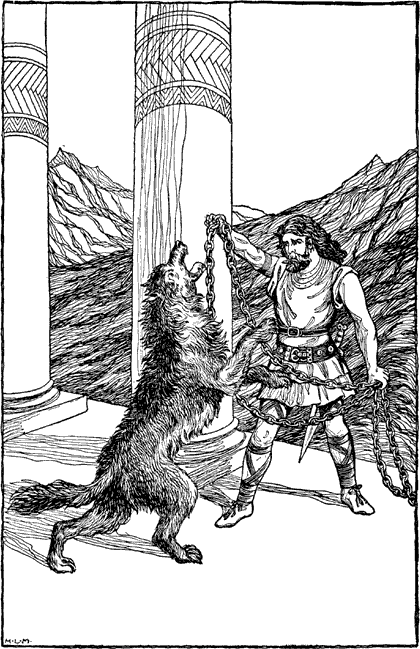 THOR CHAINING FENRIR.
First spoke Frey, the god of summer and king of
the fairies. “Hearken to me, O lords of Asgard!”
he said. “I have not won a brave name in battle,
like the noble Tyr, neither have I done such mighty
deeds as the great Thor and others of our heroes.
Instead of fighting giants and monsters, I have spent
most of my life in the woods, among the flowers,
listening for hours to the birds. Many things have
I watched, some perhaps that my brothers thought
too small to be worthy of notice. I have learned
many lessons, and the greatest of them all is to know
how much power there is in little things, and to see
how often the work, done quietly, and hidden from
the eyes of men, is the finest and the most wonderful.
Since we cannot make a chain strong enough to bind
Fenrir, let us go to the little dwarfs, who work in
silence and in darkness, and ask them to make us a
chain!”
The Allfather’s troubled face grew brighter as he
heard Frey speak, and he bade him send a messenger
quickly to the dwarfs, to order a chain made as soon
as possible.
So Frey went out, leaving the Æsir in their trouble,
and came to his own lovely home, Alfheim. There
everything was bright and peaceful, and the little
elves were busy and happy. Frey found a trusty
messenger, and sent him with all speed to the dwarfs
underground, to order the new chain, and to return
as soon as he could bring it. The faithful servant
found the funny little dwarf workmen all busy in their
dark rock chambers, far down inside the earth, while
at one side, in a lighter place, sat their king. The
messenger bowed before him, and told him his errand.
The dwarfs were a wicked race, but they were
afraid of Odin, for they had not forgotten the talk
he once had with them, when he sent them down to
work in darkness underground, and since that time
they never had dared disobey him. The dwarf king
said it would take two days and two nights to make
the chain, but it would be so strong that no one
could break it.
While the busy dwarfs were at work, the messenger
looked about at the many wonderful things: the great
central fire which burns always in the middle of the
earth, watched and fed with coal by the dwarfs; above
this, the beds of coal, and bright precious diamonds,
which the dwarfs took from the ashes of the fire. In
another place he watched them putting gold and silver,
tin and copper, into the cracks in the rocks, and
he drank of the pure, underground water, which gives
the Midgard people fresh springs.
After two days this messenger returned to the dwarf
king. The king, holding out in his hand a fine, small
chain, said to the messenger: “This may seem to
you to be small and weak; but it is a most wonderful
piece of work, for we have used in it all the strongest
stuff we could find. It is made of six kinds of things:
the noise made by the footfall of cats, the roots of
stones, the beards of women, the voice of fishes, the
spittle of birds, the sinews of bears. This chain can
never be broken; and if you can once put it on Fenrir,
he will never be able to throw it off.”
Odin’s messenger was glad to hear this, so he
thanked the dwarf king, and promising him a large
reward, he went on his way back to Asgard, where
the Æsir were longing for his return, and were all
rejoiced to see him with the magic chain.
Now Father Odin feared that Fenrir would not let
them bind him a third time, so he proposed they
should all take a holiday, and go out to a beautiful
lake to the north of Asgard, where they would have
games and trials of strength. The other gods were
pleased with this plan, and all set out in Frey’s wonderful
ship, which was large enough to hold all the
Æsir with their horses, and yet could be folded up
small enough to go in one’s pocket.
They landed on a lovely island in the lake, and after
the races and games were over, Frey brought out the
little chain, and asked them all to try to break it.
Thor and Tyr tried in vain; then Thor said, “I do
not believe any one but Fenrir can break it.”
Now the wolf did not want to be bound again; but
he was very proud of his strength, and, for fear of
being called a coward, said at last he would let them
do it, if he might hold the right hand of one of the
Æsir in his mouth while they bound him, as a sign
that the gods did not mean to play any tricks.
When the gods heard this, they looked at each other,
and all but one of them drew back. Only the brave,
good Tyr stepping forward, quietly put his hand into
Fenrir’s mouth. The other gods then put the chain
around the beast, and fastened it to a great rock.
The fierce creature gave a leap to free himself, but
the more he struggled the tighter grew the chain.
The Æsir gathered about him in joy to see this, but
their hearts were filled with sorrow when they saw
that their noble Tyr had lost his right hand; the
dreadful wolf had shut his teeth together in his rage,
when he found he could not get free.
Thus the brave Tyr dared to risk danger for the
sake of saving others, and gave up even his right
hand to gain peace and happiness for Asgard.
“Yes, I really
must have some
flowers to wear
to the feast to-night,”
said Freyja
to her husband, Odur.
Freyja was the goddess of love and beauty; she was
the most beautiful of all the Æsir, and every one loved
to look at her charming face, and to hear her sweet
voice.
“I think you look quite beautiful enough as you are,
without flowers,” Odur replied, but Freyja was not
satisfied; she thought she would go and find her
brother Frey, the god of summer, for he would give
her a garland of flowers. So she wandered forth from
Asgard on her way to Frey’s bright home in Alfheim,
where he lived among his happy, busy little elves.
As Freyja walked along she was thinking of the feast
to be given that night in Asgard, and knowing that
all the gods and goddesses would be there, she wished
to look her very best.
On and on she wandered, not thinking how far she
was getting away from home. Finally the light began
to grow fainter and fainter, and Freyja found herself
in a strange place. The sunlight had faded away, but
there was still a little light that came from lanterns
carried by funny little dwarfs, who were busily working.
Some were digging gold and gems, others were
cleaning off the dirt from the precious stones, and
polishing them to make them bright, while four little
fellows were seated in one corner, putting the sparkling
stones together into a wonderful necklace.
“What can that beautiful thing be?” thought
Freyja. “If only I had that, it would surely make
me look more beautiful than any one else at the
feast to-night!” And the more she thought about
it, the more she longed to get it. “Oh, I really
must have it!” she said to herself, and with these
words she stepped nearer to the four little men.
“For what price will you sell me your necklace?”
she asked.
The dwarfs looked up from their work, and when
they saw Freyja’s lovely face and heard her sweet
voice, said, “Oh, if you will only look kindly upon
us, and be our friend, you may have the necklace!”
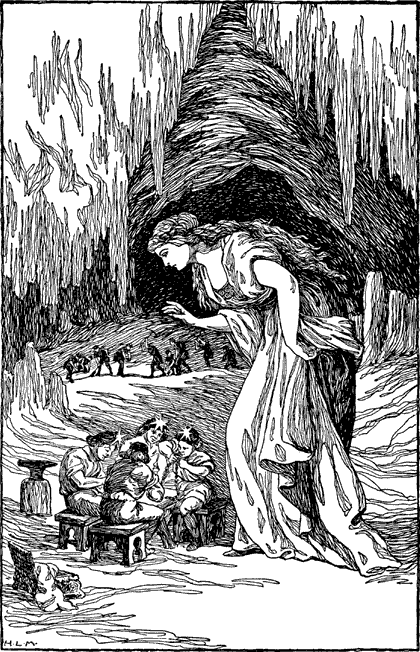 FREYJA IN THE CAVE OF THE DWARFS.
Then a mocking laugh echoed again and again
through the dark cavern, seeming to say, “How
foolish you are to wish for these bright diamonds;
they will not make you happy!” But Freyja snatched
the necklace and ran out of the cavern. It did not
please her to hear the teasing laugh of the dwarfs, and
she wanted to get away from them as soon as possible.
At last she was once more out in the open air;
she tried to be free and happy again, but a strange
feeling of dread came over her, as if something were
going to happen. Soon she came to a still pool of
water, and, putting on the necklace, she bent over
to look at her picture in the clear water. How
beautiful the diamonds were! and how they sparkled
in the sunshine! She must hasten home to show
them to Odur.
The fair goddess soon reached Asgard, and hurried
to the palace to find her husband. But Odur
was not there. Over and over again she searched
through all the rooms in vain; he had gone, and
although Freyja had her beautiful necklace, she cared
little for it without her dear husband.
Soon it was time to go to the feast, but Freyja
would not go without Odur. She sat down and wept
bitter tears; she felt no joy now for having the necklace,
and no sorrow because she could not feast with
the Æsir.
If only Odur would come back, all would be well
again. “I will go to the end of the world to find
him!” said Freyja, and she began to make ready for
her journey. Her chariot, drawn by two cats, was
soon ready; but before she could start, she must
first ask Father Odin to allow her to go.
“Allfather, I beg you give me leave to go to look
for my Odur in every corner of the world!”
The wise father replied, “Go, fair Freyja, and may
you find whom you seek.”
Then she started forth. First to the Midgard
world the goddess of beauty went, but no one in all
the world had seen or heard of Odur. Down under
the earth, to Niflheim, and even to Utgard, the land
of giants, she wandered, but still no one had seen
or even heard of her husband. Poor Freyja wept
many tears, and wherever the teardrops fell, and
sank into the ground, they turned into glistening
gold.
At last the sad goddess returned to her own palace
alone. She still wore the wonderful necklace, which
was called Brisingamen.
One night, when the hour was late, all the Æsir
were asleep, except the ever watchful Heimdall, who
heard soft footsteps, like those of a cat, near Freyja’s
palace. He listened, and thought, “That is surely
some one bent on mischief; I must follow him.”
When Heimdall reached the palace, he found it
was Loki, changed into another form, creeping softly
about. Heimdall quietly watched him, and saw him
glide in to Freyja’s bedside, where the fair goddess
lay asleep, wearing her beautiful necklace. Loki had
come to steal the necklace, but when he saw that
she was lying on the clasp of the chain, so that he
could not undo it without waking her, he changed
himself into a gnat, and, crawling along on the pillow,
stung her just enough to make her turn over,
but not enough to wake her. Then he unclasped
the chain and ran off with it as fast as he could.
But Heimdall was not going to let the thief get
away. As soon as Loki found that he was followed,
he took his other form, a little flame of fire;
Heimdall then took his other shape, and became
a shower of rain, to put out the fire; but Loki,
quick and watchful, changed himself into a bear,
to catch the rain. Then Heimdall too became a bear,
and a fierce fight began. At last the rain-god conquered,
and forced wicked Loki to give back the
necklace to Freyja.
The whole land seemed to feel sorry for poor,
lonely Freyja; the leaves fell from the trees, the
bright flowers faded, and the singing birds flew away.
Once more the fair goddess went forth from Asgard
to seek Odur. Away, away to the far-off sunny
south she wandered, and there, where the myrtle trees
and the oranges grow, at last she found her long-lost
husband.
Then hand in hand the two turned northward again,
to their home, and so happy were they together, that
they spread joy and happiness around them as they
passed along. Everywhere the ice and snow thawed
before them, green grass and sweet flowers sprang up
behind their footsteps, the birds sang their sweetest
songs, the warm summer came back to the north
lands, and every one was glad and joyful, for lovely,
smiling Freyja was at home again.
“White were the moorlands
And frozen, before her;
Green were the moorlands
And blooming, behind her.
Out of her gold locks
Shaking the spring flowers,
Out of her garments
Shaking the south wind,
Around in the birches
Awaking the throstles,
Beautiful Freyja came.”
—Kingsley.
Sif was the wife of
mighty Thor, the thunder-god,
and she was
very proud of her beautiful
golden hair, which she
combed and braided with
great care. One morning
when she awoke she was filled with grief and dismay
to find that her lovely hair had been cut off in the
night, while she slept. Her husband happened to be
away that day, but when he came home late at night,
Sif was careful to keep out of his sight, she felt so
ashamed of her shorn head.
Thor, however, soon called for Sif, and when he saw
what had been done to her, he was very angry. Now
Thor had a quick temper; every one feared his fierce
anger. “Who could have done this wicked deed?”
thought he. “There is only one among all the Æsir
who would think of doing such a thing!”
Thor lost no time in finding Loki, and that mischief-god
had to admit that he was the guilty one, but he
begged Thor to give him just a few days, and he
promised to get something for Sif that would make her
look more beautiful than ever. So Thor decided to
give him a chance to try, and commanded him to
give back to Sif her golden hair.
Now Loki knew a place where some wonderful
workmen lived, so he went off, as fast as he could
go, to Niflheim, the home of the dwarfs, under the
earth, and asked one of them to make quickly some
golden hair for Sif. Besides this, he asked for two
gifts to carry to the gods Odin and Frey, so that they
might be on his side if Thor should bring his complaint
before the Æsir.
Loki did not have to wait long before the dwarf
brought him a quantity of beautiful hair, spun from
the finest golden thread. It had the wonderful power
of growing just like real hair, as soon as it touched
any one’s head. Besides this, there was a spear for
Odin, which never missed its aim, no matter how far
it was thrown, and for Frey, a ship that could sail
through the air as well as the sea. Although it was
large enough to hold all the gods and their horses,
yet it could be folded so that it was small enough to
put in one’s pocket.
Loki was greatly pleased with these wonderful presents,
and declared that this dwarf must be the most
skillful workman of them all. Now it happened that
another dwarf, named Brock, heard him say this, and
he told Loki that he was sure he and his brother could
make more wonderful things than these.
Loki did not believe that could be done, but he
told Brock to try his skill; the Æsir should judge
between them and the one who should fail in the
trial must lose his head.
Then Brock called his brother, Sindri, and they
set to work at once. They first built a great fire,
and Sindri threw into it a lump of gold; then he
told Brock to blow the bellows while he went out,
and be sure not to stop blowing until he should
come back.
Brock thought this an easy task, but his brother
had not long been gone when a huge fly came in and
buzzed about his face, and bothered him so that he
could hardly keep on blowing; still he was able to
finish his work, so that when Sindri came back, they
took out of the fire an enormous wild boar, which gave
out light, and could travel through the air with wonderful
speed.
On the second day Sindri threw another lump of
gold into the fire, and left his brother to blow the
bellows. Again the buzzing, stinging fly came, and
was even more troublesome than before; but Brock
tried very hard to be patient, and was able to bear
it without stopping his work until Sindri returned.
Then they took from the fire a magic ring of gold,
from which eight new rings fell off every week.
The third day a lump of iron was put into the fire,
and Brock was again left alone. In came the cruel
fly,—have you guessed that it was really that mischief-maker
Loki? He bit the poor little dwarf so
hard on the forehead that the blood ran down into
his eyes, and blinded him so that he could no longer
see to do his work.
Poor Brock had to stop just before Sindri came
home, but not before the hammer which they were
making in the fire was nearly finished, only the
handle came out rather too short. This magic hammer
was named Miölnir. It had the power of never
missing its mark, and would always return to the
hand which threw it.
When Loki appeared at last before the Æsir, with
the two dwarf brothers and their gifts, it was
declared that they had made the finest things, for
the hammer, which was given to Thor, would surely
be most useful in keeping the giants out of Asgard.
When Loki found that the judgment was against
him, he started to run away; but Thor soon made
him turn back by threatening to throw his hammer
after him.
Then Loki had to collect his wits, and think of
some way to escape losing his head, instead of making
the dwarfs pay the forfeit, as he had expected. At
last he told Brock and Sindri that they could have
his head, according to the agreement, but as nothing
had been said about his neck, they could not, of
course, touch that.
Thus the wily Loki, by his wit, saved his life.
One morning Thor
asked Loki, the fire-god,
if he would like
to go forth with him
to Utgard, the stronghold
of the giants, where he was going to try, with
his mighty hammer, to conquer those fierce enemies
of Asgard. Loki was glad to go with him, and the
two gods started forth in Thor’s chariot, drawn by
two goats.
Thor often went on a journey, so the dwellers in
Asgard did not wonder to see him getting ready for
a long drive. As Thor and Loki drove along, the
heavy chariot rattled, and made the thunder echo
among the hills. People in our world, down below
in Midgard, heard the rumbling, and said: “What
a heavy thunderstorm! How the thunder crashes
and rumbles!”
Toward evening the travelers stopped at a peasant’s
hut, and Thor, alighting from his chariot, went to
the door of the house, to ask shelter for the night.
“I will gladly give you a room, but I have no food
in the house,” said the man who opened the door.
“Oh, never mind that,” said Thor; “I will provide
the food.” So Thor and Loki stopped for the
night at the peasant’s hut. They found the family
within, the man, his wife, and two children, a boy
and a girl. All looked on in great surprise to see
Thor kill his two goats and cook them for the evening
meal. “Eat all you wish of the meat,” said
Thor, “but be careful not to break any of the bones;
throw them all into the two skins which I have
spread upon the floor.”
Now the boy, whose name was Thialfe, wondered
why Thor should say this, and as he happened to have
a piece of the leg-bone, he thought there could be no
harm in breaking it open, to get out the soft marrow
to eat. Thor was just then talking to Loki, and did
not notice what had been done; but next morning the
boy learned a lesson that he never forgot.
When Thor was ready to start off again, next day,
he held his magic hammer over the skins in which lay
the bones. All at once the goats became whole again,
and stood there just the same as before, except that
one of them limped with his hind leg.
Then the young Thialfe knew why Thor had told
them not to break the bones. At first, when he saw
Thor’s angry face, and how he grasped his hammer,
the boy was frightened, and wanted to run away; but
soon he remembered it would be cowardly to do that,
so he went to Thor, and asked his forgiveness. Now
the mighty thunder-god, though often angry, was
always just and kind. After scolding the boy as he
deserved, he freely forgave him, and said that he and
his sister might go along with Loki and himself on
their journey.
The four started off, after saying good-by to the
peasant and his wife, leaving in their charge the
chariot and goats, for it seemed best to finish the journey
on foot.
At nightfall they entered a thick forest, through
which they wandered on for miles, when all at once
they came upon a house, and a strange-looking house
it was. The wide front door opened into a big room;
at the left was a small room, and just opposite the
front door were four long, narrow rooms.
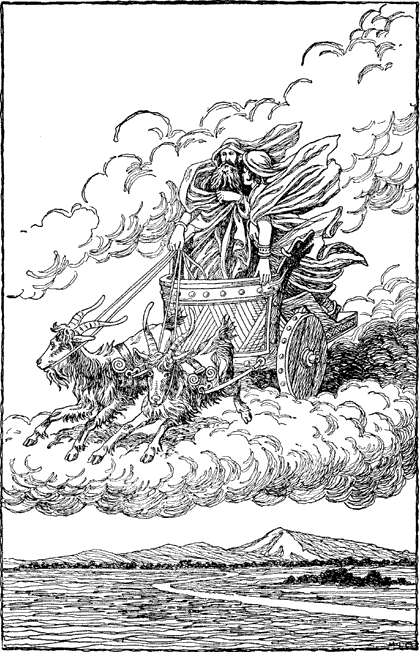 THOR AND LOKI IN THE CHARIOT.
The travelers wondered to find a house in the
depths of a forest, but they were glad to have shelter
for the night, and all lay down for a good rest.
Soon after midnight they were awakened by groans
and strange sounds, and the earth began to tremble.
Thor sent his companions into the farthest room,
grasped his hammer, and stood on guard by the door.
At daybreak he started forth to find out what had
caused the noise. He had not gone far when he came
upon a huge giant, lying on the ground asleep, and
Thor found that he was making the earth tremble with
his snoring, which must have been the sound they had
heard in the night.
While Thor was looking at the giant, he awoke, and
spoke to the god. “Ho, ho! I think you little fellow
must be Thor, of whom I have often heard, but really,
I did not think you were quite so small! Now the sun
is up, and I must be off; but where is my other glove?
Oh, here it is, on the ground!” And the giant
stooped and picked up his glove, which was the very
house in which our four travelers had spent the night,
with the big front door where the hand went in, the
thumb for the one side-room, and the four narrow
finger-rooms opposite the door.
“If you are going my way, you may come along
with me,” said the giant. So they journeyed together
for one day, but even mighty Thor could hardly keep
up with the giant’s long strides.
When night came, the giant stopped under a large
oak tree, and said, “I am going to sleep; you may
eat your supper, if you wish; here is a bag full of
things.” Saying this, he fell asleep, and was soon
snoring. But when Thor tried to open the bag of
food, he could not untie the cord. This made him
angry, for the giant had tied up their food with his
own. He looked at the huge figure lying before him
asleep, and when he thought what a mean trick the
giant had played upon them, Thor seized the magic
hammer, and threw it at him.
“Did a leaf fall on me?” said the giant, sleepily.
“Haven’t you eaten your supper yet? Well, I am
going to sleep again.” And soon he was snoring
louder than before. Thor grasped his hammer tighter
than ever, and threw it with such strength that it
seemed as though it must surely have killed the giant;
but again he rubbed his eyes, and said, “I thought
an acorn fell on my head!” He had hardly spoken
when he was asleep again.
Then a third time Thor hurled his hammer with all
his strength, and it seemed to hit his enemy in the forehead,
and was buried out of sight, but the giant only
said: “I think there must be birds overhead in this
tree; I thought a feather dropped down on me. Are
you awake, Thor? I think we’d better be going on
with our journey, and if you are bound to go to
Utgard, I will show you the way, but I advise you to
go home instead; you will find bigger fellows than I
in Utgard!”
But Thor had made up his mind to go on, and
nothing could make him change. At noontime the
four friends left their giant guide, whose path led
another way. They had not traveled far when Thor
spied a large city looming up before them, and soon
they came to Utgard, the home of the fierce giants.
Although it was surrounded by high walls, Thor and
his friends were able to creep through the bars of the
great gate. When they came to the palace and found
its door open, they went in, and there sat all the giants
with their king, Utgard-Loki, at their head. A quite
different Loki was this giant king from the mischievous
fire-god, the Loki from Asgard, who now stood before
him.
Upon seeing the four strangers, the king of the
giants said: “Why, this must be the god Thor. I
really did not suppose that you were such a little fellow,
Thor! but probably you are stronger than you
look. Now, before you sit down at our table, you must
each show some proof of your strength!”
Then Loki, who was very hungry, said he was sure
he could eat more than any one else; so the king
called one of the giants to come forth, saying to Loki,
“If you can indeed eat more than one of my men, you
will perform a great feat.”
A huge trough, full of meat, was brought in, and
Loki began eating at one end, while the giant began
at the other. They reached the center together; but
Loki had eaten only the meat, while the giant had
devoured meat, bones, trough, and all.
Thialfe, the peasant boy, took his turn next, and
boasted that he was the fastest runner of them all.
“Oh,” said the king, “it will be a most wonderful feat
if you can win a race against one of my men!” The
first time Thialfe ran the course he kept ahead until
near the end, and was beaten by only a few yards. The
second time he came off worse, and the third time he
was only halfway around when the giant had reached
the goal.
Thor, however, was not at all cast down by the
failure of the others, and he proposed to try a drinking
match. So the king brought forth a long drinking
horn, saying, “My men usually empty this in one
draught, if they are very thirsty, though sometimes
they have to take it in two swallows, or even three.”
Then Thor put his lips to the drinking horn, and
took one long, deep pull, thinking he had surely
emptied it, but to his surprise, the water had lowered
only a few inches. Again he lifted the horn, feeling
sure he should empty it this time, yet he did no better
than before. The king said, “You have left a great
deal for your last drink!”
This made Thor try his very best; but it was of no
use, he could not empty the horn.
“So you are not as strong as you seemed, after all!
Do you care to try anything else?” said the king of
the giants, in a mocking tone.
“Oh, certainly, anything you like!” replied Thor.
“Well,” said the king, “I will give you something
easy this time, since I see you are not as strong as
I expected. You may try to lift this cat from the
floor; it would be mere child’s play for one of my
men.”
Thor put out his hand to lift the cat, but he could
raise only one paw, though he used all his strength.
“Well, it is no more than I expected!” said the
king; “you boast of your strength, but you do not
show it to us.”
By this time Thor was getting very angry, and
he spoke fiercely, “I will challenge any one of you
to fight with me!”
The king looked about the hall to find some
one small enough to wrestle with Thor. Then he
said, “All my men are too large, I shall have to
send for one of the women!” Soon a bent old
woman came hobbling in, and Thor thought it would
be nothing to overcome her; but the longer they
wrestled, the stronger the old woman became, and
at last, when it was plain that she was going to win,
and Thor had been thrown down upon the floor, the
king called to them to stop.
Thor and his friends were then invited to sit down
at the feast, and the next morning, after a good breakfast,
they started on their journey homeward. Utgard-Loki,
the giant king, went with them to the city gate,
and when he was about to leave them, said, “Do
you find it as easy as you expected to overthrow the
giants?”
“No,” said Thor, who was too honest to hide his
shame, “I am vexed that I have done so little, and
I know that after this failure, you will all laugh at
my weakness.”
“No, indeed,” replied the king; “since you are now
well outside our stronghold I will tell you the truth
about what you saw there, and I will take good care
not to let you get in again. You have greatly surprised
us all, for we did not dream that you were so
strong, and I have had to use magic to hold out
against you.
“When you met the first giant in the forest you
would have killed him with your hammer, if he
had not put a mountain between himself and you.
Loki was a wonderful eater, but we matched him
against fire, and who can devour more than fire?
The boy was a swift runner, and I had to make
him race against thought, in order to beat him; what
can be swifter than thought? The horn, from which
you drank, was the ocean, and you took such a mighty
draught, that the people in Midgard saw the tide ebb.
It was really not a cat you tried to lift, but the Midgard
Serpent, and you pulled him so far that we
feared he would let go his hold. Then you wrestled
with Old Age, and who is there that can overcome
Old Age?”
With these words the giant king vanished, and
Thor, upon looking around, saw the city of Utgard
was also gone.
Then silently, but with many thoughts of these
strange things, Thor and Loki, with the boy and
the girl, made their way back to Asgard.
“Come, Loki,
are you ready? My
goats are eager to
be off!” cried Thor,
as he sprang into his
chariot, and away they
went, thundering over the
hills. All day long they journeyed,
and at night they lay down to rest
by the side of a brook.
When Baldur, the bright sun-god, awoke them in
the morning, the first thing Thor did was to reach
out for Miölnir, his magic hammer, which he had
carefully laid by his side the night before.
“Why, Loki!” cried he. “Alas, my hammer is
gone! Those evil frost giants must have stolen it
from me while I slept. How shall we hold Asgard
against them without my hammer? They will surely
take our stronghold!”
“We must go quickly and find it!” replied Loki.
“Let us ask Freyja to lend us her falcon garment.”
Now the goddess, Freyja, had a wonderful garment
made of falcon feathers, and whoever wore it looked
just like a bird. As you may suppose, this was
sometimes a very useful thing. So Thor and Loki
went quickly back to Asgard, and drove with all
speed to Freyja’s palace, where they found her sitting
among her maidens. “Asgard is in great danger!”
said Thor, “and we have come to you, fair goddess,
to ask if you will lend us your falcon garment, for
my hammer has been carried off, and we must go in
search of it.”
“Surely,” answered Freyja, “I would lend you my
falcon cloak, even if it were made of gold and
silver!”
Then Loki quickly dressed himself in Freyja’s garment
and flew away to the land of the frost giants,
where he found their king making collars of gold
for his dogs, and combing his horses. As Loki came
near, he looked up and said, “Ah, Loki, how fare
the mighty gods in Asgard?”
“The Æsir are in great trouble,” replied Loki,
“and I am sent to fetch the hammer of Thor.”
“And do you think I am going to be foolish enough
to give it back to you, after I have had all the
trouble of getting it into my power?” said the
king. “I have buried it deep, deep, down in the earth,
and there is only one way by which you can get it
again. You must bring me the goddess Freyja to be
my wife!”
Loki did not know what to say to this, for he
felt sure that Freyja would never be willing to go
away from Asgard to live among the fierce giants;
but as he saw no chance of getting the hammer, he
flew back to Asgard, to see what could be done.
Thor was anxiously looking out for him. “What
news do you bring, Loki?” cried he. “Have you
brought me my hammer again?”
“Alas, no!” said Loki. “I bring only a message
from the giant king. He will not give up your hammer
until you persuade Freyja to marry him!”
Then Thor and Loki went together to Freyja’s
palace, and the fair goddess greeted them kindly,
but when she heard their errand, and found they
wished her to marry the cruel giant, she was very
angry, and said to Thor, “You should not have
been so careless as to lose your hammer; it is all
your own fault that it is gone, and I will never marry
the giant to help you get it again.”
Thor then went to tell Father Odin, who called a
meeting of all the Æsir, for it was a very serious
matter they were to consider. If the king of the
giants only knew the power of the mighty hammer,
he might storm Asgard, and carry off the fair Freyja
to be his bride.
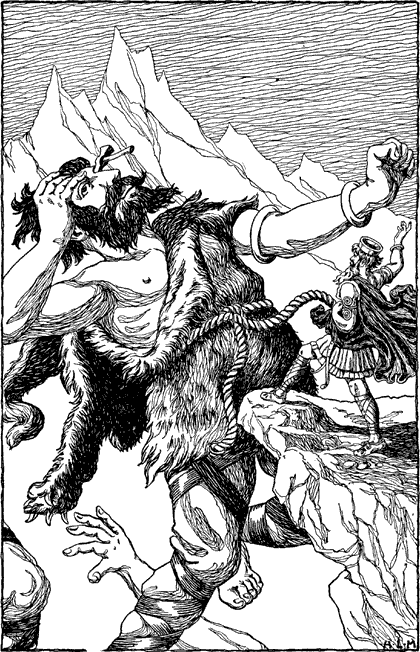 THOR’S BATTLE WITH THE FROST GIANTS.
So the Æsir met together in their great judgment
hall, in the palace of Gladsheim; long and anxiously
they talked over their peril, trying to find some plan
for saving Asgard from these enemies. At last Heimdall,
the faithful watchman of the rainbow bridge,
proposed a plan.
“Let us dress Thor,” said he, “in Freyja’s robes,
braid his hair, and let him wear Freyja’s wonderful
necklace, and a bridal veil!”
“No, indeed!” cried Thor, angrily, “you would
all laugh at me in a woman’s dress; I will do no
such thing! We must find some other way.” But
when no other way could be found, at last Thor was
persuaded to try Heimdall’s plan, and the Æsir went
to work to dress the mighty thunder-god like a bride.
He was the tallest of them all, and, of course, he
looked very queer to them in his woman’s clothes,
but he would be small enough beside a giant. Then
they dressed Loki to look like the bride’s waiting-maid,
and the two set off for Utgard, the stronghold
of the giants.
When the giant king saw them coming he bade
his servants make ready the wedding feast, and
invited all his giant subjects to come and celebrate
his marriage with the lovely goddess Freyja.
So the wedding party sat down to the feast, and
Thor, who was always a good eater, ate one ox and
eight salmon, and drank three casks of mead. The
king watched him, greatly surprised to see a woman
eat so much, and said:—
“Where hast thou seen
Such a hungry bride!”
But the watchful Loki, who stood near by, as the
bride’s waiting-maid, whispered in the king’s ear,
“Eight nights has Freyja fasted and would take no
food, so anxious was she to be your bride!”
This pleased the giant, and he went toward Thor,
saying he must kiss his fair bride. But when he
lifted the bridal veil, such a gleam of light shot
from Thor’s eyes that the king started back, and
asked why Freyja’s eyes were so sharp.
Again Loki replied, “For eight nights the fair
Freyja has not slept, so greatly did she long to reach
here!” This again pleased the king, and he said,
“Now let the hammer be brought and given to the
bride, for the hour has come for our marriage!”
All this time Thor was so eager to get his treasure
back that he could hardly keep still, and if it had not
been for what the wily Loki said, he might have
been found out too soon. But at last the precious
hammer was brought and handed to the bride, as
was always the custom at weddings; as soon as Thor
grasped it in his hand, he threw off his woman’s
robes and stood out before the astonished giants.
Then did the mighty Thunderer sweep down his
foes, and many of the cruel frost giants were slain.
Once more the sacred city of Asgard was saved from
danger, for Thor was its defender, and he was careful
never again to let his magic hammer be taken
from him.
Besides the hammer, Thor had two other precious
things, his belt of strength, which doubled his
power when he tightened it, and his iron glove,
which he put on when he was going to throw the
hammer.
“I am the God Thor,
I am the War God,
I am the Thunderer!
Here in my Northland,
My fastness and fortress,
Reign I forever!
“Here amid icebergs
Rule I the nations;
This is my hammer,
Miölnir the mighty;
Giants and sorcerers
Cannot withstand it!
“These are the gauntlets
Wherewith I wield it,
And hurl it afar off;
This is my girdle,
Whenever I brace it
Strength is redoubled!”
—Longfellow
Long years ago
there lived a peasant and
his wife, who led a quiet,
busy life on their little
farm at the foot of a mountain.
While the wife was busy indoors with her housework,
her husband watched his flocks in the fields,
or sometimes wandered up the mountain-side to hunt
for game, which he would carry home for dinner.
One day he had strayed farther than usual, and
found himself on the top of the mountain, where
the ground was covered with ice and snow. All at
once he came upon a high arched doorway opening
into a great glacier, and he passed through to see
whither it might lead.
The passageway widened out into a wonderful cavern,
like a broad hall, sparkling with precious stones,
and long, shining stalactites, that looked like icicles
of marble. In the midst stood a beautiful goddess,
surrounded by fair maidens, all dressed in silvery
robes, and crowned with flowers.
The shepherd was so overcome by the wonder of
this sight that he sank upon his knees. Then the
goddess stretched forth her hands and gave him her
blessing, telling him to choose whatever he wished,
to carry home from the cavern. The man was no
longer afraid when he heard her kind voice speaking
to him, so he looked about, and at last humbly asked
to have the pretty blue flowers which the fair one
held in her hand.
The lovely goddess Frigga, or Holda, as the German
people called her, smiled kindly, and told the
poor shepherd he had made a wise choice. She
gave him her bunch of blue flowers, with a measure
of seed, saying to him, “You will live and be prosperous
so long as the flowers do not fade.”
The peasant bowed thankfully before the goddess,
and when he rose she had vanished, and he was alone
on the mountain-side, just as usual, with no cavern,
no sparkling stones, and no fair maidens to be seen.
If it had not been for the pretty blue flowers and the
measure of seed in his hand, he would have thought
it all a dream.
He hurried homeward to tell his wife, who was
angry when she heard the story, for she thought he
had made such a foolish choice. “How much better
it would have been,” said she, “if you had brought
home some of those precious stones you tell about,
which are worth money, instead of these good-for-nothing
flowers!”
The poor man bore her angry words quietly, and
made the best of what he had. He went to work at
once to sow his seeds, which he found, to his surprise,
were enough to plant several fields.
Every morning before he led his flock to pasture,
and on his way home at night, he watched the little
green shoots growing in his fields. Even his wife
was pleased when she saw the lovely blue blossoms
of the flax opening; then, after they had withered and
fallen, the seeds formed. Sometimes it seemed to the
good man, as he stood in the twilight looking over
his field, that he saw a misty form, like the beautiful
goddess, stretching out her hands over the field of
flax, to give it her blessing.
When at length the seeds had ripened, Frigga
came again to show the peasant how to gather his
harvest of flax, and to teach his wife to spin and
weave it into fine linen, which she bleached in the
sun. The people came from far and near to buy the
linen, and the peasant and his wife found themselves
busy and happy, with money enough and to spare.
When they had lived many years, and were growing
old among their children and grandchildren, the
peasant noticed one day that the bunch of blue flowers,
given to him so many years before, and which
had always kept bright, were beginning to fade;
then he knew he had not much longer to stay.
He climbed slowly up the mountain-side, and found
the door of the cavern open. A second time he
went in, and the kind goddess Frigga took the
peasant by the hand, and led him away to stay
with her, where she always took care of him.
Frigga was the queen of the gods, and she helped
her husband, Odin, govern the world. It was her
part to look after the children, and help the mothers
take care of their families.
Odin, the wise father
of the gods, started off
one day on a journey through
Midgard, the world of men, to see how his people
were getting on, and to give them help. He took
with him his brother Hönir, the light-giver, and Loki,
the fire-god. Loki, you know, was always ready to
go wherever he could have any fun or do any mischief.
All the morning they went about among the homes
of Midgard, and whenever Odin found busy, faithful
workers, he was sure to leave behind some little thing
which would hardly be noticed, a straw in the farmer’s
barn, or a kernel of grain in the furrow by the
plow, or a bit of iron at the blacksmith’s forge; but
always happiness and plenty followed his little gift.
At noontime Loki was so hungry that he begged
Odin to stop for dinner; so when they came to a
shady spot by the bank of a river, the three gods
chose it for their resting-place.
Odin threw himself down under a tree and began
to read his little book of runes, or wise sayings, but
Loki began to make a fire and get ready for the feast.
Then he started off to a farmhouse near by, leaving
Hönir to cook the meat which they had brought.
As Loki came near the farmhouse, he thought to
himself, “I will change myself into a cat, and then
I can have a better chance to spy about.” So he
changed himself into a black cat, and jumping upon
the kitchen window-sill, he saw the farmer’s wife taking
some cakes out of the oven. They smelled so
good and looked so tempting that Loki said to himself,
“What a prize those cakes would be for our
dinner!”
Just then the woman turned back to the oven to
get more cakes, and Loki snatched those which she
had laid on the table. The good housewife soon
missed her cakes; she looked all about, and could
not think what had become of them, but just as
she was taking the last lot from the oven, she
turned quickly around, and saw the tail of a cat
whisking out of the window.
“There!” cried she, “that wicked black cat has
stolen my nice cakes. I will go after him with my
broom!” But by the time she reached the door all
she could see was a cow walking in her garden, and
when she came there to drive her away, nothing was
to be seen except a big raven and six little ones flying
overhead.
Then the mischievous Loki went back to the river
bank, where he had left his two friends, and showed
them the six cakes, boasting of the good joke he
had played upon the poor woman. But Odin did not
think it was a joke. He scolded Loki for stealing,
and said, “It is a shame for one of the Æsir to be a
thief! Go back to the farmhouse, and put these
three black stones on the kitchen table.”
Loki knew that the stones meant something good
for the poor woman, and he did not wish to go back
to the house; but he had to do as the Allfather told
him. As he went along he heard his friends the foxes,
who put their heads out of their holes and laughed
at his tricks, for the foxes thought Loki was the
biggest thief of them all.
Changing himself into an owl, Loki flew in at the
kitchen window, and dropped from his beak the three
stones, which, when they fell upon the white table,
seemed to be three black stains.
The next time the good woman came into her
kitchen, she was surprised to find that the dinner was
all cooked. And so the wonderful stones that Odin had
sent brought good luck; the housewife always found
her food ready cooked, and all her jars and boxes filled
with good things to eat, and never again was in need.
The other women all said she was the best housekeeper
in the village, but one thing always troubled
her, and that was the table with the three black stains.
She scrubbed, and scrubbed, but could never make it
white again.
And now we must go back to Loki. He was very
hungry by this time, and hoped that Hönir would
have the meat nicely cooked when he came back to
the river bank, but when they took it out of the
kettle, they found it was not cooked at all. So Odin
went on reading his book of runes, not thinking about
food, while Hönir and Loki watched the fire, and at
the end of an hour they looked again at the meat.
“Now, it will surely be done this time!” said Loki,
but again they were disappointed, for the meat in
the kettle was still raw. Then they began to look
about to see what magic might be at work, and at last
spied a big eagle sitting on a tree near the fire.
All at once the bird spoke, and said, “If you will
promise to give me all the meat I can eat, it shall be
cooked in a few minutes.”
The three friends agreed to this, and in a short time,
as the bird had promised, the meat was well done,
Loki was so hungry he could hardly wait to get it
out of the kettle, but suddenly the eagle pounced
down upon it, and seized more than half, which made
Loki so angry that he took up a stick to beat the bird,
and what do you think happened? Why, the stick,
as soon as it touched the bird’s back, stuck fast there,
and Loki found he could not let go his end of it.
Then away flew the eagle, carrying Loki with him,
over the fields and over the tree-tops, until it seemed
as though his arms would be torn from his body. He
begged for mercy, but the bird flew on and on. At
last Loki said, “I will give you anything you ask, if
you will only let me go!”
Now the eagle was really the cruel storm giant
Thiassi, and he said, “I will never let you go until
you promise to get for me, from Asgard, the lovely
goddess Iduna, and her precious apples!”
When Odin and Hönir saw Loki whisked off through
the air, they knew that the eagle must be one of their
giant enemies, so they hurried home to Asgard to
defend their sacred city. Just as they came to Bifröst,
the rainbow bridge, Loki joined them; but he took
care not to tell them how the eagle came to let
him go.
Odin felt sure that Loki had been doing something
wrong, but knowing very well that Loki would not
tell him the truth, he made up his mind not to ask
any questions.
The goddess Iduna, whom Loki was to tempt away
out of Asgard, was the dearest of them all. She was
the fair goddess of spring and of youth, and all the
Æsir loved her. Her garden was the loveliest spot,
with all sorts of bright, sweet flowers, birds singing
by day and night, little chattering brooks under the
great trees, and everything happy and fresh. The
gods loved to go and sit with Iduna, and rest in her
beautiful garden, within the walls of Asgard.
There was another delightful thing in the garden,
and that was Iduna’s casket. This was a magic box
filled with big, golden-red apples, which she always
gave her friends to taste. These wonderful apples
were not only delicious to eat, but whoever tasted
them, no matter how tired or feeble he might be,
would feel young and strong again. So the dwellers in
Asgard ate often of this wonderful fruit, which kept
them fresh and young, fit to help the people in the
world of Midgard. The casket in which Iduna kept
her apples was always filled, for whenever she took out
one, another came in its place; but no one knew where
it came from, and only the goddess of youth, herself,
could take the apples from the box, for if any one else
tried, the fruit grew smaller and smaller, as the hand
came nearer, until at last it vanished away.
A few days after Loki’s bargain with the giant Thiassi,
Iduna was in her bright garden one morning,
watering the flowers, when her husband, Bragi, came
to say good-by to her, because he must go on a
journey.
Loki watched him start off, and thought, “Now,
here is my chance to tempt Iduna away from Asgard.”
After a while he went to the garden, and found the
lovely goddess sitting among her flowers and birds.
She looked up at Loki with such a sweet smile, as he
came near, that he felt almost ashamed of his cruel
plan; but he sat down on a grassy bank, and asked
Iduna for one of her magic apples.
After tasting it, he smacked his lips, saying, “Do
you know, fair Iduna, as I was coming home toward
Asgard one day, I saw a tree full of apples which
were really larger and more beautiful than yours;
I do wish you would go with me and see them.”
“Why, how can that be?” said Iduna, “for Father
Odin has often told me that my apples were the largest
and finest he ever saw. I should so like to see those
others, and I think I will go with you now, to compare
them with mine.”
“Come on, then!” said Loki; “and you’d better
take along your own apples, so that we can try them
with the others.”
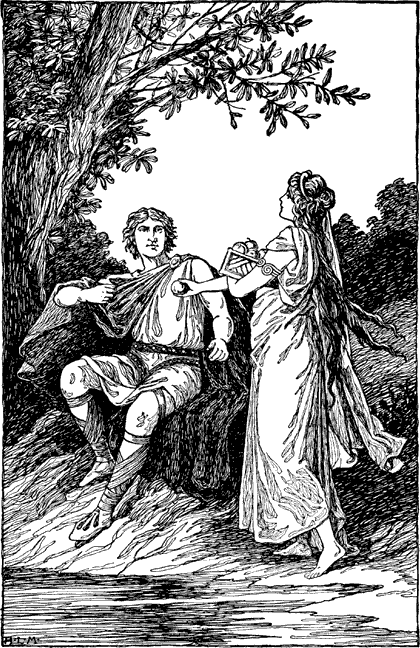 IDUNA GIVING LOKI THE APPLE.
Now Bragi had often told Iduna that she must
never wander away from home, but, thinking it would
do no harm to go such a little way, just this once,
she took the casket of apples in her hand and went
with Loki. They had hardly passed through the
garden gate, when she began to wish herself back
again, but Loki, taking her by the hand, hurried
along to the rainbow bridge.
They had no sooner crossed over Bifröst than
Iduna saw a big eagle flying toward them. Nearer
and nearer he came, until at last he swooped down
and seized poor Iduna with his sharp talons, and
flew away with her to his cold, barren home. There
she stayed shut up for many long dreary months,
always longing to get back to Asgard, to see Bragi
and her lovely garden.
The giant Thiassi had long been planning that if
he could only once get the fair goddess of youth in
his power, he would eat her magic apples, and so
get strength enough to conquer the Æsir; but now,
after all, she would not give him even one of them,
and when he put his hand into the casket, the apples
grew smaller and smaller, until at last they vanished,
so that he could not get even a taste.
This cruel storm giant kept poor Iduna closely shut
up in a little rock chamber, hoping that some day he
could force her to give him what he wanted. All
day long she heard the sea beating on the rocks
below her gloomy cell, but she could not look out, for
the only window was a narrow opening in the rock,
high up above her head. She saw no one but the
giant, and his serving-women, who waited upon her.
When these women first came to her, Iduna was
surprised to see that they were not ugly or stern-looking,
and, when she looked at their fair, smiling
faces, she hoped they would be friendly and pitiful
to her in her trouble. She begged them to help her,
and, with many tears, told them her sad story; but
still they kept on smiling, and when they turned
their backs, Iduna saw that they were hollow. These
were the Ellewomen, who had no hearts, and so could
never be sorry for any one. When one is in trouble,
it is very hard to be with Ellewomen.
Every day the giant came to ask Iduna, in his
terrible voice, if she had made up her mind to give
him the apples. Iduna was frightened, but she
always had courage enough to say “No,” for she
knew it would be false and cowardly to give to a
wicked giant these precious gifts which were meant
for the high gods. Although it was hard to be
a prisoner, and to see no one but the cold, fair Ellewomen
who kept on smiling at her tears, she knew
it was far better to belong to the bright Æsir, even
in prison, than to be a giant, or an Ellewoman, no
matter how free or smiling they might be.
All this while the dwellers in Asgard were sad and
lonely without their dear Iduna. At first they went to
her garden, as before, but they missed the bright goddess,
and soon the garden itself grew dreary. The
fresh green leaves turned brown and fell, the flowers
faded, no new buds opened. No bird-songs were
heard, and the saddest thing of all was that now the
gods had no more of the wonderful apples to keep them
fresh and strong, while two strangers, named Age and
Pain, walked about the city of Asgard, and the Æsir
felt themselves growing tired and feeble.
Every day they watched for Iduna’s return; at
last, when day after day had passed, and still she did
not come, a meeting of all the gods and goddesses was
called to talk over what they should do, and where they
should search for their lost sister.
Loki, you may be sure, took care not to show
himself at the meeting; but when it was found
out that Iduna had last been seen walking with him,
Bragi went after him, and brought him in before all
the Æsir.
Then Father Odin, who sat on his high throne, looking
very tired and sad, said: “Oh, Loki, what is this
that you have done? You have broken your promise
of brotherhood, and brought sorrow upon Asgard! Fail
not to bring home again our sister, or else come not
yourself within our gates!”
Loki knew well that this command must be obeyed,
and besides, even he was beginning to wish for Iduna
again; so, borrowing the cloak of falcon feathers which
belonged to the goddess Freyja, he put it on and set
out for Utgard and the castle of the giant Thiassi,
which was a gloomy cave in a high rock by the sea,
and there he found poor Iduna shut up in prison.
By good luck, the giant was away fishing when Loki
arrived, so he was able to fly in, without being seen,
through the narrow opening in Iduna’s rock cell. You
would have taken him to be just a falcon bird, but
Iduna knew it was really Loki, and was filled with joy
to see him. Without stopping to talk, Loki quickly
changed her into a nut, which he held fast in his falcon
claws, and flew swiftly northward, over the sea, toward
Asgard. He had not gone far when he heard a rushing
noise behind them, and he knew it must be the eagle.
Faster and faster flew the falcon with his precious nut;
but the fierce eagle flew still faster after them.
Meanwhile, for five days, the dwellers in Asgard
gathered together on the city walls, gazing southward,
to watch for the coming of the birds, while Loki and
Iduna, chased by Thiassi, the eagle, flew over the wide
sea separating Utgard, the land of the giants, from Asgard.
Each night the eagle was nearer his prey, and
the watchers in the city were filled with fear lest he
should overtake their friends.
At last they thought of a plan to help Iduna: gathering
a great pile of wood by the city walls, they set fire
to it. When Loki reached the place he flew safely
through the thick smoke and flame, for you know he was
the god of fire, and dropped down into the city with
his little nut held fast in his falcon claws. But when
the heavy eagle came rushing on after them, he could
not rise above the heat of the fire, and, smothered by
the smoke, fell down and was burned to death.
There was great joy in Asgard at having the dear
Iduna back again; her friends gathered around her,
and she invited them all into her garden, where the
withered trees and flowers began to sprout and blossom;
the gay birds came back, singing and building
their nests, and the happy little brooks went dancing
under the trees.
Iduna sat with Bragi among her friends, and they
all feasted upon her golden apples; she was so thankful
to be free, and at home in her garden again.
Once more the Æsir became young and strong, and
the two dark strangers went away, for happiness and
peace had come back to Asgard.
While Iduna’s
friends were still
crowding about her, all
joyful and glad at getting
her home again,
they spied some one afar off,
coming toward Asgard.
As the figure drew nearer, they saw it was Skadi,
the tall daughter of the frost giant Thiassi, who had
chased Iduna; she was dressed all in white fur, and
carried a shining hunting-spear and arrows. Slung
over her shoulder were snowshoes and skates, for
Skadi had come from her mountain home in the icy
north. Very angry about the loss of her father, she
had come to ask the Æsir why they had been so cruel
to him.
Father Odin spoke kindly to her, saying, “We
will do honor to your father by putting his eyes in
the sky, where they will always shine as two bright
stars, and the people in Midgard will remember Thiassi
whenever they look up at night and see the two
twinkling lights. Besides this, we will also give you
gold and silver.” But Skadi, thinking money could
never repay her for the loss of her father, was still
angry.
Loki looked at her stern face, and he said to himself,
“If we can only make Skadi laugh, she will
be more ready to agree to the plan,” and he began
to think of some way to amuse her. Taking a long
cord he tied it to a goat; it was an invisible cord,
which no one could see, and Loki himself held the
other end of it. Then he began to dance and caper
about, and the goat had to do just what Loki did.
It really was such a funny sight, that all the gods
shouted with laughter, and even poor, sorrowful Skadi
had to smile.
When the Æsir saw this, they proposed another
plan: Skadi might choose one of the gods for her
husband, but she must choose, from seeing only his
bare feet. The giantess looked at them all, as they
stood before her, and when she saw the bright face
of Baldur, more beautiful than all the rest, she agreed
to their plan, saying to herself, “It might be that
I should choose him, and then I should surely be
happy.”
The gods then stood in a row behind a curtain,
so that Skadi could see nothing but their bare feet.
She looked carefully at them all, and at last chose the
pair of feet which seemed to her the whitest, and of
the finest shape, thinking those must be Baldur’s;
but when the curtain was taken away, she was surprised
and sorry to find she had chosen Niörd, the
god of the seashore.
The wedding took place at Asgard, and when the
feasting was over, Skadi and Niörd went to dwell
in his home by the sea. At first they were very
happy, for Niörd was kind to his giant bride; but
how could you expect one of the Æsir to live happily
very long with a frost giantess for his wife?
Skadi did not like the roar of the waves, and hated
the cries of the sea-gulls and the murmur of gentle
summer winds. She longed for her frozen home, far
away in the north, amid ice and snow.
And so they finally agreed that, for nine months of
the year, Niörd should live with Skadi among her
snowy mountains, where she found happiness in hunting
over the white hills and valleys on her snowshoes,
with her hunting dogs at her side, or skating on the
ice-bound rivers and lakes. Then for the three short
months of summer Skadi must live with Niörd in his
palace by the sea, while he calmed the stormy ocean
waves, and helped the busy fishermen to have good
sailing for their boats.
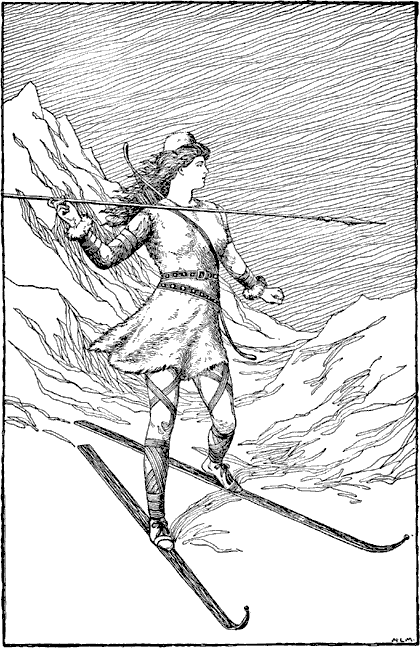 SKADI HUNTING IN THE MOUNTAINS.
Niörd loved to wander along the shore, his jacket
trimmed with a fringe of lovely seaweeds and his
belt made of the prettiest shells on the beach, with
the friendly little sandpipers running before him, and
beautiful gulls and other sea birds sailing in the air
above his head. Sometimes he loved to sit on the
rocks by the shore, watching the seals play in the
sunshine, or feeding the beautiful swans, his favorite
birds.
There is a kind of sponge, which the people in the
north still call Niörd’s glove, in memory of this old
Norse god.
Baldur was the best beloved
of all the gods. Odin
was their father and king;
to him they turned for help and wise advice, but it
was to Baldur they went for loving words and bright
smiles. The sight of his kind face was a joy to the
Æsir, and to all the people of Midgard. They sometimes
called him the god of light, a good name for
him, because he truly gave to the world light and
strength.
Baldur was the son of Odin and Frigga; he was the
most gentle and lovely of all the gods. His beautiful
palace in Asgard was bright and spotless; no evil creature
could enter there; no one who had wrong thoughts
could stay in that palace of love and truth.
At last, after the bright summer was over, for many
days Baldur had looked sad and troubled. Some of the
Æsir saw it, but most of all, his loving, watchful
mother, Frigga. Baldur could not bear to worry his
mother, so he kept his sorrow to himself, saying nothing
about it; but at last Frigga drew his secret from
him, and then his friends knew that Baldur had had
dreams which told of coming trouble, dreams of his
leaving all his friends and going away from Asgard,
to dwell in another land.
Odin and Frigga, fearing the dreams might come
true and they must lose their beloved son, began to
think what they could do to prevent it.
Then the loving mother said, “I will make all
things in the world promise not to hurt our son.” And
so Queen Frigga sent out for everything in the whole
world, and everything came trooping to Asgard, to her
palace. All living creatures came from the land, from
the water, and from the air. All plants and trees came;
all rocks, stones, and even the metals under the earth,
where the busy dwarfs worked. Fire came, and water,
as well as all poisons, and sickness. Everything promised
not to harm the good Baldur, except one little
plant called mistletoe, which was so small that Frigga
did not send for it, feeling sure it could not do any
harm.
“Now I am happy once more,” said the queen,
“for our Baldur is safe!” And she sat at peace in
her beautiful palace, rejoicing that her dear son was
free from all danger.
But Odin, the wise Allfather, still felt uneasy, even
after all these promises, fearing what might happen.
So he took his eight-footed steed, Sleipnir, and rode
forth from Asgard to the underworld to find Hela,
the wise woman who ruled over that far-off land. She
could tell everything that was going to happen, and
she knew the names of all those who were coming
to dwell with her. Odin was the only one wise
enough to speak with Hela, for no one else knew the
words that would call her forth from her dwelling;
but when Odin called, she came to answer.
“Tell me,” said he, “for whom are you making
ready this costly room?”
“We make ready for Baldur, the god of light,”
replied Hela.
“Who, then, will slay Baldur, and bring such darkness
and sorrow to Asgard?”
Again said the wise woman, “It is Hodur, Baldur’s
twin brother, who will slay the sun-god.” And with
these words she vanished.
Sadly Father Odin returned to Asgard, and told
his wife the words of Hela; but Frigga was not
troubled in her heart, for she felt sure that nothing
would hurt her dear son.
One beautiful sunny day at the end of summer
the gods had all gone out to an open field beyond
Asgard to have some sports. As they all knew
that nothing could hurt Baldur, they placed him at
the end of the field for a target, and then took
turns throwing their darts at him, just for the fun
of seeing them fall off without hurting him. They
thought this was showing great honor to Baldur, and
he was pleased to join in the sport.
Loki happened to be away when they began to play,
and when he came was angry in his heart that nothing
could hurt Baldur.
“Why should he be so favored? I hate him!”
said Loki to himself, and began at once to plan some
evil.
All this while Queen Frigga sat in her palace,
thinking of all her dear sons, and of how much good
they did to men. As she sat thus, thinking, and spinning
with her hands, there came a knock at the door.
The queen called, “Come in!” and an old woman
stood before her.
Frigga spoke kindly to her, and soon the old woman
said she had passed by the field where the gods were
playing, and throwing sharp weapons at Baldur.
“Oh, yes,” said Frigga; “neither metal nor wood
can hurt him, for all things in the world have given
me their promise.”
“What!” said the old woman; “do you mean that
all things have really vowed to spare Baldur?”
“All,” replied the queen, “except one little plant
that grows on the eastern side of Asgard; it is called
mistletoe, and I thought it too small and soft to do
any harm.”
Before long the old woman went away, and when
she was quite out of sight of Frigga’s palace, threw
off her woman’s clothes, and who do you suppose it
was? Why, no woman at all, but that wicked Loki,
of course, who hurried away out of Asgard, to find
the poor little plant that did not know about Baldur’s
danger. When he came to the place where the plant
grew, Loki cutting off a branch, quickly made a sharp
arrow, which he carried back to the playground, where
the Æsir were still at their game, all but one, Hodur,
the god of darkness, Baldur’s blind twin brother.
Then Loki went up to Hodur, and said to him in
a low voice, “Why do you not join with the others
in doing honor to Baldur?”
“I cannot see to take aim, you know, and besides,
I have no weapon,” said Hodur.
“Come, then, here is a fine new dart for you, and
I will guide your hand,” whispered wicked Loki;
then he slipped the arrow of mistletoe wood into
Hodur’s hand and aimed it himself at Baldur, who
stood there so bright and smiling.
Then poor blind Hodur heard a dreadful cry from
all the gods: Baldur the Beautiful had fallen, struck
by the arrow; he would now be taken away from
them, to live with Hela in the underworld.
Every heart was filled with sorrow for this dreadful
loss; but no one tried to punish him who had
done the wicked deed, for they stood upon sacred
ground, and the field was named the Peace-stead, or
Place of Peace, where no one might hurt another.
Besides, the gods did not know it was the false Loki
who hated Baldur, that had struck him down.
When Frigga heard the sad news, she asked who
would win her love by going to the underworld
and begging Hela to let Baldur come back to them.
Hermod, the swift messenger-god, ready to do his
mother’s bidding, set forth at once on the long journey.
Nine days and nights he traveled without resting,
until he came to Hela’s underworld. There he
found Baldur, who was glad to see him, and sent
messages to his friends in Asgard. Hela said Baldur
might return to them on one condition: that every
living creature, and everything in the world must
weep for him.
So Hermod hastened back to Asgard, and when
the Æsir heard Hela’s answer, they sent out messengers
over the world to bid all things weep for
Baldur, their bright sun-god. Then did the beasts,
the birds, the fishes, the flowers and trees, even
stones and metals weep; as indeed we can see the
teardrops come to all things when they are changed
from heat to cold.
As the messengers were coming back to Asgard
they met an old woman, whom they bade weep, but
she replied, “Let Hela keep Baldur down below; why
should I care?” When the Æsir heard of this, they
thought it must have been the same old woman who
went before to Frigga’s palace, and we know who
that was.
And so Baldur the beautiful, Baldur the bright,
did not come back, and all the dwellers in Asgard
were sad and sorrowful without him.
Ægir was
the ruler of the
ocean, and his home
was deep down below
the tossing waves, where the
water is calm and still. There was his beautiful
palace, in the wonderful coral caves; its walls all
hung with bright-colored seaweeds, and the floor of
white, sparkling coral sand. Such wonderful sea-plants
grew all about, and still more wonderful creatures,
some, which you could not tell from flowers,
waving their pretty fringes in the water; some sitting
fastened to the rocks and catching their food
without moving, like the sponges; others darting
about and chasing each other.
“Deep in the wave is a coral grove,
Where the purple mullet and goldfish rove;
Where the sea-flower spreads its leaves of blue,
That never are wet with falling dew,
But in bright and changeful beauty shine
Far down in the green and glassy brine.
The floor is of sand, like the mountain drift,
And the pearl-shells spangle the flinty snow;
From coral rocks the sea-plants lift
Their boughs where the tides and billows flow.
The water is calm and still below,
For the winds and waves are absent there,
And the sands are bright as the stars that glow
In the motionless fields of upper air.”
—Percival.
In that ocean home lived the lovely mermaids, who
sometimes came up above the waves to sit on the
rocks and comb their long golden hair in the sunshine.
They had heads and bodies like beautiful
maidens, with fish-tails instead of feet.
One day the gods in Asgard gave a feast, and
Ægir was invited. He could not often leave home
to visit Asgard, for he was always very busy with
the ocean winds and tides and storms; but calling
his daughters, the waves, he bade them keep the
ocean quiet while he was away, and look after the
ships at sea.
Then Ægir went over Bifröst, the rainbow bridge,
to Asgard, where they had such a gay party and such
feasting that he was sorry when the time came to go
home; but at last he said good-by to Father Odin
and the rest of the Æsir. He thanked them all for
the pleasure they had given him, saying, “If only I
had a kettle that held enough mead for us all to
drink, I would invite you to visit me.”
Thor, who was always glad to hear about eating
and drinking, said, “I know of a kettle a mile wide
and a mile deep; I will fetch it for you!”
Then Ægir was pleased, and set a day for them all
to come to his great feast.
So Thor took with him his brother, the brave Tyr,
who knew best how to find the kettle; and together
they started off in Thor’s thunder chariot, drawn by
goats, on their way to Utgard, the home of the
giants.
When they reached that land of ice and snow, they
soon found the house of Hymir, the giant who owned
“Mile-deep,” as the big kettle was called. The gods
were glad to find that the giant was not at home,
and his wife, who was more gentle than most of her
people, asked them to come in and rest, advising
them to be ready to run when they should hear the
giant coming, and to hide behind a row of kettles
which hung from a beam at the back end of the
hall. “For,” said she, “my husband may be very
angry when he finds strangers here, and often the
glance of his eye is so fierce that it kills!”
At first the mighty Thor and brave Tyr were
not willing to hide like cowards; but at last they
agreed to the plan, upon the good wife promising to
call them out as soon as she had told her husband
about them.
It was not long before they heard the heavy steps
of Hymir, as he came striding into his icy home; and
very lucky it was for Thor and Tyr that the giantess
had told them to hide, for when the giant heard that
two of the Æsir from Asgard were in his home, so
fierce a flash shot from his eyes that it broke the
beam from which the kettles hung, and they all fell
broken on the floor except Mile-deep.
After a while the giant grew quiet, and at last
even began to be polite to his guests. He had been
unlucky at his fishing that day, so he had to kill
three of his oxen for supper. Thor being hungry, as
usual, made Hymir quite angry by eating two whole
oxen, so that, when they rose from the table the giant
said, “If you keep on eating as much at every meal,
as you have to-night, Thor, you will have to find your
own food.”
“Very well,” said Thor; “I will go fishing with you
in the morning!”
Next morning Thor set forth with the giant, and
as they walked over the fields toward the sea, Thor
cut off the head of one of the finest oxen, for bait. Of
course you may know that Hymir was not pleased at
this, but Thor said he should need the very best kind
of bait, for he was hoping to catch the Midgard serpent,
that dangerous monster who lived at the bottom
of the ocean, coiled around the world, with his tail
in his mouth.
When they came to the shore where the boat was
ready, each one took an oar, and they rowed out to
deep water. Hymir was tired first, and called to
Thor to stop. “We are far enough out!” he cried
“This is my usual fishing-place, where I find the
best whales. If we go farther the sea will be rougher,
and we may run into the Midgard serpent.”
As this was just what Thor wanted, he rowed all
the harder, and did not stop until they were far out
on the ocean; then he baited his hook with the ox’s
head, and threw it overboard. Soon there came a
fierce jerk on the line; it grew heavier and heavier,
but Thor pulled with all his might. He tugged so
hard that he broke through the bottom of the boat,
and had to stand on the slippery rocks beneath.
All this time the giant was looking on, wondering
what was the matter, but when he saw the horrid
head of the Midgard serpent rising above the waves,
he was so frightened that he cut the line; and Thor,
after trying so hard to rid the world of that dangerous
monster, saw him fall back again under the water;
even Miölnir, the magic hammer, which Thor hurled
at the creature, was too late to hit him. And so the
two fishermen had to turn back, and wade to the
shore, carrying the broken boat and oars with them.
The giant was proud to think he had been too quick
for Thor, and after they reached the house he said to
the thunder-god, “Since you think you are so strong,
let us see you break this goblet; if you succeed, I
will give you the big kettle.”
This was just what Thor wanted; so he tightened
his belt of strength, and threw the goblet with all
his might against the wall; but instead of breaking
the goblet he broke the wall.
A second time he tried, but did no better. Then
the giant’s wife whispered to Thor, “Throw it at
his head!” And she sang in a low voice, as she
turned her spinning-wheel,—
“Hard the pillar, hard the stone,
Harder yet the giant’s bone!
Stones shall break and pillars fall,
Hymir’s forehead breaks them all!”
Yet again Thor threw the goblet, this time against
the giant’s head, and it fell, broken in pieces.
Then Tyr tried to lift the Mile-deep kettle, for
he was in a hurry to leave this land of ice and
snow; but he could not stir it from its place, and
Thor had to help him, before they could get it out
of the giant’s house.
When Hymir saw the gods, whom he hated, carrying
off his kettle, he called all his giant friends, and
they started out in chase of the Æsir; but when
Thor heard them coming he turned and saw their
fierce, grinning faces glaring down at him from
every rocky peak and iceberg.
Then the mighty Thunderer raised Miölnir, the
hammer, above his head, and hurled it among the
giants, who became stiff and cold, all turned into
giant rocks, that still stand by the shore.
Ægir was very glad to get Mile-deep; so he set
to work to make the mead in it, to get ready for
the great feast, at the time of the flax harvest, when
all the Æsir were coming from Asgard to visit him.
Before the day came, all light and joy had gone
from the sacred city, because the bright Baldur had
been slain, and the homes of the gods were dark
and lonely without him. So they were all glad to
visit Ægir, to find cheer for their sadness.
There was Father Odin, with his golden helmet,
and Queen Frigga, wearing her crown of stars,
golden-haired Sif, Freyja, with Brisingamen, the wonderful
necklace, and all the noble company of the
Æsir, all except mighty Thor, who had gone far away
to the giant-land.
As they all sat in Ægir’s beautiful ocean hall,
drinking the sweet mead, and talking together, Loki
came in and stood before them; but, finding he was
not welcome, and no seat saved for him, he began
saying ugly things to make them all angry, and at
last he grew angry himself, and slew Ægir’s servant
because they praised him. The Æsir drove him out
from the hall, but once more he came in, and said
such dreadful things that at last Frigga said, “Oh,
if my son Baldur were only here, he would silence
thy wicked tongue!”
Then Loki turned to Frigga, and told her that
he himself was the very one who had slain Baldur.
He had no sooner spoken than a heavy peal of
thunder shook the hall, and angry Thor strode in,
waving his magic hammer. Seeing this, the coward
Loki turned and fled, and Asgard was rid of him
forever.
When Loki was
driven out by the
mighty Thor from
Ægir’s palace-hall
he knew that he could
never again be allowed to
come among the gods in
Asgard. Many times had this mischievous fire-god
brought trouble and sorrow to the Æsir, but now
he had done the most cruel deed of all, he had slain
Baldur the Good, and had driven all light and joy
from Asgard.
Far away he fled, among the mountains, hoping that
no one would find him there; and near a lovely mountain
stream he built for himself a hut with four doors
looking north, east, south, and west, so that if the wise
Allfather, on his high air throne in Asgard, should
see him, and send messengers to punish him, the
watchful Loki could see them coming and escape by
the opposite door.
He spent most of the days and nights thinking how
he could get away from the Æsir. “If I ran to the
stream and turned myself into a fish,” he thought,
“I wonder if they could catch me. I could keep out
of the way of a hook; but then there are nets;
Ægir’s wife has a wonderful thing like a net, for
catching fish, and that would be far worse than a
hook!”
When Loki thought of the net, he began to wonder
how it was made, and the more he thought, the more
he wished he could make one so as to see how a fish
could keep from getting caught in it. He sat down
by the fire in his little hut, took a piece of cord and
began to make a fish-net. He had nearly finished it
when, looking up through the open door, he saw
three of the Æsir in the distance, coming toward his
hut. Loki well knew that they were coming to catch
him, and, quickly throwing his net into the fire, he
ran to the stream, changed himself into a beautiful
spotted salmon, and leaped into the water.
A moment later the three gods entered the hut, and
one of them spied the fish-net burning in the fire.
“See!” cried he, “Loki must have been making this
net to catch fish; he always was a good fisherman,
and now this is just what we want for catching
him!”
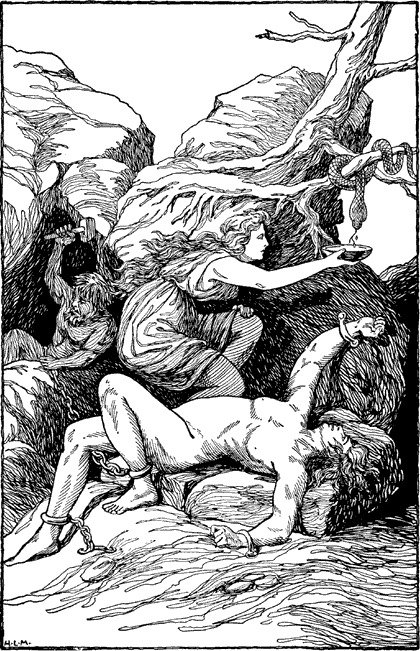 THE PUNISHMENT OF LOKI.
So they snatched the last bit of the net from the
fire, and by looking at it found out how to make
another, which they took with them to the bank of
the stream.
The first time the net was put into the water, Loki
hid between two rocks, and the net was so light that
it floated past him; but the next time it had a heavy
stone weight, which made it sink down, till Loki
saw he could not get away unless he could leap over
the net. He did this, but Thor, seeing him, waded
out into the stream, where he threw the net again,
so that Loki must jump a second time, or else go
on out into the deep sea.
As he leaped, Thor stooped and caught him in his
hand, but the fish was so slippery that Thor could
hardly hold it. In the struggle the salmon’s tail
was pinched so tightly by the thunder-god’s strong
fingers that it was drawn out to a point, and the
old stories say that is why salmon tails are so pointed
ever since.
Thus was Loki caught in his own trap, and
dreadful was his punishment. The Æsir chained
him to a high rock, and placed a great, poisonous
serpent, hanging over the cliff above his head.
If it had not been for Loki’s good, faithful wife,
he would have died of the poison that dropped from
the snake’s mouth. She watched by her husband,
holding a cup above him to catch the poison.
Only when she had to turn aside to empty the cup
did the drops fall upon Loki; then they gave him
such terrible pain that he shook the earth with his
struggles, and the people in Midgard fled from the
dreadful earthquake, in Iceland the great geysers,
springs of hot water, burst through the earth, and
in the south-lands burning ashes and lava poured
down the mountain-sides.
There, chained to the cliff, the cruel, mischievous
Loki was to lie until the Twilight of the gods, the
dark day of Ragnarök, when all the mighty evil
monsters and beasts would get free, and the terrible
battle be fought between them and the gods of
Asgard.
Loki and Fenrir,
the wolf, were
safely bound, each
to his separate cliff, but
still happiness and peace
did not return to Asgard,
for Baldur was no longer there, and light and
joy had gone from the home of the gods. The Æsir
felt that the Twilight of the gods, which Odin knew
was to come, must be near.
Soon began a long cold winter; surely it must
be the beginning of the Fimbulwinter, which was
to come before the last great battle. From the
north came cold blasts of freezing wind; snow and
ice covered the earth; men could not see the face
of the sun or the moon. Everywhere there was
darkness; the people grew fierce and unhappy and
wicked, for they seemed no longer to love each
other. So the evil deeds of men kept on, and
the fierce frost giants grew stronger and stronger.
They killed the trees and flowers, and bound the
lakes and rivers with icy bands.
Even when summer time came, the cold still held
on, and no one could see the green grass or the
beautiful golden sunlight. The frost giants were
pleased to see the trouble they had brought upon
men, and hoped they soon could destroy Asgard and
the gods.
Three long winters passed, with no light to warm
and brighten the world; after that still three
other dreary winters, and then the eagle who sat on
the top of the great world tree, Yggdrasil, gave a
loud, shrill cry; at that the earth shook, the rocks
crumbled and fell, so that Loki and the wolf were
freed from their chains.
The waters of the deep ocean rose and rolled high
over the land, and up above the waves writhing
out of the deep, came the monster Midgard serpent
to join in the last battle. Now the enemies of the
gods were gathering from all sides,—the frost
giants, the mountain giants, with Loki, Fenrir, and
the Midgard serpent.
Heimdall, the faithful watchman, looked from his
watch-tower by the rainbow bridge, and when he
saw the host of monsters appearing and raging
toward Asgard, he blew his magic horn, Giallar,
which was the signal of warning to the gods.
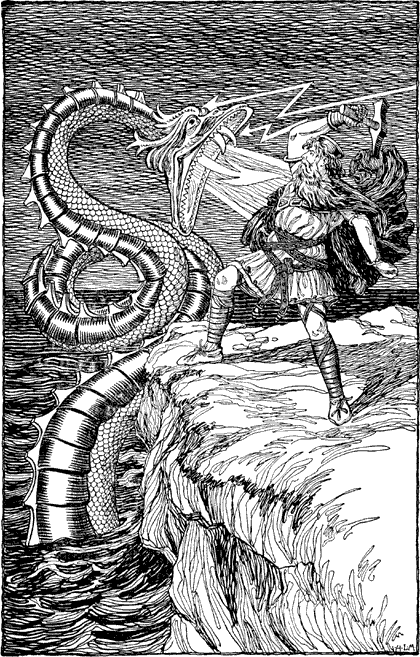 THOR FIGHTING THE SERPENT.
When Father Odin heard the blast of Heimdall’s
horn, he hastened to arm himself for the battle;
once again it is said the Allfather sought wisdom at
Mimir’s fountain, asking to know how best to lead
the Æsir against their enemies. But what Mimir
said to him no one ever knew, for a second call
sounded from the Giallar horn, and the gods, with
Odin at their head, rode forth from Asgard to meet
their foes.
Thor took his place beside Odin, but they were
soon parted in the struggle. The thunder-god
fell upon his old enemy, the serpent, whom twice
before he had tried to slay, and after a fierce fight,
he at last conquered and slew the monster; but the
poisonous breath from the serpent’s mouth overcame
the mighty Thor, and he also fell.
Heimdall and Loki came face to face, and each
slew the other. Thus every one of the gods battled
each with his foe, till at last the darkness grew
deeper, and all, both gods and giants lay dead. Then
fire burst forth, raging from Utgard to Asgard—and
all the worlds were destroyed in that dreadful day
of Ragnarök.
But this was not the end of all: after many
months, and years, and even centuries had passed,
a new world began to appear, with the fair ocean,
and the beautiful land, with a bright, shining sun
by day, and the moon and stars by night. Then
once more the light and heat from the sun made the
grass and trees grow, and the flowers bloom.
Baldur and Hodur came to this beautiful new
world, and walked and talked together. Thor’s sons
were there, too, and with them, the hammer, Miölnir,
no longer for use against giants, but for helping
men build homes.
Two people, a man and a woman, who were kept
safe through the raging fire, now came to dwell on
the earth, and all their children and grandchildren
lived at peace with each other in this beautiful new
world.
Baldur and Hodur talked often of the old days
when the Æsir dwelt in Asgard, before Loki, the
wicked one, brought darkness and trouble to them.
With loving words they spoke of Odin and Frigga;
and the brave Tyr, who gave his right hand to save
the Æsir; of mighty Thor; and faithful Heimdall;
of lovely Freyja, with her beautiful necklace; and of
fair Iduna’s garden, where they used to sit and eat
her magic apples. “But still,” they said, “we know
now that this new world is fairer than the old, and
here, also, the loving Allfather watches over his
children.”