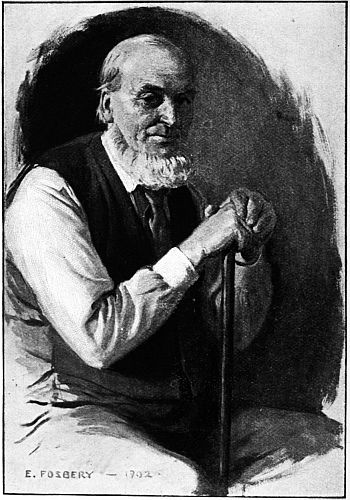
IT was Cy Akers who carried the
news to the schoolhouse, galloping
his old sorrel up to the open door
just before the bell tapped for afternoon
dismissal. He did not dismount, but
drawing rein, leaned forward in his
saddle, waiting for the little schoolmistress
to step down from the desk to
the doorstep. The rows of waiting
children craned their necks anxiously,
but only those nearest the door heard
his message.
"Mr. Asa Holmes died this morning,"
he said. "The funeral is set for
to-morrow afternoon at four, and you
can announce to the children that there
won't be any school. The trustees
thought it would be only proper to
close out of respect for him, as he was
on the school board over thirty years,
and has done so much for the community.
He's one of the old landmarks,
you might say, about the last of
the old pioneers, and everybody will
want to go."
Before she could recover from the
suddenness of the announcement the
rider was gone, and she was left looking
out across the October fields with
a lonely sense of personal loss, although
her acquaintance with the old miller
had extended over only two short
school terms.
A few minutes later the measured
tramp of feet over the worn door-sill
began, and forty children passed out
into the mellow sunshine of the late
autumn afternoon. They went quietly
at first, awed by the tender, reverent
words in which the little schoolmistress
had given them the message to carry
home. But once outside, the pent-up
enthusiasm over their unexpected holiday,
and the mere joy of being alive
and free on such a day sent them rushing
down the road pell-mell, shouting
and swinging their dinner-pails as they
ran.
A shade of annoyance crossed the
teacher's face as she stood watching
from the doorstep. She wished she
had cautioned them not to be so noisy,
for she knew that their shouts could
be plainly heard in the old house
whose gables she could see through a
clump of cedars, farther down the
road. It was standing with closed
blinds now, and she had a feeling that
the laughing voices floating across to it
must strike harshly across its profound
silence.
But presently her face brightened as
she watched the children running on
in the sunshine, in the joy of their
emancipation. Part of a poem she
had read that morning came to her.
She had thought when she read it that
it was a beautiful way to look upon
death, and now it bore a new significance,
and she whispered it to herself:
"'Why should it be a wrench to leave this wooden bench?
Why not with happy shout, run home when school is out?'
"That's the way the old miller has
gone," she said, softly. "His lessons
all learned and his tasks all done—so
well done, too, that he has nothing to
regret. I'm glad that I didn't stop the
children. I am sure that's the way he
would want them to go. Dear old
man! He was always a boy at heart."
She turned the key in the door behind
her presently, and started down
the road to Mrs. Powers's, where she
boarded. In every fence corner the
sumachs flamed blood-red, and across
the fields, where purple shadows trailed
their royal lengths behind every shock
of corn, the autumn woodlands massed
their gold and crimson against the
sunset sky. She walked slowly, loath
to reach the place where she must go
indoors.
The Perkins home lay in her way,
and as she passed, Mrs. Perkins with a
baby on her hip, and a child clinging
to her skirts, leaned over the gate to
speak to her.
"Isn't it sad," the woman exclaimed,
grasping eagerly at this chance to discuss
every incident of the death and
illness, with that love for detail always
to be found in country districts
where happenings are few and interests
are strong.
"They sent for the family Tuesday
when he had the stroke, but he couldn't
speak to them when they got here.
They said he seemed to recognise Miss
Polly, and smiled when she took his
hand. She seemed to be his favourite,
and they say she's taking it mighty
hard—harder than any of the rest.
It's a pity he couldn't have left 'em all
some last message. I think it's always a
comfort to remember one's dying words
when as good a person as Mr. Holmes
goes. And it's always so nice when
they happen to be appropriate, so's they
can be put on the tombstone afterward.
I remember my Aunt Maria worked
my grandfather's last words into a
sampler, with an urn and weeping-willow-tree.
She had it framed in
black and hung in the parlour, and
everybody who came to the house
admired it. It's a pity that the miller
couldn't have left some last word to
each of 'em."
"I don't think it was necessary,"
said the girl, turning away with a
choke in her voice, as the eloquent
face of the old man seemed to rise up
before her. "His whole life speaks for
him."
Mrs. Perkins looked after the retreating
figure regretfully, as the jaunty
sailor hat disappeared behind a tall
hedge. "I wish she hadn't been in
such a hurry," she sighed, shifting the
baby to the other hip. "I would
have liked to ask her if she's heard
who the pall-bearers are to be."
At the turn in the road the little
schoolmistress looked up to see Miss
Anastasia Dill leaning over her gate.
She had just heard the news, and there
were tears in her pale blue eyes.
"And Polly's wedding cards were
to have been sent out this next week!"
she exclaimed after their first words of
greeting. "The poor child told me
so herself when she was here in August
on a visit. 'Miss Anastasia,' she said
to me, 'I'm not going abroad for my
honeymoon, as all my family want
me to do. I'm going to bring Jack
back here to the old homestead where
grandfather's married life began. Somehow
it was so ideal, so nearly perfect,
that I have a feeling that maybe the
mantle of that old romance will fall on
our shoulders. Besides, Jack has never
seen grandfather, and I tell him it's as
much of an education to know such
a grand old man as it is to go through
Yale. So we're coming in October.
The woods will have on all their gala
colours then, and I'll be the happiest
bride the sun ever shone on, unless it
was my grandmother Polly.' And now
to think," added Miss Anastasia, tearfully,
"none of those plans can come
to pass. It's bad luck to put off a
wedding. Oh, I feel so sorry for
her!"
There is an undefined note of pathos
in a country funeral that is never
reached in any other. The little schoolmistress
felt it as she walked up the path
to the old house behind the cedars.
The front porch was full of men, who,
dressed in their unaccustomed best,
had the uneasy appearance of having
come upon a Sunday in the middle of
the week. Their heavy boots tiptoed
clumsily through the hall, with a painful
effort to go silently, as one by one
the neighbours passed into the old sitting-room
and out again. The room
across the hall had been filled with
rows of chairs, and the women who
came first were sitting there in a
deep silence, broken only by a cough
now and then, a hoarse whisper or a
rustle, as some one moved to make
room for a newcomer.
It was a sombre assembly, for every
one wore whatever black her wardrobe
afforded, and many funeral occasions
had left an accumulation of mourning
millinery in every house in the neighbourhood.
But the limp crape veils
and black gloves and pall-like cashmere
shawls were all congregated in
the dimly lighted parlour. In the old
sitting-room it was as cheerful and
homelike as ever, save for the still
form in the centre.
Through an open window the western
sun streamed into the big, hospitable
room, across the bright home-made
rag carpet. The old clock in the
corner ticked with the placid, steady
stroke that had never failed or faltered,
in any vicissitude of the generations
for which it had marked the changes.
No fire blazed on the old hearthstone
that had warmed the hearts as well as
the hands of the whole countryside on
many a cheerful occasion. But a great
bough of dogwood, laid across the shining
andirons, filled the space with coral
berries that glowed like live embers as
the sun stole athwart them.
"Oh, if the old room could only
speak!" thought Miss Anastasia, when
her turn came to pass reverently in for
a last look at the peaceful face. "There
would be no need of man's eulogy."
But man's eulogy was added presently,
when the old minister came in
and took his place beside the coffin
of his lifelong friend and neighbour.
The men outside the porch closed in
around the windows to listen. The
women in the back rows of chairs in
the adjoining room leaned forward
eagerly. Those farthest away caught
only a faltering sentence now and
then.
"A hospitality as warm as his own
hearthstone, as wide as his broad acres....
No man can point to him and say
he ever knowingly hurt or hindered a
fellow creature.... He never measured
out to any man a scant bushel.
Be it grain or good-will, it was ever an
overflowing measure...." But those
who could not hear all that was said
could make the silent places eloquent
with their own recollections, for he
had taken a father's interest in them
all, and manifested it by a score of
kindly deeds, too kindly to ever be
forgotten.
It was a perfect autumn day, sunny
and golden and still, save for the patter
of dropping nuts and the dry rustle of
fallen leaves. A purple haze rested on
the distant horizon like the bloom on
a ripened grape. Down through the
orchard, when the simple service was
over, they carried their old friend to the
family burying-ground, and, although
voices had choked, and eyes overflowed
before, there was neither sob nor tear,
when the light of the sunset struck
across the low mound, heaped with its
covering of glowing autumn leaves.
For if grief has no part in the sunset
glory that ends the day, or in the perfect
fulness of the autumn time, then
it must indeed stand hushed, when a
life comes both to its sunset and its
harvest, in such royal fashion.
That evening at the Cross-Roads,
Bowser lighted the first fire of the season
in the rusty old stove, for the night
was chilly. One by one the men accustomed
to gather around it dropped
in and took their usual places. The
event of the day was all that was spoken
of.
"Do you remember what he said
last Thanksgiving, nearly a year ago?"
asked Bowser. "It came back to me
as I stood and looked at him to-day,
and if I'd never believed in immortality
before, I'd 'a' had to have believed in it
then. The words seemed to fairly
shine out of his face. He said 'The
best comes after the harvest, when the
wheat goes to make up blood and muscle
and brain; when it's raised to a higher
order of life in man. And it's the same
with me. At eighty-five, when it looks as
if I'd about reached the end, I've come
to believe that "the best is yet to be."'"
There was a long pause, and Cy
Akers said, slowly, "Somehow I can't
feel that he is dead. Seems as if he'd
just gone away a while. But Lord!
how we're going to miss him here at
the store."
"No, don't say that!" exclaimed
Bud Hines, with more emotion than
he had ever been known to show before.
"Say, how we're going to feel
him! I can't get him out of my
mind. Every time I turn around,
most, seems to me I can hear him
laugh, and say, 'Don't cross your
bridge till you come to it, Bud.' That
saying of his rings in my ears every
time I get in the dumps. Seems like
he could set the calendar straight for
us, all the year around. The winters
wasn't so cold or the summers so hard
to pull through, looking at life through
his eyes."
Perkins's oldest crept up unnoticed.
He added no word, but deep in his
heart lay an impression that all the
years to come could never erase; the
remembrance of a kindly old man who
had given him a new gospel, in that
one phrase, "A brother to Santa
Claus;" who had taught him to go
out against his Philistines with simple
directness of aim and whatever lay at
hand; who had left behind him the
philosophy of a cheerful optimist, and
the example of a sweet simple life,
unswerving in its loyalty to duty and
to truth.
Over in the old homestead, Polly,
standing in the firelight, fair and slender
in her black gown, looked up at the
tall young fellow beside her, and placed
two little books in his hands. The
old house was not her only heritage.
The little atlas of the heavens was hers
also. Standing there in the room
where the beloved presence seemed to
have left its benediction, Polly told the
story of the love that had outlived
Death. Then across the yellowed
page of the old grammar where the
faded violets lay, two hands met in
the same sure clasp that had joined the
souls of those older lovers, who somewhere
beyond the stars were still repeating
the old conjugation—"we
love—for ever!"
THE END.
L. C. Page & Company's
Announcement List
of New Fiction
Haunters of the Silences. By Charles G.
D. Roberts, author of "Red Fox," "The Watchers of
the Trails," etc.
Cloth, one volume, with many drawings by Charles Livingston Bull, four of which are in full color $2.00
The stories in Mr. Roberts's new collection are the strongest
and best he has ever written.
He has largely taken for his subjects those animals rarely
met with in books, whose lives are spent "In the Silences,"
where they are the supreme rulers. Mr. Roberts has written
of them sympathetically, as always, but with fine regard
for the scientific truth.
"As a writer about animals, Mr. Roberts occupies an enviable
place. He is the most literary, as well as the most imaginative
and vivid of all the nature writers."—Brooklyn Eagle.
"His animal stories are marvels of sympathetic science and
literary exactness."—New York World.
The Lady of the Blue Motor. By
G. Sidney Paternoster, author of "The Cruise of
the Motor-Boat Conqueror," "The Motor Pirate," etc.
Cloth decorative, with a colored frontispiece by John C. Frohn $1.50
The Lady of the Blue Motor is an audacious heroine
who drove her mysterious car at breakneck speed. Her
plea for assistance in an adventure promising more than a
spice of danger could not of course be disregarded by any
gallant fellow motorist. Mr. Paternoster's hero rose
promptly to the occasion. Across France they tore and
across the English Channel. There, the escapade past, he
lost her.
Mr. Paternoster, however, is generous, and allows the
reader to follow their separate adventures until the Lady of
the Blue Motor is found again and properly vindicated of
all save womanly courage and affection. A unique romance,
one continuous exciting series of adventure.
Clementina's Highwayman. By Robert
Neilson Stephens, author of "The Flight of Georgiana,"
"An Enemy to the King," etc.
Cloth decorative, illustrated $1.50
Mr. Stephens has put into his new book, "Clementina's
Highwayman," the finest qualities of plot, construction, and
literary finish.
The story is laid in the mid-Georgian period. It is a
dashing, sparkling, vivacious comedy, with a heroine as
lovely and changeable as an April day, and a hero all ardor
and daring.
The exquisite quality of Mr. Stephens's literary style
clothes the story in a rich but delicate word-fabric; and
never before have his setting and atmosphere been so
perfect.
The Sorceress of Rome. By Nathan Gallizier,
author of "Castel del Monte," etc.
Cloth decorative, illustrated $1.50
The love-story of Otto III., the boy emperor, and Stephania,
wife of the Senator Crescentius of Rome, has
already been made the basis of various German poems and
plays.
Mr. Gallizier has used it for the main theme of "The
Sorceress of Rome," the second book of his trilogy of
romances on the mediæval life of Italy. In detail and
finish the book is a brilliant piece of work, describing
clearly an exciting and strenuous period. It possesses the
same qualities as "Castel del Monte," of which the Chicago
Record Herald said: "There is color, there is sumptuous
word-painting in these pages; the action is terrific at times;
vividness and life are in every part; brilliant descriptions
entertain the reader; mystic scenes and prophecies give a
singular fascination to the tale, which is strong and forceful
in its portrayal."
Hester of the Hills. By Gilder Clay.
Cloth decorative, illustrated $1.50
"Hester of the Hills" has a motif unusual in life, and
new in fiction. Its hero, who has only acquired his own
strength and resourcefulness by a lifelong struggle against
constitutional frailty, has come to make the question of
bodily soundness his dominant thought. He resolves to
ensure strong constitutions to his children by marrying a
physically perfect woman. After long search, he finds this
ideal in Hester, the daughter of a "cracker squatter," of
the Ozark Mountains of Missouri. But,—he forgot to
take into consideration that very vital emotion, love, which
played havoc with his well-laid plans.
It is an ingenious combination of practical realism and
imaginative fiction worked out to a thoroughly delightful
and satisfying climax.
Prisoners of Fortune. A Tale of the Massachusetts
Bay Colony. By Ruel Perley Smith,
author of "The Rival Campers," etc.
Cloth decorative, with a colored frontispiece by Frank T. Merrill $1.50
The period of Mr. Smith's story is the beginning of the
eighteenth century, when the shores of the American colonies
were harassed and the seas patrolled by pirates and
buccaneers. These robbed and spoiled, and often seized
and put to death, the sailors and fishers and other humbler
folk, while their leaders claimed friendship alike with Southern
planters and New England merchants,—with whom
it is said they frequently divided their spoils.
The times were stern and the colonists were hardy, but
they loved as truly and tenderly as in more peaceful days.
Thus, while the hero's adventures with pirates and his search
for their hidden treasure is a record of desperate encounters
and daring deeds, his love-story and his winning of sweet
Mary Vane is in delightful contrast.
The Rome Express. By Major Arthur Griffiths,
author of "The Passenger from Calais," etc.
Cloth decorative, with a colored frontispiece by A. O. Scott $1.25
A mysterious murder on a flying express train, a wily
Italian, a charming woman caught in the meshes of circumstantial
evidence, a chivalrous Englishman, and a police
force with a keen nose for the wrong clue, are the ingredients
from which Major Griffiths has concocted a clever, up-to-date
detective story. The book is bright and spirited,
with rapid action, and consistent development which brings
the story to a logical and dramatic ending.
The Morning Glory Club. By George A.
Kyle.
Cloth decorative, with a colored frontispiece by A. O. Scott. $1.25
The doings of the Morning Glory Club will furnish genuine
amusement to the reader. Originally formed to "elevate"
the village, it quickly develops into an exchange for
town gossip. It has a saving grace, however, in the person
of motherly Mrs. Stout, the uncultured but sweet-natured
and pure-minded village philosopher, who pours the oil of
her saneness and charity on the troubled waters of discussion
and condemnation.
It is a series of clear and interesting pictures of the humor
of village life.
The Chronicles of Martin Hewitt, Detective.
New Illustrated Edition. By Arthur
Morrison, author of "The Green Diamond,"
"The Red Triangle," etc.
Cloth decorative, with six full-page drawings by W. Kirkpatrick $1.50
The success of Mr. Morrison's recent books, "The Green
Diamond" and "The Red Triangle," has led to an imperative
demand for the reissue of "The Chronicles of Martin
Hewitt," which has been out of print for a number of years.
It will be remembered that Martin Hewitt is the detective
in "The Red Triangle," of whom the New York
Tribune said: "Better than Sherlock Holmes." His adventures
in the London slums were of such a nature that the
Philadelphia North American said: "The reader who has
a grain of fancy or imagination may be defied to lay this
book down once he has begun it until the last word is
reached."
Mystery Island. By Edward H. Hurst.
Cloth decorative, with a colored frontispiece $1.50
A hunting camp on a swampy island in the Florida Everglades
furnishes the background for this present-day tale.
By the murder of one of their number, the secret of
egress from the island is lost, and the campers find themselves
marooned.
Cut off from civilization, conventional veneer soon wears
away. Love, hate, and revenge spring up, and after the
sterner passions have had their sway the man and the woman
are left alone to fulfil their own destiny.
While there is much that is unusual in the plot and its
development, Mr. Hurst has handled his subject with fine
delicacy, and the tale of their love on the beautiful little
island is told with deep sympathy and feeling.
The Flying Cloud. By Morley Roberts,
author of "The Promotion of the Admiral," "Rachel
Marr," "The Idlers," etc.
Cloth decorative, with a colored frontispiece $1.50
Mr. Roberts's new book is much more than a ripping
good sea story such as might be expected from the author
of "The Promotion of the Admiral." In "The Flying
Cloud" the waters and the winds are gods personified.
Their every mood and phase are described in words of telling
force. There is no world but the waste of waters.
Mr. Roberts glories and exults in the mystery, the passion,
the strength of the elements, as did the Viking chroniclers
of old. He understands them and loves them and
interprets them as no other writer has heretofore done.
The book is too big for conventional phrases. It needs
Mr. Roberts's own richness of imagery and masterly expression
to describe adequately the word-pictures in this
epic of wind and waves.
Selections from
L. C. Page and Company's
List of Fiction
WORKS OF
ROBERT NEILSON STEPHENS
Each one vol., library 12mo, cloth decorative $1.50
The Flight of Georgiana
A Romance of the Days of the Young Pretender. Illustrated
by H. C. Edwards.
"A love-story in the highest degree, a dashing story, and a remarkably
well finished piece of work."—Chicago Record-Herald.
The Bright Face of Danger
Being an account of some adventures of Henri de Launay, son of
the Sieur de la Tournoire. Illustrated by H. C. Edwards.
"Mr. Stephens has fairly outdone himself. We thank him
heartily. The story is nothing if not spirited and entertaining,
rational and convincing."—Boston Transcript.
The Mystery of Murray Davenport
(40th thousand.)
"This is easily the best thing that Mr. Stephens has yet done.
Those familiar with his other novels can best judge the measure of
this praise, which is generous."—Buffalo News.
Captain Ravenshaw
Or, The Maid of Cheapside. (52d thousand.) A romance
of Elizabethan London. Illustrations by Howard Pyle and other
artists.
Not since the absorbing adventures of D'Artagnan have we had
anything so good in the blended vein of romance and comedy.
The Continental Dragoon
A Romance of Philipse Manor House in 1778. (53d
thousand.) Illustrated by H. C. Edwards.
A stirring romance of the Revolution, with its scene laid on
neutral territory.
Philip Winwood
(70th thousand.) A Sketch of the Domestic History of an
American Captain in the War of Independence, embracing events
that occurred between and during the years 1763 and 1785 in
New York and London. Illustrated by E. W. D. Hamilton.
An Enemy to the King
(70th thousand.) From the "Recently Discovered Memoirs of
the Sieur de la Tournoire." Illustrated by H. De M. Young.
An historical romance of the sixteenth century, describing the
adventures of a young French nobleman at the court of Henry III.,
and on the field with Henry IV.
The Road to Paris
A Story of Adventure. (35th thousand.) Illustrated by
H. C. Edwards.
An historical romance of the eighteenth century, being an account
of the life of an American gentleman adventurer of Jacobite ancestry.
A Gentleman Player
His Adventures on a Secret Mission for Queen Elizabeth.
(48th thousand.) Illustrated by Frank T. Merrill.
The story of a young gentleman who joins Shakespeare's company
of players, and becomes a friend and protégé of the great
poet.