UNPLEASANT as the interview had been to Roy,
he no sooner left the sickroom than he found
his spirits rise with a great bound. At last!
At last he was cleared! Now the way was smoothed
for him. All aspersions on his character would be
scattered like the morning mist before the sun, as
soon as the contents of the precious paper were made
known.
The three boys left the infirmary at about half
an hour after eleven o'clock. In a quarter of an
hour classes would be dismissed for the day, it being
a customary half-holiday.
Jack Beecham was eager to post the notice on the
bulletin board at once. They took the wiser and
safer course. They decided to see the prefect first,
as nothing appeared on the board without his sanction,
and when it did it was regarded as official.
“Come in,” they heard him call in response to their
rap at the door.
“Great news, Mr. Shalford,” shouted Jack
Beecham before he entered the room. “Everything's
settled. Roy's all right now. The head of the clique
has done it this time—in black and white, too; see,
sir.”
Mr. Shalford arose, smiling, and extended his
hand to Henning.
“I am very glad. It has been an ugly business. It
has caused no end of anxiety. The rumors and
charges were always so intangible that I never could
trace one to its source. But let me see the paper.”
This boys' true friend gave a low whistle as he
read Stockley's acknowledgment.
“So you are cleared, Henning; and the thief is
known? That's capital. Poor boy! Isn't it too
bad, boys, to find a student—one of us—a thief, a
burglar, a felon! Oh, the pity of it! Well, pray for
him, boys, pray for him. Leave this note with me,
Henning. I'll see that it does its work. Congratulations,
all of you. Whatever you have, Roy, you
have some loyal friends. Congratulations, congratulations,
all of you,”
The note was immediately posted. Then the excitement
began, at first among half-a-dozen around
the board, then among other groups, and in a very
short time throughout the college. George McLeod
and Ernest Winters simply went wild, and in less
than an hour they could scarcely speak at all, so
hoarse were they from shouting.
Where was Henning? A rush was made to the
Philosophy classroom. He was not there. Perhaps
he was with the rector or the prefect of studies. Both
these places were invaded by excited boys, but Roy
was not forthcoming.
Just as the big bell rang for dinner, George
McLeod made a rush for the chapel, sure that he
would find his friend there. And there he did find
the three, Jack, Ambrose, and Roy, pouring out their
thanksgiving with grateful hearts for the happy turn
events had taken.
“Come, Roy; it's dinner. The big bell has rung;
come on.”
Roy did not move, nor did his companions. He
evidently intended to avoid the crowd, waiting until
they should all be at dinner, knowing that in the
refectory they would have to remain quiet.
This time he miscalculated entirely. No sooner
did he make his appearance than the whole of the
students of the senior refectory rose to their feet and
gave three hearty cheers for Roy Henning. The
prefect made no attempt to stop the demonstration,
while Ernest Winters, out in the middle of the room,
was fairly dancing with joy and excitement.
At a given signal from Mr. Shalford all cheering
ceased. Every one resumed his seat—except
Ernest, who danced on in his glee, to the intense
amusement of all, and to his own utter confusion
when he discovered that he was the only boy now
making any noise in the refectory.
Before the laugh at his expense had subsided the
prefect whispered to Roy:
“Shall I give talking at table in honor of the
event?”
“To-morrow, please, sir,” replied Roy, “now I
want to think a little.”
Mr. Shalford gave a look and a nod to the reader,
and the meal, save for the reader's voice, was finished
in silence.
If the boys were not allowed to talk for a little
while, there was no lack of signs and signals. Harry
Gill was frantic to signal across the room his congratulations,
and had a fit of coughing for trying to
eat his dinner and at the same time send a series of
telegraphic messages to Roy.
Henning was pleased to see that Andrew Garrett
was quite demonstrative of good will. Andrew, for
a long time tried to catch his cousin's eye. When
he did so, he dropped his knife and fork and imitated
a handshaking. Roy did the same to his cousin, and
was repaid by seeing a look of intense pleasure
spread over Andrew's face.
Of course all these signs and signals and other
unusual occurrences were breaches of discipline
which, at any other time would not have gone unchecked
and unpunished. But Mr. Shalford knew
exactly “how it was.”He had been a real boy himself
once, and knew exactly when not to see too
much. He believed in the scriptural motto, “Be not
over just.”
And after dinner! What a scene the yard
presented for a few minutes! The delighted boys
shook Roy's hand until his arm fairly ached. His
arm ached because he allowed it to be shaken by
others, instead of himself shaking every hand extended.
In this business he was unexperienced.
In the midst of the enthusiasm, which resembled
that which follows an important and successful baseball
game, only more intense, Harry Gill jumped
upon a long bench by the wall and shouted:
“Listen, gentlemen. I have good news for you.
Hi, there! listen. Listen there, boys, listen, listen!
Roy Henning has promised to pitch for the rest of
the year! Did—you—hear that—boys?”
Roy suddenly remembered that he had intended to
give Gill the credit for this. He jumped on the
bench in a second. Raising his hand, the hero of
the hour obtained silence in a much shorter time than
Gill had done.
“If I pitch for the rest of the year,” he said, “it
is all Gill's fault. I simply could not resist his importunities.
Oh, he's a sly one,”
“It isn't,” said Gill laughing.
“It is.”
“It is not.”
“It is.”
Then there was a cheer which could be heard
down at Cuthberton.
After a time Roy, Jack, Ambrose, and Rob Jones
extricated themselves from the throng of happy boys,
and with Gill and Andrew Garrett repaired to the
Philosophy classroom, or Hilson's parlor, as it was
called, which the other members of the class considerately
left at their disposal for the time being.
“Oh, what a day we're having,” sighed Jack
Beecham as he sank into a chair.
“Glorious, isn't it?”said the jubilant Bracebridge.
“And now that we are alone,” began Andrew Garrett,
"that is, among special friends, I want to say
something.”
All were silent in an instant. Gill, who did not
appear to have realized the previous strained relations
between the two cousins began to say something
funny, but he was checked by an unmistakably
significant glance from Ambrose, who had become
quite serious, for he rather expected a scene, if not
an explosion. Shealey, who had come in, was too
full of fun and nonsense to imagine that anybody
just now could be serious, but when he saw the
nervous look on Ambrose's face, and the evident
nervousness of Garrett, he, too, realized that it was
time to suspend bantering.
All the friends were standing in a group around
Henning, laughing and chattering as only boys
thoroughly happy can laugh and chatter, when Garrett
began to speak. At the sound of his voice, they
all, with Roy in the center, turned and faced Garrett
as he stood two or three feet away.
“I want to say something,” Garrett began again,
"and I think it only fair, Roy, to say it before these
others, as well as to you.”
Henning bowed slightly, having only a faint idea
of what was coming. At present he was too pleased
to know that Garrett was not implicated and that the
family name was untarnished.
“I want to say that I consider myself to have been
a pretty mean and small sort of a fellow in this
whole business.”
“Oh! Don't——”began Roy in protest.
“Wait a minute, Roy. This is the task I have set
myself, for it seems to me the only possible way in
which I can make reparation. I want to say that I
had a good deal to do with those rumors. I got in,
somehow, with a crowd of boys I ought to have been
ashamed to associate with. How it all happened I
don't exactly know. Things went from bad to worse
with me, and pretty far, too. It seems a dream to
me now. About a week ago suddenly I began to
realize my position. How this realization came about
I don't know. It must have been dear little Ethel's
prayers for me, but I began to think of my position,
think of what I was doing, and, yes, to think of the
sin of it all. You were away, Roy, and when I remembered
your trouble and grief at home, and when,
finally, your brotherly telegram came, I began to be
thoroughly ashamed of myself. So now all I can
do is to ask your pardon, and the pardon of all these,
your loyal and staunch friends.”
As he listened to this manly avowal, there arose in
Roy Henning's breast an admiration for his cousin's
moral courage. The other auditors were deeply impressed.
They waited with curiosity to see what
Roy would do. And he? He did precisely what
might be expected of him. Without saying a word,
he stepped forward, took Garrett's hand and shook
it warmly. Then:
“It's all over, old man. Let bygones be bygones.
I forgive everything and forget.”
“Thanks, very much. I do not deserve this, but
you shall see I shall deserve it.”
There was a world of pathos and earnestness in
Andrew's voice at that moment.
The rest of the gathering of friends extended their
hands, and Andrew shook hands all around.
“Now,” said Roy, “will you permit me to ask a
few questions, to clear up some obscure points in
my mind?”
“Certainly; anything,” said Andrew, with alacrity.
“How did that wretched Stockley come to wear
your blue sweater? He tells me he did, and, besides,
I saw him get down below that grating that night
and I thought it was you.”
“Thought it was me,” said Garrett in the greatest
amazement. “You thought it was I, and all this
time you thought I was the thief, and yet stood all
I said against you, and never said a word! Oh,
Roy! No wonder on that Sunday afternoon you insisted
on my clearing you,”
Andrew Garrett appeared to be fairly overcome by
his cousin's generosity.
“Why, oh, why didn't I know all this before?
How differently I would have acted. Believe me, it
is only this very day I learned that the thief wore my
sweater that night. Before going to bed on the night
of the play I hung my sweater on a peg in the study-hall.
The next morning I saw that it had been used
by some one, for there were dirt stains on it and
some rust marks from contact with rusty iron. I
determined not to wear it after that. I had no idea
the thief had used it, though.”
“Thanks,” said Roy. “Now one more question,
Andrew.”
“Fire away.”
“This morning Stockley said something about a
letter which you knew something of—one in some
way connected with me. Can you tell me anything
about it?”
Now it so happened that the affair of the letter
was the only incident in the untoward conduct of
Garrett for many months past in which he could take
any kind of satisfaction. It will be remembered that
he had refused to allow Stockley and Smithers to
circulate it among the boys. He had retained it
ever since.
“That's easy enough,” he answered, as he drew
the crumpled letter from his pocket.
“But I have to ask you a question now, for the
wording of the letter certainly looks compromising
enough. Listen to this, gentlemen.”Andrew read
the scrap of paper to the astonished listeners.
“Dec. 23rd. My dear chum: Your letter
received last Monday. Sorry to say that"—"here's
a blank,” said Garrett, and then continued,
"have no money just now, so can not do the thing
you wish. Awfully sorry. Feel like stealing the
money rather than letting this thing go undone.
However, wait till the end of Christmas week.
Something's going to turn up before that—then
we can go into partnership in this, at least for the
merit—keep everything dark. Don't say a word
to anybody about it. Mind, now, chum, everything
must be kept secret or—smash! Yours,
Roy H.”
When Garrett began to read the note, Henning
looked puzzled. After a time he seemed to remember
all about it, and then he—blushed.
“Oh! that's——”but he stopped suddenly. He
was going to make a revelation of some kind, and
suddenly thought better of it. He blushed profusely—like
a girl. He was awkward. For a moment
he appeared embarrassed in no slight degree. Twice
he was going to say something; twice he changed
his mind.
His friends were very much puzzled. Was there
a shade of truth in some of the charges made against
Roy after all? Had their idol fallen? Was he, after
all, not to be their hero? Was he a lesser character
than all along they had judged him?
Roy saw these fleeting fancies on their wavering
faces, all except Ambrose's. He never doubted, nor
did he show the least sign of wavering. Roy saw
wonder and incipient doubt elsewhere, at which he
blushed the more furiously.
The situation was certainly dramatic. A climax
had come to-day. Was there, after all, to be an
anticlimax? Was the idol to be shattered at the
very last moment?
“What does it all mean, Roy?”asked Garrett.
“I would rather not say,” was the reply.
“You had better, Roy,” said Bracebridge, in confidential
tones.
Still blushing, Roy said:
“I say, you fellows, you don't mean to say there
is anything crooked in this, do you?”
“No,” replied Andrew Garrett, “but an enemy of
yours could make mighty good capital out of it all
the same. Tell us what it means, Roy.”
“If you must know, then, it's merely this,” answered
Roy, a little angrily, not exactly with his
friends, but more at the exigencies of the situation.
"There is a poor—quite poor—student in a seminary
who is and has been a great friend of mine, in
fact pretty much of a hero, as you would say if you
knew his story. He had the greatest longing to get
home last Christmas to see his widowed mother after
years of absence. He could not afford it, and, like
a real friend, asked me to assist him. Unfortunately
my funds were very low—too low to help him. I
expected that my mother would send me her usual
Christmas present. I found out that she was willing
to do so, and I wrote to her to send most of it to
my friend instead. There's your great mystery! I
was short of funds because my father cut down my
allowance this year.”
“So that's the reason you were so close this year?"
asked Andrew.
“What?”
“Because your father cut down, and yet, by Jove!
you were willing to send what you did get to some
one else. Well, I call that noble, indeed I do. Oh,
I wish I had known all this before! If I had but
known! If I had——”
“Say, you fellows, haven't you done catechising
me?”said Roy Henning, attempting to divert their
attention from himself.
“If you please, cousin, one more question,” said
Andrew.
Roy made a wry face, and a mock gesture of impatience.
“You would try the patience of a saint,”
“May I?”
“Well, fire ahead.”
“You say that all along you thought I was the
thief?”
“I certainly did, Andrew,” answered Roy, serious
in a minute, “for no one but you here ever wore a
blue sweater.”
“Then why did you not, especially as I had acted
so meanly toward you—why did you not do or say
something that would point suspicion to me, or
openly make the charge?”
The question aroused considerable emotion in
Roy's breast. It showed itself in the workings of
the muscles of his cheeks. Taking Andrew Garrett
by the hand, he looked into his eyes.
“Shall I tell you, Andrew?”
“Yes, please do.”
“If I spoke or moved in this I knew it would break
your mother's heart.”
Andrew could stand no more. He broke down.
Boy as he was, with all a boy's natural distaste for
displaying emotion before others, he was not
ashamed to rest his head for a moment on his
cousin's shoulder and sob. The only words that fell
from his lips were:
“Noble Roy,”
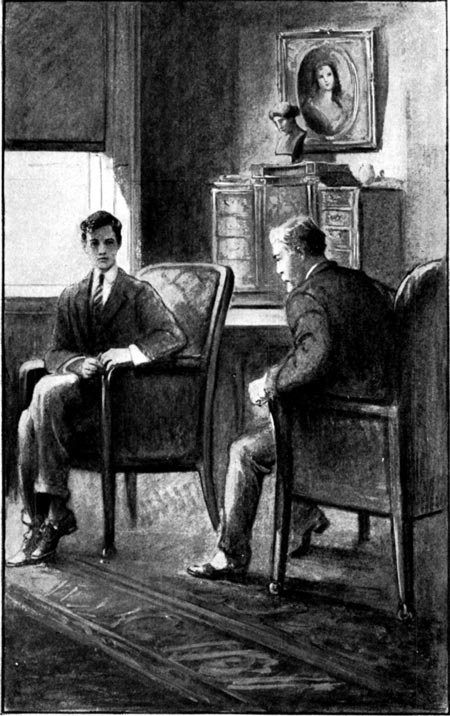 It was hard! It was a sore trial to give up
his dream of years!—Page 20.
It was hard! It was a sore trial to give up
his dream of years!—Page 20.