GOLD AND SILVER
The worker in metals is usually called a smith, whether he be
coppersmith or goldsmith. The term is Saxon in origin, and is derived
from the expression "he that smiteth." Metal was usually wrought
by force of blows, except where the process of casting modified
this.
Beaten work was soldered from the earliest times. Egyptians evidently
understood the use of solder, for the Hebrews obtained their knowledge
of such things from them, and in Isaiah xli. 7, occurs the passage:
"So the carpenter encouraged the goldsmith, and he that smootheth
with the hammer him that smote the anvil, saying, 'It is ready
for the soldering.'" In the Bible there are constant references
to such arts in metal work as prevail in our own times: "Of beaten
work made he the candlesticks," Exodus. In the ornaments of the
tabernacle, the artificer Bezaleel "made two cherubims of gold
beaten out of one piece made he them."
An account of gold being gathered in spite of vicissitudes Page 2 is given by
Pliny: "Among the Dardoe the ants are as large as Egyptian wolves,
and cat coloured. The Indians gather the gold dust thrown up by
the ants, when they are sleeping in their holes in the Summer;
but if these animals wake, they pursue the Indians, and, though
mounted on the swiftest camels, overtake and tear them to pieces."
Another legend relates to the blessed St. Patrick, through whose
intercession special grace is supposed to have been granted to
all smiths. St. Patrick was a slave in his youth. An old legend
tells that one time a wild boar came rooting in the field, and
brought up a lump of gold; and Patrick brought it to a tinker,
and the tinker said, "It is nothing but solder. Give it here to
me." But then he brought it to a smith, and the smith told him it
was gold; and with that gold he bought his freedom. "And from that
time," continues the story, "the smiths have been lucky, taking
money every day, and never without work, but as for the tinkers,
every man's face is against them!"
In the Middle Ages the arts and crafts were generally protected by
the formation of guilds and fraternities. These bodies practically
exercised the right of patent over their professions, and infringements
could be more easily dealt with, and frauds more easily exposed,
by means of concerted effort on the part of the craftsmen. The
goldsmiths and silversmiths were thus protected in England and
France, and in most of the leading European art centres. The test
of pure gold was made Page
3 by "six of the more discreet goldsmiths," who went
about and superintended the amount of alloy to be employed; "gold
of the standard of the touch of Paris" was the French term for metal
of the required purity. Any goldsmith using imitation stones or
otherwise falsifying in his profession was punished "by imprisonment
and by ransom at the King's pleasure." There were some complaints
that fraudulent workers "cover tin with silver so subtilely...
that the same cannot be discovered or separated, and so sell tin
for fine silver, to the great damage and deceipt of us." This state
of things finally led to the adoption of the Hall Mark, which is
still to be seen on every piece of silver, signifying that it has
been pronounced pure by the appointed authorities.
The goldsmiths of France absorbed several other auxiliary arts, and
were powerful and influential. In state processions the goldsmiths
had the first place of importance, and bore the royal canopy when
the King himself took part in the ceremony, carrying the shrine
of St. Genevieve also, when it was taken forth in great pageants.
In the quaint wording of the period, goldsmiths were forbidden to
gild or silver-plate any article made of copper or latten, unless
they left some part of the original exposed, "at the foot or some
other part,... to the intent that a man may see whereof the thing
is made for to eschew the deceipt aforesaid." This law was enacted
in 1404.
Page 4
Many of the great art schools of the Middle Ages were established
in connection with the numerous monasteries scattered through all
the European countries and in England. The Rule of St. Benedict
rings true concerning the proper consecration of an artist: "If
there be artists in the monastery, let them exercise their crafts
with all humility and reverence, provided the abbot shall have
ordered them. But if any of them be proud of the skill he hath in
his craft, because he thereby seemeth to gain something for the
monastery, let him be removed from it and not exercise it again,
unless, after humbling himself, the abbot shall permit him." Craft
without graft was the keynote of mediæval art.
King Alfred had a monastic art school at Athelney, in which he had
collected "monks of all kinds from every quarter." This accounts
for the Greek type of work turned out at this time, and very likely
for Italian influences in early British art. The king was active in
craft work himself, for Asser tells us that he "continued, during
his frequent wars, to teach his workers in gold and artificers of
all kinds."
The quaint old encyclopædia of Bartholomew Anglicus, called,
"The Properties of Things," defines gold and silver in an original
way, according to the beliefs of this writer's day. He says of
gold, that "in the composition there is more sadness of brimstone
than of air and moisture of quicksilver, and therefore gold is
more sad and heavy than silver." Of silver he remarks, Page 5 "Though silver
be white yet it maketh black lines and strakes in the body that
is scored therewith."
Marco Polo says that in the province of Carazan "the rivers yield
great quantities of washed gold, and also that which is solid, and
on the mountains they find gold in the vein, and they give one
pound of gold for six of silver."
Workers in gold or silver usually employ one of two
methods—casting or beating, combined with delicacy of finish,
chasing, and polishing. The technical processes are interestingly
described by the writers of the old treatises on divers arts. In
the earliest of these, by the monk Theophilus, in the eleventh
century, we have most graphic accounts of processes very similar
to those now in use. The naïve monastic instructor, in his
preface, exhorts his followers to honesty and zeal in their good
works. "Skilful in the arts let no one glorify himself," say Theophilus,
"as if received from himself, and not from elsewhere; but let him be
thankful humbly in the Lord, from whom all things are received."
He then advises the craftsman earnestly to study the book which
follows, telling him of the riches of instruction therein to be
found; "you will there find out whatever... Tuscany knows of mosaic
work, or in variety of enamels, whatever Arabia shows forth in
work of fusion, ductility or chasing, whatever Italy ornaments
with gold... whatever France loves in a costly variety of windows;
whatever industrious Germany approves in work of gold, silver or
copper, and iron, of woods and Page
6 of stones." No wonder the authorities are lost in
conjecture as to the native place of the versatile Theophilus! After
promising all these delightful things, the good old monk continues,
"Act therefore, well intentioned man,... hasten to complete with
all the study of thy mind, those things which are still wanting
among the utensils of the House of the Lord," and he enumerates
the various pieces of church plate in use in the Middle Ages.
Directions are given by Theophilus for the workroom, the benches
at which the smiths are to sit, and also the most minute technical
recipes for "instruments for sculping," for scraping, filing, and
so forth, until the workshop should be fitted with all necessary
tools. In those days, artists began at the very beginning. There were
no "Windsor and Newtons," no nice makers of dividers and T-squares,
to whom one could apply; all implements must be constructed by the
man who contemplated using them.
We will see how Theophilus proceeds, after he has his tools in
readiness, to construct a chalice. First, he puts the silver in a
crucible, and when it has become fluid, he turns it into a mould
in which there is wax (this is evidently the "cire perdu" process
familiar to casters of every age), and then he says, "If by some
negligence it should happen that the melted silver be not whole,
cast it again until it is whole." This process of casting would
apply equally to all metals.
Theophilus instructs his craftsman how to make the Page 7 handles of the
chalice as follows: "Take wax, form handles with it, and grave
upon them dragons or animals or birds, or leaves—in whatever
manner you may wish. But on the top of each handle place a little
wax, round like a slender candle, half a finger in length,... this
wax is called the funnel.... Then take some clay and cover carefully
the handle, so that the hollows of the sculpture may be filled
up.... Afterwards place these moulds near the coals, that when
they have become warm you may pour out the wax. Which being turned
out, melt the silver,... and cast into the same place whence you
poured out the wax. And when they have become cold remove the clay."
The solid silver handles are found inside, one hardly need say.
In casting in the "cire perdu" process, Benvenuto Cellini warns
you to beware lest you break your crucible—"just as you've
got your silver nicely molten," he says, "and are pouring it into
the mould, crack goes your crucible, and all your work and time
and pains are lost!" He advises wrapping it in stout cloths.
The process of repoussé work is also much the same to-day as
it has always been. The metal is mounted on cement and the design
partly beaten in from the outside; then the cement is melted out,
and the design treated in more detail from the inside. Theophilus
tells us how to prepare a silver vessel to be beaten with a design.
After giving a recipe for a sort of pitch, he says, "Melt this
composition and fill the vial to the top. And when it has become
cold, portray... whatever Page
8 you wish, and taking a slender ductile instrument,
and a small hammer, design that which you have portrayed around
it by striking lightly." This process is practically, on a larger
scale, what Cellini describes as that of "minuterie." Cellini praises
Caradosso beyond all others in this work, saying "it was just in
this very getting of the gold so equal all over, that I never knew
a man to beat Caradosso!" He tells how important this equality of
surface is, for if, in the working, the gold became thicker in
one place than in another, it was impossible to attain a perfect
finish. Caradosso made first a wax model of the object which he
was to make; this he cast in copper, and on that he laid his thin
gold, beating and modelling it to the form, until the small hollow
bas-relief was complete. The work was done with wooden and steel
tools of small proportions, sometimes pressed from the back and
sometimes from the front; "ever so much care is necessary," writes
Cellini, "...to prevent the gold from splitting." After the model
was brought to such a point of relief as was suitable for the design,
great care had to be exercised in extending the gold further, to
fit behind heads and arms in special relief. In those days the
whole film of gold was then put in the furnace, and fired until
the gold began to liquefy, at which exact moment it was necessary
to remove it. Cellini himself made a medal for Girolamo Maretta,
representing Hercules and the Lion; the figures were in such high
relief that they only touched the ground at a few points. Page 9 Cellini reports
with pride that Michelangelo said to him: "If this work were made
in great, whether in marble or in bronze, and fashioned with as
exquisite a design as this, it would astonish the world; and even
in its present size it seems to me so beautiful that I do not think
even a goldsmith of the ancient world fashioned aught to come up to
it!" Cellini says that these words "stiffened him up," and gave him
much increased ambition. He describes also an Atlas which he constructed
of wrought gold, to be placed upon a lapis lazuli background: this
he made in extreme relief, using tiny tools, "working right into
the arms and legs, and making all alike of equal thickness." A
cope-button for Pope Clement was also quite a tour de force;
as he said, "these pieces of work are often harder the smaller they
are." The design showed the Almighty seated on a great diamond;
around him there were "a number of jolly little angels," some in
complete relief. He describes how he began with a flat sheet of
gold, and worked constantly and conscientiously, gradually bossing
it up, until, with one tool and then another, he finally mastered
the material, "till one fine day God the Father stood forth in
the round, most comely to behold." So skilful was Cellini in this
art that he "bossed up in high relief with his punches some fifteen
little angels, without even having to solder the tiniest rent!"
The fastening of the clasp was decorated with "little snails and
masks and other pleasing trifles," which suggest to us that Page 10 Benvenuto was
a true son of the Renaissance, and that his design did not equal
his ability as a craftsman.
Cellini's method of forming a silver vase was on this wise. The
original plate of silver had to be red hot, "not too red, for then
it would crack,—but sufficient to burn certain little grains
thrown on to it." It was then adjusted to the stake, and struck
with the hammer, towards the centre, until by degrees it began
to take convex form. Then, keeping the central point always in
view by means of compasses, from that point he struck "a series
of concentric circles about half a finger apart from each other,"
and with a hammer, beginning at the centre, struck so that the
"movement of the hammer shall be in the form of a spiral, and follow
the concentric circles." It was important to keep the form very even
all round. Then the vase had to be hammered from within, "till it
was equally bellied all round," and after that, the neck was formed
by the same method. Then, to ornament the vase, it was filled with
pitch, and the design traced on the outside. When it was necessary
to beat up the ornament from within, the vase was cleared out, and
inverted upon the point of a long "snarling-iron," fastened in an
anvil stock, and beaten so that the point should indent from within.
The vase would often have to be filled with pitch and emptied in
this manner several times in the course of its construction.
Benvenuto Cellini was one of the greatest art personalities of all
time. The quaintness of the æsthetic Page 11 temperament is nowhere found better
epitomized than in his life and writings. But as a producer of
artistic things, he is a great disappointment. Too versatile to
be a supreme specialist, he is far more interesting as a man and
craftsman than as a designer. Technical skill he had in unique
abundance. And another faculty, for which he does not always receive
due credit, is his gift for imparting his knowledge. His Treatises,
containing valuable information as to methods of work, are less
familiar to most readers than his fascinating biography. These
Treatises, or directions to craftsmen, are full of the spice and
charm which characterize his other work. One cannot proceed from
a consideration of the bolder metal work to a study of the dainty
art of the goldsmith without a glance at Benvenuto Cellini.
The introduction to the Treatises has a naïve opening: "What
first prompted me to write was the knowledge of how fond people
are of hearing anything new." This, and other reasons, induced
him to "write about those loveliest secrets and wondrous methods
of the great art of goldsmithing."
Francis I. indeed thought highly of Cellini. Upon viewing one of his
works, his Majesty raised his hands, and exclaimed to the Mareschal
de France, "I command you to give the first good fat abbey that
falls vacant to our Benvenuto, for I do not want my kingdom to
be deprived of his like."
Benvenuto describes the process of making filigree work, the principle
of which is, fine wire coiled flat so Page 12 as to form designs with an interesting
and varied surface. Filigree is quite common still, and any one
who has walked down the steep street of the Goldsmiths in Genoa
is familiar with most of its modern forms. Cellini says: "Though
many have practised the art without making drawings first, because
the material in which they worked was so easily handled and so
pliable, yet those who made their drawings first did the best work.
Now give ear to the way the art is pursued." He then directs that
the craftsman shall have ready three sizes of wire, and some little
gold granules, which are made by cutting the short lengths of wire,
and then subjecting them to fervent heat until they become as little
round beads. He then explains how the artificer must twist and
mould the delicate wires, and tastily apply the little granules,
so as to make a graceful design, usually of some floriate form.
When the wire flowers and leaves were formed satisfactorily, a wash
of gum tragacanth should be applied, to hold them in place until
the final soldering. The solder was in powdered form, and it was to
be dusted on "just as much as may suffice,... and not more,"...
this amount of solder could only be determined by the experience of
the artist. Then came the firing of the finished work in the little
furnace; Benvenuto is here quite at a loss how to explain himself:
"Too much heat would move the wires you have woven out of place,"
he says, "really it is quite impossible to tell it properly in
writing; I could explain it all right by word of mouth, or better
still, show you how it is Page
13 done,—still, come along,—we'll try to
go on as we started!"
Sometimes embossing was done by thin sheets of metal being pressed
on to a wooden carving prepared for the purpose, so that the result
would be a raised silver pattern, which, when filled up with pitch
or lead, would pass for a sample of repoussé work. I need
hardly say that a still simpler mechanical form of pressing obtains
on cheap silver to-day.
So much for the mechanical processes of treating these metals. We
will now examine some of the great historic examples, and glance
at the lives of prominent workers in gold and silver in the past.
One of the most brilliant times for the production of works of art
in gold and silver, was when Constantine, upon becoming Christian,
moved the seat of government to Byzantium. Byzantine ornament lends
itself especially to such work. The distinguishing mark between
the earlier Greek jewellers and the Byzantine was, that the former
considered chiefly line, form, and delicacy of workmanship, while
the latter were led to expression through colour and texture, and
not fineness of finish.
The Byzantine emperors loved gold in a lavish way, and on a superb
scale. They were not content with chaste rings and necklets, or
even with golden crowns. The royal thrones were of gold; their
armour was decorated with the precious metal, and their chariots
enriched in the same way. Even the houses of the rich people Page 14 were more
endowed with precious furnishings than most of the churches of
other nations, and every family possessed a massive silver table,
and solid vases and plate.
The Emperor Theophilus, who lived in the ninth century, was a great
lover of the arts. His palace was built after the Arabian style,
and he had skilful mechanical experts to construct a golden tree
over his throne, on the branches of which were numerous birds,
and two golden lions at the foot. These birds were so arranged
by clockwork, that they could be made to sing, and the lions also
joined a roar to the chorus!
A great designer of the Middle Ages was Alcuin, the teacher of
Charlemagne, who lived from 735 to 804; he superintended the building
of many fine specimens of church plate. The school of Alcuin, however,
was more famous for illumination, and we shall speak of his work
at more length when we come to deal with that subject.
Another distinguished patron of art was the Abbot Odo of Cluny,
who had originally been destined for a soldier; but he was visited
with what Maitland describes as "an inveterate headache, which, from
his seventeenth to his nineteenth year, defied all medical skill,"
so he and his parents, convinced that this was a manifestation of
the disapproval of Heaven, decided to devote his life to religious
pursuits. He became Abbot of Cluny in the year 927.
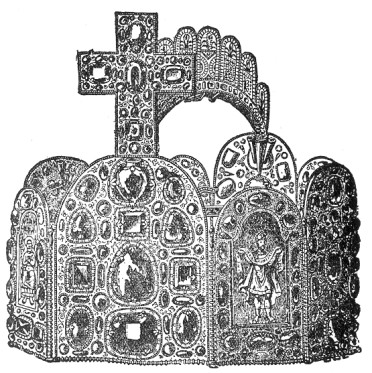
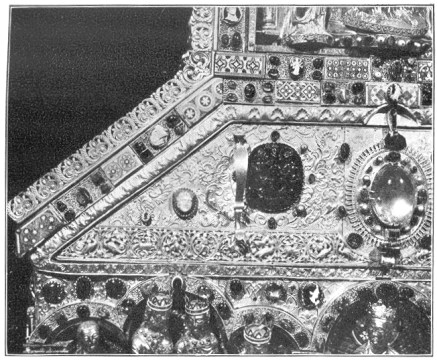
|
| CROWN OF CHARLEMAGNE |
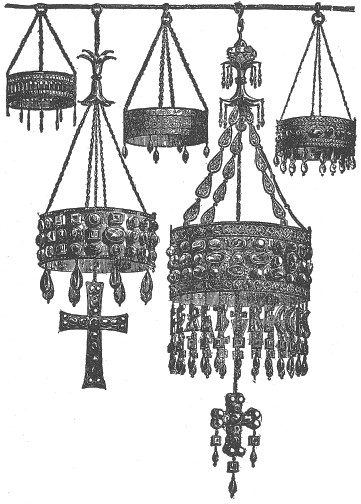
Examples of ninth century goldsmithing are rare. Page 15 Judging from the few specimens
existing, the crown of Charlemagne, and the beautiful binding of
the Hours of Charles the Bold, one would be inclined to think that
an almost barbaric wealth of closely set jewels was the entire
standard of the art of the time, and that grace of form or contour
was quite secondary. The tomb was rifled about the twelfth century,
and Page 16 many of
the valuable things with which he was surrounded were taken away.
The throne was denuded of its gold, and may be seen to-day in the
Cathedral at Aachen, a simple marble chair plain and dignified, with
the copper joints showing its construction. Many of the relics of
Charlemagne are in the treasury at Aachen, among other interesting
items, the bones of the right arm of the Emperor in a golden shrine
in the form of a hand and arm. There is a thrill in contemplating
the remains of the right arm of Charlemagne after all the centuries,
when one remembers the swords and sceptres which have been wielded
by that mighty member. The reliquary containing the right arm of
Charlemagne is German work (of course later than the opening of
the tomb), probably between 1155 and 1190. Frederic Barbarossa
and his ancestors are represented on its ornamentation.
There is little goldsmith's work of the Norman period in Great
Britain, for that was a time of the building of large structures,
and probably minor arts and personal adornment took a secondary
place.
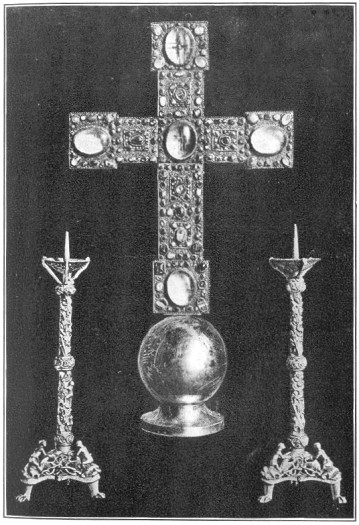
|
| BERNWARD'S CROSS AND CANDLESTICKS, HILDESHEIM |
Perhaps the most satisfactory display of mediæval arts and
crafts which may be seen in one city is at Hildesheim: the special
richness of remains of the tenth century is owing to the life and
example of an early bishop—Bernward—who ruled the See
from 993 to 1022. Before he was made bishop, Bernward was tutor
to the young Emperor Otto III. He was a student of art all his
life, and a practical craftsman, working Page 17 largely in metals, and training
up a Guild of followers in the Cathedral School. He was extremely
versatile: one of the great geniuses of history. In times of war
he was Commander in Chief of Hildesheim; he was a traveller, having
made pilgrimages to Rome and Paris, and the grave of St. Martin at
Tours. This wide culture was unusual in those days; it is quite
evident from his active life of accomplishment in creative art,
that good Bishop Bernward was not to be numbered among those who
expected the end of the world to occur in the year 1000 A. D. Of
his works to be seen in Hildesheim, there are splendid examples.
The Goldsmith's School under his direction was famous.
He was created bishop in 992; Taugmar pays him a tribute, saying:
"He was an excellent penman, a good painter, and as a household
manager was unequalled." Moreover, he "excelled in the mechanical
no less than in the liberal arts." In fact, a visit to Hildesheim
to-day proves that to this man who lived ten centuries ago is due
the fact that Hildesheim is the most artistic city in Germany from
the antiquarian's point of view. This bishop influenced every branch
of art, and with so vital an influence, that his See city is still
full of his works and personality. He was not only a practical
worker in the arts and crafts, but he was also a collector, forming
quite a museum for the further instruction of the students who
came in touch with him. He decorated the walls of his cathedral;
the great candelabrum, or corona, which circles above the central
aisle of the Page 18
cathedral, was his own design, and the work of his followers; and
the paschal column in the cathedral was from his workshop, wrought
as delightfully as would be possible in any age, and yet executed
nearly a thousand years ago. No bishop ever deserved sainthood
more, or made a more practical contribution to the Church. Pope
Celestine III. canonized him in 1194.
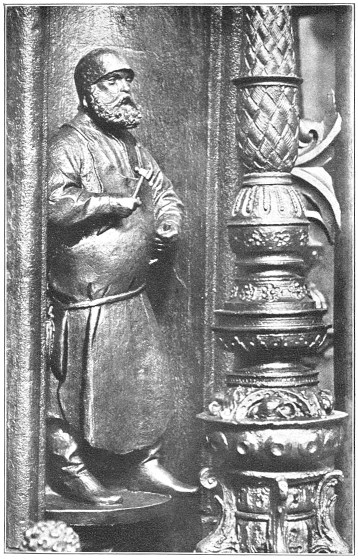
Bernward came of a noble family. His figure may be seen—as near
an approach to a portrait of this great worker as we have—among
the bas-reliefs on the beautiful choir-screen in St. Michael's
Church in Hildesheim.
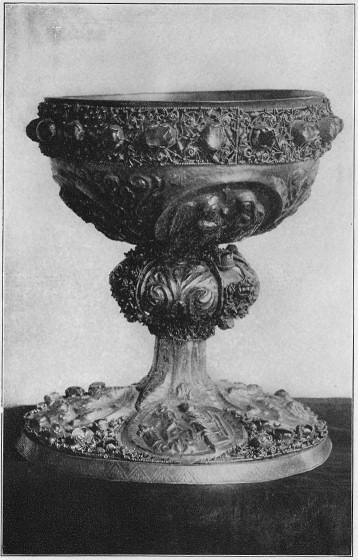
|
| BERNWARD'S CHALICE, HILDESHEIM |
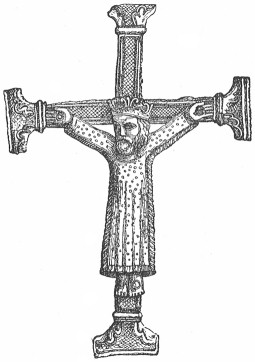
The cross executed by Bernward's own hands in 994 is a superb work,
with filigree covering the whole, and set with gems en cabochon,
with pearls, and antique precious stones, carved with Greek divinities
in intaglio. The candlesticks of St. Bernward, too, are most
interesting. They are made of a metal composed of gold, silver,
and iron, and are wrought magnificently, into a mass of animal
and floriate forms, their outline being well retained, and the
grace of the shaft and proportions being striking. They are partly
the work of the mallet and partly of the chisel. They had been
buried with Bernward, and were found in his sarcophagus in 1194.
Didron has likened them, in their use of animal form, to the art
of the Mexicans; but to me they seem more like delightful German
Romanesque workmanship, leaning more towards that of certain spirited
Lombard grotesques, or even that of Arles and certain parts of Page 19 France, than
to the Aztec to which Didron has reference. The little climbing
figures, while they certainly have very large hands and feet, yet
are endowed with a certain sprightly action; they all give the
impression of really making an effort,—they are trying to
climb, instead of simply occupying places in the foliage. There
is a good deal of strength and energy displayed in all of them,
and, while the work is rude and rough, it is virile. It is not
unlike the workmanship on the Gloucester candlestick in the South
Kensington Museum, which was made in the twelfth century.
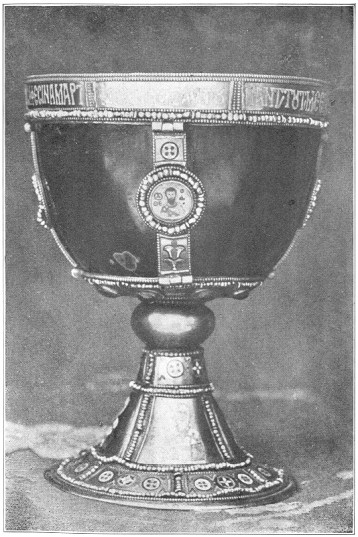
Bernward's chalice is set with antique stones, some of them carved.
On the foot may be seen one representing the three Graces, in their
customary state of nudity "without malice."
Bernward was also an architect. He built the delightful church of
St. Michael, and its cloister. He also superintended the building
of an important wall by the river bank in the lower town.
When there was an uneasy time of controversy at Gandesheim, Bernward
hastened to headquarters in Rome, to arrange to bring about better
feeling. In 1001 he arrived, early in January, and the Pope went
out to meet him, kissed him, and invited him to stay as a guest
at his palace. After accomplishing his diplomatic mission, and
laden with all sorts of sacred relics, Bernward returned home, not
too directly to prevent his seeing something of the intervening
country.
A book which Bishop Bernward had made and Page 20 illuminated in 1011 has the inscription:
"I, Bernward, had this codex written out, at my own cost, and gave it
to the beloved Saint of God, Michael. Anathema to him who alienates
it." This inscription has the more interest for being the actual
autograph of Bernward.
He was succeeded by Hezilo, and many other pupils. These men made
the beautiful corona of the cathedral, of which I give an illustration
in detail. Great coronas or circular chandeliers hung in the naves
of many cathedrals in the Middle Ages. The finest specimen is this
at Hildesheim, the magnificent ring of which is twenty feet across,
as it hangs suspended by a system of rods and balls in the form
of chains. It has twelve large towers and twelve small ones set
around it, supposed to suggest the Heavenly Jerusalem with its many
mansions. There are sockets for seventy-two candles. The detail
of its adornment is very splendid, and repays close study. Every
little turret is different in architectonic form, and statues of
saints are to be seen standing within these. The pierced silver work
on this chandelier is as beautiful as any mediæval example
in existence.
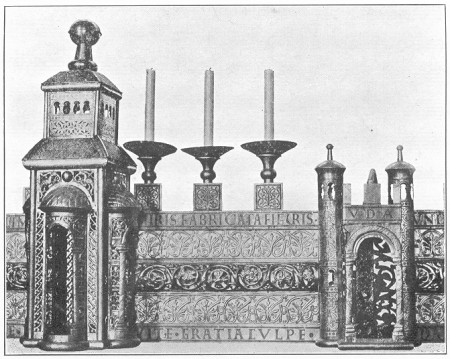
|
| CORONA AT HILDESHEIM (DETAIL) |
The great leader of mediæval arts in France was the Abbot Suger
of St. Denis. Suger was born in 1081, he and his brother, Alvise,
who was Bishop of Arras, both being destined for the Episcopate. As
a youth he passed ten years at St. Denis as a scholar. Here he
became intimate with Prince Louis, and this friendship developed
in after life. On returning from a voyage to Page 21 Italy, in 1122, he learned at the
same time of the death of his spiritual father, Abbot Adam, and of
his own election to be his successor. He thus stood at the head
of the convent of St. Denis in 1123. This was due to his noble
character, his genius for diplomacy and his artistic talent. He was
minister to Louis VI., and afterwards to Louis VII., and during the
second Crusade, he was made Regent for the kingdom. Suger was known,
after this, as the Father of his Country, for he was a courageous
counsellor, firm and convincing in argument, so that the king had
really been guided by his advice. While he was making laws and
instigating crusades, he was also directing craft shops and propagating
the arts in connection with the life of the Church. St. Bernard
denounced him, as encouraging too luxurious a ritual; Suger made a
characteristic reply: "If the ancient law... ordained that vessels
and cups of gold should be used for libations, and to receive the
blood of rams,... how much rather should we devote gold, precious
stones, and the rarest of materials, to those vessels which are
destined to contain the blood of Our Lord."
Suger ordered and himself made most beautiful appointments for the
sanctuary, and when any vessel already owned by the Abbey was of
costly material, and yet unsuitable in style, he had it remodelled.
An interesting instance of this is a certain antique vase of red
porphyry. There was nothing ecclesiastical about this vase; it was
a plain straight Greek jar, with two handles at the sides. Suger
treated it as the body of Page
22 an eagle, making the head and neck to surmount it, and
the claw feet for it to stand on, together with its soaring wings,
of solid gold, and it thus became transformed into a magnificent
reliquary in the form of the king of birds. The inscription on
this Ampula of Suger is: "As it is our duty to present unto God
oblations of gems and gold, I, Suger, offer this vase unto the
Lord."
Suger stood always for the ideal in art and character. He had the
courage of his convictions in spite of the fulminations of St.
Bernard. Instead of using the enormous sums of money at his disposal
for importing Byzantine workmen, he preferred to use his funds
and his own influence in developing a native French school of
artificers.
It is interesting to discover that Suger, among his many adaptations
and restorations at St. Denis, incorporated some of the works of
St. Eloi into his own compositions. For instance, he took an ivory
pulpit, and remodelled it with the addition of copper animals.
Abbots of St. Denis made beautiful offerings to the church. One
of them, Abbot Matthiew de Vendôme, presented a wonderful
reliquary, consisting of a golden head and bust, while another
gave a reliquary to contain the jaw of St. Louis. Suger presented
many fine products of his own art and that of his pupils, among
others a great cross six feet in height. A story is told of him,
that, while engaged in making a particularly splendid crucifix
for St. Denis, he ran short of precious Page 23 stones, nor could he in any way
obtain what he required, until some monks came to him and offered
to sell him a superb lot of stones which had formerly embellished
the dinner service of Henry I. of England, whose nephew had given
them to the convent in exchange for indulgences and masses! In these
early and half-barbaric days of magnificence, form and delicacy
of execution were not understood. Brilliancy and lavish display of
sparkling jewels, set as thickly as possible without reference
to a general scheme of composition, was the standard of beauty;
and it must be admitted that, with such stones available, no more
effective school of work has ever existed than that of which such
works Charlemagne's crown, the Iron Crown of Monza, and the crown
of King Suinthila, are typical examples. Abbot Suger lamented when
he lacked a sufficient supply of stones; but he did not complain
when there occurred a deficiency in workmen. It was comparatively
easy to train artists who could make settings and bind stones together
with soldered straps!
In 1352 a royal silversmith of France, Etienne La Fontaine, made
a "fauteuil of silver and crystal decorated with precious stones,"
for the king.
The golden altar of Basle is almost as interesting as the great
Pala d'Oro in Venice, of which mention is made elsewhere. It was
ordered by Emperor Henry the Pious, before 1024, and presented to
the Prime Minister at Basle. The central figure of the Saviour
has at its feet two tiny figures, quite out of scale; these are
Page 24 intended
for the donors, Emperor Henry and his queen, Cunegunda.
Silversmith's work in Spain was largely in Byzantine style, while
some specimens of Gothic and Roman are also to be seen there. Moorish
influence is noticeable, as in all Spanish design, and filigree work
of Oriental origin is frequently to be met with. Some specimens
of champlevé enamel are also to be seen, though this art
was generally confined to Limoges during the Middle Ages. A Guild
was formed in Toledo which was in flourishing condition in 1423.
An interesting document has been found in Spain showing that craftsmen
were supplied with the necessary materials when engaged to make
valuable figures for the decoration of altars. It is dated May 12,
1367, "I, Sancho Martinez Orebsc, silversmith, native of Seville,
inform you, the Dean and Chapter of the church of Seville, that it
was agreed that I make an image of St. Mary with its tabernacle,
that it should be finished at a given time, and that you were to
give me the silver and stones required to make it."
In Spain, the most splendid triumphs of the goldsmith's skill were
the "custodias," or large tabernacles, in which the Host was carried
in procession. The finest was one made for Toledo by Enrique d'Arphe,
in competition with other craftsmen. His design being chosen, he
began his work in 1517, and in 1524 the custodia was finished. It
was in the form of a Gothic temple, six sided, with a jewelled cross
on the top, and was eight Page
25 feet high. Some of the gold employed was the first
ever brought from America. The whole structure weighed three hundred
and eighty-eight pounds. Arphe made a similar custodia for Cordova
and another for Leon. His grandson, Juan d'Arphe, wrote a verse
about the Toledo custodia, in which these lines occur:
"Custodia is a temple of rich plate
Wrought for the glory of Our Saviour true...
That holiest ark of old to imitate,
Fashioned by Bezaleel the cunning Jew,
Chosen of God to work his sovereign will,
And greatly gifted with celestial skill."
Juan d'Arphe himself made a custodia for Seville, the decorations
and figures on which were directed by the learned Francesco Pacheco,
the father-in-law of Velasquez. When this custodia was completed,
d'Arphe wrote a description of it, alluding boldly to this work
as "the largest and finest work in silver known of its kind," and
this could really be said without conceit, for it is a fact.
A Gothic form of goldsmith's work obtained in Spain in the 13th,
14th and 15th centuries; it was based upon architectural models and
was known as "plateresca." The shrines for holding relics became
in these centuries positive buildings on a small scale in precious
material. In England also were many of these shrines, but few of
them now remain.
The first Mayor of London, from 1189 to 1213, was a goldsmith,
Henry Fitz Alwyn, the Founder of the Royal Exchange; Sir Thomas
Gresham, in 1520, was Page
26 also a goldsmith and a banker. There is an entertaining
piece of cynical satire on the Goldsmiths in Stubbes' Anatomy of
Abuses, written in the time of Queen Elizabeth, showing that the
tricks of the trade had come to full development by that time, and
that the public was being aroused on the subject. Stubbes explains
how the goldsmith's shops are decked with chains and rings, "wonderful
richly." Then he goes on to say: "They will make you any monster
or article whatsoever of gold, silver, or what you will. Is there
no deceit in these goodlye shows? Yes, too many; if you will buy a
chain of gold, a ring, or any kind of plate, besides that you shall
pay almost half more than it is worth... you shall also perhaps
have that gold which is naught, or else at least mixed with drossie
rubbage.... But this happeneth very seldom by reason of good orders,
and constitutions made for the punishment of them that offend in
this kind of deceit, and therefore they seldom offend therein,
though now and then they chance to stumble in the dark!"
Fynes Moryson, a traveller who died in 1614, says that "the goldsmiths'
shops in London... are exceedingly richly furnished continually
with gold, with silver plate, and with jewels.... I never see any
such daily show, anything so sumptuous, in any place in the world,
as in London." He admits that in Florence and Paris the similar
shops are very rich upon special occasions; but it is the steady
state of the market in London to which he has reference.
Page 27
The Company of Goldsmiths in Dublin held quite a prominent social
position in the community. In 1649, a great festival and pageant
took place, in which the goldsmiths and visiting craftsmen from
other corporations took part.
Henry III. set himself to enrich and beautify the shrine of his
patron saint, Edward the Confessor, and with this end in view he
made various extravagant demands: for instance, at one time he
ordered all the gold in London to be detailed to this object, and
at another, he had gold rings and brooches purchased to the value
of six hundred marks. The shrine was of gold, and, according to
Matthew Paris, enriched with jewels. It was commenced in 1241.
In 1244 the queen presented an image of the Virgin with a ruby
and an emerald. Jewels were purchased from time to time,—a
great cameo in 1251, and in 1255 many gems of great value. The
son of ado the Goldsmith, Edward, was the "king's beloved clerk,"
and was made "keeper of the shrine." Most of the little statuettes
were described as having stones set somewhere about them: "an image
of St. Peter holding a church in one hand and the keys in the other,
trampling on Nero, who had a big sapphire on his breast;" and "the
Blessed Virgin with her Son, set with rubies, sapphires, emeralds,
and garnets," are among those cited. The whole shrine was described
as "a basilica adorned with purest gold and precious stones."
Odo the Goldsmith was in charge of the works for a Page 28 good while.
He was succeeded by his son Edward. Payments were made sometimes
in a regular wage, and sometimes for "task work." The workmen were
usually known by one name—Master Alexander the King's Carpenter,
Master Henry the King's Master Mason, and so forth. In an early
life of Edward the Confessor, there is an illumination showing the
masons and carpenters kneeling to receive instruction from their
sovereign.
The golden shrine of the Confessor was probably made in the Palace
itself; this was doubtless considered the safest place for so valuable
a work to remain in process of construction; for there is an allusion
to its being brought on the King's own shoulders (with the assistance
of others), from the palace to the Abbey, in 1269, for its consecration.
In 1243 Henry III. ordered four silver basins, fitted with cakes
of wax with wicks in them, to be placed as lights before the shrine
of Thomas à Becket in Canterbury. The great gold shrine
of Becket appears to have been chiefly the work of a goldsmith,
Master Adam. He also designed the Coronation Chair of England,
which is now in Westminster Abbey.
The chief goldsmith of England employed by Edward I. was one Adam
of Shoreditch. He was versatile, for he was also a binder of books.
A certain bill shows an item of his workmanship, "a group in silver
of a child riding upon a horse, the child being a likeness of Lord
Edward, the King's son."
Page 29
A veritable Arts and Crafts establishment had been in existence
in Woolstrope, Lincolnshire, before Cromwell's time; for Georde
Gifford wrote to Cromwell regarding the suppression of this monastery:
"There is not one religious person there but what doth use either
embrothering, wryting books with a faire hand, making garments,
or carving."
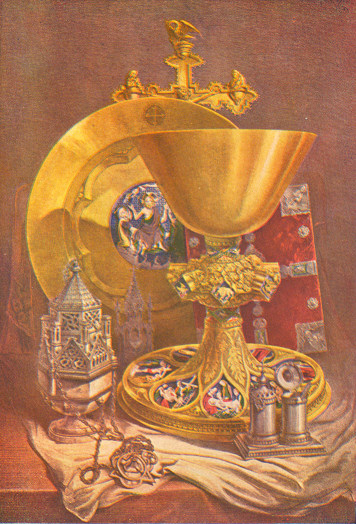
In all countries the chalices and patens were usually, designed
to correspond with each other. The six lobed dish was a very usual
form; it had a depressed centre, with six indented scallops, and the
edge flat like a dinner plate. In an old church inventory, mention
is made of "a chalice with his paten." Sometimes there was
lettering around the flat edge of the paten. Chalices were-composed
of three parts: the cup, the ball or knop, and the stem, with the
foot. The original purpose of having this foot hexagonal in shape
is said to have been to prevent the chalice from rolling when it
was laid on its side to drain. Under many modifications this general
plan of the cup has obtained. The bowl is usually entirely plain, to
facilitate keeping it clean; most of the decoration was lavished
on the knop, a rich and uneven surface being both beautiful and
functional in this place.
Such Norman and Romanesque chalices as remain are chiefly in museums
now. They were usually "coffin chalices"—that is, they had been
buried in the coffin of some ecclesiastic. Of Gothic chalices, or
those of the Tudor period, fewer remain, for after the Reformation,
Page 30
a general order went out to the churches, for all "chalices to be
altered to decent Communion cups." The shape was greatly modified
in this change.
In the thirteenth century the taste ran rather to a chaster form
of decoration; the large cabochons of the Romanesque, combined
with a liquid gold surface, gave place to refined ornaments in
niello and delicate enamels. The bowls of the earlier chalices
were rather flat and broad. When it became usual for the laity to
partake only of one element when communicating, the chalice, which
was reserved for the clergy alone, became modified to meet this
condition, and the bowl was much smaller. After the Reformation,
however, the development was quite in the other direction, the bowl
being extremely large and deep. In that period they were known
as communion cups. In Sandwich there is a cup which was made over
out of a ciborium; as it quite plainly shows its origin, it is
naïvely inscribed: "This is a Communion Coop." When this change
in the form of the chalice took place, it was provided, by admonition
of the Archbishop, in all cases with a "cover of silver... which
shall serve also for the ministration of the Communion bread." To
make this double use of cover and dish satisfactory, a foot like
a stand was added to the paten.
The communion cup of the Reformation differed from the chalice,
too, in being taller and straighter, with a deep bowl, almost in
the proportions of a flaring tumbler, and a stem with a few close
decorations instead Page
31 of a knop. The small paten served as a cover to the
cup, as has been mentioned.
It is not always easy to see old church plate where it originally
belonged. On the Scottish border, for instance, there were constant
raids, when the Scots would descend upon the English parish churches,
and bear off the communion plate, and again the English would cross
the border and return the compliment. In old churches, such as the
eleventh century structure at Torpenhow, in Cumberland, the deep
sockets still to be seen in the stone door jambs were intended
to support great beams with which the church had constantly to
be fortified against Scottish invasion. Another reason for the
disappearance of church plate, was the occasional sale of the silver
in order to continue necessary repairs on the fabric. In a church
in Norfolk, there is a record of sale of communion silver and "for
altering of our church and fynnishing of the same according to our
mindes and the parishioners." It goes on to state that the proceeds
were appropriated for putting new glass in the place of certain windows
"wherein were conteined the lives of certain prophane histories,"
and for "paving the king's highway" in the church precincts. At the
time of the Reformation many valuable examples of Church plate were
cast aside by order of the Commissioners, by which "all monuments
of feyned miracles, pilgrimages, idolatry, and superstition," were
to be destroyed. At this time a calf or a sheep might have been
seen browsing in the meadows with a sacring-bell fastened at its
neck, Page 32 and
the pigs refreshed themselves with drinking from holy-water fonts!
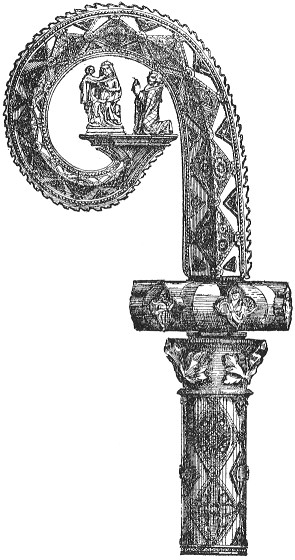
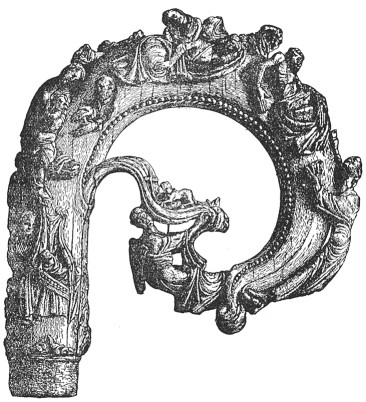
Croziers of ornate design especially roused the ire of the Puritans.
In Mr. Alfred Maskell's incomparable book on Ivories, he translates
a satirical verse by Guy de Coquille, concerning these objectionable
pastoral staves (which were often made of finely sculptured ivory).
"The staff of a bishop of days that are old
Was of wood, and the bishop himself was of gold.
But a bishop of wood prefers gorgeous array,
So his staff is of gold in the new fashioned way!"
During the Renaissance especially, goldsmith's work was carried
to great technical perfection, and yet the natural properties of
the metal were frequently lost sight of, and the craftsmen tried
to produce effects such as would be more suitable in stone or
wood,—little architectonic features were introduced, and
gold was frequently made to do the work of other materials. Thus
it lost much of its inherent effectiveness. Too much attention
was given to ingenuity, and not enough to fitness and beauty.
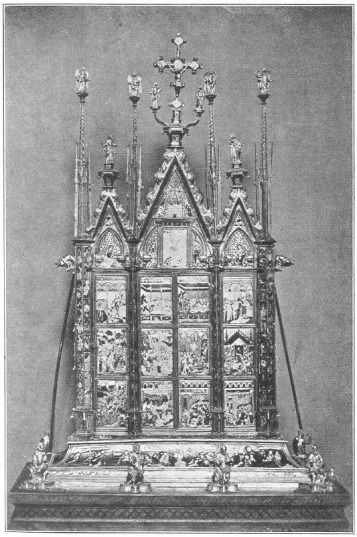
|
| RELIQUARY AT ORVIETO |
In documents of the fourteenth century, the following list of goldsmiths
is given: Jean de Mantreux was goldsmith to King Jean. Claux de Friburg
was celebrated for a gold statuette of St. John which he made for
the Duke of Normandy. A diadem for this Duke was also recorded,
made by Jean de Piguigny. Hannequin made Page 33 three golden crowns for Charles
V. Hans Crest was goldsmith to the Duke of Orleans, while others
employed by him were Durosne, of Toulouse, Jean de Bethancourt,
a Flemish goldsmith. In the fifteenth century the names of Jean de
Hasquin, Perrin Manne, and Margerie d'Avignon, were famous.
Artists in the Renaissance were expected to undertake several branches
of their craft. Hear Poussin: "It is impossible to work at the
same time upon frontispieces of books: a Virgin: at the picture
for the congregation of St. Louis, at the designs for the gallery,
and for the king's tapestry! I have only a feeble head, and am
not aided by anyone!"
A goldsmith attached to the Court of King René of Anjou
was Jean Nicolas. René also gave many orders to one Liguier
Rabotin, of Avignon, who made him several cups of solid gold, on
a large tray of the same precious metal. The king often drew his
own designs or such bijoux.
Among the famous men of Italy were several who practised the art of
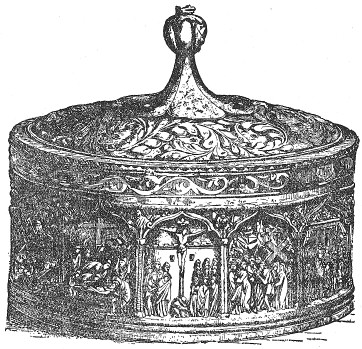
the goldsmith. Ugolino of Siena constructed the wonderful reliquary
at Orvieto; this, is in shape somewhat similar to the façade
of the cathedral.
Verocchio, the instructor of Leonardo da Vinci, accomplished several
important pieces of jewelery in his youth: cope-buttons and silver
statuettes, chiefly, which were so successful that he determined to
take up the career of a sculptor. Ghirlandajo, as is well known,
Page 34 was trained
as a goldsmith originally, his father having been the inventor of
a pretty fashion then prevailing among young girls of Florence,
and being the maker of those golden garlands worn on the heads
of maidens. The name Ghirlandajo, indeed, was derived from these
garlands (ghirlandes).
Francia began life as a goldsmith, too, and was never in after life
ashamed of his profession, for he often signed his works Francesco
Francia Aurifex. Francia was a very skilful workman in niello,
and in enamels. In fact, to quote the enthusiastic Vasari, "he
executed everything that is most beautiful, and which can be performed
in that art more perfectly than any other master had ever done."
Baccio Baldini, also, was a goldsmith, although a greater portion
of his ability was turned in the direction of engraving. His pupil
Maso Finniguerra, who turned also to engraving, began his career
as a goldsmith.
The great silver altar in the Baptistery in Florence occupied nearly
all the goldsmiths in that city. In 1330 the father of the Orcagnas,
Cione, died; he had worked for some years before that on the altar.
In 1366 the altar was destroyed, but the parts in bas-relief by
Cione were retained and incorporated into the new work, which was
finished in 1478. Ghiberti, Orcagna, Verocchio, and Pollajuolo,
all executed various details of this magnificent monument.
Goldsmiths did not quite change their standing and characteristics
until late in the sixteenth century. Page 35 About that time it may be said
that the last goldsmith of the old school was Claude Ballin, while
the first jeweller, in the modern acceptation of the word, was
Pierre de Montarsy.
Silver has always been selected for the better household utensils,
not only on account of its beauty, but also because of its ductility,
which is desirable in making larger vessels; its value, too, is
less than that of gold, so that articles which would be quite out
of the reach of most householders, if made in gold, become very
available in silver. Silver is particularly adapted to daily use,
for the necessary washing and polishing which it receives keeps
it in good condition, and there is no danger from poison through
corrosion, as with copper and brass.
In the middle ages the customary pieces of plate in English homes
were basins, bottles, bowls, candlesticks, saucepans, jugs, dishes,
ewers and flagons, and chafing-dishes for warming the hands, which
were undoubtedly needed, when we remember how intense the cold
must have been in those high, bare, ill-ventilated halls! There
were also large cups called hanaps, smaller cups, plates, and
porringers, salt-cellars, spoons, and salvers. Forks were of much
later date.
There are records of several silver basins in the Register of John
of Gaunt, and also in the Inventory of Lord Lisle: one being "a basin
and ewer with arms" and another, "a shaving basin." John of Gaunt
also owned "a silver bowl for the kitchen." If the mediæval
household lacked comforts, it could teach us lessons in luxury Page 36 in some other
departments! He also had a "pair of silver bottles, partly gilt,
and enamelled, garnished with tissues of silk, white and blue," and
a "casting bottle" for distributing perfume: Silver candelabra
were recorded; these, of course, must have been in constant service,
as the facilities for lighting were largely dependent upon them.
When the Crown was once obliged to ask a loan from the Earl of
Salisbury, in 1432, the Earl received, as earnest of payment, "two
golden candelabra, garnished with pearls and precious stones."
In the Close Roll of Henry III. of England, there is found an
interesting order to a goldsmith: "Edward, son of Eudo, with all
haste, by day and by night, make a cup with a foot for the Queen:
weighing two marks, not more; price twenty marks, against Christmas,
that she may drink from it in that feast: and paint it and enamel it
all over, and in every other way that you can, let it be decently
and beautifully wrought, so that the King, no less than the said
Queen, may be content therewith." All the young princes and princesses
were presented with silver cups, also, as they came to such age as
made the use of them expedient; Lionel and John, sons of Edward
III., were presented with cups "with leather covers for the same,"
when they were one and three years old respectively. In 1423 the
chief justice, Sir William Hankford, gave his great-granddaughter
a baptismal gift of a gilt cup and a diamond ring, together with a
curious testimonial of eight shillings and sixpence to the nurse!
Page 37
Of dishes, the records are meagre, but there is an amusing entry
among the Lisle papers referring to a couple of "conserve dishes"
for which Lady Lisle expressed a wish. Husee had been ordered to
procure these, but writes, "I can get no conserve dishes... however,
if they be to be had, I will have of them, or it shall cost me hot
water!" A little later he observes, "Towards Christmas day they
shall be made at Bevoys, betwixt Abbeville and Paris."
Flagons were evidently a novelty in 1471, for there is an entry
in the Issue Roll of Edward IV., which mentions "two ollas called
silver flagons for the King." An olla was a Latin term for a jar.
Lord Lisle rejoiced in "a pair of flagons, the gilt sore worn."
Hanaps were more usual, and appear to have been usually in the form
of goblets. They frequently had stands called "tripers." Sometimes
these stands were very ornate, as, for instance, one owned by the
Bishop of Carpentras, "in the shape of a flying dragon, with a
crowned damsel sitting upon a green terrace." Another, belonging to
the Countess of Cambridge, was described as being "in the shape of a
monster, with three buttresses and three bosses of mother of pearl...
and an ewer,... partly enamelled with divers babooneries"—a
delightful expression! Other hanaps were in the forms of swans,
oak trees, white harts, eagles, lions, and the like—probably
often of heraldic significance.
A set of platters was sent from Paris to Richard II., all of gold,
with balas rubies, pearls and sapphires set Page 38 in them. It is related of the ancient
Frankish king, Chilperic, that he had made a dish of solid gold,
"ornamented all over with precious stones, and weighing fifty pounds,"
while Lothaire owned an enormous silver basin bearing as decoration
"the world with the courses of the stars and the planets."
The porringer was a very important article of table use, for pap,
and soft foods such as we should term cereals, and for boiled pudding.
These were all denominated porridge, and were eaten from these vessels.
Soup was doubtless served in them as well. They were numerous in
every household. In the Roll of Henry III. is an item, mentioning
that he had ordered twenty porringers to be made, "like the one
hundred porringers" which had already been ordered!
An interesting pattern of silver cups in Elizabethan times were
the "trussing cups," namely, two goblets of silver, squat in shape
and broad in bowl, which fitted together at the rim, so that one
was inverted as a sort of cover on top of the other when they were
not in use. Drinking cups were sometimes made out of cocoanuts,
mounted in silver, and often of ostrich eggs, similarly treated,
and less frequently of horns hollowed out and set on feet.
Mediæval loving cups were usually named, and frequently for
some estates that belonged to the owner. Cups have been known to
bear such names as "Spang," "Bealchier," and "Crumpuldud," while
others bore the names of the patron saints of their owners.
Page 39
A kind of cruet is recorded among early French table silver, "a
double necked bottle in divisions, in which to place two kinds
of liquor without mixing them." A curious bit of table silver in
France, also, was the "almsbox," into which each guest was supposed
to put some piece of food, to be given to the poor.
Spoons were very early in their origin; St. Radegond is reported
by a contemporary to have used a spoon, in feeding the blind and
infirm. A quaint book of instructions to children, called "The
Babee's Booke," in 1475, advises by way of table manners:
"And whenever your potage to you shall be brought,
Take your sponys and soupe by no way,
And in your dish leave not your spoon, I pray!"
And a later volume on the same subject, in 1500, commends a proper
respect for the implements of the table:
"Ne playe with spoone, trencher, ne knife."
Spoons of curious form were evidently made all the way from 1300
to the present day. In an old will, in 1477, mention is made of
spoons "wt leopards hedes printed in the sponself," and in another,
six spoons "wt owles at the end of the handles." Professor Wilson
said, "A plated spoon is a pitiful imposition," and he was right.
If there is one article of table service in which solidity of metal
is of more importance than in another, it is the spoon, which must
perforce come in Page 40
contact with the lips whenever it is used. In England the earliest
spoons were of about the thirteenth century, and the first idea
of a handle seems to have been a plain shaft ending in a ball or
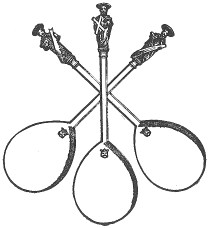
knob. Gradually spoons began to show more of the decorative instinct
of their designers; acorns, small statuettes, and such devices
terminated the handles, which still retained their slender proportions,
however. Finally it became popular to have images of the Virgin on
individual spoons, which led to the idea, after a bit, of decorating
the dozen with the twelve apostles. These may be seen of all periods,
differently elaborated. Sets of thirteen are occasionally met with,
these having one with the statue of Jesus as the Good Shepherd,
with a lamb on his shoulders: it is known as the "Master spoon."
|
| APOSTLE SPOONS |
Page 41
The first mention of forks in France is in the Inventory, of Charles
V., in 1379. We hear a great deal about the promiscuous use of
knives before forks were invented; how in the children's book of
instructions they are enjoined "pick not thy teeth with thy knife,"
as if it were a general habit requiring to be checked. Massinger
alludes to a
"silver fork
To convey an olive neatly to thy mouth,"
but this may apply to pickle forks. Forks were introduced from Italy
into England about 1607.
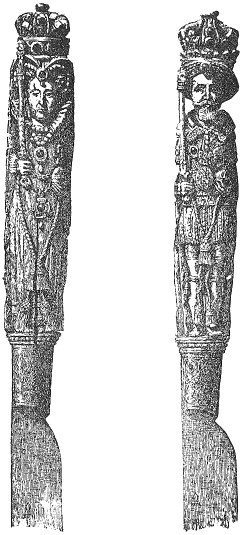
A curiosity in cutlery is the "musical knife" at the Louvre; the
blade is steel, mounted in parcel gilt, and the handle is of ivory.
On the blade is engraved a few bars of music (arranged for the
bass only), accompanying the words, "What we are about to take
may Trinity in Unity bless. Amen." This is a literal translation.
It indicates that there were probably three other knives in the
set so ornamented, one with the soprano, one alto, and one tenor,
so that four persons sitting down to table together might chant
their "grace" in four-part harmony, having the requisite notes
before them! It was a quaint idea, but quite in keeping with the
taste of the sixteenth century.
The domestic plate of Louis, Duke of Anjou, in 1360, consisted of
over seven hundred pieces, and Charles V. of France had an enormous
treasury of such objects for daily use. Strong rooms and safes were
built during
Page 42
|
| IVORY KNIFE HANDLES, WITH PORTRAITS OF QUEEN ELIZABETH
AND JAMES I. ENGLIS |
Page 43
the fourteenth century, for the lodging of the household valuables.
About this time the Dukes of Burgundy were famous for their splendid
table service. Indeed, the craze for domestic display in this line
became so excessive, that in 1356 King John of France prohibited
the further production of such elaborate pieces, "gold or silver
plate, vases, or silver jewelry, of more than one mark of gold, or
silver, excepting for churches." This edict, however, accomplished
little, and was constantly evaded. Many large pieces of silver made
in the period of the Renaissance were made simply with a view to
standing about as ornaments. Cellini alludes to certain vases which
had been ordered from him, saying that "they are called ewers, and
they are placed upon buffets for the purpose of display."
The salt cellar was always a piece de resistance, and stood
in the centre of the table. It was often in the form of a ship in
silver. A book entitled "Ffor to serve a Lorde," in 1500, directs
the "boteler" or "panter," to bring forth the principal salt, and to
"set the saler in the myddys of the table." Persons helped themselves
to salt with "a clene kniffe." The seats of honour were all about
the salt, while those of less degree were at the lower end of the
table, and were designated as "below the salt." The silver ship was
commonly an immense piece of plate, containing the napkin, goblet,
and knife and spoon of the host, besides being the receptacle for
the spices and salt. Through fear of poison, the precaution was
taken of keeping it covered. This ship was Page 44 often known as the "nef," and frequently
had a name, as if it were the family yacht! One is recorded as
having been named the "Tyger," while a nef belonging to the Duke
of Orleans was called the "Porquepy," meaning porcupine. One of
the historic salts, in another form, is the "Huntsman's salt," and
is kept at All Soul's College, Oxford. The figure of a huntsman,
bears upon its head a rock crystal box with a lid. About the feet of
this figure are several tiny animals and human beings, so that it
looks as if the intent had been to picture some gigantic legendary
hunter—a sort of Gulliver of the chase.
The table was often furnished also with a fountain, in which
drinking-water was kept, and upon which either stood or hung cups
or goblets. These fountains were often of fantastic shapes, and
usually enamelled. One is described as representing a dragon on
a tree top, and another a castle on a hill, with a convenient tap
at some point for drawing off the water.
The London City Companies are rich in their possessions of valuable
plate. Some of the cups are especially beautiful. The Worshipful
Company of Skinners owns some curious loving cups, emblematic of
the names of the donors. There are five Cockayne Loving Cups, made
in the form of cocks, with their tail feathers spread up to form
the handles. The heads have to be removed for drinking. These cups
were bequeathed by William Cockayne, in 1598. Another cup is in
the form of a peacock, walking with two little chicks of minute
proportions Page 45
on either side of the parent bird. This is inscribed, "The gift of
Mary the daughter of Richard Robinson, and wife to Thomas Smith
and James Peacock, Skinners." Whether the good lady were a bigamist
or took her husbands in rotation, does not transpire.
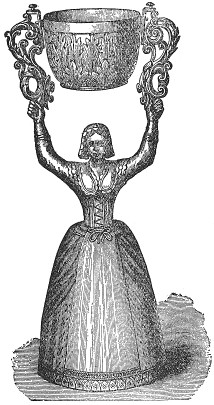
An interesting cup is owned by the Vintners in London, called the
Milkmaid. The figure of a milkmaid, in laced bodice, holds above
her head a small cup on pivots, so that it finds its level when
the figure is inverted, as is the case when the cup is used, the
petticoat of the milkmaid forming the real goblet. It is constructed
on the same principle as the German figures of court ladies holding
up cups, which are often seen to-day, made on the old pattern. The
cups in the case of this milkmaid are both filled with wine, and
it is quite difficult to drink from the larger cup without spilling
from the small swinging cup which is then below the other. Every
member is expected to perform this feat as a sort of initiation.
It dates from 1658.
One of the most beautiful Corporation cups is at Norwich, where
it is known as the "Petersen" cup. It is shaped like a very thick
and squat chalice, and around its top is a wide border of decorative
lettering, bearing the inscription, "THE + MOST + HERE + OF. + IS
+ DUNNE + BY + PETER + PETERSON +." This craftsman was a Norwich
silversmith of the sixteenth century, very famous in his day, and
a remarkably chaste designer as well. A beautiful ivory cup twelve
inches high, set in silver gilt, called the Grace Cup, of Page 46 Thomas à
Becket, is inscribed around the top band, "Vinum tuum bibe cum
gaudio." It has a hall-mark
|
| THE "MILKMAID CUP" |
of a Lombardic letter H, signifying the year 1445. It is decorated by
cherubs, roses, thistles, and crosses, relieved with garnets and
pearls. On another flat band is the inscription: "Sobrii estote,"
and on the cover, Page 47
in Roman capitals, "Ferare God." It is owned by the Howard family,
of Corby.
Tankards were sometimes made of such crude materials as leather
(like the "lether bottel" of history), and of wood. In fact, the
inventory of a certain small church in the year 1566 tells of a
"penny tankard of wood," which was used as a "holy water stock."
An extravagant design, of a period really later than we are supposed
to deal with in this book, is a curious cup at Barber's and Surgeon's
Hall, known as the Royal Oak. It is built to suggest an oak
tree,—a naturalistic trunk, with its roots visible, supporting
the cup, which is in the form of a semi-conventional tree, covered
with leaves, detached acorns swinging free on rings from the sides
at intervals!
Richard Redgrave called attention to some of the absurdities of
the exotic work of his day in England. "Rachel at a well, under
an imitative palm tree," he remarks, "draws, not water, but ink;
a grotto of oyster shells with children beside it, contains... an
ink vessel; the milk pail on a maiden's head contains, not goat's
milk, as the animal by her side would lead you to suppose, but a
taper!"
One great secret of good design in metal is to avoid imitating
fragile things in a strong material. The stalk of a flower or leaf,
for instance, if made to do duty in silver to support a heavy cup or
vase, is a very disagreeable thing to contemplate; if the article
were really Page 48
what it represented, it would break under the strain. While there
should be no deliberate perversion of Nature's forms, there should
be no naturalistic imitation.