N this series of papers it will be our desire to direct the attention
of the architect, manufacturer, and designer, to some of the beautiful
forms of nature, which, though easily accessible, seem to have scarcely
received the consideration they deserve; to give a brief account of the
habits, peculiarities, and localities of the plants as they come before
us; to cite from time to time examples, either English or foreign, of
their use in the ornament of the past; and generally to add such details
as may directly or indirectly tend to create an interest in the plant in
question. We find, on looking back at the past history and practice of
ornamental art, in the midst of many marked differences of style, one
principle very generally observed—the use in the ornament of any given
country of the plants familiar to the people. Hence, the Egyptians
exclusively used in their ornament the plants of their own land; we see
the palm branch, the papyrus, and the beautiful lily of the Nile
constantly recurring. We find the Greeks and Romans employing the
acanthus, olive, and vine; the Japanese, the light and graceful bamboo;
and in our own Gothic styles and those of the Continent—French, German,
or Spanish—we meet with more or less conventionalised representations
in the carvings, paintings, illuminations, fabrics for dress, hangings,
&c., of the familiar forms of our hedgerows, streams, and meadows, such
as the wild rose, oak, maple, iris, buttercup, and many others. It is
then with the desire to awaken our decorators to the fact, that
beautiful as the Greek anthemion and other allied forms are, they by
no means represent the limit available in ornamental art, that the
following papers have been prepared, since we are persuaded that if once
the inexhaustible riches of nature were sought after by our architects,
and their beauties brought before the eyes of the people in their work,
architecture would thus be taking one long step nearer to the sympathies
and appreciation of many to whom it is now a matter of indifference. The
works of a few of our leading architects owe at least some of their
beauty to their recognition of this truth; and we would desire, while
acknowledging the services rendered to architecture by such men as
Pugin, Collings, Street, and Gilbert Scott, to add our mite to the
revival going on around us.
Botany, or the study of plants (Gr. botane, a plant), is capable of
many subdivisions: thus we have one department which, from its dealing
with the vital functions of the plant, we term physiology (Gr. physis,
nature—logos, science); another which, from its more especially
dealing with the organization and structure of the plant, is called
organography, or structural botany; while a third great division,
systematic botany, derives its name from its teaching how the
multifarious forms of vegetable life may yet be classified into genera,
and these again into orders and species from certain points of
resemblance in the plants thus classed together. Botany, in itself a
science in the ordinary use of the term, may, however, render valuable
service to art; and it is this phase of the subject which we more
especially propose to develop, treating only of the more exclusively
scientific points so far as we find them necessary for our present
purpose; and in this we think we are fully justified, for though numbers
of excellent works are accessible to the student who desires to study
botany as a science, but few fully recognise its importance in a
modified form to the art-student, and more especially to the designer.
To the ornamentist a knowledge of the laws of plant growth is of really
the same importance as the study of anatomy to the figure-painter or
sculptor, and the absence of this knowledge is to the initiated, in
either case, as readily detected. Many who are now content to forego
this precise knowledge are no doubt partly debarred by the
technicalities which meet them at every sentence in ordinary botanical
works. Bearing in mind, therefore, the special requirements of our
readers, we shall endeavour to avoid as far as possible the use of terms
which, though scientifically valuable, and in fact essential to correct
and true description, are not such as we may reasonably assume our
readers, without special botanical study, to be familiar with. A
knowledge of these terms is, however, very desirable, since their
conciseness renders them valuable, and more especially, also, because
many excellent works, which it will be of advantage to the student to
consult, largely employ them. We trust that in the few cases where such
terms are in the present work introduced, a clear explanation of their
force and utility will be found to accompany them; we shall also, as a
further assistance, add the source from whence the term is derived,
wherever the introduction will tend to throw additional light on the
meaning of the word.
As we cannot hope, in the limited space at our command, to supply every
requirement, give every detail, or bring forward more than a few of the
more common plants, the present work must be considered rather as a
suggestive list of the more striking plants which, from their ornamental
characteristics, will, we trust, be found of service to designers, than
an exhaustive catalogue. It is very far indeed from being a complete
list.
To render the work as practically useful as possible, we add to each
plant mentioned the names of some standard books in which reliable
drawings of the plant in question may be found; for though nature should
always, if possible, be consulted, it may not at all times be within the
power of the student to do so, owing to press of work, the season of the
year, and many other disturbing causes.
The following books are thus referred to, the illustrations in them
being of a trustworthy character. After the name of each book is the
abbreviation used in the present work when it is necessary to quote
it:—
| The Flora Londinensis of Curtis. First Edition | F. L. |
| Medical Botany. Woodville. First Edition | M. B. |
| Medical Botany. Stephenson and Churchill. First Edition | S. C. |
| Illustrations of Natural Orders of Plants. E. Twining | T. N. O. |
| English Botany. Sowerby. Third Edition | E. B. |
| Vegetable World. Figuier | V. W. |
| School Botany. Lindley | S. B. |
| Woodlands, Heaths, and Hedges. Coleman | W. H. H. |
| Grammar of Ornament. Owen Jones | G. O. |
The first five on this list have coloured plates. To these we may be
allowed to add Plant Form (P. F.), a work prepared by the author for the
especial use of designers.
The plants described in the following pages are, to facilitate
reference, arranged in regular alphabetical sequence, according to their
English names, since most of my readers will more readily recognise a
plant by its familiar title than by its botanical appellation. Thousands
are familiar with the little daisy who would never recognise it in any
description headed Bellis perennis. At the same time, we in every case
give the scientific nomenclature as well, since in most works you may
desire to consult, that will be of greater prominence than the one used
colloquially. A difficulty here arises from the fact that several of our
English flowers have numerous synonyms given to them; we have, however,
chosen the name which we believe to be most commonly used, referring
also to the others in the course of our remarks on the plant.
In the introduction of vegetable growth into any ornamental composition,
we must be careful to remember that what is wanted is not so much a
direct imitation of nature, which after all can only be faulty at the
best, as a due adaptation of the natural form to the purpose of our
design—a recognition of the impossibility of a close copy of nature,
together with a feeling of its undesirableness even if it could be
accomplished. Our representations must therefore be more or less
conventional: in a flower-painting we naturally expect to see a direct
transcript of nature, while in decorative art a direct transcript
offends us.
“In the multitude of counsellors there is safety;” we will, therefore,
here quote some few passages from the works of those whom we think we
can all agree are entitled to speak with authority and to be heard with
respect. Ruskin, in speaking on this subject, says,—“All noble
ornamentation is the expression of man’s delight in God’s work;” and
again, “Ornamentation should be natural, that is to say, should in some
degree express or adopt the beauty of natural objects; it does not hence
follow that it should be an exact imitation of, or endeavour to
supersede, God’s work; it may consist only in a partial adoption of, and
compliance with, the usual forms of natural things, without at all going
to the point of imitation, and it is possible that the point of
imitation may be closely reached by ornaments which nevertheless are
entirely unfit for their place, and are the signs only of a degraded
ambition and an ignorant dexterity. Bad decorators err as easily on the
side of imitating nature as of forgetting her, and the question of the
exact degree in which imitation should be attempted under given
circumstances is one of the most subtle and difficult in the whole range
of criticism.” Wornum thus defines the difference between naturalism and
conventionalism: “A natural treatment implies natural imitation and
arrangement, but an ornamental treatment does not necessarily exclude
imitation in the parts, as, for instance, a scroll may be composed of
strictly natural parts, but as no plant would grow in an exactly spiral
direction, the scroll form constitutes the ornamental or conventional
arrangement; we may, however, have conventionalism of details as well as
conventionalism of arrangement.” Hudson says,—“There is a great
difference between the terms applied and adapted; they, in fact, express
the wrong and the right use of vegetable forms. All natural forms
require certain modifications to adapt them for other than their own
natural situations, and it is the neglect of this, and the simple
application of these forms without adapting them, which constitute a
false principle.” Dresser thus illustrates the difference: “Mere
imitation is not ornamentation, and is no more art in the higher sense
of the term than writing is itself literature. Vegetable nature treated
conventionally will not be found to be far removed from truth, but will
be merely a natural form, or a series of natural forms, neither marred
by blights nor disturbed by winds, adapted to the fulfilment of a
special purpose, and suited to a particular position—for the most
perfect examples of what is usually termed conventionalised nature are
those which express the intention of nature, if we may thus speak, or
are manifestations of natural objects as undisturbed by surrounding
influences and unmarred by casualties.” In the same way we might bring
forward passages from the works of Owen Jones, Sir Gardiner Wilkinson,
and many others, in illustration of our remarks; enough, however, has,
we trust, been brought forward to confirm the position taken up.
We will now, without further prelude, proceed to the brief
consideration of the few representative plants we have selected for our
remarks.
The Agrimony. This plant, the Agrimonia Eupatoria of botanists, and
the Agremoine of old writers, is ordinarily met with in hedgerows and
waste places by the roadside. The flowers are bright yellow, and are
arranged in what is termed botanically a spike (Lat. spica, an ear of
corn; when the flowers grow in succession direct from a central stem).
The leaves are very ornamental in character, the central line giving off
large side leaflets, and the intermediate spaces being filled by smaller
ones. The edges of all the leaves are deeply serrate (Lat. serra, a
saw; notched like the teeth of a saw). Very suitable and suggestive for
lace or wall-papers, where a somewhat delicate form with a decidedly
upright mode of growth is desirable. Drawings of the plant may be seen
in S. B. 126; E. B. 417; F. L. vol. v. 32; and M. B. 258. The natural
plant will be found in flower during July and August.
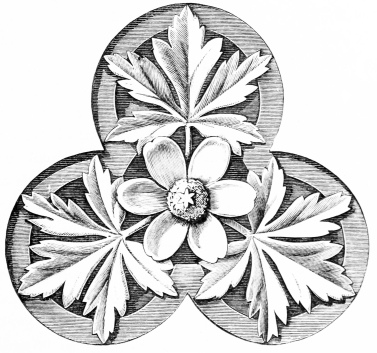
The White or Wood Anemone (Anemone nemorosa), or, as it is often
termed in old botanical works, the Wind-flower. This older name refers
to the same fact alluded to in its generic name, Anemone, the
fragility and delicacy of the flowers, and their exposure to the bleak
and boisterous winds that sweep through the almost leafless woods in
early spring, or, as others believe, from an old fancy that the flowers
will not open until buffeted by the gales of March, anemone being
derived from the Greek word, anemos, the wind. The second name,
nemorosa, signifies woody, and bears obvious reference to the
localities most favourable to
the growth of the anemone. The plant may be found in flower during the
months of March, April, and May, the blossoms being pure white, with a
bright yellow centre, and the outer surface of the sepals of a delicate
purple tinge. It abounds in moist woods throughout the country,
generally in such profusion as to cover large tracts of ground with a
snowy whiteness; and the plant being perennial, we shall, when it is
once established in any spot, find it regularly recurring as each
spring-time comes round. The manner of growth of the anemone is very
distinct and characteristic, and not being subject to any variation,
cannot well be modified in the employment of the plant in ornamental
art without destroying its individuality, as from the single stem thrown
up from the ground three equal-sized leaves, identical in form, are
produced from a point about six inches from the soil, and the stalk is
then continued for about the same distance again before bearing at its
summit its single flower; each and every plant, therefore, consists of a
central stem, a terminal flower, and about midway up the stem a group of
three leaves. This rigid law, though extremely beautiful in itself, and
admirably adapted for treatment for some ornamental purposes, may,
perhaps, somewhat restrict its use in decorative art. We are not aware
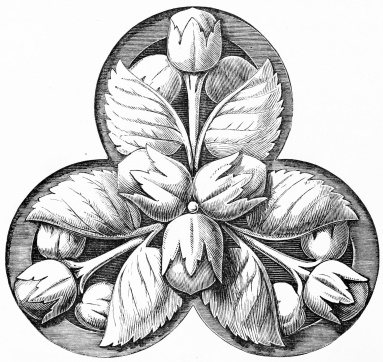
of any examples of its employment in past art. In our illustration, the
plan of the plant, the view with which we are most familiar, as we see
it in its natural position, is shown, having the single central flower,
and below it the three leaves radiating from the stem. It will be found
that this strong individuality of growth more especially adapts itself
to the trefoil, or any other form based on the figure three.[A] The
garden-anemone (A. coronaria) is an allied species of the same family,
modified by cultivation: in its wild state it is a native of the South
of Europe.
The Arrow-head (Sagittaria sagittifolia), one of our most beautiful
aquatic plants, must be so well known to our readers that any lengthened
description of it will be superfluous. Its generic, specific, and
English names all alike point out its leading characteristic, the
beautiful arrow-headed shape of its leaves;—sagitta, Lat., an arrow.
The calyx and corolla are each composed of three parts, the petals being
a brilliant white, with a pale pink irregular blotch at their bases. The
forms of the flowers, fruit, and leaves are all equally adapted for
decorative purposes, though it does not appear to have received in the
past the attention which its merits might very fairly claim, the only
instances of its application in ornamental art with which we are
acquainted being in a running band of ornament round a tomb, fourteenth
century, in the cloisters, Burgos. The flowers are incorrectly
represented in that example as having four petals, but the general
effect is, nevertheless, very good. See E. B. 1436 and P. F. 72 for
drawings of the natural plant.
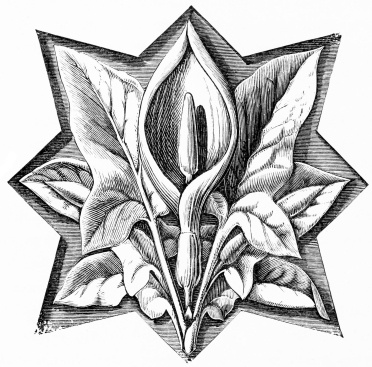
The Arum (Arum maculatum) is a plant of very common occurrence
throughout England, though rarely to be found either in Scotland or
Ireland. It may be met with in shady groves and thickets, and nestled
among the long grass and other herbage upon our hedge-banks. The plant
will be found in flower during April and May; but from the mode of
growth, and also from the pale green colour of the spathe surrounding
the central organs, it is by no means conspicuous among the surrounding
foliage. The upper portion of the central body or spadix—that part of
it which is seen in our illustration—is generally of a dark crimson
colour. The plant is far more likely to attract attention in the autumn
and winter than during its season of flowering, as towards the close of
the year the leaves of the arum die away, and the hedgerows also being
stripped of the greater part of their
foliage, we notice the brilliant scarlet berries of the present plant
rising in a dense mass to the height of some three or four inches from
the ground. If the fresh root of the plant be tasted, it excites a
burning and pricking sensation in the mouth that will remain for several
hours; and if sliced and applied to the skin, it will frequently produce
blisters. This virulence, however, like the acrimonious principle met
with in the leaves, yields to the influence of heat, and in former times
an excellent starch was prepared from the root. In the writings of the
old medical authors and poets we meet with the wild arum under a great
variety of names, many of them, through the lapse of time and from
disuse, being now meaningless to us; such, for example, as abron, janus,
barba-aron, calf’s-foot, ramp, and wake-robin. A very common name for
the plant at the present day with country children is lords-and-ladies;
and an equally familiar name, both with children and also in
descriptions of the plant in botanical works, is the cuckoo-pint: this
may possibly allude to the slight resemblance of the enclosing spathe to
a measure for liquids. Another old name for the plant is the starchwort,
in obvious allusion to its domestic use. Like most other plants, it was
held by the medical practitioners of the Middle Ages to possess very
considerable and valuable remedial qualities. A small portion of the
leaf, either dried or in the green state, was esteemed a sure remedy for
the plague or any poison. “The water wherein the root hath been boiled,
dropped into the eyes, cleanseth them from any film or mists which begin
to hinder the sight,” or under circumstances to which the writer
delicately hints, “when, by some chance, they become black and blue.”
Though the bold, simple forms of the flower and bud and the rich
arrow-headed shape of the leaves appear, in an especial manner, to fit
it for valuable service in ornamental art, it has been but very rarely
thus employed. Illustrations of the natural growth of the plant will be
found in F. L. vol. ii. 63; S. C. 22; and P. F. 41.
The Avens (Geum urbanum), belonging to the same natural order,
Rosaceæ, as the tormentil and wood-strawberry, possesses also the same
peculiarity of flower, the petals being five in number, while the calyx
is composed of five large segments, alternating with five others of a
much smaller size. The root is very astringent in its nature, and of
sufficient value to be included in the Materia Medica. The avens may be
generally found growing in hedges and woods, flowering during June and
July, and attaining to a height of from one to two feet. The leaves are
very ornamental in character, and will, equally with the flowers, prove
of valuable service to the designer. For illustrations of the growth of
the plant refer to F. L. vol. ii. 36, and P. F. 81.
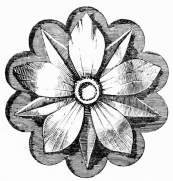
Bedstraw (Galium verum). This is also known as cheese rennet, gallion,
and maid-hair. The word bedstraw is in allusion to the former use of the
dried plant as a cheap material in forming beds. The name cheese-rennet
is derived from a bygone employment of the plant for curdling milk: we
see this same use of the plant referred to in the generic term Galium,
that name being derived from the Greek word for milk. Gallion is
evidently a herbalist’s corruption of Galium, while the fourth name,
maid-hair, has obvious reference to the lightness and delicacy of the
plant. The minute yellow flowers grow in dense heads of blossom, while
the leaves are in whorls, that is to say, several starting from the same
level, and thus growing in a succession of rings round the stems. The
number of the leaves in a ring is very variable; from eight to twelve
is, however, the usual number. Dry banks are the ordinary habitat of the
plant. It will be found in flower throughout June, July, and August.
Its lightness and graceful mode of growth admirably fit it for the
purposes of the designer. For illustrations of the bedstraw refer to E.
B. 648, or F. L. vol. vi. 13. The old herb-doctors, ever ready to find
or make a medicinal use, speak in high commendation of the present plant
for its reputed efficacy in relieving pains from burns, inward wounds,
&c., while “a decoction of the herb is good to bathe the feet of
travellers and lacquies, whose long running causeth weariness and
stiffness in their sinews.”
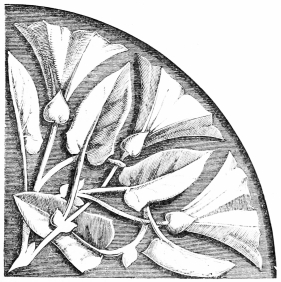
The Bindweed, botanically known as the Calystegia sepium, is one of
our most familiar plants; large surfaces of our hedgerows (Lat. sepe,
a hedge) being covered by its graceful leaves and tubular flowers. It is
a curious fact that, though abundant throughout England and Ireland, it
is very local in Scotland. The so-called convolvulus major of the
garden is the Ipomæa purpurea, a species very widely spread over the
tropical and temperate regions of the earth. Many of the family possess
active medicinal qualities, and preparations from them are found in the
Pharmacopœia. The English species also were at one time thus
employed; but Gerarde, the great medical botanist of Queen Elizabeth’s
reign, will not admit that they possess any virtue at all, but rather
the contrary. “They are not fit for medicine, and unprofitable weeds,
and hurtful to each thing that groweth next them, and were only
administered by runnegate physick-mongers, quacksalvers, old women
leeches, abusers of physick, and deceivers of people.” For study of the
natural appearance of the flower we would refer you, if you are unable
to meet with the plant itself, to E. B. 924; S. C. 2; T. N. O. 97; G. O.
99; and P. F. 76.
Bitter-sweet. The Bitter-sweet (Solanum Dulcamara) is so called from
the bitter flavour of the stems when first tasted, a flavour which is
speedily followed by a peculiar sweetness somewhat resembling liquorice
root. In not only the familiar English name, but the specific botanical
appellation as well, we see this peculiarity of the plant referred to,
Dulcamara having the same meaning as bitter-sweet. The continental
names have also this curious reference in them, the plant in France
being called Douce-amère; in Italy, Dulcamara; in Spain, Amaradulcis;
and in Germany, Bittersusstangel. The plant is frequently called woody
nightshade, while the old herbalists, in addition to the names already
given, call it felonwort. Solanum is derived from solamen, in
reference to the soothing effect of some species of the Solanaceæ. The
bitter-sweet has small flowers of a deep purple colour, the petals being
very much reflexed. The berries are of a deep red when ripe, but change
considerably in their colour before reaching maturity; thus on the same
bunch we may frequently see green, yellow, orange, and crimson fruit.
Thirty of these berries administered to a large dog killed it in less
than three hours. Refer to E. B. 930; F. L. vol. i. 14; M. B. 33; S. C.
17; T. N. O. 100; and P. F. 19, for illustrations of the natural growth
of the plant. This shrub is frequently confounded with the deadly
nightshade, from the slight similarity of name; but there is no other
point of resemblance. The two plants are totally distinct. The woody
nightshade, though common in most parts of England, is comparatively
scarce in Scotland and Ireland. It is a hedgerow plant, flowering during
June, July, and August. A variety with white flowers is sometimes met
with.
The Black-thorn or Sloe (Prunus spinosa) is curious and suggestive
from an ornamentist’s point of view, from the flowers, unlike most other
plants, appearing in profusion before the leaves are developed. We see a
plant strongly resembling the black-thorn very largely used in their
ornament by the Japanese, a plant with numerous spreading branches,
leafless, but thickly clustered with flowers. The black-thorn may
commonly be met with in coppices and hedgerows, the blossoms appearing
in March or April, and the rich purple fruit in August. The name sloe is
derived from the Anglo-Saxon sla, and refers to the extreme acidity of
the tempting-looking fruit. The natural growth may be seen on reference
to E. B. 408, or M. B. 84. The black-thorn possesses a certain value
ornamentally, as being, like the primrose and snowdrop, a characteristic
flower of the spring.
“Flowers, as the changing seasons roll along,
Still wait on earth, and added beauties lend;
Around the smiling Spring a lovely throng
With eager rivalry her steps attend;
Others with Summer’s brighter glories blend;
Some grace mild Autumn’s more majestic mien;
While some few lingering blooms the brow befriend
Of hoary Winter, and with grace serene
Enwreath the king of storms with mercy’s tender sheen.”
Barton.

The Borage (Borago officinalis), though widely distributed, is by no
means a common plant; and though mentioned by several old writers, must
be considered as but a doubtful native. The generic name has been
corrupted from two Latin words, cor, the heart, and ago, I act, from
a belief, as old as the time of Pliny, in its exhilarating effects;
hence the old saying, Ego borago gaudia semper ago, “I borage give
always courage.” The borage, like the comfrey and forget-me-not, belongs
to the order Boraginaceæ, and, in common with most of the species of
that order, is marked by the gyrate or scorpoid arrangement of its
flowers, the stem being coiled round like the mainspring of a watch. It
may be met with occasionally in the ornament of the past—its large and
striking-looking stellate (Latin, stella, a star) flowers, and the
general growth of the plant, being admirably adapted to the purposes of
design. As an example we may instance the MS. Hours of Henry VII. in the
British Museum, where the borage is introduced upon a golden ground on
one of the pages. Drawings of this plant will be found in E. B. 1114; M.
B. 217; T. N. O. 98; and P. F. 36.
In studying the application of natural vegetable forms to the various
requirements of ornamental art—such, for instance, as the employment of
bold, vigorous plants to stone or wood carving, and the more graceful
and delicate growths to such fabrics as muslin and lace—we speedily
find that in some cases we are unable to treat the whole of the plant we
have selected for our purpose, owing to the limitations placed upon us
by the requirements of the work, the exigencies of manufacture, or the
nature of the materials in which our design is to be embodied. In some
cases the flowers are too small in detail, or in the general mass, to
accord well from the ornamentist’s point of view with the foliage of the
plant; the white bryony (Bryonia dioica), for instance, though
excellently adapted for muslins, could not in its flowering stage be
satisfactorily treated for stonework on this account, though the foliage
by itself is admirably suited for such purpose. In other instances we
find the case reversed, the flower being large and beautiful in form,
and the leaves unsuited, either from their insignificant size or want of
beauty, to the purpose of the ornamentist; thus, while the leaves of the
stonecrop (Sedum acre) are, from their minuteness, scarcely available
for the purposes of design, the stellate flower is exceedingly beautiful
in form, and admirably adapted for diapering and many other uses, when
isolated from the rest of the plant. Where both leaf and flower are from
their beauty and relative scale equally adapted for art-treatment, we
are still, when circumstances require it, quite justified in employing
either the one or the other by itself: where a monochrome arrangement is
necessary, the leaves alone may, for example, be used; where a central
radiate form, the flower may be introduced. The rosette or patera, so
freely introduced both in ancient and mediæval art, is an example of
this use of isolated floral forms.
The Bramble or Blackberry (Rubus fruticosus), a more familiar plant
than the last, has, so far as we are aware, been but little used in
ornamental art, though the Rubus idæus, or wild raspberry, may
occasionally be seen in MSS. of the sixteenth century. The generic name
is highly expressive of the prickly nature of the plant, being derived
from an old Celtic verb, reub, to lacerate or tear away; while its
English name, bramble, attests its indigenous nature, descending as it
does from the Anglo-Saxon name for it, bremel. The stems, ordinarily
of a pale purple colour and with a grey bloom upon them, are pentangular
in section, the numerous prickles almost entirely confined to the ridges
formed by the angles, and not occurring in the intermediate furrows; the
leaves generally with five deeply serrated leaflets, a rich green on the
upper surface, and covered with close white down on the lower; the
petals of the blossom varying from pure white or delicate pink to a deep
red; and the fruit of a rich crimson, so intense in colour as to appear
almost black. The mode of growth
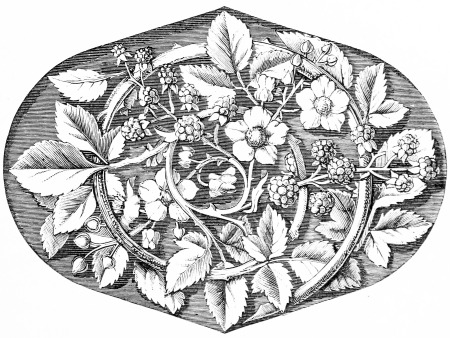
admirably fits it for the service of the designer, the leaves being very
ornamental in form, and the long trailing stems admitting of great
freedom of curve, while for its use in decorative art a further great
recommendation exists in the power of representing the plant under
several phases of growth without violating natural truth, as at one and
the same time we find the opening bud, the fully-expanded flower, and
the fruit of all sizes and stages of development, varying in colour from
green, light red, and crimson, to deep purplish black in its progress to
maturity. We thus gain great variety of form, and also, when admissible,
of colour. The bramble appears to be of especial value in ornament
where large surfaces require to be covered by forms at once suitable in
scale, interesting in their details, and varied in their character;
hence it would seem admirably adapted to muslins and lace, though, so
far as we have had opportunity of observation, it has not been thus
employed. Reliable drawings of the blackberry will be found in W. H. H.,
Plate E, Fig. 1.; in T. N. O. 51; G. O. 96; and P. F. 57.
Some plants, beautiful in themselves, possess an increased importance in
the eyes of the followers of ornamental art, from their being used
heraldically; such, for example, are the rose, the shamrock, the broom,
and the thistle. Broom (Sarothamnus scoparius) is thus used as the
badge of the Scottish clan Forbes, and, as all readers of history will
remember, was also chosen as the device of the Plantagenets. A very good
example of its use in past art—though scarcely, from its being found in
a Tudor monument, having any heraldic meaning—will be seen in a glass
quarry in Henry VII.’s Chapel. Sarothamnus is derived from two Greek
verbs, signifying a shrub, and to sweep. The English name has the same
force of meaning. In an old work we have consulted, the author deems it
useless to go into a long account of the plant, so well known was it in
his time from this domestic use:—“To spend time in writing a
description hereof is altogether needless, it being so generally used by
all the good housewives almost throughout this land to sweep their
houses with, and, therefore, very well known to all sorts of people.”
The broom may ordinarily be found on sandy commons, railway banks, and
dry hillsides. The large yellow pea-shaped flowers appear in great
profusion throughout May and June, and are succeeded in due course by
the black seed-pods. The plant grows from three to six feet high, and
when covered with its brilliant blossoms is a very striking object.
Leaves very inconspicuous. Drawings of this very beautiful plant may be
seen on referring to S. B. 121; E. B. 329; M. B. 89; F. L. vol. v. 31;
S. C. 67; T. N. O. 49.
Bulbous Crowfoot. We have selected the present plant (Ranunculus
bulbosus) as a good representative of the numerous species of plants
familiarly termed buttercups, partly because it is the most striking in
effect, partly because it is the one that will most readily be met with
under ordinary circumstances; for while its fine flowers and
beautifully-cut leaves render it singularly well suited to the purposes
of ornament, the abundance of it in every meadow throughout the country
places it within the reach of all who would desire to adapt it to any
artistic purpose. From the commonness of the plant, and its general
distribution throughout England, it has received many other names:
goldknob, goldcup, baffiner, troil-flower, polt, kingcup, buttercup,
butter-flower, cuckoo-bud, are all synonyms. The term Ranunculus is
derived from rana, a frog, many of the species being found in wet,
swampy places; while the specific name, bulbosus, alludes to the
bulb-like swelling of the lower part of the stem in this particular
species. The name crowfoot has been given to the plant from the
radiating character of the segments of the leaf, spreading as they do
like the divisions of a bird’s foot; while the use of the word buttercup
points to the old belief that the rich yellowness of spring butter is
owing to the eating of this plant by the cows; the effect must rather,
however, be ascribed to the tender grass, as any one who will take the
trouble to notice the fact will find that cows in a meadow will, as far
as possible, avoid the buttercups. The leaves of the bulbous crowfoot,
like, with one exception, those of the rest of the family, are very
acrid, and will, if applied to the skin, speedily blister it. The plant
will be found in flower throughout the spring and summer: a variety is
sometimes met with having cream-coloured flowers. The crowfoot is one of
the favourite plants in the ornament of the Decorated period of Gothic.
Representations of the natural plant may be seen on consulting E. B. 35,
or F. L. vol. i. 38; refer also to “Water Crowfoot” in the present work,
page 84.
Celandine (Chelidonium majus). The Celandine, though, so far as we are
aware, not to be met with in ornamental art, is a plant in every way
fitted for the purposes of the designer, whether we consider the form of
the flower, of the pods which succeed the blossoms, or the rich outline
of the leaf. The inflorescence is umbellate (Lat. umbella, an
umbrella), that is to say, all the flower-stalks start from the same
point in the stem, as in the case of the hemlock, the cowslip, flowering
rush, and many other plants. Chelidonium is derived from the Greek
word chelidon, a swallow, from an old belief that the plant came into
flower on the arrival of those birds, and withered when they took their
departure; hence in old writings we frequently find the Celandine termed
swallow-wort. The plant will commonly be found in waste places, and more
especially near human habitations. It attains to a height of about two
feet, and flowers throughout May, June, July, and August. Consult S. B.
95; E. B. 67; M. B. 263; S. C. 86, for drawings of the natural growth of
the celandine.
The Cinquefoil (Potentilla reptans). This graceful little plant may
generally be met with in abundance, a very favourite habitat being in
the low grass and coarse herbage we so frequently find skirting the
pathways in country districts. When it has once taken root upon any
favourable spot, it speedily throws out long running stems, which, in
turn, develop roots from the points whence the leaves spring; in a very
short space of time a large extent of ground is covered with a dense
mass of the plant, and, from its habit of rooting at each joint, it is
with great difficulty eradicated, since if one root alone be overlooked,
the labour spent will speedily prove to have been but of little more
than temporary use. Regarding the cinquefoil, however, rather from the
stand-point of the ornamentist than of the agriculturist, we are struck
by the beauty of its growth, the forms of the individual parts, and the
general fitness of the plant for employment in Decorative art. The
familiar name cinquefoil clearly alludes to the division of the leaves
into five conspicuous leaflets, though when the plant is growing under
exceptionably favourable circumstances these are very frequently seven
in number. The generic name is derived from the Latin potens,
powerful, and refers to the strong medicinal qualities possessed by some
of the species of Potentilla. The root of the tormentil (P.
tormentilla), an allied species, is very powerfully astringent; it has
occasionally been substituted for oak-bark in tanning, and with equal
success, the leather being found to be in
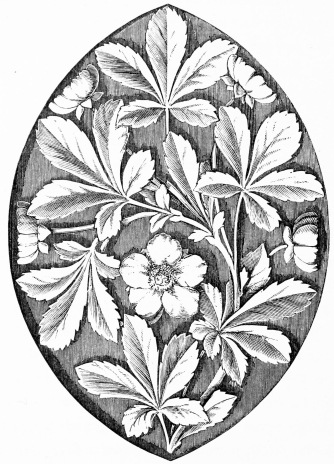
no way inferior in quality. The properties possessed by the roots of the
cinquefoil are very similar, but, from being less powerful in their
operation, are now rarely used, their value being naturally greater at a
time when stronger foreign astringents were not so readily procurable.
Tormentil root is still, however, retained in the Pharmacopœia. The
distinctive specific name of the present plant, reptans, has evident
allusion to the marked feature in its growth already referred to, being
derived from the Latin reptare, to creep. We are not aware of any
examples of the use of the cinquefoil in the art of any past period,
though from the size and beauty of form of the leaves and blossoms, and
from the grace and freedom of the curves of which the main stem is
capable, it appears to be well adapted to ornamental art. Refer to E. B.
432; F. L. vol. i. 37; M. B. 59; and P. F. 46, for the natural growth.
Cockle. This, though now so frequently met with in the midst of the
corn, being in fact so common as to be classed amongst the farmer’s
pests, is not an indigenous plant; it has, however, been established so
long that it may very fairly be comprehended in our list. The botanical
name of the plant is Lychnis githago. The whole plant is closely
covered with soft hairs, giving it a woolly appearance. The large purple
flowers are very conspicuous, and have a curious effect, from the
segments of the calyx being so much longer than the petals of the
corolla. (Calyx, Gr., a cup, the outer and generally green portions of
a flower, the protecting member for the delicate organs within the
flower. When the calyx is cut up into several divisions each segment is
termed a sepal. Corolla, the floral ring next within the calyx,
ordinarily of a brilliant colour, the part which, for instance, in a
rose is pink: this, though sometimes in one piece, as in a blue-bell, is
ordinarily, as in the buttercup, composed of several similar members;
these are called petals.) The cockle will be found in flower during
the months of June, July, and August. Though admirably adapted for
service in ornamental art, the only example we can quote occurs in a
sixteenth-century MS., a missal, in the British Museum: the treatment is
very naturalistic. Drawings of the plant will be found in F. L. vol.
iii. 27; E. B. 215.
Columbine (Aquilegia vulgaris), one of our most beautiful wild
flowers, derives, like the broom, an additional importance to the
ornamentist from its heraldic associations, the columbine being adopted
as a badge by the House of Lancaster, and also by the Derby family at a
time when every important house adopted some such symbol. The petals
bear a strong resemblance to birds; hence Aquilegia is derived from
the Latin aquila, an eagle, while the English name is derived from
Lat. columba, a dove. An old English name for the plant is culverwort,
culfre being the Anglo-Saxon word for pigeon. It will be found in
hedges and thickets, thriving more especially where the soil is
calcareous. Both the flower and leaf are very rich in character, and
well suited for the requirements of ornamental art. Examples may be seen
in the church of Shearbourne, Dorset, and in the spandrels of the canopy
of a brass in Exeter Cathedral, in memory of Sir Peter Courteney, one of
the adherents of the Lancastrian king, Henry IV. The columbine is a
favourite flower in cottage-gardens, and may be much more generally thus
met with than as a wild plant. It is in flower from May to July. A very
beautiful gradation of form is seen in the leaves, the lower ones being
of a very complex form, while the upper ones are very simple in outline.
Refer to E. B. 46, V. W. 367, for drawings.
The Comfrey (Symphytum officinale). This plant may be very commonly
found by the sides of streams, ditches, and other moist
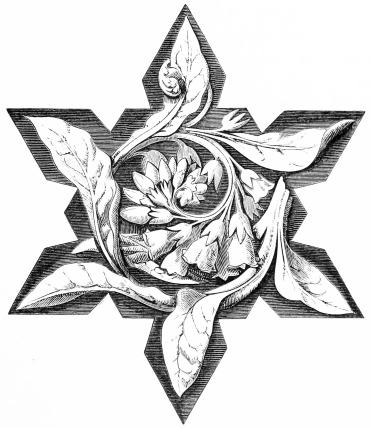
situations. The corolla of the flower is generally of a yellowish white,
but a variety having purple flowers is not uncommon in many localities;
we have seen it, for instance, growing in profusion on the banks of the
East Yar, between Brading and Sandown, in the Isle of Wight. The generic
name, Symphytum is derived from a Greek verb signifying to unite, from
an old belief in the efficacy of the Comfrey in the healing of wounds.
A very marked peculiarity in the growth of the plant is the circinate,
or, as it is frequently termed, scorpoid arrangement of the flowers,
from a supposed resemblance between the spiral form of the inflorescence
and the tail of the scorpion; hence, in the same way, scorpion-grass is
one of the old English names of the familiar forget-me-not, a plant
belonging to the same natural order, the Boraginaceæ, and having the
same peculiarity of growth. We need scarcely say that in the Middle Ages
the favourite dogma that each plant had its undoubted value as a
remedial agent, and generally by its form or colour indicated its
medicinal use, was firmly held; thus the colour and shape of the flower
of the foxglove, formerly called the throatwort, were considered as
indications of its service in complaints affecting the throat, as its
older name implies; and the deep red colour often assumed, as the summer
advances, by the leaves of the herb-robert and others of the cranesbill
family, was deemed conclusive proof of the value of the plants in
stanching the flow of blood from a wound; hence, in the case of the
forget-me-not, we find an old writer on medicine referring to the
healing virtues of the plant as shown by its mode of growth: “The whole
branche of floures do turne themselves round like the taile of the
scorpion. The leaves of scorpion-grass applied to the place are a
present remedy against the stinging of scorpions, and likewise boyled in
wine and drunke, prevaile against the said bitings, as also of adders,
snakes, and such venomous beasts.” Drawings of the comfrey may be seen
on referring to F. L. vol. iv. 18; V. W. 432.
The Field Convolvulus (Convolvulus arvensis). This pretty little plant
is very commonly found on grassy banks, open downs, or in our
corn-fields, running up the stems of the standing corn, and flowering
during June, July, and August. It is one of the enemies of the farmer,
from its spreading, to the detriment of the crops, over so large an area
of ground; and owing to the great depth to which the roots descend, it
is exceedingly difficult to get rid of it when it has once taken
possession. Its generic name, derived from the Latin convolvo, I
entwine, is very descriptive of the nature of the plant, and its English
name, bindweed, evidently embodies the same idea. Another of its old
English names, the withwinde, very beautifully expresses its lightness
and delicacy, unable to resist the force of the wind, but conquering by
yielding to its power. Where the plant occurs, it will generally be very
common, many square feet of ground being often covered by its long
trailing stems. When any suitable object, such as a grass stem, is met
with, the convolvulus, too weak to rise by itself, ceases to trail along
the ground, and twines round the support thus afforded, always ascending
in a spiral direction to the left, as do also the C. major of the
flower-garden, the scarlet-runner bean, and many others; while others,
as the hop, invariably ascend in a spiral direction from left to right.
It may at first sight seem difficult to establish this, but if the
reader will imagine the plant in question turning round his own body, he
will at once be able to determine whether the plant in ascending would
cross in front of him from right to left, or from left to right. In
introducing this plant in ornament, it will be
necessary to remember, that though frequently represented as possessing
tendrils, it does not in nature acquire the needed support by such
means, the stalk itself being the part of the plant that entwines round
other plants. The means thus employed by climbing plants are very
varied; the ivy, for instance, throwing out root-like forms from the
stems, which, by their grasp and penetration into the hollows of
brickwork or the bark of other trees, amply suffice to support the
plant; the bryony, passion-flower, and many other plants throw out true
tendrils from the stem; the goose-grass clings by means of the small
hook-like appendages with which the stems and under sides of the leaves
are furnished; while in the pea the tendrils spring from the end of the
leaf-petiole. The C. arvensis, like the silver-weed, the pimpernel,
and many other equally familiar plants, seem to be cosmopolitan. De
Candolle, in his “Géographie Botanique,” records its occurrence in a
truly indigenous state in localities so widely differing in temperature,
soil, &c., as Sweden, Siberia, China, India, Persia, Arabia, Egypt,
Abyssinia, New Holland, Mauritius, the Azores, Canada, Mexico, and
Chili. The only instances of the use of the plant in mediæval ornament
with which we are acquainted are in wood-carving on the ends of the
stalls in Wells Cathedral, and in a similar position in the Church of
St. Gereon, Cologne; in each case the leaves only are represented.
Illustrations of the natural growth will be seen in S. B. 166; E. B.
923; T. N. O. 97; and P. F. 93.
The Corn Blue-bottle (Centaurea Cyanus) from its delicacy of growth,
and the beauty of the flower-heads, would be a valuable plant for the
decoration of surfaces requiring a delicate treatment, such as muslins
and lace. It is one of the characteristic flowers of the corn-field,
and, in conjunction with the poppy, would be valuable in any floral
grouping symbolic of autumn. The plant was at one time held to possess
great remedial virtue, though its use is now abandoned. The generic
name, Centaurea, refers to an old legend that the Centaur Chiron, when
wounded by Hercules, recovered his strength by the use of this herb. A
very characteristic name in some parts of the country is hurt-sickle,
in allusion to its hard and wiry stems. An example of its use in
ornamental art will be found in a sixteenth-century MS. in the Library
of the British Museum. The treatment, as is usual at that period of the
illuminator’s art, is very naturalistic. Drawings of the natural plant
may be seen in S. B. 159; E. B. 709; F. L. vol. vi. 62; and P. F. 8.
The Corn Marigold (Chrysanthemum segetum) is, like the last, one of
the characteristic and striking plants of the harvest-field, the intense
scarlet of the poppy, the rich blue of the blue-bottle, and the
brilliant yellow of the present flower, forming a very beautiful trio.
The generic name, Chrysanthemum, alludes to this brilliancy of colour
seen in several of the species, being derived from two Greek words
signifying golden flower. There is considerable quaintness in the forms
of the leaves, and the general growth of the plant renders it well
adapted for art-treatment. We are unable to refer you to any examples of
its introduction in the ornament of the past, but any of our readers
desiring to remedy a neglect so unjustifiable will find reliable
drawings of it in E. B. 713; F. L. vol. vi. 60; P. F. 28.
The Daffodil (Narcissus pseudo-narcissus). This beautiful flower will
be found of value to the designer, both from its own inherent beauty,
and also more especially in combination with the primrose, wild
hyacinth, or cowslip, in any design where it is desirable to embody the
idea of spring, since it is one of the most striking plants of that
season of the year. The daffodil may be found in meadows and copses, and
is generally abundant throughout England, though in many cases probably
as an escape from the cottage-garden. In Ireland and Scotland it is
never met with except under such circumstances. Where the daffodil has
once established itself it grows with great freedom, and will generally
be met with in profusion, though it is so local in its growth, that even
if abundant in any one spot, it may frequently be sought for in vain
throughout the rest of a district. The flowers, of a pure and brilliant
yellow, grow singly upon the stalks, each rising directly from the root.
The daffodil has a very wide area of distribution, being met with
throughout the greater part of Europe, and more especially in the
south-west; it is, for instance, one of the characteristic plants of the
meadows and hillside pastures of Spain, together with the two-flowered
narcissus (N. biflorus), a plant which, though abundant in Southern
Europe, has never been naturalised in England. It may be frequently met
with in cultivation, and will easily be distinguished from the daffodil
from the flowers being generally in pairs upon the stem, and from their
creamy white or straw colour. The generic name, Narcissus, is derived
from a Greek word signifying stupor, in allusion to the heavy and
powerful odour of another species, the N. poeticus.
Drawings of the daffodil will be met with in E. B. 1501, and P. F. 89.
The daffodil being like the daisy and eglantine, what we may perhaps be
allowed to term a poet’s flower, a further reason for intimacy with it
is furnished to the designer, as he may possibly be required to make a
design for a page border to some édition de luxe of Wordsworth or
Herrick.
The Daisy (Bellis perennis). So many rural and poetic associations
cluster around this “wee, modest, crimson-tipped flower,” that our list
would be sadly incomplete did it not find a place in it. Leaving the
consideration of these associations, however, we would desire to point
out that on its own inherent merits it is a plant admirably adapted for
art-work, the forms of the leaves, buds, and flowers being all very
ornamental in character, and well suited to the decoration of any light
fabric. The generic name, Bellis, testifies to the general
appreciation, being derived from the Lat. bellus, pretty. Daisy is a
corruption of its old English name, day’s eye.
“As soon as ever the sunne ginneth west
To sene this flower, how it will go to rest,
For fear of night, so hateth she darkness.
Well by reason men it call maie
The Daisie, or else the Eye of the Daie.”
In France it is called Marguerite, from Lat. margarita, a
pearl,—hence ladies of gentle birth, of that name, frequently chose it
in the days of chivalry as their device. It may be seen carved in stone
on the gateway of St. John’s College, Cambridge, founded by Margaret,
Countess of Richmond. It also occurs in carvings at Cubberley,
Gloucestershire; Coton, in Cambridgeshire; and Culham, in Oxfordshire.
“The daisie, or flower white and rede,
And in French called la belle Marguerite,
To herne I have so great affectioun
As I sayd erst, when comen is the Maie,
That in my bedde there dawneth me no daie
That I n’am up and walking in the mede
To see this floure ayenst the sunne sprede,
So glad am I, that when I have presence
Of it to doue it all reverence,
As she that is of all floures the floure,
Fulfilled of all vertue and honoure;
And ever ylike faire and fresh of hewe;
And ever I love it, and ever ylike newe.”
Chaucer.
The family of Parr bore as one of their devices a tuft of daisies. The
daisy may be met with abundantly in pasture land and the grassy borders
of country roads, blooming freely from April to October. Illustrations
may be seen in E. B. 772; F. L. vol. i. 62; T. N. O. 76; P. F. 63.
The Dog-rose (Rosa canina). This is one of the commonest of our
numerous species of English wild rose—a family which, like the
brambles, willows, and others, has by some botanists been cut up into
several species from more or less obvious botanical marks, frequently of
a nature, however, which subjects them to be by other observers
considered as mere variations depending upon chance external influences;
thus, while one writer reduces the various rose forms to five specific
types, another, of equally high standing, mentions nineteen species as
occurring in Britain. This refinement of scientific observation will,
however, be of no real service to the designer: for his purpose the
dog-rose, the most familiar of our English species, may be accepted as a
fairly typical flower. The garden varieties of roses are derived from
the Rosa sempervirens of Southern Europe, the R. Indica, an Asiatic
species, and many others. The sweet-briar, R. rubiginosa, one of our
wild English species, is also a favourite in many gardens from the
fragrance of its leaves when pressed in the hand. The
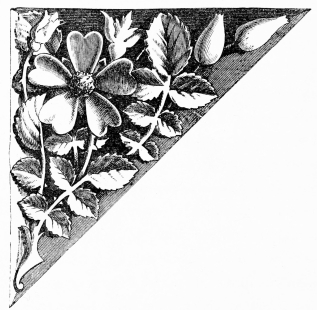
word rose is derived, according to some authors, from the Celtic rhos,
which is in turn derived from the adjective rhodd, red; while others
affirm that it descends to us from the Latin rosa, itself deduced from
the Greek rodon, derived from erythros, red; but we are unable to
give any satisfactory clue to the meaning of the prefix “dog” in the
familiar English name, the same idea being also evidently expressed in
the specific word canina, in the French rose de chien, and the
German Hundrose. Some writers, however, imagine it to refer to the
uselessness of the plant, and quote the scentless or dog-violet as
another illustration in support of their theory. Even on the lowest
utilitarian ground this theory is scarcely tenable, since the plant is
largely used by gardeners as a stock for grafting, while the fruit is
also considerably employed in medicine. The rose, though commonly met
with in ornament throughout the whole of the Decorated and Perpendicular
periods of Gothic, is more especially found in the latter, since it was
then employed not merely on its own merits, but also as the badge of the
Tudors; hence, as an heraldic form, we frequently meet with it in
secular no less than in ecclesiastical work. It is also, we need
scarcely say, the badge of England, as the shamrock and thistle are of
Ireland and Scotland respectively. It was also the personal badge of
Edward I., and the family device of the De la Warres. Examples of the
heraldic use of the rose are very numerous; it may merely suffice to
mention Hampton Court and Henry VII.’s Chapel at Westminster as
abounding in illustrations. In the church at Hawton, Nottinghamshire, in
a sculptured representation of the Resurrection, there is as a
background a very elaborate and beautiful diaper of the rose—its
leaves, flowers, and buds being all employed; this, as the Rose of
Sharon, may be considered as introduced in a symbolic sense, though we
must here mention that the plant ordinarily known as the Rose of Sharon
is not a true rose at all botanically. It is one of the Hypericums. A
golden rose has from time to time been given by the popes to those whom
they more especially desired to reward for services rendered to the
Church: Henry VIII. of England received, together with his title
“Defender of the Faith,” this mark of honour from Pope Alexander VI. The
dog-rose will be found in flower in early summer, the colour of the
blossoms varying on different shrubs from pure white to a deep pink;
the brilliant scarlet fruit, an equally ornamental feature, being met
with as the season advances. Illustrations of the natural growth of the
plant will be seen in M. B. 139, S. C. 100, P. F. 7, 90, 96; and T. N.
O. 51.
Examples of its use in decorative art occur at Winchester, where a
hollow moulding is filled with a waved line of rose leaves and flowers;
in a boss in Beverley Minster; in a glass quarry at Yaxley, Suffolk; in
a more conventionalised treatment in a panel of Perpendicular period,
East Harling Church, Norfolk; a very good example as a glass quarry,
Milton Church, Cambridge; in a piece of oak-carving in the stalls at
Wells; in the carving of a tomb in Bourges Cathedral; a capital at
Miraflores; a hollow moulding wreathed with alternate flowers and leaves
in one of the doorways of Notre Dame, Paris. Many other instances might
be given, but these will suffice to show how favourite a plant the rose
has been in past ornament. The following extract from the old herbalist
Gerarde, though the adulation is, from its implied reference to
Elizabeth, somewhat fulsome, is a further illustration of its
association heraldically with the Tudors: “The plant of roses, though it
be a shrub full of prickles, yet it had bin more fit and convenient to
have placed it with the most glorious flowers of the world, than to
insert the same here among base and thorny shrubs” (this allusion refers
to Gerarde’s system of classification), “for the rose doth deserve the
chief and prime place among all flowers whatsoever, being not only
esteemed for his beauty, vertues, and his fragrant and odoriferous
smell, but also because it is the honour and ornament of our English
Scepter, in the uniting of those two most Royall Houses of Lancaster and
Yorke.”
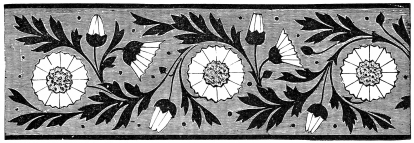
The subject of our next illustration is derived from the Feverfew
(Chrysanthemum parthenium), a plant widely distributed over Britain,
but at the same time with doubtful claims to be considered a true
native; it is, however, thoroughly at home in those places in which it
is to be met with, and from the clear white daisy-like flowers and the
delicate green of its handsome foliage it merits the attention of
designers of ornamental art. From its lightness and the deep cutting of
the leaves, the feverfew would be found of more service in painted or
engraved ornament than in any kind of relief work. The feverfew has a
reputation among herbalists as a bitter and tonic; and no doubt, before
the introduction of quinine and such-like more powerful remedies, would
possess a valued and considerable remedial virtue. The familiar English
name implies this, and is one of the numerous class of names, as
eyebright, goutweed, lungroot, livelong, wormwood, &c., given to plants
in recognition of their real or fancied medicinal use. Drawings of the
natural growth of the feverfew may be seen in E. B. 715; M. B. 249; P.
F. 39.
Fool’s Parsley. We have selected this plant, the Æthusa cynapium, as a
good representative of the very large order of plants known botanically
as the Umbelliferæ. The whole of the plants of this order, as the name
implies, have their flowers growing in umbels, that is to say, all the
flower-stalks start from one point on the stem, and radiate from the
common centre. Many of the Umbelliferæ, as the parsley, carrot,
fennel, and celery, must be familiar to our readers, though they may not
have noticed particularly this umbellate mode of flowering. Several of
the species are exceedingly poisonous: of these we may instance the
hemlock, the water-dropwort, and the present plant. With very few
exceptions, the flowers of the whole of the plants of this order are
either white or yellow. The fool’s parsley is so called from a slight
resemblance which the plant bears to the common parsley of the
kitchen-garden. Though the differences are not difficult to detect—the
flowers, for instance, of the fool’s parsley being white, and those of
garden-parsley yellow; the leaves of the first giving a disagreeable
odour when bruised, and those of the second a rich aromatic scent—the
want of a little circumspection has frequently led to serious and even
fatal results. The plant is the more dangerous from its being rarely met
with except on cultivated ground. The generic name, Æthusa, is given
to it in allusion to its acrid nature, being derived from a Greek word
signifying to burn, while cynapium means dog’s parsley. Though as yet
we have said nothing but evil of it, it is but just to add in its
favour that, ornamentally, it is a very desirable plant for insertion in
our list, the leaves, flower-buds, and general growth being very
graceful, and well suited for the decoration of any delicate fabric. For
illustrations of the plant we would refer you to F. L. vol. i. 18; S. C.
8; S. B. 139. It will be found in flower during July and August.
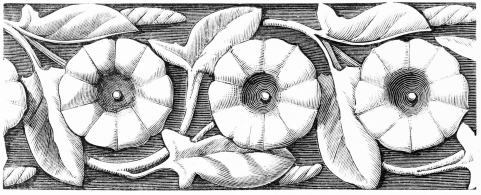
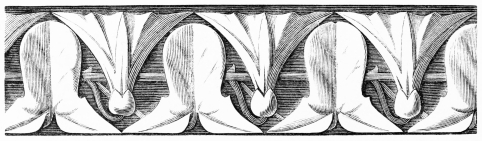
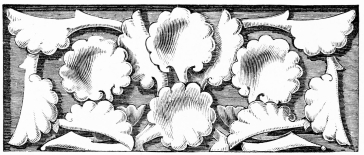
The Ground-Ivy (Nepeta glechoma), the subject of our next two
illustrations, is so commonly distributed throughout Britain, that there
can be but little need of our dwelling at any great length upon a
description of it, though, from its habit of trailing on the ground and
among the roots of larger plants, it is not so conspicuous to the eye as
many others. Its English name, ground-ivy, refers to its slight
resemblance in mode of growth to the common ivy, though in every other
respect they are very dissimilar, the ground-ivy having rounded or
reniform leaves growing in pairs up the stem, the flowers large and of a
brilliant colour, tubular and bisymmetrical, while in the ivy the leaves
terminate in an acute point, and spring singly from the stem, the
flowers small, pale green, multisymmetrical in form, and composed of
five distinct petals. The generic name, Nepeta, is derived from
nepa, a scorpion, from an old belief that the bite of the scorpion was
rendered harmless if treated by means of a recipe of which a preparation
of our present plant was the leading ingredient. The flower of the
ground-ivy, though generally of a deep purplish blue, may sometimes be
met with of a pure white. This variation from a given colour to white is
comparatively not uncommon in many of our wild plants, though more
especially noticeable in
plants of normally blue or purple flowers: thus the purple foxglove,
blue Jacob’s ladder, pink herb-robert, purple snapdragon, blue harebell,
and many others, are occasionally to be found with white blossoms. The
ground-ivy, from its abundance, and also from its past and present
medicinal use, may be met with in the works of various authors under a
great choice of synonyms: of these alehoof is the most common; others,
almost equally familiar, being creep-by-ground and cat’s-foot. When not
in flower the general appearance of the marsh pennywort (Hydrocotyle
vulgaris) is, to a casual observer, not altogether unlike that of the
ground-ivy; but the pennywort is only met with on swampy ground, the
leaves are peltate or shield-like, the stalk rising from the centre of
the under side of the leaf, as we see it in the more familiar garden
nasturtium (Tropæolum majus), differing in these respects from the
ground-ivy. When in blossom, the contrast between the greenish-yellow
flower of the pennywort and the deep purple of the flowers of the
ground-ivy is too marked to permit of any chance of error. The only
examples of the use of the ground-ivy
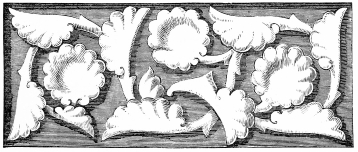
with which we are acquainted in the ornament of the past are in a small
spandrel in one of the doorways at Rheims Cathedral, and on some of the
flooring tiles from the ruins of the Abbey of Chertsey, Surrey. In the
latter case the leaves are four in number, in a cruciform arrangement
within a quatrefoil—a very simple yet true and effective treatment of
the plant; for as the leaves grow, as we have already mentioned, in
pairs, and as each pair of leaves is placed upon the stem at right
angles to the pairs immediately above and beneath it, the effect
produced in looking down upon the plant is necessarily cruciform in
character. A great variety of these Chertsey tiles may be seen in the
South Kensington Museum: though very simple in design, they afford
excellent examples of the true application of the principles which
should govern the introduction of natural forms, and are well worthy of
the attention of the student of decorative art. In both these cases,
Rheims and Chertsey, the leaves alone are employed, as the flowers, from
their intricacy of detail and position upon the plant, would require the
aid of colour to bring them out with due effect; hence, while the
ground-ivy, during its period of flowering, is admirably adapted for
surface decoration, muslins, wall-papers, and many other such-like
purposes, it is but ill suited to relief-work in stone or wood. Refer to
S. B. 172; E. B. 1055; F. L. vol. ii. 44; M. B. 28, for illustrations of
the natural growth of the ground-ivy.
Groundsel, though a plant exceedingly likely to be overlooked, is on
that account the more deserving of a place in our list, as it really
possesses qualities which fully entitle it to the consideration of the
student of ornamental art, the general growth of a good specimen being
very vigorous and characteristic, and the variety of beautiful forms
seen in the leaves a further recommendation. The botanical name is
Senecio vulgaris. Senecio is derived from senex, an old man, in
allusion to the grey heads of seed-down which succeed the blossoms. The
groundsel may be met with abundantly almost everywhere, and may at all
times of the year be found in flower. Drawings of the plant may be seen
in E. B. 749; F. L. vol. i. 61; P. F. 2.
The Harebell (Campanula rotundifolia). This graceful little plant may
generally be found in profusion on dry and hilly pastures and heaths,
though by no means in such localities exclusively, as the roadside
hedge-bank is another favourite spot. There are ten species indigenous
to England, most of them of great beauty and adaptability to
art-requirements: of these we may in particular mention the C.
hederacea, the ivy-leaved campanula, a little plant by no means
uncommon in moist shady pastures and swampy low-lying ground. The
present species is abundant everywhere throughout Europe and Northern
Asia. The Canterbury bell (C. medium) is an allied and familiar garden
species.
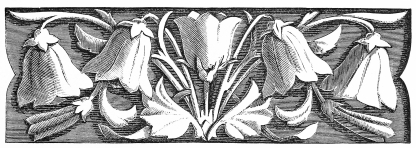
The generic name, Campanula, means a little bell, and from the shape
of the corolla is aptly applied to these plants. Rotundifolia, meaning
round-leaved, seems at first sight a misnomer, as the leaves most easily
visible on a cursory glance at the plant are thin and strap-shaped. The
lower leaves of the plant, however, are rounded in form; and, as we
study the foliage, we shall see a delicate ascending gradation of form,
from the rounded leaves at the lower end of the stem, to the thin,
almost grass-like leaves of the upper part. Drawings of the harebell
will be found in T. N. O. 80; P. F. 12.
The Hazel-nut (Corylus avellana) is so familiar a shrub that any
lengthened description of it must be needless, or, to quote our old
writer, Gerarde: “Our hedge-nut, or hazel-nut tree, which is very well
knowne, and therefore needeth not any description, whereof there are
also sundry sorts, some great, some little, as also one that is in our
gardens, which is very
great, bigger than any filberd, and yet a kinde of hedge-nut; this then
that hath beene said shall suffice for hedge-nuts.” The smaller twigs of
the hazel afford an excellent charcoal for artistic purposes, and the
long straight shoots, thrown up with such rapidity and vigour, are
largely employed in the manufacture of the crates in which earthenware
is packed—a use for which their size and flexibility combined with
great strength admirably fit them, as the rods, when the wood is still
green, may be bent almost double before they will give way. There is a
pleasing appropriateness in its English name, hazel-nut, derived from
the Anglo-Saxon haesel, a hat, and hnut, a nut or ball, which we
notice and appreciate when we see the fruit in its natural state,
surrounded by the foliaceous and cap-like partial envelope formed by the
scales of the involucre. The generic name also, Corylus, refers to
this peculiarity of growth, being derived from a Greek word signifying a
covering for the head. The natural order to which the hazel belongs
includes several trees of great value to man, either on account of their
timber or their fruit—such, for example, as the beech, Spanish
chestnut, and the oak; and in the olden time, when a belief in the use
of the divining-rod, as an indicator of subterranean springs, was
common, the mystic virtue was sought in the forked twigs of the hazel.
The size of the leaves and the striking character of the fruit alike
combine to render it a plant admirably fitted for the purposes of
ornamental art, though the only example of its use, so far as we are
aware, may be seen in a hollow moulding in the cathedral at Winchester,
where, upon a continuous scroll running along the centre of the
moulding, both foliage and fruit are introduced. The leaves are deeply
serrated, and the nuts grow in clusters of two, three, or four, the
general treatment being very naturalistic. Among the many extraordinary
remedies in use by our ancestors, hazel-nuts occupied a place, being
employed in complaints affecting the chest, though, even then, when
scarcely any reputed remedy seems to have been thought too fanciful and
absurd, some appear to have ventured to doubt the efficacy of the
medicine, bringing down upon themselves the scathing rebuke of the
faculty, as we find in the following extract from an old medical work,
where, after the setting forth of the benefits to be derived from the
use of the hazel as a remedial agent, he goes on to say:—“And if this
be true, as it is, then why should the vulgar so familiarly affirm that
eating nuts causeth shortness of breath? than which nothing is falser.
For how can that which strengthens the lungs cause shortness of breath?
I confess the opinion is far older than I am; I know tradition was a
friend to error before, but never that he was the father of slander; or
are men’s tongues so given to slandering one another, that they must
slander nuts too to keep their tongues in use? And so thus have I made
an apology for nuts, which cannot speak for themselves.” For
illustrations of the growth of the nut, see W. H. H., Plate B, Fig. 1;
T. N. O. 127.
Our next illustration is derived from the Hawthorn, Whitethorn, or May
(Cratægus oxycantha), a plant familiar to every one, from its being so
extensively used for hedgerows; its strength, closeness of growth, and
spiny character, admirably adapting it to the purpose. The wood is very
hard, and will take a high polish; the generic name, Cratægus, from a
Greek word signifying strength, being an allusion to this characteristic
of the plant. Its use as a hedgerow plant in England dates, according to
Sowerby, from the time of the Romans, and of this there can be but
little doubt, as its most common name—hawthorn—is, literally, the
hedge-thorn, from the Saxon word hage. The second
name—white-thorn—has been given to it in contradistinction to the
black-thorn (Prunus spinosa), a somewhat similar, and, in a wild
state, almost equally common plant; the
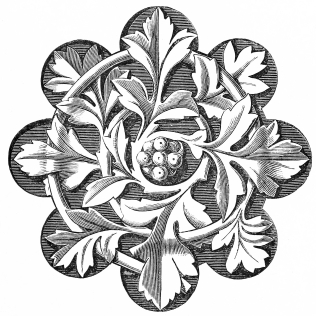
stems of the latter being very dark in colour, while in the hawthorn or
white-thorn they are comparatively light. The third name, May, has
obvious reference to the time of flowering. The leaves of the plant are
exceedingly varied in form, affording a great choice for the selection
of the ornamentist; some being very simple in character, while others
are deeply cut, and very rich and beautiful in outline. A permanent
variety may be occasionally met with, in which the leaves, instead of
being of the ordinary deep and bluish green, are in addition irregularly
blotched with varying and intermingling tones of yellow. The flowers
also of the hawthorn are subject to considerable variation in colour:
the typical state is a pure milky white; but owing to the nature of the
soil in which the plant is found, the blossoms may occasionally be seen
varying from a pale pink to almost crimson. The berries, also, though
generally of a deep crimson colour, are sometimes of an intensely golden
yellow. An old writer, Culpepper, in his “British Herbal,” a treatise
partly astrological and partly medicinal, having first stated that the
plant is under the dominion of Mars, thus defines the medicinal
properties of the hawthorn:—“The seeds in the berries, beaten to
powder, being drank in wine, are held singular good against the dropsy.
The seed, cleared from the down, bruised and boiled in wine, and drank,
is good for inward tormenting pains. If cloths and sponges be wet in the
distilled water, and applied to any place wherein thorns and splinters,
or the like, do abide in the flesh, it will notably draw them forth. And
thus you see the thorn gives a medicine for its own pricking, and so
doth almost everything else.”
Though to a certain extent foreign to our subject, we may perhaps be
permitted to say that, to the naturalist, as well as to the botanist and
the designer of ornamental art, the tree possesses considerable
attractions, the berries being the favourite fruit of many of our birds,
and the foliage being sometimes completely stripped by the larvæ of
various butterflies and moths, such as the small Ermine, the Brimstone
moth, and many others; while among the poets, Chaucer, Milton,
Shakspeare, Wordsworth, Goldsmith, Bampfylde, and Tennyson, have all
found in it a source of beauty and inspiration. It has also been one of
the favourite plants of the ornamentists, occurring very commonly in the
works of the Middle Ages. It would be both tedious and unnecessary to
give anything like an exhaustive catalogue of its use in past art: as
good examples out of many, we would merely cite its occurrence in a
finial in the Lady Chapel, Exeter; as a stone-diaper alternating with
oak, at Lincoln; in two fine spandrels, and a beautiful capital, very
full and rich in its wreathing, in the Chapter-house, Southwell. Other
examples occur in the cathedrals at Ely, Wells, and Winchester. Wherever
met with in ornamental art, the leaves and berries are the parts
selected: to the best of our knowledge the flowers have never, in any
instance, been introduced, no doubt from the fact of the minuteness and
delicacy of each individual blossom, and its habit of growing in
clusters, which, though extremely beautiful in nature, are, from their
intricacy of detail, unsuited to the purposes of the ornamentist.
Similarly, though the plant in its natural growth is often exceedingly
spiny, it is, in ornamental art, represented as almost or entirely
without this characteristic feature, as there would be a great practical
difficulty, in any kind of relief-work at least, in the satisfactory
introduction of forms so minute and fragile, yet requiring so high a
relief. Drawings of hawthorn will be found in P. F. 68; T. N. O. 52.
The Herb-Robert (Geranium Robertianum) is one of the numerous family
of cranesbills, so called from a supposed resemblance between the form
of the fruit and the bill of that bird, a resemblance also indicated in
the generic name, Geranium, derived
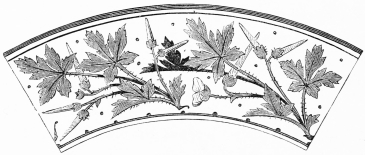
from the Greek geranos, a crane. The herb-robert is one of the most
abundantly distributed plants of the genus, being met with throughout
the whole of Britain and in many other parts of the world, growing upon
all kinds of soils, and flourishing equally well upon hedge-banks, waste
ground, and old walls. Owing to the foliage turning a brilliant crimson
in autumn, the plant becomes very striking and conspicuous as the year
advances, a peculiarity which will greatly aid its identification by
those of our readers who are not acquainted with it. The flowers are of
a delicate pink colour, though they may occasionally be met with of a
pure white: this variety grows abundantly near Nutfield, in Surrey, for
instance. The whole of the cranesbill family will well repay the
attention and study of the ornamentist, the dove’s-foot cranesbill (G.
molle), and the blue meadow cranesbill (G. pratense), being
especially suited to the requirements of the designer. The latter is a
very striking plant, and when once seen cannot well be mistaken, each
flower being almost two inches in diameter, of a deep purple blue, and
veined with lines of reddish purple: the leaves also are very deeply
cut, and of a highly ornamental character. An illustration of the
ornamental treatment of the herb-robert may be seen in an elaborate
specimen of embroidery, last-century work, in the South Kensington
Museum; while drawings of the natural plant can be referred to in T. N.
O. 38; V. W. 412; F. L. vol. i. 52; P. F. 34.
Holly (Ilex aquifolium). This plant, from its association with winter,
should be one of those familiar to the student of ornamental art.
Drawings of it may be found in S. B. 184; W. H. H., Plate A, Fig. 4; P.
F. 27; G. O. 95. The holly is indigenous to most parts of Europe. Its
influence may be traced in the names of several places, as for example
Holmwood, near Dorking; the holly by old writers being also termed Holm
and Hulver. Though ordinarily met with as a hedgerow shrub, it will, if
allowed to grow, attain to no inconsiderable height—often thirty to
forty feet; while a particularly fine specimen at Claremont, in Surrey,
is a little over eighty feet high, and has a trunk six feet in
circumference. The growth is very slow, the timber close-grained and
hard, the annual layers of woody fibre being exceedingly compact. This
fineness of grain, its whiteness and its beauty when polished, render it
of great service in carving and inlay work. It has also been extensively
used in the place of box for wood-engraving, and for the blocks used for
engraving the patterns of calicoes and wall-papers. It would no doubt be
still more extensively used than it is did not its rarity render it so
costly, as, though holly bushes are plentiful enough, the owner of a
fine tree is generally loath to have it cut down. The chief use of the
holly is in the formation of hedges, as its formidable spines, evergreen
foliage, its slight attraction for insects, and closeness of growth, are
all valuable recommendations; we often thus meet with it in
old-fashioned gardens. “Is there under heaven a more glorious and
refreshing object of the kind than an impregnable hedge, of 160 feet in
length, 7 feet high, and 5 in diameter, which I can show in my poor
gardens at any time of the year, glittering with its armed and varnished
leaves? It mocks at the rudest assaults of the weather, beasts, or
hedge-breakers.” This hedge, the pride of John Evelyn’s garden, did not
prove so impregnable to the hedge-breaker as its owner fondly thought,
since one of the great amusements of the Czar Peter, during his stay
with Evelyn, was to trundle a wheelbarrow through it, to the ultimate
ruin of the hedge and the no small sorrow of its hospitable owner.
A variety of holly having yellow berries is sometimes met with. Some
little while ago, a branch with bright orange-coloured berries was
exhibited at one of the meetings of the Linnæan Society, a scion of the
yellow-fruited variety having been grafted on a scarlet-berried stock,
with this curious result. The holly may also sometimes be met with
having variegated leaves, the normal dark glossy green being blotched
with a clear yellow or white. The lower leaves of the tree are edged
with sharp spines, while the upper branches have the foliage quite free
from these:—
“Below, a circling fence, its leaves are seen
Wrinkled and keen;
No grazing cattle, through their prickly round,
Can reach to wound;
But as they grow where nothing is to fear,
Smooth and unarmed the pointless leaves appear.”
Southey.
Ornamentally, the holly may be met with in a glass quarry in Brandeston
Church, Suffolk; also on a mediæval flooring-tile in the British Museum.
We are not aware of any other ancient examples of its use, though
doubtless those given do not exhaust the list. We trust, should another
edition be called for, to be able, by further investigation, to remedy
this shortcoming. The name holly is a corruption of holy, and alludes to
its connection with Christmas. In some of the old herbals it is written
“holy tree,” while in some countries this connection is rendered still
more emphatic, the German name being Christdorn, the Danish and
Swedish, Christorn.
The next subject we have chosen as an illustration of the adaptability
of our native plants to the purposes of the ornamentist is the HOP
(Humulus lupulus). Though we do not recall any example of its use in
the ornament of the past, except in one of the capitals at Southwell
Minster, it nevertheless appears to us a plant well deserving of a place
in our columns. Its climbing habit, the beauty of the leaves, and the
size of the cones, are all features which in an especial manner seem to
fit it for the service of the designer; and it appears curious that,
while so great a choice was at the disposal of the old carvers, they
practically left so large a field untouched. Our architecture, for
instance, abounds with details of oak, maple, and hawthorn; yet the nut
and the wild rose, plants at least as striking and as common, occur but
rarely, while the hop, bindweed, blackberry, and many others, seem to
have been almost entirely neglected. The hop is found in a truly wild
state in our hedgerows and copses, its weak stems,
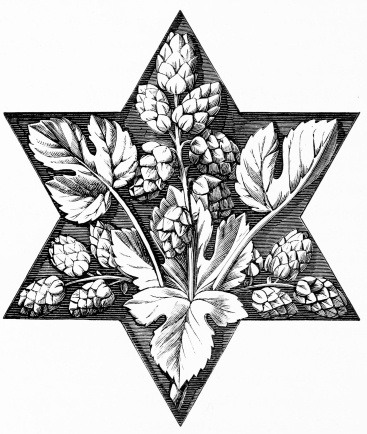
powerless to support themselves, trailing a long distance, and running
up any tree or other support with which they may come in contact, and
wreathing it with their beautiful clusters of foliage and fruit. It is
also largely cultivated in England, France, Belgium, and Germany; its
tonic properties, and the fragrant bitter principle found in it,
chemically termed lupuline, being, it is almost needless to say,
utilised in the making of beer. It was thus first used in the reign of
Henry VIII., before that time the fresh top shoots of broom being
employed to give the desired bitterness. The young shoots are in some
parts of the country cooked and eaten like asparagus. Gerarde, writing
in the reign of Elizabeth, says, “The hop joyeth in a fat and fruitfull
ground, also it groweth amongst briers and thornes about the borders of
fields. The flowers are used to season beere or ale with, and too many
do cause bitternesse thereof, and are ill for the head. The manifold
vertues of hops do manifest argue the wholesomnesse of beere, for the
hops rather make it a physicall drinke to keep the body in health, than
an ordinary drinke for the quenching of our thirst.” The leaves of the
hop are sometimes heart-shaped, at others divided into three very
distinctly marked lobes, in either case the margins being deeply
serrate. The order to which the hop belongs includes many plants useful
to man, as, for instance, among several others, the hemp, mulberry, fig,
the Urostigma elasticum, yielding india-rubber, and the bread-fruit
tree.
About forty million pounds weight of hops are annually employed in
brewing in England. Kent and Surrey are the chief means of supply,
though those grown in the rich soil of the Vale of Severn, in the
neighbourhood of Worcester, are by no means inferior to the best
Kentish. The crop is a very speculative one, the dangers which surround
it being legion; the profits are, however, so great that the grower is
reimbursed if one crop in three should turn out well. The hops grown in
the neighbourhood of Farnham command the highest prices. The etymology
of the word is unknown; the Germans term it Hopfen. Hops have been
cultivated in Germany from time immemorial, and it is from thence that
we derive both the plant and its name. Drawings of the natural growth
will be found in E. B. 1284, S. C. 41; T. N. O. 125; and P. F. 4.
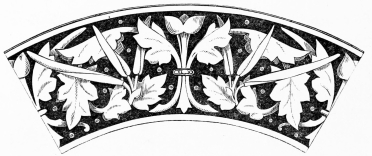
The Yellow-horned Poppy (Glaucium luteum) will no doubt have attracted
the attention of many from the peculiarity of its habitat, growing and
flourishing as it does by the seashore, where little else appears to
thrive, and by the delicate green of its foliage, the brilliant yellow
of its blossom, and its spreading growth, covering large expanses of the
shingly beach with a very striking and beautiful carpet. The pods, a
highly ornamental feature, may occasionally be found almost a foot in
length, and, together with the form of leaf and locality of growth,
effectually distinguish it from the yellow Welsh poppy (Meconopsis
Cambrica). The scarlet-horned and the violet-horned poppies, allied
species, are both exceedingly rare in England: the latter, from its
finely-cut leaves and size of the flowers, is well adapted to
art-purposes. The yellow-horned poppy will be found in flower from June
to October. Drawings of it occur in E. B. 66; P. F. 91.
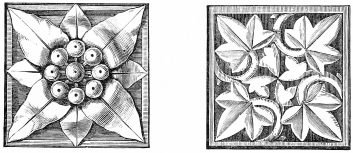
IVY (Hedera helix). We have already, in speaking of the ground-ivy,
dwelt to a certain extent upon the characteristics of the present plant,
and, from its abundance and conspicuous appearance, any lengthened
descriptive details must be unnecessary, as there can be but few to whom
the ivy is not perfectly familiar. We meet with it upon old buildings,
rocks, and in the woods and hedgerows, running over the surface of the
ground, or covering the trunks and main branches of the trees with its
interlacing stems and masses of rich foliage. Opinions have been very
varied as to whether the luxuriant growth of the ivy is detrimental or
not to the trees which it embraces; for while some have considered that
its presence is a benefit, and particularly in severe winters, others
have held that the compression caused by the long and closely adhering
branches impairs the vigour and stunts the growth of the tree. The
belief that the ivy, like the mistletoe, draws its nourishment from the
tree is now no longer held, as it has been satisfactorily proved that
the so-called rootlets (or, as they are perhaps more expressively termed
by De Candolle, crampons) which we see thrown out from the clinging
stems do not drain the sap of the supporting tree, but must be regarded
as a beautiful mechanical contrivance to aid, by their support and
grasp, the ascent of the ivy. We find that these little bodies are
equally developed where masses of rock
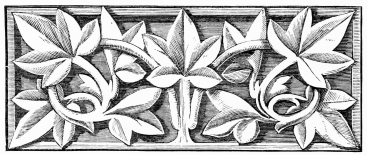
have to be scaled, and that the plant thrives with equal vigour where
support is clearly their sole function; and if, on the other hand, the
ivy runs upon the ground, the crampons are not developed, as no such
supporting members are then needed. The ivy is one of the plants
indigenous to Britain, and derives its familiar name from the
Anglo-Saxon ifig. Considerable differences of opinion have been held
as to the meaning of the generic name, Hedera: the best derivation
appears to us to be that which assigns as its origin the old Celtic word
for rope or cord, hedra, as it exactly expresses the characteristic
appearance of the growth. The ivy flowers during October and November, a
time of the year when but few other plants are in blossom; hence it
becomes the favourite resort of various insects, while the berries are
fully ripe by March, and afford a welcome food for the blackbird,
missal-thrush, wood-pigeon, and many others, at a season when, from the
scarcity of other food, they become peculiarly acceptable. The Romans
dedicated the ivy to Bacchus, and in their sculpture he is generally
represented as crowned by an ivy wreath, from an old belief, mentioned
by Pliny and others, that the plant thus worn neutralised the
intoxicating effects of wine. The leaves of the ivy vary very
considerably in form, a feature which the ornamentist will appreciate.
The leaves upon the flowering branches are somewhat egg or heart shaped,
with a very acute point, the more familiar ornamental form of the
five-lobed leaf not being found upon this portion of the plant; hence it
is perhaps scarcely legitimate to employ the berries with the
five-pointed form of leaf, though in the introduction of the plant in
the ornament of the Middle Ages this was entirely disregarded. The ivy
was one of the favourite plants of the mediæval ornamentist. Examples of
its use are very numerous: of these we need mention but a few. We find
the leaves and branches alone introduced, for instance, in wood-carving
in the stalls of the choir of St. Margaret’s Church, Lynn; in stonework,
as a crocket, in the Chapter-house, Wells; as the foliage of one of the
capitals in the choir of Lincoln Cathedral; and in a beautiful example
at the springing of an arch at the Minster, Southwell. We find the
berries introduced with the leaves (in every case the leaf having five
points) in a hollow moulding in the cloisters at Burgos in a
particularly beautiful manner; and in Paris on one of the capitals of
the Sainte Chapelle, and again in a similar position in the chancel of
Notre Dame—the first of these being twelfth-century work, and curious
from the very acute form of leaf employed; the second dating from the
fourteenth century. A very good English example may be seen in a
spandrel in the Chapter-house, Southwell. In ancient art we find the
Egyptians representing Osiris as bearing an ivy-wreathed thyrsus; and
upon the Greek and Etruscan vases preserved in the British Museum we
frequently see running bands of ornament which we can have little doubt
are based upon the ivy: in most of the examples the berries are
introduced together with the heart-shaped form of leaf, though in a few
cases a three-pointed or a rounded form of leaf, still distinctly
ivy-like in character, is substituted. Refer to T. N. O. 71; G. O. 93.
Our next illustration is derived from the Ivy-leaved Speedwell
(Veronica hederifolia), a plant of frequent occurrence, but which,
from its weak trailing habit and small size, may very easily be
overlooked. It may generally be met with on hedge-banks, and flowers
freely from March to August with a delicate pale blue bi-symmetrical
blossom. Drawings of the ivy-leaved speedwell will be found in E. B.
970; S. B. 184.
Several of the veronicas are well adapted, from their grace and delicacy
of form, to the purposes of ornamental art, the brooklime (V.
beccabunga) and the germander speedwell (V. chamædrys) being
especially good. The flowers of all the species are bisymmetrical in
form. The germander speedwell is by some writers supposed to be the true
forget-me-not.
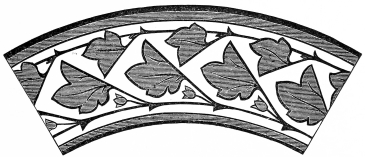
The Musk Mallow (Malva moschata), and the Common Mallow (M.
sylvestris), the subjects of our next illustrations, are both common
plants, the musk mallow being frequently met with, and more especially
on gravelly soils, while the common mallow, though rare in Scotland, is
abundant throughout England on all kinds of ground. The flower of the
common mallow is of a pale purplish tint, with the veins of a darker
purple: a very rare variety has been met with, having the flowers of a
pure blue. The leaves are round in general outline, but deeply lobed
into five or seven divisions, and in olden time, before the introduction
of many of our present vegetables into England, were a common article of
diet. This, together with the musk mallow and the marsh mallow (Althæa
officinalis), possesses considerable medicinal repute, the whole plant
being mucilaginous and demulcent in character. The roots of the Althæa,
boiled in water, will yield
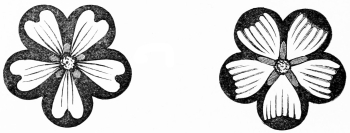
Common Mallow.
Musk Mallow.
one half their weight of a glutinous matter, of great value from its
emollient qualities; the leaves and fruit will also yield it, but in a
lesser degree. The virtues of the family have long been recognised.
Pliny held that whosoever should take a little of the extract should
throughout that day be free from all fear of disease. Dioscorides
considered it a sure antidote in cases of poisoning; while Hippocrates
taught that its soothing action especially fitted it as a vulnerary. The
flowers of the musk mallow are very large, and of a pure and delicate
pink, the leaves very deeply divided, a feature distinguishing it from
all the other British species of mallow. Its English name is suggested
by the slight musky smell of the foliage if pressed in the hand. The
Malvaceæ are chiefly tropical plants; about six hundred species are
known, almost all possessing the mucilaginous character of our British
species, many yielding in addition a valuable fibre, and some American
and Asiatic species producing the well-known cotton, a filamentous
substance enveloping the seeds. The hollyhock of our gardens also
belongs to this family. The generic name, Malva, is derived from a
Greek word signifying to soften, in allusion to the soothing effect of
the greater number of the genus, while the English name has clearly
descended from the Anglo-Saxon malu. Drawings of the common mallow may
be seen in F. L. vol. ii. 51; M. B. 54; P. F. 1; V. W. 393. The musk
mallow will be found in F. L. vol. iv. 50; T. N. O. 23.
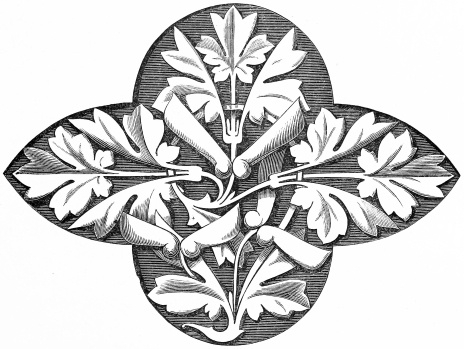
The Maple (Acer campestre) is generally met with as a small hedgerow
tree throughout England, but it is not common in either Scotland or
Ireland. The wood, though small in section, is often very beautifully
veined, and thus becomes of service for furniture, inlay, &c. The bark
is exceedingly rough, full of deep furrows, and very much resembling
cork in its appearance. The fruit is winged. The specific name,
campestre, refers to the localities in which the plant may be found,
the open fields; while the generic name, Acer, sharp or hard, in
Celtic ac, has been bestowed upon it from the toughness of the wood.
It was extensively used by the ancient Britons in the fabrication of
weapons of war—spikes, spears, and lance handles. The English name
evidently descends from the Saxon mapul-dre. We thus in these few
words, Acer campestre, the maple, learn where the plant is to be
found; one of its striking features, the hardness of the wood; and also,
from its Saxon name, the fact of its being one of our indigenous shrubs.
This has, from the beautiful forms of the leaves and fruit, been largely
introduced in mediæval work. It occurs, for instance, very beautifully
treated, as one of a series of small spandrels in the stalls of Lincoln
Cathedral, and again in a spandrel in the choir of Winchester. On the
Continent two very beautiful examples of it are seen in hollow mouldings
in the cathedrals of Evreux, and of Notre Dame, Paris. All these
specimens are of the fourteenth century. Drawings of the natural growth
may be seen in T. N. O. 30; P. F. 26; G. O. 94.
King-cup, or Marsh Marigold (Caltha palustris), a plant by no means
uncommonly met with in marshy ground, water-courses, and such-like
localities. It may frequently be found in tidal streams, growing in such
a position that at high tide it is completely covered; we have thus seen
it by the side of the Thames, flourishing in great vigour and beauty,
and at full tide swaying with the force of the stream at a depth of from
one to two feet from the surface. In such situations the plant grows
with luxuriance, and from the large size and brilliant yellow of its
star-like flowers, the vigorous growth of the rich green foliage, and
the long succulent stems, it becomes a striking feature even in the mass
of bold healthy vegetation so commonly found by the edges of a
water-course: these, therefore, are the characters which, in embodying
the plant in any design, we must endeavour to enforce. We are
unacquainted with any early examples of the use of the marsh marigold,
except in one page of a fifteenth-century illustration. This is the more
curious since the name marigold has reference to its use in the
church-decorations of the Middle Ages, upon those days more especially
devoted to the festivals associated with the Virgin Mary; we should
naturally, therefore, have thought that, thus brought before the
attention, its ornamental features would have been perceived and
permanently embodied in some capital or spandrel. The generic name,
Caltha, is derived from a Greek word signifying cup, and expressively
points out a beautiful feature in the form of the flower; while the
specific name, palustris, is drawn from the Latin palus, a marsh,
and clearly indicates the localities naturally chosen by the plant. The
plant will be found in flower in the spring, remaining for a
considerable time in full bloom, and from its perennial nature will,
when once established in any locality, soon become a permanent addition
to the flora of the district. Representations of the natural growth of
the marsh marigold will be found in E. B. 40; P. F. 54.
The Mistletoe—Anglo-Saxon, mistelta (Viscum album)—is so well
known that it would appear strange that so familiar a plant has been but
little employed in mediæval art, did we not remember that its pagan
associations had placed it under a ban. The only example of its use that
has come under our observation is in one of the spandrels of a tomb in
Bristol Cathedral. The natural growth will be found portrayed in M. B.
270; W. H. H., Plate A, Fig. 3; P. F. 88. The lightness of the plant,
and its association with Christmas, seem features that render a
knowledge of it desirable to the ornamentist. It appears to us a plant
capable of very extensive use in the various developments of decorative
art. We need only mention a few—the backs of playing-cards,
earthenware, muslins, chintzes, wall-papers. Many other uses will, no
doubt, readily suggest themselves to our readers.
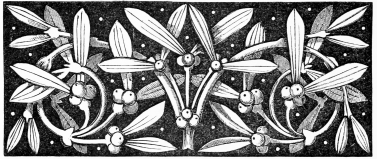
The Oak (Quercus robur), while perhaps our best-known indigenous tree,
from its wealth of legendary, religious, and historic associations, has
also been one of the favourite subjects of the ornamentist, being
abundantly found in carving, stencilling, draperies, glass, &c., both in
England and on the Continent,
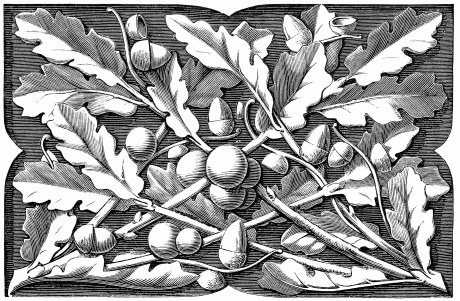
throughout the whole range of the Decorated and Perpendicular styles of
Gothic, and the corresponding periods in France, Spain, and Germany, and
also afterwards in the various modifications of the Renaissance. To
refer at any length to the varied associations surrounding it would be
foreign to our present purpose, though its sacred character in the
Druidical rites of the ancient Britons, the importance of its timber for
the purposes of the shipwright and architect, the commercial value of
the bark for use in tanning, leading to the felling of thousands of
trees every year, its use in medicine, the bark being a powerful
astringent, and an infusion from the galls so frequently found upon the
oak being an excellent antidote in cases of poisoning by the tartrate of
antimony, are all points of interest or utility in connection with it.
It has also been one of the favourite trees of the poets—Dryden, Pope,
Cowper, Wordsworth, and many others, having referred to it in their
writings; while to the artist the rugged majesty and vigour of the
branches in winter, the brilliant bronze red of the early spring
foliage, the deep mass of dark green leaves in summer-time, or the fiery
glow it bears when touched by the frosts of advancing winter, render it
at all times a beautiful and striking object in the landscape. The galls
so generally met with upon the leaves of the oak are caused by a small
insect, the Cynips Quercus-folii, which, by puncturing the leaf and
laying an egg in the wound, causes a diseased and abnormal growth of the
part: on cutting one of these galls open the grub will generally be
found within. The galls chiefly used in medicine and commerce, though
similar in their origin, are the work of another little insect on a
different and foreign species of oak.
Though the oak is so familiar a tree in our woods and hedgerows, it must
at one time, when England was extensively covered by forests, have been
still more abundant. We are led to this conclusion from the great number
of places whose names, handed down to us from our early history, derive
their force and meaning from this abundance: thus Ockham, in Surrey, is
literally Ocham, the place of oaks, a title which it still well
deserves. Ockley, Acton, Acworth, and many more examples, might be
cited. Superstition, too, with its usual fertility of invention, has not
failed to detect the strange and marvellous in the oak. Of this, did
space permit, and were it not somewhat foreign to our subject, we could
quote many curious instances.
In the works of the ornamentist, to the best of our knowledge, the Q.
robur form of the oak has been exclusively used. To give an extended
list of the places where illustrations of its use in design occur would
be to devote far more space to it than is really needful: as an example
of its use in stonework, we would instance a small, but good capital at
Ely, where one pleasing, natural, and ornamental feature, the empty cup
of the acorn contrasting with the other forms, is very well introduced.
We see this same attention to natural detail in some flowing foliage in
a hollow moulding at Henry VII.’s Chapel, Westminster: the leaves are so
deeply cut into lobes, and so modified in form, that except for the
presence of the acorns, we should not recognise the foliage as being
that of the oak at all. A very clear and good piece of oak is introduced
in some wood-carvings at the ends of the stalls at Wells Cathedral;
again, in crockets at Exeter, in the Lady Chapel; in a stone boss, St.
Cuthbert’s screen, St. Alban’s Abbey Church; in wooden spandrels at
Winchester, and Northfleet Church, Kent; as a diaper in glass quarries
at Fulbourne and Waterbeach Churches, in Cambridgeshire; and as a
carving at the arch-springing at Southwell Minster, Nottinghamshire. On
the Continent, in Burgos Cathedral, we meet with several exceedingly
beautiful carvings of the maple, plane, vine, and many other
plants—among them a square panel filled with oak, and a very graceful
running band of leaves and acorns round the tomb of Don Juan II.; and in
Paris, in the Sainte Chapelle, we also find a hollow moulding filled
with running oak foliage. In the South Kensington Museum many excellent
fragments of wood-carving are preserved, and among these the oak is very
often visible; while in the ceramic collection we frequently see the
borders of the Majolica dishes and plates entirely composed of
interlaced branches of oak. The oak is, in this latter series of
examples, of heraldic significance as the badge of the Dukes of Urbino.
Representations of the natural growth of the oak may be seen in E. B.
1288; M. B. 126; P. F. 9; S. C. 151; G. O. 95; T. N. O. 127.
Ox-eye Daisy (Chrysanthemum leucanthemum). The impressions we at once
derive on seeing the natural plant are—first, the size and brilliant
star-like character of the flowers, as we view it growing amidst the
long grass; secondly, the beautiful contrast of form, colour, and light
and shade between the deep yellow, convex central portion and the
brilliant white and concave rays surrounding it; and thirdly, the
comparative smallness and insignificance of the leaves: hence it appears
to us that in any adaptation of the plant to the purposes of the
designer, these are salient points to be observed. We find it growing
very freely in meadows, on the sunny side of railway banks, &c., and,
where found at all, generally in great profusion. During the past
summer, by the side of the river Wey, we came across a plant that had
firmly established itself, and was growing and flowering in full health
and vigour in the crown of a pollard willow tree, about eight feet from
the ground. It is one of the plants regarded by the farmer with dislike,
as it generally indicates great dryness of soil, and,
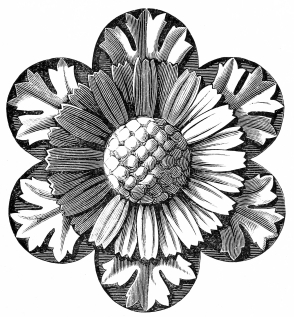
from its abundance and the perennial nature of the root, can scarcely be
dislodged where it has once fairly taken possession. The whole plant
varies from one to two feet in height, blossoming in June and July. The
garden chrysanthemum is a Japanese allied species, considerably modified
by cultivation. It may be seen painted on Japanese plates, screens, &c.
So far as we are aware, the ox-eye seems to have been but little used in
ornamental art, the following examples being the only cases of its
occurrence with which we are acquainted:—On a label termination to one
of the windows in the presbytery, Winchester, where we find the flower
in the centre of the boss very clearly and unmistakably rendered, but
surrounded by the ordinary type of leaf of the Early English Gothic
period; in some twelfth-century glass at Rheims, where it is introduced
as the flower dedicated to St. John, and where, by a poetical symbolism,
all the flowers turn towards our Saviour on the cross, as the Sun of
Righteousness, the true Light of the world; again met with in the
celebrated MS., “The Hours of Anne of Brittany,” now in the
Bibliothèque du Roi, Paris. This illumination dates from the close of
the fifteenth century, the flowers introduced being very naturalistic in
character, and with their shadows thrown upon a golden ground—a marked
characteristic of the illumination of that time. It also occurs in a
missal in the Library of the Arsenal, Paris, where, on a golden ground
similar to that last cited, detached flowers are scattered over the
borders—the pea, iris, heartsease, and many others being represented,
and among them the ox-eye daisy. Drawings of the natural plant will be
found in S. B. 158; E. B. 714; P. F. 42.
The Campion (Lychnis diurna) is another plant well adapted to the need
of the ornamentist, the form of the flower and the sheathing of the stem
by the pairs of leaves being valuable and characteristic ornamental
features. The Lychnis diurna is to be met with in moist hedge-banks,
and more especially those that are shaded by overhanging trees; the
flowers are of a delicate pink, scentless, and opening in the early
morning; differing in all these respects from the Lychnis vespertina,
a very similar plant in general appearance, but having the flowers
white, with a slight odour, and opening in the evening. The white
campion has generally a more robust and coarser character of growth than
the pink campion, and appears to delight in more open situations. By
many botanists, however, these two plants are considered as closely
allied, the pink campion being regarded as merely a variety of the
white, and both referred to as the Lychnis dioica. The specific names,
diurna and vespertina, refer to the times of flowering, the morning
and evening respectively; while the generic name, Lychnis, common to
all the species, is derived from the Greek word for lamps, the thick
downy covering on the leaves of the white campion having at one time
been employed in the manufacture of wicks for use in lamps. Refer to F.
L. vol. ii. 32; T. N. O. 69; P. F. 53.
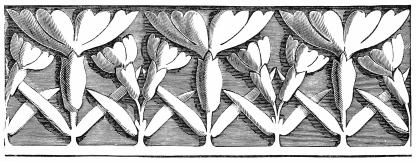
Sorrel (Rumex acetosa). Though from its inconspicuous character the
sorrel may very readily be passed over, it will, we think, be found to
repay the attention of the ornamentist, since the lightness and grace of
its growth, its brilliant colour, and the rich form of the leaf, are all
characteristics that should render it valuable to those engaged in
decorative art. The leaves have a pleasant acid flavour, and are
occasionally employed in salads. The English name is derived from the
Anglo-Saxon sur, sour. The present plant must not, from similarity of
name, be confused with the wood-sorrel (Oxalis acetosella), as the two
plants are very different in appearance, the wood-sorrel having large
white flowers, and a beautiful trefoil character of leaf. Illustrations
of the natural growth of R. acetosa may be seen in E. B. 1223; F. L.
vol. v. 29; M. B. 69.
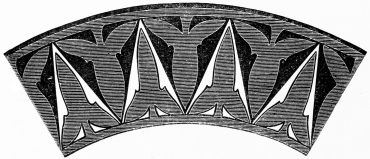
The Spear-plume Thistle (Carduus lanceolatus) has been selected as the
subject of our next example. It may very commonly be met with in
hedge-banks and waste ground, attaining to a height of from three to
four feet, and forming a very ornamental and conspicuous object. Its
employment in heraldry with the motto NEMO ME IMPUNE LACESSIT, as the
badge of Scotland, is so well known that the mere mention of the fact
will suffice to recall it to the memory of our readers; but this
application of it, and its frequent recurrence in all circumstances
where the national emblems are introduced, render it necessary that the
designer should be familiar with the plant he will thus have to treat.
There are several indigenous species of thistle, some one or two of them
laying claim to their right to be considered the true Scottish badge,
but the balance of evidence will, we think, be found to point to the
spear-plume thistle as that most entitled to the honour. The C.
marianus, or milk-thistle, one of our rarer native, or at least
naturalised species, has a particularly ornamental effect from the veins
upon the leaves being of a clear milky white, the rest of the leaf being
of the normal green colour. A drawing of the spear-plume thistle may be
seen in E. B. 686.
The Thorn-apple, though not a common wild plant, may occasionally be met
with, growing on waste spots, rubbish heaps by the roadside, and similar
places. The large size and brilliant whiteness of the flowers, the bulk
and peculiar character of the spiny fruit, make it a very striking
object, and admirably fitted for a share of the ornamentist’s regard. It
is a plant of Eastern origin, and was unknown here until the reign of
Elizabeth; we therefore do not find it in any of the art-work before
that date, nor, indeed, do we remember to have ever seen it
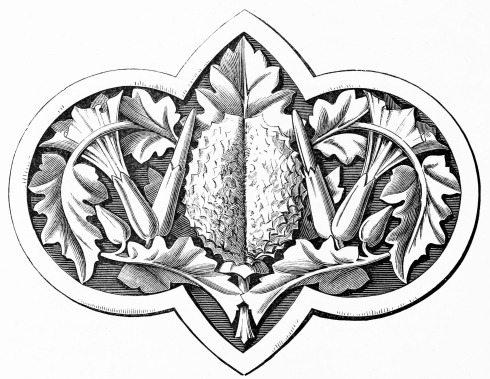
in any way introduced in later designs: this, no doubt, is partly owing
to the comparative rarity of the plant. Its scientific name is Datura
stramonium, the generic name being derived from tatorah, the name of
the plant in Arabic. The whole plant is powerfully narcotic in its
effects. In the quaint pages of Gerarde, published A.D. 1636, we learn
the history of its introduction into England. Gerarde was the director
of the botanical garden of Lord Burleigh; hence he received many rare
plants from abroad for cultivation. In speaking of the Datura, he
says, “whose seeds I have received of the Right Honourable the Lord
Edward Zouch, which he brought from Constantinople, and of his
liberalitie did bestow them vpon me; and it is that thorn-apple that I
have disposed through this land.” In some botanical works we find it
asserted that the thorn-apple was introduced into Europe in the Middle
Ages by the gypsies, who, in their wanderings, brought it from Asia; but
the declaration of Gerarde is so positive and explicit, that it seems
difficult to admit any other belief, more especially as he accompanies
his statement by an illustration which, though very rough and quaint, is
quite sufficiently like the natural plant to prove that it was not some
other species introduced by him and wrongly named. Drawings of the
thorn-apple may be consulted in E. B. 935; F. L. vol. vi. 17; M. B. 124;
S. C. 6; P. F. 13.
The Tormentil (Potentilla tormentilla) has already, to some extent,
been referred to when speaking of an allied species, the cinquefoil. The
flowers, though typically composed of four petals, are frequently to be
found with the petals five in number, the calyx in that case being cleft
into ten segments instead of the normal arrangement. We are not
acquainted with any example of the use of the tormentil in ornament, but
the wood-strawberry (Fragaria vesca), an allied genus of the same
natural order, has a similar form of calyx, the segments being
alternately large and small, and twice as numerous as the petals; and
this beautiful ornamental feature is very carefully shown in a
sixteenth-century MS. at the British Museum, where the plant is
introduced in one of the borders. Consult E. B. 430; F. L. vol. v. 35;
or P. F. 94, for illustrations of the natural growth of the tormentil.
Our remaining illustration has been suggested by the Water Crowfoot
(Ranunculus aquatilis), one of the numerous species of buttercups, but
distinguished from its allies by the petals of the flowers being white,
not yellow, as in the case of the other members of the family, and also
from the habitat of the plant, the blossoms being found floating upon
the surface of quiet water-courses. The crowfoot may be met with in
flower throughout the summer, and, where seen at all, is ordinarily very
abundant, so that at a little distance the whole surface of a large pond
will tell upon the eye as a mass of white, from the innumerable blossoms
thickly scattered over the water. The English name crowfoot has arisen,
like many similar names, from the supposed resemblance of the plant, or
some portion of it, to some other natural object; thus we get
crane’s-bill, cock’s-foot grass, lark’s-spur, bee-orchis,
pheasant’s-eye, and many other such examples among our common names for
plants. As a family, the buttercups must be regarded with suspicion on
account of their strongly developed acrid qualities; thus the leaves of
the R. flammula, if applied to the skin, will, in a very short time,
cause large and painful blisters. The R. acris is equally poisonous;
and the R. arvensis, or corn crowfoot, is extremely injurious to
cattle and sheep. The R. aquatilis does not possess these dangerous
qualities; on the contrary, it may be collected and given as fodder in
times of scarcity or drought, and the animals will not only eat it, but
thrive upon it. It is a very
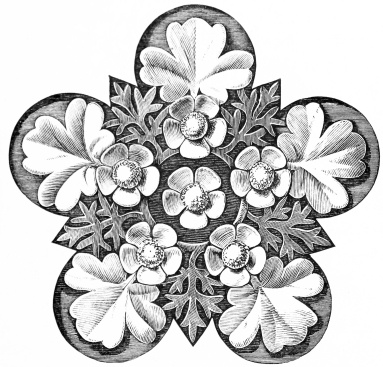
widely spread species: the placid waters of regions so different from
each other in climate as Lapland and Abyssinia are equally favourable to
its growth, and the lakes and slowly running streams of California are
powdered over with its brilliant blossoms, as we see them in our English
pools. The water crowfoot affords us also a beautiful example of that
adaptability of form to the circumstances of the plant’s existence which
we may so frequently trace in the works of nature. It will be noticed in
the illustration that two very distinct forms of leaf are represented;
and, on examining the natural plant, it will be found that the simpler
form of leaf floats upon the surface of the water, while the lower and
more minutely divided leaves are submerged. Imagine the respective
positions of these leaves reversed, and it would speedily be apparent
that the finely cut leaves were unable to support the blossoms, and to
expose them to the vivifying rays of the sun, while the simpler form of
leaf would, by the action of the water, speedily be torn into long
shreds, the principal veins alone remaining, and very much resembling
the actual form that we meet with in the case of the submerged leaves.
In employing the water crowfoot in ornamental art, it appears to us that
the two great features most highly characteristic of it, and therefore
to be embodied in a design, are, first, the number of its blossoms; and,
secondly, the two distinct kinds of leaf; the simpler form being the
most prominent, but the other, though subordinate, as in the case of the
natural plant, to be indicated, and its presence felt. The R. bulbosus
is the species so frequently met with in the carvings of the Decorated
period of Gothic art, an especially beautiful example of its use being
seen in a capital in the doorway in the Chapter-house at Southwell
Minster, Notts. The R. aquatilis, so far as we have had opportunity of
observation, appears to have been entirely overlooked. Illustrations of
the water crowfoot will be met with in V. W. 95; E. B. 18.
Having thus briefly indicated some few points of interest in the
foregoing British plants, we draw our remarks to a close; it must not,
however, be supposed that all the material at our disposal was
exhausted. We fear rather to weary the reader than to exhaust the stores
which nature affords; hence we limit our remarks to fifty plants,
leaving many equally valuable ones untouched; such plants as the
bird’s-foot trefoil, chicory, cowslip, forget-me-not, meadow vetchling,
silver-weed, and stork’s-bill, being fully as well adapted to the
various purposes of ornamental art as those we have, in the body of our
text, referred to; in fact, the whole of those just mentioned were,
together with many more, indexed as a portion of our plan, and were only
cut out when it was found that a catalogue thus amplified would stretch
to an inordinate length. Though we have, in the course of our remarks on
each plant, been careful to indicate to our readers the books he should
consult for illustrations of the natural growth of the flower in
question, we cannot conclude without again strongly advising the
designer, wherever it is at all practicable, to go direct to nature, as
a series of sketches of even the roughest character has an ornamental
value and variety which are not always found in book-illustrations, and,
moreover, the knowledge of the plant acquired in actually delineating it
is worth far more than any study of the written descriptions of others.
These sketches should of course be made when the plant is available, and
not left till an emergency arises, and when, very possibly, the plant,
if found at all, may not be in satisfactory condition for ornamental
work. Whenever, therefore, a plant possessing valuable properties for
decorative work is met with, a drawing of the general growth and
enlarged details of its more artistically valuable parts should be made
and stored up for future use. A designer cannot have too many such
reserves of material, though he may very easily have too few. Those who
have never fairly searched may, however, be under the impression that
but little practical good could come of any such seeking, as, for want
of experience, they unknowingly underrate the wealth that, at the
expense of a short railway journey into the country, is theirs for the
gathering. To test this we set out one day in June, and the result of a
stroll of barely two and a half hours was conclusive on this point. In
addition to many plants in seed, or which, from their foliage, were
worthy of introduction into art-work, no less than seventy-four were met
with in flower; many of these, as the dog-rose, blackberry, white
bryony, comfrey, mallow, hawthorn, and silver-weed, being excellent for
carving; while the bladder campion, forget-me-not, meadow cranesbill,
ground-ivy, meadow vetchling, cinquefoil, oxalis, and honeysuckle, would
be valuable for lighter work—muslins, papers, or lace. We cannot doubt
that the interest thus evolved from a direct study of nature would be a
growing one; that not only would the actual result in art-work be the
better for it, but also that the enjoyment derived from the study would
be such as to render the pursuit one of far more interest than those who
have not yet experienced it can realise.
“Happy is he who lives to understand,
Not human nature only, but explores
All natures—to the end that he may find
The law that governs each; and where begins
The union, the partition where, that makes
Kind and degree, among all visible beings;
The constitutions, powers, and faculties,
Which they inherit—cannot step beyond,
And cannot fall beneath; that do assign
To every class its station and its office,
Through all the mighty commonwealth of things;
Up from the creeping plant to sovereign man.
Such converse, if directed by a meek,
Sincere, and humble spirit, teaches love:
For knowledge is delight; and such delight
Breeds love; yet, suited as it rather is
For thought and to the climbing intellect,
It teaches less to love than to adore:
If that be not indeed the highest love.”
Wordsworth.