It is usual and proper to distinguish three kinds of
beauty in painting, namely, of colour, of form, and of
expression. But form must be defined by tones, and
colour without form is meaningless: hence in the general
consideration of the painter's art, it is convenient to
place form and colour together as representing the
sensorial element of beauty. Nevertheless colour and
form are not on the same plane in regard to sense perception.
Harmony of colour is distinguished involuntarily
by nerve sensations, but in the case of harmony
of form there must be a certain consideration before its
æsthetic determination. The recognition of this harmony
commonly appears to be instantaneous, but still
it is delayed, the delay varying with the complexity of
the signs, that is to say, with the quality of the beauty.
Benedetto Croce, the inventor of the latest serious
æsthetic system, talks of the "science of art," but he
says[a]:
Science—true science, is a science of the spirit—Philosophy.
Natural sciences spoken of apart from philosophy, are complexes
of knowledge, arbitrarily abstracted and fixed.
It is perhaps needless to say that Croce's æsthetic system,
like all the others, collapses on a breath of inquiry.
On the purely philosophical side of it, further criticism
is unnecessary, and its practical outcome from the point
of view of art is not far removed from the amazing conclusions
of Hegel. From the latter philosopher we learn
that an idol in the form of a stone pillar, or an animal
set up by the primitive races, is higher art than a drama
by Shakespeare, or a portrait by Titian, because it represents
the Idea (Hegel's unintelligible abstraction—see
Note 5), while Croce tells us that "the art of savages
is not inferior, as art, to that of civilized peoples,
provided it be correlated to the impressions of the
savages." Clearly if this be so, we are not surprised
to learn from Croce that Aristotle "failed to discern the
true nature of the æsthetic." Nevertheless, whatever
be the outcome of Croce's arguments, his system is at
least more plausible than that of either Hegel or Schopenhauer,
for while these two invent highly improbable
abstractions upon which to base their systems, Croce
only gives new functions to an old and reasonable
abstraction.
The writer does not mean to suggest that these systems
are set up for the purpose of being knocked down:
he desires only to indicate surprise that in new works dealing
with the perception of beauty, it is considered necessary
to restate the old æsthetic theories and to point out
their drawbacks, albeit the fatal objections to them are
so numerous that there is always fresh ground available
for destructive criticism. The best of the recent works
on the subject that have come under the notice of the
writer, is E. F. Carritt's review of the present position
in respect of æsthetic systems. Though profound, he is
so comprehensive that he leaves little or nothing of
importance for succeeding critics to say till the next
system is put forward. Yet here is his conclusion[a]:
If any point can be thought to have emerged from the foregoing
considerations, it is this: that in the history of æsthetics
we may discover a growing pressure of emphasis upon the doctrine
that all beauty is the expression of what may be generally called
emotion, and that all such expression is beautiful.
This is all that an acute investigator can draw from the
sum of the æsthetic systems advanced. Now what does
this mean? Let us turn to the last page of Carritt's
book and find the object of the search after a satisfactory
æsthetic system. It is, he says, "the desire to
understand goodness and beauty and their relations with
each other or with knowledge, as well as to practise or
enjoy them." If we accept beauty as the expression of
emotion, how far have we progressed towards the indicated
goal? Not a step, for we have only agreed upon
a new way of stating an obvious condition which applies
to the animal world as well as to human beings. Beyond
this there is nothing—not a glimpse of sunshine from all the
æsthetic systems laid down since the time of Baumgarten.
More than twenty years ago Leo Tolstoy pointed out
the unintelligible character of these systems, but no
further light has been thrown upon them. Nevertheless
Tolstoy's own interpretation of the significance of
beauty cannot possibly meet with general approval.
He disputes that art is directly associated with beauty or
pleasure, and finds in fact that what we call the beautiful
representation of nature is not necessarily art, but that[b]
Art is a human activity, consisting in this, that one man consciously,
by means of certain external signs, hands on to others
feelings he has lived through, and that other people are affected
by these feelings, and also experience them.
This definition may mean almost anything, and particularly
it may imply pure imitation which Tolstoy
condemns as outside of art. But it certainly does not
include many forms of what we call art, the author specially
condemning for instance, Romeo and Juliet, and
declaring that while Faust is beautiful, "it cannot produce
a really artistic impression." The definition then
seems to represent little more than a quibble over terms.
Tolstoy says that the beautiful representation of nature
is not art, but something else is. Very well then, all we
have to do is to find a new term for this representation
of nature, and the position remains as before except
that the meaning of the term "art" has been changed.
PLATE 24
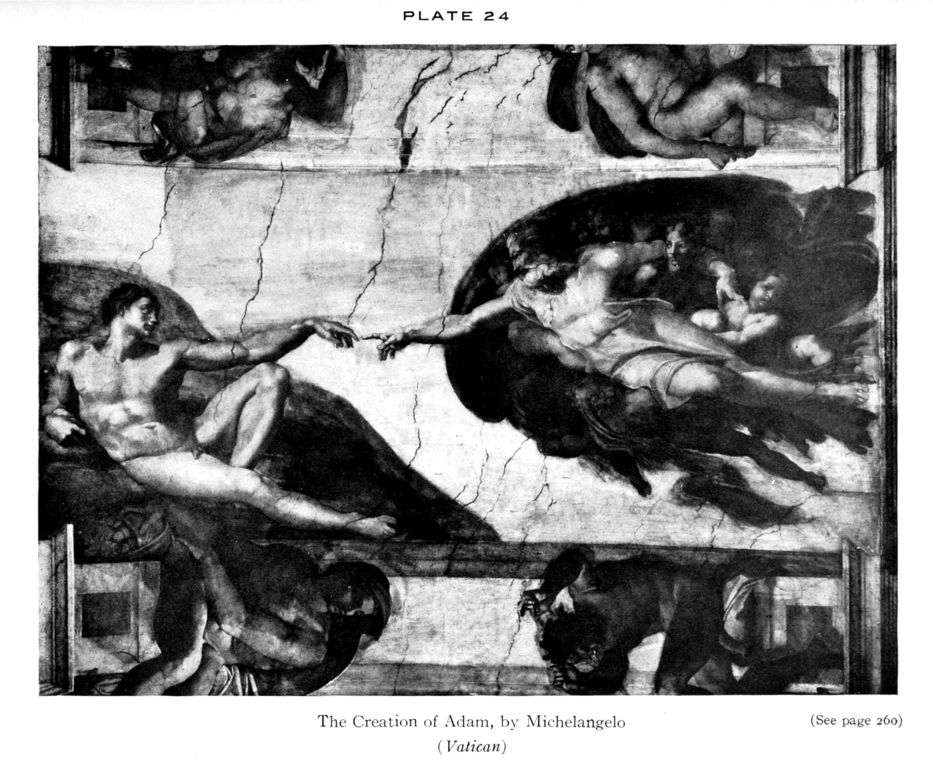 The Creation of Adam, by Michelangelo
(Vatican)
(See page 260)
The evolutionary principle has been applied to art by
Herbert Spencer and J. A. Symonds, but not in the sense
in which it is used in connection with the development
of living organisms. Spencer traces a progression from
the simple to the complex in the application of the arts,
but not in the arts themselves[a]; and Symonds endeavours
to prove that each separate marked period of art shows
a progression which is common to all; that is, from
immature variations to a high type, then downwards
through a lower form represented by romanticism or
elegance, to realism, and from this to hybrid forms.[b]
Spencer's argument is suggestive, but his conclusions
have been mostly upset by archaeological discoveries
made since his great book was published. The illustrations
given by Symonds are highly illuminating, but
they are very far from postulating a general law of evolution
operating in the production of art.
It seems necessary to mention Hegel's art periods,
though one can only do so with a feeling of regret that
a man who achieved a high reputation as a philosopher
should have entered the province of art only to misconstrue
its purpose with fantastic propositions which have
no historical or other apparent foundation. He divides
art history into Symbolic, Classic, and Romantic periods
respectively. To accomplish this he invents or discovers
a new abstraction which he calls the Idea, this representing
man's conception, not of God, but of His perfection—His
supreme qualities, so that in one sense the Idea
may be called the Absolute, in another the Spirit, and
in another, Truth. These terms are in fact interchangeable,
and each may be a manifestation of another, or of
God. This Idea, he says, being perfect beauty, is the
basic concept of art. In archaic times man was unable
to give expression to this concept, so he represented it by
symbols: hence the earliest art was Symbolic art. In
the time of the Greeks man had so advanced that he
was able to give higher expression to the Idea, and he embodied
it in a perfect human form. This is the Classic
period, which Hegel indicates continued till Christianity
spread abroad, when Classic form, though perfect as art,
was found insufficient for the now desired still higher
expression of the Idea. This expression could not be
put into stone, so other arts than sculpture were used for
it, namely, poetry, painting, and music, which are placed
together as Romantic art. This is as nearly as possible
a statement of the periods of Hegel in short compass.
It is impossible to interpret logically his arguments,
nor is it necessary, for his conclusions when tested in the
light of experience, develop into inexplicable paradoxes
and contradictions which border on the ridiculous.
Needless to say, the acceptance of this division means
the annihilation of our ideas of the meaning of art, and
the condemnation to the limbo of forgetfulness of nearly
all the artists whose memory is honoured.
The general interpretation of the terms "Classic Art"
and "Romantic Art" widely differs from that of Hegel,
and varies with the arts. In the literary arts the distinction
is obvious, but the terms are used to define both
periods and classes; in architecture the Gothic period is
usually called the Romantic epoch; and in painting the
terms have reference to manner, the more formal manner
being called Classic, and the soft manner, Romantic;
though it is commonly understood that Romantic art
is especially concerned with subjects associated with the
gentler side of life. But there is no general agreement.
Some writers assert that Giorgione was the first of the
romanticists, others give the palm to Watteau, a third
section to Delacroix, and a fourth to the Barbizon School.
We must await a clear definition of "Romantic Art."
It may be reasonably argued that the want of development
of the plastic arts in England during the literary
revival, was largely due to artificial restrictions. Fine
paintings were ordered out of the churches by Elizabeth,
and many were destroyed; while, following the lead of
the court, there was little or no encouragement offered
by the public to artists except perhaps in portraiture.
Flaxman truly said of the destruction of works of art
in this period, that the check to the national art in England
occurred at a time which offered the most essential
and extraordinary assistance to its progress.
During the last half century or so, various writers of
repute, including Ruskin and Dean Farrar, have professed
to find in the poorer works of the Italian painters
of the fourteenth century, and even in paintings of
Margaritone and others of the previous century, evidence
of strong religious emotion on the part of the artists. It
is claimed that their purpose in giving simple solemn
faces to their Madonnas and Saints, was "to tell the
sacred story in all its beauty and simplicity"; that they
possessed a "powerful sincerity of emotion"; that they
"delivered the burning messages of prophecy with the
stammering lips of infancy," and so on. It is proper to
say that there is nothing to support this view of the early
painters. We find no trace of any suggestions of the
kind till the last of these artists had been dead for about
four hundred years, while their lives, so far as we have
any record, lend no warranty to the statements. The
painters of the fourteenth century took their art seriously,
but purely as a craft, and it was not uncommon with
them to combine two or three other crafts with that of
painting. They designed mostly sacred subjects for the
simple reason that the art patrons of the day seldom ordered
anything else. In their private lives they associated
together, were generally agreeable companions,
and not averse to an occasional escapade. Moreover
the time in which they lived was notable for what we
should call loose habits, and indeed from the thirteenth
century to the end of the fifteenth, religious observances
and practices were of a more hollow and formal character
than they have ever been since.
The position occupied by these painters in the progression
of art from the crude Byzantine period upwards,
corresponds with that of the Roman painters of the third
and fourth centuries in the progression downwards to
the Byzantine epoch, and there is no more reason for
supposing that the Italians were actuated by special
emotions in their work, than that the Romans were so
moved. In both cases the character of the work, as
Reynolds put it in referring to the Italians, was the result
of want of knowledge. The countenances usually presented
by both Roman and Italian artists have a half
sad, half resigned expression, because this was the only
kind of expression that could be given by an immature
painter whose ideal was restricted by the necessity of
eliminating elements which might indicate happiness.
Giotto, Taddeo Gaddi, Duccio, and a few more, were
exceptions in that their art was infinitely superior to the
average of the century, but all from Giotto downwards,
laboured as craftsmen only. No doubt they often worked
with enthusiasm, and in this way their emotions may
have been brought into play, but there is no possible
means of identifying in a picture the emotions which an
artist may have experienced while he was painting it.
As to the sad expression referred to in these Italian
works, it may be observed that Edgar A. Poe held that
the tone of the highest manifestation of beauty is one
of sadness. "Beauty of whatever kind," he says, "in
its supreme development invariably excites the sensitive
soul to tears."[a] But Poe is clearly mistaken here. It
is not the beauty of the work that affects the emotions to
tears, when they are so affected, but the subject of the
design exhibiting the beauty. A picture or poem representing
a sad subject may be very beautiful, but the
sadness itself would not assist the beauty, though it
might increase the emotional effect. The higher forms
of beauty rarely draw our tears, but elicit our admiration
without direct thought of anything but the beauty.
Who would weep when in front of the greatest marvels
of Greek sculpture?
It is commonly, but wrongfully, supposed that Rembrandt
used his broadest manner in painting commissioned
portraits. The number of his portraits known to
exist is about 450, of which fifty-five are representations
of himself, and fifty-four of members of his household, or
relatives. There are, further, more than seventy studies
of old men and women, and thirty of younger men. The
balance are commissioned portraits or groups. This
last section includes none at all of his palette knife pictures,
and not more than two or three which are executed
with his heaviest brushes. Generally his work broadened
in his later period, but up to the end of his life his more
important works were often painted in a comparatively
fine manner, though the handling was less careful and
close.[a] The broadest style of the artist is rarely exhibited
except in his studies and family portraits. Further
it is extremely unlikely that a palette-knife picture
would have been accepted in Holland during Rembrandt's
time as a serious work in portraiture.
Darwin pointed out the permanent character of the
changes in the nerves, though he submitted another
demonstration[a]:
That some physical change is produced in the nerve cells or
nerves which are habitually used can hardly be doubted, for
otherwise it is impossible to understand how the tendency to
certain acquired movements is inherited.
Reynolds evidently had little faith in original genius.
Addressing Royal Academy students, he said[a]:
You must have no dependence on your own genius. If you
have great talents, industry will improve them; if you have but
moderate abilities, industry will supply the deficiency. Nothing
is denied to well-directed labour; nothing is to be obtained without
it.... I will venture to assert that assiduity unabated by
difficulty, and a disposition eagerly directed to the object of its
pursuit, will produce effects similar to those which some call the
result of natural powers.
On another occasion Reynolds observed of Michelangelo[b]:
He appears not to have had the least conception that his art
was to be acquired by any other means than great labour; and
yet he of all men that ever lived, might make the greatest pretensions
to the efficacy of native genius and inspiration.
Gibbon said that Reynolds agreed with Dr. Johnson
in denying all original genius, any natural propensity
of the mind to one art or science rather than another.[c]
Hogarth also agreed with Reynolds, for he describes
genius as "nothing but labour and diligence."
Croce says that genius has a quantitative and not a
qualitative signification, but he offers no demonstration.[d]
Evidently he is mistaken, for the signification is both
quantitative and qualitative. It is true that what a
Phidias, or a Raphael, or a Beethoven puts together is a
sum of small beauties, any one of which may be equalled
by another man, but he does more than represent a number
of beauties, for he combines these into a beautiful
whole which is superior in quality and cannot be estimated
quantitatively. We may possibly call Darwin a
genius because of the large number of facts he ascertained,
and the correct inferences he drew from them, but
we particularly apply the term to him by reason of the
general result of all these facts and inferences, this result
being qualitative and not quantitative. Croce probably
took his dictum from Schopenhauer, who, however,
represented degrees of quality as quantitative,[e] which is
of course confusing the issue.
It is often observed by advocates of "new" forms of
art that the work of many great artists has been variously
valued at different periods—that leaders of marked
departures in art now honoured, were frequently more or
less ignored in their own time, while other artists who
acquired a great reputation when living, have been
properly put into the background by succeeding generations.
For the first statement no solid ground can be
shown. In painting, the artists since the Dark Age
who can be said to have led departures of any importance,
are Cimabue, Giotto, the Van Eycks, Masaccio,
Lionardo, Dürer, Giorgione, Raphael, Michelangelo,
Titian, Holbein, Claude, Rubens, Rembrandt, Velasquez,
Watteau, Reynolds, and Fragonard. All of these had
their high talents recognized and thoroughly appreciated
in their lifetime. In sculpture the experience is
the same, for there is no sculptor now honoured whose
work was not highly valued by his contemporaries. So
with poetry, but before the invention of printing and
in the earlier days of this industry, poetry of any kind
was very slow in finding its way among the people.
What might seem nowadays to have been inappreciation
of certain poets was really want of knowledge of them.
There is more truth in the assertion that many artists
who had a high reputation in their lifetime are now
more or less disregarded, though it does not follow from
this that there has been a reversal of opinion on the part
of the public, or a variation in the acuteness of æsthetic
perception. Generally we find that these artists very
properly held the position they occupied in their time and
country, and if they do not now stand on exalted pedestals
it is only because we compare them with men of other
periods and places, which their contemporary countrymen
did not do, at least for the purpose of establishing
their permanent position in art. Carlo Maratta for
instance was celebrated in Italy as the best painter of
his country in his time, and even now we must so regard
him, but his contemporaries as with ourselves did not
place him on so high a level as his great predecessors
of the sixteenth century, and some of the seventeenth.
A special reason why many of the seventeenth century
artists of Italy have fallen in public esteem may be found
in the fact that they excelled mostly in the production
of sensorial beauty, paying little attention to intellectual
grace, and the ripening of general intelligence as time goes
on makes us more and more sensitive to beauty of mind.
There have been many definitions of "Impressionism"
given, but they vary considerably. Professor Clausen
describes it as the work of a number of artists whose
interest is in recording effects of light, seeking to express
nature only and disregarding old conventions.[a] Mr.
D. S. MacColl says that an impressionist is[b]
a painter who, out of the completed contacts of vision constructs
an image moulded upon his own interest in the thing seen, and not
on that of any imaginary schoolmaster.
This definition is insufficient by itself, but the writer
makes his meaning clearer in the same article when he
says:
Impressionism is the art that surveys the field, and determines
which of the shapes and tones are of chief importance to the
interested eye, and expresses these and sacrifices the rest.
According to C. Mauclair, an acknowledged authority
on impressionism, the impressionist holds:
Light becomes the one subject of a picture. The interest of the
objects on which it shines is secondary. Painting thus understood
becomes an art of pure optics, a seeking for harmonies, a
species of natural poem, entirely distinct from expression, style,
drawing, which have formed the main endeavour of preceding
painting. It is almost necessary to invent a new word for
this special art, which, while remaining throughout pictural, approaches
music in the same degree as it departs from literature
or psychology.[c]
What can be said of so amazing a declaration? The
arts of painting and music do not, and cannot, have any
connection with each other. They are concerned with
different senses and different signs, and by no stretch of
the imagination can they be combined. Seeing that
musical terms when used in respect of painting by modern
critics are almost invariably made to apply to colour
harmonies, we may infer that a confusion of thought
arises in the minds of the writers from the similar physical
means by which colour and sound are conveyed to
the senses concerned. But this similarity has nothing
to do with the appreciation of art. The æsthetic value
of a work is determined when it is conveyed to the mind,
irrespective of the means by which it is so conveyed.
According to La Touche it was Fantin Latour who
invented modern impressionism. Braquemond relates
that La Touche told him the following story.[d] He (La
Touche) was one day at the Louvre with Manet, when
they saw Latour copying Paolo Veronese's Marriage at
Cana in a novel manner, for instead of blending his
colours in the usual way, he laid them on in small touches
of separate tones. The result was an unexpected brilliancy
("papillotage imprevu") which amazed but
charmed the visitors. Nevertheless when Manet left
the Louvre with La Touche, he appeared anything but
satisfied with what he had seen, and pronounced it humbug.
But Latour's method evidently sunk into his mind,
for a few days later he commenced to use it himself. Thus,
added La Touche, was modern impressionism unchained.
The date of this visit was not given by La Touche, but
1874 was subsequently suggested. This account does not
fit in with the statement of MacColl that when Monet and
Pissarro were in London during the siege of Paris, the study
of Turner's pictures gave them the suggestion of these
broken patches of colour.[e] If this be true Monet must
have antedated Manet in the application of isolated tones.
D. S. Eaton asserts that in the Salon of 1867, there was
exhibited a picture by Monet which was entitled Impressions,[f]
and from this arose the word "Impressionist";
but Phythian says that the word resulted
from Monet's "Impression, soleil levant," exhibited in
1874 at the Nadar Gallery in Paris with other works from
Le Société Anonyme des Artistes, Peintres, Sculpteurs,
et Graveurs. Phythian adds[g]:
Thus, unwittingly led by one of the exhibitors, visitors to the
exhibition came to use the word "impressioniste," and within a
few days a contemptuously unfavourable notice of the exhibition
appeared in Le Charivari under the heading "Exposition des
Impressionistes." It was not until the lapse of several years that
the name came into general use. The painters to whom it was
applied disowned it because it was used in a depreciatory sense.
Eventually however, unable to find a better one, they adopted it.
Another origin of Impressionism is given by Muther.
He says[h]:
The name "Impressionists" dates from an exhibition in Paris
which was given at Nadar's in 1871. The catalogue contained
a great deal about impressions—for instance, "Impression de mon
pot au feu," "Impression d'un chat qui se promene." In his criticism
Claretie summed up the impressions, and spoke of the Salon
des Impressionistes.
But the real origin of impressionism must be sought
earlier than 1871, for in 1865 Manet exhibited his
Olympia in the Salon des Refusés. This picture did
not represent what was understood as impressionism ten
years later, but it led the way towards the establishment
of the innovation, in that it pretended that healthy ideas
and noble designs were secondary considerations in art.
Certainly Manet could not descend lower than this
wretched picture, and in this sense his subsequent work
was a distinct advance.
The reason given by impressionists for the juxtaposition
of pure colours is that the natural blend produced
is more brilliant than the tone from the mixed colours
applied, but it is pointed out by Moreau-Vauthier that
the contrary is the case. He says[a]:
We find in practice that the parent colours do not, with
material colours, produce the theoretical binaries. We get dark,
dull greens, oranges, and violets, that clash with the parent colours.
To make them harmonize we should be obliged to dim these material
colours, to transform them, and consequently to lose them
partly.
PLATE 25
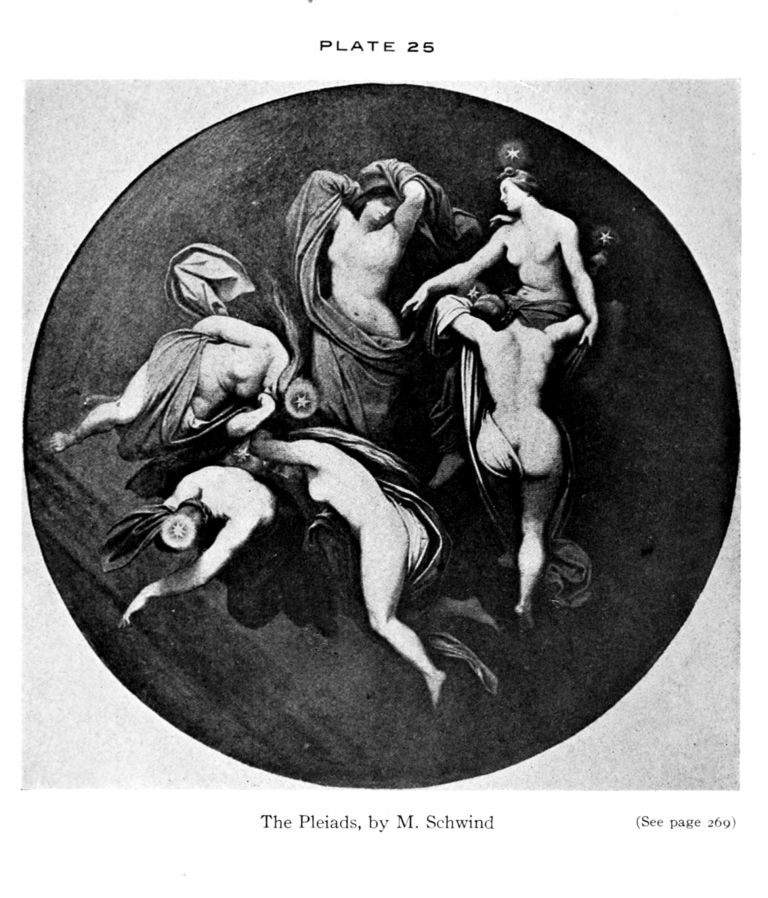 The Pleiads, by M. Schwind
(See page 269)
Cézanne and Van Gogh are not usually put forward
as representative impressionists, but it is impossible to
differentiate logically between the various "isms" of
which impressionism is the mother, and to attempt a
serious argument upon them would be apt to reflect upon
the common sense of the reader. The sincere impressionist
certainly produces a thing of beauty, however
ephemeral and lacking in high character the beauty may
be, but most of the productions of the other "isms"
only serve the purpose of degrading the artist and the
art.
This form of picture is by no means new, though
except among the inventors of sprezzatura, and the modern
impressionists, it has always been executed as a
rough sketch for the purpose of settling harmonies for
serious work. Lomazzo relates that Aurelio, son of
Bernadino Luini, while visiting Titian, asked him how
he managed to make his landscape tones harmonize so
well. For reply the great master showed Aurelio a large
sketch, the character of which could not be distinguished
when it was closely inspected, but on the observer
stepping back, a landscape appeared "as if it had suddenly
been lit up by a ray of the sun."[a] From Luini's
surprise, and inasmuch as we have no record of similar
work before his time, it is reasonable to suppose that
Titian was the first great artist to use this form of sketch
for experimental purposes.
The example of this picture at the Pitti Palace is
specially noted because it seems impossible that the
duplicate in the Uffizi Gallery can be by Raphael, for it
has obvious defects, some of which have many times
been pointed out. The expression is vastly inferior to
that in the Pitti portrait, for instead of a calm, noble,
benign countenance, we have a half-worried senile face
which is anything but pleasant. Raphael was the last
man to execute a portrait of a Pope without generalizing
high character in the features. It will be observed
also that in the Uffizi portrait, the left hand is
stiff and cramped, and the drapery ungracefully flowing,
while both uprights of the chair are actually out of
drawing. There are other examples of the same picture
in different museums, but the Pitti work is far above
these in every respect, and seems the only one which
can be properly attributed to the master. Passavant
affirms that some of the repetitions of the work were
certainly made in the studio of Raphael under his orders,
and thinks that the duplicates passed for originals even
in his time.[a]
To the knowledge of the writer, the only logical connection
between the work of Rembrandt and impressionism
that has been suggested, is from the pen of
Professor Baldwin Brown, who remarks[a]:
Rembrandt in his later work attended to the pictorial effect
alone, and practically annulled the objects by reducing them to
pure tone and colour. Things are not there at all, but only the
semblance, or effect, or impression of things. Breadth is in this
way combined with the most delicate variety, and a new form of
painting, now called "impressionism" has come into being.
The professor is mistaken here. During the last fifteen
years of his life, apart from portraits, a few studies of
heads, and some colour experiments with carcases of
meat, Rembrandt executed, so far as is known, about
three dozen pictures, and in all of these he effectually
prevents us from forming a general impression of the
designs before considering the more important details,
by concentrating nearly all the available light upon the
countenances of the principal personages represented;
while in the management of the features, the whole purpose
of the chiaroscuro is for the purpose of obtaining
relief. Moreover the pictures are nearly all groups of
personages in set subjects, and there would be no
meaning in the designs if the objects were "practically
annulled," for particular action and expression are necessary
for their comprehension.
As to Velasquez there is no evidence tending to support
the statement that he was an impressionist. The first
authority on the artist has definitely pointed out that
he never took up his brushes except for an important
and definite work: "he neither painted impressions nor
daubs."[b]
It will always be a matter of surprise that so much
popularity was secured by the light sketches of the
Barbizon School, considering their general insignificance
from the point of view of art, and the conspicuously
artificial means adopted for their exploitation. Some of
the artists of this school, having accomplished many
studio works of merit, acquired the habit of painting in
the open air. By this method it is impossible to execute
a comprehensive natural scene, and the painters did not
attempt the task, but they produced numberless sketchy
works of local scenes under particular atmospheric conditions.
They laboured honestly and conscientiously,
and their sketches were put out for what they were and
nothing more. The paintings would probably have retained
their place as simple studies had not some commercial
genius conceived the idea of putting them into
heavy, gorgeous, gilt frames. With this embellishment
they were successfully scattered round the world, mostly
in the newer portions, much to the general astonishment.
The raison d'être of the frames puzzled many persons,
though it was frequently observed that the pictures do
not look well unless surrounded by ample gold leaf.
Thus, C. J. Holmes, Director of the London National
Gallery, and an authority on impressionism, notes[a]:
Barbizon pictures are almost invariably set in frames with an
undeniably vulgar look. Yet in such a rectangle of gilded contortion
a Corot or a Daubigny shows to perfection: place it in a
frame of more reticent design, and it becomes in a moment flat,
empty, and tame.
The purpose of this frame is obvious. The eye is caught
by the dazzling glitter, and feels immediate relief when
it rests upon the quiet grey tone of the painting, the
pleasurable sensation resulting therefrom being mistaken
for involuntary appreciation of the beauty of the work.
As finished paintings these Barbizon sketches are
novel, but as studies they are not, for similar work has
been executed for two or three centuries, and particularly
by the Dutch artists of the seventeenth century. In
every considerable collection of drawings such sketches
may be found, and there is scarcely a Barbizon painter
whose work was not anticipated by a Dutch master.
One has only to examine the drawings in the public art
institutions of Europe by De Molyn, Blyhooft, Jan
de Bischop, Lambert Doomer, Berghem, Avercamp, and
others, to find examples which, if executed now, might
easily be taken for works by the Barbizon masters.
In recent times attempts have been made to upset the
dictum of Aristotle as to the imitative character of the
arts generally, exception being taken in respect of music
and architecture. The first objection as to music arose
with Schopenhauer, though he does not appear to have
been quite certain of his position. He stated that while
the other arts represent ideas, music does not, but being
an art it must represent something, and he suggested that
this something is the "Will," the term being used in the
Schopenhauer philosophical sense, that is to say, implying
the active principle of the universe, not being God.
This means nothing at all from the point of view of
art, and cannot even be seriously considered. The most
notable essay on the subject since Schopenhauer is from
the pen of Sidney Colvin who places music and architecture
in a non-imitative group by themselves, the
former on the principal ground that "it is like nothing
else; it is no representation or similitude of anything
whatever"; while architecture, he says, "appeals to our
faculties for taking pleasure in non-imitative combinations
of stationary masses."[a] But what Aristotle
meant is that the arts are imitative in character, and not
that they necessarily attempt to produce works of similitude
with nature, this being evident from the fact that he
pointed out that the higher works of art surpass nature,
and he divided poetry and painting into three sections,
of which the first is better than life, and the third inferior
to it.
The musician in producing his art proceeds in precisely
the same way as the poet or painter. He takes natural
signs and rearranges them in a new order, producing a
combination which is not to be found complete in nature,
but every sign therein is natural and must necessarily
be so. The higher the flight of the poet, or musician, or
painter, or sculptor, the farther is the result from nature,
but nevertheless the whole aim of the musician, as of
the poet, is to represent emotional effects or natural phenomena
beyond experience in life, as the great sculptor
represents form and expression, and the great poet besides
these things, every abstract quality, passion, and
emotional effect, above this experience; but he cannot
do more; he cannot represent something outside of nature,
and so must imitate, that is, in the sense of representation.
Darwin notes that even a perfect musical scale can be
found in nature. He says[b]:
It is a remarkable fact that an ape, a species of the gibbon
family, produces an exact octave of musical sounds, ascending and
descending the scale by half tones. From this fact, and from
the analogy of other animals, I have been led to infer that the
progenitors of man probably uttered musical tones, and that consequently,
when the voice is used under any strong emotion, it
tends to assume, through the principle of association, a musical
character.
It has been further demonstrated that the strength of the
sensory impressions from certain sounds is due to the
structure of the ear, and that generally a particular
kind of sound produces a similar kind of emotional
effect in animals as in man. Obviously the musician
is powerless to do more than widen or deepen this
effect. Colvin admits that the musician sometimes
directly imitates, as when he produces the notes of birds
or the sounds of natural forces, or when he represents
particular emotions; but he regards the former instances
as hazardous and exceptional, and indicates that a
particular emotional harmony may affect the hearers
differently. True, but the hazard of the first condition
is the result of the limitations of the artist, and the
second condition is the consequence of the limitations of
the art. The effect of music being purely sensorial must
vary with the emotional conditions surrounding the
hearer. The musician does what he can, but he is unable
to go so far as the poet and produce an emotional effect
which will with certainty be recognized by every person
affected, at all times, as having the same particular
bearing.
Taine separates music ("properly so called" as distinguished
from dramatic music) and architecture from
the imitative arts, as they "combine mathematical
relationships so as to create works that do not correspond
with real objects."[c] Obviously the whole purpose of
dramatic music is to imitate the effects of the passions,
but its necessary inclusion amongst the imitative arts
upsets the dictum of Taine, for the emotional effects of
one kind of music only differ from those of another kind
when they differ at all, in the character of the natural
emotional effects represented.
In the case of the architect, seeing that his art is
subordinated to utility, his scheme, his measurements,
and the character of his materials, are largely or almost
entirely governed by conditions outside of his art, and
consequently it is only possible for him to represent
nature to a limited extent. Rarely can he vaguely suggest
a natural aisle beneath the celestial dome, a rock-walled
cave whose roof soars into obscurity, or a fairy
grotto backed by a beetling cliff. Sometimes he may
cause us to experience similar effects in kind to those
we feel when we recognize grandeur in nature, but
usually he is compelled to confine his beauty to harmonies
produced by symmetrical designs of straight lines
and curves. But in his simplest as in his most complex
designs, he must follow nature as closely as possible.
Purely ornamental forms always appear more beautiful
when the parts have a direct mathematical relationship
with each other than when they have not; that is to say,
when the parts appear to be naturally related. Thus,
that a cross appears to be less agreeable to the sight
when the horizontal bar is below the centre of the perpendicular
than when it is above this point, is due to
what appears to be a want of balance because the form
is unobservable in nature. In trees the horizontal parts
are usually above the middle of the height of the observable
trunk, and in the exceptions nature gives the
whole tree a conical or other shape, the relative position
of the horizontal parts being obscured in the general
form.
As with parts of forms, so with the forms as wholes.
Other things being equal, that design is the best where the
forms are directly proportioned one with the other and
with the whole, and this is because we are accustomed
to the order of design in nature where everything is
balanced by means of direct proportions and corresponding
relations. The architect therefore, like the musician
or poet, must represent nature so far as he can within the
limits of his art, though his representation is comparatively
weak owing to the artificial restrictions imposed
upon him.
The dictum of Aristotle in reference to metre in poetry
related only to epic and dramatic verse, for what we
understand as lyric poetry was separated by the Greeks
as song in which of course metre is compulsory. It is
doubtful whether a single definition can cover both epic
poetry, whose beauty lies almost wholly in the substance,
and lyric verse where the beauty rests chiefly in qualities
of expression and musical form, and in which indeed the
substance may be altogether negligible. A cursory examination
of Watts-Dunton's definition of "Poetry,"
which is admittedly the best put forward in recent times,
shows its entire inadequacy. "Absolute poetry," he
says, "is the concrete and artistic expression of the human
mind in emotional and rhythmical language."[a] This
would exclude from the art some of the finest sacred
verse, which, though in the form of prose, has been
recognized as poetry from time immemorial. Metre is
only one of the devices of the poet for accomplishing his
end—-the presentation of beautiful pictures upon the
mind, but in high poetry there is a still more compulsory
artifice which is not included in Watts-Dunton's definition,
and that is metaphor. In the form of words the
details of a picture can only be dealt with successively,
and not simultaneously, and without metaphor the
poet would sometimes be in the position of the painter
who should present a dozen different pictures each containing
only one part of a composition, and call upon
the observer to put the pieces together in his mind.
Further the term "absolute" in the definition quoted
has no comprehensible meaning if it does not exclude
a good deal of verse which is commonly recognized
as poetry, while, as is admitted by Watts-Dunton,
there is much accepted lyric verse without concrete
expression.
In high poetry as in high painting, the beauty appeals
both to the senses and the mind, and in each art the
quality descends as the sensorial overbalances the intellectual
appeal, and the effect becomes more ephemeral.
In the very highest of the plastic arts, colour has
little value except in assisting definition; and in the very
highest poetry musical form has only an emphasizing
value, for the sensorial beauty arising from form in the
one case, and form and action in the other, entirely overpowers
the harmonies of colour and tone respectively.
But colour without design is meaningless, so that it cannot
be applied in the fine arts apart from design: hence in
painting, colour presents no complication in respect of
definition. On the other hand music, with or without
association with poetry, is equally an art since in either
case it imitates the effects of human emotions in a
beautiful way. Thus, where metre is present poetry is a
combined art, and seeing that metre may not be present,
a definition of "Poetry" must cover what may be in one
case a pure, and in another, a compound art.
There seems to be a tendency to overestimate the
disparity between translations of high poetry and the
originals. The value of a translation depends primarily
upon the character of the thing translated, since it is the
form that is unreproducible in another tongue, and not
the substance. In epic and dramatic poetry where the
form is of secondary importance, a good literal translation
may come much nearer to the original than a
translation of a lyric where the form is usually of at least
equal importance with the substance. We lose less of
Homer or Sophocles than of Sappho or Theocritus in
translation. In the case of epic poetry the higher its
character, the closer to the original appears the translation,
because the form is of less relative importance.
More of Dante is lost than of Homer in literal translation,
but the difference narrows when the new versions
are in metrical form, for the use of metre in translation is
necessarily more detrimental as the substance of the
original increases in power, and this relative weakening is
emphasized as the beauty of form in the translation is
raised. Pope is farther from Homer than Chapman, and
Chapman than the prose translations of Buckley and
Lang. As we descend in the scale of the art, so it becomes
more difficult to reproduce the poet in translation,
and in most lyric poetry the beauty seems almost entirely
lost in another tongue from the original, though when
the substance is of weight, and the translator is himself
a good poet, he sometimes gives us a paraphrase with
a high beauty of its own. Some modern poets seem to
eschew substance altogether. Much of the verse of
esteemed French and Belgian poets is quite meaningless
in literal translation, the authors relying for the effects
entirely upon musical form and beauty of expression.
Lessing points out this remarkable picture of Homer
as emphasizing the beauty of Helen, observing:
What could produce a more vivid idea of beauty than making
old age confess that it is well worth while the war which cost so
much blood, and so much treasure?
Nevertheless the remark of the old men does not seem to
mean so much as the description of the sages and their
reference to the goddesses. It is difficult to imagine
several wise men agreeing that the sanguinary war of
nine years was really excusable in view of Helen's beauty,
and the statement therefore is naturally received as a
permissible overcolour. Consequently the effect of the
remark would be discounted, and unlikely to be sufficient
for the purpose of the poet. True, the Greeks seem to
have been childlike sometimes in their simplicity, but
there is no evidence that they were so wanting in a sense
of proportion as to accept literally this opinion of the
elders. But when we observe the senility of the elders,
and the physical feebleness which has apparently rendered
them incapable of sensual pleasures, then indeed
we must marvel at a beauty which excites their emotions
so powerfully as to bring the goddesses to their
minds.[a]
In discussing the suitableness of this incident as a subject
for a painting, Lessing remarks that the passion
felt by the old men was "a momentary spark which their
wisdom at once extinguished," but later on, referring to
the possibility that the veil worn by Helen when she
passed through the streets of Troy had not been removed
when she was seen by the elders, he points out[b]:
When the elders displayed their admiration for her, it must
not be forgotten that they were not seeing her for the first time.
Their confession therefore did not necessarily arise from the present
momentary view of her, for they had doubtless often experienced
before the feelings which they now for the first time acknowledged.
This is very true, but it only serves to deepen the impression
of Helen's beauty, for the element of surprise is removed
from the minds of the elders, the mere sight of
her, veiled or unveiled, being sufficient to recall the passionate
thrills previously experienced.
In nearly all the instances of sublimity quoted by
Longinus there is this particular merit of brevity—-the
picture is thrown upon the brain immediately, without
pause or anything whatever to complicate the beauty.
But the learned critic directs attention only to the
magnificent thoughts and the appropriate use of them,
without pointing out the extraordinary condensation of
the language employed. Apart from the instance from
Genesis given, there is another of his examples in which
practically the whole beauty of the picture is produced
by the rapidity of its presentation. This is the exclamation
of Hyperides when accused of passing an illegal
decree for the liberation of slaves—"It was not an orator
that made this decree, but the battle of Chæronea."
Longinus observes[a]:
At the same time that he exhibits proof of his legal proceedings,
he intermixes an image of the battle, and by that stroke of art
quite passes the bounds of mere persuasion.
But it was rather the manner in which the battle was
introduced than the fact of its introduction, that gave
force to the argument. If instead of confining himself to
a short brilliant observation, Hyperides had carefully
traced cause and effect in the matter, he would still
have intermixed an image of the battle, but he would
not then have produced a work of art.
Still finer instances of the use of brevity in expresssion
by the orator are to be found in the speeches of Demosthenes.
For example in his oration On the Crown he
says: "Man is not born to his parents only, but to his
country." A whole volume on the meaning and virtue
of patriotism could not say more: hence the sublime art.
The simple statement lights a torch by which we examine
every convulsion in history; presents a moving picture
in which we see the motives and aspirations guiding the
patriots of a hundred generations; sets an eternal seal
of nobility upon the love of man for his native country.
And a few words suffice. The same thought might be
elaborated into a large volume, but the art would fly with
the brevity.
There are many translations of the Ode to Anactoria,
but the best of them reflects only slightly the depth of
passion in the original. The version which most nearly
represents the substance, while maintaining the unhalting
flow of language, is perhaps that of Ambrose Philips
(1675-1749), which runs thus:—-
Blest as th' immortal gods is he,
The youth who fondly sits by thee,
And hears, and sees thee all the while
Softly speak, and sweetly smile.
'Twas this deprived my soul of rest,
And raised such tumults in my breast;
For while I gazed, in transport tost,
My breath was gone, my voice was lost.
My bosom glowed; the subtle flame
Ran quick through all my vital frame;
O'er my dim eyes a darkness hung;
My ears with hollow murmurs rung.
In dewy damps my limbs were chilled;
My blood with gentle horrors thrilled;
My feeble pulse forgot to play;
I fainted, sunk, and died away.
The English reproductions of this ode in the Sapphic
measure are not very successful, the difficulty of course
being due to the practical impossibility of fulfilling the
quantitative conditions of the strophe without stilting
the flow of language, or unduly varying the substance.
But it has been shown by Dr. Marion Miller in his translation
of Sappho's Hymn to Aphrodite, which is much
higher in substance and somewhat less condensed in expression
than the Ode to Anactoria, that with certain liberties
in respect of quantities, a very beautiful semblance
of the Sapphic measure may be produced in English.
His translation of this hymn is unquestionably the best
in our language, though this is perhaps partly due to the
fact that he is almost the only translator who has adhered
to the text in regard to the sex of the loved person. To
make the object of affection a man seems inappropriate
to the language employed in the verse. (It is proper to
mention that a license taken by Dr. Miller in his translation—-where
he renders the passage relating to the
sparrows, as "clouding with their pinions, Earth's wide
dominions"—suggested to the present writer the somewhat
similar picture to be found on Page 111.)
PLATE 26
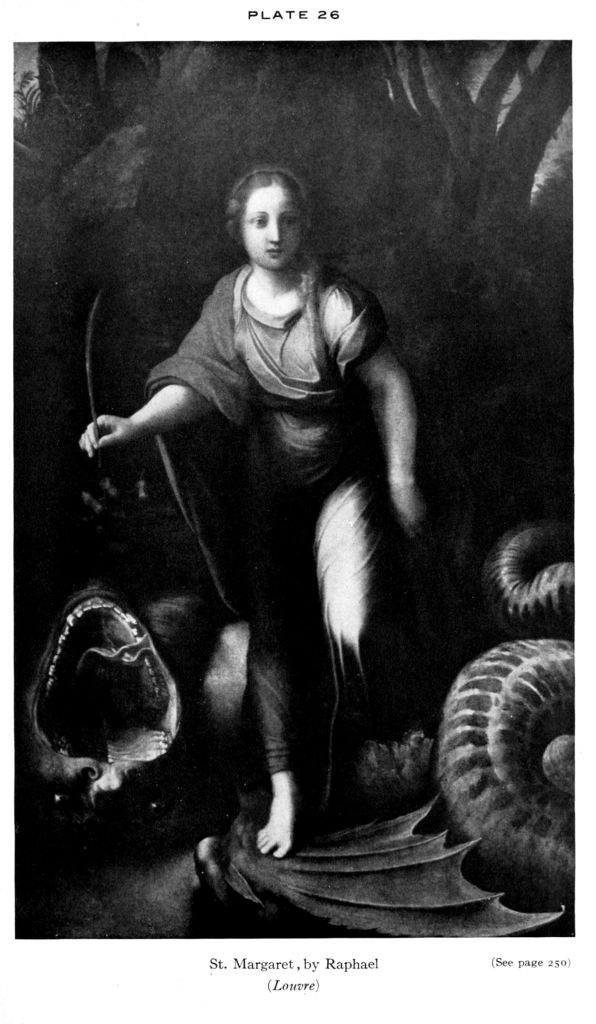 St. Margaret, by Raphael
(Louvre)
(See page 250)
The gradual decadence of the great period of Grecian
sculpture is well marked by the successive variations of
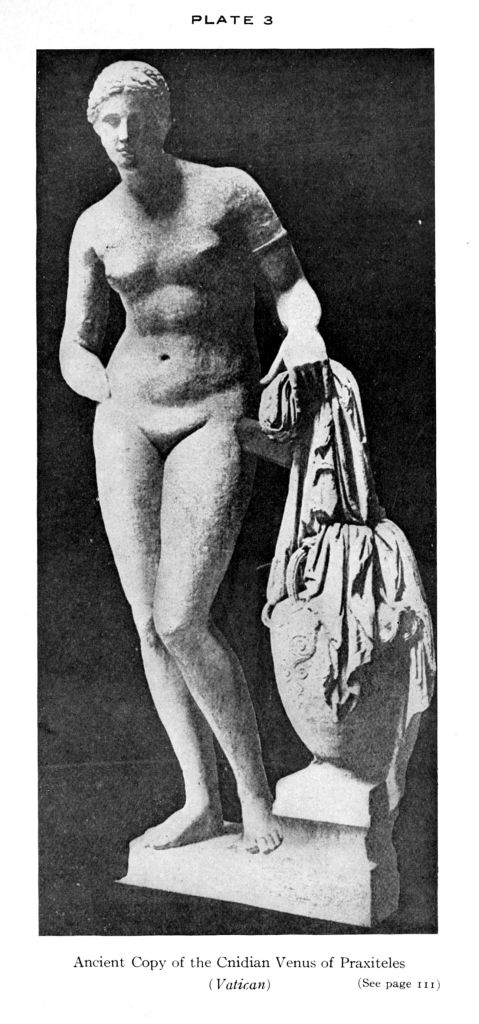
the Cnidian Aphrodite of Praxiteles. The copy of this
at the Vatican is no doubt a close representation of the
original, but later there was commenced a long series of
variations, all of them more or less complicating the design.
First a pillar was substituted for the vase, reaching
nearly to the armpits, and the left forearm rested
upon it, while drapery fell down the front, so that some
exertion was required to separate the figure to the eye.
Then a dolphin was substituted for the pillar, the head of
the animal resting on the ground, and the body rising up
straight with the bent tail forming the support. Then
for this was placed a dolphin with its body corkscrew
shaped, which was particularly weak as it tended to
deprive the figure of repose. After this, while the dolphin
was maintained, a cestus was sometimes added, and
heavy drapery applied in various folds. Finally the
attitude of the figure was changed, that of the Venus de'
Medici being adopted, while the pillar or dolphin was
retained. Each alteration necessarily diminished the
beauty of the figure.
Reynolds seems to have been disappointed with the
frescoes of Raphael when he first saw them, and this
fact has been called in evidence by some modern critics
to support their contention that the art of the great
masters is really inferior to that wherein design is subordinated
to colour. But Reynolds very definitely admitted
that his first impression was wrong, for after
studying the frescoes, he notes[a]:
In a short time a new taste and a new perception began to
dawn upon me, and I was convinced that I had originally formed
a false opinion of the perfection of art, and that this great painter
was well entitled to the high rank which he holds in the admiration
of the world.
Reynolds was quite a young man when he went to Rome,
and his appreciation of Raphael increased as his experience
matured. More than twenty years after the visit,
he remarked that Raphael had "a greater combination of
the high qualities of the art than any other man,"[b] and
ten years later he affirmed that the Urbino artist stood
foremost among the first painters.[c] Reynolds supposed
that his lack of appreciation of the frescoes when he first
saw them arose from want of immediate comprehension
of them: he was unaccustomed to works of such great
power, but it is to be observed that his inspection was a
very short one, and we may reasonably draw the conclusion
that changing light conditions had much to do with
the effect the paintings left upon him at the time. When
one enters a room where the light differs materially in
intensity or quality from that experienced just previously,
it is advisable to rest quietly for a little while before
examining works defined by colour, in order that the
eyes may become accustomed to the new light.
That the judgment of the public upon a work of art is
final seems to have been recognized by all the ancient
writers who dealt with the matter, and that the Greeks
generally held this view is evident from many incidents,
notably the reference to public judgment in the great
competition between Phidias and Alcamenes. During
the Renaissance also the opinion held good, and it is
worth noting that the suggestion sometimes made that
Michelangelo did not conform to this view is unsupported
by evidence. Vasari relates the following anecdote[a]:
He [Michelangelo] went to see a work of sculpture which was
about to be sent out because it was finished, and the sculptor was
taking much trouble to arrange the lights from the windows to the
end that it might show up well; whereupon Michelangelo said to
him: "Do not trouble yourself, the important thing will be the light
of the piazza"; meaning to infer that when works are in public
places, the people must judge whether they are good or bad.
Lionardo went so far as to advise artists to hear any
man's opinion on his work, "for," he said, "we know
very well that though a man may not be a painter, he
has a true conception of the form of another man."[b]
It is a common misconception with the general public,
though not among serious artists, that by reason of their
profession artists are better judges of works of art than
other men. Obviously the recognition of beauty in art
is apart altogether from the means by which it is created,
and subject to the exceptions noted elsewhere, all men
are alike able to appreciate high beauty. Winckelmann
even advised his readers against the judgment of artists
on the ground that they generally preferred what is
difficult to what is beautiful,[c] but experience with the
great art bodies in Europe who hold exhibitions does not
support this view. It is only the weaker artists who are
liable to be prejudiced in such matters, and when the
judges are of high attainments in art, they almost
invariably make the same choice in competitions that
would be made if general opinion were solicited. But
although artists cannot be better judges of high-class
works of art (as beautiful things) than other men of equal
intelligence, their training usually enables them to
distinguish obscure forms of beauty which would be
unrecognized by the general public, and in matters of
colour to differentiate between ephemeral and more or
less permanent harmonies. Hence while the public
interests would not suffer from the introduction of
the lay element in judging high class sculpture and
painting, it is obvious that the consideration of works
where the lower forms of beauty only are produced,
as in formal decoration, should be confined to the
profession.
In music alone of the arts, for reasons already given,
special cultivation is necessary for the judgment of the
higher forms of beauty.
It is commonly supposed that the vast multitude of
men and women—the toilers in the fields and factories,
and their families, do not appreciate great works of art;
that rarely they take an interest in any kind of art, and
then only in simple representations of everyday incidents.
This is so apparently, but it is not strictly true.
The great bulk of working people grow up amidst surroundings
where they do not have an opportunity of
seeing good works of art. They toil from morn to eve
during their whole life: their imaginations are almost
entirely confined to their means of livelihood, their
daily routine of labour, and their household duties. A
"mute inglorious Milton" remains mute because he
wants the knowledge and experience around which his
fancy may roam, and a potential Raphael dies in obscurity
from the enforced rigidity of his imagination.
But even so, notwithstanding that the nervous activities
and the imaginations of the poorer workers remain undeveloped,
they are still subservient to the irrevocable
laws of nature. Their faculties may be little changed
from childhood in respect of matters appertaining to the
higher senses, but they still exist. So it comes about that
in all times since art has been practised, the paintings
and sculptures of the greater masters have been well
appreciated by the multitude when they could come
into contact with them. In modern times great works
of art are seldom available to the masses except in public
galleries where their sense perception and minds are
quickly confused and fatigued—in fact rendered incapable
of legitimate use, but the trend of popular opinion
is very decidedly settled by the experience of those
business houses which undertake the reproduction of important
works. There are many times the demand for
prints and cards of pictures belonging to the higher forms
of art, as for instance, sacred and historical subjects, and
portraits, than for interiors and landscapes, and so
incessant is this demand for the better works, that a
painter desiring to copy one of the great Raphael or
Correggio Madonnas at Florence for reproduction, will
usually have to wait three or four years after entering
his name, before his turn comes to set up his easel. It
is rather the want of intelligent contact with them, than
indifference to them, that is due the apparent lack of
interest in great works of art on the part of the labouring
classes.
There is a deal of truth in the incisive remarks of Leo
Tolstoy when dealing with this question. He says [a]:
Art cannot be incomprehensible to the great masses only because
it is very good, as artists of our day are fond of telling us.
Rather we are bound to conclude that this art is unintelligible
because it is very bad art, or even is not art at all. So that the
favourite argument (naïvely accepted by the cultured crowd),
that in order to feel art one has first to understand it (which really
means to habituate oneself to it), is the truest indication that
what we are asked to understand by such a method, is either very
bad art, exclusive art, or is not art at all.
One may observe however that, as a rule, it is only inferior
artists who complain of the want of public appreciation
of great works of art.
According to Lessing and Watts-Dunton, what the
former calls the dazzling antithesis of Simonides—"Poetry
is speaking painting, and painting dumb poetry"—has
had a wide and deleterious effect upon art criticism.
Lessing, who wrote Laocoon about 1761, said in his preface
in reference to this saying:
It was one of those ideas held by Simonides, the truth of which
is so obvious that one feels compelled to overlook the indistinctness
and falsehood which accompany it.... But of late many
critics, just as though no difference existed, have drawn the crudest
conclusions one can imagine from this harmony of painting and
poetry.
Watts-Dunton, writing a few years ago, added to this[a]:
It [the saying of Simonides] appears to have had upon modern
criticism as much influence since the publication of Lessing's
Laocoon as it had before.
Lessing points out that the Greeks confined the saying
to the effect produced by the two arts, and (evidently
referring to Aristotle) did not forget to inculcate that
these arts differed from each other in the things imitated
and the manner of imitation.
Since the business of both poetry and painting is to
throw pictures on the mind, the declaration of Simonides
must be accepted, but it has no particular meaning as
applied either to criticism or the practice of the arts. It
is merely a fact of common knowledge put into the form
of a misleading jeu d'esprit, though one has a natural
reluctance in so describing a time-honoured saying.
There is room for doubt whether it really had the effect
upon criticism that is alleged. Annibale Carracci varied
it slightly into a better form with "Poets paint with
words, and painters speak with the pencil," and it was
certainly as well known in his time as in the eighteenth
century, yet we find no particular evidence of weak art
criticism either in the sixteenth or seventeenth century.
Moreover allegorical painting was not less common in
these centuries than in the century following; and while
there was unquestionably a spurt of descriptive poetry
in the eighteenth, it is difficult to trace a connection between
this phenomenon and general criticism based upon
the dictum of Simonides. In regard to later times, the
statement of Watts-Dunton wants demonstration.
A few distinguished poets have attempted to portray
beauty of form by description of features, but they have
all been signally unsuccessful. The best known essay
of the kind is Ariosto's portrait of Araminta, where he
closely describes all details of her features and form, using
forty lines for the purpose; but put together the pieces
as one will, it is quite impossible to gain from them an
idea of the beauty of her countenance.[a] This is pointed
out by Lessing. The very length of the catalogue is
apt to kill the beauty as one endeavours to dovetail the
separate elements. Perhaps the lines of Cornelius Gallus
to Lydia form the most perfect poetical delineation of a
beautiful face known to us, but as will be seen from the
translation below, they are quite insufficient to enable us
to picture the beauty of the combined features on our
minds.[b]
Lydia! girl of prettiest mien,
And fairest skin, that e'er were seen:
Lilies, cream, thy cheeks disclose;
The ruddy and the milky rose;
Smooth thy limbs as ivory shine,
Burnished from the Indic mine.
Oh, sweet girl! those ringlets spread
Long and loose, from all thy head;
Glistening like gold in yellow light
O'er thy falling shoulders white.
Show, sweet girl! thy starry eyes,
And black brows that arching rise:
Show, sweet girl! thy rose-bloom cheeks,
Which Tyre's vermillion scarlet streaks:
Drop those pouting lips to mine,
Those ripe, those coral lips of thine.
If there be one example of descriptive poetry relating
to landscape which throws upon the mind a complete
natural scene during the process of reading, it is the
beautiful chant of the Chorus in Œdipus Coloneus.
The perfection of form and majestic diction of this poetry
are remarkable, but the successful presentation of the
picture on the mind is largely due to the simple and direct
language used, and the astonishing brevity with which
the many features of the scene are described. Green
dells, fields, plains, groves, rocks, flowers, fruit, and rushing
waters, are all brought in, and the few lines used do not
prevent the introduction of the Muses, the jovial Bacchus
with the nursing nymphs, and radiant Aphrodite. All
modern poetry descriptive of landscape entirely fails in
presenting a comprehensive view. It is too discursive—over
descriptive, to permit of the mind collecting the
details together as one whole. Here is the best prose
version of the lines of Sophocles[a]:
Thou hast come, O stranger, to the seats of this land, renowned
for the steed; to seats the fairest on earth, the chalky Colonus;
where the vocal nightingale, chief abounding, trills her plaintive
note in the green dells, tenanting the dark-hued ivy, and the
leafy grove of the god, untrodden, teeming with fruits, impervious
to the sun, and unshaken by the winds of every storm; where
Bacchus the reveller ever roams attending his divine nurses.
And ever day by day the narcissus, with its beauteous clusters,
bursts into bloom by heaven's dew, the ancient coronet of the
mighty goddesses, and the saffron with golden ray; nor do the
sleepless founts of Cephisus that wander through the fields fail,
but every day it rushes o'er the plains with its limpid wave,
fertilizing the bosom of the earth; nor have the choirs of the
Muses loathed this clime; nor Aphrodite too, of the golden reign.
It is perhaps necessary to remind some readers that
the term "invention" is used in two senses in art, referring
to the original idea or scheme, or to the preparation
of the design embodying the idea. In poetry and fiction
the term has the former significance; in painting and
sculpture the latter. The restriction in the use of the
term in the last named arts is compulsory. (See Chap.
III., and Note 33.)
Apparently Lessing did not observe that inasmuch as
the painter cannot present the beginning and end of an
incident, he must necessarily take his moment of action
from the literary arts or from nature. The critic notices
that the painter does not invent the action he depicts,
but states that this is due to his indifference towards
invention, developed by the natural readiness of the
public to dispense with the merit of invention in his
case. That is to say, the public expects the painter to
take his idea from the poet or from nature, and looks to
him only for correct design and execution: hence the
painter is under no necessity to invent his own scheme.
It is curious that a reason of this kind for the practice
of the painter should be put forward by so keen a critic
as Lessing, but it is not altogether surprising when we
remember the discussion as to whether Virgil drew his
representation of the Laocoon incident from the celebrated
sculptured group, or the sculptors adopted the
device of the poet. Lessing definitely settled the point
in favour of the poet as the author of the design, and since
his time this decision has been confirmed over and over
again by practical evidence. But the conclusion of
Lessing seems obvious in the absence of any such evidence.
As we must exclude the possibility of both poet
and sculptors taking the design from the same original
source, it is clear that the poet could only have imitated
the sculptors on the supposition that they had so widely
varied the legend as to necessitate a new beginning and
end of the story, these being provided by the poet.
Consideration of such a series of events is not permissible,
as it would reflect upon the common sense of the sculptors,
and actually degrade the poet.
Consequent upon the inability of the painter to originate
a scheme for a picture, the famous proposition of
Lessing as to the relative importance of invention and
execution with the poet and painter, must fall to the
ground. The critic states that our admiration of Homer
would be less if we knew that he took certain of his work
from pictures, and asks[a]:
How does it happen that we withdraw none of our esteem from
the painter when he does no more than express the words of the
poem in forms and colours?
He suggests as an answer to this:
With the painter, execution appears to be more difficult than
invention: with the poet on the other hand the case seems to be
reversed, and his execution seems to be an easier achievement
than the invention.
The word "invention" is to be taken here in the sense of
plot or fable, and not as the details of design invented
by the painter for the purpose of representing the action
described by the poet. The premisses of Lessing's argument
therefore will not stand, for the painter cannot
originate a fable by means of a picture. And sequential
to this of course, the painter can be of no service to the
poet. Homer could not draw an original scheme from
a painting. Nor may the poet take a detail from the
painter, for this has already been borrowed. A poet may
vary a detail in a legend because he can make the successive
parts of his relation fit in with the variation, but
the painter can only deal with a single moment of action,
and if this does not correspond with an accepted legend,
then his design appears to be untrue.
It may be said in regard to painting, that the relative
difficulty of the invention (the work of gathering and
arranging the signs) and the execution, varies with the
character of the art. In the higher forms, as sacred and
historical work, the invention is the more difficult; in
ordinary scenes of life and labour the trouble involved
in invention would about equal that in execution; while
in the lower forms, as landscape and still-life, the execution
is obviously the more difficult. In the case of the
poet, the idea or fable is the hardest part of his work,
but the relative difficulty of the arrangement of the
parts, and the execution, would naturally depend upon
the general character of the composition, and the form
of the poem.
The works here referred to are those designed for the
purpose of achieving a political or social aim, or conveying
instruction or moral lessons. There are many
examples of good art where advocacy of a social or administrative
reform is presented by way of incident or
accessory, though the art itself is never, and cannot be,
assisted thereby. "Didactic Art," if such a term may
be appropriately used, is practically a thing of the past,
but judging from certain conventions the opinion seems
to be rather widely held that art should point a moral
when possible, and an opinion of Aristotle is not infrequently
called in to support this view. But when Aristotle
connected morals with art, he evidently did not
mean to suggest that art should have a moral purpose,
but that it should have a moral tendency in not being
morally harmful, for art which is not morally harmful
must necessarily be morally beneficial. The general
connection of the good with the beautiful in ancient
Greece seems to have merely implied that what is good
is beautiful, and what is beautiful is good, or should be
good, and not that goodness is a manifestation of beauty,
or beauty of goodness. It was admitted that the two
things may not coincide.
That landscape painting may be of considerable value
in assisting scientific exploration is instanced by an
anecdote related to the writer by a geological friend.
Professor Jack, formerly Government Geologist of
Queensland, while travelling in that colony, having put
up one night at the house of a small squatter, noticed on
the walls of the interior, a number of colour drawings
which had been painted by a son of the settler from views
in the neighbouring hills. One of these drawings showed
a reddish-brown tint running down the slope of a grey
and nearly barren hill. This caught the eye of the professor
who asked the artist if the colours roughly represented
the natural conditions, and receiving an affirmative
reply, recommended the squatter to prospect the ground
for minerals. This was done with the result that
profitable copper deposits were found. It seems that
in Australia many of the best mineral veins are capped
with iron, and run through schistose rocks traversed by
dioritic dykes. Professor Jack was well aware that the
hills in the district were formed of these rocks and dykes,
and as the reddish-brown streak indicated iron oxide,
it occurred to him that the iron might be the cap of a
lode holding valuable minerals.[a]
Remarkable evidence of the universality of ideals, is
afforded by the galaxy of French sculptors who appeared
in the thirteenth century. They could have had no
teachers beyond those responsible for the stiff and formal
works characterizing the merging of Norman with Gothic
art; they could have seen few of the fragments of ancient
sculpture; and yet they left behind them monuments
which rival in noble beauty much of the work produced
in the greatest art period. How their art grew, and how
it withered; how such a brilliant bloom in the life of a
nation should so quickly fade, needs too detailed an
argument to be ventured upon here, if indeed a properly
reasoned explanation can be given at all; but the flower
remains, as great a pride to mankind as it is a glory to
France: remains, though sadly drooping, for the petals
of Rheims are gone.
Now these Frenchmen were in much the same position
as the early Greeks. They were confronted with the
task of making images of their objects of worship for
great temples. They had no more real knowledge of the
Personality of Christ, the Virgin, and most of the Saints
than had the Greeks of the Homeric gods and legendary
heroes, and like the Grecian sculptors they fully believed
in the spiritual personages and religious events with
which they dealt. The Grecian and French artists
therefore started from the same line with similar general
ideals, for the ancient workers took no heed of Homer
and Hesiod in respect of the failings of their gods; and
they both had only pure formalities in sculpture behind
them. And what was the result? The ideal divine head
of the Christian Frenchman is much the same as that
of the Greeks in regard to form, and only varies in expression
with the character of the respective religious
conceptions.
The French sculptors did not reach the sublime height
of the Phidian school, nor did they attempt the more
human beauty typified by the giants of the fourth
century B.C.; but apart from these, and leaving aside considerations
of the nude with which they were little concerned,
they climbed to the highest level of the latter end
of the fourth century and the beginning of the third—the
level attained by those Grecian sculptors who more or
less idealized portrait heads by adding Phidian traits.
And it would appear that in reaching towards their goal
they followed the same line of thought as the Greeks, and
arrived at similar conclusions in respect to every detail
of the head and pose of the figure. As a rule they gave
to the faces of Christ and the Saints a large facial angle,
set the eyes in deeply and the ears close to the head,
and generally worked on parallel lines with the principal
sculptors of Peloponesia living sixteen hundred years
before their time. It is perhaps natural that they should
make similar variations in the proportions of the figures
to provide for the different levels from which they were
to be seen, but it is curious that they should adopt the
practice followed by the Greeks in the representation of
children in arms, by minimizing to the last degree the
figure of the Infant Christ in the arms of the Madonna.
They could not have more closely imitated the Greeks
in this respect had they had Grecian models in front of
them. No doubt they fixed the position of the Child at
the side of the Virgin in order that the line of her majestic
form might not be broken, and that her face might
be revealed to observers below the level of the statues,
but that they should have made the Child so extremely
small and insignificant considering His relative importance
compared with that of the Grecian infant in arms,
is remarkable.
It is too early yet to fix definitely the position of Rodin
in art. There is much sifting of his works to be done,
for of all artists with a wide reputation, he was perhaps
the most variable. Still he may be called one of the
greater artists, and so is amongst the rare exceptions
mentioned, for he executed one or two hideous figures,
the most notable being La Vieille Heaulmière.[a] This
cannot properly be described as a work of art because it
is revolting to the senses: it is merely a species of writing—a
hieroglyph, and Rodin's own apology for it is a direct
condemnation, since a work of sculpture cannot be good
if general opinion does not approve of it. He says[b]:
What matters solely to me is the opinion of people of taste, and
I have been delighted to gain their approbation for my La Vieille
Heaulmière. I am like the Roman singer who replied to the jeers
of the populace, Equitibus Cano. I sing only for the nobles;
that is to say for the connoisseurs. The vulgar readily imagine
that what they consider ugly is not a fit subject for the artist.
They would like to forbid us to represent what displeases and
offends them in nature. It is a great error on their part. What
is commonly called "ugliness" in nature can in art become full
of great beauty. In the domain of art we call ugly what is deformed,
whatever is unhealthy.... Ugly also is the soul of
the vicious or criminal man.... But let a great artist or
writer make use of one or other of these uglinesses, instantly it
becomes transfigured: with a touch of his fairy wand he has turned
it into beauty: it is alchemy: it is enchantment.
Rodin then goes on to refer to the description of ugly
objects by the poets, in support of his argument that they
may be represented by the painter! It was his error in
confusing the objects of the literary with those of the
plastic arts, that led him to carve La Vieille Heaulmière,
for he admitted that he wished to put into sculpture
what Villon had put into a poem. Professor Waldstein
properly pointed out that, this being so, the observer of
the sculpture should be provided with a copy of the poem
when in front of the statue, adding[c]:
and even then the work remains only the presentation of a female
figure deformed in every detail by the wear and tear of time, and
of a life ending in disease and nothing more. It is the worst form
of literary sculpture, of which we have had so much by artists who
represent the very opposite pole of the modern realists.
Elsewhere the respective positions of the poet and painter
(or sculptor) in the representation of ugliness are dealt
with, but it may be added that in the case of La Vieille
Heaulmière, Rodin does not render in sculpture the poem
of Villion, but only a part of it, for of course he could not
show the progression in the life of the courtesan, indicated
by the poet, which progression puts an entirely different
complexion upon the ugly figure of the poet compared
with that of the sculptor. Clearly Rodin was misled when
he said that people of taste have given their approbation
to his appalling figure, for it has been condemned among
all classes, while its few defenders have failed to support
their opinions by reason or experience.
PLATE 27
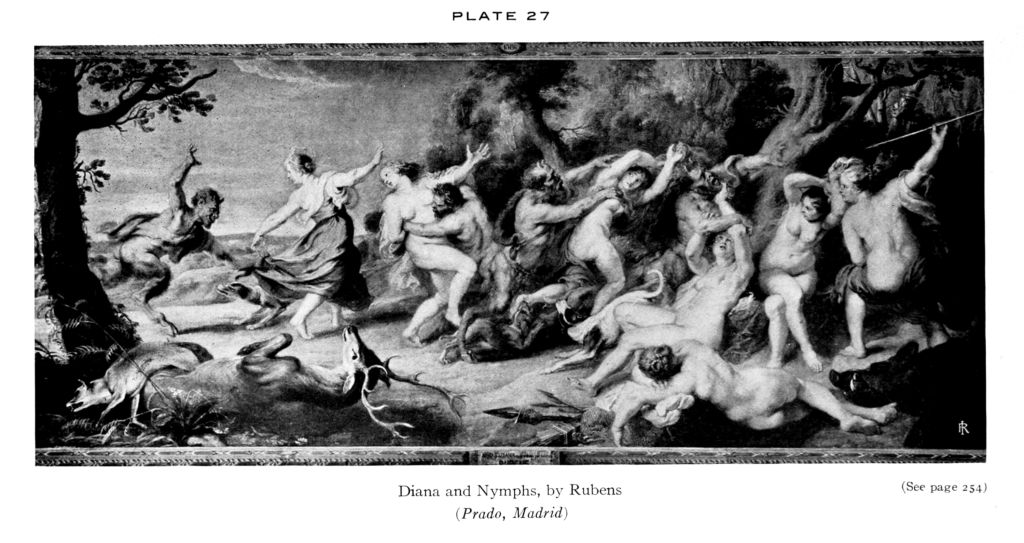 Diana and Nymphs, by Rubens
(Prado, Madrid)
(See page 254)
We may note that at another time Rodin reflected
upon the character of the ancient Greek sculpture for
the very reason upon which he bases his claim for public
approval of La Vieille Heaulmière. He says[d]:
That was the fault of the Hellenic ideal. The beauty conceived
by the Greeks was the order dreamed of by intelligence, but it
only appealed to the cultivated mind, disdaining the humble.
Here also is a confusion of ideas, for the intelligence cannot
dream of a special kind of beauty which would not
be recognized by the humble, unless it were so feeble as
to be altogether below Greek conceptions. The aim of
the Greek sculptors was to appeal to all classes, and in
this they were eminently successful.
Ruskin considered the figure of Christ, known as Le
Bon Dieu d'Amiens, at Amiens Cathedral, the noblest
ideal of Christ in existence,[a] and Dean Farrar wrote of
it: "Christ is represented as standing at the central point
of all history, and of all Revelation."[b] It is true that the
sculpture is a noble representation of Christ, but this is
not because it is a Christian ideal. In type it is purely
Greek of the late fourth or early third century B.C.
The expression is general, exhibiting the calm repose that
the Greeks gave to a great philosopher.
In the case of the Madonna, Michelangelo does not
appear to produce an ideal woman: he only gives an
improved woman. His nearest approach to the ideal is in
his early Pieta at St. Peter's, but even here the Virgin is
only a less earthly prototype of his later figures. The
Madonna in the Holy Family at the Uffizi is much inferior,
being merely a slightly ennobled Italian peasant.
The other Madonnas are far higher in character and seem
to suggest the antique, except that the more material
qualities of woman are always present. The Madonnas
at the Bargello and San Lorenzo are of the same general
type as the figure in the Last Judgment, the Night in the
Medici Chapel, the Leda in the Bargello, and the Venus
in the sketch made for Pontormo. This being so, it
may be imagined when the Leda is called to mind, that
it is hard to associate the two Madonnas with Christian
ideals. The figures are magnificent works, but they are
behind the Madonnas of Raphael from the point of view
of Christian conceptions. The expression is general, and
all the countenances except one, indicate unconcern with
surroundings; not the sublime unconcern of a Phidian
god, which implies an apparent disregard of particulars
because they are necessarily understood with an all-powerful
comprehension of principles, but an unconcern
which suggests a want of deep interest in life. The
exception is the San Lorenzo Madonna, in which a certain
calm resignation is the principal feature in expression.
Michelangelo was more successful with his men than
with his women. His painted prophets in the Sistine
Chapel are as sublime as his scenes from the Creation;
and his Moses in St. Peter's is rightly regarded as the
first sculpture of the Renaissance.
When the Pieta of Michelangelo (in St. Peter's, Rome)
was first exposed, some comment was made upon the
comparatively youthful appearance of the Virgin, and
Condivi relates that he spoke to the sculptor on the
subject. In reply Michelangelo said[a]:
Don't you know that chaste women preserve their beauty and
youthful character much longer than those who are not chaste?
How youthful then must appear the immaculate Virgin who
cannot be supposed ever to have had a vitiated thought. And
this is only according to the natural order of things: but why
may not we suppose in this particular case, that nature might be
assisted by Divine interposition, to demonstrate to the world the
virginity and perpetual purity of the Mother? This was not
necessary in the Son, nay, rather on the contrary, since Divine
omnipotence was willing to show that the Son of God would take
upon Him, as he did, the body of man, with all his earthly infirmities
except that of sin. Therefore it was not necessary for me to
make the human subordinate to the Divine character, but to consider
it in the ordinary course of nature under the actual existing
circumstances. Hence you ought not to wonder that from such a
consideration, I should make the most holy Virgin-Mother of
God, in comparison with the Son, much younger than would otherwise
be required, and that I should have represented the Son at
His proper age.
A few modern painters have produced works in which
the Holy Family are pictured in lowly surroundings,
but generally they appear to shock the public sense of
propriety. Many persons will remember the sensation
caused by Millais's The Carpenter's Shop, where Christ
is shown as a boy of about ten years of age in the workshop
of St. Joseph, and Holman Hunt's Shadow of the
Cross. Later artists have been still more realistic,
notably Uhde, whose sacred scenes almost stagger one
with their modern suggestions, and Demont-Breton,
whose Divine Apprentice represents the Boy Christ
sharpening a tool at a grindstone which is turned by the
Virgin.
Unquestionably the rapid advance in Italian art in the
fifteenth century was largely due to the influence of the
ancient Greek and Roman remains. Indeed there are
very few sculptors of the period who fail to show evidence
of studies in Greek forms and ornaments, while in
painting there are hundreds of figures which could scarcely
have been designed in the absence of antique models.
True in some cases the artists do not appear to have
gone beyond the ancient literature, as with Masaccio
who must have had Homer in his mind when he painted
his figures of Eve in the Florence frescoes, and Piero di
Cosimo, whose fanciful compositions savour of the old
legends wrapped up in fairy stories; but many painters
were steeped both in the art and literature of Greece and
Rome, and made good use of them.
But the most direct evidence of the influence of Greek
art upon Italian artists of the fifteenth and early sixteenth
centuries, is to be found in the splendid series of bronze
statuettes of the period. In their monumental figures
the sculptors were more or less confined in their designs
by considerations of portraiture, conventional drapery
and symbols, and local requirements, and while they were
greatly assisted by Greek experience, yet only rarely
were they strictly at liberty except with ornaments and
accessories. But in the small bronze figures their fancy
could roam at will, and they made good use of this freedom
in displaying their ready acceptance of the first
principle in the design of the human figure recognized
by the Greeks—that the sculptor must arrive at perfection
of form if that be possible; that this perfection is not
to be found in any single form in life, and consequently
the artist must combine perfected parts into a harmonious
whole, independently of particular models. The
agreement with this principle was general, with scarcely
an exception amongst the bronze figure designers, and
the result was that in the period say, from 1450 to 1525,
there was executed a series of bronzes fully representative
of the highest level which plastic art has reached
since the greater days of Greece. Right up to the time
of the maturity of Michelangelo, nearly every bronze
figurine cast is purely Grecian in type, and every ornament,
and even every accessory which is not from its
nature of contemporary style, can be traced to Greece,
either directly or through Rome.
Michelangelo brought about a change in accentuating
the muscular development of the body, and before the
middle of the sixteenth century most sculptors had come
under his influence. This was unfortunate for he alone
seemed to be capable of harmoniously combining Greek
lines with muscular power. A few of his contemporaries,
as Sansovino, Leone, Cellini, learned how to join, with
due restraint, his innovations with modifications of the
Greek torso, but generally the imitation of the great
Florentine initiated a decadence, as it was bound to do,
for it was accompanied with life modelling, and so meant
a radical departure from the Greek forms. Giovanni di
Bologna alone among the later sixteenth century sculptors,
was strong enough to move in an independent direction.
He restrained the accentuation of the muscles,
and lightened the Greek type of torso, combining with
these conditions an elegance in design which has never
since been surpassed.
This then is the principal cause of the high æsthetic
value of the Renaissance bronzes: the human form exhibited
by them is altogether more beautiful than the
form coming within the compass of life experience.
Then the details of work on the bronzes are immensely
superior to those of the general modern handiwork.
For instance the chiselling of such men as Riccio and
Cellini, has never been equalled since their time, save
perhaps by Gouthière. And how poor, comparatively,
are the present-day castings! How carefully the old
masters worked; how particular they were with their
clay; how skilfully they prepared their wax, and how
slowly and deliberately the mould! How many artists
now would have the patience to make such a mould?
For the beautiful patinas on many of the Renaissance
bronzes, age is mostly responsible, though lacquers were
often used for the provision of artificial patinas, particularly
after the middle of the sixteenth century, the
finest being found on some of the works of Giovanni di
Bologna. The tone of natural patina depends largely
upon the kind of oxidation to which the bronze has been
subjected, and it is no doubt often affected by the alloy
used. Few modern artists have given close attention to
the alloys, while the method of casting is now usually
regarded as a detail of minor importance.
Seeing that the production of figurines accompanied
every civilization from the dawn of history to the collapse
of the Roman Empire, it is curious that the renaissance
of sculpture after the Dark Age should have progressed
a long way before general attention was again turned to
these bronzes. There are a few figures of animals which
seem to be Italian work of the late trecento, but beyond
these the small cast bronzes made in Italy before
the maturity of Ghiberti, were practically confined to
Madonnas and Saints, mostly gilt, made to fill Gothic
niches, or adorn the altars of churches and private chapels.
Slender Saints they were as a rule, but always
elegant, with serene countenances and delicate features;
beautifully modelled as became the inheritors of the
traditions of the Pisanos. It was somewhere about the
middle of the fifteenth century that Italy commenced
to make ungilt statuettes suitable for household ornaments,
and fully ten or fifteen years more passed away
before they were produced with any regularity. The
earliest of them of any importance appear to be a couple
of Flagellators from the design of Ghiberti. They are
fine pieces of work, evidently from clay models made for
the scourging scene in one of the gates of the Florence
Baptistry—gates described by Michelangelo as worthy
to fill the portals of Paradise. These figures date about
1440. There is a Child Christ of a few years later by
Luca della Robbia; and two or three figures from models
of Donatello may be assigned to the neighbourhood of
1450. In the next ten years were turned out some
figures from remaining models of Donatello which had
been used for his work at Prato and Padua.
So far the small bronzes made were from studies for
larger works of sculpture, but about this time intense
interest began to be taken in the remains of Greek and
Roman art, and no doubt it was the increased importance
attached to the antique bronze figures, mostly household
gods of the Greeks, Etruscans, and Romans, that first
led the principal Renaissance artists to turn their attention
to similar work. From this time on, for a century
and a half, these bronze figures were regularly made.
The existing figurines may be broadly classified in four
divisions, namely, the Paduan and Florentine figures
executed prior to 1525; those of the school of Michelangelo;
those of the Venetian school headed by Sansovino;
and those of Giovanni di Bologna and his school. Leaving
out of consideration the small ornaments for inkstands,
vases, etc., the little animals, and the purely
commercial imitations, chiefly Venetian, made at the
end of the sixteenth century, the total number of Renaissance
bronzes now known is roughly six thousand. Of
these under a hundred are from models for larger works
by Ghiberti, Donatello, Verrocchio, Lionardo, Michelangelo,
and a few lesser lights; about two thousand represent
original designs specially prepared for bronze
production; some three thousand five hundred are duplicates
of, or slight variations from, these originals, executed
by pupils or near contemporaries of the masters;
and the balance of four hundred or so, are direct reproductions
of, or variations from, antique sculptures.
Naturally all collectors aim for the first two sections,
but the third section contains many fine bronzes, often
close to the originals, with equally good patinas. They
vary greatly, though they are all ascribed in commerce
to the artists responsible for the originals.
The character of these variations is best seen in the
case of Riccio, the most prolific of the bronze workers
of the Renaissance. He designed and executed under
forty small bronze figures and groups, besides some large
bronze works of high importance. Of his small pieces
there are in existence about a hundred duplicates made
by his pupils and immediate contemporaries, who also
adapted into household ornaments, various details
from his larger works, bringing up the number of Riccios
made from his models during his lifetime, other than by
himself, to about a hundred and fifty. These are all
bronzes of a high order. Then about an equal number
of both kinds of models were reproduced during the
twenty years following his death, all fairly good, but often
slightly varied from the originals; and finally there are
Riccios copied by Venetian craftsmen in the third quarter
of the sixteenth century, sometimes considerably varied,
and occasionally with purely Venetian ornaments added.
These last mark the first distinct decadence in the small
bronze art of the period. Next to Riccio among the
earlier sculptors, in the number of bronzes designed, was
his great contemporary, Antico, who accomplished some
thirty or so. He differed from Riccio in that while the
latter adhered to the Grecian practice in the design of
details and ornaments, but varied the modelling somewhat
to bring it more in conformity with the contemporary
ideas of elegance, Antico kept strictly to the
Grecian modelling, but commonly varied the ancient
designs. There are few duplicates of Antico's work,
made either during his lifetime or after. As with Riccio,
his imitators overcame the difficulty of the chiselling by
leaving it out, relying upon the wax to give close enough
resemblance to the originals.
Of the other small bronze sculptors prior to the maturity
of Michelangelo, few executed more than half a
score of figures. The best known are the immediate successors
of Donatello in the Paduan school, as Bertoldo
and Bellano, and the giants of the Florentine school, as
Filarete and A. Pollaiuolo. Bronzes by these artists
are very rare, and so are the duplicates of them made
by pupils, though Bertoldo, who reminds one strangely
of Lysippus, had occasional imitators for the next two
centuries. These bronzes include many models which
have not been equalled by the greatest of later sculptors,
and they will never be matched until there arises a new
school of sculptors resolved to imbibe the truths which the
Renaissance artists gleaned from the ancient Greeks.
The writer has used Greek and Roman names for these
gods to some extent indiscriminately, in accordance with
the universal custom in art. Nevertheless the practice
is to be regretted as it tends to complicate the general
ideas of the Greek and Roman religions. Notwithstanding
the occasional direct association of some of
their deities with human personages by their poets, the
Romans regarded their gods as purely spiritual beings,
having no special earthly habitation, or sex relations
with the human race, while their powers widely differed
from those of the respective Greek deities with whom
they are commonly identified. Authorities differ as to
whether the gods were supposed to have spiritual marital
relations with each other.[a] In any case the whole
nature of their religion precluded the development
amongst the Romans of a separate sacred art. Their
sculptured gods, which were taken from Grecian models,
were symbols rather than presumed types.
If we may judge from the headless figures of the
goddesses, commonly known as the Three Fates, from the
east pediment of the Parthenon, there seems to be little
difference between the general lines of the feminine torso
represented by the Phidian ideal, and those of the
Praxitelean model. The Parthenon torsos are more
massive proportionately, but the object of both Phidias
and Praxiteles was evidently to straighten the outer
lines of the torso as nearly as possible, making due allowance
for the varied natural swellings of their respective
forms. It is obvious that the use of attire gave Phidias
(presuming the Parthenon figures referred to were designed
by him, as they probably were) a latitude in varying the
proportions of the torsos which he could not have exercised
in the case of nude forms. Unclothed, the figures
would appear unwieldy, and the graceful flowing lines
resulting from the partly clinging drapery could not be
so completely presented with nude reclining or semi-reclining
figures. There are other features also which
prevent the nude representation of such massive forms.
Thus, the breasts would necessarily be out of proportion
in size, and widely separated. These conditions are
common in fifth century and archaic figures, and do not
appear to be defects in forms of life size or less, but they
would be strikingly noticeable in super figures of the
broad massive type with Phidian lines. The addition
of light drapery, however, converts the apparent faults
into virtues, for the artist is enabled therewith to give
new sweeping curves to the forms which conspicuously
enhance the general beauty of the figure.
A still more amazing instance where the use of drapery
allows the artist to vary the recognized proportions of the
feminine form to an extent which would be impossible
with nude figures, is the celebrated Ariadne at the
Vatican.[a] This beautiful work, which is of the Hellenistic
period, shows the daughter of Minos attired in a light
flowing single garment, and reclining on a couch, asleep.
The upper part of her body leans against the head of the
couch, but the remainder is extended nearly at full
length. The extraordinary feature of the work is that
the length of the figure is altogether out of proportion
with the head and with the breadth of the torso, being
much too great, and yet so skilfully is the drapery
arranged that this very defect becomes an advantage,
for it enables a lofty grace, almost approaching grandeur,
to be given to the figure, which would be impossible without
the exaggeration. By the excellent device of a
closely arranged cross fold of drapery passing round the
middle of the figure, the artist apparently shortens it,
so that the eye of the observer is not held by its great
length. Only one other example of the supreme use of
drapery in this way seems to be known—a bronze sitting
figure of Calliope,[b] which is of the late Hellenistic period,
and is obviously of the same school as the Ariadne marble.
Praxiteles is known to have executed at least four
other statues of Aphrodite besides the Cnidian example,
but this last is the only one as to which we have fairly
complete records, and of which copies have been closely
identified. It is also the most celebrated. We may
therefore accept the work as typical for comparative
purposes.
There has been much discussion as to whether Apelles
showed the same extent of figure as is represented in the
sculpture, a common suggestion being that he brought
the surface of the water to the waist line; but it is evident
that the painting corresponded with the sculpture in this
particular. The artist had to represent the goddess
walking towards the shore. If he brought the water to
the waist line he could not definitely suggest movement,
as a deflection of the shoulder line might mean that the
goddess was in an attitude of rest, corresponding to the
pose of nearly all the sculptured figures of the Praxitelean
school. On the other hand if he carried the water line
down towards the knees, the advance of the right leg
would be most marked, and the effect disturbing because
of the loss of repose, a quality at all times valuable in a
painting of a single figure, and really necessary in the
representation of Venus. The artist very properly reduced
the portion of the thighs visible to the smallest
fraction possible compatible with an expression of movement,
in order to give the figure the greatest repose
attainable. Under any circumstances there was nothing
to gain by showing the water reaching to the waist.
Certain details of the picture by Apelles are to be
obtained from Grecian epigrams. Thus, one by Antipater
of Sidon contains these lines[a]:
Venus, emerging from her parent sea,
Apelles' graphic skill does here portray:
She wrings her hair, while round the bright drops flee,
And presses from her locks the foamy spray.
From this it would appear that the position of the goddess
when painted was presumed to be comparatively
near the artist, otherwise the separate drops of falling
water would not have been observed. The last line in
the following epigram by Leonides of Tarentum indicates
the ideal character of the countenance, though evidence
of this is scarcely necessary[b]:
As Venus from her mother's bosom rose
(Her beauty with the murmuring sea-foam glows),
Apelles caught and fixed each heavenly charm;
No picture, but the life, sincere and warm.
See how those finger tips those tresses wring!
See how those eyes a calm-like radiance fling!
So far as the writer knows, Piero was the only artist
of the Renaissance who used this mythological story for
a composition (his picture has hitherto been called an
allegory), a circumstance which is rather singular considering
the suitableness of the subject for the provision
of effective designs. The Greek sculptors in dealing
with the legend confined themselves to the moment when
Athena threw down the pipes, apparently for the reason
that this instant gave an opportunity of rendering Marsyas
in a strong dramatic action. The famous statue
of the faun after Myron in Rome, is supposed to have
formed part of a group representing Athena and Marsyas
immediately after the pipes were dropped, and the
design appears on still existing coins and vases of the
fifth and fourth centuries B.C. Piero takes a later moment,
showing Marsyas comfortably squatting in the foreground
of a delightful fanciful landscape, expressing
boyish satisfaction with the prizes he is about to try.
He is properly shown as a satyr instead of in the faun
form of the sculptor. There appears to be no legitimate
place in painting for a faun, while a satyr may at times
be appropriately introduced into a pastoral composition.
Controversy has raged around this picture for something
like seventy years. The work came to light before
1850 at a public auction sale when it was attributed to
Mantegna, with whom of course it had nothing to do.
Then it was pronounced a Raphael, but this was disputed
by Passavant who held that on account of the thin lower
limbs of the figures, and the minute way in which the
landscape was painted, it could not be by Raphael, but
was of the school of Francia, or by Timoteo della Viti.
Morelli brought back the attribution to Raphael, and
the work then came into the possession of the Louvre.
Subsequently Pinturicchio and Perugino were alternately
suggested as the painter, and to the latter the
picture was assigned by the Louvre authorities. All
are agreed that the date of the work is about 1502. It
does not seem possible that Perugino could have painted
the picture, for the subject and invention are entirely
foreign to him, while the lithe active form of Apollo does
not consort with the least formal of his known figures.
The landscape is much in his manner, but so it is also
in the style of Raphael's early period, while the small
buildings therein are closely finished as in some of
Raphael's other works of the time.[a] Perugino used
similar towers and buildings, but being a more experienced
painter he did not so finely elaborate the details.
The suggestion relating to the school of Francia was
afterwards very properly withdrawn, and Pinturicchio
must be ruled out on account of the landscape, apart
from the supple figure of Apollo of which he was incapable.
There remain then only Timoteo della Viti and
Raphael as the possible painters of the work. But it
cannot reasonably be suggested that Timoteo could have
accomplished so perfect a figure as the Apollo, and moreover
so original a figure. It certainly required an exceptionally
bold mind to overcome the difficulty in
rendering the traditionally semi-feminine form of Apollo
by representing him as a young man just past his teens.
Besides, the general delicacy of the work is not in the
style of Timoteo. Passavant's objection to the limbs is
overruled by the presence of similar limbs in the Mond
Crucifixion. It would seem then that Morelli was right
in assigning the beautiful little picture to the youthful
period of the greatest of all painters.
The white races are here referred to merely by way of
example, and there is no intention to suggest that the
more or less uncivilized peoples have no perception of
beauty. It is well known that both semi-civilized and
savage races differ from the whites in the matter of
beauty, and the fact has been partly responsible for
several theories for explaining æsthetic perception, notably
that of association, laid down by Alison and Jeffrey,
but long since discarded. Seeing that there is no difference
in kind between the sense nerves of the whites and
the blacks, they must necessarily act in the same way.
That the blacks appreciate as beautiful forms which the
whites disregard, seems to arise partly from want of
experience, partly from training, and partly from neglect
in the exercise of the sense nerves. Take for example an
inhabitant of Morocco where corpulency is commonly
regarded as an element of beauty in women. If none but
Moroccan women are seen or pictured, it is impossible
for a higher form of beauty than is to be found amongst
them to be conceived, for the imagination cannot act
beyond experience. In cases where the Moroccan has
had experience of both white and black, it is certain
that, other things being equal, the white woman would
be the more admired, for this is the general experience
among the black races, and is strikingly noticeable in
America with the descendants of African tribes. The
appreciation of very fat women can easily be understood
on the ground of custom or training. A youthful
Moroccan may be firmly of opinion that corpulency is
not an element of beauty, but seeing that his older acquaintances
hold a contrary view, he may well form the
conclusion that his judgment is wrong, and so accept
the decision of his more mature countrymen. It is
quite common among the whites for people to doubt
their own æsthetic perceptions when an inferior work of
art is put forward as a thing of beauty. The general
want of appreciation of certain musical harmonies on
the part of uncivilized peoples is undoubtedly due to the
neglect of the sense nerves concerned, for these are not
cultivated except to a small extent involuntarily. The
most ignorant and poor of the whites unavoidably come
into frequent contact with the simpler forms of art,
but the savage races see only the result of their own
handiwork. The uncivilized races can scarcely be expected
to admire the higher reaches of art wherein intellectual
considerations enter, except for their sensorial
excellence.
PLATE 28
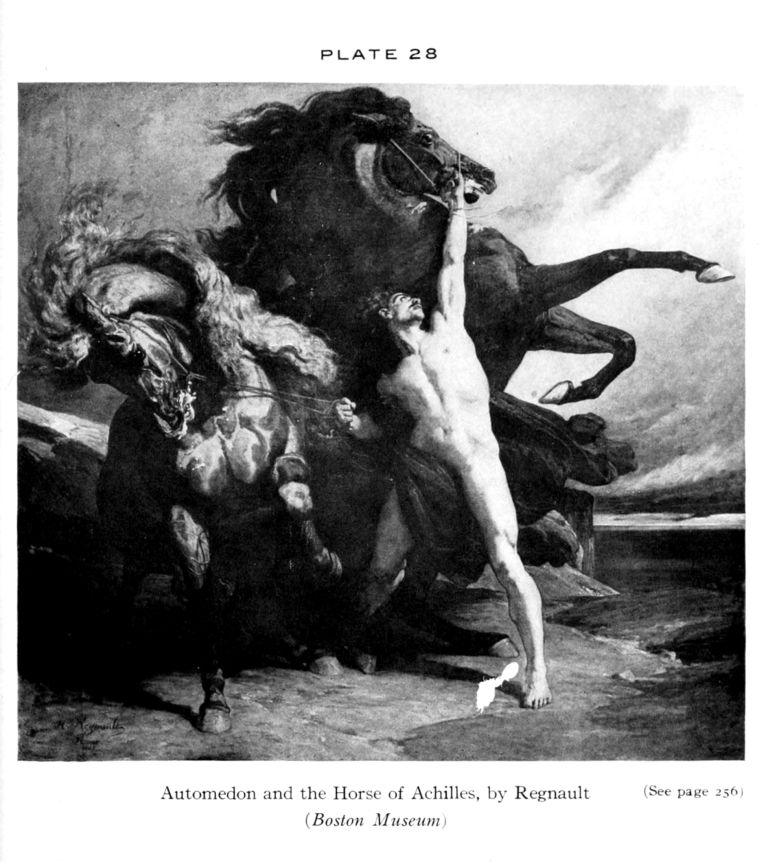 Automedon and the Horse of Achilles, by Regnault
(Boston Museum)
(See page 256)
There seems to be some uncertainty as to whether
Fragonard intended his splendid series of the Frick
collection to represent the subjects usually assigned to
them, namely, The Pursuit (or The Flight of Design, a
title given to the original sketch for the picture); The
Rendezvous (or The Surprise, or The Escalade); Souvenirs
(or Confidences, or The Reader); The Lover Crowned
(or Before the Painter); and The Abandonment (or
The Reverie). It is suggested that the works have an
allegorical signification connected with art, and certainly
three of them—the first, second, and fourth—could be so
interpreted. But magnificent paintings of this kind are
usually fitted for many allegorical suggestions. Each
picture represents an incident of common experience,
elaborated with beautiful figures in a perfect setting.
This approaches the summit of the painter's art, for no
conception can be greater apart from spiritual ideals.
It is symbolism in its highest form—of universal experience
in which all are interested. The works are not to
be taken as a necessary sequence (the last of the series
was painted twenty years after the others), but the
scheme of one or more of them has come within the
experience of every man and woman since the world
began.
Seeing that this precise dignified pose, coming so near
the line of exaggeration, but never crossing it, is present
in all the authenticated portraits of Titian, save those of
very aged persons, we may reasonably consider the pose
an important factor in determining the validity of certain
portraits as to which a doubt has arisen. Thus in the
case of the Physician of Parma[a] (this title is admittedly
wrong), which has been variously given to Titian and
Giorgione, the verdict must be in favour of Titian, for
the pose is certainly his, while it is unknown in any work
of Giorgione. On the other hand, the portrait of Catherine
Cornara,[b] commonly ascribed to Titian, but also
attributed to Giorgione,[c] cannot be by the former master;
nor is the Portrait of a Man (with his hand on a bust),[d]
which seems to pair with the Cornara portrait. The
portrait known as An Old Man Asleep,[e] sometimes given
to Titian, clearly does not belong to him.
It should be noted that the general confusion observable
for many years in the estimation of Giorgione's
work arose from the attribution to him of paintings executed
in the comparatively broad manner of Titian,
but which this artist did not adopt till Giorgione had
been dead for a decade or more. The recent exhaustive
critique of Lionelli Venturi[f] of the earlier master has
cleared the air, and we now know the range of his work
very positively. Giorgione was less fine in some of his
paintings than in others, for he paid more attention to
chiaroscuro as he matured, but there is no instance where
he painted in the broader manner occasionally exhibited
by Titian. All the works in the style of The Concert
and The Three Ages are now known to be by other hands
than those of Giorgione, and it must be unfortunately
admitted that not a single painting by him exists either
in England or America.
Hals is another artist as to whom many misconceptions
have arisen in regard to his use of a very broad manner in
his portraits. There is a total of about 350 works attributed
to him, of which some two thirds are single portraits,
and twenty are portrait groups. The balance
includes over thirty genre pictures, mostly with single
figures, and fifty heads of boys and girls generally shown
in the act of laughing. It is in his genre work that
the broad manner is mostly observable, and only very
occasionally is it to be found in his portraits. In the
more important works of the artist, even during his
later period, his manner is by no means broad,[a] though
it is not so fine as in his best years, say from 1635 to 1650.
This estimate can however only be general, as his dated
paintings of different periods after 1630 often correspond
so closely that it is difficult to assign dates to the other
pictures with certainty.
Perhaps the frequent attribution to Hals of works by
his pupils and imitators, has had something to do with
the public estimation of the breadth of his manner. This
was often greatly exaggerated by his followers, and
many portraits are given to him which he could not
possibly have painted. In his important work on the
artist, Dr. von Bode points out that some of the duplicates
of his pictures were apparently executed by his
pupils, but these are not separated in the book.[b] It is a
simple matter to divide the works painted by Hals from
the studio copies and the portraits of imitators. His
brushwork and impasto were quite exceptional. He
had a firm direct stroke, never niggled or scumbled, and
his loading was restrained though very effective. Quite
naturally his pupils, however industrious and skilled,
could not closely imitate his remarkable freedom in
handling. They were incapable of firm decisive strokes
throughout a portrait, and endeavoured to overcome
the loading difficulty by using brushes of a coarseness
foreign to the master when rendering light tones. Moreover
Hals was nearly perfect in drawing, and in this there
are usually marked defects in the studio copies.
The term "grace" as applied in art has so many significations
that it is difficult to deal with one of them without
confusion. What is here specially referred to is the
grace of pose designed by the artist. The object of the
portrait painter is to pose his sitter so that the grace
indicated shall appear natural and habitual, a feature
as important now in the appearance of women as it was
twenty-five centuries ago when Sappho asked[a]:
What country maiden charms thee,
However fair her face,
Who knows not how to gather
Her dress with artless grace?
But the grace of pose never appears to be artless, after
the first inspection, unless there is something in the
expression to hold the mind. Without this appeal to the
mind the portrait must soon tire, and the pose become
artificial and stiff, that is to say, in representations of
life size, for in miniature portraiture the countenance
seldom or never crosses the vision involuntarily.
In the ancient Greek forms, Winckelmann distinguishes
four kinds of grace—lofty, pleasing, humble,
and comic—but the grace exhibited by sculptured
forms necessarily depends upon the harmony of expression,
character of form, and pose. This should be the
case with painted portraits also, but drapery restrictions
and accessories commonly compel a limitation in the
design of the artist. In three quarter and full length
portraits it is impossible to depart from the dress customary
at the period of execution, unless the sitter assume
a classical character, and this is only possible in comparatively
few instances. In any case the pose should
always be subordinated to the expression.
The remarkable range of Raphael in expression has
been commented upon by many critics, and practically
all agree with Lanzi in his eloquent summary[a]:
There is not a movement of the soul, there is not a character
of passion known to the ancients and capable of being expressed
in art, that he (Raphael) has not caught, expressed, and varied in a
thousand different ways, and always within the bounds of propriety....
His figures are passions personified; and love, hope,
fear, desire, anger, placability, humility, and pride, assume their
places by turns as the subject changes; and while the spectator
regards the countenances, the air, and the gestures of the figures,
he forgets that they are the work of art, and is surprised to find
his own feelings excited, and himself an actor in the scene before
him.
This Pompeian fresco is supposed to be a copy of the
picture of Timanthes, but there is an ancient marble
relief of the same subject at Florence, the design of which
is also said to have been taken from the Grecian painter,
though it differs considerably from the fresco. Quintilian
observes as to the work of Timanthes, that having
rendered Calchas sad, Ulysses still more sad, and Menelaus
with the deepest expression of grief possible in art,
the painter could not properly portray the countenance
of Agamemnon, who as father of Iphigenia was presumed
to be the most deeply affected of all present, and so
covered his head, leaving the intensity of his suffering
to be understood.[a]
The authenticity of the Boston example of Mona
Lisa is still in dispute. So far no serious objection to it
has been brought forward, and there are certain points
in its favour, as the presence of the columns which are
reproduced in Raphael's sketch, and the bold brushwork
of the drapery where this can be distinguished. But
there is another example of the work in existence, and
this fact, with the natural hesitation in pronouncing
definitely on so important a matter, will probably leave
the authenticity of the picture undecided for a long time.
Meanwhile the literature upon Mona Lisa is ever increasing,
and some important facts have been recently
brought out. Amongst these is an announcement by
A. C. Coppier that the lady was not a Florentine, but a
Neapolitan of the Gheradini family, and that she was
married in 1495, when eighteen years of age.[a] She would
therefore be twenty-seven years old in 1504 when the
picture which Raphael sketched is supposed to have been
painted. But the Mona Lisa in the Louvre was completed
between 1515 and 1519; hence there is much to
ascertain as to the history of the work.
The various suggestions that have been made as to
the meaning of Mona Lisa's smile, seem to have no other
foundation than the fancies of mystic minds. The smile
has been called dangerous, sinister, ambiguous, provocative,
purposely enigmatic, significant of a loose woman,
expressive of sublime motherhood, reminiscent of Eastern
intrigue, and so on, the mildest criticism of this kind
affirming that the smile will ever remain an enigma. It
is of course impossible for any meaning to be put into a
smile by the painter, other than that of pleasure. Psychological
suggestions are possible with the poet or
novelist, but not with the painter. If there be any
enigma or mystery in a picture, then the art is bad, for
the work is incomprehensible, but there is no problem
to be solved in Mona Lisa's smile. It is not different
from any other smile except in degree, and of course in
the quality appertaining to the particular countenance.
Lionardo, with his scientific turn of mind, was not likely
to attempt the impossible by trying to mix psychology
with paint.
It is necessary to dissent from the conclusion of Lessing
as to the representation of ugliness by the poet. He says
in referring to Homer's portrayal of Thersites[a]:
Why in the case of ugliness did he adopt a method from which
he so judiciously refrained in that of beauty? Does not a successive
enumeration of its compound parts diminish the effect of
ugliness, just as a similar enumeration of its parts destroys that of
beauty? Undoubtedly it does, but in this very fact lies Homer's
justification. For the very reason that ugliness in the poet's
description is reduced to a less repulsive appearance of bodily imperfection,
and in point of its effect ceases as it were to be ugliness,
the poet is enabled to make use of it.
It is true that as he cannot present a particular form of
beauty by description, so the poet cannot describe an
ugly countenance in such a way that it may be pictured
on the mind as a whole; but on the other hand, as he can,
by reference to its effect, or by imagery, present a greater
beauty than the painter can portray, so he may by similar
means suggest a more hideous form of ugliness. And
apart from this, while a detail in the description of a
beautiful countenance is immaterial until it is combined
with other details, a detail of ugliness may in itself be
sufficient to render the countenance wholly repulsive to
the reader. Thus, if one said of a maid that her cheeks
were a compound of the lily and the rose, this would not
necessarily imply that she was generally beautiful; but
if it were said of a man that he had a large bulbous nose,
we should consider him ugly whatever the character of
his other features. It was only necessary for Milton to
refer to one or two details of the figure of Sin, to throw
upon our minds a form of appalling ugliness.[b]
A successive enumeration of its component parts, does
not therefore diminish the effect of ugliness, as Lessing
claims, but increases it. On the other hand a successive
enumeration of the parts of beauty does not destroy the
beauty, but simply fails to represent it.
The poet may use ugliness where the painter cannot,
because his ugly form does not dominate the scene, save
for an instant or two, being quickly subordinated by
surrounding conditions of speech and action; whereas
the ugly figure of the painter is fixed for ever. Further,
the poet may surround his description of the ugly thing
with beautiful imagery and lofty sentiment, practically
hiding the ugliness with a cloak of beauty; but the
painter can only depict the ugly thing as it is, naked to
the sight, without gloss or apology.
It has been suggested that the foot of Hercules in this
fine bronze was placed upon the skull of an ox to indicate
a successful hunt,[a] but Hercules was a demigod, and so
could not be connected in art with any but a superhuman
task or exploit. Moreover the only instance recorded
in mythological history where Hercules fought with an
ox (unless the feat of strength against the white bull of
Augeas be called a fight), is that of the Cretan bull, which
was captured and not killed. There is no other sculptured
figure now known where a foot is placed on the
skull of an ox, but Pausanias records that he saw one
in a temple of Apollo at Patræ, the figure being that of
the god himself.[b] Pausanias attributes the motive of
the design to Apollo's love of cattle. There is no doubt
about the significance of the Frick bronze. The skull of
an ox, and rams' heads are frequently found on ancient
tombs, and acanthus leaves were commonly used both in
Greece and Rome as funereal signs, while the base of the
statuette, which is cast with the figure, is clearly intended
to represent an altar. It is noticeable that the form of
acanthus leaf used is Roman, suggesting that Pollaiuolo
had access to the reproductions of tomb inscriptions made
to the order of Lorenzo de' Medici.
There is apparently no other existing design of a hero
contemplating death, but Lysippus carved several figures,
now lost, of Hercules in a sad or depressed mood.
In the most celebrated of these, the demigod was seated
in a thoughtful attitude on a lion's skin, and it is possible
that this design was connected with the contemplation
of death, because it was produced in relief soon after the
time of Lysippus, and later in a Pompeian fresco, in both
cases in the presence of Lichas, the bearer of the poisoned
garment.
The attempt of Ruskin to raise landscape to a high
level in the art of the painter[a] need scarcely be referred
to here, so completely have his arguments been refuted
elsewhere.
The authority of Alexander Humboldt has been sometimes
quoted in support of the assertion that landscape
can appeal to the higher attributes, the passage relied
upon affirming that descriptive poetry and landscape
painting "are alike capable in a greater or lesser degree of
combining the visible and invisible in our contemplation
of nature." But it is clear from the whole references of
the writer to these arts, that he means nothing more by
his statement than that a painting or descriptive poem
may, like an actual landscape, induce a feeling of wonder
at the powers of the original Cause of nature. The opinion
of Humboldt upon the position of landscape painting
may be gathered from his definite observation that it
has "a more material origin and a more earthly limitation
than the art which deals with the human form."[b]
It is doubtful whether an artist can invent a form of
tree which does not exist in nature, without producing
something of the character of a monstrosity. From the
point of view of dimensions, the two extreme forms of
trees used in painting, are represented in Raphael's
Madonna with the Goldfinch[a] as to the slender forms, and
as to the giant trunks, in two or three of Claude's pictures.
The very beautiful trees of Raphael have been
often regarded as pure inventions, and Ruskin was actually
surprised that the artist did not delineate the "true
form of the trees and the true thickness of the boughs";[b]
but as a matter of fact precisely similar trees (a variety
of ash) are to be found in the valleys of the Apennines
to this day. All the change that Raphael made was to
transport the trees from a sheltered spot to an open
position. Very similar trees are introduced in the same
master's Apollo and Marsyas.[c] Perugino was the first
painter to use them, and in some of his earlier works he
made them of great height,[d] but he gradually modified
the form till he approached the perfect symmetry and
delicacy of Raphael's examples.[e] Marco Basaiti introduced
them into at least three of his pictures, and they
are also to be found in works by Timoteo della Viti and
Francia.[f] Higher and equally slender trees have been
appropriately used by Antonio della Ceraiuolo,[g] and even
by so late a painter as Nicholas Poussin.[h]
In noting the fact that the great landscape artist
invents his designs, Byron observes that nature does not
furnish him with the scenes that he requires, and adds[a]:
Nature is not lavish of her beauties; they are widely scattered,
and occasionally displayed, to be selected with care, and gathered
with difficulty.
Had Byron been a painter, he would have known that the
trouble of the artist is due to the over, and not the under,
supply of beauty by nature. The artist sees the beauty,
but cannot identify it with particular signs, and so has to
invent a scene himself, using nature only for sketches or
ideas.
"The force of natural signs," says Lessing, "consists in
their resemblance to the things they represent."[a] In a
criticism upon the second part of Faust, G. H. Lewes
writes[b]:
The forms which are his (the artist's) materials, the symbols
which are his language, must in themselves have beauty and an
interest readily appreciable by those who do not understand the
occult meaning. Unless they have this they cease to be art: they
become hieroglyphs. Art is picture painting, not picture writing.
While this is generally true, beauty in the lesser signs of
the poet is of greater importance than in those of the
painter, because a painting is looked upon direct as a
whole, while a poem has to be comprehended in its parts
before it can be properly considered as a whole.
Although those of the fifteenth-century artists who
treated landscape seriously did not thoroughly understand
perspective, yet they were seldom at a loss in representing
distance, that is, in the clear atmosphere which
they invariably used. They were diffident in attempting
distance with unbroken level country, and till quite the
end of the century there is no instance where middle and
far distance are shown together, even with the assistance
of hilly ground. The almost invariable practice of the
leading painters who made landscape a feature in their
works, was to introduce water leading back from the
foreground, so that breaks therein could be used to
indicate distance. More or less numerous jutting forks
of low lying land were thrown into the stream from
either side, this plan being successfully adopted in Italy,[a]
Flanders,[b] and Germany.[c]
Early in the sixteenth century much improvement
was made in the use of water for providing distance, and
a few of the Venetian painters gave some consideration
to aerial perspective, but the most perfect example of this
perspective in the period is contained in an early work of
Raphael.[d] In the background is a lake extending into a
gradually deepening haze, and in this a boat is so skilfully
placed as to increase considerably the apparent
distance to the horizon. This picture is a distinct
advance upon the Venetian distance work of the time.[e]
Later on in the century an artist rarely introduced water
into a view specially to assist in producing distance by
means of boats, more advanced methods being adopted.
Titian used sunlight effects with varying shadows,[f] or
alternating clear and wooded ground.[g] These plans, and
the use of water with the addition of trees and low hills,[h]
constitute the chief devices to be found in the late sixteenth-century
Italian pictures. Some of the sun effects
rendered for distance purposes even before Titian's best
time are quite effective, though formal.[i]
PLATE 29
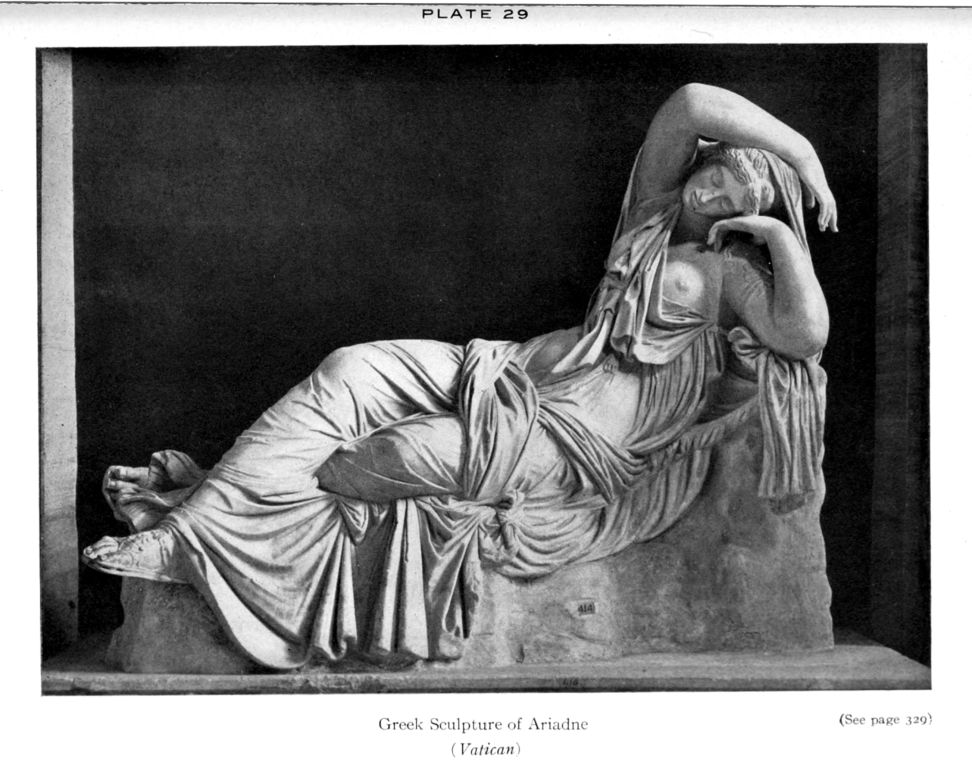 Greek Sculpture of Ariadne
(Vatican)
(See page 329)
Lessing apparently overlooked the possibilities of
landscape painting in his dictum as to progressive actions.
He writes[a]:
If painting on account of the signs and means of imitation
which it employs, and which can only be combined in space, must
entirely renounce time, then progressive actions cannot, in so far as
they are progressive, be included in the number of its subjects, but
it must content itself with coexistent actions, or with mere bodies,
which on account of their position cause an action to be suspected.
It is true that a series of progressive human actions cannot
be included in one painting, but progressive natural
actions can be so included when the progression is regular
and repeated and the actions are clearly separated to
the eye. Although the painter can only depict a moment
of time, he can show the whole progression, which is
not the case in a series of human actions, as in the example
quoted by Lessing, of Pandarus arranging his bow, opening
his quiver, choosing an arrow, and so on.
Strange to say, De Quincey, in an explanatory note to
Lessing's observations, also overlooks the movement of
water broken by rocks, though he refers specially to landscape
painting. He says[b]:
In the succession of parts which make up appearance in nature,
either the parts simply repeat each other (as in the case of a man
walking, a river flowing, etc.), or they unfold themselves through
a cycle, in which each step effaces the preceding, as in the case of a
gun exploding, where the flash is swallowed up by the smoke
effaced by its own dispersion.
But for the purpose of the painter, the action of water
breaking over ledges and boulders does not correspond
with the case of a man walking or a river flowing, because
the series of events forming the progression in the case
of the water breaking, cover such time and space that the
events can be distinctly separated by the eye. Clearly
also this action should not be included in De Quincey's
second category, because the repetition is both regular
and (to all intents and purposes) perpetual. There
should therefore be a third category to comprise those
repeated progressive acts in which the events can be so
separated by the eye as to be portrayed on canvas in the
order of their progression, and in such a way that the
whole progression, and the meaning of it, are at once
apparent.
Professor Clausen relates that Whistler told him that
his object in painting nocturnes was to try and exhibit
the "mystery and beauty of the night." It is obvious
that Whistler was here confusing psychological with
visual impressions. The depth of gloom, the apparently
limitless dark void which the eye cannot penetrate, mean
mystery in a sense, because we can never accustom ourselves
to the suggestion of infinity involved in something
which is boundless to the senses. A sensation of the
sublime may consequently arise, and this means beauty
in a psychological sense. But we are considering art
and not psychology. Where nothing is distinguished, nothing
can be painted, and if there be sufficient light for
objects to be determined, there can be no mystery for
the painter. If he be desirous of representing Night, he
must follow the example of Michelangelo and symbolize it.
It is curious that since the death of Whistler, a picture
entitled Mysteries of the Night has been painted by
another American artist—J. H. Johnston. A figure of a
beautiful nude woman is standing on a rocky shore in a
contemplative attitude, with the moonlight thrown upon
her. The design is excellent, but the realistic modelling
of the figure effectually kills any suggestion of mystery.
Vasari mentions that Michelangelo, though admiring
the colour and manner of Titian regretted that the
Venetian painters did not pay more attention to drawing
in their studies.[a] In quoting this, Reynolds observed[b]:
But if general censure was given to that school from the sight
of a picture by Titian, how much more heavily and more justly
would the censure fall on Paolo Veronese, and more especially on
Tintoretto.
Reynolds himself rightly excluded Titian when he condemned
the later Venetian painters of the Renaissance
for their exaggeration of colour, and no doubt Titian was
also exempted by J. A. Symonds in his trenchant criticism
of the work of this school. When dealing with the
decline of Lesbian poetry after the brilliant period of
Sappho, he wrote[c]:
In this the Lesbian poets were not unlike the Provençal
troubadours, who made a literature of love, or the Venetian painters,
who based their art on the beauty of colour, the voluptuous
charms of the flesh. In each case the motive of enthusiastic passion
sufficed to produce a dazzling result. But as soon as its freshness
was exhausted there was nothing left for art to live on, and
mere decadence to sensuality ensued.
Sir George Beaumont relates of Reynolds[a]:
On his return from his second tour over Flanders and Holland,
he observed to me that the pictures of Rubens appeared much less
brilliant than they had done on his former inspection. He could
not for some time account for this little circumstance; but when
he recollected that when he first saw them he had his notebook
in his hand for the purpose of writing down short remarks, he
perceived what had occasioned their now making a less impression
than they had done formerly. By the eye passing immediately
from the white paper to the picture, the colours derived uncommon
richness and warmth; but for want of this foil they afterwards
appeared comparatively cold.
Rodin[a] observes that in giving movement to his personages,
the artist
represents the transition from one pose to another—he indicates
how insensibly the first glides into the second. In his work we
still see a part of what was, and we discover a part of what is to
be.
Rodin points to Rude's fine statue of Marshal Ney,
and practically says that here the illusion is created by a
series of progressive actions indicated in the attitude:
the legs remaining as they were when the sword was
about to be drawn, and the hand still holding the scabbard
away from the body, while the chest is being
thrown out and the sword held aloft. Thus the sculptor
compels, so to speak, the spectator to follow the development of
an act in an individual. The eyes are forced to travel upwards
from the lower limbs to the raised arm, and as in so doing they
find the different parts of the figure represented at successive
instants, they have the illusion of beholding the movement
performed.
Rodin himself has followed a similar course with much
success. The ancient Greek sculptors, when representing
a figure in action, invariably chose a moment of rest
between two progressive steps in the action. The
Discobolus and Marsyas of Myron, and particularly the
Atalanta in the Louvre, are fine examples.
Mengs, in referring to the arrangement of the drapery
in Raphael's figures, says[a]:
With him every fold has its proper cause; either in its own
weight or in the motion of the limbs. Sometimes the folds enable
us to tell what has preceded; herein too Raphael has endeavoured
to find significance. It can be seen by the position of the
folds, whether an arm or a leg has been moved forwards or backwards
into the attitude which it actually occupies; whether a limb
has been, or is being, moved from a contracted position into a
straightened one, or whether it was extended at first and is being
contracted.
Besides assisting in providing an illusion, the title of a
picture may lend great additional interest to it. Thus in
Millet's The Angelus the associations called up by the
title act most powerfully on the mind, and one almost
listens for the sound of the bell.[a] A work of a similar
character is Bonvin's Ave Maria, where the nuns of a convent
are answering the call[b]; and Horace Walker has a
picture with the same title, in which a boy who is driving
cattle, stops in front of a Crucifix by the wayside[c]. An
excellent example of this added interest is the title of
Turner's great picture of the Temeraire,[d] as to which
R. Phillimore writes[e]:
It is not difficult to imagine the picture of an old man-of-war
towed by a steam tug up a river. The execution of such a subject
may deserve great praise and give great satisfaction to the beholder.
But add to the representation the statement that it is "The fighting
Temeraire towed to her last berth, " and a series of the most stirring
events of our national history fills our imagination.
There is an antique sculptured group in the Vatican in
which a precisely similar figure of the son of Niobe has
his left hand on the shoulder of his sister who has fallen
to her knees from the effect of a wound, and it is very
reasonably suggested that the Florence figure originally
formed part of a like group. But the explanation of the
act given by Perry[a] and others, that the drapery was
raised by the brother to shield the girl, will scarcely hold
good, as the folds are spread out at the back, forming a
concavity, whereas they would fall loosely if the youth
were resting. Apart from this, his legs are widely separated,
and in a running position. It may therefore be
surmised that in the Vatican group the artist intended
to represent the precise moment when the fleeing youth
reached his sister.
It is curious that among the countless pictures of the
Annunciation, in very few indeed has surprise been
expressed in the countenance and attitude of the Virgin,
though it is impossible to imagine an incident more
properly calling for profound astonishment on the part
of the principal personage in a composition, even in the
absence of startling miraculous accessories such as that
introduced by Rossetti. Probably the reason for this is
connected with the difficulty of expressing great surprise
unaccompanied with some other feeling, as pleasure, or
sorrow, or fear, but there does not seem to be any cause
why an exalted joyful excitement should not be exhibited.
Mrs. Jameson thinks that the Virgin should not appear
startled, as She was "accustomed to the perpetual ministry
of Angels who daily and hourly attended on Her,"[a]
but it is questionable whether this can be properly
assumed by the artist, and in any case from the point of
view of art, the action should correspond with the nature
of the event as it is generally understood. Of the few
masters who have indicated surprise in an Annunciation
picture, Tintoretto has gone the farthest. He shows
the Virgin with Her lips parted, and both hands held up,
evidently with astonishment,[b] an example followed by
Paris Bordone.[c] Raphael in an early picture represents
Her holding up one hand, but the attitude might signify
the reception of an announcement of importance.[d] Perugino
shows Her with both hands raised, but otherwise
She appears unconcerned.[e] A few other artists,
including Venusti and Foppa, and among modern men,
Girodet, adopt Raphael's method of composition. Rubens
goes a step farther, and represents the Virgin apparently
standing back with surprise, though this is only
faintly suggested by the facial expression.[f]