In this book of instruction, I have introduced for practice the easiest
braids first—which are chain braids. The first pattern, found on page 9,
is a very easy and handsome one, and should be practiced to perfection
before trying any other, as it will enable the beginner to execute all others
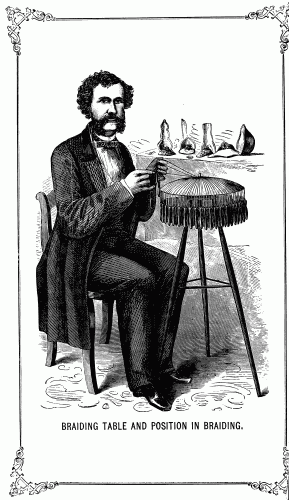
after the first is perfected. A new beginner should be particular to place
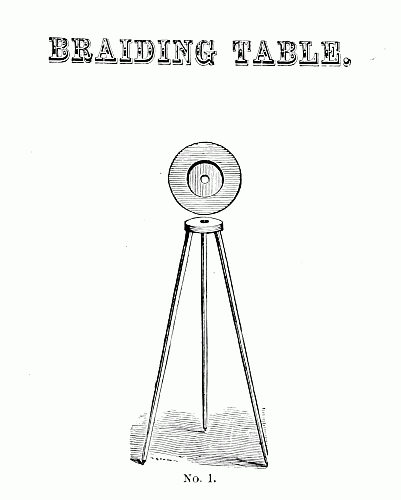
the strands correctly upon the table, and mark the cover with precision,
after the manner shown in the diagram. I have, by the introduction of
plates, diagrams and explanatory remarks, made comprehensive and simple
the execution of all the braids herein contained. The novice should first
give special attention to preparing the hair for braiding, the adjustment of
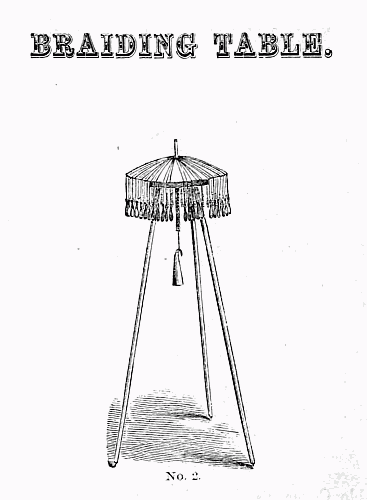
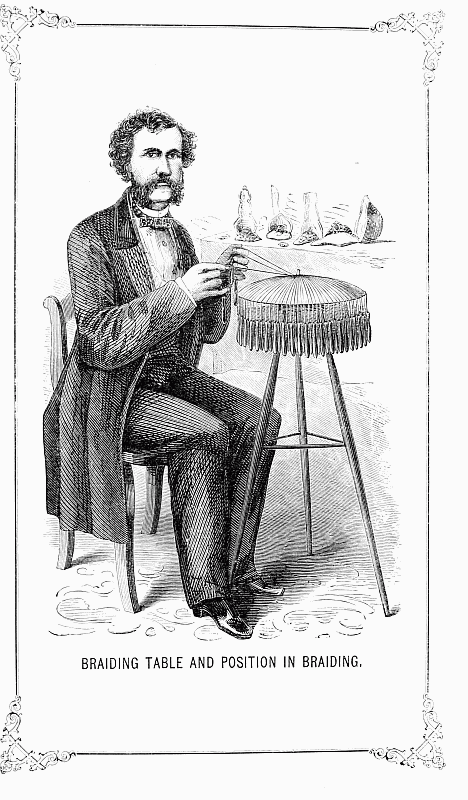
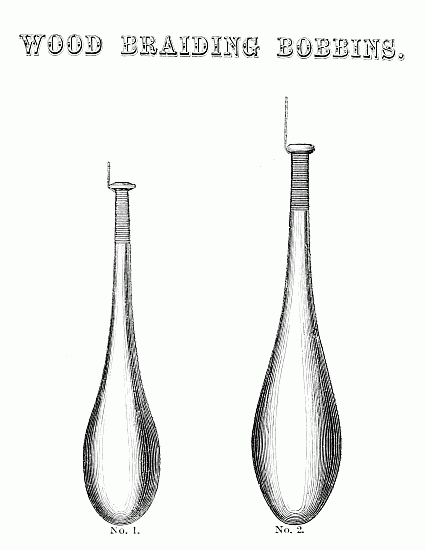
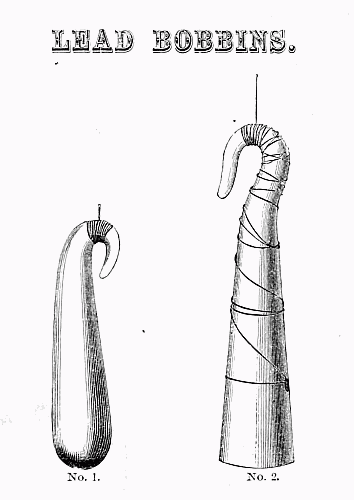
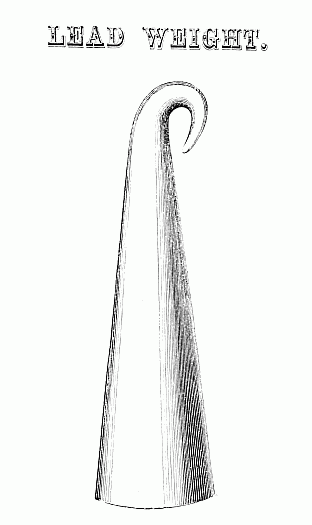
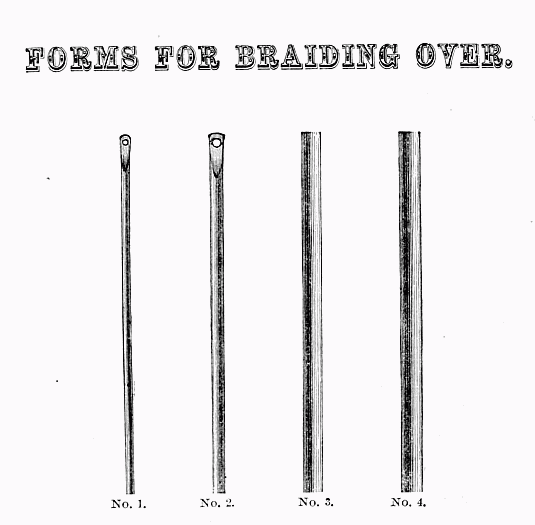
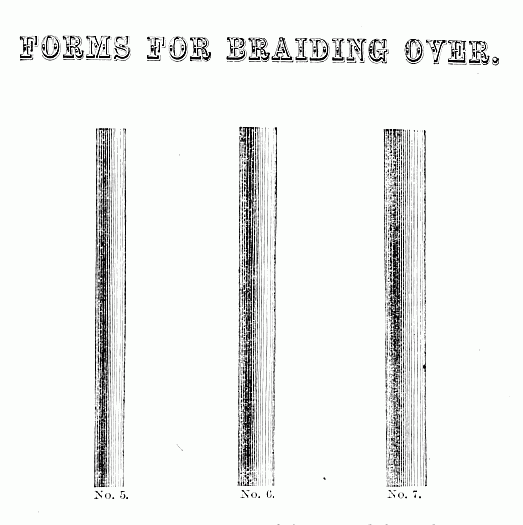
it to the bobbins, weights, molds, &c., of which plates, and full explanations
are to be found elsewhere in this book. I wish to impress upon the
mind of the worker, that every change made with the strands changes the
numbers of them to correspond with the numbers on the table. For
example: lift No. 1 over No. 2, which would make No. 1 No. 2, and No.
2 No. 1, &c.
Transcriber's Note: To see a larger version of each pattern and table
layout, click on the image.
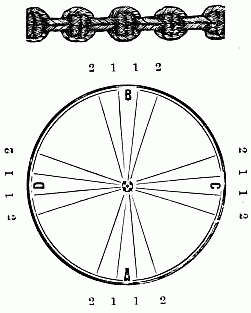
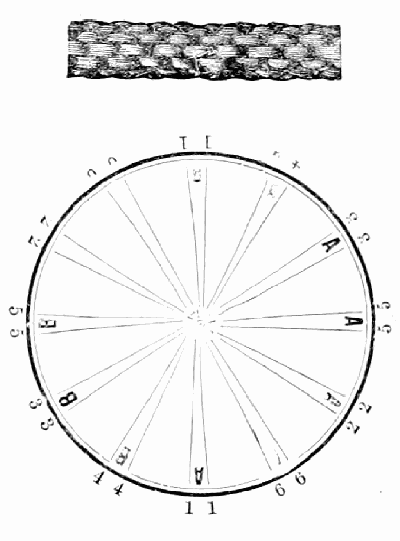
AKE sixteen strands, eighty
hairs in a strand, and place
on table like pattern. Commence
at A, take Nos. 1,—one in each
hand—lift them over the table, one
on each side of the mold, and lay
them between Nos. 1 at B, and
bring back the Nos. 2 from B, one
on each side of the mold, and lay
them between Nos. 2 at A; then go
to C, lift Nos. 1 over between Nos.
1 at D, passing one strand each side of the mold, and bring
back Nos. 2 from D, and lay between Nos. 2 at C. Then you are
through the braid, ready to commence at A, as at first, and repeat
until finished.
Braid this over a mold, made of small wire, with a hole in one
end like the eye of a needle, so as to draw a small cord in the place
of the wire. When you have it braided, take off the weights, tie
the ends fast on the wire, and push the braid tight together; then
boil in water about ten minutes, and take it out and put in an oven
as hot as it will bear without burning, until quite dry; then slip it
off the wire on to the cord, sew the ends of the braid so it will not
slip, and put a little shellac on the end to keep it fast. If you
want it elastic, use elastic cord. To vary the size of the braid,
vary the number of hairs in a strand.

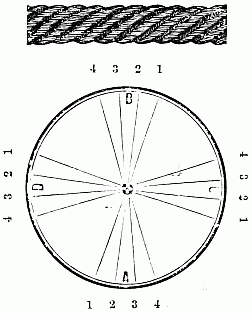
Take sixteen strands and place on
table like pattern. Commence at A
with sixty hairs in a strand. Take
Nos. 2, lift over table to B, lay them
in between Nos. 1 at B, and bring
back Nos. 2 from B, and lay in between
Nos. 1 at A. Then walk
around table to C; take Nos. 1 and
lift over table and lay them in
between Nos. 1 at D, and bring
back Nos. 1 from D to C; then take
Nos. 2 at C, lift over table and lay them inside of Nos. 2 at D, and
bring back Nos. 2 from D to C. After braiding several times
round to suit your taste, say five, reverse the braid by commencing
at C, and braiding as you did at A, by taking Nos. 2 at C, lift
over table to D, and lay them in between Nos. 1 at D, and bring
back Nos. 2 from D, and lay in between Nos. 1 at C. Then go to
A and take Nos. 1, lift over table and lay in between Nos. 1 at B,
and bring back Nos. 1 from B to A, then take Nos. 2 at A, lift
over table and lay in between Nos. 2 at B, and fetch back Nos. 2
from B to A, then commence at C again and braid five times.
Then commence at A as you did at first, reversing it every time
you braid it five times through. Braid it over a small wire, tie the
ends on the wire, boil and dry the same as chain on page nine,
only you need not press the braid together on the wire.

Take sixteen strands, with eighty
hairs in a strand, and place on table
like pattern. Commence at A and
B; take No. 1 at A in right hand,
and No. 1 at B in left hand, and
swing them around the table to the
right, changing places with them.
Then take Nos. 1 at C and D and
change as at A and B. Then go to
B and take Nos. 2 at B and A, and
change them by taking No. 2 at B
in right hand and No. 2 at A in left hand, and swing them around
table to the right as before, changing places with them. Then go
around the table to D, and take Nos. 2 at D and C, and change
places as before, then take Nos. 3 at A and B and change as before.
Then take Nos. 3 at C and D and change places with them. Then
take Nos. 4 at B and A and change as before. Then take Nos. 4
at D and C and change as before. Then commence at A, as at
first, repeating until the braid is finished.

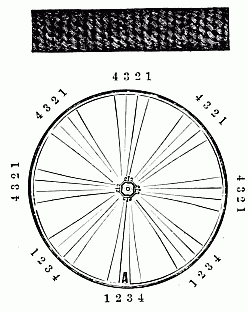
Take thirty-two strands with twelve
hairs in a strand, or any number that
can be divided by four, and sixty
strands for usual size, and place
them on table like pattern. Have
every alternate two strands of black
hair, and the others of light hair.
Commence at A, taking two strands
of light hair in left hand, Nos. 1 and
2, and take two strands of black
hair in right hand, Nos. 3 and 4,
and cross No. 2 (light) over No. 3 (dark), then No. 1 (light) under
No. 3 (dark), then No. 4 (dark) over Nos. 1 and 2 (light); so on
around the table to the right until you get to A; then commence
and work back to the left by taking light hair in left hand and
dark hair in right hand, as before, and put No. 3 (dark) over No.
2 (light), and No. 4 (dark) under No. 2 (light), and No. 1 (light)
over Nos. 3 and 4 (dark), so on around the table till you get to A;
then commence as at first, so on, braiding first one way around the
table then the other till you have the chain completed.
Braid it over wood, or brass wire, the size and length you wish
your chain. When braided take off your weights, tie the ends fast
and boil and dry, then take out the mold and put a cord through
with some cotton wrapped around it so it will be soft and pliable.
This is called the Striped Snake Braid, and can be braided all
of one color if desired.

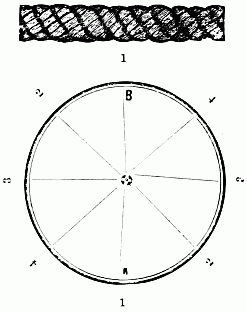
Take any number of strands that
can be divided by two, eighty hairs
in a strand, twenty strands for usual
size, place on table like pattern.
Commencing, take No. 1 at A in
right hand and No. 1 at B in left
hand, and swing around the table to
the right, and lay the one in right
hand at No. 1 at B, and the one in
left hand at No. 1 at A; then bring
back No. 2 at B with right hand, and No. 2 at A in left hand, to
the left, then take No. 3 and swing to the right, then No. 4 and
swing to the left, so on, round first to the right then to the left,
with every number of strands till you get to No. 1; then commence
as at first, and so on till the chain is as long as required.
Braid this over a small wire, with a hole in one end like the eye
of a needle, so as to draw a small cord in the place of the wire.
When you have it braided take off your weights, tie the ends fast
on the wire, and push the braid together on the wire; boil in water
about ten minutes, then take it out and put it in an oven as
hot as it will bear without burning, until it is quite dry; then take
it out and slip off the wire on to the cord, and sew the ends of the
braid so it will not slip on the cord, and put a little shellac on the
end to keep it fast. If you want it elastic, use elastic cord. To
vary the size of the braid, vary the number of hairs in a strand.

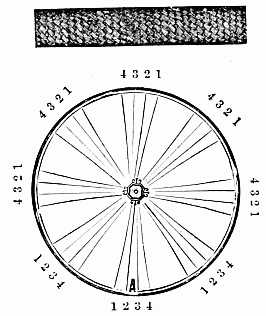
Take thirty-two strands, or any
number that can be divided by four,
twelve hairs in a strand, and sixty
strands for usual size; place them
on table like pattern. Commence
at A, lift No. 2 in your right hand,
and put your left under your right
hand and take up No. 3 and bring
it back of No. 1, and lay them both
down; then take No. 4 up and lay
it between Nos. 1 and 2, then take the next four to the right, and
so on till you get around the table; then commence and braid back
around the table to the left, but reverse the braid by braiding it
this way: lift No. 3 with your left hand, pass your right under and
take No. 2 and bring it back over No. 4, and lay them both down;
then take No. 1 and lift it over in between Nos. 3 and 4, and so on,
till you get around the table. Then commence as at first, braid
one way, then the other, till you have it as long as required. Braid
it over wood or brass wire the size and length you wish your chain;
when braided take off your weights, tie the ends fast, and boil and
dry them; take out the mold and put a cord through with some
cotton wrapped around it so that it will be soft and pliable. This
is called the Snake Chain Braid.

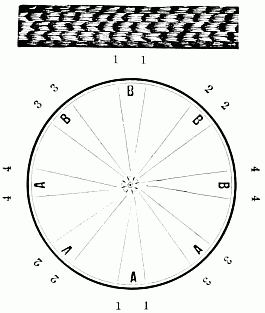
Take sixteen strands, eighty hairs
in a strand, and place them on the
table like pattern. Commence at A,
take Nos. 1 strands, lift across the
table and lay down inside of Nos. 1 at
B, and bring back Nos. 1 from B to
A, then lift Nos. 2 at A over inside
Nos. 2 at B and bring Nos. 2 from
B to A, then lift Nos. 3 from A to B,
and bring back Nos. 3 from B to A,
then lift Nos. 4 from A to B and bring back Nos. 4 from B to A,
then commence at Nos. 1 again and repeat until the chain is completed.
Braid this over a small wire, with a hole in one end like the eye
of an needle, so as to draw a small cord in the place of the wire.
When you have it braided, take off your weights, tie the ends fast
on the wire and push the braid together on the wire; then boil in
water about ten minutes; then take it out and put in an oven as
hot as it will bear without burning, until it is quite dry; then take
it out and slip it off of the wire on to the cord, and sew the ends of
the braid so it will not slip on the cord, and put a little shellac on
the end to keep it fast. If you want it elastic, use elastic cord.
To vary the size of the braid, vary the number of hairs in a strand.

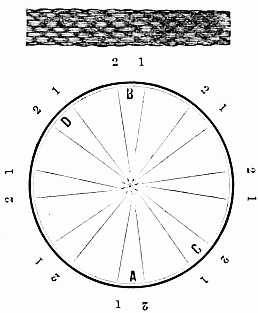
Take sixteen strands or any number
that can be divided by two,
usually eighty hairs in a strand.
Commence at A and B, take No. 1
at A in right hand, and No. 1 at B
in left hand, and swing them around
table to right, and lay the one in
right hand down at B across over
No. 2, and the one in right hand lay
down across over No. 2 at A; then
go to C and D, and change No. 1 as before at A and B; then go
to the next two strands and change as before, so on around the
table, taking the next two each time until the chain is completed.
Directions same as on page 9.

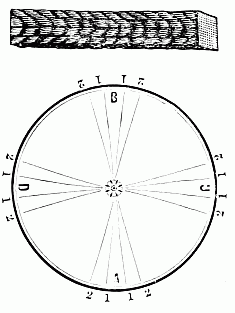
Take sixteen strands, eighty hairs
in a strand, and place on table like
pattern. Commence at A, lift Nos.
1 across table and lay in between
Nos. 1 at B, and bring back Nos. 1
from B to A; then go to C, take
Nos. 1 and lift across table and lay
in between Nos. 1 at D, and bring
back Nos. 1 from D to C; then go
to A, take Nos. 2 and lift across
inside of Nos. 2 at B, and bring back
Nos. 2 from B to A; then go to C, lift Nos. 2 across inside of Nos.
2 at D, and bring back Nos. 2 from D to C; then go to A and
commence as at first, and repeat until it is the required length.
Braid this over a small wire, with a hole in one end like the eye
of a needle, so as to draw a small cord in the place of the wire.
When you have it braided, take off your weights, tie the ends fast
on the wire, and push the braid close together; then boil in water
about ten minutes, and take it out and put it in an oven as hot as
it will bear without burning, until it is quite dry; then take it out
and slip it off the wire on to the cord, sew the ends of the braid so
it will not slip, and put a little shellac on the ends to keep it fast.
If you want it elastic, use elastic cord. To vary the size of the
braid, vary the number of hairs in a strand.

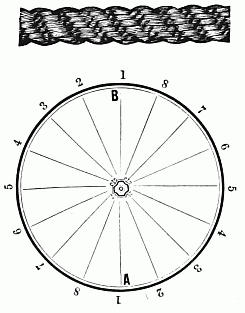
Take sixteen strands, eighty hairs
in a strand, and place them on table
like pattern. Commence at A and
B with Nos. 1, passing them around
table to the right, and leave No. 1
from A at B, and No. 1 from B at
A. Then take Nos. 7 at A and B,
and pass around table to right, and
leave the one from A at B, and the
one from B at A. Then take Nos.
2 at A and B, changing places with
them; then take Nos. 8 and change as before; then take Nos. 3 at
A and B and change them as before; then take Nos. 1 at A and B
and change as at first; then take Nos. 4 and change as before;
then take Nos. 2 and change as before; then take Nos. 5 and
change as before, so on until the braid is finished, all the time
taking the third strand to the right, or forward, and the second
one to the left, or backward.
Braid this over a small wire, with a hole in one end like the eye
of a needle, so as to draw a small cord in the place of the wire.
When you have it braided, take off your weights, tie the ends fast
on the wire and push the braid together on the wire; then boil in
water about ten minutes; then take it out and put in an oven as
hot as it will bear without burning, until it is quite dry; then take
it out and slip it off of the wire on to the cord, and sew the ends
of the braid so it will not slip on the cord, and put a little shellac
on the end to keep it fast. If you want it elastic, use elastic
cord. To vary the size of the braid, vary the number of hairs in
a strand.

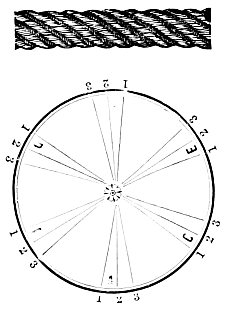
Take eighteen strands, eighty hairs
in a strand, and place on table like
pattern. Commence at A and B,
take Nos. 1 and swing around table
to the right, and place the No. 1
from A over the Nos. 2 and 3 at B,
and the No. 1 from B over the Nos.
2 and 3 at A; then go to C and D,
take the Nos. 1 and change the
same; then go to E and F and
change the same; then go to B and
A, and change as at first,—all the time taking the Nos. 1, and
swinging to the right, for when you lay them over the Nos. 2 and
3 it makes them Nos. 3, and makes Nos. 2 Nos. 1—and so on,
until the chain is finished.
Braid this over a small wire, with a hole in one end like the eye
of a needle, so as to draw a small cord in the place of the wire.
When you have it braided, take off your weights, tie the ends fast
on the wire, and push the braid close together; then boil in water
about ten minutes, and take it out and put it in an oven as hot as
it will bear without burning, until it is quite dry; then take it out
and slip it off the wire on to the cord, sew the ends of the braid so
it will not slip, and put a little shellac on the ends to keep it fast.
If you want it elastic, use elastic cord. To vary the size of the
braid, vary the number of hairs in a strand.

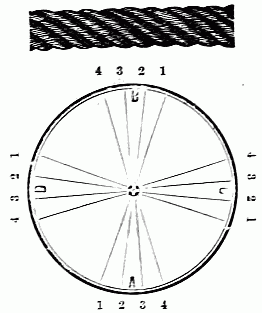
Take sixteen strands, eighty hairs
in a strand, and place them on table
like pattern. Commence at A and
B, take No. 1 at A in right hand
and No. 1 at B in left hand and
swing them around the table to the
right and lay the one in the right
hand down at B, over across Nos.
2, 3 and 4, and the one in the left
hand at A over across Nos. 2, 3 and
4, then go to C and take No. 1 at C
and D and change as before at A and B; then go to B and take
No. 1 at B and A and change them by taking No. 1 at B in right
hand, and No. 1 at A in left hand and swing them round the table
to the right as before, laying them across over Nos. 2, 3 and 4; so
on braiding around the table to the right until you have it the
required length.
Braid this over a small wire, with a hole in one end like the eye
of a needle, so as to draw a small cord in the place of the wire.
When you have it braided, take off your weights, tie the ends fast
on the wire and push the braid together on the wire; then boil in
water about ten minutes; then take it out and put in an oven as
hot as it will bear without burning, until it is quite dry; then take
it out and slip it off of the wire on to the cord, and sew the ends
of the braid so it will not slip on the cord, and put a little shellac
on the end to keep it fast. If you want it elastic, use elastic
cord. To vary the size of the braid, vary the number of hairs in
a strand.

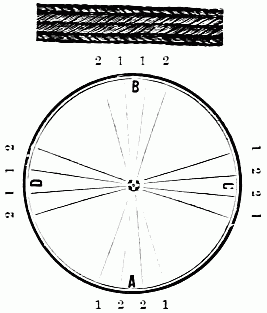
Take sixteen strands, eighty hairs
in a strand, and place them on table
like pattern. Commence at A, take
Nos. 2 and lift over across table
outside of Nos. 2 at B, and bring
back Nos. 1 from B to A outside of
Nos. 1 at A, then take Nos. 1 at C
and cross over inside of Nos. 1 at
D, and bring back Nos. 2 from D
inside of Nos. 2 at C, then go back
to A and braid as before, so on repeating until it is finished.
Braid this over a small wire, with a hole in one end like the eye
of a needle, so as to draw a small cord in the place of the wire.
When you have it braided, take off your weights, tie the ends fast
on the wire and push the braid together on the wire; then boil in
water about ten minutes; then take it out and put in an oven as
hot as it will bear without burning, until it is quite dry; then take
it out and slip it off of the wire on to the cord, and sew the ends
of the braid so it will not slip on the cord, and put a little shellac
on the end to keep it fast. If you want it elastic, use elastic
cord. To vary the size of the braid, vary the number of hairs in
a strand.

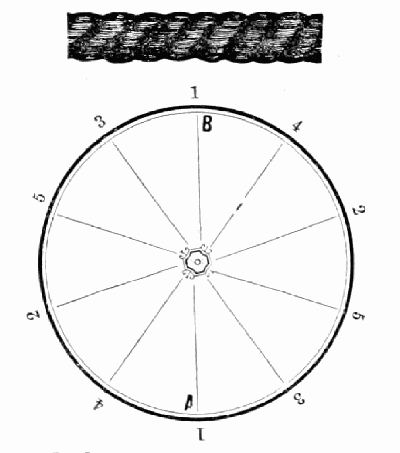
Take ten strands, eighty hairs in a
strand, and place them on the table
like pattern. Commence at A and
B, take Nos. 1 and swing them
around the table to the right, and
leave No. 1 from A at B and the
No. 1 from B at A, then take the
Nos. 2 and swing them around the
table to the right and change places
with each other, then take Nos. 3
and change places as before; then take Nos. 4 and change places
as before; then take Nos. 5 and change places as before; then
commence at Nos. 1 and repeat until the braid is finished.
Braid this over a small wire, with a hole in one end like the eye
of a needle, so as to draw a small cord in the place of the wire.
When you have it braided, take off your weights, tie the ends fast
on the wire and push the braid together on the wire; then boil in
water about ten minutes; then take it out and put in an oven as
hot as it will bear without burning, until it is quite dry; then take
it out and slip it off of the wire on to the cord, and sew the ends
of the braid so it will not slip on the cord, and put a little shellac
on the end to keep it fast. If you want it elastic, use elastic
cord. To vary the size of the braid, vary the number of hairs in
a strand.

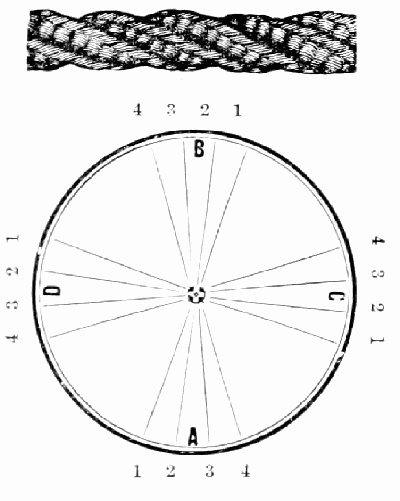
Take sixteen strands, seventy-five
hairs in a strand, and place on the
table like pattern. Commence at A
take Nos. 1 and 2, lift across the
table to B, and lay No. 1 outside of
No. 4, and lay No. 2 between Nos.
1 and 2, and bring back Nos. 1 and
2 from B to A, and lay No. 1 outside
of No. 4, and No. 2 outside of
No. 1 at A; then go to C and take
Nos. 1 and 2, lift over table to D
and lay No. 1 outside of No. 4, and lay No. 2 between Nos. 1 and
2, and bring back Nos. 1 and 2 from C, and lay No. 1 outside of
No. 4, and No. 2 outside of No. 1 at C; then go to B and change
the same, and so on around the table to the right until the braid is
finished.
Braid this over a small wire, with a hole in one end like the eye
of a needle, so as to draw a small cord in the place of the wire.
When you have it braided, take off your weights, tie the ends fast
on the wire and push the braid together on the wire; then boil in
water about ten minutes; then take it out and put in an oven as
hot as it will bear without burning, until it is quite dry; then take
it out and slip it off of the wire on to the cord, and sew the ends
of the braid so it will not slip on the cord, and put a little shellac
on the end to keep it fast. If you want it elastic, use elastic
cord. To vary the size of the braid, vary the number of hairs in
a strand.

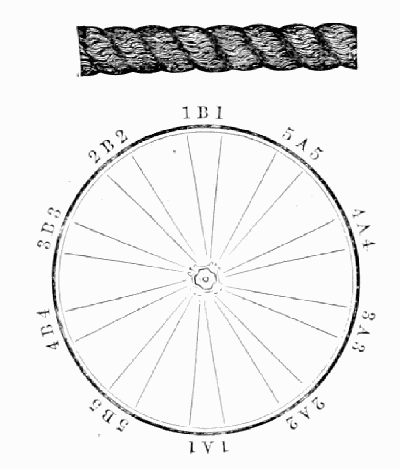
Take twenty strands, seventy-five
hairs in a strand, place on table like
pattern. Commence at A, lift Nos.
1 over across the table inside of Nos.
1 at B, and bring back Nos. 1 from
B to A; then take Nos. 2 at A,
cross over and lay them between
Nos. 2 at B, and carry back Nos. 2
from B to A; then take Nos. 3 at A,
cross over inside of Nos. 3 at B,
and bring back Nos. 3 from B to A;
then take Nos. 4 at A and cross over inside of Nos. 4 at B, and
bring back Nos. 4 from B to A; then take Nos. 5 at A, cross over
inside of Nos. 5 at B, and bring back Nos. 5 from B to A; then
take Nos. 1 at B, cross over inside of Nos. 1 at A, and bring back
Nos. 1 from A to B; then take Nos. 2 at B and cross over inside
of Nos. 2 at A, and bring back Nos. 2 from A to B; then take
Nos. 3, so on around the table to the right until the braid is
finished, all the time taking the next two.
Braid this over a small wire, with a hole in one end like the eye
of a needle, so as to draw a small cord in the place of the wire.
When you have it braided, take off your weights, tie the ends fast
on the wire and push the braid together on the wire; then boil in
water about ten minutes; then take it out and put in an oven as
hot as it will bear without burning, until it is quite dry; then take
it out and slip it off of the wire on to the cord, and sew the ends
of the braid so it will not slip on the cord, and put a little shellac
on the end to keep it fast. If you want it elastic, use elastic
cord. To vary the size of the braid, vary the number of hairs in
a strand.

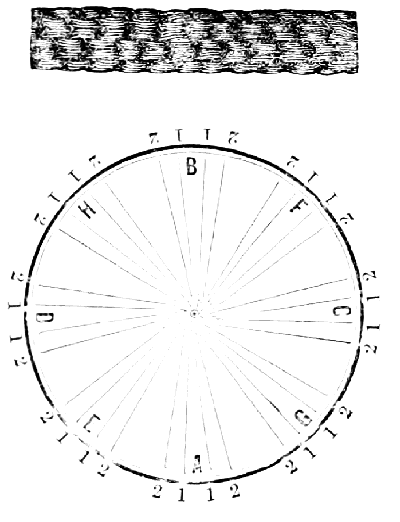
Take thirty-two strands, fifty hairs
in a strand, and place on table like
pattern. Commence at A, lift Nos.
1 across inside of Nos. 1 at B, and
bring back Nos. 1 from B to A;
then change at C and D, E and F,
and G and H the same, then go to
A, lift Nos. 2 across in place of
Nos. 2 at B, and bring back Nos. 2
from B to A; then change at C and
D, E and F, and G and H the same.
Then you are through the braid, ready to commence at A, as at
first, repeating the changes until the braid is finished.
Braid this over a small wire, with a hole in one end like the eye
of a needle, so as to draw a small cord in the place of the wire.
When you have it braided, take off your weights, tie the ends fast
on the wire, and push the braid close together; then boil in water
about ten minutes, and take it out and put it in an oven as hot as
it will bear without burning, until it is quite dry; then take it out
and slip it off the wire on to the cord, sew the ends of the braid so
it will not slip, and put a little shellac on the ends to keep it fast.
If you want it elastic, use elastic cord. To vary the size of the
braid, vary the number of hairs in a strand.

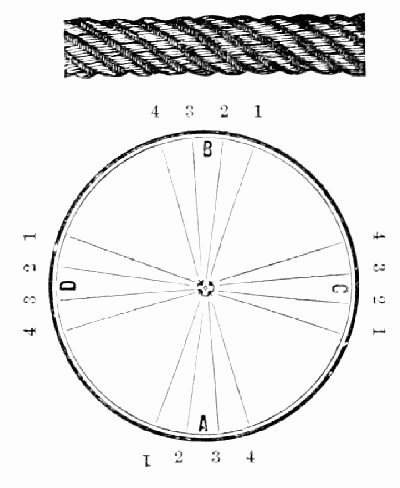
Take sixteen strands, eighty hairs
in a strand, and place them on the
table like pattern. Commence at A
and B, take No. 1 at A in right
hand and No. 1 at B in left hand,
and swing them around to the right
and change places with them; then
take No. 1 at C in right hand and
No. 1 at D in left hand, and swing
around table to the right and change
places as before; then take No. 2 at
B in right hand and No. 2 at A in left hand and swing to the right
and change as before; then take No. 2 at D in right hand and No.
2 at C in left hand and swing to the right and change as before;
then take No. 3 at A in right hand and No. 3 at B in left hand and
change as before; then take No. 3 at C in right hand and No. 3
at D in left hand and change as before; then take No. 4 at B in
right hand and No. 4 at A in left hand and change as before then
take No. 4 at D in right hand and No. 4 at C in left hand and
change as before. Then commence at A as at first and repeat till
the braid is finished.
For further directions see page 9.

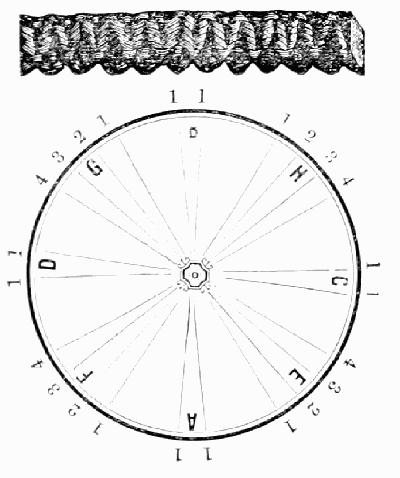
Take twenty-four strands, seventy
hairs in a strand, and place on table
like pattern. Commence at A—change
Nos. 1 at A across inside of
Nos. 1 at B, and bring back Nos. 1
from B to A, then go to C, change
Nos. 1 across inside of Nos. 1 at D,
and bring back Nos. 1 from D to C,
then take Nos. 1 at E in right hand
and No. 1 at F in left hand, lift
across table in place of Nos. 1 at G and H, and bring back Nos. 1
from G and H to F and E; then take Nos. 2 at E and F and change
across to G and H, and lay in place of Nos. 2, and bring back Nos.
2 from G and H to F and E; then take Nos 3 and change across
to G and H as before; then take Nos. 4 at F and E and change
across to G and H as before; then go to C and change the Nos. 1
across to D, and bring the Nos. 1 from D to C; then go to A and
change the Nos. 1 across to B, and bring back Nos. 1 from B to
A; then go to E and H, take No. 4 at H in right hand, and No. 4
at E in left hand, and lift across in place of Nos. 4 at F and G,
and bring back Nos. 4 from F and G to E and H; then take Nos.
3 at E and H and change across in place of Nos. 3 at F and G,
and bring back Nos. 3 from F and G to E and H; then take Nos.
2 at E and H and change across in place of Nos. 2 at F and G and
bring back Nos. 2 from F and G to E and H; then take Nos. 1 at
E and H, and change across in place of Nos. 1 at F and G, and
bring back Nos. 1 from F and G to E and H; then go to A and
commence as at first, and repeat till the chain is finished.
For further directions see page 9.
Take twenty-four strands, seventy
hairs in a strand, and place on table
like pattern. Commence at A, lift
Nos. 1 across inside of No. 1 at B,
and bring back Nos. 1 from B to A;
then change Nos. 1 at C and D the
same; then change Nos. 1 at E and
F the same; then go to A, lift Nos.
2 across to B, and bring back Nos.
2 from B to A; then change Nos. 2
at C and D the same; then change Nos. 2 at E and F the same,
and you are through the braid ready to commence at A as at first.
Braid this over a small wire, with a hole in one end like the eye
of a needle, so as to draw a small cord in the place of the wire.
When you have it braided, take off your weights, tie the ends fast
on the wire and push the braid together on the wire; then boil in
water about ten minutes; then take it out and put in an oven as
hot as it will bear without burning, until it is quite dry; then take
it out and slip it off of the wire on to the cord, and sew the ends
of the braid so it will not slip on the cord and put a little shellac
on the end to keep it fast. If you want it elastic, use elastic
cord. To vary the size of the braid, vary the number of hairs in
a strand.

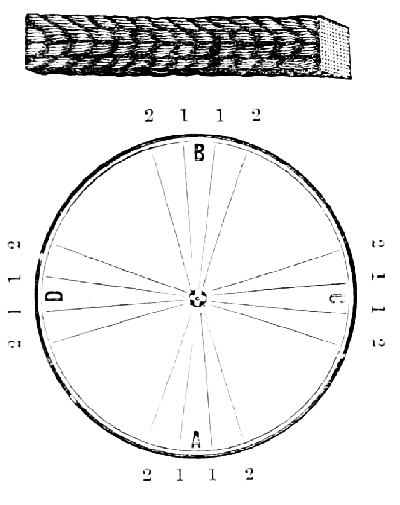
Take sixteen strands, eighty hairs
in a strand, and place them on the
table like pattern. Commence at A,
change the Nos. 1 across inside of
Nos. 1 at B, and bring back Nos. 1
from B to A; then take No. 2 at A
change over in place of Nos. 2 at
B and bring back Nos. 2 from B to
A; then go to C, and change the
Nos. 1 from C to D, and bring back
Nos. 1 from D to C; then take Nos.
2 at C and change over in place of Nos. 2 at D, and bring back
Nos 2 from D to C; then go to A and begin as at first, repeating
until the braid is finished.
Braid this over a small wire, with a hole in one end like the eye
of a needle, so as to draw a small cord in the place of the wire.
When you have it braided, take off your weights, tie the ends fast
on the wire and push the braid together on the wire; then boil in
water about ten minutes; then take it out and put in an oven as
hot as it will bear without burning, until it is quite dry, then take
it out and slip it off of the wire on to the cord, and sew the ends
of the braid so it will not slip on the cord, and put a little shellac
on the end to keep it fast. If you want it elastic, use elastic
cord. To vary the size of the braid, vary the number of hairs in
a strand.

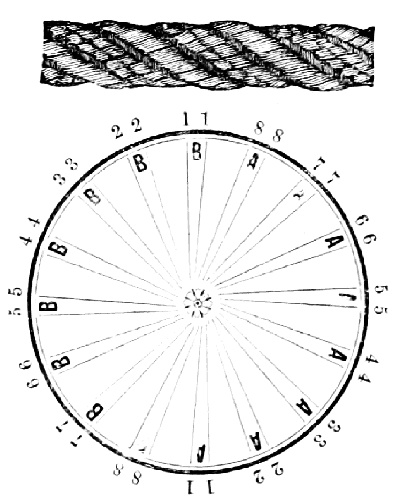
Take thirty-two strands, fifty hairs
in a strand, and place on table like
pattern. Change Nos. 1 at A across
inside of Nos. 1 at B, and bring back
Nos. 1 from B to A; then change
in the same way, successively, the
Nos. 3, 5, 2, 4, 6, 3, 5, 7, 4, 6, 8, 5,
7, 1, 6, 8, 2, 7, 1, 3, 8, 2, 4—then
you are through, ready to commence
as at first.
Braid this over a small wire, with a hole in one end like the eye
of a needle, so as to draw a small cord in the place of the wire.
When you have it braided, take off your weights, tie the ends fast
on the wire and push the braid together on the wire, then boil in
water about ten minutes; then take it out and put in an oven as
hot as it will bear without burning, until it is quite dry; then take
it out and slip it off of the wire on to the cord, and sew the ends
of the braid so it will not slip on the cord, and put a little shellac
on the end to keep it fast. If you want it elastic, use elastic
cord. To vary the size of the braid, vary the number of hairs in
a strand.

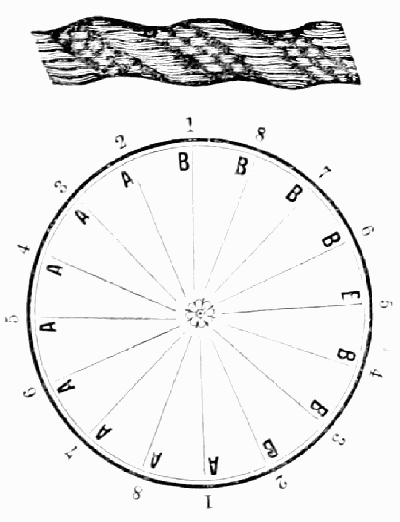
Take sixteen strands, eighty hairs
in a strand, and lay on table like
pattern. Commence at A and B—take
No. 1 at A in left hand and
No. 1 at B in right hand, swing
around table to the left, and change
places with them; then take No. 7
at B in right hand and No. 7 at A
in left hand, and swing around the
table to the right and change places
with them; then take No. 5 at A in right hand and No. 5 at B
in left hand, and swing around the table to the left, and change
places as before; then take No. 8 at A in right hand and No. 8
at B in left hand and swing around table to the left and change as
before; then take No. 6 at A in left hand, and No. 6 at B in right
hand and swing around table to the right and change as before;
then take No. 4 at A in right hand and No. 4 at B in left hand,
and swing around table to the left and change as before; then
take No. 7 at A in right hand and No. 7 at B in left hand, swing
around table to the left and change as before, then take No. 5
at A in left hand and No. 5 at B in right hand, swing around table
to the right and change as before; then take No. 3 at A in right
hand and No. 3 at B in left hand and swing around table to the
left and change as before; then take No. 6 at A in right hand and
No. 6 at B in left hand and swing around table to the left and
change as before; then take No. 4 at A in left hand and No. 4 at
B in right hand and swing around table to the right and change as
before; then take No. 2 at A in right hand and No. 2 at B in left
hand and swing around table to the left and change as before; then
take No. 5 at A in right hand and No. 5 at B in left hand and
swing around table to the left and change as before, then take No.
3 at A in left hand and No. 3 at B in right hand, and swing around
table to the right and change as before. Then commence at A as
at first.
Braid this over a small wire, with a hole in one end like the eye
of a needle, so as to draw a small cord in the place of the wire.
When you have it braided, take off your weights, tie the ends fast
on the wire and push the braid together on the wire; then boil in
water about ten minutes; then take it out and put in an oven as
hot as it will bear without burning, until it is quite dry; then take
it out and slip it off of the wire on to the cord, and sew the ends
of the braid so it will not slip on the cord, and put a little shellac
on the end to keep it fast. If you want it elastic, use elastic
cord. To vary the size of the braid, vary the number of hairs in
a strand.

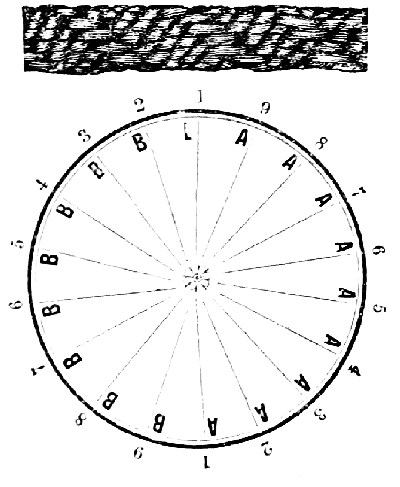
Take eighteen strands, eighty hairs
in a strand, and place on table like
pattern. Commence at A and B—take
No. 1 at A in right hand and
No. 1 at B in left hand and swing
them around the table to the right
and change places with them; then
change the Nos. 8, 6 and 4 the same
way; then count back five to the left
(not counting the one last braided),
bringing you to No. 9—swing as before to the right and change
places; then change the Nos. 7, 5 and 3 the same way; then count
back five, bringing you to No. 8—change the same; and so on,
first counting two forward and change three times, and then count
five back and change the same, so on until the braid is finished.
Braid this over a small wire, with a hole in one end like the eye
of a needle, so as to draw a small cord in the place of the wire.
When you have it braided, take off your weights, tie the ends fast
on the wire and push the braid together on the wire; then boil in
water about ten minutes; then take it out and put in an oven as
hot as it will bear without burning, until it is quite dry; then take
it out and slip it off of the wire on to the cord, and sew the ends
of the braid so it will not slip on the cord, and put a little shellac
on the end to keep it fast. If you want it elastic, use elastic
cord. To vary the size of the braid, vary the number of hairs in
a strand.

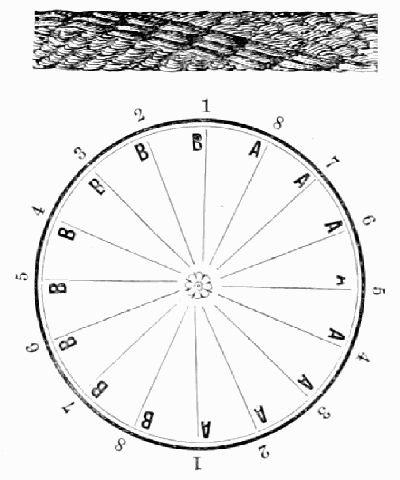
Take sixteen strands, eighty hairs
in a strand, and place them on the
table like pattern. Commence at A
and B, take No. 1 at A in right
hand and No. 1 at B in left hand,
and swing them around to the left
and change places with them; then
take successively Nos. 3, 5, 2, 4, 6,
3, 5, 7, 4, 6, 8, and change the same;
then commence as at first with No.
1, so on repeating until the braid is finished.
Braid this over a small wire, with a hole in one end like the eye
of a needle, so as to draw a small cord in the place of the wire.
When you have it braided, take off your weights, tie the ends fast
on the wire and push the braid together on the wire; then boil in
water about ten minutes; then take it out and put in an oven as
hot as it will bear without burning, until it is quite dry then take
it out and slip it off of the wire on to the cord, and sew the ends
of the braid so it will not slip on the cord, and put a little shellac
on the end to keep it fast. If you want it elastic, use elastic
cord. To vary the size of the braid, vary the number of hairs in
a strand.

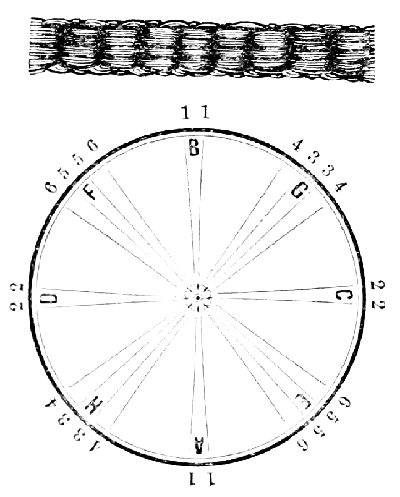
Take twenty four strands, seventy
hairs in a strand, and arrange like
pattern. Commence at A, take Nos.
1 and lay them in the place of Nos.
1 at B, and bring back Nos. 1 from
B to A; then take Nos. 2 at C and
lay in the place of Nos. 2 at D and
bring back Nos. 2 from D to C.
Then take the Nos. 3 from H and
lay between the Nos. 3 at G, and
bring back the Nos. 3 from G to H; then take the Nos. 4 at H
and place between the Nos. 4 at G, and bring back the Nos. 4 from
G to H; then take Nos. 5 at E and place between Nos. 5 at F,
and bring back the Nos. 5 from F to E; then take the Nos. 6 at
E and place them inside of Nos. 6 at F, and bring back the Nos.
6 from F to E. Commence at A as at first, and repeat until the
braid is finished.
Braid this over a small wire, with a hole in one end like the eye
of a needle, so as to draw a small cord in the place of the wire.
When you have it braided, take off your weights, tie the ends fast
on the wire and push the braid together on the wire; then boil in
water about ten minutes; then take it out and put in an oven as
hot as it will bear without burning, until it is quite dry; then take
it out and slip it off of the wire on to the cord, and sew the ends
of the braid so it will not slip on the cord, and put a little shellac
on the end to keep it fast. If you want it elastic, use elastic
cord. To vary the size of the braid, vary the number of hairs in
a strand.

Take twenty-four strands, and place
on table like pattern. Commence
at A, take Nos. 1 and place between
Nos. 1 at B, and bring back Nos. 1
from B and lay in place of Nos. 1
at A; then change the Nos. 2 at A,
and B the same way; then change
the succeeding numbers, 3, 4, 5 and
6, all the same way. Then you are
through the braid, ready to commence
at Nos. 1 again, as at first,
and repeat until the braid is the desired length.
Braid this over a small wire, with a hole in one end like the eye
of a needle, so as to draw a small cord in the place of the wire.
When you have it braided, take off your weights, tie the ends fast
on the wire, and push the braid close together; then boil in water
about ten minutes, and take it out and put it in an oven as hot as
it will bear without burning, until it is quite dry; then take it out
and slip it off the wire on to the cord, sew the ends of the braid so
it will not slip, and put a little shellac on the ends to keep it fast.
If you want it elastic, use elastic cord. To vary the size of the
braid, vary the number of hairs in a strand.

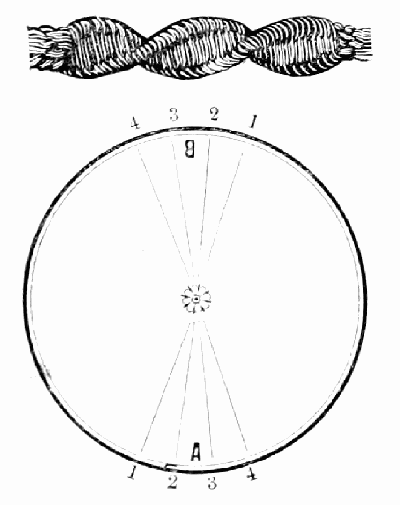
Take eight strands, ninety hairs in
a strand, and place on table like
pattern. Commence, take No. 1 at
A in right hand, and No. 1 at B in
left hand, and swing around table to
the right—the No. 1 in the right
hand over across Nos. 2, 3 and 4 at
B, and the No. 1 in the left hand
over across Nos. 2, 3 and 4 at A;
repeat until the braid is finished.
Braid this over a small wire, with a hole in one end like the eye
of a needle, so as to draw a small cord in the place of the wire.
When you have it braided, take off your weights, tie the ends fast
on the wire and push the braid together on the wire; then boil in
water about ten minutes; then take it out and put in an oven as
hot as it will bear without burning, until it is quite dry; then take
it out and slip it off of the wire on to the cord, and sew the ends
of the braid so it will not slip on the cord, and put a little shellac
on the end to keep it fast. If you want it elastic, use elastic
cord. To vary the size of the braid, vary the number of hairs in
a strand.

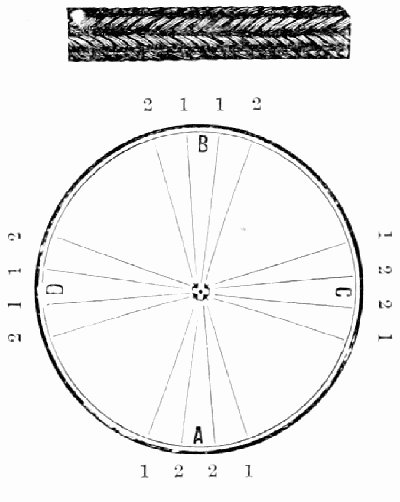
Take sixteen strands, eighty hairs
in a strand, and place them on the
table like pattern. Commence at A,
take both No. 1 strands and cross
over in between Nos. 1 on the opposite
side to B, then bring back both
Nos. 2 from B to A, and place them
in between Nos. 2; then walk around
table to C and braid it across table
to D as before. Then commence at
A and repeat until braid is finished.
Braid this over a small wire, with a hole in one end like the eye
of a needle, so as to draw a small cord in the place of the wire.
When you have it braided, take off your weights, tie the ends fast
on the wire and push the braid together on the wire; then boil in
water about ten minutes; then take it out and put in an oven as
hot as it will bear without burning, until it is quite dry; then take
it out and slip it off of the wire on to the cord, and sew the ends
of the braid so it will not slip on the cord, and put a little shellac
on the end to keep it fast. If you want it elastic, use elastic
cord. To vary the size of the braid, vary the number of hairs in
a strand.

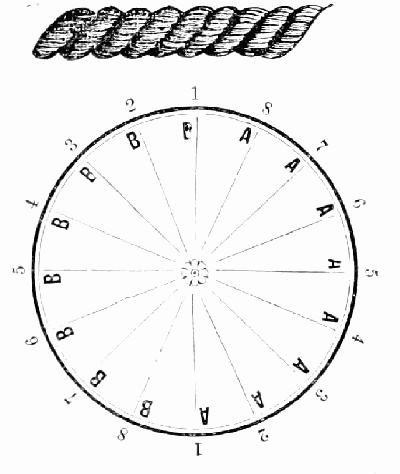
Take any number of strands that
can be divided by two, eight hairs
in a strand, and place on table like
pattern. Commence by taking No.
1 at A and B and change places by
swinging them to the right; then
take No. 2 at A and B and change
places with them by swinging to the
left; then take No. 3 at A and B
and change places by swinging them
to the right; then Nos. 4, and change places by swinging them to
the left, and so on, swinging to the right and left alternately, until
the braid is finished.
Braid this over a small wire, with a hole in one end like the eye
of a needle, so as to draw a small cord in the place of the wire.
When you have it braided, take off your weights, tie the ends fast
on the wire and push the braid together on the wire; then boil in
water about ten minutes; then take it out and put in an oven as
hot as it will bear without burning, until it is quite dry; then take
it out and slip it off of the wire on to the cord, and sew the ends
of the braid so it will not slip on the cord, and put a little shellac
on the end to keep it fast. If you want it elastic, use elastic
cord. To vary the size of the braid, vary the number of hairs in
a strand.

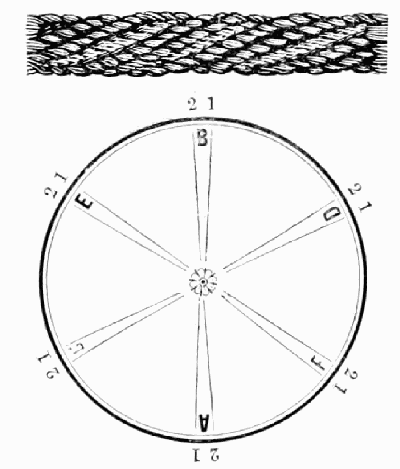
Take any number of strands that
can be divided by two, eighty hairs
in a strand, and place on table like
pattern. Commence at A and B,
take Nos. 1 and swing them around
table to the right—No. 1 from A
around to B across No. 2 at B, and
No. 1 from B across No. 2 at A;
then take Nos. 1 at C and D and
change as before; then change the
same at E and F and at B and A, so on around the table to the
right until the chain is completed. Any number of strands can
be used by increasing the number in each place, or by having three,
four, five or six in a place, care being taken to cross all the strands.
For instance, there are four strands, No. 1 must be crossed over
all as you braid around the table. By adding strands a different
braid is formed.
Braid this over a small wire, with a hole in one end like the eye
of a needle, so as to draw a small cord in the place of the wire.
When you have it braided, take off your weights, tie the ends fast
on the wire and push the braid together on the wire; then boil in
water about ten minutes; then take it out and put in an oven as
hot as it will bear without burning, until it is quite dry; then take
it out and slip it off of the wire on to the cord, and sew the ends
of the braid so it will not slip on the cord, and put a little shellac
on the end to keep it fast. If you want it elastic, use elastic
cord. To vary the size of the braid, vary the number of hairs in
a strand.

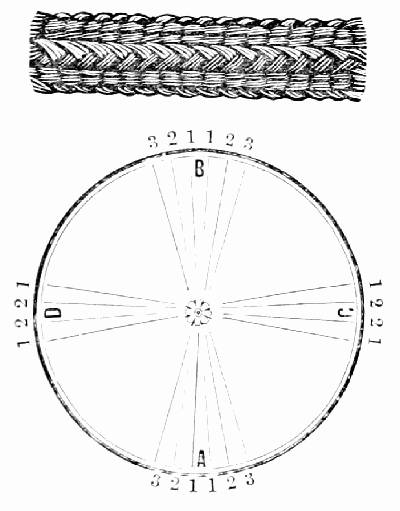
Take twenty strands, seventy hairs
in a strand, and place on table like
pattern. Commence at A, cross No.
1 in the right hand over the No. 1
in the left hand, and then go to B
and cross No. 1 in the left hand over
No. 1 in the right hand; then go
back to A and take Nos. 1 and cross
inside of Nos. 1 at B, and bring back
Nos. 1 from B to A; then take Nos.
2 and change the same; then change
Nos. 3 the same; then go to C and take Nos. 1 and cross inside of
Nos. 2 at D, and bring back Nos. 1 from D and lay inside of Nos.
2 at C; then commence at A as at first, and repeat until the braid
is finished.
Braid this over a small wire, with a hole in one end like the eye
of a needle, so as to draw a small cord in the place of the wire.
When you have it braided, take off your weights, tie the ends fast
on the wire and push the braid together on the wire; then boil in
water about ten minutes; then take it out and put in an oven as
hot as it will bear without burning, until it is quite dry; then take
it out and slip it off of the wire on to the cord, and sew the ends
of the braid so it will not slip on the cord, and put a little shellac
on the end to keep it fast. If you want it elastic, use elastic
cord. To vary the size of the braid, vary the number of hairs in
a strand.

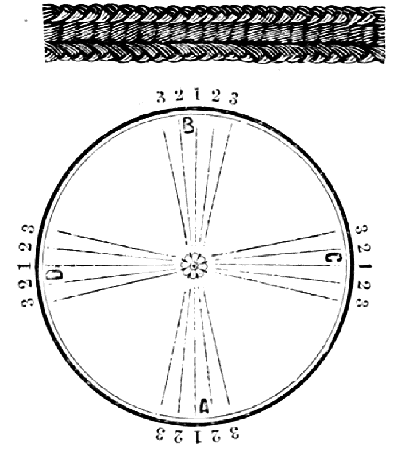
Take twenty strands, seventy hairs
in a strand, and place on table like
pattern. Commence take No. 1 at
A in right hand and No. 1 at B in
left hand, swing to the right and
change places with them; then take
Nos. 3 at A and lay inside of Nos.
2 at B, and bring Nos. 3 from B
and lay inside of Nos. 2 at A; then
go to C and take No. 1 in right hand
and No. 1 at D in left hand, swing to the right and change places
with them; then take Nos. 3 at C and lay inside of Nos. 2 at D,
and bring back Nos. 3 from D and lay inside of Nos. 2 at C. Then
commence at A as at first, and repeat until the braid is finished.
Braid this over a small wire, with a hole in one end like the eye
of a needle, so as to draw a small cord in the place of the wire.
When you have it braided, take off your weights, tie the ends fast
on the wire and push the braid together on the wire; then boil in
water about ten minutes; then take it out and put in an oven as
hot as it will bear without burning, until it is quite dry, then take
it out and slip it off of the wire on to the cord, and sew the ends
of the braid so it will not slip on the cord, and put a little shellac
on the end to keep it fast. If you want it elastic, use elastic
cord. To vary the size of the braid, vary the number of hairs in
a strand.

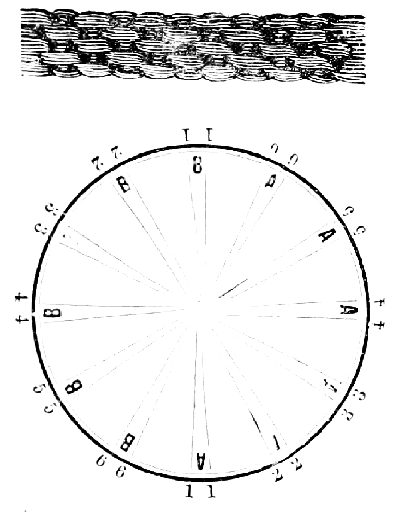
Take twenty-four strands, sixty
hairs in a strand, and place on table
like pattern. Commence at A and
B: take Nos. 1 at A, and lift them
across the table, and lay the one in
left hand between Nos. 1 at B, and
the one in right hand on the outside
of Nos. 1 at B, and bring back the
Nos. 1 from B to A. Then pass
round the table to the right, and
change (in the same manner) successively,
the Nos. 3, 5, 6, 2, 4, 6, 2, 4, 5, 1, 3 and 5; then commence
at A with Nos. 1, as at first, and repeat until the braid is
finished.
Braid this over a small wire, with a hole in one end like the eye
of a needle, so as to draw a small cord in the place of the wire.
When you have it braided, take off your weights, tie the ends fast
on the wire, and push the braid close together; then boil in water
about ten minutes, and take it out and put it in an oven as hot as
it will bear without burning, until it is quite dry; then take it out
and slip it off the wire on to the cord, sew the ends of the braid so
it will not slip, and put a little shellac on the ends to keep it fast.
If you want it elastic, use elastic cord. To vary the size of the
braid, vary the number of hairs in a strand.

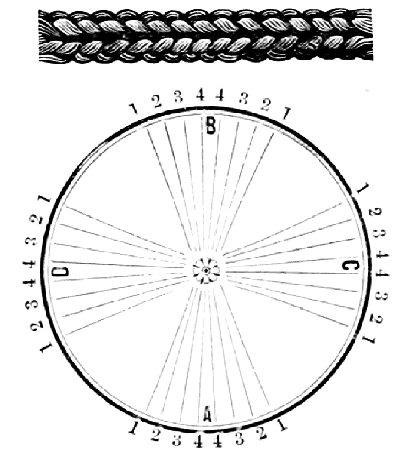
Take thirty-two strands with fifty
hairs in a strand, and place them on
table like pattern. Commence at
A, take Nos. 4 and lift over across
table, and lay outside of Nos. 1 at
B, then bring back Nos. 4 from B
and lay outside of Nos. 1 at A;
then take Nos. 3 at A and lift over
across table and lay outside of Nos.
1 at B, and bring back Nos. 3 from
B and lay outside of Nos. 1 at A; then change Nos. 2 at A and B
the same; then take Nos. 1 and change the same; then go to D
and change the same as at A; then go to B and change the same;
then go to C and change the same, and you are ready to commence
again at A, as at first: repeat until braid is finished.
Braid this over a small wire, with a hole in one end like the eye
of a needle, so as to draw a small cord in the place of the wire.
When you have it braided, take off your weights, tie the ends fast
on the wire and push the braid together on the wire; then boil in
water about ten minutes; then take it out and put in an oven as
hot as it will bear without burning, until it is quite dry; then take
it out and slip it off of the wire on to the cord, and sew the ends
of the braid so it will not slip on the cord, and put a little shellac
on the end to keep it fast. If you want it elastic, use elastic
cord. To vary the size of the braid, vary the number of hairs in
a strand.

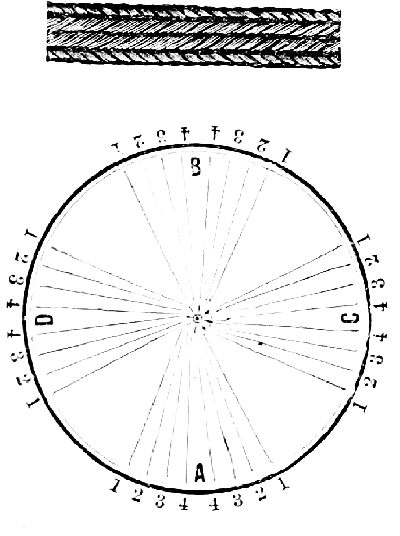
Take thirty-two strands, sixty hairs
in a strand and place on table like
pattern. Commence at A, take
Nos. 4 and lift over table and lay
outside of Nos. 1 at B, and bring
back Nos. 4 from B and lay outside
of Nos. 1 at A; then go to D and
change the Nos. 4 the same as at A
and B; then go to B and change
the same as at A; then go to C and
change the same way, and then to
A and change as at first, and so on, repeating the changes until
the braid is finished.
Braid this over a small wire, with a hole in one end like the eye
of a needle, so as to draw a small cord in the place of the wire.
When you have it braided, take off your weights, tie the ends fast
on the wire, and push the braid close together; then boil in water
about ten minutes, and take it out and put it in an oven as hot as
it will bear without burning, until it is quite dry; then take it out
and slip it off the wire on to the cord, sew the ends of the braid so
it will not slip, and put a little shellac on the ends to keep it fast.
If you want it elastic, use elastic cord. To vary the size of the
braid, vary the number of hairs in a strand.

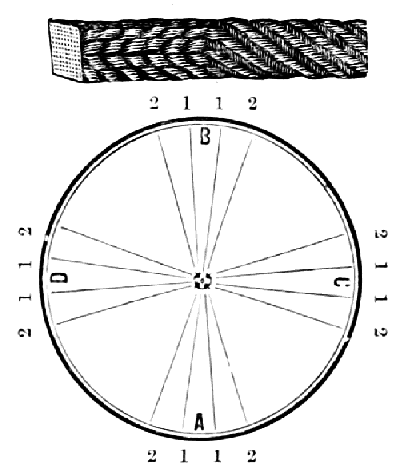
Take sixteen strands eighty hairs
in a strand, and place on table like
pattern. Commence at A, change
Nos. 1 across inside of Nos. 1 at B,
and bring back Nos. 1 from B to A;
then take Nos. 2 at A and change
across inside of Nos. 2 at B, and
bring back Nos. 2 from B to A; then
go to C and change the Nos. 1 and
the Nos. 2 across with the numbers
at D the same as at A; then return to A and commence as at first
and repeat ten times. Then change the figures on the table to
correspond with the following diagram:
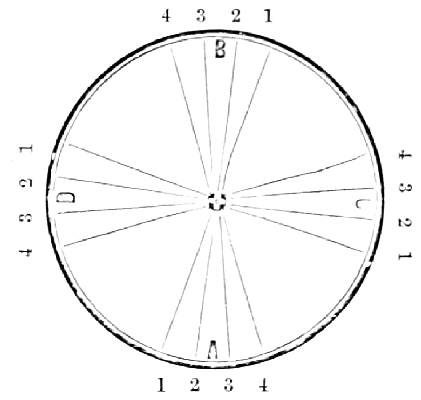
Then commence at A and B, take
No. 1 at A in right hand and No. 1
at B in left hand, and swing around
the table to the right, changing places
with them; then take Nos. 1 at C
and D and change the same; then
change Nos. 2 at B and A the same;
then change the Nos. 2 at D and C
the same; then take Nos. 3 at A and B and change the same; then
change the Nos. 3 at C and D; then the Nos. 4 at B and A; then
the Nos. 4 at P and C; then commence at A as at first, and repeat
ten times, so on braiding alternately ten rounds by the directions
of each pattern until the braid is finished.

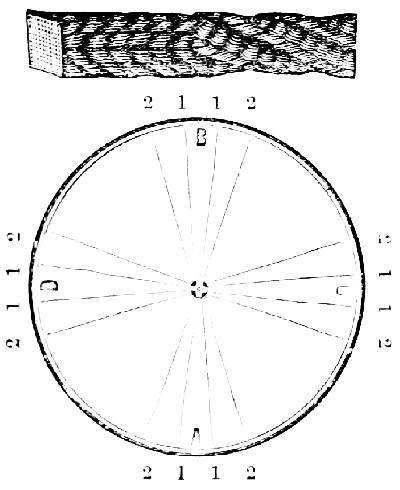
Take sixteen strands eighty hairs
in a strand, and place on table like
pattern. Commence at A, change
Nos. 1 across inside of Nos. 1 at B,
and bring back Nos. 1 from B to A;
then take Nos. 2 at A and change
across inside of Nos. 2 at B, and
bring back Nos. 2 from B to A; then
go to C and change the Nos. 1 and
the Nos. 2 across with the numbers
at D the same as at A; then return to A and commence as at first
and repeat ten times. Then change the figures on the table to
correspond with the following diagram:
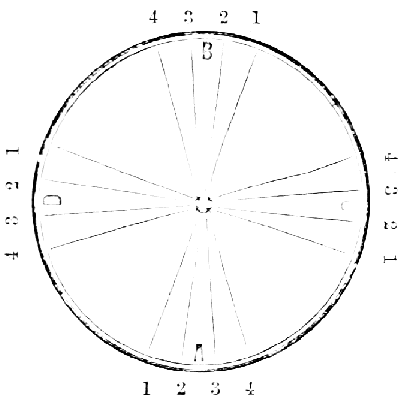
Then commence at A, take Nos. 1
and 2, lift across table to B and lay
No. 1 outside of No. 4, and No. 2
between Nos. 1 and 2, and bring back
Nos. 1 and 2 from B to A, and lay
No. 1 outside of No. 4, and No. 2
outside of No. 1 at A; then go to C
and take Nos. 1 and 2 and lift over
table to D, and lay No. 1 outside of No. 4, and No. 2 between Nos.
1 and 2, and bring back Nos. 1 and 2 from C and lay No. 1 outside
of No. 4 and No. 2 outside of No. 1 at C; then go to B and
change the same, and so on around the table to the right, braiding
alternately ten rounds by each diagram until the braid is finished.

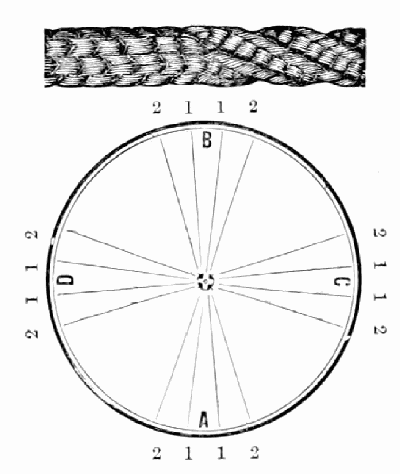
Take sixteen strands eighty hairs in
a strand, and place them on table
like pattern. Commence at A, lift
Nos. 1 over across the table and lay
them in between Nos. 1 at B, and
bring back Nos. 1 from B to A; then
go to C and change the Nos. 1 across
with the Nos. 1 at D the same; then
take Nos. 2 at A and change across
inside of Nos. 2 at B, and bring
back Nos. 2 from B to A; then change the Nos. 2 at C across
inside of Nos. 2 at D the same; then commence at A as at first,
and repeat ten times. Then change the numbers on table to correspond
with the following pattern or diagram:
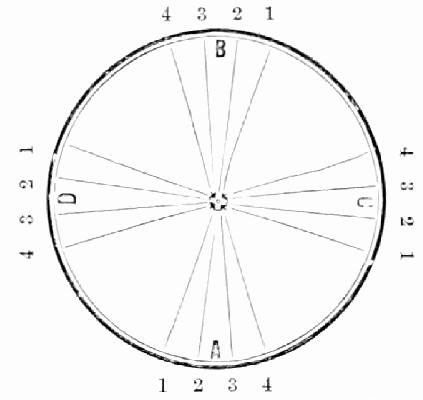
Then commence at A, take Nos. 1
and 2, lift across table to B and lay
No. 1 outside of No. 4, and No. 2
between Nos. 1 and 2, and bring back
Nos. 1 and 2 from B to A, and lay
No. 1 outside of No. 4, and No. 2
outside of No. 1 at A; then go to C
and take Nos. 1 and 2 and lift over
table to D, and lay No. 1 outside of No. 4, and No. 2 between Nos.
1 and 2, and bring back Nos. 1 and 2 from C and lay No. 1 outside
of No. 4 and No. 2 outside of No. 1 at C; then go to B and
change the same, and so on around the table to the right, braiding
alternately ten rounds by each diagram until the braid is finished.

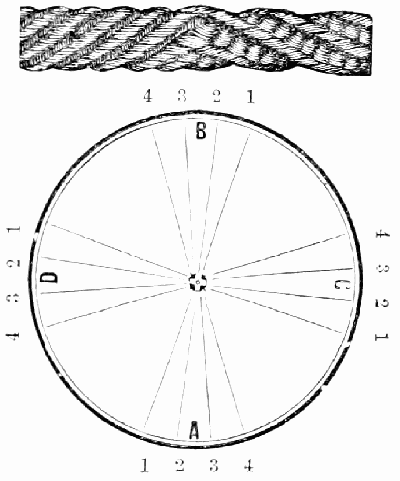
Take sixteen strands, eighty hairs
in a strand, and place them on the
table like pattern. Commence at A
and B, take No. 1 at A in right hand
and No. 1 at B in left hand, swing
around the table to the right and
change places with them; then take
Nos. 1 at C and D and change as at
A and B; then change Nos. 2 at B
and A the same; then change the
Nos. 2 at D and C the same; then take Nos. 3 at A and B and
change the same; then change the Nos. 3 at C and D; then the
Nos. 4 at B and A, and also the Nos. 4 at D and C, all the time
swinging to the right. Braid around ten times.
Then commence at A, take Nos. 1
and 2, lift across table to B and lay
No. 1 outside of No. 4, and No. 2
between Nos. 1 and 2, and bring back
Nos. 1 and 2 from B to A, and lay
No. 1 outside of No. 4, and No. 2
outside of No. 1 at A; then change
the same at C, B and D; then commence
again at A and braid ten rounds, so on braiding alternately
ten rounds by the directions of each pattern until the braid is
finished.
Take sixteen strands eighty hairs
in a strand, and place on table like
pattern. Commence at A, change
Nos. 1 across inside of Nos. 1 at B,
and bring back Nos. 1 from B to A;
then take Nos. 2 at A and change
across inside of Nos. 2 at B, and
bring back Nos. 2 from B to A; then
go to C and change the Nos. 1 and
the Nos. 2 across with the numbers
at D the same as at A; then return to A and commence as at first
and repeat ten times. Then change the figures on the table to
correspond with the following diagram:
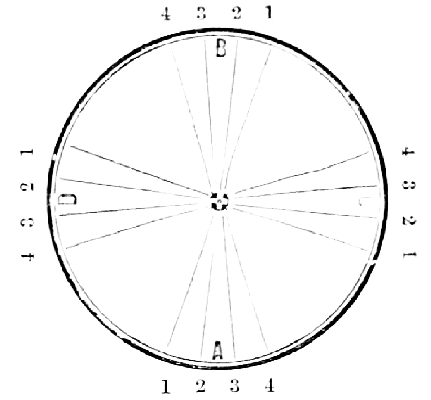
Then commence at A and B, take
No. 1 at A in right hand and No. 1
at B in left hand, and swing them
around the table to the right, and
lay the one in right hand down at
B over across Nos. 2, 3 and 4, and
the one in left hand at A over across
Nos. 2, 3 and 4; then go to C and
change the Nos. 1 at B and D the same; then go to B and change
the Nos. 1 at B and A the same; so on, braiding around the table
to the right, alternately braiding ten rounds by the directions of
each pattern until the braid is finished.

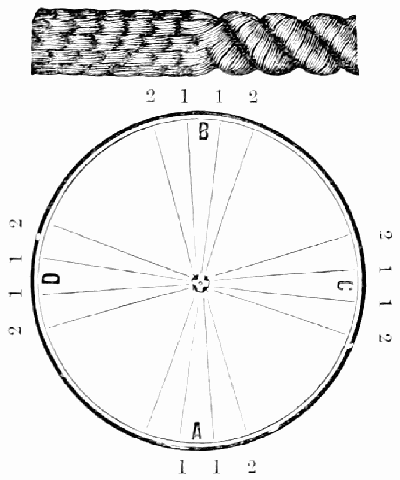
Take sixteen strands, eighty hairs in
a strand, and place them on table
like pattern. Commence at A, lift
Nos. 1 over across the table and lay
them in between Nos. 1 at B, and
bring back Nos. 1 from B to A; then
go to C and change the Nos. 1 across
with the Nos. 1 at D the same; then
take Nos. 2 at A and change across
inside of Nos. 2 at B, and bring
back Nos. 2 from B to A; then change the Nos. 2 at C across
inside of Nos. 2 at D the same; then commence at A as at first,
and repeat ten times. Then change the numbers on table to correspond
with the following pattern or diagram:
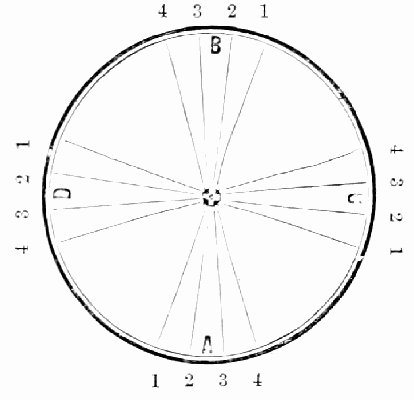
Then commence at A and B, take
No. 1 at A in right hand and No. 1
at B in left hand, and swing them
around the table to the right, and
lay the one in right hand down at
B over across Nos. 2, 3 and 4, and
the one in left hand at A over across
Nos. 2, 3 and 4; then go to C and
change the Nos. 1 at B and D the same; then go to B and change
the Nos. 1 at B and A the same; so on, braiding around the table
to the right, alternately braiding ten rounds by the directions of
each pattern until the braid is finished.

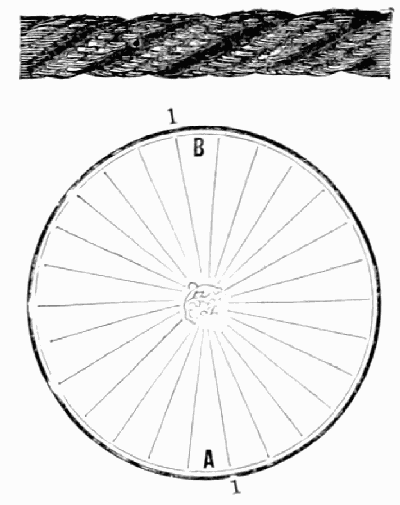
Take twenty-six strands, sixty hairs
in a strand, and place on table like
pattern. Commence at A and B,
take Nos. 1 and change places by
swinging them around the table to
the left; then take the third strands
to the right of A and B, and change
places by swinging them around the
table to the right; then take the
fourth strands to the right of the
ones last taken, and change places by swinging them around the
table to the left, and so on working around the table to the right;
first swinging the strands to the left, and then to the right, taking
alternately the third and fourth strands to the right of the ones
last used, until the braid is finished.
Braid this over a small wire, with a hole in one end like the eye
of a needle, so as to draw a small cord in the place of the wire.
When you have it braided, take off your weights, tie the ends fast
on the wire, and push the braid together; then boil in water about
ten minutes, and then take out and put it in an oven as hot as it
will bear without burning, until it is quite dry; then take it out
and slip it off the wire and on the cord, and sew the ends so it will
not slip, and put a little shellac on the end to keep it fast. If you
want it elastic, use elastic cord. To vary the size of the braid
vary the number of hairs in a strand.

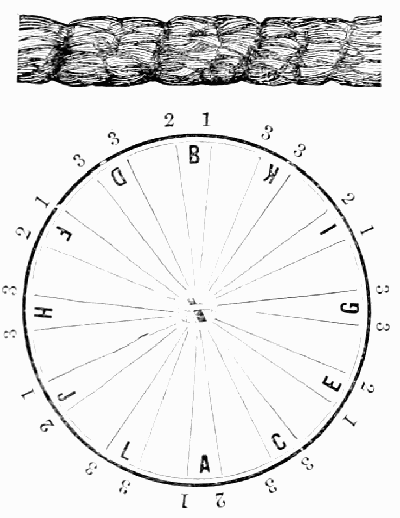
Take twenty-four strands, sixty
hairs in a strand, and place on table
like pattern. Commence at A, take
No. 2 in right hand, swing around
the table to the right and lay in
place of No. 2 at B, and bring back
No. 2 from B and lay in place of
No. 2 at A; then take No. 1 at A
in left hand, and change places with
No. 1 at B by swinging around to
the left; then go to C, take Nos. 3 and lift over table and lay
inside of Nos. 3 at D, and bring back Nos. 3 from D and lay in
place of Nos. 3 at C; then go to E and change the Nos. at E and
F the same as at A and B; then go to G and change the same as
at C and D, and so on, alternately changing, first as at A and B,
and then as at C and D, until the braid is finished.
Braid this over a small wire, with a hole in one end like the eye
of a needle, so as to draw a small cord in the place of the wire.
When you have it braided, take off your weights, tie the ends fast
on the wire, and push the braid together; then boil in water about
ten minutes, and then take out and put it in an oven as hot as it
will bear without burning, until it is quite dry; then take it out
and slip it off the wire and on the cord, and sew the ends so it will
not slip, and put a little shellac on the end to keep it fast. If you
want it elastic, use elastic cord. To vary the size of the braid,
vary the number of hairs in a strand.

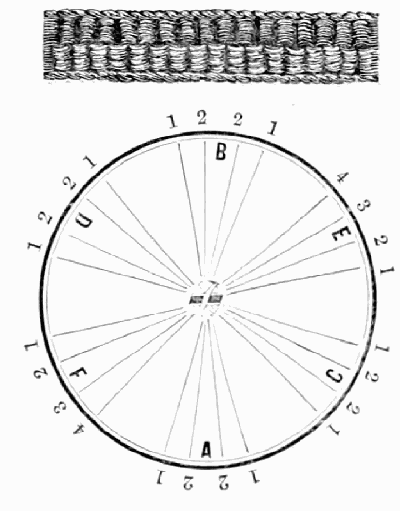
Take twenty-four strands, seventy
hairs in a strand, and place on the
table like pattern. Commence at A,
take Nos. 2 lift across table and lay
in between Nos. 2 at B, and bring
back Nos. 2 from B to A; then take
Nos. 1 at A and lift across table and
lay between Nos. 1 at B, and bring
back Nos. 1 from B to A; then go
to F, take No. 1 in right hand, swing
around to the right and lay in place of No. 4 at E; then take No.
1 at E in left hand and swing around to the left and lay in place of
No. 4 at F; then go to C, take Nos. 2 lift across table, and lay
them in between Nos. 2 at D, and bring back Nos. 2 from D to C;
then take Nos. 1 at C, lift across the table and lay between Nos. 1
at D, and bring back Nos. 1 from D to C; then you are through
the braid, ready to commence as at first.
Braid this over a small wire, with a hole in one end like the eye
of a needle, so as to draw a small cord in the place of the wire.
When you have it braided, take off your weights, tie the ends fast
on the wire, and push the braid together; then boil in water about
ten minutes, and then take out and put it in an oven as hot as it
will bear without burning, until it is quite dry; then take it out
and slip it off the wire and on the cord, and sew the ends so it will
not slip, and put a little shellac on the end to keep it fast. If you
want it elastic, use elastic cord. To vary the size of the braid,
vary the number of hairs in a strand.

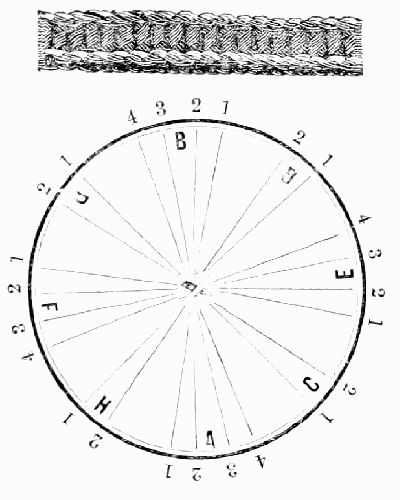
Take twenty-four strands, eighty
hairs in a strand, and place on table
like pattern. Commence at A, take
No. 1 in right hand, swing around
to the right and lay in place of No.
4 at B; then take No. 1 at B in
left hand, swing around table to the
left and lay in place of No. 4 at A;
then go to C, take No. 2 in right
hand, swing around the table to the
right and lay outside of No. 2 at D, and bring back No. 2 from D
to C; then take No. 1 at C in left hand, swing around the table to
the left and lay outside of No. 1 at D, and bring back No. 1 from
D to C; then go to E and change the Nos. at E and F the same as
you did at A and B; then change the Nos. at G and H the same
as you did at C and D. Then you are through the braid, ready to
commence at A, as at first.
Braid this over a small wire, with a hole in one end like the eye
of a needle, so as to draw a small cord in the place of the wire.
When you have it braided, take off your weights, tie the ends fast
on the wire, and push the braid together; then boil in water about
ten minutes, and then take out and put it in an oven as hot as it
will bear without burning, until it is quite dry; then take it out
and slip it off the wire and on the cord, and sew the ends so it will
not slip, and put a little shellac on the end to keep it fast. If you
want it elastic, use elastic cord. To vary the size of the braid,
vary the number of hairs in a strand.

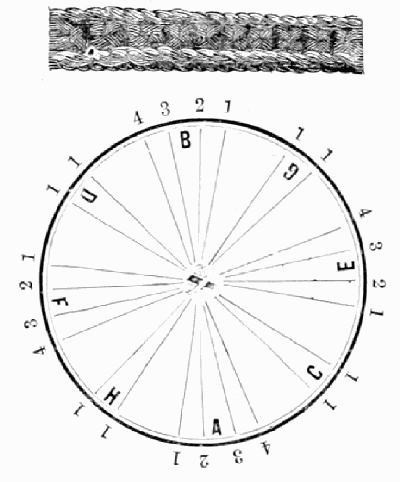
Take twenty-four strands, eighty
hairs in a strand, and place on table
like pattern. Commence at A, take
No. 1 in right hand, swing around
to the right and lay in place of No.
4 at B; then take No. 1 at B in
left hand, swing around table to the
left and lay in place of No. 4 at A;
then go to C, take Nos. 1 and lift
them across the table and lay in
between Nos. 1 at D, and bring back Nos. 1 from D to C; then go
to E, and change the Nos. at E and F the same as you did at A
and B; then go to G, and change the Nos. at G and H the same
as you did at C and D. Then you are through the braid, ready to
commence at A, as at first.
Braid this over a small wire, with a hole in one end like the eye
of a needle, so as to draw a small cord in the place of the wire.
When you have it braided, take off your weights, tie the ends fast
on the wire, and push the braid together; then boil in water about
ten minutes, and then take out and put it in an oven as hot as it
will bear without burning, until it is quite dry; then take it out
and slip it off the wire and on the cord, and sew the ends so it will
not slip, and put a little shellac on the end to keep it fast. If you
want it elastic, use elastic cord. To vary the size of the braid,
vary the number of hairs in a strand.

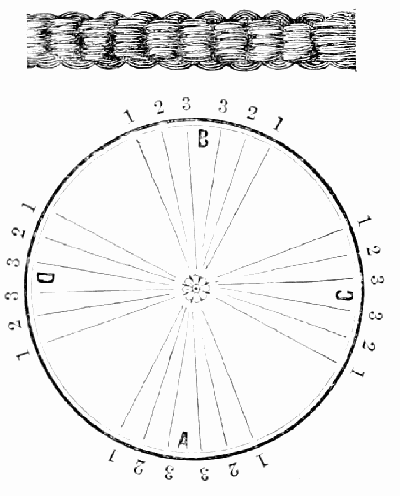
Take twenty-four strands, eighty
hairs in a strand, and place on table
like pattern. Commence at A, take
No. 1 at the left side of A in the
right hand, and No. 1 at the left of
B in the left hand, swing them
around the table to the right and lay
the one from B at the right of A,
and the one from A at the right of
B; then go to C, take No. 1 at the
left side of C in the right hand, and No. 1 at the left side of D in
the left hand, swing them around the table to the right, and lay
the one from C at the right of D, and the one from D at the right
of C; then go to B, take Nos. 3 and lift them across table and lay
between Nos. 3 at A, and bring back Nos. 3 from A to B; then
change Nos. 2 and 1 the same way; then go to C, take Nos. 3 and
lift across the table and lay between Nos. 3 at D, and bring back
Nos. 3 from D to C; then change Nos. 2 and 1 the same way.
Then you are through the braid, ready to commence as at first, at A.
For explanation see page 9.
Take twenty-four strands, eighty hairs
in a strand, and place on table
like pattern. Commence at A, take
Nos. 2 and lift across the table and
lay between Nos. 2 at B, and bring
back Nos. 2 from B to A; then
change Nos. 1 the same way; then
go to C, take Nos. 2 and lift them
across the table and lay between
Nos. 2 at D, and bring back Nos. 2
from D to A; then change Nos. 1 the same way; then go to E,
take Nos. 1 and 2 and lift them across the table to F, and lay No.
1 from E at the right of No. 1 at F, and No. 2 from E at the right
of No. 2 at F, and bring back the Nos. 1 and 2 from F to E; then
go to G and change the same from G to H as you did at E and F.
Then you are through the braid, ready to commence at A, as at
first.
Braid this over a small wire, with a hole in one end like the eye
of a needle, so as to draw a small cord in the place of the wire.
When you have it braided, take off your weights, tie the ends fast
on the wire, and push the braid together; then boil in water about
ten minutes, and then take out and put it in an oven as hot as it
will bear without burning, until it is quite dry; then take it out
and slip it off the wire and on the cord, and sew the ends so it will
not slip, and put a little shellac on the end to keep it fast. If you
want it elastic, use elastic cord. To vary the size of the braid,
vary the number of hairs in a strand.

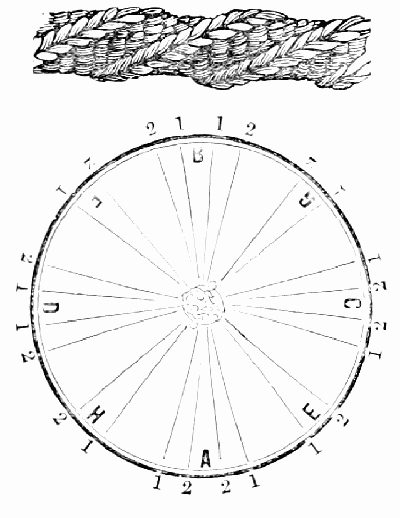
Take twenty-four strands, seventy
hairs in a strand, and place on table
like pattern. Commence at A, take
Nos. 1 cross over and lay between
Nos. 1 at B, and bring back Nos. 2
from B and lay between Nos. 2 at
A; then go to E, take Nos. 1 and 2
and cross over to F, and lay No. 1
down at the right of No. 1 at F, and
No. 2 at the right of No. 2 at F, and
and bring back Nos. 1 and 2 from F to E; then go to C, and
change the Nos. at C and D the same as you did at A and B; then
go to G, and change the Nos. at G and H the same as you did at
E and F. Then you are through the braid, ready to commence at
A, as at first.
Braid this over a small wire, with a hole in one end like the eye
of a needle, so as to draw a small cord in the place of the wire.
When you have it braided, take off your weights, tie the ends fast
on the wire, and push the braid together; then boil in water about
ten minutes, and then take out and put it in an oven as hot as it
will bear without burning, until it is quite dry; then take it out
and slip it off the wire and on the cord, and sew the ends so it will
not slip, and put a little shellac on the end to keep it fast. If you
want it elastic, use elastic cord. To vary the size of the braid
vary the number of hairs in a strand.

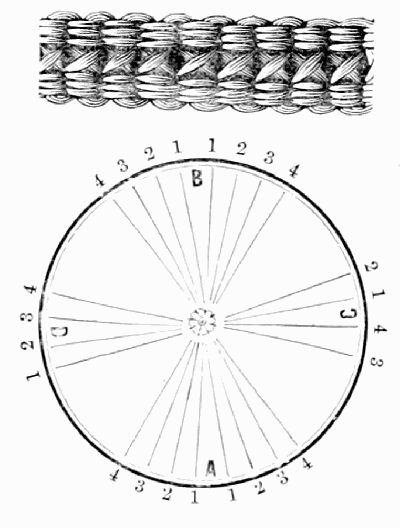
Take twenty-four strands, seventy
hairs in a strand, and place on table
like pattern. Commence at A, take
Nos. 1 and change places by crossing
one over the other; then go to
B and cross the Nos. 1 the same
way; then go back to A, take Nos.
1 and cross over and lay between
Nos. 1 at B, and bring back Nos. 1
from B to A; then take Nos. 2 at
A, and cross over and lay between
Nos. 2 at B, and bring back Nos. 2 from B to A; then change
Nos. 3 and 4 the same way; then go to C, take Nos. 1 and 2 and
cross over to D, and lay the No. 1 from C down at the left of No.
1 at D, and the No. 2 from C down at the left of No. 2 at D, and
bring back the Nos. 1 and 2 from D to C; then take the Nos. 3
and 4, cross over to D and lay the No. 3 from C down at the right
of No. 3 at D, and the No. 4 from C down at the right of No. 4 at
D, and bring back Nos. 3 and 4 from D to C. Then you are
through the braid, ready to commence at A, as at first.
For explanation see page 9.

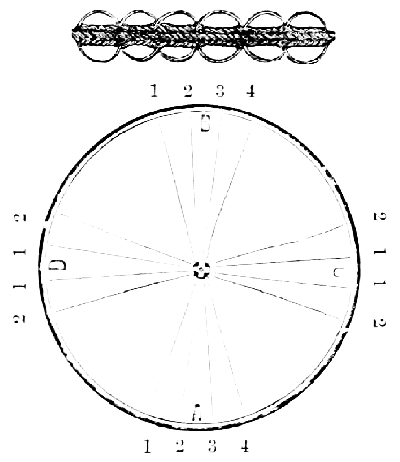
Take sixteen strands, twenty
hairs in a strand, and place on
table like pattern. Commence at A,
take Nos. 1 and 4 left across to B,
lay in place of Nos. 1 and 4 at B,
and bring back Nos. 1 and 4 from B
to A; then take No. 2 at A in right
hand and No. 3 in left hand, pass
right hand round table to the right
to B, and lay the No. 2 from A in
place of No. 3 at B, and bring back No. 2 from B to A in right
hand, and pass left hand round table to the left, and lay No. 3 from
A in place of No. 2 at B, and bring back No. 3 from B to A, and
lay No. 3 from B down at No. 2 at A, and lay No. 2 from B down
at No. 3 at A, then go to C and take Nos. 1 across over inside
of Nos. 1 at D, and bring back Nos. 1 from D to C; then go to A
and repeat this all three times; then the fourth time at C you
take Nos. 1 at C across over to D and lay outside of Nos. 2 at D,
bring back the Nos. 1 from D to C and lay them outside of Nos. 2
at C; then you are through the braid, ready to commence as at first
at A. Braid it over a small cord so as to put it up together.

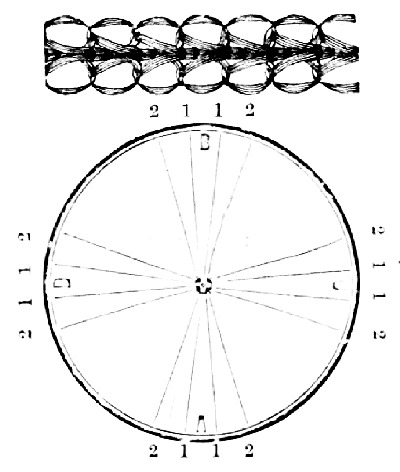
Take sixteen strands, twenty
hairs in a strand, and place on
table like pattern. Commence at A,
take Nos. 1 at A lift across inside
of Nos. 1 at B, and bring back Nos.
1 from B to A; then go to C, take
Nos. 1 at C lift across inside of
Nos. 1 at D, and bring back Nos. 1
from D to C; then commence at A
again and repeat it three times;
then commence at A, take Nos. 1 across to B and lay them outside
of Nos. 2 at B, and bring back Nos. 1 from B to A and lay outside
of Nos. 2 at A; then go to C and change from C to D the same
as from A to B; then you are through the braid, ready to commence
as at first.
Braid this over a small wire, with a hole in one end like the eye
of a needle, so as to draw a small cord in the place of the wire.
When you have it braided, take off your weights, tie the ends fast
on the wire and push the braid together on the wire; then boil in
water about ten minutes; then take it out and put in an oven as
hot as it will bear without burning, until it is quite dry; then take
it out and slip it off of the wire on to the cord, and sew the ends
of the braid so it will not slip on the cord, and put a little shellac
on the end to keep it fast. If you want it elastic, use elastic
cord. To vary the size of the braid, vary the number of hairs in
a strand.
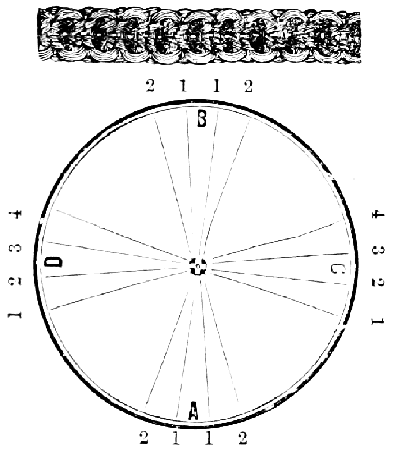
Take sixteen strands, twenty
hairs in a strand, and place on
table like pattern. Commence at A,
take Nos. 1 at A across over inside
of Nos. 1 at B, and bring back Nos.
1 from B to A; then take Nos. 2 at
A across over inside of Nos. 2 at B,
and bring back Nos. 2 from B to A;
then take No. 1 at C in right hand
and No. 1 at D in left hand and
change them, lay the No. 1 from C in place of No. 1 at D, and
lay the No. 1 from D in place of No. 1 at C; then change the Nos.
1 and 2 at A and B as at first; then change the Nos. 2 at C and
D, as you did the Nos. 1 at C and D; then change the Nos. 1
and 2, as before, at A and B; then take Nos. 3 at C and D and
change as you did the Nos. 2 at C and D; then change again
Nos. 1 and 2 at A and B as at first; then take the Nos. 4 at C
and D and change as you did the Nos. 3 at C and D; then you
are through the braid, ready to commence as at first.
Braid this without cord or wire.
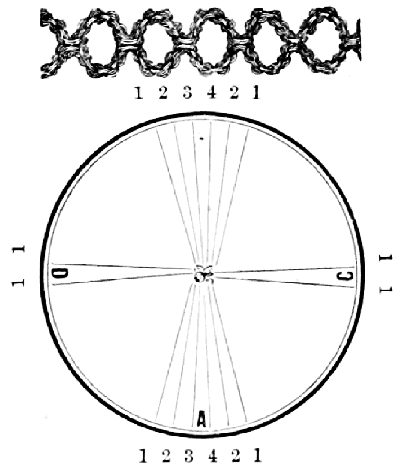
Take sixteen strands, twenty
hairs in a strand, and place on
table like pattern. Commence at A,
take Nos. 1 lift over to B in
place of Nos. 1 at B, and bring
back Nos. 1 from B to A; then
take Nos. 2 at A and change over
in place of Nos. 2 at B, and bring
back Nos. 2 from B to A; then
take No. 3 at A in right hand and
No. 3 at B in left hand, and lay them inside of Nos. 1 at D, and
bring back Nos. 1 from D and lay in place of Nos. 3 at A and B;
then take No. 4 at A in left hand and No. 4 at B in right hand,
and lay inside of Nos. 1 at C, and bring back Nos. 1 from C to A
and B, and lay in place of Nos. 4; then commence as at first and
repeat this three times, then take Nos. 1 at A, lift over to B in
place of Nos. 1 at B, and bring back Nos. 1 from B to A; then
take Nos. 2 at A and change over in place of Nos. 2 at B, and
bring back Nos. 2 from B to A; then take Nos. 3 at A and B, lay
inside of Nos. 1 at D; then take Nos. 4 at A and B, lay inside of
Nos. 1 at C; then take Nos. 2 at A and lay outside of Nos. 1 at
B, and bring back Nos. 2 from B and lay outside of Nos. 1 at A;
then take Nos. 1 at C, lift over inside of Nos. 1 at D and bring
back Nos. 1 from D and lay inside of Nos. 1 at C; then take No.
1 at C, on the side next to B, in right hand, and lay it inside of
No. 1 at B; then take the No. 1 at D, next to B, in left hand, and
lay it inside of No. 1 at B; then take the No. 1 at C, next to
A, in right hand, and lay it inside of No. 1 at A; then take No.
1 at D, next to A, and lay it inside of No. 1 at A; then take the
Nos. 3 and 4 at A, lift over to B, and lay outside of Nos. 1 at B,
and bring back Nos. 3 and 4 from B and lay outside of Nos. 1 at
A; then lift Nos. 2 at A over and lay in place of Nos. 2 at B,
and bring back Nos. 2 from B to A, and lay in place of Nos. 2 at
A; then take No. 4 at A, in left hand, and No. 4 at B in right
hand, and lay them inside of Nos. 1 at C, and bring the Nos. 1 from
C back in place of the Nos. 4 at A and B; then take No. 3 at B
in left hand, and No. 3 at A in right hand, and lay them inside
of Nos. 1 at D, and bring back Nos. 1 from D and lay in place of
Nos. 3 at A and B; then you are through the braid, ready to
commence as at first.
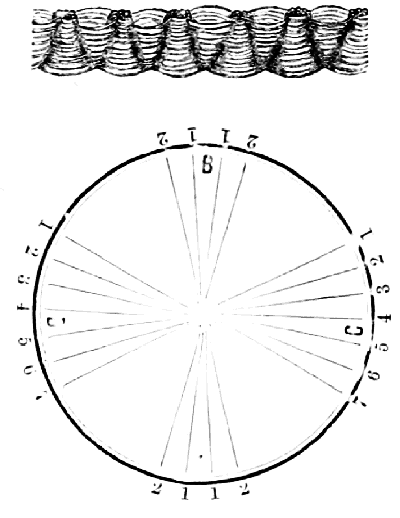
Take twenty-two strands, fifteen
hairs in a strand, and place on table
like pattern. Have the strands at
A and B black hair, and those at C
and D light hair. Commence at A,
take Nos. 1 and cross over inside of
Nos. 1 at B, and bring back Nos. 1
from B and lay in place of Nos. 1
at A, then take Nos. 2 at A, cross
over inside of Nos. 2 at B, and
bring back Nos. 2 from B and lay inside
of Nos. 2 at A; then take No. 1 at C in right hand, and No.
1 at D in left hand, cross over and lay the No. 1 from C at D, and
the No. 1 from D at C; then change the Nos. 1 and 2 at A and B
as at first; then take the Nos. 2 at C and D and change them as
you did the Nos. 1; then change again at A and B as at first; then
take the Nos. 3 at C and D, and change as you did the Nos. 2;
then change again at A and B, and so on till you get to Nos. 7, and
after changing that, change again at A and B; then change Nos.
7 again, then those at A and B, then Nos. 6, then at A and B,
then Nos. 5, and so on back to No. 1, and change No. 1 there as
you did Nos. 7. Always braid those at A and B between each of
those at C and D.
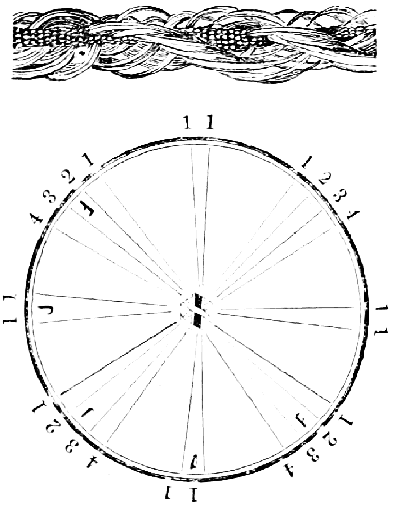
Take 24 strands, twenty-five hairs
in a strand, and place on table like
this pattern. Commence at A, take
Nos. 1 lift across inside of Nos. 1
at B, and bring back Nos. 1 from
B to A, then go to C and take Nos.
1 at C and cross inside of Nos. 1 at
D, and bring back Nos. 1 from D to
C, then go to A and change Nos. 1
from A to B, as at first, then take
Nos. 1 at E and F and swing round table with the same, and lay
down in between Nos. 1 at A and B, and lay the No. 1 at A and
B in the place of No. 4 at E and F, then change the Nos. 1 at C
across inside of Nos. 1 at D, and bring back Nos. 1 from D to C,
then change Nos. 1 at A and B the same, then the Nos. 1 at C
and D again, then take Nos. 1 at H and G, swing round table
with the same, and lay in between Nos. 1 at C and D, and lay the
right hand ones at C and D up in place of No. 4 at H and G, then
you are through the braid ready to commence as at first. Braid
it over a cord so to push it together.

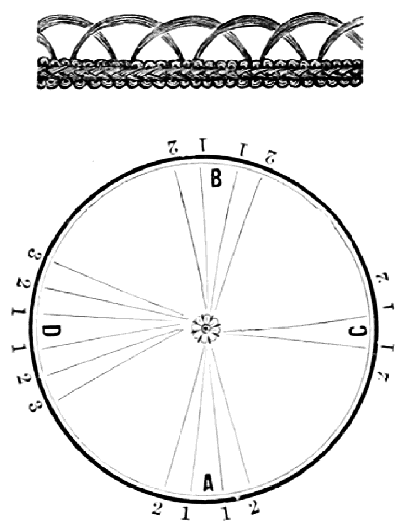
Take sixteen strands, fifteen hairs
in a strand, and place on table like
pattern. Commence at A, lift Nos.
2 across inside of Nos. 2 at B, and
bring back Nos. 2 from B to A;
then take Nos. 1 at A, lift across
inside of Nos. 1 at B, and cross
them, the one in right hand over the
left, and bring back Nos. 1 from B
to A, and cross the right over the
left; then go to D, lift Nos. 1 across
inside of Nos. 1 at C, cross the right over the left, and bring back
Nos. 1 from C to D, and cross the right over the left; then repeat
all from the beginning three times round the table. Then go to
D, lift Nos. 3, cross the right over the left, and lay them outside
of Nos. 1 at C; then go to A, lift Nos. 2 across inside of Nos. 2
at B, and bring back Nos. 2 from B to A; then take Nos. 1 at A,
lift across inside of Nos. 1 at B, cross the right over the left, and
bring back Nos. 1 from B to A, and cross them; then go to D, lift
Nos. 1 across inside of Nos. 1 at C, cross the right over the left,
and bring back Nos. 1 from C to D; then take Nos. 3 at C, and
lay inside of Nos. 2 at D, and leave them there. Then you are
through the braid, ready to commence at A, as at first.
See explanation on page 9.
Take twenty-four strands, eighty
hairs in a strand, and place on table
like pattern. Commence at A, lift
Nos. 1 and 2 across inside of Nos. 1
and 2 at B, and bring back Nos. 1
and 2 from B to A; then go to C,
lift Nos. 1 and 2 across inside of
Nos. 1 and 2 at D, and bring back
Nos. 1 and 2 from D to C; then go
to A and change the Nos. 1 and 2
from A to B the same as at first;
then take Nos. 1 at E and F, swing
round table to the left, and lay them down between Nos. 1 and
2 at A and B; then lay the Nos. 2 at A and B in place of
Nos. 4 at E and F; then change the Nos. 1 and 2 at C across
inside of Nos. 1 and 2 at D, and bring back Nos. 1 and 2 from D
to C; then change the same at A and B; then change again at C
and D the same; then take Nos. 1 at H and G, swing round table
to the left, and lay them between Nos. 1 and 2 at C and D, and
lay the Nos. 2 at C and D in place of Nos. 4 at H and G. Then
you are through the braid, ready to commence at A, as at first.
Braid it over a strong cord, and when braided push it close
together, tie the ends, and boil in water five minutes; then heat it
in an oven until it is quite dry, and it is ready for use.
Take thirteen strands, fifteen hairs
in a strand, and place on table like
pattern. Commence at A, lift No.
5 over between Nos. 2 and 3 at A;
then take No. 1 at A, and lift over
between Nos. 2 and 3 at B; then
take No. 1 at B, and lift over
between Nos. 2 and 3 at C; then
lift No. 1 at C over between Nos. 2
and 3 at C; then lift No. 4 at C
over between Nos. 2 and 3 at B; then lift No. 4 at B over between
Nos. 2 and 3 at A. Then you are through the braid, ready to
commence as at first, and repeating until it is the required length.
Then tie it out straight on a flat stick, boil it in water five minutes,
then heat it in an oven as hot as it will bear without burning, until
it is quite dry, and then it is ready for use.
The above directions, after braiding, will suffice for finishing all
Ring Braids, unless other directions are given.
Take twenty-four strands, twenty
hairs in the strands at C and D, and
ten hairs in the strands at A and
B, and place on table like pattern.
Commence at A, take Nos. 1 and
lift across table and lay inside of
Nos. 1 at B, and bring back Nos. 2
from B and lay outside of Nos. 2 at
A; then go to C, take Nos. 1, cross
over and lay in between Nos. 1 at
D, and bring back Nos. 1 from D to C; then take Nos. 3 at C,
cross inside of Nos. 3 at D, and bring back Nos. 3 from D to C;
then take Nos. 4 at C, cross over inside of Nos. 4 at D, and bring
back Nos. 4 from D to C; then commence at A, and change them
at A and B as at first; then go to C and commence with the Nos.
2. You must leave the Nos. 1 every other time and the Nos. 2
every other time, and braid it as at first.

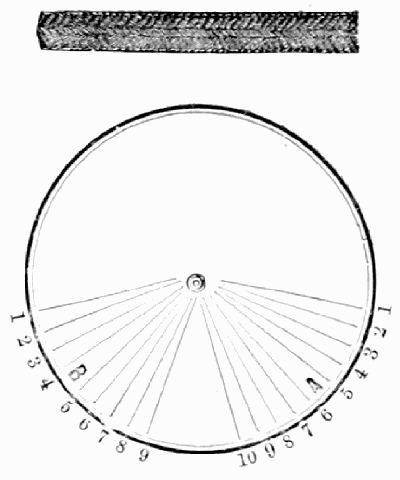
Take nineteen strands, twenty hairs
in a strand, and place on table like
pattern. Commence at A, take No.
1 and lift over Nos. 2 and 3, under
4 and 5, over 6, 7, 8, 9 and 10, and
lay over to B; then take No. 1 at
B, lift over Nos. 2 and 3, under 4
and 5, over 6, 7, 8, 9 and 10, and
lay over to A; then you are through
the braid, ready to commence at A,
as at first,—first round to the left, and then to the right, and so
on, repeating the changes as above, until the braid is finished.
Then tie it out straight on a flat stick, boil in water five minutes,
then heat it in an oven as hot as it will bear without burning until
it is quite dry, and then it is ready for use.

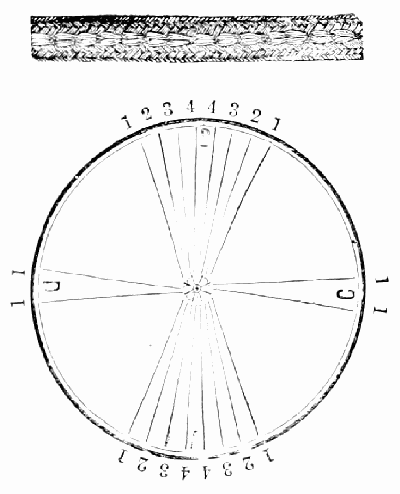
Take twenty strands, twenty hairs
in a strand, and place on table like
pattern. Commence at A, take the
Nos. 1 and lift across the table and
lay in place of Nos. 1 at B, and
bring back Nos. 1 from B to A;
then take the Nos. 2, 3 and 4, and
change the same; then go to C, take
the Nos. 1 and lift across the table
and lay in place of Nos. 1 at D, and
bring back Nos. 1 from D to C; then commence again at A, take
Nos. 1 and lift over the table and lay in the place of Nos. 1 at B,
and bring back the Nos. 1 from B to A; then change the Nos. 2
and 3 the same as the Nos. 1; then go to C and change the Nos.
1 over in the place of Nos. 1 at D, and bring back the Nos. 1 from
D to C; then go to A, and take the Nos. 1, 2 and 3, and change
the same as before; then go to C and change the same as before.
Then you are through the braid ready to commence at A, as at
first, and repeat until the braid is finished.

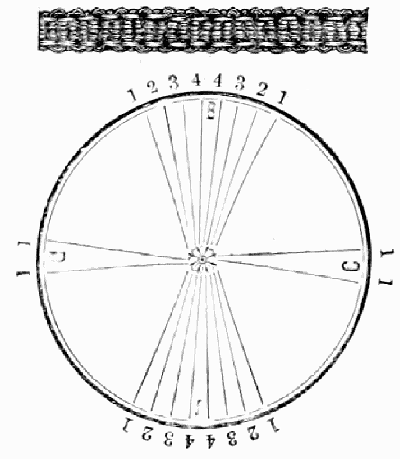
Take twenty strands, twenty hairs
in a strand, and place on table like
pattern. Commence at A, take Nos.
1 and lift over across the table, and
lay in place of Nos. 1 at B, and
bring back Nos. 1 from B and lay
in place of Nos. 1 at A; then take
Nos. 2, 3 and 4, and change their
places the same as Nos. 1; then go
to C, take Nos. 1 and lift over across the table and lay in place of
Nos. 1 at D, and bring back Nos. 1 from D to C; then go to A,
take Nos. 1 and lift them over the table and lay in place of Nos. 1
at B, and bring back Nos. 1 from B to A; then take Nos. 3 and 4
and change the same; then go to C, take Nos. 1 and lift them over
the table and lay in place of Nos. 1 at D, and bring back Nos. 1
from D to C. Then you are through the braid, ready to commence
at A, as at first, and repeat the changes until the braid is finished.
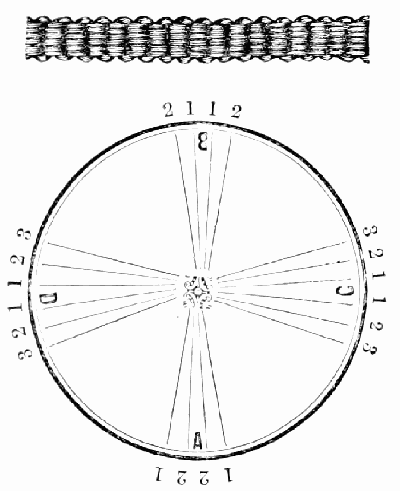
Take twenty strands, fifteen hairs in
a strand, and place on table like
pattern. Commence at A, take
Nos. 1, lift across to B, and lay
inside of Nos. 1, and bring back
Nos. 2 from B and lay in between
Nos. 2 at A; then go to C, take
Nos. 1 and lift over inside of Nos. 1
at D, and bring back Nos. 1 from
D to C; then take Nos. 2 at C, and
cross over inside of Nos. 2 at D, and bring back Nos. 2 from D to
C; then take Nos. 3 at C, cross over inside of Nos. 3 at D, and
bring back Nos. 3 from D to C; then commence again at A, as at
first, and repeat until it is braided the desired length.
When the braid is finished, tie it out straight on a flat stick, boil
in water five minutes, and heat in an oven until perfectly dry, and
then it is ready for use.

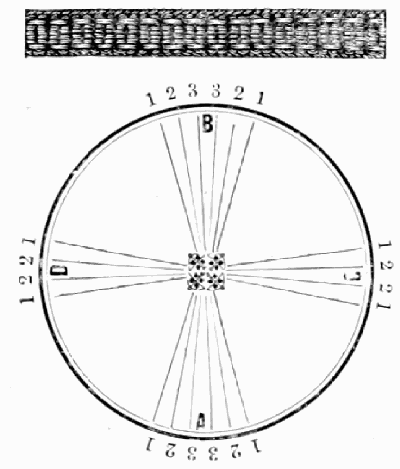
Take twenty strands, twenty hairs
in a strand, and lay on table like
pattern. Commence at A, take Nos.
1 and lift over table and lay in place
of Nos. 1 at B, and bring back Nos.
1 from B to A; then take Nos. 2
and change the same; then the Nos.
3, and change the same; then go to
C, take the Nos. 2 and lay outside
of the Nos. 1; then go to D, and
take the Nos. 2 and lay outside of the Nos. 1; then go to C, and
take Nos. 2 and lift over table and lay in place of Nos. 2 at D,
and bring back the Nos. 2 from D to C; then go to A, take Nos.
1 and lift across the table and lay in place of Nos. 1 at B, and bring
back Nos. 1 from B to A; then take Nos. 3 at A, and lift across
table in place of Nos. 3 at B, and bring back Nos. 3 from B to A;
then go to C, take Nos. 2 and lay outside of Nos. 1; then go to D,
take Nos. 2 and lay outside of Nos. 1; then go to C, take Nos. 2
and lift over table in place of Nos. 2 at D, and bring back Nos. 2
from D to C. Then you are ready to commence at A, as at first,
and repeat until finished.
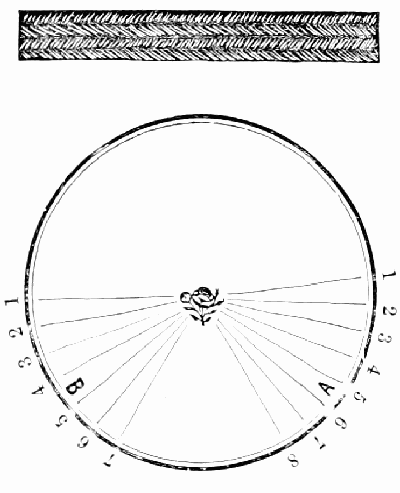
Take fifteen strands, twenty hairs
in a strand, and place on table like
pattern. Commence at A, by taking
No. 1 and lifting it over Nos. 2, 3
and 4, under Nos. 5, 6, 7 and 8, and
pass it over to B; then take No. 1
at B, lift over Nos. 2, 3 and 4,
under 5, 6, 7 and 8, and pass it over
to A; then you are through, ready
to commence at A, as at first, and
repeat until the braid is finished,—first round to the left, and then
round to the right.
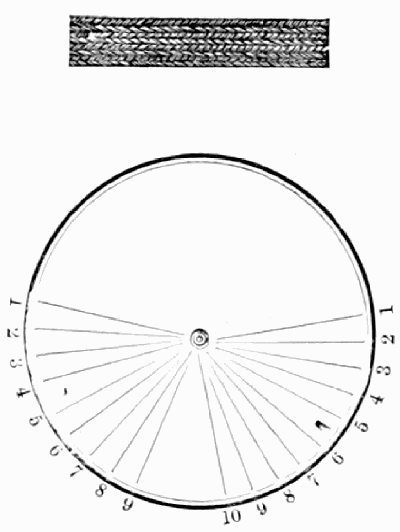
Take nineteen strands, ten hairs in
a strand, and place on table like
pattern. Commence at A, take No.
1 and lift over Nos. 2, 3 and 4,
under 5 and 6, over 7 and 8, under
9 and 10, and pass it over to B;
then take No. 1 at B, and lift over
Nos. 2, 3 and 4, under 5 and 6, over
7 and 8, under 9 and 10, and lay it
over to A; then go to A and commence
at No. 1, as at first, and
repeat over and over, first to the left and then to the right, and so
on, until the braid is finished. Then tie it out straight on a flat
stick, boil in water five minutes, and heat it in an oven as hot as it
will bear without burning, until it is quite dry, and then it is ready
for use.
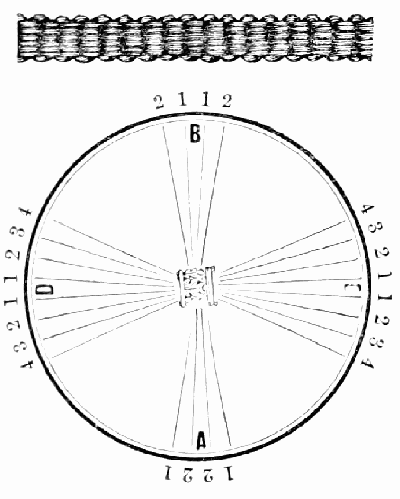
Take twenty-four strands, and place
on table like pattern. Commence
at A, take Nos. 1 and lift across
inside of Nos. 1 at B, and
bring back Nos. 2 inside of Nos.
2 at A; then go to C, and take
Nos. 1 and cross over inside of
Nos. 1 at D, and bring back Nos. 1
from D to C; then take Nos. 2 at
C, and cross over inside of Nos. 2
at D, and bring back Nos. 2 from D to C; then take Nos. 3
at C, and cross over inside of Nos. 3 at D, and bring back
Nos. 3 from D to C; then take Nos. 4 at C, and cross over
inside of Nos. 4 at D, and bring back Nos. 4 from D to C; if
you wish to reverse every other time, you may leave the Nos. 1
and not braid them; then you are ready to commence at A as
at first.
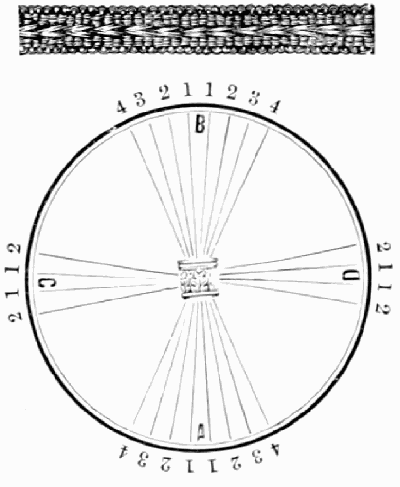
Take twenty-four strands, sixteen
hairs in a strand, and place on the
table like pattern. Commence at A,
take Nos. 1 and cross over to B, lay
in between Nos. 1 at B, and bring
back Nos. 1 from B and lay in place
of Nos. 1 at A; then take Nos. 2 at
A, and change them the same way;
then Nos. 3 the same; then Nos. 4
the same. Then take Nos. 1 at C and
D, and lift over Nos. 2; then lift Nos. 1 at C over in place of Nos.
1 at D, and bring back Nos. 1 from D to C; then go to A, and
take Nos. 2, cross over between Nos. 2 at B, and bring back Nos.
2 from B to A; then take Nos. 3 and change the same way; then
take Nos. 4 and change the same. Then go to C and D, and lift
Nos. 1 over Nos. 2, and then lift Nos. 1 at C over and lay in
place of Nos. 1 at D, and bring back Nos. 1 from D and lay in
place of Nos. 1 at C; then you are ready to commence as at first,
at A, and repeat until the braid is finished. You will place
double weight on the strands at C and D.
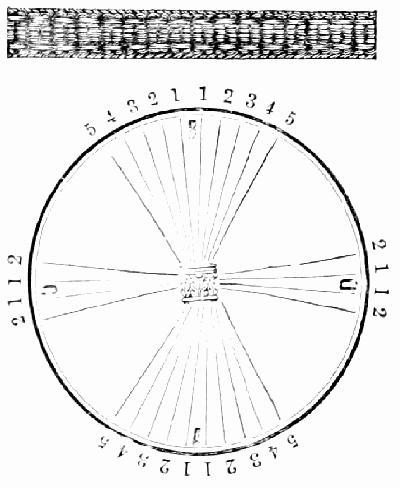
Take twenty-eight strands, of twelve
hairs, and place on table like pattern.
Commence at A, take Nos. 1
and cross over the table and lay in
place of Nos. 1 at B, and bring back
Nos. 1 from B to A; then change
the Nos. 2 the same. Then take
Nos. 4 at A, and lift over the table
in place of Nos. 4 at B, and bring
back Nos. 4 from B to A; then take
Nos. 5 and change the same way. Then go to C and D, and lift
the Nos. 1 over the Nos. 2; then take Nos. 1 at C, and lift them
over the table inside of Nos. 1 at D, and bring back the Nos. 1
from D and lay in place of Nos. 1 at C; then go to A, and take
Nos. 1 and cross over in place of Nos. 1 at B, and bring back Nos.
1 from B to A; then take Nos. 2, 3, 4 and 5, and change all the
same. Then go to C and D, and lift Nos. 1 over Nos. 2; then lift
Nos. 1 at C over the table, and lay them inside of Nos. 1 at D, and
bring back Nos. 1 from D to C. Then you are through the braid,
ready to commence at A, as at first, and repeat until the braid is
finished. Place extra weight on the strands at C and D.

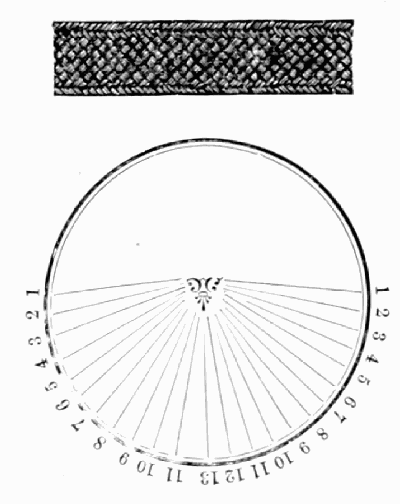
Take twenty-four strands, twenty
hairs in a strand, and place on table
like pattern, thirteen on the right
side and eleven on the left. Take
No. 1 at right hand, lift over Nos. 2
3 and 4, and under Nos. 5 and 6,
and over No. 7; then take No. 1
again, in right hand, and lift over
Nos. 2 3 and 4, and under Nos. 5
and 6; then take the same two that
you have braided along, and lift over two strands, and under two,
till you get to the center; then pass the same two strands across
to the left side, and lay them down next to No. 11; then commence
on the left side with No. 1, and braid the left side as you
did the right; then the braid is through, ready to commence as at
first, with No. 1 at right hand, and so on. Repeat till finished.
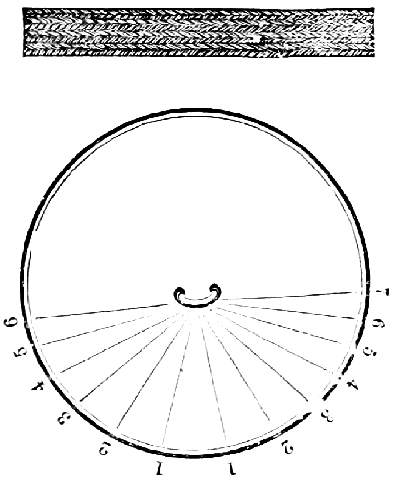
Take thirteen strands, twelve hairs
in a strand, and place on table like
pattern. Commence by lifting No.
7 over Nos. 6 and 5, and under Nos.
4 and 3, and over Nos. 2 and 1, and
lay it next to No. 1 on the left side,
making seven on the left side; then
commence on the left side, take the
outside one and braid it into the
middle, over two and under two,
till you get to the center, and lay it across on the opposite side;
then you are through with the braid, and ready to commence as at
first, with the No. 7 at right hand. You can have any odd number
of strands you please.
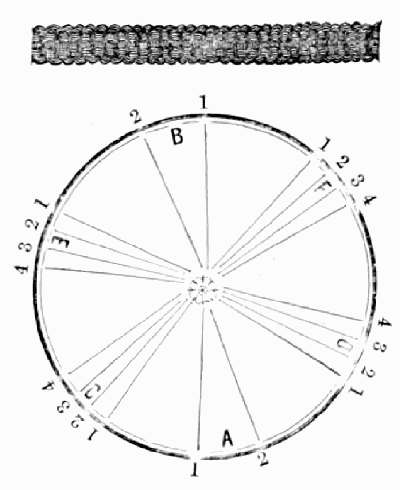
Take twenty strands, ten hairs in a
strand, and lay on table like pattern.
Commence at A, take No. 2 in right
hand and swing it round the table
to the right, and lay it across No. 2
at B, and bring back No. 2 from B
to A; then take No. 1 at A in left
hand, and swing it round the table
to the left, and lay it across No. 1
at B, and bring back No. 1 from B
to A. Then commence at C and D; take No. 1 at C in left hand,
and No. 1 at D in right hand, and change places with them by
passing the left hand over the right; then take Nos. 2 at C and D,
and change the same way; then take Nos. 3 and change the same
way; then take Nos. 4 and change the same way. Then go to B,
and change the Nos. 1 at E and F as you did at C and D, by commencing
at Nos. 1 first, then the Nos. 2, 3 and 4, in succession.
Then you are through the braid, ready to commence as at first, at
A. Braid it over a small wire.

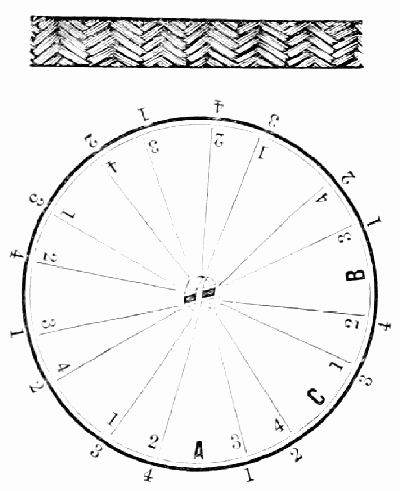
Take any number of strands that can
be divided by four,—sixty being the
usual number—fifteen hairs in a
strand, and place on table like pattern.
Commence at A, with the
inside row of figures, lift No. 3
over No. 2, and Nos. 1 and 3 over
Nos. 2 and 4, and so on round table
to the left, till you get to A; then
go to C, braid to the left, lift Nos.
1 and 2 over Nos. 3 and 4, and so on round to A; then commence
at A and braid round to the right; lift No. 2 over No. 3, and Nos.
3 and 4 over Nos. 2 and 1, and so on round table to A; then go
to C, braid round to the right, and lift Nos. 2 and 4 over Nos. 3
and 1, and so on round to A. Then you are through the braid,
ready to commence as at first.
Braid this over a round stick, the size you want the braid for
use, varying the number of strands according to the size of the
stick; then slip the braid from the stick on to the mold you wish
to use, tying it so it will fit the mold exactly, and then boil in water
five minutes, and take it out and put it in an oven as hot as it will
bear without burning, until it is quite dry. Then it is ready for use.

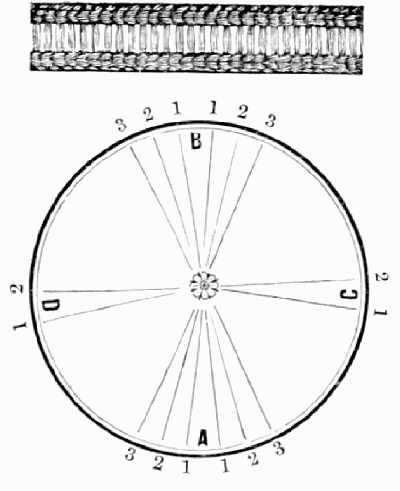
Take sixteen strands, thirty hairs in
a strand, and place on the table like
pattern. Commence at A, take the
Nos. 1 and 2 and lay them over Nos.
3 right and left; then lay the Nos.
1 at A over Nos. 1 at C and D, and
bring back the Nos. 1 from C and
D and lay outside of Nos. 3 at A;
then lay the Nos. 2 at A over Nos.
1; then go to B and repeat the
same as at A, only change the Nos. 1 at B with the Nos. 2 at C,
instead of the Nos. 1 at C; then lift the Nos. 1 at A over and lay
between Nos. 1 at B, and bring back Nos. 1 from B to A; then go to
C and lift Nos. 1 and 2 over between Nos. 1 and 2 at D, and bring
back the Nos. 1 and 2 from D to C. Then you are through the
braid, ready to commence at A, as at first. Braid this over a
small wire, and place double weight on the strands at C and D, and
Nos. 1 at A and B.

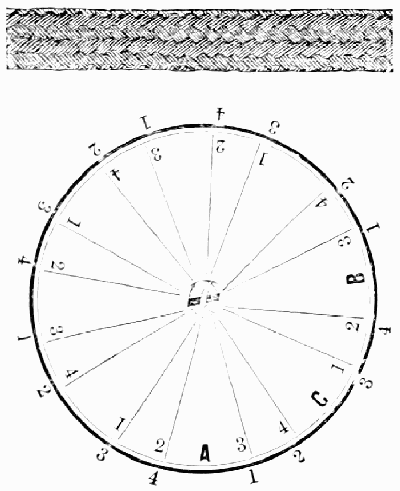
Take any number of strands that can
be divided by four,—forty being the
usual number for this braid—twelve
hairs in a strand, and place on table
like pattern. Commence at A, with
the inside row of figures, and lift
No. 3 over No. 2; then No. 1 over
No. 2; then No. 4 over Nos. 3 and
2; then go to B and change the
same way, and so on round the table
to A. Then go to C, commence with the outside row of figures,
and braid round to the left; lift No. 2 over No. 3; then No. 3 over
No. 4; then No. 2 over No. 1; then No. 2 over No. 3, and so on
round the table to A; then you will be through the braid, ready to
commence as at first.
Braid this over a round stick, the size you want the braid for
use, varying the number of strands according to the size of the
stick; then slip the braid from the stick on to the mold you wish
to use, tying the braid so it will fit the mold exactly, and then boil
in water five minutes, and take it out and put it in an oven, as hot
as it will bear without burning, until it is quite dry. Then it is
ready for use.

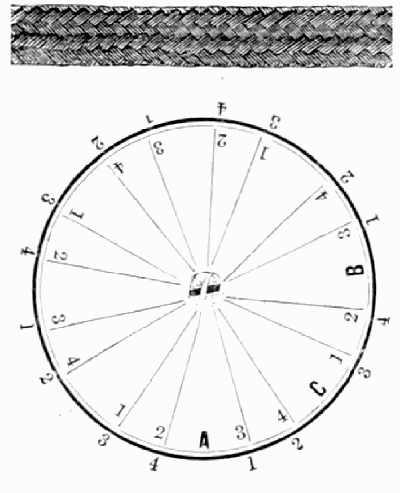
Take any number of strands that can
be divided by four,—forty being the
usual number for this braid—fifteen
hairs in a strand, and place on table
like pattern. Commence at A, with
the inside row of figures, lift No. 2
in right hand, and put your left
hand under the right hand, and take
Nos. 3 and 4 and bring them back,
and cross them over No. 1, and lay
them all down; then go to B, and change the same way, and so on
round the table to A. Then go to C, commence with the outside
row of figures, and braid round to the left; lift No. 3 in left hand,
and put your right hand under the left hand and take Nos. 1 and
2, bring them back, cross them over No. 4, and lay them all down,
and so on round the table to A; then you will be through the
braid, ready to commence as at first.
Braid this over a round stick, the size you want the braid for
use, varying the number of strands according to the size of the
stick; then slip the braid from the stick on to the mold you wish
to use, tying the braid so it will fit the mold exactly, and then boil
in water five minutes, and take it out and put it in an oven, as hot
as it will bear without burning, until it is quite dry. Then it is
ready for use.

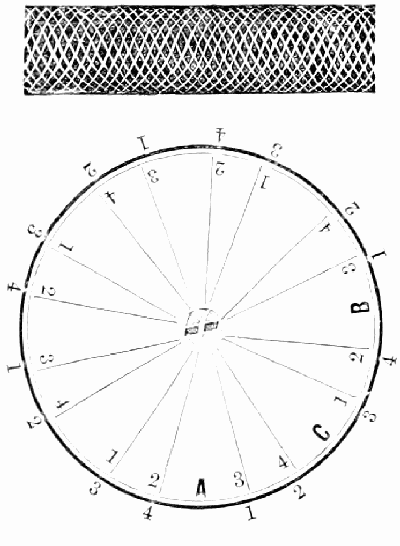
Take any number of strands that
can be divided by four—sixty being
the usual number for this braid—fifteen
hairs in a strand, and place
on table like pattern. Commence
at A, with the inside row of figures,
and braid round table to the right;
lift No. 1 over No. 2, and No. 4
over Nos. 3 and 2; then repeat
with the same strands, the No. 1
over No. 2, and No. 4 over Nos. 3 and 2. Then go to B and braid
the same, and so on round table to A. Then go to C, commence
with the outside row of figures, and braid round table to the left;
lift No. 1 over No. 2, and No. 4 over Nos. 3 and 2; then repeat
with the same strands, the same as you did at A and B, and so on
round table to A. Then you are through the braid, ready to
commence as at first. After it is braided turn the braid inside out.
Braid this over a round stick, the size you want the braid for
use, varying the number of strands according to the size of the
stick; then slip the braid from the stick on to the mold you wish
to use, and push it tight together, tying it so it will fit the mold
exactly, and then boil in water five minutes, and take it out and
put it in an oven as hot as it will bear without burning, until it is
quite dry. Then it is ready for use.

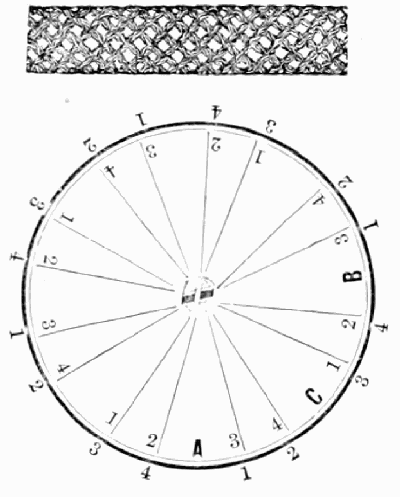
Take any number of strands that
can be divided by four—sixty being
the usual number for this braid—fifteen
hairs in a strand, and place
on table like pattern. Commence
at A, with the inside row of figures;
and braid round table to the right;
cross No. 4 over No. 3, and No. 1
over Nos. 2 and 3; then repeat with
the same strands. Then go to B,
and braid the same, and so on round table to the right, until you get
to A. Then go to C, and braid back round table to the left, by
crossing No. 2 over No. 1, and No. 3 over No. 4, and No. 2 over
No. 3; then repeat with the same strands, and so on round table
till you get to A. Then you are through the braid, ready to
commence as at first.
Braid this over a round stick, the size you want the braid for
use, varying the number of strands according to the size of the
stick; then slip the braid from the stick on to the mold you wish
to use, and push it tight together, tying it so it will fit the mold
exactly, and then boil in water five minutes, and take it out and
put it in an oven as hot as it will bear without burning, until it is
quite dry. Then it is ready for use.

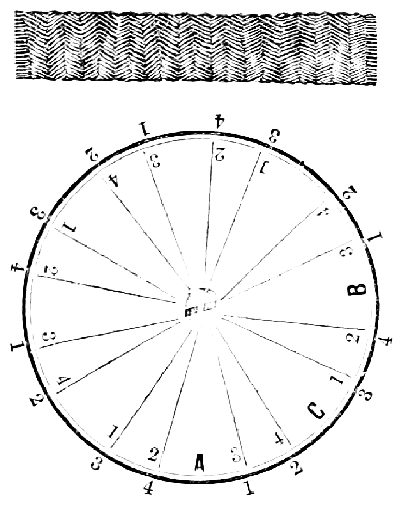
Take any number of strands that can
be divided by four,—sixty being the
usual number—fifteen hairs in a
strand, and place on table like pattern.
Commence at A, with the
inside row of figures, lift No. 3 over
No. 2, and Nos. 1 and 3 over Nos.
2 and 4; then go to B, and braid
the same to the left until you get to
A; then commence at C, with the
outside row of figures, and braid round table to the left again; lift
Nos. 1 and 2 over Nos. 3 and 4, and so on round table till you get
to A. Then commence with the inside row of figures at A, and lift
No. 2 over No. 3, and Nos. 2 and 4 over Nos. 3 and 1; then go to
B, and braid the same to the right, and so on round table to A;
then commence at C with the outside row of figures, and braid
round to the right, lift Nos. 3 and 4 over Nos. 2 and 1, and so on
round table to A; then you are through the braid, ready to commence
as at first. Be sure and braid the first two times round table
to the left, and the last two to the right.
Braid this over a round stick, the size you want the braid for
use, varying the number of strands according to the size of the
stick; then slip the braid from the stick on to the mold you wish
to use, tying it so it will fit the mold exactly, and then boil in water
five minutes, and take it out and put it in an oven as hot as it will
bear without burning, until it is quite dry. Then it is ready for use.
To have it elastic use elastic cord.

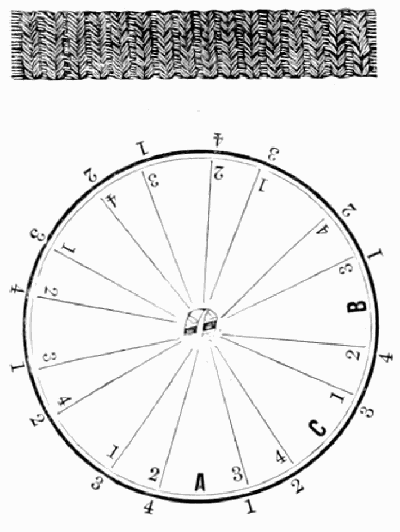
Take any number of strands that can
be divided by four,—sixty being the
usual number—fifteen hairs in a
strand, and place on table like pattern.
Commence at A, with the
inside row of figures, lift No. 3
over No. 2, and No. 1 over No. 2,
then No. 4 over Nos. 3 and 2;
then go to B and change the same
to the left, and so on round table
to A; then go to C, braid to the
left with the outside row of figures, lift Nos. 3 and 4 over Nos. 1
and 2, and so on round to A. Then commence again at A and
braid round to the right; lift No. 2 over No. 3, then No. 2 over
No. 1, and Nos. 2 and 3 over No. 4, and so on round table to A;
then commence at C and braid to the right, lift Nos. 1 and 2 over
Nos. 3 and 4, and so on round to A. Then you are through the
braid, ready to commence as at first.
Braid this over a round stick, the size you want the braid for
use, varying the number of strands according to the size of the
stick; then slip the braid from the stick on to the mold you wish
to use, tying it so it will fit the mold exactly, and then boil in water
five minutes, and take it out and put it in an oven as hot as it will
bear without burning, until it is quite dry. Then it is ready for use.

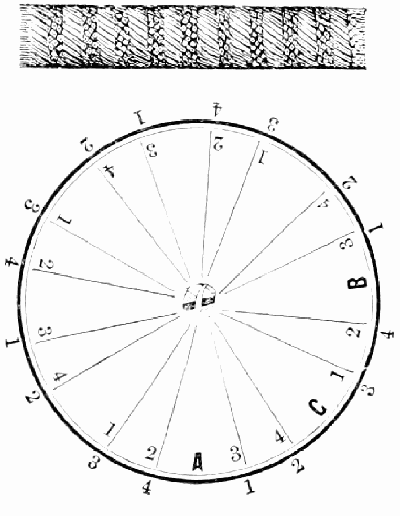
Take any number of strands that can
be divided by four,—sixty being the
usual number—fifteen hairs in a
strand, and place on table like pattern.
Commence at A, with the
inside row of figures, lift No. 3
over No. 2, and No. 1 over No. 2,
then No. 3 over No. 4, and No. 3
over No. 2; braid round table to
the left till you get to A, then repeat
the same at C with the outside row of figures. After braiding the
second time round, commence again at A, with the inside row of
figures, and braid round to the right; lift Nos. 3 and 4 over Nos.
1 and 2, and so on round to A; then repeat, at C, with the outside
row of figures. Then you are through the braid, ready to commence
as at first.
Braid this over a round stick, the size you want the braid for
use, varying the number of strands according to the size of the
stick; then slip the braid from the stick on to the mold you wish
to use, tying it so it will fit the mold exactly, and then boil in water
five minutes, and take it out and put it in an oven as hot as it will
bear without burning, until it is quite dry. Then it is ready for use.
Take any number of strands that can
be divided by four,—sixty being the
usual number—fifteen hairs in a
strand, and place on table like pattern.
Commence at A, with the
inside row of figures, lift No. 1
over No. 2, No. 4 over No. 3, No. 1
over No. 2, and No. 4 over No. 3;
then No. 3 over No. 2, No. 1 over
No. 2, and No. 4 over Nos. 2 and 3.
Braid round table to the left till you
get to A, then repeat the same at C, only braid the outside row
of figures. Then you are through the braid, ready to commence
as at first.
Braid this over a round stick, the size you want the braid for
use, varying the number of strands according to the size of the
stick; then slip the braid from the stick on to the mold you wish
to use, tying it so it will fit the mold exactly, and then boil in water
five minutes, and take it out and put it in an oven as hot as it will
bear without burning, until it is quite dry. Then it is ready for use.
Take any number of strands that can
be divided by four,—eighty being
The usual number for this braid—four
hairs in a strand, and place on
table like pattern. Commence at
A, with the inside row of figures,
lift No. 2 over No. 3; then No. 2
over No. 1; then No. 2 over No. 3;
then Nos. 2 and 3 over No. 4; then
No. 2 over No. 1. Then go to B
and change the same way, and so on round the table to A. Then
go to C, and commence with the outside row of figures, and change
the same as you did at A, and so on round the table, when you will
be through the braid, ready to commence at A, as at first.
Braid this over a round stick, the size you want the braid for
use, varying the number of strands according to the size of the
stick; then slip the braid from the stick on to the mold you wish
to use, tying the braid so it will fit the mold exactly, and then boil
in water five minutes, and take it out and put it in an oven, as hot
as it will bear without burning, until it is quite dry. Then it is
ready for use.
Take any number of Strands that can
be divided by four,—eighty being
the usual number for this braid—four
hairs in a strand, and place on
table like pattern. Commence at
A, with the inside row of figures,
lift No. 1 over Nos. 2, 3 and 4;
then No. 3 over Nos. 2 and 1; then
No. 2 over Nos. 3 and 4; then No.
2 over No. 1. Then go to B and
change the same, and so on round the table to A. Then go to C,
and commence with the outside row of figures, and change the same
as you did at A, and so on round the table, when you will be
through the braid, ready to commence at A, as at first.
Braid this over a round stick, the size you want the braid for
use, varying the number of strands according to the size of the
stick; then slip the braid from the stick on to the mold you wish
to use, tying the braid so it will fit the mold exactly, and then boil
in water five minutes, and take it out and put it in an oven, as hot
as it will bear without burning, until it is quite dry. Then it is
ready for use.
Take any number of strands that
can be divided by four,—sixty
being the usual number—fifteen
hairs in a strand, and place on
table like pattern. Commence at
A, with the inside row of figures,
lift No. 3 over No. 2, No. 3 over
No. 4, No. 1 over No. 2, No. 3
over No. 2, and so on round the
table to the left to A; then commence
at C, lift No. 3 over No. 2,
No. 3 over No. 4, No. 1 over No. 2, No. 3 over No. 2, No. 1 over
No. 2 and No. 3 over No. 4. Then you are through the braid,
ready to commence as at first.
Braid this over a round stick, the size you want the braid for
use, varying the number of strands according to the size of the
stick; then slip the braid from the stick on to the mold you wish
to use, tying it so it will fit the mold exactly, and then boil in water
five minutes, and take it out and put it in an oven as hot as it will
bear without burning, until it is quite dry. Then it is ready for use.

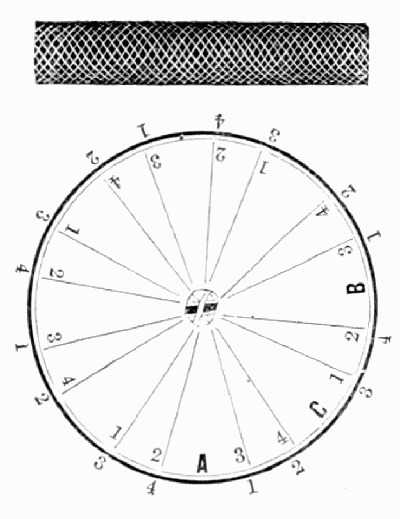
Take any number of strands that can
be divided by four,—eighty being
the usual number for this braid—four
hairs in a strand, and place on
table like pattern. Commence at
A, with the inside row of figures,
lift No. 3 over No. 2; then No. 3
over No 4; then No. 1 over No. 2;
then No. 3 over No. 2; then No. 1
over No. 2; then No. 3 over No. 4.
Then go to B and change the same way, and so on round the table
to A. Then go to C, and commence with the outside row of figures,
and change the same as you did at A, and so on round the table,
when you will be through the braid, ready to commence at A, as at
first.
Braid this over a round stick, the size you want the braid for
use, varying the number of strands according to the size of the
stick; then slip the braid from the stick on to the mold you wish
to use, tying the braid so it will fit the mold exactly, and then boil
in water five minutes, and take it out and put it in an oven, as hot
as it will bear without burning, until it is quite dry. Then it is
ready for use.

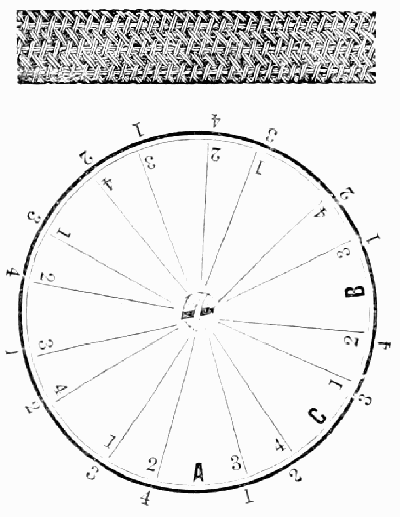
Take thirty-two strands, or any number
that can be divided by four,
fifteen hairs in a strand, and place
on table like pattern. Commence at
A, with the inside row of figures,
and braid round the table to the left;
lift No. 3 over No. 2, No. 1 over
No. 2, and No. 3 over No. 4; then
commence at C, with the outside row
of figures, and braid round the table
to the left; lift Nos. 1 and 2 over Nos. 3 and 4; then commence
at A, as before, and braid round the table to the right; put No. 3
under No. 2, and lift No. 2 over No. 1, and No. 3 over No. 4; then
commence at C, as before, and braid round the table to the right,
and put Nos. 1 and 2 under Nos. 3 and 4. Then you are through
the braid, ready to commence at A, as at first.
Braid this over a round stick, the size you want the braid for
use, varying the number of strands according to the size of the
stick; then slip the braid from the stick on to the mold you wish
to use, tying the braid so it will fit the mold exactly, and then boil
in water five minutes, and take it out and put it in an oven, as hot
as it will bear without burning, until it is quite dry. Then it is
ready for use.
Take any number of strands that
can be divided by four,—forty being
the usual number—twelve hairs in a
strand, and place on table like pattern.
Commence at A, with the
inside row of figures, and lift Nos.
1 and 2 over Nos. 3 and 4; then go
to B and change the same way, and
so on round table to A. Then go
to C, commence with the outside
row of figures, and braid round to
the left; lift Nos. 3 and 4 over Nos. 1 and 2, and so on round the
table to A. Then you will be through the braid, ready to commence
as at first.
Braid this over a round stick, the size you want the braid for
use, varying the number of strands according to the size of the
stick; then slip the braid from the stick on to the mold you wish to
use, tying it so it will fit the mold exactly, and then boil in water
five minutes, and take it out and put it in an oven as hot as it will
bear without burning, until it is quite dry. Then it is ready for use.
Take any number of strands that can
be divided by four,—sixty being the
usual number—fifteen hairs in a
strand, and place on table like pattern.
Commence at A, with the
inside row of figures, lift No. 2
over No. 3, No. 4 over No. 3, No. 1
over No. 2, and No. 3 over No. 2,
and so on round table to the right
till you get to A; then commence
at C, braid round to the right, lift
Nos. 3 and 4 over Nos. 1 and 2, and so on round table to A.
Then you are through the braid, ready to commence at A, as at
first.
Braid this over a round stick, the size you want the braid for
use, varying the number of strands according to the size of the
stick; then slip the braid from the stick on to the mold you wish
to use, tying it so it will fit the mold exactly, and then boil in water
five minutes, and take it out and put it in an oven as hot as it will
bear without burning, until it is quite dry. Then it is ready for use.
Take any number of strands that can
be divided by four,—sixty being the
usual number—fifteen hairs in a
strand, and place on table like pattern.
Commence at A, with the
inside row of figures, lift No. 3
over No. 2, and Nos. 1 and 3 over
Nos. 2 and 4, and so on round table
to A; then commence at C with the
outside row of figures, lift No. 2
over No. 3, No. 2 over No. 1, No.
2 over No. 3, Nos. 2 and 3 over No. 4, and No. 2 over No. 1,
and so on round table to A. Then you are through the braid,
ready to commence at A, as at first.
Braid this over a round stick, the size you want the braid for
use, varying the number of strands according to the size of the
stick; then slip the braid from the stick on to the mold you wish
to use, tying it so it will fit the mold exactly, and then boil in water
five minutes, and take it out and put it in an oven as hot as it will
bear without burning, until it is quite dry. Then it is ready for use.

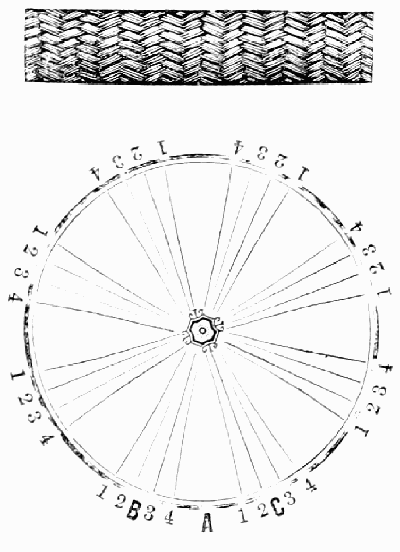
In this pattern you braid with eight
strands, or with two groups of fours.
Commence at B, lift No. 4 in left
hand and lay down between Nos. 3
and 4 at C, and take No. 4 at C in
right hand; then lift No. 3 at B
over between Nos. 2 and 3 at C, and
take No. 3 at C in right hand; then
lift No. 2 at B over between Nos. 1
and 2 at C, and take No. 2 at C in
right hand; then lift No. 1 at B
over next to No. 1 at C, and take No. 1 at C in right hand, and
then lift those in right hand over to B, and lay them all down.
Braid round to the right till you get to A, then take the next eight
strands, and braid round table to the left; lift No. 1 at C over
between Nos. 1 and 2 at B, and take No. 1 at B in left hand; then
lift No. 2 at C over between Nos. 2 and 3 at B, and take No. 2 at
B in left hand; then lift No. 3 at C over between Nos. 3 and 4 at
B, and take No. 3 at B in left hand; then lift No. 4 at C over next
to No. 4 at B, and take No. 4 at B in left hand, and then lift those
in left hand over to C and lay them all down, and so on round table,
taking the next eight strands, till you get to A. Then you are
through the braid, ready to commence as at first.
See explanation on page 100.
Take any number of strands that
can be divided by four,—eighty
being the usual number for this
braid—four hairs in a strand, and
place on table like pattern. Commence
at A, with the inside row of
figures, lift No. 3 over No. 2; then
No. 3 over No. 4; then No. 1 over
No. 2; then No. 3 over No. 2.
Then go to B and change the same
way, and so round the table to A.
Then go to C, and commence with the outside row of figures,
and change the same as you did at A, and so on round the
table, when you will be through the braid, ready to commence
at A, as at first.
Braid this over a round stick, the size you want the braid for
use, varying the number of strands according to the size of the
stick; then slip the braid from the stick on to the mold you wish
to use, tying it so it will fit the mold exactly, and then boil in water
five minutes, and take it out and put it in an oven as hot as it will
bear without burning, until it is quite dry. Then it is ready for use.

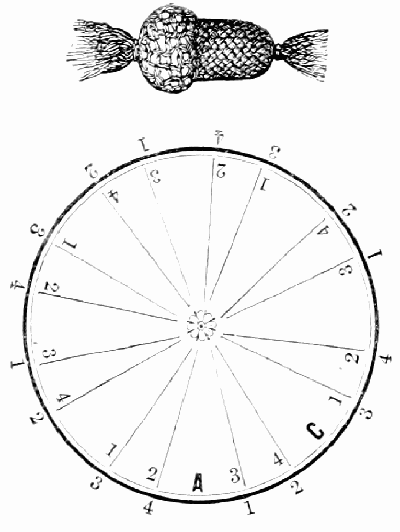
Take any number of strands that
can be divided by four,—sixty
being the usual number—fifteen
hairs in a strand, and place on
table like pattern. Commence at
A, with the inside row of figures,
lift No. 3 over No. 2, No. 3 over
No. 4, No. 1 over No. 2, and No. 3
over No. 2, and so on round table
to A; then go to C, take the outside
row of figures, and make the same
changes round to A, and repeat alternately at A and C, until the
braid is long enough to cover the bottom of the acorn, and then
commence at A with the inside row of figures; lift No. 3 over No.
2, No. 3 over No. 4, No. 1 over No. 2, No. 3 over No. 2, No. 1
over No. 2, and No. 3 over No. 4, and so on round to A; then go
to C, take the outside row of figures, and make the same changes
round to A; then repeat until the braid is long enough to make the
top or bur of the acorn. Then you are through the braid, ready to
commence as at first.
Braid this over a round stick, the size you want the braid for
use, varying the number of strands according to the size of the
stick; then slip the braid from the stick on to the mold you wish
to use, tying it so it will fit the mold exactly, and then boil in water
five minutes, and take it out and put it in an oven as hot as it will
bear without burning, until it is quite dry. Then it is ready for use.
Take any number of strands that
can be divided by four,—sixty
being the usual number—fifteen
hairs in a strand, and place on
table like pattern. Commence at
A, with the inside row of figures,
lift No. 1 over between Nos. 2 and
3 at B; then lift No. 1 at B over
between Nos. 2 and 3 of the next
four strands, and so on round table
to the left to A; then go to C, take
the outside row of figures, lift No. 2 over No. 3, No. 2 over No.
1, Nos. 2 and 3 over No. 4; then No. 3 over No. 4, and No. 2
over No. 1, and so on round the table to the right, till the braid is
finished.
Braid this over a round stick, the size you want the braid for
use, varying the number of strands according to the size of the
stick; then slip the braid from the stick on to the mold you wish to
use, tying it so it will fit the mold exactly, and then boil in water
five minutes, and take it out and put it in an oven as hot as it will
bear without burning, until it is quite dry. Then it is ready for use.

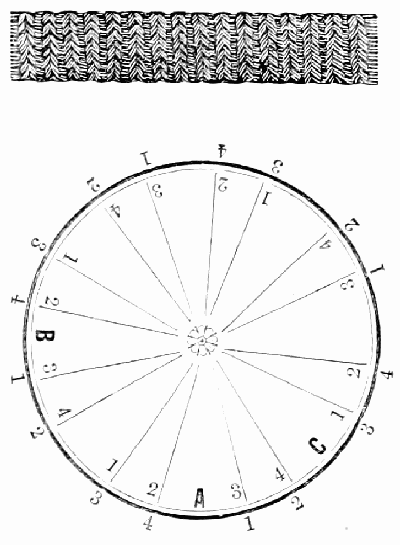
Take any number of strands that
can be divided by four,—sixty
being the usual number—fifteen
hairs in a strand, and place on
table like pattern. Commence at
A, with the inside row of figures,
braid to the right, lift No. 2 over
Nos. 3 and 4, No. 1 over No. 2, and
No. 3 over No. 2, and so on round
to A; then go to C and repeat the
same changes, with the outside row
of figures, round to A; then commence at A with the inside row
of figures, and braid to the left; lift No. 3 over Nos. 1 and 2, No.
4 over No. 3, and No. 2 over No. 3, and so on round to A; then
go to C, and repeat the same changes, with the outside row of
figures, round to A. Then you are through the braid, ready to
commence as at first.
Braid this over a round stick, the size you want the braid for
use, varying the number of strands according to the size of the
stick; then slip the braid from the stick on to the mold you wish
to use, tying it so it will fit the mold exactly, and then boil in water
five minutes, and take it out and put it in an oven as hot as it will
bear without burning, until it is quite dry. Then it is ready for use.
Take any number of strands that
can be divided by four,—sixty being
the usual number—fifteen hairs in a
strand, and place on table like pattern.
Commence at A, with the
inside row of figures, and have Nos.
1 and 2 of white hair, and Nos. 3
and 4 of black hair; lift Nos. 1 and
2 over Nos. 3 and 4, and so on
round table to the left, to A; then
go to C, and braid round table to
the right; lift Nos. 3 and 4 over Nos. 1 and 2, and so on round
table to A. Then you are through the braid, ready to commence
as at first.
Braid this over a round stick, the size you want the braid for
use, varying the number of strands according to the size of the
stick; then slip the braid from the stick on to the mold you wish
to use, tying it so it will fit the mold exactly, and then boil in water
five minutes, and take it out and put it in an oven as hot as it will
bear without burning, until it is quite dry. Then it is ready for use.
Take any number of strands that
can be divided by four,—sixty
being the usual number—fifteen
hairs in a strand, and place on
table like pattern. Commence at
A, with the inside row of figures,
and have alternately four strands of
white hair and four of black; braid
round table to the left, lift Nos. 1
and 2 over Nos. 3 and 4, and so on
round table to A; then go to C,
braid round table to the right, lift Nos. 3 and 4 over Nos. 1 and 2,
and so on round to A. Then you are through the braid, ready to
commence as at first.
Braid this over a round stick, the size you want the braid for
use, varying the number of strands according to the size of the
stick; then slip the braid from the stick on to the mold you wish
to use, tying it so it will fit the mold exactly, and then boil in water
five minutes, and take it out and put it in an oven as hot as it will
bear without burning, until it is quite dry. Then it is ready for use.

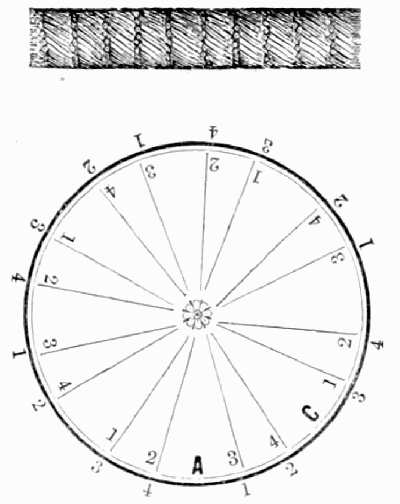
Take any number of strands that
can be divided by four,—sixty
being the usual number—fifteen
hairs in a strand, and place on
table like pattern. Commence at
A, with the inside row of figures,
lift No. 3 over No. 2, No. 1 over
No. 2, No. 3 over No. 4, and No. 3
over No. 2; braid round table to
the left till you get to A, then go to
C, take the outside row of figures,
and braid round to the right; lift Nos. 3 and 4 over Nos. 1 and 2,
and so on round to A, and repeat with the inside row of figures,
and then repeat again with the outside row; then you are through
the braid, ready to commence at A, as at first. Commence at C
every other time, for you only braid the first change of figures
once, and the last change three times.
Braid this over a round stick, the size you want the braid for
use, varying the number of strands according to the size of the
stick; then slip the braid from the stick on to the mold you wish to
use, tying it so it will fit the mold exactly, and then boil in water
five minutes, and take it out and put it in an oven as hot as it will
bear without burning, until it is quite dry. Then it is ready for use.

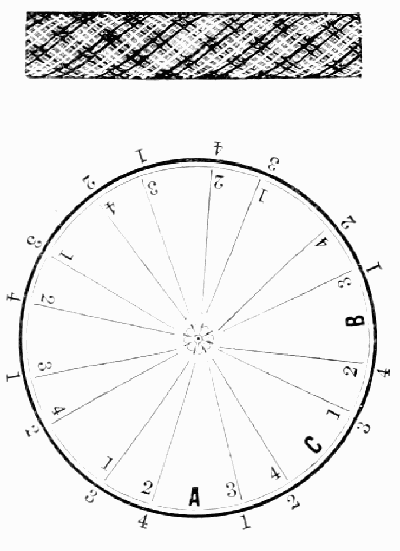
Take any number of strands that
can be divided by four,—eighty
being the usual number—four hairs
in a strand, and place on table like
pattern. Have one-half the strands
white and one-half black, and place
on table alternately, four white and
four black. Commence at A, with
the inside row of figures, lift No. 2
over No. 3, No. 2 over No. 1, No. 2
over No. 3, Nos. 2 and 3 over No.
4, and No. 2 over No. 1. Then go to B and change the same way,
and so on round table to A. Then go to C, commence with the
outside row of figures, and change the same as you did at A, and
so on round the table; then you will be through the braid, ready
to commence at A, as at first.
Braid this over a round stick, the size you want the braid for
use, varying the number of strands according to the size of the
stick; then slip the braid from the stick on to the mold you wish
to use, tying it so it will fit the mold exactly, and then boil in water
five minutes, and take it out and put it in an oven as hot as it will
bear without burning, until it is quite dry. Then it is ready for use.

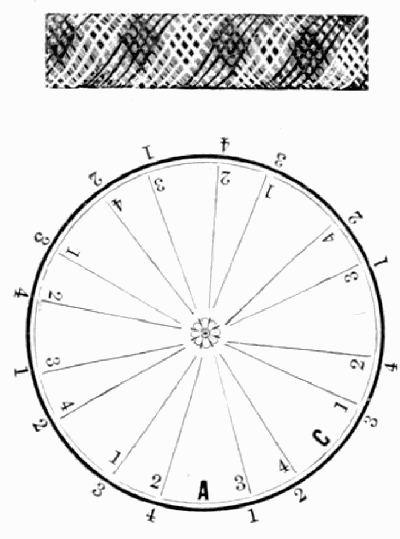
Take any number of strands that
can be divided by four,—eighty
being the usual number—four hairs
in a strand, and place on table like
pattern. Have one-third the strands
white hair, one-third black, and one-third
red, and place on table alternately,
four white, four black, and
four red. Commence at A, with
the inside row of figures, lift No. 2
over No. 3, No. 2 over No. 1, No. 2
over No. 3, Nos. 2 and 3 over No. 4, and No. 2 over No. 1. Then
go to B and change the same way, and so on round table to A.
Then go to C, commence with the outside row of figures, and change
the same as you did at A, and so on round the table; then you
will be through the braid, ready to commence at A, as at first.
Braid this over a round stick, the size you want the braid for
use, varying the number of strands according to the size of the
stick; then slip the braid from the stick on to the mold you wish
to use, tying it so it will fit the mold exactly, and then boil in water
five minutes, and take it out and put it in an oven as hot as it will
bear without burning, until it is quite dry. Then it is ready for use.
Take any number of strands that
can be divided by four,—sixty
being the usual number—fifteen
hairs in a strand, and place on
table like pattern. Commence at
A, with the inside row of figures,
lift No. 3 over No. 2, No. 3 over
No. 4, No. 1 over No. 2, and No. 3
over No. 2; braid half way round
the table, and then braid the last
half by lifting No. 3 over No. 2,
No. 3 over No. 4, No. 1 over No. 2, No. 3 over No. 2, No. 1 over
No. 2, and No. 3 over No. 4, and so on round to A; then go to C
and repeat the same. Then you are through the braid, ready to
commence as at first.
Braid this over a round stick, the size you want the braid for
use, varying the number of strands according to the size of the
stick; then slip the braid from the stick on to the mold you wish to
use, tying it so it will fit the mold exactly, and then boil in water
five minutes, and take it out and put it in an oven as hot as it will
bear without burning, until it is quite dry. Then it is ready for use.

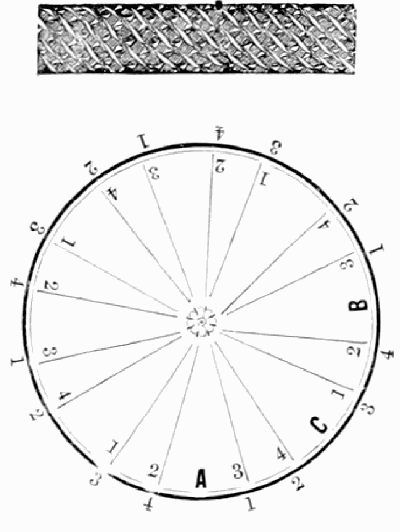
Take any number of strands that
can be divided by four,—eighty
being the usual number—four
hairs in a strand, and place on
table like pattern. Commence at
A, with the inside row of figures,
and have one-half the strands white
hair, and one-half black, and place
alternately one strand of white,
and one strand of black; lift No.
2 over No. 3, No. 2 over No. 1, No.
2 over No. 3, Nos. 2 and 3 over No. 4, and No. 2 over No. 1.
Then go to B and change the same way, and so on round table
to A. Then go to C, commence with the outside row of figures,
and change the same as at A, and so on round table; then you will
be through the braid, ready to commence as at first.
Braid this over a round stick, the size you want the braid for
use, varying the number of strands according to the size of the
stick; then slip the braid from the stick on to the mold you wish
to use, tying it so it will fit the mold exactly, and then boil in water
five minutes, and take it out and put it in an oven as hot as it will
bear without burning, until it is quite dry. Then it is ready for use.

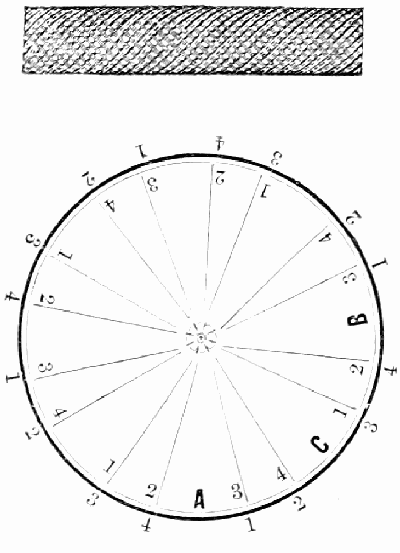
Take any number of strands that
can be divided by four,—eighty
being the usual number—four
hairs in a strand, and place on
table like pattern. Commence at
A, with the inside row of figures,
and have one-half of the strands
white hair, and one-half black, and
place alternately two strands of
white and two of black; lift No. 2
over No. 3, No. 2 over No. 1, No. 2
over No. 3, Nos. 2 and 3 over No. 4, and No. 2 over No. 1; then go
to B and change the same way, and so on round table to A. Then
go to C, commence with the outside row of figures, and change the
same as you did at A, and so on round table. Then you will be
through the braid, ready to commence at A, as at first.
Braid this over a round stick, the size you want the braid for
use, varying the number of strands according to the size of the
stick; then slip the braid from the stick on to the mold you wish
to use, tying it so it will fit the mold exactly, and then boil in water
five minutes, and take it out and put it in an oven as hot as it will
bear without burning, until it is quite dry. Then it is ready for use.

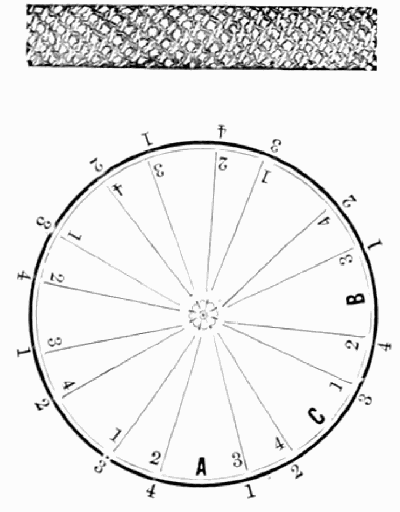
Take any number of strands that
can be divided by four,—eighty
being the usual number—four
hairs in a strand, and place on
table like pattern. Commence at
A, with the inside row of figures,
and have one-half the strands white
hair, and one-half black, and place
alternately two strands of white,
and two strands of black; lift No.
3 over No. 2, No. 3 over No. 4, No.
1 over No. 2, No. 3 over No. 2, No. 1 over No. 2, and No. 3 over
No. 4. Then go to B and change the same way, and so on round
to A. Then go to C, commence with the outside row of figures,
and change the same as you did at A, and so on round table; then
you will be through the braid, ready to commence at A, as at first.
Braid this over a round stick, the size you want the braid for
use, varying the number of strands according to the size of the
stick; then slip the braid from the stick on to the mold you wish
to use, tying it so it will fit the mold exactly, and then boil in water
five minutes, and take it out and put it in an oven as hot as it will
bear without burning, until it is quite dry. Then it is ready for use.

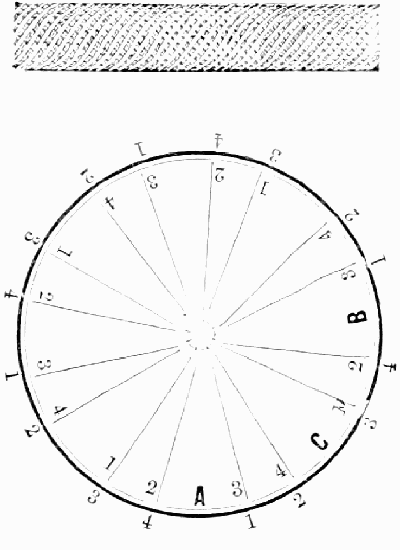
Take any number of strands that
can be divided by four,—sixty
being the usual number—fifteen
hairs in a strand, and place on
table like pattern. Commence at
A, with the inside row of figures,
and have one-half the strands white
hair, and one-half black, and place
alternately Nos. 1 and 2 of white,
and Nos. 3 and 4 of black; lift No.
1 over No. 2, and No. 4 over Nos.
3 and 2; then repeat with the same strands, the No. 1 over No. 2,
and No. 4 over Nos. 3 and 2. Then go to B and braid the same,
and so on round table to A. Then go to C, commence with the
outside row of figures, and braid round to the left; lift No. 1 over
No. 2, and No. 4 over Nos. 3 and 2; then repeat with the same
strands, the same as at A and B, and so on round to A. Then
you are through the braid, ready to commence as at first. After
it is braided, turn the braid inside out.
Braid this over a round stick, the size you want the braid for
use, varying the number of strands according to the size of the
stick; then slip the braid from the stick on to the mold you wish
to use, tying it so it will fit the mold exactly, and then boil in water
five minutes, and take it out and put it in an oven as hot as it will
bear without burning, until it is quite dry. Then it is ready for use.

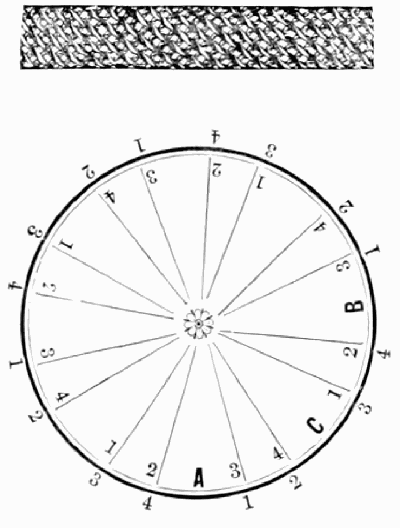
Take any number of strands that
can be divided by four,—sixty
being the usual number—fifteen
hairs in a strand, and place on
table like pattern. Commence at
A, with the inside row of figures,
and have one-half of the strands
white hair, and one-half black, and
place alternately one strand of
white and one of black; lift No. 1
over No. 2, and No. 4 over Nos.
3 and 2; then repeat with the same strands, the No. 1 over No. 2,
and No. 4 over Nos. 3 and 2. Then go to B and braid the same,
and so on round table to A. Then go to C, commence with the
outside row of figures, and braid round to the left; lift No. 1 over
No. 2, and No. 4 over Nos. 3 and 2; then repeat with the same
strands, the same as at A and B, and so on round to A. Then
you are through the braid, ready to commence as at first. After
it is braided, turn the braid inside out.
Braid this over a round stick, the size you want the braid for
use, varying the number of strands according to the size of the
stick; then slip the braid from the stick on to the mold you wish to
use, tying it so it will fit the mold exactly, and then boil in water
five minutes, and take it out and put it in an oven as hot as it will
bear without burning, until it is quite dry. Then it is ready for use.

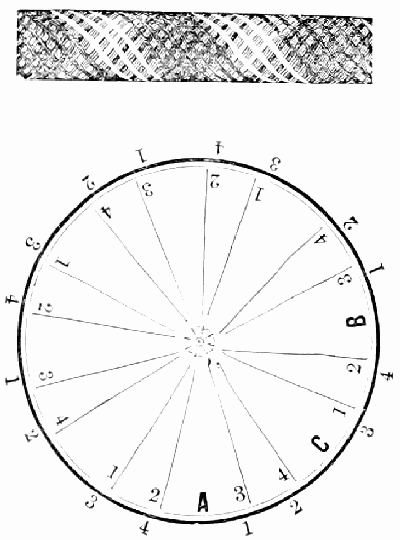
Take any number of strands that
can be divided by four,—eighty
being the usual number,—four
hairs in a strand, and place on
table like pattern. Commence at
A, with the inside row of figures,
and have one-fourth of the strands
white hair, and three-fourths black,
and place all the white strands on
one side of the table, and all of the
black on the other side; lift No.
2 over No. 3, No. 2 over No. 1, No. 2 over No. 3, Nos. 2 and 3
over No. 4, and No. 2 over No. 1. Then go to B and change the
same way, and so on round table to A. Then go to C, commence
with the outside row of figures, and change the same as at A, and
so on round table; then you are through the braid, ready to commence
as at first.
Braid this over a round stick, the size you want the braid for
use, varying the number of strands according to the size of the
stick; then slip the braid from the stick on to the mold you wish to
use, tying it so it will fit the mold exactly, and then boil in water
five minutes, and take it out and put it in an oven as hot as it will
bear without burning, until it is quite dry. Then it is ready for use.

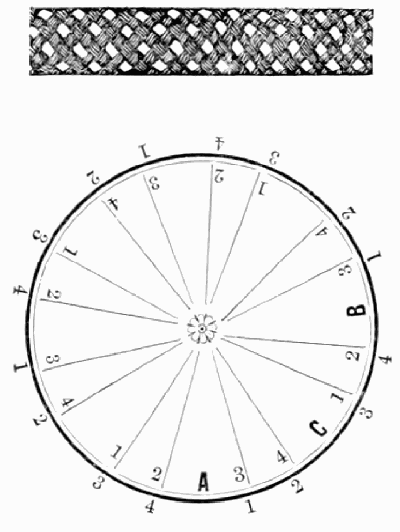
Take any number of strands that
can be divided by four,—eighty
being the usual number—four
hairs in a strand, and place on
table like pattern. Commence at
A, with the inside row of figures,
and have one-fourth of the strands
white hair, and three-fourths black,—the
Nos. 1 white, and the Nos. 2,
3 and 4 black; lift No. 3 over No.
2, No. 3 over No. 4, No. 1 over No.
2, and No. 3 over No. 2. Then go to B and change the same way,
and so on round table to A. Then go to C, commence with the
outside row of figures, and change the same as at A, and so on
round table; then you are through the braid, ready to commence
as at first.
Braid this over a round stick, the size you want the braid for
use, varying the number of strands according to the size of the
stick; then slip the braid from the stick on to the mold you wish
to use, tying it so it will fit the mold exactly, and then boil in water
five minutes, and take it out and put it in an oven as hot as it will
bear without burning, until it is quite dry. Then it is ready for use.
Take any number of strands that can
be divided by four,—eighty being
the usual number for this braid—four
hairs in a strand, and place on
table like pattern. Commence at
A, with the inside row of figures,
lift No. 3 over No. 2; then No. 3
over No. 4; then No. 1 over No. 2;
then No. 3 over No. 2. Then go to
B and change the same way, and so
round the table to A. Then go to C, and commence with the outside
row of figures, and change the same as you did at A, and so
on round the table, when you will be through the braid, ready to
commence at A, as at first.
Braid this over a round stick, the size you want the braid for
use, varying the number of strands according to the size of the
stick; then slip the braid from the stick on to the mold you wish
to use, tying the braid so it will fit the mold exactly, and then boil
in water five minutes, and take it out and put it in an oven, as hot
as it will bear without burning, until it is quite dry. Then it is
ready for use.
The hair to be used in braiding should be combed perfectly straight,
and tied with a string at the roots, to prevent wasting. Then count the
number of hairs for a strand, and pull it out from the tips, dip it in water
and draw it between the thumb and finger to make it lie smoothly; then
tie a solid, single knot at one end, the same as you would with a sewing
thread.
THE BOBBIN.
To prepare the bobbin for the hair, wind it with white thread, as
shown in the plate, and fasten it with a slip-knot over the knob, leaving
an end of some three inches, with a solid knot tied at the end of it. To
adjust the hair to the bobbins, take the prepared strands of hair and tie
the knotted ends in a square knot to the ends of the strings on the bobbins.
When each strand is thus prepared and tied to the bobbin strings, place
them even, and tie the ends with a string to prevent their slipping.
See cut of Bobbins on another page.
HOW TO PLACE THEM ON THE TABLE-COVER FOR BRAIDING.
Place the strands across the table-cover, over the numbers, as shown
in the diagram, and fasten a weight to the end of them, under the table,
through the center of cover; then tie the mold or form to be braided,
around in the center, and you are ready for braiding.
For further reference, see plate of table, with explanations.
The Table Cover, as shown in diagram No. 1, represents the
under side of the cover, showing the rim that fits over the cap,
allowing the cover to revolve, for the convenience of the braider.
The cavity through the cover and cap allows the braid, with the
weight attached, to pass through as fast as braided.
For reference see Braiding Table complete, with bobbins and
weights attached, on page 124.
The above cut represents Braiding Table No. 2, complete,
showing the strands over the cover, with Bobbins attached; also,
the weight attached to the braid, showing the manner of its
passing through the table.
The above cut shows the Wood Bobbins, for fine open work or
tight braids. No. 1 is used for braiding any pattern of from one
to four hairs in a strand. No. 2 is used for braiding any pattern
of from five to twenty hairs in a strand. To prepare the Bobbins
for use, see explanations on page 121.
The above cut shows the size and shape of the Lead Bobbins.
The No. 1 size is used for braiding Rings and Chains, that have
but few hairs in a strand—from twenty to forty. No. 2 is used
for braiding Chains that have from forty to one hundred hairs in a
strand. Either size will answer for any pattern of Chain or Ring,
but to vary the size of the Bobbin according to the number of hairs
in a strand, gives it a nicer finish. To prepare the Bobbin, wind
it with thread, as shown in the cut, leaving the thread some three
inches long, with a solid knot tied at the end.
The above cut shows the weight used for drawing the work
through the center of the table as fast as braided, and to balance
the bobbins. Attention should be given to have the weight balance
the bobbins properly, as too great a weight will make the braid
loose, or too light a weight will leave it rough. Use any number
of weights required to balance the bobbins.
The above cuts are made of wire and wood, for braiding over.
The Nos. 1 and 2 are for braiding chains over—the No. 1 for small
chains, and the No. 2 for large sizes. No. 3 is used for braiding
tight or open work braids, of from thirty to forty strands. No. 4
is used for the same braids, with from forty to sixty strands in a
braid. The mold may be made any length, to accommodate the
work.
The above cuts show the size of forms used for tight or open
work braids. The No. 5 is used for braids of from sixty to eighty
strands, No. 6 of from eighty to one hundred, and No. 7 from one
hundred to one hundred and twenty, according to the fineness of
the braid.
The above cuts represent the completed Bracelet Braid. The
No. 1 is formed from fourteen small braids, braided according to
diagram and explanation on page 104,—using, however, but thirty-two
strands, instead of eighty.
After you have the small braids all completed and prepared, as
required in the explanation, sew them together at one end, so they
all lie smooth and flat, then divide them off in twos, using each two
as one strand, and plait them together; commence at the right side,
take one strand at a time, and lift over one and under two till you
get to the center, then commence on the left side and braid the same
way, and so on till finished. Then sew the ends well, trim them,
and put on a little shellac to fasten them in the clasps.
No. 2 is from the same pattern, and is prepared and finished up
in the same manner. For this Bracelet you use fifteen small
braids, divide them into threes for each strand, and lift over one
and under one, from each side to the center.
The No. 1 cut of the above Bracelet Braids, is formed from
patterns on pages 87 and 97, and instead of using forty and sixty
strands, use but thirty-two for each. Braid six small braids from
pattern on page 87, and three from pattern on page 97. Sew them
tight together at one end, divide them off in threes, with the open
work braid between the two tight ones, use each three as one strand,
and plait them together in a common three strand braid.
No. 2 is braided according to pattern on page 89. Have three
of the braids, sew them fast at one end, and then twist them carefully
and evenly together; then sew and fasten with shellac, and
it is ready for being gold mounted.
The No. 1 cut of the above Bracelet Braids, is formed from
patterns on pages 26 and 86. Have two small braids from each
of the patterns, lay them side by side, as in cut, and sew them
firmly together, either with some of the hair, or with very fine silk
of the same color. Then sew and trim the ends, and fasten with
shellac.
No. 2 is braided from patterns on pages 18 and 86. Have four
small braids like pattern on page 18, and two like pattern on page 86. Place them side by side, as in cut, and prepare and finish up
the same as in the above.
The patterns used for the No. 1, represented above, are found
on pages 63 and 95. Have one braid from pattern on page 63,
and two from that on page 95. Place them side by side, as in cut,
sew the ends firmly together, either with some of the hair, or with
very fine silk of the same color. Then sew and trim the ends, and
fasten with shellac.
For the No. 2, use two small braids from pattern on page 18, one
from pattern on page 63, and two from pattern on page 95. Place
them as in cut, sew them together, and prepare the same as No. 1.
The No. 1 of the above Bracelet Braids, is made up of two small
braids from pattern on page 97, and three from pattern on page 101,
using, however, but thirty-two strands, instead of sixty.
Place them side by side, as in cut, and sew them together with
some of the hair, or with fine silk of the same color. Sew, trim
and shellac the ends, and they are ready for the gold mounting.
No. 2 is formed of four small braids, from pattern on page 97,
and is prepared, sewed and finished up the same as No. 1.
The following Lithographic designs of Hair Jewelry, Flowers
and Pictures, are given for the purpose of showing a few of the
many beautiful forms into which the human hair may be transposed.
Each and every one of the devices on the following pages, with the
exception of the flowers and pictures, can be braided from the
diagrams and explanations given in the first one hundred and
twenty pages of this book. Select any article you may wish to
make, and by referring to the patterns, you can easily find the
style and directions whereby to braid it. We might have given
twice the number of patterns, or even more, but any person can,
after a little experience, readily invent new and different styles of
braids, and by so doing, each can satisfy their own peculiar taste.
The making of Hair Flowers is very simple, and yet, of course,
every one has first to learn it. Supply yourself with as many
different colors of hair as you can, and by applying Gum Tragacanth,
it renders it capable of being cut in any shape you may wish—such
as leaves, twigs, buds, &c., and by judiciously arranging
the colors, the effect will be very pleasing. Pictures are made in
the same manner, and any one possessing the least artistic skill,
can make any flower or picture they may desire, and many pleasing
adornments and lasting mementos may thereby be had.
All articles intended to be worn as jewelry, should, of course, be
mounted with gold, and as this kind of work is not done in all
jewelry establishments, I wish to say that my facilities for this
branch of business is complete, and the work done is in the best
possible manner. I can guarantee satisfaction in all cases, let the
style desired be what it may. In sending braids to be mounted,
draw on paper, as near as can be, the style or design you want.
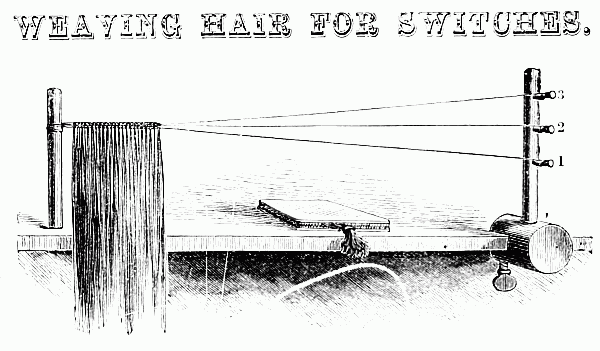 WEAVING HAIR FOR SWITCHES.
The above cut represents the apparatus used for weaving hair
into Switches, Curls, Wigs, &c. It is a very simple arrangement,
and can be easily constructed. Provide two straight sticks, about
twelve inches long, and in one of them bore three small holes, two
inches apart, in which to place as many thumb-screws, to be used
for tightening or loosening the cords; in the other, have a single
wooden pin or nail, to fasten the cords to. Place the sticks in a
firm, upright position, about three feet apart, either by boring holes
through a table, or by using mortised blocks, such as is plainly
shown in cut, at the right end. After placing them in position, put
on three cords, as shown in diagram, numbered 1, 2 and 3. For
this weft use linen thread, at Nos. 1, 2 and 3.
In commencing to weave, place the hair between two cards, as
shown in diagram, and draw out with the right hand, between the
thumb and fore-finger, the quantity of hair required for the size of
the weft; then change it into the left hand, and place it up to the
threads, Nos. 1, 2 and 3, as shown in diagram; lay the strand over
No. 1, under No. 2, over No. 3, around under No. 3, over Nos. 2
and 1, around under Nos. 1 and 2, over No. 3, around under Nos.
3 and 2, and over No. 1. Then push the strands together, as in cut.
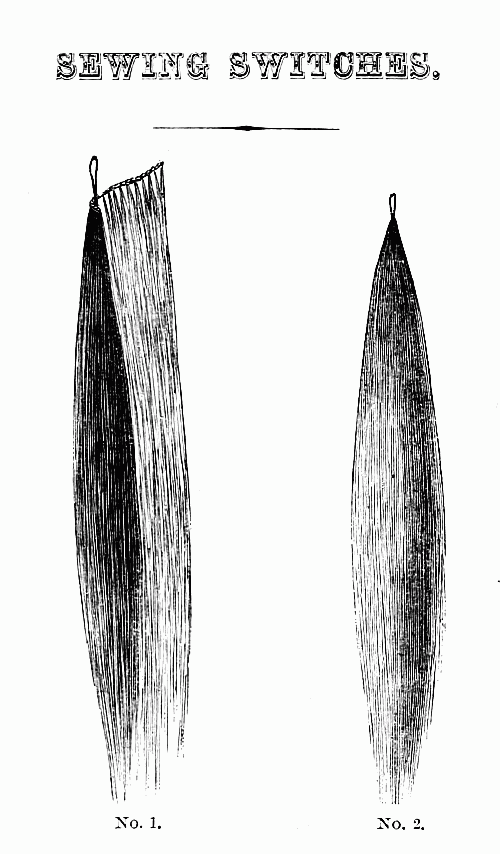
The No. 1 of the above cuts represents the winding and sewing
of the switch after it is woven. For sewing a switch on points, after
weaving, take Berlin cord, about one-sixteenth of an inch thick,
and tie a solid knot at the end, and sew the end of the weft to the
knotted end of the cord; then wind the weft around the cord, as
shown in cut, the length of point desired, turning the end of the
cord over to form a loop. Cut the weft according to the number
of points desired in the switch. Cut No. 2 shows the switch all
complete.
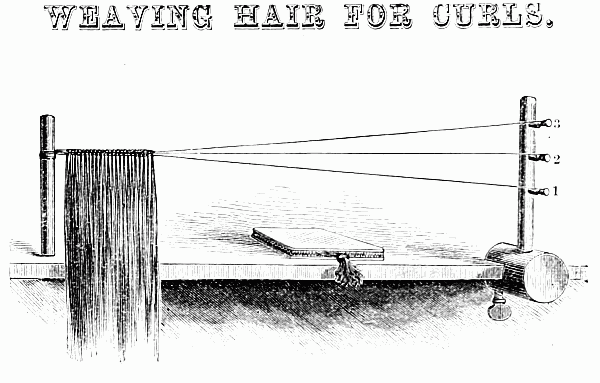
In commencing to weave, place the hair between two cards, or
stiff brushes, as shown in diagram, pressing them tight together, so
that in drawing out, it is perfectly free from tangles; draw out
with the right hand, between the thumb and fore-finger, the
quantity of hair required for the size of the weft; then change it
into the left hand, and lift it up to the No. 1 cord, as shown in
diagram; lay the strand over No. 1, under No. 2, over No. 3,
around under No. 3, over Nos. 2 and 1, around under Nos. 1 and
2, over No. 3, around under No. 3, over No. 2, and under No. 1.
Then push the strands together, as shown in diagram. For this
weft use fine, strong linen thread.
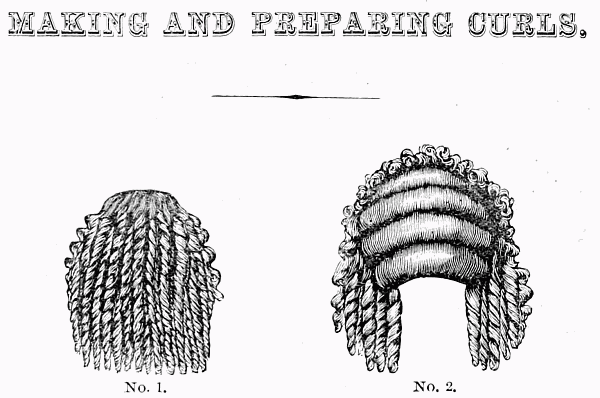
After weaving, according to directions on page 241, take a piece
of ribbon an inch wide, the same color of hair, and as long as you
wish the curls to be in width, and sew the weft to it back and forth.
After that is done, pipe them, which is done in this manner:
Dampen the hair, comb each curl out straight, and wind it tightly
on a rattan stick about four inches long, having each curl on a
separate stick, and commencing to wind at the tip end, tying them
firmly to keep in place. Then boil in water for thirty minutes, and
place in an oven as hot as they will bear without burning, until
quite dry. When dry and perfectly cool, take them off the sticks,
and smooth over a curling iron, the size you wish the curls. Side
curls and frizzes should be prepared the same way.
Cut No. 2 represents a set of Curls and Puffs. For explanation
of Puffs, see page 245.
In commencing to weave, place the hair between two cards, or
stiff brushes, as shown in diagram, pressing them tight together, so
that in drawing out, it is perfectly free from tangles; draw out
with the right hand, between the thumb and fore-finger, the
quantity of hair required for the size of the weft; then change it
into the left hand, and lift it up to the No. 1 cord, as shown in
diagram; lay the strand over No. 1, under No. 2, over No. 3,
around under No. 3, over Nos. 2 and 1, around under Nos. 1 and
2, over No. 3, around under No. 3, over Nos. 2 and 1, around
under Nos. 1 and 2, over No. 3 around under Nos. 3 and 2, and
over No. 1. Then push the strands together, as shown in diagram.
For this weft use sewing silk.
WEAVING HAIR FOR WATERFALLS AND BOWS
Prepare the same as above, and place the strand under No. 1,
over Nos. 2 and 3, around under Nos. 3 and 2, over No. 1, around
under Nos. 1 and 2, over No. 3, around under No. 3, and over Nos.
2 and 1. Aside from these changes, follow directions given above.
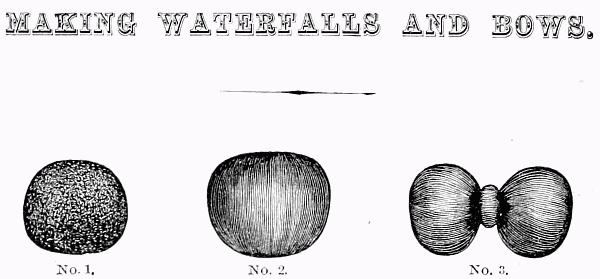
In making a Chignon, you have first to make the cushion.
Take the combings or waste hair, which is of no other use, and
place it between the cards or stiff brushes, the same as for weaving.
Use the weaving apparatus, with two piping cords, instead of three
small ones, and wind the hair all up, by passing over, between and
under the cords. Boil and dry it, and then pull out the cord,
which leaves it all crimped, ready to weave, according to directions
on page 239. Then sew it on a cord, the same as a switch, and
form it in any shape you desire, for a Waterfall, Bow or Puffs.
This completes the cushion. Then weave the long hair for the
covering, according to directions on page 243, and sew it to the
top end of the cushion; comb it out smooth, cover the cushion, and
tie a cord around it immediately at the bottom; then bring up the
end of the hair, and pin it to the inside. Cut No. 1 is intended to
represent the cushion, and No. 2 the complete Waterfall.
Cut No. 3 represents the Bow, which is made in the same
manner, by using two small cushions, like cut No. 1, and placing
between them a strand of smooth or braided hair.
To make Puffs for front of head, from false hair, similar to cut
No. 1, weave hair from eight to twelve inches long, according to
directions on page 241; then take a ribbon, about one and a half
inches wide, any length required, and tack it on a wig block, or
straight piece of board, and sew the weft crossways a quarter of an
inch apart, till the ribbon is entirely covered; then divide it off in
as many puffs as desired, comb each out straight, and wind it over
the two fore-fingers, close up to ribbon, and put in a hair-pin to
retain it.
To make Puffs for back of head, cut No. 2, prepare the same way;
make the foundation the shape and size you wish the puffs, and sew
it on the same way you want the puffs to run. The puffs may be
made over a cushion, formed of crimped hair the shape wanted, and
wound over that instead of the fingers. Ladies not wearing false
hair, can have her own hair dressed by following the above
directions.
Cut No. 3 represents a coil, which is made from a switch, and
wound over a long roll of crimped hair. They are much nicer, but
more expensive, by being made altogether from a switch, as that
can be twisted into a rope or braided, before coiling.
I herewith present, on the following pages, a number of
engravings illustrative of a few of the many styles of Hair
Dressing, accompanied with explanatory remarks as to their
execution. They are the latest and most fashionable European
and American styles, and will prove indispensable to every lady's
toilet, as, from the explanations, they will be able, with very
little practice, to dress their own hair in any desired style; and
when any new style is inaugurated, after studying and practicing
the directions given with each illustration, she will find it an easy
matter to arrange it accordingly.
Any one learning Hair Dressing, should acquire perfectly the
execution of the first pattern—the Promenade Head-Dress—as
that is very easily arranged, and when you have once executed
it in a perfect manner, the others will prove comparatively easy.
The manner of dressing the hair at the present day calls for
much attention, and many inquiries are addressed us on the
subject. It is plain, however, that what would correspond with
the complexion and physiognomy of one, would certainly have a
distasteful appearance on another; consequently, in answering
inquiries, I can do nothing more than give the different
styles worn. Before giving my illustrations on Hair Dressing,
I have given instructions how to weave hair for chignons,
curls, switches, &c., and how to put them in shape, and with
the directions given with each illustration on Hair Dressing, it
will certainly be an easy task to arrange the hair in any style
that is now or may be in fashion.
Our first cut represents the Promenade Head-Dress, but is worn
as frequently in the drawing-room, and even at public and private
assemblies—in fact, a common and very pretty style.
Explanation: Comb the front hair between the temples
straight back, over a cushion of crimped hair, forming a Chignon;
then make two braids of two small switches, and place one of them
over the top of the Chignon, and the other across the forehead,
forming a diadem, turning the ends under; then comb the hair
from temples over the braids, and put back under the Chignon, and
fasten. Place a net of pearl or gilt beads over the Chignon, as in
cut. You can use false hair for covering cushion, if desired.
This Head-Dress is a most charming composition, and entirely
new. It is adapted either for a brown or fair complexion, to
be worn at grand dinners or receptions. Ornamented with pearl
or gilt, it is in good taste for evening parties.
Explanation: Curl the hair across forehead, or use false
curls, combing the hair straight back, and form a chignon of
curls at the back. Place a diadem plait across forehead, and
raise the hair from the temples over the plait. Trim with roses
and ribbans, or to suit dress.
This cut illustrates the Soiree or Evening Head-Dress. It is a
very unique and modern style, suited for almost any complexion,
and very easily executed.
Explanation: Comb the hair straight back between the temples,
tie it, and curl the ends, or use a set of long false curls.
Place a diadem plait, made from a switch, across the forehead;
then comb the hair back from the temples, over the ends of the
plait, twist it, pass it back under the curls, and fasten firmly. Use
a fancy back-comb on top of curls, and pin an ornament to diadem
plait, with feather and chain attached, as in cut, or trim to suit dress.
A very graceful Head-Dress, of a bold style, suited for a young
lady of brown or fair complexion, and is in good taste to be worn
at the theatre or Grand Evening Parties.
Explanation: Make a parting over the head, from ear to ear,
two inches from front; on the forehead, between the temples, curl
the hair in small friz curls, and from the temple to the ear, make
loose puffs. Divide the hair in three partings over the head,
and roll each in a large puff; then form a large puff of the back
hair, round the nape of the neck, as in cut. Fasten a large set
of loose curls over the puff, with a comb or other ornament. For
reference, see page 245.
A charming Head-Dress, and entirely new, perfectly suiting
a fair complexion. It may serve for the theatre or evening
parties. When powdered it preferably suits a brown or brunette.
Explanation: Make a front parting, and a cross one from
ear to ear. Divide each side into five parts; of the front parting
make three puffs on each side. The remaining four make into
long puffs, as in cut, according to explanations on page 245.
The back hair may be arranged in the same style of puffs, or
with a double Chignon, placing a single, long false curl or braid,
back of each ear. Trim with orange leaves, or to suit dress.
This Head-Dress, both bold and graceful, is suitable for any
complexion or age, when the physiognomy allows it.
Explanation: Comb back the hair from the forehead between
the temples, make a large puff on the temples, and three puffs
above each ear. Place a cushion at the back of head, and comb
the hair over it, forming a chignon; then place a diadem plait, or
twist, made from a large switch, round on the top of head, trimmed
with leaves or ribbon, as shown in cut.
This Head-Dress is one of the most graceful styles. It was
worn in the time of Louis XIVth, and well agrees with the
fashion of the present day. With some modifications, it is suited
to every complexion.
Explanation: Crimp the front hair, and raise it over the
temples with a puff comb. Comb the hair just above the ear
back, and friz the ends, and curl the back hair in large flowing
curls, as shown in the cut.
A Head-Dress of elegant composition, coming down from
antiquity, suitable for a young and pretty woman, and perfectly
agreeing with a fair complexion.
Explanation: Part the hair from temple to temple, one inch
from front, comb it up on the forehead, and curl the ends in small
snap curls; then comb the hair back from the temples, and form a
loose puff. Make three partings across the head, and form a puff
of each. Of the back hair, make a braided or plaited chignon,
with a few friz curls underneath; then make two puffs back of the
ear, as shown in cut. Wear a fancy comb or band over the top
of chignon.
A Head-Dress of extraordinary simplicity, and of a most
genteel kind, becoming a dark complexion. It may be adapted
for the opera by changing the trimming.
Explanation: First crimp all the hair, then place a cushion
high up under the hair at the back, forming a chignon, and friz
the ends of the hair from ear to ear under the chignon. Tuck
the hair high up on the forehead, place bands of ribbon over the
head with a net at the back, and bring the hair above the ear
up, and fasten to the ribbon. Pin a ribbon streamer to the net,
as in cut.
An elegant Head-Dress, and was worn in the time of Louis
XVI, for balls and evening parties, or as a disguise when
powdered.
Explanation: Separate the hair across the head from ear
to ear, three inches from front, and roll it in puffs according to
directions on page 245. Do up the back hair in a double
chignon, either with your own or false hair; add a set of false
curls underneath the chignon, extending from ear to ear. Trim
to suit dress with leaves, flowers and ribbon, as shown in
illustration.
A rich Head-Dress, having a great stamp of distinction, and
for that reason will be adapted for a Court Head-Dress, or Grand
Evening Parties.
Explanation: Make a parting over the head from ear to ear,
two inches from front, and form a row of nine small puffs over
the forehead. Comb the remaining hair back, and divide into
four partings around the head, and form each parting in a large
puff, as in cut. Add a few small friz curls and orange blossoms
between the puffs. For reference see page 245.
An exquisite Head-Dress, of a very graceful style, and well
agreeing with a fair or brown complexion, to be worn by a young
bride, or at grand assemblies.
Explanation: Comb the hair back and place a set of small
loose curls across the forehead; place a diadem plait over the
top of the curls, and comb the hair off the temples over the ends
of the plait, and form a chignon or bow of the back hair, and
place a three-strand braid around the chignon, made either from
the ends of hair from the temple or a switch. Add a crown of
white blossoms and a veil, as shown in the engraving. If not for
a bride, trim to match dress.
An exquisite Head-Dress, of exceedingly graceful and modern
style, agreeing with nearly every complexion; may be worn as a
promenade or at small parties.
Explanation: Part the hair from front to crown, and from
ear to ear; crimp the front, and braid the ends in a three-strand
braid, and trim the ends with ribbon. Either braid or twist the
back hair, and form into a coil. Place a small plait across the
forehead, as shown in the engraving. Deck the hair with flowers
or beads, to suit the occasion.
In placing before the public the only book ever published in the
"Art of Hair Work," it is but due to the purchasers of it to say
something in relation to the trade in Human Hair. It is not my
intention, however, to enter into an extended detail and complete
history, but simply give a few items that will serve to show what
enormous strides have been taken within the last few years in this
branch of business. It is a business that but few know anything
about—at least in this country, for it is comparatively new here—but
it is one that is very rapidly increasing, and is now almost
doubling itself each year.
The larger quantity, in fact nearly the whole amount of hair
retailed in this country is imported from Europe, where the dealing
in human hair has been made an established and legitimate business
for years, and a great deal of attention is paid in purchasing and
preparing it for the market. Paris is the greatest market for the
sale of human hair in the world; but the amount of superfluous
hair used and worn throughout all Europe, could we give the
figures, would seem incredible. The amount imported to the
United States in the years of 1859 and 1860 was not far from
150,000 and 200,000 pounds, which was valued at that time at
from $800,000 to $1,000,000. Since that time it has been steadily
increasing, and the amount imported last year may be set down at
three times as much as during the years above mentioned. Paris
also finds as great a sale for the article in Russia as in America—the
shipments to each being about equal. Thus, it will be seen,
that if all the hair reserved in Europe for the home demand were
added to that which is imported, the amount would be almost
beyond conception; and yet, but about one-tenth part of the whole
production ever leaves its native country.
It is mostly procured from the markets of France, Italy, Russia
and Germany, and large quantities are obtained from Norway and
Sweden.
The Norwegians were among the first to make ornaments of hair
to be worn as jewelry, but, in a great measure, we are indebted to
the French for the perfection to which the art has attained. Of
the different varieties of hair, that which is obtained in France and
Italy is by far the best, being of a much finer texture, even color,
and of a more glossy appearance than that from other countries.
The principal requirement in hair to make it valuable is length,
and after it is thrown upon the market it is all assorted—the long
from the short—which is a task of extreme difficulty.
The prices of hair range all the way from $15 to $200 per pound,
(a wide range, but certainly not too large,) and is rated according
to hue, length and texture. The smallest price paid is for the
short, coarse hair of the poorest quality, and which can be used
only for certain purposes. Hair of the ordinary colors range in
price from $15 to $100 per pound, but that of gray and white
from $100 to $200 per pound, and even then is not considered
exorbitant. In fact, hair is worth any and all prices. We
know of one dealer who had in his possession a very small
quantity, weighing but a half pound and measuring seventy
inches, for which he was offered four hundred dollars! and, strange
as it may appear, he refused to accept it. White hair is mostly
obtained by being picked from the gray, and it not unfrequently
happens that many hundred pounds have to be assorted before being
able to secure one single pound of pure white. It is mainly used
in the manufacture of wigs, and it frequently puzzles the dealer
to prepare one for a customer that will exactly match, and this,
with the scarcity of the article, cause the extraordinary price.
Hair is shipped in both a prepared and unprepared state. That
which is prepared undergoes a process of washing, scouring and
cleansing, which leaves it in the nicest possible state; all the oil,
dirt and other unhealthy substances are completely separated from
it, leaving it perfectly free from all unhealthy influences. That
which is shipped in an unprepared, or raw state, is subjected to the
same process of cleansing after its arrival, and it is so thorough
that it is altogether impossible for anything except the hair to
remain. It has frequently been examined with a microscope,
which has proved in every case how successful the cleansing process
had been, for it revealed nothing whatever of a foreign nature,
and, in fact, after its extraordinary cleaning it would be simply
impossible.
After being fully prepared it is then made into switches, curls,
plaits, fronts, wigs, chignons, and not a small amount is used in the
manufacture of hair jewelry, and such other articles as are worn
for ornaments. The jewelry manufactured at this time is as durable
as the all gold jewelry, and is done in a style of surpassing neatness,
thus rendering it beautiful, either as an ornament or memento.
There are but very few places in the United States where hair
jewelry is made, and as it is comparatively a new business, but few
have learned it. It is surprising, however, to notice the many
beautiful patterns and elegant designs into which it is transformed.
There is nothing in the way of jewelry or ornament of any description
but what is or may be made from human hair; and, after being
gold-mounted, the contrast between them makes the hair jewelry
preferable to the all gold.
There are many strange incidents related of the human hair
suddenly changing its color—many of which it is hard to believe—and
the causes assigned are various. We are told of persons who,
from excessive grief, found their hair had gradually changed from
a dark brown to an almost perfect white; others, from the same
cause, in the short space of one week discovered their hair plentifully
streaked with grey, giving them the appearance, although
young, of being quite old. Many have had their hair change on
account of extreme fright, but we have now to give the first instance
we have ever heard of its turning from white to that of any other
color, except by the aid of dyes.
A Parisian, M. Stanislaus Martin, has published in the Bulletin
de Therapeutique the curious case of a worker in metals who had
wrought in copper only five months, and whose hair, which was
lately white, is now of so decided a green that the man cannot
appear in the street without immediately becoming the object of
general curiosity. He is perfectly well, his hair alone being
affected by the copper, notwithstanding the precautions taken by
him to protect it from the action of the metal. Chemical analysis
shows that his hair contains a notable quantity of acetate of copper,
and that it is to this circumstance that it owes its beautiful
green color, which is most singular and remarkable.
The practice of wearing false hair, although it was not generally
dealt in as traffic, has been in vogue many hundred years. The
Greek and Roman ladies were, in olden times, as active in their
toilet for the head as the fashionable ladies of the present day, and
false hair was always brought into requisition, which was then
obtained from the Germans, and they in turn from their slaves.
Powdering the hair, which is now the rage in all fashionable
circles, is also an ancient practice, and was as much indulged in by
the men as the women. History tells us that the consumption of
hair powder by the soldiers of George II was enormous. It was
calculated, that inasmuch as the military force of England and the
colonies was, including cavalry, infantry, militia and fensibles,
250,000, each man used a pound of flour a week, simply for powdering
their hair. The quantity consumed in this way was 6,500
tons per annum; an amount sufficient to sustain 30,000 persons on
bread. Gold and silver hair powder was also plentifully used, and
at a time much earlier in the world's history, than is generally
supposed. Josephus relates that Solomon's horse-guards daily
strewed their heads with gold-dust, which glittered in the sun;
and there are similar instances of different personages recorded in
the bible.
The human hair seems to have been given us both for an
ornament and covering—being susceptible of transformation in
almost any desired shape, and apparently indispensable for covering
and protecting the head. The ancient Greeks were very partial to
long hair, considering it by far the more becoming; but the
Egyptians regarded it as an incumbrance, shaved their heads, and
substituted wigs. The ancients, generally speaking, strangely
considered a fine head of hair so desirable, that it became sacred.
They frequently dedicated it to the gods, on important occasions
of marriage, victory, escape from death and danger, and the
burial of friends. Different styles of wearing the hair, was
resorted to for denoting the various grades, or positions in life, of
the people, some wearing it quite long, others short, and some
dressing it in a peculiar manner,—each style, or length, being
according to the condition, wealth, or social standing of the wearer.
Plucking it out, or neglecting it, was a token of affliction.
Hair contains a very small quantity of water, manganese, iron,
and various salts of lime, which have been found by the various
methods of analyzation, and it is owing to these properties that it
is peculiarly indestructible. It has been found on mummies, more
than twenty centuries old, in a perfect and unaltered state, and
many instances are related, which are now admitted to be facts,
of the hair continuing to grow, for a time, after death.
There has never before been a book written and published, that
was particularly dedicated to the subject of Hair, and as the field
is a vast one, both as regards the importance of the subject, and
the information to be gained thereby, it is simply strange that no
one has ever entered it. It has been too long neglected, and the
increasing necessity for a treatise of this kind, has been pressed
upon the attention of the author, and induced the publication
of this work, which will certainly meet the necessities of the age.
There is much else that might be said on this subject that would
prove both interesting and instructive, but we prefer for the present
to let it rest. We have endeavored in preparing this book both to
instruct and amuse; for, by following its instructions, it may be
made to be profitable and highly remunerative, and in making
articles, either for gifts, mementoes, or otherwise, it will certainly
be amusing and entertaining. We have given the instructions in a
way that all may readily understand, and as the patterns are
numerous, and the designs elegant, we think there can be nothing
lacking to make the book all it claims to be.
The principal offices for the sale of these books, will be at my
establishments, No. 737 Broadway, New York, and No. 81 South
Clark Street, Chicago.
In placing before the trade my list of Hair Jewelry and Hair Goods, I beg sincerely
to thank my customers for the increasing support I have received from them, and let
them be assured I shall do all on my part to merit a continuance of the same. The
following is a list of some of the leading articles I import, manufacture and sell, at
wholesale and retail, and at prices less than can be found in any other House on this
continent. I import
HUMAN HAIR OF THE FINEST QUALITY!
of every length and shade, prepared and unprepared, which I furnish the trade at
low prices:
Hair Jewelry, Gold Mountings for Hair Jewelry, Gent's Wigs and Toupees,
Ladies' Wigs, Switches, Braids, Curls, Waterfalls, Frizettes, Coils, Bows,
Fronts, Scratches, Bands, Hair-Nets, Ornamental Hair, Partings,
Whiskers, Beards, Mustaches, Puffs, Curling-Irons,
Curling-Sticks, Crimping-Irons, Perfumery, Pomades
and Creams, Soaps, Hair Brushes, Combs,
Hair Oils, Cosmetiques, Crimping-Pins.
"CHREVOLION," FOR THE HAIR!
For restoring the growth and natural color of the hair, and beautifying the
complexion.
FACE POWDERS,
ROUGES AND
FRENCH ENAMEL.
HAIR POWDERS—
DIAMOND POWDER,
GOLD POWDER,
SILVER POWDER.
Wig Material, and Tools of Every Description!
In conclusion, I again renew my thanks to my customers, and trust, by the best
attention to all orders, to give them increased satisfaction, as well as to merit the support
of any portion of the trade who have not heretofore favored me with their commands.
All orders sent by mail, accompanied by a Post Office Certificate, will be
promptly filled and a safe return guaranteed.
WIGS! TOUPEES! SWITCHES! CURLS!
The great success I have met with, and the rapidly increasing demand for Goods
of my manufacture, is owing mainly to the superior quality of hair which I import
exclusively for my trade, and the superior workmanship in their manufacture.
WIGS! WIGS! WIGS! WIGS!
I have the largest assortment of Wigs in the United States, and manufacture to
order any and every style.
GENT'S WIGS AND TOUPEES,
ventilated on Human Hair gauze or silk seams. Weft Wigs and Toupees, with or
without seams, of straight or natural curly hair.
LADIES' WIGS,
short or long glossy hair, straight, natural curly or frizzed. Also Fronts and Bandoes.
To measure for Toupee or Scratch, cut a piece of paper the exact size and shape of
bald spot. Send your orders according to the above directions, and we will warrant a
fit.
I OFFER TO THE PUBLIC THE LARGEST ASSORTMENT
of SWITCHES, CURLS, BRAIDS and FRIZZETTES, to be found in any establishment
in America, and
DEFY COMPETITION IN QUALITY AND PRICE.
I manufacture and sell, at Wholesale and Retail,
HAIR JEWELRY
AND
GOLD MOUNTINGS FOR HAIR JEWELRY,
OF EVERY PATTERN AND DEVICE,
to suit the fancy of my patrons. I have given years of study and practical experience
to this branch of my business, and have so perfected and enlarged my MANUFACTURING
FACILITIES, as to feel confident of being able to give entire satisfaction, in
workmanship and price. I furnish or make the
Gold Mountings for Hair Jewelry,
of any style or pattern desired. I also furnish the braids separate from the mountings,
or the two complete.
Persons buying books, and wishing to procure
| BRAIDING TABLES, |
| WEIGHTS, |
| BOBBINS, |
| MOULDS |
| OR FORMS, |
will be supplied at very low rates. For the accommodation of my trade, I have made
arrangements to have braiding tools and material
MANUFACTURED IN VERY LARGE QUANTITIES,
which I will furnish at prices sufficient only to cover the cost of manufacture and
transportation.
CAMPBELL'S CHREVOLION
FOR
Restoring the COLOR and Growth of the Hair, Purifying,
Whitening and Beautifying the Complexion.
IT IS A PREVENTIVE
AND
SURE CURE FOR BALDNESS,
Cleansing the Scalp of Dandruff and all Impurities, Invigorating the
Roots of the Hair, giving it Life, Health, and its
NATURAL COLOR.
IT IS A SURE CURE FOR
ROUGH SKIN, FRECKLES, SUNBURN, AND ALL
IMPURITIES OF THE COMPLEXION.
 CAMPBELL'S CHREVOLION.
M. CAMPBELL'S CHREVOLION NO. 1,
FOR
Restoring the Hair to its Natural Color.
This wonderful Preparation needs only to be used to be appreciated. It is free
from those objections that accompany preparations compounded from minerals,
which have been offered to the public in
Imitation of Chrevolion.
It will restore the natural color of the Hair with but two or three applications.
It is a common practice with compounders, when presenting an article
to the public, to advertise an array of testimonials purporting
to be from distinguished persons, but I prefer to
rest the success of the Chrevolion strictly
upon its efficacious merit,
KNOWING IT WILL DO ALL THAT IS CLAIMED.
Sold by all the principal Druggists in this country, and prepared by M.
CAMPBELL, Broadway, N. Y., and South Clark street, Chicago, Ill.
FOR
PURIFYING AND WHITENING THE COMPLEXION
AND
Restoring the Growth of the Hair.
This Complexion Purifyer is a Magical Curative for the Face and Scalp. It will
allay all Feverish Humor of the Skin, and remove Freckles, Pimples Sunburn
and other eruptions, leaving the Face soft, white and beautiful, with
BUT TWO OR THREE APPLICATIONS.
Hundreds of cases, where the Hair was dropping, and Baldness seemed inevitable,
have been effectually cured by the use of the Chrevolion.
PREPARED ONLY BY
M. CAMPBELL.
Sold by all the principal Druggists in this country. Price $1.00 per Bottle.

| No. | Mount's. | Compl't. |
| 1 | $ 5 50 | $ 8 00 |
| 2 | 3 75 | 6 00 |
| 3 | 3 00 | 5 00 |
| 4 | 5 25 | 8 00 |
| 5 | 4 00 | 7 00 |
| 6 | 4 50 | 7 00 |
| 7 | 6 00 | 10 00 |
| 8 | 5 50 | 8 00 |
| 9 | 11 00 | 15 00 |
| 10 | 10 00 | 12 50 |
| 11 | 5 75 | 8 00 |
| 12 | 5 00 | 7 00 |
| 13 | 8 00 | 10 00 |
| 14 | 6 00 | 8 00 |
| 15 | 4 50 | 6 00 |
| 16 | 9 00 | 10 00 |
| 17 | 7 50 | 10 00 |
| 18 | 6 50 | 8 00 |
| 19 | 10 00 | 12 50 |
| 20 | 9 00 | 12 50 |
| 21 | 7 50 | 10 00 |
| 22 | 10 00 | 12 50 |
| 23 | 8 00 | 10 00 |
| 24 | 7 50 | 10 00 |
| 25 | 10 00 | 15 00 |
| 26 | 12 50 | 15 00 |
| 27 | 4 00 | 7 00 |
| 28 | 4 00 | 8 00 |
| 29 | 10 00 | 12 50 |
| 30 | 10 00 | 12 50 |
| 31 | 15 00 | 17 50 |
| 32 | 15 00 | 17 50 |
| 33 | 12 50 | 15 00 |
| 34 | 12 50 | 15 00 |
| 35 | 12 50 | 15 00 |
| 36 | 12 50 | 15 00 |
| 37 | 13 00 | 15 00 |
| 38 | 11 00 | 12 50 |
| 39 | 13 00 | 15 00 |
| 40 | 13 00 | 15 00 |
| 41 | 12 50 | 15 00 |
| 42 | 11 00 | 12 50 |
| 43 | 10 00 | 12 50 |
| 44 | 8 00 | 10 00 |
| 45 | 6 50 | 8 00 |
| 46 | 6 50 | 8 00 |
| 47 | 8 50 | 10 00 |
| 48 | 10 00 | 12 00 |
| 49 | 4 00 | 5 00 |
| 50 | 4 00 | 5 00 |
| 51 | 3 50 | 5 00 |
| 52 | 7 00 | 8 00 |
| 53 | 5 00 | 6 00 |
| 54 | 6 50 | 8 00 |
| 55 | 10 00 | 12 00 |
| 56 | 5 00 | 6 00 |
| 57 | 5 50 | 6 00 |
| 58 | 7 00 | 8 00 |
| 59 | 6 50 | 8 00 |
| 60 | 8 50 | 10 00 |
| 61 | 8 00 | 10 00 |
| 62 | 6 00 | 7 00 |
| 63 | 12 50 | 15 00 |
| 64 | 15 00 | 17 50 |
| 65 | 12 50 | 15 00 |
| 66 | 15 00 | 17 50 |
| 67 | 12 50 | 15 00 |
| 68 | 12 50 | 15 00 |
| 69 | 13 00 | 15 00 |
| 70 | 11 00 | 12 50 |
| 71 | 13 00 | 15 00 |
| 72 | 13 00 | 15 00 |
| 73 | 12 50 | 15 00 |
| 74 | 11 00 | 12 50 |
| 75 | 10 00 | 12 50 |
| 76 | 8 00 | 10 00 |
| 77 | 6 50 | 8 00 |
| 78 | 6 50 | 8 00 |
| 79 | 8 50 | 10 00 |
| 80 | 10 00 | 13 00 |
| 81 | 10 00 | 12 50 |
| 82 | 8 00 | 10 00 |
| 83 | 13 00 | 15 00 |
| 84 | 6 00 | 8 00 |
| 85 | 8 00 | 10 00 |
| 86 | 10 00 | 12 50 |
| 87 | 8 00 | 10 00 |
| 88 | 6 50 | 8 00 |
| 89 | 10 00 | 12 00 |
| 90 | 8 00 | 10 00 |
| 91 | 6 00 | 8 00 |
| 92 | 4 50 | 6 00 |
| 93 | 12 50 | 15 00 |
| 94 | 6 00 | 8 00 |
| 95 | 13 00 | 15 00 |
| 96 | 12 00 | 15 00 |
| 97 | 10 00 | 12 50 |
| 98 | 10 00 | 12 50 |
| 99 | 10 00 | 12 00 |
| 100 | 5 00 | 7 00 |
| 101 | 8 00 | 10 00 |
| 102 | 12 50 | 15 00 |
| 103 | 8 00 | 10 00 |
| 104 | 10 00 | 12 00 |
| 105 | 7 00 | 9 00 |
| 106 | 6 00 | 8 00 |
| 107 | 7 00 | 8 00 |
| 108 | 6 00 | 7 00 |
| 109 | 9 00 | 10 00 |
| 110 | 6 00 | 7 00 |
| 111 | 12 00 | 15 00 |
| 112 | 13 00 | 15 00 |
| 113 | 13 00 | 15 00 |
| 114 | 12 00 | 15 00 |
| 115 | 4 50 | 6 00 |
| 116 | 4 00 | 5 00 |
| 117 | 5 00 | 7 00 |
| 118 | 5 00 | 7 00 |
| 119 | 7 00 | 8 00 |
| 120 | 5 00 | 6 00 |
| 121 | 5 00 | 6 00 |
| 122 | 7 00 | 8 00 |
| 123 | 9 00 | 10 00 |
| 124 | 6 00 | 7 00 |
| 125 | 5 00 | 6 00 |
| 126 | 6 00 | 7 00 |
| 127 | 4 50 | 5 00 |
| 128 | 7 00 | 8 00 |
| 129 | 4 50 | 5 00 |
| 130 | 5 00 | 6 00 |
| 131 | 7 00 | 8 00 |
| 132 | 5 50 | 6 00 |
| 133 | 5 00 | 6 00 |
| 134 | 5 50 | 6 00 |
| 135 | 6 00 | 7 00 |
| 136 | 5 50 | 6 00 |
| 137 | 4 00 | 5 00 |
| 138 | 4 25 | 5 00 |
| 139 | 4 25 | 5 00 |
| 140 | 6 00 | 8 00 |
| 141 | 6 00 | 7 00 |
| 142 | 5 00 | 6 00 |
| 143 | 4 00 | 5 00 |
| 144 | 3 00 | 5 00 |
| 145 | 2 50 | 3 50 |
| 146 | 4 00 | 5 00 |
| 147 | 6 50 | 8 00 |
| 148 | 4 00 | 5 00 |
| 149 | 8 00 | 10 00 |
| 150 | 10 00 | 12 00 |
| 151 | 4 25 | 5 00 |
| 152 | 10 00 | 12 00 |
| 153 | 3 50 | 4 00 |
| 154 | 3 50 | 4 00 |
| 155 | 4 00 | 5 00 |
| 156 | 5 25 | 6 00 |
| 157 | 3 50 | 4 00 |
| 158 | 3 50 | 4 50 |
| 159 | 5 00 | 6 00 |
| 160 | 3 00 | 3 50 |
| 161 | 4 00 | 5 00 |
| 162 | 3 50 | 4 00 |
| 163 | 5 00 | 6 00 |
| 164 | 4 50 | 5 00 |
| 165 | 5 00 | 6 00 |
| 166 | 4 00 | 4 50 |
| 167 | 6 00 | 7 00 |
| 168 | 4 00 | 4 50 |
| 169 | 7 00 | 8 00 |
| 170 | 6 00 | 7 00 |
| 171 | 1 00 | 1 50 |
| 172 | 4 50 | 5 00 |
| 173 | 11 00 | 12 00 |
| 174 | 3 50 | 4 00 |
| 175 | 1 00 | 1 50 |
| 176 | 9 50 | 10 00 |
| 177 | 5 50 | 6 00 |
| 178 | 3 00 | 4 00 |
| 179 | 6 00 | 7 00 |
| 180 | 1 50 | 2 00 |
| 181 | 6 00 | 7 00 |
| 182 | 2 50 | 3 00 |
| 183 | 6 00 | 7 00 |
| 184 | 4 50 | 5 00 |
| 185 | 6 00 | 7 00 |
| 186 | 4 50 | 5 00 |
| 187 | 7 50 | 8 00 |
| 188 | 5 50 | 6 00 |
| 189 | 9 00 | 10 00 |
| 190 | 11 00 | 12 00 |
| 191 | 9 00 | 10 00 |
| 192 | 3 50 | 5 00 |
| 193 | 8 50 | 10 00 |
| 194 | 3 50 | 5 00 |
| 195 | 10 00 | 15 00 |
| 196 | 5 00 | 8 00 |
| 197 | 4 50 | 7 00 |
| 198 | 4 00 | 6 00 |
| 199 | 4 00 | 6 00 |
| 200 | 6 00 | 10 00 |
| 201 | 10 00 | 10 00 |
| 202 | 12 00 | 15 00 |
| 203 | 10 00 | 12 00 |
| 204 | 6 50 | 8 00 |
| 205 | 4 00 | 5 00 |
| 206 | 10 00 | 12 00 |
| 207 | 8 00 | 10 00 |
| 208 | 10 00 | 12 00 |
| 209 | 6 50 | 8 00 |
| 210 | 12 00 | 13 00 |
| 211 | 8 50 | 10 00 |
| 212 | 9 00 | 10 00 |
| 213 | 8 50 | 10 00 |
| 214 | 10 00 | 12 00 |
| 215 | 8 50 | 10 00 |
| 216 | 6 00 | 7 00 |
| 217 | 13 00 | 15 00 |
| 218 | 13 00 | 15 00 |
| 219 | 8 50 | 10 00 |
| 220 | 8 50 | 10 00 |
| 221 | 7 00 | 8 00 |
| 222 | 10 00 | 12 00 |
| 223 | 7 00 | 8 00 |
| 224 | 8 50 | 10 00 |
| 225 | 10 50 | 12 00 |
| 226 | 8 50 | 10 00 |
| 227 | 10 50 | 12 00 |
| 228 | 14 00 | 15 00 |
| 229 | 10 00 | 10 00 |
| 230 | 14 00 | 15 00 |
| 231 | 8 50 | 10 00 |
| 232 | 8 50 | 10 00 |
| 233 | 10 00 | 12 00 |
| 234 | 7 50 | 9 00 |
| 235 | 7 50 | 9 00 |
| 236 | 6 75 | 8 00 |
| 237 | 2 25 | 6 00 |
| 238 | 11 00 | 15 00 |
| 239 | 5 00 | 10 00 |
| 240 | 3 50 | 7 00 |
| 241 | 3 50 | 6 00 |
| 242 | 4 50 | 7 00 |
| 243 | 6 00 | 8 00 |
| 244 | 12 00 | 20 00 |
| 245 | 20 00 | 28 00 |
| 246 | 8 00 | 12 00 |
| 247 | 8 00 | 12 00 |
| 248 | 8 00 | 10 00 |
| 249 | 10 00 | 12 00 |
| 250 | 25 00 | 30 00 |
| 251 | 25 00 | 30 00 |
| 252 | 13 00 | 15 00 |
| 253 | 8 00 | 12 00 |
| 254 | 18 00 | 20 00 |
| 255 | 10 00 | 12 00 |
| 256 | 12 00 | 15 00 |
| 257 | 8 00 | 10 00 |
| 258 | 10 00 | 12 00 |
| 259 | 9 50 | 12 00 |
| 260 | 10 00 | 12 00 |
| 261 | 10 00 | 12 00 |
| 262 | 8 00 | 10 00 |
| 263 | 16 00 | 20 00 |
| 264 | 10 00 | 12 00 |
| 265 | 21 00 | 25 00 |
| 266 | 25 00 | 30 00 |
| 267 | 6 00 | 8 00 |
| 268 | 20 00 | 25 00 |
| 269 | 10 00 | 12 00 |
| 270 | 3 50 | 6 00 |
| 271 | 4 00 | 7 00 |
| 272 | 4 50 | 8 00 |
| 273 | 4 00 | 6 00 |
| 274 | 9 00 | 12 00 |
| 275 | 9 00 | 12 00 |
| 276 | 7 50 | 10 00 |
| 277 | 3 50 | 6 00 |
| 278 | 18 00 | 20 00 |
| 279 | 18 00 | 20 00 |
| 280 | 17 00 | 20 00 |
| 281 | 9 00 | 12 00 |
| 282 | 12 00 | 15 00 |
| 283 | 9 00 | 12 00 |
| 284 | 16 00 | 20 00 |
| 285 | 30 00 | 40 00 |
| 286 | 9 00 | 12 00 |
| 287 | 9 00 | 14 00 |
| 288 | 4 50 | 6 00 |
| 289 | 4 00 | 7 00 |
| 290 | 18 00 | 20 00 |
| 291 | 22 00 | 25 00 |
| 292 | 6 50 |
| 293 | 6 00 |
| 294 | 4 00 |
| 295 | 5 00 |
| 296 | 4 50 |
| 297 | 5 50 |
| 298 | 8 00 |
| 299 | 6 00 |
| 300 | 2 25 |
| 301 | 4 50 |
| 302 | 2 50 |
| 303 | 7 50 |
| 304 | 6 00 |
| 305 | 18 00 | 20 00 |
| 306 | 18 00 | 20 00 |
| 307 | 23 00 | 25 00 |
| 308 | 15 00 | 17 50 |
| 309 | 22 00 | 25 00 |
| 310 | 12 00 | 15 00 |
| 311 | 23 00 | 25 00 |
| 312 | 18 00 | 20 00 |
| 313 | 23 00 | 25 00 |
| 314 | 12 00 | 15 00 |
| 315 | 15 00 | 18 00 |
| 316 | 22 00 | 25 00 |
| 317 | 18 00 | 20 00 |