Having studied the application of shell material to the various utilitarian
arts, I turn to the consideration of what may, with more or less propriety,
be called the arts of taste.
The skill acquired by the primitive artisan in shaping the homely
spoon or the rude celt served a good purpose in the more elegant arts,
and opened the way to a new and unique field for the development and
display of the remarkable art instincts of these savages. It probably
required no great skill and no very extended labor to fashion the various
utensils and implements of the outer walls of the univalves or the thin
valves of clams and mussels; but to cut out, grind down, and polish the
columellæ of the large conchs required a protracted effort and no little
mechanical skill. Of the various objects shaped from the columellæ,
beads are probably the most important; but a large class of pin-shaped
articles naturally come first, as they consist of entire or nearly entire
columellæ dressed down to the desired shape.
The use of these objects is still problematical. As they are found in
most cases deposited with human remains, they were doubtless highly
valued. They must have served a definite purpose in well-established
and wide-spread customs, as they are found distributed over a district
almost co-extensive with that occupied by other shell vestigia of marine
origin.
Let us first study the process of manufacture. A considerable number
of the larger species of marine univalves have been brought into
requisition. Various species of Busycon, Strombus, and Fasciolaria offer
almost equal facilities; the former, however, seems to have been decidedly
the favorite, the Busycon perversum having furnished at least three-fourths
of the columns used. This result may be attributed, however,
to the fact that, for reasons already mentioned, the perversum was so
universally employed for vessels, the axes extracted from these being
then ready for further manipulation. The outer case of the shell being
somewhat fragile it is probable that the sea has very frequently broken
it away, leaving the dismantled columella to be washed ashore in a
shape convenient for manufacture or for inland trade. If the demand
for these objects was very great, it is to be presumed that on shores
where they abound these shells were broken open and the columns
extracted for purposes of traffic. The State of Tennessee is found to be
the great store-house of these as well as other ancient objects of shell.
This is probably owing to two causes: first, that far inland, where they
were difficult to procure, and very costly, they were highly esteemed,
[pg 214]
and hence consecrated to the use of the dead; and, second, the conditions
under which they were buried had much to do with preserving them
from rapid decay, while on the coast or when exposed to the atmosphere
they soon disappeared.
An interesting series of specimens illustrating the various stages of
manufacture of articles from the columella is presented in Plate XXIX.
In Fig. 1 a section of a Busycon perversum is given. The position of
the columella and its relations to the exterior parts may be clearly
seen. The reverse whorl of the spire will be noticed, and the consequent
sinistral character of the groove. Fig. 2 illustrates the extracted columella
in its untrimmed state. A similar specimen is shown in Fig. 3,
Plate XXXI. It was obtained from the site of an old Indian lodge on
the island of Martha's Vineyard. This, with a number of smaller specimens,
may be seen in the National Museum. They show no signs of
use, and were probably destined for manufacture into pins or beads.
Columellæ in this state are very frequently found in the mounds and
graves of the interior States; a majority probably belong to the Busycons,
but a considerable number are derived from the Strombidæ. A
few specimens of large size may be seen in the national collection.
Fig. 3 represents a roughly dressed pin, of a type peculiar to the
Pacific coast.
Fig. 4 illustrates a completed pin of the form most common in the
middle Mississippi province.
Fig. 5 shows a rather rare form of pin, pointed at both ends. Bone
pins of this form are quite common.
Fig. 6 represents a nearly symmetrical cylinder.
Fig. 7 illustrates the manner of dividing the cylinders into sections
for beads.
PL. XXIX—MANUFACTURE OF IMPLEMENTS AND ORNAMENTS.
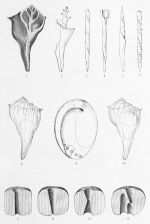
1. Section of Busycon perversum.
2. Roughly trimmed columella.
3. Headless pin, western form.
4. Tennessee form.
5. Pin pointed at both ends.
6. (Omitted.)
7. Manner of cutting into beads.
8. Derivation of a celt from Busycon.
9. Derivation of ornaments from Haliotis.
10. Derivation of ornaments from Busycon.
11. Bead with cylindrical, countersunk perforation.
12. Bead with conical perforation.
13. Bead with bi-conical perforation.
14. Bead imperfectly perforated.
In 1881 some very important additions to the National Museum were
made, from the mounds of Tennessee. These include a great wealth of
objects in shell. From the McMahan mound at Sevierville, Tenn., there
are a dozen shell pins, all made from the Busycon perversum. The entire
specimens range from three to six inches in length; two are fragmentary,
having lost their points by decay. In shape these objects are quite
uniform, being, however, as a rule, more slender in the shaft than the
average pin. The heads range from one-half to one inch in length, and
are generally less than one inch in diameter. They are somewhat varied
in shape, some being cylindrical, others being conical above. The
shaft is pretty evenly rounded, but is seldom symmetrical or straight.
It is rarely above one-half an inch in diameter, and tapers gradually to
a more or less rounded point. The groove of the canal shows distinctly
in all the heads, and may often be traced far down the shaft. In a
number of cases the surface retains the fine polish of the newly-finished
object, but it is usually somewhat weathered, and frequently discolored
or chalky. These specimens were found in the mounds along with deposits
of human remains, and generally in close proximity to the head;
this fact suggests their use as ornaments for the hair.
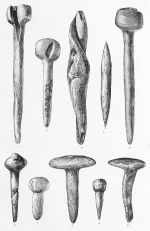
[pg 215]Two illustrations are given in Plate XXX. Fig. 1 represents a fine
example, six and a quarter inches in length. The head is deeply grooved,
and is apparently cut from the middle part of the columella, the shaft
being formed from the spine-like basal point. The spiral canal, which
is clearly defined, makes but one revolution in the entire length of the
pin. In Fig. 5 a somewhat similar specimen is represented. Two fine
specimens come from a mound on Fain's Island, Tennessee River. The
larger one is made from the columella of some heavy shell, probably the
Strombus gigas. The head is cylindrical, and the shaft large, but imperfect.
The smaller is a little more than two inches in length, the head
being small and conical, and the point more than usually blunt. Another
specimen was obtained from a mound at Taylor's Bend, near Dandridge,
Tenn. The head is almost spherical, and the point broken off; the
whole surface is new looking and highly polished. A number of bone
pins pointed at both ends were obtained from Fain's Island, besides
many perforators and other well-made implements of bone.
Prof. C. C. Jones describes[55] a number of shell pins without mentioning
localities, stating, however, that such pins have been obtained from
a mound on the Chattahoochie River, below Columbus, Ga. He publishes
illustrations of two varieties. One, of the ordinary type, is five and
a half inches in length, one inch of that distance being occupied by the
head, which is an inch and a quarter in diameter. The shank is an
inch and a half in circumference, and, while tapering somewhat, is quite
blunt at the point. The other is of somewhat rare occurrence, being
pointed at both ends. An example of this variety is given in Fig. 4,
Plate XXX. They are usually small and short, seldom exceeding three
inches in length.
In the national collection there are ten fine pins, obtained by C. L.
Stratton from a mound on the French Broad River, fifteen miles above
Knoxville, Tenn. Four only are made from the Busycon perversum.
The largest specimen has a very large, cylindrical head, with an extremely
deep groove. The shaft has been at least five inches long, and
is nearly one-half an inch in diameter. Another fine specimen is five
inches long, very slender, and nearly symmetrical. A small, almost
headless pin, not quite one and a half inches in length, is peculiar in
having a longitudinal perforation. It has probably been strung as a
bead. A fourth specimen is five and three-quarters inches in length.
The head is well rounded above, and the shaft tapers gradually to a slender
symmetrical point. The other specimens from the same locality are
in an advanced stage of decay, the points being entirely destroyed.
The Peabody Museum contains a large number of very fine specimens
of this class. The most important of these were obtained from the
Brakebill, Lick Creek, and Turner mounds of Tennessee, by the Rev.
E. O. Dunning. The largest of these is upward of six inches in length.
An unusually symmetrical and well-preserved specimen from the Lick
[pg 216]
Creek mound is nearly seven inches in length. One specimen only in
this collection differs from the type already described; this has been
made from a dextral-whorled shell; the head is somewhat spherical, but
is unusual in having an umbonate projection at the top. It is illustrated
in Fig. 6, Plate XXX.
Another small pin, which is about one and one-half inches in length,
has a poorly defined head, and would seem useless for the purposes ordinarily
suggested for the larger specimens.
A recent collection from Pikeville, Tenn., includes a number of specimens
made from the spike-like base of the Busycon perversum. They
are roughly finished, and taper to a point at both ends. The larger
ones are six inches in length and nearly one inch in diameter. All are
perforated longitudinally. This perforation is neatly made and about
one-eighth of an inch in diameter. In one specimen which has been
broken open two perforations may be seen running almost parallel with
each other, as if they had been bored from opposite ends and had failed
to meet. The length of these perforations is quite remarkable, and it is
difficult to understand how, with the primitive tools at the disposal of
these people, a uniform diameter could be given throughout. One of
these objects is shown in Fig. 3, Plate XXX.
Other States besides Tennessee have furnished a limited number of
shell pins. Their occurrence in a mound near Columbus, Ga., has already
been mentioned.
The national collection contains a fine specimen from Macon, Ga., collected
by J. C. Plant. The Peabody Museum has a number from mounds
on the Saint Francis River, Ark. One of these is illustrated in Fig. 8,
Plate XXX. They differ from the pins heretofore described, being in
all cases unsymmetrical. The shaft is flat and somewhat curved, and
joins the mushroom-shaped head near one edge. This results from the
peculiar shape of the portion of the shell from which the pin is derived,
the head being cut from the peripheral ridge and the shaft from the
body below or the shoulder above. Two specimens of this class have
recently been obtained from a mound at Osceola, Ark. A profile view
of one is shown in Fig. 10, Plate XXX.
A pin of this class, from a burial mound at Black Hammock, Fla.,
is described and illustrated by Professor Wyman.[56] From the fact of its
being perforated at the point, he regards it as a pendant ornament. He
states that it is cut from the suture, where a whorl joins the preceding
one. In this respect it resembles the specimens from Arkansas. It is
made from a Busycon perversum.
In the National Museum we have two specimens from Florida. One
of these, from Pensacola, is illustrated in Fig. 2, Plate XXX, and is of
the ordinary form. The other is a short, broad-headed specimen, illustrated
in Fig. 7, Plate XXX.
In the Peabody Museum are two small specimens of the ordinary type,
[pg 217]
from a mound near Jamestown, Va. One of these, a small, pointed
variety, is given in Fig. 9, Plate XXX.
PL. XXX—PINS—EASTERN FORMS.
In Volume VI of Schoolcraft's Indian Tribes, a pin, probably of shell,
is shown in a plate illustrating relics from South Carolina.
A few localities have furnished bone, stone, and clay pins similar to
these in shape. Specimens of the latter may be found both in the National
and Peabody museums. They were probably intended as stoppers
for bottle-shaped earthen vessels. Bone pins are generally headless,
and have in most cases been intended as implements for perforating
and for sewing. Mr. Schumacher found a pin-like object of bone
on the island of San Clemente, Cal. It resembles the shell pins pretty
closely, having a somewhat spherical head. It is figured by Professor
Putnam in a recent work.[57]
As already stated, the exact uses to which these pins were applied
by the mound-building tribes are unknown; various uses have been suggested
by archæologists. The favorite idea seems to be that they were
hair-pins, used by the savages to dress and ornament the hair. It would
seem that many of them are too clumsy for such use, although when
new they must have been very pretty objects. The shorter and headless
varieties would certainly be quite useless. Similar objects of bone
or ivory, often tastefully carved, are used by the natives of Alaska for
scratching the head, although it seems improbable that this should have
been their most important function.
Professor Dall suggests that some of the shell pins may have been
used as were the "blood-pins" of the Indians of the northwest coast.
When game is killed by an arrow or bullet, the pin is inserted in the
wound, and the skin drawn and stitched over the flat head, so that the
much valued blood may be prevented from escaping. A small, very
tastefully carved specimen of these pins is given in Plate XXXI, Fig. 4.
It was obtained from the Indians of Oregon. A similar specimen
comes from San Miguel Island, Cal.
It is possible that they may have served some purpose in the arts or
games of the ancient peoples; yet when we come to consider the very
great importance given to ornaments by all barbarians, we return naturally
to the view that they were probably designed for personal decoration.
From the Pacific coast we have shell pins of a very different type.
They also are made from the columellæ of large marine univalves, and
were probably used as ornaments, doubtless to a great extent as pendants.
These objects have been obtained in great numbers from the
ancient graves of the California coast, at Santa Barbara, at Dos Pueblos,
and on the neighboring islands of Santa Clara, Santa Catalina,
San Clemente, and Santa Rosa. Professor Dall is of the opinion that
the shell mostly used is the Purpura crispata, the smaller specimens
probably being derived from the Mitra maura.
[pg 218]
Such a very concise description of these objects is given by Prof. F. W.
Putnam in a recent paper that I beg leave to quote it here, omitting
his references to figures: "A columella was ground down to the
required size and shape, and made into a pendant by boring a hole
through the larger end. In order to make this pendant still more attractive,
the spiral groove is filled with asphaltum, or a mixture of that
material and a red pigment. Sometimes the spiral groove was so nearly,
or even wholly, obliterated in the process of grinding the columella into
shape as to make it necessary to enlarge or even recut the groove in
order to make a place for the much-loved asphaltum." Another form,
made from another shell, is described, the whorls of which are "loose
and open, so that a natural tube exists throughout the length of the
spire; at the same time the spiral groove in the central portion is very
narrow; consequently it has to be artificially enlarged for the insertion
of the asphaltum, which thus winds spirally about the shell. As the
natural orifice at the large end of the shell seems to have been too
large for properly adjusting and confining the ornament as desired,
this difficulty was overcome by inserting a small shell of Dentalium, or
by making a little plug of shell, which is carefully fitted and bored."[58]
The national collection contains upward of fifty of these pins, which
come from ancient graves at Santa Barbara and Dos Pueblos, Cal.,
and from the islands of Santa Cruz and San Miguel. These vary in
length from one to five inches, the well-finished specimens seldom reaching
one half an inch in diameter. At the upper end they round off somewhat
abruptly to an obtuse point, but taper to a sharp point at the lower
end, something like a cigar. Two fine examples are shown in Figs. 1
and 2, Plate XXXI. All show the spiral groove, and nearly all have
portions of the asphaltum remaining. The columellæ from which they
are made may be to some extent naturally perforated, but are certainly
not sufficiently so to permit the ready passage of a cord. The points
are seldom sharp, and are often broken off. A bit of Dentalium inserted
into the perforation and set with asphaltum helps to enforce the point and
to guard against further breakage. The larger specimens are seldom
perforated transversely at either end, while the smaller ones are almost
always perforated at the larger end, which is slightly flattened. A good
example is shown in Fig. 5, Plate XXXI.
A peculiar bulb-pointed specimen is illustrated in Fig. 6, Plate XXXI.
The bulb is made from the upper end of the columella. There
are six of these pins in the collection.
The consideration of these pins leads naturally to the presentation
of other classes of objects manufactured from the columellæ of marine
univalves among which beads are the most numerous and important.
PL. XXXI—PINS—PACIFIC COAST FORMS.
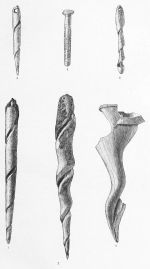
1. Shell pin from San Miguel Island.
2. Shell pin from Dos Pueblos, Cal.
3. An untrimmed columella.
4. Bone pin from Oregon.
5. Shell pin from San Miguel Island.
6. Shell pin from San Miguel Island.
(1/1)
I shall not attempt within the limits of this paper to give more than
an outline of this important division of my subject.
The use of beads seems to have been almost universal with peoples
of all times and of all grades of culture, and the custom of wearing
them is a relic of barbarism that promises to be carried a long way
into the future. All suitable natural objects have been brought into
requisition—animal, vegetable, and mineral. Shells from the sea, precious
stones from the mountains, and fruits from the forest have been
utilized; and claws of birds, teeth of animals, and even the nails of the
human hand have been worked into ornaments to gratify the barbaric
vanity of the "untutored savage." The flinty substance of the shells of
mollusks has been a favorite material at all times and with all peoples.
Especially is this true of the shell-loving natives of North America,
among whom shell beads have been in use far back into the prehistoric
ages, and who to-day, from Oregon to Florida, burden themselves to
discomfort with multiple strings of their favorite ornament; and this,
too, without reference to their value as money or their service as charms.
On the necks of brawny and unkempt savages I have seen necklaces
made of the highly glazed Oliva, or of the iridescent nacre of the pearly
Haliotis, that would not shame a regal wardrobe, and have marveled at
the untaught appreciation of beauty displayed.
Beads made of shell may have three divisions based upon derivation,
and three based upon function.
First, they consist of all smaller varieties of natural shells, pierced
for suspension, or only slightly altered, to add to beauty or convenience;
second, they are made of the shells of bivalves and the outer walls of
univalves; or, third, of the columellæ of the larger univalves cut to the
desired sizes, and shaped and polished to suit the savage taste.
As to function, they may be classed as personal ornaments, as money,
and as material for mnemonic records.
Under this head I shall examine briefly the manner of piercing or altering
the smaller varieties of shells preparatory to stringing. The multitudes
of perforated shells exhumed from the graves of our ancient tribes
afford a fruitful field of study, and our large collections of more recent
specimens serve to illustrate the manner in which they were employed.
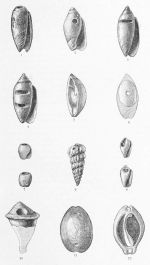
In Plate XXXII illustrations are given showing the various methods
of manipulation and perforation. In North America the Marginella, the
Oliva, and the Cyprea seem to lead in importance.
Fig. 1 represents an Oliva, the apex of which has been broken away
and the rough edge ground down, producing a passage for a thread,
which may be introduced through the natural aperture below. This is
[pg 220]
a common method of perforation in many widely separated districts,
and with a considerable variety of shells. The specimen figured is
from a mound in Cocke County, Tenn. It is an Oliva literata from the
Atlantic coast.
Fig. 2 shows a very usual method of treating small univalves. The
most prominent part of the lower whorl is ground down until the wall
is quite thin, and a small round hole is then drilled through it. The
specimen illustrated is a large Olivella biplicata, obtained from the
island of Santa Rosa, Cal.
Figs. 3 and 4 illustrate specimens from Mexico. Some thin-bladed
implement, probably of stone, has been used to saw a slit or notch in
the first convolution of the shell near the inner lip. Fig. 3 has one of
these perforations, and Fig. 4 has two. The shell is the Oliva literata,
from the Atlantic coast.
Fig. 5 is simply one-half of an Olivella biplicata with the interior parts
extracted. It is made by cutting the shell longitudinally and drilling
a central perforation. The specimen figured is from San Miguel Island,
Cal.
Fig. 6 illustrates the manner of breaking out a disk preparatory to
making a bead. This disk, when perforated, is frequently used by the
Indians of the Pacific coast without additional finish.
Fig. 7 shows two examples of beads made from small specimens of
the Olivella biplicata; both extremities are ground off, leaving a rather
clumsy cylinder. The originals are from graves on the island of Santa
Rosa. Such beads are frequently worn at the present time.
One of the specimens shown in Fig. 8 is from a grave in Monroe
County, New York, and the other is from a mound in Perry County,
Ohio. The shell is the Marginella conoidalis, which has a wide distribution
in the ancient burial-places of the Atlantic slope. In making
the perforation the shoulder is often ground so deeply as to expose the
entire length of the interior spiral.
Fig. 9 represents a perforated Cerrithidea sacrata, from Santa Rosa
Island, Cal. The method of perforating employed is a usual one
with small shells of this form. Similar specimens come from many
parts of the United States. Beads of this and the preceding variety
are said to have constituted the original wampum of the Atlantic seaboard.
Fig. 10 illustrates a rude bead made from the spire of a univalve,
probably a small specimen of Busycon perversum. Most of the body of
the shell has been removed and a perforation made near the border.
Three of these specimens were found in a burial mound at Murphysboro,
Ill.
Fig. 11 illustrates a perforated Cyprea from the Pacific coast. This
is a recent specimen, which illustrates an ancient as well as a modern
method of perforation.
Fig. 12 shows a rather peculiar method of treating Cyprea shells by
[pg 221]
the tribes of the Pacific coast and the Pacific islands. The prominent
part of the back is cut or ground away, and the columella is partially
or wholly removed, a passage the full size of the natural aperture being
thus secured. This is also an ancient as well as a modern method of
treatment.
PL. XXXII—PERFORATED SHELL BEADS.
(1/1)
Small bivalve shells are prepared for stringing by drilling one or
more holes in the center or near the margin, according to the manner
in which they are to be strung. Such beads have been in almost universal
use by primitive peoples, both ancient and modern.
Shells with natural perforations, such as the Fissurellas and Dentalia,
are extensively employed by the west coast peoples, and foreign varieties
of the latter have been largely imported by Europeans, and from very
early times have been used by the tribes of all sections. The natural
perforation of the Fissurella is often artificially enlarged, and additional
perforations are made near the margin. Examples may be seen
in Plate XLIX.
I shall include under the head of beads all small objects having a
central or nearly central perforation, made for the purpose of stringing
them in numbers. In shape, they range from straw-like cylinders, three,
four, and even five inches long, with longitudinal perforations, to thin,
button-like disks, two or more inches in diameter. In general the cylinders
are made from the columellæ of univalves, and the disks from
the outer walls of the same, or from the shells of bivalves. Of course,
there are forms that fall under no classification, such as disks with perforations
parallel with the faces, or cylindrical forms with transverse
perforations, while many small, pendant-like objects, of varied shapes,
are strung with the beads, and might be classed with them; but these
are exceptions, and can be described along with the classified objects
most nearly resembling them.
The grinding down and the perforating of natural shells is easily
accomplished, so that any savage could afford to decorate his person
with this jewelry in profusion. But the class of beads illustrated in
Plates XXXIII, XXXIV, and XXXV could not have been made without
the expenditure of much time and labor, and doubtless owe their
existence, in a measure, to mercenary motives. As they were made
from the walls or columellæ of massive shells, they must have been
broken or cut out, ground smooth about the edges, and perforated; this,
too, with most primitive tools.
In shape discoidal beads range from the concavo-convex sections of
the curved walls of the shell to totally artificial outlines, in such forms
as doubly-convex disks, cylinders, and spheroids. In size the disks
vary from very minute forms, one-tenth of an inch in diameter and one-thirtieth
of an inch in thickness, to two inches in diameter and nearly
one-half an inch in thickness. The thickness of the finished beads is
[pg 222]
governed in a great measure by the thickness of the shell from which
they are manufactured.
The Venus mercenaria of the Atlantic coast and the heavier Unios of
the Mississippi Valley give a general thickness of from one-eighth to
three-eighths of an inch, while others, such as the heavy clams of the
Pacific, are very much thicker. The walls of univalves, especially near
the base, are often extremely heavy, while the smaller varieties of shells
furnish specimens of wafer-like thinness.
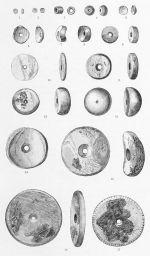
In Plate XXXIII a series of beads of this class is given, beginning
with the smaller disks and ending with those of large, though not the
largest, size.
In Fig. 1 I present two views of a minute disk, obtained, with many
others of similar shape and size, from a mound on Lick Creek, Tenn.
The perforations in these specimens, as well as in most of those that
follow, are bi-conical, and sufficiently irregular in form to indicate that
they are hand-made. Beads of this general appearance have been found
in a multitude of graves and mounds, distributed over a large part of
North as well as of South America. A vast majority of these beads are
doubtless of aboriginal make, as they are found in the oldest mounds.
Fig. 2 represents a minute form from Santa Cruz Island, Cal. The
peripheral surface is ornamented with a net-work of incised lines.
Fig. 3 illustrates a small cylindrical bead, with large perforation, from
a mound near Prairie du Chien, Wis. It was found, with a number of
others, near the neck of the skeleton of a child.
Fig. 4 represents a small spheroidal bead from the great mound near
Sevierville, Tenn.; it is neatly made and well preserved.
Figs. 5 and 6 illustrate specimens of roughly finished concavo-convex
disks, much used by both ancient and modern tribes of California, Arizona,
and New Mexico.
I essayed at one time to purchase a long necklace of these homely
ornaments from a Navajo Indian in Arizona, but soon discovered that
it was beyond my reach, as my best mule was hardly considered a fair
exchange for it. These beads are made from the Oliva chiefly, but to
some extent from small bivalves.
This bead is not common in the mounds of the Mississippi Valley,
but is used by many modern savages. It seems to be the form called,
by the Indians of Virginia, "roenoke," which, according to Beverly, is
made of the cockle-shell, broken into small bits, with rough edges, and
drilled through in the same manner as beads.
Fig. 7 represents a smoothly cut bead of medium size, said to have been
obtained from a grave at Lynn, Mass. It has been cut from the curved
wall of some large univalve, and is very similar to modern specimens
in use over a greater part of the United States.
Fig. 8 belongs to a necklace brought from the northwest coast, and
is very much like the specimen shown in Fig. 7.
Fig. 9 is a well-made specimen from Sevierville, Tenn. The sides are
[pg 223]
ground perfectly flat and the edges are well rounded. The shell is very
compact, and well preserved, and bears a close resemblance to bone or
ivory.
Fig. 10 represents a thin, fragile disk, from a mound in Southern Illinois.
It is made of a Unio, and separates into thin sheets or flakes, like
mica.
Figs. 11 and 12 illustrate two compact, nearly symmetrical specimens
from a mound at Paint Rock Ferry, Tenn.
Fig. 13 is from the same locality, and is hemispherical in shape.
Fig. 14 represents a button-like disk, with large conical perforation,
from a mound at Paint Rock Ferry, Tenn. It has probably been made
from the wall of a large marine univalve.
The fine specimen shown in Fig. 15 comes from a mound in Cocke
County, Tenn., and is unusually well preserved. It is very compact,
having the appearance of ivory, and has probably been made from the
basal portion of a large univalve. The perforation is extremely large,
and is conical, having been bored entirely from one side.
Figs. 16 and 17 represent two fine specimens from California. They
are nearly symmetrical, the faces being flat or slightly convex. The
smaller one has been coated with some dark substance—the result,
probably, of decay—which has broken away in places, exposing the
chalky shell. The edges are ornamented with shallow lines or notches.
Such disks, when used as ornaments, probably formed the central piece
of a necklace, or were fixed singly to the hair, ears, or costume. As
long as these larger specimens retained the color and iridescence of the
original shell, they were extremely handsome ornaments, but in their
present chalky and discolored state they are not prepossessing objects.
This plate will serve as a sort of key for reference in the study of
beads of this class, as the specimens are typical.
PL. XXXIII—DISCOIDAL BEADS.
(1/1)
Beads made from the columellæ of univalves have generally a number
of distinguishing characteristics. They are large and massive, and
rarely symmetrical in outline, being sections of roughly dressed columns.
They are somewhat cylindrical, and often retain the spiral groove as
well as other portions of the natural surface. In cases where the form
is entirely artificial they may be distinguished by the sinuous character
of the foliation. The perforation is nearly always with the axis of the
bead, and is in most cases bi-conical. In Plate XXIX a series of cuts
is given which illustrates the various methods of perforation and shows
very distinctly the differences between the rude work of savages and the
mechanically perfect work of modern manufacturers. Beads of this class
are more decidedly aboriginal in character than those of any other group,
and are without doubt of very ancient origin. They are widely distributed,
and have been found in graves and mounds covering an area
[pg 224]
outlined by Massachusetts, Canada West, Minnesota, Missouri, and the
Gulf and Atlantic coasts.
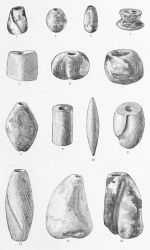
Figs. 1, 6, 7, 11, and 14 of Plate XXXIV represent typical specimens
of this class. In every case they are considerably altered by decay,
rarely retaining any of the original polish. All come from ancient burial
mounds, some of the interments of which probably antedate, while
others post-date, the coming of the whites.
The bead shown in Fig. 1 is made from the columella of a Busycon
perversum. It is a rude, tapering cylinder, with rounded ends and deep
spiral groove. The perforation is bi-conical and somewhat irregular.
This, with many similar beads, made of both dextral and sinistral shells,
was associated with human remains in the great mound at Sevierville,
Tenn.
The bead illustrated in Fig. 6 has been made from the column of some
dextral whorled shell. It was obtained from a mound on Lick Creek,
East Tenn. It is a typical specimen of average size, and illustrates
very well the large collection of this class of relics made by Dr. Troost.
Fig. 7 was obtained from a mound at Franklin, Tenn. It is cut from
the columella of a Busycon perversum, and is of the usual form, being a
heavy, short cylinder, rounded at the ends until it is somewhat globular.
The perforation is very large, and has been made almost entirely from
one end. The surface is much weathered, the firmer laminæ being distinctly
relieved. Other specimens from the same locality are much
smaller.
Fig. 11 is from a grave in an ancient cemetery at Swanton, Vt., and
is similar to the preceding, having been cut, however, if correctly represented,
from a dextral whorled shell. The cut is copied from a paper
by G. H. Perkins.[59]
Fig. 14 illustrates a very large specimen of these beads from the
Lick Creek Mound, East Tenn. The surface is encrusted, stained, and
decayed. It has been made from the broad beak of a Strombus or dextral
whorled Busycon. The perforation is symmetrical and bi-conical.
Specimens upwards of two inches in length and one and one-fourth in
width come from the same place. The larger perforations are three-eighths
of an inch in diameter at the ends and quite small in the middle.
Fig. 12 represents a large bead of symmetrical outline, made from
the columella of a Busycon perversum. The shape is artificial, with the
exception of a small portion of the spiral canal. The surface retains
much of the original polish, but exfoliation has commenced on one side.
The perforation is about three-sixteenths of an inch in diameter at
the ends and one-sixteenth in the middle. There is a slight offset
where the perforations meet. It is from a burial mound at Harrisburg,
Ark.
The bead shown in Fig. 9 is one of a large number obtained from a
[pg 225]
mound at East St. Louis, Ill. It is a symmetrical, well-polished cylinder.
The small portion of the spiral groove which remains indicates
that it is derived from a Busycon perversum. The perforation is neatly
made and doubly conical in shape. The symmetry, finish, and fine condition
of this bead lead to the suspicion that it may be of recent manufacture.
Its form is by no means a common one among ancient mound
relics.
The bead represented in Fig. 10 is described and illustrated by Squier
and Davis.[60] This, with many similar specimens, was taken from a
mound in the Ohio Valley. It is made from the columella of some marine
univalve, and is well wrought and symmetrical.
Fig. 5 is a flattish, highly polished bead from Monroe County, New
York. The material, which resembles ivory, may have been obtained
from the tusk of some animal. It is slightly concave on one side and
convex on the other. The perforation is neatly made and of uniform
diameter throughout.
In Fig. 4 I present a bead of unusual shape; it is made from the
basal portion of some heavy univalve. The axis and perforation are at
right angles to the plane of lamination. The middle portion of the bead
has been excavated, producing a form resembling a labret or lip-block,
in common use by many tribes. It is from a mound on French Broad
River, Tenn. We have a bead of similar shape, but which has a lateral
perforation, from a mound at Nashville, Tenn.
Fig. 2 illustrates a spheroidal bead obtained from an ancient grave on
Santa Rosa Island, Cal. The form is unusually symmetrical and the perforation
neatly made, being small, doubly conical, and slightly countersunk
at one end. The surface is smooth and retains a little of the original
purplish hue of the shell, probably a Hennites giganteus. Others
of the same shape from this locality exhibit like characteristics. A few
similar specimens come from San Miguel Island.
Another large specimen from this locality is shown in Fig. 8. It
is somewhat flat, and is quite wide in the middle portion, tapering
rapidly towards the ends. The perforation is small and regular. The
lines of foliation are distinctly marked, but are not sufficiently characteristic
to indicate the part of the shell from which the bead is derived.
Pearls.—Two of the most remarkable beads in the national collection
are illustrated in Figs. 3 and 13. The latter is an enormous pearl,
probably derived from the Haliotis Californianus. It is somewhat pear-shaped,
the base being rounded and the apex a little bent. The transverse
section is subtriangular. Having been buried for an unknown
period in the soil or sand, it has suffered greatly from decay, and has
probably lost considerably by exfoliation. The thin, chalky lamellæ
come away readily in concentric scales, exposing the iridescent nacre
beneath. The perforation is about one-sixteenth of an inch in diameter,
and seems to pass through a natural cavity in the interior of the pearl.
The smaller specimen given in Fig. 3 is in many respects, similar to the
[pg 226]
large one. Another, of about the same size as Fig. 3 bears quite a
marked resemblance to a lima bean, and is pierced laterally, giving a
button like appearance.
These specimens were obtained from graves on San Miguel Island, by
Stephen Bowers.
PL. XXXIV—MASSIVE BEADS AND PEARLS.
(1/1)
In Plate XXXV I have arranged a number of cylindrical beads, together
with a few others of unclassified form.
Figs. 1 and 2 illustrate the most common form of the ancient wampum,
the white example being made from the columella of a small univalve,
and the dark one from the purple portion of a Venus mercenaria.
The specimens represented belong to the celebrated "Penn belt," preserved
in the rooms of the Historical Society of Pennsylvania.
It is not known positively that beads of this particular shape were
employed in pre-Columbian times; but it is certainly one of the earliest
historical forms, and one which has been manufactured extensively
by the Indians as well as by the whites. They may be found both in
very old and in very recent graves, in widely separated parts of the
United States and British America, and have always formed an important
part of the stock of the Indian trader.
Figs. 3 and 4 represent a very large class of Pacific coast forms.
These are from the island of San Miguel. They are simple white cylinders,
with somewhat irregular bi-conical perforations. Many examples
may be found which taper slightly toward the ends. They are coated
with a rusty-looking deposit, which breaks away easily, exposing the
chalky substance of the shell. They range from one-half to three inches
in length, and from one-eighth to three-eighths in diameter. They are
probably made from the thick valves of the Pachydesma crassatelloides
or the Amiantis callosa. They were probably used as beads for the neck
and as pendant ornaments for the ears. The longer specimens may
have been worn in the nose. It is also said that beads of this class
were used as money.
Fig. 5 illustrates a very long, tubular bead found at Piscataway, Md.
It has been made from the columella of some large univalve. It is four
and a half inches long and one-fourth of an inch in diameter. The surface
is smooth, but a little uneven, and the ends taper slightly. The
perforation which has apparently been made from both ends, as there
is an offset near the middle, is quite regular, though slightly enlarged
near the ends.
A large number of beads of the class illustrated in Fig. 6, Plate XXXV,
were obtained from the ancient graves of San Miguel Island,
Cal. They have been made from one of the large bivalve shells of the
Pacific coast, probably the Pachydesma crassatelloides. The curvature
of the bead is the result of the natural curve of the valve from which
it is fashioned. The larger specimens are nearly five inches in length.
In the middle portion they are three-eighths of an inch in diameter.
They taper gradually towards the ends to the size of the perforation,
[pg 227]
which averages about one-sixteenth of an inch. The curvature of the
bead is so great that there has been much difficulty in making the perforations
from opposite ends meet, and none of the larger specimens
will permit the passage of a wire, although the perforations lap considerably
and water passes through quite freely. It will be observed
that the surface of these objects is coated with a dark, rough film, which,
when broken away, exposes the natural shell. Such beads may have
been used as nose ornaments, but more probably formed parts of some
composite ornament for the neck or ear.
Fig. 7 represents a bone nose ornament obtained from the Pai-Ute
Indians by Professor Powell. Its shape is not unlike that of the curved
bead just described.
The large rude bead given in Fig. 8 is made from the thick lip or rim
of the Haliotis Californianus. This, with a number of similar specimens,
was obtained from an ancient grave at Dos Pueblos, Cal. The perforations
are all large and symmetrical. In one case the hole has been
reduced at the ends by inserting small bits of shell, through which
minute passages have been made.
In Figs. 9 and 10 I give two illustrations of a bead of rather remarkable
form. A large number of similar specimens have been brought
from Dos Pueblos, La Patera, and the islands of San Miguel and Santa
Cruz. They are made from the hinge of the Hennites giganteus, a large
bivalve, having a delicate purplish tinge. The shape results from the
form of the hinge; the curve is the natural curve of the shell; and the
notch near the middle of the convex side is the natural pit, often somewhat
altered by art to add to the appearance or to assist in completing
the perforation. The holes are generally very small, and have been
made with much difficulty, owing to the curvature of the bead. Where
by accident the perforation has become enlarged at the end, it has
been bushed by setting in a small piece of shell. The specimen figured
is perforated near the end for suspension, no longitudinal perforation
having been attempted.
Fig. 11 shows one of these beads in an unfinished state, the portion
of the hinge used being roughly broken out and slightly rounded. We
have in the national collection specimens of this class in all stages of
manufacture. Professor Haldeman has described and illustrated a
number of similar beads. He describes the rounded notch near the
middle as artificial, and considers it a device to help out the perforation
or facilitate the stringing. Professor Putnam, in the same work,[61] states
that the "notches were subsequently filled with asphaltum even with
the surface of the shell."
The curved bead illustrated in Fig. 12 is made from a Dentalium indianorum
(?) by removing the conical point. These shells, either entire
or in sections, are much used by the Indians of the northwest, both as
ornaments and as a medium of exchange.
PL. XXXV—BEADS.
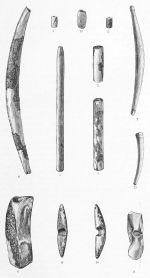
1, 2. Beads from the Penn Belt.
3, 4. Pacific coast forms.
5. Bead from Maryland.
6. A Pacific coast form.
7. A Pai-Ute nose ornament (bone).
8. Bead made from a Haliotis.
9, 10, 11. Beads made from hinge of Hennites.
12. Bead made from a Dentalium.
13. Bead from mound, Tenn.
(1/1)
In Plate XXXVI I present a number of illustrations of a class of
relics which have occasionally been mentioned in literature, and which
are represented to some extent in our collections. As these objects resemble
beads rather more closely than pendants, I shall refer to them
in this place, although Mr. Schoolcraft considers them badges of honor
or rank, and treats them as gorgets. He describes them as consisting
of a "circular piece of flat shell, from one and a half to two inches in
diameter, quartered with double lines, having the devices of dots between
them. This kind was doubly perforated in the plane of the
circle."[62]
In "Notes on the Iroquois," by the same author, we have a much fuller
description. He says that "this article is generally found in the form
of an exact circle, rarely a little ovate. It has been ground down and
repolished, apparently, from the conch. Its diameter varies from three-fourths
of an inch to two inches; thickness, two-tenths in the center,
thinning out a little towards the edges. It is doubly perforated. It is
figured on the face and its reverse, with two parallel latitudinal and two
longitudinal lines crossing in its center, and dividing the area into four
equal parts. Its circumference is marked with an inner circle, corresponding
in width to the cardinal parallels. Each division of the circle
thus quartered has five circles, with a central dot. The latitudinal and
longitudinal bands or fillets have each four similar circles and dots, and
one in its center, making thirty-seven. The number of these circles
varies, however, on various specimens. In the one figured there are
fifty-two."[63]
Figs. 1 and 2 are copied from Plate 25 of Schoolcraft. The smaller
was obtained from an ancient grave at Upper Sandusky, Ohio, and the
larger from an Indian cemetery at Onondaga, N. Y. Others have been
found at Jamesville, Lafayette, and Manlius, in the latter State. The
Indians, according to Mr. Schoolcraft, have no traditions respecting
this class of objects, and we are quite in the dark as to their significance
or the manner in which they were used.
Mr. W. M. Beauchamp, of Baldwinsville, N. Y., has very kindly sent
me sketches of two of these objects. The originals were obtained from
an ancient village site at Pompey, N. Y. One is almost a duplicate of
the smaller specimen copied from Schoolcraft, but the other, which is
illustrated in Fig. 4, Plate XXXVI, presents some novel features. The
central portion of the face is occupied by a rosette-like design, which
consists of six sharply oval figures that radiate from the center like the
spokes of a wheel. These rays are ornamented with a series of oblique
lines, arranged in couplets. The margin is encircled by a narrow band,
similarly figured. Mr. Beauchamp expresses the opinion that these
specimens are of European origin.
The specimen shown in Fig. 3 belongs to a necklace now in the
[pg 229]
national collection. This necklace was obtained from the Indians of
New Mexico by Lieutenant Whipple, and consists of three of these
shell ornaments, together with about fifty small porcelain beads. The
shell beads are strung at regular intervals. The specimen illustrated
is ornamented with a design in minute conical pits, arranged precisely
as are the circlets in the crosses and encircling bands of the New York
and Ohio specimens. The edges and surfaces are much worn by use.
The substance of the shell is well preserved, and has an ivory-like appearance
although in the specimen shown in the cut the lamination
of the shell is distinctly seen. The perforations in these three specimens
are quite symmetrical, and suggest the use of machinery. The
method of perforation is identical in all these specimens, and will be
readily understood by reference to the two sections given in Figs. 5
and 6. All of these specimens are nearly circular; but the regularity of
the outline is in some cases marred by shallow notches produced by
wear at the perforations. This wear has been accelerated by the abrasion
of the small beads with which the disks have probably been strung.
It will be noticed that there is quite a close resemblance between
these objects and the "runtees" of the early writers. Beverly gives an
illustration of an Indian boy who is described as wearing a necklace of
these "runtees," which "are made of the Conch Shell, as the Peak is,
only the Shape is flat and like a Cheese, and drill'd Edge-ways."[64] A
portion of this illustration is copied in Fig. 5, Plate XXXVI. It will
be seen by reference to this cut that the manner of stringing corresponds
with the method in which the objects under consideration would
have to be strung.
PL. XXXVI—RUNTEES.
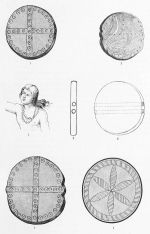
1. New York.
2. New York.
3. Arizona.
4. New York.
5, 6. Sections.
7. Manner of wearing.
(1/1)
It is probable that the signification of the designs engraved upon
these ornaments will remain forever a matter of conjecture. It cannot
be affirmed that the cross, which occurs on the faces of most of the
specimens, has any particular significance, although it may represent
the points of the compass. That it may have some emblematic meaning
is, however, not impossible. I have counted the number of circlets
on all of the specimens with which I am acquainted. The result is
shown in the following table:
| In the cross. | |
| Longitudinal arm. | Transverse arm. | In the circle, exclusive of cross. | Total. |
| No. 1 (Fig. 1) | 10 | 9 | 23 | 41 |
| No. 2 (Fig. 3) | 10 | 12 | 27 | 48 |
| No. 3 (Fig. 2) | 11 | 9 | 23 | 43 |
| No. 4[A] | 9 | 9 | 20 | 37 |
| No. 5[A] | 12 | 11 | 29 | 51 |
| No. 6[B] | 9 | 9 | 20 | 37 |
The central circlet having been counted with each arm of the cross, the
total number of circlets in each specimen will be one less than the sum
of the three columns.
[pg 230]These circlets may be numerals. The design may be significant of
some rank, the badge of a secret order, or the totem of a clan. The
general arrangement of the figures upon the face of these disks suggests
an incipient calendar.
These beads are doubtless American in origin, as nothing of a similar
form, so far as I can learn, occurs in European countries. The fact that
they are found in widely separated localities indicates that they were
probably used in trade since the advent of the whites. This is possibly
some form of bead held in high esteem by tribes of the Atlantic coast
when first encountered by the whites who have taken up its manufacture
for purposes of trade.
I have already spoken casually of the use of beads for personal ornament,
but it will probably be better to enlarge a little upon the subject
at this point.
Beads are generally found in the graves of ancient peoples in a loose
or disconnected state, the strings on which they were secured having
long since decayed. We cannot, therefore, with certainty, restore
the ancient necklaces and other composite ornaments; but we can form
some idea of their character by a study of the objects of which they
were made and the positions held by these objects at the period of exhumation.
Much can also be learned by a study of the ornaments of
modern peoples in similar stages of culture.
As a rule, the combinations in the pendant ornaments of the ancient
American seem to have been quite simple. Being without glass, and
practically without metals, they had few of the resources of the modern
savage. Their tastes were simple and congruous, not having been disturbed
by the debasing influence of foreign innovation, which is the
cause of so much that is tawdry and incongruous in the art of modern
barbarians.
A curious example of a modern necklace is given by Professor Haldeman,[65]
who had in his possession an Abyssinian necklace "composed of
European beads, cowries (Cyprea shell), a triangular plate of glass, two
small copper coins, small spheric brass buttons, cornelian, date-seeds,
numerous cloves pierced through the sides, a fragment of wood, a bit
of cane, and an Arab phylactery."
Something can be learned of the practices of the ancient Americans
in the use of beads and pendant ornaments generally, by a study of the
remains of their paintings and sculptures—such, for instance, as may
be found in the Goldsborough manuscripts or the superb lithographs
of Waldeck, examples of which are given in Plate XLV.
In a number of cases necklaces of the mound-builders have been
found upon the necks of skeletons, just as they were placed at the time
of burial.
[pg 231]
Captain Atwater in describing the contents of a mound at Marietta,
Ohio, makes the statement that on the breast of a skeleton "lay a stone
ornament, with two perforations, one near each end, through which
passed a string, by means of which it was suspended around the wearer's
neck. On the string, which was made of sinew, and very much injured
by time, were placed a great many beads made of ivory or bone."[66]
A similar necklace is described by Mr. Matson, in the Ohio Centennial
Report, p. 127. It was found on the skeleton of a little girl, and
was so made as to be larger in the center of the neck in front, tapering
almost to a point at the middle of the back. On page 129 of the same
volume much more varied uses of bead ornaments are suggested. Mr.
Matson describes four skeletons, on each of which shell beads were
found. In three cases they had been placed about the neck only; in the
fourth, nearly thirty yards of beads had been used. There were four
strands about the neck, crossing over on the breast and back and passing
down between the legs. Strings passed down the legs to the feet,
and were also found along the arms and around the wrists.
The arrangement of the various parts of a necklace or string of pendants
is found to be much alike the world over, consisting of a strand
of beads, small toward the ends and increasing in size toward the middle,
where a central bead or pendant of peculiar form or unusual size
is placed.
The practices of modern barbarians in the employment of beads as
ornaments are extremely varied. They are employed in dressing the
hair, in head-dresses and plumes, and pendants to these; as pendants
to the hair, ears, nose, and lips; as necklaces and bracelets; as belts
for the waist and sashes to be thrown across the shoulders; and as
anklets and pendent ornaments to all parts of the costume.
Father Rasles, writing of the Abnaki Indians of Canada in 1723,
says: "If you wish to see him in all his finery, you will find he has no
other ornaments but beads; these are a kind of shell or stone, which
they form into the shape of little grains, some white and others black,
which they string together in such a way as to represent different showy
figures with great exactness. It is with these beads that our Indians
bind up and plait their hair on their ears and behind; they make of
them pendants for the ears, collars, garters, large sashes of five or six
inches in breadth, and on these kinds of ornaments they pride themselves
much more than a European would on all his gold and jewelry."[67]
It is related of the New England Indians that more than a hundred
years ago, they "hung strings of money about their necks and
wrists, as also upon the necks and wrists of their wives and children.
They also curiously make girdles, of one, two, three, four, and five
inches thickness, and more, of this money; which, sometimes, to the
value of ten pounds or more, they wear about their middle, and as a
[pg 232]
scarf about their shoulders and breasts. Yea, the princes make rich caps
and aprons, or small breeches of these beads, thus curiously strung into
many forms and figures; their black and white finely mixed together."[68]
It is further recorded that the New England Indians "wore ear-rings
and nose-jewels; bracelets on their arms and legs, rings on their fingers,
necklaces made of highly polished shells found in their rivers and on
their coasts. The females tied up their hair behind, worked bands
round their heads and ornamented them with shells and feathers, and
wore strings of beads round several parts of their bodies. Round their
moccasins they had shells and turkey spurs, to tinkle like little bells as
they walked."[69]
The Indian women of the New Netherlands also gave great attention
to personal decoration. One writer states that they ornamented the
lower border of their skirts "with great art, and nestle the same with
strips, which are tastefully decorated with wampum. The wampum
with which one of these skirts is ornamented is frequently worth from
one to three hundred guilders. * * * Their head-dress forms a
handsome and lively appearance. Around their necks they wear various
ornaments, which are also decorated with wampum. Those they esteem
as highly as our ladies do their pearl necklaces. They also wear bead
hand-bands, or bracelets, curiously wrought, and interwoven with wampum.
Their breasts appear about half covered with an elegantly
wrought dress. They wear beautiful girdles, ornamented with their
favorite wampum, and costly ornaments in their ears."[70]
Smith states, in writing of Powhatan, that he found him "reclining
proudly upon a Bedstead a foote high, upon tenne or twelve Mattes,
richly hung with manie Chaynes of great Pearles, about his necke, and
covered with a great Couvering of Rahaughcums,"[71] and the young women
who surrounded him wore "a great Chaine of white Beades over their
shoulders."[72]
The following is from Wood, whose quaint and graphic descriptions
of the New England Indians are always interesting: "But a Sagamore
with a Humberd in his eare for a pendant, a black hawk on his occiput
for his plume, Mowhackees for his gold chaine, a good store of Wampompeage
begirting his loynes, his bow in his hand, his quiver at his
back, with six naked Indian spatterlashes at his heels for his guard,
thinkes himselfe little inferior to the great Cham; he will not stick to
say he is all one with King Charles. Hee thinkes hee can blow down
Castles with his breath and conquer kingdomes with his conceit."[73]
Du Pratz, in speaking of the Louisiana Indians, says: "The women's
ear-rings are made of the center part of a large shell called bingo, which
[pg 233]
is about the thickness of one's little finger, and there is a hole in the ear
about that size for holding it."[74]
Lewis and Clark found the Shoshone Indians of the Upper Missouri
using shells of the pearl oyster to decorate the collars of their fur tippets.
The children wore beads around their necks; grown persons suspended
them in little bunches from the ears, and the collars of the men
were formed either of sea-shells from the southwest or from twisted
grass with porcupine quills.[75]
Among the Carrier Indians of the Northwest both sexes perforate
their noses, and from them the men often suspend an ornament consisting
of a piece of an oyster shell or a small piece of brass or copper.
The women, particularly those who are young, run a wooden pin through
their noses, upon each end of which they fix a kind of shell bead, which
is about an inch and a half long, and nearly the size of the stem of a
common clay pipe. These beads they obtain from their neighbors, the
At-e-nâs, who purchase them from another tribe that is said to take
them from the sea-shore, where they are reported to be found in plenty.
It is also stated of the same Indians that "the young women and
girls wear a parcel of European beads, strung together and tied to a lock
of hair directly behind each ear. The men have a sort of collar of the
shell beads already mentioned, which they wind about their heads or
throw around their necks."[76]
The absurd extreme to which this passion for ornament is carried is
well illustrated by an example given by Swan, who, speaking of the
tribes north of the Columbia River, says that "some of these girls I
have seen with the whole rim of their ears bored full of holes, into each
of which would be inserted a string of these shells that reached to the
floor, and the whole weighing so heavy that, to save their ears from being
pulled off, they were obliged to wear a band across the top of the
head."[77]
When, however, beads are found in the graves in quantity, by thousands
or tens of thousands, we shall probably have to attribute to them
other than ornamental uses.
Captain Tom, of the Nishinam tribe of California, according to
Powers,[78] had nearly a half bushel of shell beads and trinkets. One
string of these, worn by his wife on special occasions, contained sixteen
hundred pieces; but these treasures were hoarded because of their value
as money rather than as ornaments.
The wampum belts used by many of the tribes of Indians are known to
contain enormous numbers of beads. One of the historical belts kept by
the Onondagas among their treasures contains nearly ten thousand
beads. The famous belt of William Penn has about three thousand.
[pg 234]Sir John Lubbock, in his "Prehistoric Times," expresses surprise at the
great number of beads sometimes found, instancing the Grave Creek
mound of Virginia, which contained between three and four thousand.
This number will, however, appear very insignificant when compared
with a collection such as the costume of the great King Philip could
have furnished.
Drake relates that Philip had a coat "made all of wampampeag,"
which, when in need of money, he "cuts to pieces, and distributes it
plentifully among the Nipmoog sachems and others, as well to the eastward
as southward, and all round about."[79] By adding to this store
of beads the contents of two belts, one of which was nine inches in
breadth, and so long that when placed upon the shoulders it reached to
the ankles, we conclude that the greatest collection ever taken from a
prehistoric mound could not compare for a moment with the treasure of
this one historic chieftain.
A great deal of art is shown in the stringing and mounting of beads.
The simplest form is a single strand, a twisted string of vegetable fiber,
a strip of buckskin, or a bit of sinew being passed through the perforations.
Again, rows of strands are placed side by side and fastened at
intervals in such a manner as to keep them approximately parallel, or
the beads when long are put on equidistant cross strands, the longitudinal
strands serving to keep them in place; they are also woven into
the fabric by being mounted upon one of the strands before twisting. It
is also a very usual practice to sew them on strips of cloth or buckskin,
patterns being produced by using beads of different colors. The manner
of stringing in the manufacture of belts will be given in detail under
Mnemonic Uses of Beads.
It will probably be impossible to prove that the prehistoric peoples of
North America employed a medium of exchange in a manner corresponding
to our use of money. It is a well-known fact, however, that a
currency of shell beads was in general use throughout the Atlantic coast
region very early in the historic period.
Of all objects within the reach of savage peoples, shells, either in their
natural forms or in fragments artificially fashioned for convenience of
use, are the best adapted for such a purpose.
In examining the contents of ancient cemeteries and mounds where all
objects of value were to some extent deposited, we find no other relics
that could have been conveniently used for such a purpose.
It is not probable that objects subject to rapid decay, such as wood,
fruits, and seeds, could ever have come into general use for money,
although such objects are employed to some extent by savages in different
parts of the world. The unlimited supply or easy manufacture of
these objects would be against their use for this purpose, whereas the
difficulty of shaping and perforating the flinty substance of shells would
prevent such a plentiful production as to destroy the standard of value.
[pg 235]Objects and substances having a fairly uniform value, resulting from
their utilitarian attributes, have been employed by primitive peoples
as standards of value; as, for instance, cattle, in ancient Rome; salt, in
Assyria; tin, in Britain, and cocoa, in Mexico. But such mediums of
exchange are local in use. With these articles this function is only
accidental. The utilization of shells for money would naturally originate
from the trade arising from their use as utensils and ornaments
in districts remote from the source of supply. Yielding in the worked
state a limited supply, and at the same time filling a constant demand,
they formed a natural currency, their universal employment for purposes
of ornament giving them a fixed and uniform value. They have
undoubtedly been greatly prized by the ancient peoples, but on the part
of the open-handed savage they were probably valued more as personal
ornaments than as a means of gratifying avaricious propensities.
Lewis H. Morgan, who had access to all the sources of information on
the subject, says that "wampum has frequently been called the money
of the Indian; but there is no sufficient reason for supposing that they
ever made it an exclusive currency, or a currency in any sense, more
than silver or other ornaments. All personal ornaments, and most
other articles of personal property, passed from hand to hand at a fixed
value; but they appear to have had no common standard of value until
they found it in our currency. If wampum had been their currency it
would have had a settled value, to which all other articles would have
been referred. There is no doubt that it came nearer to a currency than
any other species of property among them, because its uses were so
general, and its transit from hand to hand so easy, that everyone could
be said to need it." Yet he admits that "the use of wampum reaches
back to a remote period upon this continent"; and further, that it was
an original Indian notion which prevailed among the Iriquois as early at
least as the formation of the League. He goes on to state that "the
primitive wampum of the Iriquois consisted of strings of a small fresh-water
spiral shell called in the Seneca dialect Ote ko-á, the name of
which has been bestowed upon the modern wampum."[80]
Loskiel says that "before the Europeans came to North America, the
Indians used to make strings of wampom chiefly of small pieces of wood
of equal size, stained either black or white. Few were made of muscle,
which were esteemed very valuable and difficult to make; for, not having
proper tools, they spent much time in finishing them, and yet their
work had a clumsy appearance."[81]
Hutchinson is of the opinion that "the Indians resident northeastward
of the province of New York had originally no knowledge of this sort of
money or medium of trade."[82]
The great body of our historical evidence goes to show, however, that
[pg 236]
a currency of shell was in use among the Atlantic coast tribes when first
encountered by the Europeans. Thomas Morton, in speaking of the
Indians of New England as far back as 1630, says that "they have a
kinde of beads in steede of money to buy withal such things as they
want, which they call wampampeak; and it is of two sorts, the one is
white and the other is a violet coloure. These are made of the shells of
fishe; the white with them is as silver with us, the other as our gould,
and for these beads they buy and sell, not only amongst themselves, but
even with us. We have used to sell them any of our commodities for
this wampampeak, because we know we can have beaver again from them
for it: and these beads are current in all parts of New England, from
one end of the coast to the other, and although some have endeavoured
by example to have the like made, of the same kinde of shels, yet none
has ever, as yet, obtained to any perfection in the composure of them,
but the Savages have found a great difference to be in the one and the
other; and have knowne the counterfett beads from those of their owne
making and doe slight them."[83]
According to Roger Williams also, the Indians of New England, as
far back as his observations extend, were engaged in the manufacture of
shell money as a well-established industry. It seems altogether impossible
that such a custom should have been successfully introduced by
the English, as the Indian is well known to be averse to anything like
labor excepting in his traditional occupations of war and the chase,
and if the whites had introduced it, would certainly have looked to
them for a supply by means of trade in skins and game rather than
apply himself to a new and strange art. Roger Williams says that
"they that live upon the Sea side generally make of it, and as many as
they will. The Indians bring downe all their sorts of Furs, which they
take in the countrey, both to the Indians and to the English for this
Indian Money: this Money the English, French and Dutch, trade to the
Indians, six hundred miles in severall ports (north and south from New
England) for their Furres, and whatsoever they stand in need of from
them." Their methods were also aboriginal, another indication that
the art was not of European introduction; and Williams states that
"before ever they had awle blades from Europe, they made shift to
bore their shell money with stones."[84]
That wampum was also manufactured farther south we learn from
Lindström, who is writing of the Indians of New Sweden: "Their
money is made of shells, white, black, and red, worked into beads, and
neatly turned and smoothed; one person, however, cannot make more
in a day than the value of six or eight stivers. When these beads are
worn out, so that they cannot be strung neatly, and even on one thread,
they no longer consider them good. Their way of stringing them is to
rub the whole thread full of them on their noses; if they find it slides
[pg 237]
smooth and even, like glass beads, then they are considered good, otherwise
they break and throw them away."[85]
Although Beverly did not write until the beginning of the eighteenth
century, his statements are probably based upon accurate information.
Speaking of the Virginia Indians, he says that they "had nothing which
they reckoned riches before the English went among them, except
Peak, Roenoke, and such-like trifles made out of the Cunk Shell. These
past with them instead of Gold and Silver, and serv'd them both for
Money and Ornament. It was the English alone that taught them first
to put a value on their Skins and Furs, and to make a Trade of them."[86]
From Lawson, who wrote in 1714, but whose statements deserve
consideration, we also learn that the money of the Carolina Indians is
"all made of shells which are found on the coast of Carolina, which are
very large and hard so that they are very difficult to cut. Some English
smiths have tried to drill this sort of shell-money, and thereby thought
to get an advantage; but it proved so hard that nothing could be
gained."[87]
Speaking of its use and value in New York, he remarks that "an
Englishman could not afford to make so much of this wampum for five
or ten times the value; for it is made out of a vast great shell, of which
that country affords plenty; where it is ground smaller than the small
end of a tobacco pipe, or a large wheat straw." * * * "This the Indians
grind on stones and other things until they make it current, but
the drilling is the most difficult to the Englishman, which the Indians
manage with a nail stuck in a cane or reed. Thus they roll it continually
on their thighs with their right hand, holding the bit of shell with
their left; so, in time, they drill a hole quite through it which is a very
tedious work; but especially in making their ronoak, four of which will
scarce make one length of wampum. The Indians are a people that
never value their time, so that they can afford to make them, and never
need to fear the English will take the trade out of their hands. This is
the money with which you may buy skins, furs, slaves, or anything the
Indians have; it being their mammon (as our money is to us) that entices
and persuades them to do anything, and part with everything they
possess, except their children for slaves. As for their wives, they are
often sold and their daughters violated for it. With this they buy off
murders; and whatsoever a man can do that is ill, this wampum will
quit him of and make him, in their opinion, good and virtuous, though
never so black before."[88]
Adair confirms the statements made by these writers, and adds emphasis
to the fact that the shell beads had, among the Cherokees and
other southern Indians, a fixed value as currency. "With these they
[pg 238]
bought and sold at a stated current rate, without the least variation
for circumstances either of time or place; and now they will hear nothing
patiently of loss or gain, or allow us to heighten the price of our
goods, be our reasons ever so strong, or though the exigencies and
changes of time may require it."[89]
We find plentiful evidence in the stories of the early Spanish adventurers
that beads made from sea shells were held in high esteem by the
Indians of the south, but, so far as I am aware, there is no statement indicating
that they formed a well-regulated medium of exchange.
In regard to the manufacture of wampum by the whites, the following
quotations will be instructive:
"Many people at Albany make the wampum of the Indians, which is
their ornament and their money, by grinding some kinds of shells and
muscles; this is a considerable profit to the inhabitants."[90]
"Besides the Europeans, many of the native Indians come annually
down to the sea shore, in order to catch clams, proceeding with them
afterwards in the manner I have just described. The shells of these
clams are used by the Indians as money, and make what they call their
wampum: they likewise serve their women as an ornament, when they
intend to appear in full dress. These wampums are properly made of
the purple parts of the shells, which the Indians value more than the
white parts. A traveller, who goes to trade with the Indians, and is well
stocked with them, may become a considerable gainer; but if he take
gold coin, or bullion, he will undoubtedly be a loser; for the Indians, who
live farther up the country, put little or no value upon these metals
which we reckon so precious, as I have frequently observed in the course
of my travels. The Indians formerly made their own wampums, though
not without a deal of trouble: but at present the Europeans employ
themselves that way; especially the inhabitants of Albany, who get a
considerable profit by it. In the sequel I intend to relate the manner
of making wampum."[91]
"The article was highly prized as an ornament, and as such constituted
an article of trafic between the sea-coast and the interior tribes.
* * *
"The old wampum was made by hand, and was an exceedingly rude
article. After the discovery, the Dutch introduced the lathe in its
manufacture, polished and perforated it with exactness, and soon had
the monopoly of the trade. The principal place of its manufacture was
at Hackensak, in New Jersey. The principal deposit of sea shells was
Long Island, where the extensive shell banks left by the Indians, on
which it is difficult to find a whole shell, show the immense quantities
that were manufactured."[92]
The name wampum is often applied to shell beads indiscriminately,
[pg 239]
but frequently has a more restricted significance, referring to the small
cylindrical varieties used in strings and belts. It was known first in
New England as wampumpeag, wampompeage, peag, wompam and wampum;
the Dutch of New Sweden knew it as seawan, sewant, and seawant,
while on the Virginia coast, it was called peak, a roughly made
discoidal variety being known as ronoak or roenoke, and heavy flattish
beads pierced edgeways were called runtees. It is probable that all of
these names are American in origin, although there is some difference
of opinion as to their derivation. Loskiel says that wampom is an Iroquois
word meaning muscle, but according to Morgan, who is probably
the best modern authority on this subject, the word wampum is not Iroquois
in origin but Algonkin, as it was first known in New England as
wampumpeage.
Roger Williams, speaking of the money of the New England Indians,
probably the Narragansetts (Algonkin), says that "their white they
call Wompam (which signifies white); their black Suckanhock (Sácki,
signifying black)." In another place he gives the word wompi for white.
Wood mentions two varieties of beads known in New England wampompeage
and mowhackees. The latter is probably derived from mowêsu,
which, according to Williams, also signifies black.
It would seem that we have but little evidence of the ancient use
of shell money amongst the tribes of the Mississippi Valley or the
Pacific coast; yet we are not without proofs that it came into use at a
very early date throughout the entire West, and even today the custom
is by no means obsolete. The ancient burial places of the Pacific coast
are found to contain large quantities of beads precisely similar to those
now used as money by the coast tribes.
Lewis and Clark, speaking of traffic among the Indians of the Columbia
River, state that shell beads are held in very high esteem by these
people, and that to procure them they will "sacrifice their last article
of clothing or their last mouthful of food. Independently of their fondness
for them as an ornament these beads are the medium of trade by
which they obtain from the Indians still higher up the river, robes, skins,
chappeled bread, bear grass."[93]
The Dentalium shell has always been the favorite currency of the
peoples of the Northwest and is highly valued, especially by the inland
tribes. It is frequently found in ancient graves at great distances from
the sea-shore. A few specimens have been found in burial places in
the Ohio Valley, but we have no means of determining the source from
which they were derived. As the modern use of this currency has but
little archæologic interest, I will not enlarge upon the subject here. For
further information the reader is referred to the following authors: J. K.
Lord, The Naturalist in British Columbia, Vol. II, pp. 20 to 26;
R. E. C. Stearns in the American Naturalist, Vol. III, No. 1, and in proceedings
of the California Academy of Sciences, Vol. V, Part II, p. 113;
W. H. Pratt in proceedings of the Davenport Academy of Natural
[pg 240]
Sciences, Vol. II, Part I, p. 38; and Stephen Powers in Vol. 3, Contributions
to North American Ethnology, pp. 21, 24, 30.
One of the most remarkable customs practiced by the American Indians
is found in the mnemonic use of wampum. This custom had in
it a germ of great promise, one which must in time have become a powerful
agent in the evolution of art and learning. It was a nucleus about
which all the elements of culture could arrange themselves. I shall
not at present undertake to divest the custom of adventitious features
such as have been introduced by contact with European influence.
Yet there is no reason to fear that any of the important or essential
features have been derived from outside sources. It is not possible
from any known records to demonstrate the great antiquity of this
use of wampum. It does not seem probable, however, that a custom
so unique and so wide-spread could have grown up within the historic
period; nor is it probable that a practice foreign to the genius of tradition-loving
races could have become so well established and so dear to
their hearts in a few generations.
Mnemonic records are known to have come into use among many nations
at a very early stage of culture. Picture writing as developed in
the north is but another form of mnemonic record, a fact, a thought, a
verse of a song being associated with an ideographic design, more or
less suggestive of the subject. The Peruvians had their quipus, in which
the record was made by associating things to be remembered with knots
made in cords of different colors, each combination having a fixed association.
The Mexicans had gone further and had achieved a system of
picture writing that was very unique and curious, in which a phonetic
element had already made its appearance, while the Mayas could boast
the discovery of a true phonetic system with an alphabet of twenty-seven
sounds.
The mnemonic use of wampum is one which, I imagine, might readily
develop from the practice of gift giving and the exchange of tokens of
friendship, such mementos being preserved for future reference as reminders
of promises of assistance or protection. In time the use of such
mementos would develop into a system capable of recording affairs of
varied and complicated nature; particular facts or features of treaties
would be assigned to particular objects, or portions of objects. With
this much accomplished, but one step was necessary to the attainment
of a hieroglyphic system—the permanent association of a single object
or sign with a particular idea.
The wampum records of the Iroquois were generally in the form of
belts, the beads being strung or woven into patterns formed by the use
of different colors. By association simply they were made to record
history, laws, treaties, and speeches—a fact, a law, a stipulation, or a
declaration being "talked into" a particular part or pattern of the design
with which it was ever afterwards associated, thus giving additional
[pg 241]
permanency to tradition and bringing it one step further forward
in the direction of written records. Such records were, of course,
quite useless without the agency of an interpreter. Among the Iroquois,
according to Morgan, one of the Onondaga sachems was made
hereditary "keeper of wampum," whose duty it was to be thoroughly
versed in its interpretation. But knowledge of the contents of these
records was not confined to the keeper, or even to the sachems. At
a certain season each year the belts were taken from the treasure-house
and exposed to the whole tribe, while the history and import of each
was publicly recited. This custom is kept up to the present day. It is
recorded by Ruttenber that among the Mohicans a certain sachem had
charge of the bag of peace which contained the wampum belts and strings
used in establishing peace and friendship with the different nations.[94]
Aside from records wampum was used in the form of strings and
belts for a variety of purposes; some of them were probably mnemonic,
others only partially so, being based either upon its association with
the name of some chief or clan, or upon a semi-sacred character resulting
from its important uses. It was employed in summoning councils,
and the messenger who journeyed from tribe to tribe found in it a
well recognized passport. When a council was called it was presented
by the delegates from the various tribes as their credentials; it was
used in the ceremony of opening and closing councils, as was also
the calumet; it assisted in solemnizing oaths and in absolving from
them; white, it was a messenger of peace; black, it threatened war,
and covered with clay, it expressed grief. "White wampum was the
Iroquois emblem of purity and faith, it was hung around the neck of
the white dog before it was burned; it was used before the periodical
religious festivals for the confession of sins, no confession being regarded
as sincere unless recorded with white wampum; further than
this, it was the customary offering in condonation of murder, although
the purple was sometimes employed. Six strings was the value of a
life, or the quantity sent in condonation, for the wampum was rather
sent as a regretful confession of the crime, with a petition for forgiveness,
than as the actual price of blood."[95] We readily recognize the influence
of the Christian missionary in a number of these symbolic uses
of wampum.
The literature of wampum would fill a volume, but I forbear presenting
more than will give an outline of the subject, confining myself to
such quotations as will serve to show clearly the extent and importance
of this ancient custom and its attendant practices.
The method of handling the belts of wampum in the presence of ceremonial
assemblies is extremely interesting, and cannot be better presented
than in the words of eye-witnesses.
[pg 242]The following is quoted from Brice, who is describing a council held
in the Muskingum Valley in 1764:
"An Indian council, on solemn occasions, was always opened with
preliminary forms, sufficiently wearisome and tedious, but made indispensable
by immemorial custom, for this people are as much bound by
their conventional usages as the most artificial children of civilization.
The forms were varied, to some extent, according to the imagination of
the speaker, but in all essential respects they were closely similar
throughout the tribes of the Algonkin and Iroquois lineage.
"They run somewhat as follows, each sentence being pronounced
with great solemnity, and confirmed by the delivery of a wampum
belt: 'Brothers, with this belt I open your ears that you may hear; I
remove grief and sorrow from your hearts; I draw from your feet the
thorns that pierced them as you journeyed thither; I clean the seats of
the council-house, that you may sit at ease; I wash your head and body,
that your spirits may be refreshed; I condole with you on the loss of
the friends who have died since we last met; I wipe out any blood
which may have been spilt between us.' This ceremony, which, by the
delivery of so many belts of wampum, entailed no small expense, was
never used except on the most important occasions; and at the councils
with Colonel Bouquet the angry warriors seem wholly to have dispensed
with it. * * * And his memory was refreshed by belts
of wampum, which he delivered after every clause in his harangue,
as a pledge of the sincerity and truth of his words.
"These belts were carefully preserved by the hearers as a substitute
for written records, a use for which they were the better adapted, as
they were often worked in hieroglyphics expressing the meaning they
were designed to preserve. Thus at a treaty of peace the principal belt
often bore the figure of an Indian and a white man holding a chain between
them."[96]
From an account of a council held by the Five Nations at Onondaga
nearly two hundred years ago, to which the governor of Canada sent
four representatives, I make the following extract: "During the course
of the proceedings Cannehoot, a Seneca sachem, presented a proposed
treaty between the Wagunhas and the Senecas, speaking as follows:
'We come to join the two bodies into one. * * * We come to learn
wisdom of the Senecas (giving a belt). We by this belt wipe away the
tears from the eyes of your friends, whose relations have been killed in
the war. We likewise wipe the paint from your soldiers' faces (giving
a second belt). We throw aside the ax which Yonondio put into our
hands by this third belt.' A red marble sun is presented—a pipe made
of red marble. 'Yonondio is drunk; we wash our hands clean from his actions
(giving a fourth belt). * * * We have twelve of your nation prisoners;
they shall be brought home in the spring (giving a belt to confirm the
promise). We will bring your prisoners home when the strawberries
[pg 243]
shall be in blossom, at which time we intend to visit Corlear (the governor
of New York), and see the place where wampum is made.'
"The belts were accepted by the Five Nations, and their acceptance
was a ratification of the treaty. A large belt was also given to the messengers
from Albany as their share. A wampum belt sent from Albany
was, in the same manner, hung up and afterwards divided."[97]
This indicates a most extravagant use of belts; but since it is probable
that as many were received in return this was a matter of little importance.
The great profusion of wampum used in some of the later treaties
is a matter of surprise. In a council held between four Indian ambassadors
from New England and the French thirty-six fine large belts were
given by the ambassadors to thank them that their people had not been
treated with hostility.[98]
"The appendix to the second volume of Proud's History of Pennsylvania
contains the journals of Frederick Christian Post, who was sent
by Governor Denny, in 1758, to make a treaty with the Alleghany Indians;
and in delivering the governor's answer to the chiefs, on his
second visit in the same year, after proposing to them to unite in a
treaty of peace which had lately been concluded with the Indians at
Easton, and producing sundry belts, one of which was marked with
figures representing the English and the Indians delivering the peace-belt
to one of the commissioners, he proceeds to say: 'Brethren on the
Ohio, if you take the belts we just now gave you, as we do not doubt
you will, then by this belt'—producing another and using their figurative
style of speech—'I make a road for you, and invite you to come to
Philadelphia, to your first old council-fire, which we rekindle up again,
and remove disputes, and renew the first old treaties of friendship.
This is a clear and open road for you; therefore, fear nothing, and come
to us with as many as can be of the Delawares, Shawanese, or the Six
Nations; we will be glad to see you; we desire all tribes and nations
of Indians who are in alliance with you may come.' Whereupon a large
white belt, with the figure of a man at each end and streaks of black
representing the road from the Ohio to Philadelphia, was then given to
them."[99]
Lafitau, whose statements are considered unusually trustworthy, as
they were based chiefly on personal observation of the Indian tribes of
Canada, gives the following very instructive account of the mnemonic
use of wampum:
"All affairs are conducted by means of branches [strings] and necklaces
[belts] of porcelain [wampum] which with them take the place of
compacts, written agreements, and contracts. * * * The shell,
which is used for affairs of state, is worked into little cylinders of a
quarter of an inch in length and large in proportion. They are distributed
in two ways, in strings and in belts. The strings are composed
[pg 244]
of cylinders threaded without order one after another, like the beads
of a rosary; the beads are usually quite white, and are used for affairs
of little consequence, or as a preparation for other more considerable
presents.[100]
"The belts are large bands, in which little white and purple cylinders
are disposed in rows, and tied down with small thongs of leather,
which makes a very neat fabric. The length and size and color are proportioned
to the importance of the affair. The usual belts are of eleven
rows of a hundred and eighty beads each.
"The 'fisk,' or public treasure, consists principally of these belts,
which, as I have said, with them, take the place of contracts, of public
acts, and of annals or registers. For the savages, having no writing
or letters, and therefore finding themselves soon forgetting the transactions
that occur among them from time to time, supply this deficiency
by making for themselves a local memory by means of words which they
attach to these belts, of which each one refers to some particular affair,
or some circumstance, which it represents while it exists.
"They are so much consecrated to this use that besides the name
Gaïonni, which is their name for the kind of belts most used, they bestow
that of Garihona, which means a transaction; that of Gaouenda, voice
or word, and of Gaianderenfera, which means grandeur or nobility; because
all the affairs dignified by these belts are the endowment and
province of the agoïanders or nobles. It is they who furnish them; and
it is among them that they are redivided when presents are made to the
village, and when replies to the belts of their ambassadors are sent.
"The agoïanders and the ancients have, besides this, the custom of
looking over them often together, and of dividing among themselves
the care of noting certain ones, which are particularly assigned to them;
so that in this way they do not forget anything.
"Their wampum would soon be exhausted if it did not circulate; but
in almost all affairs, either within or without, the law requires a reply,
word for word, that is to say, for one belt one must give another, to be
of about the same value, observing, however, a slight difference in the
number of beads, which must be proportioned to the rank of the persons
or nations with which they treat.
"They do not believe that any transaction can be concluded without
these belts. Whatever proposition is made to them, or reply given
them, by word of mouth alone, the affair falls through, they say, and
they let it fall through very effectually, as though there had been no
question about it. Europeans little informed or little concerned about
their usages have slightly inconvenienced them on this point in retaining
their belts without giving them a similar response. To avoid the
inconvenience which might arise from this they acquired the style of
giving only a small quantity, excusing themselves on the plea that their
[pg 245]
wampum was exhausted; and they supplied the rest with packages of
deer-skin, in return for which they were given trinkets of small value,
so that transactions between the Europeans and them have become a
sort of trade.
"Although all the savage nations of America make various kinds of
ornaments of shells, I believe that it is only those of North America
who employ them in transactions. I cannot even affirm that all of
these do."[101]
A very complete account of wampum is given by Loskiel, from whose
work the following extract is made:
"Four or six strings joined in one breadth, and fastened to each other
with fine thread, make a belt of wampom, being about three or four
inches wide, and three feet long, containing, perhaps, four, eight, or
twelve fathom of wampom, in proportion to its required length and
breadth. This is determined by the importance of the subject which
these belts are intended either to explain or confirm, or by the dignity
of the persons to whom they are to be delivered. Everything of moment
transacted at solemn councils, either between the Indians themselves
or with Europeans, is ratified and made valid by strings and belts of
wampom. Formerly, they used to give sanction to their treaties by delivering
a wing of some large bird; and this custom still prevails among
the more western nations, in transacting business with the Delawares.
But the Delawares themselves, the Iroquois, and the nations in league
with them, are now sufficiently provided with handsome and well-wrought
strings and belts of wampom. Upon the delivery of a string,
a long speech may be made and much said upon the subject under consideration,
but when a belt is given few words are spoken; but they must
be words of great importance, frequently requiring an explanation.
Whenever the speaker has pronounced some important sentence, he delivers
a string of wampom, adding, 'I give this string of wampom as a
confirmation of what I have spoken'; but the chief subject of his discourse
he confirms with a belt. The answers given to a speech thus delivered
must also be confirmed by strings and belts of wampom, of the
same size and number as those received. Neither the colour nor the
other qualities of wampom are a matter of indifference, but have an
immediate reference to those things which they are meant to confirm.
The brown or deep violet, called black by the Indians, always means
something of severe or doubtful import; but the white is the colour of
peace. Thus, if a string or belt of wampom is intended to confirm a
warning against evil, or an earnest reproof, it is delivered in black.
When a nation is called upon to go to war, or war declared against it,
the belt is black, or marked with red, called by them, the colour of blood,
having in the middle the figure of an hatchet in white wampom. * * *
They refer to them as public records, carefully preserving them in a
chest made for that purpose. At certain seasons they meet to study
their meaning, and to renew the ideas of which they were an emblem
[pg 246]
or confirmation. On such occasions they sit down around the chest,
take out one string or belt after the other, handing it about to every
person present, and that they may all comprehend its meaning, repeat
the words pronounced on its delivery in their whole convention. By
these means they are enabled to remember the promises reciprocally
made by the different parties; and it is their custom to admit even the
young boys, who are related to the chiefs, to their assemblies; they become
early acquainted with all the affairs of the State; thus the contents
of their documents are transmitted to posterity, and cannot be
easily forgotten."[102]
It is to be presumed that if a treaty or a promise were broken, the
belt would be released from its office and in the same form, or worked
into another, could again be used. Otherwise the records, if properly
kept, would in time become extremely cumbersome.
The repudiation of a treaty and of the wampum which accompanied
it is recorded by Brice. It was at a council held at Miami, in 1790,
between Mr. Gamelin and a number of tribes. Mr. Gamelin in beginning
his speech presented each nation with strings of wampum, but
"the Indians were displeased with the treaty, and after consultation
returned the wampum, saying: 'From all quarters we receive
speeches from the Americans and not one is alike. We suppose that
they intend to deceive us. Then take back your branches of wampum.'
The Pottawatomies were better pleased with the speeches and accepted
the wampum."[103]
Another good example which illustrates the manner of canceling
treaties, confirmed by wampum, is given by Mr. Gilpin:
"When Washington, then but a youth of twenty-one, was intrusted
by the colonial governor of Virginia with a mission to the western
wilds of Pennsylvania, where the French from Canada were then penetrating
and had already established, as was believed, four posts within
our limits and were seeking to unite the natives in alliance against
us, * * * he found that such an alliance had indeed been formed.
He found that they had exchanged with the French, as its symbol, a
wampum belt on which four houses were rudely embroidered—the representations
of the posts which were to be defended, even at the risk
of war. Influenced by his remonstrances, the Indian sachems consented
to withdraw from the alliance; but they declared that the belt of wampum
must be returned before the agreement could be abolished; and
one of the sachems repaired to the French commander in order to restore
to him the token of the warlike compact, and to proclaim the intention
of the red men to take no part in the impending struggle."[104]
Heckewelder relates that "it once happened that war messengers endeavored
to persuade and compel a nation to accept the belt by laying
it on the shoulders or thigh of the chief, who, however, after shaking it
[pg 247]
off without touching it with his hands, afterwards, with a stick, threw
it after them, as if he threw a snake or toad out of his way."[105]
It is remarkable that other objects were not more frequently used for
mnemonic records. We can only explain the partiality shown to wampum
on the supposition that the idea of value was not entirely lost
sight of and that importance was attached to a record which in itself
merited preservation. Yet instances of the use of other objects are
often met with. Parkman states that "the figures on wampum belts of
the Iroquois were for the most part simply mnemonic. So also were
those carved in wooden tables, or painted on bark or skin, to preserve
in memory the songs of war, hunting, or magic."[106]
At one of the councils at Onondaga in 1690, a treaty was pledged and
recorded in wampum by all the contracting parties but the New England
colonies, which sent a wooden model of a fish as a token of their
adherence to the terms of the treaty.[107]
Hunter, speaking of the manners and customs of the Osages, states
that "they use significant emblems, such as the wing of the swan and
wild goose, wampum, and pipes, in overtures for peace, while arrows,
war clubs, and black and red painting, are used as indications or declarations
of war. Any article, such as a skin painted black, or the wing
of a raven, represents the death of friends, and when colored or striped
with red, that of enemies. Amongst the Canada Indians when peace
was conceded, a reddened hatchet was buried as a symbol of the oblivion
of all past hostility between the contracting parties. A mutual exchange
of neck ornaments sealed the treaty after its terms were debated
and determined. But all was not yet over, for the chiefs on each side
proffered and accepted presents of rare articles, such as calumets of
peace, embroidered deer skins, &c. This kind of ceremonial barter being
terminated to their mutual satisfaction, or otherwise, the conference
broke up."[108]
Gumilla says that the Oronoco Indians ratify their treaties with sticks
which they give reciprocally,[109] and the Araucanians, according to Molina,
carry in their hands, when they conclude a peace, the branches of a
tree, regarded as sacred by them, which they present to each other.[110]
I have already enumerated the various kinds of beads and shown the
sources from which they were derived and the uses to which they were
applied. I have yet to describe the manner in which they are strung
or combined in strings and belts.
The beads chosen as most convenient for stringing or weaving into
fabrics were small cylinders from one-eighth to one-quarter of an inch
in diameter, and from one-quarter to one-half an inch in length. White
strings or belts were sufficient for the expression of simple ideas or the
[pg 248]
association of simple facts, but the combinations of colors in patterns
rendered it possible to record much more complicated affairs. In belts
used for mnemonic purposes the colors were generally arranged without
reference to the character of the facts or thoughts to be intrusted to
them, but in a few cases the figures are ideographic, and are significant
of the event to be memorized. Strings cannot be utilized in this way.
Wampum in strings.—From Mr. Beauchamp's notes I have compiled the
following brief account of the use of strings of wampum among the
modern Iroquois. Six strings of purple beads united in a cluster represent
the six nations. When the tribes meet the strands are arranged
in a circle, which signifies that the council is opened. The Onondagas
are represented by seven strings, which contain a few white beads; the
Cayugas by six strands, all purple, and the Tuscaroras by seven strands,
nearly all purple. The Mohawks have six strings, on which there are two
purple beads to one white. These are illustrated in Fig. 2, Plate XLIV.
There are four strings in the Oneida cluster; these contain two purple
to one white bead. The Senecas have four strings, with two purple
beads to one white. The three nations which were brothers are represented
by similar clusters.
When a new chief is installed the address delivered on the occasion is
"talked into" ten very long strings of white wampum. Three strings,
mostly white, represent the name of the new chief. One of these clusters
is shown in Fig. 1, Plate XLIV.[111] When a chief dies he is mourned on
ten strings of black wampum. If he has merely lost his office, six short
strings are used.
According to Mr. Beauchamp, possession of beads gives authority,
and they are also used as credentials, or, as the Indians express it,
"Chief's wampum all same as your letter." Such of these strings as
remain in existence are still in use among the Iroquois, and are considered
very precious by them, being made of antique hand-made beads.
In the literature relating to our Indian tribes we find occasional reference
to the use of strings of wampum in ways that indicate that they
were invested with certain protective and authoritative qualities, doubtless
from their association with the name of some chief, clan, or tribe.
It is recorded that on one occasion Logan, the Mingo chief, saved a
captive white from torture by rushing through the circle of Indians and
throwing a string of wampum about the prisoner's neck. Through the
virtue of this string he was enabled to lead him away and adopt him
into his family.
A somewhat different use is mentioned by Pike, to whom a Chippewa
chief made a speech, during which he presented his pipe to Mr. Pike
to bear to the Sioux. Attached to the pipe were seven strings of wampum,
which signified that authority was given by seven chiefs of the
Chippewa to conclude peace or make war.[112]
Wampum belts.—In the manufacture of belts a great deal of skill and
[pg 249]
taste have been shown. The large figured varieties were intricate in
design and extremely pleasing in color. Belts of wampum beads were
probably used simply as a part of the costume long before they became
the vehicles of tradition, and beads were doubtless used in other parts
of the costume in a similar manner. It is said that in New England
they were made by the women; in later times it is probable that the
whites engaged to some extent in their manufacture.
Mr. Morgan gives such a good account of the details of belt making
that I beg leave to quote him in full:
"In making a belt no particular pattern was followed; sometimes
they are of the width of three fingers and three feet long, in other instances
as wide as the hand and over three feet in length; sometimes
they are all of one color, in others variegated, and in still others woven
with the figures of men to symbolize, by their attitudes, the objects or
events they were designed to commemorate. The most common width
was three fingers, or the width of seven beads, the length ranging from
two to six feet. In belt making, which is a simple process, eight
strands or cords of bark thread are first twisted, from filaments of slippery
elm, of the requisite length and size; after which they are passed
through a strip of deer-skin to separate them at equal distances from
each other in parallel lines. A piece of splint is then sprung in the
form of a bow, to which each end of the several strings is secured, and by
which all of them are held in tension, like warp threads in a weaving
machine. Seven beads, these making the intended width of the belt,
are then run upon a thread by means of a needle, and are passed under
the cords at right angles, so as to bring one bead lengthwise between
each cord and the one next in position. The thread is then passed back
again along the upper side of the cords and again through each of the
beads; so that each bead is held firmly in its place by means of two
threads, one passing under and one above the cords. This process is
continued until the belt reaches its intended length, when the ends of
the cords are tied, the end of the belt covered and afterward trimmed
with ribbons. In ancient times both the cords and the thread were of
sinew."[113]
In another place Mr. Morgan states that belts were also made by covering
one side of a deer-skin belt with beads, probably by sewing them
on;[114] a method which is everywhere common in the use of glass beads
in modern work, but is not noticed in any of the mnemonic belts now
extant. It is a remarkable as well as a lamentable fact that none of
the great collections of the country can boast the possession of a wampum
belt. Considering their importance in our early history, and the
great numbers that at one time must have been in existence, this is
rather extraordinary. I have taken considerable pains to collect accurate
representations of a number of examples of the ancient belts for
[pg 250]
this work, and am only sorry that I am unable to present them in color—the
only method by which they can be adequately shown. As those
which have come to my notice represent but a few localities, I shall insert
descriptions of a number from regions as remote as possible. There
is, however, great uniformity in design and method of construction; the
result, probably, of their international character. From Heckewelder
I quote the following:
"Their belts of wampum are of different dimensions, both as to the
length and breadth. White and black wampum are the kinds they use;
the former denoting that which is good, as peace, friendship, good-will,
&c.; the latter the reverse; yet occasionally the black also is made use
of on peace errands, when the white cannot be procured; but previous
to its being produced for such purpose, it must be daubed all over with
chalk, white clay, or anything which changes the color from black to
white. * * * A black belt with the mark of a hatchet made on it
with red paint is a war belt, which, when sent to a nation, together with
a twist or roll of tobacco, is an invitation to join in a war. * * *
Roads from one friendly nation to another are generally marked on the
belt by one or two rows of white wampum interwoven in the black, and
running through the middle, and from end to end. It means that they
are on good terms, and keep up a friendly intercourse with each other."[115]
A belt accepted by the Indians of Western Pennsylvania from the
French in a treaty which secured to the latter four forts within English
territory had embroidered upon it four houses, pictographic representations
of the forts.
Another example of the belts used in Pennsylvania, upwards of a
century ago, is described in Beatty's Journal. The Delawares, in explaining
to Beatty a former treaty with Sir William Johnson, "showed
a large belt of wampum of friendship which Sir William Johnson had
given them. On each edge of this were several rows of black wampum,
and in the middle were several rows of white wampum. In the middle
of the belt was a figure of a diamond, in white wampum, which they
called the council fire. The white streak they called the path from him
to them and them to him."[116]
Loskiel states that "the Indian women are very dexterous in weaving
the strings of wampom into belts, and marking them with different
figures, perfectly agreeing with the different subjects contained in the
speech. These figures are marked with white wampom upon black,
and with black upon the white belts. For example, in a belt of peace,
they very dexterously represent, in black wampom, two hands joined.
The belt of peace is white, a fathom long and a hand's breadth."[117]
In Plate XXXVII I present a fac-simile reproduction of a plate from
the well known work of Lafitau,[118] in which we have a graphic yet
[pg 251]
highly conventional representation of a council or treaty in which
wampum belts were used. It is probably drawn from description and
is far from truthful in detail. The more important facts are, however,
very clearly presented. No information is given either of the people
or the locality. The scene is laid in the middle of a broad featureless
plain, the monotony of which is broken by three highly conventionalized
trees. The parties to the treaty are ranged in two rows, placed,
face to face. The chief who speaks stands at the farther end holding a belt
in his right hand. Three other belts lie upon the mat at his feet, while
a fifth is shown on a large scale in the foreground. The patterns can
not be clearly made out, but in a general way resemble very closely the
designs woven into the belts of the Iroquois.
PL. XXXVII—USE OF WAMPUM BELTS IN INDIAN COUNCIL.
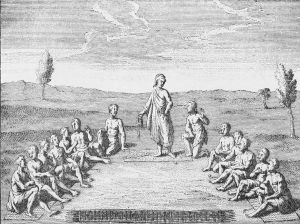
Facsimile of a plate in Lafitau.
The small belt shown in Fig. 1. Plate XXXVIII, is probably one of
the most recent examples. The cut is copied from Plate 1 of the Fifth
Annual Report of the Regents of the University of New York on the
condition of the State Cabinet of Natural History, p. 72. The beads of
which it is composed formerly belonged to the celebrated Mohawk chief,
Joseph Brant. They were afterwards purchased from his daughter by
Mr. Morgan. In 1850 they were taken to Tonawanda, in the State of New
York, and made into this belt. The trimmings are apparently of ribbons,
and the symmetry and uniformity of the whole work give it a new
look not noticeable in the other specimens. The design consists of a row
of dark diamond-shaped figures upon a white ground. It is now preserved
in the State Cabinet of Natural History at Albany.
A belt of unusual form is shown in Fig. 2, Plate XXXVIII. It
was kindly lent by Mrs. E. A. Smith, of Jersey City, by whom it
was obtained from the Mohawks. It is 26 inches (251 beads) in
length and in width varies from three inches (11 beads) at one end
to about one inch (5 beads) at the other. It is bifurcated at the
wide end, five rows having been omitted from the middle of the belt
for about one-third of the length. Near the middle of the belt one
row of beads is dropped from each side. Between this and the smaller
end at nearly equal intervals it is twice depleted in a like manner.
The beads are quite irregular in shape and size, but rather new looking
and are strung in the usual manner, the longitudinal strings being
buckskin and the transverse small cords of vegetable fiber. The ends
and edges are all neatly finished by wrapping the marginal strings
with a thin fillet of buckskin. The figures are in white beads upon a
ground of purple. The form of this belt indicates that it has been
adapted to some particular use, the placing of cords at the corners
and shoulders suggesting its attachment in a fixed position to some part
of the person or costume.
PL. XXXVIII—WAMPUM BELTS.
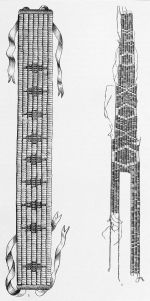
1. Mohawk Belt.
2. Mohawk Belt.
In Plates XXXIX, XL, XLI and XLII, I present a series of illustrations
of the wampum belts belonging to the Onondagas. They
are preserved as a most precious treasure by these people at their
agency in Onondaga County, New York. The drawings were made by
Mr. Trill from a series of minute photographs made from the original
[pg 252]
belts by General J. S. Clark, of Auburn, New York. These were obtained
for me by the Rev. W. M. Beauchamp, of Baldwinsville, New
York, who has also very kindly furnished many of the facts embodied
in the following descriptions.[119]
These belts are made in the usual manner, and present a great variety
of shapes, sizes, and designs. Their full history has never been obtained
by the whites, and it is not probable that the Indians themselves have
preserved a very full account of their origin and significance. They
are all ancient, and, judging by their appearance, must date far back in
the history of the League. Many of them are quite fragmentary, and
fears are entertained that they will gradually fall to pieces and be lost.
It is to be hoped that measures will be taken to have them preserved at
least in the form of accurate chromo-lithographs. Mr. Beauchamp
states that they are yearly wasting away, as a little wampum is annually
cast into the fire at the burning of the "white dog," and these belts
are the source of supply.
The small belt presented in Fig. 1, Plate XXXIX, is somewhat
fragmentary, an unknown number of beads having been lost from the
ends. It is seven rows wide and at present two hundred beads long.
The design consists of a series of five double diamonds worked in dark
wampum upon white. At one end a few rows of an additional figure
remain, and at the other a small white cross is worked upon a ground
of dark beads. The number of figures may be significant of the number
of parties to a treaty.
Fig. 2 represents a well preserved belt, seven rows in width and
about three hundred and twenty in length. The ground is of dark wampum,
on which are worked five hexagonal figures of white wampum.
For a short space at the ends alternate rows are white. As was suggested
in regard to the preceding belt, the figures in this may represent
the parties to a treaty.
The belt shown in Fig. 3 differs from the others in being pictographic.
It is also quite perfect, although the character of the beads
indicates considerable age. It is seven rows in width and three hundred
and fifty beads in length. The figures are white, on a dark ground,
and consist of a cross near one end, connected by a single row of beads
with the head of the figure of a man toward the other end. Beneath the
feet of the elementary man the figure of a diamond is worked. The
cross is probably significant of the mission of the man who comes from
a long distance to the lodge or council of the red man. This is probably
a French belt.
PL. XXXIX—WAMPUM BELTS BELONGING TO THE ONONDAGAS.
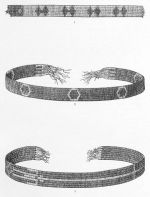
The remnant of a very handsome belt is shown in Plate XL. Considerable
wampum has been lost from both ends, but the design appears to
be nearly perfect, and consists of a trowel or heart-shaped figure in the
center with two rectangular figures on the right and two on the left.
These are in white upon a dark ground. Mr. Beauchamp states that it
[pg 253]
is said to be very old, and is thought to represent the formation of the
Iroquois league and to signify "one heart for all the nations." He
doubts its great antiquity as the beads are too regular for hand-made
cylinders. The belt is thirty-eight rows wide and about two hundred
beads in length.
PL. XL—WAMPUM BELT BELONGING TO THE ONONDAGAS.
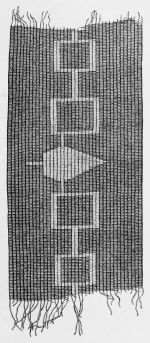
The large elaborately figured belt shown in Plate XLI is almost
perfect. The lateral margins are white; a broad notched band of dark
wampum occupies the middle of this belt; through this from end to end
runs a chain of white diamonds, sixteen in number, which may represent
States or nations. It is forty-five rows wide and two hundred
and forty beads long.
PL. XLI—WAMPUM BELT BELONGING TO THE ONONDAGAS.
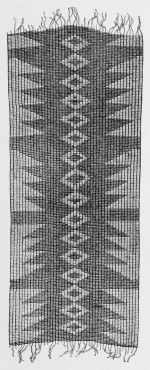
The magnificent belt shown in Plate XLII, is probably the finest example
in existence. It is fifteen rows wide and six hundred and fifty
in length, making the enormous total of nine thousand seven hundred
and fifty beads. Mr. Beauchamp believes that this belt, or one like it,
has been described as representing the formation of the League. From
Webster's[120] statement, that it was "made by George Washington," he
surmises that it is a belt memorizing a covenant between the Indians
and the government. In the center is a house which has three gables
and three compartments. Next the house on either side are two pictographic
men, who appear to stand beneath protecting arms which pass
over their heads, connect with the house, and grasp the hands of the first
personages immediately on the right and left. In all there are fifteen
figures of men, two being connected with the house; of the others, six
stand on the right and seven on the left of the central group. It is
suggested by Mr. Beauchamp that these figures may represent the
thirteen colonies.
PL. XLII—WAMPUM BELT BELONGING TO THE ONONDAGAS.
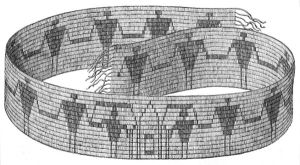
Six other belts are shown in the photographs procured by General
Price. One of them is thirteen rows wide and two hundred and fifty
beads in length. The light ground is decorated with groups of triple
chevrons. This belt is somewhat fragmentary. Another is forty-nine
rows wide, being the widest example known. The original length cannot
be determined, but at present it is two hundred and forty beads in
length, and hence contains about twelve thousand beads. The pattern
is simple, consisting of a dark ground notched at the edges with triangular
figures of white. As the four remaining belts of this fine collection
have no features of especial interest, they need not be described
here.
The remarkable belt shown in Plate XLIII has an extremely interesting,
although a somewhat incomplete, history attached to it. It is
believed to be the original belt delivered by the Leni-Lenape sachems
to William Penn at the celebrated treaty under the elm tree at Shackamaxon
in 1682. Although there is no documentary evidence to show
that this identical belt was delivered on that occasion, it is conceded on
all hands that it came into the possession of the great founder of Pennsylvania
[pg 254]
at some one of his treaties with the tribes that occupied the
province ceded to him. Up to the year 1857 this belt remained in the
keeping of the Penn family. In March, 1857, it was presented to the
Pennsylvania Historical Society by Granville John Penn, a great
grandson of William Penn. Mr. Penn, in his speech on this occasion,[121]
states that there can be no doubt that this is the identical belt used at
the treaty, and presents his views in the following language: "In the
first place, its dimensions are greater than of those used on more ordinary
occasions, of which we have one still in our possession—this belt
being composed of eighteen strings of wampum—which is a proof that
it was the record of some very important negotiation. In the next
place, in the center of the belt, which is of white wampum, are delineated
in dark-colored beads, in a rude but graphic style, two figures—that
of an Indian grasping with the hand of friendship the hand of a
man evidently intended to be represented in the European costume,
wearing a hat; which can only be interpreted as having reference to
the treaty of peace and friendship which was then concluded between
William Penn and the Indians, and recorded by them in their own
simple but descriptive mode of expressing their meaning, by the employment
of hieroglyphics. Then the fact of its having been preserved in
the family of the founder from that period to the present time, having
descended through three generations, gives an authenticity to the document
which leaves no doubt of its genuineness; and as the chain and
medal which were presented by the Parliament to his father, the admiral,
for his naval services, have descended amongst the family archives unaccompanied
by any written document, but is recorded on the journals
of the House of Commons, equal authenticity may be claimed for the
wampum belt confirmatory of the treaty made by his son with the
Indians; which event is recorded on the page of history, though, like
the older relic, it has been unaccompanied in its descent by any document
in writing."
PL. XLIII—THE PENN BELT.
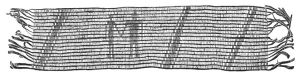
(1/4)
It will be seen, by reference to the accompanying illustration, that
beside the two figures of men there are three oblique bands of dark
wampum, one on the left and two on the right. The one next the central
group on the right is somewhat broken, and consists of two long
bands and one short one. It is probable that these bands were used to
record, by association, some important features of the treaty in which
the belt was used. The beads are strung upon cords made of sinew or
vegetable fibre, while the longitudinal fillets are of buckskin. This belt
may be seen at the rooms of the Historical Society of Pennsylvania.
PL. XLIV—STRINGS OF WAMPUM.
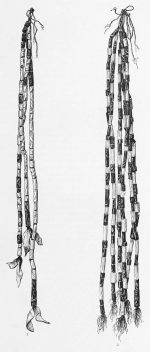
1. Name of New Chief.
2. "Mohawk."
It would probably be vain to attempt to determine how pendant ornaments
first came into use, whether from some utilitarian practice or
through some superstitious notion. It matters not, however, whether
the first pendant was an implement, a utensil, or a fetichitic talisman;
it has developed by slow stages into an ornament upon which has been
lavished the best efforts of culture and skill. The simple gorget of
shell suspended upon the naked breast of the preadamite is the prototype
of many a costly jewel and many a princely decoration. With the
American savage it was a guardian spirit, invested with the mystery
and the power of the sea, and among the more cultured tribes became
in time the receptacle of the most ambitious efforts of a phenomenal
art. The important place the gorget has taken in ornament and as a
means of displaying personal aggrandizement has made it a most powerful
agent in the evolution of the arts of taste.
As a rule the larger and more important pendants are employed as
gorgets, but vast numbers of the smaller specimens are strung with
beads at intervals along the strings, attached as auxiliary pendants to
the larger gorgets, suspended from the nose, ears, and wrists, or form
tinkling borders to head-dresses and garments. These pendants consist
either of entire shells, or of parts of shells, pierced or grooved to
facilitate suspension. The purely artificial forms are infinitely varied.
The character of the shell, however, has much to do with the form of
the finished ornaments, deciding their thickness and often their outline.
In size they range from extremely minute forms to plates six or more
inches in diameter. The perforations, in position and number, are greatly
varied, but as a rule the larger discoidal pendants will be found to have
two marginal perforations for suspension.
These nicely-polished shell-disks afforded tempting tablets for the
primitive artist, and retain many specimens of his work as an engraver.
The engraved specimens, however, should be treated separately, according
to the class of design which they contain. Plain pendants need but
a brief notice, and may be treated together as one group, with such
subdivisions only as may be suggested by their form, their derivation,
or their geographical distribution.
Plain pendants.—It will be unnecessary to cite authorities to show
that our ancient peoples were fond of pendant ornaments, and wore
them without stint, but to illustrate the manner in which they were
used and the methods of combining them with other articles of jewelry
in necklaces, bracelets, &c., I shall refer briefly to the literature of the
period of American discovery.
The inhabitants of Mexico are said to have been very simple in the
matter of dress, but displayed much vanity in their profuse employment
of personal ornament. Besides feathers and jewels, with which
[pg 256]
they adorned their clothes, they wore pendants to the ears, nose, and
lips, as well as necklaces, bracelets, and anklets. The ear ornaments
of the poor were shells, pieces of crystal, amber, and other brilliant
stones, but the rich wore pearls, emeralds, amethysts, or other gems, set
in gold.[122] The priestly personages so graphically delineated in the ancient
Aztec manuscripts are as a rule loaded down with pendant ornaments.
In traveling north along the west coast of Mexico the Friar
Niza encountered Indians who wore many large shells of mother of
pearl about their necks, and farther up toward Cibola the inhabitants
wore pearl shells upon their foreheads;[123] and Cabeça de Vaca when among
the pueblos of New Mexico noticed beads and corals that came from the
"South Sea." Ornaments made from marine shells are found in many
of the ancient ruins to-day. They are also highly valued by the modern
Indians of this region.
In the earliest accounts of the Indians of the Atlantic coast we find
frequent mention of the use of pendants and gorgets, and the manner
of wearing them as ornaments. Beverly, after having described
beads made of a shell resembling the English buglas, says that they
also make "runtees" of the same shell, and grind them as smooth as
peak. "These are either large like an oval Bead, drill'd the length of
the Oval, or else they are circular and flat, almost an Inch over, and
one Third of an Inch thick, and drill'd edgeways. Of this Shell they
also make round Tablets of about four Inches Diameter, which they
polish as smooth as the other, and sometimes they etch or grave thereon
Circles, Stars, a half Moon, or any other Figure suitable to their
Fancy. These they wear instead of Medals before or behind their Neck,
and use the Peak, Runtees, and Pipes for Coronets, Bracelets, Belts, or
long Strings hanging down before the Breast, or else they lace their
Garments with them, and adorn their Tomahawks, and every other thing
that they value."[124] The "Pipes" here spoken of were probably long,
heavy cylindrical beads.
In referring to this class of ornaments, Lafitau says: "The collars
which the savages sometimes wear around the neck are about a foot in
diameter, and are not different from those which one now sees on some
antiques, on the necks of statues of barbarians. The northern savages
wear on the breast a plate of hollow shell, as long as the hand, which
has the same effect as that which was called Bulla among the Romans."[125]
Wood, speaking of the Indians of Northern New England, in 1634,
says: "Although they be thus poore, yet is there in them the sparkes
of naturall pride, which appeares in their longing desire after many
kinds of ornaments, wearing pendants in their eares, as formes of birds,
beasts, and fishes carved out of bone, shels, and stone, with long bracelets
[pg 257]
of their curious wampompeag and mowhackees, which they put
about their necks and loynes."[126]
Kalm says of the Indians of Lorette, near Quebec, Canada, that
"round their necks they have a string of violet wampums, with little
white wampums between them. These wampums are small, of the figure
of oblong pearls, and made of the shells which the English call
clams. At the end of the wampum strings many of the Indians wear a
large French silver coin, with the king's effigy, on their breasts; others
have a large shell on the breast, of a fine white colour, which they value
very high, and is very dear; others, again, have no ornament at all
round the neck."[127]
Pendants of metal and medals of European manufacture soon replaced
in a great measure the primitive gorgets of shell; and early in the history
of the tribes a heterogeneous collection of native beads, silver
crosses, and traders' medals, ornamented the breasts of the simple
savages.
In studying the habits and customs of our native peoples we look
with a great deal of interest upon the earliest historical records, but
generally find it prudent to remember that the "personal equation" was
unusually large in those days, and in studying the illustrations given
in the works of early writers we must make due allowance for the well-known
tendency to exaggerate as well as for the fact that the artist has
more frequently drawn from descriptions than from sketches made on
the spot.
In Plate XLV two examples are given which seem to me to be trustworthy,
as they agree with the descriptions given, and are in a general
way characteristic of the American aborigines. Fig. 1 is reproduced,
original size, from Plate 2, Volume II, of Lafitau, and shows a broad
necklace ornamented with figures that resemble arrow heads. From
this, by means of a cord, is suspended a large circular disk with concave
front, which undoubtedly represents a shell gorget. In front of
this and suspended from the necklace are two long strands of beads of
various sizes and shapes, which give completeness to a very tasteful
ornament. In the same plate is a pretty fair drawing of a native in
costume. He is represented wearing a necklace similar to the one just
described. An enlarged drawing of this ornament is given in Fig. 2.
In Fig. 3 I reproduce a necklace from a plate in De Bry, which consists
of a string of beads with two large disks that look more like metal
than shell. A similar ornament is shown in Fig. 4, but with figured
disks and secondary pendants. It is copied from the Codex of the
Vatican. A common form of necklace among the ancient Aztecs consisted
of small univalve shells suspended from a string. One of these,
with other pendants, is shown in Fig. 5. It is also copied from the
Vatican Codex. Others of a much more complex nature may be found
[pg 258]
in the same manuscript. Of even greater interest are the beautiful
necklaces, with their pendants, found in the sculptures of Mexico and
Yucatan.[128] Three of these are shown in Figs. 6, 7, and 8. One has a
disk with human features engraved upon it, another has a cross with equal
arms, and another a T-shaped cross. All have more or less auxiliary
ornamentation. In Fig. 9 I present a bracelet of beads and pendants
from Peru which illustrates one of the simpler uses of pendants. I have
not learned whether the parts of this ornament were originally arranged
as given in the cut or not; the original stringing may have been somewhat
different. The beads are mostly of shell, and are of a variety of
colors, white, red, yellow, and gray. The discoidal and cylindrical forms
are both represented. The former range from one-eighth to three-eighths
of an inch in diameter; the latter are one-eighth of an inch in thickness
and three-eighths in length. The larger pendants, made of
whitish shell, are carved to represent some life form, probably a bird;
a large perforation near the upper end passes through the head, two
oblique notches with deep lines at the sides, define the wings, and a
series of notches at the wide end represent the tail. Two smaller
pendants are still simpler in form, while another, with two nearly central
perforations and notched edges, resembles a button.
PL. XLV—ANCIENT PENDANTS.
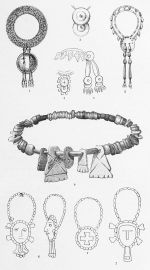
1, 2. Necklaces, from Lafitau.
3. From De Bry.
4, 5. From Mexican Paintings.
6, 7, 8. From ancient sculptures.
9. Bracelet from a Peruvian grave.
Eastern forms.—The great number of elaborately carved and engraved
gorgets of shell found among the antiquities of the Atlantic slope, all
of which need careful descriptions, so overshadow the simple forms
illustrated in Plate XLVI, that only a brief description of the latter need
be given. Rudeness of workmanship and simplicity of form do not in
any sense imply greater antiquity or a less advanced state of art. The
simpler forms of plain pendants constituted the every-day jewelry of the
average people and, like beads, were probably used freely by all who desired
to do so. Many forms are found—circular, oval, rectangular, triangular,
pear-shaped, and annular. The more ordinary forms are found
in mounds and graves in all parts of the country; other forms are more
restricted geographically, and probably exhibit features peculiar to the
works of a particular clan, tribe, or group of tribes. Even these simple
forms may have possessed some totemic or mystic significance; it is not
impossible that the plainer disks may have had significant figures
painted upon them. Such of the forms as are found to have definite
geographic limits become of considerable interest to the archæologist.
In method of manufacture they do not differ from the most ordinary
implements or beads, the margins being trimmed, the surfaces polished
and the perforations made in a precisely similar manner.
In Plate XLVI I present a number of plain circular disks. The
larger specimens are often as much as four or even five inches in diameter
and the smaller fraternize with beads, as I have shown in Plate XLV.
Figs. 1 and 2 are from a mound at Paint Rock Ferry, Tenn.
They are neat, moderately thin, concavo-convex disks, with smooth surfaces
[pg 259]
and rounded edges. The first has two perforations at the upper
edge, while the other has similarly placed but much smaller ones, besides
a small central perforation surrounded by an incised circle. The
national collection contains similar specimens from most of the Atlantic
States; they differ from the larger discoidal beads only in the method
of perforation. A typical specimen of this class, four and a half inches
in diameter, is shown in Fig. 3. It was associated with the remains of
a number of children in a mound in Hardin County, Ohio. Disks of
this class were usually suspended upon the breast with the concave side
out. That many of the specimens described were suspended in this way
is indicated by the character of the abrasion produced by the cords. On
the concave side the cord of suspension has worn deep grooves between
the perforations, and on the opposite or convex side similar grooves extend
obliquely upward from the holes toward the margin of the disk, indicating
the passage of the cord upward and outward around the neck of
the wearer.
A large white disk, similar to the one just described, was obtained
from a grave at Accotink, Va. It is five inches in diameter and has one
central and three marginal perforations. It is made from a Busycon perversum,
and is neatly shaped and well polished.
A fine specimen two inches in diameter was obtained from a mound
on the French Broad River, Tenn., and, with many other similar specimens,
is now in the national collection.
The central perforation is often very much enlarged. A number of
specimens, recently sent to the National Museum, from a mound in
Auglaize County, Ohio, show several stages of this enlargement. One
specimen five inches across has a perforation nearly one inch in diameter,
while in another the perforation is enlarged until the disk has become
a ring. These gorgets show evidences of long use, the surfaces
and edges being worn and the perforations much extended in the manner
described above. They have been derived from the Busycon perversum.
In Fig. 4 I illustrate an annular gorget from a mound in Alexander
County, Ill. It was found associated with ornaments of copper by the
side of a human skull, and is hence supposed to have been an ear ornament.
It is fragmentary and has suffered greatly from decay, the
surface being mostly covered with a dark film of decomposed shell substance,
which when broken away, exposes the chalky surface of the
shell. These shell rings, so far as I can learn, have been found in the
States of Ohio and Illinois only.
Rectangular pendants are much more rare. The national collection
contains one rude specimen from Texas. It is about two inches wide
by two and a half long, and is made from the base of some large dextral-whorled
shell. A similar but much more finished specimen comes
from Georgia, and is preserved in the New York Natural History Museum.
[pg 260]
A large keystone-shaped gorget with rounded corners was obtained
from an ancient burial place at Beverly, Canada. It is illustrated in
Plate L, Fig. 1.
The small pendant shown in Fig. 5 is given by Schoolcraft in "Notes
on the Iroquois." It represents rudely the human figure, and is ornamented
with eight perpendicular and four or five transverse dots. It
was found on the site of an old fort near Jamesville, N. Y. In the same
work Mr. Schoolcraft illustrates another small pendant, which is reproduced
in Fig. 6. The body is heart-shaped, the perforation being made
through a rectangular projection at the upper end. It was found at
Onondaga, N. Y.
The small pendant presented in Fig. 7 is from West Bloomfield, N. Y.
It has been suspended by means of a shallow groove near the
upper end. It is made from the basal point of a dextral-whorled shell.
The handsome little pendant shown in Fig. 8 was found with similar
specimens in Monroe County, New York—probably on some ancient village
site. It is well preserved and has been made from the columella of a
dextral-whorled shell. An ornamental design, consisting of lines and
dots, is engraved upon the face. A small, deeply countersunk perforation
has been made near the upper end. These objects have apparently
been strung with beads, as the perforations show evidence of such
abrasion as beads would produce. Many of the New York specimens
have a new look, and their form suggests the possibility of civilized influence.
They are certainly more recent than the western and southern
specimens.
A small cylindrical pendant is illustrated in Fig. 9. A large, neat
perforation has been made at the upper end, and the middle portion of
the body is ornamented by a series of encircling grooves. This specimen
has been made from a large Unio and was obtained from a mound
in Union County, Ky.
PL. XLVI—PENDANT ORNAMENTS—EASTERN FORMS.
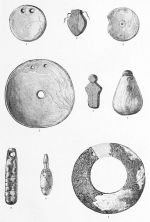
Western forms.—In variety of form the plain pendants of the California
coast excel all others. Specimens from the graves are generally
well preserved, not having lost their original iridescence, although so
much decayed as to suffer considerably from exfoliation.
As indicated by the present well preserved condition of these shell
ornaments, they are probably not of very ancient date; indeed it is
highly probable that many of them are post-Columbian.
Cabrillo visited the island of Santa Rosa in 1542 and found a numerous
and thriving people. In 1816 only a small remnant of the inhabitants
remained, and these were removed to the main-land by Catholic
priests. Their destruction is attributed to both war and famine. The
history of the other islands is doubtless somewhat similar.
Articles made from shell are found to resemble each other very closely,
whether from the islands or the main-land. All probably belong to the
same time, and although the peoples of the islands are said to have
spoken a different language from those of the main-land, their arts were
[pg 261]
apparently pretty much the same. They do not differ, as far as works
in shell are concerned, from the modern tribes of the main-land. There
is also a noticeable resemblance between the art of the ancient California
Islanders and that of the present inhabitants of the great Pacific
archipelagoes.
The record of many of the specimens obtained from these islands
seems to be very incomplete, scarcely more being known than the fact
that they were obtained from the ancient graves. Since, however, they
are almost exclusively ornaments belonging probably to a single period,
detailed accounts of their methods of occurrence would not add greatly
to their value.
In previous chapters vessels, hooks, and beads made of the Haliotis
have been described, and the high estimation in which they are everywhere
held briefly noted. The variety of ways in which this shell is
utilized is indeed remarkable and the multitude of forms into which it is
worked for ornament is a matter of surprise. All are neatly and effectively
worked, and evince no little skill and taste on the part of the
makers.
The Haliotis is not the only shell used, but it has no rival in point of
beauty. Bivalve shells are utilized to a considerable extent, many
tasteful things being made from the Fissurella, the Mytilus, the Pachydesma,
and the Pecten. The perforations are generally neatly made and are
more numerous than in similar eastern specimens; besides those for
suspension there are frequently many others for the attachment of secondary
pendants and for fastening to the costume. Many specimens
are ornamented with edgings of notches and crossed lines but very few
have been found on which significant characters have been engraved,
and we look in vain for parallels to the curious designs characteristic
of the gorgets of the mound-builders.
A glance at the numerous examples given in Plates XLVII, XLVIII,
and XLIX will give a good idea of the multiplicity of forms into which
these ornaments are wrought.
A rather remarkable group of pendants is represented by Fig. 1. They
are characterized by a deep scallop at the left, with a long curved hook-like
projection above. They take their form from the shape of the lip
of the Haliotis, from which they are made—the hook being the upper
point of the outer lip where it joins the body, and the scallop the line
of the suture. The body of the ornament is formed from the lip of the
shell. In size they vary to some extent with the shells from which they
are derived. The body is at times quite oval and again slender and
hooked like the blade of a sickle. The perforations are generally very
numerous, a fact that indicates their use as central pieces for composite
pendants. It is apparent that the wearers thought more of the exquisite
coloring of these ornaments than of the outline or surface finish.
This is only one of many instances that prove the innate and universal
appreciation of beauty of color by savage peoples.
[pg 262]
In Fig. 2 a fine example of the subtriangular or keystone-shaped
pendants is presented. The edges are very neatly cut and the corners
slightly rounded. The back is ground smooth, but on the front the
original surface of the shell is preserved, the colors being extremely
rich and brilliant. A single perforation has been drilled near the upper
end. It is made from a Haliotis rufescens, and was obtained from the
island of Santa Rosa.
The handsome specimen shown in Fig. 3 was obtained from a grave
on the island of San Miguel. It has suffered much from decay. There
are four neatly made perforations near the center. It has apparently
been cut from the same shell as the preceding.
Fig. 4 is a small keystone-shaped specimen having two perforations.
Fig. 5 represents a small, delicate specimen of rectangular shape,
having two minute perforations. This, as well as the preceding, was
obtained from a grave on the island of San Miguel.
Fig. 6 illustrates a small oval, wafer-like specimen, the edges of which
have been ornamented with a series of crossed lines. It has three neat
perforations on the line of the longer axis. It is from the island of
Santa Cruz.
Fig. 7 represents a small button-like disk with a central perforation;
the margin is ornamented with a series of radiating lines. It was obtained
from Santa Barbara.
A pendant of very peculiar form is shown in Fig. 8. The oval body
has three marginal projections, all of which are perforated; there is
also a perforation near the center. The surface retains a heavy coating
of some dark substance, which gives the ornament much the appearance
of corroded metal. It was obtained from San Miguel Island.
In a number of cases advantage has been taken of the natural perforations
of the shell, both to give variety to the outline of small pendants
and to save the labor of making artificial perforations. A very
handsome little specimen is shown in Fig. 9. The two indentations
above and below represent two of the natural perforations of the shell;
artificial perforations are made in each of the four corners or wings. It
was also obtained from the island of San Miguel.
Fig. 10 represents a leaf-shaped pendant with notched edges and a
single perforation. It comes from the island of Santa Cruz.
PL. XLVII—PLAIN PENDANTS—PACIFIC COAST FORMS.
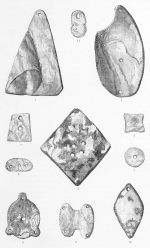
(1/1)
The examples given are typical of the very large class of ornaments
derived from the Haliotidæ. The striking specimens shown in Plate XLVIII
are, with one exception, made from shells of this class. The
two sickle-shaped pendants illustrated in Figs. 1 and 2 are made from
the broadened inner lip of the Haliotis californianus (?). In one a single
perforation has been made near the upper end; in the other there are
two, one near each end. The faces have been neatly dressed and the
corners ornamented with minute notches. They are from graves on Santa
Cruz Island. Two exquisite specimens, also from Santa Cruz Island,
are presented in Figs. 3 and 4. They have been cut from the body of a
[pg 263]
Haliotis splendens (?), and finished with much care. Two perforations
have been made near the upper margin, which is arched or curved while
the lower is nearly straight. The edges are neatly notched. Although
somewhat altered by exposure these objects are still very pretty.
A very neat, well preserved little pendant is shown in Fig. 5. The
specimen presented in Fig. 6 is peculiar in having a series of five perforations,
one near the middle and the others near the ends. The example
given in Fig. 7 has two perforations, one at each end. These are
all made from species of the Haliotis.
The specimen presented in Fig. 8 is made from the lip of a Cyprea
spadicea with very little change except the carefully made perforation.
It is from the island of San Miguel. The idea of beautifying ornaments
made from the Haliotis and other shells by notching the edges
may have been suggested by the natural notches characteristic of the
Cypreas.
PL. XLVIII—PENDANT ORNAMENTS OF THE PACIFIC COAST.
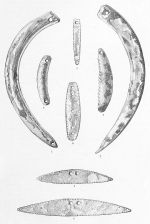
1–7. Pendants made of the Haliotis. (1/1)
8. Pendant made of a Cyprea. (1/1)
Figs. 1, 2, and 3, Plate XLIX, illustrate a group of small, delicate,
ladle-shaped pendants. The perforation for suspension is at the upper
end of the handle and the body has an oval or circular perforation, which
is often so enlarged as to leave only a narrow ring, like the rim of an
eyeglass. The specimen shown in Fig. 3 has two lobes, with a large
perforation or opening in each. In one instance the handle is quite
wide at the upper end and ornamented by two deep lateral notches.
The edges of these specimens are nearly always adorned with notches
or crossed lines. All are fashioned from the Haliotis, and although considerably
stained are still well enough preserved to show the pearly
lusters of that shell.
Circular and oval disks are also numerous and vary much in finish;
some have a great number of perforations or indentations, and nearly
all are neatly notched around the margins. Examples are given in
Figs. 4 and 5.
The national collection contains a number of rings and pieces of rings
made from the valves of a large clam, probably a Pectunculus, one example
of which is shewn in Fig. 6. The convex back of the shell is
ground off until a marginal ring only remains. A perforation is made
near the angle of the beak. The shell is from the California coast, but
the rings were collected mostly if not entirely from Arizona and New
Mexico. It is not impossible that the tribes of the interior procured
these articles from white traders, as they are known to have secured
other shell ornaments in this way.
The natives of the California coast were not slow in taking advantage
of natural forms to aid their art or to save labor. The shells of the
Fissurellidæ as well as of the Haliotidæ have been in great favor. They
have been used as beads and pendants in their natural state or the natural
perforations have been enlarged until only a ring has been left, or
the margin and sides have been ground down until nothing of the original
form or surface remained. Two of these forms are shown in Figs. 7
[pg 264]
and 8. They are from graves on San Miguel Island, and are made from
the Lucupina crenulata; others come from Santa Cruz Island; and probably
also from the adjoining islands as well as from the main-land. Rings
are also made from other shells. Examples made from the Acmæa mitra
and Cyprea spadicea are shown in Figs. 9, 10, and 11. They come from
San Miguel.
PL. XLIX—PLAIN PENDANTS—PACIFIC COAST FORMS.
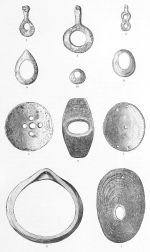
(1/1)
We find that pendant gorgets grade imperceptibly into another group
of objects, the use or significance of which have not be fully determined.
These objects are more frequently made of stone or copper, but good
examples in shell have been found. As a rule they take the form of
thin oblong plates which exhibit great variety of outline. The perforations
are peculiar, and have not been designed for ordinary suspension,
but are placed near the middle of the specimen as if for fixing it to the
person or costume by means of cords. Many theories have been advanced
in attempting to determine their use. They have been classed
as gorgets, badges of authority, shuttles, armor plates, wrist protectors,
and as implements for sizing sinews and twisting cords.
Objects of this class in stone have been frequently illustrated and
described. They are made of many varieties of stone, some of which
seem to have been selected on account of their beauty. They have
been neatly shaped and often well-polished. The edges are occasionally
notched and the surfaces ornamented with patterns of incised lines.
The perforations vary from one to four, the greater number of specimens,
however, having only two. In the early days of mound exploration
objects of this class were even greater enigmas, if possible, than
they are to-day. Even the material of which a number of them were
formed remained for a long time undetermined. Schoolcraft has
published an illustration of a large specimen from the Grave Creek
Mound, Va. This drawing is reproduced in Fig. 3, Plate L. The original
was six inches long, one and three-tenths inches wide, and three-tenths
of an inch in thickness. He expresses the opinion that it was one of
those ancient badges of authority formerly in such general use among
the Indians.[129]
Another specimen, very much like the last in size and shape, but made
of shell, supposed at the time of discovery to be ivory, was found associated
with human remains in the Grave Creek Mound. It is described
by Mr. Tomlinson in the American Pioneer,[130] and the cut given in Plate L,
Fig. 4, is copied from that work.
A remarkable specimen of this class is given in Fig. 5. It is made
[pg 265]
from the body of a large Busycon perversum, and is nine and a half
inches long by three inches in width at the widest part. The concave
surface has been highly polished, but is now somewhat roughened by
weathering; the back has been slightly ground to take off the rougher
ridges of growth; the edges are even and rounded and in many places
quite thin. The peculiarity of its shape is such as to give it very much
the appearance of the sole of a sandal. The perforations are three in
number, one being near the middle and the others near the broader end,
about one and a half inches apart; they are very neatly made and are
slightly bi-conical and a little countersunk. There appears to be no evidence
whatever of abrasion by use. It was found associated with human
remains in a mound at Sharpsburg, Mercer County, Ohio. A similar
specimen from the same locality is nearly nine inches in length, and
lacks but a little of three and a half inches in width. As in the specimen
illustrated, one perforation is placed near the middle and two
others near the broader end. This specimen is highly polished on the
broader part of the back, and is evenly smoothed on the concave side. It
bears evidence of considerable use, and the two holes are much worn by a
string or cord, which, passing from one hole to the other on the concave
side of the plate, gradually worked a deep groove between them. On
the back or convex side, the perforations show no evidence of wear.
The central perforation is not worn on either side. The letter of Mr.
Whitney, transmitting this relic to the National Museum, states that
there were in the mound "about ten pairs of the shell sandals of different
sizes, and made to fit the right and left feet." From the latter remark
I should infer that some were made from dextral and others from sinistral
shells; the two described are made from the Busycon perversum.
An extremely fine specimen, much like the preceding, was exhumed
from an ancient mound in Hardin County, Ohio. It was found on the
head of a skeleton which occupied a sitting posture near the center of
the mound. It is nine inches in length by three and one-half inches in
width, and in shape resembles the sole of a moccasin, being somewhat
broader and less pointed than the specimen presented in Fig. 5. It had
been placed upon the skull with the wider end toward the back, but
whether laid there as a burial offering simply or as constituting a part
of the head-dress of the dead savage we have no means of determining.
The perforations are three in number, and are placed similarly to
those in the specimen illustrated in Fig. 5. Two other skeletons had
similar plates associated with them, which differed from the one described
in size only, the smaller one being less than six inches in length.
Lithographs of two of these specimens are given by Mr. Matson, in
whose very excellent report they were first described.[131]
The gorget presented in Fig. 1 of this plate is copied from Schoolcraft.[132]
It was taken, along with many other interesting relics, from
[pg 266]
one of the ossuaries at Beverly, Canada West. It is formed from some
large sea shell, and is three inches in width by three and three-fourths
inches in length. Its perforations are four in number, and are so placed
as to be conveniently used either for suspension by a single cord or for
fixing firmly by means of two or more cords. It seems to hold a middle
place between pendants proper and the pierced tablets under consideration.[133]
The unique specimen given in Fig. 2 is from Cedar Keys, Florida, but
whether from a grave or a shell-heap I am at present unable to state.
In its perforations, which are large and doubly conical, it resembles very
closely the typical tablet of stone. The outline is peculiar; being
rounded at the top, it grows broader toward the base like a celt, and
terminates at the outer corners in well-rounded points, the edge between
being ornamented with a series of notches or teeth. It has been cut
from the wall of a Busycon perversum, and is sharply curved. The surface
is roughened by time, but there is no evidence of wear by use
either in the perforations or in the notches at the base.
PL. L—PERFORATED PLATES.
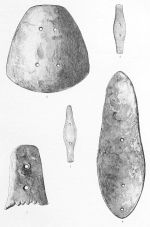
1. Ornament from Beverly, C. W.
2. Ornament from Florida.
3, 4. Objects from the Grave Creek Mound, Va.
5. Perforated plate from Ohio.
In studying these remarkable specimens the fact that they so seldom
show marks of use presents itself for explanation. Dr. Charles
Rau, whose opinions in such matters are always worthy of consideration,
remarks "that at first sight one might be inclined to consider
them as objects of ornament, or as badges of distinction; but this view
is not corroborated by the appearance of the perforations, which exhibit
no trace of that peculiar abrasion produced by constant suspension.
The classification of the tablets as 'gorgets,' therefore, appears to
be erroneous."[134]
The same argument could, however, be brought with equal force
against their use for any of the other purposes suggested. The perforations,
if not used for suspension or attachment, would be subject to
wear from any other use to which they could be put. But, as we have
already seen, one of the specimens in shell exhibits well-defined evidence
of wear, and that of such a character as to indicate the passage of a cord
between the perforations in a position that would produce abrasion between
the holes on the concave side of the plate, but would leave the
back entirely unworn. This peculiar result could only be produced by
attachment in a fixed position, concave side out, to some object perforated
like the plate, the cord passing directly through both. The perforations
of pendants necessarily show wear on both sides; a like result
would follow from the use of these plates in any of the other ways mentioned.
Those made of shell could not, on account of their warped
[pg 267]
shape, be used for shuttles; besides, they show no evidence of marginal
wear, such as would result from this use. The fact, too, that the material
had to be brought from the distant sea-shore would seem to render it
too rare and precious to be employed in the ordinary arts when wood,
stone, and bone would serve the purpose as well. Owing to the carelessness
or negligence of collectors we have but little information in
regard to their relation to the human remains with which they were
deposited. Such facts as we have, however, tend, I believe, to show
that they were used for personal decoration. Again, the material of
which they are formed is, on account of its beauty, especially adapted
for ornament, and for this use it has been almost exclusively reserved
by peoples as distant from the sea as were the ancient peoples of the
Ohio Valley.
It has already been suggested that the simpler forms of pendants
with plain surfaces may have had particular significance to their possessors,
as insignia, amulets, or symbols, or that they may have received
painted designs of such a character as to give significance to
them. For ornament the natural or plainly polished surface of the shell
possessed sufficient beauty to satisfy the most fastidious taste—a beauty
that could hardly be enhanced by the addition of painted or incised
figures. But we find that many of the larger gorgets obtained from the
mounds and graves of a large district have designs of a most interesting
nature engraved upon them, which are so remarkable in conception
and execution as to command our admiration. Such is the character
of these designs that we are at once impressed with the idea that they
are not products of the idle fancy, neither is it possible that they had
no higher office than the gratification of barbarian vanity. I have given
much time to their examination, and, day by day, have become more
strongly impressed with the belief that no single design is without its
significance, and that their production was a serious art which dealt
with matters closely interwoven with the history, mythology and polity
of a people gradually developing a civilization of their own.
Although these objects were worn as personal ornaments they probably
had specialized uses as insignia, amulets, or symbols.
As insignia, they were badges of office or distinction. The devices engraved
upon them were derived from many sources and were probably
sometimes supplemented by numeral records representing enemies killed,
prisoners taken, or other deeds accomplished.
As amulets, they were invested with protective or remedial attributes
and contained mystic devices derived from dreams, visions, and many
other sources.
[pg 268]
As symbols they possessed, in most cases, a religious character, and
were generally used as totems of clans. They were inscribed with characters
derived chiefly from mythologic sources. A few examples contain
geometric designs which may have been time-symbols, or they may
have indicated the order of ceremonial exercises.
That these objects should be classed under one of these heads and
not as simple ornaments engraved with intricate designs for embellishment
alone is apparent when we consider the serious character of
the work, the great amount of labor and patience shown, the frequent
recurrence of the same design, the wide distribution of particular forms,
the preservation of the idea in all cases, no matter what shortcomings
occur in execution or detail, and the apparent absence of all lines, dots,
and figures not essential to the presentation of the conception.
In describing these gorgets I have arranged them in groups distinguished
by the designs engraved upon them.[135] They are presented in
the following order:
The Cross,
The Scalloped Disk,
The Bird,
The Spider,
The Serpent,
The Human Face,
The Human Figure: and to these I append The Frog,
which is found in Arizona only, and although carved in shell does not
appear to have been used as a pendant, as no perforations are visible.
Within the United States ancient tablets containing engraved designs
are apparently confined to the Atlantic slope, and are not found to any
extent beyond the limits of the district occupied by the stone-grave
peoples. Early explorers along the Atlantic coast mention the use of
engraved gorgets by a number of tribes. Modern examples may be
found occasionally among the Indians of the northwest coast as well as
upon the islands of the central Pacific.
The discoverers and early explorers of the New World were filled with
surprise when they beheld their own sacred emblem, the cross, mingling
with the pagan devices of the western barbarian. Writers have speculated
in vain—the mystery yet remains unsolved. Attempts to connect
the use of the cross by prehistoric Americans with its use in the
East have signally failed, and we are compelled to look on its occurrence
here as one of those strange coincidences so often found in the
practices of peoples totally foreign to each other.
If written history does not establish beyond a doubt the fact that the
cross had a place in our aboriginal symbolism, we have but to turn
[pg 269]
to the pages of the great archæologic record, where we find that it occupies
a place in ancient American art so intimately interwoven with conceptions
peculiar to the continent that it cannot be separated from them.
It is found associated with other prehistoric remains throughout nearly
the entire length and breadth of America.
I have the pleasure of presenting a few new examples of this emblem,
obtained from the district at one time occupied by the mound-builders.
The examples are carved in shell or engraved upon disks of shell which
have been employed as pendant gorgets. In the study of these particular
relics, one important fact in recent history must be kept constantly in
mind. The first explorers were accompanied by Christian zealots, who
spared no effort to root out the native superstitions and introduce a
foreign religion, of which the cross was the all-important symbol. This
emblem was generally accepted by the savages as the only tangible feature
of a new system of belief that was filled with subtleties too profound
for their comprehension. As a result, the cross was at once introduced
into the regalia of the natives; at first probably in a European form
and material attached to a string of beads in precisely the manner that
they had been accustomed to suspend their own trinkets and gorgets;
but soon, no doubt, delineated or carved by their own hands upon tablets
of stone and copper and shell, in the place of their own peculiar conceptions.
From the time of La Salle down to the extinction of the savage
in the middle Mississippi province, the cross was kept constantly before
him, and its presence may thus be accounted for in such remains as
post-date the advent of the whites. Year after year articles of European
manufacture are being discovered in the most unexpected places, and
we shall find it impossible to assign any single example of these crosses
to a prehistoric period, with the assurance that our statements will not
some day be challenged. It is certainly unfortunate that the American
origin of any work of art resembling European forms must rest forever
under a cloud of suspicion. As long as a doubt exists in regard to the
origin of a relic, it is useless to employ it in a discussion where important
deductions are to be made. At the same time it should not be forgotten
that the cross was undoubtedly used as a symbol by the prehistoric
nations of the South, and consequently that it was probably also
known in the North. A great majority of the relics associated with it
in ancient mounds and burial places are undoubtedly aboriginal. In
the case of the shell gorgets, the tablets themselves belong to an American
type, and are highly characteristic of the art of the Mississippi Valley.
A majority of the designs engraved upon them are also characteristic
of the same district.
We find at rare intervals designs that are characteristically foreign;
these, whether Mexican or European, are objects of special interest and
merit the closest possible examination. That the design under consideration,
as well as every other engraved upon these tablets, is symbolic
or otherwise significant, I do not for a moment doubt; but the
[pg 270]
probabilities as to the European or American origin of the symbol of
the cross found in this region are pretty evenly balanced. In its delineation
there is certainly nothing to indicate its origin. By reference
to Plate LIII it will be seen that in all the examples given it is a simple
and symmetrical cross, which might be duplicated a thousand times
in the religious art of any country. A study of the designs associated
with the cross in these gorgets is instructive, but does not lead to any
definite result. In one case the cross is inscribed upon the back of a
great spider; in another it is surrounded by a rectangular framework
of lines, looped at the corners, and guarded by four mysterious birds,
while in others it is without attendant characters; but the workmanship
is purely aboriginal. I have not seen a single example of engraving
upon shell that suggested a foreign hand, or a design, with the
exception of this one, that could claim a European derivation.
Some very ingenious theories have been elaborated in attempting to
account for the presence of the cross among American symbols. Brinton
believes that the great importance attached to the points of the
compass—the four quarters of the heavens—by savage peoples has given
rise to the sign of the cross. With others the cross is a phallic symbol,
derived, by some obscure process of evolution, from the veneration accorded
to the reciprocal principle in nature. It is also frequently associated
with sun-worship, and is recognized as a symbol of the sun—the
four arms being remaining rays left after a gradual process of elimination.
Whatever is finally determined in reference to the origin of the cross as a
religious symbol in America will probably result from the exhaustive study
of the history, language, and art of the ancient peoples, combined with
a thorough knowledge of the religious conceptions of modern tribes,
and when these sources of information are all exhausted it is probable
that the writer who asserts more than a probability will overreach his
proofs.
Such delineations of the cross as we find embodied in ancient aboriginal
art represent only the final stages of its evolution, and it is not to
be expected that its origin can be traced through them. In one instance,
however, a direct derivation from nature is suggested. The ancient
Mexican pictographic manuscripts abound in representations of trees,
conventionalized in such a manner as to resemble crosses; these apparently
take an important part in the scenes depicted. By a comparison
of these curious trees with the remarkable cross in the Palenque
tablet, I have been led to the belief that they must have a common significance
and origin. The analogies are indeed remarkable. The tree-cross
in the paintings is often the central figure of a group in
which priests offer sacrifice, or engage in some similar religious rite.
The cross holds the same relation in the Palenque group. The
branches of these cross-shaped trees terminate in clusters of symbolic
fruit, and the arms of the cross are loaded down with symbols which, although
highly conventionalized, have not yet entirely lost their vegetable
[pg 271]
character. The most remarkable feature, however, is not that the
crosses resemble each other in these respects, but that they perform
like functions in giving support to a symbolic bird which is perched
upon the summit. This bird appears to be the important feature of the
group, and to it, or the deity which it represents, the homage or sacrifice
is offered. These analogies go still farther; the bases of the cross
in the tablet and of the crosses in the paintings are made to rest upon
a highly conventionalized figure of some mythical creature. A consideration
of these facts seems to me to lead to the conclusion that the
myths represented in all of these groups are identical, and that the cross
and cross-like trees have a common origin. Whether that origin is in
the tree on the one hand or in a cross otherwise evolved on the other I
shall not attempt to say.
The gorget presented in Fig. 1, Plate LI, belongs to the collection of
Mr. F. M. Perrine, and was obtained from a mound in Union County,
Ill. It is a little more than three inches in diameter and has been
ground down to a uniform thickness of about one-twelfth of an inch.
The surfaces are smooth and the margin carefully rounded and polished.
Near the upper edge are two perforations for suspension. The cord used
passed between the holes on the concave side, wearing a shallow groove.
On the convex side, or back, the cord marks extend upward and outward,
indicating the usual method of suspension about the neck. The
cross which occupies the center of the concave face of the disk, is quite
simple. It is partially inclosed on one side by a semicircular line,
and at present has no other definition than that given by four triangular
perforations which separate the arms. The face of the cross is ornamented
with six carelessly drawn incised lines, which interlace in the
center, as shown in the cut—three extending along the arm to the right
and three passing down the lower arm to the inclosing line. I have
not been able to learn anything of the character of the interments with
which this specimen was associated.
Fig. 2 of the same plate represents a large shell cross, the encircling
rim of which has been broken away. The perforations are still intact.
The cross is quite plain. This specimen is very much decayed, and
came to the National Museum inside of a skull obtained from a grave at
Charleston, Mo. Beyond this there is no record of the specimen.
PL. LI—SHELL GORGETS—THE CROSS.
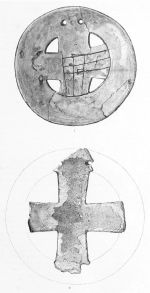
1. From a mound, Union County, Ill.
2. From Charleston, Mo.
(1/1)
In Fig. 1, Plate LII, I present a large fragment of a circular shell
ornament, on the convex surface of which a very curious ornamental
design has been engraved. The design, inclosed by a circle, represents
a cross such as would be formed by two rectangular tablets or slips,
slit longitudinally and interlaced at right angles to each other. Between
the arms of the cross in the spaces inclosed by the circular border
line are four annular nodes, having small conical depressions in the
center. These nodes have been relieved by cutting away portions of
the shell around them. In the center of the cross is another small
node or ring similarly relieved. The lines are neat and deeply incised.
[pg 272]
The edge of the shell has been broken away nearly all around. The
accompanying cut represents the ornament natural size—one and a
half inches in diameter and one-sixteenth of an inch in thickness. It
was obtained from a mound on Fain's Island, Tennessee.
The small gorget presented in Fig. 2, Plate LII, is of inferior workmanship
and the lines and dots seem to have a somewhat haphazard
arrangement. The cross, which may or may not be significant, consists
of two shallow irregular grooves which cross each other at right
angles near the center of the disk and terminate near the border.
There are indications of an irregular, somewhat broken, concentric line
near the margin. A number of shallow conical pits have been drilled
at rather irregular intervals over most of the surface. One pair of perforations
seems to have been broken away and others drilled, one of the
latter has also been broken out. A triangular fragment is lost from the
lower margin of the disk. This specimen was obtained from a mound
on Lick Creek, East Tennessee, by Mr. Dunning.
The gorget shown in Fig. 3 contains a typical example of the cross
of the mound-builder. The cut was made from a pencil sketch and is
probably not quite accurate in detail. The border of the disk is
plain, with the exception of the usual perforations at the top. The
cross is inclosed in a carelessly drawn circle, and the spaces between
the arms, which in other crosses are entirely cut out, or are filled with
rays or other figures, are here decorated with a pattern of crossed
lines. The lines which define the arms of the cross intersect in the
middle of the disk. The square figure thus produced in the center
contains a device that is probably significant. A doubly-curved or
S-shaped incised line, widened at the ends, extends obliquely across
the square from the right upper to the left lower corner. This figure
appears to be an elementary or unfinished form of the device found
in the center of many of the more elaborate disks. Intersected by a
similar line it would form a cross like that upon the back of one of the
spiders shown in Plate LXI, or somewhat more evenly curved, it would
resemble the involuted figure in the center of the circular disks given
in Plate LIV. This specimen was obtained from a mound on Lick Creek,
Tenn., and is now in the Peabody Museum.
In Fig. 4 a large copper disk from an Ohio mound is represented.
The specimen is eight inches in diameter, is very thin, and has suffered
greatly from corrosion. A symmetrical cross, the arms of which are
five inches in length, has been cut out of the center. Two concentric
lines have been impressed in the plate, one near the margin and the
other touching the ends of the cross. It is now in the Natural History
Museum at New York.
PL. LII—THE CROSS OF THE MOUND-BUILDERS.
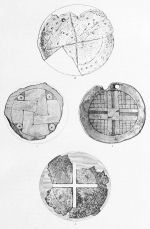
1. Shell gorget, Fain's Island, Tenn.
2. Shell gorget, Lick Creek, Tenn.
3. Shell gorget, Lick Creek, Tenn.
4. Copper plate, Ohio.
In Plate LIII I present a large number of crosses, most of which
have been obtained from the mounds, or from ancient graves, within
the district occupied by the mound-builders. Eight are engraved upon
shell gorgets (illustrations of which are given in the accompanying
[pg 273]
plates), one is cut in stone, three are painted upon pottery, and four are
executed in copper. With two exceptions they are inclosed in circles,
and are hence symmetrical Greek crosses, the ends being rounded to
conform to the circle; the remaining two (Figs. 14 and 15) represent
forms of the Latin cross, and resemble the crosses attached to the rosaries
of the Catholic priesthood. A silver cross similar to the last
given was obtained from a mound in Ohio.
The plate itself is instructive, and may be presented without further
remark.
PL. LIII—THE CROSS.
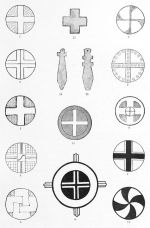
In making a hasty classification of the many engraved gorgets, I have
found it convenient to place in one group a numerous and somewhat extraordinary
class of designs which have been engraved upon scalloped
disks. Like the cross, the symbol here represented is one that cannot
with certainty be referred to an original. The general shape of the
disks is such as to suggest to most minds a likeness to the sun, the
scallops being suggestive of the rays. As this orb is known to be an object
of first importance in the economy of life—the source of light and heat—it
is naturally an object of veneration among many primitive peoples.
It is well known that the barbarian tribes of Mexico and South America
had well-developed systems of sun-worship, and that they employed
symbols of many forms, some of which still retained a likeness to the
original, while others had assumed the garb of animals or fanciful
creatures. These facts being known, it seems natural that such a symbol
as the one under consideration should be referred to the great original
which it suggests.
The well-known fact that the district from which these gorgets come,
was, at the time of discovery by the whites, inhabited by a race of sun-worshipers—the
Natchez—gives to this assumption a shadow of confirmation.
So far as I am aware, however, no one has ventured a positive
opinion in regard to their significance, but such suggestions as
have been made incline toward the view indicated above. I feel the
great necessity of caution in such matters, and while combating the
idea that the designs are ornamental or fanciful only, I am far from attributing
to them any deeply mysterious significance. They may in
some way or other indicate political or religious station, or they may
even be cosmogenic, but the probabilities are much greater that they
are time symbols. Before venturing further, however, it will be well to
describe one of these disks, a typical example of which is presented in
Plate LIV.
The specimen chosen as a type of these rosette-like disks was obtained
from a mound near Nashville, Tenn., by Professor Powell. It
was found near the head of a skeleton, which was much decayed, and
had been so disturbed by recent movements of the soil as to render it
difficult to determine its original position. The shell used is apparently
a large specimen of the Busycon perversum, although the lines
[pg 274]
of growth are not sufficiently well preserved to permit a positive determination
of the species. The substance of the shell is well preserved;
the surface was once highly polished, but is now pitted and discolored
by age. The design is engraved on the concave surface as usual, and
the lines are accurately drawn and clearly cut. The various concentric
circles are drawn with geometric accuracy around a minute shallow
pit as a center. These circles divide the surface into five parts—a
small circle at the center surrounded by four zones of unequal width.
The central circle is three-eighths of an inch in diameter, and is surrounded
by a zone one-half an inch in width, which contains a rosette
of three involuted lines; these begin on the circumference of the inner
circle in three small equidistant perforations, and sweep outward to the
second circle, making upwards of half a revolution. These lines are
somewhat wider and more deeply engraved than the other lines of the
design. In many specimens they are so deeply cut in the middle part
of the curve as to penetrate the disk, producing crescent-shaped perforations.
The second zone is one-fourth of an inch in width, and in
this, as in all other specimens, is quite plain. The third zone is one-half
an inch in width, and exhibits some very interesting features.
Placed at almost equal intervals we find six circular figures, each of
which incloses a circlet and a small central pit; the spaces between the
circular figures are thickly dotted with minute conical pits, somewhat
irregularly placed; the number of dots in each space varies from thirty-six
to forty, which gives a total of about two hundred and thirty.
The outer zone is subdivided into thirteen compartments, in each of
which a nearly circular figure or boss has been carved, the outer edges
of which form the scalloped outline of the gorget. Two medium sized
perforations for suspension have been made near the inner margin of
one of the bosses next the dotted zone; these show slight indications of
abrasion by the cord of suspension. These perforations, as well as the
three near the center, have been bored mainly from the convex side of the
disk. Whatever may be the meaning of this design, we cannot fail to
recognize the important fact that it is significant—that an idea is expressed.
Were the design ornamental, we should expect variation in
the parts or details of different specimens resulting from difference of
taste in the designers; if simply copied from an original example for
sale or trade to the inhabitants we might expect a certain number of
exact reproductions; but in such a case, when variations did occur, they
would hardly be found to follow uniform or fixed lines; there would also
be variation in the relation of the parts of the conception as well as in
the number of particular parts; the zones would not follow each other
in exactly the same order; particular figures would not be confined to
particular zones; the rays of the volute would not always have a sinistral
turn, or the form of the tablet be always circular and scalloped.
It cannot be supposed that of the whole number of these objects at one
time in use, more than a small number have been rescued from decay,
[pg 275]
and these have been obtained from widely scattered localities and doubtless
represent centuries of time, yet no variants appear to indicate a
leading up to or a divergence from the one particular type. A design
of purely ornamental character, even if executed by the same hand,
could not, in the nature of things, exhibit the uniformity in variation
here shown. Fancy, unfettered by ideas of a fixed nature, such as
those pertaining to religious or sociologic customs, would vary with the
locality, the day, the year, or the life. I have examined upwards of
thirty of these scalloped disks, the majority of which are made of shell.
I shall not attempt to describe each specimen, but shall call attention to
such important variations from the type as may be noticed.
PL. LIV—SCALLOPED SHELL DISK.
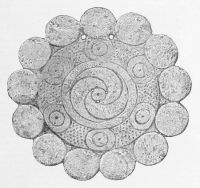
Nashville, Tenn.
(1/1)
In Fig. 1, Plate LV, we have a well-preserved disk which has four
involute lines, the others having three only; these lines are deeply cut
and, for about one-third of their length, penetrate the shell, producing
four crescent-shaped perforations. The circles in the third or dotted
zone are neatly made and evenly spaced, and inclose circlets and conical
pits. The dots in the intervening spaces are closely and irregularly
placed, and in number range from forty to forty-five, giving a total of
about three hundred and forty. Other features are as usual. The specimen
was obtained from a stone grave in Kane's Field, near Nashville,
Tenn., and is now in the Peabody Museum.
It is possible that the specimen presented in Fig. 2, Plate LV, should
not be placed in this group; but as there are many points of resemblance
to the type, it may be described here. At first sight it appears
that one of the outer zones is lacking, but it will be seen that through
some unknown cause the two have been merged together, alternating
bosses of the outer line being carried across both zones. The whole design
has been carelessly laid out and rudely engraved. The lines of the
involute are arranged in four groups of two each and occupy an unusually
wide belt. There are near the margin two sets of perforations for
suspension. The specimen was obtained from the Brakebill mound, near
Knoxville, Tenn., and is in an advanced stage of decay.
PL. LV—SHELL DISKS.
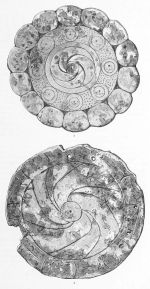
1. From a mound near Nashville. (1/1)
2. From the Brakebill Mound. (1/1)
Tennessee.
In Plate LVI, Fig. 4, I present a small specimen, which has the appearance
of being unfinished. The zones are all defined, but, with the
exception of the outer, which has thirteen bosses, are quite plain. The
lines are deeply but rudely cut. It was obtained from a stone grave at
Oldtown, Tenn., and is now in the Peabody Museum.
Besides the type specimen already presented, there may be seen in the
National Museum two very good examples, from a mound near Franklin,
Tenn. The smaller is about three inches in diameter and is nearly
circular; it has suffered much from decay, but nearly all the design can
be made out. The lines of the involute penetrate the disk producing
short crescent-shaped perforations; the circles in the dotted zone are
seven in number and inclose the usual circlets and conical pits; the
dots in the intervening spaces are too obscure to be counted. The specimen
[pg 276]
has sixteen marginal scallops. The larger specimen is somewhat
fragmentary, portions being broken away from opposite sides. It is
nearly four and a half inches in diameter, and the design has been
drawn and engraved with more than ordinary precision. The central
circle incloses a perforated circlet, and the involute lines are long and
shallow. The dotted zone has seven circles with inclosed circlets and
pits. The outer zone contains fifteen oval figures.
Another example of these shell disks is illustrated by Professor Putnam,
in the eleventh annual report of the Peabody Museum, page 310.
It is said to have been found near Nashville, Tenn., although its pedigree
is not well established. According to Professor Putnam, it is made
from the shell of a Busycon, and is apparently in a very good state of
preservation. It is about four inches in diameter and is inscribed with
the usual design, a central circle and dot surrounded by a triple involute
and three concentric zones. The narrow inner zone is plain, as
usual; the middle dotted zone has six circles with central dots, the spaces
between being closely dotted, and the outer zone contains thirteen of the
oval figures, the outer edges of which form the scalloped margin of the
disk. The perforations for suspension are placed as usual near the inner
margin of the outer zone in the spaces between the oval figures.
A fine example of engraved disks has been figured by Dr. Joseph
Jones, from whose work the illustrations given in Figs. 1 and 2, Plate LVI,
have been taken. As his description is one of the first given and
quite graphic, I make the following quotation: "In a carefully constructed
stone sarcophagus, in which the face of the skeleton was looking
toward the setting sun, a beautiful shell ornament was found resting
upon the breast-bone of the skeleton. This shell ornament is 4.4 inches
in diameter, and it is ornamented on its concave surface, with a small
circle in the center, and four concentric bands, differently figured, in relief.
The first band is filled by a triple volute; the second is plain,
while the third is dotted, and has nine small round bosses carved at unequal
distances upon it. The outer band is made up of fourteen small
elliptical bosses, the outer edges of which give to the object a scalloped
rim. This ornament on its concave figured surface had been covered
with red paint, much of which was still visible. The convex smooth
surface is highly polished and plain, with the exception of three concentric
marks. The material out of which it is formed was evidently
derived from a large flat sea-shell. * * * The form of the circles
or 'suns' carved upon the concave surface is similar to that of the paintings
on the high rocky cliffs on the banks of the Cumberland and Harpeth.
* * * This ornament, when found, lay upon the breast-bone,
with the concave surface uppermost, as if it had been worn in this position
suspended around the neck, as the two holes for the thong or
string were in that portion of the border which pointed directly to the
chin or central portion of the lower jaw of the skeleton. The marks of
the thong by which it was suspended are manifest upon both the anterior
[pg 277]
and posterior surfaces, and in addition to this the paint is worn
off from the circular space bounded below by the two holes."[136]
Fig. 2 represents the back or convex side of the disk, the long curved
lines indicate the laminations of the shell, and the three narrow crescent-shaped
figures near the center are perforations resulting from the
deep engraving of the three lines of the volute on the concave side.
The stone grave in which this ornament was found occupied the summit
of a mound on the banks of the Cumberland River opposite Nashville,
Tennessee. Professor Jones, also represents in the same work,
page 109, a large fragment of a similar ornament which has apparently
had seven circlets in the dotted zone and thirteen marginal bosses.
This specimen, which is three and one-half inches in diameter, was exhumed
by Dr. Grant, from "a small rock mound" near Pulaski, Giles
County, Tennessee.
PL. LVI—SCALLOPED SHELL DISKS.
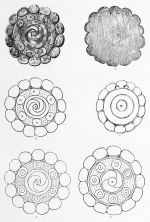
1. Nashville, Tenn.
2. Nashville, Tenn. (reverse).
3. Nashville, Tenn.
4. Oldtown, Tenn.
5. Nashville, Tenn.
6. Pulaski, Tenn.
Prof. C. C. Jones describes a number of stone disks containing
designs which evidently belong to the class under consideration. He
inclines to the opinion that they were designed for some sacred office,
and suggests that they were used as plates to offer food to the sun god.
The specimen of which I present an outline in Fig. 3, Plate LVII, is figured
by Mr. Jones, and his description is as follows: It is "circular in
form, eleven inches and a half in diameter, an inch and a quarter in
thickness, and weighing nearly seven pounds. It is made of a close-grained,
sea-green slate, and bears upon its surface the stains of centuries.
Between the rim, which is scalloped, and the central portion, are
two circular depressed rings, running parallel with the circumference
and incised to the depth of a tenth of an inch. This circular basin,
nearly eight inches in diameter, is surrounded by a margin or rim a little
less than two inches in width, traversed by the incised rings and
beveled from the center toward the edge. The lower surface or bottom
of the plate is flat, beveled upward, however, as it approaches the
scalloped edge, which is not more than a quarter of an inch in thickness.
* * * The use of these plates from the Etowah Valley may,
we think, be conjectured with at least some degree of probability. It
is not likely that they were employed for domestic or culinary purposes.
Their weight, variety, the care evidenced in their construction, and the
amount of time and labor necessarily expended in their manufacture,
forbid the belief that they were intended as ordinary dishes from which
the daily meal was to be eaten, and suggest the impression that they
were designed to fulfill a more unusual and important office. The common
vessels from which the natives of this region ate their prepared
food were bowls and pans fashioned of wood and baked clay, calabashes,
pieces of bark, and large shells. Flat platters, made of an admixture
of clay and pounded shells, well kneaded and burnt, were
ordinarily employed for baking corn-cakes and frying meat; but it does
[pg 278]
not anywhere appear that ornamental stone plates were in general
use."[137]
This specimen, or one identical with it, is in the possession of the Natural
History Museum in New York. It was plowed up in 1859 on the
lower terrace of a large mound near Cartersville, Ga.
Other specimens somewhat similar to the one described by Professor
Jones have been obtained from the same region, two of which are now in
the National Museum. One of these from a mound on the Warrior Riv. is
made of gray slate, and is about eight inches in diameter. It is smooth,
symmetrical, and doubly convex. There are three shallow, irregular lines
near the border, and the periphery is ornamented with twenty-one scallops.
Another specimen, a cut of which has already been published by
Dr. Rau in "The Archæological Collection of the National Museum,"
p. 37, is illustrated in Plate LVII, Fig. 1. It is nearly one-half an inch
in thickness, and about ten inches in diameter. A single incised line
runs parallel with the circumference, which is ornamented with nine
rather irregularly placed notches. The stone disk, of which an outline
is given in Fig. 2, Plate LVII, was obtained from the Lick Creek
mound, in East Tennessee. Its resemblance to the shell disks is so
striking that it must be regarded as having a similar origin if not a
similar use. The division into zones is the same as in the shell disks;
the outer is divided into twelve lobes, and the cross in the center takes
the place of the involute rosette with its central circle. The fact that
this particular design is engraved on heavy plates of stone as well as
upon shell gorgets is sufficient proof that its origin cannot be attributed
to fancy alone.
I have seen at the National Museum a curious specimen of stone disk,
which should be mentioned in this place, although there is not sufficient
assurance of its genuineness to allow it undisputed claim to a place
among antiquities. It is a perfectly circular, neatly-dressed sandstone
disk, twelve inches in diameter and one-half an inch in thickness.
Upon one face we see three marginal incised lines, as in the example
just described, while on the other there is a well-engraved design which
represents two entwined or rather knotted rattlesnakes. An outline of
this curious figure is given in Plate LXVI. Within the circular space
inclosed by the bodies of the serpents is a well-drawn hand in the palm
of which is placed an open eye; this would probably have been omitted
by the artist had he fully appreciated the skeptical tendencies of the
modern archæologist. The margin of the plate is divided into seventeen
sections by small semicircular indentations. This object is said to have
been obtained from a mound near Carthage, Ala. The reverse is shown
in Fig. 4, Plate LVII. A similar specimen from a mound near Lake
Washington, Mississippi, is described by Mr. Anderson.[138]
PL. LVII—SCALLOPED DISKS.
1. Stone, Warrior River, Ala.
2. Stone, Lick Creek Mound, Tenn.
3. Stone, Etowah, Valley, Ga.
4. Stone, Carthage, Ala.
5. Stone, Sun symbol, Uxmal.
The short time at my disposal has barely permitted me to collect the
[pg 279]
facts, and I shall have to leave it to the future or to others to follow
out fully the suggestions here presented. I had expected to find some
uniformity in the numbers or ratios of the various zones, circles, and
dots, and by that means possibly to have arrived at some conclusion as
to their significance. I have already shown that certain elements of
the design are fixed in position and number, while others vary, and the
following table is presented that these facts may be made apparent.
The list is quite incomplete.
It will be seen by reference to the fourth column that the involute
symbol of the inner zone is, with one exception, divided into three
parts. The second zone is not given in the table, as it is always plain.
The third or dotted zone contains circlets which range from six to nine,
while the dots, which have been counted in a few cases only, have a
wide range, the total number in some cases reaching three hundred and
forty. The bosses of the outer zone range from thirteen to eighteen.
The examples in stone seem to have a different series of numbers.
The student will hardly fail to notice the resemblance of these disks
to the calendars or time symbols of Mexico and other southern nations
of antiquity. There is, however, no absolute identity with southern
examples. The involute design in the center resembles the Aztec symbol
of day, but is peculiar in its division into three parts, four being
the number almost universally used. The only division into three that
I have noticed occurs in the calendar of the Muyscas, in which three
days constitute a week. The circlets and bosses of the outer zones
gives them a pretty close resemblance to the month and year zones of
the southern calendars.
My suggestion that these objects may be calendar disks will not seem
unreasonable when it is remembered that time symbols do very often
make their appearance during the early stages of barbarism. They are
the result of attempts to fix accurately the divisions of time for the regulation
of religious rites, and among the nations of the south constituted
the great body of art. No well-developed calendar is known among the
wild tribes of North America, the highest achievements in this line
consisting of simple pictographic symbols of the years, but there is no
reason why the mound-builders should not have achieved a pretty accurate
division of time resembling, in its main features, the systems of
their southern neighbors.
[pg 280]
| SHELL. |
| Illustrated in— | Collection. | Locality. | Divisions of involute. | Circlets in 2d zone. | Bosses in marginal zone. | Dots in 2d zone. | Peculiar features. |
| Pl. LIV | N. M., 32060 | Tenn. | 3 | 6 | 13 | 340(?) | Three central perforations. |
| Pl. LV, 1 | P. M., 15247 | do | 4 | 8 | 14 | | |
| Pl. LVI, 1 | J. Jones | do | 3 | 9 | 14 | | Three incisions. |
| Pl. LVI, 3 | P. M., 11801 | do | 3 | 6 | 13 | | |
| Pl. LVI, 4 | P. M., 15969 | do | 3 | Plain | 13 | | Unfinished (?) |
| P. M., 15896 | do | 3 | 8 | 17 | | |
| P. M. | do | 3 | 6 | 16 | | |
| P. M., 15906 | do | 3 | 8 | 13 | 100(?) | Two central perforations. |
| P. M., 15835 | do | 3 | 6 | 14 | 250(?) | |
| P. M., 15916 | do | 3 | 6 | 18 | | Three crescent perforations. |
| N. M., 19976 | do | 3 | 7 | 6 | | |
| N. M., 19975 | do | 3 | 7 | 15 | 280(?) | |
| STONE. |
| Pl. LVII,1 | N. M., 9334 | Ga. | | Plain | 9 | | |
| Pl. LVII,2 | P. M., 2962 | do | | do | 12 | | Cross in center. |
| Pl. LVII,3 | N. Y. Nat. Hist. M. | do | | do | 24 | | |
| N. M., 9332 | do | | do | 21 | | |
| Pl. LXVI | N. M. | Ala. | | do | 17 | | Serpent, obverse. |
| Anderson | Miss. | | do | 18 | | Serpent, center. |
| N. M., National Museum. | P. M., Peabody Museum. |
With all peoples the bird has been a most important symbol. Possessing
the mysterious power of flight, by which it could rise at pleasure
into the realms of space, it naturally came to be associated with
the phenomena of the sky—the wind, the storm, the lightning, and the
thunder. In the fervid imagination of the red man it became the actual
ruler of the elements, the guardian of the four quarters of the
heavens. As a result the bird is embodied in the myths, and is a
prominent figure in the philosophy of many savage tribes. The eagle,
which is an important emblem with many civilized nations, is found to
come much nearer the heart of the superstitious savage; its plumes
are the badge of the successful warrior; its body a sacred offering to
his deities, or an object of actual veneration. The swan, the heron,
the woodpecker, the paroquet, the owl, and the dove were creatures of
unusual consideration; their flight was noted as a matter of vital importance,
as it could bode good or evil to the hunter or warrior who
consulted it as an oracle.
The dove, with the Hurons, is thought to be the keeper of the souls
[pg 281]
of the dead, and the Navajos are said to believe that four white swans
dwell in the four quarters of the heavens and rule the winds.
The storm-bird of the Dakotas dwells in the upper air, beyond the
range of human vision, carrying upon its back a lake of fresh water;
when it winks its eyes there is lightning; when it flaps its wings we
hear the thunder; and when it shakes out its plumage the rain descends.
Myths like this abound in the lore of many peoples, and the
story of the mysterious bird is interwoven with the traditions which
tell of their origin. A creature which has sufficient power to guide
and rule a race is constantly embodied in its songs, its art, and its
philosophy. Thus highly regarded by the modern tribes, it must have
been equally an object of consideration among prehistoric races. We
know that the Natchez and the Creeks included the bird among their
deities, and by the relics placed within his sepulchers we know that it
held an important place in the esteem of the mound-builder.
Our prehistoric peoples seem to have taken special delight in carving
its form in wood and stone, in modeling it in clay, in fashioning it in
copper and gold, and in engraving it upon shell. One of the most interesting
of all the specimens preserved to us is illustrated in Plate LVIII.
The design with which this relic is embellished possesses no
little artistic excellence, and doubtless embodies some one of the many
charming myths of the heavens.
I am perfectly well aware that a scientific writer should guard against
the tendency to indulge in flights of fancy, but as the myths of the
American aborigines are highly poetical, and abound in lofty rhetorical
figures, there can be no good reason why their graphic art should not
echo some of these rhythmical passages. To the thoughtful mind it will
be apparent that, although this design is not necessarily full of occult
mysteries, every line has its purpose and every figure its significance.
Yet of these very works one writer has ventured the opinion that
"they do but express the individual fancy of those by whom they
were made;" that they are even without "indications of any intelligent
design or pictographic idea." I do not assume to interpret
these designs; they are not to be interpreted. Besides, there is
no advantage to be gained by an interpretation. We have hundreds
of primitive myths within our easy reach that are as interesting and
instructive as these could be. All I desire is to elevate these works
from the category of trinkets to what I believe is their rightful
place—the serious art of a people with great capacity for loftier
works. What the gorgets themselves were, or of what particular
value to their possessors, aside from simple ornament, must be, in a
[pg 282]
measure, a matter of conjecture. They were hardly less than the totems
of clans, the insignia of rulers, or the potent charms of a priesthood.
The gorget in question is unfortunately without a pedigree. It
reached the National Museum through the agency of Mr. C. F. Williams,
and is labeled "Mississippi." On its face, however, there is sufficient
evidence to establish its aboriginal origin. The form of the object, the
character of the design and the evident age of the specimen, all bespeak
the mound-builder. It was in all probability obtained from one of
the multitude of ancient sepulchers that abound in the State of Mississippi.
The disk is four and a quarter inches in diameter, and is made
from a large, heavy specimen of the Busycon perversum. It has been
smoothly dressed on both sides, but is now considerably stained and
pitted. The design has in this case been engraved upon the convex
side, the concave surface being plain. The perforations are placed
near the margin and are considerably worn by the cord of suspension.
In the center is a nearly symmetrical cross of the Greek type inclosed
in a circle one and one-fourth inches in diameter. The spaces between
the arms are emblazoned with groups of radiating lines. Placed at regular
intervals on the outside of the circle are twelve pointed pyramidal
rays ornamented with transverse lines. The whole design presents a remarkable
combination of the two symbols, the cross and the sun. Surrounding
this interesting symbol is another of a somewhat mysterious
nature. A square framework of four continuous parallel lines, symmetrically
looped at the corners, incloses the central symbol, the inner
line touching the tips of the pyramidal rays. Outside of this again are
the four symbolic birds placed against the side of the square opposite
the arms of the cross. These birds, or rather birds' heads, are carefully
drawn after what, to the artist, must have been a well recognized
model. The mouth is open and the mandibles long, slender,
and straight. The eye is represented by a circlet which incloses a
small conical pit intended to represent the iris, a striated and pointed
crest springs from the back of the head and neck, and two lines extend
from the eye, down the neck, to the base of the figure. In seeking an
original for this bird we find that it has perhaps more points of resemblance
to the ivory-billed woodpecker than to any other species. It
is not impossible, however, that the heron or swan may have been intended.
That some particular bird served as a model is attested by the
fact that other specimens, from mounds in various parts of Tennessee,
exhibit similar figures. I have been able to find six of these specimens,
all of which vary to some extent from the type described, but only in
detail, workmanship, or finish. The specimen presented in Fig. 2, Plate LIX,
was obtained by Mr. Cross from a stone grave on Mr. Overton's
farm near Nashville, Tenn. Professor Putnam, who secured it from Mr. Cross,
has published a cut of it in the Eleventh Annual Report of the
Peabody Museum. It is made from a large marine shell, probably a Busycon,
and is represented natural size both by Mr. Putnam and myself.
[pg 283]
The design is essentially the same as that shown in the type specimen,
but is much more rudely executed. A circlet with a central pit takes
the place of the cross and sun. The looped rectangular figure has but
two lines and the birds' heads are not so full of character as those on the
other specimens; they resemble the heads of chicks with a few pin-feathers
sprouting from the back and top of the head rather than
full-fledged birds. The design is engraved on the concave side. The
perforations are much worn. This specimen is now in the Peabody
Museum.
PL. LVIII—SHELL GORGET—THE BIRD.
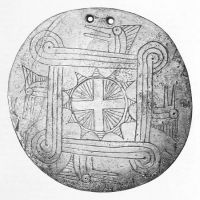
Mississippi.
(1/1)
The same collection contains a large fragment of another small disk
about two inches in diameter. The central part seems to be plain, but
the looped figure, which has four lines, resembles very closely that engraved
on the other plates. It is mentioned by Professor Putnam, on
page 309 of the Eleventh Annual Report of the Peabody Museum. It
is said to have been found on the surface in Humphrey County, Tennessee.
A much larger specimen, which resembles my type specimen very
closely, is shown in Fig. 1, Plate LIX. It was obtained by Professor
Putnam and Dr. Curtis from a stone grave on Mrs. Williams' farm, Cumberland
River, Tennessee. It is nearly circular, and about two and a
half inches in diameter. A small piece has been lost from the upper
margin. It is neatly made and quite smooth, and the lines of the design
are clearly and evenly engraved. The small cross in the center is
inclosed by a plain narrow zone, and is defined by four triangular perforations
between the arms. In this respect it resembles other shell
crosses found within the Mississippi Valley. Surrounding the plain
zone are eight pyramidal rays with cross-bars; in this feature, and in
the drawing of the looped square and the birds' heads, there is but little
variation from the type specimen. The surface upon which the engraving
is made seems to be slightly convex.
Another specimen of this class was obtained from a stone grave near
Gray's mound, at Oldtown, Tenn. It is shown in Fig. 3, Plate LIX.
The design is very much like that of the type specimen, from which it
differs in having four large perforations near the center. Although the
engraved design which once occupied the central space is almost totally
effaced, one or two of the tips of the pyramidal rays may be detected.
It is probable that the four round perforations correspond to the four
triangular ones by which the arms of the cross in the preceding example
are defined. The perforations for suspension are near one margin,
and seem to be very much worn by use. The whole object is fragile
from decay. This specimen is also in the Peabody Museum.
One more very imperfect specimen obtained from a stone grave in the
Cumberland Valley is nearly five inches in diameter and very irregular
in outline. Barely enough of the engraved design remains to show
that it belongs to the class under consideration.
It will be observed that the specimens of this class obtained from
[pg 284]
Tennessee are confined to a limited area. It thus seems especially unfortunate
that so little is known of the history of the type specimen
given in Plate LVIII, as without assurance of the correctness of the
statement that it is from Mississippi we cannot make use of it to show
geographical distribution. In reference to this point, however, we have
a few very interesting facts which make the occurrence of specimens in
localities as widely separated as the "Cumberland River" and "Mississippi"
seem inconsequential. I refer now to two specimens described
by Dr. Abbott in "Primitive Industry." One of these is a remarkable
slate knife, the striking features of which are a "series of etchings and
deeply incised lines of perhaps no meaning. Taken in order, it will be
noticed that at the back of the knife are four short lines at uniform distances
apart, and a fifth near the end of the implement. Besides these
are fifteen shorter parallel lines near the broader end of the knife and
about the middle of the blade. A series of five zigzag lines are also cut
on the opposite end of the blade. * * * More prominent than the
numerous lines to which reference has been made, are the clearly defined,
unmistakable birds' heads, placed midway between the two
series of lines. * * * Did we not learn from the writings of Heckewelder,
that the Lenapé had 'the turkey totem,' we might suppose
that this drawing of such bird heads originated with the intrusive
southern Shawnees, who, at one time, occupied lands in the Delaware
Valley, and who are supposed by some writers to have been closely related
to the earliest inhabitants of the Southern and Southwestern
States. Inasmuch as we shall find that, not only on this slate knife,
but upon a bone implement also, similar heads of birds are engraved,
it is probable that the identity of the design is not a mere coincidence,
but that it must be explained either in accordance with the statements
of Heckewelder, or be considered as the work of southern Shawnees
after their arrival in New Jersey. In the latter event, the theory that
these disks were the work of a people different from and anterior to the
Indians found in the Cumberland Valley at the time of the discovery
of that region by the whites is, apparently, not sustained by the
facts."[139]
A cut of the bone implement referred to above is reproduced from
Dr. Abbott's work, in Plate LIX, Fig. 4. It has probably been made from
a portion of a rib of some large mammal and is thought to be somewhat
fragmentary. "The narrow portion has been cut or ground away to
some extent, and the edges are quite smoothly polished. Near the end
of this handle-like portion, there is a countersunk perforation, and upon
the concave side of the wider part there are rudely outlined the heads
of two birds."[140] These resemble somewhat closely the heads depicted
on the other specimen described by Dr. Abbott. The specimens referred
to are both from New Jersey, and are probably surface finds.
[pg 285]
Although the heads represented on these specimens do certainly in
some respects suggest that of the turkey, the characters are not sufficiently
pronounced to make it impossible that some other bird was
intended, so that the original in the mind of the ancient artist may
have been the same as that from which the examples on shell were
drawn.
In comparing the northern examples with those of Tennessee I observe
another feature that is more conclusive as to the identity of origin
than the rather obscure resemblance of the birds' heads delineated. I
have not had the opportunity of examining the specimen illustrated in
Fig. 4; but in the cut given by Dr. Abbott a rather indefinite figure
can be traced which has a striking resemblance to the looped rectangle
characteristic of the designs on shell. This resemblance could hardly
be owing to accident, and if the peculiar figure mentioned is actually
found in conjunction with the birds' heads upon the New Jersey specimen,
it will certainly be safe to conclude that the bone, stone, and shell
objects belonged to the same people, and that they constituted the totems
of the same clan, or were the insignia of corresponding offices or
orders.[141]
As bearing upon the question of the species of bird represented in
the preceding specimens, I present in Plate LX an illustration published
by Dr. Rau in the Smithsonian Report for 1877. This remarkable
ornament (represented in Fig. 3) was obtained from a mound in
Manatee County, Florida. It is a thin blade of gold, pointed at one end
and terminating at the other in a highly conventionalized representation
of a bird's head, the general characteristics of which are much
like those of the examples engraved upon shell. The crest is especially
characteristic, and, as pointed out by Dr. Rau, suggests a prototype
in the ivory-billed woodpecker, an inhabitant of the Gulf States.
The significance of the looped figure which forms so prominent a
feature in the designs in question has not been determined. I would
offer the suggestion, however, that, from the manner of its occurrence,
it may represent an inclosure, a limit, or boundary. It may be well to
point out the fact that a similar looped rectangle occurs several times
in the ancient Mexican manuscripts. One example, from the Vienna Codex,[142]
is presented in Fig. 5, Plate LIX. It is not a little remarkable
that a cross occupies the inclosed area in all these examples.
PL. LIX—THE BIRD.
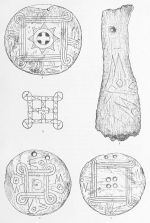
1. Shell gorget from stone grave, Tenn.
2. Shell gorget from stone grave, Tenn.
3. Shell gorget from stone grave, Tenn.
4. Bone implement, N. J.
5. Design from Aztec painting.
I shall close this very hasty review of the bird in the art of the
Mound Builders by presenting the remarkable example of shell carving
shown in Fig. 1, Plate LX. Like so many of the National Museum
specimens, it is practically without a record—a stray. It is labeled "B.
Pybas, Tuscumbia, Ala." It is old and fragmentary, the shell substance
being, however, quite well preserved. It is the right-hand half of a
[pg 286]
gorget which represents an eagle's head in profile. The skill of the
ancient artist is shown to great advantage; nothing can be found, even
in the most elaborately carved pipes, equal to the treatment of this remarkable
head. To overcome the difficulty of cutting the flinty and
massive shell was no small triumph for a people still in the stone age.
To conceive and execute such a graphic work is a still more marvelous
achievement.[143] The lines of the mandibles and protruding tongue are
strongly and correctly drawn. The eye and the markings of the head
are executed in smooth, deeply incised lines, and are conventionalized
in a manner peculiar to the American aborigines.
PL. LX—THE BIRD.
1. Fragment of shell gorget, Alabama. (1/1)
2. Gold ornament, Florida. (1/2)
3. Head of ivory-billed-woodpecker.
Among insects the spider is perhaps best calculated to attract the
attention of the savage. The tarantula is in many respects a very
extraordinary creature, and is endowed with powers of the most
deadly nature, which naturally places it along with the rattlesnake
in the category of creatures possessing supernatural attributes. Its
curiously constructed house with the hinged door and smoothly plastered
chamber must ever elicit the admiration of the beholder. But
the spider, which spins a web and projects in mid-air a gossamer structure
of marvelous symmetry and beauty, and builds an ambush from
which to spring upon his prey, was probably one of the first instructors
of adolescent man, and must have seemed to him a very deity. It is
not strange, therefore, that the spider appears in the myths of the
savages. With the great Shoshone family, according to Professor
Powell, the spider was the first weaver, and taught that important art
to the fathers. The Cherokees, in their legend of the origin of fire,
"represent a portion of it as having been brought with them and
sacredly guarded. Others say that after crossing wide waters they sent
back for it to the Man of Fire from whom a little was conveyed over
by a spider in his web."[144]
The spider occurs but rarely in aboriginal American art, occasionally
it seems, however, to have reached the dignity of religious consideration
and to have been adopted as a totemic device. Had a single
example only been found we would not be warranted in giving it a place
among religious symbols. Four examples have come to my notice;
these are all engraved on shell gorgets and are illustrated in Plate LXI.
Two are from Illinois, one from Missouri, and the other from Tennessee.[145]
The example shown in Fig. 1 was obtained by Mr. Croswell from a
mound near New Madrid, Mo. It is described as a circular ornament,
[pg 287]
three inches in diameter, that had, apparently, been cut from a Busycon.
Mr. Croswell says that "the convex face was entirely plain, but
the concave side bears the figure of a tarantula, or large spider, very
skillfully engraved, the body being formed by a circle inclosing a cross,
showing beyond doubt its sacred and symbolic character. This ornament,
when found, lay on the breast-bone of a skeleton, with the concave
or ornamented side uppermost. Two holes in the upper part were evidently
intended for the thong or string by which it had been suspended
from the neck. A circumstance that renders this relic still more interesting
is the fact that two other shell ornaments, bearing precisely similar
devices, have recently been found in Illinois within seven miles of
this city, thus proving that the figures were not a mere fanciful invention,
but had some symbolic meaning."[146]
The disk thus briefly described by Mr. Croswell is so much like the
example shown in Fig. 3 that I shall not describe it further, but shall
refer to its peculiarities in the descriptions of others that follow.
The handsome gorget illustrated in Fig. 3 was obtained from a mound
in Saint Clair County, Illinois, seven miles from the city of Saint Louis.
It was found upon the breast of a skeleton, and was very much discolored
and quite fragile from decay, but no part of the design, which is
engraved upon the concave side, has been obliterated. Near the margin
and parallel with it three lines have been engraved. The spider is drawn
with considerable fidelity to nature and covers nearly the entire disk,
the legs, mandibles, and abdomen reaching to the outer marginal line.
As in the specimen described above, the thorax is placed in the
center of the disk, and is represented by a circle; within this a cross
has been engraved, the ends of which have been enlarged on one
side, producing a form much used in heraldry, but one very rarely met
with in aboriginal American art. The head is somewhat heart-shaped
and is armed with palpi and mandibles, the latter being ornamented
with a zigzag line and prolonged to the marginal lines of the disk. The
eyes are represented by two small circles with central dots. The legs
are correctly placed in four pairs upon the thorax, and are very graphically
drawn. The abdomen is large and heart-shaped, and is ornamented
with a number of lines and dots, which represent the natural
markings of the spider. The perforations for suspension are placed
near the posterior extremity of the abdomen. It will be observed that
this is also the case with the three other specimens. Having described
this specimen somewhat carefully, it will be unnecessary to give a detailed
description of the very similar specimen shown in Fig. 2. The
latter was found in a stone grave in Saint Clair County, Illinois, and does
not differ in any essential feature from either of the other specimens, one
of which was found near by, and the other about one hundred miles
farther south.
In reference to the cross it has been suggested that it may have been
[pg 288]
derived from the well-defined cross found upon the backs of some species
of the genus Atta, but there appears to be good reason for believing
otherwise. The cross here shown has a very highly conventionalized
character, quite out of keeping with the realistic drawing of the insect,
and, what is still more decisive, it is identical with forms found upon
many other objects. The conclusion is that the cross here, as elsewhere,
has a purely symbolic character. Spider gorgets are also mentioned
by A. J. Conant in the Kansas City Review, Vol. I, page 400, and in
his work on the Commonwealth of Missouri, page 96, but no details are
given. It is probable that the objects referred to by Mr. Conant are
the same as those more definitely placed by Prof. Hilder.
The specimen shown in Fig. 4 was obtained from a mound on Fain's
Island, Tennessee. The disk is somewhat more convex on the front
than is indicated in the engraving. It is two and a half inches in
diameter, and is quite thin and fragile, although the surface has not
suffered much from decay. The margin is ornamented with twenty-four
very neatly made notches or scallops. Immediately inside the border
on the convex side are two incised circles, on the outer of which two
small perforations for suspension have been made; inside of these, and
less than half an inch from the margin, is a circle of seventeen sub-triangular
perforations, the inner angle of each being much rounded. Inside
of this again is another incised circle, about one and one-fourth
inches in diameter, which incloses the highly conventionalized figure of
an insect resembling a spider. In a general way—in the number and
arrangement of the parts—this figure corresponds pretty closely to the
very realistic spiders of the three other disks; in detail however, it is
quite unlike them. It is much more highly conventionalized—the
natural markings of the body being nearly all omitted, and the legs
being without joints and square at the tips. The cross does not appear
on the body, but its place is taken by a large conical perforation, made
entirely from the convex side. The central segment of the body is
round, as in the other cases; to this the four pairs of legs are attached.
Without reference to the other specimens, it would be difficult to distinguish
the anterior from the posterior extremity, and even with this
aid we cannot be quite certain. The larger extremity is somewhat triangular
in outline and is ornamented with two cross lines and two
eyes. Were it not for the fact that these eyes resemble so closely
those found in the other specimens I should call this the posterior
extremity, as the opposite end terminates in a pair of well-shaped
mandibles, the triangular space between them being cut quite through
the disk. The section of the body between this and the central circle
also resembles the head, which suggests the conclusion either that the
eyes are misplaced or that, as drawn, they are only intended to represent
the bright spots of the insect's body.
The rarity of these spider gorgets makes it seem rather remarkable
that specimens should occur in localities so widely separated as Fain's
[pg 289]
Island and Saint Louis, but the races inhabiting this entire region, are
known to have had many arts in common, and besides this it is not
impossible that the same tribe or clan may, at different times, have
occupied both of these localities. The marked differences in the design
and execution of these specimens, however, indicate a pretty wide
distinction in the time or art of the makers.
PL. LXI—SPIDER GORGETS.
1. From a mound, Missouri.
2. From a stone-grave, Illinois.
3. From a mound, Illinois.
4. From a mound, Tennessee.
(1/1)
The serpent has had a fascination for primitive man hardly surpassed
by its reputed power over the animals on which it preys. In the minds
of nearly all savages it has been associated with the deepest mysteries
and the most potent powers of nature. No other creature has figured
so prominently in the religious systems of the world, few of which
are free from it; and as art, in a great measure, owes its existence
to an attempt to represent or embellish objects which are supposed
to be the incarnations of spirits, the serpent is an important element
in all art. Wherever the children of nature have wandered its
image may be found engraved upon the rocks, or painted or sculptured
upon monuments of their own construction. It is found in a thousand
forms; beginning with those so realistic that the species can be determined,
we may pass down through innumerable stages of variation
until all semblance of nature is lost. Beyond this it becomes embodied
in the conventional forms of art or looks back from its obscure place in
an alphabet through a perspective of metamorphism as marvelous as
that visible to the creature itself could it view the course of its evolution
from the elements of nature.
So well is the serpent known as a religious symbol among the American
peoples that it seems hardly necessary to present examples of the
curiously interesting myths relating to it. We are not surprised to
find the bird, the wolf, or the bear placed among representatives of the
"Great Spirit," and hence to find them embodied in art; but it would
be a matter of surprise if the serpent were ever absent.
With the mound-builders it seems to have been of as much importance
as to other divisions of the red race, ancient or modern. It is of very
frequent occurrence among the designs engraved upon gorgets of shell,
a multitude of which have been thus dedicated to the serpent-god.
It is a well-known fact that the rattlesnake is the variety almost universally
represented, and we find that these engravings on shell present
no exception to this rule. From a very early date in mound exploration
these gorgets have been brought to light, but the coiled serpent
engraved upon their concave surfaces is so highly conventionalized
that it was not at once recognized. Professor Wyman appears to have
been the first to point out the fact that the rattlesnake was represented;
others have since made brief allusion to this fact. Two examples only
have been illustrated; one by Professor Jones,[147] who regards it as being
without intelligent design, and the other by Dr. Rau,[148] who does not suggest
[pg 290]
an interpretation. Among the thirty or forty specimens that I have
examined, the engraving of the serpent is, with one exception, placed upon
the concave side of the disk, which is, as usual, cut from the most distended
part of the Busycon perversum, or some similar shell. The great
uniformity of these designs is a matter of much surprise. At the same
time, however, there is no exact duplication; there are always differences
in position, detail, or number of parts. The serpent is always
coiled, the head occupying the center of the disk. With a very few
exceptions the coil is sinistral. The head is so placed that when the
gorget is suspended it has an erect position, the mouth opening toward
the right hand.
As at first glance it will be somewhat difficult for the reader to make
out clearly the figure of the serpent, even with the well defined lines of
the drawing before him, I will present the description pretty much in
the order in which the design revealed itself to me in my first attempt
to decipher it.
The saucer-like disks are almost circular, the upper edge being mostly
somewhat straightened—the result of the natural limit of the body of the
shell above. All are ground down to a fairly uniform thickness of
from one-eighth to one-fourth of an inch. The edges are evenly rounded
and smooth. Two small holes for suspension occur near the rim of the
straighter edge, and generally on or near the outline of the engraved
design, which covers the middle portion of the plate. The diameter
ranges from one to six inches.
To one who examines this design for the first time it seems a most
inexplicable puzzle; a meaningless grouping of curved and straight
lines, dots and perforations. We notice, however, a remarkable similarity
in the designs, the idea being radically the same in all specimens,
and the conclusion is soon reached that there is nothing haphazard in
the arrangements of the parts and that every line must have its place
and purpose. The design is in all cases inclosed by two parallel border
lines, leaving a plain belt from one-fourth to three-fourths of an inch in
width around the edge of the disk. All simple lines are firmly traced,
although somewhat scratchy, and are seldom more than one-twentieth
of an inch in width or depth.
In studying this design the attention is first attracted by an eye-like
figure near the left border. This is formed of a series of concentric
circles, the number of which varies from three in the most simple to
twelve in the more elaborate forms. The diameter of the outer circle
of this figure varies from one-half to one inch. In the center there is
generally a small conical depression or pit. The series of circles is partially
inclosed by a looped band one-eighth of an inch in width, which
opens downward to the left; the free ends extending outward to the
border line, gradually nearing each other and forming a kind of neck to
the circular figure. This band is in most cases occupied by a series of
dots or conical depressions varying in number from one to thirty. The
[pg 291]
neck is decorated in a variety of ways; by dots, by straight and curved
lines, and by a cross-hatching that gives a semblance of scales. A curious
group of lines occupying a crescent-shaped space at the right of
the circular figure and inclosed by two border lines, must receive particular
attention. This is really the front part of the head—the jaws
and the muzzle of the creature represented. The mouth is always
clearly defined and is mostly in profile, the upper jaw being turned abruptly
upward, but, in some examples, an attempt has been made to
represent a front view, in which case it presents a wide V-shaped figure.
It is, in most cases, furnished with two rows of teeth, no attempt
having been made to represent a tongue. The spaces above
and below the jaws are filled with lines and figures, which vary much
in the different specimens; a group of plume-like figures, extends backward
from the upper jaw to the crown, or otherwise this space is occupied
by an elongated perforation. The body is represented encircling
the head in a single coil, which appears from beneath the neck on the
right, passes around the front of the head, and terminates at the back
in a pointed tail with well defined rattles. It is engraved to represent
the well-known scales and spots of the rattlesnake, the conventionalized
figures being quite graphic. In the group of specimens represented
in Plate LXIV areas of cross-hatched lines, representing scales,
alternate with circular figures, containing two or three concentric circles
and a central dot. In some cases one or more incised bands cross the
body in the upper part of the curve.
The examples shown in Plate LXV have many distinctive features.
The markings of the body consist of alternating areas of scales and
chevrons or of chevrons alone. These figures are interrupted in the
upper part of the coil by a number of lines which cross the body at
right angles. The body is in many cases nearly severed from the rim
of the disk by four oblong perforations, which follow the border line
of the design. In most cases three other perforations occur about
the head; one represents the mouth, one defines the forehead and
upper jaw, and the third is placed against the throat. These may be
intended merely to define the form more clearly. The curious plume-like
figures that occur upon the heads of both varieties may indicate
the natural or reputed markings of the animal represented. It is possible
that the group shown in this plate may be intended to represent
the common yellow rattlesnake, the Crotalus horridus, of the Atlantic
slope, the characteristic markings of which are alternating light and
dark chevrons, while the diamond rattlesnake, the Crotalus adamanteus,
of the Southern States may have served as a model for the other
group.
In Plate LXII I present two of these rattlesnake gorgets. The specimens
shown in Fig. 1 is from Georgia and is the smallest example that
has come to my notice. It is represented natural size. The design is
quite obscure, but enough remains to show that it does not differ essentially
[pg 292]
from the type already presented. There appear to be no holes
for suspension, but it is probable that two of the oblong perforations
upon the border of the design had been used for that purpose.
The handsome specimen given in Fig. 2 was obtained from the great
mound at Sevierville, Tenn., and is in a very good state of preservation.
It is a deep, somewhat oval plate, made from a Busycon perversum.
The surface is nicely polished and the margins neatly beveled. The
marginal zone is less than half an inch wide and contains at the upper
edge two perforations, which have been considerably abraded by the
cord of suspension. Four long curved slits or perforations almost
sever the central design from the rim; the four narrow segments that
remain are each ornamented with a single conical pit. The serpent is
very neatly engraved and belongs to the chevroned variety. The eye
is large and the neck is ornamented with a single rectangular intaglio
figure. The mouth is more than usually well defined. The upper jaw
is turned abruptly upward and is ornamented with lines peculiar to this
variety of the designs.
The body opposite the perforations for suspension is interrupted by a
rather mysterious cross band, consisting of one broad and two narrow
lines. As this is a feature common to many specimens it probably has
some important office or significance.
PL. LXII—RATTLESNAKE GORGETS.
1. Shell gorget from Georgia. (1/1)
2. McMahan Mound, Tenn. (1/1)
In Plate LXIII I present two of the best examples of these serpent
gorgets yet brought to light. They were obtained from the McMahan
Mound, at Sevierville, Tenn., in 1871, and are in an excellent state of
preservation. Both are made from large heavy specimens of the Busycon
perversum. The example given in Fig. 1 is but slightly altered by
decomposition, the translucency of the shell being still perceptible. The
back retains the strongly marked ridges of growth. The interior has
been highly polished, but is now somewhat marked, apparently by some
fine textile fabric which has been buried with it and has, in decaying,
left its impress upon the smooth surface of the shell. The design is very
much like the type described, but has some peculiar features about the
neck and under the head of the serpent.
The specimen shown in Fig. 2 may be regarded as a type of these
gorgets, and is the one chiefly used in the general description given on
a preceding page. It is six inches long by five wide, and has been
neatly dressed and polished on both sides. As every detail is clearly
and correctly shown in the cut I shall not describe it farther.
PL. LXIII—RATTLESNAKE GORGETS.
1. McMahan Mound, Tenn.
2. McMahan Mound, Tenn.
(3/4)
For convenience of comparison I have arranged two plates of outlines.
The specimen shown in Fig. 1, Plate LXIV, is almost identical with the
one last mentioned in size and shape. This, with the similar but somewhat
smaller specimen given in Fig. 2, is also from the McMahan Mound.
Figs. 3 and 4 are outlines of the specimens already given in Plate LXIII.
The fine specimen shown in Fig. 5 is from the Brakebill Mound, near
Knoxville, Tenn., and is now in the Peabody Museum. It is five inches
in length and a little more than four and one-half in width. It is very
[pg 293]
much like the Sevierville specimens and is made of the same species of
shell. The markings of the space beneath the head are peculiar, and
in some other details it differs from the other specimens.
Fig. 6 illustrates a large specimen now in the National Collection. It
is also from Tennessee, and resembles the preceding examples quite
closely.
PL. LXIV—RATTLESNAKE GORGETS.
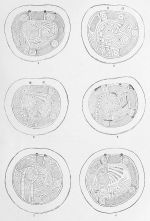
1. McMahan Mound.
2. McMahan Mound.
3. McMahan Mound.
4. McMahan Mound.
5. Brakebill Mound.
6. Williams Island.
Tennessee.
The specimens illustrated in Plate LXV represent a somewhat different
type of design, but are found associated with the others. The three
shown in Figs. 2, 6, and 7 belong to the Peabody Museum, and are
from mounds in East Tennessee. The others are in the National Collection,
and come from the same region.
PL. LXV—RATTLESNAKE GORGETS.
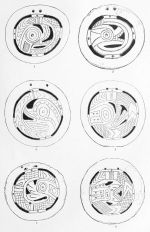
1. McMahan Mound.
2. Lick Creek Mound.
3. McMahan Mound.
4. McMahan Mound.
5. Green County Mound.
6. Lick Creek Mound.
Tennessee.
It was my intention to pursue this study somewhat further, and the
illustrations presented in Plate LXVI were partially prepared for the
purpose of instituting comparisons between these northern forms and
others of the south, but the time at my disposal will not permit of it.
Fig. 1 is an outline of a rattlesnake gorget, probably from Georgia,
which is preserved in the Natural History Museum of New York. It
is four inches in length by three and one-half in width. The same specimen
is figured by Jones in Plate XXX of his "Antiquities of the Southern
Indians."
Fig. 2 represents a large specimen from Tennessee, which is now preserved
in the National Collection. The design is placed upon the gorget
somewhat differently from the other specimens, the mouth of the serpent
being near the top and the neck below at the right. There is also
a dotted belt at the right of the head which is not found in any of the
specimens described.
Figs. 3 and 4 represent drawings of serpents' heads found in the ancient
city of Chimu, Peru.[149]
Fig. 5 is copied from one of the codices of Goldsborough, and is a
very spirited representation of a plumed and spotted rattlesnake.
The tablet shown in Fig. 6 has already been described under "scalloped
disks."
The remarkable plumed and feathered serpent given in Fig. 7 is painted
upon the rocks at Lake Nijapa, Nicaragua.[150]
PL. LXVI—THE SERPENT.
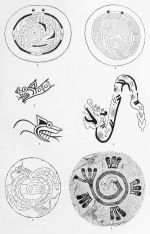
1. Shell gorget, Georgia.
2. Shell gorget, Tennessee.
3, 4. Painting, Peru.
5. From an Aztec painting.
6. Stone disk, Carthage, Ala.
7. Painted on rock, Nicaragua.
A very important group of shell ornaments represent, more or less
distinctly, the human face. By a combination of engraving and sculpture
a rude resemblance to the features is produced. The objects are
generally made from a large pear-shaped section of the lower whorl of
heavy marine univalves. The lower portion, which represents the neck
and chin, is cut from the somewhat restricted part near the base of the
shell, while the broad outline of the head reaches the first suture of the
noded shoulder of the body whorl. The simplest form is represented
[pg 294]
by a specimen from a mound at Sevierville, Tenn. It is a plain, pear-shaped
fragment, with evenly dressed margin and two perforations,
which take the position of the eyes. A sketch of this is presented in
Fig. 1, Plate LXIX. Similar specimens have been obtained from mounds
in other States. A little further advance is made when the surface of
the most convex part is ground away, with the exception of a low vertical
ridge, which represents the nose. Further on a boss or node appears
below the nose, which takes the place of the mouth, as seen in
Fig. 2.
From the elementary stages exhibited in these specimens a gradual
advance is made by the addition of details and the elaboration of all the
features. A corona encircles the head, the ears are outlined (Fig. 5,
Plate LXX), the eyes are elaborated by adding one or more concentric
circles or ovals, brows are placed above, and groups of notched and
zigzag lines extend downward upon the cheeks. The node at the mouth
is perforated or cut in intaglio in circular or oblong figures, and the
chin is embellished by a variety of incised designs. Illustrations of the
various forms are given in Plates LXIX and LXX.
These objects are especially numerous in the mounds of Tennessee,
but their range is quite wide, examples having been reported from Kentucky,
Virginia, Illinois, Missouri, and Arkansas, and smaller ones of
a somewhat different type from New York. In size they range from
two to ten inches in length, the width being considerably less. They
are generally found associated with human remains in such a way as to
suggest their use as ornaments for the head or neck. There are, however,
no holes for suspension except those made to represent the eyes,
and these, so far as I have observed, show no abrasion by a cord of
suspension. Their shape suggests the idea that they may have been
used as masks, and as such may have been placed upon the faces of the
dead in the same manner that metal masks were used by some oriental
nations.
Among the large number of interesting objects of shell obtained from
the McMahan Mound at Sevierville, Tenn., were a number of these shell
masks. In the notes of the collector they are mentioned as having been
found on the breast or about the heads of skeletons. The example
shown in Fig. 1, Plate LXVII, is a medium-sized, rather plain specimen
from the above-named locality. It is seven and one-fourth inches long
and nearly six inches wide, and has been made from a Busycon perversum.
The margins are much decayed, and the convex surface is pitted and
discolored. The inside is smooth, and has a slight design rudely engraved
upon it. Of a very different type is the specimen shown in Fig. 2.
It is new looking, and well preserved. The slightly translucent surface
is highly polished, and the engraved lines are quite fresh looking.
It was collected by J. D. Lucas, and is labeled Aquia Creek, Va. It is
five and one-half inches in length by five in width, and is apparently
made from some dextral-whorled shell. The outline is somewhat rectangular,
[pg 295]
the upper surface being pretty well rounded and ornamented
with a corona of incised lines, which are arranged in six groups of four
each. Inside of these a single incised line runs parallel with the edge,
from temple to temple. The eyes are represented by small circles with
small central pits, and the lids are indicated by long, pointed ellipses.
From each of the eyes a group of three zigzag lines extends downward
across the cheek, terminating near the edge of the plate, opposite the
mouth. These lines may be interpreted in two ways: First, if the object
is a mourning mask, made with especial reference to its use in
burial, they may signify tears, since, in the pictographic language of
many tribes, tears are represented by lines descending from the eyes,
and, with other nations, running water is symbolized by curved or zigzag
lines; in the second place, these lines may represent figures painted
upon the face during the period of mourning, or they may simply represent
the characteristic lines of the painting or tattooing of the clan or
tribe to which the deceased belonged. It is not at all improbable that
these objects were further embellished by painted designs which have
been obliterated.
The nose is represented by a flat ridge, which terminates abruptly
below, the nostrils being indicated by two small excavations. The
mouth is represented by an oval node, in which a horizontal groove has
been made.
PL. LXVII—THE HUMAN FACE.
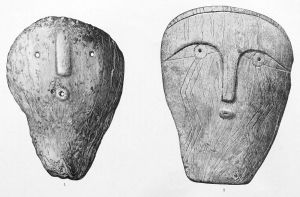
1. Mask-like ornament, Tennessee. (1/2).
2. Mast-like ornament, Virginia. (3/4).
The most elaborately engraved example of these masks yet brought
to the notice of the public is shown in Plate LXVIII. It was obtained
by Mr. Lucien Carr from a large mound, known as the Ely Mound, near
Rose Hill, Lee County, Virginia, and is described and illustrated by
that gentleman in the tenth annual report of the Peabody Museum.[151]
Wishing to present this fine specimen to the best advantage possible, I
have had a large cut made from a photograph furnished by Professor
Putnam, curator of the Peabody Museum. Parts of the design which
were obscure I have strengthened, following the guidance of such fragments
of lines as were still traceable, or by simply duplicating the lines
of the opposite side, as these designs are in all cases bi-symmetrical.
Having described a great number of relics exhumed from this mound,
Mr. Carr goes on to say "that the most interesting of the articles taken
from this grave was an engraved shell made from the most dilated portion
of the Strombus gigas, and carved on the convex side into the likeness
of a human face." It measures 138 millimeters in length, by 120 in
breadth. It is perforated with three holes, "the two upper of which are
surrounded with circles, and represent eyes; between these is a raised
ridge of shell, in place of the nose, and below this is a third hole,
which is just above a series of lines that were probably intended as the
mouth. Four lines, parallel to each other during three-fourths of their
length, begin at the outer corner of the eye and are zigzaged to the
lower jaw, where they are drawn to a point. The concave side of the
[pg 296]
shell is perfectly plain, and still preserves its high polish, though the
right portion of the face on the carved or convex side shows the sad effects
of time and exposure."
Although I have not had an opportunity of examining this specimen
closely, I am inclined to the opinion, judging by its outlines, that the
shell from which it was made has been sinistrally whorled, and hence
a Busycon perversum. I should also prefer to consider the hole beneath
the nose as representing the mouth, as it certainly does in many other
cases, and the peculiar figure—the three vertical lines which extend
downward from the hole and the two banded figures that cross them
at right angles—as a representation of some painted or tattooed design
characteristic of the builders of the mound.
PL. LXVIII—SHELL MASK.
Virginia.
(1/2)
Other examples of these objects are represented in Plate LXIX. Of
especial interest I may mention the specimen shown in Fig. 4, obtained,
with other similar examples, by Professor Putnam, from the Lick Creek
mound, in East Tennessee. The perforations which represent the eyes
are surrounded by two concentric circles, and the zigzag lines beneath
are supplemented by two sets of pendant figures formed of notched
lines, the two longer of which extend down the sides of the nose, the
others being connected with the lower margin of the eye. In one example
four parallel lines pass from the mouth downward over the chin.
Fig. 3 represents a specimen from the Brakebill Mound, East Tennessee.
The mouth is not indicated, and the nose is but slightly relieved.
Each eye, however, is inclosed by a figure which extends downward
over the cheek, terminating in three sharp points.
PL. LXIX—THE HUMAN FACE.
1. McMahan Mound, Tenn.
2. McMahan Mound, Tenn.
3. Brakebill Mound, Tenn.
4. Lick Creek Mound, Tenn.
5. Aquia Creek, Va.
6. Mound, Ely County, Va.
So far as the specimens at hand show, this peculiar embellishment of
the eyes and mouth is characteristic of Virginia and East Tennessee.
A small specimen from Georgia, now preserved in the Natural History
Museum at New York, has a somewhat similar ornamentation of the
eyes. This specimen is shown in Fig. 6, Plate LXX.
In Fig. 8 of the same plate we have the representation of a face modeled
in clay, on which a number of incised lines, similar to those engraved
on shell, have been drawn. The crown of notches is also present.
The specimen has been illustrated by Professor Jones.[152] It is now
in the museum of Natural History at New York, and was probably obtained
from the Etowah Valley, Georgia. Examples in stone are also
numerous, and show certain features in common with those in shell.
Fig. 9 is from Northern Ohio, and is carved from a nodule of iron ore.
The very beautiful little head shown in Figs. 1 and 2 is from a cave
at Mussel Shoals, Ala. It is made of shell, and is somewhat altered by
decay. The crown is peculiarly notched, and resembles a very common
Mexican form. The notch in the middle of the forehead can be traced
to a division in the head-dress noticed in the more elaborately carved
Mexican specimens.
The example shown in Figs. 3 and 4 is copied from a rather rude cut
[pg 297]
given by Schoolcraft, who describes it as follows: "This well-sculptured
article was discovered in the valley of the Kasauda Creek, Onondaga
County. The material is a compact piece of sea-shell. It still preserves
in a considerable degree the smoothness and luster of its original
finish. * * * At the angle of the temples are two small orifices
for suspending it around the neck. The entire article is finished with
much skill and delicacy."[153]
The very rude specimen presented in Fig. 7 is from a mound at Franklin,
Tenn. It seems to have been some natural form, but slightly
changed by art. A somewhat similar specimen from a mound in Tennessee
may be seen in the Peabody Museum.
The cut presented in Fig. 5 is taken from Jones's Antiquities of Tennessee,
page 48. The specimen was obtained from the stone grave of a
child at the foot of a mound near Nashville, Tenn. It has diamond-shaped
eyes, a feature of very rare occurrence in the art of this region.
PL. LXX—THE HUMAN FACE.
1, 2. Shell ornament from a cave, Alabama. (1/1)
3, 4. Shell ornament from New York. (1/1)
5. Shell ornament, stone grave, Tennessee.
6. Shell ornament from Georgia. (1/1)
7. Shell ornament from Tennessee. (1/1)
8. Face modeled in clay, Georgia.
9. Face carved in iron ore, Ohio.
I now come to a class of works which are new and unique, and in
more than one respect are the most important objects of aboriginal art
yet found within the limits of the United States. These relics are four
in number, and come from that part of the mound-building district
occupied at one time by the "stone grave" peoples—three from Tennessee
and one from Missouri. Similar designs are not found in other
materials, and, indeed, nothing at all resembling them can be found, so
far as I know, either in stone or in clay. If such have been painted or
engraved on less enduring materials they are totally destroyed. I shall
first describe the specimens themselves, and subsequently dwell at some
length upon their authenticity, their significance, and their place in art.
First, I present, in Plate LXXI, a shell gorget on which is engraved
a rather rude delineation of a human figure. The design occupies
the concave side of a large shell disk cut from a Busycon perversum.
Near the upper margin are the usual holes for suspension. The engraved
design fills the central portion of the plate and is inclosed by
two approximately parallel lines, between which and the edge of the
shell there is a plain belt three-fourths of an inch wide. A casual observer
would probably not recognize any design whatever in the jumble
of half obliterated lines that occupies the inclosed space. It will first
be noticed that a column about three-fourths of an inch in width
stands erect in the center of the picture; from this spring a number of
lines, forming serpentine arms, which give the figure as much the appearance
of an octopus crowded into a collector's alcohol jar as of a
human creature. A little study will convince one, however, that the
central column represents the human body, and the tangle of lines
surrounding it will be found to represent the arms, legs, hands, feet,
and their appendages—no line within the border being without its
[pg 298]
office. The upper extremity of the body is occupied by a circle one-eighth
of an inch in diameter, which represents the eye. The head is
not distinguished from the body by any sort of constriction for the neck,
but has evidently been crowned by a rude aurora-like crest similar to
that found in so many aboriginal designs. This does not appear in the
engraving given, as it, as well as other features, was so nearly obliterated
as to escape observation until the idea was suggested by the study
of other similar designs. The mouth is barely suggested, being represented
by three shallow lines placed so low on the trunk that they occupy
what should be the chest. From the side of the head a number of
lines, probably meant for plumes, extend across the bordering lines
almost to the edge of the shell; below this are two perforated loops,
which seem to take the place of ears; the one on the right is doubly
perforated and has a peculiar extension, in a bent or elbowed line, across
the border. The arms are attached to the sides of the body near the
middle in a haphazard sort of way and are curiously double jointed;
they terminate, however, in well-defined hands against the right and
left borders, the thumb and fingers being, in each case, distinctly represented.
The legs and feet are at first exceedingly hard to make out,
but when once traced are as clear as need be. The body terminates
abruptly below within an inch of the base of the inclosed space. One
leg extends directly downward, the foot resting upon the border line;
the other extends backward from the base of the trunk and rests against
the border line at the right; the legs have identical markings, which
probably represent the costume. Each foot terminates in a single well-defined
talon or claw, which folds upward against the knee. This is a
most interesting feature, and one which this design possesses in common
with the three other drawings of the human figure found in Tennessee.
The spaces between the various members of the figure are filled in with
ornamental appendages, which seem to be attached to the hands and
feet, and probably represent plumes. The numerous perforations in this
specimen are worthy of attention: within the border line there are
twenty-six, which vary from one-fourth to one-sixteenth of an inch in
diameter. They are placed mostly at the joints of the figure or at the
junction of two or more lines. Such perforations are of frequent occurrence
in this class of gorgets and may have had some particular significance
to their possessors. This specimen was found in the great mound
at Sevierville, Tenn., upon the breast of a skeleton, and is now in the
National Collection. It has suffered considerably from decay, the surface
being deeply furrowed, pitted, and discolored. The holes are much
enlarged and the lines in places are almost obliterated.
I began the study of this design with the thought that, in reference to
this specimen at least, Professor Jones was right, and that the confused
group of lines might be the meaningless product of an idle fancy, but
ended by being fully satisfied that no single line or mark is without its
place or its significance.
PL. LXXI—SHELL GORGET—THE HUMAN FIGURE.
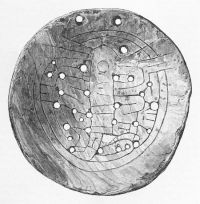
McMahan Mound, Tennessee.
(2/3)
[pg 299]
After having examined this design so critically, it will be an easy
matter to interpret that engraved upon the tablet illustrated in Plate LXXII.
Although found in widely separated localities, and engraved
in a somewhat different style, they are identical in type, and exhibit but
slight differences in detail. At the top of the plate we have the two
doubly conical perforations for suspension, but the double border line is
not completed above, being interrupted by the plumes from the head.
The head itself is decorated with the usual crown of radiating lines,
a small circle with a central pit represents the eye, and below this is a
well-defined mouth with a double row of teeth. Extending to the right
from the mouth is an appendage consisting of one straight and two interrupted
lines, which may be a part of the costume, or, since it issues
from the mouth, may possibly symbolize speech. The body, which is
short and straight, is divided vertically into three parts; the central space
contains a large conical perforation, and is covered with a lace-work of
lines; the lateral spaces are ornamented with rows of buttons or scales,
which consist of meagerly outlined circles with central dots. The curiously
folded arms have precisely the same relative positions as the corresponding
members in the other specimen, and the fingers touch the
bordering line on the right and left, the thumb being turned backward
against the elbow. The legs are represented in a manner that suggests
a sitting posture, the rounded knees coming in front of and joining the
base of the body; in position and decoration they repeat the other specimen.
The feet, or the rounded extremities that represent them, rest
upon the border line, as in the case previously described, and terminate
in upturned talons that are long, curved, and jointed, and terminate in
square or blunt tips. Plume-like appendages are attached to the arms
and legs, and fill the spaces not occupied by the members of the body;
these plumes or pendants are always represented by folded bands or
fillets which are ornamented on one side with dots. A plume attached
to the left side of the head is represented by two curved lines, which
reach to the edge of the shell. There are five perforations, two for suspension,
two at the sides of the face, and one near the middle of the
trunk. This specimen is in a very perfect state of preservation, the surface
being smooth and but little stained. It is somewhat pear-shaped,
resembling in this respect the mask-like gorgets previously described.
It is about seven inches in height and five in width, and has been made
from a very thick and compact shell, probably a Busycon. It was obtained
from a mound in Meigs County, Tennessee, and is preserved in
the Peabody Museum. In mechanical execution this specimen is much
superior to the preceding one; the edges and surface of the shell are
nicely dressed, although the lines of the design are indifferently cut.
PL. LXXII—SHELL GORGET—THE HUMAN FIGURE.
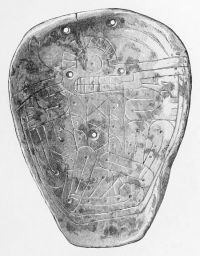
Mound, Tennessee.
(3/4)
Another unique shell gorget is presented in Plate LXXIII. It was obtained
from a mound in Southeastern Missouri, and is now in the possession
of Professor Potter, of Saint Louis. The disk is about four and a
half inches in diameter, and was originally nearly circular, but the edges
[pg 300]
are now much decayed and battered. A cut with a brief description is
given by Mr. A. J. Conant in his recent work, "Foot-prints of Vanished
Races," page 95. My cut is made from a photograph obtained from
Professor Putnam, of the Peabody Museum. This is probably the same
photograph used by Mr. Conant. The engraved design is of a totally
distinct type from the last, and evinces a much higher grade of skill in
the artist. It is encircled by six nearly parallel lines, which occupy
about half an inch of the border of the disk. Portions of these still remain,
the inner one being nearly entire. Between this and the second
line are two perforations for suspension. The idea first suggested by a
glance at the engraved design is that it strongly resembles the work of
the ancient Mexicans, and the second idea of many archæologists will
probably be that there may be a doubt of its genuineness. Setting this
question aside for the present, let us examine the engraving in detail.
Placing the plate so that the two perforations are at the left, we have
the principal figure in an upright posture. This figure apparently represents
a personage of some importance, as he is decked from head to foot
with a profusion of ornaments and symbols. He is shown in profile
with the arms extended in action, and the feet separated as if in the act
of stepping forward. The head is large, occupying about one-third of
the height of the design. The elaborate head-dress fills the upper part
of the inclosed space, pendant plumes descend to the shoulders before
and behind, and circular ornaments are attached to the hair and the
ear. The conventionalized eye is lozenge or diamond shaped, with a
small conical pit for the pupil.
The profile shows a full forehead, a strong nose, and a prominent
chin. Two lines extend across the cheek from the bridge of the nose
to the base of the ear. In and projecting from the mouth is a symbolic
figure, the meaning of which can only be conjectured. The
shoulders and body are but meagerly represented. From the waist a
peculiar apron-like object is suspended, which reaches to the knees; it
may be a part of the costume or a priestly symbol. The legs and feet
are dwarfed, but quite well outlined. There are encircling bands at the
knees and ankles, and a fan-like extension of the costume, somewhat
resembling the tail of a bird, descends between the legs. Attached
to the back, is a figure of a rather extraordinary character. Similar
figures may be seen in some of the Mexican paintings, and seem to
represent a contrivance for carrying burdens, in which at times elfish
figures are accommodated. The right arm is extended forward, and
the hand grasps a singular shaft, with which a blow is aimed at the
severed head of a victim, which is held face downward by the left
hand of the standing figure. The severed head still retains the plumed
cap, from which a long pendant descends in front of the face. The eye
is lozenge-shaped. A zigzag line crosses the cheek from the ear to
the bridge of the nose, and a curious symbolic figure is represented
[pg 301]
as issuing from the mouth. The shaft held in the right hand seems
to issue from a circular figure, doubtless of symbolic character, which
occupies the space in front of the head of the standing figure. It is
possible that the figure which issues from the mouth of the victim
represents the point of this mystic shaft which has penetrated the
head, although we should have to allow some inaccuracies in the drawing
if this were the case. Any one at all familiar with the curious
pictographic manuscripts of the ancient Mexicans will see at a glance
that we have here a sacrificial scene, in which a priest seems to be engaged
in the sacrifice of a human being. In the extraordinary manuscripts
of the ancient Aztecs we have many parallels to this design.
So closely does it approach the Aztec type that, although no duplicate
can be found in any of the codices, there is not a single idea, a single
member or ornament that has not its analogue in the Mexican manuscripts.
To make this clear to every one I present, in Plate LXXV,
Fig. 4, a single example for comparison. This one is selected from the
manuscript of M. De Féjerváry, preserved at Budapest, Hungary.[154]
Fortunately for the credit of this Missouri relic we do not find its duplicate—there
are only family resemblances; there are similar plumes,
with similar ornaments and pendants, similar costume and attitudes;
there are similar features and similar symbols; but there is no absolute
identity, except in motive and conception.
PL. LXXIII—SHELL GORGET—THE HUMAN FIGURE.
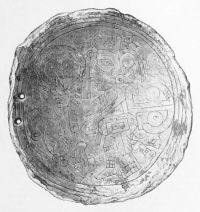
Missouri.
(1/1)
Among the multitude of works of art collected within the last decade
very few will be found to surpass in interest the fragment of a shell
gorget from the McMahan Mound, at Sevierville, Tenn. The disk, when
entire, has been nearly five inches in diameter. A little more than one-third
had crumbled away, and the remaining portion was only preserved
by the most careful handling, and by immediate immersion in a thin solution
of glue. This specimen is the first of the kind ever brought to
light in this country, and must certainly be regarded as the highest example
of aboriginal art ever found north of Mexico. The design, as in
the other cases, has been engraved on the convex surface of a polished
shell disk, and represents two human figures, plumed and winged and
armed with eagles' talons, engaged in mortal combat. As in the last
specimen described, this has, at first sight, an exotic look, bearing certainly
in its conception a general resemblance to the marvelous bas-reliefs
of Mexico and Central America; but the resemblance goes no
further, and we are at liberty to consider it a northern work sui generis.
The design has apparently covered the entire tablet, leaving no space
for encircling lines. The two figures are in profile and face each other
in a fierce onset. Of the right-hand figure only the body, one arm, and
one leg remain. The left-hand figure is almost complete; the outline of
the face, one arm, and one foot being obliterated. The right hand is
raised above the head in the act of brandishing a long double-pointed
[pg 302]
knife. At the same time this doughty warrior seems to be receiving a
blow in the face from the right hand of the other combatant, in which is
clutched a savage-looking blade, with a curved point. The hands
are vigorously drawn, the joints are correctly placed, and the thumb
presses down upon the outside of the forefinger in its natural effort
to tighten and secure the grasp. Two bands encircle the wrists and
probably represent bracelets. The arms and shoulders are plain.
The head is decorated with a single plume, which springs from a
circular ornament placed over the ear; an angular figure extends
forward from the base of this plume and probably represents what
is left of the head-dress proper; forward of this, on the very edge of
the crumbling shell, is one-half of the lozenge-shaped eye, the dot
intended to represent the pupil being almost obliterated. It is certainly
a great misfortune that both faces are completely gone; their
exact character must remain conjectural. A neat pendant ornament is
suspended upon the well-formed breast, and a broad belt encircles the
waist, beneath which, covering the abdomen, is a design that suggests
the scales of a coat of mail. The legs are well-defined and perfectly
proportioned; the left knee is bent forward and the foot is planted
firmly on the ground, while the right is thrown gracefully back against
the rim at the left. Double belts encircle the knees and ankles. The
legs terminate in wonderfully well-drawn eagle's feet, armed with vigorously
curved talons. A very interesting feature of the design is the
highly conventionalized wing, which is attached to the shoulder behind,
and fills the space beneath the uplifted arm. A broad many-feathered
tail is spread out like a fan behind the legs. The right hand figure, so
far as seen, is an exact duplicate of the left. A design of undetermined
significance occupies the space between the figures beneath the crossed
arms; it may represent conventionalized drapery, but is more probably
symbolic in its character. The heads have probably been a little too
large for good proportion, but the details of the anatomy are excellent.
The muscles of the shoulder, the breast and nipple, the waist, the buttock,
and the calves of the legs are in excellent drawing. The whole
group is most graphically presented. A highly ideal design, it is made
to fill a given space with a directness of execution and a unity of conception
that is truly surprising.
PL. LXXIV—ENGRAVED GORGET—FIGHTING FIGURES.
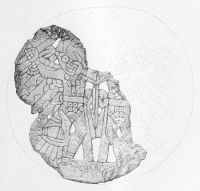
Tennessee.
(1/1)
Let us turn for a moment from this striking effort of the mound-builders
to the early efforts of other peoples in the engraver's art. Here are
the drawings of the Troglodytes of France, scintillations of paleolithic
genius, which appear as a flash of light in the midst of a midnight sky.
They are truly remarkable. The clear-cut lines that shadow forth the
hairy mammoth suggest the graphic and forcible work of the Parisian
of to-day. The rude Esquimaux of our own time engraves images of a
great variety of natural objects on his ornaments and implements of
ivory in a manner that commands our admiration. But these shell tablets
have designs of a much higher grade. They not only represent natural
[pg 303]
objects with precision, but they delineate conceptions of mythical creatures
of composite character for which nature affords no model. In execution
the best of these tablets will not compare with the wonderful
works in stucco and stone of Palenque, or the elaborate sculptures of
the Aztecs, but they are, like them, vigorous in action and complete in
conception.
In case the authenticity of these relics be questioned, the facts in regard
to them, so far as known, are here presented for reference. As to
the two specimens from Sevierville, Tenn. (Plates LXXI and LXII),
the shadow of a doubt cannot be attached to them. Were there no record
whatever of the time or place of discovery, the evidence upon the
faces of the relics themselves would show satisfactorily that they are
genuine. They were taken from the great mound, which I have called
the McMahan Mound, at Sevierville, Tenn. This mound was opened in
1881 by one of our most experienced collectors, Dr. E. Palmer. The
specimens when found were in a very advanced stage of decay, pitted,
discolored, and crumbling, and had to be handled with the utmost care
to prevent total disintegration. They were dried by the collector, immersed
in a weak solution of glue, and forwarded immediately to the
National Museum at Washington. In this mound a multitude of relics
were found, a large number being of shell, many of which are figured
and described in this paper. These two gorgets, as well as many others
of more ordinary types were found on or near the breasts of skeletons,
and it is highly probable that they were suspended about the necks of
the dead just as they had been worn by the living. By accurately ascertaining
the authenticity of one of these specimens we establish, so far
as need be, the genuineness of all of the same class. If one is genuine
that is sufficient; the others may or may not be so, without seriously
effecting the questions at issue, yet the occurrence of duplicate or closely
related specimens in widely separated localities furnishes confirmatory
evidence of no little importance. I do not wish to be understood as casting
a doubt upon any of the four specimens described, as I am thoroughly
convinced that there is no cause for suspicion.
The Missouri gorget, which has already been described and figured,
was obtained by unknown persons in Southeastern Missouri. Several
years back it came into the hands of Colonel Whitley, and from him it
was obtained by its present owner, Professor Potter, of Saint Louis.
There has never been a question as to its genuineness, and according to
Professor Hilder, who saw it shortly after its discovery, the appearance
and condition of the specimen were such that it could not have been of
fraudulent manufacture. It was chalky and crumbling from decay, the
lines of the design bearing equal evidence with the general surface of the
shell of great age. Beside this, even if it were possible to produce such
a condition in a recently carved shell, there existed no motive for such
an attempt. Nothing was to be made by it; no benefit could accrue
to the perpetrator to reward him for his pains, and, further, there was no
[pg 304]
precedent, there was extant nothing that could serve as a model for such
a work.
In Plate LXXV I have arranged a number of figures for convenience
of comparison, Figs. 1, 3, 5, and 6, being outlines of the four examples
just described. In regard to the restored part of the outline in Fig. 1,
I wish to say that my only object in filling out the figure on the right
was to secure as far as possible the full effect of the complete original.
Observing that all that remains of the right hand figure—the arm, the
body, the leg and foot, is a duplicate of the left, it is safe to conclude
that the design has been approximately bi-symmetrical, slight discrepancies
probably occurring in the details of head and arm, in the expression
of face, or in the character of the weapon. It is much to be regretted
that the faces are totally destroyed.
In Fig. 2 I present a group of two figures from the so-called "sacrificial
stone" found in the Plaza Mayor, city of Mexico. It seems to
represent the submission of one warrior or ruler to his victorious opponent,
and is one of many designs that might be presented to illustrate
the analogies of the Tennessee relic with the interesting works of the
far South. There is what might be called a family resemblance, a
similarity in idea and action, but little analogy of detail. The northern
work is by far the more spirited, and is apparently superior in all the
essentials of artistic excellence.
PL. LXXV—THE HUMAN FIGURE.
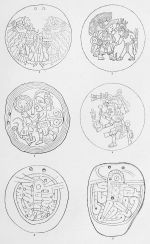
1. Shell gorget, McMahan Mound, Tenn.
2. Sculptured in stone, Mexico.
3. Shell gorget, mound, Missouri.
4. Figure from an Aztec painting.
5. Shell gorget, McMahan Mound, Tenn.
6. Shell gorget, Lick Creek Mound, Tenn.
In the composite character of the personages represented this picture
finds no parallel. Composite figures are of frequent occurrence in Peruvian
art, as in the running figures sculptured on the great monolith
at Tiahuanuco, or the mythical combats of the gods of the earth and
sea painted on the pottery of Chimu. They are also found in the manuscripts
of the ancient Mexicans, as well as in the paintings of the
modern Pueblos of New Mexico (Fig. 1, Plate LXXVI), and in the
totemic art of the Haidahs (Fig. 2, Plate LXXVI). The most frequent
combinations are of birds with men, the inspiration of the work in all
cases being derived from the mythology of the people. The wearing
of masks has doubtless given rise to many such conceptions, and where
the head alone of the human creature has undergone metamorphosis,
we may suspect that a mask has originated the conception; but the
Tennessee example appears to be the only one in which wings are added
independently of the arms or in which bird's feet are attached to the
otherwise perfect human creature.
PL. LXXVI—COMPOSITE FIGURES.
1. Design on Zuñi war-shield, painting.
2. Thunder-bird of the Haidahs, painting.
And now we come to the question of the origin of these objects, and
especially of the example most closely resembling Mexican work. The
Missouri gorget is in many respects quite isolated from known works of
the Mississippi Valley. Must it be regarded as an exotic, as an importation
from the South, or does it belong to the soil from which it was
exhumed? In order to answer this question we must not only determine
its relations to the art of Mexico, but we must know just what affinities
it has to the art of the mound-builders.
[pg 305]
In the first place, gorgets of shell are a marked characteristic of the
personal embellishment of the northern peoples. They may have been
in use among the Aztecs, but do not appear among southern antiquities,
and no evidence can be derived from history. This gorget belongs, in
its general character as an ornament, to the North. It is circular in
form, it has two small perforations near the margin for suspension, and
is made from the wall of a large univalve. The design occupies the
central portion of the convex side of the disk and is inclosed by a
number of incised lines. In all of these features, together with its
technical execution and its manner of inhumation, it is identical with
the well-known work of the mound-builders. These analogies could
hardly occur if it were an exotic. It is true, however, as we have already
seen, that the design itself has a closer affinity to Mexican art
than to that of the North. It represents a sacrificial scene, and has
many parallels in the paintings and sculpture of the South, whereas
no such design is known in the art of any nation north of Mexico.
The engravings of the mound-builders represent legendary creatures
derived from the myths of the fathers, and in this respect have their
parallels in the bird-man of the Haidahs, the war-god of the Zuñis, and
the mythical deities of other countries; but they are never illustrative
of the customs or ceremonies of the peoples themselves. As an ornament
this Missouri gorget is a member of a great family that is peculiarly
northern, but the design engraved upon it affiliates with the art
of Mexico, and so close and striking are the resemblances, that accident
cannot account for them, and we are forced to the conclusion that
it must be the offspring of the same beliefs and customs and the same
culture as the art of Mexico.
PL. LXXVII—FROGS, ARIZONA.
Carved from pectunculus shells. (1/1)
FOOTNOTES:
INDEX.
Abbott, C. C., describes bird totems 284
Adair, James, describes shell tweezers 212
Adair, James, on use of shell money 237
Agricultural implements. (See Implements.)
Amiantis shells, Manufacture of beads from 226
Art, Antiquity of shell works of 187
Art, Burial of shell works of 187
Art, Evolution of 185, 192, 202, 210, 213, 225
Art, Inception of 186
Art, Materials employed in 185, 188
Art, Preservation of shell works of 186
Asphaltum used by California Indians 191, 209, 218
Atwater, Caleb, describes shell necklace 231
Atwater, Caleb, describes shell vessel 197
Beads of other materials 219, 232, 235
Beads of shell 219
Beads, Classification of 219
Beads discoidal in form 221
Beads, Kinds of, used in belts 247
Beads, Manner of stringing 234, 236, 244, 248
Beads, Manufacture of 236
Beads, Manufacture of, by whites 238
Beads massive in form 223
Beads, Mnemonic use of 240, 254
Beads or "Runtees" 228
Beads, Perforated 219
Beads tubular in form 226
Beads used as money 219, 233
Beads used as ornaments 219, 230, 234
Beatty, Charles, describes wampum belts 250
Beauchamp, W. M., Beads sketched by 228
Beauchamp, W. M., on belts of wampum 252
Beauchamp, W. M., on strings of wampum 248
Belts, wampum, Character of the patterns woven into 240, 246, 248
Belts, wampum, Dimensions of 250, 253
Belts, wampum, Keeper of the Iroquois 241, 244
Belts, wampum made by Indian women 249
Belts, wampum, Manufacture of 248
Belts, wampum, Method of handling, in councils 241, 246
Belts, wampum, Number of beads in 233, 251
Belts, wampum, Profuse use of 242
Belts, wampum, Rarity of, in collections 249
Belts, wampum; the Penn belt 253
Belts, wampum, Use of, as mnemonic records 240, 254
Belts, wampum, W. A. Brice on use and repudiation of 242, 246
Beverly, R., describes shell beads 229
Beverly, R., describes shell money 237
Beverly, R., describes shell pendants 256
Beverly, R., describes shell spoon 201
Beverly, R., mentions shell knives 202
Beverly, R., mentions shell tweezers 212
Bird; carving of eagle's head 285
Bird, Embodiment of the, in art 280
Bird engraved on bone 284
Bird engraved on stone 284
Bird engraved on shell gorgets 280
Bird, Examples of the, engraved on shell gorgets 281
Bird, Gold ornament representing head of 285
Bird, Myths of the 280
Bird, Significant character of the, in engraved designs 281, 284
Bird, Species of, represented 282, 284
Bird, Superstitions in regard to the 280
Bird, The Dakotas' thunder 281
Bird, Totemic use of the 284
Bourke, Lieut. John G., on Moqui shell vessels 193
Bowers, Stephen, Shell objects collected by 209, 226
Brakebill mound 215, 275, 292, 296
Brice, W. A., on repudiation of wampum 246
Brice, W. A., on use of wampum belts 242
Brinton, D. G., on the origin of the cross 270
Busycon shells, Columellæ of, used as pendants 209, 258
Busycon shells, Columellæ of, used as pins 213
Busycon shells, Gorgets derived from 273, 276, 282, 290, 292, 294, 296
Busycon shells, Pendants derived from 209, 259
Busycon shells, Perforated plates derived from 265
Busycon shells used as beads 220, 224
Busycon shells used as celts 204
Busycon shells used as vessels 194, 197
Busycon shells used as weapons 211
Busycon shells used in the arts 191
Cabeça de Vaca on trade in shells 194
Cabrillo, João, visits Island of Santa Rosa 260
Calendars, Pictographic symbols of the Sioux 279
Calendars, Probable use of shell disks as 268, 273, 278
Calendars used by ancient Mexicans 279
Calendars used by modern tribes 279
Carr, Lucien, describes shell gorget 295
Cassis shells used as vessels 191, 194, 196
Catlin, George, describes shell adze 205
Celts, Examples of 203
Celts, Manufacture of 203
Celts of shell 203, 205
Clam shells used as implements 190, 205, 207
Clam shells used as utensils 190
Clam shells used in manufacture of ornaments 263
Clam shells used in manufacture of wampum 190, 226, 238, 257
Clark, J. S., Photographs made by 252
Clavigero, F. X., on use of shell ornaments 256
Clavigero, F. X., on use of shell vessels in Mexico 193
Cleveland, F., describes shell vessels 197
Columellæ, Manner of extracting, from shell 214
Columellæ used in manufacture of heads 219, 223
Columellæ used in manufacture of pins 213, 218
Conant, A. J., describes shell gorgets 300
Conant, A. J., mentions shell gorgets 287
Cross design associated with others 270
Cross design combined with spider design 288
Cross design in Aztec paintings 285
Cross design engraved on shell gorgets 268
Cross design, Evolution or derivation of the 270
Cross design, Examples of the, combined with birds 282, 283
Cross design, Examples of the, from mounds 271, 273
Cross design, Introduction of the Christian 269
Cross design, Occurrence of the, in ancient Mexican art 270
Cross design, Occurrence of the, in Yucatan 270
Cross, Origin of the, among mound builders 269
Cross, Prehistoric use of the, in America 268, 270
Cross, Symbolic character of the 269
Croswell, C., describes shell gorgets 286
Curtis, Dr., Shell gorgets collected by 283
Cyprea shells used as beads 219
Cyprea shells used as ornaments 263
Dall, W. H., use of pins 217
Dall, W. H., Shells identified by 190
Davis, W. H. H., mentions shell pendants 256
Dentalium shells used for money 191, 220, 227, 239
Dentalium shells used for ornament 191, 218, 220, 227
Dentalium shells used in bushing 218, 227
Disks, Scalloped, probably time symbols 273
Disks, Scalloped, Relation of, to human remains 276
Disks, Scalloped shell, from mounds 275, 278
Disks, Scalloped, Shell gorgets in the shape of 268, 273, 279
Disks, Scalloped stone 277
Disks, Scalloped stone with engravings of knotted serpents 278
Disks, Scalloped, Table of 280
Disks, Scalloped, The sun suggested by 273
Disks, Scalloped, Type example of 273
Disks, Scalloped; use of sun symbols of similar shape 273
Drake, Daniel, describes shell vessel 197
Dunning, E. O., Shell ornaments collected by 272
Dunning, E. O., Shell pins collected by 215
Ely mound in Virginia 295
Engraved gorgets. (See Gorgets.)
Face, Human, Description of shell gorgets representing the 294
Face, Human engraved and carved on shell gorgets 293, 297
Face, Human modeled in clay 296
Face, Human, Portions of shell used for representing 293
Face, Human, Use or significance of shell gorgets representing 295
Fain's Island mound 215, 272, 288
Farquharson, B. J., describes shell vessel 197
Fasciolaria shells, Columellæ of, used for pins 213
Fasciolaria shells used as vessels 194
Figure, Human. (See Human figure.)
Fishing appliances, Shell 207
Fishing appliances, Shell; hooks 208
Fishing appliances, Shell, Manufacture of 210
Fishing appliances, Shell; sinkers 208
Fissurella shells used as ornaments 191, 220, 261, 263
Frey, S. L., describes shell vessel 198
Gilpin, H. D., on the use of wampum belts 246
Gorgets, Engraved, Classification of 267
Gorgets, Engraved design on, character of 267
Gorgets, Engraved described by Beverly 256
Gorgets, Engraved, Modern examples of 268
Gorgets, Engraved of shell 267, 305
Gorgets, Engraved, Significance of designs on 267, 274, 278, 282
Gorgets, Engraved used as amulets 267
Gorgets, Engraved used as insignia 267, 273
Gorgets, Engraved used as symbols 268, 273
Gorgets, Engraved used as totems 268
Grave Creek mound 234, 264
Gray's mound, Oldtown, Tenn. 283
Gumilla, Joseph, concerning emblems in treaties 247
Hafting of implements of shell 203, 205, 211
Haldemann, S. S., describes shell beads 227, 230
Haliotis shells used as vessels 189, 191
Haliotis shells used in manufacturing beads 225, 227
Haliotis shells used in manufacturing fish hooks 209
Haliotis shells used in manufacturing pendants 209, 261
Haliotis shells used in trade 191
Heckewelder, Johann, describes shell tweezers 212
Heckewelder, Johann, describes wampum belts 250
Heckewelder, Johann, on the use of wampum belts 246
Hennite shells used in manufacture of beads 225, 227
Hilder, F. F., describes shell gorgets 286, 288, 303
Hilder, F. F., photographs of gorgets procured by 286
Human figure engraved on shell gorgets 297
Human figure engraved on shell gorgets, Comparison of, with other examples 302
Human figure engraved on shell gorgets, Comparison of, southern examples 301
Hunter, J. D., concerning emblems in treaties 247
Hutchinson, Thomas, on the antiquity of wampum 235
Implements of shell, Agricultural 207
Insignia or badges of shell 264, 266, 273
Jones, C. C., describes shell pins 215
Jones, C. C., describes shell vessel 196
Jones, C. C., describes stone disks 277
Jones, C. C., mentions shell gorgets 287, 293, 298
Jones, Joseph, describes shell disk 276
Jones, Joseph, describes shell gorgets 297
Jones, Joseph, describes shell spoons 201
Jones, Joseph, describes shell vessel 196
Kalm, Peter, mentions shell knives 202
Kalm, Peter, on shell money 238
Kalm, Peter, on shell pendants 257
Knight, E. H., describes shell weapons 211
Knives of shell 201
Knives of shell, rarity of, in collections 203
Knives of shell used by Honda Indians 202
Knives of shell used by Pacific Coast tribes 203
Knives of shell used by Patagonians 203
Kohl, J. G., on trade in shells 194
Lafitau, J. F., on the use of shell pendants 256
Lafitau, J. F., on the use of wampum 243
Lafitau, J. F., on the use of wampum belts 250
Lawson, John, on the use of shell money 237
Le Moyne, d'Iberville, on the use of shell vessels 193
Lewis and Clark describe shell ornaments 233
Lewis and Clark on value of beads 239
Lick Creek mound 215, 224, 272, 278, 296
Lindström, P., on the use of shell money 236
Lord, J. K., on shell money 239
Loskiel G. H., gives an account of wampum 245
Loskiel G. H., on the antiquity of use of wampum 235
Loskiel G. H., on the manufacture of wampum 235
Loskiel G. H., on the origin of the word wampum 239
Loskiel G. H., on the wampum belts 250
Low, C. P., Shell spoons collected by 200
Low, C. P., Shell spoons described by 200
Lyon, S. S., Shell spoons collected by 200
McMahan mound 214, 292, 294, 298, 301, 303
Manufacture of shell objects 204, 210, 212, 216, 218, 220, 228, 236, 255, 261, 263, 286, 293
Marginella shells used as beads 219
Matson, J. S. B., Beads discovered by 231
Matson, J. S. B., describes shell plates 265
Mnemonic records, Interpretation of 241, 244, 246
Mnemonic records, Iroquois keeper of 241, 244
Mnemonic records of Mexicans 240
Mnemonic records of N. A. Indians 240
Mnemonic records of Peruvians 240
Mnemonic records, Origin of 240
Mnemonic records, Use of materials other than shell for 245, 247
Mnemonic records, Use of wampum for 240, 254
Molina, G. I., concerning emblems in treaties 247
Morgan, L. H., on the antiquity of wampum 235
Morgan, L. H., on the origin of the word wampum 239
Morgan, L. H., on the uses of wampum 235
Morgan, L. H., on wampum belts 249
Morgan, L. H., on wampum records 241
Morton, Thomas, on the use of shell money 236
Myth, Spider, obtained by J. W. Powell 286
Mytilus, shells used as utensils 191, 212
Mytilus, shells used in manufacture of fish hooks 210
Mytilus, shells used in manufacture of ornaments 261
Oliva shells used as beads 219, 222
Olivella shells used as beads 220
Ornaments of shell 213, 305
Osgood, Kate C., Drawings made by 268
Oyster shells used as utensils 191
Pachydesma shells used as utensils 190
Pachydesma shells used in manufacture of beads 226
Pachydesma shells used in manufacture of ornaments 261
Pachydesma shells used in manufacture of pendants 209
Palmer, E., Collections by 303
Parkman, Francis, on the use of wampum 247
Pearls perforated for beads 225
Pearls used by Powhatan 232
Pecten shells used as implements 206
Pecten shells used as ornaments 189, 261
Pecten shells used as rattles 190, 206
Pecten shells used as vessels 189
Pecten shells used in art 189
Pectunculus shells, Manufacture of rings from 263
Pendants, Beads used as 230
Pendants, Classification of 255, 207
Pendants, Engraved 267, 305
Pendants, Forms and sizes of 255, 258, 261, 263
Pendants, Historic use of 255, 268
Pendants illustrated by Lafitau 257
Pendants illustrated in De Bry 257
Pendants illustrated in Mexican paintings 257
Pendants illustrated in sculptures of Mexico and Yucatan 258
Pendants, Importance of, in evolution of art 255
Pendants of shell 209, 255
Pendants of the Atlantic coast 258
Pendants, Origin of use of 255
Pendants, Ornamental notching of edges of 262
Pendants, Perforations of 255, 261
Pendants, Plain, of the Pacific coast 260
Pendants, Plain, of the Atlantic coast 258
Pendants, Various uses of 255, 261, 267
Penn, J. G., describes Penn belt 259
Perforated tablets. See Tablets.
Perforations of objects of shell 216, 220, 223, 227, 236, 262
Perkins, G. H., Shell beads illustrated by 224
Perrine, F. M., Shell gorgets belonging to 270
Pins, cut from body of shell 216
Pins, Examples of 213, 218
Pins made from collumellæ of shell 213, 218
Pins obtained from mounds 213, 218
Pins of shell 213, 218
Pins, Use of bone 217
Pins, Use of, problematicals 213, 217
Potter, W. B., Shell gorget owned by 299, 303
Powell, J. W., Nose ornament collected by 227
Powell, J. W., Shell disk collected by 273
Powell, J. W., Shell spoon collected by 199
Powell, J. W., Spider myth obtained by 286
Powers, Stephen, describes shell beads 239
Powers, Stephen, describes shell ornaments 233
Pratt, H. W., on shell money 239
Pratz, Lepage du, describes shell ornaments 232
Putnam, F. W., describes bone pins 217
Putnam, F. W., describes shell fish-hooks 209
Putnam, F. W., describes shell gorgets 276, 282, 295
Putnam, F. W., describes shell pins 218
Putnam, F. W., describes shell spoons 195
Putnam, F. W., describes shell vessels 196
Putnam, F. W., on use of asphaltum 227
Putnam, F. W., on value of Haliotis shells 191
Rasle, Father Sebastian, on the use of shell beads 231
Rau, Charles, describes gold ornament 285
Rau, Charles, describes shell gorget 289
Rau, Charles, describes shell vessel 196
Rau, Charles, describes shell weapon 210
Rau, Charles, on classification of perforated plates 266
Rau, Charles, on cut of stone disk 278
Records. (See Mnemonic records.)
"Runtees," a variety of shell beads 228
"Runtees, Manner of stringing 229
"Runtees, Origin of 230
"Runtees, Signification of figures engraved upon 228
Ruttenber, E. M., on the Keeper of wampum 241
Ruttenber, E. M., on the manufacture of shell money 238
Scalloped disks. (See Disks.)
Schoolcraft, H. R., describes shell beads 228
Schoolcraft, H. R., describes shell ornaments 297
Schoolcraft, H. R., describes shell pendants 260
Schoolcraft, H. R., describes shell plates 264
Schumacher, Paul, Shell objects collected by 209, 217
Scrapers of shell 205
Scrapers, Examples of 205
Serpent characteristics that attract the savage 289
Serpent design, Discovery of shell gorgets ornamented with 289
Serpent design engraved upon shell gorgets 268, 289, 293
Serpent design engraved upon stone disks 278
Serpent design, Examples of gorgets ornamented with 290
Serpent design of Mexico and Peru 293
Serpent design; the rattlesnake 289
Serpent, Embodiment of the, in art 289
Serpent; rattlesnake species represented on shell 291, 293
Serpent, Superstitions in regard to 289
Serpent, Use of the, as a religious symbol 289
Shells, Artificial distribution of 196, 205, 213, 230
Shells, Trade in 188, 191, 193, 196, 236
Shells used as models for the potter 198
Shells used in natural state 187, 191
Smith, Erminnie A., Wampum belt loaned by 251
Smith, John, describes shell ornaments 232
Spider characteristics that attract savages 286
Spider design engraved upon shell gorgets 286, 289
Spider design, Examples of, on shell gorgets 286
Spider design in art 286
Spider, Myths concerning the 286
Spoons of shell deposited with the dead 199
Spoons of shell, Examples of 199
Spoons of shell, Manufacture of 198
Spoons of the Unio shell 198, 201
Squier, E. G., mentions spider myths 286
Squier and Davis describe shell beads 225
Stearns, R. E. C., on shell money 239
Strachey, William, mentions shell knives 202
Stratton, C. L., Shell pins collected by 215
Strombus shells, Columellæ of, used in manufacture of beads 224
Strombus shells, Columellæ of, used in manufacture of pendants 208
Strombus shells, Columellæ of, used in manufacture of pins 213, 215
Strombus shells used as vessels 191, 194, 197
Strombus shells used in manufacture of celts 204
Strombus shells used in manufacture of gorgets 295
Swan, J. G., describes shell ornaments 233
Tablets, Perforated, Forms of 264
Tablets, Perforated, made of shell 264, 267
Tablets, Perforated, Manner of burial of 265
Tablets, Perforated, Method of attachment of 266
Tablets, Perforated, Perforations of 265
Tablets, Perforated, Theories of use of 264
Tablets, Perforated, Undetermined character of 264
Time symbols, Probable use of shell disks as 268, 273, 278
Tomlinson, A. B., describes shell plate 264
Trill, C. F., Drawings made by 251
Troost, Dr. Gerard, Shell objects collected by 224
Tweezers of shell 212
Unio shells obtained from mounds 190
Unio shells used as implements 190, 205
Unio shells used as utensils 190, 199
Unio shells used in manufacture of beads 223
Unio shells used in manufacture of ornament 260
Unio shells used in manufacture of spoons 199
Velie, J. W., Shell pendants collected by 208
Vessels, artificially shaped 192
Vessels, Engraved shell 193
Vessels in clay imitating shells 198
Vessels, Manufacture of shell 194, 196
Vessels, Natural shells 190
Vessels of the Mound Builders 194, 196
Vessels used by the Florida Indians 193
Vessels used by the Moquis Indians 193
Vessels used in Mexico 192
Wampum, Antiquity of use of as currency. 234
Wampum as currency 234
Wampum, Derivation of the word 238
Wampum in costumes 232, 234
Wampum, Literature of 241, 248
Wampum, Manufacture of 226, 236
Wampum, Manufacture of, by whites 238
Wampum, Mnemonic use of 240, 254
Wampum, Modern use of 239, 252
Wampum, Origin of mnemonic use of 240
Wampum, Symbolic uses of 241, 248
Wampum, Use of, in strings 243, 248
Wampum, Use of, in treaties and councils 242
Wampum, Use of, on Pacific Coast 239
Wampum, Varieties of beads used as 247
Weapons of shell 210
Weapons, Manner of hafting 211
Whipple, Lieut. E. W., Necklace obtained by 220
Whiteley, Colonel, Shell gorgets procured by 303
Whitney, J. L., describes shell plate 265
Williams, C. F., Shell gorgets collected by 282
Williams, Roger, on the name wampum 239
Williams, Roger, on the use of shell money 236
Wood, William, describes shell pendants 256
Wood, William, mentions shell implements 205, 207
Wood, William, mentions shell ornaments 232
Wyman, Jeffries, describes shell celt 204
Wyman, Jeffries, describes shell gorgets 289
Wyman, Jeffries, describes shell pins 216
Wyman, Jeffries, describes shell vessel 196
Wyman, Jeffries, describes shell weapons 211
Corrections:
MODERN SPELLING OF SCIENTIFIC NAMES OF SHELL SPECIES MENTIONED: