AT the close of the fourth chapter of this volume it was briefly stated
that new influences and forms of art expression have recently become
prominent in our art, and are rapidly asserting their growing
importance. With perhaps one or two exceptions, these new influences so
gradually shade out of our former art that it is difficult to tell the
exact moment when they assume an individuality of their own, and appear
as new and distinct factors in the æsthetic culture of our people.
It is only when we take a retrospect of the whole field, and compare one
generation with another, that we discern the vanishing point of one set
of influences and the genesis of new schools, with the introduction of
new branches of art culture in the community. Considering the progress
of American art from this point of view, we find it divided most
decidedly into periods, advancing with regular pace from one phase to
another like the tints of a rainbow, shading off at the edges, but
gradually becoming more intense. Thus we are able to trace in
geometrical ratio the progress from primitive silhouettes and rude
carvings up to the present comparatively advanced condition of the arts
in this country.
And yet a closer inspection into the history of American art enables us
to detect in its growth the same rapid spasmodic action, when once a
start is made in a certain direction, as in other traits of our national
development. There is a tropical vivacity in the manner in which with us
bloom and fruition suddenly burst forth after a period of apparently
unpromising barrenness. Thus West and Copley appeared almost
full-fledged in art genius and capacity to adapt themselves to occupy
prominent positions in Europe, and yet there were but few premonitory
signs to indicate that the country was prepared for the advent of such
artists.
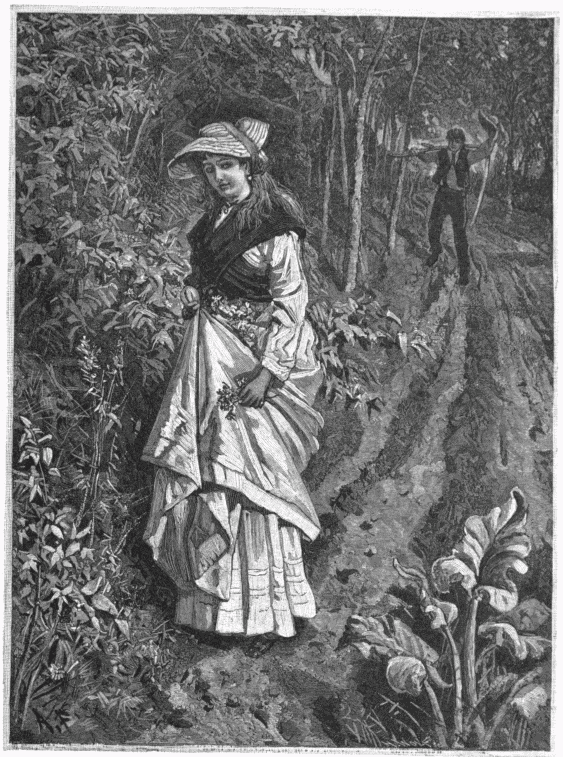
"THE MOWING."—ALFRED FREDERICKS.
Until recently, also, owing to some cause yet unsolved, we have not
seemed able to develop more than one or two forms of art at once. At one
period it was historic painting and portraiture; then portraiture,
including for a time very marked success in miniature painting, headed
by Fraser and Malbone, and continued by such able artists as T. S.
Cummings, J. H. Brown, Miss Goodrich, and Mrs. Hall; then, all at once,
landscape-painting made its appearance, and almost at a bound reached a
good degree of merit. Hand in hand with landscape art came remarkable
facility in line engraving. How rapidly excellence in this art was
achieved in this country may be judged from the fact that in 1788 the
editor of the American Magazine said apologetically, in presenting an
incredibly rude plate of a dredging-machine in the magazine, "The editor
has given the plate of the new machine for clearing docks, etc., because
he had promised it. The want of elegant plates in a work of this kind is
extremely regretted, and will, if possible, be supplied. If it cannot,
the editor flatters himself that the infancy of the arts in America will
be accepted as an apology for the defect." And yet not twenty years from
that time Peter Maverick was doing good steel-engraving in New York; and
scarce ten years later Durand was executing the masterly engravings of
Trumbull's "Declaration of Independence" and Vanderlyn's "Ariadne." And
from that time until recently engravers like James Smillie, senior, A.
H. Ritchie, and John Marshall have carried this art to a high degree of
excellence; while John Sartain has attained celebrity in mezzotint.
Strange as it may seem, while portraiture, landscape, and steel
engraving were pursued with such success by our artists, a feeling for
the other arts could hardly be said to exist. A sympathy with form,
generally the earliest art instinct to show itself, was long in
awakening, as proved by the tardiness of the plastic arts to demand
expression among us; while to the resources of black and white, or
camieu, or a perception of the matchless mystery and suggestiveness of
chiaro-oscuro, the people have, until within a very short time, seemed
altogether blind. Water-colors, also, were almost hooted at;
wood-engraving was for long in a pitiful condition; and as for
architecture and the decorative arts, nothing worthy of the name, and
scarcely a sign of a perception of their meaning, could be said to exist
on this side of the Atlantic.
Some years ago W. J. Linton, one of the most distinguished
wood-engravers of the century, came to this country to live. Whether
that had anything to do with the very rapid development of
wood-engraving here since that time cannot be stated with certainty;
but, judging from analogy, we should say that he has exerted a marked
influence in stimulating the remarkable progress already reached by our
engravers within a very few years. A.V.S. Anthony was one of the first
to respond to the awakening demand for good wood-engraving here, and has
shown great delicacy and skill in interpreting the drawings of our very
clever artists in black and white. Charles Marsh is also an engraver of
remarkable character and originality of style. In the rendering of a
decorative or highly ideal class of subjects he brings to his aid an
artistic genius not surpassed by any engraver we have produced. Messrs.
Morse, Davis, Hoskin, Wolf, Annin, Juengling, Kingsley, Müller, Cole,
Smithwick and French, Kreul, Dana, Andrew, and King, among a number who
have distinguished themselves in this art, are especially noteworthy,
not only for correct rendering of the spirit of a drawing, but often for
individuality of style.
One of the most interesting phases of the development of wood-engraving
in this country has been the discussion as to its position among the
arts, and the merits of the recent method of engraving drawings or
paintings photographed directly on the wood. This discussion has been
interesting and valuable as another evidence of the activity and
importance which the art question has already assumed in the community.
That engraving is an art, one would think could never be disputed, if
the question had not already been raised with a certain degree of
acrimony on the part—strange as it may seem—of those who are often
dependent upon the genius of the engraver for the recognition of their
abilities by the public—the artists themselves. It seems to us to be
sufficient answer to those who consider it purely a mechanical pursuit,
that the simple fact that the higher the artistic perceptions of the
engraver the better is the engraving he does, proves it to be a work of
art.
!["BIRDS IN THE FOREST."—[MISS JESSIE CURTIS.]](https://openoldbooks.sgp1.digitaloceanspaces.com/books/art-in-america/images/illpg_169_sml.png "\"BIRDS IN THE FOREST.\"—[MISS JESSIE CURTIS.]")
"BIRDS IN THE FOREST."—[MISS JESSIE CURTIS.]
On the other hand, it appears that the engraver may in turn assume too
much when he claims to improve upon an illustration, or objects per se
to cutting photographs on wood. While granting to engraving the rank of
art, it cannot justly be forgotten that it is, after all, a means to an
end,—an art, it is true, but an art subordinate to other arts which it
is designed to interpret. Once this is allowed, it follows, as a matter
of course, that it is the duty of the engraver to render faithfully the
drawing or painting that is to be cut; and to magnify himself not at the
expense of the artist who made the drawing, but by rendering, as nearly
as possible, a fac-simile of the original picture. If this be granted,
then is it not clear that, instead of opposing, he should hail with
satisfaction any new process which enables him to give on wood or any
other material a closer copy of the style and spirit of the artist whom
he is interpreting. That this can be done by a clever engraver by
photographing a pen-and-ink drawing or painting directly on the wood,
and then studying also the original work as he cuts it, seems to be no
longer an open question. It has been demonstrated by too many excellent
engravers within the last five years.
Another advantage of what we cannot but consider an advance in this art
is, that it admits of a larger variety of styles, and a freer expression
of the designer's methods of thought and feeling, and also enables many
who do not care to work in the cramped limits of a block of wood to make
a large composition in black and white, whether with Indian-ink or
monochrome in oil, which is then photographed on the wood. In this way
far greater freedom and individuality of handling is obtained, and a
nobler utterance of the truths of nature. Can there be any question that
a process which allows of such variety of expression must inure to art
progress, and still more to the instruction of the people, who are
directly benefited by the illustrations which are brought to their own
doors, and placed in the hands of the young at the time when their
tastes and characters are forming, and their imagination is most plastic
and impressionable?
It would seem as if the art of wood-engraving had received in the most
direct manner the action of some unseen hand, impelling it suddenly
forward in this country by concerted action with the genius of
illustration; for apparently by secret agreement that branch of art has
within the last decade developed a comparative excellence yet reached by
none of the sister arts in the land. And this turn for illustration has
naturally been accompanied by an active movement in black and white
drawing, particularly in crayon.
Samuel W. Rowse was one of the first to give an impetus to crayon
drawing by a style of portraiture especially his own. As such he ranks
with our leading portrait-painters; while the fact that he employed
crayon as a medium for a time gave him a position almost entirely alone
in this country. There is a wonderful subtlety in his power of seizing
character and the rendition of soul in the faces he portrays. Equally
happy in all the subjects he treats, he will be longest remembered,
perhaps, for the many beautiful children's portraits he has executed.
The success of Rowse naturally led to similar attempts by other artists;
and in all our leading cities one may now find crayon artists who are
more or less successful in the department of portraiture, among whom may
be mentioned B. C. Munzig and Frederick W. Wright. Out of this has grown
a school of landscape-artists employing charcoal—a medium that Lalanue
and Allongé had already used with magical results. John R. Key, who is
well known as a painter in oil, has, however, done his best work, as it
seems to us, in charcoal. There is great tenderness in his treatment of
light and shade, together with harmonious composition. J. Hopkinson
Smith, known as a water-colorist, also handles charcoal like a master.
He seizes his effects with the rapidity of improvisation, treats them in
masses, and shows a feeling for chiaro-oscuro that is almost unique in
our art.
![Representing the manner of PETER'S Courtship. [Howard Pyle.]](https://openoldbooks.sgp1.digitaloceanspaces.com/books/art-in-america/images/illpg_171_sml.png "Representing the manner of PETER'S Courtship. [Howard Pyle.]")
Representing the manner of PETER'S Courtship.
[Howard Pyle.]
When we come to the book illustrators we encounter a number of artists
of merit, and occasionally of genius, who are so numerous that we can
select only here and there a few of the most prominent names. Felix O.
C. Darley was one of the first to show the latent capacity of our art in
this branch. His style soon became very mannered, but, at the same
time, undoubtedly showed great originality and invention in seizing
striking characteristics of our civilization, and a refined fancy in
representing both humor and pathos. His linear illustrations to "Rip Van
Winkle" and Judd's "Margaret" placed him, until recently, among our
first two or three genre artists. Less versatile and inventive,
Augustus Hoppin has, however, earned an honorable position among our
earlier illustrators. Louis Stephens also won distinction for an elegant
rendering of humorous subjects. Then followed a group of landscape
illustrators, among whom Harry Fenn holds a high position for poetically
rendering the illimitable aspects of nature and the picturesqueness of
rustic or Old World scenery and ruins. Under the guidance of his facile
pencil how many have been instructed in art, and learned of the varied
loveliness of this beautiful world! Thomas Moran ranks with Mr. Fenn as
a master in this field. It appears to us that in this branch he displays
more originality and imagination than in the elaborate paintings by
which he is best known.
Within a very few years—so recently, in fact, that it is difficult to
see where they came from—a school of genre illustrators have claimed
recognition in our art, educated altogether in this country, and yet
combining more art qualities in their works than we find in the same
number of artists in any other department of American art. It is a
little singular that, notwithstanding the recent interest in black and
white in this country, the genre artists who represent it should at
once have reached an excellence which commands admiration on both sides
of the Atlantic, while our painters in the same department have rarely
achieved more than a secondary rank.
![SOME ART CONNOISSEURS.—[W. HAMILTON GIBSON.]](https://openoldbooks.sgp1.digitaloceanspaces.com/books/art-in-america/images/illpg_173_sml.png "SOME ART CONNOISSEURS.—[W. HAMILTON GIBSON.]")
SOME ART CONNOISSEURS.—[W. HAMILTON GIBSON.]
Alfred Fredericks has distinguished himself by combining landscape and
figure in a most graceful, airy style; and Miss Jessie Curtis, in the
delineation of the simplicity and beauty of child life, has delightfully
treated one of the most winsome subjects which can attract the pencil of
the poetic artist. Miss Humphreys, in the choice of a somewhat similar
class of subjects, has yet developed individuality of method marked by
breadth of effect and forcible treatment. Of the ladies who have found
scope for their abilities in the field of illustration perhaps none have
excelled Mrs. Mary Halleck Foote. We cannot always find her style of
composition agreeable, and in invention or lightness of fancy she seems
deficient, while her manner is strong rather than graceful. But she is a
most careful student of nature, and the effects she aims at, and
sometimes reaches, are inspired by an almost masculine nerve and power,
and show knowledge and reserve force. Some of her realistic landscapes
are almost as true and intense in black and white as the daring realisms
of Courbet in color, but showing fine technical facility rather than
imagination. Miss Annette Bishop, who died too early to win a general
recognition of her talents, was gifted with a most delicate poetic
fancy, and singular facility in giving expression to its dreams.
F. S. Church is an artist of imagination, painting in oil and
water-colors, but perhaps best known for striking and weird compositions
in black and white, often treating of animal or bird life. He is an
artist whose advent into our art we hail with pleasure, not because his
style is wholly matured or always quite satisfactory, for it is neither,
but because it is inspired by a genuine art feeling, and yet more
because it shows him to be—what so few of our artists have been—an
idealist. What is art but a reaching out after the ideal, the most
precious treasure given to man in this world? It includes faith, hope,
and charity. To search after the ideal good, to live in an ideal world,
to yearn after and try to create the harmony of the ideal, is the one
boon left to man to give him a belief in immortality and a higher life.
The more of an idealist the poet or the artist, the nearer he comes to
fulfilling his mission. The idealist is the creator, the man of genius;
and therefore we hail with joy the appearance of every idealist who
enters our art ranks, and infuses vitality into the prose of technical
art, and inspiration into the dogmas of the schools. The most hopeless
feature of American art has always been hitherto, as with our
literature, the too evident absence of imagination; and wherever we
recognize an idealist, we set him down as another mile-stone to mark the
progress in art. It is through the idealists that Heaven teaches truth
to man; and hence another reason why we regard with such importance the
present school of artists in black and white. In no department is there
more scope for the imagination than in the drawing of the pure line or
in the suggestions of chiaro-oscuro. Therein lies the enormous power
of the art of Rembrandt. He dealt with that seemingly simple but really
inexhaustible medium, light and shade: in the hands of a master, potent
as the wand of a magician to evolve worlds out of chaos.
!["WASHINGTON OPENING THE BALL."—[C. S. REINHART.]](https://openoldbooks.sgp1.digitaloceanspaces.com/books/art-in-america/images/illpg_175_sml.png "\"WASHINGTON OPENING THE BALL.\"—[C. S. REINHART.]")
"WASHINGTON OPENING THE BALL."—[C. S. REINHART.]
Barry, Bensell, Shepherd, Davis (who is also known as a decorative
artist), T. A. Richards, Eytinge, Frost, Merrill, Ipsen, Shirlaw,
Lathrop, Lewis, Perkins, and Davison are other artists who have justly
acquired repute for success in the department of black and white, or
book illustration. Kelley has a sketchy style that is very effective,
and of which the correct rendering on wood would have been well-nigh
impossible with the old processes; but there is danger of carrying it to
the verge of sensationalism.
The facilities afforded by photographing
a design on wood has seemed to be the occasion for aiding the
development of a class of artist-authors who both write and illustrate
their own articles for the magazines. How remarkably well this can be
done is proved by such clever artists as Howard Pyle and W. Gibson, who
display at once fertility of imagination and technical facility as
draughtsmen. C. S. Reinhart has become widely known as one of the most
versatile illustrators we have produced. Excelling as a draughtsman, he
brings to his aid an active fancy that enables him vividly to realize
the scenes he undertakes to represent; and he seems equally at home in
the portrayal of quaint old-time scenes, or the brilliant costumes and
characters of the present day, combined with forcible delineations of
scenery. The Puritan damsel or the belle of Newport may alike be
congratulated when Mr. Reinhart ushers them before us with the grace of
a master. The success of this school of artists, who have made their
mark in the department of illustration, has doubtless been due in part
to the increasing study of the figure in this country, and the greater
facilities afforded for drawing from the life. Most of these artists are
young men, whose abilities have been vastly assisted by their studies in
life schools, which it would have been well-nigh impossible for them to
find in the earlier periods of our art. Although perhaps better noticed
under the head of Ethics rather than of Æsthetics, we may allude to the
surprising growth and influence of caricature-drawing in this country,
represented by such able artists as Nast, Bellew, Kepler, or Cusack, as
associated with the development of our black and white art.
An artist who seems to combine the qualities we see more or less
represented by other artists in black and white, who has already
accomplished remarkable results, and gives promise of even greater
successes, we find in E. A. Abbey. It must be taken into consideration
that he is still very young; that he now for the first time visits the
studios and galleries of Europe; that his advantages for a regular art
education have been very moderate, and that he is practically
self-educated. And then compare with these disadvantages the amount and
the quality of the illustrations he has turned out, and we see
represented in him genius of a high order, combining almost
inexhaustible creativeness, clearness and vividness of conception, a
versatile fancy, a poetic perception of beauty, a quaint, delicate
humor, a wonderful grasp of whatever is weird and mysterious, and
admirable chiaro-oscuro, drawing, and composition. When we note such
a rare combination of qualities, we cease to be surprised at the cordial
recognition awarded his genius by the best judges, both in London and
Paris, even before he had left this country.
If I have spoken strongly in favor of our school of illustrators, it is
because I think such commendation has been rightly earned, and to
withhold it when merited would be as unjust as to give censure when
undeserved. Criticism need not necessarily be the essence of vitriol and
gall, as some critics seem to imagine it to be. A jury is as much bound
to approve the innocent as to condemn the guilty.
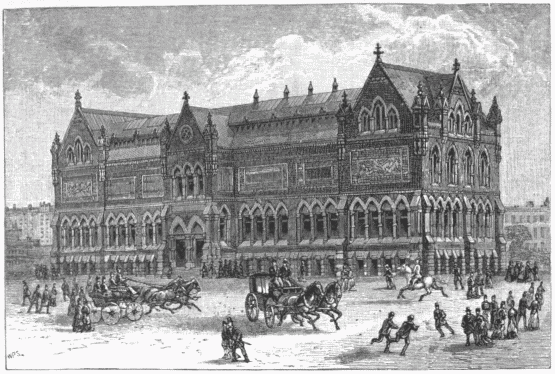
MUSEUM OF FINE ARTS, BOSTON.
In another department of our arts we also feel called to award praise to
a degree that has never before been possible in the history of American
art. I refer to the department of architecture. It is difficult to say
exactly when the new movement toward a fuller expression of beauty in
our civic and domestic building began; but we are conscious that about
ten years ago what was for a time a mere vague feeling after more
agreeable examples of architecture shaped itself into a definite and
almost systematic impulse. The Chicago fire, and more especially the
great fire in Boston, accelerated the action of the forces that already
directed the people to demand nobler forms and types in the
constructions that were henceforth to be erected in our growing cities.
The advance of landscape-gardening, as evidenced in the Central Park of
New York, and the public parks of other cities, doubtless aided to
increase the yearning for material beauty. But whatever the influences
at work, there is no question as to the results already apparent. I
would not be understood as approving all the buildings of importance
that have recently been put up in this country—very far from it. But,
on the other hand, one cannot avoid seeing that the general tendency is
toward improved styles, and that here and there groups of buildings or
single structures have been erected which are at once elegant,
commodious, and artistic; and, if not strictly offering new orders of
architecture, presenting at least graceful adaptations of old orders to
new climatic and social conditions in a way that gives them the merit of
originality.
So prominent has this improvement in architecture already become in
American cities, that already their external aspect or profile has begun
to partake of the picturesque character hitherto supposed to belong only
to the Old World, and to present that massing of effect so dear to the
artistic eye. We can illustrate this by mentioning only two or three
examples among many. One who looks toward Philadelphia from the railway
station on the east side of the Schuylkill, may see a cluster of spires
and domes centering around the Academy of Fine Arts, which is so
agreeably composed that one would almost imagine the position of each to
be the deliberate choice of a master in composition. Twenty years ago
one would have looked in vain for any such harmonious outline of
structural beauty in this country. The small, quaint fishing-port of
Marblehead has also found itself suddenly transformed into one of the
most pleasing cities of the Union, as viewed from the Neck across the
harbor; for on the very crest of the hills upon which the place is built
a town-hall has been erected, of brick, neatly faced with stone, and
surmounted by an elegant tower. At once the old town has emerged from
the commonplace into the region of the picturesque. The new structure
has given character and symmetrical outline to the city by producing
convergence to a central point of effect; and when the sun sets behind
it, and brings its outline into bold but harmonious relief against a
golden background, while a mist of glowing rays glazes the whole into
tone, the view is in the highest degree artistic, and so resembles some
of the scenes one so often sees in the Old World that he can hardly
believe he is gazing at an American prospect.
We find a somewhat similar effect, but on a much larger scale, presented
by the new Capitol, or State-house, at Albany. This city, as beheld from
the opposite banks of the Hudson at Greenbush, has always been one of
the most pleasing of American cities, situated as it is on several lofty
hills, divided by ravines in which purple shadows linger when night is
approaching; but the addition of the vast structure now in course of
completion there adds greatly to the glory of the spectacle. It
dominates over the city of eighty thousand inhabitants with superb
dignity; and the whole place borrows beauty from it, and is elevated
above prose into poetry. Again one is reminded of the cathedral towns of
Europe, where some lofty, venerable minster guards through the ages the
roofs that cluster below. Not that this pile, which is rather hybrid in
its style, is to be considered equal to the masterpieces of old-time
architecture; but it is a long step in advance compared with the civic
buildings formerly erected and admired in our cities, and its presence
at the capital of a great State cannot but have an ennobling and
educational influence upon rising generations.
The styles, whether pure or modified, that are most employed by our
architects in this new movement have been chiefly the Romanesque, the
Palladian Renaissance, the French Renaissance of Mansard and Perrault,
and the later Elizabethan or Jacobean. The first two have entered
chiefly into the construction of civic buildings; the second has been
followed in religious edifices; while the last has been used with
excellent effect in domestic architecture. A fine example of the success
achieved in the employment of the Romanesque is seen in the new Trinity
Church on the Back Bay lands, in Boston, designed by Gambrel and
Richardson. This is one of the most conscientious and meritorious
buildings erected on this continent, although less imposing than it
would have been if the original design had been fully carried out. There
is, also, an affectation of strength in the massive blocks of undressed
stone under the windows, in a part where such strength is
disproportionate to that employed in other portions of the building. But
the general effect is excellent, and the covered approaches or cloisters
are quite in the spirit of true architecture. Color enters judiciously
into the selection of the stone used to aid the general effect; and the
same observation may be applied to the very elegant tower of the new Old
South Church, close at hand, designed by Peabody and Robinson, in the
Italian Gothic style, and which for grace, beauty,
and majesty has
not been surpassed on this side of the Atlantic. The church edifice to
which it is attached, although sufficiently ornate—perhaps too much
so—is lacking in that repose of outline or just proportions that are
required to bring it into harmony with the campanile.
!["THE ASTONISHED ABBE."—[E. A. ABBEY.]](https://openoldbooks.sgp1.digitaloceanspaces.com/books/art-in-america/images/illpg_181_sml.png "\"THE ASTONISHED ABBE.\"—[E. A. ABBEY.]")
"THE ASTONISHED ABBE."—[E. A. ABBEY.]
Other towers and churches are clustered in that neighborhood, erected
within ten years, which present an effect that is really intrinsically
beautiful, without taking at all into question the rapidity of the
transformation which has come over the spirit of our architecture. And
the effect is heightened, to a degree never before attained on this
continent since the Mound-builders passed away, by the excellence of the
domestic architecture which has entered into the construction of the
dwellings of that vicinage, especially on Boylston Street and the
adjacent avenues. Beauty, taste, and comfort are there found combined to
a degree that promises much for the future of architecture in our
country. The gargoyles, gables, cornices, and carvings one meets at
every turn carry one quite back to the Middle Ages. It is interesting to
observe that the sham cornices formerly so common here are gradually
being discarded, together with all the other trumpery decoration so much
in vogue. Good honest work is shown in external decoration, together
with a feeling for color that is adding much to the cheerfulness of our
cities. Brick is made to do service for ornamentation as well as for
mere dead walls, and string courses, or bands of colored tiles or
terra-cotta carvings, all of an enduring character, enter into the
external decorations of private dwellings.
![A CHILD'S PORTRAIT.—[B. C. PORTER.]](https://openoldbooks.sgp1.digitaloceanspaces.com/books/art-in-america/images/illpg_184_sml.png "A CHILD'S PORTRAIT.—[B. C. PORTER.]")
A CHILD'S PORTRAIT.—[B. C. PORTER.]
Not only is the love of beauty shown in domestic architecture, but it is
found displayed in the construction of banks and stores; and it is again
in Boston that we find whole streets of buildings of rich and elegant
design, and conscientiously constructed, devoted wholly to business
purposes. But a building which, perhaps, more than any other is typical
of the architectural movement now passing over the country is the Museum
of Fine Arts in Boston. It is not so much after any one style as a
choice from different schools of later Gothic adapted to modern
conditions. The terra-cotta groups in relievo in the façade, temper what
would be otherwise too large an expanse of warm color, for it is built
of red brick. The grouped arches, turrets, and oriel windows, and the
numerous terra-cotta decorations at the angles and on the gables, are
elegant, but perhaps so generally distributed as to be a little
confusing. The effect is scattered, and thus weakened, instead of being
massed at one or two central or salient points. This is the most
glaring error we discover in the present importation or adaptation of
foreign and ancient styles to our needs here. It is an error which we
share with the modern British architect, and was forcibly illustrated in
the new Houses of Parliament, by Sir Charles Barry. No buildings of this
century are so profusely ornate as some of the magnificent cathedrals
and town-halls of the Middle Ages; but at the same time all this
sumptuousness of decoration was massed upon one or two effective spots,
surrounded by large spaces comparatively simple and free of
embellishment. Thus grandeur and nobility of outline were preserved,
while extraordinary beauty in color and sculpture could be added without
disturbing the general effect or cloying the imagination. But our
architects, not having yet fully grasped the ideas after which they are
searching, scatter instead of concentrating the external decorations of
their buildings.
![A BIT OF VENICE.—[SAMUEL COLMAN.]](https://openoldbooks.sgp1.digitaloceanspaces.com/books/art-in-america/images/illpg_185_sml.png "A BIT OF VENICE.—[SAMUEL COLMAN.]")
A BIT OF VENICE.—[SAMUEL COLMAN.]
Interior decoration has also naturally assumed importance as the quality
of our architecture has advanced. Elaborate wood-carvings are entering
into the decorations of the houses of our citizens, and painting is
called in to adorn the walls of private and civic buildings, sometimes
with more affectation or extravagance than taste; although it can be
conceded without hesitation that a remarkable and decided improvement is
noticeable within a very few years in the decoration of interiors in
this country. M. Brumidi made a beginning, some twenty years ago, in the
frescoes of the Capitol at Washington; and quite recently Mr. Lafarge
has beautified the interior of Trinity Church, Boston, and other public
buildings, with sacred designs in fresco, and other decorative work in
gold and red, which are very interesting. Among the last, and probably
the most important, works of the late William M. Hunt were the mural
paintings in oil for the new State-house at Albany. Other artists who
have shown promise in this department are Francis Lathrop and Frank Hill
Smith.
It is not surprising to find that this advance in decorative art,
together with the increasing luxury accompanying it, should create a
demand and develop a talent for toreutic art, or art in metal-work,
especially the precious metals; and such we find to be the case. The
success achieved in this department is, perhaps, the most remarkable yet
attained in American art, excepting possibly that of some of our artists
in black and white, and has justly merited and obtained unqualified
applause abroad as well as at home. It is to such designers as Messrs.
Grosjean, Perring, Wilkinson, and Moore, assisted by the most skilled
artisans of the age, that our toreutic art is indebted for the
recognition it received at the French Exposition.
Another sign of the rapidly increasing activity of the interest taken in
the art question in America is presented by the art museums or galleries
which have almost simultaneously arisen in Boston, New Haven, New York,
and Washington, founded at considerable expense, and entirely without
State aid. With the former two are connected important schools for art
instruction, combined with fine casts of the masterpieces of ancient
plastic art.
Another evidence of the awakening art feeling of a great nation is the
demand for art education—a want which has been met by the establishment
of numerous schools or academies of art in our leading cities all over
the land, from the Atlantic to the Pacific. It is true that in
Philadelphia, Boston, and New York academies were founded early in the
century, and the last especially had become a very important factor in
stimulating the latent love for art in our people. The Massachusetts
Normal Art School, under the able direction of Mr. Walter Smith, while
devoted chiefly to the advancement of industrial art, has also by its
example greatly assisted the growth of the art feeling in the popular
mind. While much may be urged with reason against compulsory instruction
of art in the public schools, it would seem that few could be found to
object to the education of art instructors, and the addition of an
optional art branch to the State schools for the benefit of those who
are desirous of art instruction, but are too poor to avail themselves of
the advantages offered by such admirable art schools as those of the
Cooper Institute and Artists' League in New York, the National Academy
or the Museum of Fine Arts in Boston, or the Academy in Philadelphia.
It may, then, be conceded that the founding of the Massachusetts Normal
Art School is not only a strong indication of a growing demand, but that
it has also been a very powerful agent in the diffusion of art knowledge
in the United States.
!["THE OLD ORCHARD."—[R. SWAIN GIFFORD.]](https://openoldbooks.sgp1.digitaloceanspaces.com/books/art-in-america/images/illpg_187_sml.png "\"THE OLD ORCHARD.\"—[R. SWAIN GIFFORD.]")
"THE OLD ORCHARD."—[R. SWAIN GIFFORD.]
Thus we see that by a cumulative effort the arts are making sudden and
rapid progress in America. And there is still another movement which
strikingly indicates this. Slow to be recognized, and meeting in some
quarters with but cold welcome, it is yet by no means the least
significant indication out of many that we are in the full tide of
æsthetic progress, and have fairly entered on the third period of
American art. From the time of West it has been not uncommon for our
painters to go to Europe for study and observation; but they either had
the misfortune to form their style after that of schools already
conventional and on the wane, or they were not yet sufficiently advanced
to accept the methods and principles of new masters and schools. A
possible explanation, that is more philosophical, but which some may
decline to accept, may be found in the general laws directing human
progress, that obliged us, unconsciously, falteringly to tread one after
the other the successive steps which others have followed before us. For
the same reason, when an artist of unusual ability, like Stuart,
appeared in the country, he had little or no following, because he came
before his time.
![A LANDSCAPE.—[GEORGE INNESS.]](https://openoldbooks.sgp1.digitaloceanspaces.com/books/art-in-america/images/illpg_188_sml.png "A LANDSCAPE.—[GEORGE INNESS.]")
A LANDSCAPE.—[GEORGE INNESS.]
But it has been evident for some years that a new element was entering
our art ranks and demanding expression, which has at last reached a
degree of vigor and organized strength that challenges respectful
attention, if not unqualified acceptance. By associations, schools, and
exhibitions of its own, it has thrown down the gauntlet to conservatism
and conventionalism, and the time has arrived when we can no longer shut
our eyes to the fact that a new force is exerting itself with
iconoclastic zeal to introduce a different order of things into American
art. We cannot justly consider this movement in the light of reform, for
up to this time our art has been very creditable, and, considering the
environing circumstances, full as advanced proportionally as the other
factors of American civilization. We regard it simply as another stage
in our art progress, destined, when it has accomplished its end, to be
in turn succeeded by yet higher steps in the scale of advance; for,
notwithstanding the somewhat demonstrative assumptions of some of its
promoters, the new movement does not comprehend within itself, more than
any other school, all the qualities of great art. To no school of art
has it yet been given to demonstrate and include in itself all the
possibilities of art, or to interpret all the truths of nature and man.
Perhaps some future school may arise, with all the knowledge of the ages
to choose from, which may comprehend the whole sphere of art in its
compass. But they are probably not yet born who shall see it, or give to
it the symmetry of perfection. Until that time, it behooves those
neophytes and disciples, who proclaim that their art includes all that
art has to tell, to be modest in their claims, and to be satisfied if
they have been able by fasting and prayer to enrich the world of art
with one or two new truths. Nowhere is humility more becoming than in
art; arrogance and assumption dig its grave sooner or later; while
humility is by no means incompatible with earnestness, zeal, and
progress.
!["LA MARGUERETTE—THE DAISY."—[WILLIAM M. HUNT.]](https://openoldbooks.sgp1.digitaloceanspaces.com/books/art-in-america/images/illpg_189_sml.png "\"LA MARGUERETTE—THE DAISY.\"—[WILLIAM M. HUNT.]")
"LA MARGUERETTE—THE DAISY."—[WILLIAM M. HUNT.]
The ripeness of our art for a change before the new movement actually
assumed definite shape had already been suggested and welcomed in
advance by such artists as Eastman Johnson, Homer Martin, and Samuel
Colman, the admirable painter in oil and water colors, strong in
chiaro-oscuro, brilliant in color, and, although without academic
training abroad, of a most excellent catholic spirit in all matters
relating to art, ready to accept the good of whatever school, and to aid
progress in the arts of his native land by whomsoever promoted. Benjamin
C. Porter, whose massive characterizations in portraiture, broadly
treated and admirably colored, have been among the most important
achievements in recent American art, and Winslow Homer, A. H. Wyant, and
E. M. Bannister are also among the artists whose sympathies are
naturally with the new movement, although receiving their art training
chiefly in this country, and who have thus indicated and prepared the
way for the assertion of new influences in our art.
R. Swain Gifford should be added to the list of the noteworthy
landscape-painters who have thrown the weight of their influence in
advance to welcome to our shores new elements of progress and change
whereby to quicken American art to fresh conquests. This artist at one
time devoted his efforts to marine-painting, in which he did and still
does some creditable work, his knowledge of ships being sufficiently
technical to satisfy the nautical eye; but since his sojourn in Algeria,
and the observations made in the Continental galleries and studios, he
has devoted himself to landscape, and adopted a bolder style and a truer
scheme of color. The influence of French art is perceptible in his later
methods, but altogether as an influence, and in no sense as an
imitation, for in his works there is always evident a sturdy
self-assertion, whether in subject or treatment. In catching the gray
effects of brooding skies receding in diminishing ranks through an
aërial perspective of great distance and space, and giving with fine
feeling the Druid-like spirit of clumps of sombre russet-hued cedars
moaning by the granite shore of old Massachusetts, and identifying
himself with the mysterious thoughts they suggest, Mr. Gifford has no
superior on this side of the Atlantic. As a professor in the Cooper
Institute, his influence is of great importance to the future of
American pictorial art.
![MOONLIGHT.—[JOHN J. ENNEKING.]](https://openoldbooks.sgp1.digitaloceanspaces.com/books/art-in-america/images/illpg_191_sml.png "MOONLIGHT.—[JOHN J. ENNEKING.]")
MOONLIGHT.—[JOHN J. ENNEKING.]
George Inness is another painter who, although without training in
foreign studios, should be included with the artists just named, whose
sympathies have gradually led him to exemplify in his works some of the
most characteristic traits of later Continental methods. At first his
style was not unlike the prevailing style of our middle school of
landscape-painting; like that, giving careful attention to the
reproduction of details. But his emotional nature, and intense
reflection upon the philosophical principles of art, gradually led him
to a broader style and a more free expression of the truths of nature,
dealing with masses rather than with details, and handling his
subjects—especially atmospheric effects—with a daring and an insight
that has never been surpassed in our landscape art. To these he has
added a feeling for light and color that place him, at his best, among
the masters of the art. But there is inequality in his works, and
sometimes a conflict of styles, as when he dashes off a composition, in
two or three sittings, that is full of fire and suggestion; and then,
perhaps with a relic of his first method still lingering in his memory
like a habit, goes over it again, and smooths away some of those bold
touches which, to an imaginative observer, gave it additional force.
!["HAVING A GOOD TIME."—[LOUIS C. TIFFANY.]](https://openoldbooks.sgp1.digitaloceanspaces.com/books/art-in-america/images/illpg_192_sml.png "\"HAVING A GOOD TIME.\"—[LOUIS C. TIFFANY.]")
"HAVING A GOOD TIME."—[LOUIS C. TIFFANY.]
In his latest works Mr. Inness has shown a disposition to yield more
and more to a style at present called impressionist. Impressionism pure
and simple, as represented by its most extravagant supporters, is like
trying to represent the soul without the body. This may be well enough
in another world; but in this a material body is needed to give it
support. But, philosophically considered, there is no question that
impressionism—or the attempt to represent nature according to the
impressions it makes upon the mind's eye, rather than the mere
reflections left on the material eye—undoubtedly presents the
quintessence of the spirit of art; and therefore all good art must have
in it more or less evidence of subjective influence. But just so long as
art finds expression with material means, the artist must make
concessions to the limitations of substance. Naturally, of all the arts,
music comes nearest to the ideal which the impressionist is seeking to
grasp.
It is useless to deny that, extravagant as some of the works of the
contemporary impressionists appear to many, they undoubtedly present a
keen appreciation of aërial chromatic effects, and for this reason are
worthy of careful attention. That they are not carried nearer to
completion, however, indicates a consciousness on the part of the artist
that he is as yet unable to harmonize the objective and subjective, the
material and the spiritual phases of art. A perfect work of art combines
the two; but, alas! such achievements are as yet rare, although that is
the ideal which the artist should keep in view. The artist who gives us
what is called a finished painting is so far right. He represents what
appears to the material eye. In proportion as he combines with this a
suggestion of the intellectual impression also made on his mental
vision, he approaches the ideal in art execution. On the other hand, the
artist who is impatient of details, and deals wholly with a broad, and
sometimes, we regret to say, dauby and slovenly interpretation of
nature, is yet so far right, because he is endeavoring to interpret the
wholly imaginative and intellectual side of art. When to this bias he
adds the balance of power which enables him to give something of the
other phase of art, he in turn approaches the ideal aim of art. Turner
was an impressionist; so was Corot; so, to go farther back, was
Velasquez; so, also, are the Japanese. But these artists, especially
Turner and Velasquez, had the supreme faculty of uniting the two
opposite poles in art in their best works, and hence the commanding
position which they hold, and always will hold, in the art world.
![SOUTHAMPTON, LONG ISLAND.—[C. H. MILLER.]](https://openoldbooks.sgp1.digitaloceanspaces.com/books/art-in-america/images/illpg_193_sml.png "SOUTHAMPTON, LONG ISLAND.—[C. H. MILLER.]")
SOUTHAMPTON, LONG ISLAND.—[C. H. MILLER.]
So far as can be ascertained, it is to the late William M. Hunt that we
must ascribe the initiation of the third period in our pictorial art,
and perhaps, in a secondary manner, the general impulse toward foreign
styles now modifying the arts of design in this country. When Mr. Hunt
went to Düsseldorf to study, in 1846, he did no more than many of our
artists had already done. But when, dissatisfied with the
conventionalism of that school, he turned his steps to Paris, and
became a pupil of Couture, and was one of the first to discover, to
admire, and to emulate the art methods of Millet, then, unconsciously,
he became a power, destined by his somewhat narrow but intense
personality to influence the destinies of our art—especially by
returning to Boston, a city easily brought under the magnetism of a
strong individuality, and more ready than any other city in the land to
surrender the guidance of its opinions to those whom it condescends to
admire.
The going of Mr. Hunt to Paris meant that technical knowledge and the
perception of the underlying principles of art were now, as never
before, to be systematically mastered and imported to America by our
artists, together with the most advanced theories, truths, or
discoveries in the technical part of the subject. It did not mean that
all our artists who went abroad to study would necessarily be great, or
that any of them would be especially original, but that there would be a
general harmony of action toward improving the means of art education in
America. Regarded in this light, Mr. Hunt must be considered to have
been a most important promoter of the development of art in America. He
was probably not a man of genius—unless great force of character be
considered as such—but he had a true perception of the character and
aims, the limitations and possibilities of art; and the intolerance he
sometimes exhibited was not unusual in those who are introducing new
methods, and have to create a circle of influence. In his own works, as
a landscape, portrait, genre, and decorative painter, it cannot be
said that he added greatly to the sum of the world's art by anything
strikingly original; but he exhibited a true perception of the
importance of the ideal in art; and one feels, in contemplating his
works, that he was ever striving to overcome the difficulties of
material means of expressing the ideal. Moved, like most leading
American painters, by a feeling for color rather than for form, yet, in
such compositions as "The Bathers," representing a boy about to dive
from the shoulders of another, who is half immersed in a pool, vanishing
into the green gloom of the wooded banks, we have an admirable example
of the manner in which this artist sometimes combined form,
chiaro-oscuro, and color, with a delicacy, force, and suggestion of
outline and tint, to a degree rarely equalled before by American art;
with a technique essentially that of the later French school, yet
modified by individual feeling.
![A STUDY.—[FREDERICK DIELMAN]](https://openoldbooks.sgp1.digitaloceanspaces.com/books/art-in-america/images/illpg_195_sml.png "A STUDY.—[FREDERICK DIELMAN]")
A STUDY.—[FREDERICK DIELMAN]
But the life-work of Mr. Hunt was, after all, not more in his paintings
than in that influence by which he gathered about him a school of
admirers and disciples who disseminated his opinions and imitated his
style, although rarely with his success. Among those who directly
profited by his style and influence may be mentioned Mrs. Darrah, who
effectively paints gray coast scenes and landscapes in a low, minor key;
Miss Helen M. Knowlton; Miss Bartol; F. P. Vinton; and S. S. Tuckerman,
the marine painter.
The power of Mr. Hunt was still more widely felt in directing a large
number of young art-students to visit Paris, and eventually also Munich,
at each of which the tendency has been for some years toward bolder
methods in the technics of art. The result has been to introduce to this
country a truer perception of the vital importance of style in the
present stage of our art, and to emphasize the truth that he who has
anything to say will make it much more effective if he knows how to
give it adequate utterance.
Of the many Boston artists who have profited by foreign study and are
now resident in that city, we can mention but three or four. John J.
Enneking, a graduate of the studios of Munich and Paris, can hardly be
called an idealist. There is little evidence of imagination in his
canvases; but in seizing the effects of the brilliant lights of sunset,
or the varied grays of a lowering sky on a cloudy day, he shows himself
equally happy in color, chiaro-oscuro, and technical skill in handling
pigments. His versatility is remarkable. He can render the figure from
life with a vigor and freshness scarcely less than that of his
landscapes. There is, unfortunately, an evidence of haste in too many of
his works, which cannot be too much regretted, for he thus fails to do
justice to the very decided ability he possesses. Having studied both in
Munich and Paris, and given careful attention to all the European
schools of art, and adding to this knowledge sturdy independence of
opinion and great earnestness and energy, Mr. Enneking ought to be
strongly influential in the present stage of American art.
We find much that is interesting in the paintings of E. L. Weeks. They
are marked by a powerful individuality, which delights in glowing
effects of light, and revels in the brilliant coloring of tropical
scenery or the varied splendor of Oriental architecture and costumes.
There is something Byronic in the fervor of this artist's enthusiasm for
the East, and the easy adaptability that has enabled a son of New
England to identify himself with the life and scenery of lands so
exactly the opposite of his own. Although a pupil of Bonnât, and an
ardent admirer of the excessive realism now affected by some of the
followers of the later French school, Mr. Weeks is, in spite of himself,
an idealist, and no imitator of any style. This has, perhaps, been an
injury to him, for he finds difficulty in mastering the technical or
mechanical problems of his profession. A lack of knowledge or feeling
for form, a weakness in drawing which is too often perceptible in his
works, and sometimes an apparent opaqueness in his pigments, impair the
quality of compositions which are inspired by the fire of genius.
!["THE BURGOMASTER."—[H. MUHRMAN.]](https://openoldbooks.sgp1.digitaloceanspaces.com/books/art-in-america/images/illpg_197_sml.png "\"THE BURGOMASTER.\"—[H. MUHRMAN.]")
"THE BURGOMASTER."—[H. MUHRMAN.]
J. M. Stone, who is one of the professors at the Museum of Fine Arts,
and a graduate of the Munich schools, indicates considerable force in
rendering the figure, both in color and drawing, and a touch of genius
in the painting of dogs and horses. His service in the army during
the war intensified his interest in equine art, and will probably result
in important compositions suggested by that conflict. C. R. Grant has a
delicate poetic feeling for color and form, and a pleasant fancy tinged
with quaintness; and in his choice of treatment and subject suggests the
works of G. H. Boughton. In T. W. Dewing, a pupil of Lefévre, who has
recently settled in Boston, we find much promise in figure-painting, but
altogether after the clear-cut, well-drawn, but somewhat dry method of
Gérôme.
J. Foxcroft Cole, who has been a careful student of the best phases of
French landscape art, but has formed, at the same time, a sufficiently
individual style of his own, is an artist whose works command a growing
esteem. Although adding groups of cattle to his compositions, he is
essentially a landscape-painter. We receive from a study of his works an
impression of sameness, like that conveyed by the landscapes of Corot,
chiefly because they are generally on one key, and refer to a class of
subjects so quiet and undemonstrative that only he who observes them
repeatedly and reflectively discovers that each work is the result of a
distinct inspiration, and possesses suggestions and qualities of its
own. Exquisite feeling for space and atmosphere, for the peaceful
effects of pastoral life, and the more subtle aspects of nature,
especially in color, are the characteristics of the style of Mr. Cole.
In reviewing the Boston school, we note in its development much activity
and earnestness, too often combined, however, with crudeness; while the
foreign influence that is, on the whole, most evident in it is that of
the contemporary French school. As Boston is intense rather than broad
in its intellectual traits, and is inclined to follow the lead of its
own first thinkers and artists, it is the more unfortunate that one
influence should predominate, because in such a case the errors as well
as the good qualities of a style are liable to receive too much
attention; while free growth depends on the catholic eclecticism which
supplements the study of nature by culling the good from different
schools, and correcting one by comparison with another, thus enabling
the artist to arrive at a more just and profound view of a question that
proceeds upon irreversible laws. The mind thus educated learns by
balancing the merits of different schools, and the results are not so
much imitation as assimilation, yielding healthy growth and development.
!["BURIAL OF THE DEAD BIRD."—[J. ALDEN WIER.]](https://openoldbooks.sgp1.digitaloceanspaces.com/books/art-in-america/images/illpg_200_sml.png "\"BURIAL OF THE DEAD BIRD.\"—[J. ALDEN WIER.]")
"BURIAL OF THE DEAD BIRD."—[J. ALDEN WIER.]
In New York there seems to be, with no less activity than that of
Boston, an art movement which is based on broader grounds, and offers
more encouragement for the future of our art. The artists who are the
most influential in this advance are more equally divided between the
French and the German schools than those of Boston, and indicate more
breadth of sympathy and art culture, together with a cosmopolitan love
for the good in the art of all schools, which is one of the most
encouraging of signs in a dawning intellectual reform. So decided had
the tendency toward Munich become soon after 1870, that the colony of
American art students in Munich soon grew sufficiently large to
establish an art association, having stated days of meeting, at which
contributed paintings were exhibited and discussed, and carefully
prepared papers on art topics were read. Opinions were exchanged in this
manly, earnest, sympathetic
manner, and breadth and catholicity were
reached in the consideration of the great question in which all were so
profoundly interested. Thus were gained many of the influences which are
destined to affect American art for ages to come.
!["THE APPRENTICE."—[WILLIAM M. CHASE.]](https://openoldbooks.sgp1.digitaloceanspaces.com/books/art-in-america/images/illpg_201_sml.png "\"THE APPRENTICE.\"—[WILLIAM M. CHASE.]")
"THE APPRENTICE."—[WILLIAM M. CHASE.]
The writer regards as among the most improving and delightful evenings
he has enjoyed those passed with some of these talented and enthusiastic
art students at the table where a number regularly met to dine—at the
Max Emanuel café in Munich. Dinner over, huge flagons of beer were
placed before each one, and pipes were lit, whose wreaths of
upward-curling smoke softened the gleam of the candles, and gave a
poetic haze to the dim nooks of the hall that was highly congenial to
the hour and the topics discussed. The leonine head of Duveneck,
massively set on his broad shoulders, as from time to time behind a
cloud of smoke he gave forth an opinion, lent much dignity to the scene;
while the grave, thoughtful features of Shirlaw, and the dreamy,
contemplative face of Chase, occasionally lit by a flash of impetuous
emotion, aided by an eloquent gesture, made the occasion one of great
interest. Others there were around the board whose sallies of humor or
weighty expressions of opinion made an indelible impression.
Among the resident artists of New York who have recently studied abroad,
Louis C. Tiffany, a follower of the French school, holds a prominent
position. He has done some very clever things in landscape and genre
from subjects suggested by his trip to the East, and has succeeded
equally in oil and water colors, and is now giving a preference to
American subjects, and also turning his attention to the pursuit of
decorative art. He is essentially a colorist, to whom the radiant tints
of the iris seem like harmoniously chorded strains of music. William
Sartain, a pupil of Bonnât and Yvon, has also proved himself an
excellent colorist, and shows vigor and truth of drawing both in figure
and architectural perspective, as well as pleasing composition in work
which he has done abroad.
The new phase into which our landscape art is passing under foreign
influence is well indicated by the paintings of Charles Miller, a
graduate of the Munich school, who is inspired by a stirring, breezy
love for nature, especially for her more intense and vivid effects,
strong contrasts of light and shade, glowing sunsets, and masses of dun
gray clouds rolling up in thunderous majesty and gloom over landscapes
fading off into the infinite distance. As a draughtsman Mr. Miller is
less interesting than in rendering such effects as we have suggested
with broad, free handling, in which he is often very successful. He is a
poet moved by a powerful imagination, idealizing what he sees, and
possessed of a memory similar to that of Turner; and thus some of his
most striking canvases are the result of a tenacious memory allied to a
vigorous observation. Some of his canvases suggest the landscapes of
Constable.
!["THE PROFESSOR."—[THOMAS EAKINS.]](https://openoldbooks.sgp1.digitaloceanspaces.com/books/art-in-america/images/illpg_204_sml.png "\"THE PROFESSOR.\"—[THOMAS EAKINS.]")
"THE PROFESSOR."—[THOMAS EAKINS.]
!["THE GOOSE-HERD."—[WALTER SHIRLAW.]](https://openoldbooks.sgp1.digitaloceanspaces.com/books/art-in-america/images/illpg_205_sml.png "\"THE GOOSE-HERD.\"—[WALTER SHIRLAW.]")
"THE GOOSE-HERD."—[WALTER SHIRLAW.]
Frederick Dielman, who has pursued his studies in Munich, is destined to
make his mark in genre. In color and tone, and especially in drawing,
he has already shown decided ability, and some of his compositions are
very promising. Messrs. Weir and Muhrman, both young artists of much
promise, and both figure-painters, represent the influence of two
different schools. The former comes from an artistic family, his father
being Robert W. Weir, one of our oldest painters. Young J. Alden Weir
studied in Paris. In portraiture he has a remarkable faculty for
seizing
character, painting the eye with a truth and life wholly
original. In genre he is sometimes quite successful, although inclined
to mannerism. Mr. Muhrman is from Cincinnati, and has spent two years in
Munich. While there, he placed himself under no master, but observed
keenly, and devoted himself wholly to water-colors. Avoiding the use of
body color, he yet shows dash and originality in technique, and a fine
eye for form and color. The realistic vigor of his work is quite
exceptional among our water-color painters. The brilliance and purity of
his colors, and the delicious abandon with which he handles the brush
to such admirable result, seem to promise that he will become a master
in this art. Frank Waller, Wyatt Eaton, W. A. Low, A. P. Ryder, J. H.
Twachtman, J. C. Beckwith, A. F. Bunner, Miss Helena De Kay, and Miss M.
R. Oakey are among the leading artists who are aiding the new art
movement in New York.
But among the later influences which have entered into our art and
promise striking results, there is none more worthy of our consideration
than the return of Messrs. Shirlaw and Chase from a thorough course of
study in Germany. One of the points of most importance in this
connection is that whereas our art for the last thirty years has been in
the direction of landscape, its tendencies are now rather toward the
painting of the figure, and this is strikingly illustrated by the
circumstance that both of these artists have done their strongest work
in this department, and their influence will undoubtedly give a fresh
impulse to figure-painting. Mr. Shirlaw was for a year professor in the
Students' League, but has now abandoned teaching in order that nothing
may interfere with original work. Trained in the school which has
produced such artists as Defregger, Diez, Braith, and Brandt, he has
mastered all the technical knowledge which Munich can give an artist in
genre in our day. There is no uncertainty or weakness in his method of
handling color; his lines are clearly and carefully drawn, and he
undoubtedly achieves excellent results when he attempts simple
compositions. One of Mr. Shirlaw's best known compositions, representing
a sheep-shearing in Bavaria, has attracted favorable attention at home
and abroad. In compositions which include animals, dogs, and birds, he
has been especially happy. His inclinations to delineate the
characteristics of bird-life are akin to those of the artists of Japan.
!["A SPANISH LADY."—[MISS MARY S. CASSATT.]](https://openoldbooks.sgp1.digitaloceanspaces.com/books/art-in-america/images/illpg_208_sml.png "\"A SPANISH LADY.\"—[MISS MARY S. CASSATT.]")
"A SPANISH LADY."—[MISS MARY S. CASSATT.]
The genius of Mr. Chase is rather for single figures than elaborate
compositions; and his independence of action is shown by the fact that,
although he studied with Piloty, the master whom he made his model of
excellence was Velasquez. A noble sense of color is perceptible in all
his works, whether in the subtle elusive tints of flesh, or in the
powerful rendering of a mass of scarlet, as in his notable painting of
the "Court Jester." In the painting of a portrait he endeavors,
sometimes very successfully, to seize character, although occasionally
rather too impressionist in style. His art-life is fired by a lively
enthusiasm, which must result in genuine and exalted art. "Waiting for
the Ride" is a fine, thoughtful ideal figure of a lady by this artist.
![STUDY OF A BOY'S HEAD.—[W. SARTAIN.]](https://openoldbooks.sgp1.digitaloceanspaces.com/books/art-in-america/images/illpg_209_sml.png "STUDY OF A BOY'S HEAD.—[W. SARTAIN.]")
STUDY OF A BOY'S HEAD.—[W. SARTAIN.]
In Philadelphia the new movement has some powerful allies, among whom
should be prominently mentioned Thomas Eakins, a pupil of Gérôme, and at
present professor in the Philadelphia Academy of Art. One of Mr.
Eakins's most ambitions paintings represents a surgical operation before
a class in anatomy. It is characterized by so many excellent artistic
qualities, that one regrets that the work as a whole fails to satisfy.
Admirable draughtsman as this painter is, one is surprised that in the
arrangement of the figures the perspective should have been so
ineffective that the mother is altogether too small for the rest of the
group, and the figure of the patient so indistinct that it is difficult
to tell exactly the part of the body upon which the surgeon is
performing the operation. The monochromatic tone of the composition is,
perhaps, intentional, in order to concentrate the effect on the bloody
thigh and the crimson finger of the operating professor. But as it is,
the attention is at once and so entirely directed on that reeking hand
as to convey the impression that such concentration was the sole purpose
of the painting. In similar paintings by Ribeira, Regnault, and other
artists of the horrible, as vivid a result is obtained without
sacrificing the light and color in the other parts of the picture; and
the effect, while no less intense, is, therefore, less staring and
loud. As to the propriety of introducing into our art a class of
subjects hitherto confined to a few of the more brutal artists and races
of the Old World, the question may well be left to the decision of the
public. In color Mr. Eakins effects a low tone that is sometimes almost
monochromatic, but has very few equals in the country in drawing of the
figure. Some of his portraits are strongly characteristic, and give
remarkable promise. Miss Emily Sartain is devoting herself with good
success to genre and portraiture; and Miss Mary Cassatt merits more
extended notice and earnest praise for the glory of color and the superb
treatment and composition of some of her works.
When we review the various forces now actively at work to hasten forward
the progress of American art, we see that they are, with one or two
exceptions, still immature; while, on the other hand, the sum of their
influence is such as to prove that they are already sufficiently well
established to give abundant promise of vitality, and of a career of
success that seems destined to carry the arts to a degree of excellence
never before seen in America. While the ideal is a more prominent
feature of our art than formerly, the tide also sets strongly toward
realism, together with a clearer practical knowledge of technique. And
while we do not discover marked original power in the artists who
represent the new movement, we find in them a self-reliance and a
sturdiness of purpose which renders them potential in establishing the
end they have in view. It is to their successors that we must look for
the founding of a school that shall be at once native in origin, and
powerful in the employment of the material to express the ideal.



!["DEATH ON THE PALE HORSE."—[BENJAMIN WEST.]](images/illpg_019.png "\"DEATH ON THE PALE HORSE.\"—[BENJAMIN WEST.]")

![GENERAL KNOX.—[GILBERT STUART.]](images/illpg_025.png "GENERAL KNOX.—[GILBERT STUART.]")
!["BEGGAR'S OPERA.—[G. STUART NEWTON.]](images/illpg_027.png "\"BEGGAR'S OPERA.—[G. STUART NEWTON.]")
!["BABES IN THE WOOD."—[REMBRANDT PEALE.]](images/illpg_028.png "\"BABES IN THE WOOD.\"—[REMBRANDT PEALE.]")
![FANNY KEMBLE.—[THOMAS SULLY.]](images/illpg_029.png "FANNY KEMBLE.—[THOMAS SULLY.]")
![ARIADNE.—[JOHN VANDERLYN.]](images/illpg_030.png "ARIADNE.—[JOHN VANDERLYN.]")

!["JEREMIAH."—[WASHINGTON ALLSTON.]](images/illpg_034.png "\"JEREMIAH.\"—[WASHINGTON ALLSTON.]")
!["DYING HERCULES."—[SAMUEL F. B. MORSE.]](images/illpg_035.png "\"DYING HERCULES.\"—[SAMUEL F. B. MORSE.]")
!["MUMBLE THE PEG."—[HENRY INMAN.]](images/illpg_040.png "\"MUMBLE THE PEG.\"—[HENRY INMAN.]")
![PORTRAIT OF PARKE GODWIN.—[THOMAS LE CLEAR.]](images/illpg_043.png "PORTRAIT OF PARKE GODWIN.—[THOMAS LE CLEAR.]")
![PORTRAIT OF FLETCHER HARPER—[C. L. Elliott]](images/illpg_045.png "PORTRAIT OF FLETCHER HARPER—[C. L. Elliott]")
![AN IDEAL HEAD.—[G. A. BAKER.]](images/illpg_048.png "AN IDEAL HEAD.—[G. A. BAKER.]")
!["THE JUDGMENT OF PARIS."—[HENRY PETERS GREY.]](images/illpg_050.png "\"THE JUDGMENT OF PARIS.\"—[HENRY PETERS GREY.]")
!["MIRANDA."—[DANIEL HUNTINGTON.]](images/illpg_053.png "\"MIRANDA.\"—[DANIEL HUNTINGTON.]")
!["A SURPRISE."—[WILLIAM SIDNEY MOUNT.]](images/illpg_055.png "\"A SURPRISE.\"—[WILLIAM SIDNEY MOUNT.]")
!["TAKING THE VEIL"—[ROBERT WEIR]](images/illpg_057.png "\"TAKING THE VEIL\"—[ROBERT WEIR]")

![A STUDY FROM NATURE.—[A. U. DURAND.]](images/illpg_061.png "A STUDY FROM NATURE.—[A. U. DURAND.]")


!["BROOK IN THE WOODS."—[WORTHINGTON WHITTREDGE.]](images/illpg_067.png "\"BROOK IN THE WOODS.\"—[WORTHINGTON WHITTREDGE.]")
![LANDSCAPE COMPOSITION.—[R. W. HUBBARD.]](images/illpg_070.png "LANDSCAPE COMPOSITION.—[R. W. HUBBARD.]")
!["THE VASTY DEEP."—[WILLIAM T. RICHARDS.]](images/illpg_072.png "\"THE VASTY DEEP.\"—[WILLIAM T. RICHARDS.]")
!["HIGH TORN, ROCKLAND LAKE."—[JASPER F. CROPSEY.]](images/illpg_074.png "\"HIGH TORN, ROCKLAND LAKE.\"—[JASPER F. CROPSEY.]")
!["THE PARSONAGE"—[A. F. BELLOWS]](images/illpg_075.png "\"THE PARSONAGE\"—[A. F. BELLOWS]")
![LANDSCAPE WITH CATTLE.—[JAMES HART.]](images/illpg_077.png "LANDSCAPE WITH CATTLE.—[JAMES HART.]")
!["SUNSET ON THE HUDSON."—[SANDFORD R. GIFFORD.]](images/illpg_080.png "\"SUNSET ON THE HUDSON.\"—[SANDFORD R. GIFFORD.]")
![A COMPOSITION.—[FREDERICK E. CHURCH.]](images/illpg_082.png "A COMPOSITION.—[FREDERICK E. CHURCH.]")
!["A WINTER SCENE."—[LOUIS R. MIGNOT.]](images/illpg_084.png "\"A WINTER SCENE.\"—[LOUIS R. MIGNOT.]")
!["SHIP OF 'THE ANCIENT MARINER.'"—[JAMES HAMILTON.]](images/illpg_085.png "\"SHIP OF 'THE ANCIENT MARINER.'\"—[JAMES HAMILTON.]")
!["WHOO!"—[WILLIAM H. BEARD.]](images/illpg_087.png "\"WHOO!\"—[WILLIAM H. BEARD.]")
!["LAFAYETTE IN PRISON."—[E. LEUTZE.]](images/illpg_089.png "\"LAFAYETTE IN PRISON.\"—[E. LEUTZE.]")
![PORTRAIT OF A LADY.—[WILLIAM PAGE.]](images/illpg_091.png "PORTRAIT OF A LADY.—[WILLIAM PAGE.]")
!["THE REFUGE."—[ELIHU VEDDER.]](images/illpg_093.png "\"THE REFUGE.\"—[ELIHU VEDDER.]")
![CARTOON SKETCH: CHRIST AND NICODEMUS.—[JOHN LAFARGE.]](images/illpg_095.png "CARTOON SKETCH: CHRIST AND NICODEMUS.—[JOHN LAFARGE.]")
!["VIEW ON THE KERN RIVER"—[A. BIERSTADT.]](images/illpg_099.png "\"VIEW ON THE KERN RIVER\"—[A. BIERSTADT.]")
!["THE YOSEMITE."—[THOMAS HILL.]](images/illpg_100.png "\"THE YOSEMITE.\"—[THOMAS HILL.]")
!["THE BATHERS."—[THOMAS MORAN.]](images/illpg_101.png "\"THE BATHERS.\"—[THOMAS MORAN.]")
![LANDSCAPE.—[JERVIS M'ENTEE.]](images/illpg_104.png "LANDSCAPE.—[JERVIS M'ENTEE.]")
!["COUNTY KERRY."—[A. H. WYANT.]](images/illpg_105.png "\"COUNTY KERRY.\"—[A. H. WYANT.]")
!["THE ADIRONDACKS."—[HOMER MARTIN.]](images/illpg_107.png "\"THE ADIRONDACKS.\"—[HOMER MARTIN.]")
![A LANDSCAPE.—[J. W. CASILEAR.]](images/illpg_109.png "A LANDSCAPE.—[J. W. CASILEAR.]")
!["SHIP ASHORE."—[M. F. H. DE HAAS.]](images/illpg_111.png "\"SHIP ASHORE.\"—[M. F. H. DE HAAS.]")
!["A FOGGY MORNING."—[W. E. NORTON.]](images/illpg_112.png "\"A FOGGY MORNING.\"—[W. E. NORTON.]")
!["A MARINE."—[ARTHUR QUARTLEY.]](images/illpg_114.png "\"A MARINE.\"—[ARTHUR QUARTLEY.]")
!["ARGUING THE QUESTION."—[T. W. WOOD.]](images/illpg_116.png "\"ARGUING THE QUESTION.\"—[T. W. WOOD.]")
!["THE ROSE."—[D. F. NAYER.]](images/illpg_118.png "\"THE ROSE.\"—[D. F. NAYER.]")
!["DRESS PARADE."—[J. G. BROWN.]](images/illpg_120.png "\"DRESS PARADE.\"—[J. G. BROWN.]")
!["A BED-TIME STORY."—[S. J. GUY.]](images/illpg_121.png "\"A BED-TIME STORY.\"—[S. J. GUY.]")
![THE MOTHER.—[EASTMAN JOHNSON.]](images/illpg_123.png "THE MOTHER.—[EASTMAN JOHNSON.]")
![SAIL-BOAT.—[WINSLOW HOMER.]](images/illpg_124.png "SAIL-BOAT.—[WINSLOW HOMER.]")
!["THE SCOUT."—[WORDSWORTH THOMPSON.]](images/illpg_126.png "\"THE SCOUT.\"—[WORDSWORTH THOMPSON.]")
!["ON THE OLD SOD."—[WILLIAM MAGRATH.]](images/illpg_127.png "\"ON THE OLD SOD.\"—[WILLIAM MAGRATH.]")
!["A MATIN SONG."—[FIDELIA BRIDGES.]](images/illpg_129.png "\"A MATIN SONG.\"—[FIDELIA BRIDGES.]")
![STUDY OF A DOG.—[FRANK ROGERS.]](images/illpg_130.png "STUDY OF A DOG.—[FRANK ROGERS.]")
!["LOST IN THE SNOW."—[A. F. TAIT.]](images/illpg_132.png "\"LOST IN THE SNOW.\"—[A. F. TAIT.]")
!["EVE BEFORE THE FALL."—[HIRAM POWERS.]](images/illpg_135.png "\"EVE BEFORE THE FALL.\"—[HIRAM POWERS.]")
!["ORPHEUS."—[THOMAS CRAWFORD.]](images/illpg_137.png "\"ORPHEUS.\"—[THOMAS CRAWFORD.]")

!["THE GHOST IN HAMLET."—[THOMAS R. GOULD.]](images/illpg_141.png "\"THE GHOST IN HAMLET.\"—[THOMAS R. GOULD.]")
![GEORGE WASHINGTON.—[J. Q. A. WARD.]](images/illpg_143.png "GEORGE WASHINGTON.—[J. Q. A. WARD.]")
!["MEDEA."—[WILLIAM WETMORE STORY.]](images/illpg_146.png "\"MEDEA.\"—[WILLIAM WETMORE STORY.]")
!["THE PROMISED LAND."—[FRANKLIN SIMMONS.]](images/illpg_147.png "\"THE PROMISED LAND.\"—[FRANKLIN SIMMONS.]")
!["LATONA AND HER INFANTS."—[W. H. RINEHART.]](images/illpg_150.png "\"LATONA AND HER INFANTS.\"—[W. H. RINEHART.]")
!["ZENOBIA."—[HARRIET HOSMER.]](images/illpg_152.png "\"ZENOBIA.\"—[HARRIET HOSMER.]")
!["EVENING."—[E. D. PALMER.]](images/illpg_153.png "\"EVENING.\"—[E. D. PALMER.]")
![BUST OF WILLIAM PAGE.—[WILLIAM R. O'DONOVAN.]](images/illpg_155.png "BUST OF WILLIAM PAGE.—[WILLIAM R. O'DONOVAN.]")
![ABRAHAM PIERSON.—[LAUNT THOMPSON.]](images/illpg_157.png "ABRAHAM PIERSON.—[LAUNT THOMPSON.]")
!["THE CHARITY PATIENT."—[JOHN ROGERS.]](images/illpg_158.png "\"THE CHARITY PATIENT.\"—[JOHN ROGERS.]")
!["THE WHIRLWIND."—[J. S. HARTLEY.]](images/illpg_159.png "\"THE WHIRLWIND.\"—[J. S. HARTLEY.]")
!["ADORATION OF THE CROSS BY ANGELS." ST. THOMAS'S CHURCH, NEW YORK.—[ST. GAUDENS.]](images/illpg_160.png "\"ADORATION OF THE CROSS BY ANGELS.\" ST. THOMAS'S CHURCH, NEW YORK.—[ST. GAUDENS.]")


!["BIRDS IN THE FOREST."—[MISS JESSIE CURTIS.]](images/illpg_169.png "\"BIRDS IN THE FOREST.\"—[MISS JESSIE CURTIS.]")
![Representing the manner of PETER'S Courtship. [Howard Pyle.]](images/illpg_171.png "Representing the manner of PETER'S Courtship. [Howard Pyle.]")
![SOME ART CONNOISSEURS.—[W. HAMILTON GIBSON.]](images/illpg_173.png "SOME ART CONNOISSEURS.—[W. HAMILTON GIBSON.]")
!["WASHINGTON OPENING THE BALL."—[C. S. REINHART.]](images/illpg_175.png "\"WASHINGTON OPENING THE BALL.\"—[C. S. REINHART.]")

!["THE ASTONISHED ABBE."—[E. A. ABBEY.]](images/illpg_181.png "\"THE ASTONISHED ABBE.\"—[E. A. ABBEY.]")
![A CHILD'S PORTRAIT.—[B. C. PORTER.]](images/illpg_184.png "A CHILD'S PORTRAIT.—[B. C. PORTER.]")
![A BIT OF VENICE.—[SAMUEL COLMAN.]](images/illpg_185.png "A BIT OF VENICE.—[SAMUEL COLMAN.]")
!["THE OLD ORCHARD."—[R. SWAIN GIFFORD.]](images/illpg_187.png "\"THE OLD ORCHARD.\"—[R. SWAIN GIFFORD.]")
![A LANDSCAPE.—[GEORGE INNESS.]](images/illpg_188.png "A LANDSCAPE.—[GEORGE INNESS.]")
!["LA MARGUERETTE—THE DAISY."—[WILLIAM M. HUNT.]](images/illpg_189.png "\"LA MARGUERETTE—THE DAISY.\"—[WILLIAM M. HUNT.]")
![MOONLIGHT.—[JOHN J. ENNEKING.]](images/illpg_191.png "MOONLIGHT.—[JOHN J. ENNEKING.]")
!["HAVING A GOOD TIME."—[LOUIS C. TIFFANY.]](images/illpg_192.png "\"HAVING A GOOD TIME.\"—[LOUIS C. TIFFANY.]")
![SOUTHAMPTON, LONG ISLAND.—[C. H. MILLER.]](images/illpg_193.png "SOUTHAMPTON, LONG ISLAND.—[C. H. MILLER.]")
![A STUDY.—[FREDERICK DIELMAN]](images/illpg_195.png "A STUDY.—[FREDERICK DIELMAN]")
!["THE BURGOMASTER."—[H. MUHRMAN.]](images/illpg_197.png "\"THE BURGOMASTER.\"—[H. MUHRMAN.]")
!["BURIAL OF THE DEAD BIRD."—[J. ALDEN WIER.]](images/illpg_200.png "\"BURIAL OF THE DEAD BIRD.\"—[J. ALDEN WIER.]")
!["THE APPRENTICE."—[WILLIAM M. CHASE.]](images/illpg_201.png "\"THE APPRENTICE.\"—[WILLIAM M. CHASE.]")
!["THE PROFESSOR."—[THOMAS EAKINS.]](images/illpg_204.png "\"THE PROFESSOR.\"—[THOMAS EAKINS.]")
!["THE GOOSE-HERD."—[WALTER SHIRLAW.]](images/illpg_205.png "\"THE GOOSE-HERD.\"—[WALTER SHIRLAW.]")
!["A SPANISH LADY."—[MISS MARY S. CASSATT.]](images/illpg_208.png "\"A SPANISH LADY.\"—[MISS MARY S. CASSATT.]")
![STUDY OF A BOY'S HEAD.—[W. SARTAIN.]](images/illpg_209.png "STUDY OF A BOY'S HEAD.—[W. SARTAIN.]")