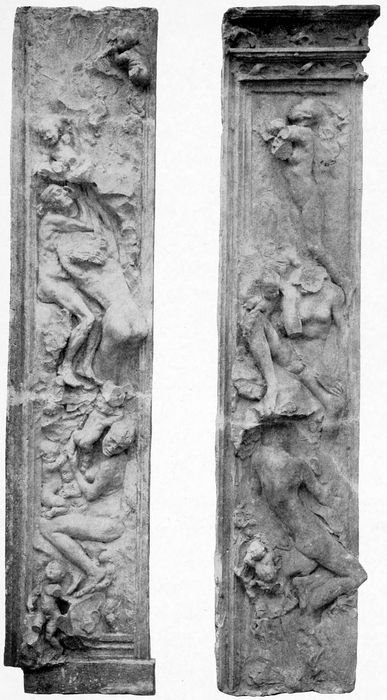
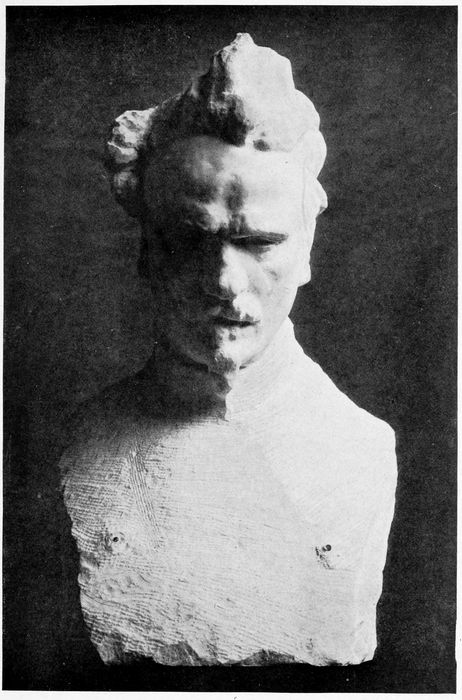
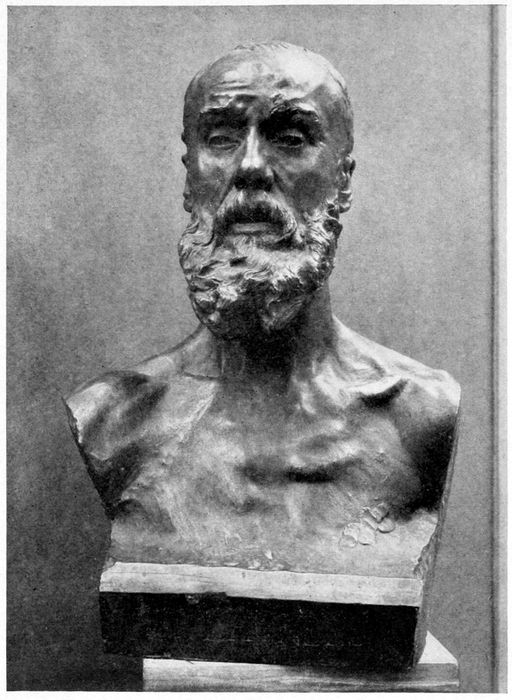
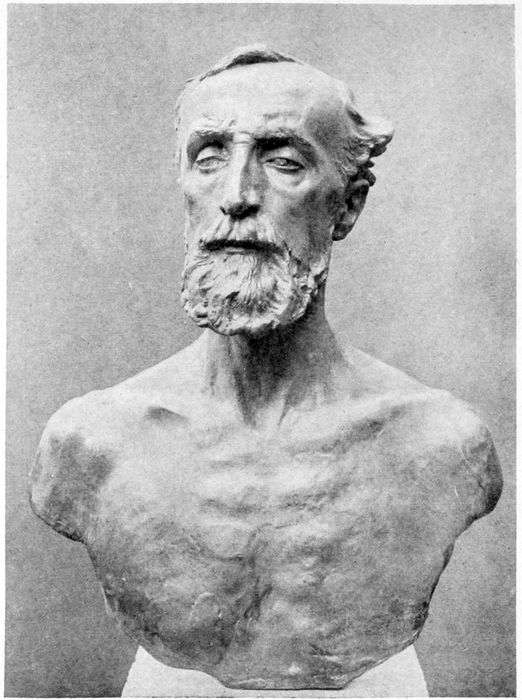
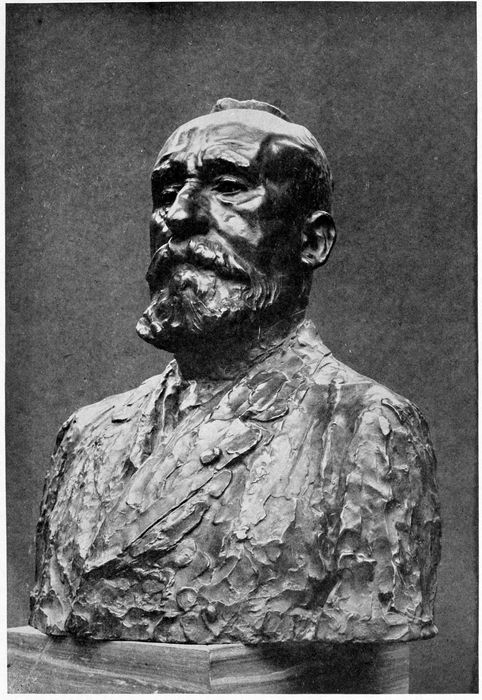
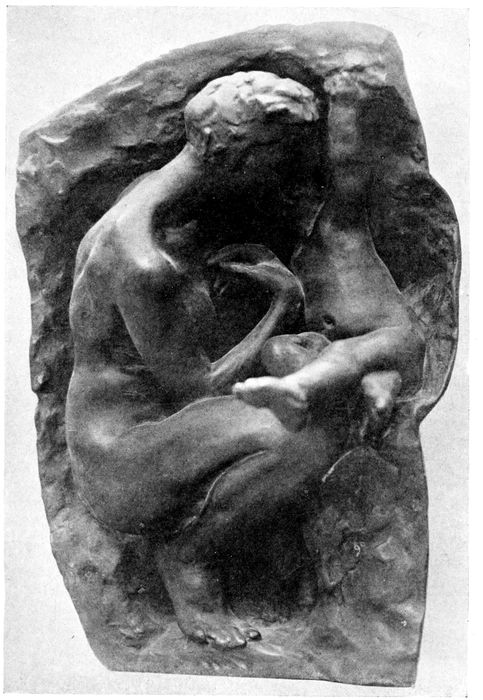
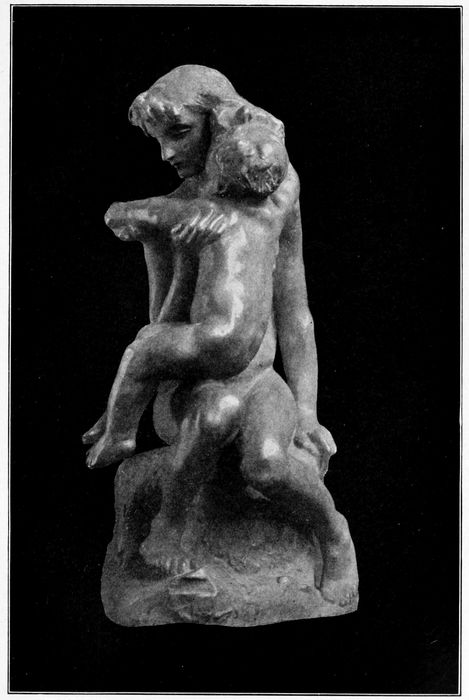
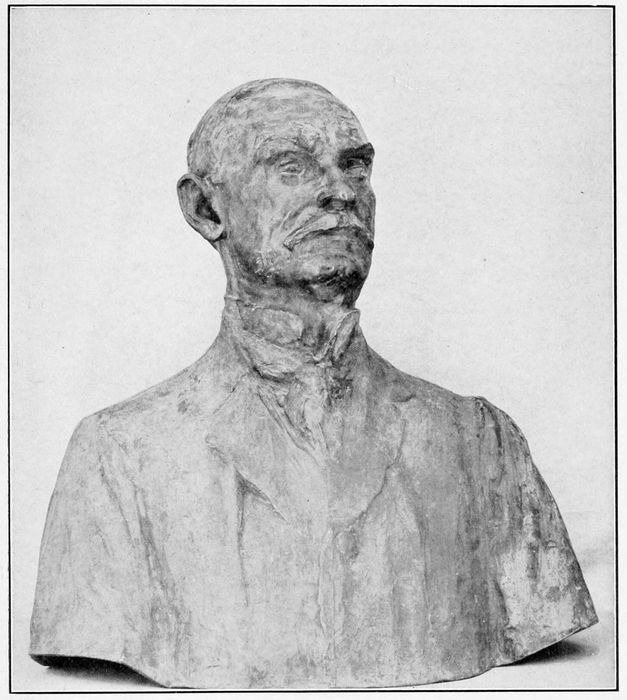
The cover image was created by the transcriber and is placed in the public domain.
ART
Copyright, 1912 by Small, Maynard and Company, Inc.
BY
AUGUSTE RODIN
TRANSLATED FROM THE FRENCH OF PAUL GSELL BY MRS. ROMILLY FEDDEN
WITH 106 ILLUSTRATIONS IN HALF-TONE AND PHOTOGRAVURE
BOSTON
SMALL, MAYNARD & COMPANY
PUBLISHERS
Copyright, 1912
By Small, Maynard & Company
(INCORPORATED)
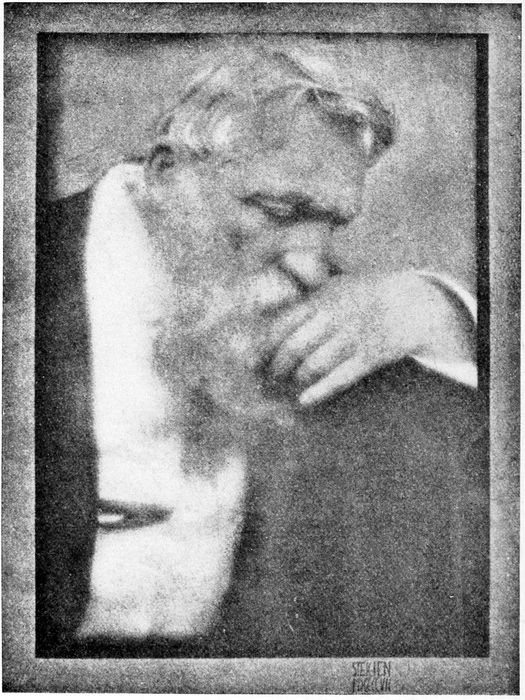
Auguste Rodin
From a photograph by Edouard J. Steichen, 1907
PREFACE
5
Not far from Paris, on the Seine, near Meudon,
is a hamlet bearing the delightful name
of Val-Fleury. Crowning the little hill above this
village rises a group of buildings which in their
charm and originality at once attract interest. You
might almost guess that they belonged to an artist,
and it is there, in fact, that Auguste Rodin has
made his home.
Approaching, you find that the main buildings
are three. The first, a Louis XIII. pavilion of red
brick and freestone with a high-gabled roof, serves
as his dwelling. Close by stands a great rotunda,
entered through a columned portico, which is
the one that in 1900 sheltered the special exhibition
of Rodin’s work at the angle of the Pont de
l’Alma in Paris; as it pleased him, he had it reerected
6upon this new site and uses it as his atelier.
A little further on at the edge of the hill, which
here falls steeply away, you see an eighteenth-century
château—or rather only a façade—whose
fine portal, under a triangular pediment, frames a
wrought-iron gate; of this, more later.
This group, so diverse in character, is set in the
midst of an idyllic orchard. The spot is certainly
one of the most enchanting in the environs of
Paris. Nature has done much for it, and the sculptor
who settled here has beautified it with all the
embellishments that his taste could suggest.
Last year, at the close of a beautiful day in
May, as I walked with Auguste Rodin beneath the
trees that shade his charming hill, I confided to
him my wish to write, from his dictation, his ideas
upon Art.
“You are an odd fellow,” he said. “So you
are still interested in Art! It is an interest that
is out-of-date.
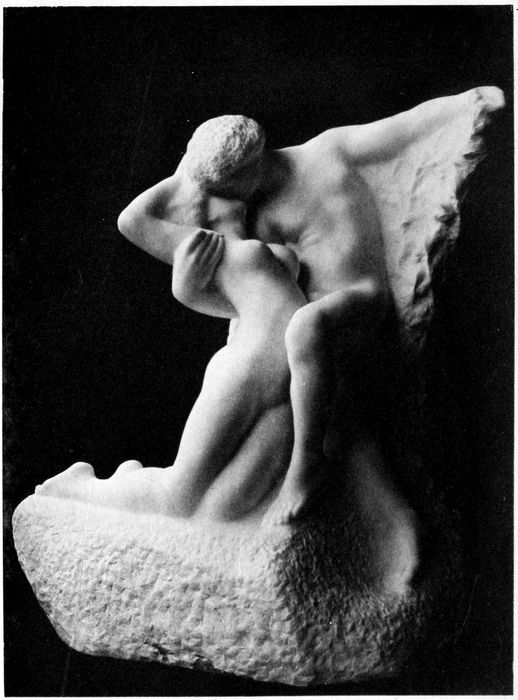
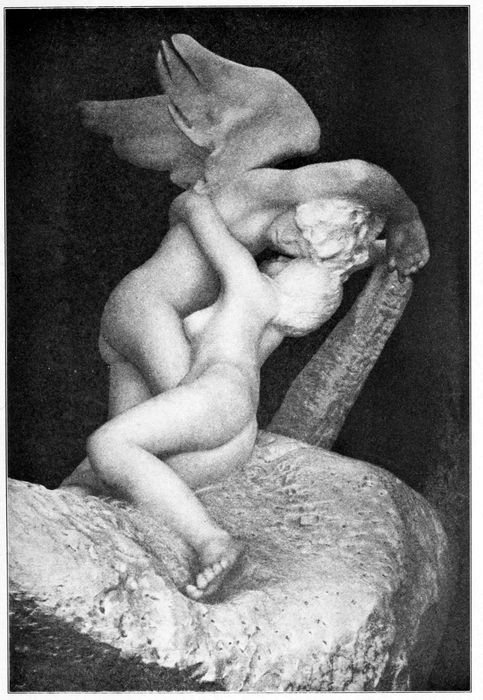
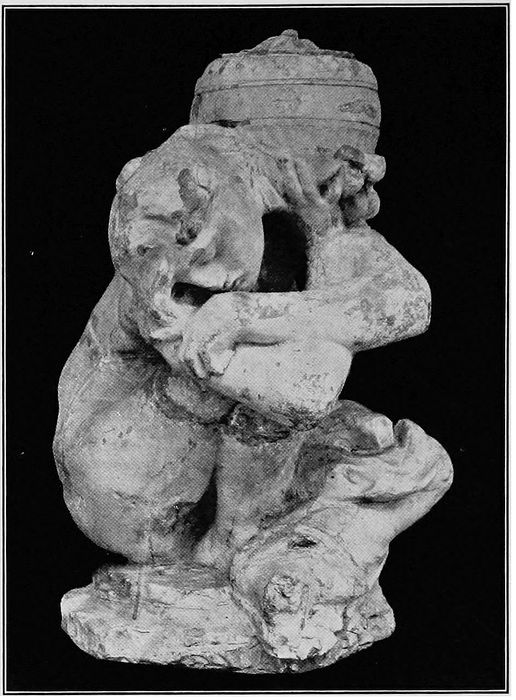
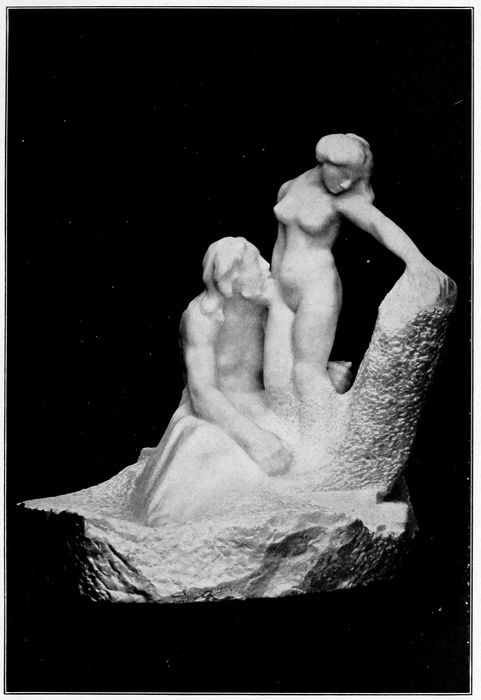
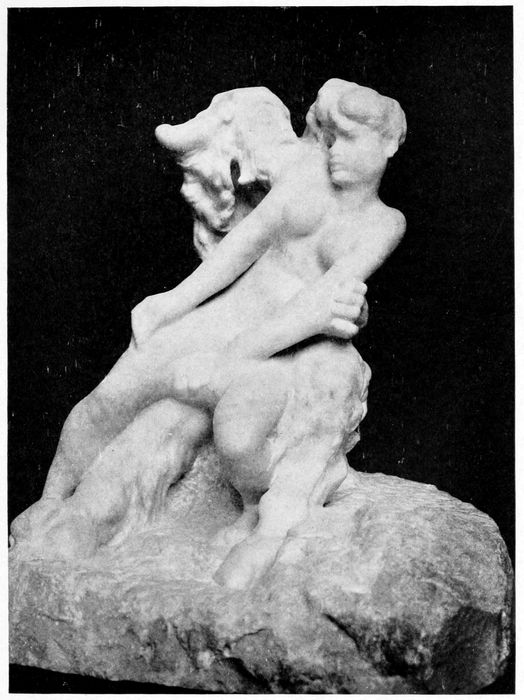
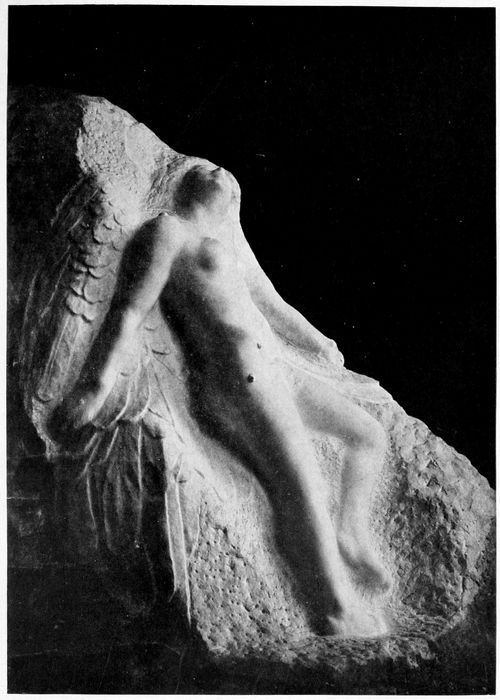
The Flight of Love
By Rodin
Photograph reproduced by permission of the Boston Museum of Fine Arts
7“To-day, artists and those who love artists seem
like fossils. Imagine a megatherium or a diplodocus
stalking the streets of Paris! There you have
the impression that we must make upon our contemporaries.
Ours is an epoch of engineers and
of manufacturers, not one of artists.
“The search in modern life is for utility; the
endeavor is to improve existence materially. Every
day, science invents new processes for the feeding,
clothing, or transportation of man; she manufactures
cheaply inferior products in order to give
adulterated luxuries to the greatest number—though
it is true that she has also made real improvements
in all that ministers to our daily wants.
But it is no longer a question of spirit, of thought,
of dreams. Art is dead.
“Art is contemplation. It is the pleasure of the
mind which searches into nature and which there
divines the spirit by which Nature herself is animated.
It is the joy of the intellect which sees
clearly into the Universe and which recreates it,
with conscientious vision. Art is the most sublime
8mission of man, since it is the expression of thought
seeking to understand the world and to make it
understood.
“But to-day, mankind believes itself able to do
without Art. It does not wish to meditate, to contemplate,
to dream; it wishes to enjoy physically.
The heights and the depths of truth are indifferent
to it; it is content to satisfy its bodily appetites.
Mankind to-day is brutish—it is not the
stuff of which artists are made.
“Art, moreover, is taste. It is the reflection of
the artist’s heart upon all the objects that he creates.
It is the smile of the human soul upon the
house and upon the furnishing. It is the charm
of thought and of sentiment embodied in all that
is of use to man. But how many of our contemporaries
feel the necessity of taste in house or
furnishing? Formerly, in old France, Art was
everywhere. The smallest bourgeois, even the peasant,
made use only of articles which pleased the
eye. Their chairs, their tables, their pitchers and
their pots were beautiful. To-day Art is banished
from daily life. People say that the useful need
not be beautiful. All is ugly, all is made in haste
and without grace by stupid machines. The artist
is regarded as an antagonist. Ah, my dear Gsell,
you wish to jot down an artist’s musings. Let me
look at you! You really are an extraordinary
man!”
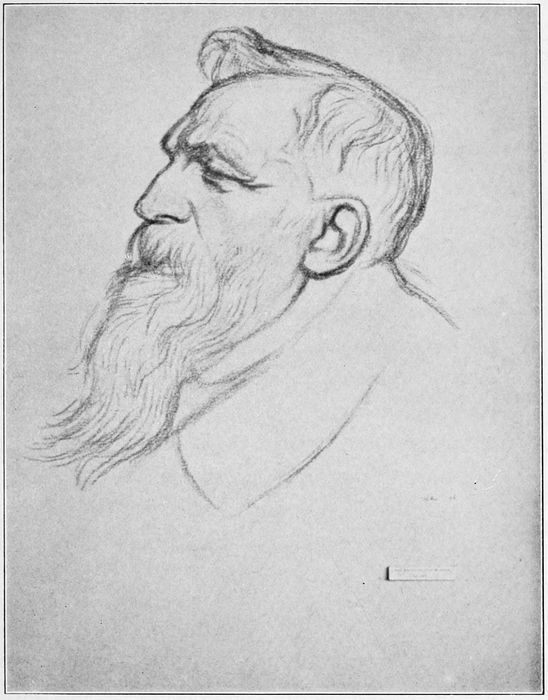
Auguste Rodin
From a drawing by William Rothenstein
Reproduced by permission of the Metropolitan Museum of Art
9“I know,” I said, “that Art is the least concern
of our epoch. But I trust that this book may
be a protest against the ideas of to-day. I trust
that your voice may awaken our contemporaries
and help them to understand the crime they commit
in losing the best part of our national inheritance—an
intense love of Art and Beauty.”
“May the gods hear you!” Rodin answered.
We were walking along the rotunda which serves
as the atelier. There under the peristyle many
charming bits of antique sculpture have found
shelter. A little vestal, half-veiled, faces a grave
10orator wrapped in his toga, while not far from
them a cupid rides triumphant upon a great sea-monster.
In the midst of these figures two Corinthian
columns of charming grace raise their shafts
of rose-colored marble. The collection here of
these precious fragments shows the devotion of my
host to the art of Greece and Rome.
Two swans were drowsing upon the bank of a
deep pool. As we passed they unwound their long
necks and hissed with anger. Their savageness
prompted me to the remark that this bird lacks
intelligence, but Rodin replied, laughing:
“They have that of line, and that is enough!”
As we strolled on, small cylindrical altars in
marble, carved with garlands, appeared here and
there in the shade. Beneath a bower, clothed with
the luxuriant green of a sophora, a young Mithra
without a head sacrificed a sacred bull. At a
green crossway an Eros slept upon his lion-skin,
sleep having overcome him who tames the beasts.
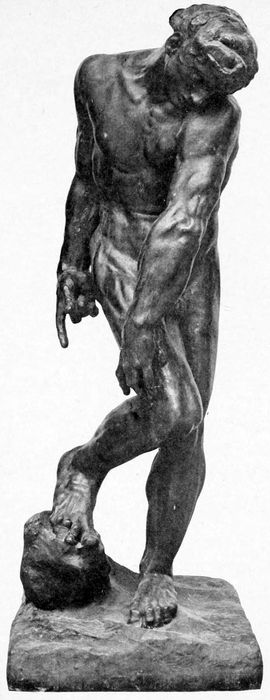
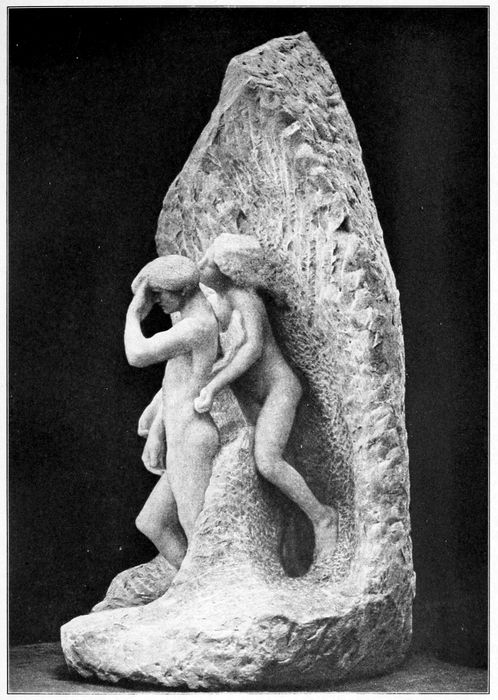
The Creation of Man, or Adam
By Rodin
Photograph reproduced by permission of the Metropolitan Museum of Art
11“Does it not seem to you,” Rodin asked, “that
verdure is the most appropriate setting for antique
sculpture? This little drowsy Eros—would you
not say that he is the god of the garden? His
dimpled flesh is brother to this transparent and
luxuriant foliage. The Greek artists loved nature
so well that their works bathe in it as in their
element.”
Let us notice this attitude of mind. We place
statues in a garden to beautify the garden. Rodin
places them there that they may be beautified by
the garden. For him, Nature is always the sovereign
mistress and the infinite perfection.
A Greek amphora, in rose-colored clay, which in
all probability had lain for centuries under the
sea, so encrusted is it with charming sea-growths,
lies upon the ground at the foot of a box-tree.
It seems to have been forgotten there, and yet it
could not have been presented to our eyes with
more grace—for what is natural is the supreme
of taste.
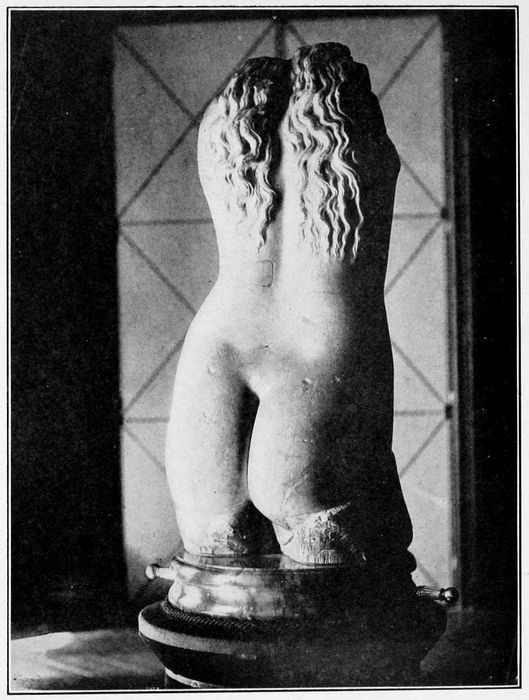
Further on we see a torso of Venus. The
12breasts are hidden by a handkerchief knotted behind
the back. Involuntarily one thinks of some
Tartuffe who, prompted by false modesty, has
felt it his duty to conceal these charms.
“Par de pareils objêts les âmes sont blessées
Et cela fait venir de coupables pensées.”
But surely my host has nothing in common with
Molière’s prude. He himself explained his reason.
“I tied that around the breast of this statue,”
he said, “because that part is less beautiful than
the rest.”
Then, through a door which he unbolted, he led
me on to the terrace where he has raised the eighteenth-century
façade of which I have spoken.
Seen close to, this noble fragment of architecture
is imposing. It is a fine portal raised upon
eight steps. On the pediment, which is supported
by columns, Themis surrounded by Loves is carved.
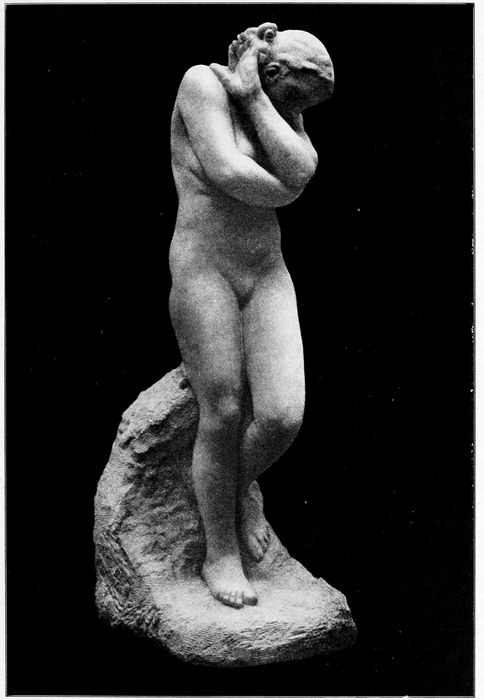
EVE
By Rodin
13“Formerly,” said my host, “this beautiful
château rose on the slope of a neighboring hill at
Issy. I often admired it as I passed. But the
land speculators bought it and tore it down.” As
he spoke his eyes flashed with anger. “You cannot
imagine,” he continued, “what horror seized
me when I saw this crime committed. To tear
down this glorious building! It affected me as
much as though these criminals had mangled the
fair body of a virgin before my eyes!”
Rodin spoke these words in a tone of deep
devotion. You felt that the firm white body of
the young girl was to him the masterpiece of
creation, the marvel of marvels!
He continued:
“I asked the sacrilegious rascals not to scatter
the materials and to sell them to me. They consented.
I had all the stones brought here to put
them together again as well as I could. Unfortunately,
as you see, I have as yet raised only one
wall.”
In fact, in his impatience to enjoy this keen
artistic pleasure, Rodin has not followed the usual
14and logical method which consists in raising all
parts of a building at once. Up to the present
time he has rebuilt only one side of the château,
and when you approach to look through the iron
entrance gate, you see only broken ground where
lines of stones indicate the plan of the building to
be. Truly a château of dreams! An artist’s château!
“Verily,” murmured my host, “those old architects
were great men, especially when one compares
them with their unworthy successors of
to-day!”
So speaking, he drew me to a point on the terrace
from which the outline of the façade seemed
to him most beautiful.
“See,” he cried, “how harmoniously the silhouette
cuts the silvery sky, and how it dominates
the valley which lies below us.”
Lost in ecstasy, his loving gaze enveloped this
monument of a day that is past and all the landscape.
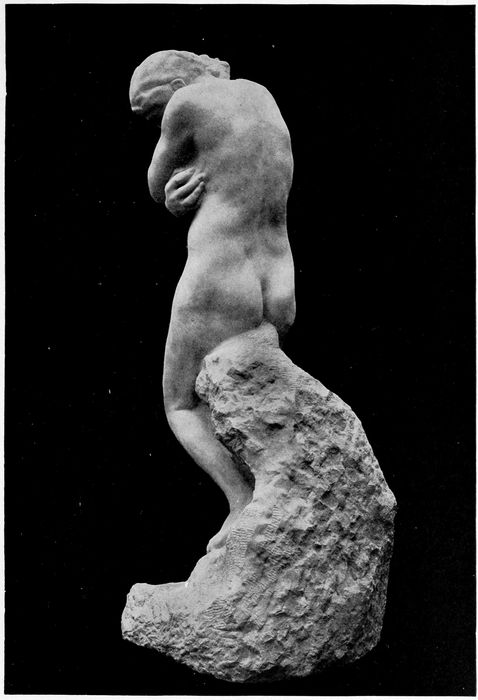
Eve
By Rodin
15From the height on which we stood our eyes
took in an immense expanse. There, below, the
Seine, mirroring long lines of tall poplars, traces
a great loop of silver as it rushes towards the solid
bridge at Sèvres.... Still further, the white
spire of Saint-Cloud against a green hillside, the
blue heights of Suresnes and Mont Valerian seem
powdered with a mist of dreams.
To the right, Paris, gigantic Paris, spreads away
to the horizon her great seed plot, sown with innumerable
houses, so small in the distance that
one might hold them in the palm of one’s hand.
Paris, vision at once monstrous and sublime, colossal
crucible wherein bubbles unceasingly that strange
mixture of pains and pleasures, of active forces and
of fevered ideals!
At the end of the long rue de l’Université,
close to the Champ-de-Mars, in a corner, so
deserted and monastic that you might think yourself
in the provinces, is the Dépôt des Marbres.
Here in a great grass-grown court sleep heavy
grayish blocks, presenting in places fresh breaks
of frosted whiteness. These are the marbles reserved
by the State for the sculptors whom she
honors with her orders.
Along one side of this courtyard is a row of a
dozen ateliers which have been granted to different
sculptors. A little artist city, marvellously tranquil,
it seems the fraternity house of a new order.
Rodin occupies two of these cells; in one he houses
the plaster cast of his Gate of Hell, astonishing
26even in its unfinished state, and in the other he
works.
More than once I have been to see him here
towards evening, when his day of toil drew to its
close, and taking a chair, I have waited for the
moment when the night would oblige him to stop,
and I have studied him at his work. The desire
to profit by the last rays of daylight threw him
into a fever.
I see him now, rapidly shaping his little figures
from the clay. It is a game which he enjoys in
the intervals of the more patient care which he
gives to his big figures. These sketches flung off
on the instant delight him, because they permit him
to seize the fleeting beauty of a gesture whose fugitive
truth would escape deeper and longer study.
His method of work is singular. In his atelier
several nude models walk about or rest.
Plaster Casts of The Gate of Hell
By Rodin
27Rodin pays them to furnish him constantly with
the sight of the nude moving with all the freedom
of life. He observes them without ceasing, and it
is thus that he has long since become familiar
with the sight of muscles in movement. The nude,
which for us moderns is an exceptional revelation
and which even for the sculptors is generally only
an apparition whose length is limited to a sitting,
has become to Rodin a customary sight. The constant
familiarity with the human body which the
ancient Greeks acquired in watching the games—the
wrestling, the throwing of the discus, the boxing,
the gymnastics, and the foot races—and
which permitted their artists to talk naturally on
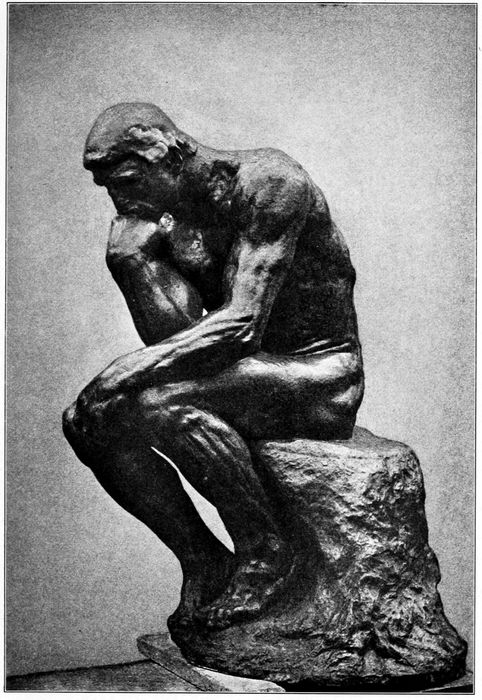
the subject of the nude, the creator of the Penseur
has made sure of by the continual presence of unclothed
human beings who come and go before his
eyes. In this way he has learned to read the feelings
as expressed in every part of the body. The
face is generally considered as the only mirror of
the soul; the mobility of the features of the face
seems to us the only exterior expression of the
spiritual life. In reality there is not a muscle of
the body which does not express the inner variations
28of feeling. All speak of joy or of sorrow,
of enthusiasm or of despair, of serenity or of madness.
Outstretched arms, an unconstrained body,
smile with as much sweetness as the eyes or the
lips. But to be able to interpret every aspect of
the flesh, one must have been drawn patiently to
spell out and to read the pages of this beautiful
book. The masters of the antique did this, aided
by the customs of their civilization. Rodin does
this in our own day by the force of his own will.
He follows his models with his earnest gaze, he
silently savors the beauty of the life which plays
through them, he admires the suppleness of this
young woman who bends to pick up a chisel, the
delicate grace of this other who raises her arms to
gather her golden hair above her head, the nervous
vigor of a man who walks across the room; and
when this one or that makes a movement that
pleases him, he instantly asks that the pose be
kept. Quick, he seizes the clay, and a little
figure is under way; then with equal haste he
passes to another, which he fashions in the same
manner.
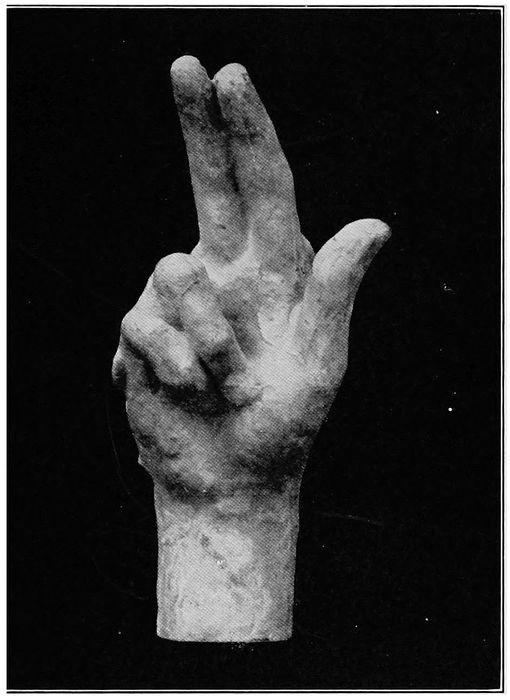
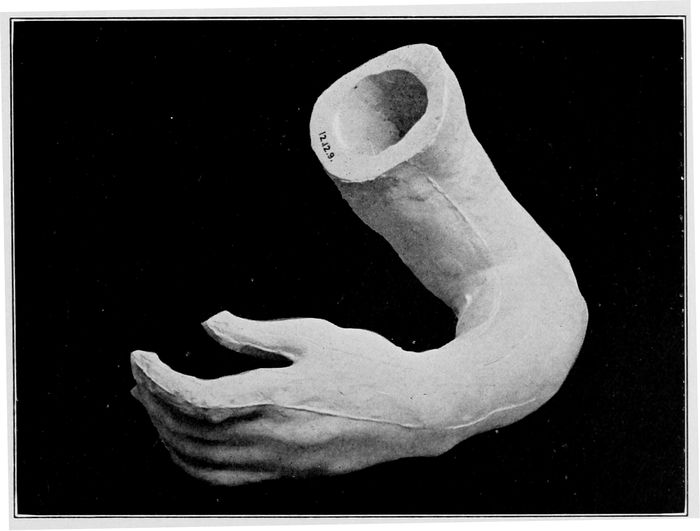
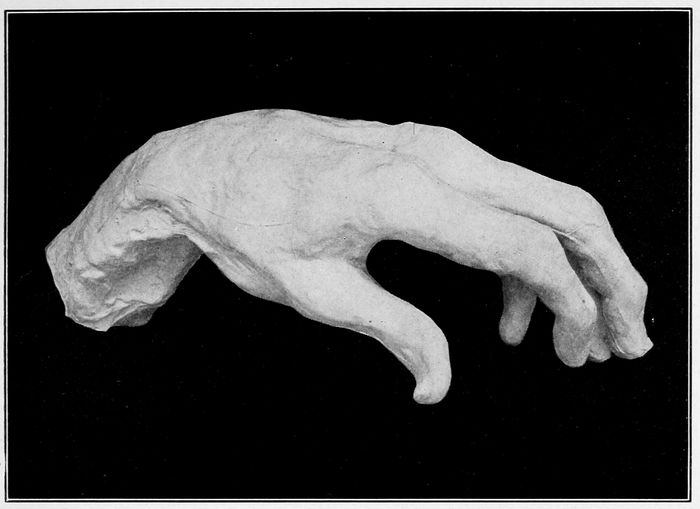
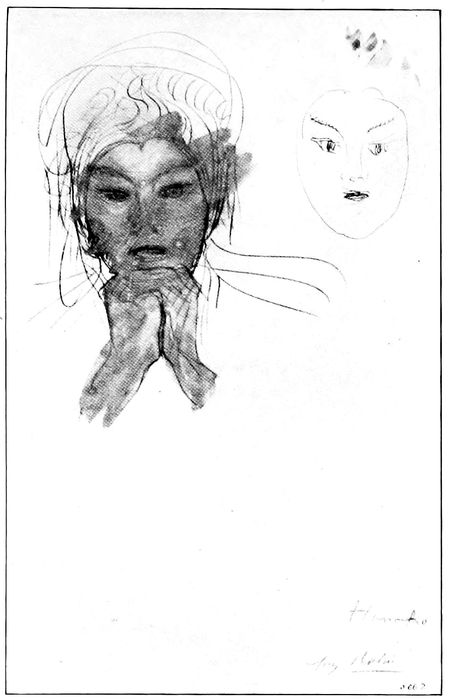
Study for a Hand
By Rodin
Photograph reproduced by permission of the Metropolitan Museum of Art
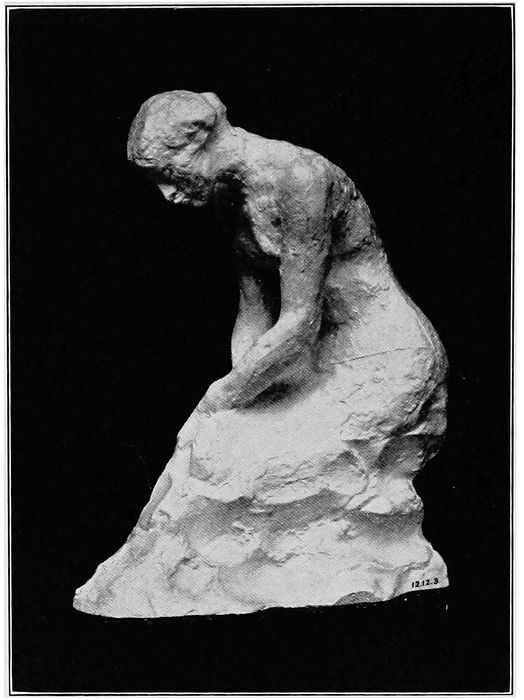
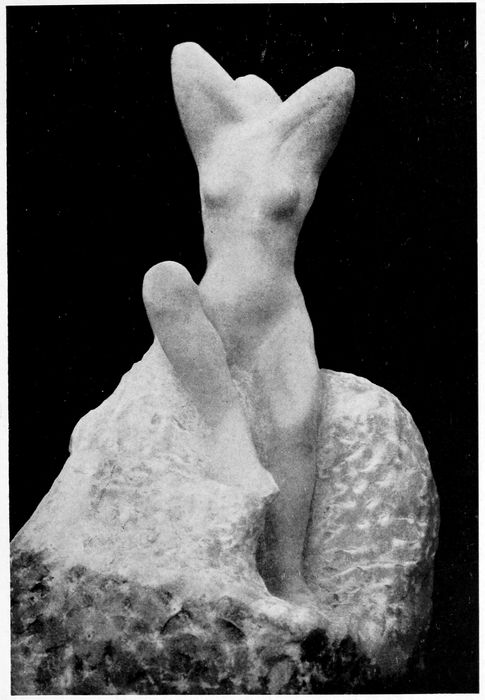
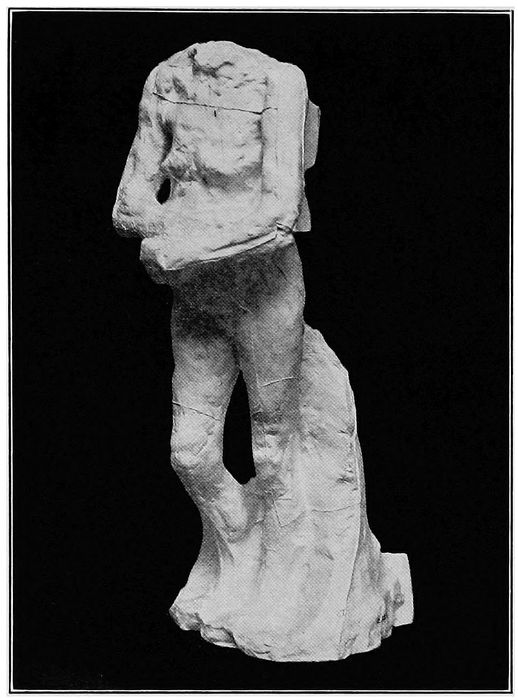
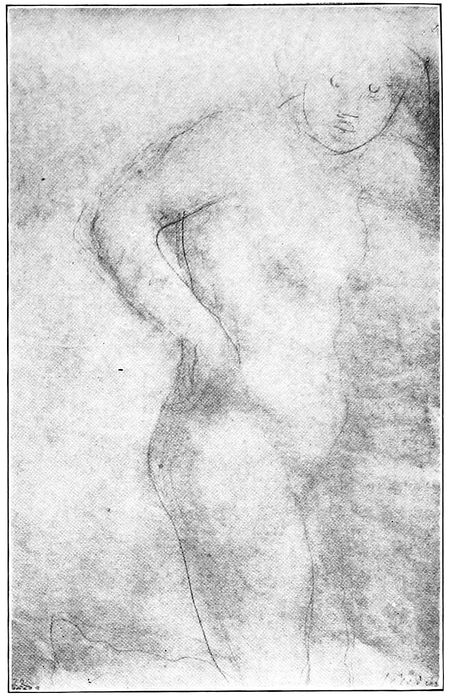
Study for a Figure
By Rodin
Photograph reproduced by permission of the Metropolitan Museum of Art
29One evening when the night had begun to darken
the atelier with heavy shadows, I had a talk with
the master on his method.
“What astonishes me in you,” said I, “is that
you work quite differently from your confrères.
I know many of them and have seen them at work.
They make the model mount upon a pedestal called
the throne, and they tell him to take such or such
a pose. Generally they bend or stretch his arms
and legs to suit them, they bow his head or
straighten his body exactly as though he were a
lay figure. Then they set to work. You, on the
contrary, wait till your models take an interesting
attitude, and then you reproduce it. So much so
that it is you who seem to be at their orders rather
than they at yours.”
Rodin, who was engaged in wrapping his figurines
in damp cloths, answered quietly:
“I am not at their orders, but at those of
30Nature! My confrères doubtless have their reasons
for working as you have said. But in thus
doing violence to nature and treating human beings
like puppets, they run the risk of producing lifeless
and artificial work.
“As for me, seeker after truth and student of
life as I am, I shall take care not to follow their
example. I take from life the movements I observe,
but it is not I who impose them.
“Even when a subject which I am working on
compels me to ask a model for a certain fixed
pose, I indicate it to him, but I carefully avoid
touching him to place him in the position, for I
will reproduce only what reality spontaneously
offers me.
“I obey Nature in everything, and I never pretend
to command her. My only ambition is to be
servilely faithful to her.”
“Nevertheless,” I answered with some malice,
“it is not nature exactly as it is that you evoke in
your work.”
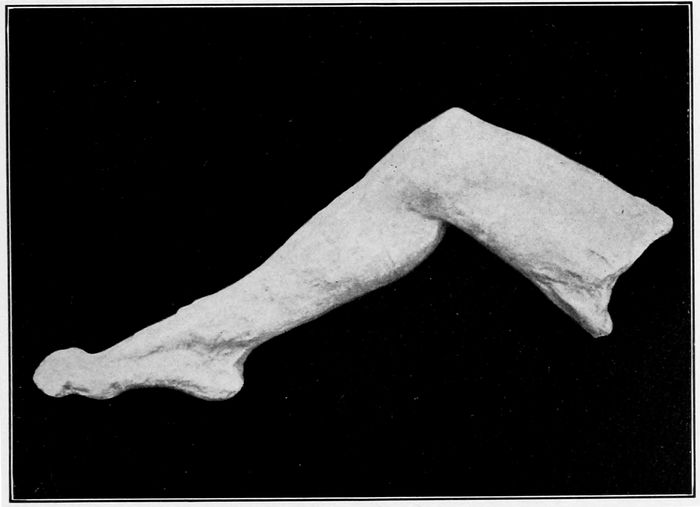
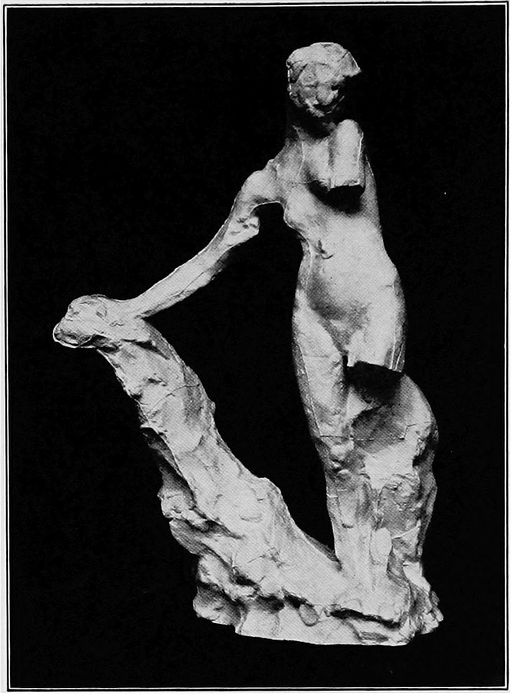
Study
By Rodin
Photograph reproduced by permission of the Metropolitan Museum of Art
Study
By Rodin
Photograph reproduced by permission of the Metropolitan Museum of Art
31He stopped short, the damp cloth in his hands.
“Yes, exactly as it is!” he replied, frowning.
“You are obliged to alter—”
“Not a jot!”
“But, after all, the proof that you do change it
is this, that the cast would give not at all the same
impression as your work.”
He reflected an instant and said: “That is so!
Because the cast is less true than my sculpture!
“It would be impossible for any model to keep
an animated pose during all the time that it
would take to make a cast from it. But I
keep in my mind the ensemble of the pose and I
insist that the model shall conform to my memory
of it. More than that,—the cast only reproduces
the exterior; I reproduce, besides that, the spirit
which is certainly also a part of nature.
“I see all the truth, and not only that of the
outside.
“I accentuate the lines which best express the
spiritual state that I interpret.”
32As he spoke he showed me on a pedestal near
by one of his most beautiful statues, a young man
kneeling, raising suppliant arms to heaven. All
his being is drawn out with anguish. His body is
thrown backwards. The breast heaves, the throat
is tense with despair, and the hands are thrown
out towards some mysterious being to which they
long to cling.
“Look!” he said to me; “I have accented the
swelling of the muscles which express distress.
Here, here, there—I have exaggerated the straining
of the tendons which indicate the outburst of
prayer.”
And, with a gesture, he underlined the most
vigorous parts of his work.
“I have you, Master!” I cried ironically; “you
say yourself that you have accented, accentuated,
exaggerated. You see, then, that you have changed
nature.”
He began to laugh at my obstinacy.
Invocation
By Rodin
33“No,” he replied. “I have not changed it. Or,
rather, if I have done it, it was without suspecting
it at the time. The feeling which influenced my
vision showed me Nature as I have copied her.
“If I had wished to modify what I saw and to
make it more beautiful, I should have produced
nothing good.”
An instant later he continued:
“I grant you that the artist does not see
Nature as she appears to the vulgar, because his
emotion reveals to him the hidden truths beneath
appearances.
“But, after all, the only principle in Art is to
copy what you see. Dealers in æsthetics to the
contrary, every other method is fatal. There is no
recipe for improving nature.
“The only thing is to see.
“Oh, doubtless a mediocre man copying nature
will never produce a work of art; because he
really looks without seeing, and though he may
have noted each detail minutely, the result will be
flat and without character. But the profession of
34artist is not meant for the mediocre, and to them
the best counsels will never succeed in giving
talent.
“The artist, on the contrary, sees; that is to
say, that his eye, grafted on his heart, reads deeply
into the bosom of Nature.
“That is why the artist has only to trust to his
eyes.”
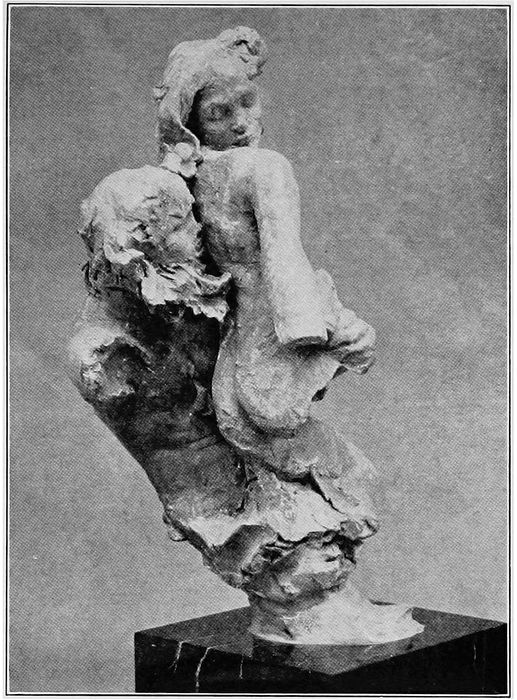
Study
By Rodin
Photograph reproduced by permission of the Metropolitan Museum of Art
Study
By Rodin
Photograph reproduced by permission of the Metropolitan Museum of Art
CHAPTER II TO THE ARTIST ALL IN NATURE IS BEAUTIFUL
37
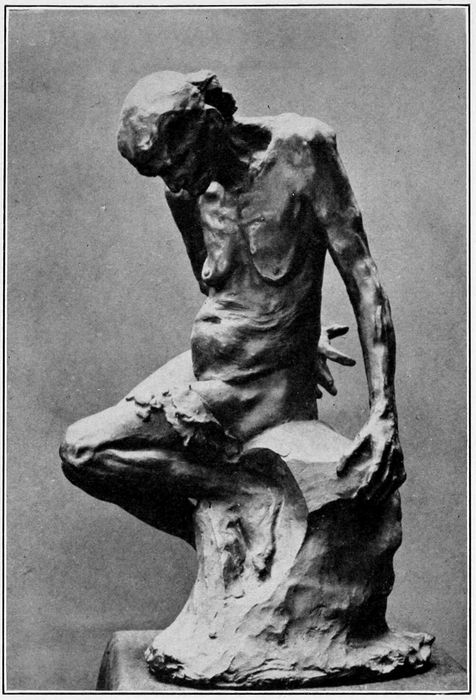
In Rodin’s great atelier at Meudon stands a cast
of that statuette, so magnificently ugly, which
the great sculptor wrought upon the text of
Villon’s poem, La Belle Heaulmière.
The courtesan, once radiant with youth and
grace, is now repulsive with age and decrepitude.
Once proud of her beauty, she is now filled with
shame at her ugliness.
38The sculptor has followed the poet step by step.
The old hag, more shrivelled than a mummy,
mourns her physical decay. Bent double, crouching
on her haunches, she gazes despairingly upon
her breasts so pitiably shrunken, upon her hideously
wrinkled body, upon her arms and legs more
knotty than vine stocks.
“Quand je pense, las! au bon temps,
Quelle fus, quelle devenue,
Quand me regarde toute nue
Et je me vois si très changée.
Pauvre, sêche, maigre, menue,
Je suis presque tout enragée!
Qu’est devenue ce front poli,
Ces cheveux blonds....
Ces gentes épaules menues,
Petite tetins, hanches charnues,
Elevées, propres, faictisse (faites à souhait)
A tenir d’amoureuses lices;
C’est d’humaine beauté l’issue!
Les bras courts et les mains contraictes (contractées),
39The sculptor does not fall below the poet in
realism. On the contrary, his work, in the horror
which it inspires, is perhaps even more impressive
than the truculent verses of Maître Villon. The
skin hangs in flaccid folds upon the skeleton; the
ribs stand out beneath the parchment that covers
them, and the whole figure seems to totter, to
tremble, to shrivel, to shrink away.
Yet from this spectacle, at once grotesque and
heartrending, a great sorrow breathes.
For what we have before us is the infinite distress
of a poor foolish soul which, enamoured of
eternal youth and beauty, looks on helpless at the
ignominious disgrace of its fleshly envelope; it is
40the antithesis of the spiritual being which demands
endless joy and of the body which wastes away,
decays, ends in nothingness. The substance perishes,
the flesh dies, but dreams and desires are immortal.
This is what Rodin has wished to make us
understand.
And I do not think that any other artist has
ever pictured old age with such savage crudity,
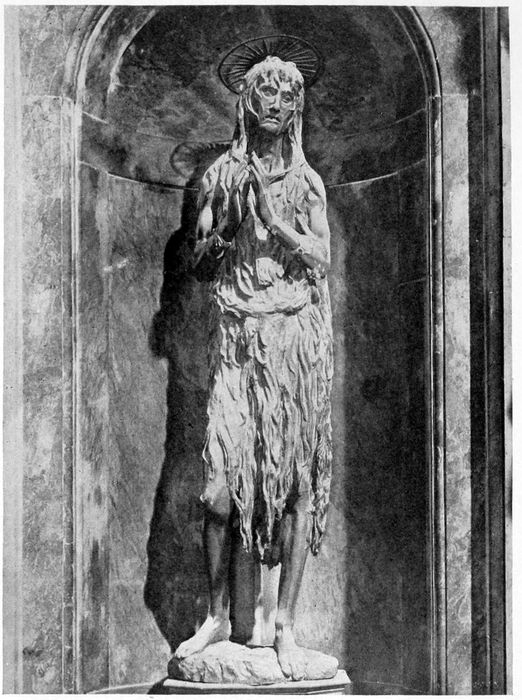
except one. In the Baptistery at Florence you
see upon an altar a strange statue by Donatello—an
old woman naked, or at least draped only in the
long, thin hair which clings foully to her ruined
body. It is Saint Magdalene in the desert, bowed
with age, offering to God the cruel mortifications
to which she subjects her body as a punishment
for the care which she formerly lavished upon it.
The savage sincerity of the Florentine master is
so great that it is not even surpassed by Rodin
himself. But, aside from this, the sentiment of the
two works differs completely, for, while Saint Magdalene
in her voluntary renunciation seems to grow
more radiant as she sees herself growing more repulsive,
the old Heaulmière is terrified at finding
herself like a very corpse.
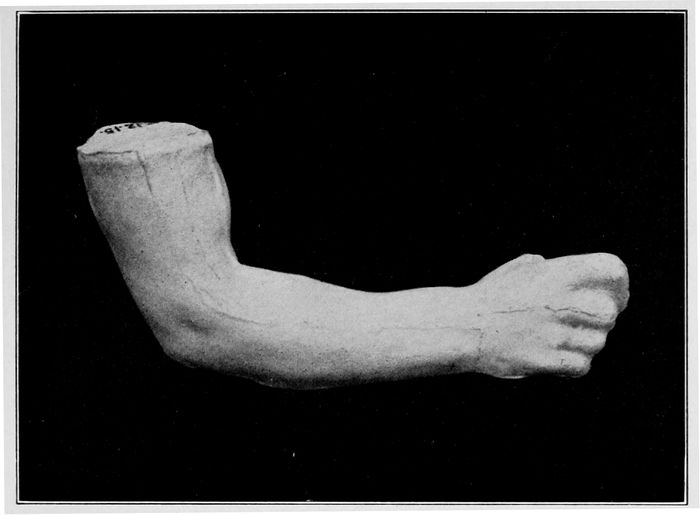
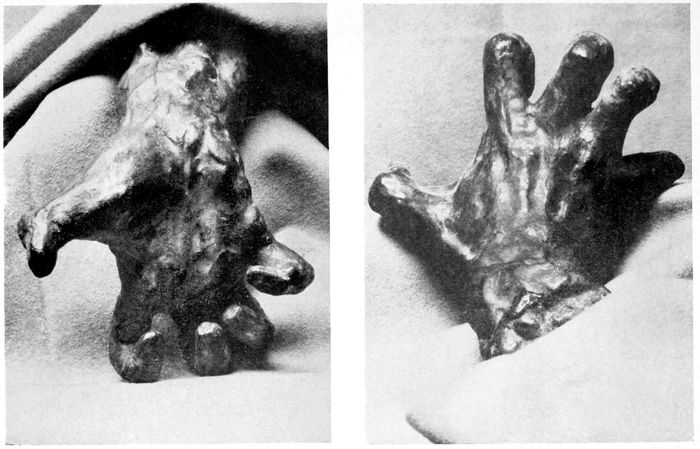
A Hand in Bronze
By Rodin
41The modern sculpture is, therefore, much more
tragic than the older work.
One day, having studied this figure in the atelier
for some moments in silence, I said:
“Master, no one admires this astonishing figure
more than I, but I hope you will not be annoyed
if I tell you the effect it produces upon many of
the visitors to the Musée du Luxembourg, especially
upon the women.”
“I shall be much obliged to you if you will.”
“Well, the public generally turn away from it,
crying, ‘Oh, how ugly it is!’ and I have often seen
women cover their eyes with their hands to shut
out the sight.”
Rodin laughed heartily.
“My work must be eloquent,” he said, “to make
such a vivid impression, and doubtless these are
people who dread stern philosophic truths.
42“But what solely matters to me is the opinion of
people of taste, and I have been delighted to gain
their approbation for my Vieille Heaulmière. I
am like that Roman singer who replied to the jeers
of the populace: Equitibus cano. I sing only for
the nobles! that is to say, for the connoisseurs.
“The vulgar readily imagine that what they consider
ugly in existence is not fit subject for the
artist. They would like to forbid us to represent
what displeases and offends them in nature.
“It is a great error on their part.
“What is commonly called ugliness in nature
can in art become full of great beauty.
“In the domain of fact we call ugly whatever is
deformed, whatever is unhealthy, whatever suggests
the idea of disease, of debility, or of suffering,
whatever is contrary to regularity, which is the
sign and condition of health and strength: a
hunchback is ugly, one who is bandy-legged is
ugly, poverty in rags is ugly.
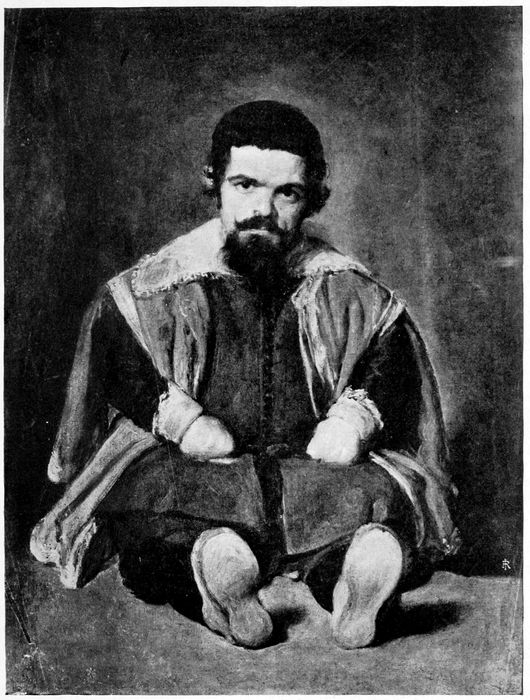
Sebastian, Fool of Philip IV
By Velasquez
43“Ugly also are the soul and the conduct of the
immoral man, of the vicious and criminal man, of
the abnormal man who is harmful to society; ugly
the soul of the parricide, of the traitor, of the
unscrupulously ambitious.
“And it is right that beings and objects from
which we can expect only evil should be called by
such an odious epithet. But let a great artist or a
great writer make use of one or the other of these
uglinesses, instantly it is transfigured: with a touch
of his fairy wand he has turned it into beauty; it
is alchemy; it is enchantment!
“Let Velasquez paint Sebastian, the dwarf of
Philippe IV. He endows him with such a touching
gaze that we instantly read in it all the painful
secret of this poor afflicted creature, forced, for
his livelihood, to lower his human dignity, to become
a plaything, a living bauble. And the more
poignant the martyrdom of the conscience lodged
in this grotesque body, the more beautiful is the
artist’s work.
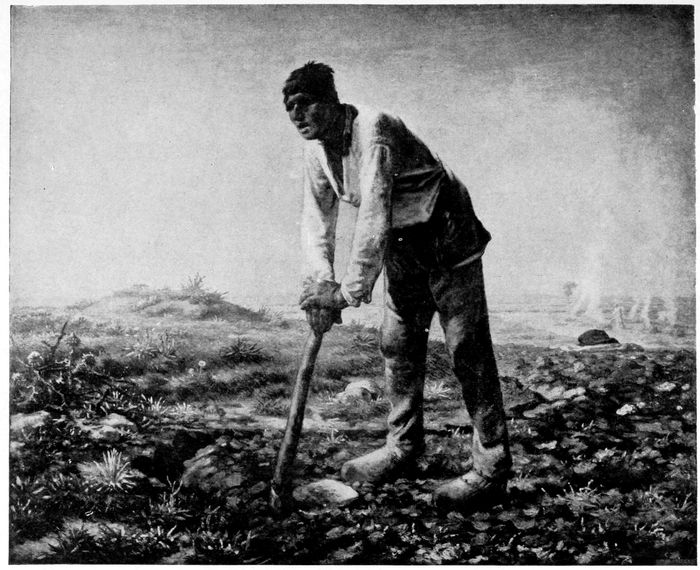
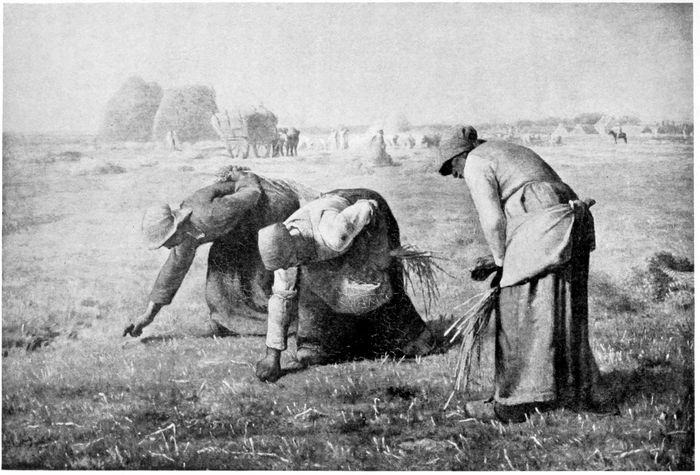
“Let François Millet represent a peasant resting
44for a moment as he leans on the handle of his
hoe, a wretched man worn by fatigue, baked by
the sun, as stupid as a beast of burden dulled by
blows—he has only to put into the expression of
this poor devil a sublime resignation to the suffering
ordained by Destiny, to make this creature of
a nightmare become for us the great symbol of all
Humanity.
“Let Beaudelaire describe a festering corpse,
unclean, viscid, eaten by worms, and let him but
imagine his beloved mistress under this frightful
aspect, and nothing can equal in splendor his picture
of this terrible juxtaposition of beauty which
we could wish eternal and the atrocious disintegration
which awaits it.
“Et pourtant vous serez semblable à cette ordure,
A cette horrible infection.
Etoile de mes yeux, Soleil de ma nature,
O mon ange et ma passion!
Oui, telle vous serez, o la reine des Grâces
Après les derniers sacrements.
Quand vous irez sous l’herbe et les floraisons grasses
45“It is the same when Shakespeare depicts Iago
or Richard III., when Racine paints Nero and
Narcissus; moral ugliness when interpreted by
minds so clear and penetrating becomes a marvellous
theme of beauty.
“In fact, in art, only that which has character is
beautiful.
“Character is the essential truth of any natural
object, whether ugly or beautiful; it is even what
one might call a double truth, for it is the inner
truth translated by the outer truth; it is the soul,
the feelings, the ideas, expressed by the features
of a face, by the gestures and actions of a human
46being, by the tones of a sky, by the lines of a
horizon.
“Now, to the great artist, everything in nature
has character; for the unswerving directness of his
observation searches out the hidden meaning of all
things. And that which is considered ugly in
nature often presents more character than that
which is termed beautiful, because in the contractions
of a sickly countenance, in the lines of a
vicious face, in all deformity, in all decay, the
inner truth shines forth more clearly than in features
that are regular and healthy.
“And as it is solely the power of character which
makes for beauty in art, it often happens that the
uglier a being is in nature, the more beautiful it
becomes in art.
“There is nothing ugly in art except that which
is without character, that is to say, that which
offers no outer or inner truth.
“Whatever is false, whatever is artificial, whatever
seeks to be pretty rather than expressive,
47whatever is capricious and affected, whatever smiles
without motive, bends or struts without cause, is
mannered without reason; all that is without soul
and without truth; all that is only a parade of
beauty and grace; all, in short, that lies, is ugliness
in art.
“When an artist, intending to improve upon
nature, adds green to the springtime, rose to the
sunrise, carmine to young lips, he creates ugliness
because he lies.
“When he softens the grimace of pain, the
shapelessness of age, the hideousness of perversion,
when he arranges nature—veiling, disguising, tempering
it to please the ignorant public—then he
is creating ugliness because he fears the truth.
“To any artist, worthy of the name, all in nature
is beautiful, because his eyes, fearlessly accepting
all exterior truth, read there, as in an open book,
all the inner truth.
“He has only to look into a human face in order
to read there the soul within—not a feature deceives
48him; hypocrisy is as transparent as sincerity—the
line of a forehead, the least lifting of a brow,
the flash of an eye, reveal to him all the secrets of
a heart.
“Or he may study the hidden mind of the animal.
A mixture of feelings and of thoughts, of
dumb intelligences and of rudimentary affections,
he reads the whole humble moral life of the beast
in its eyes and in its movements.
“He is even the confidant of nature. The trees,
the plants talk to him like friends. The old gnarled
oaks speak to him of their kindliness for the human
race whom they protect beneath their sheltering
branches. The flowers commune with him by the
gracious swaying of their stalks, by the singing
tones of their petals—each blossom amidst the
grass is a friendly word addressed to him by nature.
“For him life is an endless joy, a perpetual delight,
a mad intoxication. Not that all seems good
to him, for suffering, which must often come to
those he loves and to himself, cruelly contradicts his
49optimism. But all is beautiful to him because he
walks forever in the light of spiritual truth.
“Yes, the great artist, and by this I mean the
poet as well as the painter and the sculptor, finds
even in suffering, in the death of loved ones, in the
treachery of friends, something which fills him with
a voluptuous though tragic admiration.
“At times his own heart is on the rack, yet
stronger than his pain is the bitter joy which he
experiences in understanding and giving expression
to that pain. In all existence he clearly divines the
purposes of Destiny. Upon his own anguish, upon
his own gaping wounds, he fixes the enthusiastic
gaze of the man who has read the decrees of Fate.
Deceived by a beloved one, he reels beneath the
blow; then, standing firm, he looks upon the traitor
as a fine example of the base. He salutes ingratitude
as an experience which shall enrich his soul.
His ecstasy is terrifying at times, but it is still
happiness, because it is the continual adoration of
truth.
50“When he sees beings everywhere destroying
each other; when he sees all youth fading, all
strength failing, all genius dying, when he is face
to face with the will which decreed these tragic
laws, more than ever he rejoices in his knowledge,
and, seized anew by the passion for truth, he is
happy.”
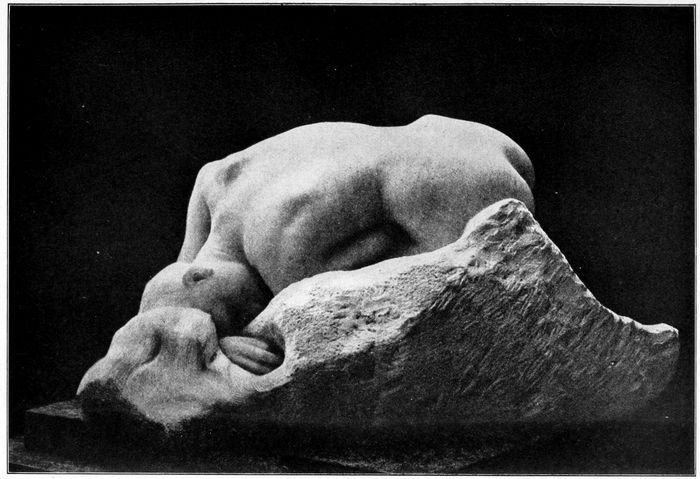
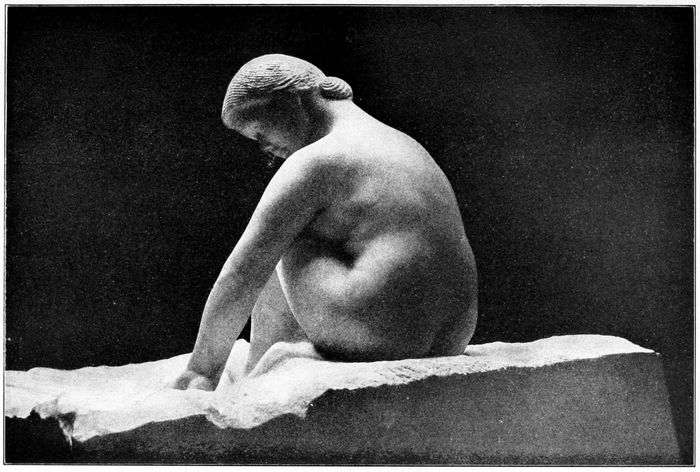
THE DANAÏD
By Rodin
CHAPTER III MODELLING
53
One late afternoon, when I was with Rodin
in his atelier, darkness set in while we
talked.
“Have you ever looked at an antique statue by
lamplight?” my host suddenly demanded.
“No, never,” I answered, with some surprise.
“I astonish you. You seem to consider the idea
of studying sculpture excepting by daylight as an
odd whim. Of course you can get the effect as a
whole better by daylight. But, wait a moment. I
want to show you a kind of experiment which will
doubtless prove instructive.”
He lighted a lamp as he spoke, took it in his
hand, and led me towards a marble statue which
54stood upon a pedestal in a corner of the
atelier.
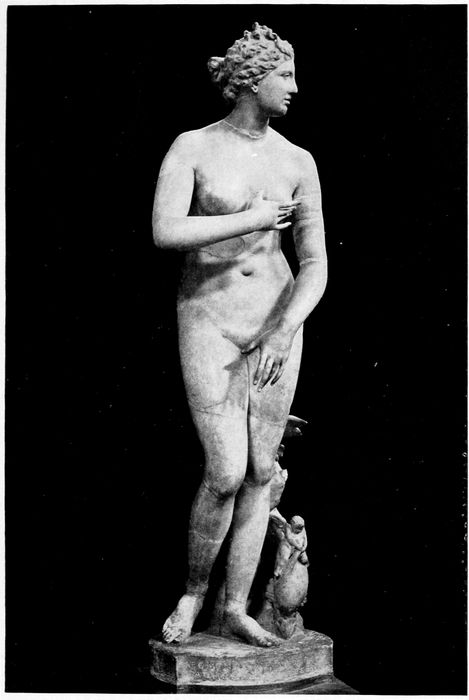
It was a delightful little antique copy of the
Venus di Medici. Rodin kept it there to stimulate
his own inspiration while he worked.
“Come nearer,” he said.
Holding the lamp at the side of the statue and
as close as possible, he threw the full light upon
the body.
“What do you notice?” he asked.
At the first glance I was extraordinarily struck
by what was suddenly revealed to me.
The light so directed, indeed, disclosed numbers
of slight projections and depressions upon the surface
of the marble which I should never have suspected.
I said so to Rodin.
“Good!” he cried approvingly; then, “Watch
closely.”
Venus di Medici
55At the same time he slowly turned the moving
stand which supported the Venus. As he turned,
I still noticed in the general form of the body
a multitude of almost imperceptible roughnesses.
What had at first seemed simple was really of astonishing
complexity. Rodin threw up his head
smiling.
“Is it not marvellous?” he cried. “Confess
that you did not expect to discover so much detail.
Just look at these numberless undulations of the
hollow which unites the body to the thigh. Notice
all the voluptuous curvings of the hip. And now,
here, the adorable dimples along the loins.”
He spoke in a low voice, with the ardor of
a devotee, bending above the marble as if he
loved it.
“It is truly flesh!” he said.
And beaming, he added: “You would think it
moulded by kisses and caresses!” Then, suddenly,
laying his hand on the statue, “You almost expect,
when you touch this body, to find it warm.”
A few moments later he said:
“Well, what do you think now of the opinion
usually held on Greek art? They say—it is especially
56the academic school which has spread abroad
this idea—that the ancients, in their cult of the
ideal, despised the flesh as low and vulgar, and that
they refused to reproduce in their works the thousand
details of material reality.
“They pretend that the ancients wished to teach
Nature by creating an abstract beauty of simplified
form which should appeal only to the intellect
and not consent to flatter the senses. And those
who talk like this take examples which they imagine
they find in antique art as their authority for correcting,
for emasculating nature, reducing it to
contours so dry, cold, and meagre that they have
nothing in common with the truth.
57“Without doubt the Greeks with their powerfully
logical minds instinctively accentuated the
essential. They accented the dominant traits of
the human type; nevertheless they never suppressed
living detail. They were satisfied to envelop
it and melt it into the whole. As they were enamoured
of calm rhythms, they involuntarily subjected
all secondary reliefs which should disturb the serenity
of a movement; but they carefully refrained
from entirely obliterating them.
“They never made a method out of falsehood.
“Full of respect and love for Nature, they always
represented her as they saw her. And on every
occasion they passionately testified their worship of
the flesh. For it is madness to believe that they
despised it. Among no other people has the beauty
of the human body excited a more sensuous tenderness.
A transport of ecstasy seems to hover over
all the forms that they modelled.
“Thus is explained the unbelievable difference
which separates the false academic ideal from Greek
art. While among the ancients the generalization
of lines is totalization, a result made up of all the
details, the academic simplification is an impoverishment,
an empty bombastry. While life animates
and warms the palpitating muscles of the Greek
58statues, the inconsistent dolls of academic art look
as if they were chilled by death.”
He was silent for a time, then—
“I will tell you a great secret. Do you know
how the impression of actual life, which we have
just felt before that Venus, is produced?
“By the science of modelling.
“These words seem banal to you, but you will
soon gauge their importance.
“The science of modelling was taught me by one
Constant, who worked in the atelier where I made
my début as a sculptor. One day, watching me
model a capital ornamented with foliage—‘Rodin,’
he said to me, ‘you are going about that in the
wrong way. All your leaves are seen flat. That is
why they do not look real. Make some with the
tips pointed at you, so that, in seeing them, one
has the sensation of depth.’ I followed his advice
and I was astounded at the result that I obtained.
‘Always remember what I am about to tell you,’
went on Constant. ‘Henceforth, when you carve,
never see the form in length, but always in thickness.
Never consider a surface except as the extremity
of a volume, as the point, more or less large,
which it directs towards you. In that way you
will acquire the science of modelling.’
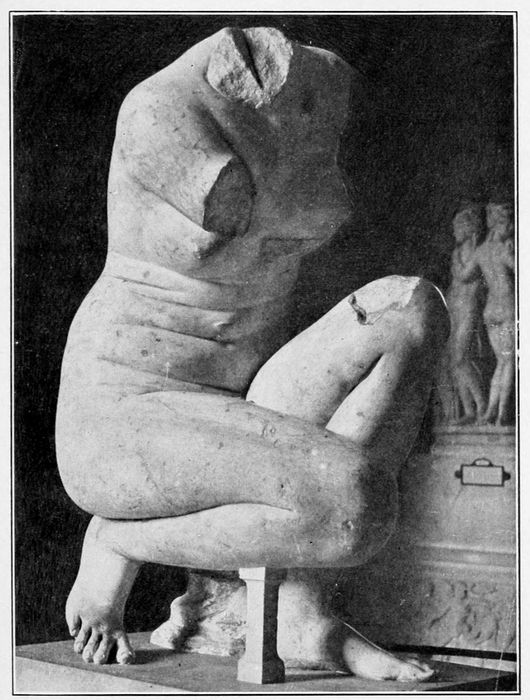
Crouching Venus
59“This principle was astonishingly fruitful to me.
I applied it to the execution of figures. Instead
of imagining the different parts of a body as surfaces
more or less flat, I represented them as projectures
of interior volumes. I forced myself to
express in each swelling of the torso or of the limbs
the efflorescence of a muscle or of a bone which lay
deep beneath the skin. And so the truth of my
figures, instead of being merely superficial, seems to
blossom from within to the outside, like life itself.
“Now I have discovered that the ancients practised
precisely this method of modelling. And it is
certainly to this technique that their works owe at
once their vigor and their palpitating suppleness.”
Rodin contemplated afresh his exquisite Greek
Venus. And suddenly he said:
60“In your opinion, Gsell, is color a quality of
painting or of sculpture?”
“Of painting, naturally.”
“Well, then, just look at this statue.”
So saying, he raised the lamp as high as he
could in order to light the antique torso from above.
“Just see the high lights on the breasts, the
heavy shadows in the folds of the flesh, and then
this paleness, these vaporous half-tones, trembling
over the most delicate portions of this divine body,
these bits so finely shaded that they seem to dissolve
in air. What do you say to it? Is it not a
great symphony in black and white?”
I had to agree.
“As paradoxical as it may seem, a great sculptor
is as much a colorist as the best painter, or
rather, the best engraver.
“He plays so skilfully with all the resources of
relief, he blends so well the boldness of light with
the modesty of shadow, that his sculptures please
one as much as the most charming etchings.
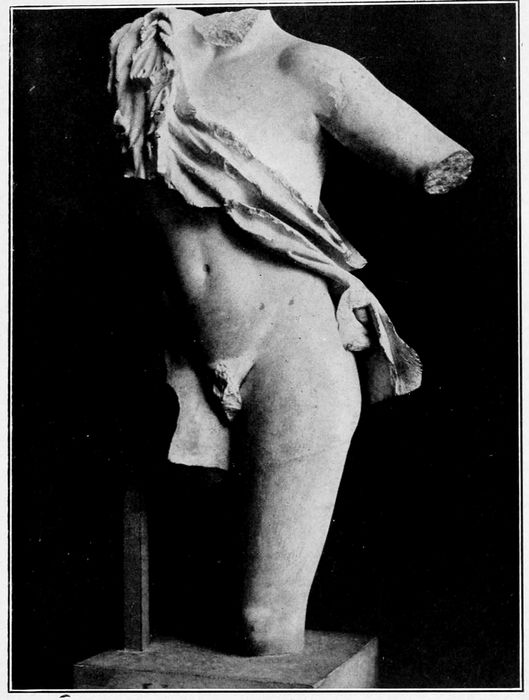
Faun
By Praxiteles
61“Now color—it is to this remark that I wished
to lead—is the flower of fine modelling. These
two qualities always accompany each other, and it
is these qualities which give to every masterpiece of
the sculptor the radiant appearance of living flesh.”
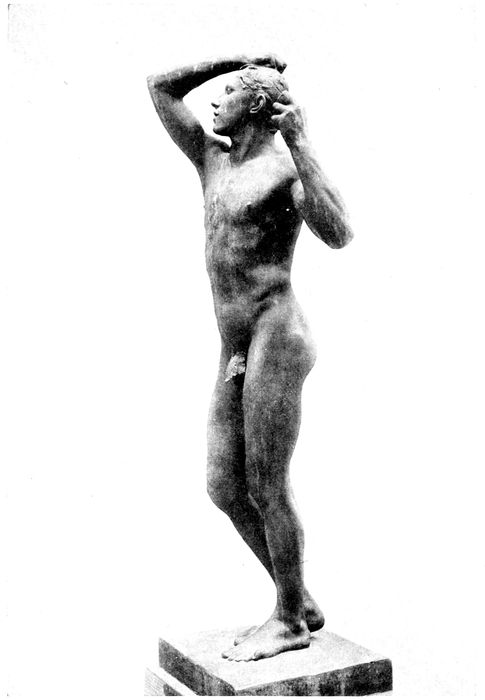
The Age of Iron
By Rodin
CHAPTER IV MOVEMENT IN ART
65
There are two statues by Rodin at the
Musée du Luxembourg which especially attract
and hold me; l’Age d’Airain (the Iron Age)
and Saint-Jean-Baptiste. They seem even more
full of life than the others, if that is possible. The
other works of the Master which bear them company
are certainly all quivering with truth; they
all produce the impression of real flesh, they all
breathe, but these move.
One day in the Master’s atelier at Meudon I
told him my especial fondness for these two
figures.
“They are certainly among those in which I
have carried imitative art farthest,” he replied.
“Though I have produced others whose animation
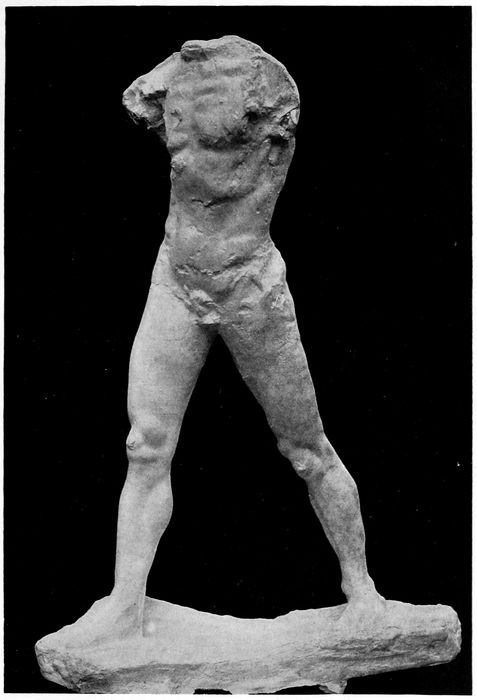
66is not less striking; for example, my Bourgeois de
Calais, my Balzac, my Homme qui marche (Man
walking).
“And even in those of my works in which action
is less pronounced, I have always sought to give
some indication of movement. I have very rarely
represented complete repose. I have always endeavored
to express the inner feelings by the
mobility of the muscles.
“This is so even in my busts, to which I have
often given a certain slant, a certain obliquity, a
certain expressive direction, which would emphasize
the meaning of the physiognomy.
“Art cannot exist without life. If a sculptor
wishes to interpret joy, sorrow, any passion whatsoever,
he will not be able to move us unless he
first knows how to make the beings live which he
evokes. For how could the joy or the sorrow of
an inert object—of a block of stone—affect us?
Now, the illusion of life is obtained in our art by
good modelling and by movement. These two
qualities are like the blood and the breath of all
good work.”
Man Walking
By Rodin
67“Master,” I said, “you have already talked to
me of modelling, and I have noticed that since
then I am better able to appreciate the masterpieces
of sculpture. I should like to ask a few
questions about movement, which, I feel, is not less
important.
“When I look at your figure of the Iron Age,
who awakes, fills his lungs and raises high his
arms; or at your Saint John, who seems to long
to leave his pedestal to carry abroad his words of
faith, my admiration is mixed with amazement. It
seems to me that there is sorcery in this science
which lends movement to bronze. I have also
studied other chefs-d’œuvre of your great predecessors;
for example, Maréchal Ney and the Marseillaise
by Rude, the Dance by Carpeaux, as well
as Barye’s wild animals, and I confess that I have
never found any satisfactory explanation for the
effect which these sculptures produce upon me. I
68continue to ask myself how such masses of stone
and iron can possibly seem to move, how figures
so evidently motionless can yet appear to act and
even to lend themselves to violent effort.”
“As you take me for a sorcerer,” Rodin answered,
“I shall try to do justice to my reputation
by accomplishing a task much more difficult for
me than animating bronze—that of explaining
how I do it.
“Note, first, that movement is the transition
from one attitude to another.
“This simple statement, which has the air of a
truism, is, to tell the truth, the key to the mystery.
“You have certainly read in Ovid how Daphne
was transformed into a bay-tree and Progne into
a swallow. This charming writer shows us the
body of the one taking on its covering of leaves
and bark and the members of the other clothing
themselves in feathers, so that in each of them one
still sees the woman which will cease to be and the
tree or bird which she will become. You remember,
too, how in Dante’s Inferno a serpent, coiling itself
about the body of one of the damned, changes into
man as the man becomes reptile. The great poet
describes this scene so ingeniously that in each of
these two beings one follows the struggle between
two natures which progressively invade and supplant
each other.
The Tempest
By Rodin
Photograph reproduced by permission of the Metropolitan Museum of Art
69“It is, in short, a metamorphosis of this kind
that the painter or the sculptor effects in giving
movement to his personages. He represents the
transition from one pose to another—he indicates
how insensibly the first glides into the second. In
his work we still see a part of what was and we
discover a part of what is to be. An example will
enlighten you better.
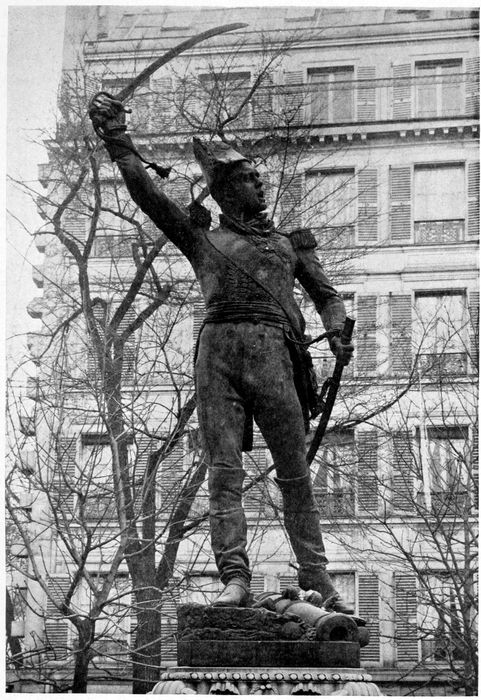
“You mentioned just now the statue of Marshal
Ney by Rude. Do you recall the figure clearly?”
“Yes,” I said. “The hero raises his sword,
shouting ‘Forward’ to his troops at the top of his
voice.”
“Exactly! Well—when you next pass that
70statue, look at it still more closely. You will then
notice this: the legs of the statue and the hand
which holds the sheath of the sabre are placed in
the attitude that they had when he drew—the
left leg is drawn back so that the sabre may be
easily grasped by the right hand, which has just
drawn it; and as for the left hand, it is arrested
in the air as if still offering the sheath.
“Now examine the body. It must have been
slightly bent toward the left at the moment when
it performed the act which I have described, but
here it is erect, here is the chest thrown out, here is
the head turning towards the soldiers as it roars
out the order to attack; here, finally, is the right
arm raised and brandishing the sabre.
“So there you have a confirmation of what I
have just said; the movement in this statue is
only the change from a first attitude—that which
the Marshal had as he drew his sabre—into a
second, that which he had as he rushes, arm aloft,
upon the enemy.
Marshal Ney
By Rude
71“In that is all the secret of movement as interpreted
by art. The sculptor compels, so to speak,
the spectator to follow the development of an act
in an individual. In the example that we have
chosen, the eyes are forced to travel upward from
the lower limbs to the raised arm, and, as in so
doing they find the different parts of the figure
represented at successive instants, they have the
illusion of beholding the movement performed.”
As it happened, the casts of the Iron Age and
of Saint John the Baptist stood in the great hall
where we were. Rodin asked me to look at them.
And I at once recognized the truth of his words.
I noticed that in the first of these works the
movement appears to mount, as in the statue of
Ney. The legs of the youth, who is not yet fully
awake, are still lax and almost vacillating, but as
your eye mounts you see the pose become firmer—the
ribs rise beneath the skin, the chest expands, the
face is lifted towards the sky, and the two arms
stretch in an endeavor to throw off their torpor.
72The subject of this sculpture is exactly that—the
passage from somnolence to the vigor of the
being ready for action.
This slow gesture of awakening appears, besides,
still more grand when one understands its symbolic
meaning. For it represents, as the title of
the work indicates, the first palpitation of conscience
in a humanity still young, the first victory
of reason over the brutishness of the prehistoric
ages.
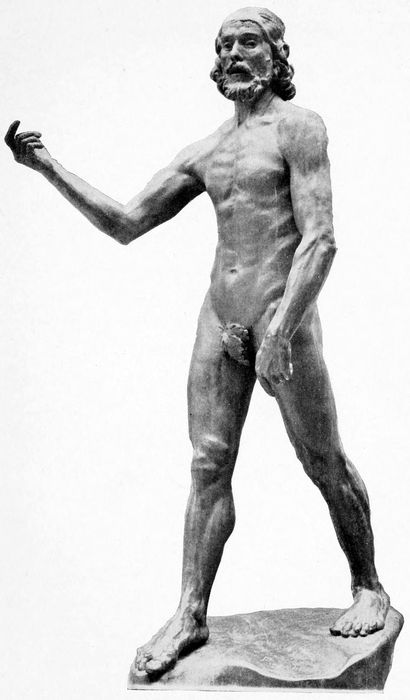
In the same way I next studied Saint John. And
I saw that the rhythm of this figure led, as Rodin
had said, to a sort of evolution between two balances.
The figure leaning, at first, all its weight
upon the left foot, which presses the ground with
all its strength, seems to balance there while the
eyes look to the right. You then see all the body
bent in that direction, then the right leg advances
and the foot takes hold of the ground. At the
same time the left shoulder, which is raised, seems
to endeavor to bring the weight of the body to this
side in order to aid the leg which is behind to come
forward. Now, the science of the sculptor has
consisted precisely in imposing all these facts
upon the spectator in the order in which I have
stated them, so that their succession will give the
impression of movement.
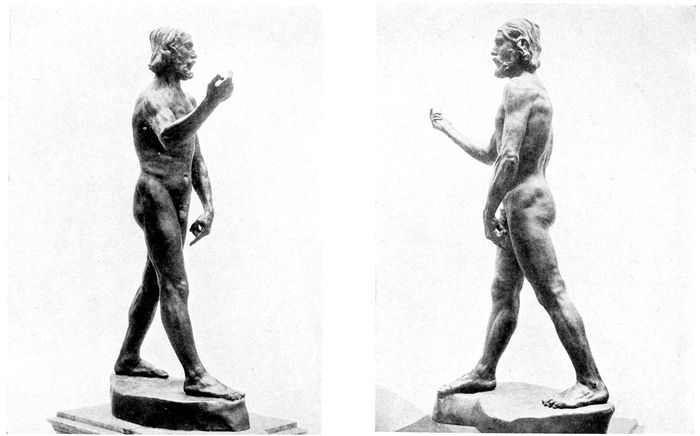
Saint John the Baptist
By Rodin
73Moreover, the gesture of Saint John, like that
of the Iron Age, contains a spiritual significance.
The prophet moves with an almost automatic
solemnity. You almost believe you hear his footsteps,
as you do those in the statue of the Commander.
You feel that a force at once mysterious
and formidable sustains and impels him. So the
act of walking, usually a commonplace movement,
here becomes majestic because it is the accomplishment
of a divine mission.
“Have you ever attentively examined instantaneous
photographs of walking figures?” Rodin
suddenly asked me.
Upon my reply in the affirmative, “Well, what
did you notice?”
74“That they never seem to advance. Generally
they seem to rest motionless on one leg or to hop
on one foot.”
“Exactly! Now, for example, while my Saint
John is represented with both feet on the ground,
it is probable that an instantaneous photograph
from a model making the same movement would
show the back foot already raised and carried toward
the other. Or else, on the contrary, the front foot
would not yet be on the ground if the back leg
occupied in the photograph the same position as in
my statue.
“Now it is exactly for that reason that this
model photographed would present the odd appearance
of a man suddenly stricken with paralysis
and petrified in his pose, as it happened in the
pretty fairy story to the servants of the Sleeping
Beauty, who were all suddenly struck motionless in
the midst of their occupations.
Saint John the Baptist
By Rodin
75“And this confirms what I have just explained
to you on the subject of movement in art. If, in
fact, in instantaneous photographs, the figures,
though taken while moving, seem suddenly fixed in
mid-air, it is because, all parts of the body being
reproduced exactly at the same twentieth or fortieth
of a second, there is no progressive development
of movement as there is in art.”
“I understand you perfectly, Master,” I answered.
“But it seems to me, if you will excuse
me for risking the remark, that you contradict
yourself.”
“How so?”
“Have you not declared many times to me that
the artist ought always to copy nature with the
greatest sincerity?”
“Without doubt, and I maintain it.”
“Well, then, when in the interpretation of movement
he completely contradicts photography, which
is an unimpeachable mechanical testimony, he evidently
alters truth.”
“No,” replied Rodin, “it is the artist who is
truthful and it is photography which lies, for in
76reality time does not stop, and if the artist succeeds
in producing the impression of a movement which
takes several moments for accomplishment, his
work is certainly much less conventional than the
scientific image, where time is abruptly suspended.
“It is that which condemns certain modern
painters who, when they wish to represent horses
galloping, reproduce the poses furnished by instantaneous
photography.
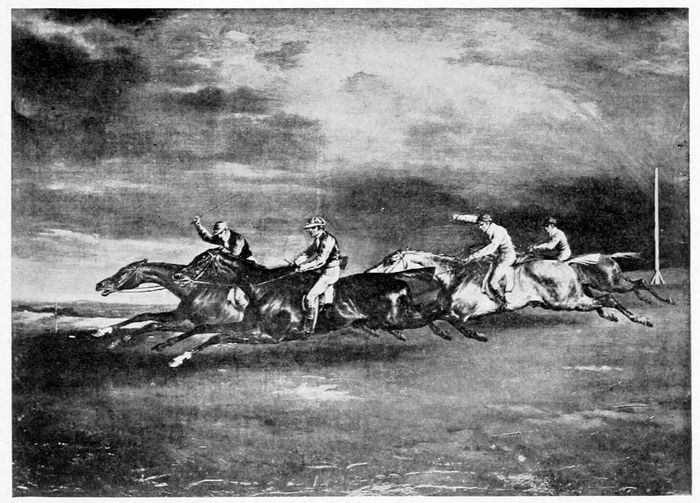
“Gericault is criticised because in his picture
Epsom Races (Course d’Epsom), which is at the
Louvre, he has painted his horses galloping, fully
extended, ventre à terre, to use a familiar expression,
throwing their fore feet forward and their
hind feet backward at the same instant. It is said
that the sensitive plate never gives the same effect.
And, in fact, in instantaneous photography, when
the forelegs of a horse are forward, the hind legs,
having by their pause propelled the body onward,
have already had time to gather themselves under
the body in order to recommence the stride, so
that for a moment the four legs are almost gathered
together in the air, which gives the animal the
appearance of jumping off the ground, and of being
motionless in this position.
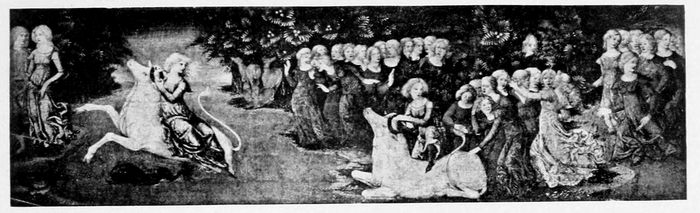
Europa. Italian School of the Fifteenth Century
Epsom Races
By Gericault
77“Now I believe that it is Gericault who is right,
and not the camera, for his horses appear to run;
this comes from the fact that the spectator from
right to left sees first the hind legs accomplish the
effort whence the general impetus results, then the
body stretched out, then the forelegs which seek
the ground ahead. This is false in reality, as
the actions could not be simultaneous; but it
is true when the parts are observed successively,
and it is this truth alone that matters to us,
because it is that which we see and which strikes
us.
“Note besides that painters and sculptors, when
they unite different phases of an action in the same
figure, do not act from reason or from artifice.
They are naïvely expressing what they feel. Their
minds and their hands are as if drawn in the direction
78of the movement, and they translate the development
by instinct. Here, as everywhere in the
domain of art, sincerity is the only rule.”
I was silent for several instants, thinking over
what he had said.
“Haven’t I convinced you?” he asked.
“Yes, indeed. But while admiring this miracle
of painting and of sculpture which succeeds in condensing
the action of several moments into a single
figure, I now ask myself how far they can compete
with literature, and especially with the theatre, in
the notation of movement. To tell the truth, I am
inclined to believe that this competition does not
go very far, and that on this score the masters of
the brush and chisel are necessarily inferior to those
of language.”
“Our disadvantage,” he exclaimed, “is not as
great as you would think. If painting and sculpture
can endow figures with motion, they are not
forbidden to attempt even more. And at times they
succeed in equalling dramatic art by presenting in
the same picture or in the same sculptural group
several successive scenes.”
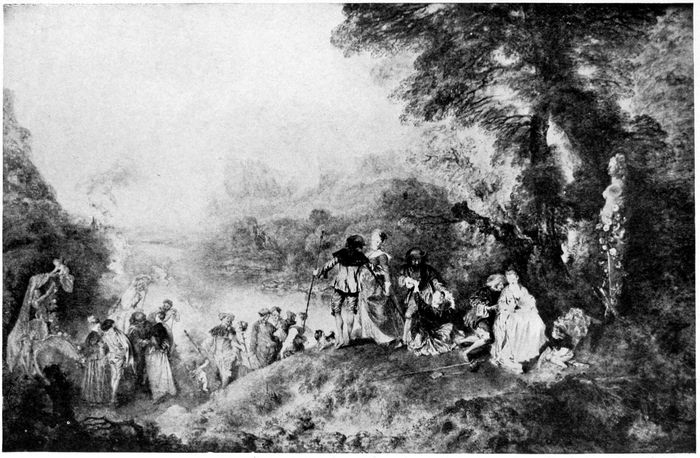
The Embarkation for the Island of Cythera
By Watteau
79“Yes,” I replied, “but they cheat, in a way.
For I suppose that you are talking of those old
compositions which celebrate the entire history of
a personage, representing him several times on the
same panel in different situations.
“At the Louvre, for example, a small Italian
painting of the fifteenth century relates in this way
the story of Europa. You first see the young
princess playing in the flowery field with her companions,
who help her to mount the bull, Jupiter,
and further on the same heroine, terrified now, is
carried off through the waves by the god.”
“That is a very primitive method,” Rodin answered,
“though it was practised even by great
masters—for example, in the ducal palace at
Venice this same fable of Europa has been treated
in an identical manner by Veronese. But it is in
spite of this defect that Caliari’s painting is admirable,
and I did not refer to any such childish
80method: for, as you may imagine, I disapprove of
it. To make myself understood, I must ask you
first whether you can call to mind The Embarkation
for the Island of Cythera by Watteau.”
“As plainly as if it was before my eyes,” I said.
“Then I shall have no trouble in explaining
myself. In this masterpiece the action, if you
will notice, begins in the foreground to the right
and ends in the background to the left.
“What you first notice in the front of the picture,
in the cool shade, near a sculptured bust of
Cypris garlanded with roses, is a group composed
of a young woman and her adorer. The man
wears a cape embroidered with a pierced heart,
gracious symbol of the voyage that he would
undertake.
The Marseillaise
By Rude
81“Kneeling at her side, he ardently beseeches his
lady to yield. But she meets his entreaties with
an indifference perhaps feigned, and appears
absorbed in the study of the decorations on her
fan. Close to them is a little cupid, sitting halfnaked
upon his quiver. He thinks that the young
woman delays too long, and he pulls her skirt to
induce her to be less hard-hearted. But still the
pilgrim’s staff and the script of love lie upon the
ground. This is the first scene.
“Here is the second: To the left of the group
of which I have spoken is another couple. The
lady accepts the hand of her lover, who helps her
to arise. She has her back to us, and has one of
those blonde napes which Watteau painted with
such voluptuous grace.
“A little further is the third scene. The lover
puts his arm around his mistress’s waist to draw
her with him. She turns towards her companions,
whose lingering confuses her, but she allows herself
to be led passively away.
“Now the lovers descend to the shore and all
push laughing towards the barque; the men no
longer need to entreat, the women cling to their
arms.
“Finally the pilgrims help their sweethearts on
82board the little ship, which, decked with flowers
and floating pennons of red silk, rocks like a
golden dream upon the water. The sailors, leaning
on their oars, are ready to row away. And
already, borne by the breezes, little cupids fly
ahead to guide the travellers towards that azure
isle which lies upon the horizon.”
“I see, Master, that you love this picture, for
you have remembered every detail,” I said.
“It is a delight that one cannot forget. But
have you noted the development of this pantomime?
Truly now, is it the stage? or is it painting?
One does not know which to say. You see,
then, that an artist can, when he pleases, represent
not only fleeting gestures, but a long action, to
employ a term of dramatic art.
“In order to succeed, he needs only to place his
personages in such a manner that the spectator
shall first see those who begin this action, then
those who continue it, and finally those who complete
it. Would you like an example in sculpture?”
The Burghers of Calais
By Rodin
83Opening a book, he searched for a moment and
drew out a photograph.
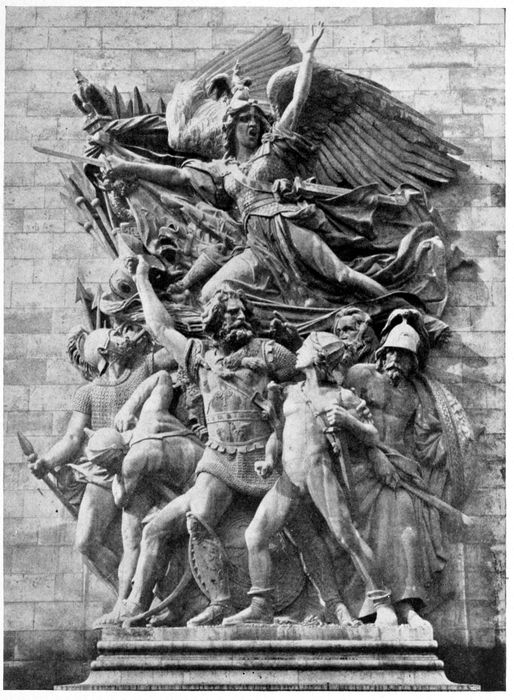
“Here,” he said, “is the Marseillaise which
Rude carved for one of the piers of the Arc de
Triomphe.
“Liberty, in a breastplate of brass, cleaving the
air with unfolded wings, roars in a mighty voice,
‘Aux armes, citoyens!’ She raises high her left
arm to rally all the brave to her side, and, with
the other hand, she points her sword towards the
enemy. It is she, beyond question, whom you first
see, for she dominates all the work, and her legs,
which are wide apart as if she were running, seem
like an accent placed above this sublime war-epic.
It seems as though one must hear her—for her
mouth of stone shrieks as though to burst your eardrum.
But no sooner has she given the call than
you see the warriors rush forward. This is the
second phase of the action. A Gaul with the
mane of a lion shakes aloft his helmet as though
to salute the goddess, and here, at his side, is his
84young son, who begs the right to go with him—“I
am strong enough, I am a man, I want to
go!” he seems to say, grasping the hilt of a sword.
“Come,” says the father, regarding him with tender
pride.
“Third phase of the action: a veteran bowed
beneath the weight of his equipment strives to join
them—for all who have strength enough must
march to battle. Another old man, bowed with
age, follows the soldiers with his prayers, and the
gesture of his hand seems to repeat the counsels
that he has given them from his own experience.
“Fourth phase: an archer bends his muscular
back to bind on his arms. A trumpet blares its
frenzied appeal to the troops. The wind flaps the
standards, the lances point forward. The signal is
given, and already the strife begins.
“Here, again, we have a true dramatic composition
acted before us. But while L’Embarquement
pour Cythère recalls the delicate comedies of
Marivaux, the Marseillaise is a great tragedy by
Corneille. I do not know which of the two works
I prefer, for there is as much genius in the one
as in the other.”
Eustache de Saint-Pierre. One of the Burghers of Calais
By Rodin
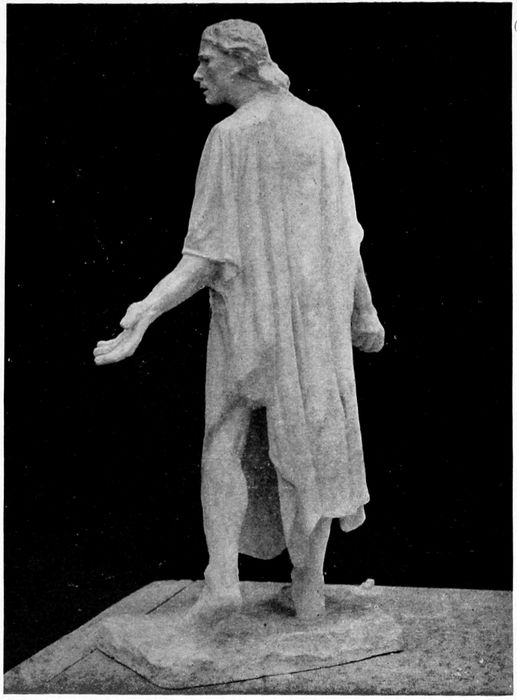
One of the Burghers of Calais
By Rodin
85And, looking at me with a shade of malicious
challenge, he added, “You will no longer say, I
think, that sculpture and painting are unable to
compete with the theatre?”
“Certainly not.” At this instant, I saw in the
portfolio where he had replaced the reproduction
of the Marseillaise, a photograph of his wonderful
Burghers of Calais. “To prove to you,” I said,
“that I have profited by your teaching, let me
apply it to one of your most beautiful works,
for I see that you have yourself put into
practice the principles which you have revealed
to me.
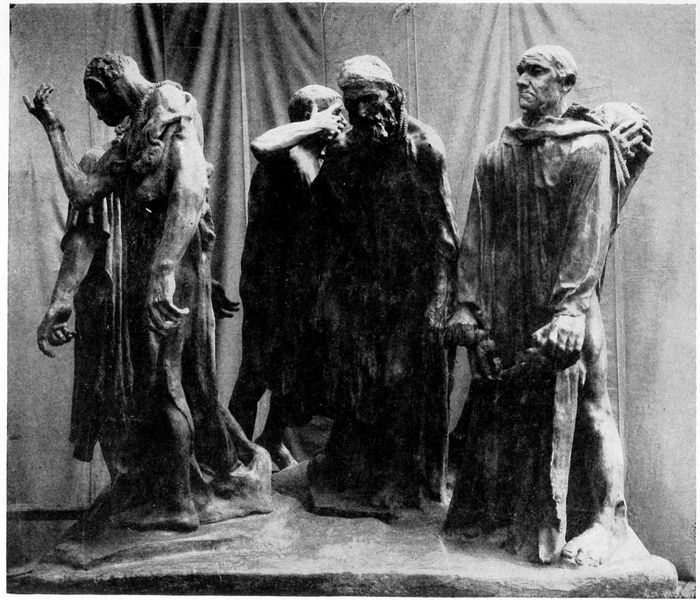
“Here, in your Burghers of Calais, I recognize
a scenic succession like that which you have cited
in the chefs-d’œuvre of Watteau and of Rude.
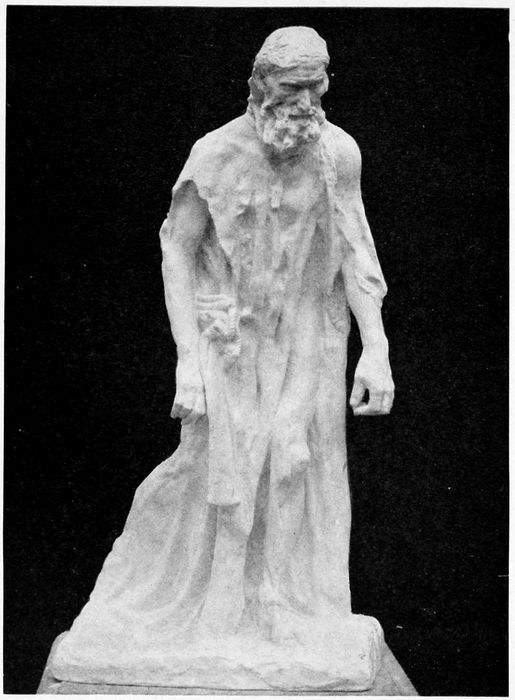
“The figure in the centre first attracts attention.
No one can doubt that it is Eustache de
86Saint-Pierre. He bows his venerable head with
its long gray hair. He does not hesitate, he is
not afraid. He advances steadily, his eyes half
closed in silent communion. If he totters a little,
it is because of the privations that he has endured
during a long siege. It is he who inspires the
others, it is he who offered himself first as one
of the six notables whose death, according to the
conditions of the conqueror, should save their
fellow-townsmen from massacre.
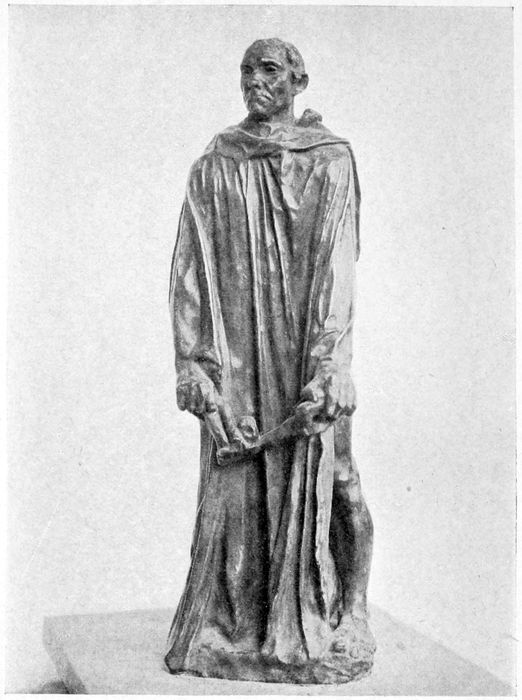
“The burgher beside him is not less brave. But
if he does not mourn for his own fate, the capitulation
of the city causes him terrible sorrow.
Holding in his hand the key which he must deliver
to the English, he stiffens his whole body in
order to find the strength to bear the inevitable
humiliation.
“On the same plane with these two, to the left,
you see a man who is less courageous, for he
walks almost too fast: you would say that, having
made up his mind to the sacrifice, he longs
to shorten the time which separates him from his
martyrdom.
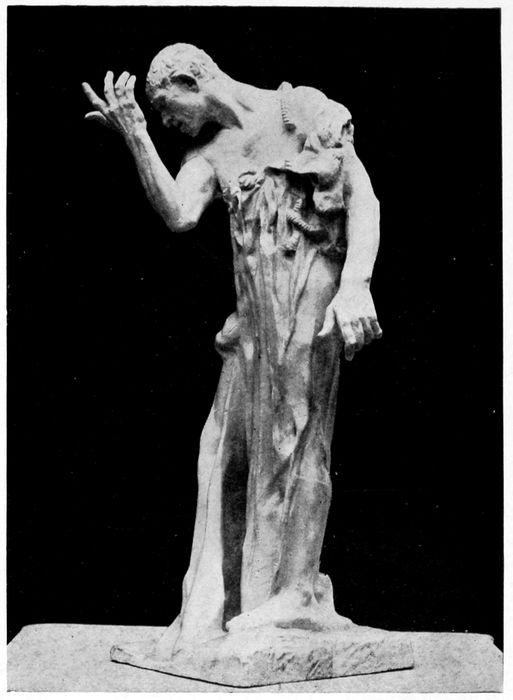
One of the Burghers of Calais
By Rodin
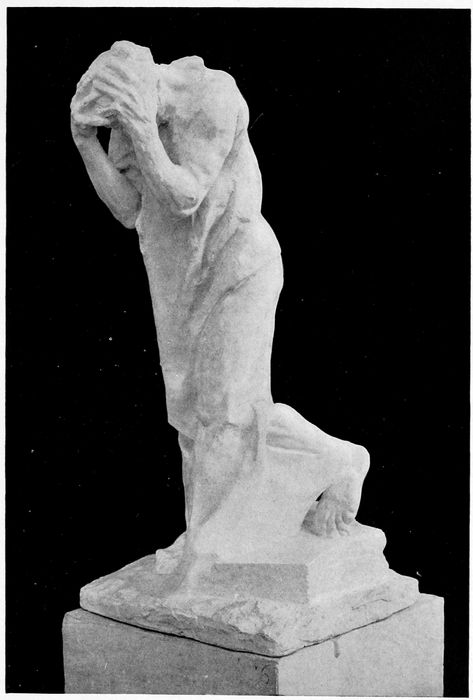
One of the Burghers of Calais
By Rodin
87“And behind these comes a burgher who, holding
his head in his hands, abandons himself to
violent despair. Perhaps he thinks of his wife, of
his children, of those who are dear to him, of those
whom his going will leave without support.
“A fifth notable passes his hand before his eyes
as if to dissipate some frightful nightmare. He
stumbles, death so appals him.
“Finally, here is the sixth burgher, younger than
the others. He seems still undecided. A painful
anxiety contracts his face. Is it the image of his
sweetheart that fills his thoughts? But his companions
advance—he rejoins them, his neck outstretched
as if offered to the axe of fate.
“While these three men of Calais may be less
brave than the three first, they do not deserve less
admiration. For their devotion is even more meritorious,
because it costs them more.
“So, in your Burghers, one follows the action,
88more or less prompt, which was the outcome in
each one of them according to his disposition of
the authority and example of Eustache de Saint-Pierre.
One sees them, gradually won by his influence,
decide one after another to go forward
with him to pay the price of their city.
“There, incontestably, is the best confirmation
of your ideas on the scenic value of art.”
“If your opinion of my work were not too
high,” Rodin answered, “I should acknowledge
that you had perfectly understood my intentions.
You have justly placed my burghers in the scale
according to their degrees of heroism. To emphasize
this effect still more I wished, as you perhaps
know, to fix my statues one behind the other on the
stones of the Place, before the Town Hall of
Calais, like a living chaplet of suffering and of
sacrifice.
One of the Burghers of Calais
By Rodin
89“My figures would so have appeared to direct
their steps from the municipal building toward the
camp of Edward III.; and the people of Calais
of to-day, almost elbowing them, would have felt
more deeply the tradition of solidarity which
unites them to these heroes. It would have been,
I believe, intensely impressive. But my proposal
was rejected, and they insisted upon a pedestal
which is as unsightly as it is unnecessary. They
were wrong. I am sure of it.”
“Alas,” I said, “the artist has always to reckon
with the routine of opinion, too happy if he can
only realize a part of his beautiful dreams!”
CUPID AND PSYCHE
By Rodin
Photogravure reproduced by permission of the Metropolitan Museum of Art
CHAPTER V DRAWING AND COLOR
93
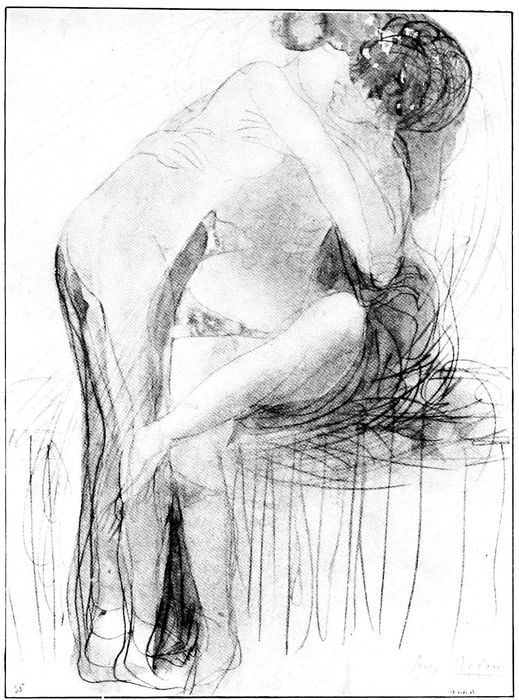
Rodin has always drawn a great deal. He
has sometimes used the pen, sometimes the
pencil. Formerly he drew the outline with a pen,
and then added the shading with a brush. These
wash-drawings so executed looked as if made from
bas-reliefs or from sculptured groups. They were
purely the visions of a sculptor.
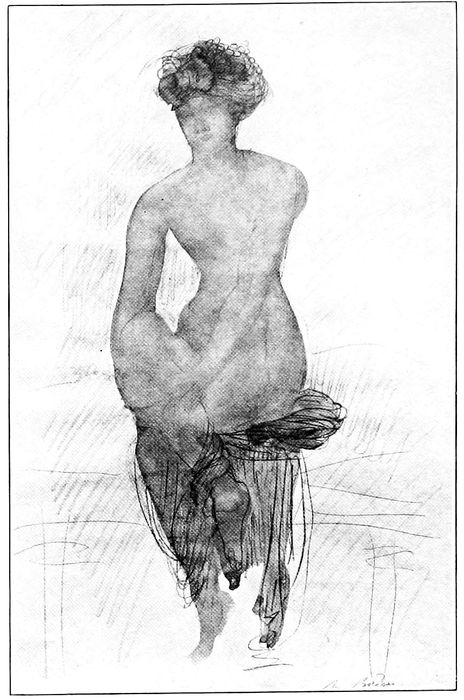
Later he used a lead pencil for his drawings
from the nude, washing in the flesh tones in color.
These drawings are freer than the first; the attitudes
are less set, more fugitive. In them the
touch seems sometimes almost frenzied—a whole
body held in a single sweep of the pencil—and
they betray the divine impatience of the artist who
94fears that a fleeting impression may escape him.
The coloring of the flesh is dashed on in three or
four broad strokes, the modelling summarily produced
by the drying of the pools of color where
the brush in its haste has not paused to gather the
drops left after each touch. These sketches fix the
rapid gesture, the transient motion which the eye
itself has hardly seized for one half second. They
do not give you merely line and color; they give
you movement and life. They are more the visions
of a painter than of a sculptor.
Yet more recently Rodin, continuing to use the
lead pencil, has ceased to model with the brush.
He is now content to smudge in the contours with
his finger. This rubbing produces a silvery gray
which envelops the forms like a cloud, rendering
them of almost unreal loveliness; it bathes them in
poetry and mystery. These last studies I believe
are the most beautiful. They are at once luminous,
living, and full of charm.
The Embrace
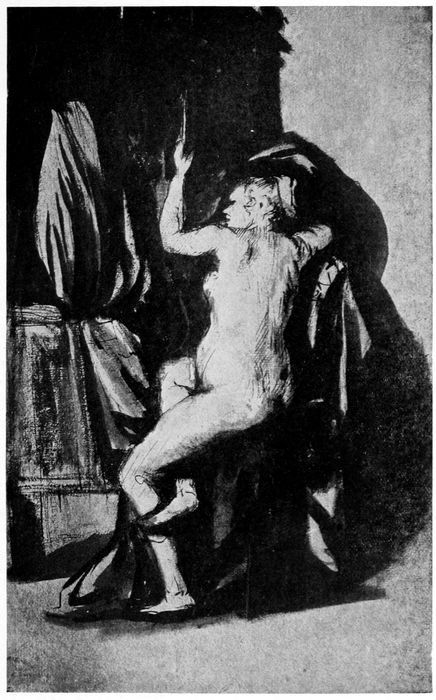
Study-sketch by Rodin
Photograph reproduced by permission of the Metropolitan Museum of Art
Study of the Nude
By Rodin
Photograph reproduced by permission of the Metropolitan Museum of Art
95As I was looking at some with Rodin, I said to
him how much they differed from the over-finished
drawings which the public usually approve.
“It is true,” he said, “that it is inexpressive
minutiæ of execution and false nobility of gesture
which please the ignorant. The crowd cannot
understand a daring impression which passes over
useless details to seize only upon the truth of the
whole. It can understand nothing of that sincere
observation which, disdaining theatrical poses, interests
itself in the simple and much more touching
attitudes of real life.
“It is difficult to correct the errors that prevail
on the subject of drawing.
“It is a false idea that drawing in itself can be
beautiful. It is only beautiful through the truths
and the feelings that it translates. The crowd
admires artists, who, strong in subject, elegantly
pen contours destitute of significance, and who
plant their figures in pretentious poses. It goes
into ecstasies over poses which are never seen in
nature, and which are considered artistic because
96they recall the posturings of the Italian models
who offer themselves at the studio door. That is
what is generally called beautiful drawing. It is
really only sleight-of-hand, fit to astonish boobies.
“Of course, there is drawing in art as there is
style in literature. Style that is mannered, that
strains after effect, is bad. No style is good except
that which effaces itself in order to concentrate all
the attention of the reader upon the subject treated,
upon the emotion rendered.
“The artist who parades his drawing, the writer
who wishes to attract praise to his style, resemble
the soldier who plumes himself on his uniform but
refuses to go into battle, or the farmer who polishes
the ploughshare instead of driving it into the earth.
“You never think of praising either drawing or
style which is truly beautiful, because you are carried
away by the interest of all that they express.
It is the same with color. There is really neither
beautiful style, nor beautiful drawing, nor beautiful
color; there is but one sole beauty, that of the
97truth which is revealed. When a truth, when a
profound idea, when a powerful feeling bursts
forth in a great work, either literary or artistic, it
is evident that the style, or the color and the drawing,
are excellent; but these qualities exist only as
the reflection of the truth.
“Raphael’s drawing is admired—and justly—but
it should not be admired only for itself, for its skilful
balance of line; it should be admired for what
it signifies. What forms all its merit is the sweet
serenity of soul which saw with the eyes of Raphael
and expressed itself with his hand, the love in him
which seems to overflow from his heart upon all
nature. Those who, lacking his soul, have sought
to borrow the linear cadences and the attitudes of
his figures, have never executed any but insipid
imitations of the great master of Urbino.
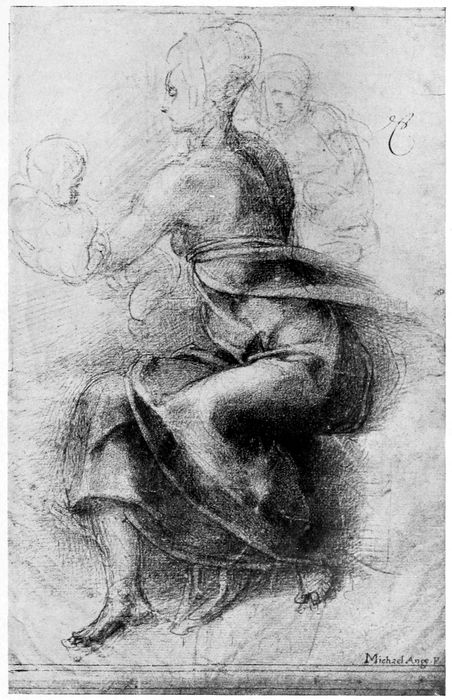
“In the drawing of Michael Angelo it is not his
manner, not the audacious foreshortening nor the
skilful anatomy that should be admired, but the
desperate force of the Titan. Those imitators who,
98without his soul, have copied in their painting his
buttressed attitudes and his tense muscles have
made themselves ridiculous.
“In the color of Titian, what should be admired
is not merely a more or less agreeable harmony,
but the meaning that it offers. His color has no
true beauty except as it conveys the idea of a sumptuous
and dominant sovereignty.
“In the color of Veronese, the true beauty exists
in its power to evoke in silvery play of color the
elegant conviviality of patrician feasts.
“The color of Rubens is nothing in itself; its
flaming wonder would be vain did it not give the
impression of life, of joy, and of robust sensuousness.
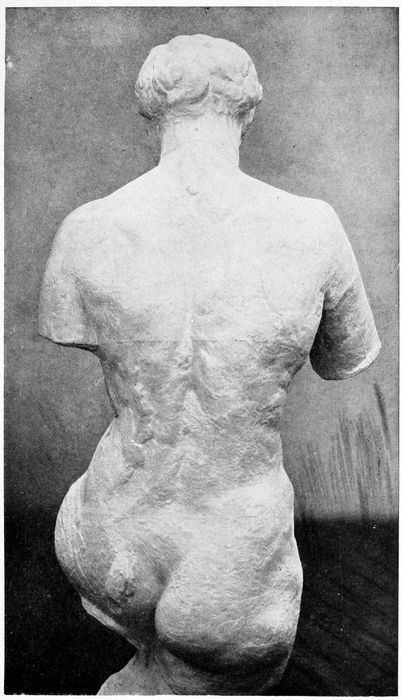
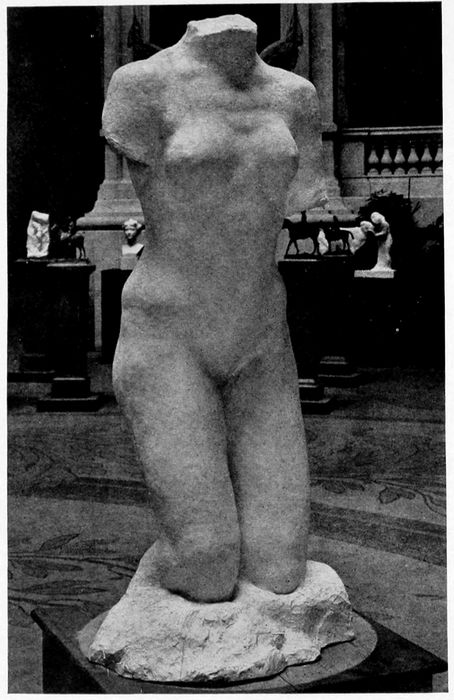
Torso of a Woman
By Rodin
99“There does not perhaps exist a single work of
art which owes its charm only to balance of line or
tone, and which makes an appeal to the eyes alone.
Take, for example, the stained-glass windows of
the twelfth and thirteenth centuries—if they enchant
us with the velvety depths of their blues,
with the caress of their soft violets and their warm
crimsons, it is because their colors express the
mystic joy which their pious creators hoped to win
in the heaven of their dreams. If certain bits of
Persian pottery, strewn with flowers of turquoise
blue, are adorable marvels of color, it is because, in
some strange manner, their exquisite shades transport
the soul into I know not what valley of dreams
and faëry. So, all drawing and all harmony of
colors offer a meaning without which they would
have no beauty.”
“But do you not fear that disdain of craft in
art—?” I broke in.
“Who speaks to you of disdaining it? Craft is
only a means. But the artist who neglects it will
never attain his end, which is the interpretation
of feeling, of ideas. Such an artist would
be like a horseman who forgot to give oats to his
horse.
“It is only too evident that if drawing is lacking,
if color is false, the most powerful emotion cannot
find expression. Incorrect anatomy would raise a
100laugh when the artist wished to be most touching.
Many young artists incur this disgrace to-day. As
they have never studied seriously, their unskilfulness
betrays them at every turn. Their intentions
are good, but an arm which is too short, a leg
which is not straight, an inexact perspective, repels
the spectator.
“In short, no sudden inspiration can replace the
long toil which is indispensable to give the eyes a
true knowledge of form and of proportion and
to render the hand obedient to the commands of
feeling.
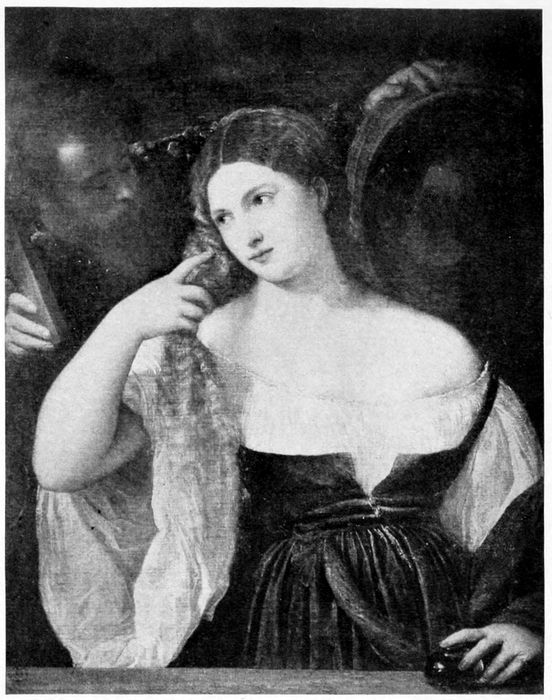
“And when I say that craft should be forgotten,
my idea is not for a moment that the artist can get
along without science. On the contrary, it is necessary
to have consummate technique in order to
hide what one knows. Doubtless, to the vulgar,
the jugglers who execute eccentric flourishes of
line, who accomplish astounding pyrotechnics of
color, or who write long phrases encrusted with
unusual words, are the most skilful men in the
world. But the great difficulty and the crown of
art is to draw, to paint, to write with ease and
simplicity.
A Drawing
By Michael Angelo
101“You see a picture, you read a page; you notice
neither the drawing, the color, nor the style, but
you are moved to the soul. Have no fear of making
a mistake; the drawing, the color, the style are perfect
in technique.”
“Yet, Master, can it not happen that great and
touching chefs-d’œuvre are wanting in technique?
Is it not said, for instance, that Raphael’s color is
often bad and Rembrandt’s drawing debatable?”
“It is wrong, believe me. If Raphael’s masterpieces
delight the soul, it is because everything in
them, color as well as drawing, contributes to the
enchantment. Look at the little Saint George in
the Louvre, at the Parnassus in the Vatican, at
the cartoons for the tapestry at South Kensington;
the harmony in these works is charming.
Sanzio’s color is different from Rembrandt’s, but
it is exactly suited to his inspiration. It is clear
102and enamelled. It offers fresh, flowery, joyous
tonalities. It has the eternal youth of Raphael
himself. It seems unreal, but only because the
truth as observed by the master of Urbino is
not that of purely material things; his is the
domain of feeling, a region where forms and
colors are transfigured by the light of love.
Doubtless an out-and-out realist would call this
coloring inexact; but a poet finds it true.
“What is certain is that the color of Rembrandt
or of Rubens joined to Raphael’s drawing would
be ridiculous and monstrous, just as Rembrandt’s
drawing differs from that of Raphael, but is not
less good. Raphael’s lines are sweet and pure;
Rembrandt’s are often rude and jarring. The great
Dutchman’s vision was arrested by the roughness
of garments, by the asperity of wrinkled faces, by
the callousness of plebeian hands; for to Rembrandt
beauty is only the antithesis between the triviality
of the physical envelope and the inner radiance.
How could he express this beauty composed of
apparent ugliness and moral grandeur if he tried
to rival Raphael in elegance? You must recognize
that his drawing is perfect because it corresponds
absolutely to the exigencies of his thought.”
A Drawing
By Rembrandt
103“So, according to you, it is an error to believe
that the same artist cannot be at once a great colorist
and a great draughtsman?”
“Certainly, and I do not know how this idea has
become as firmly established as it seems to be. If
the great masters are eloquent, if they carry us
away, it is clearly because they possess exactly all
the means of expression that are necessary to them.
I have just proved it to you in the case of Raphael
and Rembrandt. The same demonstration could
be made in the case of all the great artists. For
instance, Delacroix has been accused of ignorance
of drawing. On the contrary, the truth is that his
drawing combines marvellously with his color; like
it, it is abrupt, feverish, exalted, it is full of vivacity,
of passion; like it, it is sometimes mad, and it
is then that it is the most beautiful. Color and
104drawing, one cannot be admired without the other,
for they are one.
“Where the demi-connoisseur deceives himself is
in allowing for the existence of but one kind of
drawing; that of Raphael, or perhaps it is not
even that of Raphael, but that of his imitators, that
of David or of Ingres. There are really as many
kinds of drawing and of color as there are artists.
“Albrecht Dürer’s color is called hard and dry.
It is not so at all. But he is a German; he generalizes;
his compositions are as exact as logical
constructions; his people are as solid as essential
types. That is why his drawing is so precise and
his color so restrained.
“Holbein belongs to the same school. His drawing
has none of the Florentine grace; his color has
none of the Venetian charm; but his line and color
have a power, a gravity, an inner meaning, which
perhaps are found in no other painter.
Study
By Rodin
Photograph reproduced by permission of the Metropolitan Museum of Art
Study for a Figure
By Rodin
Photograph reproduced by permission of the Metropolitan Museum of Art
105“In general, it is possible to say that in artists
as deliberate, as careful as these, drawing is particularly
tight and the color is as cold as the verity
of mathematics. In other artists, on the contrary,
in those who are the poets of the heart, like
Raphael, Correggio, Andrea del Sarto, line has
more suppleness and color, more winning tenderness.
In others whom we call realists, that is to say, whose
sensibility is more exterior, in Rubens, Velasquez,
Rembrandt, for example, line has a living charm
with its force and its repose, and the color sometimes
bursts into a fanfare of sunlight, sometimes
fades into mist.
“So, the modes of expression of men of genius
differ as much as their souls, and it is impossible
to say that in some among them drawing and color
are better or worse than in others.”
“I understand, Master; but in refusing the usual
classification of artists as draughtsmen or colorists,
you do not stop to think how you embarrass the
poor critics. Happily, however, it seems to me that
in your words those who like categories may find
a new method of classification. Color and drawing,
106you say, are only means, and it is the soul of the
artist that it is important to know. So painters
should be grouped according to their dispositions.
For example, Albrecht Dürer with Holbein—both
are logicians. Raphael, Correggio, Andrea del
Sarto, whom you have named together, make a class
in which sentiment is predominant; they are in the
front rank of the elegiacs. Another class would
be composed of the masters who are interested in
active existence, in daily life, and the trio of Rubens,
Velasquez and Rembrandt would be its greatest constellation.
Finally, artists such as Claude Lorraine
and Turner, who considered nature as a tissue of
brilliant and fugitive visions, would comprise a
fourth group.”
Rodin smiled. “Such a classification would not
be wanting in ingenuity,” he said, “and it would
be much more just than that which divides the
colorists from the draughtsmen.
Triton and Nereid
By Rodin
Photograph reproduced by permission of the Metropolitan Museum of Art
The Caryatid
By Rodin
Photograph reproduced by permission of the Metropolitan Museum of Art
107“However, because of the complexity of art,
or rather of the human souls who take art for a
language, all classification runs the risk of being
futile. So Rembrandt is often a sublime poet and
Raphael often a vigorous realist.
“Let us force ourselves to understand the masters—let
us love them—let us go to them for
inspiration; but let us refrain from labelling them
like drugs in a chemist’s shop.”
THE BATHER
By Rodin
CHAPTER VI THE BEAUTY OF WOMEN
111
That fine old house known as “l’Hôtel de
Biron,” which stands in a quiet street on the
left bank of the Seine in Paris, and which was but
lately the Convent of the Sacred Heart, has, since
the suppression of the sisterhoods, been occupied
by several tenants, among whom is Rodin.
The Master, as we have seen, has other ateliers
at Meudon and at the Dépôt des Marbres in Paris,
but he has a special liking for this one.
Built in the eighteenth century, the town house
of a powerful family, it is certainly as beautiful a
dwelling as any artist could desire. The great
rooms are lofty, panelled in white, with beautiful
mouldings in white and gold. The one in which
112Rodin works is a rotunda opening by high French
windows into a delightful garden.
For several years now this garden has been
neglected. But it is still possible to trace, among
the riotous weeds, the ancient lines of box which
bordered the alleys, to follow, beneath fantastic
vines, the shape of green trellised arbors; and
there each spring the flowers reappear, pushing
through the grasses in the borders. Nothing induces
a more delicious melancholy than this spectacle
of the gradual effacement of human toil at
the hands of invading nature.
At l’Hôtel de Biron Rodin passes nearly all
his time in drawing.
In this quiet retreat he loves to isolate himself
and to consign to paper, in numberless pencil
sketches, the graceful attitudes which his models
take before him.
One evening I was looking over a series
of these studies with him, and was admiring
the harmonious lines by which he had reproduced
all the rhythm of the human body upon
paper.
Torso of a Woman
By Rodin
Torso of a Woman
By Rodin
113The outlines, dashed in with a single stroke,
evoked the fire or the abandon of the movements,
and his thumb had interpreted by a very slight
shade the charm of the modelling. As he studied
the drawings he seemed to see again in mind the
models who were their originals. He constantly
exclaimed:
“Ah! this one’s shoulders, what a delight! A
curve of perfect beauty! My drawing is too
heavy! I tried indeed, but—! See, here is a
second attempt from the same woman. This is
more like her. And yet!
“And just look at this one’s throat, the adorable
elegance of this swelling line, it has an
almost intangible grace!”
“Master,” I asked, “is it easy to find good
models?”
“Yes.”
“Then beauty is not very rare in France?”
114“No, I tell you.”
“But tell me, do you not think that the beauty
of the antique much surpassed that of our day,
and that modern women are far from equalling
those who posed for Phidias?”
“Not at all.”
“Yet the perfection of the Greek Venuses—”
“The artists in those days had eyes to see, while
those of to-day are blind; that is all the difference.
The Greek women were beautiful, but their beauty
lived above all in the minds of the sculptors who
carved them.
“To-day there are women just like them. They
are principally in the South of Europe. The
modern Italians, for example, belong to the same
Mediterranean type as the models of Phidias.
This type has for its special characteristic the
equal width of shoulders and hips.”
“But did not the invasion of the barbarians by
a mixture of race alter the standard of antique
beauty?”
Pygmalion and Galatea
By Rodin
Photograph reproduced by permission of the Metropolitan Museum of Art
115“No. Even if we suppose that the barbarians
were less beautiful, less well-proportioned than the
Mediterranean race, which is possible, time has
effectually wiped out any stains produced by a
mixed blood, and has again produced the harmony
of the ancient type. In a union of the beautiful
and the ugly, it is always the beautiful which triumphs
in the end. Nature, by a Divine law, tends
constantly towards the best, tends ceaselessly
towards perfection. Besides the Mediterranean
type, there exists a Northern type, to which many
Frenchwomen, as well as the women of the Germanic
and Slavic races, belong. In this type the
hips are strongly developed and the shoulders are
narrower; it is this structure that you observe, for
example, in the nymphs of Jean Goujon, in the
Venus of the Judgment of Paris by Watteau, and
in the Diana by Houdon. In this type, too, the
chest is generally high, while in the antique and
Mediterranean types the thorax is, on the contrary,
straight. To tell the truth, every human type,
116every race, has its beauty. The thing is to discover
it. I have drawn with infinite pleasure the
little Cambodian dancers who lately came to Paris
with their sovereign. The fine, small gestures of
their graceful limbs had a strange and marvellous
beauty.
“I have made studies of the Japanese actress
Hanako. Her muscles stand out as prominently
as those of a fox-terrier; her sinews are so developed
that the joints to which they are attached
have a thickness equal to the members themselves.
She is so strong that she can rest as long as she
pleases on one leg, the other raised at right angles
in front of her. She looks as if rooted in the
ground, like a tree. Her anatomy is quite different
from that of a European, but, nevertheless,
very beautiful in its singular power.”
Study of Hanako, the Japanese Actress
By Rodin
Photograph reproduced by permission of the Metropolitan Museum of Art
Study of the Nude
By Rodin
Photograph reproduced by permission of the Metropolitan Museum of Art
117An instant later, returning to the idea which is
so dear to him, he said: “In short, Beauty is
everywhere. It is not she that is lacking to our
eye, but our eyes which fail to perceive her. Beauty
is character and expression. Well, there is nothing
in nature which has more character than the
human body. In its strength and its grace it
evokes the most varied images. One moment it
resembles a flower: the bending torso is the stalk;
the breasts, the head, and the splendor of the hair
answer to the blossoming of the corolla. The
next moment it recalls the pliant creeper, or the
proud and upright sapling. ‘In seeing you,’ says
Ulysses to Nausicaa, ‘I seem to see a certain
palm-tree which at Delos, near the altar of Apollo,
rose from earth to heaven in a single shoot.’
Again, the human body bent backwards is like a
spring, like a beautiful bow upon which Eros adjusts
his invisible arrows. At another time it is
an urn. I have often asked a model to sit on the
ground with her back to me, her arms and legs
gathered in front of her. In this position the
back, which tapers to the waist and swells at the
hips, appears like a vase of exquisite outline.
“The human body is, above all, the mirror of
118the soul, and from the soul comes its greatest
beauty.
“‘Chair de la femme, argile idéale, o merveille,
O pénétration sublime de l’esprit
Dans le limon que l’Etre ineffable petrit.
Matière où l’âme brille à travers son suaire.
Boue où l’on voit les doigts du divine statuaire.
Fange auguste appelant les baisers et le cœur.
Si sainte qu’en ne sait, tant l’amour est vainqueur
Tant l’âme est, vers ce lit mystérieux, poussée.
Si cette volupté n’est pas une pensée.
Et qu’on ne peut, à l’heure où les sens sont en feu.
Etreindre la Beauté sans croire embrasser Dieu!’[4]
“Yes, Victor Hugo understood! What we adore
in the human body more even than its beautiful
form is the inner flame which seems to shine from
within and to illumine it.”
Madame X
By Rodin
Photograph reproduced by permission of the Metropolitan Museum of Art
CHAPTER VII OF YESTERDAY AND OF TO-DAY
121
A few days ago I accompanied Auguste
Rodin, who was on his way to the Louvre,
to see once again the busts by Houdon.
We were no sooner in front of the bust of Voltaire
than the Master cried:
“What a marvel it is! It is the personification
of malice. See! his sidelong glance seems watching
some adversary. He has the pointed nose of a
fox; it seems smelling out from side to side for
abuses and follies. You can see it quiver! And the
mouth—what a triumph! It is framed by two
furrows of irony. It seems to mumble sarcasms.
“A cunning old gossip—that is the impression
produced by this Voltaire, at once so lively, so
sickly, and so little masculine.”
122After a moment of contemplation he continued:
“The eyes! I always come back to them. They
are transparent. They are luminous.
“But you can say as much of all busts by Houdon.
This sculptor understood how to render the
transparency of the pupils better than any painter
or pastellist. He perforated them, bored them, cut
them out; he cleverly raised a certain unevenness
in them which, catching or losing the light, gives
a singular effect and imitates the sparkle of life
in the pupil. And what diversity in the expression
of the eyes of all these faces! Cunning in Voltaire,
good fellowship in Franklin, authority in Mirabeau,
gravity in Washington, joyous tenderness in
Madame Houdon, roguishness in his daughter and
in the two charming little Brongniart children. To
this sculptor the glance is more than half the expression.
Through the eyes he read souls. They
kept no secrets from him. So there is no need to
ask if his busts were good likenesses.”
At that word I stopped Rodin. “You consider,
123then, that resemblance is a very important
quality?”
“Certainly; indispensable.”
“Yet many artists say that busts and portraits
can be very fine without being good likenesses. I
remember a remark on this subject attributed to
Henner. A lady complained to him that the portrait
which he had painted of her did not look like
her.
“‘Hé! Matame,’ he replied in his Alsatian jargon,
‘when you are dead your heirs will think
themselves fortunate to possess a fine portrait by
Henner and will trouble themselves very little to
know if it was like you or not.’”
“It is possible that the painter said that,” Rodin
answered, “but it was doubtless a sally which did
not represent his real thought, for I do not believe
that he had such false ideas in an art in which he
showed great talent.
“But first let us understand the kind of resemblance
demanded in a bust or portrait.
124“If the artist only reproduces superficial features
as photography does, if he copies the lineaments
of a face exactly, without reference to
character, he deserves no admiration. The resemblance
which he ought to obtain is that of the soul;
that alone matters; it is that which the sculptor
or painter should seek beneath the mask of
features.
“In a word, all the features must be expressive—that
is to say, of use in the revelation of a
conscience.”
“But doesn’t it sometimes happen that the face
contradicts the soul?”
“Never.”
“Have you forgotten the precept of La Fontaine,
‘Il ne faut point juger les gens sur
l’apparence’?”
125“That maxim is only addressed to superficial
observers. For appearances may deceive their hasty
examination. La Fontaine writes that the little
mouse took the cat for the kindest of creatures,
but he speaks of a little mouse—that is to say, of
a scatterbrain who lacked critical faculty. The
appearance of a cat would warn whoever studied
it attentively that there was cruelty hidden under
that sleepiness. A physiognomist can easily distinguish
between a cajoling air and one of real kindness,
and it is precisely the rôle of the artist to
show the truth, even beneath dissimulation.
“To tell the truth, there is no artistic work
which requires as much penetration as the bust and
the portrait. It is sometimes said the artist’s profession
demands more manual skill than intelligence.
You have only to study a good bust to
correct this error. Such a work is worth a whole
biography. Houdon’s busts, for example, are like
chapters of written memoirs. Period, race, profession,
personal character—all are indicated there.
“Here is Rousseau opposite Voltaire. Great
shrewdness in his glance. It is the quality common
to all the personages of the eighteenth century;
they are critics; they question all the principles
126which were unquestioningly accepted before;
they have searching eyes.
“Now for his origin. He is the Swiss plebeian.
Rousseau is as unpolished, almost vulgar, as Voltaire
is aristocratic and distinguished. Prominent
cheekbones, short nose, square chin—you recognize
the son of the watchmaker and the whilom
domestic.
“Profession now: he is the philosopher; sloping,
thoughtful forehead, antique type accentuated
by the classic band about his head. Appearance
purposely wild, hair neglected, a certain resemblance
to some Diogenes or Menippus; this is the
preacher of the return to nature and to the primitive
life.
“Individual character: a general contraction of
the face; this is the misanthrope. Eyebrows contracted,
forehead lined with care; this is the man
who complains, often with reason, of persecution.
“I ask you if this is not a better commentary
on the man than his Confessions?
Mirabeau
By Houdon
Voltaire
By Houdon
127“Now Mirabeau. Period; challenging attitude,
wig disarranged, dress careless; a breath of the
revolutionary tempest passes over this wild beast,
who is ready to roar an answer.
“Origin; dominating aspect, fine arched eyebrows,
haughty forehead; this is the former aristocrat.
But the democratic heaviness of the pockmarked
cheeks and of the neck sunk between the
shoulders betrays the Count de Riquetti to the sympathies
of Thiers, whose interpreter he has become.
“Profession: the tribune. The mouth protrudes
like a speaking-trumpet ready to fling his voice
abroad. He lifts his head because, like most orators,
he was short. In this type of man nature
develops the chest, the barrel, at the expense of
height. The eyes are not fixed on any one; they
rove over a great assembly. It is a glance at once
vague and superb. Tell me, is it not a marvellous
achievement to evoke in this one head a whole crowd—more,
a whole listening country?
“Finally, the individual character. Observe the
128sensuous lips, the double chin, the quivering nostrils;
you will recognize the faults—habit of debauch
and demand for enjoyment. All is there, I
tell you.
“It would be easy to sketch the same character
outline from all the busts of Houdon.
“Here, again, is Franklin. A ponderous air,
heavy falling cheeks; this is the former artisan.
The long hair of the apostle, a kindly benevolence;
this is the popular moralizer, good-natured Richard.
“A stubborn high forehead inclined forward, indicative
of the obstinacy of which Franklin gave
proof in winning an education, in rising, in becoming
an eminent scholar, finally in freeing his country.
Astuteness in the eyes and in the corners of the
mouth; Houdon was not duped by the general
massiveness, and he divined the prudent materialism
of the calculator who made a fortune, and the
cunning of the diplomat who wormed out the secrets
of English politics. Here, living, is one of the
ancestors of modern America!
129“Well! Here, in these remarkable busts, do we
not find the fragmentary chronicle of half a century?
And, as in the finest written narratives,
what pleases most in these memoirs in terra-cotta,
in marble and in bronze, is the brilliant grace of
the style, the lightness of the hand that wrote them,
the generosity of this charming personality, so essentially
French, who created them. Houdon is Saint-Simon
without his aristocratic prejudices; is Saint-Simon
as witty but more magnanimous. Ah! what
a divine artist!”
“It must be very difficult,” I said, verifying in
the busts before us the interpretation of my companion,
“to penetrate so profoundly into the consciousness
of others.”
“Yes, doubtless.” Then, with a shade of irony,
“But the greatest difficulties for the artist who
models a bust or who paints a portrait do not come
from the work which he executes. They come
from the client for whom he works. By a strange
and fatal law, the one who orders his own likeness
130is the one who always desperately combats the talent
of the artist he has chosen. It is very seldom
that a man sees himself as he is, and even if he
knows himself, he does not wish the artist to represent
him as he is. He asks to be represented under
the most banal and neutral aspect. He wishes to
be an official or worldly marionette. It pleases him
to have the function he exercises, the rank he holds
in society, completely efface the man that is in
him. The magistrate wishes his robe, the general
his gold-laced tunic. They care very little whether
one can read their characters.
“This explains the success of so many mediocre
painters and sculptors who are satisfied to give the
impersonal appearance of their clients: their gold
lace and their official attitude. These are the
artists who are generally highest in favor because
they lend their models a mask of riches and importance.
The more bombastic a portrait is, the more
it resembles a stiff, pretentious doll, the better the
client is satisfied.
Francis I
By Titian
131“Perhaps it was not always so.
“Certain seigneurs of the fifteenth century, for
example, seem to have been pleased to see themselves
portrayed as hyenas or vultures on the
medals of Pisanello. They were doubtless proud
of their individuality. Or, better still, they loved
and venerated art, and they accepted the rude
frankness of the artist, as though it were a penance
imposed by a spiritual director.
“Titian did not hesitate to give Pope Paul III.
a marten’s snout, nor to emphasize the domineering
hardness of Charles V., or the salaciousness of
Francis I., and it does not appear to have damaged
his reputation with them. Velasquez, who
portrayed King Philip IV. as a nonentity, though
an elegant man, and who unflatteringly reproduced
his hanging jaw, nevertheless kept his favor.
And the Spanish monarch has acquired from posterity
the great glory of having been the protector
of genius.
“But the men of to-day are so made that they
132fear truth and love a lie. They seem to be displeased
to appear in their busts as they are. They
all want to have the air of hairdressers.
“And even the most beautiful women, that is
to say, those whose lines have most style, are horrified
at their own beauty when a sculptor of talent
is its interpreter. They beseech him to make them
ugly by giving them an insignificant and doll-like
physiognomy.
“So, to execute a bust is to fight a long battle.
The one thing that matters is not to weaken and
to rest honest with one’s self. If the work is
refused, so much the worse. So much the better
perhaps; for often, it proves that it is full of
merit.
“As for the client who, though discontented,
accepts a successful work, his bad humor is only
temporary; for soon the connoisseurs compliment
him on the bust and he ends by admiring it. Then
he declares quite naturally that he has always
liked it.
133“Moreover, it should be noticed that the busts
which are executed gratuitously for friends or relations
are the best. It is not only because the artist
knows his models better from seeing them constantly
and loving them. It is, above all, because
the gratuitousness of his work confers on him the
liberty of working as he pleases.
“Nevertheless, the best busts are often refused,
even when offered as gifts. Though masterpieces,
they are considered insulting by those for whom
they are intended. The sculptor must go his own
way and find all his pleasure, all his reward, in
doing his best.”
I was much interested in this psychology of the
public with which the artist has to deal; but it
must be said that a good deal of bitterness entered
into Rodin’s irony.
“Master,” I said, “among the trials of your profession,
there is one that you seem to have omitted.
That is, to do the bust of a client whose head is
without expression or betrays obvious stupidity.”
134Rodin laughed. “That cannot count among the
trials,” he replied. “You must not forget my
favorite maxim: Nature is always beautiful. We
need only to understand what she shows us. You
speak of a face without expression. There is no
such face to an artist. To him every head is interesting.
Let a sculptor note the insipidity of a
face, let him show us a fool absorbed by his care
of worldly parade, and there we have a fine bust.
“Besides, what is called shallowness is often only
a conscience which has not developed owing to a
lack of education, and in that case, the face offers
the mysterious and fascinating spectacle of an intellect
which seems enveloped in a veil.
“Finally—how shall I put it?—even the most
insignificant head is the dwelling-place of life, that
magnificent force, and so offers inexhaustible matter
for the masterpiece.”
Several days later I saw in Rodin’s atelier at
Meudon the casts of many of his finest busts, and
135I seized the occasion to ask him to tell me of the
memories they recalled.
His Victor Hugo was there, deep in meditation,
the forehead strangely furrowed, volcanic, the hair
wild, almost like white flames bursting from his
skull. It was the very personification of modern
lyricism, profound and tumultuous.
“It was my friend Bazire,” said Rodin, “who
presented me to Victor Hugo. Bazire was the secretary
of the newspaper, La Marseillaise, and later
of l’Intransigeant. He adored Victor Hugo. It
was he who started the idea of a public celebration
of the great man’s eightieth birthday.
“The celebration, as you know, was both solemn
and touching. The poet from his balcony saluted
an immense crowd who had come before his house
to acclaim him; he seemed a patriarch blessing his
family. Because of that day, he kept a tender
gratitude for the man who had arranged it. And
that was how Bazire introduced me to his presence
without difficulty.
136“Unfortunately, Victor Hugo had just been
martyred by a mediocre sculptor named Villain,
who, to make a bad bust, had insisted on thirty-eight
sittings. So when I timidly expressed my desire
to reproduce the features of the author of Contemplation,
he knit his Olympian brows.
“‘I cannot prevent your working,’ he said, ‘but
I warn you that I will not pose. I will not change
one of my habits on your account. Make what
arrangements you like.’
“So I came and I made a great number of flying
pencil notes to facilitate my work of modelling
later. Then I brought my stand and some clay.
But naturally I could only install this untidy paraphernalia
in the veranda, and as Victor Hugo was
generally in the drawing-room with his friends,
you may imagine the difficulty of my task. I
would study the great poet attentively, and endeavor
to impress his image on my memory; then suddenly
with a run I would reach the veranda to fix
in clay the memory of what I had just seen. But
137often, on the way, my impression had weakened
so that when I arrived before my stand I dared not
touch the clay, and I had to resolve to return to
my model again.
“When I had nearly finished my work, Dalou
asked me to introduce him to Victor Hugo, and I
willingly rendered him this service, but the glorious
old man died soon after, and Dalou could only do
his best from a cast taken after death.”
Rodin led me as he spoke to a glass case which
enclosed a singular block of stone. It was the
keystone of an arch, the stone which the architect
sets in the centre to sustain the curve. On the face
of this stone was carved a mask, squared along the
cheeks and temples, following the shape of the
block. I recognized the face of Victor Hugo.
“I always imagine this the keystone at the entrance
of a building dedicated to poetry,” said the
master sculptor.
I could easily fancy it. The brow of Victor
Hugo thus supporting the weight of a monumental
138arch would symbolize the genius on which all the
thought and all the activity of an epoch had rested.
“I give this idea to any architect who will put
it into execution,” Rodin added.
Close by stood the cast of the bust of Henri
Rochefort. It is well known; the head of an insurgent,
the forehead as full of bumps as that of
a pugnacious child who is always fighting his companions,
the wild tuft of hair which seems to wave
like a signal for mutiny, the mouth twisted by
irony, the mad beard; a continual revolt, the very
spirit of criticism and combativeness. Admirable
work it is, in which one sees one side of our contemporary
mentality reflected.
“It was also through Bazire,” said Rodin, “that
I made the acquaintance of Henri Rochefort, who
was editor-in-chief of his newspaper. The celebrated
polemic consented to pose to me. He had
such a joyous spirit that it was an enchantment to
listen to him, but he could not keep still for a single
instant. He reproached me pleasantly for having
too much professional conscience. He said laughingly
that I spent one sitting in adding a lump of
clay to the model and the next in taking it away.
Henri Rochefort
By Rodin
139“When, some time after, his bust received the
approbation of men of taste, he joined unreservedly
in their praises, but he would never believe
that my work had remained exactly as it was when
I took it away from his house. ‘You have retouched
it very much,’ he would repeat. In reality,
I had not even touched it with my nail.”
Rodin, placing one of his hands over the tuft of
hair and the other over the beard, then asked me,
“What impression does it make now?”
“You would say it was a Roman emperor.”
“That is just what I wanted to make you say.
I have never found the Latin classic type as pure
as in Rochefort.”
If this ancient enemy of the Empire does not
yet know this paradoxical resemblance of his profile
to that of the Cæsars, I wager that it will
make him smile.
140When Rodin, a moment before, had spoken of
Dalou, I had seen in thought his bust of this sculptor
which is at the Luxembourg. It is a proud,
challenging head, with the thin, sinewy neck of a
child of the faubourgs, the bristly beard of an artisan,
a contracted forehead, the wild eyebrows of
an ancient communist, and the feverish and haughty
air of the irreducible democrat. For the rest, the
large fine eyes and the delicate incurvation of the
temples reveal the passionate lover of beauty.
In answer to a question, Rodin replied that he
had modelled this bust at a moment when Dalou,
profiting by the amnesty, had returned from
England.
“He never took it away,” he said, “for our relations
ended just after I had introduced him to
Victor Hugo.
“Dalou was a great artist, and many of his
works have a superb decorative value which allies
them to the most beautiful groups of our seventeenth
century.
Jean-Paul Laurens
By Rodin
Jules Dalou
By Rodin
141“If he had not had the weakness to desire an
official position he would never have produced anything
but masterpieces. But he aspired to become
the Le Brun of our Republic and the leader of all
our contemporary artists. He died before he succeeded
in his ambition.
“It is impossible to exercise two professions at
once. All the activity that is expended in acquiring
useful relations and in playing a rôle is lost
to art. Intriguers are not fools; when an artist
wishes to compete with them he must expend as
much effort as they do, and he will have hardly
any time left for work.
“Who knows? If Dalou had always stayed in
his atelier peacefully pursuing his calling, he
would have without doubt brought forth marvels
whose beauty would have astonished all eyes, and
common consent would have perhaps awarded him
that artistic sovereignty to whose conquest he unsuccessfully
used all his skill.
“His ambition, however, was not entirely vain
142for his influence at the Hôtel de Ville gave us
one of the great masterpieces of our time. It was
he who, in spite of the undisguised hostility of the
administrative committee, gave the order to Puvis
de Chavannes for the decoration of the stairway at
the Hôtel de Ville. And you know with what
heavenly poetry the great painter illuminated the
walls of the municipal building.”
These words called attention to the bust of
Puvis de Chavannes.
“He carried his head high,” Rodin said. “His
skull, solid and round, seemed made to wear a helmet.
His arched chest seemed accustomed to
carry the breastplate. It was easy to imagine him
at Pavia fighting for his honor by the side of
Francis I.”
In the bust you recognize the aristocracy of an
old race. The high forehead and eyebrows reveal
the philosopher, and the calm glance, embracing a
wide outlook, betrays the great decorator, the sublime
landscapist. There is no modern artist for
whom Rodin professes more admiration, more profound
respect, than for the painter of Sainte-Geneviève.
Puvis de Chavannes
By Rodin
143“To think that he has lived among us,” he cries;
“to think that this genius, worthy of the most
radiant epochs of art, has spoken to us! That I
have seen him, have pressed his hand! It seems
as if I had pressed the hand of Nicolas Poussin!”
What a charming remark! To put the figure
of a contemporary back into the past, in order to
range it there by one of those who shine brightest,
and then to be so moved at the very thought of
physical contact with this demi-god—could any
homage be more touching?
Rodin continued: “Puvis de Chavannes did not
like my bust of him, and it was one of the bitter
things of my career. He thought that I had caricatured
him. And yet I am certain that I have
expressed in my sculpture all the enthusiasm and
veneration that I felt for him.”
The bust of Puvis made me think of that
144of Jean-Paul Laurens, which is also in the
Luxembourg.
A round head, the face mobile, enthusiastic,
almost breathless—this is a Southerner—something
archaic and rude in the expression—eyes
which seem haunted by distant visions—it is the
painter of half-savage epochs, when men were
robust and impetuous.
Rodin said: “Laurens is one of my oldest
friends. I posed for one of the Merovingian warriors
who, in the decoration of the Pantheon,
assist at the death of Sainte-Geneviève. His
affection for me has always been faithful. It was
he who got me the order for the Bourgeois de
Calais. Though it did not bring me much, because
I delivered six figures in bronze for the
price they offered me for one, yet I owe him profound
gratitude for having spurred me to the
creation of one of my best works.
The Sculptor Falguière
By Rodin
145“It was a great pleasure to me to do his bust.
He reproached me in a friendly way for having
done him with his mouth open. I replied that,
from the design of his skull, he was probably descended
from the ancient Visigoths of Spain, and
that this type was characterized by the prominence
of the lower jaw. But I do not know whether
he agreed to the justice of this ethnographical
observation.”
At this moment I perceived a bust of Falguière.
Fiery, eruptive character, his face sown with
wrinkles and bumps like a land ravaged by storms,
the moustaches of a grumbler, hair thick and
short.
“He was a little bull,” said Rodin.
I noted the thickness of the neck, where the
folds of skin almost formed a dewlap, the square
of forehead, the head bent and obstinate, ready
for a forward plunge. A little bull! Rodin
often makes these comparisons with the animal
kingdom. Such a one, with his long neck and
automatic gestures, is a bird which pilfers right
and left; such another, too amiable, too coquettish
146is a King Charles spaniel, and so on. These
comparisons evidently facilitate the work of the
mind which seeks to class all physiognomies in
general categories.
Rodin told me under what circumstances he
knew Falguière.
“It was,” he said, “when the Société des Gens
de Lettres refused my Balzac. Falguière, to whom
the order was then given, insisted on showing me,
by his friendship, that he did not at all agree
with my detractors. Actuated by sympathy I
offered to do his bust. He considered it a great
success when it was finished—he even defended
it, I know, against those who criticised it in his
presence; and, in his turn, he did my bust, which
is very fine.”
Study Head, for the Statue of Balzac
By Rodin
Photograph reproduced by permission of the Metropolitan Museum of Art
Study for a Head, presumably Madame R.
By Rodin
Photograph reproduced by permission of the Metropolitan Museum of Art
147As I was turning away I caught sight of a
copy in bronze of the bust of Berthelot. Rodin
made it only a year before the death of the great
chemist. The great scholar rests in the knowledge
of his work accomplished. He meditates. He is
alone, face to face with himself; alone, face to
face with the crumbling of ancient faiths; alone
before nature, some of whose secrets he has penetrated,
but which remains so immensely mysterious;
alone at the edge of the infinite abyss of
the skies; and his tormented brow, his lowered
eyes, are filled with melancholy. This fine head is
like the emblem of modern intelligence, which, satiated
with knowledge, weary of thought, ends by
demanding “What is the use?”
All the busts which I had been admiring and
about which my host had been talking now grouped
themselves in my mind, and they appeared to me
as a rich treasure of documents upon our epoch.
“If Houdon,” I said, “has written memoirs of
the eighteenth century, you have written those of
the end of the nineteenth. Your style is more
harsh, more violent than that of your predecessor,
your expressions are less elegant, but more natural
and more dramatic, if I may say so.
“The scepticism which in the eighteenth century
148was distinguished and full of raillery has become,
in you, rough and sharp. Houdon’s people were
more sociable, yours are more self-centred. Those
of Houdon criticised the abuses of a régime,
yours seem to question the value of human life
itself and to feel the anguish of unrealized
desires.”
Rodin answered, “I have done my best. I have
not lied; I have never flattered my contemporaries.
My busts have often displeased because they
were always very sincere. They certainly have
one merit—veracity. Let it serve them for
beauty!”
CHAPTER VIII THOUGHT IN ART
151
One morning, finding myself with Rodin in
his atelier, I stopped before the cast of
one of his most impressive works.
It is a young woman whose writhing body
seems a prey to some mysterious torment. Her
head is bent low, her lips and her eyes are closed,
and you would think she slept, did not the anguish
in her face betray the conflict of her spirit. The
most surprising thing in the figure, however, is
that it has neither arms nor legs. It would seem
that the sculptor in a moment of discontent with
himself had broken them off, and you cannot help
regretting that the figure is incomplete. I could
not refrain from expressing this feeling to my
host.
152“What do you mean?” he cried in astonishment.
“Don’t you see that I left it in that state intentionally?
My figure represents Meditation.
That’s why it has neither arms to act nor legs to
walk. Haven’t you noticed that reflection, when
persisted in, suggests so many plausible arguments
for opposite decisions that it ends in inertia?”
These words corrected my first impression and I
could unreservedly admire the fine symbolism of
the figure. I now understood that this woman
was the emblem of human intelligence assailed by
problems that it cannot solve, haunted by an ideal
that it cannot realize, obsessed by the infinite
which it can never grasp. The straining of this
body marked the travail of thought and its glorious,
but vain determination to penetrate those
questions which it cannot answer; and the mutilation
of its members indicated the insurmountable
disgust which contemplative souls feel for actual
life.
Nevertheless, this figure recalled a criticism
153which is often heard on Rodin’s works, and, though
without agreeing with it, I submitted it to the
Master to find out how he would answer it.
“Literary people,” I said, “always praise the
essential truths expressed in your sculptures. But
certain of your censors blame you precisely for
having an inspiration which is more literary than
plastic. They pretend that you easily win the approbation
of writers by providing them with subjects
which offer an opening for all their rhetoric.
And they declare that art is not the place for so
much philosophic ambition.”
“If my modelling is bad,” Rodin replied sharply,
“if I make faults in anatomy, if I misinterpret
movement, if I am ignorant of the science which
animates marble, the critics are right a hundred
times. But if my figures are correct and full of
life, with what can they reproach me? What right
have they to forbid me to add meaning to form?
How can they complain if, over and above technique,
I offer them ideas?—if I enrich those forms
154which please the eye with a definite significance?
It is a strange mistake, this, to imagine that the
true artist can be content to remain only a skilled
workman and that he needs no intelligence. On
the contrary, intelligence is indispensable to him
for painting and for carving even those figures
which seem most lacking in spiritual pretensions
and which are only meant to charm the eye. When
a good sculptor models a statue, whatever it is, he
must first clearly conceive the general idea; then,
until his task is ended, he must keep this idea of
the whole in his mind in order to subordinate and
ally to it every smallest detail of his work. And
this is not accomplished without an intense effort
of mind and concentration of thought.
“What has doubtless led to the common idea
that artists have little intelligence is that it seems
lacking in many of them in private life. The biographies
of painters and sculptors abound in anecdotes
of the simplicity of certain masters. It must
be admitted that great men who think ceaselessly
of their work are frequently absent-minded in daily
life. Above all, it must be granted that many very
intelligent artists seem narrow because they have
not that facility of speech and repartee which, to
superficial observers, is the only sign of cleverness.”
THE STATUE OF VICTOR HUGO
By Rodin
155“Surely,” I said, “no one can contest the mental
vigor of the great painters and sculptors. But,
to return to our question—is there not a sharp
line dividing art from literature which the artist
should not cross?”
“I insist that in matters which concern me I cannot
stand these limitations,” Rodin answered.
“There is no rule, according to my idea, that can
prevent a sculptor from creating a beautiful work.
“What difference does it make whether it is
sculpture or literature, provided the public find
profit and pleasure in it? Painting, sculpture, literature,
music are more closely related than is
generally believed. They express all the sentiments
of the human soul in the light of nature.
It is only the means of expression which vary.
156“But if a sculptor, by the means of his art, succeeds
in suggesting impressions which are ordinarily
only procured by literature or music, why
should the world cavil? A publicist lately criticised
my Victor Hugo in the Palais Royal, declaring
that it was not sculpture, but music. And
he naïvely added that this work reminded him of
a Beethoven symphony. Would to Heaven that it
were true!
“I do not deny, moreover, that it is useful to
reflect upon the differences which separate literary
from artistic methods. First of all, literature
offers the peculiarity of being able to express
ideas without recourse to imagery. For example,
it can say: Profound reflection often ends in inaction,
without the necessity of figuring a thoughtful
woman held in a block of stone.
“And this faculty of juggling with abstractions
by means of words gives, perhaps, to literature an
advantage over other arts in the domain of
thought.
Bust of Mlle. Claudel (La Pensée)
By Rodin
157“The next thing to be noticed is that literature
develops stories which have a beginning, a middle,
and an end. It strings together different events
from which it draws a conclusion. It makes
people act and shows the consequences of their conduct.
So the scenes that it conjures up gain
strength by their sequence, and even have no value
except as they make part of the progress of a
plot.
“It is not the same with the arts of form.
They never represent more than a single phase of
an action. That is why painters and sculptors are
wrong in taking subjects from writers, as they
often do. The artist who interprets a part of a
story may be supposed to know the rest of the
text. His work must prop itself up on that of
the writer; it only acquires all its meaning if it
is illuminated by the facts that precede or follow it.
“When the painter Delaroche represents, after
Shakespeare, or after his pale imitator, Casimir
Delavigne, the Children of Edward (les Enfants
158d’Edouard) clinging to each other, it is necessary
to know, in order to be interested, that they are
the heirs to a throne, that they have been imprisoned,
and that hired murderers, sent by the
usurper, are just coming to assassinate them.
“When Delacroix, that genius whose pardon I
beg for citing him next to the very mediocre Delaroche,
takes from Lord Byron’s poem the subject
of Don Juan’s Shipwreck (Naufrage de Don
Juan) and shows us a boat in a storm-swept sea,
where the sailors are engaged in drawing bits of
paper from a hat, it is necessary, in order to
understand this scene, to know that these unhappy
creatures are starving and are drawing lots to see
which of them shall serve as food for the others.
“These two artists, in treating literary subjects,
commit the fault of painting pictures which
do not carry in themselves their complete meaning.
The Shipwreck of Don Juan
By Delacroix
159“Yet, while that of Delaroche is bad because
the drawing is cold, the color hard, the feeling
melodramatic, that of Delacroix is admirable because
this boat really pitches on the glaucous
waves, because hunger and distress convulse the
faces of the shipwrecked, because the sombre fury
of the coloring announces some horrible crime—because,
in short, if Byron’s tale is found mutilated
in the picture, in revenge, the fiery, wild, and
sublime soul of the painter is certainly wholly
there.
“The moral of these two examples is this; when,
after mature reflection, you have laid down prohibitions
which seem most reasonable in the matter
of art, you will rightly reproach the mediocre man
because he does not submit to them, but you will
be surprised to observe that the man of genius infringes
them almost with impunity.”
Roving round the atelier while Rodin was talking,
my eyes found a cast of his Ugolin.
It is a figure of majestic realism. It does not
at all recall Carpeaux’s group; if possible, it is
even more pathetic. In Carpeaux’s work, the
Pisan count, tortured by madness, hunger, and
160sorrow at the sight of his dying children, gnaws
his two fists. Rodin has pictured the drama further
advanced. The children of Ugolin are dead;
they lie on the ground, and their father, whom the
pangs of hunger have changed into a beast, drags
himself on his hands and knees above their bodies.
He bends above their flesh—but, at the same time,
he turns away his head. There is a fearful contest
within him between the brute seeking food
and the thinking being, the loving being, who has
a horror of this monstrous sacrifice. Nothing
could be more poignant.
“There,” said I, “is an example to add to that
of the shipwreck in confirmation of your words;
it is certain that it is necessary to have read the
Divine Comedy in order to represent the circumstances
of Ugolin’s torment—but even if the
stanzas of Dante were unknown, it would be impossible
to remain unmoved before the terrible
inner conflict which is expressed in the attitude
and the features of your figure.”
Ugolino
By Rodin
161“It is true,” Rodin added, “when a literary
subject is so well known the artist can treat it
and yet expect to be understood. Yet it is better,
in my opinion, that the works of painters and
sculptors should contain all their interest in themselves.
Art can offer thought and imagination
without recourse to literature. Instead of illustrating
scenes from poems, it need only use plain symbols
which do not require any written text. Such
has generally been my own method.”
What my host indicated, his sculptures gathered
around us proclaimed in their mute language.
There I saw the casts of several of his works which
are most full of ideas.
I began to study them one by one.
I admired the reproduction of the Pensée, which
is at the Musée du Luxembourg. Who does not
recall this singular work?
It is the head of a woman, very young, very
fine, with features of miraculous subtlety and delicacy.
Her head is bent and aureoled with a reverie
162which makes it appear almost immaterial. The
edges of a light coif which shadow her forehead
seem the wings of her dreams. But her neck and
even her chin are still held in the heavy, massive
block of marble from which they cannot get free.
The symbol is easily understood. Thought expands
within the breast of inert matter, and
illumines it with the reflection of her splendor—but
she vainly endeavors to escape from the heavy
shackles of reality.
Next I turned to Illusion, daughter of Icarus
(l’Illusion, fille d’Icare). It is the figure of a
youthful angel. As she flew with her great wings
through space, a rude blast of wind dashed her to
earth, and her charming face was crushed against
a rock. But her wings, unbroken, still beat the
air, and, immortal, she will rise again, take flight
again, fall again to earth, and this to the end of
time. Untiring hopes, eternal disappointments of
illusion!
Illusion, the Daughter of Icarus
By Rodin
163Now my attention was attracted by a third
sculpture, the Centauress. The human bust of the
fabulous creature yearns despairingly towards an
end which her longing arms can never attain; but
the hind hoofs, grappling the soil, are fast there,
and the heavy horse’s flanks, almost crouched in the
mud, cannot kick free. It is the frightful opposition
of the poor monster’s two natures—an image
of the soul, whose heavenly impulses rest miserably
captive to the bodily clay.
“In themes of this kind,” Rodin said, “the
thought, I believe, is easily read. They awaken
the imagination of the spectators without any outside
help. And yet, far from confining it in narrow
limits, they give it rein to roam at will. That
is, according to me, the rôle of art. The form
which it creates ought only to furnish a pretext
for the unlimited development of emotion.”
At this instant I found myself before a group
in marble representing Pygmalion and his statue.
The sculptor passionately embraces his work, which
awakes to life within his arms.
164“I am going to surprise you,” said Rodin, suddenly;
“I will show you the first sketch for this
composition,” and he led me towards a plaster
cast.
I was indeed surprised. This had nothing whatever
to do with the story of Pygmalion. It was
a faun, horned and hairy, who clutched a panting
nymph. The general lines were about the same,
but the subject was very different. Rodin seemed
amused at my silent astonishment.
This revelation was somewhat disconcerting to
me; for, contrary to all that I had just heard and
seen, my host proved himself indifferent, in certain
cases, to the subject. He watched me keenly.
“To sum it up,” he said, “you must not attribute
too much importance to the themes that you
interpret. Without doubt, they have their value
and help to charm the public; but the principal
care of the artist should be to form living muscles.
The rest matters little.” Then, suddenly, as he
guessed my confusion, he added, “You must not
think that my last words contradict what I said
before.
Nymph and Faun
By Rodin
165“If I say that a sculptor can confine himself to
representing palpitating flesh, without preoccupying
himself with subject, this does not mean that I
exclude thought from his work; if I declare that
he need not seek symbols, this does not signify that
I am a partisan of an art deprived of spiritual
significance.
“But, to speak truly, all is idea, all is symbol.
So the form and the attitude of a human being
reveal the emotions of its soul. The body always
expresses the spirit whose envelope it is. And for
him who can see, the nude offers the richest meaning.
In the majestic rhythm of the outline, a
great sculptor, a Phidias, recognizes the serene
harmony shed upon all nature by the divine wisdom;
a simple torso, calm, balanced, radiant with
strength and grace, can make him think of the all-powerful
mind which governs the world.
“A lovely landscape does not appeal only by
166the agreeable sensations that it inspires, but by
the ideas that it awakens. The lines and the
colors do not move you in themselves, but by the
profound meaning that is in them. In the silhouette
of trees, in the line of a horizon, the great
landscape painters, Ruysdael, Cuyp, Corot, Theodore
Rousseau, saw a meaning—grave or gay,
brave or discouraged, peaceful or troubled—according
to their characters.
“This is because the artist, full of feeling, can
imagine nothing that is not endowed like himself.
He suspects in nature a great consciousness like
his own. There is not a living organism, not an
inert object, not a cloud in the sky, not a green
shoot in the meadow, which does not hold for
him the secret of the great power hidden in all
things.
The Centauress
By Rodin
167“Look at the masterpieces of art. All this
beauty comes from the thought, the intention which
their creators believed they could see in the universe.
Why are our Gothic cathedrals so beautiful?
It is because in all their presentment of life,
in the human images which adorn their portals, and
even in the plants which flourish in their capitals,
you can discover a trace of the divine love. Those
gentle craftsmen of the Middle Ages saw infinite
goodness shining everywhere. And, with their
charming simplicity, they have thrown reflections
of this loving-kindness even on the faces of their
demons, to whom they have lent a kindly malice
and an air almost of relationship to the angels.
“Look at any picture by a master—a Titian,
a Rembrandt, for example. In all Titian’s
seigneurs you notice a proud energy which, without
doubt, animated himself. His opulent, nude
women offer themselves to adoration, sure of their
domination. His landscapes, beautified with majestic
trees and crimsoned with triumphant sunsets,
are not less haughty than his people: over all
creation he has set a reign of aristocratic pride;
it was the constant thought of his genius.
“Another kind of pride illumines the wrinkled,
168smoke-dried face of the artisans whom Rembrandt
painted; he ennobled the smoky lofts and little
windows glazed with bottle ends; he illumined with
sudden beauty these flat, rustic landscapes, dignified
the roofs of thatch which his etching-point
caressed with such pleasure on the copperplate.
It was the beautiful courage of the humble, the
holiness of things common but piously beloved, the
grandeur of the humility which accepts and fulfils
its destiny worthily, which attracted him.
“And the mind of the great artist is so active,
so profound, that it shows itself in any subject.
It does not even need a whole figure to express it.
Take any fragment of a masterpiece, you will recognize
the character of the creator in it. Compare,
if you will, the hands painted in two portraits
by Titian and Rembrandt. The hands by
Titian will be masterful; those by Rembrandt will
be modest and courageous. In these limited bits
of painting all the ideals of these masters are
contained.”
Italian Landscape
By Corot
169As I listened to this profession of faith in the
spirituality of art an objection rose to my lips.
“Master,” I said, “no one doubts that pictures
and sculptures can suggest the most profound
ideas; but many sceptics pretend that the painters
and sculptors never had these ideas, and that it is
we ourselves who put them into their works. They
believe that artists work by pure instinct, like the
sibyl who from her tripod rendered the oracles of
God, without herself knowing what she prophesied.
Your words clearly prove that your hand, at least,
is ever guided by the mind, but is it so with all
the masters? Have they always put thought into
their work? Have they always had this clear idea
of what their admirers found in them?”
“Let us understand each other,” Rodin said,
laughing. “There are certain admirers of such complicated
brain that they attribute most unexpected
intentions to the artist. We are not talking of
these. But you may rest assured that the masters
are always conscious of what they do.” And tossing
170his head, “If the sceptics of whom you speak
only knew what energy it takes for the artist to
translate, even feebly, what he thinks and feels
with the greatest strength, they would not doubt
that all that appears shining forth from a picture
or sculpture was intended.” A few moments later
he continued: “In short, the purest masterpieces
are those in which one finds no inexpressive waste
of forms, lines, and colors, but where all, absolutely
all, expresses thought and soul.
“Yet it may happen that when the masters animate
the Nature of their ideals, they delude themselves.
It may be that it is governed by an
indifferent force or by a will whose design our intelligence
is incapable of penetrating. At least, the
artist, in representing the universe as he imagines
it, formulates his own dreams. In nature he celebrates
his own soul. And so he enriches the soul
of humanity. For in coloring the material world
with his spirit he reveals to his delighted fellow-beings
a thousand unsuspected shades of feeling.
He discovers to them riches in themselves until
then unknown. He gives them new reasons for loving
life, new inner lights to guide them.
An Old Man
By Rembrandt
Laura Dianti
By Titian
171“He is, as Dante said of Virgil, ‘their guide,
their master, and their friend.’”
THE THINKER
By Rodin
CHAPTER IX MYSTERY IN ART
175
One morning, when I arrived at Rodin’s
house at Meudon I found the master in his
dressing-gown, his hair in disorder, his feet in
slippers, sitting before a good wood fire, for it
was November.
“It is the time of the year,” he said, “when I
allow myself to be ill. All the rest of the time
I have so much work, so many occupations, so
many cares, that I have not a single instant to
breathe. But fatigue accumulates, and though I
fight stubbornly to conquer it, yet towards the
end of the year I am obliged to stop work for a
few days.”
Even as I listened to his words my eyes rested
upon a great cross on the wall, on which hung the
176Christ, a figure three-quarters life-size. It was a
very fine painted carving of most painful realism.
The body hanging from the tree looked so dead
that it could never come to life—the most complete
consummation of the mysterious sacrifice.
“You admire my crucifix!” Rodin said, following
my glance. “It is amazing, is it not? Its
realism recalls that one in the Chapel del Santisimo
Christo in Burgos—that image so moving,
so terrifying, yes—so horrible—that it looks like
a real human corpse. This figure of the Christ is
much less brutal. See how pure and harmonious
are the lines of the body and arms!”
Seeing my host lost in contemplation, I ventured
to ask him if he was religious.
“It is according to the meaning that you give
to the word,” he answered. “If you mean by
religious the man who follows certain practices,
who bows before certain dogmas, I am evidently
not religious.
The Hand of God
By Rodin
Photograph reproduced by permission of the Metropolitan Museum of Art
177“But, to me, religion is more than the mumbling
of a creed. It is the meaning of all that is unexplained
and doubtless inexplicable in the world.
It is the adoration of the unknown force which
maintains the universal laws and which preserves
the types of all beings; it is the surmise of all
that in nature which does not fall within the
domain of sense, of all that immense realm of
things which neither the eyes of our body, nor
even those of our spirit can see; it is the impulse
of our conscience towards the infinite, towards
eternity, towards unlimited knowledge and love—promises
perhaps illusory, but which in this life
give wings to our thoughts. In this sense I am
religious.” Rodin followed the rapid flickering
flames of the fire for a moment, and then continued:
“If religion did not exist, I should have
had to invent it. In short, true artists are the
most religious of men.
“It is a general belief that we live only through
our senses, and that the world of appearances suffices
us. We are taken for children who, intoxicated
178with changing colors, amuse themselves with
the shapes of things as with dolls. We are misunderstood.
Lines and colors are only to us the
symbols of hidden realities. Our eyes plunge beneath
the surface to the meaning of things, and
when afterwards we reproduce the form, we endow
it with the spiritual meaning which it covers.
“An artist worthy of the name should express
all the truth of nature, not only the exterior truth,
but also, and above all, the inner truth.
“When a good sculptor models a torso, he not
only represents the muscles, but the life which animates
them—more than the life, the force that
fashioned them and communicated to them, it may
be, grace or strength, or amorous charm, or indomitable
will.
“In the works of Michael Angelo, the creative
force seems to rumble; in those of Luca della
Robbia it smiles divinely. So each sculptor, following
his temperament, lends to nature a soul
either terrible or gentle.
The Statue of Balzac
By Rodin
179“The landscape painter, perhaps, goes even
further. It is not only in living beings that he
sees the reflection of the universal soul; it is in
the trees, the bushes, the valleys, the hills. What
to other men is only wood and earth appears to
the great landscapist like the face of a great being.
Corot saw kindness abroad in the trunks of the
trees, in the grass of the fields, in the mirroring
water of the lakes. But there Millet read suffering
and resignation.
“Everywhere the great artist hears spirit answer
to his spirit. Where, then, can you find a
more religious man?
“Does not the sculptor perform his act of adoration
when he perceives the majestic character of
the forms that he studies?—when, from the
midst of fleeting lines, he knows how to extricate
the eternal type of each being?—when he seems
to discern in the very breast of the divinity the
immutable models on which all living creatures
are moulded? Study, for example, the masterpieces
180of the Egyptian sculptors, either human or
animal figures, and tell me if the accentuation of
the essential lines does not produce the effect of a
sacred hymn. Every artist who has the gift of
generalizing forms, that is to say, of accenting their
logic without depriving them of their living reality,
provokes the same religious emotion; for he
communicates to us the thrill he himself felt before
the immortal verities.”
“Something,” I said, “like the trembling of
Faust when he visited that strange Kingdom of
the Mothers, where he talked with the imperishable
heroines of the great poets and beheld all the generative
ideas of terrestrial realities.”
“What a magnificent scene!” Rodin cried, “and
what a breadth of vision Goethe had!” He continued:
“Mystery is, moreover, like a kind of
atmosphere which bathes the greatest works of the
masters.
“They express, indeed, all that genius feels in
the presence of Nature; they represent Nature
181with all the clearness, with all the magnificence
which a human being can discover in her; but
they also fling themselves against that immense
Unknown which everywhere envelops our little
world of the known. For, after all, we only feel
and conceive those things which are patent to us
and which impress our minds and our senses.
But all the rest is plunged in infinite obscurity.
Even a thousand things which should be clear to
us are hidden because we are not organized to
seize them.”
Rodin stopped, and I recalled the following lines
of Victor Hugo, which I repeated:
“Nous ne voyons jamais qu’un seul côté des choses;
L’autre plonge en la nuit d’un mystère effrayant;
L’homme subit l’effêt sans connaître les causes;
Tout ce qu’il voit est court, inutile et fuyant.”[5]
“The poet has put it better than I,” Rodin
said, smiling, and he continued: “Great works
of art, which are the highest proof of human intelligence
and sincerity, say all that can be said
182on man and on the world, and, besides, they teach
that there is something more that cannot be known.
“Every great work has this quality of mystery.
You always find a little ‘fine frenzy.’ Recall the
note of interrogation which hovers over all of
Leonardo da Vinci’s pictures. But I am wrong
to choose that great mystic as an example, for he
proves my thesis too easily. Let us rather take
the Concert Champêtre by Giorgione. Here is all
the sweet joy of life, but added to that there is
a kind of melancholy intoxication. What is
human joy? Whence comes it? Where does it
go? The puzzle of existence!
“Again, let us take, if you will, The Gleaners,
by Millet. One of these women who toil so hard
beneath the blazing sun rises and looks away to
the horizon. And we feel that in that head a
question has flashed from the submerged mind:
What is the meaning of it all?
The Gleaners
By Millet
183“That is the mystery that floats over all great
work. What is the meaning of the law which
chains these creatures to existence only to make
them suffer? What is the meaning of this eternal
enticement which makes them love life, however sad
it is? Oh, agonizing problem!
“Yet it is not only the masterpieces of Christian
civilization which produced this impression of
mystery. It is felt before the masterpieces of
antique art, before the Three Fates of the Parthenon,
for example. I call them the Fates because
it is the accepted name, though in the
opinion of many students they are other goddesses;
it makes little difference either way!
They are only three women seated, but their pose
is so serene, so august, that they seem to be taking
part in something of enormous import that
we do not see. Over them reigns the great mystery,
the immaterial, eternal Reason whom all
nature obeys, and of whom they are themselves
the celestial servants.
“So, all the masters advance to the barrier
which parts us from the Unknowable. Certain
184among them have cruelly wounded their brows
against it; others, whose imagination is more
cheerful, imagine that they hear through that
wall the melodious songs of the birds which
people the secret orchard.”
I listened attentively to my host, who was
giving me his most precious thoughts on his art.
It seemed that the fatigue which had condemned
his body to rest before that hearth where the
flames were leaping had left his spirit, on the contrary,
more free, and had tempted it to fling itself
passionately into dreams. I led the talk to his
own works.
“Master,” I said, “you speak of other artists,
but you are silent about yourself. Yet you are
one of those who have put into their art most mystery.
The torment of the invisible and of the
inexplicable is seen in even the least of your
sculptures.”
The Three Fates
From the Parthenon
185“Ah! my dear Gsell,” he said, throwing me
a glance of irony, “if I have expressed certain
feelings in my works, it is utterly useless for me
to try to put them into words, for I am not a
poet, but a sculptor, and they ought to be easily
read in my statues; if not, I might as well not
have experienced the feelings.”
“You are right; it is for the public to discover
them. So I am going to tell you all the mystery
that I have found in your inspiration. You will
tell me if I have seen rightly. It seems to me that
what has especially interested you in humanity is that
strange uneasiness of the soul bound to the body.
“In all your statues there is the same impulse
of the spirit towards the ideal, in spite of the
weight and the cowardice of the flesh.
“In your Saint John the Baptist, a heavy, almost
gross body is strained, uplifted by a divine mission
which outruns all earthly limits. In your Bourgeois
de Calais, the soul enamoured of immortality drags
the hesitant body to its martyrdom, while it seems
to cry the words, ‘Thou tremblest, vile flesh!’
“In your Penseur, meditation, in its terrible
186effort to embrace the absolute, contracts the athletic
body, bends it, crushes it. In your Baiser,
the bodies tremble as though they felt, in advance,
the impossibility of realizing that indissoluble
union desired by their souls. In your Balzac,
genius, haunted by gigantic visions, shakes the
sick body, dooms it to insomnia, and condemns it
to the labor of a galley-slave. Am I right,
master?”
“I do not contradict you,” Rodin answered,
stroking his long beard thoughtfully.
“And in your busts, even more perhaps, you
have shown this impatience of the spirit against
the chains of matter. Almost all recall the lines
of the poet:
“‘Ainsi qu’en s’envolant l’oiseau courbe la branche,
“You have represented all the writers with the
head bent, as if beneath the weight of their
thoughts. As for your artists, they gaze straight
at nature, but they are haggard because their
reverie draws them far beyond what they see,
far beyond all they can express.
The Kiss
By Rodin
187“That bust of a woman at the Musée du
Luxembourg, perhaps the most beautiful that you
have carved, bows and vacillates as if the soul
were seized with giddiness upon plunging into the
abyss of dreams.
“To sum it up, your busts often recall Rembrandt’s
portraits, for the Dutch master has also
made plain this call of the infinite, by lighting the
brow of his personages by a light which falls from
above.”
“To compare me with Rembrandt, what sacrilege!”
Rodin cried quickly. “To Rembrandt, the
Colossus of art! Think of it, my friend! Let
us bow before Rembrandt, and never set any one
beside him!
“But you have concluded justly in observing
in my works the stirrings of the soul towards that
kingdom, perhaps chimerical, of unlimited truth and
188liberty. There, indeed, is the mystery that moves
me.” A moment later he asked: “Are you convinced
now that art is a kind of religion?”
“Yes,” I answered.
Then he added, with some malice: “It is very
necessary to remember, however, that the first
commandment of this religion, for those who wish
to practise it, is to know how to model a torso,
an arm, or a leg!”
Bust of Madame Morla Vicuna
By Rodin
CHAPTER X PHIDIAS AND MICHAEL ANGELO
191
One Saturday evening Rodin said to me,
“Come and see me to-morrow morning at
Meudon. We will talk of Phidias and of Michael
Angelo, and I will model statuettes for you on the
principles of both. In that way you will quickly
grasp the essential differences of the two inspirations,
or, to express it better, the opposed characteristics
which divide them.”
Phidias and Michael Angelo judged and commented
upon by Rodin! It is easy to imagine
that I was exact to the hour of our meeting.
The Master sat down before a marble table
and clay was brought to him. It was winter, and
as the great atelier was unheated, I was afraid
that he might take cold. But the attendant to
192whom I suggested this smiled as he answered,
“Never, when he works.”
And my disquietude vanished when I saw the
fever which seized the Master when he began to
knead the clay. He had asked me to sit down
beside him. Rolling balls of clay on the table,
he began rapidly to model a figure, talking at the
same time.
“This first figure,” he said, “will be founded
on the conception of Phidias. When I pronounce
that name I am really thinking of all Greek sculpture,
which found its highest expression in the
genius of Phidias.”
The clay figure was taking shape. Rodin’s
hands came and went, adding bits of clay; gathering
it in his large palms, with swift, accurate
movements; then the thumb and the fingers took
part, turning a leg with a single pressure, rounding
a hip, sloping a shoulder, turning the head, and
all with incredible swiftness, almost as if he were
performing a conjuring trick. Occasionally the
193Master stopped a moment to study his work, reflected,
decided, and then rapidly executed his idea.
I have never seen any one work so fast: evidently
sureness of mind and eye ends by giving
an ease to the hand of a great artist which can
only be compared to the adroitness of a juggler, or,
to make a comparison with a more honored profession,
to the skill of a great surgeon. And this
facility, far from excluding precision and vigor,
involves them, and has, consequently, nothing
whatever to do with a superficial virtuosity.
While I drew these conclusions, Rodin’s statuette
grew into life. It was full of rhythm, one
hand on the hip, the other arm falling gracefully
at her side and the head bent.
“I am not fatuous enough to believe that this
quick sketch is as beautiful as an antique,” the
Master said, laughing, “but don’t you find that it
gives you a dim idea of it?”
“I could swear that it was the copy of a Greek
marble,” I answered.
194“Well, then, let us examine it and see from
what this resemblance arises. My statuette offers,
from head to feet, four planes which are alternatively
opposed.
“The plane of the shoulders and chest leads
towards the left shoulder—the plane of the lower
half of the body leads towards the right side—the
plane of the knees leads again towards the left
knee, for the knee of the right leg, which is bent,
comes ahead of the other—and finally, the foot
of this same right leg is back of the left foot. So,
I repeat, you can note four directions in my
figure which produce a very gentle undulation
through the whole body.
“This impression of tranquil charm is equally
given by the balance of the figure. A plumb-line
through the middle of the neck would fall on the
inner ankle bone of the left foot, which bears all
the weight of the body. The other leg, on the
contrary, is free—only its toes touch the ground
and so only furnish a supplementary support; it
195could be lifted without disturbing the equilibrium.
The pose is full of abandon and of grace.
“There is another thing to notice. The upper
part of the torso leans to the side of the leg which
supports the body. The left shoulder is, thus, at
a lower level than the other. But, as opposed to
it, the left hip, which supports the whole pose, is
raised and salient. So, on this side of the body the
shoulder is nearer the hip, while on the other
side the right shoulder, which is raised, is separated
from the right hip, which is lowered. This
recalls the movement of an accordion, which closes
on one side and opens on the other.
“This double balance of the shoulders and of
the hips contributes still more to the calm elegance
of the whole.
“Now look at my statuette in profile.
“It is bent backwards; the back is hollowed
and the chest slightly expanded. In a word, the
figure is convex and has the form of the letter C.
“This form helps it to catch the light, which is
196distributed softly over the torso and limbs and so
adds to the general charm. Now the different peculiarities
which we see in this statuette may be
noted in nearly all antiques. Without doubt, there
are numerous variations, doubtless there are some
derogations from these fundamental principles;
but in the Greek works you will always find most
of the characteristics which I have indicated.
“Now translate this technical system into spiritual
terms; you will then recognize that antique art
signifies contentment, calm, grace, balance, reason.”
Rodin cast a glance at his figure. “I could carry
it further,” he said, “but it would be only to
amuse us, because, as it stands, it has sufficed me
for my demonstration. The details, moreover,
would add very little to it. And now, by the way,
an important truth. When the planes of a figure
are well placed, with decision and intelligence, all
is done, so to speak; the whole effect is obtained;
the refinements which come after might please the
spectator, but they are almost superfluous. This
197science of planes is common to all great epochs; it
is almost ignored to-day.”
Pushing aside the clay figure, he went on: “Now
I will do you another after Michael Angelo.”
He did not proceed at all in the same way as
for the first. He turned the two legs of the figure
to the same side and the torso to the opposite side.
He bent the body forward; he folded one arm
close against the body and placed the other behind
the head. The attitude thus evoked offered
a strange appearance of effort and of torture.
Rodin had fashioned this sketch as quickly as the
preceding one, only crushing his balls of clay with
more vigor and putting almost frenzy into the
strokes of his thumb.
“There!” he cried. “What do you think of it?”
“I should take it for a copy of a Michael
Angelo—or rather for a replica of one of his
works. What vigor, what tension of the muscles!”
“Now! Follow my explanation. Here, instead
of four planes, you have only two; one for the
198upper half of the statuette and the other, opposed,
for the lower half. This gives at once a sense of
violence and of constraint—and the result is a
striking contrast to the calm of the antiques.
“Both legs are bent, and consequently the
weight of the body is divided between the two instead
of being borne exclusively by one. So
there is no repose here, but work for both the
lower limbs.
“Besides, the hip corresponding to the leg
which bears the lesser weight is the one which is
the more raised, which indicates that the body is
pushing this way.
“Nor is the torso less animated. Instead of
resting quietly, as in the antique, on the most
prominent hip, it, on the contrary, raises the shoulder
on the same side so as to continue the movement
of the hip.
A Captive
By Michael Angelo
199“Now note that the concentration of the effort
places the two limbs one against the other, and the
two arms, one against the body and the other
against the head. In this way there is no space left
between the limbs and the body. You see none of
those openings which, resulting from the freedom
with which the arms and legs were placed, gave
lightness to Greek sculpture. The art of Michael
Angelo created statues all of a size, in a block. He
said himself that only those statues were good
which could be rolled from the top of a mountain
without breaking; and in his opinion all that was
broken off in such a fall was superfluous.
“His figures surely seem carved to meet this
test; but it is certain that not a single antique
could have stood it; the greatest works of Phidias,
of Praxiteles, of Polycletus, of Scopas and of
Lysippus would have reached the foot of the hill
in pieces.
“And that proves how a formula which may
be profoundly true for one artistic school may
be false for another.
“A last important characteristic of my statuette
is that it is in the form of a console; the
200knees constitute the lower protuberance; the retreating
chest represents the concavity, the bent
head the upper jutment of the console. The torso
is thus arched forward instead of backward as in
antique art. It is that which produces here such
deep shadows in the hollow of the chest and beneath
the legs.
“To sum it up, the greatest genius of modern
times has celebrated the epic of shadow, while the
ancients celebrated that of light. And if we now
seek the spiritual significance of the technique of
Michael Angelo, as we did that of the Greeks,
we shall find that his sculpture expressed restless
energy, the will to act without the hope of success—in
fine, the martyrdom of the creature tormented
by unrealizable aspirations.
The Three Graces
By Raphael
201“You know that Raphael, during one period of
his life, tried to imitate Michael Angelo. He did
not succeed. He could not discover the secret of
the condensed passion of his rival. It was because
he was formed by the Greek school, as is proved
by that divine trio of the Graces at Chantilly, in
which he copied an adorable antique group at
Siena. Without knowing it, he constantly returned
to the principles of the masters he preferred.
Those of his figures in which he wished to put
most strength always kept the rhythm and gracious
balance of the Hellenic masterpieces.
“When I went to Italy myself, with my head
full of the Greek models which I had so passionately
studied at the Louvre, I found myself completely
disconcerted before the Michael Angelos.
They constantly contradicted all those truths which
I believed that I had definitely acquired. ‘Look
here,’ I said to myself, ‘why this incurvation of
the body, this raised hip, this lowered shoulder?’ I
was very much upset.
“And yet Michael Angelo could not have been
mistaken! I had to understand. I kept at it and
I succeeded.
“To tell the truth, Michael Angelo does not,
as is often contended, hold a unique place in art.
202He is the culmination of all Gothic thought. It
is generally said that the Renaissance was the resurrection
of pagan rationalism and its victory over
the mysticism of the Middle Ages. This is only
half true. The Christian spirit continued to inspire
a number of the artists of the Renaissance,
among others, Donatello, the painter Ghirlandajo,
who was the master of Michael Angelo, and
Buonarotti himself.
“He is manifestly the descendant of the image-makers
of the thirteenth and fourteenth centuries.
You constantly find in the sculpture of the Middle
Ages this form of the console to which I called
your attention. There you find this same restriction
of the chest, these limbs glued to the body,
and this attitude of effort. There you find above
all a melancholy which regards life as a transitory
thing to which we must not cling.”
As I thanked my host for his precious instruction,
he said: “We must complete it one of these
days by a visit to the Louvre. Don’t forget to
203remind me.” At this moment a servant announced
Anatole France, whom Rodin was expecting. The
master sculptor had invited the great writer to
come and admire his collection of antiques.
They formed a great contrast to each other.
Anatole France is tall and thin. His face is long
and fine; his black eyes are set deep in their
sockets; his hands are delicate and slender; his
gestures are vivacious and emphasize all the play
of his irony. Rodin is thick-set, he has strong
shoulders, his face is broad; his dreamy eyes, often
half-closed, open wide at times and disclose pupils
of clear blue. His beard gives him the look of one
of Michael Angelo’s prophets. His movements are
slow and dignified. His large hands, with short
fingers, are strongly supple.
The one is the personification of deep and witty
analysis, the other of passion and strength.
The sculptor led us to his antiques, and the conversation
naturally returned to the subject which
we had just been discussing.
204A Greek stele roused the admiration of Anatole
France. It represented a young woman seated. A
man is gazing at her lovingly, and behind her,
bending over her shoulders, stands a serving-maid.
“How the Greeks loved life!” cried the author
of Thaïs. “See! Nothing on this funeral stone
recalls death. The dead woman is here amid the
living, and seems still to take part in their existence.
Only she has become very weak, and as she
can no longer stand she must remain seated. It
is one of the characteristics which designate the
dead on these antique monuments: their limbs
being without strength, they must lean upon a
staff, or against a wall, or else sit down.
“There is also another detail which frequently
distinguishes them. While the living who are
figured around them all regard them with tenderness,
their own eyes wander far and rest on no one.
They no longer see those who see them. Yet they
continue to live like beloved invalids among those
who cherish them. And this half-presence, this
205half-absence, is the most touching expression of the
regret which, according to the ancients, the light
of day inspired in the dead.”
Rodin’s collection of antiques is large and well
chosen. He is especially proud of a Hercules,
whose vigorous slimness filled us with enthusiasm.
It is a statue which does not in the least resemble
the huge Farnese Hercules. It is marvellously
graceful. The demi-god, in all his proud youth,
has a body and limbs of extreme slenderness.
“This is indeed,” said our host, “the hero who
outran the Arcadian stag with the brazen hooves.
The heavy athlete of Lysippus would not have
been capable of such a feat of prowess. Strength
is often allied to grace, and true grace is strong;
a double truth of which this Hercules is a proof.
As you see, the son of Alcmene seems even
more robust because his body is harmoniously
proportioned.”
Anatole France stopped before a charming little
torso of a goddess. “This,” he said, “is one of
206the numberless chaste Aphrodites which were more
or less free reproductions of Praxiteles’ masterpiece,
the Cnidian Venus. The Venus of the
Capitol and the Venus di Medici are, among
others, only variations of this much-copied model.
“Among the Greeks, many excellent sculptors
spent their skill in imitating the work of some
master who had preceded them. They modified
the general idea but slightly, and only showed
their own personality in the science of the execution.
It would seem, besides, that devotional zeal,
becoming fond of a sculptural image, forbade artists
afterwards to change it. Religion fixes once and
for all the divine types that it adopts. We are
astonished to find so many chaste Venuses, so many
crouching Venuses. We forget that these statues
were sacred. In a thousand or two thousand years
they will exhume in the same way numbers of
statues of the Virgin of Lourdes, all much alike,
with a white robe, a rosary, and a blue girdle.”
“What a kindly religion this of the Greeks must
207have been,” I cried, “which offered such charming
forms to the adoration of its worshippers!”
“It was beautiful,” Anatole France replied,
“since it has left us these Venuses; but do not
believe that it was kindly. It was intolerant and
tyrannical, like all forms of pious fervor. In the
name of these Aphrodites of quivering flesh many
noble souls were tortured. In the name of Olympus
the Athenians offered the cup of hemlock to
Socrates. And do you recall that verse of
Lucretius:—
‘Tantum religio potuit suadere malorum!’
“You see, if the gods of antiquity are sympathetic
to us to-day it is because, fallen, they can no
longer harm us.”
CHAPTER XI AT THE LOUVRE
211
Several days later, Rodin, putting his promise
into execution, asked me to accompany
him to the Musée du Louvre.
We were no sooner before the antiques than he
showed by his happy air that he was among old
friends.
“How many times,” he said, “have I come here
when I was not more than fifteen years old! I had
a violent longing at first to be a painter. Color
attracted me. I often went upstairs to admire the
Titians and Rembrandts. But, alas! I hadn’t
enough money to buy canvases and tubes of color.
To copy the antiques, on the contrary, I needed
only paper and pencils. So I was forced to
212work in the lower rooms, and there such a passion
for sculpture seized me that I could think of nothing
else.”
As I listened to Rodin while he told of his long
study of the antique, I thought of the injustice
done him by those false classicists who have accused
him of being an insurgent against tradition. Tradition!
It is this pretended revolutionary who, in
our own day, has known it best and respected it
most!
He led me to the room full of casts and, pointing
out the Diadumenes by Polycletus, the original
of which is in the British Museum, he said: “You
can observe here the four directions that I indicated
the other day in my clay statuette. Just
examine the left side of this statue: the shoulder
is slightly forward, the hip is back; again the knee
is forward, the foot is back; and thence a gentle
undulation of the whole results.
Diadumenes
By Polyclitus
213“Now notice the balance of the levels—the
level of the shoulders lower towards the right, the
level of the hips lower towards the left. Note that
the plumb-line passing through the neck falls on
the inner ankle bone of the right foot; note the
free poise of the left leg. Finally, view in profile
the convexity of the back of the statue, in form
like a C.”
Rodin repeated this demonstration with a number
of other antiques. Leaving the casts, he led
me to the wonderful torso of Periboëtos by
Praxiteles.
“Here the direction of the shoulders is towards
the left, direction of the hips towards the right—level
of the right shoulder higher, level of the left
hip higher.” Then, passing to less theoretic impressions:
“How charming!” he cried. “This
young torso, without a head, seems to smile at
the light and at the spring, better than eyes and
lips could do.” Then we reached the Venus of
Milo.
“Behold the marvel of marvels! Here you find
an exquisite rhythm very like that in the statue
214which we have been admiring; but something of
thought as well; for here we no longer find the
form of the C; on the contrary, the body of this
goddess bends slightly forward as in Christian
sculpture. Yet there is nothing restless or tormented
here. This work is the expression of the
greatest antique inspiration; it is voluptuousness
regulated by restraint; it is the joy of life
cadenced, moderated by reason.
“Such masterpieces affect me strangely. They
bring vividly before my mind the atmosphere and
the country where they had birth. I see the
young Greeks, their brown hair crowned with
violets and the maidens with floating tunics as they
pass to offer sacrifice to the gods in those temples
whose lines were pure and majestic, whose marble
had the warm transparency of flesh. I imagine
the philosophers walking in the outskirts of the
town, conversing upon beauty, close to some old
altar which recalls to them the earthly adventure
of some god. The birds sing amidst the ivy, in the
great plane-trees, in the bushes of laurel and of
myrtle, and the brooks shine beneath the serene
blue sky, which domes this sensuous and peaceful
land.”
Venus of Milo
215An instant later we were before the Victory of
Samothrace.
“Place it, in your mind, upon a golden shore,
whence, beneath the olive branches, you may see
the blue and shining sea cradling its white islands!
Antique marbles need the full light of day. In
our museums they are deadened by too heavy
shadows. The reflection of the sun-bathed earth
and of the Mediterranean aureoled them with dazzling
splendor. Their Victory—it was their Liberty—how
it differs from ours! She did not
gather back her robe to leap barriers; she was
clothed in fine linen, not in coarse cloth; her marvellous
body in its beauty was not formed for daily
tasks; her movements, though vigorous, were
always harmoniously balanced.
“In truth she was the Liberty not of the whole
216world, but only of the intellectually elect. The
philosophers contemplated her with delight. But
the conquered, the slaves who were beaten in her
name, had no love for her.
“That was the fault of the Hellenic ideal. The
Beauty conceived by the Greeks was the order
dreamed of by intelligence, but she only appealed
to the cultivated mind; she disdained the humble;
she had no tenderness for the broken; she did
not know that in every heart there is a ray of
heaven.
“She was tyrannous to all who were not capable
of high thought; she inspired Aristotle to an apology
for slavery; she admitted only the perfection
of form and she did not know that the expression
of the most abject creature may be sublime. She
destroyed the malformed children.
The Victory of Samothrace
217“But this very order which the philosophers extolled
was too limited. They had imagined it according
to their desires and not as it exists in the
vast universe. They had arranged it according to
their human geometry. They figured the world as
limited by a great crystal sphere; they feared the
unlimited. They also feared progress. According
to them creation had never been as beautiful as,
at its birth, when nothing had yet troubled its primitive
balance. Since then all had continually grown
worse; each day a little more confusion had made
its way into the universal order. The age of gold
which we glimpse on the horizon of the future
they placed behind them in the remoteness of
time.
“So this passion for order betrayed them. Order
reigns without doubt in the immensity of nature,
but it is much more complex than man in the first
efforts of his reason can represent it—and besides,
it is eternally changing.
“Yet sculpture was never more radiant than
when it was inspired by this narrow order. It was
because that calm beauty could find entire expression
in the serenity of transparent marbles; it was
because there was perfect accord between the
218thought and the matter that it animated. The
modern spirit, on the contrary, upsets and breaks
all forms in which it takes body.
“No; no artist will ever surpass Phidias—for
progress exists in the world, but not in art. The
greatest of sculptors who appeared at a time when
the whole human dream could blossom in the
pediment of a temple will remain for ever without
an equal.”
We passed on to the room which holds the
work of Michael Angelo. To reach it we crossed
that of Jean Goujon and of Germain Pilon.
“Your elder brothers,” I said.
“I should like to think so,” Rodin answered
with a sigh. We were now before the Captives, by
Michael Angelo. We first looked at the one on
the right, which is seen in profile. “Look! only
two great planes. The legs to one side, the body
to the opposite side. This gives great strength to
the attitude. No balance of levels. The right hip
is the higher, and the right shoulder is also higher.
So the movement acquires amplitude. Observe the
line of plumb—it falls not on one foot, but between
the two; so both legs bear the body and
seem to make an effort.
A Captive
By Michael Angelo
219“Let us consider, finally, the general aspect.
It is that of a console; the bent legs project, the
retreating chest forms a hollow. It is the confirmation
of what I demonstrated in my studio with
the clay model.”
Then, turning towards the other captive: “Here
again the form of the console is designed, not by
the retreating chest, but by the raised elbow, which
hangs forward. As I have already told you, this
particular silhouette is that of all the statuary of
the Middle Ages.
“You find this form of the console in the Virgin
seated leaning over her child; in the Christ nailed
on the cross, the legs bent, the body bowed towards
the men whom His suffering would redeem; in
the Mater Dolorosa who bends above the body of
her Son.
220“Michael Angelo, I repeat, is only the last and
greatest of the Gothics.
“The soul thrown back upon itself, suffering, disgust
of life, contention against the bonds of matter—such
are the elements of his inspiration.
“The captives are held by bonds so weak that
it seems easy to break them. But the sculptor
wished to show that their bondage is, above all, a
moral one. For, although he has represented in
these figures the provinces conquered by Pope
Julius II., he has given them a symbolic value.
Each one of his prisoners is the human soul which
would burst the bounds of its corporeal envelope
in order to possess unlimited liberty. Look at the
captive on the right. He has the face of Beethoven.
Michael Angelo has divined the features of that
most unhappy of great musicians.
“His whole existence proved that he was himself
frightfully tortured by melancholy. ‘Why do
we hope for more of life and of pleasure?’ he said
in one of his most beautiful sonnets. ‘Earthly
221joy harms us even more than it delights.’ And in
another verse, ‘He who dies soon after birth enjoys
the happiest fate!’
“All his statues are so constrained by agony
that they seem to wish to break themselves. They
all seem ready to succumb to the pressure of despair
which fills them. When Michael Angelo was
old he actually broke them. Art did not content
him. He wanted infinity. ‘Neither painting nor
sculpture,’ he writes, ‘can charm the soul turned
towards that divine love which, upon the cross,
opens its arms to receive us.’ These are also the
exact words of the great mystic who wrote the
Imitation of Jesus Christ: ‘The highest wisdom is
to reach the kingdom of heaven through contempt
of the world. It is vanity to cling to what is but
passing and not to hasten towards that joy which
is without end.’”
There was silence for a time, then Rodin spoke
his thought: “I remember being in the Duomo at
Florence and regarding with profound emotion that
222Pietà by Michael Angelo. The masterpiece, which
is ordinarily in shadow, was lighted at the moment
by a candle in a silver candlestick. And a beautiful
child, a chorister, approached the candlestick,
which was as tall as himself, drew it towards him,
and blew out the light. I could no longer see the
marvellous sculpture. And this child appeared to
figure to me the genius of Death, which puts an
end to life. I have kept that precious picture in
my heart.”
He paused, then went on: “If I may speak of
myself a little, I will tell you that I have oscillated
all my life between the two great tendencies of
sculpture, between the conception of Phidias and
that of Michael Angelo.
“I began by following the antique, but when
I went to Italy I was carried away by the great
Florentine master, and my work has certainly felt
the effects of this passion.
“Since then, especially more of late years, I have
returned to the antique.
La Pietà
By Michael Angelo
223“The favorite themes of Michael Angelo, the
depths of the human soul, the sanctity of effort and
of suffering, have an austere grandeur. But I do
not feel his contempt of life. Earthly activity,
imperfect as it may be, is still beautiful and good.
Let us love life for the very effort which it exacts.
“As for me, I ceaselessly endeavor to render
my outlook on nature ever more calm, more just.
We should strive to attain serenity. Enough of
Christian anxiety, in the face of the great mystery,
will always remain in us all.”
ORPHEUS AND EURYDICE
By Rodin
Photogravure reproduced by permission of the Metropolitan Museum of Art
CHAPTER XII ON THE USEFULNESS OF THE ARTIST — I — II — III — IV
227
The day before the vernissage (varnishing
day), I met Auguste Rodin at the Salon
de la Société Nationale in Paris. He was accompanied
by two of his pupils, themselves past-masters:
the sculptor Bourdelle, who was this year exhibiting
a fierce Hercules piercing the Stymphalian
birds with his arrows, and Despiau, who models
exquisitely clever busts.
All three had stopped before a figure of the god
Pan, which Bourdelle had whimsically carved in
the likeness of Rodin, and the creator of the work
was excusing himself for the two small horns
which he had set upon the master’s forehead.
228“You had to do it,” Rodin replied, laughing,
“because you are representing Pan. Michael
Angelo gave just such horns to his Moses. They
are the emblem of omnipotence and omniscience,
and I assure you that I am flattered to have been
so favored by your attentions.”
As it was now noon, Rodin invited us all three
to lunch with him somewhere in the neighborhood.
We passed out into the Avenue des Champs
Élysées, where beneath the crude young green of
the chestnut-trees the motors and carriages slipped
by in shining files, all the brilliance of Parisian life
flashing here from its brightest and most fascinating
setting.
“Where are we going to lunch?” Bourdelle
asked, pausing with comical anxiety. “In the big
restaurants about here we shall be waited upon by
solemn men-servants in dress-coats, which I cannot
bear. They frighten me. I advise some quiet little
restaurant where the cabbies go.”
La France
By Rodin
Presented to the people of the United States of America by the French nation for the base of the Champlain Monument at Crown Point
229“The food is really better there than in these
gorgeous places,” Despiau declared. “Here the
food is too sophisticated.”
He had expressed Bourdelle’s secret thought;
for Bourdelle, in spite of his pretended modesty,
is a gourmand.
Rodin agreeing, allowed them to lead him to a
little eating-house hidden in a side-street off the
Champs Élysées, where we chose a quiet corner
and installed ourselves comfortably.
Despiau, who has a lively disposition, began
teasing Bourdelle. “Help yourself, Bourdelle,”
he said, passing him a dish, “though you know
you don’t deserve to be fed, because you are an
artist—that is to say, of no use to any one.”
“I pardon you this impertinence,” Bourdelle
answered, “because you take half for yourself.”
He began gayly, but ended in a momentary crisis
of pessimism, as he added: “But I won’t contradict
you. It is true that we are good for nothing.
When I think of my father, who was a stonecutter,
I say to myself, ‘His work was necessary
230to society. He prepared the building materials
for men’s houses.’ I can see him now, good old
man, conscientiously sawing his blocks of freestone,
winter and summer, in the open workshop.
His was a rugged type such as we do not see nowadays.
But I—but we—what service do we
render to our kind? We are jugglers, mountebanks,
dreamers, who amuse the people in the
market-place. They scarcely deign to take an
interest in our efforts. Few people are capable of
understanding them. And I do not know whether
we really deserve their good-will, for the world
could very well get on without us.”
It was Rodin who answered. “I do not believe
that our friend Bourdelle means a word of what
he says. As for me, my opinion is entirely opposed
to his. I believe that artists are the most useful
of men.”
The Broken Lily
By Rodin
231Bourdelle laughed. “You are blinded by love
of your profession.”
“Not at all, for my opinion rests on very sound
reasons, which I will tell you. But first have some
of this wine which the patron recommends. It will
put you in a better frame of mind to listen to me.”
When he had poured it out for us, he resumed:
“To begin with—have you reflected that in modern
society artists, I mean true artists, are about
the only men who take any pleasure in their
work?”
“It is certain that work is all our joy, all our
life,” Bourdelle cried, “but that does not mean
that—”
“Wait! It seems to me that what is most lacking
in our contemporaries is love of their profession.
They only accomplish their tasks grudgingly.
They would willingly strike. It is so from the top
to the bottom of the social ladder. The politician
sees in his office only the material advantages which
he can gain from it, and he does not seem to know
232the pride which the old statesmen felt in the skilful
direction of the affairs of their country.
“The manufacturer, instead of upholding the
honor of his brand, strives only to make as much
money as he can by adulterating his products.
The workman, feeling a more or less legitimate
hostility for his employer, slights his work. Almost
all the men of our day seem to regard work as a
frightful necessity, as a cursed drudgery, while it
ought to be considered as our happiness and our
excuse for living.
“You must not think that it has always been so.
Most of the objects which remain to us from the
old days, furniture, utensils, stuffs, show a great
conscientiousness in those who made them.
“Man likes to work well, quite as much as to
work badly. I even believe that it is more agreeable
to him, more natural to him, that he prefers
to work well. But he listens sometimes to good,
sometimes to bad advice, and gives preference to
the bad.
233“And yet, how much happier humanity would
be if work, instead of a means to existence, were its
end! But, in order that this marvellous change
may come about, all mankind must follow the
example of the artist, or, better yet, become artists
themselves; for the word artist, in its widest acceptation,
means to me the man who takes pleasure
in what he does. So it would be desirable were
there artists in all trades—artist carpenters, happy
in skilfully raising beam and mortice—artist
masons, spreading the plaster with pleasure—artist
carters, proud of caring for their horses and of
not running over those in the street. Is it not true
that that would constitute an admirable society?
“You see, then, that artists set an example to
the rest of the world which might be marvellously
fruitful.”
“Well argued,” cried Despiau; “I take back
what I said, Bourdelle. I acknowledge that you
deserve your food. Do take a little more
asparagus.”
234
“Ah, Master!” I said, “you doubtless have the
gift of persuasion. But, after all, what is the
good of proving the usefulness of artists? Certainly,
as you have shown us, their passion for work
might set a good example. But is not the work
which they do at the bottom useless, and is it not
that precisely which gives it value in our eyes?”
“What do you mean?”
“I mean, that happily works of art do not
count among useful things, that is to say, amongst
those that serve to feed us, to clothe us, to shelter
us—in a word, to satisfy our bodily needs. On
the contrary, they tear us from the slavery of practical
life and open before us an enchanted land of
contemplation and of dreams.”
“The point is, my dear friend, that we are
usually mistaken in what is useful and what is
not,” Rodin answered. “I admit that we must
call useful all that ministers to the necessities of
our material life. But to-day, besides that, riches
are also considered useful, though their display
only arouses vanity and excites envy; these riches
are not only useless, but cumbersome.
Ceres
By Rodin
Photograph reproduced by permission of the Boston Museum of Fine Arts
235“As for me, I call useful all that gives us happiness.
Well, there is nothing in the world that
makes us happier than contemplation and dreams.
We forget this too much in our day. The man
who, with just a sufficiency, wisely enjoys the
numberless wonders which meet his eyes and mind
at every turn—who rejoices in the beauty and
vigor of the youth about him; who sees in the
animals, those wonderful living machines, all their
supple and nervous movements and the play of
their muscles; who finds delight in the valleys
and upon the hillsides where the spring spends
itself in green and flowery festival, in waves of
incense, in the murmur of bees, in rustling wings
and songs of love; who feels an ecstasy as he
watches the silver ripples, which seem to smile as
they chase each other upon the surface of the water;
236who can, with renewed enthusiasm, each day watch
Apollo, the golden god, disperse the clouds which
Earth wraps closely around her; the man who can
find joy in all this walks the earth a god.
“What mortal is more fortunate than he?
And since it is art which teaches us, which aids us
to appreciate these pleasures, who will deny that
it is infinitely useful to us? It is not only a question
of intellectual pleasures, however, but of much
more. Art shows man his raison d’être. It
reveals to him the meaning of life, it enlightens him
upon his destiny, and consequently points him on
his way. When Titian painted that marvellously
aristocratic society, where each person carries written
in his face, imprinted in his gestures and noted
in his costume, the pride of intellect, of authority
and of wealth, he set before the patricians of
Venice the ideal which they wished to realize.
When Poussin composed his clear, majestic,
orderly landscapes, where Reason seems to reign;
when Puget swelled the muscles of his heroes;
when Watteau sheltered his charming yet melancholy
lovers beneath mysterious shades; when
Houdon caused Voltaire to smile, and Diana, the
huntress, to run so lightly; when Rude, in carving
the Marseillaise, called old men and children to
his country’s aid—these great French masters
polished in turn some of the facets of our national
soul; this one, order; this one, energy; this one,
elegance; this one, wit; this one, heroism; and all,
the joy of life and of free action, and they kept
alive in their compatriots the distinctive qualities
of our race.
The Torn Glove
By Titian
237“Take the greatest artist of our time, Puvis de
Chavannes—did he not strive to shed upon us the
serenity to which we all aspire? Are there not
wonderful lessons for us in his sublime landscapes,
where holy Nature seems to cradle upon her bosom
a loving, wise, august, simple humanity? Help for
the weak, love of work, self-denial, respect for
high thought, this incomparable genius has expressed
it all! It is a marvellous light upon our
238epoch. It is enough to look upon one of his masterpieces,
his Sainte Geneviève in the Pantheon, his
Holy Wood (Bois Sacré) in the Sorbonne, or his
magnificent Homage to Victor Hugo (Hommage
à Victor Hugo) on the stairway of the Hôtel de
Ville in Paris, to feel oneself capable of noble
deeds.
“Artists and thinkers are like lyres, infinitely
delicate and sonorous, whose vibrations, awakened
by the circumstances of each epoch, are prolonged
to the ears of all other mortals.
“Without doubt, very fine works of art are appreciated
only by a limited number; and even in
galleries and public squares they are looked at only
by a few. But, nevertheless, the thoughts they
embody end by filtering through to the crowd.
Below the men of genius there are other artists of
less scope, who borrow and popularize the conceptions
of the masters: writers are influenced by
painters, painters by writers; there is a continual
exchange of thought between all the brains of a
generation—the journalists, the popular novelists,
the illustrators, the makers of pictures bring within
the reach of the multitude the truths discovered by
the powerful intellects of the day. It is like a
spiritual stream, like a spring pouring forth in
many cascades, which finally meet to form the
great moving river which represents the mentality
of an era.
Victor Hugo Offering his Lyre to the City of Paris
By Puvis de Chavannes
239“And it should not be said, as it is sometimes,
that artists only reflect the feeling of their surroundings.
Even this would be much; for it is
well to hold up a mirror in which other men may
see themselves, and so to aid them to self-knowledge.
But artists do more. Certainly they draw
largely from the common fund amassed by tradition,
but they also increase this treasure. They are
truly inventors and guides.
“In order to convince oneself of this, it is enough
to observe that most of the masters preceded, and
sometimes by a long period, the time when their
works won recognition. Poussin painted a number
240of masterpieces under Louis XIII. whose regular
nobility foretold the character of the following
reign; Watteau, whose nonchalant grace would
seem to have presided over all the reign of Louis
XV., did not live under that King, but under
Louis XIV., and died under the Regent; Chardin
and Greuze, who, in celebrating the bourgeois
home, would seem to have announced a democratic
society, lived under a monarchy; Prudhon, mystical,
sweet and weary, claimed, in the midst of
strident imperial fanfares, the right to love, to
meditate, to dream, and he affirmed it as the
forerunner of the romantics. Nearer to us, Courbet
and Millet, under the Second Empire, pictured
the sorrows and the dignity of the people, who
since then, under the Third Republic, have won
so preponderant a place in society.
“I do not say that these artists determined these
great currents, I only say that they unconsciously
contributed to form them; I say that they made
part of the intellectual élite who created these tendencies.
And it goes without saying that this
élite is not composed of artists only, but also of
writers, philosophers, novelists and publicists.
Mother and Babe
By Rodin
241“What still further proves that the masters
bring new ideas and tendencies to their generations
is that they have often great trouble in winning
acknowledgment for them. They sometimes
pass nearly all their lives in striving against
routine. And the more genius they have, the more
chance they run of being long misunderstood.
Corot, Courbet, Millet, Puvis de Chavannes, to
cite no more, were not unanimously acclaimed until
the end of their careers.
“It is impossible to do good to mankind with
impunity. But, at least, the masters of art, by
their determination to enrich the human soul, have
deserved that their names should be held sacred
after their deaths.
“There, my friends, is what I wished to say to
you upon the usefulness of artists.”
242
I declared that I was convinced.
“I only want to be,” said Bourdelle, “for I
adore my work, and my grumbling was doubtless
the effect of a passing mood; or, perhaps, anxious
to hear an apology for my profession, I behaved
like a coquette who complains of being ugly in
order to provoke a compliment.”
There was silence for several instants, for we
were thinking of what had been said.
Then, realizing that Rodin had modestly omitted
himself in indicating the influence of the masters,
I said: “Master, you have yourself exercised an
influence on your epoch, which will certainly be
prolonged to succeeding generations.
Sister and Brother
By Rodin
Photograph reproduced by permission of the Boston Museum of Fine Arts
243“In emphasizing so strongly the inner truth,
you will have aided in the evolution of our modern
life. You have shown the immense value which
each one of us to-day attaches to his thoughts, to
his affections, to his dreams, and often to his wandering
passions. You have recorded the intoxication
of love, maiden reveries, the madness of desire,
the ecstasy of meditation, the transports of hope,
the crises of dejection. You have ceaselessly explored
the mysterious domain of the individual
conscience, and you have found it ever more vast.
You have observed that in this era upon which we
have entered, nothing has more importance for us
than our own feelings, our own intimate personality.
You have seen that each one of us, the man of
thought, the man of action, the mother, the young girl,
the lover, places the centre of the universe in his own
soul. And this disposition, of which we were ourselves
almost unconscious, you have revealed to us.
“Following upon Victor Hugo, who, celebrating
in his poetry the joys and the sorrows of private
existence, sang the mother rocking the cradle,
the father at the grave of his child, the lover absorbed
in happy memories, you have expressed in
sculpture the deepest, most secret emotions of the
soul.
244“And there is no doubt but that this powerful
wave of individualism which is passing over the old
society will modify it little by little. There is no
doubt but that, thanks to the efforts of the great
artists and the great thinkers, who ask each one of
us to consider himself as an end sufficient unto
himself, and to live according to the dictates of his
own heart, humanity will end by sweeping aside
all the tyrannies which still oppress the individual
and will suppress the social inequalities which subject
one to another, the poor to the rich, the woman
to the man, the weak to the strong.
“You, yourself, by the sincerity of your art,
will have worked towards the coming of this new
order.”
But Rodin answered with a smile:
“Your great friendship accords me too large a
place among the champions of modern thought.
It is true, at least, that I have striven to be of
use by formulating as clearly as I could my vision
of people and of things.”
Bust of Mr. Thomas Fortune Ryan
By Rodin
Photograph reproduced by permission of the Metropolitan Museum of Art
245In a moment he went on:
“If I have insisted on our usefulness, and if I
still insist upon it, it is because this consideration
alone can recall to us the sympathy which is our
due in the world in which we are living. To-day,
every one is engrossed by self-interest; but I
would like to see this practical society convinced
that it is at least as much to its advantage to
honor the artist as to honor the manufacturer and
the engineer.”
When I think wearily on what I was, of what I
am, when I see how changed I am—poor, dried-up,
thin—I am enraged! Where is my white forehead—my
golden hair—my beautiful shoulders,
all in me made for love? This is the end of
human beauty! These short arms, these thin
hands, these humped shoulders. These breasts—these
250hips—these limbs—dried and speckled as
sausages!
Yet one day you will be like this—like this horrible
contamination—thou star of my eyes, thou
sun of my nature, oh my angel and my passion!
Yes, such will you be, oh Queen of the Graces,
after the last sacraments—when you are laid under
the grass and the flowers, there to crumble among
the bones. Then oh, my beautiful one! tell the
worms, when they devour you with kisses, that in
spite of them, in spite of all, I have kept the form
and the divine essence of my love who has perished.
Flesh of the woman, ideal clay; oh sublime penetration
of the spirit in the slime; matter, where
the soul shines through its shroud; clay, where one
sees the fingers of the divine sculptor; august
251dust, which draws kisses, and the heart of man; so
holy that one does not know—so entirely is love
the conqueror, so entirely is the soul drawn—whether
this passion is not a divine thought; so
holy that one cannot, in the hour when the senses
are on fire, hold beauty without embracing God!
We never see but one side of things—the other
is plunged in night and mystery. Man suffers the
effect without knowing the cause. All that he sees
is short, useless, and fleeting.