Gothic Architecture and the Oxford Museum. 1858.
Gothic Architecture and the Oxford Museum. 1859.
The Castle Rock (Edinburgh). 1857 (Sept. 14).
Edinburgh Castle. 1857 (Sept. 17).
Castles and Kennels. 1871 (Dec. 22).
Verona v. Warwick. 1871 (Dec. 24).
Notre Dame de Paris. 1871.
Mr Ruskin’s Influence—A Defence. 1872 (March 15).
Mr Ruskin’s Influence—A Rejoinder. 1872 (March 21).
Modern Restoration. 1877.
Ribbesford Church. 1877.
Circular relating to St. Mark’s, Venice. 1879.
[From “The Oxford Museum,” by H. W. Acland and J. Ruskin. 1859. pp. 44-56.]
GOTHIC ARCHITECTURE AND THE OXFORD MUSEUM.[122]
Dear Acland: I have been very anxious, since I last heard from you,
respecting the progress of the works at the Museum, as I thought I could
trace in your expressions some doubt of an entirely satisfactory issue.
Entirely satisfactory very few issues are, or can be; and when the
enterprise, as in this instance, involves the development of many new
and progressive principles, we must always be prepared for a due measure
of disappointment,—due partly to human weakness, and partly to what the
ancients would have called fate,—and we may, perhaps, most wisely call
the law of trial, which forbids any great good being usually
accomplished without various compensations and deductions, probably not
a little humiliating.
Perhaps in writing to you what seems to me to be the bearing of matters
respecting your Museum, I may be answering a few of the doubts of
others, as well as fears of your own.
I am quite sure that when you first used your influence to advocate the
claims of a Gothic design, you did so under the conviction, shared by
all the seriously-purposed defenders of the Gothic style, that the
essence and power of Gothic, properly so called, lay in its adaptability
to all need; in that perfect and unlimited flexibility which would
enable the architect to provide all that was required, in the simplest
and most convenient way; and to give you the best offices, the best
lecture-rooms, laboratories, and museums, which could be provided with
the sum of money at his disposal.
So far as the architect has failed in doing this; so far as you find
yourself, with the other professors, in anywise inconvenienced by forms
of architecture; so far as pillars or piers come in your way, when you
have to point, or vaults in the way of your voice, when you have to
speak, or mullions in the way of your light, when you want to see—just
so far the architect has failed in expressing his own principles, or
those of pure Gothic art. I do not suppose that such failure has taken
place to any considerable extent; but so far as it has taken place, it
cannot in justice be laid to the score of the style, since precedent has
shown sufficiently, that very uncomfortable and useless rooms may be
provided in all other styles as well as in Gothic; and I think if, in a
building arranged for many objects of various kinds, at a time when the
practice of architecture has been somewhat confused by the inventions of
modern science, and is hardly yet organized completely with respect to
the new means at his disposal; if, under such circumstances, and with
somewhat limited funds, you have yet obtained a building in all main
points properly fulfilling its requirements, you have, I think, as much
as could be hoped from the adoption of any style whatsoever.
But I am much more anxious about the decoration of the building; for I
fear that it will be hurried in completion, and that, partly in haste
and partly in mistimed economy, a great opportunity may be lost of
advancing the best interest of architectural, and in that, of all other
arts. For the principles of Gothic decoration, in themselves as simple
and beautiful as those of Gothic construction, are far less understood,
as yet, by the English public, and it is little likely that any
effective measures can be taken to carry them out. You know as well as
I, what those principles are; yet it may be convenient to you that I
should here state them briefly as I accept them myself, and have reason
to suppose they are accepted by the principal promoters of the Gothic
revival.
I. The first principle of Gothic decoration is that a given quantity of
good art will be more generally useful when exhibited on a large scale,
and forming part of a connected system, than when it is small and
separated. That is to say, a piece of sculpture or painting, of a
certain allowed merit, will be more useful when seen on the front of a
building, or at the end of a room, and therefore by many persons, than
if it be so small as to be only capable of being seen by one or two at a
time; and it will be more useful when so combined with other work as to
produce that kind of impression usually termed “sublime,”—as it is felt
on looking at any great series of fixed paintings, or at the front of a
cathedral,—than if it be so separated as to excite only a special
wonder or admiration, such as we feel for a jewel in a cabinet.
The paintings by Meissonier in the French Exhibition of this year were
bought, I believe, before the Exhibition opened, for 250 guineas each.
They each represented one figure, about six inches high—one, a student
reading; the other, a courtier standing in a dress-coat. Neither of
these paintings conveyed any information, or produced any emotion
whatever, except that of surprise at their minute and dextrous
execution. They will be placed by their possessors on the walls of small
private apartments, where they will probably, once or twice a week, form
the subject of five minutes’ conversation while people drink their
coffee after dinner. The sum expended on these toys would have been
amply sufficient to cover a large building with noble frescoes,
appealing to every passer-by, and representing a large portion of the
history of any given period. But the general tendency of the European
patrons of art is to grudge all sums spent in a way thus calculated to
confer benefit on the public, and to grudge none for minute treasures of
which the principal advantage is that a lock and key can always render
them invisible.
I have no hesitation in saying that an acquisitive selfishness,
rejoicing somewhat even in the sensation of possessing what can NOT be
seen by others, is at the root of this art-patronage. It is, of course,
coupled with a sense of securer and more convenient investment in what
may be easily protected and easily carried from place to place, than in
large and immovable works; and also with a vulgar delight in the minute
curiosities of productive art, rather than in the exercise of inventive
genius, or the expression of great facts or emotions.
The first aim of the Gothic Revivalists is to counteract, as far as
possible, this feeling on all its three grounds. We desire (A) to make
art large and publicly beneficial, instead of small and privately
engrossed or secluded; (B) to make art fixed instead of portable,
associating it with local character and historical memory; (C) to make
art expressive instead of curious, valuable for its suggestions and
teachings, more than for the mode of its manufacture.
II. The second great principle of the Gothic Revivalists is that all art
employed in decoration should be informative, conveying truthful
statements about natural facts, if it conveys any statement. It may
sometimes merely compose its decorations of mosaics, checkers, bosses,
or other meaningless ornaments: but if it represents organic form (and
in all important places it will represent it), it will give that form
truthfully, with as much resemblance to nature as the necessary
treatment of the piece of ornament in question will admit of.
This principle is more disputed than the first among the Gothic
Revivalists themselves. I, however, hold it simply and entirely,
believing that ornamentation is always, cæteris paribus, most valuable
and beautiful when it is founded on the most extended knowledge of
natural forms, and conveys continually such knowledge to the
spectator.[123]
III. The third great principle of the Gothic Revival is that all
architectural ornamentation should be executed by the men who design it,
and should be of various degrees of excellence, admitting, and therefore
exciting, the intelligent co-operation of various classes of workmen;
and that a great public edifice should be, in sculpture and painting,
somewhat the same as a great chorus of music, in which, while, perhaps,
there may be only one or two voices perfectly trained, and of perfect
sweetness (the rest being in various degrees weaker and less
cultivated), yet all being ruled in harmony, and each sustaining a part
consistent with its strength, the body of sound is sublime, in spite of
individual weaknesses.
The Museum at Oxford was, I know, intended by its designer to exhibit in
its decoration the working of these three principles; but in the very
fact of its doing so, it becomes exposed to chances of occasional
failure, or even to serious discomfitures, such as would not at all have
attended the adoption of an established mode of modern work. It is easy
to carve capitals on models known for four thousand years, and
impossible to fail in the application of mechanical methods and
formalized rules. But it is not possible to appeal vigorously to new
canons of judgment without the chance of giving offence; nor to summon
into service the various phases of human temper and intelligence,
without occasionally finding the tempers rough and the intelligence
feeble. The Oxford Museum is, I believe, the first building in this
country which has had its ornamentation, in any telling parts, trusted
to the invention of the workman: the result is highly satisfactory, the
projecting windows of the staircases being as beautiful in effect as
anything I know in civil Gothic: but far more may be accomplished for
the building if the completion of its carving be not hastened; many men
of high artistic power might be brought to take an interest in it, and
various lessons and suggestions given to the workmen which would
materially advantage the final decoration of leading features. No very
great Gothic building, so far as I know, was ever yet completed without
some of this wise deliberation and fruitful patience.
I was in hopes from the beginning that the sculpture might have been
rendered typically illustrative of the English Flora: how far this idea
has been as yet carried out I do not know; but I know that it cannot be
properly carried out without a careful examination of the available
character of the principal genera, such as architects have not hitherto
undertaken. The proposal which I heard advanced the other day, of adding
a bold entrance-porch to the façade, appeared to me every way full of
advantage, the blankness of the façade having been, to my mind, from the
first, a serious fault in the design. If a subscription were opened for
the purpose of erecting one, I should think there were few persons
interested in modern art who would not be glad to join in forwarding
such an object.
I think I could answer for some portions of the design being
superintended by the best of our modern sculptors and painters; and I
believe that, if so superintended, the porch might and would become the
crowning beauty of the building, and make all the difference between its
being only a satisfactory and meritorious work, or a most lovely and
impressive one.
The interior decoration is a matter of much greater difficulty; perhaps
you will allow me to defer the few words I have to say about it till I
have time for another letter: which, however, I hope to find speedily.
Believe me, my dear Acland, ever affectionately yours,
J. Ruskin[124]
[From “the Oxford Museum,” pp. 60-90.]
Gothic Architecture and the Oxford Museum.
January 20, 1859.
My Dear Acland: I was not able to write, as I had hoped, from
Switzerland, for I found it impossible to lay down any principles
respecting the decoration of the Museum which did not in one way or
other involve disputed points, too many, and too subtle, to be discussed
in a letter. Nor do I feel the difficulty less in writing to you now, so
far as regards the question occurring in our late conversations,
respecting the best mode of completing those interior decorations. Yet I
must write, if only to ask that I may be in some way associated with you
in what you are now doing to bring the Museum more definitely before the
public mind—that I may be associated at least in the expression of my
deep sense of the noble purpose of the building—of the noble sincerity
of effort in its architect—of the endless good which the teachings to
which it will be devoted must, in their ultimate issue, accomplish for
mankind. How vast the range of that issue, you have shown in the lecture
which I have just read, in which you have so admirably traced the chain
of the physical sciences as it encompasses the great concords of this
visible universe.[125] But how deep the workings of these new springs of
knowledge are to be, and how great our need of them, and how far the
brightness and the beneficence of them are to reach among all the best
interests of men—perhaps none of us can yet conceive, far less know or
say. For, much as I reverence physical science as a means of mental
education (and you know how I have contended for it, as such, now these
twenty years, from the sunny afternoon of spring when Ehrenberg and you
and I went hunting for infusoria in Christchurch meadow streams, to the
hour when the prize offered by Sir Walter Trevelyan and yourself for the
best essay on the Fauna of that meadow, marked the opening of a new era
in English education[126])—much, I say, as I reverence physical science
in this function, I reverence it, at this moment, more as the source of
utmost human practical power, and the means by which the far-distant
races of the world, who now sit in darkness and the shadow of death, are
to be reached and regenerated. At home or far away—the call is equally
instant—here, for want of more extended physical science, there is
plague in our streets, famine in our fields; the pest strikes root and
fruit over a hemisphere of the earth, we know not why; the voices of our
children fade away into silence of venomous death, we know not why; the
population of this most civilized country resists every effort to lead
it into purity of habit and habitation—to give it genuineness of
nourishment, and wholesomeness of air, as a new interference with its
liberty; and insists vociferously on its right to helpless death. All
this is terrible; but it is more terrible yet that dim, phosphorescent,
frightful superstitions still hold their own over two-thirds of the
inhabited globe, and that all the phenomena of nature which were
intended by the Creator to enforce His eternal laws of love and
judgment, and which, rightly understood, enforce them more strongly by
their patient beneficence, and their salutary destructiveness, than the
miraculous dew on Gideon’s fleece, or the restrained lightnings of
Horeb—that all these legends of God’s daily dealing with His creatures
remain unread, or are read backwards, into blind, hundred-armed horror
of idol cosmogony.
How strange it seems that physical science should ever have been thought
adverse to religion! The pride of physical science is, indeed, adverse,
like every other pride, both to religion and truth; but sincerity of
science, so far from being hostile, is the path-maker among the
mountains for the feet of those who publish peace.
Now, therefore, and now only, it seems to me, the University has become
complete in her function as a teacher of the youth of the nation to
which every hour gives wider authority over distant lands; and from
which every rood of extended dominion demands new, various, and
variously applicable knowledge of the laws which govern the constitution
of the globe, and must finally regulate the industry, no less than
discipline the intellect, of the human race. I can hardly turn my mind
from these deep causes of exultation to the minor difficulties which
beset or restrict your undertaking. The great work is accomplished; the
immediate impression made by it is of little importance; and as for my
own special subjects of thought or aim, though many of them are closely
involved in what has been done, and some principles which I believe to
be, in their way, of great importance, are awkwardly compromised in what
has been imperfectly done—all these I am tempted to waive, or content
to compromise when only I know that the building is in main points fit
for its mighty work. Yet you will not think that it was matter of
indifference to me when I saw, as I went over Professor Brodie’s[127]
chemical laboratories the other day, how closely this success of
adaptation was connected with the choice of the style. It was very
touching and wonderful to me. Here was the architecture which I had
learned to know and love in pensive ruins, deserted by the hopes and
efforts of men, or in dismantled fortress-fragments recording only their
cruelty—here was this very architecture lending itself, as if created
only for these, to the foremost activities of human discovery, and the
tenderest functions of human mercy. No other architecture, as I felt in
an instant, could have thus adapted itself to a new and strange office.
No fixed arrangements of frieze and pillar, nor accepted proportions of
wall and roof, nor practised refinement of classical decoration, could
have otherwise than absurdly and fantastically yielded its bed to the
crucible, and its blast to the furnace; but these old vaultings and
strong buttresses—ready always to do service to man, whatever his
bidding—to shake the waves of war back from his seats of rock, or
prolonged through faint twilights of sanctuary, the sighs of his
superstition—he had but to ask it of them, and they entered at once
into the lowliest ministries of the arts of healing, and the sternest
and clearest offices in the service of science.
And the longer I examined the Museum arrangements, the more I felt that
it could be only some accidental delay in the recognition of this
efficiency for its work which had caused any feeling adverse to its
progress among the members of the University. The general idea about the
Museum has perhaps been, hitherto, that it is a forced endeavor to bring
decorative forms of architecture into uncongenial uses; whereas, the
real fact is, as far as I can discern it, that no other architecture
would, under the required circumstances, have been possible; and that
any effort to introduce classical types of form into these laboratories
and museums must have ended in ludicrous discomfiture. But the building
has now reached a point of crisis, and it depends upon the treatment
which its rooms now receive in completion, whether the facts of their
propriety and utility be acknowledged by the public, or lost sight of in
the distraction of their attention to matters wholly external.
So strongly I feel this, that, whatever means of decoration had been at
your disposal, I should have been inclined to recommend an exceeding
reserve in that matter. Perhaps I should even have desired such reserve
on abstract grounds of feeling. The study of Natural History is one
eminently addressed to the active energies of body and mind. Nothing is
to be got out of it by dreaming, not always much by thinking—everything
by seeking and seeing. It is work for the hills and fields,—work of
foot and hand, knife and hammer,—so far as it is to be afterwards
carried on in the house, the more active and workmanlike our proceedings
the better, fresh air blowing in from the windows, and nothing
interfering with the free space for our shelves and instruments on the
walls. I am not sure that much interior imagery or color, or other
exciting address to any of the observant faculties, would be desirable
under such circumstances. You know best; but I should no more think of
painting in bright colors beside you, while you were dissecting or
analyzing, than of entertaining you by a concert of fifes and cymbals.
But farther: Do you suppose Gothic decoration is an easy thing, or that
it is to be carried out with a certainty of success at the first trial,
under new and difficult conditions? The system of the Gothic decorations
took eight hundred years to mature, gathering its power by undivided
inheritance of traditional method, and unbroken accession of systematic
power; from its culminating point in the Sainte Chapelle, it faded
through four hundred years of splendid decline; now for two centuries it
has lain dead—and more than so—buried; and more than so, forgotten, as
a dead man out of mind; do you expect to revive it out of those retorts
and furnaces of yours, as the cloud-spirit of the Arabian sea rose from
beneath the seals of Solomon? Perhaps I have been myself faultfully
answerable for this too eager hope in your mind (as well as in that of
others) by what I have urged so often respecting the duty of bringing
out the power of subordinate workmen in decorative design. But do you
think I meant workmen trained (or untrained) in the way that ours have
been until lately, and then cast loose on a sudden, into unassisted
contentions with unknown elements of style? I meant the precise contrary
of this; I meant workmen as we have yet to create them: men inheriting
the instincts of their craft through many generations, rigidly trained
in every mechanical art that bears on their materials, and familiarized
from infancy with every condition of their beautiful and perfect
treatment; informed and refined in manhood, by constant observation of
all natural fact and form; then classed, according to their proved
capacities, in ordered companies, in which every man shall know his
part, and take it calmly and without effort or doubt,—indisputably
well, unaccusably accomplished, mailed and weaponed cap-à-pie for his
place and function. Can you lay your hand on such men? or do you think
that mere natural good-will and good-feeling can at once supply their
place? Not so: and the more faithful and earnest the minds you have to
deal with, the more careful you should be not to urge them towards
fields of effort, in which, too early committed, they can only be put to
unserviceable defeat.
Nor can you hope to accomplish by rule or system what cannot be done by
individual taste. The laws of color are definable up to certain limits,
but they are not yet defined. So far are they from definition, that the
last, and, on the whole, best work on the subject (Sir Gardiner
Wilkinson’s) declares the “color concords” of preceding authors to be
discords, and vice versâ.[128]
Much, therefore, as I love color decoration when it is rightly given,
and essential as it has been felt by the great architects of all periods
to the completion of their work, I would not, in your place, endeavor to
carry out such decoration at present, in any elaborate degree, in the
interior of the Museum. Leave it for future thought; above all, try no
experiments. Let small drawings be made of the proposed arrangements of
color in every room; have them altered on the paper till you feel they
are right; then carry them out firmly and simply; but, observe, with as
delicate execution as possible. Rough work is good in its place, three
hundred feet above the eye, on a cathedral front, but not in the
interior of rooms, devoted to studies in which everything depends upon
accuracy of touch and keenness of sight.
With respect to this finishing, by the last touches bestowed on the
sculpture of the building, I feel painfully the harmfulness of any
ill-advised parsimony at this moment. For it may, perhaps, be alleged by
the advocates of retrenchment, that so long as the building is fit for
its uses (and your report is conclusive as to its being so), economy in
treatment of external feature is perfectly allowable, and will in nowise
diminish the serviceableness of the building in the great objects which
its designs regarded. To a certain extent this is true. You have
comfortable rooms, I hope sufficient apparatus; and it now depends much
more on the professors than on the ornaments of the building, whether or
not it is to become a bright or obscure centre of public instruction.
Yet there are other points to be considered. As the building stands at
present, there is a discouraging aspect of parsimony about it. One sees
that the architect has done the utmost he could with the means at his
disposal, and that just at the point of reaching what was right, he has
been stopped for want of funds. This is visible in almost every stone of
the edifice. It separates it with broad distinctiveness from all the
other buildings in the University. It may be seen at once that our other
public institutions, and all our colleges—though some of them simply
designed—are yet richly built, never pinchingly. Pieces of princely
costliness, every here and there, mingle among the simplicities or
severities of the student’s life. What practical need, for instance,
have we at Christchurch of the beautiful fan-vaulting under which we
ascend to dine? We might have as easily achieved the eminence of our
banquets under a plain vault. What need have the readers in the Bodleian
of the ribbed traceries which decorate its external walls? Yet, which of
those readers would not think that learning was insulted by their
removal? And are there any of the students of Balliol devoid of
gratitude for the kindly munificence of the man who gave them the
beautiful sculptured brackets of their oriel window, when three massy
projecting stones would have answered the purpose just as well? In these
and also other regarded and pleasant portions of our colleges, we find
always a wealthy and worthy completion of all appointed features, which
I believe is not without strong, though untraced effect, on the minds of
the younger scholars, giving them respect for the branches of learning
which these buildings are intended to honor, and increasing, in a
certain degree, that sense of the value of delicacy and accuracy which
is the first condition of advance in those branches of learning
themselves.
Your Museum, if you now bring it to hurried completion, will convey an
impression directly the reverse of this. It will have the look of a
place, not where a revered system of instruction is established, but
where an unadvised experiment is being disadvantageously attempted. It
is yet in your power to avoid this, and to make the edifice as noble in
aspect as in function. Whatever chance there may be of failure in
interior work, rich ornamentation may be given, without any chance of
failure, to just that portion of the exterior which will give pleasure
to every passer-by, and express the meaning of the building best to the
eyes of strangers. There is, I repeat, no chance of serious failure in
this external decoration, because your architect has at his command the
aid of men, such as worked with the architects of past times. Not only
has the art of Gothic sculpture in part remained, though that of Gothic
color has been long lost, but the unselfish—and, I regret to say, in
part self-sacrificing—zeal of two first-rate sculptors, Mr. Munro and
Mr. Woolner, which has already given you a series of noble statues, is
still at your disposal, to head and systematize the efforts of inferior
workmen.
I do not know if you will attribute it to a higher estimate than yours
of the genius of the O’Shea family,[129] or to a lower estimate of what
they have as yet accomplished, that I believe they will, as they
proceed, produce much better ornamental sculpture than any at present
completed in the Museum. It is also to be remembered that sculptors are
able to work for us with a directness of meaning which none of our
painters could bring to their task, even were they disposed to help us.
A painter is scarcely excited to his strength, but by subjects full of
circumstance, such as it would be difficult to suggest appropriately in
the present building; but a sculptor has room enough for his full power
in the portrait statues, which are necessarily the leading features of
good Gothic decoration. Let me pray you, therefore, so far as you have
influence with the delegacy, to entreat their favorable consideration of
the project stated in Mr. Greswell’s appeal—the enrichment of the
doorway, and the completion of the sculpture of the West Front. There is
a reason for desiring such a plan to be carried out, of wider reach
than any bearing on the interests of the Museum itself. I believe that
the elevation of all arts in England to their true dignity, depends
principally on our recovering that unity of purpose in sculptors and
architects, which characterized the designers of all great Christian
buildings. Sculpture, separated from architecture, always degenerates
into effeminacies and conceits; architecture, stripped of sculpture, is
at best a convenient arrangement of dead walls; associated, they not
only adorn, but reciprocally exalt each other, and give to all the arts
of the country in which they thus exist, a correspondent tone of
majesty.
But I would plead for the enrichment of this doorway by portrait
sculpture, not so much even on any of these important grounds, as
because it would be the first example in modern English architecture of
the real value and right place of commemorative statues. We seem never
to know at present where to put such statues. In the midst of the
blighted trees of desolate squares, or at the crossings of confused
streets, or balanced on the pinnacles of pillars, or riding across the
tops of triumphal arches, or blocking up the aisles of cathedrals—in
none of these positions, I think, does the portrait statue answer its
purpose. It may be a question whether the erection of such statues is
honorable to the erectors, but assuredly it is not honorable to the
persons whom it pretends to commemorate; nor is it anywise matter of
exultation to a man who has deserved well of his country to reflect that
he may one day encumber a crossing, or disfigure a park gate. But there
is no man of worth or heart who would not feel it a high and priceless
reward that his statue should be placed where it might remind the youth
of England of what had been exemplary in his life, or useful in his
labors, and might be regarded with no empty reverence, no fruitless
pensiveness, but with the emulative, eager, unstinted passionateness of
honor, which youth pays to the dead leaders of the cause it loves, or
discoverers of the light by which it lives. To be buried under weight of
marble, or with splendor of ceremonial, is still no more than burial;
but to be remembered daily, with profitable tenderness, by the activest
intelligences of the nation we have served, and to have power granted
even to the shadows of the poor features, sunk into dust, still to warn,
to animate, to command, as the father’s brow rules and exalts the toil
of his children. This is not burial, but immortality.
There is, however, another kind of portraiture, already richly
introduced in the works of the Museum; the portraiture, namely, of
flowers and animals, respecting which I must ask you to let me say a few
selfish, no less than congratulatory words—selfish, inasmuch as they
bear on this visible exposition of a principle which it has long been
one of my most earnest aims to maintain. We English call ourselves a
practical people; but, nevertheless, there are some of our best and most
general instincts which it takes us half-centuries to put into practice.
Probably no educated Englishman or Englishwoman has ever, for the last
forty years, visited Scotland, with leisure on their hands, without
making a pilgrimage to Melrose; nor have they ever, I suppose,
accomplished the pilgrimage without singing to themselves the burden of
Scott’s description of the Abbey. Nor in that description (may it not
also be conjectured) do they usually feel any couplets more deeply than
the—
“Spreading herbs and flowerets bright
Glistened with the dew of night.
No herb nor floweret glistened there
But was carved in the cloister arches as fair.”
And yet, though we are raising every year in England new examples of
every kind of costly and variously intended buildings,—ecclesiastical,
civil, and domestic,—none of us, through all that period, had boldness
enough to put the pretty couplets into simple practice. We went on, even
in the best Gothic work we attempted, clumsily copying the rudest
ornaments of previous buildings; we never so much as dreamed of learning
from the monks of Melrose, and seeking for help beneath the dew that
sparkled on their “gude kail” garden.[130]
Your Museum at Oxford is literally the first building raised in England
since the close of the fifteenth century, which has fearlessly put to
new trial this old faith in nature, and in the genius of the unassisted
workman, who gathered out of nature the materials he needed. I am
entirely glad, therefore, that you have decided on engraving for
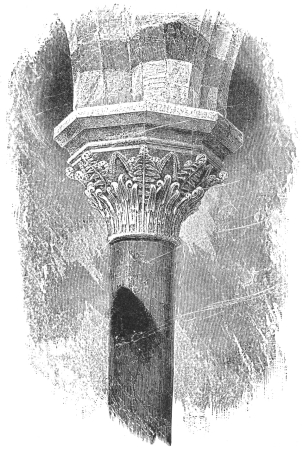
publication one of O’Shea’s capitals;[131] it will be a complete type of
the whole work, in its inner meaning, and far better to show one of them
in its completeness than to give any reduced sketch of the building.
Nevertheless, beautiful as that capital is, and as all the rest of
O’Shea’s work is likely to be, it is not yet perfect Gothic sculpture;
and it might give rise to dangerous error, if the admiration given to
these carvings were unqualified.
I cannot, of course, enter in this letter into any discussion of the
question, more and more vexed among us daily, respecting the due meaning
and scope of conventionalism in treatment of natural form; but I may
state briefly what, I trust, will be the conclusion to which all this
“vexing” will at last lead our best architects.
The highest art in all kinds is that which conveys the most truth; and
the best ornamentation possible would be the painting of interior walls
with frescos by Titian, representing perfect Humanity in color; and the
sculpture of exterior walls by Phidias, representing perfect Humanity in
form. Titian and Phidias are precisely alike in their conception and
treatment of nature—everlasting standards of the right.
Beneath ornamentation, such as men like these could bestow, falls in
various rank, according to its subordination to vulgar uses or inferior
places, what is commonly conceived as ornamental art. The lower its
office, and the less tractable its material, the less of nature it
should contain, until a zigzag

 BRITISH FERNS.
becomes the best ornament for the hem of a robe, and a mosaic of bits of
glass the best design for a colored window. But all these forms of lower
art are to be conventional only because they are subordinate—not
because conventionalism is in itself a good or desirable thing. All
right conventionalism is a wise acceptance of, and compliance with,
conditions of restraint or inferiority: it may be inferiority of our
knowledge or power, as in the art of a semi-savage nation; or restraint
by reason of material, as in the way the glass painter should restrict
himself to transparent hue, and a sculptor deny himself the eyelash and
the film of flowing hair, which he cannot cut in marble: but in all
cases whatever, right conventionalism is either a wise acceptance of an
inferior place, or a noble display of power under accepted limitation;
it is not an improvement of natural form into something better or
purer than Nature herself.
Now this great and most precious principle may be compromised in two
quite opposite ways. It is compromised on one side when men suppose that
the degradation of a natural form which fits it for some subordinate
place is an improvement of it; and that a black profile on a red ground,
because it is proper on a water-jug, is therefore an idealization of
Humanity, and nobler art than a picture of Titian. And it is compromised
equally gravely on the opposite side, when men refuse to submit to the
limitation of material and the fitnesses of office—when they try to
produce finished pictures in colored glass, or substitute the
inconsiderate imitation of natural objects for the perfectness of
adapted and disciplined design.
There is a tendency in the work of the Oxford Museum to err on this last
side; unavoidable, indeed, in the present state of our
art-knowledge—and less to be regretted in a building devoted to natural
science than in any other: nevertheless, I cannot close this letter
without pointing it out, and warning the general reader against
supposing that the ornamentation of the Museum is, or can be as yet, a
representation of what Gothic work will be, when its revival is
complete. Far more severe, yet more perfect and lovely, that work will
involve, under sterner conventional restraint, the expression not only
of
 From “The Oxford Museum.” p. 89.
natural form, but of all vital and noble natural law. For the truth of
decoration is never to be measured by its imitative power, but by its
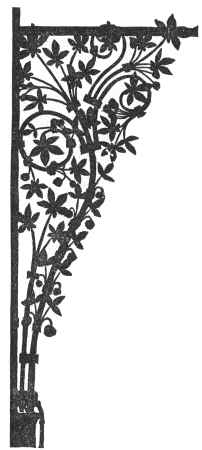
suggestive and informative power. In the annexed spandril of the
iron-work of our roof, for instance, the horse-chestnut leaf and nut are
used as the principal elements of form: they are not ill-arranged, and
produce a more agreeable effect than convolutions of the iron could
have given, unhelped by any reference to natural objects. Nevertheless,
I do not call it an absolutely good design; for it would have been
possible, with far severer conventional treatment of the iron bars, and
stronger constructive arrangement of them, to have given vigorous
expression, not of the shapes of leaves and nuts only, but of their
peculiar radiant or fanned expansion, and other conditions of group and
growth in the tree; which would have been just the more beautiful and
interesting, as they would have arisen from deeper research into nature,
and more adaptive modifying power in the designer’s mind, than the mere
leaf termination of a riveted scroll.
I am compelled to name these deficiencies, in order to prevent
misconception of the principles we are endeavoring to enforce; but I do
not name them as at present to be avoided; or even much to be regretted.
They are not chargeable either on the architect, or on the subordinate
workmen; but only on the system which has for three centuries withheld
all of us from healthy study; and although I doubt not that lovelier and
juster expressions of the Gothic principle will be ultimately aimed at
by us, than any which are possible in the Oxford Museum, its builders
will never lose their claim to our chief gratitude, as the first guides
in a right direction; and the building itself—the first exponent of the
recovered truth—will only be the more venerated the more it is
excelled.
Believe me, my dear Acland,
Ever affectionately yours,
J. Ruskin.
[From “The Witness” (Edinburgh), September 16, 1857.]
THE CASTLE ROCK.
Dunbar, 14th September, 1857.
To the Editor of “The Witness.”
My Dear Sir: As I was leaving Edinburgh this morning, I heard a report
which gave me more concern than I can easily express, and very
sufficiently spoiled the pleasure of my drive here. If there be no truth
in the said report, of course take no notice of this letter; but if
there be real ground for my fears, I trust you will allow me space in
your columns for a few words on the subject.
The whisper—I hope I may say, the calumny—regarded certain proceedings
which are taking place at the Castle. It was said to be the architect’s
intention to cut down into the brow of the Castle rock, in order to
afford secure foundation for some new buildings.[132]
Now, the Castle rock of Edinburgh is, as far as I know, simply the
noblest in Scotland conveniently approachable by any creatures but
sea-gulls or peewits. Ailsa and the Bass are of course more wonderful;
and, I suppose, in the West Highlands there are masses of crag more wild
and fantastic; but people only go to see these once or twice in their
lives, while the Castle rock has a daily influence in forming the taste,
or kindling the imagination, of every promising youth in Edinburgh. Even
irrespectively of its position, it is a mass of singular importance
among the rocks of Scotland. It is not easy to find among your mountains
a “craig” of so definite a form, and on so magnificent a scale. Among
the central hills of Scotland, from Ben Wyvis to the Lammermuirs, I know
of none comparable to it; while, besides being bold and vast, its bars
of basalt are so nobly arranged, and form a series of curves at once so
majestic and harmonious, from the turf at their base to the roots of the
bastions, that, as long as your artists have that crag to study, I do
not see that they need casts from Michael Angelo, or any one else, to
teach them the laws of composition or the sources of sublimity.
But if you once cut into the brow of it, all is over. Disturb, in any
single point, the simple lines in which the walls now advance and recede
upon the tufted grass of its summit, and you may as well make a quarry
of it at once, and blast away rock, Castle, and all. It admits of some
question whether the changes made in the architecture of your city of
late years are in every case improvements; but very certainly you cannot
improve the architecture of your volcanic crags by any explosive
retouches. And your error will be wholly irremediable. You may restore
Trinity Chapel, or repudiate its restoration, at your pleasure, but
there will be no need to repudiate restoration of the Castle rock. You
cannot re-face nor re-rivet that, nor order another in a “similar
style.” It is a dangerous kind of engraving which you practise on so
large a jewel. But I trust I am wasting my time in writing of this: I
cannot believe the report, nor think that the people of Edinburgh,
usually so proud of their city, are yet so unaware of what constitutes
its chief nobleness, and so utterly careless of the very features of its
scenery, which have been the means of the highest and purest education
to their greatest men, as to allow this rock to be touched. If the works
are confined to the inside of the wall, no harm will be done; but let a
single buttress, or a single cleft, encumber or divide its outer brow,
and there is not a man of sensibility or sense in Edinburgh who will not
blush and grieve for it as long as he lives.
Believe me, my dear Sir, very faithfully yours,
J. Ruskin.
[From “The Witness” (Edinburgh), September 30, 1857.]
EDINBURGH CASTLE.
Penrith, 27th September.
To the Editor of “The Witness”
My Dear Sir: I see by some remarks in the Literary Gazette[133] on the
letter of mine to which you gave a place in your columns of the 16th,
that the design of the proposed additions to Edinburgh Castle is
receiving really serious consideration. Perhaps, therefore, a few words
respecting the popular but usually unprofitable business of
castle-building may be of some interest to your readers. We are often a
little confused in our ideas respecting the nature of a castle—properly
so called. A “castle” is a fortified dwelling-house containing
accommodation for as many retainers as are needed completely to defend
its position. A “fortress” is a fortified military position, generally
understood to be extensive enough to contain large bodies of troops. And
a “citadel,” a fortified military position connected with a fortified
town, and capable of holding out even if the town were taken.
It is as well to be clear on these points: for certain conditions of
architecture are applicable and beautiful in each case, according to the
use and character of the building; and certain other conditions are in
like manner inapplicable and ugly, because contrary to its character,
and unhelpful to its use.
Now this helpfulness and unhelpfulness in architectural features
depends, of course, primarily on the military practice of the time; so
that forms which were grand, because rational, before gunpowder was
invented, are ignoble, because ridiculous, in days of shell and shot.
The very idea and possibility of the castle proper have passed away with
the arms of the middle ages. A man’s house might be defended by his
servants against a troop of cavalry, if its doors were solid and its
battlements pierced. But it cannot be defended against a couple of
field-pieces, whatever the thickness of its oak, or number of its
arrow-slits.
I regret, as much as any one can regret, the loss of castellated
architecture properly so called. Nothing can be more noble or
interesting than the true thirteenth or fourteenth century castle, when
built in a difficult position, its builder taking advantage of every
inch of ground to gain more room, and of every irregularity of surface
for purposes of outlook and defence; so that the castle sate its rock
as a strong rider sits his horse—fitting its limbs to every writhe of
the flint beneath it; and fringing the mountain promontory far into the
sky with the wild crests of its fantastic battlements. Of such castles
we can see no more; and it is just because I know them well and love
them deeply that I say so. I know that their power and dignity consists,
just as a soldier’s consists, in their knowing and doing their work
thoroughly; in their being advanced on edge or lifted on peak of crag,
not for show nor pride, but for due guard and outlook; and that all
their beautiful irregularities and apparent caprices of form are in
reality their fulfilments of need, made beautiful by their compelled
association with the wild strength and grace of the natural rock. All
attempts to imitate them now are useless—mere girl’s play. Mind, I like
girl’s play, and child’s play, in its place, but not in the planning of
military buildings. Child’s play in many cases is the truest wisdom. I
accept to the full the truth of those verses of Wordsworth’s[134]
beginning—
“Who fancied what a pretty sight
This rock would be, if edged around
With living snowdrops?—circlet bright!
How glorious to this orchard ground!
Was it the humor of a child?” etc.
But I cannot apply the same principles to more serious matters, and vary
the reading of the verses into application to the works on Edinburgh
Castle, thus:
“Who fancied what a pretty sight
This rock would be, if edged around
With tiny turrets, pierced and light,
How glorious to this warlike ground!”
Therefore, though I do not know exactly what you have got to do in
Edinburgh Castle, whatever it may be, I am certain the only right way to
do it is the plain way. Build what is needed—chapel, barracks, or
dwelling-house—in the best places, in a military point of view, of dark
stone, and bomb-proof, keeping them low, and within the existing line of
ramparts. That is the rational thing to do; and the inhabitants of
Edinburgh will find it in the end the picturesque thing. It would be so
under any circumstances; but it is especially so in this instance; for
the grandeur of Edinburgh Castle depends eminently on the great,
unbroken, yet beautifully varied parabolic curve in which it descends
from the Round Tower on the Castle Hill to the terminating piece of
impendent precipice on the north. It is the last grand feature of
Edinburgh left as yet uninjured. You have filled up your valley with a
large chimney, a mound, and an Institution; broken in upon the Old Town
with a Bank, a College, and several fires; dwarfed the whole of Princes
Street by the Scott Monument; and cut Arthur’s Seat in half by the
Queen’s Drive. It only remains for you to spoil the curve of your
Castle, and your illustrations of the artistic principle of breadth will
be complete.
It may appear at first that I depart from the rule of usefulness I have
proposed, in entreating for the confinement of all buildings undertaken
within the existing ramparts, in order to preserve the contour of the
outside rock. But I presume that in the present state of military
science, and of European politics, Edinburgh Castle is not a very
important military position; and that to make it a serviceable fortress
or citadel, many additional works would be required, seriously
interfering with the convenience of the inhabitants of the New Town, and
with the arrangements of the Railroad Company. And, as long as these
subordinate works are not carried out, I do not see any use in
destroying your beautiful rock, merely to bring another gun to bear, or
give accommodation to another company. But I both see, and would
earnestly endeavor to advocate, the propriety of keeping the
architecture of the building within those ramparts masculine and simple
in style, and of not allowing a mistaken conception of picturesqueness
to make a noble fortress look like a child’s toy.
Believe me, my dear Sir, very faithfully yours,
J. Ruskin.
[From “The Daily Telegraph,” December 22, 1871.]
CASTLES AND KENNELS.
To the Editor of “The Daily Telegraph.”
Sir: I was astonished the other day by your article on taverns, but
never yet in my life was so much astonished by anything in print as by
your to-day’s article on castles.[135]
I am a castle-lover of the truest sort. I do not suppose any man alive
has felt anything like the sorrow or anger with which I have watched the
modern destruction by railroad and manufacture, helped by the wicked
improvidence of our great families, of half the national memorials of
England, either actually or in effect and power of association—as
Conway, for instance, now vibrating to ruin over a railroad station. For
Warwick Castle, I named it in my letter of last October, in “Fors
Clavigera,”[136] as a type of the architectural treasures of this
England of ours known to me and beloved from childhood to this hour.
But, Sir, I am at this hour endeavoring to find work and food for a boy
of seventeen, one of eight people—two married couples, a woman and her
daughter, and this boy and his sister—who all sleep together in one
room, some 18 ft. square, in the heart of London; and you call upon me
for a subscription to help to rebuild Warwick Castle.
Sir, I am an old and thoroughbred Tory, and as such I say, “If a noble
family cannot rebuild their own castle, in God’s name let them live in
the nearest ditch till they can.”
I am, Sir, your faithful servant,
J. Ruskin
Denmark Hill, Dec. 20.
[From “The Daily Telegraph,” December 25, 1871.]
VERONA v. WARWICK.
To the Editor of “The Daily Telegraph.”
Sir: Of lodging for poor and rich you will perhaps permit a further word
or two from me, even in your close columns for Christmas morning. You
think me inconsistent because I wanted to buy Verona, and do not want to
restore Warwick.[137]
I wanted, and still want, to buy Verona. I would give half my fortune to
buy it for England, if any other people would help me. But I would buy
it, that what is left of it might not be burned, and what is lost of it
not restored. It would indeed be very pleasant—not to me only, but to
many other sorrowful persons—if things could be restored when we
chose. I would subscribe willingly to restore, for instance, the manger
wherein the King of Judah lay cradled this day some years since, and
not unwillingly to restore the poorer cradle of our English King-maker,
were it possible. But for the making of a new manger, to be exhibited
for the edification of the religious British public, I will not
subscribe. No; nor for the building of mock castles, or mock cathedrals,
or mocks of anything. And the sum of what I have to say in this present
matter may be put in few words.
As an antiquary—which, thank Heaven, I am—I say, “Part of Warwick
Castle is burnt—’tis pity. Take better care of the rest.”
As an old Tory—which, thank Heaven, I am—I say, “Lord Warwick’s house
is burned. Let Lord Warwick build a better if he can—a worse if he
must; but in any case, let him neither beg nor borrow.”
As a modern renovator and Liberal—which, thank Heaven, I am not—I
would say, “By all means let the public subscribe to build a
spick-and-span new Warwick Castle, and let the pictures be touched up,
and exhibited by gaslight; let the family live in the back rooms, and
let there be a table d’hôte in the great hall at two and six every
day, 2s. 6d. a head, and let us have Guy’s bowl for a dinner bell.”
I am, Sir, your faithful servant,
John Ruskin.
Denmark Hill, S.E., 24th (for 25th) December.
[From “The Daily Telegraph,” January 19, 1871.]
“NOTRE DAME DE PARIS.”
To the Editor of “The Daily Telegraph.”
Sir: It may perhaps be interesting to some of your readers, in the
present posture of affairs round Paris, to know, as far as I am able to
tell them, the rank which the Church of Notre Dame holds among
architectural and historical monuments.
Nearly every great church in France has some merit special to itself;
in other countries, one style is common to many districts; in France,
nearly every province has its unique and precious monument.
But of thirteenth-century Gothic—the most perfect architectural style
north of the Alps—there is, both in historical interest, and in
accomplished perfectness of art, one unique monument—the Sainte
Chapelle of Paris.
As examples of Gothic, ranging from the twelfth to the fourteenth
century, the cathedrals of Chartres, Rouen, Amiens, Rheims, and Bourges,
form a kind of cinque-foil round Notre Dame of Paris, of which it is
impossible to say which is the more precious petal; but any of those
leaves would be worth a complete rose of any other country’s work except
Italy’s. Nothing else in art, on the surface of the round earth, could
represent any one of them, if destroyed, or be named as of any
equivalent value.
Central among these, as in position, so in its school of sculpture;
unequalled in that specialty but by the porch of the north transept of
Rouen, and, in a somewhat latter school, by the western porches of
Bourges; absolutely unreplaceable as a pure and lovely source of art
instruction by any future energy or ingenuity, stands—perhaps, this
morning, I ought rather to write, stood[138]—Notre Dame of Paris.
I am, Sir, your faithful servant,
J. Ruskin.
[From “The Pall Mall Gazette,” March 16, 1872.]
MR. RUSKIN’S INFLUENCE: A DEFENCE.
To the Editor of “The Pall Mall Gazette.”
Sir: I receive many letters just now requesting me to take notice of the
new theory respecting Turner’s work put forward by Dr. Liebreich in his
recent lecture at the Royal Institution.[139] Will you permit me to
observe in your columns, once for all, that I have no time for the
contradiction of the various foolish opinions and assertions which from
time to time are put forward respecting Turner or his pictures? All that
is necessary for any person generally interested in the arts to know
about Turner was clearly stated in “Modern Painters” twenty years ago,
and I do not mean to state it again, nor to contradict any
contradictions of it. Dr. Liebreich is an ingenious and zealous
scientific person. The public may derive much benefit from consulting
him on the subject of spectacles—not on that of art.
As I am under the necessity of writing to you at any rate, may I say
further that I wish your critic of Mr. Eastlake’s book[140] on the
Gothic revival would explain what he means by saying that my direct
influence on architecture is always wrong, and my indirect influence
right; because, if that be so, I will try to exercise only indirect
influence on my Oxford pupils. But the fact to my own notion is
otherwise. I am proud enough to hope, for instance, that I have had some
direct influence on Mr. Street; and I do not doubt but that the public
will have more satisfaction from his Law Courts[141] than they have had
from anything built within fifty years. But I have had indirect
influence on nearly every cheap villa-builder between this[142] and
Bromley; and there is scarcely a public-house near the Crystal Palace
but sells its gin and bitters under pseudo-Venetian capitals copied from
the Church of the Madonna of Health or of Miracles. And one of my
principal notions for leaving my present house is that it is surrounded
everywhere by the accursed Frankenstein monsters of, indirectly, my
own making.
I am, Sir, your obedient servant,
John Ruskin.
March 15.
[From “The Pall Mall Gazette,” March 21, 1872.]
MR. RUSKIN’S INFLUENCE: A REJOINDER.
To the Editor of “The Pall Mall Gazette.”
Sir: I am obliged by your critic’s reply to my question, but beg to
observe that, meaning what he explains himself to have meant, he should
simply have said that my influence on temper was right, and on taste
wrong; the influence being in both cases equally “direct.” On questions
of taste I will not venture into discussion with him, but must be
permitted to correct his statement that I have persuaded any one to
prefer Venetian to English Gothic. I have stated that Italian—chiefly
Pisan and Florentine—Gothic is the noblest school of Gothic hitherto
existent, which is true; and that one form of Venetian Gothic deserves
singular respect for the manner of its development. I gave the mouldings
and shaft measurements of that form,[143] and to so little purpose, that
I challenge your critic to find in London, or within twenty miles of it,
a single Venetian casement built on the sections which I gave as normal.
For Venetian architecture developed out of British moral consciousness I
decline to be answerable. His accusation that I induced architects to
study sculpture more, and what he is pleased to call “expressional
character” less, I admit. I should be glad if he would tell me what,
before my baneful influence began to be felt, the expressional character
of our building was; and I will reconsider my principles if he can point
out to me, on any modern building either in London or, as aforesaid,
within twenty miles round, a single piece of good sculpture of which the
architect repents, or the public complains.
I am, Sir, your faithful servant,
J. Ruskin.
March 21.
[From “The Liverpool Daily Post,” June 9, 1877.]
MODERN RESTORATION[144]
Venice, 15th April, 1877.
My Dear Sir: It is impossible for any one to know the horror and
contempt with which I regard modern restoration—but it is so great
that it simply paralyzes me in despair,—and in the sense of such
difference in all thought and feeling between me and the people I live
in the midst of, almost makes it useless for me to talk to them. Of
course all restoration is accursed architect’s jobbery, and will go on
as long as they can get their filthy bread by such business. But things
are worse here than in England: you have little there left to
lose—here, every hour is ruining buildings of inestimable beauty and
historical value—simply to keep stone-lawyers[145] at work. I am
obliged to hide my face from it all, and work at other things, or I
should die of mere indignation and disgust.
Ever truly yours,
J. Ruskin.
[From “The Kidderminster Times,” July 28, 1877.]
RIBBESFORD CHURCH.
Brantwood, Coniston, Lancashire,
July 24, 1877.
To the Editor of “The Kidderminster Times.”
Sir: It chanced that, on the morning of the Sunday, when the appearances
of danger in the walls of Ribbesford Church began seriously to manifest
themselves (according to the report in your columns of the 21st
inst.),[146] I was standing outside of the church, listening to the
singing of the last hymn as the sound came through the open door (with
the Archer Knight sculptured above it), and showing to the friend who
had brought me to the lovely place the extreme interest of the old
perpendicular traceries in the freehand working of the apertures.
Permit me to say, with reference to the proposed restoration of the
church, that no modern architect, no mason either, can, or would if they
could, “copy” those traceries. They will assuredly put up with
geometrical models in their place, which will be no more like the old
traceries than a Kensington paper pattern is like a living flower.
Whatever else is added or removed, those traceries should be replaced as
they are, and left in reverence until they moulder away. If they are
already too much decayed to hold the glass safely (which I do not
believe), any framework which may be necessary can be arranged to hold
the casements within them, leaving their bars entirely disengaged, and
merely kept from falling by iron supports. But if these are to be
“copied,” why in the world cannot the congregation pay for a new and
original church, to display the genius and wealth of the nineteenth
century somewhere else, and leave the dear old ruin to grow gray by
Severn side in peace?
I am, Sir, your faithful servant,
J. Ruskin.
CIRCULAR[147] RESPECTING MEMORIAL STUDIES OF ST. MARK’S,
VENICE, NOW IN PROGRESS UNDER MR. RUSKIN’S DIRECTION.
This circular will be given to visitors to the Old Water-color
Society’s Exhibition, Pall Mall East, or on application to the Fine Art
Society, 148 New Bond Street.
My friends have expressed much surprise at my absence from the public
meetings called in defence of St. Mark’s. They cannot, however, be too
clearly certified that I am now entirely unable to take part in exciting
business, or even, without grave danger, to allow my mind to dwell on
the subjects which, having once been dearest to it, are now the sources
of acutest pain. The illness which all but killed me two years ago[148]
was not brought on by overwork, but by grief at the course of public
affairs in England, and of affairs, public and private alike, in Venice;
the distress of many an old and deeply regarded friend there among the
humbler classes of the city being as necessary a consequence of the
modern system of centralization, as the destruction of her ancient civil
and religious buildings.
How far forces of this national momentum may be arrested by protest, or
mollified by petition, I know not; what in either kind I have felt
myself able to do has been done two years since, in conjunction with one
of the few remaining representatives of the old Venetian noblesse.[149]
All that now remains for me is to use what time may be yet granted for
such record as hand and heart can make of the most precious building in
Europe, standing yet in the eyes of men and the sunshine of heaven.
The drawing of the first two arches of the west front, now under threat
of restoration, which, as an honorary member of the Old Water-color
Society, I have the privilege of exhibiting in its rooms this year,
shows with sufficient accuracy the actual state of the building, and the
peculiar qualities of its architecture.[150] The principles of that
architecture are analyzed at length in the second volume of the “Stones
of Venice,” and the whole façade described there with the best care I
could, in hope of directing the attention of English architects to the
forms of Greek sculpture which enrich it.[151] The words have been
occasionally read for the sound of them; and perhaps, when the building
is destroyed, may be some day, with amazement, perceived to have been
true.
In the mean time, the drawing just referred to, every touch of it made
from the building, and left as the color dried in the spring mornings of
1877, will make clear some of the points chiefly insisted on in the
“Stones of Venice,” and which are of yet more importance now.[152] Of
these, the first and main ones are the exquisite delicacy of the work
and perfection of its preservation to this time. It seems to me that the
English visitor never realizes thoroughly what it is that he looks at in
the St. Mark’s porches: its glittering confusion in a style unexampled,
its bright colors, its mingled marbles, produce on him no real
impression of age, and its diminutive size scarcely any of grandeur. It
looks to him almost like a stage scene, got up solidly for some sudden
festa. No mere guide-book’s passing assertion of date—this century or
the other—can in the least make him even conceive, and far less feel,
that he is actually standing before the very shafts and stones that were
set on their foundations here while Harold the Saxon stood by the grave
of the Confessor under the fresh-raised vaults of the first Norman
Westminster Abbey, of which now a single arch only remains standing. He
cannot, by any effort, imagine that those exquisite and lace-like
sculptures of twined acanthus—every leaf-edge as sharp and fine as if
they were green weeds fresh springing in the dew, by the
Pan-droseion[153]—were, indeed, cut and finished to their perfect grace
while the Norman axes were hewing out rough zigzags and dentils round
the aisles of Durham and Lindisfarne. Or nearer, in what is left of our
own Canterbury—it is but an hour’s journey in pleasant Kent—you may
compare, almost as if you looked from one to the other, the grim
grotesque of the block capitals in the crypt with the foliage of these
flexile ones, and with their marble doves—scarcely distinguishable
from the living birds that nestle between them. Or, going down two
centuries (for the fillings of the portico arches were not completed
till after 1204), what thirteenth-century work among our gray limestone
walls can be thought of as wrought in the same hour with that wreath of
intertwined white marble, relieved by gold, of which the tenderest and
sharpest lines of the pencil cannot finely enough express the surfaces
and undulations? For indeed, without and within, St. Mark’s is not, in
the real nature of it, a piece of architecture, but a jewelled casket
and painted reliquary, chief of the treasures in what were once the
world’s treasuries of sacred things, the kingdoms of Christendom.
A jewelled casket, every jewel of which was itself sacred. Not a slab of
it, nor a shaft, but has been brought from the churches descendants of
the great Seven of Asia, or from the Christian-Greek of Corinth, Crete,
and Thrace, or the Christian-Israelite in Palestine—the central
archivolt copied from that of the church of the Holy Sepulchre, and the
opposing lions or phœnixes of its sculptures from the treasury of
Atreus and the citadel of Tyre.
Thus, beyond all measure of value as a treasury of art, it is also,
beyond all other volumes, venerable as a codex of religion. Just as the
white foliage and birds on their golden ground are descendants, in
direct line, from the ivory and gold of Phidias, so the Greek pictures
and inscriptions, whether in mosaic or sculpture, throughout the
building, record the unbroken unity of spiritual influence from the
Father of light—or the races whose own poets had said “We also are his
offspring”—down to the day when all their gods, not slain, but changed
into new creatures, became the types to them of the mightier Christian
spirits; and Perseus became St. George, and Mars St. Michael, and Athena
the Madonna, and Zeus their revealed Father in Heaven.
In all the history of human mind, there is nothing so wonderful, nothing
so eventful, as this spiritual change. So inextricably is it interwoven
with the most divine, the most distant threads of human thought and
effort, that while none of the thoughts of St. Paul or the visions of
St. John, can be understood without our understanding first the imagery
familiar to the Pagan worship of the Greeks; on the other hand, no
understanding of the real purport of Greek religion can be securely
reached without watching the translation of its myths into the message
of Christianity.
Both by the natural temper of my mind, and by the labor of forty years
given to this subject in its practical issues on the present state[154]
of Christendom, I have become, in some measure, able both to show and to
interpret these most precious sculptures; and my health has been so far
given back to me that if I am at this moment aided, it will, so far as I
can judge, be easily possible for me to complete the work so long in
preparation. There will yet, I doubt not, be time to obtain perfect
record of all that is to be destroyed. I have entirely honest and able
draughtsmen at my command; my own resignation[155] of my Oxford
Professorship has given me leisure; and all that I want from the
antiquarian sympathy of England is so much instant help as may permit
me, while yet in available vigor of body and mind, to get the records
made under my own overseership, and registered for sufficient and true.
The casts and drawings which I mean to have made will be preserved in a
consistent series in my Museum at Sheffield, where I have freehold
ground enough to build a perfectly lighted gallery for their reception.
I have used the words “I want,” as if praying this thing for myself. It
is not so. If only some other person could and would undertake all this,
Heaven knows how gladly I would leave the task to him. But there is no
one else at present able to do it: if not now by me, it can never be
done more.—And so I leave it to the reader’s grace.
J. Ruskin.
All subscriptions to be sent to Mr. G. Allen, Sunnyside, Orpington,
Kent.
POSTSCRIPT.[156]
By the kindness of the Society of Painters in Water-colors I am
permitted this year, in view of the crisis of the fate of the façade of
St. Mark’s, to place in the exhibition-room of the Society ten
photographs, illustrative of its past and present state. I have already
made use of them, both in my lectures at Oxford and in the parts of
Fors Clavigera intended for Art-teaching at my Sheffield Museum; and
all but the eighth are obtainable from my assistant, Mr. Ward (2 Church
Terrace, Richmond), who is my general agent for photographs, either
taken under my direction (as here, Nos. 4, 9, and 10), or specially
chosen by me for purposes of Art Education. The series of views here
shown are all perfectly taken, with great clearness, from the most
important points, and give, consecutively, complete evidence respecting
the façade.
They are arranged in the following order:
| 1. | The Central Porch. | —Arranged in one frame. |
| 2. | The Two Northern Porches. |
| 3. | The Two Southern Porches. |
| 4. | The Northern Portico. |
| 5. | The Southern Portico. Before restoration. |
| 6. | The West Front, in Perspective. Seen from the North. |
| 7. | The West Front, in Perspective. Seen from the South. |
| 8. | The South Side. Before restoration. |
| 9. | Detail of Central Archivolt. |
| 10. | The Cross of the Merchants of Venice. |
This last photograph is not of St. Mark’s but is of the inscription
which I discovered, in 1877, on the Church of St. James of the Rialto.
It is of the 9th or 10th century (according to the best antiquarians of
Venice), and is given in this series, first, to confirm the closing
paragraph in my notes on the Prout drawings in Bond Street;[157] and
secondly to show the perfect preservation even of the hair-strokes in
letters carved in the Istrian marble used at Venice a thousand years
ago. The inscription on the cross is—
“Sit crux vera salus huic tua Christe loco.”
(Be Thy Cross, O Christ, the true safety of this place.)
And on the band beneath—
“Hoc circa templum sit jus mercantibus æquum,
Pondera nec vergant nec sit conventio prava.”
(Around this temple let the merchants’ law be just,
Their weights true, and their contracts fair.)
The bearing of this inscription on the relations of Antonio to Shylock
may perhaps not be perceived by a public which now—consistently and
naturally enough, but ominously—considers Shylock a victim to the
support of the principles of legitimate trade, and Antonio a “speculator
and sentimentalist.” From the series of photographs of St. Mark’s
itself, I cannot but think even the least attentive observer must
receive one strong impression—that of the singular preservation of the
minutest details in its sculpture. Observe, this is a quite separate
question from the stability of the fabric. In our northern cathedrals
the stone, for the most part, moulders away; and the restorer usually
replaces it by fresh sculpture, on the faces of walls of which the mass
is perfectly secure. Here, at St. Mark’s, on the contrary, the only
possible pretence for restoration has been, and is, the alleged
insecurity of the masses of inner wall—the external sculptures
remaining in faultless perfection, so far as unaffected by direct human
violence. Both the Greek and Istrian marbles used at Venice are
absolutely defiant of hypæthral influences, and the edges of their
delicatest sculpture remain to this day more sharp than if they had been
cut in steel—for then they would have rusted away. It is especially,
for example, of this quality that I have painted the ornament of the St.
Jean d’Acre pillars, No. 107, which the reader may at once compare with
the daguerreotype (No. 108) beside it, which are exhibited, with the
Prout and Hunt drawings, at the Fine Art Society’s rooms.[158] These
pillars are known to be not later than the sixth century, yet wherever
external violence has spared their decoration it is sharp as a
fresh-growing thistle. Throughout the whole façade of St. Mark’s, the
capitals have only here and there by casualty lost so much as a volute
or an acanthus leaf, and whatever remains is perfect as on the day it
was set in its place, mellowed and subdued only in color by time, but
white still, clearly white; and gray, still softly gray; its porphyry
purple as an Orleans plum, and the serpentine as green as a greengage.
Note also, that in this throughout perfect decorated surface there is
not a loose joint. The appearances of dislocation, which here and there
look like yielding of masonry, are merely carelessness in the replacing
or resetting of the marble armor at the different times when the front
has been retouched—in several cases quite wilful freaks of arrangement.
The slope of the porphyry shaft, for instance, on the angle at the left
of my drawing, looks like dilapidation. Were it really so, the building
would be a heap of ruins in twenty-four hours. These porches sustain no
weight above—their pillars carry merely an open gallery; and the
inclination of the red marble pilasters at the angle is not yielding at
all, but an originally capricious adjustment of the marble armor. It
will be seen that the investing marbles between the arch and pilaster
are cut to the intended inclination, which brings the latter nearly into
contact with the upper archivolt; the appearance of actual contact being
caused by the projection of the dripstone. There are, indeed, one or two
leaning towers in Venice whose foundations have partly yielded; but if
anything were in danger on St. Mark’s Place, it would be the
campanile—three hundred feet high—and not the little shafts and
galleries within reach—too easy reach—of the gaslighter’s ladder. And
the only dilapidations I have myself seen on this porch, since I first
drew it forty-six years ago, have been, first, those caused by the
insertion of the lamps themselves, and then the breaking away of the
marble net work of the main capital by the habitual clattering of the
said gaslighter’s ladder against it. A piece of it which I saw so broken
off, and made an oration over to the passers-by in no less broken
Italian, is in my mineral cabinet at Brantwood.
Before leaving this subject of the inclined angle, let me
note—usefully, though not to my present purpose—that the entire beauty
of St. Mark’s campanile depends on this structure, there definitely seen
to be one of real safety. This grace and apparent strength of the whole
mass would be destroyed if the sides of it were made vertical. In Gothic
towers, the same effect is obtained by the retiring of the angle
buttresses, without actual inclination of any but the coping lines.
In the Photograph No. 5 the slope of the angles in the correspondent
portico, as it stood before restoration, is easily visible and
measurable, the difference being, even on so small a scale, full the
twentieth of an inch between the breadth at base and top, at the angles,
while the lines bearing the inner arch are perfectly vertical.
There was, indeed, as will be seen at a glance, some displacement of the
pillars dividing the great window above, immediately to the right of the
portico. But these pillars were exactly the part of the south front
which carried no weight. The arch above them is burdened only by its own
fringes of sculpture; and the pillars carried only the bit of decorated
panelling, which is now bent—not outwards, as it would have been by
pressure, but inwards. The arch has not subsided; it was always of the
same height as the one to the right of it (the Byzantine builders
throwing their arches always in whatever lines they chose); nor is there
a single crack or displacement in the sculpture of the investing fringe.
In No. 3 (to the right hand in the frame) there is dilapidation and
danger enough certainly; but that is wholly caused by the savage and
brutal carelessness with which the restored parts are joined to the old.
The photograph bears deadly and perpetual witness against the system of
“making work,” too well known now among English as well as Italian
operatives; but it bears witness, as deadly, against the alleged
accuracy of the restoration itself. The ancient dentils are bold, broad,
and cut with the free hand, as all good Greek work is; the new ones,
little more than half their size, are cut with the servile and horrible
rigidity of the modern mechanic.
This quality is what M. Meduna, in the passage quoted from his defence
of himself[159] in the Standard, has at once the dulness and the
audacity actually to boast of as “plus exacte”!
Imagine a Kensington student set to copy a picture by Velasquez, and
substituting a Nottingham lace pattern, traced with absolute exactness,
for the painter’s sparkle and flow and flame, and boasting of his
improvements as “plus exacte”! That is precisely what the Italian
restorer does for his original; but, alas! he has the inestimable
privilege also of destroying the original as he works, and putting his
student’s caricature in its place! Nor are any words bitter or
contemptuous enough to describe the bestial stupidities which have thus
already replaced the floor of the church, in my early days the loveliest
in Italy, and the most sacred.
In the Photograph No. 7 there is, and there only, one piece of real
dilapidation—the nodding pinnacle propped on the right. Those pinnacles
stand over the roof gutters, and their bracket supports are, of course,
liable to displacement, if the gutters get choked by frost or otherwise
neglected. The pinnacle is not ten feet high, and can be replaced and
secured as easily as the cowl on a chimney-pot. The timbers underneath
were left there merely to give the wished-for appearance of repairs
going on. They defaced the church front through the whole winter of
1876. I copied the bills stuck on them one Sunday, and they are printed
in the 78th number of Fors Clavigera, the first being the announcement
of the Reunited agencies for information on all matters of commercial
enterprise and speculation, and the last the announcement of the loss of
a cinnamon-colored little bitch, with rather long ears (coll’ orecchie
piùtosto lunghe). I waited through the winter to see how much the
Venetians really cared for the look of their church; but lodged a formal
remonstrance in March with one of the more reasonable civic authorities,
who presently had them removed. The remonstrance ought, of course, to
have come from the clergy; but they contented themselves with cutting
flower-wreaths on paper to hang over the central door at Christmas-time.
For the rest, the pretence of rottenness in the walls is really too
gross to be answered. There are brick buildings in Italy by tens of
thousands, Roman, Lombardic, Gothic, on all scales and in all exposures.
Which of them has rotted or fallen, but by violence? Shall the tower of
Garisenda stand, and the Campanile of Verona, and the tower of St.
Mark’s, and, forsooth, this little fifty feet of unweighted wall be
rotten and dangerous?
Much more I could say, and show; but the certainty of the ruin of poor
Bedlamite Venice is in her own evil will, and not to be averted by any
human help or pleading. Her Sabba delle streghe has truly come; and in
her own words (see Fors, letter 77th): “Finalmente la Piazza di S.
Marco sarà invasa e completamente illuminata dalle Fiamme di Belzebù.
Perchè il Sabba possa riuscire più completo, si raccomanda a tutti gli
spettatori di fischiare durante le fiamme come anime dannate.”
Meantime, in what Saturday pause may be before this Witches’ Sabbath, if
I have, indeed, any English friends, let them now help me, and my
fellow-workers, to get such casts, and colorings, and measurings, as may
be of use in time to come. I am not used to the begging tone, and will
not say more than that what is given me will go in mere daily bread to
the workers, and that next year, if I live, there shall be some
exposition of what we have got done, with the best account I can render
of its parts and pieces. Fragmentary enough they must be,—poor fallen
plumes of the winged lion’s wings,—yet I think I can plume a true shaft
or two with them yet.
Some copies of the second edition of this circular had printed at
the top of its last and otherwise blank page the words, “Present
State of Subscription Lists:—,” a printer’s error, mistaken by
some readers for a piece of dry humor.
Subscriptions were collected by Mr. G. Allen, as above intimated,
and also by Mr. F. W. Pullen, secretary to the Ruskin Society of
Manchester, under the authority of the following letter, which was
printed and distributed by him: “November 29, 1879.—Dear Mr.
Pullen: I am very glad to have your most satisfactory letter, and
as gladly give you authority to receive subscriptions for drawings
and sculptures of St. Mark’s. Mr. Bunney’s large painting of the
whole west façade, ordered by me a year and a half ago, and in
steady progress ever since, is to be completed this spring. It was
a £500 commission for the Guild, but I don’t want to have to pay it
with Guild capital. I have the power of getting casts, also, in
places where nobody else can, and have now energy enough to give
directions, but can no more pay for them out of my own pocket. Ever
gratefully yours, J. R. As a formal authority, this had better have
my full signature—John Ruskin.” In a further letter to Manchester
on the subject, Mr. Ruskin wrote as follows: “It is wholly
impossible for me at present to take any part in the defence—at
last, though far too late—undertaken by the true artists and
scholars of England—of the most precious Christian building in
Europe; ... nor is there any occasion that I should, if only those
who care for me will refer to what I have already written, and will
accept from me the full ratification of all that was said by the
various speakers, all without exception men of the most accurate
judgment and true feeling, at the meeting held in Oxford. All that
I think it necessary for you to lay, directly from myself, before
the meeting you are about to hold, is the explicit statement of two
facts of which I am more distinctly cognizant from my long
residences in Italy at different periods, and in Venice during
these last years, than any other person can be—namely, the
Infidel—(malignantly and scornfully Infidel and anti-religionist)
aim of Italian ‘restoration’—and the totality of the destruction
it involves, of whatever it touches.” So again, in a second and
despairing letter, he wrote: “You cannot be too strongly assured of
the total destruction involved, in the restoration of St.
Mark’s.... Then the plague of it all is, What can you do? Nothing
would be effectual, but the appointment of a Procurator of St.
Mark’s, with an enormous salary, dependent on the Church’s being
let alone. What you can do by a meeting at Manchester, I have no
notion. The only really practical thing that I can think of would
be sending me lots of money to spend in getting all the drawings I
can of the old thing before it goes. I don’t believe we can save it
by any protests.” See the Birmingham Daily Mail, Nov. 27, 1879.
The reader is also referred to “Fors Clavigera,” New Series, Letter
the Fourth, pp. 125-6.
The meeting in Oxford alluded to above was held in the Sheldonian
Theatre on November 15, 1879. Amongst the principal speakers were
the Dean of Christ Church (in the chair), Dr. Acland, the Professor
of Fine Art (Mr. W. B. Richmond), Mr. Street, Mr. William Morris,
and Mr. Burne Jones.