Yokohama, Japan, Oct. 10, 1889.
AT 9.50 A.M., on the morning of the 8th of
September I went aboard the vestibule train of the New York Central & Hudson River
Railroad, at Forty-second Street, New York; and having travelled on the principal
railroads around the world, I can truly say that no train which has ever carried me has
approached this one in luxurious ease, comfort, and safety. The train rolled into the
Chicago depot at 9.50 the next morning—exactly twenty-four hours. I was detained
in Chicago for two days, and then left by the Rock Island route for San Francisco.
At Ogden, we were detained two days by the burning of a bridge built over a
ravine—one hundred feet long and about the same height. The fire destroyed the massive
snow-sheds and great trees for a long distance. The fire took place Friday. Telegrams
were sent to Sacramento, and the next day word came that twenty-one car loads of
material had been sent with mechanics to erect a new bridge.
The new bridge was erected in four days. Our train was the first to pass over it,
and I remarked how substantially the new erection had been constructed. We reached the
summit at noon, and the Palace Hotel, San Francisco, at midnight.
On the 21st of September we went aboard the steamer Rio-de-Janeiro, built for
the southern trade—370 feet long, 38 feet wide, 3,500 tons—six tubular
boilers, each 13 feet diameter, 10½ feet long. I remarked what heavy consumers
of coal such shaped boilers must be, and the engineer said there was no room to put in
any other kind.
I found myself the sole occupant of a large and well ventilated state-room. At 3
P.M., Captain Ward, standing on the bridge, gave the signal,
and the voice of an officer sang out, "All ashore that's going." Several hundreds of
Chinese men and a dozen women, in showy dresses, crowded the wharf. The friends of the
missionaries on the wharf sang a parting hymn. The big propeller started. A tug pulled
the ship's bow around, and away we went on our voyage of 4,700 miles across the
Pacific. We passed the Golden Gate and the Seal Islands—covered with huge
seals—and then on towards our destination.
I soon made the acquaintance of most of the passengers, forty-five in
number—including fourteen missionaries of the Presbyterian Board, nice young
people going out to their duties in China and Japan. I took my seat at the
dining-table, and found that I had at my right an agreeable companion, a captain in the
German army, and at the left a charming miss of ten, Bessie, daughter of J. De Romero,
secretary of the Spanish Legation to China.
The first week out was a rough one. The weather was bad, and the ship rolled
fearfully, so that we could not walk on deck. The waves were immense, and consequently
nearly every one was sick. I felt a little nausea for a couple of days, but soon did
duty regularly at the fine feast placed before us three times a day, the specialty
being splendid California fruits—peaches, plums, grapes, and oranges, any of which would bring a
prize in an agricultural show.
Day after day the tireless engine drove the propeller. The splendid ship rushed on
and on, not a moment's stop the entire distance. Not a sail or a steamer seen from port
to port, and not even a whale. Once some porpoises and flying-fish, and once, when a
thousand miles from land, a land-hawk lighted on the cross-trees, and proceeded
leisurely to feast on a captured bird, and during the night flew away.
The never-ending water was very impressive in its desolation. Better weather came,
the ship was steady, and we could walk on deck. My little friend and I romped along the
deck from end to end in safety, but once a rude wave threw us down, and dashed us
against the sides of the vessel, taking off some inches of skin from me, but the child
was unhurt, and I did not mind a little thing like that.
I had early made the acquaintance of Mr. Mathews, the chief engineer, and once went
into the hold and inspected the boilers and machinery of the huge ship. I spent a good
deal of time in the chief engineer's room, listening to strange tales of ship and
shore.
On the 9th inst., as we were approaching our destination, I was shown an engrossed
resolution complimenting the captain, beautifully illustrated with a pen-and-ink sketch
of the ship by Señor Romero. After dinner, one of the passengers was selected to
make the presentation address. He said:
"Ladies and gentlemen, fellow-passengers by the good ship Rio-de-Janeiro: I
act with pleasure as chairman on this auspicious occasion, and congratulate you on the
near termination of our long trip across the great Pacific Ocean, rendered safe by the
skill of the navigators and pleasant by the efforts of the officers, one and all. I
have been many times across many seas, sometimes in magnificent floating palaces, but
never on one so neat and clean, and where every detail has been so carefully attended
to.
"'O'er the glad waters of the dark blue sea,
Our thoughts as boundless and our souls as free,
Far as the breeze can bear, the billows foam,
Survey our empire and behold our home.'
"Our only home indeed for a brief period of time. But who can fail to remember the
pleasant acquaintances made, even if we go around the world? For 'they that go
down to the sea in
ships; that do business in great waters; these see the works of the Lord, and his
wonders in the deep.' Even if we look upon the lofty Himalayas, the Alps, the
Apennines, and the Juras, and linger about gigantic Mont Blanc and her white-robed
sisters, or the beautiful Jungfrau, or sail along the classic shores of the blue
Mediterranean,—wherever we go, and whatever we see, the scenes on this good ship
will be photographed, as it were, on our memories as long as we live—the romps on
the deck, perchance with a charming miss; or the tramp, tramp with military regularity
with those of mature age; the hours of looking upon the moonlit sea, listening to the
song and music of our missionary friends. God bless them and their cause!
"The temporary annoyance of sea-sickness will be forgotten. And now,
fellow-passengers and friends, let us resolve that, like the passion-flower of the
wilderness, which always bears within its bosom the true cross, we will bear within our
bosom the true cross of 'enmity towards none, charity and goodwill for all,' and thus
we shall be an honor to ourselves, the dear ones at home, the country we came from, and
our God.
"Captain Ward, by directions of the passengers on this ship, permit me to present to
you an engrossed resolution, signed by all of us, and beautifully illustrated by
Señor Romero, and expressing the hope—which has been so often said before
on like occasions—that your voyage through life may be as safe and pleasant as
you have made ours. I bid you farewell."
The captain made a suitable reply, and the company all stood up and drank his
health.
One more night on the ship; and the next morning we sighted land and passed along
near it for forty miles. It was a rough country, evidently of volcanic formation, and
not so thickly populated as I expected to see, considering that there are thirty-eight
million people in Japan. At last we cast anchor in the splendid harbor of Yokohama, one
of the most commodious and beautiful in the world, where a tug took us off the ship. We
were detained an hour or two at the custom-house, and then each took a
jinrickisha, a low, two-wheeled chaise with a man between the shafts, who
trotted up to the "Grand," the most perfect of hotels. We went directly to our rooms,
which had been previously engaged.
Yokohama, Oct. 12, 1889.
THE Grand Hotel, where I am located, is very large and first-class in all
respects. It is two hundred feet long, fronting the matchless bay, with an extension
along a canal of two hundred feet.
From the room I occupy, I look down upon the canal and a fine bridge which spans it.
Across this bridge goes a constant procession of men, women, and children, some horses
and carriages, and occasionally a single ox drawing a cart. But every thing looks so
different, and is managed so differently from what one has been accustomed to, that I
am more and more impressed with the idea that I am no longer in this world, but in some
wonderland beyond the stars.
The view of the bay from the front of the hotel is said to be, by some, the finest
in the world. The
harbor is very large, and could float all the navies of all nations. At anchor, in
different directions, are iron-clad war-ships, English, French, German, Italian,
Russian, and Japanese,—only one showing the stars and stripes, the St.
Mary, an old side-wheel boat, about as large as a Brooklyn ferry-boat, and of
course about as useless.
One of the naval vessels flying the British flag is an immense iron-clad of six
thousand tons. With the commander, Captain May, I became acquainted. He has on board an
Armstrong gun of one hundred and twenty tons, the largest I think ever made, which will
throw a bolt of half a ton a dozen miles, and penetrate through a wrought-iron plate
twelve inches thick.
The captain expressed himself as having serious doubt of the efficiency of such
monster ships and guns in actual warfare, as smaller, swifter crafts could run around
them, and have great advantages in that respect.
Most of the coal used in this part of the world comes from England, and is
consequently very high-priced.
The harbor is crowded with many large passenger steamers, and a great fleet
of fishing
craft. Towards evening the latter presented a beautiful appearance, coming in.
I took a short walk beyond the canal and over steep hills. There are few horses or
oxen to be seen. Most of the transportation is done by men. A two-wheeled cart, loaded
with perhaps five hundred brick, was being pushed up a steep hill by eight men, who
rested often and were much fatigued by their exertions.
Last evening our party started for a moonlight excursion along the smooth and finely
macadam-paved streets of the city. Under the guidance of one of our number,
jinrickishas—the national cab for transporting light packages and
passengers—were called, The translation of this word is pullman-car, and
thus we have the extraordinary coincidence of the same name for a crude vehicle, drawn
by a man, and for the splendid Pullman palace cars of America, which, with the Wagner,
so far surpass in elegance and comfort all others.
Away we went at a tremendous pace, each having a Chinese lantern, my carriage
leading. We passed through well-lighted streets, lined with stores filled with showy
goods, into the suburbs, a mile or two away, and stopped at a tea-house, where we were
received with
much bowing and ceremony by the women in charge, who spoke a little English. We were
shown up a narrow stair-way into a small hall, and a bargain was made for a national
performance by two musicians and ten dancing girls, who presently appeared, draped in
beautiful Japanese costumes. These dancing girls were all very pretty, with their
almond eyes and dark skins, and apparently not more than twelve or fifteen years old.
They were the most jolly and laughing young women one ever saw. They shook hands with
all the company, and then danced very nicely, to very poor music, in their swaying
robes. At a signal, these robes were thrown aside, and the girls appeared in long loose
dresses made of white and red material, much like the stripes on the American flag. The
dancing, which was very graceful, continued for some time; but the show became somewhat
monotonous. The ladies did not care to see any thing more, and we came away. Again we
took to the road, making a very unique procession by moonlight—passing over many
bridges and boulevards, and rows upon rows of brilliantly illuminated
tea-houses,—and returned to the hotel.
The natives do not wear European clothing as much as I expected. The upper part of
their persons is covered with a loose sack, often open in front, and the jolly and
laughing children of ten years and under are generally entirely nude.
This morning all hands took another trip through the markets. We examined cane
factories, and stores filled with silks and beautiful goods of native manufacture.
Again we looked upon the street scenes and their never-ending wonders.
From my bedroom window I see a large factory for the making of ice, which is sold at
a penny a pound and is the greatest of comforts in this country. Butter and cigars are
so strong and bad that I have left off the use of them, and do not expect to try them
again until I get to Austria; but soda-water of excellent quality is to be had
everywhere, and is a great comfort.
We spent the evening listening to the splendid Japanese Marine Band which played
lovely music for two hours in front of the hotel; all the musicians were natives. It
was gayly bright at the hotel, the entire front being illuminated by paper lanterns of
various colors; the big ships in the bay shown by their own numerous lamps, and the
light of the
full moon glittering upon the moving waters. I have seen no such beautiful show since
1887, when, at the city of Florence, I witnessed great festivities attendant upon the
unveiling of a statue to an Italian patriot; the great dome of the cathedral, the
bridges, and the boats on the river Arno, the palaces on the hills, and the whole
beautiful city being illuminated in the most splendid manner—but this is a
digression and I must write now about Japan.
I have to-day wandered about the city alone, and have seen more of the well-to-do
natives. These are better dressed—always the flowing dressing-gown pattern, and
stilted and inconvenient slipper-like shoes.
Everywhere, the babies are carried in bags, on the backs of their mothers, or more
often by the older children. There are great numbers of babies to be seen all over the
city, carried about in this way, and they always appear very happy, well fed, and
comfortable.
This morning at two o'clock I was awakened by an earthquake which rolled my bed
about the room. It lasted twenty seconds or so, but I did not think it worth while to
get up, and soon went off to sleep again. I am told such entertainments are frequent in
this country, and one must get used to them.
Tokio, Japan, Oct. 15, 1889.
AFTER being entertained at Yokohama, on the morning of the 14th instant,
with a slight earthquake, we left for this, the capital city of the Empire, on a finely
built and equipped, narrow-gauge (3 ft. 6 in.) railroad. Every square yard of the
country we traversed was cultivated in the highest degree—Distance eighteen
miles, time one hour.
I noticed that the locomotives, cars, and all the equipments about the railroad were
of English manufacture from Manchester and Birmingham. I was informed that most of the
twelve hundred miles of railroads in Japan were owned and run by the Government. The
chief in charge is a native educated in England, who scouted the idea that any other country could
produce any thing fit to be used on railroads.
We had previously engaged rooms at one of the two hotels in the city, where
foreigners are entertained, and after an excellent dinner, took jinrickishas, of
which there are 80,000 in this city, and had a long run through the interminable
streets. The city has a population of 1,600,000 and covers a space of thirty-six square
miles, the streets being very narrow and the houses mostly of wood, one and two stories
high—the stores all small.
After passing through streets for some miles, we came to others, wider and lighted
brilliantly by gas and electricity, through which carriages were not allowed to pass.
The houses, for miles, were occupied as tea-houses, and were brilliantly illuminated,
like the gin palaces of London, or the whiskey saloons of America. Great vans were
passing along, on which dancing and theatrical performances were going on. There were
also a good many theatres in active operation.
One of the evenings that we were in the city, these streets were occupied by an
immense annual flower show, one of the features of which was a big elephant constructed of
chrysanthemum flowers of many colors. The effect was very gorgeous.
The next day we spent going about the great city and seeing its wonders, chief of
which is the Mikado's palace and grounds. I called on the American Minister and asked
him to get me a permit to go into the palace, but he said it was impossible, no
foreigners being allowed in the palace or the grounds. The palace and gardens looked
like immense fortifications, being surrounded by three moats, each a hundred feet wide,
and filled with water, and by three stone walls, each thirty or forty feet high.
The palace is in the heart of the city, and I should say the grounds were two
hundred acres in extent, all, including the neighboring streets, being lighted by the
New York Edison Company. I saw the superintendent who had charge of the construction of
the plant, who said it took them a year to do it.
The women to be seen in the streets and tea-houses are invariably small and very
pretty, except some of the married ones, who have their teeth colored black in
accordance with an ancient custom, which makes them look hideous.
It is very cool in this part of Japan at this season. There is not sufficient frost
to affect the crops, but one gets cold riding about—and there is no efficient
method of heating the houses. There is no coal used for domestic purposes, and wood is
very scarce and high. If you ask for a fire, at most hotels, they bring you a copper
pan containing ignited charcoal covered with ashes, which does about as much good as a
kerosene lamp. I suffer greatly with the cold, and would be glad to pay a large price
for a pair of Arctic overshoes.
The price of newspapers, printed in the English language, at Yokohama is twenty-five
cents a copy, or thirty dollars per annum. They have very little news, and almost none
from America.
We went through the museum, and saw many extraordinary curiosities of ancient and
modern Japan. Among them was a stuffed rooster in a glass case, whose tail feathers
were ten feet long. I thought there was some humbug about it, but I afterwards saw a
live one with tail feathers twelve feet long.
The public buildings are modern, large, and handsome, and the people very
polite and
good-natured. The streets are narrow. Great crowds are everywhere. It seems to me that
I must have seen a hundred thousand people to-day. Every thing about the city is
strange, often disagreeable and offensive. A couple of days in it is quite sufficient,
and I shall be very glad to go away to-morrow.
Nikko, Japan, Oct. 20, 1889.
WE left Tokio on the 17th, at 6.46 A.M., for a
station called Utsumorama, ninety-three miles. Arrived at noon, and, after an excellent
lunch, started in jinrickishas for this place, and a most extraordinary and
unique trip it proved to be.
The road was built hundreds of years ago by a Shinto king, and is an admirable
example of engineering; well drained, and with an excellent foundation of small stones,
which needed only a top-dressing and a steam roller to make it as good as any in
Europe. It is lined on both sides with immense pine and cedar trees. Many of these
trees are twelve feet in diameter; and often the roots are grown together, so that four
or five trees look like one. They are sixty to eighty feet high, and afford an
excellent shade.
The distance from the railway station to this place is twenty-five miles, and we
made it in four hours with two men harnessed to the jinrickishas tandem. We made
only one stop of half an hour for lunch, which we brought with us, and ate at one of
the numerous tea-houses.
We arrived at 4 P.M., delighted at the wonderful sights,
but much fatigued and very cold. Rooms had been engaged for us in an excellent hotel,
excellent in all respects except that there was no way of heating, unless with pans of
charcoal. I suffered greatly from the cold, though I had warm clothing, including a
heavy overcoat which had done me good service the previous winter at Montreal when the
thermometer stood at thirty degrees below zero.
Near the hotel are a dozen, or more, costly and grotesque edifices, much adorned
with carved wood statues of horrible-looking beasts and devils, covered with bronze and
gold. There are temples of Buddha, and gorgeous mausoleums of kings who died five
hundred years ago, situated in a park of big trees; but looking at them, though
interesting, was not agreeable, and I was quite satisfied with one visit.
To-day we made an excursion to a lake among the mountains, five thousand feet high.
I was furnished with a mountain horse which proved an ugly brute; kicked and stumbled,
and put the bit between his teeth, so that I could not control him, and he nearly
trotted the life out of me. We went up and along the winding paths, passing numerous
water-falls, one of which was 750 feet high, and at last reached the lake, which is of
great beauty. The mountains rise directly from the water's edge. They are covered to
their very tops with green trees, the leaves of which have a singular feathery
appearance.
The tea-houses where we stopped for lunch were models of cleanliness and comfort. We
brought our own provisions as usual, but had in addition a boiled fish just taken from
the lake.
We stopped in and around the tea-houses for some hours; and then I mounted my ugly
brute of a horse and rode back to the hotel, a much used-up man. I was glad to get a
bath and to retire early.
We returned to the railway station by the road we came, and again made the distance
in four hours, with only one stop of fifteen minutes.
Miynoskita, Japan, Oct. 24, 1889.
YESTERDAY at 10 A.M. we left Yokohama, arrived
at the railroad station at twelve, and reached this favorite watering-place, among the
mountains, in four hours by jinrickishas. Our rooms had been engaged in an
excellent hotel, called Fujiya, and soon after our arrival a fine dinner was served of
soup, fish, roast beef, sago pudding, and other delicacies, to which we did ample
justice. The waitresses were all pretty native girls, dressed in their native costumes;
there were a dozen, or more, of them about the hotel. These waitresses were pleasant,
jolly, and very polite, but very small in stature; some of them walked under my
outstretched arm, and all of them might have done so.
I have a fine front room, and look out upon the surrounding mountains, which
are very lofty
and covered with green trees. This is an ideal mountain resort—great mountains, a
roaring river winding some hundreds of feet below the road, and numerous water-falls;
the water rushing down into the river. From one point of view I counted seven
water-falls, and found, on trial, that one of them came from a hot spring far up among
the mountains, and the water was quite warm when it reached the road. I walked along
the road for several miles and found it wonderfully romantic everywhere. The road
itself is a fine specimen of engineering, very expensive to build, and almost as good
as the famous one built by Napoleon III., from Geneva to Chamouni.
We are here rather too late in the season to thoroughly enjoy the place and
surroundings, it being cold and the methods of heating houses imperfect, but in summer
it must be perfectly lovely.
There is another hotel being erected near the one we are in, and I was much
interested watching their method of work. They required a lot of earth for filling in,
and were transporting it in baskets from the mountains above. Two men would fill a
basket, suspend it across their shoulders by a bamboo pole, dump it where wanted, and return for
more. I longed to present them with a wheelbarrow, and show them how to move earth ten
times faster than they were doing. It would appear that there are no saw-mills in this
country, for the men were sawing out boards and timber by hand, to use in the
construction of this hotel. A stick of timber a foot or two in diameter was arranged
with one end resting on the ground, and the other placed on a wooden horse four or five
feet high; a man then mounted the stick and laboriously sawed out boards with a
hand-saw. The workmen had no clothing on except a breech cloth, and were all doing
constant and faithful service for, as we were informed, ten hours a day; the pay being
ten cents per day. For similar service in our country, as every one knows, mechanics
are paid from $2.50 to $3.50 per day.
We left the hotel at nine this morning, and took a trip among the mountains to Lake
Hakone. I selected my horse this time, and he proved an excellent animal, a small
shaggy fellow, kind and easy trotting, but much given to stumbling and letting both
heels fly if another horse came near, which little amusement of his nearly
unseated me
several times. We went up six thousand feet over the worst of mountain roads, but my
animal walked carefully, often along narrow paths, where a fall would have tumbled us
down hundreds of feet below. I enjoyed the ride very much. It took six horses and seven
chairs to accommodate our party, each horse having a man to attend to him, and each
chair carried by four men, making a large procession. We arrived in two or three hours
at an hotel on the lake, and after an excellent lunch took boats and crossed over to
near the foot of Fusiyama, the horses and men going around to meet us.
Fusiyama is the brag mountain of Japan, the only one of much size in the Empire, and
is universally known and photographed in all possible ways. It is fourteen thousand
feet high, and is, as I write, covered with snow, and presents a beautiful appearance
from the lake.
We landed and walked over the mountains to the place where the horses had been sent.
The sun was terribly hot in some places, and in others the only path was along the bed
of dry brooks. We passed over the crater of an active volcano, steam and smoke rushing
out near the path. The guide said it was dangerous to wander from the path, and pointed out
where two native guides had fallen through and had not been seen since. There was no
wandering after this fact was stated. After two or three hours of dreadful fatigue, we
found our horses, and I was very glad to mount my shaggy old fellow, who carried me
safely over slippery rocks, along narrow paths, and a road (where there was any) as bad
as a road could be, arriving at the hotel at six, much fatigued, but in good form and
ready for the excellent dinner which was waiting our arrival.
After thoroughly enjoying this delightful spot for two days, we started down the
mountain road in the morning and came along in jinrickishas at a tremendous
pace, making the distance—fourteen and one half miles—to the railroad in
two hours. We reached Yokohama at 7 P.M., in season for a
fine dinner.
Kobé, Japan, Nov. 7, 1889.
ON the 2d inst. we left Yokohama by the Japanese steamer Omi Mars,
Captain Island Vrise. During the afternoon we passed an island on which is a volcano in
eruption. It is 2,550 feet high, and was a pretty sight as seen from the steamer. We
arrived at this fine city at 5 P.M., and were soon in
comfortable quarters at an excellent hotel, and, as it was very cold, I had a grate
fire in my room, which I enjoyed very much. The city is beautifully situated near the
shore with great mountains for a background, and the harbor is very fine. As usual, big
steamers and crafts of all kinds were to be seen, representing England, France, Italy,
Russia, and other countries—but Stars and Stripes there were none.
We left on the 4th by rail for Kioto, arriving there at 5 P.M., at a
really splendid hotel, as fine as any in Europe. The city is a very old one, and one of
the largest and most interesting in Japan; great numbers of temples and palaces, and,
in and around it, most lovely scenery. Some of the temples were erected seven hundred
years ago. In the evening I went with a party and called on the American missionaries,
who were holding a monthly meeting at one of their houses. They have a large college
building, and all seem greatly interested in their work.
The next morning we started early to make the famous Oigawa Rapids excursion. The
entire party, except two ladies, went in jinrickishas, over bad roads and
through immense fields of rice, vegetables, and tea-plants, up and along a rough
mountain road. Once my cooly's carelessness tipped me over, but, as good luck would
have it, toward the cliff and not into the rushing river, and no harm was done. We had
to leave the vehicles several times, the road having been badly washed out a month ago
by a big typhoon, which caused floods and great disasters all over the island. Some
thousands of lives were lost, and there was great destruction of property.
We stopped once to rest, and then went through fields for a mile or two to the river
Hodza, where we took three flat-bottomed boats, manned by three boatmen each, and
passed down over numerous rapids, and through what in California would be called a
cañon—mountains from two thousand to three thousand feet high, clothed
with verdure to their tops. The river is from two hundred to three hundred feet wide
and full of rocks, and was really, it appeared to me, very dangerous; but the boatmen
were skilful, and we did the distance, seven miles, in one and one half hours. We had
lunch at a tea-house, and returned by another route to the city, passing through other
fields and seeing an immense number of children everywhere. We arrived at the hotel at
5 P.M., the excursion being pronounced by all to have been
the most interesting we had enjoyed in Japan.
On the 6th inst. we left the city at 9 A.M. in
jinrickishas, and passed along a splendid wide national road for seven miles, to
Lake Viwa. We met great crowds of people on foot coming to the city, and numerous
trucks loaded with stone, timber, rice, and vegetables. Occasionally a single
bullock would be
drawing the vehicles, but generally this was done by two or four men. We met two
processions of ten trucks, each loaded with stone. The trucks were drawn by prisoners,
with a soldier to guard each truck. The prisoners were comfortable-looking, and
appeared as jolly as any of the travellers. They were building a canal from the lake to
Kioto, nine miles long, four miles of which they said was a tunnel. I examined a part
of it, and found it to be of excellent construction. We arrived at the lake at noon.
After lunch we went aboard a small steamer, and proceeded to a point where there was a
famous temple, and landed. But looking at temples in this country has become
monotonous, and I spent my time sitting under a wonderful pine tree, which is feet
eight in diameter, with limbs trained out for fifty feet horizontally each way. We
steamed around the lake for an hour or two, and returned by the same road we went,
reaching the hotel at six. I found a good fire in a stove in my room, which was very
acceptable.
Osaka, Nov. 8, 1889.
WE left Kioto at 10 A.M. this morning by rail,
and arrived in this remarkable city at 11.15. It is a most interesting place, having a
large number of canals and bridges, in which respect it resembles Venice more than any
other city. It is the second city in size and importance in the Empire, having about a
million and a half of inhabitants, and numerous industries, such as cotton factories,
etc.; also the imperial mint, which we visited.
The machinery of this mint was all made in France—with one or two exceptions,
of English make—and is very fine. This is the most exclusively native city we
have visited, there being only seven resident foreigners, and only one American, from
Charlestown,
Mass., who is here for two years to superintend the erection of a brush factory.
There are numerous large boats constantly passing through the canals, heavily loaded
with cotton and all kinds of goods, showing an extensive commerce. Toward evening I
took a walk across a long bridge, and rested myself on a seat in a small park
overlooking the river; but the people stopped their work to look at me to such an
extent as to make it disagreeable, and I returned to the hotel. The next morning we
returned to our old quarters in the hotel at Kobé.
Hong-Kong, Nov. 18, 1889.
LEAVING Kobé on the evening of the 8th, by the Peninsular and
Oriental steamer Ancona, we arrived here at seven this evening. This line of
steamers has the contract for transporting the English mails all over the Eastern
waters, including Australia, Japan, and China, and has in commission fifty-four
vessels, some of them of 6,000 tons, representing 7,000 horse-power.
On the 14th and 15th we were steaming through the famous inland sea, the beauty of
which could hardly be exaggerated by a writer of a poetical turn of mind,—passing
between Nipon, a large island, on one side, and many hundred smaller ones on the other.
The channel would often be near the shores, where we could see the villages and
cultivated land. The islands being volcanic, were in all sorts of fantastic shapes; one called the
Asses'-ears was very funny-looking. The water is very clear and blue, the islands
largely cultivated and clothed with green to the summits of their mountains.
On the morning of the 15th, the steamer dropped her anchor at Nagasaki, and we all
went ashore sight-seeing and shopping. We rode about through long streets, and called
at several factories and stores; among others, at a place where was made a variety of
shell-work, which was very pretty. I made some purchases.
The owner of the place spoke English, and I recommended him to send an exhibition of
his goods to the fair which was expected to be opened in New York in 1892, and he
astonished me by asking what country New York was in? But life being too short for me
to teach him the rudiments of geography, I paid for my purchase, and came away.
We went to see more temples. In the grounds near one of them were two small trees
and on a stone near it was engraved, "Planted by Mr. and Mrs. Gen. Grant, 1879."
We had an excellent lunch at the Hotel Bellevue, took another trip around the city, and came back
to the ship at 6 P.M.
The harbor is one of great beauty, nearly landlocked, and surrounded by hills
covered with verdure. It was crowded with ships, three Russian men-of-war, one
American, and several English.
Nothing could have been more lovely than the trip from Nagasaki to this
port—the sea as smooth as a pond, weather warm, and every thing quite agreeable
and comfortable.
We came up the bay last evening between four and six. It was a splendid show. One of
the finest harbors in the world, eleven miles long and from two to five wide. The
islands and mountains covered with verdure.
The island of Hong-Kong was taken possession of by the British after the war with
China in 1842, and now has a population of one hundred and forty thousand.
We left the steamer after dark in a tug, and had a fine view of the city of
Victoria; the streets and buildings covering the hills for a long distance, and the
vessels in the harbor being brilliantly lighted, presented a splendid appearance as we
approached.
We soon took possession of rooms previously engaged at the Hong-Kong Hotel,
and found it to
be in all respects first-class, including an Otis elevator furnished by their London
house. The waiters are all Chinese, tall and good-looking, and dressed in long blue
night-gowns or frocks.
This city surpasses Gibraltar in the number of nationalities one sees in the
streets; every nation on earth appearing to be represented, and I am much interested in
looking at them as they pass.
The policemen are a sight—tall, black fellows from the Malay Peninsula. Their
uniform is the same as worn by those in New York, except a large red turban, which
gives them a very imposing appearance.
Passing for a mile or so alongside the water front between 5 and 6 P.M. I found that hundreds of boats had returned from fishing, or other
business, and were tied to the piers, bows on, giving me a chance to see this phase of
Chinese life, which had always interested me when reading about it. They were all
having their suppers,—a family of ten, sitting in a circle with a big bowl of
food, apparently rice, in the centre. Each person had a small bowl, which was often
replenished, and the food eaten with chopsticks. The boat was their home, their
sole residence.
In one case a small boy was eating and his mother was boxing his ears very roughly.
Except the children, no one paid any attention to me; this being an English city the
people are accustomed to foreigners.
One morning we called jinrickishas and went on a ten minutes' trip to the
foot of the mountains, which are back of the city, and there entered a cable tramway
car, which took us up a very steep incline, a mile or so, to a station, and then we
took sedan chairs and continued our trip to the top of Mount Victoria, 1,825 feet high.
From there we looked down upon the bay, the city, many islands, and the mainland of
China on the opposite shores—a scene of unsurpassed magnificence. The big
steamers in the beautiful bay looked like canoes on the calm waters of an inland
lake.
The island is a series of mountains, over, around, and through which are built
splendid roads, near which are many beautiful residences, where the governor and
wealthy people reside.
We looked about for a couple of hours and then took the tramway down. Some of the
more timid of the party preferred to come all the way down in the sedans, and said they had a
delightful trip.
The sedan I was in was carried by two men, who were very picturesque, their bronze
bodies shining in the sun. Their bare feet pressed the ground with a sure tread.
Sometimes I have seen a sedan carried by four men with white trousers and red sacks,
their heads covered by large bamboo hats, and altogether presenting a very attractive
appearance.
The thermometer on the top of Mount Victoria registered only sixty-five degrees, but
I never felt such heat in July at home. However, when in Japan I suffered so much from
cold weather that I am quite glad to have some of the other kind now.
Canton, China, Nov. 21, 1889.
FROM Hong-Kong we sailed on the 21st inst. at 8 A.M., for this city, by the fine English steamer Hankow, Captain
Lloyd, and arrived at 2.30 P.M.
There being but one hotel here, the Oriental, and that a very poor one at that, we
made use of the English passenger boats as hotels during our stay, and found them
excellent in all ways; large, clean rooms and table very fine, including all kinds of
wines and beer furnished gratis, and wood-cock, and snipe every day.
Leaving the beautiful harbor of Hong-Kong, with its immense fortifications, we
passed into the Canton River, a mile or two wide for many miles from its mouth, and
having high mountains on each side, covered with green trees and grass. There
were great
fortifications all along, armed with big Krupp guns. We saw large numbers of the
national boats, called sampans, and many village, houses, and tents.
As we approached Canton the river narrowed to about a thousand feet, and I was able
to closely observe the country. Banana trees lined the shores for many miles,
sugar-cane and rice fields stretched as far as I could see. Scattered all along the
country and in the city big brick buildings one hundred feet square and six stories
high were very prominent. These were pawnbrokers' establishments.
As we approached the city, the largest building seen was a Catholic cathedral, with
two great towers; a splendid edifice, but not yet finished.
We had an excellent lunch on the steamer, and then went in sedan chairs to call on
Mr. Charles Seymour, the United States Consul, and his wife. After being kindly
entertained in their beautiful residence, we returned to the boat, and spent the
remainder of the day and evening watching the wonderful life on the river.
There was a ferry-house near, and I learned that the cost of ferrying across the
river was one
fifth of a cent, and that a howling swell could have a boat alone for one and a half
cents.
After a good dinner at seven, and a good night's sleep, we all took sedan chairs,
three men to each chair, the conductor ahead with the native guide, Ah Cum, a
fine-looking Chinese gentleman with finger nails two inches long, and the entire day
was spent in sight-seeing.
All the streets of the city are from four to ten feet wide, no sidewalks, and are
paved with granite blocks a foot wide and six feet long. The houses all have shops in
front. We did not see one private house in the city outside of the foreign settlements.
The buildings are mostly two stories high, built of brick, and the stores have no glass
or other fronts; all open to the street.
The streets are crowded with an immense mass of men, women, and children, nearly all
with no clothing above their hips, and as our men pushed their way along, yelling and
screaming, the people would stop, crowd around us with wonder, but were never
impolite.
We passed along many miles of streets, lined with stores of all kinds, the
butchers' shops
displaying dead rats hanging up, and once I saw the carcass of a large dog with the
hair scalded off lying on the butcher's table ready to be cut up for customers.
It has rained here for two days, and the streets are very dirty and bad-smelling.
There is no system of sewerage, no horses or draft animals. Every thing, including all
kinds of sewerage and slops and building materials, is carried along by men, women, and
children. Frequently there were such masses of people going and coming that traffic
would be clogged, and we had much difficulty in getting through.
To write of all the extraordinary things I have seen to-day would require a big
book, and I can therefore only mention that we went to a flour mill and saw them
grinding wheat by stones forced around by blind oxen, just as they used to do in Bible
times in Palestine.
We went into a jail and saw poor wretches in irons with wooden collars around their
necks; and on the street two of them were in the stocks, their hands and feet confined.
The court-house was near, and some of our party attended a trial which had been
progressing for some days. The wife of the judge saw there were ladies in the party, and invited them
into an interior room and entertained them with tea.
The prisoner was accused of forging the deed of a house and land belonging to one of
his wives, and selling her furniture, all valued at two thousand dollars. Several
witnesses proved that all this was so, and the wife appeared with her marriage
certificate. At the moment when our party arrived, the prisoner was on the stand. He
denied that he was married to the woman or had ever sold any of her property. The judge
was very angry, and said to the prisoner that he was the greatest liar in China, and
ordered that he should be punished with 150 blows with a bamboo stick, then and there.
He was thrown down, and held by several men, while another struck the blows with great
severity on his bare back, causing the poor wretch to yell with agony, so that he could
be heard far out on the street, as well as in the interior room, where the ladies were
drinking tea. After fifty blows had been given, the man was asked to confess, but he
refused and was given fifty more; and the native guide said that he would no doubt have
his head cut off in a few days. We saw on our route a beautiful club-house, and a clock two hundred
years old, made to go by water. Lunch was served in a splendid seven-story pagoda on a
hill outside of the city wall, from the top of which we looked down upon one section of
the city and an immense cemetery. A part of this was devoted to rich men's tombs, all
above ground, the peculiarities of which were that the coffins were all in sight. After
lunch we were again rushed through the crowded streets, stopping at many shops, some of
the party purchasing largely of silks, satins, crockery, and curios; and at six we
returned to the boat, a very much instructed but fatigued party.
In the evening I was greatly interested in watching what was going on in the family
boats, called sampans, which were anchored between our boat and the shore. I
counted from the steamer 164 of them, with their sterns towards us. Each boat had a
kerosene-oil stove, and in a frying-pan they were preparing their suppers, which
consisted apparently of rice. I noticed that when the woman who was stirring the food
wished to moisten it, she dipped water from the river, in which was floating all the
filth of the
great city. Each member of the family had a bowl which he dipped into the food, and
proceeded to eat with chopsticks.
There are many thousand of such boats on the river, the only homes of their
occupants.
We spent another day in Canton, going about in sedan chairs, steamers, and
sampans, and saw many places and objects of interest; but two days have been
quite enough for this city, and I was glad to get aboard the fine steamer Honam,
Captain Febor, which left at 5.30 P.M., and arrived at
Hong-Kong at 1 A.M., we all going directly to the rooms
retained for us at the hotel. Here I had the pleasure of meeting a lady from New York,
Mrs. R. H. L. Townsend, who is making a tour around the world, accompanied by another
lady, and has accomplished the trip thus far without trouble, being everywhere received
with distinguished consideration.
Hong-Kong, Dec. 3, 1889.
WE have been detained here ten days, awaiting the arrival of a P. and O.
steamer, for which we were booked, but have passed the time in a very delightful
manner.
I went nearly every day to the park and public gardens, of about twenty acres,
situated several hundred feet above the main street, laid out in the best manner, and
containing a great variety of trees and flowers, such as grow only in tropical
climates. On one occasion a friend and myself were sitting on a bench near a handsomely
dressed Chinese gentleman. My friend said: "See what a handsome girl is coming, and how
beautifully she is dressed, but how deplorable that she has such little feet." I agreed
with him, and said it was a pity such a pretty creature was obliged to submit to
a barbarous
custom like that. The Chinese gentleman spoke to us in excellent English, and said: "Do
you think so? That is my daughter, and while I agree with you, we feel obliged to make
her feet small or no Chinese gentleman would marry her."
We made apologies which were kindly accepted, and in a long conversation with the
gentleman we learned much of China, he being a resident of Canton, who had been
educated in the United States. I cannot agree with my Chinese friend that it will be so
long a time before China will be opened to European civilization, for her 332,000,000
people are beginning to feel the pressure of surrounding nations; Russia on the north,
and England, Germany, France, and Italy on her sea-coasts, and above all the example of
the wonderful advances made by Japan are having strong influences upon China. China has
now for a Prime-Minister, Li Hung Chang, a very great man, the equal of Bismarck or
Gladstone, and the young Emperor has very advanced ideas. Just now we read in the
newspapers that Li Hung Chang had caused a system of railways to be laid out, to run
all over the vast empire, but it appears that the religious authorities have some sort of a veto on
political actions, and because one of the gates at Pekin had been destroyed by fire,
which they attributed to the anger of the gods on account of the attempt to build
railroads, the invention of "foreign devils," they would not consent, and consequently
the railroad plan was abandoned for the present. There is only one railroad in the
Empire, up north, running from a coal mine to the sea, eighty miles long.
The Emperor has, in his extensive palace grounds at Pekin, a miniature railroad,
much like the one which was in the grounds of the Centennial Exposition at Philadelphia
in 1876, with a locomotive and car attached, which was built and presented to him by
the French, and he is said to be very much pleased riding about on it.
I think it a misfortune to China, and to this country, that our great general,
Ulysses S. Grant, was not permitted to live a few years longer, for through the great
friendship of Li Hung Chang for him, and the high regard in which he was held, not only
by all the rulers of the Asiatic countries, but by the people themselves, it is more
than likely that we would have seen China opened to modern civilization, as Japan has been, and the
United States of America reaping the advantages of close commercial relations with her,
and at the same time amicably restricting the emigration of her people to this
country.
One afternoon we hired a steam yacht and went about the harbor and partly around the
island. We stopped to examine a dry dock, where a large steamer was being repaired, and
I was delighted to see that one of the big pumps used for pumping the water out of the
dock was made by the A. S. Cameron Co., of New York, for you do not often see any thing
in this part of the world to remind you of home,—kerosene oil, Singer's
sewing-machines, and clocks being about all. The English appear to supply nearly every
thing to the countless millions of this Eastern country, owing, of course, to the fact
that their government does so much to forward the interests of her merchants and
manufacturers, and I think it only right to say that wherever you see a British flag in
this part of the world there follows it Christianity, civilization in all its advanced
phases, and safety to life and property, and not anywhere is the great contrast
between
civilization and semi-barbarism shown so strongly as in the comforts and beauties of
this lovely city as against the horrors of Canton.
This is an important commercial city. The governor stated in a late message that it
was the third or fourth export city in the world. There is a great deal of building
going on up the mountains, the bricks for which are being carried from the vessels to
their destinations by coolies, each man carrying two baskets suspended from a bamboo
stick across his shoulders, each basket containing eighteen large bricks. The mountains
are very steep, and the distance about two miles, so that the men can only make two or
three trips a day, and their pay is five cents a trip.
The fine winding roads were alive with these men; a thousand or more were to be seen
at one time.
Singapore, Dec. 9, 1889.
ON the 4th instant we left the beautiful island of Hong-Kong and the city
of Victoria by the steamer Kaisar-i-Hind (Empress of India). The accommodations
and appointments of the steamer were first-class—electric lights, plenty of ice,
and every convenience.
On Sunday morning the English service was read from the prayer-book by the captain
to a congregation consisting of all of the officers and most of the passengers. Before
this there was a parade of the crew and servants,—some sixty Lascars, black,
sharp-looking fellows dressed in frocks and bright head-dresses, and looking very
fine.
Yesterday was very hot. We were nearing the equator, and the captain had punkas put
up in the dining cabin. A Lascar boy pulled the strings running over pulleys and fanned us
during meal times, which was very agreeable.
Again I have to note how lonely these sea voyages are. Since we left Hong-Kong, five
days, not a craft has been seen, only a wide waste of water, generally as smooth as a
pond.
The steamer arrived at seven in the morning, and was soon surrounded by boats, each
containing two or three boys. The passengers threw silver pieces into the water, and
the boys would dive after them, and seemed to get them every time. It was great fun to
watch them. A little bald-headed fellow not more than six years old, attracted my
attention, and I threw some bright pieces near his boat. Over he went and caught them
every time, and was pulled into the boat by his older companion, triumphantly holding
up the pieces.
We came ashore and were soon in our rooms in the large and first-rate Hotel de
l'Europe.
We were within about fifty miles of the equator, and the heat was intense. After
resting we took carriages, it being quite a comfort to have them once more, and
drove over fine
roads, past splendid government and other buildings, two or three miles out to a
botanical garden, said to be one of the finest in the world, all in perfect order, with
trees and plants such as can be seen only in the tropics; tall trees, with clusters of
cocoa-nuts on them, and the fan palm, a great curiosity to me, being in the shape of a
fan fifty feet high. Pine-apples were everywhere, for this is the home of that fine
fruit; big trees, covered with red and white flowers, and plants of great variety and
beauty, all in a park of a hundred acres or more; houses filled with fine orchids, and
others containing beautiful native birds. It was very hot—ninety degrees or
so—and oppressive, but we all stood it for a couple of hours, and most of our
party, who had seen many such shows in all parts of the world, said that they had never
seen any thing approaching this for variety and beauty. We then took our carriages and
returned to the hotel for lunch, and immediately afterwards went on another tour around
the well-built, handsome city. Fine stores and public buildings, perfect pavements,
splendid turn-outs, and all the appliances of civilization were everywhere. No more
babies carried pickapack, as in Japan and China. They were often nude, but looked well cared-for,
comfortable, and happy.
The natives are of the Malay race, and their dress is of the brightest, generally a
frock of white or red cotton and no trousers. We returned to the hotel at five, and
after resting an hour had an excellent dinner. Being very hungry I partook of all the
courses, the dinner being à la Russe. One incident was particularly
tropical. The ceiling and sides of the dining-room were covered with little green
lizards, crawling about and catching flies. Some of the ladies were nervous, fearing
that the creatures might drop into the soup or on their hair, but I did not mind,
knowing them to be harmless. The landlord, who has been here twenty-eight years, thinks
that I should stay here at least a week and go on to the Malay Peninsula to shoot
tigers, but I have concluded to postpone that kind of amusement until I come again. I
find it best to be very temperate in this terribly hot country, limiting my beverages
to soda and Apollinaris water, and am very thankful to have plenty of ice, which is now
manufactured in this city and all other large cities in the East. The P. & O.
line of steamers
alone spends one hundred thousand dollars annually for ice.
When I retired at night I found that they had not provided me with even a sheet for
a cover; only a mosquito net. The Chinese chamber-man was sleeping in front of my door,
but I did not like to disturb him, so I turned in, and it being very hot I got along
very well, and had a good night's rest.
I was out early in the morning, and was greatly interested in looking at the sights
of the city. They were making a park of large dimensions, fronting the water, and a
hundred or more wagons were used to transport the dirt from the country. Each wagon was
drawn by a pair of bullocks driven by a Malay. These drivers were bright-eyed,
smart-looking men, with nothing on but a cloth around their loins, and no covering to
their heads. They sat on the tongues of the wagons, and I was much amused to see that
when they wanted the bullocks to turn a corner they twisted their tails, and the
obedient beasts at once went in the direction indicated.
I saw a great drove of goats passing along, as many as four hundred, and men from
all countries in
great variety of dress. Singapore is a very busy place, being the chief city of the
Straits Settlements, whence comes a larger part of the tin used in such immense
quantities all over the world. The familiar ingots of tin were to be seen on the
streets and sidewalks and being trucked towards the big steamers.

Steamer "Kaisar-i-Hind," off Sumatra,
Dec. 13, 1889.
AFTER mailing letters on the 10th instant at Singapore we went on board
the steamer at 4 P.M., and started again on our voyage. We
were then only forty-five miles from the equator, and though the thermometer recorded
only eighty degrees, it seemed much as if it were over a hundred. However, as soon as
the steamer got under way it was quite comfortable. After a day and two nights we
arrived at Penang, and at 9 A.M. went ashore, and all took
carriages for a drive through one of the prettiest and hottest towns in the world. We
were driven along wide, beautifully paved, clean streets for three miles to a
water-fall and a botanical garden, and it was a drive well worth having. On both sides
of the road were plantations of cocoa-nut trees, bearing ripe fruit, and once I saw a large nut fall
to the ground with a dull thud.
Our tough little horse, driven by a black man from India, trotted along very fast.
The road was lined with many strange trees laden with fruit, and the fields near by
were covered with brilliant flowers.
We got out of the carriage at the botanical garden and walked about for a short
time, but were glad to get in again, as the sun was intensely hot. Returning we
traversed the same beautiful road, viewing the cocoa-nut trees, the mango, and many
strange and beautiful fruits and flowers.
Workmen were engaged getting out stone and paving the roads, their black backs
shining in the hot sun. Here we saw travelling on the road many gayly dressed Indian
women, with bright silver ornaments on their arms and in their noses. We drove around
the soldiers' barracks and hospitals and through the handsome streets of the town, and
at ten o'clock took a boat to the steamer, much pleased by our little trip ashore,
which gave us a change before starting on the voyage for Colombo. We steamed away once
more, and soon after lunch, while I was reading in my state-room, I heard a commotion on deck, and,
running up, reached there just as the captain did. "Man overboard!" was the cry, and
the sailors were crawling into a boat like cats. The second officer was already there,
and in two minutes the boat was lowered into the water, and was off. I looked over the
side of the vessel and saw that a patent buoy and a life-preserver had been thrown
over. With a glass I could see the black fellow swimming for the buoy, which he soon
reached, and shortly afterwards the boat picked him up and returned with him to the
ship in just eighteen minutes from the time she left. Wonderful discipline was
displayed, not a loud word being spoken. After the boat was hauled up the captain
touched a bell, and away we went again.
The patent buoy before mentioned had attached to it a tin box, containing some
sandwiches and a small flask of whiskey, which the rescued sailor had confiscated
before the arrival of the boat.
At four o'clock one morning a boy called me to get up and see the famous Southern
Cross. I at once joined the company, and looked upon four stars, which formed
an immense and
perfect cross, very beautiful to behold. It was a splendid night, the bright moon
shining on the water, and countless stars above, many of which are never seen except in
this latitude.
Colombo, Ceylon, Dec. 18, 1889.
SIX days from Singapore, we arrived here on the evening of the 16th
instant, and at once went to our rooms at the Grand Oriental Hotel, which had been
engaged some weeks in advance. Colombo is the capital of Ceylon, and has a population
of one hundred and twenty thousand, and many large and handsome buildings.
As we passed along the coast last evening immense groves of cocoa-nut trees were
seen from the vessel, extending along the shore for thirty miles or so. It was the
hottest weather yet experienced, not more than eighty degrees, as shown by the
thermometer, but very oppressive.
This morning, after an excellent breakfast at the hotel, I went with all the party
on a drive in and around the city. It was dreadfully hot, and we had about such an entertainment
as one might expect driving around New York or Chicago streets on a July day, with the
thermometer at ninety degrees. The streets and roads are clean, wide, and in perfect
order. We stopped at a large market, where the natives crowded around us, and where
were tropical fruits of many kinds, some of which I had never heard of before. We
passed many groves of cocoa-nut and banana trees laden with fruit, public and private
buildings, and large and handsome bungalows, churches, and schools, but the people who
crowded the streets were the most interesting to see—Indians, Malays, Singhalese,
and Chinese, dressed in their native costumes, all industrious, orderly, and civil.
We called upon Arabi Pasha, who was banished from Egypt some years ago for heading a
rebellion against the Khedive. His residence is a fine bungalow, surrounded by handsome
grounds. He is a portly gentleman of about sixty-five years, speaking good English, and
appeared very glad to see us. We spent a short half-hour talking with him, and then
took our leave and continued our tour around the city. We saw numerous shops and plantations once
more, and studied the remarkable people we met, and were especially interested by the
young children swarming in the streets everywhere, and looking like little animated
bronze statues.
We went through a fine museum and saw a great collection of historical objects
belonging to Ceylon, one being a rudely sculptured figure of a lion carved in stone
three hundred years ago.
This island is the great producer of the ruby, sapphire, and pearl, dealers in which
have stores near, and are allowed to come around the hotel. They are very troublesome
in their attentions, and, as is common among merchants in this part of the world, ask
two or three times more than they expect to get for their goods.
I intended to go up to the mines, fifty miles off, where they obtain the ruby and
sapphire, but was prevented from doing so. I also wished to see the divers go after
pearl-oysters, but a couple of weeks ago one of them went down in the water and never
came up, a shark having caught him. Since this accident none of his companions can be
induced to do any diving, and for the present the industry, which is a very large and important one,
is paralyzed.
There are no fat people in this country, and no drunkards. In a Buddhist temple,
which I saw yesterday, was a painting of a drunkard. The culprit was represented in
hell, enduring great agony, being pierced with daggers, and the ugliest-looking devil,
with tusks like fish-hooks, standing over him, about to pull his teeth with big
pincers. Any follower of Buddha looking at that picture would surely join a temperance
society.
One morning, accompanied by two friends, I took a carriage and drove seven miles out
into the country, through the native city, and along perfect country roads, passing
through wonderful tropical plantations and beautiful flowers everywhere. Men and women
stared at us as we passed, and crowds of bright, laughing children ran after the
carriage, begging for pennies. One man had a basket of beautiful pink lotus flowers,
one of which we bought.
At length we came to the oldest temple on the island, 2,300 years old, and where
Buddha himself preached,—a splendid temple, the walls of which were covered
with highly
colored paintings, representing Temperance, Prudence, Fortitude, and Justice. There was
the usual big statue of Buddha and the usual worshippers.
The ride was a delightful one, the children numerous and very funny, and beggars
without number.
Another day we went by rail twenty-eight miles along the coast to the end of the
road, the entire distance through groves of cocoa-nut trees extending as far back from
the water as we could see. Once we passed under a banyan tree, the limbs of which had
been trained over the road twenty feet high, in shape of an arch, then taking root and
forming other trees on the opposite side. We spent the day at Lavini, a delightful
sea-coast hotel, and enjoyed ourselves very much. It was quite a contrast to the hot
city whither we returned for an eight-o'clock dinner.
Newava Eliya, Ceylon,
Dec. 20, 1889.
THIS is the sanitarium of Ceylon, 133 miles from Colombo and 6,200 feet
above the sea level; a cool and delightful valley of a thousand acres or so, surrounded
by high mountains, with a lake in the middle,—a very ideal place for a
sanitarium. The thermometer averages seventy degrees.
We left Colombo at 9 A.M. on the 19th instant, in a
first-class car engaged for the party, and passed over a six-feet-gauge road, built in
the most substantial manner, with an extra guard-rail in dangerous places. There were
iron bridges and stone depots at various points, each depot surrounded by a beautiful
and well-kept flower-garden.
For the first fifty miles the road passed through a flat country of beautiful fields
and cocoa-nut
trees, and then we commenced to go up and around high mountains, the building of the
road being a great engineering triumph. The road was lined on both sides for a long
distance with a hedge of the large-leafed spiked aloe, from five to six feet high, and
impenetrable by man or beast, and then we began to see tropical vegetation in all its
luxuriant growth. Along the sides of the road and far as the eye could see were the
blooming lantana, the sun-flower, and many large trees covered with yellow, white, and
red flowers in great profusion. For the first time we saw tea, coffee, and cinchona
plantations, the mountains being often covered to their tops with tea-plants, sturdy
bushes about two feet high, and I should say that from the time we commenced to see
them there were many thousand acres.
From time to time we could see the natives in parties of fifty or more picking the
leaves and putting them into large baskets and carrying them on their heads to the
dry-houses, or depots, and very picturesque they looked in their petticoats of many
colors, their bare backs glistening in the sun. The natives have on petticoats when
they wear any thing. Generally they are bare-headed, but sometimes sport gay-colored turbans. They are
a fine race—bright, sharp, intelligent, cleanly, good-natured, and temperate. The
women are handsome, and wear silver ornaments in their noses and ears.
The hotel here is an old vice-regal bungalow, and is like a private house. After
getting warmed by a wood fire I retired and slept well all night. In the morning,
before breakfast, I walked out to the woods to see the monkeys, but they did not
appear, and I did not dare to go far from the trodden path on account of the cobras,
which abound in these parts. After breakfast we took carriages down the mountain for
five miles, over as fine a road as any in Europe, to the depot, and to our car, which
had been retained for us, and soon we were on our way to Kandy, our next
stopping-place.
A missionary accompanied us down the mountains, who had been twenty-seven years in
the country, and entertained us with tales of snakes and elephants, and some account of
his work in India and Ceylon. Coffee is no longer produced in Ceylon, the trees having
been destroyed a dozen years ago by an insect, but an immense quantity of tea is grown,
pronounced to be the finest in the world, and which is largely taking the place of that
raised in China and India.
At 5 P.M. we reached Kandy, the ancient capital of
Ceylon, containing 14,000 population,—a fine city, with many large buildings.
There is a lake in the centre one and a half miles in circumference. In the evening we
visited a large Buddhist temple, erected to hold a tooth of Buddha, which the faithful
regard as a sacred relic.
On the 21st we took carriages to the government botanical gardens, said to be the
finest in the world, and of course nothing like them is possible anywhere, except in
the tropics. We saw giant palms twelve feet in diameter, stood beneath the deadly upas
tree and the mahogany, jujube, almond, nutmeg, clove, mango, ebony, and a great grove
of immense rubber-trees, and saw an immense variety of bright-colored flowers and
leaves. The gardens cover one hundred and eighty acres, and we spent two delightful
hours there, after which we drove around the city and through the extensive park of the
Governor: returning, we took the train at 3 P.M. and arrived
at our hotel in Colombo at seven, just in season to enjoy the excellent dinner awaiting
us.
Steamer "Rohilla," near Madras,
Dec. 27, 1889.
CHRISTMAS was a fearfully hot day in Columbo, ninety degrees or more, and
I did not go out in the morning, except to look into an Episcopal church, which was
handsomely decorated with flowers, the air being kept cool by fans propelled by natives
standing outside.
After lunch, accompanied by two friends, I drove around the city and some miles into
the country, over splendid roads. On the road we bought three cocoa-nuts for five
cents, and opening one, had a refreshing drink.
We returned at 5 P.M. and at once came aboard this ship,
one of the finest of the splendid fleet of the P. & O. line. The weather, except the
terrible heat, continues perfect—not a ripple on the sea, the sunsets splendid,
and the starlit nights of great loveliness.
A lady from Hartford, Mrs. Brown, who is well up in astronomy, pointed out to me
last evening many stars never seen except in this part of the world. A lady from New
York, Mrs. R. H. L. Townsend, was taken seriously ill on the 23d at the hotel; she was
confined to her rooms for three days, and had two doctors and a nurse; but just before
I left for the steamer I was glad to see that she had recovered so as to be able to
take a drive.
At the last moment the Captain decided to call at Madras, where we shall be
to-morrow, long enough to go ashore and see the famous city. Four great steamers left
Colombo the same evening that we did, one each for Australia, Calcutta, Singapore, and
Hong-Kong; one of them being a German vessel of immense size, 7,000 tons. On this
steamer we have all the modern improvements: Edison lights, an excellent table, and
always plenty of ice. Life on the ocean, as we have it, is very pleasant, and we get
along nicely, though they tell of terrific storms which rage here at other seasons.
The ship is full of passengers, largely English, returning from Australia, very
nice, kind, and agreeable people. Yesterday a north wind sprang up and it was
delightfully cool; the passengers were all on deck in groups, a dozen of the stalwart
young Englishmen playing the national game, cricket; some reading, a lot of children
playing, and all were happy.
In the evening we had a delightful concert by amateurs, violin playing by a young
lady, parts of the "Bohemian Girl" and other operas being rendered in a superior
manner.
The ship slowed up so as not to get to Madras before morning, and it was literally
sailing on a summer sea; the moon sank down behind the waters in a glow, presenting a
beautiful appearance. I had a good sleep all night, and at seven in the morning looked
out and saw we were at Madras, between two long break-waters. Soon breakfast was over,
and we all entered a big row-boat, propelled by ten bare-backed Hindoos; the ship was
surrounded by a dozen of these boats, the crews chattering and shouting, and on one
occasion a boy got overboard, but he did not mind, swam about a short time and then got aboard,
none the worse for his ducking.
We could see that there was a heavy surf beating on the beach, but when our boat
struck the sand, I was lifted ashore by two strong black men, followed by the ladies of
the party, conveyed in a similar manner. We took carriages and drove about the city,
which is said to be the hottest in India, but we did not find it so; on the contrary,
it was very comfortable. We went through the natives' quarters, and evidently they had
seen white people before, for they paid no attention to us, not so much as we to them,
as we were looking upon a race new to us. They had marks on their foreheads, showing
the caste to which they belonged. We visited the markets, and saw that the banyan tree
was quite common in the squares and along the streets, and passing on to the great
fort, we looked at the big guns; then we entered St. George's Church, where there were
many statues of famous soldiers who had served in India and died here. We called at the
post-office, a large and beautiful building, remarked on the fine roads, the handsome
appearance of the women dressed in bright-colored robes with silver ornaments in their noses and on
their toes, and then we passed on to the ship, well pleased that we were not to stop
any longer in such an unattractive place.
Sunday, December 29, 1889.
We reached the steamer at noon yesterday; the deck was crowded with native merchants
trying to sell mats and all kinds of curios, but presently they were driven off to
their boats, and at noon the ship was put upon her course, due north, everybody
comfortable and happy, the sea as smooth as an inland lake. This morning we had a
delightful service on deck, read from the English Prayer Book by the Captain, assisted
by one of his officers; the singing, by young ladies, was particularly fine, and now
and again I could detect the sweet tenor of my friend from Manchester.
Before the service the crew were mustered and reviewed by the Captain. There were
nearly one hundred of them, mostly Lascars, dressed in white with colored turbans and
presenting a very picturesque appearance.
Last evening I was interested to see a lady reclining on a steamer chair on deck,
and reading by
the light of a portable electric lamp fastened to the back of her chair. I interviewed
her husband this morning, and he informed me that it was one of Edison's inventions,
and that they were now common in London, and cost twenty dollars each. They are four
inches in diameter, and can be carried in the coat pocket. This one he charges from one
of the lights on the ship, and it will last fifteen hours.
December 30, 1889.
We are still rushing on over a placid sea at a moderate rate, as the ship has never
made more than 288 miles a day. The thermometer marks seventy degrees, with a light
breeze from the north, and warm woollen clothing is comfortable. This is a great
country for learning practical temperance, none of our party having tasted liquor for a
month, previous experience having shown that they were much better without it.
I noticed two young men at dinner to-day who drank two large bottles of champagne,
but they will doubtless find out by experience that such indulgences do not pay in this
climate. We are only 12,500 miles from New York now, and it seems quite like nearing
home.
Calcutta, India, Jan. 1, 1890.
WE arrived here yesterday, after a delightful trip from Madras, and at
once went to our rooms at a first-class hotel, engaged some time ago. Mine happens to
be a wooden barn-like structure built on the roof of a six-story building, which gives
me a chance to look down upon the famous city of palaces and immense parks—a
great show, particularly at night, when the streets are illuminated by gas and
electricity.
We were told that Calcutta was a dreadfully hot place, but last night I had my
overcoat on, and was very comfortable, the thermometer being seventy-two degrees.
I have just returned from a tramp about the city, and find it one of the finest I
have seen—population one million; splendid government and other buildings, great
parks, fine wide
streets and sidewalks, and every appearance of advanced civilization.
The natives are a handsome race, dressed in their picturesque costumes. White and
native soldiers in brilliant uniforms are to be met everywhere, and the whole scene is
one of great beauty.
A royal prince is here to-day, the stores are shut, and a great review of soldiers
is going on. The rush for rooms at the hotels is so great that I hear of a
Major-General of the British army who is to sleep in a bathroom near us to-night. On
the morning of the 2d instant we took a carriage drive around the city, starting at 10
A.M. and returning at 1.30.
The Botanical Gardens established in 1792 are very fine and well kept, but nothing
like the one in Kandy, Ceylon. We saw the famous banyan tree, one hundred years old,
the main trunk of which is 42 feet in circumference, the crown 850 feet in
circumference; there being 234 roots which strike down from the branches into the
earth. These roots and branches become little trees themselves. In the garden were two
beautiful avenues of palm trees, each a quarter of a mile long. I was much interested
in a bridge of
boats that we passed over. It was twelve hundred feet long and seventy feet wide,
rising and falling with the tide sixteen feet. I have seen several bridges made of
boats in different parts of the world, but none so large and substantial as this.
We went in the afternoon to the great fort, and inspected the immense
fortifications, with their great guns and piles of balls. A marriage had just taken
place in the garrison church, and the party were out on the lawn waiting for the
arrival of carriages. The brilliant uniforms of the officers and the handsomely dressed
ladies made a fine show. The church is an exceedingly beautiful one, with many costly
monuments erected to keep in memory the glorious deeds of England's heroes, statesmen,
and scholars.
In the great Cathedral there were many splendid monuments, one to the good Bishop
Heber, a name dear to the hearts of all Christians for the beautiful hymn he wrote,
"From Greenland's Icy Mountains," and though I have heard it sung in many churches all
over the world, it always seems fresh, inspiring, and beautiful.
There was a beautiful monument to Lord Elgin, who was Governor-General of
India, and
before that, of Canada, in whose history I had a personal interest, having seen him and
obtained from his hands a marriage license at Montreal in 1847.
We went to a public building, in the yard of which was marked out the size of a
prison known as the Black Hole. It was underground, 18 × 25 feet, where the 20th
of January, 1756, one hundred and forty-six persons were confined, and the next morning
only twenty-three were alive. In one of the churches near was a monument erected to the
memory of Job Charnock, a sailor, who, before Calcutta came into the possession of
England, came ashore with a boat-load of companions to see the sights. They saw a widow
placed on a funeral pyre all ready to ignite and burn her alive, which was the custom
in those days. The natives set fire to the wood, which was too much for the gallant
sailor; so he rushed in and saved the woman, and, it is related, subsequently married
her, and settled down as a merchant in Calcutta, where he became rich.
Returning along the road beside a park a mile or two long we met many fine
turn-outs, containing Indian and English nabobs, and among them was a coach and four
with the widow
and children of the late King of Oude, who were taking an airing. The ladies and
children were in very gay costumes, and looked exceedingly pretty. The show was a very
brilliant one, far surpassing any thing of the kind to be seen in any other
country.

Darjeeling, India,
Jan. 4, 1890.
AT 4 P.M. yesterday we left Calcutta, passing
through the city, which was everywhere decorated for Prince Victor, who will be a king
of England, if he lives, and who was to arrive at the same hour we left. We took
possession of the car engaged for us, and I noticed that the next one was engaged by
two Indian princes, their names being on the car. Presently they appeared, handsomely
dressed in long colored robes and turbans, and soon after there arrived two palanquins
carried by coolies, and completely shut up, containing their wives. They held up a
carpet screen to prevent outsiders from getting a look at the women, but I caught sight
of two figures, completely covered from head to foot with white garments,
getting out of
the palanquin into the car. The car-blinds were instantly drawn down. I was much
interested, it being my first look at Mohammedan women.
After a tolerable night's sleep in the car we crossed the Ganges on a ferry-boat,
and then took a narrow-gauge, two-feet-wide railroad, called the Darjeeling and
Himalaya, which is perhaps one of the greatest feats of engineering skill in the world.
It is run mainly on a cart-road previously built, and cost only fifteen thousand
dollars per mile, and is fifty miles long.
We passed through a flat country for some miles, and then commenced to go up,
around, through, and over mountains with terrible-looking precipices, now on one hand
and now on the other. It has been a bright and splendid day, one in a hundred they tell
us. We were in an observation car, and we consequently could see every thing to the
best advantage. Elephants were at work in the fields on the plains, and immense tea
plantations lined the hills and mountains.
At 4 P.M. we reached our destination, 7,400 feet high and
looked upon the mighty Himalayas, four ranges rising each one above the other, the two
highest covered with snow, and the one most remote appearing to be fifty miles off, one of
the peaks of which is the famous Mount Everest, the highest mountain in the world. The
atmosphere was exceptionally clear, and the panorama spread before us was magnificent,
and would require the poetical pen of Bayard Taylor to do it any thing like justice. We
were soon in our rooms at an excellent hotel, which had been engaged as usual. Mine had
an open coal-fire and a man soon brought a delicious cup of tea and some toast which
were very welcome. I could hear the jackals crying in the near woods. The country is
thickly populated and highly cultivated, the people bright and smart but clothed in
rags and looking very poor, beggars being everywhere. Darjeeling is the sanitarium of
Bengal. There are several hotels, and numerous fine dwellings scattered along on the
mountain sides, and far up there are large barracks and hospitals for soldiers. We
remained two days, and on the morning of the second day Mr. Kolish, Mr. Jackson, and I
became ambitious to see Mount Everest from a nearer point of view and in all its glory,
so we were called at 5 A.M. On getting out I found my two
friends mounted, but the ugly beast waiting for me did not approve of the excursion, and first tried
to kick me, and then to bite, but I finally mounted and succeeded in making him
understand that he had better mind me. Away we went, up the steep but excellent roads
for an eight-mile trip to the top of one of the mountains. My horse proved a good
roadster, sometimes trotting and then galloping, and in one and a half hours we reached
our destination, and looked upon a great range of snow-covered mountains; Everest, the
monarch of all, was among them, but much to our disappointment, clouds settled about
the tops of the range and we did not see the greatest mountain in the world.
We stopped there an hour or so and took our fill of the grand sight, and then rode
down the mountain at the same fast pace we had come up, for the train left at ten and
we had none too much time. On our way down we met a Chinese marriage procession. They
were making an awful din with tomtoms and drums, and a great show with banners and
flags, which scared my horse, but the good-natured Chinese stopped their noise and we
galloped on, reaching the hotel at nine, having enjoyed a fine morning ride.
Benares, India, Jan. 12, 1890.
ON the evening of the 10th we left Calcutta, travelled all night, and
reached here at 1.30 P.M. yesterday. The railroads in India
are mostly six-feet gauge, substantially built, but very slow, twenty-five miles an
hour being the usual speed.
We brought along our own bedding, and stopped at stations for meals, every thing
being very primitive compared with accommodations found in America or Europe. We passed
through a country thickly populated, the fields being highly cultivated, and planted
with wheat, rice, cocoa-nuts, etc. Parrots were flying about in flocks, or perched on
the telegraph wires. Elephants could be seen in the fields, and bullocks were
everywhere drawing carts or ploughing.
The two days we have been here have been very active ones, seeing the wonders of this "Holy
City." Yesterday morning, at seven o'clock, we went out on the Ganges in a big boat.
Splendid palaces were along the shore for a mile or two, and thousands of pilgrims from
all parts of India and beyond were bathing and praying. At length we came to the
cremation places. The boat stopped within fifty feet of the shore, and we saw the
bodies of four dead persons in different stages of the process of cremation: one where
the ashes were being swept into the river, and another just being brought down; this
one was covered with a red cloth, showing, as they said, that it was a female. The men
who carried the body first dipped it into the water, and then placed it on a pile of
wood and brush, and set fire to it. Each of the other two piles of wood had a body on
it, and both were being burned.
Passing through the city to Clark's Hotel, where we were stopping, we had plenty of
evidence that Benares sustained its reputation of being the most filthy city in India.
The Hindoo temples were especially dirty, though some of them had gilded domes, and
one, where there was a sacred cow, was the most filthy of them all.
A Vienna friend asked me if I would not like to call on the Maharajah of Benares, he
being the ruler of the province, and behind his throne being the Governor-General of
India. I said yes, and we sent our cards to the palace and asked an interview. An
officer called, I suppose to look us over, and after asking some questions said that
His Highness would be pleased to see us at one o'clock, and at that hour the same
officer called again, and we went to the palace in a carriage, and were at once shown
up to the second story, where we were met at the door by the Maharajah, a young man
thirty years old and very fine-looking. He spoke English, and shook hands and welcomed
us very politely. He was dressed in brown velvet breeches, coat of yellow silk covered
with silver stars, cap of the same, and gold-embroidered shoes; and was smoking an
immense pipe with a stem twenty feet long. He led the way to an interior hall,
splendidly furnished in Oriental style, and showed us to a seat. We had a conversation
of about half an hour, during which I took occasion to tell him something of our
country, and invited him to come to New York. He said he would be very glad to
see America, and
thanking us for calling said he was sorry we could not stay some time in his dominions.
He then shook hands and said good-bye, directing an officer to send us books about his
province. Nothing could have been more polite and kind than his attentions to us. I
think it proper to say that my republican pulse did not beat any quicker on seeing such
a magnificent palace and potentate, though I never saw the like or read of such scenes
except in the "Arabian Nights."
In the afternoon the party took another drive around the city, and while the others
were examining an extensive embroidery factory, I sat in the carriage in the
market-place, and was much entertained by various aspects of Oriental life.
Once a little prince came along, mounted on a splendid horse, led by a man dressed
in red robes and with a red turban on his head. The little lad was dressed in robes
embroidered with gold, and altogether the scene was one not to be witnessed anywhere
except in this country, or at the theatre.
We drove to an ancient city some distance off, and saw several old palaces; passed
through great groves of mango trees and plantations of beans, peas, wheat, rice, etc. Natives,
beggars, and children in great numbers crowded around our carriages. We met a regiment
of native cavalry with white officers and a fine band of native musicians.
Lucknow, January 13, 1890.
WE arrived here at twelve last night, after a tedious ride by rail, and I
was up at seven this morning, and have been all day seeing the wonders of the city.
Since a visit to the field on which the battle of Waterloo was fought, I have never
spent a day of such absorbing interest as this, for here Lawrence, with one thousand
eight hundred men, held the fort against fifty thousand rebels for six months, and up
the road we saw came Sir Colin Campbell and Havelock's army of relief. The buildings
are riddled with balls, and we saw where Lawrence fell and the room where he died, July
4, 1857. Nothing could be more thrilling than to hear many incidents of the siege
related in an admirable manner by a native guide.
We spent some hours in wandering about the building and ground held by the English,
and especially examined the big cannons, in front of which five hundred rebels were
blown away and killed.
We went to a fine Mohammedan mosque, one of the minarets of which was covered with
gold, and would make an architectural sensation if placed in any city in Europe or
America.
In the afternoon we took another ride and saw a walled enclosure of twenty acres or
so, where Havelock and his Highlanders made a breach in the high wall, shot two
thousand rebels in four hours, and buried them on the spot.
We stopped at various mosques and public buildings, and reached the hotel at 5
P.M.
It is a fearfully dirty place, and the sun of India, here as elsewhere, is intensely
hot, but the evenings are quite cool. I saw many elephants and camels in the streets
to-day, though horses and bullocks are generally used, and fine carriages drawn by
horses are a common sight.
We have seen Lucknow pretty thoroughly, though one might spend a week here to
advantage, especially in visiting the museum, where there are ancient and modern curiosities of the
highest interest, and the mosques, which are exceedingly beautiful, in great contrast
to the filthy Hindoo temples. One especially reminded me of St. Mark's at Venice.
Cawnpore, January 14, 1890.
AT ten this morning we arrived here, and have seen all the places where
such frightful massacres took place during the Sepoy rebellion of 1857. Mr. Lee, who
now keeps a hotel here, acted as our guide, and pointed out the various localities. He
was a non-commissioned officer, and accompanied General Havelock's army, which arrived
two days after the massacre, and inflicted upon the rebels the terrible retribution of
fastening several hundred of them in front of the big cannon and blowing them into
pieces.
Mr. Lee pointed out the exact spot where these executions took place, and showed how
the poor wretches were fastened to the mouths of the cannon. It will be remembered that
General Wheeler, commanding the British troops, after defending the fort for weeks
against a great army of rebels, was induced to surrender under promise of protection from Nana
Sahib, who collected the prisoners on the banks of the Ganges and had them massacred.
Only four escaped. General Wheeler was seventy-two years of age, married to a native
woman, and had by her seven children. He believed that Nana Sahib would keep faith with
him, but he and all his officers were collected on some steps leading down to the water
of the Ganges, and at a signal from Nana they were all shot down and killed. One of
General Wheeler's daughters committed suicide by jumping into a well, and another
married a native and is now alive here.
When the rebellion was conquered Nana Sahib could not be found, but Mr. Henry
Balantine, now U. S. Consul at Bombay, states that the monster escaped to one of the
countries in the north part of India and died there of cholera. Murphy, one of the men
who escaped in a boat, had a singular fate. After the rebellion he was made custodian
of the public buildings here; but one day he killed a native and was obliged to leave
for China, and has never been heard of since.
Like many other places in India, Cawnpore is fearfully dusty, the hotel very poor,
and one is glad to get away.
Agra, January 17, 1890.
WE left Cawnpore at five o'clock on the morning of the 15th. The train was
delayed, and I wandered about the chilly depot and caught a bad cold. We were several
hours on the train looking out upon the Oriental scenery, the people, and the wild and
domestic animals near by, and at a distance we saw elephants, camels, droves of small
donkeys, big black goats, and long-legged pigs, flocks of paroquets and green parrots,
now and then a deer or antelope, and the usual remarkable trees and flowers.
I arrived here well fagged out, but a good night's rest made me all right again, and
I have put in two days of hard work, which I regard as among the most remarkable of my
life.
We saw many magnificent palaces and mosques, the description of which would alone
fill a large book, and I have space only to refer to the Tâj-Mahal, which has
been regarded by all who have seen it for the last two hundred years as the most
remarkable building of its kind ever erected, and one of the wonders of the world.
Built by the Emperor Shah Jahan as a tomb for his wife, it is of pure white marble,
186 feet square, the centre dome being 50 feet in diameter by 80 feet high.
At the four corners stand four towers, each 137 feet high. The architect came from
Venice, and his name was Geronimo Verrone.
On the front gateway is the date, 1648, marking the completion of the building,
which was twenty years building, and cost ten millions of dollars, nothing being paid
to the twenty thousand workmen, who were said to have been employed in its
construction, except an allowance of corn daily, and even this was carefully curtailed
by rapacious officers, causing frightful mortality among the men. Jewellers were
brought from Italy, and they inserted in the marble walls, both inside and out, in the
shape of vases and flowers, diamonds, rubies, sapphires, and other precious stones. The
more valuable ones were stolen, but since the English have had possession they have
inserted artificial ones, and we could see what a magnificent show it must have
been.
The remains of the emperor were placed in a tomb by the side of those of his beloved
wife. Each tomb had precious stones inserted in the marble, and on the top of one I saw
a place where a ruby two inches in diameter was said to have been taken out. Ordinary
stones, such as the cornelian and amethyst, were still there. We lingered about the
beautiful building for many hours, admiring it from every point of view. My friend, Mr.
Jackson, sang a little song under the great dome, which echoed and re-echoed, producing
a remarkable effect.
I have been so much impressed with the marvellous beauty of the Tâj that I
have purchased an alabaster model of it, and having packed it carefully hope to get it
home safely. On the opposite side of the river from the Tâj we were shown the
foundation of a building which the emperor intended to erect for his own tomb, and to
connect the two by a bridge of solid silver twelve hundred feet long, but the tale they
told us was that
the emperor's son shut his father up in a prison palace for several years, and there he
died at ninety-four years of age.
The emperor, knowing that he was about to die, asked to be taken to a marble
summer-house, from which he could see the Tâj. They carried him there, and on the
spot where we stood he took a last look at the beautiful building, and died. I know no
more touching tale in all history, and it being well told on the spot by one of the
guides, was very impressive.
This city, like most others we have seen in India, is very dirty, and we are put to
many trials and discomforts, especially in eating, for we cannot get what we want, the
hotels being very indifferent from an American point of view.
Delhi, January 21, 1890.
YESTERDAY at noon we left Agra, passing over the river by a fine iron
bridge, from which we had another view of the beautiful Tâj, which was lovely
beyond expression. We had an English compartment car to ourselves, and were very
comfortable. Highly cultivated fields and frequent great barren plains, with now and
then an elephant, were to be seen, and once a long caravan of camels. Monkeys were in
the woods, and flocks of parrots flying about, and often the beautiful peacocks were
perched on the fences or wandering about the fields.
It will be remembered that the Hindoos consider all animal and bird life sacred, and
never kill them, and consequently we see them everywhere.
We passed on at the rate of about twenty miles an hour, having forty-three carriages and over a
thousand passengers, mostly natives, and stopped at a station at 1 P.M. for lunch. The stations in India are all large, this one being more
than a thousand feet long, and there were collected in it more than a thousand pilgrims
bound for the sacred Ganges with their bags and bedding.
I went among them accompanied by the native guide, and saw that many of them carried
painted poles, from the top of each of which was suspended a bag containing the ashes
and bones of some relative, which they had brought from their far-off homes, and were
taking to the Ganges to be thrown into the (to them) sacred river.
I looked at a group of handsomely dressed women. Among them was a bride, who had a
profusion of silver ornaments in her nose and ears, and on her arms and toes. My
appearance among this party seemed to entertain them very much, judging by their looks
and their chattering.
We passed through great fields of the castor-oil plant, cotton, and mustard, and at
9 P.M. rolled into the big station here, and were soon at
the hotel enjoying the comforts of a wood fire.
This is the most dreadful climate I know of—eighty degrees to ninety degrees
during the day, and down to sixty degrees at night. The hotels have rooms only on the
ground-floor, which is paved with stone, and any thing but comfortable.
This city has great historic interest, having been ravaged many times by conquerors,
beginning with Tamerlane, who burned it, and killed a hundred thousand of its
inhabitants, men, women, and children.
Taking a drive, I saw monkeys running along the walls, and was everywhere beset by a
great lot of beggars, dancing girls, and merchants wanting to sell shawls, jewelry, and
many other articles.
We have been here several days, constantly driving about and seeing magnificent
palaces, tombs, and mosques. In one of the great marble palaces was a large hall in
which was erected the famous Peacock Throne in the year 1638.
The following account of it is given by Tavernier, who, in the seventeenth century,
travelled extensively in the East, and saw all the wonders that he relates:
"The largest throne, which is set up in the hall of the first court, is in form like
one of our
field-beds, six feet long and four broad. The cushion at the back is round like a
bolster; the cushions on the sides are flat. I counted about a hundred and eight pale
rubies in collets about this throne, the least whereof weighed a hundred carats; but
there are some that weigh two hundred. Emeralds I counted about one hundred and sixty,
that weighed threescore, some thirty, carats. The under part of the canopy is all
embroidered with pearls and diamonds, with a fringe of pearls round about. Upon the top
of the canopy, which is made like an arch with four panes, stands a peacock with his
tail spread, consisting all of sapphires and other proper colored stones; the body is
of beaten gold enchased with several jewels, and a great ruby upon his breast at which
hangs a pearl that weighs fifty carats. On each side of the peacock stand two nosegays
as high as the bird, consisting of several sorts of flowers, all of beaten gold
enamelled. When the king seats himself upon the throne there is a transparent jewel
with a diamond appendant, of eighty or ninety carats, encompassed with rubies and
emeralds, so hung that it is always in his eye. The twelve pillars also that
uphold the
canopy are set with rows of fair pearl, round and of an excellent water, that weigh
from six to ten carats apiece. At the distance of four feet, upon each side of the
throne, are placed two parasols or umbrellas, the handles whereof are about eight feet
high, covered with diamonds; the parasols themselves are of crimson velvet, embroidered
and stringed with pearls.
"This is the famous throne which Tamerlane began and Shah Jahan finished, which is
really reported to have cost a hundred and sixty million five hundred thousand livres
of our money [thirty-two million one hundred thousand dollars]."
The famous and beautiful Cashmere shawls are made in the province north of here, and
are mostly sold in this city, where there are many storehouses filled with them. It is
said that it takes the labor of two men a year to make one of these shawls of moderate
size.
Wishing to purchase, I went to one of the largest establishments accompanied by
three friends. The merchant showed me a book in which were written recommendations of
his goods by Gen. U. S. Grant and Col. Fred. Grant, and among them was one written in
German, which was translated by my friend from Vienna as follows: "I have bought shawls of
this man, and think I got them cheap, but do not offer him a third of what he asks." We
spent much time looking at a great variety of the shawls, and finally, aided by the
excellent taste of my friends, Mr. Norris of Baltimore, Mr. Kolish of Vienna, and Mr.
Jackson of Manchester, I selected two, which I thought very beautiful, and asked the
price. The merchant consulted two or three of his sharp, bright-eyed clerks in their
own language and said: "I have not sold a shawl to your party; I sell you very, very
cheap; you may have those beautiful shawls for 1,400 rupees." Having in mind the German
gentleman's remarks, I said, "No; the price is absurd; let us go," and we started out.
Then the merchant followed saying, "Don't go; make me an offer," and I said, "I will
give you 400 rupees for both shawls." Greatly to my astonishment he replied, "Take
them; I will send to your hotel." Fearing a substitution or some other trick I said:
"No; hand them to me, if you please. Here are 100 rupees, and you may come to the hotel
and get the balance." To this he agreed and the purchase was made.
Jeypore, January 25, 1890.

OUR party arrived here on the 23d instant, and permission was obtained
from the Rajah, who has the reputation of being the most enlightened ruler in India, to
visit his palaces and grounds; and very magnificent we found them. The palace was very
large, and fitted up in a costly manner. We were admitted everywhere, except to a big
building occupied by his three hundred wives. We then went to see fifty elephants in
different places, each tied by the legs; and then we visited the tiger cages, a dozen
of them, each containing a savage fellow. We then went to the stables and saw four
hundred blooded horses from all parts of the world. The custodian in charge of the
stable said that if I wanted to hunt tigers the Rajah would be pleased to loan me a
horse, and I
would be sure to find a tiger from two to six miles from the city wall. The Rajah was
good enough to loan us four of his biggest elephants, and in the afternoon we sent them
outside the city wall with a photographer. We followed in a carriage and had
photographs taken, and afterwards mounted the elephants, four on each, and rode two
miles farther to a country palace of the Rajah, and to the ruins of an ancient city,
where were formerly great castles, reminding one of Germany and the Rhine. We spent an
hour looking over the castle, which is very costly and splendid. On the road and around
the palace we were amused by the antics of numerous monkeys and the beauty of flocks of
peacocks running wild all over, the screaming of parrots, etc. We then mounted our
elephants to return. The one I was on looked as large as Jumbo. Meanwhile my friend,
Mr. Jackson of Manchester, who is a great walker and dislikes the motion of the
elephant, had ten minutes before started to walk to the carriages, a distance of two
miles. He had nearly reached them, when he met a lady and gentleman, who proved to be
an English doctor and his wife. They bowed and said "Good-day,"
but had not passed on ten paces before they came running back. The doctor
took hold of Jackson and said, "Look on top of the wall!" (a stone wall laid in cement
five feet high). "And so you went within two yards of yonder tiger!" Jackson looked and
saw the big head and paws of a large tiger resting on top of the wall, and then he ran
away toward the carriages. Meanwhile, Mr. Kolish, who was on the elephant ahead, had
seen the tiger in the field, and shouted to me to look at him, but he went away very
quickly, and I saw nothing but a movement in the brush. All this took place before we
knew Mr. Jackson had seen the beast. There were six natives with each elephant, and
they were much excited and said the tiger must be very hungry, as one seldom came so
near the city, and he would most likely get a kid or a man before morning.
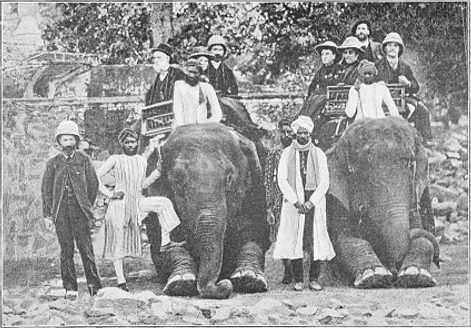 TRAVELLING IN INDIA.
I have been more interested in this city, where I have seen only native faces, than
in any other in India, and would be glad to spend some weeks here.
The main avenues are one hundred feet wide, lighted by gas, and having water
supplied by pumping works. They are lined with beautiful public and private buildings, and crowded
with traffic, numerous caravans of camels coming and going loaded with stone, cotton
bales, and all kinds of goods.
This morning we went to the Museum, a large and splendid edifice erected by the
present Rajah. As an architectural triumph I know of nothing superior anywhere. It is
of white and colored marble from base to dome; and the contents no adjectives can
describe. Lovely! charming! splendid! Costly goods from Oriental countries, owned and
arranged by the Rajah Mahara Swai Madhosingh.
Over the arched entrance to the exhibition rooms sentences were painted, taken from
native books; for instance:
"How much soever one may study science,
If you do not act right, you are ignorant."
"By contentment make me rich,
For without that there is no wealth."
"Rectitude is the means of pleasing God:
I never saw any one lost on a straight road."
We are comfortably lodged in a hotel called a bungalow, which is owned by the Rajah
and conducted by a native. I was amused at one of the printed notices in the dining-room,
which was: "If visitors are not satisfied with the food or cooking, they can deduct
from the bill what they consider fair"; an excellent notice, which I recommend for
adoption by hotels elsewhere. In another hotel I saw the following: "Guests are
requested not to strike the servants"; and "Guests wishing ice are requested to give a
day's notice, and name how much they require."
I walked up the street to look at a hunting tiger with hoods over his eyes, and tied
to a tree, and while leaning up against a bungalow gate, a fine-looking young Indian,
mounted on a splendid Arabian horse, interviewed me, much as an American newspaper man
would have done: Where did I come from? What was my profession? and What was I in
Jeypore for?
I told him something of our country, the number of people, the miles of railroads
and telegraph wires, the size of New York and Chicago—in all of which he was much
interested. I then interviewed him and asked him who he was, and he replied that he was
Colonel Fyaz, commander of a regiment of native troops. He could talk the
English,
Hindoo, Persian, and Oude languages, was delighted to see an American, and asked me
where I learned to speak English. He seemed surprised to learn that it was the language
of the United States of America.
After a long conversation he asked for my card and invited me to call at his
quarters, saying that he would be glad to show me about the city.
Bombay, January 27, 1890.
LEAVING delightful Jeypore by the evening train, we were two nights and
one day on the road. It was very cold after dark, so much so that I had to get up in
the middle of the night and put on my overcoat and shoes.
The train went at a speed of twenty-five miles an hour, stopping at stations for
meals, which were quite good, but the native waiters were of the worst, and all the
arrangements very primitive compared with the splendid vestibule trains running on the
Central Railroad from New York to Chicago.
We obtained accommodations at a first-rate hotel, where I rested for a day, being
much fatigued by the trip from Jeypore, but towards night I took a walk along a
beautiful boulevard, and through fine parks for several miles, and was much interested
in looking at
the strange and wonderful scenes. The highly colored dresses of the native women, the
silver ornaments covering their persons; the immense public and private palaces, very
costly and beautiful,—all made a great impression on me, and I think that Bombay
is one of the finest cities in the world.
There are fifty thousand Parsees in this city, with some of whom I became
acquainted, and found them to be very intelligent, and was told that they were very
successful merchants, many of them millionaires. They originally came from Persia,
where they were agriculturists, but here they are merchants. These Parsees are all
worshippers of the sun.
One day we went to their burial-place called the "Towers of Silence," situated in a
handsomely laid out park. There were three round towers about one hundred feet in
diameter and fifty feet high, without any tops, and around the edges perched some
hundreds of black vultures. We were told by the attendant that the dead bodies were
placed on slats inside these towers and then devoured by the vultures.
We saw the dreadful creatures all flying over to one of the towers, and discovered that a body
was being carried there by attendants dressed in white. We were not permitted to go
near the towers, but were shown by an attendant a working model of one of them, and
exactly how the dead bodies were disposed of.
Towards evening a band played in the beautiful park fronting the hotel, and I saw
sights probably not surpassed by any other place on earth.
The élite were out, both native and foreign, in full force, as a
public meeting was being held in a beautiful building erected by a wealthy Parsee
merchant, in front of which was his marble statue.
The building is called the Bombay University, and an officer, whose coat was covered
with decorations, was delivering an address on higher education. Officers and soldiers
mounted on fine horses patrolled the streets; companies of Sepoys dressed in native
costumes marched along; many white children cared for by native nurses, splendidly
dressed native women, and beautiful English ladies and children passed to and fro;
carriages and fine horses went by on the road, making a scene of wonderful
beauty and
attraction. The city, with its many parks, covers a large space, and is elegant and
clean, containing more than a million of people, but, strange to say of such an
important commercial centre, there has been no United States consul here for six
months, and I had in consequence much trouble in shipping home some boxes.
I called upon Mr. Henry Ballantine,[1] who had delivered a delightful lecture on
Cashmere before the Geographical Society at New York last winter, and he was good
enough to give me such information as enabled me to get my goods off.
[1] Since the above was written Mr. Ballantine has been appointed U. S. Consul to
Bombay.
Steamer "Khedive," Red Sea, Near Suez,
February 10, 1890.
THE morning of the 31st of January was very hot at Bombay, as usual, and I
only went out to make a few calls, and some purchases, and at 3 P.M. we went on a tender to this steamer, passing two large English
troop ships just arrived, and several ironclad men-of-war, and looked at the great
forts on the land where we had before seen two 120-ton Armstrong guns with piles of
conical balls, each ball weighing half a ton.
The harbor is large and fine, and there were at anchor many large steamers and
sailing craft, but I did not see anywhere the flag of our country.
On Sunday there was the usual parade of officers, sailors, and servants, 149 in all,
most of the sailors being Lascars, dressed in white gowns, red turbans, and sashes,
presenting a clean and picturesque appearance.
The vessel is a fine one, wonderfully clean, and with all modern improvements,
including electric lights.
The doctor is a young and handsome man, and spends most of his time with the young
lady passengers, who seem to require much medical advice. I notice that on most of the
ships where I have been the doctors are very attentive to the ladies.
One night I slept very soundly in the upper berth, but in the morning found my room
flooded from the open port-holes, sofa, floor, and baggage wet, but no great harm done,
my clothing being hung up. In the morning I knew the sailors were washing the deck, for
the water leaked through and struck my face, but one learns not to mind such little
matters when travelling, and I turned over for another sleep.
It is rather hot on the steamer, thermometer eighty degrees, but the punkas are
going in the cabin, and we are all quite comfortable.
We came from Bombay on the steamer Assam, arrived at Aden on the 6th, and
were transferred to this ship, and unfortunately there was not time for us to go
ashore, but I think we lost nothing, as it was a poor-looking place, nothing but rocks
and fortifications.
We now see for the first time the coast of Arabia, big hills evidently of volcanic
formation, and long reaches of white sand. The native boats crowded around the ship,
offering ostrich feathers and various things for sale; boys were diving for silver
pieces thrown into the water, and generally succeeded in getting them.
The run of four days up the historic Red Sea has been full of interest. One day the
air was full of locusts flying over from Arabia to Africa, many of them falling on the
deck. They looked like small birds when flying, but were not larger than katydids, and
brown in color.
On Sunday the service was read by a clergyman who preached an excellent sermon. He
read from the Bible the account of the passage of the Red Sea at a place not far from
where we were, and the sermon was about it and Egypt.
The seats at the long tables in the dining-room were filled, nearly all the
passengers being in attendance. The weather continues perfect, the water smooth and
looking very blue. Captain Loggin, of this ship, says that on his last trip he had a
lady passenger who was ninety-one years of age, and on a former trip another who was
ninety-two, both of them very jolly and comfortable, and going from England to visit
their relatives in India.
The captain said that on another of his trips, two ladies, strangers to each other,
were put in one state-room in which were two wash-basins. One basin being a little
larger than the other, each lady wanted the larger one, and appealed to him. He gave
the matter due consideration, and finally informed them that the elder should have it.
As we approach the upper end of the sea it narrows to about three miles, and we have
good views of both the Arabian and the African coasts, long stretches of sand on both
shores, and then mountains of volcanic origin, but not a sign of a town or of any
inhabitants. Early one morning the captain gave notice that we were nearing the Sinai
range of mountains, and he showed on his chart all the points of interest, and directly
pointed out the historic mountain itself, situated beyond a range which was near the
sea, and looming up so that we could see it with the naked eye, and very clearly with
the glass. The mountain appeared to be about forty miles off.
Cairo, February 12, 1890.
AT 9 P.M., on the 10th instant, the big steamer
Khedive anchored at Suez, the Red Sea entrance to the canal; and I was much
interested in watching the engineers making steam connections to a large dynamo on
deck. The connections were made by copper pipes and flange joints. In half an hour they
were ready. Captain Loggin gave the signal, and the stately vessel moved on at the rate
of six miles an hour towards Port Said on the Mediterranean. The canal is 87 miles
long, and when completed was 72 feet wide and 26 feet deep, but two years ago it was
decided to enlarge it to 120 feet wide, 27 feet 8 inches deep. They are now at work on
the enlargement, as I saw four immense dredgers lying in the canal near Suez, and was
informed that thousands of men could be seen during the day at work all along the route.
I stationed myself on the upper deck at 9.30 P.M., and
remained there all night with the kind and pleasant captain for my only companion, only
leaving when we were nearing Ismaïlia at six in the morning; and I was amply
rewarded by sights such as I never expect to see again.
The five thousand candle-power electric light, with a Mangin reflector, spread the
rays out fanlike, and illuminated the canal and vicinity for half a mile ahead and
several hundred feet wide, so that the smallest thing on the land or in the water could
be seen. The electric rays illuminated the water so that the white-painted buoys, of
which you could often see three or four at a time, seemed to be lighted from the
inside, as if made of translucent golden porcelain, and suspended in mid-air. The white
sand on the banks of the canal might be readily mistaken for snow, and was in one place
piled up fifty feet high, for a long distance, and the general effect was singularly
weird, as the great steamer moved majestically on. When we reached the small Bitter
Water Lake, the buoys were on stands fifteen feet high, out of water, looking as if
they were
made of silver, the pear-shaped domes like illuminated mosques. Once where there was an
opening in the sand-bank, the light illuminated a hill some distance off, and it seemed
as if I were looking upon a great city, with its mosques, minarets, churches, and
buildings all being destroyed by fire. Several times, when approaching huge dredging
machines, the electric light seemed to transform them into beautiful flower boats on
which fairies might be dancing. As we entered the large Bitter Lake, the electric
lights were put out and the vessel guided by a pilot increased her speed.
The tide rises seven feet at Suez, and forces the water up the canal to the Bitter
Lakes, which operate like a safety valve, distributing the water and returning it when
the tide recedes.
The Mediterranean being a tideless sea, the water runs naturally through the canal
to the Bitter Lakes. Most of the commerce of the East passes through the canal, instead
of around the Cape of Good Hope, as formerly. In 1887 there passed through the canal
3,137 vessels, of which 2,330 were British, and only three American. I know of no
greater illustration of the fallibility of human judgment than that the English opposed
the building
of this canal. Lord Palmerston said it could not be built, and if done, would never
pay, or be any good to commerce; and now seventy-five per cent. of the tonnage passing
through it is British, and it is of immense importance to them, both politically and in
a business way. But for the persistent energy of M. de Lesseps, it is safe to say the
canal would not have been built for many years, if ever.
The average passages through the canal from the Mediterranean to the Red Sea have
been eighteen hours, Captain Loggin having made the shortest in fifteen hours; but when
the enlargement is completed, so that vessels may make an uninterrupted passage each
way, the time may be reduced to twelve hours. The stock of the company has paid as high
as twenty-one per cent., and I was informed that our steamer, the Khedive, had
several hundred cases of silk on board, and that she would pay about seven thousand
dollars transit charges. Every steamer passing through the canal now makes use of the
electric light; those not having a dynamo on board hire one at Port Said in Suez for
ten pounds sterling per trip, including two men to run it.
Cairo, February 17, 1890.

ON the 13th at 1 P.M. we took the train at
Ismaïlia, had a first-class carriage and agreeable company. For half the distance
we passed through a sandy desert, but when we came to the station Tel-el-Kebir, near
which Wolseley routed the Egyptian army, the country improved, great fields of
sugar-cane, lentils, grain, and grass were to be seen; men were ploughing, and others
gathering the crops, assisted by camels, bullocks, and donkeys. In one instance, a
camel was harnessed to a bullock drawing a plough. The people were everywhere
industrious, and the fields looked in splendid condition. Very often we saw large
flocks of sheep and goats, and soon we came in sight of a long arched bridge spanning
the Nile. After crossing this we entered a fine depot at Cairo, where there was the usual clamor of
hackmen, but our conductor rescued us from these land sharks, and we were soon at the
Royal Hotel and I found my room, which had been engaged, and directly a package of
letters and papers were handed to me, which were very welcome.
It is as cool here as March in New York, and I have on my regular winter clothing.
The Red Sea voyage and the weather here have toned me up, and I feel in first-rate
health. This is one of three fine hotels in Cairo, and is first class in every
respect—French cooking, splendid bread and butter, and excellent beef and mutton,
which have, no doubt, helped to put me in good condition, after the horrors of our
campaign of the India cookery.
Mr. Norris sent a telegram to Baltimore last evening at 5.30, and had an answer at
11.30 P.M., so that we are all now in touch of home.
We have been this afternoon through the bazaars to the great Citadel and the grand
Mosque, where I unfortunately stumbled over a prostrate man praying, with his face
towards Mecca, and there was a little row, but I apologized and passed on.
Yesterday we started out at nine and did not get back to the hotel until four. We
went first to the famous museum three miles distant, over the river, and saw an immense
collection of antiquities, illustrating Egyptian history for six thousand years,
including the mummies of the great kings, Rameses I., II., and III., and their wives
and some of their children. Their remains are not pretty to look at, and it seemed to
me to be sacrilegious to expose them for show in a museum at one franc admission. The
museum building is very beautiful, having been erected by the Khedive for a palace, the
same Khedive who was deposed by the English, and is now in exile in Italy.
One room had marble pillars three feet in diameter and thirty feet high, and the
whole building is fitted up in the highest style of modern French art.
We entered carriages and drove over a fine shaded road to the great Pyramids, where
we arrived at noon. I at once announced my intention of going to the top of the big
Pyramid, as did also Mr. Kolish of Vienna and Miss Roe of Cincinnati, the others of the
party declining.
The old Arab sheik, who has charge here, appointed three stalwart Egyptians to assist me, and two
others followed with jugs of water; with one man holding each hand, and another to
push, we commenced the ascent. The stones were from two to two and a half feet high,
making the tallest kind of stairs, but the men were careful and good at pulling and
pushing, and I made rapid progress.
They stopped twice to rest, and then I found what violent exertions I had been
making, for I was completely blown, and my mouth and throat as dry as if I had not had
a drink for a month.
We rested at each stopping-place a few minutes, and rinsing my mouth with water
refreshed me; then we rushed on, reaching the top in seventeen minutes. Such had been
the violence of the exertion that I could hardly speak for fifteen minutes afterwards.
Mr. Kolish being a stout young fellow got along first-rate, and Miss Roe being strong,
cool, and fearless came up serenely. From the top the view towards the Nile was of
unsurpassed beauty; long stretches of country covered with green as far as the eye
could reach. Farther back was a boundless plain, but all sand and desolation. I
intended to
recite here Napoleon the First's address, "Soldiers of the grand army, forty centuries
are looking down upon you," but I was so much engaged getting my breath that I forgot
all about it.
After stopping on top for half an hour, we commenced going down, one man holding
each of my hands and another holding a rope which was around under my arms. We got
along very nicely with only one stop, indeed I think I could have come down perfectly
well without help from any one.
There are 250 steps on the big Pyramid, and it is 480 feet high. At one o'clock we
had a capital lunch, and then started for the Statue of Memnon only a third of a mile
from the Pyramids. Some camels were kneeling ready to take us, and I mounted one. The
beast squealed and got up first on his front legs and then on his hind ones, pitching
me back and forth, but I hung on and got along very nicely.
The immense statue, partly covered with sand, did not impress me much, but a tomb
which I entered near by was a wonder. I measured one of the big stones in the wall and
found it was five feet square and seventeen feet long.
We mounted on camels again and Miss Roe and I had a race across the yielding sand,
the Cincinnati young lady coming out ahead.
The beggars crowded around and annoyed the ladies so much that I spoke to the old
sheik, and he went at them with a whip and scattered them very quickly.
We returned to Cairo the same way we went, observing on the road large numbers of
camels, bullocks, and donkeys, and once I counted seven camels loaded with fresh hay.
Thus ended one of the wonder days of my life.
Yesterday morning we left here on a steamer, and went up the swift-running waters of
the Nile, passing numerous palaces, tombs, and all kinds of Oriental buildings, dozens
of water-wheels run by bullocks, and once a steam-pump and boiler, all raising water
for irrigation.
We had a stalwart and fancy-dressed dragoman, but he was of little use. We took
along a nice lunch and picnicked on the boat, reaching the dock in three hours, where
we found about a hundred donkeys and their attendants yelling, screaming, and pushing.
After much trouble we each mounted one of the ugly beasts, and started for the ancient city of
Memphis, seven miles away. There was a boy with a stick to each donkey, and every time
he struck, my beast would kick and nearly unseat me.
A young lady from Boston, Miss Potter, was put in my charge, and several times we
had splendid trots and gallops on the sandy roads and plains.
We met strings of camels and donkeys on the way in front, and our cavalcade of
excursionists, stretched along the sandy road, presented a remarkable appearance.
Half-way we stopped to rest at a place where an immense marble statue of a king was
lying in the sand. It was thirty feet long, and five feet across the face.
The donkey ridden by Miss Potter proved so bad that she changed him for another
here, and we galloped over the sandy plain unto Memphis, our destination. There were
half a dozen big pyramids in sight, and the whole country was covered with ruins. We
were on a high hill, and looked down upon the Delta of the Nile and its cultivated
fields, a scene of rare beauty, on one side, and on the other, vast sandy plains and
deserts.
We walked to the entrance of the "Tombs of the Sacred Bulls." The passage-ways and
tombs are cut out of solid rock and are all under ground. These passage-ways are a mile
or two long, and thirty feet in diameter. They strongly reminded me of the sewers in
Paris.
From these passages, were dug out of solid rock twelve rooms, each containing the
statue of a "Sacred Bull," each one carved out of the rock, highly polished and covered
with writing executed in a beautiful manner.
Each of us carried a candle, and it was very hot, so much so that one of the young
men came near fainting and had to hurry out. It was a curious and weird scene, fifty or
more people, each with a candle, wandering about in the dark. After looking at the
tombs, we all returned to the upper air, and went to the tomb of a great king near by,
which was under ground, and contained several large rooms, all made of highly polished
white marble, covered with writing and carvings; processions of men and animals,
beautifully executed, and in the best state of preservation.
Mounted on the donkeys once more, men and boys surrounded us, offering all kinds
of things for
sale. One young fellow showed me the skeleton of a lady's hand, and offered to sell it
for a shilling, but I declined. It was a rough ride back to the river, the donkeys
being very uncomfortable creatures to ride. Once the one ridden by Miss Potter greeted
some of his friends in a field, and brayed with tremendous energy.
We were very much fatigued and glad to get to the boat.
The return voyage was very pleasant, and we reached Cairo at 5.30 P.M.
Jaffa, Palestine, Feb. 21, 1890.
OUR party left Cairo on the 19th, going by rail one hundred and fifty
miles to Alexandria, and leaving there at 10 A.M. the following day, arrived here by
steamer this morning.
The landing from the steamer was made in boats, and was rather rough, the sea
running high and there being no breakwater.
This is said to be the oldest town in the world, and is certainly the dirtiest one I
ever saw. We drove all about, going first to the house of Simon the Tanner, situated
near the sea. We saw the tank in which he used to tan his leather, and went on the top
of the house, where he and his family used to sleep. We then went to the house of
Dorcas, situated in a grove of orange-and lemon-trees, and I bowed my head to her
memory, for she not only did good to the poor herself, but her example has caused countless
millions of Christian women in all the ages since to do the same, very often in
associations named after her.
The oranges raised in and about the town are very large and fine, and much exported.
Great crowds of Turks, camels, and donkeys were in the market-places.

Reinhard's Hotel, Ramleh,
February 21, 1890.

WE left Jaffa at 3 P.M., in as fine a landau as
you would see in Hyde Park, with three horses and a dragoman, and drove along a
splendid macadam road, meeting and constantly passing camels, donkeys, and
strange-looking Turks. Soon we came to the Plains of Sharon, perfectly level, and
stretching off for ten or twenty miles each way, covered with red, blue, and yellow
flowers. They are said to be the "roses of Sharon" mentioned in the Scriptures, but
really are a species of poppy. At a distance we saw the high hills and mountains which
surround Jerusalem. The scenes were of the most thrilling interest, for Solomon often
passed this way, and over the road were transported the cedars of Lebanon of which the
great temple was built. It was a cool and bracing day, and we had a delightful trip,
arriving at this excellent hotel at 5 P.M., and at once
walked to the ruins of a mosque built in 1099 A.D., by
Saladin. The tower, an elegant structure, is still standing. We went to the top of this
tower, and looked upon a lovely landscape. As far as the eye could see, the plains were
covered with almond-trees in full blossom, and other trees and shrubs peculiar to the
country, the big cactus plants being used for fences. As we returned we passed a tower,
from the top of which a priest was crying aloud for the faithful to pray. Every few
miles was a guard-house, and horsemen were often met on the road who acted as
police.

Jerusalem, February 23, 1890.
THE rest overnight at Ramleh, at the hotel there, kept by a German,
formerly of Buffalo, N. Y., proved very refreshing, and in the morning we took our fine
carriage, and driving rapidly over the excellent road, reached here at 5 P.M., having had a very enjoyable trip.
Coming near the Jaffa gate our driver ran against a heavy-loaded camel, and caused
him to tumble almost into our carriage, but he fell partly under it, and the wheels ran
over one of his legs and broke it. The owner of the camel, a big Turk, when he saw the
mischief, sat down by the side of the road and wept. The carriage stopped at the Jaffa
gate, and we walked to the new hotel, a large handsome building of stone, all the halls
being paved with marble. It was so very cold that I had a fire made in a small stove in my
room. Here, as in all the countries I have lately visited, fuel is very scarce and
dear; that used here was the roots of trees.
At last the dream of a lifetime has been realized, and I have been on the top of the
Mount of Olives, to me the most interesting spot on earth. It had been raining, making
the slippery stones of the streets very disagreeable. Accompanied by an excellent
guide, I walked from the Jaffa to the Golden Gate, along the street of "Solomon and
David," and mounted a small good-natured donkey, who carefully took me over a rough
road to the top of the Mount. Thence I looked upon the scenes so often described in the
Bible, rendered more impressive to me from the thought that on the very spot where I
was, must have stood David and Solomon, Christ, St. Peter, Paul, and the Apostles! They
must have looked down in their time, as I did, upon the winding Jordan, the Dead Sea,
Bethlehem, and the mountains and valleys beyond. The other view was towards the compact
walled city. It seemed to me that I could see the great army of Titus encamped on the
hills beyond
the Jaffa Gate, preparing to assault it with their battering-rams. The scene was a very
impressive one. After admiring the beautiful church lately erected by the Russians, on
top of the Mount, I passed down by another and rougher path, and rode entirely around
the city, the guide carefully explaining every thing as we rode along. The Mosque of
Omar, built on the spot where Solomon's temple stood, is a splendid edifice, the
outside being made of various-colored tiles, and the inside of mosaic work, with the
most exquisite stained-glass windows.
At length we got away from this almost enchanted spot and went through the markets
and bazaars, which do not differ much from those of other Oriental cities: narrow dirty
streets, small stores, and crowds of long-bearded old men, exactly as you see
represented in all pictures; women, black, brown, and white, with their faces modestly
covered, but barelegged and nothing on their feet except sandals; even these were often
left off.
We took a carriage and went to Bethlehem, five miles from Jerusalem, and attended
religious services held in various churches by the Russians, Catholics, and Copts. Every
thing we saw was of great interest, the view from the hill superb, and the people and
scenes on the way wonderful to behold.
Jaffa, January 26, 1890.
HAVING spent two days in Jerusalem industriously sight-seeing, one noon-day
I took a seat in the fine carriage provided, my only companion being a dragoman, and we
were soon bowling along over the fine road to Jaffa.
The engineers are surveying for a railroad from Jaffa to Jerusalem and the people
expect that it will be completed in a year. The journey may then be made in an hour.
The moon came up at 6 P.M., and as we passed along the road
through the mountains I saw sights and scenery not to be soon forgotten. I felt safe,
for every few miles there was a stone watch-tower, occupied by guards, and often we met
them on the road, mounted and armed with guns. It was a ride of thrilling interest, for
over this route have passed many times the heroes of old, and on yonder field of Sharon, now
smiling with flowers, was once fought a great battle. The carriage rushed on, and
half-way we changed horses. Being very cold, I walked ahead for a couple of miles,
meeting caravans and single camels, and numerous donkeys laden with wood, and men
coming from the fields with their oxen and their ploughs. The black-eyed natives eyed
me curiously, but said nothing, and soon the carriage overtook me, and I was so well
warmed up by my walk that I felt comfortable for the remainder of the trip.
We were detained for two days at Jaffa on account of the rough sea, which prevented
steamers from landing, but being in a comfortable hotel, I was content and spent the
time looking about the ancient city.
A young Arab offered to sell me a tame hyena for twenty francs. It was nine months
old, and as playful as a young dog. At last the sea became smooth, and I entered one of
the heavy boats, and the three strong Turkish boatmen put me over the rough waters in
good style on board the Russian steamer Poccir from Alexandria bound for
Odessa.
Steamer "Poccir," March 4, 1890.
THE steward gave me a very poor state-room below with another man, but I
handed him a fee, and in the morning he put me in a beautiful cabin on deck, a large
room, lined with handsome polished wood with two large looking-glasses, and fit for a
prince or an American to occupy. I could not find a man on the ship who spoke a word of
English, but I rather enjoyed the novel situation, and got along very nicely.
On the 28th instant, in the morning, I came on deck, and found that we had arrived
at Beyrout, and after partaking of a glass of tea and some bread, I took a boat and
went ashore, and there engaged an Arab guide. The first call we made was on Mr.
Bissenger, our Consul, formerly from New York, with whom I had a pleasant talk. We then
went along
the streets lined on both sides with fine stores occupied by English and other foreign
merchants, and then through the bazaars of the native town. We inspected a fine palace,
splendidly furnished, owned by a Russian nobleman, who has not been here for seven
years, but who keeps it open, with servants in attendance, ready to be occupied by
himself and family at any time.
We drove out to a handsome public garden, and came back over the famous Damascus
road built by the French. A fine macadam roadway, over which are run diligences to
Damascus, eighty miles away, but now it is blocked by heavy snow in the mountains, and
consequently two hundred travellers are detained in Beyrout. One gentleman tried to get
through on horseback, but the snow was too deep, and he was obliged to return. The bay
is a beautiful one; as seen from the city, a range of mountains looming up around it,
the lower ones being covered with cedars, and the higher, including Mount Lebanon,
capped with snow.
It will be remembered that Solomon obtained the cedars from these mountains with
which he built the temple at Jerusalem. I had some anxiety about my passport, as it had not been
endorsed by the Turkish Consul at Cairo, but a fee put into the hands of the customs
officer was sufficient, and he permitted me to depart without even looking at the
document. We got aboard the ship at noon, and after a nice lunch, including excellent
red and white Odessa wine, the steamer whistled, and we were off. During the afternoon
we stopped at Napoli, which is a well-built town, extending along the shore a mile or
two, with the snow-covered mountains for background. Here a dozen passengers got off,
mostly Turks. There was a heavy sea, and the small boats could only be brought up to
within six feet of the ship's ladder, so the passengers wishing to disembark had to
jump. The steam engines were kept in constant use from 4 P.M. until midnight, taking on board from lighters three thousand large
boxes of oranges for Odessa.
The steamer and the lighters pitched about, and it was a sight to see how skilfully
every thing was managed.
The cooking on this ship is excellent, though some of the food is new to me, and I
look with some surprise to see the Russians drink a small glass of raw brandy before each meal.
We arrived at the ancient and important city of Smyrna yesterday at 10 A.M., and went ashore with Mr. Zucker, Swiss Consul to Chili, who speaks
English, and very kindly assisted me in making known my wants.
We employed a guide and went through the city, which is a large one, containing two
hundred thousand people.
The foreign streets and stores are very fine, but those occupied by Jews, Turks,
Armenians, and Greeks are very dirty and disagreeable.
After a couple of hours' walking about in the heat and dirt, we came back to the
street running along the bay, which is a couple of miles long, well-paved and clean. A
dozen large steamers were at the docks, and much business going on. We saw numbers of
fine buildings, hotels, and cafés.
Mr. Zucker and I called on the United States Consul, Mr. Emmet, and I was agreeably
surprised to find that he was an old acquaintance, formerly in the Comptroller's office
of New York.
At 4 P.M. we went on board, and were soon off. The
steamer had been invaded by a dozen young Englishmen, and on interviewing them I found that they
belonged to a foot-ball club of Constantinople, and had been to Smyrna playing against
a club there. They were a jolly set of young fellows, and made things lively on the
ship for the remainder of the trip.
The wind blew hard all day. It was cold and disagreeable, and we saw little of the
land, though we were passing through the famous Dardanelles, the Hellespont of the
Greeks, past the site of the ancient city of Troy, of which Homer sung, and I would
have given much for a bright day or a moonlight night so that I could have seen the
exact place where "Leander swam the Hellespont." But this was not to be, so I turned in
and slept until morning, and when I came on deck found that we were at anchor in the
world-renowned and beautiful harbor of Constantinople.
Constantinople, March 9, 1890.
THE harbor appears to be about a mile wide and two miles long, surrounded
by steep hills, on which the city is built, largely in terraces, with many great
palaces, mosques, and public buildings, the Mosque of St. Sophia being very prominent.
I took a guide at the ship and went ashore in his boat. I had been often informed of
the annoyances by custom-house officials to which travellers are often obliged to
submit on their arrival in the Turkish dominions, and was agreeably surprised at the
ease with which I was permitted to go on shore. The guide showed my passport to an
officer, who looked it over and returned it, and we went to another wharf, where my
trunk and bag had been landed. There were three venerable officers here, who each took
a franc and
passed the baggage without opening any thing, or saying a word.
A big Turk took my trunk and bag on his back, and we went up an ill-paved and dirty
street, a quarter of a mile long, and almost as hard to climb as the Pyramids of Egypt,
leading to a nice and well-paved avenue, lined with fine shops, on which was the Hotel
Pesth, where we found comfortable quarters.
I had a cup of tea, and then sallied out to see the city. There are few carriages to
be seen in the streets, but great numbers of large and homeless yellow dogs, all of the
same shaggy breed, apparently well fed and happy and certainly good-natured. There were
twelve of these dogs on the walk opposite the hotel, and I counted 164 on one of the
main streets, about a mile long. We remarked that they were about as thick all over the
city, and there must be as many as fifty thousand altogether. We walked down a fine
street to the water, and along the shore for a mile or two, and again admired the
beautiful bay, which poets have raved about for centuries, and which most people think
the finest in all the world.
We went as far as one of the big palaces belonging to the Sultan, which faces
the water. It
is twelve hundred feet long, and has two grand entrances built of white marble. There
we took a circuit around the hills, and saw many great buildings, barracks, schools,
etc. Once we saw a regiment of horsemen drilling in a large square. The men were tall
and fine-looking, and the horses excellent. There were two fire alarms while we were
out, and it was enough to make a New York horse laugh to see the arrangements for
putting them out. The engine, so called, was an ordinary force-pump with two handles,
placed on a platform and carried by a dozen men, who were followed by fifty more, in a
leisurely way. There are no water-works, and many large and very old wooden buildings,
so one can readily see that there must be destructive fires here sometimes.
I have been here a week, and have seen many mosques, including the immense and
famous St. Sophia, which must have been in days of old very magnificent, but it has
been largely robbed of its treasures, and is now quite dilapidated.
The weather here is very bad, cold, rainy, and blustering, much as we often have it
in March. There was a heavy fall of snow two weeks ago, and the streets are wet, slippery, and
disagreeable. On the 6th instant we made the famous trip up the Bosphorus to the Black
Sea, which has been so often written about. There were four of us, Mr. Zucker, myself,
and two friends, all sedate, over sixty years of age, and representing a combined
weight of nearly eight hundred pounds.
We left the hotel at 9 A.M., walked a short distance
through the middle of the muddy streets to a cable road, which we took, and in ten
minutes were in a busy street near the water. We then crossed a fine iron bridge and
went on board a side-wheel steamer. Looking across the water we could see the great
hospital buildings where Florence Nightingale immortalized her name, by her care of
wounded soldiers during the Crimean war. Steam was up, and soon we were away, going
along near the shore of the European side and making about ten landings. On the shore,
buildings have been erected, sometimes a hundred or more together, so that practically
speaking the ten miles to the Black Sea is a continuation of the city. Palaces are to
be seen all along, several of them belonging to the Sultan, and one very large and splendid
one occupied by the Persian Ambassador.
The ranges of hills near the water are largely cultivated, and even now are covered
with green grass, the whole presenting a panorama of great beauty.
We stopped at noon, went on shore and had an excellent lunch at a German restaurant,
and then took another boat as far as the Black Sea, and returned along the shore of
Asia, stopping at numerous places to take on passengers and mail, and in an hour
reached the city.
There was a lot of women on board, with their faces more or less covered. Once as
the steamer was passing a house I saw a very pretty sight. A couple of little girls
made signals to our captain, and a larger one held up, for him to see, a small white
puppy. The white-headed old sailor smiled a grim smile, and the swift steamer swept
on.
One day I took a guide and went to see the famous native bazaars, where under one
roof were several hundred small stores, the passage-ways narrow, wet, and ill-paved,
such as you find everywhere in the East, filled with every thing native and foreign one
ever thought of. An Armenian pulled me into his store and showed me elegant stuff, sofa pillows,
silks, shawls, and gold embroidery, but having no use for such things I came away
without purchasing.
Another day I called on Mr. Sweeney, our Consul, and later upon Mr. Solomon Hirsch,
U. S. Minister, who kindly gave me all the information I wanted about Constantinople.
Returning through the lower part of the city, where there was a large crowd of people,
I saw a dog-fight. A strange black dog had invaded this part of the city, and a dozen
yellow ones went for him fiercely, causing an immense row and confusion, until a Turk
appeared with a big rope, thrashed them all and sent them yelling away.
One morning we took a carriage, and went to see the Sultan make his weekly trip to a
mosque. We drove some three miles to the front of the mosque through the mud and
snow.
This mosque is a new and beautiful one, and soon after we arrived, there was a great
gathering of horse and foot-soldiers.
The horsemen were fine-looking, and rode splendid horses. They formed several deep
in front of our carriage, but I got on a high fence, so as to have a good view, and
stood there
in the snow and rain for an hour, waiting for his Highness. At length there came a band
of music, a troop of cavalry, and many decorated officers, followed by an open carriage
containing the Sultan, a dark, black-bearded middle-aged Turk, wearing the national red
fez. He passed slowly on to his devotions, and I was asked if I would wait and see him
return. I said most decidedly not, and returned with my friends to the hotel and to a
late but excellent breakfast at 2 P.M.
ON the afternoon of the 10th of March, I took a walk down to the great
bridge, and had a last and lingering look at the splendid harbor, the Golden Horn, and
the Bosphorus. At 6 P.M., I took a carriage and a guide to
the depot at Stamboul, from which leaves, twice a week, the Oriental Express for Vienna
and Paris.
After an examination of my passport and baggage, and considerable delay, I got on
the train, composed exclusively of Mann boudoir cars, lighted by gas, including
dining-car; and every thing first-class, quite as good as any thing in America, except
the vestibule trains from New York to Chicago. The road-bed is so perfectly constructed
that the cars run easier than on any railroad I was ever on. You could read with
comfort, and some of the passengers were writing. My journey from Constantinople was a
solitary one, our party having separated, and other friends being left behind. Passing
through Bulgaria and Servia, little was to be seen except vast plains, sometimes
cultivated, but often not; mud houses with thatched roofs, and oxen ploughing in the
fields. We then went up and over big mountains, covered with snow.
The second morning when I arose we were in Hungary, and the scene had changed to
every appearance of business and activity. Four oxen, attached to a plough or to a
four-wheel wagon, were to be seen all along the route. There were vast cultivated
plains, and beyond them towns, villages, and houses, all looking in good shape. We
arrived at Budapest after two nights and one day on the train. I spent two days in
Budapest, and found it one of the most beautiful cities in Europe—handsome, well
paved, wide, clean streets, splendid hotels, stores, and public and private buildings.
This city is the capital of Hungary; the King, who is also Emperor of Austria, resides
here for a portion of the year.
In one of my trips about the city, I saw him driving out in his royal coach.
Leaving
Budapest at half-past two one afternoon, after a fine journey of five hours, I arrived
in Vienna, and was accommodated at the Imperial Hotel, which was first-class in all
respects.
A week was passed in Vienna. It is one of the most beautiful cities in the world,
many think even finer than Paris, and I thoroughly enjoyed the comforts of civilization
once more, all the more, no doubt, from having been partly deprived of them for so many
months, as recorded in the previous pages. I called on Colonel Grant, the United States
Minister, who was very polite and kind. I dined with him and his charming family, and
attended a diplomatic reception given by Mrs. Grant. I also dined with the
distinguished Dr. Kolish and his family, some of whom spoke excellent English, and
passed a very agreeable evening with them.
Passing on to Berlin, I there saw a grand review given by the Emperor to the Prince
of Wales; and from there went to Dresden, in which delightful city several days were
spent, going often to the large and splendid gallery of paintings, and lingering in
front of that wonderful work of art, the "Sistine Madonna." One evening I went to the Grand Opera,
and one afternoon drove around and through the city. Two American young ladies were
kind enough to accompany me and to point out the various objects of interest. We met
the King of Saxony, driving out in a showy royal carriage.
Hamburg came next, one of the most beautiful and enterprising cities in Europe, and
then Bremen, where I boarded the North German Lloyds steamer Eider.
Every thing about this splendid ship was so perfect that one could not suggest an
improvement; the table being of extraordinary excellence. We made a quick passage, and
in eight days I landed in New York, April 8, 1890, having been absent exactly seven
months. The distance travelled was 27,816 miles: 18,786 by water, 9,030 by land.

| DISTANCES TRAVELLED: |
|---|
| Recorded from San Francisco to Cairo by Miss Roe; of Cincinnati. |
|---|
| Miles |
| From New York to San Francisco | 3,000 |
| San Francisco to Yokohama | 4,724 |
| Yokohama to Tokio and return | 36 |
| Nikko, Lake Chiu, and return | 253 |
| Hankom Pass and return | 115 | ½ |
| Kamakura and Enoshima | 80 |
| Yokohama to Kobé | 346 |
| Kobé to Kioto and Osaka | 152 |
| Kobé via Nagasaki to Hong-Kong | 1,456 |
| Hong-Kong to Canton and return | 180 |
| Hong-Kong to Colombo, Ceylon | 3,096 |
| N. Elliya and Kandy | 270 | ½ |
| Colombo to Madras and Calcutta | 1,401 |
| Calcutta to Darjeeling and return | 740 |
| Calcutta to Benares | 475 |
| Benares to Lucknow | 202 |
| Lucknow to Cawnpore | 46 |
| Cawnpore to Agra | 160 |
| Agra to Delhi | 144 |
| Delhi to Jeypore | 101 |
| Jeypore to Bombay | 699 |
| Bombay to Aden | 1,661 |
| Aden to Ismaïlia | 1,352 |
| Ismaïlia to Cairo | 84 |
| Memphis and return | 50 |
| Pyramids and return | 16 |
| Cairo to Alexandria | 150 |
| Alexandria to Jaffa | 250 |
| Jaffa to Jerusalem and return | 68 |
| Jerusalem to Bethlehem and return | 10 |
| Jaffa to Constantinople | 1,000 |
| Constantinople to Vienna | 1,300 |
| Vienna to Dresden | 340 |
| Dresden to Berlin | 100 |
| Berlin to Hamburg | 168 |
| Hamburg to Bremerhaven | 90 |
| Bremerhaven to New York | 3,500 |
| 27,816 |

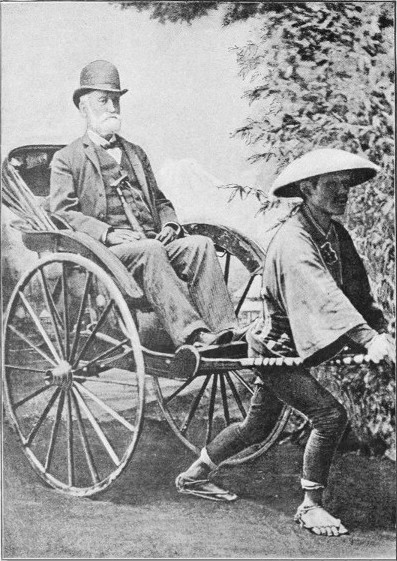 TRAVELLING IN JAPAN.