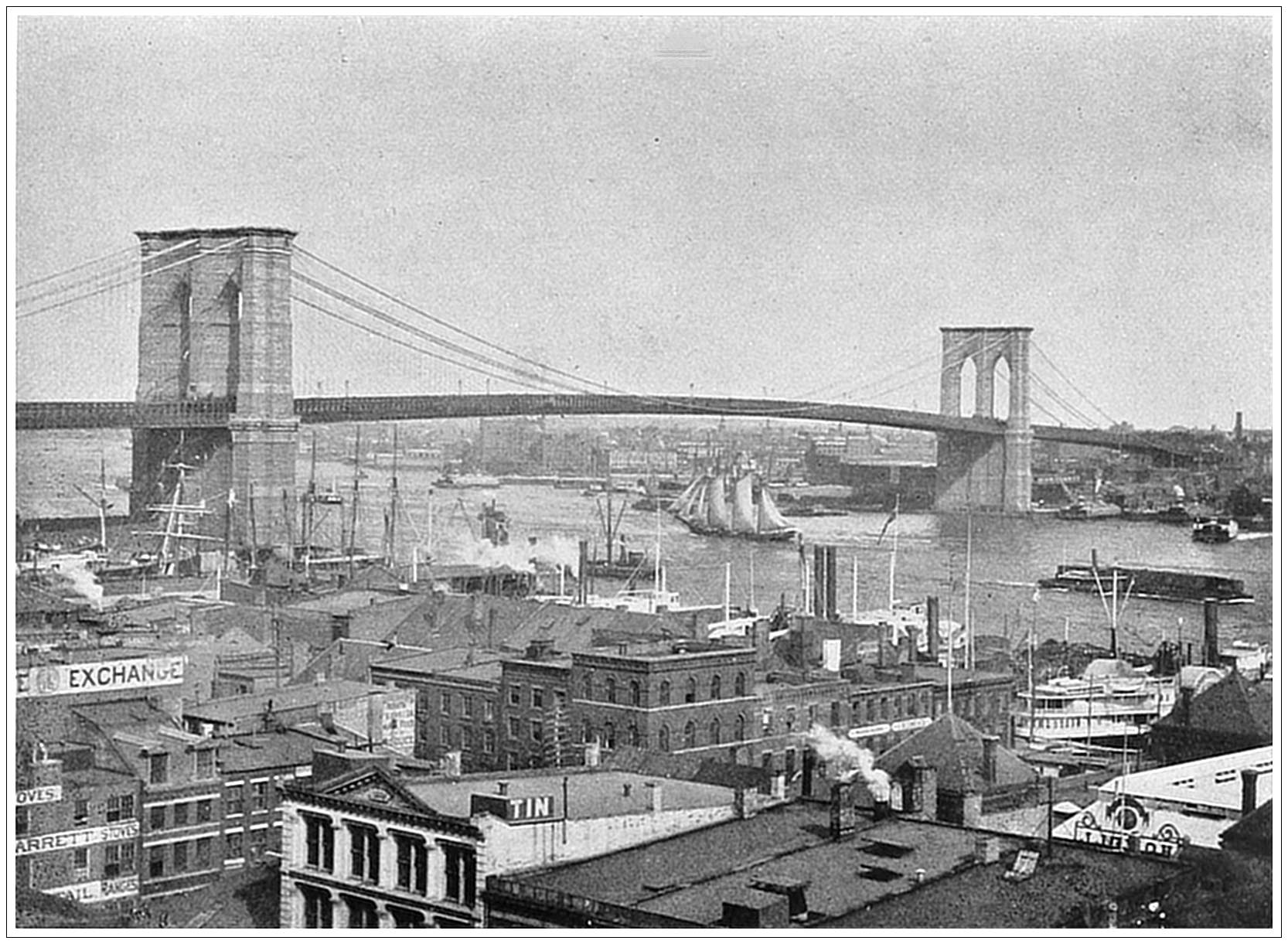
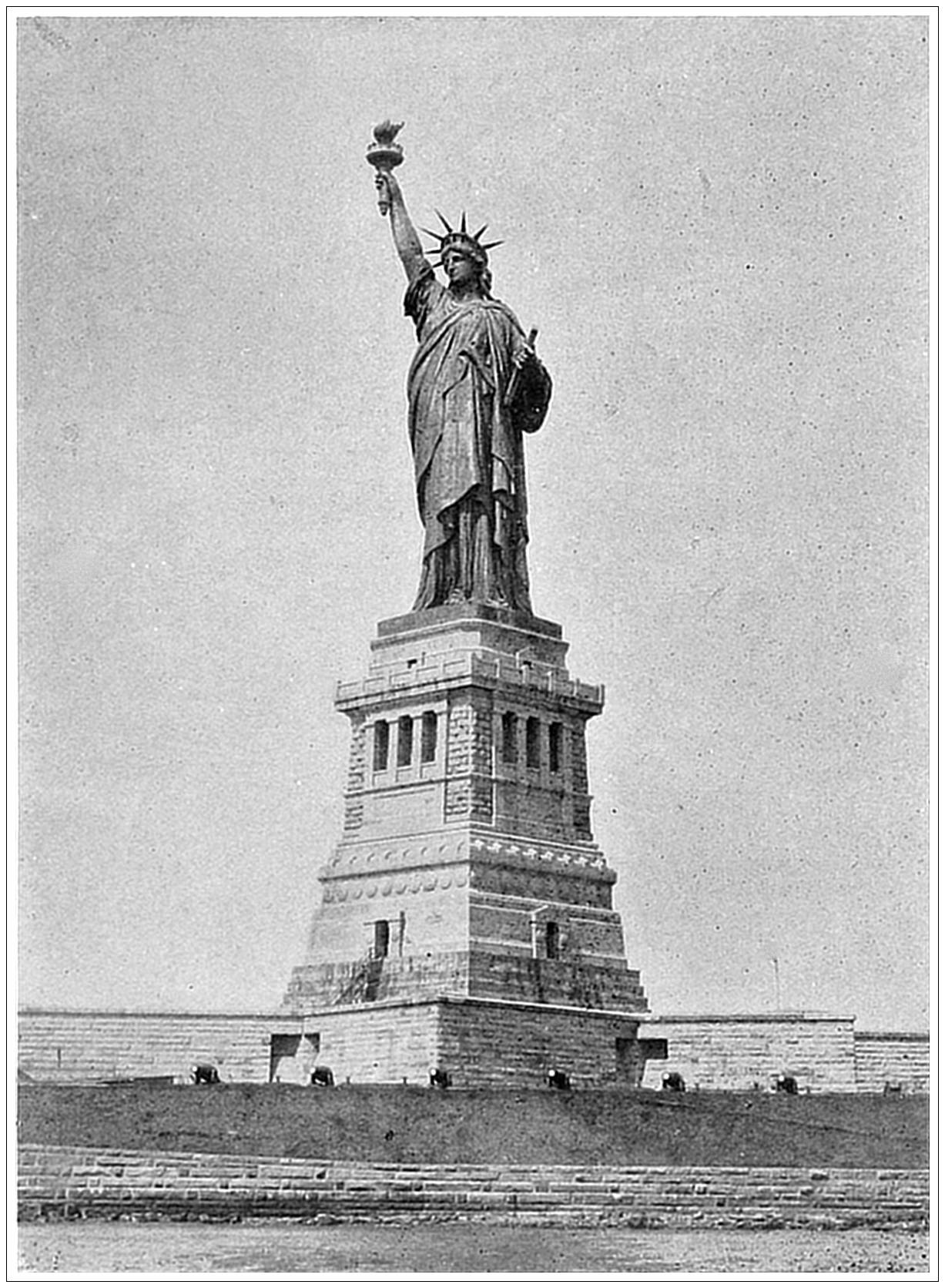
THE STATUE OF LIBERTY. This colossal statue, by Auguste Bartholdi,
stands on Bedloe’s Island in New York harbor. It is distinguished,
not only by its immense height (three hundred and five feet
six inches from foundation to torch), but by the elegance of its proportions
and its imposing dignity. At night, especially, when the torch is lighted by
electricity, its effect is unique and commanding. The statue was presented
to the American people by France, the cost being defrayed by public subscription.
The sculptor himself took no remuneration. Public subscription here
put up the pedestal. The statue was formally handed over to the President of
the United States by the French delegates on October 28th, 1886.
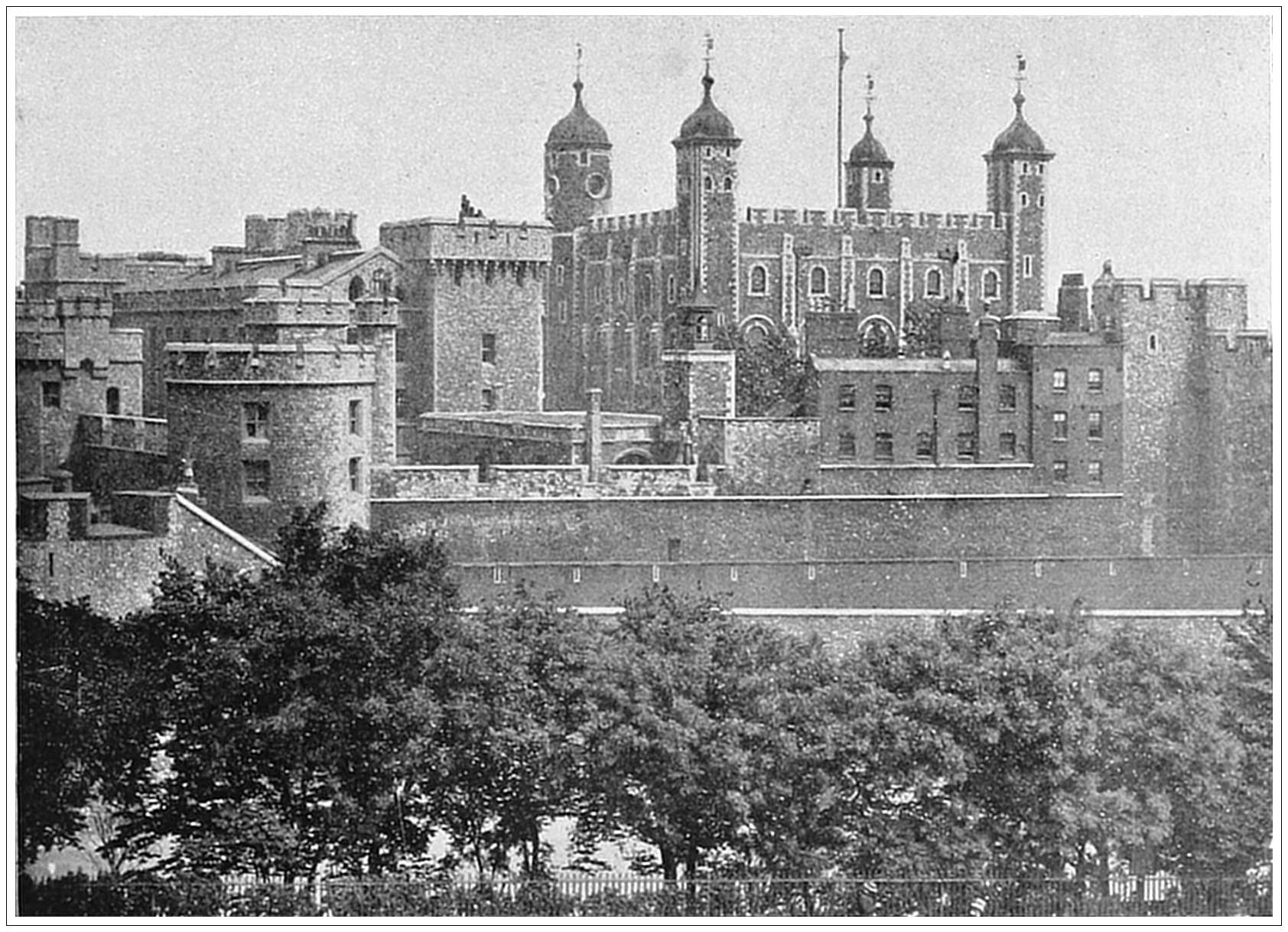
THE TOWER OF LONDON, ENGLAND. In all the world there is no
more famous fortress than this ancient citadel of London. Situate in
the oldest portion of the city, on the north bank of the Thames, it at
once arrests the attention of every stranger in the English metropolis. Tradition
ascribes its erection to Julius Cæsar, but tradition is unsupported by historical
evidence, and at the most it is only conjectured that the Romans had a
fortress on this site. It may be stated authoritatively, however, that the Keep
or White Tower (so named because it was formerly whitewashed), which is
now the oldest extant portion of the citadel, was built by William the Conqueror.
As the council chamber of the ancient kings of England, and subsequently
as a prison of state for political offenders, its glory and its shame
are part and parcel of the glory and the shame of all England. Some of the
most momentous events in the history of the country were enacted within its
walls. From an early period it has been the depository of the ornaments and
jewels of the crown.
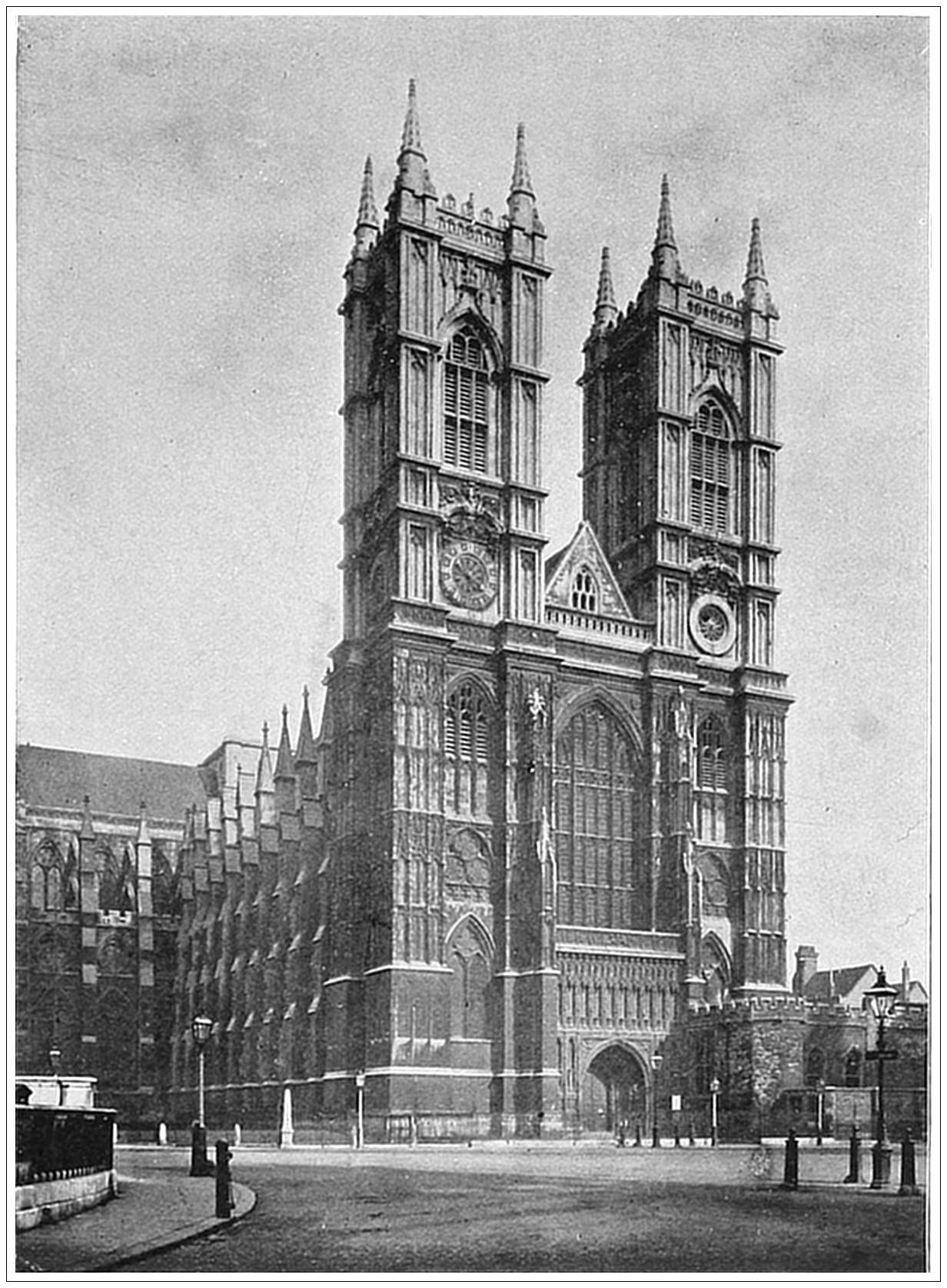
WESTMINSTER ABBEY, LONDON. This is the supremely interesting
spot in all London. Its exquisite architecture would alone ennoble
it. But as the sepulchre of sovereigns, heroes, statesmen, authors and
poets, as the scene of some of the most hallowed events in English history, it
makes an even more serious appeal to the imagination. Its very history is involved
in becoming mystery. Tradition asserts that on this site Sebert, King
of the Saxons, built a church and dedicated it to St. Peter. More authentic
history ascribes its inception to Edward the Confessor, who designed it for his
own burial place. Hence, other royal interments followed. William the
Conqueror was crowned here within a few yards of the Confessor’s tomb, and
every succeeding sovereign of England has followed his example. It also has
continued to be the favorite spot for royal weddings and funerals. As it now
stands the Abbey was for the most part rebuilt by Henry III. Henry VII
added the famous chapel which bears his name, and the two towers on the
front were placed there by Christopher Wren. The Poet’s Corner in the south
transept contains tombs or monuments in honor of many of the most famous
of English literary worthies.
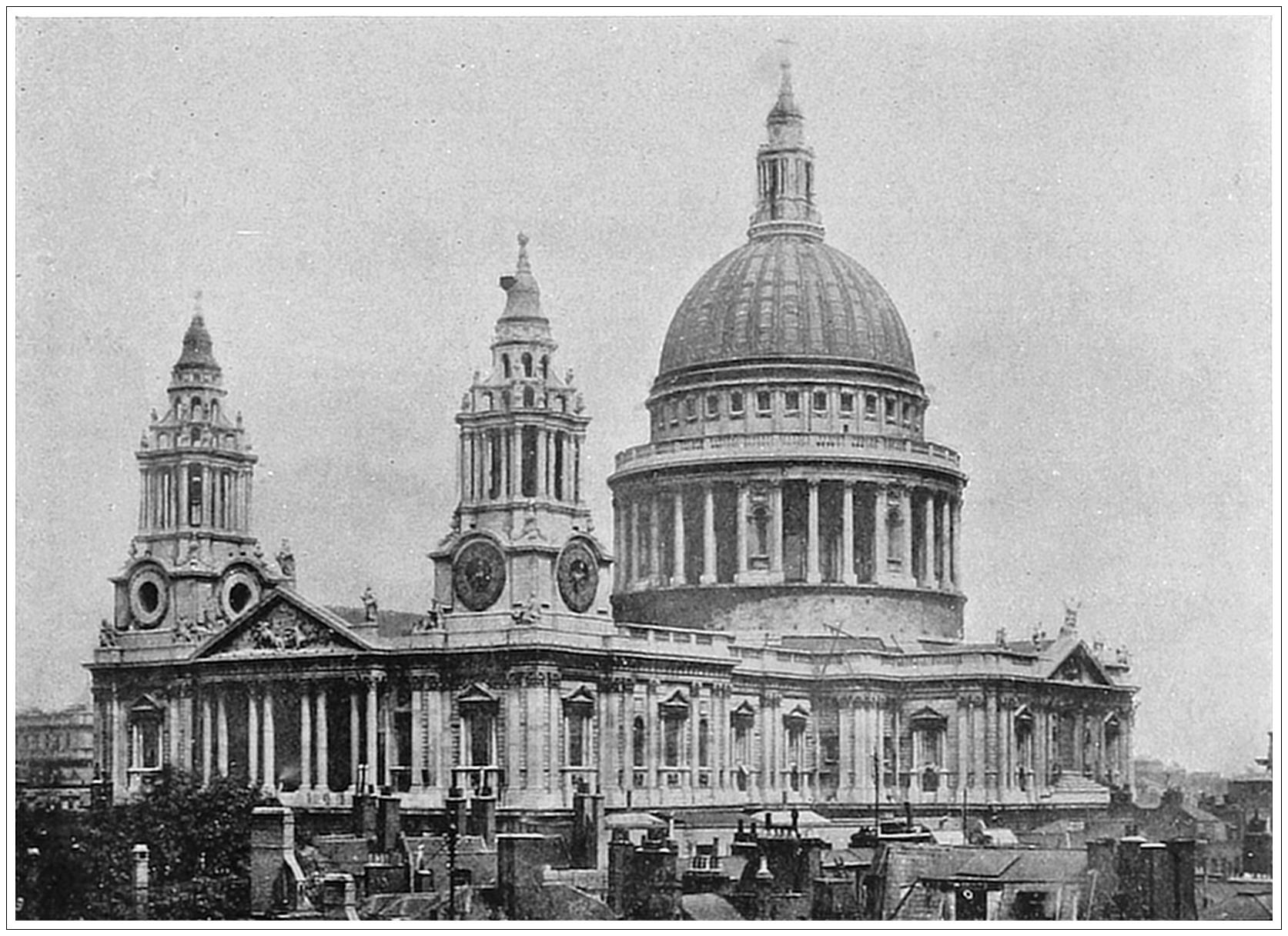
ST. PAUL’S CATHEDRAL, LONDON. This, the metropolitan church of
London, is one of the largest and, without exception, the most conspicuous
of its edifices. Built on a slight eminence, which is said to have been
anciently occupied by a temple to Diana, it is the last of a series of Christian
churches that succeeded to the Pagan temple. The first, founded about 610, was
destroyed by fire in 1087. The second succumbed to the Great Fire of 1666.
The present church was begun June 21st, 1675, and was finished in thirty-five
years, under one architect, Sir Christopher Wren. The whole cost, £747,954
2s. 9d., was paid by a tax on every chaldron of coal brought into London.
The structure is five hundred and fifty feet from east to west by one hundred
and twenty-five feet in width; the front is one hundred and eighty feet wide,
and the top of the cross is four hundred feet from the crypt floor. Carlyle
said of it that it was the only edifice that struck him with a proper sense of
grandeur.
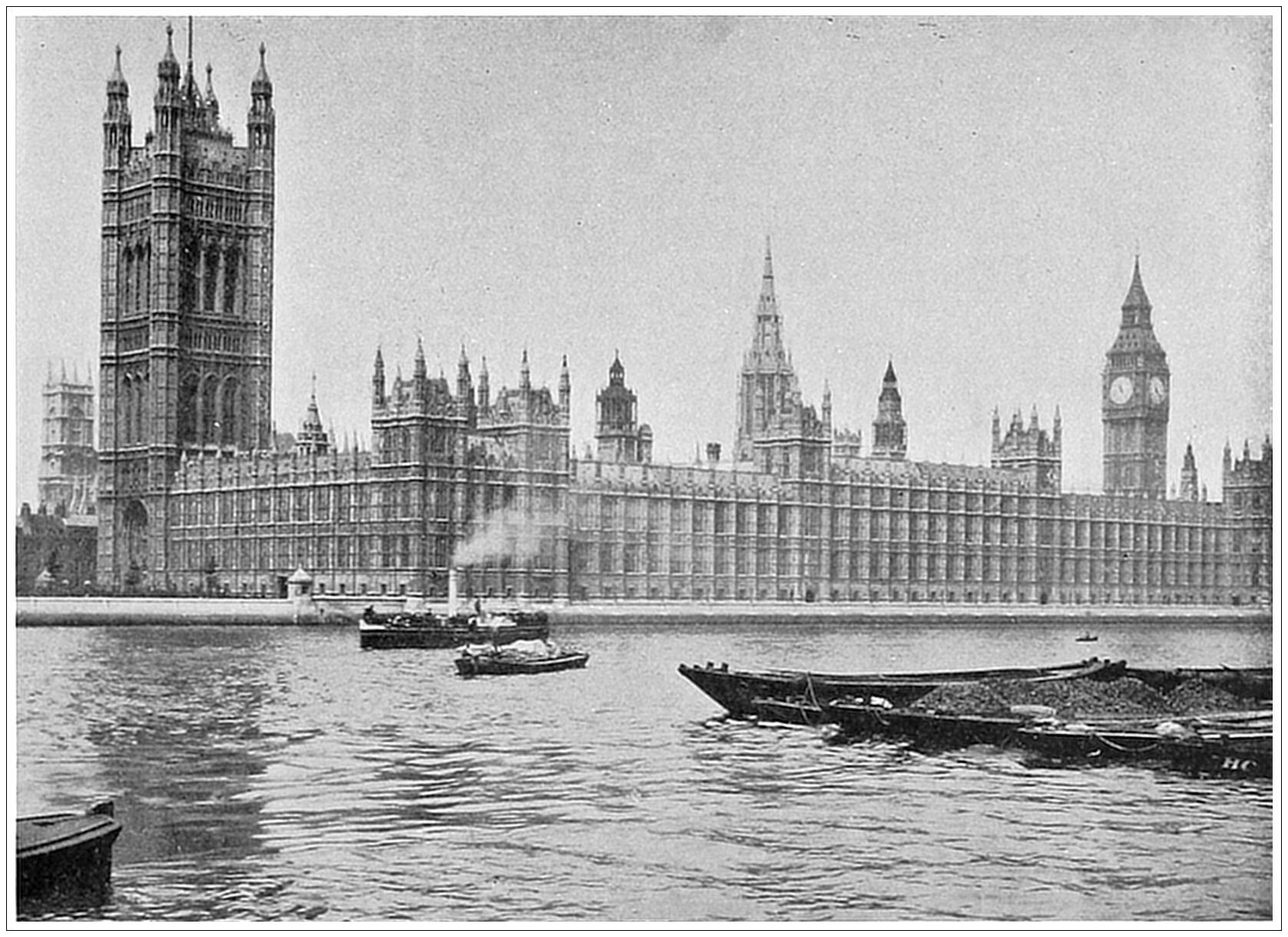
HOUSES OF PARLIAMENT, LONDON, ENGLAND. This is the
largest, and in some respects the most imposing, of all the public edifices
in England. Gothic in style, in size, at least, it surpasses any
other Gothic building in the world. And in respect to its equipments and the
excellent adaptation of every part to the purposes for which it was erected
and for the transaction of the business to which it is consecrated it is absolutely
unrivaled. Both Houses, Lords and Commons, meet within its walls.
Yet it is a comparatively modern structure. Occupying the site of the Royal
Palace, dwelt in by every English monarch from the time of Edward the Confessor
to Queen Elizabeth, the corner-stone of the present building was not
laid until April 27th, 1840. It covers about eight acres of ground, and has
four fronts, the longest and most effective of which, facing the river Thames,
is nine hundred and forty feet long. The Victoria Tower at the south-west
angle, which is about three hundred and forty feet high and admirably proportioned,
is one of its most effective features.
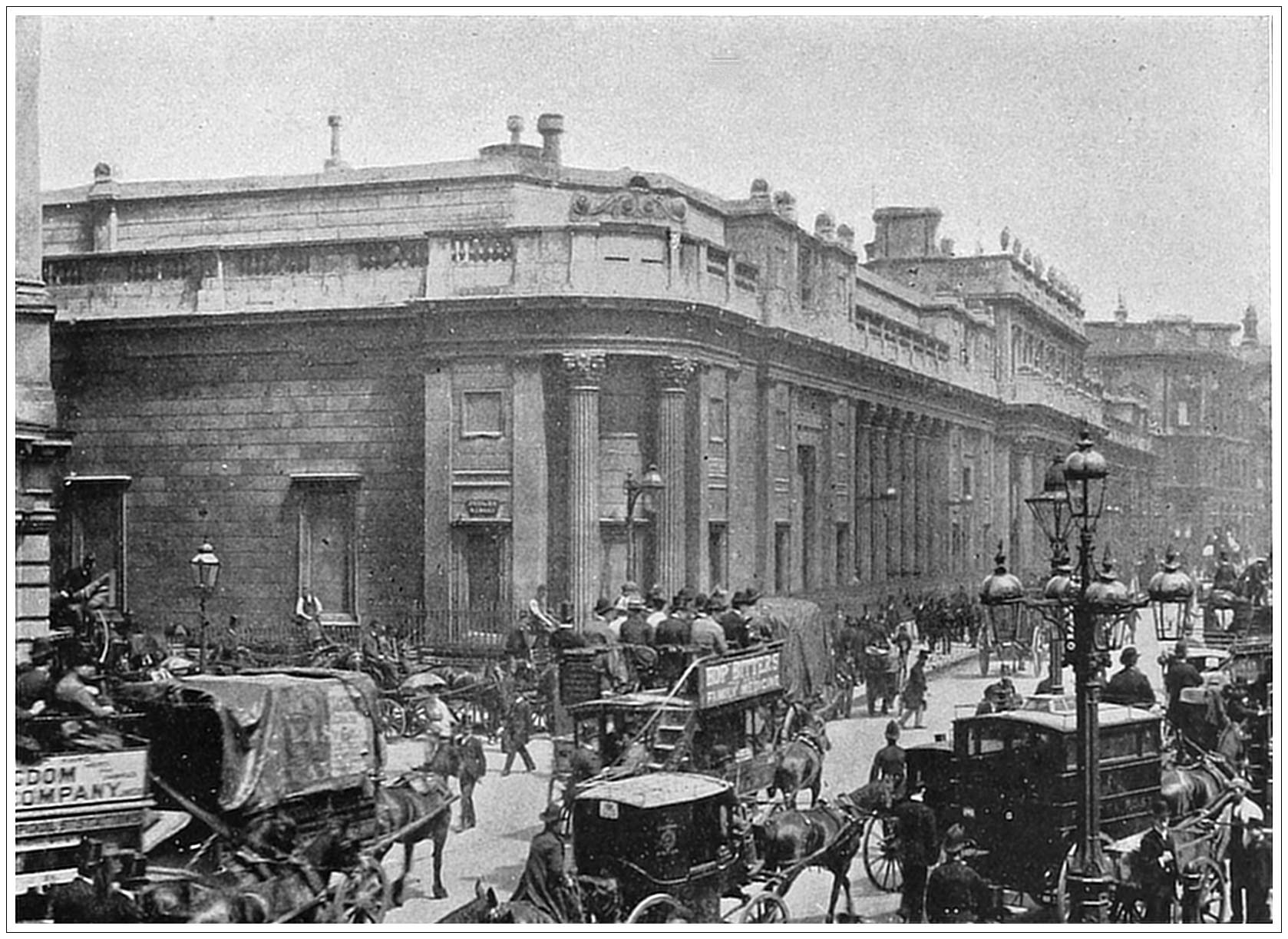
BANK OF ENGLAND, LONDON. This, the most celebrated moneyed
institution in the world, is situated on Threadneedle Street. Hence, it
is sometimes facetiously alluded to as “The Old Lady of Threadneedle
Street.” It has a branch in the West End of London and nine branches in
the provinces. It was founded July 27th, 1694, as a joint stock association,
with a capital of £1,200,000, which was lent at eight per cent. interest to the
government of William and Mary. And as it began as a servant of the
government so it has continued. At the present moment it has the management
of the public debt and the paying of interest thereon, it holds the deposits
belonging to government and aids in the collection of the public
revenue. It is the bank of all the other banks in England. Its notes are
legal tender, and are convertible into coin. Its credit and reputation have
been absolutely unequaled by any other establishment of the sort. Hence,
the recent discovery of a deficit of £5,000,000 shook the financial world to its
centre. But the bank has been able to meet the emergency.
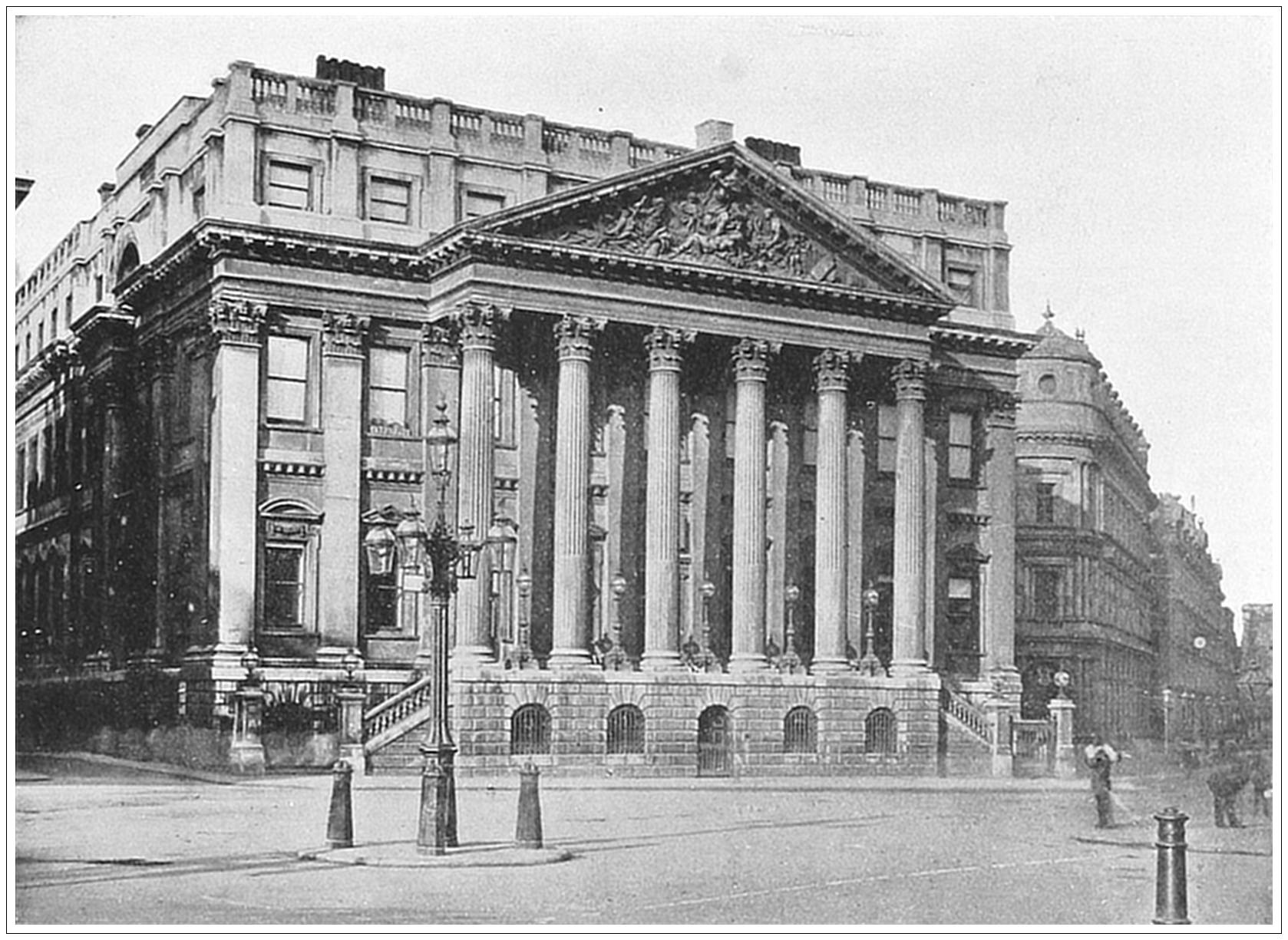
MANSION HOUSE, LONDON, ENGLAND. The Lord-Mayor of
London has his official residence at the Mansion House. It is situated
nearly opposite the Royal Exchange, on the site of the ancient Stock’s
Market; was begun in 1739 and finished in 1741. In its great banqueting hall,
known as the Egyptian Hall, are given the state banquets. Formerly it was
the ambition of every great London merchant and banker to become Lord-Mayor,
but since the district actually under his jurisdiction has come to be a
very small part of what is known as London, the importance of this functionary
has greatly diminished in the eyes of all save foreigners. As the dispenser of
civic hospitality he receives £8000 a year, with the use of the Mansion House,
furniture, carriages, &c.
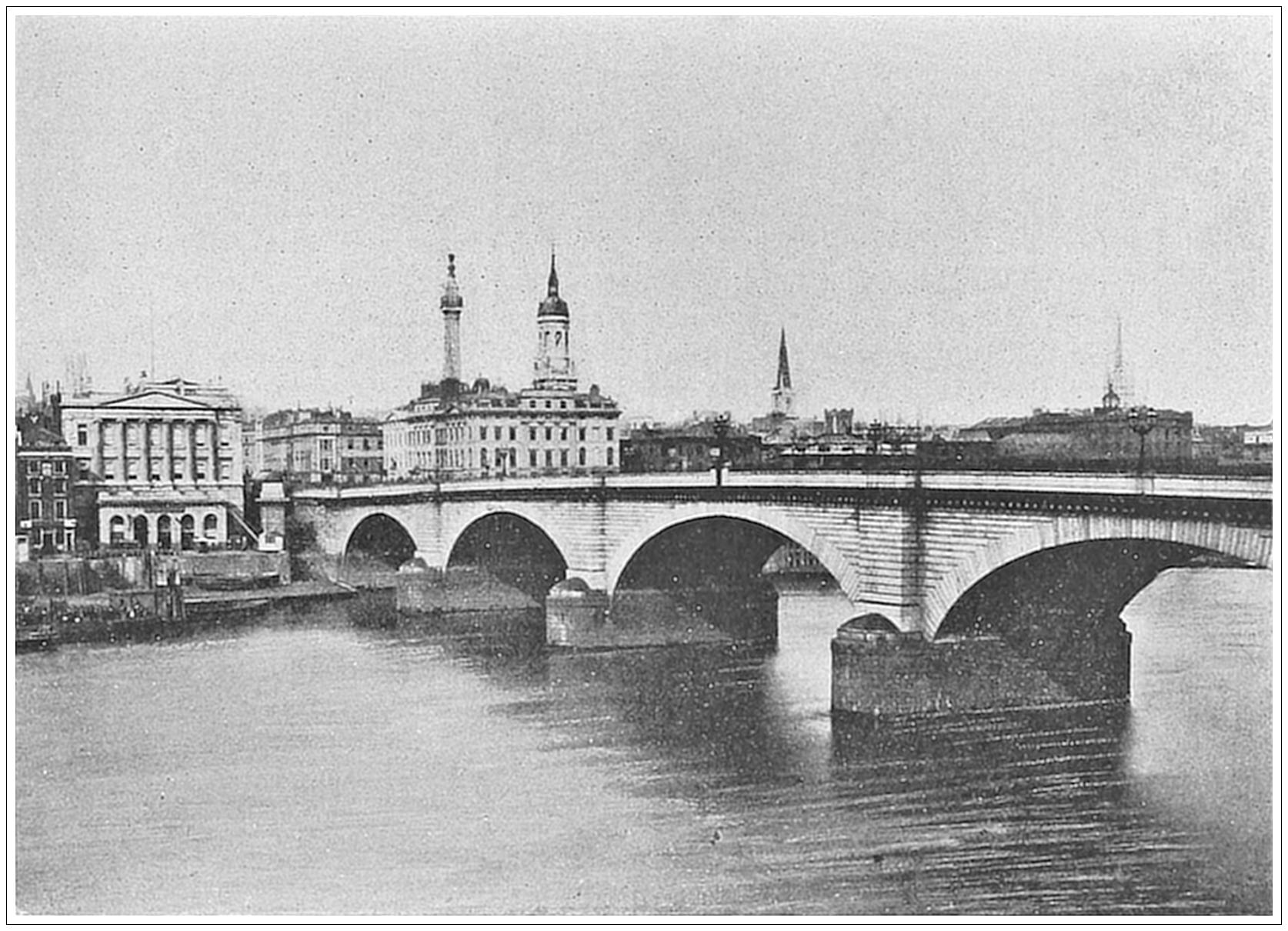
LONDON BRIDGE, LONDON, ENGLAND. This is not the London
bridge of Shakespeare’s time, for that was a wooden structure, lined with
houses on either side. The present London bridge is substantially built
of granite on the site of the older one. It cost £2,566,268, and was opened
to the public on August 1st, 1831, by King William IV. There are five
arches, the central one having a span of one hundred and fifty-two feet. The
entire length is nine hundred and twenty-eight feet and the width fifty-four.
A curious interest attaches to the lamp posts along the side, which are cast
from the metal of French cannon captured in the Peninsular War. The constant
stream of traffic that pours across this bridge is prodigious. It is estimated
that every twenty-four hours no less than twenty thousand vehicles and
one hundred and seven thousand pedestrians are borne along in the opposing
currents.
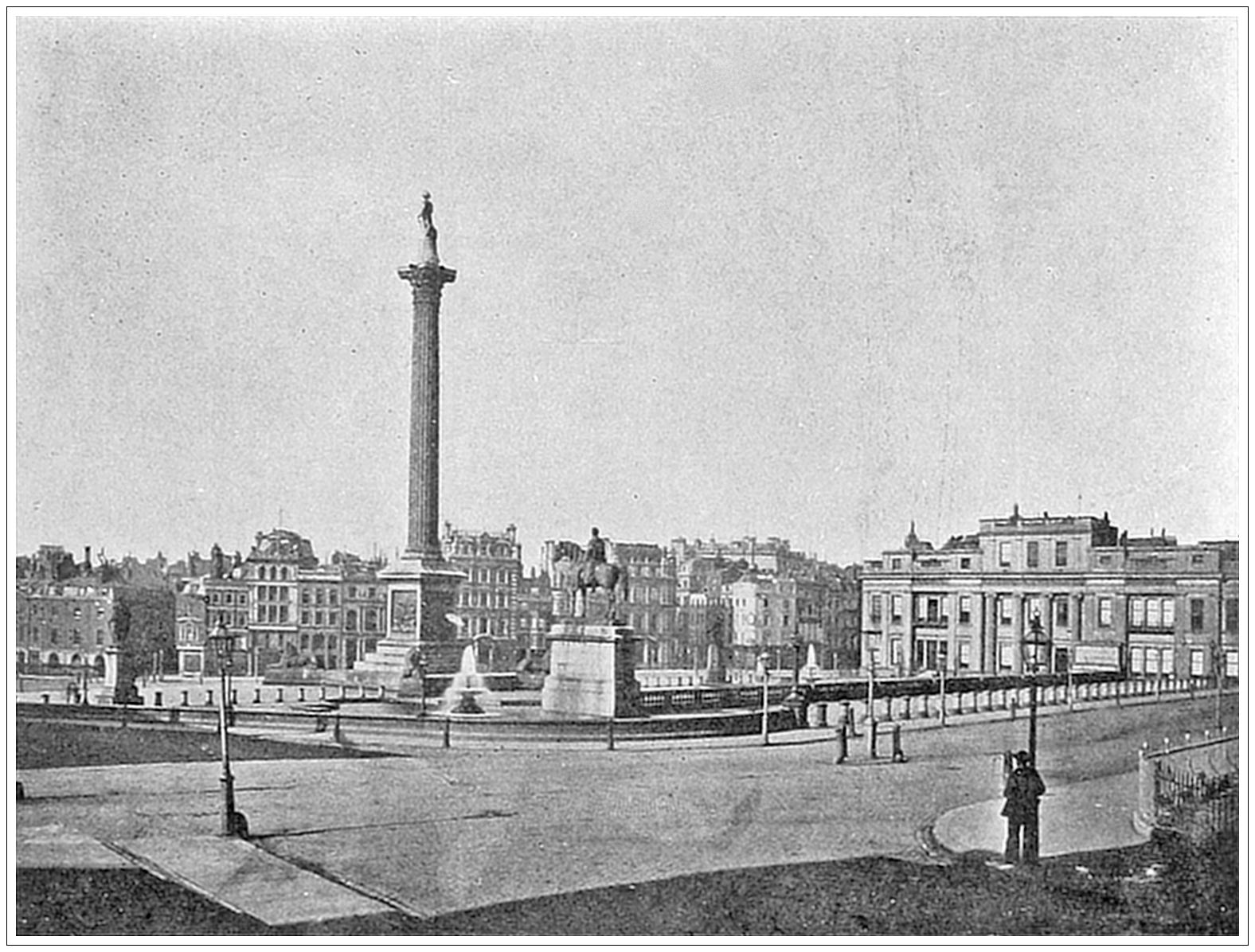
TRAFALGAR SQUARE, LONDON. The battle of Trafalgar (22d
October, 1805) was won over the combined French and Spanish fleet
by the English, under Lord Nelson, who lost his life at the very moment
of victory. One of the finest open places in London is named after the conflict.
In the centre a massive granite column, one hundred and forty-five feet
in height, rises to the memory of the great admiral, whose statue surmounts it.
The pedestal is adorned with reliefs in bronze, cast with the metal of French
captured cannon, and representing scenes in the career of Nelson. Four colossal
bronze lions, modeled by Sir Edwin Landseer, in 1867, crouch upon pedestals
running out from the column in the form of a cross. The square is paved
with asphalt. Statues of Sir Henry Havelock, of Sir Charles James Napier
and of George IV are distributed around it. Towards the north side are two
fountains, and on the terrace to the north rises the National Gallery, with the
interesting old church of St. Martin in the Fields by its side.
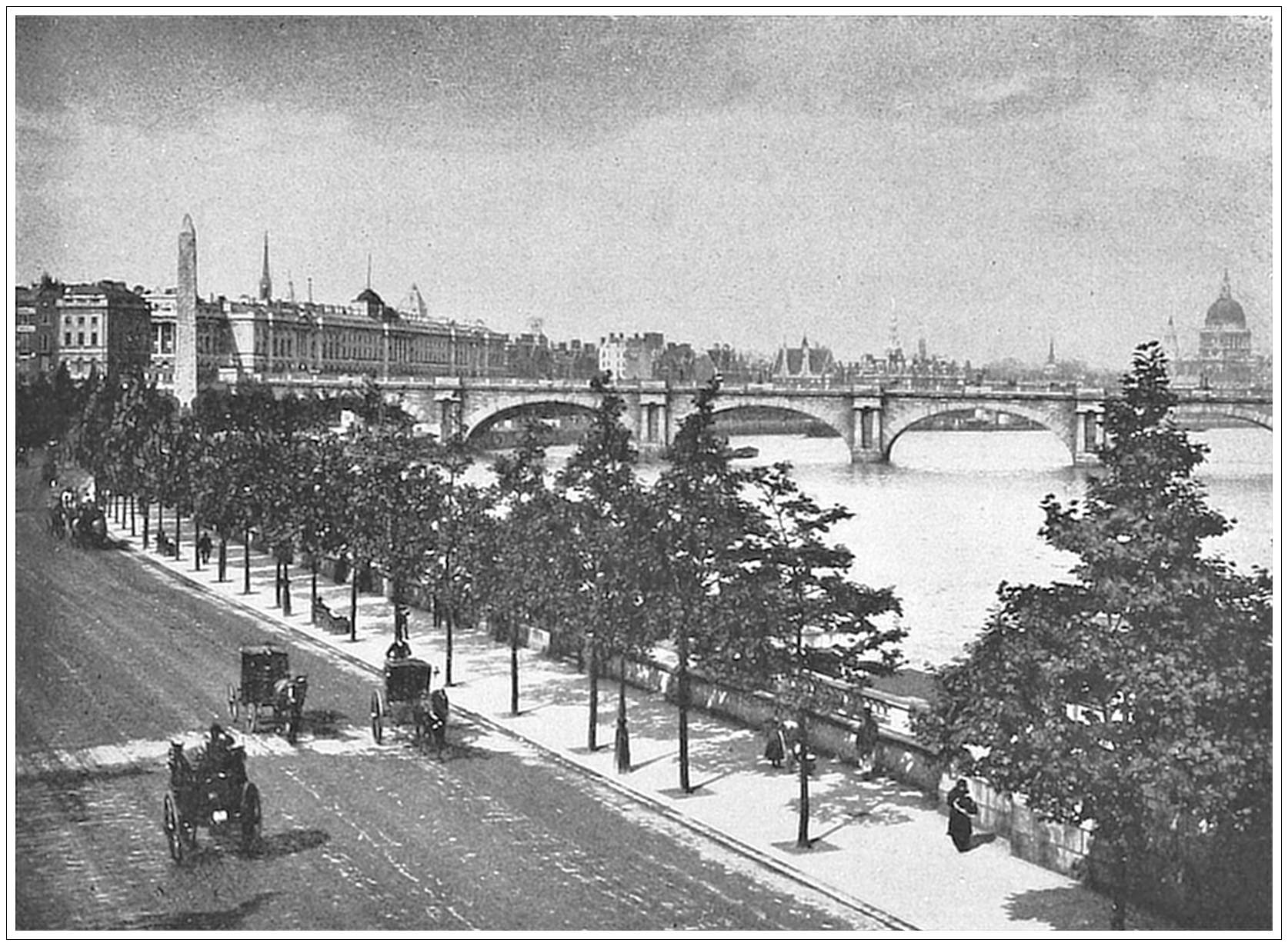
THAMES EMBANKMENT, LONDON, ENGLAND. At an early
period the banks of the Thames River had many wide stretches of
marsh land, covered by shallow lagoons. From time to time embankments
have been erected, some of them dating from the time of the Romans.
The greatest of all these works is the new Victoria Embankment, leading from
Blackfriars Bridge towards the west, along the north bank of the Thames as
far as Westminster. Built in 1864–70, under the direction of Sir Joseph W.
Bazalgette, it cost nearly $10,000,000. It consists of a macadamized carriageway
about two thousand three hundred yards in length and sixty-four feet
wide. The foot pavement on the land side is sixteen feet broad and on the
river side twenty feet. This entire area was formerly covered by the tide
twice a day. A granite wall eight feet thick protects it on the side next the
Thames. Rows of trees have been planted along the sides of the Embankment,
which will eventually make it a shady and delightful promenade. At
intervals are large openings, with stairs leading to the floating steamboat piers.
It is illuminated at night by electricity.
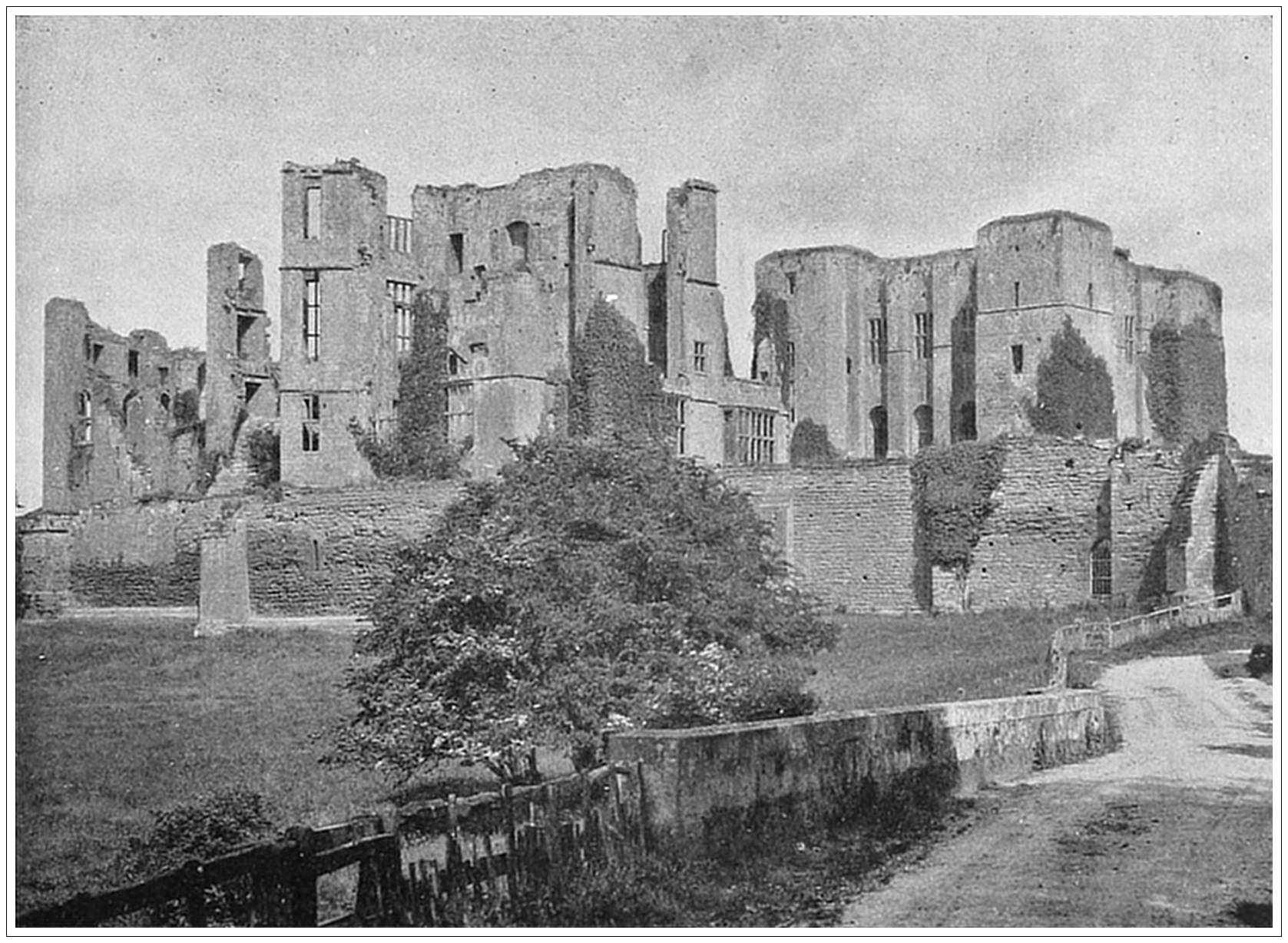
KENILWORTH CASTLE, ENGLAND. One of the stateliest of feudal
remains in all England is this ruined castle, situated on rising ground
to the west of the village of Kenilworth. Picturesque in itself, famous
as it is in history, it yet derives its chief charm from the glamour thrown over
it by Walter Scott in the novel which he has named after it. Kenilworth Castle
first takes a prominent position in history as one of the strongholds of Simon
de Montfort, Earl of Leicester, in his rebellion against Henry III. Subsequently
it passed into the possession of John of Gaunt, who enlarged and
beautified it. But its highest fame results from the fact that Queen Elizabeth
bestowed it upon her favorite, Robert Leicester, Earl of Dudley, and it was
here that Amy Robsart ended her unhappy life. Cromwell dismantled the
castle. Since his day it has suffered much from the ravages of time, but even
in ruins it retains a potency to delight and to impress.
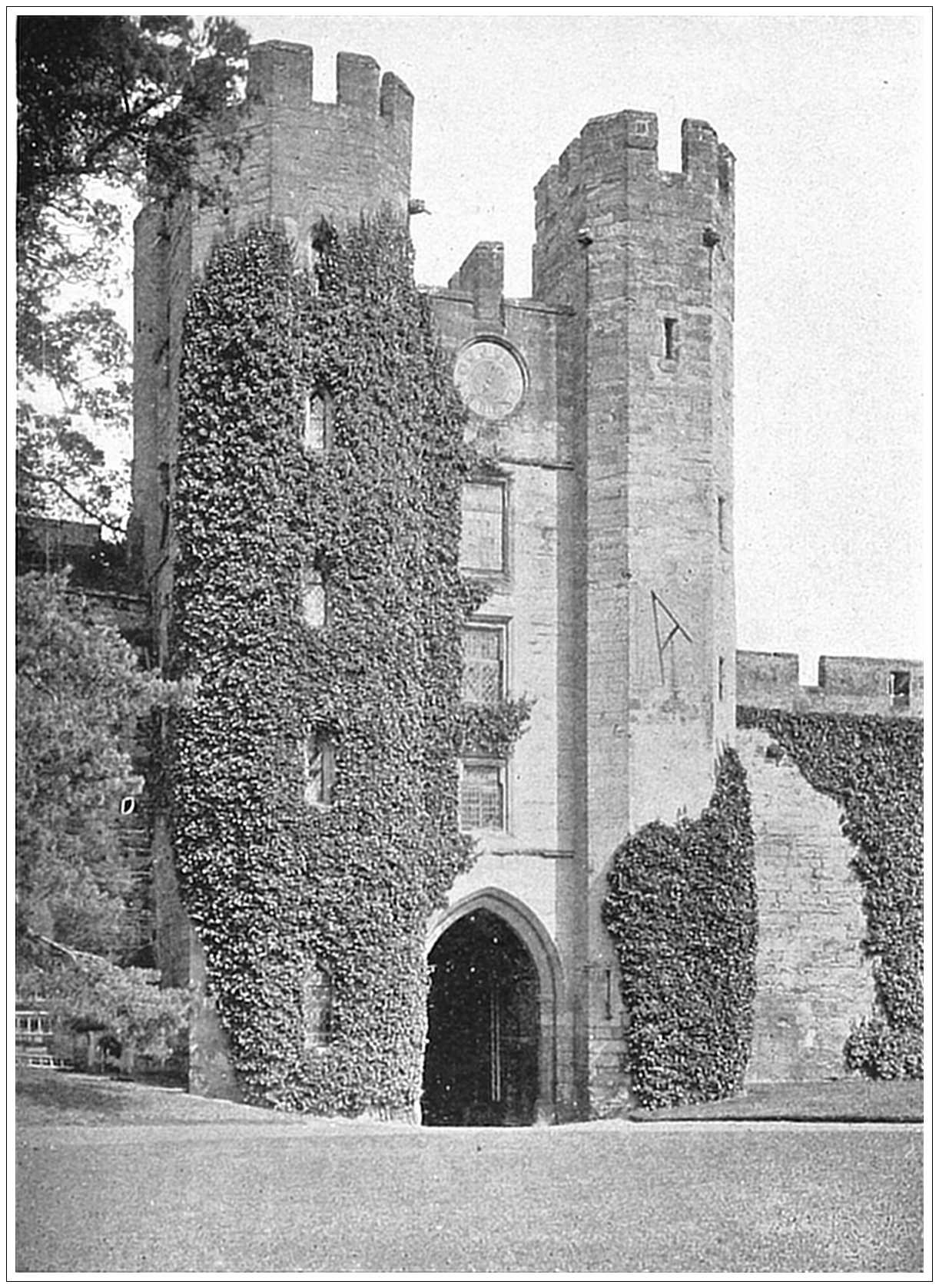
WARWICK CASTLE, ENGLAND. Beautiful in itself, famous as the
residence of the Earls of Warwick, and especially of him who went
by the title of the King-maker, Warwick Castle is one of the most
notable edifices in England. Nothing could be more picturesque than its
situation on a rock washed by the Avon. Its two towers are surpassingly
beautiful. The one known as the Clock Tower is here represented. Its
battlements and turrets are full of quaint interest. The grounds which
surround it are a triumph of landscape gardening. And the castle itself
is almost a thousand years old. Legend declares that it was founded
in 915 by the daughter of King Alfred, Ethelfleda. In the war with the
barons in the reign of Henry III it was partially destroyed. In the reign
of Edward III it was restored and strengthened. Additions and improvements
have successively been made. In the reign of James II it passed into
the hands of the Grevilles, and has remained their property ever since.
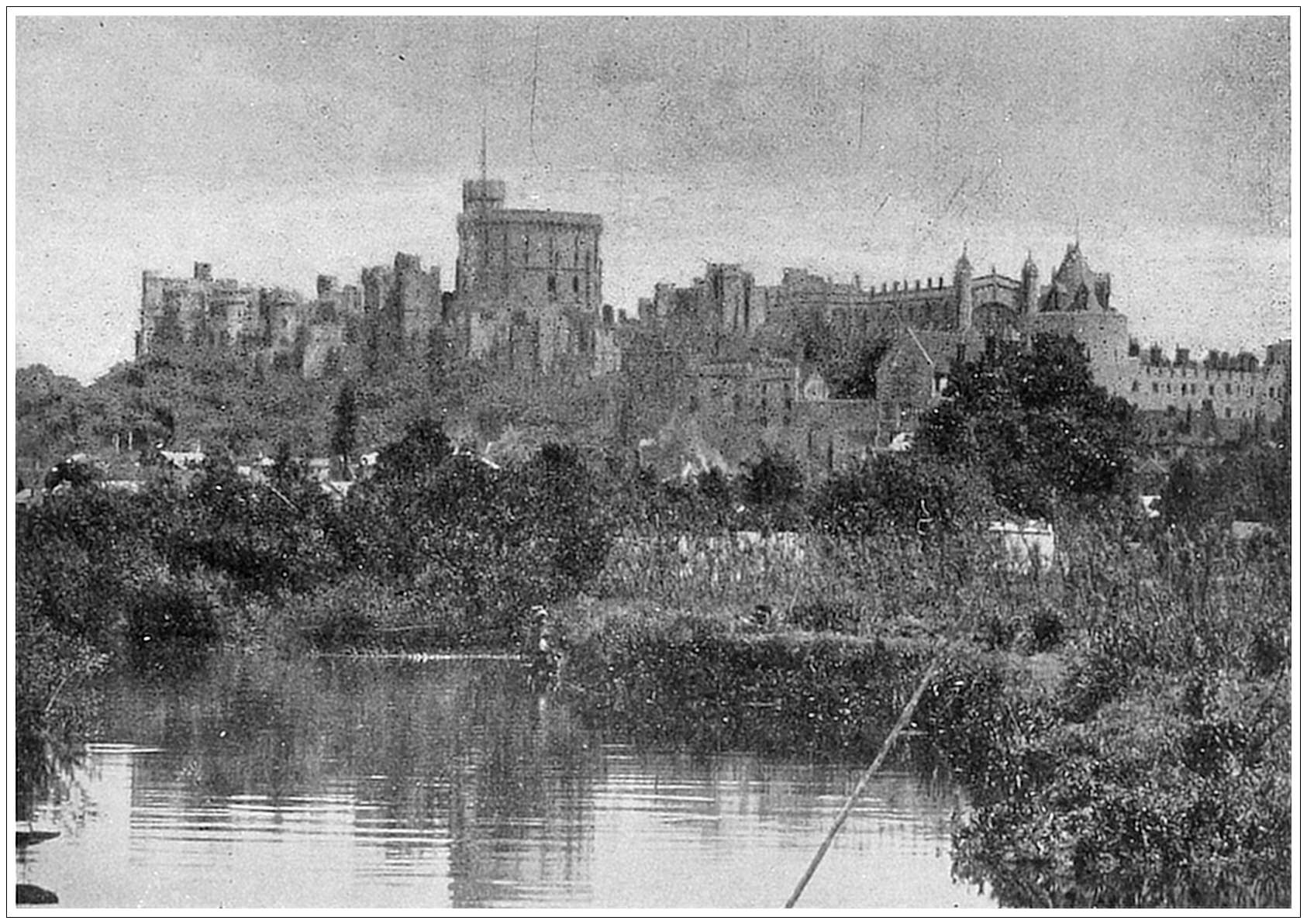
WINDSOR CASTLE, ENGLAND. The favorite residence of the English
sovereigns, which distinction it merits through its own beauty, the
beauty of its surroundings and its opulence of historical and legendary
associations. Long before the Normans landed in England it was the seat of
the Saxon Kings. But William the Conqueror founded the present castle; it
was rebuilt by Edward III, was extended by successive sovereigns, and,
finally, in the reign of Queen Victoria, was brought to its present perfection.
The town of Windsor is some twenty miles from London. On a promontory,
overlooking the Valley of the Thames, stands the castle. Its chapels and its
terrace are among the noblest in Europe. The interior is lavishly decorated,
and contains valuable paintings, statuary, furniture, tapestries and plate. In
its vaults lie the bodies of the Kings and Queens of England.
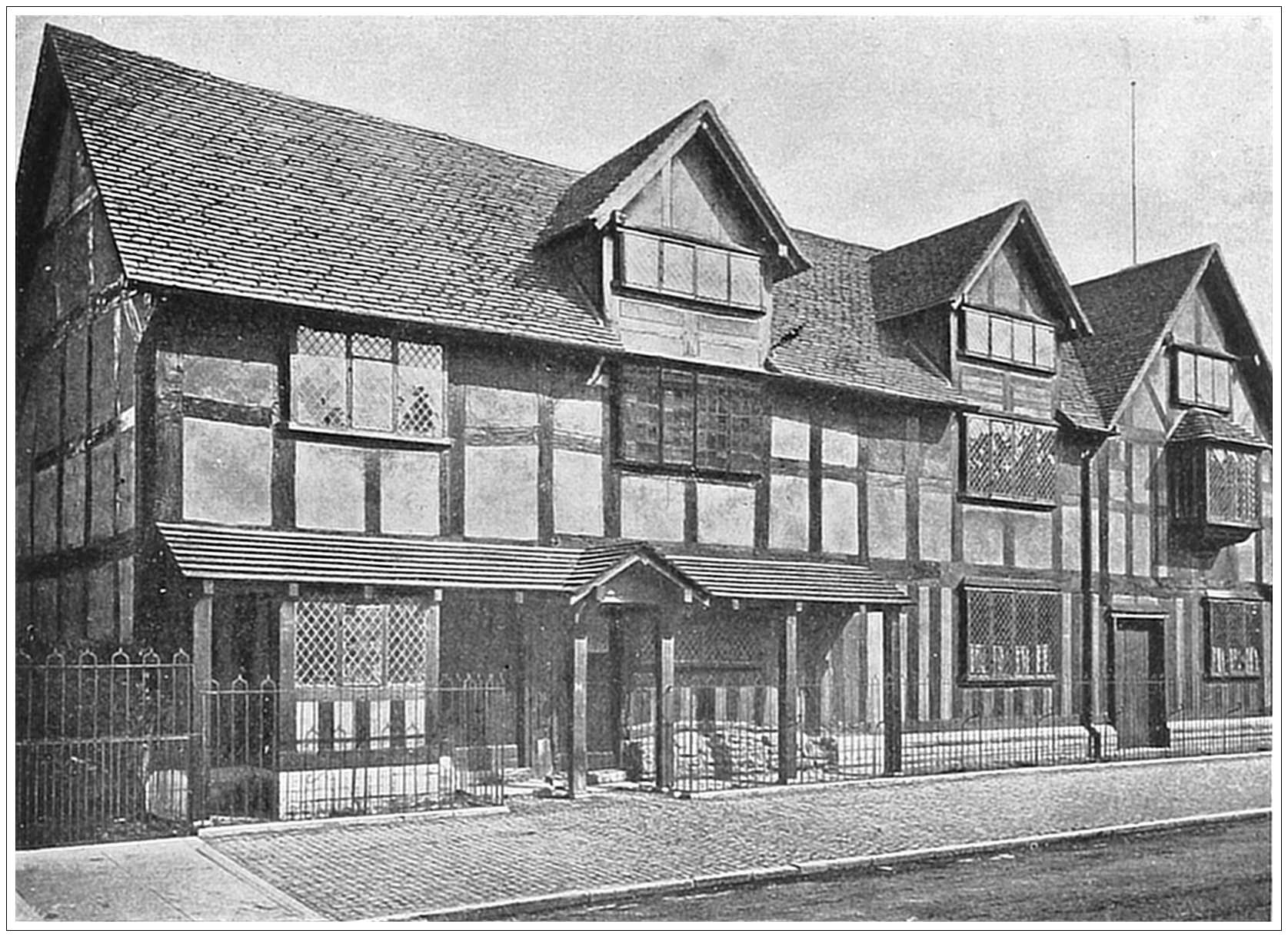
SHAKESPEARE’S HOUSE, STRATFORD-ON-AVON, ENGLAND.
The birth-place of genius must always be full of interest to his fellow-men.
How great then must be the interest in the birth-place of the
greatest of geniuses! That interest is attested by the fact that the walls of the
small, mean-looking edifice in which Shakespeare was born are scrawled all over
with the names of potentates, princes, statesmen, poets and other great and
little men. These, indeed, form a not insignificant part of the curiosities of
the place. The house became the property of the English nation in 1847, and
has been carefully restored. The actual room which witnessed the birth of the
poet is shown, and is in substantially the same condition as when that event
took place. In another room there is a small museum of Shakespearean relics.
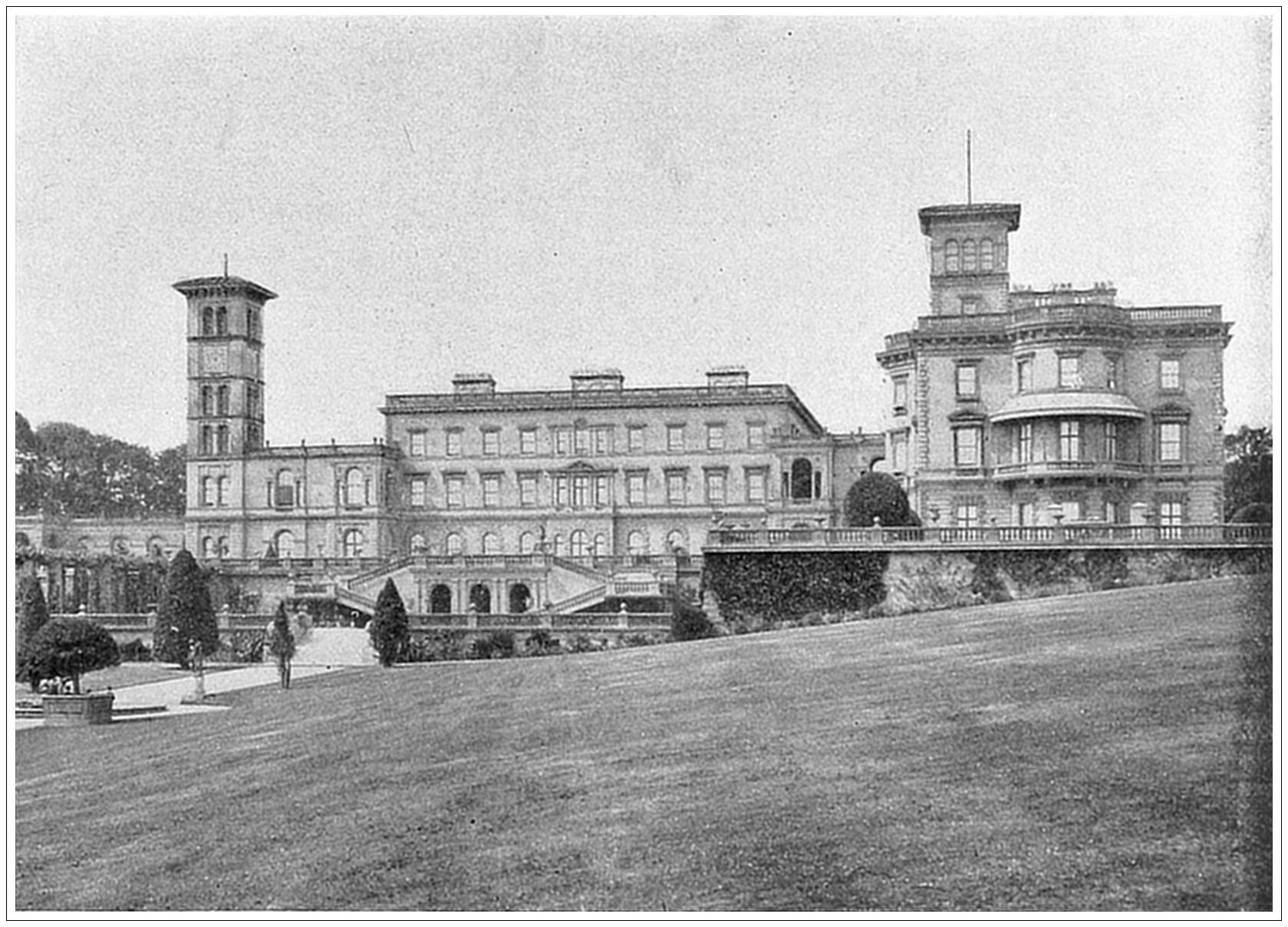
OSBORNE HOUSE, ISLE OF WIGHT, ENGLAND. This is the
seaside residence of Queen Victoria. Even in the Isle of Wight, a
place famous for its magnificent private residences, it occupies a pre-eminent
position. Situated in the immediate neighborhood of East Cowes, almost
opposite to the mouth of Southampton Water, no place could be more favored
by nature in its surroundings, and art has come to the assistance of nature.
The grounds, though not large, are exquisite specimens of that princely art of
landscape gardening in which the English have achieved the highest success.
The palace itself is in excellent taste. A high tower in one corner is a conspicuous
object for miles around. From its summit a magnificent view of the
surrounding country may be obtained.
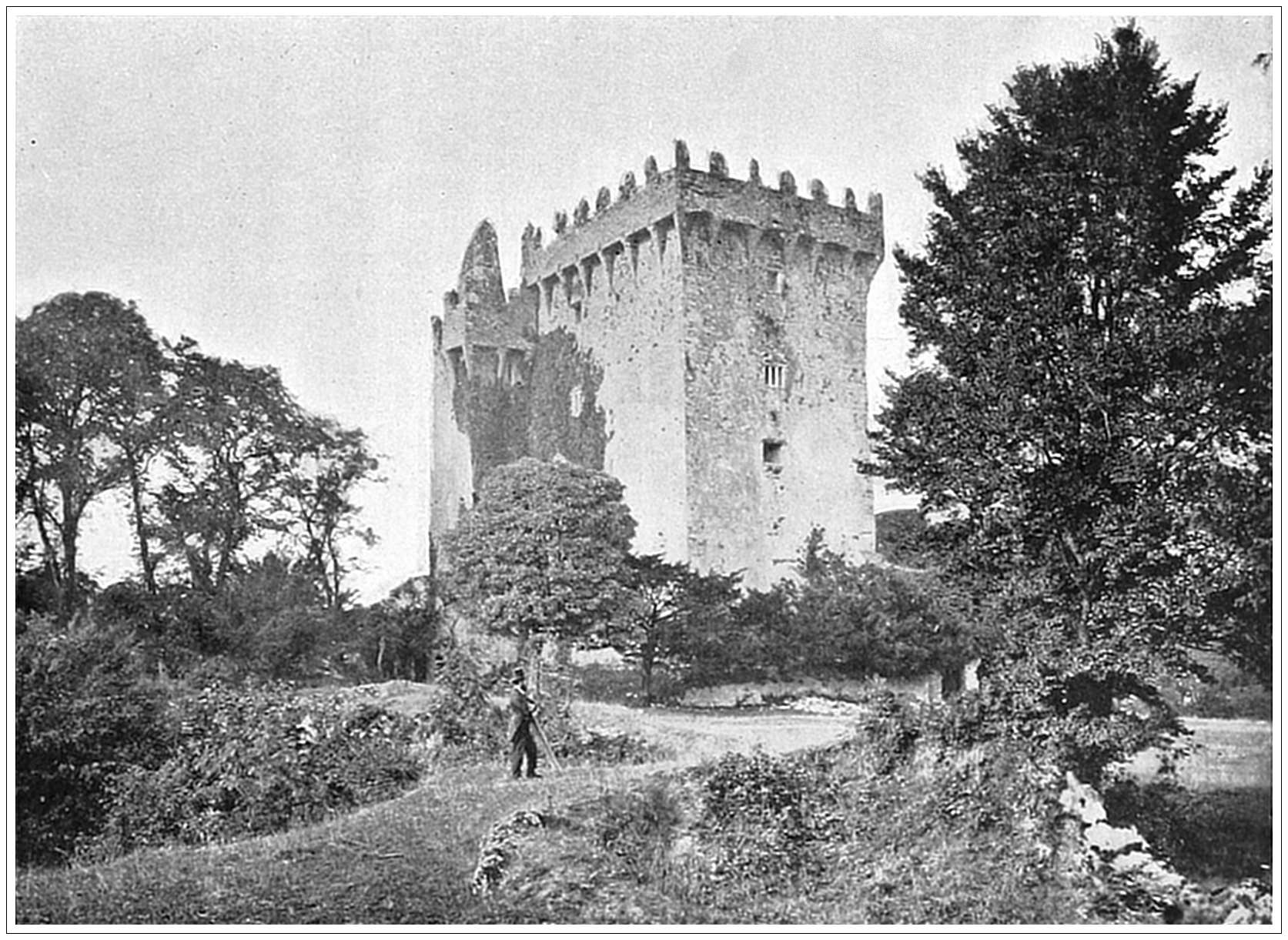
BLARNEY CASTLE, IRELAND. This imposing ruin of an ancient
fortress is situated in the village of Blarney, about four miles from
Cork. It was built in the early part of the fifteenth century by Cormac
McCarthy, Prince of Desmond. Little now remains of it but the massive
donjon tower, one hundred and twenty feet high. Its main celebrity arises
from the famous Blarney stone, which endows whoever kisses it with the gift
of flattery, palavering rhodomontade or wheedling eloquence. No one exactly
knows the origin of the stone, nor whence it derived its mysterious powers.
The date 1703 is carved upon it. It is preserved and held in place by two
iron girders between huge mertons of the northern projecting parapet nearly
one hundred feet above the ground. To kiss it has been the ambition of many
generations who laboriously climb up to its dangerous eminence. But the lip
service of so great a multitude is gradually wearing it away.
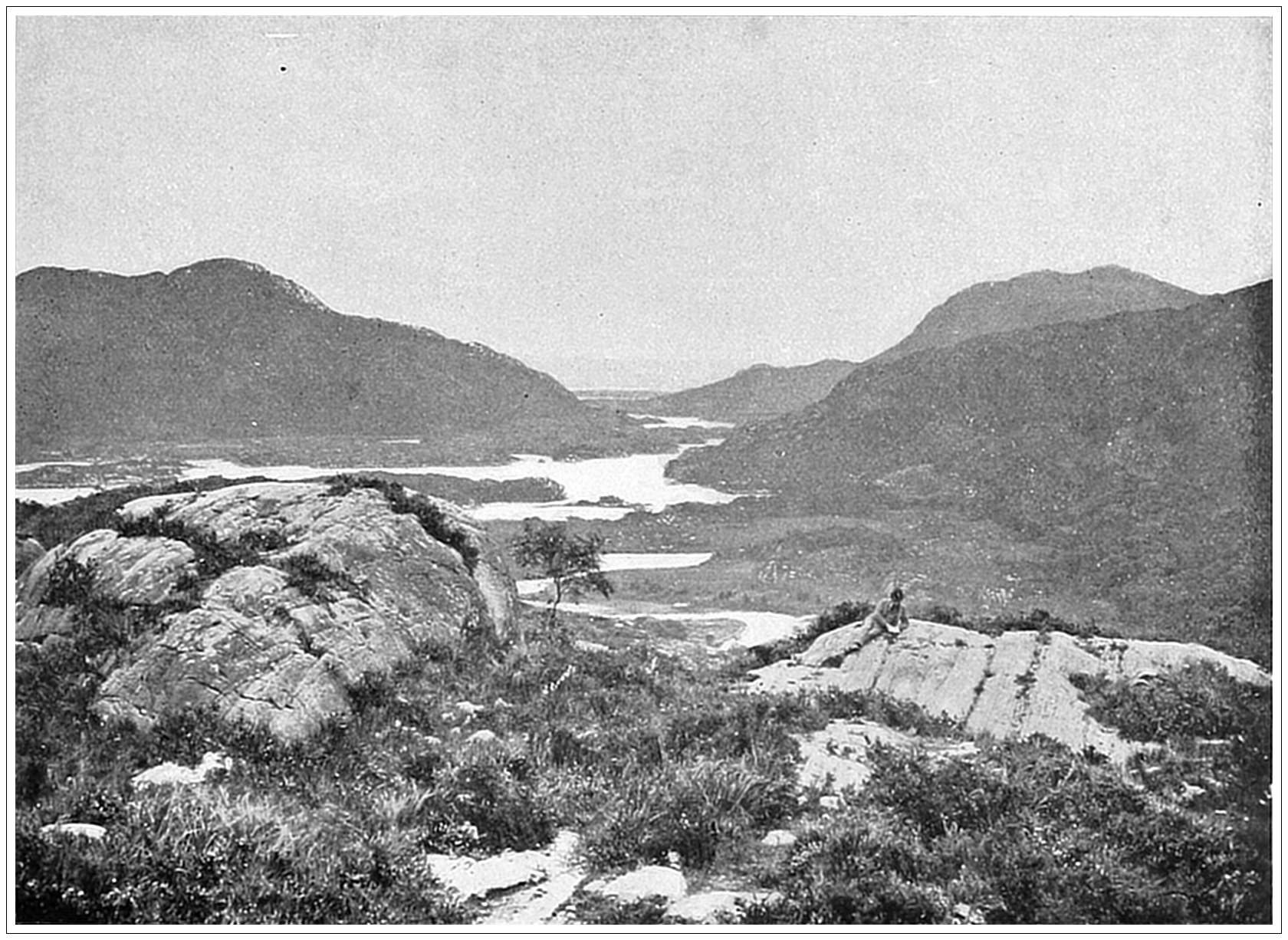
LAKES OF KILLARNEY, IRELAND. These are three connected
lakes in County Kerry, of extraordinary beauty and interest. The
largest, known as Lough Leane, is fifteen miles long by three broad. It
contains some thirty islands, the chief of which is Innisfallen, celebrated in
history and story. On the sides of these lakes rise the loftiest mountains in
Ireland, intersected by the wildest ravines, and full of the boldest cascades.
The beauty of the scenery is enhanced by the varied coloring of the thickly-wooded
shores, the gray rock forming an effective contrast to the dark firs, the
brown mountain heath, the light green arbutus and other features in an infinite
variety of foliage and verdure. In the immediate neighborhood of Lough
Leane is Muckross Abbey, founded by Franciscan monks in 1340, now a most
picturesque ruin.
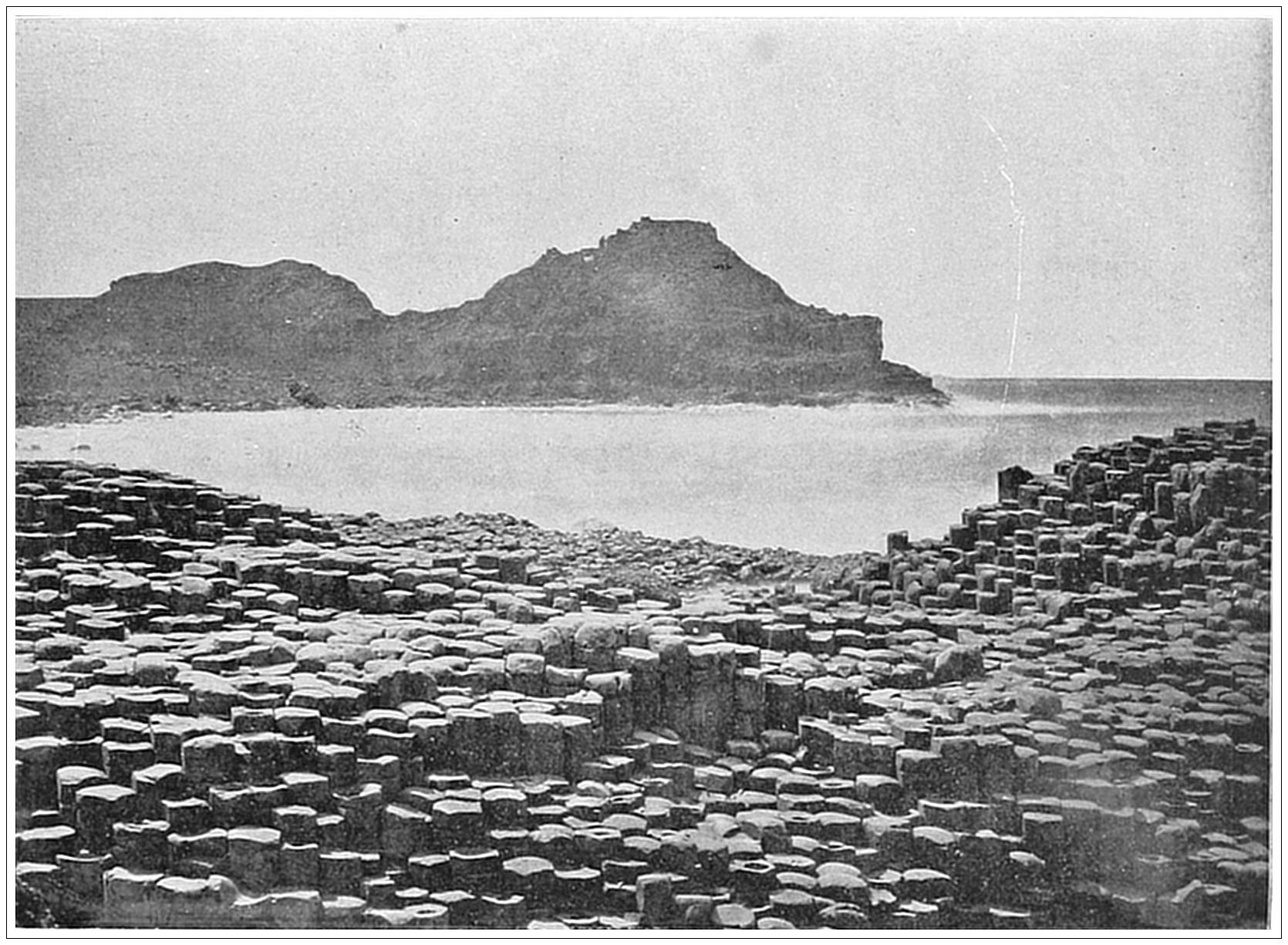
GIANT’S CAUSEWAY, IRELAND. A singular mass of basaltic
columns, situated on the coast of Antrim, Ireland, has obtained this
name from the legend that it was the commencement of a road planned
by the giants of old to project across the channel from Ireland to Scotland.
And, indeed, it looks almost like a deliberate work of mightier men than we
rather than a frolic of nature. It resembles an immense pier jutting out into
the sea from the base of a stratified cliff about four hundred feet high, to the
length of about seven hundred feet. The pillars composing it are close-fitting,
dark-colored and somewhat irregular hexagons, varying in diameter from
fifteen to twenty inches and sometimes reaching the height of twenty or even
thirty feet. Whinstone dikes separate it into three divisions, known as the
Little Causeway, the Middle or “Honeycomb” Causeway and the Larger
or Grand Causeway. Altogether, it comprises about forty thousand columns,
each consisting of several pieces.
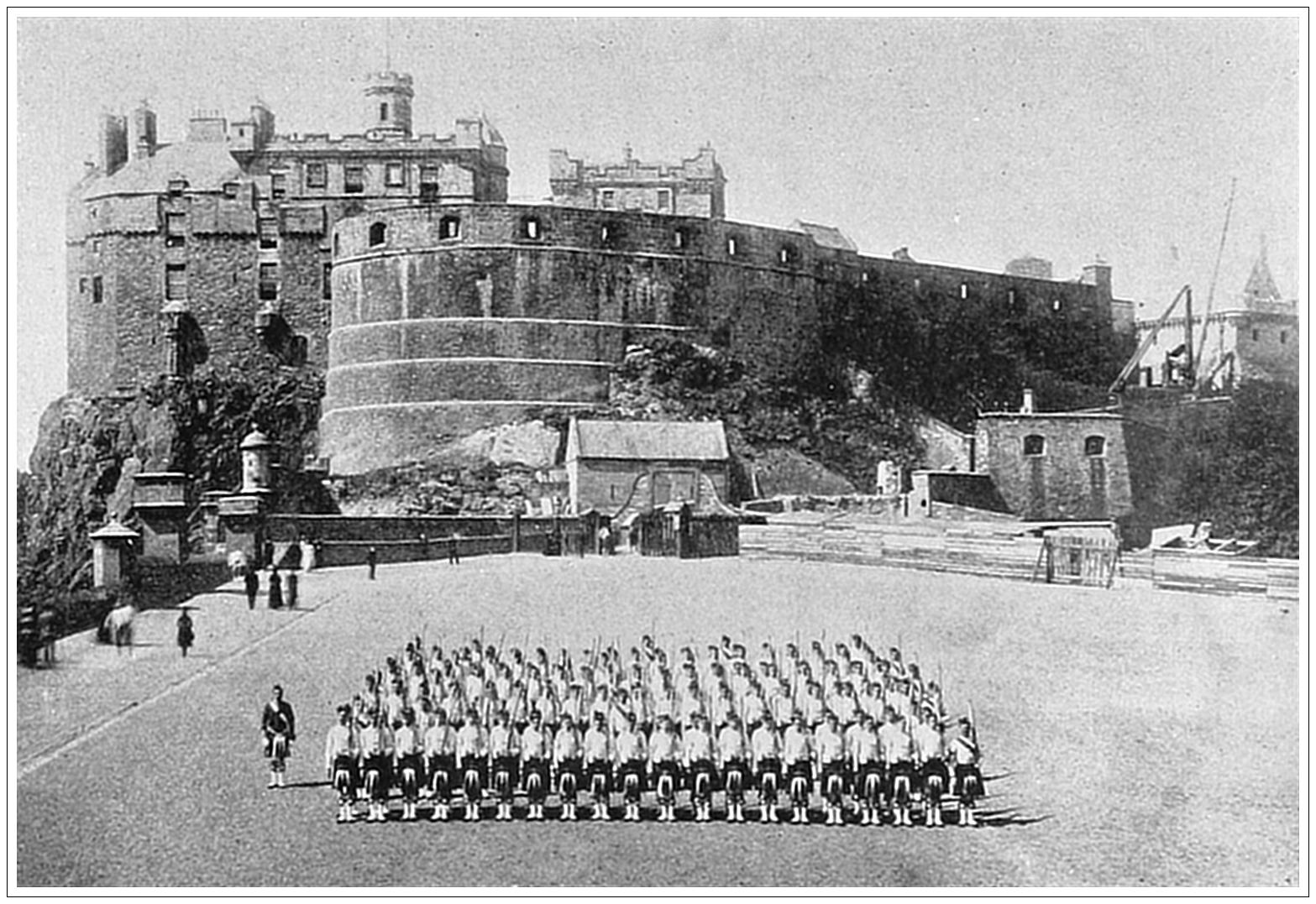
EDINBURGH CASTLE, EDINBURGH, SCOTLAND. Picturesquely
situated on a rocky eminence, three hundred and eighty-three feet high,
in the very heart of the old portion of Edinburgh, is this ancient fortress.
The rock is perpendicular on three sides. On the fourth it slopes away gradually
so that it can be ascended with ease. The fort is supposed to have been
erected in the seventh century, the city gradually growing up around it. In
early Scottish history it was frequently captured by and recaptured from the
English. In the twelfth century it became a royal residence. By the articles
of union it is one of the four fortresses which are to be kept constantly fortified.
It contains accommodations for two thousand soldiers, and its armory
affords space for thirty thousand stands of arms. The Scottish Regalia are
preserved here, and one of the chief objects of interest is the room where
Mary, Queen of Scots, gave birth to James VI, in whom the crowns of England
and Scotland were united. The picture is taken from the Parade Ground.
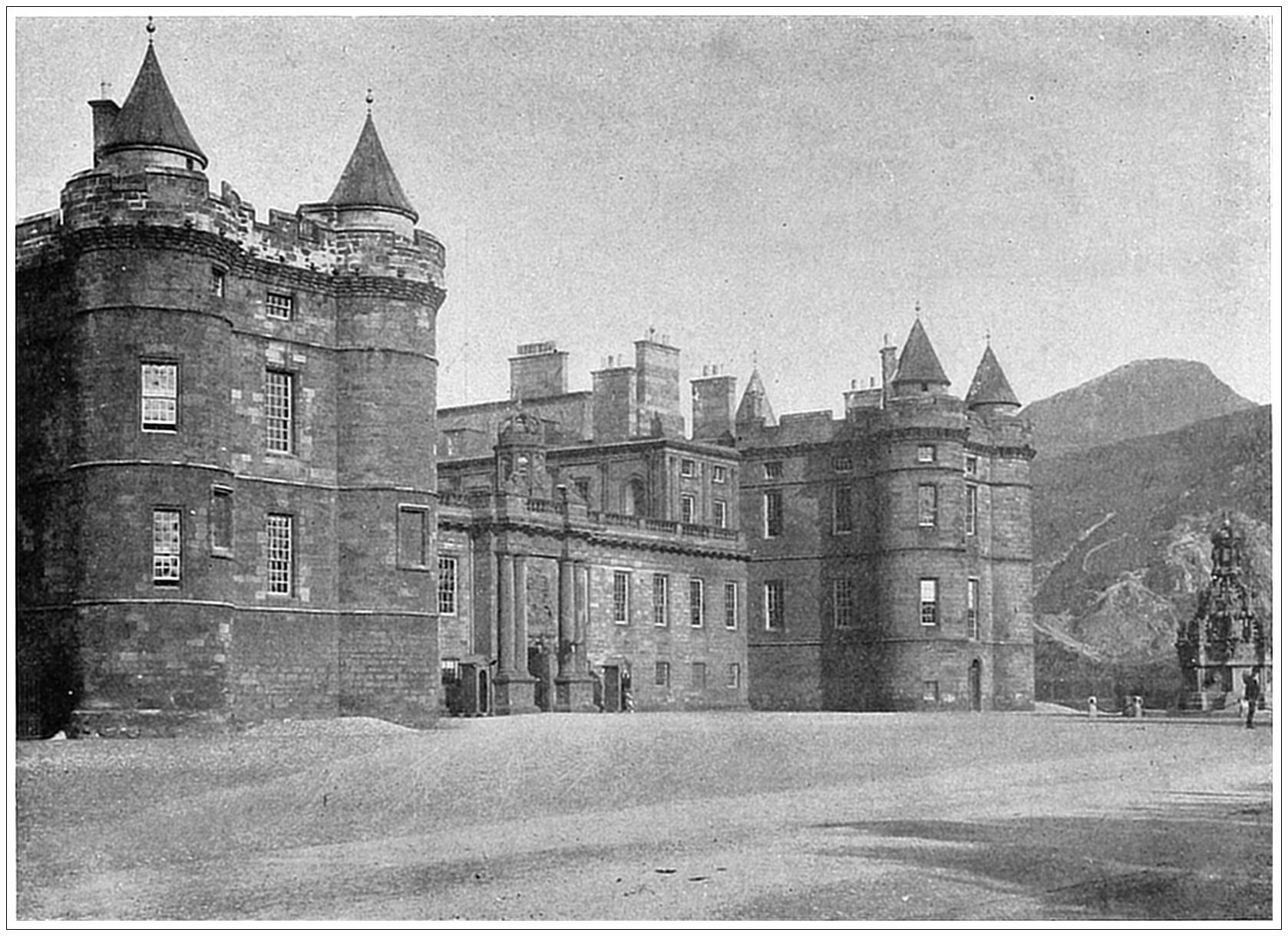
HOLYROOD PALACE, EDINBURGH, SCOTLAND. This spacious
building occupies the site of an Abbey, founded in A. D. 1128 by King
David I, of Scotland. The palace itself was begun in the reign of James
IV, was nearly destroyed by Cromwell in 1650, and was rebuilt by Charles II.
But the chief interest of the place centres upon its associations with Mary,
Queen of Scots. Luckily her apartments are preserved in almost their original
condition. The royal chapel, where she celebrated mass to the indignation
of the Protestants, is almost intact. So is the audience chamber in which she
disputed with John Knox. And even to this day is pointed out a deep stain
at the foot of the private stairway to her apartments which is said to be the
blood of the murdered Rizzio. In recent times the palace has been seldom
used as a place of residence. It stands on the top of a huge rock four hundred
and forty-three feet above the sea, and is built in the shape of a quadrangle
with a court in the centre.
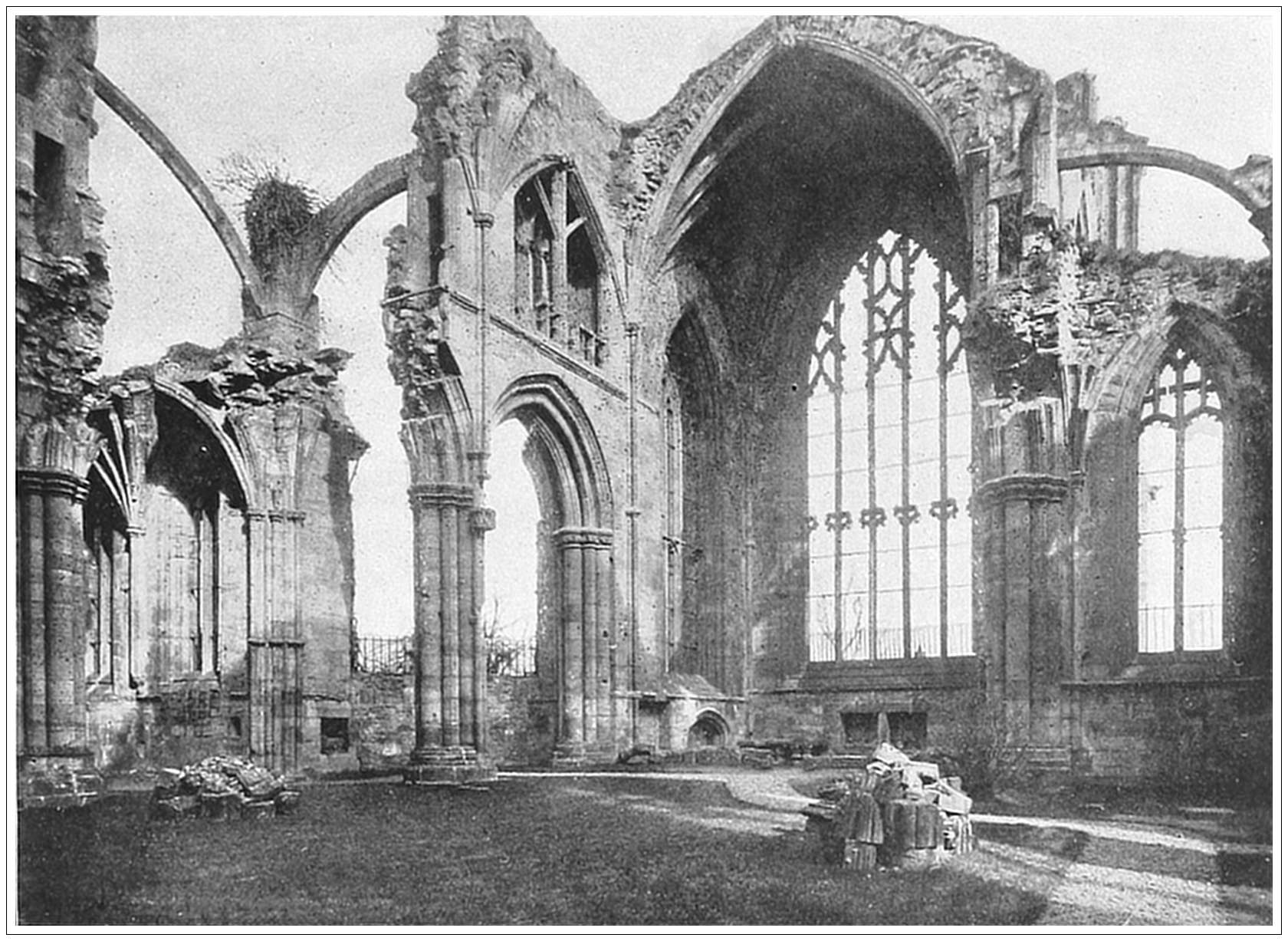
MELROSE ABBEY, MELROSE, SCOTLAND. This is the most
famous and the most picturesque ruin in Scotland—indeed in all
Great Britain. Originally founded for the Cistercian monks by David
I, of Scotland, in the twelfth century, it was nearly destroyed by the English—Edward
II—in 1322, and shortly after was rebuilt by Robert Bruce, whose
heart is fabled to be buried under the east window. The abbey was again
burned by Richard II in 1385, and though again restored it was considerably
altered after the Reformation to suit the demands of Presbyterian worship.
Later it was plundered by builders to secure ornaments for houses, and is now
in utter ruin. As it stands, therefore, it belongs mainly to the middle of the
fourteenth century and the first half of the fifteenth, with a good many portions
of much later date. Even in ruins it is one of the noblest exemplars
of the Middle-pointed style of Gothic architecture. Sir Walter Scott made it
the scene of his novel of “The Monastery,” and also celebrated it in some well-known
lines in “Marmion.”
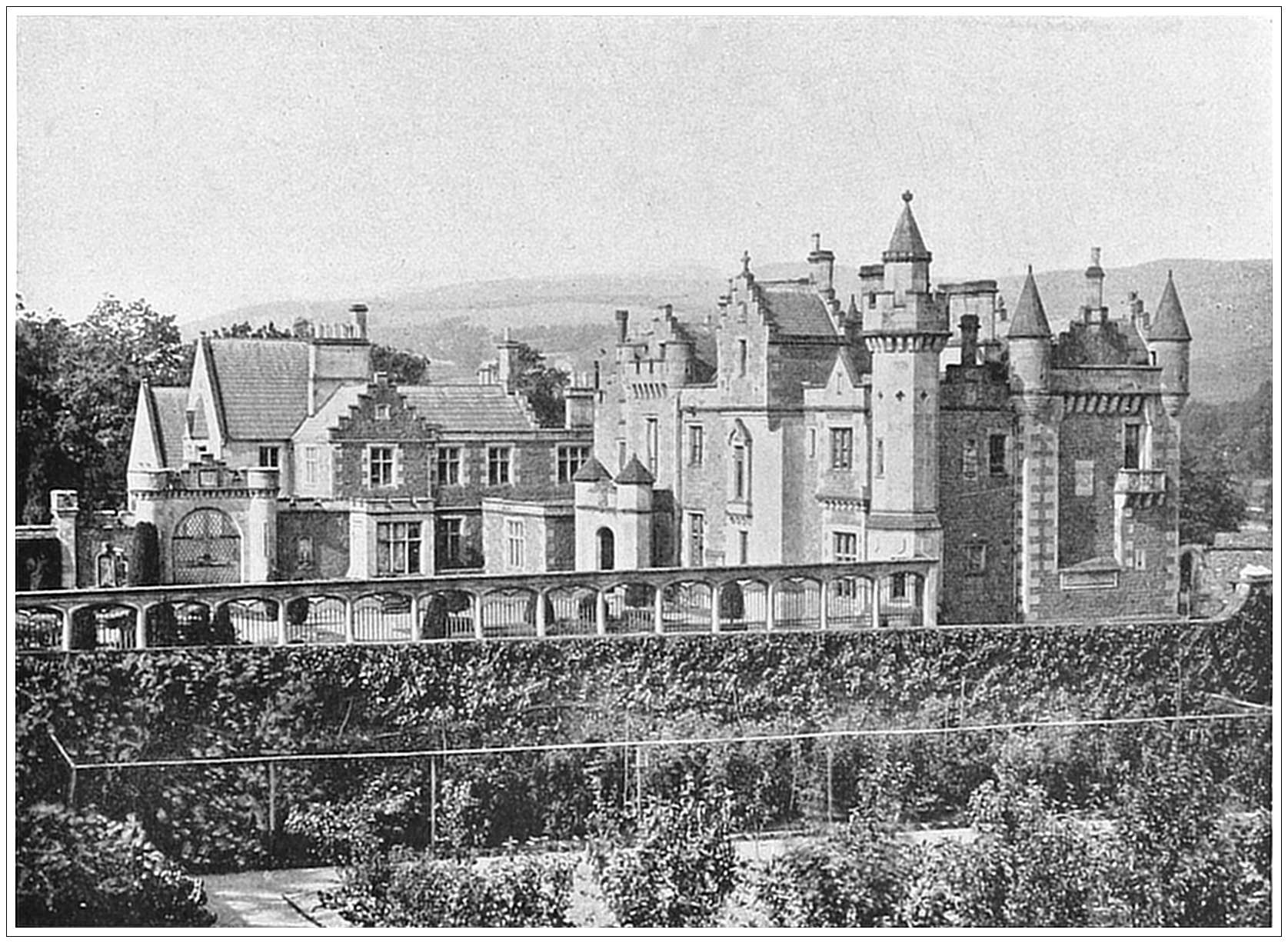
ABBOTSFORD, SCOTLAND. As the residence of Sir Walter Scott, who
erected it in the days of his greatest financial success, and as the scene
and the cause of his eventual ruin, the castle of Abbotsford must ever
retain a picturesque and pathetic hold upon the lover of literature. It is
situated on the south bank of the Tweed, near Melrose Abbey, and about
twenty-eight miles southeast of Edinburgh. Scott’s aim was to erect a great
mansion on something like feudal principles, where he would dispense a lordly
hospitality akin to that of the ancient nobles whom he loved to celebrate. The
scheme was too grand to succeed. The kindly baronet was involved in ruin,
and spent his last days in a courageous and almost successful effort to battle
against terrible odds. At present Abbotsford has passed out of the hands of
his descendants and become a boarding-school for young ladies. But it is still
a museum of interesting relics, and on account of its associations is much
visited by tourists.
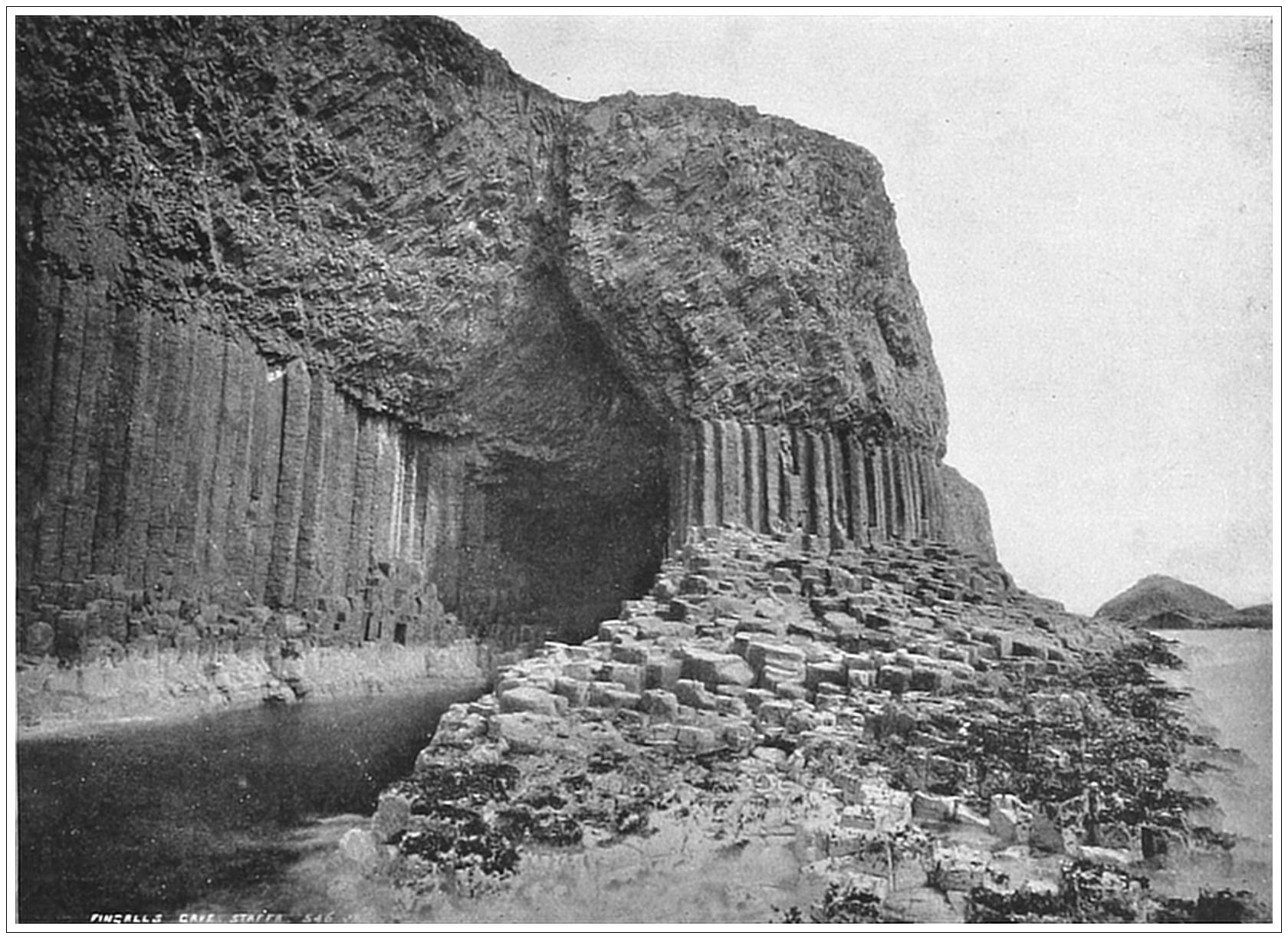
FINGAL’S CAVE, SCOTLAND, one of the most remarkable of all cave
formations. It is situated on the Island of Staffa, seven miles off the
west coast of Mull. The entire island is almost entirely encircled by
cliffs of columnar basalt, hollowed out here and there into caves. Fingal’s,
known also as the Great Cave, is the greatest of these. The entrance is
almost like that of a huge Gothic Cathedral. A lofty arch, sixty feet high by
thirty wide, is supported by columnar ranges of basaltic rock, whose native
blackness is whitened with calcareous stalagmite. The cave is two hundred
and thirty-two feet deep. Its floor is the sea, which flashes many colored
lights upon the ceiling with its pendant clusters of columns, and on the great
cavernous sides, with their countless complicated ranges of gigantic columns,
beautifully jointed and of the most symmetrical though varied forms.
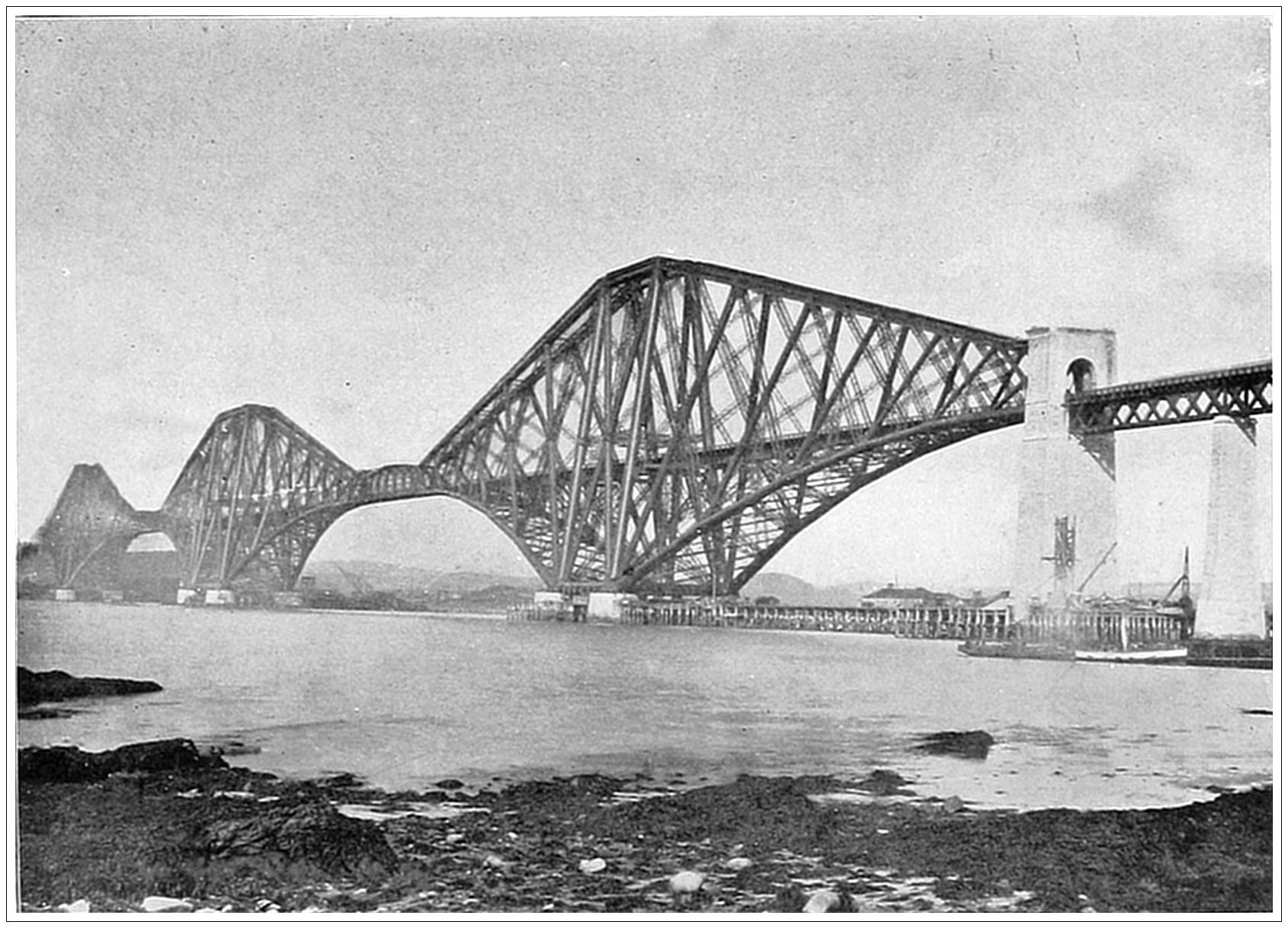
FORTH BRIDGE, SCOTLAND. The largest and, in many respects, the
most magnificent bridge in the world, is that across the Firth of Forth,
at Queensbury. Here the estuary of the Forth is divided by the island
of Inchgarvie into two channels, whose depth—two hundred feet—precluded
the construction of intermediate piers. A design for a gigantic suspension
bridge, by Sir Thomas Bouch, had almost been adopted, when the collapse of
the Tay bridge, in 1879, led to the abandonment of the project. A new plan
was accepted from Benjamin Baker. This was a cantilever bridge of steel.
A cantilever is a structure overhung from a fixed base. Work was begun in
1882 and completed in 1889. There are three granite piers, the central one
being on the island; and on those piers three double lattice-work cantilevers
are poised in line, reaching towards each other, and connected at their extremities
by ordinary girders three hundred and fifty feet long, by which the two
main spans are completed. These main spans are each seventeen hundred
feet long, and the total length of the bridge is eighty-two hundred and ninety-six
feet, or a little over one and one-half miles. The under side of the bridge
is one hundred and fifty-two feet above high water.
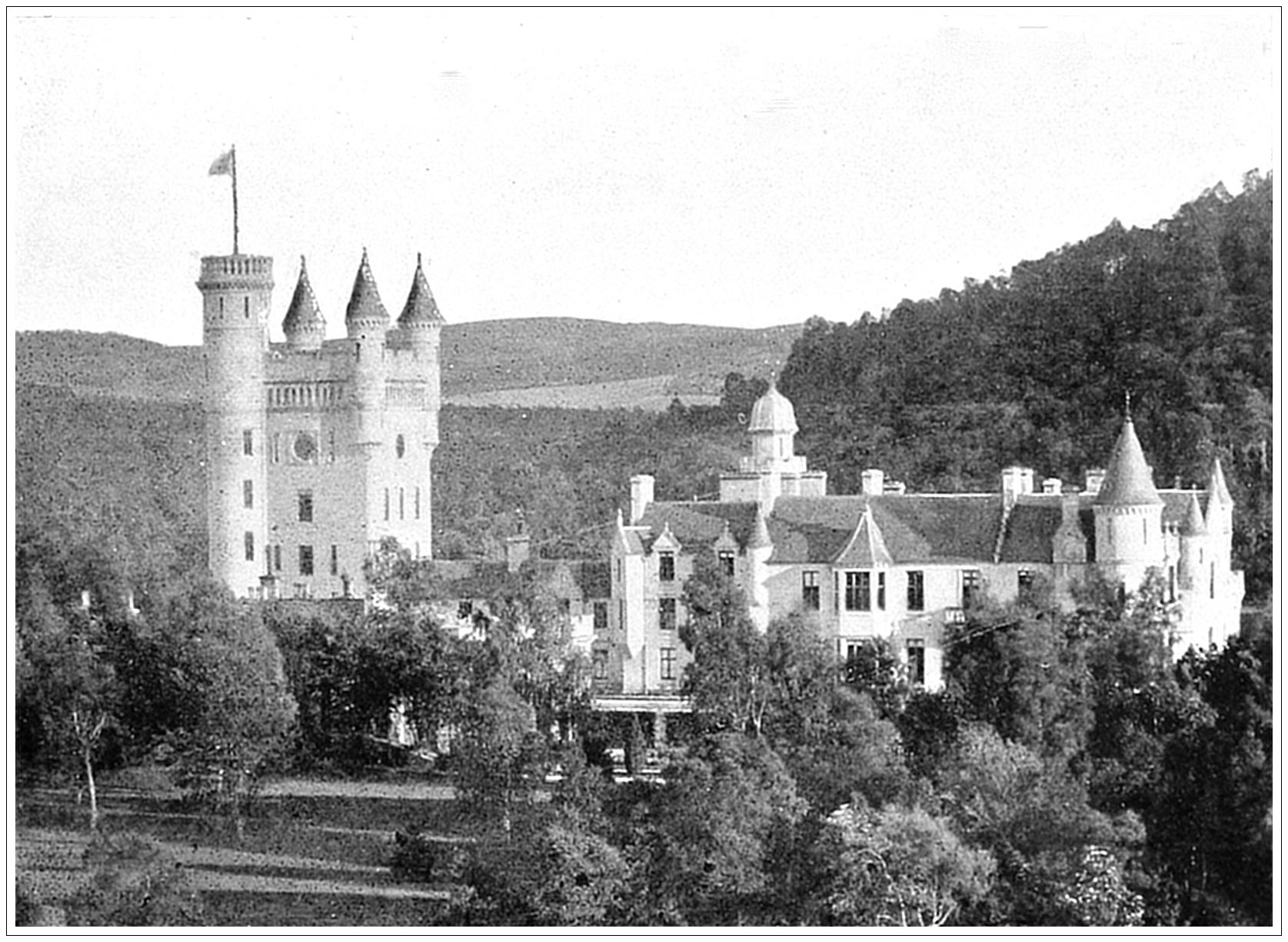
BALMORAL CASTLE, SCOTLAND, the Highland residence of the
Queen of England, situated in Braemer, Aberdeenshire. Its situation
is of great beauty. It stands on a natural platform nine hundred and
twenty-six feet above sea level, which slopes gently and gradually down to
the margin of the River Dee. The castle is in the Scottish Baronial style of
architecture. It is entirely of granite, and consists of two separate blocks of
buildings united by wings. A tower eighty feet high is surmounted by a
turret twenty feet higher. The entire estate, including a deer forest, comprises
over twenty-five thousand acres. It was purchased by Prince Albert in 1832
from the Earl of Fife. He pulled down the older castle, finding it not exactly
suited to the needs of the royal family, and put up the present imposing
structure in its place.
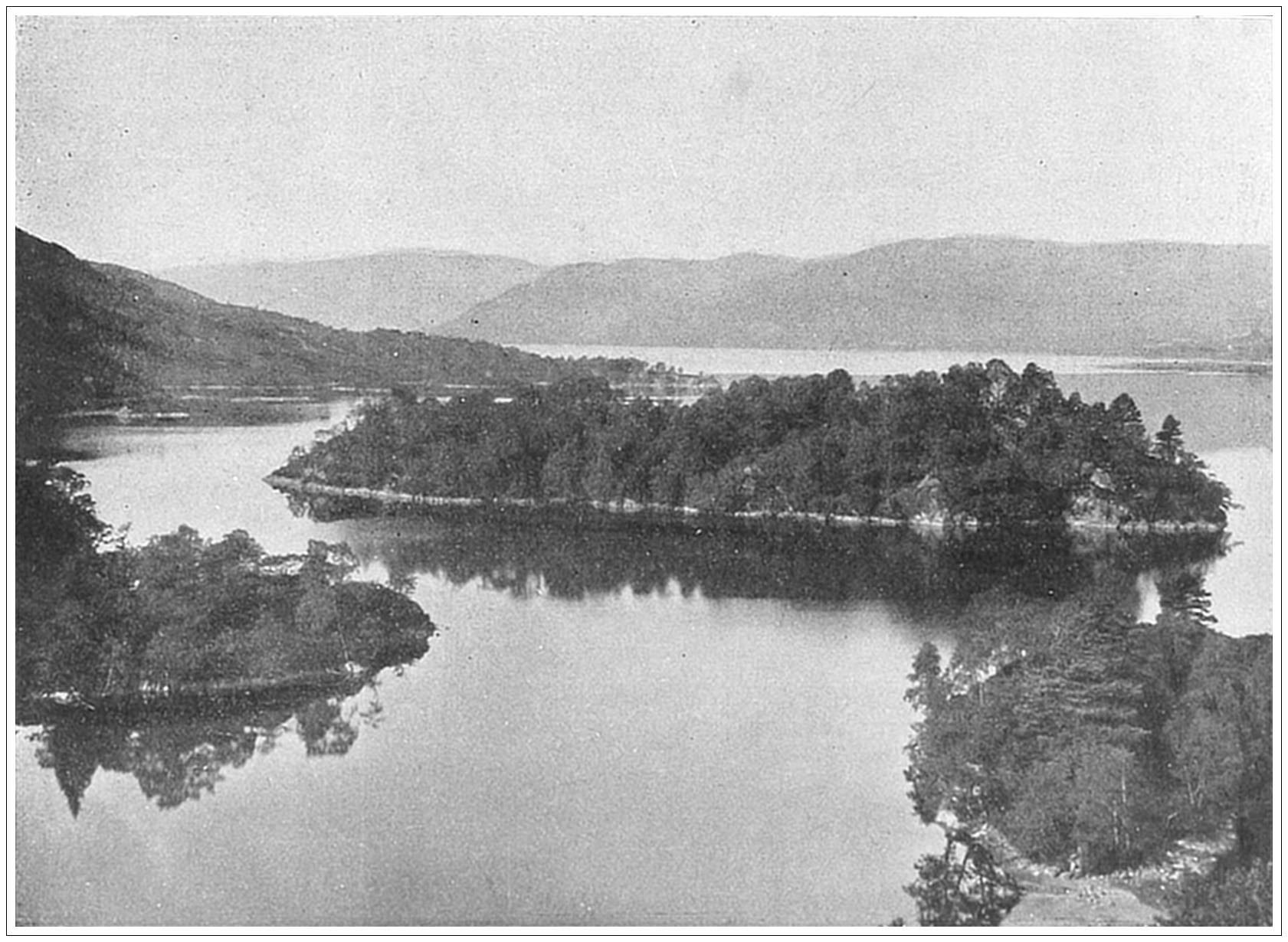
LOCH KATRINE (ELLEN’S ISLE), SCOTLAND. The Scotch lakes
are famous the world over for their beauty. Loch Katrine is the most
famous of them all. It lies in Perthshire; is eight miles in length, and
has an average breadth of three quarters of a mile. Ben Venue and Ben An
are celebrated mountains on its banks, and it contains a number of exquisite
islands. Among the latter is Ellen’s Island, chosen by Sir Walter Scott as the
scene of “The Lady of the Lake.” Wordsworth and other poets have thrown
the glamour of their genius around Loch Katrine. But it has a more practical
use. Its waters, which are remarkably pure, supply the city of Glasgow,
twenty-five miles off; being conveyed thither by a series of tunnels, aqueducts
and pipes.
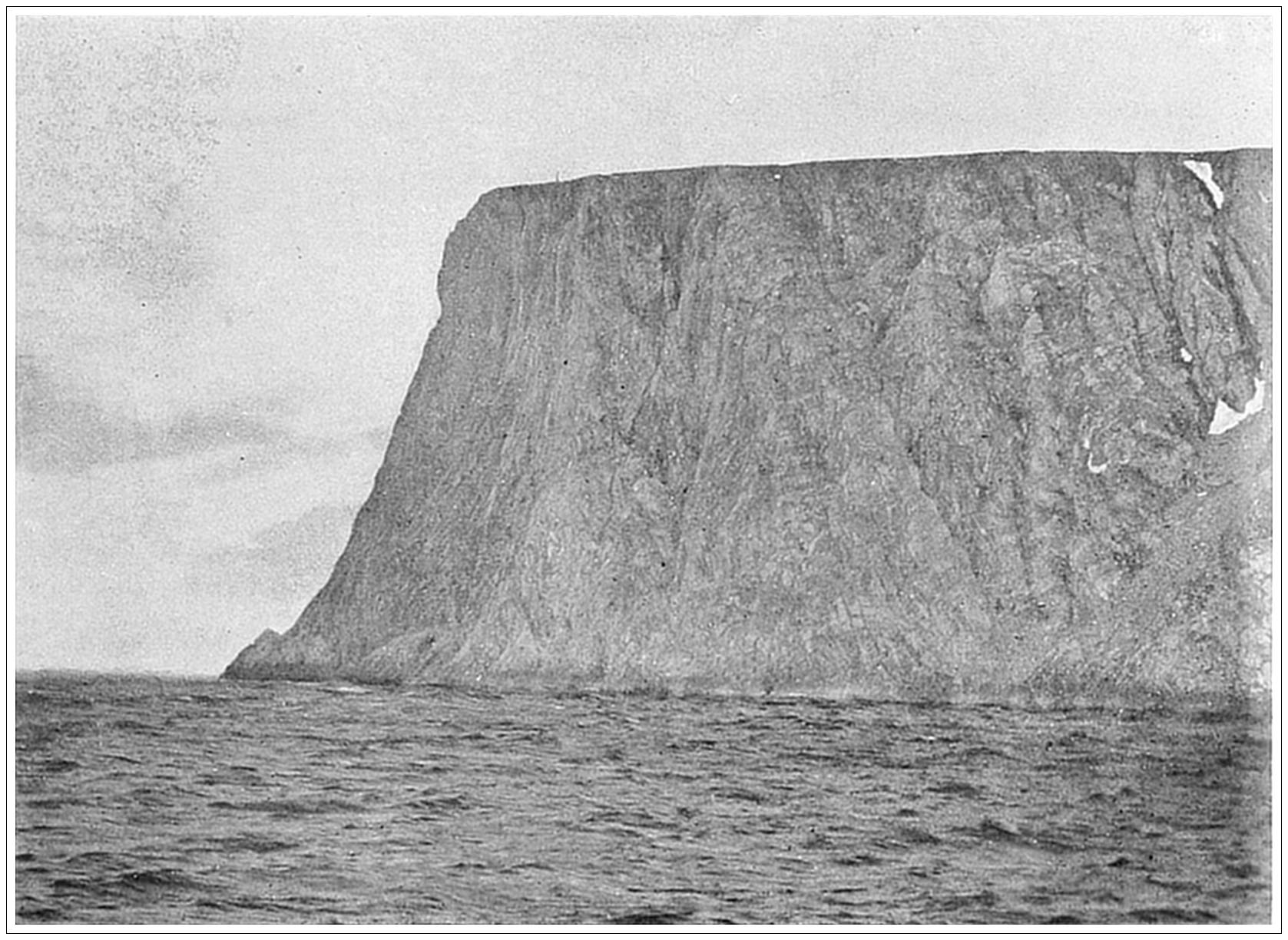
NORTH CAPE, NORWAY. A promontory, situated on the north extremity
of the Island of Mageroe, which is divided by a narrow channel
from the mainland of Norway. It is celebrated, not only for the
sombre grandeur of its scenery, but as the northernmost point of Europe. It
consists of a precipitous slate rock, fissured with many clefts, which rise to a
height of some twelve hundred feet above the sea.
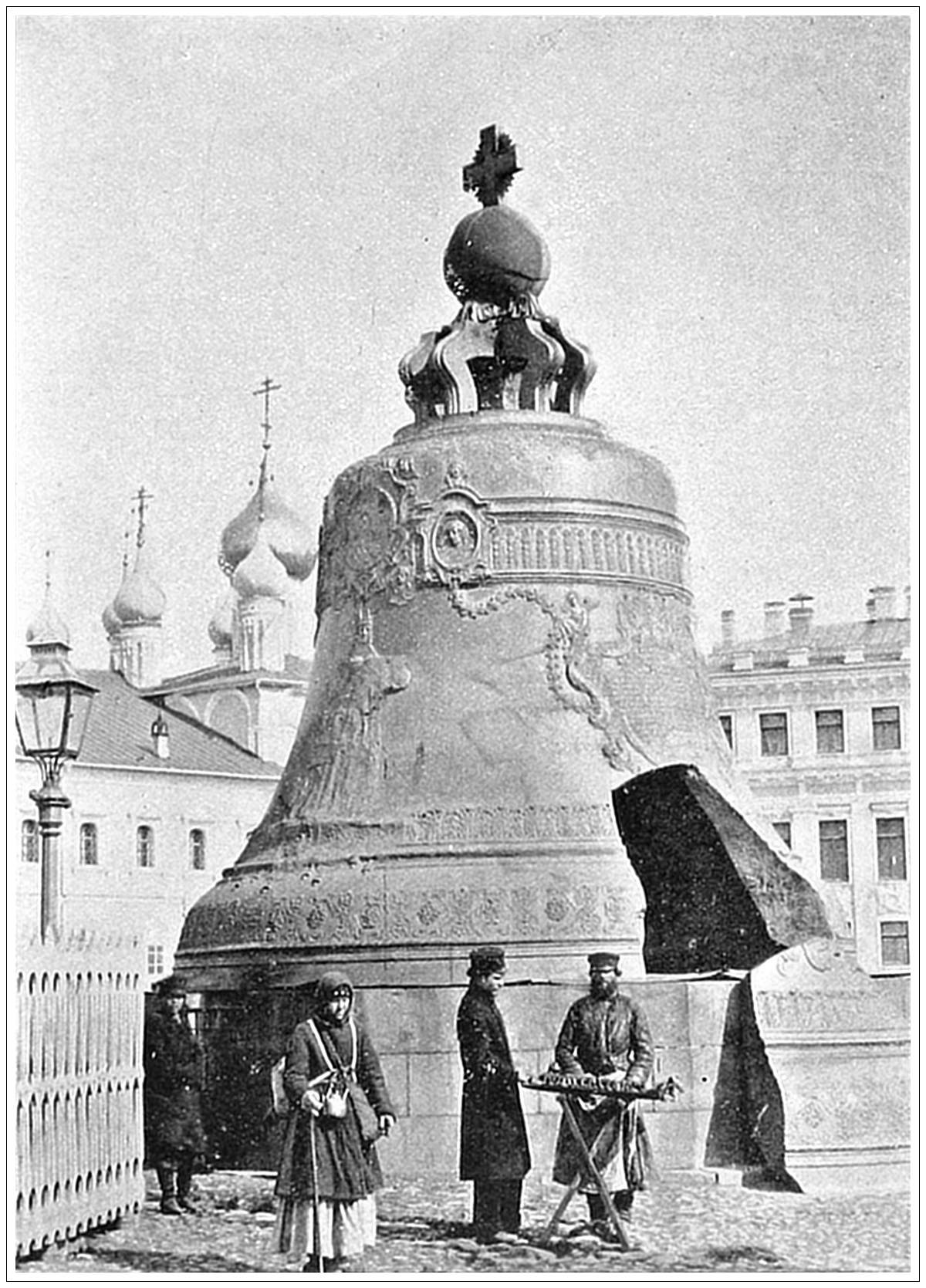
KREMLIN AND GREAT BELL, MOSCOW, RUSSIA. The Kremlin
is the name given to an inner enclosure or citadel in Moscow crowded
with palaces, churches and towers, surrounded by a wall sixty feet in
height and two miles in circuit. The Tartar style of architecture, with gilded
domes and cupolas, forms the predominant feature. The palace of the Kremlin
is the residence of the czars. It suffered much damage in the conflagration of
1812, which drove Napoleon out of the city, and was rebuilt in the reign of
Nicholas I in 1838–49. In its restored shape it is rather a mass of buildings,
old and new, than a single, harmonious structure. But it is full of historical
and immediate interest. The tower of Ivan the Great, whose five stories rise
to a height of three hundred and twenty-five feet, is close to the palace. At
its foot lies the Great Bell, the largest in the world—cast in 1730. It was
broken a few years afterwards by the burning of the wooden tower in which
it was suspended. Its height is twenty-six feet four inches, its circumference
sixty-seven feet eleven inches.
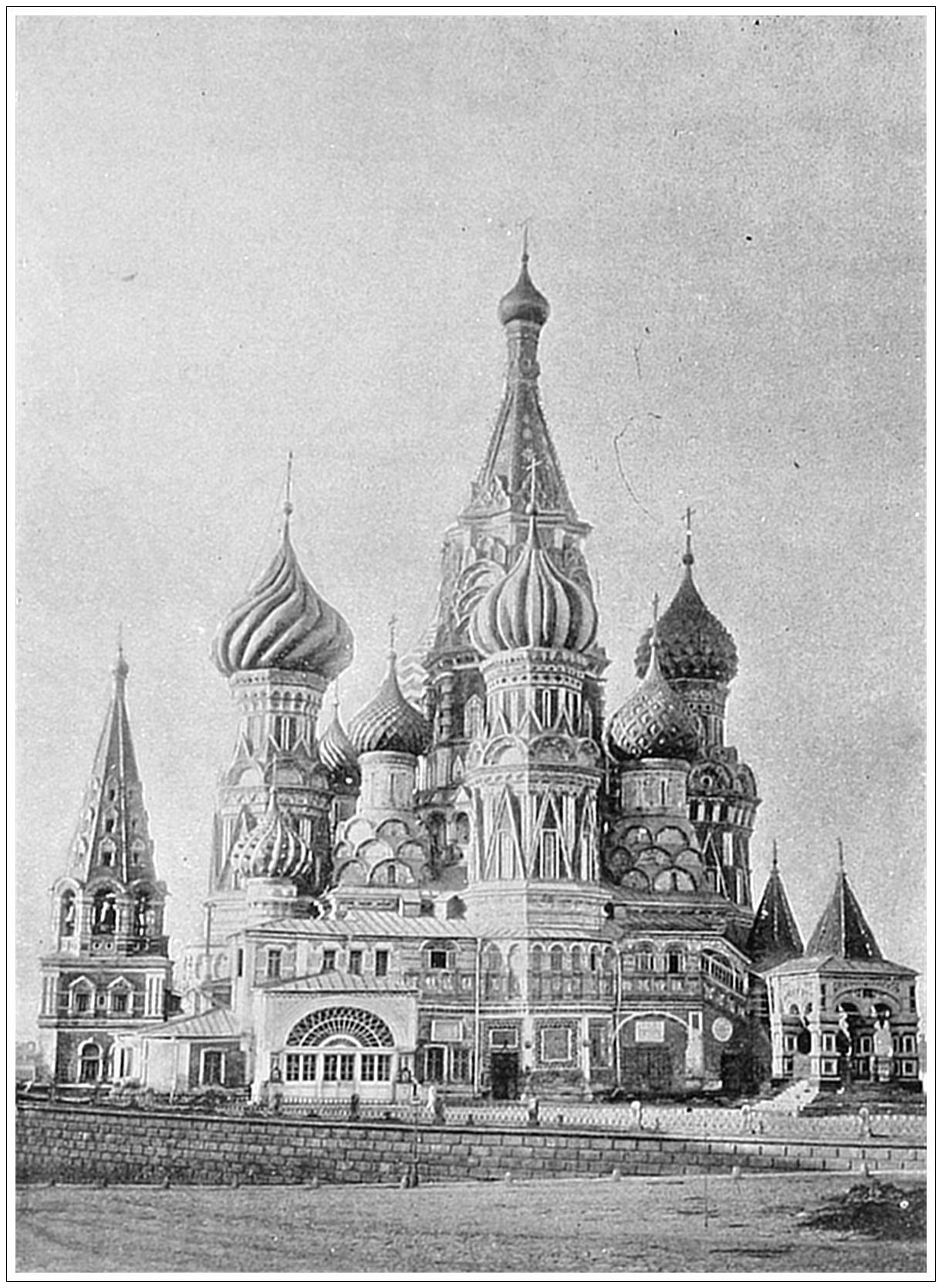
CHURCH OF ST. BASIL, MOSCOW, RUSSIA. This remarkable edifice,
standing on the site of an ancient church and cemetery where St.
Basil was buried, was built in 1554 by Ivan IV. He is said to have
been so much delighted with it that he put out the eyes of its Italian architect,
so that it might never be surpassed. It is a bewildering medley of great and
little domes and towers, not only of different shapes and sizes, but gilded and
painted in all possible varieties of color. There is no main chapel or church,
but each dome surmounts its own chapel, dedicated to some particular saint,
and services are carried on in each without disturbing the worshipers in any
other. Bayard Taylor appropriately styles this church the “apotheosis of
chimneys,” and describes it as the product of some architectural kaleidoscope,
in which the most incongruous things assume a certain order and system.
Relics of St. Basil and of St. John the Idiot are shown to visitors.
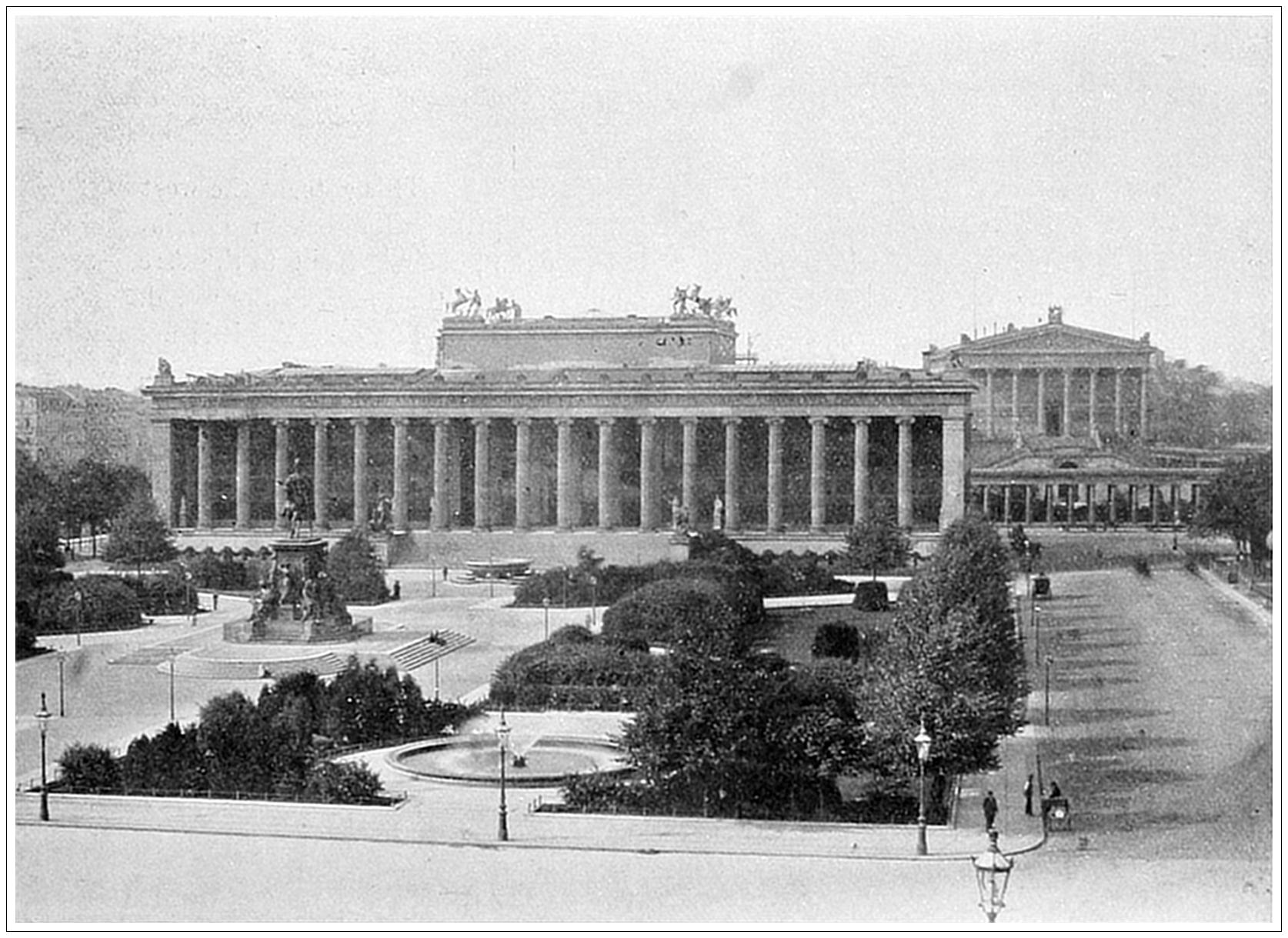
ROYAL MUSEUM, BERLIN, PRUSSIA. Architecturally, this is the
finest building in Berlin. It is an admirable specimen of the Greek
style, with its Ionic portico of eighteen columns and its broad flight of
steps leading up to the entrance. The central part of the structure, rising above
the rest of the building and corresponding with the rotunda in the interior, is
adorned at the corners with four colossal groups in bronze. Two other bronze
groups are on the steps. This building is usually known as the Old Museum
to distinguish it from its annex, the New Museum, by which it is connected
with a short passage, crossing the street at the back. The two buildings contain
a magnificent collection of antiquities and of ancient and modern sculptures,
paintings, etc.
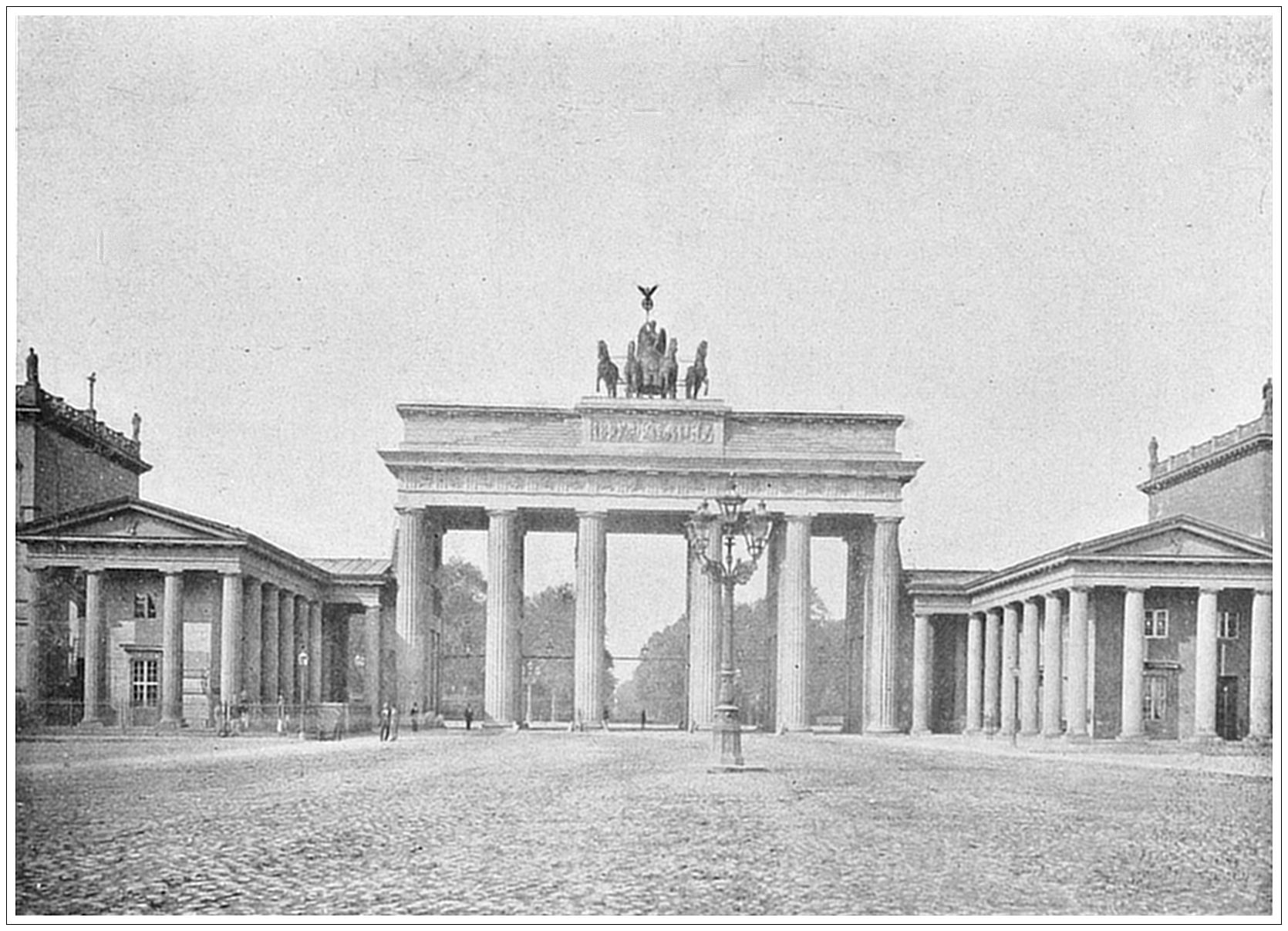
BRANDENBURG GATE, BERLIN, PRUSSIA. This gate, at the west
end of the famous Unter der Linden, the principal street in Berlin,
forms the entrance to the city from the Thier-garten. Next to the Arc
de l’Etoile in Paris, this is the most magnificent triumphal arch in the world.
It even eclipses the ancient monuments of this kind in Rome. Yet it is not
entirely original. It was erected in 1789–93 by C. G. Langhans in imitation,
or rather as a glorification, of the model presented by the Propylacum at
Athens. The height is eighty-five feet, the width two hundred and five. There
are five passages (that in the centre reserved for royal carriages), separated by
massive Doric columns. The material is sandstone. A notable feature is the
triumphal car on the summit, the Quadriga of Victoria, done in copper.
Napoleon carried this to Paris in 1807, but it was recovered in 1814. Adjoining
the gate on the side next the town are two wings resembling Grecian
temples, of which that on the right or north side contains a telegraph office
and a pneumatic post-office, while that on the left is the guard-house.
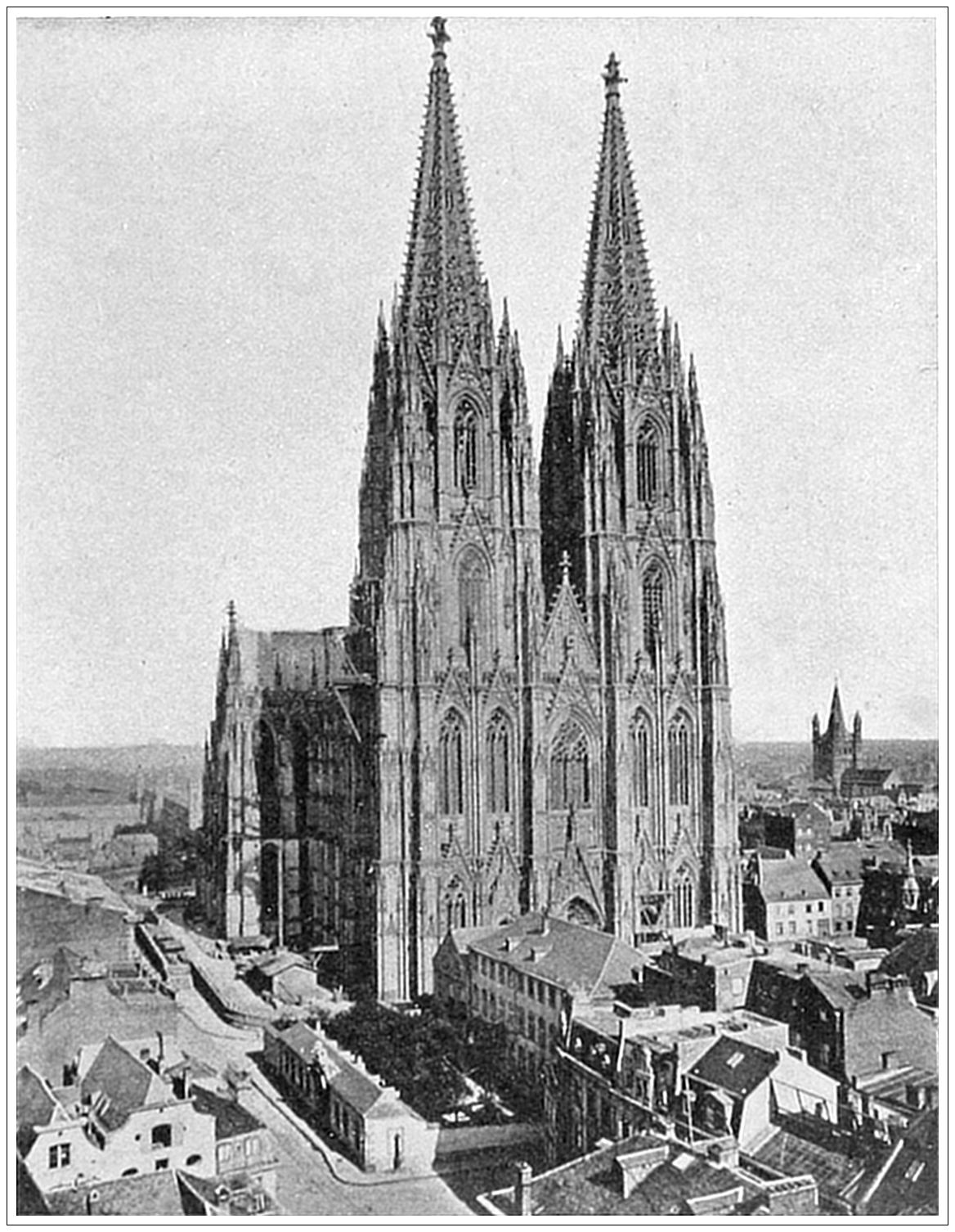
THE CATHEDRAL OF COLOGNE, GERMANY. This church, known
officially as the Cathedral of St. Peter’s, is, next to St. Peter’s at Rome,
the largest church edifice in the world, and is, without any exception, the
most magnificent specimen of Gothic architecture extant. Begun in 1248, the
work went on very slowly. In 1322 the choir was consecrated. Then the
work lagged still more, and at the beginning of the sixteenth century came to
a sudden close, not being resumed till 1816, since which time more than two
millions of dollars have been expended to bring the edifice to its present state
of completion. The spires are five hundred and twenty-one feet high, and
before the building of the Eiffel Tower this church was the highest edifice in
the world. The height of the roof inside is one hundred and forty-five feet,
the length of the building is four hundred and forty-four feet and the breadth
two hundred and one. The choir is rich in statues, frescoes and fine carvings.
A chapel, known as the chapel of the Three Kings, contains a gorgeous shrine,
in which are exhibited the skulls of the three wise men who came from the
East with presents for the infant Saviour.
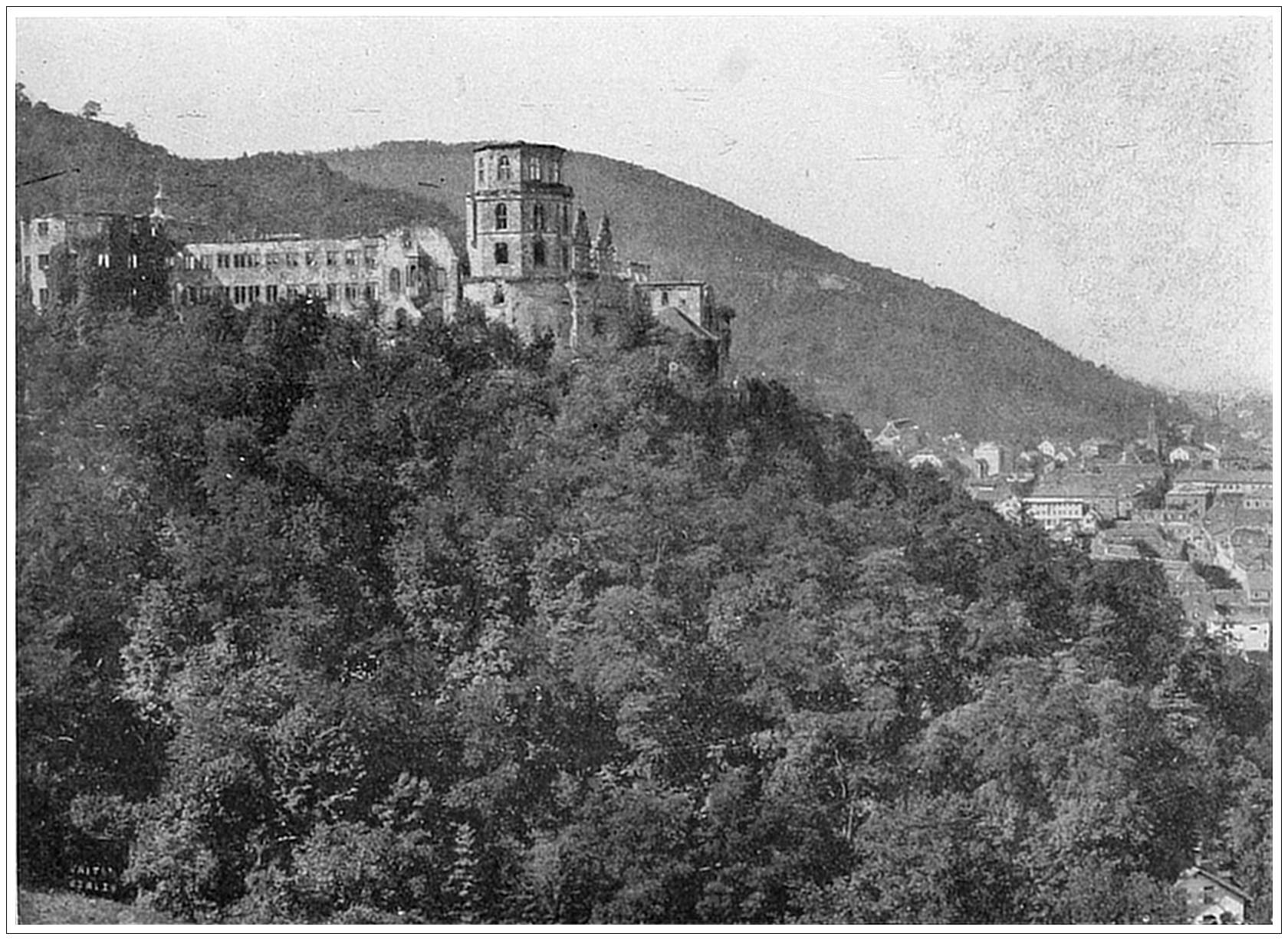
HEIDELBERG CASTLE, GERMANY. On a height above the city of
Heidelberg are the ruins of this old-time palace and fortress. Founded
by the Elector Rudolph in the fourteenth century, and altered and
added to by his successors, it partakes of the architectural style of all the three
centuries. The French sacked and partially burned it in 1693; it was subsequently
restored, but being struck by lightning in 1764, it has since been
suffered to remain in ruins. As such it is one of the most magnificent remains
of the Middle Ages—a square massive building, roofless, with a round tower
at one end and an octagonal one at the other. Some idea of its strength may
be gained from the fact that the walls of the round tower are twenty-two feet
thick. In one of the cellars is the famous Tun of Heidelberg, a huge copper
reservoir, bound with iron hoops, whose capacity is forty-nine thousand gallons.
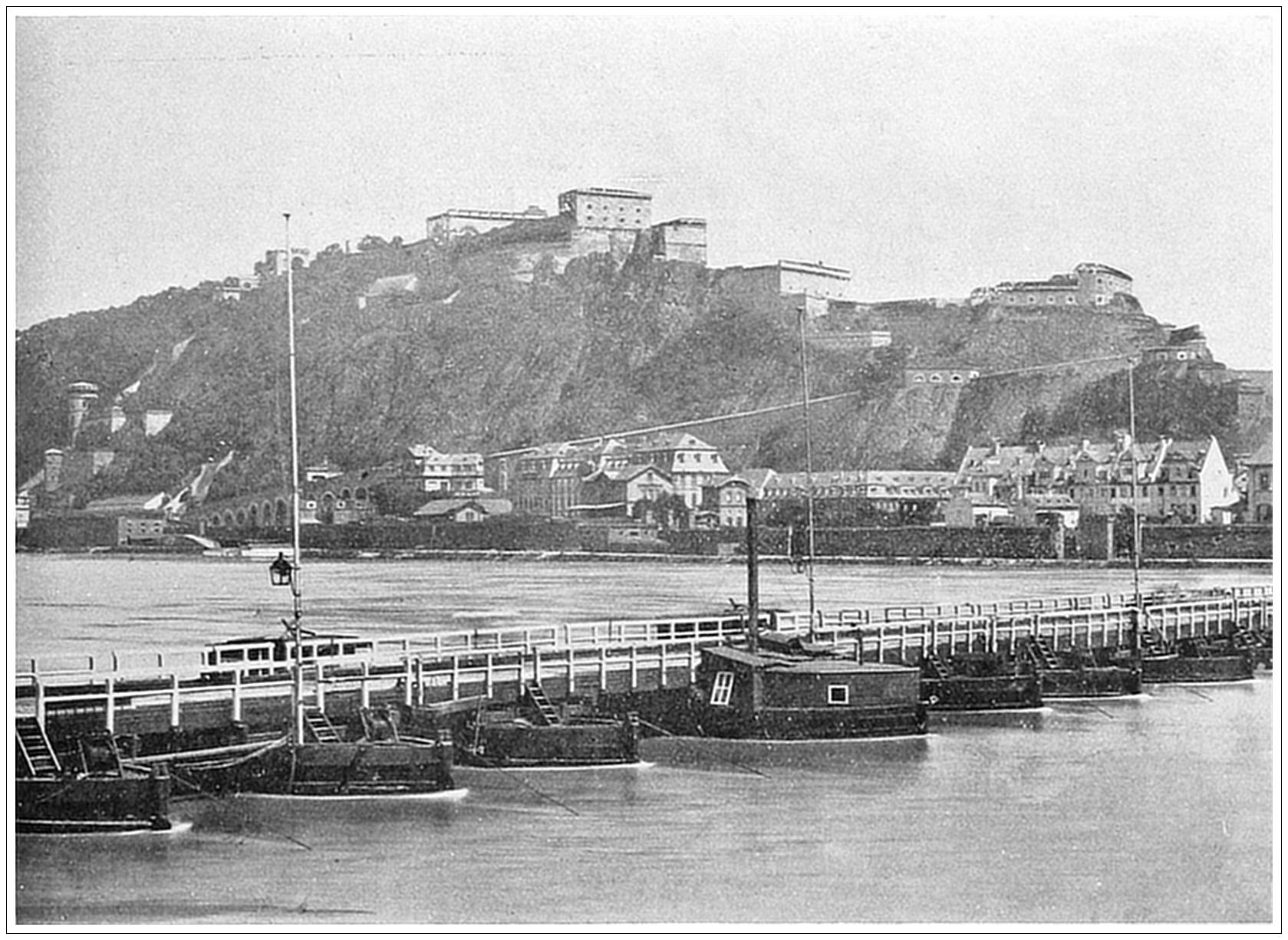
EHRENBREITSTEIN, GERMANY. This fortress, whose name signifies
the Broad Stone of Honor, is situated on a precipitous rock three hundred
and seventy-seven feet above the Rhine, just opposite Coblentz.
The rock is known as the Gibraltar of the Rhine. The ancient Romans
recognized its commanding position and erected here a castrum or camp. In
1018 the Franconian king, Dagobert, presented it to the bishops of Treves,
who made it their stronghold. It has successfully resisted many sieges, but
was twice captured by the French, first in 1631 and again in 1798. After the
Peace of Luneville in 1801 they blew it up. Restored to Prussia with the
Peace of Paris, the French were forced to contribute 15,000,000 of francs to
place it in its former condition. At present it is defended by four hundred
cannon, and fifty thousand stands of needle guns are stored in its armory. It
is capable of accommodating one hundred thousand men, but five thousand
are sufficient to man it properly. The summit of the rock commands a magnificent
view of the surrounding country. A bridge of boats connects the
village of Ehrenbreitstein with Coblentz.
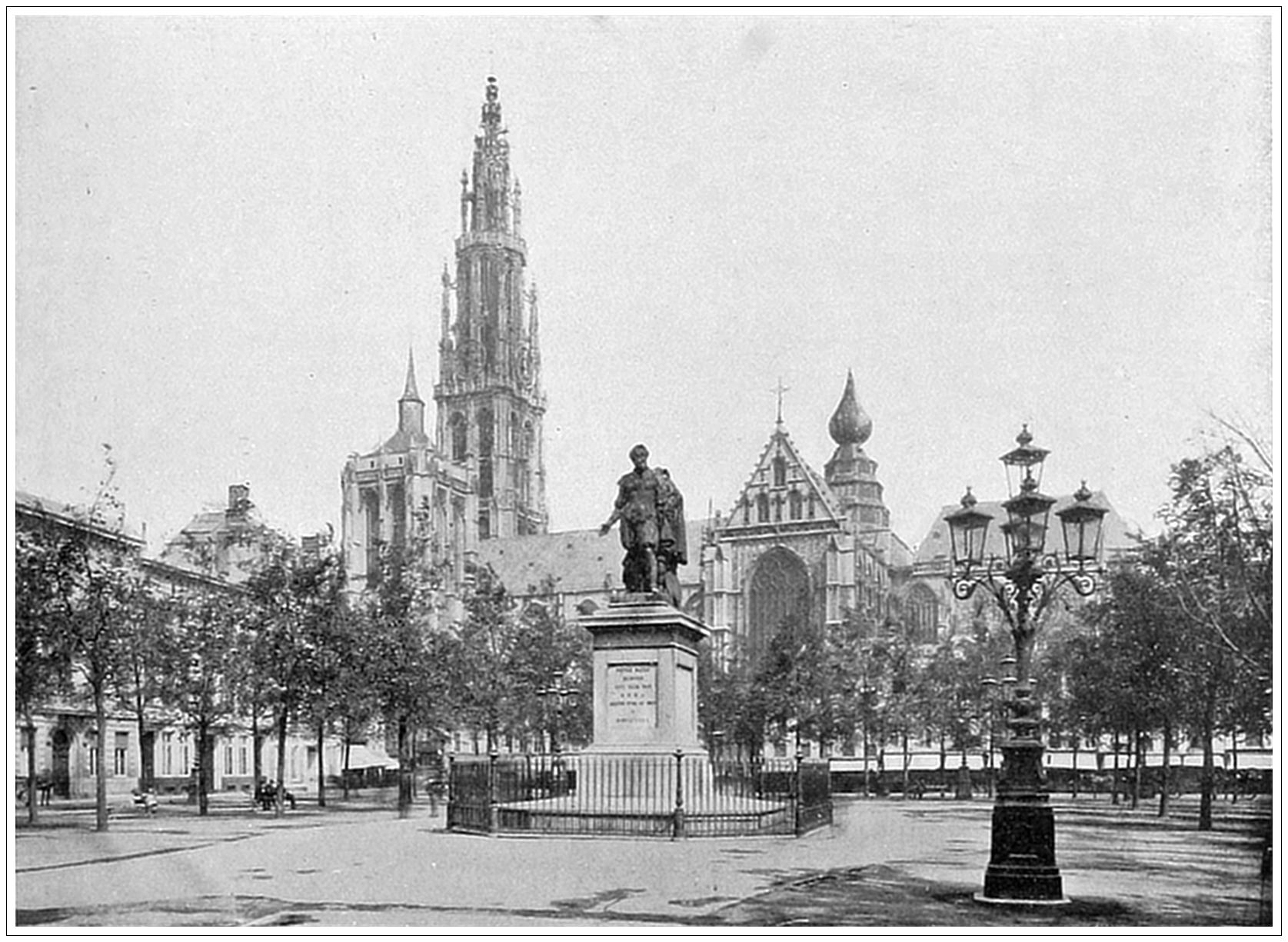
THE CATHEDRAL OF ANTWERP, BELGIUM. Though inferior to
the great minster at Cologne, the cathedral at Antwerp is an exquisite and
notable specimen of Gothic architecture. It is unfortunately situated in
a narrow street, just away from the Place St. Antoine, and is hedged in by
shops, which are backed up against its very walls. It is unfinished, only one of
the towers being complete. The other is but half-way up, where it has been
capped over, and has remained so for centuries. Nevertheless, nothing can
detract from the majesty of the church itself. Out from the littleness of its
surroundings it calmly rears its splendid front. Its solitary tower soars upward
to the height of four hundred and three feet, with delicate open arches that
look like fretted work, so that Napoleon said: “It looked as if made of
Mechlin lace.” The chimes of ninety-nine bells are deservedly famous. The
interior is glorified by the presence of Rubens’ two greatest pictures, “The
Elevation of the Cross” and “The Descent from the Cross.” Begun about
the middle of the thirteenth century, it suffered seriously from fire in the sixteenth
century, and the greater part of the present edifice dates from that
period. In the foreground of the picture is the monument to Rubens.
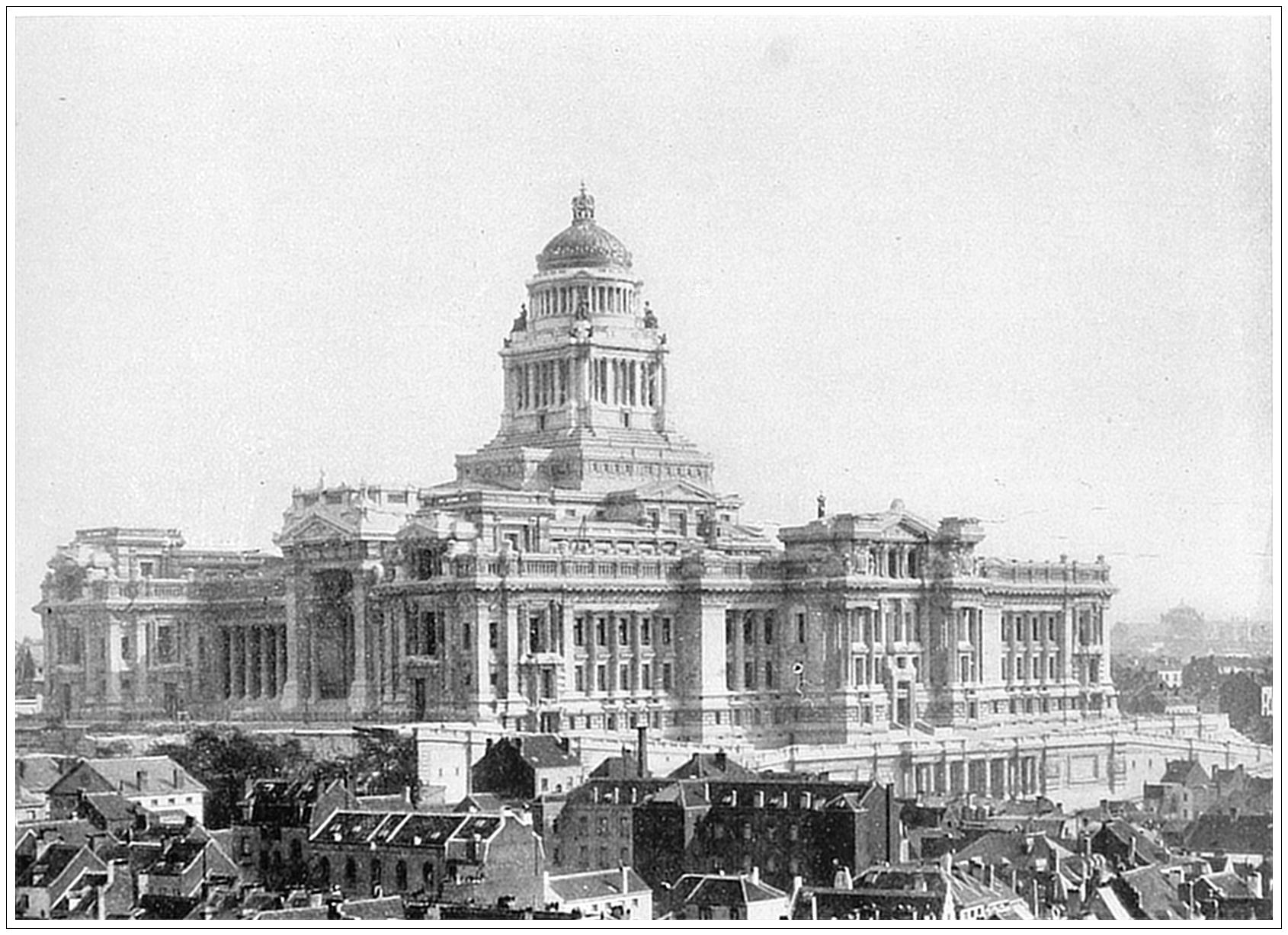
PALAIS DE JUSTICE, BRUSSELS, BELGIUM. The new Palace of
Justice, or Court-house, in Brussels, is the largest architectural work of
the present century, and one of the most magnificent. It was begun in
1866 and completed in 1883 at a total cost of $10,000,000. It is splendidly
situated on a height commanding a view of the whole city. This massive pile
covers an area of two hundred and seventy thousand square feet, considerably
more than St. Peter’s, at Rome, and is five hundred and ninety feet long by
five hundred and sixty wide. The avowed aim of the artist was to accommodate
Assyrian form to modern requirements. Above the main body of the
building rises another rectangular structure, surrounded with columns, this, in
turn, supporting a columned rotunda, the whole crowned by a dome which is
four hundred feet above the pavement. In details the Græco-Roman style has
been generally adhered to, with an admixture of rococo treatment.
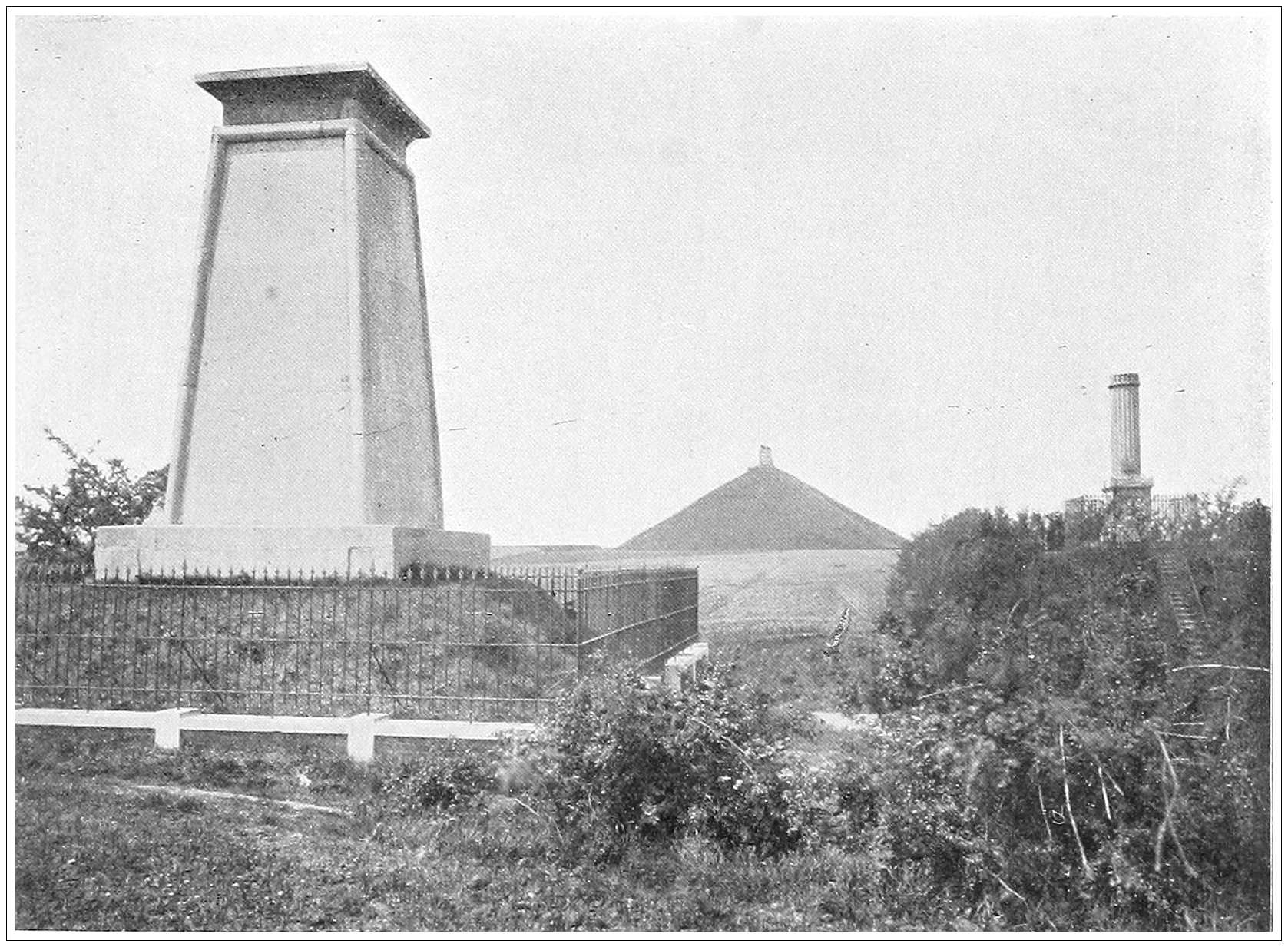
FIELD OF WATERLOO, BELGIUM. The scene of the greatest battle
of modern times, if not of all times, is necessarily of perennial interest
to the world. It is a matter for rejoicing, therefore, that the field of
Waterloo is retained in much the same condition in which it was left on the
fateful day of June 18th, 1815, when the power of Napoleon was crushed by
Wellington and Blucher. To be sure, Wellington is reported to have said:
“You have spoilt my battlefield,” when he saw the artificial mound surmounted
by a Belgic lion of cast-iron, which has been raised in the centre of the field.
But at least its one hundred and fifty feet of height afford the opportunity for
an excellent bird’s-eye view of the entire field. And the old house of Hougemont,
whose building and orchard were occupied by the British Guards, and where
some of the fiercest fighting of the day was carried on, remains as it was, with
the bullet holes in the walls and other damages unrepaired. The monument
represented in the foreground is dedicated to the soldiers who fell in the battle.
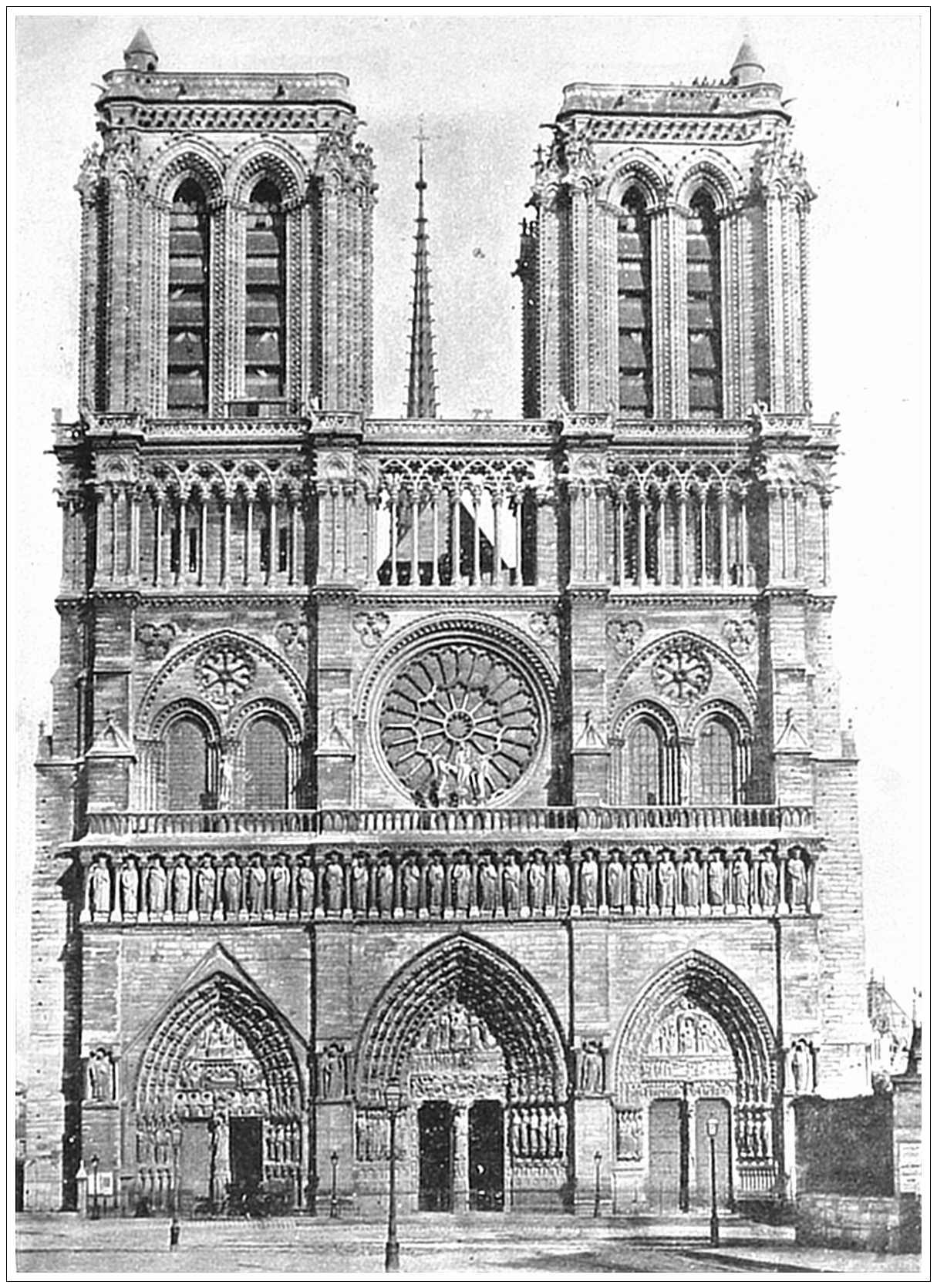
NOTRE DAME, PARIS. The cathedral of Notre Dame, one of the
great historical churches of the world and one of the most beautiful
specimens of mediæval architecture, was founded in 1163 on the site of
an earlier church, was consecrated in 1182 and was completed in 1420. It
suffered sadly during the Revolution, when it was made a Temple of Reason;
was restored in 1845, and during the time of the commune narrowly escaped
destruction by fire. The form is that of a Latin cross, with a nave and double
aisles, which are continued around the choir, the earliest example known.
The façade is one of the most admired pieces of early Gothic. The triple
portal is ornamented by rich bas-reliefs. In the second story is a great rose
window, flanked by double windows, enclosed in wide-spreading Gothic arches.
The third story is an open gallery of slender arches and columns. In one of
the towers is a famous bell, weighing thirty-two thousand pounds, which is
only rung on state occasions. The interior of the church is adorned with sculptures,
bas-reliefs and paintings and magnificent rose windows of stained glass.
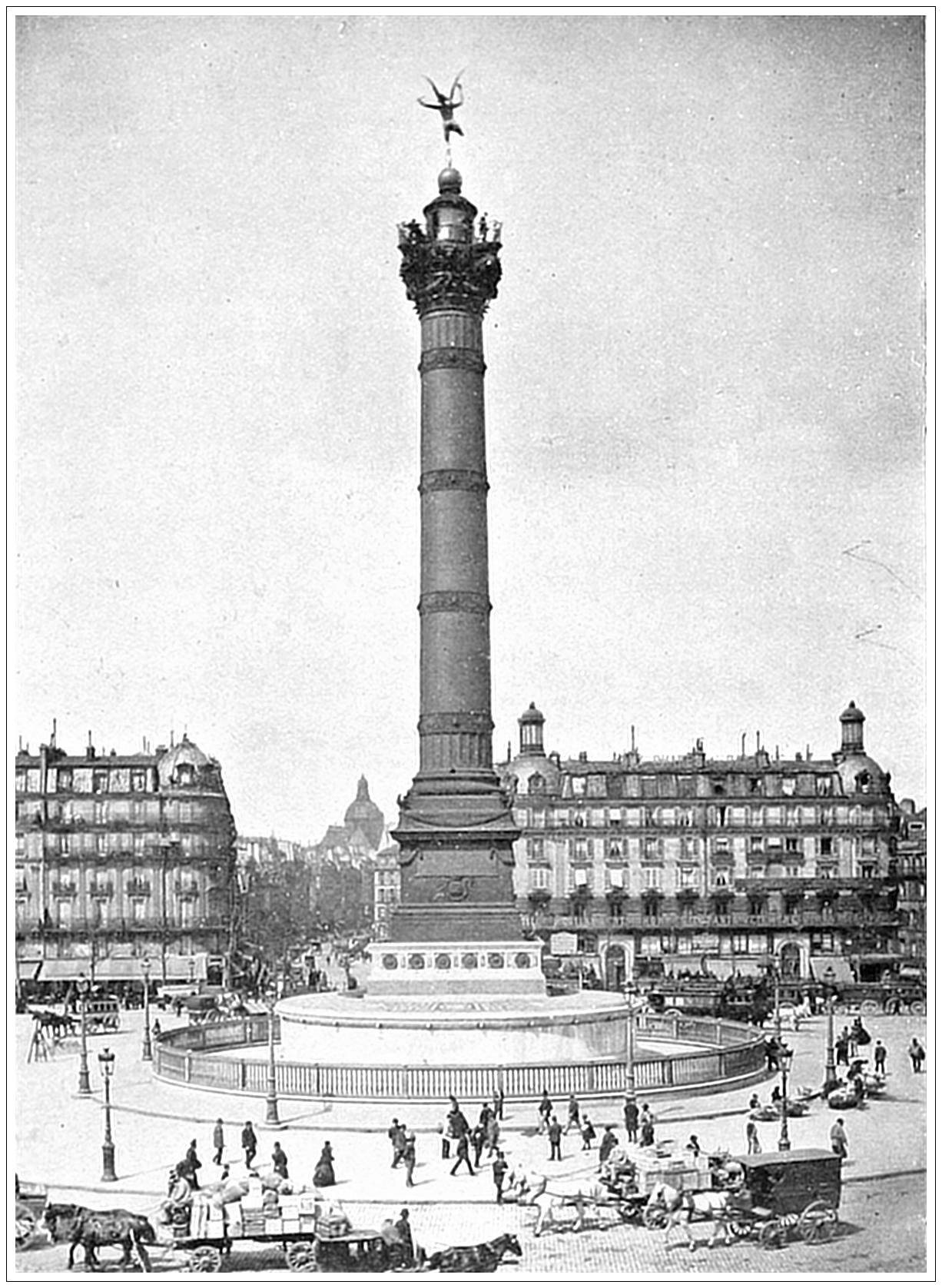
PLACE DE LA BASTILLE, PARIS, FRANCE. This square ends the
line of the original boulevards, and marks the beginning of the Faubourg
St. Antoine. It is historically interesting as the site of the Bastille,
the former state prison of France, whose destruction by the Parisian mob
on July 14th, 1789, marked the real beginning of the French Revolution.
The column in the middle, known as the Colonne de Juillet, was reared in
1831 in honor of the citizens who fell in the revolution of July, 1830, which
drove Charles X from the throne and put Louis Philippe in his place. The
names of six hundred and fifteen of these are inscribed upon the sides of the
column, and their ashes, together with those of combatants in the revolution of
1848, repose in two vast sarcophagi in the vaults below. The column is of
bronze, one hundred and fifty-four feet high, and is divided by four collars into
five divisions. Bas-reliefs, by Barye, adorn the exterior. Inside there is a
spiral stair-case, also of bronze. The top is surmounted by an emblematic
figure of Liberty, in gold bronze, the work of Dumont.
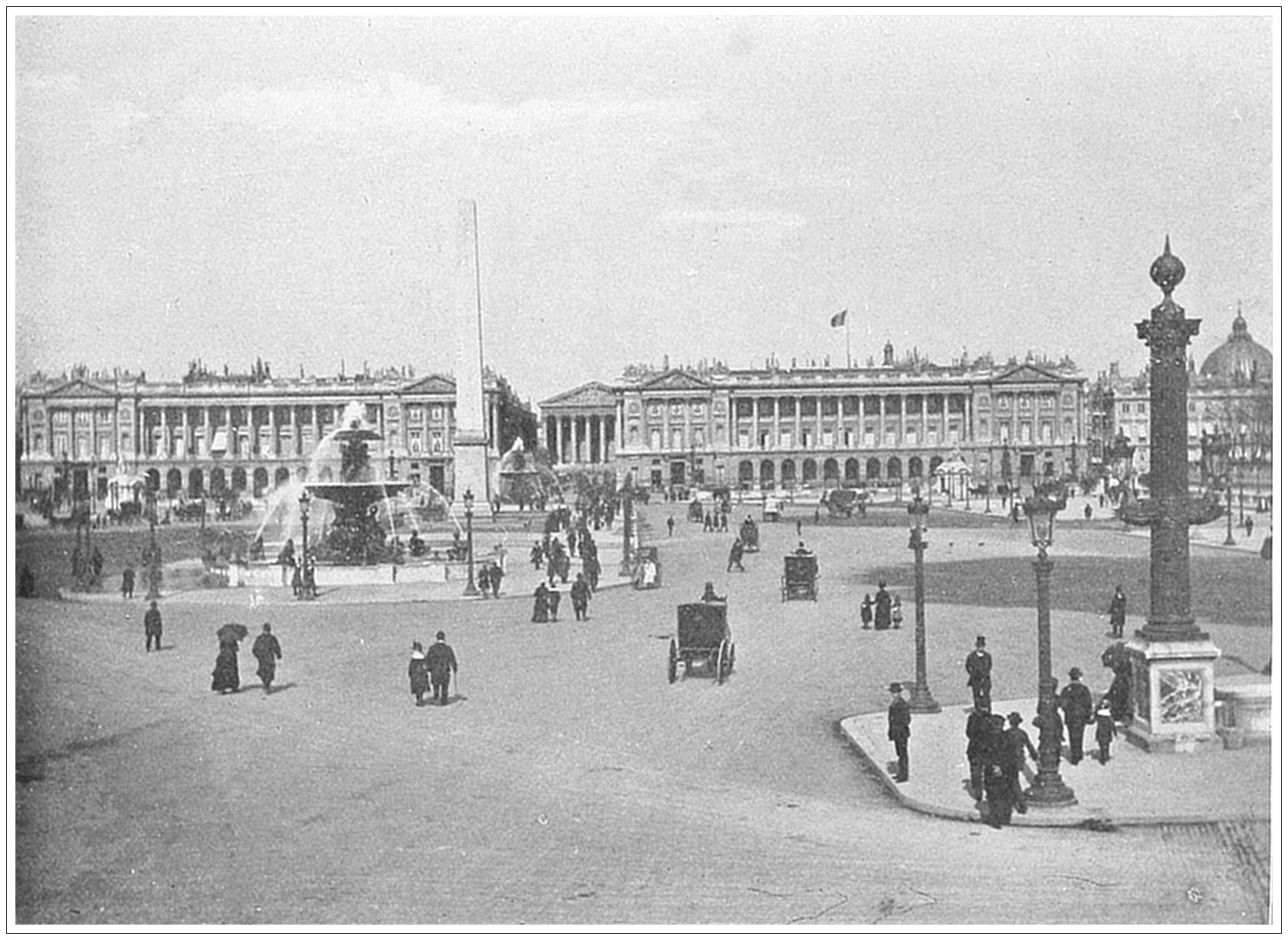
PLACE DE LA CONCORDE, PARIS, FRANCE. This square, situated
between the Rue Royale and the Pont de la Concorde, is perhaps the
most beautiful and effective in all Paris. It dates from the year 1748.
Originally it was adorned with a statue of Louis XV, which was pulled down
in 1792 to make way for a colossal figure of Liberty. The place was then
called Place de la Revolution. It was here that next year the guillotine was
erected, upon which perished Louis XVI, Marie Antoinette and nearly three
thousand of their adherents. Under the Directory the Statue of Liberty was
removed and the great place became the Place de la Concorde. Since then it
has undergone many alterations. It was laid out as it now stands by Napoleon
III. In the middle is the great Obelisk of Luxor, presented to Louis
Philippe by Mehemet Ali, and on each side are two large fountains. At the
different corners of the square there are seated figures, representing eight
different towns, formerly the chief towns of France. But one of them, Strasbourg,
is now a portion of Germany.
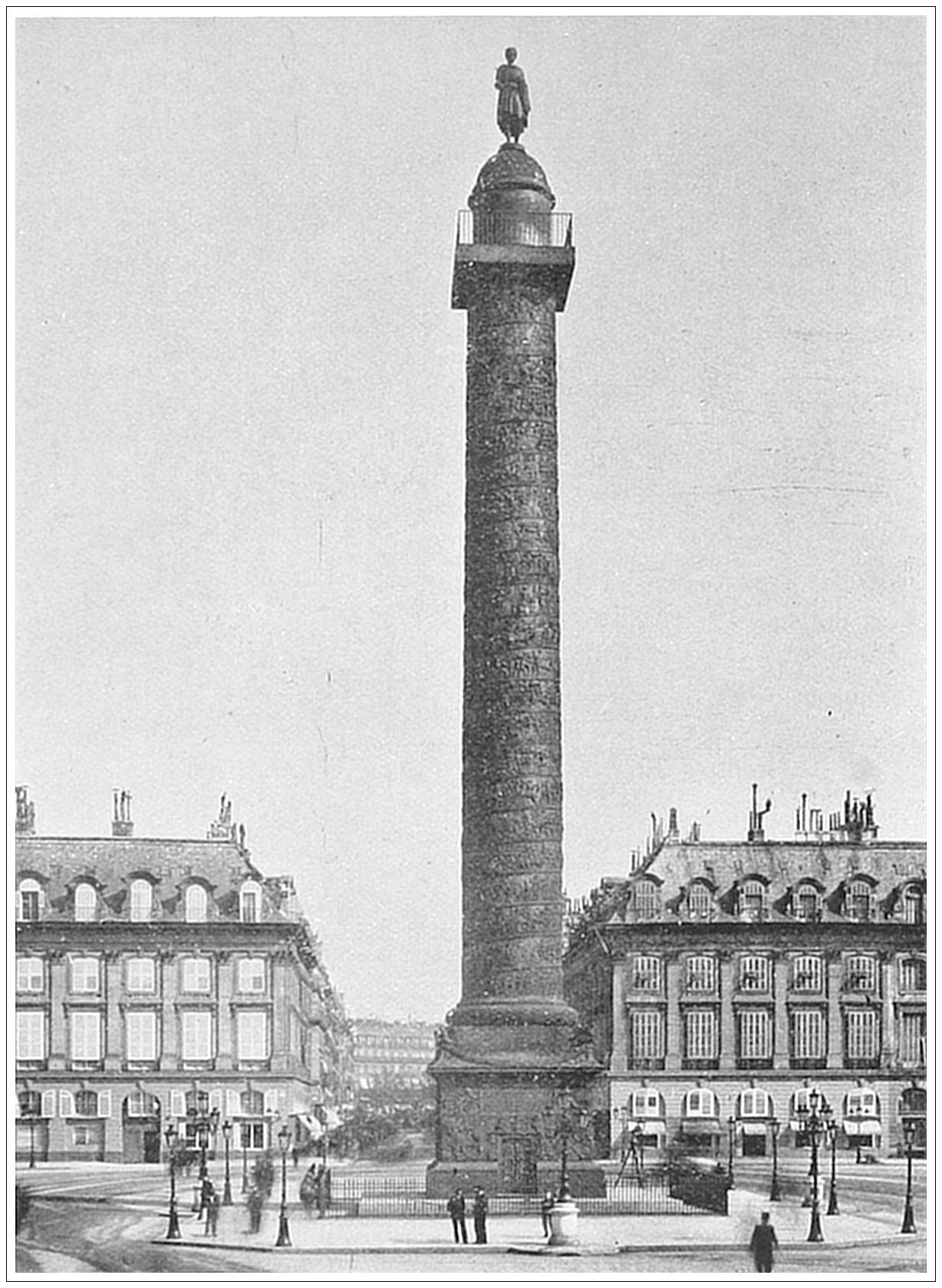
PLACE VENDOME, PARIS. A handsome octagonal square, between
the Boulevard des Capucines and the Tuileries Gardens. It was designed
by Louis XIV, in 1686, to contain public buildings, such as the Mint,
the Royal Library, the various academies, &c. This plan was subsequently
much modified. The buildings, which are of Corinthian architecture of a
severely uniform appearance, are mainly occupied by banks and other fiscal
institutions. A grand equestrian statue of Louis XIV once stood in the centre
of the square, but it was destroyed in 1792, and in 1806 its place was taken by
the famous Vendome column, a stone shaft one hundred and forty-three feet
high, covered with the metal of cannon taken from the Prussians and Austrians.
It is surmounted by a statue of Napoleon, and is ornamented by bas-reliefs
commemorative of that hero’s campaign in 1805. In 1871 column and statue
were both pulled down by the Commune, but the Republic under Thiers
repaired and replaced them.
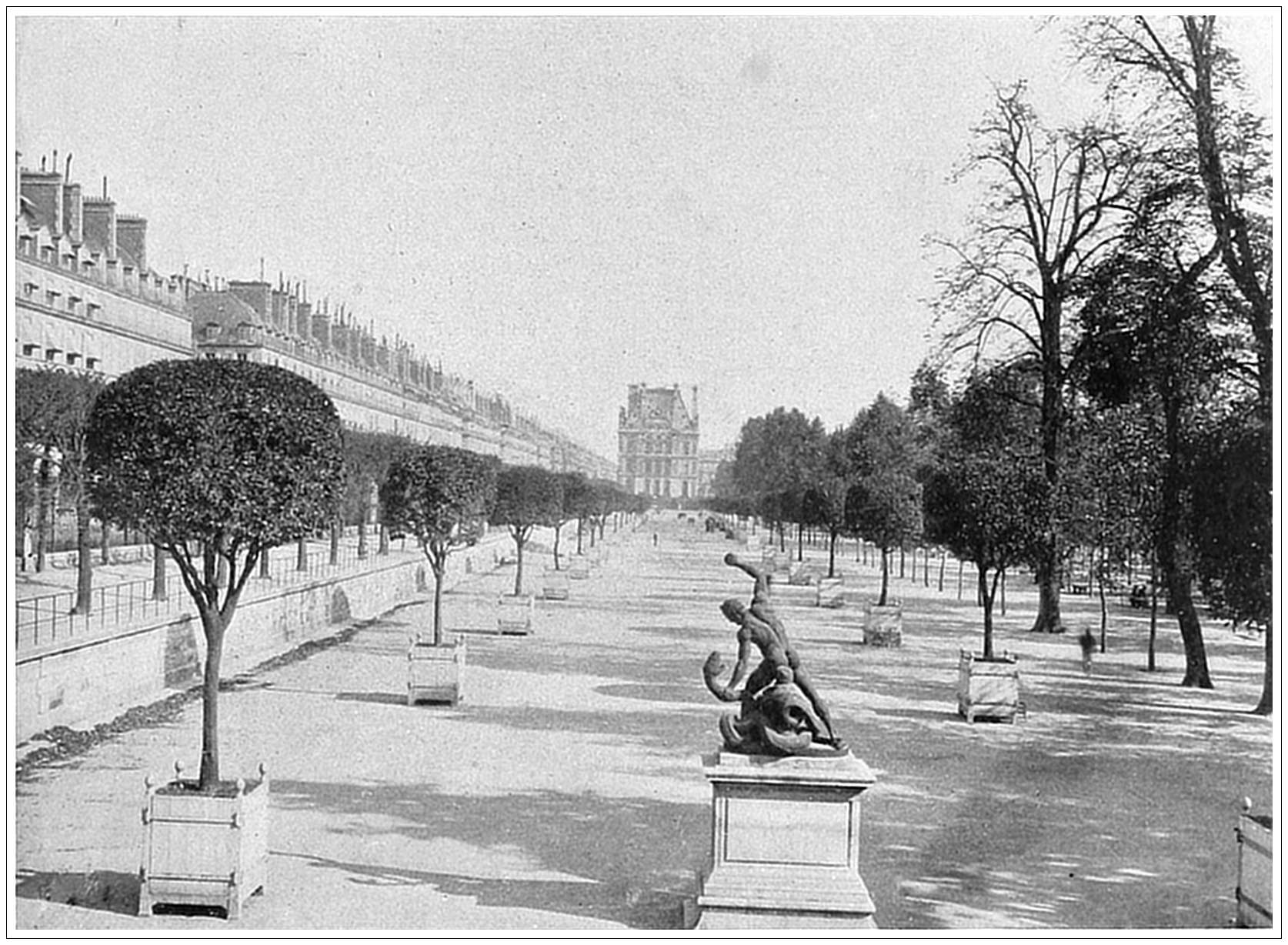
THE GARDEN OF THE TUILERIES. The Tuileries is but the remains
of its former glory. The main front of the building was burned
by the Commune in 1871, and after remaining a picturesque ruin for
some years was at length removed. The wing nearest the Rue de Rivoli
shared the fate of the front, but was rebuilt, together with the Pavillon de
Marsan, which formed the angle. The Pavillon de Flore, at the other end,
suffered much less, and had only to be restored. Both wings, and, indeed, the
entire building, are a marvel of exterior ornamentation. Before the Revolution
the Tuileries was only the occasional residence of the French sovereign,
but Napoleon made it his principal abode, and his example was followed by
his successors. The picture is taken from the exquisite gardens of the Tuileries
facing the Place de la Concorde.
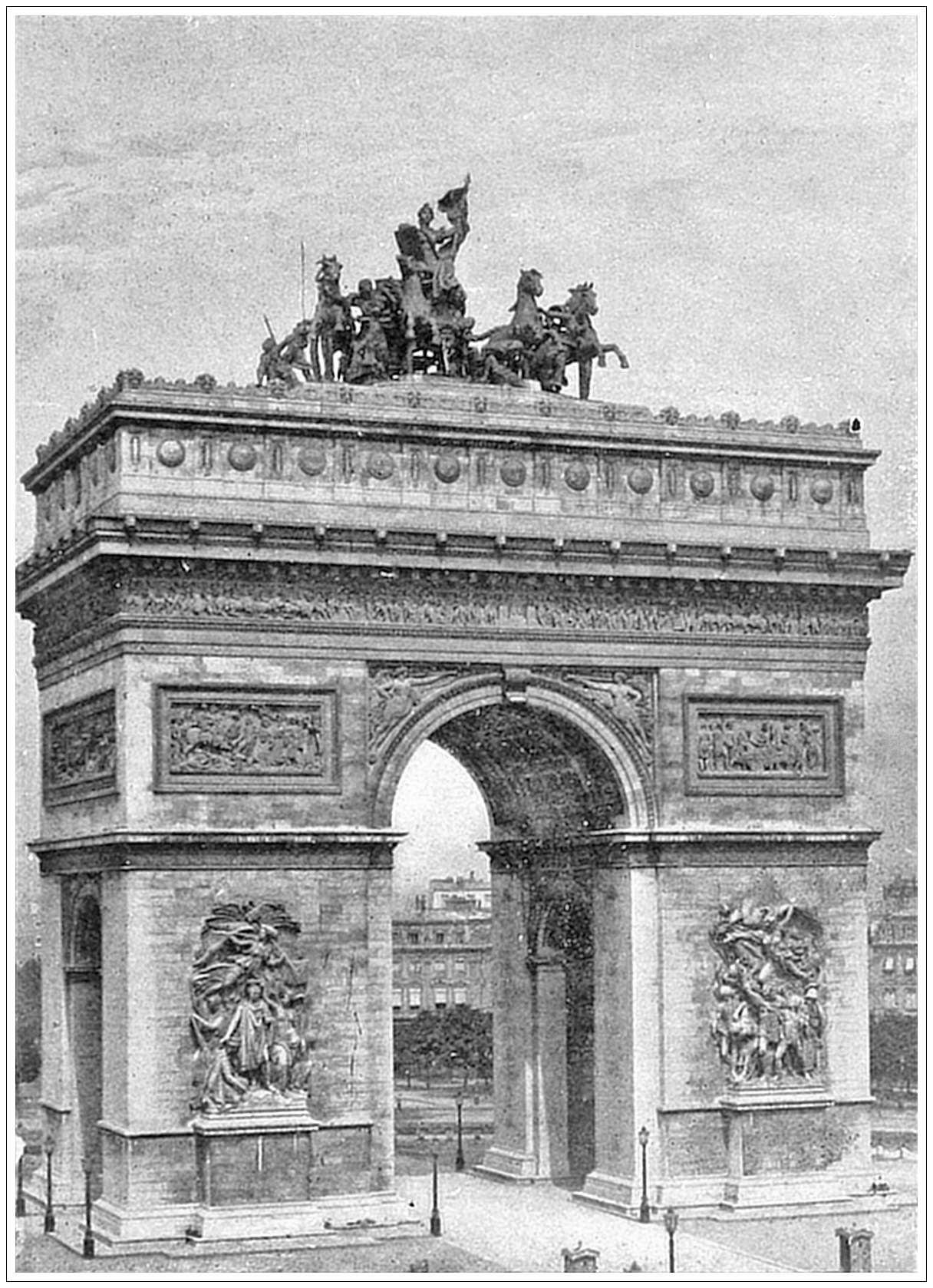
ARC DE TRIOMPHE, PARIS, FRANCE. This, the distinctive
triumphal arch of Paris, is more specifically known as l’ Arc de l’ Étoile,
to differentiate it from three other triumphal arches of less celebrity.
It stands at the west end of the Avenue des Champs Elysées on the
summit of a slope, which makes it visible from all parts of Paris and the
environs. It is not only the largest arch in existence, but the most magnificent
ever erected. Begun by Napoleon in 1806, to commemorate the wars of
the Revolution and of the Empire, it was completed thirty years later by
Louis Philippe. The total cost was about $2,000,000. The height of the
arch above the ground is one hundred and fifty-two feet, its width one hundred
and thirty-eight feet, its thickness sixty-eight feet. The main archway
measures ninety feet in height and forty-five in width; the smaller lateral
archways are each fifty-seven feet by twenty-five. The bas-reliefs represent the
most famous events of 1792–1815. Finest of all are the two colossal groups
on each side of the central arch facing the Champs Elysées, cut in full relief
and representing the “Departure of the Troops in 1792” and “The Triumph
of Napoleon after the Austrian Campaign.”
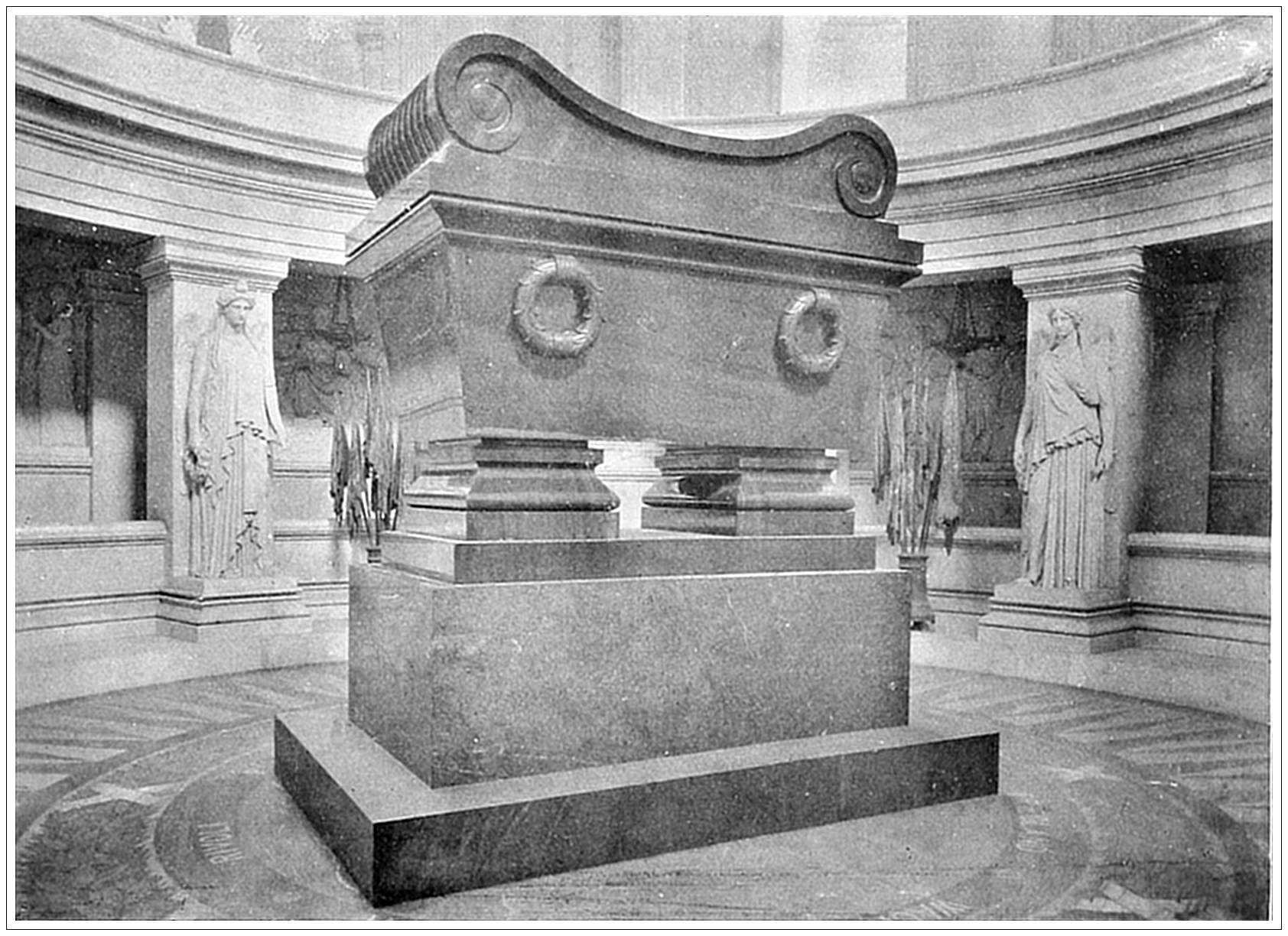
NAPOLEON’S TOMB, PARIS, FRANCE. Under the splendid dome
of the Church of the Invalides, in a huge circular crypt below the
level of the floor, is the tomb of the Great Napoleon I. The sarcophagus,
hewn out of a single block of granite brought from Finland, was the
gift of the Emperor Nicholas, when in 1841 the remains of the Emperor were
brought back from St. Helena by the Prince de Joinville. The crypt is
adorned with marble reliefs symbolical of Napoleon’s reforms and with twelve
colossal figures of victory and sixty mouldering banners captured from the
enemy. There are also monuments to Vauban and Turenne, Napoleon’s most
illustrious predecessors in the field. At the entrance to the crypt lie the
bodies of Bertrand and Duroc, the near friends and companions of Napoleon.
The monuments or the remains of various members of the Bonaparte family
are in the upper part of the church.
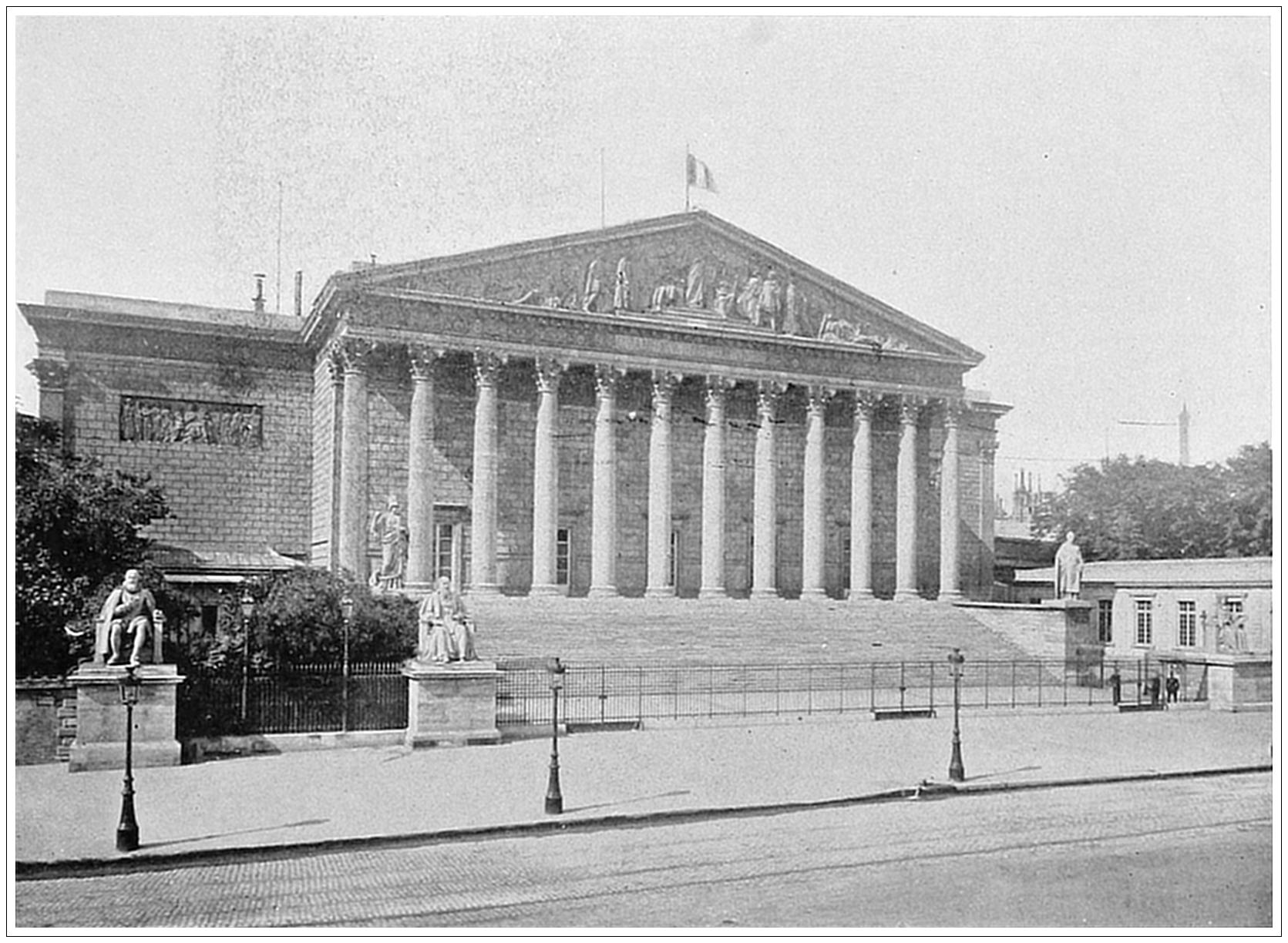
CHAMBER OF DEPUTIES, PARIS, FRANCE. This is sometimes
called the Palais Bourbon. It is the seat of the French parliament. It
is a large classical building on the left bank of the Seine, facing the
Pont de la Concorde. The old façade was in the Rue de l’ Université at the
back; the new one, with its Corinthian colonnade, was erected in 1804. The
hall is a semi-circular room, with the President’s chair facing the extremity of
the half circle. Here sat the Council of Five Hundred, Louis Philippe’s
Chamber and Napoleon III’s Corps Legislatif, and here at present sit the
deputies elected from the various districts of the French republic. Orators
address the Chamber from the tribune, which is placed immediately under the
President’s chair. Voting is done by means of white or blue cards, placed in
tin receptacles that are handed round by the ushers; the white being an
“aye,” the blue “nay.”
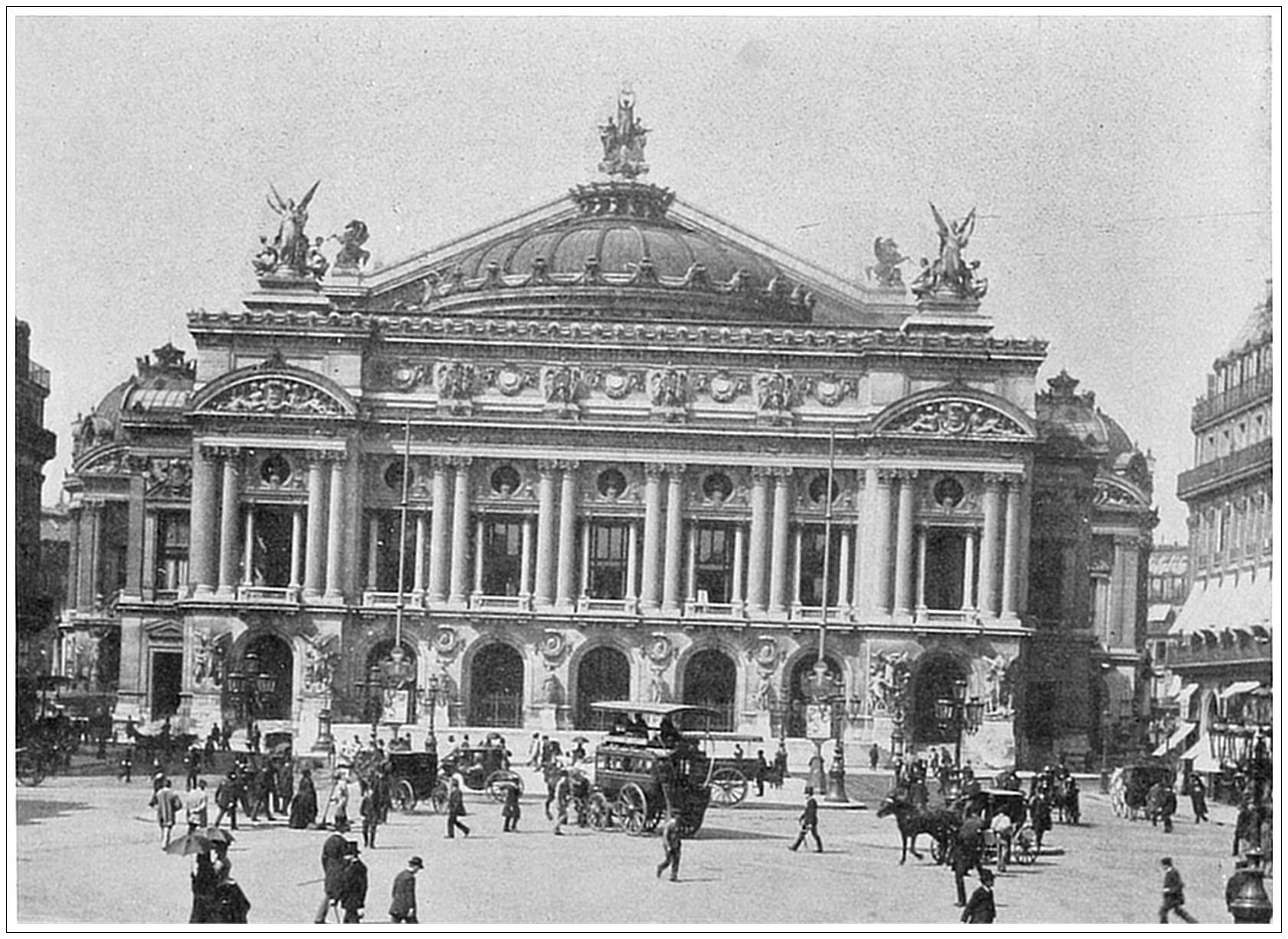
THÉÂTRE DE L’OPERA, PARIS. The new Opera House, in Paris, is
the handsomest, though not the largest, temple of amusement in the
world. It will hold twenty-one hundred people, while La Scala, in
Milan, holds three thousand. The stage, however, in cubic and superficial
area, is the largest known. It is equaled by others in depth, but surpasses
them all in breadth. The exterior is bewildering in the richness of its decorations.
The grand staircase and the foyer are in magnificent keeping with the
exterior. This building is one of the creations of the Second Empire. More
than one hundred houses were torn down to clear the square on which it
stands. It was inaugurated on January 1st, 1875. The total cost is estimated
at $8,000,000. The opera is managed by a director, who receives from the
State an allowance of eight hundred thousand francs a year. He has to
supply what is necessary and run all risks.
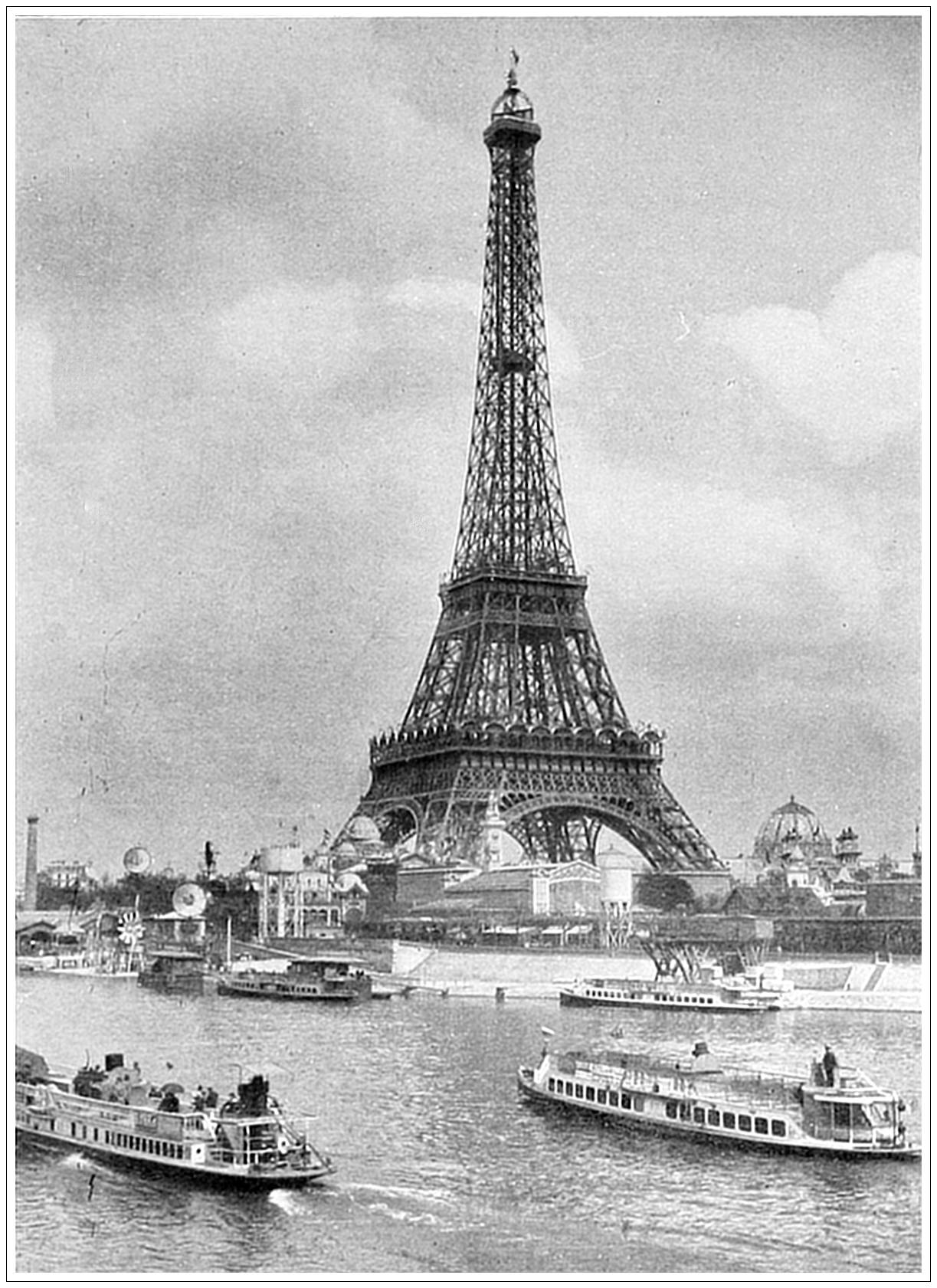
EIFFEL TOWER, PARIS. This is the highest structure in the world,
being three hundred metres or nine hundred and eighty-four feet in
height, as against the five hundred and fifty-five feet five and one-eighth
inches of the Washington Monument, which comes next in altitude among all
the edifices of man. The tower was constructed by Alexander G. Eiffel for the
Paris Exhibition of 1878. Its foundations are sunk to a depth of fifty feet in
the sandy soil of the Champs de Mars, and the four massive piers, which form
the first stage of the tower, are so planted as to distribute the enormous weight
of the structure (sixty-five hundred tons) in the best way possible. In spite of
this weight the general impression is one of grace and lightness. The summit
is crowned by a cupola with an exterior balcony, whence a magnificent panorama
of Paris and its surroundings is unveiled. Elevators carry passengers
up to the summit, the time consumed by the ascension being from six to seven
minutes.
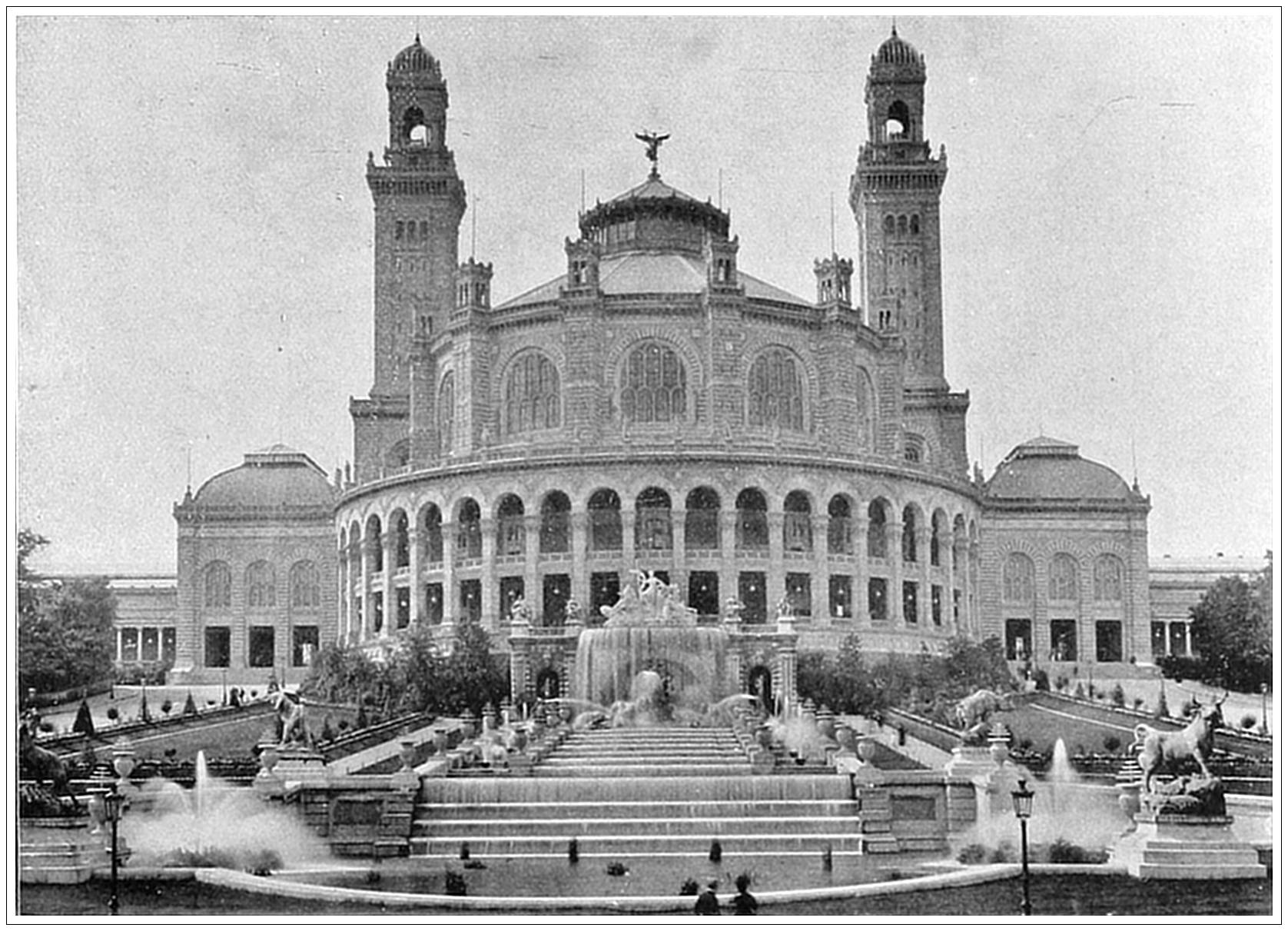
TROCADERO, PARIS, FRANCE. The Eiffel Tower is not the sole
remaining monument of the French Exposition of 1878. Overlooking
the Champs de Mars is the Trocadero, which was begun in 1876 for the
same exhibition. It is a fantastic structure in the Byzantine style. The central
portion consists of a circular edifice one hundred and eighty feet high and
one hundred and eighty-nine feet in diameter, crowned by a dome, and flanked
with two minarets two hundred and seventy feet high. On each side extends
a wing in the form of a curve, six hundred and sixty feet in length, giving the
entire edifice the appearance of an imposing crescent. On a level with the
spring of the dome is a terrace adorned with thirty statues. The view of Paris
from the terrace or the towers is superb. Below the balcony, in front of the
central building, gushes a large cascade, which descends to a huge basin one
hundred and ninety-six feet in diameter. Afternoon concerts are often given
in the elaborately decorated Salle des Fetes, which seats six thousand persons.
There are also collections of sculptures and antiquities.
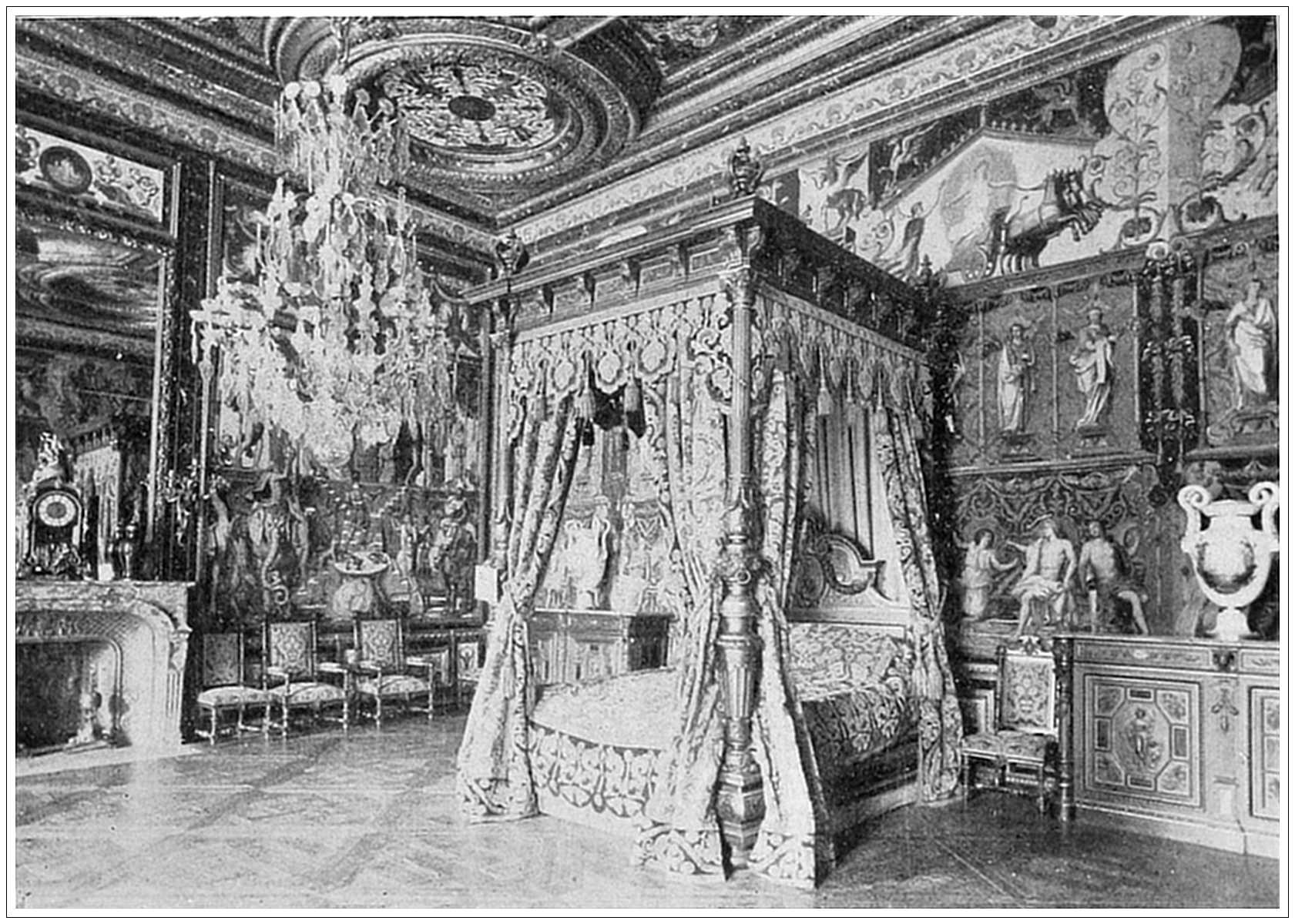
CHATEAU DE FONTAINEBLEAU, FRANCE. Fontainebleau is a
small town thirty-five miles south-east of Paris. It is famous for the
royal palace, which is situated in a magnificent park or forest, fifty miles
in circumference, and covering an area of forty-two thousand five hundred
acres. The building itself is said to occupy the site of a fortified chateau, built
by Louis VII in 1162. But it was Francis I who transformed the mediæval
fortress into a palace of almost unparalleled extent and magnificence. Henry
IV did much towards its embellishment. Here his successor, Louis XIV, revoked
the Edict of Nantes. It was a favorite residence of Napoleon I, whose
sentence of divorce from Josephine was pronounced here. Louis Philippe
and Napoleon III spent large sums in restoring it. The exterior of the building,
with the exception of several pavilions, is only two stories in height.
The interior is a splendid example of decorative work. Some of the greatest
French and Italian artists of the epoch of its creation were employed upon it.
Especially beautiful is the chamber of Anne of Austria, the mother of Louis
XIV, and Queen-regent in his minority, who made Fontainebleau her favorite
residence, and spent money lavishly in the decoration of her chamber.
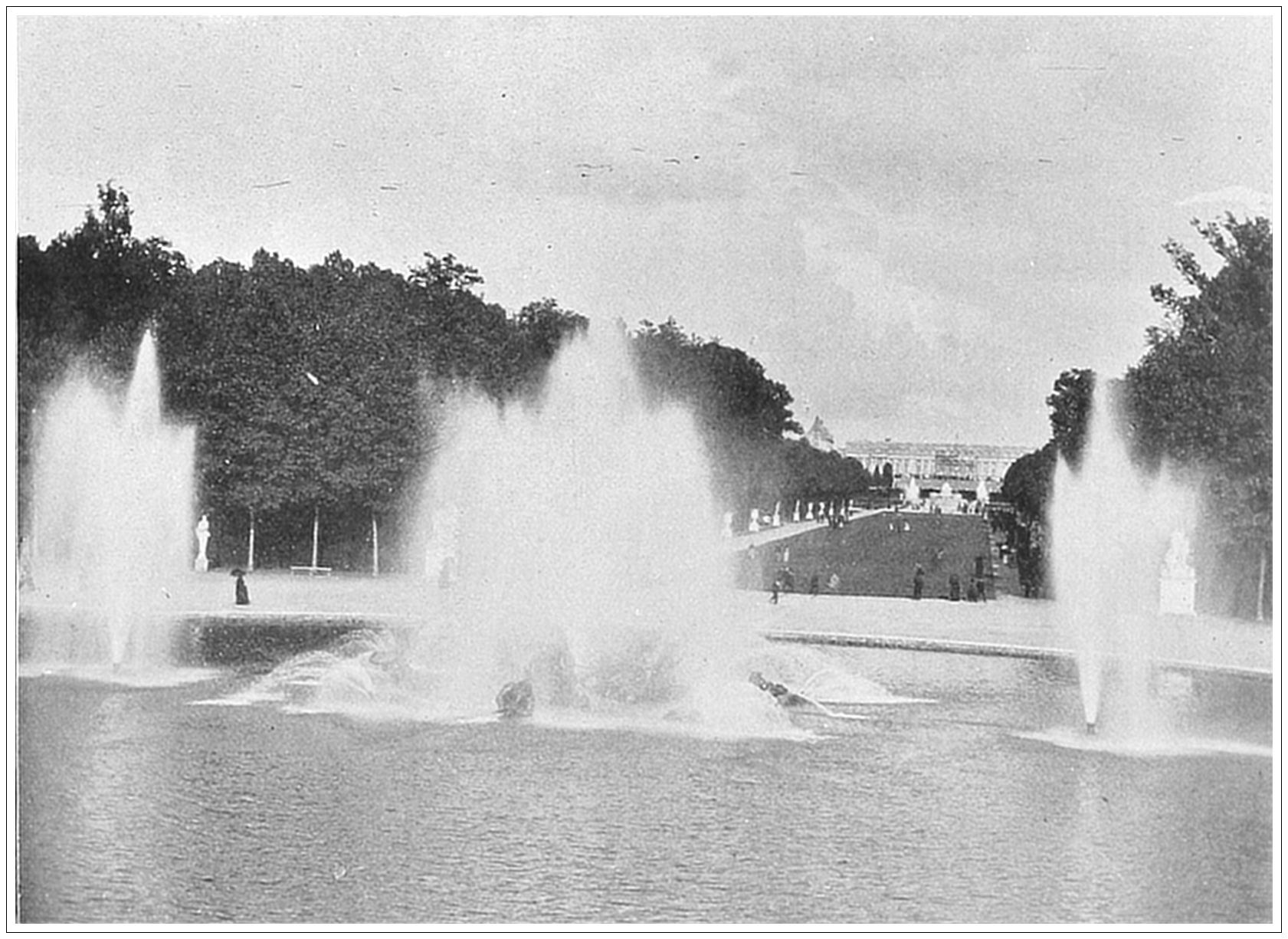
GARDEN AND FOUNTAINS, VERSAILLES, FRANCE. The Palace
of Versailles is in the town of the same name, ten miles from Paris, was
built by Louis XIV in 1661, and became a royal residence in 1681. As
such it has held a great place in the history of France. It is now used as a
historical museum. The garden which surrounds it is justly celebrated for its
extreme beauty. Among its chief marvels are the fountains, richly adorned
with bronze statues, and from the centre of each rises a column of water to
the height of forty feet, encircled by sixteen inclined jets of water, the whole
forming a sort of basket. The water which feeds the fountains is brought
from the Seine by the machine of Marly, constructed at enormous expense
after the failure of the plan to turn the River d’ Eure from its course.
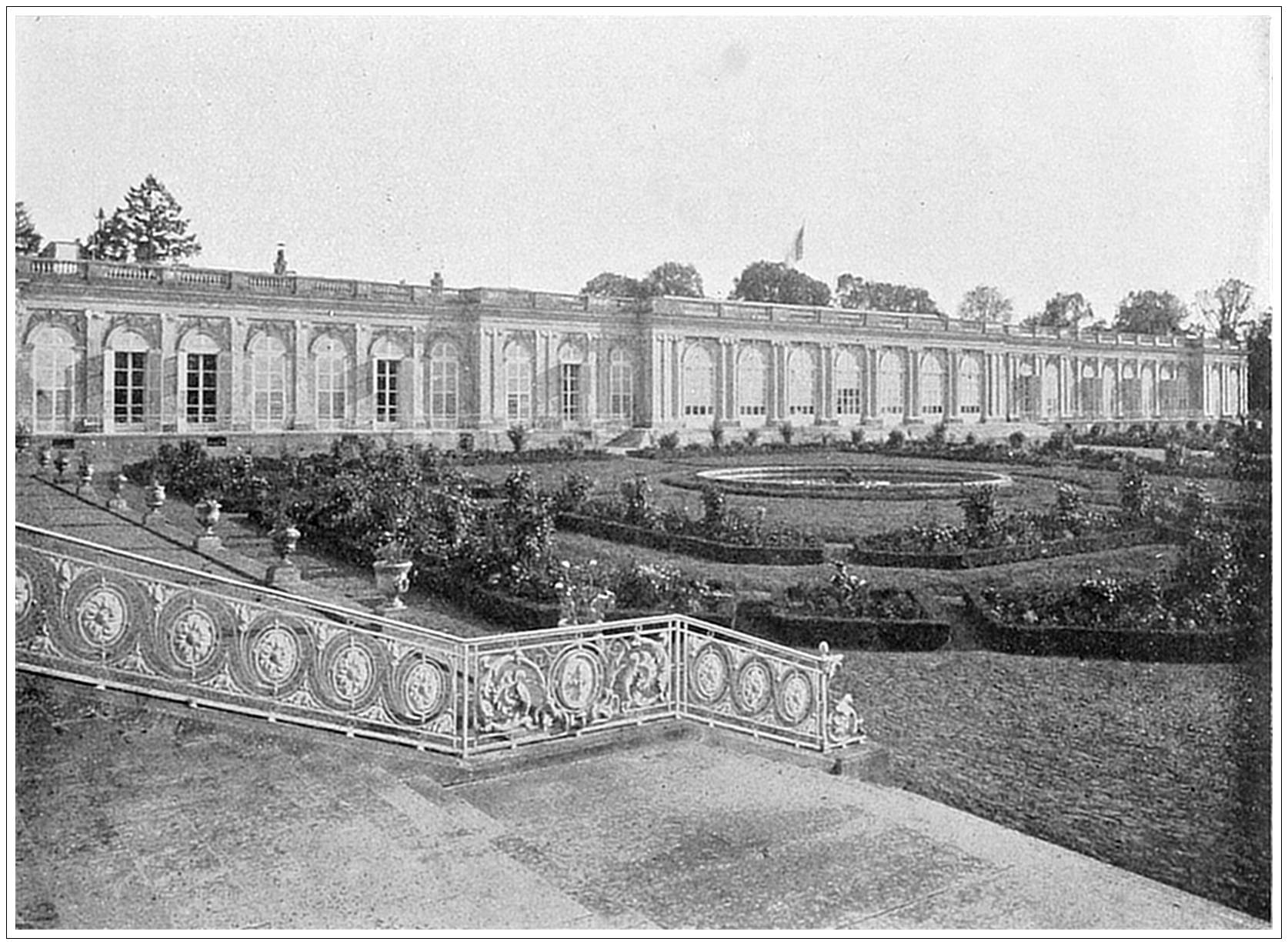
GRAND TRIANON, VERSAILLES, FRANCE. A charming residence
near the palace of Versailles, built by Louis XIV in 1688 for Madame
de Maintenon, but chiefly interesting for its associations with Marie
Antoinette, whose favorite residence it was. Here she amused herself with
her Swiss village, and here, as well as in the adjacent Petit Trianon, she and
her court played at shepherds and shepherdesses. The Grand Trianon is built
in the Italian style, with the rooms all on one floor. The interior is exquisitely
furnished and adorned. In the surrounding gardens are cottages and
artificial “mountains” (some nearly ten feet high) and glens and grottoes and
pebbly-bottomed brooks.
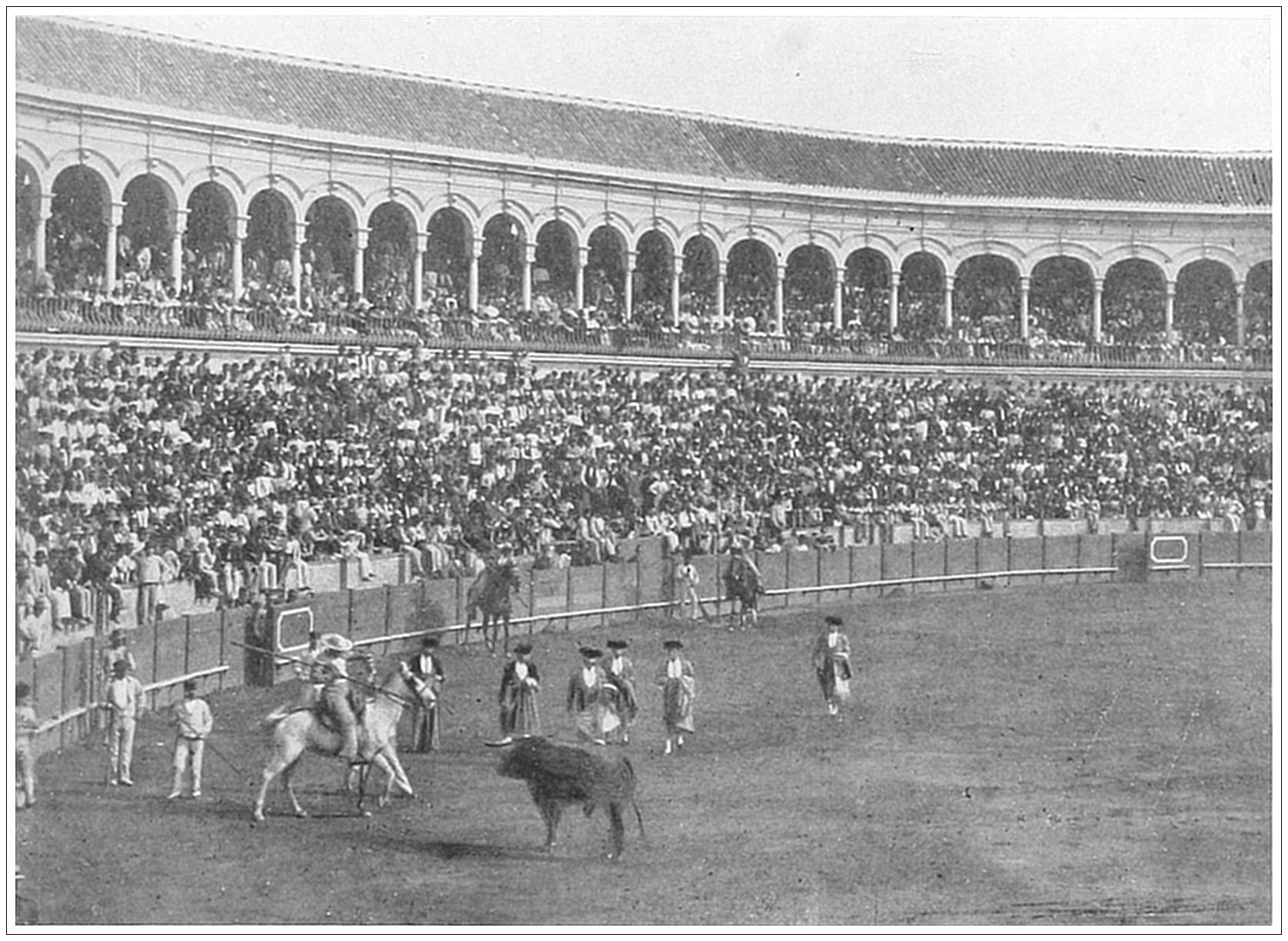
BULL FIGHT, SEVILLE, SPAIN. The bull fight is the national sport
of Spain. The sport has been described as a tragedy in three acts.
First, the bull is let out and goaded to fury by the lances of the mounted
picadores. If a picador is thrown or his horse is wounded the chulos rush in
and attract the bull by waving their cloaks in front of him, saving themselves,
if need be, by leaping over the palisade which encloses the circus. When the
bull begins to flag the chulos attack him with barbed darts, called banderillas,
which they stick into his neck. The third act introduces the matador, who
enters alone. He holds in his right hand a naked sword, in his left a muleta
or small stick with a piece of scarlet silk attached. The bull rushes blindly
at the muleta. The matador, if he be skillful, plunges the sword into the left
shoulder and the animal drops dead. Sometimes, however, he misses his first
aim and then he has to try again. Sometimes he is wounded or even killed and
then a new matador appears on the scene.
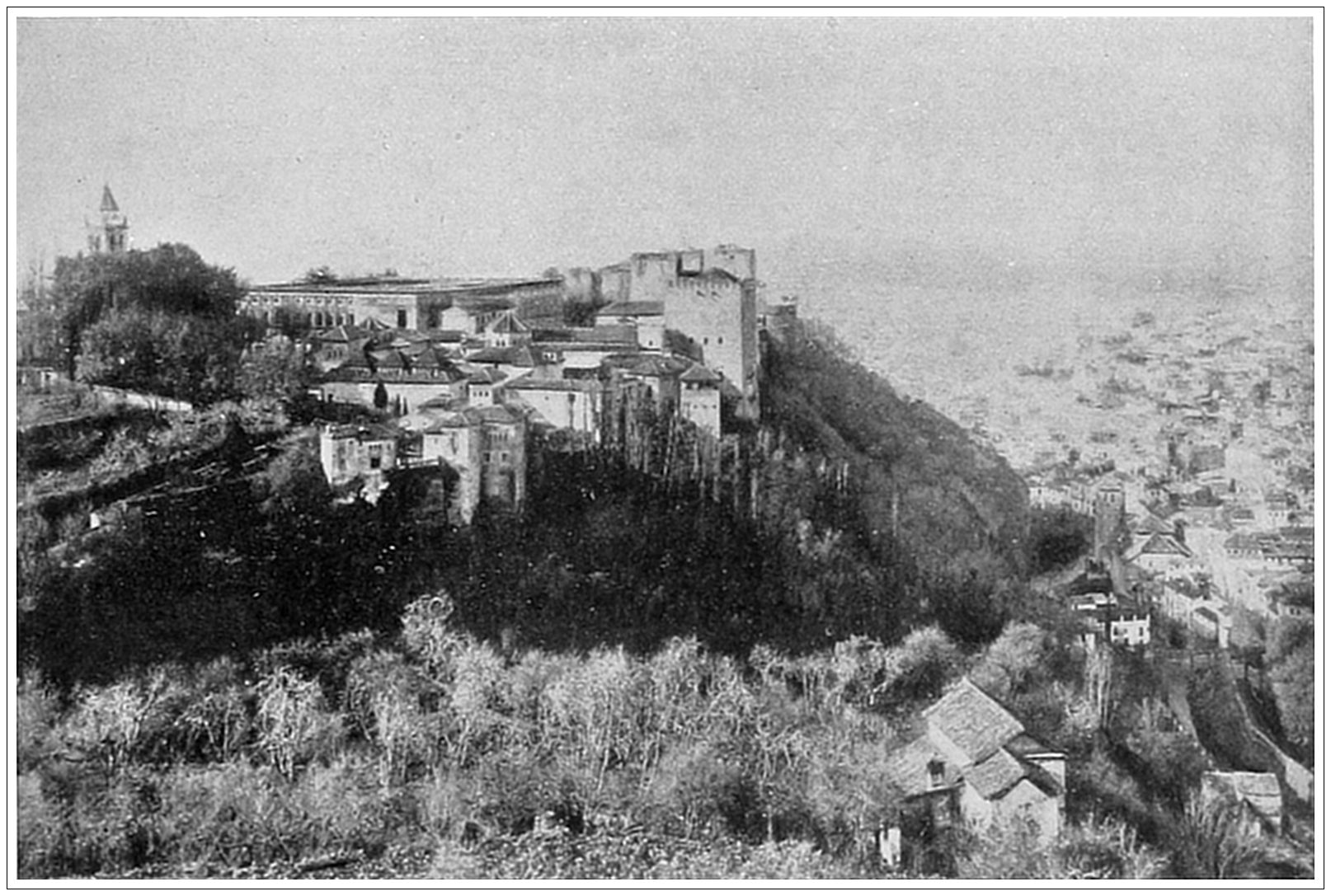
THE ALHAMBRA, GRANADA, SPAIN. Alhambra means the “Red
Castle.” This fortress and palace of the ancient Moorish kings—“the
pride of Granada and the boast of Spain”—is a vast and irregular collection
of buildings built of bricks slightly reddened. The principal building was
begun in 1248 and finished in 1314. Here the Moorish kings lived, surrounded
by their court and nobility, a total population of some forty thousand souls. Its
degradation dates from the day of the Castilian conquest, for the alterations
and restorations made by the Spanish kings were without judgment. Philip V,
early in the eighteenth century, was its last royal occupant. After his desertion
the place was allowed to fall into decay until 1862, when the Spanish
government took it in charge. Happily, the most important portions still
exist, and present a bewildering array of pavilions, courts, colonnades, fountains,
baths, gilded ceilings and every kind of Oriental decoration.
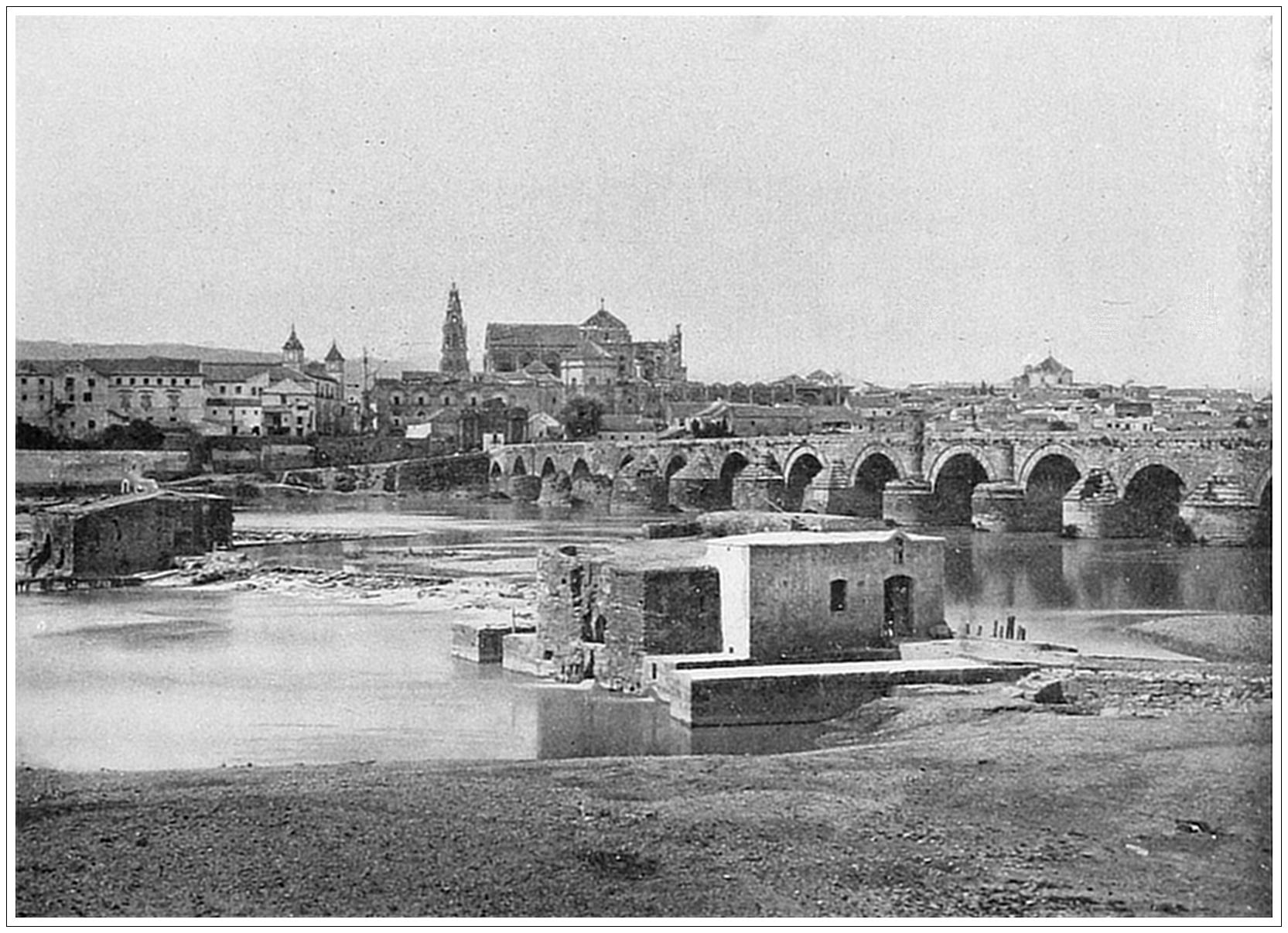
CORDOVA, SPAIN. This is one of the most ancient and picturesque of
Spanish towns. Its walls, built on a Roman foundation with Moorish
superstructure, inclose a large area, dotted with Roman and Moorish
remains. Chief among the latter is the cathedral, which looms up almost in
the centre of our picture. It dates from the eighth century, and was formerly
a mosque. Authorities generally agree that it is the finest specimen of a
Moorish mosque in all Europe. The southern suburb communicates with the
town by means of an ancient bridge across the River Guadalquiver, whose
sixteen arches exhibit the usual combination of Moorish and Roman architecture.
At one end of the bridge is an elevated statue of the patron saint,
St. Raphael, whose effigy abounds all through the city. Our picture is taken
from the southern suburb.
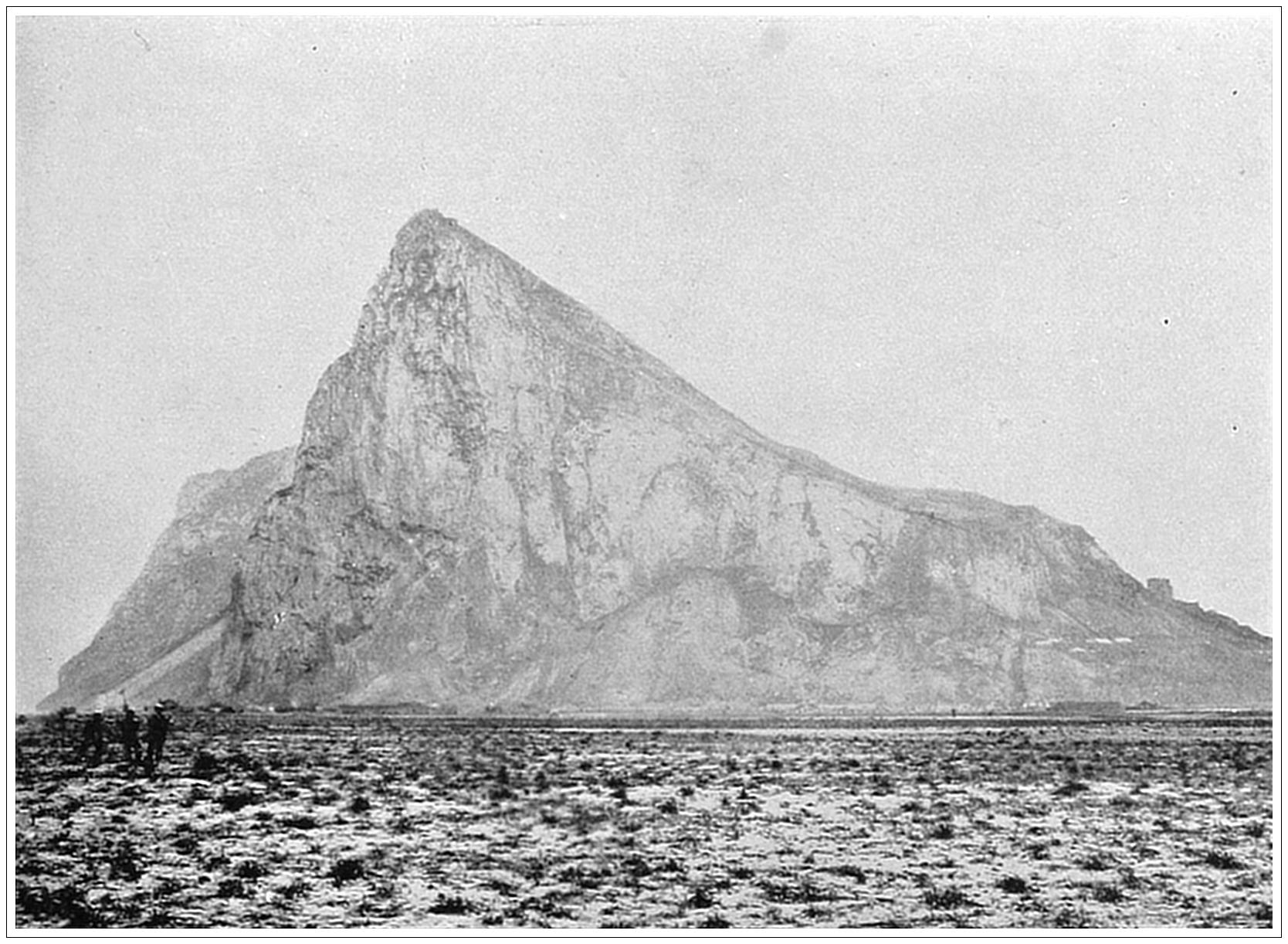
ROCK OF GIBRALTAR, SPAIN. An inaccessible rock, buttressed by
an impregnable fortress, which juts out from the southern extremity of
Spain, in Andulasia, gives to the English, who hold it, the virtual command
of the Mediterranean. The rock is fourteen hundred and thirty feet
high at its highest point; its length, from north to south, about three miles;
its circumference about six. It is mainly composed of compact limestone and
dense gray marble, varied by beds of red sandstone and tissues of osseous
breccia. The north face is almost perpendicular, but the east side is full of
tremendous precipices. It came into possession of the English by conquest
during the war of the succession in 1704. Since then they have spent immense
sums in its fortification, with so much success that they have retained it against
the combined efforts of France and Spain. From the sea the rock presents a
grim enough aspect with its immense cannon, its piles of balls and bombs, and
its apparent lack of vegetation. But a closer view shows patches of fruit
trees, together with a great variety of odoriferous shrubs.
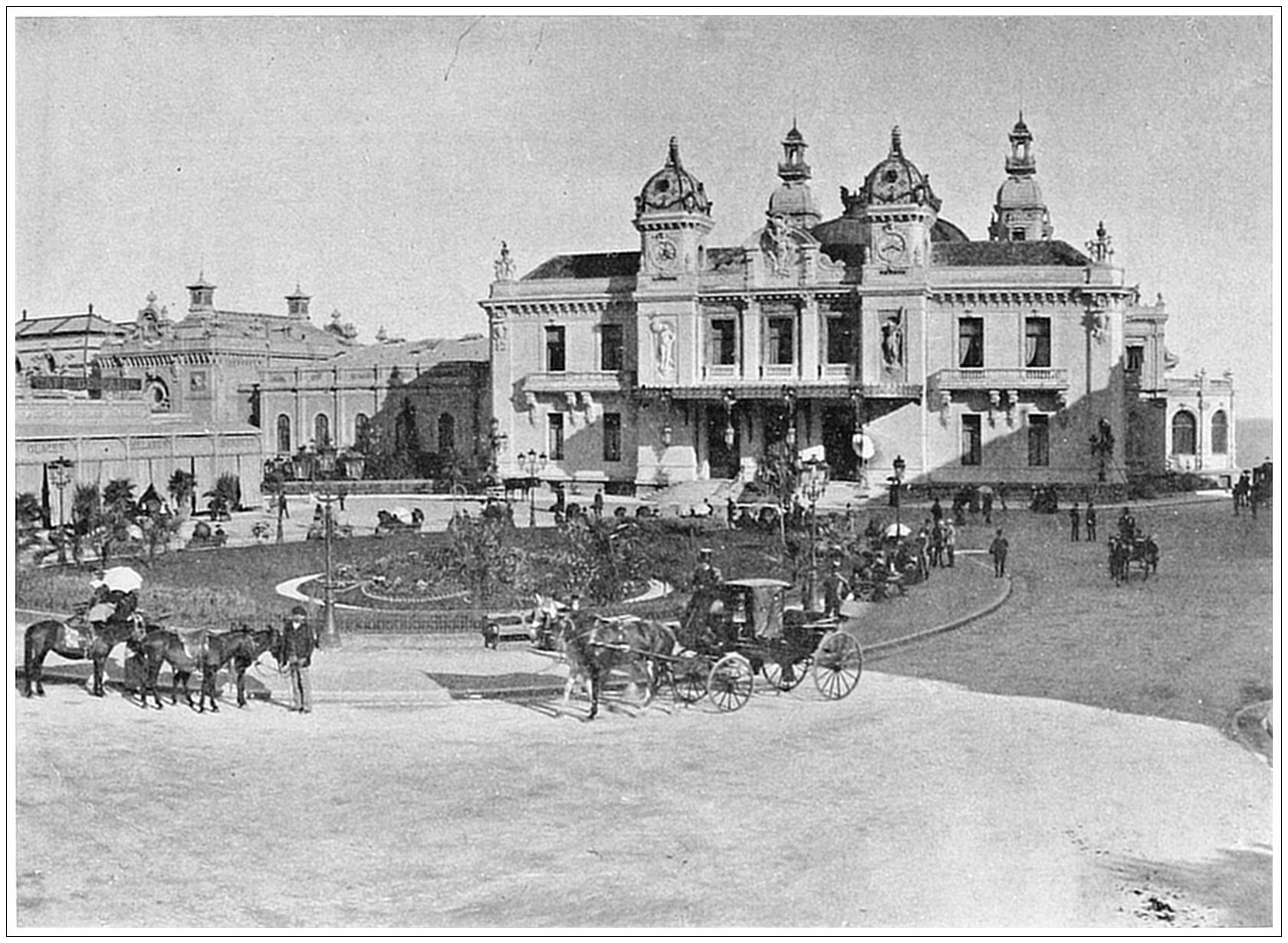
MONTE CARLO, MONACO—THE CASINO. Monaco is a small principality
on the Mediterranean, ruled by Prince Albert, of Monaco. It
is chiefly famous for the notorious Casino at the small town of Monte
Carlo, where alone in Europe public gaming is authorized by law. The first
stone of the Casino was laid in 1858, and gambling tables had existed in
Monaco two years previous to that date, but it was not till 1860, when M. Blanc,
expelled from Homburg, took possession of the place, that Monte Carlo began
to be famous. The gaming establishment is now in the hands of a joint stock
company, with a capital of 15,000,000 francs, who leased the ground from the
prince. It employs nearly one thousand people and is annually visited by
about four hundred thousand visitors. The inhabitants of Monaco are not
allowed at the tables. Their good will, however, is secured by their exemption
from taxation and by the flood of paying visitors who are attracted
hither. Monte Carlo is in itself a place of exquisite beauty, natural and artificial.
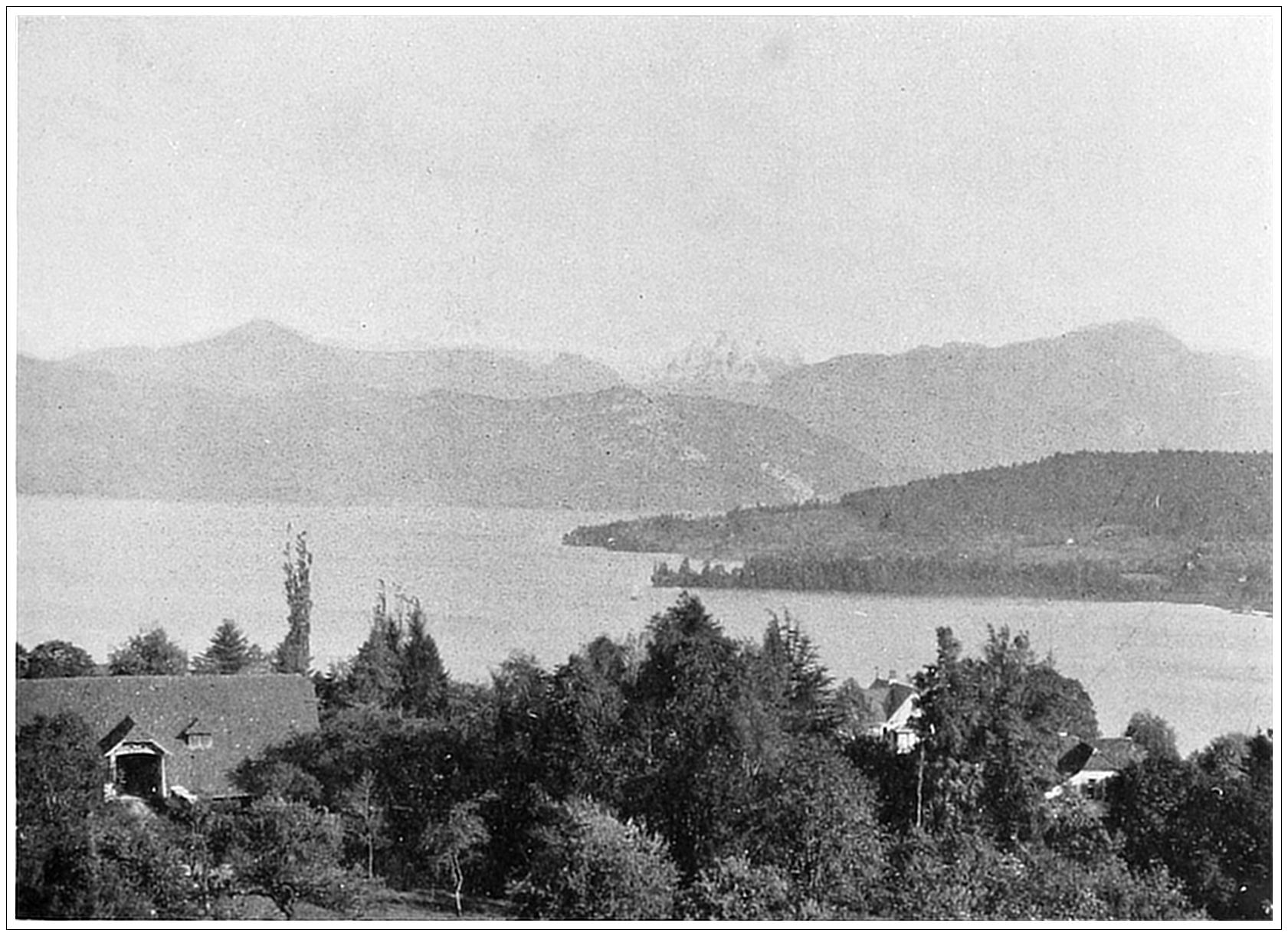
LAKE LUCERNE, SWITZERLAND. Not only in wild and picturesque
scenery, but in its legendary and historical associations, this is one of
the most interesting lakes in the world. In Switzerland it is alternatively
known as the Lake of the Four Forest Cantons, because bounded by
the cantons of Uri, Schwyz, Unterwalden and Lucerne. The mountain peaks
surrounding it give it the form of a St. Andrew’s cross, whence comes that
cross on the Swiss flag. Mounts Pilatus and Rigi stand at the north like
sentinel outposts of the Alps. The beginning of the St. Gothard Pass over
the Alps is at Fluelen to the south. The lake is intimately connected with
the Tell legends, and at one of its most enchanting spots a small chapel,
attributed to the fourteenth century, is said to mark the spot where he sprang
out of Gessler’s boat as he was being carried away a prisoner.
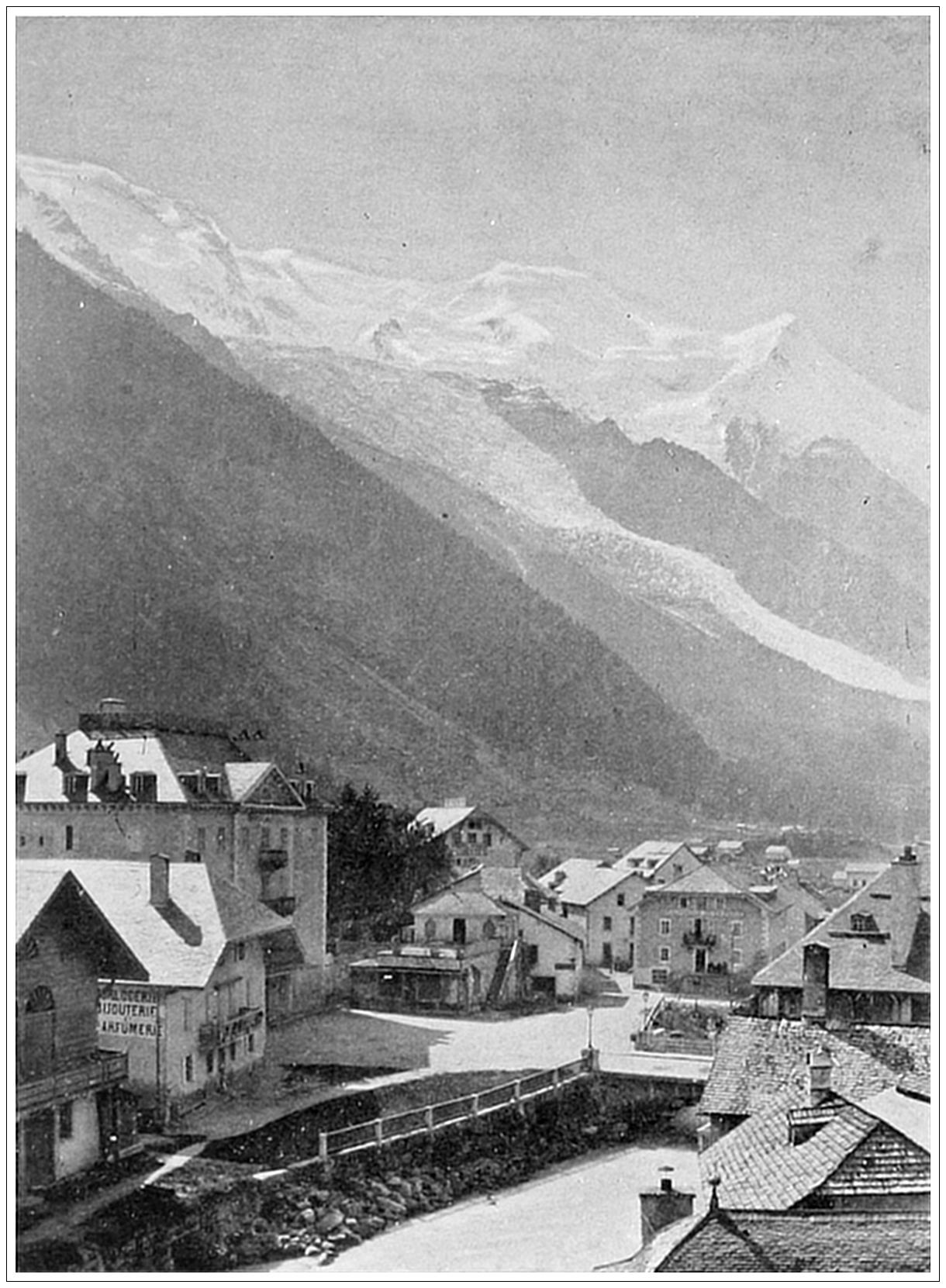
MONT BLANC FROM CHAMOUNI, SWITZERLAND. This, the
highest mountain in Europe, and, by common consent, the most magnificent
in its scenery, rises at the southern end of the valley of Chamouni,
fifteen thousand seven hundred and eighty-one feet above sea level.
During the last century and a half it has been a favorite resort of tourists,
and especially of scientists, as its glaciers and other marvelous features are full
of interest and instruction. But it was not till 1786 that Balmat and Paccard
made the first ascension, followed in 1787 by Saussure. Many accidents have
happened here in the past. In 1870 a party of eleven, two of them Americans,
all perished in the snow-crowned heights. Nowadays the ascensions
are more numerous, and, with proper precautions, are considered absolutely
safe, though very fatiguing, and occupying three days. The view from the
valley of Chamouni is of extraordinary beauty. It has been celebrated by
Coleridge in one of his most famous poems, and has been the theme of countless
other pens. Not always is the “monarch of mountains” visible from Chamouni,
as his imperial front is frequently hidden from the sight of his worshipers.
But the photograph here presented is taken on a fortunate day,
when there was no cloud about the throne.
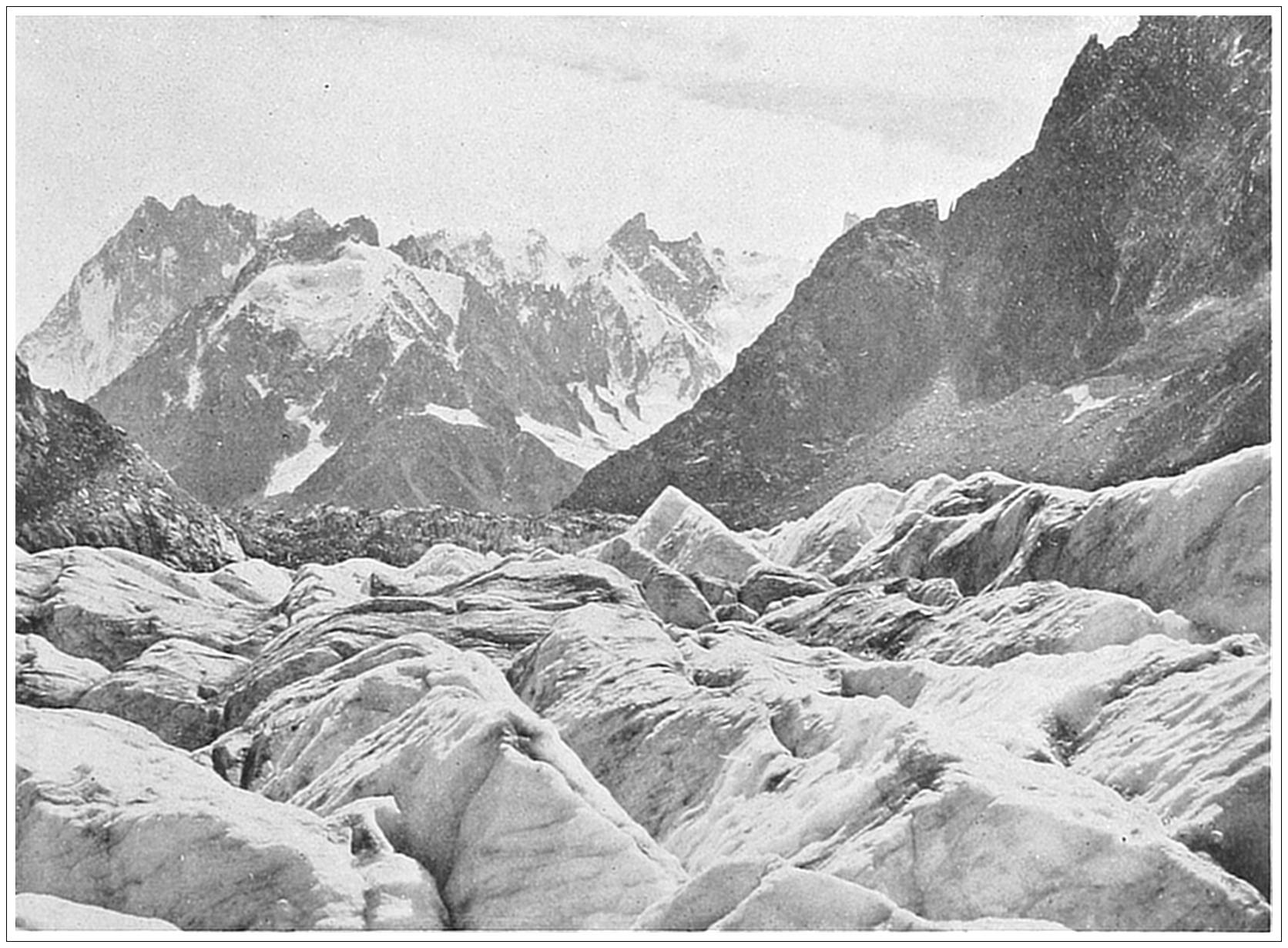
MER DE GLACE, MONT BLANC, SWITZERLAND. This immense
glacier fills the highest gorges of the chain of Mont Blanc, and extends
over a distance of twelve miles into the Valley of Chamouni.
It is formed by the masses of snow and ice which collect during the long
winters. In appearance it is just what its name implies, a Sea of Ice, whose
tumultuous waves seem to have been suddenly frozen, not while they were
being lashed to fury by a tempest, but at the very moment when the wind
had subsided and left them high indeed, but rounded and blunted in outline.
Slowly—so slowly that the motion is imperceptible—it flows down the inclined
plane between two mountains cracking, groaning and melting until it resolves
itself into a torrent, known as the Arveiron. There are other seas of ice among
the Alps, but this by pre-eminence is known as the Mer de Glace. It was in
the study of this region that Agassiz conceived his glacial theory.
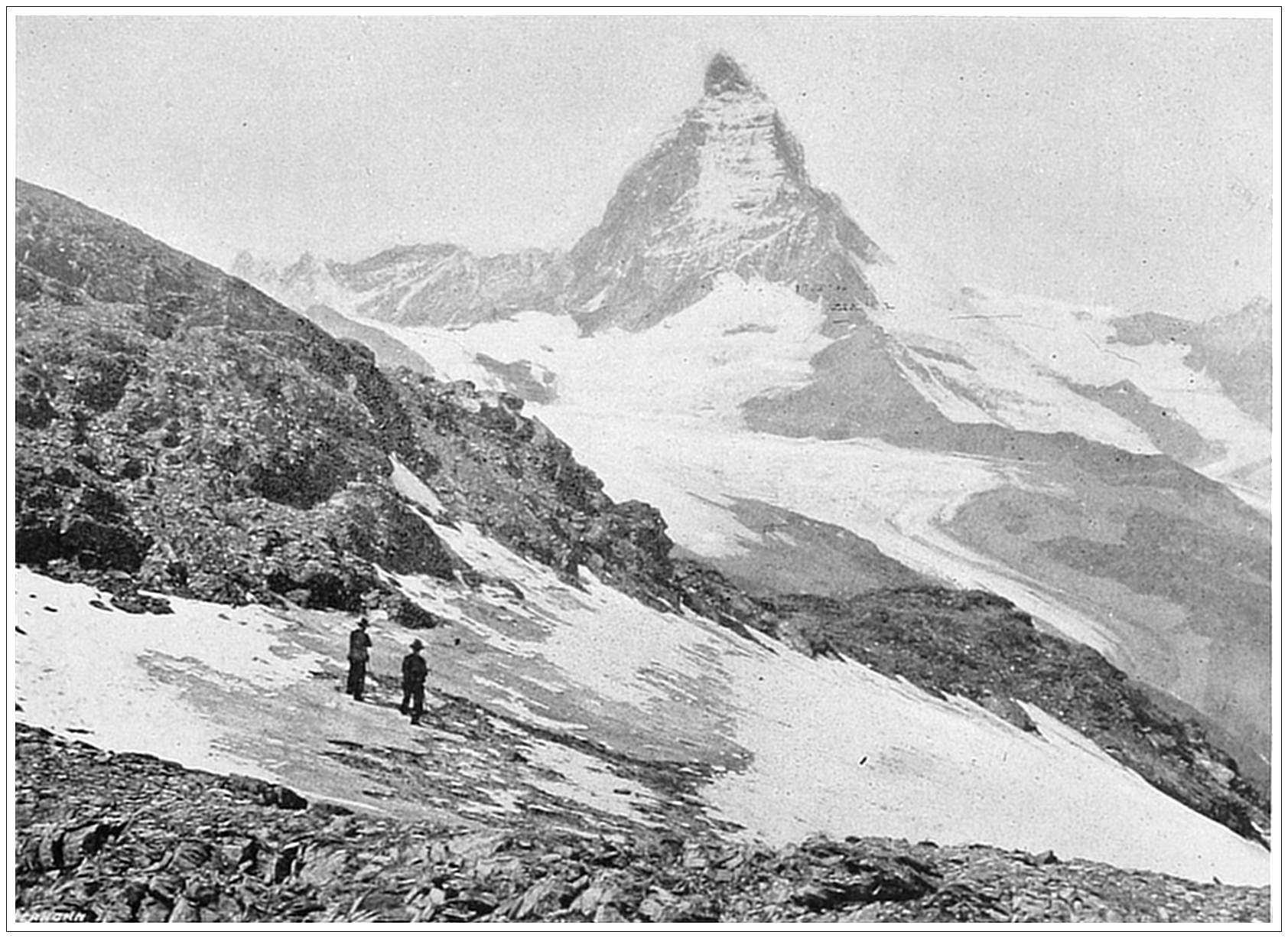
THE MATTERHORN, SWITZERLAND. This famous Alpine height
is situated in the canton of Valais, in Switzerland, overhanging the
little village of Zermatt. It is fourteen thousand seven hundred and
five feet high, and its peak is the sharpest and most acute in all the Alpine
region, rising like a sort of triangular obelisk into the clouds. Its sides are
so precipitous that the snow itself can hardly find a lodgment. For a long
period it was deemed inaccessible to man. On the 14th of July, 1865, a party,
consisting of Messrs. Hudson, Whymper and Hadow, with Lord Francis
Douglas and three guides, succeeded in reaching the summit, but in the descent
Mr. Hudson lost his footing, and all save Mr. Whymper and two guides, who
escaped by the breaking of the rope, were precipitated to a depth of four
thousand feet towards the Matterhorn Glacier. The ascent is now made
several times annually. The rock has been blasted at the most difficult points
and a rope attached to it.
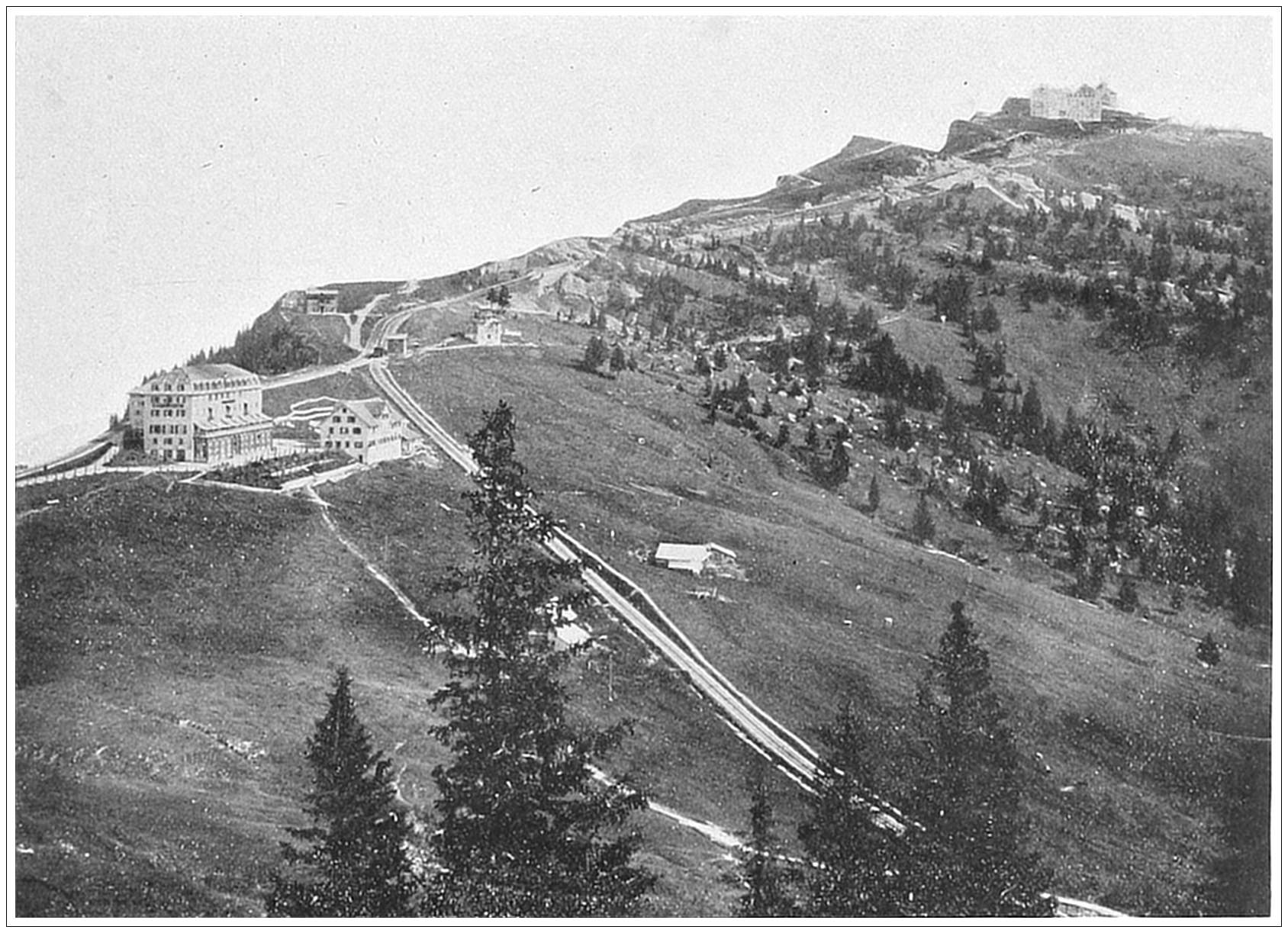
RIGI-KULM, SWITZERLAND. The Rigi Mountain, five thousand nine
hundred and five feet above sea level, or four thousand four hundred
and seventy-two feet above Lake Lucerne, is not one of the highest
mountains of Switzerland, but the beautiful and extensive view commanded
from the Kulm, or summit, makes it one of the most popular. The famous
Riggenbach cog-wheel railway brings travellers up to the Kulm, a small, bare
space, whence the eye takes in a panorama of three hundred miles in circuit.
Immediately below lie the lakes of Lucerne and Zug, their shores lined with
picturesque little towns. Eight other lakes, including a bit of Zurich, may be
counted in the distance. Snow-capped mountains—the Jungfrau, the Wetterhorn,
the Schreckhorn, the grand snow-covered peaks of the Bernese Alps and
countless other peaks of lesser note—stretch away on every side to the horizon.
The railway up the mountain is of ordinary gauge. Along the centre runs a
cogged track, into which a cog-wheel on the locomotive works, thus giving the
power for the ascent. In going down the brakes are worked by atmospheric
pressure. The construction of this five miles of line, which in its ascent overcomes
about one mile of altitude, cost about $300,000.
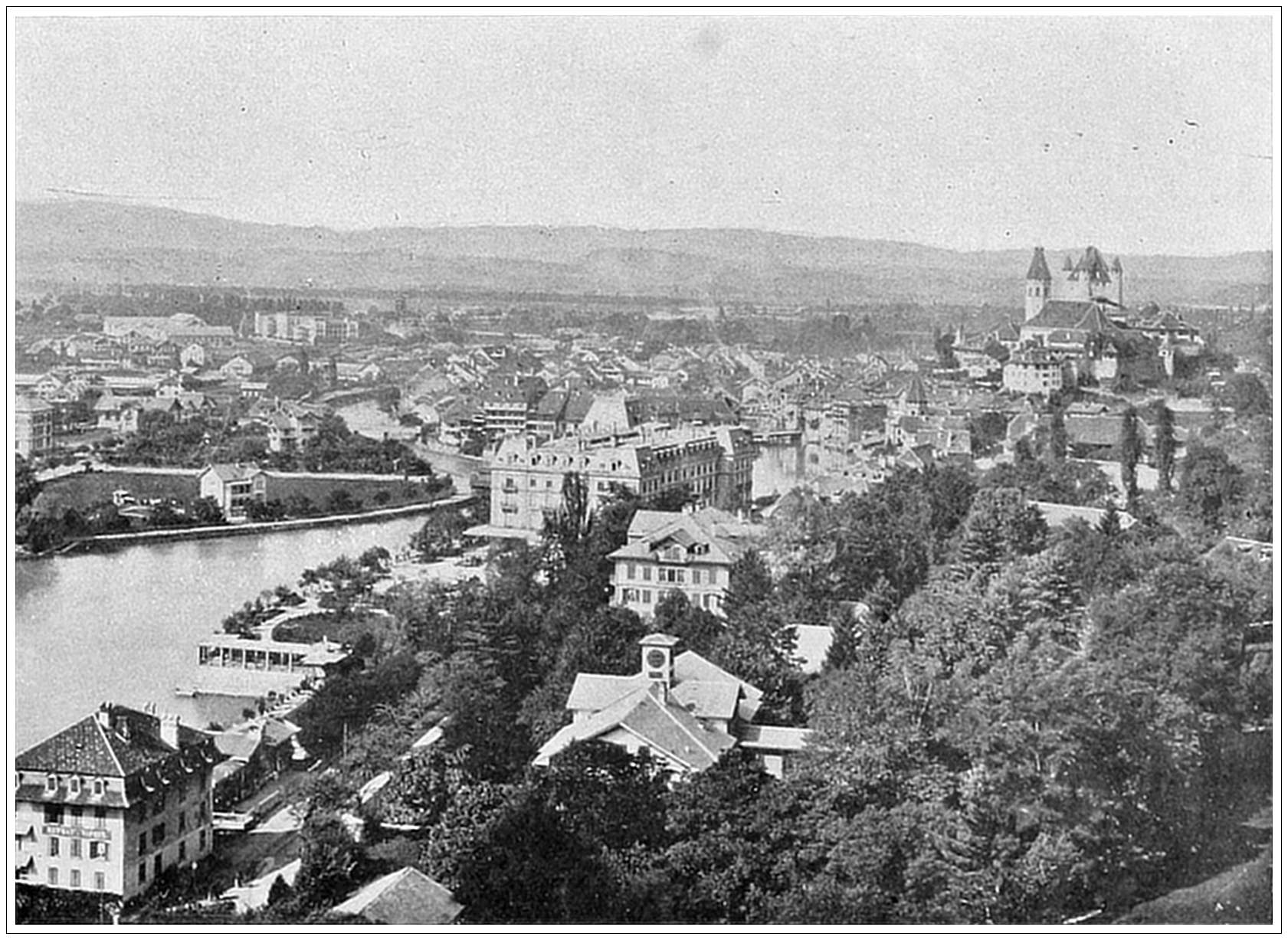
THUN, SWITZERLAND. One of the most picturesque of Swiss towns is
Thun, which is charmingly situated on the banks of the river Aar, three-quarters
of a mile below its efflux from the lake. Many of the town’s
buildings are very old. The Castle of Zahringen-Kyburg, whose large square
tower forms a noted feature of the landscape, dates from 1182. The principal
street is curious. In front of the houses projects a row of warehouses and
cellars, on the flat roofs of which is the pavement for foot passengers, flanked
with the shops. The view here presented is taken from the pavilion in the
Bellevue Grounds, which overlooks the city, and commands the old-fashioned
town, the lake, the Alps and the Valley of the Aar.
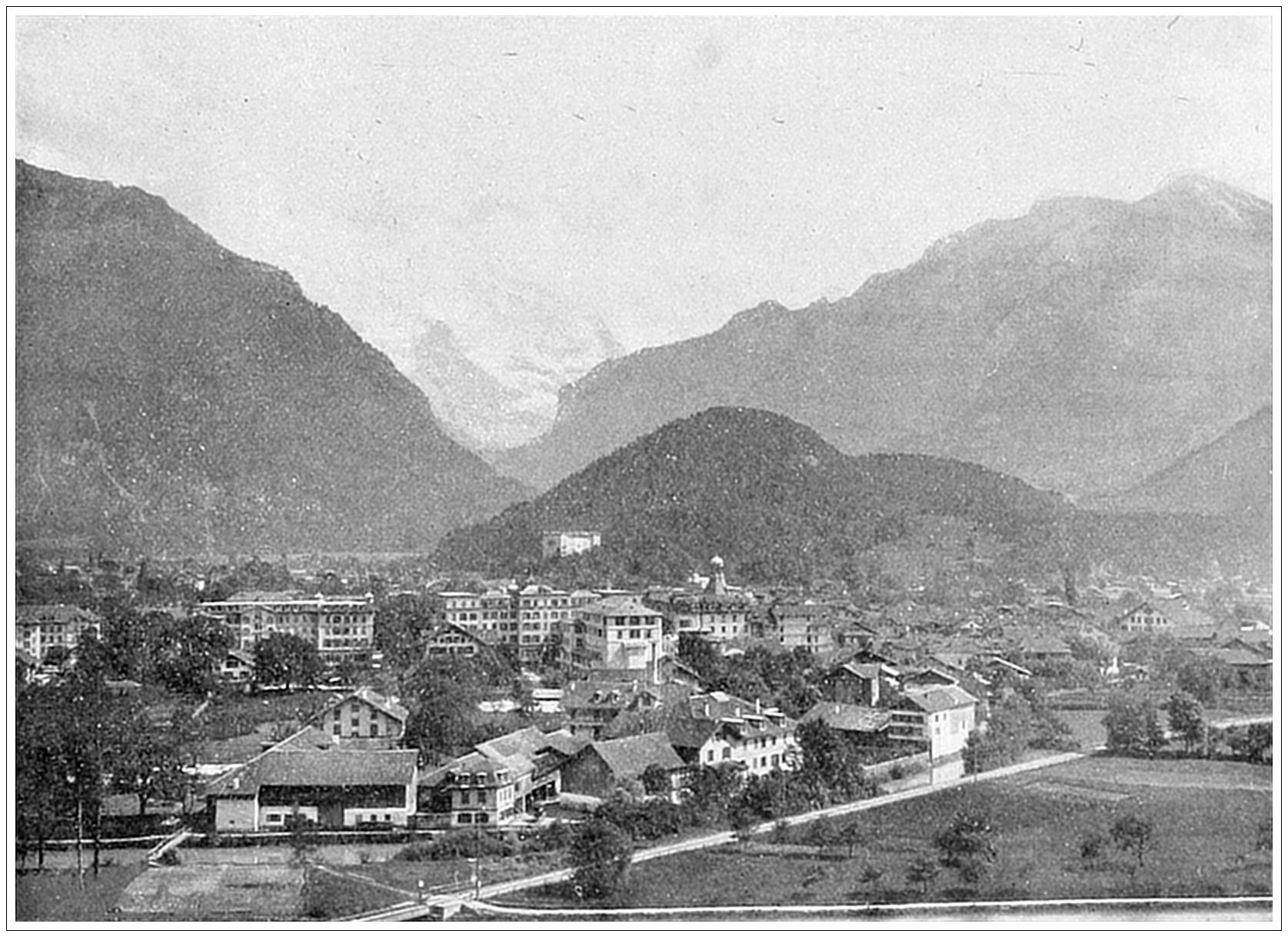
JUNGFRAU FROM INTERLAKEN, SWITZERLAND. The town of
Interlaken, as its name indicates, is situated between two lakes (Brienz
and Thun), in a valley about three miles wide, on either side of which
rises a ridge of precipitous mountains six thousand feet high. The great
attraction of the place is not the scenery either way along the valley, but a
view that is caught through a depression in the mountains on the southern
side, revealing the Jungfrau (“Young Maiden”) Mountain and her attendant
galaxy of noble Alpine peaks, rearing their snow-crowned heads far above the
horizon. The Jungfrau is the most imposing eminence in all the Bernese Alps.
Surrounded by stupendous precipices, her surface is broken by valleys, ravines
and glaciers, which from a distance look like creases in the mantle of snow
that covers her enormous flanks. The first ascent of this mountain was made
on August 3d, 1811.
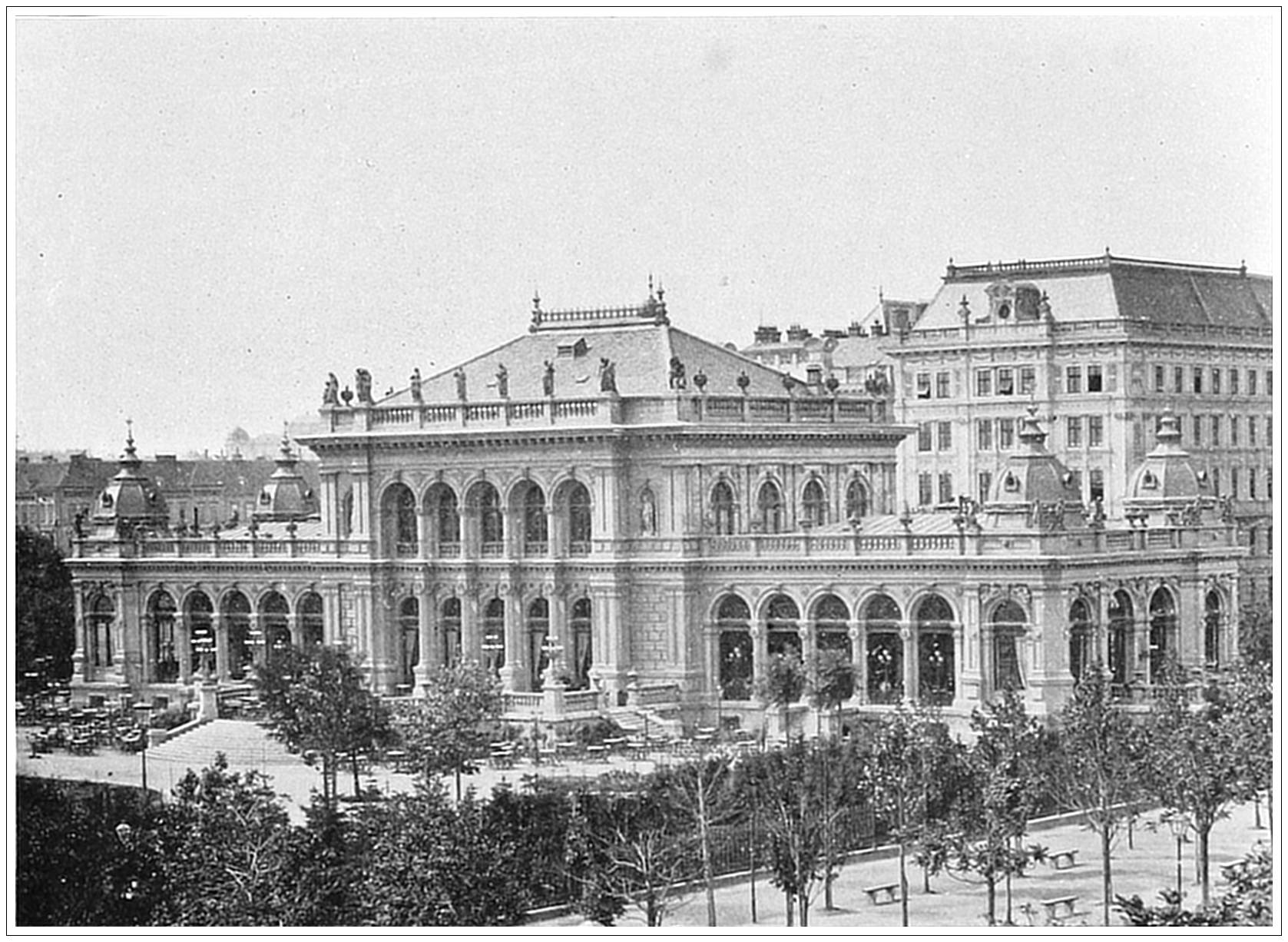
CURSALON, VIENNA, AUSTRIA. This handsome structure, in the
Italian renaissance style, was put up in 1865–67. With its surrounding
gardens, it forms one of the most attractive spots in the city. Concerts
are given here on Sundays and Thursdays, when large crowds are always sure
to attend.
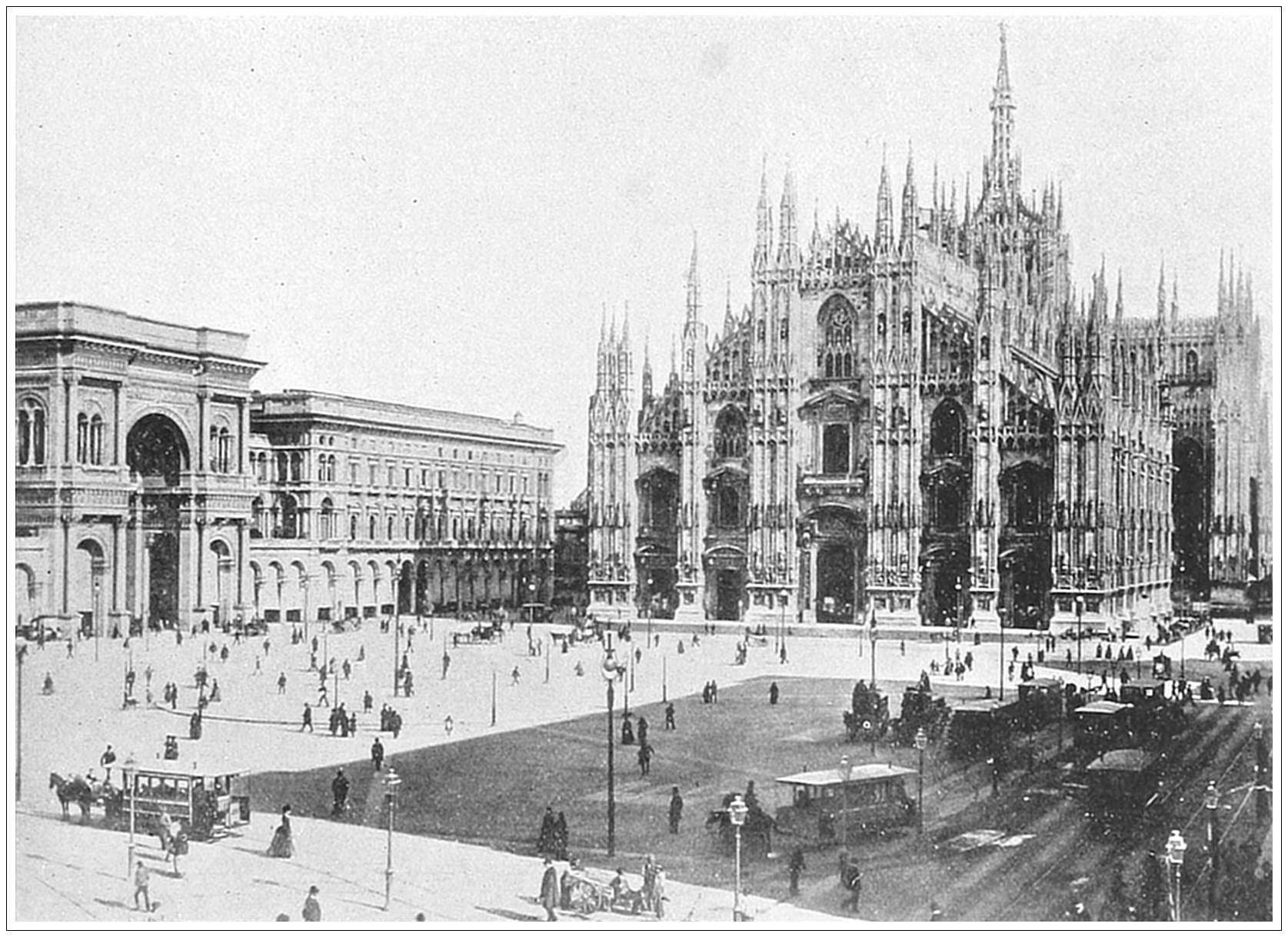
CATHEDRAL, MILAN, ITALY. The Milanese look upon this church
as the eighth wonder of the world. In truth, it is a marvelous edifice.
“Gothic art,” as Taine says, “here attains its triumph and its extravagance.”
Nowhere else is it so pointed, so complex, so highly embroidered,
so full of delicate detail. It differs from most Gothic cathedrals in being
built, not of dark stone, but of beautiful, lustrous white Italian marble.
Begun in 1386, it was not fully completed until 1805, at the direction of Napoleon.
The design is said to be taken from Monte Rosa, one of the loftiest
peaks of the Alps. Its ninety-eight sculptured pinnacles, rising from every
part of the body of the church, certainly bear a striking resemblance to the
splintered ice crags of Savoy. Next to St. Peter’s, at Rome, and the Cathedral
at Seville, this is the largest church in Europe, covering, as it does, an
area of fourteen thousand square yards.
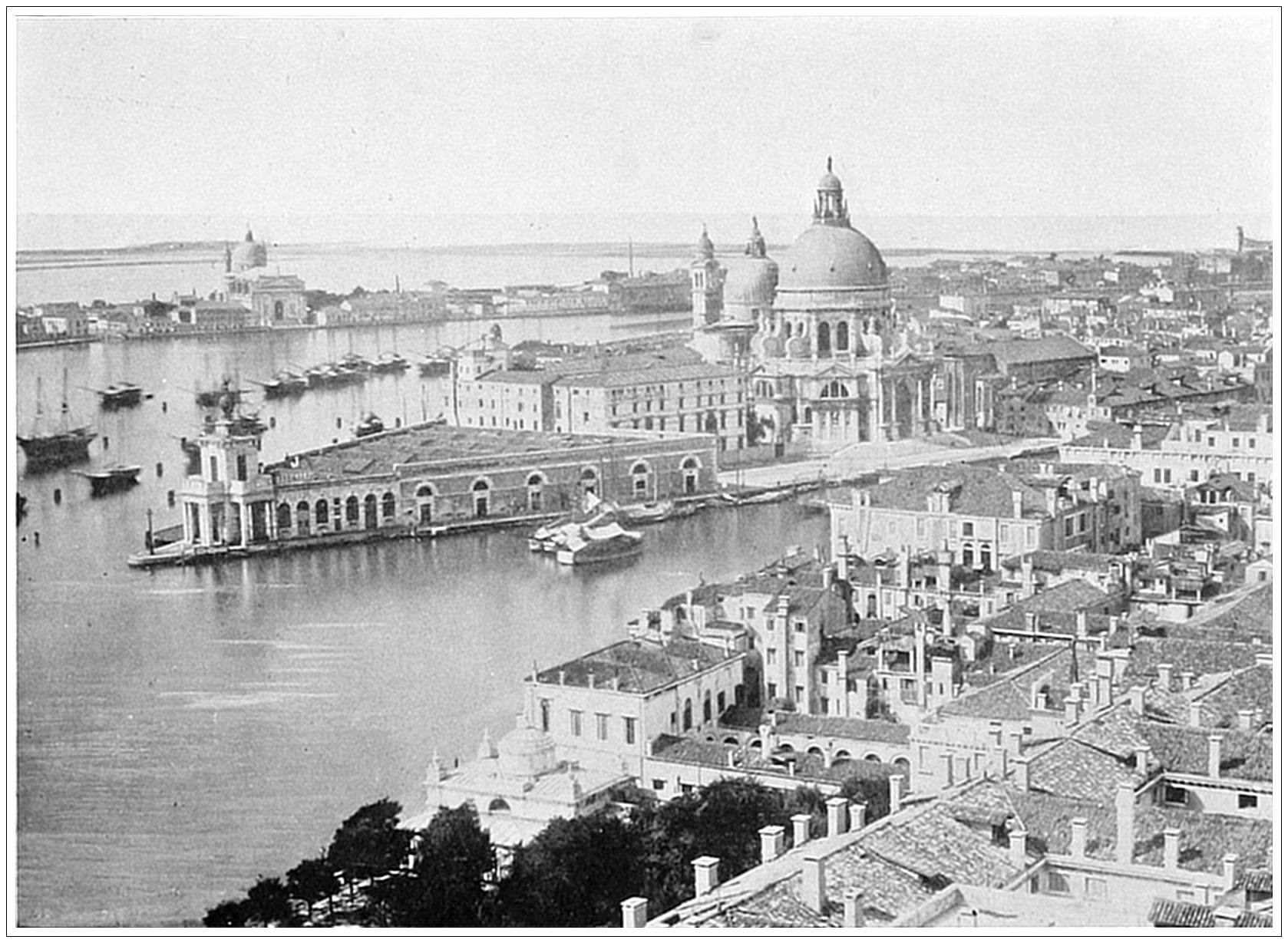
PANORAMA OF VENICE, ITALY. No city in the world is more fascinating
than Venice. Its very situation makes it unique, built as it is
on a cluster of small islands, a hundred or more in number, in the lagoon
of the same name. A long, narrow sand-bank, divided by several inlets, separates
the lagoon from the Adriatic. The largest of the islands is the Isola di
Rialto, which gives its name to the famous bridge. The Grand Canal winds
through the city in a double curve, like the letter S, and divides it into two
unequal parts. The one hundred and forty-six smaller canals and a perfect
network of small streets and bridges form the other thoroughfares. The
splendid churches, the vast treasures of art and the magnificent palaces, remind
one of the glories of the past, and fill the present with a surpassing beauty.
By the fifteenth century Venice had become the greatest republic in Europe
and the focus of its commerce. The immense wealth of its merchant princes
enabled them to gratify their artistic sense in the superb monuments still
extant.
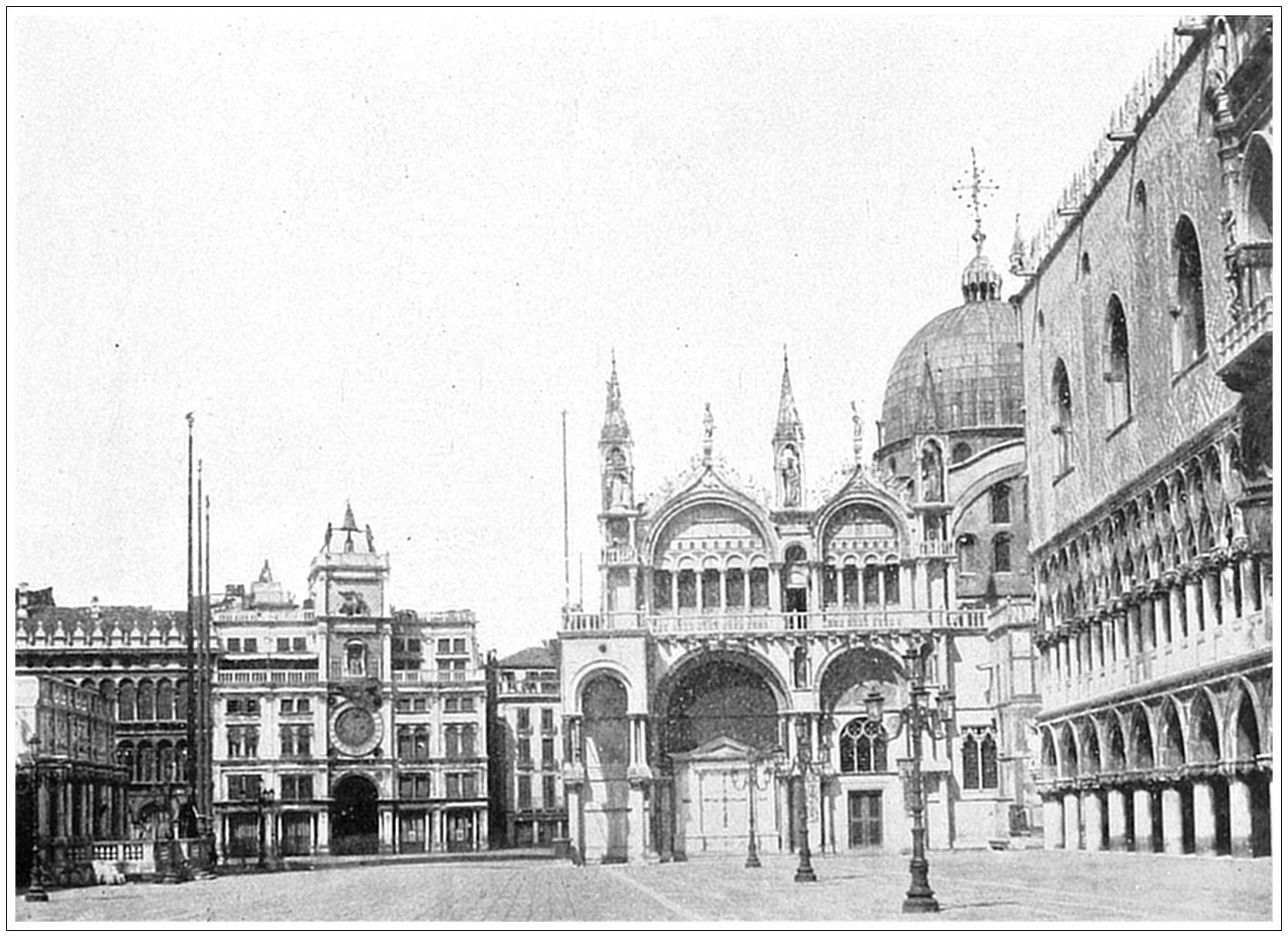
ST. MARK’S, VENICE, ITALY. This famous cathedral church is a
strange jumble of all styles of architecture, Christian as well as Saracenic,
yet both without and within breathing a rich and wonderful
harmony. The present building, dedicated in 1085, takes the place of an
older and simpler structure, that was destroyed by fire in 976. In front of
the church, to the southwest, rises the Square Campanile, surmounted with the
figure of an angel. To the east of the church the famous Piazzetta, or “Little
Square,” extends to the Grand Canal, glorified by the Palace of the Doges, or
ancient rulers of the city, which some architects look upon as the finest building
in the world. It is from this Piazzetta that the picture is taken. The
square in front of St. Mark’s is the grand focus of attraction in Venice, and
in summer nearly the entire population congregate here.
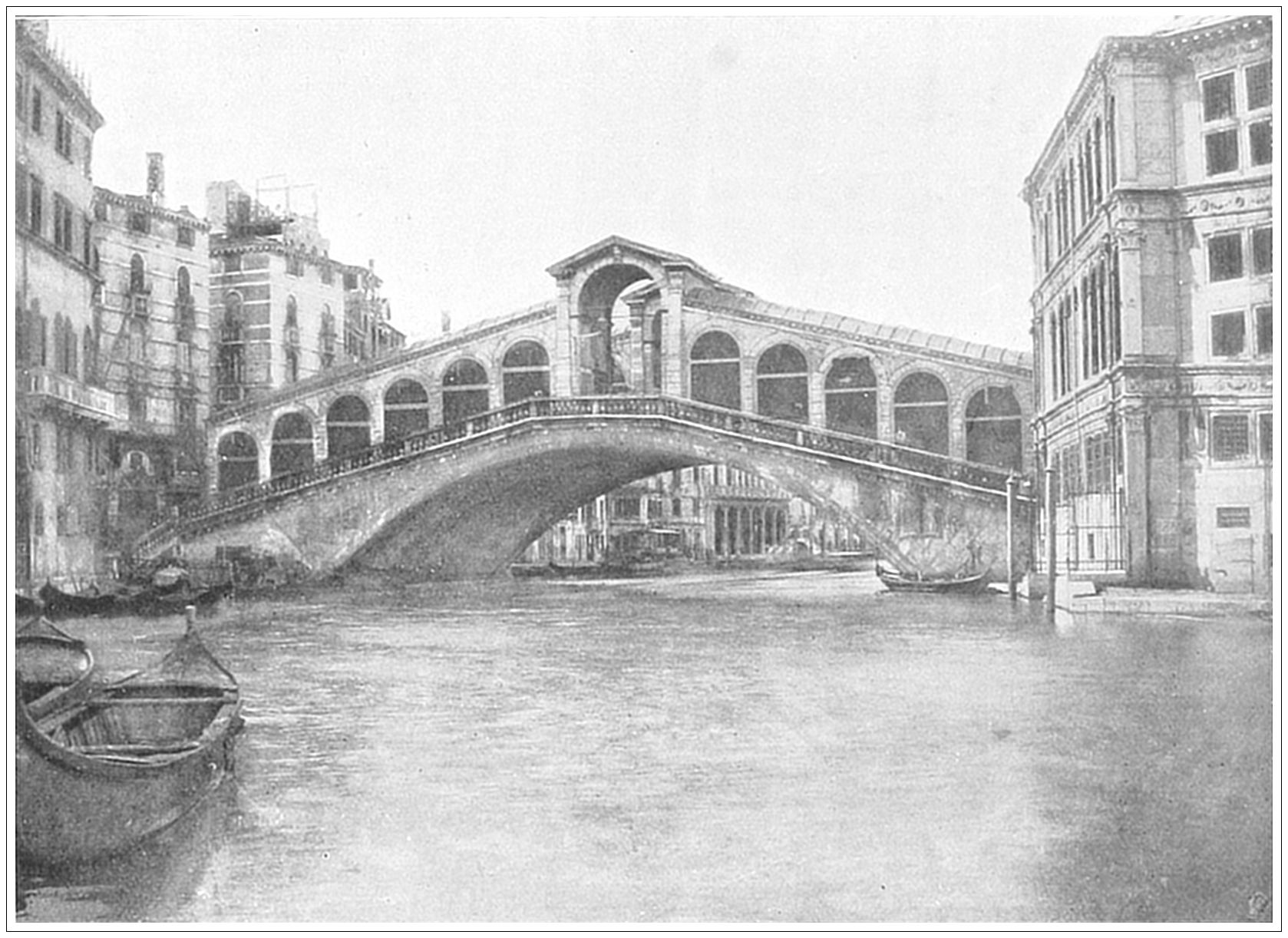
GRAND CANAL, VENICE, ITALY. This is the main thoroughfare of
the city of the sea. On either side of its serpentine length it is lined by
marble-fronted palaces, whose very names awaken a thrill of historic
or romantic recollection. Gondolas dart up and down among the waters, and,
alas! the disillusionizing modern steamboat puffs its vicious way through the
complaining waters. About half-way in its course the canal is crossed by the
famous Rialto bridge, a single arch of unique and elegant construction,
seventy-four feet in length, resting on twelve thousand piles. This was built
in 1588, subsequent therefore to the period of Venice’s greatest glory. The
ancient Rialto, which Shakespeare speaks of as the meeting place of the merchants,
was not this bridge, but the Exchange which used to go by the same
name, and was long the centre of trade and commercial life in this city.
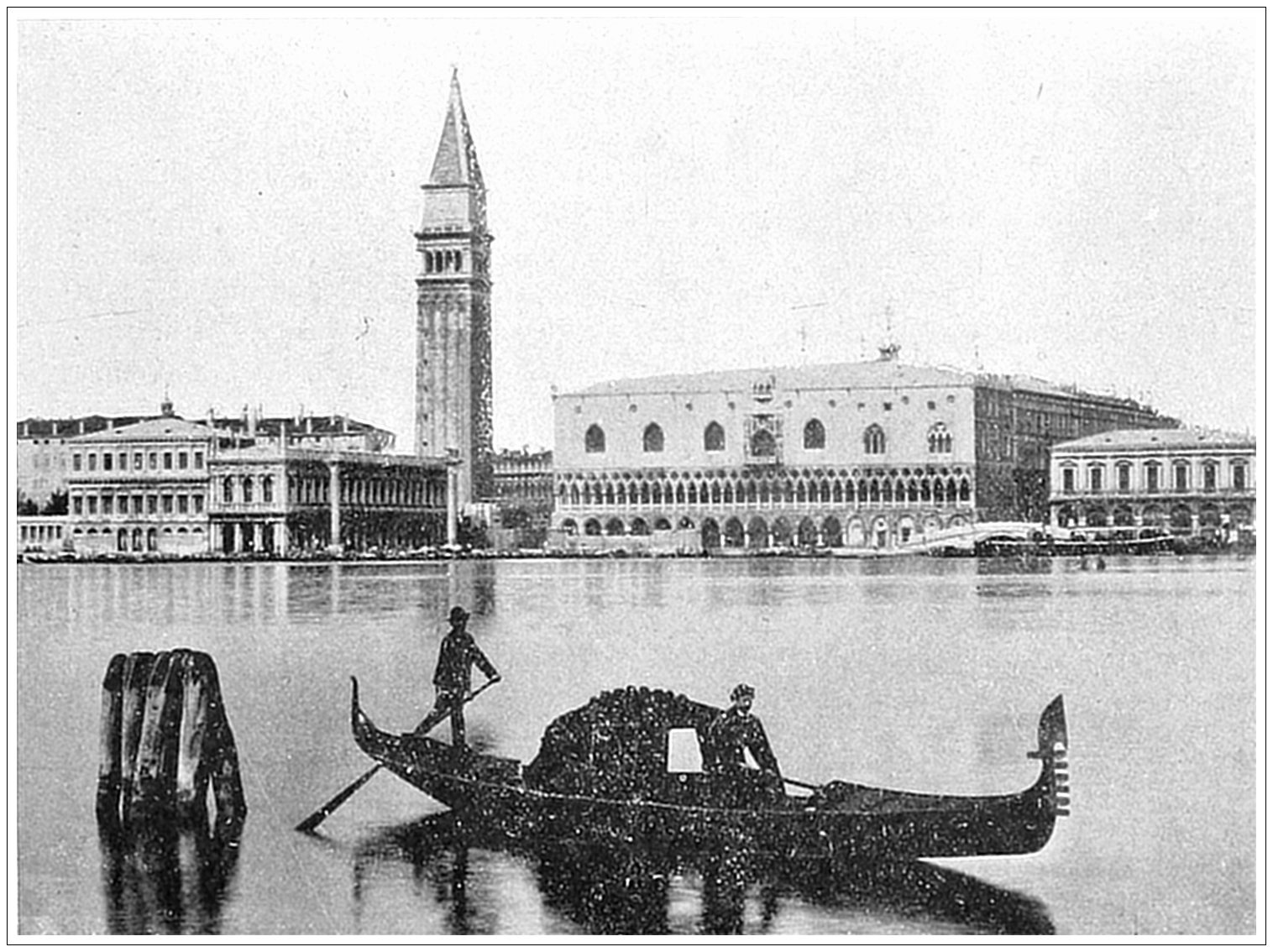
THE DOGE’S PALACE, VENICE, ITALY. At right angles to the Piazza
San Marco, at the south-east end, runs the Piazzetta or little square,
whereon is situated the former residence of the Doges, an ancient seat of
government. Ruskin calls this “the principal work of Venice.” Originally
built in 800, five times destroyed and as many times rebuilt in a style of greater
magnificence, the present structure dates from the fourteenth century. It is
in the Moorish-Gothic style. The form is an irregular square; the west side,
facing the Piazzetta (two hundred and thirty feet in length), and the south
side, facing the sea (two hundred and twenty feet in length), are flanked by
two colonnades, one above the other, with exquisite traceries. The mouldings
of the upper colonnade are especially rich. The interior court of the building
presents a wilderness of elegant columns, cornices, arches, carvings, sculptures
and bas-reliefs. A magnificent collection of Venetian paintings is housed
within these walls. On the east side the palace is connected with the prisons
by the so-called Bridge of Sighs, which owes most of its fame to Byron’s sentimentality.
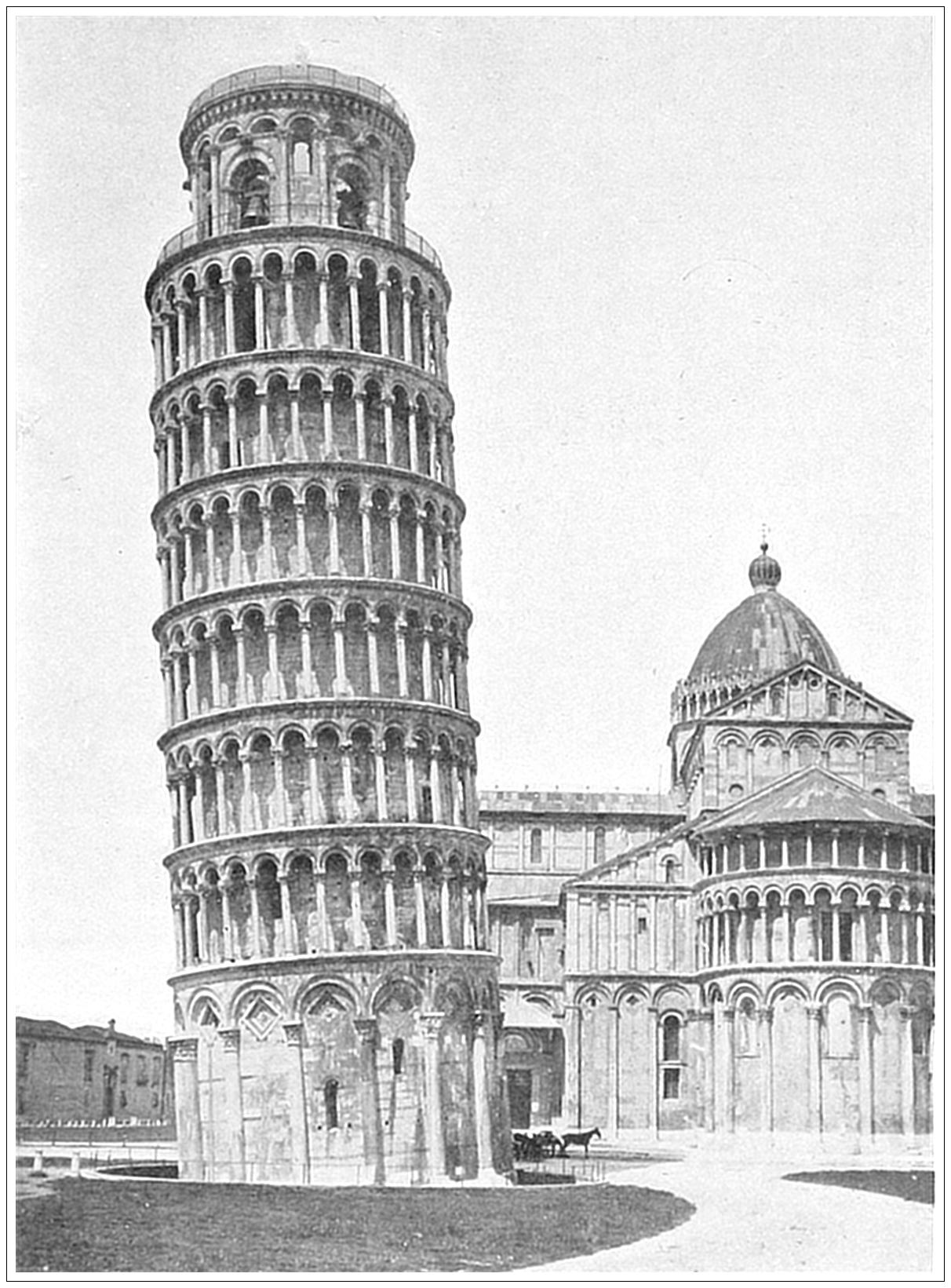
CATHEDRAL AND LEANING TOWER OF PISA, ITALY. The
Cathedral of Pisa, begun in 1063, and consecrated in 1118, forms, with
its Baptistery and Campanile, the most singular group of buildings
in the world. Their beauty is equal to their singularity. The church itself
is constructed entirely of white marble, with black and colored ornamentation.
An elliptical dome covers the centre. The façade, adorned in the lower story
with columns and arches, and in the upper story with four open galleries, is
of exquisite and dainty beauty. So, likewise, is the Baptistery, a circular
structure, surrounded by half columns below and a gallery of small, detached
columns above, the whole crowned by a conical dome. But the strangest
effect of all is produced by the Campanile, better known as the Leaning Tower,
from the fact that it is thirteen feet out of the perpendicular. That this obliquity
was accidental and due to the sagging of the foundations is now generally
agreed. Aside from this peculiarity the Campanile would arrest attention by
its winsome grace.
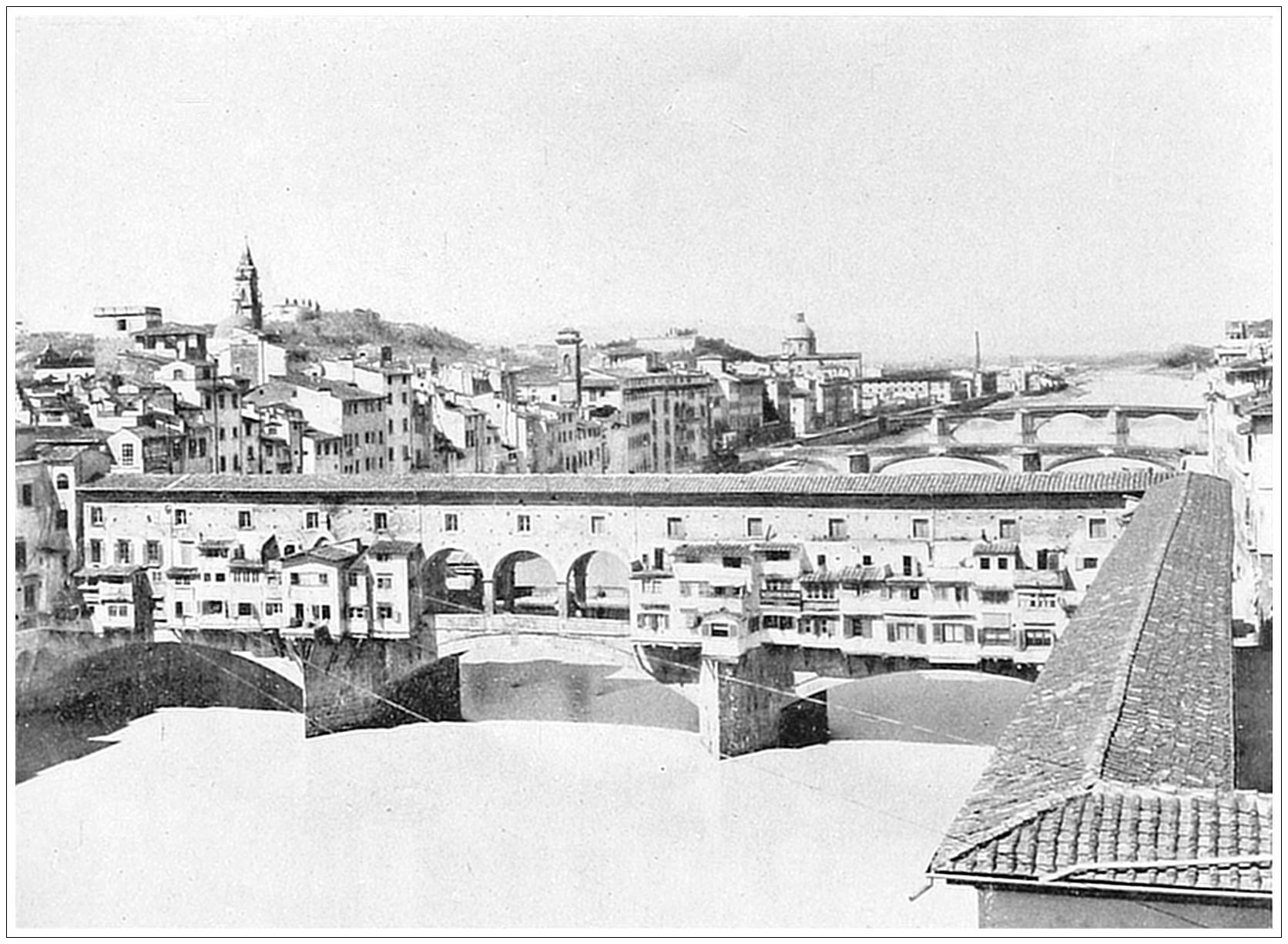
PONTE VECCHIO, FLORENCE, ITALY. There is no more picturesque
bridge in the world than this. It spans the river Arno at a point
where tradition asserts that a Roman predecessor used to exist. Certain
it is, that bridges were built here and repeatedly demolished before Taddeo
Gaddi erected the present structure of three arches. It is flanked by shops,
which have belonged to the goldsmiths and jewelers since the fourteenth century,
and is still the centre of their trade. Above the roofs of these shops
runs the gallery of the Grand Duke, built as a secret passage between the
Uffizi and the Pitti Palaces. The bridge itself might easily be mistaken for
a continuous street by the stranger, except for the vacant space over the central
arch, which gives a glimpse of the city and the river on each side.
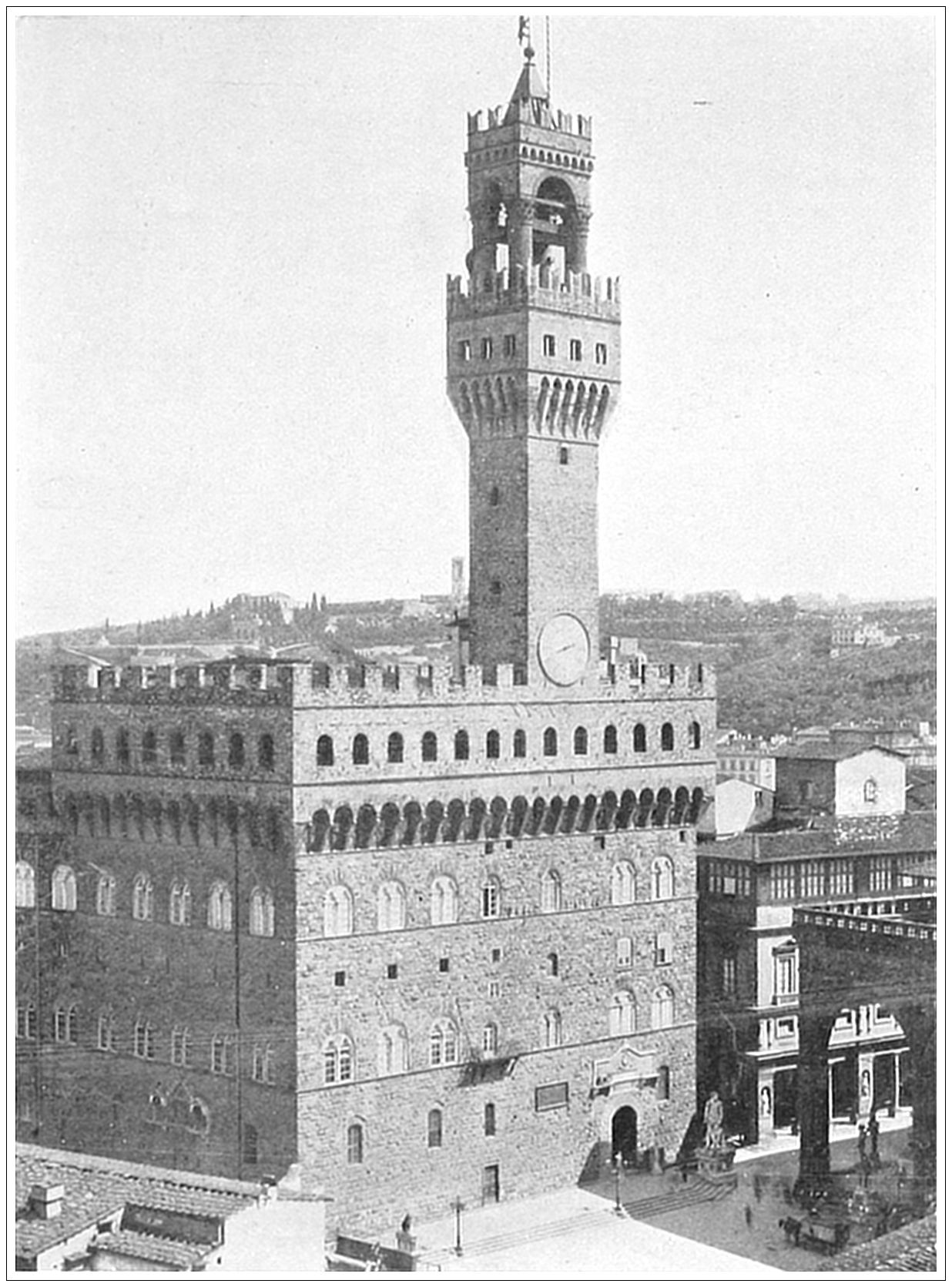
PALAZZO VECCHIO, FLORENCE, ITALY. The ancient capitol of the
Republic of Florence, and subsequently the residence of Cosmo de’ Medici,
is known as the Palazzo Vecchio, or Old Palace. Begun in 1298, it is
a striking example of the Florentine castles of the Middle Ages, with its enormous
projecting battlements and its disproportionate bell tower, defiantly stuck
upon the walls without regard to symmetry, and almost overhanging the battlements.
It is situated in the Piazza della Signoria, the historic, as well as
the commercial, centre of Florence. The court is adorned with a fountain
and sculptured columns. In front of the entrance is Bandinelli’s group of
Hercules and Cacus. At right angles to the left is the Loggia dei Lanzi, an
open arcade, famous for its own beauty and for the sculptured master-pieces
which it enshrines. A large and elegant fountain is on the right.
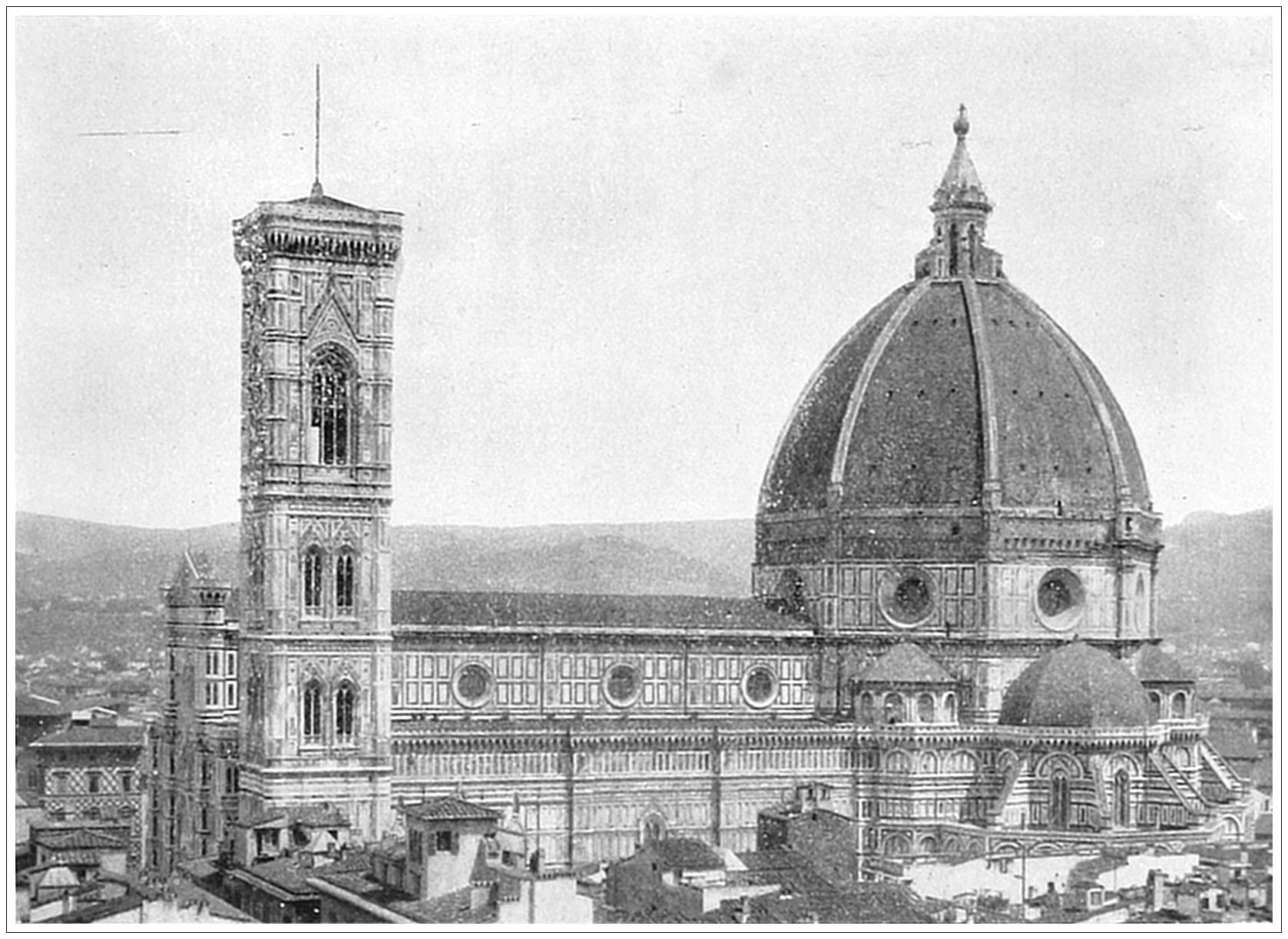
CATHEDRAL OF FLORENCE, ITALY. This is generally known as
the Duomo or Dome, though its official designation is Santa Maria del
Fiore. Arnolfo di Cambio began it in 1298; he was succeeded by
Giotto, and the dome was added by Brunelleschi. The latter is not only beautiful
in itself, but is interesting as the first of the great domes of the modern
world. A half-finished façade was destroyed by fire, and the deficiency was
not supplied until 1875–1884. The interior is impressive, though almost entirely
devoid of ornamentation. Outside the church, to the left, is the Campanile,
an exquisite work by Giotto; so exquisite that Charles V declared it
ought to be kept in a glass case. In front is the Baptistery, an octagonal
building, surmounted by a dome. It was begun in 1352 and finished in 1358.
Its chief attraction lies in the bronze doors, especially those by Lorenzo
Ghiberti, which Michael Angelo eulogized as worthy to be the gates of
Paradise.
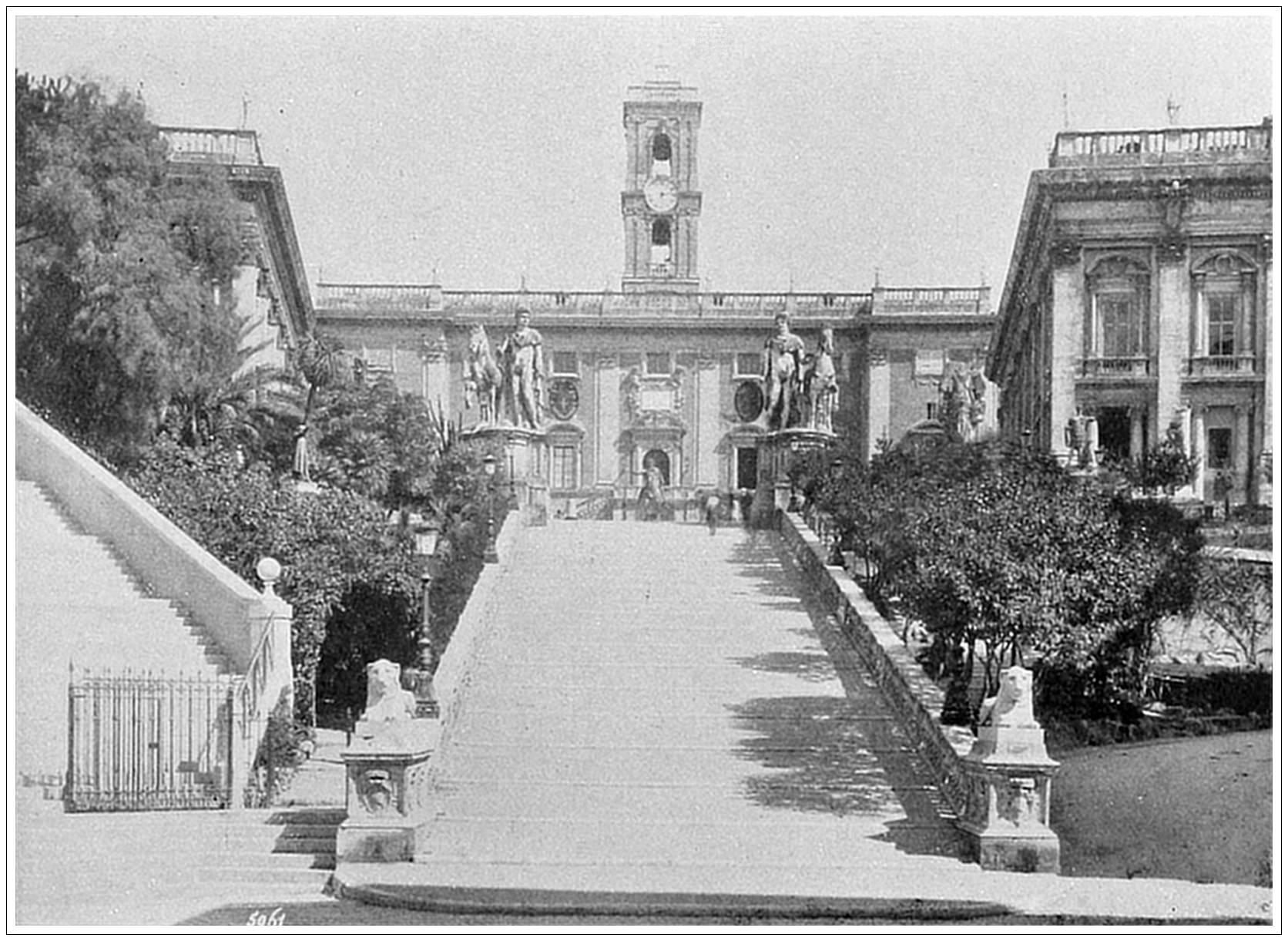
THE CAPITOL, ROME, ITALY. Anciently, the Capitoline Hill, in Rome,
was surmounted by the Temple of Jupiter Capitolinus and the citadel
of the city. Hence, here was the head of the Roman state and the
shrine of their religion. But temple and citadel have vanished and in their
place is a group of buildings erected by Paul III from the designs of Michael
Angelo. On the right is the Palace of the Conservatori, on the left the
Museum of the Capitol and between the two, occupying the third side of the
square, is the Palace of the Senator, a modern Roman patrician with that title.
The photograph shows the best approach to the square up the grand stair-case,
known as La Cordonnata, which in its present form dates from 1736. At the
foot of the stairs are two Egyptian lions, and at the summit, on the angles of
the balustrades, two ancient colossal statues of Castor and Pollux, standing by
the sides of their horses. These were found in the sixteenth century. In the
centre of the square is the bronze equestrian statue of Marcus Aurelius.
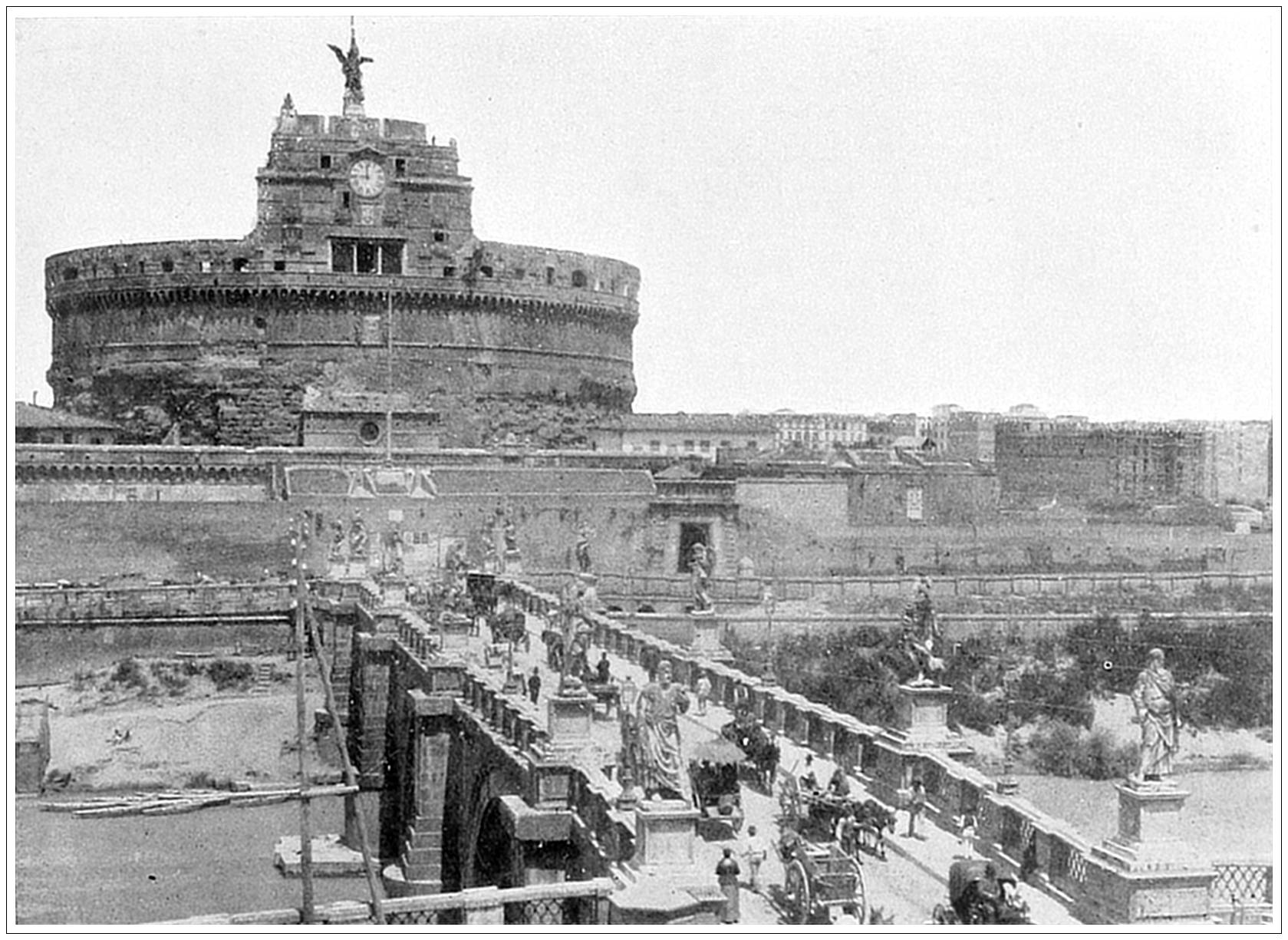
CASTLE OF ST. ANGELO, ROME. Originally this famous structure
was built by the Emperor Hadrian as a mausoleum for himself and his
family. The same emperor also erected the bridge now known as St.
Angelo—anciently as the Pons Ælius—which crosses the Tiber opposite the
castle. Tradition affirms that Gregory the Great in 589 changed the name in
memory of a vision of the Archangel Michael, who appeared to him standing
on the summit of the mausoleum. He built a chapel on the summit, but subsequently
this was replaced by the statue still extant. During the Middle
Ages this was the fortress of Papal Rome, and its history at that period is
bound up in the history of the city itself. It has also served as a prison, and
part of it was up to recent times still used for that purpose. It has suffered
much from sieges and the ravages of time, and is now but the skeleton of the
magnificent pile erected by Hadrian. No vestige remains of the shell of
Parian marble which encircled it, while the statues were torn off to be used as
missiles against the Goths, and later as cannon balls.
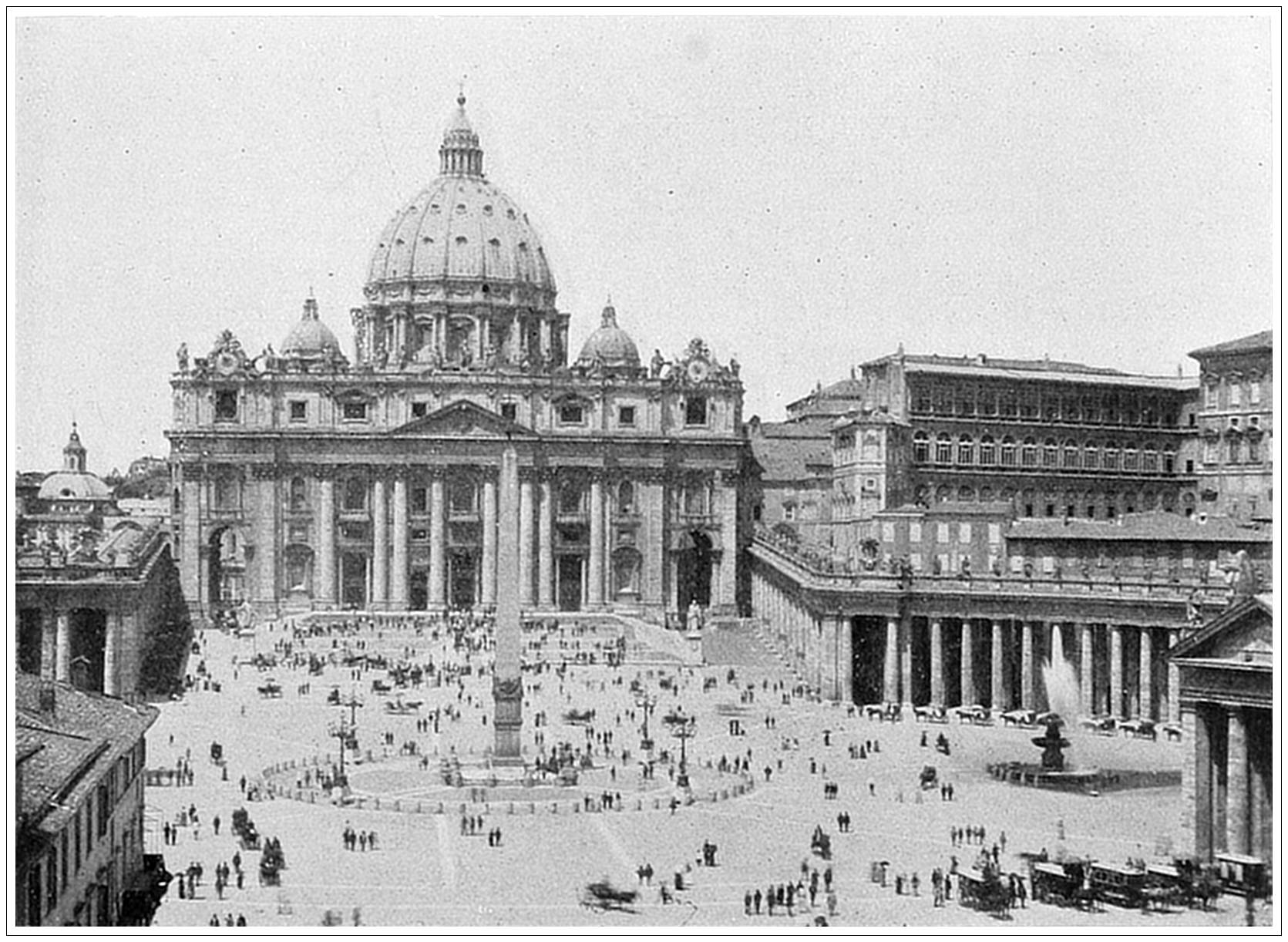
ST. PETER’S, ROME, ITALY. This is the largest and most magnificent
of all Christian temples. It is built on the supposed site of the burial-place
of St. Peter. As early as A. D. 90 an oratory was raised on the
spot; in 306 this was followed by a basilica. The present edifice was begun
in 1506, and after employing the talents of Bramante, Michel Angelo and other
architects, was dedicated by Urban III in 1626. The magnificent dome was
mainly the work of Michael Angelo, though his plan was somewhat modified
by Giacomo della Porta. The impressive colonnades, which almost encircle
the square and lead up to the front, were added in 1667. The façade is confessedly
a failure. But nothing can mar the beauty of this extraordinary
edifice. Although it occupies some two hundred and forty thousand square
feet, the interior, from its exquisite proportions, does not at once impress the
beholder with a sense of its vastness. That grows upon one by degrees. The
Vatican, which adjoins St. Peter’s, is an equally enormous and beautiful building,
which comprises the residence of the popes, an astounding museum of
pictures and statues and a library of unexampled historic interest.
THE COLOSSEUM, ROME. This mammoth ruin, originally known as
the Flavian amphitheatre, is the most magnificent relic of ancient Rome.
Begun by Vespasian in A. D. 72, it was dedicated by Titus in A. D. 80
and was subsequently added to by Domitian. As the circus of the public
games for nearly four hundred years, it was the scene of gladiatorial conflicts
and of the persecution of the Christian martyrs. After the triumph of
Christianity it fell into neglect, and suffered continuous spoliation as a quarry
for the material of new buildings. Finally, in 1750, Benedict XIV rescued it
in its present condition by dedicating it to the memory of the Christian
martyrs who had suffered therein. A cross in the middle of the amphitheatre
is continually visited by the pious. “As it now stands,” says Forsyth, “the
Colosseum is a striking image of Rome itself, decayed, vacant, serious, yet
grand, half gray and half green, exact on one side and fallen on another,
with consecrated ground in its bosom.” Hillard calls it “a great tragedy in
stone.” It was originally built to seat ten thousand spectators. There were
three orders of architecture used in the four stories; the first, Doric; second,
Ionic; third and fourth, Corinthian. In each of the lower tiers there were
eighty arches. The height of the outer wall was one hundred and fifty-seven
feet, the circumference one thousand six hundred and forty-one feet, the entire
superficial area being six acres.
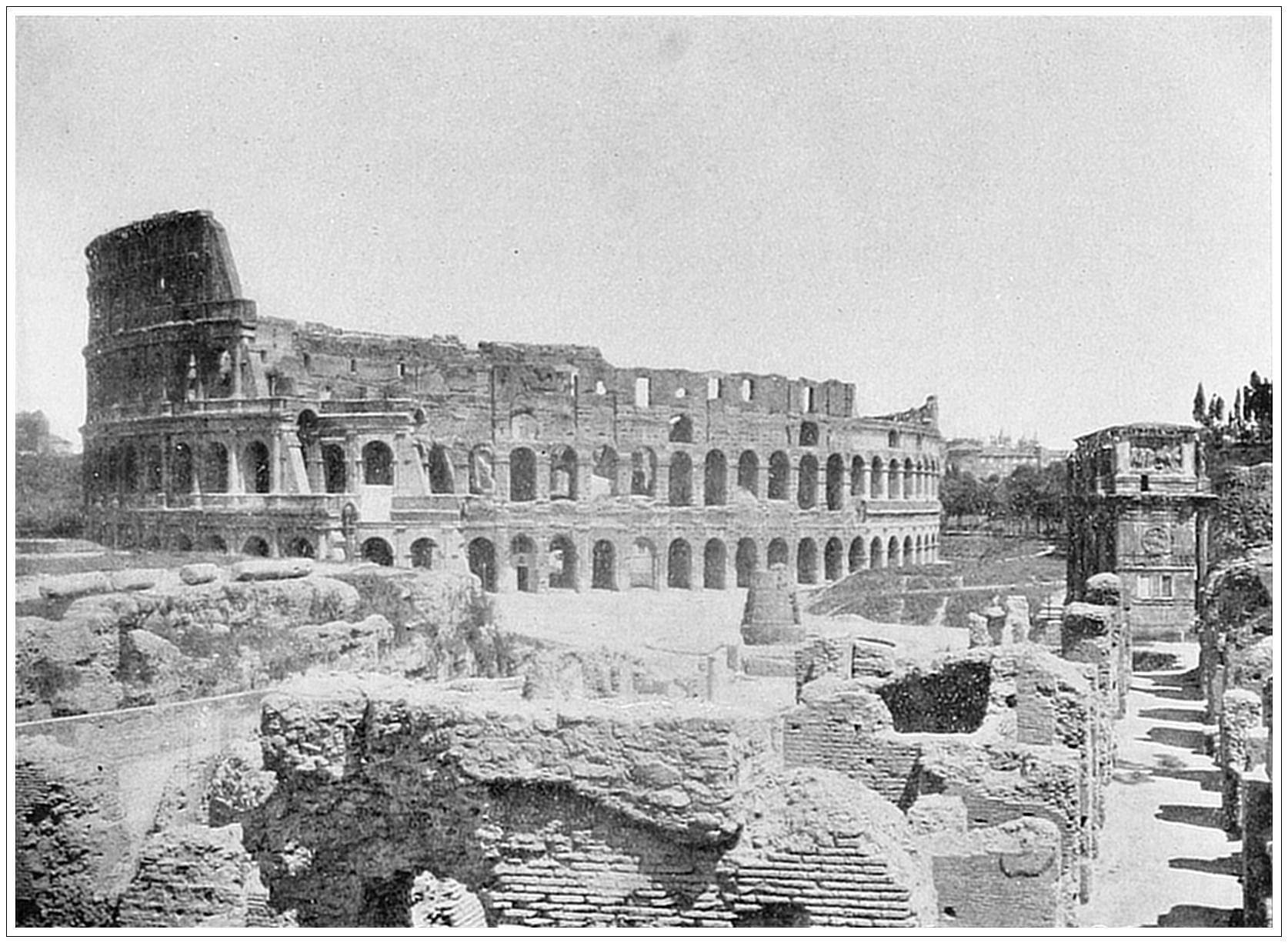
THE PANTHEON, ROME. This is one of the grandest, as it is the most
perfectly preserved, of all the ancient monuments of Rome. Except for
the ridiculous belfries superimposed by Bernini on the outside, it is to-day
substantially in the same condition as when Marcus Agrippa in B. C. 27,
after the establishment of universal peace, consecrated it to all the gods. In
A. D. 608 it was dedicated as a Christian church by Pope Boniface IV, under
the name of Santa Maria ad Martyres. The portico is of faultless beauty,
and the interior, as the picture shows, is a perfect rotunda, impressive in its
grand simplicity. The domed ceiling is lighted solely by an aperture twenty-three
feet in diameter, the wall being supported by a huge bronze ring. An
additional interest for moderns lies in the tombs of Raphael, Caracci and
other painters who are buried therein, and more recently the remains of
Victor Emmanuel have been added to those of the artistic brotherhood.
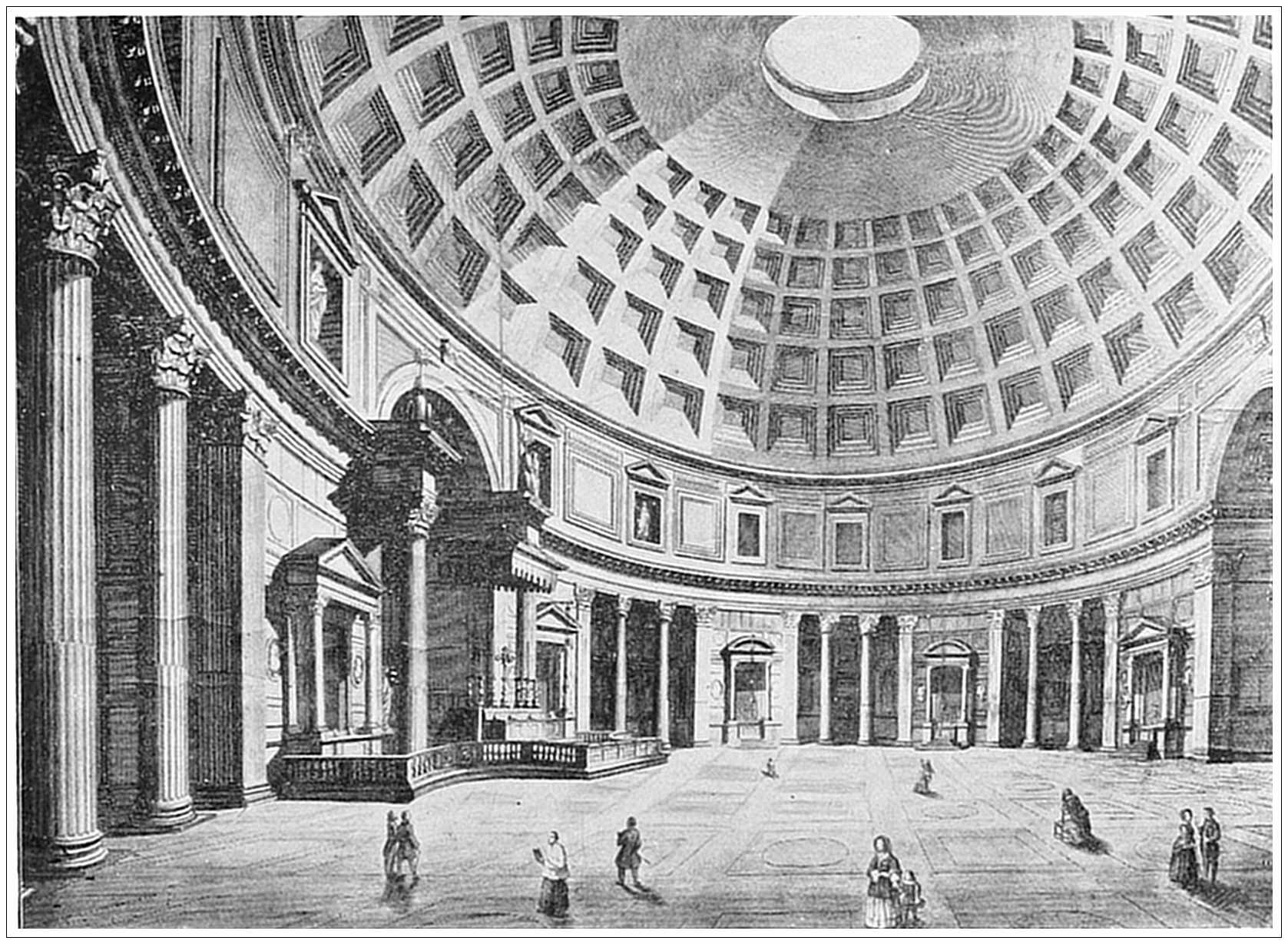
TOMB OF CECILIA METELLA, ROME, ITALY. The Via Appia of
ancient Rome was one of the great avenues leading out from the city,
and the principal line of communication with the South. It is named
after Appius Claudius Caecus, the censor, who began its construction in B. C.
312. Under Pius IX the ancient road was once more laid open. To-day it
presents the appearance of an avenue, eleven Roman miles in length, lined on
each side by ruins, mostly of magnificent tombs, which were built by the patrician
families of ancient Rome to the memory of their dead. The best preserved
of these is the tomb of Cecilia Metella, the wife of Crassus, a circular tower
seventy feet in diameter, resting upon a quadrangular base. The battlements
upon it are mediæval additions, made for the purpose of defense by the Caetanis.
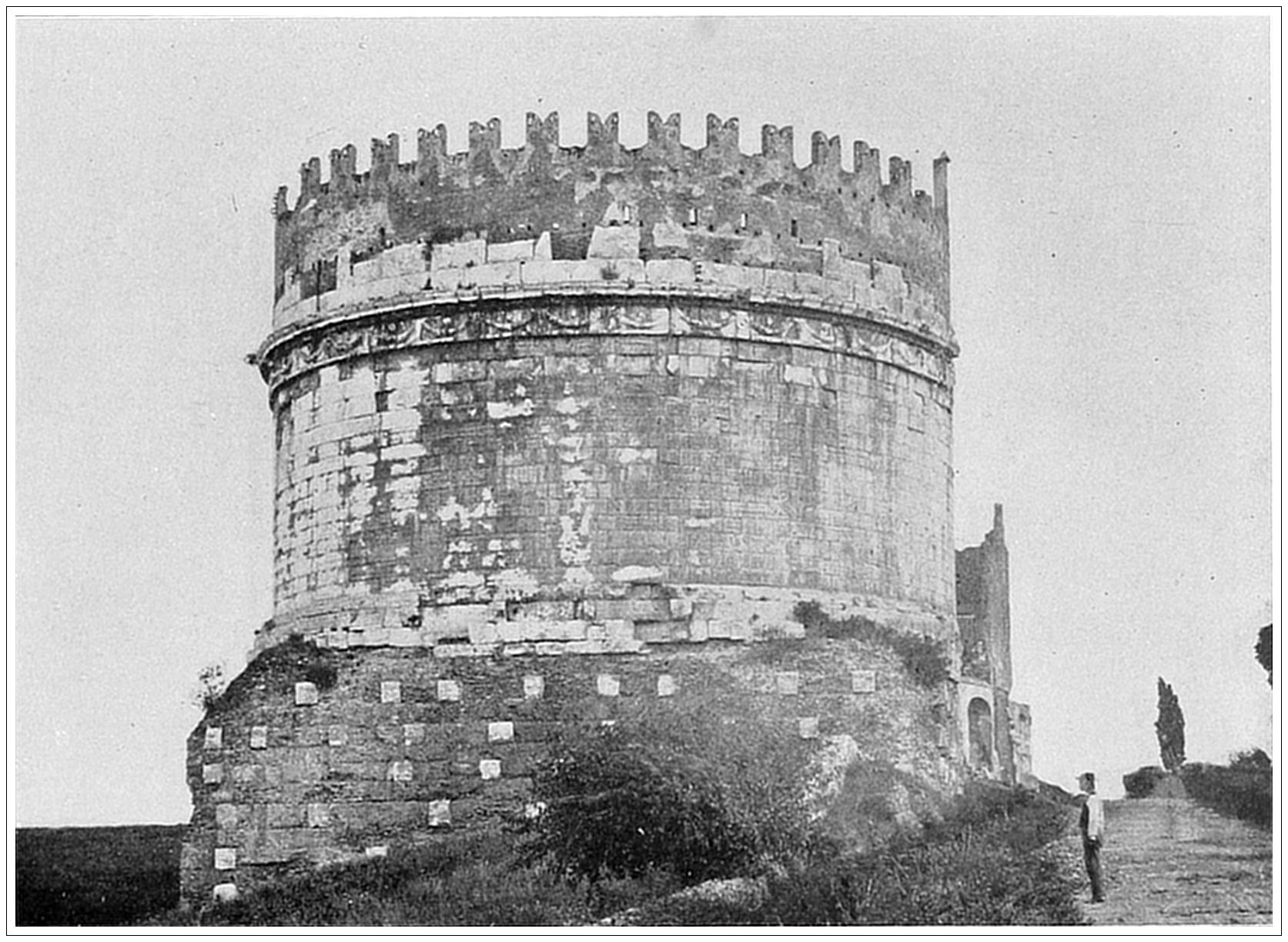
FORUM ROMANUM, ROME, ITALY. The ancient Forum of Rome
exists only in ruins. That it lay at the foot of the Capitoline and Palatine
Hills in Rome is certain from the remnants that survive. But the
exact area it occupied and the true situation of the various buildings which
once covered it are matters of dispute and uncertainty. Conspicuous among
the ruins are three beautiful Corinthian columns of white marble belonging
to the temple raised to Vespasian by Domitian; eight granite columns belonging
to the Temple of Saturn, a beautiful fragment, consisting of three Corinthian
columns with a rich entablature, a solitary column which Byron calls,
The nameless column with a buried base,
but whose now excavated base reveals that it was erected to the Emperor
Phocas, the arches of Septimus Severus and of Titus, and a profusion of
columns, pavements, foundations and walls of other structures.
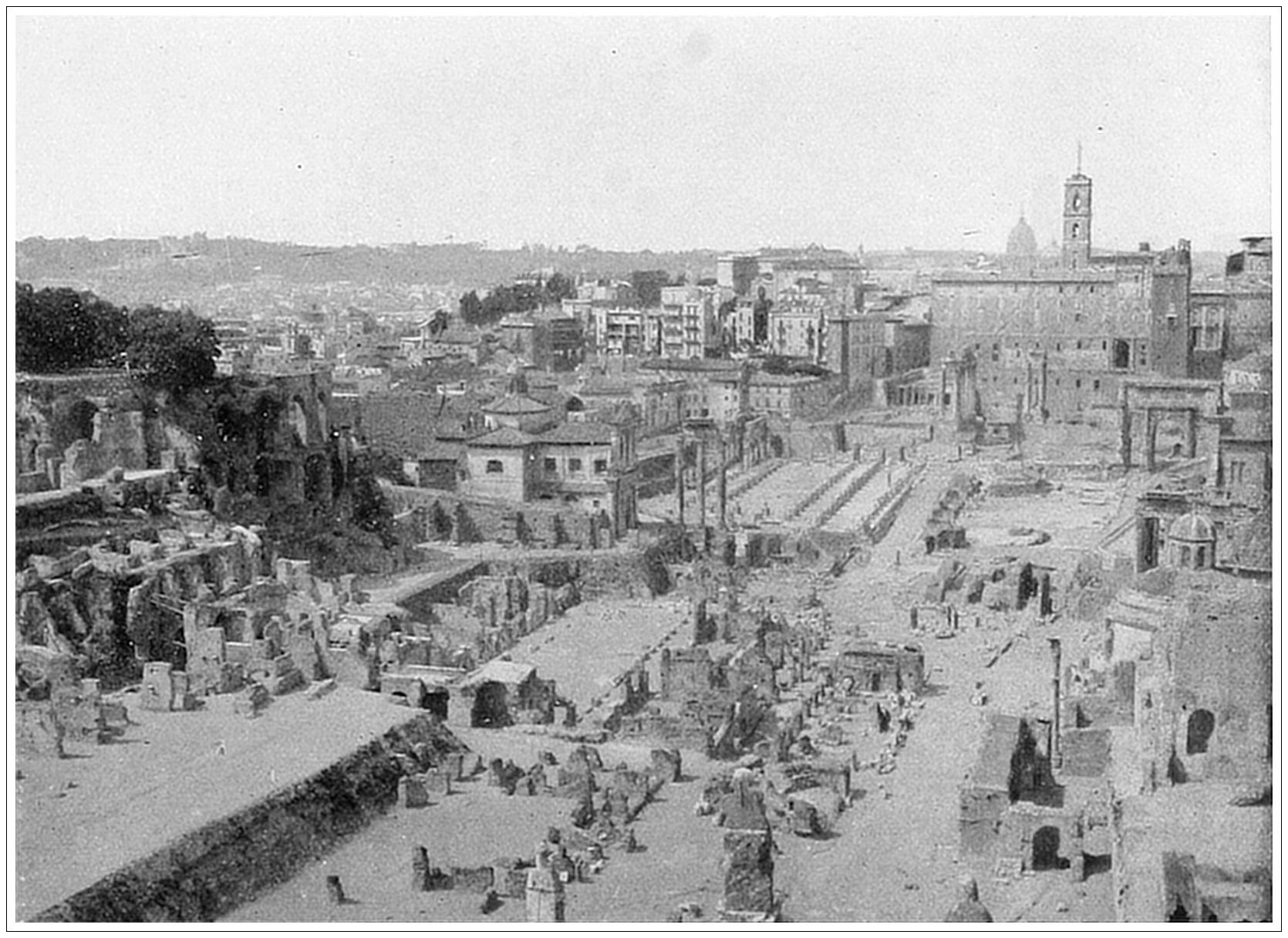
BAY OF NAPLES AND MOUNT VESUVIUS, ITALY. Naples, in
itself one of the least interesting of Italian cities, attracts the attention
of the tourist by its transcendent beauty of situation and by the historical
and picturesque interest of its surroundings. The Bay of Naples is the most
glorious spot in the Mediterranean. Its circuit is more than fifty-two miles,
including the islands of Ischia, at the north-west, and of Capri, at the south
entrance. At its opening, between these two islands, it is fourteen miles broad,
and from the opening to its head, at Portici, the distance is fifteen miles. On
the north-east shore, east of Naples, is an extensive flat, whence rises Vesuvius,
the most famous of European volcanoes, at the base of which are several villages
and the classic sites of Herculaneum and Pompeii. The Italian proverb, “See
Naples and die,” is a tribute to the beauty of the city and its environment.
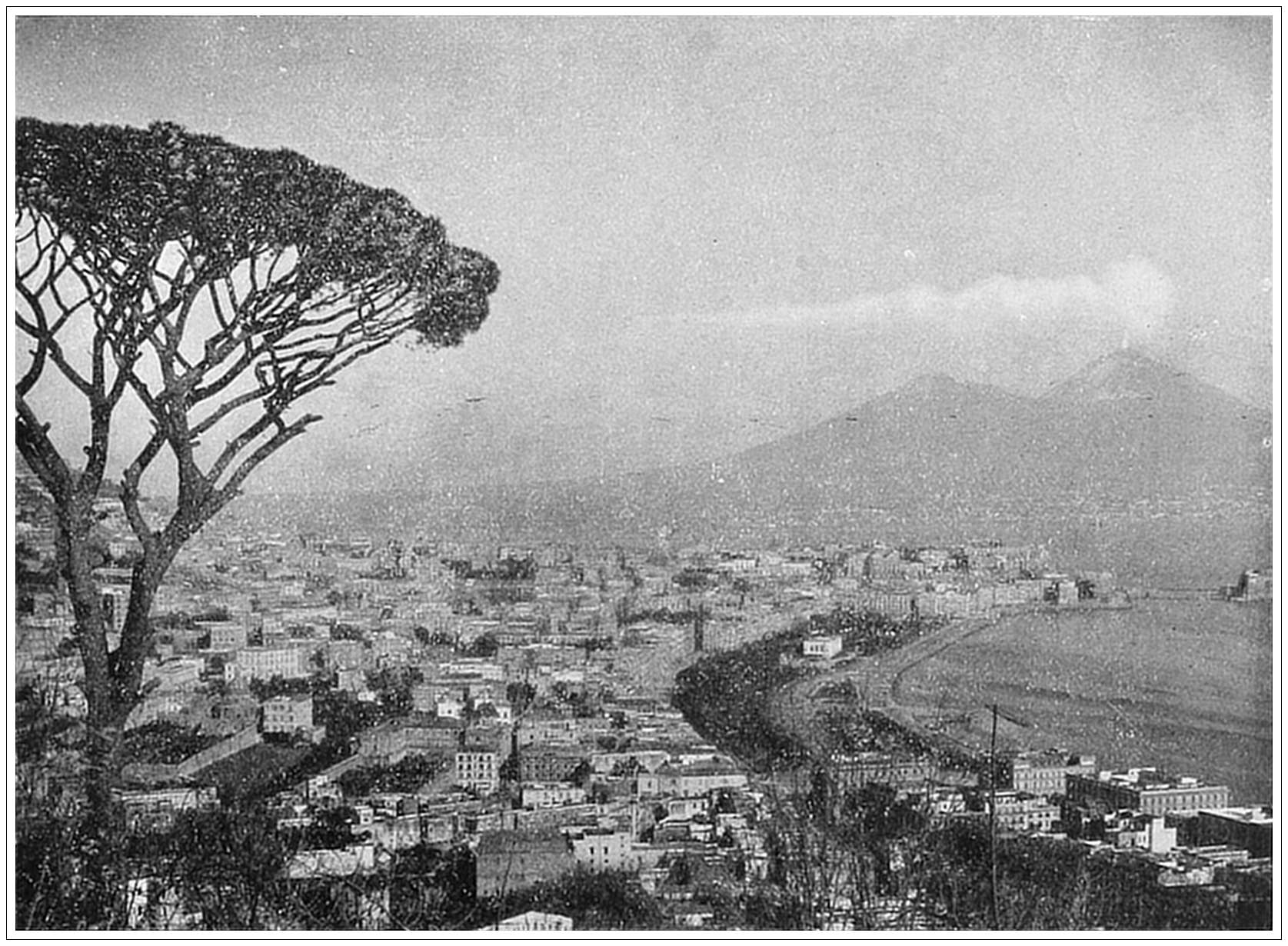
POMPEII, ITALY. The volcanic eruption which overwhelmed Pompeii
on August 24th, A. D. 79, has afforded us our most important, indeed,
almost our only source of acquaintance with the domestic life of the
ancient Romans. To be sure it represents one definite epoch of antiquity only,
that of the glories of the early empire when Pompeii became the favorite
retreat of Romans of the wealthier classes. But the study of the various
phases of life at this epoch forms a pursuit of inexhaustible interest. The
ashes from Vesuvius completely covered over the town to the depth of about
twenty feet until the year 1748, when the accidental discovery of some statues
led to the excavations. They have been continued up to the present time,
and will not be completed for half a century more.
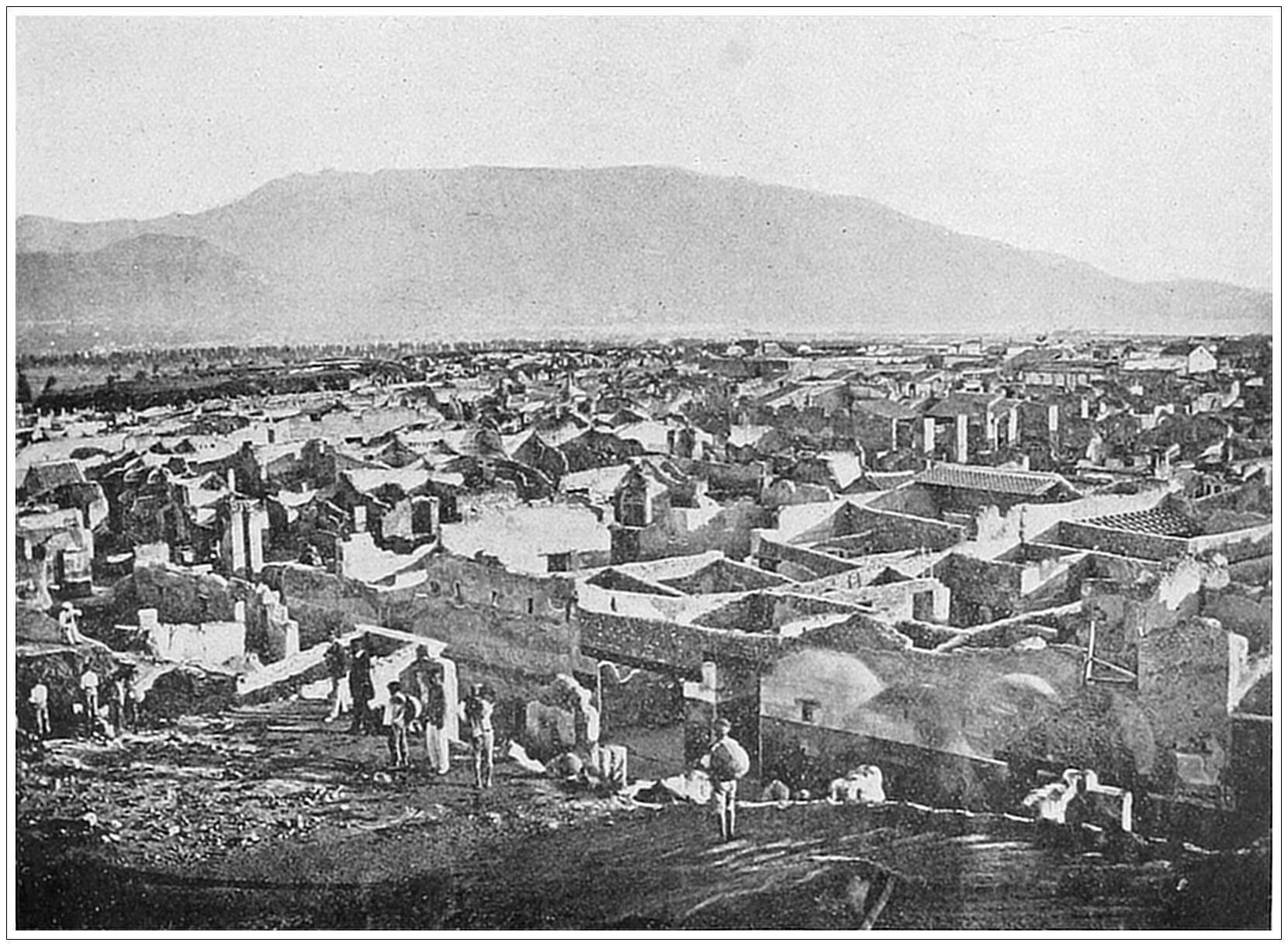
ACROPOLIS, ATHENS, GREECE. This famous building, at once the
citadel, the sanctuary, the treasury and the museum of art of the
ancient Athenian people, crowns the summit of the rocky height which
abruptly rises three hundred and fifty feet out of the plain in the midst of the
city, inaccessible on all save the western side. The walls, built on the edge
of the perpendicular rock, form a circuit of nearly seven thousand feet.
These are of immense antiquity. They were founded by the Pelagians, and
the work was continued by Themistocles, Cymon, Valerian, and later, by the
Venetians and the Turks. Here are the remains of three temples, the Temple
of Victory, the Erechtheum and the Parthenon, the latter the architectural
glory of Athens, the only octastyle Doric temple in Greece, and in its own
class the most beautiful building in the world. It was built in the time of
Pericles, and was once adorned with masterpieces of sculpture of which it was
long ago plundered.
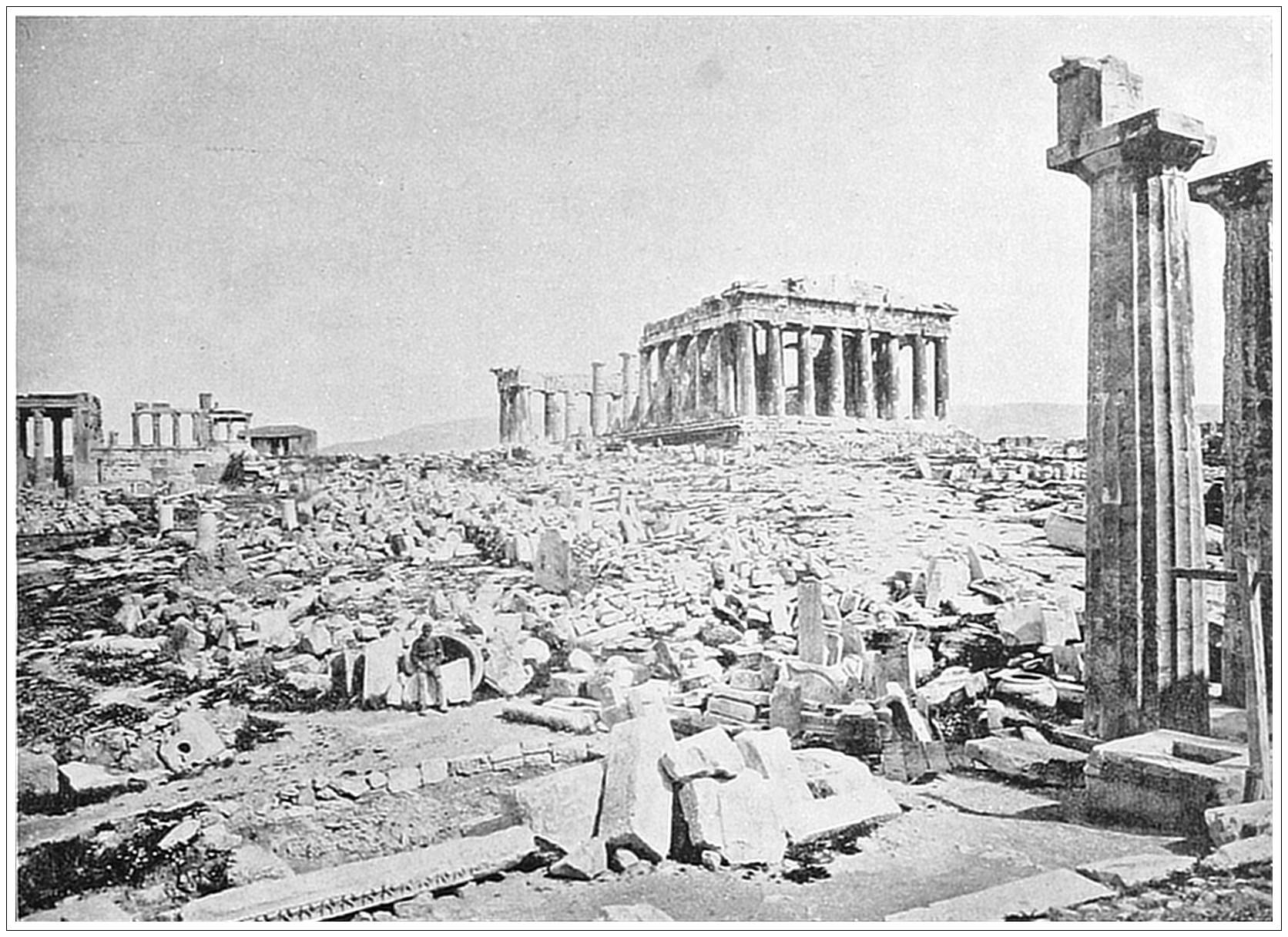
THE BOSPHORUS, FROM CONSTANTINOPLE, TURKEY. No city
in the world occupies a more magnificent natural position than the
capital of Turkey. It is made up of three cities, each distinct and different
from the others. Stamboul, the old city, lies upon a tongue of land of
triangular shape, having the sea of Marmora on the south, the Bosphorus on
its eastern apex and the Golden Horn on the north. Its seven hills are
crowned with domes and minarets and fantastic houses, backed by the dark
foliage of the cypress and other trees in the cemeteries beyond the walls. To
the north is the European quarter, Galata being the business centre, while
Pera is studded all over with the splendid residences of the foreign ambassadors,
&c., and lined along its shores with the palaces and gardens of the
Sultan and the adjoining mosques. Skutari, the Asiatic quarter of Constantinople,
is on the eastern side of the Bosphorus. Nowhere else is there a
picture so bright, so varied in outline, so gorgeous in color, so heterogeneous
in its component parts.
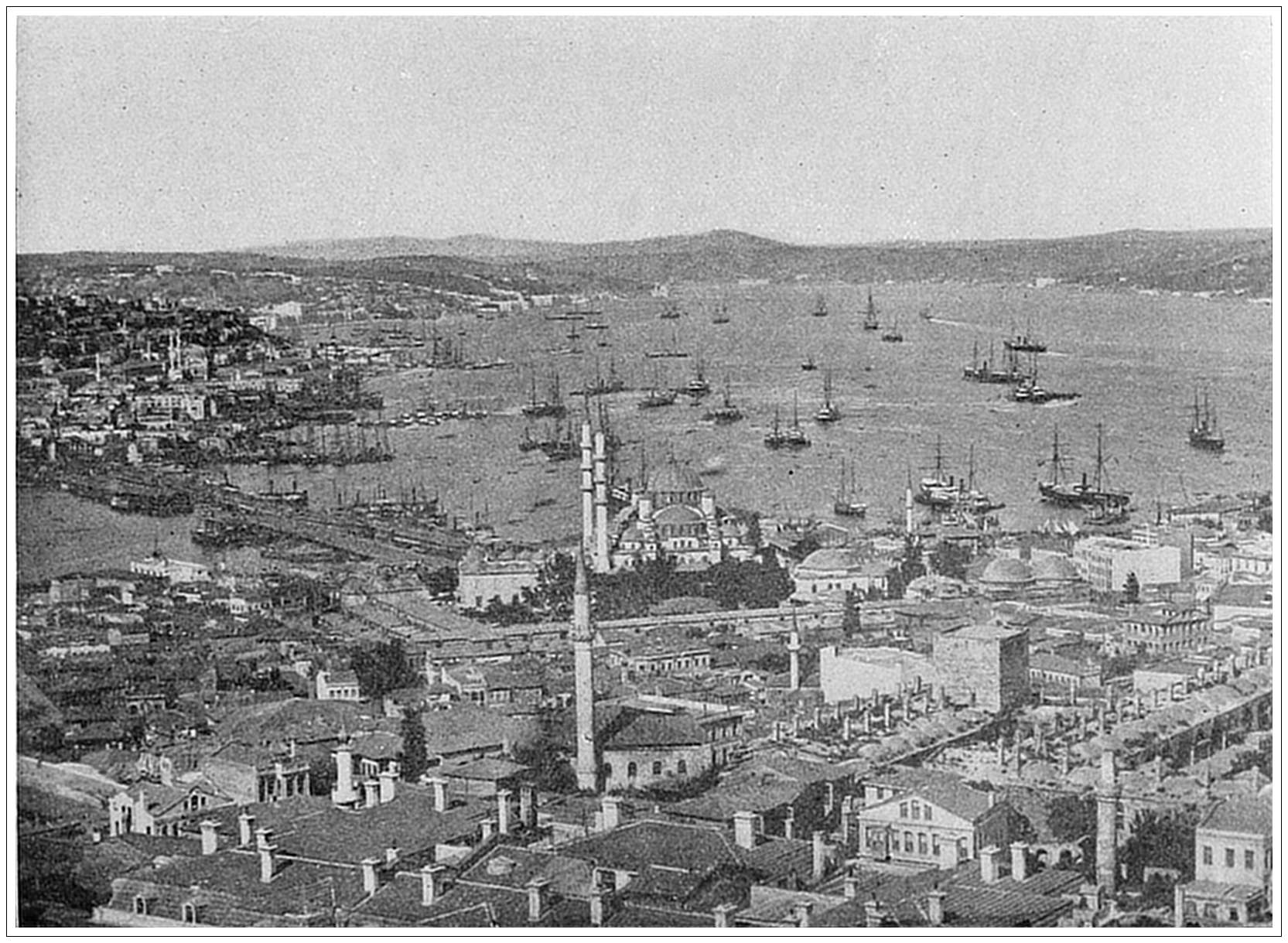
THE MOSQUE OF ST. SOPHIA, CONSTANTINOPLE, TURKEY.
This is the principal place of Mahommedan worship in the world.
Anciently a Christian temple, built in 532 by Justinian, it was converted
into a Moslem mosque in 1453 by Mohammed II, the conqueror of Constantinople.
The building is in the form of a Greek cross, two hundred and seventy
feet long by two hundred and forty-three wide, surmounted by a flattened
dome one hundred and eighty feet high, with several smaller domes and minarets.
The style of architecture is Byzantine. The exterior is not as imposing
as the interior, which even now is rivaled by few Christian churches, and at
the time of its erection made this masterpiece of Byzantine architecture the
greatest temple in the world. Well may Justinian have exclaimed: “I have
surpassed thee, O Solomon!” The changes made by the Moslems are greater
inside than out. In the interior the mosaics have been partially covered up
and replaced by inscriptions from the Koran, but there is no structural change.
Outside most of the older annexes have been swept away and replaced by
Turkish buildings, lofty minarets rise at each corner, and the crescent replaces
the cross on the dome.
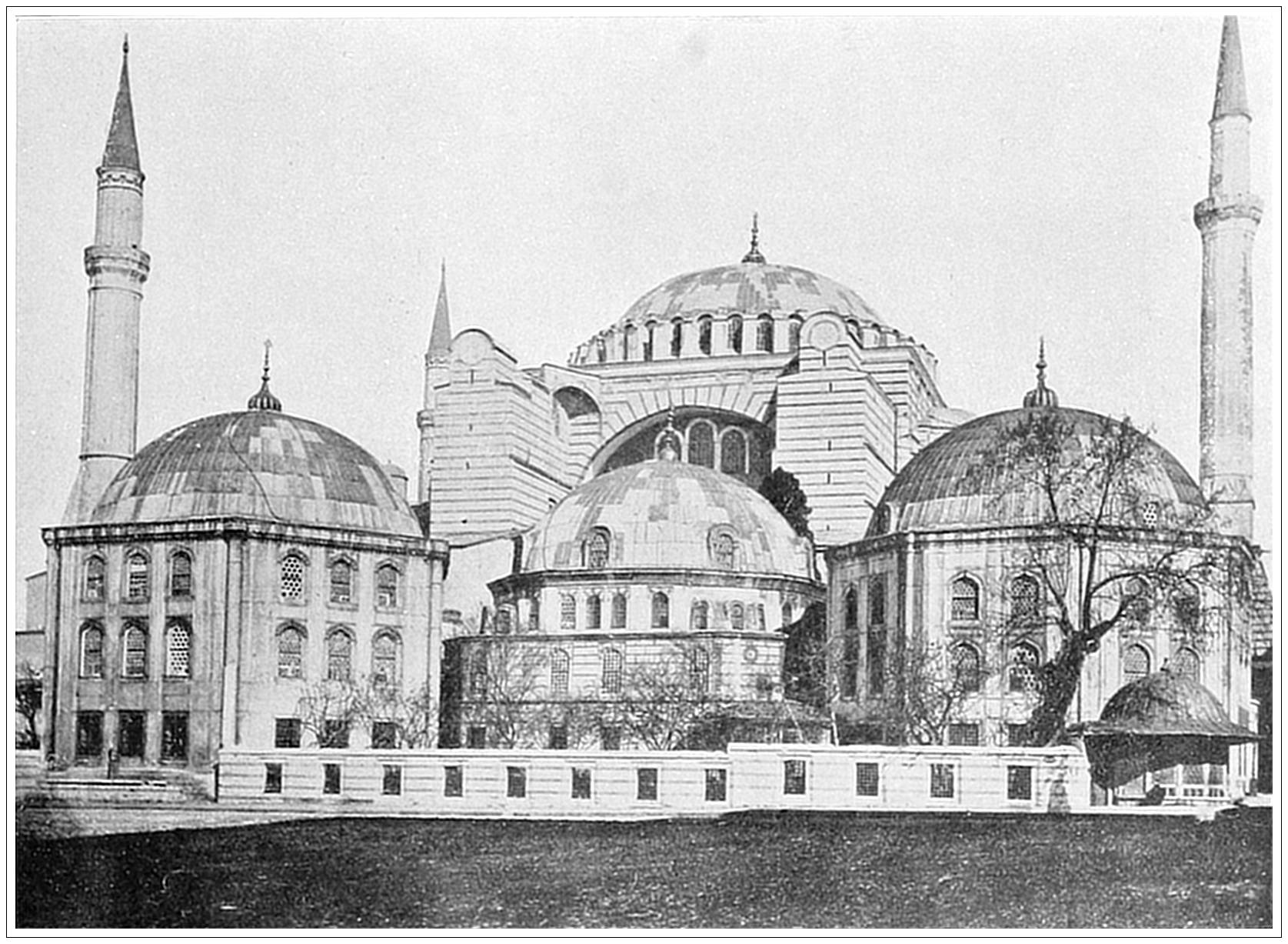
THE SPHINX, EGYPT. This unique monument, situated near Cairo, in
the neighborhood of the Pyramids, is one of the most characteristic and
probably the oldest of Egyptian remains. As such it is the oldest
monument in the world. Recent researches show that it is more ancient than
even the Pyramid of Cheops. Originally it was a recumbent figure, representing
an andro-sphinx, or man-headed lion, one hundred and eighty-eight feet
nine and one-half inches in length, hewn out of the solid rock. Steps led
down to its front, where there was a sanctuary and tablets. But the sands
covered all save the head, shoulders and back, which rose from the surrounding
desert with a startling and almost fearsome abruptness. In this condition the
monument was allowed to remain for centuries. But more recently excavations
have been started to restore it to its pristine state, and before long the entire
colossal figure will be bared to view.
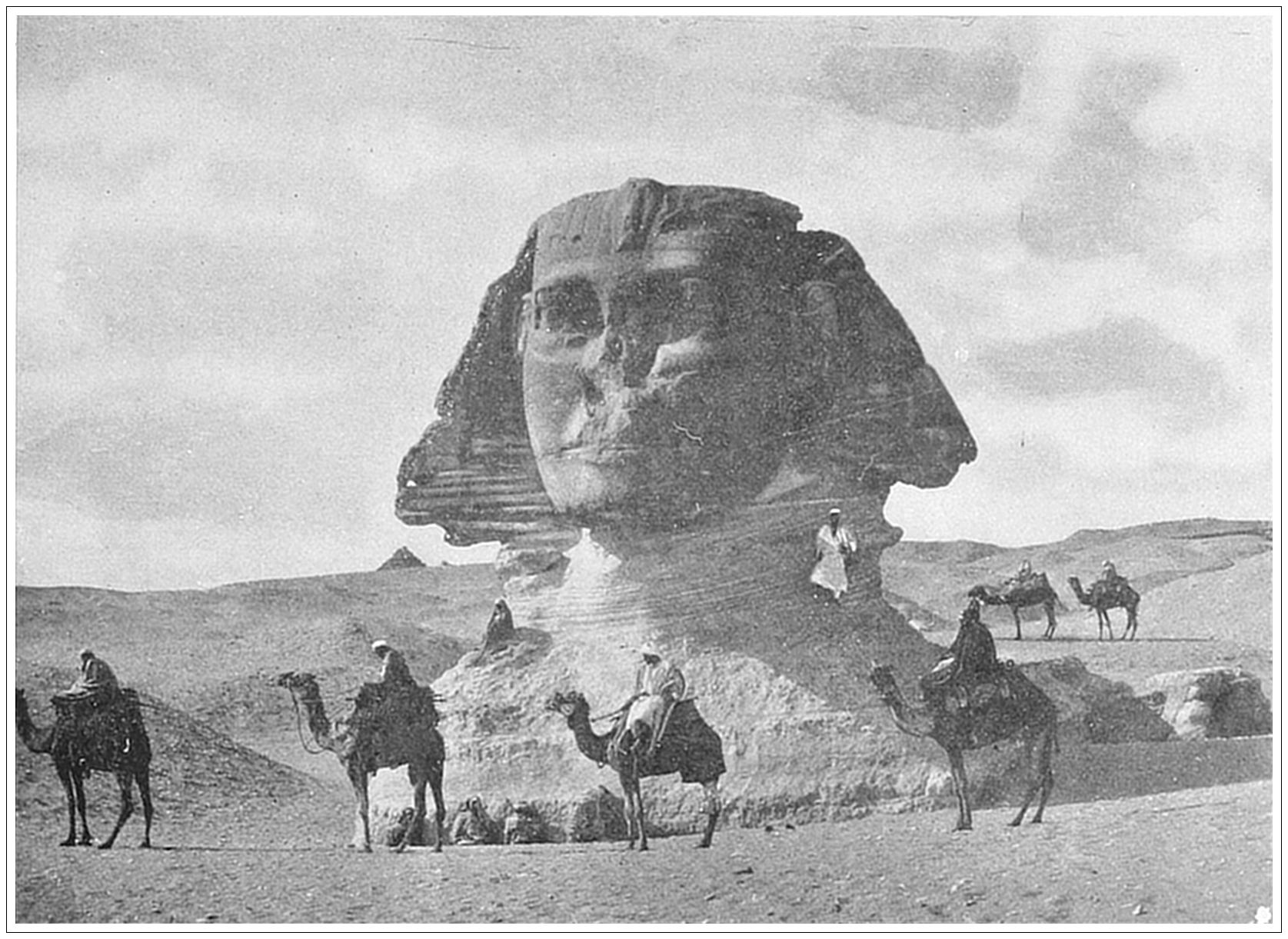
PYRAMIDS OF GIZEH, EGYPT. Gizeh is about twelve miles from
Cairo. It contains the largest and most famous of those mysterious
sepulchral monuments known as Pyramids, which the ancient Egyptians
were fond of raising. Three of these are especially famous—the Great Pyramid
called the “Splendid,” which is the mausoleum of Cheops, and is four hundred
and fifty feet nine inches high; the scarcely inferior Pyramid of Chepheren,
and the Pyramid of Mycerinus, which is much smaller. These mountains of
masonry, built of stones whose huge size perplexes modern engineers to
account for the method of their handling, were designed by the kings of the
early Egyptian dynasties as their tombs. Their leading idea was durability,
and by concealment of the entrance, and tortuous and complicated passages,
they strove to baffle the vandal. Yet all these tombs have been shamefully
profaned.
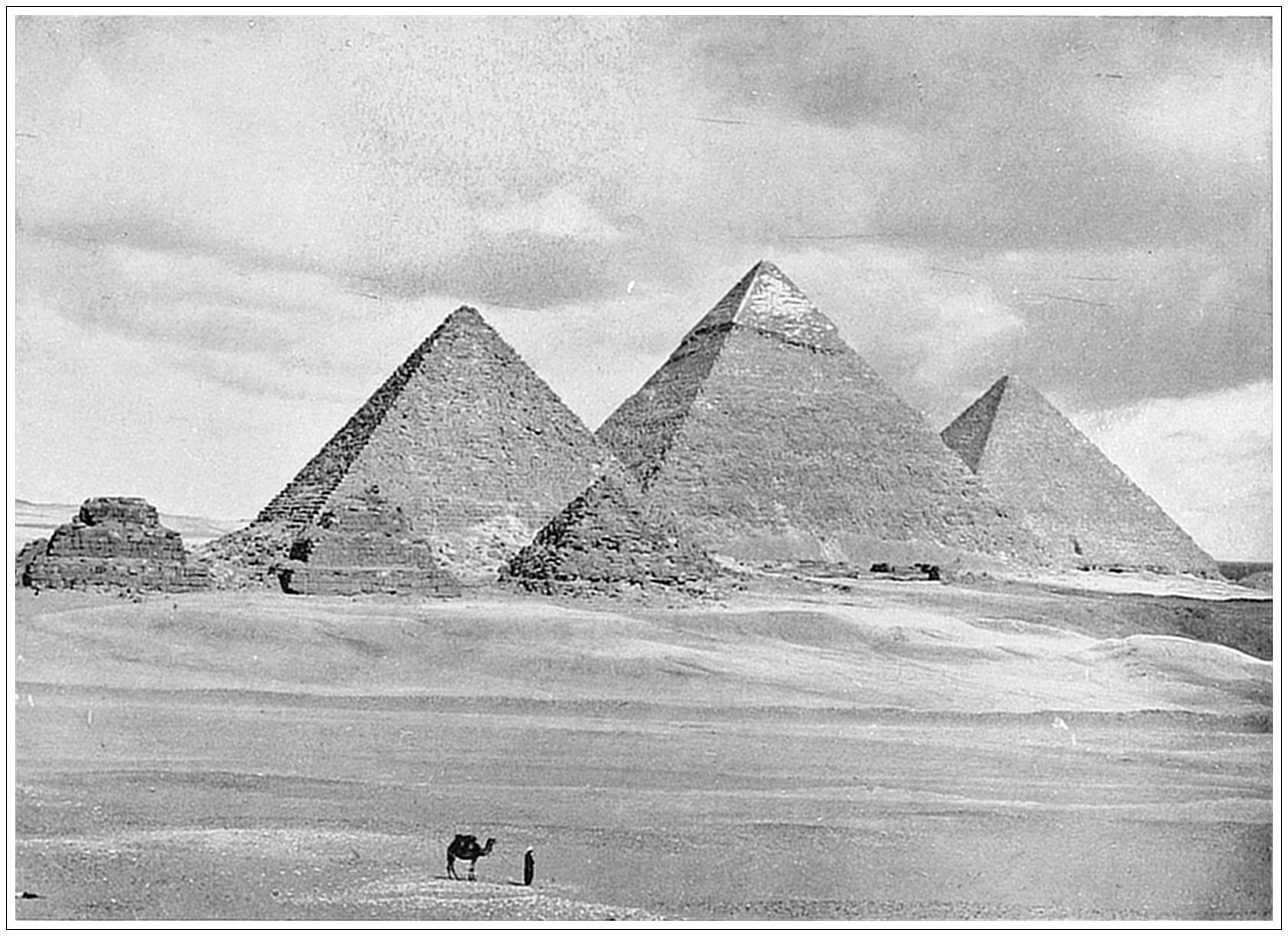
RUINS OF KARNAK, EGYPT. Most guide-books advise the traveller
in Egypt to leave Karnak to the last, as the crown of his explorations.
It is, indeed, the most marvelous ruin along the Nile. Yet, though in
ruins, it preserves all its original character. It lies amid the ruins of Thebes.
It was intended for a temple. But it is not so much a temple as a city of
temples, of palaces, courts, columns and obelisks enclosed by a great wall of
circuit about a mile and a half in circumference. The Great Hall alone,
which is the largest of all the monuments, measures three hundred and
forty feet by one hundred and seventy. The Temple of Amenophis, here represented,
is one of the finest of the smaller remains.
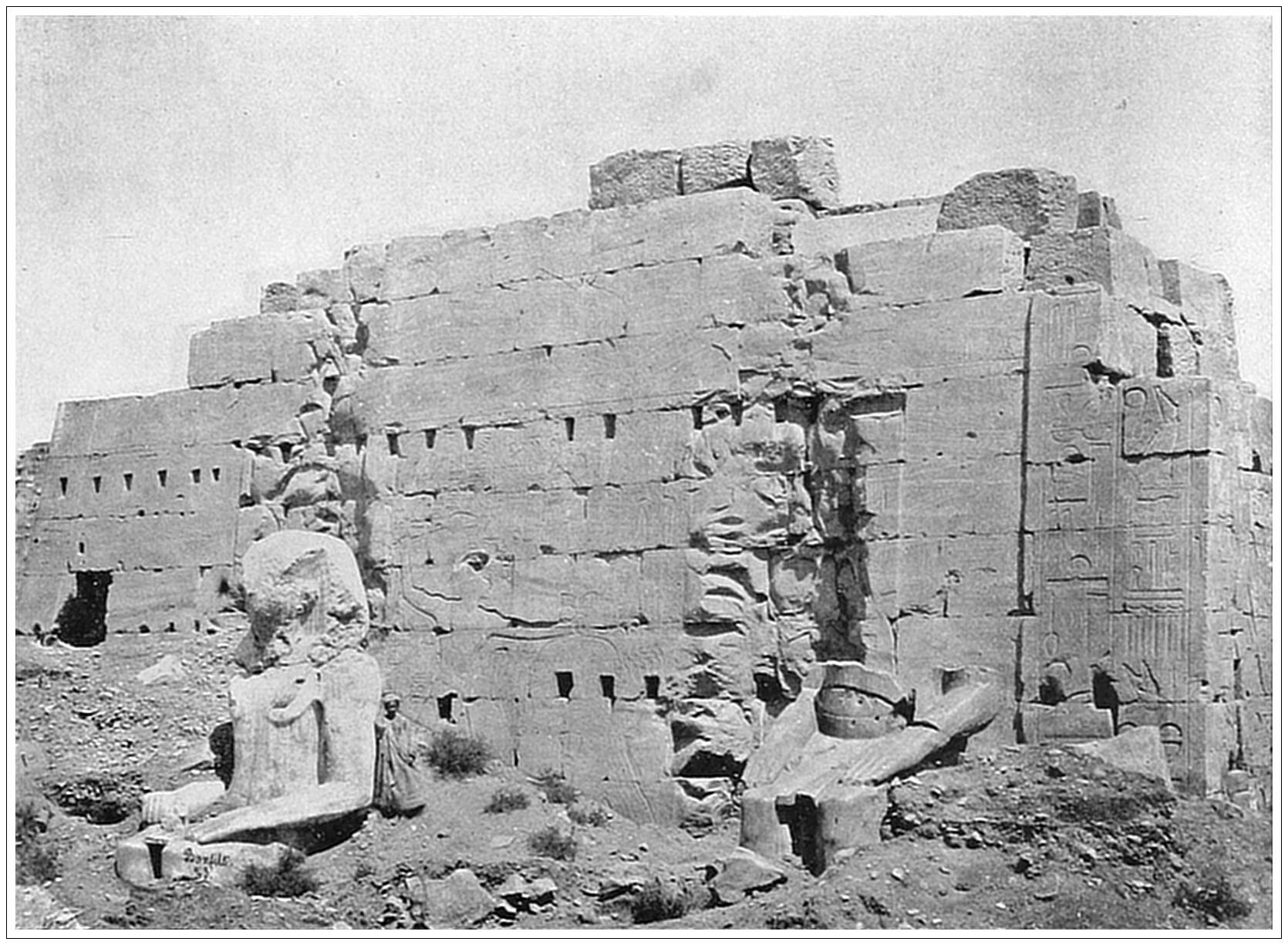
CHURCH OF THE HOLY SEPULCHRE, JERUSALEM. This church,
situated on a hill called Acra, purports to be built over the site of
Calvary and the actual tomb of Jesus. Not only that tomb itself, but
the tombs of Joseph and Nicodemus, the places where the Saviour appeared
after His resurrection to Mary Magdalene and to Mary, His mother; where
Constantine’s mother found the true cross, &c., &c., are pointed out to visitors.
Not everybody accepts the genuineness of the site. But, at least, it was for
the reconquest of the Holy Sepulchre that the Crusades were instituted, and
for fifteen hundred years kings and queens, knights and pilgrims have knelt
and prayed here. The church is a Byzantine structure, which was commenced
in 1103 A. D., was partly destroyed by fire in 1808, and has since been
restored. Some parts of it, however, are said to date back to the Empress
Helena.
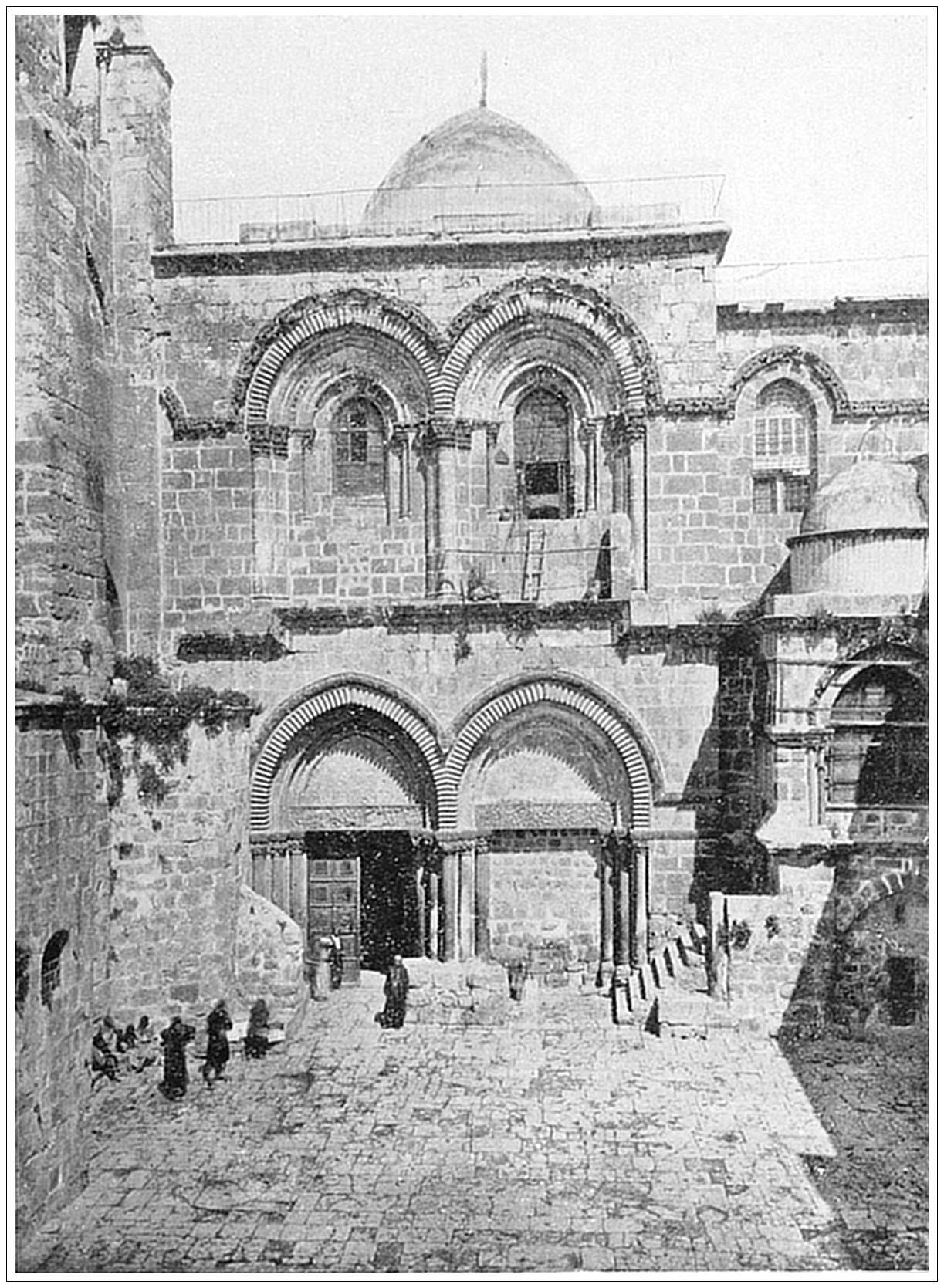
GARDEN OF GETHSEMANE, JERUSALEM. No spot in the whole
world could have more interest for the Christian traveler than the
Garden of Gethsemane, the scene of our Lord’s agony on the eve of
His crucifixion. It is known that it was a garden or orchard belonging to a
small estate at the foot of Mount Olivet, somewhere on the east slope of the
Kedron Valley and about half a mile from Jerusalem. But whether the
present enclosure which is pointed out as the identical garden be so or not is
a matter which archæologists have not yet settled. Certainly, the garden is
very old and very venerable; its few olive trees date back to an unknown
antiquity, and it may very well have been extant in almost its present condition
in the time of Christ.
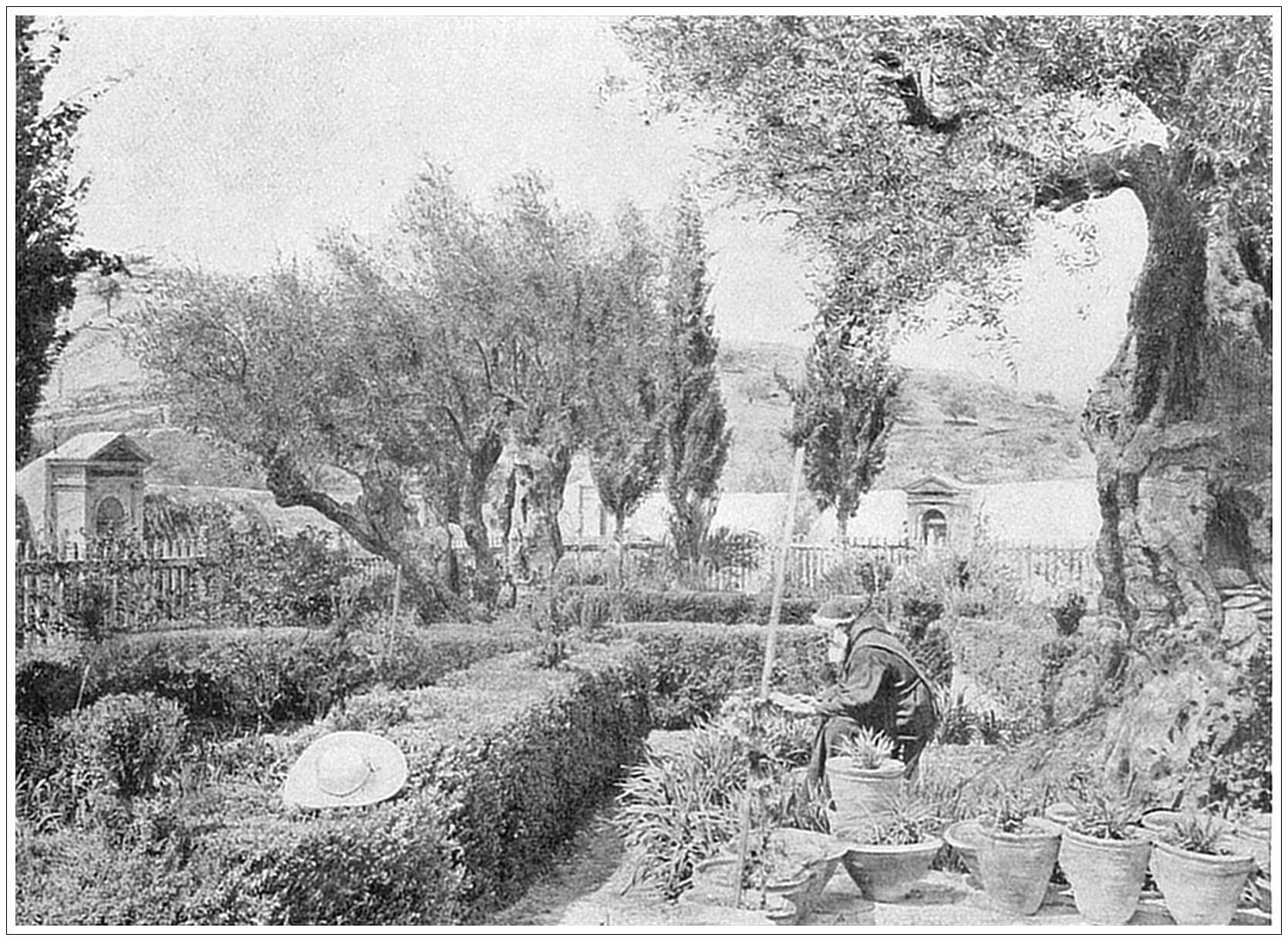
RUINS OF BAALBEK, SYRIA. Baalbek,—the city of Baal or the Sun,
the Heliopolis of the Greeks, once famous as the most magnificent of
Syrian cities, which passed successively under the rule of the Persians,
Greeks and Romans, was plundered by the Arabs in A. D. 639, by the
Christians and others during the Crusades, and was finally sacked and dismantled
by the Tartars, under Tamerlane.—Baalbek to-day exists only as a
mass of ruins; but its very ruins are of the utmost magnificence. The most
imposing are the remains of the Great Temple. But the most beautiful is the
Circular Temple—a semi-circular cella surrounded on the outside by eight
Corinthian columns. Within there is a double tier of smaller pillars, the
lower row being Ionic and the upper Corinthian. In modern times, and,
indeed, up to the present century, this was used as a Greek church, but it is
now deserted and choked with débris.
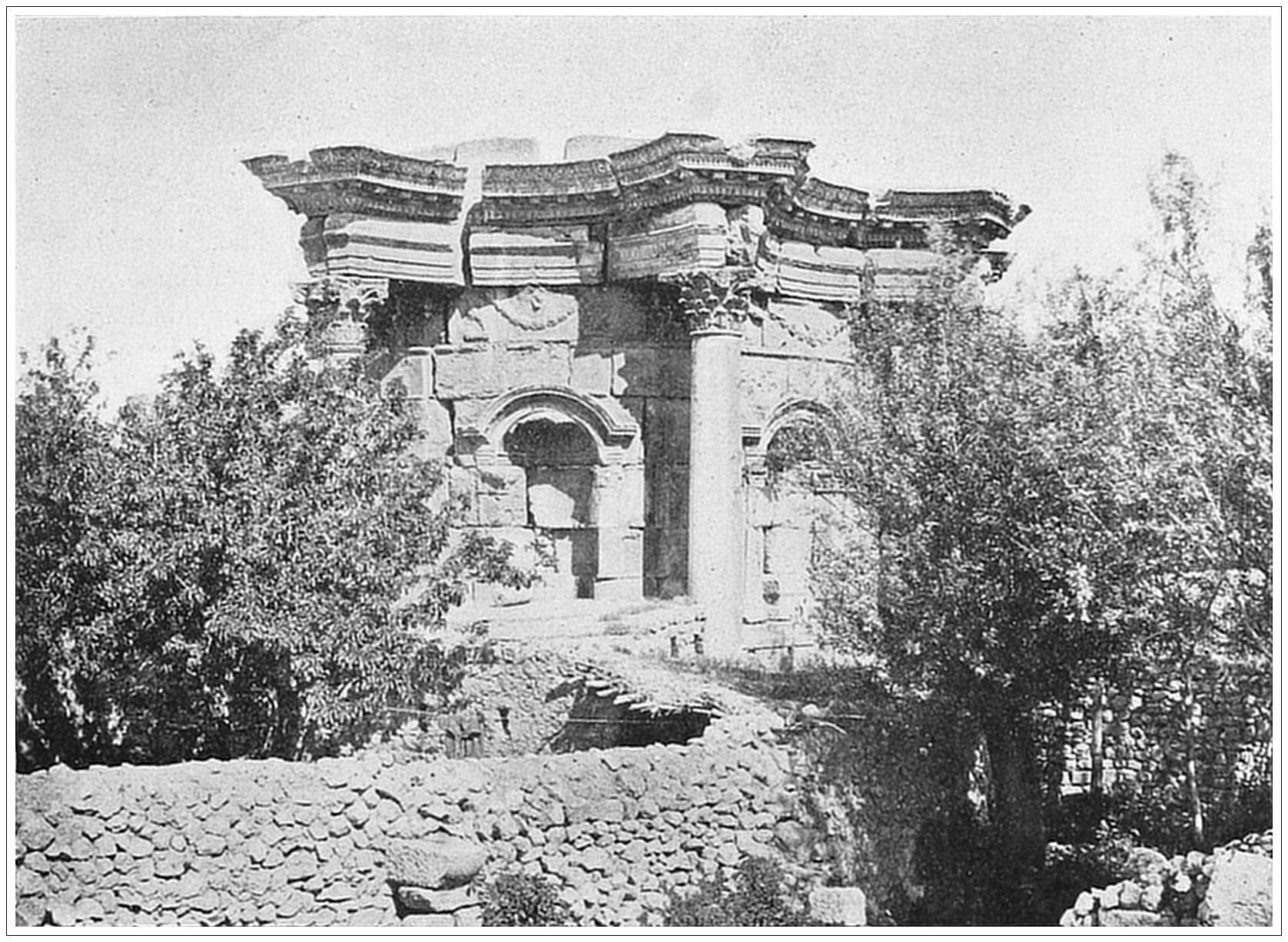
TAJ MAHAL, AGRA, HINDOSTAN. This magnificent mausoleum is
the glory of Indo-Mussulman architecture. It was built by the Emperor
Shah Jehan for himself and his favorite wife, Nourmahal, who died in
child-birth in 1629. For twenty-two years twenty thousand men were employed
in its construction, the total cost reaching $16,000,000. Built of white
marble, it forms a quadrangle of one hundred and ninety square yards, surmounted
by a lofty dome, with smaller domes at each corner and four graceful
minarets one hundred and thirty-three feet high. The great central hall is
paved with squares of various-colored marbles, while the walls, tombs and
screens are ornamented by exquisite mosaic work. The elegance and delicacy
of the design and the elaborate perfection in every detail of the workmanship
are alike marvelous. It seems almost like a castle built in a dream, a fabric
of mist and sunbeams, which would dissolve at a touch. Yet it has resisted
the encroachments of time and the barbarian despoiler, and has come down to
our day almost perfect.
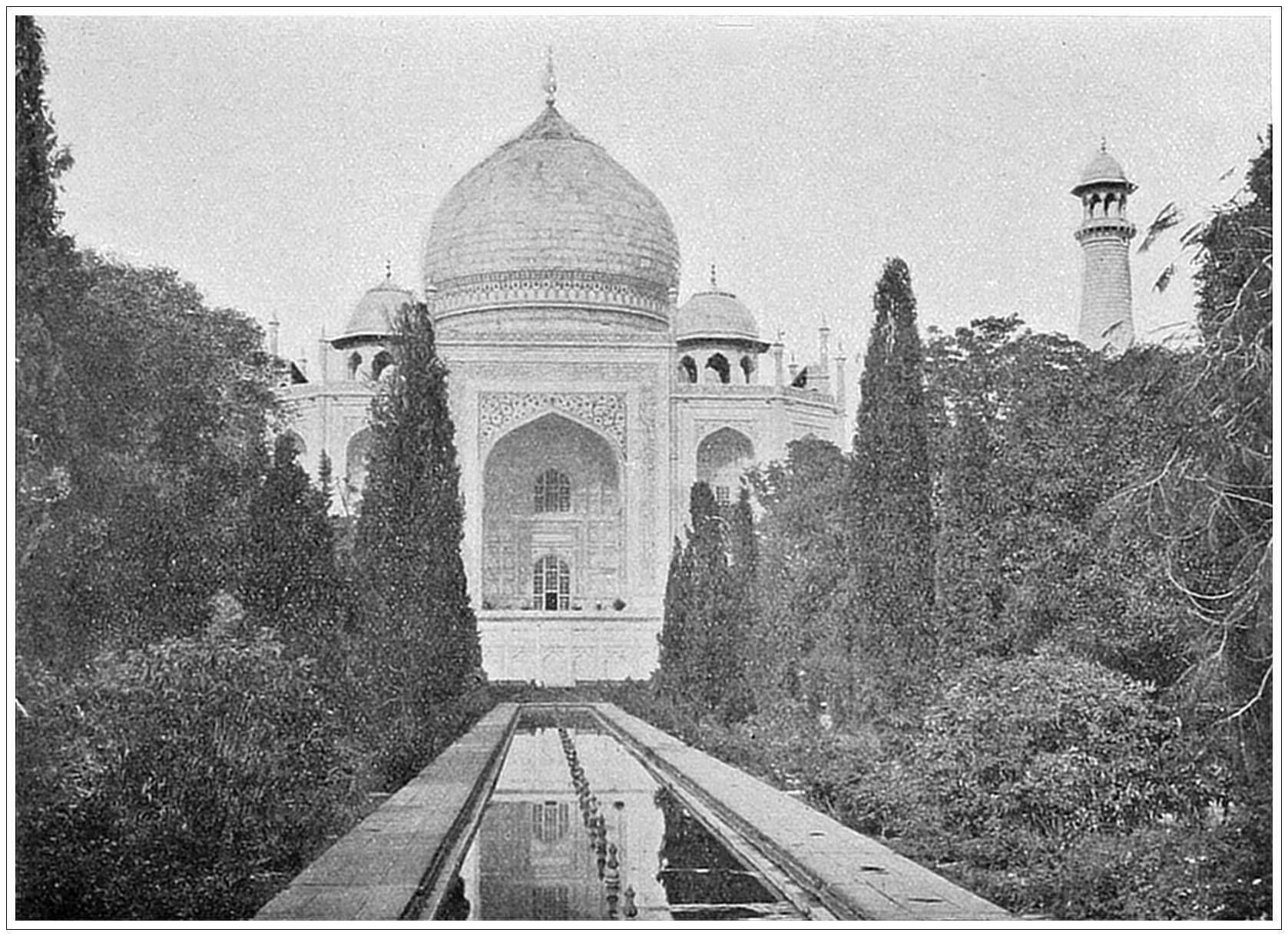
PEARL MOSQUE, AGRA, HINDOSTAN. The very name of the building
is a tribute to its beauty. It is undoubtedly the most elegant mosque
of Indian-Mahometan architecture. Although it gives the general impression
of lightness, grace, delicacy, it is by no means a small building. Externally
it is two hundred and thirty-five feet east and west by one hundred
and ninety feet north and south. The court yard is one hundred and fifty-five
feet square. The mass is also considerable, as the whole is raised on a
terrace of artificial construction, by the aid of which it stands well out from
the surrounding buildings. Its chief beauty consists in its court yard, which
is wholly of white marble from the pavement to the summit of its domes. The
interior is a bewildering maze of columns of exquisite proportions.
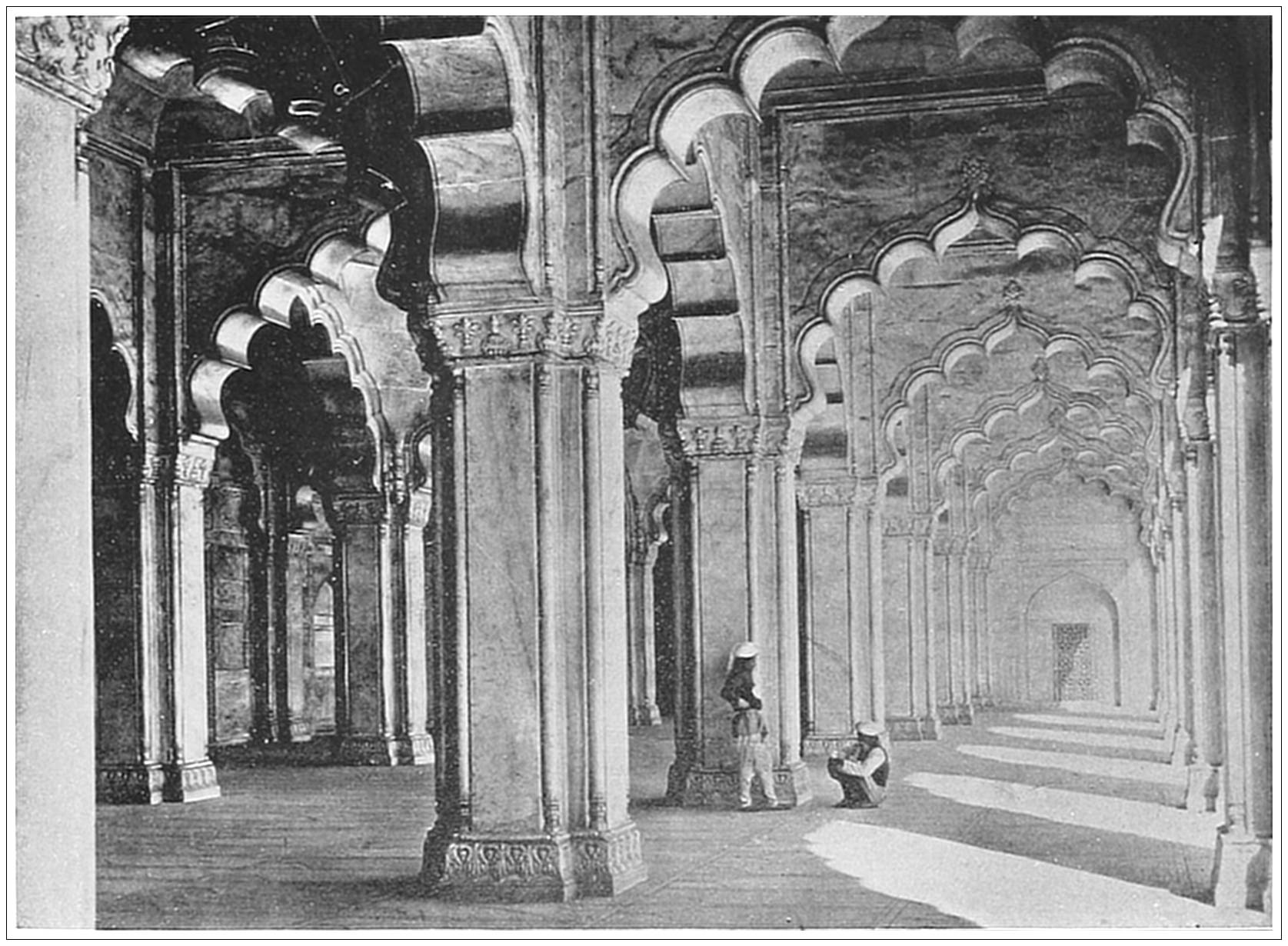
EL CAPITAN, YOSEMITE VALLEY, CALIFORNIA. The Yosemite
Valley is one of the most marvelous natural parks in the world.
About nine miles in length and from three-quarters of a mile to a mile
and a quarter in width, it is sunk almost a mile below the level of the surrounding
country. High granite walls rise sheer and inaccessible on each side.
Cataracts of the wildest and strangest beauty abound. Flowers of every hue
cover the ground. Where all is wonderful it might seem hard to select. Yet
by common consent the surpassing feature of the valley scenery is the great
cliff, known as El Capitan or The Captain. “It is doubtful,” says Professor
J. D. Whitney, “if anywhere in the world there is presented so squarely cut,
so lofty and so imposing a face of rock.” Not indeed that it is the highest of
the gigantic brotherhood. Its three thousand three hundred feet are exceeded
in its own vicinity by over thousands of feet. But no other rock, here or elsewhere,
has so majestic and awe-compelling a presence.
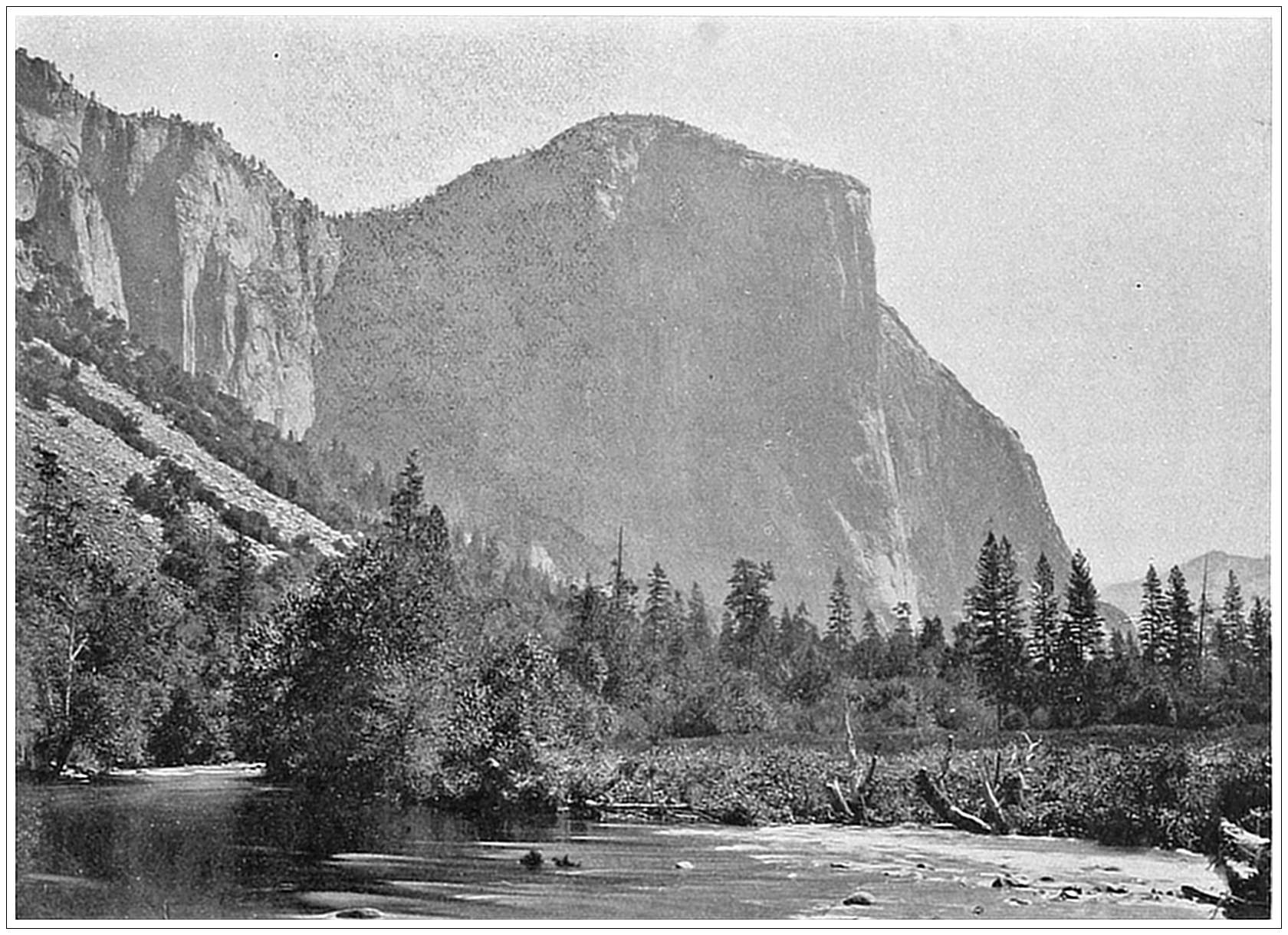
BIG TREES, CALIFORNIA. Rigid scientists call these trees Sequoia
gigantea. In England they are sometimes known as Wellingtonia, in
America as Washingtonia. But the pride of science and of patriotism
have had to bow to the will of the populace, which has been satisfied with the
simpler and therefore more energetic title of Big Trees. They are confined to
the western portion of the California range, occurring in detached groups or
groves at an altitude of from four thousand to five thousand feet above the
sea. Some of these vast vegetable columns are upwards of thirty feet in
diameter, and from three to four hundred feet in height. One of the trees in
the Mariposa Grove, represented in the accompanying engraving—some
twenty-five feet in diameter—stands directly arching the roadway, and a miniature
tunnel has been cut through it which admits of the passage of a four-horse
stage coach.
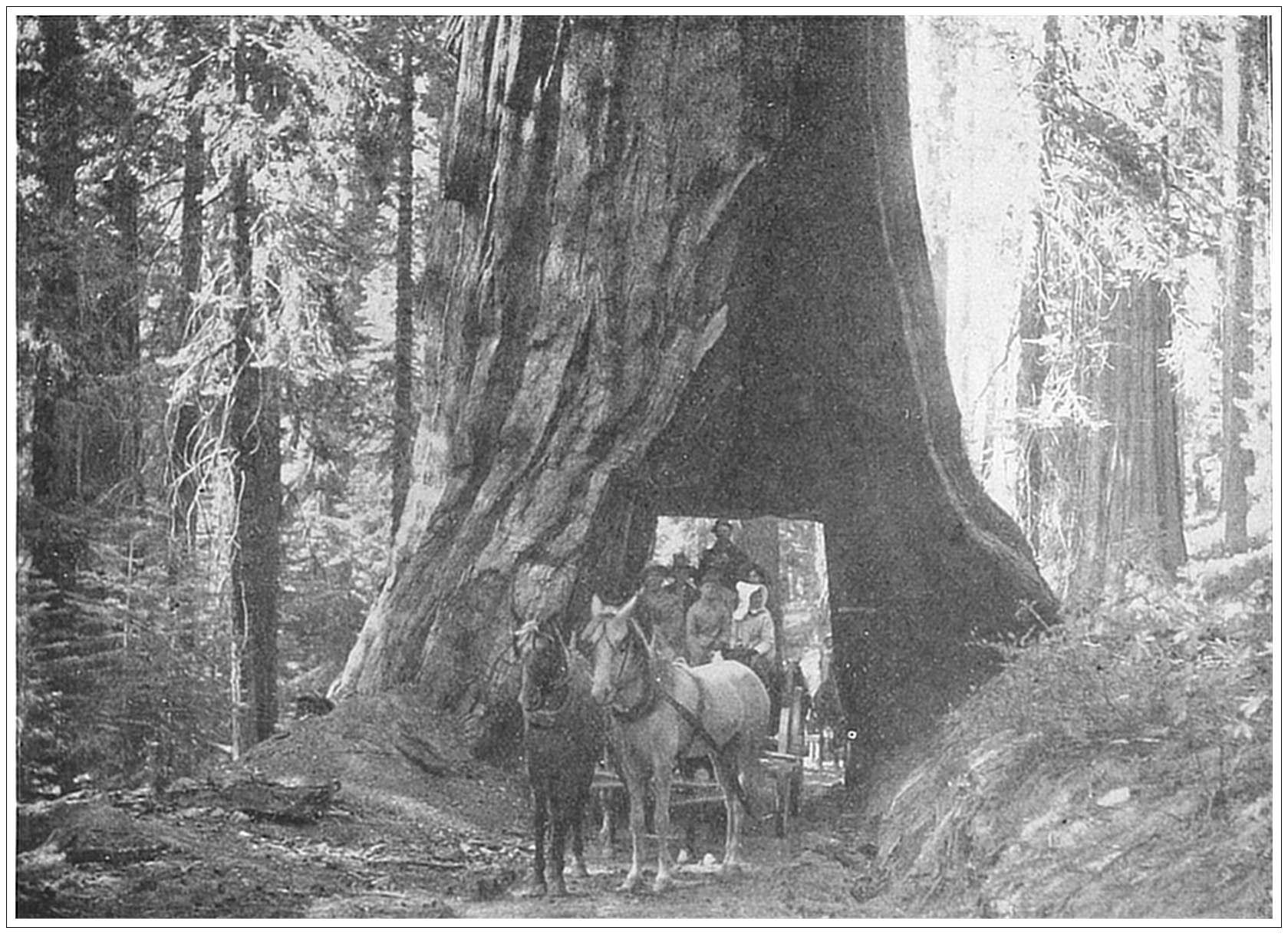
GEYSERS, YELLOWSTONE PARK, WYOMING. The Geyser region
in the Yellowstone occupies some thirty square miles. Within this comparatively
limited area is a most stupendous exhibition of hot springs,
water geysers, mud geysers and steaming caldrons of boiling water. No two
of the geysers are alike. The Grotto simply churns and makes a great noise.
The others go off at various intervals; some every hour, some all the time
and some once a month; some on alternate days, yet the day they are active
going over ninety minutes. Nor is their style of action the same. Some play
with labored pumping, others throw an unbroken stream; some wear themselves
out in a continuous effort, others subside only to recommence again
repeatedly. An eruption may extend from two to twenty minutes, the approximate
time occupied by the Grand, or even to one hour and twenty minutes, a
period that the Giant has been timed to play. The Grand is the largest
geyser in the world, shooting a vast column of water over two hundred feet
into the air.
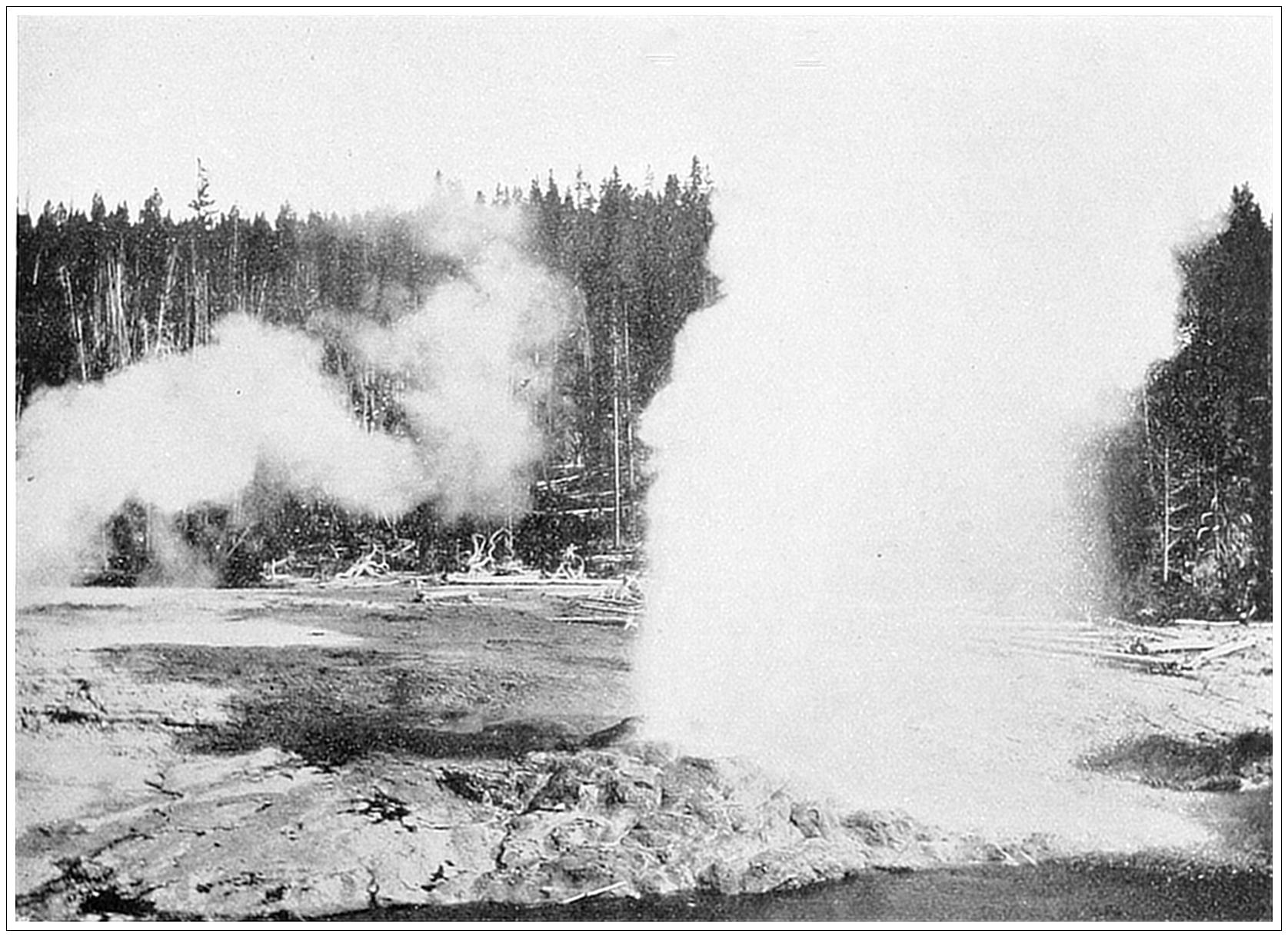
GRAND CANON, YELLOWSTONE PARK. The Yellowstone Park
is one of the great natural marvels of the world. Within a compass of
one hundred square miles there are here gathered the loveliest valleys,
the grandest canons, the most marvelous mountains, lakes, rivers, springs and
cascades. In addition there are all sorts of natural phenomena: Sulphur
mountains, a mud volcano, petrified forests and over ten thousand active
geysers, hot springs, salfataras and boiling pools. Greatest of all the sights is
the Grand Canon, a ravine varying in depth from one thousand to two thousand
feet. The shelving sides of precipitous crags slope down, presenting an
endless variety of form and color, until they meet at the bed of the Yellowstone
River, which flings itself impetuously along to meet the lake. “A great gulch
let down into the eternities,” such is the opinion of De Witt Talmage on this
miracle of nature.
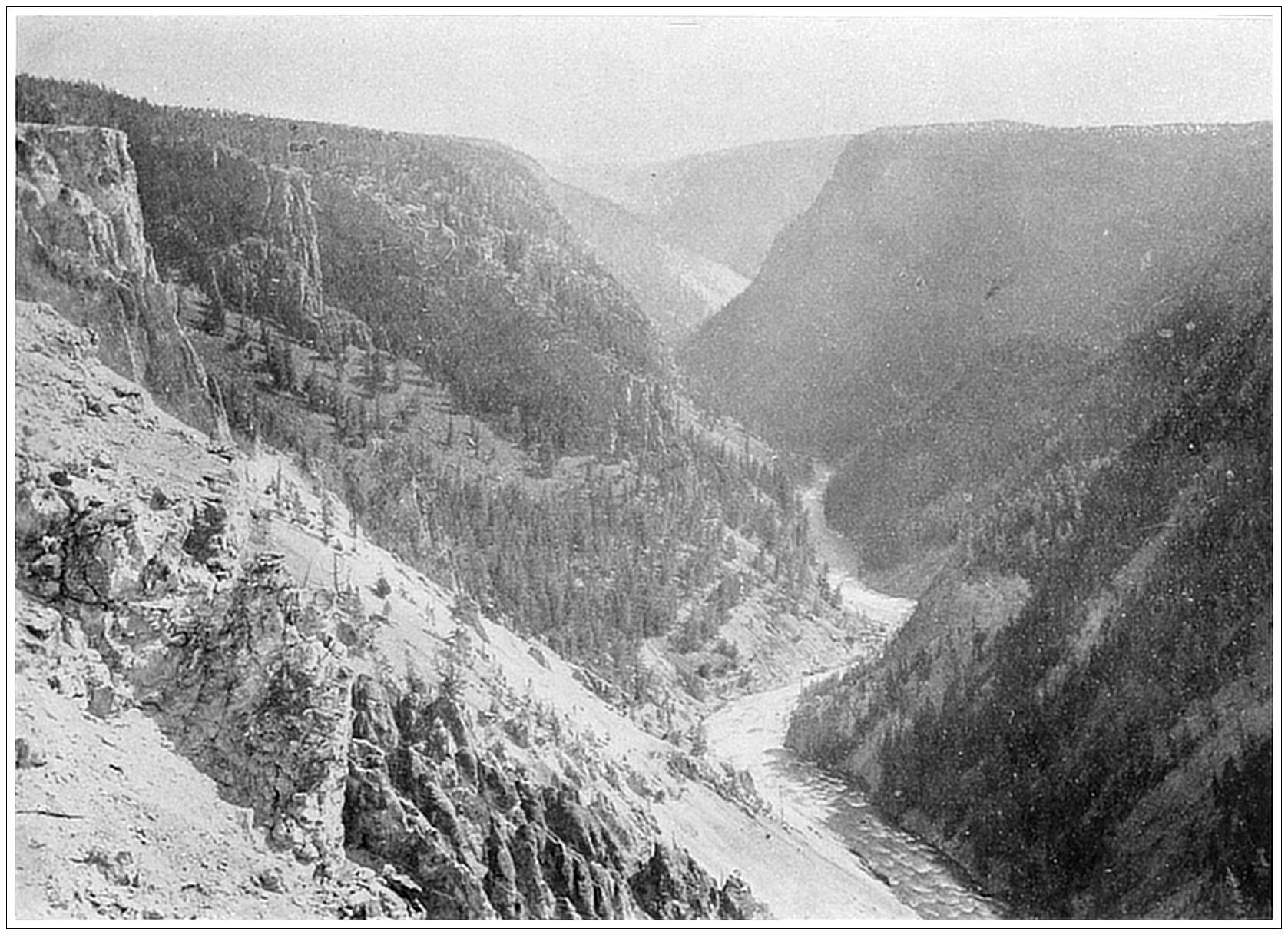
CLIFF-DWELLINGS, NEW MEXICO. Cliff-dwellers is the name given
to more or less savage people in the past who inhabited dwellings built
on projections from the face of cliffs, or cut out of the solid rock. Sometimes
the houses are four stories high, and divided into many rooms. Often
they are not to be distinguished from the rest of the cliff. Such dwellings are
found in various parts of the world, but nowhere are they so abundant and so
interesting as in Arizona, New Mexico and California. It is generally supposed
that the American cliff-dwellers were the ancestors of the Pueblo Indians.
In some respects the cliff-dweller appears to have been better off than his
modern descendants; the canon walls sheltered him from cyclones and the
overhanging shelves of rock protected him from attack from above. A series
of cliff villages, lining the walls of Walnut Canon, in Northeastern Arizona,
for a length of five miles, was discovered in 1884.
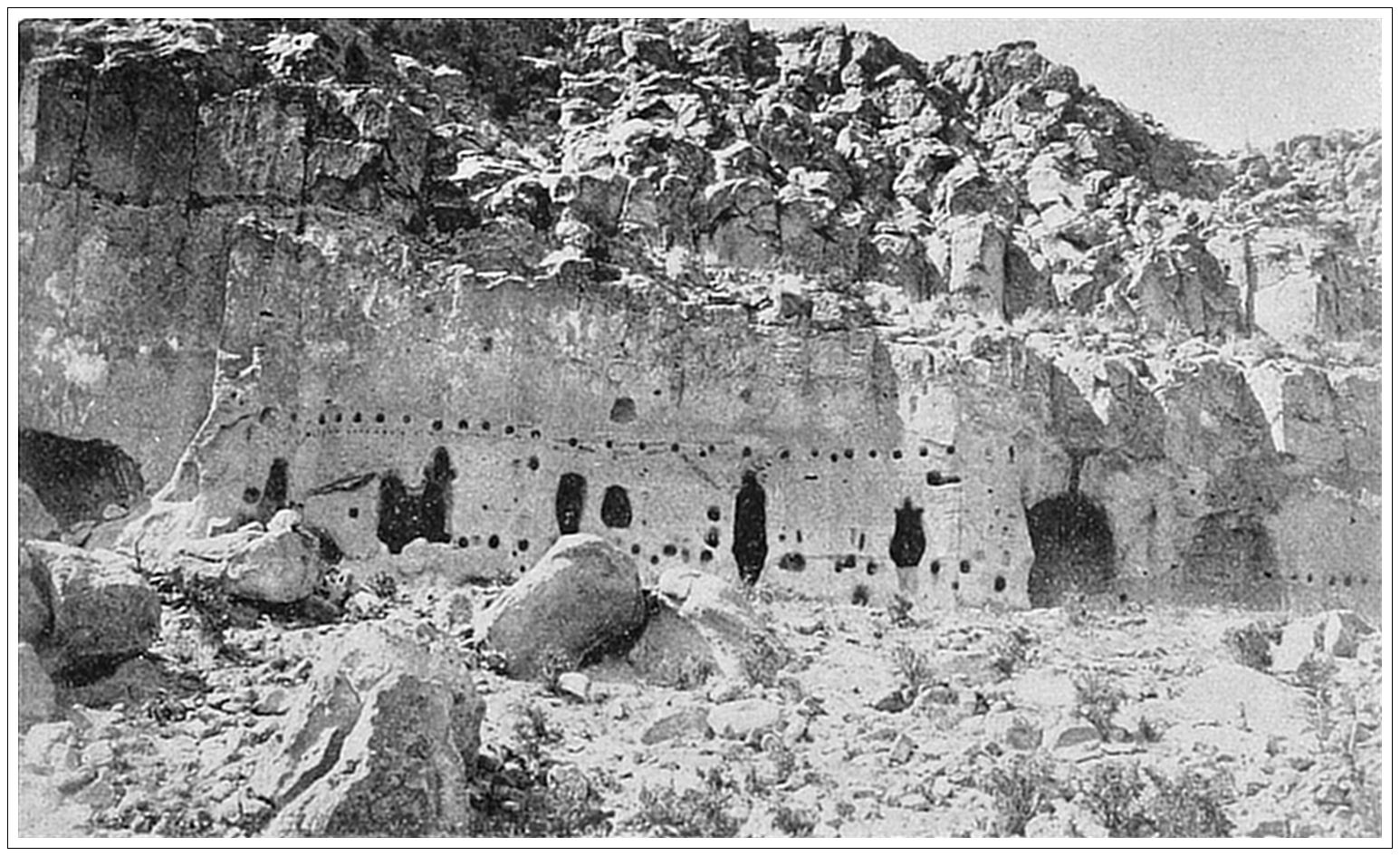
MASONIC TEMPLE, CHICAGO. For a long time it was held that
Philadelphia had the finest Masonic Temple in the world. Now that
honor belongs to Chicago. But it has only belonged to it since 1890,
when the gorgeous new building was begun at the corner of State and Randolph
Streets. The site measures one hundred and seventy feet on State Street
and by one hundred and fourteen on Randolph. Every inch of this space is
covered by the building, whose twenty stories tower up to the height of two
hundred and sixty-five feet. It rests on cement and iron foundations, and its
superstructure is of steel. The first three stories are faced with red granite
from Wisconsin, the remainder with gray brick that is indistinguishable from
the granite. An immense granite arch in the centre of the State Street front
forms the entrance, and opens into an interior court, faced from bottom to top
with different colored marble. The first eleven stories are fitted up for shops,
from the eleventh to the sixteenth inclusive are business offices, while above the
sixteenth floor everything is devoted to Masonry.
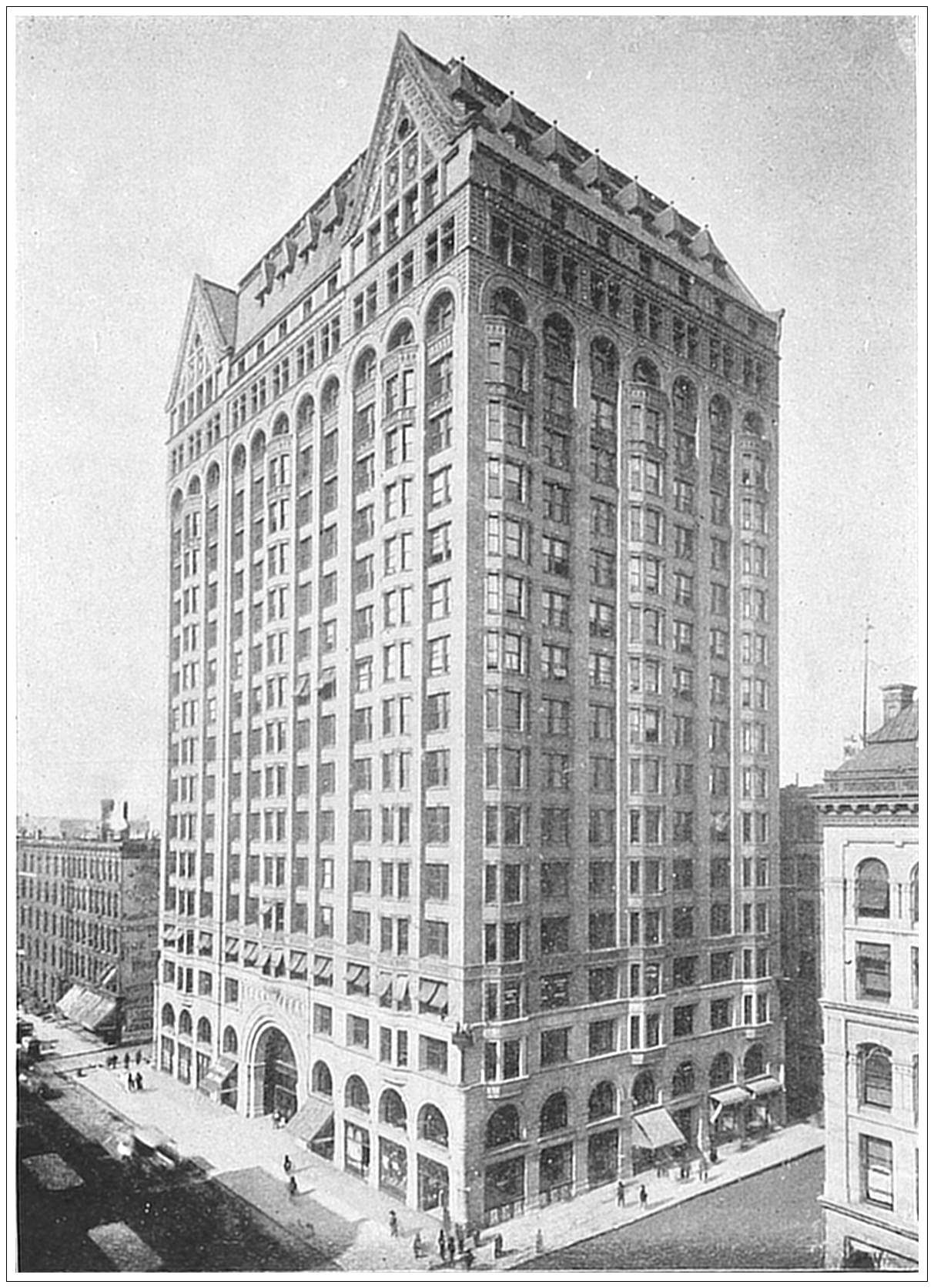
NIAGARA FALLS. The most stupendous cataract in the world is that
formed in the Niagara River, four miles below Grand Island. Here
the current begins to grow narrow and develops into rapids, which
continue for about a mile, with a descent of fifty-two feet, until the river
plunges over a mighty chasm. Goat Island, at the very verge of the cataract,
divides it into two sheets of water—the Horse-shoe, or Canadian fall, with a
descent of one hundred and fifty-eight feet, and a width of about twenty-six
hundred and forty; and the American fall, one hundred and sixty-two to one
hundred and sixty-nine feet deep, and about one thousand wide. The volume
of water thus precipitated is about fifteen million cubic feet a minute. Nearly
nine-tenths of this passes over the Canadian fall. For some distance below
the Falls there is still water, the mass which has hurled itself into the abyss
sinking and only reappearing two miles below, where the whirlpool rapids
begin.
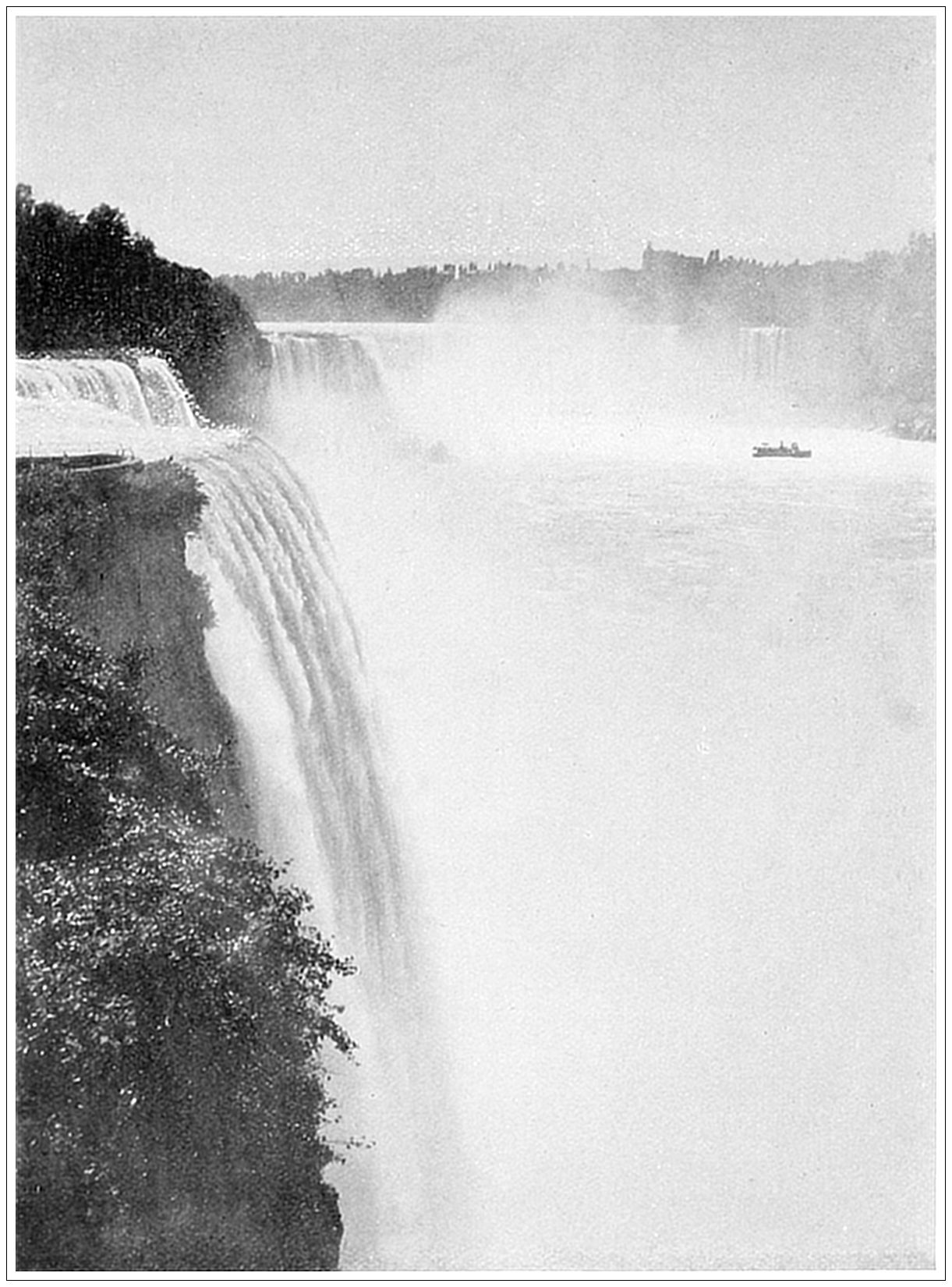
THE THOUSAND ISLANDS, CANADA. This, the largest group of
river islands in the world, lies in an expansion of the River St. Lawrence
at its emergence from Lake Ontario. New York State is on one
side and the Province of Ontario, Canada, on the other. The name is not an
exaggeration. On the contrary, the group consists of about fifteen hundred
rocky islands, remarkable for their great and varied beauty. They are of all
shapes and sizes, some just peeping above the surface of the waters, others extending
several miles in length, some wild and bare and rocky, others covered
with the most luxuriant foliage. Hence, a trip through the St. Lawrence
River at this point is full of the most bewildering yet enchanting surprises.
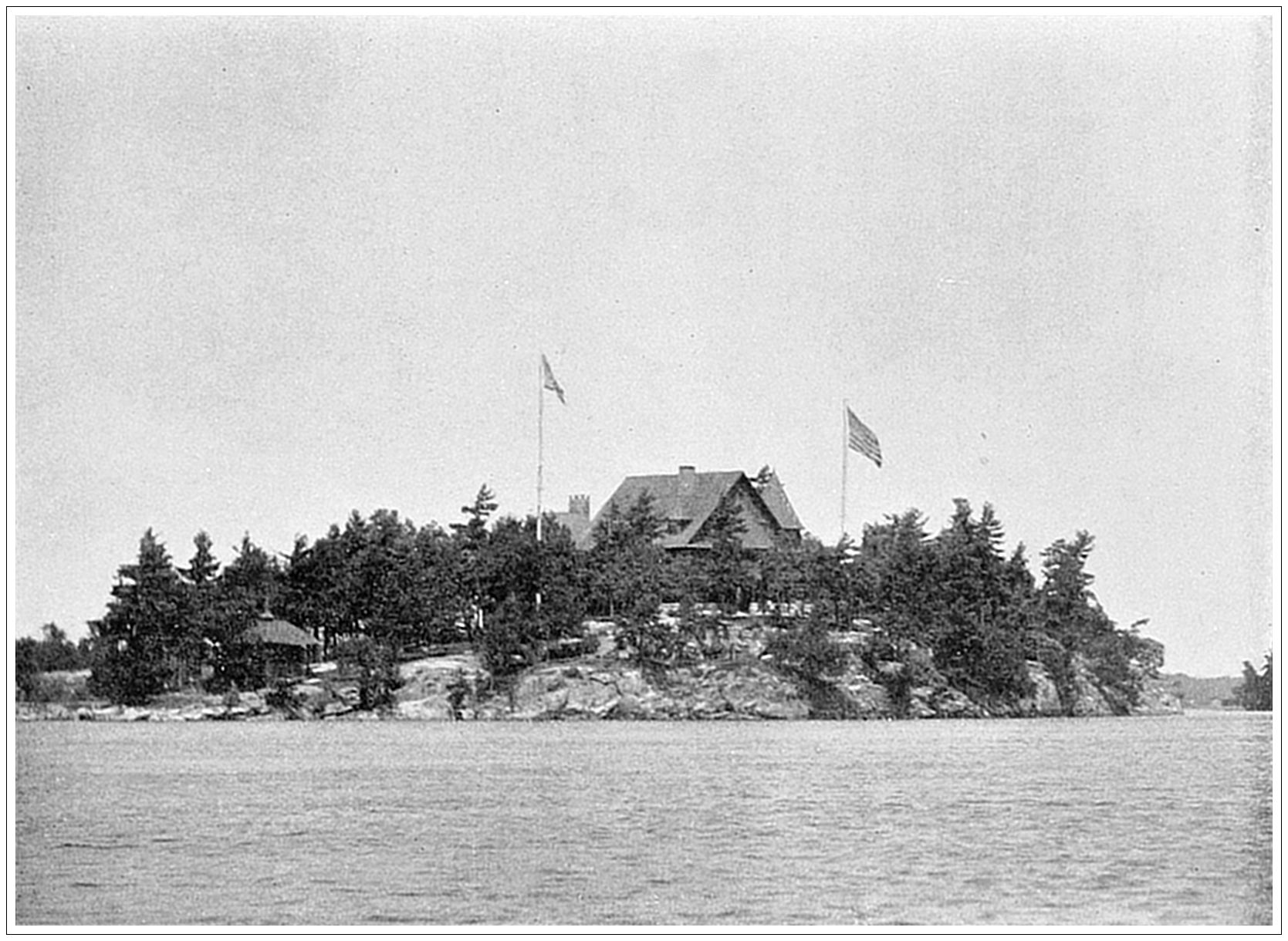
VICTORIA BRIDGE, MONTREAL, CANADA. Montreal is situated
on the south side of the island of the same name, at the confluence of
the Ottawa and the St. Lawrence Rivers. To connect it with the mainland
the Victoria Bridge was thrown across the St. Lawrence. Work was
begun in 1854. In 1860 the bridge was formally opened by the Prince of
Wales during his tour through Canada and the United States. This is one of
the greatest triumphs of engineering and architectural skill. The total length
is nearly two miles, or, to be exact, nine thousand one hundred and ninety-four
feet. It rests upon twenty-four piers and two abutments of solid masonry.
The central span is three hundred and thirty feet long.
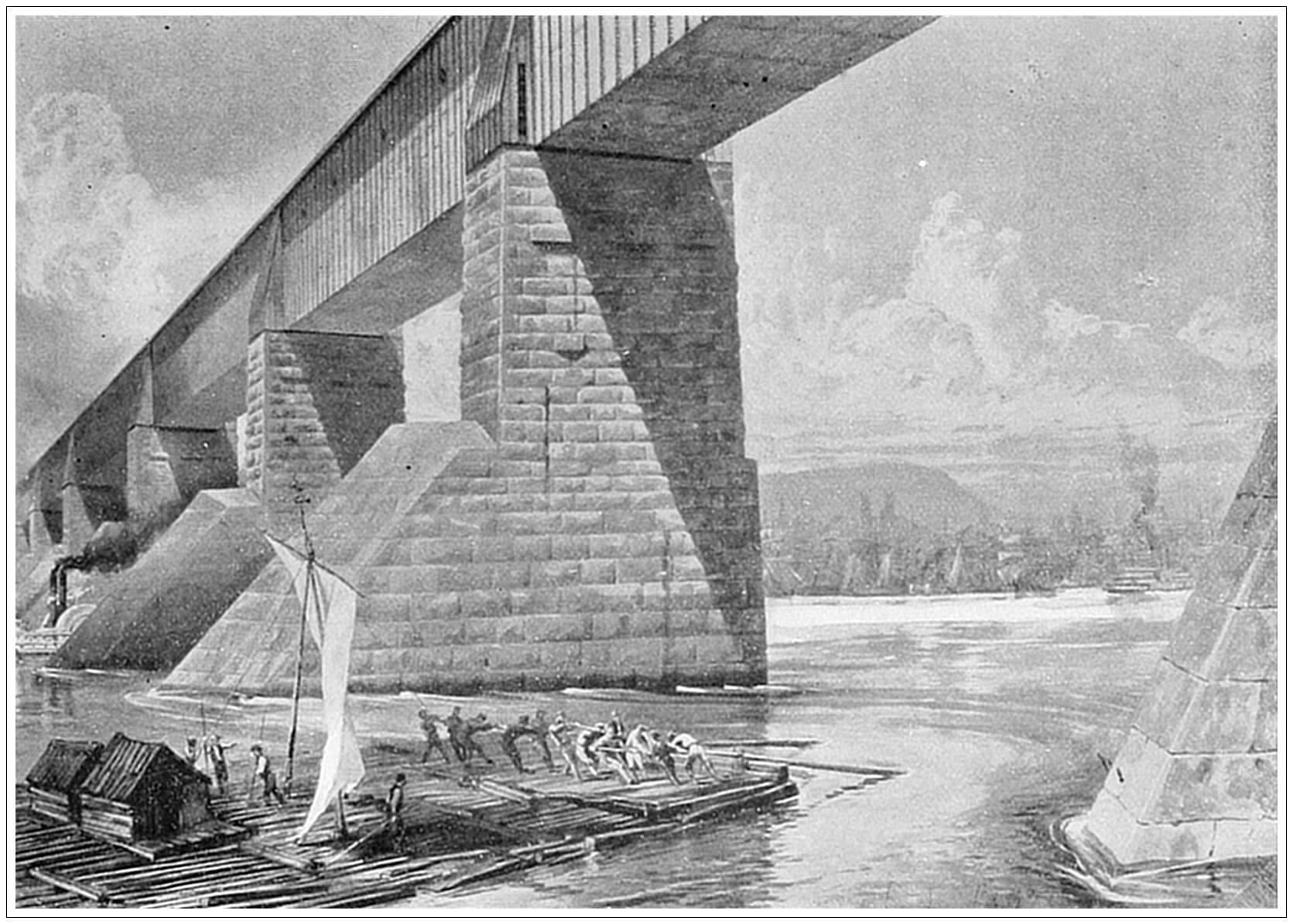
THE CAPITOL, WASHINGTON, D. C. A stately and magnificent
building devoted to both branches of Congress—the Senate and the
House of Representatives—as well as to the United States Supreme
Court and the Library of Congress. It stands upon an eminence commanding
a beautiful view of the city, and itself forms the most impressive feature in
the landscape. The centre building of freestone is flanked by two wings,
mainly of marble, and crowned by an iron dome, painted white. From the
ground to the top of the nineteen-foot Statue of Liberty, which surmounts the
dome, is three hundred and seven and a half feet; the diameter of the dome
is one hundred and thirty-five and a half feet. Thus only four domes in Europe
can surpass it: St. Peter’s at Rome, St. Paul’s in London, St. Isaac’s in St.
Petersburg, and the Invalides in Paris. The building covers an area of about
three and a half acres. Its total cost has been over $13,000,000. The corner-stone
was laid by Washington in 1792. The marble extensions were begun in
1851.
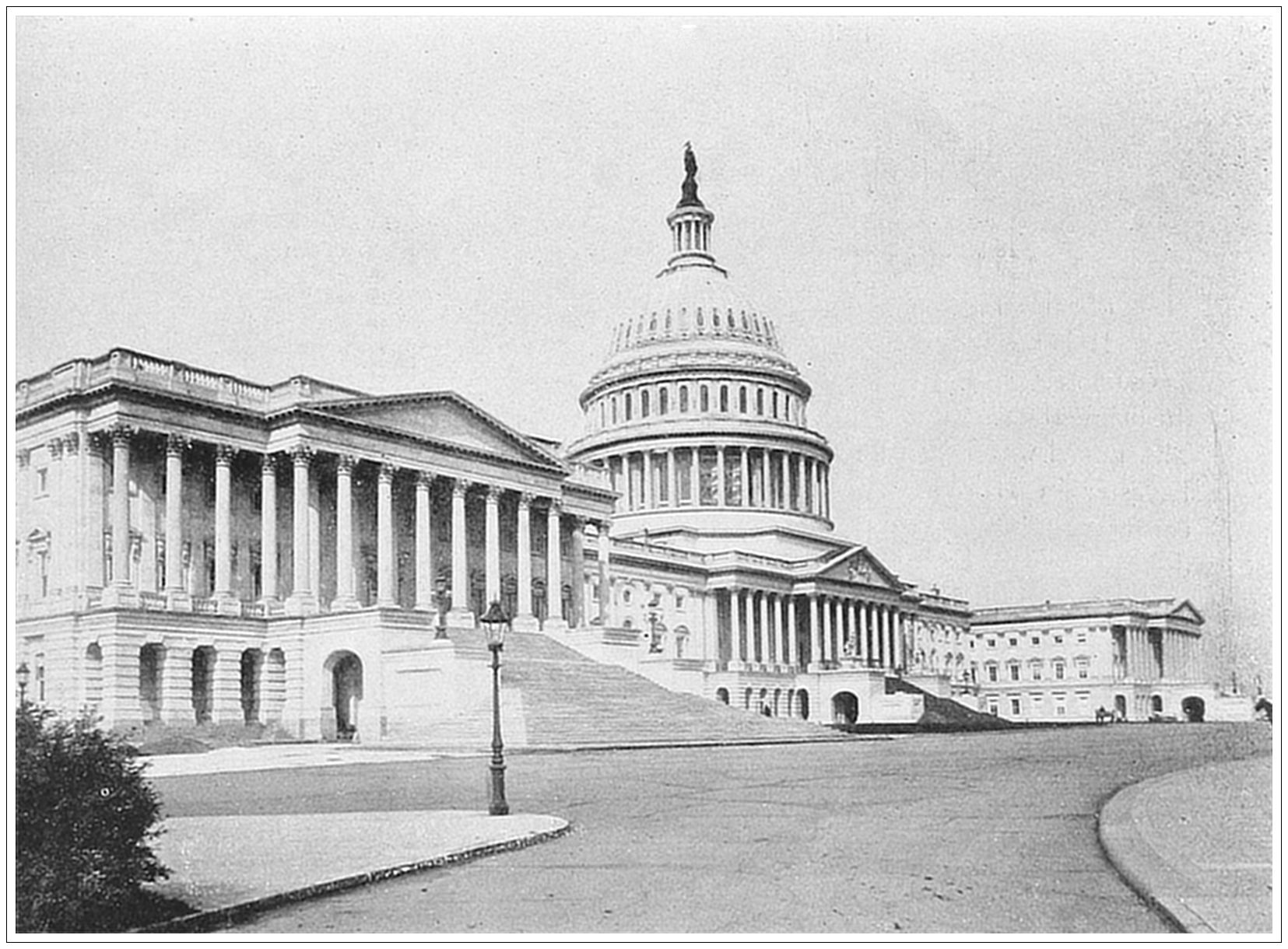
THE WHITE HOUSE, WASHINGTON, D. C. As the official residence
of the President of the United States, this mansion has a unique interest.
It is not in itself, however, a pretentious or imposing structure. Yet it
has some elegance in its very democratic simplicity. Built of freestone, like
the original Capitol, and painted white like that, its color has given it its name.
The model which the architect had in view was the Palace of the Duke of
Leinster in London, and he has followed his prototype very closely. The
corner-stone was laid in 1792; the building was first occupied by President
John Adams in 1800; it was burned by the British in 1814, and restored and
re-occupied in 1818. Since that time there have been staccato clamors for a
more magnificent entourage for the chief executive officer of the United States,
but nothing further has been accomplished.
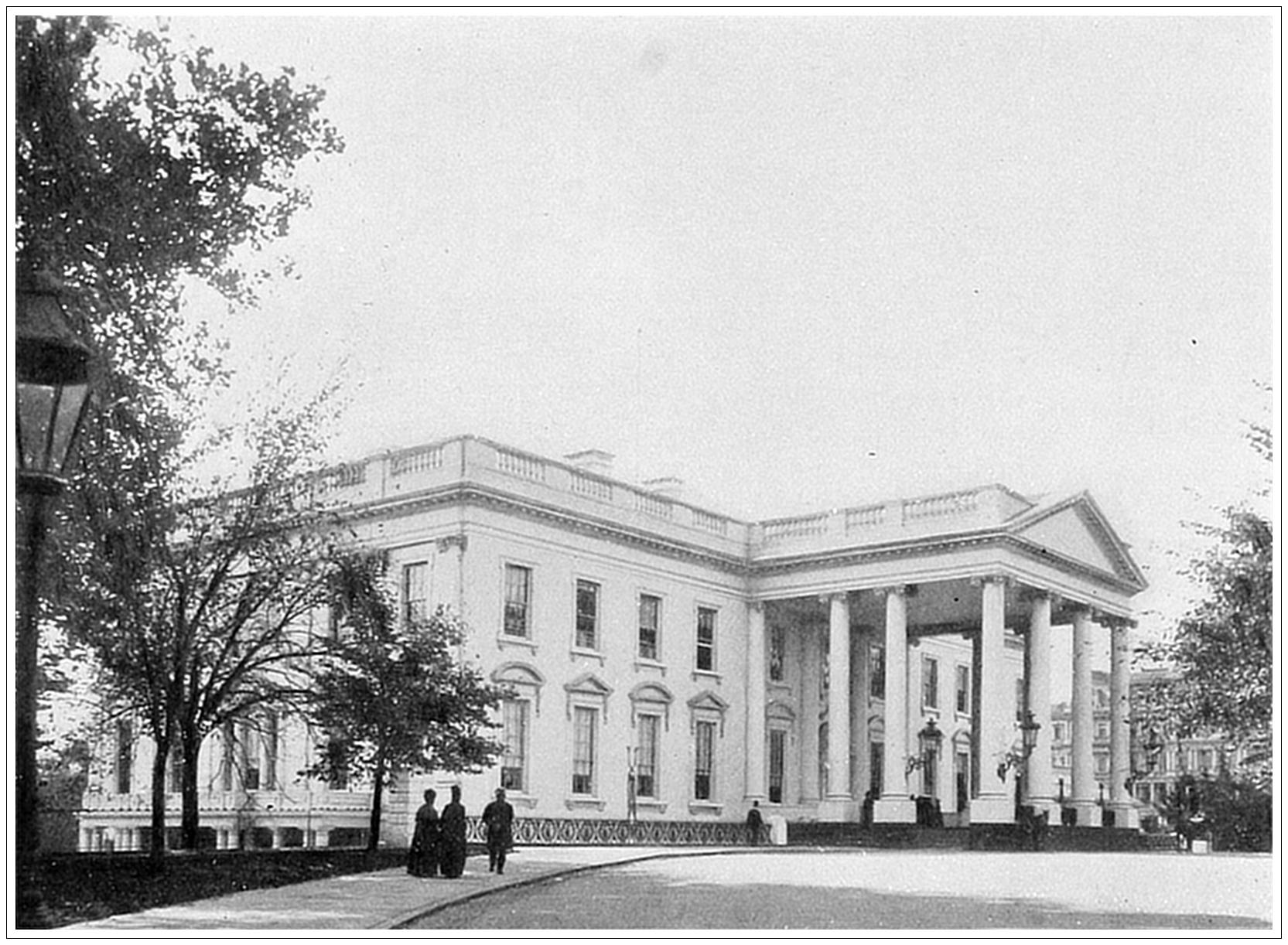
INDEPENDENCE HALL, PHILADELPHIA. This plain, but substantial
brick building, which stands on Chestnut Street, Philadelphia, is
ever memorable as the birthplace of the American republic. Here the
General Assembly of Pennsylvania gave way to the Continental Congress.
Here George Washington was elected commander of the American forces
(June, 1775). And here, on July 4th, 1776, the Declaration of Independence
was adopted by Congress. Four days later it was read from before the building
to an excited and exultant multitude. The halls have been restored as
far as possible to their original condition; the east room, where the Declaration
was signed, is ornamented with portraits of the signers and the west room is a
museum of revolutionary and other relics. The famous Liberty Bell, which
was rung as a signal to the people that the Declaration had been adopted,
is now suspended under the tower in full view of the public. The building
dates from 1729–34.
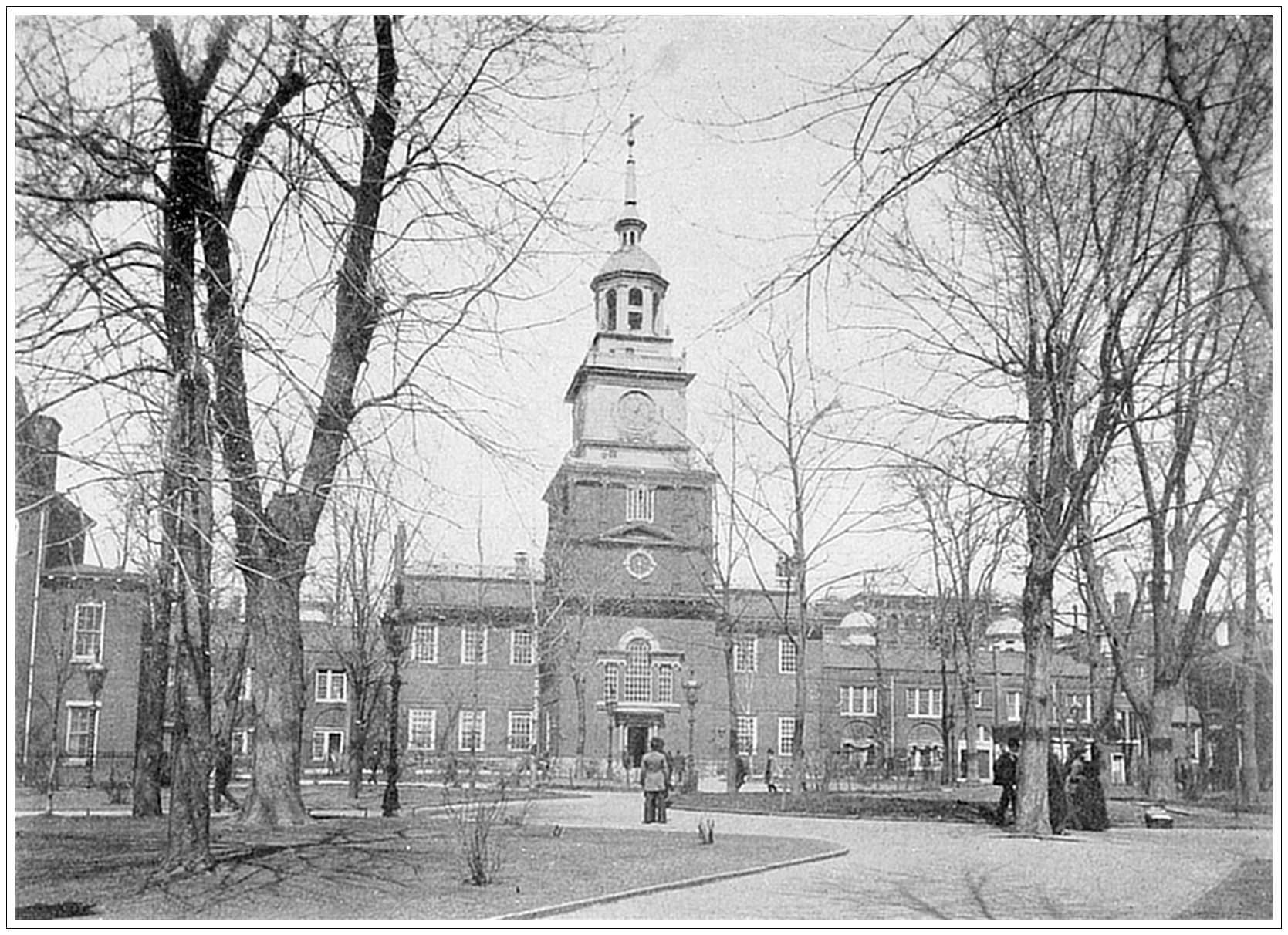
THE EAST RIVER BRIDGE, between New York City and Brooklyn,
more familiarly known as the Brooklyn Bridge, is a massive suspension
bridge, the largest in the world, which connects New York with Brooklyn.
Its colossal towers and ponderous cables loom up conspicuously before
the stranger who approaches New York from the riverside. Begun in 1870, it
was opened for traffic May 24th, 1883, at a total cost of $15,000,000. The
whole length of the bridge is five thousand nine hundred and eighty-nine
feet. From high water mark to the floor of the bridge is one hundred and
thirty-five feet. The central span (itself measuring one thousand five hundred
and ninety-five and a half feet) is suspended to four cables of steel wire,
each fifteen and three-quarter inches in diameter. The width of the structure
is eighty-five feet, which includes a promenade for foot passengers, two
roadways for vehicles, and two railway tracks on which run passenger cars
propelled by a stationary engine from the Brooklyn side.