The Project Gutenberg eBook, Around the Black Sea, by William Eleroy Curtis
Note:
Images of the original pages are available through
Internet Archive. See
https://archive.org/details/cu31924005342823
Transcriber’s Note
Larger versions of most illustrations may be seen by right-clicking them
and selecting an option to view them separately, or by double-tapping and/or
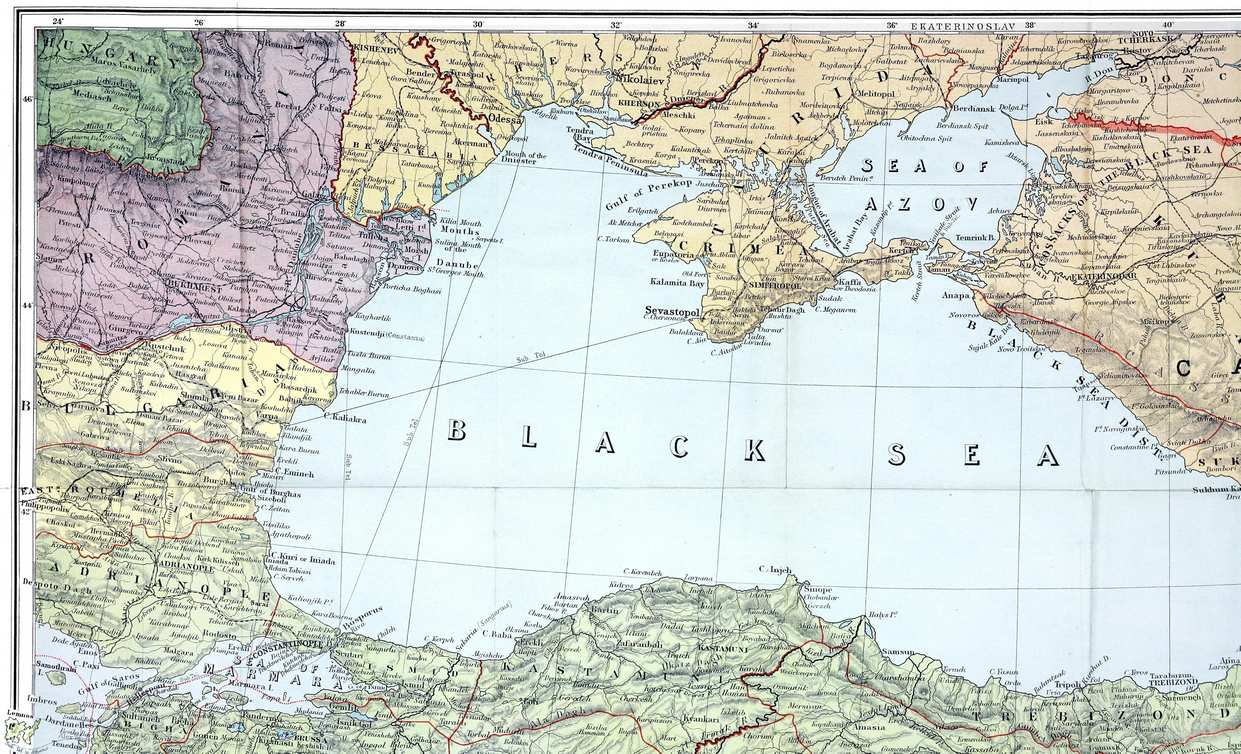
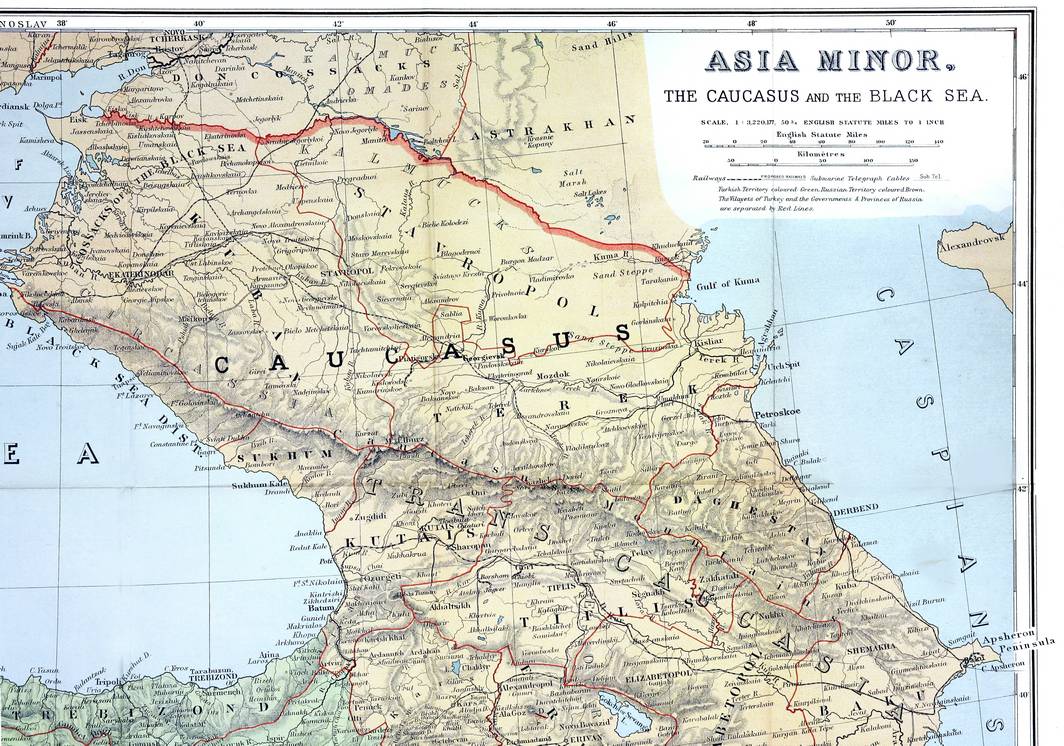
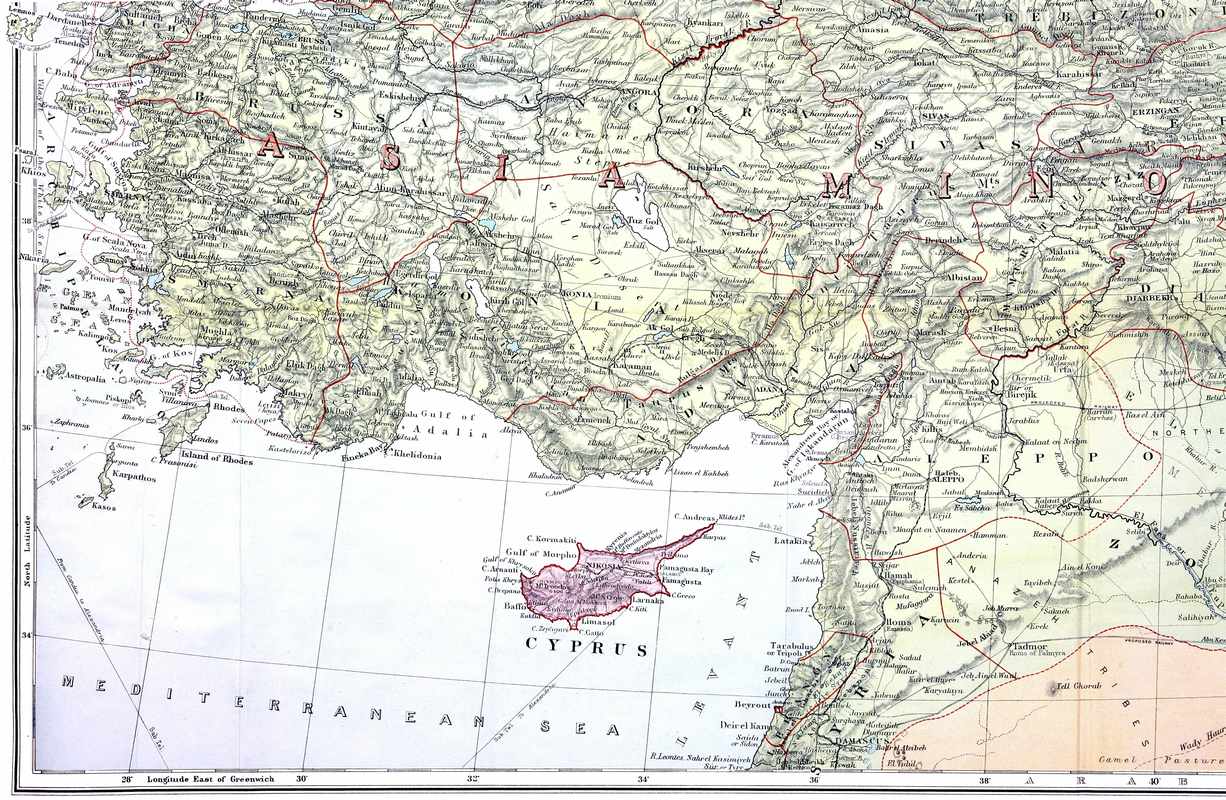
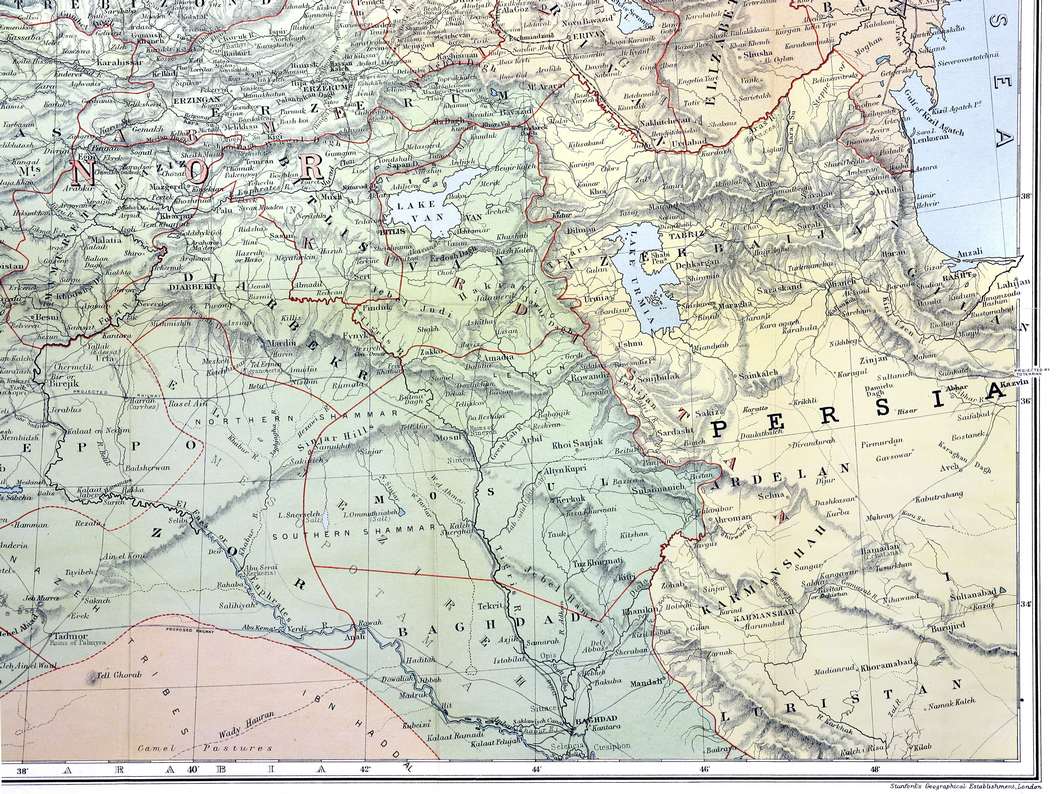
stretching them. Links to larger, higher-resolution versions of the maps
at the end of the book are shown below those maps.
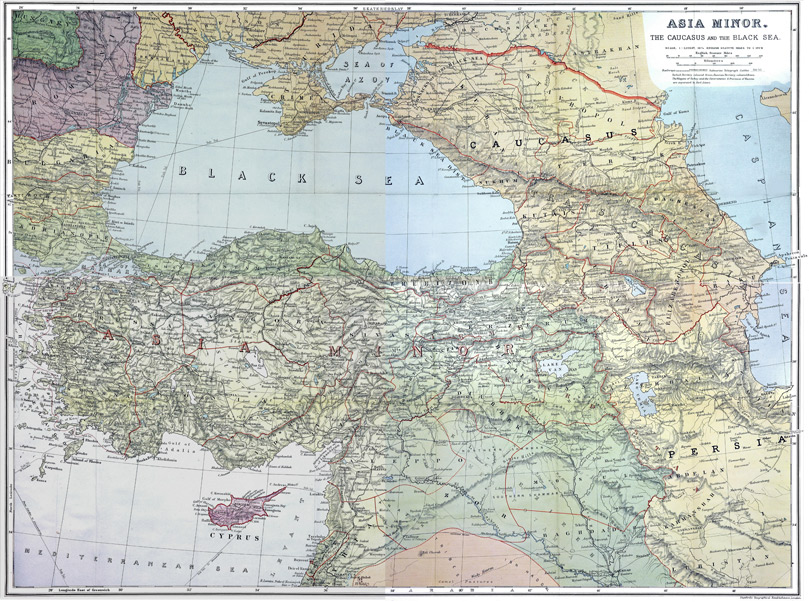
A complete map of the Black Sea
and surrounding country will be
found affixed to the inside of the
back cover of this book.
ASIA MINOR, ARMENIA, CAUCASUS, CIRCASSIA
DAGHESTAN, THE CRIMEA
ROUMANIA
BY WILLIAM ELEROY CURTIS
AUTHOR OF “TURKESTAN: THE HEART OF ASIA”
“BETWEEN THE ANDES AND THE OCEAN”
“TODAY IN SYRIA AND PALESTINE”
“MODERN INDIA,” ETC., ETC.
HODDER & STOUGHTON
NEW YORK
GEORGE H. DORAN COMPANY
Copyright, 1911,
By George H. Doran Company
THIS VOLUME IS COMPOSED OF NEWSPAPER LETTERS
WRITTEN DURING THE SUMMER AND AUTUMN OF 1910
AND IS AFFECTIONATELY DEDICATED TO THE
MEMORY OF THE LATE CORNELIUS McAULIFF,
MANAGING EDITOR OF THE CHICAGO RECORD-HERALD
There are several lines of steamers on the Black Sea,
sailing under the Turkish, Greek, Russian, German,
French, Austrian, and Italian flags. The steamers of the
North German Lloyd Company, which sail from Genoa
and Naples, through the Dardanelles and the Bosphorus, are
best, but they visit only the ports on the northern coast.
The Austrian Lloyd steamers, which come from Trieste,
are second best, and we were fortunate in obtaining cabins
on the Euterpe, which is old-fashioned, but comfortable.
The captain is an Italian of Trieste, who speaks English
well, as do two of the under officers; the steward is thoughtful
and attentive and the cook is beyond criticism.
The passengers were a perfect babel, representing all the
races and speaking all the tongues of the East, with several
Europeans mixed in, each wearing his own peculiar costume.
There were Turks of all kinds and all classes and all ages
wearing fezzes of red felt; there were Persians, wearing
fezzes of black lamb’s-wool; Albanians with fezzes of white
felt, and Jews with turbans and long robes, such as they
used to wear in the days of the Scriptures. We had several
Turkish army officers to amuse us, and one big, blue-eyed
general, who looked like a philanthropist, but is said to be
a fiend of a fighter. There were English, German, and
French tourists and rug buyers on their way to Persia and
Turkestan; a very fat Austrian woman who was going to
visit her son, consul at Batoum, and several Russians who
had been visiting Paris and the Riviera and were on their
way back to their homes in the Caucasus.
We had five different kinds of clergymen—Mohammedan
mullahs, wearing long robes and red fezzes with white
turbans wound around them, Greek and Armenian priests,
who are difficult to distinguish, and three Capuchin monks.
One of them was a venerable old gentleman with a patriarchal
beard, and one was a mere boy who smoked cigarettes
incessantly—and a cigarette does not fit in well with the
hood and robe of a monk. The Capuchins have several
monasteries in Asia Minor, and maintain schools and do
parish work in several of the cities along the coast, where
there are communities of Roman Catholics.
There were several Armenians in frock suits of broadcloth,
low-cut vests, and snowy shirt bosoms, like those
affected by lawyers in Mississippi and Arkansas, and one
howling dervish. He did not look a bit as you would expect,
but was a jaunty fellow in a fancy shirt of black cotton
with white spots, without a collar, and an ordinary sack
suit of gray European clothes over which he wore his distinctive
coat of camel’s hair with wide sleeves and facings
and trimmings of broad black braid, and on his shaven
head a fez of gray wool with a wide band of black around
it. He carried a dainty cane and whirled it around in his
fingers like a dandy when he promenaded the deck. He was
a presumptuous young dervish, for he endeavoured to enjoy
the privileges of first-class passengers on a third-class ticket,
which the deck steward would not permit. And when he
did not go back to his proper place, after being told to do so,
he was rudely elbowed down the stairs. It was not a
respectful way to treat a saint in embryo, which howling
dervishes are supposed to be, but I suppose the deck steward
had his orders, and perhaps he was accustomed to dealing
with such men.
Most of the Turks in the first-class cabin did not come to
the table, because they will not eat Christian food for fear
that lard or some other extract of the despised pig was used
in its preparation. They took their meals in their state-rooms,
with their wives and children, where they made their
own coffee over spirit lamps and drank water from red
earthen jugs which they had filled at the sacred fountains
before leaving Constantinople. The women did not leave
their cabins until they reached their destination, when they
climbed blindly down the gangways into the row-boats,
with veils drawn closely over their faces and their bodies
enveloped in large shawls.
Several Persians in the first cabin came to their meals
regularly, and brought their appetites with them. The
Koran applies to them the same as it does to the Turks, but
those gentlemen were not so pious as they should be. And I
noticed that none of the Mohammedan passengers, except
the mullahs and one general, said their prayers when the
time came. The general was very devout. He wore a
long, light-gray overcoat, reaching to his heels, which he
kept so closely buttoned that we wondered if he had anything
under it, and, like all military men over here, Russians,
Austrians, and Turks, he never put aside his sword, not even
when he spread his prayer rug on the deck and turned his
face toward Mecca to pray.
The other first-class Mohammedan passengers paid no
attention whatever to the hours for devotions, which gave
me a disagreeable shock, because I have always understood
that a Moslem is so conscientious that he will say his prayers
five times a day at the proper moment, no matter what he
happens to be doing or where he happens to be.
Many of the third-class passengers, who are compelled to
sleep on the open deck, performed their duties regularly.
They spread their prayer rugs carefully down in the first
open place they could find, and, turning their eyes toward
Mecca, went through with the genuflections which are a
part of the Mohammedan ritual, and cried in loud voices
that there is no God but Allah. Several of the private
soldiers, and we had a large number on board, said their
prayers regularly, regardless of their surroundings, but the
majority of them did not and probably not more than one
out of five of the Moslem passengers paid any attention to
the hours of prayer.
Two of the mullahs in the first-class end of the ship had
handsomely bound books from which they read aloud, as
is their custom. Turkish students always study aloud.
When you are riding along through country villages in the
East you can locate the school-houses by the murmur of
the voices of the pupils learning their lessons. If you go into
a mosque that is used for educational purposes you can always
find groups of students squatting on the floor, rocking
their bodies back and forth with a motion as regular as
that of a rocking chair, and repeating the lines of their
lessons in loud voices.
I once asked a Mohammedan teacher in a Syrian mosque
why this is done. He explained that people understand that
which they learn through their ears better than that which
they learn through their eyes. In the second place, he
said, when a person studies aloud the mind is kept upon the
subject intently and is not so apt to wander; thirdly, a
person who is studying aloud is not so apt to go to sleep as
when he reads to himself—and the danger of falling asleep
is the reason for the rocking motion of the body which all
students practise when they are at their books.
On the forward deck, where the anchor winch is, was
camped a group of Persians. Some of them were merchants
of Constantinople and other cities on their way to their
native country to buy rugs and other goods; others were
faithful Mohammedans returning from pilgrimages to Mecca.
They were dignified, thoughtful persons with dreamy eyes
and intensely black beards, and two or three old men had
made themselves supremely ridiculous by the use of henna,
which gives hair a bright scarlet hue. It reminded me of
What’s-His-Name in “Alice in Wonderland,” who suggested
that it would be awfully funny if everybody would dye
his whiskers green.
“And hide our heads behind our fans
So they cannot be seen.”
Others had their finger nails stained scarlet with the same
stuff, which gives a startling effect.
On the other side of the deck from the Armenians was a
nest of their hereditary enemies, Kurds—tall, robust,
brown fellows, with snub noses, small, fierce eyes and garments
that are indescribable because of the variety of cut
and colour. They lay around smoking cigarettes in the
most indolent manner, each having what looked like an
old-fashioned quilted comfortable for a mattress and an
embroidered bag for a pillow.
The most interesting of all were the Lazis, from Lazistan,
short, broad-shouldered, muscular chaps, most of whom
brought their wives and children with them and camped
amidship on the open deck like a lot of gypsies. The women
were entirely concealed in shawls of cotton or silk that cover
the head as well as the body, and they squatted in groups
in the same place all day long, scarcely moving a muscle
except when their husbands were hungry, and then they
would dig down into a bag and produce a loaf of bread, a
dried fish, a few onions, and other simple forms of food.
There were several babies scattered about promiscuously
in bright-coloured wrappings, and a number of children
under ten years old. Some of them had dainty features and
lovely eyes, and a better behaved lot of children you never
saw. We did not hear one of them cry during the entire
voyage. They lay in their clumsy, queer-looking cradles,
made by rude carpenters, without the slightest attention,
as self-satisfied as if they had been millionaires smothered in
luxury.
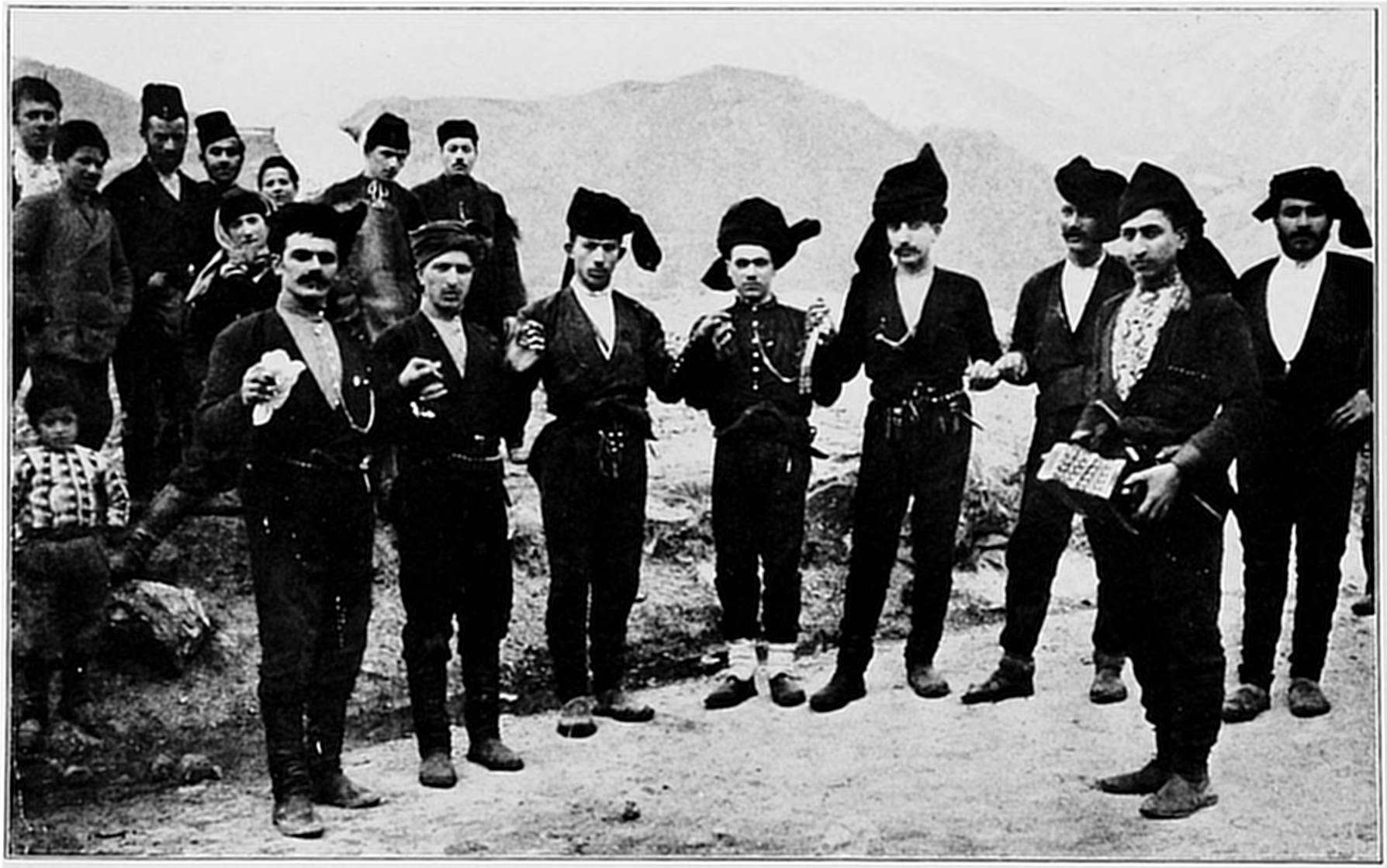
One night the peasants from Lazistan gave an interesting
performance. The music was furnished by an ordinary
bagpipe with three stops, which emitted a mournful and
monotonous refrain, but with perfect time, and the dancers
kept step to it very much after the manner of the North
American Indian. They placed a child in the centre, a
dozen or so of them clasped hands in a circle, alternately
spreading out as far as their arms would reach and then
coming together in a bunch, and in the meantime stamping
their feet, bowing the knees, and bending the upper part of
the body forward. Sometimes they would stoop to a
squatting posture and hop along on one side and then
on the other; then they would raise their arms as high as
they could reach, revolving all the time to the left. It was
a graceful movement and rather fascinating, and they seemed
to enjoy it.
The third-class passengers who occupy the open deck,
make themselves as comfortable as possible with big
bundles of rugs and blankets and pillows, which they spread
out wherever the boatswain will let them. They gave us a
continuous performance abounding in life and a gorgeous
riot of colour, entirely unconscious of their odd ways, their
artistic poses, and the entertainment they were furnishing
to the foreigners who could look down upon them from the
afterdeck. The captain told me that there were doubtless
thirty different races among the passengers upon that ship—Turks,
Tartars, Mongols, Arabs, Armenians, Albanians,
Circassians, Georgians, Greeks, Jews, Kurds, Lazis, Slavs,
Syrians, Turkomans, Bokharoits, Wallachs, and Persians of
various clans, which can be detected one from another by
experts, because of the way they wear their clothes. Everybody
except the women wore brilliant colours, and they were
shut off from observation as much as possible by
blankets pinned to the canvas awning so as to make
screens.
Turks are very democratic. Islam recognizes no caste;
there is no aristocracy or nobility or any divisions among
the Turks except on an official basis and the inferiors show
great respect to those who are above them. The ordinary
Turkish peasant is good-natured, honest, sober, patient,
frugal, industrious, and capable of great endurance. He is
not fanatical, but is kindly disposed toward everybody.
His hospitality is unbounded and the exercise of charity
is one of his greatest pleasures. Two ragged fellows came
up to the first-class deck one day, bringing a wash basin of
graniteware painted a bright blue, which they passed around,
asking contributions for the benefit of a sick man with five
children who was lying helpless on the open deck and ought
to be given shelter below in the second-class cabin, which
he had no money to pay for. I noticed that everybody
chipped in something, from the glittering general to the
tatterdemalions who lay sprawled upon their blankets in
the shady places.
Every third-class passenger had a basket of provisions
and a jug of water, and an old man fixed himself a place in
the corner, where he set up a samovar and made coffee
to sell. He did a good business, too. His little brass pot
was always in motion, because Turks are inveterate coffee
drinkers and want a cup of that beverage every few minutes.
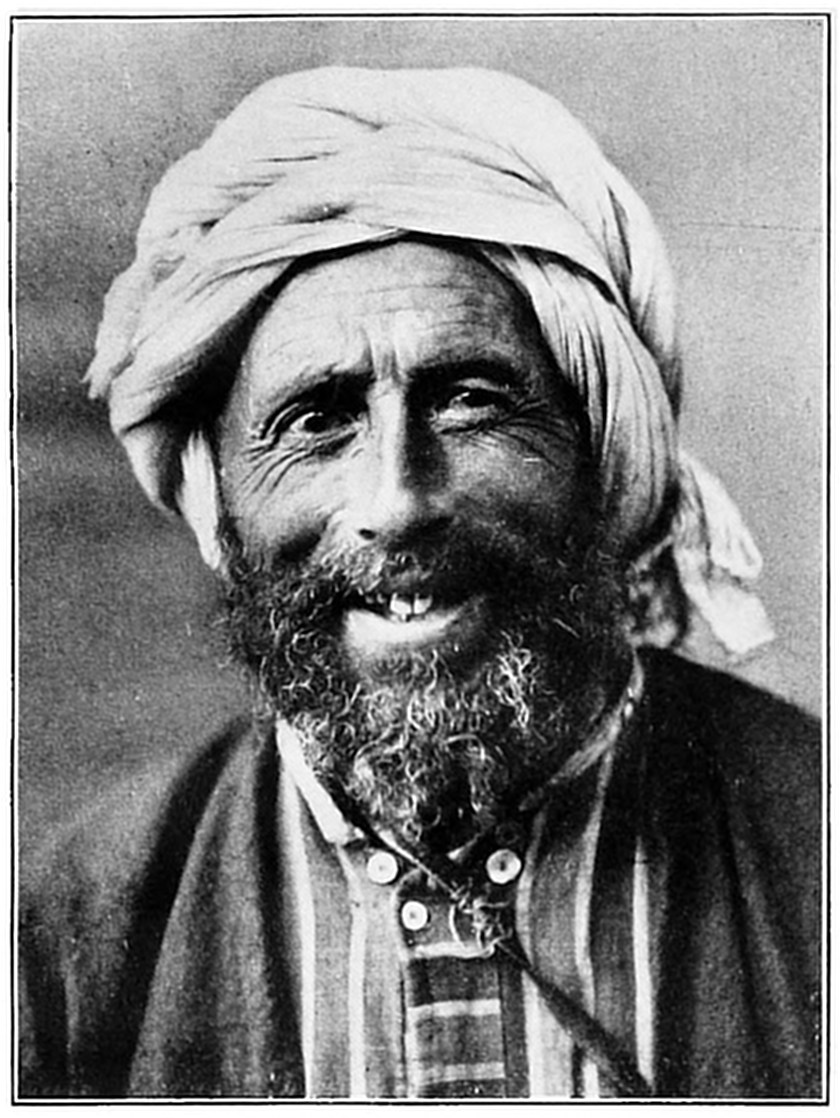
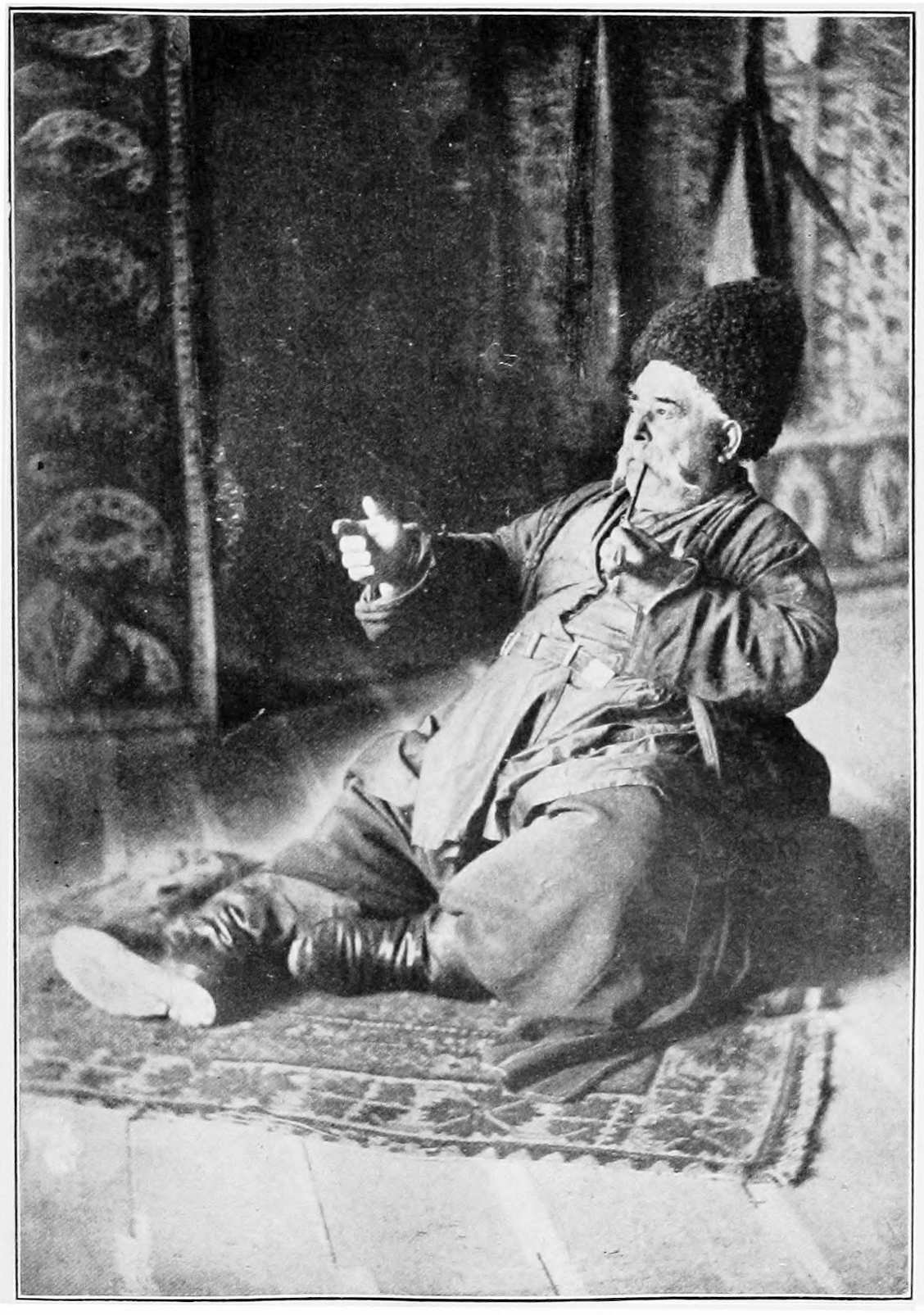
The old coffee seller was a picture—a Turk from Samsoun,
a good-natured old fellow with a wrinkled face, a curly
beard, a white turban, and a smile like that of our President,
which won’t come off.
Coffee peddler on our steamer
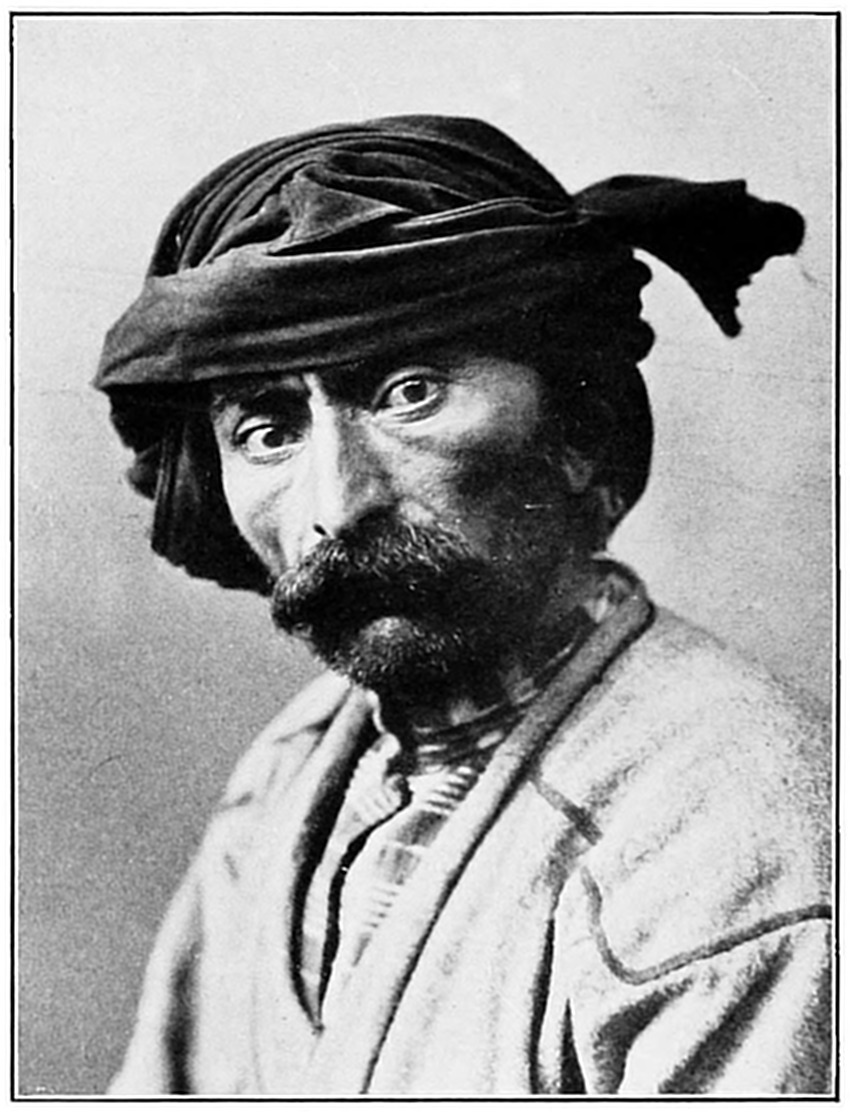
A Turk of Trebizard
The beauties of the Bosphorus have often been described,
and probably no sheet of water of corresponding length is
so highly decorated by nature and by man. There are a
dozen splendid palaces, some of the most imposing residences
in all the world, sitting on the very edge of the water at the
foot of the hills which enclose the Bosphorus. The Dolma
Bactche Palace, now occupied by the sultan, is perhaps the
finest, and near it is another equally famous, the Cherigan
Palace, which was occupied by the Turkish Parliament until
it was burned in February, 1910. The roofless walls, stained
with smoke, and the hollow windows now stand mute,
unable to testify in their own defence and solve the mystery
whether the calamity was due to arson or accident. It
is generally assumed that the fire was started by incendiaries,
for it seemed to break out in several places at the
same time, and burned so fiercely as to suggest inflammables.
However, there is no definite knowledge on the subject.
It occurred in the night, the watchmen were asleep or
absent, there were no police in the neighbourhood, and one
of the most exquisite gems of architecture in existence was
a hideous skeleton of marble before an attempt to save it
could be organized.
The possible motive of an incendiary was to destroy a mass
of documents discovered in the Yildiz Kiosk after the
forcible evacuation of Abdul Hamid. His archives, official
and personal, filled fifty carts and were hauled away to some
unknown place, where they were being sorted over by a
parliamentary commission, and already extraordinary discoveries
had been made concerning the treachery and
hypocrisy of prominent men. There has been and still is
a determination on the part of certain personages, whose
reputations will be ruined, to prevent the publication of
these papers, and there have been several stormy debates
in the Chamber of Deputies on the subject. Lacking other
explanations, it has been assumed that the Cherigan Palace
was set on fire for the purpose of destroying these private
papers of the ex-sultan, although it was a useless sacrifice.
The documents were not there. Few people knew
where they were, except the commission which was engaged
in classifying them.
Cherigan Palace stood on the shore of the Bosphorus about
two miles from the bridge which connects Galata and
Stamboul, and it was the most attractive and artistic of all
the many buildings which give that water course its fame.
It was built about sixty years ago by Abdul Aziz, who was
sultan from 1861 to 1876, and was the best ruler Turkey
has known for centuries. He intended it for his own residence,
lived there for twelve years, and died there in a most
tragic manner, June 17, 1876. There his son, Murad V,
was allowed to reign for a few months, until he was deposed
by a conspiracy which placed Abdul Hamid, the late sultan,
in power, and the latter kept his elder brother a prisoner
within its beautiful walls for several years, until he, too, was
taken off in a mysterious way—some believe by suicide
and some by violence. However, no prison was ever more
artistic in design or expensive in construction. It was
entirely of marble, inside and out, and the interior was
remarkable for the richness of the carvings and of the hangings
and upholstery and for the beauty of the mural decorations.
When the Parliament was organized, Cherigan
Palace seemed to be the most convenient building for its
sessions. The Senate sat in the state dining-room, and
the Chamber of Deputies in the ballroom, which were
easily fitted up for the purpose.
There are several hotels on the Bosphorus, which are occupied
during the summer, and all of the great nations,
except the United States, have handsome residences for
their embassies in a water suburb known as Therapia.
The Russian embassy is the last and looks directly up the
narrow throat which leads from the Bosphorus into the Black
Sea. Both sides of this passage are guarded by heavy
earthworks against a Russian invasion. Turkey fears no
other nation and Russia cannot reach her southern coast
by sea without going through Turkish waters. This
situation has exasperated every Russian since Peter the
Great, who is supposed to have left a will in which he
admonished his successors never to rest until they have added
the Bosphorus and the Golden Horn to the Russian Empire.
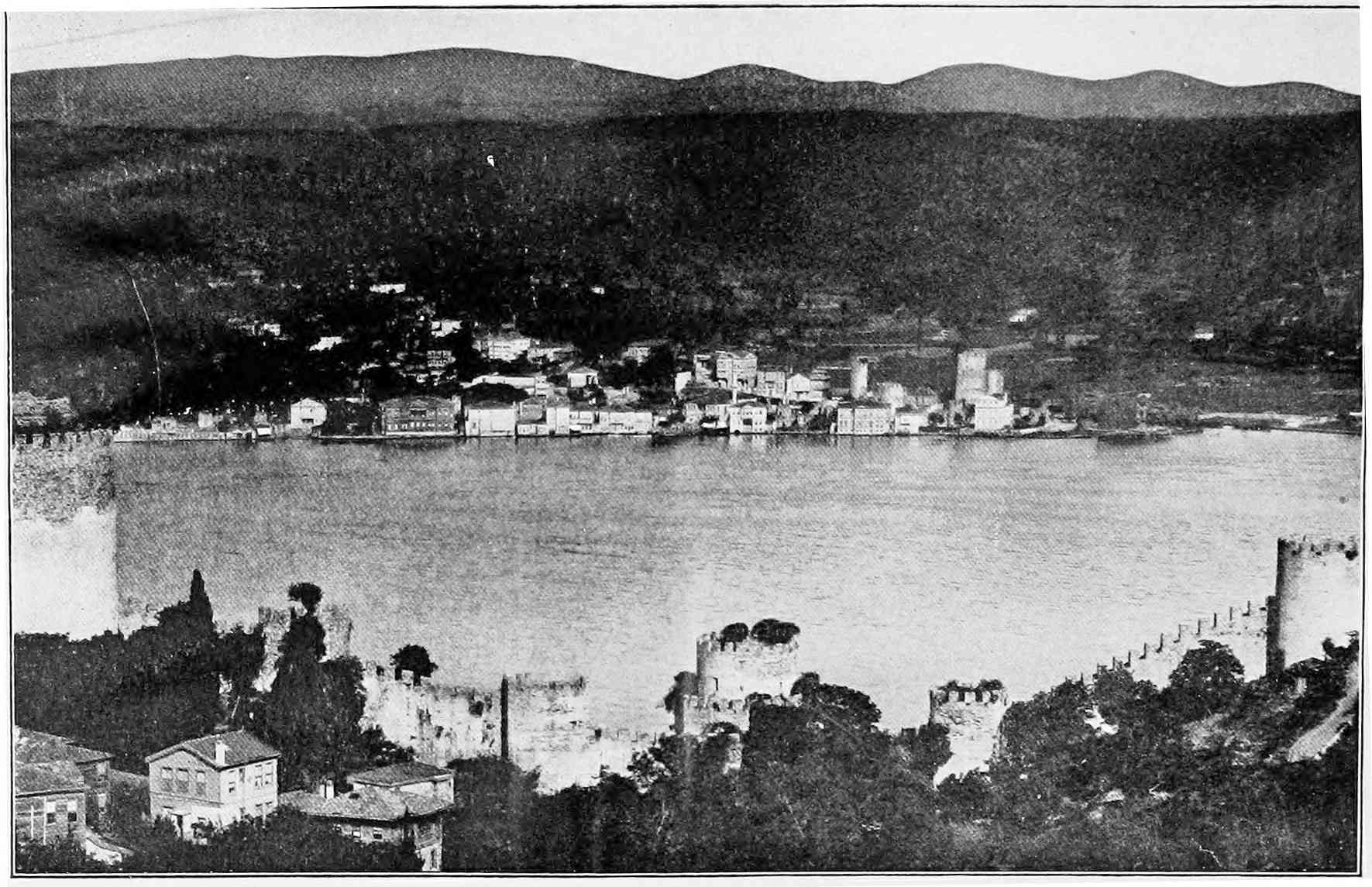
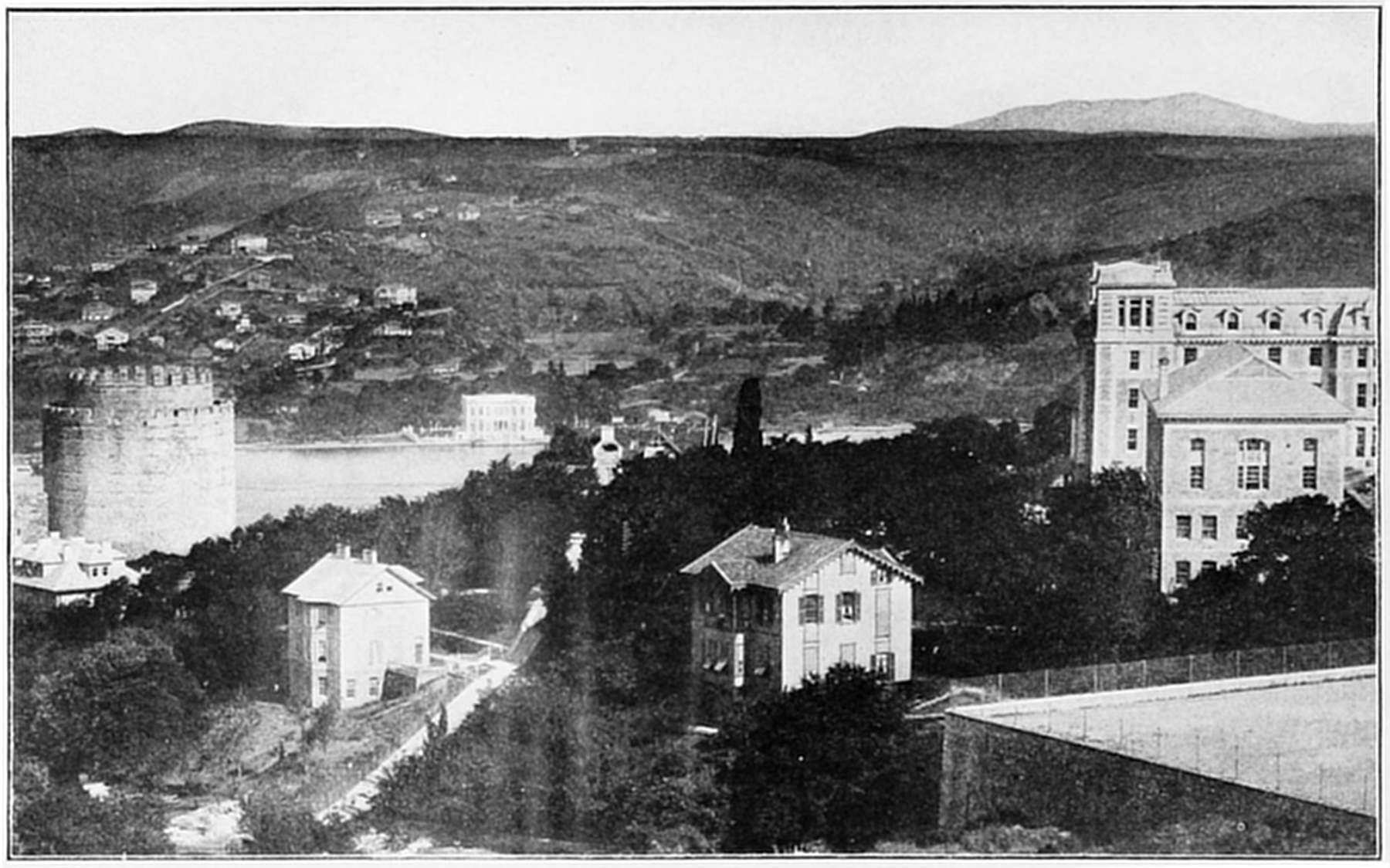
Robert College, an American institution which has turned
out some of the best men in the East, and an old Byzantine
castle which dates back many centuries, are the most
conspicuous objects on the European side, and near them is a
sightly location where Dr. Mary Patrick has erected new
buildings for the American College for Girls, with funds
contributed by friends in the United States. Her former
buildings in Scutari were not half big enough, since the constitution
was adopted, to accommodate the young Turkish
women who want an education.
The first town of importance, sailing eastward from Constantinople
along the southern coast of the Black Sea, is
the ancient City of Samsoun, founded by the Greeks more
than two thousand five hundred years ago, and always of
consequence commercially. It has a splendid location,
sloping gradually upward from the sea, but like many people,
as well as towns, does not fulfil the expectations excited by
its appearance from a distance. There is a big hospital for
soldiers upon a slight eminence back of the town; several
minarets show where the mosques are; the five domes of a
Greek church glisten in the sun; several imposing business
blocks and residences line up well along the seashore and
give a brave appearance to the place: but when you land,
you are disappointed to find the streets narrow and dirty,
with a mixture of smells arising from unknown sources,
wretched pavements, and mangy dogs lying around in the
sun scratching themselves in a way that is more
suggestive than comfortable. Scratching is sometimes
contagious.
But the narrow streets are interesting, and the market
place, with a circular fountain and an ancient mosque, offers
one of the quaintest and most picturesque Oriental scenes
you could imagine. In the foreground a butter dealer in
an indescribable costume of more colours than Joseph could
possibly have had in his coat, was ladling greasy-looking
stuff from a great tub with a wooden spoon and, on his
scales, he used stones for weights. The vegetables and
oranges were fine. Onions and garlic could be felt in the
air, both in the raw material and in the finished form of
odours. Turks are largely vegetarians. Vegetables, fruits,
and soups made of grain are the chief articles of their diet.
We were told that Samsoun is a great place for apples, so
much so that the bears come down in droves from the mountains
back of the town when the fruit is ripe and rob the
orchards. We tried some of the apples which the peasants
sell by weight in the market place, and found them dry and
tasteless, but I don’t think they were to blame. No apples
are good in May.
There is a café every few yards on every street, where it
seemed as if the entire male population were sipping coffee
and smoking cigarettes. We saw a few nargiles—those
long-tubed water pipes which are generally associated with
cross-legged Turks—in Constantinople, but did not find
one anywhere else. I suppose they are out of style, for all
the Turks that we met were smoking cigarettes
instead.
Quantities of licorice root are shipped from Samsoun. It
grows wild in the mountains. The quality, as well as the
value, might be improved by cultivation, but such a thing
has never been attempted on a large scale. The sheep
upon the mountain sides furnish cargoes of wool, and the
cattle we saw grazing in large herds add many hides, but
tobacco is the chief article of export from Samsoun, and a
boy who voluntarily attached himself to our party and followed
us along, chattering as he went, told us that a large
establishment surrounded by a high wall belonged to
Americans.
How a Turkish lad, who presumably had never been out
of his native place, could have identified us as Americans is
remarkable, for in Oriental countries, even in China and
Japan, the natives are seldom able to distinguish between
Uncle Sam and John Bull; but, nevertheless, we acted on
the welcome information and soon found three fellow-countrymen
representing the American Tobacco Company
purely for the purpose of buying cigarette material, and,
in 1909, they shipped $397,000 in tobacco from that port
alone. There are several other buyers for the American
market, but they come and go with the season.
The tobacco produced around Samsoun is light of colour,
and of fine flavour, especially suited for cigarettes. There is
a great difference in the quality according to the care and
cultivation, and the Americans have persuaded a few of the
farmers to improve their methods and implements. They
told me that twice the present crop might be produced from
the same area if half the care and skill were expended upon
it that the Cuban planters give to their tobacco. Samsoun
expects to be the northern terminus of one of the
railways which have been authorized by the Turkish
Parliament.
If you will look on your map you will notice that Asia
Minor is that part of Turkey which projects into the Mediterranean
on the Asiatic side, an almost square peninsula
about three hundred miles each way. It is bounded on the
north by the Black Sea, on the east by Armenia and Kurdistan,
on the south by Syria and the Mediterranean and
on the west by the Ægean Sea. The western portion of
Asia Minor is called Anatolia. It is densely settled by
Turkish farmers who cultivate the ground in a primitive,
awkward way, but do not realize more than half the value
of their labour; first, because of their primitive tools and
instruments and their imperfect cultivation, and, second,
because there are no transportation facilities by which they
can send their produce to market. There are two railways
running into the interior from the Mediterranean coast,
furnishing communication for about 10 per cent. of the population.
Throughout 90 per cent. of Asia Minor the only
way of travelling is on the back of a horse or a donkey and
the only facility for moving freight is by caravans of camels,
which are slow and very expensive. For these reasons the
inhabitants depend to a great extent upon their own resources.
They make everything they wear except cotton
fabrics and have very little to ship away.
Almost directly south of Samsoun, about a hundred miles,
is the Marsovan station of the American Board, first occupied
in 1852, and for fifty-eight years the headquarters of
missionary work, not only for that important city, but for a
wide reach of country, including Samsoun, Amasia, and
other important towns. The work has naturally been
built up by a process of growth. Little day schools, teaching
reading, writing, and spelling in the vernacular, have
developed into two great institutions: Anatolia College,
with its extensive buildings devoted to the collegiate training
of young men, and the Girls’ High and Boarding School,
an institution quite by itself, giving nearly the same complete
course of study that is given to the young men.
These two schools have ample grounds and are both
adding gradually to their large plants. The college for
young men will soon have $30,000 worth of new buildings,
which amount will erect about eight times as much as in
the United States. The girls’ school has completely outgrown
its large plant, completed only a few years ago, and
is adding substantial new buildings.
The college for boys has in a peculiar way taken hold
upon southern Russia. Three or four years ago Russian
students began to come across the Black Sea, and have
doubled in number every year since. It was feared at
first that they might be unruly and disorderly, or perhaps
revolutionary in their tendencies, but, quite contrary to
expectations, they have proved to be among the most
steady, earnest, able students the college has had. Like
Robert College, at Constantinople, Anatolia has Greek,
Mohammedan, and Armenian students. Greeks are not
found in colleges east of Marsovan, to any extent.
The college has also, as a part of its organization, a large
medical department with extensive hospitals and a nurses’
training school under the direction of two efficient American
physicians, Dr. Jesse K. Marden and Dr. Alden R. Hoover,
assisted by a large native medical staff.
Patients come to the hospital at Marsovan from a wide
area of country and it is reaching not only the Armenians
but the Mohammedan classes. The medical service has an
unmeasured influence upon the people of the country and
makes an impression which no other form of missionary
work can possibly do. The people know when they are
ill and want medicines, but they are not often aware when
they are ignorant and need educating or are morally in need
of spiritual uplift. When they meet with severe accidents,
as so frequently occurs in that country, or when they are
racked by disease, they quickly learn that relief can be
found at the mission hospital at Marsovan, and some means
of reaching there is devised. They often go on a rude cart,
sometimes upon the back of some animal, or, if they live
upon a possible road, in a Turkish araba or hooded “carry-all.”
They find their way to the hospital and there receive
the kind treatment which belongs to every hospital, but
especially to the missionary hospital in a non-Christian
land. After treatment, they return to their homes full of
enthusiasm and gratitude for what they have seen and
received.
In addition to the institutions already mentioned, which
have separate buildings, there is a theological school for
training native college graduates for direct evangelistic
work among their countrymen. This school will soon have
a separate building, having hitherto been considered a part
of the college to which it was attached. The importance of
this work has now reached a stage where it demands a
separate home and possibly separate management.
Industrial work is an important adjunct to the college.
It was started as a means of self-help, to enable students who
could not pay their tuition or board to earn a part of it by
manual labour, and American machinery and tools were introduced
for cabinet work according to modern methods.
This has proved so popular that it was necessary to make a
rule that no boy should take the mechanical courses alone,
without taking some of the regular courses in the college or
the preparatory school. Many fathers were so anxious to
have their sons learn to use tools and machinery and to
make things, that they brought them to the college and asked
that they be admitted simply for mechanical instruction.
While the school has not been wholly self-supporting, the
students have been able to earn a large part of the cost of
their education and have received instruction that could
not have been given them in any other way.
This kind of training is especially important in Turkey,
where the idea has prevailed, and still prevails to no small
extent, that when a man is educated he must not do anything
that looks like manual labour. Unfortunately this delusion
is not confined to Turkey. The mechanical department is
calculated to take that fallacy out of the minds of young
men, making them see that manual labour is no disgrace
and that even a scholar may do things with his hands. Turkey
must come to the idea that a scholar of the highest type
may be a civil engineer, who will be required to do outdoor
work. The industrial school at Marsovan is but a preparatory
step to the larger comprehensions of the dignity of
labour, while at the same time, it trains the students who
come within its influence in mechanical exactness. There is
much of value, missionaries have learned, as well as educators
in America, in training a boy to do something that
is worth while in a mechanical way.
As a part of the medical work, it has been necessary for
the American missionaries to establish dispensaries where
cases can be treated temporarily, and especially where
medicines can be provided for outside patients. It is so
difficult to get pure drugs at regular Turkish drug stores
that it has been necessary for all the American hospitals
in the country to establish and maintain their own dispensaries.
Their supplies, bought at wholesale, are sent out
from the mission headquarters in Boston, and, therefore, are
reliable in every way. Many native pharmacists are being
properly trained. These dispensaries often prove almost as
valuable for the lives and health of the people as the hospitals,
and are regarded as a necessary adjunct of every hospital.
At Marsovan, to carry on this work in all departments,
there are nineteen Americans: four ordained missionaries
and their wives, three laymen, two physicians, and six
single women, all college graduates, and nearly all having
taken from three to five years of post-graduate work. Connected
with them, and working with them in every way,
are at least twenty-five times this number of trained native
Christian leaders, many of whom are graduates of the college
or other American institutions. Some have studied
in Europe after taking a course in the college at Marsovan.
Upon the American staff, with the native associates, also
rests the responsibility of supervising native evangelistic
work in a wide field. Tours of inspection are taken by the
missionaries from time to time, thus keeping them familiar
with what is going on, so that they may devote their energies
at the centre to the demands of the work outside.
As an illustration of the way in which educational institutions
grow, Anatolia College is an admirable example.
The germ which produced this great institution, now with
more than three hundred students and several departments,
was a little school in the corner of a stable in the city of
Marsovan in charge of Dr. C. C. Tracy. The stable filled
the greater part of the building, and in one of the corners,
on a platform of earth raised a foot or so above the common
level of the mud floor, and protected by a light rail, was the
school. Less than a dozen children there took their first
lessons in learning to read. At the start, in common intelligence,
they were but little in advance of the animals
that occupied the rest of the room. No one could have
detected in that humble beginning the germ of an institution
that now covers several acres in buildings and campus
just outside the large and flourishing city of Marsovan,
filled with bright young men from all parts of Anatolia,
from along the entire southern shore of the Black
Sea, and even from Russia, on the northern coast—studying
for academic degrees in preparation for
positions of influence and leadership in the new Turkish
Empire.
This little stable school became a high school in 1886,
and a full-grown college a few years later. It now has a
faculty of twenty-three professors, fourteen of whom are
natives of the country and eight have taken post-graduate
courses to prepare themselves for their work. They have
degrees from the New College at Edinburgh, the University
of Berlin, the University of Athens, the Imperial Law School
at Constantinople, the Royal Conservatory of Music at
Stuttgart and the Academy at Paris.
Anatolia College has sent out 224 graduates, of whom
207 are now living. Fifty-two are engaged in teaching,
forty-eight are practising medicine, and eighty-six are in
business. In addition to these graduates, several thousand
other young men have for a time studied in the institution
and for various reasons have been compelled to leave
without completing the course. These have, however,
gone out armed with a new power which this college has
given them, and many are doing signal service within and
without the Turkish Empire. Not long since, in a mixed
gathering of Turks and Christians in Marsovan, profound
thanks were expressed by Mohammedan leaders for this institution
and what it has done to disseminate ideas of liberty,
for the emancipation of women, and for the general welfare.
Among the students in the college, who come from about
half of the twenty-nine provinces of the Ottoman Empire,
are also found natives of Greece, Albania, Egypt, and, as
has already been stated, Russia. The courses of study are
similar to the usual college courses in the United States,
with the exception that more emphasis is put upon the living
languages than upon the dead.
Coasting along the south shore of the Black Sea, we were
sailing through a land of fable, and our steamer touched
at some scene of Greek mythology two or three times every
day. At every port where we stopped to discharge or take
on cargo we were surrounded by fleets of queer-looking boats
with high-pointed prows and sterns, like the gondolas of
Venice and the ancient galleys of the Greeks. There is
always an exciting scramble when the gangway is lowered,
and the barefooted boatmen climb over each other to get
on board to solicit the patronage of the passengers. Their
costumes, their cries, their gesticulations, and the confusion
they create make it hard to believe that they are the descendants
of gods and demi-gods, the heroes of the poems
and the fables and legends we read in Greek mythology.
The coast is bordered with a continuous range of magnificent
mountains, rising gradually from the sea, clothed with
forests on the upper heights and usually a strip of cultivated
land along the coast. The successive ranges, rising one
above the other, culminate in snow-capped peaks in the
far background. The lower slopes and the coast line are
dotted with villages embowered in oak, chestnut, beech,
walnut, and hazel trees and masses of lilac, rhododendrons,
azaleas, myrtles, orange groves, and orchards of quince and
cherry trees, which are all in blossom in April and May
and make a charming picture.
The steamer stops usually from one to five hours, which
is long enough to see everything that is interesting and gave
us a good idea of northern Turkey, which, by the way, is
very different from what I expected in many respects.
Indeed it is necessary for every one who goes there to revise
his preconceived ideas of Turkish life and character; but the
way we had to fight with the boatmen and the hackmen,
who refused in almost every case to accept the fares agreed
upon before starting, shows that the successors of Castor
and Pollux, Theseus, Diana, and the other demi-gods have
degenerated from the classic days. It seemed almost incredible
that we were actually visiting the playgrounds of
the gods. The imagination of the ancient Greeks peopled
that beautiful coast with supernatural beings, who were the
heroes of their fables and their songs, and there was a mixture
of history in them all.
The Argonauts, you will remember, sailed from Thessaly
to Colchis under command of Jason, to fetch a golden fleece,
which was suspended from an oak tree in a grove, guarded
day and night by a ferocious dragon. Jason built a ship of
fifty oars, called the Argo, after the name of the designer,
who was instructed by the goddess Minerva.
Jason was accompanied upon this expedition by several
of the greatest heroes of Greek fable, including Hercules,
Castor and Pollux, Theseus, and others, who were called
the Argonauts, after the name of the ship. They met with
surprising adventures, and when they arrived at their
destination the king of Colchis promised to give up the
golden fleece provided Jason would yoke together two fire-breathing
oxen and sow the teeth of the dragon which had
not been used by Cadmus at Thebes. Meantime Medea,
the daughter of the king, fell in love with the captain of the
Argonauts, and, when he promised to marry her, showed
him how to put to sleep the dragon that guarded the golden
fleece, and how to protect himself against the flames that
came from the nostrils of those terrible steers. Jason did
the stunt, to use a classic phrase, married the girl, and sailed
away with the treasure. After wandering about the coast
of the Black Sea and threading the Bosphorus and the Dardanelles,
the Argonauts at length arrived at Thessaly and
told the story of their adventures.
It is believed that the fable of the Argonauts was founded
upon a commercial expedition which wealthy merchants of
Thessaly sent out to explore the coast of the Black Sea,
twelve or fifteen hundred years before the Christian era,
and the remains of the colonies they founded may still
be found along the shores of Asia Minor. This expedition
was followed by many Greeks from Miletus and other places
who built a fringe of cities and towns on every bay and
island along the coast. And their fleets carried on a commerce
quite as important as that of to-day. All historic
interest in the Black Sea centres around those colonies,
which brought with them the culture that distinguished
the Greek from the barbarian of those days. Situated on
carefully selected sites, which the traveller can still identify,
these colonies became the profitable markets where the
products of Asia and those of Europe changed hands.
But the Argonauts were not the only characters of mythology
that may be met with up there. The city of Eregli,
the first port at which the steamer touches after leaving
the Bosphorus and entering the Black Sea, stands on the
site of Heraclea, a famous town founded by Hercules in
prehistoric days; and in a garden north of the town is the
cavern called Acherusia, through which he is supposed to
have descended to the infernal regions to encounter Cerberus,
according to the story. Near this cave are the ruins
of a Roman aqueduct and of two temples which have been
converted into churches, and on the mountain side are coal
mines that were worked by the ancient Greek colonists before
the dawn of history. Fuel was obtained from them,
also, for the European battleships during the Crimean war.
These mines are said to contain an excellent quality of steam
and gas coal, but have never been developed because the
Turkish government, for some reason or another, has not
permitted it.
A poisonous honey made in the neighbourhood of Heraclea,
according to Pliny the historian, is supposed to have
been derived from yellow azaleas and purple rhododendrons,
which abound on the hillsides in that neighbourhood.
Even now the farmers cannot keep bees, because the honey
they produce invariably makes people ill.
A little farther up the coast, the village of Bartan, known
in ancient times as Parthenius, according to Greek fables
was the home of Artemis, or the goddess Diana, as she is
better known, who hunted deer and more harmful creatures
among the forests upon the mountain sides and bathed in
the waters of the river that comes bubbling down into the
sea. Those who do not believe this story can find proof in
nearly every picture gallery of Europe, for acres of canvas
have been covered with paintings of Diana, the divine
huntress, and her achievements in forest and field.
The next village, Amastris, was the birthplace of the wife
of Darius, the great Persian king, and Dionysius, the Roman
tyrant, and in a gossippy letter to the emperor Trajan
Pliny describes Amastris as “a handsome city.” It continued
to be a port of importance as late as the ninth century.
The Venetians and the Genoese occupied it in turn in the
Middle Ages several times. The site of the ancient city is
now occupied by an insignificant village, and the only reminder
of the power and prosperity associated with its past
are the ruins of a citadel, an aqueduct, and fortifications.
The port of Sinub is the ancient Sinope, the mother colony
founded by Autolycus, a companion of Hercules, and the
most important of all the Greek colonies on the Euxine or
Black Sea. Here the cynic philosopher, Diogenes, was born.
It was also the birthplace of Mithridates the Great, who ruled
Asia Minor and all the country surrounding it several hundred
years before Christ. During the time of Pericles, Sinope
was the strongest and most important of all the colonies of
Greece, having the only safe harbour on the southern coast.
It was the terminus of the royal road which extended from
the Persian Gulf through Mesopotamia, following the valley
of the Euphrates to the shores of the Black Sea. Sinub
is surrounded by high-wooded mountains which were
occupied by the fabled Amazons, and upon the island called
Adasi, there was a temple to Mars erected by and presided
over by two Amazonian queens.
One of the stories connected with Sinub, which, however,
I do not vouch for, is that Mithridates, the Greek emperor,
put his wives and sisters to death with his own hands in the
palace whose ruins we saw one morning to prevent their
falling into the hands of Lucullus and his Roman invaders.
There is much to see in all these little towns in the way
of ruins, but the difficulty is that nobody can tell you anything
about them. They are not esteemed by the people
and no archæologist has ever undertaken to investigate
them. They represent successive civilizations, first Greek,
then Roman, then Persian and Venetian, and, finally, the
Byzantine periods of occupation and culture, each of which
was founded upon the fragments of those which preceded
it. No country has had so much history, but it is impossible
to fix dates or circumstances. Asia Minor and that coast
have been in the midst of the current of events from the
beginning of things. Every great conqueror has occupied
that country in turn, down to the final invasion of the Turks,
whose supremacy was established in the fifteenth century
and has been maintained ever since.
It was difficult to adjust ourselves to the realization that
the little towns where we went ashore as the steamer stopped
are the same that were occupied by Alexander the Great, by
Cyrus, Darius and Timour the Tartar, and it is asserted
that there are traces of every one of them there. But those
communities have seen many changes since. That coast has
been a thoroughfare for conquerors, because of its geographical
position—a battle field for many, but the abiding
place of none.
CHAPTER II THE ANCIENT CITY OF TREBIZOND
I remember, when a boy, seeing one of Offenbach’s
comic operas entitled “The Princess of Trebizond,” the
plot of which, I supposed, was pure fiction; but, since looking
into things, it seems entirely probable that the main
incidents actually occurred when Trebizond was an empire
and a despot known as the “Grand Comnenus” ruled
over that quaint, little, old town and the country that surrounds
it. The ruins of the palaces the rulers occupied and
the fortifications which they built to defend their capital still
remain, and it is difficult to conceive anything more picturesque
than the ancient walls and towers covered with ivy
and other creeping vines. The Turks have utilized a good
part of them, and from the deck of the ship we saw the
ugly mouths of cannon yawning at us from the top of a
castle that is at least one thousand, and perhaps fifteen
hundred years old. The central part of the little city,
where the Moslem population lives, is still partly enclosed
by the old wall, while the Christian population live
outside.
Trebizond is older than Rome. It was founded by a
colony of Greeks from the neighbouring town of Sinope in
the year 756 B.C., while Rome was not founded until three
years later, in 753. But even the good people of Trebizond
will admit that Rome is a little ahead of their own
town at present. After the Romans drove out the Greeks
the emperor Trajan made Trebizond the capital of the province
of Cappadocia, and Hadrian built the harbour, which
wasn’t a very good job, for the anchorage is so unsafe that
in stormy weather the ships have to pull up anchor and run
to Platena, seven miles westward, for safety. There is an
unfinished pier and custom house, which our captain said
had been building a hundred years and would not be finished
for another hundred, according to the way the Turks do
things. Just now passengers and cargo are handled at a
small iron pier extending beyond the breakers, and it is a
nasty place for people to land.
The Roman emperor, Justinian, built the original castle
and gave the city its water supply, but most of the ruins
date from the empire which was founded in 1204 by Alexius
I, grandson of the Byzantine emperor, Andronicus I, who
assumed the title of “Grand Comnenus.” Alexius had
twenty successors and the empire lasted until 1461. In the
meantime Trebizond, according to the historians, “was
famed for its magnificence, the court for its luxury and
elaborate ceremonials, while at the same time it was frequently
a hotbed of intrigue and immorality.” The imperial
family were renowned for their beauty, and the
princesses were sought as brides not only by the Byzantine
emperors, but by the Moslem rulers of Persia and the chiefs
of the Mongols and Turkomans. The Grand Comneni
were patrons of art and learning; the library of the palace
was filled with valuable manuscripts; and the city was
adorned with splendid buildings. The writers of that time
speak with enthusiasm of its lofty towers, of the churches
and monasteries in its suburbs, and especially of the gardens,
orchards, and olive groves.
It is difficult to believe all this, but the ruins are there, and
the mute walls of crumbling stone would probably confirm
the statements if they could speak. There is an enormous
monastery in ruins at the top of a hill, which is said to have
played an important part in the history of the city and was
the scene of a crisis which ended the empire. There is an
old church in the suburbs which dates back nearly a thousand
years and contains the tombs of several of the emperors of
Trebizond and a monument to Solomon, one of the early
kings of the neighbouring state of Georgia, now a Russian
province.
About two miles west of the town is the Church of St.
Sophia, which was built eight hundred years ago, and must
have been a magnificent structure, judging from what remains.
It has been a mosque for several centuries, but is
seldom used these days. The pavement of many-coloured
marble is very beautiful, and the walls are decorated with
pictures in mosaic, like those in the mosques of Salonika,
although the vandals have covered them with whitewash
because they represent Christian saints and martyrs. In
the vestibule, until 1843, was a fine fresco representing the
emperor Alexius, his mother, the dowager Irene, and his
wife, the empress Theodora, all clad in their imperial robes,
but it mysteriously disappeared while the church was being
repaired and has never been recovered. There are other
relics of ancient times which one would like to know more
about, but there was no one to tell us, and the archæologists
have neglected this part of the world.
To a historical student, perhaps, the most interesting fact
about Trebizond is that it was the end of the masterly retreat
of the famous “Ten Thousand” under command of Xenophon,
a newspaper man, whose story is told in the Anabasis.
Every school-boy who has ever studied Greek knows more
or less about it.
Darius, the great king of Persia, had two sons, Artaxerxes
and Cyrus. The latter was not satisfied with the
division of the kingdom and 400 B.C. organized an army in
Greece and marched against his brother at Babylon. Xenophon
accompanied the expedition as a war correspondent.
When Cyrus was killed, his barbaric troops scattered, leaving
ten thousand Greek mercenaries who had accompanied him
to look after themselves in a desert between the Tigris and
the Euphrates Rivers. Their commanders became rattled
and lay down, whereupon Xenophon showed what newspaper
men are capable of doing when responsibility falls
upon them, by assuming command, reorganizing the force,
and leading it back through an unknown country with
marvellous skill. He had never served as a soldier, but
like every other newspaper man was a master of the science
of war.
The retreat of the “Ten Thousand” is one of the greatest
military achievements in history, for, although he had no
supplies and was compelled to forage on the people, and
no knowledge of the geography or topography of the country,
Xenophon conducted the “Ten Thousand” across Armenia
and over the mountains to Trebizond, where the settlers
received him with generous hospitality and assisted him to
obtain boats to carry his soldiers back to Greece.
The American consul at Trebizond has a beautiful house
with a terrace, and a view that is worth a fortune, and our
government ought to buy it while it is possible, because
there are very few houses suitable for a consulate in Trebizond
and they are in great demand. Other nations own the
houses that their consuls occupy and the United States
ought to be equally prudent. The present consul is Dr.
Milo A. Jewett, who was born in Turkey, the son of an
American missionary, but was educated and practised medicine
in Massachusetts until he came into the consular service
many years ago.
There is an American school there also, in charge of Dr.
L. S. Crawford of North Adams, Mass., who is doing great
work under the direction of the American Board of Foreign
Missions by educating young Trebizonians. All the
students obtain a good knowledge of English, and their
advanced courses are taken through the medium of that
language.
Trebizond was the first mission station occupied east of
Constantinople on the Black Sea. Thomas P. Johnson, the
first American missionary, took up his residence there in
1835. The nearest mission station is at Erzroom, six days’
journey to the south, over extensive ranges of mountains
and on one of the upper branches of the Euphrates River.
The territory directly connected with this important city
has a population of about 800,000 Mohammedans, 120,000
Greeks, and 32,000 Armenians. The city itself has a
population of only 56,000, being now nearly four times
as large as it was seventy-five years ago.
No large educational institution or important medical
work has been built up in Trebizond, not because of the want
of need or opportunity, but because it has not been possible
to find a force sufficient for the other missions. The work
carried on by Doctor and Mrs. Crawford, in the city itself,
has been largely among the Armenians, while Ordoun, a large
city on the Black Sea, west of Trebizond, has been the headquarters
of a mission for the Greeks. As Trebizond is so
near the Russian border and so accessible by water for all
that part of Russia, there has been a most urgent call during
the last few years for institutions there to meet the demands
of the Russian young men who are seeking a modern education,
but have no facilities for it in their own country.
Many Russians go to the mission high school in Trebizond
and it is evident that if a strong educational institution could
be started there, it would have a wide patronage from the
Russian coast of the Black Sea and from the Caucasus.
The city of Erzroom is situated on a high plateau six days
inland from Trebizond. It stands at an elevation of some
six thousand feet above the sea, and at the same time is
surrounded by mountains rising a thousand or more feet
above the plain. The most northerly branch of the Euphrates
River rises to the eastward and flows down through
the plain a little below the city. In times of drought this
is only a trickling stream, but in the wet season it becomes
a river of no small proportions. The city is one of the most
important in the Turkish Empire, in that it is only about
twelve hours’ journey from the Russian border. At the
time of the Russo-Turkish war in 1878, it was occupied by
the Russians for some time, until, through the pressure of
the Powers, they were compelled to withdraw, and to their
great disappointment the line between the two countries
was established to the eastward and left it still a part of
Turkey.
The mountains about the city are fortified by the Turks,
and the city itself is enclosed in earthworks, the entrances
being through guarded passage ways and heavy gates, to be
shut in times of attack. Because of the strategic importance
of the post, the Turkish governor is usually a man of large
military experience. It is believed that should war break
out between Turkey and Russia, and it may happen at
any time, Erzroom would be the first point of attack. For
the same reason the great European Powers maintain in
Trebizond consuls of unusual ability, and not infrequently
these consuls have had extensive military experience.
Erzroom, like most of the large cities of interior Turkey,
is the centre of a great number of smaller cities and villages
scattered over the far-stretching plain and into the ravines
of the mountains. There is a large Kurdish population to
the south and east of Erzroom, which presents in itself a
considerable problem. Erzroom itself has for many years
been the headquarters of an army corps of the Turkish
Empire, maintained there particularly to keep order among
the various antagonistic races, especially the Kurds, and
particularly to guard the frontier against undue aggression
on the part of Russia.
The people of Erzroom and vicinity, like mountain people
generally, are unusually hardy and vigorous, with a large
degree of independence. The city itself, so far as wealth
is concerned, is hardly surpassed by any of the interior
cities of Turkey. Its merchants go all over the empire,
and as a centre of trade with Persia as well as with Europe
Erzroom holds a unique place.
Since the city was occupied as a mission station in 1840,
many distracting events have occurred, such as the war of
1877–78, when it was taken by the Russians and, following
the siege, was sorely afflicted by the plague. One of
the American missionaries, Rev. Royal M. Cole, D.D.,
then in Erzroom, went to the front with the army to care for
the wounded and the suffering, and gave himself wholly to
this work so long as the war lasted, devoting himself to the
sick after the Russian troops had withdrawn. Two of his
own children died from the plague at that time. Again
in 1895 Erzroom came within the massacre belt and suffered
greatly from the attacks upon the Christians by the Turks
and Kurds.
Beside the evangelistic activity, two lines of work have
been developed at Erzroom that have had great influence
and won the approbation of Turkish officials: namely, education
and medical relief for both men and women. An
American nurse, left in charge of the missionary hospital in
the absence of the missionary physician who went home on
furlough, was invited by the military authorities to take
charge of the military hospital, which she did, and was there
brought into direct contact with Turkish soldiers. This is
the first time, to my knowledge, that a Christian missionary
nurse, at the invitation of army officials, was ever identified
with the staff of a Mohammedan hospital or given unhampered
freedom in contact with Mohammedans. Her
ministrations were most gratefully received and by her
example she removed from the minds of many Moslems
deep-seated prejudices against Christianity.
Mrs. Dr. Stapleton, a trained lady physician of unusual
skill and tact, has had access during many years to the homes
of the high Turkish officials, where she meets with a cordial
welcome. She has no hospital, but does her medical work
almost wholly by visitation in the homes, and largely the
homes of the officials. It takes time to break down the
prejudices of honest Mohammedan believers, many of whom
have a conviction that Christianity is an inferior religion
and that those who profess it lack the moral virtues. These
opinions cannot be changed by argument or by preaching,
and only by that close personal contact that a physician
may have with his patients in their homes during periods
of protracted illness. This, of all the methods of missionary
work, is most effective. It does not show results that can
be tabulated; but nevertheless is far-reaching in its influence
and power, and ultimately will accomplish much by changing
the attitude of those who have believed that there is
nothing good in Christianity.
The school work in Erzroom does not differ from that at
Sivas and Trebizond. There are boarding-schools for both
young men and young women, always separate, as they must
be in the Turkish Empire. The importance of the boarding-school
as a missionary force can hardly be over-estimated.
Into these schools young men and young women are brought,
often from rude homes and not infrequently from homes
that exert a demoralizing and harmful influence upon the
children. The boarding-school is so arranged that it becomes
a new home to the pupils. They are surrounded
by wholesome influences. Their minds are constantly
stimulated to activity and they are led unconsciously to
adopt American methods and helpful ideas. Children
coming from a distance often remain the entire year under
these influences before returning to their homes. Sometimes
employment is given them during the vacation months
so that they stay longer. One can readily imagine the
change that takes place in a young man or young woman
who has never before been out of one of the rude villages
after a year or two of this refining experience and inspiring
instruction.
When these young people return to their homes the change
that has taken place in them makes a profound impression
upon the entire village. The value of education is promptly
recognized, and often one pupil from a district in the interior
of the country will be the means of bringing dozens
of others to the school, sent by parents who, ambitious for
their children, wish for them the same kind of education and
to see in them the same advance that has appeared in the
child of a neighbour. One does not need to use his imagination
to see how the entire villages and communities are
elevated through a single pupil who has spent, it may be,
no more than a couple of years in an American mission
boarding-school in some remote city and who, upon his
return, not only exercises a silent influence for education
and morals, but may at once open a school for the children
of his own village.
This represents, in a simple way, something of the influence
and power of the missionary boarding-school upon
the region in which it is located. While time is required
for the full exercise of this influence, and while the lines can
only in the remotest degree ever be traced, it is found that
they are far-reaching and fundamental. These schools also
prepare students for college. The graduates of the two
high schools at Erzroom have gone chiefly to the colleges
at Harpoot, Marsovan, and Constantinople.
The city of Sivas, in Asia Minor, was occupied by the
Americans as a mission station in 1851. It is located on
the old caravan road extending from Samsoun, through
Tokat and Amasia, an eight days’ journey by camel, but now
covered easily in six days by the Turkish Arabs. It is on
the route of the proposed American railroad now under
discussion, which is expected to extend eastward into
Mamurettaul-Aziz, in the vilayet of Harpoot, and so on
southward.
Sivas is noted among archæologists for its ruins of the
Seljuko, an ancient Persian dynasty, some of which reveal
in their fragments the splendour of the structure of which
they formed a part. The city is in the midst of a large and
fertile plain, and is the central market for a wide area. It
was selected as a location for missionary work because of
its strategic position on the caravan road, and its large and
thrifty population, which is composed of Turks, Kurds,
Greeks, and Armenians.
One of the first missionaries sent into that country was a
physician, Doctor West, who, by his successful practice, and,
to them, astounding surgical operations, won a reputation
which stands to-day unsurpassed even so far as the remote
villages of the mountains of that district. The natives
still tell of the miracles which Doctor West performed with
his surgical instruments, and one can rest assured that these
stories have lost nothing as they have passed on into the
second generation and are still doing service in support
of scientific medicine. They made it difficult for a modern
physician to live up to the reputation of the first missionary
doctor seen in that region. As might be expected, this work,
at once recognized as of such importance, has been maintained
and an American physician is now located at Sivas
with a hospital and dispensary.
At the time of Doctor West there were no missionary hospitals,
and the dispensary usually consisted of a cupboard in
a corner of the doctor’s office, or more frequently of saddle
bags from which he drew according to his needs on his
journeys up and down the country. The first missionary
physicians were itinerants with no office hours, but ready
whenever and wherever called to render relief to the sick
and suffering to the limit of their power. Under the changes
that have taken place since those days, the physician naturally
and rightfully demands a place in which he can care
for patients who are seriously ill or after surgical operations,
until danger is passed.
There was no hospital in Sivas until six years ago, when a
small house was hired with four beds in it. After passing
through various changes, it is now equipped with twenty
beds, with a royal permit from Constantinople which puts
it upon a legal and recognized basis. The physician in
charge, Charles E. Clark, M.D., has a trained nurse as an
assistant. The patients who avail themselves of their
services range all the way from the beggar on the street
to the wealthy government official. Turkish Moslems,
Circassian soldiers, Kurds, Armenians, all come to the American
doctor and the American dispensary and hospital,
when suffering. The hospital is crowded to such extent
that it must be enlarged to accommodate not only the hospital
patients, but the clinics in the dispensary. The
demands which press upon the physician cannot be met with
the present equipment. Over five thousand patients were
treated in the year 1910.
Several of the colleges administered by American missionaries
in Turkey have passed out of the first period of their
history, that of laying foundations, and have entered on a
period of expansion. One hundred and thirteen high
schools and boarding-schools which are the feeders for the
colleges, have hitherto lacked the attention and the money
necessary for their best development, but now that
they are firmly established more attention is being given
to the lower schools, without which the colleges cannot
do their best work. Several of these high schools are the
educational centres of territory larger in extent and containing
a greater population than some of our American states.
The Sivas Normal School, located in the heart of Sivas,
a city of 65,000 people, and the capital of the ancient
Seljuks, is a good example, and until recently was unique in
Turkey in the attention it gives to training teachers for the
common schools.
More than twenty-five years ago, the American missionaries,
because of the increasing need of more and better
prepared teachers, decided to strengthen a common school
which was being carried on under their direction and to
raise the standard to that of a high school. The name
Sivas Normal School was given to it at that time to represent
the consciousness of the need and the purpose. Those who
laid the foundations were Rev. Henry T. Perry, who is
still connected with the school, and Rev. Albert W. Hubbard.
Whatever has been accomplished since in making the school
a more effective and wider agency for Christian education
has been built on the foundation which they laid.
About fifteen years ago, when a striking increase of interest
in education began to appear in the Sivas field, two
men of exceptional ability as teachers became associated
in its management. Mr. Baliosian, a graduate of the normal
school, returned after completing his course of study
in Central Turkey College, and soon Mr. Kabakjian came
from Anatolia College to join him. Many good ideas and
influences from these two strong colleges were thus introduced
into the normal school and it was due in no small
degree to the coöperation of these two men that it began to
progress rapidly. The number of students grew in a few
years from twenty-five to one hundred and thirty, greatly
overcrowding the building which had been enlarged to its
fullest possible capacity.
The educational system which has been developed by the
missionaries in Sivas now includes about four thousand
pupils, of whom nine hundred are in the city under their
direct care; two thirds are in the lower grades; four hundred
and thirty are boys, of whom about one hundred are in
the normal school.
The Turkish officials are making strenuous efforts to
establish a thorough compulsory educational system for
all classes of Ottoman subjects. They are having the same
difficulty that China experienced a few years ago when
that government set about to build up a comprehensive
system of education for her people and could not find
teachers competent to do the work required. There has
been a great reaction in China for that reason, and New Turkey
is now facing exactly the same problem. The minister
of public instruction and his associates are convinced that
there must be a system of general education in Turkey in
order to make constitutional and representative government
safe and stable. And how are they to secure teachers
with proper training to make them competent for the work?
The Turkish schools hitherto have not provided them, and
the American colleges, although filled with students for the
last twenty years, have not been able to turn out more than
a fraction of the number required to supply the Turkish
national schools, to say nothing of the demands of private
institutions.
To aid in meeting these demands a normal school has
been established at Sivas and is preparing to give a thorough
modern training to young men who are fitting themselves
for the profession of teacher. For all such there is a future
full of promise. The American Board purchased a fine site
just outside the city and is now endeavouring to secure
funds to complete a commodious and attractive building to
accommodate the number of ambitious students knocking at
its doors. If this school were equipped to train a thousand
young men and to send out annually two hundred graduates
with the most complete normal training that could be given
them in a course of five years, it would not begin to meet
the demand that New Turkey is placing upon it at the
present time.
You must not forget that a large proportion of the people
of Turkey are villagers, uneducated and unambitious, but
full of possibilities if properly trained. It is to meet the
needs of this intelligent but untrained village population
that the normal school exists. It is expected that the
government schools will take all the graduates and set them
to work as rapidly as they can be prepared for it. Wherever
these teachers are sent in the villages of Turkey, they will
be the best educated men of the entire region, and their
influence will be tremendous for peace, order, progress,
education, and for the building up of a new society on the
basis of Western Christian civilization. School committees
in these villages, priests and bishops of the old churches, are
clamouring for teachers. The success of constitutional
government depends upon raising the general level of thought
and character, and all this depends upon the supply of proper
teachers.
The studies provided are the ordinary American course
for normal training, including the theory and practice of
teaching and school management, lectures on the common
branches by speakers of experience, and a considerable
amount of practice teaching under proper supervision. A
year’s course in pedagogy is also given.
American missionaries tell me that the education of
women has been a critical subject of discussion among the
inhabitants of Sivas and that part of Turkey. In the interior
provinces it has been the common belief that women
cannot learn to read under the most favourable circumstances;
in intellectual ability it was customary to class
them with animals. Not infrequently in conversation with
men of the last generation the statement would be made
that a girl could no more learn to read than a donkey,
and at any rate, of what possible use in the world could a
reading woman be? It was often asserted that, if women
learned to read, the whole fabric of Turkish society would
be overturned, since they would become independent,
would be liable to talk back when beaten by their husbands,
and make trouble for the family and the community. It was
the general opinion that it was safer to leave women in
ignorance, even if the point should be conceded that they
were capable of learning anything under the most favourable
conditions.
The first missionaries who went into the country fought
these theories down, largely by hiring girls to attend school
in order to demonstrate the fact that they can learn to
read. The girls of Turkey are as bright as those of any
country, and generally the languages of Turkey are easier
to learn than English, so that in every case the missionary
won. He was careful to select bright girls for the tests,
and in no instance was there a failure. They demonstrated
that it was possible for a girl to learn to read and that in
very quick time. A little group of ten girls was gathered
into a school in Sivas away back in 1864, and from that time
to this the education of this sex has not been neglected. In
two years that little school had thirty-two pupils. It became
so popular that the Armenian bishop twice anathematized
the school and its teachers, but that only tended to advertise
it and the number of pupils rapidly increased.
The present High School for Girls, which had only four
pupils in 1874 and was located in an old native house, has
attained extensive influence and power, not only through
the pupils themselves, but through the five hundred and
sixty girls in various other schools in the city, all of which are
affiliated with this high school, and those in other cities,
like Gurum, Tokat, Divrik, Endires, Zara, etc., where all
the teachers are its graduates. What is perhaps of equal
importance is that the Gregorian priests have founded and
are now carrying on similar schools for girls in many of the
centres of population in the vilayet, in which the American
methods have been adopted, American courses are taught,
and American ideas about the education of women are
accepted and are in practical operation. This recognition
of missionary methods is as sincere as it is general; an
imitation is the most genuine endorsement.
In addition to the medical and educational work it has
been necessary for the American missionaries, especially
in the interior towns of Turkey, during the last fifteen years,
to open orphanages for the accommodation of the great
number of children that have been left wholly destitute by
the frequent massacres. This began in 1895, at the time of
the great massacres which swept over so much of the Turkish
Empire, when more than three hundred children were
gathered into an orphanage in Sivas. Our missionaries
were aided by helpers sent out from Switzerland under a
Swiss committee, so that the work has become international
in its character. These children have been given comfortable
Christian homes and a modern education. It became
necessary to introduce many forms of industry for
them that they might not be idle and to enable them to
bear at least a part of the expense of their support and
schooling. Later this work was enlarged somewhat to
include relief for widows.
As missionary enterprises, all these lines of work are
connected with general Christian instruction in no way
hostile to the belief and thoughts of the people. The instruction
given has been constructive and helpful rather
than destructive and combative.
Trebizond is the terminus of the northern caravan route
from Persia, and about 30 per cent. of the commerce of
the city is carried back and forth on camels. The road
over which the caravans travel is the same that Xenophon
followed in the retreat of the “Ten Thousand,” and it has
been kept in fairly good condition all these centuries, although
it is scarcely fit for vehicles. In former years about
twenty thousand camels arrived annually at Trebizond, each
carrying from four hundred to five hundred pounds. So
much of the trade has been diverted through the Caucasus
by the new Russian road from Teheran to Rescht and the
railway through the Caucasus, that not more than eight
thousand to ten thousand camels are employed at present.
The distances between the principal points along the
caravan route are as follows:
Miles
From Trebizond to Erzroom
198
Erzroom to the Persian frontier
156
Persian frontier to Tabriz
162
Tabriz to Teheran
344
Total distance from Trebizond to Teheran
860
The caravans usually take sixty days for the journey each
way, twenty-four days from Trebizond to the frontier and
thirty-six days from the frontier to Teheran.
Formerly travellers for Teheran used to go that way and
made the journey upon swift-moving camels in about twenty
days. The route to Persia via the steamers on the Black
Sea to Batoum, the railway across the Caucasus, and steamers
on the Caspian Sea is quicker, shorter, and cheaper, and
hence the trade goes that way.
The caravans stop at a khan (as the old-fashioned hotels
are called where entertainment is given to both man and
beast), just outside of Trebizond, and we went down there
to see the camels and their drivers. Two hundred camels
had just arrived from Persia after a journey of thirty days,
bringing twelve hundred bags of rice. I talked with the
boss driver, a gigantic Persian with a broad, cheerful face,
who told me that he had never been anywhere but along the
same route between Tabriz and Trebizond, and had travelled
that regularly two or three times a year for more than
twenty years. Caravans often went to Tibet and as far as
China, he said, but he had never been that far.
The camels used on this line are a common species of
dromedary with only one hump, and cost all the way from
$50 to $150 each, according to age and condition. There
is no regular system of camel-breeding in Asia Minor, although
that animal is the only beast of burden and is absolutely
indispensable. Most of the animals used here
come from Arabia, where they are bred by the Bedouins,
and at the age of three years are broken to load. The
strength of a camel begins to decline at twenty years, and
after he reaches twenty-five he is not worth much. An
ordinary caravan is made up of groups of seven camels in
charge of one man, who leads them, feeds them, and cares
for them from the time he is twenty years old until they all
die together. A camel driver has no home. He is a nomad.
He never has anything but the clothes he wears. He sleeps
with one of his camels for a pillow, and it might be said that
he eats the same food, which consists of straw and beans.
A caravan is usually led by a little donkey, for camels, as
well as human beings, will follow donkeys wherever they may
go, in a most mysterious manner.
A camel is never relieved of its load from the beginning to
the end of a journey. It eats, sleeps, and travels under its
burden, often for weeks at a time, and will carry six hundred
pounds without a murmur. When the load is off, the driver
rides, but when the load is on he walks by the side of his
charge.
Camels are used for all kinds of purposes, the same as
horses. They are broken to saddle and to wagon. They are
hitched to plows and haul saw logs out of the forests. They
can go for ten days over a desert without water. Their
stomachs are divided into compartments and the contents
are digested in order, one after the other, as the system
needs nourishment. And it is often said that a “fifth stomach”
is kept as a reserve for an emergency.
Our word caravansary comes from the Turkish term
caravanseria, which means literally a bower for caravans,
or a resting place where the animals are fed and the camel
driver eats his bread and drinks his wine. He gets nothing
and pays for nothing except space, shelter, and protection
against robbers and thieves. These caravanserias are
found in every town along the caravan roads. They are
distinguished from khans—which are usually square enclosures
or court-yards paved with stone, with rooms opening
upon them, where travellers can store their goods, and
often a gallery and a second floor, where the better class
can obtain lodgings. These khans may be found in Constantinople
and in every other Eastern city, and in the day-time
are busy places, the freighters loading and unloading
and merchants showing their goods to customers. At
sunset the gates are closed, the donkeys and the animals
lie down to sleep, and their drivers lie down beside
them.
There is a long range of snow-clad mountains along the
southern coast of the Black Sea reaching almost the entire
distance from Trebizond to Rizeh, the next stopping place,
and between them and the water side are low foothills covered
with farms. The new wheat was a vivid green that
lights up a lovely picture. There is no more beautiful sea
coast. Indeed, there is nothing to surpass that landscape
in the Alps, or the Pyrenees, or the Andes, or the Rocky
Mountains, or anywhere else, owing to the great variety of
scenery that lies between the water and the snow-capped
crags. In May, when we were there, nature is all smiles.
Both the woods and the fields are alive with glory. The
foliage is perfect; rhododendrons and azaleas hide the scars
in the rocks and creepers drape the rugged cliffs with a
profusion of garlands that artificial decorations cannot
compare with. Here and there the farming land is broken
by a lofty precipice rising a thousand feet or more directly
out of luxuriant vegetation, just as an artist would put
some bold figure into a picture to offer a contrast to the
peaceful, cultivated slope. And the lofty mountain peaks
look bolder and sterner because they rise so near the wheat
fields, the gentle valleys dotted with white villages, and the
sombre forests that are so thick and so green.
We were told that the finest oranges, cherries, and other
fruits in the world come from the slopes that line the shore
of the Black Sea. We were told, too, that cherries got their
name from the town of Kerasun, which was called Cherryson
by the Greeks. We were too early, of course, for all the
fruits except oranges, but the captain said that in the summer
and fall cherries, grapes, plums, peaches, pears, and melons,
finer than can be found in Paris, “can be bought for almost
nothing.”
The people of the villages on that part of the coast, and
particularly those of the town of Rizeh, are sailors and fishermen.
They are wild, reckless, handsome fellows, wearing
short open jackets of scarlet or blue, with zouave trousers,
purple or yellow sashes bound around their waists, and a
knotted black turban with the tasselled ends hanging down
over their shoulders. Most of the seamen on the Turkish
cruisers and gunboats come from that town and the neighbouring
villages.
“Rizeh is the most beautiful place on the Black Sea,”
said the captain with a shrug, “but everybody carries a
knife, and would not hesitate to kill a stranger for his hat
or his handkerchief.”
And we learned afterward that there were two hundred
murderers serving sentences of from fifteen years to life in
the prison that day. We saw several of the short-sentence
men at the windows as we passed the prison, and somebody
was standing on a tomb in the cemetery under the windows
talking to them in a loud tone. The people on the street did
not appear to pay any attention to him, although he was very
much in earnest.
Near by was a more interesting crowd. Our steamer
brought the mail from Constantinople and fifty or sixty
citizens of Rizeh were gathered in a compact body around
the steps of the post-office, while some gentleman read the
news aloud to them. We were told it was a regular practice
every time a mail came in. Most of the population are
illiterate, but they are intensely patriotic and partisan, and
keep close tab on political events at Constantinople and
elsewhere.
They must be very superstitious, also, judging by the
precautions they adopt to protect their houses and fields
from the evil eye and other uncanny influences. The skull
of a goat or a sheep, with a bunch of red peppers attached
to it, was hanging from the corner of the eaves of almost
every dwelling. We saw similar amulets in the gardens,
orchards, and fields to protect the fruit and the crops. An
old shoe and a bunch of garlic are equally efficacious, we
are told, if you haven’t the skull of a sheep. The peasants
in the country believe in miraculous cures, in witchcraft, and
all such things, and often sacrifice animals at the shrines of
saints to fulfil vows they have made in times of danger or
distress. On a certain day in summer they splash water
over each other; in the spring every woman releases a pigeon
she has kept during the winter, and in some places the women
go out to welcome the storks which fly in here at a certain
time of the year. A new baby is always passed over a
flame and young girls leap through fire to insure good husbands.
The patriarchal system prevails very generally among the
farmer peasants, and the father, or after his death the eldest
son, is the head and dictator of the family. A newly married
couple always go to live in the house of the groom’s father,
and the bride is condemned to perpetual silence in the
presence of the family until her first child is born or until
another marriage takes place in the same house. A young
wife is not permitted to speak to any one save her own
husband, and to him only when they are alone. But after
her first baby is born she is considered worthy of sufficient
respect to be recognized as a member of the household.
Although this practice doubtless would not be encouraged
by the Daughters of the Revolution or the suffragettes,
nevertheless, every one will admit that it has its advantages.
I have read the wise comments of a certain Baron Haxthausen,
a learned German who spent some time in that
country forty or fifty years ago and saw many things to
approve. The herr professor must have had some painful
matrimonial experience, for he commended this custom as
tending to increase the peace of a family as well as conjugal
devotion. He is very positive that its adoption in other
countries would reduce the business of the divorce courts
and promote the peace and happiness of mankind.
Group of Lazis, Armenia, ready for a dance
“Imagine five or six women living together in the same
house,” he says, “and a new member added to the company
with the pride and vanity which are usually felt by a bride.
Should we not anticipate continued dissension which the
authority in the head of the family is unable to prevent?
Much unhappiness and quarrelling arise from the use of
women’s tongues, and what is so certain a cure as silence?
It is only in the rarest cases that a bride submits gracefully
to the opinion and the authority of her mother-in-law.
She usually enters the family with a disposition to assert her
independence, and if her freedom of speech is restrained, this
cannot be done to an extent that will be offensive. Indeed,
I cannot imagine a more wholesome custom than that which
restrains the conversational powers of a young woman entering
a new family.”
It must be distinctly understood that the above opinions
are in quotation marks, and those who do not agree with
them are not compelled to act upon the recommendations.
And, notwithstanding these precautions, you will remember
that the prison at Rizeh is full of murderers. How many of
them are women and how many are brides is not stated.
These people are called Lazis, and this part of Armenia is
known as Lazistan. They belong to the Georgian race and
came there from Georgia, which lies a little farther along,
west of the Caucasus Mountains, in order to escape persecution
from their neighbours because they accepted the
Mohammedan faith. It sounds refreshing to hear that
a Mohammedan has been persecuted on religious grounds.
It is the first case of the kind I have ever known, and the
Lazis showed their good sense by coming over into a Mohammedan
country after accepting that religion. And they
are said to be very fanatical about it, as converts often are,
and will stab a man for a difference of opinion on theology,
as soon as cut his throat for his purse. At the same time,
they are the most highly skilled gardeners in all the Ottoman
Empire and are conspicuous, under ordinary circumstances,
for their quiet, orderly behaviour, for their industry, honesty,
and fair dealing. We can testify to the last fact, because
we always made a bargain with the boatmen who took us
ashore from the steamer at every port we stopped, and
those at Rizeh are the only ones that did not demand more
money than they had agreed to accept.
With all these virtues, they have been known to dodge
their religious obligations. During the Mohammedan Lent,
which is called Ramazan, every faithful member of that
faith is bound to abstain from all kinds of nourishment,
stimulants, and pleasures between sunrise and sunset;
but the Lazis continue to smoke all day long on the pretext
that tobacco was unknown to the prophet Mohammed,
and therefore its use could not have been forbidden by him.
And so far as persecution is concerned, they have proven
very handy when a massacre has been ordered, and no pious
Moslem ever cut the throat of a Christian or burned his
home with so much zeal as they have shown on several
occasions. Nearly all of the Armenian population has been
driven back into the country by the fanatical outbreaks of
the Lazis, and the Greeks, who were the original settlers
and civilizers of that coast, have been driven across to the
Russian side of the Black Sea, where they can worship in their
own way without being interfered with. But the whole
world will be glad to learn that it is believed that religious
persecution is at an end in Armenia. No people have ever
suffered so much or have ever shown greater loyalty and
tenacity to the faith which they profess.
During the thirteenth, fourteenth, and part of the
fifteenth centuries the Venetians controlled this coast, and
their rivals in the Genoese Republic continually attempted
to drive them out. Every port was protected by a formidable
castle and every town was surrounded by a high
wall. The Venetian castle at Rizeh has been almost entirely
obliterated, although its site is marked by a pile of
débris, and one can trace the foundations upon the summit
overlooking the bay. The city wall is quite perfect in places
and can be followed for half a mile or more on one side of the
town. The Venetian influence appears in a striking manner
in the architecture. There are several distinctly Venetian
houses that contribute to the charming picture which
this little city embowered in foliage presents from the deck
of a ship. And the cottages are unique in their designs and
methods of construction, suggesting the familiar Elizabethan
school so common in English villages. The walls
are made of cross pieces of wood with the spaces between
them filled in with masonry, broad roofs, overhanging eaves,
narrow windows, and loggias.
Everybody seems to be fond of brilliant colours, which
makes the place look gay, although the women keep their
faces hid and envelop their bodies in large cotton shawls.
They select the gayest patterns they can find, which, of
course, makes them all the more conspicuous. The guide
book says that Rizeh is a great place for linen and other
fabrics, and that the women weave their own shawls, but
the fashion must have changed since the book was written,
because we inquired at several of the shops and found that
all of the dry-goods offered for sale were made in Germany,
in imitation of the old home-made patterns.
Batoum, the Colchis of the ancients, where Jason and the
Argonauts captured the golden fleece, is the only seaport of
the Russian province of the Caucasus and the only outlet
for the trade of that vast and productive area. It is the
terminus of nearly all the lines of steamers on the Black Sea,
and, therefore, a place of great importance. There is a
railway across the Caucasus between the Black and the Caspian
Seas, a pipe line for conveying oil from Baku and special
docks for loading tank steamers with that kind of freight.
Batoum was a part of Turkey until the year 1878, and was
awarded to Russia by the Treaty of Berlin, in which the
European Powers all participated, as part of the price which
Turkey was compelled to pay for peace. Since the cession
the place has been strongly fortified by the Russians, notwithstanding
a stipulation in that convention against it.
There is a population of about thirty thousand, very cosmopolitan.
All the Turkish clans are represented and there
are about six thousand Greeks. There is an old and a new
town. The former is a duplication of one hundred small
Turkish cities with bazaars, mosques, cafés, and khans,
where travellers and caravans find accommodations for
themselves, their animals, and their merchandise. All
of the labour is done by Armenians, Georgians, Greeks,
Turks, and Circassians and representatives of a dozen other
races, each of which adheres tenaciously to its native costume
as well as its native customs.
The city of Batoum
The new town is distinctly Russian, with wide streets, good
sidewalks, and shade trees everywhere. There are two well-kept
parks, a boulevard and promenade along the seashore
which is very attractive and must be a great comfort to
the population during the long, hot summer months. There
is a good deal of bathing au naturel, the women undressing
and going into the water “in the altogether” at one end of
the promenade, and the men at the other, without the
formality of bathing-houses, although they might be built
at a very slight expense in the interest of common decency as
well as convenience. No other necessity is neglected.
It was decidedly pleasant to see the unveiled faces of
women again, after several weeks in Mohammedan towns;
and one never admires blonde hair and blue eyes, particularly
when worn by an American girl, as he does after spending
some time among Orientals. It was pleasant to escape the
musty smells which are attached to every Turkish town
and to see healthy, clean dogs that could be touched without
contamination.
Batoum has a splendid cathedral of the solid and ornate
Russian style of architecture, with the five domes required
by Byzantine traditions. It was erected as a memorial
several years ago. Somebody, unfortunately, furnished the
cathedral with a peal of heavy, deep-toned bells, which are
ringing nearly all the time and cause a suspension of business,
because nobody can talk or hear or even think in the
eruption of sound they produce. There are good shops, well
filled with modern merchandise, and a hotel that is quite
comfortable, but is kept by a man whose name might be
Barabbas, for he is a robber.
The streets and cafés are full of Russian officers and
soldiers, including many stately Cossacks wearing tall
chimney-pot hats of white Persian lamb and the many
other accoutrements that pertain to that race of professional
warriors. A Cossack, as perhaps you know, comes from the
valley of the river Don, in eastern Russia, where soldiers
are bred, and they go into the Russian army for life, furnishing
their own uniforms, their own horses, and their own
arms, as well as their own rations and supplies, for which
they receive a lump sum per month. They are doubtless
the finest cavalry in the world and are absolutely loyal to
their employers. It is a matter of principle and not a matter
of partisanship. In all the Russian revolutions, in all
the conspiracies against the czar and the government, no
Cossack has ever been corrupted. On the other hand, they
are absolutely merciless. They seem to be entirely
without the ordinary feelings of humanity, knowing neither
sympathy nor sorrow, regret nor remorse. They will
shoot an infant as readily as an armed foe.
The Russian drosky, the little baby victoria, so familiar to
the czar’s possessions, which may be found in every town
between Riga and Vladivostock, is here at the convenience
of the tourist as well as the residents. We saw a few
of the splendid black stallions, with long tails and manes,
that were introduced into Russia during the reign of Catherine II
by Prince Orloff, whose descendants now own the
largest and most celebrated stock farm in the world, although
I believe it was badly used by the revolutionists
several years ago. The ishvostchik, as a drosky driver is
called, is another distinctively Russian institution and we
were very glad to see him again.
The constitution of Russia hasn’t made any difference
with the vigilance of the police, and it seemed as if the passengers
of the good ship Euterpe were subjected to more than
ordinary scrutiny by the police before they would allow us
to land. The captain made the dock at daylight, which at
that time of year is about five o’clock in the morning, and
shortly before six o’clock all the passengers were awakened
and invited to the salon. There we found a police officer
with a couple of clerks examining passports. After we had
presented ours and had explained our motives in visiting
Russia, we were gruffly dismissed, but it was after nine
o’clock before they would allow us to land. In the meantime
they examined our luggage with great care in order, as were
advised, to make sure that we were not importing arms or
anarchistic literature to corrupt the Caucasians. When the
examination was about half finished, I showed the chief
inquisitor a general letter of introduction given me by
the Russian ambassador at Washington, certifying to my
respectability and innocence. He read it through carefully,
scowled fiercely, shook his head, and then began to search
more energetically than before, regardless of ambassadors
or other outside influences who have nothing to do with the
case. But we are taught that there is good in everything,
and contact with Russian police officials certainly cultivates
patience if nothing else.
CHAPTER III RAILWAY CONCESSIONS IN TURKEY
Shortly after the overthrow of the despotism in
Turkey, the new government formulated a comprehensive
scheme of public improvements intended to promote
the material development of the Ottoman Empire, which was
forbidden for a third of a century by Abdul Hamid, the late
sultan. He seemed to think that progress and prosperity
were inconsistent with the welfare of a nation, or at least
a menace to the authority of an autocrat, and as long as he
kept his subjects in poverty and ignorance, his sceptre was
safe in his hands. He adhered strictly to that policy. He
forbade the development of mines or any other of the
natural resources, and reluctantly consented to the construction
of a few lines of railway, which were demanded by
foreign commerce and were built by foreign capital. The
Germans always had the preference in such matters, but
there are also English and French railway lines in Turkey.
The sultan would never permit a telephone or an electric
light or a trolley car or any other modern necessity of commerce
and social life, and his subjects were forbidden to
travel from one place to another, even in their own province,
without the permission of the police.
When the present government invited proposals for the
construction of railways through the interior of Turkey in
Asia, one of the most important plans was submitted by
Admiral C. M. Chester of the United States Navy (retired)
and his associates, who are organized under the title of “The
Ottoman-American Development Company.” Their proposition
was thoroughly investigated by the Turkish government,
approved by the department of public works and the
council of state and only required the ratification of the
Turkish Parliament to be complete. This would have been
done at the session of the Parliament in 1910 but for the
intervention of Baron von Bieberstein, the German ambassador,
who protested on the ground that the concession interfered
with the mining rights of some German subjects and
was in violation of a treaty made between his government
and the late sultan guaranteeing that no further mining
concessions would be granted in Turkey without the consent
of the German government.
Baron von Bieberstein’s purpose seems to have been to
secure command of the situation and to obtain additional
favours for a company which was formed several years ago
to extend one of the existing railway lines from its present
terminus in the province of Anatolia to the Persian Gulf.
It is suspected also that certain German and Belgian capitalists
would be glad to secure a share of the Chester concession,
which is very comprehensive and involves a variety
of interests.
Although the Turkish ministry was exceedingly anxious
to close the arrangement and obtain the credit of promoting
such an extensive scheme of internal improvements, they
were afraid of Germany—first, on account of the controversy
with Greece over Crete, and, second, for fear the kaiser
would object to a proposed increase in the Turkish tariff.
This situation was complicated by the fact that the kaiser’s
sister is the wife of the crown prince and the future king
of Greece, and the Turkish administration cannot raise the
necessary revenue by advancing duties on imported goods
5 per cent., as is now proposed, without the consent of
the five European Powers.
The concession involves the construction of about fifteen
hundred miles of track through Armenia, Kurdistan, and
Mesopotamia, and the vilayets of Trebizond, Sivas, Van,
Diarbekir and Mossoul. The road begins at the port of
Snedis, on the Mediterranean, at the mouth of the Orontes
River, about sixty miles south of Alexandretta, and about
thirty miles from the ancient town of Antioch. From there
it runs eastward through Aleppo, Urfa, Diarbekir, Bitlis, and
other populous cities to Lake Van and encircles that lake,
which is the most important of all the interior bodies of
water in Turkey. From Diarbekir, which is to be a junction,
one branch of the road will run northwest to the city of
Sivas and another southwest to the Persian boundary at
Suleimanieh, crossing the valleys of the Euphrates and the
Tigris Rivers and bisecting the province of Mesopotamia,
which it is proposed to reclaim to agriculture by the reconstruction
of the vast systems of irrigation which were
used by the ancients, and for some mysterious reason have
been allowed to go to waste.
The Turkish government is contemplating the construction
of a railroad from Sivas northward to Samsoun and
Trebizond, on the Black Sea, and intends to extend the
existing railroad from Constantinople to Angora to connect
with the tracks of the Chester syndicate at Sivas. The
Russian government is determined to control all of the railway
lines that touch the Black Sea, and has a treaty with
Turkey which prevents any concession being granted to the
Chester syndicate or any other except a Russian or Turkish
corporation for a railroad into that territory. It is entirely
probable, however, that some arrangement might be made
for the construction of one and perhaps two lines between
Sivas and the Black Sea by the Turkish government.
The Chester concession is for ninety-nine years, the government
reserving the right to purchase the whole or any
part of the property after a period of sixty years, on the
basis of the average gross receipts for the previous five
years. The syndicate agrees to complete the first third
in five years, the second third in six years, and the entire
system in ten years, the total cost being estimated at
$100,000,000. The government reserves the right to regulate
charges for freight and passengers, and the company
agrees to transport mails, soldiers, and military supplies at a
certain reduction from the regular rates. The property
is to be exempt from taxation for a certain period. All
materials are to be admitted free of duty, but the company
must employ subjects of Turkey in the operation of the road
as far as possible, and “they must wear the fez and such
uniforms as the government shall direct.” The company
is under obligations to give preference to the government
in transportation of troops and supplies in time of war, or
whenever necessary. The funds for paying the cost of
construction are to be raised by an issue of bonds and at
least one half of the total must be offered publicly to Turkish
subscribers for a period of thirty-one days.
There is no subsidy or guarantee of interest or principal,
and no financial obligation whatever on the part of the
government, but the development company, which is organized
under the laws of New Jersey, with the right to
form subordinate companies, will have the exclusive right
for ninety-nine years to exploit and work directly, or by
leases to others, all mineral and petroleum deposits, all
quarries, mineral water springs, known or unknown, within
an area of twenty kilometres on both sides of the tracks for
the entire distance, a total of about fifteen hundred miles
through the heart of Turkey. It has the exclusive right to
all water-power within twenty kilometres of the track on
both sides for electricity or manufacturing purposes; it is
authorized to furnish light and power to all towns and cities
within a zone of one hundred kilometres on both sides of
the track; it has the exclusive right to operate boats on Lake
Van and build and operate smelters, furnaces, elevators,
warehouses, wharves, machine-shops and a variety of other
industries. One of the most important features of the concession
is the right to establish stores to sell such merchandise
as it may deem proper or useful to the public and to its
own employés. The company is authorized to construct
and operate telegraph lines for its own use, but it cannot do
a commercial business, because that would interfere with the
government telegraph, which is a part of its postal service.
The enterprise being of public utility, all property belonging
to individuals can be appropriated whenever necessary
for carrying out the provisions of the concession, and
all concessions previously granted which may interfere
with the conditions of the contract are to be terminated
as speedily as possible. The government undertakes to
indemnify the owners.
The resources of Turkey have never been developed.
Nothing has ever been done by the government and very
little by individuals, because, whenever a Turk discovered
anything of value or acquired any wealth, he was robbed,
blackmailed, and persecuted, and the government confiscated
whatever it could reach. Abdul Hamid had a personal
title to much valuable property, such as mineral deposits,
petroleum wells, stone quarries, forests, and placed others
in the names of his confidential men. The new government
has confiscated all of these properties and the titles are now
in the state. All such property lying along the line of the
proposed road becomes subject to the concession.
The Chester syndicate thus obtains the exclusive right
to work certain coal deposits that have been operated more
or less by the government. They are of unlimited extent,
and the quality of the coal is said to be as fine as that of
Cardiff. There is a deposit of copper at Arghana, which has
been worked in a rude way for several thousand years and
is believed to be one of the most valuable in the world. It
belongs to the Turkish government and has been producing
about $750,000 worth of ore a month for the benefit of the
sovereign. Several syndicates have been organized from
time to time to get hold of it, but the sultan would never
let it go.
Other extensive copper deposits are known to exist,
but they have never been developed or even explored.
There is a very large oil territory in the neighbourhood of
Mosul, in the valley of the Tigris, which has been known for
centuries. So long ago as the reign of Alexander the Great
the people used the seepage for lubricating purposes, for
liniments, and for fuel. There is oil in other localities along
the line, and no end of lead, zinc, and other minerals of
greater or less value. The mountains through which the
railway will pass have been the source of silver supply of
the Armenians and the Kurds for twenty or thirty centuries,
but the mines have never been worked by modern processes.
It is believed that the mineral deposits alone represent
hundreds of millions of dollars in the territory covered by the
concession, without regard to other interests of value. The
development company, which will own the concession, proposes
to divide and separate these interests among several
subordinate companies—one to build and operate the
railway, another to operate the coal mines, another to
operate the copper mines, another to develop the oil deposits,
and others to undertake the development of the various
other interests. Numerous propositions have already been
received from syndicates and individuals, who are aware
of valuable mineral, timber, and other resources along the
proposed line, and have been trying in vain to obtain concessions
from the Turkish government to develop them.
Mr. W. W. Masterson, American consul at Harpoot, who
has served in this part of the world for many years and knows
Turkey thoroughly, made a horseback journey of 800 miles
over the proposed routes of railways and reported to the
secretary of state that he found no serious difficulties of
construction. The chief line proposed, he says, would follow
the Euphrates River almost its entire length without a
heavier grade than one foot to the mile, and there are no
great engineering difficulties to the other lines.
“The valleys of the Euphrates and the Tigris, and the
coves bordering on Lake Van, are cultivated to a degree,”
Mr. Masterson says, “and enough is raised with their
primitive farming implements to feed the people in that
region. But little is exported because of the difficulties and
cost of transportation. With an outlet to market, proper
methods of cultivation, and modern farming implements,
the land is capable of producing many times more than is
now raised. For example, take the Mush Plain, through
which the Euphrates winds its sluggish course. While the
plain is wonderfully productive and well fitted in soil
and climate for raising crops of all kinds, and every acre
is fit for cultivation, yet not more than one third is cultivated.
The land is so abundant that a field is cultivated one year,
and the next year, possibly for several years, it is left fallow.
The method used for breaking up new ground is slow, laborious,
and unsatisfactory. A wooden plow on wheels is used,
to which often eight or ten yoke of oxen or buffalo are
hitched, with a man sitting on the yoke of each team, and
a man behind to guide the plow. Each furrow is turned so
slowly that the amount plowed each day would not equal
a few hours’ work with an up-to-date plow and a strong
team of horses, while the furrows are never over six inches
deep.
“In the neighbourhood of many of the villages around the
shores of Lake Van is a considerable quantity of Circassian
walnut timber, some of the trunks being of enormous size,
upon which are knotty growths that would make them of
great value if they could be shipped to market. Some little
business is done in this line with Marseilles, but in the most
unsatisfactory and wasteful manner, so that the returns
are small.
“Lake Van is an unusually beautiful body of water,”
continued Mr. Masterson, “about sixty miles long and
thirty miles wide. The water is impregnated with a potash
of some kind and has a soft, soapy feeling. The natives
use it for washing their clothing without soap. Around
the lake is much tilled land of great richness, and many
villages, in addition to the thriving city of Van, are located
upon its shores. There are a number of sailing boats, but
they are so unwieldly that they can only go before the wind
and frequently are compelled to wait a week or ten days for
favourable weather. A boat run by steam power would be
a paying investment, and some years ago the local government
ordered a forty horse-power motor-boat from the
United States through an American missionary, but it was
delayed in the custom-house of Trebizond for more than a
year and a half, and only reached Van last fall.
“It is the mineral wealth of the country, however,”
continued Mr. Masterson, “that is destined to make it
prosperous. While I could not investigate for myself, I
was told by thoroughly reliable persons of rich deposits
of coal, iron, and copper, which have been worked more or
less at long intervals for many centuries, but only for local
supply. An Armenian bishop told me of a vein of coal eight
feet in thickness, which juts out of a mountain; a German
told me that he knew of a bed of iron ore of such richness
and purity that the blacksmiths of the villages in that
neighbourhood have been using it for years in their work
without having it smelted. There are beds of coal of
excellent quality near the city of Van and every indication
of petroleum. During the insurrection two years ago the
revolutionists secured all their bullets from some wonderfully
rich lead deposits in the neighbourhood of Van. While I
was at Bitlas the governor-general showed me some fine
specimens that looked like American anthracite and he
told me of a sulphur mine near that city. Two days out
from Bitlas I came across immense deposits of marble jutting
out of the mountain, not only white, but dark red, green,
and black.
“There is an extensive deposit of copper half way between
Diarbekir and Harpoot that is being worked to some extent
in three places, one by private individuals and two by the
government. A smelter near the mine is operated with
wood fuel, which is a very scarce and expensive commodity
in this country, although the western branch of the Tigris
River, a mountain torrent with a tremendous fall, passes
only a few feet from the smelter and might easily develop
enough electrical energy for all that country.
“The copper ore is very rich. There is a spring of water
at the outcropping which is so strongly impregnated that
a French prospector offered the government $25,000 a year
for the privilege of converting the solution into solid copper,
but the offer was refused and the overflow of that spring
is still carrying its load of mineral into the Tigris River.”
Russia has already acquired about one third of Armenia
by conquest, and has been pushing its southern boundary
line farther and farther into Turkey and Persia every time
there is a war. And now Turkey has given the Russians
the exclusive right to construct railway lines from the ports
of Asia Minor and Armenia on the Black Sea. Several short
lines will doubtless be built. They will belong to the
Russian government, and the next time an excuse is offered
for hostilities the cars will be loaded with Russian troops
and arms and ammunition, brought across the Black Sea
from Sebastopol on Russian ships. The Turks have thus
furnished their most dangerous and aggressive enemy the
facilities for an easy and irresistible invasion of their own
territory. In addition to its military importance, the
Russians have obtained a commercial advantage of the
greatest value. The country along the southern coast of
the Black Sea is very rich and produces abundant crops,
but the people of the interior have no means except camel
caravans of getting their produce to market. The Russians
are to furnish them the necessary facilities and will have
the benefit of the results.
Furthermore, the mountains which skirt the coast are
rich in minerals, but have never been developed or even
explored, because the sultan of Turkey has always forbidden
it. A French company has a concession for working a coal
mine near the city of Kastamuni (you can find it on the map
about thirty miles inland from the coast of the Black Sea),
but they have no harbour and no railway and it costs as
much to get the coal over that thirty miles to the coast as it
does to bring it from England. If a railway could be built and
a harbour provided, the mines would be a very profitable
source of revenue. The coal is of excellent quality. It is
easily worked and the nearest competition is Cardiff and
Newcastle in England. The sultan has always opposed
the development of these resources, but the new government
is favourable. Russia and France are allies in all that
concerns the East and it may be assumed that the Russians
will not only encourage but assist the French concessionaires
for this coal industry.
Although the Chester concession had been approved and
signed by every authority of the executive branch of the
government whose signature was necessary, and had been
formally approved by a unanimous vote of the council of
state, the grand vizier refused to submit it to the Chamber
of Deputies whose ratification was necessary to make it
complete. When pressed to do so by the American ambassador,
he explained that it would first be necessary to
make some modifications in the treaty of amity and commerce
which has been standing for nearly a hundred years,
in order that the officials and employés of the proposed
railroad, and the adventurers it would attract to the
country, might be placed under the jurisdiction of the
Turkish courts. At present, as in all semi-civilized countries,
citizens of the United States residing in Turkey are tried
before the American consul on the theory that they cannot
secure justice in the local courts. This is called the doctrine
of extra-territoriality, and is also adhered to by European
Powers. While there has been considerable improvement
in the judiciary of Turkey, the government is not yet
sufficiently secure and the laws have not yet been sufficiently
modernized to justify the United States or the European
governments in submitting the personal and property
rights of their subjects in Turkey to such jurisdiction, and
neither the merchants nor the missionaries now in the
Ottoman Empire would consider themselves safe under
such an arrangement.
The grand vizier also raised the objection suggested by
the German ambassador, that the Chester concession
interfered with the mining rights of a certain German subject,
and with an agreement with the late sultan that no
mining concessions would be granted in Turkey without
the consent of the German government. But the real
reason for the refusal to submit the concession for the
ratification of the Chamber of Deputies appeared in January,
1911, when a secret arrangement entered into between
Russia and Germany as to the future policy to be pursued
by those two governments in Persia and Turkey became
known. This agreement practically apportions the Turkish
provinces in Asia and the northern provinces of Persia
between those two governments, so far as transportation
facilities are concerned, without even consulting the governments
of Turkey or Persia. It is as follows:
“Article I.—The Imperial Russian government declares
its willingness not to oppose the realization of the Bagdad
Railway project, and agrees not to oppose any obstacle to
the participation of foreign capitalists in this enterprise,
it being understood that no sacrifice of a monetary or economic
nature will be asked from Russia.
“Article II.—In order to meet the wishes of the German
government to connect the Bagdad Railway with the
system of railways to be built in Persia at a future date,
the Russian government agrees, when this system has been
constructed, to proceed with the building of a line to join,
on the Turco-Persian frontier, the railway from Sadje to
Khanikin, when this branch of the Bagdad Railway,
together with the line from Koniah to Bagdad, shall have
been completed. The Russian government reserves the
right to determine, at a time to suit itself, the definite route
of the line, which is to join up at Khanikin. Both governments
will facilitate the international traffic on the
Khanikin line, and will avoid all measures that might tend
to hinder it; for instance, the establishment of a transit
time or the application of differential treatment.
“Article III.—The German government agrees not to
construct any railway lines in any other zone than that of
the Bagdad line and the Turco-Persian frontier to the north
of Khanikin, and not to lend its material or diplomatic
support to any undertakings of this nature in the said zone.
“Article IV.—The German government once more
declares that it has no political interests in Persia, and that
it is only pursuing commercial aims there. It recognizes,
on the other hand, that Russia has special interests in northern
Persia, from a political, strategic, and economical
point of view.
“The German government also declares that it has no
intention of seeking, for its own profit, or of supporting in
any way, either for its own subjects or for those of other
nations, any concessions for railways, roads, steamship
routes, telegraphs, or other concessions of a territorial
nature to the north of the line beginning at Kasrihin, crossing
Ispahan, Jezd, and Khakh, and ending at the Afghan
frontier at the latitude of Ghasik. If the German government
seeks such concessions, it must first of all come to an
agreement with the Russian government.
“On the other hand, the Russian government will consent
to recognize, with regard to German trade in Persia, the
principle of absolute equality of treatment.”
The publication of this agreement naturally created a
decided sensation in Turkey and Persia, and the grand
vizier was questioned about it on the floor of the Chamber
of Deputies at Constantinople. He had very little to say
and was evidently very much embarrassed. He explained
that the arrangement was made without preliminary conferences
with his government, but assurances had been
received from both Germany and Russia that the interests
of Turkey would be completely protected. As the plans
for transportation lines disclosed by this arrangement
interfere directly with the rights granted to the Chester
syndicate, it will be necessary for the government of the
United States to take part in whatever negotiations may
follow, or withdraw entirely from participation in the
development of the material resources of Turkey.
What is known as the Bagdad Railway is one of the
greatest projects decided upon by the Turkish government.
The concession has already been granted. The work of
construction has already begun; two hundred kilometres
of track have been laid from Konia toward Adana, and the
company has received $80,000 a mile for what has cost it
less than $50,000. Now that the expensive part of the line
has been reached, through the Anti-Taurus Mountains, the
managers are holding up and making excuses for not continuing
work. They want to change the route. They have
already made between $5,000,000 and $6,000,000 profit,
which has been divided among the concessionaires, and have
thus gotten into bad habits. They are reluctant to undertake
work that will cost every dollar they will get for it, and
perhaps more, although the concession was accepted as a
whole and not in parts. Instead of crossing the mountains
where the road is needed they have asked the government
to permit them to follow the coast line, where there will be
little or no grade and where the track can be laid for less
than one half of the guarantee per mile. If you will take
a map of the Turkish Empire you can easily see the situation.
What is known as the Anatolian Railway begins at
Haidar-Pasha, on the Asiatic side of the Bosphorus, opposite
Constantinople, and runs eastward, following a sort of
zigzag course, to the city of Angora, in Asia Minor.
A branch runs down to Murad, where it connects with a
line from Smyrna, and a little farther south, at Alshehr,
it connects with a line from Aidin. Both Smyrna and Aidin
are on the Ægean Sea and are very important ports.
The railways I have described have been in operation for
several years. They owe their existence to British enterprise
and were built with British capital, but have passed
into the control of the International Syndicate, which holds
the concession for the Bagdad Railway, and are to be a part
of that system. In other words, the present Anatolian Railway
is to be extended through Asia Minor and Mesopotamia
via Bagdad to the Persian Gulf, and there connect with a
projected line across Persia and Afghanistan to join the railway
system of India at Quetta or some other convenient
place. This will connect the Mediterranean and the Black
Seas with the Persian Gulf, and, in the growing railway
transportation system of Asia, will correspond to the Sunset
line of the Southern Pacific in the United States, in
the same way as the Great Siberian road corresponds to the
Northern Pacific and the Great Northern, and the Central
Asia Railway to the Union and Central Pacific route. Already
640 kilometres, or about four hundred and fifty
miles, have been completed and about one thousand miles
remain to be built.
The greatest difficulty in carrying out the scheme has
been politics. The financial aspects are clear, but the political
interests at stake are widespread and complicated.
Five of the great Powers of Europe are involved in the
undertaking. Great Britain acquiesced only upon the
condition that it should be allowed to control that portion
of the route between Bagdad and the Persian Gulf. The
company is incorporated in Switzerland. The incorporators
represent the Anatolian Railway Company of Constantinople,
which, as I have already explained, is the first link
in the line; the Deutsche Bank of Berlin, the Credit-Mobilier
of Paris, the Imperial Ottoman Bank of Constantinople,
the Weiner Bank Verein of Vienna, the Banca Commerciale
Italiana of Milan, the Swiss Creditanstadt, and several
British and Belgian interests. The Deutsche Bank of
Berlin, through its branch at Constantinople, has immediate
management, and by manipulation has obtained practically
absolute control, so that, with the exception of the unbuilt
but proposed section from Bagdad to the Persian Gulf,
which may not be constructed for years, it is practically
a German enterprise.
Although the other powers are involved, as I have explained,
their representatives have taken no active participation
in the work and have simply been content to have
their names appear in the articles of incorporation, and to
encourage their capitalists to invest in the stocks and bonds.
With the exception of the Germans, therefore, the international
representation which has been insisted upon from
the beginning by Turkey, and by the Powers also, is merely
theoretical. In case of war or any aggressive demonstration
on the part of Turkey, it is likely to assume a practical
character, however, and therefore, Austria, Italy, and
especially England are contented to allow the Germans to
do the work so long as they have a voice in controlling the
politics of the road.
As you will see by looking at the map, the city of Adana,
Turkey, is some distance in the interior; but it is connected
with the Mediterranean by a short line of railway to the port
of Mersina on the southern coast of Asia Minor. At present,
Mersina is only an open roadstead and offers no shelter
to vessels, but the situation is such that a harbour will
not cost a large sum of money and the engineering features
are not difficult. The railway from Mersina to Adana was
constructed by a British company in 1886, but has since
passed under the control of the Germans and is doing a
good business. The country back of Adana, known as the
Cilician Plain, is very favourable to cotton culture, and a
considerable quantity of that staple is already produced
there. Under the encouragement of the new government
the industry will doubtless develop rapidly, but so long as
Abdul Hamid was in control of affairs it was scarcely worth
while for anybody to develop profitable enterprises, because
they would invariably tempt the cormorants who surrounded
the sultan to spoliation.
The Bagdad Railway has now reached the town of Bulgurlu,
beyond Eregli, in the foothills of the Anti-Taurus
Mountains, and about fifty miles from Adana; but, as I have
said, it is the most expensive piece of construction on the
road and the German managers hesitate to undertake it.
After they reach Adana there is another stretch of a hundred
miles or more which is also very heavy and expensive work,
requiring many cuts, embankments, rockwork, and tunnels.
The managers have put in an application for a change of
route along the coast by way of Alexandretta and Antioch
and from there approach the valley of the Euphrates by
way of Aleppo. This route would be a great advantage as
a measure of economy, but as the Turkish military authorities
have pointed out, it exposes the railway to any foreign
fleet that may enter the Gulf of Iskanderoon, on which
Alexandretta is located. If the track lay back in the mountains,
it would be more difficult to interfere with traffic in
time of war.
The Bagdad Railway is expected to follow the valley of
the Euphrates or that of the Tigris, the two great historic
rivers which encircle that mysterious country known as
Mesopotamia, where, according to the Scriptures, was the
cradle of mankind, and the first inhabited section of the
earth’s surface. Mesopotamia was formerly dotted with
prosperous cities and supported a large population, but it
is now practically uninhabited. The cities are in ruins,
the population has perished, and the entire area has become
a desert because of the destruction of irrigation systems
which were built before the birth of Abraham. The government
has already undertaken a scheme of reclamation at
a cost of $10,000,000. Sir William Willcocks, who built
the Assouan dam on the Nile, made the survey and
furnished the estimates. He declares that there is no difficulty
in the reclamation of the entire area between the
Euphrates and the Tigris that money cannot remove.
In January, 1911, Nazim Pasha, governor-general of
Bagdad, on behalf of the Turkish government, signed a
contract with Sir John Jackson, of Westminster, London,
for the erection of a dam at the head of the Hindia branch
of the Euphrates, as the first step in carrying out these
recommendations, and the work is to be pushed forward
as rapidly as possible.
Mesopotamia is that portion of Turkey lying between the
Euphrates and the Tigris Rivers—an area about three
hundred miles long and varying from fifty to two hundred
miles in width. Within the oval, according to the estimates
of the engineers, are about 12,000,000 acres, of which
9,000,000 is desert and 2,500,000 fresh-water swamp, and
they estimate that 6,000,000 acres can be reclaimed. There
are several large, shallow lakes fed by the annual overflow
of the Euphrates and Tigris. Both are large rivers having
their sources in the lakes and mountains of Armenia and
emptying into the Persian Gulf about fifty miles below the
town of Kurna, where they join their waters and become
one.
Between those rivers are the oldest habitations of men;
the birthplace of the human race; the supposed site of the
Garden of Eden, and the ruins of the capitals and commercial
cities of a dozen extinct civilizations. It is the most interesting
field for archæologists on the earth’s surface and
exploring parties from American, British, German, and
French universities and scientific societies have been constantly
at work for half a century or more uncovering the
remains of the imperial magnificence of Babylon, Nineveh,
Palmyra, and other cities.
Sir William Willcocks has contributed some interesting
theories in connection with Biblical history and archæology,
in addition to his recommendations for an irrigation system.
He locates the Garden of Eden at Hairlah, a lovely and
flourishing oasis in a delta of the Euphrates, about two
hundred miles northwest of the city of Bagdad. At this
point the four rivers of Eden mentioned in the book of Genesis
have been identified by him, and other topographical
features which he believes to be indisputable.
Sir William also gives us an interesting theory concerning
the deluge, which he believes was merely the flooding of
the plain between the Euphrates and the Tigris by the
overflow of those rivers, which is caused by the sudden
melting of the snows and the heavy rainfalls in the latter
part of March and the first of April. These floods occur
annually, and on the particular occasion referred to in the
book of Genesis, Sir William believes an unusual volume of
water came down because of a sudden “spell” of hot
weather and an unusually heavy rainfall.
Sir William thinks Noah was inspired to build the ark
in anticipation of such a flood, and floated around in it
until he ran aground, not on the mountain of Ararat, but
near the town of Ur of the Chaldees, in the province of
Ararat and a part of Armenia. He believes that a careful
reading of the Scripture story of the flood will justify this
theory, which, indeed, is not new. Many Biblical scholars
reject the tradition that the ark landed on a mountain and
hold that the word “Ararat” in the book of Genesis refers
to the province and not to the peaks of that name.
He declares that if Noah had been a hydraulic engineer
he would have done much better by cutting a channel for
the escape of the waters through the bed of the river Pison,
for he might thus have saved the entire population. The
Pison is one of the four rivers of Eden, the Gihon, Hiddekel,
and Euphrates being the others. All of them are really
branches of the Euphrates and form a delta in which
the Garden of Eden is believed to have been situated.
Nearly the entire area of Mesopotamia was once under
irrigation, and the first known dams and canals were built
by Nimrod of the Bible, who is identified as the Hammurabi
of the inscriptions that are frequently found among the ruins.
Cyrus the Great and Alexander the Great saw Mesopotamia
in its greatest prosperity. The decay of the country began
with the invasion of Genghis Khan and his Mongol horde
and Timour the Tartar, who destroyed the dams and the
ditches and plundered the people of all their wealth so that
they had no means to restore the irrigation system. Hundreds
of miles of the ancient canals can be easily identified,
and Sir William testifies to the remarkable degree of
genius shown by the engineers who designed and constructed
them. In his report to the Turkish government he recommends
that the old canals be restored as far as possible,
which can be done at half the cost of constructing new ones.
The Babylonians, Medes, Persians, Greeks, Romans,
Saracens, and Caliphs added to the number of reservoirs
and extended the canals that were built by the patriarchs
of the Scriptures. The fabulous wealth of Babylon, Nineveh,
Palmyra, Nippur, Kufa, and other great cities of ancient
times was largely derived from agriculture, in a territory
that is now a desert; from the cultivation of soil which
for thousands of years has been celebrated for its extreme
fertility. Sir William Willcocks declares that the greater part
of the valleys of the Euphrates and the Tigris and of the
area between these rivers is as rich as the valley of the Nile.
In his report he says:
“Of all the regions of the earth none is more favoured by
nature for the production of cereals than the valley of the
Tigris. Cotton, sugar-cane, Indian corn, and all the
summer cereals, leguminous plants, Egyptian clover, opium,
and tobacco will find themselves at home as they do in
Egypt.”
There is a passage in Herodotus, written more than 2,000
years previous, about this same country, which sounds very
much like the Willcocks report:
“This is of all lands with which we are acquainted, by
far the best for the growth of corn. It is so fruitful in the
produce of corn that it yields continually two hundred-fold,
and when it produces its best it yields even three
hundred-fold. The blades of wheat and barley grow
there to full four fingers in breadth, and though I well
know to what a height millet and sesame grow, I shall not
mention it.”
The proposed reclamation, according to the Willcocks
report, can be completed for $40,000,000, and bring under
irrigation more than 3,000,000 acres, which he estimates
would be worth at least $100,000,000, or $30 an acre. The
Assouan dam system, which he has recently completed, cost
the Egyptian government $25,000,000, and only about
half the area was reclaimed.
Sir William proposes, by dams and canals, to store the
floods that are brought down from the mountains in the
spring, in enormous reservoirs for use during the summer,
and has indicated locations for at least five, which will,
he believes, answer every purpose. At least two of these
locations were used as reservoirs by the Babylonians and
probably by previous civilizations, and Sir William will
adapt to modern use the same canals that were then used
to distribute the water over the plains. Several dry river
beds can also be made available and thus economize the cost.
After the 3,000,000 acres that will be first reclaimed have
been sold and settled, the area available for agriculture can
be doubled by the expenditure of $15,000,000 additional,
and ultimately the gain would be 6,000,000 acres capable
of producing annually, according to his estimates, 2,000,000
tons of wheat, 4,000,000 hundred-weight of cotton and
fabulous quantities of other exportable products, in addition
to whatever food will be necessary to support a population
of a million people.
In addition to the agricultural products, he promises
pasturage for millions of sheep and goats and hundreds of
thousands of cattle in the delta, and he would build a railway
from Bagdad to Damascus with branches here and there
to tap the harvest fields. The total length of this road
would be about five hundred and fifty miles and, according
to his estimates, it could be constructed for between
ten and eleven million dollars.
The high price of cotton has caused the manufacturers
of Manchester and other mill districts of England to seek
new sources of supply. The attempts to extend the volume
of the products of Egypt have not been successful, notwithstanding
the investment of $25,000,000 in irrigation plants.
The trouble is chiefly the lack of labour, and the indifference
and indolence of the fellahs or peasant farmers in the valley
of the Nile. Nor can the product of Egypt be increased
to any considerable degree without the importation of
labour. Several planters have tried American negroes
but they wilt under the climate of Egypt and soon acquire
the habits of the peasants around them.
The experimental plantations on the west coast of Africa
have also been a disappointment for similar reasons. In the
British possessions on both coasts of Africa are millions
of available acres for planting cotton, but they lie idle because
there are no hands to cultivate them. The native
African will not work. He and his ancestors have managed
to survive until the present day without labour, and it is
difficult to persuade him that the curse pronounced upon our
common father applies to him as it does to other human
beings. Nature has supplied him with sufficient food
thus far and he cannot be induced to go into the cotton
fields to earn money that he has no use for.
These facts, which have given the manufacturers of
Manchester great concern, are the reasons for the interest
they are taking in the development of Mesopotamia, and
several schemes have been proposed for colonizing there the
excess of human life in Italy that has been going to the
United States and the Argentine Republic. It has also
been suggested that the Jews, who are not wanted in Russia
and Roumania, might also be induced to settle in Mesopotamia.
These plans, however, will not be realized for the
present. The members of the Turkish cabinet are so timid
about granting concessions for more necessary public works
that it seems scarcely worth while to seek their approval
of such a comprehensive plan as Sir William Willcocks has
offered. So long as they cannot be induced to give concessions
for telephones, electric lights, electric cars, and other
public conveniences in their own capital, it is not likely
that they would authorize the expenditure of $40,000,000
in reclaiming an uninhabited desert.
CHAPTER IV THE CAUCASUS
If you will glance at the map, you will notice a mountain
chain extending diagonally across what looks like a
narrow strip of land between the Black and Caspian Seas,
but it is not as narrow as it looks. It is more than five
hundred miles between the two seas. The Caucasus range
is one of the most remarkable of all geological phenomena.
It is the boundary between Europe and Asia, and an almost
impenetrable wall which can be crossed by vehicles or horsemen
in only two places, known as the Dariel and the
Manisson Passes.
From the beginning of history until the Middle Ages it
was the boundary of the world. Beyond, all was mystery
and fable, and for that reason the ancients made the Caucasus
the scene of much mythological activity and the home
of many marvels. They called the country Colchis, and it
was there that Jason and the Argonauts found the Golden
Fleece. Prometheus was chained to one of the peaks by
the gods to punish him for giving fire to the mortals. Within
the Caucasus dwelt man-hating Amazons of whom scandalous
stories were told, with treasures of gold and silver
and precious stones unlimited but unattainable, because
they were guarded by griffins and one-eyed monsters
called Arimaspians.
The Cæsars led their legions as far as the foot of the
mountains; Pompey fought a battle under the shadow of
the highest peak; Alexander the Great reconnoitred through
the foothills seeking a passage to the unknown regions beyond,
but did not find it until he reached the Caspian Sea.
All the great invaders of the prehistoric period smote the
Caucasus with their impotent swords, but never passed
beyond; and the first Europeans to find their way through
the rocky labyrinths were Greek and Genoese traders, who
crawled through the cañons on foot in the Middle Ages in
search of customers. Much was risked for gold and glory
in man’s struggle with nature that lasted many centuries
here, and it was not until the territory was added to
the Russian Empire early in the nineteenth century that
the Caucasus became passable. For military purposes the
Russians have built wagon roads through the two cañons
at a cost of many hundred thousand rubles, over which
its armies and their supplies have since passed into the
hinterland.
Shakespeare shared the awe of the ancient Greeks, and
was also inspired by the romance attached to these impassable
barriers. He frequently alluded to them in his plays.
“For who can hold a coal of fire in his hands
While thinking of the frosty Caucasus.”
Prometheus was one of the Titans, a gigantic race which
inhabited the earth before the creation of men. To him and
his brother Epimetheus was entrusted the duty of providing
man and all other animals with the faculties necessary
for their comfort and preservation. Epimetheus proceeded
to bestow upon the animals gifts of strength, intelligence,
courage, and swiftness. He gave wings to one class, claws
to another, horns to a third, and fur to those that were to
inhabit the colder parts of the earth; but when man came to
be provided for, Epimetheus had been so generous in giving
away his treasures that he had nothing left to bestow upon
him. In his perplexity he appealed to his brother Prometheus,
who, with the aid of Minerva, went up to heaven,
lighted a torch from the sun, and brought down to man
the gift of fire which made him superior to all other animals.
It enabled him to make weapons wherewith to subdue
them, tools with which to cultivate the earth, material for
the arts and trades and commerce, and heat to warm his
dwelling and cook his food.
Jupiter, seeing this state of things, burned with anger and
summoned the gods to council. They obeyed the call and
started for the palace of heaven along a road which any one
may see on a clear night. It stretches across the face of
the sky, and is called the Milky Way. Having considered
his offence, Prometheus was declared an enemy of the gods
and Jupiter had him chained to a rock at the summit of
Mt. Kazbek in the Caucasus, where a vulture preyed forever
upon his liver, which was renewed as fast as devoured.
This state of torment might have been terminated at any
time by Prometheus if he had been willing to submit to
Jupiter, but he disdained to do so. He was a friend of mankind,
who had interposed in their behalf when the gods were
incensed against them, and had taught them civilization and
the arts. He has therefore been used as a symbol of magnanimous
endurance, of unmerited suffering, and strength
of will to resist oppression.
The range is about seven hundred miles long, although
the distance looks much shorter on the map, and it bisects
the Russian province of the Caucasus northwest and
southeast, dipping so low as it approaches the Caspian Sea
that for thirty miles the coast is only a few feet above tide-water.
The territory north of the mountains is known officially
as the Caucasus, and that south of it as the trans-Caucasus.
Both belong to Russia. Formerly, and the names can be
found on all of the old maps, the territory north was divided
into independent states—Circassia, Daghestan, Astrakan,
and the steppe of the Kalmucks—but they have lost their
identity, and the thrones of their former rulers may be found
in that marvellous collection of trophies of conquest in the
Kremlin at Moscow. South of the Caucasus is the ancient
kingdom of Georgia, and beyond that Armenia, Kurdistan,
and the Azerbaijan province of Persia.
The geological interest in the Caucasus Mountains is due
to the fact that they rise abruptly from two flat plains,
similar to our western prairies, known as steppes, and are
unique because of the simplicity of their structure, the
regularity of their outlines, the steepness of the declivities,
and the narrowness of the range. It is not split up, as other
great mountain chains are, into secondary and parallel
ranges, and has no buttresses running at right angles, nor
outlying peaks. The greatest width of the range is only
about 120 miles; all the loftiest summits are on the single
watershed, which for several hundred miles does not sink
below seven thousand feet. Elburz, the highest peak, rises
18,493 feet above the Black Sea and overtops all others in
Europe. Kazbek, to which Prometheus was chained, according
to the legend, is 16,523 feet. There are seven other
peaks exceeding 15,000 feet and nine peaks exceeding
14,000 feet, which make the Caucasus by far the highest
mountains in Europe. The gorges are more savage, the
cañons are deeper, the peaks are steeper and sharper and
more difficult of ascent than those of any other range in
the world. The Caucasus Mountains are not as beautiful
as the Alps, but are more imposing and majestic.
A Georgian Prince and his sons
A Georgian beauty
There is supposed to be great mineral wealth in the Caucasus,
and the natives in ancient times, on both sides of
the range, possessed much gold and an abundance of rough
jewels. The crowns and sceptres of the Georgian and Circassian
kings in the Kremlin at Moscow are richly decorated
with jewels, some uncut and others rudely cut. The nobles
and warriors of both countries loaded themselves with silver
and gold ornaments. Their guns and pistols and their
swords and daggers had handles of gold and silver set in
precious stones. The vessels they used in their households,
the ornaments in their churches, the gifts they presented
to their friends, and the loot that was taken away by the
Persians, Russians, and other invaders, testify that there
must have been much profitable mining in ancient times:
and the story of the Golden Fleece is not a mere legend,
because even to-day the mountaineers are in the habit
of anchoring fleeces of wool from their sheep in the streams,
as traps to catch the grains of gold that float down in the
water.
The Caucasians have always been famous as goldsmiths
and silversmiths, and in every museum of Europe you can
find examples of their skill and taste. Even to-day in the
bazaars of old Tiflis, long streets are occupied exclusively
by cunning artificers making cups and flagons, handles for
swords and knives, pistols and guns, ornaments for the body
and the household, bowls and dishes for the table, and all
sorts of decorative and useful objects of the precious metals.
They are especially skilful in combining iron and silver, and
iron and gold, although this art has never reached the same
perfection there that is found in similar products in Toledo,
Spain.
There are rumours of coal mines, and they probably
exist, but the abundance of timber has not encouraged the
people to work them. Iron and copper are found frequently,
from which the ancients always had an abundant supply.
About twenty-five miles up the railway from Batoum is an
extensive operation by the Caucasus Copper Company, an
American-English syndicate. They are getting out a good
deal of copper, an average of 120 tons a month, which is
shipped to Moscow and St. Petersburg for local use. About
eight hundred hands are employed in the mines and in the
smelters.
Petroleum has been known in the foothills and along the
sea coast at the eastern extremity of the Caucasus Mountains
from the earliest times.
There is a railway on each side of the Caucasus Mountains.
That on the northern side runs from Baku, the oil centre,
to the city of Rostov, at the mouth of the river Don and
the head of the Sea of Azov. That on the south runs from
Batoum to Baku, and is the principal thoroughfare for the
shipment of oil to other parts of Europe than Russia. The
annual shipments of refined petroleum from Batoum to
the rest of the world have averaged about four million
barrels, but the Russian refiners cannot compete with the
Standard Oil Company, either in the quality or the price
of their product. Russian oil has practically been
driven out of all the European countries except Turkey,
Roumania, Hungary, and Russia, and the Standard Oil
Company is now “the Light of Asia” without a rival
flame.
At the time of the revolution in Russia in 1905, the
employés of both oil companies at Batoum struck. Fifteen
hundred men on the Nobel dock, and a thousand more who
were working for the other companies, quit work because
the new constitution of Russia, as they construed it, granted
them liberty to do as they pleased. The oil companies, assuming
that they possessed similar rights, closed their warehouses
and have never resumed business. After the strikers
had enjoyed all of the liberty of this kind they desired, they
asked to be taken back, but the operators shook their heads
and said there would be no more work for them. Hence
the population of Batoum has been reduced by several
thousand since that time.
In 1863 the Russian government built a broad highway,
with a gentle grade, from Tiflis, the capital of the Caucasus,
through the southernmost of the only two passes by which
the Caucasus Mountains can be crossed. It is called Dariel
Pass, and it crosses the grand divide between Europe and
Asia at an altitude of 7,698 feet. The other pass, about
eighty miles farther north, is called Manisson and crosses
the divide at 8,400 feet. On the European side of the
Caucasus, at the northern end of the pass, is the city of
Vladicaucasus, sometimes spelled Vladikowkaz, and in
various other ways—a Russian word which means “the
master of the Caucasus,” and from a military sense it
answers that definition.
Mount Elburz, 18,493 feet high, the highest peak in
Europe, is on the northern side of the grand divide, but
cannot be seen from either Tiflis or Vladicaucasus. Kazbek,
16,523 feet, the second peak in height, 112 miles almost
directly north of Tiflis, can often be seen from that city,
and at one point of the military road, for a few rods, a splendid
vista can be had of the monster when its snow-clad summit
is not hidden in the clouds.
The pass is crossed daily by an automobile omnibus
similar to those which run between hotels and railway stations
in our cities. The passengers occupy slippery longitudinal
seats inside, and their luggage is carried on top.
It is a most inappropriate vehicle for pleasure riding and
those who are unfortunate enough to cross that way see a
little of the scenery on one side of the road. It is much
better to take an open carriage, a “tsetvioria,” as they call
it, a sort of landeau drawn by four horses hitched abreast.
That is open to all that may be seen above or below, and
has a cover that can be drawn over it in case of rain. The
journey across the pass by carriage requires two days, being
135 miles, but you have to start at daylight both mornings.
There are rest houses on the way where one can eat and
sleep if he can put up with a good deal of dirt and discomfort,
but the best way is to make an excursion down from
Vladicaucasus to the village of Kazbek at the foot of that
mountain, which will permit one to see the finest part of
the scenery and return the same night.
A railway has been planned and surveyed, and will doubtless
be built, through the pass. Indeed, we understand that
construction has already been begun by the Russian war
department. It will not be a difficult or very expensive
task, because the cañon is wide, except in a few places,
and the engineering problem is nowhere nearly as difficult
as many that have been encountered in other parts of
Russia.
The scenery will attract many tourists, although the
Russian government cares little about that. There is
nothing in Europe grander or more savage than the cañons
and gorges and mountain peaks of the Dariel; they
equal, if they do not surpass, the boldest forms of nature
in the Alps. One cañon is 4,000 feet deep, with almost
perpendicular walls, and for seventy-five miles or more the
cliffs and crags on both sides rise to a height of 1,500 and
1,800 feet. From the time the cañon is entered at the north
until the traveller emerges from it at the south the distance
is about seventy-five miles, and there is not one mile without
peculiar interest and attraction. The Terek River, which
finds its source among the everlasting snows of Kazbek,
dashes northward in a tawny torrent and the carriage road
follows its bed. On the southern slope the river Kur,
born in the glaciers of Kazbek, is followed to the city of Tiflis.
For three fourths of the distance the cañon is wide enough
to admit half a dozen railway tracks without trenching
upon the river or having to blast a roadway out of the
rocky mountain side, but in two or three of the narrower
places some heavy stonework will be necessary. The
scenery will remind you of the fiords of Norway more than
anything you have ever seen in Switzerland or the United
States, and its greatest attraction is due to the forests
and underbrush, with which every mountain side is clothed
up to the snow line.
Twenty-seven miles from Vladicaucasus, going south, the
road suddenly turns a sharp corner around a point of rocks
and the traveller finds himself face to face with Kazbek,
a steep, glittering dome of snow rising 16,523 feet above
the sea. There is a little village of the same name at the
snow line, which is about 9,000 feet, in the most savage
part of the range, and the Russian government keeps a
rest house there for the shelter of those who wish to make
the ascent.
According to local tradition, Prometheus was chained
to a certain precipice on the slopes of Kazbek. The guides
will show you the exact spot, just as visitors to the Chateau
d’If in the harbour of Marseilles are shown the exact dungeon
in which the hero of Alexander Dumas’s famous novel,
“Monte Cristo,” was imprisoned. They forget that both
were heroes of fiction, and Æschylus, in writing his tragedy,
evidently did not know the geography of the Caucasus, for
he describes the rock as overhanging the sea, which is more
than three hundred miles distant. There are several magnificent
glaciers in sight of the roadway, those of Dievdorak
being among the largest in the world and altogether the
most extensive in Europe. There are none in Switzerland
that will compare with them.
This road was built by the Russian government for
purely military purposes, in order that troops, artillery, and
supplies may be hurried across into Turkey or Persia or
wherever else they may be needed, and Manisson is the only
other route by which the highest range in Europe can be
crossed. Otherwise, it would be necessary to go as far east
as the shores of the Caspian or as far west as the Black Sea.
The native costume of Georgia
Head-dress of a Georgian lady
The road is fortified from end to end. There are half a
dozen garrisons stationed at different points and a stronger
military defence can scarcely be imagined. A few rapid-fire
guns could hold back an army of millions. Nobody
has ever tried to force the pass and nobody ever will. The
Russians usually allude to it as “the famous Georgian
military road,” and it is better known to military students
than geographers, and to strategists than to the public.
The grand divide, called “Krestovaia Gora” (the Crest of
the Cross), is forty-one miles from Vladicaucasus, and upon a
ledge above it, at an altitude of 8,015 feet, is an obelisk
surmounted by a cross attributed to Queen Tamara, who
ruled Georgia in the Middle Ages: and there, it is said, when
that amiable lady became tired of a lover, she would have
him thrown over the precipice.
Section of the road in Dariel Pass
Going north from Tiflis the first place of interest is Mtskheta,
the ancient capital of the Georgian kings, which is now
a humble and uninteresting village of two or three hundred
people with the ruins of a large castle, two ancient Greek
churches, and other evidences of former greatness. The
place is fourteen miles from Tiflis on the railway to Batoum,
and people who care to do so can shorten their journey by
taking a carriage there, although there is no decent place
to stop. The surrounding country was inhabited by a prehistoric
race of cave dwellers, even before the European
invasion. Chambers have been chiselled out of the limestone
cliffs of the foothills similar to those in the cliffs of
Arizona and were evidently inhabited by a large population.
The Georgians claim to be the oldest of races and Mtskheta
is one of the oldest cities in the world. It was founded,
according to the tradition, by Karthlos, who was the son of
Thargamos, who was the son of Gomar, who was the son of
Japhet, who was the son of Noah, and came up here from
Ararat after the flood to settle down in that lovely country.
(See Genesis x. 3.) From him the royal line of Georgia sprang
and Mtskheta was their capital. The city is described by
Ptolemy, the Egyptian; by Strabo, the Greek; and by Pliny,
the Roman geographer; and its wealth and power and influence
in his land caused it to be called Dedakhalakhy which
being translated into English means “the Mother City.”
Christianity was introduced among the Georgians by St.
Nina during the reign of King Meriam, in the year 322–324
A.D., and she persuaded them to tear down their pagan
altars, to abandon their human sacrifices, and to accept the
gospel of peace and love, although they have not always lived
up to it very closely. Of all the peoples in the world, the
Georgians have been the most consistent sinners.
King Meriam after his conversion built a church wherein
to deposit “the seamless garment” of our Saviour, which
was bought at the crucifixion by a Jew named Elioz. He
purchased it of a soldier who won it by lot at the foot of
the cross. It was kept in that church for many centuries,
and in 1656 was presented by the king of Georgia to the
czar Boris Godunof of Russia, who placed it in the Cathedral
of the Assumption in the Kremlin at Moscow, where
it may be seen to-day.
In the sanctuary where this precious relic was formerly
kept, is a pillar called the Samyrone (a Georgian word
meaning “whence issues sacred oil”) which possesses the
miraculous power of supplying the Holy Chrism with blood
that oozes through its pores. This miracle occurs every year
or two, and, although the Georgians are not noted for their
piety, thousands come every year to worship and to touch
the pillar with their fingers. In that way, they believe,
they can cleanse themselves from all diseases of the body
and the soul.
This old church was the burial place of the kings of Georgia
for centuries, and although the tombs are not well kept
and are neglected in a shameful manner, many of them are
still splendid specimens of the art of carving. In front of
the tabernacle, where the robe of the Saviour was kept, is
a reliquary containing what is believed to be a monk’s habit
worn by the prophet Elias. Tradition claims that he was
a native of Mtskheta, although there is no documentary
evidence of that fact.
The dust of the last king of Georgia lies in a beautiful
marble sarcophagus bearing the following inscription:
“Here rests the Tzar George; born in 1750; ascended
the throne of Georgia in 1798. Desiring the welfare of
his subjects and to secure them forever in peace he ceded
Georgia to the Russian Empire and died in 1801.
“For the purpose of preserving to future generations the
memory of the last of the Georgian tzars, the Marquis
Paolucci, commander-in-chief of the Russian army, caused
this monument to be erected in the name of His Majesty
the Emperor Alexander I in the year 1812.”
The renunciation of the crown and the cession of the
territory of Georgia to Russia, as described above, were not
approved by his family or his subjects. His queen accused
him of cowardice and denounced him to the people. When
the Russians attempted to take her to Moscow to prevent
her from raising a rebellion, she drew a dagger from her
breast and drove it into the heart of Gen. Ivan Petrovitch
Lazareff, who expired immediately.
While she was being conveyed to Russia by General Toulthkoff
an attempt to rescue her was made in the Dariel Pass
and nearly every one of her escort were killed in the fight.
Among the other tombs is one bearing the following
touching inscription:
“I, Miriam, daughter of Davian, and Queen of Georgia,
have taken possession of this little tomb. You who look
upon it, remember me in charity and pray for me, for the
love of Jesus Christ.”
One of the early Christian kings of Georgia, named Ivane,
who in 1123 delivered his country out of the hands of the
Moslems, is identified as the mysterious Prester John who
attracted a great deal of attention during the Crusades and
was the subject of much speculation and frequent discussion.
He was first brought to the notice of Europe by Pope
Eugene III as having been the saviour and defender of
Christianity in this part of the world, but from the indefinite
information it was impossible to identify the original
among several petty sovereigns in the East.
Sir John Mandeville, knight, in his “Narrative of Marvells,”
written in 1332, tells us more about this mysterious
character than we have from any other source. He says:
“The Emperor Prester John has been christened and a
great part of his land also. They believe well in the Father,
the Son, and the Holy Ghost. The Emperor Prester John,
when he goeth to battle, hath no banner born before him,
but he hath born before him three crosses of fine gold, large
and great, and thickly set with precious stones. And when
he hath no battle, but rideth to take the air, then hath he
born before him a cross made of a tree.”
In all their history there seems to have been only one of
their sovereigns of whom the Georgians are proud, and that
was Queen Tamara, who ruled all the territory between the
Black and Caspian Seas, south of the Caucasus Mountains,
from 1184 to 1212. That was the golden age of Georgia.
Tamara seems to have been a mixture of masculine energy
and courage and feminine loveliness and grace, a Cleopatra
and a Joan of Arc in the same woman, combining the virtues
of Queen Elizabeth and the vices of Catherine II. Her
portraits are found in every household, she is credited with
founding every monastery and every church of age, and
seems to have had a castle in every corner of the country.
Her throne may be seen in the Kremlin at Moscow.
Prince Aragva, the present representative of the Georgian
dynasty, a great-great-grandson of George XIII, who renounced
his authority in favour of the Russian emperor
in 1799, lives at Donchet, at the southern entrance to the
Dariel Pass, an agricultural town of about 3,500 inhabitants.
He has large estates and an abundance of money and the
Russian authorities treat him with distinction. He spends
most of his time in St. Petersburg and Paris, but cultivates,
through his agents, a large and productive estate. He is
said to have no ambition but pleasure and realizes a good
deal of that.
The railway across the Caucasus from Batoum, the port
on the Black Sea, to Baku, on the Caspian, is 558 miles
long, although from the map the strip of territory between
those two bodies of water does not seem half so wide. The
track follows the foothills of the Caucasus Mountains
through the ancient state of Georgia on the southern and
Asiatic side, and snow-capped peaks are in sight from the
car windows nearly every day in the year during half the
journey. The highest point reached by the train is 3,027
feet, where it passes through a long tunnel. The railway was
built by the Russian government for military purposes about
forty years ago, and is still under military control and managed
by military methods. All the material and rolling
stock came from the government shops at Moscow; the
engines burn oil for fuel and the tracks are five feet gauge.
A squad of soldiers accompanies every train and occupies
a car immediately back of the locomotive, to guard the
mails and the express car, which often contains treasure and
always many valuable packages. This guard has been
maintained ever since the revolution. The functions of the
civil governor-general have been practically suspended for
years; the military commander exercises autocratic authority,
and martial law is enforced according to his judgment.
That is, all crimes which he construes as being political are
tried by military courts and punished by the military authorities,
who have practically filled the prisons with political
offenders. Other crimes against person and property, which,
in the judgment of the military authorities, have no political
significance, are committed to the jurisdiction of the civil
courts.
No part of Russia suffered so much from fire and sword
during the revolution of 1905–6 as the Caucasus, and many
revolting stories are told of the barbarities and horrors
committed on both sides. But there is no use in reviving
those disagreeable things. The terrible prison in the citadel
that crowns a hill overlooking the city of Tiflis is still
crowded with patriots whose zeal outran their judgment,
and whose ideas of civil liberty are somewhat broader and
more radical than we are accustomed to concede.
A Georgian Peasant
A Georgian gentleman and wife
Russian anarchists who throw bombs at their rulers and
blow up barracks filled with sleeping soldiers in the name of
God and liberty are not quite sane and are entitled to no
sympathy. That is the most charitable way to regard the
awful crimes that have been committed in the name of
patriotism and liberty. The leaders of the insurrection
here look upon the French revolution as sacred history,
and the province of the Caucasus has been the scene of
many similar occurrences.
The land troubles in Ireland have not been a circumstance
to those that have occurred there, and the same fanatical
spirit has been carried into education and religion as well
as into business. The Georgian church is a branch of the
orthodox Greek, with some minor and technical differences
in theology and ritual. I have never been able to learn
just what they are, and, indeed, no one seems to know, but
the Georgians refuse to commune with the Russians and
would burn the Russian churches and massacre their priests
if they could accomplish anything thereby. They are ultra
fanatical in racial prejudice.
The Russians are not altogether blameless for this terrible
situation, because they have attempted to force the Russian
ritual and Russian priests upon unwilling parishes in many
places, and have insisted that the Russian language instead
of the Georgian language shall be used in the schools. Therefore
the children are growing up in ignorance. No Georgian
parent will allow his children to attend a school where the
Russian language is taught. He would probably suffer
ostracism, if not a worse punishment, if he did.
The railway from the Black Sea enters the mountains
about 150 miles from Batoum and climbs up very slowly
with two locomotives over a solid track between timber-crowned
hills. There are forests of locust trees white with
blossoms, whose perfume fills the air. The locust seems
to be popular and is not only planted around every station
on the railway but around all the dwelling houses, farm
houses and the cottages in the villages along the way.
The farm houses look like timber claims in our Western
states, and all the trees are locusts. There are a good many
orchards and the quince and apple trees were in bloom
when we made our journey. They seem to be well trimmed
and cared for. The rocks along the cañons are decorated
with rhododendrons and yellow honeysuckles, which are
in blossom in April, and you can fancy how beautiful a
railway right of way can be where the walls are covered
with such foliage on both sides. But the scenery is not so
wild as I expected from the printed descriptions I had read.
We crossed the divide through a long tunnel at an elevation
of 3,027 feet and dropped down rapidly into a lovely,
wide, level valley, every acre of which is covered to-day
with a carpet of living green. The city of Tiflis is 1,355
feet above the sea, about the same latitude as Rome, and
has an annual rainfall of nineteen inches, which is sufficient
to raise all kinds of staples of the temperate zone without
irrigation. Notwithstanding the restless and turbulent
disposition of the Georgian and other races who make up
the population, the farming element seem to be industrious
and prosperous, and although their houses and the manner
in which they live, their tools and implements would not
be tolerated by an American farmer, their standards of
comfort and luxury are not high; they would be, no doubt,
contented if they had political liberty and were not so
constantly reminded that they are the subjects no longer
of a Georgian king, but of a Russian czar. If the government
would do something for them to promote their material
interests they might be more contented, but the Russian
official regards the Georgians as an undisciplined and rebellious
race, and as long as such relations continue there
cannot be much improvement.
Long trains of tank cars stood on the sidetracks at almost
every station, either loaded with oil for Batoum or empties
on their way back to Baku to be refilled. One of the most
important oil companies built its own pipe lines following
the railway across the entire Caucasus from Baku to
Batoum, but the weaker and less wealthy operators use the
railway. There is an odour of petroleum almost the entire
distance, chiefly because the locomotives burn that kind of
fuel, but also owing to the continual leakage of the tank cars
along the track. The track between the rails is black with
oil almost the entire distance between the Caspian and the
Black Seas, which keeps down the dust, although it is an
accidental and not an intentional device.
The passenger cars are large, the seats are wide, low, and
comfortable, and in the first-class coaches are arranged so
that they can be made up into beds at night like those in the
ordinary European sleeping car, although every passenger
who desires to utilize them in that way must bring his own
sheets, blankets and pillow. The cars are divided into
compartments, and the only objection is that there is but
one small, high window in each compartment, so that it is
impossible to see the country you are passing through unless
you stand up or go out into the corridor, which is lighted
in a similar way. The first-class passengers except ourselves
were military officers and their families, and they all
wore their uniforms and swords, high-topped boots and
heavy overcoats, notwithstanding the hot weather.
The first third of the distance from Batoum to Tiflis
is a level plain, called a steppe in Russia, which is thoroughly
cultivated, but the farm homes are wretched wooden hovels.
We saw the women working in the fields—which they have
to do to keep the pot boiling, for the men are in the army,
drawing no wages and producing nothing.
There is a good deal of timber, and we saw several droves
of scraggy-looking cattle on the hillsides. Most of the
cultivated land is planted to wheat and other grains. At
every stopping place a portion of the platform at the end
of the station house is surrendered to vegetable sellers,
usually old women, who have onions, lettuce, radishes, and
other garden truck piled up on little trays around them and
seemed to be doing a good business. Boys peddled baskets
of strawberries under the windows of the cars—and they
were swindles, of course. When we had eaten off a couple
of layers we found nothing but leaves. They offered us
cherries in attractive form, the stems of the fruit ingeniously
inserted through slits in a stick, making long red wands,
some of them three feet long. There are refreshment stands
at every station, at which tea, sausages, sandwiches, bread,
cheese, and other edibles are offered, and the train makes
long stops so that the passengers have time to drink a cup
of tea or a glass of vodka and to exercise on the platform.
At every station tanks of cold water and samovars of hot
water are provided free for third-class passengers, who can
help themselves and make their own tea, as most of them do.
The running time was very slow with the long stops, and
it took us thirteen hours to make 228 miles.
CHAPTER V THE CITY OF TIFLIS
The Right Honourable James Bryce, British Ambassador
to Washington, who visited Tiflis thirty-five years ago
or more, on his way to climb Mount Ararat, described that
city as “a human melting pot, a city of contrasts and
mixtures, into which elements have been poured from half
Europe and Asia and in which they as yet show no signs of
combining. The most interesting thing about it,” he said,
“is the city itself, the strange mixture of so many races,
tongues, religions, customs. Its character lies in the fact
that it has no character, but ever so many different ones.
Here all these people live side by side, buying and selling
and working for hire, yet never coming into any closer union,
remaining indifferent to one another, with neither love nor
hate nor ambition, peaceably obeying a government of
strangers who conquered them without resistance and retains
them without effort, and held together by no bond but its
existence. Of national life or numerical life there is not the
first faint glimmer; indeed, the aboriginal people of the
country seem scarcely less strangers in its streets than do
all the other races that tread them.”
There are said to be seventy different languages spoken on
the streets of Tiflis, or at least so many dialects of the various
races of Europe and Asia who have been attracted there by
business and other interests and in search of employment.
Many of the dialects belong to the same parent language;
many of the races sprang from the same stock, but each has
acquired a certain individuality by reason of its environment
and the conditions under which it has been living. As
Mr. Bryce says: “Probably nowhere else in all the world
can so great a variety of stocks, languages, and religions be
found huddled together in so narrow an area. All these
races live together, not merely within the limits of the same
country, a country politically and physically one, but to
a great extent actually on the same soil, mixed up with and
crossing one another. In one part Georgians, in another
Armenians, in a third Tartars, predominate, but there are
large districts where Armenians and Georgians; or Armenians,
Georgians, and Tartars; or Tartars and Persians;
or Persians, Tartars, and Armenians, are so equally represented
in point of numbers that it is difficult to say which
element predominates. This phenomenon is strange to
one who knows only the homogeneous population of west
European countries, or of a country like America, where all
sorts of elements are day by day being flung into their melting
pot and lose their identity almost at once.”
What Mr. Bryce wrote thirty-five years ago of Tiflis is
equally true to-day. Perhaps it is even more true than it
was then because of the increase of population. Tiflis is
twice as large by the census of 1905 as it was in 1875, when
he was here. Tiflis already has two hundred thousand
population, and is growing rapidly. A bird’s-eye view of
this curious old town can be obtained by taking a funicular,
or inclined plane, railway to the top of a bluff, where there
are a restaurant, tea houses, a merry-go-round, and other
simple amusements which are much patronized by the working
classes. Standing upon a platform, you can take in
the whole panorama. The different sections of the town
can be pointed out to you—the Russian, German, Georgian,
Persian, Armenian, and Tartar quarters, with the brown
river dividing them and the roofs painted in different
colours.
Principal Club at Tiflis
Wherever you see a group of dark crimson roofs you may
know that they cover Russian soldiers, for that is the colour
of their barracks, selected, a cynical friend remarked, by
accident and not by design—although it is very appropriate
to the business upon which the garrisons are engaged.
The Armenians paint their roofs a copper green or silver
gilt, similar to the steeples on their churches, which are
ugly-looking cylinders with tin caps shaped like a cartridge,
although the cross that springs from the top of each sanctifies
it. They are in striking contrast with the Byzantine domes
of the orthodox Greek church. There are two sects, the
Russian and the Georgian, who disagree more from racial
than from theological incompatibility. The Greek domes
are of the shape of an inverted turnip and are painted blue,
which adds to the picturesqueness of the scene.
You can see several mosques patronized by the Persian
Mohammedans, but they are shabby, dirty places, without
the slightest attractive feature, and very poor places for
any respectable person to pray in. Judging from their
houses of worship, the Persians have not much respect for
their own religion, although they look thoughtful and
earnest and sincere, and pray aloud like the Pharisees of
the Bible, regardless of others, and the sounds from a
mosque are often like a hubbub.
We went into a mosque in the tailors’ quarter one morning
and saw an old Persian priest with whiskers dyed a
vivid scarlet. I asked Naskidoff, our dragoman, why the
old man made himself look so ridiculous, and he explained
that it is the fashion—that is all. As the priest is the
only man in Tiflis I had seen so decorated, he must
be introducing the style and is not receiving much
encouragement.
There are several other cities in the Caucasus, but none
of any importance, and Tiflis, being the political capital,
with a viceroy; the military headquarters, with a force of
135,000 men; and the centre of ecclesiastical jurisdiction,
there is much beside commercial business and agriculture
to draw the people there. The city is divided almost
equally by the river Kur, a swift, muddy stream about
the colour of strong coffee, which is confined to a narrow
cañon, with steep walls of stone, where it dashes through
the town. There is a great waste of manufacturing power,
which might be profitably utilized, but, with the exception
of some curious floating flour mills, I did not see any
mechanical industries.
These flour mills are built of wood, and at first glance look
like bath houses. Each of them has a big water wheel,
which turns the stones. The houses are supported on the
water by a sort of catamaran, a wide float being underneath
the mill and a narrow one on the other side of the power
wheel. They are anchored near the banks, and their position
can be shifted according to the will of the owner.
Usually each of them has a little warehouse barge attached,
where the raw material and the finished product
are stored, and if you will watch you can see men going
back and forth between the sawmill ship and the shore
carrying bags upon their backs.
At the eastern end of the town is a narrow pass between
two rocky hills, which seems to have been cut by the water.
The walls are precipitous—one hundred feet or more above
the river. On one side the bluff is crowned by a citadel
strongly fortified. It commands the entire city. A few
shells from one of the guns could utterly destroy both the
business and the residence sections. Within these fortifications
is a repulsive looking prison, said to be crowded
with political offenders. Strangers are not invited to visit
the place, and they are likely to make themselves unpopular
by discussing it.
The Russian section is new and modern, with wide, clean
streets, good sidewalks, an opera house, a theatre, a club,
and a military museum or “Temple of Glory,” as they call
it. There trophies won by Russian arms, battle flags,
portraits and relics of military heroes and other interesting
mementoes, have been collected, with several battle pictures
and other representations of war. One of the pictures,
painted on a mammoth canvas, represents the entrance of
the Russian army into Tiflis in 1808, when the king of Georgia
asked Alexander I to come down and protect him against
the Persians; another represents a treaty being negotiated
in a forest between a native chief and a Russian general;
but the most interesting of all is a relief map of the Caucasus
which shows you at a glance the extraordinary configuration
of this part of the earth. Bronze tablets inscribed
with records of all the battles fought by the Russian
soldiers in the Caucasus from 1567 to 1878 have been embedded
in panels in the outer walls of the museum, which
are of great historical value. They give the number of men
engaged and the casualties.
The principal street of the town is called Golovinski
Prospekt, in imitation of the Nevsky Prospekt of St. Petersburg,
and it is a fashionable promenade.
To the east of this clean Russian town is the Persian quarter,
as genuine as any city of Persia, with narrow, crooked
streets and mud houses of only one or two stories, which were
built when the Persians occupied this country. On both
sides of the street are little shops, like closets, set back
into the walls, not more than six or eight feet square, with
no light or ventilation except that which comes through
the door. Each line of business has a street or a covered
arcade to itself. The rug dealers are all in one street, the
silversmiths and goldsmiths in another; the hat makers,
the dry-goods dealers, the hardware men, the butchers,
the bakers, and even the bath houses and the barbers are
segregated like the tailors and the dealers in kitchen
utensils, which is a great convenience.
One whole street is given up to barbers, who do a big
business, for the Persians shave their heads instead of their
faces. All the bath houses are on one street, which seems
to be well patronized also. Naskidoff, who knows everything,
says the Persians wait until they are very dirty and
then go and take a long, hot bath.
Many of the merchants make their own goods and work
at their own trade in their shops where their customers can
see them. The Persians are petty merchants; the Georgians
manufacture arms and are gold and silver smiths.
Their handiwork is rude but artistic; that is, they show more
taste than skill. They run to belts, daggers, revolver handles,
cups, flagons, filigree buttons, and saddle ornaments, which
the Georgians covet more than virtue. They do some very
clever work by inlaying steel with silver and gold, but it
is not so fine or so artistic as the cloisonné of Japan.
Floating Flour Mill, Tiflis
The Armenians are the big dealers, the bankers, the money
lenders, and, like most prosperous people, are the object
of jealousy and resentment. I was told that when an
Armenian loans money he expects to have it repaid. His
business reputation is fine, but the people who owe him
money hate him. All the Armenians are thrifty, industrious,
and temperate, and do not waste their substance in
riotous living.
The Tartars, who have their own section of the town,
hate the Armenians more than the Persians do, not only
because of a difference of temperament and habits of life,
but because the Tartars and Persians are Mohammedans
and the Armenians are Christians. The Tartars are the
toughest of the lot. They are kindly and loyal but
hot-headed, with a fondness for a fight and strong
drink, notwithstanding the prohibition of the Koran.
When a Tartar lets himself go, other people are wise to give
him the right of way, particularly when he wears a knife at
his belt and “totes” a couple of guns. He abominates
the Armenians, who are a constant moral reproach to him,
and makes no effort to conceal his hatred.
Upon the summit of a mighty rock, upon a promontory
projecting from a ridge rising several hundred feet above
the river that bathes its base, is an old citadel built in the
twelfth century by Georgian kings to defend Tiflis against
Persian invasion. It is a mighty mass of brick masonry
but was abandoned a hundred years ago. The ruins are
well cared for and the government has made a botanical
garden which is very creditable in the old moat and the
approaches that surround the fortifications.
I noticed a number of American trees tagged in English
with the botanical and the common names and acknowledgments
to the Agricultural Department at Washington, from
which they came.
Across the gulch which surrounds the garden is a gloomy
old cemetery filled with Tartar tombs. They spell the name
“Tatar” now, and say that it is the only proper way,
but you must admit that it isn’t so forcible. “Timour
the Tartar” could only have been a bold and belligerent
Oriental chieftain, with a dozen wives and a stable of Arabian
chargers with manes and tails like thunderclouds and hoofs
shod with fire. “Timour the Tatar” might just as well
have been a cook.
And what would become of the old saying, more familiar
to England than to us, if they adopt the new way of spelling?
How would it sound to say: “Scratch a Russian and you
find a Tatar?” They pronounce it “Tottaar-r-r” in a most
savage way, putting all the r’s on the end instead of leaving
one for the first syllable.
The Tartars are as careless and indifferent about money
matters as the Armenians are keen and cunning, and
are always in debt to the latter, which makes hatred, of
course. No man loves his creditors. The Tartars, who are
Mohammedans, abominate the Armenians as much as the
Kurds do, first, because they are Christians; second, because
they are money makers, economical, frugal, and thrifty;
and, finally, because they won’t fight. The Tartars care
nothing for money nor for property of any kind, except
that they love their horses and their wives and children alike
and are extremely jealous of all three. The family attachment
and devotion of this rough and turbulent race is said
to be an example for all the rest of mankind.
The Tartars have been the terror of Asia for centuries.
You have read, of course, about the invasions of the Tartar
hordes from time to time that have overrun the eastern part
of Europe. They are always fierce, always restless, and do
not thrive under the restraints of civilization. A Tartar
will fight his weight in wildcats on any provocation, but
an Armenian is a man of peace.
Not long ago there was an international row here between
these two races, whose settlements adjoin on the east side
of the river. I cannot find out how it began but it was over
some trifle that everybody has forgotten. It waxed more
serious daily, and when the Armenians, who have been
butchered mercilessly for ages in Turkey as well as in the
Caucasus, saw the bloodthirsty Tartars sharpening their
knives, they sent a committee to the viceroy to plead for
protection. The viceroy, who is a humane man, understood
the situation, but naturally did not care to butt in
for fear of exciting animosity against the government. Hence
he instructed the leaders of both races to appoint committees
of representative men to discuss the troubles with him.
The delegates were selected and came to the palace; they
went over the history of the feud from its primal causes
to the present moment, and then each side submitted
arguments. The viceroy, having heard them through,
dodged the issue, and told them that it was not a matter
for the government to meddle with, but one which they must
settle among themselves.
“You are all rational, sensible, business men of intelligence
and experience,” he said, “and it is absurd that you
should quarrel over such trifles as you bring here for me to
settle. The government does not propose to take any part
in your controversy; it is too trivial to waste our time about,
and now I simply ask you to sit down together like sensible
men and settle it among yourselves,” and with that he dismissed
the delegation.
The next morning the Armenian committee received a
challenge from the Tartar committee demanding that it
select one or two hundred men, or as many as it pleased,
of the best fighting Armenians in Tiflis, to go out into the
country and fight to the death with an equal number of
Tartars.
The Armenians returned a scornful reply. They are
better at writing than at fighting. With great dignity and
decorum they rebuked the Tartars for suggesting such a
barbarous method of settling a quarrel in the twentieth
century of human civilization.
The Tartars reported that the Armenians were cowards
and offered to give them odds of two to one, but the Armenians
refused to discuss the subject any further, and kept
inside their doors as closely as possible until the excitement
died down.
There is no unity among the seventy races of Tiflis, there
is no common national feeling; there is nothing upon which
patriotism could be based. No two of the many races
represented here are on amicable terms, except the Germans,
who mind their own business and are friendly to everybody.
A Georgian Cavalier
There is no loyalty to the czar and nothing to inspire it.
The administration of the Caucasus is purely military. The
first thought in the Russian mind is conquest. After that
there is no other thought but to retain possession. Instead
of planting trees and encouraging the people to improve
their methods of agriculture, the Russians build fortresses,
and instead of building school-houses they build barracks.
The railway across the province and that which runs down
to the Persian border were primarily for the movement of
troops, and military supplies are given preference over all
other freight. The famous road through the Caucasus
Mountains is for military purposes rather than for commerce.
At least one hundred and fifty thousand soldiers
are kept on a war footing in this province alone. That
number of men are not only withdrawn from the fields and
factories, and the number of producers thus reduced, but
the peasants who work the farms, the shopkeepers and other
peaceful members of the population, are taxed to pay for
their support, which is a continual grievance that cannot
be removed. If the money that is spent upon military
purposes could be devoted to material development and
the education of the people the army would not be
needed.
All the influential and lucrative offices are held by imported
Russians, although clerkships and other minor
positions are given to natives. The province of the Caucasus,
which is north of the mountain range, and that of the
trans-Caucasus, which is south, are governed by autocrats
who are directly responsible to the czar, and to him
alone. Several members of the imperial family have occupied
the posts which were considered desirable until the
revolution.
At the same time, it should be explained that the Russians
are there by invitation. More than a hundred years ago the
Georgian king voluntarily appealed for the protection of
Alexander I, against the aggressiveness of Aga Mohammed
Khan, a Persian invader, and in 1801 he signed a treaty of
practical annexation to Russia with Alexander I. There
is a fine large historical picture by a Georgian artist in the
military museum here representing the enthusiasm manifested
by the people when the Russian troops entered the
city of Tiflis and the Russian governor assumed authority.
The political situation here is practically the same as
that in Poland. Georgia is a conquered province. It was
added to the Russian Empire without the consent of the
people. They are Russian subjects by compulsion and they
do not like it. Their former king appealed to the Russians
for protection against the Persians more than a century ago;
the Russians responded to the appeal and have “assimilated”
the kingdom of Georgia as they did the kingdom of Poland.
All the big buildings are barracks. The garrison of Tiflis
is thirty-five thousand soldiers, and that does not seem to
be sufficient to keep the people in order. There are soldiers
everywhere. Every other man you meet on the street
wears a uniform; almost every guest at the hotel is a general
or a colonel, and every first-class passenger on the railway
trains is an officer of rank. They are a fine-looking lot of
men, and their uniforms are very conspicuous, being of a
light bluish gray, with an abundance of gold braid. A
Russian officer is never out of uniform and never parts
from his sword. In the railway trains, in the restaurants,
even at church, he is heavily armed, and every officer seems
to wear his winter overcoat in this hot weather which is
difficult to understand. There may be a regulation requiring
officers to wear overcoats twelve months in the
year, regardless of the temperature, and that is the only
way we can explain it.
The Russian Ministry of Foreign Affairs at St. Petersburg,
as a matter of convenience for the transaction of business,
has an annex here, and a sub-secretary of foreign affairs
who deals with Persia, the emir of Bokhara, and other
Asiatic princes under Russian protection. He receives
his instructions from St. Petersburg, but is allowed a
good deal of discretion in dealing with matters of official
business. The present incumbent of that office is a very
agreeable gentleman, Loukainow Stanislavovitchou Kokhanowskiomou,
to whom I had a letter of introduction, but
fortunately I was not compelled to pronounce his name. I
could properly address him as “Excellency.” He occupies
a commodious house not far from the viceroy’s palace, comporting
with the dignity and importance of his office, and
has a collection of rugs and Oriental embroideries that a
connoisseur would covet.
His Excellency has handled the Persian question with a
great deal of diplomatic skill and keeps the British government
in a perpetual fidget, but the policy of Russia can
never be mistaken. The czar proposes to control Asia,
regardless of the opposition of Great Britain and all whom
it may concern. Because of the stupendous folly of her own
agents Russia lost her hold on China and all that she had
gained during the last thirty years in her advance toward
the East. All this will have to be done over again, but the
preparations have begun and the work is under way.
The condition of affairs here may be judged by the manner
in which the mail is carried through the streets between the
railway station and the post-office. There is a military
guard on every train, always occupying the car next to the
locomotive, and at every station when the train stops the
soldiers are the first to alight and assume defensive positions.
This is in addition to the local police, who are also in evidence
in every direction. When a train comes into Tiflis
the guard alights and takes a position around the mail and
express car, where it remains until all the passengers have
disembarked and gone their way. Then when the mail car
is opened, the bags and express packages of value are placed
in steel safes, which are lifted upon light wagons drawn by
three horses. When the transfer is made the horses start
on a dead run for the post-office, led by a drosky containing
two heavily armed men and entirely surrounded by a squad
of Cossacks, the famous Rough Riders, every one of them
with a cocked rifle across the pommel of his saddle. These
precautions are said to be necessary because on several
occasions mail has been held up and destroyed and valuable
express packages have been stolen by gangs of men representing
the social revolutionary party.
The most satisfactory section of Tiflis is called by everybody
“the Colony.” It is a settlement of between four
and five thousand Germans from Wurtemberg, who
came to southern Russia early in the nineteenth century
by invitation of Catherine the Great. She gave them lands,
guaranteed them the free exercise of their religious beliefs,
and exemption from military service forever. The latter
pledge was violated during the war between Russia and
Turkey in 1877, and since that time the Germans have been
compelled to serve their five years in the army with all other
Russian subjects, although they take no part in politics and
have no social relations with the Russians, but are very exclusive
and tenacious in their adherence to the customs and
habits of the fatherland.
There are fifty thousand Wurtembergers in the Caucasus
and they are pretty well scattered, but always in colonies,
this one at Tiflis being the largest. They left their native
country because the government attempted to compel
them to sing from a new hymn book which they did not
consider orthodox, and rather than submit they abandoned
the homes of their fathers and sought new ones in a far
country where they could worship God in their own way.
Catherine II was a great colonizer, and they have been
valuable colonists. They are the best mechanics and the
best farmers in the country. They have minded their own
business, maintained their own schools, built Lutheran
churches, accumulated property, sung the dear old hymns,
increased in numbers, and flourished in a phlegmatic sort
of way.
The members of “the Colony,” as it is always called,
have never attempted to proselyte the Russians or other
neighbours, but are fanatical in their Protestantism, which
prevents them from marrying or even mixing with believers
in other faiths. They have a wholesome Protestant contempt
for Mohammedans and also for the Armenians.
They regard the former as worse than heathens and the latter
as treacherous, deceitful, and insincere in their professions of
the Christian creed. They speak nothing but German among
themselves, although they are compelled to use Russian
in their business transactions. “The Colony” was originally
a distinct town, but when the railway was built into Tiflis
the station was located on the farther edge of the settlement,
and since that time the gap has been filled and the Germans
have become surrounded with Russians, Persians, Armenians,
Tartars, and representatives of the numerous other
races which form the population here. But they have maintained
their exclusiveness just the same. They have their
own beer gardens and places of entertainment, as well as
their own church and schools, and they confine their trade
to their own race so far as possible.
The Lutheran church is a large, fine building, and attached
to it, under the direction of Pastor Mayer, is a school
for the education of teachers, missionaries, ministers, and
other religious workers for the many German colonists
throughout the Caucasus. Four miles in the country is
a German farming settlement, resembling an agricultural
village in the fatherland, as closely as it is possible here,
with big stables, cattle-yards, and pigstyes, and evidences
of German thrift on every side. Their orchard fruits, their
strawberries and garden truck, are always the first and the
best in the market and bring the highest prices, and they
furnish a valuable object lesson for the Russian and Georgian
farmers which, however, is not imitated so closely as it
might be.
Palace of the Viceroy, Tiflis
The viceroy’s palace is a miniature copy of the winter
palace at St. Petersburg, of the same architectural design
and painted the same terra-cotta colour, although it is not
more than one tenth the size. It stands upon the principal
street, with a large garden in the rear, and across the street
are the barracks of the guards, which seem to be needed.
Wooden barriers have been placed upon the sidewalk
to prevent unauthorized persons from approaching near
enough to the building to do any harm, as some of the people
down there have a nasty way of throwing bombs about,
and the posts and railing are painted in stripes like barbers’
poles. The viceroy’s guards wear the Georgian uniform,
with red coats. They are striking-looking fellows, who are
often mistaken for Cossacks, and the sentinels add a touch
of colour to the picture. There is usually a drosky, drawn
by a beautiful black stallion, awaiting orders at the entrance,
and the isvostchik, as the driver is called, is well
worth looking at.
Prince Woronzoff Dashoff, the viceroy, has been there many
years and is popular with the people, who regard him as a
just and humane man, but they complain that his authority
has been limited to such a degree that he is practically
a figurehead representing the emperor, while the military
commander rules the country. I wouldn’t wonder if there
was a good deal of truth in the complaint, but the Georgians
are in a state of chronic rebellion and martial law prevails
throughout the province. There has been no peace but
that of the sword and the torch since the 1905–6 revolution
and the granting of a constitution several years ago,
and there will be no peace until the government gives the
Georgians a show by recognizing their racial individuality
and permitting them to use their ancestral language and
enjoy a liberal measure of home rule.
The more we saw of both the men and women of Georgia
the better we appreciate the reputation they have among
the beauties of the world. You could not find a finer looking
lot of men in any city in the world than you meet on the
streets of Tiflis, and the women have all the charms they
have been credited with, although it is said that they
become fat early in life from indolence and sweetmeats. Perhaps
dress has a good deal to do with setting off the shape
and the features of the men. I have heard that fine feathers
make fine birds. No national costume is more stately or
adds more to the stature and the pose of a wearer. Perhaps
the high-stepping heroes of romance and tragedy
whom we were constantly meeting on the sidewalk would
not look so well in an ordinary suit of store clothes, but one
can at least give them the credit of wearing their ancestral
garments with stunning effect.
A certain Georgian dandy patronized the Hotel de Londres,
where we were stopping, to excess. It was remarked that
so long as he continues to spend his money so freely there,
the bustling little German lady who keeps the house will
never fail to make an annual profit. He is said to be very
rich, and is a prince, of course. The gossips reported that he
had a quarrel with his brother, and as the two were partners
he was spending the money of the firm more freely than
was prudent. But that is neither here nor there. We only
asked the privilege of admiring his clothes and his poses.
We were not responsible for his moral behaviour and would
continue to admire him even if his reputation was twice as
bad as it is.
He wore a different coat and a different dagger and a
different shako every day, and they always matched. He
had coats of white, blue, red, gray, brown, and a mixed
colour like Irish homespun. The tunic that he wore under
them was always of a colour to make a striking contrast.
When his overcoat was red, it would be white, and when his
overcoat was white, the tunic would be red. He must have
had a large armoury of daggers and pistols, for he seldom
wore the same ones, and we liked those with plain ivory
handles the best. He was a moving picture unlike anything
you can see outside of Georgia.
And then we had another prince with a good reputation,
one of the best men in the province, a man of great wealth
and eminent respectability, who was stopping at the hotel
with his two little sons. The boys wore the national dress,
like their father, and with the same dignity and grace. And
we must not forget the Paderewski hair, which is quite
fashionable among gentlemen of literary and musical taste.
I do not know how they make it stick out as they do, but
I have seen heads that a bushel basket would not cover.
It is fine hair, too, not coarse and rough and vulgar. You
see such bushy heads upon real, live, ordinary men frequently
upon the streets, with the hair bulging out below shakos
of lamb’s-skin like the curls of the Circassian beauty in the
sideshow of a circus.
One would never tire of the fantastic costumes that are
to be seen at every railway station. The men wear tall
chimney-pot hats of Persian lamb-skin, which look very
heavy and very hot, and you wonder how they can endure
them in the summer weather. The hats must weigh several
pounds, but if you ask the wearers they will tell you that
the weight is nothing; and that, like the Irishman’s sheepskin
coat, the fur keeps the heat out in summer as it keeps
the cold out in winter.
Their long coats of homespun are of varied colours. We
are accustomed to see the Cossacks at Buffalo Bill’s great
moral show in dark gray coats, but the Georgians, whose
costume is precisely similar in every particular, affect
bright colours—reds and blues of various shades, grays,
and browns, as well as whites and blacks, according to their
taste, and some of them have their shakos of Persian lamb
dyed the same shade as their coats. Many Georgian gentlemen
wear beautiful cloaks of heavy cloth as thick as a board,
with a pile heavier than that of plush and curled like
Astrakhan wool. We were told that this material is
homespun too, and it makes a stunning garment.
Every gentleman wears high top boots outside of his
trousers, which are very loose and hang over his boot tops
like the knickerbockers of an English school-boy. Sometimes
the boots are embroidered in colours over the shin
and down the calf of the leg. And every gentleman wears
an arsenal in his girdle, consisting of richly mounted knives
and pistols, which look very formidable, but I am told are
seldom used.
A Georgian dandy is a great sight, and you see them
everywhere in the Caucasus. The most perfect costume
and the most becoming to their dark complexions, intensely
black hair and beards, and their glowing black eyes is, I
think, a pure white coat and a shako of white lamb’s-wool.
And with that colour the Georgian gentleman usually wears
a long dagger with an ivory handle and an ivory sheath
and a revolver mounted to match; although other people
might fancy a gentleman done up in scarlet, who is also
worth looking at.
The costumes of the women are not so fancy as those of
the men, and are mostly head dress and veil. They do not
wear bright colours like their husbands and brothers, but
chiefly black. The head dress is a little skull cap about
an inch high made of black velvet, with the top embroidered
in silver or gold braid. It is worn low on the forehead and
over it a square of lace or chiffon hanging down over the
shoulders to the waist, either embroidered or trimmed with
edging all around. There is as much difference in the quality
of the veil as there is in the incomes of the wearers. But
it is the principal feature of the costume, and the effect
is studied accordingly. Some of the veils are of Venetian
point, others of Brussels lace, and you often see very fine
examples, but most of them are from the local lacemakers or
made at home.
The hair is dressed in four curls, two hanging down in
front of the ears upon the breast and two down the back.
As the glory of a Georgian woman is her hair, her curls are
usually conspicuous and kept with great neatness. Sometimes
they reach below the waist.
The rest of the costume is a jacket, either sleeveless or
with slashed sleeves, a frill of lace or a silk handkerchief
embroidered in bright colours around the neck and crossed
upon the breast as a Quakeress would wear it, and from the
waist in front hang two broad ribbons or strips of silk edged
with a different colour, like an apron.
The costume varies as to the quality of the material and
the amount of embroidery according to the means of the
wearer. The entire dress is notable for its refinement.
Although we saw few of the dazzling beauties for which
Georgia has always been famous, it is probably our own
fault, or rather our misfortune. The best-looking women
in any country are not in the habit of going to the railway
stations or promenading in the parks. We noticed several
ladies with beautiful and refined faces in the shops, and often
passed them driving—sufficient to justify a confirmation of
the stories we have heard about the clear olive complexions,
the regular features, the Egyptian eyes, and the midnight
hair, which are the gifts of the women of the Georgian race.
It’s a joke among the Russians that every Georgian is
a nobleman and that your porter or drosky driver is certain
to be a baron or perhaps a count. It is undoubtedly true
that titles were once bestowed with lavish generosity by the
Georgian kings, who paid their debts as well as rewarded
merit by conferring rank promiscuously. A gentleman remarked
the other day, however, that the only title worth
taking off your hat to is that of a prince. Every large land
owner is a prince. I do not know that it is necessary for
him to have any given area. As a rule, a Georgian nobleman
looks and dresses the part much more naturally than
Russian or other European dukes and princes.
The national pride is equally amusing—pride of ancestry,
pride of race, pride of costume, pride of children; and, as
John G. Saxe wrote of a similar case, they are proud of their
pride. To this characteristic we are indebted for much
pleasure. It induces them to cling to their national costumes
and even to the gilded daggers at their belts.
A striking illustration of this is found in a Georgian shrine
opposite the Hotel de Londres, at the principal gateway to a
pretty little park in Tiflis. There you can see a mosaic
icon, representing a full-length figure of the Saviour in
the most gorgeous variety of the Georgian costume. He
is dressed in a long bowrka, or overcoat, faced or lined with
ermine; under this a scarlet tunic and loose blue trousers,
tucked into high-topped leather boots. He wears a green
girdle into which a revolver and a dagger with beautifully
enamelled handles are thrust; upon His breast are silver
kilebi, the cases where cartridges are usually carried, and
on His head is a tall nabadi, or stove-pipe hat, of black
Persian lamb’s-wool—Jesus of Nazareth in the raiment of
a Georgian dandy!
A Georgian Prince
Patriarch of the Georgian Church, Tiflis
The peasants seem to approve of it, notwithstanding the
incongruity, and we loved to watch them from our windows,
thousands every day, for the park is much frequented by
workingmen at the noon and evening hours of rest. Every
one who passes invariably kneels, crosses himself, and murmurs
a prayer, and many kiss the glass that covers the feet
of this Christ, who is clad according to the peasants’ dream
of what the Redeemer should be.
The Georgian priests are fine looking, and the archbishop,
or patriarch, who presides at Tiflis is as handsome and
venerable an ecclesiastic as can be imagined. Some of
the priests make themselves up to look like the Saviour,
wearing their hair long and their beards trimmed as He is
represented to look in the pictures. They are said to be
rather illiterate, however. No educational qualifications
are required for ordination. It is a popular saying that only
lazy men go into the priesthood, but I do not think that all
of them are lazy. I have seen many who look like men of
energy and brains and devotion.
Almost every store has three or four signs in different
languages—Russian, Armenian, Georgian, Persian, Tartar,
and German also over in “the Colony,” which makes the
sign boards look very odd. Armenian and Georgian lettering
is different from Russian, but each is quite similar to
the other.
The shops are unattractive. There are one or two large
department stores filled with modern goods, but in the
bazaars and native shops there is little worth buying.
The native goods are rudely made, although sometimes of
artistic design. Rug shops are innumerable and some of
them in the Persian quarter have a large variety of stock,
but the quality is inferior and prices are high. Friends
explained that we must be patient and wait for the dealers
to come down; because a Persian, like all Orientals, never
expects the buyer to pay his first price; but life is too short
to haggle over such bargains, particularly as we can get
better goods of the same kind in the shops of Chicago and
Washington at prices quite as low as are charged here. I
doubt if there is a single thing in Tiflis that any American
would want which cannot be purchased to equal advantage
at home. But, as I have said, there is very little that any
American would want. The merchants select their stock
to suit the tastes of their local customers, as everywhere.
At a curio shop we picked up some curious old pieces of
silver, but they are valuable only because they are unique.
There are many fine buildings in Tiflis and several handsome
residences. Some of the Armenian merchants are
said to be very rich and they live in costly houses, which
are said to be handsomely furnished, but the Russian officials
have the most attractive homes.
CHAPTER VI MOUNT ARARAT AND THE OLDEST TOWN IN THE WORLD
You can go to the foot of Mount Ararat by railway nowadays,
and although you cannot see the ark, you will
be able to meet many venerable Armenians who will remind
you of Noah, for they look exactly as that old mariner must
have looked. And you can visit what is claimed to be the
oldest town in the world, the Armenian village of Nakhikheban—an
Armenian word which means “he descended
first”—which, according to local tradition, was founded by
Noah when he landed after his memorable experience with
the flood and doves. This railroad is due to the military
enterprise of the Russian government. It is intended for
strategic purposes, in anticipation of another war with Turkey,
and must not be attributed to any benevolent disposition
toward tourists. As a matter of fact the Russian
government does not encourage tourists, and every stranger
who comes within range is an object of espionage so long as
he remains, which is often disagreeable.
If you will take your map of Turkey in Asia and the Caucasus
you can see for yourself where Ararat is situated, just
across the boundary of Turkish Armenia and very near the
corner where the territories of Russia, Turkey, and Persia
meet. North and east of Ararat is the Russian province
of Georgia with the river Aidaraaras, which is the Araxes
of the Bible, separating it from the Persian province of
Azerbaijan. The famous river flows into the Caspian Sea
about sixty miles south of Baku, the centre of the Russian
petroleum interest. South of Armenia is Kurdistan, a
Turkish province, whose inhabitants, nomadic and half
civilized, claim to be descended from the concubines of
Solomon. Beyond Ararat, to the southeast, is the city of
Bayazid, and still further is Lake Van, a very interesting
body of water, with two cities called Van and Bitlis upon
its banks, both of which are important commercial centres
of Armenia. Lake Van is 5,907 feet above the level of the
sea and is one of the sources of the famous Tigris River.
Another source of the Tigris is Lake Urmi, in Persia,
which is 4,100 feet above the sea, and near it is Tabriz, the
most important city in northern Persia.
South of Kurdistan is the Turkish province of Mesopotamia,
lying between the Tigris and Euphrates Rivers, which
was once the centre of the world and as important to mankind
as London or New York is to-day. Somewhere there
the Garden of Eden is supposed to have been located, although
it is very far away from anything like a paradise
now. It is a sandy waste, producing very little vegetation,
supporting a few goats, sheep, and camels and practically
uninhabited except by roving tribes of half-savage Kurds.
It is confidently believed, however, that Mesopotamia can
be reclaimed, and Sir William Willcocks, an English engineer,
who built the Assouan dam in Egypt, has laid before
the new Turkish government a plan for the irrigation of
that historic province.
Mount Ararat
The railway to Mount Ararat begins at Tiflis and creeps
around through the mountains for a distance of 278 miles,
climbing as high as 4,200 feet and making the journey in
seventeen hours, which seems too long for the distance, but
trains go very slowly and stop a long time at every station.
The first-class cars are luxurious. They are divided into compartments
for the accommodation of two and four people,
with the seats running from side to side, and are arranged
so that the back, which is upholstered, can be lifted to a
horizontal position like an upper berth in one of our Pullman
cars. Thus a day coach may be transformed into a
sleeper without extra charge, although passengers, if they
would be comfortable, must carry their own sheets, pillows,
blankets, and towels and make up their own beds. Therefore
practically every traveller carries a roll of bedding with
him, as is done in India, although the Russian cars are infinitely
more comfortable in every respect. The second-class
passengers all over Russia are taken care of much better
than the first-class on the India railways. Their accommodations
are almost as good as those in the first-class carriages.
The only reason for taking the latter is to avoid the crowd
and be a little more exclusive. No seats or compartments
are reserved, hence there is a rush for the vacant places
whenever the train stops at a station, and if you happen to
get into one of the four-berth compartments you cannot
choose your company. But these petty annoyances are
forgotten a few hours after the journey is over.
The scenery along the line is sublime. Every now and
then you can catch a glimpse of a snow-clad peak with
noble outlines. The mountain sides are covered with
forests, notwithstanding the fact that this is the oldest part
of the world, and you can scarcely realize that some of
the towns at which the train stops have been standing since
the flood. Most of the people at the stations are farmers,
who make a good living cultivating the soil and raising sheep
and goats, and the women of their households work up the
wool with old-fashioned looms into rugs and felt.
Since the Romanoffs brought their expansion policy
down that way so far as to include a part of the ancient
kingdom of Armenia, they have rebuilt the Turkish town of
Gumri and have re-christened it Alexandropol in honour
of one of their emperors. It is a purely modern military
station at a strategic point, with barracks for four thousand
troops, arsenals, armouries, large warehouses filled with
military supplies, and everything necessary to equip an army
at short notice. Such posts have been located all along the
southern borders of the Russian empire overlooking Turkey,
Persia, Afghanistan, India, China, and other Asiatic neighbours.
All Russian towns are built on the same model, with
wide, well-shaded streets, substantial residences, good shops,
electric lights, and, if the patronage will justify it, a line of
street cars. There is always an imposing church, under
the care of a group of priests who are doing secular missionary
work laid out for them by the holy synod at St. Petersburg—Russofying
the natives, if that word may be used; conducting
a political rather than an evangelical propaganda.
Their policy is never to interfere with the religions or the
customs of the people they conquer, but to assimilate them
quietly and gradually by educating the children in Russian
schools, teaching them the language first and then lessons
in patriotism and loyalty.
The population of Alexandropol was almost exclusively
Armenian until the Russians came. Now it is about half
and half. The Armenians have a handsome church, dedicated
to St. Gregory “the Enlightener”; they keep the shops
and do the mechanical work and are infinitely better off
since Russian occupation than they ever were before.
Russian Armenia is peaceful and prosperous and in a
degree progressive—much more so than any other section
of the ancient Armenian kingdom at any period of its
history. The construction of the railway has given the
farmers an outlet for their produce; the large expenditures
for maintaining troops have brought much money into communities
that scarcely ever knew what money was during
Turkish domination, and have provided a permanent and
profitable market for everything the people produce. The
construction of barracks, fortifications, roads, and other such
public works has furnished employment for thousands and
has provided a permanent and steady income for the
labouring classes.
Alexandropol is 4,850 feet above the sea and almost surrounded
by snow-covered peaks. The highest is Alaghez,
15,000 feet; and Ararat, 17,260 feet high, may often be
seen in the distance.
On the eastern side of Alaghez is a wonderful lake called
Goktcha, occupying the crater of a volcano 6,337 feet
above the sea. The lake is forty-three miles long and an
average of twenty miles wide and receives the drainage of
a very large area. The mountains that encircle it rise like
a wall between 4,000 and 5,000 feet and most of them
are entirely covered with timber. The water is very
deep, clear, and cold, and abounds with fish, which furnish
employment for many people. They ship their catch daily
by train to Tiflis, which is a limited but a profitable market.
The choicest fish is a salmon trout similar to that
found in the streams and lakes of the Rocky Mountains.
In ancient times, if we are to believe the legends, the fish
in Lake Goktcha were never seen between Christmas Day
and Lent, but on Ash Wednesday used to come to the surface
in large schools and permit themselves to be caught
daily until Easter Sunday. This practice, as I understand,
has become obsolete, and they behave like other fish in these
degenerate days.
On an island in the lake is a picturesque Armenian monastery
called after St. Sevan, alleged to have been founded
by Tiridates, the most famous of all the kings of Armenia,
only three hundred years after the crucifixion.
Below Alexandropol, a branch of the railway runs up to
the city of Kars, another point of great strategic importance
in case Russia and Turkey should ever come to blows again,
as they have so many times in the past, for it commands all
northern Armenia. The Russians intend to annex the rest
of Armenia to their dominions sooner or later, and then they
will have Persia practically surrounded. This is the second
time they have occupied Kars. They captured it during
the Crimean war, but were compelled to give it up. In
1877 they took it again, and the following year it was
definitely assigned to them by the Powers of Europe in the
treaty of Berlin. The improvements since that time have
been purely military, like everything else that Russia does
down there. The old town remains just as it was in
Turkish times, and the new town is like Alexandropol and
other places I have described.
Not far south of Alexandropol, the railway passes through
the extensive ruins of Ani, from the beginning of things down
to the eleventh century the capital of the Armenians. In
1046 the king relinquished his authority in favour of the
Byzantine emperor at Constantinople, and from that date
up to 1877 that territory has been a part of Turkey. There
are evidences of considerable splendour. The walls which
surrounded the city are only partly destroyed, and a considerable
section still remains forty and fifty feet high, with
numerous round towers and battlements built of yellow
stone and embellished with courses and crosses and other
ornaments in black basalt. The gateways were imposing.
The churches must have been large. The walls of several
remain and portions of beautifully arched roofs. Here and
there are decorations of rich carving, mosaic, and tiles,
which, however, are rapidly peeling away and crumbling
from neglect. Upon the edge of a ravine are the ruins of an
extensive building with a monumental gateway which is
supposed to have been the palace of the king, although there
is no description of such a building in Armenian literature.
The capital of Russian Armenia is thoroughly Russian
in spots, but the greater part of it is thoroughly Oriental,
and the bazaars, where most of the trade is conducted, are
as interesting as any in the East. The name of the town is
pronounced “Yer-ri-van,” with the accent on the last syllable,
and the word means “at the foot,” referring of
course to Mount Ararat, the most famous of all mountains,
perhaps, as well as one of the most interesting. The two
peaks that compose the mountain, the greater 17,260 feet
and the lesser 13,000 feet high, are always within view,
barring the weather, and there is a decided difference of
opinion as to the number of clear days in that climate.
People who want to “knock the town” insist that the
peak of Great Ararat cannot be seen more than once a week,
but the more loyal inhabitants will assure you that it is
in plain sight every hour, morning, noon, and night, and
every day in the year.
The streets of Erivan are wide, the houses are of one
story, built very much after the Spanish or Moorish plan,
around a patio, and without windows on the street. There
are a few good shops filled with modern merchandise in the
Russian quarter, with restaurants, cafés, and other modern
improvements. There are two hotels which are simply
tolerable and no more—the kind that you would not
patronize unless you had to. The bazaars, however, are
very busy, because a large population come here for trade,
and Erivan is practically the terminus of the railway, which
brings vast quantities of freight that must be carried farther
on by camel caravans. These caravans meet and receive
and discharge their cargoes at a large open square, surrounded
by khans, the Oriental substitute for hotels, and such
places are always fascinating to people from other parts of
the world. Most of the goods that are carried into the
interior come from Moscow, for the Russian government
always protects its manufacturers and promotes their trade
where it can be done without interfering with military
affairs. Most of the goods that are shipped out are rugs,
wool, hides, and skins from various parts of Persia and
Turkish-Armenia, which are sent in bulk by rail and
boat and steamer to Constantinople and there distributed.
There is nothing to buy; nothing that any American would
want. Although the bazaars contain a complex assortment
of merchandise of sufficient variety to suit Oriental comers,
they are not our kind of goods. The bazaars are made up
of little boxes not more than six or eight feet square, lined
with shelves filled with goods, and the proprietor sits in
the midst of them, “squatting like a Turk,” or stretched out
comfortably upon a rug smoking cigarettes. You seldom
see the narghile, or Turkish water pipe with a long tube.
The bazaars cover many acres, which are cut up into narrow,
winding streets sheltered from the sun by roofs of masonry
or awnings of matting, and, as usual, the trade is classified
for the convenience of the public. The vegetable dealers,
the butchers, the candlestick makers, the hardware and iron
mongers, the leather mongers and print dealers, all have
their own streets, and the shops are so close together that
rival merchants can chatter together while waiting for
customers.
There is an old fortress built by the Persians while they
occupied the country, and an ancient palace within its
walls, several of the rooms being handsomely decorated with
tiles and fantastic designs in coloured glass. Most of the
space, however, is occupied by barracks for the soldiers, who
are as numerous as they are in all other frontier Russian
towns; but at the same time they bring in a great deal of
business and contribute to the prosperity of the farmers and
merchants and everybody. And I do not know what the
hotels would do if it were not for the officers of the Russian
army.
The population of Erivan is very much mixed, but the
larger number are Armenian Christians, who control the
financial and commercial affairs, as they do everywhere
else in this section, and have displayed that remarkable
aptitude for commerce and accumulation that is characteristic
of the race. There are many Turks, more Persians,
and still more Kurds, who do the teaming, drive the cabs,
and load the camels. The heavy labour is done by Kurds
and Tartars, and the trading by Persians and Armenians,
as it is elsewhere.
There are many monasteries in Armenia and all of them
are very old. Etchmiadzin is undoubtedly the oldest
monastic establishment in the world, and is not only interesting
for that reason, but also because it was the cradle
of the Christian faith in that region, and the residence of
the much venerated St. Gregory, the Enlightener. He is so
called because he converted King Tiridates. There are
many relics of this most famous Armenian saint. Any one
who will take the trouble to drive eight or ten miles to
the village of Khorvirab may see a well in which St. Gregory
is said to have been confined by his persecutors for
fourteen years, having his food and drink lowered down
to him by a rope all this time. In one of the chapels of the
monastery is the slab of marble he used to cover a cave
into which he drove all the devils that pestered Armenia
in his day. A picturesque shrine now occupies the spot.
But St. Gregory does not seem to have been as successful
as St. Patrick was with the snakes in Ireland. Some of the
devils must have been overlooked, because he was not
only bitterly persecuted himself, but his followers in
Armenia have suffered more than the believers in any
religion in any other part of the world.
The monastery is very large and is surrounded by a
massive wall which has sustained many a siege and repelled
frequent attacks by Kurds, Turks, Tartars, Persians, and
Saracens. There are several buildings, the most conspicuous
containing the apartments of the patriarch and the
several archbishops, bishops, and clerks who assist him in the
performance of his duties. There is a hospice for the entertainment
of visiting clergy who go there in large numbers
on business and to seek inspiration; another less pretentious
is for the entertainment of pilgrims, and near by is a bazaar,
or market, where they can purchase food and other supplies.
A theological seminary with forty or fifty students who are
studying for the Armenian ministry is maintained also, and
the privilege of attending it is quite as highly prized as that
enjoyed by the students of the famous Roman Catholic
colleges at Rome. As a rule, the Armenian clergy are not
highly educated. The reason is that their parishioners are
not able to pay for the services of educated men; but many
brilliant young theologians have gone out from that school
to Armenian colonies in different parts of the world to defend
the faith with zeal and eloquence.
The library of the institution, however, does not convey
an impression of scholarship. The number of books upon
its shelves is very small, they are all very old, and most of
them are obsolete. There does not appear to be a demand
for a supply of literature, theological or otherwise, in the
Armenian language. Very few of the books are of any value.
There has been a delusion among Oriental scholars that the
library at Etchmiadzin is filled with ancient manuscripts
of great interest and value, but that is not the case. There
are no attractions there for students, and the Armenian
clergy seem to take much deeper interest in certain superstitions
and the traditions attached to the highly venerated
relics in their sanctuary than in the contents of their book
shelves.
The treasury of the monastery contains a third “holy
lance”—the weapon of the soldier which pierced the side
of the Saviour as He hung upon the cross. There is a duplicate
at the palace of the emperor of Austria, which was
brought from Jerusalem by St. Helena and once belonged
to Constantine the Great, then to Charlemagne, by whom it
was passed down to his successors as the head of the Holy Roman
Empire. There is still another in St. Peter’s at Rome,
which was brought from the Holy Land by the Crusaders,
who discovered it through a miracle at Antioch. The “holy
lance” here is said to have been brought to Armenia by
Thaddeus, the disciple, when he came at the invitation of
the king to convert the nation.
A still more interesting relic is a fragment of Noah’s ark—a
ragged and rotten piece of a plank, about four feet long,
eighteen inches wide, and two inches thick, which is alleged
to have been taken from the hull of that venerated vessel.
There are no written guarantees, and therefore it is impossible
to establish identity, but as it is equally impossible to
disprove the statement, it is easier to accept the faith of those
good people without question.
What is probably more genuine is a beautifully chased
silver reliquary in the shape of a forearm and hand, which is
said to contain the actual right hand and arm of St. Gregory,
and it is used in an impressive ceremony at the consecration
of the patriarch of the Armenian church. At the benediction
this silver reliquary containing the hand of the
founder of the Armenian church is solemnly placed upon the
forehead of the candidate by the officiating bishop.
There are many other relics of saints and martyrs of the
Armenian faith whose names and history are unknown to
us. Indeed, one has to go there to realize how little the
people of the United States know about one of the greatest
branches of the Christian church.
The monastery proper is an ancient building with cells for
thirty-four monks, who spend most of their time looking
after the business management of the institution and, as
you can well understand, are proud of their vocation and
highly prize the privileges they enjoy. They are assisted
in the cultivation of a farm and in caring for large flocks of
sheep and goats by a village of peasants, who increase the
dependents of the institution to several thousand persons.
The architectural attractions are not great—the buildings
are not imposing and the chapel, a portion of which
dates back to the fourth and the rest to the seventh century,
is a small, dark, cruciform building without beauty of design
or decoration. Still it is interesting because it is undoubtedly
one of the oldest houses of worship in all the
world. There are two patriarchal thrones, one on each
side of the apse. That on the left is occupied on occasions
of ceremony by the patriarch. That on the right is
reserved for the use of the Saviour in case the second
advent should occur without warning.
There are no portraits or paintings of interest, but one is
struck by the simple, primitive, earnest dignity of the place,
and the unostentatious manner in which the inmates live
and conduct their affairs. All of them take their meals in
one of two refectories, both low, long rooms, with a single
narrow table running down the centre between rude benches.
At the end of the larger refectory is a throne under a canopy
which the patriarch may occupy if he pleases, although
he usually dines alone, and at the other end is a pulpit from
which somebody always reads aloud from the Bible or from
some volume of religious literature while the meals are being
served. The same practice is followed in many Roman Catholic
monasteries and seminaries and is intended to keep
the minds of the listeners upon serious things and make
their meals as solemn as possible. There is no disposition
to remain at the table longer than is absolutely necessary.
One of the refectories assigned to the clergy and the students
is always open to visitors, and lodgings are afforded
to all comers in the old monastic style, with a cordial welcome,
without money and without price, although a guest is
expected to drop a contribution in a poor box, which is
conveniently placed for the purpose.
If that entertaining old story teller, called Tradition, can
be relied upon, Nakhikheban, Armenia, is the oldest town in
existence; the first human settlement founded after the
deluge—and there began the renaissance by Noah of a
world that had been washed clean of sin and iniquity after
a thorough soaking of forty days. Nakhikheban is where
Noah and his family settled when they came out of the ark,
and he made his home here, according to the legends, until
his death. We do not know exactly where he lived before
the deluge or where the ark was built, but at any rate he
did not go back there, and from this place the family scattered
to obey the divine command to replenish the earth.
Nakhikheban, founded by Noah on the slope of Ararat. The oldest town in
the world
There are various ways of spelling the name of the town,
which is the case with nearly all the towns in that part of
the world. The Russians have it Nakhitchevan, but the
map makers generally accept the Armenian version, for
it is an Armenian word, and it means “he descended here”—referring,
of course, to the landing from the ark. It is
worth the trip from Erivan, and even from Tiflis, if only to
say that you have been there. It is a distinction to have
visited the oldest community on the entire globe, and Noah
would feel very much set up if he could know that people
came all the way from America to accord his town such an
honour. Unfortunately, there are no records back of the
pretensions of the sleepy little place; there is no history of
those eventful days; the oldest inhabitants are dead; and the
only foundation for the tradition is a few vague words in
the Bible.
Noah is buried near Damascus, where his grave is
forty-five feet long, and the people there will tell you that
he was a very tall man. His wife is buried at the village
of Marand, at the base of Ararat, where she died a few years
after the landing. The poor woman was not allowed to
live to see the glory of her descendants. The local traditions
also place the Garden of Eden in that vicinity, in
the valley of the Araxes, at the base of Ararat, through which
runs the great highway from Erivan into Persia, which has
been travelled for six thousand years in peace and in war,
and has been the channel of commerce since human beings
began to trade with one another. It has also been the scene
of untold slaughter and misery, and forty battles have been
fought to control it. This road has been trodden by the
mighty hosts of Cyrus, Darius, Xerxes, and Alexander the
Great, and Hannibal led his legions along this way to conquer
the Caucasus. The Russians control that highway
now and they bought it by the sacrifice of many lives.
All that remains of a memorable epoch in the world’s history,
in which Noah was the leading actor, is Mt. Ararat
itself, and many wise men are of the opinion that there has
been a universal misapprehension concerning that. The
Right Honourable James Bryce, British Ambassador to
Washington, who wrote a book about that country thirty-five
years ago, may be accepted as the most reliable authority,
and with his permission I may quote him on this subject.
He says:
“The only topographical reference in the Scripture narrative
of the flood is to be found in the words, Genesis
viii, 4—‘In the seventh month, on the 17th day of the
month, the ark rested upon the mountains of Ararat,’ which
may be taken as equivalent to ‘on a mountain of (or in)
Ararat.’
“The word Ararat is used in three, or rather in two, other
places in the Scriptures. One is in II Kings xix, 38, where
it is said of the sons of Sennacherib, who had just murdered
their father, that they escaped into the land of Ararat,
rendered in our version, and in the Septuagint, ‘Armenia.’
The other is in Jeremiah li., 27 ‘Call together: against her
(i. e., Babylon) the kingdoms of Ararat, Minni, and Aschenaz.’
The question then is what does this Ararat denote?
Clearly, the Alexandrian translators took it for Armenia;
so does the Vulgate when it renders in Genesis viii, 4, the
words which we translate On the mountains of Ararat’
by ‘super montes Armeniæ.’ This narrows it a little, and
St. Jerome himself helps us to narrow it still further when,
in his commentary on Isaiah xxxvii, 38, he says that ‘Ararat
means the plain of the middle Araxes, which lies at the foot
of the great mountain Taurus.’
“The identification, therefore, is natural enough; what is
of more consequence is to determine how early it took place;
for as there is little or no trace of an independent local
tradition of the flood, we may assume the identification to
rest entirely on the use of the name Ararat in the Hebrew
narrative. Josephus (Ant. Jud., bk i, ch. iii) says that
the Armenians called the place where Noah descended the
‘disembarking place, for the ark being saved in that place,
its remains are shown there by the inhabitants to this day’
and also quotes Nicolas of Damascus, who writes that:
‘In Armenia, above Minyas, there is a great mountain called
Baras, upon which it is said that many who escaped at the
time of the flood were saved, and that one who was carried
in an ark came ashore on top of it, and that the remains of the
wood were preserved for a long while. This might be the
man about whom Moses, the law-giver of the Jews, wrote.’
“Marco Polo, whose route does not seem to have led him
near it, says only, in speaking of Armenia: ‘Here is an exceeding
great mountain, on which, it is said, the ark of
Noah rested, and for this cause it is called the Mountain of
the Ark of Noah. The circuit of its base cannot be
traversed in less than two days; and the ascent is rendered
impossible by the snow on its summit, which never dissolves,
but is increased by each successive fall. On the lower
declivities the melted snows cause an abundant vegetation,
and afford rich pastures for the cattle which in summer
resort thither from all the surrounding countries.’”
For centuries it was conceded that the top of Ararat could
not be reached, and even to-day the highest Armenian
ecclesiastics insist that God has made it impossible for
human feet to climb it. They insist that no one has ever
reached the top and that no one ever will, but the ascent has
been made by at least fourteen or fifteen experienced mountaineers.
Mr. Bryce himself not only made the quickest
ascent on record in 1877, but went up entirely alone. The
Russian governor-general at Erivan furnished him with a
body-guard of Cossacks and several Kurd porters, who, when
they reached a height of twelve thousand feet, refused
to go any farther, and, at one o’clock in the morning, Mr.
Bryce started on alone, reaching the summit, about two the
following afternoon, and returning to camp the same night.
It had been his ambition from childhood to ascend Ararat,
which was due to Scriptural associations and to reading when
a boy a thrilling account of an ascent by Doctor Parrot,
the first human being, so far as known, to reach the summit.
There are two peaks, called Greater and Lesser Ararat,
about seven miles apart. Greater Ararat rises to a height
of 17,323 feet from the plain of the Araxes, being the
second mountain in height west of the Himalayas, Elburz,
in the Caucasus, alone exceeding it, with a height of 18,493
feet. Lesser Ararat rises 13,300 feet, and is almost identical
in shape with its greater companion. Both are
slumbering volcanoes, and although there has been no
eruption within the memory of men, earthquakes have
frequently occurred and have caused much damage. The
line of perpetual snow is thirteen thousand feet, and the
summit of the Greater Ararat is always covered, an almost
perfect dome of spotless white rising against an azure
sky. It is one of the most beautiful of mountains.
At an elevation of about 5,600 feet on the slopes of Greater
Ararat formerly stood an Armenian village called Arghuri,
an Armenian name meaning “he planted the vine.”
According to tradition an Armenian church dating from the
eighth century occupied the spot where Noah built his
altar and offered his first sacrifice after leaving the ark
and making a safe descent of the mountain with his family
and the living creatures that were saved with him. At
Arghuri “he planted the vine” and raised grapes, made
wine, drank to excess, and got caught in the scrape narrated
in Genesis ix, 20. Until 1840, when the village
was destroyed by an earthquake, the actual vine referred to,
planted by the hands of the patriarch, was still pointed out
by the people.
The Persian rulers of this country used to have a summer
residence near the village, but it was destroyed with the
rest and has never been restored.
Near the site of Arghuri, the monastery of St. Jacob
marked the spot where a saintly monk of that name, a
contemporary of St. Gregory, founder of the Armenian
church, received divine evidence that the traditions connecting
Noah and the ark with Ararat are true. For years
he lived a hermit upon the mountain side praying for light.
At length God sent an angel, who appeared to him in his
sleep and deposited upon his breast a fragment of the ark
as a reward for his faith and zeal and piety. That is the
fragment of a plank which may now be seen in the treasury
of the monastery at Etchmiadzin.
Van is an ancient city, appearing in early Persian and
Assyrian annals. Above the city on the face of a cliff are
inscriptions said to have been written by Darius the Great
when he was at the height of his power. From Castle Rock,
on a clear day, Mount Ararat with its perpetually snow-capped
peak can be seen. Eastward from Van, less than
a three days’ journey, are the borders of Persia, and on the
south lie the mountains occupied by the Nestorians and the
Kurds. Even up to the present time, these southern regions
are not brought wholly under governmental control,
although order is gradually being established.
The city is upon a high plateau six thousand feet above
the sea and on the border of a great salt lake. Around this
lake many a bloody war has been waged, during a period of
from three to four thousand years. History shows that from
1000 to 600 B.C. Van was the capital of a strong kingdom.
Its kings often went forth with armies to battle and frequently
left records upon the rocks recounting their victories.
Such inscriptions are found as far west as Harpoot
where a record is made that in 700 B.C., the king of Van
waged war against the Hittite king of Valetia. There are
two records of conflict between these two rulers, and it is a
significant fact that in both instances the king of Van did
not halt to write the inscription telling of his great success
until after he had put a considerable distance between
himself and the enemy whom he claims to have vanquished.
Van was the capital of Armenia for centuries, and even
to-day is regarded by many Armenians as their capital city.
The Armenians, in large numbers there, are unusually strong
intellectually and commercially. They outnumber the
Turks and control trade. Van has been a centre and hotbed
of Armenian revolutionists for many years, which has
been the cause of no little anxiety to the Turkish officials.
Being so near the Russian border on the north and the Persian
border on the east, it has been possible for the revolutionists
to escape punishment by fleeing across the line.
The Turks complain that Russia and Persia have allowed
their territory to be made places of refuge for outlaws
sought by Turkey.
Van is one of the latest mission stations opened by the
American Board in Turkey. It was not occupied until
1872. This district, being the headquarters of one of the
divisions of the Armenian church (the monastery in which
the Vartebad resides is located upon an island in the lake
of Van), mission work made progress very slowly at first.
The people were suspicious of the strangers who had come.
One of the first missionaries sent in was a physician,
Dr. G. C. Raynolds, of Long-meadow, Mass., and it was
largely through his influence that the early prejudice was
overcome. Within the last ten years the medical work has
made rapid advance until there is now a well established and
equipped American hospital with an American trained nurse.
Something like ten or twelve thousand patients are treated
every year, including Kurds, Turks, and Armenians of all
classes and all grades of society.
At the time of the Armenian massacres in 1895, seven
or eight thousand refugees were admitted into the mission
compound and were there fed for several days until the excitement
had passed. There was a feeling among the Armenians
that safety could only be found in the American
premises. Following the universal custom of our missionaries
in such cases, arms were not allowed to be brought in,
and only those who were willing to give up their guns at
the gate were admitted. Because of this attitude the government
was ready, when asked, to send soldiers to guard the
premises, so that no one who reached the missionary grounds
was injured.
There was such destitution after the massacres, owing to
the death of so many of the wage earners and the loss of
crops, that it became necessary to make the Van mission a
relief and supply station for that entire section. Money was
sent from Europe and America in large amounts. Seed
was bought for the farmer that he might sow his ground
when the time for sowing came. As most of the cattle had
been driven off, oxen were brought from remote districts
and loaned to the farmers that they might plough their land;
and many agricultural implements were bought for them.
In the city, bakeries were started and a variety of industries
organized, so that for a year or two the mission became a
hive of industry, giving more time and strength to ministering
to the physical needs of the people than to preaching
and teaching, to demonstrate to the people the fundamental
principles of Christianity.
Educational work has made rapid advances. The prejudices
of the people against the Americans have been
largely broken down, and for the last few years the mission
schools have been crowded beyond their capacity. At the
present writing (1910), the American schools in Van alone
have over one thousand pupils in attendance. The High
School for Boys, which has been unusually prosperous, has
reached a point where the people are urging that it be
erected into a college. A tract of land has recently been
purchased which is suitable to meet the needs of such a college
for at least a quarter of a century. Some funds have already
been subscribed for this purpose, and it is expected that,
in the near future, there will be an American college in Van
to supply the demand for higher education among the large
population occupying the eastern part of the Turkish Empire.
Such a college will undoubtedly attract many students from
Russia as well as from Persia. There can be little doubt as
to its success, or as to the widespread influence that such
an institution would exert. Graduates of the high school
now in America are taking courses of study with a view to
returning to their country to take part in its establishment,
and undoubtedly many Armenians of wealth will contribute
liberally toward the buildings and endowment.
Doctor Raynolds, already referred to, who began mission
work in 1872, has faced many trying circumstances. At
times the revolutionists have been so hostile to him that they
have threatened his life. On the other hand, he has been
accused by the Turkish government of connection with the
revolutionists, and has often been kept under surveillance
by them. Nevertheless, through all emergencies,
the doctor has held steadily to an attitude of strict neutrality.
A few years ago, the revolutionists, having secured
arms from outside, barricaded a part of the city and defied
the Turkish governor and his army. The governor made
preparations to attack. It was well known to Doctor
Raynolds and other missionaries, that, if the attack began,
hundreds of lives would be sacrificed, the innocent with
the guilty, and the spirit of murder and looting would be
let loose. The missionary went to the governor and asked
him to delay the attack until he could go in person to the
revolutionists to see if something could not be done to heal
the open breach between them and the government. The
governor seemed to feel that it was useless; that nothing
remained for him but to crush the spirit of revolution out
of the Armenians of the city, which in itself meant a general
massacre. At Doctor Raynolds’s solicitation, however,
an armistice was declared, and at midnight, without an
attendant and unarmed, he went into the camp of the
revolutionists. Their guards seized him as soon as he
approached. He was taken before the leaders and urged
them, for the sake of the innocent people who would suffer
most severely in case an attack was made, to come to some
agreement with the governor, or else withdraw from the
city.
He returned from the revolutionists to the governor, and
from the governor went back to the revolutionists, until
finally an agreement was reached. The leaders of the insurrection
were allowed to escape from the country unmolested;
and order was restored without the loss of a single
life. This is only one of many instances in which this missionary
doctor has been instrumental in preventing a bloody
collision between conflicting forces. While critical persons
might say that this is not one of the duties of a missionary
yet no one would suggest that it was not worthy of an
advocate of the Gospel of Peace.
If one starts from Constantinople and travels eastward
across Asia Minor, Armenia, and Kurdistan, and keeps on
in that direction until he arrives at the foot of snow-capped
Ararat; if he then turns northward to the Black Sea coast
and from there strikes south over the Taurus and the Anti-Taurus
Mountains, crossing the great populous plains of the
upper waters of the Tigris and Euphrates, the Araxes and
the Halys Rivers, holding still to the south across northern
Mesopotamia into Syria—in traversing all that vast region
he will find almost nothing of modern medicine or surgery
or hospital facilities except those which belong to the American
missionary or have sprung from his work.
In great centres of trade and population like Cæsarea,
Marsovan, Sivas, Harpoot, Erzeroom, Van, Diarbekir,
Mardin, and Aintab, one will find medical missionaries of
the American Board carrying on the most benevolent and
soul-winning lines of work God gives His children to perform
on earth. With them are associated an increasing company
of native doctors. Some of them were trained by the missionaries
alone, while not a few have received their professional
preparation either in the medical school at the Syrian
Protestant Medical College at Beirut, or in some foreign
country.
Were it possible to separate and set aside by themselves
all the civilizing forces, all the facilities for betterment in
society, that have entered Turkey through missionary agencies,
it would surprise the commercial world. The sum
total of American textile manufactures, American sewing
machines, ploughs, and other farming implements, cabinet
organs, bells, books, cabinet-makers’ tools, drugs and medicines,
and numberless other commodities they have brought
in would foot up to an astonishing figure. And this is but
the beginning. There are movements of great significance
on foot, resulting from the same influence, and likely to
develop into a greater expansion of American commerce in
that country.
The other part, the all-pervasive influence of their work,
the change in ideas and ideals, the enlightenment of the
people of all grades and classes, the change in the condition
of women, the betterment of the family, the fading out of
superstitious notions, the widespread longing for reform in
matters social and secular, and for advancement in civilization—all
these are results of the greatest moment, which
cannot be shown in figures, for they are greater than figures.
CHAPTER VII THE ARMENIANS AND THEIR PERSECUTION
Armenia is perhaps the oldest of all the Christian
countries in the world. It was a powerful nation
at the advent of Christ, although at different periods in its
history it was occupied by the Persians under Cyrus, the
Macedonians under Alexander the Great, and the Romans
under the Cæsars. One of the kings of Armenia, Tigranes
II, made a treaty with Pompey under which he submitted
to a protectorate from Rome, but after his death his son
and successor, Artavasdes III, rebelled, was severely chastised
by Marc Antony, and taken prisoner to Alexandria,
where he was beheaded in the year 30 B.C. by order of
Cleopatra.
There is a legend that one of the immediate successors
of Tigranes, having heard of the teachings of Jesus and His
persecution by the Jews, sent Him a letter by a distinguished
envoy offering Him the hospitality of Armenia and the
widest freedom in carrying on His work. Jesus, the tradition
continues, replied that His duty lay among His own
people, but sent a representative in the person of His disciple,
Thaddeus, who was warmly received and preached the new
Gospel throughout the kingdom until the entire population
accepted the Christian faith. Some clever fabricator
several years ago pretended to discover the original manuscript
of this correspondence among the archives of one of
the ancient Armenian monasteries, and the announcement
created a decided sensation.
Entrance to the monastery of Etchmiadzin, Armenia
It is a matter of regret that this legend cannot be sustained,
but it is an actual fact that Tiridates, king of Armenia, was
converted to Christianity in the year 259 A.D. by St.
Gregory, “the Enlightener,” and was therefore the first
sovereign in the world to accept the new faith and to adopt
it as the religion of his nation. The Emperor Constantine
did not accept Christianity until thirty years or more afterward.
Armenia is therefore the oldest of Christian countries,
and the monastery of Etchmiadzin, twelve miles from
Erivan, is still, as it has been from the third century, the
ecclesiastical headquarters of the Armenian church. The
word in English means “the only begotten.”
But the Armenians have had a stormy time in defence
of their religion ever since. Theological controversies
began early among them, and persecution has been relentless.
The Armenian clergy refused to accept the decree
of the council of Chalcedon, and in 491 A.D. seceded from
the Church of Rome. Later they separated from the orthodox
Greeks, and although frequent attempts have been
made to bring about a reunion with the Church of Russia,
which is a branch of the Greek Church, the Armenians have
remained an independent ecclesiastical body, with a pope
or patriarch called a katholikos as its administrative head,
with the monastery of Etchmiadzin as his metropolis.
He is elected for life by delegates from the various Armenian
communities throughout the world, who come there for
that purpose when a vacancy occurs, and he is the spiritual
head of believers in the Armenian creed in America, Europe,
Asia, and Africa. The authority of the Armenian katholikos
does not extend to theological questions. The creed of that
faith cannot be altered except by a vote of the house of
bishops, and he does not claim to be infallible. His jurisdiction
is executive and judicial, and he is protected by
the czar of Russia, who enforces his edicts.
No people have suffered so much for their religion, not
even the children of Israel, as the Armenians, and the
atrocities committed upon them during the thirty years
of the reign of Abdul Hamid, the late sultan of Turkey,
were the most barbarous that modern history has ever
recorded. I do not remember that ever before, at least in
modern times, the sovereign of a country deliberately set
about to exterminate by massacre the subjects of his authority.
There is no longer any question that “The great
assassin, the unspeakable Turk,” as Mr. Gladstone called
him, gave the instructions that led to the slaughter of nearly
100,000 innocent inhabitants of his province of Armenia,
the destruction of their homes, the plundering of their
property, and the violation of their wives and daughters.
Even if there had been any previous doubt of his guilt,
documents found in the Yildiz Kiosk after he was deposed,
established the fact that he had a deliberate intention
to depopulate Armenia by the torch and the sword in a systematic
and thorough manner.
It has long been conceded that a Mohammedan cannot
govern believers in other religions with justice, but how far
Abdul Hamid was actuated by fanaticism, how far he applied
religious prejudices for political purposes, or whether
he was afraid that the Armenians would ultimately succeed
in throwing off his yoke, are conjectures upon which students
of Turkish affairs will never agree. He knew from the
events of the past that he could never convert the Christian
inhabitants of his empire to Islam by the sword, because the
persecution which the Armenians had suffered for centuries
only strengthened their faith, but no sultan since Selim
the Inflexible ever did more to stimulate religious intolerance
and encourage his Mussulman subjects to persecute his
Christian subjects, than Abdul Hamid in Bulgaria and other
parts of his empire as well as Armenia.
The Armenians who inhabit the northern part of Asia
Minor along the southern coast of the Black Sea are a simple,
quiet, primitive people of agricultural and pastoral pursuits.
They live in small villages, and are devoted to their families
and their religion. For centuries they have suffered from
the depredations of the Kurds, migratory, half-civilized
tribes who haunt the mountains during the summer but in
winter come down to the plains and either quarter themselves
upon the Armenian peasants or plunder them. Some
villages pay regular blackmail, as the Scottish farmers used
to do to protect themselves from troublesome Highland
clans. Sometimes the Armenians defended themselves,
but while they have not lacked courage, as their records
show, very few had arms and those who did purchase guns
and ammunition were in constant peril of arrest for conspiracy.
Occasionally when they resisted the invasions
of the Kurds, their villages were entirely destroyed and the
inhabitants put to the sword, men, women, and children
alike, with a ferocious brutality in which Turkish soldiers
invariably joined with enthusiasm.
While a large majority of the Armenian population lived
pastoral lives, caring nothing for the rest of the world, without
any ideas of constitutional freedom or national independence,
many of the young men drifted to the cities, where
they prospered and became prominent and influential.
They are thrifty and shrewd in trade. It is a common
saying that it takes two Jews to cheat one Greek, and two
Greeks to cheat one Armenian; but as a rule the members
of that race have a high reputation for integrity as well as
sagacity, and the late sultan, himself their bitterest enemy,
trusted his finances to Armenians, as he trusted his life to
Albanians in preference to Turks.
Gradually the mercantile affairs, the manufacturing, the
banking, and other lines of business in the principal cities
of Turkey have become absorbed by Armenians, Greeks, and
Jews, for the Turk is no trader, and the Armenians are the
most enterprising and successful of all.
There was no act of disloyalty until they recognized the
significance of the persecution of their people at home.
They accepted their long years of agony and despair as
the penalty of their religion, but when American missionaries
planted schools and colleges in Turkey and began to educate
the young people, a new spirit of national pride and hope
gradually developed. Thousands of Armenians, and among
them some of the ablest leaders and most influential thinkers,
received their first impulses and aspirations for civil and
religious liberty at Robert College, an American institution
on the Bosphorus, and in other colleges of the American
Board of Foreign Missions in different parts of Asia Minor.
This racial pride and spirit first found its expression in attempts
to improve the intellectual condition of their own
families, in the emancipation of their women, in a revival
of the use of the Armenian language, which had been very
largely superseded by the Turkish, and the enlightenment of
the common people as to the rights and privileges to which
all human beings are entitled.
Having the example of Bosnia and Bulgaria always in
mind, the sultan undoubtedly suspected that the Armenians
were preparing for a struggle for freedom and determined
to check it by extermination if necessary. His intentions
soon became known. When an Armenian was murdered
or robbed, his assailant was rewarded, and the more Christians
the Kurdish chiefs could kill the more rapid was their
promotion. The prisons were filled with innocent men,
the schools were closed, the Armenian language was forbidden,
Armenian books were seized and burned, and American
missionaries were prohibited from teaching anything
that suggested freedom. Their text-books and newspapers
were censored and suppressed if they were found to contain
a sentence or even a word that could be construed to reflect
upon political conditions. One newspaper was suppressed
because it mentioned the dog star in a scientific article on
astronomy.
This was considered an insult to the sultan because
Yildiz, the name of his palace, is the word for star. Everything
that related to Armenia, Macedonia, and other Christian
provinces was stricken out; hymn books and even Bibles
were censored; two professors in the missionary college at
Marsovan were accused of teaching treason and condemned
to death, but were rescued by the British government at
the very steps of the scaffold. All reference to the assassination
of President McKinley was forbidden, lest it might
suggest a similar fate for the sultan.
Armenians in other parts of the world organized revolutionary
societies, published revolutionary documents, and
held conventions to consider revolutionary expedients.
This defiance of his authority exasperated the sultan and
furnished the pretext for more violent persecutions and
more slaughter. Being unable to reach the revolutionary
organizers in other countries, he punished their relatives,
friends, and former townsmen by imprisonment and death,
and, finally, after many years of atrocious and barbarous
treatment, he conceived a fiendish scheme of general massacre
which was carried out by his officials with fanatical
zeal under his directions. One of his ministers remarked
to an European diplomatist in Constantinople that, “according
to his majesty’s notion, the best way to get rid of
the Armenian question is to get rid of the Armenians.”
In order that they might do their work more thoroughly
the half-savage, nomadic bands of Kurds were organized
into companies by Turkish officers, equipped with modern
weapons, and turned loose with orders to provoke the Armenians
to resistance, and thus furnish an excuse for a
general slaughter. Self-defence was always treated as
rebellion. The butchers who hunted helpless men and
women like wild beasts and killed them on the roadside or
in the brush where they had taken refuge, who looted and
burned their homes and butchered their wives and children,
were promptly rewarded, and no one was ever punished.
A succession of massacres occurred all over Armenia, in
almost every case begun with a signal by a trumpet from
military headquarters. The soldiers not only participated
in the slaughter, but burned the homes of their victims after
plundering them, and both civil and official representatives
of the government directed the work of the mob. In many
cases these men were afterward called to Constantinople
and decorated by their sovereign for the energetic manner
in which the work was done.
Kibitkas of the Nomadic tribes
Prominent men were offered their lives if they would
renounce their religion, and some of them did so, but very
few. The great mass of the Armenians who died in those
massacres were martyrs to their faith. Special efforts were
made to force priests to apostasy. An official investigation
showed that 170 Armenian clergymen in a single province
were tortured to death because they would not deny their
Christ. In the province of Kars is a group of sixty towns
and villages in which no Christian church was left standing
and no Christian priest was left alive. Investigation showed
that 568 churches were destroyed and 282 were transformed
into mosques. No one will ever know the extent of the
massacres, but, as accurately as can be ascertained, nearly
100,000 Armenian Christians suffered martyrdom during
the reign of Abdul Hamid by his orders, and it is believed
that as many more who fled to the mountains perished from
exposure and starvation.
The massacres of Armenians in October, 1895, which
horrified the world, began in Trebizond, and I asked Doctor
Crawford, an American who has spent thirty years in that
country, his opinion of the causes and motives.
“For centuries the Armenian population of the Ottoman
Empire have suffered continuous cruelties and persecutions,”
said Doctor Crawford. “They have suffered from heavy
taxation and unjust ways of collecting; there has been
no safety for their property, no protection for their crops
which were often stolen or destroyed, and their wives and
daughters were never safe. Most of this persecution was
due to the Kurds, their semi-civilized neighbours in Kurdistan,
the adjoining province to Armenia on the east. Certain
Kurdish chiefs levied blackmail upon Armenian villages for
their protection. That is, they assessed tribute upon the
inhabitants, in exchange for which they protected them
against other Kurds. Those who paid this tribute were safe,
those who did not were never secure, either in life or property
or in their families.
“Fifty or sixty years ago the Armenians began to emigrate;
thousands have gone to Constantinople and other
cities; others to Europe and America; and there are many
thousands in the United States. Those who had seen the
world naturally realized the unfortunate situation in which
their fellow countrymen were living, even more so than the
latter themselves, and began to devise means for their
relief. They organized societies; they collected funds; they
published newspapers, denounced the iniquities of and conspired
against the Turkish government.
“As soon as the government learned of this movement,
instead of relieving the oppression, it bore down on the
Armenians more heavily than before. The situation was
very much aggravated because the Turks had discovered a
pretext for their cruelty in the patriotic movements. All
mail matter was opened; everything that related to Armenia
was suppressed and destroyed; even the Bible was mutilated
by tearing out the leaves that bore the name of Macedonia,
and every geography and atlas had the name Armenia
obliterated”—and Doctor Crawford showed me a copy of
an English classical dictionary in which the text under the
word Armenia had been cut out. “It was proclaimed
that the Turkish government intended to wipe Armenia
from the map of the world. The very name was accursed
to the Turks,” he continued.
“But the innocent people at home were compelled to
suffer for the offences of the Armenians abroad. Whenever
any man received a letter or a newspaper containing sentiments
unfriendly to the Turkish government he was cast
into prison and often his property was confiscated.
“This was going on for many years until on September 7
1895, a society of young Armenians of Constantinople
marched in procession to the Sublime Porte—which, you
know, is the seat of government in that city—and presented
a petition begging for justice and protection for their people
at home. The Turkish government chose to interpret
this exercise of the right of petition as insurrection. The
soldiers attacked the procession. Several Armenians were
killed, many were wounded, others were thrown into prison,
and every one who could be seized was maltreated. This
incident was followed by many murders and raids in Armenian
towns and villages and hundreds of innocent people
were slaughtered on the pretext that they were involved
in a conspiracy against the government.
“About thirty days later a government official who had
been notorious for his cruelties was shot at near Erzeroom,
and, of course, the Armenians were charged with the
responsibility. Retaliation was ordered and the governor
of Trebizond received instructions from Constantinople
to turn the rabble loose upon the Armenian population
of that city. At 11 o’clock on the morning of Oct. 8, 1895,
a bugle was blown at the barracks. This was the signal
for slaughter, and every Armenian that could be reached was
murdered in cold blood. Six hundred bodies were carried
off in garbage carts and buried in a ditch outside this
city. At 3 o’clock that afternoon the bugle blew again,
and at that signal the mob began to loot the houses and shops
of Armenians and did not stop until dark.
“This massacre was repeated in all the towns and
villages of Armenia, and it is estimated that between 50,000
and 100,000 men, women, and children were slaughtered
simply because they were Christians, and because some of
their fellow countrymen had attempted to organize a conspiracy
against the government with the hope of relieving
their distress and protecting them from persecution. There
is no way of telling how many were killed, but we know that
40,000 children were left orphans. More than 6,000 fatherless
and motherless little ones were gathered into our own
American orphanages. Altogether, $1,000,000 from England
and America was distributed for the relief of the sufferers.”
“Is the hatred of the Turk for the Armenians due exclusively
to religious fanaticism?” I asked.
“By no means,” said Doctor Crawford. “The Armenian
is a very keen business man, and the Turk is not. The
Armenian is thrifty and gets ahead, or at least he would
do so if the government would permit him. He is charged
with usury. When he loans money he collects his interest
and his principal and is usually very strict about it, which
makes him unpopular. Baron Rothschild once said that
if all the Jews and all the Armenians were put upon a desert
island together, the Armenians would have all the money
of both before they were rescued. But they are equally
successful in the professions, and are eminent as doctors,
lawyers, engineers, and especially gifted in oratory. Successful
men are often compelled to suffer from the jealousy
of those who are unsuccessful, and that is one of the chief
causes of the persecution of the Armenians in Turkey, as
it has been of the persecution of the Jews in Russia.”
“What is the present situation?”
“Comparatively speaking, it is very favourable. There
has been a great improvement in the character and the
conduct of the Turkish officials since the adoption of the
constitution; there is comparatively little oppression; there
is less corruption and blackmail; the lives and property of
all citizens are comparatively safe; and there have been
several cases of justice being granted to Armenians in the
courts against their Turkish oppressors, something that was
never dreamed of until within the last two years. A few
Armenians have been appointed to office, which is another
extraordinary thing; all political prisoners have been
released; the spy system has been practically abolished; and
people are no longer afraid to express their opinions. There
are many newspapers and they are printed with the greatest
freedom, but as a rule the social and moral conditions are
worse than they were under the despotism. What they call
liberty we call license, because they do not know any better.
They construe the word liberty to mean the privilege of
doing whatever they please, and many who have suffered
horribly from oppression are now retaliating because in a
way there is no means of preventing it. There is more
drunkenness, more disorder, more crime, more stealing,
more begging than ever before. People seem to lose their
self-respect as well as their self-control when the restraint
is withdrawn. One of our Armenian pastors said in apology:
“‘We must not expect fruit from a tree that has just been
set out.’
“What they need here more than anything else is good
men, and that is the work which the American schools
are doing.
“Formerly every man professing the Christian faith, from
the date of his birth to the date of his death, had to pay $2.50
tax a year in lieu of military service, because none but
Moslems were admitted to the army. That rule has been
abolished and members of all religious faiths, Jews and Gentiles,
are now eligible for military service and are compelled
to serve three years in the army when they become of age.
Hence the increased emigration, which is becoming very
large. Some of our most promising young men among
the Armenians and Greeks are going to America. Three of
our own native teachers left recently, among others, to work
in shirt and collar factories of Troy, N. Y. Others have gone
to the shoe factories of Massachusetts, to work in restaurants,
and to engage in other business in the United States where
their friends have gone before them and have found positions
for them. During the last few months sixty promising
young men from our little Protestant congregation have left
for the United States, and thus our schools and churches
are educating future American citizens.
“This emigration is not entirely due to a desire to avoid
military service, but very largely to improve their condition.
If there was a common foe, if Turkey was at war with some
foreign power, the Christian young men would be perfectly
willing to go into the army, but they are afraid of being sent
to Arabia to suppress uprisings of Mohammedans, a duty
from which no soldier ever returns, or to Macedonia to put
down insurrections of their co-religionists in that province.
“The Turkish government is trying to make the military
service more attractive for Christian young men and has
commissioned several of the most intelligent young fellows
as officers. It is providing military schools for the education
of Christian as well as Turkish cadets, and as soon as they
are competent gives them posts in the gendarmes.
“The cost of living in Armenia has been increasing
gradually for several years,” continued Doctor Crawford,
“which is a serious matter for teachers as well as for the
pastors of the Greek and Armenian churches, who are very
poorly paid and receive barely enough to buy their food.
The pastor of our Protestant church is being urged by
friends to go to Dakota, where there are several prosperous
Armenian colonies. We have a neat little Protestant church
here. Services in the Armenian language are held Sunday
morning, in the Greek language in the afternoon, and in
Turkish in the evening. Many Turks attend our evening
service—some from curiosity and some from interest. A
thoughtful Turk is usually fair-minded. He is willing to hear
what you have to say, although he is not easily convinced.
Indeed, there is a great deal that is good in a Turk. He is
charitable and hospitable; he is industrious and reasonably
honest; and we can get along with him very easily if
his religious prejudices are not excited and he is given a
good government.”
CHAPTER VIII THE MASSACRES OF 1909
In April, 1909, there was an organized uprising of fanatical
Moslems at Adana, Kessab, and other towns in eastern
Turkey, in which more than 25,000 native Christians were
massacred and four times as many lost all of their belongings
by the burning of their homes. At Tarsus several hundred
Armenian houses were destroyed, and at least four thousand
refugees were protected from massacre in the grounds and
buildings of the American College. At Antioch, forty miles
south of Alexandretta, an Armenian population of 7,000
was nearly annihilated. Ruthless gangs of Kurds, Arabs,
and Circassians attacked the small Armenian villages,
pillaging and burning the houses, and carrying the women
into captivity. Kessab, a thrifty Armenian town of 8,000
inhabitants, was entirely destroyed and a large portion of
the population was put to death. The Roman Catholic
and Protestant churches, the residences of the American
missionaries, an American high school for girls and grammar
school for boys were all destroyed. At Adana, Tarsus, and
Mersina the atrocities were beyond description, and the
survivors of the massacres were reduced to poverty and
despair. All the Armenian villages throughout that section
were looted and burned, and the crops of the people were
destroyed so that 50,000 helpless, innocent peasants fled
to the mountains, where only starvation remained for them.
It is estimated that not less than 25,000 people were massacred
and more than 100,000 were made homeless—the
victims of a fiendish conspiracy for which Abdul Hamid,
the former sultan of Turkey, was directly or indirectly
responsible. Appeals for help and protection came down
to the cities on the coast from scores of interior towns and
villages, but the local officials as a rule, knowing the reason
and recognizing the significance of the outbreak, dared not
interfere, even had they desired to do so. The consuls of
foreign governments cabled information as promptly as
possible. American physicians and teachers organized relief
forces, and Mr. Kennedy, an American missionary at
Alexandretta, even persuaded a battalion of 450 Turkish
soldiers to follow him to the relief of Deurtyul, an Armenian
city of 10,000 inhabitants, which was besieged by a horde
of Kurds and Circassians.
The officials of the American Red Cross at Washington,
learning of these horrors through the newspapers, appealed
to the Department of State for information and got reports
from all our consuls in this part of the world. The Honourable
G. Bie Ravndal, American consul-general at Beirut, E.
G. Freyer of the Presbyterian mission, and George E. Post
of the Syrian Protestant College had already organized a
relief committee which was promptly equipped with the
authority as well as the supplies of the American Cross.
The sum of $30,500 was sent immediately through the
secretary of state and the American ambassador at Constantinople
and was liberally expended in feeding the hungry,
nursing the wounded, and providing for the orphan children
of the families that had been put to death. Temporary
hospitals for the sick and wounded and barracks and tents
for the homeless were erected, provisions and clothing of
all kinds were supplied, and as soon as the actual suffering
was relieved, seeds and implements were provided for the
farmers so that they might be able to replant the crops that
had been destroyed.
Mr. Ravndal, who had charge of the disbursements,
says in his report: “In every instance we availed ourselves
of the services of American, British, and German missionaries
in the field, individually known and fully trusted
by your committee, as distributing agents. Most of them
‘went through’ the massacre of 1895, and thus acquired
experience in relief work. Among such field agents we
would especially mention Rev. Mr. Chambers at Adana,
Rev. Mr. Dodds at Mersina, Rev. Mr. Kennedy at Alexandretta,
Dr. Balph at Latakia, Rev. Mr. Maccullum at
Marsh, and Rev. Mr. Trowbridge at large, as having
rendered valuable assistance.”
Several heroes were developed and in every case the
American missionaries, both men and women, showed coolness
and capability, courage and influence, and demonstrated
the respect and confidence with which they are
regarded by the public. Nesbit Chambers, representative
of the Y. M. C. A. at Adana, and Major C. H. M. Doughty-Wylie,
British consul at Mersina, and Mrs. Doughty-Wylie
distinguished themselves especially by their personal
bravery, their presence of mind during the massacres, and
their devotion and self-sacrifice in relief work.
It is not the intention of the United States to claim indemnity
for the murder of Rev. D. Miner Rogers and Rev.
Mr. Maurer, Christian missionaries at Adana, Turkey,
during the massacres of April, 1909, nor for the destruction
of the schools, churches, and other property belonging to
the American missions. In the first place, the missionaries
do not ask for damages. They do not wish to convert the
death of two martyrs into money, but want to convert it
into greater security for their lives and their property in
the future, and into the advancement of the cause they represent.
If the Turkish government will give them greater
freedom and broader privileges in their educational, medical,
and evangelical work, they will consider that Mr. Rogers
and Mr. Maurer did not die in vain.
Some of the privileges desired have already been granted.
Mr. Straus secured for them firmins which give every
American school and mission in Turkey rights and privileges
that are not enjoyed even by Turkish institutions, and the
title to every one of the 161 different property holdings of
the American Board of Foreign Missions can now rest in
that organization instead of in the name of some individual,
which was formerly necessary because the Turkish government
would not recognize its corporate existence.
The government of the United States does not wish to
claim indemnity for the loss of American lives and property
during the massacre, because the present government was
in no sense responsible. On the contrary, the massacres
were a part of an unsuccessful conspiracy to overthrow it,
and to punish the present administration for the hostile
acts of its enemies would not only be unjust, but would
weaken its standing with the people. The Turkish
government needs and deserves the support of the foreign
powers, and has all the trouble it can attend to at
present.
There is no longer any doubt that Abdul Hamid, the late
sultan, planned and ordered a general massacre of Christians
in Constantinople and other parts of the empire for Friday,
the 14th of April, in order to force the European Powers to
seize and occupy the city. In that way he hoped to save
his throne. This has been repeatedly admitted by those
who were in his confidence at the time. It was the last
struggle of despair, but Shevket Pasha, the commander of
the troops that were loyal to the young Turks, received notice
and pushed on so that he was able to attack Constantinople
on the day previous, and thus prevent the sacrifice of Christian
lives and property at the Turkish capital, similar to
that which took place at Adana, Marash, Tarsus, Aintab,
and other places in central Turkey.
In every instance an officer of the sultan’s body-guard
appeared at the places where the massacres took place
several days previous, bringing instructions to the officials
and the police, and several local officials have since confessed
that they were simply carrying out orders received
from Constantinople, and therefore are not responsible
for anything that happened. In certain places Moslem
priests appeared and preached in the mosques, calling upon
the people to make a holy war and kill all the Christians,
beginning on the following day.
The mutiny of the regular army in Constantinople on the
13th of April, 1909, was a part of the conspiracy, and on the
14th, after the regular salamlik, or worship of the sultan
at his mosque, they were expecting the signal to be given
for a general slaughter of Armenians, Greeks, and other
Christians, as well as Europeans, similar to that which occurred
years ago.
It is now an open secret that Tchelebi Effendi, the superior
of the whirling dervishes, and one of the most highly respected
of the Moslem clergy, is the man who sent the warning
to Shevket Pasha and the other young Turk leaders.
I understand that he does not deny but claims the credit
of averting the proposed horrors.
The simultaneous outbreak in Constantinople and in
various other parts of the empire is something more than
a coincidence. That was the universal conclusion at the
time, and now that Abdul Hamid is no longer able to punish
those who interested themselves to save the lives of the
Christians and the good name of Turkey, some of those who
knew of his intentions are willing to tell the truth.
The destruction of lives and property in the interior of
Asia Minor was appalling, but very little damage was done
in Constantinople, because the timely appearance of the
Young Turk army from Macedonia prevented the plan
from being carried out.
For the first time in the history of Turkey there are
Christian soldiers, Greeks, and Armenians in the regular
army. Hitherto none but Mohammedans have been considered
worthy to wear the uniform, and Christian young
men, instead of serving three or five years in the ranks, were
compelled to commute their service in cash, for an exemption
they did not desire. The same applied to the Jews,
who are also found in the ranks for the first time. In
Austria, which, as you know, is a Christian country, Mohammedan
soldiers from Bosnia and other provinces are
organized in separate companies, have their own barracks,
officers of their own faith, and cooks who are accustomed to
preparing Mohammedan food. They are regularly excused
from duty on Friday, the Moslem Sabbath, and have mullahs
for chaplains.
The Christian soldiers in the Turkish army are allowed to
live apart from the Mohammedans; they are relieved from
duty on Sunday, and are given leave to attend service in
the Christian church. The Armenian and Greek patriarchs
and the Jewish rabbis agree that they have no reason to find
fault with the treatment of their co-religionists in the army,
except that there are no Christian officers. This is due to
the fact that there has been no time to educate them and
the government has given assurances that whenever it is
possible to find the men, it will commission Christian officers
in proportion to the number of privates, and provide Christian
chaplains. It is not considered desirable to organize
exclusively Christian regiments, and thus far the Mohammedan
troops have made no complaint about having Christians
quartered with them.
The greatest trouble in the army has been the retirement
and dismissal of useless officers. Under the old régime, a
cook or a hostler could secure a commission and rapid promotion
if he made charges against one of his superiors, or
any person who was offensive to the government, and
promotion was often earned that way. Abdul Hamid
was very generous in rewarding treachery and the cheapest
method was by giving military rank. There were thirty-five
marshals in the Turkish army when he abdicated, 250
full generals, 600 major-generals and enough brigadier-generals
to make a brigade.
All restrictions against the Jewish population of the Ottoman
Empire have been removed. Jews can come and go
as they please, without permission and without passports,
and the Haham Bashi, the recognized spiritual head of the
Jews in Turkey, has been promised that the government
will confer full citizenship upon the Jewish population.
It is also disposed to encourage Jewish immigration, which
has been theoretically prohibited until now. It is understood
that a movement is on foot to divert the movement
of Russian Jews from the United States into Turkey.
Turkey has always been more favourable to Jewish colonization
than any other country in the East, and an enormous
area of territory in Asia Minor and Mesopotamia which was
formerly densely inhabited, will one day be capable of
colonization by the construction of an irrigation system.
There should be no surprise at the attitude of the Mohammedans
toward Christian soldiers, however, because the
Sheikh-ul-Islam, who is the head of that church, occupies
a seat in the cabinet of the new government with Jews and
Christians, and has an active part in the work of reform.
Shortly after the adoption of the constitution, he issued a
circular and caused it to be published throughout the Mohammedan
world, asserting the right of members of that
faith to associate with persons of other faiths in conducting
the affairs of the government. He declared that nothing
in the Koran conflicted with constitutional government
and that there was no reason why believers in other creeds
should not be recognized as having equal rights. He argued
that the object of all governments being the welfare and
prosperity of the people, it is clear that the claims of all
should be considered as of equal strength and that the
supreme authority should lie in the people instead of in the
king. In ancient times the king was the ruler, the people
were the servants, and everything was ordered to suit the
king’s pleasure. But the Koran does not justify any such
system. The king is not the ruler, but the servant of the
people, and his highest duty is to find out the wishes of the
people and to obey them.
In the same circular he explained that the Mohammedan
population of Turkey was labouring under several delusions
because they do not understand the Koran, which is written
in Arabic, and has never been translated into Turkish.
He promised that a translation should be made at once,
because, if the people of Turkey cannot read the Koran,
they will naturally be ignorant concerning the sacred law,
and are likely to fall into mistakes because of a lack of
knowledge of the truth. The Arab language is no more
sacred than the Turkish language, and the only reason why
the Koran was written in Arabic is that Mohammed was
the son of an Arab, and knew that language better than any
other. Inspiration is not a question of language.
Throughout the interior of the country there has been no
trouble between members of the different religious faiths;
there have been no persecutions, no complaints of ill treatment
from Christians on the part of the Mohammedans,
and even the Kurds, who are a barbarous, brutal horde,
living on the borders of Armenia, have made no raids and
committed no robberies, but are showing the most friendly
disposition toward their Christian neighbours.
This is the first time for generations that the different
religious denominations in Turkey have been in such a
friendly mood toward each other.
One would not be apt to look for co-educational institutions
in Turkey, but a very prosperous one is Euphrates
College at Harpoot in Armenia, on the banks of the great
river for which is was named. It is one of the largest
and most influential of all the American colleges in Turkey,
and was founded in 1876 by Dr. Crosby H. Wheeler, a
human dynamo from the state of Maine. The first class
graduated from the men’s department in 1880 and from the
women’s department in 1883, and a good class has been
turned out annually ever since. In looking up the record
of the graduates I find that the largest number of both
sexes are teachers. Nearly all the unmarried alumnæ
are at the head of schools and the married ones are the wives
of teachers, ministers and college professors. Of the men
graduates the second largest number are in business, the
third are ministers, the fourth doctors, and the rest are
scattered among the different professions, government
officials, druggists, lawyers, farmers, and so on.
The latest catalogue for 1910 shows 1,045 students in
the various departments—540 men and boys and 505
women and girls—and the financial report shows that last
year the institution came within $2,800 of being self-supporting.
Its success is the more remarkable from the fact that
it is co-educational in the face of traditions and the prejudice
of ages.
Dr. Wheeler was a man of tremendous energy and
strength of character, and he left his impress upon the
institution, but it has had other important men connected
with it since his time. Dr. Caleb F. Gates of Chicago,
now at the head of Robert College, was president of Euphrates
from 1898 to 1903. Dr. Henry Biggs has since
directed its destinies with great ability.
Harpoot is the capital of one of the largest and most
important interior provinces of the Turkish empire, called
Mamuretta-ul-Aziz. It is a city of some 20,000 inhabitants,
situated on the top of a small mountain which rises abruptly
from the plain a thousand feet below. The plain stretches
away to the Euphrates River and is one of the most fertile
and densely populated sections of Turkey. The residence of
the governor is at the end of the mountain in a city called
Mezereh, which in the last ten years has increased rapidly
in population, while Harpoot has been practically at a
standstill. There are other large cities like Malatea, two
days to the west on the Euphrates River, Diarbekir, two days
to the northwest, and Egin, still farther north, within the
province.
It was inevitable that this centre of wealth and population
should have been chosen by the American Board fifty years
and more ago as a centre from which to carry on mission
work for that district. The people were found to be unusually
intelligent and enterprising. They responded
quickly to Western ideas which the missionaries brought
into the country. It was from that province that the first
emigrants to America came in large numbers, and to-day
there are probably more Armenians and Turks in the
United States from Mamuretta-ul-Aziz than from any other
single province in the empire, notwithstanding the fact
that from Harpoot to the Black Sea is a journey of from
four to five hundred miles, and it is nearly the same distance
to the Mediterranean on the southwest.
The people responded promptly to the suggestion of
modern education. This natural impulse was greatly
fostered by the young men who came to the United States
and reported the great value of an education in English.
It was but natural for the schools, started at the very
beginning of the missionary enterprise, to pass through a
stage of rapid development until a college resulted, which
was at first called “Armenia College,” because Harpoot
is really in the heart of ancient Armenia, and also because
the students were mostly Armenians. When the Turkish
government became suspicious of everything Armenian, it
was necessary to change the name of the college and accordingly
it has since been called “Euphrates College.”
Unlike other American colleges in the Turkish Empire, it
has been co-educational from the first, in that it has departments
for both women and men. They are under the
same administration, although, of course, it is impossible
for the two sexes to mingle in the same school rooms and
only in a few cases in later years have they been able to
recite together. From the first, however, teachers in the
boys’ department have also had classes in the girls’ department,
and the institution has been under a single president.
The girls’ department has had a separate head, holding the
title of dean.
From the beginning the college has been overcrowded
with students. The Armenians, instinctively eager for
advancement, with unusually alert minds, saw at once
the commercial value of modern education for their sons.
At the same time, not a few of them realized the value of
education for their daughters. We cannot be sure what
advantages were uppermost in their thoughts in discussing
this matter among themselves, but perhaps a statement
made by a widowed mother who, at great sacrifice, put her
daughter into the school, may show one side of the question.
“I am perfectly willing to make the sacrifice,” she said,
“because I know in the end I shall get the money all back,
and more. If my daughter marries, with her present ignorance,
she will have to marry a farmer or a common
labourer. If, however, I can give her a full college education,
she will marry a preacher or a teacher or some other professional
man who will have a much larger income and hold
a position of greater honour.”
As a result of the general sentiment in favour of the
education of women which prevails in the entire province,
the girls’ college has been prosperous from the beginning.
A large proportion of the expenses were met by the parents,
they were so eager to have their girls educated. The latest
catalogue shows 74 girls in the college, 60 in the high school
and 247 in the lower departments, making 381 in all. Some
of the graduates who have had post-graduate courses in
other institutions are employed as teachers. As a result of
its influence and the desire of the people for a more liberal
education for their daughters, flourishing girls’ schools
have sprung up in various parts of the province, some of
them reaching the high school grade. These are, for the
most part, supported by the people themselves, but the
teachers are provided from the American College.
The boys’ college has followed practically the same course
as other American colleges in the Turkish Empire, except
that the number of students has been unusually large and
almost wholly from the Armenian race. There have been
a few Syrian students, and some other races are represented,
but a great majority are Armenians.
The total number of students in the institution has
sometimes passed one thousand, and the average attendance
in the college department alone has usually stood at about
two hundred. A majority of the one thousand have been
in grades below the high school, but all under the general
administration of the college. Seven years ago 34 per
cent. of the students in the college came from within a
radius of fifteen miles, immediately adjacent to Harpoot.
But since then 56 per cent. have come from outside
that radius. In the meantime the increased interest in
education has caused other important schools to grow up in
the vicinity, which have relieved the local pressure upon the
college, allowing it to take more students from abroad.
The college is recognized as a strong force in that part of
Turkey. It is the only institution of its grade for a population
of three or four millions of people. Eastward to
Persia, southward into Mesopotamia and northward to the
Black Sea, it has the entire field to itself for the higher
education of both men and women. It is the model upon
which government institutions are now being established,
and the faculty are often called upon to aid the officials
in organizing and conducting them. It has had close relations
with the government for at least twenty years, being
recognized officially as an American college, with a charter
from the Imperial Turkish government, and its commanding
position at the head of the educational work of all that
part of Turkey is acknowledged by all classes.
Immediately following the massacres of 1895, the college,
which then had practically its entire plant burned out, took
a prominent part in looking after the thousands of orphans
that were left in the district. It was a leading force for
some years in relief work; thousands of dollars of relief funds
passed through the hands of its treasurer and were distributed
under the direction of the then president, Caleb F.
Gates, D.D., LL.D., now president of Robert College at
Constantinople. The industrial enterprises started then
to give employment to the destitute have been maintained,
including weaving, lacemaking, tailoring, and other trades
which are taught to the students, and through which they
are able to earn at least a part of their tuition.
The teaching force of the college numbers forty-five,
including six Americans, all the rest being natives with the
exception of one Swiss teacher. Two of the native teachers
have taken graduate courses in Europe, one is now taking
a post-graduate course in America; three or four who were
formerly teachers in the college are now studying in America
at their own expense, with the expectation of returning later
to resume their work.
In connection with the college there has been for fifty
years a theological seminary for training young men for
the Christian ministry. It was at first a part of the college
itself, but when the college was put under an independent
board of trustees in America, it was separated from the
rest of the institution, and has remained a part of the mission
plant.
In the early days the college had a printing establishment
and published a monthly paper in English which circulated
among the English-speaking people of the country, especially
among the friends of the college in America. When the
Turkish government became suspicious and the censors
began their work of suppression, this printing press was
stopped and the government seal was put on it to prevent
its being used in the future. The college was even fined
fifty dollars for having run a press without official sanction.
For twenty-five years the press was silent, but as soon as
the constitution was proclaimed, one of the fundamental
principles of which is a free press, the college printing office
at Harpoot was again started and has met with no government
interference up to the present time. New furniture
has been secured and the work goes on satisfactorily. Before
the press was stopped, a large number of text-books for
the use of the college and lower schools had been published.
Fearing that the work might be interfered with, the Rev.
Crosby H. Wheeler, D.D., founder and at that time president
of the college, ran the press to its full capacity up to the
very moment the police appeared. In this way a supply
of text-books was produced which stood the educational
work well in hand during the period of silence.
One cannot speak of this large station of the American
Board without referring to the medical work. Dr. West,
the first medical missionary at Sivas, had for one of his
students and assistants a bright young Armenian who later
took up practice himself at Harpoot. Because of his thorough
training he was able to supply in large measure the
medical needs at that city. For years he attended the
missionaries and their children. Later there was a loud call
for an American physician, so that ten years ago it was
decided to begin medical work. A commodious hospital
was erected at the foot of the hill on the plain below Harpoot,
which was formally opened only in the fall of 1910, with the
governor and higher officials present, all speaking in high
terms of approbation of the missionary doctors and their
benefits to that country.
As a branch of this station, medical work has been
established in Diarbekir, nearly one hundred miles to the
south, with funds left in a legacy by an Armenian formerly
connected with the mission school in that place and afterward
a prosperous merchant in the United States. He was so
much interested in missionary work, especially in his native
city, that he gave $10,000 for the construction of a hospital
and $20,000 as an endowment for its continuous support.
Hospitals and dispensaries in Turkey are far more nearly
self-supporting than similar institutions in Europe and
America. The people are always ready to pay for medical
attendance and for medicines. Some of the mission hospitals
are wholly self-supporting; many are partly so. Men
of wealth who have received substantial help from Christian
hospitals often give liberally for the up-keep of those institutions
in order that those who cannot pay for what they
receive may be treated free.
In Harpoot are two large Protestant churches, with smaller
churches in all of the centres of population, and in the villages
of the field. Protestant principles have become widely
disseminated and the relations between Christians and
Mohammedans are cordial and friendly. Conditions are
very different now from what they were a few years ago in
this respect.
CHAPTER IX THE RESULTS OF AMERICAN MISSIONS
Nowhere in all the world, not even in China or Japan,
are the results of the labours and influence of American
missionaries more conspicuous or more generally recognized
than in the Ottoman Empire. They have not confined
themselves to making converts to Christianity, but their
intelligence and enterprise have been felt even more extensively
and effectively in the material than in the spiritual
improvement of the people. The first electric telegraph
instrument in Turkey was set up by missionaries. They
introduced the first sewing machine, the first printing press,
and the first modern agricultural implements. They brought
the tomato and the potato and the other valuable vegetables
and fruits that are now staples; they built the first hospitals;
they started the first dispensary and the first modern schools.
Before they came, not one of the several races in Turkey
had the Bible in its own language. To-day, thanks to the
American missionaries, every subject of the Turkish sultan
can read the Bible in his own language, if he can read at all.
But a large volume would be necessary to tell what I
would like to say on this subject. Mr. Bryce, the British
ambassador to Washington, in one of his books, says:
“I cannot mention the American missionaries without a
tribute to the admirable work they have done. They have
been the only good influence that has worked from abroad
upon the Turkish Empire.” Sir William Ramsey, the famous
British scientist, who has spent much time in Turkey,
is quite as enthusiastic, and I could quote a dozen other
equally competent authorities as to the character of the
men and the results they have accomplished.
In the division of territory the Presbyterians have
Syria, the United Presbyterians Egypt, while European
Turkey and Asia Minor are occupied by the American Board
of Commissioners of Foreign Missions, affiliated with the
Congregational Church, with headquarters at Boston.
There are several Church of England missions, but no central
organization. The Swedish, German, and Swiss Lutherans
have schools, churches, and orphanages. The French
Roman Catholics have schools and hospitals in Asia Minor
in charge of Capuchin and Franciscan monks, but the chief
missionary work in Turkey—educational, benevolent, and
evangelical—has been done by agents of the American
Board since 1820, when two pioneers, Pliny Fisk and Levi
Parsons, landed at Smyrna and began to prepare themselves
for preaching and teaching, by learning the native
languages.
The actual number of central stations of the American
Board of Foreign Missions in Turkey in 1910 is seventeen,
at which 159 American born missionaries are engaged.
There are 263 out-stations, with 1,032 native Protestant
pastors and labourers, and 46,131 adherents; and 444
schools and colleges with an average attendance of 23,846
students. This is the summary of returns for the year
1910.
The headquarters from which the campaign of evangelization
is directed is called the Bible House in Stamboul,
the native section of Constantinople, which was built in
1871 and is to-day the most far-reaching lighthouse in all
the East. Its rays penetrate to every corner of the Ottoman
Empire. Here are the offices of administration, the
depository of the Bible Society, the printing plant and publication
house, the treasury, the library, the information
bureaus, and other branches of the work. If you ever want
to know anything about missions or missionaries in the near
East, individually or collectively, their personnel, their
purposes, or the results they have accomplished, or anything
about American education and charitable work in Turkey,
write to the Bible House, Stamboul, Constantinople, and
if you have any money to contribute toward the expenses
of the great work that is going on, send it there to Dr. Peet.
The most far-reaching work of the American missionaries
is educational, which comprehends all races, all religions,
and all languages. They are educating representatives
of every one of the many different races of which the Turkish
Empire is composed, regardless of religious faith—Turks,
Arabs, Egyptians, Armenians, Kurds, Persians, Macedonians,
Bulgars, Druses, Nestorians, Greeks, Russians, Georgians,
Circassians, and others too numerous to mention.
Their influence is thus extended to every community, because
no student leaves an American institution without
carrying with him the germs of progress which must affect
the family and the neighbourhood and all of the inhabitants
with whom he may thereafter come in contact. This influence
has been working for half a century or more and has
been preparing the minds of the people for the great change
that has recently come over them. The missionaries do
not teach revolution; they do not encourage revolutionary
methods, but they have always preached and taught liberty,
equality, fraternity, and the rights of man.
The congregations of the American churches, and especially
the pupils of the missionary schools, are usually reduced
from 25 to 30 per cent. ever year by immigration
to the United States. Having learned from their
teachers of the advantages and the opportunities that exist
across the water, having acquired the English language, and
being able to get good advice as to location and often letters
of introduction, they have decided advantages over ordinary
emigrants and for the same reason they make the best sort
of citizens when they reach their new homes. It had been
very difficult for an emigrant to leave Turkey until two
years ago, but somehow or another, there has been a constant
stream running that way for a quarter of a century.
A dozen missionaries have told me that the brightest and
most promising young men and women in their districts, and
especially the best teachers in their schools, have emigrated.
Many of them go to Massachusetts, Chicago has thousands,
and there is a large colony in Troy working in the shirt and
collar factories. For example, the churches at Harpoot
had 3,107 members one year and 2,413 the next. The
balance had gone to America. One fourth of the congregation
of the mission church at Bitlis emigrated, almost
in a body, last year. It would be a great deal better for
Turkey if these people would stay at home and use the knowledge
and the principles they have gained in the regeneration
of their country, but it cannot be denied that they are among
the most valuable immigrants of all the aliens that go to the
United States.
Most of the mission churches are small, like those in the
villages of the United States, with congregations of only
twenty-five or thirty or fifty members. Those in the cities
are larger, several having more than a thousand members.
They are organized just like the Protestant churches in the
United States with native pastors and native church officers.
They have Sunday schools, prayer meetings, Christian Endeavor
societies and other organizations, and they study the
same Sunday school lessons as the Protestant children in
the United States.
Most of them are self-supporting. Sometimes the newly
organized congregations get a little help from the United
States at the start, but the great majority of native converts
pay more for their religion and make greater sacrifices
than the Christians of the United States. For example,
thirteen out of twenty-seven churches in the Central Turkish
mission are not only entirely self-supporting but contribute
substantial aid to weaker churches in their neighbourhood.
In the entire Turkish Empire last year the native churches
paid five sixths of all the expenses of education, worship, and
charity.
The board pays the salaries of the missionaries, but the
effort is to bring the native churches to a condition of pecuniary
independence for the reason that it stimulates their
pride and their ambition; it gives them confidence and self-respect,
which, as everybody knows, are the strongest elements
in the formation of national as well as individual
character. Notwithstanding the extension of the work,
the amount of money contributed by the United States
for the support of native churches has been growing smaller
every year. Whereas the board contributed $54,585 to
assist native churches twenty years ago, in 1910 it gave
less than $20,000.
The most significant feature of the statistical reports of
American missions in Turkey is the column which gives the
contributions of the natives for the support of their churches.
In 1910, the total was $119,987, an increase from $92,937
for the year 1903.
This is very remarkable, and means ten times as much
as the same amount would mean in America, because of the
poverty of the people and the fact that the earnings of the
great mass of native Christians do not often exceed thirty
or forty cents a day. This money is given voluntarily for
the erection and support of houses of worship, for the salaries
of their native pastors, and for the circulation of religious
literature. It may safely be said that no Christian
community in the world, unless it be the Roman Catholics
of Ireland, contributes so large a portion of its income
for religious purposes as the native Protestants of Turkey.
Because of the liberality of the people in this respect the
Protestant church in Turkey has been able to enjoy the
ministration of educated pastors. This accounts also for
the large attendance of natives upon the American schools,
which derive a larger proportion of their income from tuition
fees probably than any other schools of their class
in the world. This is particularly true of the American
colleges. No college these days pretends to live, and few
could survive without, endowments, but the American
colleges in Turkey are more dependent upon their tuition
fees and less dependent upon endowments for support than
any similar institutions in existence.
In making a comparison of the American and Turkish
schools, Dr. Crawford, a veteran missionary teacher at
Trebizond, said:
“Although the Department of Public Instruction at Constantinople
is making noble efforts to improve the schools
of Turkey, they still are limited in quantity and poor in
quality. The Mohammedan schools are taught by priests,
who are themselves, with few exceptions, illiterate. The
pupils sit on the floor of a mosque swaying back and forth,
studying about the three ‘R’s’—reading, writing and
’rithmetic—and the Koran, of course. They pay more
attention to that than to anything else, and, indeed, some
of the mullahs are so illiterate that they would not be able
to read anything else. Of late the Turkish officials have
begun to recognize the usefulness of Christian schools and
not only tolerate them, but are introducing their methods
to a degree into the mosque schools. With a liberal and intelligent
minister of education there ought to be a decided
improvement in the Turkish system of instruction, but there
will be great difficulty in securing teachers. Of course,
women teachers cannot be utilized and men who have education
enough to qualify them to teach properly can get
positions under the government or elsewhere that pay much
better salaries than teaching school.
“The Greeks have excellent schools and their people
show a craving for knowledge which is characteristic of
the race. The Roman Catholics have French and Italian
schools for the colonies of those nations under the instruction
of Jesuits and Capuchin monks, and they are usually very
good. But the lack of education throughout the Turkish
Empire is deplorable, and if the American schools have done
nothing else than stimulate a rivalry on the part of the other
religious denominations and the government, the money that
has been contributed to support them has been well invested.
“As a rule, both the Greek and the Armenian clergy are
uneducated. Most of them are very little higher intellectually
than the Turkish mullahs. Some of them can merely
read the service, and no more. There is no inducement
for educated men to go into the priesthood because the pay
is so small; altogether too small to enable them to live
decently and to give their families the ordinary comforts
of life. Educated men cannot afford to become priests,
and as education is not required in either the Greek or
Armenian Churches, when a priest dies the congregation
select one of their own number who happens to be able to
read and make him their priest. A bishop of the Armenian
Church in this vicinity recently resigned to accept a government
office, and gave as his reason for doing so that his salary
was not sufficient to support his family and to educate
his children.
“Agricultural and industrial education is needed more
than anything else in order to enable the people to get the
best profit from their labour and to teach them to use modern
labour-saving implements and methods.
“It is the policy of the missionaries to make the natives
do everything for themselves so far as practicable, and
native pastors relieve them of much of their labour except
supervision. But at the same time the missionary must
drive new stakes and plough new ground and plant new seeds
all the time to extend his sphere of influence. And he travels
about for this reason, holding religious services in the native
languages and drawing believers together until he gets
enough material to start a church. I know a man who
preaches three times every Sunday in three different
languages in different places to different congregations—Turkish,
Armenian and Greek. And they have all kinds of
schools to look after, from kindergartens to theological seminaries.
The latter are especially important because they
furnish pastors for the native churches. The faculties in
the American colleges are nearly all natives, but the presidents,
the deans, and the treasurers are always Americans,
and the boards of trustees are mixed.”
If you would attend a gathering of native pastors in
Turkey you would find that they compare favourably in
appearance and manners and intelligence and education
with the members of any conference or presbytery or ministerial
association in the United States, and that is one of
the reasons why their work has been so successful. The
Moslem priests and the clergy of the orthodox Greek and
Armenian churches are almost universally uncouth and
illiterate men and the public in Turkey is prompt and keen
in detecting the difference.
President Angell, of the University of Michigan, who was
United States minister to Turkey for several years, once
said: “So far as Americans are concerned the missionary
work in European Turkey and Asia Minor is and long has
been almost exclusively in the hands of the American Board.
In no part of the world has that board or any board had
abler or more devoted representatives to preach the gospel,
to conduct schools and colleges or to establish and administer
hospitals. Wherever an American mission is established,
there is a centre of alert, enterprising American life, whose
influence in a hundred ways is felt even by the lethargic
Oriental life.”
The vital need, however, is chapels. Every congregation
ought to have a home and its own place of worship. It is
not necessary to explain the advantages. They are obvious.
It is just ten times as important for a native congregation
in Turkey to have its own house of worship as
it is for a congregation in the United States, and for the same
reason. And, as a rule, the congregation in the United
States has ten times the financial ability to provide its own
house of worship as the little circle of native believers in
Turkey.
Each of the one hundred and fifty-nine American missionaries
in Turkey to-day has a district like the diocese of an
Episcopal bishop, with a dozen or twenty churches under
his care. He visits them regularly, advises with their
pastors, superintends their schools, and exercises a paternal
authority over the people. They consult him concerning
their temporal as well as their spiritual welfare, not only
the members of his congregation, but men of every class.
No class of people in all Turkey are so trusted by the officials
and the public and by every race as the American missionaries.
All classes accept the word of a missionary
without question. Money is intrusted to him for safe-keeping
or for transmission to other hands without asking
for a receipt, and it is a common thing for officials of high
rank to seek counsel of missionaries when they are in doubt
or in danger. As a well-known writer has said:
“They know that in times of trouble the missionary is
their best friend, no matter how much they may have abused
him in times of prosperity. They know that he will always
do what he believes to be for their best good, even though
there may be a difference of judgment as to what is the best
thing. In the midst of Oriental duplicity the missionaries
have established a reputation for speaking the truth. At
first this was one of the severest puzzles to the Turks in the
dealings of the missionaries with the government. They
could conceive of no reason for telling the truth under such
circumstances, so they were completely misled.”
Under the new régime, the missionaries are having their
own way. They are being sought instead of seeking. Not
only are they free to come and go and introduce American
ideas and knowledge, but the government is taking away
their best native teachers and is using them for the education
of more young men and young women who are needed to
take charge of the public schools.
Until the constitution was proclaimed missionary education
and medical work was seriously hampered throughout
the Levant by the government authorities, and the remarkable
results that have been accomplished by the American
missionaries have been obtained in the face of all kinds of
obstacles and embarrassments. Travelling permits were refused
by the police and neither the missionaries nor their
native helpers were allowed to go freely from place to place.
The missionaries, when buying real estate, often have been
required to give pledges that it would not be used for
religious or educational purposes. Twenty-nine years ago the
Protestants of Constantinople purchased a site for a house
of worship, and the American ambassador has not yet been
able to obtain permission for them to erect a building.
Places of worship and schools have frequently been closed
by order of the officials. The residences and the school-houses
of American missionaries have often been searched
and books and manuscripts—even ordinary text books—have
been seized and destroyed. Schools have been burned
by local fanatics and several American missionaries have
suffered martyrdom.
No Moslem can be released from his religious obligations,
and when he renounces his faith and professes any other
religion the only punishment is death. Hitherto the only
safety for a convert was to flee from his country before his
conversion became known. This is not strange when it
is considered that Islam is the political as well as the religious
system of the country; the judges of the courts are
theologians; the shariat, or code of laws, is based upon the
Koran, and both are grounded upon divine authority as
set forth in the teachings of the Prophet.
In discussing this question with the late Rev. Herbert
M. Allen, editor and founder of The Orient, the enterprising
American missionary newspaper, at Constantinople,
whose death in 1910 was a sad loss to the cause of civilization
in Turkey, he said:
“The most imperative need of Turkey in an educational
way at present is a high-class theological seminary,
such as you have in Chicago and New York. Here
we are in the land of the Bible. Nearly all the religions
of the world originated in this section. Here the gospel
was first preached. Turkey is occupied to-day with the
same races that lived here then, all of them preserving
their memorials. I believe that a non-sectarian theological
seminary established here for the purpose of teaching Biblical
history and comparative theology in a broad way would
appeal to every one of these races. The schools of theology
that we have to-day appeal only to those who intend to
enter the Protestant missionary service, but a seminary on a
university basis, like that at Chicago, would draw ambitious
young men from all races and denominations, and would
undoubtedly receive sufficient patronage to become self
supporting with the aid of the endowments that such an
institution should command.
“The weakness of the Greek and the Armenian Churches
has been the absence of an educated clergy. Their lack
of influence among the people; their lack of progress, and
the diminishing respect that is shown to the profession is
due to this cause. Such a seminary would educate leaders
in thought and progress in the social and political,
as well as the religious, life of the country. And what
this country needs more than anything else is educated
leaders.
“The several races that make up the population of the
Turkish Empire are all represented in the Armenian schools,”
continued Mr. Allen, “but vary according to localities. In
Armenia most of the students are Armenians; in the colleges
nearer the coast and the commercial cities the larger number
are Greeks. As for Mohammedans, they are scattered and
have been comparatively few in number until recently, but
now the eagerness for education is so great that a Moslem
father will send his son to a Christian college without the
slightest hesitation. They have no fear that their children
will be proselyted by Christian teachers, and they know they
will get a good education; that their morals will be protected;
that their health will be looked after, and that they will be
given a broad view of things. There is no difficulty in mixing
the different creeds. They all worship together and sit
together in the dining-room and mingle in the playgrounds,
as well as in the classroom. And they submit without the
slightest hesitation to all the rules concerning prayers and
divine worship and the study of the Bible.
“Outside of Constantinople, the American colleges have
no competition. There are some French schools and the
Greeks have contributed plenty of money for the education
of their own race, but they do not seem to know how
to spend it. Not long ago I visited a Greek college near
Cesarea, endowed by a wealthy merchant in Constantinople.
I found fine buildings, well equipped, but everybody told
me the schools scarcely amounted to anything. The reason
is that they have incompetent teachers and poor management
and what is still worse, the lack of an ideal. The
success of the American schools and their popularity is
due to the high American ideal that is maintained by the
faculties. It combines discipline, punctuality, truth, honour,
self-control, self-respect, and other virtues that are not always
found in the Oriental, but which are just as essential
for good citizens and well-rounded characters here as anywhere
else. We aim to make our students full men; to
elevate them to the highest standard of manhood, and that
is the reason of the influence and the success of the American
schools. We have practically no competition in that line
of education.
“Very often the same families who send pupils to us will
first send them to a French school to study French, but they
afterward send them to us to get what they call the American
training; that standard of manhood and sterling character
which most of our graduates have taken away with their
diplomas.
“There is an English school in Constantinople for the
benefit of English children, although other nationalities are
admitted, and there are various other schools, but the American
is the only nationality or religious denomination
that has ever attempted general educational work in
Turkey.
“What race is most responsive and appreciative of the
opportunities furnished by the American schools?
“The Armenians by all means. From the beginning they
have filled our schools. They are the most progressive element
in the empire and they appreciate the value of education
more highly than any other race. Several years ago,
before Abdul Hamid showed his hostility to them, the Armenians
started what was called ‘The Union Educational
Society,’ which established primary schools in various parts
of Armenia. When the sultan began to persecute the
Armenians the schools were closed and the society was
converted into a political organization, but since the
revolution it has been re organized under an excellent board
of managers and is doing good work, establishing schools
in different parts of that province.
“They already have opened sixty to my knowledge and
the number is increasing so fast that it is difficult to keep
track of them. Mr. Minassian, a graduate of Yale, who
took a post-graduate course in pedagogy and applied sciences
at Harvard, is the superintendent of these schools—and
a very competent man. He could have been an assistant
professor at Yale if he had been willing to stay there, but he
came over here to assist in the regeneration of his native
country and is doing splendid work. He is making a special
feature of agriculture and is teaching the young men, and the
old men, also, how to get better results from the soil.
“The missionaries in Armenia are considering the question
of placing their common schools under his direction, and I
think within a few years it will be an accomplished fact,
provided they can come to some satisfactory understanding
concerning the regulations. Armenia will be the most
progressive and prosperous part of the Ottoman Empire
before many years. The ambition of the people is unbounded;
their national pride is stronger and their industry
is greater than that of any other race. No people have
suffered so much, but none has gained more than the
Armenians.”
“Has there been any change in the policy of the government
toward education?”
“Decidedly. The new government seems to be working
very hard to organize an educational system throughout the
empire and is copying European methods. It is sending
boys to foreign countries to be educated for teachers, and
is also placing students in almost every one of the American
colleges and high schools. Five government students have
matriculated at Robert College and five young women
entered the American College for Girls last winter to be educated
at the government’s expense as instructors in the
national schools. When the American College for Girls moves
to its new location next year, the imperial government will
start a school in their old building, with the American college
as its model. Normal schools and high schools are
being opened as fast as competent instructors can be found,
but the great obstacle to the extension of the school system
is the lack of teachers and the inability to pay such salaries
as will tempt educated men to undertake the work.
“The most significant and satisfactory feature of the new
régime is the recognition of Christian schools on the same
basis as Moslem schools by the Department of Education.
In the allotment of the funds appropriated for education
the American missionary schools are receiving the same
assistance as those recently organized by the government.”
In the work of the American missionaries in Turkey, as
in other parts of the world, printing presses are of importance.
Without them little could have been accomplished;
slow progress would have been made. There are two great
publication houses in the near East, one under the direction
of the Presbyterian board at Beirut, and the other
under the Congregational church in Constantinople. They
are the most complete and modern printing plants in that
part of the world, representing an investment of many thousands
of dollars and equal to any of their size in the United
States. The presses are going all the time, turning out an
average of fifty million pages each a year in not less than
ten languages. The output, since the presses were established
in 1833, has undoubtedly been as large as that of any
other printing house in the world, and indeed there are few
of longer or greater age or better record.
The entire plan of missionary work in Turkey at the beginning
was based upon the use of these presses, and within
three years after the first missionaries arrived in that field,
a plant was set up on the island of Malta to furnish literature
for Palestine and Turkey. It was considered unsafe
to attempt at that time to do any printing on Turkish soil,
and Malta, being under the British flag, was the nearest
locality where the presses could run without interruption.
In 1833, the political atmosphere having cleared, the Arabic
outfit was transferred to Beirut in Syria, while the Greek,
Turkish, and Armenian branches were set up in Smyrna.
During the ten years at Malta, more than twenty-one million
pages were printed for the benefit of Greeks, Armenians
and Turks. This included text-books for the elementary
schools, which were chiefly translations of standard American
editions. Then came the Bible, which has since been
translated and published entire in four different languages,
and partially in several more, and distributed by millions
of copies throughout the East.
The Bible was translated into Turkish and published at
Smyrna in 1836. Dr. Elias Riggs’s translation into Armenian
was published in 1852, and his translation into Bulgarian
in 1871. The Arabic Bible, translated by Smith and Van
Dyck, has since been issued from the Beirut press, and more
than 1,500,000 copies have been circulated.
In a single year the American press at Beirut issued
152,500 volumes of distinctively Biblical literature, with a
total of 47,278,000 pages, in addition to nearly 9,000,000
pages of text-books and other literature, making a total of
56,000,000 pages from that one plant.
This other literature consists of hymn books, school books
of all kinds and of all grades, from kindergarten material
to theological and medical works; picture books for children,
Christmas cards, Sunday-school lessons, story books, translations
of standard works, and several original works by
both native and American authors.
The work of Bible publication has since continued under
the patronage of the American Bible Society and the British
and Foreign Bible Societies, until the entire Scriptures are
now available for all Turkish, Arabic, Syrian, Persian,
Armenian, Bulgarian, and Greek speaking peoples, and the
New Testament, the Psalms and other parts are available
for Kurds and Albanians. It is bound in cheap form and
convenient size and sold at cost. Very few copies are given
away.
Although the Armenian claims to be the oldest branch
of the Christian church, yet when the American missionaries
came, they had only a few manuscript copies of the Bible,
kept in monasteries or in the larger churches, carefully
guarded by priests who were themselves unable to read the
text, while the people were permitted only to kiss the
covers which were often of solid silver. To-day, thanks to
Dr. Elias Riggs, one of the veteran American missionaries,
every Armenian can have his copy of the Scriptures in his
own language at a nominal price. It is a significant fact
that the editions are disposed of as rapidly as they are turned
off the press, and it is asserted by competent authority that
this book has done more to unify and simplify the modern
Armenian language than all other influences combined.
The same is true of the Bulgarian language. There was
no Bulgarian literature until American missionaries began
to write it, and the missionary presses began to publish it.
Of the first one hundred books in the Bulgarian language
seventy were issued by the missionary press at Smyrna
and Constantinople.
The Kurds, a powerful and populous element of the
Turkish Empire, had no written language and no literature
of any kind until the American missionaries created one for
them and translated the New Testament into the local
dialect written with Armenian characters.
The Albanians had no literature when the Americans
came, and it would not be far from the truth to say that
they have none now except what the missionaries have
given them.
Although every Turk is a Mohammedan and the sultan
of Turkey is the recognized head of that faith, the Koran,
the Moslem Bible, written by the prophet Mohammed, has
never been printed in the Turkish language, but remains
exclusively in the Arabic tongue, in which it is written, but
the Bible has been printed in Turkish for nearly seventy-five
years, and may be read to-day in his own dialect by every
one of the many races which constitute the Mohammedan
world.
When the Americans first began to issue literature in
Arabic the scholars of that race criticised the type, which
had been made in Europe and was about as perfect as
English type would be if it were made by an Arab. Rev.
Eli Smith, who was in charge at that time, realized that half
the value of the American publications would be lost unless
their typographical appearance met with the approval of
the artistic taste of Mohammedan scholars. The type did
not exist and it was his duty to create it. He made models
of the letters of the alphabet by copying them from choice
Arabic manuscripts, and in 1836 he took them to Germany
to be cast. The voyage ended in a shipwreck and all his
work was lost in the waters of the Mediterranean. Dr.
Smith, however, was a patient and persistent man. He
began again at the beginning and did it all over with the
greatest care and fonts of type were cast in the Tauchnitz
establishment at Leipzig under his supervision. After five
years of patient labour, the first book was issued from the
mission press at Beirut in 1841, and it was not only a model
of the “art preservative,” but was undoubtedly the most
perfect and beautiful specimen of Arabic printing ever
seen.
Then the work of printing the Bible was decided upon
and Dr. Smith was detailed to superintend it. It was the
labour of his life, and no literary task was ever conducted
with such conscientious care. As soon as he had completed
one of the books it was put into type, and a hundred proofs
were struck off and sent to educated Syrians and Arabs and
British, American and German scholars, whose criticisms
were carefully considered, and, after twenty-eight years of
hard work by Dr. Smith and his successor, Dr. Van Dyck,
the American press at Beirut issued a translation which has
received the approval of all the real Arabic scholars of the
day.
The next step was to electrotype the pages and secure
duplicate plates that would insure its preservation forever,
and that long and costly labour, which involved probably the
hardest task of proof-reading ever undertaken, has recently
been completed by Dr. Franklin P. Hoskins of Beirut.
The mission press of Beirut, under Dr. Hoskins’s direction,
had already issued 1,535,266 copies of the Arabic Bible up
to December 31, 1909, which have been distributed among
the Mohammedan races from the Adriatic to the Yellow
Seas. Thousands of copies have gone to our Mohammedan
wards in the Philippines. They are to be found in Yucatan,
in Brazil, in the Argentine Republic, and at the Cape
of Good Hope. There is a regular demand from every
section of Asia and Africa, where most of the followers of
Mohammed live. They generally accept the Old Testament
as history and claim the patriarchs and the prophets as their
own.
Next in importance to the publication of the Bible, has
been the work of producing text-books for the schools in
the East. Like the general literature, they are mostly reprints
and translations of American editions, but they have
to be adapted in a measure to local conditions. The courses
in the American colleges in Turkey are conducted in English,
but French, German, Turkish, and other languages are
taught. For these American text-books are used, the same
as in our own colleges, but for the common schools of the
Turkish Empire an entire set of school books had to be
created by the American missionaries, which have since
been adopted by the government for local use.
No geography, or history, or arithmetic, or anything else
in Turkish or the other ten languages in common use in
that empire existed when the Americans undertook their
campaign of education seventy-five years ago. They had
to be prepared and printed with the sultan’s stupid and
malicious censors looking over the shoulders of the writers
and the printers and the proof-readers to prevent the publication
of anything that might reflect upon the benign
policy of “the great assassin,” as Mr. Gladstone called him,
or suggest to the people ideas inconsistent with their poverty
and retrogression. Many amusing stories are told of the
ridiculous rules and corrections made by these censors.
Even the text of the Bible had to be changed and certain
passages omitted because they taught the doctrine of
human rights and referred to penalties visited upon unjust
rulers by God and man. The word Armenia, the
name of one of the largest provinces of the Ottoman Empire,
was forbidden, and the name of Macedonia, another,
was also placed upon the list of terms that could not be used.
The same rules that were applied by the censors to daily
newspapers were applied to the Bible and all other books,
but nevertheless the presses have never been stopped and
the influence of the literature they have issued is incalculable.
For two generations the two publishing houses of the
American missions have issued newspapers in Armenian,
Greek, Bulgarian, Arabic, and other languages used in the
Turkish Empire, which have had a wide circulation and a
permanent influence among all classes. These papers
contain reviews of current events, religious intelligence,
stories and poetry, miscellaneous information, and have been
the only newspapers that have been allowed to circulate
in certain portions of the empire.
The Orient, a weekly founded by Herbert Allen and published
by the Bible House in Constantinople, for example,
contains items of interest to the native Christian communities
all over the empire. Among other things I have
found in it the best reports of the proceedings of the Turkish
Parliament I have seen anywhere.
Monthly magazines containing religious and general literature
are issued regularly and have a large circulation.
Theological and scientific discussions and the news of the
scientific world are published for the benefit of professional
readers. In other words, the missionary presses have been
putting out for circulation throughout the Turkish Empire
the same sort of literature that is expected from our own
first-class publishing houses in the United States, to supply
the needs of people whose intellects are gradually awakening,
to develop native writers, and to create a demand for their
writings, so that they may live by their pens.
There have been many eminent and remarkable men
among the American missionaries in Turkey, and several
of them have had remarkable experiences. The career of
the Rev. Dr. Elias Riggs stands unique in missionary annals.
For sixty-nine years he laboured in the Turkish Empire,
with only one visit to the United States. On that occasion,
he was invited to accept a professorship at Yale University,
which he promptly declined in order to continue his missionary
work. Doctor Riggs was a genius in languages. He was
one of the most learned men of his time. He was the King
of Translators. He translated the Bible and other books
into all the languages of Turkey and Bulgaria. He translated
many hymns into those languages, and many of his
own verses are still sung in the Christian churches of the
East. His entire life was devoted to the labour of bringing
Christian literature within reach of the numerous races
which composed the Ottoman Empire, for no foreigner has
ever known their complex dialects so well as he.
At one time there was a very stormy meeting of missionaries
at Constantinople. Good men often differ in opinion
and sometimes do not hesitate to criticise the opinions of
others. If everybody thought alike this world would not
make much progress. We all know that friction makes the
wheels go round. It was one of those occasions when good
men of strong character differ as to the proper course that
should be adopted, and the discussion was long and earnest,
and sometimes so earnest that some of the wise and good
men lost their tempers. A new-comer, who was deeply
interested in the debate and sat through the sessions for
several days, asked one of his colleagues the name of “a
little old man who has been present from the beginning and
has never said a word.” The reply was:
“That is Dr. Elias Riggs, and he is able to keep silent
in seventeen different languages.”
At the dedication of a new church in Smyrna, several
years ago, the programme of exercises was made up so that
every community in that polyglot city should be represented,
and Dr. Riggs, who presided, introduced each speaker in
the language he was to use.
Dr. Cyrus Hamlin, founder of Robert College at Constantinople,
was a master of colloquial conversation, which he
picked up by contact with his fellow men rather than from
books, and, while he was not always correct in his moods and
tenses, he never failed to make himself understood. He
used to tell a good story on himself to illustrate the difference
between his own linguistic accomplishments and those
of Dr. Riggs. He said that a learned Armenian, complimenting
him upon the freedom with which he spoke that
language, remarked:
“Dr. Riggs, he speaks the Armenian grammatic; but
you speak Armenian idiotic.”
Dr. Riggs was never detected in a grammatical error in the
use of the seventeen languages with which he was familiar.
Whether he was speaking, writing, or translating, he used
each language “grammatic.”
When Dr. Riggs was in the prime of his usefulness, a
committee previously appointed, finished a translation of
the New Testament in the Komanji language, which is
spoken by a barbaric klan of Kurds in the mountains of
northern Mesopotamia and the eastern section of Turkey.
When the committee brought their manuscript to the printing
office at the Bible House in Constantinople, they were asked
if they had submitted it to Dr. Riggs. They replied promptly:
“Dr. Riggs has never been in the Kurdistan mountains;
he knows nothing of the Komanji language, and, therefore,
we have never thought of consulting him.”
And they were very much annoyed at the pressure brought
upon them by people at the Bible House who insisted that
the manuscript ought to be submitted to the criticism of
the greatest translator in the world before subjecting the
board to the expense of putting it in type. The committee
was finally compelled to yield, and asked Dr. Riggs if he
would spare them a few hours to listen to a reading of their
translation. He readily consented, and came into the conference
with his well-worn old copy of the Greek Testament
under his arm. As one of the committee read the Komanji
version of the Gospel of St. Matthew aloud, Dr. Riggs
followed him in his Greek text, and, in the middle of the
second chapter, asked why they had translated a certain
phrase differently from that given in the first chapter. The
translators made a note of the criticism and said they would
look it up. They made a similar note of another criticism
a short time later, and then several more, and before they
had finished the Gospel of St. Matthew, they turned the
whole manuscript over for Dr. Riggs to review and were
finally compelled to put it through another thorough revision
in which they were guided by his advice.
When he was quite a young man and shortly after he
entered the field, Dr. Riggs was thrown in with a party of
Albanians for several weeks while travelling in that province.
Twenty-five years later at a meeting of the American missionaries
in European Turkey, a committee was appointed
to arrange for the preparation and publication of an
Albanian grammar. During the discussion, Dr. Riggs
said nothing, but after a decision had been reached and a
committee had been appointed, he remarked quietly to the
chairman that several years before, while in Albania, he had
taken a few notes concerning the language and would be
glad to put them into the hands of the committee, who might
find them of some aid in their work. The chairman took the
manuscripts and thanked him. When the committee met
and came to examine the “few notes” of Dr. Riggs, they
were astonished to find that they comprised an almost
complete grammar of the Albanian language, the fullest
that had ever been undertaken, and it was the foundation
of the text-book that was shortly afterward published.
The value of the services rendered by Dr. Riggs to the
people of the various races which compose the Ottoman
Empire can never be overestimated. He not only gave them
translations of the Bible and other Christian literature, but
furnished them the means of recording their spoken languages.
By his translations of the Bible he accomplished
for the Armenians, the Bulgarians, and other Turkish races,
what the King James Version of the Holy Scriptures accomplished
for the English language and the English-speaking
people, and what the translations and dictionary of
Dr. Hepburn did for Japan. He made the literature of these
races accessible to other scholars.
Another remarkable linguist among the American missionaries
in Turkey was the Rev. Dr. William Gottlieb
Schauffler, a native of Stuttgart, Germany, and a graduate
of Andover. He was a very versatile man, being not only a
great scholar and linguist, but a powerful preacher, a skilful
musician, a fascinating conversationalist, and a man of
brilliant social attainments. He translated the Old Testament
into Spanish, and his work was published in Vienna.
He also translated the entire Bible into the Osmanli-Turkish.
His son, Rev. Dr. Henry Albert Schauffler, who was born at
Constantinople, and educated at Williams College and Andover
Seminary, was engaged among the Slavic population
of Cleveland, Ohio, during the later years of his life.
Rev. Dr. Edwin Elijah Bliss, a graduate of Amherst
College and Andover Seminary, went to Trebizond in 1843,
and spent his life in missionary work there and at Erzeroom,
Marsovan, and Constantinople, where he died at a ripe old
age in 1892. His principal and widely influential service
was the preparation and publication of books for other
missionaries to use among the natives; and he edited the
mission periodical called the Avedaper for many years.
There was another famous missionary of the same name,
Dr. Isaac Grout Bliss, also a graduate of Amherst and Andover,
who represented the American Bible Society at Constantinople
for many years. He raised the funds and built
the Bible House at Constantinople, which is the headquarters
of American missionary and educational work in Turkey.
Dr. Wilson Amos Fornsworth, a graduate of Middlebury
College and Andover Seminary, and his wife, Caroline Elizabeth
Palmer Fornsworth, were, perhaps, next to Dr. Riggs,
the longest in the service. They were at Cæsarea from 1852
to 1903, a period of fifty-one years. During this time, he
travelled 75,000 miles in his missionary work, including
30,000 miles on horseback.
Harrison Grey Otis Dwight, D.D., who was one of the
earliest missionaries in the field, was a graduate of Hamilton
College and Andover Seminary, and went out to Turkey
in 1830, where he remained until his death in 1862. Doctor
Dwight’s explorations in Asiatic Turkey and in Persia in
1831–32, led to the establishment of the American missions
in Armenia and Nestoria. He was a man of remarkable
talent, judgment, and discernment, and an intrepid explorer
and pioneer.
A Mosque of Baku
Persian quarter, Baku
The late Justice Brewer of the United States Supreme
Court, was the son of Rev. Josiah Brewer, one of the earliest
American missionaries in Turkey, and was born at Smyrna
in 1837. His mother was a member of the famous Field
family of Stockbridge, Mass., a sister of David Dudley,
Cyrus, Henry, and Stephen J. Field.
The pioneer of the education of women in Turkey was Eliza
Fritcher, a native of Millport, N. Y., and a graduate of Mt.
Holyoke Seminary. She set in operation and for more
than thirty years managed a boarding-school for girls at
Marsovan, which is now a large and influential institution.
Charlotte Elizabeth Ely, and her sister, Mary Anne Ely,
both graduates of Mt. Holyoke, also did very important
work in the education of girls.
Maria Abigail West, another pioneer, spent her life in
strenuous service among the women and children of Armenia.
And there were many others equally earnest and
equally useful in the early days. It is a remarkable fact
that no American missionary in Turkey has ever retired
from that field because of a lack of interest or encouragement
in the work.
CHAPTER X THE CASPIAN OIL FIELDS
The railway across the Caucasus from Batoum on the
Black Sea to Baku on the Caspian Sea is 558 miles long,
the distance from Batoum to Tiflis, the capital of the Caucasus,
being 218 miles, and from Tiflis to Baku 340 miles.
The latter route is almost a straight line, following the broad
valley of the river Kur, a swift and turbulent stream of
water about the same colour as our own Mississippi. For
three fourths of the distance the track runs at the base of the
foothills of the Caucasus Mountains, which are always in
sight from the left hand windows of the cars going east.
On the right hand is a broad prairie stretching out to the
horizon, and with the exception of much low and swampy
land the greater part of it is closely cultivated.
The farmers do not live upon their farms, however, but
stay in the villages for mutual protection, which was necessary
in ancient days, although they might be safe enough
in these times if they lived in isolated places as our farmers
do. It is very largely the custom all over Europe for the
farmers to live in villages and go back and forth to their
fields in the morning and at night. Scattered among the
cultivated fields in the Caucasus are little huts of brush and
sod, used as summer residences by the farmers, who bring
out two or three days’ rations with them, and after working
in the soil all day crawl into these miserable little shacks to
sleep for the night.
There are many cattle and sheep upon the hillsides, and
every herd and flock is attended by a shepherd, sometimes
a man and sometimes a woman, and often a child. Even
the geese have to be attended as they meander. No animal
of value is ever left alone, and such attention is necessary to
keep them from straying into the cultivated fields, for there
are no fences. The property is divided by landmarks of
stone; there are no other boundary marks, and you wonder
if the farmers do not sometimes get into the wrong harvest
field or plough up a piece of their neighbour’s land by mistakes.
There are a good many orchards of cherries, apricots,
peaches, and other fruit, and a few vineyards, which belong
to Germans. Wherever you see a vineyard down in that
country, you may rely upon it that a German either owns
it, or has set out the vines on rented land. The Germans
are altogether the best farmers and make the most money,
because of their economical methods, their intelligent
industry, and their thrifty habits. About half way between
Tiflis and Baku is a German colony that looks like an oasis
in the desert. It is surrounded by mile after mile of
vineyards.
Women work in the fields on equal terms with the men
without any distinction of labour, and sometimes one is
tempted to think that they carry the heavier ends of the
load. You see young girls ten and twelve years old with
hoe and spade when they ought to be in school or learning
to sew and bake in the kitchen. But the czar needs so many
men in his army that their mothers and sisters are required
to go into the fields. You will notice, too, that women are
switchmen and flagmen all along the railway lines, and if
you will keep looking out of the car window you will see at
every crossing a woman with a flag in her hand standing
at attention, like a soldier on guard duty, as the train rushes
by.
The government owns and operates the railway, and,
although the running time is very slow, not more than
fifteen or eighteen miles an hour, the management is admirable,
and there are some excellent features which might
be imitated with profit by the railway companies in the
United States. For example, at every railway station on
the platform, is a big wooden tank of cool water with plenty
of dippers. Beside it is a similar tank of hot water, so that
the passengers, who expect it, bring their teapots along with
them. When the train stops, those in the third-class cars
rush out for hot water and then go back to their places and
enjoy a cup of home-made tea.
Trains of tank cars stand on every side track, and we
seemed to pass one every few minutes, which is natural, because
crude and refined petroleum is the principal freight
hauled over the Caucasus from the oil wells at Baku to
Batoum, the principal shipping port on the Black Sea.
Sleeping cars are free—at least every first-class railway
carriage is arranged in compartments, so that the back of
the seat can be lifted to make an upper berth, which is
quite as comfortable as those in American Pullmans, but
passengers have to carry bedding with them, sheets and
pillows and blankets, and make up their own bunks when
it comes time to retire. There is either a dining-car or a
buffet on every train, from which coffee, tea, eggs, cold
meats, bread and butter are served, so that a journey is
made very comfortable.
Temple of the Fire Worshippers near Baku
When we went to bed, a few hours after leaving Tiflis,
we were passing through a beautiful and highly cultivated
agricultural country. When we awoke in the morning, we were
in a desert and everything smelled of oil. The first thing
I saw, looking out of the car window, was a long caravan of
camels loaded with cans of refined petroleum, plodding
through the sands on the shores of the Caspian Sea.
The surroundings are forbidding. The Caspian Sea is
not an attractive body of water. Its shores are as barren as
a granite bowlder. There is no fresh water either above or
below the surface of the ground anywhere around the coast,
and the inhabitants are required to bring their supply in
pipes for a long distance or else condense sea water. At
every port is a floating condenser, some worn out steamer
or sailing vessel which has served its time carrying cargoes
and is now anchored at a convenient place off the shore and
filled with machinery for transforming salt water into fresh.
Sometimes the product is carried ashore by pipes, but
usually in large tank barges, and then peddled around the
streets like milk in our cities, from house to house.
The surroundings of Baku remind me of the nitrate towns
on the coast of Chile, which are also waterless; but it is
much larger and more finely built than any of them. There
is already a population of 130,000 or more at Baku, and the
boosters are boasting of an expected 200,000 at the end of
this decade. There is no doubt that Baku is growing very
fast in people and in wealth, although the oil industry is
not prosperous. The Standard Oil Company of the United
States is driving Russian oil out of every country except
Russia and its provinces. There are many evidences of
wealth in Baku; many fine business blocks and residences,
churches and school-houses, shops and restaurants, and,
indeed, it is quite as up-to-date as any city in the East. The
large wholesale houses indicate an extensive trade, and its
merchants practically control the markets of Central Asia.
The activity upon the docks indicates that there must be
a large commerce on the Caspian. The quays along the
seashore in front of the city for a mile or more are occupied
by steamers and sailing vessels discharging and receiving
cargoes, which lie in great stacks upon the wharves. Long
processions of carts and wagons are constantly coming and
going between the docks and the railway stations. Nearly
all the commerce of Central Asia is handled there and it is
brought or carried away by the two railways, one running to
Batoum and the other to Odessa and Moscow.
Baku is an ancient Persian city and belongs to Russia
by conquest. A majority of the inhabitants are still
Persians, who furnish the manual labor; the next largest
racial division are Armenians, who keep the small shops, and
many of the larger ones, for that matter, and compose the
mercantile class. And then come the Tartars, who are third
in numbers and there, as everywhere else, are the disorderly
element.
The old city is a typical Persian town, half surrounded by
a wall built in the twelfth century, with monumental towers
and gates, several of which have been preserved. The
followers of Zoroaster came here in early times, attracted
by the burning springs of naphtha, and built temples for fire
worship at intervals along the coast. The Parsees of Bombay,
descendants of fire worshippers who were driven from
Persia by Mohammedan mobs, formerly kept up a perpetual
fire upon an altar near the city, but it was extinguished
several years ago, and an oil refinery now stands upon the
spot.
We had rather an exciting experience trying to find one
of the old temples of the fire worshippers. We hunted around
the old Persian town until we discovered a man who knew
where it was, and he sent two small boys to show us the way.
Following them through a labyrinth of narrow streets, we
came to a small block of land enclosed with a high stone wall
and guarded by soldiers, who drove us off. When we
tried to look through the cracks in the gates to get a glimpse
of the buildings inside, they pointed their rifles at us and were
dangerously demonstrative. We did not imagine that we
were doing anything wrong. Our motives were as innocent
as those of a Sunday-school teacher, but the guard evidently
suspected that we were up to some kind of mischief, and
finally threatened us with instant death unless we left the
place.
At that critical moment a polite citizen came along, who
remonstrated with the belligerent guard. He explained to
us that the ancient temple was now used as a magazine for
ammunition and had to be closely guarded because of
the energy of anarchists and revolutionists in the city.
There is a Byzantine fortress 800 years old, and an imposing
tower 180 feet high and 84 feet in diameter. It is
circular in form, with an oblong extension, and built of
regular courses of cut stone, alternating out and in about
four inches. There are four doors at the base, but they are
all sealed up except one. They call it the Kiskala, which
in Persian means the Tower of the Virgin, and several
romantic stories are told about its origin, but we finally discovered
that it was built for a prison by the early Persians
and is now used by the Russians for the storage of military
supplies.
In ancient times, for thousands of years—no one knows
how long—the Persians used to come up to the shore of
the Caspian Sea, where the city of Baku now stands, and
scrape from the ground the seepage from the springs of oil
that were found near the water. They used these scrapings
for lubricating purposes, for fuel, for light, for healing
wounds, and for various other useful purposes, and exercised
much ingenuity in cleansing and applying them.
At some remote date—it may have been as far back as
the time of Daniel the Prophet—the fire worshippers, the
followers of Zoroaster, found here several oil springs on
fire. The naphtha must have caught fire by accident, but
they considered it a miracle, and through many centuries
made pilgrimages to worship and adore the flames. Ultimately
they built a temple, a square structure of brick
with a dome and four chimneys, through which, in some
ingenious manner, they conducted the natural gas which
exhales from the naphtha springs, and thus were able to maintain
four bright flames. The temple was in the centre of a
large courtyard, inclosed by a high wall, in which were
rooms for the accommodation of pilgrims. The gateway
was monumental and above it rose a square tower about
fifty feet in height, at the four corners of which were chimneys
through which the gas was conducted in the same manner
as at the temple within the inclosure, and the light could
be seen for many miles in every direction. They called it
“The Shrine of Grace.”
Zoroaster, founder of the fire worshippers, lived in Persia
before the time of Cyrus the Great, and about six hundred
years before Christ. He taught the existence of a Supreme
Being who created two other mighty beings and imparted
to them as much of his own nature as seemed good to him.
One of them, Ormuzd, remained faithful and was regarded
as the source of all good, while Ahriman rebelled, and became
the author of all the evil upon the earth. The religious
rites of the fire worshippers were exceedingly simple. They
adored fire, light, and the sun as the emblems of Ormuzd,
the source of all light and purity, and performed their worship
on the tops of mountains, having neither temples, nor
altars, nor images. Their priests were called Magi, whose
learning was so celebrated that their name has been applied
since to astrologers, prophets, necromancers, and all orders
of magicians and enchanters.
The religion of Zoroaster continued to flourish after the
introduction of Christianity and in the third century was
the dominant faith in the East until the conquest of Persia
by the Mohammedans in the seventh century compelled
the greater number of the fire worshippers to renounce their
faith. Those who refused fled to India, where they still
exist under the name of Parsees, which is derived from
Pars, an ancient name for Persia. At Bombay the Parsees
are an enterprising, intelligent, and wealthy class of the
population, and are distinguished for their integrity and
business ability. They have numerous temples in which
they worship fire as the symbol of divinity.
This temple stood at the village of Sourakhany, about
ten miles from Baku. The site is now owned by the Kokovev
Oil Company. It was abandoned about 1880. For a
century or two before that date pilgrims came all the way
from India, and the Parsee merchants of Bombay, famous
for their riches and enterprise, furnished the money to maintain
the fire and entertain the pilgrims.
Why the temple was abandoned and the lights were
allowed to go out I have not been able to ascertain. The
only reasonable explanation is that after that part of the
world was wrested from Persia by the Russians something
must have happened, or some regulation may have been
introduced, which made it difficult or impossible to continue
the ceremonials and maintain the pilgrimages. However
that may have been, the form of worship and the nationality
of the worshippers were gradually changed, until now Russians
and Armenians adore the oil for the money it brings
instead of for its symbolic significance.
The development of the petroleum industry was very
slow and began late. The inhabitants of the old Persian
city of Baku utilized the oil for light and fuel gas undisturbed
until 1856, when a Russian named Kokreff and an
Armenian named Mirsoeff obtained a concession from the
Russian government to operate wells and refine the product.
They had a monopoly for twenty years, but did a very small
business, producing an insignificant quantity and a poor
quality of burning fluid compared with the product of the
present day.
In 1876 the concession was revoked and there was a rush
of prospectors and speculators to this territory. Everybody
who could raise enough money to drive a well did so,
until to-day, within a radius of ten miles from the city of
Baku, are 736 wells, producing more or less oil and belonging
to almost as many people. The largest number are on a
peninsula extending into the Caspian Sea, called Apocheron,
between six and eight miles north of the city, with about
one third as many at a place called Bibbi-Eybat, about
three miles south.
There are over a hundred independent companies, but
only twenty-five are doing a refining business, and of these
only eight have sufficient capital to conduct their operations
upon a paying basis. The large distribution of the
interests is, however, very demoralizing. It has been a
bad thing for the town and the industry and for everybody
concerned, because whenever any large enterprise was
undertaken, cut-throat competition has been used to interrupt
and embarrass it. As one gentleman expressed it,
it would have been to the advantage of everybody concerned
if half the oil that has been produced at Baku had been allowed
to run into the sea.
There are three large companies, the largest one belonging
to the family of the late Alfred Nobel, the Swedish
philanthropist, who founded the Nobel Institute at Stockholm
and endowed it with funds from which the prizes for
the promotion of peace, science, and literature are annually
paid. Colonel Roosevelt, you will remember, went to
Christiania in May, 1910, to receive the Nobel prize for
peace which was awarded him because of his success in conciliating
Russia and Japan and putting an end to the recent
war.
Alfred Nobel, himself, was largely interested in the development
of the Baku oil industry at the beginning, but,
about the year 1877, he withdrew, and his brothers, Ludwig
and Robert Nobel, continued the work. They turned their
holdings over to a stock company many years ago, and
Emmanuel Nobel, a son of Ludwig, now holds the controlling
interest in the company. He is the Rockefeller of Russian
petroleum and is estimated to be worth $60,000,000. Although
a Swede by birth and ancestry, he is a Russian subject,
maintains a splendid palace in St. Petersburg and has
a villa with a large park in the Crimea, where he goes for
the summer.
The next richest man is an Armenian named Mantashoff,
who still lives in Baku and looks after his interests. There
is also a Tartar gentleman who has made millions in the
oil fields and is spending a part of his income in the erection
of a splendid building for a college in the city of Baku.
The institution will be provided with an endowment sufficient
to maintain a competent faculty and pay for the free
education of a certain number of young men of Tartar
families forever. It will be altogether the most imposing
building in Baku when it is finished, and it stands upon the
principal street.
The second largest company is controlled by a French
syndicate organized by the Rothschilds twenty-two years
ago, and the third in importance is owned by local Armenians.
These three companies practically control the refining
industry, which is very large, considering the area of the
oil fields, much larger than in any part of the United States.
Baku produces more oil than any other single field. Last
year (1909), its total product was 55,863,504 barrels, and
Groznyi, the neighbouring district, produced 6,249,627
barrels, making the total from the Caspian 62,113,131
barrels, as compared with 179,562,479 barrels produced
in the United States.
Domes of the Persian section of Baku
Austria is the second producer of the countries in Europe
and reports 12,612,295 barrels for 1908; Roumania comes
next, with 8,252,157 barrels, and Germany, 1,009,278
barrels.
From these figures, you will see that the industry at Baku
is very important, and the Russian government derives a
revenue of between $60,000,000 and $75,000,000 a year by
taxing it. There is a direct tax upon the producers, an
additional tax of thirty cents upon every pood, which is
eight gallons, produced, beside the income from the sale
of stamps required on contracts, bills of lading, and all other
commercial paper. The little city of Baku, with 130,000
inhabitants, and they mostly Persians, Armenians, and Tartars,
is the fourth source of revenue for the Russian treasury.
Most of the refineries, especially those of the Nobel and
French companies, are located at what is called in Russian,
Tchorny Gorod, or the “Dark City,” which is connected
with Baku by street car lines. The Nobel Company has
provided homes for its officers and employés at the “White
City,” a mile or two away—Biely Gorod, as it is called in
Russian.
The Dark City consists of a large number of refineries,
surrounded by high railway tracks, mostly covered with
tank cars, and the gutters on both sides are filled with a
network of pipes tapping a myriad of tanks and conducting
the oil between the wells and the refineries and the reservoirs
where it is stored for shipment. The Dark City is located
upon the shore of the Caspian Sea, where extensive docks
have been built and pumps provided for filling tank boats,
which carry oil up the Volga River into the interior of Russia
as far as Moscow, via Astrakhan, where it flows into the
Caspian.
Mr. Norman, an English engineer, who formerly lived in
Chicago, and spent several years in the employ of the Standard
Oil Company, showed me around the Nobel refineries
and told me an interesting story of the development of the
industry here.
“Naphtha Springs, as they were called, have been known
here for ages,” said Mr. Norman. “The fire worshippers
came a thousand miles for thousands of years to worship
them until the Russians conquered the territory. In the ’50s
a steamship company on the Caspian Sea undertook to
collect oil by scraping the surface of the ground, and they
carried it to other ports. It was also shipped into the interior
by camel caravans. Then two gentlemen, a Russian
and an Armenian, obtained a concession to work the deposit,
and had a monopoly until 1876, when the Nobel Brothers of
Sweden—Alfred, Ludwig, and Robert—came down, put
their brains to work, built refineries, and have been here
ever since. They now practically control the industry,
employing about 10,000 people and have refineries and machine
shops covering an area of one and a half square miles.
“Mr. Arthur Lessner, also a Swede, is general manager.
The company is a stock concern, organized under the Russian
laws, and its shares are dealt regularly in on all the stock
exchanges of Europe.
“The specific gravity of the Baku oil is much higher than
that of the American oil,” continued Mr. Norman. “It
has a naphtha basis, while the American oil has a paraffine
basis. This oil is more like that of California. It is better
for fuel than for illuminating purposes and is used for steaming
on the railways and steamships in this part of the empire.
“The distinctive feature of the Nobel refineries is a continuous
system of distillation; that is, a series of stills from
which the various properties of the oil are extracted as the
crude raw material is passed from one to another, each having
a higher temperature than the last.
“There are eighteen pipe lines between the wells and the
works,” said Mr. Norman, “which were built by the Nobels
about thirty years ago. Until then the oil was carried on the
backs of camels and in carts. The common labour is performed
by Persians, who are paid from thirty to thirty-five
cents a day (American money), and the skilled labour is
Armenian, which is paid from sixty to seventy-five cents
a day. The Nobel Company has provided neat and comfortable
tenement houses for its employés at the White City,
with clubhouses, hospitals and other humane provisions.”
Mr. Norman says the industry is not prosperous; that the
Standard Oil Company is driving the Baku product out of
Europe and that Russia is now practically the only market
the Baku manufacturers are able to control.
A new oil field has been found within the last year or so
near the town of Maikop, in the northern foothills of the
Caucasus range of mountains, and there has been a good deal
of excitement in consequence. Very little is known about
conditions there, however, and the condition of the market,
because of the aggressive policy of the Standard Oil Company,
is not encouraging for its developement. The Standard
Company, everybody admits, can produce a better
quality of refined petroleum as well as lubricating oil and
other by-products, and sell them at a less price in every
market in the world, except the Russian Empire, which is
protected by a prohibitory tariff, than the Baku refiners.
CHAPTER XI DAGHESTAN, AND ITS ANCIENT PEOPLES
Daghestan is a province of Russia which lies immediately
north of the Caucasus Mountains, and for
300 miles or more along the west shore of the Caspian Sea.
It is the tip end of Europe. The Caucasus range is the
boundary between the two continents, and beyond it is
the hinterland. It is the wall of separation between the
Christian and the Mohammedan worlds. Daghestan is also
the limit of the region of natural moisture. It is a well-watered
country, with hundreds of rivers and creeks, which
rise in the snow-clad mountains and flow into the Caspian.
Beyond Daghestan it is necessary to irrigate the soil by
artificial means to raise any kind of crops. West of Daghestan
are forests, fields of clover and grain, and pastures that
are always green. East of its boundaries lies a desert which
stretches for thousands of miles across the parched areas
of Asia. There is no green thing of natural growth until
the borders of China are reached.
Daghestan has always been the prey of rival powers.
It has been plundered and ravaged in turn by all the Asiatic
hordes. Its soil has been fertilized by the blood of Persians,
Greeks, Romans, Goths, Huns, Avars, Slavs, Mongols,
Tartars, Turks. The “Golden Horde” swept over it once
and again in the great tidal wave of war that lit up the two
continents during the Middle Ages. It has been a battle-ground
for twenty centuries, and the war-chargers of fifty
armies have fattened upon its pastures.
Prince Schamyl “The Lion of Daghestan,” and his sons
The most important river in Daghestan is the Terek,
which is fed by a glacier on the slopes of that mystic mountain
called Kasbek—16,546 feet in height—to which
Prometheus was chained. None of the rivers in Daghestan
are navigable, but an almost incredible amount of water
power is going to waste for the lack of mechanical interest
and ingenuity. The inhabitants are farmers and herdsmen;
they plow their fields and reap their harvests and follow
their flocks and herds with skill and diligence, but a Tartar
never learns a trade. Agriculture is too profitable and permits
too much leisure for enjoyment, to be exchanged for
any other occupation by those pleasure-loving people.
They work on their farms and in their orchards from the
first of May to the first of September. During that period
the custom of centuries forbids festivities, but after the crops
are in, and the cattle and sheep have been brought down
from the mountains into the plains, the Tartar population
give themselves up to their native diversions for the rest
of the year. They are a hospitable people, and whoever
breaks bread or eats salt with them is protected and defended
with their lives. A Tartar farmhouse is a hotel
for travellers—a free house of call for the homeless. No
hungry man was ever sent from a Tartar threshold, the
exercise of hospitality being the most important article
in their creed.
The women spend their lives at the looms and work up
the wool from the flocks into marketable products—rugs,
saddle-bags, blankets, and other coarse fabrics, which are
admired for their design and finish. The rugs of Daghestan
are found on the floors of every city in the world, and,
while they do not compare with those from Persia or Bokhara
and are graded as medium in value, they last forever.
The people were formerly all Mohammedans, and all the
Tartars are still—but the shifting tides of humanity have
left adherents of all creeds, and a majority of the present
inhabitants profess the faith of the orthodox Greek church
and are under the spiritual jurisdiction of the patriarch
at St. Petersburg.
There is a railway from Baku to Moscow, and through
sleeping cars. The track hugs the shore of the Caspian
Sea for more than a hundred miles, passing first through a
flat, desolate desert, broken by many rocks of slate and
mounds of sun-burned clay. But after several streams are
crossed, mountains appear in the distance and the soil,
as well as the climate, improves. The dryness of the desert
is moistened by damp breezes that blow down from the
Caucasus and bring life to the earth. It was a relief to
see green meadows and pastures and verdure-covered hills,
after our long sojourn among the barren wastes of Turkestan.
The meadows were gay in their summer raiment. Wild
flowers were fashionable that year, and the steppes of Daghestan
were strewn with them, an almost infinite variety
of colours.
The topography of the steppes of Daghestan resembles
the steppes of North Dakota after harvest time. The
surface of the earth undulates in great waves and ridges.
Americans would call it a rolling prairie. The slopes that
face the sun are yellow with the stubble of the grain that
has been harvested. Vast herds of cattle and sheep are
grazing on the northern slopes of the hills, and the absence
of fences makes necessary the employment of shepherds,
who wear long, greasy looking coats of sheepskin, with the
wool inside. Their heads are covered with big shakos
that look very heavy and very hot.
At night the sheep are herded in folds made of braided
saplings which are planted and grown for that express
purpose. A grove of elms or hickory or other flexible
saplings can be planted at a slight expense, and when they
are two or three years old they can be cut and braided like
basket work. The herdsmen make litters eight or ten
feet long and four or five feet wide, which, when supported
by light posts, make a strong and “hog-tight” fence. Every
ranchman has one, and moves it from pasture to pasture,
following his flocks, and turns the sheep and lambs into
this movable corral every night.
The men we saw around the railway stations are Tartars,
whose love of society and excitement brings upon them the
contempt of the phlegmatic Germans and Russians, who
scorn such diversions. Their love of dress also excites the
derision of their neighbours. They cling to the ancient
Georgian costume and will not give it up. They wear
the kalak—a long coat with a plaited skirt—and a hood
of white woolen cloth, called a kabula, over their heads,
with a long end and tassels hanging down their back. It
is much more graceful than the fez but is not so dignified
as the turban.
The Russian government is diverting immigrants to that
section of the Caucasus from other parts of the empire.
Although one of the oldest communities in the universe,
it is still thinly settled. The revolution of the land-hungry
peasants of European Russia in 1905 was followed by legislation
in the duma similar to that of the British Parliament
concerning Ireland, and the great estates are being purchased
by the government, broken up into small farms and sold
to the peasants on long time at a low rate of interest. This
movement was hastened and the land owners were persuaded
to sell by arguments similar to those used by the tenantry
in Ireland. The landlords who still refuse to yield are having
a hard time of it. Their barns are set on fire, their
cattle are mutilated, their wheat fields are burned, and
various other penalties are imposed upon them. There is
now a law authorizing the compulsory expropriation of
large estates, and the lands belonging to the crown and the
church are being divided and disposed of slowly among
peasant farmers imported from the more densely populated
sections of central Russia.
There are many sturdy Germans there, descendants of
immigrants who were induced to go into the Caucasus by
Catherine the Great one hundred and twenty-five years
ago. She gave them large grants of land and relieved them
from taxation and military service, as an inducement to
develop the natural wealth of her empire. By minding
their own business they have managed to get along with
the fiery-hearted and hot-tempered Tartars. The Germans
make the best farmers and are the richest portion of the
population. Armenians, Persians, and Greeks are the
tradesmen and the same races furnish the mechanics and
labourers. Representatives of all the races of central Asia
are to be found there, and many of European stock, Latins
and Greeks, Huns, Iberians, and Italians, because when
the tidal waves of humanity, to which I have already
referred, receded, a good deal of driftwood was always left
behind.
Daghestan has been known to history for three thousand
years. Josephus tells us of a race called the Alans,
who dwelt upon the coast of the Caspian Sea and along
the northern slopes of the Caucasus, whence, passing
through “Iron Gates,” they fell upon the Medes and
nearly exterminated them. They invaded Armenia, eight
hundred or nine hundred years before Christ, and
laid everything waste behind them. They crossed over
into Persia and made themselves at home in that country
until they were driven out by Cyrus the Great. The
“Iron Gates,” so called, were a part of a great wall, like that
of the Chinese, which, in prehistoric times, extended from
the present city of Derbent on the shore of the Caspian
Sea, to the mountain of Koushan-Dagh near the western
limits of Daghestan. This wall is believed by several
authorities to have been built a thousand years before the
Christian era during the reign of a monarch called Nashrevan
the Just, for the protection of his people, who lived
north of the Caucasus, against the wild tribes of Asia.
It was eighteen or twenty feet high and so thick that a
squadron of cavalry could gallop along its top. Remnants
are still preserved and the ruins of forty-three castles along
its foundation have been counted between the mountains
and the sea. There was only one passage, through the
“Iron Gates” which remained in perfect preservation
until the Middle Ages.
Arabian writers in the early part of the Christian era
refer to it frequently as a gigantic work, and describe
fortifications that were filled with soldiers, and impregnable
to attack. The total length of the wall was two hundred
and sixty-six miles so that the castles must have been
about six miles apart. You will remember that the
Romans built a similar wall across the north of England
between Carlisle and Newcastle to keep the Highlanders
out of Briton, and other defences of the kind have been
known elsewhere. Oriental writers say that the hour of
prayer used to be communicated along this wall by the
sentinels five times a day.
Other writers attribute the construction of the wall and
the gate to Iskander, or Alexander the Great, who conquered
this country and took possession of it. It was a very important
part of his empire, and from the mountains of Daghestan
he drew the bravest and most efficient horsemen in his
armies. He called the people Khozars, and they were
pagans.
Professor A. V. Williams Jackson, of the chair of archæology
of Columbia University, New York, has been engaged
for several years in the fascinating and important task of
locating the trail traversed by Alexander the Great in his
conquest of the world between 334 and 323 B.C. He
has been able to identify with reasonable certainty nearly
all of the stages made by the great Macedonian in his pursuit
of Darius III, the last of the Achæmenian kings, the
places at which he stopped during his march, and the battle-fields
upon which he fought. He is especially gratified
that he has been able to fix with certainty the location of
the famous “Caspian Gates” beyond the city of Rai,
which is ancient Rappa, where the mother of Zoroaster,
the founder of the fire worshippers, was born, between
five hundred and four hundred years before Christ.
Philip of Macedonia, as you will remember, fell by the
hand of an assassin in the midst of his preparations for an
invasion of the Persian empire in the year 336 B.C., and was
succeeded by his son, Alexander, then a mere boy, twenty
years old. He had not been on the throne a year, notwithstanding
his youth, before he was recognized as a greater
warrior and a more powerful sovereign than his father and
commanded the universal awe and admiration of the Greeks.
At the head of an army of forty thousand cavalry, infantry,
and archers, he started eastward, on his world-conquering
campaign, and fought his first great battle, B.C.
334, in Asia Minor. He crossed the Taurus Mountains
and subdued Mesopotamia. Thence he marched southward
and captured Damascus; besieged Tyre successfully, passed
through Jerusalem, paused to overthrow the fortress at
Gaza, conquered Egypt, founded the city of Alexandria,
which he called by his own name, and there made his first
claim to divinity. Having added all this territory to his
empire, he returned to Mesopotamia and occupied, one
after the other, the capitals of Assyria, Persia, and Media,
which were full of wealth and splendour. The actual
amount of gold and silver seized by him in these capitals
is estimated at one hundred and fifty million dollars and
the loot made every soldier in his army rich.
Darius the Great fled before him, and Alexander’s pursuit
from Ecbatana, the capital of Media, through the Parthian
passes, is considered one of the most remarkable of all
military campaigns. He overtook the flying Persian as the
latter was dying of wounds dealt him by a traitor, Bessus,
his satrap in Bacoria, in what is now called Turkestan.
Bessus placed the wounded monarch in a covered chariot
and set out to meet Alexander. But Darius refused to
follow a band of traitors, whereupon the conspirators, roused
to fury, transfixed him with their javelins and left him weltering
in his blood. Alexander, who came up only a few
moments after Darius had expired, ordered the body to
be embalmed and buried with the honours of an emperor.
He captured and executed Bessus, the regicide, and married
the daughter of Darius, who had no other heir. Thus
he assumed, so far as possible, the character of Darius’s
legitimate successor and proclaimed himself emperor of
the East.
He then returned westward to subdue the Caucasus, and
marched northward along the western shore of the Caspian
Sea to what was then considered the limits of the world.
Professor Jackson believes that he then built the wall
from the shores of the Caspian to the crags of the Caucasus
Mountains, like the great wall of China, to hold back the
wild tribes of Asia that roamed upon the northern steppes,
and the iron gates near the present city of Derbent.
After reducing the Caucasus, Alexander invaded the
Trans-Caspian country and marched east and south
through Afghanistan, where he founded a city said to be the
modern Kandahar. Then he turned northward across the
Hindu-Kush Mountains and founded another colony, at
what is now Kabul. Then he kept on northward to Bokhara
and Samarkand, where he spent a year or more and
built a splendid city which he called Marakanda.
From there he set out to conquer India and conquered
the desert on the way. In the spring of the year 323 B.C.
he returned to Babylon, where he was met by embassies
from all the rulers of the civilized world. Fresh troops
had arrived from Greece for the campaign against India
and the expedition was on the point of starting when Alexander
was seized with fever and died in June, 323 B.C.,
at the age of thirty-two years.
The scarcity of maps in ancient times and the frequent
changes in nomenclature in the countries of the East has
caused interminable controversies as to the route of the
great Macedonian, and the identity of many of the places
which are associated with his achievements. Dr. Jackson,
who has devoted his life to the study of Persian and Indian
history, undertook to set things straight some years ago and
has made several visits to Asia for that purpose. He is
perhaps the highest authority in America on Persian affairs
and has recently published a book of absorbing interest
called “Persia, Past and Present.” A second book
will treat of the Trans-Caspian country and other scenes
of the achievements of Alexander in that part of the
world.
Dr. Jackson tells me that he feels confident that he has
established the fact that Alexander built the wall between
the Caspian Sea and the Caucasus Mountains. He has been
convinced of this by certain inscriptions upon tablets
attached to the wall, which attribute its creation to the
first world conqueror. And they confirm a belief which is
always cherished. But in his investigations in Baku, the
Caspian oil district, he met with a surprise from which it
is difficult to recover, concerning the age of the ruins of a
temple of the fire worshippers a few miles from that city.
It is supposed to have been erected in very ancient times by
pilgrims who were attracted to the banks of the Caspian
because of the naphtha springs that were burning along its
western coast. It is one of the most striking and interesting
of all the ruins in that country. Later comers supposed
that these fires were natural and were worshipped from the
earliest times. They built an imposing temple around
them and with great ingenuity conducted the gas through
pipes of cane sheathed with clay to the tops of towers erected
over the gates and at the corners of the enclosure. These
fires were kept up by Parsees from Bombay, descendants of
the ancient fire worshippers of Persia, until early in the ’80s,
when the owners of a concession from the Russian government
to develop the oil deposit seized the place and built
a refinery.
Dr. Jackson says: “I always supposed that this fire
temple was built by Zoroaster or some of his followers,
and was very much shocked when I discovered that it is
a modern institution; although I still cling to the belief
that it may have been a place of worship for the Persian
fire worshippers from the earliest times.
“In a careful examination of the ruins of the temple at
Surakhany, near Baku, I found seventeen inscriptions,
some of them in excellent condition, and was able to make
photographs of them all. Six of them are on the outside
and fifteen on the inside of the walls, and they are all dated
in the eighteenth century A.D., instead of the sixth or eighth
century B.C., as I have always supposed. There is no
question about it. The temple is not only modern, but it
was built by Hindoo fire worshippers—Brahmins from the
Punjab—survivors of the old Vedic worship. They were
probably Hindoo merchants at Baku and were reminded
of the faith and the forms of worship of their ancestors by
finding these flaming springs. Furthermore, some of the
inscriptions correspond very closely with those I have seen
at Kanzra, in northern India.
“It has always been a mystery why there is no mention
of this temple in ancient Greek and Roman accounts of the
Caucasus and the Caspian country, which have frequent
references to the burning springs of naphtha. Nor do any
of the early Mohammedan writers mention the temple.
The first we hear of it is about the beginning of the eighteenth
century in a narrative of a London merchant named
Hanmay, who went over to that country on a trading
expedition and wrote a book about the Caspian Sea and
the surrounding country. He describes the temple and the
fires and gives some interesting information concerning
both. Gibbon in his history describes the temple and says
it was destroyed by Heraclius, the Christian emperor of
Byzantium, in the seventh century, but that is not true.
“I have been able to locate most of the places identified
with the campaigns of Alexander of Macedonia,” continued
Professor Jackson, “and it has been an exceedingly interesting
task.
“I have been able to trace back the history of the city of
Derbent for several hundred years before Christ. Notwithstanding
its location on the shores of the Caspian Sea,
so far from what we generally assumed to have been the
scenes of human activity at that period, it has had an important
and busy place in history, and is frequently referred
to by writers in ancient days. For example, Tacitus tells
us that Alexander quartered his invalid soldiers there in
330 B.C.
“I have not been able to decipher the inscriptions upon
the tablets I found in the temple of the fire worshippers at
Surakhany. I cannot read the language in which they are
written, and I don’t know anything about them, but one
of these days we hope to make them clear.”
Señor Don Ruy Gonzalez de Clavijo, “chamberlain of
the most high and puissant Lord Don Henry, third of that
name, King of Castile and Leon,” who visited the court
of the great Tamerlane, the emperor of Asia, at Samarkand
as an ambassador in 1403, refers to the iron gates in the
wall at Derbent. He speaks also of others in the mountains
which separate China and Turkestan, where, he says:
“There is a pass leading up by a ravine which looks as if
it had been artificially cut, and the hills rise to a great height
on either side, and the pass is smooth and very deep. In
the centre of the pass there is a village, and the mountain
rises to a great height behind. This pass is called ‘the
gates of iron,’ and in all the mountain range there is no
other pass, so that it guards the land of Samarkand in the
direction of India. These ‘gates of iron’ produce a large
revenue to the lord Timour Beg, for all merchants who
come from India pass this way.
“Timour Beg is also lord of the other ‘gates of iron,’
which are near Derbent, leading to the province of Tartary,
in the city of Caffa, which are also in very lofty mountains,
between Tartary and the land of Derbent, facing the Sea
of Bakou, and the people of Tartary are obliged to use
that pass when they go to Persia. The distance from the
‘gates of iron’ at Derbent to those in the land of Samarkand
is fifteen hundred leagues.
“Say if a great lord, who is master of these ‘gates of iron,’
and of all the land that is between them, such as Timour
Beg, is not a mighty prince! Derbent is a very large city,
with a large territory. They call the ‘gates of iron’ by the
names of Derbent and Termit. At this house they made
the ambassadors a present of a horse, and the horses of this
country are much praised for their great spirit. These
mountains of the ‘gates of iron’ are without woods, and in
former times they say that there were gates covered with
iron placed across the pass, so that no one could pass without
an order.”
Daghestan was the most costly province ever added to
the Russian Empire. It cost thirty-five years of war and
the sacrifice of 200,000 soldiers to subdue the fierce mountain
warriors, the Lesghians, the Teherkess and the other tribes,
who were the fiercest fighters in Europe, and are said to
be the descendants of the Hittites of the Old Testament.
They were pagans until Mohammed appeared. Since then
they have been fanatical in their adherence to Islam. They
were taught the art of war by the savage Scythians in prehistoric
times, and the aboriginal tribes were amalgamated in
the Middle Ages with the Golden Horde of Kirghiz from the
desert of Khiva, which swept through eastern Europe like
a cyclone. Many of those desert warriors settled here, and
from them descended the hardy, fearless, uncompromising
race who continued to fight for their independence long
after Georgia and the Circassians had acknowledged the
sovereignty of the czar. Fifty years ago Daghestan was
called “the graveyard of the Russian army.”
Through the gorges of the Caucasus for more than a
generation the ablest generals in Russian history, including
three czars—Nicholas, the iron czar, and the Alexanders
I and II—fought in vain to subdue those fearless people,
who, with one man to their forty, defeated them often in
open fights as well as in ambush among the impregnable
fortresses of nature. Not until the resources of the country
were exhausted and nearly all the towns and cities were laid
waste and the population of fighting men was almost exterminated
did they yield. Finally, when further resistance
was impossible, Prince Schamyl, prophet, priest, astrologer,
and necromancer, the hereditary sultan of those Tartar
tribes, laid his gory scimitar at the feet of General Baryantinsky
and took an oath of allegiance to Alexander II.
The lord of the Caucasus, the lion of Daghestan, as the old
warrior was called, was permitted to make a pilgrimage
to Mecca, where he died of a broken heart beside the tomb
of the Prophet and was buried in the sacred city. After the
surrender his warriors settled down on farms and ranches
and have been blessed with great prosperity, although
they are restless of disposition and have made an occasional
display of temper and dissatisfaction that has called for
discipline.
The men of Daghestan are irrepressible fighters. They
inherited their warlike habits, and are never so happy and
never so contented as when they are engaged in a desperate
campaign. During the war of 1877–8 between Turkey and
Russia many of the more fanatical Mohammedans crossed
over into Asia Minor and joined the army of the sultan
because they recognized him as the Padishah of Islam and
the lineal successor of the Prophet. But after peace was
arranged most of them came back to their homes, and
Gen. Loris Melikoff, one of the few Armenians who have
risen to military distinction and received honours in the
Russian service, became their governor.
Melikoff is a remarkable man. He conducted the campaign
against Turkey east of the Black Sea under the nominal
supervision of the Grand Duke Michael, brother of the
czar, was made an aide-de-camp to the emperor, and at nine
and twenty was commander-in-chief of the Caucasus. As
a rule, Armenians do not make good soldiers. They are
merchants instead of military men, but Melikoff ranks as
one of the most brilliant and successful commanders of the
Russian army.
The first and only important city on the railroad between
Baku and Vladikavkas is Derbent, a market for the produce
of a large area of well cultivated fields, for the wool of a
thousand flocks, and the hides of a thousand herds. A
good deal of timber from the forests of the Caucasus is
shipped across the Caspian from there also and goes to
Turkestan. Most of the freight is loaded upon barges,
towed over to Astrakhan, and thence up the Volga River
to Moscow, Kavan, and other manufacturing centres.
Derbent is one of the most ancient cities in Europe.
It is situated on the western coast of the Caspian, and has
about forty thousand inhabitants, who are a mixture of
all bloods and races and clans. It is supposed to have been
founded in prehistoric times by a race known as the Aylans,
from which the German people sprang. It was besieged
by Alexander of Macedon, by Cyrus the Great, emperor
of the Medes and Persians. All of the great warriors of
ancient history have sat before its walls, recognizing the
strategic value of its position and the importance of placing
a shield before the approaches to Persia, Armenia, and Kurdistan,
which have been the prey of every ambitious empire-builder
since the time of Christ.
Another city of lesser importance is Petrosky, comparatively
modern, without much history, but, nevertheless,
a busy shipping port for grain. The small steamers that
ply the Caspian are continually going in and coming out as
they find their way between Petrosky and the other Caspian
ports. Much grain is grown upon the steppes of Daghestan,
and the larger part of it is transported to Astrakhan, to be
ground into flour to feed the people of Moscow and Petersburg.
At Astrakhan, the mouth of the Volga, all freight
brought by steamer is transferred to barges, which ply that
great river far to the northward.
When the train leaves Petrosky it starts directly westward
toward the mountains, and is welcomed by a row of
glorious peaks which rise snow-clad toward the heavens.
The highest peak in the southern part of the range is called
Bazar-Duez, and measures 14,723 feet; the next highest
are Shah-Dagh, 13,951 feet; Kourousch, 13,750 feet; Doulty-Dagh,
13,425 feet; Kontana-Dagh, 11,425 feet; Goudour-Dagh,
11,075 feet; and a dozen more of ten thousand feet
and less. They are full of romance as well as history.
Daghestan has been the scene of very important events,
but during the last four or five centuries, since America
was discovered and the development of European civilization
has required so much attention, it has been overlooked.
The original of the tragedy of Mazeppa, Byron’s hero,
was Ivan Stephanovich, the son of a Tcherkess prince, and
was born in 1644. While a page at the court of one of the
petty principalities of Russia, a nobleman discovered that
his wife was in love with the handsome young mountaineer,
and with the cruelty characteristic of the Tartar race, caused
the boy to be stripped naked and bound upon the back of a
wild horse, which was turned loose upon the steppes. After
days of wandering without food Ivan was carried unconscious
into a Cossack camp and after a time became secretary
to the hetman or chief. His influence grew until,
in 1687, he was elected chieftain. He won the admiration
of Peter the Great, who bestowed upon him the title of
Prince of the Ukrain, but a few years after, when Peter
revoked some of the ancient privileges and liberties of the
Cossacks, he organized a rebellion against his patron. Before
he had a chance to make a public demonstration the
conspiracy was discovered, and Mazeppa fled for protection
to the court of Charles XII of Sweden. Being unable to
capture the rebel, Peter the Great ordered his effigy to be
hanged upon a gallows before the palace, and his capital,
Baturin, was sacked and burned and razed to the ground.
Mazeppa’s romantic career furnished the plot for several
novels and dramatic works in addition to Byron’s poem, and
suggested a theme for several famous paintings.
There seems to be something in the atmosphere of the
Caucasus to addle religious ideas and inspire queer interpretations
of the Bible. A majority of the population were
formerly Mohammedans, but large numbers have been
converted to the Russian church, although an active propaganda
is not permitted by the government. There are
about 500,000 Protestants from Wurtemberg and other
German states, who were induced to settle there during
the reign of Catherine II. They hold fast to their faith,
and have built a Lutheran church in almost every town,
where the herr pastor supplements his scanty salary by
farming or fruit growing.
One of the queerest sects of dissenters, which has sloughed
off the orthodox Greek organization, is called “Sgrannyky,”
which means “wanderers.” They have no homes nor houses
of worship; no priests or organizations. Their preachers
are elected from among the most intelligent members of
the community, who preach, baptize, perform funeral
obsequies, expound the Scriptures to inquirers, and often
teach in the parochial schools.
The “wanderers” claim to be the only true and literal
followers of Christ. They have “given up everything,”
as He commanded. They denounce the Russian Church
for having corrupted the simplicity of the original faith.
They condemn the splendid ritual and ostentatious forms
of worship in temples which cost millions of rubles for
unnecessary architecture and ornaments and vestments,
which should be sold and the proceeds given to the poor.
The “wanderers” hold their services in the open air,
like the Druids, and the “Bush-Baptists” of our own Southern
states, because Christ never preached under a roof
or in a temple made with human hands. They abstain
from the exercise of the privileges and rights of citizenship;
they refuse to pay taxes because a portion of the revenue
of the Russian government is devoted to the support of
the church; they avoid being counted in the census, because
they do not acknowledge the sovereignty of the czar; and
refuse to sign or accept written contracts or agreements of
any kind, because they regard writing as an invention of the
devil.
Another queer sect are called Hlistys or “People of God,”
who practice a life of absolute chastity, mutilate their bodies,
inflict torture upon themselves, refuse to accept any compensation
but food for their labour, renounce all luxuries and
comforts, and believe that by so doing they purify their
spirits and become perfect in holiness.
Another and similar sect style themselves the Stundists,
or “Brethren in Friendship with God.” They adhere to a
strict interpretation of the Bible, live simple lives, renounce
wealth, give all they have to the poor, condemn the institutions
and ceremonies of the Russian church, and are
intolerant toward people who do not agree with them.
The “Old Believers,” or Douhobortsy sect, many of
whom have emigrated to Canada, are quite numerous
down there, and are among the most prosperous and successful
of the farmers. They were banished from northern
Russia to the Caucasus during the reign of Alexander I,
and forcibly deported by the government at the instigation
of the holy synod. They are, however, honest, industrious,
law-abiding farmers, who educate their children with great
care, practise all the virtues we commend, and are at fault
only in some odd practices and queer manifestations of
spirituality which are not conventional.
We awakened in the morning in the midst of a wide prairie
which reminded us more than ever of North Dakota, and we
saw what looked like American reapers in the fields and
heard their music above the noise of the train. Much of the
harvest work was being done by women, which isn’t the
Dakota way, but the men are in the army and somebody
must reap the grain. Another thing equally unlike North
Dakota is that the conductor and porter of the train wear
big revolvers at their belts, one on either side, which look
like business, and suspended from their belts behind them
are round leather scabbards, like cylinders, into which
something is thrust that looks like a policeman’s club.
We discovered afterward that they are signal flags, tightly
rolled and always within reach.
The train turned westward later in the day to run for
many miles along the foot of the mountains, and at a
handsome stone station that might easily be mistaken for
an armoury, we changed to a branch line for the city of
Vladikavkas and the famous Dariel Pass, one of the only
two pathways through the Caucasus.
Vladikavkas is a typical Russian city, founded in 1775
by Prince Potemkin by direction of Catherine the Great,
upon the site of a native village called Kapoukaya, which
means “the gate of the gorge.” At that time it was of considerable
importance to the Russians as a post of defence
against the rebellious mountain tribes, and it has grown
into a busy, bustling, commercial city, with a rich agricultural
territory to support it, and is a depot of military supplies
for the entire Caucasus. The name is spelled several ways—Valdicaucasus,
Viadicaukus, and otherwise, according
to the nationality of the speller—but each of the versions
has the same meaning, and that is “the master of the Caucasus,”
for its garrisons command and protect the Dariel
Pass and the military road which was built through its gorges
to Tiflis by the Russians half a century ago. Considered
from a military standpoint, there is no more important
highway in the world, and when the next war between
Russia and Turkey occurs within the next ten years, a continual
procession of troops and wagons loaded with ammunition
and military supplies will be passing down to Armenia
and Asia Minor through its narrow defiles.
City Hall of Vladicaucasus
Vladikavkas has fine, broad streets, which, however,
are either very dusty or very muddy at all times. They
are laid out at right angles and planted with poplars; and
the main street, which is a hundred and sixty feet wide,
has a promenade in the centre for the entire distance, shaded
by two rows of trees on both sides and watered by dashing
streams that flow through the gutters. Booths for the sale
of tea and beer, catch-penny shows, seats for the weary,
band stands and kiosks occur at frequent intervals, and in
the long twilight of the summer evenings all the people of
the town come out to promenade up and down this pleasant
way, to listen to the military bands, to greet each other
and gossip, and to learn what is going on in their little world.
An electric car line reaches every corner of the city, which
is a great convenience because, like all provincial towns
in Russia, Vladikavkas covers an enormous area. The
houses are chiefly of a single story, built of stone around a
courtyard, and occupy large spaces. The shops are filled
with attractive stocks of merchandise, and there are several
large warehouses in which all kinds of agricultural machinery
is offered for sale. Nearly all of it comes from the United
States.
The official residence of the governor-general, a city hall
of fantastic Oriental architecture, and a Russian cathedral
with five green domes, are the most conspicuous buildings
except the barracks and military hospital. Just outside of
the city is an immense military school, accommodating five
hundred cadets, and a hospital for sick soldiers, almost as
large. Nearly every other man you meet on the street
wears a military uniform, and the dining-room at the hotel
looks like an officers’ mess at headquarters, for most
of the tables are occupied by colonels and generals and
favoured gentlemen of the staff. These signs illustrate the
importance of Vladikavkas to the Russian government, and,
although the czar is on friendly terms with everybody just at
present, his preparations for war do not seem to be suspended.
In addition to commanding the approaches to the
Dariel Pass, Vladikavkas is also the northern terminus of the
Manisson Pass, the only other highway over the Caucasus,
and is connected with the ancient city of Kutias over what
is known as the Ossetian Road. The distance is longer and
the grades are heavier than those of the Dariel Pass, but
it is the shortest route to Batoum and the Black Sea, and
for that reason is of the greatest importance.
Both of these passes are heavily fortified and numerous
monuments have been erected along the way to mark spots
of historic importance and to inspire the army with a heroic
and patriotic feeling. One of these monuments is in honour
of a private soldier.
In 1840, during an uprising of the Circassians, the Mihailovosky
fort, about half way through the pass, was garrisoned
by a detachment of the Seventy-seventh regiment of Russian
infantry, under command of Captain Liko. Being
besieged by the rebels and short of provisions and ammunition,
he decided to blow up the place at the next assault.
The remaining powder was converted into a mine and placed
under the only approach to the fort, and a private named
Arhippe Ossipoff volunteered to apply the match. When
the besieging force had broken down the gates and were
surging through the archway, Ossipoff fired the mine.
Nearly every man in the Russian garrison and all of the
enemy perished, and the few survivors crawled down the
road to tell the news.
When he heard the story the emperor issued a general
order commanding that the name of Arhippe Ossipoff should
remain forever upon the muster roll of the Seventy-seventh
regiment. Every morning at dress parade it is called with
the rest, when the first sergeant replies:
“Arhippe Ossipoff died for his country and for the glory
of Russia.”
CHAPTER XII THE CIRCASSIANS AND THE COSSACKS
It is seventy-two hours by the fastest train from Vladikavkas
to Odessa, which is a practical realization
of the size of the Russian Empire, but the fastest trains are
very slow when measured by the American standard. The
government, which owns and operates all the railways in
Russia, charges for extra speed on express trains, and then
runs them at twenty miles an hour, with long waits at every
station. It seemed unnecessary and unreasonable to delay a
train for ten or fifteen minutes every time it stopped, but I
thought there must be some reason for it, and I tried to
gratify my curiosity by an investigation. Inquiry disclosed
the caution of the railway managers. When a train arrives
at a station the conductor notifies the man in charge of the
station ahead, and also the chief despatcher wherever he may
be. He then waits for orders. The telegraph operator
at the next station reports to the train despatcher that the
track is clear, and the latter then, and not until then, gives
orders for the waiting train to move. They take no chances.
On a single track road one train only is given the right of
way, regardless of side tracks, and everything else is held
up until it is reported at the next station.
Type of the old fashioned Circassian
The track traverses the great granary of Russia, which
corresponds to Minnesota and the Dakotas in the United
States. The land is held in large estates, partly cultivated
by tenant farmers, and also by a well organized system
under the direction of administrators or stewards, as they
call them. Absentee landlordism is the curse of this
country, as it was in Ireland, and the profits of the crops are
wasted in St. Petersburg and Paris, in gambling and high
living, and in all possible forms of extravagance. Very
little of the money is left in the country; very little is
used to improve the property or the conditions of the
tenants, although there are commendable exceptions.
Every village is an index to the character of the man who
owns it. The peasant farmers and the employés of an
estate dwell and govern themselves in communes or mirs,
as they are called, and each has a little tract of land for his
own use, which he can cultivate at odd times when his services
are not needed on the farm. The landlord is supposed to
keep the houses of his tenants and employés in order, and is
expected to contribute to the support of the poor and
afflicted, to build a church and keep it in order, and to
exercise a patriarchal protection over everybody who lives on
his estates, but this is only theoretical in too many cases.
The practice of a majority of the landlords is to squeeze
every cent they can get out of their tenants and squander
it in pleasure and dissipation.
The Russians are inveterate and reckless gamblers, and
in the play of a single night often lose enough money to
make their tenants comfortable for a generation. We
were told of a Russian landlord of Daghestan who lost
$400,000 in a game at the Jockey Club in Vienna in one
night.
These big estates, however, are being broken up, under a
law passed since Russia has a constitution, and are being
divided into small farms among the families who actually
till them.
Large towns are few and far between, but the villages
are numerous. There are three or four cities of 25,000 or
30,000 inhabitants, markets for the grain and other produce
of the country, in a thousand miles, but people there are
accustomed to long distances. Rostov is the scene of the
commercial transactions of the population for 300 miles or
more on both sides of it.
One of the most prosperous towns is called Ekaterinodar,
which means “Catherine’s Gift,” and there is a story connected
with it. The site was presented to a colony of
Cossacks by Catherine the Great as a reward for their
loyalty in 1792, and, with the reckless generosity that characterized
all the acts of that extraordinary woman, she
built their houses and shops and churches for them. It is
now a thriving city of 60,000 inhabitants, with a large trade
in horses, cattle, sheep, and grain.
At Piatigorski one can get the best view of Elburz, the
highest mountain in Europe, which lifts its proud head 18,526
feet above the sea and looks even loftier than it actually
is because it rises almost directly from the plains. It is
buttressed with other peaks 10,000 feet or more in height,
but rises above the rest of the range fully 7,000 feet like a
block of Parian marble, pure and spotless and without a
flaw, one of the noblest pieces of sculpture ever carved by the
Creator’s hands. The native poets have called it the “Snow
King’s Citadel,” and it is the abode of Osching Padishah,
“Emperor of the Air.” His diadem of snow is eternal.
Dikhtau, 16,924 feet in height, Ikhara, 17,278 feet,
Koshantan, 17,196 feet, and Kasbek, 16,546, make the
finest and grandest group of mountains this side of the
Himalayas.
On a tablet imbedded in the walls of the public library at
Piatigorski is inscribed a record of the various attempts
to ascend Elburz, and a Circassian named Killar is credited
as being the first to reach the summit. Killar’s achievement
is disputed, however, and the first authentic ascent was made
by two Englishmen, D. W. Freshfield of Birmingham and a
companion, with Swiss alpine guides, in 1868. These gentlemen
climbed Kasbek the same summer, and were probably
the first to do so.
The Circassians are a superstitious and a poetic people,
and like the North American Indians, have a legend attached
to every freak of nature and a story to explain every mystery.
Their imaginations are as fertile and as full of poetic conceits
as the “Children of the Mist” on the coast of Ireland.
It is unfortunate that somebody has not taken the trouble
to translate their traditions and folk-lore into English.
The Circassians really have no literature, although their
poets have written many charming lines and there are two
or three local histories of merit.
They call Kasbek by many names, the “Ice Mountain,”
the “Mountain of Christ,” and the “Mountain of Bethlehem,”
and among the ignorant Ossets—one of the largest
of the Circassian tribes—the belief exists that the tent of
Abraham and the manger in which Jesus was born are
preserved in a cavern under the eternal snow.
About one hundred years ago an aged priest organized
an expedition to ascend the mountain for the recovery of
the sacred relics, but the old man died from fatigue and the
rest of the party were driven back by storms. Several were
so badly frozen that they were crippled for life. Their
sufferings and their failure were accepted as a decree of fate
and the sacred relics still lie in the cavern concealed by the
snow.
All the territory west of Vladikavkas to the end of the
mountain range is known as Circassia. The inhabitants
are divided into several tribes of the same race but of distinct
organization. They are descended from the ancient
Iranians and have occupied their country for about 2,600
years, so far as known. The Circassians are the most
reckless, irresponsible, and superstitious of all the people
in that part of the world. They are proverbially handsome,
of perfect physical proportions, active, brave, and temperate
in their habits, but heartless, cruel, relentless, and always
unreliable. Few of them are industrious or thrifty, or saving,
they have no morals and for centuries have sold their
daughters to replenish the harems of wealthy Turks.
It is said that the name Caucasian was adopted for one
of the main ethnological divisions of the human race because
Professor Blumenbach found the most perfect types of
skulls in Circassia.
The physical perfection of the women, and their vivacity,
their cheerfulness, their affectionate dispositions, and their
adaptability to any conditions in which they may be placed,
made “Circassian Beauties” the most desirable recruits
for the harems, and the low esteem in which the feminine
sex is held by the Circassians made it easy for them to sell
their daughters into slavery. In ancient times no Turk
of any prominence or pride was without at least one Circassian
houri in his harem. The mother of Abdul Hamid,
the late sultan of Turkey, was a Circassian. But the sale
and export of this class of produce has been stopped by
the Russian authorities, and the changing conditions in
Turkey have diminished the demand for Circassian beauties.
Type of the Circassian beauty
A Circassian gentleman
You have doubtless seen them in the side shows of circuses,
and in the dime museums throughout the world are
hundreds of Circassian girls leased by their parents for
exhibition purposes. While they are among the proudest
of human beings, and, as I have already said, are celebrated
for their affectionate and generous disposition, the Circassians
are the only people in modern times who have ever
sold their daughters into slavery.
Among other national characteristics, which, however,
is confined to the Lhesian tribe, is bushy hair, similar to
that worn by Paderewski, the pianist. It is not universal.
It is a tribal fad, and is cultivated for the same reason that
the German emperor has spent so much time in the training
of his moustache. Long hair is usually associated with
cranks, artists, and musicians, but in Circassia business men
and even farmers train their kinky locks to stand out from
their skulls until they have heads as big as a bushel basket.
We see them on the street, at the railway stations, and
other public places.
The Circassians are almost always in rebellion against
the Russian government. They are not susceptible to
discipline; they will not obey the laws and they dislike to
pay taxes. Although they profess the most intense love
of country, in 1858 nearly one half the population of Circassia
emigrated to Asia Minor, Bulgaria, and other provinces
of Turkey, carrying with them their insubordinate
dispositions and reckless habits rather than submit to a
code of regulations introduced by the Russian authorities.
One of the tribes, known as the Swannys, still practise
the Mosaic doctrine of atonement. When an injury is
suffered or an offence is committed they do not appeal to
the courts, but impose the penalty in person upon the cattle
or the horses, or the crops or other property, or upon the
person of the offender. It is called “the Code of Blood,”
and the present code was prepared by Prince Royal Vakhtang
in 1703. In this code the life of a noble, an archbishop
or a general is estimated at 15,000 rubles ($7,500), and each
social grade has its value, down to the peasant, whose life
is estimated at 6,000 rubles. If the offender has no cash
there is a clause authorizing that “cattle may be given in
lieu of coin.” A horse is estimated at sixty rubles and a
bullock at twenty in such settlements. If the offender
refuses to settle for money the price is paid in blood.
Only a few years ago a Circassian of wealth and influence,
of education and refinement, told a friend of mine in Odessa
that he intended to kill one of his neighbours at the first
opportunity because the man was odious to him and was
making love to his daughter. He was afraid the girl would
yield to his blandishments and therefore thought it judicious
to kill him. He had come to Odessa in advance of committing
the crime for the purpose of borrowing funds to pay the
blood money.
Rostov-on-the-Don, the capital of the Cossacks, is a live
city, with an enterprising and prosperous population of
160,000 or more; wide streets, fine business blocks, handsome
homes, attractive parks, splendid churches, and all the
modern improvements. It is one of the greatest grain
shipping ports in the world, being favourably situated at
the mouth of the river Don, and at the head of the Sea of
Azov, but that body of water is so shallow that most of the
grain barges that come down the river are towed on to
Taganrog, the next port, about thirty miles below, where
there is enough water to accommodate a 2,500-ton steamer.
The channel at Rostov is only twelve feet. The Sea of
Azov is very shallow over its entire area, and has flat, sandy
shores, which slope so gently that a bather can wade two
or three miles into the water without wetting his ears. The
Russian government has promised to dredge a deeper channel
and probably will do so one of these days.
The valley of the Don is a famous wheat field, stretching
back for a hundred miles or more on both sides of its banks,
and producing large crops. The land is mostly owned by
the Cossacks. They are very progressive and seek the most
efficient means of multiplying their labour. Hence Rostov
has an enormous trade in agricultural machinery and implements.
Several American companies have agencies
there. The Cossacks buy a great deal of machinery and
implements, mostly Russian ploughs, American harvesters,
hay rakes, spreaders, etc., and English threshing machines.
The valley of the Don is owned by the Cossacks. The
entire province belongs to the tribe collectively and is allotted
in parcels of various sizes to the different families, who occupy
and cultivate it generation after generation, although
the title remains in the tribe. The fisheries in the river and
the Sea of Azov, the timber on the slopes of the mountains,
and everything else in the way of real property belongs to
the tribe in common. Some of the Cossacks have individual
wealth, none are poor. Those who save money and let it
accumulate by fortunate investments, however, are comparatively
few. The majority are spendthrifts. They know
they will be taken care of by their tribe, and that takes
away the incentive to economy. The individual wealth
consists of horses, cattle, securities, household furniture,
ornaments, and investments of various sorts. Every Cossack,
therefore, when he is born is immediately a land owner.
The name Cossack was originally spelled “Kasak,” and
is a Tartar word meaning vagabond. This indicates the
origin of this famous clan. The original Cossacks were
adventurers and outlaws from Circassia, Daghestan, Georgia,
and other parts of the Caucasus, whose restless disposition
drove them away from the homes of their fathers. They
joined the Russians living along the banks of the river and
made up that portion of the czar’s subjects known as the
“Cossacks of the Don.”
Although they consider themselves the most essential
part of the Russian Empire, the Cossacks have always insisted
upon maintaining their independence and are actually
a state within a state. They were always wild and irresponsible
and made guerrilla raids upon the adjoining provinces.
In 1770 they supported a pretender to the Russian throne,
who gave himself the title of Peter III. His followers
ravaged the valley of the Volga and threatened Moscow,
but in 1775 were beaten in battle with terrible loss. Pugatcheff,
the pretender, was captured and executed. After
a time the Cossacks were granted amnesty and made a
treaty with the government of Catherine II, under which
they were given a vast tract of land on both sides of the river
Don, and were made practically independent. In return for
these privileges they agreed to furnish the czar a certain
number of soldiers for his army, without pay. That is the
reason the Cossacks, the most important corps in the Russian
service, receive no compensation or rations or other supplies.
They provide their own horses and uniforms, their own guns
and ammunition, their own camp equipage, and receive
no money whatever from the public treasury.
Every Cossack is a soldier for life, subject to instant orders,
and always keeps a horse saddled and a rifle loaded ready
for service. A certain number are always in the army.
Every Cossack is expected to serve fifteen years consecutively
and be ready to answer every call that is made.
The only exemption is made in favour of the sons of dependent
mothers, bread winners of families dependent upon
them, fathers who already have three sons in the service,
priests and teachers, and one out of four brothers. A rich
Cossack can hire a substitute if he pleases, and many of
them do so.
Although the Cossacks are Tartars and come from Mohammedan
stock, most of them belong to what is known as
the “Old Believers,” a sect of the Russian Greek Church
which condemns the splendour and extravagance displayed
in the houses of worship, the ritual, and in the ceremonies
of the Church, and advocates a return to the simple forms
of worship practised by the Saviour and His disciples. A
small number of the Cossacks still remain Mohammedans.
The beautiful black horses which the Cossacks ride and
which are admired by every one who visits Russia come
chiefly from the province of Tamboff, southeast of Moscow,
northeast of Odessa, northwest of Rostov and adjoining
the Cossack province. This stock was introduced from
Arabia by Prince Orloff, the famous favourite of the Empress
Catherine II, and were scattered by him among the stock
growers in different parts of European Russia. Tamboff
became the centre of the breeding business because conditions
are most favourable there. It may be called the Kentucky
of Russia. Nearly all the farmers have breeding
studs. There are several estates with thousands of mares
that drop a colt each annually. They are all dead black,
without a blemish, with long tails, beautiful thick manes,
gentle dispositions, great speed and endurance. The
breeder never sells a mare; you never see a mare working
in harness—always a stallion, and they cost on the farm
from two hundred and fifty dollars up.
The farmers of southern Russia are quite contented with
present conditions. They have always been loyal to the
czar, but they applauded the constitution and unanimously
approve of the legislative government. They are also very
generally in favour of the platform of the constitutional
democrats, which advocates making the ministry responsible
to the duma, instead of the czar, and thus having a
parliamentary party like that of Great Britain.
The government has established a string of land banks
in order to loan money to the farmers to buy land and to
improve their holdings. When a large estate is offered for
sale the land is divided into small farms by government
appraisers, who fix the value and make out the deeds to the
purchasers. The land bank advances the money and takes
a mortgage on the property for thirty-five years at 3¼ per
cent., 2½ per cent. being considered as interest and ¼ per
cent. being placed in a sinking fund to redeem the bonds that
are issued to raise the purchase money.
The farmer pays his annual interest into the bank in four
quarterly instalments. I was told that the sale of the lands
belonging to the crown and to the church is practically a
humbug. A large area belonging to both has been sold,
but it was of comparatively little value. The best quality
and the largest proportion of both church and crown lands
have been reserved and will not be sold until some future
revolution compels the government to dispose of them.
The revolution of 1906 is practically forgotten. As soon
as the farmers of southern Russia got a law passed allowing
them to buy farms of their own they accepted the situation
in good faith and have relied upon the government to carry
out its part of the agreement honestly. As soon as they
have land that they can call their own they are perfectly
contented.
Most of these peasant farmers are descended from serfs,
who were emancipated by Alexander II and they continue
to live upon the soil which their fathers worked as slaves,
and they recognize the sons of the men who owned their
ancestors as their “patrons.”
The average Russian peasant is honest and industrious;
he pays his taxes and gives one fifth of all his income to the
church, but he has a terrible appetite for strong drink, and
vodka, the Russian brandy, made of potatoes, is his curse.
The government, however, has done a great deal to promote
temperance. It has a monopoly of the liquor business,
both in manufacture and sale, and its policy to prohibit
the sale of liquor in agricultural villages has been strictly
applied to a considerable section in southern Russia, where
no strong drink of any kind can be obtained. Some of the
country districts, generally speaking, are strictly prohibition,
but the sale of liquor as a beverage is still permitted
in the cities and the larger towns, and at first-class restaurants,
hotels, and eating houses.
A benevolent society, of which the duke of Orenburg,
a brother-in-law of the czar, is president, is doing a great
deal of good in supplying substitutes for saloons—temperance
resorts and loafing places, where the peasants can
spend the long winter evenings amusing themselves, without
getting drunk. Non-alcoholic drinks are sold at these
places, with a sufficient profit to maintain them, and they
are now found in almost every village.
The greatest drawback among the peasant class in
southern Russia is the lack of schools. If the church would
spend less money for gilded domes and resplendent decorations
in its houses of worship, and more for school-houses, it
would be a great benefit to the people. But whenever you
criticise the absence of school-houses, the loyal Russian
always attributes it to the lack of teachers. If you discuss
the subject with school boards and other educational
authorities, they will tell you that it is impossible to obtain
competent teachers. The chief reason is the low wages
offered by the government. The peasants have been making
money for several years. They are saving it, and many of
them are using every means within their reach, except
education, to improve their condition. They have better
homes and furniture than they ever had before; they are
breeding up their horses, sheep and cattle; they are buying
labour-saving machinery and the best seed in the market,
and still have money in the bank.
CHAPTER XIII THE CRIMEA
The Crimea, the loveliest gem in the crown of the czar,
is a trophy captured by Catherine the Great in one
of the numerous wars of conquest that have been brought
by the Russians against Turkey. These wars have been
going on at intervals for centuries, and will continue to
occur until the patriarch of the Greek orthodox church
presides again at St. Sophia, the most famous of all Mohammedan
mosques—once a Christian temple. The Turks
let the sign of the cross remain upon the pediment over the
entrance that faces toward Mecca as a reminder and a taunt
to the Christian world.
After Catherine captured the Crimea she attempted to
realize the dream of Peter the Great by chasing the Turks
from Europe. She proclaimed her supremacy over all the
northern shore of the Black Sea and made preparations to
erect her throne in Constantinople. It was a magnificent
scheme of conquest, and it might have been carried out but
for the outbreak of the French Revolution and a national
uprising under Kosciusko in Poland. Her attention was
thus diverted from the south, and it was left for Nicholas,
the “iron czar,” to subdue the Caucasus and extend the
limits of Russia to the Caspian Sea.
In 1787 Catherine made a triumphal journey to visit
her new possessions. She rode in a chariot covered with
gold leaf and bearing her monogram in diamonds upon the
doors. The axles of the wheels were studded with costly
gems and never was such a splendid equipage used by mortal.
It outshone the chariots of the fairies, and you may see it, if
you wish, preserved with other relics of the most luxurious
of all queens, in the Kremlin at Moscow.
The empress was received everywhere with great enthusiasm
by the communities her soldiers had conquered.
Festivals and illuminations were prepared to impress her
with the loyalty of her new subjects and Prince Potemkin,
her viceroy, built a road 200 miles long through the wilderness
in order that her journey might be more comfortable.
She was convinced of the glory and prosperity of her dominions
and over the gate through which she passed into the city
of Kherson, thirty miles north of Odessa, was this inscription:
“This is the way to Byzantium”—the Russian name
for Constantinople.
By the same war Russia got Odessa and the north shore
of the Black Sea. Alexander I renewed the struggle in 1855,
for the purpose of taking the south coast and the northern
provinces of Asia Minor from the sultan, when the intervention
of England, France, and Sardinia provoked the
Crimean war. It was not until 1877 that the conquest
was resumed by Alexander II, and Russia then gained Batoum,
and the eastern shore of the Black Sea, and a portion
of Armenia; deprived the Great Turk of Bulgaria, Bosnia,
and Herzegovina, and established the independence of
Montenegro under the protection of the Powers. And the
end is not yet. The advance of the Russian boundaries
toward the Mediterranean and the winning of a port upon
the Pacific as an outlet for the products of Siberia are the
fixed policy of the Romanoffs and they will fight until they
get it. The late war with Japan set back the pointer upon
the dial of Russian conquest, and the results which had been
accomplished by diplomacy in Manchuria were lost. That
will all have to be done over again, and the task will be ten-fold
more difficult, but it will nevertheless be attempted,
sooner or later.
Gateway to Aloupka Palace, The Crimea
By the next war Russia expects to gain the south coast of
the Black Sea, and the northern provinces of Asia Minor.
In anticipation of early possession, Nicholas Cherikoff,
the czar’s ambassador at Constantinople, has succeeded
in concluding a treaty under which the Turkish government
is pledged not to permit the subjects of any other nation
but Russia to build railways, to buy mines, to secure control
of any form of property, or engage in any form of enterprise
in that territory. When an American syndicate was seeking
a railway concession in Asia Minor not long ago its
representatives were notified by the Turkish minister of
public works that it could not build its tracks north of Sivas;
that Russia claimed exclusive rights in the belt of provinces
lying along the southern coast of the Black Sea. This
humiliating confession is loaded with significance. It
illustrates the foresight and the determination with which
the Russian policy of conquest is conducted.
The Crimea is one of the loveliest spots on earth—“A
Little Paradise,” the Tartar inhabitants call it, as fertile
as it is beautiful, with a climate as attractive as its scenery,
and every physical condition that is favourable to health,
happiness, and prosperity. That is one of the reasons why
the peninsula has been fought over so fiercely through all
the ages by the dominating nations of the earth.
The peninsula, which extends from the southern coast
of Russia into the Black Sea, is almost circular in form, and
measures 225 miles east and west and 155 miles north and
south at its widest points. The total area is about ten
thousand English square miles. The delightful climate and
the scenic attractions have made the Crimea the playground
of Russia, and the southern coast is lined with splendid
villas belonging to rich nobles, merchants, and manufacturers,
and hotels of all descriptions, villages of boarding-houses,
and popular resorts for the accommodation of the ten thousand.
The hotels are open the year around, the thermometer
runs up to ninety degrees in midsummer, but the heat is
tempered by cool breezes that play upon the Black Sea,
and in winter the climate is ideal. The best months for
comfort are May, June, October, and November, and the
imperial family of Russia usually spend them here at a villa
called Livadia, where the late Alexander III died several
years ago.
A range of mountains called the Yallis runs parallel with
the southern and eastern coast, culminating in Tohadyr-Dagh,
a peak which rises 4,800 feet above the waters of
the Black Sea, and is surrounded by other peaks between
three thousand and four thousand feet in height. The
southern coast is very abrupt and picturesque. The cliffs
rise abruptly from the water to the height of 2,000, 3,000
and even 4,000 feet, and are crowned with domes, pyramids,
pinnacles, and spires of rock as fantastic as the architecture
of a dream. The cliffs are honeycombed with caverns
caused by the decomposition of the limestone and are the
delight of geologists, because of their stalactites and stalagmite
formations. Other phenomena are abundant. Hot
springs and mud volcanoes bubble up, spout steam, and
indulge in other frightful manifestations, which made the
Crimea uncanny and mysterious to the ancients, but in
these prosaic days the hot mud is used to cure rheumatism
and skin diseases, and the hot water to restore the digestive
apparatus of Russian gluttons.
These caverns were once inhabited by a mysterious race
called the Cimmerians and Troglodytes, who were supposed
to live in darkness and worshipped a virgin goddess named
Iphigenia. When a stranger landed on their shores they
robbed him and sacrificed him on her altars. In modern
times the hotel landlords carry on a similar business on a
cash basis. They allow strangers to depart with their lives,
but without their money.
The mountains of the Crimea are covered with dense
forests and wild flowers grow there more abundantly than in
any other part of Europe. The woods and meadows are
carpeted with white and purple violets. The tulip, the
veronica, the lily of the valley, the geranium, sweet peas,
and other flowering plants reach perfection in a wild state,
and are so plentiful that nobody thinks of cultivating them.
In the northern part of the Crimea are salt lakes from which
a hundred million pounds of salt are harvested annually by
evaporation, and distributed throughout Russia, bringing
much profit to the operators, and a large revenue to the
government. The coast abounds in a great variety of
fish, which furnish another profitable occupation for the
people, and are shipped by train loads into the interior
of Russia every day.
In ancient times the Crimea produced vast quantities
of corn, which was exported to Greece and Rome and other
Mediterranean countries, but agriculture has been supplanted
by horticulture, and the sunny slopes of the peninsula
are covered with orchards and vineyards and truck
gardens. The Crimea is famous for wines, although they
are too sweet and heavy for the American taste. Fruits
of every kind, peaches, apples, pears, plums, gooseberries,
strawberries, raspberries, and currants, walnuts, almonds,
chestnuts, hazel nuts, melons, and vegetables of every variety
are produced in enormous quantities and shipped to northern
Russia. The Crimea is the hothouse, the conservatory
of the empire, and supplies early vegetables to the tables
of the rich residents of St. Petersburg and Moscow, as the
truck forms of Florida provide for those of our northern
cities.
The largest part of the population of the Crimea are
Tartars—Crim-Tartars they are called, to distinguish
them from other representatives of that race—Crim being
the Russian form of the word Crimea. They are Mohammedans
and have a streak of the savage left in them. No
Tartar was ever thoroughly civilized. They resemble the
Sicilians in character and habits—in their passionate
natures, their jealous dispositions, their vendetta and love
of revenge, but they are a sober, industrious, generous-hearted
people, whose most sacred fetich is hospitality.
They never turn a stranger, even a tramp, from the door.
They are always courteous, always deferential and expect
their kindness to be returned in good faith.
The Crim-Tartars have a genius for gardening. They
love plants and trees and flowers. Whatever they sow
brings forth a thousand-fold. They tend the orchards and
the gardens of the peninsula, raise the fruit and make the
wines, carry on the fisheries, furnish household servants
for the hotels, boarding-houses and villas, and leave shop-keeping
and trading to the Armenians and the Jews, who
are numerous there as everywhere else in southern Russia,
and control financial and mercantile affairs.
The Crimea is a fascinating field for historians and archæologists,
for its original inhabitants furnished much
material for mythology, and their remains abound in various
parts of the little peninsula. The Cimmerians, the first
inhabitants referred to in history, were known to Homer
and Herodotus, and their gloomy situation is described in
the “Odyssey” xi, 15:
“There in a lonely land and gloomy cells
The dusky nation of Cimmeria dwells;
Unhappy race! Whom endless night invades,
Clouds the dull air and wraps them round in shades.”
The Scythians, an Asiatic tribe, drove the Cimmerians
out of the Crimea in 680 B.C. The latter crossed the Black
Sea and settled along the coast of Asia Minor. Thence
they spread over Europe and were the founders of three
races—the Welsh, the Milesians, and the Goths. Welsh
names abound throughout the Crimea, and in the mountains
of Wales the old families are known as Cymry.
The Strait of Kertch, which connects the Sea of Azov with
the Euxine, or Black Sea, is labelled the “Cimmerian Bosphorus”
on all the early maps. The word Bosphorus
means, literally, “the passage of an ox,” and is an ancient
designation of all streams and water-courses which will
permit an ox to cross them by wading or swimming.
The port of Theodosia, the first important town on the
Black Sea south of Kertch, dates back a thousand years
before the Christian era and was known to Ptolemy, Strabo,
Pliny, and the historians and geographers of the Romans,
Greeks, and the Egyptians under the name Caffa; afterward
as Ardava, which means “the city of the seven gods.”
This was the capital of the Milesians in the seventh century
before Christ, and it was a place of great importance.
Scattered throughout the country are tumuli, which are
believed to be the graves of kings, and several of them have
already been explored with surprising success. Herodotus,
the Greek historian, who must have visited Crimea about
375 or 400 B.C., describes the peninsula in considerable
detail, and tells about the burial ceremonies of Scythian
chieftains. The same customs were followed by the Milesians
in Ireland centuries afterward.
He relates that when a king died his body was embalmed
and laid in a tomb surrounded by at least one of his wives
and several of his servants and his horse, who were strangled
for that purpose. His weapons, golden cups, and other
articles of daily use were placed beside him in the sepulchre,
in order that he might be properly equipped in the next
world. Earth was then piled upon the tomb until it formed
a miniature mountain. Several of these tumuli have been
opened; one, in which Parisades I, who was king of Crimea
in the fifth century B.C., was buried, contained the skeletons
of his queen, of several attendants, a horse with helmet and
greaves, various arms and utensils for eating and drinking,
and the bones of a sheep.
In the neighbourhood of Kertch are extensive catacombs
similar to those built by the early Christians in Rome.
Excavations conducted under the direction of the Russian
authorities several years ago disclosed rich ornaments of
gold and silver, quaint arms and utensils of exquisite workmanship,
which are now in the Hermitage Museum of St.
Petersburg. The walls of the catacombs are plastered over
and covered with cryptographs and paintings, containing
the history of prominent people who are buried near by.
They are similar to the inscriptions on the Egyptian tombs,
and represent combats, hunting scenes, court ceremonies
and various other human activities, with accurate pictures
of horses, oxen, dogs, and other animals. The men are
usually represented in shirts of mail, wearing trousers supported
by belts and conical caps similar to the Turkish
fez. These catacombs date back at least twenty-five hundred
years, and in several cases the occupants can be
identified as the early sovereigns of the Cimmerians and
the Milesians.
In the sixth century B.C., a Greek colony from Ionia
settled near Kertch and dedicated their city to the god Pan,
calling it Panticapæum. Coins bearing the effigy of that
divinity have been dug up in the neighbourhood. In the
same century the Scythians sent a force of men into Asia
Minor to assist in repelling the invasion of Darius. In the
year 480 B.C. the king of the Crimea was Archæanax.
His successor was Spartacus, who died 438 B.C. The people
of the peninsula preserved their independence until 115
B.C., when Parisades, the last native king, surrendered to
Mithridates, who was the sovereign of twenty-two nations,
and able to converse with the inhabitants of all of them
without an interpreter.
From that time on the Crimea was the scene of continual
struggles. The Greeks, the Persians, the Romans, the
Goths, the Huns, the Genoese, the Venetians, the Byzantines,
and other races succeeded one another in control
at intervals of a century or two. The Golden Horde of
Tartars in the fourteenth century drove out the Genoese
and retained control, although compelled to pay tribute
to the Turks, until in 1771, when the Tartar khan, Sahym
Ghyrey, surrendered to Prince Potemkin and the Crimea
became a part of the Russian empire.
One of the early rulers, Pharnaces, son of Mithridates,
A.D. 63, was in command of the forces that were whipped
by Cæsar so easily at the battle of Zelah as to cause him to
send his famous despatch to the Roman senate: “Veni!
Vidi! Vici!”
Another of the kings of the Crimea, Polemo II, a pagan,
married the daughter of King Agrippa of Bible fame and
adopted the Jewish faith, which he afterward renounced
when his wife deserted him.
The Tartar khanate, which dates from 1380, had its
capital at Baghtchasarai, about thirty miles northeast of
Sevastopol and the same distance northwest of Yalta. The
Khan Sarai, or palace, was restored and refurnished according
to the original style by Prince Potemkin for the
reception of Catherine the Great when she visited the Crimea
in 1787. It is a fantastic building of barbaric splendour,
and it is said to be described in the famous poem “Lallah
Rookh.” The Russian poet Pushkin rhapsodizes over its
beauties in some pretty verses of description. It is by no
means as beautiful or as extensive as the Alhambra in
Spain, but resembles it in the arrangement and the decoration
of the apartments.
There are several well-preserved tombs of the khans who
reigned between 1380 and 1786, including a graceful
mausoleum, similar to those at Delhi outside the walls, in
which repose the mortal remains of Deliarah Bikeh, the
beautiful Georgian wife of Khan Shahim Gherai. Her
original name was Maria Potorzka. She was the daughter
of a Georgian chieftain, a Christian by birth and training,
and refused to change her religion. In one of the apartments
of the palace is a fountain which her husband, Shahim
Gherai, erected in her memory as a symbol of the tears he
shed after her death. It is called “the flood of tears.”
Outside the walls, in an octagonal mausoleum with a
dome, she is buried, and over the door is written in Tartar
characters:
“This is the tomb of Deliarah Bikeh, beloved wife of
Shahim Gherai, died 1746 A.D. She was a Christian.”
The fountain bears the same date.
About four miles from the town, upon the crest of a lofty
crag called Chufut Kaleh (“Jewish rock”) is another stately
tomb. It is regarded as one of the finest specimens of Tartar
architecture in existence, and was erected in 1437 in honour
of a Jewess, Nene Kejeh, queen of Toktamysh, khan of
the Golden Horde.
There are many Jews in this part of the Crimea, whose
ancestors came there eight centuries before the Christian
era. They are of the Karaim sect and follow the Mosaic
laws strictly. They are supposed to have many old manuscripts
of priceless value, but the Russian government has
never been able to secure any of them for the Imperial
Library at St. Petersburg, although repeated attempts
have been made. The museums at St. Petersburg have
collections of great value and interest illustrating the arts,
industries, habits, and customs of the early occupants of
the Crimean peninsula. There are also many interesting
ethnological and archæological examples in a pretty little
museum at Odessa; but only a few of the ruins of ancient
cities have ever been excavated and many tumuli remain
unexplored. It is a popular impression that the manuscripts
carried from Jerusalem at the time of the captivity
and brought to the Crimea shortly after, are numerous and
of the greatest value, but the rabbis pretend to know nothing
of them.
The Karaims in the Crimea have enjoyed full rights and
privileges as citizens of Russia since 1802 and have never
suffered from the restrictions and persecutions of their
race elsewhere. They live in a suburb of Baghtchasarai,
from choice and not from compulsion. The name means
“the stronghold of Israel,” and it has been the headquarters
of the community for 2,500 years. From this stronghold
the sons of Karaim have scattered over the peninsula and
along the northern coast of the Black Sea in pursuit of trade,
and like most of their brethren, they are industrious, energetic,
and successful competitors in every business in which
they engage.
Their synagogue stands upon a hill called Mount Zion,
their cemetery is in the valley of Jehoshaphat, where thousands
of tombstones bear Hebrew inscriptions. The most
ancient epitaph that can be deciphered commends the
virtues and piety of a rabbi, Moses Levi, who died “in the
year 726 after the exile,” which is the same as the year
30 A.D. Another marks the grave of “Zadok, son of
Moses the Levite, who died 4,000 years after the creation,
and 785 years after the exile,” which was 89 A.D.
There are many Karaims in southern Russia, and more
in Egypt and Turkey. They are found in larger or smaller
numbers everywhere along the coast of the Mediterranean.
They adapt themselves very readily to their surroundings.
In the Crimea they speak the Tartar language; in Odessa
they speak Russian; in Athens they speak Greek, and in
Egypt their language is the Arabic.
The market place of Baghtchasarai is one of the most
interesting places in the Crimea. The display of fruits
and vegetables makes the observer hungry. It also gives
an unusually good opportunity to study ethnology, for representatives
of the most ancient races in the world, which
have exhausted themselves or have been exterminated elsewhere,
may be found engaged in ordinary avocations, unconscious
of the fact that, counting generations of ancestors,
they are entitled to the distinction of being the aristocracy
of the earth. The Jews, the Cimmerians, the Milesians,
the Scythians, the Tauri, families in the Crimea, have
pedigrees that run back farther than human history.
The habitations of European seashore resorts are very
much alike, and consist of solid rows of masonry packed
as closely as possible, with large windows fronting the water.
The ground floors are always occupied by a series of gayly
decorated show windows, with small shops behind them,
restaurants, cafés, flower stalls, and confectioners. On
the opposite side of the street there is always a sea wall,
with a heavy stone balustrade, protecting a cement promenade,
from which piers at intervals extend over the water and
to the bath houses that are clustered on the beach. All the
life and all the ardour of those who come for health or pleasure
are expended upon this thoroughfare, which is crowded from
ten to eleven o’clock in the morning until midnight, and
the restaurants, tea pavilions and cafés are always filled
with people eating and drinking and having what they
consider a good time.
Yalta, which is considered the Newport of Russia, the
most fashionable resort for both winter and summer in
that great empire, resembles, in the way I have described,
those of France and Spain, Italy and England, but here
nature has also offered irresistible inducements for the rich
people to build villas upon the slopes of the mountains that
rise in the background, leaving a belt of about a mile wide
to be thus occupied. There is a Greek church, with five
gilded domes, numerous hotels and handsome residences
belonging to grand dukes, princes and other dignitaries;
rich merchants and manufacturers. They are mostly of
very ornate architecture, built of rough brick or stone,
covered with white stucco and embellished with elaborate
mouldings over the windows and doors and along the cornices
and the balconies. Some of them are painted, and,
in two or three cases, the owners have their coats of arms
displayed in brilliant colours on the walls.
One of the most attractive villas is that of the emir
of Bokhara, a political protegé of the Russian government.
He goes there every winter and sometimes in the summer,
also, for he is glad to get away from home as often as the
Russian government will permit him. His villa is a fine
specimen of Saracenic architecture. He has a farm back
in the hills, also, but seldom goes there.
The hotels are very comfortable, large rooms well furnished,
good meals well served, and, during the summer months, the
tables are placed on the lawn, a practice which the managers
of the hotels at our summer resorts at home might adopt
to the comfort of their patrons, instead of feeding them in
hot, close dining-rooms, blazing with light. In the heat of
midsummer a dinner will be relished a great deal more if it
is served on a lawn under the shade of a tree in the soft
twilight, than in a superheated dining-room. The charges
are high, quite as high as they are at any of our fashionable
resorts, but that is to be expected. European hotel people
have discovered to their profit that tourists will pay whatever
is asked, and there are no more ten-franc-a-day stopping
places on the continent.
The bath houses are not so large nor so good as in America,
and comparatively few people bathe. The women are
afraid of spoiling their complexions and the men find more
sport in other diversions.
There are lovely drives in every direction from Yalta,
and waterfalls, gorges, highly decorated gardens, dense
groves, observation towers, restaurants and all sorts of
attractions scattered along the slopes of the mountains,
which rise 2,500 or 3,000 feet behind the town. I am told
that there is an average of about 7,500 visitors at Yalta
daily the year around, for in that climate, like that of
Monterey and Santa Barbara, California, one month is as
pleasant as another. Hence, people from the north of Russia
come in the winter and people from the south of Russia
in the summer, and the hotels are always filled.
There is no railway, although they are talking of one to
connect with the trunk lines that run between Sevastopol
and Moscow. Everybody has to come on the steamers from
Sevastopol, Odessa, Nicholaief, Rostov, Batoum, and other
ports on the Black Sea. The visitors from St. Petersburg,
Moscow and other northern points take a train to Sevastopol
and then come around by steamer in four hours, or by
carriage over a wonderful mountain road, a ten-hour ride.
The steamers are not very comfortable because the state-rooms
are all below the water line, so that the port holes
cannot be opened, and there is no ventilation; but the voyage
between Yalta and Sevastopol is made both ways in the day-time,
in order to give passengers an opportunity to enjoy
the magnificent mountain scenery along the coast, and they
keep well in toward the shore for that purpose. I do not
know of any other sea voyage that will equal it for scenery.
There is a roadway around to Sevastopol from Yalta
cut out of the side of the cliff, on a level averaging 300 or
400 feet above the water, and often running as high as a
thousand feet on the slopes of the precipices, which was built
by the late Prince Woronzoff. It is one of the most delightful
and picturesque drives you can imagine. You leave Sevastopol
at nine o’clock in the morning, lunch at the Gate of
Baidar, which is the water shed, spend the night at Aloupka,
and drive over to Yalta in time for luncheon the next morning.
There is a procession of carriages loaded with tourists
going both ways daily.
For nearly the entire distance a wall of rock rises from
1,000 to 4,000 feet almost abruptly from the Black Sea,
being broken at intervals by gorges and narrow valleys
which run back into the fertile fields in the interior of the
Crimea. Wherever there is room for a handful of soil it
is cultivated. There are Tartar villages every few miles,
and between them orchards, vineyards, gardens, and truck
farms, from which fruit and vegetables are shipped to St.
Petersburg and Moscow. The tables of the rich people
of those cities and other parts of Russia are supplied with
early vegetables and fruit from this source.
Below the roadway and between it and the water many
beautiful villas are located among the rocks and the trees.
Hotels and sanitariums occur every few miles. The hard,
smooth roads are kept in perfect order and decorated on
both sides with sweetbriar roses, which continue to bloom
through the entire summer. There are myriads of wild
flowers also, for which the Crimea is famous, and it is said
to have a larger variety than any other place in the world.
This coast is much more beautiful than that of Dalmatia,
although it lacks the life and colour that is given the latter
by the costumes of the women and the men. It is more like
the drive from Cork to the Lakes of Killarney than any
other place I know. The French Riviera is more finished
and polished and complete, the villas are finer; the hotels
are more imposing and the architects and landscape gardeners
have embellished nature to a greater extent, but
there is more natural beauty on the Crimean coast.
You cross the highest point, 2,200 feet, at Baidar Gate
which occupies the site of an ancient fortification intended
to protect the tax collector and to prevent hostile armies
from passing along this coast, and there you eat your
luncheon upon a balcony from which you can look down
more than 2,000 feet upon the turquoise waters of the Black
Sea.
Near by, upon a promontory projecting out from the
precipice, a beautiful Byzantine church has been erected
as a memorial to a tea merchant of Moscow named Kouzedneff,
who had a winter villa on the coast immediately below.
The interior of the church is extravagantly decorated and
with much taste, and among the paintings is the Christmas
scene in the manger at Bethlehem. A beautiful babe lies
on a pile of straw in a stable, emitting a halo of light from
its entire body, like a block of phosphorus or radium, while
a girl and a young man in the costumes of Russian peasants
look down in adoration upon their child.
Aloupka is not so fashionable as Yalta, but is more beautiful.
The location is more picturesque and the surroundings
are more attractive. It is an assortment of hotels, boarding-houses,
and sanitariums collected around one of the most
unique and fascinating country seats I have ever seen—the
palace of the Woronzoff family, built in 1839 by a governor
of the Crimea of that name. He was one of the most
famous fighters in Russian history and one of the ablest
executives, and contributed more to the glory of Catherine
the Great than almost any other of her servants. He was
viceroy of the Crimea and afterward of the Caucasus,
and his grandson, Prince Woronzoff Dashkoff, is governor-general
of the Caucasus to-day.
The Woronzoff palace occupies a terrace one hundred and
fifty feet or so above the Black Sea, and a stately stairway,
fit for any palace, extends from the threshold of the main
entrance to the edge of the water, being guarded on both
sides by marble lions, some of them asleep, some of them
awake, some of them yawning and others in a playful mood.
The façade was copied from one of the palaces of the Alhambra,
which critics have pronounced very much out of
place on a Tudor castle. Four Byzantine towers at the
corners of the walls have also been objected to as untasteful
intrusions. The rest of the architecture is in harmony and
resembles that of an English castle of the period of Henry
VIII. It was built by Sir Matthew Blore, an English
architect.
There is a monumental hall and dining-room with wainscoting
and ceiling of heavy carved oak; a drawing-room done
in Wedgwood tiles of blue and white; a second drawing-room
in empire style, a library that would not be out of place in
one of the Oxford colleges, and other rooms of dignity and
perfect order. There is a large courtyard upon which the
offices of the estate and the stables open. The latter are
now occupied by a battalion of troops, which have been
considered necessary to protect the place since the revolution.
The grounds, which are unique, are always open to the
public and attract many visitors to the town. They include
a dense artificial forest of thirty acres at the foot of a
precipice 4,000 feet high, filled with enormous bowlders
that during the ages have fallen from the cliffs in odd shapes
and lodged in positions which the landscape artist has utilized
in an ingenious and artistic manner. There are said to be
1,140,000 plants. Every tree was planted by hand and
127 varieties are represented. Every plant and flowering
shrub that will grow in that climate may be found upon the
grounds, and we were told that some of the varieties cannot
be found elsewhere in the Russian Empire.
Everything seems to be unique. For example, a large
bowlder shaped like an irregular pyramid, with the narrow
end upward, has been converted into a fountain. A hole
has been drilled through it and a pipe has been laid which
throws a stream of water an inch in diameter to the height
of fifty feet, but strangest of all is the tomb of a pet dog,
whose precious bones occupy a marble sarcophagus large
enough for a child, placed in the centre of a cave formed
by two enormous bowlders which lean against each other.
Chiseled upon the rock at the side of the entrance is this
epitaph:
CHEMLEK
Born in Brussa, May 20, 1861.
Died Aloupka, Nov. 24, 1874.
Near by is a grotto fitted up as a chapel, with an altar
and the stations of the cross, where, the old bearded Tartar
who showed us around said, the Princess Woronzoff-Dashkoff
used to pray for the soul of her dog.
The owners seldom visit this beautiful estate. The prince
has been viceroy of the Caucasus at Tiflis for many years
and affairs there have been so troublesome as to require
all of his attention.
In front of the park at Sevastopol is a monumental sea-gate
called the “Grafskaya Pristan,” or “landing place of
the nobility.” A stairway of white marble fifty feet wide
leads from the edge of the water to the summit of the bluff,
where is a classic marble pavilion, supported by twelve
Ionic columns. Here the czar and other distinguished
visitors are received with ceremony. This pavilion was
erected as a memorial to Prince Mihail Simonovitch Woronzoff
who, next to Potemkin, was the empire-builder of southern
Russia. Traces of his ability and evidences of his energy
and enterprise are found everywhere. He was one of the
earliest governors of Odessa, where he founded numerous
educational and charitable institutions and gave an impulse
to trade and commerce. He was equally a benefactor to
Sevastopol and the Grafskaya Pristan was a tribute of
the people to the permanent benefit he conferred
upon them.
Villa of the Czar at Livadia, Crimea
Another interesting place near by is called “Gaspra,”
where three notorious women who had been banished from
the Russian Court at St. Petersburg took refuge and not only
repented of their sins but attempted the impossible task
of converting the Tartar population to Christianity. One
of them was the Princess Galatzin, whose amours were
more notorious than those of Catherine the Great; another
was the Baroness de Krudener, who told Alexander I,
to his face, in a crowded ballroom, that he was an awful
sinner. The third was the Countess de la Mothe, who was
publicly whipped and branded in Paris as an accomplice
in the theft of a diamond necklace from Marie Antoinette.
Another beautiful estate in that neighbourhood, which
belonged to Gen. Leo Naryshkin, was laid out by Joachim
Tascher, said to have been a natural half-brother of Josephine,
the first empress of France. When Napoleon became
emperor, Josephine offered Tascher a position suitable to
his rank and relationship, but he declined and begged to
be allowed to remain in obscurity, to follow his favourite
pursuit of gardening.
Alexander III, emperor of Russia and father of the present
czar, died October 20, 1894, in a pretty little villa near
Yalta, on the southern coast of the Crimea, overlooking the
Black Sea. It was his favourite residence, as it was that
of his father, Alexander II, before him. At Livadia he could
throw off those dignities which hedge about a king, and live
like an ordinary man. A stately chapel of the Byzantine
type of architecture, with five gilded domes, stands on the
hillside near by as a memorial to this man whose piety and
devotion were among his most marked characteristics. He
was a stern, relentless, implacable autocrat, very different
in character and disposition from his father and his son,
men of amiable disposition and great forbearance.
It is a singular fact that every alternate czar has been a
tyrant and every other one a broad-minded man of liberal
views. But Alexander III was embittered by the assassination
of his father, who was the most generous and
benevolent of all the czars. He emancipated the serfs and
gave them land and a draft of a constitution giving Russia
a parliamentary government, which he intended to confer
as a voluntary gift upon his subjects, lay upon his desk the
morning he was assassinated. He was gentle and considerate
and unselfish as McKinley, and died the same way. No
assassination was ever less excusable.
Alexander III was naturally of a reticent, morbid disposition,
without the slightest sense of humour, but lofty
aspirations and a keen appreciation of his imperial prerogatives
and power. He conceived it to be his duty to
punish the entire 135,000,000 population of Russia for the
crime of a few fanatics, and thus arrested the progress of
Russian civilization during the entire period of his reign.
He even went so far as to issue an edict forbidding the
education of the peasants, because it made them discontented,
closing all the schools in Russia to the children of
the labouring class and permitting the attendance only of
those whose parents had a certain income and paid a certain
amount of taxes. This decree was revoked by his son
Nicholas II, who has few of his characteristics, and is as
different from him as one man can be from another.
Alexander III sent more poor creatures to Siberia than
all the other czars. He was neither merciful nor just;
his heavy hand fell upon the innocent as well as the guilty.
No modern monarch has caused so much grief, so much
suffering, or was guilty of greater cruelty and injustice in
his administration.
No Oriental king of the Middle Ages was more fond of
display, or more rigorous in his requirements concerning
the ceremonies and the etiquette of his court, yet the man
loved to escape his imperial splendour and seek rest and
recreation in a cottage of not more than twenty rooms,
with his wife and children and a few Tartar servants.
There he lived the simple life and enjoyed it. There was
no ceremony; there was no etiquette; there was no imperial
prestige to maintain. There he became the husband and
father instead of the king.
In the palaces of St. Petersburg he was always surrounded
by Cossacks, policemen, and detectives, even in the family
circle, and never crossed the threshold of his apartments
without a military guard. At Livadia, fearless of anarchists,
he wandered about the village with his wife and children,
talked familiarly with the Tartar peasants, and often visited
the villas of his friends. There was a guard at the gate
and a sentinel at the door of the cottage, but he never had
an escort when he went out for his walks or drives.
There are thousands of more spacious and pretentious
country villas in Russia; there are hundreds of thousands
in the United States more beautiful, more luxurious and
better equipped than that in which he lived and died.
Every village in America has homes equally elegant and
comfortable, but Alexander III found it the most satisfactory
and the most restful of all the places in the world.
In the little red cottage, with its broad verandas and its
walls half hidden with vines, he could forget the affairs
of state that made his reign so stormy.
Alexander II, his father, fled to Livadia every winter
for two or three months for relaxation from the stern and
tragic life he was compelled to lead. The present czar
has spent his happiest days there, also, and during his childhood
was brought every winter to escape the arctic climate
of St. Petersburg, with his governesses and tutors, and the
rooms which he and his brothers occupied remain very much
as they were in those days. They open immediately off a
small hallway in the centre of the cottage on the ground
floor, and the windows, which are only breast high from the
lawn, overlook the garden. They are small and cosy,
but very plain. Boyish traps are still hanging on the walls;
tennis rackets, fencing foils and masks and rubber-soled
canvas shoes.
There is an ordinary hat rack, a table and two plain chairs
in the entrance hall. Two or three hats that belonged to
Alexander III still remain where he hung them when he
wore them last. The children’s schoolroom and the bedrooms
of the boys occupy one half of the ground floor. On
the opposite side is a dining-room, a very plain apartment,
with a polished floor and a rug and sideboards, carving tables,
high-backed mahogany chairs and a table that will seat
twenty.
Back of the dining-room is the kitchen, and over it, on
the second floor, is the drawing-room with handsome and
tasteful but inexpensive furniture. There is a grand piano,
a Swiss music box, upon a stand in the corner; a collection
of fans and other feminine trifles in a cabinet; several presentation
books and albums, and rather ordinary paintings
upon the walls.
There is a suite of three rooms for the emperor and a
corresponding suite for the empress. Her sitting-room is
very pretty, with a Brussels carpet on the floor and hangings
and upholstery of cretonne. Her bedroom is furnished with
the same material and is similar to those you can find in
every country-house of well-to-do people and much more
convenient than any palace apartment I have ever seen.
The bedstead is of brass with a canopy and curtains of cretonne.
Between the sitting-room and the bedroom is a
dressing-room, with several large wardrobes and a storeroom
for linen with chests of drawers.
The czar’s library contains two desks of plain, ordinary
white oak, one for himself and one for his secretary or military
aide. It is furnished with substantial leather tufted
furniture, cretonne hangings and an ordinary Brussels
carpet upon the floor, while the walls are hung with family
photographs, including a group taken on the front porch
of the cottage when the late King Christian, Queen Alexandra
of England, King George of Greece and other relatives
of the Dowager Empress were there. There are several
photographs of Queen Alexandra of England and King
George of Greece about the house. The affection and devotion
for which the royal family of Denmark is famous is
illustrated by the number of photographs that are scattered
around.
The czar’s sleeping chamber is a large, square room
with an outlook upon the Black Sea. It is left exactly as
it was when he died. His bed, a large four-poster with
two mattresses, is shielded from the light by a high screen,
and beside it is a small iron camp bedstead that was used
by his nurse. In the corner is a cabinet bathtub, which
closes up like a settee; in the centre is a table, with several
Russian books, reviews and newspapers—the last he read.
There is a sofa behind it with a pillow embroidered with the
imperial arms, where he rested in his last days. Beside
one window is a large easy chair, in tufted blue leather,
much worn, and rather shabby, in which Alexander III
sat when he breathed his last. He died of a combination
of Bright’s disease and dropsy, and his lungs and heart
were drowned. For several days before his death he was
unable to lie down, and slept in this chair. It stands exactly
where it was when he died, and where his feet rested a cross
of olive-wood has been embedded in the floor.
The rooms of Alexander II in the winter palace at St.
Petersburg and those of Nicholas I, the iron czar, are preserved
in the same way, and will never be occupied again.
But no emperor ever died in such simple, homelike surroundings
as Alexander III.
The widow has never been there since she left for St.
Petersburg with the funeral cortege, but Nicholas II, the
son, always spends a portion of the year in Livadia, usually
three months in the fall. The old vine-covered villa,
which has been photographed and used as an illustration for
books and magazines so often, has been torn down, and a
splendid palace of white sandstone, to cost $750,000, has
been constructed on plans prepared by Architect Krasnoff
of Yalta.
There are 700 acres in the estate, 250 acres under cultivation
and the rest in park. Nearly 200 acres are in vineyards,
and the best wine of the Crimea is said to come from
the emperor’s grapes. It is not made on the place, but the
grapes are hauled to a wine press in the neighbourhood.
Villa at Livadia in which Alexander III died
The estate is surrounded by a high barbed-wire fence,
draped with honeysuckle and creepers. It lies between the
main highway and the Black Sea, and people who drive that
way can get a very good idea of the establishment—the
groups of stables, the cottages for aide-de-camp and members
of the household, the conservatories, the chapel, and other
buildings which are scattered over the place, and half
hidden in the foliage. There is an especial residence for
the cabinet minister, who attends the czar, and apartments
for the entertainment of other members of the government
who are brought here on official business. Nothing, however,
is pretentious. Many summer homes in the United
States surpass it in every respect, but Livadia will always
be sacred to Russians because of its associations with
Alexander III.
CHAPTER XIV SEVASTOPOL AND BALAKLAVA
When the Crimea was annexed to Russia in 1783,
Prince Potemkin recognized the natural strength
and military advantages of a village called Ak-yar and the
marine advantages of its harbour, which is a narrow, deep
fiord, extending inward several miles between low hills.
A few weeks after the treaty was signed which gave Russia
sovereignty over the peninsula, Catherine the Great, upon
his recommendation, issued an edict directing the creation
of a military and naval station and a fortress at that
point.
She passed two days here in 1787 and rechristened the place
with a combination of two Greek words: Sevastos-polis,
which means, in English, “honoured” or “august city.”
From that time Sevastopol (it is pronounced Sevas-tow-pol—with
the accent on the “tow”—) next to Cronstadt,
the Gibraltar of the north, has been the most strongly fortified
place in Russia, the military and naval headquarters
of the Black Sea, with a shipyard for the construction of
vessels, shops for the manufacture of guns, engines, and
other machinery and equipment, both military and naval;
and the natural advantages have been improved with such
skill and expense as to make the finest and best equipped
military harbour in Europe. Sevastopol is purely a military
town. Every resident is either connected with the
army or navy, or is dependent upon one or the other
branches of that service.
The city was almost entirely destroyed during the Crimean
war, but was immediately rebuilt and made stronger than
ever. The Crimean war was the result of the intervention
of Great Britain, France, and Sardinia for the protection
of Turkey against the aggressive movements of Russia,
which insisted upon a treaty with the sultan giving the czar
the protectorate over all members of the Greek Church in
his dominion, who comprise about three fourths of the
population of Turkey in Europe. This claim could not
be conceded by Turkey without ceasing to remain an
independent state, and war was declared against Russia
in March, 1854. England and France sent fleets and armies
to support Turkey and a campaign was fought on the Danube
to resist the Russian invasion. Fleets of transports, loaded
with Sardinians, French, and British troops were sent to the
Black Sea, through the Bosphorus, and landed at Varna,
which is now the port of Bulgaria, in April and May, 1854,
but cholera broke out there, and in September following,
an army of 25,000 British, 25,000 French, and 8,000 Turks
was transferred to the Crimea, and disembarked thirty
miles north of Sevastopol, where they fought the battle of
Alam and commenced the siege of Sevastopol.
The Battle of Balaklava followed on the 25th of October
and that of Inkerman on the 5th of November. Inkerman
was known as the soldiers’ battle, because of the
absence of officers of high rank. The British camp was
surprised by the Russians on a dark and drizzly morning
when most of the officers were absent, and the soldiers
sustained a hand to hand fight against five times their
number of Russians until 6,000 French came to their aid
and completed the rout of the enemy.
Balaklava was one of the fiercest battles ever fought and
will be ever remembered for the charge of the Light Brigade.
No more spectacular exhibition of nerve and courage was
ever witnessed, and the act was performed before an audience
of 50,000 men. The charge of Pickett’s division of the
confederate army at the battle of Gettysburg was made by
several times the number of men and was repeated again
and again each time they were driven back. For desperate
tenacity of purpose and heroic determination, the charge of
the First Minnesota infantry at Gettysburg is more notable,
but for dramatic effect nothing could exceed the charge of
the 600—or in reality 723—English cavalrymen, who in
obedience to a mistaken order, rode a mile and a half between
two Russian lines, under a murderous fire of musketry
to silence a battery that had been seriously harassing the
British position.
The British forces suffered severely in the campaign,
more than the French or the Sardinians, and almost as much
as the Russians. The Turks suffered least of all, notwithstanding
the fact that the war was fought in their behalf.
They were an insignificant factor in the struggle.
The war was famous for two of the most notable events
in military history—the siege of Sevastopol and the charge
of the Light Brigade. The siege lasted thirteen months,
until the Russians were absolutely starved out. They
have always asserted that with food they might have resisted
forever. The city was assaulted four times “with infernal
fire,” and an appalling sacrifice of life, without making much
impression. It was not the assaults that brought Sevastopol
down, but the persistence of the siege. Military critics
have often said that it was a war of spades and not of guns.
The entrenchments of the allies were gradually advanced
until the city was like a body of men wrapped in the coils
of an anaconda. The situation being no longer tenable,
as soldiers say, the Russians spiked their guns, blew up their
magazines and fortifications, burned their storehouses,
sunk every floating thing in the harbour, and evacuated,
Sept. 10, 1855, having lost in the siege, according to their
own accounts, 2,684 killed, 7,342 wounded, and 1,763
missing. The Russian losses in the several battles which
preceded the siege were more than 30,000 killed and wounded.
The French cemetery contains 28,000 graves, most of them
marked.
After the Russians retired, the allies took possession of
the ruins of the city and remained until peace was declared.
The English losses were placed at 30,000. The unusual
severity of the winter, the lack of food, clothing, blankets,
medicines, and other necessaries caused terrible hardship
and suffering, and more than 18,000 British soldiers died of
disease, which is ten times as many as were killed in battle
during the entire campaign.
The trouble with the British army in the Crimea was the
same that appeared in the South African war fifty years
later; the same that prevailed on the part of the United
States during our recent war with Spain, a condition that
military students are always warning each other against,
but seldom providing for. Although England went into
the war voluntarily, intervening for the protection of Turkey
in an affair which was of no direct interest to the government
or the people of Great Britain, both the army and the
navy, in every department, were totally unprepared.
Upon the arrival of the troops at the Crimea, they were
absolutely without necessary supplies of food, clothing,
ammunition, and indeed practically everything else. The
medical department was without drugs, instruments, litters,
and all other requirements.
General Sir Evelyn Wood, in his history of the Crimean
War, says:
“The neglect of all preparation for war during the forty
years of peace foredoomed the gallant army which left
England in 1854, and general mismanagement led it to the
verge of annihilation. England’s futility cost her dear in
treasure, reputation, in blood; but the victims of her short-sighted
parsimony sustained the honour of Englishmen,
and with ragged clothes, muddy tents, and empty stomachs
enriched the best traditions of the service, past and to come.”
To make bad matters worse, a gale of unprecedented fury
struck the British fleet lying outside the little harbour of
Balaklava and wrecked twenty-one vessels, including the
Resolute, a frigate, several loaded transports, and a magazine
ship laden with 10,000,000 rounds of rifle and gun ammunition.
General Wood says:
“She had been sent outside the harbour after the battle
of Balaklava, when we were apprehensive for the safety
of the place. The Prince, one of our largest transports,
went down laden with warm clothing and stores of all
descriptions. It was, however, as unreasonable as it was
unjust to attempt to fasten the blame for the helpless
muddle which ensued on those in the Crimea. It was
caused mainly by the neglect to maintain the departments
of the army during forty years of peace. It was easy to
criticise the conduct of our generals, but it should be remembered
that the government by very decided instructions had
urged them on to the undertaking of a great task with inadequate
means.”
During the winter following the evacuation, Nicholas,
the iron czar, whose ambition to emulate Peter the Great
and Catherine II, the most famous of his ancestors, was the
cause of the war, died. His brother, Alexander II, a man
of less determination and greater humanity, sought the intervention
of Austria, and peace was arranged Feb. 26, 1856.
A treaty was signed at Paris a few weeks later by all the
powers of Europe, in which the integrity and territory of
the Ottoman Empire were guaranteed. Russia was compelled
to agree to abandon Sevastopol as a military and
naval station, not to fortify her coast, nor keep more than
six gunboats of a maximum of 800 tons each on the Black
Sea. These pledges, made under pressure, were repudiated
by Russia as soon as she was strong enough to do so. Sevastopol
was not only strengthened in its fortifications, but
reinforced by a large fleet of battleships and cruisers, and
finally in 1876–77 the efforts of Alexander II to drive
the Turk out of Europe and emancipate Bulgaria, Rumelia,
Bosnia, Servia, Hertzegovia and Montenegro caused
another war which was more successful than that of the
Crimea, and added much territory to the Russian Empire
and won much prestige for the Russian armies.
Sevastopol is to-day stronger than ever, the headquarters
of a large army and a large fleet of battle ships, cruisers,
torpedo boats, submarines and destroyers. New barracks
are being erected, the machine-shops and arsenals have been
refitted with modern machinery, and Russia is preparing
for any opportunity that may offer to recover the prestige
she lost in the late war with Japan. The little city of
Sevastopol, which has about forty thousand inhabitants,
occupies a very picturesque situation upon a low promontory
or hog’s back, as such formations are usually called, about
one hundred and fifty feet high in the centre, and sloping
gradually to the water on both sides. Viewed from the
sea the city looks much larger than it is, and the white walls
of the buildings glisten in the sun. On one shore is an
estuary given up to commerce. On the other side of the
ridge is the naval harbour, or inner bay, with a narrow entrance,
defended by two old-fashioned forts with square
portholes, like those in the harbour of New York. The outer
bay is also strongly fortified, but the batteries are modern
and are masked, and it is difficult for a stranger to identify
them.
At the beginning of the War of 1855 the entrance to the
harbour was blockaded in the same way that Hobson tried
to bottle up Santiago de Cuba. The Russians had a large
fleet of rotten old wooden ships. They were quite as good
as any the Turks had, and Russia did not anticipate the
intervention of England and France, whose men-of-war
were very powerful in comparison. The Russian Admiral
Kazarsky, in command of the Russian ships, proposed to
attack the British ships whether or no, grapple them, blow
them up and go down with them, but the Russian authorities
would not permit such a sacrifice of human life as the
scheme involved. So it was decided to use the hulls for
defensive rather than offensive purposes, and the entire fleet
of the czar was scuttled and sunk at the entrance of the
harbor of Sevastopol. Providence took care of the British
fleet and sent a storm which wrecked twenty-one of the
vessels off the entrance to the little harbour of Balaklava.
On the opposite side of the harbour from the town is the
naval station, reached by ferry boats which cross every
few minutes. Immense buildings—barracks for sailors
and marines, hospitals, machine-shops, arsenals, warehouses,
sail lofts, and other structures—cover an area of several
hundred acres and extend up the side of the harbour into the
hills which surround the city on the north. There are tall
smokestacks rising in the air, and long docks and piers running
into the water. The officers’ houses are quite attractive
in their situation and appearance, and form a city of
themselves. The commandant is also the governor-general
of the district, which seems a good idea, because in that way
rivalry, controversy, and conflict of authority, such as constantly
occurs in India and other places that might be
mentioned, is avoided. The present governor-general has
a charming wife and family, who speak English perfectly,
having lived for several years in London, where he was naval
attaché of the Russian embassy. His official residence
is on the point of the promontory, in the centre of the town,
where he can overlook everything and everybody.
On both shores of the harbour are dry docks, yards for the
building of ships, and long rows of obsolete gunboats and
transports of ancient design. Near where the passenger
steamers land is a yard for building smaller craft and at
present large gangs of men are at work upon long, narrow
torpedo boats, a dozen or more keels having been laid in a
row.
At the passenger dock is a custom-house, fronting a large
square, with a park and a promenade, bathing-houses, an
outdoor theatre, restaurants, cafés, a skating rink, and a
concert stand, where the band plays every afternoon and
evening. The social life of the citizens centres there during
the summer months. Everybody comes out in the evening.
Many families take their dinner there and entertain their
friends, and the scene is animated and enlivened by a large
number of army and navy officers in resplendent uniforms.
There is another park at the opposite end of the town,
and a much larger one, which was the site of the strongest
fortifications during the siege. Some of the old earthworks
remain as relics, piles of sandbags, basket-work, and trenches.
The rest have been levelled, the ground has been planted
with trees and laid off into walks, drives, and gardens. In
the centre is a permanent building for the exhibition of a
panorama of the siege, but the original picture has been
removed to St. Petersburg and replaced with one representing
the battle with Circassian cavalry during the invasion
of Daghestan.
There are several imposing monuments also, the most
notable being in honour of General Todleben, the engineer
who designed and constructed the defenses of the city at
the time of the siege. He is regarded as the greatest hero
of the war, and shortly after the recovery of Sevastopol by
Russians he was presented with a handsome residence on
the main street. It is now occupied for official purposes.
In the public square in front of the custom-house is a
striking bronze figure of Admiral Nazanikin, who captured
two Turkish frigates with one small brig in the war of 1829.
A little way up the street is a memorial church, erected
to the memory of four admirals, Nakhimoff, Lazareff,
Korniloff, and Istomin, all of whom were conspicuous in
the siege. Lazareff and Korniloff were both killed at the
battle of Malikoff Hill, near which the British cemetery
is located. This hill is called after a warrant officer in the
Russian navy, who lived on the site of the cemetery and was
the grandfather of the famous French marshal of that name.
Admiral Lazareff was educated in England, held a commission
as midshipman in the British navy for several years,
and served under Lord Nelson at the battle of Trafalgar.
There are imposing statues located in various parts of the
city to Admirals Kornkioff and Nashkioff and several
other heroes of the siege.
There is a memorial chapel for Prince Gorchakoff, commander-in-chief
of the Russian forces during the siege.
He died in 1861 and was brought there for burial at his own
request.
There is a charming little museum of pure classic architecture,
containing relics of the siege and of the men who
were engaged upon the Russian side.
Each nation has its own cemetery, in which the dead of
the Crimean War are buried. The Russian cemetery is the
largest and occupies the slopes of a hill across the outer
bay from the city. In the centre is a pyramid of stone
105 feet high, erected by the government in honour of the
officers and soldiers who fell in the siege, and surrounding
it are the graves of 38,000 soldiers.
The French cemetery contains 28,000 graves, and the
British cemetery only about 1,800, nearly all of the bodies
of the dead having been taken back to England. Several
famous men are resting there, including Major-general
Sir John Campbell, who, the inscription upon his monument
tells us, was killed in action, June 18, 1855. His brother,
Major-general Colin Campbell, was also conspicuous on the
British side and afterward distinguished himself in the
Indian Mutiny of 1857.
Sir George Cathcart, lieutenant-general, commanding the
fourth division of the British army, was also killed in action.
By a strange coincidence, he had served in the Russian
army against Napoleon in 1813 and 1814, just as Admiral
Lazareff had served with Nelson. Sir George Cathcart was
killed at the battle of Inkerman, wearing upon his breast
three decorations which had been bestowed upon him for
bravery by the Russian czar when he was a young man.
A cottage in which Lord Raglan, commander of the
British forces, died, overlooks the battlefield of Balaklava.
It was the headquarters of the British army and was known
as Vracker’s farmhouse, but it is now occupied and owned
by a Russian named Maximovitch, who has a large vineyard.
A sign on his gate reads: “Alpha Vineyard.”
A stone slab under a tree in the garden marks the place
where Lord Raglan used to sit in his last illness, brooding
over the unjust criticisms that were directed at his conduct
of the campaign. In one of the rooms is a tablet inscribed:
“In this room died Field Marshal Lord Raglan, G. C. B.,
Commander in Chief of the British army of the Crimea,
28th June, 1855.”
On the door of the house are the names of Raglan, Simpson,
and Cedrington, the three officers who commanded the
British army during the campaign.
The British have been more careful and more thoughtful
in preserving the remembrances of their share in the campaign
than either of the other nations, and the cemetery
and other spots identified with their men are preserved in
perfect order under the direction of Douglas Young, the
British consul, who also looks after American interests at
Sevastopol.
A trolley line encircles the city of Sevastopol, and extends
into the suburbs, with open cars which are more comfortable
than carriages, because of the rough stone pavements in
the streets. There is a military and naval club, many attractive
shops, and several churches, including a replica of
the Temple of Thesus at Athens.
There are several good hotels, the chief one being close
to the passenger landing. It is neat and well kept, and has
an excellent cook, but the charges are as high as those of
the Waldorf-Astoria in New York, or the Savoy in London,
with petty extortions that exasperate travellers, particularly
Americans, to the limit of patience. No one objects to a
straight bill at so much per day, even if the total is excessive,
but when you are charged for candles and soap that you
don’t use, for the use of towels and the bed linen, for the
ordinary stationery that is always supplied free elsewhere,
and for the use of the newspapers in the public reading-room,
a righteous indignation is excited.
These impositions, which are common all over Russia,
are merely a gamble. If a guest objects to them they are
stricken off the bill; but if he pays them without protest
rather than make a row, as most Americans do, the landlord
is so much ahead. And what makes it more aggravating
than all is to realize that you are being purposely imposed
upon simply to test your forbearance.
The battlefield of Balaklava is carpeted with flowers, and
the poppies are so thick upon the meadow where the charge
of the Light Brigade was made that it looks like a field of
blood. There are patches of purple flowers whose name I
do not know, and the road which winds around the battlefield
has a hedge of sweetbriar roses, which are covered with
pink blossoms. You cannot imagine a more peaceful landscape
than the gentle slope of that beautiful valley, lying
between two low ridges, which on the morning of Oct. 25,
1855, was covered with 40,000 spectators—Englishmen,
Frenchmen, Russians, Sardinians, and Turks, involuntary
and astonished witnesses of one of the most reckless exhibitions
of human courage ever seen, and one of the most
useless sacrifices of human life. No arena could have been
arranged for a better view of the spectacle. And to-day
the landscape is precisely as it was then, except that the
valley is now dotted with several farmhouses surrounded
by groves of locust and shrubbery and a Chicago windmill
stands in the centre.
The spot where the dragoons started, where Earl Cardigan,
the impetuous young Irishman, who commanded the
Light Brigade, gave his one and only word of command
during the charge, is marked by a marble shaft and the
pedestal is inscribed:
“Erected by the British army to the memory of their
comrades who fell at Balaklava.”
That word of command was: “Left wheel into line!
Forward, march!” Not a word was spoken after that.
Where stood the battery which was the object of assault
is now a cherry orchard.
Water is very scarce upon the battlefield of Balaklava;
all the farmers have is pumped up by the Chicago windmill,
and hauled in casks to the neighbouring houses. Every drop
used to water the English cemetery is hauled half a mile.
The village of Balaklava
There were two splendid cavalry charges at the battle
of Balaklava, one by 300 heavy dragoons under command of
Major-general Scarlett and the other by the light cavalry
under command of the Earl of Cardigan. The former, from
a military standpoint, was remarkably successful, because
three squadrons of Englishmen surprised, demoralized,
and practically put to rout two brigades of Russian cavalry,
numbering nearly three thousand men. The latter, although
one of the most spectacular displays of human daring in all
history, was of comparatively no effect and was the result
of a misunderstanding of orders.
The scene of those two cavalry charges is a wide and
beautiful valley between two low ridges about two miles
south of the picturesque little port of Balaklava. The
British troops had taken possession of the ridge north of
this valley, were throwing up earthworks, and completing
their camp, when, on the evening of Oct. 24, 1855, Rustem
Pasha, in command of the Turkish contingent, sent word to
Lord Raglan, in command of the British troops, that the
Russians were preparing for a surprise attack the next morning.
As there had been already more than one false alarm,
Lord Raglan contented himself with asking for an immediate
report of any further news and no extra precautions
were taken.
Shortly after daylight the next morning General Scarlett,
with eight squadrons of heavy dragoons, started out on a
reconnoissance, and as he passed over the ridge came plump
upon the flank of a brigade of Russian cavalry, about three
thousand strong, which was advancing quietly upon the
British position. Both forces were moving without scouts
or flankers, and thus neither of the cavalry generals, whose
men were soon to be in close personal conflict, was aware
of the movements of his adversary. When General Scarlett
realized the situation he immediately gave the command
to charge and plunged directly into the centre of the Russian
line, which was only about two hundred yards distant.
But the order was heard by only three of the eight squadrons,
the other five having passed on the other side of a narrow
vineyard. Scarlett’s movement, however, was distinctly
seen by the rest of the army and the witnesses say that
when the three troops of dragoons dashed into the Russian
ranks they were entirely engulfed, but, with their sabers they
hacked their way through with such impetuosity that in
eight minutes they were entirely clear. The shock and the
surprise threw the Russian troops into such confusion that
they practically fled from the field, pursued on both flanks
by the other British troops.
Scarlett lost seventy-eight men in the charge. The
Russians lost about six hundred.
During this extraordinary episode the Light Brigade,
under the command of Earl Cardigan, remained motionless
because the commander believed that Lord Lucan, in
command of the cavalry, had given him orders to defend
the position on which he stood against any attack, and on
no account to leave it.
The Earl of Cardigan was an Irish peer, fifty-seven
years old, rich, reckless and popular, notorious for his love
affairs, famous as a sportsman and as a rider to hounds,
resolute in purpose, a dare-devil with a terrible temper, and
entirely without military experience. He owed his rank
and prominence in the army to the purchase system and to
the favour of the Duke of York, and although he had a
passionate love for military affairs, unfaltering courage and
a strong sense of duty, his inexperience alone would have
unfitted him for any responsibility. He had fought two
duels. One of the quarrels was over the colour of a bottle;
the other was over the size of a teacup. At the time of the
famous charge, although a brigade commander of troops in
the field, he was living on board a yacht in the harbour of
Balaklava by permission of Lord Lucan, his brother-in-law,
commander of the cavalry, while the officers and men
under him as well as his superiors, were cheerfully bearing
the hardships and privations of camp life.
Thus the Earl of Cardigan had nothing to recommend him
for his command but his courage and horsemanship.
The Light Brigade had seen their comrades of the Heavy
Dragoons achieve one of the most brilliant cavalry victories
ever recorded, and were naturally impatient to emulate
their example, when an order was brought to Lord Lucan
by a young lieutenant, named Nolan, which read as
follows:
“Lord Raglan wishes the cavalry to advance rapidly
to the front and try to prevent the enemy carrying away
the guns. Troop of horse artillery may accompany. The
French cavalry is on your left. Immediate.”
From the spot where Lord Lucan received this order no
Russians were visible, and he asked sharply:
“Attack, sir! Attack what guns?”
Nolan replied with an insulting tone, pointing in an
easterly direction:
“There, My Lord, is your enemy, and there are your
guns.”
Lord Lucan rode across to where the Light Brigade was
impatiently waiting, and communicated the order to Lord
Cardigan, who gave the command and led his troops down
the valley at a slow trot. Shortly after the advance began,
Nolan, the aide who had brought the order, galloped across
their front, shouting and pointing with his sword toward
a Russian battery in a hollow a mile and a half distant.
Lord Cardigan understood that Nolan was indicating the
object of the charge, but the latter was unable to give any
further information, for he was instantly struck by a shell
which tore away his chest. His horse continued on a gallop
and his body remained for some seconds erect in the
saddle.
The floor of the valley is as smooth as a race course;
there is a gentle slope the entire distance, which is about a
mile and a quarter, but on the west and south sides were
masses of Russian troops and in front a battery of twelve
guns, so that the brigade was subjected to a cross fire of
musketry and a direct fire of artillery the entire distance.
It is estimated that the entire movement lasted but
twenty minutes, and that Cardigan rode at the rate of
seventeen miles an hour. His troops were composed of the
flower of the army, life guards, lancers, hussars, and light
dragoons. Most of them were English and Irishmen, and
several noblemen were among the officers. The command
kept its formation with remarkable skill, considering that
so many of their comrades fell from their saddles, but nearly
all the riderless horses maintained their positions until the
battery was reached. The gunners were sabered, the guns
were turned upon their owners and the greater part of the
survivors of the Light Brigade threw themselves furiously
upon a line of Russian cavalry which was supporting the
battery in the rear.
The French Chasseurs d’Afrique, which had observed
the movement with astonishment, came to the rescue of the
Englishmen, and the latter made their way back singly
and in squads to headquarters.
Out of 723 officers and men who followed the Earl of Cardigan
down that valley only 195 came back.
General Sir Evelyn Wood says: “It was a glorious
failure, as the charge of the Heavy Dragoons was an astounding
success, but Lord Tennyson’s enthusiastic pen blinded
the public to the military value of the two exploits, and thus
the determined gallantry shown in the attack of the three
squadrons of the heavy brigade has remained comparatively
unappreciated.”
Of course a controversy followed and it lasted for many
years in the war office, in the newspapers, in the clubs, in
parliament, and wherever men and women talked of the war.
Cardigan showed a manly spirit in the controversy as he
had shown unparalleled bravery in leading the charge.
He had never been under fire before. He had never had
the responsibility of actual command under serious conditions
of any kind; he did not have the slightest knowledge
of military tactics, and he admitted frankly that it did
not occur to him that an unsupported movement of cavalry
across an open field, a mile and a quarter, exposed from
two lines of the enemy, and in the face of a battery of twelve
guns, was a feat absolutely impossible of performance.
He said he understood that his orders were to take that
battery and he took it. His reckless Irish courage saw no
reason why he should not do so.
Lord Lucan, in command of the cavalry, and who, as I
have said, was Cardigan’s brother-in-law, was utterly astounded
when he saw how his orders had been interpreted,
and Lord Raglan, the commander-in-chief, was paralyzed.
The movement could be seen from start to finish by the
entire army and the scarlet uniforms of the Light Brigade
made it possible to watch man by man, as they plunged
into the ranks of the Russians whose uniforms were
gray.
Sifting the single grain of truth from the volume of argument
and opinion, the charge of the Light Brigade was a
blunder committed by an impetuous Irishman who misunderstood
his orders and whose inexperience did not permit
him to suspect a mistake.
General Bosquet, commander of the French contingent,
who witnessed the charge from the beginning to the end,
turned to Colonel Layard of the British army and remarked:
“C’est magnifique; mais ce n’est pas la guerre.” (It is
magnificent; but it is not war.)
Lord Tennyson and time have sanctified the blunder
and, notwithstanding the folly of the act and the awful
wastage of heroic blood, the charge of the Light Brigade
stands unparalleled as an exhibition of soldierly discipline
and daring. Not a man faltered in the ranks, not a man
hesitated to enter “the jaws of death” and “the mouth of
hell,” as ordered, although every experienced private in the
ranks must have realized that “some one had blundered.”
But it was a case of “Theirs not to reason why; theirs but
to do and die,” and they rode down the long valley with the
same coolness and alignment that they would have kept
on the parade ground.
“When can their glory fade?
Oh the wild charge they made!
All the world wonder’d.
Honour the charge made,
Honour the Light Brigade
Noble six hundred!”
Florence Nightingale is the immortal, as she was the most
interesting figure of the Crimean war, and every school
child knows her name. Millions of people throughout the
world recognized her as “the Angel of the Crimea,” although
they have never heard the name of the commander of the
Light Brigade or the names of the generals-in-chief of either
army. And I do not believe that one man or woman out
of a thousand to-day can tell who commanded the British
troops or the French allies; I doubt if one in ten thousand
could give the name of the Russian general commander-in-chief;
but the fame of Florence Nightingale is universal.
She was the first woman to take up professional nursing;
the first to follow an army into action, to nurse the sick and
to bind up the wounds of the fallen. She was the only
woman who ever received the Order of Merit of Great
Britain, the most exclusive and highly prized decoration,
with the exception of the Victoria Cross, that can be
bestowed by the king of England. The membership of the
order is limited to twenty-four and includes such men as
Earl Roberts, Lord Kitchener, John Morley, James Bryce,
Lord Kelvin, George Meredith, and Sir Lawrence Alma-Tadema.
Florence Nightingale died Aug. 14, 1910, at the advanced
age of ninety years three months and two days. She
lived at Chelsea, one of the outlying parishes of London,
and although her body showed the infirmities of age, her
mind was as bright and her sympathies as active as they were
when she won the title of “Angel of the Crimea” in
1855–56.
CHAPTER XV FLORENCE NIGHTINGALE AND HER WORK
In September, 1854, after the battle of Alma, the
English newspapers were filled with complaints and
protests concerning the treatment of the sick and
the wounded in the Crimea, and Sir Robert Peel started
a relief fund which amounted to nearly $60,000. Lord
Sidney Herbert, secretary of war, asked Florence Nightingale
if she would go to Turkey with a party of nurses and
carry out the scheme of relief proposed by the contributors
to the fund. It is a singular fact that his letter was
crossed in the mails by one from Miss Nightingale volunteering
her services, not as a leader or director of the
movement, but as an ordinary nurse.
Miss Nightingale was then a little more than thirty-four
years old. She was the youngest daughter of William
Shore Nightingale, a descendant of a famous old Derbyshire
family of considerable wealth, and her mother was the
daughter of William Smith, a practical philanthropist, an
associate of Wilberforce in the abolition of slavery, in prison
reforms, and similar movements, and for many years a
member of the House of Commons.
Miss Nightingale was born in Florence, Italy, May 12,
1820; hence her name. From early childhood, she had been
associated with philanthropic movements in which her
father and grandfather were engaged, and natural inclination
as well as deep sympathy with distress led her to give
her entire time to benevolent work instead of seeking social
enjoyment and distinction. During her girlhood she had
been thoroughly educated, was familiar with the classics
and modern languages, and was one of the first women
anywhere to take up the study of medicine.
She gained practical experience in the hospitals of London,
Dublin, and Edinburgh, spent three years with the Sœurs
de Charité at Paris, in the Institute of Protestant Deaconesses
at Kaiserworth on the Rhine, and in the hospitals at
Berlin and Brussels, and in 1850, upon her return to England,
had undertaken the management of a home for sick
governesses in London. She was also engaged with Sir
Robert Raikes in organizing “ragged schools” and in segregating
diseased children who attended them. In the
meantime she had established a training school for nurses—the
first in England.
She thus had ten years of preparation for the work she
was called to perform in the Crimea, and within ten days
after receiving her invitation from the secretary of war,
was on her way to Constantinople with a staff of thirty-eight
trained nurses, including fourteen Anglican Sisters
and ten Roman Catholic Sisters of Mercy. All of them were
volunteers and among them were three ladies of noble
families.
Upon their arrival at Constantinople, Miss Nightingale
and her nurses at once took charge of the hospitals at Scutari,
the suburb which occupies the opposite bank of the Bosphorus,
and there they found 3,000 diseased and wounded
Englishmen lying on the ground, without any comforts,
and lacking actual necessities. They had no proper food
or medical attendance, and the few surgeons who were
trying to relieve their distress were without instruments or
drugs or bandages, or even the commonest medical supplies.
Hundreds died from sheer exhaustion, from lack of nourishment
and ordinary attention, and as Miss Nightingale
herself described the scene: “Neglect, mismanagement
and disease had united to render the situation one
of unparalleled hideousness.”
Within a few days Miss Nightingale had in operation
a kitchen capable of feeding eight hundred men daily, and a
laundry which was ample to wash the linen that had never
been changed until she came. With a daring that few men
would have shown, she ordered warehouses broken open by
force and confiscated supplies that were needed by her
patients. Her courage, her zeal, and her determination
brought order out of chaos, and a few weeks after her arrival
the hospitals at Scutari were in excellent condition.
As is usual in such cases, Miss Nightingale was the continual
object of attack from malicious, jealous, and uncharitable
people. But this made no difference in her work or
her influence, and when she received an autograph letter
from Queen Victoria conveying her congratulations and
expressions of gratitude and sympathy she felt sure of her
position.
More nurses kept coming from England, and several
other hospitals were established on the Bosphorus. Then
Miss Nightingale went to the Crimea and organized at
Balaklava and vicinity the work I have already described.
In addition to hospitals, she established a series of reading
tents and recreation huts for the diversion of the soldiers,
and sent to England for books, periodicals, and newspapers.
She set up neat coffee houses as a counter attraction to the
liquor saloons; she started lecture courses, opened school-rooms,
and upon her own responsibility founded a bank
where the soldiers could deposit their pay and secure money
orders for transmission home. More than $350,000 passed
through her hands in that way before the end of the war.
After the evacuation of the Crimea by the British troops,
Florence Nightingale returned to England. Her last act
in the Crimea was the dedication of a cross, twenty feet
high, upon the crest of a crag overlooking her hospital.
The only inscription was these words:
LORD HAVE MERCY UPON US
Upon her return to England, Miss Nightingale received
from Queen Victoria a beautiful jewel designed by Prince
Albert, accompanied by an autograph letter; the sultan of
Turkey sent her a diamond bracelet, valued at $100,000,
and she was overwhelmed with gifts, testimonials, and tributes
of every sort from municipalities, corporations, benevolent
societies, religious associations, and individuals. A
fund in cash, amounting to about $240,000, raised as a gift
to her, was at her request devoted to the establishment of
a training school for nurses at St. Thomas’s Hospital. She
was a guest of the queen at Balmoral, she received the
“freedom of the city” from nearly every town of importance
in England, and was honoured in every possible way by
every class of people, from royalty to the clubs of workingmen
and women.
She was the only woman who ever received the Order of
Merit; she was the only woman who was ever made a member
of the Order of St. John of Jerusalem; Queen Victoria
bestowed upon her the Red Cross; the city of London conferred
upon her “the freedom of the city,” an honour enjoyed
by only one other woman—the late Baroness Burdette-Coutts.
For twenty years or more her birthday has always
been recognized by an autograph letter of congratulations
from the queen or the king of England, and by resolutions
of congratulations from numerous organizations throughout
the world.
She celebrated her ninetieth birthday on May 12, 1910,
and one of the first acts of King George V, who came to the
throne only a few days previously, was to send her a telegram
of congratulation.
After her return from the Crimea, Miss Nightingale was
engaged for several years, under the direction of the secretary
of state for war, in reorganizing the military hospital
service of Great Britain. Her instructions and rules in
regard to army nursing, which fill a large volume, prepared
at the request of the war office, have been the basis of reforms
throughout the world. They were of special importance
during the Civil War in the United States and the war
between France and Germany which followed shortly after,
and led to the founding of the Red Cross Society, now
established in every civilized country.
Miss Nightingale did not confine her work to the military
service, but directed and assisted the organization of training
schools for nurses in all the principal cities of Great
Britain and the establishment of district nursing associations
for outdoor relief among the poor. Her theory had always
been that hospitals should be reserved for surgical cases
and infectious or contagious diseases and that, so far as
possible, the indigent sick should be treated in their own
homes.
She reorganized the infirmaries connected with workhouses
and almshouses throughout Great Britain, and
through her influence acts of Parliament were passed
making compulsory the employment of trained nurses in
these institutions instead of women paupers to whose
tender mercies the care of the sick had always been
committed.
During all this activity, Miss Nightingale found time to
write a series of books of instruction, and many pamphlets
and papers concerning public health and the efficiency of
hospital administration. In 1858, she published a book on
hospital construction. In 1860, her “Notes on Nursing,”
a volume of five hundred pages, ran up to an edition of one
hundred thousand copies. Other publications on similar
subjects came from her pen with extraordinary frequency.
But at last her frail constitution broke down under this
labour and responsibility. She became a helpless invalid,
confined to her bed for more than twenty-five years, yet
she continued to devote her entire time to “doing good work—work
after my own heart, and, I trust, God’s work.”
From her pillow she continued to direct several institutions
and movements in which she was particularly interested.
The meetings of boards of directors and trustees of a dozen
benevolent institutions were held regularly in her bedroom,
and her judgment was regarded of the highest value on all
subjects relating to hospital management and benevolent
work. Even up to the last month of her life she continued
to receive reports and to give instructions, to write communications
to the government authorities and to give advice
upon various subjects, and it was not until forty-eight hours
before her death that she was considered dangerously ill.
There never was a more useful woman than Florence
Nightingale, and never one more honoured and revered
throughout the world. Therefore there was a universal
demand in England that she should be honoured with a
burial and a monument in Westminster Abbey, and when
the executors of her estate who were in charge of the funeral
refused an offer from the dean and chapter, there was great
surprise. It afterward appeared that Miss Nightingale
had given the following directions in her will:
“I give my body for dissection or post-mortem examination
for the purposes of medical science, and I request
that the directions about my funeral given by me to my
uncle, the late Samuel Smith, be observed. My original
request was that no memorial whatever should mark the
place where lies my ‘mortal coil.’ I much desire this, but
should the expression of such wish render invalid my other
wishes, I limit myself to the above-mentioned directions,
praying that my body may be carried to the nearest convenient
burial ground, accompanied by not more than
two persons without trappings, and that a simple cross
with only my initials, date of birth and of death, mark the
spot.”
Balaklava, which was the scene of Miss Nightingale’s
usefulness, is an ancient village of Greek fishermen, whose
ancestors settled on the southern shores of the Crimea at least
three thousand years ago, to catch the unusually large variety
of fish in which that section of the Black Sea abounds. Balaklava
is the source of a large portion of the supply of the eggs
of the pilchard, the most popular of caviars among Russian
epicures. The name Balaklava is a composition of “bella”
and “klava,” which means “fine port,” although the bay
is no larger than a Norwegian fiord, and is set like a sapphire
between two emerald mountains. The entrance is as
crooked as the letter S and very narrow. Balaklava is also
an unfashionable summer resort, a retreat for tired people,
who wish to escape society and who are not fond of style.
There are three or four unpretentious hotels, two or three
beautiful villas, and every fisher-wife takes boarders.
There are bathing houses, a hydropathic sanitarium, and on
the mountain side among the vineyards a “grape cure”
establishment, which at the height of the fad was largely
patronized.
There is only one street in the village and houses on only
one side of that. Every citizen, therefore, has the benefit
of an exquisite view. There are a few small shops and cafés
and two pavilions where visitors can sit and sip their tea
and look over the waters. The view is fascinating and the
effect is heightened by the miniature character of the place—the
bay is so tiny, the village so small, and the cliffs which
enclose them are so high and bold and rugged.
A walk over the cliffs leads to the ruins of a castle and
fortress built by the Genoese in the Middle Ages on the
summit to command the harbour. Only a portion of the
walls remain. The castle, or citadel, was the apex of a
triangular fortification, the base of which was parallel
to the port, and there was a strong tower at each corner.
The Genoese were in possession of this part of the coast for
several centuries and made Balaklava a stronghold. A
graphic description of the place was written by a Russian
merchant named Nikitin, who stopped here in 1472 on his
return from a trip to India, but a thousand years previous
Balaklava was described by Strabo and other Greek writers
when it was known as “the calm port of the signals.”
“Miss Nightingale’s seat,” on the hillside overlooking the
village, is a group of rocks where she used to go for rest and
thought, and beside it are the graves of a few of her brave
nurses. Every house in which she slept, every place in
the vicinity that is associated with her in any way is hallowed.
The present owners are as proud of that distinction
as owners of English castles are of the rooms in which Queen
Elizabeth slept. Her principal hospital was at the monastery
of St. George, said to be the oldest and one of the largest
in Russia. Most of the monks fled on the approach of the
allies, and the British seized the buildings for hospital
purposes and placed them under Miss Nightingale’s charge.
The room she occupied is sacred and is shown to all visitors
with great satisfaction.
The monastery was built in the latter part of the ninth
century, somewhere about the year 890, by certain Greek
merchants who were miraculously saved during a fearful
storm by the intercession of St. George. It occupies
an extraordinary position at the top of a cliff, several hundred
feet above the sea, in the midst of an amphitheatre
of black basaltic rock, which rises to the height of one thousand
feet on both sides and in the rear. The amphitheatre
is entered through a tunnel cut in the rocks, no doubt
by the ancient troglodytes, whose remains are found in the
neighbourhood. Tradition says that this amphitheatre was
the site of a temple and altar to the goddess Iphigenia,
daughter of Agamemnon, and here were sacrificed all
strangers and castaways that the Tauri found upon their
coast.
The most interesting remains of the troglodytes are
found in cliffs overhanging a little stream at Inkerman,
where another fierce battle was fought during the Crimean
war. The Russians have erected a monument in the field
where most of the fighting was done, and a granite shaft
marks the centre of the English camp, which is inscribed:
In memory of the English, French
and Russian soldiers who fell in the
battle of Inkerman, Nov. 5, 1854.
Erected by the British Army, 1856
The battle of Inkerman was a surprise. The Russians
crept up a ravine in the night and before daylight struck the
sleeping Englishmen in their camp. It so happened that
many of the officers were absent and in the beginning every
soldier fought independently for his life. After the dawn,
when there was light enough for the Englishmen to see what
was going on, the defence was thoroughly organized and the
Russians were driven back with a heavy loss.
The village of Inkerman occupies the head of the bay
which forms the harbour of Sevastopol and is surrounded by
the most noted quarries in southern Russia. They have
been worked for ages, and vast chambers have been excavated
in the soft limestone which underlies the scanty
soil of a high, dry, bare plateau. These chambers are entered
through square doorways cut in the cliffs and wooden
tramways and skids are laid along the floors of the galleries,
so that the blocks of stone can be hauled out. It is as
soft as chalk when first cut, but grows hard by exposure.
Odessa, Sevastopol and other cities in southern Russia
are built almost entirely of this material. At present the
quarrymen are engaged in cutting out vast quantities of
small blocks of stone for a new palace which the czar is
building on his estate on the Crimean coast, near Yalta.
Both walls of the gorge in which Inkerman sits are honeycombed
with artificial caves, supposed to have been the
dwellings of the troglodytes of mythology in prehistoric
ages, and afterward the refuge of the early Christians during
the persecutions of the emperor Justinian. Some of the
caves were converted into chapels and are used as such still.
There is a monastery of twelve or fifteen monks entirely underground,
occupying the cliff dwellings of the troglodytes,
and on the opposite side of the gorge is a chapel that will
accommodate a hundred and fifty or two hundred people,
where service is held every Sabbath and mass is sung every
morning. In the vestibule are niches for coffins, and only
clean skeletons are lying in three open graves which were
chiselled out of the stone. They were uncovered only a
few years ago and are supposed to be the remains of early
bishops or priests.
Pope Clement I was sentenced by the emperor Trajan
of Rome, to hard labour in these quarries and was brought
here in the year 94 A.D. He was afterward condemned
to death for trying to convert the natives to Christianity
and suffered martyrdom by being thrown from the cliffs
into the sea in the year 100. Until the ninth century, on
each anniversary of his death, the sea receded from the
shore for the space of seven days, leaving his petrified body
exposed upon the sands, and multitudes of pilgrims came
here on these occasions to venerate him and to be relieved
of deformities, disease, and distress. Pope Clement was
subsequently canonized.
CHAPTER XVI ODESSA—CAPITAL OF SOUTHERN RUSSIA
We crossed from Sevastopol to Odessa by steamer
in about eighteen hours, stopping to discharge cargo
and passengers at the ancient port of Eupatoria. The
Greek name denotes the origin of that town, which flourished
centuries before the Christian era, but is now of comparative
insignificance. In the morning we found ourselves in a
crowded harbour under a bluff 200 or 250 feet high, crowned
with several monumental buildings and presenting a noble
front to the sea. At the extreme western end of the town,
beyond the expanse of foliage of Alexander II Park, are the
buildings of the industrial exposition, which is now in progress.
Their fantastic forms are so white that they look
like the fancy ornaments with which confectioners decorate
wedding cake.
Odessa is comparatively a new town, being only a little
more than a hundred years old, and entirely a Russian
creation. The Turks had a fortress here called Khodja-bey,
which was carried by assault in 1778 by the Russian forces
under General Ribas during the war with Turkey, which
Catherine II provoked for conquest. The title to the
property was conveyed by the Great Turk to the czar of
all the Russias by the treaty of Jassy, December 29,
1791. It graciously pleased her imperial majesty to utilize
the natural advantages of the location for defence of commerce,
and she ordered a town created here. General
Ribas laid it out and built the first house, and her majesty,
who was always fond of classical names, commanded that
it should be called Odessus, from the Odyssey of Homer,
which mentions this place.
In 1803 the Duke de Richelieu, a refugee from the French
Revolution, who came to Russia and was given an important
commission in the army, was appointed governor. The
population then numbered only a few thousand, but his
enterprise and taste made it a beautiful and important city.
Upon his death, Count Woronzoff, afterward prince, to
whom I have alluded several times in connection with the
Crimea, took up the work where Richelieu left it off, and
proved himself a remarkable builder. He founded the
university, the public library, the museum, the municipal
opera house; and schools of medicine attached to the
hospitals were encouraged and subsidized by him. He
gave an impetus to trade and commerce which lasted for
half a century; he built roads into the interior, dredged the
harbour, created docks, and encouraged the introduction
of profitable industries.
Woronzoff was born in St. Petersburg in 1782, and was
the son of a distinguished statesman. His father was
ambassador to London during his boyhood, which caused
him to be educated there, and he took a degree at Cambridge
University. Returning to Russia he obtained a commission
in the army and commenced his military career as a subaltern
in a Caucasian regiment commanded by a famous
Georgian, Prince Tzytzyanoff. He proved a brilliant soldier,
was promoted rapidly and wore the epaulets of a major
general before he was thirty years old. In the war with
Napoleon he commanded a division of grenadiers and during
the retreat of the French, followed closely upon their flank
to the German frontier.
At the conclusion of the war he went to England and
remained until he was called by the emperor to undertake
the organization of the government of Bessarabia, and
shortly after succeeded the Duke de Richelieu as governor
of Odessa. He was afterward governor of the Caucasus
and the Crimea, and in all three provinces his memory is
revered and many public works exist as monuments to his
enterprise and foresightedness.
The most conspicuous object on the bluff that overlooks
the harbour of Odessa is a mansion built by Prince Woronzoff
and occupied by him for many years. It is of classical
design, with walls of granite, and is surrounded by limited
but handsomely embellished grounds. The chief feature is
a pergola of lofty granite columns reached from the house,
and rising from a little promontory that projects from the
bluff. It can be seen for a long distance and invests with
a classical character the earliest impression of the city.
The mansion is spacious, containing thirty large apartments,
and is entered through an extensive courtyard under a
monumental gate. For several years it has been occupied
as a school for engineers.
In 1810, when the first census was taken, Odessa had
9,000 population; in 1910 it has 520,000 but there has been
a steady decrease during the last five years, which is due
to the rivalry of other ports which are attracting trade because
of better harbours, better railway connections
and better facilities for doing business. The strong
and violent socialistic element in Odessa has also injured
the city by frightening away capital and preventing the
establishment of manufacturing industries because of the
fear of labour strikes.
About 25 per cent. of all the grain exports from
Russia were shipped from Odessa until about ten years
ago. The total often reached nearly three million tons, but
the old-fashioned methods of handling freight, and particularly
grain, in use here are so expensive as to be practically
prohibitory. Sometimes the elevator charges are as
high as two and a half cents per pood, or thirty-six pounds.
Nicolaieff, Kherson and Rostov-on-the-Don have such
superior facilities that Odessa cannot recover the trade until
she improves her docks and harbour and mechanical appliances
for handling freight.
The imperial government has plans for extensive improvements
in the harbour of Odessa to furnish suitable facilities
for handling the grain, at a total expenditure of ten million
dollars. A commission from St. Petersburg and the municipal
officials have made thorough surveys and completed
designs which have been submitted to the duma for approval
and the necessary appropriations. The work will be done
under the direction of the minister of commerce and labour
at St. Petersburg and will include a breakwater nearly a
mile long, costing a million dollars or more, a series of
stone wharves and piers costing two millions, railway terminals
costing two and a half millions, four grain elevators
and conveyors, with a capacity of seventy-two thousand
tons, each two millions; granaries, conveyers and other
facilities for loading and unloading, one million; an electric
light and power plant to cost half a million; filling in and
reclaiming land, half a million; and various other features.
Chamber of Commerce, Odessa
Odessa has the reputation of being a very fast city, one
of the most immoral communities in Europe, and the young
Russians are given to gambling and dissipation of all kinds.
At night the streets are brilliantly lighted, and are crowded
with promenaders of both sexes. There are many cafés
on the sidewalks, in the interior courts of the business section,
and in the parks and squares. All night the air is
filled with music and laughter, and pleasure-seekers turn
night into day. One is inclined to wonder when the crowd
of men he sees in the cafés and theatres attend to their business,
but when the shops, offices, and banks open in the
morning at ten o’clock there seems to be no lack of customers
and clerks, and everybody is on the rush.
The Exchange, a handsome building of Oriental architecture,
is the centre of activity. The trading takes place in
a splendid hall on lines similar to those of the board of trade
at Chicago. The remainder of the building is devoted to
sample rooms, committee rooms, reading rooms, and other
purposes.
As grain is the principal staple of southern Russia, and
Odessa is the chief market, all business movements centre
around the board of trade. Business is very dull just now;
there have been several bad crops; fourteen of the largest
flour mills in the city have been closed down for want of
wheat to grind, and that has thrown a large number of
people out of employment, as well as reduced the volume
of business. But this year’s crop is a record breaker and
prosperity is expected soon again.
There are more than 200,000 Jews in Odessa—exceeding
one third of the entire population—and, as everywhere
else, they control the banking, the manufacturing, the
export trade, the milling, the wholesale and retail mercantile
establishments, and practically everything of an industrial
and commercial enterprise. And, naturally, they are hated
by the Russians and envied for their success and prosperity.
The prejudice against the Jewish population elsewhere as
well as here is due to economic rather than religious reasons—simply
because they are getting richer and more prosperous,
while the Russians are losing ground in all the
professions and occupations. They have wasted their
capital in bad investments and dissipations and extravagance,
and are forced to mortgage their property to the Jews
to keep up appearances.
In the meantime the Jews have been securing control
of all the profitable enterprises and lines of business in
Odessa. Their sons show the same earnestness and zeal
in the university that they show in the counting-room.
Therefore they make the best doctors and lawyers and
engineers, and their services are in demand, while the
Russian members of the professions are idly waiting for
business. A Russian will employ a Jewish lawyer or doctor
or engineer in preference to one of his own race, not because
he loves the Jew or desires to encourage him, but simply
because he needs him, and recognizes his superiority, his
shrewdness, and his success.
The same is true among the working classes. The Russians
labourer spends his wages for vodka. The Jew puts
his in the savings bank. The Russian labourer never saves
anything. The Jew is economical and abstemious, his
family live on bread and vegetables, and by keeping good
habits they grow strong, while the Russian grows weak.
While the proud young Russian is carousing in the cafés
chantant, and losing his money in gambling halls, the Jewish
young man is busy with his books.
This difference in habits produces the results which exasperate
the Russian and drive him to the persecution of
his rivals. He considers it an insult to himself and his race
whenever he hears of a brilliant achievement or instance
of prosperity among the Jews, and the spirit of envy and
jealousy so aroused is the cause of persecution.
Odessa is a fine city, one of the finest in Europe, and its
proud people are in the habit of comparing it with Paris,
Vienna, and Berlin. The streets are wide and well paved
and most of them are shaded with double columns of trees.
There is no residence section, however, as in many other
cities, for everybody lives in an apartment-house, with the
lower floor occupied by shops and the upper floors for
lodgings and offices. Most people live with their business.
You will find a hardware shop, a dairy, a grocery on the
ground floor of your dwelling, insurance offices and lawyers
scattered through the upper floors, with the households
of the tenants in the adjoining rooms. There is no home
life, almost everybody lunches and dines at a restaurant,
and in the summer months they are mostly on the street.
In the winter the weather is very cold. In October house-keepers
close the double windows and stop the leaks with
cotton batting and padding made for that purpose. This
keeps out every particle of fresh air until spring. I have
never found a people so afraid of fresh air as the Russians,
and that antipathy is very annoying to American and
English people who are compelled to occupy the same
compartments in railway trains and the same dining and
drawing rooms in the hotels.
Another peculiarity is that everybody wears an overcoat
of the same weight, summer and winter. No matter how hot
it is the men wear long, thick, heavy overcoats over their
regular suits. This is especially true of army officers, and
it is odd to see a gallant captain in winter apparel walking
in the promenade with a graceful young woman in the
lightest of embroidered white batiste.
The principal business section of Odessa is noted for its
architecture. The public buildings and the hotels are
unusually good. The cathedral of the orthodox Greek
church, which is placed in the centre of a wide square,
where it can be seen to the best advantage, is a splendid
example of Byzantine architecture, and the interior furnishings
fine examples of gilt carving. There are several highly
revered relics—the arms and fingers and teeth of saints.
The municipality erected and owns the opera house,
one of the finest in Europe and modeled after that of Paris.
A subsidized opera company gives performances twice a
week for six months of the year. Around the opera house
is a group of interesting buildings. Several of the most
important streets of the city focus there. It is the centre of
the banking community and exporting business. The city
hall is a large building of classic design overlooking the
bay, and contains a well-proportioned chamber for the use
of the provincial duma or legislature.
Municipal Opera House, Odessa
Beginning at the city hall and extending for a quarter of
a mile or more along a bluff that overlooks the bay is a wide
promenade, heavily shaded, that is cool even at noon in the
heat of midsummer. There thousands of people gather
every evening and spend the twilight walking to and fro,
flirting and gossiping and having a good time. On a shelf
in the bluff a little below is a large and well-arranged playground
for children, maintained by the city, where grown
people, except nurses and mothers, are not admitted.
Adjoining it is an open-air gymnasium for men, equipped
with ample facilities, and that is well patronized also.
Leading from the esplanade to the docks below is a wide
stairway of stone, which was built seventy-five years ago,
and a continual stream of human beings is surging up and
down throughout the day and the night. There are restaurants
and cafés on each side, and at the foot several
public bathing-houses before you reach the docks.
The principal hotels and cafés front on the promenade,
and during the afternoon and evening the music never
ceases and the gay crowds never grow less.
Among the other public buildings around the opera house
is the Imperial Museum, where a small but remarkable collection
of Scythian and Greek antiquities from the Crimea
and the coast of the Black Sea have been arranged in excellent
taste. It is unique in several respects and the most
important collection consists of twenty thousand coins,
dating back to the beginning of civilization—Greek,
Persian, Scythian, Cimmerian, Taurian, Gothic, Avar,
Genoese, Turkish, etc. I am told there are coins in this
collection that cannot be found anywhere else, and what
makes it the more interesting is that every one of them was
dug out of the ground in the Crimea or along the northern
shore of the Black Sea. How so many coins of different
denominations and different periods of time came to be
buried in the earth is a mystery. Perhaps it was due to
the carelessness of people who went around with holes in
their pockets, scattering silver and gold and copper over the
earth as they walked; perhaps they were so much afraid
of burglars that they buried their money, or maybe they were
overtaken by the wrath of the Almighty, like Mrs. Lot,
and the money they carried refused to turn into salt.
But it is the actual fact that not only these twenty thousand
specimens, mostly prehistoric, were found in the soil at
different places but similar money is being dug up every
few months.
Opposite the museum is an attractive looking building
called the English clubhouse by a sort of official Irish bull.
Notwithstanding the name, there isn’t a single Englishman
or American in the list of members and no newspaper,
magazine, or other publication in the English language can
be found in its reading room. This anomaly is due to the
opposition of the Russian government to all social organizations
among its subjects, for fear of conspiracies and co-operation
in resisting the tyranny of laws and the police.
When this club was proposed a permit was asked for a
social organization on the plan of an English club, and, after
due consideration, it was granted for “an English club,”
that is, a club similar to those of England. Hence the
significance of the name.
There is a German club and an Anglo-American club in
the same neighbourhood, to which the English-speaking
portion of the population belongs, and a British Sailors’
Institute on the lines of a Y. M. C. A. for the benefit of
the crews of the many British steamers which come
regularly to Odessa.
In another part of the city the imperial library occupies
an imposing building of classic design with several hundred
thousand books. The university, which ranks third among
educational institutions in Russia, occupies several buildings
and has between four thousand and five thousand students.
The schools of art, engineering, chemistry, and medicine
are celebrated, and the students of medicine have access
to several enormous hospitals and charitable institutions
for the infirm and defective. I am told that medical science
has attained much higher proficiency in the southern provinces
than in northern Russia.
There are several military schools, which are needed
more than anything else, and are well patronized, for the
army is the principal thing here, and when a young man is
deciding upon a career he always tries that first. The army
grows bigger, the taxes grow higher, the people grow poorer,
and labour becomes scarcer in Russia every year. Military
rank seems to be essential to happiness and social prestige.
Nearly every man you meet on the street or in the hotels
and cafés wears a uniform and everybody has a military
rank. The school teacher, the apothecary, the lawyer,
and doctor, and architect, the clerks in the custom-house,
the post-office and city hall—even the convicts in the
prisons—wear uniforms, and the registrars of the schools
of the university are dressed like major-generals.
There is a boom town in southern Russia with a short
history like that of some of our Western cities—yesterday
a village, to-day a flourishing centre of commerce and trade,
to-morrow the metropolis of the Black Sea. The boomers
call it “The Winnipeg of Europe,” but it was named Nicolaieff,
in honour of Nicholas, the iron czar, and it is situated
at the mouth of the river Bug, at the head of an estuary
of the Black Sea, sixty miles north of Odessa and six hours’
sail from that port by the ordinary steamers.
Until 1884 Nicolaieff was a sleepy and insignificant
village included in the area which Catherine II wrested from
the Great Turk in the war of 1778. During the Crimean
War it gained some historical prestige by being a temporary
naval station after Sevastopol was corked up. During the
latest war between Russia and Turkey in 1877–78 it was used
as a rendezvous camp, but there was no business there until
1884, when a railway from Moscow, St. Petersburg, and
other cities in the northern part of the empire was extended
down to touch the Black Sea, and Nicolaieff became an outlet
for the grain of southern Russia and an entrepôt of much
imported merchandise.
The convenience of the situation, the superiority of its
harbour over that of Odessa, and the favour of the imperial
family and the clique of sycophants and speculators who
hang around the grand dukes, gave it a preference among
shippers, and, since 1898, it has been growing faster than
Minneapolis or Seattle. It has jumped from 18,000 to
200,000 population in a decade. During the same time it
has acquired the largest shipping business in grain, manganese
ore, and coal in the Russian Empire and is booming
along in an extraordinary manner. The population
is increasing at the rate of ten thousand a year. The volume
of business is gaining with even greater rapidity, the
value of real estate has advanced 1,000 per cent. during the
last eighteen years and the wealth of the community is
increasing at a corresponding rate.
The successful prosperity of Nicolaieff, correctly or incorrectly,
is attributed to the partiality of the grand dukes
and the imperial court, through whose influence much has
doubtless been done to encourage the new town, at the
expense of Odessa. A deep harbour has been dredged, with
a channel of thirty feet; the government has built elevators,
and the department of communications has manipulated
railway rates and traffic arrangements so as to divert the
grain trade in that direction.
It is the unanimous opinion that Nicolaieff is favoured
above all other cities by the imperial family and the members
of the court, and that the benefits and advantages it enjoys
have been entirely due to their influence for two
reasons:
First, it is asserted that the grand dukes and their friends
are heavily interested in real estate speculations at Nicolaieff
and have made enormous sums of money by the advance
in the prices of property, which is entirely probable.
Second, it is asserted that the grand dukes and their
friends are not only willing but anxious to destroy Odessa
because of their hatred of the Jews. Nearly all of the business
at Nicolaieff is in the hands of Russians; at Odessa
the Jews control everything, and will enjoy the benefit
of whatever is done for the improvement and prosperity
of this city.
This is a strange reason, but stranger things have happened
in Russia and even more civilized countries. The
court never comes to Odessa. There is no nobility, no
aristocracy, no society here. It is purely a business community,
and the wealthy classes are all Jews. It is asserted
that the governor-general cannot round up enough civilians
of sufficient rank to fill his dinner table, while a large number
of impecunious noblemen and poor relations of the proud
families of the court have been given lucrative situations
at Nicolaieff.
One would think that the grand dukes would keep out of
such schemes, after their experience at Manchuria. It
was their avarice and grasping disposition that brought
on the war with Japan. You will remember that the first
clash between the two nations occurred in the Yalu Valley
of Korea, where a company organized by the grand dukes
was trying to steal the timber.
That is a historical fact, and there may be equal foundation
for the reports that are so freely repeated concerning
their speculations at Nicolaieff. If so, the future prosperity
of the town rests upon an unstable foundation.
The latest story is that the naval headquarters are to be
removed from Sevastopol to Nicolaieff, through the influence
of the grand ducal circle, but it scarcely seems credible
that such a perfect harbour and such enormous investments
in shops, docks, warehouses, arsenals, and other plants as
have been made there should be abandoned to gratify a
few greedy speculators, not to mention the sentimental
and historical interest, and the soil that has been sanctified
with Russian blood.
Nicolaieff is a very crude and uncouth place at present.
It covers an enormous area, with wide streets, well shaded
with artificially planted trees, and long blocks of one-story
houses. Some of the streets are three miles long and two
hundred feet wide, with parking in the centre. As is usual
with new towns, living is very expensive. The swells drink
champagne instead of beer, and seats at the opera are five
rubles instead of two. There are several large department
stores filled with the most expensive goods; the jewellery
shops are equal to any in St. Petersburg and quite as many
diamonds are disposed of. One shop sells nothing but
goloshes and during the muddy weather in spring and fall,
fifteen clerks are necessary to serve the crowds of customers.
There are several large restaurants with orchestra music; café
chantants are found on almost every block, with artists
from Paris, and they run all night. The most popular resort
just now is an American skating rink.
The school-houses are superior to any others in Russia,
outside of St. Petersburg or Moscow. There are technical
schools for instruction in all the branches; there is a military
school, a naval academy and a school of art and architecture.
Altogether Nicolaieff is the most up-to-date town in the
empire, and has great confidence in the future. The municipality
has recently negotiated a loan for $500,000,000 for
public improvements—an electric tramway, a new sewerage
system, new markets and slaughter-houses, a new court-house
and school-houses and a municipal pawnshop.
Kherson, one of the oldest towns on the Black Sea, not
far from Nicolaieff, is also prospering mightily under the
favour of the imperial government. While its future is not
so bright as that of Nicolaieff, a great deal of government
money is being spent there for public improvements and it
is growing rapidly.
Kherson has a historic interest, because it was the home
and is the burial place of the great Prince Potemkin, one
of the many lovers of Catherine the Great, who conquered
this country for her and added the north coast of the Black
Sea to her domain. He died in 1791 and Catherine built
a cathedral over his grave. Her crazy son and successor,
Paul I, jealous of his mother’s love for Potemkin and his
influence over her life, ordered the body to be taken from
the splendid marble sarcophagus she had designed for it,
and “thrown into a hole under the floor of the crypt, and
the crypt filled with earth, and levelled over, so that it will
appear as if it had never existed.” This order was obeyed,
but in 1854 Nicholas I had the crypt cleared out and the
remains of Potemkin restored to the altar of the cathedral
and a monument erected in memory of the great prince upon
which his principal achievements are inscribed.
There is an extraordinary painting in this cathedral,
which illustrates how far the flattery of empresses can be
carried. It represents Catherine the Great in the guise
of the Holy Virgin, borne to paradise on the back of a
double-headed eagle of Russia.
John Howard, the great English philanthropist, is also
buried at Kherson, where he had large business interests
and spent much time. He died there while on a business
visit. There is a monument to his memory, erected by
the citizens, bearing this inscription:
JOHN HOWARD
Died January 20, 1790
In the fifty-sixth year of his age
Vixit Propter Alios
Alios Salvos Fecit
Southern Russia is developing very rapidly in population,
in wealth, in the area of land cultivated and in the volume
of grain harvested and coal produced. The large estates,
which have comprised as many as forty thousand and fifty
thousand acres, owned by non-residents among the nobility,
are being split up into small farms and sold to the tenants
who actually work the land, through the assistance of agricultural
banks which have been established by the Russian
government.
Many wise people think this is a bad policy, because the
small farmer cannot handle labour-saving machinery, and
thus multiply the capacity of his hands, but the socialistic
policy of the duma is to feed the land-hungry, and every
peasant demands a farm. There has been no necessity
of applying the compulsory clause or going into the courts
or commencing proceedings for expropriation. Sufficient
land has been offered for sale thus far to satisfy every
demand, as in Ireland, and within a few years the entire
area of southern Russia will be divided up into “one-mule
farms,” which is as much as one family can cultivate.
A good deal is being done in the way of improving the
educational facilities of the peasants. There is now a school
in almost every village and almost every child fifteen years
old and under can read and write. Fifteen years ago a
peasant who could read and write was as rare as a lion.
The schools are of a very low grade, however, and the
number ought to be increased, but the officials who have
charge of such matters answer the criticism by saying that
they will start a school for every competent teacher that can
be found. It is not a question of school-houses, they declare,
but a question of teachers. Other people retort that there
would be a sufficient number of teachers if the government
would offer reasonable wages. The salaries paid are no
inducement for competent teachers to offer their services.
Educated men and women can earn more money in other
occupations.
There is a deep murmur of discontent throughout all the
provinces that have been annexed to Russia within the last
century, over a recent edict issued by the czar prohibiting
instruction in any other but the Russian language and forbidding
the organization of literary societies and mutual
improvement clubs to study other languages and literature.
The same trouble occurred in the Turkish provinces, but
as the Russian Empire is a conglomerate of seventy-seven
different races, each having its own language, history and
traditions, the situation is more serious.
The object of this edict is to Russianize and assimilate
these numerous elements and destroy, as far as possible,
their individuality and clannishness, but the people consider
it an attack upon their race and their traditions, and
it has caused an intense prejudice against the Russian
national public schools. I am told there has been much
improvement in the personnel of the clergy of the Russian
church. It is slow, but apparent. The salaries paid to the
priests are not sufficient to support their families, and therefore
intelligent and educated men are kept out of the priesthood.
The ignorance and incompetency of the priests is
responsible for a dry rot and an almost universal disintegration
in the established church. The intelligent people
are losing their respect for the priesthood and drifting away
into dissenting sects, which are becoming stronger and
more numerous as they attract more intelligent and influential
elements of the population.
Everybody will agree that it is a good deal of a job to
steal a battleship, but that very thing was done off the
harbour of Sevastopol on June 27, 1905, during the Russian
revolution. There is a big fleet of war vessels always lying
in the inner and outer bay of Sevastopol, strung along for
several miles, and some of them go out to maneuvre every
day. I counted three battleships, four cruisers, and we
could see a swarm of gunboats, torpedo boats and submarines,
and three or four big transports tied up at the
dock of the naval station. They were painted “battle
gray,” or lead colour, and looked very formidable; but the
record made by the Russian navy in the war with Japan
demonstrated that it can lose ships easier than it can capture
them.
The huge, lead-coloured leviathan called Panteleimon,
in honour of one of the most popular saints in the Russian
calendar, was formerly the Potemkin, and under that name
left Sevastopol for gun practice Sunday morning, June 25,
1905, convoyed by a torpedo boat. On Tuesday the crew
sent a round robin to the captain declaring that their food
was not fit to eat and that the meat especially was decomposed
and unhealthful. At the second meal on that day
the crew refused to eat their rations and dumped them
overboard. They were mustered on the quarterdeck,
where the executive officer ordered those who considered
the food wholesome and had taken no part in the demonstration
to step to starboard.
A majority of the sailors obeyed the order. The malcontents
were then ordered forward, and as they started
at a sign from their leader each seized a gun from the pyramids
that were stacked upon the deck after the muster, and
each began to load with cartridges from his belt. The
executive officer commanded them to stack the guns. As
they refused to obey, he seized a gun from the nearest man
and fired two or three shots with it at the spokesman of
the complainants, who fell mortally wounded to the deck,
and died in a few moments. The mutineers returned the
fire and followed the officers to their cabins, shooting them
down as fast as they were overtaken. Several officers who
jumped overboard were killed in the water, and it is said
that a rapid-fire gun was used upon them. Every officer
and midshipman on the Potemkin and about thirty sailors
were killed in the mêlée. The officers on the torpedo boat
attempted to go to the rescue of their comrades on the
Potemkin, but the sailors would not permit it, and before
the day was over seized their commander and all the other
officers, put them into a boat and cut them adrift.
A managing committee of twenty mutineers was organized
upon the Potemkin, who selected the chief boatswain for
navigator, and started for Odessa, where they arrived about
daylight the next morning, June 28. They took ashore the
body of the sailor who was first killed by the executive officer,
placed it in a coffin and left it lying upon a bier in front of
a Russian orthodox church near the railway wharves, which
is attended chiefly by sailors and workingmen. Inscribed
upon a paper pinned to the breast of the dead man was his
name, Omelchuk, and a statement that he had been murdered
by Captain Gilyarkovsky because he was not willing
to eat putrid food. It was also explained that all of the
officers of the battleship had been killed by the crew, and
that the vessel was under the command of a committee of
sailors, who would bombard the city if any attempt was made
to take away the body of the sailor or attack the ship.
The news spread rapidly and created a profound sensation.
Thousands of workmen gathered around the bier at the
church and listened to inflammatory speeches made by
anarchists and other agitators, and on the following day
began a series of riots lasting all that week; accompanied
by murders, looting, arson, highway robbery, blackmail,
and the hold-up of all passenger trains on the railroads
entering the city. This disturbance was followed by a
general strike in which the strikers set fire to warehouses,
elevators and other buildings along the dock, seizing the
cargoes of several steamers and throwing them into the sea.
Almost the entire docks of Odessa were swept with fire, and
many of the rioters, drunk with wine and other liquors
found in looting, are said to have perished in the flames.
The exact number of killed during the disorders has never
been ascertained, but is estimated at six hundred men, with
a few women and children. The financial loss and damage
done to property amounted to several millions of dollars.
While this was going on the stolen battleship Potemkin
was lying at anchor in the harbour within sight of the
esplanade which is the centre of social gayety and a parade
ground for the people of Odessa. The next morning the
sailors seized two colliers, private property, and transferred
the coal to the bunkers of the battleship.
On the thirtieth of June the Black Sea fleet, consisting
of four battleships and five torpedo boats, arrived at Odessa
under command of a senior flag-officer and the Potemkin
went out to meet them with decks cleared for action. She
first ranged alongside the battleship George Victorius, the
crew of which met them with an ovation and immediately
after rose in mutiny, overpowered their officers, disarmed
them, and conducted them ashore, with the exception of
Lieutenant Grigorkoff, officer of the deck, who committed
suicide.
The mutineers, having full possession of the George Victorius,
appointed a committee of twenty sailors to take
charge. A quarrel ensued, and a portion of the crew,
actuated partially by fear of punishment and partially by
jealousy and dissatisfaction, gained the upper hand and
under the leadership of the boatswain surrendered to the
commander of the military district of Odessa. Several
days later the crew delivered over sixty-seven of the leaders
in the mutiny and renewed their oaths of allegiance to the
czar. After this the commander and officers of the vessel
went on board and resumed their former duties.
The crew of the transport Prut also mutinied, seized their
officers, killing an ensign and boatswain who resisted. But
on the following day they thought better of the situation,
released their officers, and requested them to take command
again.
The battleship Potemkin, under the command of her
former boatswain, attended by the torpedo boat No. 267,
then started for a cruise around the Black Sea, visiting
various ports, saluting them according to custom and, in
two instances, requesting provisions and fuel, which were
refused. At the port of Constanza, in Roumania, the
authorities endeavoured to persuade the mutineers to surrender
the ship, with an assurance that they should not be
arrested or held subject to extradition, but after consulting
together the six hundred sailors rejected the proposition
and continued to sail about several days longer until their
coal gave out. Finally, when they realized that it was
impossible for them to obtain more fuel, or to continue
afloat without it, they cruised quietly into the harbour at
Constanza, Roumania, where the committee in command
entered into negotiations with the government for the
surrender of the ship.
It was agreed that none of the mutineers should be
arrested, detained, or otherwise interfered with, but that
every man aboard would be permitted to land and to go
where he pleased, on condition that no arms or other
property belonging to the ship should be injured or carried
away, and that everything should be left exactly as it was
when the mutiny broke out. It was also agreed that the
sailors should be given five days to get out of the country.
This agreement was kept, and five days later the Potemkin
was delivered by the captain of the port of Constanza
to a crew of officers and men from the Russian navy, who
were sent down from Sevastopol for that purpose. Her
bunkers were filled with coal and she was taken back to
Sevastopol, where she was repainted and renamed. Her
extraordinary experience is never alluded to in the Russian
navy. It is a painful topic. Most of the mutineers left
Constanza and scattered over Europe. Those who remained
in Roumania have been protected, but many of the others
have been captured. Some are in prison, some were shot
at the time of the arrest, others were hanged under sentence
of a court-martial.
CHAPTER XVII THE KINGDOM OF ROUMANIA
The western coast of the Black Sea is divided into
four parts—the Russian province of Bessarabia
at the north, a strip of European Turkey at the south, and
between these two contesting nations are Bulgaria and
Roumania. The latter is a recent nation, made up of the
ancient principalities of Wallachia and Moldavia, which
have the Danube River for their southern and the Carpathian
Mountains for the northern and western boundary.
Hungary is on the other side of the range.
Roumania is the most advanced of all the Balkan states
yet at the same time one third of its area toward the north
and west is inhabited by a semi-savage class of shepherds—one
of the strangest peoples in Europe. They follow their
flocks in utter solitude among the heights of the Carpathians
during the warmer months of the year, and in the winter
drive them down into the sheltered valleys and plains.
They never accept the shelter of a roof, but sleep among
their flocks like dogs, no matter how cold the atmosphere
or how deep the snow. They seldom speak, and many
of them have lost the use of their tongues in their solitary
existence. They are a race by themselves. They are
entirely illiterate; they cannot abide in towns, and they
wear a costume of their own, consisting of coarse white
woollen shirts, long mantles of wool as thick as a carpet, and
high caps of sheepskin with the wool upon them. They
let their hair grow long until it hangs upon their shoulders,
and their beards sometimes reach to their waists. They
are very superstitious; they know all the signs and omens,
and their folk-lore and legends have been the theme of
poets and writers of romance for centuries.
There is a race of gypsies in Roumania, too, of greater
numbers than are found in any other country. They are
called Tzigany and are famous for their musical genius.
Tzigany orchestras are the fashion in European restaurants
these days, and their wild, weird, passionate music has a
fascination and an exhilaration that comes from none other.
These gypsies number perhaps a quarter of a million and
are related to the tribes that wander about Hungary. They
preserve their distinctive habits, customs, and dress as well
as their racial purity with fierce jealousy. No Tzigany
ever marries any but a gypsy; and they are faithful until
death to the members of their own race, although their
transactions with the rest of the population are usually
open to suspicion.
The population of Roumania is about six million, of
whom about three hundred thousand are Jews, 250,000
Roman Catholics, 50,000 Protestants and the rest orthodox
Greeks. It is a singular fact that, although a greater part
of the population belong to the Greek Church, their greatest
pride and satisfaction are found in their descent from the
Roman legions which overcame and occupied the country
during the reign of the emperor Trajan, a century after
the Christian era.
The famous column of Trajan, in the centre of Rome,
which is familiar to everybody, bears an epitome in marble
of his campaign for the subjugation of Roumania. You
will remember that it is covered with carvings, winding
around it from top to bottom, like the coils of a serpent,
which show the progress of armies and battle scenes. These
carved reliefs contain 2,500 human figures and representations
of hundreds of animals and other objects, and all of
them relate to Roumania. Trajan lies buried beneath this
column, but in the Middle Ages the piety of the popes led
them to remove his statue, which was originally placed upon
the summit, and to replace it by one of St. Peter, so that
the rock upon which the Christian church was builded now
assumes, responsibility for the Roman campaign along the
Danube.
Trajan left his legions in Roumania as a rampart against
the barbarians upon the north and east, and, notwithstanding
the constant invasions of Avars, Huns, Goths, Tartars,
Mongols, Turks, and other hordes from Asia, their descendants
have held their ground, and nothing, as I have
said, is dearer to them than their consciousness of Latin
origin. Many of the customs of the ancient Romans
still prevail. And on a certain holiday in all the villages
may be witnessed a revival of the Pyrrhic dance so sacred
in mythology. The peasants wear robes in imitation of
those of the ancient Roman warriors, with bells on their
belts and sleeves; they stamp their feet on the ground like
the North American Indians, and they shout in unison as
the warriors of mythology are said to have shouted in order
to prevent Saturn from hearing the voice of the infant
Jupiter, the future king of the gods. The Roumanian
peasants bestow Latin names upon their children, and even
upon their steers. A farmer will call his oxen after Cassius,
Cæsar, Brutus, Augustus, and Antony, and the name of
Trajan is as common as the name of John with us.
There are several tangible traces of Trajan remaining.
One of them is a bridge which he built to convey his army
across the Danube in the year 104 A.D. It consisted
originally of twenty piers, each 160 feet long, 145 feet high
and 58 feet wide. The original piers still remain as solid
as the mountains, although the bridge has several times
been rebuilt; and the road which leads to the bridge along
the right bank of the Danube is still maintained. Whoever
cares to go there may find a bronze tablet blackened
by the hand of centuries, which still bears a Latin inscription,
with the name and the titles and the achievements of
Trajan.
The original inhabitants of the country were called
Dacians, and their warlike disposition got them into print
very frequently. They are discussed by Pliny and Herodotus
as the bravest and most honourable of all the barbarian
tribes, and Thucydides alludes to their prowess on horseback
with the bow and arrow and the determination with
which they resisted the advance of the Persian king, Darius.
About 325 B.C. Philip of Macedon invaded Dacia and laid
siege to one of the towns. That great Grecian conqueror
was about to give the signal for an assault upon the walls,
when the gates opened and a long line of priests, clad in
snow-white robes, with lyres in their hands, came forth
and approached the Macedonian camp with songs of peace.
Impressed with the spectacle and their confidence in him,
Philip spared the citadel, married Meda, the daughter of
the king, and entered into a treaty of offence and defence,
which was greatly to his advantage in his future campaigns.
Even to-day the natives wear gold pieces bearing the busts
of Philip and Alexander the Great and their successors
upon the Macedonian throne.
The Romans were driven out by the Goths and afterward
by the Huns, and for a thousand years the history of the
country is one continuous and confusing struggle against
successive savage tribes, which marched both east and west,
going and coming between Europe and Asia. The high
road between the continents led over Roumanian soil,
and the trail is now followed very closely by the railway
between Budapest and Constanza, the principal port of
Roumania upon the Black Sea.
Constantine the Great introduced Christianity, and by
the year 360 A.D. Dacia was one of the most thoroughly
civilized parts of Christendom, but there was no peace for
the people until they obtained their present government.
For century after century no settled authority seems to have
existed in the country, which was the shuttle-cock of the
rival sovereigns of Russia, Hungary, Poland, and Turkey.
Peter the Great took the country under his protection, and
Catherine the Great soon after her accession began to prepare
the Roumanians for annexation to Russia. She was not
able to carry out her designs, because Austria had become
restive at the rapid expansions of Russia in her direction,
and it was solely to pacify Austrian fears that Russia in
1774 consented to place Moldavia and Wallachia under the
protectorate of the sultan of Turkey.
In that relation the people lived until the great revolution
of 1848, which, sweeping over Europe, aroused the national
spirit among the Roumanians and revived their pride in
their ancient origin, their native language, their literature
and their history. The wealthier families, the land owners,
called boyards, as in Russia, sent their young men to the
universities of Germany and France, where they developed
ideas of liberty and patriotism and came home to educate
the people. The same spirit aroused the neighbouring
nations to civil liberty and advocated independence from
Russia and Turkey, and Roumanian patriots offered their
lives as a sacrifice for the freedom of their country. The
revolutionary leaders, however, were compelled to flee,
but proclaimed the grievances of their country wherever
they were scattered and awakened practical sympathy in
France and in England and wherever the friends of liberty
were found.
The Crimean war gave them a chance to escape from the
control of both the principal participants in that great
struggle, and one of the articles in the treaty of peace guaranteed
the autonomy of the two provinces along the northern
bank of the Danube. This action was soon followed by a
mutual agreement between Wallachia and Moldavia to
unite as a single state under a single government with a
foreign prince, a member of some reigning family of Europe,
as their king. In 1859 they both elected Col. Alexander
Couza as their “hospodar,” or lord, who assumed the throne
as Alexander John I, Prince of Roumania.
Couza was a failure. He did not please anybody, and in
1866 was forced to abdicate in a dramatic manner. The
incident was repeated almost in detail twenty years after
at Sofia, capital of the neighbouring kingdom, when Prince
Alexander of Bulgaria was compelled to resign his throne.
On the night of Feb. 23, 1866, a party of army officers,
members of the national assembly, and leading citizens
of Roumania entered the palace, forced open the door of
the prince’s bedroom and demanded his abdication. The
document had already been prepared, and when the prince
was handed a pen wet with ink he signed it promptly.
He was allowed to dress and pack a few necessities for
travelling, was placed in a carriage and driven by relays of
horses to the nearest railway station, where he was shipped
off to Paris, and Roumania saw him no more.
A provincial government was organized, a national assembly
was called and proceeded to elect the Count of Flanders,
younger brother of the late King Leopold of Belgium,
as hospodar. The sultan protested, and the Count of
Flanders declined the honour. Prince Charles of Hohenzollern,
a member of the royal family of Prussia, was chosen
in his stead and the choice was unanimously ratified by a
vote of the whole people. Again the neighbouring nations
remonstrated, but Bismarck sent for Prince Charles, who
was then a colonel of dragoons in the Prussian army, and
advised him to hurry to Bucharest in disguise, saying:
“If you fail, you will at any rate have a pleasant reminiscence
for the rest of your life.”
One month later Prince Charles appeared at Bucharest
and was received with great enthusiasm. He had slipped
through Austria in disguise.
Prince Charles was proclaimed ruler of Roumania on his
twenty-seventh birthday. His father was the head of one
of the non-reigning branches of the Hohenzollern family
of Prussia, and a cousin of Kaiser Wilhelm the Great. His
grandmother was a Bonaparte. He was educated at Dresden
and had served for several years in a crack regiment of Prussian
cavalry. He was a personal favourite at the courts of
Vienna, Berlin, St. Petersburg, and Paris. He was a man of
broad ideas, accurate judgment, and keen intelligence.
The first act of the new prince was to call a convention
to revise the constitution, which was liberalized and gave
the Roumanians a free press, free speech, free religion, free
compulsory education and other rights and privileges.
And its provisions have been recognized consistently in
relation to the Jews, whose commercial supremacy and
success have aroused the jealousy of the less enterprising
and intelligent natives, as in Russia, and has made them the
object of the most cruel persecution to which that race has
been subjected in recent years. There have been numerous
conspiracies and intrigues against the authority of Prince
Charles, but he has grown in strength with years, and in
1906 celebrated the fortieth anniversary of his reign amid
universal rejoicings and unanimous expressions of confidence.
During his reign he has distinguished himself as a military
commander as well as a statesman. He supported the
Russian army with great skill and courage in the war with
Turkey in 1877–78. On March 26, 1881, Roumania proclaimed
herself a kingdom, with the consent of the Powers,
and the prince was recrowned King Carol I.
The crown that was placed upon his head was made of
iron from the Turkish cannon which he had personally
captured at the battle of Plevna. Since that date Roumania
has made constant progress in wealth and civilization, and
although the king has remained childless, the people have
cordially accepted his nephew, Prince Ferdinand, as heir
to the throne, and the latter has strengthened his claims
for popularity by marrying the Princess Marie, daughter
of the Duke of Saxe-Coburg and Gotha, a granddaughter
of Queen Victoria.
Queen Elizabeth of Roumania is probably the most
accomplished and intellectual of all the royal women of
Europe. She speaks, reads, and writes six languages fluently,
and has written poems in four. She is a poetess of no mean
ability and her stories and essays have been awarded a
high place in European literature. They have been translated
into all the modern languages and have been read by
the people of every civilized land. A book of maxims,
entitled “The Thoughts of a Queen,” was granted a medal
of honour by the French Academy. She has published
more than thirty books and has contributed hundreds of
articles to magazines. She has shown unusual skill in
literary research in connection with Roumanian legends and
folk-lore. She has written an opera entitled “Master Manole,”
which has been successfully presented in Munich
and other cities of Europe. She is a brilliant pianist and
was a favourite pupil of Rubinstein and Clara Schumann.
She is equally accomplished as an organist and frequently
conducts orchestral concerts in the music hall of the palace
at Bukharest. She has composed symphonies and other
orchestral pieces. She plays the harp gracefully, and has
adapted the gypsy melodies of her country to that instrument,
frequently calling attention to their similarity to the
ancient melodies for the harp in Ireland.
Queen Elizabeth is also an accomplished artist. She
has painted several pictures of recognized merit and has
done miniatures of many of her friends on ivory. She is
skilful with a needle, in embroidery and in lacemaking, and
has introduced both arts among the peasant women of Roumania.
She has also introduced the silk worm and has
persuaded the government to plant hundreds of thousands
of mulberry trees throughout the country. She has founded
schools, opera houses, hospitals, asylums of various sorts,
training homes for nurses, and a home for women of education
who have lost their money. Much of her time is
devoted to charity and in organizing and directing both
military and civil hospitals and other institutions.
Although the national religion is the orthodox Greek, and
King Carol, her husband, made a public profession of that
faith when he was crowned in 1866, Queen Elizabeth was
excused from doing so at the time of their marriage in 1869,
and has continued to be an earnest and active member of
the Lutheran congregation in Bukharest, for which she
erected a modest but appropriate house of worship at her
own expense. However, she does not intrude her faith
upon others and participates in the religious festivals of
the people without the slightest reserve. They know that
she is a Protestant and that she recognizes the claims of
their own faith and always remembers that she is the queen
of an orthodox Greek population.
Those who know her well say that she never wastes a
moment, and she keeps many assistants busy looking out
for the poor, finding employment for those who need it and
serving the interests of the Roumanian people. Although
Bukharest has the reputation of being a very immoral
city, there has never been a scandal in the court; her ladies
in waiting and maids of honour have always been women
of exemplary lives, and their devotion to her is remarkable.
Her sweet disposition, her generous heart, and her anxiety
for the welfare of her subjects are universally recognized,
and it is said that no one has even known her who has not
loved her.
Queen Elizabeth is better known throughout the world
by her nom de plume of “Carmen Sylva,” and many people
who have read her charming lyrics have been ignorant of
the fact that they were written by a queen. The peasants
of Roumania call her “Mamma Regina.” She is now sixty-seven
years old, short in stature, a matronly figure, a bright
complexion, and pure white hair. Her features are small,
her profile is regular Greek; her lips are thin; her eyes are
blue, and her forehead is high. She usually brushes her
hair straight over a roll and coiled at the back of her head in
the old-fashioned way. On formal occasions she appears
in royal robes; when she goes out among the people in the
country she usually wears the national dress, which pleases
them immensely, and while she is at home and employed
among her multifarious and often distracting duties she
dresses in plain black with a white linen collar. Her
gowns and her hats are seldom at the height of fashion, and
most of the wives of the boyards, the land-owning aristocracy
of Roumania, spend more for gowns and jewels than
she. On state occasions she wears a crown that once was
worn by Josephine, the unhappy empress of Napoleon I,
and she owns a string of pearls that was also worn by
Josephine, to whom her husband’s great-grandmother was
related.
Notwithstanding her unqualified popularity among her
own subjects, her brilliant success in everything she has
undertaken, and the respect and esteem in which she is
universally held by the royal families of Europe, “Carmen
Sylva” has had a very sad life, and when her face is at rest
one can recognize the effect sorrow has had upon her. The
saddest thoughts that come into her mind are regrets for
her childlessness. A babe was born to her after she had been
three years upon the throne, and she called her Marie.
But the child lived only a few years and their cradle has
since then been empty. The royal palace at Bukharest
has known no greater sorrow.
Queen Elizabeth is the daughter of the Prince van Wied,
whose ancestors held for several centuries one of the most
noble and picturesque castles upon the banks of the Rhine.
Her mother was the eldest daughter of the duke of Nassau,
sister of the late queen of Sweden, and of the present
duke of Luxenburg. Her aunt is the venerable Grand
Duchess Helena, widow of Grand Duke Michael of
Russia.
The queen’s childhood was full of sadness because of the
illness of her father and her only brother, for both of whom
she was nurse and companion. The boy was afflicted with
an incurable disease from birth, but had a brilliant mind
and lingered on earth until he was fourteen or fifteen years
old. Elizabeth’s life was wrapped up in his, for they were
never separated until his death. She has written the
pathetic story in lines that bleed. After the death of her
father and brother she made the tour of Europe with her
mother, and visited several of the courts of her royal relatives,
but at a hotel in Cologne she accepted a proposal
of marriage from her future husband, Prince Carol of Hohenzollern,
then a colonel in the Prussian army, who had
been elected king of Roumania a few months previous and
had gone to Bukharest in disguise to accept the crown.
Their courtship was very brief and unromantic. “Carmen
Sylva” once told the story to Helene Vacaresco, one of her
ladies-in-waiting, and it is worth repeating.
“One day at Cologne,” she said, “where we had gone
to spend a few hours and listen to a Beethoven festival,
we met, by accident, the reigning prince of Roumania,
Prince Charles of Hohenzollern-Sigmaringen. We were
staying that afternoon at the Hotel du Nord, which can be
seen as the train crosses the Cologne station—I never
pass on my way to Germany without remembering vividly
every word of the interview there which settled my fate.
I was very glad to meet the prince of Roumania again,
as he had been much talked about in my presence of late,
and I knew he had won his way to the throne among political
perils almost as great as the perils of war. He had
crossed Austria in disguise, because the Austrian government
had objected strongly to his election.
“In the small garden of the Hotel du Nord, where the
beautiful towers of the cathedral threw their shadows upon
us, I poured eager questions into his ears without even casting
a glance at his refined and regular features, and he
patiently answered every one of my inquiries. He told me
about his difficult task, and about the exotic country that
had become his own, his wide plains and savage mountains,
its white-clad peasantry, frugal, grave, and endowed with
weird powers of untaught eloquence and poetry. He spoke
long and well, while I listened breathlessly, rapt in astonishment
and delight. He described the great masters of
the land, those boyards, cultivated yet barbarous in mind
and customs, whose souls were alive with the blended
charm of the Byzantine influence, and the hot blood of old
Latin descent. I envied the young sovereign who had taken
up a sceptre whose maintenance required as firm a grasp
as a sword, and I said to him, openly: ‘You are a happy
man.’
“‘And the concert?’ asked my mother as we went up to
our rooms. ‘You were so impatient to go to the concert
before we met the prince.’
“‘The concert?’ I repeated in utter amazement. ‘I
had forgotten all about the concert! Oh, mother, you can’t
guess how deeply interesting, how thrilling is the conversation
of the prince of Roumania, and how I envy him his
beautiful task! Just imagine, he rules a nation quite new
to the world, but, at the same time, ancient in blood and
history; and he has to understand them and to make them
happy. A splendid mission, indeed!’
“‘Well, my child, that task, that mission, might be yours
also. The prince of Roumania wants to marry you. He
has come here with the sole purpose of meeting you. This
is no chance encounter, as you believe. You have but one
word to say.’
“I remained perfectly bewildered for a few seconds;
then, as if urged on by the resistless impulse of my destiny,
I answered:
“‘Yes, I will marry him. I will help him and follow him
to that wonderful land.’
“Half an hour afterward the prince of Hohenzollern came
up to our private sitting room. He kissed my hand as he
entered, and my lips trembled timidly for one moment on
his bowed forehead. Then he knew that he was my accepted
future husband. This time he did all the talking himself;
I was abashed and silent, but still intent on his every word.
Not one syllable of love, not one stray compliment, was
uttered during those hours whose meaning has since thrown
a light over my whole existence. Ours was no love marriage,
but it was a union based on self-devotion, duty, and
a fervent desire to do our best toward each other and toward
the nation that I already loved. That very evening the
prince went back to Roumania; he was to return in three
weeks, and then take me back with him as his wife.”
Helene Vacaresco who, as I have said, has been a lady
in waiting to Queen Elizabeth for many years, and is her
authorized biographer, commenting upon her usefulness and
devotion to her subjects, says:
“From the moment of her arrival in her new country to
this hour, her life has been a constant effort, a constant
labour of love on behalf of her people. Patiently and without
ceasing she listens to the throbbing of their veins, to
the wants and aspirations of a race she has tried so hard to
understand that she has almost become a Roumanian herself.
“When she reached the banks of the Danube, when
before her dazzled sight white-clad peasants made their
appearance, wearing carved silver knives in their belts and
big peacock feathers on their high fur caps; when in brilliant
costumes the women rushed forth to meet her, veils thin
as the mountain mists floating around their proud features,
and distaffs trembling on their bosoms; when the gayly
attired village beauties danced the national dances before
her to the sound of the rude violin; when disheveled and
ragged tziganes played tunes a thousand years old, yet
fresh with the eternal youth of innocence, then Elizabeth
believed her own life would be like an eternal pastorale.
And at once she gave her heart to the rustic crowds whose
welcome was showered upon her, who blessed her winning
smile and her ready curiosity to learn more about them
and their village homes. No one will ever know or appreciate
the whole extent of the labour that from morning to
eve made her stoop toward the soil from which she drew the
secrets of the race, or raise her head to the sky whence
faith and inspiration descended upon her sacred toil.”
Queen Elizabeth and her ladies in waiting spend the
summer months at Castle Polesch, at Sinaia, about sixty
miles from Bukharest in the Carpathian Mountains. It
is an imposing but gloomy edifice of gray stone and red
brick, situated in a wild forest, and looks like a very ancient,
although it is a very modern castle. It has been surrounded
by villas and hotels which attract the wealthy classes from
Bukharest society.
The lack of an heir to the throne of Roumania was supplied
by the selection of Prince Ferdinand, a nephew of King
Carol, and a son of Prince Leopold of Hohenzollern. He
was born August 24, 1865, was proclaimed crown prince of
Roumania in 1889, was married in 1893 to the Princess
Marie, daughter of the Duke of Albany, and a granddaughter
of Queen Victoria. They have two sons, Carol,
born in 1893, and Nicholas, born in 1903, and three
daughters.
The good people of Bukharest take great pride in their
city and they call it “the Paris of the Balkans.” So far
as gayety and glamour and sin and wickedness are concerned
the term applies. It might be said also that the extravagance
of everybody who has money to spend, the exorbitant
prices that are imposed upon strangers for everything they
eat and drink and do, the giddy costumes and conduct of
the feminine patrons of the cafés, and the gay crowds that
pervade the streets from the time the lamps are lighted
until they are extinguished, are all quite up to the Paris
standard. Men of experience assert that Bukharest is a
wickeder city than Budapest, and that is saying a good deal.
Every stranger is surprised to find such handsome residences,
such luxurious hotels, such imposing public buildings and
such fine mercantile houses and business blocks in the capital
of so primitive a country as Roumania, and there is a striking
contrast between the city and the country life in that
little kingdom. Outside of the larger cities the peasants
cling tenaciously to their ancient customs and costumes and
habits of life. No country in Europe, unless it be Dalmatia,
has so much of what artists call “local colour.”
In the villages on market days you can see crowds of
peasants, both men and women, wearing the national dress,
which is artistic and attractive. In Bukharest, however,
the women wear Paris gowns and Paris hats, and the hobble
skirt is as common these days as it is in any city of Europe.
The extravagance of the people is seen on every block.
The cafés are numerous, and they are always crowded; the
public vehicles are smarter than any you see in London,
or Paris, or New York, and they are drawn by magnificent
Russian horses, black as ebony, with long, flowing manes
and tails. The coachmen wear a gay livery—a long tunic
of velvet, generally blue or black and heavily embroidered
with gold braid. Nearly all of them are Russian exiles.
They belong to a dissenting religious sect called the Skoptski,
which is proscribed by the orthodox Greek Church. But
the cab charges are quite as high as they are in New York,
and twice as high as they are in Berlin. It is asserted that
there are more automobiles in Bukharest than in any other
European city in proportion to the population, and there
are taxicabs galore.
The hotels are as fine as any in Europe and their charges
are higher than those of Paris or New York. Everything
is French—French cooks, French waiters, French bills
of fare—and French charges. A friend who came straight
to Bukharest from Monte Carlo and occupied similar rooms
at the most expensive of the hotels at both places asserts
that the charges at Bukharest were 15 and 25 per cent.
higher than at Monte Carlo.
One is surprised at the number of jewellery stores and the
gorgeous displays of diamonds and other precious stones,
which are pointed out as evidence of the extravagance of
the people, and it goes without saying that merchants would
not offer such things for sale unless there was a demand for
them. We did not have an opportunity to see the women
of Bukharest in full dress, but from the toilettes displayed at
the cafés and at other public places one can infer what might
be seen indoors on occasions of display. The Roumanian
women are famous for their dress and for their good looks.
It has been said that they combine the beauty of the Magyar,
the grace of the Viennese, the style of the Parisienne and the
passion of the Neapolitan. They are said to be brilliant
conversationalists also, quick of perception and nimble of
wit. Most women of the upper class are educated at home
by French governesses, who do not contribute so much
to their intellectual as to their social attractions. As one
broad-minded gentleman put it, “the Roumanian girl is
a natural flirt. She can’t help it, and her French governess
adds refinement to the art and makes her self-confident
to recklessness.”
It is not fair, to judge women or men upon a short acquaintance,
and, although the stranger who visits Bukharest
for a few days must necessarily carry away an impression
of frivolity and extravagance, I am very sure there must be
an undercurrent of earnestness and goodness where there is
so much froth. The cafés are always open and one would
think that the people of Bukharest never go to bed. The
population is about the same as that of Washington, but
there are ten times as many street lamps, twenty times
as many restaurants and cafés, and twice as many theatres.
The gambling houses are wide open, and it is said that very
high stakes prevail. The Roumanians are a nation of
gamblers and many Russians go to Bukharest to play.
They find much to attract them in other respects, and perhaps
the reputation of the city has been injured by visitors
from other lands.
In Bukharest one can hear genuine Tzigany orchestras
and genuine gypsy music, of which that heard in London
and New York is only a mild imitation. In every restaurant
and café there is a band—sometimes only two or three
and sometimes a dozen musicians—constantly playing
those ravishing rag-time barbaric melodies that have been
conceived in the semi-savage brains of some gypsy genius.
Occasionally a Tzigany girl sings to the accompaniment
of the orchestra, wild, weird strains of the native music,
which cannot be transplanted without losing its force and
fascination. While we cannot understand the words, the
meaning of the music is as plain as if it were written in
English capital letters.
The Roumanian language is more like the Italian than
the Russian, and has a Latin origin, because the population
of the country is descended from the Roman legions
that were sent up in the year 104 A.D. by the Emperor
Trajan to hold the barbarians at bay and the name of the
country is properly “Roman-ia.” It is a liquid language
and flows freely off the tongues of the people, who talk
faster than any Frenchman you ever saw and gesticulate
like the Italians. If any one should hold the hands of a
Roumanian woman she would become dumb instantly.
The architecture of the business section is solid and
regular, and would remind you of Frankfort, or Leipzig, or
Dresden, or any city of similar size on the European continent,
but the shop windows are more like those of Paris.
We were told that the merchants put nearly all their goods
in their windows, and that may be true, but they certainly
arrange them with a great deal of taste. There is a
number of newspapers, all intensely partisan, including a
humorous publication of merit. Its cartoons are equal to
those of any of the German funny papers.
There are two universities in the country, and the government
pays 39,000,000 francs ($7,800,000) for the support
of the schools. Education is free and compulsory, but there
is a lamentable lack of schools in the rural districts, so that
the purpose of the educational provision in the constitution
is not fully carried out. Nearly 70 per cent. of the young
men who report for military service can neither read nor
write and only a little more than half the school population
is in actual attendance.
The University of Bukharest has 3,443 students and the
University of Jassy has 629. There are schools for engineering,
agriculture, forestry, and art. There are various
technical schools in the larger cities, all of them under the
care of the general government, and they are well attended.
The administration of King Carol is as thorough as the
Germans in promoting technical education and in introducing
scientific theories into practice in municipal and national
administration. Many of the young men go to Paris or to
Berlin for post-graduate courses, and several of them have
become distinguished in science, literature, music, and art.
The Roumanian taste for painting is as bizarre as that for
music. The pictures by native artists in the art stores
and galleries of Bukharest are vivid in colour and action
and daring in their conceptions.
There is a good deal of politics in Roumania, and partisanship
usually encourages radical measures during political
campaigns. But King Carol is more than a figurehead.
He takes a deep interest in diplomatic and legislative affairs,
and has recently concluded negotiations for an alliance with
Turkey, Austria, and Germany against the other Balkan
states, England, and Greece. Although Roumania has the
same religion, neither the government nor the people have
much political sympathy with their neighbours in Bulgaria,
Macedonia, Servia, and Greece, and in case of war between
Greece and Turkey, Roumania would undoubtedly be found
on the side of the latter. The influence of Austria and
Germany is much greater in Roumania than that of any
other nation, which is not unnatural, as the king is a German,
and a near relative of the kaiser.
The Roumanian army, for its size, is often said to be the
best in Europe. The king is a trained soldier and has
taken an active personal interest in its organization and
equipment. But the people grumble at the expense. The
standing army for a nation of 6,000,000 people here is precisely
as large as that of the United States, with a population
of 80,000,000, not including 200,000 reserves, who are paid
full wages for two months in the year, when they are in
camp. The army of Roumania costs more than $15,000,000
a year, which is almost equal to $2.50 of taxation per capita
upon every man, woman and child in the country.
Roumania is fortunate in having unusually rich resources.
The wide plains in the valley of the Danube produce
enormous crops of grain and are cultivated with American
machinery. Several of the manufacturers of agricultural
implements in the United States have branch houses, whose
sales mount into the millions every year. Roumania is
the most profitable market for American agricultural implements
in Europe excepting Russia and Hungary. The
farms are large and are owned by a landed aristocracy—there
are no orders of nobility in the country—who live
in a feudal state and have armies of retainers born and
brought up on the soil they cultivate. The land owners
are called boyards—the same term is used in Russia—and
the profits they make from their lands are expended
in maintaining handsome and extravagant establishments in
Bukharest.
There are enormous flocks of sheep also, mounting into
millions, and immense herds of cattle scattered among the
foothills and on the mountain slopes. The sheep and cattle
barons of Roumania have residences in Bukharest also, and
spend a great deal of their money there. Few of them ever
try to live on their ranches, which are in charge of overseers,
and they do nothing to improve the condition of their
labourers or to provide them with schools or even decent
habitations. The farm villages throughout the country
are in a primitive condition—worse than those of Ireland.
They have not been improved for centuries, but the peasants
are not unhappy or discontented and they do not know that
their condition could be bettered. The Greek priests
keep them in order and exercise a similar influence to that
of the Roman Catholic clergy in Ireland and Italy, and while
they have the credit of being honest and earnest, most of
them are uneducated and some are actually illiterate. I
was told that there was scarcely a hundred university men
among the entire clergy of the orthodox Greek church in
Roumania, although there are nearly seven thousand
churches, six bishops, two archbishops and a patriarch, who
is at the head of the spiritual system of the country.
There is plenty of petroleum of a high grade and two or
three German corporations are refining it, but the exports
are small owing to the inability of local refiners to compete
with the Standard Oil Company. The market is practically
limited to Roumania and the adjacent countries. Several
years ago the Standard Oil Company tried to obtain control
of the Roumanian wells in order to get a more complete
command of the market in the East, in competition with
the Russian producers at Baku; but the Germans had more
influence with the government and kept the Americans
out. There is a disposition among business men here to
regret the outcome of that transaction, because they believe
the Standard Oil Company would have made a great deal
more petroleum than the Germans have ever done, and would
have contributed in a larger degree to the prosperity of the
country. The government officials sympathize with this
view of the case, and if the Standard Oil Company should
again attempt to secure control of the industry in Roumania
it would have the encouragement of the administration
and the business organizations. The German refiners are
doing practically nothing in the way of improvement and
expansion, and are actually letting their plants run down.
In no country has the Jewish race suffered more brutal
and relentless persecution than in Roumania, and as elsewhere
it has been more from economic than from religious
motives. It is true that synagogues have been plundered
and polluted; laws have been passed and regulations have
been framed to hinder believers from performing their rites
of worship. On holidays, Good Friday, and anniversaries
of the saints, fanatical mobs have often attacked quarters
in which Jewish families have lived, but these have been
mere incidents in a general campaign that has continued
for a thousand years for the purpose of disabling the Jew
from competition with his Christian rivals in commerce,
industry, and the professions. That is the secret of all the
Jewish persecution in Russia to-day and everywhere else
that this remarkable race suffers from discrimination under
the laws and the prejudices of society.
There is no doubt that Jews were among the earliest inhabitants
of Roumanian territory. After the destruction
of Jerusalem and the dispersion of its inhabitants by the
Roman Emperor Titus many families found their way into
what are now Roumania, Hungary and Austria, and many
more followed the Roman legions, who occupied this country
a hundred years after the Christian era, and settled in different
places favourable to their trade. They were treated
with favour in early days, many became rich and influential,
but shared the lot of the whole population which was subjected
to the caprice and the tyranny of the semi-barbarous
rulers who succeeded to the throne. Jews were conspicuous
in the professions as well as in finance and trade; they often
occupied high places under the government and were
honoured with the confidence of kings as well as that of the
public generally. They played an important rôle in state
affairs, but all men of wealth suffered blackmail in those
days and were the prey of greedy and impecunious princes.
It was not until the development of civilization in the
eighteenth century that the Jewish population was singled
out for special attention. Then they were made objects of
insult and persecution, but it was not until the nineteenth
century that they were deprived of any of the rights that
other men enjoyed in commerce and trade. Jews were
allowed to live in all the cities, villages, and market towns
and to engage in all the crafts and lines of commerce. They
were permitted to join the guilds of artisans and merchants
on an equal footing with Christians, and their skill, ability,
and sagacity enabled them to acquire special privileges,
favours and influence. They engaged in all of the professions;
they were physicians, lawyers, bankers, merchants,
manufacturers, distillers, goldsmiths, and their representatives
were found in every occupation.
For various reasons during the earlier part of the nineteenth
century the Jews were accused of crimes and conspiracies,
and in 1821 a tremendous storm broke out against
them. Their homes were pillaged and burned, their business
houses were looted; men, and even women and children,
were stoned in the streets, and no protection was given them
in the courts or by the police. Taxes were doubled; they
were forbidden to engage in certain trades or live in certain
towns and cities; they were compelled to wear a distinctive
costume; they were arrested on trivial pretexts and compelled
to pay heavy fines, and property owners were prohibited
from renting shops and stores and houses to them. But
when the Revolution of 1848 broke out the Jews took an
active part in it, contributed liberally to the cause of liberty
and were among the leaders of the movement which accomplished
so much for the freedom of the people. Their
services were recognized at the time, but no sooner was the
kingdom of Roumania recognized in 1866 than a methodical
and thorough system of persecution was adopted, which
has continued until the present day. It has been intended
to drive the Jewish population, which numbers about a
quarter of a million, from Roumania, to deprive them of
their property and savings and to relieve the native members
of the professions and occupations from rivals with whom
they cannot compete. The motive, as I have said, is purely
business, and religion has not been offered even as a pretext.
One of the first acts of King Carol when he came to the
throne of Roumania in 1866 was to provide a constitution
which guarantees civil and religious equality and freedom
to all citizens of Roumania; free compulsory education,
the right of petition, the right of public meetings, and specifically
provides that the difference of religious creeds shall
not be used as a ground for exclusion or incapacity in the
enjoyment of civil and political rights or the exercise of any
of the professions, trades, or industries.
These provisions were still further guaranteed by the
powers of Europe in a treaty signed by all of them at Berlin
at the close of the war between Russia and Turkey in 1878.
Article thirty-four of that treaty specifically mentions
the Jews. This treaty proclaimed the equality of all creeds
before the law for the special purpose of regulating the
Jewish question in Roumania, but its provisions were
promptly nullified on the pretext that all persons living in
Roumania who did not profess the Christian religion were
aliens and therefore the provisions did not apply to them.
This theory has been the basis of all legislation and regulation
in Roumania since that time. The Jewish subjects
of Roumania who had assisted in the revolution for liberty,
who had been cordially commended by their neighbours
and their king, disappeared from existence with a stroke of
the pen. Thenceforth there were no Roumanian Jews,
and all Jews who happened to be in Roumania were declared
outlaw aliens, not subject to protection.
To emphasize this action a series of raids upon Jewish
settlements was organized, and the hunting down of the
Jews began. The most brutal atrocities were committed.
Thousands of families were driven from their homes, and in
many cases their houses were burned over their heads.
These raids were led by officials and policemen and soldiers,
and for months they were general throughout Roumania.
The barbarities shocked the Powers of Europe to such an
extent that energetic remonstrances were addressed to the
Roumanian government, and a change of the ministry
occurred. But while the violence was suspended, except
at intervals, the object of driving the Jews from Roumania
was attempted by legislative measures.
The guarantee of protection in the Berlin treaty has never
been recognized. Every Jew has been declared an alien,
although his ancestors may have lived in the country for
twenty centuries. No Jew can be naturalized except by
act of parliament; they are prohibited from holding government
positions; they are not allowed to organize corporations
or joint stock companies; they are shut out of the
learned professions; they cannot be bankers or brokers,
agents or forwarders, or engage in any similar classes of
business; they cannot engage in manufacturing, and cannot
work in factories; they cannot be employed upon railroads;
and there is a law providing that no one shall employ a
Jew without also employing two Roumanians, which
practically prohibits them from earning wages in the small
industries and on small farms.
Jews are prohibited from owning farm land, and the
renting of land to a Jew is forbidden. No Jew can keep a
drug store, or be a veterinary surgeon; they cannot be
employed in the sanitary service of the state or municipality;
they cannot be received as free patients in hospitals, except
in cases of great urgency; no Jew can peddle merchandise
in Roumania, or sell liquor, or tobacco, and nearly every
other mercantile occupation is closed to them.
The free schools are for Roumanians only; Jews must pay
tuition fees, and even then they cannot be admitted if
Christian children want their places. A law passed in 1898
debars Jews from all professional and agricultural schools
and admits them only to schools of commerce and of the
arts and trades to the number of one fifth of the average
attendance, and then they must pay tuition, where Christian
students are admitted free. Where they have founded
schools of their own they are hampered with the most exasperating
regulations and are required to keep open on Saturdays
and on other Jewish holidays.
Although the Jewish population is not recognized by
law, the young men are compelled to serve their time in
the army, just as if they had a legal existence, but no Jew
can be an officer; they are excluded from pensions, and in
barracks and camp they are required to perform menial
service, to clean the streets and the closets and to carry off
the garbage.
A Jew has no standing in court; his testimony is not
accepted; when he is a defendant he has no right to
employ counsel or question a jury. It is not necessary to
recite other features of the peculiar laws and regulations
which are intended to drive the Jews from Roumania by
making it impossible for them to earn a living there. It
is sufficient to say that a Jew is not recognized as having a
legal existence; he is an object of persecution as well as contempt
and has no redress for any ill treatment he may suffer
in body, mind or estate.
These persecutions have driven a large proportion of the
Jewish people from Roumania to the United States and
other countries. Emigration is their only hope, and the
number of arrivals at the ports of the United States in 1902
caused Secretary Hay to call the attention of the civilized
world to the inhuman treatment of that race in Roumania
by making a formal protest. The pretext for this unusual
action was the large number of emigrants that had been
driven to this country under conditions which rendered
them unfit for citizens of the United States and were likely
to make them a burden upon public and private charity.
Secretary Hay’s protest caused a tremendous sensation
throughout the diplomatic world, and was discussed everywhere,
but no official action was taken by any European
government in regard to the matter, and the only beneficial
effect was to direct the eyes of the world upon Roumania
and thus cause a cessation of the persecutions for
the time being. Since then the treatment of the Jewish
subjects of Roumania has not been so cruel as before,
although no law has been repealed and no restriction has
been modified. The tide of immigration has recently been
turned from the United States to Turkey, where the government
has invited Jewish colonists to settle in Asia Minor,
Mesopotamia, Syria, and other parts of the empire. And
there are large schemes of benevolence to transplant as many
as can find room upon the unoccupied lands of Turkey.
Notwithstanding all this persecution, the Jews of Roumania
seem to be flourishing. They are still the leading
business men of that country, and in the coast cities they
show evidence of prosperity.
A large business in the way of grain exporting is done
at Constanza and other ports. All the export grain goes
out that way, but more than half the crop is sent up the
Danube on barges to Budapest, which manufactures almost
as much flour as Minneapolis.
The railway from Budapest via Bukharest to the Black
Sea is the shortest route from central Europe to Constantinople,
although it is necessary for passengers to change
to a steamer at Constanza. The steamers are fast and
comfortable, sailing promptly in connection with the
trains three nights in the week, so that the journey can be
made without delay.
South of Constanza are two or three Bulgarian ports
which also handle a good deal of grain, which is shipped in
bags, and not in bulk, as in the United States, by various
lines of steamers to Marseilles and Genoa. The Black Sea
region probably exports more wheat than any other part
of the world except the United States and the Argentine
Republic.
The Bulgarians have a summer resort on the Black Sea
called Varna, which is well patronized by the wealthier
classes, and is said to be very attractive. The king of
Bulgaria has a villa there.
CHAPTER XVIII THE NEW RÉGIME IN TURKEY
The new government of Turkey is doing as well as
could be expected, notwithstanding the many embarrassments
which are perfectly natural under the circumstances.
It has been properly said that the greatest evil
which Abdul Hamid inflicted upon his country was by
depriving it of men of capacity, trained to exercise the functions
of government. His policy of centralization, the
monopoly of administration which he kept in his own hands,
and the small number of subordinates who were entrusted
with responsibility, has resulted in a lack of experience and
knowledge which is being realized now for the first time in its
full significance. Almost everybody agrees that the leaders
of the Young Turk party, and the cabinet ministers they
have selected, represent the best sentiment of the country,
and that a better class of officials could not be found. They
are honest and disinterested to a degree which has been
unknown before in Turkish history. They are full of good
intentions and their greatest fault, or rather weakness, is
shrinking from responsibility. The people have expected
much and have received little or nothing.
People complain that it is more difficult to do business
with the government now than it was under the old régime
because now a contractor has to deal with forty different
people, when formerly he had to deal with one. Now, if
he fails to consult or overlooks some official who has to do
with the case, or neglects to show that deference which the
sub-deputy assistant to some minister expects, he makes an
enemy for life, and his business is blocked beyond relief.
And, although the prevailing opinion gives the new government
an excellent reputation for integrity, there are still
skeptics who insist that the bribes are passed under the table
instead of over it, as was formerly the case.
It is scarcely to be expected that a nation will change its
habits in a day. The payment of “baksheesh” has been
customary in Turkey since the beginning of time, and the
practice was not only tolerated but recognized as legitimate
by the former government. Abdul Hamid, for example,
expected the ambassadors and ministers of foreign powers
to pay the salaries of the officials of the foreign office with
whom they had to deal, which relieved him of the necessity
of paying them himself, and the same system prevailed
through the entire government. Nobody ever went to a
Turkish official for a favour without bringing a gift. That
has always been the custom in all Oriental countries, even
in Bible times, and the value of the gift must correspond
with the value of the favour desired. No one who understands
the Oriental character would concede that this practice
had been entirely abandoned at the sublime porte,
although the ministers and the other men high in authority
are believed to be incorruptible. Mr. Crawford, the Englishman
who is in charge of the customs, has made it
perfectly plain to the employés of that department, that
any man who accepts a bribe from an importer must hand
in his resignation at the same time. There has undoubtedly
been a great improvement in this respect. The delay
in granting concessions for public works, therefore, is not
due to the reasons which might have prevailed in the old
régime, but merely to indecision on the part of the officials,
who have never been accustomed to decide questions of
importance for themselves and hesitate to do so for fear
they may be criticised. They try to shoulder the responsibility
upon somebody else or, as the saying goes, to provide
a screen behind which they may hide in case they are
criticised. These delays have been the greatest fault of
the administration.
The next most serious cause of complaint is the failure
of the government to require the governors of provinces and
other local officials to go ahead and carry out plans for the
benefit of the people. It is conceded that the character and
ability of the local officials have been greatly improved.
Better governors have been selected, and they have been
cautioned that their tenure of office depends upon their
behaviour. The provincial magistrates no longer depend
upon blackmail for a living. Formerly a governor bought
his position and used it to reimburse himself for past
expenditures and to provide for his future. While he
was robbing the people and feathering his own nest, nothing
was done for the benefit of the public. No roads were
built or bridges repaired and none of the revenues were
spent for the general welfare. To-day, things are supposed
to be different, and the governors have been instructed to
drain the marshes, build roads and bridges, to improve the
prisons and the barracks, to provide schools and repair
the mosques; but they do not act. They are afraid of
responsibility. They cannot get rid of habits formed under
the old régime, when no governor dared do anything without
first reporting his intentions to the sultan and securing
his majesty’s approval and consent.
There are some exceptions. Certain governors have
acted promptly and have received the cordial commendation
of the ministry at Constantinople. Their work has
been publicly commended in the Chamber of Deputies and
it is probable that these examples will be regarded as
precedents and imitated by others.
The greatest amount of trouble from this source is found
in the eastern portion of Asia Minor, where ignorance and
fanaticism are universal and where the people need public
works more than any other community. They have given
the new régime their cordial indorsement; they have been
told that the new government will give them roads by which
they can take their produce to market; schools in which
their children may be educated; bridges over the streams
and other modern improvements, and they have waited
patiently for more than a year for something to happen;
but there is “nothing doing,” and the peasants are beginning
to have their doubts as to the sincerity of the government,
which, if it goes much further, will result in repudiation
and revolution.
One great benefit which the peasants enjoy, however,
and the importance of which they recognize, is the abolition
of the passport system, which prohibited the resident of
one village from visiting another without the permission of
the police. Now any one can go wherever he pleases at
any time without interference from the authorities and no
questions asked.
Another great improvement has been in the character and
the conduct of the gendarmes or national police, who are
under the direction of the minister of the interior, with
local commanders who report to the governors of the provinces.
Formerly the gendarmes were the brutal tools of
tyranny. Every massacre was led by them. They were
blackmailers, robbers, despoilers of homes, ravishers of
women, and murderers, and their uniforms protected them
from punishment. Since the new government came in
there has been an almost universal change in the personnel
of the police, and the present force is made up largely of
veteran soldiers with honourable records. The most intelligent
and reliable men have been detailed for the service,
and as a rule they are honest, conscientious and anxious
to perform their duties properly.
There are several schools for training them similar to
those adopted by the foreign officials in Macedonia. They
are taught by European officers, and the first lesson is to
convince them that they must command and deserve the
respect of the people. It is perfectly natural that they should
be regarded with jealousy by the zaptiehs and spies of the
old régime, but there has been very little complaint and they
are winning golden opinions.
Another serious mistake of the new government has been
the treatment of the Albanians, who were greatly favoured
by Abdul Hamid and are haughty, independent, fearless
mountaineers, very difficult to deal with. They are only
semi-civilized, and their province is probably the most
primitive in all Europe. Instead of giving them roads,
railways and schools of their own and cultivating their
good will, the new government has antagonized the Albanians
from the start. They were recognized as favourites
and adherents of the old sultan, and the Albanian regiments,
which formed his body-guard and received four times the pay
of the ordinary soldier, were disbanded and sent home to
make mischief. An unwise governor issued an order requiring
the use of the Turkish language exclusively in all the
Albanian schools, which was the most offensive act that
could have been committed. The Albanian representatives
in the Chamber of Deputies protested and in vain. They
had thrown in their lot with the reformers and had
offered their support to the government, but the government
would not trust them and treated them as enemies.
Hence an insurrection which stirred up the entire province,
cost several hundred lives and hundreds of thousands of
dollars. An armed peace has been restored, but no attempt
has been made to improve the condition of the Albanians.
The ruins of the villages that have been burned and the
graves of the neighbours that have been killed will be perpetual
reminders of what the Albanians consider to be a
tyrannical and unjust treatment of their province.
A similar mistake was made in Macedonia, where the
sympathy of the people was so strongly on the side of their
nextdoor neighbours, the Albanians, that the government
feared a revolution. Instead of trying to prevent it by giving
the Macedonians new roads and schools and other public
improvements they need so much, an order was issued to
disarm the entire population. Comparatively few guns have
been surrendered and even a smaller number have been
found by searching parties. The rest are buried in the
woods, ready for use whenever a favourable opportunity
is offered to show their resentment against the new government.
It would not be difficult to point out other mistakes,
but none so serious as these. And, taking all in all,
there has been a decided improvement in conditions. The
finances are in good shape; the taxes are honestly collected
and the money is honestly expended. The increase in the
revenues is remarkable and the importers and other tax-payers
no longer complain of favouritism.
Another sign of progress is the respect which the officials
show to the public, and that is much appreciated. There
is still some complaint concerning the administration of
justice, but such troubles will naturally correct themselves
with changes in the personnel of the judiciary. At any
rate, the least that can be said is that the courts are no
longer used for political purposes or for blackmail or persecution.
The present government is the best Turkey has
ever had, and as Sir Edwin Pears, the venerable correspondent
of the London Times, says: “Its faults are those of
inexperience which time will cure. Experience will give
the ministers greater courage to accept responsibility, and
they and the masses of the people are gradually gaining
confidence in each other and in themselves.”
There has always been a department of education in the
Turkish administration, but it has never amounted to anything
until now. The present minister is an earnest,
ambitious, conscientious man, who realizes the illiterate
condition of the people and the importance of education.
And he has begun the organization of a free public school
system throughout the entire empire, to be supported by
local taxation, with subsidies from the imperial treasury.
The parliament appropriated $4,300,000 for the year 1910,
of which one sixth was paid to private schools and the remainder
was allotted to public educational institutions and
the free public schools throughout the empire. It is expected
that this amount will be increased gradually year by
year as the revenues will permit. The spirit shown by members
of Parliament promises generous grants in the future.
D. J. Mahmoud Bey, the inspector general of public instruction,
told me that there would be about 65,000 elementary
public schools in operation throughout the Turkish
Empire before the end of 1910, and that number will be increased
as rapidly as possible. The greatest difficulty is
to get teachers. Indeed, that is the only obstacle to the
extension of the system. Mahmoud Bey says the inhabitants
of the various provinces are “crazy” for schools, and
are willing to pay any amount of taxes within their power
to secure them. But there are no teachers to be had. The
salaries that can be allowed will not tempt educated men
away from other professions and there are so few educated
women in the country that it is almost impossible to find
instructors for the girls’ schools. Mohammedan girls cannot
attend mixed schools and cannot be taught by men.
“We have just started two large normal schools in Constantinople
for the education of teachers,” said Mahmoud
Bey, “and will establish others in the provinces as rapidly
as possible. It will be at least two years and probably three
years before any of the students from these schools will be
available for teachers, and in the meantime we will have to
do the best we can. We are getting some teachers from the
American missionary schools in different parts of Turkey,
although they are, of course, reluctant to let their teachers
go. We are placing promising young men and women in
all the American institutions, to be educated at government
expense. We have five government students in the American
College for Girls at Scutari. We shall have as many
or more young men in Robert College at the opening of the
fall term. We have already sent 150 students to Vienna,
Paris, Berlin, Geneva and other European educational
centres at government expense. These young men are selected
from the most promising students in our high schools.
We will send more next year. We expect to send twenty-five,
perhaps fifty, young men to America to be educated.
We like the American system of education very much, but
in the organization of our public schools we are adopting
the German and Swiss systems rather than the American
because it is more easily applied.
“There is a great educational renaissance in Turkey,”
continued Mahmoud Bey. “The deputies of our parliament
are here every day demanding more schools for their
constituents. One of them who was in this morning said
that the people in his province were ‘actually screaming
for schools.’ The deputy from Mesopotamia has just sent
me a copy of a speech he has recently made in approval
of our efforts and promising his earnest support for us in
the future.”
The appropriations for 1910 were divided as follows—a
piaster being five cents in American money:
Piasters.
Subventions to primary schools
20,000,000
Subventions to secondary schools
12,000,000
Government primary schools
3,000,000
Government lyceums
3,000,000
Government normal schools
2,453,820
Subventions to provincial normal schools
3,000,000
Subventions to provincial lyceums
4,000,000
University of Constantinople
2,928,816
Agricultural schools
3,636,000
Medical schools
8,502,200
Schools of music and art
1,030,000
Technical schools
7,839,000
Schools of commerce
2,670,120
Students in private schools
5,190,000
The several military academies are supported from the
appropriations for the war department. The provincial
schools referred to in the above table are situated in forty
or fifty of the largest centres of population in the different
provinces of the Ottoman Empire. The lyceums are what
we call high or preparatory schools. Schools of commerce
are what we call commercial colleges where modern languages,
bookkeeping, typewriting, stenography, and other
accomplishments required in a business career are taught.
The Ottoman Imperial University was established in
Stamboul, the native part of Constantinople, by the ex-sultan,
Abdul Hamid, in 1904, with six departments—law,
medicine, politics, theology, literature, and natural sciences.
It was a concession to the orthodox and loyal families of the
Moslem faith who were determined that their sons should
have a liberal education, but were reluctant to send them
to the American missionary colleges or to the European
universities. Hundreds of Turkish young men have been
going to the universities of Paris, Geneva, Berlin, Vienna,
and Budapest, and at those institutions have acquired liberal
and revolutionary doctrines which made them dangerous
to the despotism. Abdul Hamid was opposed to education
in every form, particularly among the middle and lower
classes of his subjects, because it made them troublesome
and discontented, but he threw a tub to the whale, as it
were, by starting a university of his own about four years
before his downfall. It did not amount to much under his
reign, but since the Young Turks came into power it has
branched out considerably and promises to be an institution
of importance.
There are now about twenty-five hundred students in
the various departments, and a faculty of two hundred professors,
most of them competent men, but only a few have
had experience in instruction. For the year 1910, the
appropriation for the support of the university was three
million piasters, which is equivalent to $150,000 in American
money—a sum that is ample to meet the present demands.
The university occupies the former palace of Kiamil
Pasha, near the mosque of Sultan Bayazid, on one of the
highest and best positions in the city. While the building
is not at all adapted to the purpose, it is a costly and highly
decorated mansion, and when the Cheragan Palace, occupied
by the parliament, was burned in 1909, it was proposed to
turn out the university and use the Kiamil Palace as a parliament
house. Fortunately the minister of public education
was able to head off the plan, because he would have
found it very difficult to find even so good, or so poor a
place in Constantinople for the institution. Plans have
been made for a new building to cost five million dollars,
but it will be a long time before the Turkish treasury can
afford such an expenditure.
The largest branch of the university is the law department,
called the Mektebi Hookouk, where an average of
more than a thousand young men are attending lectures to
prepare themselves for the bar, and for employment by the
government as magistrates and in other legal capacities.
Many of these young men finish their courses at the Sorbonne,
Paris, and other European institutions. More attention
is paid to the Shariat, the Mohammedan code, than to
European law, because that prevails throughout the entire
Ottoman Empire, and is based entirely upon the Koran.
Several propositions have been offered for the appointment
of a commission to modernize this code, that it may better
apply to everyday affairs, but thus far the Mohammedan
priests have been able to head them off.
The law school is open to students of all nationalities.
The matriculation fee is $5.00 and there are similar fees
for tuition and for each examination, which makes the total
charge $15.00 for the first year. Parliament has passed
a law authorizing the officials of the university to waive
the fees of students who bring certificates from local magistrates
that they are competent and worthy to attend the
lectures, but are not able to pay the charges. During the
year 1910, 40 per cent. of the students in the law department
took advantage of this exemption.
There are about fifty instructors in the law school, and
probably 2,500 different young men attend all or a part of
the lectures during the year, coming and going according
to their convenience, but the average attendance does not
exceed one thousand.
The next largest school is the Mektebi Milkieh, or school
of politics, where attendance is obligatory and each student
is required to appear at three lectures a day, except on Friday,
which is the Moslem sabbath. There are about three
hundred students and nine professors, who are teaching
the several languages spoken in the Turkish Empire, and
other general branches for the purpose of qualifying the
graduates to fill official positions in the different provinces
and in the various departments of the government. It is
a training school for government employés.
The Ulumi Dinieh, or theological department, has ten
professors and one hundred and forty students, who are
being prepared for the Moslem priesthood. The methods
of instruction are said to be considerably in advance of those
that prevail in the ordinary medresses, or seminaries. In the
latter the students simply commit to memory the Koran
and study the commentators on that remarkable book.
At the university the instruction is broader and includes
other branches of learning.
The medical department has nearly a thousand students
and occupies a separate building near the railway station
in Haidar Pasha on the Asiatic side of the Bosphorus. This
school was established many years ago to train medical
officers for the army and most of the instructors are Frenchmen
and Greeks. There are several Germans also. The
course of study covers five years and the examinations are
said to be very strict. There are schools of dentistry and
pharmacy connected with the medical department.
The department of natural sciences has ten instructors
and ninety students, who are mostly engaged in studying
chemistry, and the graduates are employed in laboratories
connected with the custom house, arsenals, and other
military depots. There does not seem to be any fixed course.
The school of literature includes everything else, a sort
of omnibus, where a student may receive instruction in
almost every branch. And the department is divided into
various schools of mathematics, modern languages, finance,
engineering and fine arts. The latter has about one hundred
and fifty students under the direction of Vosgam Effendi, a
sculptor who has made a considerable reputation by his
work. Architecture, painting, sculpture, engraving, and
etching are taught by twelve instructors. The school
occupies a building in the Seraglio near the new museum.
A normal school, called Dar-ul-Mouallumin, was added to
the university in 1910, for the purpose of training teachers
for the public schools that have recently been established
throughout the empire. The corps of instructors are mostly
drawn from the American missionary schools, which have
been accepted as models by the government, and to secure
admission to the normal schools students must have diplomas
from one of the branches of the university or from
some American missionary school.
The best education to be had in Turkey outside of the
American colleges has been given by the military school at
Constantinople. Nearly all the leaders of the recent revolution
were educated there. It was a pet of Abdul Hamid
and at times he treated it with great generosity. The
lyceum of Galata Serai, in the foreign quarter of Constantinople,
has been the only other native school where Turkish
boys could get a respectable education, and some of the best
men in the Turkish service have been educated there under
a French principal and German and Swiss professors. The
school had a bad reputation, however, among the autocrats.
It was suspected of being a nursery for breeding
enemies of the despotism, and Abdul Hamid compelled
several of his ministers to take away their boys who had been
sent there, because of the liberal tendencies of the faculty.
Five or six years ago, the school was burned down. It was
a case of arson, and every body believed that the sultan paid
one of his minions to set it on fire. He would never allow
the Galata Serai to be rebuilt, and the ruins lay undisturbed
until the Young Turk party came into power. Then the
school was promptly reorganized and Fikret Bey, a Turkish
scholar and poet and a member of the faculty of Robert
College, was appointed director. As soon as a new building
can be erected the school will resume its old importance.
View of the Bosphorus; ancient castle of Mohammed the Great in foreground
There are several Roman Catholic schools in Constantinople,
taught by the Franciscan and Augustinian monks.
There is a German school of some importance and a dozen
or more French schools, including a medical college. Its
faculty have charge of the French hospital, which is the most
important institution of the kind in Turkey, and is patronized
by members of the diplomatic corps from all countries.
A large number of schools are supported by the Greek population,
and some of them are attended by the children of
Turkish families. There are probably more Greek schools
than those of all the nations put together, and they are
scattered in every part of the city. The French language
is taught as well as Greek, because French is really the language
of commerce, diplomacy, and fashionable society in
the East. If a stranger goes into a bank, he is always addressed
in the French language, and it is spoken by a
larger number of the inhabitants of Constantinople than
any other, except the Turkish.
The Armenians, the Jews, and the other different races
have their own schools, which have been made necessary
because of the absence of a general educational system.
And it is from the graduates of these schools that the
Turkish government is now getting its supply of teachers.
The Mohammedan schools connected with the mosques
are worthless for a practical education. The teachers are
priests, most of whom have no knowledge outside the
Koran, which, to them, is the source of all light and learning
and law and morals, and is regarded with as much reverence
as the maxims of Confucius by the Chinese. Connected
with each medress, or theological seminary, are several
ulemas, or theologians, who are supposed to be profound
thinkers and expound the doctrines of the church to groups
of students who gather around them in the different mosques.
These students are called “softas” and there are said to be
7,000 of them in Constantinople to-day studying the Koran
and the Shariat—a code of laws used, based upon the
teachings of the Koran, which is the authority of every
court in the empire. These softas become priests, judges,
notaries, valis, cadis, and other local officials. Many of them
go into private practice, but there are comparatively few
lawyers in Turkey. A judge here gets the facts direct from
the litigants who come before him and applies the law himself.
The softas are never taught geography or history or
mathematics, and most of them are so illiterate that they
cannot read an ordinary book at sight. The text of the
Koran would puzzle them if they had not been required to
commit it to memory.
The English government has established a high school for
boys, which will accommodate about one hundred and fifty,
with rooms for thirty or forty boarders. It is intended
primarily for the education of the sons of English families
living in Turkey, but is free to everybody who can pay the
fees. It is partially a charitable institution, and a fund of
$50,000 has been contributed during past years by benevolent
people to assist in the education of worthy young men
who haven’t the means to pay the fees.
Thus you will observe that the lack of government educational
system in Turkey has been very largely supplied
by foreigners, primarily for the benefit of their own children,
but often available for the natives also. Most of these
schools have been established and maintained in defiance
of the prejudice and the hostility of the late sultan, who was
opposed to all forms of education and did his best to keep
his subjects in ignorance as well as poverty.
Mr. Straus, the American ambassador, has recently succeeded
in correcting a great wrong inflicted upon these
institutions by Abdul Hamid. He has obtained from the
new government an irade authorizing all foreign schools and
benevolent institutions to hold their property in their
corporate name, instead of being compelled to place it in
the names of individuals, as heretofore. His predecessors
in the embassy have been working for it for thirty years or
more. He tried to get such a decision when he was occupying
the same post during the Cleveland administration, but
Abdul Hamid was inflexible in his refusal to do anything for
the encouragement of education. The recent decision of
the council of state, secured by Mr. Straus, exempts all
religious, benevolent and educational institutions founded
and conducted by foreigners from the restrictions imposed
upon other foreign corporations. It applies to about three
hundred American schools, hospitals, colleges, orphanages,
and asylums, and to as many institutions of the same kind
supported by Europeans.
The privilege of searching the libraries of the mosques of
Constantinople has long been coveted by the scholars of the
world, because they are supposed to contain many ancient
manuscripts of unique value and interest by Arabic, Persian,
Greek, Latin, Egyptian, and Byzantine scholars and historians,
but very few originals of literary merit are likely to be
found there. Constantinople has never been renowned for
its scholars or literary men. It never had a university until
recently. The ancient city of Khiva, far away to the northeast,
beyond the Caspian Sea and the deserts of Central
Asia, was a literary centre when Constantinople was the
political capital of the world. Samarkand, Bokhara, and
the cities of Asia Minor were centres of learning and theological
controversy when the thoughts of Constantinople were
absorbed in military and political affairs. Practically all
of the literary treasures in the libraries of this city are the
loot of a score of conquered nations. Most of them, when
brought home from the wars, were dumped at the mosques
and other places without arrangement and generally
without any appreciation of their value or knowledge of
their contents. Several of the sultans had an appreciation
of literary merit and encouraged science and art,
but this encouragement has never been continuous. More
of them have been iconoclasts, like the Caliph Omar,
who used the books of the great library at Alexandria, the
greatest of its period, to heat the waters for the public
baths.
Many of the manuscripts of the Alexandrian library were
stolen, and some of them, doubtless, found their way to
Constantinople. There were colonies of Greek and Roman
scholars all along the coast of the Black Sea, particularly
at Trebizond and in the Crimea. Palestine was once rich
in lore. Damascus, Antioch, Ephesus, Armenia, and several
cities of Persia and Turkestan were well blessed with
wise men—authors, philosophers, theologians, mathematicians,
poets, and essayists, and were the seats of colleges
and universities.
Nobody knows much about the libraries of Constantinople,
however; none of them have ever been catalogued;
few of them have even been consulted. The books are
piled up on their sides in shelves and covered with the dust
of ages. The Mohammedan priests, who have charge of
them, are usually illiterate men and look upon learning with
superstition. They can give no information concerning the
volumes in their charge. Only occasionally, when some
scholar from Germany, England, or Italy comes here, with
sufficient patience and persistence to break through the
restrictions that have protected these collections, has anything
of interest ever been brought to light.
These unknown collections, however, are believed to contain
early copies of the Gospel, of the Greek poets, of the
Egyptian geographers, the Phœnician astrologers, and other
ancient tomes, and probably within a short time we will
be able to learn something about them. The lost books of
Livy are supposed to be in a collection of ancient manuscripts
at what is called the topcapon or Cannongate of the
Seraglio, the ancient residence of the Turkish sultans.
Dr. Arminius Vámbéry, a Hungarian author, writer, and
scholar of note, who somehow or other made himself popular
with Abdul Hamid, obtained permission to examine the
Cannongate collection, and spent several weeks there. He
afterward persuaded the sultan to let him take back to
Hungary a number of historical manuscripts which were
brought to Constantinople as loot from Budapest after
the Turkish army sacked that city in the Middle Ages. As
it was strictly a personal matter between the sultan and
Dr. Vambery, there is no record of what the latter carried
away.
Several years ago an enterprising Russian scholar found
his way into the same library and secured a very early
manuscript copy of the Hexateuch, the first six books of the
Bible. The manuscript was sent to the Russian Institute
at St. Petersburg, where it is now being edited for publication.
Arthur Evans of London also got an opportunity to look
over the books at the Cannongate a few months ago, and
found a manuscript of great historical interest. It was a
life of Mohammed II, by Critobolus, a Greek author, who
accepted service under that sultan and became a sort of
Boswell for him. His work is especially important because
he was the only Greek writer of importance in that period
who belonged to the Mohammedan faith and had an opportunity
of consulting the Mohammedan authorities.
There is a strong impression that the libraries at all the
mosques have been looted of their treasures from time to
time, because the opportunity has not been lacking, and
they have never been properly protected. No one has been
responsible for the library at that most famous of all mosques,
St. Sophia, which must have been very important at one
time, but is now only a collection of bound manuscripts,
not more than three or four hundred in number, in the custody
of a fanatical old priest. They have been kicked
around the mosque and could easily have been looted by
any one who was able to gain the confidence of the custodian.
But all the libraries are amply protected now, and
the world of book lovers will soon have accurate information
about them.
There have been conflicting reports about Abdul Hamid’s
library at the Yildiz Kiosk. It has been represented by
some newspaper writers to be of incomparable value and importance.
Others condemned it as a lot of rubbish. Mahmoud
Bey told me that it contains about 40,000 printed
books and manuscripts which have been hauled away to
Kuba-Altai, one of the old palaces in the Seraglio, where
they have been examined and classified by a commission,
of which Abdureman Sherif Bey, minister of public instruction,
is the chairman. Captain Safed Bey, perhaps the
foremost historian in Turkey, was in immediate charge of
the work.
The sultan’s collection contains many manuscripts in
the oriental languages, which were inherited by him and
were received as gifts during his reign; and many printed
volumes of great value for their bindings and illustrations
are in English, French, and German, and were presented to
him by people who were seeking favours and supposed that
he had a taste for such things. But Mahmoud Bey says
that he really did not care particularly for books. He was
no student; he never read anything and was actually illiterate.
His early education was neglected, like that of the present
sultan, who has no culture or inclination to acquire it. Mehmed
V is fond of show and ceremony, but it is probable
that he never read anything more serious than a French
novel in his life. Abdul Hamid was a miser in everything.
He accepted all gifts that came his way and seized everything
he could reach, simply for the pleasure of possession.
He was crazy to add to his wealth, but did not care much
what he acquired.
Hence his books are a motley collection of good, bad, and
indifferent works in manuscripts and printed in all languages,
but there is very little to interest scholars, so far
as they have been examined. They were never classified
nor catalogued, but were carefully kept. Sixteen librarians
were employed during the latter days of Abdul Hamid,
and they had several servants who dusted the books regularly
and kept them clean, but the librarians were neither
competent nor inclined to make a catalogue.
The most valuable items in the collection are ornamental
copies of the Koran and ancient classical poems in Persian
and other oriental languages. Many of them are of script
of the greatest beauty. They were made when penmanship
was an art. Painting is prohibited by the Koran, and for that
reason, Moslems turn to penmanship and the illumination of
manuscripts to exercise their taste. There are also many
Turkish and Arabic works of historical value, but thus far
no Hebrew, Greek, or Latin volumes of interest have been
discovered.
The acquisitive disposition of Abdul Hamid is manifested
in a curious way by some of the books that were found on his
shelves. Catalogues of American manufacturers, price
lists, descriptions of battleships and torpedo boats, and
every kind of commercial advertising was mixed up with
his French novels, illustrated manuscripts of the Koran,
illuminated copies of Persian poems and Turkish classics.
One of the most elaborate volumes in the collection is a
description of the exposition held at the Crystal Palace in
London sixty years ago. His majesty was very well supplied
with similar literature. He had the official reports
of almost every exposition that has since been held, including
that of the World’s Columbian Exposition at Chicago,
which has additional value for the reason that it is a presentation
copy from Hakki Bey, the present grand vizier
and one of the leaders of the Young Turk party, which
shoved him off his throne.
The number of books about Turkey in all the European
languages, and most of them presented “with the compliments
of the author,” is surprising. The sultan never
bought a book, and never read one, and whether these
descriptions of his empire were sent him because they spoke
favourably of his reign or the contrary can only be determined
by examination.
Opening into the library was a sort of storeroom filled
with Abdul Hamid’s clothing, new and old, mixed with
sheets and towels and other soiled linen. Why these
things should have been there, a long way from his living
apartments, has never been explained. In another room
was a stuffed horse and several stuffed dogs, cats, and
pigeons, all of them pets of his majesty, which he had preserved
in that way.
The library of St. Sophia, which was founded nearly a
thousand years ago, consists of only about two thousand
volumes, all manuscripts, without one single printed book,
which are piled up like merchandise upon shelves protected
by woven wire doors, in a small room adjoining that mosque.
The walls are covered with beautiful Persian tiles and the
roof is a low enamelled dome. The windows are small and
narrow and are protected by heavy bars. Only since the
constitution was proclaimed and the new government came
into power have strangers been allowed to enter this library,
and its existence was practically unknown to the public until
recently. There is no catalogue; the books have lain undisturbed
for centuries, and even now nobody knows
exactly what they are.
A quaint old patriarch with a long white beard and keen
black eyes that shoot out rays from under heavy black
eyebrows is in charge. He told me he had been connected
with the mosque of St. Sophia for fifty years and had been
in charge of the books for more than thirty years, but was
unable to read one of them. He was very much more
disposed to discuss theology and politics than to tell me
about the books, and I learned by close questioning that
he was quite as ignorant on that subject as the rest of
the mullahs about the mosque. He was so garrulous that
it was difficult to stop him long enough for Michel Naskidoff,
my interpreter, to tell me what he was talking about.
His name is Selim Abdullah; he was born and brought
up in Constantinople, and was never outside of this city
in his life. He gave us a few other facts in his biography
and to make sure that we did not report him unfavourably
to the minister of education, who gave us a permit to visit
the library, he explained that he had always been in favour
of constitutional government and had never been a fanatic
in religion, but until recently people in Turkey had not been
allowed to say what was in their minds.
Here we stopped him long enough to examine what he
said were the rarest books in the collection. They are
kept in a wonderful old chest which is modelled after a mosque
and heavily veneered with mother of pearl. That chest
would be a prize in any museum, and the old man told me
that it was more than 2,000 years old. Nine of the most
precious volumes are kept there under lock and key, and he
brought them all out for us. He told us that they are worth
more than 20,000 piasters each and were written more than
3,000 years ago. They are the original manuscript, in the
handwriting of the authors in the classical language which
was spoken by the early Turks in Turkestan. No one could
read that language now, he said, in Turkey at least, although
certain famous scholars in Khiva are familiar with the text.
He showed us, among others, an exquisite specimen of
penmanship bound in gold covers, about ten by fourteen
inches in size, which he said was an ancient Tartar poem,
called “Divan,” written in the year 911, by Hussein Biscara,
one of the most famous of all Tartar poets. This volume
was presented to one of the sultans of Turkey about 600
years ago by one of the shahs of Persia. The text is the most
ornate Persian script, and each page is illuminated with a
border about two inches wide, of geometric designs worked
out in mosaic, with gold leaf and bright coloured paper.
The colours are as brilliant as they were when the book was
written, and the mosaic was made by cutting the coloured
paper and gold leaf into little bits and pasting them on
according to a design. The volume contains fifty-two
leaves and 104 pages, also illuminated with a title page
that is a mass of colour. The binding is not particularly
artistic, but is very rich and costly.
The old gentleman explained that no one in Constantinople
could read the book, but in Khiva there were plenty
of scholars who could do so. When we told him we had
recently returned from a visit to Turkestan, he inquired
eagerly what the Russians were doing up there and whether
they were persecuting the Mohammedans. He said the
Russians are the worst people in the world to persecute
believers in other religions and are trying to force the
Mohammedans and Jews to accept the orthodox Greek faith.
Large numbers of Jews have done so to avoid persecution
and to preserve their property, but no Mohammedan, under
any circumstances, had ever renounced his belief in the
prophet. The only nations who do not persecute the
Mohammedans, the old man said, are the English and the
French.
“Do the Americans persecute Mohammedans?” I asked.
“I do not know that I ever heard that they did,” he replied,
“but the Americans are just the same as the English,
and most of them live in England, because they can make
more money there. All the Americans want is money.
They don’t care for art, or science, or religion. I have heard
that they dig up the bones of their ancestors from the cemeteries
and sell them to the farmers for fertilizers, they are
so greedy to get money, but I never saw any of them do it.
I never saw an American to know him, but I suppose they
look like other people.”
We assured him that we were Americans and that he had
been misinformed about their persecuting Mohammedans.
I asked him if he knew how much American money had been
expended to educate Mohammedans and to give them hospitals,
and how much had been devoted to the relief of people
of the Turkish Empire who had suffered in droughts and epidemics
and massacres. He confessed that he did not know;
he was not aware that the Americans had ever contributed
any money for such purposes, and admitted, reluctantly,
that he did not read the newspapers, for the reason that
he did not consider them reliable. He had known so many
cases where people had been deceived by newspaper publications,
and he had never read anything about American
contributions for the benefit of Turkey. I told him about
the recent Kennedy legacy of $2,500,000 to Robert College
and of the Red Cross fund that had been sent to the relief
of sufferers by massacre, by flood, and by epidemics. He had
never heard anything of the kind. He never had anything
to do with Christians.
“We are not Christians,” he said, “because we cannot
understand how they can have two or three Gods (referring
to the doctrine of the trinity). Such a thing is impossible.
There is but one God. There can be no division of spiritual
responsibility. It is impossible to believe that a man can
become a God, and I cannot understand why you Christians
have three Gods when the first commandment of
Moses forbids you to have more than one.”
I didn’t try to explain the doctrine of the trinity to him,
because our time was short, and endeavoured to get him back
to his books. After a little further discussion he showed
us two ancient volumes in Sanscrit script on parchment which
he said were more than three thousand years old and were
also presented to Mahomet the Great by the shah of Persia.
“Nobody can read these books,” he said, “because the
language in which they are written has been forgotten by
all mankind. It is a language that was spoken by millions
of people once, but they are all dead and it has been
forgotten.”
He showed us a gorgeous volume called “Nargai,” which,
he said, contained the observations of Mohammed “the
champion,” the first Turkish sultan of that name, whose
reign, beginning in 1314, is noted as the period when a taste
for literature and art and a fondness for poetry and the
drama first prevailed among the Osmanlis. Each parchment
leaf is stained a different tint, including various shades
of the primary colours, and they are ornamented with gold
tracery in the corners and at the tops and bottoms of the
pages. On many pages are broad borders of exquisite design
and workmanship.
Another beautiful volume in Persian script on parchment
about fourteen inches square, the old gentleman said, is
the third book ever written about the stars. The author
was a very learned Egyptian who lived about three thousand
years ago. The name was on the title page, but he could
not read it—nevertheless, he was certain that there had
never been any such book on astronomy written since that
time. It contained everything that was ever known about
the stars, and all other astronomies could be destroyed without
doing any damage so long as this one existed. The
covers are exquisite pieces of leather enamel inlaid with
pearl, and the work is as fine as that of a watchmaker.
All of the 2,000 books in the collection, he said, had been
written by hand. He does not believe much in printed
books, because they are full of mistakes and wear out in a
very short time, while manuscripts are more accurate and
parchment lasts much longer than paper. Many of the books
in the collection had belonged to Moorish princes in Spain
and were taken from them at the time of their expulsion
from the peninsula. “The most learned men in the world
are Persians. There are very few scholars in Europe,”
he said, and the wisest of them had studied in this library,
which he declared was founded by the Sultan Mahmoud,
who reigned from 1142 to 1158.
The most remarkable volume he showed us was a heavy
folio, perhaps 15 by 20 inches in size, of the thickest kind of
parchment, covered with beautiful script. It is a work of
world-wide fame, but doubtless there are few such beautiful
copies. It is known in the medical world as the “Avicenna,”
and is a treatise on botany and medicine by a famous physician
and philosopher and the most learned man of his time.
The librarian insisted that it was the most important
book on medicine ever written and that medical men from
every part of the world came to Constantinople to consult
it. “It tells,” he said, “about every kind of disease that
afflicts human beings, and about every plant that grows,
and what diseases each plant will cure.” There is no finer
specimen of penmanship in the world than this volume, and
although he was certainly mistaken when he said that it was
written by the hand of Dr. Avicenna himself, he did not
wander very far from the truth in his assertions concerning
the value and importance of the treatise. Although many
of its theories have long since been exploded, and human
knowledge on the subjects of which it treats has been expanded,
it is undoubtedly the most famous and remarkable
medical work that was ever written, and is well known to
every educated physician.
The author, whose name was Abu Ali el Hosein, was born
in Bokhara, about the year 980 A.D., of a Persian father
and a Bokhara mother. He was educated among the great
scholars who at that period made Bokhara famous as a
centre of learning. At a very early age he had mastered
mathematics, logic, theology, and medicine. Before he
was sixteen he was familiar with all the medical theories
of that time, and by gratuitous attendance upon the sick had
discovered new methods of treatment. He developed remarkable
genius in botanizing and in extracting the medicinal
properties from plants, in which he was assisted, according
to the popular idea, by supernatural agencies.
When he was seventeen years old he was famous throughout
the khanate of Bokhara, and was appointed official physician
to the emir, who owed him his recovery from a dangerous
illness. This appointment gave Avicenna, as he
was known, leisure to study, means to purchase books that
he required, and access to a library which was filled with important
manuscripts on scientific and other subjects.
When he was twenty-two years old, Avicenna left Bokhara
and proceeded westward to Merv, Khiva, and other
centres of learning, where he remained for a few years, and
then went over into Persia, where he settled at Rai, the
birthplace of Zoroaster, in the vicinity of modern Teheran.
There Avicenna remained the greater part of his life, prosecuting
his studies, teaching medicine, and writing books.
He received generous support from the emir, although at
times he was subject to persecution and various annoyances.
The last twelve years of his life were spent as physician and
scientific adviser to the emir of Ispaha.
It appears that Avicenna, like many other wise and great
men, did not practise what he preached, but at intervals
indulged in excessive sensual pleasures and dissipation,
which ruined his health, and he died in June, 1037, at the
age of fifty-eight, at the city of Hamaden, Persia, and was
buried among the palm trees in the park that surrounds the
palace.
He wrote more than one hundred treatises. Some of them
are pamphlets of a few pages; others extend through several
volumes, and they covered the entire range of scientific
and intellectual activity at that age of the world, from astronomy
to zoölogy. His greatest work, entitled “The
Canons of Medicine,” that which was shown me by the
librarian at St. Sophia, for six centuries was the highest
authority upon medical subjects throughout the civilized
world. Up to the beginning of the eighteenth century it
was used as a text book in most of the European universities,
and even now lecturers in the most famous medical
schools frequently refer to the discoveries and theories of
Avicenna with profound respect.
In the Middle Ages manuscript copies of this book were
sought for the libraries of kings as well as scientists, and no
library was complete without his works on metaphysics,
mathematics, alchemy, logic, botany, and philosophy.
Avicenna ranks among Moslem scholars as Aristotle or
Plato ranks among the Greeks. For six hundred years he
was entitled to his surname of “Prince of Physicians.”
In the mediæval world he ranked equally high as a philosopher
and astronomer. His writings have been discussed
and elucidated by hundreds of commentators in every one
of the civilized nations.
And so he continued to discuss his treasures, as fast as
his tongue could waggle, and he would not let us go without
explaining his views on the doctrine of the atonement as
taught by the Christian missionaries in Turkey. He did
not know whether Christian theologians in other parts of the
world were guilty of the same folly, but the American missionaries
in Turkey were teaching the people that they could
be saved and go to heaven, no matter how many sins they
committed, provided they repented of those sins before
they died. “This,” the old gentleman declared, “is such a
pernicious doctrine that I am surprised that the government
does not prohibit the missionaries from teaching it. Anyone
must see what it would lead to; for if this missionary
theory is correct, it simply offers an inducement for men to
sin. And then, when they get old, and do not care to sin
any more, it is only necessary for them to say that they are
sorry and they will be forgiven and taken back into the fold
and have just as high a place in heaven as those who have
been good and pious all their lives.”
CHAPTER XIX THE EMANCIPATION OF TURKISH WOMEN
The emancipation of Turkish women is not complete,
but has advanced with remarkable speed. The restrictions
which have kept them in seclusion and ignorance
have already been very largely removed. No single reform
that has followed the change of government has been more
radical or complete. Upon the retail trading streets of
Pera, the foreign section of Constantinople, you can see
thousands of unveiled Turkish women any afternoon and
thousands more of women whose veils are thrust aside so
that their physical and mental visions are clear, and they
can look a man in the face without a blush of embarrassment
or shame. In Stamboul, which is almost exclusively of
native inhabitants, the innovation is not so general, but
a stranger would scarcely notice the difference. In other
Turkish cities the same change has taken place. Half the
women of the empire wear veils now simply as a matter of
habit instead of preference. The majority of them wear
the thinnest sort of gauze in place of the impenetrable
yashmak that they were compelled to draw over their faces
before the constitution. Indeed, the average veil worn by the
women of Turkey to-day does not conceal their eyes or their
features any more than the dotted stuff affected by the fashionable
women of the European cities and the United States.
This gossamer stuff is also in the nature of a compromise,
rather than a mask. During the first weeks that followed the
revolution of July, 1908, nearly every woman drew off her
veil and many participated in the political demonstrations,
as the women of Paris did in the riots of the commune.
And I was told that throughout the day and the evening
the windows of the residences were filled with unveiled faces,
which looked without embarrassment upon the people who
were passing by. To-day women who drive about in carriages
discard the veil altogether; even the inmates of the
imperial harem, which, however, is not so radical a change
as would appear, because the new sultan is perhaps the
most liberal man in all Turkey. So many Turkish women
were imprudent in their behaviour immediately after the
revolution that the thoughtful ones called a halt and
resumed their veils as a protest against the indelicate and
unwomanly demeanour of some of their sex. The minister
of police issued an official communication, with the approval
of the leaders of the Young Turk party, requesting women
not to go into the streets with their faces uncovered,
and the managers of theatres were forbidden to admit
women to their performances. But such things usually adjust
themselves in time, and the experience of two years
has resulted in a sort of compromise, by which sensible
women still wear veils, but cover their faces only when
necessary to protect themselves against masculine insolence.
The use of the veil for centuries has been more or less an
act of piety, as well as a social custom. It is supposed to be
required by the Koran. I have never been able to find any
passage which demands or even suggests it, but that is the
interpretation of the Mohammedan world, and the association
of ideas has made the veil a badge of feminine virtue.
An ordinary Mohammedan woman would no more go into
the street, or stand in the presence of a man who does not
belong to her family, without a veil than she would without
a skirt or any other necessary article of clothing.
This practice prevails throughout the Mohammedan
world, but in the larger cities, where the women of the
foreign population have been accustomed to go about with
uncovered faces as they do at home, the veil has come to
be regarded as a badge of slavery, and women of intelligence
and self-respect have detested it as they would shackles
upon their hands or feet. This explains why so many Turkish
women cast off their veils and went about the streets
with uncovered faces at the first opportunity that was
offered them. But the thoughtful ones have settled down
to a rational estimate of their condition and have taken their
fate in their own hands. They have decided upon their
own emancipation, but their leaders are wise enough to
urge the necessity of caution and to beg their sisters to avoid
every form of imprudence, lest too radical and rapid a reform
should create a reaction.
The change, however, has been a long time coming. It
is by no means the consequence of constitutional government,
although the revolution furnished the opportunity.
For many years the traditional Turkish harem has been
breaking up. One of the principal causes has been the
extravagance of the women and their love of fine raiment.
None but a very rich man could afford more than one wife.
The French dressmakers and milliners, who occupy a large
space in Constantinople, invaded the harems with samples
and models many years ago, and are entitled to the credit
of being the pioneers of the emancipation of Turkish women.
English and German and French governesses have also
played a very important part in preparing the minds of
their pupils and inspiring them with ideas and ambitions
which were incompatible with the harem. French novels
have had an equal influence.
All this has been realized, and the events that have occurred
have been feared. In 1901 Abdul Hamid ordered all
Turkish families to dismiss their European governesses
and instructed the police to prohibit Turkish ladies from
visiting European milliners and dressmakers. He forbade
the importation of European books. He summoned a
council of Mohammedan bishops to prescribe the colour
of the garments, the thickness of the veils, and the shape of
the shoes that the women of Turkey should wear, but he
was as helpless as Canute, the old Viking, who only tried
to brush back the tide with his broom. The only effect of
the sultan’s efforts to preserve the morals of his subjects
was to strengthen their determination to have their own way.
I have heard that it is folly to oppose a woman when her
mind is made up, and perhaps Abdul Hamid realizes that
he defeated his own purpose by his interference with the
fashions of the day. No evidence is needed to demonstrate
that fact. He is a prisoner for life in a gloomy villa near
Salonika, while the women of Turkey are shopping
without their veils.
The most important and the most gratifying sign of the
times is the eagerness of the young women of Turkey for
education. The use of the veil is a matter of the greatest
insignificance in comparison with the new spirit that is
apparent everywhere among the families of the higher and
middle classes. Many Turkish women have acquired the
French language. A few speak English and German, which
they have learned from their governesses, but they are
very few who have a knowledge of books. But now every
woman wants to know and she is seeking in every direction
for instruction that will aid her in performing her duty
to her husband, her family, and herself.
In an article in the National Magazine of London, in the
summer of 1910, Sir Edwin Pears, correspondent of the
London Times in Constantinople for forty years, who knows
Turkey better than any Turk, gave a very interesting
review of this situation, and, among other things, said:
“There is now being held at the great American College
for Girls at Scutari a weekly class of about eighty Turkish
women who are studying preventive medicine, the proper
sanitary regulations for a household, the management of
children, and similar subjects of primary importance to the
sex. The lecturers are medical men, for the hekim, or doctor,
is privileged, and Turkish women may attend his lectures,
while conventionality would prevent their being present
at lectures given by any other man. I may mention here
that no one has done more for the education of the women
of Turkey than Dr. Mary Patrick, the principal of Scutari
College. She is an enthusiastic teacher whose influence
upon hundreds of girls has been of incalculable value.”
Sir William Ramsey, the eminent Scottish scientist, in a
book published by him concerning Turkey in 1910, said:
“Robert College is one of the most remarkable creations
of pure, unselfish beneficence, guided by admirable common
sense, that the history of the world has known. It has been
for more than fifty years making an educated middle class
among the Christians of southeastern Europe and of Asia
Minor. And many people who know the country well
believe that it has done more to render possible a peaceful
solution of the Eastern question than all the European
powers and ambassadors. * * * The sole aim of the
American missions and of Robert College has been to create
self-respect and life in the people of this country.
“The American College for Women at Scutari, which is
soon going to migrate to new quarters on the European side
of the Bosphorus, aims at doing for the women of the various
races of Turkey what Robert College has been doing for
the men. It was started as a high school in 1871, it was
chartered in 1890 as a college by the legislature of Massachusetts,
and it has also an imperial Turkish irade. The
language is English and the life is English or American,
which in this case are equivalent; but the native languages
of the students are also taught, and (if desired) the languages
which are to them classical, ancient Greek, Latin,
Persian, and Arabic.
“Hitherto,” Sir William Ramsey continues, “Turkish
girls could only be educated at the college in defiance of
the will and the commands of the sultan, and therefore the
number of such pupils has been small. Only two Mohammedan
girls have graduated. But the different races in
Turkey live side and side, and what is taking place in one
community is not hidden from the other—especially such
important facts as the sending away to school or college of
the daughters of any family, and the inevitable, although
gradual, changes in the ideas and life of the people that result
from education. Many instances could be cited of
the imitation by Turks of new habits thus introduced among
their Armenian neighbours by the daughters returned from
this college or educated at the American missionary schools
and colleges in the country.”
Sir William Ramsey continues to say: “The writer
Halideh Salih is a graduate of the American College for
Girls, and a writer of distinction. She has frequently been
described as the leading woman in Turkey in popularity
and influence. Her first published work was a translation
into Turkish of an English book, ‘The Mother in the
Home,’ for which she was decorated by the sultan. It
always struck me as remarkable that a Mohammedan sultan—and
that sultan Abdul Hamid—should be the first
monarch to bestow such a distinction upon a woman.”
Halideh Salih is undoubtedly the foremost woman in
Turkey. Her father was formerly minister of finance for
many years under Abdul Hamid and sacrificed his political
position and prospects by sending his daughter to the
American College for Girls, because such an act was forbidden
by the sultan. She spent seven years under Dr.
Patrick’s instruction, graduated in 1901, and married a
professor in the Imperial University. “The Mother in
the Home” is an old-fashioned book for girls written by
Rev. Jacob Abbott seventy-five or eighty years ago, and
she translated it into Turkish when she was a freshman in
the American college. Her father was so proud of it that
he had it printed and circulated privately among the families
of his friends in Constantinople and other Turkish cities,
and, considering its limited circulation, there is not the
slightest doubt that this little volume of fatherly advice to
girls, written by a modest Massachusetts village clergyman,
had as much influence in the emancipation of Turkish women
as “Uncle Tom’s Cabin” had in the emancipation of the
slaves. When the constitution was proclaimed Halideh
Salih wrote the leading editorials in the Tanin newspaper,
the organ of the committee of union and progress, at the
request of the editor, defining the policy and the purposes
of the revolution. Her articles became the platform of the
liberal party in Turkey.
She has written a great deal for the Tanin since, and for
the London papers and magazines. She has a novel dealing
with recent events in Turkey.
Dr. Patrick bought fifty acres of land upon a bluff 400
feet above the Bosphorus, behind the village of Arnaoutkeny,
six miles from Constantinople. It is the ancient
seat of a pasha, and more than a century ago was purchased
by a rich Armenian, who laid out the grounds
in luxurious style. It has been occupied by his descendants
for several generations. During the last five or six years
it has been leased by the consul general of Great Britain.
The sultan tried to purchase it as a wedding present for
one of his daughters, and when he found that Dr. Patrick
had an option upon the property, instructed his minister
at Washington to request President Roosevelt to persuade
her to give it up, but she declined to do so, and fought him
off until he was overthrown and then she closed the trade.
A large part of the property is in forest, venerable old
trees as dark as a druid temple; and a winding road leads
from a landing on the Bosphorus to the mansion at the top
of the bluff, 400 feet above the water, through a ravine.
The mansion is in the midst of an old-fashioned garden
surrounded by several immense cedars of Lebanon, said to
be the finest in Turkey. Back of the mansion is a terrace
1,500 feet long and about one thousand feet wide, where the
buildings will be laid out in a quadrangle. They will all be
of the same school of architecture—free Italian renaissance
and the material will be stone quarried on the ground.
The central building, to be called Gould Hall, will be 176
by 80 feet in size, with four stories and a basement. It will
contain an auditorium, to be used as a temporary chapel
and for literary exercises, that will accommodate 700 people,
a central parlour or rendezvous for the students, 40 by 45
feet; several lecture rooms; a temporary art gallery; the
offices of the administration, and several study rooms. It
is hoped that some one will soon give funds for a chapel,
a library, and a refectory, as plans have already been drawn
for these buildings as a part of the general group. Space
will be left for them, but Dr. Patrick is confident that it
will not remain vacant long. The great necessity is to get
dormitories where the girls can sleep and rooms where they
can study and recite, in order to relieve the pressure from
those who are earnestly seeking an education. The rooms
in Gould Hall will suffice for administration, worship,
exhibitions, and library until the greater necessities are provided
for.
The second building, known as Science Hall, will be connected
with Gould Hall by an arcade to shelter the students
in stormy weather. It will be a memorial to the late Henry
Woods, a Boston merchant, and is being erected by his
widow. The dimensions will be 150 feet and it will be of
similar design and the same material as Gould Hall. The
interior will be arranged for lecture rooms and laboratories
for biology, physics, and chemistry and will be used as a
dining hall for the time being, and one of the laboratories
as a kitchen until a permanent refectory is provided.
The next building, of similar design and materials, will
be called Rockefeller Hall and will contain sleeping accommodations
for 150 students, two in a room. The ground
plan is 114 by 50 feet, with two wings extending in the rear,
50 by 35 feet, and it will be four stories in height. There
will be two more dormitories, each capable of accommodating
150 students—a total of 450 boarders, in place of the
190 that were accommodated at the last term.
The twenty-first annual commencement of the Mektep
Ammerrycolly Kuzlaran, or the American College for Girls,
at Constantinople in June, 1910, was a momentous occasion
in many respects and especially because the women of
Turkey have been so far released from the restrictions that
have surrounded them that they are now free to seek an education
like men and are taking an active and influential part
in public affairs. The commencement was also of unprecedented
interest because it is probably the last celebration
of the kind that will ever take place in the old buildings
in Scutari, a suburb of Constantinople on the Asiatic
shore of the Bosphorus, where the school was started a quarter
of a century ago, and where so many good women have
been educated to mould public opinion in the households
throughout the Turkish Empire and the neighbouring states.
Before another year is passed the college will be at least
partially occupying splendid new buildings, located on a
beautiful site on the European side of the Bosphorus, where
the work of construction has already been begun and is
rapidly progressing. Already the preparatory department
has been removed to the European side. With the change
the college not only gains the advantages of greater room
and larger conveniences, but greater dignity and prestige,
pride of purpose, and ambition of achievement, which are
the best inspirations that a man or woman of an institution
of learning can possess.
Dr. Mary Mills Patrick, the president of the college, to
whose ability and energy and tact its success and influence is
largely due, had just returned from a year’s visit to the
United States, where she had been successful in raising
funds for the purchase of new grounds and the erection of
new buildings which will enable the college to extend its
influence and usefulness. No one can realize so fully as
that noble woman the importance of the results she accomplished
for the good of the women of Turkey and the
welfare of the Turkish race.
Dr. Patrick raised $350,000 while she was in the United
States. Miss Helen Gould gave $150,000 for a new building
to be called Gould Hall, and $25,000 for general purposes,
John D. Rockefeller gave $150,000 for a new building,
Mrs. Henry Woods of Boston $50,000, Mrs. Russell Sage
gave $15,000 for land and $5,000 for a wall to be built around
it, the late John H. Converse gave $10,000, Miss Grace
Dodge gave $10,000 for the purchase of the land. Mrs. D.
Willis James, Mrs. Henry F. Durant, Mrs. John Hay, James
Talcott, D. Stuart Dodge and other friends made generous
contributions toward the purchase of the land, the erection
of new buildings, and the general fund.
The Mektep Ammerrycolly Kuzlaran, as the American
College for Girls is called by the Turks, is now at high tide.
It not only possesses the most beautiful site on the banks
of the Bosphorus, considered by many the most beautiful
sheet of water in the world, but will have a group of buildings
equal to any in the United States. It has been officially
recognized by the Turkish government and commended
by the minister of education as a model for Turkish educational
institutions to imitate. Mahmoud Bey, inspector
general of education, told me several times that he considered
it an ideal school. He said it “had set the pace and
furnished the standard for colleges for women in the East.
No institution for women in Europe has a higher standard
and its graduates are recognized as among the most influential
women in Turkey.”
The minister of finance delivered the address to the graduating
class and the American ambassador presided. A
Mohammedan government is officially contracting for the
education of Mohammedan girls in a Christian school to
be qualified as teachers of Mohammedan children. This
is perhaps the most extraordinary event that has taken place
in the educational world for many years and indicates the
radical changes that have taken place in the Ottoman
empire.
A great boom in the education of women is about to begin
in Turkey. The American College for Girls has been the
source of inspiration and the ideal. Everybody agrees that
the most remarkable change in social conditions caused
by the revolution in Turkey has occurred among the
feminine portion of the population, and it is conceded
that the wives and mothers of the Young Turk party had
a powerful influence in bringing it about. During the
anxious months of conspiracy and preparation many high-born
Turkish ladies worked with enthusiasm and intelligence
for the cause of liberty. Some of them acted as
messengers, carrying concealed about their persons papers
which, if discovered, would have meant their death; others
afforded the revolutionary committees opportunities for
holding their meetings and furnished those who were in
danger means of escape. Twelve thousand spies in the
employ of Abdul Hamid were unable to outwit the women
of Turkey in their work, and the leaders of the Young
Turk party concede that they owe their success largely
to the assistance of their wives and sisters and mothers.
It was not the work of a day, however, or a year, but of
a generation, and in the preparation of the women of Turkey
for the performance of this patriotic duty the American College
for Girls at Scutari has been one of the most effective
agencies. Its president, its faculty, and its alumnæ have
been engaged for a quarter of a century in a far-reaching
propaganda to convince the women of Turkey that they are
entitled to light and learning, and the results are seen in
the eagerness with which the daughters of the foremost
families of the empire are seeking an education similar to
that which English and American girls receive.
It is purely an American institution which began in a
small way twenty-five years ago, and for all those years has
offered the only opportunity for a higher education within
the reach of the young women of the East. Among the
faculty are graduates of Cornell, Wellesley, Barnard,
Middlebury, and Smith colleges, and six of the alumnæ of
the institution are on the corps of instructors.
“You ask if there has been any difference in the conduct
of our students since the constitution,” said Dr. Patrick
in reply to my question. “I have noticed a much greater
largeness of ideas and a much wider scope of ambition since
the adoption of the constitution has opened new opportunities
to them. The change is wholly favourable. The new
government is decidedly in favour of the education of
women, while Abdul Hamid was stubbornly opposed. It
is favourably disposed to the American College for Women.
Djavid Bey, the minister of finance, delivered our commencement
address. Nedjneddin Bey, minister of justice
in the cabinet, sends his daughter to us, and we have five
students whose tuition is paid by the government. We
have just received an application from the government
to buy our property in Scutari when the college moves to
its new site, in order that a school for Turkish women may
be continued in the place where one has existed for so long.
This could not have occurred before the constitution, and
is sufficient of itself to convince any one of the feeling of the
Turkish government toward our work.
“Several of our graduates are the wives of men who have
been active in the development of Bulgaria, members of
the cabinet and members of parliament, and I do not know
how many had an active part in the recent revolution in
Turkey. At that time we had only two Mohammedans
among our alumnæ. Since then we have added another.
Both of these took an active part in the recent revolution,
consulting with the men leaders, who sought their advice
and suggestions, writing for the papers, and even speaking
in behalf of the reform. One of our Mohammedan graduates
has already become a power in political circles of Constantinople.
I refer to Mme. Halideh Salih, who writes for the
newspapers constantly, discussing leading questions with
great ability, and her advice is often asked by the political
leaders and the statesmen of Turkey.
“The principal races represented among the students of
the American College for Women are Armenians, Greeks,
Bulgarians, and Turks, the proportion of each being not far
from equal. It is a new thing, however, to have so many
Turkish girls in our college, and everybody will be interested
to know that a Turkish girl leads the preparatory school in
scholarship. She has been in school only one year, but
during that time has finished all the courses except the
last in the preparatory department.
“During the last year one fourth of all our resident
students were Turkish girls, although it was their first year
of freedom—the first time in history that young women
of Mohammedan families have felt able or willing to go
openly to Christian schools.
“Several of our alumnæ have studied for the medical
profession and are practising with success. Until now the
conditions in Turkey have not permitted women to enter
into other professions, but that will soon be changed.
“The present Turkish government is making praiseworthy
efforts in the direction of education,” continued Dr.
Patrick. “Reforms have been instituted in the Turkish
University for Men, in the Galata Serai School, and a large
normal school for girls organized in Stamboul by Mme.
Halideh Salih, to whom I have just referred. She has practically
taken charge of it. The department of education
is now a careful and conscientious body of officials who have
taken in hand the reorganization of the different schools
and are planning an educational system similar to that in
other countries.
“The visits of the parents of the Turkish girls who have
come into our school this year have been extremely interesting.
Invariably they say that they have long wished to
send their daughters here, and they are curious to see how
a woman’s college is conducted. They inspect the houses
and the grounds and express themselves as very much pleased
with what they see. The social position of our Turkish
students varies from that of a cabinet minister’s daughter
to the merchant class, but for the most part they come from
cultured and progressive families. Several of the girls had
a knowledge of English or French when they came to us.
“It is impossible to put into words the enthusiasm which
has been awakened among the girls since the political
change. The Armenians are especially enthusiastic. You
know that under the old sultan it was forbidden to speak
the name Armenia, but our girls from that province organized
a society and gave a concert consisting of Armenian folk
songs which were formerly forbidden, but since the constitution
have been brought out of various monasteries
or Russian homes where they have been hidden. The
meetings of the society have been devoted to the study of
Armenian history and literature. Two seniors wrote their
theses along the lines of Armenian history, and are talking
of beginning research work into the remains of ancient Armenia.
“An enlightened study of history has long been forbidden
in Turkey, although a garbled version has been taught in
the schools. Now that all restrictions are removed it is
possible to offer the students a wider range of reading and
discussion and we have endeavoured to give the Turkish and
Armenian girls such a breadth of knowledge of their own
national history as they have never been able to enjoy before.
“The opportunities for people of the lower classes to send
their children to school are so meagre and competent teachers
in Turkey are so few that our students realize the tremendous
opportunity offered the graduates of the American college
who are Ottoman subjects to assist in the education of the
people. We have been greatly handicapped in receiving
Turkish students because they have received no elementary
education in their own schools and in their own language.
“It is impossible for those who have not lived in Turkey
to realize what the changes mean and what freedom means.
During the preceding year, for example, we were advised
not to have the simple constitution of an association of
our girls put into print, as it would be unsafe for them if
by accident a printed copy should be discovered. But
that is all changed now and we are practically as free as the
schools of any European country.
“The whole country, suddenly awakened to the importance
of education, is filled with a desire to study, and young
men and women of all classes are eagerly demanding a
share in the benefits that education gives. The most serious
part of the situation, and a lamentable fact, is that there are
so few Turkish teachers ready or competent to impart instruction,
and already a plan is on foot to send groups to
Europe to be trained. Several night schools have been
started in the city, where, in the absence of other instructors,
leaders of the Young Turk party have themselves undertaken
the teaching.
“The Mohammedan women are no less eager than the
men, and they naturally turn for help to this college, which
for so many years has been the only institution for the
higher education of women in all countries in the East.
We are ready and able to give them the education they so
eagerly desire, but our quarters are so crowded that it is
impossible to accept more than a small number of the many
applications for admission that we receive. In spite of
the knowledge of the present overcrowded state of the
college many Turkish women are so anxious that their
daughters shall share in the new life that is opening to the
women of Turkey that they persist in coming to Scutari
to beg us to take in their daughters. And when they get
the inevitable answer that there is no room, the girls frequently
burst into tears, while their mothers have difficulty
in concealing their disappointment.
“When we get into the new buildings on the other side
of the Bosphorus one of the first steps will be the establishment
of a normal school. Even now, in the limited space
at our disposal, we have the nucleus of a normal school in
five Turkish young women sent to us by the government to
be trained for teachers of Mohammedan children. Think
of training teachers for Mohammedan schools in a Christian
school, and you will have a slight suggestion of the extraordinary
changes that have taken place in Turkey.
“I am often asked what is the use to educate women for
the harem? But you must know that the character of the
harem has entirely changed under the new régime, and the
women of the harem are now at liberty to learn and to read,
and to work, and even to come into contact with the outside
world; to participate in the movements of the day,
and even to influence them. With this liberty and this
continual increase of opportunities it is even more important
that the women of the harem should be educated than any
others.
“It is true that the Turkish woman is still more restricted
than those of the European countries and the United States,
but the day of her complete seclusion has passed forever;
the barriers that confined her from contact with the outside
world have been removed. She is no longer ignorant;
she no longer is kept from a knowledge of what is going on
around her, and she will have no lack of influence in the
development of Turkey in future years.”
CHAPTER XX ROBERT COLLEGE AND OTHER AMERICAN SCHOOLS
The forty-seventh scholastic year at Robert College
opened in October, 1910, under most favourable and
gratifying auspices. Never before were the prospects of
usefulness so glowing. Through the efforts of Mr. Straus,
the American ambassador, Robert College has been recognized
by the Turkish government and is no longer a mere
squatter on Turkish soil, without legal rights and simply
tolerated. After many years of patient application and
argument an imperial irade has been issued recognizing the
institution in the fullest sense as entitled to all the legal
rights and privileges of Turkish institutions of learning,
under its charter by the State of New York; and, at the
same time, granting it exemption from the recent “laws
of association,” which require all foreign corporations doing
business in Turkey to have Turkish representation in their
boards of directors and trustees. The same privileges are
granted at the same time to the Protestant college at Beirut,
the American College for Girls at Scutari, and to all other
American missionary institutions for higher education
throughout the Turkish Empire. For this recognition these
institutions are indebted to the persistency and the influence
of Mr. Straus, who, during all the years that he has served
as the diplomatic representative of the United States at
the Turkish court, has been an active friend and protector
of Christian missionaries and the work in which they are
engaged.
In addition to this irade the Turkish government has
placed in Robert College five more students, making ten in
all, to be educated according to American ideas for teachers
and superintendents of schools. Although Robert College
is founded on the Christian faith and its students are required
to attend religious worship on Sunday and morning
prayer on week days, it is entirely non-sectarian and no
questions are ever asked as to the religious belief of students,
any more than concerning their political views. They
attend worship just as they attend lectures, as a part of
the curriculum, be they Jews, or Greeks, or Mohammedans.
But it is very significant that a Mohammedan government
should select a Christian college for the education of Mohammedan
youth. Perhaps it would not do so if there were
Mohammedan institutions where these young men could be
educated. But the Turkish cabinet shows confidence in
the good faith as well as the capacity of the American
missionaries not only in this case but in a hundred other
similar cases where the government is paying the expenses
of Mohammedan students in missionary schools.
Robert College occupies one of the most superb sites of
any institution in the world. It stands on the summit of
one of the highest bluffs of the Bosphorus, commanding a
view in both directions and over both shores of that wonderful
body of water. It is a test of limb and lung to climb
the path that leads up the Hill of Science from the boat
landing at the suburban village of Bebek, but when you
reach the top you are fully repaid for the exertion by the
panorama that is spread out before you as well as by the
cordial welcome of President Gates and his associates.
Mohammed II selected this commanding point for the
Rumili Hisar, a mighty castle which he built in the middle
of the fifteenth century while he was besieging the city of
Constantinople. Immediately opposite, upon the Asiatic
shore of the Bosphorus, a similar castle was erected, and the
two commanded the passage so that every ship passing up
and down was compelled to pay toll. Mohammed called
this castle Boghag Kessen (Throat Cutter), for he had a
very pleasant way with him. The ruins are as picturesque
and extensive as any in Europe, and the towers are almost
perfect after nearly 600 years, although the floors and ceilings
have long since fallen through. The walls have crumbled
and much stone has been taken away for building material.
They were originally thirty feet thick and thirty feet high
and were built with the greatest haste and energy. Mohammed
employed 1,000 masons, 1,000 lime burners, and 10,000
labourers in the construction, and to each mason was assigned
the task of building two yards of wall in three months.
By this division of labour and responsibility the work was
completed in the time named by the ingenious designs of
the engineers, and the outline of the walls forms the Turkish
word “Mahomet.”
Robert College, on the Bosphorus
Certain incidents in connection with the foundation and
early history of Robert College are quite romantic. During
the Crimean war a New York merchant, Christopher Robert,
was visiting Constantinople, and while crossing the Bosphorus
one day in a boat to Scutari, the principal suburb
on the Asiatic side, ran across a boat-load of bread which
looked very much like that he was accustomed to at home.
Upon inquiry he learned that the loaves came from the ovens
of an American missionary school conducted by a man named
Hamlin at Bebek, on the opposite side of the strait, and
that they were on their way to hospitals established by
Florence Nightingale for the care of the sick and wounded
British soldiers. Mr. Robert, who was a keen Scotsman,
was impressed with the sagacity of a missionary who
would enter into an arrangement like that, and took an
early opportunity of visiting the school. Dr. Hamlin explained
that he obtained the contract to supply the British
hospitals with bread: first, because he needed the money;
second, because they needed the bread, and, third, because
he had an industrial department in connection with his
school and was trying to teach his students how to earn
their living.
The missionary baker and the Scottish merchant soon became
intimate friends, and Dr. Hamlin lost no opportunity
to impress upon him the opportunities for an American
college at the capital of the Ottoman Empire. As a consequence
Mr. Robert gave Dr. Hamlin $30,000 to purchase
a site and put up a building.
Dr. Hamlin selected the ground on which the college
now stands, but the owner, Ahmed Vefik Pasha, Turkish
ambassador to Paris, and a famous man in his day, declined
to sell. So Dr. Hamlin had to go elsewhere, and examined
twenty-two sites. As the best, he selected one above the
village of Courouchesmeh, and bought it, but the Turkish
notables in the vicinity protested against the erection of a
Christian college in their neighbourhood, and the ground
remained unoccupied until its sale a few years ago. Meantime
Ahmed Vefik Pasha was in need of money, owing to
the failure of the government to provide for his heavy expenses
in Paris, and he accepted the offer he had refused
before. A permit to build was obtained without much
difficulty, but no sooner was work begun than the police
stopped it, strange to say, upon the complaint of France
and Russia, whose ambassadors objected to the influence
of an American college on the banks of the Bosphorus.
But Dr. Hamlin was not to be deterred in his purpose
and in September, 1863, with three professors and four
students, began work in a room of a large house, now the
residence of Mr. Heizer, the American vice-consul general,
which was then used for Christian worship by members
of the English and American colonies, and also by the
missionaries of the American Board for a theological seminary.
The college remained there for eight years while Dr.
Hamlin was importuning the government for a permit to
build on his own ground. He became such a nuisance that
Ali Pasha exclaimed one day:
“Will this man Hamlin ever die and stop bothering me
about his everlasting college?”
About that time the late Edwin D. Morgan of New York
visited Constantinople and became interested in the embryonic
institution. Upon his return to Washington he told
Mr. Seward, then secretary of state, about the situation.
The latter sent for the Turkish minister and gave him some
very strong talk. The minister, being impressed with Mr.
Seward’s earnestness, telegraphed the Sublime Porte to
give a building permit to the American college at once,
“lest it prove a thorny question.”
The thorn which he predicted, all unconscious of its own
influence or the apprehension it created in the mind of the
sultan, appeared in the Bosphorus a few weeks later in the
form of that grand old man-of-war Hartford, with Admiral
Farragut in command. The admiral was making a cruise
around the world, without the slightest political or diplomatic
responsibility, but the guilty conscience of the sultan
needed no accuser.
Dr. Hamlin’s son Alfred, now a professor in Columbia
University, New York, was so eager to see an American
flagship that he persuaded his father very reluctantly to
waste the time, as he then believed, to go on board; and,
upon paying his respects to the admiral, he explained who
he was and what he was trying to do in Constantinople,
and his difficulty about getting a building permit from the
Turkish government. Dr. Seropain, an Armenian physician,
who understood the situation, was present at the
interview, and, knowing that the admiral was to dine with
the grand vizier that evening, suggested that he ask his
host the simple question:
“Why do you refuse the American college permission
to put up its buildings?”
“Please do not say anything more,” said Dr. Seropain,
“and do not make any comments upon the answer you
receive.”
A few days later an imperial irade was received authorizing
the erection of the necessary buildings for the college.
Dr. Hamlin was almost paralyzed, but he soon learned that
the Turkish government, putting one thing and another
together, imagined that the Hartford had been sent over to
enforce the demands of our government in behalf of the
American college, and accepted the situation before it became
serious.
The corner stone of the first building was laid on the
Fourth of July, 1869, and on the Fourth of July, 1871, it
was formally inaugurated in an address by William H.
Seward, then on his journey around the world.
Mr. Robert continued to support the institution until his
death, when he bequeathed it one fifth of his entire estate,
making his benefactions altogether nearly a half million
dollars. Since his death the college has had many generous
benefactors, and the late John S. Kennedy, who had given
a good deal of money before, left it a legacy of nearly
$2,000,000 in his will.
There have been three presidents—Cyrus Hamlin, its
founder; George Washburn, now president-emeritus, who is
spending his well-earned vacation in the United States, and
Caleb Frank Gates, D.D., LL.D., who was born in
Chicago and is a son of the late Caleb F. Gates, a partner
of E. W. Blatchford in the shot tower and lead works on
North Side. Dr. Gates graduated at Beloit College in the
class of ’77, and from the Chicago Theological Seminary in
the class of ’81; went to Turkey as a missionary, where he
engaged in educational work and was elected president of
Euphrates College in 1894. He remained there until 1902,
when he took a year’s vacation, and was elected president of
Robert College in 1903.
The most distinguished member of the faculty is Professor
Alexander van Milligen, a Scotchman from Edinburgh,
where he was educated. He is perhaps the highest authority
in archæology in the Levant, and has written several
books on the Byzantine Empire, Turkey and Constantinople.
The commencement of 1910 at Robert College was
of unusual interest and significance. It not only added
another class of twenty-eight well-trained young men of
ambition to the list of leaders of modern civilization in the
East, but marked an epoch in the history of one of the most
useful of all educational institutions. Robert College
has been struggling along for half a century with limited
resources, but, by reason of a legacy from the late John
S. Kennedy of New York, the trustees will be able to increase
its educational capacity threefold, add eight new
chairs to the faculty, extend the campus, and thus enlarge
its usefulness and influence.
“You will find the graduates of Robert College scattered
pretty thoroughly over Turkey, Armenia, and the Balkan
states,” said Dr. Caleb F. Gates, president of that institution,
in reply to my inquiry. “You will find many physicians,
attorneys, teachers, bankers, merchants, shipping
agents, clerks in the Imperial Ottoman Bank, in the post-office
service of Turkey, and in the counting-houses of Constantinople
and other cities. Several of our students are
merchants in New York. One of our graduates of the
class of ’72, Dr. Zenos, is professor of theology in McCormick
Seminary at Chicago. Dr. Mangasarian of the Chicago
Society for Ethical Culture graduated in the class of
’76. Our first class, graduated in 1868, was composed of
two men, both of whom have since become distinguished.
One of them is Professor Hagopos Djedjizian, who occupies
the chair of Armenian language and literature in Robert
College, and the other is Petco Gorbanoff, who has occupied
several prominent positions in the government of Bulgaria
and is now vice-president of its parliament.
“Our graduates have played a most important part in
the building up of Bulgaria. We have furnished at least
two prime ministers, Constantine Stoiloff and Todor Ivantchoff;
four ministers of foreign affairs, three secretaries to
the king, one secretary to the Bulgarian cabinet, three
attorney generals, two ministers of public works, a minister
of commerce and agriculture, a minister of the interior,
a minister of finance, a minister of posts and telegraphs,
a director of the state railways, three ministers of justice,
a commissary general for the Bulgarian army, the administrator
of the Bulgarian national bank, the administrator of
the state agricultural bank, no less than twenty-two members
of the Bulgarian parliament, and ten or twelve members
of the diplomatic service of that country.
“You will find among the list of our alumni the names of
two members of the deputation which selected Prince Ferdinand
to be the sovereign of Bulgaria and offered him the
crown, and the names of both the commissioners to the St.
Louis Exposition, Peter M. Mattheoff and Dimiter M.
Stantcheff. We have furnished ten or twelve professors for
the colleges of Bulgaria, numerous superintendents of schools,
teachers, lawyers, doctors, dentists, and surgeons in the army.
“You will find our alumni teaching in all the American
schools and colleges throughout Turkey, in Armenia, Macedonia,
and other provinces. Most of our Greek graduates
have gone into commercial life and several have been remarkably
successful. They are the sons of Greek merchants
in Constantinople, Athens, Patras, and the islands of the
Mediterranean. Some of our Greek students have come
from Russia also. The Armenian graduates have generally
gone into professional life, and have been remarkably successful
in medicine, law and education. Two of them are
now studying engineering in Edinburgh.”
“What has become of your Turkish graduates?”
“We have had only one Turkish graduate before this
year and he is now a teacher. Under the old régime Mohammedan
boys were not permitted to attend Robert College.
They frequently came, but the government ordered them
away. At one time we had two nephews of former Sultan
Abdul Hamid, but they remained only a few weeks. As
soon as he heard they were studying in a Christian college
he sent for them, and we never saw them again. But
since the new order of things we have more applications
from Turkish students than we can accommodate. We have
fifty-four Turks now on our rolls, and I reckon we turned
away more than a hundred last fall. Among them is a
nephew of the superintendent of education and a grandson
of the sheik of one of the orders of dervishes. The Turkish
government is sending five students annually, selected by
the department of public instruction. The head of that
department said to me:
“‘Take these young men and make good Americans of
them if you want to, but make them good teachers; we need
them for our schools; train these men; we need good men
in Turkey; make them good men.’”
“Do you teach the Christian religion?” I asked.
“We are absolutely non-sectarian, but try to practise the
Christian religion. We do not ask our students to become
Christians, but every student who enters this institution
has an opportunity to learn what the Christian religion is,
and can accept it if he pleases, but he is never asked to do
so. We have Mohammedans, Jews, Armenians, orthodox
Greeks, Persians, Russians, Bulgarians, Servians, Bosnians,
Egyptians, Germans, Englishmen, and altogether representatives
of fifteen different races and five different religions,
and every one of them is required to attend daily
prayers and the regular services on Sunday. They sing
Christian hymns; they hear Christian prayers; they listen
to Christian sermons, according to the creed of the Congregational
Church, but the sermons are usually lectures on
morality rather than doctrinal exhortations.
“The students thus get the truth concerning religion in
the chapel on Sunday, as they do in the classroom concerning
science, history, and geography on week days, and they
can make such use of it as they please. We have never
had any complaints concerning the preaching. The Jewish
and the Moslem students are often among the most attentive
listeners to the sermons and the most punctual in their
attendance upon prayers, but we never ask their impressions;
we never discuss doctrinal questions with them; we never
invite their confidence; we never interfere with the faith
they profess.”
“Have you received any congratulations from the Turkish
government upon your recent legacy?” I asked.
“Officially, no; but unofficially several members of the
government have sent us their congratulations. Robert
College is now regarded not only as a part of the Turkish
educational system, but as an important agency in carrying
out the plans of reform of the Young Turk party. They
have given us full recognition. Our students have the same
privileges as those of the Imperial University and the
government lyceums. They will be exempt from military
service until they finish their courses; our diplomas will
be recognized for admission into the Imperial University
without examination, and the same applies to appointments
in the civil service.
“We had very little trouble with the old régime, although
the former sultan was opposed to all modern ideas and especially
American ideas, because they are inconsistent
with his theory of administration. But the present government
is as far removed from that line as possible. It
favours all modern ideas and is especially friendly to American
institutions.
“The government wants to subject Robert College and
all other foreign institutions to the regulations of the Turkish
laws of corporations. They want us to be under Turkish
control, to be incorporated as a Turkish association, and
have a certain number of Turkish directors, but I do not
think they will insist upon it, because it would be entirely
contrary to our charter. We are organized under the laws
of New York. The title of our property is held in the
name of an individual and the use of our endowments and
the proper management of our institution require that we
shall continue on the same basis as we are now. None of
the foreign corporations, however, is submitting to the
new arrangement. They decline to accept the conditions
and we shall do the same.”
“Has there been any difference in the conduct of your
students since the constitution was proclaimed?”
“Yes; at first all over the empire there was a manifestation
of a very crude and vague idea of what they called
liberty having possessed the minds of inexperienced people.
They thought liberty meant that everybody could do as he
pleased, but they soon found out their mistake. They
had the same delusions concerning equality. Liberty
became license. In some of the Turkish schools the students
refused to obey the teachers and tried to run things themselves;
they drove the teachers out of their rooms and insisted
that they should sleep in the dormitories with the
students. At Beirut the Moslems demanded exemption
from compulsory attendance upon chapel and Bible classes;
in some of our colleges the students insisted that, under
the new constitution, they had a right to come and go as
they pleased; but that wave of hysteria soon passed over;
all the institutions have resumed their normal condition
and the greatest change that we see is a new inspiration
to work and a realization of the opportunities that are
offered educated men. Interest in education has increased
to such a degree that every school is filled, and the schools
do not suffer from the restrictions that often embarrassed
them during the reign of Abdul Hamid.
“One of the most important reforms is the removal of
restrictions upon travel. In former times no citizen could
go from one town to another without the permission of the
authorities. That law has been abolished and now there
is no interference with travel. Our students come and go
without passports. The people in the interior can go about
and trade with each other without interference. This has
enlarged their markets; it has given them an opportunity
to become acquainted; it broadens their ideas; it removes
prejudices and relieves the social and commercial stagnation
that formerly kept them down. They can now read newspapers
freely. They can read any books they like, and
while no doubt the influence of some of the publications is
pernicious, that fault will correct itself in time.”
“The late revolution was the result of education, was it
not?”
“I think it most certainly was. The leaders of the Young
Turk party were educated either in Paris and elsewhere
abroad or in the Turkish military schools, and by that
education they were able to realize the deplorable condition
of the empire and the necessity of the reforms which they
have since accomplished.”
“Is the present government doing any more for education
than the old one?”
“It is doing a good deal. The department of public
instruction has been thoroughly organized and is under
progressive and intelligent direction. Normal schools
have been established, one for women and one for men,
which will assist to solve the greatest difficulties under
which the department is labouring, and that is the
lack of teachers. Abdul Hamid reduced the university
to nothing; the new régime has restored it, enlarged
its scope, and introduced new methods and many improvements.
There has been a considerable increase in the appropriations
for education and a general improvement has
taken place in all the schools. The military schools of Turkey
have always been the best educational institutions in
the empire, and their influence has been good. As a proof
of that I can point to the moderation and good judgment
shown by the military leaders in the recent revolution.
Most of them were educated in the military schools.”
“How far are the American colleges in the Ottoman
Empire self-supporting?”
“The conditions are about the same as among similar
colleges at home. About two thirds, and in some cases
three fourths, of the running expenses are paid from the
tuition fees, and the deficit must be met by endowments.
American colleges in Turkey are not charitable institutions
by any means. While they need endowments, and must
have them in order to make both ends meet, they do not
need them any more than Harvard, or Yale, or Princeton,
or any other college in Massachusetts or Kansas. The
same amount of money will go a great deal farther here
than in the United States, because our students do not
expect so much, and the standard of living is lower here.
Hence, I am confident that the American colleges in Turkey
are more nearly self-supporting, on the average, than
similar institutions in the United States.”
There were at last accounts 447 American schools in Asia
Minor, with 23,846 students in all grades, from kindergartens
to theological seminaries. The lower grades are entirely
supported by the patrons; the higher grades require a certain
amount of assistance to maintain a high standard, but no
more than corresponding institutions in the United States.
There are hospitals connected with most of them, which are
also very important. In almost every case they are the
only places in those sections of the country where the sick
may receive medicines and care. Some of the hospitals
are practically self-supporting, the fees of the patients and
the sums paid for medicines being sufficient to meet the cost
of attendance, supplies, and care.
Few of the schools receive financial assistance from missionary
boards, and whenever assistance is given it is with
the understanding that it shall diminish as the income of
the school increases. The people for whom these institutions
are provided appreciate the value of education and
are willing to pay what they can for it. Methods of self-help
are provided for students who cannot pay their tuition,
so that their self-respect and independence are not disturbed.
In the same way provision is made for books. In the hospitals
no one who is worthy is ever refused treatment or
medicine, but those who are able to pay are required
to do so.
This principle of self-support has been a fixed rule from
the beginning in all missionary work in Turkey, and it has
proved to be one of the most important features of policy.
Missionary physicians and teachers learned at the start
that they could accomplish more good by requiring compensation
for all services rendered, because in the Orient, as
elsewhere, no real value attaches to that which costs nothing.
Parents and pupils would be indifferent regarding attendance
if the schools were free; books would be easily lost or
damaged or destroyed if they had not been paid for; and
where assistance is rendered to individuals it is arranged in
such a way that the beneficiary shall be impressed with the
value of what he is receiving.
The five colleges and the many preparatory and high
schools for men and women in Asia Minor have not less
than 6,000 students, who are being trained for useful citizenship
by a wide range of instruction in the applied sciences,
agriculture, chemistry, pharmacy, engineering, and even
manual training. The courses of study are adapted to
the needs of the country and with a view to qualifying the
students for the highest service for their own people. There
are six theological seminaries training young men for the
ministry. Two of them are intended especially for workers
among Arabic-speaking people, one for work among the
Armenians, another for the Turks, and others for Greeks
and Bulgarians.
In these seminaries the largest number of students are
natives of Turkey. Some of the graduates have afterward
had the benefit of post-graduate training in Europe
or the United States, but that is not encouraged. It has
been demonstrated by many cases that students from Turkey
who go to the United States find it difficult to return
to their native country, while others are made discontented
by differences in conditions. It is the policy to employ
native teachers and professors, so far as is consistent with
maintaining a high intellectual and moral tone in the schools.
That is the rule in all lines of work. No missionary is ever
pastor of a native church. He supervises and directs, but
he leaves the active work to the natives.
Perhaps the greatest value of the educational work done
in Turkey by the American missionaries has been its influence
upon native educational methods; in setting a
standard to native schools; in furnishing text-books; and in
awakening an ambition for learning. These missionary
schools have in a large measure caused a revolution in the
social life of Turkey. Men and women who have graduated
or have taken partial courses command the best positions in
commerce and society and have been most successful in professional
life. Their services are sought for and they are
able to command larger salaries than others who have not
enjoyed their advantages. Large numbers of former students
are prosperous business men in the principal cities of Turkey,
while others are the leaders in their respective professions.
Most of them are examples in the eyes of the community
of the benefit and the value of an educational training.
The college at Beirut is not included in the estimate I have
made. It was established in 1866 by Rev. Daniel Bliss, who
remained at the head of it until a few years since, when
his son succeeded him. It is one of the most successful
educational institutions in all the world, and one of the
most prosperous. It has a campus of over forty acres, a
model plant of dormitories, laboratories, and lecture-rooms
for between 700 and 800 students, representing fourteen
different races and nationalities. No other institution between
Athens and Tokio compares with it.
The International College at Smyrna is the youngest of
the group of American institutions, having been established
in 1902. Under the direction of Dr. Alexander MacLaclan
it has had remarkable success, and has not only become self-supporting
but two or three years ago the trustees were astonished
to find a surplus in their treasury. There is a
faculty of twenty-two professors and instructors and between
350 and 400 students, the largest number being Greeks.
The International College has a wide field, because Smyrna
is the second city in Asiatic Turkey, whose cosmopolitan and
enterprising population, previous to its foundation, had no
educational privileges nearer than Beirut or Athens and sent
their young men to European universities. The great
popularity and success of the college have undoubtedly been
due to its non-sectarian policy, and while the Christian religion
is the corner stone of its foundation and attendance at
chapel exercises and Protestant worship is required of Jews,
Greeks, and Mahommedans, as well as Christian students,
every tendency to proselyting is avoided. The courses
are especially strong in the scientific branches, and the
college has been made a government meteorological station,
with seismograph, a full set of apparatus for recording the
weather and for taking the time. The American College
for Girls in Constantinople is doing similar work.
The Central Turkey College at Aintab is 250 miles east
of Tarsus in the valley of the Euphrates. It was founded
in 1874 by Rev. Dr. Trowbridge, who died after he had
placed it firmly upon its feet, and was succeeded by Dr.
Merrill. The college has no endowment, but by reason of
its marvellous management has been practically self-supporting
from the first. It has the reputation of being more
sectarian than other American institutions, and strongly
Protestant, which is natural, because most of the students
are studying for evangelical work. Protestantism is very
strong in that section of Turkey. Three churches in Aintab
and Marash have more than one thousand members each,
and congregations of 2,000 are not uncommon. Until
recently there have been no Turks or Jews among the students
of the Central Turkey College, and the patronage
has been drawn entirely from the native Protestants and
Armenians, but since the constitution was proclaimed
large numbers of Mohammedans have matriculated, and
President Merrill has provided a private room for them,
where they can worship according to their own custom.
The medical department is especially important.
At Marash, a neighbouring city, is a prosperous college
for women, started in 1882, with preparatory departments
at Adana, Hajin, and Aintab, all flourishing and popular,
particularly since the new régime has made it possible for
Turkish families to send their girls to school. At first, it
was difficult to persuade even Protestant parents to educate
their daughters. It was contrary to custom, but now that
an educational “boom” has been started, these schools are
overwhelmed with applications from young women they
cannot accommodate. Their educational standards are
about the same as those of the average finishing school
for young women in the United States, and the same text-books
are used.
The college at Marash is on the Mount Holyoke plan.
There has been another college for women on the Mount
Holyoke plan at Bitlis for more than forty years, where two
noble women, the Ely sisters, have been training wives and
mothers for the passing and the coming generations. Their
usefulness cannot be even estimated.
There is a school for girls at Smyrna, founded in 1881,
with 250 students, and another at Adabazar, eighty miles
from Constantinople, with about one hundred students.
A very promising American institution in Turkey is
St. Paul’s College, at the ancient city of Tarsus, with a
preparatory department known as St. Paul’s Academy,
founded by the late Elliott F. Shepherd of New York and
chartered by the legislature of that state in 1887. Dr.
Howard Crosby was the first president of the board of trustees.
He was succeeded by Dr. Henry Mitchell MacCracken,
chancellor of the University of New York. Daniel
W. McWilliams is secretary, Frederick A. Booth is treasurer,
and William Jay Schieffelin, a son-in-law of the late Colonel
Shepherd, is the other member of the board. The academy
was opened in the fall of 1888, the college in the following
year, and the first class graduated in June, 1893.
St. Paul’s is not a sectarian institution and is intended
primarily to train young men in that part of Turkey to be
useful citizens, with a foundation of Christian learning. The
language of the schools is English, the faculty are all Christians,
and most of them are Americans, and every year a
number of the graduating class go up to the theological
seminaries of the American Board, or the medical department
of the Presbyterian College at Beirut.
Tarsus, which, you will remember, was the birthplace of
St. Paul, is a thriving city, eighteen miles from the Mediterranean
on the river Cydnus, and is connected by rail
with both Mersina, the port of the province of Cilicia and
Adana. The buildings of the institute occupy an elevation
in the suburbs and command a fascinating view of a great
plain and a long line of the Taurus Mountains in the background.
There is no other institution for higher education
within a six days’ journey, and the educational boom that
has recently broken out in Turkey has caused a rush of
students from the most influential families in that part of
the empire. Unfortunately only a few of them can be
taken care of. The capacity of the college is limited.
Turkish Territory coloured Green. Russian Territory coloured Brown.
The Vilayets of Turkey and the Governments & Provinces of Russia
are separated by Red Lines.
Punctuation, hyphenation, and spelling were made
consistent when a predominant preference was found
in the original book; otherwise they were not changed.
When in doubt, Transcriber kept the hyphens in
end-of-line hyphenated words.
Many simple typographical errors were silently corrected.
Text frequently uses “régime” and “regime”; both
forms retained here.
Illustrations in this eBook have been positioned
between paragraphs and outside quotations. In versions
of this eBook that support hyperlinks, the page
references in the List of Illustrations lead to the
corresponding illustrations.
The original book included a large foldout map
affixed to the inside back cover. The digitized
source of this eBook divided that map into four
quadrants of unequal sizes. In the HTML versions
of this eBook, the
map is displayable in several ways, including
smaller and larger versions of the entire map
and smaller and larger versions of its four
quadrants. The Transcriber was unable to
recombine the quadrants into a seamless single
map. Some text in the smaller versions is not
readable. The larger versions of the map may not
be included in some mobile (epub and mobi) versions
of this eBook, but they are available at
Project Gutenberg.
The index was not systematically checked for proper alphabetization
or correct page references.
Page 453: “Hospitals, American” includes
a reference to page 149. In the original book, that page
number was printed below the entry for “Howard, John”.
Page 149 mentions an American hospital but does
not mention John Howard.