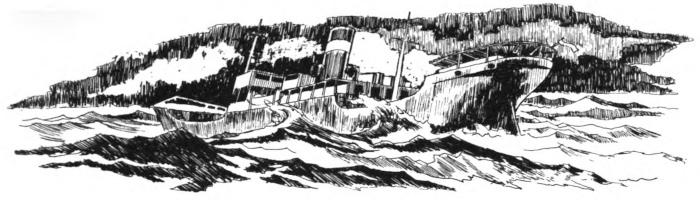
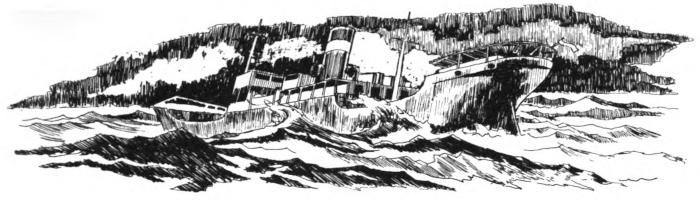
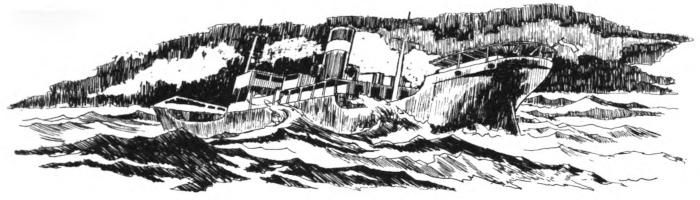
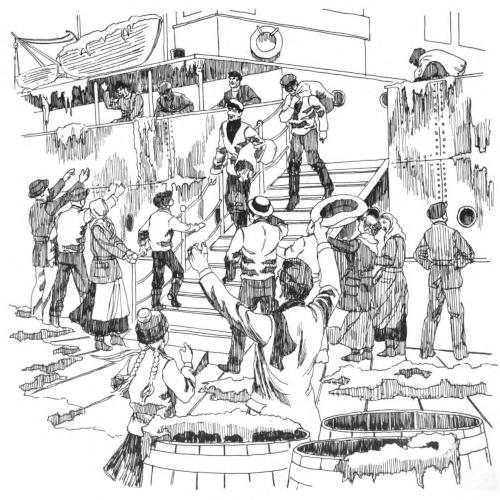
Far out to sea, the freighter Stjerne fought
the storm bravely. At home in the little Norwegian
fishing village, Arne and his family waited and
prayed. It was the Christmas season, and the
Stjerne was the Christmas ship this year, bearing
Yuletide gifts and other good things for the village.
But more important than the gifts, the Stjerne
carried her gallant crew—and Arne’s brother
Gustav, her first mate.
How Arne does his part to help bring the
Christmas ship safely into port makes a thrilling
tale.
By the author of THE CHRISTMAS STOVE.
Arne
and the
Christmas Star
a story of Norway
Alta Halverson Seymour
illustrated by
Frank Nicholas
Wilcox and Follett CompanyCHICAGO
ARNE AND THE CHRISTMAS STAR byALTA HALVERSON SEYMOUR Copyright 1952, by Wilcox & Follett Co. Manufactured in the United States of America
Arne and the Christmas Star
To Todd
who was the first to make friends
with Arne
1
“Oh, Mother, I hear Uncle Jens’s folks are going
up the mountain to the saeter tomorrow. Can I go along
this time, do you suppose?” Arne’s tongue was flying as
he burst into the kitchen, and his blue eyes looked eagerly
around for his mother.
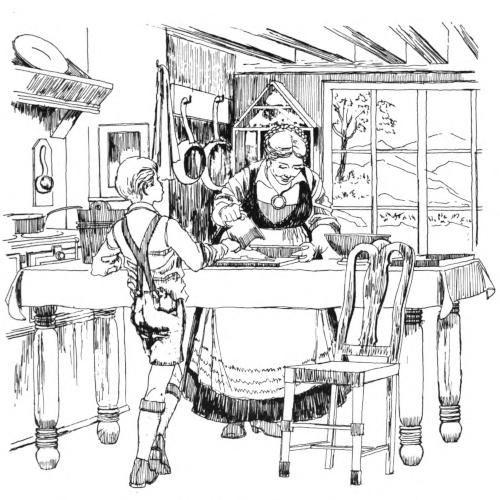
No one was in sight but his grandmother, busy with
her mixing bowl at the kitchen table. “Where’s Mother,
Besta?” he asked. “Cousin Bergel just told me they’re
going to take the cows and goats up the mountain tomorrow.
Do you know who all are going? Do you suppose
I can—”
“For goodness’ sake, boy, you go on like a spinning
wheel! It must be that red hair of yours that drives you
along so fast. Just be quiet a minute, will you? I can only
answer five or six questions at a time. Your mother and
sister Margret are over helping Aunt Tina get things
ready for the trip tomorrow.”
“They’re going, then! Oh, I hope I get to go too. I
think I will, don’t you?” Arne helped himself to a bit of
cooky dough from the sticky yellow mass on his grandmother’s
floured board, looking warily at her out of the
corner of his eye. Her hand was quick, and he might get
a sharp rap on the knuckles.
But he didn’t this time. She merely moved her board
away from him and began adding flour to the dough.
“Such a boy!” she exclaimed. “It would be a rest to me
if your mother let you stay up on the mountain all
summer.”
Arne knew she didn’t mean that. The two were the
best of friends. Grandmother Dalen, whom everyone
called Besta as a shortened form of the dignified Norwegian
bedstemor, seemed to enjoy his tricks and teasing.
She had even been heard to say, when she didn’t know
Arne was around, “I like naughty boys.” Then she had
caught sight of him and added briskly, “They give you
something to work on.”
Now she nipped off a piece of dough and molded it
into a soft long roll which she deftly tied into a bowknot.
She filled her pan with rows of similar bowknots and
slipped it into the hot oven.
“Who’s going, Besta, do you know?” asked Arne,
watching the cooky-making with interest but wishing
she would hurry and answer his questions. “I just wish
we had a saeter of our own.”
“Lots of use your father would have for such a
thing!” scoffed Besta.
Arne’s father was in the fish-packing business and
owned just enough land to grow a little hay and keep a
cow or two and some goats. But Uncle Jens was a real
farmer; and, like most farmers in Norway, he had his
own skyland pastures high in the mountain valleys where
the grass grew green and lush. These were called saeters,
and each had its little cabin where some of the daughters
of the family spent their summers. The girls milked the
cows and goats which were taken from the home farm
to be pastured up there, made the cheese, and churned
the butter. Arne thought some of the best fun of the summer
was at the saeter. The day of moving up there was
especially jolly.
“Cousin Signe will have to go, of course,” he said,
“and Bergel, I suppose.”
“Yes, Bergel’s old enough to help this year—almost
as old as you. She’s eleven now. Your sister Margret will
take our own cows and goats up and tend to them. And
of course Uncle Jens and Aunt Tina and little Knut will
take the housekeeping things and help get the girls settled.
And Cousin Evart—”
“And me—did they say I’m going?” Arne asked
eagerly, as she paused.
Besta was something the shape of one of her own
butterballs, but that did not keep her from moving fast,
or talking fast either, as a rule. Now, however, she seemed
intent on her work, and when she answered she spoke
almost reluctantly. “I haven’t heard anything about your
going, Arne. I did hear your father say he needed some
extra help baling lutfisk. He said he was glad school is out
so you can help.”
“Baling lutfisk!” said Arne despairingly. He had
done that before, plenty of times, especially when father
had a shipment he wanted to get off in a hurry. “That’s
such a tiresome job, and so smelly! Do I have to stay
home for that stuff?”
“You like lutfisk as well as anyone when it comes to
the table,” Besta reminded him. “Don’t you know how
good it is, with melted butter or nice milk gravy?”
Arne knew that well enough, but he certainly did
not relish the idea of staying home from the first saeter
trip of the summer to bale lutfisk. Part of the work connected
with lutfisk was all right. It was fun to help
unload the big cod from the fishing boats, to watch the
men expertly split and clean the fish and spread them to
dry. Ole Berg, the old fisherman who was father’s right-hand
man, had showed Arne how it was done, and even
let him help.
Father thought Arne was a little young to handle the
big, sharp knives, but Ole said the boy was very quick
with his hands. So Herr Dalen gave his son a good Norwegian
hunting knife with a silver handle shaped like a
horse’s head and a neat leather sheath which fitted on his
belt. Arne was very proud of it and put it to good use
under Ole’s directions. But baling those bundles of dried
fish was a very different matter. And certainly tomorrow
was no day to spend on the packing-house dock at a tedious
job like that. Then a hopeful thought struck him,
and he asked, “Well, then, is Gustav going to help bale
lutfisk too?”
His big brother Gustav was at home just now between
voyages to sea—Gustav, who was going to be a
ship’s captain some day. He would sail as first mate the
very next time the steamer Laks came to port here in
Nordheim on its way up the fjord.
“What’s that about Gustav?” called out a big voice;
and a tall, dark-eyed young man with curly black hair
came into the kitchen. “Oh, good for you, Besta! You’re
making kringler! Are those for the trip to the saeter?”
“Are you going to the saeter too, Gustav?” cried
Arne accusingly. “And I have to stay home and bale
smelly old lutfisk!”
Disappointment swept over him. It was worse than
ever if Gustav was going and he couldn’t. There was a
lump in his throat, and it seemed to him he could hardly
breathe. All spring he had been looking forward to this
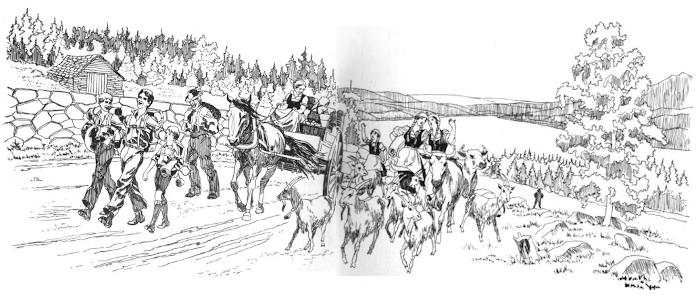
trip. He longed to be in the gay procession that would
wind its way from the little village up the mountain road.
Up it would go until the road became only a path, then
still up and up. At last they would come to the little log
house right on the cliff overlooking the fjord, with the
pastures and valleys behind and mountains, gray with
granite and green with pines, rising above it all.
First would go Suri, Uncle Jens’s fat, light tan fjord
pony with its black mane and tail. Arne was a great favorite
of Suri’s, for he always had a lump or two of sugar
in his pocket, and she had learned to nuzzle for it as he
patted and talked to her. Suri would pull the light hay
cart piled with pots and kettles, milk pails and cans,
chums and bedding, and all the other housekeeping things.
When they reached the place where the road became no
more than a trail, they would tether the pony and leave
her to spend a pleasant day cropping tender mountain
grass.
Aunt Tina would drive, and little Knut would ride
beside her. The girls would be in charge of the cows and
goats. Uncle Jens and Evart and Gustav would carry big
packs, because they couldn’t burden fat little Suri too
heavily. No horse-loving Norwegian would think of it.
There they would go, the bells on the pony’s harness
jingling, the cowbells ringing, little Knut tooting or
whistling, everyone singing and laughing. Even his cousin
Bergel, just a girl and almost a year younger than he
was, would be in that jolly procession; and he couldn’t
go. This year it would be more fun than ever, for Gustav
was going too, and there was always a special lot of fun
where Gustav was. It seemed to Arne he would fairly
burst with disappointment.
He had hard work to keep from crying, but of course
you couldn’t do that when you were twelve years old—especially
when there were people around. But his nose
pricked and his throat ached; he had to wink fast and
turn and walk over to the sink as if he wanted a drink of
water—which he didn’t.
Gustav stood looking at Besta, and Besta stood
looking back to him.
“You’ll be going up later on in the summer, Arne,”
said Besta comfortingly.
“I don’t care about going later,” said Arne, and his
voice came out something like a croak. “I want to go now,
when Gustav’s going, and everything getting ready—”
“I was thinking,” said Gustav slowly. “They’re
going to need all the help they can get to carry the stuff
from where we leave Suri. Arne’s a pretty big boy now,
and he could be a lot of help. I know that’s one of the
reasons they want me to go.”
“They want you because everyone wants to have
you around,” said Arne, his voice still muffled. But the
heavy feeling in his chest lightened a little, and he turned
half around, looking hopefully at his brother. Gustav
was pretty good at finding a way out of things.
Gustav said, “Lutfisk could be baled tonight as
well as tomorrow. Father wants to have the shipment
ready to send off day after tomorrow, that’s all. We can
work down there tonight. It’s light on the dock till nearly
midnight, these June nights.”
“We?” Arne’s grin began to break out. “Do you
mean you’re going to help?”
“Why not? I baled lutfisk when I was smaller than
you are, and helped pack the kegs of pickled herring too,
sampling as I packed. I used to kind of like to hang around
that packing house. And it’s fun to think of fish from the
little port of Nordheim going all over, even as far as
America. Come on, boy.”
Arne dashed joyfully across the room. “Say, I like
to hang around the warehouse, too, but I can do that any
time, and the saeter—well, that’s different. And this year
Uncle Jens is going to rig up an extra good kind of special
works to send the milk cans and hay from the top of the
cliff down to the level land. We’ve been talking a lot
about it. I want to help with that.”
“Well, why not? You’re pretty good at that kind of
thing. Now we’ll go down to the packing house, and I’ll
show you how to grab up those stiff old lutfisk and wind
the wire around in a hurry. I’ve got a good technique.
We’ll work fast, and if we get enough done, maybe Father
will let you go tomorrow.”
The two brothers did not have very far to go,
although their white house with its red roof and doors
stood near the edge of the little harbor town far up on
the Norwegian coast, where a mighty fjord joins the sea.
They walked quickly along the narrow, cobbled street
that twisted its way down to the wharf, past the brightly-painted
houses—orange, green, and red—past the
stavkirke with its roofs and gables rising one above
another.
Arne liked that old church. He liked the carved
dragon heads which sprung from the highest gables and
rose above the small turret that topped the whole edifice.
“We’re lucky to have it, you know,” said Gustav.
“There aren’t many of those old churches around Norway,
and none at all anywhere else. It’s nearly a thousand
years old; did you know that? It’s lasted since the days
the old Vikings used to have to carry spears or bows and
arrows when they went to church.”
“I like those old Vikings. And those were good days,
Gustav,” said Arne. “They didn’t have to be sending
lutfisk to America in those days.”
Gustav laughed. “Well, we do. So shake a leg.”
The packing house stood at the edge of the fjord,
handy for unloading the fishing boats and for loading
the ships that carried the kegs and cans and bales of fish
to far-off ports.
Father was a little surprised to see them; and he was
pleased, too, though he didn’t say so. Usually he had to
make it very clear when he expected Arne to report for
duty. And here the boy had come down himself and
offered to help. Here was Gustav, too, who was on a vacation
and not expected to do real work.
Gustav did have a very quick way of handling that
lutfisk. He picked up several of the long stiff pieces of fish
which Arne thought looked exactly like pieces of wood.
These he arranged neatly in a bundle, bound it with
wire, fastened and clipped it. As he worked, he sang some
of the rollicking folk songs Besta had taught them long
ago; and that made the job go even faster. Old Ole
worked with them; he knew songs Arne had never heard.
Before long Father joined the group; and by the time
they stopped for supper, a good share of the work was
out of the way.
“There, now,” said Father with satisfaction. “We
are going to see to it that those poor folks in America do
not starve for good Norwegian lutfisk. Time to stop for
supper. I wonder what Mother will have for us to eat.”
“Hope it won’t be lutfisk,” said Arne fervently, and
they all laughed.
When they entered the kitchen a few minutes later,
they were pleased to see that Mother was cooking a large
pan of meat balls.
Arne thought his mother was very pretty, with her
coppery hair that shone like one of her own brightly-polished
pots, her deep blue eyes and quick smile. And
he knew very well she was the most comfortable person
in the world to be around. There was a capable air about
her that made one feel good inside.
His mouth watered as she filled a large platter with
meat balls while Margret set big mugs of milk on the
table and Besta brought a large bowl of steaming hot
potatoes. It was a favorite meal of Arne’s, but for once
he was the first to finish. He ran around the table to bow
to his mother and father with the customary Norwegian,
“Tak for mad,” which meant, “Thank you for the meal.”
Then he said, “Now, let’s get back to that lutfisk.”
Father glanced at Mother, and his voice sounded
as if he wanted to smile. But all he said was, “I’m afraid
Arne is working himself out of a job.”
Mother had been talking to Besta, and now she answered
soberly, though her eyes twinkled. “It may be he
will have to go along on that saeter trip and help there,
if he’s so eager to work.”
Arne looked from one to the other. They sounded
serious, but they often joked that way. He grinned and
brought his hands together in a noisy clap. “Am I going
to the saeter, then?”
“Let’s see how we get along this evening with the
work,” was all Father would say. But Arne’s heart felt
light as he went back to the dock with the others. His
fingers flew, and he sang louder than anyone.
2
The sun was still high in that land of the midnight
sun when Father said, “Past nine o’clock. Time
for a boy to be in bed if he’s to be up early to start for
the saeter.”
“Oh, Father! I can go?” cried Arne.
“Well, the lutfisk’s nearly all baled. We don’t want
you around here tomorrow eating up all the pickled
herring. Uncle Jens is going to need help. See that you
give it to him.”
“Oh, I will! Oh yes, sir!” cried Arne joyfully.
He wanted to say a special thank-you to Gustav for
making it possible, but he didn’t quite know how. Gustav
was likely to make a joke of things, and this wasn’t a joke
at all. He did look up at his big brother, half shyly, as they
walked up the hill toward home, and say, “I’m glad I am
going. It was your doing, really.”
“Oh that was just because I wanted you to carry
the heaviest loads,” said Gustav, with a wink. “I plan
to take it easy. Don’t you loaf on the job, boy.”
He smiled and gave a friendly yank at a lock of
Arne’s red hair, and the boy felt so happy he ran and
jumped nearly all the way home.
It was still broad daylight when Arne tumbled into
his feather bed and pulled another feather bed over him
for covering. June nights grew cold along the fjord.
It seemed to him he had hardly fallen asleep when
his sister Margret was calling, “Get up, lazybones, if
you want to come with the rest of us.”
Almost before Arne had finished his breakfast of
mush and milk and cheese, he heard a clatter on the
upper road behind the house and dashed out.
There they all came, just as he had pictured it. His
cousin Bergel ran to meet him, her blue eyes shining.
“Can you go, Arne?” she cried, and at his nod, “Oh,
good! I like it lots better if you’re along.”
“So do I,” said Arne, and they both laughed.
He adjusted his pack and fell in with Gustav and
Uncle Jens and Evart. Margret, flushed and pretty, ran
around trying to persuade their two cows and the goats
to fall in with the others. Arne would have enjoyed
helping her with that, but cows and goats were definitely
the province of womenfolk. He knew very well that
Margret didn’t want any interference from him. Bergel
and Signe came to her aid; and soon the procession was
on its way, bells ringing, everyone singing and waving
and laughing, while Mother and Father and Besta called
out, “A pleasant trip!” “Good luck!” “God be with
you!”
The road ran at first along the foot of the mountain.
It was a good road, though there were fences across it in
many places, marking someone’s land boundary. But each
fence had a gate which was opened to let the little cavalcade
through, and then carefully closed. Before long they
branched off to a road which climbed the mountain ever
more steeply and presently turned into a trail. Here they
tethered fat little Suri, and the cart’s load was divided
among them. The men would have to make more than
one trip down to get the rest of the goods.
Arne had been here many times before, and he
rushed ahead so fast that Uncle Jens called him a
mountain goat and told him not to fall into the fjord
if he got to the saeter before the others.
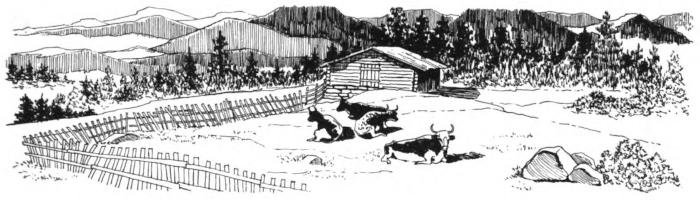
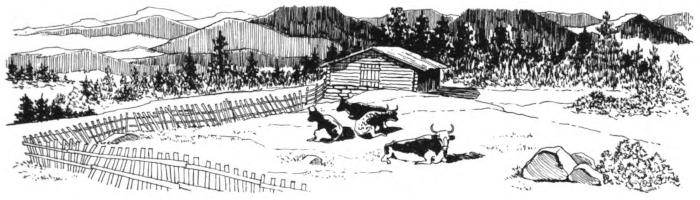
They came at last to a log cabin with a sod roof.
Pansies and bluebells were growing on the roof, and
even a few little bushes and a tiny birch tree. The cabin
stood in a wide clearing not far from the edge of the cliff
which overlooked the fjord. Little Knut had to be tethered
to a tall fir tree for safety.
The older girls drove the cattle and goats into the
pastures which sloped through the valley up toward the
mountain.
Bergel wanted to go and gather wild flowers. “Come
on, Arne,” she urged. “There are foxgloves up here, and
wild pansies and—”
“Oh, let’s go fishing,” Arne answered. “You can get
wild flowers any time.”
“That’s right, do that,” said Aunt Tina. “We could
use some nice mountain trout. But first get in some wood,
you two. It’s high time for midmorning coffee.”
“Evart, let’s you and me get another load from the
cart, and then go fishing with Bergel and Arne as soon
as we’ve had coffee,” said Gustav. “All right with you?”
“I’m always ready to go fishing,” replied Evart,
with a grin.
“I’ll help get the load up; then I must get busy fixing
our milk-can elevator,” said Uncle Jens. “I’ve arranged
with my neighbor to see to the end of it down at the
bottom.”
Arne was delighted to have the older boys in the
fishing party. They were really experts, and he liked to
watch them. Also they knew the best spots to fish. Up
the trail a little way was a clear, deep stream, and there
they soon got all the mountain trout they could use. Arne
himself caught six, and Bergel four.
“Oh, I wish we could stay all summer,” said Arne.
“Don’t you, Gustav?”
Gustav laughed. “This isn’t man’s work,” he declared.
“This is just fun.”
“You’re getting anxious to sail off,” said Evart.
“When do you go?”
“The Laks arrives in a few days. Then it will go up
the fjord with me on it,” said Gustav. He sounded happy
at the prospect, but Arne’s heart sank. He didn’t like to
think of Gustav going away again.
“Wish I could go,” said Arne, with a gusty sigh. “I
haven’t even been on a boat and bicycle trip yet like some
of the boys.”
“You’re too young,” said Bergel in her practical
way. “And you haven’t a bicycle.”
Gustav looked thoughtfully at his brother as they
walked down to the cabin. “Could be we might take you
along on one trip on the Laks, Arne. Put you to work, you
know, swabbing the deck and peeling potatoes and all
kinds of things.”
“Oh, boy!” cried Arne. “Do you think I could, Gustav?
And say, if you’re going to be going up and down the
fjord, you can touch home every now and then.”
“That’s just for a few trips,” said Gustav. “Then I
sail with Captain Olsen on the Stjerne. He says that will
be the Christmas boat this year.”
“Oh, good, the Christmas Star!” cried Bergel, for
Stjerne is the Norwegian word for star. “That will be just
right. It’ll be fun to have you on the Christmas boat.”
“First he goes clear to South America. Don’t you,
Gustav?” said Arne proudly.
“Yes, to South American ports and others too. We’ll
bring back meat and fruit and grain and unload a lot of
it at Oslo. Then we’ll take on more cargo—mostly Christmas
things—and make the Christmas trip up the coast.”
“And bring in toys and candies and fruit and nuts
and gifts and everything nice,” said Arne, his eyes
glowing. “And you’ll stay home for Christmas, won’t
you?”
“Yes, Captain Olsen says the Christmas crew should
be home for Christmas. Nordheim is one of the last stops
before Captain Olsen’s home at Tromsö, where they’ll
put in for a couple of weeks or more. One of the other
boys will take my place for that short pull.”
“Everyone’s going to be glad to see that Christmas
boat come in,” said Evart.
“And Mother’ll be glad right now to see these fish
come in,” remarked Bergel.
Aunt Tina and the girls stopped their work of scrubbing
every floor and wall and stick of furniture in the
cabin to admire the morning’s catch. Bergel stayed to
help with the cleaning, and the boys went to help Uncle
Jens, who was busy with wires and tools.
Uncle Jens had had a wire elevator before this for
use in sending down milk cans and hay, but he felt it had
been a somewhat makeshift affair. This year he wanted
it to be strong and secure enough for any reasonable load,
for his herd was an extra large one.
Arne liked this kind of a job, and he felt proud to be
working with Uncle Jens and Gustav and Evart. Strong
wires were fastened securely to trees and firmly anchored
below to posts driven at some distance from the foot of
the cliff. A milk can or a large bundle of hay could be
sent down those wires in a rope sling, easily and swiftly.
When the little elevator was ready at last, Uncle
Jens said they must send down a large milk can to make
sure everything was all right. They filled one with water,
tied it securely with a heavy rope, and watched as it slid
and swayed its way down. Then the wires were tightened
again, and they drew the milk can up and made more
tests.
“I think it will do,” Uncle Jens said at last.
With all the outdoor air and work, Arne was getting
hungry again. So were the others, and every one was glad
when Aunt Tina appeared with a large white coffeepot.
“Time for afternoon coffee,” she called.
Gustav sat where he could look out over the fjord, as
if he hoped he might see the Laks coming in ahead of
time. Suddenly he gave an exclamation and jerked his
field glasses out of his pocket. “Some kid down there has
turned over in a sailboat!” he exclaimed, jumping up
and rushing to the cliff edge. The others followed.
“Don’t believe that kid knows much about swimming,”
Gustav said, taking another quick look through
his glasses. “He isn’t making for shore—just trying to
hang on to that capsized boat. That’s slippery business.
The water’s deep and cold.”
“It’s Oscar Blessom’s boat!” cried Arne. “But
Oscar’s on a bicycle trip. Must be Torger! He isn’t very
big, and I know he can’t swim much. And there’s no one
near enough to see or help him.” Arne looked at Gustav
hopelessly. Not even Gustav could help now.
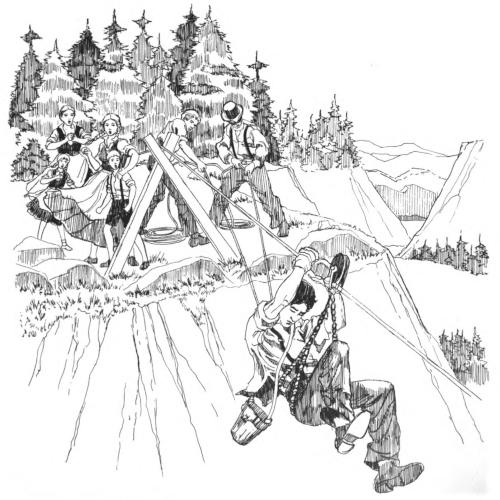
But Gustav’s lips were set, and he went quickly toward
the wire elevator.
“What are you going to do?” cried Margret
anxiously.
“Go down the wires,” said Gustav tersely.
“Oh, you can’t! You can’t do that!” protested Aunt
Tina and the girls. “It isn’t strong enough! It wasn’t
made for a man.”
“Got to try it. Don’t see any other way. Got to get
there fast or it will be too late. Have you got some cloths,
Aunt Tina? I have to wind them around my hands, or
they’ll be torn on the wires so I can’t use them.”
Aunt Tina flew for cloths and wound them quickly
around his hands while Uncle Jens and Evart made a
rope loop for Gustav to sit in.
All this was speedily accomplished. Uncle Jens and
Evart helped adjust him in the loop while Arne watched,
proud of Gustav, fearful he might get hurt, afraid he
might not get there in time.
“Here I go,” said Gustav. “Hold onto that rope,
Uncle Jens, tight as you can.”
The group at the top of the cliff watched breathlessly
as Gustav went down. At first the wires swayed
dangerously under his weight. Arne’s heart seemed to
come right up into his throat. Gustav was a good deal
heavier than a full milk can. But he adjusted his weight
to one side and another and then shot down swiftly.
The moment Gustav reached level ground, he
jumped free of the rope. Torger must have lost his hold
now. They could see that the boat had drifted away.
Gustav knew that, too, for he was racing toward the
water, pulling off his coat as he ran. He snatched off his
shoes and plunged in.
Arne wished he had field glasses so that he could see
every detail of what was going on. He could tell that Gustav
was moving fast. But would he get there in time?
“He’s making it,” said Uncle Jens, his voice full of
relief. “He’s got hold of whoever it is. Bringing him in to
shore.”
“It’s Torger Blessom, all right,” said Arne. Gustav
had the little boy on shore now. He laid him down on a
large rock and bent over him, working quickly.
Arne looked at the wires and then at his uncle. Gustav
could use some help down there. If they’d pull the
rope right back up, maybe he could muster the courage
to go down those wires as Gustav had done.
But to his relief, Uncle Jens said, “See, he has
Torger on his feet. He’ll be all right now.”
“We must be thinking of getting started, now,” said
Aunt Tina. “We can’t go down like Gustav. We have to
take the long way around. I’ll be up in a week or two,
Signe, and give you a hand with making the cheese. And
Bergel can help. She’s eleven now, and it is time she
learned.”
Bergel smoothed her apron as they walked toward
the cabin. She felt pleased and proud that Arne had
heard her mother say this. He sometimes acted as if he
didn’t think girls amounted to much. But she liked him
and longed for his good opinion.
“Arne, you come again,” said Bergel. “We’ll go
fishing.”
“We’ll be up, all of us, from time to time,” said
Aunt Tina, who loved the mountain saeter as much as
anyone. It made her feel like a girl again to be up here,
for in her younger days she too had had her turn at
tending cows and goats on the mountain in summer, at
caring for the milk and making the cheese. “Just for
tonight I want to be the first to blow the saeter horn.
Run and get it, Bergel.”
Bergel ran into the house and came out with a long
wooden horn, which she handed to her mother. The little
girl longed to try it herself. They had told her, other summers,
that she was too little; but perhaps if she was considered
big enough to help with the cheese, she might be
big enough to blow the horn, too.
She watched eagerly as her mother lifted it to her
lips and blew a deep, mellow blast to call the cows home.
Then, to her delight, her mother handed it to her and
said, “You try it, Bergel. It will take more than one blast
to bring the cows home.”
Perhaps Bergel would have blown a good blast the
first time if Arne had not stood mimicking her, pretending
with great effort to lift an imaginary horn to his lips,
puffing out his cheeks, pursing his lips, and bringing out
a small squeak.
Bergel had to laugh, and so did the others. But
Margret gave her brother a brisk shake and told him to
try to behave himself for once. “Try again, Bergel,” she
said. This time the little girl managed to bring out, if not
as long and deep a blast as her mother had, at least a very
creditable sound.
The girls would have to go out into the woods and
valleys and up the mountainside to get some of the goats
and even some of the cows, for the first few evenings at any
rate. But before long, most of them would answer the call
of the saeter horn.
The bells on the cows and goats were ringing over
the valleys, and the saeter horn sounded again and again
through the clear mountain air as they started down the
path, Arne running ahead of everyone.
It had been a wonderful day, but he was glad to be
going home. He wanted to hear all about the rescue of
Torger Blessom, to see Torger himself and make sure he
was all right. And he wanted very much to find out how
Gustav felt going down those wires.
3
Gustav only laughed when Arne asked him
how it felt to go down those wires. “You’ll really have to
try it yourself to find out,” he said. “It wasn’t much.
Now you’d better run over and see Torger.”
Torger was still a little pale and more than a little
mortified over his accident. “Gustav said he’d give me a
lesson in handling a boat,” he told Arne. “He said maybe
we could go out tomorrow, the three of us.”
“If Gustav teaches you, believe me, you’ll learn
how,” said Arne. “He’s the one who taught me to sail and
swim. Wonder why your brother Oscar didn’t teach you.”
“They are too near of an age,” said Torger’s mother.
“Gustav is quite a bit older than you, and you are willing
to learn from him. When Oscar tries to show Torger how
to do something, it generally ends up in a fight.”
The boys couldn’t help grinning, for they knew Fru
Blessom was right.
The next morning, Gustav took both boys out on the
fjord. There was a stiff wind blowing, and the sailboat
was not easy to manage. He said it would be good experience
for Arne, and that if Torger learned in this wind,
he’d never be afraid of a sailboat. Gustav was thorough
in his instructions, and both boys worked manfully.
“I’ve got the hang of it now,” Torger said confidently.
“I bet I won’t turn over in a boat again.”
“I don’t believe you will, Torger,” said Gustav.
“Now you two lads be sure to get out on the fjord and
sail every chance you have. The best summer fun in the
world is on a fjord.”
“And the best thing to have fun with is a boat,” said
Arne.
“You’re right about that,” Gustav agreed heartily.
Then he gave a sudden exclamation, “Put her hard over
to the left, Arne! We’re going in now as fast as we can!
Do you see what’s coming in from the sea? The Laks is
almost in port.”
Gustav sounded very happy, but Arne’s heart felt
heavy as he steered toward shore. It had been such fun
to have his brother home, and the time had gone all too
quickly. Now it would be months before he would be here
for more than a short visit.
But Gustav wouldn’t let anyone be gloomy today. No
sooner had they tied the little sailboat up at the warehouse
dock than he was rushing toward the big wharf,
the younger boys beside him.
“From the way Arne’s going, I’ll have to hurry to
get there first. He’ll be going as first mate in my place, or
maybe skipper,” Gustav called out.
He stopped to smooth his hair and shake his coat
into place before he talked to the captain. After that he
hurried home to get his things, which were ready packed.
Besta and Mother came back with him, and Father,
too, came down to the wharf to see him off. Half the town
was gathering there, indeed, especially the boys and girls.
They liked to watch the boat unload its cargo of mail and
freight and take on other cargo to go up through the fjord.
Arne and Torger watched as a bright new spinning
wheel was unloaded. “That’s for my grandmother,” said
Torger, “and about time, too. She’s been complaining
that she wouldn’t have wool ready for the Christmas
knitting if that wheel didn’t come soon.”
Crates of oranges from America were next, boxes of
groceries and drygoods, and windows for the new house
going up at the edge of town. There was not very much
to load on the boat here. The fish from the packing house
went to ports farther away. Towns along the fjord could
catch their own fish. There was mail to go. A few passengers
got on. Arne saw a group of boys on board with
sleeping bags and rucksacks. He knew their bicycles were
stowed away somewhere and that they were on a holiday
jaunt up the fjords and over the mountains. One of these
days he’d be going on such a jaunt, too.
A little flutter of interest in the crowd made him
turn quickly. To his surprise, he saw Uncle Jens coming
down the street, leading Suri. He went straight over to
the captain and said, “I want to send Suri up to Blegen
for a little while. My wife’s brother needs an extra pony
to help with some farm work, and I can spare Suri just
now. So can you take her aboard and make her comfortable?”
“Ja, Ja, certainly we can take care of Suri,” the captain
assured him.
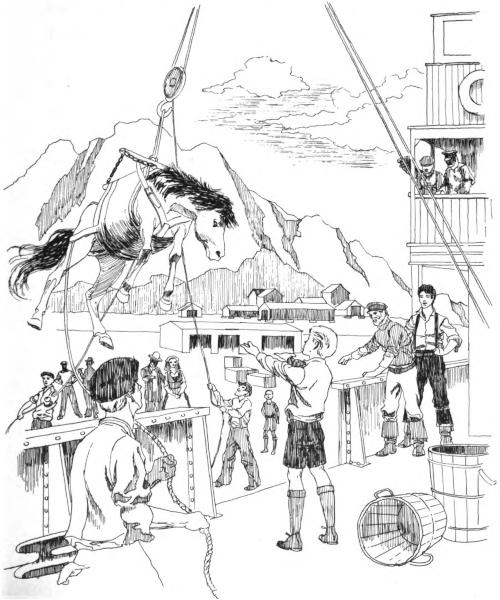
But Suri did not seem to care for such a trip in the
least. A broad band was securely fastened around her and
a derrick swung over to lift her aboard. But little Suri
stamped and champed and lifted her head, her eyes rolling
in fright as she complained in loud whinnies.
No one thought of such a thing as trying to force the
little mare aboard. Uncle Jens talked to her, and she
quieted down a bit; but when the derrick came toward
her again, once more she backed and stamped and whinnied
nervously.
The other loading was finished. The sailors were
closing the holds. But the Laks could not weigh anchor
because little Suri, in spite of all wheedling, was flatly
refusing to go aboard.
Arne only wished he had the chance Suri was refusing,
but nevertheless he felt very sorry for the frightened
little horse. Perhaps he could coax her a bit—he had
done it often enough before.
He went over to try, fishing in his pockets as he went.
Yes, there were two lumps of sugar. He put an arm over
Suri’s neck and offered her one, talking to her softly the
while. She nuzzled her soft brown nose into his hand and
seemed to feel comforted.
“Go on, Arne,” Uncle Jens encouraged him. “She
seems to listen to you.”
So Arne stood there, coaxing little Suri, feeding her
sugar, talking to her, patting her, until she stopped trembling
and champing and at last let him fasten the big
hook in the band which was fastened firmly about her.
Then he ran onto the boat and stood there talking to her
from the deck. Now at last she let them swing her aboard,
and though she stamped anxiously at first, she allowed
Arne to take the band off and lead her down into the hold.
“Wish I could go along with you, Suri,” he said,
putting his cheek against her neck and giving her a pat.
Gustav had come down to see that everything was in
good order, and now he gave his young brother an encouraging
nod. “That was a pretty good job, Arne; you
saved the skipper a lot of time, and that may turn out to
be a good thing.”
“Do you think he might let me go on the boat some
time, Gustav?” asked Arne eagerly.
“I can’t promise a thing yet. You skip ashore now,
and we’ll see. The ship’s bell is ringing. They want to get
started. And our captain wouldn’t care for a stowaway
aboard, I know that.”
So it came about that Arne was laughing as he ran
down the gangplank just as they were about to pull it up.
And instead of feeling sad as the boat steamed away with
Gustav aboard, he was thinking of the day when he might
be aboard too.
He looked up to see his father standing there, smiling
down at him. “I thought for a minute there I was
going to have two sons on that ship this time,” he said.
“Looked to me as if the captain could find a use for you.”
“Oh, I wish I could be aboard, especially when the
Stjerne sails out,” said Arne, heaving a great sigh. “That’s
the life, isn’t it, Father?”
His father laughed, a contented, good-natured
laugh. “That’s the natural way for a Norwegian boy to
feel, I guess. I did my share of sailing, too, in my early
days. But I understand there’s such a thing as school. I
hear boys are expected to go to that in Norway.”
Arne knew his father was joking; so he smiled back,
though school never seemed to him a very good subject
for a joke. “I suppose so,” he said. “But I like outdoor
things so much better than schoolwork. I just wish it were
summer all the year around.”
Arne was not the only one who wished it were summer
all the year around. Up at the saeter, the girls were
having a merry time in spite of the work of caring for the
cows and goats, milking and making cheese. There were
berry-picking excursions through the woods and valleys
to gather blueberries, raspberries, and the lovely bright
multer berries which grew thick and red on their low
bushes. There were visits with girls in neighboring saeters
and fishing trips up the mountain.
“Don’t forget I’m to learn to make cheese,” Bergel
reminded Signe one day.
“Oh, yes. Mother wouldn’t like it a bit if we didn’t
get that tended to. We’ll start with gammelost. That’s
best, anyway.”
Under Signe’s direction, Bergel warmed the milk
and let it stand until the curds and whey could be separated.
Then she dried the curds, crumbling them carefully
with her hand, and set it all aside to ripen. Signe
even let her add the caraway seed and salt.
When it was brought out some days later for inspection,
Margret looked at it with approval. “We should
save that for company,” she said, sniffing with appreciation.
Bergel nodded, looking very grown-up as she tasted
it with a businesslike air and added a little more salt.
Then she put it away in a covered jar to ripen further.
“I hope the company will be Arne and Evart and some
of the other boys,” she said, and though the other girls
laughed, they agreed with her.
Down in the town, Arne was keeping busy, too. He
had jobs of many kinds at home, running errands and
getting in the wood for the old cookstove Besta preferred
to Mother’s new electric range. And he had to help Besta
cut the hay in the little patch of ground that sloped from
their house up the mountain. It was fun to get in there
with a scythe, and to help Besta and Mother hang the hay
over the wooden hay fences to dry before it could mildew
on the damp ground.
He helped around the packing house, too. There
were errands there as well as at home, and there was
cleaning to do, and packing. Sometimes he was allowed
to go out with the fishermen. He especially liked to go
with Ole to fish for torsk and herring and halibut. Sometimes
they took a rowboat or a small sailboat up the fjord.
Sometimes they took Ole’s big boat and went out to sea.
There was time for play, too, in the summer afternoons
and long, light evenings. More than once Arne
went away on a day’s jaunt with Oscar and Torger and
half a dozen other boys. They sailed and swam and fished
on the fjord, and took long hikes up and down the fjord
path and up the mountainside.
But Arne never let any of his activities keep him
from being right on the dock when the Laks was due.
Each time he hoped to hear the glad news that he was to
be on board when the ship weighed anchor. Each time
he asked Gustav eagerly if he was to go on this trip.
When two or three weeks went by with no invitation
for Arne, he began to lose hope. But then one day Gustav
jumped off the gangplank calling out, “Where’s that
Arne? You better go get some packing done, boy.”
“Really, Gustav? Do I go this time?” cried Arne.
“Looks that way,” answered Gustav. “The skipper
says we’re bringing Suri back this trip, and you’d be a
good one to have aboard to help with that.”
Arne gave a big, “Oh!” on a deep, blissful sigh, and
was off up the hill like a shot to tell Mother the good news
and to see to that all-important packing. He had a lot of
things he wanted to take, and he had a feeling Mother
wouldn’t think half of them were necessary.
“We’ll be here for a couple of hours, at least,” Gustav
called after him. “Tell Mother to put the coffeepot
on.”
Arne loved that journey up and down the fjord,
stopping at each small village with mail and freight.
There were a few passengers, and he liked to see them get
off amid the joyful greetings of their friends. Often they
were met by a light boat which would take them aboard
and then skim swiftly and quietly off to some town across
the fjord or to some nearby farm.
He made friends with a little party of English lads
who had bicycles on board and planned to leave the boat
at the head of the fjord and go off through the valleys and
over the mountains which Arne taught them to call by
the Norwegian name of fjelds. He wished he had a sleeping
bag like theirs and that he could sleep out with them
on deck, though they told him it got pretty cold.
They let him share some of the meals they cooked
over their tiny portable stove, and Gustav saw to it that
he contributed fish balls or cheese or some other delicacy.
On the afternoon the Laks neared the head of the
fjord, Gustav was at the wheel and Arne stood near him,
watching the waterfalls dash violently down the high,
steep mountain walls.
Suddenly he gave a shout, “Gustav, look out! Rocks
falling! Big ones! Right ahead!”
Gustav gave one quick look, and his face was grim.
Arne’s heart beat fast. He knew it would be terribly dangerous
to hit those rocks here where the Laks steamed
between sheer mountain walls. But he saw that his
brother wasn’t losing his head for a moment. He was
proud of the resolute look on Gustav’s white face, the
sure, firm way he managed to turn the wheel and guide
the boat to avoid the rocks.
The captain came running up, his face as pale as
Gustav’s. “Good work, Gustav,” was all he said, but his
relief was plain to see.
At the head of the fjord, the English boys left them,
though they stayed on the dock to watch little Suri taken
aboard.
Arne kept a sharp lookout for falling rocks as they
steamed homeward between the steep rocky cliffs. He
was glad when they came to the places where the country
flattened out a bit and there was room for a small village
or a few farms at the foot of the mountain. Often he
caught a glimpse of a saeter high above them.
“Do you think we’re going to get up to the saeter
again this summer?” he asked Gustav, after one such
glimpse. “I know the girls are counting on it.”
“I’ll have two or three days between my last trip on
the Laks and the time the Stjerne sails,” said Gustav.
“That will be early in August. Let’s go then.”
“Shall I make a trip up and tell the girls?” asked
Arne eagerly. “They’ll have a lot of getting ready to do—a
lot of baking and things.”
“You hope,” said Gustav, laughing. “Well, I hope so
too, Arne. So we’ll figure out the time and you can hike
up that mountain and tell them about it.”
Arne had made many pleasant journeys to the
saeter, but there had never been one as gay as the trip up
there with Gustav and Evart and a dozen other lads.
“Look! Look what the girls are using for pasture!”
cried Arne, as they came in sight of the saeter. A shout
of laughter went up, for Bergel had tethered a small white
kid to the tiny birch tree on the roof of the cabin.
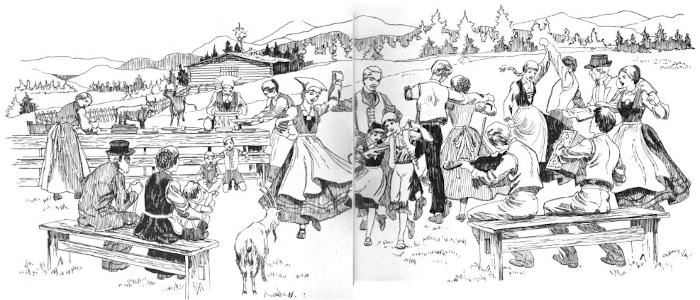
The shout brought out the girls, gay in their special
holiday dresses. Arne thought they looked very pretty in
their full, striped skirts with crisp, lace-trimmed white
aprons and bright laced bodices over white blouses. A
hand-made silver brooch fastened each blouse at the
throat. Margret’s brooch was handed down to her by
Besta, Arne knew; and he thought it was the prettiest one
of all. These brooches were treasured possessions in Norwegian
families.
Signe and Margret and Bergel had invited girls
from neighboring saeters, and a good thing, too, for Gustav
had brought his accordion and Evart his fiddle. There
was dancing and singing and laughter under the trees.
Arne and Bergel joined in the fun, for they could do the
old folk dances as well as any of them.
Then a feast was spread out on the long table—fish
and cheese and lefse and big bowls of berries with
whipped cream, and kringler and cakes and cookies of
all kinds. Bergel’s gammelost was praised enough to make
the young cheesemaker very proud.
The fun stopped toward evening, but only long
enough for the girls to get in the cows and goats and do
their milking, to make fresh coffee and replenish the
dishes on the table. Then the dancing started again and
went on far into the long summer evening.
At last the party from the village started down the
trail for home, reluctantly, to be sure, but singing and
laughing nevertheless.
It was a sleepy Arne who tumbled into his feather
bed at last. This had been a long day, but a wonderful one.
4
The Stjerne came into port a few days later, and
Gustav sailed away as first mate. He was so happy about
it that Arne couldn’t help feeling some of that happiness
too. He remembered what fun it had been to go up the
fjord on the Laks, and he didn’t blame anyone for wanting
to go to sea.
But Gustav was sailing far away this time, all the
way to South America, touching at many ports on the
voyage. It would be a long time before he returned.
“Oh, Gustav!” The words fairly burst from Arne as
he stood watching the final packing. “I wish South America
wasn’t so far away!”
Perhaps Gustav knew how he would have felt if he
had been in Arne’s place. He put his arm around Arne’s
shoulder and said, “Look here, fellow, I’ve got something
I want to leave with you. Father gave me new field glasses
as a parting gift. I want you to have my old ones.”
“For keeps?” cried Arne. It would be wonderful to
have those glasses.
“For keeps,” said Gustav, and was fully rewarded
by Arne’s shining face.
“Now you can watch us till we get clear out to sea
and turn down the channel between the shore and the
islands. In fact, if you go up on the cliff, you can watch us
farther than that.”
“Oh, I will! Oh, Gustav! And I’ll be watching when
the time comes for you to come home, too, you can bet
on that.”
The gift took most of the sadness out of the parting,
though Gustav would be gone now until December
when the Stjerne would come in with its load of Christmas
goods. Then he would be home all through the holidays.
That was something to look forward to.
The rest of the summer slipped quickly away. It was
time for the girls to come home from the saeter, and Arne
went with Uncle Jens and the others to help bring down
the girls and the gear, the cows and the calves, the goats
and the kids and the cheeses.
School was to start the next week, and he felt a little
dismal about it as he talked it over with Bergel. “I hear
that new teacher is very strict—Herr Professor Engstrand.
Oscar said Pastor Beckstrom’s son told him so.”
Bergel nodded. “I heard so, too. But maybe we have
to expect that, now that we’re going to be in the upper
room. Just think, Arne. We’ll start learning English, and
do a lot of things we couldn’t do before.” Bergel, very
quick at her lessons, was in the same grade as her cousin.
“I’ll like being in the same room with Nels and
Oscar and those boys instead of a lot of little kids,” Arne
admitted.
“Yes, I think it’s wonderful we’re going to be in with
the upper grades. And a man teacher. Makes me feel
pretty grown-up.”
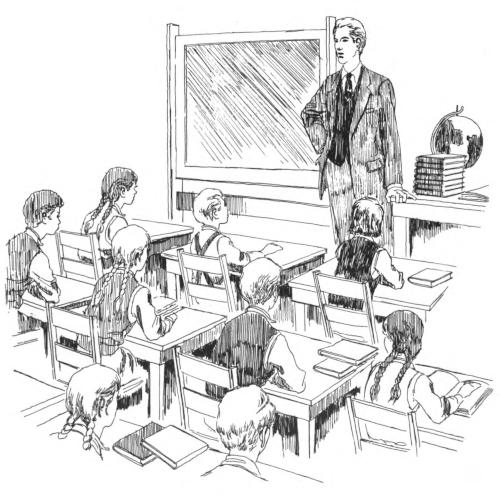
Arne was surprised when he entered school that first
morning and got his first glimpse of Herr Professor Engstrand.
Somehow, from Oscar’s remarks, he had expected
to see an elderly gentleman. Herr Professor didn’t look
much older than Gustav. But he certainly was not like
Gustav in any other way. There was no laughter in those
stern gray eyes, and his mouth, straight and firm, didn’t
look as if it ever even smiled. He stood stiffly beside his
desk, his shoulders squared.
When the school was assembled, he made a short
speech. “I am new here,” he said, “but we shall soon get
to know one another. If you do your work well, we shall
get along without trouble. I shall put up with no laziness,
no disobedience. You are old enough to know how to
work, and that is exactly what I expect you to do.” His
words were clipped and curt, and Arne was sure you
could have heard a pin drop in that quiet room. Lessons
were assigned and classes were held in the most methodical
order. Any lack of attention, any slightest sign of
disorder, was promptly reprimanded or punished more
severely.
Arne very soon made up his mind about one thing.
He would try to obey orders to the letter. He could see
there would be trouble ahead if he did anything else. He
didn’t know, of course, that this was Herr Professor
Engstrand’s first school and that he was desperately
anxious to make a good job of it.
Winter set in early, and it was always a relief to Arne
to get out of school. He liked to get his skis and go flying
down the steep slopes behind the town with Nels and
Oscar and Torger and some of the other boys. Evart was
away at school this year, and sometimes Arne took Bergel
with him coasting. She knew how to steer the long sled
almost as well as he did.
He would stop at home in the kitchen first, for he was
sure to find Mother and Besta having a cup of afternoon
coffee. Sometimes Aunt Tina would be there, too, and
Signe and Margret. Sometimes one of the neighbors would
come in. But whether there was company or not, there
was sure to be something good to go with the coffee—slices
from a big, round loaf of ryebread with gjetost,
Besta’s special goats’ milk cheese, or coffeecake, or bakkelse—crisp,
delicious little cakes fried in deep fat, or
some other of their many specialties. Mother and Besta
were as good cooks as you’d find in all Norway, Father
often said; and he added that that was saying a lot, for
Norway was famous for its good cooks.
Sometimes as he came in, after skiing or skating or
coasting, he would hear Besta’s spinning wheel whirring
comfortably away. She liked to spin the wool for her
knitting and weaving. Even Margret, up-to-date as she
considered herself, preferred the soft wool her grandmother
spun to any other. Besta never looked as contented
as when her foot was on that treadle, her practiced hand
drawing out the fine strong woolen yarn.
Arne usually came from school with a rush and a
bang. But one day he came into the kitchen without saying
a word. Bergel was with him, and she too was quiet.
“Fresh lefse, Arne,” said his mother.
Arne nodded, but for once he didn’t make a move to
take any.
Besta looked at him keenly. “Trouble in school,
Arne?” she asked.
Arne’s face darkened, and he doubled up his fists.
“That Herr Professor!” he exclaimed. “He’s just so mean
and unreasonable. All I did was to ask Sigurd, just behind
me, how far we were to study. And I had to stand up in
front of the whole room for an hour.” He flushed as he
thought of it.
“Perhaps he thought you would have known how far
to study if you had been paying attention,” said Mother,
shaking her head, though she felt sorry for Arne.
“Well, I was thinking of something more important
than English grammar.” In spite of himself, Arne’s face
lighted a little. For right in the midst of class, he had
suddenly thought of a delightful plan—a surprise for
everyone for Christmas. Mother was exactly right,
though he didn’t like to admit it. He had been thinking
out details of his project instead of paying attention.
“How do you get along with Herr Professor, Bergel?”
asked Besta.
“Oh, of course she gets along fine!” exploded Arne.
“She always has her lessons, and she behaves like a little
lady.” The mincing tone he assumed almost made Mother
and Besta smile, though they realized very well that this
was no laughing matter. “Herr Professor likes Bergel,
but he sure doesn’t like me. I might just as well stop trying
to please him.”
“Oh, don’t do that, Arne,” urged Bergel. “You’ll get
used to him. And he does know a lot.” She wished from
the bottom of her heart that Herr Professor would say
“well done” to Arne once in a while. He did do well in
his history and arithmetic.
“Well, have some lefse and some ost and try harder
tomorrow,” said his mother sensibly. “You’ll get along all
right if you pay attention and study.”
Arne took the lefse, but it didn’t taste as good as
usual. It didn’t seem to him he could ever learn to get
along with Herr Professor Engstrand. It certainly looked
as if he were headed for trouble. And with Christmas
coming, too.
But he did make an effort, and school went better for
some time.
Bergel mentioned it with pleasure as they walked
home one afternoon. “You’re really doing fine in school,
Arne,” she said. “You haven’t been in a bit of trouble lately.
Herr Professor hasn’t even had to look your way. I bet
you could be right up at the head of the class if you’d try.”
“There are so many things I like to do better than to
have my nose in a book,” said Arne carelessly. “I like to
work out in the workshop for one thing. Right now,” he
added, his face brightening, “I’m working on—” Then
he broke off abruptly and laughed. “Can’t tell you what—it’s
a surprise.”
“Oh, go on, tell me,” coaxed Bergel, but Arne only
shook his head mysteriously.
“You’ll see,” was all he would say. “I’d better be getting
home to get at it. There’s a lot left to do if I’m going
to have it ready in time.”
From early November, Arne had been spending
every moment he could spare in the little workshop out in
back. He was making a number of small ships, some with
tiny sails, some with little oars, sawing and cutting and
gluing and painting with great care. They would be hung
all over the tree—red and green and yellow and blue.
There was to be at least one special one for each
member of the family—a fishing boat for Father, the
tiniest sailboat for Margret, a red rowboat for Besta, and
a blue one for Mother. There should be one for each of
the cousins, too, and Uncle Jens and Aunt Tina. And he
wanted to make several for Gustav.
No one else in Nordheim or probably anywhere else
would have a tree trimmed like that. It would be a surprise
for everyone. Arne almost chuckled aloud whenever
he thought of it.
His face was bright today as he ran into the kitchen.
There were Mother and Besta, having their afternoon
cup of coffee. The kitchen was filled with the good smell
of baking. Rosettes were spread out on the table—delicate,
beautifully-shaped cakes fried in deep fat. There
were also crisp star-shaped cinnamon cookies.
He pulled off his cap and asked eagerly, “Any broken
pieces for me?” He knew all the well-shaped cakes and
cookies would be put away carefully for Christmas.
“Besta broke a few for you,” said his mother, with a
twinkle. “And before you go out to that workshop, get me
some soap from the storeroom. I am going to take down
the curtains and put them to soak.”
For weeks, now, the house had been in a bustle and
flurry of Christmas cleaning. Every spot was shining—floors
and furniture, brass and copper. The house fairly
seemed to twinkle.
He couldn’t see why they had to take down the lace-trimmed
window curtains to be washed and stiffly
starched. Those curtains looked white as snow to him.
But when he said that to Mother, she laughed out loud.
“Not have clean curtains for Christmas!” she exclaimed.
“What a boy you are, Arne! If your mother did such a
thing, Julenissen would be so horrified he would run right
away from our house.”
Arne laughed, too. You certainly wouldn’t want to
scare away Julenissen, the little elf with the pointed red
cap and little red suit. He was supposed to live in the attic
and bring special good luck at Christmas time, particularly
if one always remembered to set out his bowl of milk
and give him his Christmas rice porridge. Arne had never
actually seen Julenissen, but he knew someone in the
family always saw to that milk and the porridge.
“Julenissen hates dirt,” said Besta.
“I guess he’ll never get scared away from our house,
then,” said Arne. “And I should think he’d like the Christmas
baking even better than the cleaning.”
“If he doesn’t, I know somebody else who does,”
chuckled his mother.
Arne knew there would be stacks of flatbrod, hard
and crisp and round, each piece larger than a plate. Besta
baked these right on top of her well-scrubbed cookstove.
There would be heart-shaped waffles, and lefse and bakkelse
and rosettes and all kinds of good coffeecakes. His
mouth watered at the thought. If a boy hung around the
kitchen at the right times, he was sure to come in for a
good many samples, especially broken bits.
He knew there would also be a final scouring of the
house just before Christmas, that the windows and the
copper flowerpots on the window sills would be gleaming.
The geraniums and begonias would be coaxed into bloom
for Christmas.
And of course the womenfolk would be busy planning
and preparing food to last through the Christmas season,
for no one wanted to do much work during the two weeks
of the holidays. And there would be a great deal of
company.
Father would see to it that they had all the best kinds
of fish—the smoked and pickled herring. And the lutfisk—which
he had so disliked to bale in the summer—would
be a favorite part of the Christmas feasting. There would
be cheeses, too, of many kinds, and pickled pigs’ feet and
headcheese, roasted meats and sausages. Mother always
set out a good koltbord—a table laden with all these
good things and many others; people could help themselves
to suit their tastes.
Arne thought of all this as he fortified himself with a
substantial snack. Then he went out to the workshop. He
had almost enough little ships now, ready for sandpapering
and painting. His worries about school were forgotten,
and the time flew as he worked, his lips puckered in a low,
contented whistle.
Suddenly he straightened with a start. It certainly
couldn’t be supper time yet. But Margret was coming
down the path calling him.
“Don’t come in! Don’t come in!” he shouted, throwing
an old blanket over his work. Then he ran out and
closed the door behind him.
“I wouldn’t come in, Arne. You know that,” she said.
Her voice sounded muffled and unnatural. In the light
which streamed from the kitchen window, he could see
that her face looked as if she were trying not to cry.
“What is it? What is it, Margret?” he asked anxiously.
“Is something wrong?”
“We heard something over the radio,” said Margret;
and now, in spite of her efforts, her voice broke into a sob.
“Oh, Arne, there are storms at sea—bad ones—sleet
storms and ice storms right where the Stjerne must be
now!”
Arne’s heart seemed to turn right over. He knew very
well the danger his brother was in. All his life he had
heard of those winter storms at sea. He wished with all
his might that Gustav’s ship was safe right here in Nordheim
harbor.
5
A very quiet family gathered around the supper
table that evening. Even the thought of his little ships
didn’t bring Arne any cheer. Indeed, he could hardly bear
even to think of ships. Mother tried to talk as usual, and
so did Father, but no one’s heart was in it.
Arne could not settle down to anything. He wanted
to ask questions, but knew there could be no comforting
answers. At last, without being told, he wandered off to
bed.
It was hard for him to keep his mind on schoolwork
the next morning. He rushed home at the midday recess,
bolted his meal, got his field glasses, and went up to the
cliff as fast as he could get there. Gustav’s ship should be
coming in soon, if it hadn’t run into trouble. You never
knew for sure when a freighter would be in. Father said
it was always best to allow a little extra time even in good
weather. But Arne had been hoping it might come in a
little ahead of time. Perhaps he’d even catch sight of it
today. Then there would certainly be rejoicing!
There was no sign of the ship as he looked out over
the stormy waters, but he lingered so long on the cliff that
he barely got into the schoolroom in time. Herr Engstrand
looked at him severely, and though he said nothing, Arne
realized he had better not cut it so close again.
He couldn’t keep away from the cliff at noon. But
each day he stood there, looking, only a short time and was
careful to get to school before the bell rang.
At home, Mother was trying her best to keep everything
normal, but she looked more and more anxious as
the news of storms continued. Even Father, accustomed
as he was to ships and storms at sea, looked anxious as he
listened to the reports over the radio.
Christmas preparations went on, but there wasn’t
much laughing or singing over them now.
“Why don’t we hear something?” Arne asked his
father in desperation. “Couldn’t they let someone know if
they’re in trouble? Couldn’t help go to them?”
“We hear the names of some of the ships in trouble.
But no word comes of the Stjerne,” his father said, and
paused. “I hope it is just that their radio has gone bad.
Yes, that must be it.” He spoke as if he wanted to reassure
himself as much as Arne.
That day the bell had rung before Arne slid into his
seat at school. He got a sharp reprimand from the teacher,
but for once he didn’t care. He could only think of Gustav,
out there on the stormy sea.
But Bergel did care. She knew Christmas plans were
afoot in school, and she could not bear to have him get
into trouble now. The next noon Bergel was watching for
her cousin, and when she saw him start toward the cliff,
she seized her sled and ran after him.
“Arne! Arne!” she called over and over as she neared
the cliff, but the wind was strong, and he did not hear her.
She hurried on, faster than ever, looking anxious but
determined. If they didn’t look out, they’d both be late
for school.
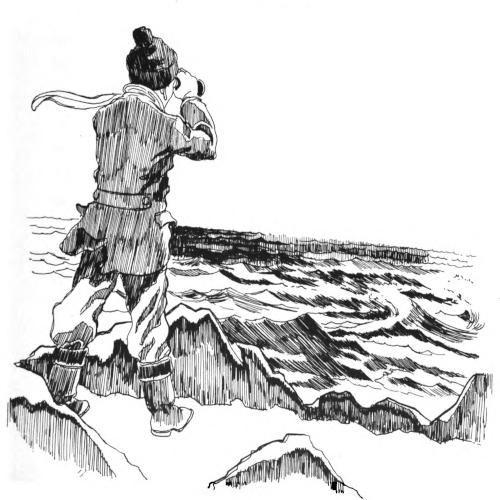
Yes, there he was, high up on the very peak of the
cliff, looking out to sea through his field glasses. She called
and shouted, waving her arm in a frantic signal. This time
he heard, put his glasses away, and started down.
“Look here, Bergel, you didn’t need to come—” he
began, slightly annoyed.
“I know,” interrupted Bergel. “But today I think
Herr Professor is going to announce the trip up the mountain
for Christmas greens. You don’t want to be late and
maybe have to stay home from that. I think my sled will
get us there on time.”
“So!” said Arne. Bergel was a pretty good kid. “Hop
on, then. We’ll beat that school bell. We’ll take the short
cut, shall we? That’ll get us there all right.”
“Well,” said Bergel, hesitating a little. “It’s dangerous,
but—”
“Not with your cousin Arne as navigator! Come on!”
Arne was daring, Bergel knew that, but he was skillful,
too. And she certainly didn’t want to be late today.
Herr Professor might punish latecomers by refusing to let
them go on that expedition up the mountain for the
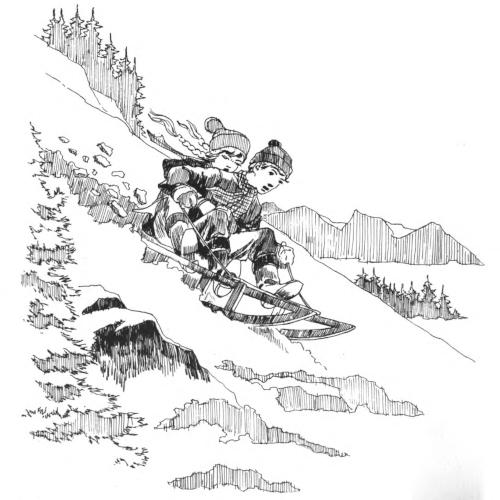
Christmas greens. She got on the sled and shut her eyes
tight as they went flying down the steep hill toward the
schoolgrounds. She was a little frightened, it is true, but
almost too excited to realize it. If they avoided that big
rock now, they’d be all right.
Arne’s face was grim as they whizzed downward.
This was a dangerous hill. He had to give all his attention
to steering and braking. Bergel had risked her own good
record and the chance of going up the mountain in order
to warn him. He just had to get her back safely and on
time.
It was a triumphant moment when the breathless
ride was accomplished safely, and the cousins jumped off
the sled. Then they made a dash across the schoolground.
Arne’s thoughts were racing as fast as his feet. Where
was that ship, anyway? It was really overdue now, several
days. Maybe something had happened to Captain
Olsen. Maybe Gustav had to bring in the ship. What if
he had had to take command and had failed to bring it
safely to port? Arne couldn’t bear to think of such a thing.
He looked so anxious that Bergel, glancing at him as
they pulled off their coats, said softly, “Don’t forget—it’s
the Christmas Star we’re waiting for. And remember,
that’s always come in safe and sure.”
Arne nodded and hurried across the schoolroom and
slid into his seat just as the bell rang. His spirits, never
down for very long, rose a little. He and Bergel had made
port safely, anyhow, and in time, too.
But Herr Professor Engstrand looked at him gravely
for a moment and said, “Tardiness is a fault I do not wish
my pupils to develop. Arne Dalen, you have come in once
this week just after the bell rang, and you have repeatedly
got in barely on time. I shall have to take strong measures
if you are tardy again.”
Arne’s face flushed, and he looked down in embarrassment.
If he could only explain! But you couldn’t
explain things to Herr Professor.
He was heartily glad when the teacher went on in an
entirely different tone, “I have a pleasant announcement
to make. On Friday afternoon, all you older pupils are
to go up the mountain for greens to decorate the schoolhouse
for the Christmas program. All bring flashlights
and sandwiches. We shall make a campfire and have a
picnic. Froken Utvig promises we shall practice some of
our Christmas songs there.”
There was a stir of delight throughout the room. The
trip up the mountain for Christmas greens was a favorite
yearly event. Getting the greens and decorating was even
more fun than the Christmas program itself. This was the
first time Arne and Bergel’s class had been included in
the expedition. Arne’s eyes glowed as he thought of the
picnic supper, the campfire up there on the dark mountain,
the singing that would float all up and down the
mountainside.
But some of the girls looked a little perturbed, and
the teacher almost smiled as he said, “We shall not stand
out there in the snow eating our supper. Froken Utvig says
we can find shelter in her father’s saeter cabin.”
The Utvig saeter! Oh, that would be something,
Arne thought. Everyone said the Utvig cabin was the
finest on the mountain. Arne had never been there, and he
almost forgot about the Stjerne in his excitement. It was
wonderful fun to go up to a saeter in summer, but in winter
it would be a real adventure. He resolved to be on time
for the rest of the week. He certainly could not run the
chance of being left out of that trip up the mountain.
Arne could hardly keep his feet from taking the
familiar cliff path the next noon. If only there were just a
little daylight after school. Then he’d hurry as fast as he
could up the cliff, get out those field glasses, and stand
looking as long as he liked. But it would be dark by that
time. And tomorrow was the day of the trip up the mountain.
No, he couldn’t run the risk of being late.
With a mighty effort he managed to trudge straight
to school. He even got there a little early. He was too
anxious and miserable to stay out playing, so he earned
the pleased surprise of Herr Professor by going straight
into the schoolroom, opening his book, and settling down.
But his thoughts were not on his Norwegian history,
though that was a subject he really liked, full as it was of
stirring events. His thoughts were with the freighter
Stjerne, in peril out there on the stormy sea.
Arne hurried home right after school, hoping better
news had come in. His mother was in a perfect fury of
baking. She was making lefse, and he usually liked to
watch her doing that. But today he didn’t care much, for
one look at her face told him that the news was not good.
She whisked the kettle of potatoes off the fire, mashed
them violently, mixed in flour and salt and cream. Then
she rolled out the dough into large, thin, round cakes, and
Besta baked them on the top of the cookstove.
Both of them nodded a greeting to him, but no one
seemed to feel like talking. Presently Besta buttered a
piece of warm lefse, spread it with brown sugar, rolled it,
and handed it to Arne. Even now he did not forget the
polite Norwegian “Mange tak,” “Many thanks.”
He took his lefse and wandered off to the workshop,
but there was a lump in his throat as he drew the covering
back and looked at his little ships. It didn’t seem to him
he could work at them today, and he started to cover them
again. Then he stopped and said fiercely right out loud,
“Look here, Arne Dalen! Gustav wouldn’t do that. He’s
a great one to stick at something until he gets it done.”
Somehow that idea comforted Arne. Wherever Gustav
was, even if he was in serious difficulties, he’d be doing
something to try to put things right. He remembered how
quick and sure his brother had been last summer on the
Laks when the rocks had fallen. And Gustav had weathered
bad storms before this. Captain Olsen, too. They
were two good men, Father said. And they had a good
crew of Norwegian sailors. Arne picked up one of the
little ships and began a careful job of sandpapering. Even
after supper he came out and found comfort in working.
When Gustav came home, the surprise would be ready.
He lingered in the kitchen next morning for a few
minutes after the others had gone about their various
duties. He wanted to talk to Mother about preparations
for that trip up the mountain. But more than that, he
wanted very much to say something encouraging to her.
It was hard to know just what to say. The Dalens
came from a long line of seafaring people, and no one
talked much about it when there were storms and ships
were overdue. But Arne couldn’t bear that bleak look on
his mother’s face. It was not at all like her. She was a
cheerful, busy person, almost as full of lively plans and
ideas as Arne himself.
It didn’t take long to settle about the lunch. Mother
promised to make him some extra nice smörbröd, or sandwiches.
At a picnic like that, all the sandwiches would be
spread out and shared, and hers must do both Arne and
herself credit. She promised to decorate them in all kinds
of fancy patterns. She would put in some of the bakkelse,
too, and other cakes.
Arne was well pleased with this, but he didn’t quite
know how to go on to the next subject. Then Bergel’s
words of comfort came back to him. They had made him
feel better. Maybe Mother would like them too. He
cleared his throat and said gruffly, “Gustav’s ship is the
Christmas Star, you know, Mother. It’ll come in safe, I’m
just sure it will.”
Tears sprang into his mother’s eyes and brimmed
over, and Arne wished earnestly that he had not spoken at
all. He didn’t know whether to keep still now or to try
again, so he just put his arm around her and gave her a
quick, fervent hug.
She swallowed hard, shook herself, and wiped her
eyes fiercely. “There now, Arne,” she said, hustling the
dishes off the table. “Of course it will come in.” And
somehow she managed to smile. “Run to school now, boy.
Don’t be late.”
When Arne came home at noon, a lunch was ready
packed for him to take up the mountain. He got out his
flashlight and skis and put all the things together. His
mother tried to talk cheerfully of all these preparations
as they ate their lunch, but her sentences trailed off in a
way not at all like her.
The boy’s heart was heavy as he left the house. He
started for school, then stopped and swung swiftly around.
He’d go like lightning up the cliff, and maybe he’d see
Gustav’s ship. Then he’d ski down the slope and tell his
mother. He’d have time. He was starting back to school
earlier than usual.
He hesitated just an instant. This was no day to be
late. Then he set off at full speed toward the cliff.
He caught his breath in exultation as his glasses swept
the angry, heaving waves. It was beginning to snow, but
in spite of that he could see there was a ship far out—a
ship that could be the Stjerne! But it was much too far
away for him to make sure. And yet he couldn’t bear to
leave in uncertainty. The minutes flew by as he stood
there, too intent on watching to think of anything else.
Suddenly a bell far down below brought him up with
a jerk. That was the school bell. First bell, only. If he
skied like mad, he might make it.
But though he felt as if he were actually flying down
the slope, the last bell sounded loud and clear through the
wintry air before he even reached the schoolground.
With all his heart Arne wished he didn’t have to go
into that schoolroom. But he knew he did. He paused for
an instant at the door. Then he braced himself and
entered, his head erect but his cheeks crimson as he
walked quickly and quietly to his desk.
There was an air of excitement in the room, and Herr
Engstrand had evidently been talking, for no books were
open. Now he paused and waited till Arne took his seat.
“I am very sorry you chose to be late this noon, Arne,”
he said, and though his tone was stern, it did sound a
little regretful, too. “I dislike very much to keep you in
today of all days, but you have been warned and spoken
to more than once. Get out your English grammar and
do the exercises on pages 63 and 64. Have them on my
desk before you leave the schoolroom. And now the rest
of you may get your wraps and skis. As I was beginning
to explain, it has been decided on account of the threatening
snow that we start at once and get back before too
late. The afternoon session is excused.”
Arne sent a stunned glance at Bergel. They were
actually going to have a half-holiday and go up the mountain.
And they were leaving him out of it. Her face, sorrowful
and reproachful, didn’t make him feel any better.
In the flurry of leaving, she seemed very busy with one
or two papers. Then she gave him a long look and rose
to go with the others.
6
As the other children trooped out, Arne pretended
to be deep in his work. Let them go then, and have
a good time. What did they care about his troubles?
They didn’t have a brother out on the stormy sea and a
worried family at home. Let them go, and see if he cared!
But he did care, tremendously. There was a lump in his
throat he couldn’t swallow.
Bergel passed his seat and touched his shoulder
gently. He shrugged off her hand, but she slid it down
toward his and left a piece of paper there. He acted as if
he didn’t see it, for he was hurt and disappointed and
angry. Probably just a note saying he should have been
more careful. He wouldn’t even look at it.
The shouting and laughter died away at last, and
Arne looked gloomily down at his books. He felt more
like crying than doing exercises. But of course he was too
big to do a thing like that. If only Herr Engstrand had
given him anything but English grammar to do! He must
know how Arne disliked that. Arithmetic, now—he could
have got that done in a hurry and maybe he could have
caught up with the others. But English grammar! And
two long exercises! He’d never get those done.
Suddenly he remembered another trip up the mountain—the
summer trip, when he had thought he would
have to stay home to bale lutfisk. With Gustav’s help, he
had got that job done in time to go with the others. No
one was here to help him now, but perhaps he could get
this job done himself and follow the others. His usual
hopefulness began to come to his rescue. Herr Engstrand
hadn’t said he couldn’t come on the trip. He had only
said he must finish the exercises before he left.
Arne turned to his books in earnest, now. He knew
how to do that first sentence, anyway. Maybe this wasn’t
such a hard exercise, after all. He was half through it,
his spirits rising as he worked, when his hopes fell again.
He didn’t know the way to the Utvig saeter, and he was
well enough acquainted with mountains to realize that a
snowy day in December was no time to strike out on
unfamiliar ways.
He gave a deep sigh and turned back to his work.
No use to try to get it done fast. It didn’t matter when he
finished. But he went doggedly on, and a sudden thought
came to him. Bergel had certainly looked as if she wanted
to tell him something. He picked up the note, his face
brightening as he read: “Utvig saeter is above ours. Go
up the Ahlness trail, then take the left fork where there
are three saeter cabins.” She had even scrawled a little
map. With fresh energy, Arne bent to his lesson.
The schoolroom clock had ticked an hour away
when the boy laid his exercises on Herr Professor’s desk.
He put on his skis, settled his knapsack on his back, and
set off on his trip up the mountain through the falling
snow.
The boy felt confident and light-hearted as he hastened
up toward his uncle’s saeter. Though the familiar
landmarks looked different in their winter dress, he could
recognize them without difficulty. He knew he was making
better time alone than the others could in a large
company. As he sped along he began to hope he might
overtake them, or at least get there in time to help bring
in the greens.
The snow, which fell heavily at first, began to
slacken a little. He managed to go along at a steady pace,
but it seemed a long time before he came out where Uncle
Jens’s cabin faced the fjord. The little log house looked
forlorn with all its windows boarded over for winter, and
Arne was anxious to hurry on. Far out at sea he could
detect the faint light of a ship. He wondered if it could
possibly be the Stjerne.
The snow had stopped now, and strong winds blew
in steadily from the sea. Dusk had closed in, and Arne
shivered as he stood there, not sure how to go ahead.
“Take the Ahlness trail,” Bergel’s note had said. There
was more than one path zigzagging about up here, he
knew, but as far as he could remember, there was only
one good trail that led way up the mountain. That must
be the one. Those folks up there ahead must have left
plenty of tracks. But he had difficulty in finding them
because of the drifting snow. At last, however, with the
aid of his flashlight, he did manage to find some traces.
If only Bergel had said how far it was! It seemed to
Arne that the way was much longer than he had expected
it to be. Though he got out his flashlight often, he didn’t
see anything of three saeter cabins in a cluster, to say
nothing of a fork in the trail. The way was very steep
in places, and he did wish those tracks were plainer.
And now he had come to a place where the snow was
so drifted he couldn’t see any tracks at all. He was
uncertain what to do, which way to take, and almost
wished he had never started on this difficult journey
alone.
Then he looked up toward the mountain top, and
just above it, where the wind had ripped the clouds apart,
he saw one bright star shining. Christmas star again,
thought Arne, and felt a little better. He pressed on and
at last came to the three small houses. Now for the fork
in the trail!
But he could not make out any tracks in the drifted
snow, and there didn’t seem to be any real trail, though
there was a break in the bushes here. He’d start that
way. But he hadn’t gone far when he was brought up
short by a great boulder in the way. This certainly could
not be the trail. He went back and started again, but
this time a thicket of bushes blocked the path. Perhaps,
after all, he had come the wrong way. Perhaps those
three cabins were not the ones Bergel had meant. His
heart was thumping. What if he was lost in these
mountains?
He stood there straining his eyes in the gray darkness.
If only he could catch some gleam of the campfire!
He could see no sign of light on the dark mountain, but as
he stood, trying to think of something he could do, a
familiar sound came down to him—a long-drawn blast
that could only come from a saeter horn. Someone was
certainly sending him a signal, and he felt sure it was
Bergel.
Arne stood still, trying to determine just where that
call had come from. As he waited, it came again, over
and over. The star would be a good guide now, for the
horn’s blast had come from exactly that direction. Now,
a little to the left, he found a way through the thicket;
with the help of the horn and of his bright star, he forged
steadily ahead.
At last, to his great relief and delight, he caught
sight of a glimmer of light above him. Soon he began to
hear voices in the distance—faint at first, then louder.
Now he could hear calls and shouts and laughter and bits
of song, and above all, the sound of the horn.
In a few moments the full brightness of the campfire
burst upon him. He saw people scurrying about; but one
small, valiant figure caught his eye and warmed his heart.
It was Bergel, standing in the firelight, the long saeter
horn at her lips. She blew a blast that Arne felt must be
heard clear down at Nordheim, and he almost felt like
giving her a hug. Instead he skied silently to her side and
stood there grinning. “Calling someone, Bergel?” he
asked.
“Arne!” she cried, and threw both arms around him.
“Oh, I was so worried! I knew you’d try to come, and
then it snowed so hard for a while, and drifted so, and
you didn’t know the way. How did you ever manage to
find it?” Her tone showed plainly that she considered
that quite a feat.
“Well, you helped,” said Arne. He slipped away
from her embrace, but his voice was gentle. “And then I
guess the Christmas star helped, too.” He nodded to
where the bright star shone among drifting clouds.
“You see! Isn’t that a good sign?” said Bergel triumphantly.
“And now you’re in time to help with the
greens, Arne. The boys have gone up there just a little
ways. Got your hunting knife?”
“Do you suppose I’d come up here without it?”
asked Arne. But he smiled at her, and she smiled back
before she turned to help with the supper.
Everyone was glad to see Arne, though nobody said
much about it. He pulled his silver-handled hunting knife
from the sheath at his belt and was soon in the thick of
the work, helping cut branches and put them in bundles.
In spite of himself, his respect for Herr Professor
Engstrand increased as he watched him directing and
helping. The teacher had obtained permission to take
what they needed, and seemed to know exactly how to go
about getting it. When he climbed easily up a big tree,
Arne could hardly believe his eyes. Was this the same dignified
man who didn’t seem to be interested in anything
but books and lessons and keeping order?
Eager to do his part now that he was here, Arne
went right up to a treetop to get some specially fine
branches with clusters of cones. When he came nimbly
down, he saw, with some dismay, that the other boys had
gone on and that only Herr Engstrand was at hand. He
was probably in for a good scolding now, but surely Herr
Professor wouldn’t send him home when he had toiled so
hard to get up here alone.
Arne started to run after the other boys, but the
teacher took two or three long strides, laid a hand on his
shoulder, and turned him around. “Just a minute, my
boy,” he said. “I have something to say to you.”
Arne’s heart seemed to go right down into his boots.
“Yes, sir,” he managed to mumble. “Maybe I shouldn’t
have come, but I—well, I did my exercises first, and I
didn’t think you said—” His voice trailed miserably off.
“I didn’t say you shouldn’t come,” said the teacher
in a matter-of-fact tone. “In fact, I hoped you would,
though I didn’t feel I could encourage you to do so, in
view of the weather and the distance. Of course I know
it takes more than a snowstorm to keep a Norwegian boy
off a mountain. In fact, people say mountains and snow
are all a Norwegian needs for fun. But I didn’t think you
knew the way here.”
“I didn’t really, but—” Arne began and then
stopped short, uncertain and embarrassed. He certainly
could not tell Herr Professor about Bergel’s note. How
could he explain?
Herr Engstrand was going on, “But your cousin told
me—” He stopped so long that Arne looked up and,
to his great surprise, saw that his teacher was smiling a
little. “She is a conscientious little girl, as well as a good
pupil, and I think she felt she might not have done right.
And then, too, I think she began to get worried about you.
So she told me about leaving you the note. And I’ll admit
we were all a little anxious when you did not arrive.”
“Those grammar exercises,” said Arne, with a gusty
sigh. “They took quite a while. But who thought of the
saeter horn? That was a life-saver.”
“It was Bergel who thought of that, and Froken
Utvig found it for her. Bergel told me something else,
Arne. She told me why you had been late those times. I
should have been glad if you had told me yourself.”
“You would?” exclaimed Arne in astonishment, and
added, with complete honesty, “I never thought of that.”
Herr Engstrand dropped his hand from Arne’s
shoulder. “I see,” was all he said, but his voice made
Arne think of the way he himself sometimes felt when he
tried very hard to do something and did not succeed.
That tone made Arne want to mend matters, and he
hurried on, “I didn’t know you’d be interested, but I
guess you are. So I want to tell you why I was late this
noon. Bergel didn’t know about that. I saw a ship way
out in the storm and I thought it might be Gustav’s. And
from Uncle Jens’s saeter I could still see the lights of a
ship a good ways out.”
“I see,” Herr Engstrand said again. But this time
his tone was quite different. “A ship would have a hard
time making port in a sea like this.”
Arne looked up at him in alarm. “Oh, Herr Professor
Engstrand!” he exclaimed. “Do you suppose—what
if Gustav’s ship got nearly home only to be dashed to
pieces on the rocks?”
“Of course the chances are it was not the Stjerne at
all,” said Herr Engstrand. His voice was thoughtful.
“Oh, I wish that wind would go down,” said Arne
fervently. “There aren’t even any stars out, now.”
“Well, Arne, these Norwegian skippers know our
coast pretty well, don’t forget that. And from what I
hear, Captain Olsen is a fine navigator. Come, Bergel is
blowing the horn again. That is the signal for supper.”
Arne gathered with the others around the great fire
piled high in the kitchen fireplace. Froken Utvig and
the girls had scrubbed a long table, laid a bright cloth
over it, and spread it with gaily-decorated sandwiches
and cakes. Everyone was hungry and ready for the good
food and the singing.
There were Christmas songs first, and folk songs
followed. Then everyone stood to sing the national
anthem:
“Yes, we love with fond devotion
Norway’s mountain domes,
Rising storm-lashed o’er the ocean
With their thousand homes.”
“‘Storm-lashed’ is right,” thought Arne. But he
loved the fine old anthem, just as the others did, and
joined in the singing with all his heart.
“I think those songs all but lifted the roof,” said
Froken Utvig, smiling. “But now, as it is still snowy and
drifting, and the wind is strong, we had better start
home.”
Everyone hurried about—putting out the fire, getting
things in order. Arne was as busy as anyone, but he
couldn’t help thinking about the Stjerne. What if she was
tossing about out there, very close to the rocky shore,
driven by the wind? What if Gustav should be almost
in port, only to have his ship go down tonight?
His face was troubled as he bent to fasten his skis,
but he looked up quickly as Herr Professor came over
to him and said, “Arne, I want you to help me with some
of these greens. Can you carry a load as big as this, do
you think? We’ll fasten it on your back if you can.”
Ordinarily Arne would have been proud of such a
request, for the load was a large one. But tonight he had
planned to rush ahead with all speed and see if it could
be possible that his brother’s ship had come in. He
couldn’t make much time with such a load. But he could
do nothing but answer, “Yes, sir, I can.”
“Good boy,” said Herr Engstrand. “Now, Arne, I
want you to stay behind with me just a little. I have one
or two things to do.”
“Yes, sir,” said Arne, but his disappointment showed
so plainly that Herr Professor said, “What is it, boy?”
“It’s my brother’s ship, sir,” said Arne, in a low
tone. “I thought she might have come in. I wanted to—”
“Yes, yes, I see. Well, Arne, that’s why I want you
to stay behind. An idea has occurred to me—a way you
and I may be able to help your brother. I have told
Froken Utvig to let some of the big boys guide the party.”
“Yes, sir,” said Arne again, but this time he was
thoroughly puzzled. How could he and Herr Engstrand
up here on the mountain possibly be of any help to Gustav
out there on the stormy sea?
7
There was a good deal of laughter as the boys
divided the greens and arranged the loads on their backs.
Then away they went, singing and shouting, the girls
insisting on carrying some of the smaller branches with
especially fine cones.
How Arne wished that he could be a member of the
merry group! He wanted to get down to Nordheim fast,
and it seemed to him that Herr Engstrand was taking a
good deal of time over things that were not necessary.
But once the others were out of sight, the teacher
said, “Now, Arne, full speed ahead down to your uncle’s
saeter. The wind is getting higher. It feels to me as if
it’s going to snow again, and we’ve got work to do, you
and I.”
Arne was more puzzled than ever. What work could
they possibly have to do up here? But Herr Engstrand
was skiing down the mountain with a speed that Arne
found hard to follow. When he reached Uncle Jens’s
saeter, Herr Engstrand was already there, playing his
flashlight all around the little clearing.
From the high point near the cliff, the boy could see
lights moving out on the open sea leading to the fjord.
“Looks as if a ship’s in trouble out there,” he said
anxiously. “Are we going on down, sir?”
“No, here’s where we stop, Arne. Let us make a big
fire, you and I, and keep it going to give a signal to
that ship. They can tell from the height that this is
the cliff, and if I’m not mistaken, they’ll know the harbor
is below here.”
“Oh, that’s the plan!” exclaimed Arne. It was such
a good one, and yet so simple, he wondered why he hadn’t
thought of it himself. Neither of them said much; but they
worked fast, and a fire was soon started near the edge of
the cliff.
“Now, Arne,” said Herr Engstrand, “we will pile
our boughs on this and make a big blaze right away while
we collect more.”
“So that’s why you wanted me to take such a big
load!” said Arne. “And you took a lot more than I did,
even.”
“I wanted to get this thing going right away.
There!” He threw his bundle on the fire. “Pitch yours on,
Arne.”
Arne threw his pine boughs on and watched with
satisfaction as they burst into a great blaze.
“Now we must collect plenty of fuel, Arne. I have
my small hatchet, of course. And you have your hunting
knife. We must keep this fire burning high and bright.
Then we’ll watch to see what happens out there.”
Arne did a good deal of thinking as he dragged in
branches and twigs. This wasn’t a bit like the Herr Professor
who had been so stern and strict and had seemed
interested only in lessons. This was really smart—like
something Gustav himself might have thought of. He’d
like to tell Herr Professor so, but even now he could not
quite get up his courage to do that. But when they had
collected a large pile of wood and were standing by the
fire watching those lights out at sea, he did manage to
ask, “Herr Professor, how did you happen to think of
doing this?”
“Well, Arne, I was a commando in the war,” Herr
Engstrand said quietly.
“A commando!” gasped Arne.
“Yes. We learned to think of all sorts of ways to do
things in emergencies. More than once we guided a vessel
safely to port just this way.”
“A commando! That’s what Gustav wanted to be.
But he wasn’t quite old enough. He says they learned
everything, just about.”
“Well, we did learn a lot of things. For one thing, we
learned to obey orders fast and to the letter.” He paused
for a moment and went on, more as if he were thinking
aloud than speaking to his companion, “But schoolboys
aren’t commandos, and I don’t suppose you can expect—”
He broke off and looked at Arne with a quizzical
expression.
Arne was standing very straight, his eyes eager and
alert as he looked back at Herr Engstrand. “Oh, sir,
but I think you can expect us to—” He stopped as if he
had just remembered something. “From now on,” he said
emphatically, “I’m sure you can expect that.”
“I believe I can, Arne,” said Herr Professor.
His voice was serious; but it was friendly, too, and
now Arne did not find it very hard to muster courage
to say, “All the boys would like to know about your being
a commando. The girls, too. Couldn’t you—wouldn’t
you tell them about that? We’d all be interested.”
“You would?” In the firelight, Arne could see that
his teacher was smiling a little. “I had an idea school
was for lessons. But maybe there are several kinds of
lessons. And now, Arne, up and at ’em. More wood!”
Arne rushed off, but this time he had new hope. He
was working with a commando! And the commandos
had got out of all sorts of dangerous situations. Herr
Engstrand seemed confident that Captain Olsen and
Gustav would do the same thing and bring the Stjerne
in safely.
Each time they returned to the fire, they stopped to
watch the ship struggling out there against the wind.
Then they dashed back to work harder than ever. It
was not easy to collect enough fuel in the snow, but both
of them worked with a will.
At last Arne said hopefully, “I think she’s making
progress out there, sir.”
“Yes, looks as if she’s making for the channel. Come
on, Arne. We have to keep the fire high and bright now.”
When they returned the next time, Arne gave a
great shout. “She’s coming in! She’s coming in! Oh, if
she can just hold her course, she’ll be safe.”
“Yes, she’s making headway all right. Looks as if it
could be the Stjerne, Arne.”
Arne fairly flew off to get more wood, his heart beating
so hard he couldn’t even talk. This time, when they
came back to the fire, there was no doubt about it. “She’s
past the barrier now, and moving into the channel,” said
Herr Professor.
“Oh, Herr Professor!” Arne shouted, and in his
exuberance he snatched off his cap and threw it so high
it almost came down in the fire. “It’s Gustav’s ship!
It’s Gustav’s ship, safe and sound. I know it is.”
“How would you like to start down, Arne, and be
there on the dock to greet your brother? Everybody will
be there, and I know you’d like to be on hand with the
others.”
“Oh, boy!” cried Arne joyfully. “Oh, boy!” But
then he looked quickly at the teacher. “But we couldn’t
leave the fire, could we? They still need it, don’t they?
This is about as important a time as any, isn’t it?”
“Yes, we have to keep it going till we’re sure they’re
safe. But I could manage to tend it alone now, if you’d
like to get started down.”
Arne hesitated just a moment. He wanted dreadfully
to be right down there on the dock when the Stjerne
came in. But then he shook his head. “No,” he said. “One
commando would never walk out on another. I’m going
to help keep this fire going.”
“Good boy, Arne. I think your brother would like
that,” said Herr Professor. There was an expression of
such approval and pleasure on his face that Arne’s cheeks
flamed and he looked away, feeling very happy. “We’ll
both work hard, then; and we’re pretty fast on our skis.
We’ll go down a lot faster than we came up. The ship
won’t beat us in by much.”
In the very midst of gathering his next load of wood,
Arne stopped and laughed right out loud. “I’ve thought
of something, Herr Professor!” he cried. “I’ve thought of
how I can get down there fast—just like a commando.
We can keep the fire going as long as necessary, and I can
still beat the ship to the dock.”
“And how are you going to do that, Arne?”
“I can go right down the wires Uncle Jens arranged
to let the milk and stuff down the cliff. Gustav did that
last summer when he saw Torger Blessom’s boat overturned.”
He hesitated a moment. “I was wishing then I
had the nerve to do it.”
“And now you have!” said Herr Professor with a
nod. “You’ll need rope for that, Arne.”
“Yes, there’s one up here. I know where it’s kept.
And can’t we sort of bundle me up in greens, a little?”
“Yes, and you’ll need something more than mittens
to put on your hands to keep them from getting cut.”
“Yes, Gustav wound a lot of cloth around his, I
remember that. And I know where Aunt Tina keeps some
rags we can use. One good thing—there’s plenty of snow
at the foot of the cliff; so I should make a good landing.”
Herr Engstrand laughed. “Arne, I see plainly
you’ve got the makings of a first-rate commando!” he
said. “You’ve got good Viking blood. Your brother is
going to be proud of you. We’ll send you right down those
wires to welcome him, all right.”
“She’s coming in! She’s coming in, Herr Professor!
Here she comes, the Christmas Star! She doesn’t look
very big, way down there!”
“No, we usually think of a Christmas star high
above us in the heavens, instead of far below us on the
water,” said Herr Professor.
“I guess a Christmas star isn’t out of place anywhere,
is it?” said Arne. “The Stjerne is sure going to
look good to us in that harbor. We won’t need to bring in
many more loads now, will we?”
The fire on the cliff blazed high, and the two worked
fast to keep it replenished. The ship came closer and
closer to port; and at last Herr Engstrand said, “They
don’t need our fire any more, Arne. The lights of the town
will be enough. Now we’ll get you ready, and down
you go!”
Both of them worked fast to get Arne ready for his
journey down. Herr Engstrand made sure the rope was
safe and strong before he tied the loop in which Arne was
to sit. Soon the boy was bundled up in greens, his hands
well wrapped. Herr Professor settled him securely in the
rope sling.
“I’ll hold as tight as I can at first,” he said. “But
once you get going, you’ll have a fast ride. Ready now?
Here you go, down the wires to meet the Christmas
Star!”
“Ready!” Arne managed to say, but his mouth was
dry, and when he tried to swallow it seemed to him his
heart was right up in his throat. The lights of Nordheim
looked far, far below him.
Then Herr Professor gave him a little push and
started him downward. Arne knew his teacher was holding
the rope as firmly as possible, but the sling went in
jerks along the wires. Probably they were rusty. What if
they should break? The rope, too! It had been used all
summer long. It might be a little frayed. What if it
should break, with all this jerking?
Then he remembered how Gustav had thrown his
weight first one way and then another to steady his
progress. He tried to do the same now, and he began to
go faster and more smoothly.
Once fairly started, it was a swift, breathless ride
Arne had down those wires. Fast as he was used to going
on skis and sleds, he had never had such a ride as this.
The blood pounded in his ears as he rushed through the
air toward the foot of the cliff.
He hoped fervently that there would be a good,
deep snowdrift where he landed. There was! In another
instant, Arne, encased in greens, his hands bound with
rags, plumped right into the midst of a great drift.
He heard the deep, throaty blast of the ship and a
loud cheer from the people who had gathered on the
dock. He struggled and pushed, trying to get free. After
all he had gone through, here he was stuck in a drift. And
the Stjerne was almost in port.
8
Arne managed to struggle out of the snowdrift at
last, and to get free of the rope, but even then he could
not rid himself of the greens nor the rags so firmly tied
about his hands. But he was determined not to miss meeting
that ship, even if he had to roll all the way to the dock.
Once he got there, someone would help him out of his
strange trimmings. What if he did look like a combination
snowdrift and walking Christmas tree?
It was Bergel who saw him coming. She gave a
scream of alarm and then burst into laughter as Arne
shouted, “It’s just me—Arne!”
She flew to his rescue, and Mother hurried to him
too, and Margret and Besta. He soon stood free of his
greens and rags, explaining a little in quick, eager sentences.
But there was scant time for explanation, for the
Stjerne’s bells were ringing, her whistle was blowing, and
she was in port.
All of them rushed to be right there when Gustav
came down the gangplank. Then there was excitement
and joy, talk and laughter, and even happy tears.
“I want to hear everything, Gustav—what happened—tell
us all about it!” cried Arne, rushing at his
brother.
“Wait now,” said his mother. “Gustav, we have
such a supper for you! Uncle Jens and all are coming
over. It is enough now we have you safe home. We will
hear the story at supper.”
What a story Gustav had to tell—a story of storms,
of a ship for a time fairly sheeted with ice. He told of the
injury to the engines, of the radio going bad, of a struggling
trip home, then another storm when they were
almost there.
“It was a big fire on the cliff that helped us—perhaps
really saved us,” he said. “We were trying to stay
away from shore, the winds out there were so violent.
Then this fire guided us in. I wonder who made that
fire.”
“Arne did that,” said Bergel proudly. “Arne and
Herr Professor Engstrand.”
“Of course it was his idea,” Arne said modestly. And
the little company listened in wonder as he explained how
Herr Engstrand had thought of the plan and they had
worked together to carry it out.
“That was smart, Arne, really smart!” said Gustav.
“I want to know this Herr Professor of yours. He must
have had confidence in you, too, to have you help like
that. It was a big job, and a good one.”
Arne hadn’t thought of that idea, and it pleased him
enormously.
“Do you like our Herr Engstrand better now,
Arne?” asked Bergel.
“Like him!” cried Arne. “A commando like that—someone
who knew just the right thing to do? Of course
I like him. Not many boys have such a teacher!”
His mother smiled at him. She had a feeling there
wouldn’t be much trouble about school from now on. “I
think we must ask Herr Professor here to share our Christmas
Eve,” she said. “I believe he is far from his home.”
Christmas preparations were redoubled now. There
were only a few days left, and work had lagged a little
of late. Mother and Besta and Margret cleaned and
baked and cooked from morning till night.
Arne was very thankful he had stuck at his shipmaking
in spite of everything. Those ships would all be ready
in time. He had only a little more painting to finish. His
big problem now was how to get them on the Christmas
tree without having everyone find out about them.
Mother and Besta and Margret always trimmed the
tree. It stood in the best room; the door was shut, and
Mother kept her eye on it. Arne certainly didn’t see how
he was going to get those ships hung.
This year Uncle Jens’s family was to share Christmas
Eve with them. Arne knew Signe and Bergel were
bringing some new tree ornaments they had made—little
straw goats, such as Julenissen was supposed to ride.
These would be entrusted to Mother. But Arne couldn’t
do that with his ships. They were to be a surprise for
everyone.
The night before Christmas Eve he was still turning
the problem over in his mind when he went to bed, and
he stayed awake at least ten minutes, thinking it over.
When he awoke the next morning, the solution had come
to him. It was so simple he laughed out loud. He should
have thought of that right away. He would take Gustav
into his confidence, and after the tree was trimmed they
would somehow smuggle in the little ships and hang them
all over the tree.
Gustav agreed readily to this plan. “Say, I want to
see those ships,” he said, and to Arne’s pleasure insisted
on going out to the workshop then and there. “These are
good, Arne,” he said, picking up one and another. “Really
good.”
Arne was pleased yet a little shy, too, at the praise.
“I did them mostly for you,” he said, “and when you
were so late coming it was awfully hard to keep at them.”
Gustav nodded. “I can believe that all right, boy,
but I’m glad you stuck,” he said, and his dark eyes were
softer than usual. “You practically built Norway a new
merchant fleet here.”
“Now how are we going to get them in there, Gustav?”
asked Arne.
“We’ll smuggle them in while the womenfolk are
busy about supper. You’ll have them all bundled up
ready, won’t you? We may have to make a foray in
through the parlor window.”
“Commando raid!” said Arne with a grin.
Gustav grinned back and rumpled Arne’s hair so
that it stuck up even more than usual. “That’s right. And
on defenseless womenfolk at that. Now I’d say late this
afternoon would be about right. How does that strike
you?”
Arne chuckled. “About the time Father fires off the
gun that tells us it’s Christmas Eve. You and I will be
putting up the sheaves of grain for the birds, and it will
give us a good chance to get away.”
“You’ve got the idea, boy! And there’s lots to do
between then and now.”
There was plenty to do indeed. Mother was calling
Arne even as he came out of the workshop. She had many
errands for him, but her voice was so happy Arne felt he
wouldn’t mind running his legs off. Anyway, Christmas
errands were always fun.
There were baskets of good things to be carried to
half a dozen houses. Mother delighted especially in
remembering anyone less fortunate than themselves at
Christmas time. And Arne went with Father to get the
smoked and pickled herring that was a favorite part of
the koltbord feast.
It was fun, too, to dash in and out of the kitchen
where mutton was roasting for the Christmas Eve supper,
where the lutfisk was soaking ready to be simmered and
drenched with butter, where everything was in the most
delightful bustle of preparation.
But whatever he was doing, his mind was not far
from those ships he must get ready to smuggle into the
parlor. It was well into the afternoon before he could find
an opportunity to get out to the workshop. He worked
fast yet carefully, grinning to himself as he bundled up
the little ships.
Gustav was busy with affairs of his own, back and
forth to the dock many times. Once Arne saw him whisk
around the corner of the house with a large crated affair
that made the boy’s hopes go way up. Could it be possible
that the Stjerne had brought him his longed-for bicycle?
That might mean he could take a holiday jaunt next summer,
up the fjords and through the mountain valleys with
some of the other boys. Herr Professor Engstrand was
planning to conduct such a trip, he knew, and wouldn’t
it be wonderful if he could go along?
His work was done now, and a good thing, too, for
Mother was calling him to scrub himself thoroughly and
get into his new Christmas clothes.
He was just ready when it was time for Father to fire
that Christmas salute. Then Gustav was calling him, and
together they went to the barn to get the two sheaves of
grain that were ready to be put up on poles for the birds.
To Arne’s annoyance, Margret for once insisted on helping
with that. She ought to know it was men’s work. Perhaps
it was because she was so glad to have Gustav safe
home that she wanted to be with him more than usual.
Arne looked at his brother in despair. How could they
manage about those ships if Margret stuck with them?
But he could see Gustav wasn’t worried, just
amused; so he dropped his own worries and enjoyed the
little ceremony as much as the others did.
“I think Mother’s looking for you, Margret,” said
Gustav, when the birds were swooping down on their
feast. Margret picked up her full holiday skirts and ran
to the house, while Gustav winked at Arne.
“It was all right, Arne. I did see Mother looking out
and beckoning,” he said, as they hurried off to the workshop.
“Now, boy, we work fast. You’ve got the bundle
ready, I see. Good!”
In a twinkling he was around the house, Arne at his
heels, and through the parlor window, taking care not to
muss those stiff white curtains. Without a word he
brought out a very small pocket flashlight, and Arne had
hard work not to giggle as they hung the little ships all
around the tree.
It was done so fast that Arne could hardly believe
they had finished the job, but in another moment they
were safely around the corner of the house and sauntering
in at the kitchen door.
“Just in time,” said Besta. “Light the candles, you
two. I see the folks coming, Herr Engstrand from one
direction and Uncle Jens and his family from the other.”
Soon the Christmas greeting of “God Jul” sounded
through the house, and the guests assembled at that bountiful
Christmas Eve table.
Christmas Eve supper was a wonderful meal, but
Arne and Bergel could hardly wait for the parlor doors to
open. Bergel was thinking of the straw goats she had
helped Signe make, and Arne was anxious to hear what
the others would say when they saw the boats. Perhaps
some of them found it almost as hard to wait as Bergel
and Arne did. When little Knut slipped down from the
table and went straight to that mysterious door, Mother
and Father rose from the table.
That was the signal for everybody to stand up.
Father went over to throw the door open.
There stood the tree in the lovely glow of candlelight—straw
goats, ships, and all.
Arne was sure they had never had a prettier tree.
There were all sorts of delighted comments. But Mother
said, “Why, look at those ships! Where did those lovely
things come from? Did you bring them, Gustav?”
“Arne’s the lad who gets the credit for those. He
made them all by himself—one for every person here,
from Knut up. How’s that for a good surprise!”
Arne stood there, his cheeks red, his eyes shining. No
one could quite believe he had done it, and everyone was
even more surprised than he had hoped.
“That took patience as well as skill,” said Herr Engstrand.
And perhaps that quiet comment was the one that
pleased Arne most of all.
The straw goats were admired, too, and the other
ornaments the girls had made. Then it was time for the
gifts.
There was a beautiful hand-knit blue and red
sweater for Arne, with mittens to match and fine socks for
skiing. But when Father trundled a bicycle out from
behind the tree straight toward him, Arne could hardly
see anything else.
Bergel was exclaiming in delight over a small and
lovely tea set. And all the others were just as pleased with
their gifts.
In the excitement, Gustav went quietly out of the
room, and even Arne did not notice him. He was eagerly
examining his bicycle, turning the wheels, feeling the
pedals, noting every detail of handlebar and seat, headlight
and horn and luggage carrier.
“Herr Professor, do you think I might be big enough
to go on that trip you’re going to conduct next summer?”
he asked eagerly. “Now that I have my bicycle?”
“You’re big enough to suit me. But let’s see what
your father says.”
“We will wait to hear what Julenissen says,” answered
Herr Dalen, his eyes twinkling. “If he seems to
think you’re a good boy—” He broke off as a great noise
was heard in the hallway and a pair of astonishing figures
burst in.
Everyone laughed and clapped, for here was Julenissen
himself, with his pointed red cap and long whiskers.
He was larger than Julenissen really should be, for his
feet touched the ground as he bestrode the straw-trimmed
goat, Julebuken. But no one minded that, and everyone
screamed and laughed and tried to get out of his way.
There seemed to be no bad children in the Dalen
relationship, for Julebuken stamped about the room without
bumping anyone. He went so fast, Julenissen had
hard work to keep up with him, and soon the lively pair
were on their way again, Julenissen explaining, in a voice
very like Gustav’s, that this was a busy night.
“I didn’t get bumped, Father!” cried Arne.
“Must be Julenissen thinks you are a good boy,
then,” said his father gravely, though his eyes twinkled.
“I guess that means there’s a summer trip ahead for you,
Arne.”
And now Mother and Besta brought out the special
treat of Yule porridge—a delicate rice pudding made
with spices and milk. Gustav, his hair somewhat rumpled,
was there eating with the others.
“We mustn’t forget the bowl for Julenissen,” said
Arne, with a sidewise grin at his brother.
“No, he likes that,” said Gustav soberly, and took
another helping.
There would be Christmas songs and games to follow,
but first Father read the Christmas story. At the
beginning, Arne’s mind was so full of his bicycle he could
scarcely pay attention. But then a few of the beautiful,
familiar words caught his ear.
“‘When they saw the star, they rejoiced with exceeding
great joy,’” Father was reading.
Why, that’s exactly what they had done, right up
here in Nordheim.
Arne thought of the star that had helped guide him
to safety on the mountain. And he remembered what
Bergel had said when he was so worried about Gustav.
“The Christmas Star has always come in safe and sure,”
she had said.
Why, of course. The Christmas star was always safe
and sure. And wherever you saw it, it brought “exceeding
great joy.” Arne drew a sigh of deep content and settled
to listen. This was really Christmas.