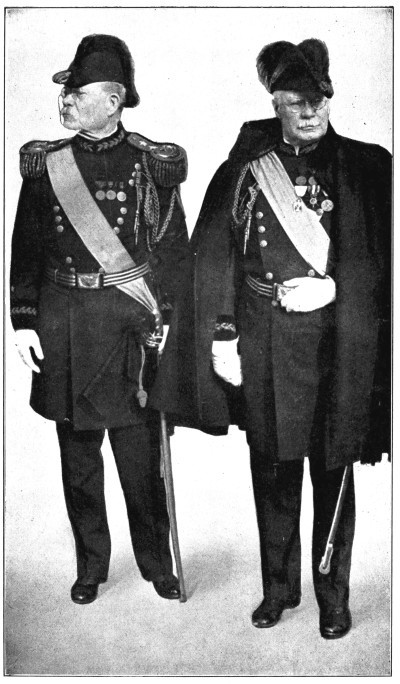
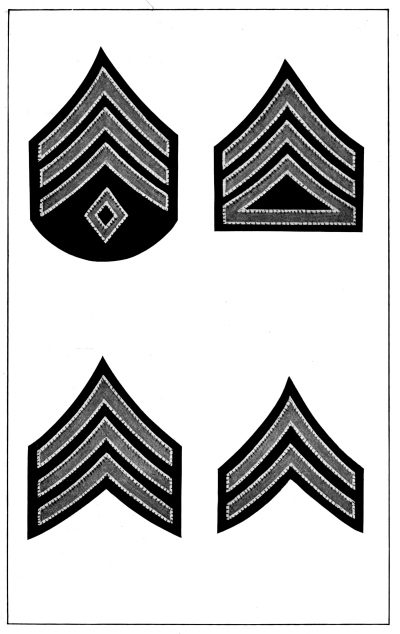
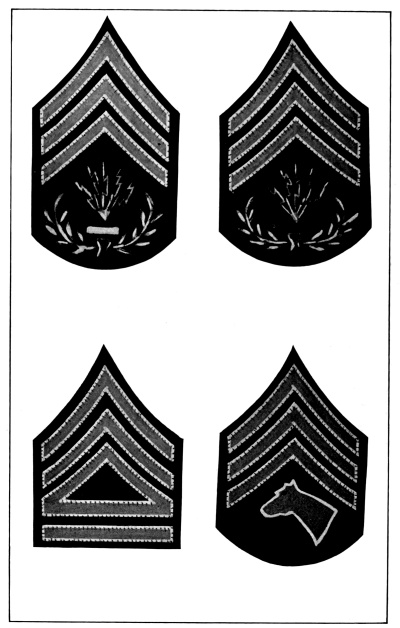
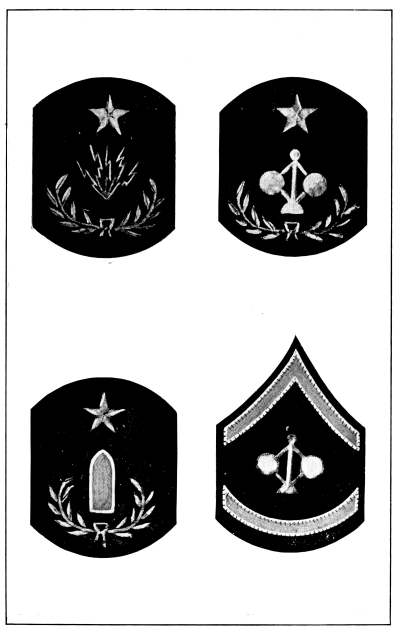
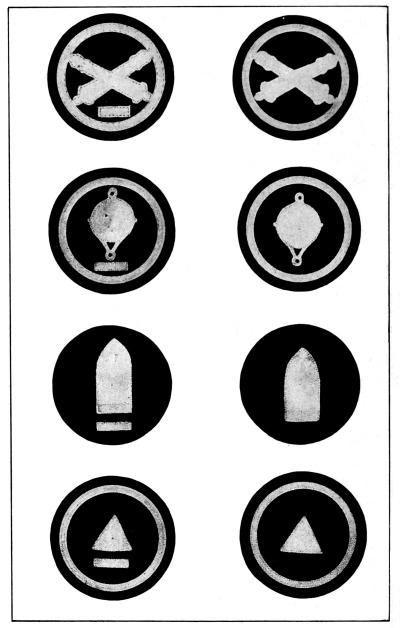
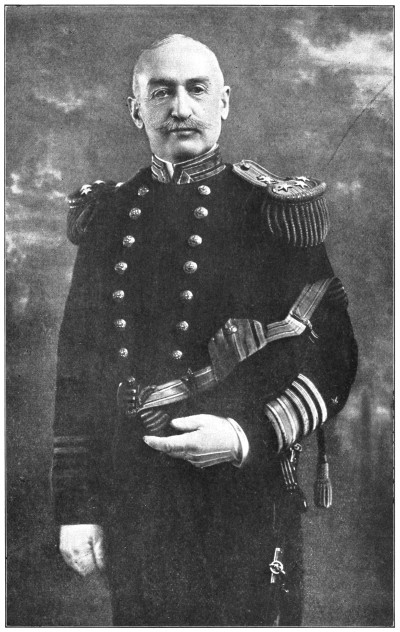
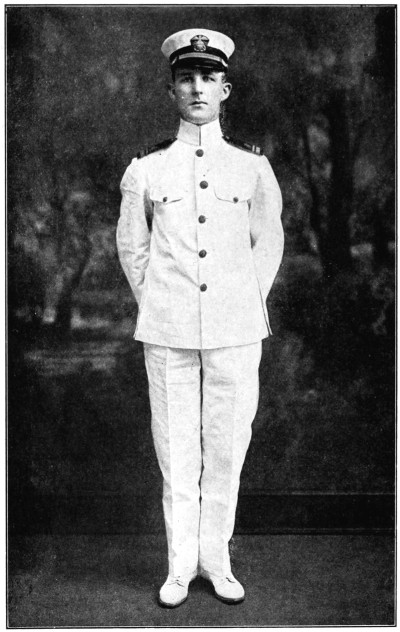
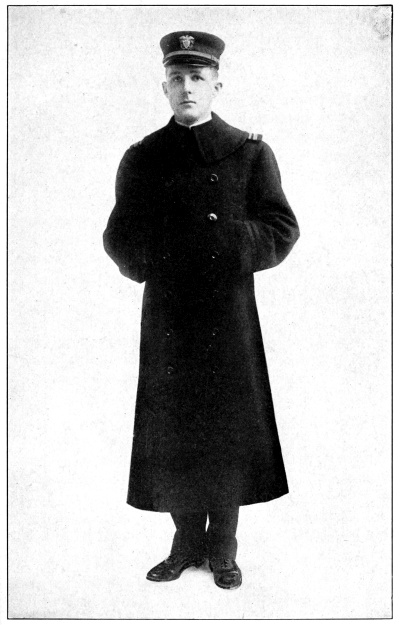
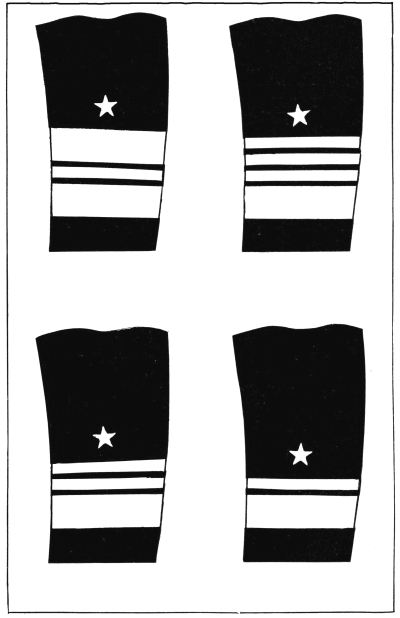
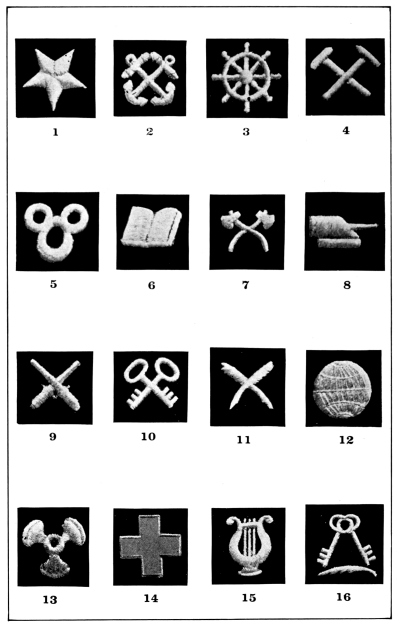
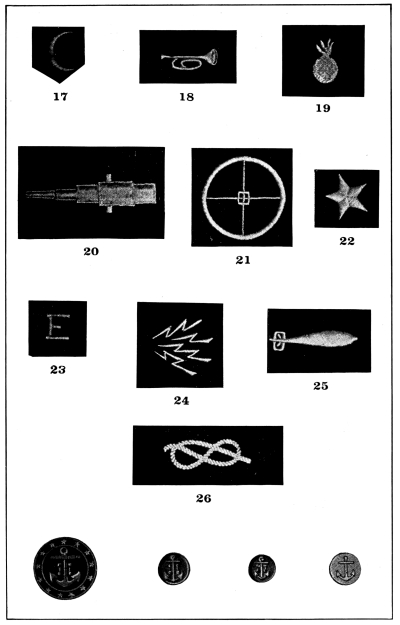
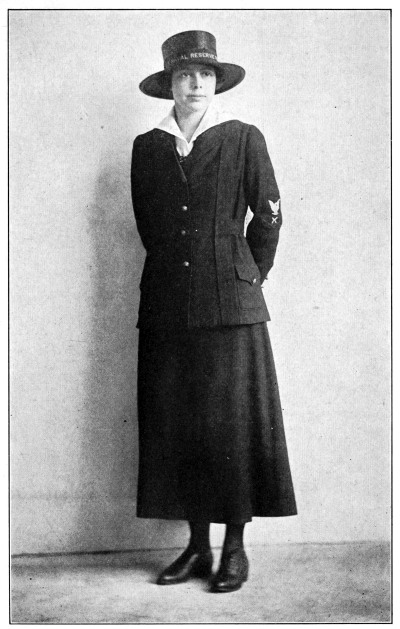
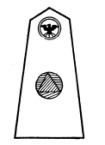
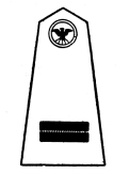
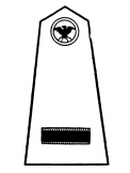
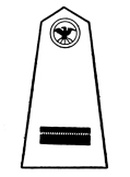
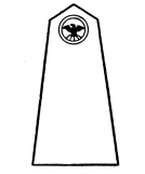
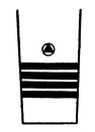
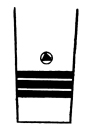
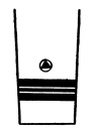
The uniforms and insignia of the armies and navies of foreign powers
present such a great variety in design, style and color as to preclude
the possibility of giving a detailed description of them within the
limits of this book.
However, in order that the rank of the officers and enlisted men of
these foreign services may be readily recognizable under the conditions
that ordinarily prevail on active service ashore or afloat, there is
included in this chapter a short description of the service uniforms
and insignia worn by the officers and enlisted men of the armies and
navies of Great Britain, France, Italy, Belgium, Japan, Russia, Germany
and Austria-Hungary.
It will be noted that the uniforms of the navies of the world bear more
similarity to each other than do those of the armies, thus the rank of
naval officers of all the great powers is indicated by stripes of braid
worn on the sleeves between the elbow and the lower edge of the cuff,
and in most cases by similar stripes or other insignia worn upon straps
placed on the shoulders between the base of the collar and the sleeve
at the shoulder seam.
In the different armies there is much more diversity in design and
color as well as in the method of indicating rank and corps; stripes
and various designs upon the cuffs, insignia and stripes upon shoulder
straps and insignia of many different designs upon the collar being the
most common means.
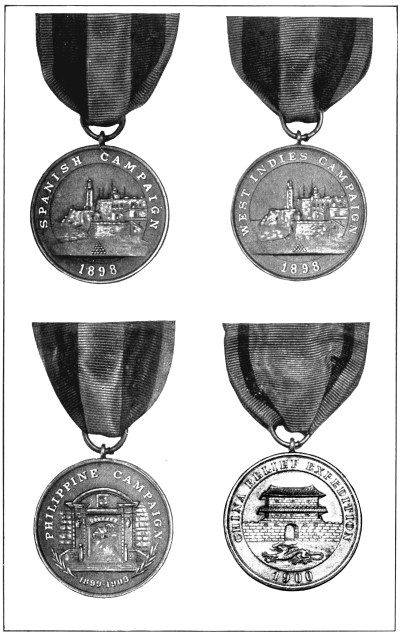
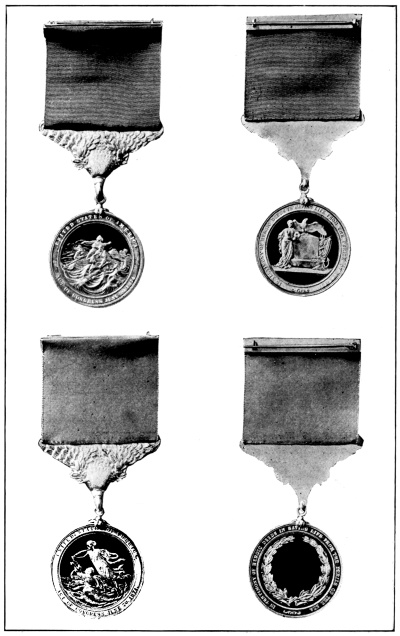
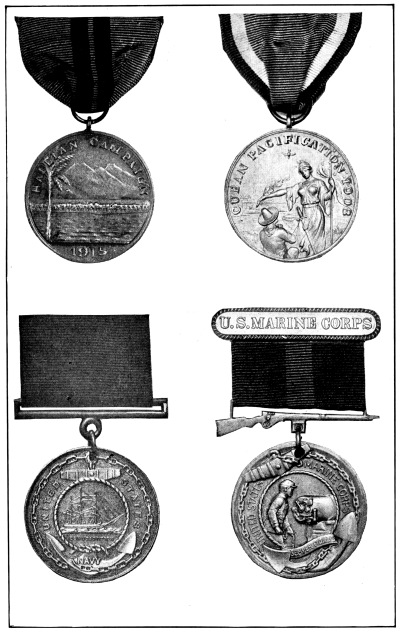
In one respect all of the naval and military services of the world
follow the same custom, medals and decorations awarded for especial
deeds of gallantry, for long and faithful service or to commemorate
some special event in war or peace are worn upon the left breast with
dress uniforms, almost always suspended from a ribbon of distinctive
color design, while a small section of this distinctive ribbon is
worn with undress uniform and service uniforms. As a special mark of
distinction the medals considered the highest in rank are frequently worn
on the right breast or suspended from a ribbon or chain around the neck.
A marked tendency toward simplification in design both of uniform and
insignia and toward the use of neutral or dull colors is also evident
in recent years. This is largely due to the necessity of making the
soldier as inconspicuous as possible when on the firing line, but also
to the great expense incurred in fitting out very large forces of men
in elaborate dress uniforms for which there is no use in the field.
Nevertheless it may be expected that when the world returns to a basis
of general peace time conditions the dress uniforms and bright insignia
and buttons that add so much to the brilliancy of military gatherings
will again be in evidence; especially since there is so much of the
tradition of the past associated with these uniforms and badges of rank
and corps.
Attractive uniforms induce a corresponding pride in the smartness
and neatness of the soldier or sailor and the distinctive badges of
regiments and corps with long histories of creditable achievement go
far to establish the esprit de corps which so surely makes for
efficiency and contentment.
In Great Britain the Navy is known as “The Senior Service” as it was
organized as a regular service prior to the organization of a regular
national Army.
In general the uniforms of the British Navy correspond quite closely to
those of the United State Navy in composition and design and are worn
upon similar occasions, although they are somewhat more elaborate, but
the insignia are of different design.
Commissioned officers must provide themselves with full dress, ball
dress, frock coat dress, blue mess dress, white mess dress, blue
undress and white undress.
The full dress is very nearly the same in style and design to the
special full dress of the United States naval officer, the ball dress
is practically the same as the evening dress of the United States naval
officer and the frock coat dress and blue and white mess dress the same
as the corresponding United States naval uniforms. The blue undress
uniform of the British naval officer differs from the service dress
of the United States naval officer in that the coat worn with it is a
square cut, double-breasted sack coat with turn-down collar and rolling
lapels with two rows of four buttons each down the front. The white
undress of the British officer is the same as the white service dress
of the American officer.
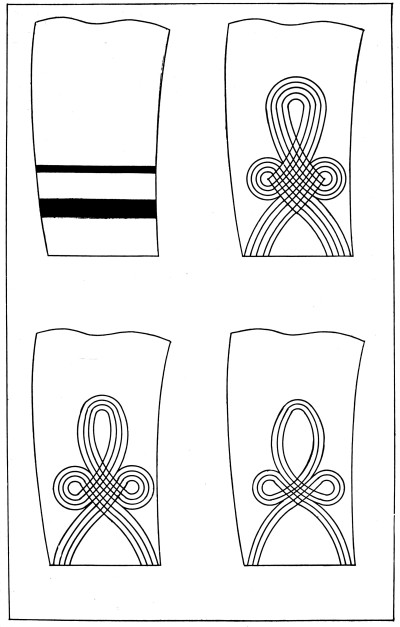
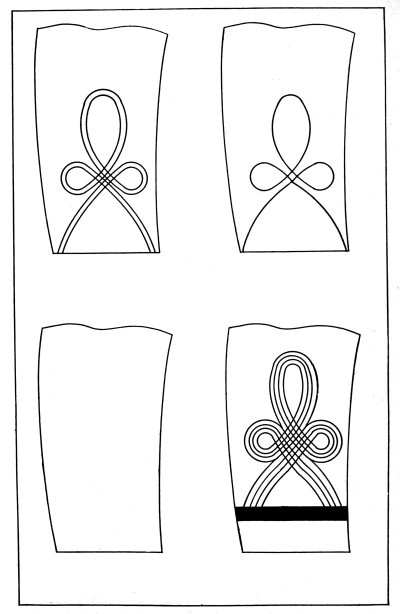
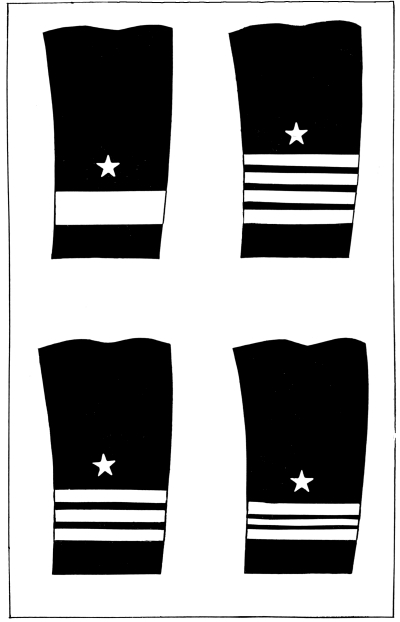
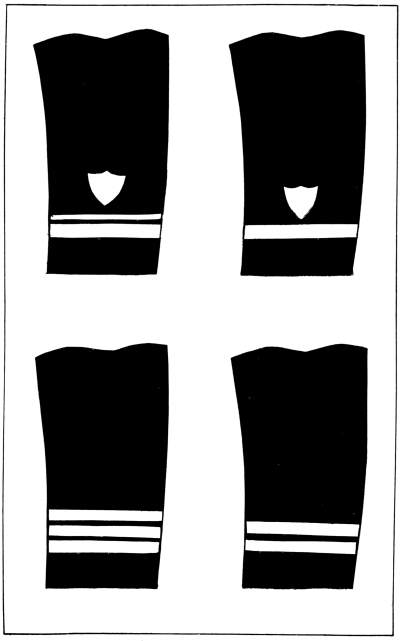
The rank of British naval officers is shown by insignia of rank on the
tops of the epaulets with uniforms with which epaulets are worn, but
with all of the blue uniforms the rank is also indicated by stripes
of gold lace braid around the sleeves of the coat above the cuff.
The number and arrangements of these rank stripes are shown in the
accompanying illustration.
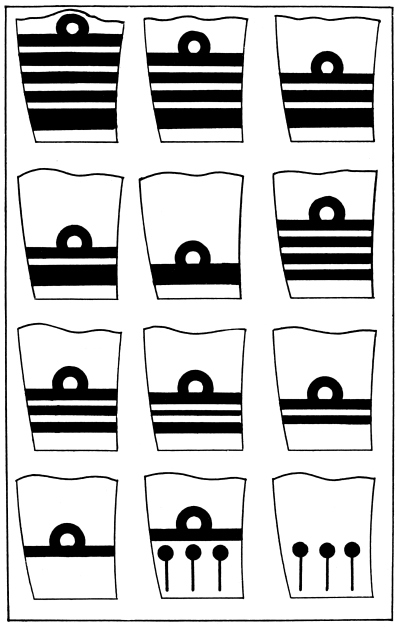
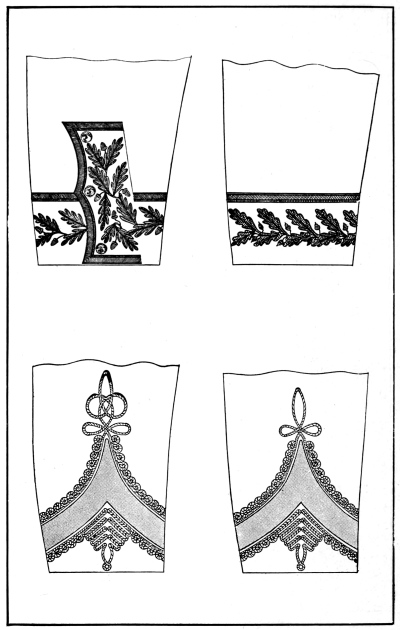
British Navy.
Officers’ sleeve decorations indicating rank
| 1. Admiral of the Fleet |
2. Admiral |
3. Vice Admiral |
| 4. Rear Admiral |
5. Commodore |
6. Captain |
| 7. Commander |
8. Lieutenant Commander |
9. Lieutenant |
| 10. Sub Lieutenant |
11. Chief Gunner and
Chief Boatswain |
12. Midshipman |
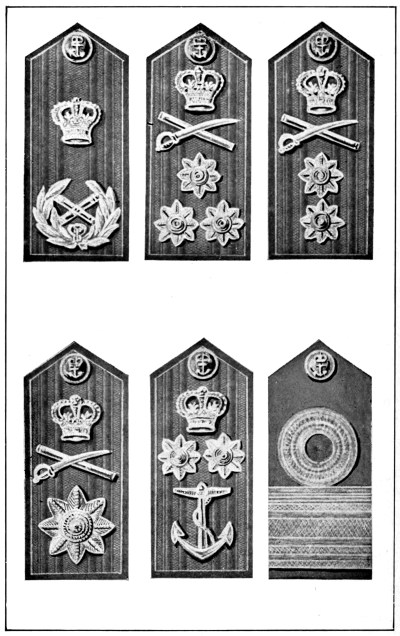
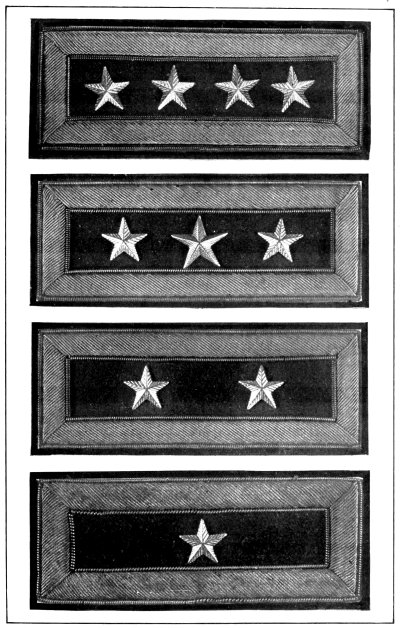
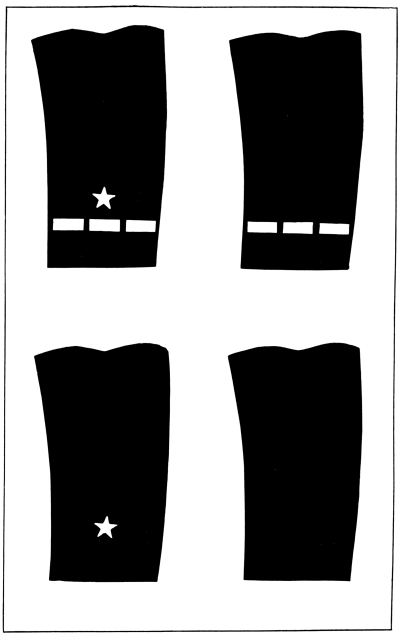
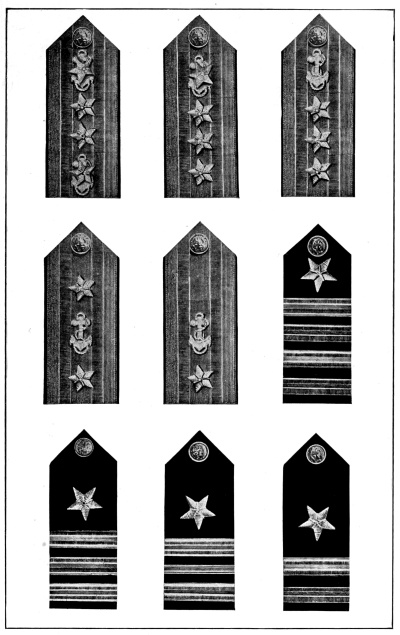
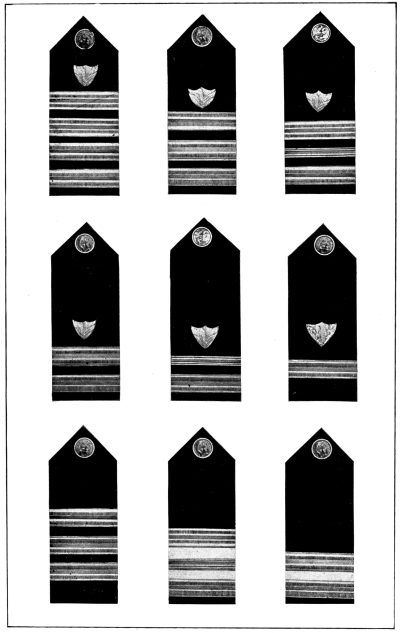
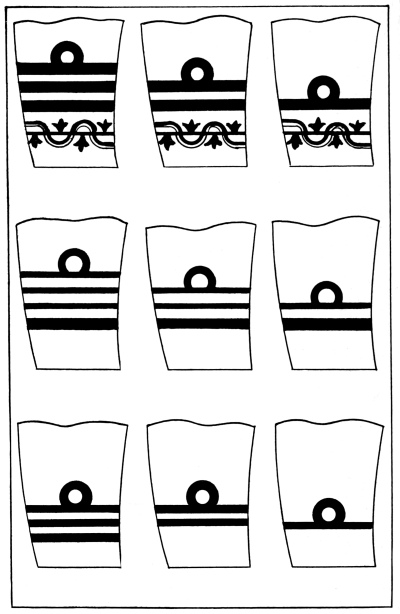
British Navy.
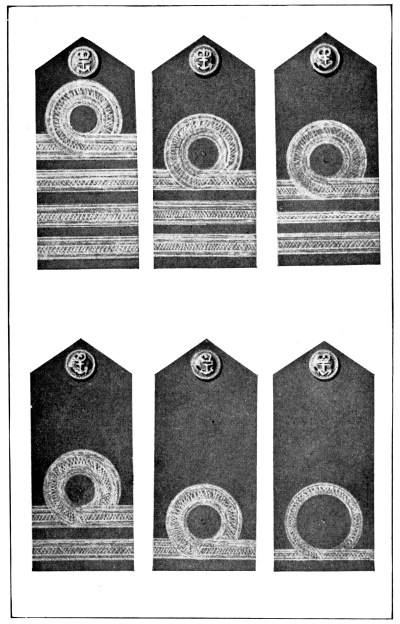
Officers’ shoulder straps
| 1. Admiral of the Fleet |
2. Admiral |
3. Vice Admiral |
| 4. Rear Admiral |
5. Commodore,
1st Class |
6. Commodore,
2nd Class |
With the white mess dress and the white undress the rank is indicated
by the stripes of gold braid or by other insignia of rank worn upon the
shoulder straps. These shoulder straps are also worn with the great
coat. There are no sleeve stripes on the white coats or the great coat.
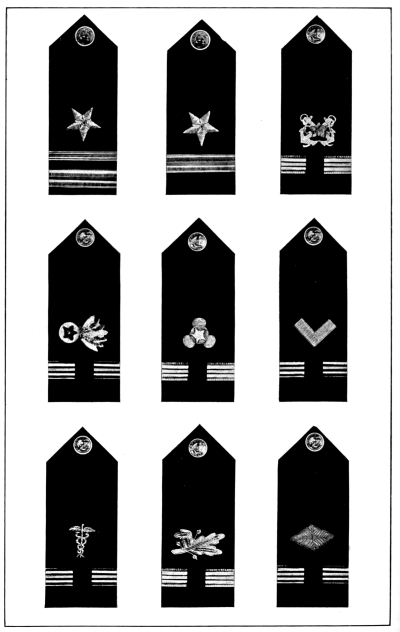
The insignia of rank used on the shoulder straps of Flag Officers
and the stripes indicating rank used on the shoulder straps of
officers below the rank of Flag Officer are shown in the accompanying
illustrations.
The Corps or Branch of the service to which an officer belongs is shown
as follows on the sleeves and shoulder straps:—
| Officers of the Line |
By the circle or “curl” on the upper
stripe of gold lace braid. |
| Engineer Officers |
By the circle or “curl” as above with the addition of
stripes of purple cloth between the gold stripes. |
| Medical Officers |
The circle or “curl” is omitted and there are stripes
of scarlet cloth between the gold stripes. |
| Accountant or Pay Officers |
The circle or “curl” is omitted and there are stripes
of white cloth between the gold stripes. |
| Naval Instructors |
The circle or “curl” is omitted and there are stripes
of light blue cloth between the gold stripes. |
It will thus be seen that the system of stripes on the sleeves and
shoulder straps to indicate rank is practically the same in the British
and United States navies, the “curl” in the British navy being used for
the same purpose as the gold star in the United States navy, that is,
to show that the officer wearing it belongs to the Line, or the command
branch of the service.
The officers’ overcoat or “great coat” in the British navy is a double
breasted coat of ulster style reaching to just below the knees. It has
a rolling collar with notched lapels and is closed by two rows of gilt
service buttons down the front and has shoulder straps to indicate
the rank of the wearer but no stripes on the sleeves. In the back the
fulness is held in by a strap secured by two gilt buttons.
The service buttons of the British navy bear a raised design of a
vertical foul anchor surmounted by a royal crown, the edge being
surrounded by a raised rope design.
The caps and cocked hats of the British Navy are similar to those worn
by United States naval officers except that there is more bell to
the crown of the British cap. The cap insignia worn by commissioned
officers are embroidered on the front of the cap and consist of a
vertical foul anchor surrounded by a gilt wreath and surmounted by a
royal crown in gilt and scarlet; the anchor being silver in the case of
officers of the Line and gilt for officers of the Staff Corps.
The sword worn by British naval officers is much the same in general
appearance as that worn by American officers, the differences being
in the carved designs upon the hilt and blade of the sword and upon
the bands of the scabbard. This is due to the fact that the American
sword like the other parts of the American naval uniform was originally
adopted from the British Navy.
British Navy.
Officers’ shoulder straps
| 1. Captain |
2. Commander |
3. Lieutenant Commander |
| 4. Lieutenant |
5. Sub Lieutenant,
Chief Gunner and
Chief Boatswain |
6. Gunner and Boatswain |
The officers of the British Naval Air Service wear as a distinguishing
mark of their service a gilt spread eagle on each sleeve above the rank
stripes and a silver spread eagle in the center of the cap insignia in
place of the anchor worn there by other officers. Their service buttons
also have the spread eagle in place of the anchor for other officers.
Officers of the Royal Naval Division detailed for duty on shore wear a
uniform of khaki-colored cloth similar in design to the service uniform
of British Army officers; their sleeves bearing the rank stripes of the
same widths, number and arrangement as for other naval officers but
made of braid of a slightly different shade than the material of the
coat, and their shoulder straps bearing the same insignia of rank as
that worn by the corresponding grades in the army.
Officers of the British Royal Naval Reserve wear the same uniforms
as those prescribed for officers of the regular service, except that
the stripes on the cuffs and on the shoulder straps while of the same
number for the different grades are of a different design. The design
of these stripes represents a rope twisted of two strands and in place
of the “curl” above the upper stripe to indicate officers of the line
there is a star shaped design made up of two interlocked triangles of
narrow gold braid. The corps or branch of Staff officers of the Royal
Naval Reserve is indicated by stripes of cloth between the twisted
strand stripes, the distinctive colors for the different corps or
branches being the same for Staff officers of the regular navy.
Officers of the British Naval Volunteer Reserve wear the same
uniforms as those prescribed for the officers of the regular naval
establishment, except that the stripes on the sleeves and shoulder
straps to indicate rank, while being of the same number and arrangement
for the different grades, are laid on in waving lines instead of in
straight lines as in the case of the regular officers. The distinctive
color stripes to indicate the various corps or branches for Staff
Officers of the Royal Naval Volunteer Reserve are the same as for the
regular service.
Officers of the Royal Naval Reserve and of the Royal Naval Volunteer
Reserve attached to the Royal Naval Air Service wear their respective
uniforms with the addition of the spread eagle design above the rank
stripes on the sleeves and shoulder straps.
Officers of the British Colonial Naval Establishments maintained by the
greater colonial divisions of the British Empire wear distinctive marks
to indicate their especial service. These naval establishments comprise
the Royal Indian Marine, the Australian Navy and the Canadian.
The enlisted men of the British Navy wear uniforms very similar in
general design to those worn in the United States Navy with minor
differences in the dimensions and cut of the various garments. The
Chief Petty Officers wear uniforms of blue or white consisting of a
bell-crowned cap with a black mohair band, a black patent leather
visor and insignia consisting of two concentric circles surrounding a
vertical foul anchor surmounted by a British crown; a double-breasted
sack coat with two rows of gilt service buttons; and plain trousers.
Other petty officers and seamen wear the sailor cap, wide collared
shirt and bell-mouthed trousers common to the American service, the
collar having three rows of narrow white braid around the edges with
a black neckerchief knotted beneath it. The three rows of braid
commemorate Nelson’s three great victories—Copenhagen, the Nile and
Trafalgar—and the black neckerchief was first worn as a badge of
mourning for this great sea fighter. The cap has a black silk ribbon
around the band upon which is the name of the ship in gilt block
letters, thus,
H. M. S. DREADNOUGHT
the letters H.M.S. being the abbreviation of “His Majesty’s Ship.”
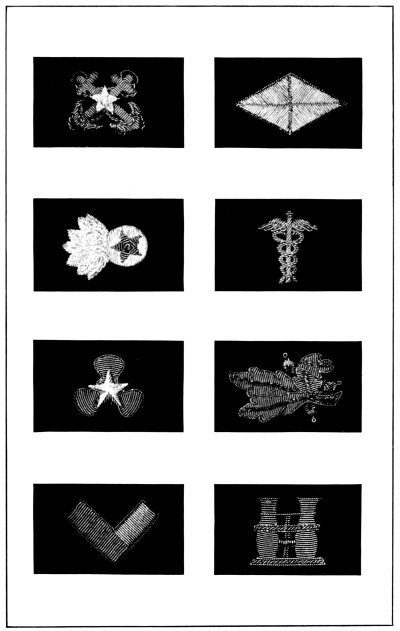
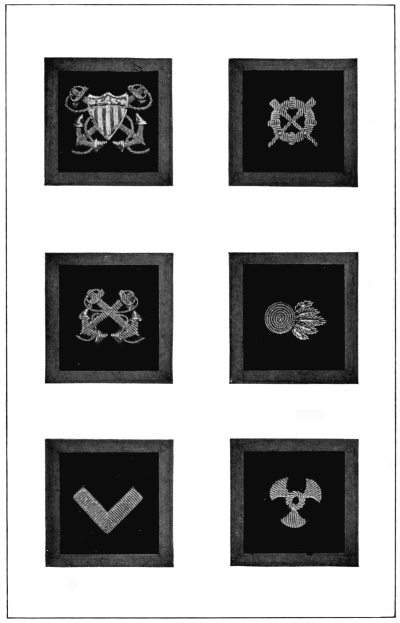
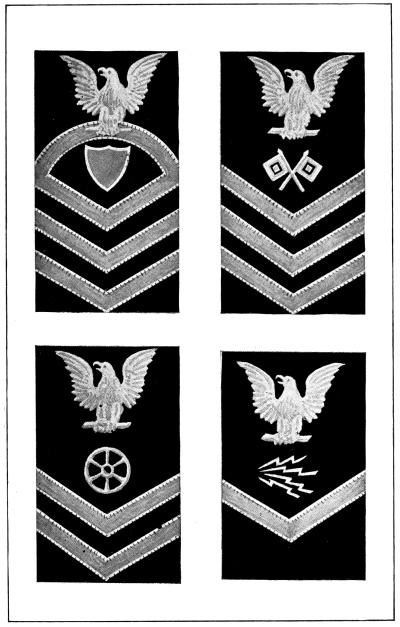
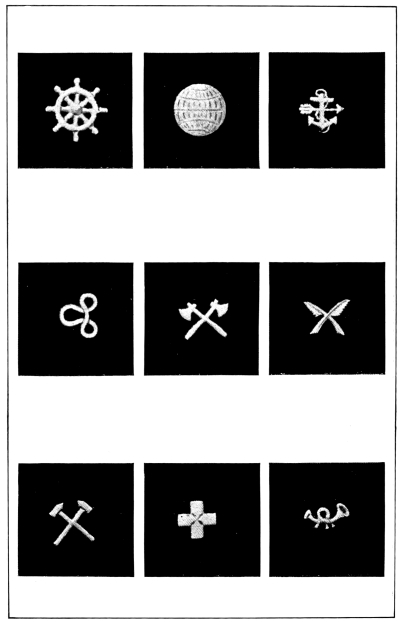
Rating badges to indicate the rank or rating of petty officers and men
on special duties are worn on the sleeves between the shoulder seam and
the elbow and are very numerous and complex, some of the principal ones
being, in red,
| Petty officer first class |
Two crossed foul anchors with
a crown above and three chevrons, points down, below. |
| Petty officer second class |
One vertical foul anchor with a crown
above and two chevrons, points down. |
| Petty officer third class |
The same, omitting the crown and with but one chevron. |
| Gunner’s Mate and Gunlayer first class |
Two crossed cannon with one star below
and a star and a crown above. |
| Gunner’s Mate |
The same, omitting the lower star. |
| Gunlayer first class |
Two crossed cannon with a star above and a star below. |
| Gunlayer second class |
The same omitting the lower star. |
| Gunlayer third class |
The same omitting the stars. |
| Seaman Gunner |
A horizontal cannon with a star above. |
| Torpedo Gunner’s Mate Higher Grade |
Two crossed torpedoes with a star and
a crown above and a star below. |
| Torpedo Gunner’s Mate
|
The same omitting the lower star. |
| Torpedo Coxswain |
Two crossed torpedoes with a steering wheel above. |
| Leading Torpedoman |
Two crossed torpedoes with a star above. |
| Seaman Torpedoman |
A horizontal torpedo with a star above and
a star below. |
| Chief Signal Yeoman |
Two crossed flags with a star and a crown
above and two stars below. |
| Signal Yeoman |
The same omitting the crown. |
| Leading Signalman |
The same omitting one of the lower stars. |
| Signalman |
The same omitting the lower stars. |
| Ordinary signalman |
Two crossed flags. |
| Mechanician |
A propeller with one star and a crown above
and a star below. |
| Chief Stoker |
A propeller with a crown above and a star below. |
| Stoker petty officer |
A propeller with a star above and a star below. |
| Leading stoker |
The same omitting the lower star. |
| Stoker |
A propeller. |
| Chief Telegraphist |
A bar of forked lightning with wings
on each side and a crown below. |
| Leading Telegraphist |
The same design but with a star above
in place of the crown and a star below. |
| Telegraphist |
The same omitting the lower star. |
| Ordinary telegraphist |
The same design omitting stars. |
| Blacksmith, Plumber, and Painter, first class |
An axe and a hammer crossed with a star above. |
| Other Artisans |
The same design omitting the star.
|
| Physical training instructor, first class |
Two crossed Indian clubs with star and a crown above and a star below. |
| Physical training instructor, second class |
The same design omitting the lower star. |
| Sick Bay attendants |
A Geneva cross surrounded by a circle. |
| Bugler |
A bugle horizontal. |
| Markmanship badge, first class |
Two crossed rifles with a star above. |
| Markmanship badge, second class |
The same without the star. |
| Markmanship badge, third class |
A rifle horizontal. |
Badges of other colors are:
| Cook |
A white star. |
| Schoolmaster |
A yellow star. |
| Steward |
A yellow star. |
| Good shooting badge, third class |
A yellow rifle horizontal. |
The Royal Marines perform duties similar to those performed by the
United States Marines both afloat and ashore and hold a high record for
efficiency and loyalty. They are divided into two branches, the Royal
Marine Artillery and the Royal Marine Light Infantry, the former being
popularly known as the “Blue Marines” on account of the fact that their
dress coats are of blue cloth and the latter as the “Red Marines” since
their dress coats are of red cloth.
Both branches are also provided with khaki-colored uniforms for field
service ashore.
The rank of the officers is indicated by insignia of rank worn on the
shoulder straps, these insignia being the same for the various ranks as
those worn by officers of the British Army.
The titles for the different grades of rank of the officers are the
same as those for the British Army, namely, General, Lieutenant
General, Major General, Brigadier General, Colonel, Major, Captain,
Lieutenant and Second Lieutenant.
The ranks of the enlisted men are indicated by badges or chevrons worn
upon the sleeves between the shoulder seam and the elbow, as follows:
| Sergeant Major |
The coat of arms of Great Britain in gold,
red and white embroidery. |
| Quartermaster Sergeant of Infantry |
A British crown in gold and red embroidery. |
| Quartermaster Sergeant of Artillery |
Two crossed cannon in gold with a British crown
above them embroidered in gold and red. |
| Quartermaster Sergeant, Musketry Instructor |
Two crossed rifles in gold with the
crown in gold and red above them. |
| Sergeant |
A chevron of three stripes worn
with the points down. |
| Corporal |
A chevron of two stripes worn with the points down. |
| Lance Corporal |
A chevron of one stripe worn with the point down. |
| Private |
No distinctive badge. |
The Corps insignia of the Royal Marines are the eastern hemisphere
in silver surrounded by a gold laurel wreath, the insignia being
surmounted by two gold cannon crossed for the Marine Artillery and by
gold bugle trumpet for the Marine Light Infantry. These insignia are
commonly referred to in the British service as “The Globe and Laurel.”
At the beginning of the present world war the Land Forces of the
British Empire embraced the regular troops commonly known as the
“Home Army” and the troops of her far-flung colonial possessions
and dependencies, such as the Indian Army, the Australian Army, the
Canadian Army, the South African Forces, the West Indian regiments,
the New Zealand troops, and the Police and Constabulary troops of many
minor colonies and possessions.
In the “Home Army” there were many varieties and colors in the uniforms
and when we add to this the distinctive uniforms of the various
Colonial Forces and the picturesque native uniforms of the Indian
forces the resultant assemblage is one which would require many volumes
to adequately describe.
In one respect however the clothing of the various units collected from
all over the vast British Empire to make up the great “New Army” of
Great Britain is practically the same,—the service or field uniform of
all is cut on the same lines and the insignia of rank worn with this
uniform are the same for all, the variations being in the corps and
regimental badges which indicate the portion of the empire from which
the regiments come and the arm of the service in which they are serving.
The British were the first to adopt the neutral brown shade known as
“khaki” for their field or service uniforms and its practicability and
serviceability became so evident to them that its use was extended to
all of their armed land forces, with the result that they now have a
uniform and equipment which for serviceability, efficiency, comfort and
smartness of appearance is excelled by no other nation.
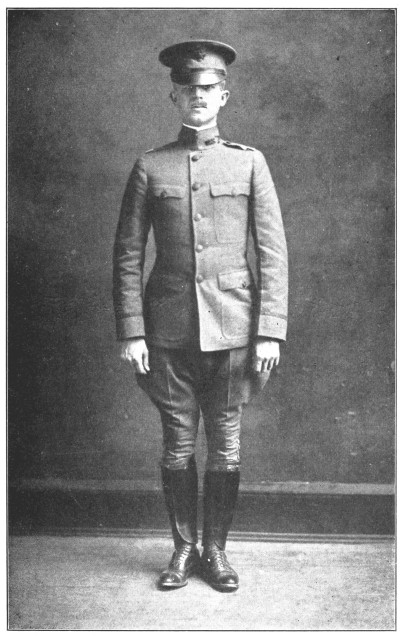
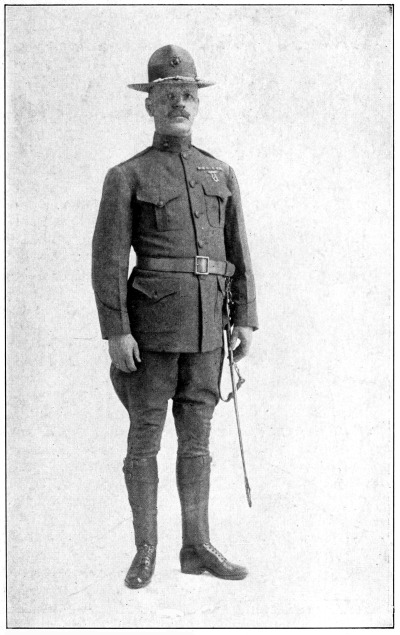
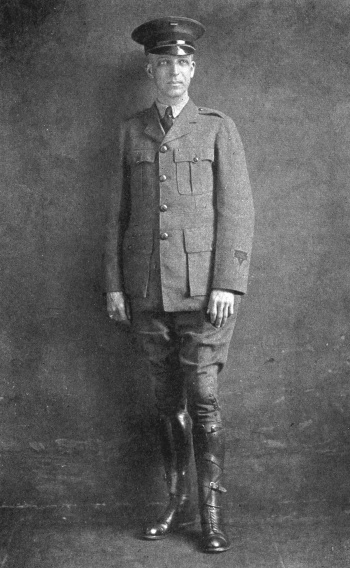
The British Army officers’ uniform is made of a standard dark khaki
colored cloth or serge and consists of a single-breasted coat with
turn-down collar and rolling notched lapels, closed in front by a row
of four gilt buttons, cut to fit snugly at the waist, easy across the
breast and shoulders and with enough flare to the skirt to make it hang
well over the full breeches that are worn with it; breeches which lace
below the knee; tan leather strap puttees and shoes or tan leather
boots; a bell-crowned cap with a sharply sloping visor; and the “Sam
Browne” sword and pistol belt. Wrap puttees of khaki-colored cloth are
also worn for garrison and field service.
The coat has a pleated patch pocket on each breast closed by a buttoned
flap, and a large bellows patch pocket on each side below the waist
which is also closed by a buttoned flap, and cloth shoulder straps on
each shoulder secured by a small button at the collar end.
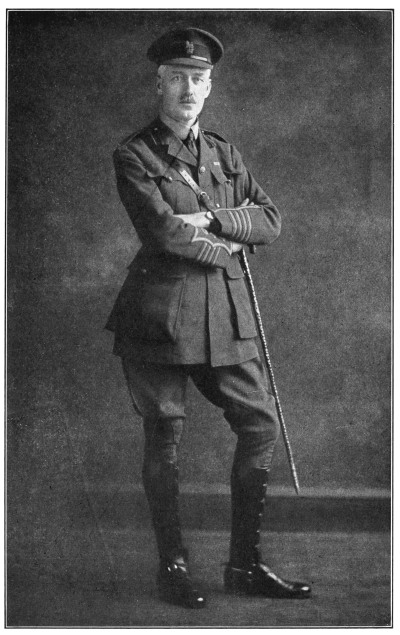
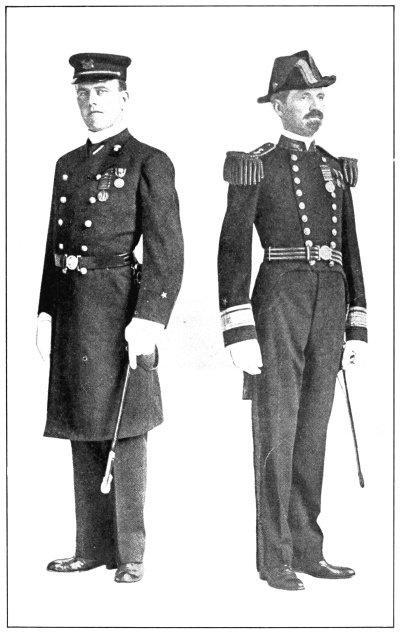
Photo. Harris & Ewing, Washington, D. C.
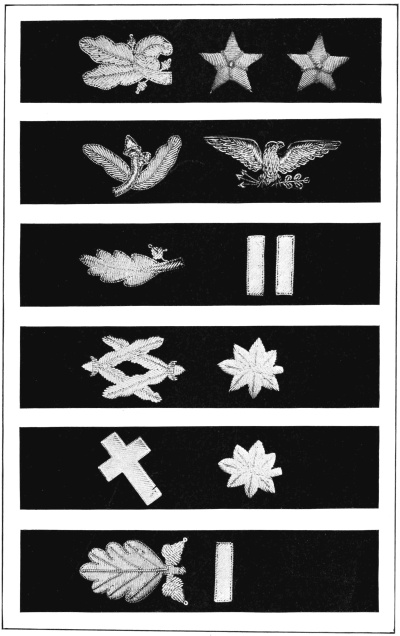
British Army. Officers’ service uniform
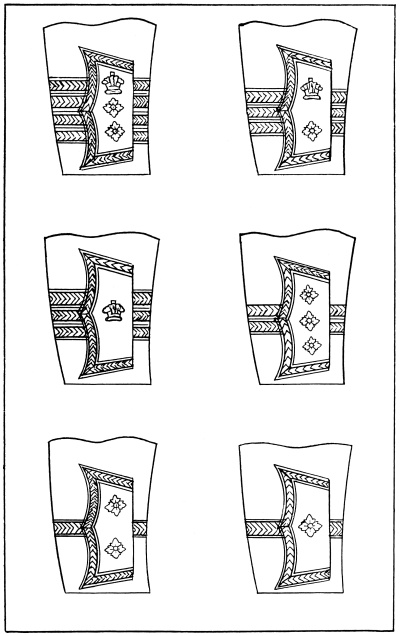
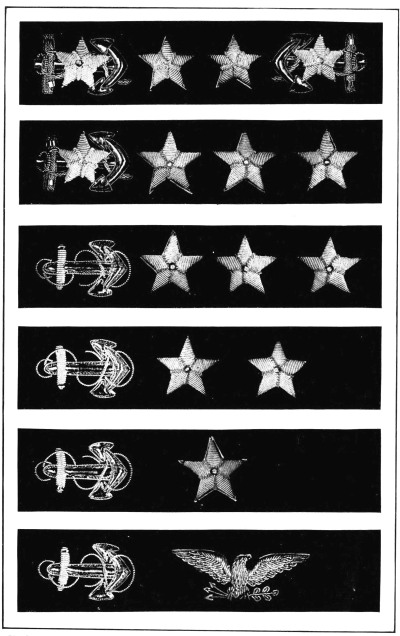
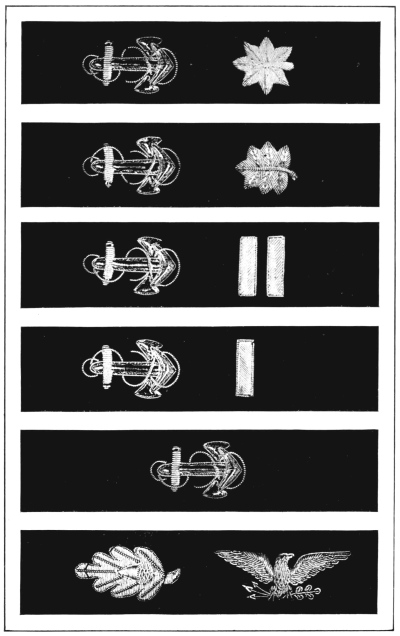
British Army.
Officers’ service uniform
sleeve decorations indicating rank
| 1. Colonel |
2. Lieutenant Colonel |
| 3. Major |
4. Captain |
| 5. Lieutenant |
6. Second Lieutenant |
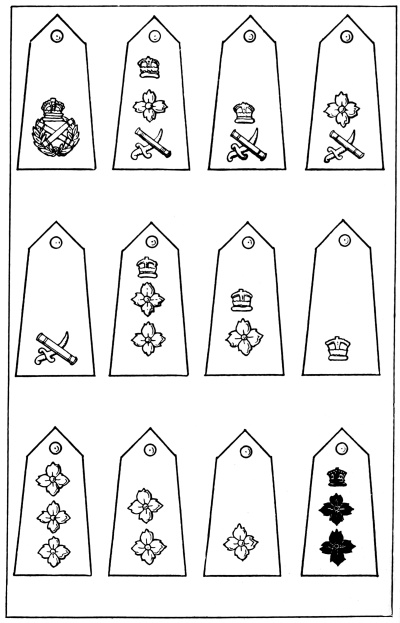
British Army.
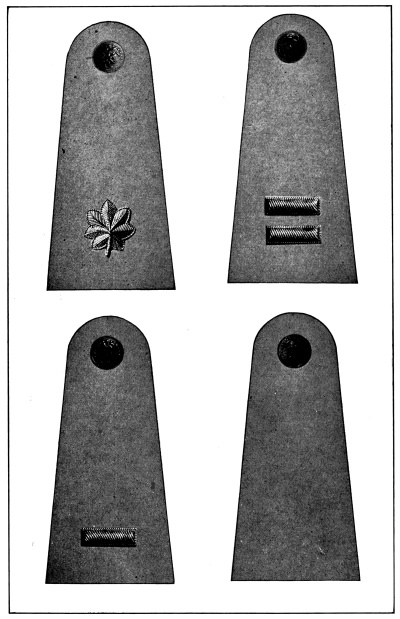
Officers’ shoulder strap insignia
indicating rank
| 1. Field Marshal |
2. General |
| 3. Lieutenant General |
4. Major General |
| 5. Brigadier General |
6. Colonel |
| 7. Lieutenant Colonel |
8. Major |
| 9. Captain |
10. Lieutenant |
| 11. Second Lieutenant |
12. Chaplain, with rank of Colonel |
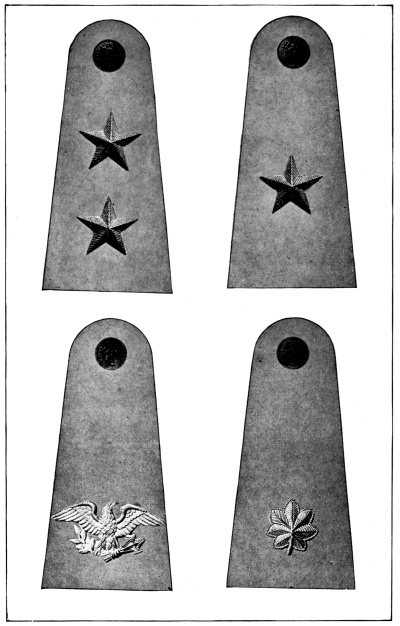
The rank of an officer in service uniform is indicated by metal
insignia of rank worn upon the shoulder straps and also (for officers
below the rank of Brigadier General) by stripes of worsted braid
around the sleeves just above the lower edge and by worsted insignia
of rank worn on a three-pointed strap which crosses the sleeve stripes
on the cuffs. These insignia of rank are shown in the accompanying
illustrations and are as follows for the various grades of rank:—
| Field Marshal |
Two crossed batons in red surrounded by a wreath of gold laurel
leaves and surmounted by a British crown in gold and red. |
| General |
A baton and sword crossed with a diamond shaped device
above it and a crown above the diamond, all in gold. |
| Lieutenant General |
A baton and sword crossed with a crown above it, all in gold. |
| Major General |
A baton and a sword crossed with the diamond above, all in gold. |
| Brigadier General |
The same omitting the diamond. |
| Colonel |
Two diamonds and a crown in a vertical line. |
| Lieutenant Colonel |
The same omitting one of the diamonds. |
| Major |
A crown. |
| Captain |
Three diamonds in a vertical line. |
| Lieutenant |
Two diamonds in a vertical line. |
|
|
| Second Lieutenant |
One diamond. |
The officers of the Scottish and Highland
regiments wear the stripes on the cuffs in a curve from the outer edge
of the sleeve to a higher point at the inner edge of the sleeve and the
insignia of rank beneath these stripes in a horizontal line instead
of in a vertical line as described and illustrated for the other officers.
The wearing of the insignia of rank upon the shoulder straps except by
officers of the rank of Brigadier General and higher has been suspended
when on actual duty in the field.
The insignia worn upon the front of the cap by a Field Marshal consists
of two crossed batons in red surrounded by a gold wreath and surmounted
by a gold and red crown above which is a gold British lion; for General
officers it is the same except that instead of the two batons there is
one baton and a sword crossed; permanent Staff officers wear the crown
and lion only on the cap; and a Field Marshal, General officers and
permanent Staff officers of field rank or above wear a scarlet band
around the cap.
For regimental officers the insignia worn on the front of the cap are
the distinctive “Regimental badges” adopted for the regiment. These
regimental badges present a great variety in design and often refer to
some historic battle in which the regiment has taken part or to some
distinctive feature of the county or colony from which the regiment comes.
In many cases the name by which the regiment is commonly known is
contained in the design, in others the number of the regiment in its
corps is given in the design, and not infrequently the regimental motto
has a prominent place.
Thus the regimental badge of the 4th Hussars, a famous cavalry
regiment, is a gold circle bearing the inscription “Queen’s Own
Hussars,” surmounted by a gold crown, and having on the center the
number of the regiment “IV,” and on a scroll beneath the motto “Mente
et Manu.”
The Irish Rifles have the Irish harp surmounted by a royal crown with a
scroll beneath bearing the motto “Quis Separabit,” all in green enamel.
The 17th Lancers have as their insignia a skull and cross bones with
the words “or Glory” on a scroll beneath, the motto of the regiment
being “Death or Glory.”
The 12th Canadian Infantry has a gold maple leaf bearing the number of
the regiment in silver and the word “Canada” also in silver.
The Grenadier Guards regiments have a gold spherical bursting shell.
Chaplains wear a Maltese cross surmounted by a crown in black enamel.
Officers of the Army Pay Corps wear the monogram “A.P.C.” surmounted by
a crown.
The insignia of the Royal Army Medical Corps consist of the rod of
Esculapius with a single serpent entwined about it surrounded by a
wreath and surmounted by a crown with the scroll beneath bearing the
inscription “Royal Army Medical Corps,” all in gold.
Both officers and enlisted men in the British Army habitually wear gilt
buttons and insignia on their service khaki-colored uniforms, although
when in the field these buttons and insignia are allowed to tarnish or
bronze, and in many cases leather buttons are used on field service in
place of the gilt buttons.
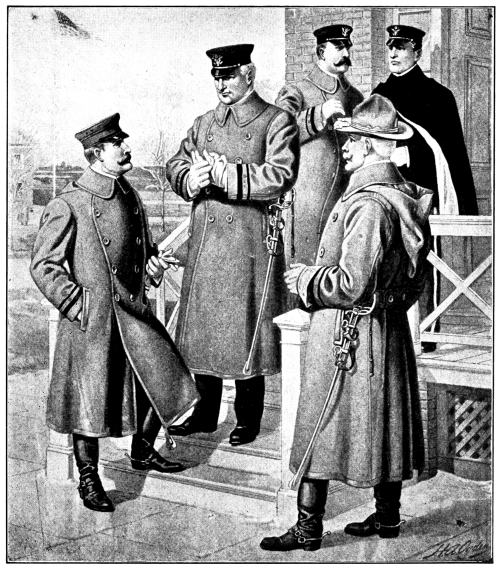
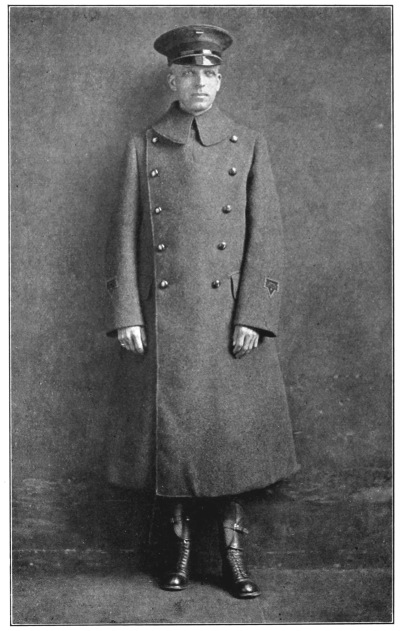
The overcoat, or great coat, worn by the officers of the British Army
is a double-breasted ulster quite similar in design to that worn by
officers of the United States Army, but having a lapel collar and
reaching only to the knee. It is made of cloth of the same color as the
service uniform and has shoulder straps upon which the insignia of rank
are worn.
The service uniform of the enlisted men of the British Army is of the
same khaki-colored cloth as the officers’ uniform and consists of a
cap similar to that worn by officers with a visor of tan leather or of
khaki-colored cloth upon the front of which the regimental or corps
insignia are worn; a single-breasted sack coat buttoning to the neck
with a standing turn-over collar, a patch pocket on each breast and a
bellows patch pocket on each side below the waist, and shoulder straps
upon which are worn, near the arm seam, the regimental badges; breeches
of the same color as the coat; wrap khaki-colored cloth puttees; and
heavy tan leather laced shoes. The overcoat is a short double-breasted
coat with rolling collar and back straps.
In hot weather khaki cotton drill uniforms of the same design are worn.
As variations of this general uniform, the Scottish and Highland troops
still wear the kilts as their winter uniform, although in hot weather
they also wear the full khaki summer uniform, the troops from Australia
and Canada to a great extent wear the wide brimmed felt hat common in
the American service, and the Indian troops wear their native turbans
and trousers although these are of the standard khaki color.
The rank of the noncommissioned officers is indicated in the British
Armies by badges worn upon the sleeves between the elbow and the
shoulder, as in the United States Army, many of these insignia being
nearly the same for the various grades, doubtless due to the fact that
the American insignia were originally taken from the British during the
revolutionary period.
The principal insignia of rank worn on the sleeves of noncommissioned
officers and enlisted men holding special assignments of duty are as
follows:
| Staff Sergeant Major, Army Service Corps |
A crown surrounded by a wreath. |
| Master Gunner 1st and 2nd class, Field Artillery |
A field gun with a crown above it. |
| Master Gunner 3rd class. Field Artillery |
The same without the crown. |
| Sergeant Major |
A crown. |
| Bandmaster
|
A lyre with leaves at the base and a crown above it. |
| Cavalry Squadron Corporal Major |
A chevron of four stripes worn point
up with a crown above it. |
| Regimental Quartermaster Sergeant |
A chevron of four stripes worn point
up with a twelve pointed star above it. |
| Quartermaster Sergeant |
A chevron of four stripes worn point up. |
| Company Sergeant Major |
A chevron of three stripes worn point
down with a crown above it. |
| Color Sergeant |
A chevron of three stripes worn point down with
crossed flags and a crown above it. |
| Sergeant |
A chevron of three stripes worn points down. |
| Corporal |
A chevron of two stripes worn points down. |
| Lance Corporal |
A chevron of one stripe worn point down. |
| Infantry Pioneer |
Two axes crossed. |
| Roughrider of Cavalry |
A spur worn rowel up. |
| Scout Corporal |
A three-pointed lance head with a cross below it. |
| Squadron Scout, Cavalry |
A three-pointed lance head. |
| Bugler |
A horn bugle with cords. |
| Bugler of Rifle Regiments |
Two such bugles. |
| Sergeant Trumpeter |
Two straight trumpets crossed with a
three-pointed lance head vertical in the center. |
| Drummer |
A snare drum. |
| Machine Gunner |
The letters “M. G.” surrounded by a wreath. |
| Horseshoer |
A horseshoe worn toe up. |
| Saddler
|
A horse’s bridle curb bit. |
| Wheelwright and Carpenter |
A wagon wheel. |
| Flight Sergeant of Royal Flying Corps |
Chevrons as for other sergeants with a four-bladed
propeller and a crown above it. |
| Sergeant of Royal Flying Corps |
The same without the crown. |
| Flying Corps Badge |
The words “Royal Flying Corps” on a blue ground. |
| Qualified Pilot, Flying Corps |
Two horizontally spread wings with a crown above and
the initials “R. F. C.” in the center. |
| Engineer Noncommissioned Officers |
The same chevrons as other noncommissioned
officers with a bursting bomb above. |
| Royal Army Medical Corps |
| enlisted men |
A scarlet Geneva cross in a yellow circle. |
Excellence in target practice with rifles and guns is indicated by
special badges worn on the sleeves between the elbow and the shoulder
as follows:
| Best rifle shot in Regiment |
Two rifles crossed surrounded by
a wreath with a crown above it. |
| Best shooting squadron or company in a Regiment |
The same without the wreath. |
| Best shot in squadron, company or band |
Two rifles crossed with a star above. |
| First Class Gunner, Artillery |
Two cannon crossed with a crown above. |
| Best swordsman in Regiment, Cavalry |
|
| Two sabers crossed with a crown above. |
|
| Best swordsman in Troop, Cavalry
|
Two sabers crossed with a star above. |
| Best swordsman in every twenty men. Cavalry |
The same without the star. |
| First Prize Gunner, Artillery |
The letter “G” with a wreath beneath
and a crown above. |
| Second Prize Gunner, Artillery |
The same with a star instead of the crown. |
| Gun Layer, Artillery |
The letter “L” with a wreath beneath. |
A new type of distinguishing mark adopted during the present war
consists of pieces of cloth of various shapes worn in the center of
the back between the shoulders to enable officers to distinguish the
organization to which a man on the firing line belongs.
Up to within a few years the uniform of the troops of the Line of the
French Army consisted of a dark blue coat and red trousers, with caps
of the kepi design and white gaiters or short leggings. This uniform
was decorated with gold and silver ornamentation and rank insignia and
as a variation in the headdress the cavalry wore helmets with plumes.
At the time of the Boer War in South Africa the question of a less
conspicuous uniform was agitated with the result that a coat of
mignonette green (or reseda as it was called in France) was adopted
although the red trousers were retained. With this uniform a helmet
of the same color as the coat was adopted. Some of the troops still
retained the dark blue coats however and discussion as to the uniform
to be finally adopted continued.
In 1912 a single-breasted sack coat of a light gray-blue color was
tried with the blue and red kepi, and red trousers which were worn
tight around the calves of the legs. The wrap puttee was also worn to
some extent.
Shortly after the beginning of the present war it was demonstrated by
service in the field that the red trousers and gold trimmings were too
conspicuous for modern field service, and as a result a uniform of
the light gray-blue color, known as “horizon blue,” was adopted for
both officers and enlisted men on field service, but the old dress
uniforms were not abolished though not worn during war. In this uniform
simplicity was sought and all bright buttons, insignia and trimmings
were reduced to a minimum with the object of securing a serviceable and
inconspicuous uniform.
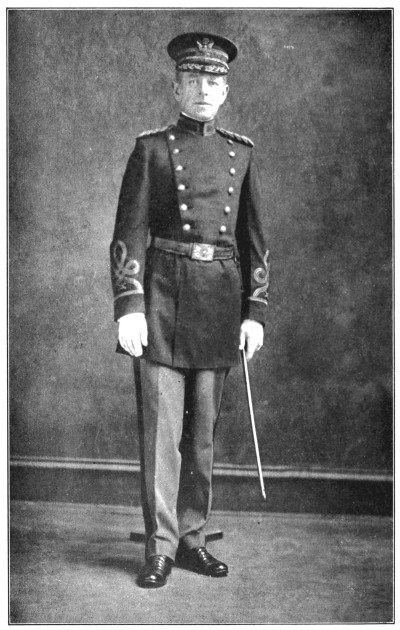
The officers’ service uniform consists of a single-breasted sack coat
with a standing turn-down collar, shoulder straps and four outside
patch pockets similar to the service coat of United States Army
officers; breeches; tan leather strap puttees and shoes, or tan leather
boots, and a cap (kepi) of the same color as the coat and trousers.
The color of this uniform is a light blue-gray. The buttons are of
silver-bronze.
The cap, or kepi, has a sloping visor of black patent leather with
a band covered with gold lace for general officers and of distinctive
colored cloth with narrow gold stripes indicating rank for other
officers, and the top of the crown is slightly less in diameter than
the band. In the case of general officers the visor is ornamented with
gold decorations.
In the trenches when under fire a steel helmet is worn as a protection
against long range rifle bullets and pieces of shrapnel. This helmet is
of the same color as the service uniform and it has a distinctive corps
insignia on the front in metal of the same color.
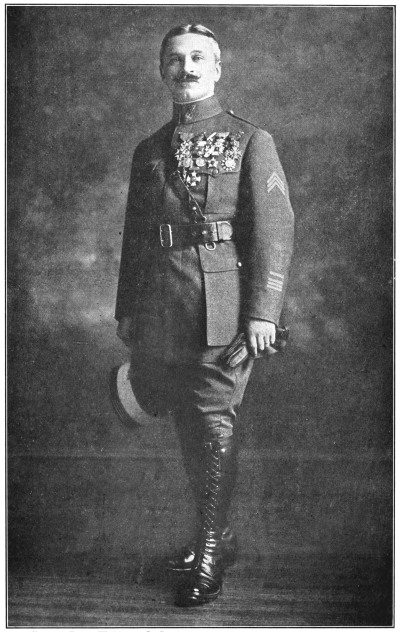
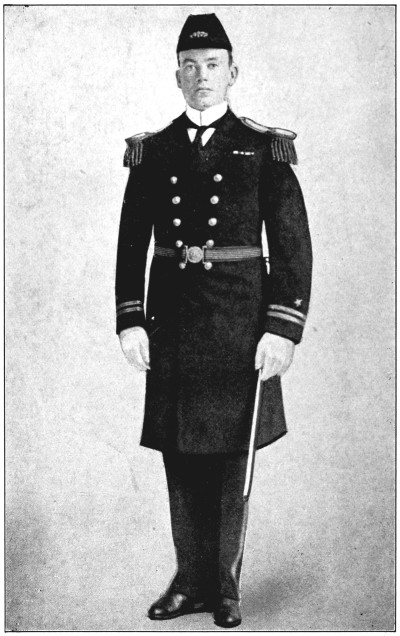
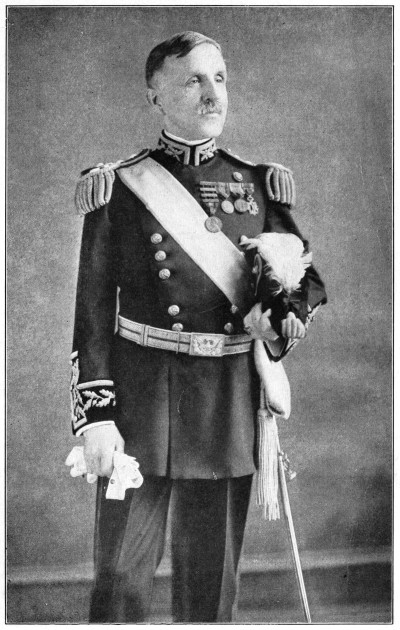
Photo. Harris & Ewing, Washington, D. C.
French Army. Officers’ service uniform
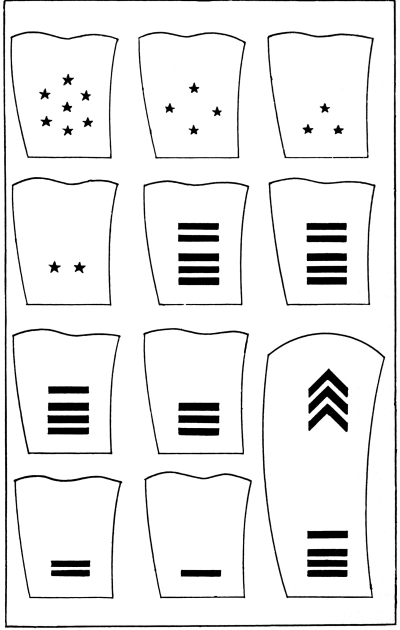
French Army.
Officers’ sleeve decorations indicating rank and service
All of the stripes are gold, except in the case of Lieutenant Colonel,
where the second and fourth are silver
| 1. Marshal of France |
2. General |
3. General of Division |
| 4. General of Brigade |
5. Colonel |
6. Lieutenant Colonel |
| 7. Major |
8. Captain |
9. First Lieutenant |
| 10. Second Lieutenant 11. War service chevron |
When on duty away from the actual battle front the dress cap of red or
blue (according to the corps) is frequently worn.
The rank of officers in the French Army was formerly indicated by stars
on the cuffs for General officers and by gold or silver stripes around
the cuffs of the coats for other officers, the widths, number and
arrangement of the stripes being practically the same as those worn by
officers of the same relative rank in the navy. These stripes proved
too conspicuous for field service and a small section of the stripes
showing on the front of the sleeve only was adopted for the service
coats. These short stripes or galons are of dull gold or silver
depending on the rank and are as shown in the accompanying illustration.
The insignia for the different grades of rank are as follows:
| Marshal of France |
Seven stars on each cuff, arranged in three
vertical rows, the center row having three stars and the outer rows
having two stars each. |
| General |
Four stars on each cuff, two placed horizontally
in the center and one above and one below. |
| General of Division |
Three stars on each cuff arranged
in a triangle with the point up. |
| General of Brigade |
Two stars placed on each cuff horizontally. |
| Colonel |
Five gold stripes, or galons, on each cuff. |
| Lieutenant Colonel |
The same as for Colonel except that the second
and fourth stripes are of silver. |
| Major |
Four gold stripes. |
| Captain |
Three gold stripes. |
| Lieutenant |
Two gold stripes. |
| Second Lieutenant |
One gold stripe. |
The corps or branch of the service is indicated in the French Army by
distinctive insignia or color patches worn on the collar at the front
on both sides of the neck opening.
A distinctive feature of the French Army uniforms for both the officers
and enlisted men is the “war service chevrons” worn on the right sleeve
between the elbow and the shoulder with the point of the chevron up. A
chevron of one stripe shows that the wearer has had one year’s active
service at the front during the present war and an additional stripe is
added to the chevron for each additional period of six months service
at the front. These service chevrons are of dull gold.
Officers of the Algerian Corps and of the Colonial Infanterie wear
winter service uniforms of khaki-colored cloth and hot weather uniforms
of khaki cotton material; the design of the garments being the same as
for those of the home troops except that the Algerians wear very loose
baggy trousers cut after the “Zouave” style.
Officers in the Aviation service also wear khaki-colored uniforms.
The officers’ overcoat is single-breasted reaching to about three
inches below the knees, closed with a single row of bronze buttons down
the center of the front, buttoning to the neck, with a wide falling
collar, and a large pocket on each side. Like the enlisted men’s
overcoat it is fitted to have the fronts of the skirt button back to
permit freedom of the legs in marching. The same stripes indicating
rank are worn upon the sleeves as upon the service coat.
In the French Army there is a rank called “Adjutant” which corresponds
to that of Warrant officer in the United States Navy and Marine Corps
but for which there is no corresponding rank in the United States Army.
His service uniform is similar to that worn by commissioned officers;
his cap bears no rank stripes, and his rank is indicated by a narrow
gold cuff stripe broken with sections of black.
The sword belt for officers is of tan leather with a cross strap over
the right shoulder and diagonally to the left side above the hip, very
similar to the British “Sam Browne” belt. It is worn by officers at all
times when on duty in service uniform.
The enlisted men of the French Army have service uniforms of the same
color as those for officers. The uniform consists of a single-breasted
sack coat, with standing collar and a patch pocket with buttoned flap
on each side below the waist, cut to fit easily; breeches cut full
above and close fitting below the knees; wrap puttees of cloth of the
same color as the coat and breeches; tan leather shoes; and a plain cap
of the kepi pattern with sloping visor.
The Algerian troops wear uniforms of the same design but of
khaki-colored cloth and very loose “Zouave” style breeches.
The Colonial Infantry wear service uniforms of the same design as those
for the home troops but of khaki-colored material.
Mounted troops and field artillery wear tan leather boots or tan
leather leggings and shoes.
The overcoat for enlisted men is single-breasted, reaching a little
below the knee, with side pockets, and fitted to have the skirts
buttoned back from the front so as not to interfere with the freedom of
the legs in marching. The overcoats are of the light blue-gray cloth.
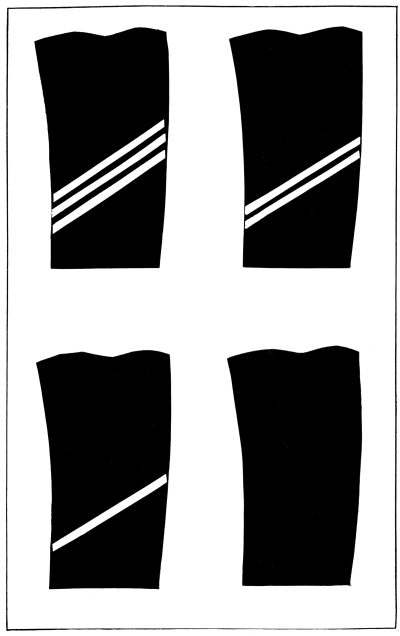
The rank of noncommissioned officers is indicated by short stripes of
cloth worn diagonally across the outer side of the coat sleeves between
the elbow and the lower edge, as follows:
| Sergeant Major |
Three stripes of dull gold braid. |
| Sergeant |
Two stripes of dull gold braid. |
| Corporal |
Two stripes of cloth of the distinctive
color of the arm of the service. |
| First class private |
One stripe of cloth of the distinctive
color of the arm of the service. |
The arm of the service to which an enlisted
man belongs is shown by color patches upon the collar on both sides of
the front opening. These patches are of yellow for infantry, blue for
cavalry, red for artillery and black for engineers, and have the number
of the regiment upon them in black figures for infantry, white for
cavalry and artillery, and red for engineers. Aviators wear an insignia
consisting of two eagle’s wings upon each side of the collar.
The belts, belt suspender straps and cartridge boxes are of tan
leather, though webbing is also in use. The water bottle (canteen) is
covered with cloth of the same color as the uniform.
The buttons worn by enlisted men upon the service uniform coat and
overcoat are plain and of the same color as the material of the coats.
In some special corps of the French service there are variations from
the standard uniform above described, thus the Chasseurs Alpin wear a
uniform of dark blue cloth with a dark blue beret, a full-crowned
visorless hat something after the style of the tam-o-shanter, and the
Algerian troops wear a round turban of khaki-colored cloth with a
tassel in the center, after the style of the fez.
The uniforms of the officers and men of the French Navy, while
following in general the usual naval style present some variations
as to the combination of garments, the decorations, the number and
arrangements of the rank stripes on the sleeves and the designs of the
insignia of rank and corps.
Commissioned officers are provided with five separate uniforms, full
dress, No. 1 dress, No. 2 dress, No. 3 dress blue, and No. 3 dress white.
The full dress corresponds to the United States naval officer’s special
full dress uniform, and consists of a cocked hat, a dark blue double
breasted cutaway frock coat, gilt epaulets, dark blue cloth trousers
decorated with gold lace stripes down the outer seams.
No. 1 dress corresponds to the United States naval officer’s full dress
uniform and consists of a cocked hat, blue cap or white cap, a dark
blue double-breasted frock coat with epaulets, and plain dark blue or
white trousers.
No. 2 dress corresponds to the undress uniform of the United States
naval officer and consists of the blue or white cap, the dark blue
frock coat or the white tunic and dark blue or white trousers.
No. 3 dress, blue, corresponds to the blue service dress of the United
States naval officer and consists of the dark blue cap, dark blue frock
coat or dark blue tunic (sack coat) and dark blue or white trousers.
No. 3 dress, white, corresponds to the white service dress of the
United States naval officer and consists of the white cap, white tunic
and white trousers.
Black shoes are worn with all except white uniforms, with which white
shoes are worn.
The rank of commissioned officers is shown by means of insignia on the
tops of the epaulets, with uniforms of which epaulets form a part,
and by decorations on the cuffs of the sleeves of the frock coat
and service sack coat. These sleeve decorations are as shown by the
illustrations:—
| Admiral of France |
Two batons crossed in gold embroidery. |
| Vice Admiral |
Three silver stars. |
| Rear Admiral |
Two silver stars. |
| Captain |
Five stripes of gold braid. |
| Commander |
Five stripes of braid, the second and fourth
being silver and the other three gold. |
| Lieutenant Commander |
Four stripes of gold braid. |
| Lieutenant |
Three stripes of gold braid. |
| Lieutenant, Junior Grade |
Two stripes of gold braid. |
| Ensign |
One stripe of gold braid. |
| Midshipman |
One stripe of gold braid broken
by interwoven stripes of blue silk. |
The officers of the Line or Command branch wear the rank insignia on
the dark blue cloth of the coat sleeve; while the officers of the Staff
Corps have cuffs of distinctive color beneath the stripes, these colors
being for:—
| Engineer officers |
violet velvet. |
| Medical officers |
red velvet. |
| Constructors and Ordnance officers |
black velvet. |
| Paymasters |
brown velvet. |
On the white service tunic or coat the rank is indicated
by stripes upon shoulder straps, these stripes being similar to those worn on the
sleeves of the blue frock coat and tunic.
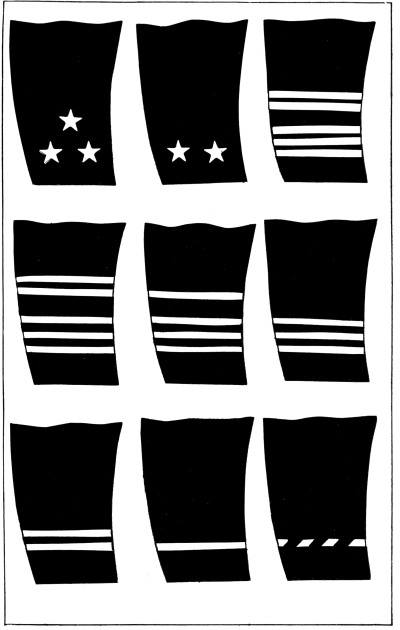
French Navy.
Officers’ sleeve decorations indicating rank
All of the stripes are gold with the exception of those for Commander,
in which case the second and fourth stripes are silver
| 1. Vice Admiral |
2. Rear Admiral |
3. Captain |
| 4. Commander |
5. Lieutenant Commander |
6. Lieutenant |
| 7. Lieutenant, Junior Grade |
8. Ensign |
9. Midshipman |
The cap for Flag Officers is of blue cloth with a patent leather visor
and a band of gold embroidery, and it has an insignia on the front
consisting of a gold anchor with various decorations of leaves for the
different grades and corps.
The cap for officers below the rank of Rear Admiral is of the same
design, with narrow stripes of gold braid around the band to indicate
the rank of the wearer. On ordinary service aboard ship a cap of the
same design with a band of black silk ribbon is worn. The device worn
on the front of the cap by these officers is a gold foul anchor placed
vertical.
Warrant officers wear dress uniforms similar to those worn by
commissioned officers; their cap has one narrow gold stripe around
the band and a gold anchor on the front, and their sleeves have three
narrow stripes, the upper one of gold one-quarter of an inch wide, the
middle one a twisted silver rope one-eighth of an inch wide and the
lower one of gold of the same rope design.
The enlisted men of the French Navy wear uniforms of dark blue cloth
for cold weather and of white for hot weather, those for the chief
petty officers consisting of a plain cap with black leather visor, a
sack coat with gilt buttons and plain trousers, and those for enlisted
men of lower ratings consisting of a flat sailor cap, overshirt and
trousers of a design similar to those worn in the British Navy. A
prominent feature of their uniform cap is a red pompon in the center of
the top of the crown.
The overcoats are of dark blue cloth of the design commonly styled
“pea jackets.”
The rating or rank of the petty officers is indicated by distinguishing
marks worn upon the sleeves; some of the principal ones being:—
| Chief Petty Officers. |
| Seaman Branch |
Two narrow gold stripes on each
sleeve above the cuff, and on the cap a gold anchor and a narrow
gold stripe around the band. |
| Commissary Branch |
The same except that the sleeve stripes are silver. |
| Musicians |
Two twisted gold stripes on the cuff and a gold lyre
on each side of the collar. |
| Petty Officers, First Class. |
| Seaman Branch |
One gold stripe on each sleeve above the cuff,
and a gold anchor on the cap. |
| Commissary Branch |
The same except that the sleeve stripe is silver. |
| Buglers and Drummers |
One gold stripe on each sleeve, worn diagonally. |
| Musicians |
One twisted gold stripe on each sleeve and a gold
anchor on each side of the collar. |
| Petty Officers, Second Class. |
| Seaman Branch |
Two stripes of red cloth on each sleeve between
the elbow and the cuff. |
| Yeoman Branch |
One broken gold stripe on each sleeve between
the elbow and the shoulder. |
| Musicians |
Two stripes of red cloth on each sleeve
between the elbow and the cuff. |
| Stewards |
Two stripes of orange colored cloth on
each sleeve between the elbow and the cuff. |
| Buglers and Drummers |
One diagonal gold stripe on each sleeve. |
All petty officers of the second class and also seamen wear two anchors
crossed on the upper part of the right sleeve.
There are also a number of specialty marks for such special ratings as
cook, tailor, shoemaker and armorer.
The distinctive mark of band musicians is a gold lyre worn on each side
of the collar, and that of the hospital corps is the red Geneva cross.
In the Italian Army the peace time dress uniforms consist, as a rule,
of a dark blue braided coat, light gray trousers with stripes of
distinctive corps color down the outer seams, and black leather boots
for officers and leggings for enlisted men. The head dress varies with
the corps and arm of the service, the infantry wearing a dark blue cap
trimmed with colored braid, the cavalry a metal trimmed helmet or a fur
busby, the field artillery a black shako with bright brass ornaments,
and the Bersaglieri a black felt hat with a plume of feathers falling
over the left shoulder.
The field service uniform is of gray cloth having a greenish tinge and
is practically the same for all arms of the service and for all corps,
except that the Bersaglieri wear their regular uniform of dark blue
with red facings and their distinctive head dress.
The officers’ field uniform consists of a short sack coat with a
standing-falling collar and a patch pocket on each breast; breeches or
trousers cut to fit the legs tightly below the knee, black boots or tan
leather shoes and leggings, and a straight crowned cap with sloping
visor of black leather and a band of distinctive corps color. The coat
is closed by buttons down the front concealed by a fly or by concealed
hooks and eyes. On each side of the collar at the front is a silver
star with a circular disc in the center upon which are the insignia
indicating the corps or arm of the service to which the
officer belongs.
The rank is indicated by the shoulder straps and the insignia worn upon
them. The shoulder knots for General officers are covered with silver
and bear gold stars to indicate the rank, those for Field officers
having a narrow edging of silver braid and silver stars to indicate the
rank, and those for company officers having only the silver stars to
indicate the rank; as follows:—
| General |
Silver covered shoulder straps with three gold stars. |
| Lieutenant General |
Silver covered shoulder straps with two gold stars. |
| Major General |
Silver covered shoulder straps with one gold star. |
| Colonel |
Shoulder straps edged with silver braid and with three silver stars. |
| Lieutenant Colonel |
Shoulder straps edged with silver braid and with two silver stars. |
| Major |
Shoulder straps edged with silver braid and with one silver star. |
| Captain |
Plain shoulder straps with three silver stars. |
| First Lieutenant |
Plain shoulder straps with two silver stars. |
| Second Lieutenant |
Plain shoulder straps with one silver star. |
The rank of officers is also shown by the braid around the
cap; the cap for General officers having a red band embroidered in silver with bands
of narrow gold braid above it, three for general, two for lieutenant
general and one for major general; the cap for Field officers having
one wide silver stripe around the band with narrow stripes of silver
braid above it, three for colonel, two for lieutenant colonel and one
for major; and the cap for company officers having stripes of narrow
silver braid around it, three for captain, two for first lieutenant and
one for second lieutenant.
The corps of officers is shown by patches of distinctive color upon the
collar at each side of the neck opening and also by the insignia upon
the center of the silver star worn on each side of the collar.
The enlisted men wear service uniforms of the same color as that of the
officers, the coat and trousers being similar to that for officers and
the cap being a plain cloth kepi of the same color as the coat with
a sloping visor of black leather. The cavalry wear gray helmets, the
Bersaglieri wear their own distinctive plumed hat and all men on duty
in the trenches wear steel trench helmets similar to those worn by the
American, British and French soldiers.
The rank of noncommissioned officers is indicated by chevrons worn
points up on the sleeves between the elbow and the bottom edge of the
cuff, as follows:—
| Sergeant Major |
Chevron of four stripes in silver. |
| Sergeant |
Chevron of three stripes in white cloth. |
| Corporal |
Chevron of three stripes in red cloth. |
Distinctive badges are also worn on the sleeves to indicate special
duties or assignments of enlisted men.
The arms of the service and corps of an enlisted man is indicated
on his uniform by patches of the distinctive corps color upon the
collar at each side of the front opening, and the regiment is shown by
numerals on these color patches.
The uniforms for the officers and enlisted men of the Italian Navy are
made of dark blue cloth for dress uniforms and for undress uniforms for
winter wear and of white cotton duck or linen for wear in hot weather.
In general the design of the uniform is similar to those of the British
Navy with the exception of the undress coat which is similar to the
service coat for officers of the United States Navy.
Commissioned officers are required to have special full dress, full
dress, dress, blue undress and white undress uniforms.
The special full dress uniform consists of a cocked hat very similar to
that worn by American naval officers, a double-breasted cutaway frock
coat with turn-down collar and notched lapels buttoned down the front
with two rows of service gilt buttons; dark blue trousers with gold
lace braid stripes down the outer leg seams, and black shoes. Epaulets
similar to those worn in the United States Navy and a sword belt
covered with gold lace are worn with this uniform, and a blue silk sash
is worn from the right shoulder diagonally across the body to the left
side where it is knotted and the ends have tassels.
The full dress uniform consists of a double-breasted frock coat very
similar to that worn in the United States Navy; a bell-crowned cap
of dark blue cloth with a sloping visor; plain dark blue trousers,
and black shoes. Epaulets and the full dress belt are worn with this
uniform.
The dress uniform is the same as the full dress with the exceptions
that the epaulets are omitted and the sword belt is of black leather.
The blue undress uniform consists of the blue cap, a single-breasted
sack coat on the lines of that worn by officers of the United States
Navy with black braid trimming around the edges and collar and down the
front with which shoulder straps are worn.
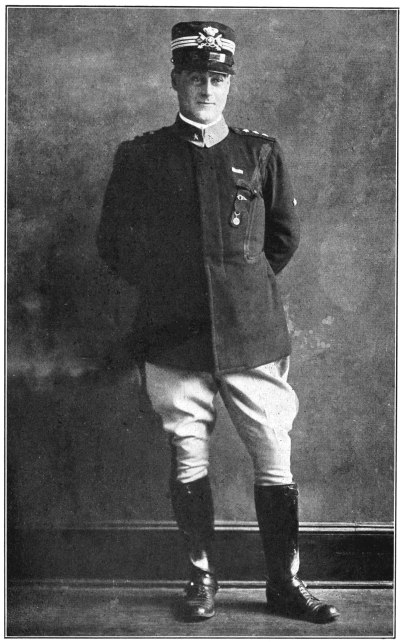
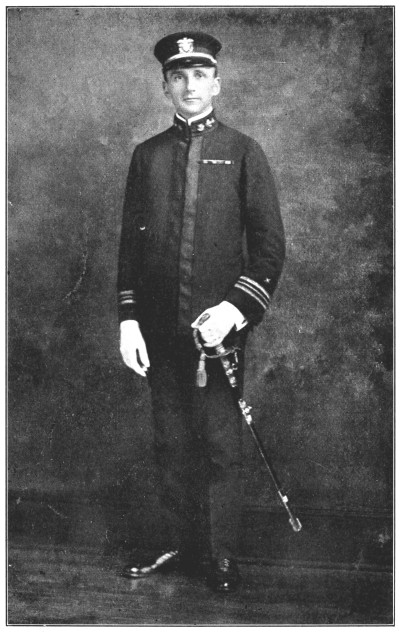
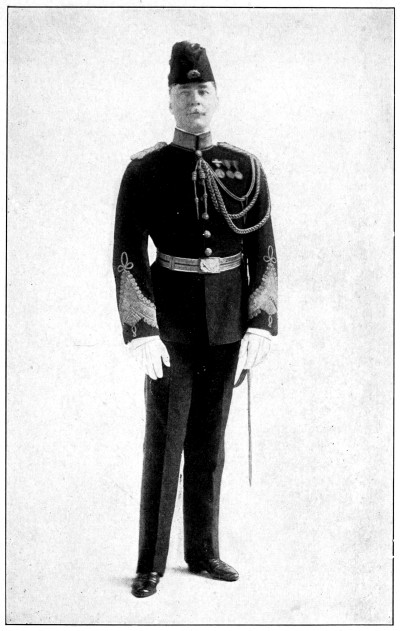
Photo. Harris & Ewing, Washington, D. C.
Italian Army. Officers’ service uniform
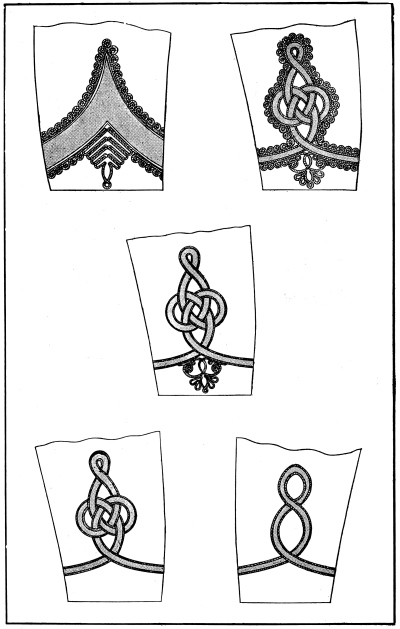
Italian Navy, Officers’ sleeve decorations indicating rank
| 1. Admiral |
2. Vice Admiral |
3. Rear Admiral |
| 4. Captain |
5. Commander |
6. Lieutenant Commander |
| 7. Lieutenant |
8. Sub Lieutenant |
9. Midshipman |
The white undress uniform is of the same description as the blue
undress except that the material is white cotton or linen duck.
The rank of officers in the Italian Navy is indicated by gold braid
stripes around the sleeves above the cuffs as shown in the accompanying
illustration.
The corps or branch of the service to which an officer belongs is
indicated as follows:—
| Line officers |
By the “curl” in the upper rank stripe. |
| Engineer officers |
By stripes of black velvet between the rank stripes. |
| Naval Constructors |
By stripes of crimson velvet between the rank stripes. |
| Medical officers |
By stripes of light blue cloth between the rank stripes. |
| Paymasters |
By stripes of red cloth between the rank stripes. |
Officers of the Staff Corps do not have the “curl” in the upper rank stripe.
The insignia on the front of the cap consist of an oval medallion
surrounded by a gold wreath and surmounted by the Royal Crown of Italy
in gold on a blue ground. The medallion in the center shows the corps
or branch of the service, Line officers having a gold foul anchor on a
light blue ground, Engineer officers a gold three-bladed propeller on
a black ground. Medical officers a red Geneva cross on a white ground,
Naval Constructors a gold helmet on a red ground, and Paymasters a gold
star on a red ground.
The band of the cap is of the distinctive color of the corps or branch
of the officer and has sewn upon it gold stripes indicating the rank of
the wearer.
On the right side of the cocked hat there is a cockade of red, white
and green silk.
Chief Warrant officers wear uniforms similar to the commissioned
officers’ uniforms with one gold stripe broken by diagonal blocks of
blue silk with the corps mark above it on the cuffs. Their cap has
a black mohair braid band and insignia on the front like those of
commissioned officers except that the Royal crown is omitted.
Warrant officers wear the same uniform as Chief Warrant officers except
that the stripe of gold braid on the sleeve is omitted and the corps
insignia alone are worn on the sleeves above the elbow.
Enlisted men wear uniforms of dark blue cloth or white duck depending
upon the temperature, these uniforms being similar in general design to
those of the United States Navy.
The insignia of rank for Petty officers are as follows:—
| Chief Petty officers |
A gold chevron of one wide stripe and one narrow stripe on each sleeve
above the elbow with the branch mark above it. An additional chevron is
added after three years’ service in the grade. |
| Petty officers |
A red chevron of one wide stripe and one narrow one on each sleeve
above the elbow with the branch mark above it, in red. |
| Leading Seamen |
A chevron of one narrow red stripe with the branch mark above it, in red. |
| Able Seamen |
The branch mark in red on each sleeve above the elbow. |
| Ordinary Seamen |
The sleeves are plain. |
The specialty or branch marks for the different corps or branches of
the enlisted men are as follows:—
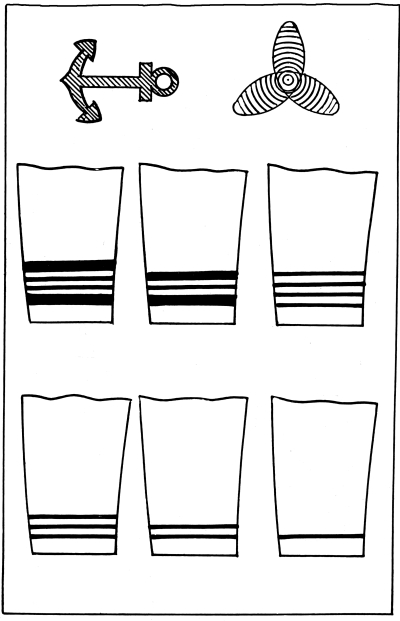
| The Line or Deck branch. |
A foul anchor. |
| Navigating branch |
A steering wheel. |
| Engineers |
A three-bladed propeller. |
| Firemen |
A two-bladed propeller. |
| Torpedo branch |
Two torpedoes crossed with a hammer below. |
| Gunnery branch |
Two cannon crossed. |
| Gunlayers |
Two cannon crossed with a bursting bomb in the center. |
| Electricians |
A device representing three branches of zig-zag
lightning with a hammer in the center. |
| Mining division |
A submarine mine case. |
| Divers |
A submarine mine case and a hammer. |
| Carpenters |
Two hatchets crossed. |
| Plumbers |
Two hatchets crossed with a flame in the center. |
| Joiners |
A saw. |
| Musician of the band |
Two anchors crossed with a harp in the center. |
| Radio operators |
Three branches of zig-zag lightning. |
| Hospital man |
A gold star with a red Geneva cross on white ground in the center. |
| Stewards |
A sheaf of wheat. |
| Buglers |
An anchor crossed by a trumpet. |
| Signalman |
A triangular pennant with vertical stripes. |
Enlisted men who have been promoted for gallantry in war service wear a
gold crown on the sleeves above the specialty marks.
Before 1914 the uniforms of the Belgian Army for home service were
very elaborate and decorated with gold and silver braid and ornaments,
although uniforms of cotton khaki were worn in hot weather on foreign
service; but the experience of the present war showed the necessity
of an inconspicuous dress for field service, and as a result the army
is now provided with a field uniform designed after the British Army
service uniform and made of dark khaki-colored woolen cloth.
The officers’ field service uniform consists of a coat similar to that
worn by British officers except that it has a standing collar; breeches
of the same material and color as the coat; a cap after the British
design, and tan leather boots, or tan leather shoes with khaki-colored
wrap puttees or tan leather strap puttees.
With this uniform the British “Sam Browne” tan leather belt and
shoulder strap is worn.
The corps or arm of the service to which an officer belongs is shown
by patches of colored cloth on the collar at each side of the neck
opening. The rank of officers is indicated by insignia upon these
collar patches, as follows:—
| Major General |
Three stars arranged to form an equilateral triangle with two vertical
bars in front of it and a device made up of the King’s monogram, wings,
a spear head and bolts of lightning, all in gold embroidery. |
| Brigadier General |
The same as for major general,
except there is but one vertical bar. |
| Colonel |
Three gold stars arranged in the form of an equilateral triangle
pointing down with a semicircular gold bar beneath it. |
| Lieutenant Colonel |
The same as for colonel except there are but two stars. |
| Major |
The same as for lieutenant colonel except there is but one star. |
| Commandant |
Three gold stars arranged in the form of an
equilateral triangle pointing down. |
| Captain |
The same as for commandant except that the lower star is silver. |
| First Lieutenant |
Two gold stars. |
| Second Lieutenant |
One gold star. |
| Adjutant |
One silver star. |
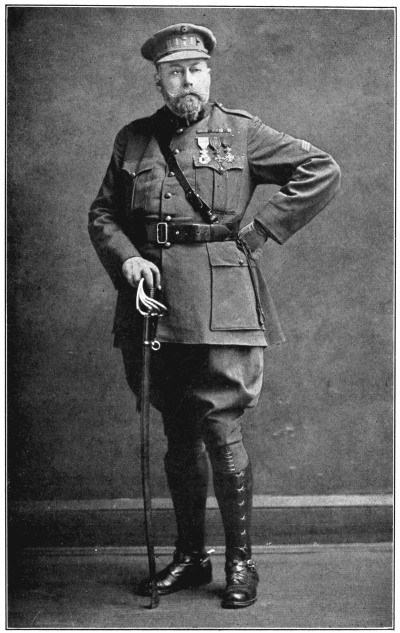
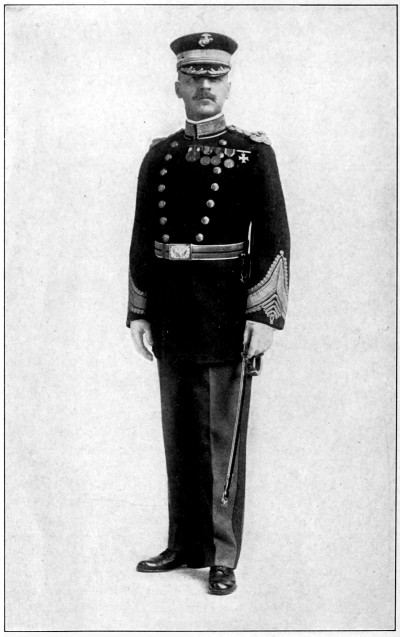
Photo. Harris & Ewing, Washington, D. C.
Belgian Army. Officers’ service uniform
The grade of Commandant has no corresponding one in the United States
Army; the rank is between those of Major and Captain.
The grade of Adjutant corresponds to that of a Warrant Officer in the
United States Navy and Marine Corps.
The service uniform of the enlisted men in the Belgian Army is similar
in design and color to that of the British soldier.
The rank of noncommissioned officers is indicated by stripes upon the
cuffs as follows:—
| Regimental Sergeant Major |
Three narrow stripes around the cuff parallel to the lower edge. |
| Sergeant Major |
Two stripes around the cuff with two diagonal stripes above them. |
| First Sergeant |
Two stripes around the cuff. |
| Quartermaster Sergeant |
One stripe around the cuff with one diagonal stripe above it. |
| Sergeant |
One stripe around the cuff. |
| Corporal |
One stripe around the cuff, narrower than that worn by a sergeant. |
Specialty marks are worn upon the sleeves above the elbow to mark men
assigned to special duties.
| Engineers |
A plumed helmet. |
| Aviator |
The King’s monogram with an eagle’s wing at each side. |
| Hospital Corps |
A caduceus surrounded by a wreath. |
| Cycle Corps |
A bicycle wheel. |
| Grenadiers |
A bursting bomb. |
| Bandsmen |
A lyre. |
The men wear tan leather belts and cartridge pouches.
The officers and enlisted men of the Russian Army formerly had a
great variety in uniforms for the different corps and branches of the
service; the infantry of the regular Line wore uniforms of green cloth
with red facings; the hussars wore green jackets trimmed across the
front with white stripes and loops, red breeches and black high boots;
the guards wore green uniforms with yellow facings; the Don Cossacks
wore uniforms of dark gray, the coat being long and the breeches very
loose and the headdress being a black shako; and the Kuban cossacks
wore a uniform of similar design of reddish brown cloth.
During the Russo-Japanese War of 1904-5 an effort was made to
standardize the field service uniforms with the result that the present
service uniform is of cloth of a gray-brown shade. The Cossacks have to
some extent preserved their distinctive dress.
The service uniforms for officers consists of a single-breasted sack
coat with a standing collar, a pocket with flap on each breast and
closed by a row of gilt buttons down the front; breeches of the same
color with stripes down the outer leg seams of varying widths according
to rank and of different colors according to the corps or arm of the
service; a bell-crowned cap with sloping visor, and black boots.
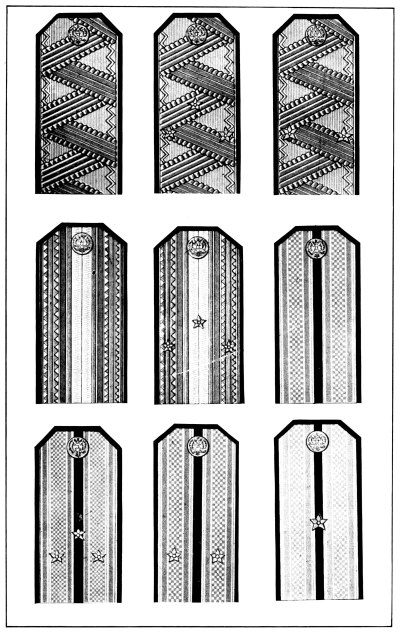
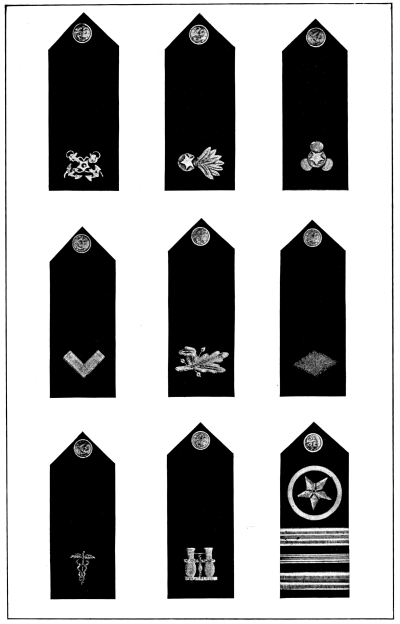
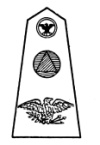
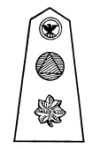
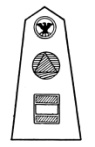
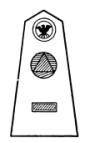
Russian Army. Officers’ shoulder straps indicating rank
The straps are of black cloth covered with gold or silver lace,
depending upon the rank and corps of the officer. Those for
General Officers are of gold lace with silver stars
| 1. General |
2. Lieutenant General |
3. Major General |
| 4. Colonel |
5. Lieutenant Colonel |
6. Senior Captain |
| 7. Junior Captain |
8. First Lieutenant |
9. Second Lieutenant |
The rank is indicated by the trimming and ornamentation of flat
shoulder straps, those for the various grades of rank being shown in
the accompanying illustration. It will be noted that
there are no grades of Brigadier General or Major in the Russian Army, but that
there are two grades of the rank of Captain, called First and Second or
Senior and Junior Captain. The duties of the Senior Captain correspond
in a measure to those of Major in the United States services. Line
officers of the rank of Colonel and below wear the number of their
regiment in the center of the shoulder strap.
The Russian officer’s service cap is similar to that worn by officers
of the United States Army except that the top of the crown is
relatively greater in diameter. The band is of the distinctive color of
the corps or arm of the service. A medallion made up of the national
colors is worn at the center of the band in front and the visor
and chin strap are of brown leather. In some of the regiments gray
sheepskin shakos are worn by both officers and men instead of the cap.
The arm of the service or corps is indicated by patches of colored
cloth on the front of the collar on each side of the neck opening.
The sword belt is of tan leather with a cross strap from the right
shoulder to the left side at the waist although in some corps the sword
is suspended from the diagonal cross strap only, the waist-belt not
being worn by officers.
The uniform of the enlisted men is of similar cut to that of the
officers except that the coats are looser and in some corps are closed
by a row of buttons down the right side.
The rank of the noncommissioned officers is indicated by stripes and
other insignia upon narrow flat shoulder straps worn from the base of
the collar to the top of the sleeve shoulder seam.
The Russian Army has an officer of Warrant rank, intermediate between
the commissioned officers and enlisted noncommissioned officers. These
Warrant officers wear one broad stripe across the shoulder strap near
the collar end.
The noncommissioned officers wear narrow stripes on their shoulder
straps in the same position; a sergeant major having three such
stripes, a sergeant two and a corporal one.
There have been various corps and specialty insignia but as these are
now in a process of being changed they cannot be given accurately.
The Russian noncommissioned officers wear swords suspended from tan
leather belts and the privates wear a tan leather belt with cartridge
boxes of the same material. All of the enlisted men carry their extra
clothing in a blanket roll over the right shoulder and diagonally
across the body to the left side at the belt.
The uniforms of the officers and enlisted men differ in many respects
from those which are common to the navies of the other principal powers.
The officers’ uniforms are as a rule made of a dark green cloth for
dress and winter wear and of white cotton or linen for hot weather.
The prescribed uniforms are full dress, dress, undress and service
(working) dress.
The full dress uniform consists of a cocked hat, tunic with standing
collar, epaulets, and trousers with gold lace braid on the outer leg seams.
The dress uniform consists of a cap, double-breasted frock coat, with
epaulets, and plain trousers.
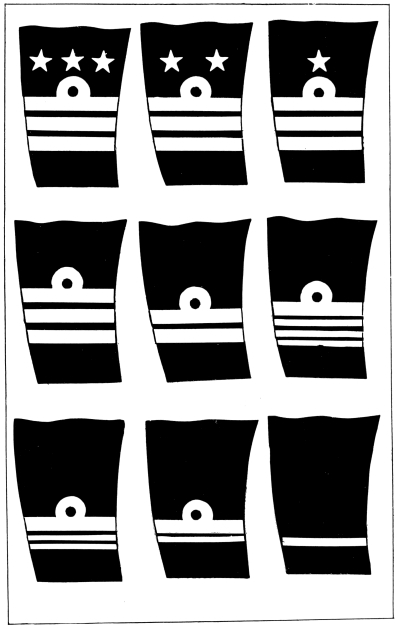
Russian Navy. Officers’ sleeve decorations indicating rank
| 1. Admiral |
2. Vice Admiral |
3. Rear Admiral |
| 4. Captain |
5. Commander |
6. Lieutenant Commander |
| 7. Lieutenant |
8. Sub Lieutenant |
9. Warrant Officer |
The undress uniform is the same as the dress uniform without epaulets.
The service or working uniform consists of a cap, a short single
breasted tunic of dark blue cloth and plain trousers.
In hot weather a similar uniform of white cotton or linen material is worn.
An overcoat of black cloth and a heavier one of gray cloth with a fur
collar are worn by officers.
In May, 1917, the shoulder straps and the insignia of rank formerly
worn upon them were abolished and stripes on the sleeves above the cuff
to indicate rank with distinctive colors to indicate the Staff corps,
were adopted for all uniform coats and the overcoat.
These stripes for the different grades of rank are as shown by the
accompanying illustrations.
Officers of the Line and of the Engineer Corps wear gold stripes,
and officers of the Medical Corps, Naval Constructor Corps, Judge
Advocate’s Corps, and Paymasters wear silver stripes, with the stripes
edged with cloth of a distinctive color for each corps.
These distinctive colors are:
| Medical officers |
White. |
| Naval Constructors |
Red. |
| Judges Advocate |
Crimson. |
Paymasters wear silver stripes without the “curl” and without edgings
of colored cloth.
Officers wear a sword on all occasions of dress and ceremony, but on
occasions of ordinary duty they wear a short dirk in place of the sword.
The warrant officers of the Russian Navy wear uniforms similar to those
worn by commissioned officers, the distinguishing mark being a narrow
gold stripe around the sleeves above the cuff.
Enlisted men wear black cloth trousers, a jersey with blue and white
horizontal stripes and a blue jumper.
The caps are similar to those worn by enlisted men of the British Navy.
The name of the ship is given on the cap ribbon as in other navies,
this ribbon being tied at the back so that it hangs down in streamers.
White duck uniforms of the same pattern as the blue ones are worn in
hot weather.
The ratings of petty officers are indicated by badges worn on the
sleeves above the elbow; these badges are at present being revised and
hence cannot be accurately given.
All enlisted men are provided with short overcoats of gray cloth.
Previous to the Russo-Japanese war of 1904-5 the officers and enlisted
men of the Japanese Army wore uniforms of dark blue or red cloth with
facings of distinctive colors for the various arms, but this proved so
conspicuous on the battlefields of that war that a service uniform of
khaki-colored cloth for winter and khaki cotton drill for summer was
adopted. The officers, however, retained for their dress uniforms the
old dress uniforms of dark blue and red cloth with heavy decorations of
gold lace.
The dress uniform of the officers consists of a dark blue double
breasted frock coat with standing collar; trousers of dark blue cloth
with stripes of the corps color down the outer leg seams for all arms
except the cavalry in which the officers wear red breeches; black boots;
and a kepi style cap decorated with gold lace and having a red and
white standing plume at the front, this cap being of red cloth for the
cavalry and of blue cloth for the other arms.
The collar of the dress coat is covered with gold lace; the buttons
are gilt with a design of chrysanthemums and cherry blossoms; shoulder
knots of plaited gold cord and a sash belt of gold and red stripes
with heavy tassels at the left side are worn with it, and the rank is
indicated by sleeve decorations consisting of a knot made up of narrow
stripes of gold braid of the same design as that worn by officers of
the United States Army. This sleeve knot is made of one stripe for
Second Lieutenant and one additional stripe for each step up in grade
through the ranks of First Lieutenant, Captain, Major, Lieutenant
Colonel, Colonel, Major General, Lieutenant General and Field Marshal,
the latter having a knot of nine stripes.
The distinctive colors for the different arms of the service are
red for infantry, green for cavalry, yellow for artillery, crimson
for pioneers, gray for the quartermaster corps, and black for the
gendarmerie (national police).
The service uniforms for both officers and enlisted men consist of a
single-breasted sack coat of khaki-colored woolen cloth for winter and
cotton drill for summer; trousers or breeches of the same materials,
and a bell-crowned cap with sloping visor of tan leather and a band of
the distinctive color of the arm of the service.
The service coat has a standing collar with a patch of the distinctive
color for the arm of the service on each side of the neck opening, a
pocket with buttoned flap on each side of the breast and a plain pocket
on each side below the waist.
Officers wear breeches and boots when mounted and tan leather leggings
or khaki-colored wrap puttees for dismounted service. The shoes worn by both
officers and enlisted men with the service uniform are of tan leather.
The rank of the officers is indicated by shoulder straps worn
transversely across the shoulders next to the shoulder seams of the
sleeves, after the style of the shoulder strap worn by officers of the
United States Army with their blue dress coats. These are the only two
great armies in which this form of shoulder strap is worn by officers
to indicate rank.
These shoulder straps are covered with cloth of the distinctive color
of the arm of the service with stripes of gold braid running lengthwise
of them on the same scheme as that used on the shoulder straps worn by
Japanese naval officers as illustrated, namely, for General officers
one wide stripe, for field officers two narrow stripes and for company
officers one narrow stripe. On the gold stripes silver stars are worn
for the different grades of rank in each class. The number of stripes
and stars for each grade is as follows:
| General Officers. |
| General |
Three stars on one wide gold stripe. |
| Lieutenant General |
Two stars on one wide gold stripe. |
| Major General |
One star on one wide gold stripe. |
Field Officers. |
| Colonel |
Three stars on two narrow gold stripes. |
| Lieutenant Colonel |
Two stars on two narrow gold stripes. |
| Major |
One star on two narrow gold stripes. |
Company Officers. |
| Captain |
Three stars on one narrow gold stripe. |
| First Lieutenant |
Two stars on one narrow gold stripe. |
| Second Lieutenant |
One star on one narrow gold stripe. |
The rank of noncommissioned officers is shown by narrow stripes around
the cuffs, and for all enlisted men the arm of the service is indicated
by the color patches on each side of the collar and the regimental
number is worn upon these collar patches, Arabic figures being used for
the regular service, Roman numerals for the militia and Arabic figures
on one side of the collar and Roman on the other for the reserves.
The overcoat for officers is a double-breasted ulster similar to that
worn by American officers, and that for enlisted men is single-breasted
and short. The overcoats are of khaki-colored cloth.
The service belts for both officers and men are of tan leather.
When Japan began to build and man her modern navy she derived much
early training and experience from the British Navy, which was then as
now, the largest of the world’s navies.
As a result the uniforms of both the officers and men of the Japanese
Navy are similar in most respects to those of the British Navy. The
principal difference is that the Japanese naval officers’ undress or
service uniform coat is a single-breasted blouse with standing collar
similar to that worn by officers of the United States Navy, the collar
and edges being trimmed with black braid.
In the insignia of the Japanese Navy the cherry blossom usually takes
the place where the crown appears in the British naval insignia, as may
be seen by reference to the illustrations.
The uniforms for both officers and enlisted men are of dark blue cloth
for full dress and dress uniforms, the undress or service uniform being
of dark blue cloth for winter wear and of white cotton duck or linen
for wear in hot weather.
The rank of officers is indicated by stripes around the sleeves above
the cuff on the blue uniforms and by shoulder straps on the white
service uniform.
The sleeve stripes are of gold lace braid for full dress and dress
coats and of black braid for the blue service coat.
The number, width and arrangement of the sleeve stripes for the
different ranks are as shown in the accompanying illustration.
The corps or branch of the service to which an officer belongs is
shown by the circular curl above the upper stripe for officers of the
Line, and by stripes of colored cloth between the rank stripes for the
officers of the Staff Corps, the distinctive colors for the various
corps being as follows:—
| Engineer Corps |
Purple. |
(The officers of the Engineer Corps
also wear the curl above the upper rank stripe, officers
of the other Staff Corps do not wear the curl.) |
|
| Medical Corps |
Red. |
| Engineer Constructors |
Brown. |
| Ordnance Constructors |
Maroon. |
| Paymaster Corps |
White. |
| Hydrographic Corps |
Light blue. |
| Chief Carpenter (warrant officers) |
Green. |
| Bandmasters (warrant officers) |
Gray. |
These distinctive colors for officers
of the different Staff Corps are also worn around the bands of the caps.
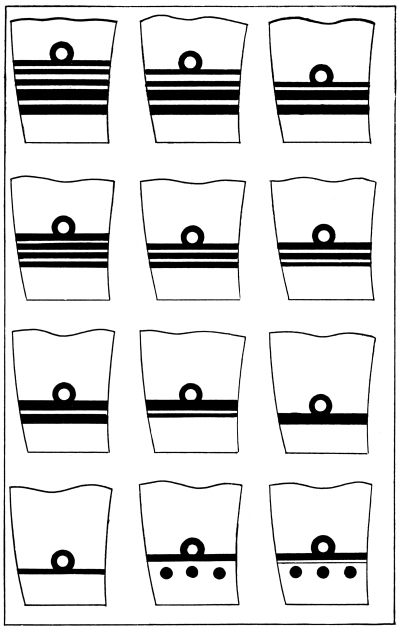
Japanese Navy. Officers’ sleeve decorations indicating rank
| 1. Admiral |
2. Vice Admiral |
3. Rear Admiral |
| 4. Captain |
5. Commander |
6. Lt. Commander |
| 7. Lieutenant |
8. Sub Lt., 1st Class |
9. Sub Lt., 2nd Class |
| 10. Midshipman |
11. Warrant Officer, Line |
12. Warrant Officer, Engineers |
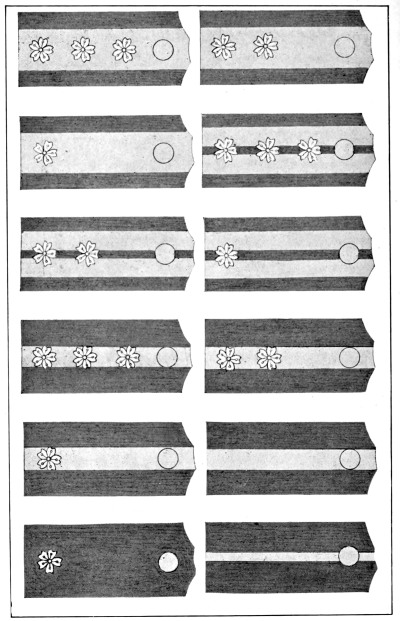
Japanese Navy. Officers’ shoulder straps showing rank,
summer service uniform
| 1. Admiral |
2. Vice Admiral |
| 3. Rear Admiral |
4. Captain |
| 5. Commander |
6. Lt. Commander |
| 7. Lieutenant |
8. Sub Lt., 1st Class |
| 9. Sub Lt., 2nd Class |
10. Chief Warrant Officer |
| 11. Warrant Officer |
12. Midshipman |
The rank or rating of enlisted men who are petty officers or who are
assigned to special duties is shown by distinctive marks worn on the
left sleeve of the coat or overshirt; the principal ones being:—
| Seaman |
An anchor. |
| Writers |
A writing brush. |
| Hospital Corps |
A pair of forceps. |
| Firemen |
A double pipe spanner. |
| Carpenter’s Mate |
An axe. |
| Stewards |
A key. |
| Musicians |
A lyre. |
The Army of Austria-Hungary is made up of so many different races
and peoples each of whom have preserved something of their original
national dress or uniform in their modern dress uniforms that the
varieties in color, design and ornamentation are greater than in any
other country.
The field service uniform of all however is nearly the same and is made
of light gray cloth.
The officers’ service uniform consists of a single-breasted sack coat
with a standing collar, closed by a row of buttons down the front
concealed beneath a flap and having shoulder straps, patch pockets with
button flaps, one on each breast and one on each side below the waist;
breeches of the same color as the coat; leather puttees and shoes; and
a cap of gray cloth, cylindrical in shape with a soft top to the crown
and side flaps which are folded up around the band and secured by two
buttons in front, and having a sloping visor covered with the gray
cloth of the cap. This cap, known as a tschapka, is a distinguishing
feature of the Austrian uniform.
As variations of the field uniform the Hungarian regiments do not wear
leggings but have the trousers tight below the knees; the Alpine troops
wear heavy tan colored stockings instead of leggings and the Bosnia
troops wear a Turkish fez instead of the gray cap.
The rank of officers is indicated by insignia worn upon each side of
the collar. A Field Marshal has gold embroidery on the collar at each
side of the neck opening and two wide red stripes down the outer leg
seams of the trousers. General officers wear similar gold braid on the
collar with the grade of rank indicated by silver stars thereon as
follows:—
| General |
Three silver stars. |
| Lieutenant General |
Two silver stars. |
| Major General |
One silver star. |
Field officers have gold or silver braid on the collar according to
whether their buttons are of silver or gold. On gold braid they wear
silver stars and on silver braid gold stars to indicate the grade of
rank, as follows:—
| Colonel |
Three stars. |
| Lieutenant Colonel |
Two stars. |
| Major |
One star. |
Company officers have the collar decorated with cloth on each side of
the neck opening, the color being the distinctive color of their arm of
the service or regiment. The grade of rank is indicated by stars worn
on this colored cloth, the stars being of silver or gold to match the
gold or silver buttons worn according to the regiment:
| Captain |
Three stars. |
| First Lieutenant |
Two stars. |
| Second Lieutenant |
One star. |
The arm of the service is indicated by the color of the facings or
decorations on the uniform. The infantry have no regimental numbers
on their uniforms but a distinctive color for each group of four
regiments, each such group of the regular army having two Austrian and
two Hungarian regiments, the Austrian regiments wearing silver buttons
and the Hungarian regiments gilt buttons.
Chasseur regiments wear green facings or trimming and have the number
of the regiment on the buttons.
Dragoon regiments have distinguishing colors worn on the collars for
each two regiments, one regiment of each color wearing silver buttons
and the other gilt buttons.
Hussar and Uhlan regiments of cavalry have distinctive colors for each
two regiments as in the case of dragoon regiments but these colors are
also worn on the caps and the number of the regiment also appears on
the cap.
Artillery regiments have red facings and the buttons bear a gun
and a shell.
In the Austrian Reserves the infantry have green facings and trimmings
on their uniforms and the number of the regiment on the buttons and
shoulder straps, and the cavalry regiments have the regimental number
on the buttons only.
In the Hungarian Reserves the infantry regiments wear the regimental
number in dark gray cloth on the sides of the cap and the cavalry
regiments wear their number in yellow cloth on the cap.
The rank of noncommissioned officers is indicated by white stars of
celluloid worn on the distinctive color patches of the collar, as
follows:—
| Sergeant Major |
Three white stars. |
| Sergeant |
Two white stars. |
| Corporal |
One white star. |
With service uniform officers wear tan leather belts with suspender
straps across one or both shoulders and the enlisted men wear belts and
cartridge boxes of tan leather. General and Staff officers wear the sword
slung from a belt beneath the coat and a sash of gold and black silk.
The overcoat for officers is a double-breasted ulster with gilt or
silver buttons the same as worn on the service coat and collar patches
and pipings of the distinctive corps or regimental color; or a long
circular cape cloak with a turn-over collar upon which the color
patches are worn.
The overcoat of the enlisted man is a double-breasted long ulster with
standing-falling collar, buttons of silver or gilt to match those worn
on the service coat and color patches on the collar.
Enlisted men wear the trousers tucked into the tops of the shoes or in
the case of the Alpine troops into the tops of heavy woolen socks of
khaki color.
A distinctive feature of the Alpine troops is a small plume of eagle’s
feathers worn on the left side of the cap.
Various insignia to indicate special duties or assignments are worn by
enlisted men upon the left sleeve, some of them being:—
| Telegraphist |
A wreath surrounding a device representing three bolts
of lightning crossed with a crown above them. |
| Medical Corps |
A circle surrounding a Geneva cross in red. |
| Gun pointer |
Two cannon crossed surmounted by a crown surrounded by a wreath. |
| Pioneer |
A medallion bearing a pick and two spades crossed. |
| Wagon driver |
A wreath surrounding two horses’ heads. |
In the trenches steel trench helmets of the German pattern are worn by
both officers and enlisted men.
In very cold weather fur coats are worn and in the snows of the
mountains white coats are worn to make the troops less conspicuous.
Enlisted men wear on the left sleeve a triangle of yellow braid to show
long service, one stripe for four years, two stripes for seven years
and three stripes for nine years.
The uniforms of the officers and enlisted men of the Austrian Navy are
of dark blue cloth for winter wear and of white duck for hot weather
and are generally similar to those worn in the British Navy.
Commissioned officers are provided with special full dress, full dress,
undress, blue service, white service and white mess uniforms.
The special full dress uniform (gala dress) consists of a cocked
hat of the same shape as the one worn in the United States Navy but
having more gold braid on it; a short double-breasted frock coat with
a standing collar; epaulets; dark blue trousers with gold stripes
down the outer leg seams; a sash belt of black cloth with interwoven
horizontal gilt stripes and a knot and tassels of gold on the right
hip; and black shoes. The collar of the coat and the cuffs are trimmed
with gold lace braid, the sword is worn suspended by slings from a belt
worn beneath the coat, and the rank of the officer is indicated by
insignia worn upon the collar and upon the tops of the epaulets.
The full dress consists of the cocked hat; a double-breasted frock coat
with turn-down collar and notched lapels; epaulets; trousers the same
as for the special full dress; and black shoes. The sash belt is also
worn with this uniform.
The undress uniform consists of a bell-crowned cap of dark blue cloth
with a black mohair braid band, sloping visor of black patent leather,
gold chin strap above the visor and the rank indicated by narrow gold
stripes around the black band; the frock coat worn without epaulets;
plain dark blue trousers and black shoes. White trousers and a cap with
the upper portion of the crown white are some times worn with this
uniform. The sash belt is not worn with this uniform, the sword being
suspended by slings from a belt worn beneath the coat.
The blue service dress consists of the blue or white cap; a square cut
double-breasted sack coat similar to that worn in the British Navy;
plain trousers of dark blue cloth or white duck, and black shoes. When
on duty with troops ashore the sword belt is worn outside of this coat.
The white service uniform consists of a white cap or white helmet; a
white coat with shoulder straps of the same design as the white service
coat worn by the United States naval officer except that there is a
patch pocket with flap and button on each side below the waist. When
under arms the sword is worn suspended by slings from a belt beneath
the coat and the gold and black sash belt is worn outside of the coat.
The mess uniform consists of a white mess jacket upon which the
shoulder straps are worn; a white waistcoat; dark blue plain trousers,
and black shoes. There is no blue mess jacket and no evening dress coat.
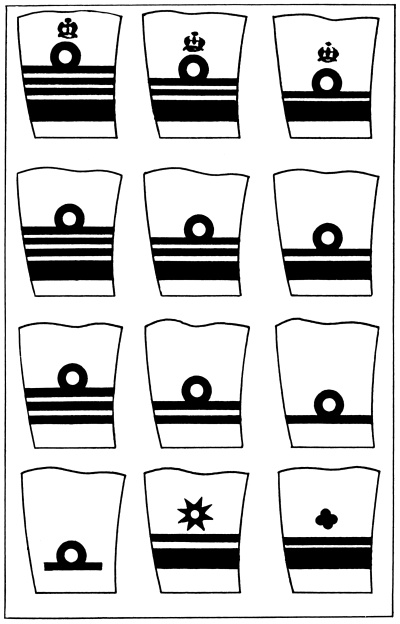
Austrian Navy. Officers’ sleeve decorations indicating rank
| 1. Admiral |
2. Vice Admiral |
3. Rear Admiral |
| 4. Captain |
5. Commander |
6. Senior Lieutenant |
| 7. Lieutenant |
8. Sub Lieutenant |
9. Midshipman |
| 10. Naval Cadet 11. Surgeon General |
| 12. Staff Officer with rank of Rear Admiral |
With the frock coat uniforms a plain black silk necktie is worn tied in
a flat double-bow knot.
The rank is indicated on the frock coat and upon the blue service coat
by stripes of gold lace upon the sleeves above the cuff. In the case of
officers of flag rank a gold Austrian Imperial crown is worn above the
stripes. These stripes for the different grades of rank are shown in
the accompanying illustration.
On the white service coat the rank is indicated by stripes upon the
shoulder straps in the same manner as in the United States Navy, these
stripes being of the same number, widths and arrangements as upon the
sleeves of the frock and service coats.
The corps or branch of the service to which an officer belongs is
indicated by the “curl” in the upper stripe of the rank stripes upon
the sleeve and shoulder strap, and by stripes of colored silk between
the gold rank stripes for the different Staff corps. These distinctive
colors for the different corps or branches are:—
| Engineers |
Gray. |
| Medical officers |
Black. |
| Naval Constructors |
Crimson. |
| Paymasters |
Light blue. |
| Professors |
Dark blue. |
White gloves are prescribed for all uniforms. |
Medical officers of flag rank wear an eight-pointed gold star above
the rank stripes on the sleeves, other Staff officers of flag rank
wear a four-circle rosette there, and Medical officers wear as a
distinctive device on the shoulder strap over the rank stripes the rod
of Esculapius entwined with a serpent in silver.
Midshipmen at the Naval Academy wear a dark blue double-breasted
round-about jacket with a turn-down collar and two rows of gilt buttons
down the front, a straight visored blue cap, dark blue trousers and
black shoes, for dress and a uniform similar to that worn by the
seamen, for work and drills.
Chief Warrant officers and Warrant officers wear dress and service
uniforms like those of commissioned officers, and Chief Petty officers
wear similar uniforms to those of Warrant officers except that the
specialty or branch marks are worn on the sleeves between the elbow
and the shoulder. The rank of Chief Warrant officers, Warrant officers
and Chief Petty officers is indicated by gold stripes upon the sleeves
above the cuffs as follows:—
| Chief Warrant officer |
Three one-half inch stripes. |
| Warrant officer |
Two one-half inch stripes. |
| Chief Petty officer |
One stripe three-sixteenths of an inch wide. |
The uniforms of the enlisted men are of the usual sailor cut common
to the navies of most naval powers. The blue uniform consists of a
dark blue flat cap with the name of the ship in gilt upon a cap ribbon
around the band; a loose jumper worn over a tight jersey, and trousers
of the sailor cut with wide spring at the bottoms of the legs. The
white uniforms consist of a white flat cap, white duck jumper and white
trousers.
The rating is indicated by stars in the corners of the wide collar.
These stars are of a material resembling celluloid and first class
petty officers wear three such stars in each corner of the collar,
second class petty officers two stars and first class seamen one star.
The branch of the service or the special duty detail of an enlisted man
is indicated by a specialty mark worn on the left sleeve midway between
the elbow and the shoulder, petty officers wearing a crown above the
specialty mark, these marks being as follows:—
| Deck force |
A vertical foul anchor. |
| Engineroom and Fireroom force |
A three-bladed propeller. |
| Quartermasters (Wheelmen) |
An anchor with a steering wheel on the shank. |
| Writers |
Two swords crossed. |
| Torpedomen |
An anchor with a bursting bomb on the shank. |
| Gunnery force |
An anchor with two cannon crossed on the shank. |
| Radio men |
An anchor with bars of zig-zag lightning across the shank. |
| Mining force |
A ship’s anchor with a mine anchor crossing it. |
| Band musicians |
A lyre. |
| Hospital attendants |
A Geneva cross. |
| Cooks and stewards |
Two blades of wheat crossed. |
For Chief Petty officers these specialty marks are in gold embroidery
and for others in yellow for blue coats and jumper shirts and for all
ratings they are in black for white coats and jumpers.
Aviation pilots, both officers and men, wear the aviation insignia on
the right breast. This insignia is of silver and consists of a wreath
of leaves surmounted by an Imperial crown with a spread eagle across
the wreath.
The uniforms of the officers and men of the German Navy are made of
dark blue cloth for winter wear and of white duck for hot weather as in
other navies and in general they follow the lines of other navies, but
there are several distinctive features. The officers have no special
full dress coat with the cutaway skirts or swallow-tail effect, a frock
coat taking its place; and the enlisted men have in addition to the
ordinary sailor shirts with the wide falling collar a dress jacket
reaching to the waist line and roached over the hips like the jackets
of the American midshipmen. This jacket has a row of small buttons down
each side of the front and also on each cuff and is worn unbuttoned
with the falling collar of the shirt outside of it.
The commissioned officers have full dress, dress, blue service and
white service uniforms.
The full dress uniform consists of a cocked hat similar to that worn
by British naval officers; a long double-breasted frock coat; trousers
with gold lace stripes down the outer leg seams; black shoes; a sword
belt covered with silver and gold lace with a wide red stripe running
through it, and epaulets or shoulder knots depending upon the rank and
corps of the officer. A distinctive feature of this full dress frock
coat is that while it has a standing collar trimmed with gold lace, the
front is provided with wide triangular lapels covered with color facing
indicating the corps or branch of the service to which the wearer
belongs.
The dress uniform consists of a bell-crowned cap of dark blue cloth
with a braid of the distinctive corps around the band and a distinctive
insignia on the front; a frock coat like that of the British or
American naval officer; with which shoulder knots are worn; plain dark
blue trousers, and black shoes. With this uniform the same sword belt
is worn as with the full dress but instead of the sword a short sword
or dirk is worn. As a variation of this uniform the cocked hat is
sometimes worn with it for special occasions.
The blue service uniform consists of the blue cap; a double-breasted
square cut sack like that worn by British officers; plain dark blue
trousers, and black shoes. A plain black double-bow knot tie is worn
with this uniform.
The white service uniform consists of a white cap of the same design
as the blue cap but with a black band and black visor as in the United
States and British navies; a white single-breasted sack coat with
standing collar, a patch pocket on the left breast and a patch pocket
on each side below the waist; white trousers, and black or white
shoes depending upon the occasion. The dirk is worn with this uniform
suspended from a black leather belt worn beneath the coat. Shoulder
straps showing the rank are worn on the white service coat.
The overcoat is a long double-breasted coat cut to fit the figure,
buttoning to the neck, with a wide falling collar and an outside pocket
with flap on each side below the waist. It is closed by gilt buttons,
one row down each side.
Following the universal military custom, the rank of German naval
officers is indicated on the blue uniforms by stripes worn upon
the sleeves of the coat just above the cuff. The number, width and
arrangement of these stripes are shown in the accompanying
illustration.
On the full dress coat sleeves there is a vertical three-pointed strap
on the outside over the rank stripes, its color being the distinctive
color for the corps to which the wearer belongs.
The rank is also indicated by insignia upon the tops of the epaulets
and shoulder knots. The tops of the epaulets are of the distinctive
colors of the corps except those for officers of the Line which are of
gold. The lower grade in each branch has no fringe of bullion on the epaulets.
The stripes indicating the rank of officers of the Line are sewn
directly upon the cloth of the coat sleeves and have a German Imperial
crown above the upper stripe. Officers of the Staff corps do not wear
the crown above their rank stripes. The corps or branch of the service
to which officers of the Staff corps belong is indicated by stripes of
colored cloth worn between the stripes indicating the rank, and the
distinctive colors are:—
| Engineer officers |
Black. |
| Gunnery officers |
Dark gray. |
| Torpedo officers |
Dark gray. |
| Medical officers |
Dark blue. |
| Naval Constructors |
Black. |
| Paymasters |
Light blue. |
| Legal Department officers |
Red. |
| Pilot officers |
Light gray. |
| Dockyard Construction officers |
Black. |
The insignia worn upon the cap for commissioned officers is a gold
wreath surrounding a circular emblem made up of concentric circles of
red, white and black (from the center out) and surmounted by the German
Imperial crown. This medallion is also worn upon the center of the
front of the enlisted men’s flat caps.
These distinctive corps colors are also worn as the “facings” on the
full dress uniforms, that is on the lapels of the coat and on the
three-pointed straps on the cuffs, and around the band of the service
cap, blue and white, except that pilots wear a gold band on the cap.
Warrant officers in the German Navy wear a dress uniform and a
service uniform both blue and white similar in design to that worn
by commissioned officers, with their distinctive rank stripes on the
sleeves and on the shoulder straps.
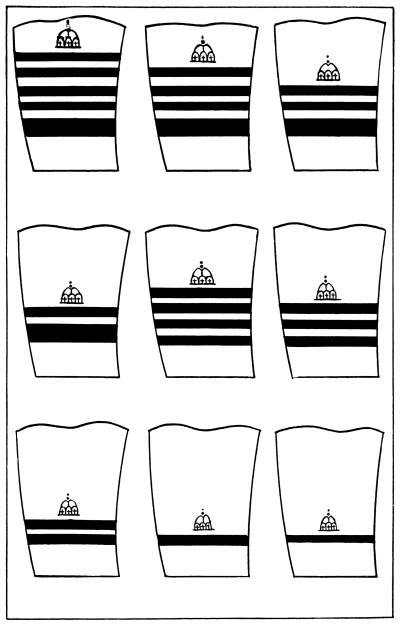
German Navy. Officers’ sleeve decorations indicating rank
| 1. Grand Admiral |
2. Admiral |
3. Vice Admiral |
| 4. Rear Admiral |
5. Captain |
6. Commander |
| 7. Senior Lieutenant |
8. Junior Lieutenant |
9. Sub Lieutenant |
In the German Navy there is a rank intermediate between that of Warrant
officers and Chief Petty officers which has no counterpart in the
American Navy. This is called Feldwebel. His dress uniform is a blue
cap; a short dark blue jacket with rolling lapel collar and a row of
small gilt buttons down each side of the front; a blue waistcoat with
gilt buttons, and plain dark blue trousers; and his service uniforms,
both blue and white, are similar to those of other officers. On the
cuffs of the dress jacket he has three narrow gold stripes around the
sleeve close together and below them three similar stripes around the
sleeve and continuing down the outer seam to the bottom edge of the
sleeve, with a vertical strap of dark blue cloth across the stripes
with six small gilt buttons on it.
The Bandmaster is a Warrant officer and the distinctive mark of his
rank is a gold lyre on the center of his shoulder straps.
The uniforms of the enlisted men are the dress or “parade” uniform, the
service uniform and the white uniform.
The dress uniform consists of a sailor flat cap; a white sailor shirt
with wide dark blue falling collar; the dark blue dress jacket worn
with the collar of the shirt outside of it, and dark blue trousers, the
trousers being cut without the wide “spring” or flare at the bottom of
the legs so common in other navies.
The blue cap is similar to that worn in other navies but the crown is
higher in the front than in the back, which tends to give it a military
appearance. The name of the ship or station is worn upon a cap ribbon
around the band of the cap, the ends of the ribbon being tied at the
back and allowed to fall down the back in streamers. Upon the front of
the crown at the center is the red, white and black medallion, the
colors of Germany.
The collar of the shirt has three rows of narrow white braid around the
edges as in the American and British navies.
The service uniform consists of the blue cap; a dark blue shirt similar
to that worn in the American Navy, and dark blue trousers.
The white service uniform is of the same design but of white duck
instead of dark blue cloth or flannel.
The rank or rating and the branch of specialty is indicated by
distinctive marks worn upon the left sleeve between the elbow and the
shoulder. Some of the principal of these marks are:—
| Feldwebel |
A vertical gold anchor with a gold crown above it. |
| Chief Quartermaster |
Two gold anchors crossed with a crown above them.
(If certified he wears a red chevron of one stripe below the mark.) |
| Quartermaster |
Two gold anchors crossed. |
| Chief Boatswain’s Mate |
A vertical gold foul anchor with a crown above it. |
| Boatswain’s Mate |
The same without the crown. |
| Chief Gunner’s Mate |
A vertical foul anchor with two cannon crossed
upon it surmounted by a crown, in gold. |
| Gunner’s Mate |
The same without the crown. |
| Chief Machinist’s Mate |
A vertical anchor with a cog wheel
on the shank and a crown above it, in silver. |
| Machinist’s Mate |
The same without the crown. |
| Chief Stoker’s Mate
|
A vertical anchor with two shovels crossed on the
shank and a crown above it, in silver. |
| Stoker’s Mate |
The same without the crown. |
| Chief Torpedoist’s Mate |
An anchor and a mine crossed with a crown above it, in gold. |
| Torpedoist’s Mate |
The same without the crown. |
| Chief Radio Operator |
A vertical anchor with a crown above it, in gold, with a
zig-zag of lightning in red across the shank of the anchor. |
| Radio Operator |
The same without the crown. |
| Telegraphist |
Two bars of forked lightning crossed, in gold. |
| Chief Signal Mate |
A vertical anchor with a crown above it, in gold, and two
signal flags in red crossed on the shank of the anchor. |
| Signal Mate |
The same without the crown. |
| Drill Sergeant |
A vertical anchor with two rifles
crossed on the shank and a crown above it, in gold. |
| Drill Corporal |
The same without the crown. |
| Leading Seaman |
A yellow chevron of one stripe, point down. |
| Bandsman, first class |
A chevron of two stripes with a curl at the point of the upper
stripe and an anchor surcharged by a lyre above it, in gold. |
| Second Leader of Band |
The same with a crown above it. |
| Gun Captain, first class |
A flaming shell above a chevron of three stripes, point down, in red. |
| Gun Captain, second class |
The same but with two stripes in the chevron. |
| Gun Captain, third class |
The same but with one stripe in the chevron. |
| Machine Gun Captain |
The same without the chevron. |
| Range Finder |
A triangle with a flaming shell in the center and a
range finding instrument above it, in red. |
| Submarine Mine Planter |
A submarine mine in red. |
(The Gun Captains, Range Finders, and Mine Planters
of the Marine Artillery, who man the coast defense
guns, wear the same rating marks in yellow. In
Germany the coast defenses, forts and batteries are
manned by the Navy and not by the Army as in the United States.) |
The overcoat worn by enlisted men of the German Navy is a short double
breasted pilot coat with turn-down lapel collar and a double row of
gilt service buttons down the front.
For service ashore in landing parties and when on duty at the coast
forts in hot weather or tropics, a khaki helmet is worn instead of the
white hat with white uniforms and khaki canvas leggings are also worn.
For landing parties as infantry or artillery black leather boots are
worn with the blue uniforms, the trousers being tucked inside of the boots.
The German Marines are a part of the Navy and are divided into Marine
Infantry and Marine Field Artillery. They perform duties similar in
many respects to the duties of the United States Marine Corps.
The full dress uniform of the officers consists of a black shako with
a large red plume which falls over the front down to the visor; a blue
single-breasted tunic with standing collar; epaulets without bullion
fringes; breeches of the same color, and black boots. The front edges
of the coat and the tops and bottoms of the collar are piped with white
cloth and the cuffs are of white cloth with a vertical strap.
The service uniform is of gray cloth and consists of a bell-crowned cap
with a white band and sloping visor of black leather; a single-breasted
coat with a standing turn-over collar closed by buttons down the front
concealed by a fly; breeches, and leggings and shoes of tan leather.
The coat has a pocket with flap on each side below the waist. Shoulder
straps are worn with the service coat.
The rank of the officer is indicated by insignia worn upon the epaulets
and shoulder straps, the insignia being the same as for the German Army
officers.
For hot weather a uniform of khaki cotton drill is provided, the
general style being the same as for the cloth service uniform except
that the head dress is a khaki-colored helmet.
The dress uniform of the enlisted men is similar in color and design
to that worn by the officers, the epaulets being replaced by shoulder
straps of white cloth. The service uniform of the enlisted men is of
the same design as that for officers except that the coat is closed by
a single row of gilt buttons and the cap has no visor.
The peace time uniforms of the various corps and arms of the German
Army present a great variety, the traditions of the services of the
former separate kingdoms and political divisions that are now united
to form the German Empire being preserved in many instances in the
color and design of the uniform or in the bright metal decorations and
insignia.
Many of these uniforms are gaudy in color and richly decorated with
gold, silver and colored cloth and braid ornaments.
The facings colors worn upon the collars and cuffs and as pipings on
the coats and trousers often vary with the individual regiments, and
the headdress is in many shapes and colors.
The Line Infantry wear a black helmet with brass spike, Prussian eagle
and scale chin strap; a blue single-breasted tunic with gilt buttons,
and dark gray trousers; the facings and piping being red, but the
infantry regiments of Saxony, Bavaria, Wurttemburg and some other
states have variations from this in both color and design.
The Uhlans wear the Czapka helmet; a blue double-breasted tunic with
a red plastron front and red facings; and dark gray trousers; the
Prussian Hussars wear a black fur busby with heavy gilt decorations
and a bag of the distinctive color of the facings, a single-breasted
blue tunic heavily decorated with white braid, loops and frogs; a blue
pelisse with white braid decorations slung from the left shoulder; dark
gray tight fitting breeches with white braid decorations, and black
Hessian boots with embroidered tops.
The Prussian Cuirassiers wear white uniforms with black hip boots and
cuirasses of brass or iron, the iron being black for some regiments and
bright for others.
The Saxon Jager regiments wear uniforms of green cloth and a cap with a
feather plume.
The Prussian Dragoon regiments wear helmets with drooping white plumes,
light blue jackets, dark gray breeches.
The Field Artillery regiments usually wear black helmets with a spike
ending in a brass ball; dark blue coats with gilt buttons, dark gray
breeches and black boots.
There are many other distinctive uniforms and the varied colors,
bright trappings and decorations and waving plumes made a peace time
assemblage of German troops of all arms a most imposing sight; but
early in the present century the leaders realized that while all this
gaudy panoply and pomp added to the attractiveness of the service, kept
alive the traditions of the past, and aided in holding the esprit de
corps, it would not do for service on the modern battlefield, where the
troops must be as inconspicuous as possible to avoid annihilation under
the drum fire of artillery and the rapid fire of machine guns.
As a result a field service uniform of a dull gray color was adopted
for all arms but it was not generally issued to the troops until just
before the opening of the present world war.
The German officer’s field service uniform consists of a gray single
breasted sack coat with a standing turn-over collar; breeches of the
same color and black or tan leather boots. With this uniform the
old bright helmets are worn with a gray cover to make them less
conspicuous, or in many cases a gray cap with sloping visor is worn.
The buttons are of gilt allowed to become dull in the field, in some
cases of leather or bone, and in other cases the coat is closed by
buttons concealed beneath a fly.
The corps and regimental colors are worn in small patches on the collar
at each side of the neck opening and also as cuff stripes in some corps.
In some corps the distinctive color is also worn around the cap band.
The rank of the German officer is indicated by the braid and insignia
on flat shoulder straps covered with braided cord. The shoulder strap
for Field Marshal and for General officers is covered with a plaited
knot made up of five loops of sets of three cords, the two outer
cords being gold and the central cord being silver interwoven with
the imperial colors in silk. The shoulder straps for Field officers
(Colonels, Lieutenant Colonels and Majors) are of the same design
except that the cords are in sets of two, both of silver interwoven
with the silk colors. The shoulder straps of the company officers are
covered with parallel rows of silver cord interwoven with the silk colors.
The insignia of rank worn upon the shoulder straps on top of the cord
decorations are diamond shaped ornaments of gilt metal, and although
they do not have the conventional shape of a star they are called stars
in the German service.
These insignias are as follows for the various grades of rank:—
| Field Marshal |
Two gold batons crossed. |
| Colonel General |
Three stars. |
| General |
Two stars. |
| Lieutenant General |
One star. |
| Major General |
No insignia, the shoulder strap knot being plain. |
| Colonel |
Two stars. |
| Lieutenant Colonel |
One star. |
| Major |
No insignia. |
| Captain |
Two stars. |
| First Lieutenant |
One star. |
| Second Lieutenant |
No insignia. |
There is no corresponding rank in the armies of other nations for the
German rank of Colonel General, and in the German Army there is no rank
of Brigadier General.
In the German Army a Feldwebel is an officer between the commissioned
officers and the enlisted men, his rank corresponds to that of the
Warrant Officers in the United States Navy and Marine Corps. He wears
a double cord upon the shoulders and his rank insignia is a circular
medallion with a Prussian eagle on each side of the collar.
The German officer’s overcoat is a heavy ulster of the same gray color
as the field uniform; it is double-breasted and the rank of the wearer
is indicated by the shoulder straps as in the case of the service coat.
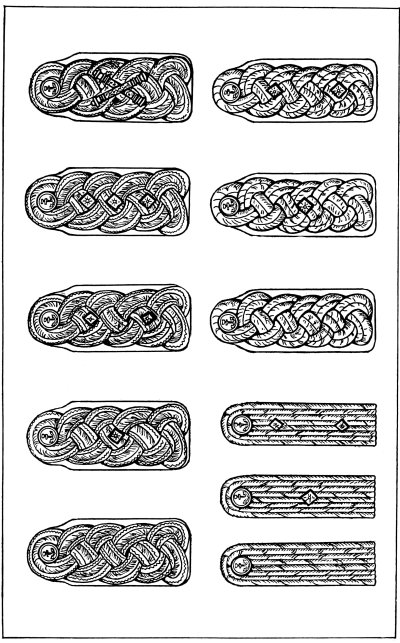
German Army. Officers’ shoulder strap insignia indicating rank
| 1. Field Marshal |
6. Colonel |
| 2. Colonel General |
7. Lieutenant Colonel |
| 3. General |
8. Major |
| 4. Lieutenant General |
9. Captain |
| 5. Major General |
10. First Lieutenant |
| |
11. Second Lieutenant |
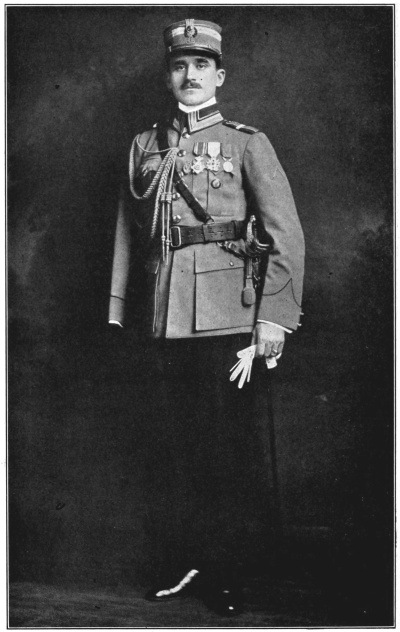
Photo. Harris & Ewing, Washington, D. C.
Roumanian Army. Officers’ service uniform
The enlisted men of the German Army wear a service uniform of the same
color and general design as that of the officers. The ordinary field
cap is a round loose crowned cap without visor, the coat is a single
breasted sack with a standing turn-over collar, and the trousers are of
the same gray cloth as the coat. Boots of black or tan leather are worn.
Noncommissioned officers wear a stripe of braid around the cuff and
the front edges of the collar at the neck opening and for a short
distance along the top of the collar back from the neck opening. A
Sergeant Major wears a stripe of narrow braid above the noncommissioned
officer’s sleeve stripe.
The enlisted men’s overcoat is a heavy ulster buttoning to the neck
with a standing-falling collar, the rank of noncommissioned officers
being indicated by the sleeve braid as for the service coat and by
patches of color at the front of the collar.
Steel trench helmets are worn in the trenches by both officers and
men, this helmet being larger than that worn by the American, British
and French troops and having a flaring extension at the rear for the
protection of the neck.
The dress and service uniforms of the Roumanian Army are very similar
to those of the Austrian Army and the field uniform is of khaki-colored
cloth with the facings, pipings and rank insignia of the dress uniforms added.
The multiplicity of medals and decorations in all foreign countries
makes it very difficult to distinguish one from another, especially
since the designs and ribbons used by different countries are
frequently quite similar. To describe all of these decorations is not
practicable within the scope of this volume, but a few of the ones
which are classed as distinctively war decorations are included as they
are the ones most commonly seen and talked about.
French War Medals.—The French decorations given for war service are
the Legion d’honneur (Legion of Honor), the Medaille Militaire
(Military Medal) and the Croix de Guerre (War Cross).
The Legion of Honor was inaugurated by Napoleon I at Les Invalides
on July 15, 1804, and the medals and ribbons were bestowed upon both
soldiers and civilians. The medal consists of a white star with five
double rays; the center of the star, surrounded by a wreath of oak and
laurel, bearing on the obverse the head of the Republic surrounded
by the words, “République Française, 1870,” and on the reverse two
tri-colored flags with the words, “Honneur et Patrie.” Above the star
is a small gold wreath and the ribbon is red.
The Medaille Militaire, created by Prince Louis Napoleon in January,
1852, may be bestowed upon Generals and Admirals who have been
ministers of the state cabinet or commanders in chief, commanders of
Army Corps who have presided over the Superior Council of War and the
greatest of the war leaders of France. It is of silver, twenty-eight
millimeters in diameter, surmounted by a trophy of arms in silver and
suspended by a yellow ribbon with green stripes at the edges. The
obverse of the medal bears the head of the Republic surrounded by the
words, “République Française, 1870,” and the reverse the words, “Valeur
et Discipline.”
The Croix de Guerre, established by law on April 8, 1915, is awarded
to soldiers and sailors of all ranks in the service of France and her
Allies who perform individual acts of gallantry in operations against
the enemy during the present war and are mentioned for such acts in
official despatches. The cross is of Florentine bronze, four-armed
with two crossed swords between the arms, and is surcharged at the
center with a medallion bearing the head of the Republic surrounded by
the inscription “République Française” on the obverse and the dates
“1914-1915” on the reverse side. The ribbon is green with seven narrow
red stripes.
British War Medals.—In Great Britain there are three orders which
may be bestowed upon officers by the King—the Order of the Bath, the
Order of St. Michael and St. George and the Distinguished Service
Order; five crosses or medals which may be awarded to officers or
enlisted men of the land forces—the Victoria Cross, the Military
Cross, the Distinguished Conduct Medal, the Military Medal and the
Meritorious Service Medal; and four crosses or medals which may
be bestowed upon officers and enlisted men of the sea forces—the
Victoria Cross, the Distinguished Service Cross (corresponding to the
Military Cross), the Conspicuous Gallantry Medal (corresponding to
the Distinguished Conduct Medal), and the Distinguished Service Medal
(corresponding to the Military Medal).
Of all of these the one most highly prized by officers and enlisted
men alike both on sea and land is the Victoria Cross, which is awarded
individually to an officer or enlisted man of the Navy or Army for some
signal act of valor and devotion to his country in the presence of the
enemy and during action. Whenever it is possible to do so the V. C. is
presented in person by the sovereign.
The Victoria Cross.—This decoration consists of a bronze cross
pattée with raised edges and it was instituted by Queen Victoria in
1856 during the Crimean War. On the obverse of the cross at the center
it is surcharged with a Royal crown surmounted by a lion passant
gardant and below the crown there is a semicircular scroll bearing
the words, “For Valour.” On the reverse side is engraved the date of
its bestowal. The cross is suspended from a ribbon by means of a bar
clasp ornamented with laurel leaves and a link in the shape of the
letter “V,” and the name, rank and regiment or ship of the recipient is
engraved on the reverse side of the clasp. The ribbon is red for the
Army and blue for the Navy.
The Distinguished Service Order.—This order was established in 1886
to reward officers of the military and naval services for meritorious
or distinguished service in the field before the enemy. It is a gold
cross pattée convexed, enamelled white and edged with bright gold.
At the center on one side is a wreath of laurel enamelled in green
surrounding the Imperial crown enamelled in red, and on the other side
at the center a similar wreath surrounding the Royal cypher “G.R.” The
ribbon is red edged with blue.
The Distinguished Service Cross.—This is a plain silver cross pattée
convexed. On the obverse at the center enclosed within a raised circle
is the Imperial cypher “G.R.I.” surmounted by the crown, while the
reverse side is plain. The ribbon is blue, white, blue.
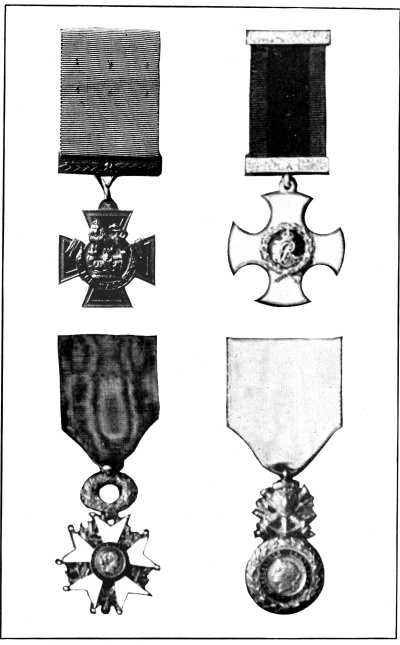
Copyright, Bailey, Banks & Biddle Co., Phila., Pa.
FOREIGN DECORATIONS AND MEDALS
| 1. Victoria Cross, Great Britain |
| 2. Distinguished Service Order, Great Britain |
| 3. Legion of Honor, France |
| 4. Military Medal, France |
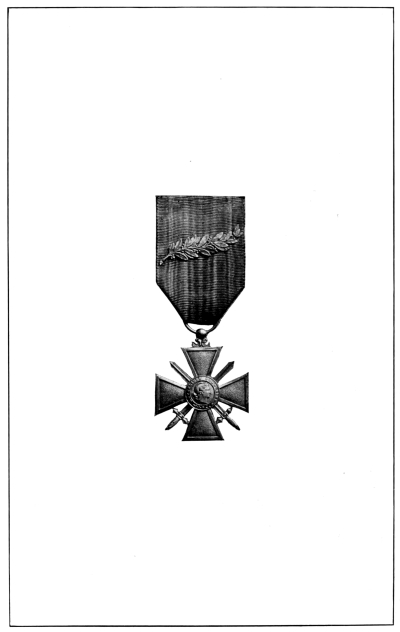
Croix de Guerre (War Cross), France
The Conspicuous Gallantry Medal.—The medal, established during the
Crimean War, is of silver, with the effigy of the reigning sovereign
on one side and a laurel wreath encircling the words, “For Conspicuous
Gallantry,” surmounted by a crown on the other side. It is awarded to
Warrant Officers, Midshipmen, Naval Cadets and Clerks in the Royal Navy
for conspicuous gallantry in the presence of the enemy. The ribbon is
blue, white, blue.
The Distinguished Service Medal.—This medal was established October
14, 1914, to reward petty officers and men of the Royal Navy and
noncommissioned officers and men of the Royal Marines for courageous
service in action during the present war. It is of silver and the
obverse bears the effigy of King George V., while the reverse bears a
wreath encircling the words, “For Distinguished Service,” surmounted by
a crown. The ribbon is blue with two narrow white stripes through the
center.
The Military Cross.—This decoration was established in December,
1914, to reward captains, lieutenants and warrant officers of the Army
for deeds of valor or distinguished services in the present war. The
cross is of silver and each arm bears the Imperial crown while at the
center the Imperial cypher “G.R.I.” appears. The ribbon is white, blue,
white.
The Military Medal.—This silver medal was authorized by the King
in March, 1916, to be awarded to officers and enlisted men of the
Army for conspicuous bravery in the field after recommendation by the
commanding general in the field. Its obverse bears the Royal effigy and
the reverse a wreath encircling the words, “For Bravery in the Field,”
surmounted by a crown. The ribbon is blue, white, blue, with two narrow
rod stripes through the central white stripe.
Belgian War Medals.—The decorations and medals awarded in Belgium
for war service embrace the Order of Leopold, the Croix Militaire
(Military Cross), the Medaille Militaire (Military Medal), the Ordre
de la Courenne (Order of the Crown), the Order of Leopold II., the
Belgian War Cross and the Medal of Queen Elizabeth.
The Order of Leopold.—This order was instituted by King Leopold
I. in 1832, to “reward services rendered to the country.” It is only
bestowed upon officers of high rank except in very exceptional cases.
It consists of a white enamelled Maltese cross resting upon a green
wreath of oak and laurel, surmounted by two crossed swords and a Royal
crown. On the obverse at the center is a gold lion rampant on a black
circular ground surrounded by the words, “L’Union fait la force.” The
color of the ribbon is Royal purple.
The Belgian War Cross.—This cross is made of bronze and is modelled
after the French Croix de Guerre. It is bestowed upon officers
and men who are mentioned in General Orders for conspicuous acts of
gallantry in the field during the present war. It was established
October 25, 1915.
The Medal of Queen Elizabeth.—This medal, founded by resolution of
September 9, 1916, is bestowed in the name of the Queen upon Belgians
or foreigners who have devoted themselves to war work in Belgium.
Italian War Medals.—In Italy there are four Orders, the Order of
Annunziata, the Order of St. Maurice and St. Lazarus, the Military
Order of Savoy, and the Order of the Crown of Italy; and a number of
military and naval medals, including the Sardinian Medal of the Crimea,
the Order of the Thousand of Garibaldi fame, the Medal Commemorating
the Unity of Italy, the Medal of the African Campaign, the Medal of the
Extreme Orient and the Messina Medal, the latter given to those who
distinguished themselves at the time of the Messina earthquake in 1908.
The Order of Savoy.—This military order was founded by Victor
Emmanuel I. in 1815, to reward services in war on land and sea, and its
cross is highly prized. It consists of a white enamelled cross resting
upon an enamelled wreath and surmounted by a gold trophy of arms and
flags. At the center is a cross surrounded by the words, “Al Merito
Militare.” The ribbon is dark blue with a broad red stripe.
The Order of the Crown of Italy.—This order was created in 1868
by Victor Emmanuel II. to reward Italians and foreigners who render
conspicuous services to Italy. The cross is of white enamel resting on
gold scrolls and bears at the center an iron crown. It is awarded to
officers of high rank for services in war.
The Medal for Military Valor.—This medal of two classes, gold and
silver, corresponds to the French Croix de Guerre, and is awarded to
soldiers and sailors for conspicuous acts of gallantry in action in the
presence of the enemy. The gold medal is very rarely bestowed except as
an honor to the memory of a soldier or sailor who has lost his life in
the execution of the deed which the medal commemorates. The ribbon is blue.
Japanese War Medals.—Japan has several orders, the first and best
known one being the Order of the Rising Sun, created in 1876. It is the
great national Japanese order and is divided into eight classes, being
awarded to officials, officers and rarely to civilians. In the military
and naval services the first six classes are awarded to officers and
the last two to enlisted men. The decoration consists of a medallion
enshrined a cabochon garnet, placed in the center of eight white
enamelled rays bezelled in gold and silver, and it is suspended from a
gold paulownia leaf. The ribbon is white with narrow red edges.
The Order of the Golden Kite.—This order was founded by Emperor
Mutsuhito in 1891, to reward acts of especial bravery in battle on land
or sea. The decoration consists of a blue enamelled cross surrounded by
clustered rays of red enamel, surcharged upon a silver sword from the
guard of which rises a golden kite. The ribbon is green with a narrow
white stripe near each edge.
In addition to the decorations of the orders there are a number of war
medals in bronze awarded to officers and men for participation in the
campaigns of the war with China and the war with Russia.
War Medals of Germany.—Germany has many orders and medals but the
one best known as a war medal is the Iron Cross, founded in 1813, to
be given to both soldiers and civilians for services to the country.
It was revived in 1870, during the Franco-Prussian War. The decoration
consists of a black iron cross pattée with a silver edge. At the center
is the letter “W”, on the upper arm a crown and on the lower arm the
date 1870 for the crosses awarded in that year and 1914 for those
awarded in the present war. There are three classes in the order, the
size of the cross varying with the class. The ribbon is black with
white stripes near each edge for medals awarded to soldiers or sailors
and the reverse for those awarded to civilians. The Iron Cross has been
lavishly bestowed upon soldiers and sailors in the present war.
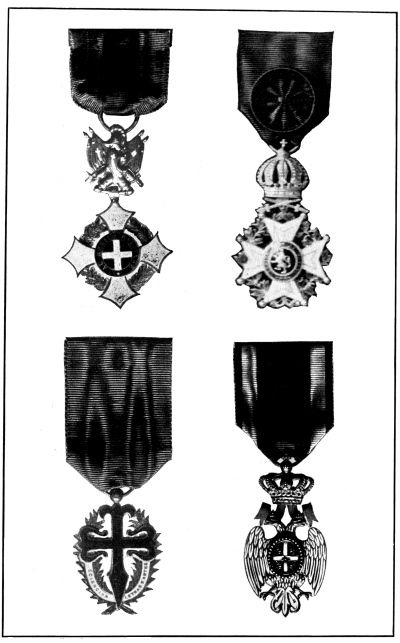
Copyright, Bailey, Banks & Biddle Co., Phila., Pa.
FOREIGN DECORATIONS AND MEDALS
| 1. Military Order of Savoy, Italy |
| 2. Order of Leopold, Belgium |
| 3. Order of St. James of the Sword, Portugal |
| 4. Order of the White Eagle, Serbia |
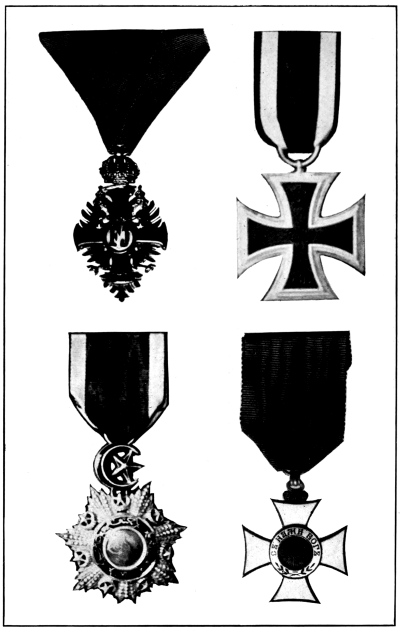
Copyright, Bailey, Banks & Biddle Co., Phila., Pa.
FOREIGN DECORATIONS AND MEDALS
| 1. Order of Francis Joseph, Austria |
| 2. Iron Cross, Germany |
| 3. Order of Medjidie, Turkey |
| 4. Order of St. Alexander, Bulgaria |
Austrian War Medals.—Austria has many orders and decorations, the
Order of Francis Joseph being frequently conferred upon high officers
for conspicuous service in war. In addition there are distinguished
service medals of gold, silver and bronze, according to the importance
of the service rewarded, gold and silver medals for bravery in action,
and, for services in war alone, the War Decoration for officers and the
War Medal for enlisted men.
Turkish War Medals.—Turkey has awarded many decorations and medals
upon her own soldiers and sailors as well as upon those of her allies
in different wars and upon citizens of other nations in peace time. The
best known of her orders are the Order of the Medjidie and the Order of
Osmanieh.
The Order of the Medjidie.—The decoration of this order consists of
a seven-pointed star of cut silver, each point being composed of five
rays. Between the points there are seven small crescents and stars and
at the center on a gold background is the Sultan’s cypher surrounded by
a circle of red enamel bearing an inscription in Turkish.

SEAL OF THE AMERICAN RED CROSS
CHAPTER XII UNIFORMS AND INSIGNIA OF THE AMERICAN RED CROSS — UNIFORMS AND INSIGNIA OF MEMBERS OF THE AMERICAN RED CROSS FIELD SERVICE — UNIFORMS AND INSIGNIA FOR RED CROSS WOMEN WORKERS IN THE UNITED STATES — DESCRIPTION OF UNIFORMS
By the terms of the Geneva Convention held at Geneva, Switzerland, in
1864, all hospitals, hospital ships, surgeons, members of the hospital
corps, nurses, chaplains and all persons engaged exclusively with the
removal, transportation and treatment of the sick and wounded in war
are rendered neutral. The emblem used to mark hospitals and ambulances
is the white flag with the red Greek cross in the center as described
on page 62.
Following this Convention Red Cross Societies were established in
several countries, taking their name from the red cross on the hospital
flag. The movement has been extended throughout the world and to-day
every civilized country has its Red Cross Society, an International Red
Cross Committee at Geneva being the means of intercommunication between
the different national bodies.
The National Red Cross was founded at Washington, D. C., on October
1, 1881, incorporated under the laws of the District of Columbia and
reincorporated April 17, 1893. Under the name of the American Red Cross
it was finally incorporated in 1905. The original founder was Miss
Clara Barton.
As at present constituted the American Red Cross is officered by a
President, Vice President, Treasurer, Counselor, Secretary-General,
General Manager, and Comptroller; the President being the President
of the United States. There is a Central Committee, consisting of
a Chairman, Vice-Chairman, and one representative from each of the
Departments of State, Treasury, War, Navy and Justice, appointed by the
President; six members elected by the Board of Incorporators, and six
members elected by Delegates. There is an Executive Committee elected
by the Central Committee and a War Council of seven members appointed
by the President.
The War Council announces that the present work of the Red Cross should
contribute to the following aims:—
1. To be ready to care for our soldiers and sailors on duty
wherever and whenever that care may be needed.
2. To shorten the War—by strengthening the morale of the allied
peoples and their armies, by alleviating their sufferings in the period
which must elapse until the American army can become fully effective abroad.
3. To lay foundation for an enduring peace—by extending a message
of practical relief and sympathy to the civilian population among
our Allies, carrying to them an expression of the finest side of the
American character.
The war work is divided into two main parts, the principal
purposes of which are summarized by the Council as follows:—
The Work in the United States.—
1. To take such measures as are necessary, in cooperation with the
Army and Navy, for the protection of the health and welfare of soldiers
in camps and cantonments, and of civilians whose welfare is involved in
war conditions.
2. To stimulate and guide the volunteer work of women in the
manufacture of supplies and comforts needed by troops and civilians
abroad and by men in training in this country.
3. To co-operate with the Government and with all relief agencies
in caring for the dependent families of men in the military and naval
service, and to relieve suffering caused by any disaster.
4. To maintain at the lowest cost consistent with efficiency,
machinery to assure the uninterrupted performance of these duties and
of the relief work in Europe.
The Work in Europe.—
1. To do everything possible to assist our Army and Navy in insuring
the health and comfort of American soldiers and sailors abroad.
2. To relieve suffering among the armies and destitution among the
needy civilian populations of our Allies.
The cooperation of the American Red Cross with the medical service
of the Army and Navy consists of recruiting, organizing and equipping
base hospital and other hospital and ambulance units to be called into
service when required by the Army or Navy Medical Corps; handling
special problems of health and sanitation in connection with the
cantonments, camps and naval stations; stimulating the manufacture of
surgical dressings and hospital supplies of all kinds; and promoting
the comfort and welfare of the men in training or en route from their
homes to camps and training stations.
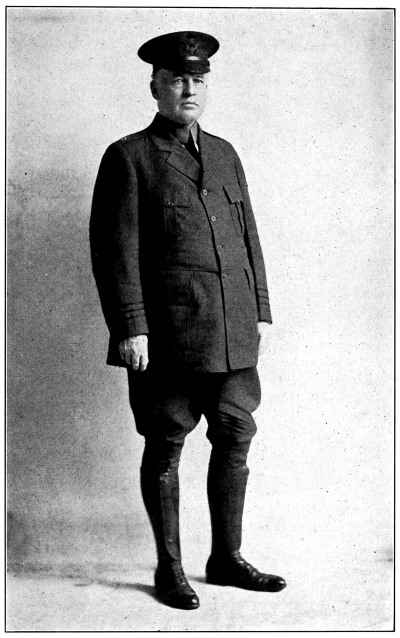
Photo. Harris & Ewing, Washington, D. C.
American Red Cross. Officers’ service uniform
When base hospitals and other organizations recruited, equipped and
trained by the Red Cross are taken over by the Army or Navy for active
service they become a part of such service and wear the uniform
thereof; but officials of the Red Cross assigned to duty with the
military establishments to perform such duties as are assigned to them
under the orders of the Secretary of War are required to wear the
regulation uniform and insignia of the American Red Cross as approved
by the War Department. Such officials have the status of officers
in the Army while so serving at the camps and stations and they are
accredited to the Division Commander and are subject to his authority
and to military laws and regulations.
The authorized uniform for the members of the American Red Cross Field
Service is made of cloth or serge of the same color as that used by the
U. S. Marine Corps for winter field uniforms, the shade being a grayish
olive green known as “forestry-green.”
For the officers, Division Directors of Military Relief and Assistants,
Field Directors of Camp Service, Assistant Field Directors of Camp
Service, Associate Field Directors, Hospital Service, Associate Field
Directors, Home Service, and other Assistants, the uniform consists
of an overcoat, Norfolk jacket, riding breeches, flannel shirt, black
necktie, field hat or cap, grey gloves, and tan leather shoes and
leggings or tan leather field boots.
The coat is a single-breasted, four-buttoned plain Norfolk jacket, of
forestry-green cloth, having a notch collar and soft lapels, the skirts
extending half way from the point of the hip to the bend of the knee,
with a two-inch belt of the same material as the jacket stitched around
the waist and a vent in the center of the back extending from the belt
to the lower edge of the skirt. The jacket has four outside patch
pockets with a two-inch box pleat down the center and a three-pointed
flap fastened at the center by a small button. On each shoulder there
is a strap of the same material as the jacket, let in at the top of the
sleeve seam and reaching to the edge of the collar where it is buttoned
with a small button, the dimensions of the strap being two inches in
width at the shoulder seam and one inch in width at the collar end,
the collar end being rounded. On each shoulder strap is worn a Greek
cross of red cloth or silk embroidery, the cross being three-quarters
of an inch over all and placed with its center one and one-eighth
inches above the shoulder seam. All of the buttons are plain flat green
buttons matching the color of the jacket. The initials A. R. C. in
plain block letters of bronze are worn on each side of the collar one
inch above the notch in the lapel. The various grades of officers are
shown by stripes of black mohair braid sewn around the lower part of
each sleeve of the jacket.
The breeches are of forestry-green cloth cut loose in the thigh and
tight from the knee down, laced or buttoned below the knee with laces
or buttons of the same color as the cloth of the breeches, with strappings
of the same material or of buckskin of a color to match on the inside of
the leg and knee.
The cap is of forestry-green cloth and of the same style and
dimensions as the regulation cap for officers of the U. S. Army, the
band covered with green mohair braid to match the color of the cap, the
visor and chin strap being of dark tan leather and the buttons of plain
bronze. A Greek cross of red enamel is worn on the center of the front
of the cap.
The field hat is the same as that worn by officers of the U. S. Army
and with it the officers of the American Red Cross wear a plain black
hat cord.
The flannel shirt is of the same design as that worn by officers of
the U. S. Army but the color is forestry-green. When the shirt is worn
without the jacket the initials A. R. C. in bronze block letters and a
small enamel red cross are worn on each side of the shirt collar, the
letters being in front. A light weight shirt of madras or cotton of the
same color and style as the flannel shirt may be worn.
The overcoat for officers is a double-breasted sack overcoat of knee
length made of forestry-green cloth. It has a turn-down notched collar
with soft lapels, two horizontal side pockets with straight flaps, and
shoulder straps similar to those on the jacket but slightly larger. On
each of these shoulder straps is worn a Greek cross of red cloth or
silk embroidery. The buttons of the overcoat are plain bone buttons of
a color to match the coat. On each side of the collar one inch above
the notch in the lapel the initials A. R. C. in plain bronze block
letters are worn. The various grades of officers are indicated by stripes
of black mohair braid around the sleeves as in the case of the jacket.
The tan leather shoes, leggings and field boots are the same as those
prescribed for the officers of the U. S. Army.
Insignia of Rank.—The grade or rank of the officers of the American
Red Cross is indicated by stripes of black mohair braid on the lower
part of the sleeves of the jacket, overcoat and field shirt. The
stripes on the sleeves of the overcoat and jacket are each one-quarter
of an inch wide, set one-half of an inch apart, extend entirely around
the sleeve and the lower stripe is two inches from the lower edge of
the cuff. The stripes on the sleeves of the field shirt are of the same
width and are set at the same distance apart but instead of encircling the
sleeve they are two inches long and sewn on the outer side of the sleeve.
The number of stripes for the different grades is as follows:—
| Division Director of Military Relief |
4 stripes. |
| 1st Assistant Division Director of Military Relief |
3 stripes. |
| 2nd Assistant Division Director of Military Relief |
2 stripes. |
| 3rd Assistant Division Director of Military Relief |
1 stripe. |
| Field Director of Camp Service |
3 stripes. |
| Assistant Field Director of Camp Service |
2 stripes. |
| Associate Field Director, Hospital Service |
2 stripes. |
| Associate Field Director, Home Service |
2 stripes. |
| Other Assistants |
1 stripe. |
The uniform for personnel of the American Red Cross other than Field
Directors and Assistants consists of an overcoat, Norfolk jacket,
breeches, flannel shirt, black necktie, field hat, sweater, tan leather
shoes, canvas leggings and grey leather or knit gloves. The overcoat,
jacket, breeches and flannel shirt are made of forestry-green after the
same style and design as those already described for the officers, the
sweaters are knit from forestry-green wool, the canvas leggings are
green in color to match the breeches and the field hat is the same as
that prescribed for officers except that no hat cord is worn.
American Red Cross. Workroom uniform with colored veil
American Red Cross. Motor service uniform
A Greek cross of red cloth is worn on both sleeves of the jacket,
overcoat and shirt four and one-half inches above the lower edge of
the cuff, the cross on the jacket and overcoat being one and one-half
inches over all and that on the shirt one inch over all.
The initials A. R. C. in bronze block letters are worn on both sides
of the collars of the jacket and overcoat and the same initials and
a small enamel red cross are worn on both sides of the collar of the
field shirt when it is worn without the jacket, the initials being
placed in front of the red cross.
The American Red Cross has authorized the wearing of distinctive
uniforms by the women workers engaged in the various Red Cross Chapter
activities, other than nursing and hospital service, in order that
these workers may be readily recognized as such throughout the United
States and also for protective and hygienic reasons. The wearing of
these uniforms is optional on the part of any member entitled to wear
them, but as the right to wear them carries with it the assumption of
responsibility for the organization both efficiency and esprit de
corps should be greatly aided by the use of the uniforms.
Permission to wear these uniforms is granted by the executive committee
of each Red Cross Chapter. No person under eighteen years of age is
granted permission to wear the Workroom uniform, in the Motor and
Clerical service the minimum age is twenty-one years and in the Canteen
service it is twenty-three years. Everyone before being granted a
permit to wear any of the official Red Cross uniforms is required to
take the Oath of Allegiance to the United States.
Elaborate uniforms have been avoided and as far as possible variety has
been eliminated. To distinguish the different corps of workers an apron
and a “coif” or headdress of different colors have been prescribed. For
workrooms the apron is white, for the canteen service it is blue, and
for the clerical service grey, all being of the same pattern.
Workroom Uniform.—For all workers on surgical dressings,
garments and knitted articles. If it is found desirable to distinguish
the workers in different workrooms, a white arm band or a sash marked
in blue letters “Garments,” “Surgical Dressings,” “Knitting” or
“Comforts” may be worn.
Apron.—A large white apron fastening in the back, with sleeves to
the wrist and a V or square neck. The belt is three inches wide and
there are two pockets in the skirt. A red cross, two inches square, may
be worn in front at the center of the base of the neck.
Coif.—A veil of batiste or similar material, cut one yard long and
one yard wide, with a lower hem one inch broad and a hem at the top two
inches broad and turned back on the outside. The color of the veil is
red, white or dark blue. A band of some stiffer material extends around
the head one-half inch from the front hem and a red cross is worn in
the center of the forehead band.
American Red Cross.
Bureau of Information and clerical service uniform
American Red Cross.
Canteen service, outdoor uniform
Instructors on active duty in workrooms wear either a red veil or a
white veil with red band; heads of workrooms wear either a blue veil
or a white veil with dark blue band, and all other workers wear a white
veil with white band. They all wear the customary white apron and red crosses.
Motor Service Uniform.—For workers in the Motor Service
the uniform consists of a long gray double-breasted coat of whipcord or
Oxford cloth, with falling collar and notched lapels, an inverted box
pleat in the back, a belt of the same material and flat buttons to
match; a close fitting hat of the same material as the coat with a
small red cross in the front; a short skirt of the same material as the
coat; tan leather leggings and tan leather shoes. The insignia of the
service is worn on the sleeve of the coat between the elbow and the
cuff. It consists of a white square bearing a motor wheel with a red
cross at the center.
Canteen Service Uniform.—The indoor uniform consists of an
apron of the same style as the workroom apron, of horizon blue color,
with a two-inch red cross at the base of the neck; white collar, white
cuffs bearing a special insignia for these workers, and a veil of
horizon blue bearing the same insignia on the front of the head band.
This special insignia for the Canteen Workers is a woven white shield
with a red cross at the center surrounded by the lettering “A.
R. C. Canteen Worker.” The shield on the head band is two and
one-quarter inches in size and that for the cuff one and one-half inches.
For outdoor work in winter the Canteen Service is provided with a gray
whipcord overcoat and a close fitting gray cloth cap of the Royal
Flying Corps type, the prescribed insignia being worn on the cuffs of
the coat and on the front of the cap, as shown in the illustration.
In summer a plain dark blue or black sailor hat with the insignia on the
front of the band is worn either with or without the veil.
The special insignia for the Canteen Workers is necessary at all times
in order that the wearers may be quickly recognized by commanders of
troop trains and camp organizations.
Bureau of Information and Clerical Service Uniform.—This
uniform consists of an apron of the same pattern as that for the
workroom uniform of gray material and a gray veil. White collar and
cuffs and the red cross on the apron and veil are worn with this
uniform as shown by the illustration.
Uniforms for Ushers and Others.—Ushers and other active
personnel of the Red Cross, such as those engaged in membership
campaigns, are allowed to wear a white badge on which is a red cross or
they may wear a white sash with a red cross on the front.
Nurses’ Uniforms.—The uniforms for female nurses in the Red
Cross hospitals are similar to those worn by such nurses in the Army
and Navy, but the nurses in the base hospitals and other military
hospitals in France are required to wear uniforms of gray material.
American Red Cross.
Canteen service, indoor uniform
CHAPTER XIV CUSTOMS OF THE SERVICES
The rules which govern official and social intercourse among members
of the military and naval services are based upon the well established
customs which prevail in all walks of life, modified only to such
extent as may be required by the peculiar conditions of the services in
order to secure the greatest degree of efficiency and discipline.
In a military sense discipline may be defined as the cheerful,
unquestioned and implicit obedience to the orders from higher authority
in such manner as to secure systematic action and the cooperation of
all of the component parts of a military force whatever its size may
be. This requires a close acquaintance between officers and men, a
mutual respect and confidence between them, and combined with this the
long hours of drill that tend to make obedience second nature and that
harden all physically and bring the whole machine to that high state of
discipline and training that may be termed “the fighting edge.”
To secure the desired end requires such a degree of mutual respect
among all of the personnel that there will never be the slightest
lack of confidence nor hesitation in complying with an order. To many
civilians the military hand salute appears unnecessary and it has even
been proposed in some quarters to abolish such salutes by enactment of
law on the ground that they are not in accord with the spirit of
American institutions. Yet the soldier knows that the salute is but the
outward and visible sign of discipline, that it denotes smartness and
esprit, that it is the patent evidence of alertness and cohesion and
the very antithesis of slouchiness and disaffection.
The regulations of the services are insistent that discipline shall be
enforced with firmness and decision but at the same time with constant
consideration of the rights and feelings of others, whatever their rank
or station may be. Courtesy and politeness are demanded at all times
in the services of the United States and no enforcement of authority
through the “rule of fear” is tolerated.
Strict attention to personal bearing and appearance is an index of
character no less in the military services than in other walks of life,
as the soldier who is not neat and clean when it is possible for him
to be so can rarely be depended upon in a pinch. The best soldiers and
sailors get their “clean shave” every morning when soap and water are
obtainable whether in the security of peace or the stress of wartime.
As one fine soldier expressed it, “We try to live clean, fight clean,
and if need be we’ll die clean.”
Salutes.—On shore salutes are exchanged between officers and between
officers and enlisted men not in military formation, nor at drill,
work, games or mess, on every occasion of their meeting, passing near
or being addressed, the officer who is junior in rank or the enlisted
man always saluting first and the senior always promptly returning the
salute.
Upon the entry of an officer into a room where there are several
enlisted men some one of them who sees him calls “Attention,” whereupon
all rise and stand at attention until the officer leaves the room or
orders otherwise. If at meals enlisted men stop eating and remain
seated and quiet. Officers and enlisted men if seated, rise upon the
approach of a senior officer, face toward him and salute, and if
standing they face toward the senior and salute. Soldiers do not stop
work upon the approach of an officer unless addressed by the officer.
Before addressing an officer an enlisted man salutes and also salutes
again after receiving the reply of the officer.
No salutes are rendered by men on guard duty over prisoners if it will
interfere with the execution of their duty.
Officers or enlisted men passing the uncased colors always salute.
No salutes are rendered when troops are marching in double time or at
the trot or gallop when mounted.
When an officer or enlisted man is mounted and has a communication to
make to a senior who is dismounted the junior dismounts before saluting
and delivering his message, except during field maneuvers or campaigns
where time might be lost in doing so.
It should be noted that in all cases both the junior and the senior
salute, but that military courtesy requires the junior to salute first.
No salutes are exchanged between enlisted men but it is customary for
enlisted men to stand at attention when addressed officially by other
enlisted men who are their seniors in rank.
If an enlisted man is in a military formation and is personally
addressed by an officer he does not salute, but if not already standing
at attention he comes to that position at once.
The distance within which salutes are rendered, known as “saluting
distance,” is taken to be that within which the uniform and insignia
of an officer is readily distinguishable, normally about thirty paces,
one pace being thirty inches, and salutes are generally exchanged at a
distance of about six feet.
In railway trains, street cars, theaters and public buildings where
salutes would be manifestly inappropriate or where the observance of
the rules regarding saluting would be apt to interfere with civilians
present salutes are usually not rendered.
Officers and enlisted men in civilian clothing exchange salutes in the
same manner as if wearing uniform, but no officer in civilian clothes
is saluted with cannon or has a guard of honor turned out and paraded
in his honor.
The same salutes are given by all officers and enlisted men of the
military and naval forces to officers of foreign armies and navies.
On board ships of the Navy officers and enlisted men while on board
their own ship salute their captain on every occasion of meeting,
passing near or being addressed by him. They salute all officers who
are their senior in rank on the occasion of their first daily meeting
or passing near and upon being addressed by the senior officer, and at
other times during the day they stand at attention instead of saluting.
Officers from other ships are saluted on each occasion of meeting or
passing near.
When in uniform officers and enlisted men should salute ladies with the
military hand salute and the headdress should not be removed for this
purpose when out of doors.
The Navy Regulations require that all boats
from men-of-war shall exchange salutes when passing each other in
accordance with the following table, which covers all of the various
conditions likely to arise.
BOAT SALUTES.
| |
Rank or rate of the senior in the saluting boat. |
Rank of the senior officer in the boat to be saluted. |
Flag or general officer (with flag flying). |
Commanding officer above rank of lieutenant (with pennant flying). |
Other commissioned officer. |
Midshipman or warrant officer. |
Flag or general officer. |
Junior salutes with hand. |
|
|
|
Commanding officer above rank of lieutenant (with pennant flying). |
Stops engine, lays on oars, and salutes with hand. |
Junior salutes with hand. |
|
|
Other naval officer below flag rank and above rank of lieutenant,
and marine officers of corresponding rank. |
Stops engine, lays on oars, and salutes with hand. |
When meeting a senior commanding officer, or immediate
commanding officer, stops engine, lays on oars, and salutes with hand. |
Junior salutes with hand. |
|
Other commissioned officers. |
Stops engine, tosses or trails oars, and salutes with hand. |
Stops engine, lays on oars, and salutes with hand. |
Junior salutes with hand. |
|
Midshipman or warrant officer. |
Stops engine, tosses or trails oars, and salutes with hand. |
Stops engine, lays on oars, and salutes with hand. |
Salutes with hand. |
Junior salutes with hand. |
Officer and coxswain in loaded or towing boat or boat under sail. |
Salutes with hand. |
Salutes with hand. |
Junior salutes with hand. |
Junior salutes with hand. |
Coxswain. |
Stops engine, tosses or trails oars, stands, and salutes with hand. |
Stops engine, lays on oars, stands, and salutes with hand. |
Stands and salutes with hand. |
Salutes with hand. |
| |
The starboard gangway ladder is used habitually by officers and their
visitors when going on board of a man-of-war or departing therefrom,
and the port gangway is used by all other persons. In other words the
starboard gangway may be considered the “front door” of a ship. Yet
whenever circumstances render it advisable or necessary an exception
may be made to this rule by the commanding officer’s order.
Upon reaching the quarterdeck from a boat, from a gangway or from
the shore, or from any other part of the ship, officers and men face
the colors, stand at attention and salute the colors; and the same
procedure is followed upon leaving the quarterdeck.
After saluting the colors upon arriving on the quarterdeck and just
before saluting the colors upon leaving the quarterdeck, officers and
enlisted men salute the officer of the deck, and the officer of the
deck returns both the salute to the colors and the salute to him.
Officers coming on board usually, after saluting the officer of the
deck, say, “I request permission to come aboard, sir,” and briefly
state their business; and after saluting the officer of the deck upon
leaving the ship they say, “I request permission to leave the ship,
sir.” The same procedure should be followed by civilians visiting a
ship except that no salutes to the officer of the deck are required.
Strict observance of military custom demands that an officer in uniform
and under arms, that is carrying the weapon with which he is armed or
wearing his belt and sword, should not remove his headdress either out
of doors or within doors; but in deference to the universal custom
among civilians it is considered proper for officers in uniform and
wearing their swords sheathed to remove their headdress when entering
a room, especially in case there are ladies present. Under such
circumstances the headdress is carried under the left arm, leaving the
right hand free to shake hands. With the sword drawn and in hand the
headdress should not be removed from the head.
The pedantic observance of so-called military customs is both
unnecessary and objectionable, and the safest course is follow the
rules of deportment which distinguish the gentleman the world over.
Following the universal custom the right side is considered the
position of honor and hence when two or more officers are walking or
riding in company the senior walks or rides on the right, and likewise
the senior occupies the seat at the right side in a carriage or other
conveyance.
Visits and Courtesies.—An officer arriving at the headquarters of
a military command calls upon the commander as soon as practicable
and registers his name, address and probable length of stay. If the
visiting officer is senior in rank to the commander he may send his
card and address, in which case it becomes the duty of the commander
to make the first call. When an Army officer arrives at Washington, D.
C., he reports at the office of the Adjutant General of the Army, and
registers his name, local address and business in Washington. Naval
officers under similar circumstances register at the Navy Department
and Marine officers at the Headquarters of the Marine Corps.
After reporting for duty at a station on shore or aboard ship an
officer makes a social call upon the commanding officer who returns
the call promptly. In the case of other officers at the post it is
the custom for all of those already at the station to call upon the
late arrival, thus following the American and not the European custom
in this respect. In addition to the social call upon the commanding
officer the arriving officer also makes a call upon any officer at
the station or on board of the ship who is senior to the commanding
officer, as in the case of a general officer at an Army station or a
flag officer on board of a ship.
In the case of the arrival of a ship in a foreign port calls are
interchanged according to well established international rules between
the senior officer of the ship or ships arriving and those already
stationed at the port. The general rule is that if the two officers are
of the same grade the latest arrival makes the first call, but if they
are of different grades the junior makes the first call. The arriving
officer, however, always makes the first call upon the highest civil
official ashore at a foreign port.
Upon the arrival of a United States fleet, squadron or single ship at a
foreign port, the senior naval officer exchanges calls with diplomatic
and consular officers who may be stationed there according to the
following rules:—
A flag officer or commodore pays the first visit to diplomatic officers
of or above the rank of chargé d’affaires and receives the first
visit from consular officers.
A commanding officer pays the first visit to diplomatic officers of
or above the rank of chargé d’affaires and to a consul general and
receives the first visit from all other consular officers.
It will readily be seen that all of these rules and conventions are
devised for the purpose of avoiding friction or misunderstanding and to
secure efficiency and smoothness in the official and social relations
between officers and officials of different services and nationalities.
CHAPTER XV HONORS AND DISTINCTIONS
The honors and distinctions shown to the National Flag, to the
President and other high Government officials, to the National Anthem
and to the officers of the various ranks in the different services
composing the Armed Forces of the United States are prescribed in the
U. S. Army Regulations and the U. S. Navy Regulations, which are issued
by the Secretaries of War and the Navy by authority of the President of
the United States.
At Army Posts and Stations the National Flag is hoisted at sunrise and
lowered at sunset and on board ships of the Navy the National Flag is
hoisted at 8 a. m. and lowered at sunset, these occasions being known
as “Morning Colors” and “Evening Colors.”
While the National Flag is being hoisted and lowered all officers and
enlisted men stand at attention facing the flag, if in uniform and
covered they stand at the salute during the hoisting or lowering of
the flag and if in civilian dress covered, they uncover and hold the
headdress opposite the left shoulder. The latter form of salute is the
correct one for all civilians who desire to so honor the flag of their
country.
When passing the National Flag flown at an Army post or on board a
ship of the Navy, the flag is saluted with the “right hand salute” or
if arms are carried in hand, with the prescribed salute for the arm
carried. The same honor is accorded to the flag when it is carried past
by any organization of the military or naval forces. The same honor
is accorded by members of the military and naval forces of the United
States to the flags of other nations under like circumstances.
When a band is present at morning or evening colors the National Anthem
is played during the hoisting and lowering of the colors, and when
ships of the navies of other nations are in the same port the national
anthem of those nations is also played by the bands of ships of the
United States Navy.
The National Anthem of the United States of America is the
composition consisting of the words and music known as “The Star
Spangled Banner,” which was officially designated as such by the
President of the United States on August 23, 1916.
For many years of its existence as a nation the United States of
America had no officially recognized national anthem although various
national songs and airs attained widespread popularity. During the
Revolution “Yankee Doodle” and “The World Turned Upside Down” were
popular military airs and the former still survives to some extent as a
national song.
In 1832 the Reverend Samuel Francis Smith, a Baptist minister of
Boston, wrote the song entitled “My Country, ’Tis of Thee” and it was
set to the music of the British National Anthem, “God Save the King,”
and widely published in prayer books as the American National Hymn.
This has led many people to believe that it was the official National
anthem; however this is not the case, as it never received any official
recognition as such.
During the Civil War, 1861 to 1865, there were a number of airs that
reached great popularity among the soldiers and sailors of both sides,
the most stirring of these airs being “The Battle Hymn of the Republic”
in the North and “Dixie” in the South.
The Navy Regulations of 1890 prescribed that “The Star Spangled Banner”
should be played by the bands at morning colors and “Hail, Columbia” at
evening colors, thus giving an official standing to both airs.
In the Navy Regulations of 1893 and the Army Regulations of 1895 “The
Star Spangled Banner” was prescribed for use at colors and came to
be officially recognized as the National Air, but it was not until
the President’s order of August 23, 1916, that it became the official
National Anthem.
By the order of the President the honors shown to the National Anthem
are prescribed in the U. S. Army Regulations as follows:
Whenever the National Anthem is played at any place when persons
belonging to the military services are present, all officers and
enlisted men not in formation shall stand at attention facing toward
the music (except at retreat, when they shall face toward the flag). If
in uniform, covered, they shall salute at the first note of the anthem,
retaining the position of salute until the last note of the anthem. If
not in uniform and covered, they shall uncover at the first note of the
anthem, holding the headdress opposite the left shoulder and so remain
until its close, except that in inclement weather the headdress may be
held slightly raised.
The same rules apply when “To the Color” or “To the Standard” is
sounded as when the National Anthem is played.
When played by an Army band, the National Anthem shall be played
through without repetition of any part not required to be repeated to
make it complete.
The same marks of respect prescribed for observance during the
playing of the National Anthem of the United States shall be shown
toward the National Anthem of any other country when played upon
official occasions.
The U. S. Navy Regulations prescribe the same honors whenever the
National Anthem is played on board a vessel of the Navy, at a Naval
Station or at any place where persons belonging to the naval service
are present.
Civilians wishing to pay the proper honor to the National Anthem should
stand at attention whenever present at any place where the National
Anthem is played and if covered they should remove the headdress and
hold it opposite the left shoulder while standing at attention during
the playing of the music.
When the President of the United States visits a Fort or Station of the
United States Army he is received with the command formed in line under
arms, the national colors and regimental standards being carried by the
troops, officers and men saluting with the “Present arms,” the band
playing the National Anthem followed by four ruffles of the drums and
four flourishes of the bugles.
An ex-President and Vice President of the United States are received
with the same honors except that the band plays a march instead of the
National Anthem.
The President of a foreign republic or the sovereign or a member of the
royal family of a foreign country is received with the same honors as
the President of the United States except that the National Anthem of
his country will be played by the band.
Members of the President’s Cabinet, the Chief Justice, the President
pro tempore of the Senate, the Speaker of the House of Representatives,
American and foreign Ambassadors and Governors (within their respective
states or territories) are received with the same honors as the Vice
President except that the number of ruffles and flourishes is three.
General Officers of the Army or Marine Corps and Flag Officers of the
Navy are received with the national colors and regimental standards,
officers and men saluting with the “Present arms,” the band playing a
march followed by ruffles and flourishes of the drums and bugles, the
number of ruffles and flourishes depending upon the rank of the officer
being received, as follows:
General or Admiral—four ruffles and flourishes.
Lieutenant General or Vice Admiral—three ruffles and flourishes.
Major General or Rear Admiral—two ruffles and flourishes.
Brigadier General or Commodore—one ruffle and flourish.
In addition to the above honors salutes with cannon are fired upon the
arrival and departure of the President of the United States and the
president or sovereign or a member of the royal family of a foreign
country; and upon the arrival of other officials and military and naval
officers in accordance with their rank as follows:
The President of the United States, or the President or sovereign
or member of the royal family of a foreign country |
21 guns |
An ex-President of the United States or the Vice President |
21 guns |
Ambassadors, members of the Cabinet and the president pro tempore of the Senate |
19 guns |
The Chief Justice, the Speaker of the House of Representatives, a
Committee of Congress, Governors within their respective states or
territories, a Governor General and the Governor of the Philippine Islands |
17 guns
|
The Assistant Secretary of War, the Assistant Secretary of the Navy,
the Vice-Governor of the Philippine Islands, an Envoy Extraordinary or
Minister Plenipotentiary |
15 guns |
A Minister Resident |
13 guns |
A Charge d’Affaires |
11 guns |
A Consul-General to the United States |
11 guns |
Admiral of the Navy |
19 guns |
General or Admiral |
17 guns |
Lieutenant General or Vice Admiral |
15 guns |
Major General or Rear Admiral |
13 guns |
Brigadier General or Commodore |
11 guns |
Officers of foreign armies and navies are received with the same honors
as those tendered to officers of like rank in our own services.
At every Army post provided with suitable artillery a cannon salute
of twenty-one guns, known as a “National salute,” is fired at noon on
Washington’s Birthday, February 22nd, and on Memorial Day, May 30th,
and on Independence Day, July 4th, a salute of one gun for each state
in the Union is fired.
The honors and ceremonies to be observed when the President of the
United States or the president or sovereign of another country, or a
lesser official entitled to such honor visits a ship of the U. S. Navy
are given in the following table from the U. S. Navy Regulations.
These honors are decided by international custom and are practically
the same in all of the navies of the world and a strict observance
of them is necessary to avoid any occasion for international
misunderstanding that might arise from an omission of any customary
honor or salute.
In addition to the gun salutes described in the above table a National
salute, twenty-one guns, is fired by every ship in the Navy at noon on
Independence Day, July 4th, Washington’s Birthday, February 22nd, and
Memorial Day, May 30th.
| |
| Rank |
Uniform |
Salute |
Guns |
Ruffles |
Guard |
Music |
Side
honors |
Flag |
| Arrival |
Departure |
| President |
S.F.D. |
1 |
1 |
21 |
4 |
Full |
National
Anthem. |
Yards or rail mannned and 8 S. boys. |
President’s, at main, during visit.
National, at main, during visit
National, at main during salute. |
President of foreign Republic or a foreign sovereign |
do. |
1 |
1 |
21> |
4 |
do. |
do. |
Member of royal family |
do. |
1 |
1 |
21 |
4 |
do. |
March. |
| Ex-President |
do. |
1 |
1 |
21 |
4 |
do. |
March. |
8 S. boys. |
National, at main, during salute in foreign countries. |
| Vice President |
do. |
|
1 |
19 |
4 |
do. |
do. |
do. |
National, at fore, during salute. |
| Ambassador |
do. |
|
1 |
19 |
4 |
do. |
National
Anthem. |
do. |
Do. |
Secretary of the Navy |
Dress |
1 |
1 |
19 |
4 |
do. |
March. |
do. |
Secretary’s, at main, during visit. |
Assistant Secretary of the Navy |
Dress |
1 |
1 |
17 |
4 |
do. |
do. |
do. |
Asst. Secretary’s, at main, during visit. |
| Cabinet officer |
do. |
|
1 |
19 |
4 |
do. |
do. |
do. |
National, at fore, during salute. |
| Chief Justice |
do. |
|
1 |
17 |
4 |
do. |
do. |
do. |
Do. |
Governor general, United States islands |
do. |
|
1 |
17 |
4 |
do. |
do. |
do. |
Do. |
Governor of State, Territory or U. S. islands |
do. |
|
1 |
17 |
4 |
do. |
do. |
do. |
Do. |
President pro tempore of the Senate |
do. |
|
1 |
19 |
4 |
do. |
do. |
do. |
Do. |
Speaker of the House of Representatives |
do. |
|
1 |
17 |
4 |
do. |
do. |
do. |
Do. |
| Committee of Congress |
do. |
|
1 |
17 |
4 |
do. |
do. |
do. |
Do. |
| Envoy extraordinary |
do. |
|
1 |
15 |
3 |
do. |
do. |
do. |
Do. |
Minister resident or “diplomatic representative” |
do. |
|
1 |
13 |
2 |
do. |
do. |
6 S. boys. |
Do. |
| Charge d’affaires |
do. |
|
1 |
11 |
1 |
do. |
do. |
do. |
Do. |
| Consul general |
Of the day |
|
1 |
11 |
|
Day |
|
do. |
Do. |
First secretaries of embassies or legations |
do. |
|
|
|
|
|
|
4 S. boys. |
Do. |
| Consul |
do. |
|
1 |
7 |
|
Day |
|
do. |
Do. |
Vice consul or consular agent (where he is the
only representative of the United States) |
do. |
|
1 |
5 |
|
do. |
|
do. |
Do. |
| Admiral of the Navy |
Dress |
|
1 |
19 |
4 |
Full |
March |
8 S. boys. |
In case of foreign officers, national,
at fore, during salute. |
| Admiral |
do. |
|
1 |
17 |
4 |
do. |
do. |
do. |
| General |
| Vice admiral |
do. |
|
1 |
15 |
3 |
do. |
do. |
do. |
| Lieutenant general |
| Rear admiral |
do. |
|
1 |
13 |
2 |
do. |
do. |
6 S. boys. |
Major general (Army or Marine Corps) |
| Commodore |
do. |
|
1 |
11 |
1 |
do. |
do. |
do. |
Brigadier general (Army or Marine Corps) |
Chief of staff, if not a flag or general officer |
Of the
day |
|
|
|
|
Day |
|
4 S. boys. |
| Captain |
If
commanding
officers |
Of the day |
|
|
|
|
Day |
|
4 S. boys. |
| Colonel |
| Commander |
Lieutenant
Colonel |
Lieutenant
commander |
do. |
|
|
|
|
do. |
|
2 S. boys. |
| Major |
All other commissioned officers below
lieutenant commander and major |
do. |
|
|
|
|
|
|
do. |
| |
Abbreviations.
S. F. D.—Special Full dress.
S. boys.—Side boys who stand at either side of
the head of the gangway or ladder by which the official comes aboard of
the ship.
When a ship of the Navy is in a port of a foreign country upon the
National holiday of that country a salute of twenty-one guns is fired
at noon on that day.
In accordance with established military courtesy salutes are exchanged
between officers and between officers and enlisted men not in a
military formation, nor at drills, at work, engaged in playing athletic
games or at meals, on every occasion of their meeting or passing or
being addressed by a senior, the officer who is junior in rank or the
enlisted man saluting first, and the officer senior in rank returning
the salute.
When the officer or enlisted man is not bearing arms of any kind in his
hands he salutes with the right hand by bringing the hand smartly up to
the visor of the cap above the right eye, fingers closed, hand, wrist
and forearm straight, palm of the hand to the left and right forearm at
an angle of forty-five degrees, and then dropping the arms to the side.
The distance within which salutes are required is that within which
recognition is easy, usually considered to be about thirty paces
(twenty-five yards).
When troops of the Army, Navy and Marine Corps are reviewed by the
President of the United States or by any official or officer entitled
to review them, they march past the reviewing officer with the bands
playing a suitable march, the colors and standards saluting, officers
and enlisted men rendering the marching salute and the drummers and
buglers sounding the ruffles and flourishes appropriate to the rank of
the reviewing officer.
The salute with the colors and standards is made by drooping them to
the front. The marching salute for officers and enlisted men is made by
turning the head and eyes toward the person to be saluted and is known
as “eyes right” or “eyes left,” depending upon whether the position
of the reviewing officer is to the right or left of the column as it
passes in review, officers also salute with the sword by bringing it up
and to the front until the hand grasping the hilt is opposite the chin
and then sweeping the hand and sword down and to the right.
Many of the regiments of the Army have distinctive marches which are
played when passing in review but no distinctive march has ever been
adopted for the Army as a whole.
The march usually played by the bands of the sailor regiments of the
Navy when passing in review is “A Life on the Ocean Wave,” and that
played by the bands of the Marine Corps under the same circumstances is
“Semper Fidelis,” the title of the march being the motto of the Marine Corps.
THE NATIONAL ANTHEM
“THE STAR SPANGLED BANNER”
Written by Francis Scott Key while a prisoner on board the British Ship
Surprise during the bombardment of Fort McHenry near Baltimore during
the War of 1812.
Oh, say, can you see, by the dawn’s early light,
What so proudly we hailed at the twilight’s last gleaming.
Whose broad stripes and bright stars, thro’ the perilous fight,
O’er the ramparts we watched, were so gallantly streaming?
And the rockets’ red glare, the bombs bursting in air,
Gave proof thro’ the night that our flag was still there.
Oh, say, does that star-spangled banner yet wave
O’er the land of the free and the home of the brave?
On the shore dimly seen thro’ the mists of the deep,
Where the foe’s haughty host in dread silence reposes.
What is that which the breeze, o’er the towering steep,
As it fitfully blows, half conceals, half discloses?
Now it catches the gleam of the morning’s first beam.
In full glory reflected now shines on the stream;
’Tis the star-spangled banner; oh, long may it wave
O’er the land of the free and the home of the brave!
And where is the band who so vauntingly swore
That the havoc of war and the battle’s confusion
A home and a country should leave us no more?
Their blood has washed out their foul footsteps’ pollution.
No refuge could save the hireling and slave
From the terror of flight or the gloom of the grave:
And the star-spangled banner in triumph doth wave
O’er the land of the free and the home of the brave.
Oh, thus be it ever when freemen shall stand
Between their loved home and wild war’s desolation;
Blest with vict’ry and peace, may the heaven-rescued land
Praise the Power that hath made and preserved us a nation.
Then conquer we must when our cause it is just,
And this be our motto: “In God is our Trust!”
And the star-spangled banner in triumph shall wave
O’er the land of the free and the home of the brave.
THE END