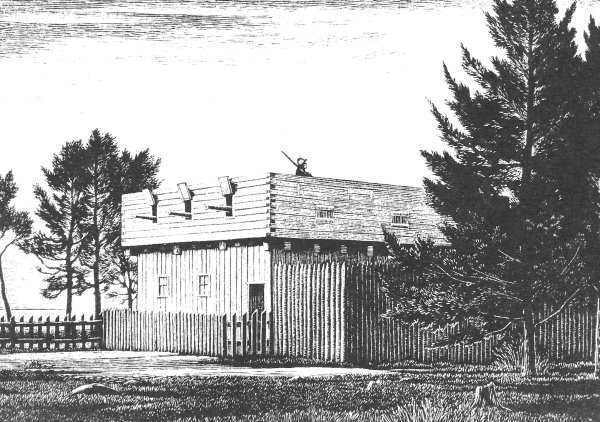
The projectile arms of the Pilgrims were their most important weapons.
The American Indian usually preferred to do battle against Europeans
in loose formation and at long range, resorting to hand-to-hand combat
only in surprise attacks or when he believed that the enemy had been
sufficiently decimated and disorganized by his sniping tactics. In
addition to their value in warfare, projectile arms were also important
in providing the settlers with fresh meat. For these reasons, the
evolution of design in such weapons was swifter and more striking than
in any other form of military equipment.
The most common type of firearm that came to America on the
Mayflower was the musket. This was a smooth-bored weapon,
usually slightly more than five feet long with a caliber ranging
between .69 and .80. The majority of those that the original settlers
brought with them were matchlocks. They were fired by pressing the
lighted end of a slow match made of a loosely woven rope soaked
in nitre into the powder in the priming pan. This was effected by
fastening a length of the match to a forked holder known as the
serpentine on the outside of the lock which corresponded to the hammer
on a modern gun. Pressure on the trigger caused the serpentine to swing
in an arc toward the priming pan, thus bringing the match into contact
with the powder.
Although the mechanism was simple, the loading of a matchlock was a
long and complicated procedure. After having fired his musket, the
first task of the soldier was to remove his match (which according to
regulations was lighted at both ends) so that he would not accidentally
ignite any of his powder. To do this he loosened the thumb screw
which clamped the match in the fork of the serpentine and grasped
the cord with his left hand, holding one of the lighted ends between
his second and third fingers and the other end between his third and
fourth fingers. Then, seizing the barrel of the gun with the thumb
and forefinger of the same hand, he would hold it while he loaded.
Having thus prepared the piece to receive the charge, he would use his
right hand to open one of the wooden cylinders on his bandolier or the
nozzle of his powder flask, depending on which he carried, and pour the
contents down the barrel. Next came a ball from his pouch or from his
mouth if it was during an action, and finally, a wad of tow or paper.
All this was forced home with a rammer. Then he would prime the piece
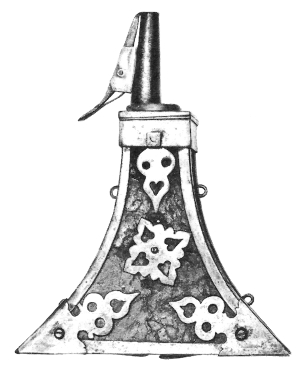
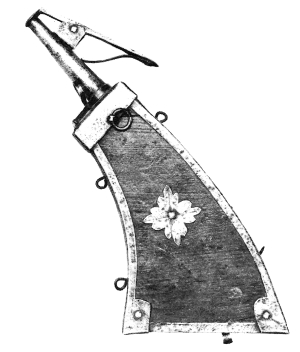
by filling the flash pan with fine-grained powder from a little flask
which was suspended from his belt, close the pan cover, and carefully
blow away any loose powder.
The gun was then loaded, but several actions were still necessary
before it could be fired. The match had to be returned to the
serpentine and adjusted. The coal on its end had to be blown into
activity. If the gunner was forced to wait any length of time before
firing, he had to change the adjustment of the match continually to
insure that it would strike the pan and also to prevent it from burning
down to the serpentine and going out. If it did go out, he relighted it
from the coal at the other end of the match which was kept burning for
that purpose.
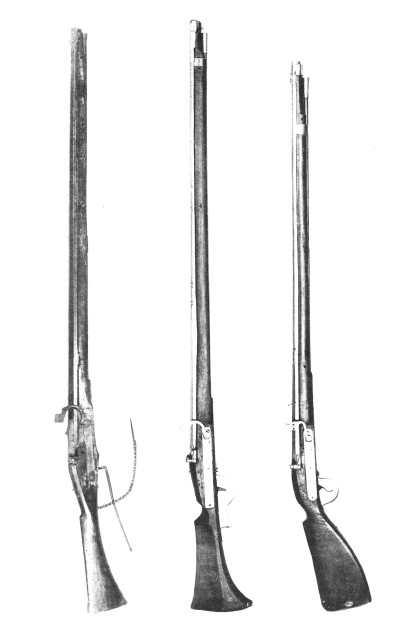
Three matchlock muskets. From left to right: An
Italian musket, 1580-1610 believed to have been used at Plymouth before
1637 when it was sold to a nearby garrison house; German musket,
1600-1630; German musket, 1640-1670.
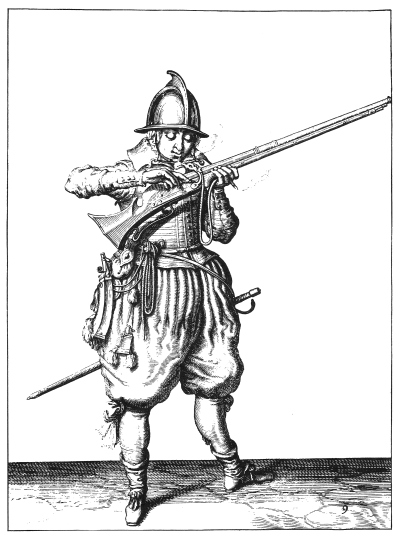
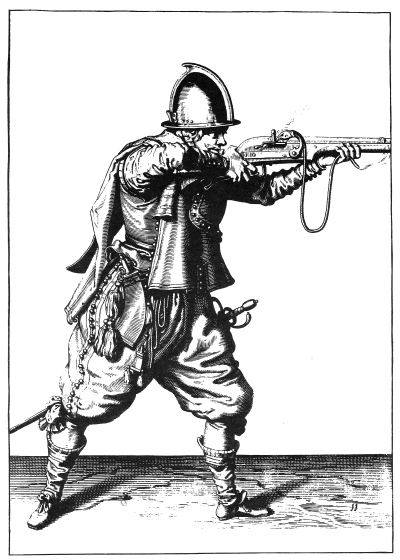
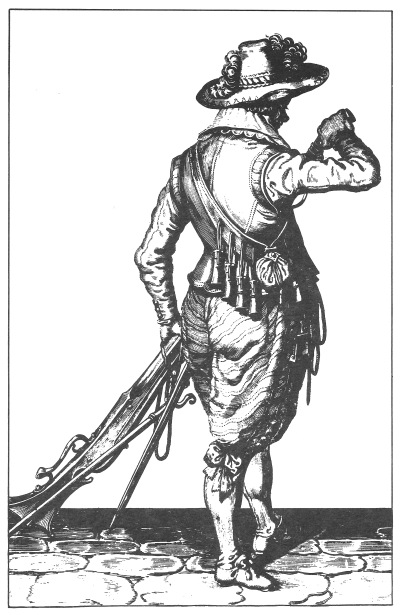
Soldier blowing on his match to make the coal glow
well before firing.
From De Gheyn.
From this it may be seen that the matchlock was in many ways inferior
to the Indian’s bow. Its chief advantage lay in the panic produced
by the flash, smoke, smell and noise of the explosion of the charge.
Also, a gun could be loaded with several bullets and wound a number of
enemies at one time. The ball from a matchlock musket was superior to
an arrow in the size of the hole it tore, the bones it smashed, and
the amount of blood it spilled. The bow was superior in accuracy and
rapidity of fire. Moreover, it was light and easy to carry while the
gun was heavy and clumsy. The bow was constantly ready for use except
perhaps during a long rain, while the slow-match required, in the best
of weather, constant attention to keep it burning; and in dampness,
rain, and wind, it was useless. The light from the match also prevented
ambush at night, and the smell forestalled a surprise attack in the day
time unless the foe happened to be up-wind.
Although matchlocks were the dominant type of weapon brought over
on the Mayflower, there were also a few flint arms. Modern
authorities differentiate between the true flintlock and its more
primitive or regional forms, the snaphaunce, the English lock, the
so-called “dog” lock, the Baltic lock, and the miquelet. These
distinctions are purely modern, however. The contemporary writers
called all firearms which ignited the powder by striking flint against
steel “snaphances.” Thus it is impossible to determine at this date
exactly what form of flint arm is referred to in a given instance, and
so a generic term must be used.
Flint arms were much more efficient than matchlocks. They were faster,
more dependable, and less cumbersome. The powder in the priming pan
was ignited by striking a piece of flint held by the cock against a
piece of steel, called the frizzen or battery. The frizzen was poised
directly over the pan so that the sparks produced by the contact of the
flint and steel would drop into the powder. Flint arms could function
in ordinary dampness and even in a light rain. There was no match to
light and keep free from ash in advance of any expected action. And
since there was no match, there was no light or smell to betray an
ambush.
It is difficult to determine exactly when flint arms superseded
matchlocks as the standard military firearm at Plymouth. There were
a few flint arms in the Mayflower in 1620, for flints are
specifically mentioned among the military stores on board. Miles
Standish, a professional soldier, naturally had the best weapon
available. Edward Winslow, in describing the first encounter between
the colonists and the Indians, noted that Standish with his “snaphance”
and one or two other Pilgrims, who were apparently equipped with flint
arms, fired at the Indians and held them at bay while a brand from the
fire was carried to the others so they could light their matches.
For the first ten years the supremacy of the matchlock was probably not
seriously threatened. From 1630 until the outbreak of King Philip’s
War in 1675, however, the change is plainly visible. There are more
references to matches than to flints in inventories and court records
until the beginning of the Pequot War, but the tales of snap-shooting
increase, and during the war the stories of ambushes and surprise
attacks throughout New England indicate that flint arms were becoming
more plentiful. In 1643 the Plymouth General Court ordered that every
soldier should be supplied with either a matchlock or a “snaphance.” By
1645 Governor William Bradford could report that the Plymouth troops
had been sent to a muster at Seacunk “well armed all with snaphance
peeces.” In 1645, also, while matchlocks were allowed for private arms,
the Plymouth General Court allowed only “snaphances” or “firelocks” for
Town arms.
With the coming of King Philip’s War, the era of the matchlock at
Plymouth was definitely past. The campaigns of that war, forays into
the wilderness, night attacks, ambushes, battles in the rain, and
encounters between individuals which required snap-shooting indicate
clearly that the “snaphance” was the principal weapon. In 1677, towards
the end of the war, the Plymouth General Court outlawed the matchlock
completely as an acceptable weapon. In abandoning matchlocks at this
time, Plymouth was years ahead of Europe where the clumsy firearm
persisted until after 1700.
In addition to the matchlock and flint arms in general use, there were
undoubtedly a few wheel lock arms in Plymouth. The wheel lock was the
second ignition system chronologically, having been developed shortly
after 1500. It was an efficient system, operating much like a modern
cigarette lighter with the spark produced by holding a piece of pyrites
against a revolving rough-edged wheel. The wheel lock, however, was an
expensive weapon, costing twice as much as a matchlock and half as much
again as a flint arm. This did not necessarily preclude its purchase
by the Pilgrims since those colonists were not so apt to economize
on something which affected their life expectancy as closely as did
their firearms. There are no records which state positively that there
were wheel locks at Plymouth, and no authentic wheel lock used there
has survived. The term “firelock” which is used occasionally in the
documents very often was used to denote a wheel lock, and in the case
of the 1646 order mentioned above, it almost certainly had that meaning.
The Pilgrims also brought two other principal kinds of hand firearms
with them, the fowling piece and the pistol. The fowling piece, or
birding piece as it was often called, was usually a huge gun. In 1621
Edward Winslow wrote from Plymouth to prospective colonists in England
and advised them concerning their needs. Regarding these fowlers, he
counseled, “Let your piece be long in the barrel; and fear not the
weight of it, for most of our shooting is from stands.” This was in
keeping with the best contemporary sporting theory which contended
that barrels five and a half or six feet long would increase the range
of the gun and produce a flatter trajectory for the bullet. Such guns
were almost always flint arms, although there may have been a few wheel locks.
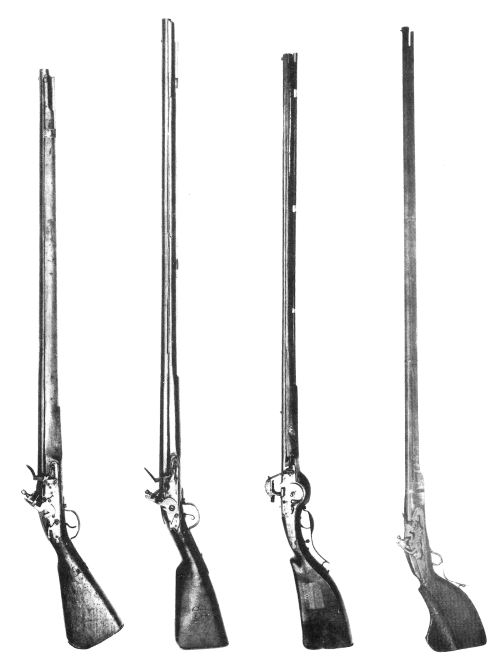
A flint musket with the so-called dog lock, about
1637; a later flintlock musket, about 1690; a wheel lock musket,
1620-1650; the long fowler which belonged to John Thompson.
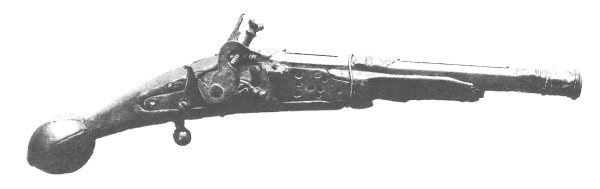
John Thompson’s “dog lock” pistol.
Fortunately one such fowling piece which belonged to a Plymouth
settler, John Thompson, has survived, and is preserved in the Old
Colony Historical Society Museum at Taunton, Massachusetts. It is
88½ inches long with a 73½ inch barrel of .84 caliber. The lock is a
primitive form of flintlock known to collectors today as an “English
lock.” The stock is oak and was undoubtedly made in this country.
In addition to their long guns, the Plymouth settlers also brought
some pistols. Inventories of their estates contain listings of such
hand guns, including one “double pistol.” All the pistols would have
been either wheel locks or flint arms. The matchlock was almost never
used for pistols by Europeans, although it is frequently found on
Oriental hand guns. Once more it is a weapon of John Thompson that has
survived to show what at least one of the Plymouth pistols looked like.
Preserved in Pilgrim Hall, it is a most interesting weapon. Many of the
pieces are missing from the lock, but enough survive to indicate it
was the type of flintlock that is often called a “dog lock” by modern
collectors because of the little dog catch which held the cock in
the half-cock position. The barrel is brass with interesting moulded
decorations, and the wooden stock has a butt closely resembling those
found on many wheel lock pistols of the first quarter of the 17th century.
These were the kinds of firearms which the Plymouth colonists used
in the years from 1620 till 1690. Before leaving the subject, however,
it would be well to mention one form which was not used but which
has become intimately associated with the Pilgrims in popular
imagination—the blunderbuss. This colorful weapon with the flaring
muzzle was developed on the Continent of Europe about the middle of
the 17th century, some thirty years after the Mayflower landed
at Plymouth. It was some years later before it reached England.
As a weapon, it was a highly specialized arm. The flared muzzle
was designed to spread the shot in a wide pattern and thus do as
much damage as possible to a closely packed group of enemies at
comparatively short range. It was of no use against scattered foes at a
distance. Actually, it was the direct ancestor of the modern riot gun
or the shot gun used by prison guards. It was not popular in America
until about 1700 when the growth of cities and increasing population
created here the conditions under which it was effective.