Any line dividing what has here been termed a Transition Age from
the age of fully-developed plate-armour must of necessity be a purely
arbitrary one. Roughly speaking, the age of plate commenced when
mail no longer formed the outer defence of any part of the body. The
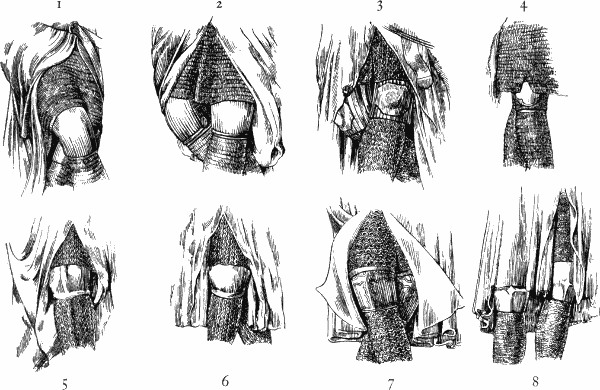
last chink, leaving the mail exposed under the armpit, was a vulnerable
opening in the armour called the “vif de l’harnois,” or the “defaut de la
cuirasse”; and even this now became protected by small plates of steel
called gussets. The necessity for such defences was often proved in
tournaments: it is related that the lance pierced “au vif de l’harnois”
for lack of the crescent or “gouchet.” When these last plates were added
the knights appeared more invulnerable than Achilles. We find at
almost every period, however, that a fair blow delivered “au pas de charge”
with a well-steeled lance might penetrate every defence; and that no
armour could be made actually proof against downright blows from a
two-handed battle-axe wielded by a powerful and expert rider.
One of the most marked characteristics of this age of plate-armour
was a growing appreciation of the intrinsic beauty of steel, and a new
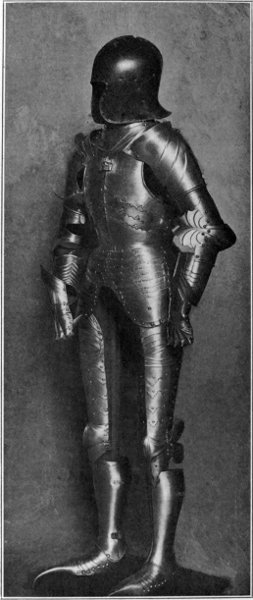
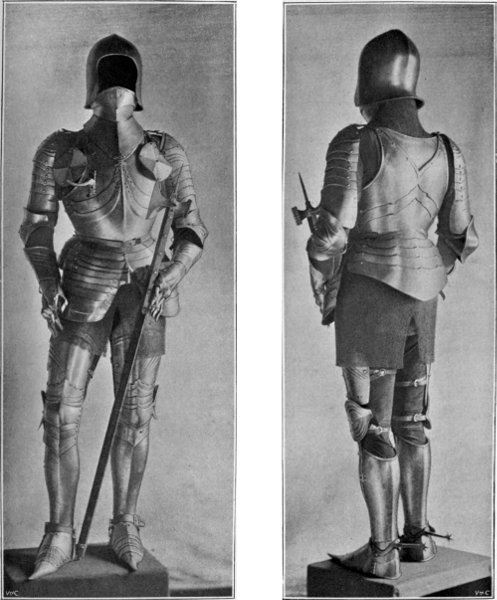
desire to invest steel armour with graceful lines. The tendency is best
exemplified in the fine Gothic armour of the second half of the fifteenth
century, of which much is fortunately preserved. This combines most
splendidly picturesque outlines with graceful fan or shell-like ridgings,
which please the more when examined critically, since every curve and
fluting serves some definite and practical end.
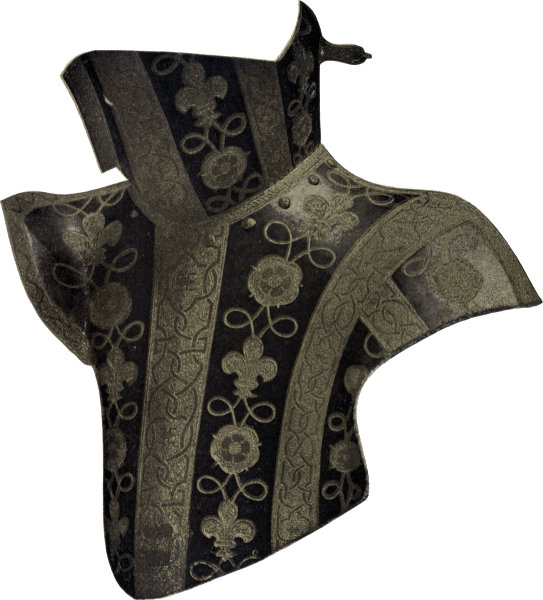
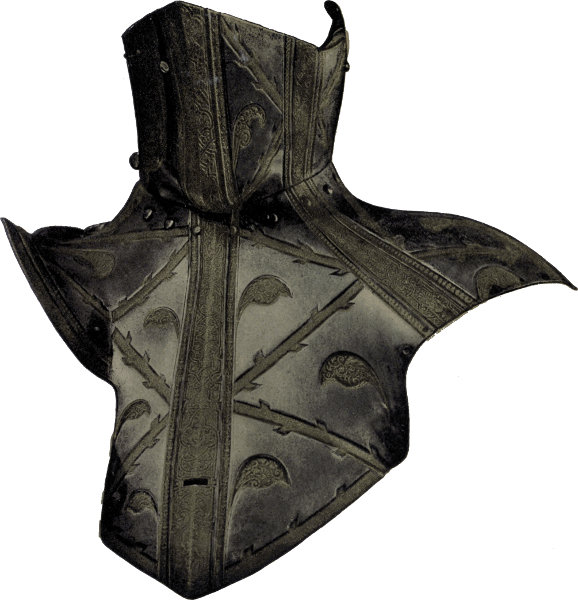
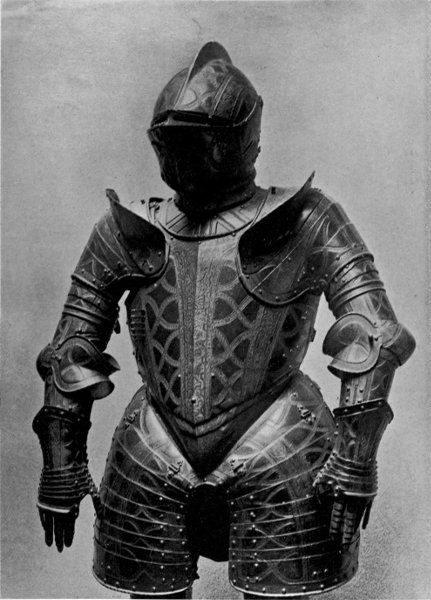
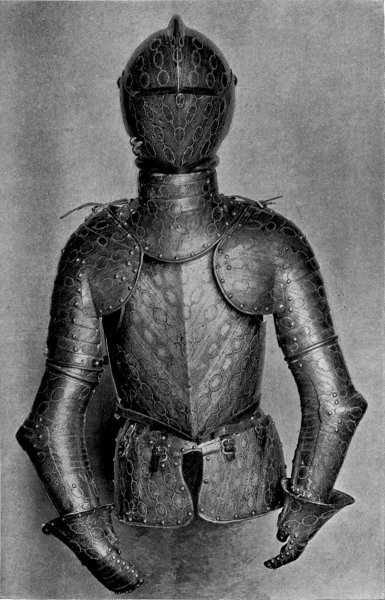
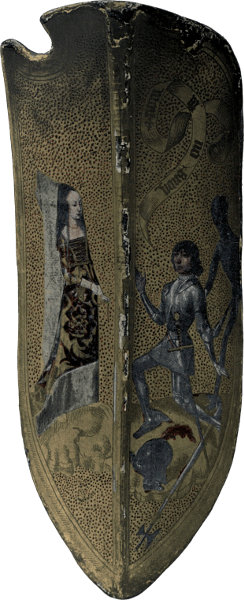
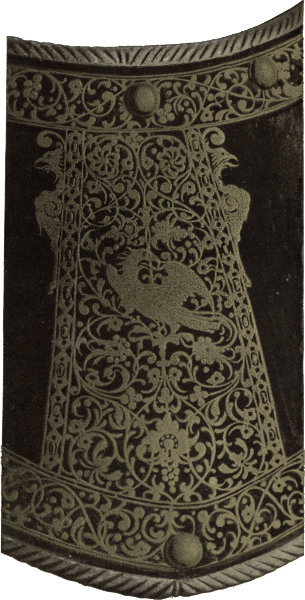
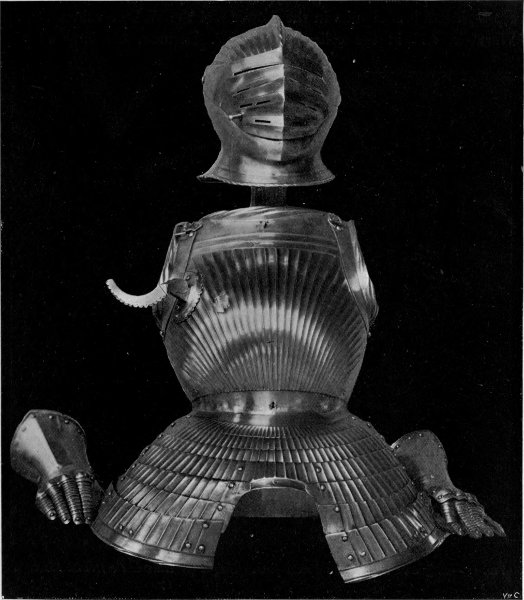
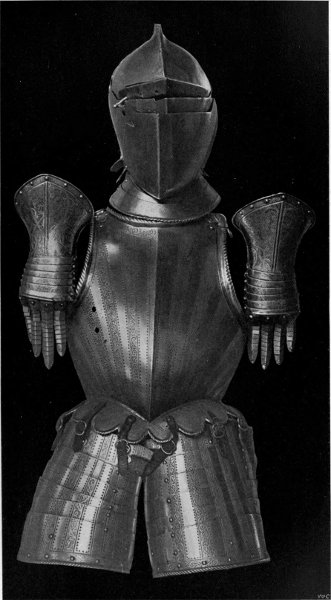
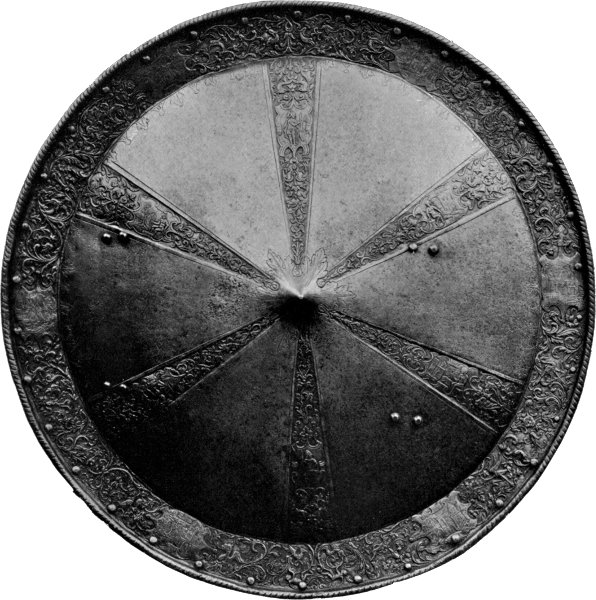
Plate IV.—Grand-guard of the suit of George, Earl of Cumberland, in the possession of
Lord Hothfield. This is a part of the 20th suit in the Armourer’s Album
in the South Kensington Museum. From a photograph
communicated by Baron de Cosson.
The casing of plate-armour, which had been so long elaborating,
having at last become complete, the work of the armourer was directed
to further perfecting its parts, and to disencumbering the wearer, with
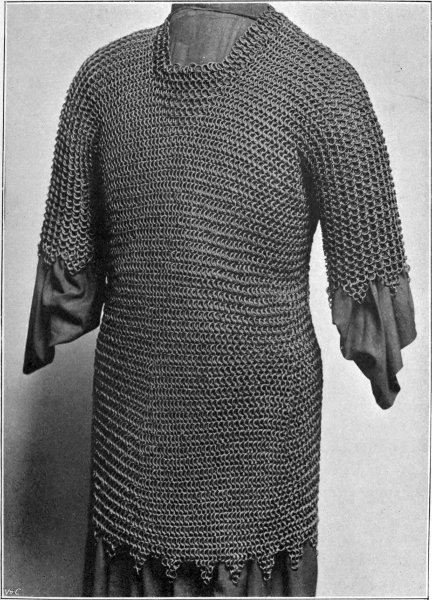
the least risk, of his weighty underlying chain-mail, quilted gambesons,
and padded surcoats. This process had not proceeded far when Agincourt
was fought, if we may credit the testimony of a French knight, who was
present and describes the armour as consisting of the long hauberk of
chain-mail reaching below the knee, and very heavy, with the leg-armour
beneath, and over this the plate or white armour with the bassinet and
camail. One Allbright, noted particularly as “mail-maker,” and twelve
other armourers, were in the suite of the king on this expedition. The
weight of armour would, therefore, have rendered a repetition advisable,
on the part of the English, of the tactics of Cressy or Poitiers in this
battle, had not the French disconcerted us by dismounting and seating
themselves, and refusing to advance. They had also, copying the
English, brought a large force of archers and cross-bowmen into the
field, and, in addition, kept bodies of men-at-arms in the saddle on
either wing, to make flank attacks when opportunities occurred. The
English having in vain endeavoured to provoke the enemy to advance
by sending out archers to fire a house and barn, posted an ambuscade
and moved forward, the archers in front as usual and the men-at-arms
behind. The archers thus gave up the shelter of their pointed stakes,
and the men-at-arms suffered the fatigue of an advance in armour
of an almost insupportable weight to men on foot. They advanced,
however, with repeated huzzas, but, as the Chroniclers inform us,
“often stopping to take breath.” The French, stooping their visors
under the amazing hail of arrows that began to fall upon them, gave way
a few paces, and the English, coming close up, pressed them soon afterwards
so hardly, “that only the front ranks with shortened lances could
raise their hands.” Our archers, flinging away their bows, fought lustily
with swords, hatchets, mallets, or bill-hooks, supported manfully by King
Henry and his men-at-arms. Pressing on and slaying all before them,
they routed the van and reached the main body, which was also quickly
destroyed. The rear battalion of the French, which had remained
mounted, then fled panic-struck, and the battle terminated in some
desultory charges made by a few parties of nobles and their men-at-arms,
which were easily repulsed; 10,000 French perished, all but 1600 being
gentlemen! many in the massacre of prisoners consequent on a false
alarm. The battle of Verneuil, so fatal nine years later to the Scots,
who lost the Earls of Douglas, Murray, and Buchan, with the flower of
their army, was fought on precisely the same lines; the main French
battalion with their Scottish allies on foot being first shaken by the
storm of arrows, and then destroyed at close quarters by the advance of
the archers with the usual “loud shouts,” supported by the Duke of
Bedford and the men-at-arms. These defeats caused the French to
again waver in their plan for meeting the enemy, for at the battle
of Herrings, and the skirmish at Beauvais in 1430, they made their attack
mounted, the English archers receiving the first charge behind their
palisade of pointed stakes, and defeating the enemy by the clouds of
arrows taking their usual deadly effect on the horses. These stakes, six feet
long and sharpened at both ends, formed an important item of the archers’
equipment, and were planted in the ground by the front rank, sloping
towards the enemy, the next rank fixing theirs intermediately to affright
the enemy’s horse. Throughout the Anglo-Burgundian alliance, the
Burgundians of all arms were often compelled “under pain of death”
to fight dismounted, the Picards especially adopting the tactics and
perhaps equalling the English. A little later, as at the battle of
Montlhéry, 1465, both Burgundian and English archers are armed
with the formidable long-handled leaden mauls or mallets, which the
armour of the men-at-arms was incapable of resisting. In the account
of one of these battles we learn incidentally that the duty of the varlets
who invariably formed part of the retinue of each man-at-arms was
to succour and refresh their masters during the heat of the engagement,
and to carry the prisoners they took to the rear.
As the various hauberks of mail, brigandines, gambesons, and other
defences became more or less obsolete and discarded by men-at-arms
armed cap-à-pied, they were relegated to a lighter-armed cavalry and the
infantry; but so long as a suit of mail continued to be worn by the man-at-arms
as a defence underlying the armour of plate, flexibility in the
latter was of paramount importance.
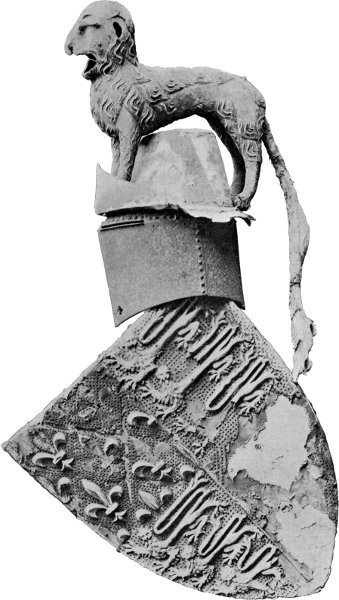
Fig. 18.—Helm from the tomb of Henry V.
in Westminster Abbey, date 1400-1420.
From a photograph lent by
Baron de Cosson.
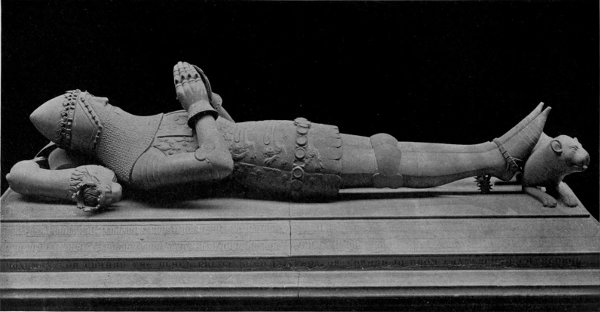
Regarding the armour of Henry V. as the earliest complete cap-à-pied
plate-armour, we find it thus composed. The breast and back plates are
each of one piece, the gorget is usually in one, though a standard of mail
sometimes replaces it; the limb-defences are of few pieces and rigid,
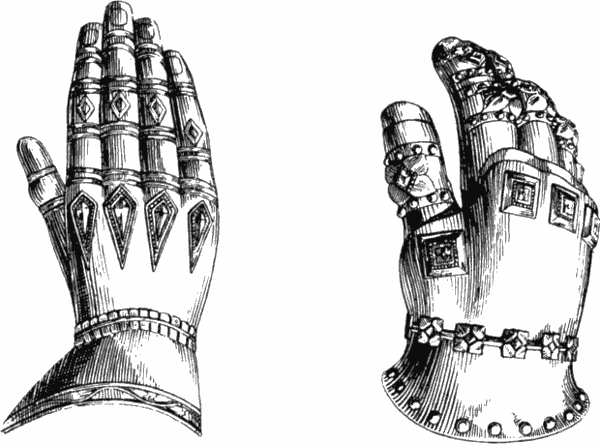
except at the joints, which are guarded by caps or roundels; while the
armour of the fingers, toes, and upper surfaces of the shoulders is
articulated or protected by narrow laminar plates. The introduction of
the gussets, and more particularly of the horizontal bands of plate forming
a short petticoat below the waist, materially altered the appearance of
the armour of the fifteenth century from that of the fourteenth. The
plates of the petticoat, called the tassets, are first seen in the brass of
Nicholas Hawberk, at Cobham, who died in 1406, and they gradually
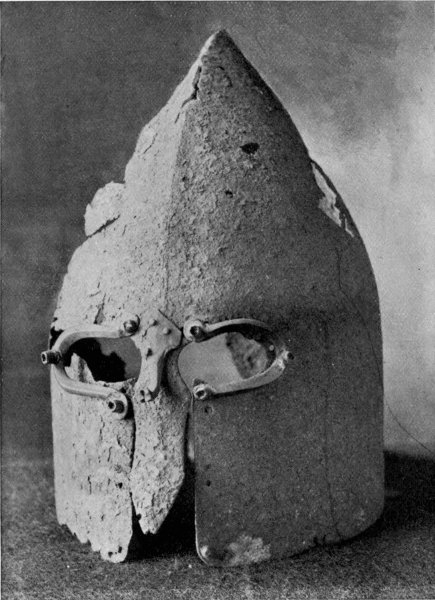
increase in number till about 1420. At Agincourt, where the
fighting was on foot, the visored bassinet
would have been worn by the king
and his men-at-arms, and not the great
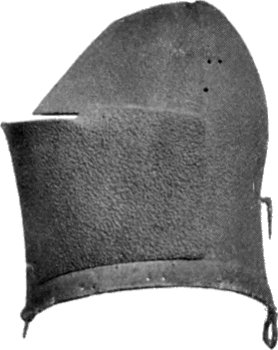
helm. The example of the latter suspended
in the chantry of Henry V.
in Westminster Abbey, though a real
helm, was only purchased from Thomas
Daunt, for 33s. 4d., according to
Rymer, with the crest, for the funeral.
The bassinet was probably plumed
with ostrich feathers, which were taking
the place of crests, and was encircled
by a coronet, damaged in the melée
by a blow from the Duke of Alençon,
which among its jewels comprised the ruby of the Black Prince, now in
the regalia. The diamond-hilted sword was not taken into the fray, unfortunately,
as it happened, and fell a prey to the baggage-looters. The
king is generally represented wearing a tabard of arms on this occasion, a
garment differing from the surcoat in being loose and cut like the modern
herald’s tabard, emblazoned before and behind and on the broad flaps which
do duty for sleeves. The horses, borrowing the custom of Lombardy,
wore a heavy chamfron or headpiece of plate, of which a specimen still
exists in Warwick Castle, and an articulated crinet or neck-defence of overlapping
plates, put together on the same plan as the tassets, and probably
some mail defences concealed by the emblazoned caparisons. The ostentatious
magnificence which had hitherto covered the body armour of the
knight with silks and satins, velvet and bullion and gems, especially among
the Burgundian French, was now in process of being transferred to the
horse. The housings are described as of silks and satins of every colour,
or velvet crimson and blue, or cloth of gold, and sweeping the ground,
besprinkled with escutcheons of arms, and loaded with silversmith’s work,
or raised work of solid gold. We read of trappings of white silver
fringed with cloth of gold, and of cloth of gold interwrought with solid
silver; and it appears that no materials were too rich to deck out the
favourite destrier or war-horse. It is unlikely that the English were at
this time behind the French in display, for so early as 1409, of the six
pages of Sir John de Cornewall, two rode horses covered with ermine,
and four horses with cloth of gold; and in 1414 the English embassy
carried themselves so magnificently that the French, and especially the
Parisians, were astonished. Splendid, however, as were the housings, the
headpieces of the horses eclipsed them. The horse of the Count de Foix
at the entry into Bayonne had a headpiece of steel enriched with gold
work and precious stones to the value of 15,000 crowns. The Count
de St. Pol’s horse’s headpiece on leaving Rouen was estimated to be
worth 30,000 francs, while those of the Dukes of Burgundy and Cleves
on the entry of Louis XI. into Paris were still more magnificent. That
of the king, however, was on this occasion merely of fine gold with
ostrich plumes of various colours. As with the armour in the fourteenth
century, the rich trappings of the horse naturally led at times to the
pursuit and capture of the owner. It is difficult to believe, in days of
such magnificence, that the pay of the Duke of York under Henry V.
was only 13s. 4d. per day, an earl received but 6s. 8d., a baron or banneret
4s., a knight 2s., an esquire 1s., and an archer 6d.
Though Henry V. wore royal armour at Agincourt it does not
appear that he followed the prudent custom, first noticed in the battle
of Viterbo, 1243, of dressing several knights in an identical manner with
himself. At Viterbo, on a knight dressed like the emperor being slain, the
result was a panic, and the emperor himself had to press with his trumpets
into the thickest of the fight to restore confidence. At Poitiers, though
nineteen knights were dressed like the king, it did not preserve him
from capture. In England, however, the king was saved on many a
field by this precaution, as at the battle of Shrewsbury, when the earl,
Sir Walter Blount and two others in royal armour were slain. The
passages in Shakespeare will be present to the mind of all:—
Another king! they grow like hydras’ heads;
I am the Douglas fatal to all those
That wear those colours on them. Who art thou,
That counterfeit’st the person of a king?
and again, when Richard exclaims at Bosworth—
I think there be six Richmonds in the field:
Five have I slain to-day instead of him.
The appreciation of steel, called by the Chroniclers plain or white
armour, for its own sake, had not progressed very far by the time
of Henry V.’s invasion of France, but the more lavish splendours were
at least reserved for gala occasions. The next modifications were
evidently devised to increase the flexibility of the armour, and can be
traced with greater precision in England than elsewhere, owing to the
fortunate preservation in our churches of a matchless series of military
monumental brasses. These clearly indicate that the tendency during
the first half of the fifteenth century was to increase the number of
joints or articulations in every part of the armour. By the close of the
reign of Henry V. things had proceeded so far in this direction that
in some cases the greater part of the limb-defences are made up of
laminated plates.
The next important change in the appearance of the man-at-arms
occurs in the early years of Henry VI., and is due to a striking development
of the fan-shaped elbow-guards, first seen in a rudimentary form
in 1425, as well as to an addition of short hinged plates called tuilles
to the bottom of the hoop-like skirt of tassets which lay closer to the
body. By 1435 these tuilles are ridged or fluted perpendicularly and
scalloped along the lower edge, and shortly after they take the more
developed, elongate and elegant forms familiar in Gothic armour. By
1440 we have the addition of great shoulder and elbow plates attached
by nuts and screws, and concealing the articulated shoulder-pieces or
epaulettes. These extra plates usually differ in size, being often very
much larger on the left side, which received the blows, and thus conferring
a quite peculiar character on the plate-armour of the middle of the
century. A scarcely less important modification, introduced about 1445,
is the articulation of the breastplate in two pieces, the lower overlapping
and sliding over the upper, and made flexible by straps.
The Daundelyon brass of this date, at Margate, exhibits a left
elbow-piece of immense size, and pointed and ridged tuilles below the
tassets, which are almost repeated again in form by the plates below
the knee-caps. John Gaynesford’s brass at Crowhurst, 1450, presents
strong reinforcing shoulder-guards over articulated plates, and repeats
the same long peaked and ridged plates below the knee-cap. We
continue for the next few years to find the limb-defences constantly
varying in the number and form of the pieces composing them, according
to the dictates of conflicting requirements, namely flexibility and impenetrability.
The frequent absence of tuilles at this time is held to
imply that they were not used in combats on foot, then very popular.
It is obvious that when the immensely long and pointed solleret came in
with the equally preposterous spur, the fashion of fighting on foot was
on the wane, and the men-at-arms generally fought mounted during the
Wars of the Roses.
We see by manuscript illustrations that a few suits were still gilded,
and we find Jack Cade after his victory in 1450 flourishing about in a
suit of gilt armour, the spoils of Sir Humphrey Stafford. But the ever-growing
appreciation of the intrinsic beauty of the steel panoply and
its fine military qualities is now distinctly felt, and the armourer sought
more and more to invest his work with beauty of form. All is still
entirely dictated by fitness to its purpose, and the requirements of jousts
and war; and the decorative and subtle shell-like ridgings and flutings
are really present more to deflect the weapon’s point than as ornament,
while the engrailing, dentelling, scalloping and punching of the margins
of the plates unmistakably indicate that the decorative spirit is applied
to embellishing and not to concealing the steel. The superb gilded
metal effigy (Fig. 19) of Richard Beauchamp, Earl of Warwick, presents
a faithful model of the most beautiful type of Gothic armour known.
Every fastening, strap, buckle or hinge is represented with scrupulous
fidelity, not only on the front, but on the unseen back. Baron
de Cosson, who has minutely described it, expresses the belief that
it is a faithful reproduction of a suit actually worn by the Earl, and
therefore earlier than 1439; although the effigy itself was only
produced in 1454, and the armour agrees with that worn in England
at the latter date. He regards the suit represented as the work
of the celebrated contemporary Milanese armourers, the Missaglias.
Italian armour is shown by sculptures, medals and paintings to have been
many years in advance of English, and the two known contemporary
suits by Tomaso di Missaglia greatly resemble it. The Earl of
Warwick knew Milan in his youth, when he had tilted successfully at
Verona; and it was a practice among the great to obtain armour there,
dating from so far back as 1398, when the Earl of Derby had his armour
brought over by Milanese armourers; the Baron’s view presents therefore
no improbabilities. Wherever made, the Earl of Warwick’s suit appears
to have solved the armourer’s problem, being at once light, flexible, yet
impenetrable. Indeed, in its beautiful proportions and admirably perfect
adaptation to all requirements, it appears more like a work of nature than
of art. The contours of the pieces and their graceful fan-like flutings, to
give strength and deflect opponents’ blows, are artistically splendid. The
great shoulder-guards and elbow-pieces, the cuissarts and winged kneecaps,
the tuilles, the jointed breast and back plates, the upright neck-guard,
not hitherto seen, are all fashioned with consummate skill. In such a
suit the preux and gallant knight for three days held his tournament
victoriously against all comers, presenting each of his discomfited
adversaries with new war-chargers, feasting the whole company, and
finally “returning to Calais with great worship.” The two cuts (Figs. 20
and 21), illustrating scenes from his life, are taken from the exquisitely
drawn illustrations to the contemporary Beauchamp manuscript, now in the
British Museum. The incidental testimonies to the excellence of Italian
armour of the middle of the fifteenth century are abundant. A stalwart
Burgundian champion tried in vain during a tournament in 1446 to
penetrate or find a crevice in the armour of the Duke of Milan’s
chamberlain, whom it was impossible to wound; and in 1449 the suit
of another knight in the service of the same Duke was said to be steeped
in some magic liquid, as so light a harness could not possibly have
otherwise withstood the heavy blows it received.
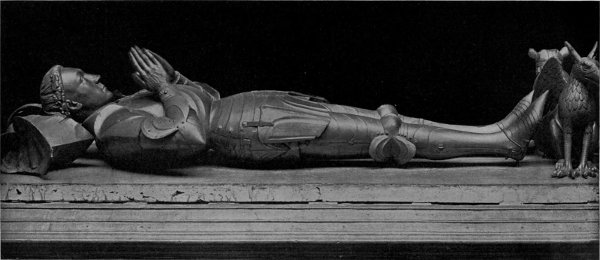
Fig. 19.—Effigy of Richard Beauchamp, Earl of Warwick, on his tomb in St. Mary’s Church, Warwick. About 1454.
From the cast in the Crystal Palace, Sydenham.
No word ever escapes the chronicler in praise of English armour;
but the splendid model of the Earl of Warwick’s suit is by William Austin,
founder, and Thomas Stevyns, coppersmith, both of London, with
the gilding, chasing, and polishing by Bartholomew Lambespring,
Dutchman and goldsmith of London. The will directs that the
effigy shall be made according to patterns, directions obviously most
scrupulously carried out.
Fig. 20.
The Earl of Warwick slays a “mighty Duke” who has challenged him to combat for his lady’s sake, and wins
the favour of the Empress, to whom he makes a present of pearls and precious stones. The costume is
about fifteen or twenty years later than the death of Earl Richard, and shows the extra pieces worn in
the tilt-yard, 1450-60.
In contemplating the lithe figure we may well believe that the
steely quality and workmanship of such a suit would confer immunity
on the wearer; and that the relative elasticity and lightness of a perfectly-fitting
suit might confer such superiority on an active and sinewy champion
engaging with men swathed like mummies beneath their armour in
thick gambeson or mail, as to enable him to emerge from his deeds of
arms as triumphantly as the heroes of romance. Nothing was worn
beneath but the fustian doublet, well padded and lined with satin, with
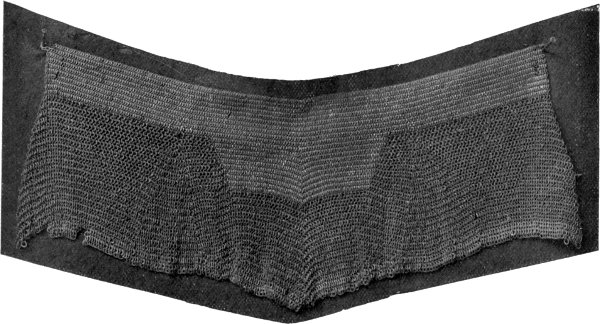
the small lozenge-shaped gussets of mail under the limb-joints and the
short petticoat of mail tied round the waist. It is also unlikely that such
armour was concealed under any garment, and we may observe that
while some princes and nobles are still wearing brigandines of velvet
and cloth of gold in pageants, many more are in “plain armour,”
presenting, except when standing collars of mail were worn, a uniform
surface of smooth polished steel.
The Missaglia suit remained the type with little modification for
several years, almost to the close of the Gothic period. The Quatremayne
brass in Thame Church, of the year 1460, presents a magnificent
example of it with singularly exaggerated elbow-guards. During the next
few years the limb-pieces and gorget become more articulated and flexible,
and the breast and back plates are formed of as many as three or four
overlapping articulated plates, cut chevron-wise, and notched and
indented in an interesting manner. The gauntlets and sollerets are
also of excellent workmanship. There are a number of peculiarly fine
examples in the Museum of Artillery in the Rotunda at Woolwich, from
the Isle of Rhodes, which exhibit the graceful outlines and ornament
of later fifteenth-century Gothic armour in perfection, and also present
early and interesting examples of engraving on armour. Lord Zouche
has also some remarkable suits, said to be from the Church of Irene at
Constantinople, in his collection at Parham. Sir Noel Paton’s fine
collection also comprises several Gothic suits, and there are some in the
Tower. None, however, are connected historically with English wearers,
and the destruction of Gothic armour in this country appears to have
been unusually complete. The illustrations from the Life of the Earl of
Warwick, an English MS. of the second half of the fifteenth century (Figs.
20 and 21); and the scene (Fig. 25) from the late fifteenth-century MS.
of Froissart, which belonged to Philip de Commines, both now in the
British Museum, give excellent ideas of the armour of this period in
actual use, while the brasses supply exact figures of the details.
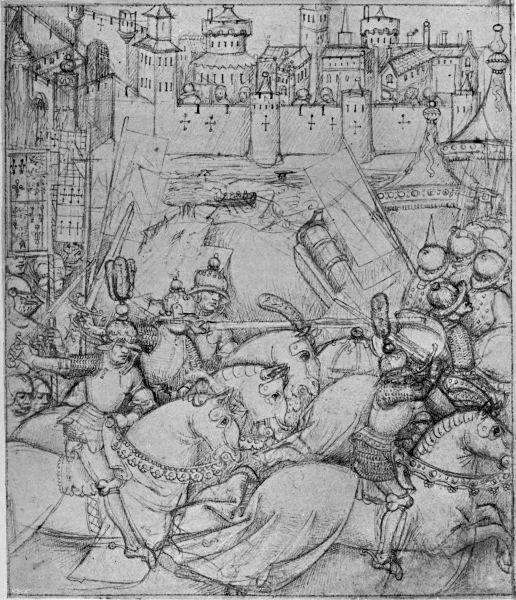
Fig. 21.
The Duke of Gloucester and Earls of Warwick and Stafford chase the Duke of Burgundy from the walls of
Calais. They wear loose sleeves and skirts of mail, and the round broad-brimmed helmet very fashionable
for a time among the higher French nobility. The balls and tufts are probably Venice gold, with which
the helmet was perhaps also laced, over some rich material. This and Fig. 20 are from the Beauchamp
MS. in the British Museum, an exquisite production by an English hand.
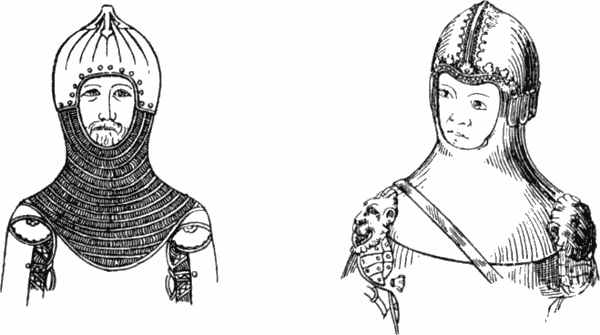
Turning now to head-defences, the great crested helm, still represented
as pillowing the head in effigies, had long since been relegated to
the joust and tilt, while the bassinet with a visor, already seen in
the Transition period, remained the fighting helmet till about the middle
of the century. The visor, however, was not unfrequently struck or
wrenched off in tourneys, and the neck pierced by the lance. Some
hardy warriors, indeed, like Sir John Chandos and the Earl of Warwick,
dispensed with it and went into the fray with faces bare, but this was
exceptional, and the pig-faced and beaked visored bassinets occur in
all delineations of combats of the first half of the century.
The bassinet began to be superseded towards the middle of the
fifteenth century by the sallad, which remained in fashion almost to its
close. Its merits were, the free supply of air it afforded, and the
readiness with which the face could be concealed and protected. It
was the headpiece of the Gothic armour, such as that of the Warwick
effigy, though monuments of this date almost always leave the head
bare. The origin of the sallad, whether German or Italian, is unknown,
but the term occurs in Chaucer. In its simplest form it was low-crowned,
projecting behind, and strapped under the chin, something
like a “sou’wester” or the heraldic chapeau, and in this form it was
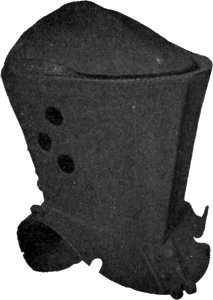
worn by archers and billmen. Another kind had a higher crown, with
two slits in front as an ocularium, and could be pulled over the brows
till this came level with the eyes (Fig. 22). A hinged nose-piece
was also sometimes present, to be let down in time of danger. It was
also made more completely protective by a chin-piece called the bavier,
strapped round the neck or fastened to the breastplate for tilting; while
a lighter bavier was in two pieces, of which the upper was hinged at
the side and could be raised for speaking. It was frequently furnished
with a visor to let down. The tail-piece was occasionally so prolonged
that sallads measure as much as eighteen inches from back to front. It
occurs both smooth-topped and combed, and with a slot for plumes
approaches nearer to classic models than any other form of mediæval
helmet. This picturesque headpiece is the one so frequently represented
by Albert Dürer, and was favoured for a longer time in Germany than
elsewhere, many of the Germans in the picture of the meeting of
Maximilian and Henry VIII. appearing in it, while all the English wear
the later close helmet or armet. The form represented has the addition
of articulated pieces behind and a double visor moving on pivots at the
sides, which make it a near approach to a closed helmet.
The sallad was the principal helmet in use throughout the Wars of
the Roses, and is constantly represented in manuscripts of that period.
But one solitary example has been preserved in England from the time of
those destructive wars, in which its first wearer may have taken part. It
hangs in St. Mary’s Hall, Coventry, and owes its preservation to its
use as a stage property in the Godiva processions. There are specimens,
however, in all the important collections in England and abroad.
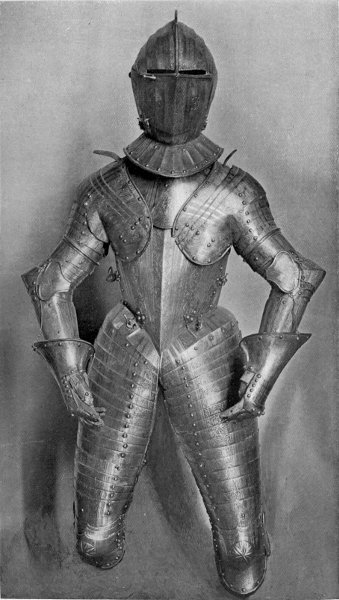
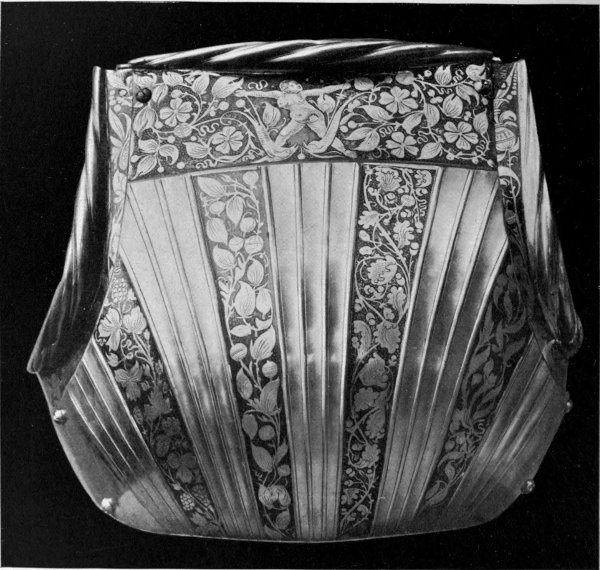
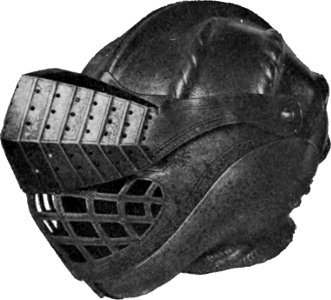
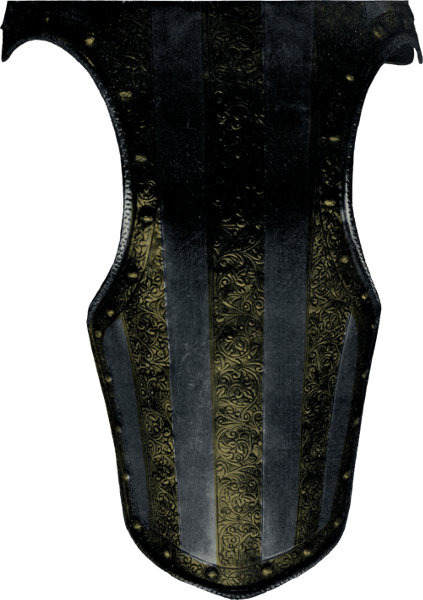
Plate V.—Grand-guard, used for tilting, belonging to the suit of Robert Dudley,
Earl of Leicester, with the gilding restored. In the Tower of London.
The bassinet was sometimes richly decorated, covered with velvet,
plumed, crested, and of considerable value, Sir John de Cornwall wagering
his helmet in 1423, which he offered to prove to be worth 500 nobles. The
pretty custom of garlanding them with may, marguerites, or other flowers
specially favoured by a queen or princess,
or with chaplets of pearls and
other gems, seen in the early part of the
century, lasted until after the introduction
of the sallad, which provided a
better field for such display. A sallad
belonging to the Duke of Burgundy,
decorated with rubies and diamonds to
the estimated value of 100,000 crowns,
figured in the entry of Louis XI. into
Paris in 1443. In the expenses of
Henry VII. precious stones and pearls
are bought from the Lombards to the
value of £3800 for embellishing sallads
and other helmets, and in France even
the sallads of the mounted archers are
continually mentioned as garnished
with silver.
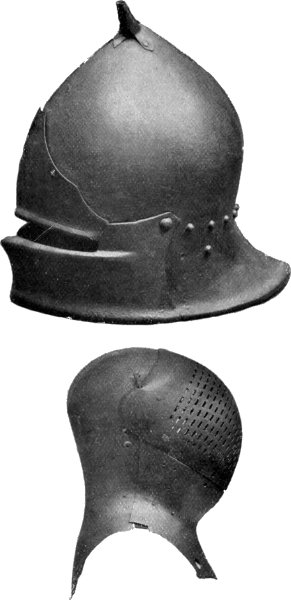
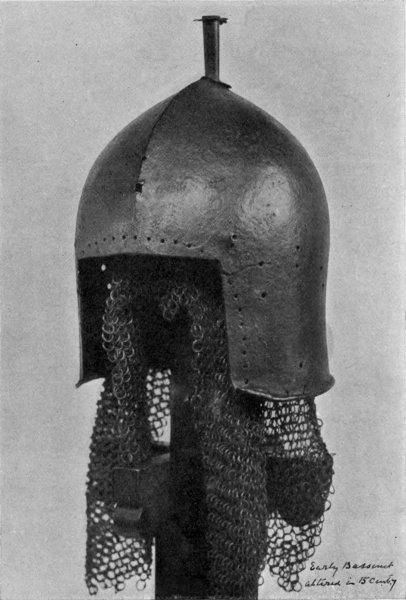
Fig. 22.
1. Sallad in St. Mary’s Hall, Coventry.
2. Helm of Sir Giles Capel, date 1510-1525.
Formerly in Rayne Church, Essex. Now in
the possession of Baron de Cosson.
The sallad was a relatively dangerous
headpiece in tourneys on foot, and
a large-visored bassinet is often mentioned
as being retained in use for this
purpose down to the sixteenth century.
The Baron de Cosson has identified
this form, seen to have been fixed to
the breast by two staples and a double
buckle behind, and himself possesses
a magnificent example, which once hung over the tombs of the Capels in
Rayne Church. Sir Giles Capel was one of the knights who with Henry
VIII. challenged all comers for thirty days on the Field of the Cloth of
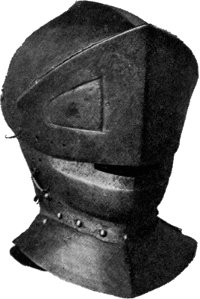
Gold. The visor in this example is very massive, the holes so small that no
point could possibly enter, and the helm being fixed the head moved freely
inside. A second and possibly earlier example has the visor thrown into
horizontal ridges and a small bavier. The visor is hinged at the sides,
and the sight and breathing holes are short slots, parallel to and protected
by the ridges. It hangs over the tomb of John Beaufort, Duke of
Somerset, in Wimborne Minster, who died in 1444, but it is of later
date; and another belonging to the suit of Henry VIII. in the Tower,
made for fighting on foot, is not dissimilar. Baron de Cosson calls
attention to the fact that this form, called a bassinet, is shown in the
miniature of the manuscript entitled, “How a man shalle be armyd at his
ese when he schal fighte on foote.”
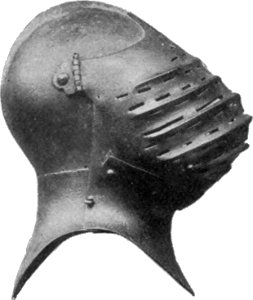
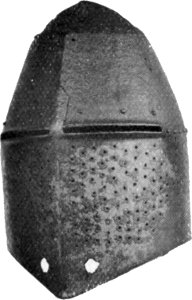
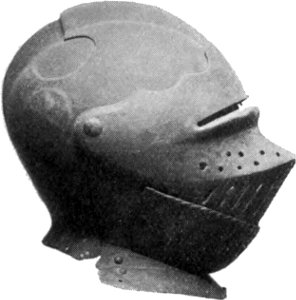
Fig. 23.—English tournament helm over
the tomb of John Beaufort, Duke
of Somerset, in Wimborne Minster.
Weight 14¼ lbs. Date 1480-1520.
From a photograph lent by Baron de
Cosson.
Another very interesting and
thoroughly English form of helm,
intended, according to De Cosson, for
the tilt with lances, is preserved in
a specimen in Broadwater Church,
another in Willington Church over
Sir John Gostwick’s tomb, and a third
in Cobham Church, the helm of Sir
Thomas Brooke, who died 1522.
These all present considerable differences
of detail. A not dissimilar
helm of slightly later date with a
barred visor, or the bars riveted to
the helm, affording plenty of breathing
space, was used for the tourney
with sword or battle-axe, and has become the Royal and the nobles’
helmet of heraldry.
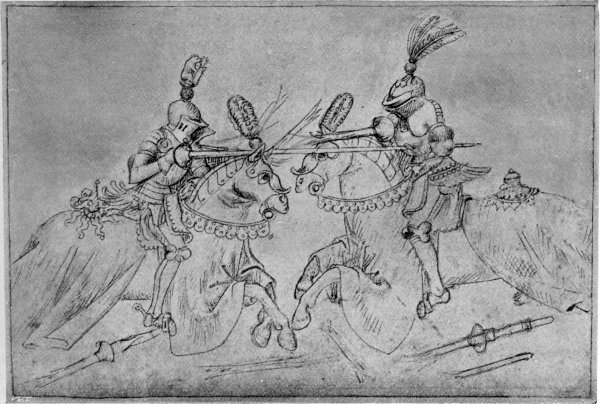
A form of helm used for tilting with the lance and also frequently depicted
in heraldry, is the great helm of the time of Henry VII. and Henry
VIII., of immense weight and strength, resting on the shoulders, and
securely fixed to the back and breast. It was relatively flat on the crown,
produced in front into a kind of blunt beak, giving a bird-like aspect
with no distinct neck. The ocularium, or slit for vision, is large and in
the crown, and can only be used by bending the body forward; the head
being raised before the moment of impact to avoid the danger of the
lance penetrating. This helm is well represented in the tournament roll
of Henry VIII. in Heralds’ College, and from its massive strength and
the fact that by no possibility could a combatant be accidentally unhelmed,
afforded absolute protection to the head. Le Heaulme du Roy is
represented in this roll as silvered, with a crown-like border round the neck
of pearls and gems set in gold.
There is a magnificent specimen
in the Museum of Artillery at
Woolwich, one in Westminster
Abbey, two in St. George’s Chapel,
one in Petworth Church, and one
at Parham. This form of helm
was the most massive and secure,
and the last that remained in use.
A very early delineation of a
helmet of this type is seen in the
late fourteenth-century French
MS. (Burney, 257) in the British
Museum. Some exceedingly interesting
delineations of the same
kind of tilting helm in actual
use are to be seen in Philip de
Commines’ Froissart, Harl. MS.,
4379-80 (Fig. 25). It is there
represented plain and fluted, and
with various crests and mantling,
one of the most singular, and a
favourite, being a close copy of
the lady’s head-dress of the period,
with the lady’s long gauze veil
reaching below the waist. This
manuscript is of late fifteenth-century date, and very remarkable for the
apparently faithful representations of the armour worn by the English and
French at that time. In one group of soldiery alone, in the second
volume, page 84, the helm of the early fourteenth century, the beaked
bassinet of the early fifteenth, and various forms of visored and unvisored
sallads are assembled together.
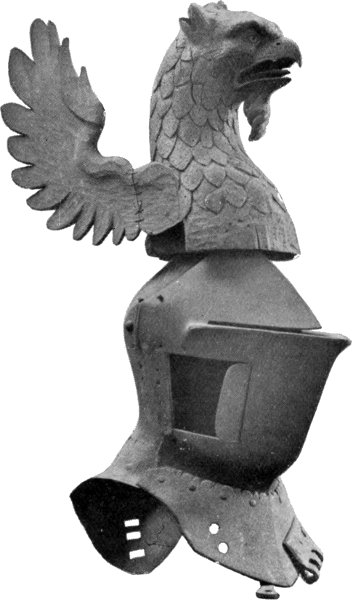
Fig. 24.—Helm of Sir John Gostwick, died
1541.
Believed to have been worn at the Field of the Cloth of
Gold, 1520, and now hanging over his tomb in
Willington Church, Bedfordshire. From a photograph
by the Rev. Augustus Orlebau, Vicar.
All these forms of helm were more or less contemporary with the
sallad, which gave place in turn to the armet or closed helmet, first
heard of in 1443. Like, perhaps, the sallad, the armet was invented
in Italy, and did not reach England or even Germany till about 1500.
In France, however, a page of the Count de St. Pol bore a richly-worked
armet on the entry into Rouen of Charles VII.; and the royal armet of
Louis XI., crowned and richly adorned with fleurs-de-lis, was carried
before him on his entry into Paris in 1461. It is also mentioned in
1472, in an edict of the Duke of Burgundy.
The fundamental difference between it and all helms and helmets
that had preceded it is, that while others had either fitted the top of the
head, as a cap does, or were put right over it, the armet closed round
the head by means of hinges, following the contour of the chin and
neck. Its advantages were neatness, lightness, and general handiness,
and it conveyed the weight by the gorget directly on to the shoulders.
Its use was exclusively for mounted combatants, though the great helm
continued in use for jousts and tilts during the time of Henry VIII.
It does not appear in English costume much before this reign, but in
all the pictures of the triumphs and battle-pieces of Henry VIII. at
Hampton Court, the English men-at-arms invariably wear it, and it is
abundantly represented in works of art during the remainder of the
Tudor period.
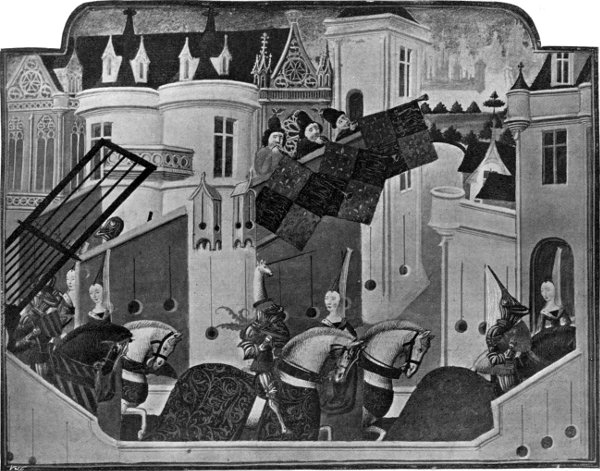
Fig. 25.—The entry of Queen Isabel into Paris in 1390.
The knights wear the great tilting helms, and the foremost has a copy of the ladies’ head-dress for crest, from which depends a fine lawn veil. The housings are
embroidered with gold. From the Philip de Commines copy of Froissart, Harl. MS. 4379, vol. 1, fol. 99, in the British Museum, late fifteenth century.
An early armet, identified by Baron de Cosson as Italian, with
a double bavier riveted together, but without a visor, hangs over the
tomb of Sir George Brooke, eighth Lord Cobham, K.G. (Fig. 26),
and dates from 1480 to 1500. Baron de Cosson describes it as having
a reinforcing piece on the forehead, hinged cheek-pieces joined down the
middle of the chin, and of peculiarly delicate and beautiful outline. It
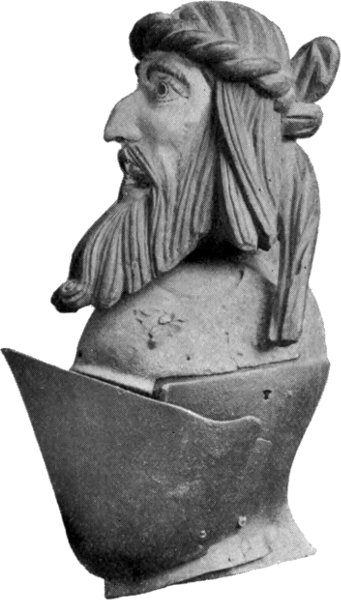
originally had a camail hanging to a leather strap. The wooden Saracen’s
head may date from the funeral of this Lord Cobham in 1558, “but
was certainly never worn on any helmet.” Its owner served under
Norfolk in Ireland, in 1520, and was subsequently Governor of Calais.
Fig. 26.—Armet of Sir George Brooke,
K.G., 8th Lord Cobham. From his
tomb in Cobham Church, Kent.
1480-1500.
Fig. 27.—English armet from the collection
of Seymour Lucas, A.R.A. Date
about 1500. From a photograph by
Baron de Cosson.
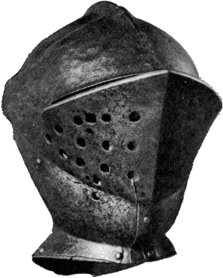
English armets dating from about 1500 are not uncommon, but, as
frequently observed, “they want that perfection and delicacy to be found
in fine Italian or German work.” The earlier open down the front, and
the later at the side. They are generally combed, the ridge or comb
running from the forehead to the back of the neck, and being beaten
or raised out of the metal in the most
able way. There is generally, but not
always, a reinforcing piece over the
forehead. The visor is of one piece,
and works on a pivot, but in a few of
the early specimens the pin and hinge
arrangement of the older Italian
examples is preserved, rendering it
removable. The slit for vision is
generally made in the body of the
visor, but is sometimes obtained by
cutting out a piece of its upper edge.
It is beaked, thrown into few or
several ridges, with the slits or holes
for breathing principally on the right
side. The English armet was rarely
furnished with a bavier or movable
chin-piece, and the fixed one, called a
mentonière, was small. Baron de
Cosson obtained one from Rayne
Church in Essex, when it was pulled down, and Meyrick procured a
similar one from Fulham Church, and
Mr. Seymour Lucas, A.R.A., has two
very fine specimens, now exhibited at
South Kensington, while specimens are
to be met with in most great collections.
The not inelegant fluted
Maximilian armets of the same date
are, however, far more frequent.
Like the later English armets, they
have no baviers. Between 1510 and
1525, a hollow rim was introduced
round the base of the helmet, fitting
closely into a corresponding ridge round the upper edge of the gorget.
This manifest improvement was considered by Meyrick to constitute the
Burgonet. Between 1520 and 1540 the visor was formed of two parts,
the upper of which closed inside the lower, and was capable of being raised
without unfixing the latter. It remained in this form until the closed
helmet fell into disuse in the seventeenth century. The armet frequently
comprised, especially in the later examples, a fixed gorget, generally of two
or more articulated plates. A number of these are included in the sixteenth
and seventeenth century suits illustrated in the succeeding pages,
one of the most singular being the helmet of the mounted suit of Henry
VIII., made for the king by Conrad Seusenhofer of Innsbrück in 1511-14.
It consists of six pieces fitting one within another without hinge or rivet,
and seems originally to have had one of the curious discs at the back
seen in Italian fifteenth-century armets and contemporary illustrations.
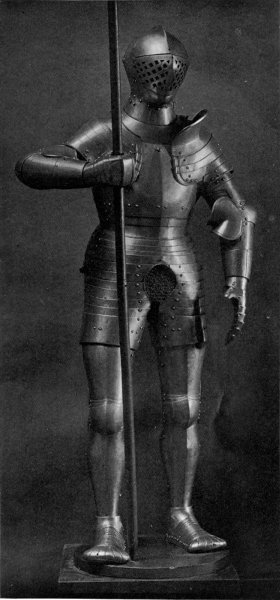
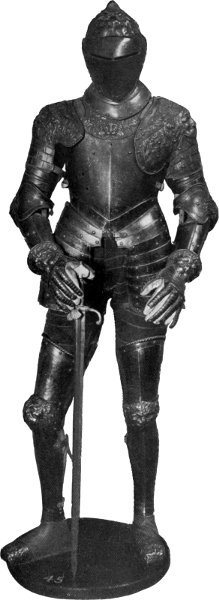
Fig. 28.—Complete suit for fighting on foot, made for Henry VIII.
In the Tower of London.
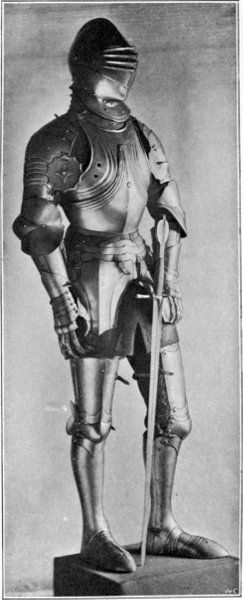
Towards the beginning of the sixteenth century knightly armour
underwent some profound modifications. The exaggerated elbow-guards
and shoulder-pieces were reduced, the tuilles, the laminated corselets
with their handsome flutings and indented margins, and the pointed
sollerets were either modified or seen no more; and with them disappear
much of the angulated, defensive mannerism, and the grace peculiar to
the armour of the third quarter of the fifteenth century. That which
followed appears smoother, rounder, and heavier, less mobile, and
less apt for real campaigning. The modifications tending to this result
may have been in a large degree due to the personal tastes of the three
great monarchs of Europe. Maximilian and Henry VIII. preferred
at heart the pomp and pageantry to the realities of war; while the
classic bias of Francis I. banished all Gothic feeling so far as his
personal influence extended. The short-waisted, podgy, globular
breastplate, the stolid limb-pieces, rounded knee-caps and strikingly
splay-footed sollerets, appear as if invented to altogether banish
the very idea of agility, if not of movement; and contrast in the
strongest manner with the lithe and supple-looking armour of the
Beauchamp effigy. The Tower collection, so relatively poor in Gothic
armour, is fortunately extremely rich in that of the period of Henry
VIII., containing four or five suits actually made for his personal
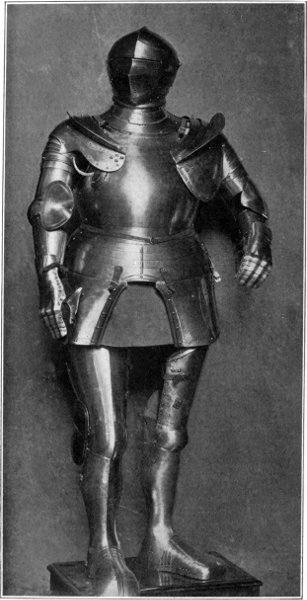
use. One of the finest of these, and an admirably perfect suit, is
shown in our illustration (Fig. 28). Though without any decoration
or marks, it was undoubtedly made expressly for the king,
and is a chef-d’œuvre of the armourer’s craft, being formed, according
to Lord Dillon, of no less than 235 separate pieces, which
are used about one half below and the rest above the waist.
The principal pieces are fitted with a hollow groove along the inferior
margin, and overlap others provided with a corresponding ridge: so
that the whole suit thus interlocks, and the plates cannot be separated
or the armour taken apart except by removing the helmet and beginning
at the neck-pieces. To the left shoulder-piece or pauldron one
of the upright neck-guards is still fixed by rivets. The breastplate
is globose, and has a central ridge called the tapul. The arms are
sheathed in rigid plates, separated by a series of narrow laminar plates, by
which power of movement is obtained. The elbows are guarded by not
inelegant caps, and the gauntlets are miton-fashioned, of eleven small
plates, and very flexible. The leg-armour is in large pieces ridged
down the centre, similarly to the breastplate, except above and below
the knee-cap, and at the ankle, where laminar plates give the necessary
play. The sollerets being made, like the gauntlets, each of
thirteen pieces, are also extremely flexible, and reproduce in an exaggerated
way the great broad toes of the civil dress. Like the helm,
already noticed, the suit is intended for combats on foot and in the
lists, which were greatly in fashion. No mail gussets were needed,
for there were no crevices between the plates, and the wearer inside
his armour was as well defended as a lobster in its shell; but this
security, as with all armour-plate, was purchased, notwithstanding the
perfection of manufacture, at the expense of unwieldiness and fatigue,
for the suit weighs over 92 lbs. There are three other suits which
belonged to Henry VIII., besides the magnificent equestrian one next
figured. The second dismounted one was also intended for combats
on foot, and is known as a tonlet suit from the long, laminated skirt
of horizontal plates reaching to the knee, and sliding over each
other. It is decorated with some engraved bands or borders, while
the fine headpiece to it is Italian, bearing the marks of the celebrated
Missaglias of Milan. We meet at this time with the sliding rivets, a
new mode of attachment for the plates, which enabled them to play
freely over each other without parting company. The overlapping
tassets of most of the close-fitting skirts are made in this fashion, to
which the term Almayne rivets, so frequently met with in inventories, is
believed to apply. Some of the suits are provided with a locking
gauntlet, to prevent the sword from being struck out of the wearer’s
hand, the so-called forbidden gauntlet, though its prevalence in collections
negatives the idea that its use was disallowed. In one mounted suit
the insteps are protected by the great ungainly stirrups necessitated by
the broad-toed sollerets, and therefore only covered with mail. This
suit is enriched with a picturesque banded ornament, partly gilt.
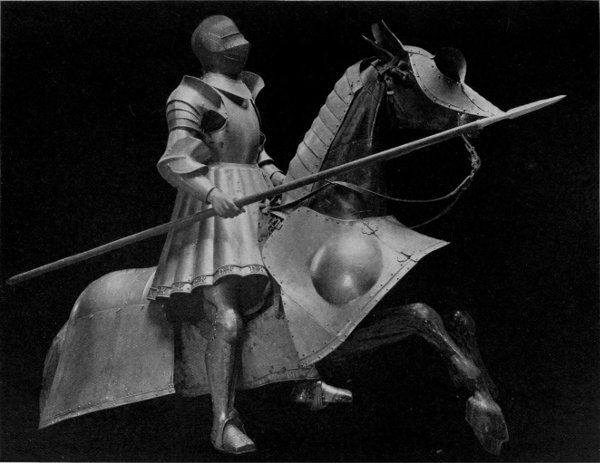
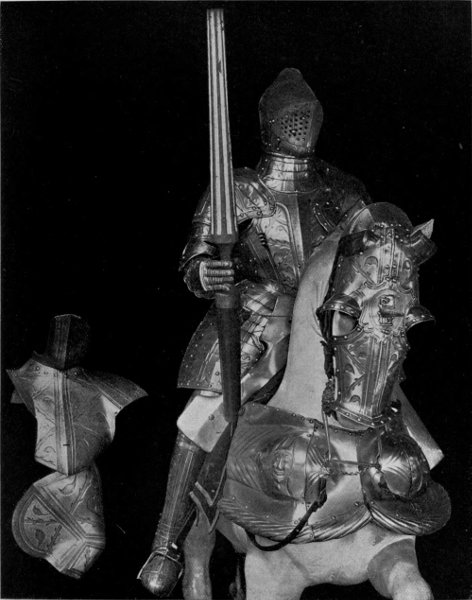
Fig. 29.—Suit made for Henry VIII. by Conrad Seusenhofer of Innsbrück, 1511-1514. A present from the
Emperor Maximilian I. In the Tower.
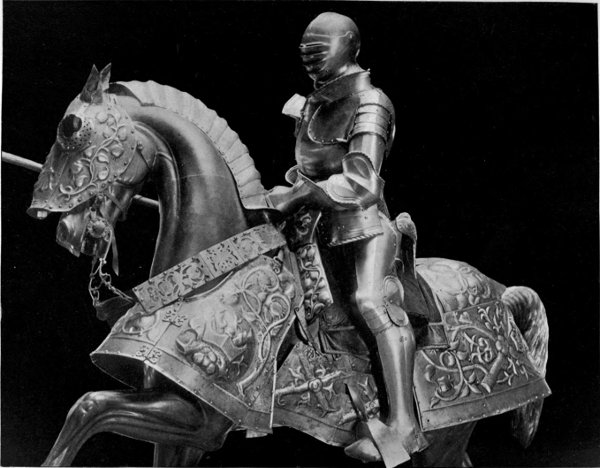
The superbly-mounted suit in our illustration (Fig. 29), one of the
finest of its date in existence, was constructed to the order of Maximilian
expressly for Henry VIII., by Conrad Seusenhofer, one of the most
celebrated armourers of Innsbrück, whose mark it bears on the helmet.
It was sent as a gift in 1514, and was originally silvered all over, and
finely engraved in every part with the legend of St. George and
the badges of Henry VIII. and Katharine of Arragon. The Tudor
cognisances are the rose, portcullis and red dragon; and Katharine’s
the pomegranate and sheaf of arrows, with finely-scrolled arabesque work
between. This ornament seems to be engraved and not etched, as in later
times. The most remarkable feature is the steel skirt called base, of
great rarity, and made in imitation of the folds of the cloth bases so
much in vogue at this time. These skirts were used for fighting on
foot, and there is provision for fixing an additional piece to complete
it in front, the absence of which alone permitted the wearer to sit on
horseback, though the difficulty of getting into the saddle must have been
considerable. The skirt is edged with a finely-modelled border of brass
in high relief, with the initials H. and K. united by true-lover’s knots.
The suit is complete in every respect except the gauntlets, and is
mentioned in the Greenwich inventory of 1547, published in the fifty-first
volume of Archæologia by Lord Dillon. It is there described as “a
harnesse given unto the King’s Maiestie by The Emperor Maximilian
wt a Base of stele and goldesmythes worke.” The brass border to the
base thus appears to have been regarded as silver and gilt goldsmiths’
work. The horse armour matching the suit, which was to be used
on foot, as Lord Dillon points out, did not exist at this period,
and the figure was seated on the Burgundian horse armour of
repoussé steel of the time of Henry VII., which still stands next
to it in the Tower. The engraving on the horse armour or bard
is designed in the same spirit as that of the armour itself, but is
by an inferior hand. The subjects are treated in the style of
Albert Dürer or Burgkmair, and represent incidents in the lives
of St. George and St. Barbara, and besides the badges on the armour
which are reproduced, the castle and the rose and pomegranate impaled
appear, with the motto DIEV ET MON DROYT many times repeated round
the edge. All these badges and engravings were illustrated, almost real
size, by Meyrick, in the twenty-second volume of Archæologia. The
horse armour was silvered and probably parcel gilt, like the body armour,
and was made, it is supposed, by some of the German armourers brought
over and established in Greenwich by Henry VIII. It is stiff and
unwieldy, and does not very efficiently protect the horse, though its effect
is dignified and even magnificent. The singular construction of the
helmet has already been alluded to.
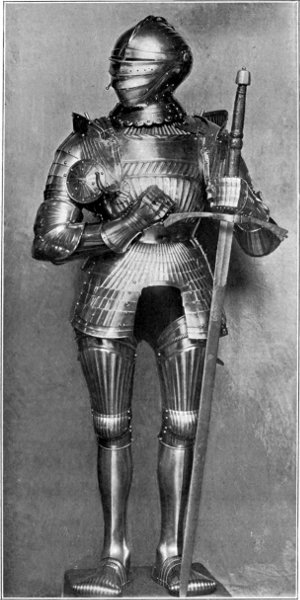
Contemporary with these suits is the fine German late Gothic fluted
armour, known as Maximilian, nearly perfect examples of which are to
be seen in every collection of importance. This was used for tilts, with
the immensely massive outwork of plates to fend off the blows of the
lance and other weapons, and to prevent the left leg from being crushed
against the barrier. Some of the rarer Maximilian suits not only
reproduce the cloth skirts of the civil costume in steel, but also
innumerable puffings and slashings, which were the fashion of the
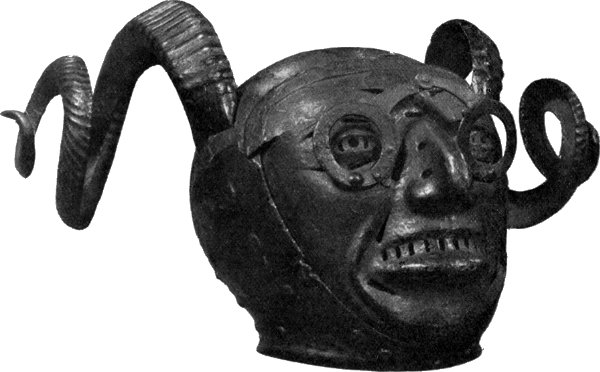
day. Sometimes the helmets belonging to these suits have the mask-shaped
visors, a specimen of which, also a present to Henry VIII.
from Maximilian, still exists in the Tower. This formed part of a
tilting harness, and is described in the 1547 inventory as “a hedde pece
wt a Rammes horne silver pcell guilte.” In 1660 it was attributed to
Will Sommers, the king’s jester, and has subsequently been rendered
more grotesque by paint and a pair of spectacles. A complete helmet
of the same kind is preserved at Warwick Castle, as well as one of the
rarer Italian helmets, with curling woolly hair represented in embossed
iron, but without the visor.
All this armour was made for the shocks and pleasurable excitement
of jousts, tilts, and tourneys, which its perfection and strength
deprived of nearly every element of danger. Its weight and closeness
would indeed have made it insupportable on active service. The great
revolution in the equipments for war, commenced by the artillery train
and nearly unarmoured pikeman and estradiot, was now being completed by
the reiter, pistolier and arquebusier. The massed man-at-arms, armed
cap-à-pied, had borne down for the last time all before him with the
lance, and was ceasing to play a decisive or even an important part in
warfare. Armour in campaigning was becoming of little consequence, and
even for the tourney a reaction was setting in against the extravagant
and ponderous precautions devised by Maximilian and his admirer Henry.
The decision of battles now belonged to pike, bill, and musket. The
infantry and light troops, who had hitherto been left to arm themselves
as best they could, began to be dressed in some sort of uniform, with
weapons and armour selected with some care, and used in definite
proportions. It is certainly strange to read that the archers who did such
splendid service at Agincourt were left to pick up any kind of helmet,
bassinet, or cap, whether of leather or wicker bound with iron, and any
description of side-arms, and were mostly without armour, save the pourpoint,
with stockings hanging down or bare feet. Only the bows, arrows,
and stakes were obligatory. In pictures, archers and the foot generally
are represented in every kind of old brigandine, mail, bits of plate, or
“jakkes” of linen, which inventories tell us were stuffed with horn or
mail. It was only when the kings and nobles thought it worth their
while to clothe and equip the foot-soldier that his costume became distinctive,
and even sumptuous in the case of the bodyguards to Charles
VII., Louis XI., or Henry VII. and VIII. A larger proportion of archers
became mounted as the fifteenth century wore on, Edward IV. invading
France with no less than 14,000, besides the foot. Picked men, and those
of the bodyguards of kings and princes, like the Duke of Burgundy,
were sometimes magnificently dressed. The uniform of the archers of
the Duke of Berri in 1465 was a brigandine covered with black velvet
and gilt nails, and a hood ornamented with silver gilt tassels. At
the entry into Rouen, 1460, the archers of the King of France, the
King of Sicily and the Duke of Maine wore plate-armour under jackets
of various colours, with greaves, swords, daggers and helms rich with
silversmiths’ work. The leaders of other corps were in jackets striped
red, white and green, covered with embroidery. English archers are
sometimes spoken of as gallantly accoutred. Under Henry VIII. the
bodyguard called the “retinewe of speres” comprised two mounted
archers in uniform to each man-at-arms, as in France. Every layman
with an estate of £1000 and upwards had to furnish thirty long-bows,
thirty sheaves of arrows, and thirty steel caps. In 1548 the uniform
of the English archer was a coat of blue cloth guarded with red, right
hose red, the left blue, or both blue with broad red stripes, and a
special cap to be worn over the steel cap or sallad, to be bought in London
for 8d. They were provided with brigandines or coats of little
plates, mawles of lead five feet long, with two stakes, and a dagger. The
distinguishing mark of the various bands was embroidered on the left
sleeve. In 1510 Henry ordered 10,000 bows from the bowyers of London,
and applied for leave to import 40,000 from Venice. In 1513 he
took 12,000 archers to France, and in 1518 agreed to furnish 6000
archers to the emperor. In this reign they did good service, as in
repelling the descent of the French at Brighton, 1515, and at Flodden,
where the King of Scots was found among the dead pierced by an arrow.
Some bow-staves of yew were recovered from the wreck of the Mary
Rose, and are now in the Tower. At Dover Castle there are a long-bow
and a cross-bow, stated to be part of the original armament.
The cross-bow was rarely favoured by Englishmen, though an
imposing force of 4000 appeared in the united forces of England and
Burgundy in 1411, each attended by two varlets to load, so that the
weapons were always ready to shoot. In 1415, however, Henry V. only
took ninety-eight from England in his whole force of 10,500 men,
eighteen of whom were mounted. In 1465 the so-called mounted
archers were very variously armed in France, with cross-bows, veuglaires,
and hand culverins.
If so formidable a body as the English archers could be left to their
own devices as to accoutrements in the first half of the century, the rest
of the foot, armed with long weapons called staves, bills, and halbards,
must have presented the appearance of a mere rabble. The French
foot, armed with partisans, halbards, or javelins, bore the suggestive
name of “brigans,” and were much despised, but at Montlhéry in 1465
the greater part of the slaughter was by the “rascally Burgundian foot,”
with their pikes and other weapons tipped with iron.
The Swiss victory at Morat in 1476 undoubtedly led the French,
and later the English, to introduce a disciplined infantry armed with
the pike as a serious element into the army. In 1480 the French took
the extreme course of disbanding the whole body of archers, substituting
Swiss pikemen, and causing a prodigious number of pikes,
halbards, and daggers to be made by the cutlers. Thus in 1482 the
army of Picardy is composed of no more than 1400 men-at-arms,
6000 Swiss, and 8000 pikes. The proportions in England, ten
years later, may be gauged by the Earl of Surrey’s contingent of five
men-at-arms, each with cushet and page, twelve demi-lances, twenty
archers mounted, forty-six on foot, and thirteen bills. The archers
remained an important force with us till long after Henry VIII., but it
is only in his reign that the billmen and halbardiers occupy a definite
position in the country’s armed forces. These were armed with bill,
sword, shield, sallad, and corselet. The costume of the foot and even
the yeomen of the guard, 1000 strong under Henry VIII., changed
with the civil dress, but always included the royal badge and crown.
Henry proceeded to the siege of Boulogne in the midst of his pikemen
with fifty mounted archers on the right and fifty mounted gunners on
the left. Their costumes are seen in the Hampton Court pictures. In
1598 it was scarlet profusely spangled. Under Philip and Mary they
were an even more important force, and under Elizabeth the backbone
of the army was its pikemen, billmen, and harquebusiers, now armed,
as in France, with Milanese corselets and morions. The bill was six feet
long, of native production, the head at least twelve inches long, and bound
with iron like the halbard, which was shorter, to at least the middle of the
staff. The black bills were also shorter and from Germany, but the
best halbards were Milanese. The partisan with us seems to have been
more a weapon of parade, various in form, with or without wings, and
richly decorated with engraving, painting, and gilding. The pike was
eighteen to twenty-two feet long, with a tassel to prevent the water
running down. The “Staves” in the Tower under Henry VIII. included
20,100 morris pikes, some highly decorated, and 2000 javelins, mostly
richly mounted, as if for the Court guards. The army taken to France
in 1513 comprised, according to the Venetian ambassador, 6000 halbardiers
and 12,000 men with holy-water sprinklers, a weapon never seen
before, six feet long, surmounted by a ball with six steel spikes. The
name was a quaint joke, like the Flemish Godendag or the Swiss Wasistdas
and Morgenstern. Besides these there were tridents, pole-axes, collen
cleves, boar-spears, rawcons, partisans, and other forms of staff weapons
in smaller quantities.
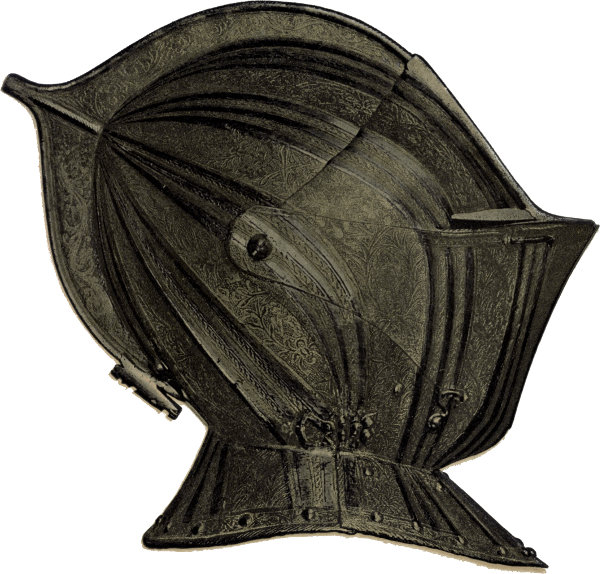
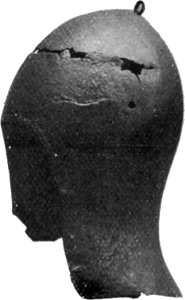
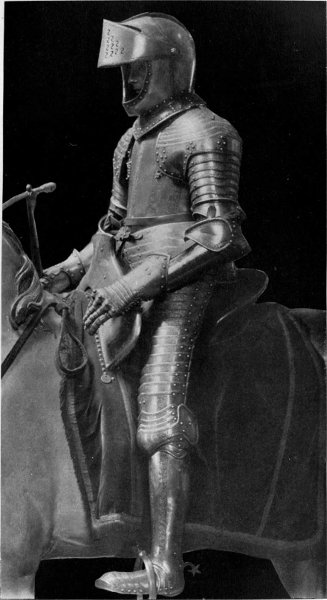
Plate VI.—Profile of the helmet belonging to the French suit (Fig. 32).
In the guard-chamber of Windsor Castle.
An English army sometimes comprised light cavalry even in the
earliest times, perhaps none more singular than a miserably-accoutred
force of mounted Irish armed with target, short javelin, and great outlandish
knives, but without using saddles, in the reign of Henry V.
The army of Henry VIII. in 1513 comprised 9000 to 10,000 heavy
barbed cavalry and 8000 light horse, and 2000 mounted archers. His
“Retinewe of speres” comprised a page, a cushet with javelin or demi-lance,
and two archers, all mounted, to each man-at-arms. An English
force of about 400 demi-lances serving Henri II. in 1552 “for their
pleasure,” were in short petticoats, red bonnets, body with brassarts of
plate, and high leather boots above the knee, mounted on swift little
horses and armed with a lance like a demi-pike.
The infantry, though not yet a permanent standing force, except in
the case of the Royal bodyguards, was now a recognised arm into which
men enlisted as a professional career for the term of their lives or until
disabled. To handle the pike or arquebus efficiently required long
training, and veterans were always accepted before recruits. It was their
steadiness and power of manœuvring in action that lessened the value of
heavy cavalry, and consequently contributed, more than any other circumstance,
to the rapid disuse of the cap-à-pied suit of armour in the
field, so noticeable in the next chapter.