'You are now the mistress, dearie,' said Dorcas. 'It is time that
you should learn what that means.'
It was the morning after the funeral—the Day of Accession—the
beginning of the new reign.
'Why, Dorcas, it makes no difference, does it? There are still
the flowers and the house and everything.'
'Yes—there's everything.' The old woman nodded her head
meaningly. 'Oh! yes—there is everything. Oh! you don't
know—you don't suspect—nobody knows—what a surprise is in
store for you!'
'What surprise, Dorcas?'
'You've never been into her room except to see her lying dead.
It's your room now. You can go in whenever you like. Always
the master or the mistress has slept in that room. When her
father-in-law died she took the room. And she's slept in it ever
since. And no one, except me and Chessun to clean up and sweep
and dust, has ever been in that room since. And now it's yours.'
'Well, Dorcas, it may be mine; but I shall go on sleeping in my
own room.'
'Then keep it locked—keep it locked up—day and night.
There's nobody in Samson to dread—but keep it locked! As for
sleeping in it, time enough, perhaps, when you come to marry.
But keep it locked——'
'Why, Dorcas, what is in it?'
'I am seventy-five years old and past,' Dorcas went on. 'I
was fifteen when I came to the house, and here I've been ever
since. Not one of the grandchildren nor the great-grandchildren
ever came in here. No one ever knew what is kept here.'
'What is it, then?' Armorel asked again.
'She used to come here alone, by daylight, regularly once a
month. She locked the door when she came in. No one ever
knew what she was doing, and no one ever asked. One day she
forgot to lock the door, and by accident I opened it, and saw what
she was doing.'
'What was she doing?'
'She'd opened all the cupboards and boxes, and she'd spread
out all the things, and was counting, and—no, no—you may guess,
when you have looked for yourself, what she was doing. I shut
the door softly, and she never knew that I'd looked in upon her.
She might have been overseen from the orchard, but no one ever
went in there except to gather the fruit. To make safe, however,
I've put up a muslin blind now, because Peter might take it into
his head—boys go everywhere peering and prying. Nobody knows
what I saw. I never even told Justinian. Men blab, you see:
they get together, and they drink—then they blab. You can never
trust a man with a secret. How long would it be before Peter
would let it out if he knew? Once over at Hugh Town, drinking
at a bar, and all the world would know in half an hour. No,
no; the secret was hers: it was mine as well—but that was an
accident—she never knew that: now it will be yours and mine.
And we will tell nobody—nobody at all.'
'Where shall I find this wonderful secret, Dorcas?'
'Wherever you look, dearie. Oh! the room is full of things.
There can't be such another room in all the world. It's crammed
with things. Look everywhere. If they knew, all the young lords
and princes would be at your feet, Armorel, because you are so
rich. Best keep it secret, though, and get richer.'
'I so rich? Dorcas, you are joking!'
'No—you shall look and find out. Not that you will understand
at first—because, how should you know the value of things?
Here's her bunch of keys. She always carried them in her pocket,
and at night she kept them under her pillows—and there I found
them, sure enough, when she was cold and dead. Take them,
child. I never told her secret—no—not even to my own husband.
Take the keys, child. They are yours—your own. You can open
everything: you can look at everything: you can do what you like
with everything. It's your inheritance. But tell no one,' she
repeated, earnestly. 'Oh! my dear, let it remain a secret. Don't
let anyone see you when you come in here. Lock the door, as she
did—and keep it locked.'
The old woman led Armorel by the hand to the door of the
room where there was to be found the Great Surprise. She opened
it, placed a bunch of keys in her hand, pushed her in and closed
it behind her, whispering, 'Lock it, and keep it locked.'
The girl turned the key obediently, wondering what would
happen next.
The room was on the ground floor, looking out upon the
orchard, with a northern aspect, so that the sun could only shine
in for a small portion of the year, during the summer months.
The apple-trees were now in blossom, the white pink and flowers
bright in the sunshine contrasting with the grey lichen which
wrapped every branch and hung down like ribbons. The room
was the oldest part of the house, the only remaining portion of
an earlier house: it was low and small: the fireplace had never
been modernised: it stood wide open, with its dogs and its broad
chimney: the window was of three narrow lights, one of which
could be opened: all were still provided with the old diamond
panes in their leaden setting. Armorel observed the muslin blind
put up by Dorcas to keep out prying eyes. In dull and cloudy
days the room would be gloomy. As it was, even with the bright
sunshine out of doors, the air seemed cold and oppressive—perhaps
from the fresh association of Death. Armorel shivered as she
looked about her.
The greater part of the room was taken up by a large bed. In
the old lady's time it had curtains and a head, and things at the
four corners like the plumes of a hearse, but in faded crimson.
Then it looked splendid. Now, the bed had been stripped:
curtains and plumes and all were gone, and only the skeleton bed
left, with its four great solid posts and its upper beams, and its
feather bed lying exposed, with the bare pillow-cases upon the
mattress. But the bedstead was magnificent without its trappings,
because it was made of mahogany black with age: they no longer
make such bedsteads. There was also a table—an old black table—with
massive legs; but there was nothing on it.
Between door and wall there was a row of pegs, with a chair
beneath them. Now, by some freak of chance, when Dorcas and
Chessun hung up the ancient dame's things for the last time—her
great bonnet, and the cap of many ribbons within it, and her silk
dress—they arranged them so as to present a most extraordinary
presentment of the venerable lady herself—much elongated and
without any face: she seemed to be sitting in the chair below the
pegs, dressed as usual, and nodding her great bonnet, but pulled
out to eight or ten feet in length. Armorel caught the ghostly
similitude and started, trembling. It seemed as if in a moment
the wrinkled old face, with the hawk-like nose and the keen eyes,
would come back to the bonnet and the cap. She was so much
startled that she turned the bonnet round. And then the figure
seemed watching with the shoulders. This was uncanny, but it
was not so terrible as the faceless form.
Beside the fireplace was a cupboard—one of those huge cupboards
which one only finds in the old houses. Armorel tried the
door, but it was locked. Against the wall stood a chest of
drawers, brass-bound, massive. She tried the handles, but every
lock was fast. Under the window stood an old sea-chest. It was
a very big sea-chest. One would judge, from its rich carvings and
its ornamental ironwork, that it was probably the sea-chest of an
admiral at least—perhaps that of Admiral Hernando Mureno,
Armorel's ancestor, if such was his rank in the navy of his Catholic
Majesty. The sight of this sea-chest caused the girl to shiver
with the fear of expectation. Nobody contemplates the absolutely
unknown without a certain fear. It contained, she was certain, the
things that Dorcas had seen, of which she would not speak. The
chest seemed to drag her: it cried, 'Open me. Look inside me—see
what I have got to show you.'
Then she remembered, as one in a dream, hearing people talk.
Words long forgotten came back to her. 'Twas in Hugh Town,
whither she went across to school when she was as yet a little girl.
'What have the Roseveans'—thus and thus said the voice—'done
with all their money? They've never spent anything: they've
gone on saving and saving. Some day we shall find out what
became of it.' Was she going to find out what had become of it?
The old lady, in her most lucid moments, had never dropped
the least hint of any inheritance, except that disagreeable necessity
of getting drowned on account of the unfortunate Robert Fletcher.
And that was not an inheritance to gladden the heart. Yet there
was an inheritance. It was here, in this room. And she was
locked in alone, in order that she, herself unseen by any, might
discover what it was.
Baron Bluebeard's last wife—she who afterwards, as a beautiful,
rich, and lively young widow, set so many hearts aflame—was not
more curious than Armorel. Nor was she, in the course of her
investigations, more afraid than Armorel. The girl looked nervously
about the room, so ghostly and so full of shadow. All old
rooms have their ghosts, but some of them have so many that one
is not afraid of them. There is a sense of companionship in a
crowd of ghosts. This room had only one—that of the woman
who had grown old in it—who had spent nearly eighty years in it.
All the old ghosts had grown tired of this monotonous room, gone
away and left the place to her. Armorel not only 'believed in
ghosts'—many of us accord to these shadows a shadowy, theoretical
belief—she actually knew that ghosts do sometimes appear. Dorcas
had seen many—Chessun herself, while not going actually that
length, threw out hints. She herself had often, too, gone to look
for them. Now she glanced nervously where the 'things' were
hanging, expecting to see the ancestral figure reappear, shoulders
move, the bonnet and cap turn round, the old, old face within
them, ready to warn, to admonish, and to guide. If this had happened,
it would have seemed to Armorel nothing but what was
natural and in the regular course of things looked for. But, outside,
the sun shone on the white apple-blossom. No one is very
much afraid of ghosts in the sunshine.
She encouraged herself with this reflection, and began with
unlocking the chest of drawers. The lower drawers, when they
were opened, contained nothing but the 'things' of her great-great-grandmother.
Among them was a box roughly made—a
boy's box made with a jack-knife: it contained a gold watch with
a French name upon it—a very old watch, with a representation of
the Annunciation in low relief on the gold face. There were also
in the box two or three gold chains and sundry rings and trinkets.
Armorel took them out and laid them on the table. They were,
she said to herself, part of her inheritance. Was this the Great
Surprise spoken of by Dorcas? She tried the two upper drawers.
They were locked, but she easily found the right key, and opened
them. She found that they were filled with lace; they were
crammed with lace. There were packets of lace tied up tight,
rolls of lace, cardboards with lace wound round and round—an
immense quantity of lace was lying in these drawers. As for its
value, Armorel knew nothing. Nor did she even ask herself what
the value might be. She only unrolled one or two packets, and
wondered vaguely what in the world she should do with so much
lace. And she wished it was not so yellow. Yet the packets she
unrolled contained Valenciennes—some of it half a yard wide,
precious almost beyond price. Armorel knew, however, very well
how it had got there, and what it meant. The descendant of so
many brave runners was not ignorant that lace, velvet, silk and
satin, brandy and claret, all came from the French coast with
which her gallant forefathers were so familiar before the Preventive
Service interfered. This, then, was left from the smuggling times.
They had not sold all. They had kept enough, in fact, to
stock half a dozen West-End shops, to adorn the trousseau
of fifty Princesses. And here the stuff had lain undisturbed
since—well, perhaps, since the unfortunate visit of Mr. Robert
Fletcher.
'My inheritance, so far,' said Armorel, 'is a pile of yellow lace
and a gold watch and chain and some trinkets. Is this the Great
Surprise?' But she looked at the sea-chest. Something more
must be there.
Next she turned to the cupboard. It was locked and double-locked.
But she found the key. The cupboard was one of those
great receptacles common in the oldest houses, almost rooms in
themselves, but dark rooms, where mediæval housekeepers kept
their stores. In those days, housekeeping on a respectable scale
meant the continual maintenance of immense stores. All the
things which now we get from shops as we want them were then
laid in store long before they were wanted. Outside the country
town there were no shops; and, even in London itself, people did
not run to the shop every day. The men had great quantities of
shirts—three clean shirts a day was the allowance of a solid city
man under good Queen Anne—a city man who respected himself:
the women had a corresponding quantity of flowered petticoats.
Wine was by no means the only thing laid down for future years.
All these accumulations helped to give solidity to the appearance
of life. When a woman thought of her cupboards filled with fine
linen and a man of his cellars filled with wine, the uncertainty and
brevity of life alleged by the Preacher seemed not to concern them.
It would be absurd to lay down a great bin of good port if one was
not going to live long enough to drink it. The fashion, therefore,
has its advantages.
Armorel threw open the door and looked in. The place was so
dark that she was obliged to light a candle in order to examine the
shelves running round the sides of the cupboard. There was a
strange smell in the place, which, perhaps, had not been opened
for a long time. Bales of some kind lay upon the upper shelves.
Armorel took down two and opened them. They contained silk—strong,
rich silk. She rolled them up and put them back. On a
lower shelf was a most singular collection. In the front row were
one—two—no fewer than six punch-bowls, all of silver except one,
and that was of silver gilt. This must be the Great Surprise.
Armorel took them all out and placed them on the table. For the
most part they showed signs of having been used with freedom—one
has heard of an empty punch-bowl being kicked about the
place as a conclusion to the feast. But six punch-bowls! 'They
came,' said Armorel, 'from the wrecks.' Behind the punch-bowls
were silver candlesticks, silver snuffers, silver cups, silver tankards—some
with coats-of-arms, some with names engraven. There was
also a great silver ship, one of those galleons in silver which
formerly adorned Royal banquets. All these Armorel took out
and arranged upon the table. Among them was a tall hour-glass
mounted in silver. Armorel set the sand running again, after
many years. On the floor there were packets and bundles tied up
and rolled together. Armorel opened one of them, and, finding
that it contained a packet of gold lace and a pair of gold epaulettes,
she left them undisturbed. And standing against the wall, stacked
behind the bundles of gold lace, were swords—dozens of swords.
What could she do with swords? Well, then, now, at last, she had
found the Great Surprise. But still the sea-chest seemed to drag
her and to call to her: 'Open me! Open me! See what I have
got for you!'
'So far, then,' she said, 'I have inherited a pile of lace; a
gold watch, rings, and chains; six punch-bowls, twenty-four silver
candlesticks, twelve silver cups, four great tankards, a silver ship,
I know not how many old swords, and a bundle of gold lace. I
wonder if these things make a person rich?'
If so, great wealth does not satisfy the soul. This was certain,
because Armorel really felt no richer than before. Yet the array
of punch-bowls was truly imposing, and the silver candlesticks, the
snuffers, the tankards, the cups, and the ship, though they sadly
wanted the brush and the chamois leather, with a pinch of
'whitenin',' were worthy of a College Plate-Room. One might
surely feel a little elation at the thought of owning all this silver,
even if one did not understand its intrinsic value. But, like the
effect of champagne, such elation would quickly wear off.
Next, Armorel remembered the secret cupboard at the head of
the bed. Her own bed had its secret recess at the head—every
respectable bedstead used formerly to have them. Where else
could money be hidden away safely? To be sure, everybody knew
this hiding-place, but everybody pretended not to know. It was
an open secret, like the concealed drawer in a schoolboy's desk.
Our forefathers were full of such secrets that everybody knew.
The stocking in the teapot: the receptacle under the hearthstone:
the hidden compartment in the cabinet: the secret room: the secret
staircase: the recess in the head of the bed—these were all secrets
that everybody knew and everybody respected. I think that even
the burglar respected these conventions. Armorel knew how to
open the panel—she found the spring and it flew open, rustily, as
if it had not been opened for a great many years. Behind the panel
was a recess eighteen inches long and about nine inches deep. And
here stood a Black Jack—nothing less than a Black Jack; a quart
Jack, not a Leather Jack, but a tankard made of tin and painted
with hunting scenes something like an Etruscan vase, or perhaps
more like a Brown George. Why should anyone want to hide
away a Black Jack? This quart pot, however, held something
better than stingo—even stronger: it was half-filled with foreign
money. Here were moidores, doubloons, ducats, pieces-of-eight,
Louis d'ors, Spanish pillar dollars, sequins, gold coins from India—nothing
at all in the pot less than a hundred years old. Armorel
took out a handful and looked at them. Well, gold coins do look
like money. She began to feel really rich. She had a quart tankard
half-full of gold coins. She added the Black Jack to the other
treasures on the table. All this foreign money must have come
out of the wrecks. And, since it was all so old, out of wrecks that
had happened before the memory even of the Ancient Lady. This,
then, was perhaps the Great Surprise.
But there remained the sea-chest under the window, and again,
when Armorel looked upon it, the chest continued to call to her,
'Open me! Open me! See what I have for you!'
Armorel found the key which unlocked it, and threw open the
lid. Within, there was the deep tray which belongs to every sea-chest.
This was filled with a quantity of uninteresting brown
canvas bags. She wanted to see what was below, and tried to lift
the tray, but it was too heavy. Then, still regarding the bags as
of no account, she took one out. It was heavy, and when she
lifted it there was a clink as of coin. It was tied tightly at the
mouth with a piece of string. She opened it. Within there were
gold coins. She took out a handful: they were all sovereigns,
some of them worn, some quite new and fresh from the Mint. She
poured out the whole contents of the bag on the table. Why, it
was actually full of golden sovereigns. Nothing else in the bag. All
golden sovereigns! And there were five hundred of them. She
counted them. Five hundred pounds! She had never, it is true,
thought much about money—but—five hundred pounds! It seemed
an amazing sum. Five hundred pounds! And all in a single bag.
And such a little bag as this. She put back the money and tied
up the bag.
Then she took out another bag. This was as big as the first,
and heavier. It was full of guineas—Armorel counted them.
There were also five hundred of them. Some of them were so old
that they bore the impression of the elephant, and therefore
belonged to the seventeenth century. But most of them belonged
to the eighteenth century, and bore the heads of the three first
Georges. Five hundred guineas—and never before had Armorel
seen a guinea! Well, she thought, that made a thousand pounds.
She took up another bag and opened it. That, too, weighed as much
and was full of gold. And another, and yet another. They were
all full of gold. And now she knew what Dorcas meant—this—nothing
but this—was the Great Surprise! Not the punch-bowls,
or the lace, or the bales of silk, but these bags full of gold constituted
her wealth. She understood money, you see: lace and silk were
beyond her. This was her inheritance!
Consider: the Roseveans, from father to son, had been from time
immemorial wreckers, smugglers, and pilots. They were also
farmers. On their little farm they grew nearly enough to support
their simple lives. They had pigs and poultry; they had milch
cows; they had a few sheep; they kept geese, pigeons, ducks;
they made their own beer and their own cordials and strong waters;
they made their own linen; they were unto themselves millers,
tinkers, carpenters, cabinet-makers, builders, and thatchers. They
grew their own salads and vegetables, and if they wanted any
fruit they grew that as well. Oats and barley they grew, clover
and hay. I believe that on Samson wheat has never been grown—indeed,
there are only eighty acres in all. There was left, therefore,
little to buy. Coals, wood for fuel and for carpentering,
things in iron, crockery, tools, cloth clothes, flannel, flour, and
sometimes a little beef—what else did they want? As for fish, they
had only to catch as much as they wanted. Tea, coffee, sugar, and
so forth came in with later civilisation, when small ale, possets,
and hypsy died out.
In order to provide these small deficiencies they were pilots, to
begin with. This trade brought in a steady income. They also
sent out boats, filled with fresh vegetables, to meet the homeward-bound
East Indiamen. And they were also, like the rest of the
artless islanders, wreckers and smugglers. In the former capacity
they occasionally acquired an extraordinary quantity of odd and
valuable things. In the latter profession they made at times, and
until the Peace and the Preventive Service put an end to the
business, a really fine income.
Then, on Samson, they continued to live after the patriarchal
fashion and in the old simplicity. Each Captain Rosevean in turn
was the chieftain or sheik. To him his family brought all that
they earned or found. The sea-chest took it all. For three hundred
years, at least, this sea-chest received everything and gave up
nothing. Nobody ever took anything out of it: nobody looked into
it: nobody knew, until Ursula counted the money and made bags
for it, what there was in the chest. Nobody ever asked if they were
rich or how rich they were.
There was no bank on Samson: there is not even now a bank
in the Scilly archipelago at all: nobody understood any other way
of saving money than the good old fashion of putting it by in a
bag. On Samson there never were thieves, even when as many as
fifty people lived on the island. Therefore the Captain Rosevean
of the time, though he knew not how much was saved, nor did he
ever inquire, laid the last additions to the pile in the tray of the
old sea-chest with the rest, and, having locked it up, dropped the
key in his pocket, and went about his business in perfect confidence,
never thinking either that it might be stolen, or that he
might count up his hoard, proceed to enjoy it, and alter his simple
way of life. Every Captain Rosevean in succession added to that
hoard every year; not one among them all thought of spending
it or taking anything from it. He added to it. Nobody ever
counted it until the reign of Ursula. It was she who made the
little brown bags of canvas: she, usurping the place of Family
Chief or Sheik, took from her sons and grandsons all the money
that they made. They gave it over to her keeping—she was the
Family Bank. And, like her predecessors in that room, she told
no one of the hoard.
Most of the bags contained guineas of George I., George II.,
and George III., down to the year 1816, when the Mint left off
coining guineas. A few contained sovereigns of later date; but
the family savings since that year had been small and uncertain.
The really fat time—the prosperous time—when the money
poured in, was during the long war which lasted for nearly five-and-twenty
years.
There were actually forty of these bags. Armorel laid them
out upon the table and counted them. Forty! And each bag to
all appearance, for she only counted two, contained five hundred
guineas or pounds. Forty times five hundred—that makes twenty
thousand pounds, if all were sovereigns! There are, I am told,
a few young ladies in this country who have as much as twenty
thousand pounds for their dot. There are also a great many
young ladies in France, and an amazing multitude, whom no
man may number, in the United States of America, who have as
much. But I am quite sure that not one of these heiresses, except
Armorel herself, has ever actually gazed upon her fortune
in a concrete form—tangible—to be counted—to be weighed—to
be admired. It is a pity that they cannot do this, if only because
they would then see for themselves what a very small pile of gold
a fortune of twenty thousand pounds actually makes. This would
make them humble. Armorel stood looking at the table thus
laden with bewildered eyes.
'I have got,' she murmured, 'twenty thousand sovereigns
and guineas at least: I have got a painted pot full of old money.
I have got six punch-bowls, a great silver ship, a large number
of silver candlesticks and cups: I have got a silver-mounted
hour-glass'—its sand was now nearly run—'I have got a great
quantity of lace and silk. I suppose all this does make riches.
Whatever shall I do with it? Shall I give it to the poor? or
shall I put it back into the box and leave it there? But perhaps
there is something else in the box.'
The chest, in fact, continued to call aloud to be examined.
Even while Armorel looked at her glittering treasures spread out
upon the table she felt herself drawn towards the chest. There
was more in it. There was another Surprise waiting for her—even
a greater Surprise, perhaps, than that of the bags of gold. 'Search
me!' cried the chest. 'Search me! Look into the innermost
recesses of me: explore my contents to the very bottom: let
nothing escape your eyes.'
Armorel knelt down before the chest and took out the tray.
It was empty now, and she could lift it easily.
Beneath the tray there was a most miscellaneous collection of
things.
They lay in layers, separated and divided—Ursula's hand was
here—by silk handkerchiefs of the good old kind—the bandanna,
now gone out of fashion.
First Armorel took out and laid on the floor a layer of silver
spoons, silver ladles, even silver dishes, all of antique appearance
and for the most part stamped with a crest or a coat-of-arms: for
in the old days if a man was Armiger he loved to place his shield
on everything; to look at it and glory in it: to let others see it
and envy it.
Then she found a layer of watches. There were gold watches
and silver watches; the latter of all kinds, down to the veritable
turnip. The glasses were broken of nearly all, and, if one had
examined, the works would have been found rusted with the sea-water
which had got in. What were they worth now? Perhaps
the value of the cases and of the jewels with which the works were
set, and more with one or two, where miniatures adorned the back
and jewels were set in the face. Armorel turned with impatience
from the watches to the gold chains, which lay beside them.
There were yards of gold chain: gold chains of all kinds, from
the heavy English make to the dainty interlaced Venetian and
thread-like Trichinopoly; there were silver chains also—massive
silver chains, made for some extinct office-bearer, perhaps bo's'n
on the Admiral's ship of the Great Armada. Armorel drew up
some of the chains and played with them, tying them round her
wrists and letting them slip through her fingers—the pretty delicate
things, which spoke of wealth almost as loudly as the bags of
guineas.
She laid them aside, and took up a silk handkerchief containing
a small collection of miniatures. They were almost all portraits
of women: young and pretty women: ladies on land whose faces
warmed the hearts and fired the memories of men at sea. The
miniatures had hung round the necks of some and had lain in the
sea-chests of others, whose bones had long since melted to nothing
in the salt sea depths, while those of their mistresses had turned
to dust beneath the aisle of some village church, their memory
long since forgotten, and their very name trampled out by the feet
of the rustics.
Armorel laid aside these pictures—they were very pretty, but
she would look at them again another time.
The next parcel was a much larger one. It consisted of snuff-boxes.
There were dozens of snuff-boxes: one or two of gold: one
or two silver-gilt: some silver. In the lids of some were pictures,
some most beautifully and delicately executed; some of
subjects which Armorel did not understand—and why, she thought,
should painters draw people without proper clothes? Venus and
the Graces and the Nymphs, in whom our eighteenth-century
ancestors took such huge delight, were to this young person merely
people. The snuff-boxes were very well in their way, but Armorel
had no inclination to look at them again.
Then she found in a handkerchief, the four corners of which
were loosely tied together, a great quantity of rings. There were
rings of every kind—the official ring or the ring of office, the signet-ring,
the ring with the shield, the ring with the name of a ship,
the ring with the name of a regiment, mourning-rings, wedding-rings,
betrothal-rings, rings with posies, cramp-rings with the names
of the Magi on them—but their power was gone—gimmal-rings,
rings episcopal, rings barbaric, mediæval, and modern, rings set
with every kind of precious stone—there were hundreds of rings.
All drowned sailors used to have rings on their fingers.
Armorel began to get tired of all these treasures. Beneath
them, however, at the bottom of the box, lay piled together a mass
of curios. They were stowed away for the most part in small
boxes, of foreign make and appearance: ivory boxes: carved wood
boxes. They consisted of all kinds of things, such as gold and
silver buckles, brooches, painted fans, jewel-hilted daggers, crystal
tubes of attar of roses, and knives of curious construction. The
girl sighed: she would look over them at another time. They
would, perhaps, add something to the inheritance, but for the
moment she was satisfied. She had seen enough. She was putting
back a dagger whose jewelled handle flashed in the unaccustomed
light, when she saw, lying half hidden among this pile of curious
things, the corner of a chagreen case. This attracted her curiosity,
and she took it out. The chagreen had been green in colour, but
was now very much discoloured. It had been fastened by a silver
clasp, but this was broken: a small leather strap was attached to
two corners. Armorel expected to find another bag of money.
But this did not contain gold. It was lighter than the canvas bags.
As she took it into her hands she remembered the bag of Robert
Fletcher. Yes. The leathern strap of this case had been cut
through. She held in her hands—she was certain—the abominable
Thing that had brought so much trouble on the family. Again the
room felt ghostly: she heard voices whispering: the voices of all
those who had been drowned: the voices of the women who had
mourned for them: the voice of the old lady who was herself a
witness of the crime. They all whispered together in her ears:
'Armorel, you must find him. You must give it back to him.'
What was in it? The clasp acted no longer. Armorel lifted
the overlapping leather and looked within. There was a thick roll
of silk. She took this out. Wrapped up in the silk, laid in folds,
side by side, were a quantity of stones—common-looking stones,
such as one may pick up, she thought, on the beach of Porth Bay.
There were a couple of hundred or more, mostly small stones, only
one or two of them bigger than the top of Armorel's little finger.
'Only stones!' she cried. 'All this trouble about a bag full
of red stones!'
Among the stones lay a small folded paper. Armorel opened
it. The paper was discoloured by age or by water, and most of
the writing was effaced. But she could read some of it.
'... from the King of Burmah himself. This ruby I estimate
to be worth ... 000l. at the very least. The other ... Mines.
The second largest stone weighs ... about 2,000l. The smaller
... rt Fletcher.'
It was a note on the contents of the parcel, written by the
owner.
The stones, therefore, were rubies, uncut rubies. Armorel
knew little about precious stones and jewels, but she had heard
and read of them. The price of a virtuous woman, she knew, was
far above rubies. And Solomon's fairest among women was made
comely with rows of jewels. Queen Sheba, moreover, brought
precious stones among her presents to the Wise King. The girl
wondered why such common-looking objects as these should be
precious. But she was humbly ignorant, and put that wonder by.
This, then, was nothing less than Robert Fletcher's fortune.
He had this round his neck, and he was bringing it home to enjoy.
And it was taken from him by her ancestor. A wicked thing
indeed! A foul and wicked thing! And the poor man had been
sent empty away to begin his life all over again. She shivered as
she looked at them. All for the sake of these dull, red bits of
stone! How can man so easily fall into temptation? In the
empty room, so quiet, so ghostly, she heard again the whispers,
'Armorel, find him—find the man—and give him back his jewels.'
She replied aloud, not daring to look round her lest she should
see the pale and eager faces of those who had suffered death by
drowning in consequence of this sin, 'Yes—yes, I will find him!
I will find him!'
She pushed the chagreen case back into its corner and covered
it up. 'I will find him,' she repeated. Then she rose to her feet
and looked about the room. Heavens! What a sight! The bags
of gold, two of them open, their contents lying piled upon the
table—the chains of gold on the floor—the handful of old gold
coins lying on the table beside the Black Jack, the snuff-boxes,
the miniatures, the punch-bowls, the rings, the silver cups—the
low room, dark and quiet, filled with ghosts and voices, the recent
occupant wagging her shoulders and shaking the back of her bonnet
at her from the opposite wall, and, through the open window, the
sight of the sunlight on the apple-blossoms mocking the gold and
silver in this gloomy cave. She comprehended, as yet, little of the
extent of her good fortune. Lace and silk, rings and miniatures,
snuff-boxes: all these things had no value to her—of buying and
selling she had no kind of experience. All she understood was
that she was the possessor of a vast quantity of things for which
she could find no possible use—one jewelled dagger, for instance,
might be used for a dinner-knife, or for a paper-knife; but what
could she do with a dozen? In addition to this museum of pretty
and useless things she had forty bags with five hundred guineas,
or pounds, in each—twenty-one thousand pounds, say, in cash.
This museum was perfectly unique: no family in Great Britain
had such a collection. It had been growing for more than three
hundred years: it was begun in the time of the Tudor Kings, at
least, perhaps even earlier. Wrecks there were, and Roseveans,
on Samson, before the seventh Henry. I doubt if any other family,
even the oldest and the noblest, has been collecting so long. Certainly
no other family, even in this archipelago of wrecks, can have
had such opportunities of collecting with such difficulties in dissipating.
For more than three hundred years! And Armorel was
sole heiress!
She understood that she had inherited something more than
twenty thousand pounds—how much more, she knew not. Now,
unless one knows something of the capacities of one single pound,
one cannot arrive at the possibilities of twenty thousand pounds.
Armorel knew as much as this. Tea at Hugh Town costs two
shillings a pound—perhaps two-and-four—sugar threepence a
pound: nun's cloth so much a yard—serge and flannel so much:
coals, so much a ton: wood for fuel, so much. This was nearly the
extent of her knowledge: and it must be confessed that it goes very
little way towards a right comprehension of twenty thousand pounds.
Once, again, she had heard Justinian talking of the flower-farm.
'It has made,' he said, 'four hundred pounds this year, clear.'
To which Dorcas replied, 'And the housekeeping doesn't come to
half that, nor near it.' Whence, by the new light of this Great
Surprise, she concluded, first, that the other two hundred, thus
made, must have been added to those money-bags, and, next, that
two hundred pounds a year would be a liberal allowance for her
whole yearly expenditure. Then she made a little calculation.
Two hundred pounds a year—two hundred into twenty thousand—twenty
thousand—two and four noughts—she put five bags in a row
for the number—subtract two—she did so—there remained three—divide
by two—she did so—one hundred years was the result of
that sum. Her twenty thousand pounds would therefore last her
exactly one hundred years. At the expiration of the century all
would be gone. For the first time in her life Armorel comprehended
the fleeting nature of riches. And, naturally, the discovery,
though she shivered at the thought of losing all, made her
feel a little proud. A strange result of wealth, to advance the
inheritor one more step in the knowledge of possible misery! She
was like unto the curious youth who opens a book of medicine,
only to learn of new diseases and terrible sufferings and alarming
symptoms, and to imagine these in his own body of corruption.
In a hundred years there would be no more. She would then be
reduced to sell the lace and the other things for what they would
then be worth. There would still, however, remain the flower-farm.
She would, after all, be no worse off than before the Great
Surprise. And then there sprang up in her heart the blossom of
another thought, to be developed, later on, into a lovely flower.
She had risen from her knees now, and was standing beside the
table, vaguely gazing upon her inheritance. It was all before her.
So the Ancient Lady had stood many and many a time counting the
money: looking to see if all was safe: content to count it and to
know that it was there. The old lady was gone, but from the opposite
wall her shoulders and the back of her bonnet were looking on.
Well: Armorel might go on doing exactly the same. She might
live as her forefathers had lived: there was the flower-farm to provide
all their necessities: if it brought in four hundred pounds a
year, she could add two hundred to the heap—in every two years
and a half another bag of five hundred sovereigns. All her people
had done this—why not she? It seemed expected of her; a plain
duty laid upon her shoulders. If she were to live on for eighty
years longer—which would bring her to her great-great-grandmother's
age—she would save eighty times two hundred—sixteen
thousand pounds. The inheritance would then be worth thirty-six
thousand pounds—a prodigious sum of money indeed. And,
besides, the Black Jack, with its foreign gold, and the rings and
lace and things!
A strange room it was this morning. What voice was it that
whispered solemnly in her ear, 'Lay not up for yourselves treasures
upon earth, where moth and rust doth corrupt, and where thieves
break through and steal'?
Never before had this injunction possessed any other significance
to her than belongs to one manifestly addressed to other
people. The Bible is full of warnings addressed to other people.
Armorel was like the Royal Duke who used to murmur during the
weekly utterance of the Commandments, 'Never did that. Never
did that.' Now, this precept was clearly and from the very first
intended to meet her own case. Oh! To live for nothing than to
add more bags to that tray in the great sea-chest!
Roland had prophesied that there would be a change. It had
come already in part, and more was coming.
What next? As yet the girl did not understand that she was
mistress of her own fate. Hitherto things had been done for her.
She was now about to act for herself. But how? If Roland were
only here! But he had only written once, and he had never kept
his promise to write back again to Samson. If he were here he
could advise.
She looked around, and saw the heaps of things that were all
hers, and she laughed. The girl whom Roland thought to be only
an ignorant and poor little country girl, a flower-farmer's girl of
Samson Island, living alone with her old grandmother and the
serving-folk, was ignorant still, no doubt. But she was not poor:
she was rich—she could have all that can be bought with money—she
was rich. What would Roland say and think? And she
laughed aloud.
She was rich—the last girl in the world to hope, or expect, or
desire riches. Thus Fate mocks us, giving to one, who wants it
not, wealth: and to another, who knows not how to use it, youth:
and to a third, insensible of its power, beauty. The young lady of
society, she whom the good old hymns used to call the Worldling—fond
and pretty title! there are no Worldlings now—would have
had no difficulty in knowing how to use this wonderful windfall.
She, indeed, is always longing, perhaps praying, for money: she is
always thinking how delightful it would be to be rich, and how there
is nothing in the whole world more desirable than much fine gold.
But to Lady Worldling, poor thing! such a windfall never happens.
Again, there are all the distressed gentlewomen, the unappreciated
artists, the authors whose books won't sell, the lawyers who have
no clients, the wives whose name is Quiverful, the tradesman who
'scapes the Bankruptcy Court year after year by the skin of his
teeth, and the poor dear young man who pines away because he
cannot join the rabble rout of Comus—why, why does not such a
windfall ever come to any of these? It never does: yet they spend
all their spare time—all the time when they ought to be planning
and devising ways and means of advancement—in dreaming of the
golden days they would enjoy, if only such a windfall fell to them.
One such man I knew: he dreamed of wealth all his life: he tried
to become rich by taking every year a share in a foreign lottery.
Of course, he never won a prize. While he was yet young and
even far down the shady or outer slope of middle age he continually
built castles in the air, fashioning pleasant ways for himself when
he should get that prize. When he grew old, he dreamed of the
will he would make and of the envy with which other old men, when
he was gone, should regard the memory of one who had cut up so
well. So he died poor; but I think he had always, through his
dreaming, been as happy as if he had been rich.
Armorel told herself, standing in the midst of this great treasure,
that she was rich. Roland had once told her, she remembered,
that an artist ought to have money in order to be free: only in
freedom, he said, could a man make the best of himself. What
was good for an artist might be good for her. At the same time—it
is not for nothing that a girl reads and ponders over the Gospels—there
were terrible words of warning—there were instances. She
shuddered, overwhelmed with the prospects of new dangers.
She knew everything: the room had yielded all its secrets
there were no more cupboards, boxes, or drawers. The sight of
the treasures already began to pall upon her. She applied herself
to putting everything back. First the chagreen case. This she
laid carefully in its corner among the daggers and pistols, remembering
that she had promised to find the owner. How should she
do that if she remained on Samson? Then she put back the snuff-boxes,
the miniatures, and the watches in their silk handkerchiefs:
then the box of rings and the silver spoons and dishes. Then she
put the tray in its place and laid the bags in the tray, and locked
the old sea-chest. This done, she bore back to the shelves in the
cupboard the punch-bowls, candlesticks, tankards, and the big silver
ship: she locked and double-locked the cupboard-door: she crammed
the lace into the drawers, and put back the box of trinkets.
Then she dropped the keys in her pocket. Oh! what a lump
to carry about all day long! But the weight of the keys in her
pocket was nothing to the weight that was laid upon her shoulders
by her great possessions. This, however, she hardly felt at first.
Everything was her own.
When the new King comes to the throne he makes a great
clearance of all the personal belongings of the old King. He gives
away his cloaks and his uniforms, and all the things belonging to
the daily life of his predecessor. That is always done. Therefore,
Queen Armorel—Vivat Regina!—at this point gathered together
all her predecessor's belongings. She turned them out of the
drawers and laid them on the floor—with the great bonnet and
the wonderful cap of ribbons. And then she opened the door. She
would give these things to Dorcas. Her great-great-grandmother
should have no more authority there. Even her clothes must go.
If her ghost should remain, it should be without the bonnet and
the cap.
She called Dorcas, who came, curious to know how her young
mistress took the Great Surprise. Armorel had taken it, apparently,
as a matter of course. So the new King stands upon the highest
step of the Throne, calm and collected, as if he had been prepared
for this event, and was expecting it day after day.
'You know all now, dearie?' she whispered, shutting the door
carefully. 'Did you find everything?'
'Yes—I believe I found everything.'
'The silver in the cupboard: the lace: the bags of gold?'
'I think I have found everything, Dorcas.'
'Then you are rich, my dear. No Rosevean before you was
ever half so rich. For none of it has been spent. They've all
gone on saving and adding—almost to the last she saved and added.
Oh! the last thing she lost was the love of saving, and the jealousy
of her keys she never lost. Oh! you are very rich—you are the
richest girl in the whole of Scilly—not even in St. Mary's is there
anyone who can compare with you. Even the Lord Proprietor
himself—I hardly know.'
'Yes. I believe I must be very rich,' said Armorel. 'Dorcas,
you kept her secret. Keep mine as well. Let no one know.'
'No one shall know, dearie—no one. But lock the door. Keep
the door locked always.'
'I will. Now, Dorcas, here are all her dresses and things. You
must take them all away and keep them. They are for you.'
'Very well, dearie. Though how I'm to wear black silk—— Oh!
Child,' she cried, out of the religious terrors of her soul—'it
is written that it is harder for a rich man to enter into heaven
than for a camel to pass through the eye of a needle. My dear,
if these great riches are to drag your soul down into hell, it would
be better if they were all thrown into the sea, the silver punch-bowls
and the bags of gold and all. But there's one comfort. It
doesn't say, impossible. It only says, harder. So that now and
then, perhaps, a rich man may wriggle in—just one—and oh! I
wish, seeing the number of rich people there are in the world,
that there'd been shown one camel—only a single camel—going
through the needle's eye. Think what a miracle! 'Twould have
brought conviction to all who saw it, and consolation ever afterwards
to all who considered it—oh! the many thousands of afflicted
souls who are born rich! You are not the only one, child, who is
rich through no fault of her own. Often have I told Justinian,
thinking of her, and he not knowing or suspecting, but believing I
was talking silly, that, considering the warnings and woes pronounced
against the rich, we cannot be too thankful. But don't
despair, my dear—it is nowhere said to be impossible. And there's
the rich young man, to be sure, who was told to sell all that he
had and to give to the poor. He went away sorrowful. You can't
do that, Armorel, because there are no poor on Samson. And it's
said, "Woe unto you that are rich, for you have had your consolation!"
Well, but if your money never is your consolation—and
I'm sure I don't know what it is going to console you for—that
doesn't apply to you, does it? There's the story of the Rich Man,
again; and there's texts upon texts, when you come to think of
them. You will remember them, child, and they will be your
warnings. Besides, you are not going to waste and riot like a
Prodigal Son, and where your earthly treasure is there you will
not set your heart. You will go on like all the Roseveans before
you: and though the treasure is kept locked up, you will add to it
every year out of your savings, just as they did.'
'There is another parable, Dorcas. I think I ought to remember
that as well. It is that of the Talents. If the man who was
rich with Five Talents had locked them up, he would not have
been called a good and faithful servant.'
'Yes, dearie, yes. You will find some Scripture to comfort and
assure your soul, no doubt. There's a good deal in Scripture.
Something for all sorts, as they say. Though, after all, riches is a
dangerous thing. Child! if they knew it over at St. Mary's, not a
young man in the place but would be sailing over to Samson to try
his luck. Our secret, child, all to ourselves.'
'Yes; our secret, Dorcas. And now take away all these things,
everything that belonged to her: there are her shoes—take them
too. I want the room to be all my own. So.'
When all the things were gone, Armorel closed and locked the
door. Then she ran out of the house gasping, for she choked.
Everything was turned into gold. She gasped and choked and ran
out over the hill and down the steps and across the narrow plain,
and up the northern hill, hoping to drive some of the ghosts from
her brain, and to shake off some of the bewildering caused by the
Great Surprise. But a good deal remained, and especially the
religious terrors suggested by that pious Bryanite Christian and
Divider of the Word, Dorcas Tryeth.
When she sat down in the old place upon the carn, the great
gulf between herself and Bryher island reminded her of that
great gulf in the parable. How if she should be the Rich Man
sitting for ever and for ever on the red-hot rock, tormented with
pain and thirst—and how if on Samson Hill beyond she should
see Abraham himself, the patriarch, with Lazarus lying at his feet—as
yet she had developed no Lazarus—but who knows the future?
The Rich Man must have been a thoughtless and selfish person.
Until now the parable never interested her at all: why should it?
She had no money.
The other passages, those which Dorcas had kindly quoted in
this her first hour of wealth, came crowding into her mind, and
told her they were come to stay. All these texts she had previously
classed with the denunciations of sins the very meaning of which she
knew not. She had no concern with such wickedness. Nor could
she possibly understand how it was that people, when they actually
knew that they must not do such things, still went on doing
them. Now, however, having become rich herself, all the warnings
of the New Testament seemed directed against herself. Already,
the load of wealth was beginning to weigh upon her young shoulders.
She changed the current of her thoughts. Even the richest
girl cannot be always thinking about woes and warnings. Else she
would do nothing, good or bad. She began to think about the
outer world. She had been thinking of it constantly ever since
Roland left her. Now, as she looked across the broad Roadstead,
and remembered that thirty miles beyond Telegraph Hill rose the
cliffs where the outer world begins—they can be seen in a clear
day—a longing, passionate and irresistible, seized her. She could
go away now, whenever she pleased. She could visit the outer
world and make the acquaintance of the people who live in it.
She laughed, thinking how Justinian, who had never been
beyond St. Mary's, pictured, as he was fond of doing, the outer
world. The Sea of Tiberias was to him the Road: the Jordan was
like Grinsey Sound: the steep place down which the swine fell
into the sea was like Shipman's Head: the Sermon on the Mount
took place on just such a spot as the carn of the North Hill on
Samson, with the sun shining on the Western Islands: the New
Jerusalem in his mind was a city like Hugh Town, consisting of one
long street with stone houses, roofed with slate; each house two
storeys high, a door in the middle, and one window on each side.
On the north side of the New Jerusalem was the harbour, with the
ships, the sea-shore, and the open sea beyond: on the south side
was a bay with beaches of white sand and black rocks at the
entrance, exactly like Porth Cressa. And it was a quiet town,
with seldom any noise of wheels, and always the sound of the sea
lapping on either hand, north or south.
Now, there was nothing to keep her: she could go to visit the
outer world whenever she pleased—if only she knew how. A girl
of sixteen can hardly go forth into the wide, wide world all alone,
announcing to the four corners her desire to make the acquaintance
of everybody and to understand anything.
And then she began to remember her teacher's last instructions.
The perfect girl was one who had trained her eye and her hand:
she could play one instrument well: she understood music:
she understood art: she was always gracious, sympathetic, and
encouraging: she knew how to get their best out of men: she
was always beautifully dressed: she had the sweetest and the most
beautiful manners.
And here she blushed crimson, and then turned pale, and felt a
pang as if a knife had pierced her very heart. For a dreadful
thought struck her. She thought she understood at last the true
reason why Roland never came back, though he promised, and
looked so serious when he promised.
Why? why? Because she was so ill-mannered. Of course
that was the reason. Why did Roland speak so strongly about the
perfect girl's gracious and sympathetic manners, unless to make
her understand, in this kindly and thoughtful way, how much was
wanting in herself? Of course, he only looked upon her as a common
country girl, who knew nothing, and would never learn anything.
He wanted her to understand that—to feel that she would never
rise to higher levels. He drew this picture of the perfect girl to
make and keep her humble. Nay, but now she had this money—all
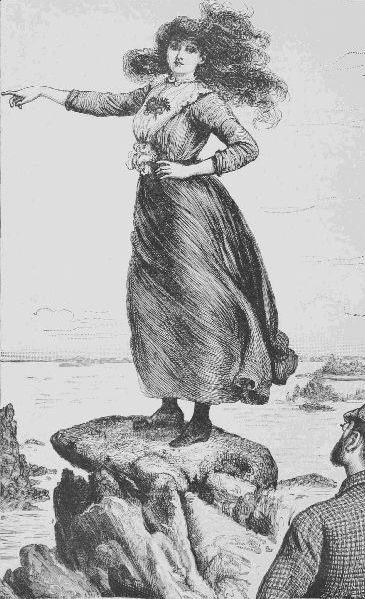
this wealth—now—now—— She sprang to her feet and threw
out her arms, the gesture that she had learned I know not where.
'Oh!' she cried, 'it is the gift of the Five Talents! I am not the
rich young man. I have not received these riches for my consolation.
They are my Five Talents. I will go away and learn—I
will learn. I will become the perfect girl. I will train eye and
hand. I will grow—grow—grow—to my full height. That will
be true work in the service of the Giver of those Talents. I shall
become a good and faithful servant when I have risen to the stature
that is possible for me!'

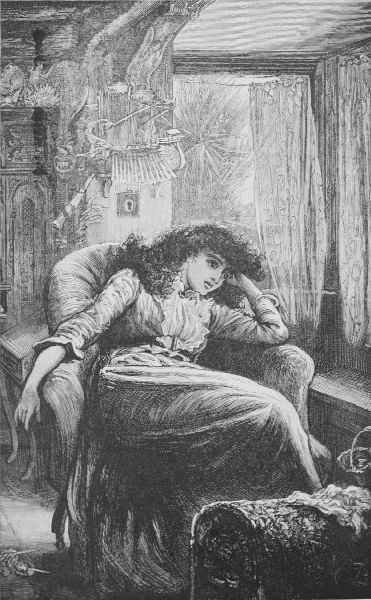 Frontispiece. Her face turned towards the window.