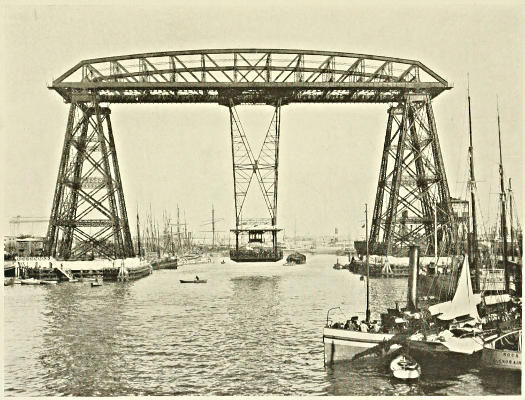
This is the largest and most densely populated and
the most uniformly prosperous Province of the
Republic.[23] It is bounded on the North by the
Provinces of Santa Fé and Córdoba, on the West by the
Territories of the Pampa Central and Rio Negro and on
the East and South by the Paraná and Plate Rivers and
the Atlantic Ocean. Its capital, La Plata, is of a somewhat
sadly monumental aspect. It is indeed as yet but a monument
to the still unrealized dreams of its modern founders
and architects. It was to have been a great city with a
busy port; it is now a place where Provincial parliamentarians,
lawyers, university students and Law Court and
Police officials spend some hours each day, coming each
morning and returning each evening from and to the
superior activity and attractions of the Federal Capital.
Nevertheless, La Plata has long, wide, eucalyptus-planted
avenues; its chief Plaza, in which are the Municipality and
the Cathedral, is not much smaller than Trafalgar Square;
its Museum is world-renowned for its palæontological
collections; and its Law Courts, University, Theatre,
Police Offices and the above-mentioned Municipality are
huge, magnificently solid-looking buildings. But the lack
of all perceptible movement in La Plata leads one to imagine
that if its broad avenues and noble Plazas are not grass-grown
the fact is due much more to the action of street
cleaners than to that of traffic. Truly, one may often gaze
down a very long vista of pavement between tall eucalyptus
trees for many minutes without seeing one single other
human being.
The Port works of Buenos Aires have drained its only
source of commerce from La Plata. Still, some day the
trade of the Republic may need it also.
At the same time it is only just to add that La Plata
makes out a claim to nearly 100,000 inhabitants. Where
they all get to when one visits it is mystery. Perhaps they
in their turn spend their days in Buenos Aires; returning
home to sleep in the deep stillness of the Provincial Capital.
The real chief port of the Province of Buenos Aires is
Bahia Blanca. First of all, in 1896, the National Government
decided to build the naval port and arsenal now in
existence there: subsequently the Buenos Aires Great
Southern and the Buenos Aires and Pacific Railway Companies
realized the conveniences and situation of Bahia
Blanca as a place of export for the produce of their great
and ever-increasing southern and south-western zones and
each company constructed a port for the almost exclusive
purposes of its own traffic.
The Great Southern Railway’s port is called Ingeniero
White and that of the Pacific Railway Puerto Galvan.
Besides these, separate and distinct constructions, Bahia
Blanca has a fourth port, Cuatreros, at the interior end
of the bay, which exports large and increasing quantities
of frozen and chilled meat.
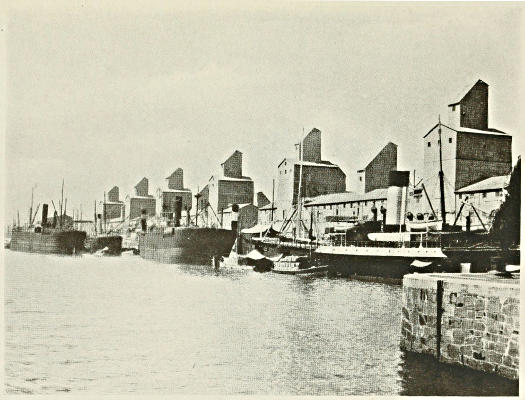
The great railway ports of Bahia Blanca are fitted with
every modern mechanical appliance, huge cranes, electric
endless belts for loading loose grain, and immense grain
warehouses and elevators. The town of Bahia Blanca is
rapidly growing in importance and influence. Its municipal
administration is largely in the hands of British exporters
and merchants.
On the Atlantic coast, between Bahia Blanca and Buenos
Aires and some 400 kilometres from the latter city, is the
famous seaside resort of Mar-del-Plata, the Argentine Monte
Carlo—Trouville-Biarritz-cum-Ostend (before the War!).
During the season there (at all other times of the year it
is deserted) vast Hotels and Restaurants charge famine
prices for accommodation and food and there is always
more demand than available supply of either. Wealthy
Argentine families have, of course, their palatial “Chalets,”
and the Rambla, as the great promenade by the sea is
called, is a very brilliant scene at all times during the weeks
in which it is fashionable.
Music and dancing contribute to the nights’ amusement
at the Casino, large Hotels and private houses; and at the
Club members can indulge in those games in which chance
plays a greater rôle than skill.
As one young gentleman, who had failed to get a bed at
any of the Hotels he thought worthy of his patronage, once
remarked, “No matter, one can always play Baccarat till
it is bathing time again.”
The air of Mar-del-Plata, that of the wide Atlantic, would
doubtless be a powerful restorative to anyone who could
resist the temptations of amusement sufficiently to give it
a chance. Some people possibly do, but if so keep very
silent about it.
Mar-del-Plata is, however, destined to show a more
serious side of its possibilities in consequence of the building
of a commercial port; the construction of which has been
entrusted to a French firm, also the constructors of the new
port works of Montevideo. Potatoes which are deemed the
best in the Republic come from near Mar-del-Plata.
Other chief towns of the Province of Buenos Aires are
Avellaneda (situate on the Provincial side of the boundary
line between the Province and the Federal City of Buenos
Aires, but to all intents and purposes a district of the latter
with which it is connected by unbroken lines of streets and
houses), Chivilcoy, Pergamino, Tres Arroyos, Nueve
de Julio, Azul, the residential suburbs (of Buenos Aires),
Temperley and Lomas de Zamorra and many smaller
“camp” towns.
All these minor camp towns of the Province of Buenos
Aires look much alike and none of them are very interesting
in appearance. Their stores, however, do good business in
supplying the needs of large surrounding rural districts, and
some of these towns have periodical cattle shows and sales
which are well worth visiting.
Temperley and Lomas de Zamorra consist chiefly of
Villa residences, of all sizes and styles of architecture, and
some shops.
The Province of Buenos Aires, half as large again as
the whole Republic of Uruguay, possesses some of the best
land in Argentina, and in it farming has reached the highest
developments as yet attained in either Republic. In it
intensive farming has already made its first appearance in
South America—as needs must when high land-values drive.
The surface of this Province is one almost unbroken level
plain.
It at present produces one-third of the whole output of
wheat, nearly a similar proportion of maize, one-fifth that
of linseed, 87% of that of oats, and also contains about 37%
of the live stock of the whole Republic.
Good water is obtainable nearly everywhere in practically
close proximity to the surface. This fact, combined with
the comparatively few running streams and the tendency
of these to dry up in hot weather, causes some parts of this
Province to have the appearance of a forest of tall skeleton
iron windmills. These are set up over artificially sunk wells,
to draw water for animals and domestic purposes.
A detailed description of the Province of Buenos Aires
would extend to a very great length indeed; as this Province
is, as far as its climatic conditions permit, a compendium
of the industrial activity, at its best, of the whole Republic.
That it is so is due to its situation on, or always in relatively
close proximity to, the estuary of the River Plate; the
cradle of the civilization and progress of the countries under
discussion.
Farming and most other industries find their highest
expression within easy reach of and in the Federal Capital.
As far as its physical aspect is concerned, the Province
of Buenos Aires has been accused with considerable justice
of being generally uninteresting. Certainly its surface is
one huge flat plain, until one gets south to the ranges of the
Sierra de la Ventana and the Tandíl hills. Past them,
nothing but monotonous plain again till its southernmost
boundary, the Rio Colorado, is reached.
Its only romantic scenery, though that is delightful
indeed, is on its north-eastern frontier, along the small River
Tigre and the majestic Paraná; the banks and innumerable
islands of which are clad with useful osiers, flowering reeds,
peach trees and a large riot of other beautiful and luxuriant
vegetation. Many a spring day can be passed in idyllic
enjoyment among the islands of the Tigre.
At Tandíl, on the south-eastern side of the Province,
there are quarries of fine marble and building stone, and
until a year or so ago there was a famous rocking-stone
perched on another rock, the surface of which is inclined
at an angle of something like 45 degrees. To all appearances
a mere gust of wind would have toppled the upper stone
down into a hollow beneath; but the tale goes that Señor
Benito Villanueva, a wealthy and sportsmanlike Argentine,
once tied a rope round the rocking-stone and attached the
other end to a double span of oxen on the plain below. The
oxen pulled; but without any other effect on the rocking-stone
than temporarily to cant it just as many centimetres
as it could be moved by a good push from a man’s hand.
Now, alas for Tandíl, someone has succeeded in dislodging
the rocking-stone from its uncanny-looking eminence, so
that it has, literally, fallen from its high celebrity.
Buenos Aires is, naturally, the Province of palatial
estancia houses surrounded by model farms. The Queen
Province. The most densely populated and cultivated and
the one with the largest revenues.
This Province ranks next to that of Buenos Aires in
respect of area and population, while its output of both
maize and linseed is slightly greater than that of the
Queen Province; in regard to wheat it stands third
among the Argentine Provinces, Córdoba coming immediately
after Buenos Aires, and in respect of oats it again
comes second. In point of live stock it comes only fifth,
after Buenos Aires, Entre Rios, Corrientes and Córdoba.
It is bounded on the North by the Territory of the Chaco,
on the West by the Provinces of Santiago del Estero and
Córdoba, on the South by the Province of Buenos Aires
and on the East by the River Paraná.
The northern part of Santa Fé is covered with vast
forests, continuations of those of the Provinces of Santiago
del Estero and the Territory of the Chaco. These forests
are rich in Quebracho wood, and from them also come large
supplies of firewood and charcoal.
The other parts of Santa Fé are devoted to stock and
agriculture.
The streams of this Province, although more numerous
than those of Buenos Aires, have (with the exception of the
great River Paraná) the same tendency to dry up as have
those of the Queen Province, and, therefore, water-drawing
windmills are in proportionate evidence.
Its Capital, the city from which it takes its name, is one
of the oldest in the River Plate countries. Its movement
is, however, little else than that of a merely political capital;
the town of Rosario, with its port, being the centre of most
of the commercial activity of this part of the Republic.
Until the rise of Bahia Blanca, Rosario held the undisputed
rank of the second commercial centre of Argentina.
The City of Santa Fé nevertheless possesses an old-world
beauty and charm, with its palm avenues and spacious
Plazas, its many churches and its large one-storied residences.
Rosario, on the other hand, is as unsightly and
uninteresting a place to the eye as could well—or, rather
badly—be conceived. It has, however, a large share of the
cereal export trade. This Province has also other important
ports on the Paraná, viz. the port of Santa Fé itself, Villa
Constitution, Colastiné and several minor ones, all of which
are available for ocean-going ships.
After Buenos Aires, Santa Fé is the Province with by far
the greatest and most conveniently situated railway mileage.
Mixed agriculture and stock farming is practised in many
districts; though Santa Fé has not yet felt the economic
need of other than extensive farming. Still, land values
have, until recent events prejudicially, if only temporarily,
affected all such values, followed those in Buenos Aires on
an upward course. Santa Fé sends large quantities of
potatoes to the Buenos Aires and local markets.
The milling industry of this Province ranks not only next
in importance to that of Buenos Aires, but its output of
flour is very much greater than that of Entre Rios, the next
most important Province in this regard. The Department
of Reconquista, in the North of the Province, has sugar
mills, and other industries are the production of ground-nut
oil, dairy produce, tanneries, preserved meats and maize
alcohol.
This Province is bounded on the North by the Province
of Santiago del Estero, on the North-West by the Province
of Catamarca, on the West by the Province of La Rioja and
San Luis, on the South by the Territory of the Pampa
Central and the Province of Buenos Aires, and on the East
by the Province of Santa Fé.
Córdoba is the second Province of the Republic in point
of wheat and linseed production, being not far behind
Buenos Aires in this regard. Its maize production, however,
does not amount to one-third of that of either Buenos Aires
or Santa Fé, while in oats it about ties with the latter.
In live stock it ranks fourth among the Argentine Provinces,
though it has less than half the number possessed by Entre
Rios and only about half of that of Corrientes. In the matter
of population it ranks fourth among the Provinces of the
Republic, with about one-third that of Buenos Aires.
As one travels towards the ancient capital of this Province
one begins to realize that the cosmopolitan delights of the
city of Buenos Aires do not reflect the soul of the Republic:
the soul that fought for its liberty under the blue sky and
warm sun of 25th of May, now over a hundred years ago.
One begins involuntarily to dream of the Gaucho Wars and
to feel the atmosphere of wilder bygone times amid the
steep water-cut and cacti-crowned banks of the five great
rivers which traverse the land from west to east. And when
one gets to “The Learned City” the illusion is not dispelled.
Only one extremely modern-looking Hotel in a corner of the
Plaza jars; the rest of old Córdoba exhales the magnolia-scented
atmosphere of Old Colonial days. The Cathedral,
the University (founded in 1613) and the innumerable
churches, the bells of which all clang incessantly on Feast-days,
all help to preserve in the old part of the City of
Córdoba an atmosphere of the Middle Ages, when monasteries
and learning were indissolubly connected. And of
monks and nuns, brown-robed, black-robed, white-robed
and blue-robed, many there be in Córdoba. Wherever
one looks, across the Plaza, up one street or down another,
one sees them walking in twos or small groups with a uniformly
measured step which, as one instinctively feels,
nothing could hurry nor retard. And the black-coated
citizens of Córdoba walk silently with eyes downcast. But
there is fierceness behind those cast-down eyes and quick
hot blood in the veins of those men in black; as anyone
would soon find out to his cost were he suspected of too
close enquiry into local political ways and means.
The writer speaks feelingly on this subject since when,
a few years ago, he was visiting Córdoba with a quite natural
but equally innocent curiosity for the old-world corners of
the City, he unfortunately disclosed in conversation with an
eminently respectable-looking, immaculately dressed gentleman
that he, the present author, was a journalist.
Soon afterwards his adventures began. He was molested
in indirect ways, and finally invited to pay a visit to the
Central Police Station. There he was given cigarettes and
coffee by the Comisario, who floridly apologized and expressed
his deep regret and shame for the treatment an
honourable stranger had received. It was, however, but
a series of regrettable accidents arising from unfortunate
error of certain bad characters who were now in durance vile
in consequence.
Here he rang a bell and ordered the answering policeman
to bring in the culprits. They were duly brought in and
recognized.
“Now,” said the Comisario, “you will have no more
trouble. Besides,” he added, “one of our plain-clothes men
will accompany you in future wherever you go—for your
better protection.”
The plain-clothes man certainly obeyed orders; so persistently
that the whole why and wherefore at last dawned
on my confused brain.
The intention was to worry me so much in a polite quasi-legitimate
fashion that I could have no ostensible cause of
complaint; but, at the same time, so that I should incontinently
quit the ancient City of Córdoba in disgust.
The reason for all this was the fact that, having nothing
better to do on the evening of my arrival, I had wandered
into the basement of my Hotel and there found a person
who looked like, and indeed was, a leading local politician
running a roulette to catch the nickels of a crowd of
working men. At that time the roulette was the scarcely
concealed vice of the town, rife in the back room of every
bar.
It is an illegal game in Argentina, as elsewhere except
Monte Carlo, and shortly after my visit it was the cause of
a great outcry and scandal in which several Provincial High
Officials were involved.
I was a journalist and, therefore, dangerous. So a course
of delicate hints to me to get out had been planned and
executed.
Following the gambling scandal, a leading Opposition
politician was shot dead in his carriage on the high road a
short way outside the city. When I read this news I was
glad that I had not persisted in seeming to pry into cupboards
containing Córdoba’s official skeletons, and for
similar reasons I am still somewhat shy of Córdobese gentlemen
with downcast eyes and soft, measured tread.
All that, however, belongs to Old Córdoba. The parts
of the city called New Córdoba and Alta Córdoba are replete
with palatial residences as fine and as new as residential
palaces need be.
The City of Córdoba is not only the traditional seat of
learning par excellence of the Republic, it is also, as a consequence
of old-time associations no doubt, its chief centre of
clerical influence.
Córdoba is intensely and, if one may be permitted to say
it, intolerantly Catholic. Were it not subject to the democratic
laws of a modern and very go-ahead Republic one
would hardly be surprised to find disciplinary institutions
of an Inquisitorial type still in full swing in this old-world
city of South America. As it is, there is no doubt of the
predominance of priestly influence in Provincial politics.
Much of the best freehold property in the city is owned by
Monastic Orders or by the Society of Jesus.
Most of the Province consists of a large plain; which,
naturally, is the chief productive area. But Córdoba has
hills famous for the purity of their air and great resorts for
consumptive patients. Alta Gracia, with its fine hotel,
golf links, etc., has of late years acquired a very favourable
reputation as a place in which anyone may spend a very
pleasant and healthful week or so.
In the North-West of the Province are great salt marshes,
in and around which only a very scanty and meagre vegetation
flourishes, and in the North-East is the Mar Chiquita,
a large and, in parts, very deep lake, the waters of which
are salty like those of the sea. Hence its name.
Córdoba also possesses large forests, as yet chiefly exploited
for building timber and firewood.
Rio Cuarto, on the river of that name, is the next
largest town in the Province in point of population, but it
is likely soon to be altogether surpassed in importance by
Bell Ville, on the Central Argentine Railway, a rapidly
advancing centre of the cereal trade, and some day also,
probably, by Marcos Juarez, comparatively close to it on
the same line.
Goats abound in the North of Córdoba. Land values
have increased and are increasing; especially in the most
fertile regions in the South-Eastern parts of the Province.
Córdoba has given and continues to give much attention
to irrigation and possesses one of the largest semi-natural
reservoirs in the world, certainly in South America, in the
Dique San Roque, which is formed by means of a wall of
masonry placed across the mouth of a mountain gorge.
Its capacity is 260,000,000 cubic metres, and its operation
is completed by a basin situated some fifteen miles from
and below it, from which the water flows through two great
primary canals. The area so irrigated is some 130,000
hectares. Other large irrigation works are in course of
construction, and more still are under consideration.
Córdoba has also a large share of industrial enterprise,
of which the chief are lime and cement works, ornamental
and other tile manufactories, potteries, sawmills and butter
factories.
The hills of this Province have some practically unexploited
mineral deposits. The area between the city of
Córdoba and the Provinces of Santa Fé and Buenos Aires
is covered with a close network of railway lines, in great
contrast (as may be seen by a glance at the railway map)
in this respect with the more Northern parts of the Province.
There has for a long time been talk of a canal to run from
near the city of Córdoba to a point close to the port of
Rosario, utilizing the surplus waters of the Primero, Segundo
and Tercero Rivers.
There is something almost incongruously prosaic about
the naming, 1st, 2nd, 3rd and 4th, of the rivers which
traverse a Province in which so much of the old romantic
atmosphere lingers.
The Alfalfa fields of Córdoba are in extent second only
to those of Buenos Aires, covering an area equal to more
than half that devoted to this forage in the latter Province.
This Province is bounded on the North by the Province
of Corrientes, on the West and East by, respectively, the
Rivers Paraná and Uruguay (hence its name “Between
Rivers”) and on the extreme South by the River Plate,
which is formed by the conjunction of the Paraná and
Uruguay.
As has been seen, Entre Rios comes second among the
Argentine Provinces for production of oats; but in respect
of other cereal crops it is still far behind Buenos Aires,
Santa Fé and Córdoba. It is, however, rich in live stock,
having nearly three times the quantity possessed by Córdoba.
In point of population it ranks fourth among the
Argentine Provinces.
Until the accomplishment of the Entre Rios railway this
Province was known as the “Poor Sister” of Buenos Aires
and Santa Fé. Now, this disparagement cannot be thrown
on her; for her prosperity is advancing literally by leaps
and bounds. This is very largely owing to the communication
and transport afforded by the Railway and its train-carrying
Ferry Boats which run between Zárate on the
Buenos Aires side of the River Paraná and Ibicuy on the
Entre Rios side, thus permitting of traffic without change
of car between the Federal City and the Entre Rios system—and,
in fact, also, onward through the Province of Corrientes
and the Republic of Paraguay to Brazil, by several
links in the chain of railway lines one day to run the whole
length from North and South of the two Americas.
The journey by rail from Buenos Aires to Paraná, the
capital of Entre Rios, is a delightful one, not the least
pleasant part of it being the voyage in the well-appointed
Ferry Boats up and across beautiful winding reaches of the
Paraná River.
From the Provincial capital one can again take a train
through interesting country across the Province to Concórdia,
on the River Uruguay, and so back to Buenos Aires
by one of the fine and comfortable River Boats. That is,
if one does not first of all go further North to the famous
falls of Iguazú, further mention of which will be made when
writing of the National Territory of Misiones.
The City of Paraná is a quiet, pleasant Capital, redolent
of the memory of General Urquíza, the one-time “Tyrant”
of these parts of the River Plate Territories. One sees the
old large low building which was the head-quarters of his
government, and where, as history hath it, he contrived to
have many of his political enemies put to death. On the
other hand, there is much evidence of his enlightenment in
the shape of schools, first established by him and later
fostered by “The School Master President” Sarmiento.
The fact is that Urquíza, like Rozas, whom he supplanted,
and Artígas, the national hero of Uruguay, were all strong
men of good purpose according to their lights and times;
times which were turbulent and in which it was necessary
for him who would govern to kill first if he would not
himself die by an assassin’s hand.
Opposition politicians had short shrift in those days.
They were caught, convicted and executed almost before the
plots of which they were found guilty had been fully formed.
Each of these tyrants had a far-reaching and minutely
penetrating police system, from which nothing was hid of
the movements and meetings of other people in those
sparsely populated days; days when no man’s business was
a secret to his neighbour. As a result, order sprang out of
disorder and was maintained by iron rule.
Looking back from this distance of time one can perceive
the great and good work done by these men for their
country. Their methods were of the time; necessary.
On the cliff-like bank of the river is the really charming
Urquíza Park. The chief Plaza, “Primero de Mayo,” is
gay o’ nights with electric light shining on the tables outside
the Cafés, whilst a band plays in the midst of the garden in
its centre. Paraná has trams and a theatre, and altogether
is quite a busy commercial centre. Still it is, as has been
said, quiet with the distinctive quiet of really Provincial
towns all the world over.
But the most charming place of all (to the writer’s mind,
one of the most charming in the Republic) is Concórdia.
Its cobbled streets and orange-scented gardens, its pure
air, bright sun and cool breezes combine to give one the
feeling of having at last reached a true haven of rest from
the turmoil of the outer world; a haven in which one might
dream the remainder of one’s life away happy and passing
rich on the Argentine equivalent to forty pounds a year.
Yet Concórdia is busy, busy in its old Colonial way with
sending produce down the broad River Uruguay to the great
noisy port of Buenos Aires.
The Entre Rios farmers do good business in cattle fattening;
for which their usually well-watered and rich pasturage
is peculiarly fitted. Yet, at times, Entre Rios has suffered
from severe drought, and more frequently from locust
invasion, a plague which, however, is now already fairly
well held in check by the measures adopted and strictly
carried out by Government for the gradual elimination, as
it is hoped, of these insects from the Republic.
Entre Rios, still only just, so to speak, opened up by the
railway, is still conservative in respect of the maintenance
of large land holdings. These are, however, slowly but surely
being divided up owing to demand and in accordance with
the more utilitarian spirit of the times.
Entre Rios is a chief centre of the jerked-beef industry,
and the Liebig factories are an economic feature which
cannot go unmentioned. Grease factories, for which large
quantities of mares are slaughtered annually, also constitute
one of the chief industries of this Province.
Entre Rios has a very considerable acreage under barley.
Corrientes may be regarded, economically, as well as
geographically, as still being one of the outlying Provinces,
inasmuch as its population and cereal production are much
less than those of the Provinces already dealt with.
It is, however, numerically richer in Live Stock than
either Córdoba or Santa Fé[24] and has large areas under
maize cultivation.
Corrientes is bounded on the North by the River Paraná,
which forms the boundary between it and the Republic of
Paraguay. This river is also its Western boundary, while
on the East it is bounded by the National Territory of
Misiones and the River Uruguay, and on the South by Entre
Rios.
It is served by the Argentine North-Eastern Railway
system, which links up and is in every way closely connected
with the Entre Rios Railway: and by a small
narrow-gauge industrial railway which runs through a large
area of Quebracho forest and also serves some sugar mills.
Other communication is by old-world diligences. Another
railway is, however, projected to run almost along the north
boundary of the Province from the City of Corrientes to
Posadas in Misiones.
The inhabitants of Corrientes, like their Paraguayan
neighbours, from whom, especially in the more Northern
parts of this Province, they differ but slightly in racial
characteristics, are the true lineal descendants of Spanish
soldiery and their native Guaraní Indian wives. They are
as a rule a pleasant enough people, good-humoured and
somewhat indolent. As to the latter quality one must,
however, remember that in Corrientes one is already among
subtropical vegetation (Palms begin to rear their tufted
heads in the North of Entre Rios). One of the most
beautiful examples of this vegetation is the Lapacho with its
great branches of pink flowers.
One must not delay long, however, if one wish to still
catch the old-world flavour of Corrientes. Its capital,
founded in 1588 with one of the long names in which the
Spanish conquerors appear to have delighted, namely, San
Juan de la Vera de las siete Corrientes (St. John of Vera of
the Seven Streams), is already provided with modern waterworks
and electric trams. Still, one yet finds many mysterious
looking low houses with vertically barred windows, and
covered verandahs lining long narrow streets. Modern
buildings, however, are rapidly spoiling the attraction of the
place for those who appreciate the charm of more leisurely,
spacious times. That charm yet lingers in the city of
Corrientes, but, as has been said, is already being startled
into flight by modernity.
The latter and Corrientes are, nevertheless, still fairly far
apart. It would be curious to know how many inhabitants
of the Federal Capital have even the faintest notion of what
City of the Seven Streams is like (?). Very few indeed;
except those who have or have had direct interests in the
latter place. The notions of the rest would be similar to
those of the average European regarding the Pampa.
Corrientes is for the most part well watered, and has
immense tracts of excellent pasturage.
Besides its Capital, Corrientes possesses as its, even more
commercially important, centres the towns of Goya, famous
for its cheeses, Ituzaingó, Bella Vista, and Empedrado, all
ports or rather possible ports on the Paraná, Mercedes, the
centre of prosperous sheep-farming districts, and Curuzú
Cuatia and Monte Caseros, with good railroad facilities.
With the necessary expenditure on wharves, etc., Corrientes
could be brought into a much greater economic
activity than it shows signs of as yet; by utilizing its great
natural riparian means of communication, although the
River Uruguay is at this height difficult of navigation,
owing chiefly to the rapidity of its current and frequent
floods.
The Correntino has not yet, however, developed much
commercial enterprise. His cattle still show the native
long horned and limbed characteristics of wilder days and
he himself seems to find it less trouble to get tobacco, mate,
sugar, coffee and many other things from Brazil or Paraguay
than to grow and manufacture them himself; as he could
do easily and profitably. Much of his nature is Indian; to
be modified in time by the overwhelming forces of civilization.
One cannot leave Corrientes without mention of the lake
Iberá in the North of the Province, a vast natural hollow
filled with water, the surface of which is in many parts
covered so solidly with interlaced bamboos, grasses and
aquatic plants as to enable one to walk on it as if on a huge
raft. There has been much talk of reclaiming the land by
draining Lake Iberá, a task which owing to the gradients of
the surrounding lands would not present great difficulties;
if so be that the lake is not connected by subterranean
channels with the Rivers Paraná and Upper Uruguay, as
there are several reasons to suppose it may be.
The islands of this lake form a perfect zoological garden
of animals and reptiles long since practically extinct in the
surrounding country; among which are Jaguars, Alligators
and Boa Constrictors.
The present writer remembers an interesting if somewhat
terrifying collection of such and other wild specimens being
cast up a little more than a decade ago on the river shores of
the Province of Buenos Aires, near to the Federal Capital,
by the swollen waters of the Paraná during extraordinary
floods. These creatures were washed down clinging to trunks
of trees and islets of intertwined vegetation which had been
torn away by the force of the waters. It is safe to assume
that they were much more terrified than were even the
peaceable inhabitants of the places where they involuntarily
landed.
The illustrious General San Martin was a Correntino, born
in what was once called Yapeyú, now an important Live
Stock centre and renamed after him.
A monument has also been erected there to his memory, a
patriotic embellishment which no Argentine township, however,
is without.
This Province is bounded on the North by the Province
of La Rioja, on the West by the Provinces of San Juan and
Mendoza, on the East by the Province of Córdoba and on the
South by the Territory of the Pampa Central.
Until the coming of Alfalfa, San Luis was chiefly interesting
for its mineral possibilities. Even now, after Salta and
Jujuy, it is the most sparsely populated of the Argentine
Provinces. Nevertheless, it now has large areas under
wheat; and sandy salty tracts which not long ago, in common
with similar tracts in the West of the Province of Buenos
Aires and in the Territory of the Pampa Central, were
looked on as useless deserts, are covered with an extraordinarily
luxuriant growth of lucerne. The salty nature
of the soil is favourable to this valuable forage plant, and
its tap roots find their way easily through the sandy
surface to the closely adjacent damp subsoil and surface
waters.
Irrigation is destined to play an important rôle in other
parts of San Luis.
At present this Province runs Santa Fé very close in
point of number of Live Stock; though the general average
of quality is a good way behind that found in the “home”
Provinces or Córdoba.
San Luis cultivates an appreciable quantity of good
table grapes, and, as is noticed in another chapter, also
produces some wine.
The Province is intersected in its North and Central parts
by four lines of the Buenos Aires Pacific Railway and in the
South by two of the Buenos Aires Western Railway.
It is evident that the mineral deposits of San Luis were
worked in the prehistoric days prior to the Spanish Conquest,
but little has been done to exploit them in modern times
except as regards the beautiful green marble, commonly
called Brazilian Onyx, large quantities of which are exported.
Gold mining has been attempted in modern times,
but without as yet any very appreciable results. San Luis,
however, produces a certain regular supply of Wolfram.
The people of San Luis are frequently accused of indolence.
Certainly the Province is not a wealthy one, nor do its
inhabitants appear over alert to seize the opportunities
which nature and modern methods combined now offer them.
This Province is bounded on the North by the Province of
Salta and the National Territory of Formosa, on the West by
the Province of Tucumán and Catamarca, on the East by the
National Territory of the Chaco and the Province of Santa
Fé and on the South by the Province of Córdoba.
Irrigation has led to a considerable development of wheat-growing
in this Province and to irrigation it must chiefly
owe its future progress; for, in its almost tropical climate,
rain only falls in the summer months and usually is absorbed
almost as soon as it falls by a sandy and dusty soil.
The average temperature of Santiago del Estero is highly
favourable to maize, but, here again, the question of water
supply arises, only to be met by artificial means. Already
principal and subsidiary irrigation canals have been constructed
in the areas through which pass the two rivers of
the Province, the Dulce and the Saladillo, and further works
of the kind are in active contemplation.
The salt sandy soil of much of this Province has been
found as favourable to Alfalfa as such soil is elsewhere when
there is water not far down or at least a damp subsoil. So
that Santiago boasts of an already large and an increasing
number of Alfalfares, as lucerne-bearing lands are called.
The chief industries of the North of this Province are in
connection with its forestal products, the cutting and rough
trimming of Quebracho wood, firewood and charcoal burning.
The people engaged in these occupations are mostly totally
uneducated and are unacquainted with any of the higher
developments of civilization. They are indeed in some
respects similar to the stock-riding Gaucho of the past
in other provinces, but without the intelligence he displayed
within the limits of his punctilious observance of
custom.
Dancing, card-playing and drinking are the only amenities
of life known to the wood-cutters of Santiago del Estero,
unless fighting be added as a pendant to, and consequence
of, the last-named pastime of alcoholic indulgence. Like all
Gauchos, however, they are really only dangerous to one
another in this regard, a stranger being treated by them with
all the good-humoured courtesy at their command.
The Santagueños of the forests have been singled out by
one very observant and reliable writer on South American
countries, Monsieur Paul Walle,[25] as having superstitious
faith in “Curanderos” or quack doctors, people of their own
class. They do indeed show a perfectly childlike faith in
quack nostrums; but in this, leave must be taken to say,
they are by no means alone among the rural populations of
the River Plate. The present writer has known the queerest
kinds of remedies believed in implicitly and practised even
in that hub of progress, the Province of Buenos Aires.
Active official efforts have for some time been devoted to
the weeding out of Curanderos and Curanderas; but, as
in the mediæval days of England, they are still sought out,
more or less secretly, by neighbours who have infinitely
more faith in their “cures” than they would have in the
treatment of whole Colleges of Physicians.
Possibly these quacks often do cure by suggestion. The
writer has, for instance, heard strong oral evidence of the
efficacy for toothache of expectorating into the mouth of a
frog, caught at a certain hour of the night. There could be
no doubt about it. Many people have been entirely relieved
from pain by that simple expedient. The rather revolting
rite performed, the frog must be set at liberty and carries
away the pain with it!
Much of this quackery is relatively harmless, but much of
it is also highly dangerous, not only to the actual patient,
but to the community in general; as preventing the former
from seeking orthodox treatment which, while really curing
him, would at the same time prevent the spread of infectious
and contagious disease.
To sum up, Santiago del Estero undoubtedly has a rich
future before it, dependent chiefly on irrigation.
This Province is bounded on the North by the Province of
Salta, on the West and South by the Province of Catamarca
and on the East by the Province of Santiago del Estero.
It has the smallest superficial area of all the Argentine
Provinces; being less than one-eleventh the size of Buenos
Aires and less than one-fifth that of Santiago del Estero.
It, however, is a very important Province, because it produces
over 90% of the whole sugar output of the Republic.
It also grows an appreciable quantity of maize, but when, in
Argentina, one says Tucumán one is almost invariably
thought to be about to speak of sugar.
It always has been the sugar-producing area of the River
Plate Territories; from the time of the Jesuit Missionaries,
say, about the middle of the eighteenth century. The first
modern sugar-manufacturing machinery was set up in
Tucumán in 1879.
The whole matter of the Argentine Sugar industry was for
long hedged about with fiscal and other questions and a
great sensitiveness on the part of the growers and refiners
in regard to their discussion. That a certain number of
companies divided the whole of the industry between them
was undoubted fact, as was the equally obvious one that they
carried on business in accordance rather with their ideas of
their own commercial interests than in any larger or more
philanthropic spirit. Sugar is still much dearer for the
Argentine consumer than there seems any good reason for.
Special legislature has operated until recently as an exceptional
protection to this industry, thus maintaining, as was
vehemently urged in many quarters, a monopoly, to the
extent of being relieved of any foreign competition, in the
hands of the Tucumán Companies who conducted their
affairs in a mutually friendly fashion.
Their opponents throughout the country said that Tucumán
(the sugar interests there are still inseparably connected
with Provincial politics and politicians) not only waxed fat
at the public expense, but did so by means and methods
opposed to the public interest. Certainly legislature offered
temptation to artificial limitation of output, and it was
chiefly in regard to this—burning of productive cane-fields
and so forth—that the sugar companies long stood accused.
On whichever side the balance of the arguments for or
against the doings of the Tucumán sugar industry may have
lain it may be safely asserted that no political influence can
nowadays continue to bolster up commercial malpractices of
any magnitude in Argentina. The National Government
has already seen and will see to it that no hole-in-the-corner
Provincial politics shall interfere with the National welfare
and credit. Influence, although still powerful in minor
matters, can no longer suffice to avoid any matter of public
importance being exposed to examination by the full light
of day.
Tucumán is well aware of this, and therefore can be relied
on, and indeed must be, to trim her sails to the healthy wind
by which the course of the Republic is now determined.
It is only fair to add that the Tucumán Sugar Companies’
argument in their own defence to the suggestion of an
inequitable monopoly exercised by them is, in effect, “Well,
supposing that we have been making very large profits of
late years, we have borne the brunt of hard times for many
more, before the industry had developed to its present extent
and before we were able to obtain assistance or even practical
encouragement from the State. And besides, were we wrong
in making hay whilst the sun shone? Any day may bring
us competition in the shape of the rise of new cane-fields
in other Northern districts of this fertile Republic.”
This is at least sympathetic if not strictly legitimate
reasoning.
In the meantime the Province of Tucumán has grown
prosperous, and the employment of more enlightened
methods of conducting all branches of its sugar industry
has recently resulted in enhanced prosperity coupled with a
largely increased output. The City of Tucumán, its Capital,
one of the pleasantest and most progressive towns in Argentina,
has no less than five different railway stations pertaining
to lines connecting it with Buenos Aires (of which the
Central Argentine is the most direct) and local systems.
The vegetation of the Plazas and Boulevards of the
City is subtropical and social demands have provided
Tucumán with an ornate Casino connected with a vast
modern Hotel and theatre. Electric light and tramways
abound in its orange-flower scented streets and public
places, among which must now be counted a huge Park
designed to celebrate the 1910 centenary. A special building
enshrines the historic room in which the Declaration of
Independence was signed.
Buildings of the Colonial period still exist in Tucumán
and its outskirts, but the dominant tendency is towards
modernity in architecture and all else. The City is picturesquely
situated in a valley among hills which appear to
surround it and give it a curious appearance of having, with
its Casino, brilliantly lit avenues and gardens and its
luxuriant vegetation, sprung into existence as a scene on
some vast stage.
It has a winter season of ever-growing social importance;
during which the great Sugar Families occupy their palatial
villas and display dark beauty and grace to the music of
the band in the Plaza Independencia and at the Casino and
Theatre.
Irrigation is easily attained over the most part of this
Province, from the Dulce River and its many tributaries as
well as from several other streams.
Tucumán grows some wheat, but not much, its principal
crops (after, of course, sugar) being maize and alfalfa.
It has comparatively little live stock, owing largely to the
general humidity of its soil. It has, however, an exceptionally
large aggregate of population for its size in comparison
with other Provinces.
Parts of Tucumán are forest, part mountainous with peaks
clad in everlasting snow from which accumulate innumerable
turbulent mountain streams. For picturesque and varied
scenery of almost every kind Tucumán is perhaps preeminent
in the Republic. Its valleys are with very few
exceptions fertile and well watered.
This Province has several fairly important towns situated
on the railways which traverse its central and southern
districts.
This Province is bounded on the North by that of Salta
and the National Territory of Los Andes, on the West by
Chile, on the South by the Provinces of La Rioja and Córdoba
and on the East by those of Santiago del Estero and Tucumán.
As can be imagined from its geographical situation, it produces
a certain quantity of maize and, given advantages, to
be mentioned later, undoubtedly could produce a great deal
more. As yet it is sparsely populated, and the influence of
progress is only just being forced upon it by a paternal
National Government which not only has irrigation schemes
in hand, but has already constructed a railway—the North
Argentina—one of the new Government lines, to afford
transport for the future wealth of this hitherto dormant
Province. Irrigation, transport and fresh elements and
methods of labour are the three requisites for Catamarca’s
advancement. She has plenty of what is easily convertible
into fertile soil; and, without doubt, rich mineral deposits.
Both of these resources would long ago have been advantageously
exploited had the population of the Argentine
Republic attained larger figures than as yet represent it.
Catamarca is mountainous over a large portion of its
area, but this area is interspersed with very fertile valleys
and possesses a vast tableland, called the Campo del
Pucara. In a hollow of this tableland is the capital city of
Catamarca.
There are plenty of mountain streams from which to
irrigate the greater portion of the soil of this Province, and
also a water bed not far from the surface from which irrigation
could be obtained. At present—most of the surface
soil being extremely loose and porous—the water brought
down by the mountain streams is immediately absorbed, and
the climate generally is dry. The mean temperature
naturally varies according to altitude, but the lower valleys
are very hot in summer-time.
The City of Catamarca is still a veritable sleepy hollow,
poor and indolent, but picturesque with the gardens and
orange and other orchards of Colonial times.
The population of this Province is mostly of mixed
Spanish and Indian origin; as indeed is that of practically
all the northern outlying Provinces and Territories of the
Republic.
The needs of these people are few, and they continue in a
lethargic condition of conservative content. One district,
however, of Catamarca—Andalgalá—boasts of an aristocracy
of pure Spanish blood, resident since the early days of the
Conquest.
At present all the best brains of Catamarca find their way
to Buenos Aires; in despair of the small scope, and even
opposition to any suggestion of innovation, offered by their
native Province. Still, Nature in Catamarca, as elsewhere
throughout Argentina, only awaits the call of man to respond
with rich gifts.
There is no doubt about the existence of valuable mineral
deposits, silver, copper and especially tin, in Catamarca.
The chief obstacle to the due exploitation of these up to the
present has been the difficulty and cost of transport. The
railway should soon, however, render the working of these
mines profitable on a much larger scale than hitherto has
been commercially possible.
This Province is bounded on the North and North-East
by the Province of Catamarca, on the West and South-West
by Chile and the Province of San Juan, on the South by the
Province of San Luis, and on the East by Catamarca, again,
and the Province of Córdoba.
La Rioja is another outlying Province of which can be
said, as of so many as yet comparatively unproductive parts
of Argentina, that water, labour and transport alone are
needed to make them rich far beyond any dreams of avarice
which have yet occupied the minds of their few and easy-going
inhabitants. Maize flourishes in this hot, dry climate,
as do all manner of subtropical and even tropical fruits,
including dates, wherever water is available. Even wheat
grows splendidly in some districts, given irrigation. And,
as in many other salty and saltpetre-impregnated soils,
there are large areas in La Rioja highly favourable to the
growth of Alfalfa.
At present this Province is more sparsely populated than
any other in the Republic except Jujuy, but it boasts of a
fair number of (mostly native) cattle. As in all the Andine
Provinces and Territories there is a relatively considerable
export trade of cattle on the hoof to Chile.
La Rioja produces some wine, and at some future date
will, no doubt, produce more, in view of the advantages for
vine culture of its soil in many parts and its warm, dry
climate. At present the wine of La Rioja is mostly consumed
in the province itself and the immediately neighbouring
Provinces.
Large irrigating works are in progress, and more are
under consideration by the National Government for
the development of the agricultural industries of this
Province.
Contemporaneously with or possibly before such development
will have been able, on account of lack of population,
to assume any very notable progress, one may reasonably
expect to see a largely increased activity in the exploitation
of La Rioja’s mineral wealth (apparently much greater than
that of Catamarca) by reason of the enormously increased
facilities for transport afforded by the National North
Argentine Railway. La Rioja has rich deposits of silver,
copper, nickel, tin, cobalt, topaz and many beautiful kinds
of marble.
The mining district best known at present is that of La
Famatina; from which a cable-way of 35 kilometres in
length was constructed by the National Government some
years ago to connect the hillside mines with the rail-head at
Chilecito.
La Rioja has, however, many other evidently rich mineral
areas, including some containing quartz and alluvial gold.
The unsystematic exploitation of these has as yet given but
small satisfactory results.
The city of La Rioja, the Capital, is still in a state of
arrested development, similarly with Catamarca, only even
more so. It has not yet experienced sufficient prosperity to
enable it to recover from the paralysing effects of the civil
disturbances which raged in and around it for very many
years after the overthrow of the Spanish rule. The people,
the great majority of whom have a large admixture of native
Indian blood, are, however, of a rather more lively and
energetic disposition than their Catamarcan neighbours.
This is no doubt due to a difference in their racial origin; the
Indian ancestors of the natives of La Rioja having apparently
belonged to tribes which in bygone times inhabited,
or were in close relations with those which inhabited, Peru
and thus possibly absorbed something of the Inca civilization.
The surface of La Rioja has two general aspects; one
part is broken and mountainous and the other an immense
plain, needing, as has been said, only labour and irrigation
to yield rich agricultural results. The one important river
of the Province is the Bermejo. The mineral wealth of this
Province lies almost if not entirely exclusively, in its mountainous
districts.
Jujuy has its very special interest for the Anglo-Saxon
race, since it affords, in the history of the Leach family, a
striking example of the colonizing enterprise and patience of
that race.
Look at the position of Jujuy on the map and imagine
what colonizing must have been like in the middle of last
century when the brothers Leach first settled in what has
since become a Province, but then was a wild district
inhabited by native Indians.
One of the brothers, especially, Mr. Walter Leach, seems
to have exercised a peculiar and highly beneficial influence
over these people, and managed to introduce ideas of industry
and gradual civilization to tribes whose former lives
had been mostly occupied with warfare one with another.
Now we may almost say that “Leach” is synonymous
with “Jujuy” and vice versa, and enterprises initiated by
this family now embrace all branches of industry of which
the Province is yet capable, including large sugar plantations
and machinery. Now, the National Central Northern
Argentine Railway connects Jujuy with the outer world,
but before its advent it was indeed a far-off land to be
reached only after many weeks’ arduous journeying. Jujuy
is the most distant and, after Tucumán, the smallest Province
of the Republic.
It is bounded on the North and North-West by Bolivia,
on the West by the National Territory of Los Andes and on
the South and East by the Province of Salta.
Jujuy produces not inconsiderable quantities of wheat,
maize, barley and alfalfa and, as has been said, sugar.
In the North it has a number of salt lakes, which are
exploited commercially, as also are some deposits of borax.
The climate of Jujuy is very varied, according to altitude,
but in general is much more temperate than the actual latitude
of the Province would lead one to suppose. There is
always a considerable rainfall during hot weather. Its chief
river is the Rio Grande de Humahuaca, a tributary of the
Bermejo, which coming from the North curves in a semicircle
through the Central and South-Eastern parts of the
Province.
Jujuy, with its broken surface, claims rivalry with
Tucumán as the most picturesque of the Argentine Provinces.
In some of its southern districts the vegetation is tropical.
In the North-West there is a high tableland much of which
is dry and practically desert, interspersed with fertile valleys.
In the South of the Province the population is of mixed
racial origin with a very large element of native Indian
blood. In the North it is practically pure Indian. The
native Humahuaca dialect is preponderant everywhere,
even in Spanish as spoken there. In the North there is
little or no pretension to speak anything but Humahuaca.
The Capital, however, the City of Jujuy, was, strangely
enough, the first Argentine town to have its streets paved.
It was the scene of the assassination of General Lavalle, one
of the heroes of the Wars of Independence, and possesses
the original flag of General Belgrano, the blue and white
chosen by him for the nascent Republic, and ever since
retained by it. Later the National Colours and those of
Uruguay (a slightly different arrangement of the same blue
and white) were officially emblazoned with the golden “Sun
of May”; the 25th of May, 1810, being the date of the
Declaration of Independence from the rule of Spain.
As has been mentioned above, most of such prosperity as
Jujuy as yet possesses is due to the patient energy of the
Leach family. Such administrative and fiscal discredit as
attaches to the Province is, on the other hand, due to the
native element among its politicians. These evils inevitably
must soon be swept away by the advance of civilized ideas
and necessity for better management by public authority.
The mass of the population will, no doubt, continue to live
in its own long-accustomed primitive fashion.
It hardly contains the racial elements of rapid advance
towards a much higher civilization.
Future immigration must be relied on to do much to
develop Jujuy’s natural resources.
At present a certain amount of rather primitive, and
some contraband, export and import trade is done with
Bolivia in the Northern parts of the Province.
Jujuy is poor in Live Stock even of the native kinds.
With Salta we complete the list of the less important
outlying Argentine Provinces.
Like Jujuy, it is bounded on the North by Bolivia, on the
West by Jujuy and the National Territory of Los Andes, on
the South by Tucumán and Santiago del Estero, and on the
East by the National Territory of Formosa.
Salta is indeed historic ground; so full of reminiscence of
the Wars of Independence that it may almost be called the
cradle of the Republic. It was also in Salta that Jabez
Balfour was at length taken into custody, after a long
struggle for an extradition treaty between Great Britain
and Argentina.
The writer is well acquainted with a gentleman, since then
become a prominent figure in the railway world of the River
Plate, who “specially” drove the engine of the train which
brought Balfour down to civilization and captivity. The
prisoner had money which he had spent freely among his
new neighbours, and attempts at rescue were expected. So
the train rushed on its downward course with a velocity to
which the then permanent way and rails were totally unaccustomed,
but, as all the world was soon made aware,
arrived at its destination without accident.
The prisoner had been the victim of his own luxurious
habits, for he had grown so fat that it was impossible to
convey him through frontier mountain passes into Bolivia,
as his friends had intended and as would have been possible,
in point of time, to do before the expected warrant for his
arrest could have found its way into the not too willing
hands of the local authorities.
Until his recent death, the present generation had scarcely
heard of Jabez Balfour. Yet he was widely celebrated in
contemporaneous popular song as “The man who broke the
Bank at Monte Carlo.”
In Salta is still to be found a much more really interesting
personage in the Gaucho, the Cavaliere Rusticano of the
River Plate and the hero of all its earlier poetry and romance.
He of the guitar-accompanied improvised verse, of the quick
flashing knife and equally quick Rebenque.[26] He was no
small element in the victories won over the Spanish soldiery
nor in the long years of civil war which followed Independence.
He is still in Salta; one of the last parts of the Republic in
which he can be found. Comparatively uncontaminated by
the encroachments of the drab uniformity of civilization.
He remains romantic and brutal, chivalrous and
treacherous, hospitable and quick to resent the mere implication
of an insult. Still a cattle herd adept with lazo
or boleadora,[27] a nomad ever seeking fresh fields and pastures
new within the limits of his native territory. Give him a
uniform he is a very useful soldier, and a fair military policeman,
save for his rather erratic fits of truculence. For the
rest no good at all outside of the few spheres mapped out
for him by the limitation of his own strongly marked
individuality. But he will always know again an animal
he has once seen, and will track out a lost sheep across a
very maze of confused spoor.
Mr. Herbert Gibson[28] has written of the gaucho with true
feeling and appreciation in the following words:—
Skilled in horsemanship, quick of hand and of eye; in his
beginnings the Arab and nomad of the plains; indifferent of
his neighbour’s life, for his own he carried in his hand to risk at
the first hazard, yet “loyal to his own law” even in his most
lawless exploits—the gaucho of the Pampa constitutes the
genuine emblem of the Argentine genius. He is the materialized
expression of the spirit of the vast and lonely plain. “Bearing
allegiance to neither King nor thing,” as Azara writes, he followed
the fate of the live stock of the colony; when the cattle escaped
control he too declared himself free, running wild and beyond
the pale of even nominal domestication. The Pampa was his
home, and in his ears the breeze moving over the plains whispered
to him of liberty. To colonial rule succeeded the new
order of Independence, and the gaucho, inured by his style of
living to the stress of weather and to the struggle with savage
animals, became the right hand of the petty chiefs of party
faction, ever joining the side in conflict with the ruling power.
The words law and order signified for him oppression and servitude,
and he became the declared enemy of all authority. But
with all his faults the gaucho, in his own element, mounted on
his beloved horse, with lazo secured to the back of his saddle and
his boleadora hanging from his waist, was the henchman beyond
price for the work of the old estancia, knowing how to dominate
and domesticate the savage herds and droves of wild mares.
In all that he has seemingly been modified by the progress of
the times, he has remained unmodified in his spirit which is the
essential manifestation of his climate and of his habit. The
nomad gaucho of the colonial period converted into the loyal
gaucho of the estancia, the man with no other belongings than
his horses and the silver clasp and buttons hanging at his belt
to whom the breeder entrusted all his herds, and the grazier
the money wherewith to buy the droves of bullocks, without for
one moment thinking, either the one or the other, that he would
neglect his charges or fail to render account to the uttermost
farthing committed to his care. Alike loyal and venturesome in
the fulfilment of his duties, and kindly and hospitable in his
lowly home life, he is the hero of the rural romance of the Pampa.
Not without regret and tender reminiscences must we take farewell
of a period of pastoral life, from whose remembrance all the
hardships and bitterness have disappeared, only leaving to us
the recollection of that patriarchal and wholesome life which the
late Hernandez has so skilfully depicted in the picturesque
language of the gaucho who tells his story by the fitful light of
the fire on the kitchen hearth while his fingers caress the melancholy
strings of the guitar.
And now approaches the new era of railways, of fenced-in
paddocks, of ingenious drafting gates and all the mechanical
entourage of the modern pastoral industry. The gaucho, like
Othello, is without an occupation, but the spirit which in divers
forms and epochs has characterized him shall not die. It is the
native spirit of the Argentine genius which enters the immigrant
ere for long he has settled in the land and which inspires the sons
born to him in this country; it is the instinct of independence
and individuality engendered by the free air of a rural life, and
which is the antithesis of the dependent spirit symbolized in city
life by socialism.
Salta is a large, sparsely populated Province, the inhabitants
of which outside the circle of its aristocratic
families, are composed of our friend the Gaucho and his
families and the Coya Indians. These last, cowboys and
shepherds, are much more unpleasant people; morose,
avaricious in their necessarily small way, and full of sullen
duplicity. Their only obvious virtue is their devoted
attachment to the small allotments of land they can call
their own. This solitary virtue does not, however, make
them any the pleasanter to strangers; all of whom indiscriminately
they regard as possible enemies come to
rob them of their rights in some mysterious way or
other.
Naturally, with such a population and on account of its
distance from the great commercial centres of the Republic,
Salta is not yet very far on the road to any great or settled
prosperity.
It has some sugar plantations, cultivates some tobacco
and makes some wine, but with its many generally well-watered
and easily irrigable large areas of rich soil it could
easily, and of course eventually will, progress.
It could grow a great deal more maize and alfalfa than it
does, and could carry much more and better live stock than
it yet troubles to do.
It produces some fruit and could produce all sorts of
much choicer kinds in great variety; also potatoes, cotton
and, as experts affirm, excellent coffee.
Of course there are here the old difficulties of irrigation,
in some places, cost of transport and lack of intelligent
labour. The first two are rapidly being overcome by the
National Government, the last must be looked for overseas.
The Gaucho and the Coya not only are not sufficiently
numerous for Salta’s future needs, but (alas for the
romance of the former!) they must be classed amongst
the doomed unfit; to be merged in or overwhelmed by the
march of modernity.
The aspect of Salta, like that of most of the northern
Provinces and Territories, is varied. Mountain and low
valley, broad plain and forest, deep river and rushing
stream all alternate and give picturesqueness and diversity
of climate. Goats, mules and sufficient horses for existing
local needs are to be found here as in the neighbouring
Provinces; all of which are justly famous for products, the
mention of which must on no account be overlooked, the
native cloths and PONCHOS, hand-woven of vicuna and guanaco
wool. Soft, warm and durable, these cloths are highly and
justly valued in the more civilized regions of the River Plate.
The manufacture of them dates from times which are
prehistoric in America.
The forests of Salta contain a great quantity of Quebracho
of excellent quality, and there are several indigenous
creepers of caoutchouc-bearing kinds. This latter has
as yet been little exploited, and then only in an extremely
primitive manner.
Salta boasts a large hydropathic establishment in connection
with the hot mineral springs of Rosario de la
Frontera.
Salta, the Capital, is another of the old Colonial cities,
amid the low houses of which fine new public buildings
occur incongruously; iconoclastic. It has also a zoological
garden which, wisely, contains many interesting specimens
of local fauna, fine, luxuriantly planted public gardens and
Plazas and an excellent Police Band.
In the oligarchic days of only a very few years ago the
police forces of these outlying Provinces were extremely
important political instruments. Under the Constitution
the Provinces cannot raise or maintain independent soldiery;
but who could say them nay if the exigencies of an uncultured
population necessitated a large police force armed
with Mausers?—to ensure due obedience to the orders of
and agreement with the policy of the Provincial powers that
were.
There are few commercial centres in Salta having populations
sufficient to give them importance as towns. Metan
is the largest, and after it come Cafayate, Campo Santo and
Rosario de la Frontera, which, as has been said, is noted
for its hot springs.
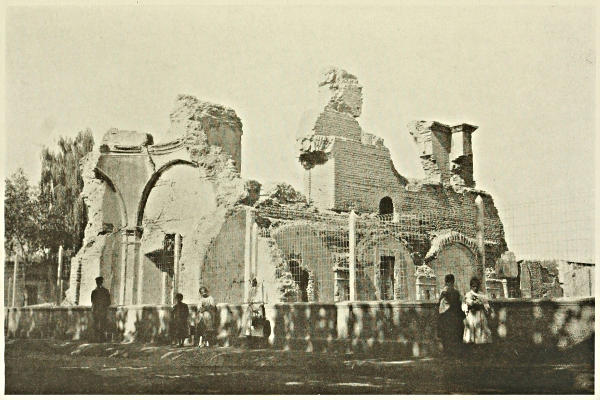
RUINS OF JESUIT BUILDINGS: MENDOZA, ARGENTINA
This is one of the richer Provinces on account of its
vines and the large wine-making industry. Similarly with
Tucumán and Sugar, one may say that Mendoza and Wine
are in Argentina practically synonymous; this observation
also applies to its neighbour, San Juan, the second great
wine-producing Province. Indeed it is quite common—very
common indeed, in fact—to say of a person who
shows signs of being under alcoholic influence that he is
“Entre San Juan y Mendoza” (between San Juan and
Mendoza).
Besides those of its vines, the greatest agricultural products
of Mendoza are alfalfa, grown over very considerable
areas of salt-impregnated soil, and a much smaller proportion
of maize.
The population of Mendoza is small and the number of
its live stock very little larger: although in point of superficial
area Mendoza ranks third (after Buenos Aires and
Córdoba) among the Argentine Provinces. It is only fair,
however, to add that much of the Western Area of Mendoza
is very mountainous, since it includes a long stretch of the
Eastern side of the Andes.
This Province is bounded on the North by that of San
Juan, on the West by Chile, on the South by the National
Territories of Neuquen and the Pampa Central, and on the
East by the Province of San Luis.
Its department of San Rafael is a very large one, larger
indeed than the whole of the rest of the Province put
together; in it is found the greatest agricultural activity,
including the great alfalfa fields. The Mendoza cattle are
of all kinds and varieties, little attention having been yet,
generally, given to the science of cross-breeding. It, however,
exports numbers of cattle to Chile, either by way of
mountain passes or the Transandine Railway; but a great
many of these have been bred in neighbouring Provinces
and sent to Mendoza for a fattening period before exportation.
Irrigation is a great feature of Mendoza, which was the
first Province to receive any notable attention in this regard.
Now, if we except, perhaps, the great irrigation works and
schemes already well advanced in the National Territories
of Neuquen and the Rio Negro, Mendoza has, with San Juan,
the largest and most comprehensive systems (both existing
and in advanced stages of consideration) in the whole
Republic.
The fall of the mountain rivers and the eastward drop of
the whole surface of the Province makes irrigation here a
comparatively easy task, while the natural fertility of the
soil quickly and richly repays the initial cost and upkeep of
reservoirs and canals. One menace there is which hangs
ever over Mendoza, that of volcanic eruptions. The whole
of its Capital was completely destroyed as recently as 1861.
The city has, however, been rebuilt on its former site, a sort
of shelf of land situated on the spring of the great Andine
range. Gradually the loosely built low adobe houses have
been and are still being replaced in the New Town by
several-storied buildings of solid masonry; courage growing
as the date of the last great earthquake grows more remote.
Still slight shocks are of frequent occurrence in the Capital
and elsewhere in this Province.
The City of Mendoza is rich in public gardens and avenues
filled with luxuriantly umbrageous vegetation and has, of
course (what self-respecting Argentine town has them not?),
electric light and trams; but its just pride is the great
West Park, situate on another level shelf of land projecting
from the foot of the Cordillera on a higher level than that
on which the City is built.
This Park has a sheet of water of almost a mile in length
by some seventy-five yards broad, in which are ornamental
islets and on which regattas are held. For these festal
occasions there is a huge stone grand stand at one end of
the water. The Park has many magnificent electric-lighted
avenues lined with trees of majestic proportions, and all
over it are gardens of subtropical shrubs and plants. Within
its great bronze gates are also a zoological and a, specifically,
botanical garden.
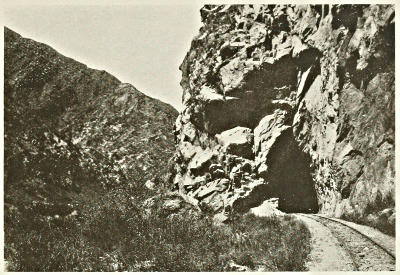
A BIT OF THE TRANSANDINE RAILWAY, ARGENTINA
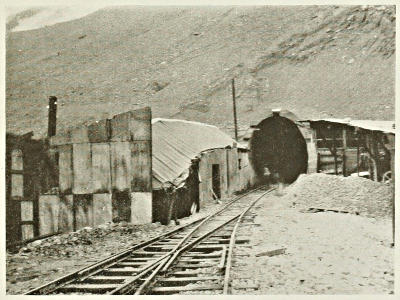
ENTRANCE TO THE SUMMIT TUNNEL THROUGH THE ANDES (CHILEAN SIDE)
With all this, if Mendoza has drawn somewhat on the
future to foot the bill of its many embellishments, it has
done no more than many other cities of the still new South
American countries, and with more immediate prospect of
justification for its expenditure than have several others.
What Mendoza has got to do now is to create an export
trade for its wines, on the condition precedent that it
manufacture wines that will keep and will improve with
keeping. Otherwise with increased irrigation it may run the
risk of over-production, since the home consumption is as
yet a limited one. The increase of the population of the
River Plate countries is, as we have seen, still slow, and
outside the towns very little wine is drunk by the majority
of the people except on special and rare occasions; mate
sufficing for their habits and needs.
Mendoza sends large quantities of table-grapes and other
fruit to Buenos Aires, and hopes one day to send them overseas.
This latter consideration depends greatly on the
adoption of improved methods of picking and packing,
matters to which the management of the Buenos Aires
Pacific Railway has given much practical attention. Care
in such details is, however, but little in the Argentine nature
generally, and even in a less degree in that of the strong
mixture of Indian blood which marks the working classes
of Mendoza, as it does in all except the littoral Provinces.
Very good canned peaches come from the Mendoza
factories and are in large demand throughout the Republic.
Coal and petroleum have both been found in the Province,
but further working tests are needed before their probable
commercial value can be ascertained.
From the City of Mendoza the Buenos Aires Pacific
Railway (familiarly B.A.P.) strikes upward to where it
passes through the Transandine tunnel; on the Mendoza
side of which is the famous Puente del Inca (the Inca’s
bridge), a vast block of stone which, lying across a ravine,
makes a natural bridge, recalling the giant-built palace of
the old Norse Gods. Here are also some hot mineral springs
celebrated for treatment of rheumatism; to which treatment
the dry, rarefied mountain air perhaps contributes
its less recognized quota.
This Province is bounded on the North and East by the
Province of La Rioja, on the West by Chile, and on the South
and South-East by the Provinces of Mendoza and San Luis
respectively.
Of all the Argentine Provinces San Juan has shown itself,
until very recent times indeed, probably the most recalcitrant
towards financial orderliness. A repeated non
possumus was the only answer its inertness returned to the
many periodical fulminations and menaces of the National
Government in respect of its treasury bonds or depreciated
Provincial paper money. So depreciated, in fact, that it
was worth nothing at all outside the Province itself, and was
by no means welcome, although legal, tender within its
boundaries.
San Juan pleaded that it could not call this paper in
since it had nothing with which to replace it—all the little
National money it got for its wines and other produce went
immediately back to Buenos Aires again for necessary
purchases.
The National Government insisted that San Juan must
remove the disgrace from its financial escutcheon or all sorts
of things would happen. San Juan regretted deeply and
asked for time. In the meanwhile it contrived to raise
another of those loans, without much more than a shadow
of adequate security or provision, which long have been the
nightmare of the National Government, and it still kept on
using its depreciated notes. So, and in many other ways
for long, very long, did San Juan wrestle, successfully
according to its lights, with the spirit of progress until
irrigation, fostered by the National Government, came to
the aid of the latter in a way there was no denying.
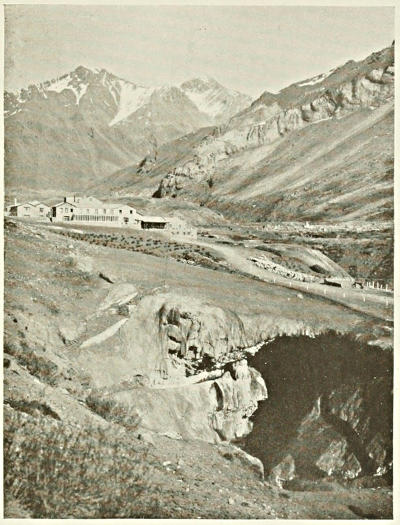
PUENTE DEL INCA; MENDOZA, ARGENTINA
San Juan had to become more prosperous and to begin
to pay its way in respectable fashion. It evidently did not
in the least want to do so, but it could not any longer see
any way by which it could avoid recognition of its just
liabilities. Thus are the good old times of this Province
vanishing; the good old times which made sufficient
provision for an aristocratic oligarchy and in which vassals
had no opportunity of acquiring luxurious tastes.
First the railway, slow in this case, however, in its usually
tonic effects and then irrigation, which poured water on
to a naturally very fertile soil, brought it about that one
day San Juan woke up to find itself faced with financial
responsibility.
People from the littoral and even from overseas came and
bought land and paid good prices in hard cash for it and then
planted vines of new, productive kinds; trimmed them in
new, productive ways; and made better wine out of them
than San Juan had ever deemed at all necessary. Other
people planted wheat and alfalfa, and even troubled to grow
more maize than there had been before. In fact, if ever
a Province had greatness thrust upon it in a bewilderingly
short space of time it was San Juan. People are even
prospecting and actually exploiting its long-latent mineral
wealth, looking for and finding deposits of gold, silver,
copper, iron, zinc, lead, sulphur, alum, mica, rock salt,
lignite and marble.
The exploitation of many of these has not yet attained
any very great commercial importance,[29] but that of others
has already done so, and all the companies concerned have
brought money into the Province and pay wages to many
native workers. All this troublesomeness tends to curtail
the daily siesta, but a consequent bundle of full-value
national dollars operates as a consolation to even the most
conscientious observer of traditional custom. The next
generation of San Juan inhabitants will doubtless be as wide
awake as their neighbours, and strikes may take the place
of old-time rebellion to the orders of patriarchal overlords;
while the latter will be put to it to work their
ancestral lands intelligently in order to maintain the due
measure of their proper dignity.
Not only has the National Government fostered large
systems of irrigation in and given irrigation to this Province,
but it has also run a railway connecting the City of San
Juan with the Federal Capital; thus providing another
outlet for its grapes, wines and other produce.
An instance of the former commercial apathy of San
Juan, and of its neighbour Mendoza for that matter, was,
not long ago, to be found in the manner in which the growers
of table-grapes allowed themselves to be continually and
methodically jockeyed by the fruit ring of Buenos Aires.
The worthies composing this ring were low-class, ignorant
men, who could only grasp the possibilities of monopoly
and market rigging on a very small scale. Their simple
method was to put only a certain limited quantity of fruit
each week on the retail markets of the Federal Capital and
to charge exorbitant prices therefor. To the poor, three-quarter
Indian, ignorant people of the islands of the Paraná
they said that Buenos Aires did not care much for peaches,
and so they only went there once a week or so to fetch a
few, at miserable prices, for market. The rest of huge
crops were left to rot on the trees. San Juan (and Mendoza)
were evidently given to understand that a similar situation
existed in regard to grapes.
How this could have been so is hard to understand,
except on the ground of extreme apathy on the part of the
Provinces concerned, for lots of vineyard owners live at
least half the year in Buenos Aires, and could have told of
the scarcity and high price of fruit in that city.
However this may have been, the fact remained that so
many kilos of table-grapes, and no more, went down to
Buenos Aires in specially constructed trucks placed on the
B.A.P. trains three days per week. Until the General
Manager, Mr. J. A. Goudge, decided to act in the better
interests of the Provinces concerned and, incidentally, also
in those of his company, by running grape trains six days
a week.
He thought, perhaps, that the Buenos Aires fruit merchants
would call at his offices with illuminated testimonials.
If he did so he was entirely mistaken. They did call, but
it was to curse not bless. He would ruin them all, they said;
they had comfortably arranged for such and such supplies
of grapes, but more would upset their plans and businesses
completely! They left Mr. Goudge unconvinced. So much
so, indeed, that considering the menace of the ring to boycott
his new trains, he hit on the simple but adequate
expedient of running three grape trains per week from San
Juan, non-stopping at Mendoza, and three starting from the
latter place. San Juan needed its three trains, so did Mendoza,
and therefore no one could boycott either service.
Result, the arrival at Buenos Aires of six grape trains
per week. The ring soon accommodated itself to the
extra supply and went on robbing the busy, light-hearted
Porteños (as people born in Buenos Aires are called) till the
continued efforts of a paternally wise Municipality at last,
after a long and bitter struggle, crushed the power of all the
food rings in that formerly ring-ridden city.
This little piece of economic history is here intended to
show the depths of somnolence and blindness to their own
interests in which the grape growers of San Juan and Mendoza
reposed till, so to speak, only the other day.
San Juan is capable of producing good quality cotton
and tobacco. Its general climate is warm, hot in summer,
and in parts very dry; though the humidity of the soil
and atmosphere of the chief vine areas are greater than in
those of Mendoza. Hence the relative general superiority
and freedom from insect pests of the Mendoza vineyards.
The city of San Juan is Colonial in almost all its aspects,
and its public and private gardens, filled with mingled
tropical and temperate zone trees, shrubs and flowers,
exhale the lazy atmosphere of days the memory of which
is so constantly recurrent in all distant Argentine towns.
Sleepy hollow; maybe, but its charm! A charm which will
not nor can ever be “reconstructed,” try all those of us who
are afflicted with unhappy artistic temperaments, never so
hard. But that charm is still in San Juan, in Misiones (the
one-time “Jesuit Empire”), Salta and Jujuy; in spite of
new Government and Municipal Buildings, electric light
and trams.
Later, we will go to the Falls of Iguazú, greater and more
magnificent than Niagara or the Victoria Falls. These
wonderful Falls are in the great up-to-date, go-ahead
Argentine Republic. What proportion of our “Man-in-the-street”
has ever heard of them? And how many good
intelligent inhabitants of Buenos Aires have any clear idea
of what they are really like?
The name of the Pampa is also redolent of romance; of
memories of vast herds of wild cattle and horses, picturesque
gauchos and raiding Indians; but the Pampa Central of
to-day is a great and ever-growing cereal area, soon, no
doubt, to become in its own right the fifteenth Province
of the Republic. A Province probably destined to outstrip
rapidly many of its older compeers in the race for wealth
and very modern in its utilitarian progressiveness.
Its superficial area is approximately equal to that of
Mendoza, and though as yet it lacks population, that will
come to it sooner than to many other parts of the Republic,
since it already grows much more than double as much
wheat as all the rest of the Republic put together, after
exception made of the Provinces of Buenos Aires, Santa Fé
and Córdoba, and more than double as much linseed after
exception made of the Provinces of Buenos Aires, Santa Fé,
Córdoba and Entre Rios. It also produces more maize than
any Province or other Territory with the exception of the
last-mentioned four.
Its development has been the most rapid of any part of
quick-moving Argentina. No just comparison of progress
can be made with Uruguay; the conditions under which
the latter country has until so recently struggled having
been adverse to rapidity of material development, whereas
the Pampa Central was freed from its only, though great,
disturbing element, nomadic hordes of native Indians, as
long ago as 1884.
This Territory is bounded on the North by the Provinces
of Mendoza, San Luis and Córdoba, on the West by Mendoza
and the National Territory of Neuquen, on the South by
the National Territory of Rio Negro, and on the East by
the Province of Buenos Aires.
Some parts of the Pampa Central are hilly and wooded
and, as in some parts of the Province of Buenos Aires, ever-moving
sand-hills vary the monotony of other portions of
its surface, but the greater part of it is the continuation of
a vast plain, begun in the Province of Buenos Aires, the
Pampa of the Indians, from which it takes its name. It is,
in fact, the Central Pampa; the Eastern being in the
Province of Buenos Aires and the Southern extending into
Patagonia.
Though the Pampa Central boasts only two great rivers,
the Rio Colorado and the Rio Negro, the latter of which
forms its southern boundary, it has many both fresh-water
and saline lakes, and water is seldom to seek far from its
surface.
The chief products of the Pampa Central are wheat,
linseed, maize and oats, but with the growth of its alfalfa
fields and the planting of good grasses in lieu of the native
hard pasturage, it has also become a great centre of the Live
Stock fattening industry, especially during the winter months.
The sandy, salty soil of much of this territory, with water
near the surface, provides, as has been said of similar tracts
elsewhere, just the conditions most favourable to lucerne;
while in other parts the soil is extremely rich in humus.
Three of the great railway systems serve the Pampa
Central; viz. the Buenos Aires Western, the Buenos Aires
Pacific, and the Buenos Aires Great Southern, carrying its
produce to the ports of both Buenos Aires and Bahia Blanca.
Santa Rosa de Toay is the Capital of this Territory; a
purely commercial town which by its rapidly grown importance
supplanted the old Capital, General Acha.
The Pampa Central has also numerous other active
centres of the cereal trade and general commerce.
On the question of its becoming a Province of the Republic
there is considerable local difference of opinion; a good
many of its business men holding that honour dear at the
price of having to maintain a Provincial Congress and various
Ministries and the rest of the appanages of autonomy. In
this they are right. Direct National Government is certainly
the cheapest and it is also very far from being the
worst.
The Pampa Central now exports large quantities of high-class
wool and hides. It also has some copper mines, the
present output of which, however, is not of great importance.
This territory would already, no doubt, have been much
more populous than it is had it not been the scene of one
of the most glaring of the labour-exploiting scandals referred
to elsewhere in these pages.
Here the cases were sufficiently numerous and contemporaneous
to render a menace of serious disturbance possible
to and partially effective by people who had been cajoled
into developing virgin land only to be threatened with
expulsion (as soon as that work had been done and before
they had been able to derive any profit from it) by owners
who only revealed their existence at what seemed to them
the propitious moment for their appearance on the scene
of other people’s labours. Compromises were arrived at
by which the farmers consented to pay rent for their holdings,
but the scandal undoubtedly kept many others away
from the Territory, and even now an evil result of it continues
in the shape of almost every tenant being obviously
only anxious to get the most he can out of the land while
it is his to work. Few tenant farmers in the Pampa spend
much money in buildings or other improvements.
The Pampa Central is a crying case for the adoption and
insistence by the National Government on the real practical
working out of a true colonization policy. A policy by
which the small farmer could obtain the indisputable freehold
of land which he develops and on which he lives, be he
Argentine or foreigner.
In all else the foreigner actually enjoys under the Constitution
the same privileges (except eligibility for high Government
office, etc.) as a born Argentine. But land! It must go
hard with an Argentine ere he part with his ultimate rights
in that. Yet, I repeat, he must make up his mind to do so
on a large scale or he will find his whole progress arrested
as surely as if the Antarctic zone had suddenly extended its
icy influence over half of his Republic. If he will not give
them land the class of colonist he most needs—the real
settler—will continue to give the country a wide berth and
its output must remain stationary at the point at which it
fully occupies all available labour.
This is one of the least generally known parts of Argentina.
Misiones figures in the history of the Spanish Conquest
and that of the Jesuit Missionaries,[30] from which it
takes its present name; the Territory of the Rio Negro has
of late years become prominent by reason of great schemes
of irrigation (these, however, also affect the Eastern portions
of Neuquen); Chubut came into notice in connection with
the not over-successful establishment of a Welsh colony;
the Chaco is vaguely associated in the general mind with
Indian Reservations and occasional real or reported disturbances
caused by the aborigines confined therein; but
the Territories of Santa Cruz, Formosa, Los Andes and
Neuquen are still little more than geographical expressions
to even the vast majority of the inhabitants of the rest of
the Republic.
A principal cause of this is that most of the inhabitants
of Neuquen are to be found on the Western and most
distant side of it (in which the most fertile, and almost the
only really fertile parts of it, until irrigation is an accomplished
fact, are situated) and because they not only do all their
trading with Chile, but, to all intents and purposes, are
Chileans.
It is quicker and easier to get backward and forward
through well-known Andine passes between Neuquen and
Chile than to accomplish the journey between the rail-head
at Senillosa, a little to the West of the township of
Neuquen, and the productive and well-watered Andine
valleys. The Buenos Aires Great Southern Railway, which
serves this Territory, now, however, has under construction
an extension of the Neuquen line to far up the Andes;
from whence it is intended to connect with the Chilean
Railway system.
Therefore the richest parts of Neuquen are as yet practically
Chilean colonies; from which cattle and agricultural
produce find their way, some paying and much contriving
to escape payment of duty to the neighbouring Republic,
which in return sends such manufactured articles as the
colonist’s somewhat humble needs demand.
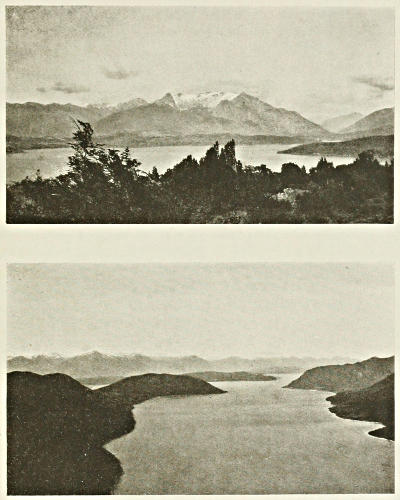
VIEWS ON LAKE NAHUEL HUAPÍ, ARGENTINE NATIONAL TERRITORY OF NEUQUEN
This Territory is bounded on the North by the Province
of Mendoza, on the West by Chile, on the South by the
Territory of the Rio Negro, and on the East by the Territory
of the Pampa Central.
Neuquen, though Argentina at large knows little of it,
grows more wheat than any other National Territory, except
the Pampa Central, and more alfalfa than any except the
last named and the Territory of the Rio Negro. It also
sends small quantities of potatoes and other table vegetables
to Chile. Its chief exports to that country consist of cattle
and sheep on the hoof.
The whole of the Andine side of Neuquen is extremely
picturesque, and abounds in fertile valleys well watered by
mountain streams. These streams, after their arrival at
the foot of the Andine range, form a network of ultimate
tributaries of the great rivers Colorado and Negro; after
having formed a whole system of lakes of which Nahuel
Huapí is the largest. The scenery of this lake, with the
great snow-covered volcanic mountain Tronador (the
Thunderer) on its Southern end, is Scandinavian in its tree-clad
magnificence. The superficial area of this lake is some
1000 square miles and its depth in some parts is over 700 feet.
On one of its islands, Victoria, the enormously wealthy
Argentine family of Anchorena have founded a colony to
work its wealth of virgin timber, on a 99 years’ lease from
the National Government.
A number of small steam and sailing boats ply on this
lake, gathering the wood, hides and other produce of the
farms on its borders and bringing to the farmers their
necessary supplies.
Neuquen is credited with alluvial goldfields and has some
copper. Its mineral wealth is as yet, however, really unascertained;
the prospecting and tentative exploitation of
it having been up to the present only done by syndicates
or small companies whose resources have been too limited
for the tasks they have set themselves in, from the point
of view of transport, such inaccessible regions.
The Western and South-Western parts of this Territory
are rich in timber, and its Eastern plains should, with
irrigation, repeat the prosperous history of the Pampa
Central.
It has many hot and other mineral springs, the medicinal
and other virtues of which are already known in Chile;
from which country they attract many sufferers from
rheumatism and stomachic and other ailments.
In dealing with all the yet little known outlying parts of
the vast Argentine Republic one is apt to become wearisomely
tautological in one’s endeavours to give some true
idea of their enormous latent natural wealth. Yet if one
set out, ever so modestly, to bring some conception of
them home to the Northern Hemisphere, one must tell the
truth even at the risk of reiteration. And the truth is that
for the future wealth of all these regions there is only one
word, Incalculable.
The Territories of Neuquen and the Rio Negro will soon
have irrigation on a vast scale and of most modern design.
This work is being carried out for the National Government
by the Buenos Aires Great Southern Railway Company
and is already far advanced.
The virgin soil of the plains of these Territories is almost
incredibly rich in humus and alluvial deposit; and they have
a wealthy Railway Company ready to afford all necessary
means of transport to deep-water ports which nature has
already provided on the Atlantic Ocean at, comparatively,
no great distance from any of, and in many instances close
to, what will be their chief centres of agricultural production
(in the widest sense of that term).
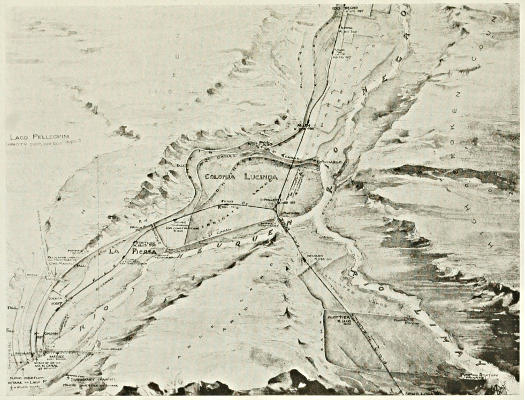
HEAD PORTION OF THE RIO NEGRO (ARGENTINA) GREAT IRRIGATION AND CURRENT
CONTROL WORKS
The most important of the general observations applicable
to this Territory have already been made immediately
above; remains in their connection only to be said that the
Northern side of the valley of the Rio Negro itself contains
some of the naturally richest soil to be found anywhere in
the Republic. Anyone armed with a watering-pot can grow
any temperate-zone crop, fruit or plant and be astounded
by the brobdingnagian proportions of its yield, accomplished
in a space of time suggestive of Jack’s Beanstalk.
And this anywhere in the midst of what now is an arid
desert, on which the only vegetation is sparse, stunted,
scrubby, useless bush.
The reasons for this are that these eastern regions of the
South have practically no rainfall at all and that all the water
running from the Andes to the Sea has already found its
way, farther west, into one or other of the great Rivers
Colorado and Negro.
The huge irrigation scheme now being carried out will
utilize an enormous natural hollow formerly known as the
Cuenca Vidal, now rechristened Lago Pellegrini (after a
once prominent Argentine statesman) as a natural storage
reservoir. The surplus water from the lake and river system,
which makes a network over the whole of the western part
of the territories of Neuquen and the Rio Negro, at the base
of the Andes, will be utilized for the irrigation of their
eastern plains. This system is also destined to serve another
necessary purpose: namely, to regulate the flow of the Rio
Negro.
This is very necessary indeed; for this river, swollen by
the melting of Andine snow and ice, which has in some
years taken place in an exceptional degree, comes down
suddenly with overpowering violence, headed by what is like
a huge tidal wave, and sweeps everything within miles of
its normal, deep-cut, banks before it.
Several times during the past fifty years have settlers
been tempted by the rich alluvial soil, brought down by
centuries of just such floodings, to establish themselves
near enough to the actual river to irrigate by some one or
other rough lift system, and remained there year in year
out, in the false security enjoyed by peasants on the slopes
of a volcano, till one day a thunderous roar has been the
only warning of the immediate approach of a torrential
flood. Lucky the man who could catch and mount his
horse in time to gallop away and thus save his life. All
the rest, cattle, house and crops, were swept away in a
second by the great head wave and following floods of the
river suddenly swollen by the simultaneous overflowing of
its innumerable tributary lakes.
Now all this will be guarded against, and, incidentally,
the Rio Negro may be rendered really navigable for a very
considerable distance by other engineering works for the
removal and control of its bar.
However, and when, this last may be, there can be no
doubt about the magic change that the first partial irrigation
of these present desert plains will quickly create. Trees will
soon grow on the irrigated portions, and these trees and
other vegetation will arrest the clouds which now fly on
unheedingly to the superior attractions of the Andes or the
southern hills of the Province of Buenos Aires. The very
southernmost portion of that Province is now in the same
sad case as the rest of the valley of the Rio Negro, of which
it forms a part.
As the result, smiling verdure will replace arid desert;
in a short space of time, because of the natural fertility
of the soil on which the transformation will take place.
Already two dotted lines on the railway map, one between
Bahia Blanca and Carmen de Patagones, near the mouth
of the Rio Negro, and the other branching from it to San
Blas, show where the Buenos Aires Pacific Railway intends
to run its first two lines through the southernmost strip of
the Province of Buenos Aires which lies between the Rios
Colorado and Negro, and other two dotted lines, one running
southwards from the township of Rio Colorado to the bay
of San Antonio, in the San Matias Gulf, and the other from
the centre of the first to a junction, near Choele Choel, with
the main line to Neuquen, show the first intentions of the
Buenos Aires Great Southern line towards that portion of
the valley of the Rio Negro which falls within its agreed
sphere of influence.
In agreeing to a division between them of the productive
and prospectively productive areas of the southern parts of
the Republic, these two great Railway Companies not only
removed from their own paths the disastrous temptation
to cut each other’s throats by tariff war, but also to a
considerable extent precluded profitable competition by
outside enterprise.
The National Government has now a line running from
the port of San Antonio running East and West right across
the Territory. The construction of this line will soon reach
Lake Nahuel Huapí.
San Blas deserves special mention as the probable future
chief port of the Rio Negro valley. On a long inlet of the
Atlantic Ocean at the mouth of which is a large projecting
island and having deep water right up to its shores, San Blas
has been described by high British authority to be the finest
natural port, after Rio de Janeiro, on the Atlantic coast,
both for commercial and strategic purposes.
It formed part of a concession made many years ago by
the National Government to the late Mr. E. T. Mulhall,
the Editor and, with his brother, Mr. Michael Mulhall, the
eminent statistician of his time, joint founder of The Buenos
Aires Standard, in recognition of services done for the
development of the Republic; which in those days of its
obscurity and distress was much aided towards a better and
truer knowledge of its possibilities in Europe by the efforts
of what now is the oldest established newspaper in America.
The Standard is printed, as it always has been, in the English
language.
The Rio Negro Territory already grows a good deal of
wheat and oats and has the largest area under alfalfa of any
National Territory except the Pampa Central; it also has
some vineyards and many European fruit trees grow in the
fertile valleys at the foot of the Andes.
The minerals of this Territory are as yet an almost
unknown quantity, except some copper and salt. Petroleum
has also been found at Bariloche, but its commercial
value is not fully ascertained.
The climate of the Rio Negro is temperate and, as has
been indicated, for the most part very dry. One disadvantage
to agriculture in the flat parts of these southern Territories
is the furious winds which frequently sweep over them.
The force of these will, it is reasonably hoped, be broken
by trees in the days to come.
This reminds one of the tragi-comic history of the
contemplated exploitation of certain great salt marshes
situate not very distant from San Blas.
The brine from these was to be, and indeed on a great
inaugural occasion was, run through pipes into immense
shallow basins, where it was to lie until its moisture had
been evaporated by the sun and wind. Afterwards the
salt was to be shipped at the port of San Blas to Buenos
Aires or elsewhere.
All seemed very well with this plan. The brine was duly
accumulated in the drying basins, the sun shone fiercely
on it—and, then, the wind blew and blew. So hard that it
emptied the basins and distributed the brine they had
contained over the rest of the Universe. Thus was a good
scheme brought to naught by the miscalculations of its
initiators. These, however, were wealthy enough to take
the matter in good part. Indeed, it was from one of them
that the present writer had the story. Still there is plenty
of good salt in the Territory.
The Rio Negro has as yet only townships of rough-and-ready
architecture, the centres of its nascent commerce.
Viedma, its capital, is in a fertile tract of land at the mouth
of the Rio Negro; it was, however, almost completely
destroyed by a great flood in 1899. Its communication
with the Federal Capital is maintained by the steamers
which call at Carmen de Patagones, on the opposite bank
of the river, and by ferry thereto and coach to the head of
the above-mentioned new line of the Buenos Aires Pacific
Railway which already reaches half-way between it and
Bahia Blanca. The completion of this line will greatly
affect Viedma for the better, while the regulation of the
current of the Rio Negro will protect it from repeated
destruction by flood. This Territory has a fair stock of
sheep, but few cattle.
Chubut has struck oil, literally. Petroleum was discovered
there only a few years ago (1907), and since the first
discovery many more wells have been sunk in greater or
less proximity to the first find in the district of Comodoro
Rivadavia, situate almost on the southern boundary of this
Territory and on the Gulf of San Jorge. On this gulf of
the Atlantic Ocean, the new oil-fields enjoy an admirable
commercial situation. Remains only to prove fully their
commercial value; of which the great Argentine Railway
Companies are evidently not yet fully persuaded as far as
fuel for their purposes is concerned, since they still use
imported coal.
A long continuance of this present European war might,
however, give stimulus to experiment with Chubut petroleum,
which evidently has some value, even if it need more
preparation for use than the North American and European
kinds.
These oil-fields were, as has often been the case in such
matters, discovered by accident, but the discovery was
made by the National Hydrological Department in the course
of a search for an available water supply for the then new
Comodoro Rivadavia port.
On these fields claims have been allotted to Companies
and private individuals and a certain area has been reserved
to itself by the National Government. Most brilliant
results of tests of all kinds are announced, the Government
line of railroad from the Rio Negro port of San Antonio to
Lake Nahuel Huapí “uses no other” (fuel); and yet, and
yet, Comodoro Rivadavia petroleum is slow to make history
in the markets of the world.[31]
Still, time must be given for proof, especially in Chubut,
the general appearance of which Territory suggests that it
was the last word of creation, in one sense, after, of course,
utterly desolate Tierra del Fuego. It is only about two
decades since the Argentine authorities themselves seem
to have grasped the idea that such a place did exist in their
dominions. It is only so long ago, anyhow, that the National
Government thought fit to send the first resident Government
officials to Chubut to look after whatever might need
to be looked after there. Before that, a small part of it
was under the absolute control of a Colony of Welsh people
who first settled there in 1856-66. The rest of it was, and
to a great degree still is, almost exclusively inhabited by
native Patagonians.
The capital of the Territory, Rawson, was founded by
the Welsh colonists at the place of their first landing on the
South Atlantic coast. It has twice been destroyed by the
flooding of the Chubut River, at the mouth of which it
stood; but it has now been rebuilt more solidly than before
and on a site rather more out of harm’s way.
The original Welsh colonists seem to have been a strangely
puritanical and narrow-minded set of persons to find themselves
in such an out-of-the-way corner of the earth as
Chubut then was. So, however, it may be observed, were
certain other persons who landed in North America a much
longer while ago from a ship called the Mayflower. Anyhow,
the Welsh built and their descendants still maintain Protestant
churches and a stern religious spirit in their town of
Rawson, a somewhat bigoted spirit, be it added, since it
forbade the inter-marriage of its flock with anyone not of
their own, or at any rate British, nationality; nor would it,
until very recently, permit their acceptance of the most
tempting offer to sell any part of the land within the colonised
areas to a “foreigner,” Argentine or otherwise. And this
last restriction does not seem to have been so much due to
foresight of a future increase in land value as to a simple
objection to the admission of any stranger within the fold.
Time will change this no doubt, and change it as soon as
Chubut begins really to advance, but all that time has as
yet done for the Welsh colony appears to have been to sap
the energy of its forefathers; the men who in the face of
discouragement and deaf official ears turned to their just
grievances, struggled on, themselves constructing irrigation
canals, and changed disaster into comparative prosperity.
The Chubut “Welshman” of to-day seems as lazy as his
forebears were energetic. A fresh strain of blood is possibly
needed for his case.
The superficial area of Chubut is very large. After the
Territory of Santa Cruz (to which would seem to have been
allotted all that was left over of the Republic except the
Argentine half of Tierra del Fuego, after the Government
of the more populated parts had been arranged for) it is the
largest National Territory of Argentina, and much larger
than any Province except that of Buenos Aires.
Its estimated population averages scarcely more than
one per ten square miles, so that there is plenty of elbow
room in Chubut. With a superficial area approximately
equal to that of Italy, the total estimated number of its
inhabitants is but 31,000.
However, no doubt there are good times coming for
Chubut as elsewhere in Argentina, though, petroleum and its
general effects apart, there is relatively little in Chubut to
hasten their coming, except its fertile Andine valleys.
Sheep certainly thrive on its rough, scanty vegetation, and
seem to find just sufficient shelter on its wind-swept plains;
but Chubut has little rainfall and its available fresh waters
are few and far between at any practicable distance beneath
the surface. It has only one great river, the Chubut, from
which it takes its name, and this runs very shallow in the
summer, while many of the lakes dry up altogether. In the
West, the Andine region, however, there is ample rainfall,
and this is as yet the only really productive part.
Chubut grows and exports some alfalfa and sends some
cattle to Chile, but its chief product is wool. Its wheat,
however, though still small in quantity, fetches very good
prices. A railway is projected to run East and West across
this Territory. It already reaches from Puerto Madryn to
Gainam, on the River Chubut, a little west of Rawson.
This Territory is bounded on the North by Chubut, on
the West and South by Chile, and on the East by the
Atlantic Ocean.
Santa Cruz is not by any means so desolate, on the whole,
as Chubut. It is the land of the sheep, and its large, very
large, estancias, either on the Andine side of it or on the
banks of its rivers, mostly belong to British settlers, who
have brought their own architecture, orchards and gardens
with them to this really out-of-the-way spot. Anyone
weary of the crowded world and its busy ways might live
and die under the shadow of the ever-lessening, as one gets
south, heights of the Andine range, in some snug, sheltered
valley through which a rippling stream runs close to where
he would sit on a green sward in the shade of his own
orchard.
This is no fancy picture. As has been indicated elsewhere
in these pages, nothing is so English, temperature, vegetation,
the very breeds of sheep (Romeny March largely predominating),
in America than some favoured spots in Santa
Cruz. Only the climate is different in being drier, the rain
mostly falling in blustering showers.
There is, of course, a contrast when one emerges from
among the Andine valleys, rivers and lakes out on to the dry,
wind-swept, desert-looking plains. Still, even there one
comes at times to oases, on the banks of one or other of the
several considerable rivers. Shelter from the furious winds
which seem to blow eternally over Patagonia is the one
necessity for man, beast and crops in Santa Cruz. Transport
also is lacking. Even the railway which the National
Government has partly constructed to run from Puerto
Deseado, and for the rest has under advanced consideration,
is apparently to strike almost immediately Northwards up
into Chubut; leaving Santa Cruz, as it is now; almost a
world of itself apart, as far at least as communication with
the rest of Argentina is concerned. Its most fertile parts,
like those of all these western and southern territories, are
much more get-at-able from Chile than from their Atlantic
sides.
However, a cold-storage establishment has been built at
Gallegos, the chief port and the capital of this Territory;
so that Santa Cruz may become a centre of the frozen and
chilled mutton industry instead of, as formerly, exporting
only wool and slaughtering sheep merely for their fat and
skins. It is a good sheep country in the regions at all suitable
for grazing, since disease is extremely rare in, if not
entirely absent from, flocks reared in its cold dry climate.
In respect of cattle and cereals the outlook is not so promising.
Still, one cannot have everything even in Argentina.
And one can grow wheat, oats and alfalfa, besides apples
and pears in Santa Cruz.
First of all it may be said that there are no active volcanoes
in Tierra del Fuego nor have been within the memory of
man. Mr. Paul Walle, in his excellent work, already
mentioned, L’Argentine telle qu’elle est, suggests that its
name may have been given it by early explorers who
observed burning on it grass fires lit by the natives for the
purpose of improving the growth of certain shrubs the
leaves of which they use for food.
Be this as it may, the name “Fire Land,” as my friend
the Government official translator naively has it in the
English edition of the Monographs attached to the latest
Argentine agricultural census, is anything but a warm spot;
as certain demagogues who long troubled the industrial
peace of Buenos Aires have shown that they are well aware.
These people were at one time periodically deported for
inciting to commit or committing overt violence in connection
with labour strikes. They were mostly anarchists
of the type which tyrannical Governments all the world over
persist in regarding as criminal. These men were put on
board boats bound for their native countries, the police of
which were telegraphically advised of their departure and
intended destination. Needless to say, the anarchists took
good care to contrive to leave the boat before she reached
what was for them a danger zone. Usually they got out at
Montevideo and soon were back again at their old work of
stirring up strife in Buenos Aires.
At last the National Government had enough of this procedure
and Congress passed a law whereby any person having
been sentenced to deportation is, on being subsequently
found in the Republic, liable to a term of penal servitude;
and the fact that Tierra del Fuego would be the penal
settlement to which recalcitrant anarchists would be sent
was duly and insistently made public. This had a very
beneficial effect for the Government and peaceable citizens
at large. Dangerous anarchists thenceforth ceased to return
to Argentina after deportation. They knew, or at least had
read or heard, what the climate of Tierra del Fuego is; and
that for people like them, used to fairly comfortable living,
confinement there most likely meant burial there also.
Not quite half of this charming island, over which the
winds blow straight from the South Pole, belongs to Argentina
and forms the National Territory under discussion.
The other half of it belongs to Chile. Geologically most of
this island is a prolongation of the Andes. On the Atlantic
side of its forest-clad hills are sloping plains, the continuation
of the Pampean formation. On these a peculiarly hardy
breed of sheep graze, finding some shelter in valleys and
hollows, and give a wool which fetches a good price in
European markets. Grazing of a rough kind does also maintain
cattle and horses on the Northern parts of the island.
Fish and shell-fish of a multitude of kinds and good quality
abound on the coast and afford material for a profitable
industry, as also do the seal and whale fisheries, and penguins
are hunted for their oil. All these fisheries are supposed to
be under Government supervision, regulated by special
laws; but, in fact, the practical difficulties of adequate
supervision result in an enormous amount of highly destructive
poaching.
The official estimate of the total cultivated area of
Argentine Tierra del Fuego is 110 hectares, of which 90 are
stated to be planted with potatoes and other table vegetables.
The number of sheep is given by the same authority (Señor
Emilio Lahitte, Director of the Department of Rural
Economy and Statistics in the National Ministry of Agriculture)
as over 2,500,000 and cattle at about 15,000.
The Roman Catholic Silesian Brothers have a mission,
schools and an estancia on the island; and a Protestant
clergyman, the late Mr. Bridges, during his lifetime did a
great deal towards civilizing and bettering the condition of
the native Indians and also kept a self-supporting refuge
home for the victims of the shipwrecks of small craft which
are still too numerous on this wild storm-beaten coast.
This good work is now being carried on by his son, the first
child of European parentage born in Tierra del Fuego.
Ushuaia, the Capital, is chiefly notable for the penal gaol
above alluded to. Formerly convicts were kept, but not
often for long before death overtook them, on an island which
forms the very southernmost point of South America. It is
a terribly cold, damp region where rain falls on an average
280 days in the year. On consideration, perhaps it is the
reputation of this place which has so effectually damped the
ardour of deported anarchists; as the Ushuaia gaol is a
modern structure, said to be furnished with all the latest
requirements for the well-being of prisoners. Still, even it,
in Tierra del Fuego, can provide but uncomfortably cold
lodging.
Tierra del Fuego is not lonely for it has many fishing ports
and all navigation must pass it on the way through the
Magellan Straits. For all that, one cannot but wonder why
any but prisoners and prison and other officials go there
(except, of course, fishermen and the adventurous spirits
who are ever hunting in every accessible nook and cranny
of it for alluvial gold) when there are so many much
pleasanter and more profitable places, with, between them,
all varieties of climates to choose from in the wide latitudes
of the River Plate Republics. De gustibus, etc., one must
suppose—and yield obedience to the final words of the
saying.
If one has sufficient Spanish, one should read Leopoldo
Lugones’ Imperio Jesuitico, and also the same author’s
Guerras Gauchas, before going to Misiones. If not, one
should go there all the same.
This territory is bounded on the North-East and South
by Brazil, and on the West by Paraguay and the Province
of Corrientes. It is sandwiched in between the rivers Paraná
and Uruguay, but a very much smaller Paraná and Uruguay
than we have seen further south.
Many parts of Argentina have been described as “The
Garden of the Republic,” and many as its most picturesque
region, but the latter description can surely only truthfully
apply to Misiones. If not sufficiently trim and cultivated to
be called a garden, its superlative beauty and its crowning
marvel the Iguazú Falls must leave even the most callous
visitor pleasurably astounded; and not a little awestruck
with its ruins and reminiscences of the dawn of South
American civilization, which was heralded in these parts
by the Jesuit Fathers. These Missionaries made most
practical Christians of the surrounding tribes; teaching
them the arts of architecture, carpentry, and such-like;
not forgetting humility and obedience.
If one wants proof of all this one need but look on the ruins
of monastery and church now half hidden amid an ever-encroaching
luxuriant vegetation.
The descendants of those same Indians can hardly be got
to do as much work in a lifetime now as they must have done
in a week under the mild but very firm rule of the Jesuit
Fathers. Eventually, the power these Missionaries had
attained over the surrounding tribes became such as to label
them dangerous to even Catholic Spain; and an order was
given, and enforced, for their expulsion. They were scattered:
and but the ruins of their solid, sculptured masonry, gardens
and orange and olive groves now mark the places where once
white-clad natives kept fast and feast days with as much
solemn orderliness as ever so many timid monastic novices
could do.
Nowadays, one can get from Buenos Aires to Misiones
either by rail (North-East Argentine Railway) or by the
Mihanovich company’s boats. Both ways furnish delightful
travelling through interesting and picturesque country,
though for pure scenery the river way is the best. The best
of all, however, is to go up by rail and down again by boat
and to see all there is, and there is a very great deal worth
seeing, to be seen.
By either route one can stop at Posadas, the capital,
evidently from its name an ancient resting-place for
travellers (Posada being Spanish for an inn).
But people who are bent on reaching San Ignacio, a small
river port, or rather clearance on the Upper Paraná, near
which are the chief of the ruined Jesuit Missions, and the
Iguazú Falls will probably leave Posadas for closer inspection
if need be, on the return journey.
Once again we board a Mihanovich boat and go up a
seeming river of fairyland.
An adequate description of the majestic splendour and
beauty of the Iguazú Falls is far beyond the pen of the
present writer. One is gradually prepared for the great
sight by a series of smaller cascades and cataracts of other
converging rivers which one passes on the way to where the
Iguazú hurls its large volume of water in downward jumps
or in one horseshoe-shaped, thundering, frothy mass. Where
it falls one is face to face with the greatest waterfalls in the
whole world,[32] as the following comparative figures will show:
|
Volume cubic
per minute.[33] |
Breadth. |
Height. |
| Iguazú |
28,000 ft. |
13,133 ft. |
196 to 220 ft. |
| Victoria (S. Africa) |
18,000 ft. |
5,580 ft. |
350 to 360 ft. |
| Niagara |
18,000 ft. |
5,249 ft. |
150 to 164 ft. |
The only point of advantage of the Victoria Falls is their
height.
The present chief source of wealth in Misiones is the
various kinds of timber and valuable cabinet-maker’s woods
found in its virgin forests. One day Misiones will doubtless
export its rosewood and other beautiful and valuable
products of its forests, which also produce pine and other
building timber of superior quality to that which Argentina
now imports from Europe. Transport of timber is effected
by means of tying it into huge rafts which go down river as
far as Corrientes. The timber supply of Misiones will long
continue rich, since the tendency of the forest is ever to
encroach on the surrounding land.
A growing industry on which great expectations are based
is the cultivation of the Ilex Paraguayensis, or mate shrub.
The consumption of mate or Paraguayan tea, as it is sometimes
called in Europe, is enormous throughout both of the
River Plate Republics, which now import very large quantities
annually from Paraguay and Brazil, while no sort of
good reason seems to exist why the northern districts of
Argentina should not grow sufficient to meet the home
consumption.
The Jesuits evidently appreciated and cultivated this
shrub, but they had the secret of growing it from seed, a
secret the true re-discovery of which by modern horticulturists
is not yet quite proved.[34]
Up till quite recently all Misiones mate yerba has been
gathered from the abundant virgin growth of the shrub.
Once Misiones produced larger quantities of sugar than it
does now; and there is no reason why this industry should
not revive from the almost total paralysis which it at
present suffers; nor why one day the wine output of
Misiones should not be improved in both quality and
quantity.
Maize naturally grows well (it yields in six months) in
Misiones; which Territory with the general warmth of its
climate, sufficient rainfall and heavy dews, is most favourable
to tropical and subtropical vegetation. Oranges, of course,
bananas, pineapples, and guavas grow practically, if not
quite, wild and ground nuts and the castor-oil plant are
among its many valuable products. The whole of Misiones
is well watered by a network of very numerous streams, and
if its atmosphere by day is rather reminiscent of a hothouse,
the nights are usually cool and refreshing.
The unevenness of its surface, while precluding much idea
of extensive cultivation, is admirably suited for the shelter
and care of the best natural produce of this exotically
picturesque region.
Misiones has quarries of valuable granite at San Ignacio;
close to the river as if they had been placed there for facility
of transport. These quarries furnished the Jesuits with the
material for their famous buildings; though that they persuaded
the natives, who before their coming had little
ambition for anything save inter-tribal warfare, to quarry,
transport and build up solid masonry is nothing short of
marvellous. Truly Jesuit “influence” was a very real and
concrete thing in the Misiones of those days.
One must not forget tobacco, or cotton, as other of
Misiones’ hitherto greatly neglected industries.
One cannot insist too much upon the fact that no one who
does not himself visit the River Plate Republics in all their
length and breadth can really grasp even a faint idea of their
diversified latent wealth. One is apt to suppose that because
Misiones, for instance, does not produce much tobacco or
sugar,[35] there is some pretty solid obstacle at the bottom of
its relative non-productiveness. People naturally think,
“Well, it’s all very well to chant dithyrambics of the
marvellous might be’s of what evidently are your pet
countries, but why does all this wonderful wealth of them
continue latent, why does not one see, or at least hear, a
great deal more about it, if all you say is true?”
The reply for this is, “Give me sufficient capital and
sufficient suitable labour (especially the latter) and I will
very speedily prove my every word.”
The River Plate Republics have not yet (again I say it)
sufficient population to exploit even a part of their possible
cereal industry, the one which naturally gets first attention
because it combines the attractions of rich profit and comparatively
little care or labour, under the almost primitive
conditions under which most of it is still carried on.
When there is a surplus of labour after grain and cattle
have been duly provided for, all sorts of other things will be
attended to. But it is no good expecting ordinary people,
without the many more or less occult advantages of early
Jesuit Fathers, to get any constantly careful work, such as
cotton, tobacco and many other valuable crops require, out
of native South American Indians. They can’t or won’t do
it, anyway, they don’t; and it is probably easier to rediscover
how to grow mate yerba from seed than how to rediscipline
for practical purposes the race which built and
gardened in the seventeenth and eighteenth centuries.
The North Argentine Railway has in project a branch from
its Santo Tomé-Posadas line to run through the centre of
Misiones to the North-West corner where the frontiers of
Argentina, Brazil and Paraguay join.
This, the northernmost of the Argentine National
Territories, does not merit the superlative of its name;
especially it does not do so when compared with Misiones.
Geographically and in its general superficial characteristics
Formosa is a continuation of the Chaco, by which it is
bounded on the South. On the North and East it is bounded
by Paraguay except at its South-Eastern corner, where its
boundary is the river Paraguay, with the Province of Corrientes
on the other bank. On the West it is bounded by the
Province of Salta.
Much of Formosa is almost unknown land as far as really
scientific exploration is concerned; and some tribes of its
Toba Indians still appear to have an inconveniently violent
dislike of official explorers, several having been murdered
by natives in recent times.
The real exploration of the interior of Formosa is done by
squatters who, when turned off one holding, move on to a
new one further from the civilisation which, such as it is, is
mostly to be found on the River Paraguay, or near to it on
the banks of its chief affluents, the Pilcolmayo (which forms
the Northern boundary between this territory and Paraguay)
and the Bermejo. The clearance of the rocks, sunken logs and
masses of vegetation from the beds of these rivers as a preliminary
to the carrying out of other works for the purpose
of making them navigable is under consideration by the
National Government, which also proposes to build a railway
line from Embarcación, in the Province of Salta, across the
centre, almost, of Formosa, in a South-Easterly direction, to
its capital, a town of the same name and, doubtless, the first
to bear it. At present Formosa has no railroad at all.
This Territory has several other considerable rivers and
streams all running nearly parallel to one another and to
the Pilcolmayo and Bermejo, in South-Easterly direction, to
the River Paraguay.
Almost the whole of its surface is a vast plain gently
inclined; its South-Eastern part is largely covered with
forests and dotted with many shallow swamp-like lakes—“Esteros,”
as they are called.
The forests are very rich in various valuable woods; of
which the chief object of present commerce is the Quebracho,
which here, as elsewhere in the Republic, is found in two
varieties, the red and the white. The former is the richest
in tannin. Quebracho extract (for tanning purposes) will be
seen to figure prominently in the tables relating to Argentine
exports.[36] Quebracho logs are in constant demand for railway
sleepers.
The wide glades and open spaces in the forest afford
excellent pasturage, and are all eminently suitable for agriculture.
Some parts of this territory are destined to become
rich alfalfa fields, and already relatively considerable areas
are under this forage. There is plenty of salt, sandy soil with
water near the surface. Maize also, on account of climatic
conditions and the nature of the soil in parts (where a rich
layer of humus is superimposed on a moist, sandy subsoil),
should form a valuable crop in this Territory.
Formosa, with its Northern situation and therefore almost
tropical climate, has few sheep; but cattle, still of the native
breed, thrive well in many parts.
Also, in Formosa, and in Misiones, a large proportion of
traction bullocks must be reckoned among the numerical
value of their cattle.
In Formosa the summer or rainy season lasts for about
seven months of the year; little or no rain falls in the winter
or dry season—as in the tropics. In the wet season many of
the rivers overflow their banks and such, likely, inundations
should be taken into account by any would-be purchaser of
land in Formosa.
He should also keep his eyes open for dangers other than
floods; for if scientific exploration cannot yet be said to
have obtained any firm grasp of Formosa, how much less
can measurements and boundaries be hoped to be in order.
They are not so in most of this Territory, and a purchasing
settler might eventually find himself with little for his
trouble and money but the costs of a lawsuit forced upon
him by some owner of an historic grant made by a grateful
Republic in bygone days to the grandfather of such owner
for distinguished service of one kind or another.
Latifundíos, these low-lying Argentine landowners are
called; and it is not too much to say, as has been indicated
elsewhere in these pages, that their existence is a pest and a
menace to proper colonisation.
Every such absentee landlord should be forced by law to
declare himself and his claims, and to furnish measurements
and situation of the land, the subject of the latter to be
checked by the Government surveyors and lawyers; and
to do this within a fixed reasonable period from the date of
the passing of such laws. His claim to lapse absolutely
ipso facto in default of his doing so.
Then the National Government should proceed to allot
fiscal lands to all desirable comers, and afford these the
aids to starting their farms and plantations usual in other
countries having unoccupied land awaiting development, as
still is by far the greater part of the territory of the Argentine
Republic.
Every educated Argentine is just as well aware of all this
as the writer or you, the reader; but just think what a
flutter in aristocratic dovecotes on the mere suggestion of
the putting in practice of such Laws (they or drafts of them
probably exist in the pigeon-holes of Government House in
Buenos Aires)! What a fluttering in those dovecotes there
was a few years ago when the discovery was made, and most
imprudently revealed, that vast tracts of land supposed to
belong to the Nation had in fact got, in one way or another,
into the possession of private individuals.
The then President, Dr. Figueroa Alcorta, declared
vehemently (and caused the declaration to be published far
and wide) that whomsoever were found to be responsible for
such a scandalous state of things would be dealt with without
mercy, whoever he or they might be.
That was all.
The sentence was like those of the Queen of Hearts in
Alice in Wonderland. No one really ever was executed.
Nor, as far as the public ever knew, even called to account.
Possibly someone was told not to do it again; it must be
hoped so.
In Formosa, latent absentee landlord and squatter would
almost appear to work on a mutually beneficial, if tacit,
understanding. The former does not in the least mind
his land being developed by the latter (there is no foolish
worry about such things as prescriptive rights) and generally
lets him be; until such time as he, the landlord, wants to
occupy himself or sell.
Meanwhile the squatter has accumulated cattle and
money by selling stock (contraband, if possible, or covered
by a few duty-paying animals) in Paraguay, and need only
move on a few leagues or so, when told to, with his herds.
His house and furniture are usually negligible quantities.
Formosa does as much trade as the total of its general
products (except timber, which goes South) allows of,
because Paraguay is generally too much overrun by revolutionary,
or momentarily constitutional, forces to have
much time or space free for industrial occupations. At the
same time Paraguay does manage to produce large quantities
of tobacco and mate yerba which Argentina takes, although,
as has already been observed, her own lands could perfectly
well produce them, given suitable labour.
As has been rather more than hinted at, the official
Returns of Imports and Exports as between Bolivia, Paraguay
and Brazil and Argentina give but a faint idea of the
actual trade between the last-named and her northern
neighbours; and the present writer would be much surprised
to learn that the upper reaches of the River Uruguay
could tell no tales of systematic smuggling between the two
River Plate Republics, or the Andes none of similar practices
between Argentina and Chile.
The fact is that adequate guard of these enormous and
sparsely populated lengths of upcountry frontier would
cost more than the results of it would pay for. And why
make a fuss while such prime necessities of life as mate and
cigarettes are comparatively so cheap?
Formosa produces tobacco and sugar; the latter, as
in Misiones, being chiefly used for the production of
alcohol.
A great deal of foreign capital is now invested in timber
cutting and exporting companies. Native labour is suitable
for this work, but it is desirable in the interests of the companies
concerned that the native overseers or gangers be
controlled by whites conversant with native ways and also
having the gift of forest topography.
This last consideration is suggested by the undoubted fact
that many a pile of logs has been solemnly measured up
and the felling paid for several times over by the white
gentleman who has failed—in consequence of a slight rearrangement
of the pile, no doubt—to recognise them on
successive visits to glades and clearings which all look very
much alike except to particularly experienced eyes.
Thus does the untutored Indian or half-caste sometimes
laugh at civilization.
Formosa, although sparsely inhabited, boasts a large proportion
of pure whites of various nationalities among its
settlers and the timber companies’ employees. There are
several Franciscan Mission Stations in the Territory.
This hasty run over the Argentine Republic has stirred
many pleasant memories in the heart of the writer, and set
him hoping that, perchance, some one reader may be
tempted to take passage to the River Plate; at less cost
than, and quite as luxuriously as, if he made his usual
sojourn on the Mediterranean Riviera.
Would I could take him—an intelligently enthusiastic
person he, of course, would be—on a personally conducted
tour of my own designing.
We would go first to Buenos Aires, reserving the restful
charm of Montevideo for after our journeyings. Then
down South; where I should quite disabuse my gentle
companion of any ideas he might have that the owners of
square miles of wheat and thousands of cattle live in top
boots and shirt sleeves in one-storied, corrugated-iron
verandahed houses in the foreground of threshing machines.
I would get him invited—and myself as well—to stay a day
or two at an English estancia; the large, well-appointed
two or three storied red-brick house of which, surrounded by
lawns and spreading cedar trees, would make him rub his eyes
several times before he were convinced that he had sailed
out of England. He would surely find a house party from
Buenos Aires or neighbouring—a wide term meaning,
probably, many leagues away—estancias in possession; all
the members of which would retain their old habits of dressing
for dinner and breakfasting off a choice of several hot dishes
and a tempting array of cold things on the sideboard. An
English country house, in fact, with hall and magazines and
illustrated papers complete.
Then we should make plans for the following, and, probably,
many other morrows; plans which would almost
inevitably include a neighbourly race meeting or polo
match.
Amid all this he could dree his own weird for as long as
might please him. I should not disturb any of his promised
projects.
But one day I should take him North again; and still
further North, to Córdoba, “The Learned City,” show him
the Cathedral, the University and its Library, and let him
breathe the monastically mediæval atmosphere of it all.
And, outside the city, the wildness of cactus growth and
gaucho life.
Back eastward to Rosario, merely to change train for
Santa Fé, and across the Uruguay to Paraná. From thence
to Concórdia; where at least one tranquil orange-scented
morning must be spent before one crossed the Province of
Entre Rios to where the Argentine North-East Railway
should take us to Misiones.
After San Ignacio, the Iguazú Falls and the trip thereto
and therefrom up and down the Upper Paraná, I should ask
him if he ever wanted to go anywhere else again? Whether
he has ever even dreamed of anything so beautiful? Then
by river all the way back to Buenos Aires; and, one night,
across to Montevideo. There we would sit awhile in the
evening and listen to the band in the square where the little
coloured lamps swing in the fresh sea breeze; and bathe
next morning and roll ourselves in the hot dry sand of Pocitos
or Ramirez.
Then we would take railway trips in Uruguay. Over
billowy pasturage and through waves of wheat; not flat
expanses such as those we shall have seen on the Pampa, but
seas of corn-covered, undulating ground.
Then he could go back to Europe, if he liked. I should
stay.
If a detailed sketch of each of the Departments of Uruguay
be not given here it is not because they are altogether uniform
in their landscapes; but rather because, apart from the hilly
rockiness of some of the northern parts, the scenery of
Uruguay does repeat itself. While the climatic differences
are relatively slight in a country which barely extends over,
from the point of its extreme northern angle to its most
southerly point, five degrees of latitude; in comparison
with those of Argentina, which extends over thirty-five
degrees.
Uruguay, therefore, has no striking variety of climates;
and except that the surface of the Northern Provinces is
more broken with jagged mountain ranges and that in the
neighbourhood of the River Uruguay and its affluents the
country is more thickly wooded, there is not much change to
be noted anywhere from its general character of an undulating
grassy plain, with here and there a mount, or clump of
low wood and brushwood, and an abundance of running
streams.
Its indigenous flora comprises a rich wealth of rosemary,
acacia, myrtle, laurel, mimosa, and the scarlet-flowered
CEIBO; while its natural pasturage is gay with red and white
verbena and other brilliantly coloured wild flowers. The
best natural grasses are to be found in the Departments of
Soriano and Durazno and in parts of Paysandú and Tacuarembó.
That is to say where what is known as the “Pampa
mud” of the soil is mingled with calcareous and siliceous
matter and contains less aluminium, which last ingredient
imparts cold and damp qualities.
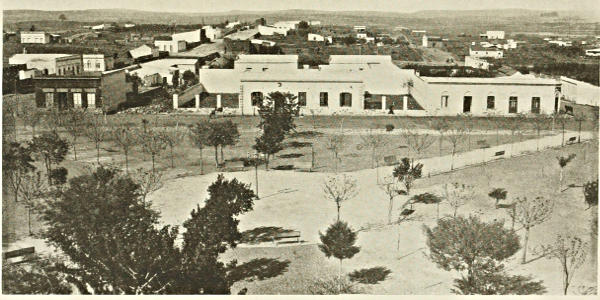
A TYPICAL SMALL “CAMP” TOWN (RIVERA, URUGUAY)
It should not be assumed from the above short general
description that the scenery of Uruguay is monotonously
uninteresting. It is not; on the contrary, it is often very
beautiful indeed, with sudden and delightfully surprising
changes as the train speeds along. But these changes are
on a small scale, if one may so express oneself, compared with
those which one experiences when passing from one distant
Argentine Province or National Territory to another.
Indeed, as a glance at the map will show, geographically,
Uruguay and the Brazilian state of Rio Grande do Sul can
almost be considered as parts of Argentina; as, politically,
they once very nearly were.
The real great division of the nature of the surface of
Uruguay is practically formed by the course of its Rio Negro;
on each side of which are vast rolling plains, the northern of
which, however, are, as has been said, traversed by ranges of
indented rocky hills.
The whole of Uruguay is subject to abrupt changes of
temperature and frequent strong winds of which the Pampero,
from the South-West, is the most violent.
Generally, the climate is pleasantly mild. For while the
summer suns are hot, especially in the North, sea breezes and
winds from the snow-capped Andes modify the temperature.
It is, however, from these conflicting elements of sun and
wind that Uruguay gets her quick changes of temperature
and frequent storms. The whole country is subject to
alternate overflowing of its rivers and drought.
Uruguay is rich in table fruits. Grapes, oranges, lemons,
apples, pears, quinces, melons, passion-flower fruit, peaches,
apricots, cherries, medlars, figs, chestnuts, almonds and, in
the North, olives, dates and bananas, grow in abundance.
The list of her flora also includes sarsaparilla (very abundant),
quinine, camomile and many other valuable medicinal
plants. Uruguayans have also given themselves the trouble
to produce relatively much larger quantities, and, generally
speaking, better qualities of ordinary table vegetables than
have the, perhaps busier, inhabitants of the larger Republic
across the river; to which, however, Uruguay daily sends
large quantities of such produce.
Uruguay has several large flour mills and exports flour,
chiefly to Brazil.
Most of the soil consists of one composition or another of
the Pampa mud before alluded to. This mud is really
ancient alluvial deposit.
Of the latent mineral wealth of Uruguay there can be
little doubt. The Department of Minas, as its name indicates,
is one of the richest in this respect. Gold, in quartz
formation, silver, copper, iron, lead, some coal, marble of
various kinds, slate, rock crystal, agates, jasper, graphite,
alabaster, black limestone and other minerals of commercial
and industrial value are to be found in this Department and
in other parts of the Republic. Fine building limestone is
found in the Department of Maldonado. The Department
of Colonia is rich in granite and other building stone, as well
as other minerals. Rocha, Soriano, San José, Florida and
Canelones are other Departments rich in mineral wealth.
This wealth has, however, as yet been little exploited.
The old trouble here, as in Argentina, being that of insufficient
labour to attend to more than the primary industries
of Live Stock and Cereal production. Also the Uruguayan
Mining Laws, though steps have recently been taken to
amend them, have hitherto proved but a poor protection
for capital.
Note.—The wealth of the Argentine National Territories of
The Chaco and Los Andes is, as to the former still practically
confined to the valuable forestal products, full mention of which
has been made elsewhere in these pages. The future of Los
Andes can only be concerned with the exploitation of its, probably
rich, mineral deposits; this Mountainous Territory being
so cold and arid as to be almost uninhabitable.