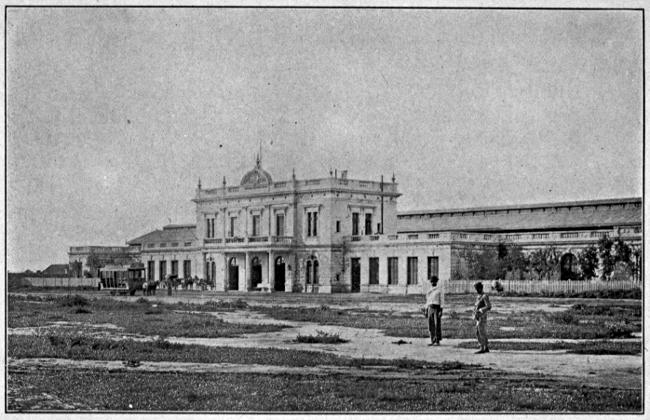
At Retiro station in Buenos Aires one takes
the tri-weekly transcontinental train for the
ride across the continent. “B. A. P.” upon
the coaches stands for Buenos Aires and Pacific,
which is the line that carries the traveller
to the limits of Argentine territory. The gong
strikes, the Argentinians who have gathered to
see their friends away on this long journey
wave their adieus and the train slowly pulls
out without the clanging of an engine bell, with
which these British locomotives are not provided.
The passengers are all leisurely in their
preparations for the journey, and one will seldom
see the spectacle of a woman grabbing a
box in one hand and a struggling child in the
other and rushing frantically for her car.
There is usually plenty of room, and whether
there is or not the passenger takes his own
time.
The trains on this line are very comfortable,
although one misses the luxurious Pullmans of
the United States. All the passenger coaches
are compartment sleepers, and one diner is attached.
There is no smoking or observation
car, so that the solitary traveller oftentimes
finds it lonesome, but smoking is permitted
everywhere except in the dining-car, where gentlemen
are requested not to smoke “when the
señoras are present.” Some of the passengers
gather in the diner after the tables have been
cleared and talk or play games. The diner has
good service and the only trouble is to keep the
dust out of your food. A good meal of several
courses is furnished in this comedor for two
Argentine pesos. All of the diners of course
have a bar, so that no one need to go thirsty,
whatever his needs or demands may be.
The passengers on this train are always a
mixed crowd. One will find tourists from many
countries, English or German engineers, Chilean
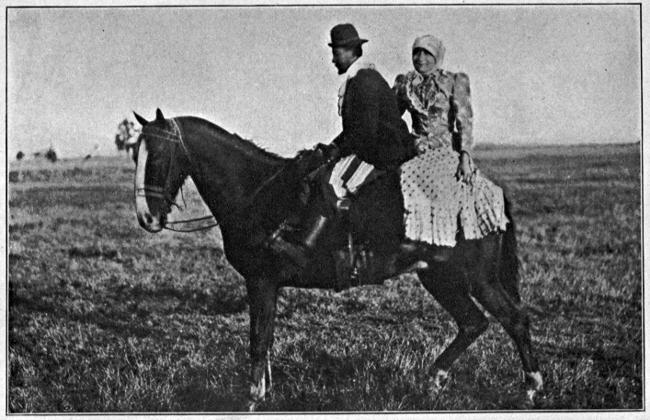
business men, Argentine estancieros, half-breed
gauchos in their picturesque trappings,
etc., etc. A half-dozen languages will greet
one’s ears in the corridors. This feature is,
however, one of the pleasures of such a trip.
One will begin to speculate about his fellow
passengers, and then as he meets them he will
learn how far his conjectures come true. He
will also learn that this is one of the meeting
places of the four quarters of the globe.
One of the chief discomforts in riding across
these plains is the dust which sifts in through
the windows and doors at times until it is almost
stifling. Then again a baby pampero may
come up and blow almost with the force of a
hurricane. A Kansas blizzard is hardly equal
to it in force and velocity. The dust at times
comes in such clouds that it makes difficult
work for the section-hands, for it must be removed
from the track. I have heard stories
of the real, simon-pure pampero, which comes
up from the Patagonia plains, blowing cars off
the track, and the propelling of cars by means
of a sail hoisted up on the car. One thing is
sure, it is decidedly unpleasant and will so fill
your mouth with dust that you feel you are
continually chewing sand.
The real pampero generally follows a
drouth and is preceded by a few days of extreme
heat. At last a cloud appears on the
pampas which looks like a great woolly ball set
in a frame of gold. The dust of the road begins
to fly and whirl about in little eddies. Bird
and beast seek shelter and the people may be
seen scurrying in every direction. Millions of
insects scud past in the clouds of fine dust. The
lightning flashes in sheets and forks, and the
thunder seems to shake the very earth. Then
comes the welcome rain, not in drops but in
sheets, and mingled with it hailstones big as
nuts. A few minutes after the rain ceases and
the sun shines in a tranquil, cloudless sky. The
atmosphere is so transparent that one can see
almost incredible distances. The people breathe
in deep draughts of the delicious air, the blood
circulates freely and one feels as though he
had renewed his lease on life.
One could scarcely imagine an easier country
through which to build a railroad than
across these pampas. Not only is it level but
a shallow excavation gives a solid road-bed
which needs little ballast. The work has mostly
been done by Italian gangs who are employed
by contractors. One can see their camps in
many places. They live in small “A” tents
and a car fitted out as commissary wagon is
labelled the provideria. It is really a small
department store on wheels, where almost anything
can be purchased at reasonable prices.
The line from Buenos Aires to Mendoza, six
hundred and fifty-five miles in length, is built
on the broad gauge so common in Argentina.
For several hundred miles after leaving Buenos
Aires the country is as level as a barn floor,
and the train traverses fertile fields in which
wheat, corn and grazing lands alternate. One
will pass through corn fields miles in length
and then wheat fields still larger; and following
these the alfalfa pasture will extend clear
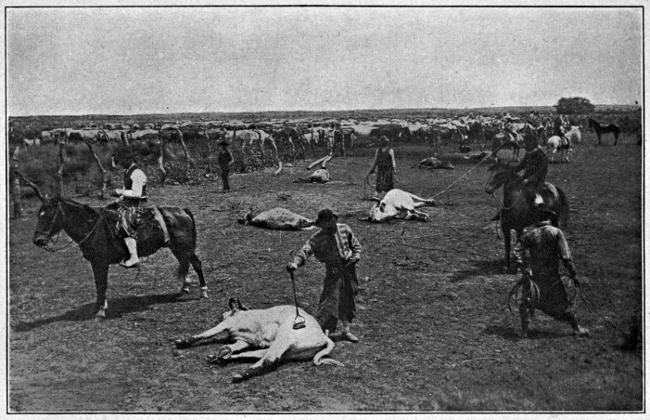
to the horizon, with immense herds of cattle
dotting it until, in the distance, where earth
and sky meet, the largest animals appear as
mere specks on the landscape.
One is impressed with the great agricultural
resources of Argentina, for only a small portion
of this part of the republic is uncultivated.
All of it is owned in large estancias that are
measured by the square league, which comprises
almost six thousand acres. The man
with only one square league is a small farmer,
and many of the estancias measure ten square
leagues, or even more. Statistics show that
among the one hundred thousand reported
landowners there is an average holding of six
square miles. The locusts are a terrible curse
for the farmer, and they were very bad last
season. I saw millions of them in crossing the
pampas. It costs these ranch men thousands
of dollars each year to fight this scourge of
locusts, and as yet no permanent remedy has
been discovered.
The road runs nearly due west. An insane
asylum called “The Open Door” is passed
about forty miles out from the metropolis. A
number of Camp towns, such as Mercedes, Chacabuco
and Vedia, are passed, but none of them
are attractive places. At the latter place the
province of Santa Fé is entered, and a number
of small towns are passed before the province
of Cordoba is reached. Several branch lines
shoot off to the south, which are feeders thus
thrust out for freight, and branches of other
lines run in from the north. Villa Mercedes,
four hundred and thirty-two miles from Buenos
Aires, is the first large town. The land has
begun to rise and this town is sixteen hundred
feet above sea level, although the aspect is still
that of plains. It is situated on the Rio Quinto,
and is a place of perhaps ten thousand people.
This used to be the terminus of this line until
it absorbed the Great Western a few years ago,
which continued the westward route. It is one
of the concentration camps for the instruction
of conscripts drafted into the artillery regiments.
The broad pampas are perhaps not so lonely
as they seem, for there is generally an abundance
of bird life. Flamingoes haunt the lagoons,
and long-tailed hawks sit like silent sentinels
on the fence posts. The largest bird is
the ostrich, of which there are tens of thousands
scattered over these broad leagues, which
have not yet been broken up by agriculture.
In the entire republic it is estimated that there
are more than four hundred thousand ostriches.
They will feed among the stock, but the agriculturist
soon makes them disappear. These
long-necked and long-legged birds form a very
pretty addition to the landscape. The South
American ostrich is smaller than the South
African species, and its feathers are not nearly
so valuable. They are extremely abundant, however,
and bring in a pleasing revenue for the
farmer. The feather gatherers bargain with
the estanciero to pay him so much for each bird
found and picked on his estancia. Many of the
ostriches are very tame, for the owners do not
allow them to be hunted, but they roam at will,
easily getting over the low fences that hedge
in the fields. In some places the South African
ostriches have been introduced and are raised
for the commercial value of their plumes.
The next place of importance is San Luis,
capital of the province of that name, at a still
higher elevation. The dead level aspect has
now changed to gentle undulations. The long
gray shadows on the horizon are the peaks of
the Andes, at a distance of one hundred and
fifty miles. In this city there has recently been
located an observatory by the Carnegie Institution
of Washington. The purpose of this
observatory is to observe the motion of all stars
of the seventh magnitude in the southern heavens,
and several American scientists are in
charge of the work. A few miles beyond San
Luis is an artesian well two thousand feet deep,
which was sunk by the government and yields
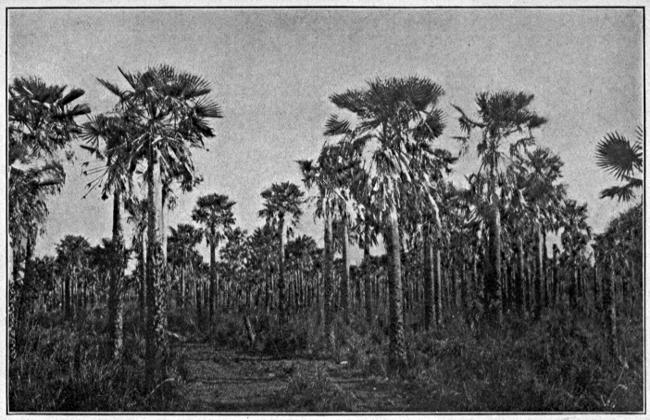
an immense supply of water. The pampa grass
now stands in clumps and bare spots become
more frequent. The railroad changes its direction
time and again instead of taking a bee-line
for some distant point. The stony character
of the soil increases, but at last a land
of vines and tall poplars is entered, and it is
not long until the train rolls into the station at
Mendoza.
“Hotel Grande.”
This was the instruction I gave to my cab
driver at the station in Mendoza after my baggage
had been deposited in the vehicle by a
portero.
“No hay,” he answered, meaning that there
was no such hotel.
I then told him to take me to the best hotel
in the city. When we arrived at the hotel selected
by him I saw an imposing building on
the opposite side of the plaza with “Hotel
Grande” upon it in large letters, and instructed
my Jehu to drive me over to it. The
secret of the matter is that the other hotel paid
the driver a peso for each guest. There is only
one good thing to be said about the cabs in
Mendoza, and that is, the fares are cheap—if
you know the established rates. A few years
ago a tramway company laid tracks and began
operations. Enraged at this intrusion upon
their rights the cab owners began a war of
fares. They lowered their charges to the level
of the rates of the tram line, and announced
that they would carry passengers to their very
doors for the same price as the street car line
would deposit them at the nearest corner, which
might be blocks away. The deserted and abandoned
rails which one may see in a few places
proclaim the glorious victory of the cab owners.
Although the fares have advanced somewhat
since the abandonment of the street railroad
they are still remarkably low.

A GLIMPSE OF THE ANDES FROM MENDOZA
Mendoza is one of the most picturesque cities
in Argentina. It is an oasis in the midst of a
stony desert. There is hardly a drier climate in
the world, and, where the rainfall alone is depended
upon, nothing will grow. Lying at the
very foot of the lofty Andes range, it is the
westernmost city of the republic. The streets
are quite wide and the buildings are almost
without exception of one story. The reason
for this is the earthquake. The greatest disaster
of that kind happened in 1861, and the
inhabitants have been haunted ever since by
fear of a return of such a holocaust. The
tremors which occasionally occur are a constant
reminder of the dangers; and the ruins
of the great cathedral, whose walls crashed
down upon the crowd of supplicants who had
gathered within for protection, still stand as
a warning. Reports vary greatly concerning
that disaster. The most generally credited figures
are that of a population of twenty thousand
no less than twelve thousand met with
death. It is difficult to believe, in the face
of similar modern disasters, that any such proportion
of fatalities occurred either from the
earthquake, the fires that followed or the lawlessness
which prevailed in the confusion of
the next few days. It is said that many fell
victims to the assassin’s knife when they were
trying to escape with their few earthly belongings.
The new houses have all been built
of mud bricks with an extra amount of straw
or cane mixed in, and the one-storied walls
are made very thick. The result is an elasticity
that is considerable of a safeguard
against the earth’s tremblings.
The old ruined town lies about a mile from
the new town and is a mass of ruins, scarcely a
single house remaining intact. There is something
sadly depressing about these heaps of
fallen stones, broken arches and sightless windows—relics
of the old Spanish-Moorish architecture.
The old city covered about two
hundred acres and contained seven churches
and three convents. The first shocks levelled
almost every building to the ground. They are
a place of frequent pilgrimage and one may still
find burning candles in nooks and corners,
placed there by devout relatives of those who
were hurled unshriven into the beyond. Surely
purgatory cannot long retain the souls of those
who were overtaken by death while at worship,
even though they were unprepared to leave this
world.
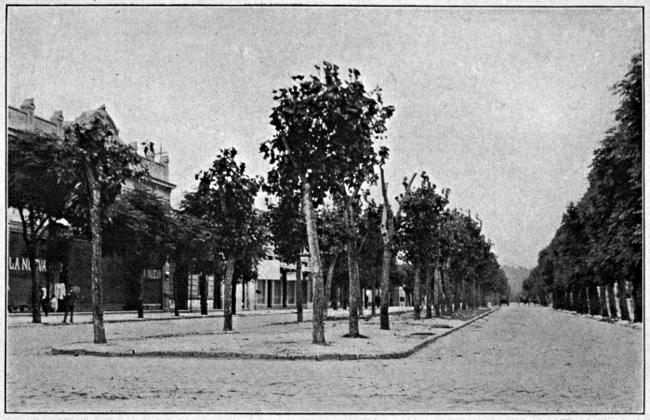
The centre of the town is the broad Avenue
de San Martin, the alameda, with its double row
of trees and the stream of water that runs on
either side of the roadway. Were it not for
this shade and the running water, the streets
of Mendoza would be pretty hot in the middle
of the day. Down this wide, cobblestoned
street the Mendozians have their corso, or carriage
drive, and one will see victorias with bells
on the tongue wedged in with two-wheeled country
carts, and all other kinds of vehicles.
Happy farmers and the distinguished citizens
of Mendoza mingle together on this occasion.
There is a certain kind of provincial good
humour about this little city so near the lonely
Andes. Small boys armed with buckets on
long poles dip the water from the canals and
fling it across the thoroughfare. On Monday
morning, or following a fiesta, this battle
with the dust is conducted by a lot of shame-faced
men who are not volunteers or employees
of the city, but are working out a fine for the
previous day’s debauch. The city also possesses
a very pretty park besides a number of
plazas. There is considerable street life in the
city, and the cafés afford evidence of this, for
they are wont to spread their tables far out
under the trees in this genial climate.
Mendoza is not a temperance resort, for it
is a great wine centre. This is the country of
the grape, and it is this fruit that has brought
wealth to Mendoza. All about the city are
vineyards and meadows, and the outlines of the
farms are marked by rows upon rows of graceful
poplars. Millions of those poplars have
beautified this country, which at one time was
a barren waste, and would still be so were it not
that man has harnessed the streams formed
from the melting snows which rush down from
the snow-clad peaks. Irrigation was first established
by the Spaniards several hundred
years ago, but it has been extended and systematized
by the grape growers in recent years.
Dams have been built across the rivers and the
waters forced through artificial channels, until
now there are more than twelve hundred miles
of these channels, which water a district of approximately
one thousand square miles.
As soon as you leave the city you will see
the grapevines growing. Some are trained
upon a low prop, as in France or Germany,
others climb a staff and look like hops, while
many vines creep up the poplar trees and
stretch their tendrils across to the next tree,
so that the tree trunks are all connected and
form a cool, vine-covered lane for hundreds of
rods. The vines are thus trained to form cool
drives for the owners, and they are especially
seductive when the great bunches of ripe fruit
hang just high enough out of reach to be tantalizing.
Little canals trickle here, there and
everywhere among the fields of vines, and thus
keep the roots ever moist. The prosperity of
Mendoza is bound up in these tiny little
streams, which give life to the grape, the onion
and potato, for it seldom rains here. The day
of my visit the sky became overcast with dark,
foreboding clouds, as though a terrific storm
was threatening. I hesitated to venture forth.
The landlord said, “It looks this way nearly
every day but it never rains.” I found out
this statement was true and that rain is a rare
event.
The development of the wine industry in
the Mendoza district has been almost phenomenal.
The greater part of the wine produced
is not of a high quality, so that it appeals only
to the masses and not to the connoisseur. The
wealthier classes are satisfied with nothing less
than the finest of European wines and champagnes.
The quality of the grapes produced is
of the finest, and the very best European varieties
have been imported. The profits in some
years are almost fabulous, for a few acres will
bring in a handsome return. Some of the wine-manufacturing
establishments are quite large
and produce great quantities of that liquor so
popular in all Spanish countries. The presses,
vats, casks and everything in them is of the
latest design. One will find wines leaving these
establishments with Bordeaux, Burgundy, Moselle
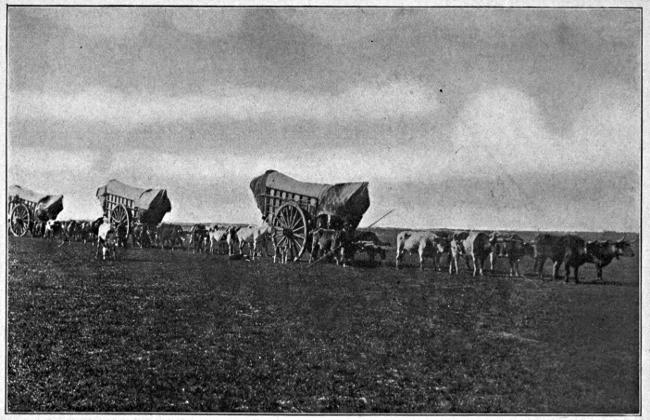
and Muscatel labels. It is shipped in both
cask and bottle, and one will see high ox-carts
and cumbersome wagons loaded with large
casks on their way to the railroad station on
almost any road leading to Mendoza. Thousands
of tons of the grapes are shipped each
year in the fruit form, for it is a peculiarly
luscious growth and the bunches attain enormous
size. Other fruits have been found to
grow equally well at Mendoza and fruit canning
is becoming quite an industry there. Peaches,
pears and plums grow to good size and of good
flavour, while apples, quinces and cherries do
very well. The fruit culture is spread over a
wide area of country and the culture is rapidly
increasing. It is the boast of the Argentinian
that the country is capable of producing
every conceivable species of fruit, and it is not
an idle boast. If the same care was taken that
they give that industry in California they could
flood the markets of Europe with their fruits.
The general trouble is that the trees grow so
easily that they are practically unaided, so that
the fruit is oftentimes full of flaws and will
not pass for prime quality in the markets.
Grapes are about the only fruit to which scientific
methods of culture have as yet been applied.
At Mendoza a change is made to the less
comfortable narrow-gauge train, which conveys
the traveller through the fastnesses of the
Andes. The mountains are now plainly visible
and the snow peaks can easily be distinguished
from the dark background. The route leads
first through grape and peach orchards, but
these soon give place to the cactus and scrub
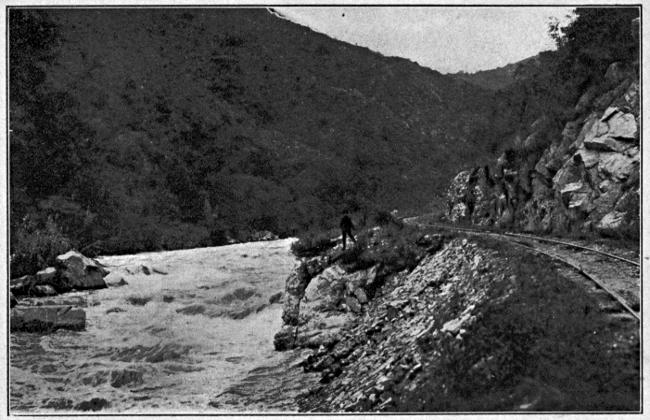
growth which cling to the foothills. The Mendoza
River, fed by the melting snows, tumbles
along on its way down from the mountains and
is crossed and recrossed many times. An occasional
station is a somewhat forlorn outpost
of human life. It consists principally of a
water-tank and pile of fuel. The sole occupants
visible are usually a woman, some children and
a few goats, for the master of the house is probably
at work. The solitudes are broken only
by the shrill whistle of the locomotive. One
enters a land of torrents, chasms, precipices
and other freaky outbursts of nature.
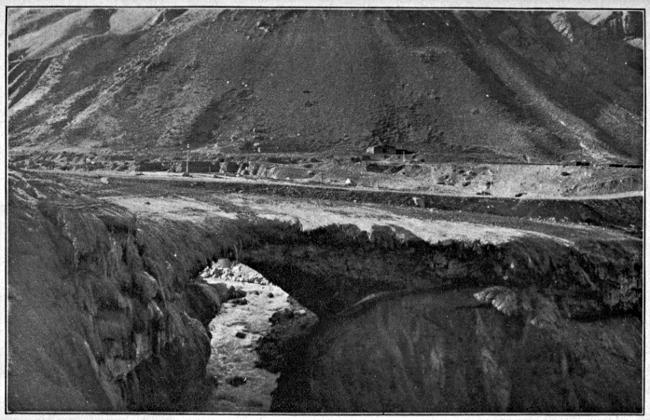
At a distance of about one hundred miles
from Mendoza is the Puente del Inca, Bridge of
the Incas, one of the famous natural bridges of
the world, and near it are some mineral springs
and a hotel. This bridge is of limestone formation,
the span being about one hundred and
fifty feet in length, with a width of one hundred
and twenty feet, and is about sixty feet above
the Mendoza River, which flows beneath. There
are many legends and tales which are told
about this curious bridge, so named because it
is said to have been on an old trail used by
those ancient people.
CROSSING THE ANDES
A little further on is the station of Las Cuevas,
the last stop in Argentine territory and
the entrance to the tunnel under the mountain.
The elevation at this place is in excess of ten
thousand feet. There is a certain weird fascination
about this spot so high up and seemingly
so remote from all the hustle and bustle
of the twentieth century. It is a place of contrariety.
The contrast between light and shade
and the different colours is very marked. There
is no delicate and gentle shading of tints. There
may be a black wall surmounted by the clear
white snow; near by will be other rock walls,
pinnacles or spires of green, violet, pink, blue
or yellow. It is as though nature had set up
a great kaleidoscope between the sun and the
bulwark of rocks in order to flood this valley
with colour.
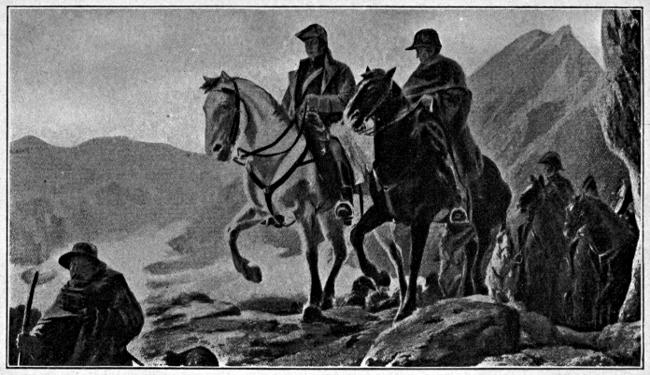
When I crossed the Andes it was just a few
weeks before the tunnel was opened to traffic.
In early days this intervening distance between
railhead was covered on foot or in the saddle.
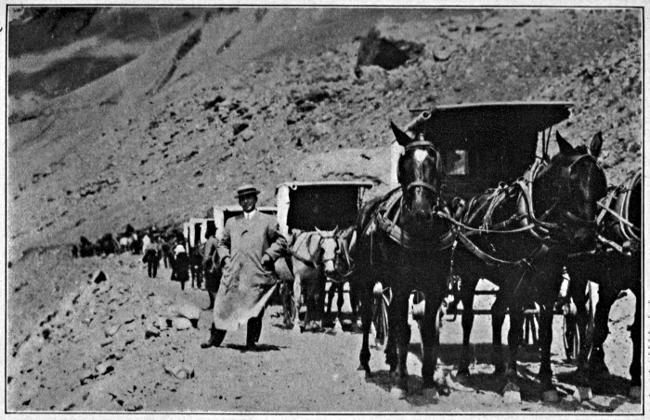
Later came the broad, white-covered four-horse
coaches which conveyed our party. Five
hundred horses and mules, many carriages and
baggage wagons and a considerable force of
men were maintained for this service. Four
times the air-line distance is covered in reaching
the highest point on either side. Extra
riders with a hitch rope to assist a stalled vehicle
follow the carriages. The manager, who
was an American, and his guards, took short
cuts and appeared in the most unexpected
places. Scrambling, twisting and turning, the
cavalcade mounted higher and higher, and the
air became so cold that a heavy wrap felt comfortable.
The air was wonderfully clear, and
the distant mountain peaks were clearly outlined
against the turquoise blue of the heavens.
As the long line of carriages winding their way
up the zigzag trail neared the summit, a sharp
turn in the road suddenly revealed a striking
statue outlined against the sky, and a feeling
almost of awe fell upon us. While the carriages
were stopped for the driver to examine
the harness preparatory to the descent, the passengers
gazed in silent admiration upon this
monument. Lofty peaks lifted up their weird
masses of black basaltic rock and dazzling snow
into the clear blue of the Andean sky, among
which were Aconcagua and Tupungato, which
were clearly visible if one had a sharp and
quick eye.
“Sooner shall these mountains crumble into
dust than the people of Argentina and Chile
break the peace to which they have pledged
themselves at the feet of Christ the Redeemer.”
“THE CHRIST OF THE ANDES”
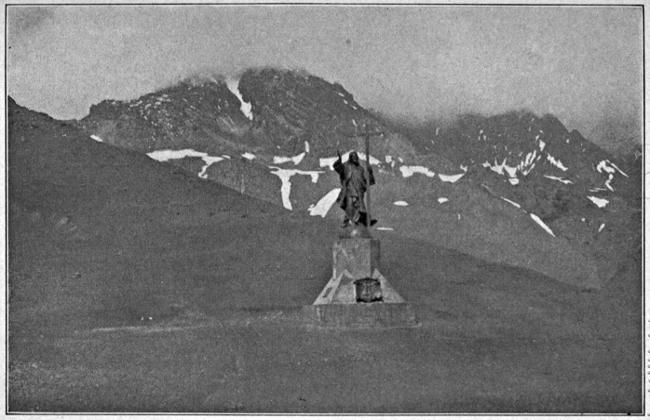
This is the inscription that appears on one of
the tablets placed on the monument known as
“The Christ of the Andes.” I know of no
other monument, except the statue of Liberty
enlightening the World, in the New York harbour,
that is so imposing or impressive as this
colossal statue, which is placed on a gigantic
column in a pass almost thirteen thousand feet
above the level of the sea. The silence and
grandeur on all sides make it doubly impressive.
The figure of Christ is twenty-six feet
in height. In one hand it holds a cross, while
the other is extended in a blessing, and as if
uttering the one magic word “peace.” It was
erected as a symbol of perpetual peace between
the two nations, and was cast in bronze from
the melted cannon of the two nations. Its location
is on the international boundary line,
which had just been established by arbitration,
after war between these two countries seemed
inevitable. A boundary standard has been set
up right near it with the word “Chile” on
one side and “Argentina” on the other.
When this monument was dedicated, on the 13th
of March, 1904, more than three thousand persons
witnessed the ceremonies in this wild region.
The appalling silence was broken by the
roar of cannon and the music of bands. After
these sounds had died away in the distance,
there came the words of the Bishop of Ancud:
“Not only to Argentina and Chile do we dedicate
this monument, but to the world, that from
this it may learn the lesson of universal peace.”
Now that the railroad is completed these sturdy
little animals have made their last trip, and
fewer people will gaze upon this striking monument.
The peon with a mail bag strapped on
his back has tramped his way for the last time
down the rocky trail in the winter snows. El
Christo stands among the lonely crags, deserted,
isolated and storm-swept, but ever with
a noble dignity befitting the character.
The Chilean terminus of the tunnel is at
Caracoles. From here another railroad of
metre gauge, called the Trasandino Chileno,
carries the traveller to the station of Los Andes.
It has been found necessary to construct
snow-sheds in many places in order to protect
the track from snow-slides, which are likely to
occur in August and September. From Los
Andes to Valparaiso the route is over the Chilean
State Railroad, which is of standard gauge,
and passes through some rich and fertile valleys
on its way towards the Pacific.
The scenery on the Chilean side is grandly
picturesque and affords some magnificent views
of mountain scenery. There are one hundred
and eighteen bridges, an average of more than
two bridges to the mile, from Caracoles to Los
Andes. At El Portillo is the rock-bordered
Inca Lake, on whose surface is reflected the
mountains which slope abruptly into its waters.
Masses of rock seem poised on ledges ready to
project themselves down into the valleys with
destruction in their path. One of the most
wonderful sights is a narrow gorge, very deep,
which forms the bed of a swift stream. At
one place the overhanging rocks nearly meet,
and this is called the Salto del Soldado, the
Soldier’s Leap. It received this name because
it is said that, during the early struggles for
independence, a Chilean soldier, pursued by
the enemy, escaped by leaping his horse over
this chasm. How true the tale is I do not know,
but it is a striking freak of nature, and is
plainly visible from the train. There are in
all one hundred and forty miles of the sublime
in nature on the transandine railways, which
will compare with any mountain railroad in the
world, although the most sublime part, hitherto
crossed by wagons or mules, will not be visible
from the international express.
The Cordilleras of the Andes are formed of
three distinct ranges running north and south.
The western range forms the watershed and is
the boundary line between Argentina and Chile,
while the central range contains the highest
peaks, Aconcagua, Mercedario and Tupungato.
The eastern range is divided from the central
one by a wide plain or plateau, several miles
broad, known as the Uspallata, which is some
six thousand feet above sea level and is one
hundred and fifty miles long from Mendoza
north. Without lakes or trees, this plain is one
of the most desolate and uninteresting spots
imaginable, but the varied colouring of the
stratification is marvellous. This lower range
conceals the higher peaks from view as one
approaches from the Argentine side.
As one proceeds from Mendoza the upper
valley begins to close in and the track pierces
the main range of the Cordilleras between walls
of porphyry and granite. To the north one
gets at last a glimpse of Aconcagua some
twenty-three thousand and eighty feet above
sea level, and higher than any peak outside of
the Himalayas. It is more than ninety miles
from the Pacific and can be seen on a clear day
from Valparaiso, for its lofty head is lifted
up above its neighbours. It is on the Argentine
side, and all the melted ice and snow from
its slopes pours down over the pampas of that
country. It is surrounded by winding valleys,
by rugged and precipitous spurs and ridges
which are difficult of access. One of the best
views is from the Puente del Inca where the
Horcones Valley opens out into the Cuevas
Valley. It has been termed a volcano, but there
are no signs of a crater and few traces of
scoriæ. To the north of Aconcagua lies the
Mercaderio, over twenty-two thousand feet, and
to the south Tupungato, just a few feet lower.
On the Chilean side, near the Cumbre, is Juncal
(19,500 feet), and near it are the peaks of Pollera,
Navarro, Maipo and the great volcano of
San José.
The most striking aspect of these Andean
solitudes is their terribly bleak and desolate
appearance. Trees there are none, but only a
few shrubs and blades of grass growing in the
clefts of rocks here and there; nothing but a
huge expanse of yellow sand and stone, with
peaks rising on every hand whose extraordinary
stratification presents many-coloured hues
which are almost bewildering to the eye. Great
torrents flow down their sides whose waters
are of a dull, brackish colour. These are exceedingly
rapid and full of dangerous holes,
so that the fording of them is perilous. The
line of perpetual snow is about seventeen thousand
feet, although this varies. In the spring
there is a very curious phenomenon at times on
the glaciers and snow slopes. It consists of
huge fields composed of cones, or pyramids,
of frozen snow, some four or five feet high,
placed close beside each other. These cones
are called the nieve penitente, or penitent snow,
because of its semblance to the cowled Penitent
Friars. This effect is caused by the combined
action of the sun and wind upon the frozen
masses.
Aconcagua is distant about a dozen miles
from the Inca or Cuevas. The weather, however,
is uncertain even in summer, and a terrible
wind usually prevails after sunrise. These
render exploration work difficult and even dangerous.
In the winter the snowfall is excessive.
In the summer there is no snowfall and
the wind blows the dust from the desert-like
valleys in stifling clouds, which are oftentimes
almost unendurable. Storms which are almost
blizzards spring up as by magic on the high
altitudes. The lightning is especially vivid
and dangerous.
The pass of the Cumbre is one of the most
dangerous passes because of its fearful storms.
Every few miles there are the dome-shaped
casuchas, which have been built for shelter,
with their doorways perched up high above the
ground as a precaution against being snowed
under. In one of the most dangerous parts
is a little graveyard by the roadside, with numerous
little wooden crosses in various stages
of decay which bear eloquent testimony to the
toll which has been demanded by the storm
king.
The arrieros, or mule drivers, that one may
engage, never set foot on the ground if they
can avoid it. It would, I suppose, be a loss
of caste to walk, and they would rather ride
their horses over a precipice than humiliate
themselves by getting off and walking. The
general appearance of these arrieros is decidedly
picturesque, is certainly distinctive and
gives them a rather striking appearance. They
ride an old-fashioned Mexican saddle with a
number of sheepskins strapped over the top of
it. They generally have their feet encased in
soft slippers made of a square piece of rawhide
strapped on the foot by leather thongs,
which would certainly make walking over stones
decidedly uncomfortable. They are fond of
silver trappings and gaudy accoutrements, and
the more jingling these accessories make the
better pleased is the rider, for he declares that
this noise encourages the animals.
Aconcagua is distant a dozen miles from the
Cumbre. The ascent of this peak has been
made up a valley which runs over toward it.
Vegetation gradually disappears on the upward
journey, and the most of the streams contain
water unfit to drink. Soon the giant cliffs and
crags of Aconcagua tower over the traveller,
a great mass of rock rising like the battlements
of some stupendous castle. Its vast proportions
are bewildering to the pygmy onlooker.
Amidst this amphitheatre of peaks and valleys
it would seem was the arena of one of the early-world
dramas ages and ages ago. The cold
becomes greater and more acute as more lofty
heights are reached, especially so just before
daybreak. The wind is biting. The loose round
stones make a footing difficult. What looks like
a mere step from one part of the mountain to
another often means hours of toil to the venturesome
climber.
One writer says: “The sight that met my
gaze was an astounding one. An immense glacier
separated us from the glacier below—the
difference between twenty-three thousand feet
and thirteen thousand feet. It was a precipice
of gigantic size. As I looked down its dizzy
sides, I saw spurs of the mountain flanking the
glaciers beneath to the left and right, giving
the appearance of some huge amphitheatre.
The sun was low in the heavens, and did not
penetrate into the vast pit, and the great
masses of vapour slowly moving about in it far
below, gave it the aspect of a giant cauldron,
into whose depths the eye failed to penetrate,
two miles vertically below. The arete, about
five feet wide at this point, ran east to the summit
and west to the snow-clad western peak of
the mountain, growing ever narrower in that
direction, until, where it sloped up to the highest
point, its edge became knife-like.”
In “The Highest Andes,” by E. A. Fitzgerald,
the following description is given of the
summit of Aconcagua. “Over Argentinian
territory range beyond range stretched away;
coloured slopes of red, brown and yellow, peaks
and crags capped with fresh-fallen snow. I had
hoped to look down upon the pampas of Argentina.
In this I was disappointed for, though
I gazed down over the range, a sea of mountains
some sixty miles in width, and averaging
a height of quite thirteen thousand feet, made
such a view impossible. Away over the surging
mass of white cloud that lay on the glacier
at my feet rose the southern frontier chain.
Torlosa and the Twins, on either side of the
Cumbre Pass, stood like colossal sentinels
guarding the great highway between the two
republics; then there were the lofty glaciers
lying between the rugged crags of Juncal, the
ice peaks of Navarro and Pollera, the Leones
and the Cerro del Plomo, that overhangs the
city of Santiago, Chile, and some sixty miles
farther on the magnificent white summit of
Tupungato.
“No lens or pen can depict the view from
the Chilean side. I looked down the great
waste, past the western peak of the mountain
to right and left, over ranges that dwindled in
height as they neared the coast to where, a hundred
miles away, the blue expanse of the Pacific
glittered in the evening sun. The sun lay
low on the horizon, and the whole surface of
the ocean within the points of vision was diffused
with a blood-red glow. The shimmering
of the light on the water could be distinctly
seen. So near did it seem that I could not realize
the immense distance that separated one
from it.
“All the forces of nature had been brought
to bear upon this mountain giant. Visible signs
lay around one of the power of the weather
and rapid changes of temperature to destroy.
Aconcagua, with all its cherished secrets and
its mystery, lay here before one, confessing
itself as nothing more than a colossal ruin, for
not a single vestige of the ancient crater of this
extinct volcano remains. Foot by foot the relentless
forces of nature have reduced the mountain
to its present proportions. The innumerable
traces of ruin and decay around one, the
crumbling rocks and the disappearance of the
crater told of an Aconcagua of the past, whose
gigantic base filled the glacier-beds around,
whose sides rose towering to the heavens several
thousand feet higher than the Aconcagua
of to-day; of an Aconcagua of ages yet unborn,
split, broken and powdered by frost and heat,
pouring itself over valleys and plains in sediment
and shingle, a mere shapeless mass whose
height will no longer distress the mountaineer.
“I looked at the time. It was twenty minutes
past six. The sun, a great ball of blood-red
fire in a cloudless sky, was dipping into the
waters of the Pacific. Rapidly it sank and disappeared
from view, yet, as if struggling for
supremacy with the fast-approaching night, an
afterglow of surpassing beauty spread over
land and sea in a series of magnificent changes
of colour. The mighty expanse of water from
north to south, together with the sky above it,
was diffused with a fiery, red glow. While the
red in the sky remained, the waters, through
a variety of intermediate shades of colouring,
turned slowly to purple and then to blue. And
yet we were not in darkness, for with the sun’s
departure the risen moon declared itself with
wondrous brightness, penetrating the thin atmosphere
and flooding everything with its
colder light.”