Abbot, C. G., 27, 34
Albedo of Earth, 54, 81
—— Jupiter, 127
—— Mars, 81
—— Moon, 54
Albumin sol, 15
Algol-type stars, 35, 144, 145
Antares, 38
Antoniadi, E. M., 97, 104
Archangel, climate of, 87, 88
Arcturus, 35, 37
Aristarchus, lunar crater, 48
“Astronomical unit,” 21
Atmosphere of, Mars, 76
——, Moon, 53
——, Sun, 25
——, Venus, 112
Barnard, E. E., 89, 104
Beer, 60, 97, 98
Bond, G. P., 127, 128
Brewster, Sir David, 4
Calcium, 12, 36
Callisto, satellite of Jupiter, 131
Calory, 26
Campbell, W. W., 145
Carbon, 11, 34, 38, 39
Carbonic acid, 11
Cassini, 59, 60, 130
Ceres, minor planet, 41, 120, 121, 122, 131
Cerulli, V., 104, 108
Chromosphere, 28, 29
Cobalt, 33
Comet, Encke’s, 119
——, Halley’s, 119
——, spectra, 38
Copernican theory, 1
Copper, 33
Corona, 40
Coxwell, 25, 75, 79
Cyanogen, 37, 38
Czapek, F., 11, 13
Darwin, Sir G. H., 116
Dawes, W. R., 60, 63, 97, 99
Denning, W. F., 104
Dispersion, anomalous, 28
Doppelmayer, lunar crater, 52
Dubois, Eugene, 155
Eros, minor planet, 57
Europa, satellite of Jupiter, 131
Evans, J. E., 107
Faculae, 29, 30
Fauth, P., 50
Flamsteed, lunar crater, 52
Fluorine, 40
Fraunhofer, 33
Galileo, 51, 59, 131
Ganymede, satellite of Jupiter, 131, 132
Gay-Lussac, 75
Glaisher, J., 25, 75, 79
Goodacre, W., 49
Green, N. E., 60, 62, 63
Greenwich Hospital School, 107, 108
“Gulliver’s Travels,” 82, 156
Haeckel, E., 12
Halogens, 36, 40
“Harper’s Weekly,” 93
Helium, 37
Herschel, Sir J., 54
—— Sir W., 20, 49, 59, 60, 61
Hevelius, 51
Hippalus, lunar crater, 52
Hooke, R., 59, 60, 130
Huyghens, 59
Hydrocarbons, 38
Hydrogen, 11, 36, 37, 38, 41, 81
“Inhabitant,” 5
“Inhabited” Worlds, 2, 3, 4
Io, satellite of Jupiter, 131
Iron, 12, 33, 36
Jupiter, 122-32
——, belts, 127, 129
——, great red spot, 130
——, proper motion of spots, 129
——, satellites of, 128, 131
——, white spots, 128, 130
Keeler, J. E., 122, 125
Kies, lunar crater, 52
Kirchhoff, 33
Lacus Solis, 97, 98, 99
Langley, S. P., 55
Lilliputians, 82, 83
Linné, lunar crater, 48
Lockyer, J. N., 60
Lowell, P., 65, 66, 67, 69, 71, 81, 97, 98, 99, 101, 103, 104, 105, 106, 108, 109, 110
Lucifer, 111
Mädler, 46, 48, 60, 97, 98
Maginus, lunar crater, 46
Magnesium, 12, 36
Manganese, 33
Mare Fecunditatis, 47
—— Humerum, 52
—— Nubium, 52
—— Serenitatis, 48
Mars, canals of, 57-70, 78, 101, 102
——, conditions of, 71-95
——, illusions of, 96-110
——, meteorology of, 93-4
——, oases of, 65, 98, 99, 101
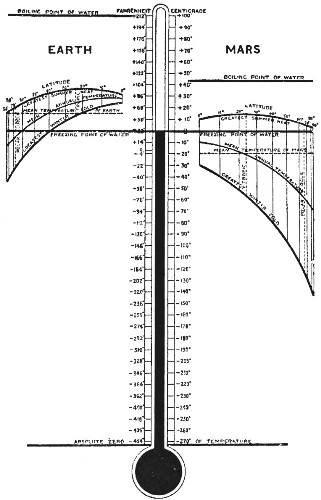
——, thermograph of, 91, 92
——, winds of, 77
Mendeléeff, 39
Mercury, 114-18
Messier, lunar crater, 47, 48
Metabolism, 10, 11, 14, 15, 38
Millechau, 104
Milton, 51
Mira Ceti, 150
Molesworth, P. B., 49, 104
Moon, 43-56
——, “terminator” of, 51
Mont Blanc, 25, 74, 80
Mount Everest, 75, 80
Nature of Vision, 99
Nebulae, spectrum of, 38, 40
Nebulium, 40
Negative elements, 36
Neison, E., 48, 53
Neptune, 132, 141
Newcomb, S., 93, 109
Nicholson, J. W., 40
Nickel, 33
Nilosyrtis, “canal” on Mars, 89
Nitrogen, 11, 37, 38, 39
Observatory, Chicago, 44
——, Harvard College, 127
——, Lick, 122
——, Paris, 44
Occultation, 52, 53
Organic Life, definition of, 15
Organism, living, 6-19
Organo-genetic elements, 12, 38, 39
Osmosis, 15
Oxygen, 11, 36, 37, 38, 41
Periodic Law, Mendeléeff’s, 39
Phillips, T. E. R., 104
Phosphorus, 12
Photosphere, 28, 33, 36
Pickering, W. H., 47, 48, 53, 109
Pithecanthropus, 155
Planetary statistics, table of, 72, 73, 135
Platinum, 36
“Plurality of Worlds,” 2
Pollock, Master, 109
Potassium, 12
Poynting, J. H., 86, 87, 89, 115
Proctor, R. A., 34, 77
Prominences, 29, 30, 37
Protofluorine, 40
Protonilus, “canal” on Mars, 89
Protoplasm, 11, 12, 13, 15, 38, 40, 154
Pyramid, Great, 45
Refraction, anomalous, 28
Reversing layer, 36
“Rice-grains,” of Sun’s surface, 28, 29
Ring Nebula in Lyra, 40
Rosse, Lord, 55
Ruskin, J., 19
Saturn, 132
——, Rings of, 138
Schiaparelli, G. V., 61, 62, 63, 64, 66, 97, 99, 107, 108, 116, 117
Schooling, T. Holt, 83
“Scientia,” 66
“Semi-suns,” 131, 132
Serviss, Garrett P., 17
Singapore, climate of, 87, 88
Sinus Sabaeus, marking on Mars, 97, 99
Sirius, 37
Sodium, 33, 36
“Solar Constant,” 26
Spectroscopic binaries, 144, 145
Spectrum, 53
——, heat, 55
“Spurious” disc, 103
Stars, double, 35
——, multiple, 35
——, red, 38
——, spectra of, 34, 38, 39
Stefan’s Law, 85
Stoney, G. Johnstone, 34
“Streaming,” 15
Sulphur, 11, 38
Sun, 20-32
Sunspots, 29, 30, 31, 38
——, spectra of, 37
Swift, Dean, 82, 156
Table Mountain, 54
Thermograph of Mars, 91, 92
Titanium, 36, 37, 38
Tornadoes, 31, 137
“Twinkler,” 114
Tycho, lunar crater, 46
Uranus, 132, 140
Venus, 57, 111-18
Verworn, Max, 7
Very, F. W., 55
Vesper, 111
“Victoria,” hypothetical planet, 83
Wallace, A. R., 4
“War of the Worlds,” 104, 156
Waste, 151, 152
Water, indispensable factor, 15, 41
Wells, H. G., 104, 156
Whewell, 4
Williams, A. Stanley, 104
Wolf, Max, 40
Young, C. A., 26, 33
WILLIAM BRENDON AND SON, LTD.
PRINTERS, PLYMOUTH
Harper’s Library of Living Though
ARTHUR HOLMES
THE AGE OF THE EARTH
And Associated Problems. Illustrated
Gives us the result of the latest research into this field of enquiry. The
radioactive minerals are shown to be recording their own age with the
exquisite accuracy of a chronometer—their records checking physical,
astronomical, and geological methods of computation.
PROF. A. W. BICKERTON
THE BIRTH OF WORLDS AND SYSTEMS
Illustrated
Preface by Prof. Ernest Rutherford, F.R.S.
A graphic account of the formation of new stars from the collision of dead
suns or other celestial bodies. The theory throws light on many
astronomical problems, and with its conception of an immortal cosmos, is
of great philosophical importance.
PROF. SVANTE ARRHENIUS
THE LIFE OF THE UNIVERSE
2 Vols. Illustrated
“We can thoroughly recommend these volumes. The information is accurate,
useful, and most suggestive. There are many for whom the first chapters of
Genesis are a subtle allegory covering the profoundest truths, and we are
grateful to the author for having set out this mass of facts.”—The
Globe.
SIR OLIVER LODGE, F.R.S.
THE ETHER OF SPACE
Illustrated
“This work by the great physicist will be found to possess an abiding
charm and an intellectual stimulation.”-Observer.
“Opens up new views into the nature of the universe. Precise and lucid, it
summarises our knowledge of the substance which fills all space and
penetrates all matter—the substratum of matter itself.”—Birmingham
Post.
Please write for announcements and descriptive list:
Harper & Brothers, 45 Albemarle Street, London, W.
Harper’s Library of Living Thought
Foolscap 8vo, gilt tops, decorative covers, richly gilt backs
Per Volume: Cloth 2s. 6d. net. Leather 3s. 6d. net.
PROF. ARTHUR KEITH, M.D.
(Hunterian Professor Royal College of Surgeons)
ANCIENT TYPES OF MAN
Illustrated
“The kind of book that only a master of his subject could write. It must
interest every thinking person.”—British Medical Journal.
PROF. FREDERICK CZAPEK
CHEMICAL PHENOMENA IN LIFE
Discusses in clear, concise terms the great question—“Can life be
explained by physics and chemistry?” It deals with the life-processes of
plants, the molecular structure of protoplasm, organic synthesis in the
cell, the nature of ferments, and the subject of inheritance.
SIR A. TILDEN, F.R.S.
THE ELEMENTS
Speculations as to their Nature and Origin
Diagrams, &c.
Points to the conclusion that the elements resulted from a change in some
primal essence, and discusses “whether all may not be suffering a slow
waste, which, in the long run, must lead back to the primal chaos.”
SIR WILLIAM RAMSAY, F.R.S.
ELEMENTS AND ELECTRONS
Diagrams
The electron—“the atom of electricity”—is shown to be separable from
matter, and to be capable under certain circumstances of independent
existence. The book shows that the electron must be regarded as a kind of
“element” itself, with much stronger claims to “elementary” or
undecomposable characters than the bodies hitherto ranked as elements.
Footnotes:
[1] Chemical Phenomena in Life, pp. 62-3, by Dr. Frederick Czapek
(Harper’s Library of Living Thought). The reader is strongly recommended
to study this work in the present connection.
[2] Wonders of Life, by Ernst Haeckel, Professor at Jena University, p.
130.
[3] Wonders of Life, pp. 127-8.
[4] Chemical Phenomena in Life, p. 58.
[5] Ibid., p. 22.
[6] Other Worlds, by Garrett P. Serviss, pp. 63-4.
[7] Modern Painters, by John Ruskin.
[8] If this experiment could be carried out, it would be necessary to use
a spring balance. If the object were weighed in a pair of scales or by a
steelyard, the counterbalancing weights would be likewise affected in the
same proportion, so that the equilibrium would be undisturbed.
[9] The movements of not a few double stars point to perturbations caused
by the attraction of unseen bodies. There are also a number of instances
known of “Eclipse” or “Algol-type” variable stars, in which the presence
of a dark companion is indicated by the diminution of the light of the
star at regular intervals.
[10] Proc. R. Soc., LXXX, 50, 1907.
[11] Nature, LXXX, 158 (April 8th, 1909).
[12] “Periodic Changes upon the Moon,” Memoirs, British Astronomical
Association, Vol. XIII, p. 88.
[13] The Moon, by Philip Fauth, p. 156.
[14] Radiation in the Solar System: Its Effects on Temperature, and its
Pressure on Small Bodies, by Dr. J. H. Poynting (Phil. Trans. of the
Royal Society, Vol. 202 A).
[15] Publ. of the Astron. Soc. of the Pacific, Vol. II, pp. 286-8.