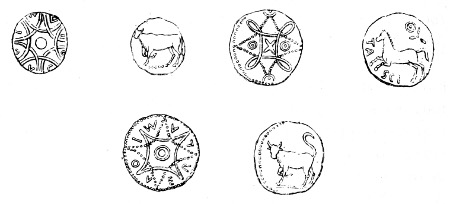
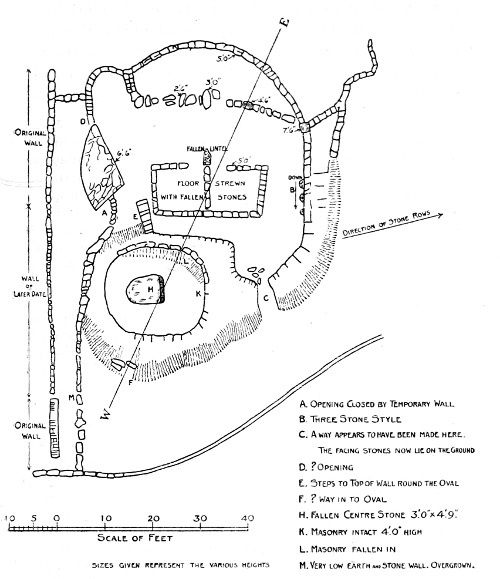
Most spelling variants are retained. Punctuation is occasionally
corrected, especially in the index and in footnotes, to maintain
consistency.
Figures have been moved to before or after the paragraphs near which
they appeared in the text. On occasion, the pagination shown here may
be slightly disordered. Internal references to pages have been hyperlinked
to the original page. Given the approximate placement of figures, the reader
may need to scroll up or down a bit to find the figure.
The titles and page references for the five appendices have been added to
the table of contents.
A Transcriber’s Endnote at the end of this text contains more detailed
information about corrections made.
AN ESSAY IN DECIPHERING PREHISTORY FROM
MEGALITHIC MONUMENTS, EARTHWORKS,
CUSTOMS, COINS, PLACE-NAMES, AND
FAERIE SUPERSTITIONS
BY
HAROLD BAYLEY
AUTHOR OF “THE SHAKESPEARE SYMPHONY,” “A NEW LIGHT ON THE RENAISSANCE,”
“THE LOST LANGUAGE OF SYMBOLISM,” ETC.
“One by one tiny fragments of testimony accumulate attesting such a
survival and continuance of folk memory as few men of to-day have
suspected.”—Johnson
LONDON
CHAPMAN & HALL LTD.
11 HENRIETTA STREET
1919
“Of all the many thousands of earthworks of various kinds to be
found in England, those about which anything is known are very few,
those of which there remains nothing more to be known scarcely
exist. Each individual example is in itself a new problem in
history, chronology, ethnology, and anthropology; within every one
lie the hidden possibilities of a revolution in knowledge. We are
proud of a history of nearly twenty centuries: we have the
materials for a history which goes back beyond that time to
centuries as yet undated. The testimony of records carries the tale
back to a certain point: beyond that point is only the testimony of
archæology, and of all the manifold branches of archæology none is
so practicable, so promising, yet so little explored, as that which
is concerned with earthworks. Within them lie hidden all the
secrets of time before history begins, and by their means only can
that history be put into writing: they are the back numbers of the
island’s story, as yet unread, much less indexed.”—A. Hadrian
Allcroft.
“It is a gain to science that it has at last been recognised that
we cannot penetrate far back into man’s history without appealing
to more than one element in that history. Some day it will be
recognised that we must appeal to all elements in that
history.”—Gomme.
“History bears and requires Authors of all sorts.”—Camden.
CHAPTER I INTRODUCTION — FOOTNOTES:
“If a man does not keep pace with his companions, perhaps it is
because he hears a different drummer. Let him step to the music
which he hears, however measured or far away.”—H. D. Thoreau.
This book is an application of the jigsaw system to certain
archæological problems which under the ordinary detached methods of the
Specialist have proved insoluble. My fragments of evidence are drawn as
occasion warrants from History, Fairy-tale, Philosophy, Legend,
Folklore—in fact from any quarter whence the required piece
unmistakably fulfils the missing space. It is thus a mental medley with
all the defects, and some, I trust, of the attractions, of a mosaic.
Ten years ago I published a study on Mediæval Symbolism, and subsequent
investigation of cognate subjects has since put me in possession of some
curious and uncommon information, which lies off the mainroads of
conventional Thought.
The consensus of opinion upon A New Light on the Renaissance,[1] was
to the effect that my theories were decidedly ingenious and up to a
point tenable, yet nevertheless at present they could only be regarded
as non-proven. In 1912[2] I therefore endeavoured to substantiate my
earlier propositions, pushing them much further to the point of
suggesting an innate connection between Symbolism and certain
words—such, for example, as psyche, which means a butterfly, and
psyche the anima or soul which was symbolised or represented by a
butterfly. Of course I knew only too well the tricky character of the
ground I was exploring and how open many of my propositions would be to
attack, yet it seemed preferable rather to risk the Finger of Scorn than
by a superfluity of caution ignore clues, which under more competent
hands might yield some very interesting and perhaps valuable
discoveries.
In the present volume I piece together a mosaic of visible and tangible
evidence which is supplementary to that already brought forward, and the
results—at any rate in many instances—cannot by any possibility be
written off as due merely to coincidence or chance. That they will be
adequate to satisfy the exacting requirements of modern criticism is,
however, not to be supposed. Referring to The Lost Language, one of my
reviewers cheerfully but disconcertingly observed: “He must deal as
others of his school have done with all the possible readings of the
history of the races of men”.[3] To sweeping and magnanimous advice of
this character one can only counter the untoward experiences of the
hapless “Charles Templeton,” as recounted by Mr. Stephen McKenna: “At
the age of three-and-twenty Charles Templeton, my old tutor at Oxford,
set himself to write a history of the Third French Republic. When I made
his acquaintance, some thirty years later, he had satisfactorily
concluded his introductory chapter on the origin of Kingship. At his
death, three months ago, I understand that his notes on the precursors
of Charlemagne were almost as complete as he desired. ‘It is so
difficult to know where to start, Mr. Oakleigh,’ he used to say, as I
picked my steps through the litter of notebooks that cumbered his
tables, chairs, and floor.”[4]
But Mr. Templeton’s embarrassments were trifling in comparison with
mine. Templeton was obviously a man of some leisure, whereas my literary
hobbies have necessarily to be indulged more or less furtively in
restaurants, railway trains, and during such hours and half-hours of
opportunity as I can snatch from more pressing obligations. Moreover,
Mr. Templeton could concentrate on one subject—History—whereas the
scope of my studies compels me to keep on as good terms as may be with
the exacting Muses of History, Mythology, Archæology, Philosophy,
Religion, Romance, Symbolism, Numismatics, Folklore, and Etymology. I
mention this not to extenuate any muzziness of thought, or sloppiness of
diction, but to disarm by confession the charge that my work has been
done hurriedly and here and there superficially.
With the facilities at my disposal I have endeavoured to the best of my
abilities to concentrate a dozen rays on to one subject, and to mould
into an harmonious and coherent whole the pith of a thousand and one
items culled during the past seven years from day to day and noted from
hour to hour. Differing as I do in some respects from the accepted
conclusions of the best authorities, it is a further handicap to find
myself in the position of Nehemiah the son of Hachaliah, who was
constrained by force of circumstance to build with a sword in one hand
and a trowel in the other.
To the heretic and the wayfarer it is, however, a comfortable reflection
that what Authority maintains to-day it generally contradicts
to-morrow.[5] Less than a century ago contemporary scholarship knew the
age of the earth with such exquisite precision that it pronounced it to
a year, declaring an exact total of 6000 years, and a few odd days.
When the discoveries in Kent’s Cavern were laid before the scientific
world, the authorities flatly denied their possibility, and the proofs
that Man in Britain was contemporary with the mammoth, the lion, the
bear, and the rhinoceros[6] were received with rudeness and inattention.
Similarly the discovery of prehistoric implements in the gravel-beds at
Abbeville was treated with inconsequence and insult, and it was upwards
of twenty years before it was reluctantly conceded that: “While we have
been straining our eyes to the East, and eagerly watching excavations in
Egypt and Assyria, suddenly a new light has arisen in the midst of us;
and the oldest relics of man yet discovered have occurred, not among the
ruins of Nineveh or Heliopolis, not on the sandy plains of the Nile or
the Euphrates, but in the pleasant valleys of England and France,
along the banks of the Seine and the Somme, the Thames and the
Waveney.”[7]
The fact is now generally accepted as proven by both anthropologists and
archæologists, that the most ancient records of the human race exist not
in Asia, but in Europe. The oldest documents are not the hieroglyphics
of Egypt, but the hunting-scenes scratched on bone and ivory by the
European cave-dwelling contemporaries of the mammoth and the woolly
rhinoceros. Human implements found on the chalk plateaus of Kent have
been assigned to a period prior to the glacial epoch, which is surmised
to have endured for 160,000 years, from, roughly speaking, 240,000 to
80,000 years ago.
It is now also an axiom that the races of Europe are not colonists from
somewhere in Asia, but that, speaking generally, they have inhabited
their present districts more or less continuously from the time when
they crept back gradually in the wake of the retreating ice.
“Written history and popular tradition,” says Sir E. Ray Lankester,
“tell us something in regard to the derivation and history of existing
‘peoples,’ but we soon come to a period—a few thousand years
back—concerning which both written statement and tradition are dumb.
And yet we know that this part of the world—Europe—was inhabited by an
abundant population in those remote times. We know that for at least
500,000 years human populations occupied portions of this territory, and
that various races with distinguishing peculiarities of feature and
frame, and each possessed of arts and crafts distinct from those
characteristic of others, came and went in succession in those
incredibly remote days in Europe. We know this from the implements,
carvings, and paintings left by these successive populations, and we
know it also by the discovery of their bones.”
Anthropology, however, while admitting this unmeasurable antiquity for
mankind, takes no count of the possibility of an amiable or cultured
race in these islands prior to the coming of the Roman legions. It
traces with equanimity the modern Briton evolving in unbroken sequence
from the primitive cave-dweller, and it points with self-complacency to
the fact that even as late as the Battle of Hastings some of Harold’s
followers were armed with stone axes. There has, however, recently
been unearthed near Maidstone the skull of a late palæolithic or early
neolithic man, whose brain capacity was rather above the average of the
modern Londoner. The forehead of this 15,000 year-old skull is well
formed, there are no traces of a simian or overhanging brow, and the
individual himself might well, in view of all physical evidence, have
been a primeval sage rather than a primeval savage.
The high estimation in which the philosophy of prehistoric Briton was
regarded abroad may be estimated from the testimony of Cæsar who states:
“It is believed that this institution (Druidism) was founded in
Britannia, and thence transplanted into Gaul. Even nowadays those who
wish to become more intimately acquainted with the institution generally
go to Britannia for instruction’s sake.”
It has been claimed for the Welsh that they possess the oldest
literature in the oldest language in Europe. Giraldus Cambrensis,
speaking of the Welsh Bards, mentions their possession of certain
ancient and authentic books, but whether or not the traditionary poems
which were first committed to writing in the twelfth century retain any
traces of the prehistoric Faith is a matter of divided opinion. To those
who are not experts in archaisms and are not enamoured of ink-spilling,
the sanest position would appear to be that of Matthew Arnold, who
observes in Celtic Literature: “There is evidently mixed here, with
the newer legend, a detritus, as the geologists would say, of
something far older; and the secret of Wales and its genius is not truly
reached until this detritus, instead of being called recent because it
is found in contact with what is recent, is disengaged, and is made to
tell its own story.”[8]
The word “founded,” as used by Cæsar, implies an antiquity for British
institutions which is materially confirmed by the existence of such
monuments as Stonehenge, and the more ancient Avebury. Whether these
supposed “appendages to Bronze age burials” were merely sepulchral
monuments, or whether they ever possessed any intellectual significance,
does not affect the fact that Great Britain, and notably England, is
richer in this class of monument than any other part of the world.[9]
Circles being essentially and pre-eminently English it is disappointing
to find the most modern handbook on Stonehenge stating: “In all matters
of archæology it is constantly found that certain questions are better
left in abeyance or bequeathed to a coming generation for solution”.[10]
Every one sympathises with that weary feeling, but nevertheless the
present generation now possesses quite sufficient data to enable it to
shoulder its own responsibilities and to pass beyond the stereotyped and
hackneyed formula “sepulchral monument”. I hold no brief on behalf of
the Druids—indeed one must agree that the Celtic Druids were much more
modern than the monuments associated with their name—nevertheless the
theory that these far-famed philosophers were mere wise men or witch
doctors, with perhaps a spice of the conjuror, is a modern
misapprehension with which I am nowise in sympathy. Valerius Maximus
(c.A.D. 20) was much better informed and therefore more cautious in
his testimony: “I should be tempted to call these breeches-wearing
gentry fools, were not their doctrine the same as that of the
mantle-clad Pythagoras”.
Druids or no Druids there must at some period in our past have been
interesting and enterprising people in these islands. At Avebury, near
Marlborough, is Silbury Hill, an earth mound, which is admittedly the
vastest artificial hill in Europe. Avebury itself is said to constitute
the greatest megalithic monument in Europe, and nowhere in the world are
tumuli more plentiful than in Great Britain. On the banks of the Boyne
is a pyramid of stones which, had it been situated on the banks of the
Nile, would probably have been pronounced the oldest and most venerable
of the pyramids. In the Orkneys at Hoy is almost the counterpart to an
Egyptian marvel which, according to Herodotus, was an edifice 21 cubits
in length, 14 in breadth, and 8 in height, the whole consisting only of
one single stone, brought thither by sea from a place about 20 days’
sailing from Sais. The Hoy relic is an obelisk 36 feet long by 18 feet
broad, by 9 feet deep. “No other stones are near it. ’Tis all hollowed
within or scooped by human art and industry, having a door at the east
end 2 feet square with a stone of the same dimension lying about 2 feet
from it, which was intended no doubt to close the entrance. Within,
there is at the south end of it, cut out, the form of a bed and pillow
capable to hold two persons.”[11]
Sir John Morris-Jones has noted remarkable identities between the syntax
of Welsh and that of early Egyptian: Gerald Massey, in his Book of the
Beginnings, gives a list of 3000 close similarities between English and
Egyptian words; and the astronomical inquiries of Sir Norman Lockyer
have driven him to conclude: “The people who honoured us with their
presence here in Britain some 4000 years ago, had evidently, some way or
other, had communicated to them a very complete Egyptian culture, and
they determined their time of night just in the same way that the
Egyptians did”.
It used to be customary to attribute all the mysterious edifices of
these islands, including stones inscribed with lettering in an unknown
script, to hypothetical wanderers from the East. Nothing could have been
more peremptory than the manner in which this theory was enunciated by
its supporters, among whom were included all or nearly all the great
names of the period. To-day there is a complete volte face upon this
subject, and the latest opinion is that “not a particle of evidence has
been adduced in favour of any migration from the East”.[12] When one
remembers that only a year or two ago practically the whole of the
academic world gave an exuberant and unqualified adherence to the theory
of Asiatic immigration it is difficult to conceive a more chastening
commentary upon the value of ex cathedra teaching.
Happily it was an Englishman[13] who, seeing through the futility of the
Asiatic theory, first pointed out the now generally accepted fact that
the cradle of Aryan civilisation, if anywhere at all, was inferentially
in Europe. The assumption of an Asiatic origin was, however, so firmly
established and upheld by the dignity of such imposing names that the
arguments of Dr. Latham were not thought worthy of reply, and for
sixteen years his work lay unheeded before the world. Even twenty years
after publication, when the new view was winning many adherents, it was
alluded to by one of the most learned Germans as follows: “And so it
came to pass that in England, the native land of fads, there chanced to
enter into the head of an eccentric individual the notion of placing the
cradle of the Aryan race in Europe”.
The whirligig of Time has now once again shifted the focus of
archæological interest at the moment from Scandinavia to Crete, where
recent excavations have revealed an Eldorado of prehistoric art. It is
now considered that the civilisation of Hellas was a mere offshoot from
that of Crete, and that Crete was veritably the fabulous Island of
Atlantis, a culture-centre which leavened all the shores of the
Mediterranean.
According to Sir Arthur Evans: “The high early culture, the equal rival
of that of Egypt and Babylon, which began to take its rise in Crete in
the fourth millennium before our era, flourished for some 2000 years,
eventually dominating the Ægean and a large part of the Mediterranean
basin. The many-storeyed palaces of the Minoan Priest-Kings in their
great days, by their ingenious planning, their successful combination of
the useful with the beautiful and stately, and last but not least, by
their scientific sanitary arrangements, far outdid the similar works, on
however vast a scale, of Egyptian or Babylonian builders.”
The sensational discoveries at Crete provide a wholly new standpoint
whence to survey prehistoric civilisation, and they place the evolution
of human art and appliances in the last Quaternary Period on a higher
level than had ever previously been suspected.
Not only have the findings in Crete revolutionised all previously
current ideas upon Art, but they have also condemned to the melting-pot
the cardinal article of belief that the alphabet reached us from
Phœnicia. Prof. Flinders Petrie has now clearly demonstrated that
even in this respect, “Beside the great historic perspective of the long
use of signs in Egypt, other discoveries in Europe have opened entirely
new ground. These signs are largely found used for writing in Crete, as
a geometrical signary; and the discovery of the Karian alphabet, and its
striking relation to the Spanish alphabet, has likewise compelled an
entire reconsideration of the subject. Thus on all sides—Egyptian,
Greek, and Barbarian—material appears which is far older and far more
widespread than the Græco-Phœnician world; a fresh study of the whole
material is imperatively needed, now that the old conclusions are seen
to be quite inadequate.”
The striking connection between the Karian and the Spanish alphabet may
be connoted with the fact that Strabo, mentioning the Turdetani whom he
describes as the most learned tribe of all Spain, says they had reduced
their language to grammatical rules, and that for 6000 years they had
possessed metrical poems and even laws. Commenting upon this piece of
precious information, Lardner ironically observed that although the
Spaniards eagerly seized it as a proof of their ancient civilisation,
they are sadly puzzled how to reconcile these 6000 years with the Mosaic
chronology. He adds that discarding fable, we find nothing in their
habits and manners to distinguish them from other branches of that great
race, except, perhaps, a superior number of Druidical remains.[14]
This “except” is noteworthy in view of the fact that the Celtiberian
alphabet of Spain is extremely similar to the Bardic or Druidic
alphabet of Britain, and also to the hitherto illegible alphabet of
Ancient Crete.
Cæsar has recorded that the Druids thought it an unhallowed thing to
commit their lore to writing, though in the other public and private
affairs of life they frequently made use of the Greek alphabet. That the
Celts of Gaul possessed the art of writing cannot be questioned, and
that Britain also practised some method of communication seems a
probability. There are still extant in Scotland inscriptions on stones
which are in characters now totally unknown. In Ireland, letters were
cut on the bark of trees prepared for that purpose and called poet’s
tables. The letters of the most ancient Irish alphabet are named after
individual trees, and there are numerous references in Welsh poetry to a
certain secret of the twigs which lead to the strong inference that
“written” communication was first accomplished by the transmission of
tree-sprigs.
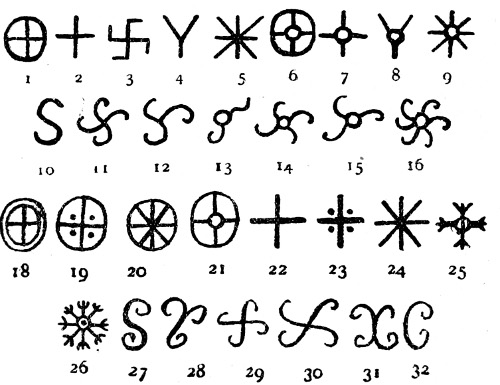
The alphabets illustrated on pages 14 and 15 have every appearance of
being representations of sprigs, and it is a curious fact that not only
in Ireland, but also in Arabia, alphabets of which every letter was
named after trees[15] were once current.
BRITISH ALPHABET.
Fig. 1.—From Celtic Researches (Davies, E.).
CELTIBERIAN ALPHABET, SHEWING THE DESCRIPTION OF CHARACTERS FOUND ON THE COINS OF TARRACONENSIS AND BÆTICA.
Fig. 2.—From Ancient Coins (Akerman, J. Y.).
In The Myths of Crete and Pre-Hellenic Europe, Dr. Mackenzie inquires:
“By whom were Egyptian beads carried to Britain, between 1500 B.C. and
1400 B.C.? Certainly not the Phœnicians. The sea traders of the
Mediterranean were at the time the Cretans. Whether or not their
merchants visited England we have no means of knowing.”[16]
The material which I shall produce establishes a probability that the
Cretans systematically visited Britain, and further that the tradition
of the peopling of this island by men of Trojan race are well founded.
According to the immemorial records of the Welsh Bards: “There were
three names imposed on the Isle of Britain from the beginning. Before it
was inhabited its denomination was Sea-Girt Green-space; after being
inhabited it was called the Honey Island, and after it was formed into a
Commonwealth by Prydain, the Son of Aedd Mawr, it was called the Isle of
Prydain. And none have any title therein but the nation of the Kymry.
For they first settled upon it, and before that time no men lived
therein, but it was full of bears, wolves, beavers, and bisons.”[17]
In the course of these essays I shall discuss the Kymry, and venture a
few suggestions as to their cradle and community of memories and hopes.
But behind the Kymry, as likewise admittedly behind the Cretans, are the
traces of an even more primitive and archaic race. The earliest folk
which reached Crete are described as having come with a form of culture
which had been developed elsewhere, and among these neolithic settlers
have been found traces of a race 6 feet in height and with skulls
massive and shapely. Moreover Cretan beliefs and the myths which are
based upon them are admittedly older than even the civilisation of the
Tigro-Euphrates valley: and they belong, it would appear, to a stock of
common inheritance from an uncertain culture centre of immense
antiquity.[18]
The problem of Crete is indissolubly connected with that of Etruria,
which was flourishing in Art and civilisation at a period when Rome was
but a coterie of shepherds’ huts. Here again are found Cyclopean walls
and the traces of some most ancient people who had sway in Italy at a
period even more remote than the national existence of Etruria.[19]
We are told that the first-comers in Crete ground their meal in stone
mortars, and that one of the peculiarities of the island was the
herring-bone design of their wall buildings. In West Cornwall the stone
walls or Giants’ Hedges are Cyclopean; farther north, in the Boscastle
district, herring-bone walls are common, and in the neighbourhood of St.
Just there are numerous British villages wherein the stone mortars are
still standing.
The formula of independent evolution, which has recently been much
over-worked, is now waning into disfavour, and it is difficult to
believe otherwise than that identity of names, customs, and
characteristics imply either borrowing or descent from some common,
unknown source.
That the builders of our European tumuli and cromlechs were maritime
arrivals is a reasonable inference from the fact that dolmens and
cromlechs were built almost invariably near the sea.[20] These peculiar
and distinctive monuments are found chiefly along the Western coasts
of Britain, the Northern coast of Africa, in the isles of the
Mediterranean, in the isolated, storm-beaten Hebrides, and in the remote
islands of Asia and Polynesia.
By whom was the Titanic art of cromlech-building brought alike to the
British Isles and to the distant islands of the Pacific? By what
guidance did frail barques compass such terrifying sea space? How were
these adequately victualled for such voyages, and why were the mainlands
ever quitted? How and why were the colossal stones of Stonehenge brought
by ship from afar, floated down the broad waters of the prehistoric
Avon, and dragged laboriously over the heights of Oare Hill? Who were
the engineers who constructed artificial rocking stones and skilfully
poised them where they stand to-day? “To suspend a stupendous mass of
abnormous shape in such an equilibrium that it shall oscillate with the
most trivial force and not fall without the greatest, is a problem
unsolved so far as I know by modern engineers.”[21]
Who were the indefatigable people who, prior to all record, reclaimed
the marshes of the Thames-mouth by an embankment which is intact to-day
all round the river coast of Kent and Essex? Who were the
horticulturists who evolved wheat and other cereals from unknown grasses
and certain lilies from their unknown wild? And who were the
philosophers who spun a delicate gossamer of fairy-tales over the world,
and formulated the cosmic ideas which are in many extraordinary respects
common alike to primitive and more advanced peoples? And why is the
symbol generally entitled the Swastika cross found not only under the
ruins of the most ancient Troy but also in the Thames at Battersea, and
elsewhere from China to Zimbabwe? How is it that Ireland, that remote
little outpost of Europe, possesses more Celtic MSS. than all the rest
of Celtic Europe put together?
The most rational explanation of these and similar queries is seemingly
a consideration of the almost world-wide tradition of a lost island, the
home of a scientific world-wandering race. The legend of submerged
Atlantis was related to Solon by an Egyptian priest as being historic
fact, and the date of the final catastrophe was definitely set down by
Plato from information given to Solon as having been about 9000 B.C.
Solon was neither a fool himself nor the man to suffer fools gladly. It
is admitted by geology that there actually existed a large island in the
Atlantic during tertiary times, but this we are told is a pure
coincidence and it is impossible to suppose any tradition existing of
such an island or land.
Science has very generally denied the credibility of tradition, yet
tradition has almost invariably proved truer than contemporary
scholarship. Scholarship denied the possibility of finding Troy,
notwithstanding the steady evidence of tradition to the mound at
Hissarlik where it was eventually disclosed. Even when Schliemann had
uncovered the lost city the scientists of every European capital
ridiculed his pretensions, and it was only gradually that they
ungraciously yielded to the irresistible evidence of their physical
senses. Science similarly denied the possibility of buried cities at the
foot of Vesuvius, yet popular tradition always asserted the existence of
Pompeii and Herculaneum; indeed, contemporary science has so
consistently scouted the possibility of every advance in discovery that
mere airy dismissal is not now sufficient to discredit either the
Atlantean, or any other theory. From China to Peru one finds the
persistent tradition of a drowned land, a story which is in itself so
preposterous as unlikely to arise without some solid grounds of reality.
Thierry has observed that legend is living tradition, and three times
out of four it is truer than what we call history. Sir John Morris Jones
would seemingly endorse this proposition, for he has recently contended
that tradition is itself a fact not always to be disposed of by the
hasty assumption that all men are liars.[22]
The Irish have their own account of the Flood, according to which three
ships sailed for Ireland, but two of them foundered on the way. The
Welsh version runs that the first of the perilous mishaps which occurred
in Britain was “The outburst of the ocean ‘Torriad lin lion,’ when a
deluge spread over the face of all lands, so that all mankind were
drowned with the exception of Duw-van and Duw-ach, the divine man and
divine woman, who escaped in a decked ship without sails; and from this
pair the island of Prydain was completely re-peopled”.
Correlated with this native version is a peculiar and, so far as my
information goes, a unique tradition that previous disasters had taken
place, causing the destruction of animals and vegetables then existing,
of which whole races were irrevocably lost. This tradition, which is in
complete harmony with the discoveries of modern geology, is thus
embodied in the thirteenth Triad: “The second perilous mishap was the
terror of the torrent-fire, when the earth was cloven down to the abyss,
and the majority of living things were destroyed”.
It is a singular coincidence that evidence of a prehistoric
torrent-fire exists certainly in Ireland, where bog-buried forests have
been unearthed exhibiting all the signs of a flowing torrent of molten
fire or lava. According to the author of Bogs and Ancient Forests,
when the Bog of Allen in Kildare was cut through, oak, fir, yew, and
other trees were found buried 20 or 30 feet below the surface, and these
trees generally lie prostrated in a horizontal position, and have the
appearance of being burned at the bottom of their trunks and roots,
fire having been found far more powerful in prostrating those forests
than cutting them down with an axe; and the great depth at which these
trees are found in bogs, shows that they must have lain there for many
ages.[23]
No ordinary or casual forest fire is capable of prostrating an oak or
fir tree, and the implement which accomplished such terrific devastation
must have been something volcanic and torrential in its character.
I am, however, not enamoured of the Atlantean or any other theory. My
purpose is rather to collate facts, and as all theorising ends in an
appeal to self-evidence, it is better to allow my material, for much of
which I have physically descended into the deeps of the earth, to speak
for itself:—we must believe the evidence of our senses rather than
arguments, and believe arguments if they agree with the phenomena.[24]
Although my concordance of facts is based upon evidence largely visible
to the naked eye, in a study of this character there must of necessity
be a disquieting percentage of “probablys” and “possiblys”. This is
deplorable, but if license be conceded in one direction it cannot be
withheld in another. The extent to which guess-work is still rampant in
etymology will be apparent in due course; the extent to which it is
allowed license in anthropology may be judged from such reveries as the
following: “Did any early members of the human family commit suicide?
Probably they did; the feeble, the dying, the maimed, the weak-headed,
the starving, the jealous, would be tired of life; these would throw
themselves from heights or into rivers, or stab themselves or cut their
throats with large and keen-edged knives of flint.”[25]
Although my own inquiries deal intimately with graves and names and
epitaphs, it still seems to me a possibility that the brains which
fashioned exquisitely barbed fish-hooks out of flint, and etched vivid
works of art upon pebble, may also have been capable of poetic and even
magnanimous ideas. It is quite certain that the artistic sense is
superlatively ancient, and it is quite unproven that the lives of these
early craftsmen were protracted nightmares.
Although not primarily written with that end, the present work will
inter alia raise not a few doubts as to the accuracy of Green’s
dictum: “What strikes us at once in the new England is that it was the
one purely German nation that rose upon the wreck of Rome”. In the
opinion of this popular historian the holiest spot in all these islands
ought in the eyes of Englishmen to be Ebbsfleet, the site where in Kent
the English visitors first landed, yet inconsequently he adds: “A
century after their landing the English are still known to their British
foes only as ‘barbarians,’ ‘wolves,’ ‘dogs,’ ‘whelps from the kennel of
barbarism,’ ‘hateful to God and man’. Their victories seemed victories
for the powers of evil, chastisement of a divine justice for natural
sin.”[26]
It is an axiom among anthropologists that race characteristics do not
change and that tides of immigration are more or less rapidly absorbed
by the aboriginal and resident stock. Assuredly the characteristics of
the German tribes have little changed, and it is extraordinary how from
the time of Tacitus they have continued to display from age to age their
time-honoured peculiarities. Invited and welcomed into this country as
friends and allies, “in a short time swarms of the aforesaid nations
came over into the island, and they began to increase so much that they
became terrible to the natives themselves who had invited them”.[27]
According to Bede the first symptoms of the frightfulness which was to
come were demands for larger rations, accompanied by the threat that
unless more plentiful supplies were brought them they would break the
confederacy and ravage all the island. Nor were they backward in putting
their threats in execution. Just as the Germans ruined Louvain so the
Angles razed Cambridge,[28] and in the words of Layamon “they passed to
and fro the country carrying off all they found”. Already in the times
of Tacitus famous for their frantic Hymns of Hate, so again we find
Layamon recording “they breathed out threatenings and slaughter against
the folk of the country”. Indeed Layamon uses far stronger expressions
than any of those quoted by Green, and the British chronicler almost
habitually refers to the alien intruders as “swine,” and “the loathest
of all things”.
Instead, therefore, of being thrilled into ecstasy by the landing of the
Germans at Ebbsfleet, one may more reasonably regard the episode as
untoward and discreditable. It is more satisfactory to contemplate the
return in the train of Duke William of Normandy of those numerous
Britons who “with sorrowful hearts had fled beyond the seas,” and to
appreciate that by the Battle of Hastings the temporary ascendancy of
Germanic kultur was finally and irrevocably destroyed.
It is observed by Green that the coins which we dig up in our fields are
no relics of our English fathers but of a Roman world which our fathers’
sword swept utterly away. This is sufficiently true as regards the Saxon
sword, but as some of the native coins in question are now universally
assigned to a period 200 to 100 years earlier than the first coming of
the Romans, it is obvious that there must have been sufficient
civilisation then in the country to require a coinage, and that the
native Britons cannot have been the poor and backward barbarians of
popular estimation.
A coin is an excessively hard fact, and should be of just as high
interest to the historian as a well-formed skull or any other document.
To Englishmen our prehistoric coinage—a national coinage “scarcely if
at all inferior to that of contemporary Rome”—[29] ought to possess
peculiar and special interest, for it is practically in England alone
that early coins have been discovered, and neither Scotland, Wales, nor
Ireland can boast of more than very few. It is, however, an Englishman’s
peculiarity that possessing perhaps the most interesting history, and
some of the most fascinating relics in the world, he is either too
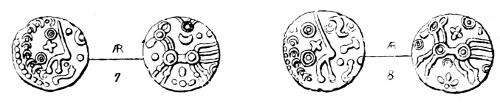
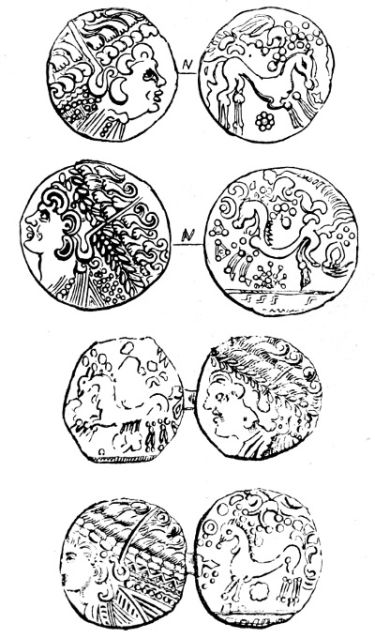
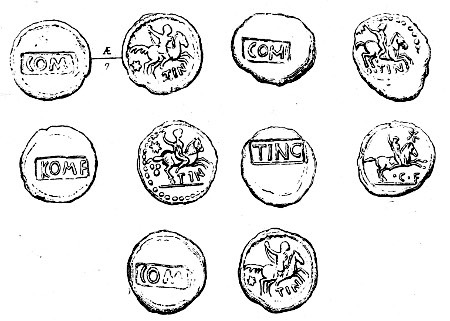
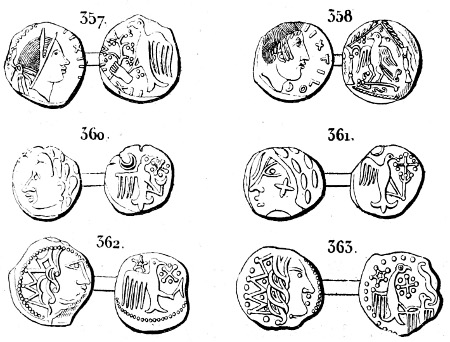
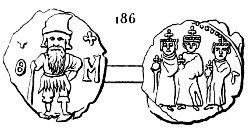
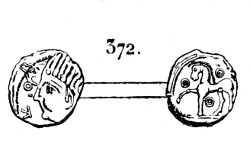
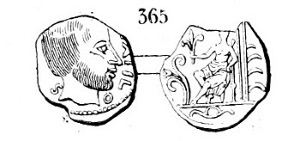
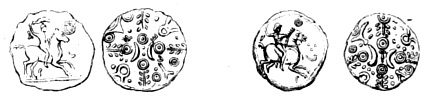
modest or too dull to take account of them. The plate of coins
illustrated on page 364, represents certain sceattae which, according
to Hawkins, may have been struck during the interval between the
departure of the Romans and the arrival of the Saxons. One would at
least have thought that such undated minor-monuments would have
possessed per se sufficient interest to ensure their careful
preservation. Yet, according to Hawkins, these rude and uncouth pieces
are scarce, “because they are rejected from all cabinets and thrown away
as soon as discovered”.[30]
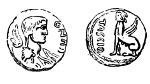
It is the considered opinion of certain British numismatists that not
only all English but also Gaulish coins are barbarous and degraded
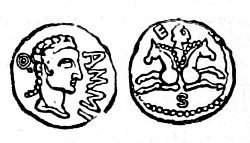
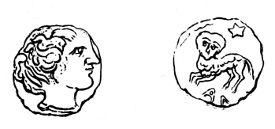
imitations of a famous Macedonian original which at one time circulated
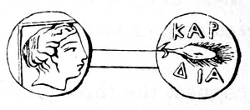
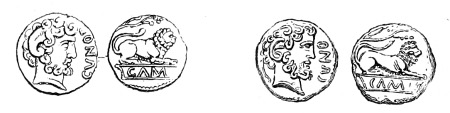
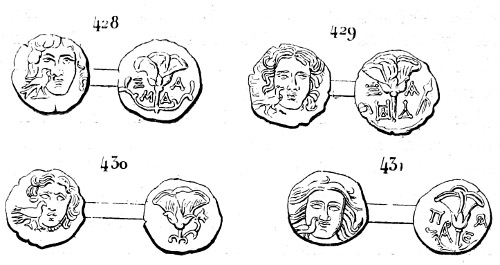
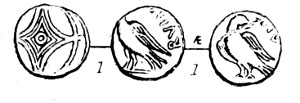
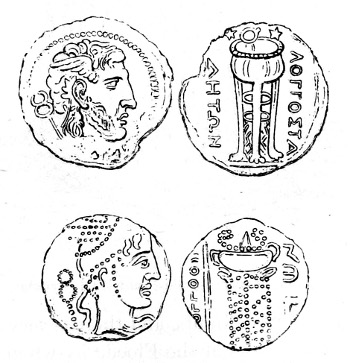
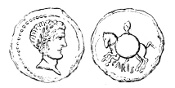
largely in Marseilles. This supposititious model is illustrated on page
394, and the reader can form his own opinion as to whether or not the
immense range of subjects which figure on our native money could by any
possibility have unconsciously evolved from carelessness. Sir John
Evans, by whom this theory was, I believe, first put forward, is himself
at times hard-driven to defend it; nevertheless he does not hesitate to
maintain: “The degeneration of the head of Apollo into two boars and a
wheel, impossible as it may at first appear, is in fact but a
comparatively easy transition when once the head has been reduced into
a form of regular pattern”.[31]
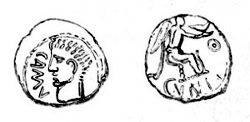
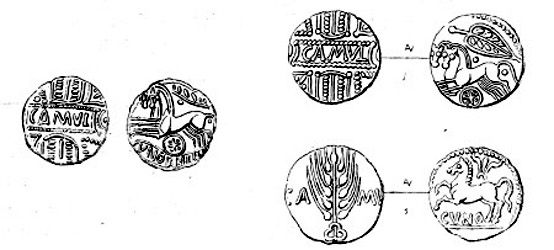
My irregularity carries me to the extent of contending that our native
coins, crude and uncouth as some of them may be, are in no case
imitations but are native work reflecting erstwhile national ideas. The
weird designs and what-nots which figure on these tokens almost
certainly were once animated by meanings of some sort: they thus
constitute a prehistoric literature expressed in hieroglyphics for the
correct reading of which one must, in the words of Carlyle, consider
History with the beginnings of it stretching dimly into the remote time,
emerging darkly out of the mysterious eternity, the true epic poem and
universal divine scripture.
According to Tacitus the British, under Boudicca, brought into the field
an incredible multitude; that Cæsar was impressed by the density of the
inhabitants may be gathered from his words: “The population is immense;
homesteads closely resembling those of the Gauls are met with at every
turn, and cattle are very numerous”.[32] That the handful of Roman
invaders eliminated the customs and traditions of a vast population is
no more likely than the supposition that British occupation has
eradicated or even greatly interfered with the native faiths of India.
It is generally admitted that the Romans were most tolerant of local
sensibilities, and there is no reason to assume that existing British
characteristics were either attacked or suppressed. To assume that some
hundreds of years later the advent of a few boat-loads of Anglo-Saxon
adventurers wiped out the Romano-British inhabitants and eradicated all
customs, manners, and traditions is an obvious fallacy under which the
evidence of folklore does not permit us to labour. The greater
probability is that the established culture imposed itself more or less
upon the new-comers, more particularly in those remote districts which
it was only after hundreds of years that the Saxons, by their
conventional policy of peaceful penetration, punctuated by flashes of
frightfulness, succeeded in dominating.
Even after the Norman Conquest there are circumstances which point to
the probability that the Celtic population was much larger and more
powerful than is usually supposed. Of these the most important is the
fact that the signatures to very early charters supply us with names of
persons of Celtic race occupying positions of dignity at the courts of
Anglo-Saxon kings.[33]
The force of custom and the apparently undying continuance of
folk-memory are among the best attested phenomena of folklore. It was
remarked by the elder Disraeli that tradition can neither be made nor
destroyed, and if this be true in general it is peculiarly true of the
stubborn and pig-headed British. Our churches stand to-day not only on
the primeval inconvenient hill-sites, but frequently within the
time-honoured earthwork, or beside the fairy-well. On Palm Sunday the
villagers of Avebury still toil to the summit of Silbury Hill, there to
consume fig cakes and drink sugared water; and on the same festival the
people even to-day march in procession to the prehistoric earthwork on
the top of Martinshell Hill. Our country fairs are generally held near
or within a pagan earthwork, and instance after instance might be
adduced all pointing to the immortality of custom and the persistent
sanctity of pagan sites.
In the sixth century of our era the monk Gildas referred complacently
but erroneously to the ancient British faith as being dead. “I shall
not,” he says, “enumerate those diabolical idols of my country, which
almost surpassed in number those of Egypt, and of which we still see
some mouldering away within or without the deserted temples, with stiff
and deformed features as was customary. Nor will I cry out upon the
mountains, fountains, or hills, or upon the rivers, which now are
subservient to the use of men, but once were an abomination and
destruction to them, and to which the blind people paid divine honour.”
Notwithstanding the jeremiads of poor Gildas[34] the folk-faith
survived; indeed, as Mr. Johnson says, the heathen belief has been
present all the time, and need not greatly astonish us since the most
advanced materialist is frequently a victim of trivial superstitions
which are scouted by scientific men as baseless and absurd.
The Augustine of Canterbury, who is recorded to have baptised on one day
10,000 persons in the river Swale, recommended with pious ingenuity that
the heathen temples should not be destroyed, but converted to the honour
of Christ by washing their walls with holy water and substituting holy
relics and symbols for the images of the heathen gods. This is an
illuminating sidelight on the methods by which the images of the heathen
idols were gradually transformed into the images of Christian saints,
and there is little doubt that as the immemorial shrines fell into ruin
and were rebuilt and again rebuilt, the sacred images were scrupulously
relimned.
Even to-day, after 2000 years of Christian discipline, the clergy dare
not in some districts interfere with the time-honoured tenets of their
parishioners. In Normandy and Brittany the priests, against their
inclination, are compelled to take part in pagan ceremonials,[35] and in
Spain quite recently an archbishop has been nearly killed by his
congregation for interdicting old customs.[36]
The earliest British shrines were merely stones, or caves, or holy
wells, or sacred trees, or tumuli, preferably on a hill-top or in a
wood. The next type is found in the monastery of St. Bride, which was
simply a circular palisade encircling a sacred fire. This was in all
probability similar to the earliest known form of the Egyptian temple, a
wicker hut with tall poles forming the sides of the door; in front of
this extended an enclosure which had two poles with flags on either side
of the entrance. In the middle of the enclosure or court was a staff
bearing the emblem of the God.
Later came stone circles and megalithic monuments in various forms,
whence the connection is direct to cathedrals such as Chartres, which is
said to be built largely from the remains of the prehistoric megaliths
which originally stood there. There are chapels in Brittany and
elsewhere built over pagan monoliths; indeed no new faith can ever do
more than superimpose itself upon an older one, and statements about the
wise and tender treatment of the old nature worship by the Church are
euphemisms for the bald fact that Christianity, finding it impracticable
to wean the heathen from their obdurate beliefs, made the best of the
situation by decreeing its feasts to coincide with pre-existing
festivals.
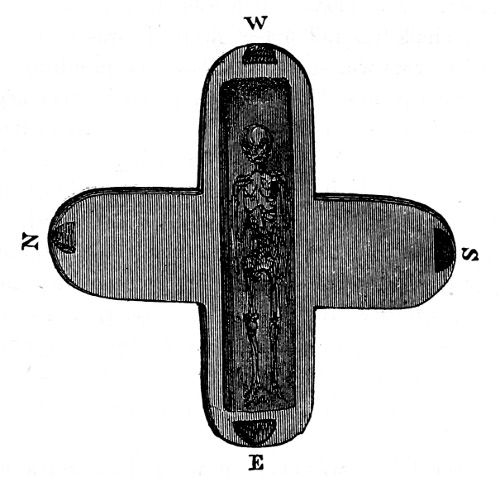
Fig. 3.—Section of the Dolmen Chapel of the Seven Sleepers near Plouaret.
It has long been generally appreciated that the lives of saints are not
only for the most part mythical, but that even documentary evidence on
that subject is equally suspect.[37] There is, indeed, no room to doubt
that the majority of the ancient saint-stories are Christianised
versions of such scraps and traditions of prehistoric mythology as had
continued to linger among the folk. To the best of my belief I am the
first folklorist who has endeavoured to treat The Golden Legend in a
sympathetic spirit as almost pure mythology.
It is usually assumed that at any rate the Christian Church tactfully
decanted the old wine of paganism into new bottles; but Christianity, as
will be seen, more often did not trouble to provide even new bottles,
and merely altered a stroke here and there on the labels, transforming
San tan, the Holy Fire, into St. Anne, Sin clair, the Holy
Light, into St. Clare, and so forth.
The first written record of Christianity in Britain is approximately
A.D. 200, whence it is claimed that the Christian religion must have
been introduced very near to, if not in, apostolic times. In 314 three
British bishops, each accompanied by a priest and a deacon, were present
at the Council at Arles, and it is commonly maintained by the Anglican
Church that only a relatively small part of England owes its conversion
to the Roman mission of the monk Augustine in 597.
We have it on the notable authority of St. Augustine that: “That very
thing which is now designated the Christian religion was in existence
among the ancients, nor was it absent even from the commencement of the
human race up to the time when Christ entered into the flesh, after
which true religion, which already existed, began to be called
Christian”.
We should undoubtedly possess more specific evidences of the ancient
faith but for the edicts of the Church that all writings adverse to the
claims of the Christian religion, in the possession of whomsoever they
should be found, should be committed to the fire. It is claimed for St.
Patrick that he caused to be destroyed 180—some say 300—volumes
relating to the Druidic system. These, said a complacent commentator,
were stuffed with the fables and superstitions of heathen idolatry and
unfit to be transmitted to posterity.
Mr. Westropp considers that much of value escaped destruction, for
Christianity in Ireland was a tactful, warm-hearted mother, and learned
the stories to tell to her children. This is true to some extent, but in
Britain there are extant many bardic laments at the intolerance with
which old ideas were eradicated, e.g., “Monks congregate like wolves
wrangling with their instructors. They know not when the darkness and
the dawn divide, nor what is the course of the wind, or the cause of its
agitation; in what place it dies away or on what region it expands.” And
implying that although one may be right it does not follow that all
others must be wrong the same bard exclaims, “For one hour persecute me
not!” and he pathetically asks: “Is there but one course to the wind,
but one to the waters of the sea? Is there but one spark in the fire
of boundless energy?”
In the same strain another bard, in terms not altogether inapplicable
to-day, alludes to his opponents as “like little children disagreeing on
the beach of the sea”.
Although bigotry and materialism have suppressed facts, stifled
testimony, misrepresented witnesses, and destroyed or perverted
documents, the prehistoric fairy faith was happily too deeply graven
thus to be obliterated, and it is only a matter of time and study to
reconstruct it. Most of the suggestions I venture to put forward are
sufficiently documented by hard facts, but some are necessarily based
upon “hints and equivocal survivals”.[38] At the threshold of an essay
of the present character one can hardly do better than appropriate the
words of Edmund Spenser:—I do gather a likelihood of truth not
certainly affirming anything, but by conferring of times, language,
monuments, and such like, I do hunt out a probability of things which I
leave to your judgment to believe or refuse.
[2]The Lost Language of Symbolism: An inquiry into the
origin of certain letters, words, names, fairy-tales, folklore, and
mythologies. 2 vols. London, 1912 (Williams & Norgate).
[5] “Topographical comment—I will not say criticism—has been
equally inefficient. A theory is not refuted by saying ‘all the great
antiquarians are against you,’ ‘the Psalter of Tara refutes that,’ or
‘O’Donovan has set the question past all doubt’. These remarks only
prove that we have hardly commenced scientific archæology in this
country.”—;Westropp, Thos. J., Proc. of Royal Irish Acad., vol.
xxxiv., C., No. 8, p. 129.
[6] We found precisely the same things as were found by our
predecessors, remains of extinct animals in the cave earth, and with
them flint implements in considerable numbers. You want, of course, to
know how the scientific world received these latter discoveries. They
simply scouted them. They told us that our statements were impossible,
and we simply responded with the remark that we had not said that they
were possible, only that they were true.—Pengally, W., Kent’s Cavern.
Its Testimony to the Antiquity of Man, p. 12.
[8] In the course of his criticism the same writer pertinently
observes:—
“Why, what a wonderful thing is this! We have, in the first place, the
most weighty and explicit testimony—Strabo’s, Cæsar’s, Lucan’s—that
this race once possessed a special, profound, spiritual discipline, that
they were, to use Mr. Nash’s words, ‘Wiser than their neighbours’.
Lucan’s words are singularly clear and strong, and serve well to stand
as a landmark in this controversy, in which one is sometimes embarrassed
by hearing authorities quoted on this side or that, when one does not
feel sure precisely what they say, how much or how little. Lucan,
addressing those hitherto under the pressure of Rome, but now left by
the Roman Civil War to their own devices, says:—
“‘Ye too, ye bards, who by your praises perpetuate the memory of the
fallen brave, without hindrance poured forth your strains. And ye, ye
Druids, now that the sword was removed, began once more your barbaric
rites and weird solemnities. To you only is given the knowledge or
ignorance (whichever it be) of the gods and the powers of heaven; your
dwelling is in the lone heart of the forest. From you we learn that the
bourne of man’s ghost is not the senseless grave, not the pale realm of
the monarch below; in another world his spirit survives still.’”
[9] “Circles form another group of the monuments we are about
to treat of.... In France they are hardly known, though in Algeria they
are frequent. In Denmark and Sweden they are both numerous and
important, but it is in the British Islands that circles attained their
greatest development.”—;Fergusson, J., Rude Stone Monuments, p. 47.
Referring to Stanton Drew the same authority observes: “Meanwhile it may
be well to point out that this class of circles is peculiar to England.
They do not exist in France or Algeria. The Scandinavian circles are all
very different, so too are the Irish.”—Ibid., p. 153.
[10] Stevens, F., Stonehenge To-day and Yesterday, 1916, p.
14.
[15] Mr. Hammer, a German who has travelled lately in Egypt and
Syria, has brought, it seems, to England a manuscript written in Arabic.
It contains a number of alphabets. Two of these consist entirely of
trees. The book is of authority.—Davies, E., Celtic Researches, 1804,
p. 305.
[16] The Cretans were rulers of the sea, and according to
Thucydides King Minos of Crete was “the first person known to us in
history as having established a navy. He made himself master of what is
now called the Hellenic Sea, and ruled over the Cyclades, into most of
which he sent his first colonists, expelling the Carians and appointing
his own sons governors; and thus did his best to put down piracy in
those waters.”
[19] Gray, Mrs. Hamilton, The Sepulchres of Etruria, p. 223.
[20] This might be due to the coasts being less liable to the
plough. See, however, the map of distribution, published by Fergusson,
in Rude Stone Monuments.
[28] The cities which had been erected in considerable numbers
by the Romans were sacked, burnt, and then left as ruins by the
Anglo-Saxons, who appear to have been afraid or at least unwilling to
use them as places of habitation. An instance of this may be found in
the case of Camboritum, the important Roman city which corresponded to
our modern Cambridge, which was sacked by the invaders and left a ruin
at least until the time of the Venerable Bede, 673-735.—Windle, B. C.
A., Life in Early Britain, p. 14.
[29] Hearnshaw, F. J. C., England in the Making, p. 14.
[30] Hawkins, E., The Silver Coins of England, p. 17.
[36] A Cantanzaro, dans la Calabre, la cathédrale fut le
théâtre de scènes de désordre extraordinaires. Le nouvel archevêque
avait dernièrement manifesté l’intention de mettre un terme à certaines
coutumes qu’il considérait comme entachées de paganisme. Ses
instructions ayant été méprisées, il frappa d’interdit pour trois jours
un édifice religieux. La population jura de se venger et, lorsque le
nouvel archevêque fit son entrée dans la cathédrale, le jour de Pâques
pour célébrer la grand’ messe, la foule, furieuse, manifesta bruyamment
contre lui. Comme on craignait que sa personne fût l’objet de violences,
le clergé le fit sortir en hâte par une porte de derrière. Les troupes
durent être réquisitionnées pour faire évacuer le cathédrale.—La
Dernière Heure, April, 1914.
[37] There is a story told of a certain Gilbert de Stone, a
fourteenth century legend-monger, who was appealed to by the monks of
Holywell in Flintshire for a life of their patron saint. On being told
that no materials for such a work existed the litterateur was quite
unconcerned, and undertook without hesitation to compose a most
excellent legend after the manner of Thomas à Becket.
[38] “Ireland being ‘the last resort of lost causes,’ preserved
record of a European ‘culture’ as primitive as that of the South Seas,
and therefore invaluable for the history of human advance; elsewhere its
existence is only to be established from hints and equivocal survivals.
Our early tales are no artificial fiction, but fragmentary beliefs of
the pagan period equally valuable for topography and for
mythology.”—Westropp, Thos. J., Proceedings of the Royal Irish
Academy, vol. xxxiv. sec. C, No. 8, p. 128.
CHAPTER II THE MAGIC OF WORDS — FOOTNOTES:
“As the palimpsest of language is held up to the light and looked
at more closely, it is found to be full of older forms beneath the
later writing. Again and again has the most ancient speech
conformed to the new grammar, until this becomes the merest surface
test; it supplies only the latest likeness. Our mountains and
rivers talk in the primeval mother tongue whilst the language of
men is remoulded by every passing wave of change. The language of
mythology and typology is almost as permanent as the names of the
hills and streams.”—Gerald Massey.
It is generally admitted that place-names are more or less impervious to
time and conquests. Instances seemingly without limit might be adduced
of towns which have been sacked, destroyed, rebuilt, and rechristened,
yet the original names—and these only—have survived. Dr. Taylor has
observed that the names of five of the oldest cities of the
world—Damascus, Hebron, Gaza, Sidon, and Hamath—are still pronounced
in exactly the same manner as was the case thirty, or perhaps forty
centuries ago, defying oftentimes the persistent attempts of rulers to
substitute some other name.[39]
As another instance of the permanency of place-names, the city of
Palmyra is curiously notable. Though the Greek Palmyra is a title of
2000 years’ standing, yet to the native Arab it is new-fangled, and he
knows the place not as Palmyra but as Tadmor, its original and
infinitely older name. Five hundred years B.C. the very ancient city of
Mykenæ was destroyed and never rose again to any importance: Mykenæ was
fabulously assigned to Perseus, and even to-day the stream which runs at
the site is known as the Perseia.[40]
If it be possible for local names thus to live handed down humbly from
mouth to mouth for thousands of years, for aught one knows they may have
endured for double or treble these periods; there is no seeming limit to
their vitality, and they may be said to be as imperishable and as
dateless as the stones of Avebury or Stonehenge.
History knows nothing of violent and spasmodic jumps; the ideas of one
era are impalpably transmitted to the next, and the continuity of custom
makes it difficult to believe that the builders of Cyclopean works such
as Avebury and Stonehenge, have left no imprint on our place-names, and
no memories in our language. Even to-day the superstitious veneration
for cromlechs and holy stones is not defunct, and it is largely due to
that ingrained sentiment that more of these prehistoric monuments have
not been converted into horse-troughs and pigsties.
If, as now generally admitted, there has been an unbroken and continuous
village-occupation, and if, as is also now granted, our sacred places
mostly occupy aboriginal and time-honoured sites, it is difficult to
conceive that place-names do not preserve some traces of their
prehistoric meanings. In the case of villages dedicated to some saintly
man or sweetest of sweet ladies, the connection is almost certainly
intact; indeed, in instances the pagan barrows in the churchyard are
often actually dedicated to some saint.[41]
That memories of the ancient mythology sometimes hang around our British
cromlechs is proved by an instance in North Wales where there still
stands a table stone known locally as Llety-y-filiast, or the stone
of the greyhound bitch. “This name,” says Dr. Griffith, “was given in
allusion to the British Ceres or Keridwen who was symbolised by the
greyhound bitch”.[42] I shall have much to say about Keridwen—“the most
generous and beauteous of ladies”—meanwhile it is sufficient here to
note that her symbol, the greyhound bitch, is found unmistakably upon
our earliest coinage.
All place-names of any real antiquity are generally composed of various
languages, and like compound rocks contain fragments in juxtaposition
which belong properly to different ages. The analysis of these is not
difficult, as the final -hill, -ton, -ville, -ham, and so forth
is usually the comparatively modern work of newcomers. Frequently the
later generations forgot the original meanings of the ancient terms; and
thus, for instance, at Brandon Hill in Suffolk there is the curious
phenomenon of Hill Hill Hill—in three languages, i.e., bran,
don, and hill. On this site the flint knappers are still at work,
using practically the same rude tool as their primitive woad-painted
ancestors. At Brandon not only has the art of flint-making survived,
but anthropologists have noted the persistence of a swarthy and most
ancient type—a persistence the more remarkable as Suffolk was supposed
to be a district out of which the Britons had been wholly and
irretrievably eradicated. Whether there is anything in the world to
parallel the phenomenon of the Brandon flint knappers I do not know, and
it may well be questioned. In the words of Dr. Rice Holmes:—The
industry has been carried on since neolithic times, and even then it was
ancient: for Brandon was an abode of flint makers in the Old Stone Age.
Not only the pits but even the tools show little change: the picks which
the modern workers use are made of iron, but here alone in Britain the
old one-sided form is still retained, only the skill of the workers has
degenerated: the exquisite evenness of chipping which distinguished the
neolithic arrow heads is beyond the power of the most experienced
knapper to reproduce.[43]
At Brandon is Broomhill; the words bran and broom will be
subsequently shown to be radically the same, and I shall suggest reasons
why this term, even possibly in Old Stone times, meant hill.
During recent years the study of place-names has been passing through a
period of spade-work, and every available document from Doomsday Book to
a Rent Roll has been scrupulously raked. The inquirer now therefore has
available a remarkably interesting record of the various forms which our
place-names have passed through, and he can eliminate the essential
features from the non-essential. Although the subject has thus
considerably been elucidated, the additional information obtained has,
however, done nothing to solve the original riddle and in some cases
has rendered it more complex.
The new system which is popularly supposed to have eliminated all
guesswork has in reality done nothing of the kind. In place of the older
method, which, in the words of Prof. Skeat, “exalted impudent assertions
far above positive evidence,” it has boldly substituted a new form of
guesswork which is just as reckless and in many respects is no less
impudent than the old. The present fashion is to suppose that the river
x or the town of ymay have been the property of, or founded by,
some purely hypothetical Anglo-Saxon. For example: the river Hagbourne
of Berkshire is guessed to have been Hacca’s burn or brook, which
possibly it was, but there is not a scintilla of real evidence one way
or the other.
If one is going to postulate “Hacca’s” here and there, there is
obviously a space waiting for a member of the family on the great main
road entitled Akeman Street. As this ancient thoroughfare traverses Bath
we are, however, told that it “received in Saxon times the significant
name of Akeman Street from the condition of the gouty sufferers who
travelled along it”.[44] One would prefer even a phantom Hacca to this
aching man, nor does the alternatively suggested aqua, water, bring
us any nearer a solution.
There sometimes appears to be no bottom to the vacuity of modern
guesswork. It is seriously and not pour rire suggested that
Horselydown was where horses could lie down; that Honeybrook was so
designated because of its honey-sweet water, and that the name Isle of
Dogs was “possibly because so many dogs were drowned in the Thames
here”.[45] In what respect do these and kindred definitions, which I
shall cite from standard authors of to-day, differ from the “egregious”
speculations, the “wild guesses,” and the “impudent assertions” of
earlier scholars?
There is in Bucks a small town now known as Kimball, anciently as
Cunebal. Tradition associates this site with the British King Cymbeline
or Cunobelin, and as the place further contains an eminence known as
Belinsbury or Belinus Castle, the authorities can hardly avoid accepting
the connection and the etymology. But for Kimbolton, which stands on a
river named the Kym, the authorities—notwithstanding the river
Kym—provide the purely supposititious etymology “Town of Cynebald”.
There were, doubtless, thousands of Saxons whose name was Cynebald, but
why Kimbolton should be assigned to any one of these hypothetical
persons instead of to Cymbeline is not in any way apparent. The river
name Kym is sufficient to discredit Cynebald, and the greater
probability is that not only the Kym but also all our river and mountain
names are pre-Saxon.
It will be seen hereafter that the name Cunobelin or Cymbeline, which
the dictionaries define as meaning splendid sun, was probably adopted
as a dynastic title of British chiefs, and that the effigies of
Cymbeline on British coins have no more relation to any particular king
than the mounted figure on our modern sovereign has to his Majesty King
George V. The prefix Cym or Cuno will subsequently be seen to be the
forerunner of the modern Konig or King. Hence like Kimball or
Cunebal, Kimbolton on the Kym was probably a seat of a Cymbeline, and
the imaginary Saxon Cynebald may be dismissed as a usurper.
Kimbolton used at one time to be known as Kinnebantum, whence it is
evident that the essential part of the word is Kinne or Kim, and as
another instance of the perplexing variations which are sometimes found
in place-names the spot now known as Iffley may be cited. This name
occurs at various periods as follows: Gifetelea, Sifetelea, Zyfteleye,
Yestley, Iveclay and Iftel. This is a typical instance of the
extraordinary variations which have perplexed the authorities, and is
still causing them to cast vainly around for some formula or law of
sound-change, which shall account satisfactorily for the problem. “We
are at present,” says Prof. Wyld, “quite unable to formulate the laws of
the interchange of stress in place-names, or of the effects of these in
retaining, modifying, or eliminating syllables.... Until these laws are
properly formulated, it cannot be said that we have a scientific account
of the development of place-names. The whole thing is often little
better than a conjuring trick.”[46]
No amount of brainwork has conjured any sense from Iffley, and the
etymology has been placed on the shelf as “unknown”. I shall venture to
suggest that the initial G, S, Z, or Y, of this name, and of many others
being adjectival, the radical Ive or Iff, as being the essential, has
alone survived. It will be seen that Iffley was in all probability a lea
or meadow dedicated to “The Ivy Girl” or May Queen, and that quite
likely it was one of the many sites where, in the language of an old
poet—
Holly and his Merry men they dawnsin and they sing,
Ivy and her maydons they wepen and they wryng.
I shall connote with Ivy and her maidens, not only Mother
Eve, but also the clearly fabulous St. Ive. We shall see that the Lady
Godiva of Coventry fame was known as Godgifu, just as Iffley was once
Gifetelea, and we shall see that St. Ives in Cornwall appears in the
registers alternatively as St. Yesses, just as Iffley was alternatively
Yestley. Finally we shall trace the connection between Eve, the Mother
of all living, and Avebury, the greatest of all megalithic monuments.
If it be objected that my method is too meticulous, and that it is
impossible for mere farm- and field-names to possess any prehistoric
significance, I may refer for support to the Sixth Report of the Royal
Commission appointed to inventory the ancient monuments of Wales and
Monmouthshire.[47] In the course of this document the Commissioners
write as follows:—
“The Tithe Schedules, unsatisfactory and disappointing though many of
them are, contain such a collection of place-names, principally those of
fields, that the Commissioners at the outset of their inquiry determined
upon a careful investigation of them. The undertaking involved in the
first place the examination of hundreds of documents, many of them
containing several thousands of place-names; secondly, in the case of
those names which were noted for further inquiry, the necessity of
discovering the position of the field or site upon the tithe map; and,
thirdly, the location of the field or site on the modern six-inch
ordnance sheet. This prolonged task called for much patience and care,
as well as ingenuity in comparing the boundaries of eighty years ago
with those of the present time.
“Of the value of this work there can be no doubt. We do not venture to
express any opinion on the question whether, or to what extent, farm and
field names are of service to the English archæologist; but with regard
to their importance to the Welsh archæologist there can be no two
opinions. The fact that the Welsh place-names are being rapidly replaced
by English names, so that the local lore which is often enshrined in the
former is in danger of being lost, was in itself a sufficient reason for
the undertaking. The results have more than justified our decision.
There is hardly a parish, certainly not one of the ancient parishes, of
the principality, where the schedule of field names has not yielded some
valuable results. Scores of small but in some cases important
antiquities would have passed unrecorded, had it not been for the clue
to their presence given by the place-name which was to be found only in
the schedule to the Tithe Survey.”
In Cornwall almost every parish is named after some saintly apostle, and
many of these saints are alleged to have travelled far and wide in the
world founding towns and villages. It is almost a physical impossibility
that this was literally true, and it becomes manifestly incredible on
consideration of the miracles recorded in the lives of the travellers.
As already suggested the greater probability is that the lives of the
saints enshrine almost intact the traditions of pre-Christian
divinities. Of the popular and most familiar St. Patrick, Borlase (W.
C.), writes: “Of the reality of the existence of this Patrick, son of
Calporn, we feel not the shadow of a doubt. But he was not the only
Patrick, and as time went on traditions of one other Patrick at least
came to be commingled with his own. We have before us the names of ten
other contemporary Patricks, all ecclesiastics, and spread over Wales,
Ireland, France, Spain, and Italy. The name appears to be that of a
grade or order in the Church rather than a proper name in the usual
sense. Thus Palladius is called also Patrick in the ‘Book of Armagh’ and
the Patrick (whichever he may have been) is represented as styling
Declan ‘the Patrick of the Desii,’ and Ailbhe ‘the Patrick of Munster’.
When Patrick sojourned in a cave in an island in the Tyrrhene Sea he
found three other Patricks there.” Precisely: and there is little doubt
that our London Battersea or Patrixeye was originally an ea or island
where the patricks or padres of St. Peter’s at Westminster once
congregated.
The arguments applied to St. Patrick apply equally to, say, St. Columba,
or the Holy Dove, and similarly to St. Colman, a name also meaning
Dove. In Ireland alone there are 200 dedications to St. Colman, and
evidence will be brought forward that the archetype of all the St.
Colmans and all the St. Columbas and all the Patricks was Peter the
Pater, who was symbolised by petra, the stone or rock.
The so-called Ossianic poems of Gaeldom, although of “a remarkably
heathenish character,” preserve the manners of and opinions of what the
authorities describe as “a semi-barbarous people who were endowed with
strong imagination, high courage, childlike tenderness, and gentle
chivalry for women,”[48] and that the ancients were tinctured through
and through with mysticism and imagination, finding tongues in trees,
books in the running brooks, sermons in stones, and good in everything,
is a fact which can be denied. When our words were framed and our
ancient places, hills, and rivers named, I am persuaded that the world
was in its imaginative childhood, and hence that traces of that state of
mind may reasonably be anticipated. It is remarkable that the skulls
found in the first or oldest Troy exhibit the most intellectual
characteristics,[49] and in many quarters seemingly the remoter the
times the purer was the theology whether in Phrygia, Egypt, India,
Persia, or Great Britain. Among the Cretans “religion entered at every
turn” of their social system; in Egypt even the very games and dances
had a religious significance, and the evidence of folklore testifies to
the same effect in Britain. It was one among the many grievances of the
pessimistic Gildas that the British were “slaves to the shadows of
things to come,” and this usually overlooked aspect of their character
must, I think, be recognised in relation to their place-names. To a
large degree the mystical element still persists in Brittany, where even
to-day, in the words of Baring-Gould:—At a Pardon one sees and marvels
at the wondrous faces of this remarkable people: the pure, sweet, and
modest countenances of the girls, and those not less striking of the old
folk. “It is,” says Durtal, “the soul which is everything in these
people, and their physiognomy is modelled by it. There are holy
brightnesses in their eyes, on their lips, those doors to the borders of
which the soul alone can come, from which it looks forth and all but
shows itself. Goodness, kindness, as well as a cloistral spirituality,
stream from their faces.”[50]
What is still true of Brittany was once equally true of Britain, and
although the individuality of the Gael has now largely been submerged by
prosaic Anglo-Saxondom, the poetic temperament of the chivalrous and
dreamy Celt was essentially a frame of mind that cared only for the
heroic, the romantic, and the beautiful.
The science of etymology as practised to-day is unfortunately blind to
this poetic element which was, and to some extent still is, an innate
characteristic of “uncivilised” and unsophisticated peoples. Archbishop
Trench, one of the original planners and promoters of The New English
Dictionary, was not overstating when he wrote: “Let us then acknowledge
man a born poet.... Despite his utmost efforts, were he mad enough to
employ them, he could not succeed in exhausting his language of the
poetical element which is inherent in it, in stripping it of blossom,
flower, and fruit, and leaving it nothing but a bare and naked stem. He
may fancy for a moment that he has succeeded in doing this, but it will
only need for him to become a little better philologer to go a little
deeper into the study of the words which he is using, and he will
discover that he is as remote from this consummation as ever.”
Nevertheless, current etymology has achieved this inanity, and has so
completely dismissed the animate or poetic element from its
considerations that one may seek vainly the columns of Skeat and Murray
for any hint or suggestion that language and imagination ever had
anything in common. According to modern teaching language is a mere
cluster of barbaric yawps: “No mystic bond linked word and thought
together; utility and convenience alone joined them”.[51]
Words, nevertheless, were originally born not from grammarians but amid
the common people, and pace Mr. Clodd they enshrine in many instances
the mysticism and the superstitions of the peasantry. How can one
account, for instance, for the Greek word psyche, meaning butterfly,
and also soul, except by the knowledge that butterflies were regarded
by the ancients as creatures into which the soul was metamorphosised?
According to Grimm, the German name for stork means literally child-,
or soul-bringer; hence the belief that the advent of infants was
presided over by this bird. But why “hence”? and why put the cart
before the horse? If one may judge from innumerable parallels of
word-equivocation the legends arose not from the accident of similar
words, nor from “misprision of terms,” or from any other “disease of
language,” but the creatures were named because of the attendant
legend. It is common knowledge that in Egypt the animal sacred to a
divinity was often designated by the name of that deity; similarly in
Europe the bee, a symbol of the goddess Mylitta, was called a
mylitta, and a bull, the symbol of the god Thor, was named a thor.
We speak to-day of an Adonis, because Adonis was a fabulously lovely
youth, and parallel examples may be found on almost every hand. Irish
mythology tells of a certain golden-haired hero named Bress, which means
beautiful, whence we are further told that every beautiful thing in
Ireland whether plain, fortress, or ale, or torch, or woman, or man, was
compared with him, so that men said of them “That is a Bress”. Elsewhere
and herein I have endeavoured to prove that this principle was of
worldwide application, and that it is an etymological key which will
open the meaning of many words still in common use. It is a correlative
fact that the names of specific deities such as Horus, Hathor, Nina,
Bel, etc., developed in course of time into generic terms for any Lord
or God.
Very much the same principles are at work with us to-day, whence a
dreadnought from the prime “Dreadnought,” and the etymologer of the
future, who tries by strictly scientific methods to unravel the meaning
of such words as mackintosh, brougham, Sam Browne, gladstone,
boycott, etc., will find it necessary to investigate the legends
attendant on those names rather than practice a formal permutation of
vowels and consonants.
By common consent the quintessence of the last fifty years’ philological
progress is being distilled into Sir James Murray’s New English
Dictionary, and in a conciser form the same data may be found in Prof.
Skeat’s Concise Etymological Dictionary of the English Language. Both
these indispensable works are high watermarks of English scholarship,
and whatever absurdities they contain are shortcomings not of their
compilers but of the Teutonic school of philology which they exemplify.
If these two standard dictionaries were able to answer even the
elementary questions that are put to them it would be both idle and
presumptuous to cavil, but one has only to refer to their pages to
realise the ignorance which prevails as to the origin and the meaning of
the most simple and everyday words.
It is unfortunately true that “in philology as in all branches of
knowledge it is the specialist who most strongly opposes any attempt to
widen the field of his knowledge”.[52] Hence, as was only to be
expected, one of the reviewers of my Lost Language of Symbolism deemed
it quite insufferable that I should throw to the winds the laborious
work on the science of phonetics built up by generations of careful
research.
But in point of fact I discarded none of the sound work of my
predecessors; I only tried to supplement it and fished deeper. My
soundings do not begin until I am well beyond the limits of modern
etymology, and they are no more affected by the cross-currents of
historic languages than the activities of a deep-water fisherman are
interrupted or affected by the tide eddies on the shore. The defect of
official philology is that it offers no explanation for radicals. It
does not, for example, attempt to explain why the word ap was the
Sanscrit for water, why pri was the Sanscrit for love, or why pat
was the Sanscrit for fly. It refers the word oak to the Anglo-Saxon
ac, Dr. Murray merely describing it as “a consonantal stem, ulterior
meaning obscure”. Etymology to-day is in fact very much in the situation
of an insolvent bank which, unable to satisfy its creditors with cash on
demand, blandly endeavours to satisfy them with corresponding cheques of
equally uncashable face value. Words can never properly be interpreted
merely by parallel words: originally they must have expressed ideas, and
it is these underlying ideas that I am in search of. My previous work
was a pioneer, and in many respects bungling attempt to pick up the
threads where at present philology is content to lose them. Using the
same keys as hitherto, I shall attempt to explore further the darkness
which is at present the only achieved goal of the much trumpeted Science
of Language.
In a moment of noteworthy frankness Prof. Skeat has admitted that
“Scientific etymology is usually clumsy and frequently wrong”.
Similarly, Prof. Sayce issues the warning: “Comparative philology has
suffered as much from its friends as from its opponents; and now that it
has at last won its way to general recognition and respect, there is a
danger that its popularity may lead to the cessation of sound and honest
work, and to an acquiescence in theories which, however plausible, are
not yet placed upon a footing of scientific certainty. It is much easier
for the ordinary man to fill in by patient elaboration what has already
been sketched for him in outline, than to venture upon a new line of
discovery, in which the sole clue must be the combinative powers of his
own imagination and comprehensive learning. And yet, now as much as
ever, comparative philology has need at once of bold and wide-reaching
conceptions, of cautious verification, and of a mastery of facts. It is
true the science is no longer struggling for mere life, and the time is
gone by for proving the possibility of its existence. But it is still
young, scarcely, indeed, out of its nursery; a small portion only of its
province has hitherto been investigated, and much that is at present
accepted without hesitation will have to be subjected to a searching
inquiry, and possibly be found baseless after all.”[53]
The value of any system must be measured by its results, and the fruits
of philology as formulated only a year or so ago were unquestionably
false. Where now are the “successes” of the Max Müller school which were
advertised in such shrill and penetrating tones? Sanscrit is deposed
from its pride of place, it being now recognised that primitive sounds
are preserved more faithfully in Europe than elsewhere. Who to-day
admits there is any basis for the Disease of Language theory, or that
all fairy-tales and myths are resolvable into the Sun chasing the
Dawn?[54]What anthropologist accepts the theory of Aryan overland
immigration from somewhere in Asia? The archæologists of the last
generation were, in the light of modern findings, quite justified when,
contrary to the then stereotyped idea, they maintained that skulls were
harder things than consonants. In short, large sections of the
card-castle of German philology have more or less crumbled, and in the
cruel words of a modern authority on Crete: “Happily, archæology has
emerged from the slough into which the philologists had led her”.
For the causes of this fiasco it is unnecessary to seek further than the
fundamental fallacy upon which the “Science of Language” has been
erected. According to Max Müller, “etymology is indeed a science in
which identity, or even similarity, whether of sound or meaning, is of
no importance whatever. Sound etymology has nothing to do with sound. We
know words to be of the same origin which have not a single letter in
common, and which differ in meaning as much as black and white.”
To maintain that “sound etymology has nothing to do with sound,” is
tantamount to the contention that language is not sound, which is
obviously absurd. In the saner view of Dr. Latham: “language begins with
voice, language ends with voice”. The Germans, Poles, and Russians had
no acquaintance with letters until the ninth century, and speech, which
certainly existed for unnumbered centuries before either writing or
spelling was evolved, must, primarily and essentially, have been a
system of pure and simple phonetics, spreading, as a mother teaches her
child, syllable by syllable, word upon word, and line upon line. To rule
sound out of language, is, indeed, far more fatal than to purge Hamlet
out of Hamlet. One may prove by super-ingenious logic and an
elaborate code of cross references that black is white and white black,
yet common sense knows all the time that it is not so. There are, I am
aware, certain races who are unable to vocalise certain sounds and
accordingly modify them. The obscure causes governing these phonetic
changes must be taken into account, and as far as possible formulated
into “laws,” but the pages of Skeat and Murray demonstrate beyond
refutation two very simple but very certain fundamental, universal
facts, to which hitherto wholly insufficient attention has been given.
These elementary and seemingly never-varying facts are: (1) That
originally vowel sounds were of no importance whatever, for in the same
word they vary to the utmost limits, not only in different areas and in
different eras, but contemporaneously in different grades of society;
(2) that heavy and light consonants such as b and p, d and t,
f and v, g and k, etc., are always interchangeable. Whether in
place-names, words, or proper names, the changes are found always to
occur, and they are precisely those variations which common sense would
suggest must occur in every case where words travel viva voce and not
via script or print. A man suffering from what Shakespeare would term “a
whoreson rheum,” says, for instance, did vor dad instead of tit for
tat, and there is, so far as I can discover, not a single word or a
solitary place-name in which a similar variation of thin and thick
consonants is not traceable.
The formidable Grimm’s Law, any violation of which involves summary and
immediate condemnation, is merely a statement of certain phonetic facts
which happen invariably—unless they are interfered with by other facts.
The permutations of sound codified by Grimm are as follows:—
Greek
p
Gothic
f
Old High German
b(v)
"
b
"
p
"
f
"
ph
"
b
"
p
"
t
"
th
"
d
"
d
"
t
"
z
"
th
"
d
"
t
"
k
"
(h)
"
g(h)
"
g
"
k
"
ch
"
kh
"
g
"
k
It is said that the causes which brought about the changes formulated in
Grimm’s Law are “obscure” (they may have been due to nothing more
obscure than a prevalence to colds in the head), and that they were
probably due to the settlement of Low German conquerors in Central and
Southern Germany. The changes above formulated all fall, however, within
the wider theory I am now suggesting, with the exception of d and t
becoming in High German z. This particular syllabic change was, I
suggest, due to z at one time being synonymous with d or t, and
not to any inability of certain tribes to vocalise the sound t.
Max Müller observes that “at first sight the English word fir does not
look very like the Latin word quercus, yet it is the same word”. Fir
certainly does not look like quercus, nor, of course, is it any more
the “same word” than six is the same word as half a dozen. There are
a thousand ways of proving six to be radically and identically the
same as half a dozen, and the ingenious system of permutations by
which philologists identify fir with quercus, and alphana with
equus,[55] are parallel to some of the methods by which common sense,
by cold gradation and well-balanced form, would quite correctly equate
six with half a dozen.
The term “word” I understand not in the loose sense used by Max
Müller, but as the dictionary defines it—“an oral or written sign
expressing an idea or notion”. Thus I treat John as the same word as
Jane or Jean, and it is radically the same word as giant, old
English jeyantt, French geante, Cornish geon. Jean is also the
same word as chien, a dog, Irish choin; Welsh chin or cyn, and
all these terms by reason of their radical an are cognate with the
Greek kuon, a dog, whence cynical. The Gaelic for John is Jain,
the Gaelic for Jean or Jane is Sine, with which I equate shine,
shone, and sheen, all of which have respect to the sun, as also
had the Arabic jinn, genii, and “Gian Ben Gian,” a title of the
fabulous world-ruler of the Golden Age. Among the Basques Jaun means
Lord or Master, and the Basque term for God, Jainko, Jeinko, or
Jinko, is believed to have meant “Lord or Master on High”. The Irish
Church attributes its origin to disciples of St. John—Irish Shaun,
and one may detect the pre-Christian Sinjohn in the British divinity
Shony, and evolving from the primeval Shen at Shenstone near
Litchfield. Here, a little distance from the church, was a well, now
called St. John’s Well, after the saint in whose honour the parish
church is dedicated. In all probability the present-day church of St.
John was built on the actual site of the original Shen stone or rock;
and that John stones were once plentiful in Scotland is probably implied
by the common surname Johnstone. Near the Shannon in Ireland, and in
close proximity to the church and village of Shanagolden, is “castle”
Shenet or Shanid, attached to which is a rath or earthwork of which
the ground-plan, from Mr. Westropp’s survey, is here reproduced. As it
is a matter of common knowledge that the worldwide wheel cross was an
emblem of the sun, I should therefore have no scruples in connoting
Castle Shenet with the primeval jeyantt or the Golden Shine; and
suggesting that it was a sanctuary originally constructed by the
Ganganoi, a people mentioned by Ptolemy as dwelling in the neighbourhood
of the Shannon. The eponymous hero of the Ganganoi was a certain
Sengann,[56] who is probably the original St. Jean or Sinjohn to whom
the fires of St. Jean and St. John have been diverted.
We shall see that Giant Christopher was symbolically represented as
chien headed, that he was a personification of the Shine or Sheen
of the Sun, and that he was worshipped as the solar dog at the holy
city of Cynopolis or dog-town. We have already noted English “chien”
or cyn coins inscribed cun, which is seemingly one of the
innumerable puns which confront philology.
Fig. 6.—From Proc. of the Royal Irish Acad., xxxiii., C., No. 2.
Years ago Bryant maintained that “the fable of the horse certainly arose
from a misprision of terms, though the mistake be as old as Homer”.
There was nothing therefore new in the theories of the Max Müller school
that all mythologies originated from a “disease of language”. Dr.
Wilder, alluding to symbolism, speaks of the punning so common in those
days, often making us uncertain whether the accident of similar name or
sound led to adoption as a symbol or was merely a blunder. It was, I
think, neither, and many instances will be adduced in favour of the
supposition, that words originated from symbolic ideas, and not vice
versa. That symbolism existed before writing is evident from the
innumerable symbols unearthed at Mykenæ, Troy, and elsewhere, where few
traces of script or inscriptions have been found. By symbolism,
primitive man unquestionably communicated ideas, and, as has already
been pointed out, the roots of language bear traces of the rudimentary
symbolism by which our savage forefathers named the objects around them
as well as the conceptions of their primitive religion.[57] Faced by the
“curiosity” that the Greek and Latin words for archaic, arch, ark,
arc, are all apparently connected in an intricate symbolism in which
there is more than a suspicion that there is an etymological as well as
a mystical interconnection, a writer in The Open Court concludes: “it
would seem as though the roots of such words derived their meaning from
the Mysteries rather than that their mystical meaning was the result of
coincidence”.[58]
That the Mysteries—or in other words dramatised mythology—Symbolism,
and Etymology, are all closely connected with each other is a certitude
beyond question. The theory, so pertinaciously put forward by Max
Müller, was that myths originated from a subsequent misunderstanding of
words. Using the same data as Max Müller, I suggest that words
originated from the mysteries and not myths from the words.
In The Holy Wells of Cornwall, Mr. T. Quiller Couch observes that Dr.
Borlase, learned, diligent, and excellent antiquary as he was, to whom
we are all indebted in an iconoclastic age for having copied for us fair
things which time had blurred, seems to have had little sympathy with
the faiths of the simple, silly, country folk (I use these adjectives in
their older meaning), and to have passed them with something like
contempt. At present the oral traditions of a people, their seeming
follies even, have become of value as indicating kinship between nations
shunted off by circumstances, to use the most modern term, in divergent
ways.
Dr. Johnson would not admit fun into his Dictionary as he deemed it a
“low word”: I turn up my nose at nothing, being convinced that it is to
low origins that the great lexicographers will eventually have to stoop.
In truth, the innate strength of the English language, which is becoming
more and more the Master Tongue of the world, lies in its homely,
trivial, and democratic origin.[59] This origin, as I have elsewhere
endeavoured to show, is due largely to symbolism, which is merely
another term for metaphor. We used to be taught that every language was
a dictionary of faded metaphor, and such an origin is undoubtedly more
true than the current theory of barbaric yawps. The essence of symbolism
is its simplicity. Who, for instance, does not understand that the Lion
is the symbol of High Courage, and the Bull-dog of Tenacity, or holding
on? At the present day the badge of one of His Majesty’s warships is the
picture of a butting goat, accompanied by the words “Butt in”. This, as
the authorities rightly describe it, is “pure symbolism,” but to a
symbolist the legend “Butt in” is superfluous, as the mere butting goat
adequately carries the idea. As Prof. Petrie has well said: “To
understand the position and movement of thought in a primitive age, it
must be approached on a far simpler plane than that of our present
familiarity with writing. To reach the working of the childhood of our
races we should look to the minds of children. If the child passes
through ancestral changes in its bodily formation, so certainly it
passes through such stages in the growth and capacity of its
brain.”[60] I shall push the childish and extremely simple theory of
symbolism to its logical conclusions, and shall show, for instance, that
the Boar, because it burrowed with its plough-like snout, was the emblem
of the ploughman, and that thus, boar and boer are the same word.
Or, to take another instance, I shall show that probably because the cat
sits washing herself, and is a model of cleanliness in sanitary
respects, the cat who figures on the head of the Magna Mater of Crete
was elevated into a symbol of the Immaculate or Pure One, and that the
word cat, German kater, is identical with the name Kate or Caterina
which means purity. The Sanscrit word for cat means literally the
cleanser, whence it is obvious that the cleanly habits of the cat
strongly impressed the Aryan imagination.
Whether or not my theories are right, it is undeniable that the
etymologies of Skeat and Murray are very often painfully wrong. The
standard explanation, for instance, of the word haha, meaning a sunk
fence, is that it is from the French ha-ha, “an interjection of
laughter, hence a surprise in the form of an unexpected obstacle that
laughs at one”. This may be so, but it is a far wilder guess than
anything to be found in my pages, or that I should ever dare to venture.
In 1913 I suggested in Notes and Queries that the word ha-ha or
haw-haw was simply a re-duplication or superlative of the French haie,
a fence or hedge, old English haw. In the new edition of Skeat I am
glad to find this suggestion accepted, and that ha-ha! has been
expunged. It still figures in Dr. Murray.
In his Canons of Etymology, Prof. Skeat observes:—“The history of a
nation accounts for the constituent parts of its language. When an
early English word is compared with Hebrew or Coptic, as used to be done
in the old editions of Webster’s Dictionary, history is set at
defiance; and it was a good deed to clear the later editions of all such
rubbish”.
This is curiously parochial, yet it seems to have been seriously
accepted by etymologers. But what would Science say nowadays to that
geologist or anthropologist who committed the foul deed of discarding or
suppressing a vast body of facts simply because they clashed with, or
“set at defiance,” the “historic” assertions of the Pentateuch? It is
true that the history of a nation, if it were fully known, must
account for the constituent parts of its language, but how much British
history do we pretend to know? To suggest that philology must limit its
conclusions by the Roman invasion, or bound its findings by the pages of
Mrs. Markham, is ludicrous, yet, nevertheless, these fictitious
boundaries are the mediæval and pre-Darwinian limits within which the
Science of Language is now coffined. Prof. Skeat was reluctantly
compelled to recognise a Semitic trace in words such as bad and
target, but was unable to accept the connection owing to the absence
of any historic point of contact between Syria and this country prior to
the Crusades! So, too, M. Sebhlani observed numerous close similarities
between Arabic and English, but was “unable to press them for lack of a
theory as to how they got into English!”
As history must be constructed from facts, and facts must not be
peremptorily suppressed simply because at present they clash with the
meagre record of historians, I shall have no scruples in noting a word
from Timbuctoo if it means precisely what it does in English, and
proves reasonably to be a missing piece. As Gerald Massey thirty or
forty years ago very properly observed: “We have to dig and descend mine
under mine beneath the surface scratched with such complacent
twitterings over their findings by those who have taken absolute
possession of this field, and proceeded to fence it in for themselves,
and put up a warning against everybody else as trespassers. We get
volume after volume on the ‘science of language’ which only make us
wonder when the ‘science’ is going to begin. At present it is an opera
that is all overture. The comparative philologists have not gone deep
enough, as yet, to see that there is a stage where likeness may afford
guidance, because there was a common origin for the primordial stock of
words. They assume that Grimm’s Law goes all the way back. They cling to
their limits, as the old Greek sailors hugged the shore, and continually
insist upon imposing these on all other voyagers, by telling terrible
tales of the unknown dangers beyond.”[61]
As soon as etymologists appreciate the value of the comparative method
it is undeniable that a marked advance will be made in the “Science of
Language,” but during the last few decades it must be confessed that
that science—pace the bombastic language of some of its
adherents—has retrogressed rather than moved forward.
Prof. Skeat was admittedly a high authority on early English, and his
Dictionary of the English Language is thus almost inevitably conspicuous
for its Anglo-Saxon colouring. Had, however, the influence of the Saxons
been as marked and immediate as he assumes, the language of
Anglo-Saxondom would have coincided exactly or very closely with the
contemporary German. But, according to Dr. Wm. Smith, “There is no
proof that Anglo-Saxon was ever spoken anywhere but on the soil of Great
Britain; for the ‘Heliend,’ and other remains of old Saxon, are not
Anglo-Saxon, and I think it must be regarded, not as a language which
the colonists, or any of them, brought with them from the Continent, but
as a new speech resulting from the fusion of many separate elements. It
is, therefore indigenous, if not aboriginal, and as exclusively local
and national in its character as English itself.”[62]
That modern English contains innumerable traces of pure Celtic words
used to be a matter of common acceptance, and in the words of Davies,
the stoutest assertor of a pure Anglo-Saxon or Norman descent is
convicted by the language of his daily life, of belonging to a race that
partakes largely of Celtic blood. If he calls for his coat (W. cota,
Germ. rock), or tells of the basket of fish he has caught (W.
basged, Germ. korb), or the cart he employs on his land (W.
cart, from càr, a dray, or sledge, Germ. wagen), or of the
pranks of his youth, or the prancing of his horse (W. prank, a
trick, prancio, to frolic), or declares that he was happy when a
gownsman at Oxford (W. hap, fortune, chance, Germ. glück, W.
gwn), or that his servant is pert (W. pert, spruce, dapper,
insolent); or if, descending to the language of the vulgar, he affirms
that such assertions are balderdash, and the claim a sham (W.
baldorddus, idle prating; siom, shom, a deceit, a sham), he is
unconsciously maintaining the truth he would deny. Like the M. Jourdain
of Molière, who had been talking prose all his life without knowing it,
he has been speaking very good Celtic without any suspicion of the
fact.[63]
It is noteworthy that in his determination to ignore the Celtic
influence, Prof. Skeat concedes only one among the above-mentioned words
to the British—(gwn). The Welsh hap “must,” he says, be borrowed
from the Anglo-Saxon gehoep, and the remainder he ascribes to Middle
English or to an “origin unknown”.
Tyndall has observed that imagination, bounded and conditioned by
co-operant reason, is the mightiest instrument of the physical
discoverer. It is to imagination that words born in the fantastic and
romantic childhood of the world were due, and it is only by a certain
measure of imagination that philology can hope to unravel them. The
extent to which mythology has impressed place-names may be estimated
from the fact that to King Arthur alone at least 600 localities owe
their titles. That Arthur himself has not been transmogrified into a
Saxon settler[64] is due no doubt to the still existing “Bed,” “Seat,”
“Stables,” etc., with which popular imagination connected the mystic
king.
“Geographical names,” says Rice Holmes, “testify to the cult of various
gods,” and he adds: “it is probable that every British town had its
eponymous hero. The deities, however, from whom towns derived their
names, were doubtless often worshipped near the site long before the
first foundations were laid: the goddess Bibracte was originally the
spirit of a spring reverenced by the peasants of the mountain upon which
the famous Aeduan town was built”.[65]
I shall not lead the reader into the intricacies of British mythology
deeper than is requisite for an understanding of the words and
place-names under consideration, nor shall I enlarge more than is
necessary upon the mystic elements in that vast and little known
mythology.
It has been said that the mediæval story-teller is not unlike a peasant
building his hut on the site of Ephesus or Halicarnassus with the stones
of an older and more majestical architecture. That Celtic mythology
exhibits all the indications of a vast ruin is the opinion not only of
Matthew Arnold, but of every competent student of the subject, and it is
a matter of discredit that educated Englishmen know so little about it.
Among the phenomena of Celtic mythology are numerous identities with
tales related by Homer. Sir Walter Scott, alluding to one of these many
instances, expresses his astonishment at a fact which, as he says, seems
to argue some connection or communication between these remote highlands
of Scotland, and the readers of Homer of former days which one cannot
account for.[66] His explanation that “After all, perhaps, some
Churchman, more learned than his brethren, may have transferred the
legend from Sicily to Duncrune, from the shores of the Mediterranean to
those of Loch Lomond,” is not in accord with any of the probabilities,
and it is more likely that both Greek and Highlander drew independently
from some common source. The astonishing antiquity of these tales may be
glimpsed by the fact that the Homeric poems themselves speak of a store
of older legends from an even more brilliant past.
Somebody once defined symbolism as “silent myth”. To what extent it
elucidates primeval custom has yet to be seen, but there is
unquestionably an intimate connection between symbolism and burial
customs. Among some prehistoric graves disclosed at Dunstable was one
containing the relics of a woman and of a child. The authorities
suggest that the latter may have been buried alive with its mother,
which is a proposition that one cannot absolutely deny. But there is
just as great a possibility that neither the mother nor the child came
to so sinister and miserable an end. Apart from the pathetic attitude of
the two bodies, the skulls are as moral and intellectual as any modern
ones, and in face of the simple facts it would be quite justifiable to
assume that the mother and the child were not buried alive, nor
committed suicide, but died in the odour of sanctity and were reverently
interred. The objects surrounding the remains are fossil echinoderms,
which are even now known popularly among the unlettered as fairy loaves,
and as there is still a current legend that whoso keeps at home a
specimen of the fairy loaf will never lack bread,[67] one is fairly
entitled to assume that these “fairy loaves” were placed in the grave in
question as symbols of the spiritual food upon which our
animistic-minded ancestors supposed the dead would feed. It is well
known that material food was frequently deposited in tombs for a similar
purpose, but in the case of this Dunstable grave there must have been a
spiritual or symbolic idea behind the offering, for not even the most
hopeless savage could have imagined that the soul or fairy body would
have relished fossils—still less so if the material bodies had been
buried alive.
Fig. 7.—From Man the Primeval Savage (Smith, G. Worthington).
I venture to put forward the suggestion that primeval stone-worship,
tree-worship, and the veneration paid to innumerable birds and beasts
was largely based upon symbolism. In symbolism alone can one find any
rational explanation for the intricacies of those ancient mysteries the
debris of which has come down to us degraded into between symbolism and
burial customs. Among some prehistoric graves disclosed at Dunstable was
one containing the relics of a woman and of a child. The authorities
superstitious “custom” and it is probable that in symbolism may also be
found the origin of totemism.
Whatever symbolism may or may not be it has certainly not that close and
exclusive connection with phallicism which some writers have been
pleased to assign it. On the contrary, it more often flushes from
unlikely quarters totally unexpected coveys of blue birds. Symbolism was
undeniably a primitive mode of thinging thought or expressing abstract
ideas by things. As Massey says of mythology: “There is nothing insane,
nothing irrational in it, ... the insanity lies in mistaking it for
human history or Divine Revelation. Mythology is the depository of man’s
most ancient science, and what concerns us chiefly is this—when truly
interpreted once more it is destined to be the death of those false
theologies to which it has unwittingly given birth.”[69] That the
ancients were adepts at constructing cunningly-devised fables is
unquestionable: to account for the identities of these pagan fables with
certain teachings of the New Testament it was the opinion of one of the
Early Fathers—Tertullian, I believe—that “God was rehearsing
Christianity”.
In the opinion of those best able to judge, Druidism originated in
neolithic times. Just as the Druid sacrificed white bulls before he
ascended the sacred oak, so did the Latin priest in the grove, which was
the holy place of Jupiter. “But,” says Rice Holmes, “while every ancient
people had its priests, the Druids alone were a veritable clergy”.[70]
The clergy of to-day would find it profitable to study the symbolism
which flourished so luxuriously among their predecessors, but,
unfortunately, with the exception of a few time-honoured symbols such as
the Dove, the Anchor, and the Lamb, symbolism in the ecclesiastical and
philosophic world is now quite dead. It still, however, lingers to a
limited extent in Art, and it will always be the many-coloured radiancy
which colours Poetry. The ancient and the at-one-time generally accepted
idea that mythology veiled Theology, has now been discarded owing to the
disconcerting discovery that myths were seemingly not taught to the
common people by the learned, but on the contrary spread upwards from
the vulgar to the learned. This latter process has usually been the doom
of Religion, and it is quite unthinkable that fairy-tales could survive
its blighting effect. As a random instance of the modern attitude
towards Imagination, one may cite the Rev. Prof. Skeat, who, commenting
upon the Music of the Spheres, gravely informs the world that: “Modern
astronomy has exploded the singular notion of revolving hollow
concentric spheres”. “These spheres,” he adds, “have disappeared and
their music with them except in poetry.”[71]
Whether or not our predecessors really heard the choiring of the
young-eyed cherubim, or whether the music was merely in their souls is a
point immaterial to the present inquiry, which simply concerns itself
with the physical remains of that poetic once-upon-a-time temperament
which at some period or other was prevalent,[72] and has left its
world-wide imprints on river names, such as the Irish “Morning
Star”.[73] One would have supposed it quite superfluous at this time of
day to have to claim imagination for the anonymous ancients who mapped
the whole expanse of heaven into constellations, and wove fairy-tales
around the Pleiades and every other group of stars, and it is simply
astonishing to find a Doctor of Divinity writing to-day in kultured
complacency: “It is to the imagination of us moderns alone that the
grandeur of the universe appeals,[74] and it was relatively late in the
history of religion—so far as can be reconstructed from the scanty data
in our possession that the higher nature cults were developed.”[75]
Is it wonderful that again and again the romantic soul of the Celtic
peasantry has risen against the grey dogmas of official Theology, and
has expressed itself in terms such as those taken down from the mouth of
a Gaelic old woman in 1877: “We would dance there till we were seven
times tired. The people of those times were full of music and dancing
stories, and traditions. The clerics have extinguished these. May ill
befall them! And what have the clerics put in their place? Beliefs about
creeds and disputations about denominations and churches! May lateness
be their lot! It is they who have put the cross round the heads and the
entanglements round the feet of the people. The people of the Gaeldom of
to-day are anear perishing for lack of the famous feats of their
fathers. The black clerics have suppressed every noble custom among the
people of the Gaeldom—precious customs that will never return, no,
never again return.”[76]
There are features about the wisdom of the ancients which the theologian
neither understands nor tries to understand,[77] and it is like a breath
of fresh air to find the Bishop of Oxford maintaining, “We have got to
get rid of everything that makes the sound of religion irrational, and
which associates it with bygone habits of thought in regard to science
and history”. Sir Gilbert Murray has recently expressed the opinion that
“it is the scholar’s special duty to trim the written signs in our old
poetry now enshrined back into living thought and feeling”; but at
present far from forwarding this desideratum scholarship not only
discountenances imagination, but even eliminates from consideration any
spiritual idea of God. To quote from a modern authority: “Track any God
right home and you will find him lurking in a ritual sheath from which
he slowly emerges, first as a dæmon or spirit of the year, then as a
full-blown divinity.... The May King, the leader of the choral dance,
gave birth not only to the first actor of the drama, but also, as we
have just seen, to the God, be he Dionysus or be he Apollo.”[78]
The theory here assumed grossly defies the elementary laws of logic, for
every act of ritual must essentially have been preceded by a thought:
Act is the outcome and offspring of Thought: Idea was never the
idiot-child of Act. The assumption that the first idea of God evolved
from the personation of the Sun God in a mystery play or harvest dance
is not really or fundamentally a mental tracking of that God right home,
but rather an inane confession that the idea of God cannot be traced
further backward than the ritual of ancient festivals.
Speaking of that extremely remote epoch when the twilight and mists of
morning shed dim-looming shapes and flickering half lights about the
path of our scarcely awakened race, The Athenæum a year or two ago
remarked: “No wonder that to such purblind eyes men appear as trees, and
trees as men—Balder the Beautiful as the mystic oak, and the oak as
Balder”. This passage forms part of a congratulation that the work of
Sir James Frazer is now complete, and that The Golden Bough “has at
length carried us forward into broad daylight”.
I have studied the works of Sir James Frazer in the hope of finding
therein some insight as to the origin and why of custom, but I have
failed to perceive the broad daylight of The Athenæum’s satisfaction.
One might lay down The Golden Bough without a suspicion that our
purblind ancestors ever had a poetic thought or a high and beautiful
ideal, and it is probable that scholarship will eventually arraign Sir
James Frazer for this suggestio falsi. In the meanwhile it should
hardly be necessary to enter a caveat against the popular idea that we
are now “in broad daylight”. The value of The Golden Bough lies
largely in the evidence therein adduced of what may be termed universal
ritual. But all ritual must have originated from ideas, and these
original ideas do not seem to have entered the horizon of Sir James
Frazer’s speculations. What reason does he suppose lurked necessarily
behind, say, the sacred fire being kindled from three nests in three
trees, or by nine men from nine different kinds of wood? And why do
the unpleasant Ainos scrupulously kill their sacred bear by nine men
pressing its head against a pole?
It is now the vogue to resolve every ancient ceremony into a magic charm
for producing fire, or food, or rain, or what not, and there is very
little doubt that magic, or sacred ceremonies, verily sank, in many
instances, to this melancholy level. But, knowing what history has to
tell us of priestcraft, and judging the past from the present, is it not
highly likely that the primitive divine who found his tithes and
emoluments diminishing from a laxity of faith would spur the public
conscience by the threat that unless sacred ceremonies were faithfully
and punctually performed the corn would not flourish and the rain would
either overflow or would not fall?[79]
It is now the mode to trace all ceremonial to self-interest, principally
to the self-interest of fear or food. But on this arbitrary, stale, and
ancient theory[80] how is it possible to account for the almost
universal reverence for stone or rock? Rocks yield neither food, nor
firing, nor clothing, nor do they ever inflict injuries: why, then,
should the artless savage trouble to gratify or conciliate such
innocuous and unprofitable objects? The same question may be raised in
other directions, notably that of the oak tree. Here the accepted
supposition is that the oak was revered because it was struck more
frequently by lightning than any other tree, but if this untoward
occurrence really proves the oak tree was the favourite of the Fire God
surely it was an instance of affection very brilliantly dissembled.
Sir James Frazer has used his Golden Bough as he found it employed by
Virgil—as a talisman which led to the gloomy and depressing underworld.
In Celtic myth the Silver Bough played a less sinister part, and figures
as a fairy talisman to music and delight.
Whether the appeal of Sir Gilbert Murray meets with any sympathy and
response, and whether the written signs in our old poetry will ever be
enshrined back into living thought and feeling remains to be seen. I
think they will, and that the better sense of English intellectualism
will sooner or later recoil from the present mud-and-dust theories of
protoplasm for, as has been well said, “Materialism considered as a
system of philosophy never attempts to explain the Why? of things”.
Certainly protoplasm has unravelled nothing, nor possibly can. One of
our standard archæologists lamented a few decades ago: “As the Germans
have decreed this it is in vain to dispute it, and not worth while to
attempt it”. But the German, an indefatigable plodder, is but a
second-rate thinker, and the time must inevitably come when English
scholars will deem it well worth while to unhitch their waggons from
Germania. With characteristic assurance the Teutonic litterati are
still prattling of The Fatherland as a “centre” of civilisation, and are
pluming themselves upon the “spiritual values” given to mankind by
Germany. Some of us are not conscious of these “spiritual values,” but
that German scholarship has poison-gassed vast tracts of modern thought
is evident enough. The theories of Mannhardt, elaborated by Sir James
Frazer and transmuted by him into the pellucid English of The Golden
Bough, have admittedly blighted the fair humanities of old religion
into a dull catalogue of common things,[81] and no one more eloquently
deplores the situation than Sir James Frazer himself. As he says: “It is
indeed a melancholy and in some respects thankless task to strike at the
foundations of beliefs in which as in a strong tower the hopes and
aspirations of humanity through long ages have sought refuge from the
storm and stress of life. Yet sooner or later it is inevitable that the
battery of the Comparative Method should breach these venerable walls
mantled over with ivy and mosses, and wild flowers of a thousand tender
and sacred associations.”
When the Comparative Method is applied in a wider and more catholic
spirit than hitherto it will then—but not till then—be seen whether
the fair humanities are exploded superstitions or are sufficiently alive
to blossom in the dust.
It is quite proper to designate The Golden Bough a puppet-play of
corn-gods,[82] for the author himself, referring to Balder the
Beautiful, writes: “He, too, for all the quaint garb he wears, and the
gravity with which he stalks across the stage, is merely a puppet, and
it is time to unmask him before laying him up in the box”.
But to me the divinities of antiquity are not mere dolls to be patted
superciliously on the head and then remitted to the dustbin. Our own
ideals of to-day are but the idols or dolls of to-morrow, and even a
golliwog if it has comforted a child is entitled to sympathetic
treatment. To the understanding of symbolism sympathy is a useful key.
The words doll, idol, ideal, and idyll, which are all one and
the same, are probably due to the island of Idea which was one of the
ancient names of Crete. Not only was Crete known as Idæa, but it was
also entitled Doliche, which may be spelled to-day Idyllic. Crete, the
Idyllic island, the island of Ideas, was also known as Aeria, and I
think it probably was the centre whence was spun the gossamer of aerial
and ethereal tales, which have made the Isles of Greece a land of
immortal romance. We shall also see as we proceed that the mystic
philosophy known to history as the Gnosis[83] was in all probability the
philosophy taught in prehistoric times at Gnossus, the far-famed capital
of Crete. From Gnossus, whence the Greeks drew all their laws and
science, came probably the Greek word gnosis, meaning knowledge. But
the mystic Gnosis connoted more than is covered by the word knowledge:
it claimed to be the wisdom of the ancients, and to disclose the ideal
value lying behind the letter of all mysteries, myths, and religious
ordinances.
I am convinced that the Christian Gnostics, with whom the Tertullian
type were in constant conflict, really did know much that they claimed,
and that had they not been trampled out of the light of day Europe would
never have sunk into the melancholy, well-designated Dark Ages. Gnostic
emblems have been found abundantly in Ireland: the Pythagorean or
Gnostic symbol known as the pentagon or Solomon’s seal occurs on British
coins,[84] and the Bardic literature of Wales is deeply steeped with a
Gnostic mysticism for which historians find it difficult to account. The
facts which I shall adduce in the following pages are sufficiently
curious to permit the hope that they may lead a few of us to become less
self-complacent, and in the words of the author of Ancient Britain
relative to aboriginal Britons, “to think more of those primitive
ancestors. In some things we have sunk below their level.”[85]
[71] This dictum would have cheered the heart of Tertullian,
who maintained that God could never forgive an actor because Christ
said: No man by taking thought can add one cubit to his stature; a
statement which the actor impiously falsified by wearing high heeled
boots. Commenting upon The Lost Language of Symbolism, The Expository
Times very courteously observed: “To the reader of the Bible its worth
is more than to all others, for the Bible is full of symbols and we have
lost their language. We are very prosaic. The writers of the Old
Testament and of the New were very imaginative. Between us there is a
gulf fixed of which we are aware only in unquiet moments.”
[72] “There must have been a time when a simple instinct for
poetry was possessed by all nations as it still is by uncivilised races
and children. Among European nations this instinct appears to be dead
for ever. We can name neither a mountain nor a flower.”—Prof. Weekley,
Romance of Words. “Who did first name the flowers? Who first gave
them, not their Latin titles, but the old, familiar, fanciful, poetic,
rustic ones, that run so curiously alike in all the vulgar tongues? Who
first called the lilies of the valley the Madonna’s tears? the wild blue
hyacinth, St. Dorothy’s flower? the starry passiflora, the Passion of
Christ; who named them all first, in the old days that are forgotten?
All the poets that ever the world has known might have been summoned
together for the baptism of the flowers, and have failed to name them
half so well as popular tradition has done long ago in the dim lost
ages, with names that still make all the world akin.”—Anon.
[73] “This pretty name (which Fitzgerald, History of
Limerick, vol. i., p. 320, calls the River Dawn) arose from a change of
Samhair or Samer to Caimher, ‘the daybreak,’ or ‘Morning
Star’”.—Westropp, T. J., Proc. of Royal Irish Acad., xxxiii., C. 2,
p. 13.
[74] The peculiar temperament of “us moderns alone” is, I am
afraid, more acutely diagnosed by Prof. Weekley, in Surnames, where he
observes: “The ‘practical man,’ when his attention is accidentally
directed to the starry sky, appraises that terrific spectacle with a
non-committal grunt: but he would receive with a positive snort any
suggestion that the history of European civilisation is contained in the
names of his friends and acquaintances. Still, even the practical man,
if he were miraculously gifted with the power of interpreting surnames,
could hardly negotiate the length of Oxford Street on a motor-bus
without occasionally marvelling and frequently chuckling.”
[75] Coneybeare, Dr. F. C., The Historical Christ, p. 19.
[Italics mine.] The views of Dr. Coneybeare may be connoted with those
of his fellow-cleric, the Rev. H. C. Christmas: “The astrotheology into
which Egyptian fables are ultimately resolved having taken animals as
symbols, soon elevated those symbols in the minds of the people at large
into real divinities. The signs of the zodiac were worshipped, and the
constellations not in that important circle did not go without
adoration. Various stars became noted as rising or setting at particular
seasons, and serving as marks of time; while the physical circumstances
of the animal creation gave an easy means of naming the stars and
constellations, and thus connected natural history with the symbolical
theology of the times.... In their [the Egyptians’] view the earth was
but a mirror of the heavens, and celestial intelligences were
represented by beasts, birds, fishes, gems, and even by rocks, metals,
and plants. The harmony of the spheres was answered by the music of the
temples, and the world beheld nothing that was not a type of something
divine.”—Universal Mythology, 1838, p. 19.
[76] Quoted from Wentz, W. D. Y., The Fairy Faith in Celtic
Countries.
[77] “The current ignorance of those pre-Christian evidences
that have been preserved by the petrifying past must be wellnigh
invincible when a man like Prof. Jowett could say, as if with the voice
of superstition in its dotage: ‘To us the preaching of the Gospel is a
New Beginning, from which we date all things; beyond which we neither
desire, nor are able, to inquire.’”—Massey, G., The Logic of the
Lord, 1897.
[78] Harrison, Miss Jane, Ancient Art and Ritual, pp. 192-3.
[79] A bogey of the present Bishop of London is not “no crops”
but “no foreign monarchs”. The Daily Chronicle of 13th May, 1914,
reports his Lordship as saying: “If the British Empire was not to be
disgraced by the heart of London becoming pagan, his fund must be kept
going.” [Italics mine.] “Once religion went, everything else went; it
would be good-bye to the visits of foreign monarchs to London, because
Londoners would have disgraced the Empire and themselves before the
whole world.”
[80] The “celebrated but infamous” Petronius, surnamed Arbiter,
philosophised in the first century to the following up-to-date effect:—
Fear made the first divinities on earth
The sweeping flames of heaven; the ruined tower,
Scathed by its stroke. The softly setting sun,
The slow declining of the silver moon,
And its recovered beauty. Hence the signs
Known through the world, and the swift changing year,
Our chasms and watery depths; all these have vanished
They live no longer in the faith of reason.
—Coleridge.
[82]
There is, of course, no novelty in these ideas, which are
merely a recrudescence and restatement of the notions to which Plutarch
thus alludes:—
“We shall also get our hands on the dull crowd, who take pleasure in
associating the ideas about these gods either with changes of the
atmosphere according to the seasons, or with the generation of corn and
sowings and ploughings, and in saying that Osiris is buried when the
sown corn is hidden by the earth, and comes to life and shows himself
again when it begins to sprout.... They should take very good heed, and
be apprehensive lest unwittingly they write off the sacred mysteries and
dissolve them into winds and streams and sowings and ploughings and
passions of earth and changes of seasons.”
[83] “The Gnostic movement began long before the Christian era
(what its original historical impulse was we do not know), and only one
aspect of it, and that from a strictly limited point of view, has been
treated by ecclesiastical historians.”—Lamplugh, Rev. F., The Gnosis
of the Light, 1918, p. 10.
It is a modern axiom that the ancient belief expressed in the above
extract has no foundation in fact, and that the Phœnicians, however
far-spread may have been their commercial enterprise, never extended
their voyages beyond the Pillars of Hercules. It is conceded that it
would be easy to demonstrate in Britain the elaborate machinery of
sun-worship, if only it could be shown that there were at any time
intimate and direct relations between Britain and Phœnicia. The
historical evidence, such as it is, of this once-supposed connection,
having been weighed and found wanting, the present teaching is thus
expressed: “But what of the Phœnicians, and where do they come in? It
is a cruel thing to say to a generation which can ill afford to part
with any fragment of its diminished archæological patrimony; but it must
be said without reserve or qualification: the Phœnicians do not come
in at all.”[86]
But before bidding a final and irrevocable adieu to Tyre and Tarshish,
one is entitled to inquire whence and how Phœnician or Hebrew words
and place-names reached this country, particularly on the western
coasts. The cold-shouldering of Oriental words has not extinguished
their existence, and although these changelings may no longer find an
honoured home in our Dictionaries, the terms themselves have survived
the ignominy of their expulsion and are as virile to-day as hitherto.
The English language, based upon an older stratum of speech and
perpetually assimilating new shades of sense, has descended in direct
ancestry from the Welsh or Kymbric, and Kymbric, still spoken to-day,
has come down to us in verbal continuity from immemorial ages prior to
the Roman invasion. It was at one time supposed that of the Celtic
sister-tongues the Irish or Gaelic was the more ancient, but according
to the latest opinion, “In the vocabularies of the two languages where
strict phonetic tests of origin can be applied it is found that the
borrowing is mainly on the side of the Irish”.[87] The identities
between Welsh and Hebrew are so close and pressing that from time to
time claims have been put forward that the old Welsh actually was
Hebrew. “It would be difficult,” said Margoliouth, “to adduce a single
article or form of construction in the Hebrew Grammar, but the same is
to be found in Welsh, and there are many whole sentences in both
languages exactly the same in the very words”.[88] Entire sentences of
archaic Hebraisms are similarly to be found in the now obsolete Cornish
language, and there are “several thousand words of Hebrew origin” in the
Erse or Gaelic. According to Vallencey, “the language of the early
inhabitants of Ireland was a compound of Hebrew and Phœnician,”[89]
and this statement would appear to be substantiated by the curious fact
that in 1827 the Bible Societies presented Hebrew Bibles to the native
Irish in preference to those printed in English, as it was found that
the Irish peasants understood Hebrew more readily than English.[90]
Is it conceivable that these identities of tongue are due to chance, or
that the terms in point permeated imperceptibly overland to the farthest
outposts of the Hebrides?
It is a traditional belief that the district now known as Cornwall had
at some period commercial relations with an overseas people, referred to
indifferently as “Jews,” “Saracens,” or “Finicians”. That certain of the
western tin mines were farmed by Jews within the historic period is a
fact attested by Charters granted by English kings, notably by King
John; yet there is a tradition among Cornish tinners that the
“Saracens,” a term still broadly applied to any foreigner, were not
allowed to advance farther than the coast lest they should discover the
districts whence the tin was brought. The entire absence of any finds of
Phœnician coins is an inference that this tradition is well founded,
for it is hardly credible that had the “Finicians” penetrated far inland
or settled to any extent in the country, some of their familiar coins
would not have come to light.
The casual or even systematic visits of mere merchants will not account
for integral deep-seated identities. The Greeks had a powerful
settlement at Marseilles centuries before Cæsar’s time, yet the vicinity
of these Greek traders, although it may have exercised some social
influences upon arts and habits, did not effect any permanent impression
on the language, religion, or character of the Gaulish nation.
One is thus impelled to the conclusion that the resemblances between
British and Phœnician are deeper seated than hitherto has been
supposed, and that it may have been due to both peoples having descended
from, or borrowed from, some common source.
The Phœnicians, though so great and enterprising a people, have left
no literature; and it is thus impossible to compare their legends and
traditions with our own. With Crete the same difficulty exists, as at
present her script is indecipherable, and no one knows positively the
name of a single deity of her Pantheon.
There is no historic record of any intercourse between the British and
the Greeks, but both Irish and British traditions specify the Ægean as
the district whence their first settlers arrived. Tyndal, the earliest
translator of the Greek Testament into English, asserts that “The Greek
agreeth more with the English than the Latin, and the properties of the
Hebrew tongue agreeth a thousand times more with the English than with
the Latin”. Happily Greece possesses a literature, and one may thus
compare the legends of Greece with those of our own country.
An Hellenic author of the first century is thus rendered by Sir John
Rhys:[91] “Demetrius further said that of the islands round Britain
many lie scattered about uninhabited, of which some are named after
deities and heroes. He told us also that being sent by the Emperor with
the object of reconnoitring and inspecting, he went to the island which
lay nearest to those uninhabited, and found it occupied by few
inhabitants who were, however, sacrosanct and inviolable in the eyes of
the Britons.... There is there, they said, an island in which Cronus is
imprisoned with Briareus, keeping guard over him as he sleeps, for as
they put it—sleep is the bond forged for Cronus. They add that around
him are many deities, his henchmen and attendants.”[92]
It is remarkable that Greek mythology was thus familiar to the
supposedly blue-painted savages of Britain. Nor is the instance
solitary, for at Bradford a Septennial festival used to be held in
honour of Jason and the Golden Fleece,[93] and at Achill in Ireland
there is a custom which seemingly connects Achill and Achilles.
Pausanias tells the tale of young Achilles attired in female garb and
living among maidens, and to this day the peasantry of Achill Island on
the north-west coast of Ireland dresses its boys as girls for the
supposed purpose of deceiving a boy-seeking devil.[94] Are these and
other coincidences which will be adduced due to chance, to independent
working of the primitive mind, or to intercourse with a maritime people
who were not restricted by the Pillars of Hercules?
The exit of the Phœnicians has created a dilemma which impels Mr.
Donald A. Mackenzie to inquire: “By whom were Egyptian beads carried to
Britain between 1500 B.C. and 1400 B.C.? Certainly not the
Phœnicians. The sea-traders of the Mediterranean were at the time the
Cretans. Whether or not their merchants visited England we have no means
of knowing.”[95] There are, however, sure and certain sources of
information if one looks into the indelible evidence of fairy-tales,
monuments, language, traditions, and place-names.
Ammianus Marcellinus records that it was a traditional belief among the
Gauls that “a few Trojans fleeing from the Greeks and dispersed occupied
these places then uninhabited”.[96] The similar tradition pervading
early British literature we shall consider in due course and detail.
This legend runs broadly that Bru or Brutus, after sailing for thirty
days and thirty nights, landed at Totnes, whence after slaying the giant
Gogmagog and his followers he marched to Troynovant or New Troy now
named London.
It was generally believed that this supposed fiction was a fabrication
by Geoffrey of Monmouth, but it was subsequently discovered in the
historical poems of Tyssilia, a Welsh Bard. According to a poem
attributed to Taliesin, the semi-mythical “Chief of the Bards of the
West,” whose reputation Sir J. Morris Jones has recently so brilliantly
resuscitated,[97] “A numerous race, fierce, they are said to have been,
were thy original colonists Britain first of Isles. Natives of a country
in Asia, and the city of Gafiz. Said to have been a skilful people, but
the district is unknown which was mother to these children, warlike
adventurers on the sea. Clad in their long dress who could equal them?
Their skill is celebrated, they were the dread of Europe.”
According to the Welsh Triads the first-comer to these islands was not
Bru, but a mysterious and mighty Hu: “The first of the three chieftains
who established the colony was Hu the Mighty, who came with the original
settlers. They came over the hazy sea from the summer country, which is
called Deffrobani; that is where Constantinople now stands.”[98]
Although, as will subsequently be seen, Hu and Bru were seemingly one
and the same, it is not to be supposed that Britain can have been
populated from one solitary shipload of adventurers; argosy after argosy
must have reached these shores. The name Albion suggests Albania, and in
due course I shall connect not only Giant Alban, but also the Lady
Albion and the fairy Prince Albion with Albania, Albany, and “Saint”
Alban.
The Albanian Greek is still characterised by hardihood, activity, bodily
strength, and simplicity of living; and there is unquestionably some
connection between the highlanders of Albania and the highlanders of
Albany who, up to a few hundred years ago, used to rush into battle with
the war-cry of “Albani! Albani!” By the present-day Turk the Albanians
are termed Arnaouts.[99] Whether this name has any connection with
argonauts is immaterial, as the historic existence of argonauts and
argosies is a matter of fact, not fancy. A typical example of the
primitive argosies is recorded in the British Chronicles where the
arrival of Hengist and Horsa is described. Layamon’s Brut attributes
to Hengist the following statement:—
“Our race is of a fertile stock, more quick and abounding than any other
you may know, or whereof you have heard speak. Our folk are marvellously
fruitful, and the tale of the children is beyond measure. Women and men
are more in number than the sand, for the greater sorrow of those
amongst us who are here. When our people are so many that the land may
not sustain nor suffice them, then the princes who rule the realm
assemble before them all the young men of the age of fifteen and
upwards, for such is our use and custom. From out of these they choose
the most valiant and the most strong, and, casting lots, send them forth
from the country, so that they may travel into divers lands, seeking
fiefs and houses of their own. Go out they must, since the earth cannot
contain them; for the children come more thickly than the beasts which
pasture in the fields. Because of the lot that fell upon us we have
bidden farewell to our homes, and putting our trust in Mercury, the god
has led us to your realm.”
In all probability this is a typical and true picture of the perennial
argosies which periodically and persistently fared forth from Northern
Europe and the Mediterranean into the Unknown.
The Saxons came here peaceably; they were amicably received, and it
would be quite wrong to imagine the early immigrations as invasions
involving any abrupt breach in place-names, customs, and traditions. Of
the Greeks, Prof. Bury says: “They did not sweep down in a great
invading host, but crept in, tribe by tribe, seeking not political
conquest but new lands and homesteads”.
At the time of Cæsar the tribe occupying the neighbourhood of modern
London were known as the Trinovantes,[100] and as these people can
hardly be supposed to have adopted their title for the purpose of
flattering a poetic fiction in far Wales, the name Trinovant lends some
support to the Bardic tradition that London was once termed Troy Novant
or New Troy. Argonauts of a later day christened their new-found land
New York, and this unchangingly characteristic tendency of the emigrant
no doubt accounts for the perplexing existence of several cities each
named “Troy”. That many shiploads of young argonauts from one or another
Troy reached the coasts of Cornwall is implied by the fact that in
Cornwall tre’s were seemingly so numerous that tre became the
generic term for home or homestead. It is proverbial that by tre,
pol, and pen, one may know the Cornish men.
Fig. 8.—Welsh Shepherd’s “Troy Town.” From Prehistoric London (Gordon, E. O.).
Fig. 9.—Cretan maze-coins and British mazes at Winchester, Alkborough, and Saffron Walden. From Prehistoric London (Gordon, E. O.).
[To face p. 87
Borlase, in his glossary of Cornish words, gives both tre and dre as
meaning dwelling; the Welsh for Troy is Droia, the Greek was Troie, and
this invariable interchange of t and d is again apparent in derry,
the Irish equivalent for the Cornish tre. The standard definition of
true is firm or certain; whence it may appear that the primeval
“Troys” were, so to speak, the permanent addresses of the wandering
families and tribes. These Troys or trues were maybe caves—whence
trou, the French for hole or cave; maybe the foot of a big tree,
preferably the sacred oak-tree, which was alike sacred in Albion and
Albania. Tree is the same word as true, and dru, the Sanscrit for
tree, is the same word as dero or derry, the Irish for oak tree,
as in Londonderry, Kildare, etc. The Druids have been generally
supposed to have derived their title of Druid from the drus or oak
tree under which they worshipped, but it is far more probable that the
tree was named after the Druids, and that druid (the accusative and
dative of drui, a magician or sorcerer), is radically the Persian
duru, meaning a good holy man, the Arabic deri, meaning a wise
man.[101]
But apart from the generic term tre or dre there are numerous “Troy
Towns” and “Draytons” in Britain. Part of Rochester is called Troy Town,
which may be equated with the Duro- of Durobrevis the ancient name
of Rochester. There is a river Dray in Thanet and the ancient name for
Canterbury was Durovern. Seemingly all over Britain the term Troy Town
was applied to the turf-cut mazes of the downs and village greens, and
the hopscotch of the London urchin is said to be the Troy game of the
Welsh child.
In London, tempus Edward II., a military ride and tournament used to
be performed by the young men of the royal household on every Sunday
during Lent.[102] This also so-called Troy game had obviously some
relation to the ancient Trojan custom thus described by Virgil:—
In equal bands the triple troops divide,
Then turn, and rallying, with spears bent low,
Charge at the call. Now back again they ride,
Wheel round, and weave new courses to and fro,
In armed similitude of martial show,
Circling and intercircling. Now in flight
They bare their backs, now turning, foe to foe,
Level their lances to the charge, now plight
The truce, and side by side in friendly league unite.
E’en as in Crete the Labyrinth of old
Between blind walls its secret hid from view,
With wildering ways and many a winding fold,
Wherein the wanderer, if the tale be true,
Roamed unreturning, cheated of the clue;
Such tangles weave the Teucrians, as they feign
Fighting, or flying, and the game renew;
So dolphins, sporting on the watery plane,
Cleave the Carpathian waves and distant Libya’s main.
In Welsh tru means a twisting or turning, and this root is at the base
of tourney and tournament. One might account for the courtly jousts
of the English Court by the erudition and enterprise of scholars and
courtiers, but when we find turf Troy Towns being dug by the illiterate
Welsh shepherd and a Troy game being played by the uneducated peasant,
the question naturally arises, “What’s Hecuba to him, or he to Hecuba?”
In the Scilly Islands there is a Troy Town picked out in stones which
the natives scrupulously restore and maintain: in the words of Miss
Courtney, “All intricate places in Cornwall are so denominated, and I
have even heard nurses say to children, when they were surrounded by a
litter of toys, that they looked as if they were in Troy Town”.[104]
In the Æneid Virgil observes that “Tyrians and Trojans shall I treat
as one”. Apart from Tyrians and Trojans the term Tyrrheni or Tyrseni was
applied to the Etrurians—a people the mystery of whose origin is one of
the unsolved riddles of archæology. It was Etruria that produced not
only Dante, but also a galaxy of great men such as no other part of
Europe has presented. In Etruria woman was honoured as nowhere else in
Europe except, perhaps, in Crete and among the Kelts; and in Etruria—as
in Crete—religion was veiled under an “impenetrable cloud of mysticism
and symbolism”.
It is supposed that Etruria derived much from the prehistoric Greeks who
dwelt in Albania and worshipped Father Zeus in the sacred derrys or
oak-groves of Dodona. The Etrurians and Greeks were unquestionably of
close kindred, and it would seem from their town of Albano and their
river Albanus that the Etrurians similarly venerated St. Alban or Prince
Albion. The capital of Etruria was Tarchon, so named after the Etruscan
Zeus, there known as Tarchon. In the Introduction to The Cities and
Cemeteries of Etruria, Dennis points out that for ages the Etruscans
were lords of the sea, rivalling the Phœnicians in enterprise;
founding colonies in the islands of the Tyrrhene Sea “even on the coast
of Spain where Tarragona (in whose name we recognise that of Tarchon)
appears to have been one of their settlements—a tradition confirmed by
its ancient fortifications. Nay, the Etruscans would fain have colonised
the far ‘islands of the blest’ in the Atlantic Ocean, probably Madeira
or one of the Canaries, had not the Carthaginians opposed them.”
The title Madeira, which is radically deira, might imply an origin
from either Tyre or Troy, and if place-names have any significance it
seems probable the Etrurians reached even our remote Albion. One may
recognise Targon as at Tarragona in Pentargon, the sonorous, resounding
title of a mighty pen or headland near Tintagel, and it is not unlikely
Tarchon or Tarquin survives in giant Tarquin who is popularly associated
with Cumberland and the North of England. In Arthurian legend it is
seemingly this same Tarquin that figures as Sir Tarquin, a false knight
who was the enemy of the Round Table and a sworn foe to Lancelot: “They
hurtled together like two wild bulls, rashing and lashing with their
shields and swords, that sometimes they fell both over their noses. Thus
they fought still two hours and more and never would have rest.”[105]
It will become increasingly evident as we proceed that tur or true
served frequently as an adjective, meaning firm, constant, durable,
and eternal, and that it is thus used in the name Tarchon, Trajan,
or Trojan. One may thus modernise Tarchon into the Eternal John, Jean,
or Giant, and it is seemingly this same giant that figured as the John,
Joan, or Old Joan of Cornish festivals. In the civic functions at
Salisbury and elsewhere, the elementary giant figures simply as “Giant”.
Although the Cornish for giant was geon, the authorities—I think
wrongly—translate Inisidgeon, an islet in the Scillies, as having meant
inis or island of St. John.
Near Pentargon is the Castle of King Arthur, which, before being known
as Tintagel, was named Dunechein or the dun of chein. At Durovern
(now Canterbury) is a large tumulus known as the Dane John, and on the
heights behind St. Just in Cornwall is Chun Castle.[106] This is a
noble specimen of Cyclopean architecture, and appears to be parallel in
style of building with the Cyclopean architecture of Etruria. Similarly,
in the Dune Chein neighbourhood may be seen Cyclopean and “herring-bone”
walls, which seemingly do not differ from those of Crete and Etruria.
At Winchelsea in Sussex are the foundations and the doorway of an
ancient building known as “Trojans or Jews’ Hall,” but of the history of
these ruins nothing whatever is known. There is, however, little if any
doubt that Trojan or Tarchon was an alternative title of the Etrurian
Jonn, Jupiter, or Jou, and that to the Cretan Jou the Greeks added their
piter or father, making thereby Jupiter or Father Jou. Jou was the
title of a kingly dynasty in Crete, but the custom of royal dynasties
taking their title from the All Father likened to the Sun is so constant
as almost to constitute a rule.
The word Jew, when pronounced yew, will be considered subsequently;
it may here be pointed out that Jay, Gee, and Joy are common
surnames, query, once tribal names in Britain. Near Penzance is Marazion
or Market Jew, and it may be suggested that the traditional Cornish
“Jews” were pre-Phœnician followers of the Cretan Jou. With
Market-Jew one may connote Margate, which, as will be shown later, was
probably in its origin—like Marazion or Mara San—a port of mer, or
mère, the generic terms for sea and mother. It is a
well-recognised fact that Brittany, Cornwall, and Wales spoke more or
less the same tongue, and according to Cæsar in his time there was
little or no difference between the languages of Gaul and Britain.
As will also be seen later it is probable that the words mer and
mère, and the names Maria and Marie, are radicallyrhi, the Celtic
for lady or princess; that Rhea, the Mother-Goddess of Crete, is
simply rhia, the Gælic and the Welsh for queen, and that Maria meant
primarily Mother Queen, or Mother Lady. The early forms of Marazion
figure as Marhasyon, Marhasion, etc.
Among the Basques of Spain jaun meant lord or master; in British
chun or cun meant mighty chief,[107] whence it is probable that
the name Tarchon meant Eternal Chief or Eternal Lord, and this
anonymity would accord with the custom which most anciently prevailed at
Dodona. “In early times,” says Herodotus, “the Pelasgi, as I know by
information which I got at Dodona, offered sacrifices of all kinds and
prayed to the gods, but had no distinct names and appellations for them,
since they had never heard of any. They called them gods (theoi)
because they had disposed and arranged all things in such a beautiful
order.”[108]
The eternal Chon or Jonn of Etruria may be recognised Latinised in
Janus, the most ancient deity of Rome or Janicula, and we may perhaps
find him not only in John of Cornwall but among the innumerable Jones of
Wales. The Ionians or Greeks of Ionia worshipped Ione, the Holy Dove,
whence they are said to have derived their title. In Greek, ione, in
Hebrew, juneh, means a dove, and the Scotch island of Iona is
indelibly permeated with stories and traditions of St. Columba or
Columbkille, the Little Dove of the Church. The dove was the immemorial
symbol of Rhea, and it is highly probable that it was originally
connected with the place-name Reculver, of which the root is unknown,
but “has been influenced by Old English culfre, culver, a culver
dove or wood pigeon”.[109] In Cornwall there is a St. Columb Major and
St. Columb Minor, where the dedication is to a virgin of this name, and
on the coast of Thanet the shoal now called Columbine, considered in
conjunction with the neighbouring place-names Roas Bank and Rayham, may
be assumed to be connected with Rhea’s sacred Columbine or Little Dove.
A neighbouring spit is marked Cheney Spit, and close at hand are Cheyney
Rocks. There is thus some probability that Great Cheyne Court, Little
Cheyne Court, Old Cheyne Court, New Cheyne Court, and the Kentish
surname Joynson have all relation to the mysterious ruin “Trojans or
Jews Hall”.
Fig. 10.—From Nineveh (Layard).
Fig. 11.—From The Cities and Cemeteries of Etruria (Dennis, G.).
Fig. 11 shows the Goddess of Etruria holding her symbolic columba, in
Fig. 10, the same emblem worshipped in Assyria is being carried with
pomp and circumstance, and Fig. 12 shows the columba, turtle, or
tortora, being similarly honoured in Western Europe.
“Throughout the Ægean,” says Prof. Burrows, “we see traces of the Minoan
Empire, in one of the most permanent of all traditions the survival of a
place-name; the word Minoa, wherever it occurs, must mark a fortress or
trading station of the Great King as surely as the Alexandrias, or
Antiochs, or Cæsareas of later days.”[110]
Fig. 12.—From The Everyday Book (Hone, W.).
If a modern place-name be valid evidence in the Mediterranean, the
place-name Minnis Bay between Margate and Reculver has presumably a
similar weight, particularly as a few miles further round the coast is a
so-called Minnis Rock. Here is an ancient hermitage consisting of a
three-mouthed cave measuring precisely 9 feet deep. King Minos of Crete
held his kingship on a tenure of nine years, and the number nine is
peculiarly identified with the idea of Troy, true, or permanent. In
Hebrew, truth and nine are represented by one and the same term, because
nine is so extraordinarily true or constant to itself, that 9 × 9 = 81 =
9, 9 × 2 = 18 = 9, and so from nine times one to nine times nine.
In Crete there were no temples, but worship was conducted around small
caves situated in the side of hills. This is precisely the position of
Minnis Rock which is situated in a valley running up from Hastings to
St. Helens. “It is,” says the local guide-book, “one of the few rock
cells in the country, and though almost choked with earth and rubbish is
still worth inspection. The three square-headed openings were the
entrances to the separate chambers of the cave, which went back 9 feet
into the rock. It is surmised that the Hermitage was used as a chapel or
oratory, dedicated probably to St. Mary, or some other saint beloved of
those who go down to the sea in ships. Many such chapels existed in
olden times within sight and sound of the waves, and passing vessels
lowered their topsails to them in reverence. Torquay, Broadstairs,
Dover, Reculver, Whitby, and other places in England had similar
oratories.”[111]
The Etruscans or Tyrrhenians believed in a Hierarchy of Nine Great Gods.
Minos of Crete was not merely one of a line of mighty sea-kings, but
Greek mythology asserts that Minos was the son of Zeus, i.e., Jonn or
Tarchon. In a subsequent chapter we shall consider him at length, but
meanwhile it may be noted that it is not unlikely that the whole of
Eastern Kent was known as Minster, Minosterre, or Minos Terra. There
are several Minsters in Sheppey, and another Minster together with a
Mansion near Margate. The generic terms minster and monastery may be
assigned to the ministers of Minos originally congregating in cells or
trous or in groves under and around the oaks or other similarly sacred
trees.
Troy, or as Homer terms it, “sacred Troy,” was pre-eminently a city of
towers, tourelles, turrets, or tors, and in the West of England
tor, as in Torquay, Torbay, etc., is ubiquitous. Tory Island, off the
coast of Ireland, is said to have derived its title from the numerous
torrs upon it. The same word is prevalent throughout Britain, but there
are no torrs at Sindry Island in Essex nor at Treport in the English
Channel. In the Semitic languages tzur, meaning rock, is generally
supposed to be the root of Tyre, and in the Near East tor is a generic
term for mountain chain.
Speaking of princely Tyre, Ezekiel says, “Tarshish was thy merchant by
reason of the multitude of all kinds of riches; with silver, iron, tin,
and lead, they traded in thy fairs”.[112] Tarshish is usually considered
to have been the western coast of the Mediterranean afterwards called
Gaul, in later times Spain and France, and undoubtedly the men of
Tarshish, Tyre, Troy, or Etruria, toured, trekked, travelled, tramped,
traded, and trafficked far and wide. Etrurian vases have been
disinterred in Tartary and also, it is said, from tumuli in Norway, yet
as Mrs. Hamilton Gray observes: “We believe that they were never made in
those countries, and that the Tartars and Norwegians never worshipped,
and possibly never even knew the names of the gods and heroes thereon
represented”.[113] These vases more often than not depicted incidents
of Trojan legend, and of that famous Troy whose exploits in the words of
Virgil “fired the world”.
The Tyrians conceived their chief god Hercules or Harokel as a bagman or
merchant, and in Phœnician the word harokel meant merchant. Our own
term merchant[114] is etymologically akin to Mercury, the god of
merchants, and as mere among other meanings meant pure or true, it is
not unlikely that merchant was once the intellectual equivalent to
Tarchon or True John. In the West of England the adjective “jonnock”
still means true, straightforward, generous, unselfish, and
companionable.[115] The adjective chein still used by Jews means very
much the same as jonnock, with, however, the additional sense of the
French chic. Jack is the diminutive endearing form of John, and the
Etruscan Joun is said to have been the Hebrew Jack or Iou.[116] Joun
or his consort Jana was in all probability the divinity of the Etruscan
river Chiana, and Giant or Giantess Albion the divinity of the
neighbouring river Albinia.
Close to Market Jew or Marazion is a village called Chyandour, where is
a well named Gulfwell, meaning, we are told, the “Hebrew brook”. It is
still a matter of dispute whether the Jews shipped their tin from
Market Jew or overland from Thanet (? Margate[117]). From the word
tariff, a Spanish and Arabian term connected with Tarifa, the
southernmost town in Spain, it would seem that the dour and daring
traders who carried on their traffic with Market Jew and Margate toured
with a tarifa or price-list. Doubtless the tariff charges were
commensurate with the risks involved, for only too frequently, as is
stated in the Psalms, “the ships of Tarshish were broken with an east
wind”. To try a boat means to-day to bring her head to the gale, and
in Somersetshire small ships are still entitled trows, a word
evidently akin to trough.
Fig. 13
The Etruscans or Tyrrhenians represented Hercules the Great Merchant in
a kilt, and this seemingly was a tartan or French tiretaine.
Speaking of certain figures unearthed at Tarchon, Dennis remarks: “The
drapery of the couches is particularly worthy of notice, being marked
with stripes of different colours crossing each other as in the Highland
plaid; and those who are learned in tartanology might possibly pronounce
which of the Macs has the strongest claim to an Etruscan origin”.[118]
Fig. 13 reproduced from Mrs. Murray Aynsley’s Symbolism of the East and
West, is taken from a fragment of pottery found in what is believed to
be a pre-Etruscan cemetery at Bologna in Italy. It might be a portrait
of Hendry or Sander bonneted in his glengarry, armed with a target, and
trekking off with two terriers. Terre, or terra firma, the earth, is
the same as true, meaning firm or constant. According to Skeat the
present form of the verb tarry is due to tarien, terien, “to
irritate, provoke, worry, vex; hence to hinder, delay”. Having “tarried”
an order there was, it may be, still further “tarrying” on presentation
of the tariff, and it may be assumed that the author of The Odyssey
had been personally “tarried” for he refers feelingly to—
A shrewd Phœnician, in all fraud adept,
Hungry, and who had num’rous harm’d before,
By whom I also was cajoled, and lured
T’ attend him to Phœnicia, where his house
And his possessions lay; there I abode
A year complete his inmate; but (the days
And months accomplish’d of the rolling year
And the new seasons ent’ring on their course)
To Lybia then, on board his bark, by wiles
He won me with him, partner of the freight
Profess’d, but destin’d secretly to sale,
That he might profit largely by my price.
Not unsuspicious, yet constrain’d to go,
With this man I embark’d.
The hero of The Odyssey was, self-confessedly, no tyro, but was
himself “in artifice well framed and in imposture various”. Admittedly
he “utter’d prompt not truth, but figments to truth opposite, for guile
in him stood never at a pause”.[119] Obviously he was a sailor to the
bone, and when he says, “I boast me sprung from ancestry renowned in
spacious Crete,” with the additional statement that at one time he was
an Admiral of Crete, it is possible we are in face of a fragment of
genuine autobiography.
Doubtless, as our traditions state, the first adventurers on the sea
who reached these shores were oft-times terrors and “the dread of
Europe”. To the Tyrrhenes may probably be assigned the generic term
tyrranos which, however, meant primarily not a tyrant as now
understood, but an autocrat or lord. “Clad in their long dress who could
equal them?” wondered a British Bard, and it may be that the long robes
figured herewith are the very moulds of form which created such a
powerful impression among our predecessors. The word attire points to
the possibility that at one time Tyre set the fashions for the latest
tire, and like modern Paris fired the contemporary world of dress. In
connection with the word dress, which is radically dre, it is
noticeable that the Britons were conspicuously dressy men; indeed, Sir
John Rhys, discussing the term Briton, Breton, or Brython, seriously
maintains that “the only Celtic words which can be of the same origin
are the Welsh vocables brethyn, ‘cloth and its congeners,’ in which
case the Britons may have styled themselves ‘cloth-clad,’ in
contradistinction to the skin-wearing neolithic nation that preceded
them”.
FIGURES ON ANCIENT BRONZES FOUND IN THE TYROL. Fig. 14.—From The Cities and Cemeteries of Etruria (Dennis, G.).
We know from Homer that the Trojans had a pretty taste in tweeds, and
that their waistcoats in particular were subjects of favourable
remark:—
They enter’d each a bath, and by the hands
Of maidens laved, and oil’d, and cloath’d again
With shaggy mantles, and resplendent vests,
Sat both enthroned at Menelaus’ side.
Time does not alter the radical characteristics of any race,
and the outstanding qualities of the Britons—the traditional “remnant
of Droia,” are still very much to-day what they were in the time of
Diodorus the Sicilian. “They are,” said he, “of much sincerity and
integrity far from the craft and knavery of men among us.”[120] So great
was the Trojan reputation for law and order that the Greeks who owed
their code of laws to Crete paid Minos the supreme compliment of making
him the Lord Chief Justice of the World of Shades. It will probably
prove that the droits, laws, rights, or dues of “Dieu et mon Droit”
are traceable to those of Troy, as also perhaps the Triads or triple
axioms of the Drui or Druids. To put a man on trial was originally
perhaps to try or test him at the sacred tree: the triadic form of
ancient maxims had doubtless some relation to the Persian Trinity of
Good Thought, Good Deed, Good Word, and these three virtues were
symbolised by the trefoil or shamrock. The Hebrew for law is tora or
thorah, the Hill of Tara in Ireland (middle-Irish, Temair), is
popularly associated with the trefoil symbol of the Trinity (Welsh,
Drindod); that three, trois, or drei was associated by the game
of Troy is obvious from Virgil’s reference to the “triple groups
dividing,” and that the trefoil was venerated in Crete would appear from
Mr. Mackenzie’s statement: “Of special interest, too, is a clover-leaf
ornament—an anticipation of the Irish devotion to the shamrock”.[121]
The primitive trysts were probably at the old Trysting Trees; trust
means reliability and credit and truce means peace. Among rude nations
the men who carried with them Peace, Law, and Order must naturally have
been deemed supermen or gods, hence perhaps why in Scandinavia Tyr
meant god. Our Thursday is from Thor—a divinity who was sometimes
assigned three eyes—and our Tuesday from Tyr, who was supposed to be
the Scandinavian Joupiter. The plural form of Tyr meant “glorious ones,”
and according to The Edda, not only were the Danes and Scandinavians
wanderers from Troy or Tyrkland, but Asgard itself—the Scandinavian
Paradise—preserved the old usages and customs brought from Troy.[122]
Homer by sidelights indicates that the Trojans were nice in their
domestic arrangements, took fastidious care of their attire, and were
confirmed lovers of fresh air. Thus Telemachus—
The word “Trojan” was used in Shakespeare’s time to mean a boon
companion, a jonnock tyro, or a plucky fellow, and it is worthy of
note that the trusty lads of Homer’s time passed, as does the Briton of
to-day, their liquor scrupulously from left to right:—
One of the most remarkable marvels of Cretan archæology is the
up-to-date drainage system, and that the Tyrrhenians were equally
particular is recorded apparently for all time by the Titanic evidence
of the still-standing Cloaca Maxima or great main drain of Rome.
The word Troy carries inevitable memories of Helen whose beauty was such
utter perfection that “the Helen of one’s Troy” has become a phrase. The
name Helen is philologically allied to Helios the Sun, and is generally
interpreted to mean torch, shiner, or giver of light. The Greeks
called themselves Hellenes, after Hellen their eponymous divine leader.
Oriental nations termed the Hellenes, Iones, and there is little doubt
that Helen and Ione were originally synonymous. In Etruria was the city
of Hellana, and we shall meet St. Helen in Great Britain, from Helenium,
the old name for Land’s End, to Great St. Helen’s and Little St. Helen’s
in London. St. Helen, the lone daughter of Old King Cole, the merry old
soul, figures in Wales and Cumberland as Elen the Leader of Hosts, whose
memory is preserved not only in Elaine the Lily Maid, but also in
connection with ancient roadways such as Elen’s Road, and Elen’s
Causeway. These, suggests Squire, “seem to show that the paths on which
armies marched were ascribed or dedicated to her”.[125] Helen’s name was
seemingly bestowed not only on our rivers, such as the Elen, Alone, or
Alne and Allan Water, but it likewise seems to have become the generic
term lan meaning holy enclosure, entering into innumerable
place-names—London[126] among others—which will be discussed in
course. The character in which Helen was esteemed may be judged from
the Welsh adjective alain, which means “exceeding fair, lovely,
bright”. Not only in Wales but also in Ireland Allen seems to have
been synonymous with beauty, whence the authorities translate the
place-name Derryallen to mean oakwood beautiful. In Arthurian romance
Elaine or Elen figures as the sister of Sir Tirre,[127] as the builder
of the highest fortress in Arvon, and as sitting lone or alone in a
sea-girt castle on a throne of ruddy gold. It is said that so
transcendent was her beauty that it would be no more easy to look into
her face than to gaze at the sun when his rays were most irresistible.
It would thus seem that Howel, said to be Elen’s brother, may be equated
with hoel, the Celtic for Sun, and that Elen herself, like Diana,
was the glorious twin-sister of Helios or Apollo.
The principal relics of St. Helena are possessed by the city of
Treves, and at Therapne in Greece there was a special sanctuary of
Helena the divinely fair daughter of Zeus and a swan. “Troy weight,” so
called, originated, it is supposed, from the droits or standards of a
famous fair held at Troyes in France.
From time immemorial Crete seems to have been associated with the symbol
of the cross. This pre-Christian Cross of Crete was the equi-limbed
Cross of St. John (Irish Shane) which form is also the Red Cross of St.
George. In earlier times this cross was termed the Jack—a familiar form
of “the John”—and it was also entitled “the Christopher”. In India the
cave temple of Madura, where Kristna[128]-worship is predominant, is
cruciform, and the svastika or solar cross, a variant of John’s Cross,
is in one of its Indian forms known as the Jaina cross and the
talisman of the Jaina kings.
“It must never be forgotten,” said a prince of the Anglican Church
preaching recently at St. Paul’s, “that the cross was primarily an
instrument of torture.” Among a certain school, who in Apostolic phrase
deem themselves of all men most miserable, this conception is firmly
fixed and seemingly it ever has been. It was Calvinistic doctrine that
all pain and suffering came from the All Father, and that all pleasure
and joy originated from the Evil One. Thus to Christianity the Latin
Cross has been the symbol of misery and the concrete conception of
Christian Ideal is the agonised Face of the Old Masters. This dismal
verity was exemplified afresh by the melancholy poster which was
recently scattered broadcast over England by the National Mission
engineered by the Bishop of London. Even the Mexican cross, consisting
of four hearts vis a vis (Fig. D)—a form which occurs sometimes in
Europe—has been daubed with imaginary gore, and with reference to this
inoffensive emblem the author of The Cross: Heathen and Christian
complacently writes: “The lady to whom I have just alluded considers
(and I think with great propriety) that the circle of crosses formed by
groups of four hearts represents hearts sacrificed to the gods; the dot
on each signifying blood”.[2]
Fig. 15.—From The Cross: Heathen and Christian (Brock, M.).
But we shall meet with these same dots on prehistoric British
cross-coins as also on the “spindle whorls” of the most ancient Troy,
and it will be seen that, apart from the word svastika which
intrinsically means it is well, the svastika or pre-Christian cross
was an emblem not of Melancholia but Joy. The English word joy and the
French word jeu have, I think, been derived from Jou, just as jovial
is traceable from Jove, and jocund to Jock or Jack. Pagans were the
children of Joy and worshipped with a joyful noise before the Lord, and
with sacred jeux or games. The word cross is in all probability the
same as charis which means charity, and akin to chrestos which
means good. Cres, the son of Jou, after whom the Cretans were termed
Eteocretes, is an elementary form of Christopher, and the burning cross
with which the legends state Christopher was tortured by being branded
on the brow was more probably the Christofer or Jack—the Fiery Cross,
with which irresistible talisman the clansmen of Albany were summoned
together. Similarly the solar wheel of Katherine or The Pure One was
supposed by the mediæval monks—whose minds were permanently bent on
melancholia and torture—to have been some frightful implement of knives
and spikes by which Kate or Kitt, the Pure Maiden, was torn into pieces.
It will be seen in due course that almost every single “torture” sign of
the supposed martyrs was in reality the pre-Christian emblem of some
pagan divinity whence the saintly legends were ignorantly and mistakenly
evolved.
When the Saxon monks came into power, in the manner characteristic of
their race, they “tarried” the old British monasteries and sacred
mounds, bringing to light many curious and extraordinary things. At St.
Albans they overthrew and filled up all the subterranean crypts of the
ancient city as well as certain labyrinthine passages which extended
even under the bed of the river. The most world-famous labyrinth was
that at Gnossus which has not yet been uncovered, but every Etrurian
place of any import had its accompanying catacombs, and in the chapter
on “Dene holes” we shall direct attention to corresponding labyrinths
which remain intact in England even to-day.
When pillaging at St. Albans the Saxons found not only anchors, oars,
and parts of ships, imputing that St. Albans was once a port, but they
also uncovered the foundations of “a vast palace”. “Here,” says
Wright,[129] “they found a hollow in the wall like a cupboard in which
were a number of books and rolls, which were written in ancient
characters and language that could only be read by one learned monk
named Unwona. He declared that they were written in the ancient British
language, that they contained ‘the invocations and rites of the
idolatrous citizens of Waertamceaster,’ with the exception of one which
contained the authentic life of St. Albans.” And as the Abbot before
mentioned “diligently turned up the earth” where the ruins of Verulamium
appeared, he found many other interesting things—pots and amphoras
elegantly formed of pottery turned on the lathe, glass vessels, ruins of
temples, altars overturned, idols, and various kinds of coins.
Many of the jewels and idols then uncovered remained long in the
possession of the Abbey, and are scheduled in the Ecclesiastical
inventories together with a memorandum of the human weaknesses against
which each object was supposed to possess a talismanic value. Thus
Pegasus or Bellerophon is noted as food for warriors, giving them
boldness and swiftness in flight; Andromeda as affording power of
conciliating love between man and woman; Hercules slaying a lion, as a
singular defence to combatants. The figure of Mercury on a gem rendered
the possessor wise and persuasive; a dog and a lion on the same stone
was a sovereign remedy against dropsy and the pestilence; and so on and
so forth.
“I am convinced,” says Wright, “that a large portion of the reliques of
saints shown in the Middle Ages, were taken from the barrows or graves
of the early population of the countries in which they were shown. It
was well understood that those mounds were of a sepulchral character,
and there were probably few of them which had not a legend attached.
When the earlier Christian missionaries and the later monks of Western
Europe wished to consecrate a site their imagination easily converted
the tenant of the lonely mound into a primitive saint—the tumulus was
ransacked and the bones were found—and the monastery or even a
cathedral was erected over the site which had been consecrated by the
mystics rites of an earlier age.”[130] After purification by a special
form of exorcism the pagan pictures were accepted into Christian
service, the designs being construed into Christian doctrines far from
the purpose of the things themselves.
Fig. 16.—“Kaadman.” From Essays on Archæological Subjects (Wright, T.).
Among the monkish loot at St. Albans was an ancient cameo herewith
reproduced. This particular jewel was supposed to be of great efficacy
and was entitled Kaadman; “perhaps,” suggests Wright, “another mode of
spelling cadmeus or cameus”. But in view of the fact that Alban
means all good, it was more probably the picture of a sacred figure
which the natives recognised as the original Kaadman, i.e., Guidman or
the Good Man.[131] The jewels found at St. Albans being unquestionably
Gnostic it is quite within the bounds of probability that the Kaadman
seal was an “idol” of what the Gnostics entitled Adam Caedmon or Adam
Kadman. According to C. W. King the Adam Kadman or Primitive Man of
Gnosticism, was the generative and conceptive principle of life and
heat, Who manifested Himself in ten emanations or types of all
creation.[132] In Irish cad means holy; good and cad are the
same word, whence Kaadman and the surnames Cadman and Goodman were
probably once one. The word Albon or Albion means as it stands all
good, or all well, and the river Beane, like the river Boyne—over
whom presided the beneficent goddess Boanna—means bien, good, or
bene well. The Herefordshire Beane was alternatively known as the
river Beneficia, a name which to the modern etymologer working on
standard lines confessedly “yields a curious conundrum”.[133]
The Anglo-Saxon Abbot of St. Albans after having assured himself that
the idolatrous books before-mentioned proved that the pagan British
worshipped Phœbus, and Mercury consigned them to the flames with the
same self-complacency as the Monk Patrick burnt 180—some say 300—MSS.
relative to the Irish Druids. These being deemed “unfit to be
transmitted to posterity,” posterity is proportionately the poorer.
Phœbus was the British Heol, Howel, or the Sun, and Mercury, was, as
Cæsar said, the Hercules of Britain. The snake-encircled club of Kaadman
is the equivalent to the caduceus or snake-twined rod of Mercury; the
human image in the hand of Kaadman implies with some probability that
“Kaadman” was the All Father or the Maker of Mankind. We shall see
subsequently that the Maker of All was personified as Michael or Mickle,
and that St. Mickle and All Angels or All Saints stood for the Great
Muckle leading the Mickle—“many a mickel makes a muckle”. St. Michael
is the patron saint of Gorhambury, a suburb of St. Albans, and in
Christian Art St. Michæl is almost invariably represented with the
scales and other attributes of Anubis, the Mercury of Egypt. Both Anubis
of Egypt and Mercury of Rome were connected with the dog, and Anubis was
generally represented with the head of a dog or jackal. In The Gnostics
and their Remains, King illustrates on plate F a dog or jackal-headed
man which is subscribed with the name MICHAH, and it is probable the
word make is closely associated with Micah or Mike.
ANUBIS. Fig. 17.
Eastern tradition states that St. Christopher, or St. Kit, was a
Canaanitish giant, 12 feet in stature, having the head of a dog. The
kilted figure represented in the Gnostic cameo here illustrated, is
seemingly that same Kitman, or Kaadman, Bandog, or Good Dog, and
chien, the French for dog, Irish chuyn, may be equated with geon,
geant, or giant. The worship of the chien was carried in the Near
East to such a pitch that a great city named Cynopolis or Dog-Town
existed in its honour. The priests of Cynopolis, who maintained a golden
image of their divine kuon or chien, termed themselves Kuons, and
these kuons or dog-ministers were, according to some authorities, the
original Cohen family. A beautiful relievo of Adonis and his dog has
been unearthed at Albano in Etruria; Fig. 13 is accompanied by
bandogs(?); Albania in Asia Minor is mentioned by Maundeville as
abounding in fierce dogs, and in Albion, where we still retain memories
of the Dog Days, it will be shown to be probable that sacred dogs were
maintained near London at the mysteriously named Isle of Dogs. Until the
past fifty years the traditions of this island at Barking were so
uncanny that the site remained inviolate and unbuilt over. Whence, I
think, it may originally have been a kennel or Cynopolis, where the
kuons of the Cantians or Candians were religiously maintained.[134]
Fig. 18.—From An Essay on Ancient Coins, Medals, and Gems (Walsh, R.).
We shall deal more fully with the cult and symbolism of the dog in a
future chapter entitled “The Hound of Heaven”. Not only in England, but
also in Ireland, place-names having reference to the dog are so
persistent that Sir J. Rhys surmised the dog was originally a totem in
that country.
In connection with chuyn, the Irish for dog, it may be noted that one
of the titles of St. Patrick—whence all Irishmen are known as
Paddies—was Taljean or Talchon, and moreover that Crete was
alternatively known to the ancients as Telchinea. In Cornish and in
Welsh tal meant high; in old English it meant valiant, whence
Shakespeare says, “Thou’rt a tall fellow”; in the Mediterranean the
Maltese twil; Arabic twil meant tall and hence we may conclude
that the present predominant meaning of our tall was once far spread,
Talchon meaning either tall geon or tall chein, i.e., dog-headed
giant Christopher.
The outer inscription around Fig. 18 is described as “altogether
barbarous and obscure,” but as far as can be deciphered the remaining
words—“a corruption of Hebrew and Greek—signify ‘the sun or star has
shone’”.[135] I have already suggested a connection between John,
geon, chien, shine, shone, sheen, and sun.
It is probable that not only the literature of the saints but also many
of the national traditions of our own and other lands arose from the
misinterpretation of the symbolic signs and figures which preceded
writing. The “diabolical idols” of Britain, as Gildas admitted, far
exceeded those in Egypt; similarly in Crete, the fantastic hieroglyphics
not yet read or understood far out-Egypted Egypt. The Christian Fathers
fell foul with Gnostic philosophers for the supposed insult of
representing Christ on the Cross with the head of an ass; but it is
quite likely that the Gnostic intention—the ass being the symbol of
meekness—was to portray Christ’s meekness, and that no insult was
intended. A notable instance of the way in which ignorant and facetious
aliens misconstrued the meaning of national or tribal emblems has been
preserved in the dialogue of a globe-trotting Greek who lived in the
second century of the present era. The incident, as self-recorded by the
chatty but unintelligent Greek, is Englished by Sir John Rhys as
follows: “The Celts call Heracles in the language of their country
Ogmios, and they make very strange representations of the god. With them
he is an extremely old man, with a bald forehead and his few remaining
hairs quite grey; his skin is wrinkled and embrowned by the sun to that
degree of swarthiness which is characteristic of men who have grown old
in a seafaring life: in fact, you would fancy him rather to be a Charon
or Japetus, one of the dwellers in Tartarus, or anybody rather than
Heracles. But although he is of this description he is, nevertheless,
attired like Heracles, for he has on him the lion’s skin, and he has a
club in his right hand; he is duly equipped with a quiver, and his left
hand displays a bow stretched out: in these respects he is quite
Heracles. It struck me, then, that the Celts took such liberties with
the appearance of Heracles in order to insult the gods of the Greeks and
avenge themselves on him in their painting, because he once made a raid
on their territory, when in search of the herds of Geryon he harrassed
most of the western peoples. I have not, however, mentioned the most
whimsical part of the picture, for this old man Heracles draws after him
a great number of men bound by their ears, and the bonds are slender
cords wrought of gold and amber, like necklaces of the most beautiful
make; and although they are dragged on by such weak ties, they never try
to run away, though they could easily do it: nor do they at all resist
or struggle against them, planting their feet in the ground and throwing
their weight back in the direction contrary to that in which they are
being led. Quite the reverse: they follow with joyful countenance in a
merry mood, and praising him who leads them pressing on one and all, and
slackening their chains in their eagerness to proceed: in fact, they
look like men who would be grieved should they be set free. But that
which seemed to me the most absurd thing of all I will not hesitate also
to tell you: the painter, you see, had nowhere to fix the ends of the
cords, since the right hand of the god held the club and his left the
bow; so he pierced the tip of his tongue, and represented the people as
drawn on from it, and the god turns a smiling countenance towards those
whom he is leading. Now I stood a long time looking at these things, and
wondered, perplexed and indignant. But a certain Celt standing by, who
knew something about our ways, as he showed by speaking good Greek—a
man who was quite a philosopher, I take it, in local matters—said to
me, ‘Stranger, I will tell you the secret of the painting, for you seem
very much troubled about it. We Celts do not consider the power of
speech to be Hermes, as you Greeks do, but we represent it by means of
Heracles, because he is much stronger than Hermes. Nor should you wonder
at his being represented as an old man, for the power of words is wont
to show its perfection in the aged; for your poets are no doubt right
when they say that the thoughts of young men turn with every wind, and
that age has something wiser to tell us than youth. And so it is that
honey pours from the tongue of that Nestor of yours, and the Trojan
orators speak with one voice of the delicacy of the lily, a voice well
covered, so to say, with bloom; for the bloom of flowers, if my memory
does not fail me, has the term lilies applied to it. So if this old man
Heracles, by the power of speech, draws men after him, tied to his
tongue by their ears, you have no reason to wonder, as you must be aware
of the close connection between the ears and the tongue. Nor is there
any injury done him by this latter being pierced; for I remember, said
he, learning while among you some comic iambics, to the effect that all
chattering fellows have the tongue bored at the tip. In a word, we Celts
are of opinion that Heracles himself performed everything by the power
of words, as he was a wise fellow, and that most of his compulsion was
effected by persuasion. His weapons, I take it, are his utterances,
which are sharp and well-aimed, swift to pierce the mind; and you too
say that words have wings.’ Thus far the Celt.”[136]
The moral of this incident may be applied to the svastika cross, an
ubiquitous symbol or trade-mark which Andrew Lang surmised might after
all have merely been “a bit of natural ornament”. The sign of the cross
will be more fully considered subsequently, but meanwhile one may regard
the svastika as the trade-mark of Troy. The Cornish for cross was
treus, and among the ancients the cross was the symbol of truce.[137]
The Sanscrit name svastika is composed of su, meaning soft, gentle,
pleasing, or propitious, and asti (Greek esto), meaning being. It
was universally the symbol of the Good Being or St. Albion, or St. All
Well; it retains its meaning in its name, and was the counterpart to the
Dove which symbolisms Innocence, Peace, Simplicity, and Goodwill. There
is no doubt that the two emblems were the insignia of the prehistoric
Giants, Titans, or followers of the Good Sun or Shine, or Sunshine, men
who trekked from one or several centres, to India, Tartary, China, and
Japan. Moreover, these trekkers whom we shall trace in America and
Polynesia, were seafaring and not overland folk, otherwise we should not
find the Cyclopean buildings with their concomitant symbols in Africa,
Mexico, Peru, and the islands of the Pacific.
The svastika in its simpler form is the cross of St. Andrew, Scotch
Hender or Hendrie. In British the epithet hen meant old or
ancient, so that the cross of Hen drie is verbally the cross of old
or ancient Drew, Droia, or Troy. This is also historically true, for
the svastika has been found under the ruins of the ten or dozen Troys
which occupy the immemorial site near Smyrna.
Our legends state that Bru or Brut, after tarrying awhile at Alba in
Etruria, travelled by sea into Gaul, where he founded the city of Tours.
Thence after sundry bickers with the Gauls he passed onward into Britain
which acquired its name from Brute, its first Duke or Leader. We shall
connote Britannia, whose first official portraits are here given, with
the Cretan Goddess Britomart, which meant in Greek “sweet maiden”. One
of these Britannia figures has her finger to her lips, or head, in
seemingly the same attitude as the consort of the Giant Dog, and the
interpretation is probably identical with that placed by Dr. Walsh upon
that gnostic jewel. “Among the Egyptians,” he says, “it was deemed
impossible to worship the deity in a manner worthy by words, adopting
the sentiments of Plato—that it was difficult to find the nature of the
Maker and Father of the Universe, or to convey an idea of him to the
people by a verbal description—and they imagined therefore the deity
Harpocrates who presided over silence and was always represented as
inculcating it by holding his finger on his lips”. We know from Cæsar
that secrecy was a predominant feature of the Drui or Druidic system,
and for this custom the reasons are thus given in a Bardic triad: “The
Three necessary but reluctant duties of the bards of the Isle of
Britain: Secrecy, for the sake of peace and the public good; invective
lamentation demanded by justice; and the unsheathing of the sword
against the lawless and the predatory”.
Britain is in Welsh Prydain, and, according to some Welsh scholars, the
root of Prydain is discovered in the epithet pryd, which signifies
precious, dear, fair, or beautiful. This, assumed Thomas, “was
at a very early date accepted as a surname in the British royal family
of the island”.[138] I think this Welsh scholar was right and that not
only Britomart the “sweet maiden,” but also St. Bride, “the Mary of the
Gael,” were the archetypes of Britannia; St. Bride is alternatively St.
Brighit, whence, in all probability, the adjective bright. At
Brightlingsea in Essex is a Sindry or Sin derry island(?); in the West
of England many villages have a so-called ‘sentry field,’ and
undoubtedly these were originally the saintuaries, centres, and
sanctuaries of the districts. To take sentry meant originally to seek
refuge, and the primary meaning of terrible was sacred. Thus we find
even in mediæval times, Westminster alluded to by monkish writers as a
locus terribilis or sacred place. The moots or courts at Brightlingsea
were known as Brodhulls, whence it would appear that the Moothill or
Toothill of elsewhere was known occasionally as a Brod or Brutus Hill.
Some of the Britannias on page 120 have the aspect of young men rather
than maidens, and there is no doubt that Brut was regarded as
androginous or indeterminately as youth or maiden. We shall trace him or
her at Broadstairs, a corruption of Bridestow, at Bradwell, at Bradport,
at Bridlington, and in very many more directions. From Pryd come
probably the words pride, prude, and proud, and in the opinion of
our neighbours these qualities are among our national defects. Claiming
a proud descent we are admittedly a dour people, and our neighbours
deem us triste, yet, nevertheless trustworthy, and inclined to truce.
On the shield of one of the first Britannias is a bull’s head, whence
it may be assumed the bull was anciently as nowadays associated with
John Bull. At British festivals our predecessors used to antic in the
guise of a bull, and the bull-headed actor was entitled “The Broad”. The
bull was intimately connected with Crete; Britomart was the Lady of All
Creatures, and seemingly the brutes in general were named either after
her or Brut. The British word for bull was tarw, the Spanish is
toro; in Etruria we find the City of Turin or Torino using as its
cognisance a rampant bull; and I have little doubt that the fabulous
Minotaur was a physical brute actually maintained in the terrible
recesses of some yet-to-be-discovered labyrinth. The subterranean
mausoleums of the Sacred Bulls of Egypt are among the greatest of the
great monuments of that country; the bull-fights of Spain were almost
without doubt the direct descendants of sacred festivals, wherein the
slaying of the Mithraic Bull was dramatically presented, but in Crete
itself the bull-fights seem to have been amicable gymnastic games
wherein the most marvellous feats of agility were displayed.
Illustrations of these graceful and intrepid performances are still
extant on Cretan frieze and vase, the colours being as fresh to-day as
when laid on 3000 years ago.
Fig. 19.—From An Essay on Medals (Pinkerton, J.).
In Britain the national sport seems to have been bull-baiting, and the
dogs associated with that pastime presumably were bull-dogs. Doggedness
is one of the ingrained qualities of our race; of recent years the
bull-dog has been promoted into symbolic evidence of our tenacity and
doggedness. Our mariners are sea-dogs, and the modern bards vouch us
to be in general boys of the bull-dog breed. The mascot bull-dogs in the
shops at this moment serve the same end as the mascot emblems and
mysterious hieroglyphics of the ancients, and the Egyptian who carried
a scarabæus or an Eye of Horus, acted without doubt from the same
simple, homely impulse as drives the modern Englishman to hang up the
picture of a repulsive animal subscribed, “What we have we’ll hold”.
The prehistoric dog or jackal symbolised not tenacity or courage, but
the maker of tracks, for the well-authenticated reason that dogs were
considered the best guides to practicable courses in the wilderness.
Bull-headed men and dog-headed men are represented constantly in Cretan
Art, and these in all likelihood symbolised the primeval bull-dogs who
trekked into so many of the wild and trackless places of the world.
The Welsh have a saying, “Tra Mor, Tra Brython,” which means, “as long
as there is sea so long will there be Britons”. Centuries ago, Diodorus
of Sicily mentioned the Kelts as “having an immemorial taste for foreign
expeditions and adventurous wars, and he goes on to describe them as
‘irritable, prompt to fight, in other respects simple and guileless,’
thus, according with Strabo, who sums up the Celtic temperament as being
simple and spontaneous, willingly taking in hand the cause of the
oppressed”.[139]
Diodorus also mentions the Kelts as clothed sometimes “in tissues of
variegated colours,” which calls to mind the tartans of the Alban
McAlpines, Ians, Jocks, Sanders, Hendries, and others of that ilk.
The dictionaries define the name Andrew as meaning a man, whence
androgynous and anthropology; in Cornish antrou meant lord or
master, and these early McAndrews were doubtless masterly, tyrannical,
dour, derring-doers, inconceivably daring in der-doing. To try means
make an effort, and we speak proverbially of “working like a Trojan”.
The corollary is that tired feeling which must have sorely tried the
tyros or young recruits. After daring and trying and tiring, these dour
men eventually turned adre, which is Cornish for homeward. Whether
their hearts were turned Troy-ward in the Ægean or to some small
unsung British tre or Troynovant, who can tell? “I am now in Jerusalem
where Christ was born,” wrote a modern argonaut to his mother, but, he
added, “I wish I were in Wigan where I was born.”
[86] Taylor, Rev. T., The Celtic Christianity of Cornwall, p.
27.
[87] Morris-Jones, Sir J., Y. Cymmrodor, xxvii., p. 240.
[88] Margoliouth, M., The Jews in Great Britain, p. 33.
[89] As bearing upon this statement I reprint in the Appendix
to the present volume a very remarkable extract from Britain and the
Gael (Wm. Beal), 1860.
[90] Wilkes, Anna, Ireland: Ur of the Chaldees, p. 6.
[91] Introduction to Malory’s Morte d’Arthur (Everyman’s
Library).
[99] “The notion that the Albanian is a mere mixture of Greek
and Turkish has long been superseded by the conviction that though mixed
it is essentially a separate language. The doctrine also that it is of
recent introduction into Europe has been similarly abandoned. There is
every reason for believing that as Thunmann suggested, it was, at dawn
of history, spoken in the countries where it is spoken at the present
moment.”—Latham, R. G., Varieties of Man, p. 552.
[115]Jonnock is probably cognate with yankee, which was in
old times used in the New England States as an adjective meaning
“excellent,” “first-class”. Thus, a “yankee” horse would be a
first-class horse, just as we talk of English beef and other things
English, meaning that they are the best. Another explanation of yankee
is that when the Pilgrim Fathers landed at Plymouth Rock, near
Massachusetts Bay, in 1620, they were met on the shore by native Indians
who called them “Yangees”—meaning “white man”—and the term was finally
completed into “Yankees”.
[126] The current idea that London was Llyn din, the Lake
town, has been knocked on the head since it has been “proved that the
lake which was described so picturesquely by J. R. Green did not exist”.
Cf. Rice Holmes, Ancient Britain, p. 704.
[127] Londres, the Gaulish form of London, implies that the
radical was Lon—and perhaps further, that London was a holy
enclosure dun or derry where luna, the moon, was worshipped. There is
a persistent tradition that St. Paul’s, standing on the summit of
Ludgate Hill or dun, occupies the site of a more ancient shrine
dedicated to Diana, i.e., Luna.
[128] This name will subsequently be traced to Cres, the son of
Jupiter, to whom the Cretans assigned their origin.
[129] Wright, T., Essays on Archæological Subjects, vol. i.,
p. 273.
[130] Wright, T., Essays on Archæological Subjects, vol. i.,
p. 283.
[131] In Albany the memory of “the gudeman” lingered until
late, and according to Scott: “In many parishes of Scotland there was
suffered to exist a certain portion of land, called the gudeman’s
croft, which was never ploughed or cultivated, but suffered to remain
waste, like the Temenos of a pagan temple. Though it was not expressly
avowed, no one doubted that ‘the goodman’s croft’ was set apart for some
evil being; in fact, that it was the portion of the arch-fiend himself,
whom our ancestors distinguished by a name which, while it was generally
understood, could not, it was supposed, be offensive to the stern
inhabitant of the regions of despair. This was so general a custom that
the Church published an ordinance against it as an impious and
blasphemous usage.
“This singular custom sunk before the efforts of the clergy in the
seventeenth century; but there must still be many alive who, in
childhood, have been taught to look with wonder on knolls and patches of
ground left uncultivated, because, whenever a ploughshare entered the
soil, the elementary spirits were supposed to testify their displeasure
by storm and thunder,”
Demonology and Witchcraft.
[132] These Sources of Life or vessels of Almighty Power were
described as Crown, Wisdom, Prudence, Magnificence, Severity, Beauty,
Victory, Glory, Foundation, Empire. Cf. King, C. W., The Gnostics and
their Remains, p. 34.
[133] Johnston, Rev. J. B., Place-names of England and
Wales.
[134] “The origin of the name is quite unknown to history....
Possibly because so many dogs were drowned in the Thames
here.”—Johnston, Rev. J. B., Place-names of England, p. 321.
[135] Walsh, R., An Essay on Ancient Coins, Medals, and Gems,
p. 58.
[139]Cf. Thomas, J. J., Britannia Antiquissima, pp. 84,
85.
CHAPTER IV ALBION — FOOTNOTES:
The Anglo-Saxons, down to a late period, retained the heathenish
Yule, as all Teutonic Christians did the sanctity of Easter-tide;
and from these two, the Yule-boar and Yule-bread, the Easter
pancake, Easter sword, Easter fire, and Easter dance could not be
separated. As faithfully were perpetuated the name and, in many
cases, the observances of midsummer. New Christian feasts,
especially of saints, seem purposely as well as accidentally to
have been made to fall on heathen holidays. Churches often rose
precisely where a heathen god or his sacred tree had been pulled
down; and the people trod their old paths to the accustomed site:
sometimes the very walls of the heathen temple became those of the
church; and cases occur in which idol-images still found a place in
a wall of the porch, or were set up outside the door, as at Bamberg
Cathedral where lie Sclavic-heathen figures of animals inscribed
with runes.”—Grimm.
Our Chronicles state that when Brute and his companions reached these
shores, “at that time the name of the island was Albion”. According to
tradition Alba, Albion, or Alban, whence the place-name Albion, was a
fairy giant, but this, in the eyes of current scholarship, is a fallacy,
and alba is merely an adjective meaning white, whence wherever met
with it is so translated. But because there happens to be a relatively
small tract of white cliffs in the neighbourhood of Dover, it is a
barren stretch of imagination to suppose that all Britain thence derived
its prehistoric title, and in any case the question—why did alba mean
white?—would remain unanswered. The Highlanders of Scotland still speak
of their country as Albany or Alban; the national cry of Scotland was
evidently at one time “Albani,” and even as late as 1138, “the army of
the Scots with one voice vociferated their native distinction, and the
shout of Albani! Albani! ascended even to the heavens”.[140]
Not only by the Romans but likewise by the Greeks, Britain was known as
Albion, and one may therefore conjecture that the white-cliff theory is
an unsound fancy.
Strabo alludes to a certain district generally supposed to be Land’s
End, under the name “Kalbion,”[141] a word manifestly having some
radical relation to “Albion”. By an application of the comparative
method to place-names and proper-names, I arrived several years ago at
the seemingly only logical conclusion that in many directions ak and
its variants meant great or mighty. On every hand there is
presumptive evidence of this fact, and I have since found that Bryant
and also Faber, working by wholly independent methods, reached a very
similar conclusion. My modus operandi, with many of its results,
having been already published,[142] it is unnecessary here to restate
them, and I shall confine myself to new and corroborative evidence.
In addition to great or mighty it is clear that the radical in
question meant high. The German trisagion of hoch! hoch! hoch! is
still equivalent to the English high! high! high! the Swedish for
high is hog, the Dutch is oog, and in Welsh or British high is
uch. It is presumably a trace of the gutteral ch that remains in our
modern spelling of high with a gh now mute, but the primordial Welsh
uch has also become the English ok, as in Devonshire where Okment
Hill is said to be the Anglicised form of uch mynydd, the Welsh or
British for high hill. I shall, thus, in this volume treat the
syllable ’k or ’g as carrying the predominant and apparently more
British meaning of high. That the sounds ’g and ’k were invariably
commutable may be inferred from innumerable place-names such as
Ogbourne St. Andrew, alternatively printed Okebourne, and that the
same mutability applies to words in general might be instanced from any
random page of Dr. Murray’s New English Dictionary. We may thus assume
that “Kalbion,” meant Great Albion or High Albion, and it remains to
analyse Alba or Albion.
B and P being interchangeable, the ba of Alba is the same word as
pa, which, according to Max Müller, meant primarily feeder; papa
is in Turkish baba, and in Mexico also ba meant the same as our
infantile pa, i.e., feeder or father. In paab, the British for
pope, one p has become b the other has remained constant.
The inevitable interchange of p and b is conspicuously evident in
the place-name—Battersea, alternatively known as Patrickseye, and on
that little ea, eye, or eyot in the Thames at one time, probably,
clustered the padres or paters who ministered to the church of St.
Peter—the architypal Pater—whose shrine is now Westminster Abbey.
It is a custom of children to express their superlatives by
duplications, such as pretty pretty, and in the childhood[143] of the
world this habit was seemingly universal. Thus pa, the Aryan root
meaning primarily feeder, has been duplicated into papa, which is
the same word as pope, defined as indicating the father of a church.
In A.D. 600 the British Hierarchy protested against the claims of the
“paab” of Rome to be considered “the Father of Fathers,”[144] and there
is little doubt that Pope is literally pa-pa or Father Father. In
Stow’s time there existed in London a so-called “Papey”—“a proper
house,” wherein sometime was kept a fraternity of St. Charity and St.
John. This was, as Stow says, known as the Papey;[145] “for in some
language priests are called papes”.
In the Hebrides the place-names Papa Stour, Papa Westray, and so forth
are officially recognised as the seats of prehistoric padres, patricks,
or papas. Skeat imagines that the words pap meaning food, and pap
meaning teat or breast, are alike “of infantine origin due to the
repetition of pa pa in calling for food”. They may be so, but to
understand the childhood of the world one must stoop to infantile
levels.
In Celtic alp or ailpe meant high, and also rock. Among the
ancients rock was a generally recognised symbol of the undecaying
immutable High Father, and in seemingly every tongue will be found puns
such as pierre and pere, Peter the pater, and Petra the Rock. The
papacy of Peter is founded traditionally upon St. Petra, the Rock of
Ages, “Upon this Rock will I found my Church,” and the St. Rock of this
country, whose festival was celebrated upon Rock Monday, was assumedly a
survival of pagan pre-Christian symbolism.
Fig. 20.—From Analysis of Ancient Mythology (Bryant, J.).
In the group of coins here illustrated it will be noticed that the
Mater Deorum is conventionally throned upon a rock. “Unto Thee will I
cry, O Lord my Rock,” wrote the Psalmist, and the inhabitants of Albion
probably once harmonised in their ideas with the Kafirs of India, who
still say of the stones they worship, “This stands for God, but we know
not his shape.” In Cornwall, within living memory, the Druidic stones
were believed in some mysterious way to be sacred to existence, and the
materialistic theory which attributes all primitive worship to fear or
self-interest, will find it hard to account satisfactorily for stone
worship. Cold, impassive stone, neither feeds, nor warms, nor clothes,
yet, as Toland says: “’Tis certain that all nations meant by these
stones without statues the eternal stability and power of the Deity, and
that He could not be represented by any similitude, nor under any figure
whatsoever”.
Fig. 21.—Christ and His Apostles, under the form of
Lambs or of Sheep. (Latin sculpture; first centuries of the Church.)
From Christian Iconography (Didron).
It is asserted by one of the classical authors that stones were
considered superior in two respects, first in being not subject to
death, and second in not being harmful. That Albion was harmless and
beneficent is implied by the adjectives bien, bonny, benevolent,
bounteous, and benignant. That St. Alban was similarly conceived is
implied by the statement that this Lord’s son of the City of Verulam was
“a well disposed and seemly young man,” who “always loved to do
hospitality granting meat and drink wherever necessary”. That St.
Alban was not only Alpa, the All Feeder, but that he was also Alpe,
the High One and the Rock whence gushed a “living water,” is clear from
the statement: “Then at the last they came to the hill where this holy
Alban should finish and end his life, in which place lay a great
multitude of people nigh dead for heat of the sun, and for thirst. And
then anon the wind blew afresh, cool, and also at the feet of this holy
man Alban sprang up a fair well whereof all the people marvelled to see
the cold water spring up in the hot sandy ground, and so high on the top
of an hill, which water flowed all about and in large streams running
down the hill. And then the people ran to the water and drank so that
they were well refreshed, and then by the merits of St. Alban their
thirst was clean quenched. But yet for all the great goodness that was
showed they thirsted strongly for the blood of this holy man.”[146]
From this and other miraculous incidents in the life of St. Alban it
would appear that the original compilers had in front of them some
cartoons, cameos, or symbolic pictures of “The Kaadman,” which had
probably been recovered from the ruins of the ancient city. The
authenticity of St. Alban’s “life” is further implied by the frequency
with which allusions are made to the blazing heat of the sun, a sunshine
so great, so conspicuous, that it burnt and scalded the feet of the
sightseers. The Latin for yellow, which is the colour of the golden sun,
is galbinus, a word which like Kalbion resolves into ’g albinus, the
high or mighty Albanus. From galbinus the French authorities derive
their word jaune, but jaune is simply Joan, Jeanne, shine,
shone, or sheen.
In Hebrew Albanah or Lebanah properly signifies the moon, and
albon means strength and power, but more radically these terms may
be connoted with our English surname Alibone and understood as either
holy good, wholly good, or all good.
Yellow is not only the colour of the golden sun, but it is similarly
that of the moon, and at the festivals of the yellow Lights of Heaven
our ancestors most assuredly halloe’d, yelled, yawled, and
yowled. The Cornish for the sun is houl, the Breton is heol, the
Welsh is hayl, and until recently in English churches the congregation
used at Yule Tide to hail the day with shouts or yells of Yole,
Yole, Yole! or Ule, Ule, Ule! The festival of Yule is a reunion, a
coming together in amity of the All, and as in Welsh y meant the,
the words whole, and Yule were perhaps originally ye all or the
all. An alloy is a mixture or medley, anything allowed is according
to law, and hallow is the same word as holy.
The word Alban is pronounced Olbun, and in Welsh Ol, meant not only
all, but also the Supreme Being. The Dictionaries translate the
Semitic El as having meant God or Power, and it is so rendered
when found amid names such as Bethel, Uriel, Eleazar,[147] etc.
But among the Semitic races the deity El was subdivided into a number of
Baalim or secondary divinities emanating from El, and it would thus seem
that although the Phœnicians may have forgotten the fact, El meant
among them what All does amongst us. According to Anderson, El was
primarily Israel’s God and only later did He come to be regarded as the
God of the Universe—“Rising in dignity as the national idea was
enlarged, El became more just and righteous, more and more superior to
all the other gods, till at last He was defined to be the Supreme Ruler
of Nature, the One and only Lord”.[148]
The motto of Cornwall is “One and All,” and among the Celtic races there
is still current a monotheistic folk-song which is supposed to be the
relic of a Druidic ritual or catechism. This opens with the question in
chorus, “What is your one O”? to which the answer is returned:—
One is all alone,
And ever doth remain so.
There figures in the Celtic memory a Saint Allen or St. Elwyn, and this
“saint” may be modernised into St. “Alone” or St. “All one”: his
third variant Elian is equivalent to Holy Ane or Holy One.[149]
The Greek philosophers entertained a maxim that Jove, Pluto, Phœbus,
Bacchus, all were one and they accepted as a formula the phrase “All is
one”. In India Brahma was entitled “The Eternal All” and in the
Bhagavad Gita the Soul of the world is thus adored:—
O infinite Lord of Gods! the world’s abode,
Thou undivided art, o’er all supreme,
Thou art the first of Gods, the ancient Sire,
The treasure-house supreme of all the worlds.
The Knowing and the Known, the highest seat.
From Thee the All has sprung, O Boundless Form!
Varuna, Vazu, Agni, Yama thou,
The Moon; the Sire and Grandsire too of men.
The infinite in power, of boundless force,
The All thou dost embrace; the “Thou art All”.
Near Stonehenge there is a tumulus known nowadays as El barrow, and
Salisbury Plain itself was once named Ellendune or Ellen Down. The
Greeks or Hellenes claimed to be descendants of the Dodonian Ellan or
Hellan, a personage whom they esteemed as the “Father of the First-born
Woman”. Ellan or Hellan was alternatively entitled Hellas, and in Greek
the word allos meant “the one”.
Tradition said that the Temple of Ellan at Dodona—a shrine which
antedated the Greek race, and was erected by unknown predecessors—was
founded by a Dove, one of two birds which flew from Thebes in Egypt. The
super-sacred tree at Dodona, as in Persia and elsewhere, was the oak,
and the rustling of the wind in the leaves of the oak was poetically
regarded as the voice of the All-Father. The Hebrew for an oak tree is
allon, elon, or allah, and Allah is the name under which many
millions of our fellow-men worship The Alone. To this day the oak tree
is sacred among the folk of Palestine,[150] particularly one ancient
specimen on the site of old Beyrut or Berut—a place-name which, as we
shall see, may be connoted with Brut.
Diana, the Moon, with a circular nimbus. (Roman sculpture.)
Mercury with a circular nimbus. (Roman sculpture.)
Apollo as the Sun, adorned with the nimbus, and crowned with seven rays. (Roman sculpture.)
Sun, with rays issuing from the face, and a wheel-like nimbus on the head. (Etruscan sculpture.)
Fig. 22.—From Christian Iconography. (Didron.)
Fig. 23.—The statue of Diana of the Ephesians worshipped
at Massilia.
From Stonehenge (Barclay, E.).
B being invariably interchangeable with P, the Ban of Alban is the same
as the Greek Pan.[151] From Pan comes the adjective pan meaning
all, universal, so that Alban may perhaps be equated with Holy Pan.
Hale also means healthy, and the circular halo symbolising the
glorious sun was used by the pagans long before it was adopted by
Christianity. By the Cabalists—who were indistinguishable from the
Gnostics—Ell was understood to mean “the Most Luminous,” Il “the
Omnipotent,” Elo “the Sovereign, the Excelsus,” and Eloi “the
Illuminator, the Most Effulgent”. Among the Greeks ele meant
refulgent, and Helios was a title of Apollo or the Sun.
The Peruvians named their Bona Dea Mama Allpa, whom they represented,
like Ephesian Diana, as having numerous breasts, and they regarded Mama
Allpa as the dispenser of all human nourishment. In Egypt pa meant
ancestor, beginning, origin, and the Peruvian many-breasted Mama
Allpa seemingly meant just as it does in English, i.e., mother, All
pa or All-feeder.
It is important to note that the British Albion was not always
considered as a male, but on occasions as the “Lady Albine”.[152]
The Sabeans worshipped the many-breasted Artemis under the name
Almaquah, which is radically alma, and the Greeks used the word alma
as an adjective meaning nourishing. The river Almo near Rome was
seemingly named after the All Mother, for in this stream the Romans used
ceremoniously to bathe and purify the statue of Ma, the World Mother,
whose consort was known as Pappas. Pappas is the Greek equivalent to
Papa, and Ma or Mama meaning mother is so used practically all the
world over. Skeat is contemptuous towards mama, describing it as “a
mere repetition of ma an infantile syllable; many other languages have
something like it”. Not only all over Asia Minor but also in Burmah and
Hindustan ma meant mother; in China mother is mi or mu, and in
South America as in Chaldea and all over Europe mama meant mother;
Mammal is of course traceable to the same root, and it is evident that
even were ma merely an infantile syllable it obviously carried far
more than a contemptible or negligible meaning.
MA. Fig. 24.—The Egyptian Ma or “Truth”.
In Europe, Alma and Ilma are proper names which are defined as having
meant either Celtic all good, Latin kindly, or Jewish maiden. In
Finnish mythology the Creatrix of the Universe, or Virgin Daughter of
the Air is named Ilmatar, which is evidently the All Mater or All
Mother. Alma was no doubt the almoner of aliment, and her symbol was
the almond. In Scotland where there is a river Almond, ben means
mountain or head, and ben varies almost invariably into pen, from
the Apennines to the Pennine Range.
It is said that Pan was worshipped in South America, and that his name
was commemorated in the place-name Mayapan. Among the Mandan Indians,
pan meant head, and also pertaining to that which is above; in
China, pan meant mountain or hill, and in Phœnician, pennah had
the same meaning. As, however, I have dealt somewhat fully elsewhere
with Pan the President of the Mountains, I shall for the sake of brevity
translate his name into universal or good.
In England we have the curious surname Pennefather;[153] in Cornwall,
Pender is very common, and it is proverbial that Pen is one of the
three affixes by which one may know Cornishmen.
As Pan was pre-eminently the divinity of woods and forests, Panshanger
or Pan’s Wood in Hertfordshire may perhaps be connected with him, and
the river Beane of Hertfordshire may be equated with the kindred British
river-names, Ben, Bann, Bane, Bain, Banon, Bana, Bandon, Banney, Banac,
and Bannockburn.
Bannock or Panak the Great Pan is probably responsible for the English
river name Penk, and the name Pankhurst necessarily implies a hurst or
wood of Pank. Penkhull was seemingly once Penkhill, and it is evident
that Pan or Pank, the God of the Universe, may be recognised in Panku,
the benevolent Chinese World Father, for the account of this Deity is as
follows: “Panku was the first, being placed upon the earth at a period
when sea, land, and sky were all jumbled up together. Panku was a giant,
and worked with a mallet and chisel for eighteen thousand years in an
effort to make the earth more shapely. As he toiled and struggled so he
grew in strength and stature, until he was able to push the heavens back
and to put the sea into its proper place. Then he rounded the earth and
made it more habitable, and then he died. But Panku was greater in death
than he was in life, for his head became the surface of the earth; his
sinews, the mountains; his voice, the thunder, his breath, the wind, the
mist, and the clouds; one eye was converted into the sun; the other the
moon; and the beads of perspiration on his forehead were crystallised
into the scintillating stars.”
The name Panku is radically the same as Punch, and there is no doubt
that Mr. Punch of to-day represented, according to immemorial wont, with
a hunch, hill, or mountain on his back, has descended from the sacred
farce or drama. Punch and Punchinello, or Pierre and Pierrot are the
father and the son of the ancient holy-days or holidays.
At Bancroft, in the neighbourhood of St. Albans, the festivities of
May-day included “first” a personage with “a large artificial hump on
his back,”[154] and we may recognise the Kaadman of St. Albans in the
Cadi of Welsh pageantry. In Wales all the arrangements of May-day were
made by the so-called Cadi, who was always the most active person in the
company and sustained the joint rôle of marshal, orator, buffoon, and
money collector. The whole party being assembled they marched in pairs
headed by the Cadi, who was gaudily bedecked with gauds and wore a
bisexual, half-male, half-female costume. With gaud and gaudy, which are
the same words as good and cadi, may be connoted gaudeo the Latin
for I rejoice.
Punch is always represented with an ample paunch, and this conspicuous
characteristic of bonhomie is similarly a feature of Chinese and
Japanese bonifaces or Bounty Gods. The skirt worn by the androgynous
British Cadi may be connoted with the kilt in which the Etrurians
figured their Hercules, and that in Etruria the All Father was
occasionally depicted like Punch, is clear from the following passage
from The Sepulchres of Ancient Etruria: “Hercules and Minerva were the
most generally honoured of the Etruscan divinities, the one representing
the most valuable qualities of a man’s body and the other of his soul.
They were the excellencies of flesh and spirit, and according to
Etruscan mythology they were man and wife. Minerva has usually a very
fine face with that straight line of feature which we call Grecian, but
which, from the sepulchral paintings and the votive offerings, would
appear also to have been native. Hercules has a prominent and peaky
chin, and something altogether remarkably sharp in his features, which,
from the evidence of vases and scarabæi together, would appear to have
been the conventional form of depicting a warrior. It is probably given
to signify vigilance and energy. A friend of mine used to call it, not
inaptly, ‘the ratcatcher style’. Neptune bears the trident, Jove the
thunderbolt or sceptre, and these attributes are sometimes appended to
the most grotesque figures when the Etruscans have been representing
either some Greek fable, or some native version of the same story. This
may be seen on one vase where Jove is entering a window, accompanied by
Mercury, to visit Alcmena. Jove has just taken his foot off the ladder,
and in my ignorance I looked at the clumsy but extraordinary vase,
thinking that the figures represented Punch; and though I give the
learned and received version of the story, I am at this moment not
convinced that I was wrong, for I do not believe the professor who
pointed it out to me, notwithstanding all his learning, extensive and
profound as it was, knew that Punch was an Etruscan amusement. Supposing
it, however, to have been Punch, which I think was my own very just
discovery, the piece acted was certainly Giove and Alcmena.”
It is very obvious that the term holy has changed considerably in its
meaning. To the ancients “holidays” were joy-days, pandemoniums, and the
pre-eminent emblem of joviality was the holly tree. The reason for the
symbolic eminence of the holy tree was its evergreen horned leaves which
caused it to be dedicated to Saturn the horned All Father, now degraded
into Old Nick. But “Old Nick” is simply St. Nicholas, or Santa Claus,
and the name Claus is Nicholas minus the adjective ’n or ancient.
Janus, the Latinised form of Joun, was essentially the God of
geniality and joviality, otherwise Father Christmas and he is the
same as Saturn, whose golden era was commemorated by the Saturnalia. The
Hebrew name for the planet Saturn was Chiun, and this Chiun or Joun (?)
was seemingly the same as the Gian Ben Gian, or Divine Being, who
according to Arabian tradition ruled over the whole world during the
legendary Golden Age.
On the first of January, a month which takes its name from Janus as
being the “God of the Beginning,” all quarrelling and disturbances were
shunned, mutual good-wishes were exchanged, and people gave sweets to
one another as an omen that the New Year might bring nothing but what
was sweet and pleasant in its train.
This “execrable practice,” a “mere relique of paganism and idolatry,”
was, like the decorative use of holly, sternly opposed by the mediæval
Church. In 1632 Prynne wrote: “The whole Catholicke Church (as
Alchuvinus and others write), appointed a solemn publike faste upon this
our New Yeare’s Day (which fast it seems is now forgotten), to bewail
these heathenish enterludes, sports, and lewd idolatrous practices which
had been used on it: prohibiting all Christians, under pain of
excommunication, from observing the Calends, or first of January (which
we now call New Yeare’s Day) as holy, and from sending abroad New
Yeare’s Gifts upon it (a custom now too frequent), it being a mere
relique of paganisme and idolatry, derived from the heathen Romans’
feast of two-faced Janus, and a practice so execrable unto Christians
that not only the whole Catholicke Church, but even four famous
Councils” [and an enormous quantity of other authorities which it is
useless to quote], “have positively prohibited the solemnisation of New
Yeare’s Day, and the sending abroad of New Yeare’s Gifts, under an
anathema and excommunication.”
There is little doubt that the “Saint” Concord—an alleged subdeacon in
a desert—who figures in the Roman Martyrology on January 1st, was
invented to account for the Holy Concord to which that day was
dedicated. Janus of January 1st, who was ranked by the Latins even above
Jupiter, was termed “The good Creator,” the “Oldest of the Gods,” the
“Beginning of all Things,” and the “God of Gods”. From him sprang all
rivers, wells, and streams, and his name is radically the same as
Oceanus.
Before the earth was known to be a ball, Oceanus, the Father of all the
river-gods and water-nymphs, was conceived to be a river flowing
perpetually round the flat circle of the world, and out of, and into
this river the sun and stars were thought to rise and set. Our word
ocean is assumed to be from the Greek form okeanus, and the official
surmise as to the origin of the word is—“perhaps from okis—swift”.
But what “swiftness” there is about the unperturbable and mighty sea, I
am at a loss to recognise. In the Highlands the islanders of St. Kilda
used to pour out libations to a sea-god, known as Shony, and in this
British Shony we have probably the truer origin of ocean.
Fig. 25.—Personification of River.
From Christian Iconography (Didron).
The ancients generally supposed the All Good as wandering abroad and
peering unobserved into the thoughts and actions of his children. This
proclivity was a conspicuous characteristic of Jupiter, and also of the
Scandinavian All Father, one of whose titles was Gangrad, or “The
Wanderer”. The verb to gad, and the expression “gadding about,” may
have arisen from this wandering proclivity of the gods or gads, and the
word jaunt, a synonym for “gadding” (of unknown etymology), points to
the probability that the rambling tendencies of “Gangrad” and other gods
were similarly assigned by the British to their Giant, “jeyantt,” or
Good John. Jaunty or janty means full of fire or life, and the
words gentle, genial, and generous are implications of the
original good Giant’s attributes.
Fig. 26.—Figure of Time with Three Faces. From a French
Miniature of the XIV. cent. From Christian Iconography (Didron).
Fig. 27.—The Three Divine Faces with two eyes and one
single body. From a French Miniature of the XVI. cent.
From Christian Iconography (Didron).
The coins of King Janus of Sicily bore on their obverse the figure of
god Janus; on the reverse a dove, and it is evident that the dove was as
much a symbol of Father Janus as it was of Mother Jane or Mother Juno.
Christianity still recognises the dove or pigeon as the symbol of the
Holy Ghost, and it is probable that the word pigeon may be attributed
to the fact that the pigeon was invariably associated with pi, or pa
geon.[155]
Fig. 28.—Brahma.—From A Dictionary of Non-classical
Mythology (Edwardes & Spence).
Janus, “the one by whom all things were introduced into life,” was
figured as two-faced, or time past, and time to come, and Janus was the
“I was,” the “I am,” and the “I shall be”.[156] As the “God of the
Beginning,” Janus is clearly connected with the word genesis; Juno was
the goddess who presided over childbirth, and to their names may be
traced the words generate, genus, genital, and the like. Just as
January is the first or opening month of the year, so June,[157]
French Juin, was the first or opening month of the ancient calendar.
It was fabled that Janus daily threw open the gate of day whence janua
was the Latin for a gate, and janitor means a keeper of the gate.
All men were supposed to be under the safeguard of Janus, and all women
under that of Juno, whence the guardian spirit of a man was termed his
genius and that of a woman her juno. The words genius and genie
are evidently cognate with the Arabian jinn, meaning a spirit. In
Ireland the fairies or “good people” are known as the “gentry”; as the
giver of all increase Juno may be responsible for the word generous,
and Janus the Beginning or Leader is presumably allied to General.
Occasionally the two faces of Janus were represented as respectively old
and young, a symbol obviously of time past and present, time and
change, the ancient of days and the junior or jeun. In Irish sen
meant senile.
It is taught by the mothers of Europe that at Yule-Tide the Senile All
Bounty wanders around bestowing gifts, and St. Nicholas, or Father
Christmas, is in some respects the same as the Wandering Jew of mediæval
tradition. The earliest mention of the Everlasting Jew occurs in the
chronicles of the Abbey of St. Albans,[158] and is probably a faint
memory of the original St. Alban or All Bounty. It was said that this
mysterious Wanderer “had a little child on his arm,” and was an
eye-witness of the crucifixion of Christ. Varied mythical appearances of
the Everlasting Jew are recorded, and his name is variously stated as
Joseph, and as Elijah. Joseph is radically Jo, Elijah is Holy Jah,
whence it may follow, that “Jew” should be spelled “Jou,” and that the
Wandering or Everlasting Jew may be equated with the Sunshine or the
Heavenly Joy.
Fig. 29.—The Three Divine Heads within a single
triangle. From an Italian Wood Engraving of the XV. cent. From Christian Iconography (Didron).
In France the sudden roar of the wind at night is attributed to the
passing of the Everlasting Jew. In Switzerland he is associated with the
mighty Matterhorn, in Arabia he is represented as an aged man with a
bald head, and I strongly suspect that the Elisha story of “Go up, thou
bald head” arose from the misinterpretation of a picture of the Ancient
of Days surrounded by a happy crowd of laughing youngsters. In this
respect it would have accorded with the representation of the Divine
bald-head of the Celts, leading a joyful chain of smiling captives. In
England the Wandering Jew was reputed never to eat but merely to drink
water which came from a rock. Some accounts specify his clothing
sometimes as a “purple shag-gown,” with the added information, “his
stockings were very white, but whether linen or jersey deponent knoweth
not, his beard and head were white and he had a white stick in his hand.
The day was rainy from morning to night, but he had not one spot of dirt
upon his clothes”.[159] This tradition is evidently a conception of the
white and immaculate Old Alban, in the usual contradistinction to the
young or le jeun, and we still speak of an honest or jonnock person
as “a white man”. By the Etrurians it was believed that the soul
preserved after death the likeness of the body it had left and that this
elfin or spritely body composed of shining elastic air was clothed in
airy white.[160] There figures in The Golden Legend an Italian St.
Albine, whose name, says Voragine, “is as much as to say primo; as he
was white and thus this holy saint was all white by purity of clean
living”. The tale goes on that this St. Albine had two wives, also two
nurses which did nourish him. While lying in his cradle he was carried
away by a she-wolf and borne into the fields where happily he was espied
by a pair of passing maidens. One of these twain exclaimed “Would to God
I had milk to foster thee withal,” and these words thus said her paps
immediately rose and grew up filled with milk. Semblably said and prayed
the second maid, and anon she had milk as her fellow had and so they two
nourished the holy child Albine.
Figs. 30 to 38.—From Les Filigranes (Briquet, C. M.).
It has been suggested that the Wandering Jew is a personification “of
that race which wanders Cain-like over the earth with the brand of a
brother’s blood upon it”; by others the story is connected particularly
with the gipsies. The Romany word for moon is choon, the Cornish for
full moon is cann, and it is a curious thing that the Etrurian Dante
entitles the Man in the Moon, Cain:—
Christian symbology frequently associates the Virgin Mary with the new
moon, and in Fig. 39 a remarkable representation of the Trinity is
situated there.
Fig. 39.—The Holy Ghost, as a child of eight or ten
years old, in the arms of the Father. French Miniature of the XVI. cent.
From Christian Iconography (Didron).
In the illustrations overleaf of mediæval papermarks, some of which
depict the Man in the Moon in his conventional low-crowned,
broad-brimmed hat, there is a conspicuous portrayal of the two breasts,
doubtless representative of the milk and honey flowing in the mystic
Land of Canaan. This paradise was reconnoitred by Joshua accompanied
by Caleb, whose name means dog, and it will be remembered that
dog-headed St. Christopher was said to be a Canaanitish giant.
Irishmen assign the name Connaught to a beneficent King Conn, during
whose fabulously happy reign all crops yielded ninefold, and the furrows
of Ireland flowed with “the pure lacteal produce of the dairy”. Conn of
Connaught is expressly defined as “good as well as great,”[162] and the
Hibernian “pure lacteal produce of the dairy” may be connoted with the
Canaanitish “milk”. We shall trace King Conn of Connaught at Caen or
Kenwood, near St. John’s Wood, London, and also at Kilburn, a burn or
stream alternatively known as the Cuneburn. This rivulet comes first
within the ken of history in the time of Henry I., when a hermit named
Godwyn—query Good One?—had his kil or cell upon its banks. King Conn
of Connaught reigned in glory with “Good Queen Eda,” a Breaton princess
who was equally beloved and esteemed. This Eda is seemingly the Lady of
Mount Ida in Candia, and her name may perhaps be traced in Maida Vale
and Maida Hill. Pa Eda or Father Ida is apparently memorised at the
adjacent Paddington which the authorities derive from Paedaington, or
the town of the children of Paeda. Cynthia, the Goddess of the Moon or
cann, may be connoted with Cain the Man in the Moon, and we shall
ultimately associate her with Candia the alternative title of Crete, and
with Caindea, an Irish divinity, whose name in Gaelic means the gentle
goddess.
Near Coniston in Cumberland is Yew Barrow, a rugged, cragged,
pyramidal height which like the river Yeo, rising from Seven Sisters
Springs, was probably associated with Jou or Yew. The culminating peak
known as “The Old Man” of Coniston is suggestive of the Elfin
tradition:—
High on the hill-top the Old King sits
He is now so old and grey, he’s nigh lost his wits.
The Egyptians figured Ra, the Ancient of Days, as at times so senile
that he dribbled at the mouth.
The traditional attributes of Cain, the Man in the Moon, or Cann, the
full moon, are a dog, a lanthorn, and a bush of thorn. The dog is the
kuon or chien of St. Kit, the Kaadman or the Good Man, and the
lanthorn is probably Jack-a-lantern or Will-o-the-wisp, known of old as
Kit-with-a-canstick or Kitty-with-a-candlestick. The thorn bush was
sacred to the Elves for reasons which will be discussed in a subsequent
chapter. It is sufficient here to note that the equivalent of the sacred
hawthorn of Britain is known in the East as the Alvah or Elluf.[163] The
Irish title of the letter a or haw is alif, as also is the
Arabian: the Greek alpha is either alpa or alfa.
The Welsh Archbard Taliesin makes the mystic statement:—
Of the ruddy vine,
Planted on sunny days,
And on new-moon nights;
And the white wine.
The wheat rich in grain
And red flowing wine
Christ’s pure body make,
Son of Alpha.
The same poet claims, “I was in the Ark with Noah and Alpha,” whence it
would seem that Alpha was Mother Eve or the Mother of All Living. Alfa
the Elf King and his followers the elves were deemed to be ever-living,
and the words love, life, and alive are all one and the same. That
Spenser appreciated this identity between Elfe and life is apparent
in the passage:—
Quick as in “quick and dead” meant living, whence “Elfe, to wit
Quick,” was clearly understood by Spenser as life. It meant further, all
vie or all feu, for the ancients identified life and fire, and they
further identified the fays or elves with feux or fires. The
place-name Fife is, I suspect, connected with vif or vive, and it is
noteworthy that in Fifeshire to this day a circular patch of white snow
which habitually lingers in a certain hill cup is termed poetically “the
Lady Alva’s web”. Whether this Lady Alva was supposed to haunt Glen
Alva—a name now associated with a more material spirit—I do not know.
The dictionaries define “Alfred” as meaning “Elf in council,” and
Allflatt or Elfleet as “elf purity”. The big Alfe was no doubt
symbolised by the celebrated Alphian Rock in Yorkshire, and the little
Alf was almost certainly worshipped in his coty or stone cradle at
Alvescott near Witney. That this site was another Kit’s Coty or “Cradle
of Tudno,” as at Llandudno, is implied by the earlier forms Elephescote
(1216) and Alfays (1274). The Fays and the Elves are one and the same
as the Jinns, the Genii, or “the Gentry”.
There used to be an “Alphey” within Cripplegate on the site of the
present Church of St. Alphage in London. It was believed that the Elf
King inhabited the linden tree, and the elder was similarly associated
with him. Linden is the same word as London, and the name elder resolves
into the dre or der or abode of El: in Scandinavia the elves were
known as the Elles, whence probably Ellesmere—the Elves pool—and
similar place-names.
We shall subsequently consider a humble Hallicondane or Ellie King dun
still standing in Ramsgate. There was also a famous Elve dun or
Elve-haunt at Elboton, a hill in Yorkshire, where according to local
legend:—
From Burnsall’s Tower the midnight hour
Had toll’d and its echo was still,
And the Elphin bard from faerie land
Was upon Elboton Hill.
In the neighbourhood of this ton or dun of Elbo there are persistent
traditions of a spectral hound or bandog.
In the immediate neighbourhood of the London Aldermanbury—the barrow or
court of Alderman—is a church dedicated to St. Alban, and in this same
district stood the parish church of St. Alphage. There figures in the
Church Calendar a “St. Alphage the Bald,” and also a St. Alphage or
Elphege, known alternatively as Anlaf. The word Anlaf resolves into
Ancient Alif, and it may be thus surmised that “Alphage the Bald” was
the Alif, Aleph, or Alpha aged.
As has already been seen the Celts represented their Hercules as
bald-headed. St. Alban’s, Holborn, is situated in Baldwin’s Gardens
where also is a Baldwin’s Place. Probably it was the same Bald
One—alias Father Time—that originated the Baldwin Street in the
neighbourhood of St. Alphage and St. Alban, Aldermanbury.
St. Anlaf may be connoted with the St. Olave whose church neighbours
those of St. Alphage, and St. Alban. By the Church of St. Alban used to
run Love Lane, and Anlaf may thus perhaps be rendered Ancient Love, or
Ancient Life, or Ancient Elf.
The Olive branch is a universally understood emblem of love, in which
connection there is an apparition recorded of St. John the Almoner. “He
saw on a time in a vision a much fair maid, which had on her head a
crown of olive, and when he saw her he was greatly abashed and demanded
her what she was.” She answered, “I am Mercy; which brought from Heaven
the Son of God; if thou wilt wed me thou shalt fare the better”. Then
he, understanding that the olive betokened Mercy, began that same day to
be merciful.
A short distance from Aldermanbury is Bunhill Row, on the site of
Bunhill fields where used to be kept the hounds or bandogs of the
Corporation of London. The name Bunhill implies an ancient tumulus or
barrow sacred to the same Bun or Ban as the neighbouring St. Albans.
The “Coleman” which pervades this district of London, as in Coleman
Street, Colemanchurch, Colemanhawe, Colemannes, implies that a colony of
St. Colmans or “Doves” settled there and founded the surrounding
shrines. In Ireland, Kil as in Kilpatrick, Kilbride, meant cell or
shrine, whence it may be deduced that the river Cuneburn or Kilburn was
a sacred stream on the banks of which many Godwyns had their cells. In
this neighbourhood the place-names Hollybush Vale, Hollybush Tavern,
imply the existence of a very celebrated Holly Tree. The illustration
herewith represents the Twelfth Night Holly Festival in Westmorland,
which terminated gloriously at an inn:—
At the Westmorland festival the holly tree was always carried by the
biggest man, and in all probability this was a similar custom in the
Cuneburn or Kilburn district, terminating at the Hollybush Tavern.
Scandinavian legend tells of a potent enchantress who had dwelt for 300
years on the Island of Kunnan (Canaan?) happy in the exquisite innocence
of her youth. Mighty heroes sued for the love of this fairest of giant
maidens, and the sea around Kunnan is said to be still cumbered with the
fragments of rock which her Cyclopean admirers flung jealously at one
another. Ere, however, she was married “the detestable Odin” came into
the country and drove all from the island. Refuging elsewhere the Lady
of Kunnan and her consort dwelt awhile undisturbed until such time as a
gigantic Oluf “came from Britain”. This Oluf (they called him the Holy)
making the sign of the cross with his hands drove ashore in a gigantic
ship crying with a loud voice: “Stand there as a stone till the last
day,” and in the same instant the unhappy husband became a mass of rock.
The tale continues that on Yule Eve only could the Lord of Kunnan and
other petrified giants receive back their life for the space of seven
hours.[166]
Now Janus alias Saturn had on his coins the figure of a ship’s prow;
he was sometimes delineated pointing to a rock whence issued a profusion
of water; seven days were set apart for his rites in December; and the
seven days of the week were no doubt connected with his title of
Septimanus. In Britain the consort of the Magna Mater Keridwen ( =
Perpetual Love) or Ked was entitled Tegid, and like Janus and St.
Peter Tegid was entitled the Door-keeper. In Celtic te meant good,
whence Tegid might reasonably be understood as either Good God or The
Good. Tegid also meant, according to Davies, serene baldness, an
interpretation which has been ridiculed, but one which nevertheless is
in all probability correct for every ancient term bore many meanings,
and because one is right it does not necessarily follow that every other
one is wrong.
Tegid and Ked were the parents of an untoward child, whose name Avagddu
is translated as having meant utter darkness, but as Davies observes
“mythological genealogy is mere allegory, and the father and the son are
frequently the same person under different points of view. Thus this
character in his abject state may be referred to as the patriarch
himself during his confinement in the internal gloom of the Ark, where
he was surrounded with utter darkness; a circumstance which was
commemorated in all the mysteries of the gentile world.... And as our
complex Mythology identified the character of the patriarch with the
sun, so Avagddu may also have been viewed as a type of that luminary in
his veil of darkness and gloom. This gloom was afterwards changed into
light and cheerfulness, and thus the son of Keridwen may be
recognised in his illuminated state under the title of Elphin, and
Rhuvawn Bevyr which implies bursting forth with radiance, and seems
to be an epithet of the helio-arkite god.” Davies continues: “Avagddu
thus considered as a type of the helio-arkite god in his afflicted and
renovated state has a striking coincidence of character with Eros the
blind god of the Greeks”.[167] The Cain or “Man in the Moon,”
represented herewith, has the heart of love, or Eros, figured on his
headgear, and he is carrying the pipes of Pan, or of the Elphin Bard of
Fairyland.
It was common knowledge to our predecessors, that Titania—“Our radiant
Queen”—hated sluts and sluttery and when Mrs. Page concocted her fairy
plot against Falstaff she enjoined—
Then let them all encircle him about
And Fairy-like to pinch the unclean Knight,
And ask him why that hour of fairy revel
In their so sacred paths he dares to tread.
Fig. 41.—From Les Filigranes (Briquet, C. M.).
Fig. 42.—British. From A New Description of England and Wales (Anon., 1724).
The White May or Hawthorn which was so dear to the Elves was probably
the symbol of that chastity and cleanliness which was proverbially an
Elphin attribute. It is, for instance, said of Sir Thopas, when questing
for the Fairy Queen, that—
... he was chaste and no lechour
And sweet as is the bramble flower,
That beareth the red hip.
On reaching the domain of Queen Elf, Sir Thopas is encountered by a
“great giaunt” Sire Oliphaunt, who informs him—
Here the Queen of Fairie
With harpe and pipe and symphonie
Dwelleth in this place.
Sire Oliphaunt may be connoted with the Elephant which occurs on our
ancient coinage, and is also found carved on many prehistoric stones in
Scotland, notably in the cave of St. Rule at St. Andrews. The Kate
Kennedy still commemorated at St. Andrews we shall subsequently connote
with Conneda and with Caindea.
The Elephant which sleeps while standing was regarded as the emblem of
the benevolent sentinel, or watchman, and as the symbol of giant
strength, meekness, and ingenuity. According to the poet Donne:—
Nature’s great masterpiece, an Elephant
The onely harmelesse great thing; the giant
Of beasts; who thought none bad, to make him wise
But to be just and thankful, loth t’ offend
(Yet nature hath given him no knees to bend)
Himself he up-props, on himself relies
And foe to none.
Fig. 43.—From An Essay on Ancient Coins, Medals, and Gems (Walsh, R.).
The Elephant or Oliphant (Greek elephas, “origin unknown”) is the
hugest and the first of beasts, and in India it symbolises the
vanquisher of obstacles, the leader or the opener of the way. Ganesa,
the elephant-headed Hindu god is invariably invoked at the beginning of
any enterprise, and the name Ganesa is practically the same as
genesis the origin or beginning. “Praise to Thee, O Ganesa,” wrote a
prehistoric hymnist, “Thou art manifestly the Truth, Thou art
undoubtedly the Creator, Preserver, and Destroyer, the Supreme Brahma,
the Eternal Spirit.”
One of the reasons for the symbolic eminence of the Elephant seems to
have been the animal’s habit of spouting water. It is still said of the
Man in the Moon that he is a giant who at the time of the flow stands in
a stooping posture because he is then taking up water which he pours out
on the earth and thereby causes high tide; but at the time of the ebb he
stands erect and rests from his labour when the water can subside
again.[168]
The moon goddess of the Muysca Indians of Bogota is named Chin (akin to
Cain, cann, and Ganesa?), and in her insensate spleen Chin was
supposed at one period to have flooded the entire world. In Mexico one
of the best represented gods is Chac the rain-god, who is the possessor
of an elongated nose not unlike the proboscis of a tapir, which, of
course, is the spout whence comes the rain which he blows over the
earth.[169] The Hebrew Jah, i.e., Jon or Joy or Jack, is hailed as the
long-nosed, and Taylor in his Diegesis[170] gives the following as a
correct rendering of the original Psalm: “Sing ye to the Gods! Chant ye
his name! Exalt him who rideth in the heavens by his name Jack, and leap
for Joy before his face! For the Lord hath a long nose and his mercy
endureth for ever!” It is quite beyond the possibilities of independent
evolution or of coincidence that the divinity with a long nose or trunk,
should have been known as Chac alike in Mexico and Asia Minor.
The spouting characteristic of the whale rendered it a marine equivalent
to the elephant. Whale is the same word as whole, and leviathan is
radically the lev of elephant. According to British mythology,
Keridwen or Ked was a leviathian or whale, whence, as from the Ark,
emerged all life.
Not only is the Man in the Moon or the Wandering Jew peculiarly
identified with St. Albans in Britain, but he reappears at the Arabian
city of Elvan. This name is cognate with elephant in the same way as
alpha is correlate to alpa or alba: Ayliffe and Alvey are common English
surnames. In Kensington the memory of Kenna, a fairy princess who was
beloved by Albion a fairy prince, lingered until recently, and this
tradition is seemingly commemorated in the neighbourhood at Albion Gate,
St. Alban’s Road, and elsewhere. In St. Alban’s Road, Kensington, one
may still find the family name Oliff which, like Ayliffe and Iliffe, is
the same as alif, aleph, or alpha, the letter “a” the first or the
beginning.
Panku, the great giant of the universe, is entitled by the Chinese the
first of Beings or the Beginning, and it is claimed by the Christian
Church that St. Alban was the first of British martyrs. Eastward of
Kensington Gardens is St. Alban’s Place and also Albany, generally, but
incorrectly termed “The Albany”. The neighbouring Old Bond Street and
New Bond Street owe their nomenclature to a ground landlord whose name
Bond is radically connected with Albany. The original Bond family were
in all probability followers of “Bond,” and the curiously named Newbons,
followers of the Little Bond or New Sun. In the Isle of Wight there are,
half a mile apart, the hamlets of Great Pann and Little Pann which,
considered in conjunction with Bonchurch, were probably once sacred
to Old Pan and Little Pan. According to Prof. Weekley the name Lovibond,
Loveband, or Levibond, “seems to mean ‘the dear bond’”.[171] Who or what
“the dear bond” was is not explained, but we may connote the kindred
surnames Goodbon, Goodbun, and Goodband.
By 24th December, the shortest day in the year, the Old Sun had sunk
seemingly to his death, and at Yuletide it was believed that the
rejuvenate New Sun, the Baby Sun, the Welsh Mabon, or Baby Boy, was
born anew either from the sea or from a cave or womb of the earth. The
arms of the Isle of Man, anciently known as Eubonia, are the
three-legged solar wheel of the Wandering Joy. Eu of Eubonia is
seemingly the Greek eu, meaning soft, gentle, pleasing and propitious,
and the rolling wheel of Eubonia was like the svastika, a symbol of
the Gentle Bounty running his beneficent and never-ending course. St.
Andrew, with his limbs extended to the four quarters, was, I think, once
the same symbol,[172] and it is probable that the story of Ixion bound
to a burning wheel and rolling everlastingly through space was a
perversion of the same original. Ixion is phonetically Ik zion,
i.e., the Mighty Sun or Mighty Sein or Bosom. It was frankly admitted
by the Greeks that their language was largely derived from barbarians or
foreigners, and the same admission was made in relation to their
theology.[173]
The circle of the Sun or solar wheel, otherwise the wheel of Good law,
is found frequently engraved on prehistoric stones and coins. In Gaul,
statues of a divinity bearing a wheel upon his shoulder have been found,
and solar wheels figure persistently in Celtic archæology. It has been
supposed, says Dr. Holmes, that they are symbolical of Sun worship, and
that the God with the wheel was the God of the Sun. It is further
probable that the wheel on the shoulder corresponded to the child on the
shoulder of St. Kit, and I am at a loss to understand how any thinker
can have ever propounded such a proposition as to require Dr. Holmes’
comment, “the supposition that the wheels were money is no longer
admitted by competent antiquaries”.[174] Sir James Frazer instances
cases of how the so-called “Fire of Heaven” used sometimes to be made by
igniting a cart wheel smeared with pitch, fastened on a pole 12 feet
high, the top of the pole being inserted in the nave of the wheel. This
fire was made on the summit of a mountain, and as the flame ascended the
people uttered a set form of words with eyes and arms directed
heavenwards. In Norway to this day men turn cart wheels round the
bonfires of St. John, and doubtless at some time the London
urchin—still a notorious adept at cart-wheeling—once exercised the
same pious orgy.
On Midsummer Eve, when the bonfires were lighted on every hill in honour
of St. John, the Elves were at their very liveliest. Eléve in French
means up aloft, and eléve means frequently transported with
excitement. Shakespeare refers to elves as ouphes, which is the same
word as oaf and was formerly spelt aulf. Near Wye in Kent there is a
sign-post pointing to Aluph, but this little village figures on the
Ordnance map as Aulph. The ouphes of Shakespeare are equipped “with
rounds of waxen tapers on their heads,” and with Jack o’ lanthorn may be
connoted Hob-and-his-lanthorn. In Worcestershire Hob has his fuller
title, and is alternatively known as Hobredy:[175] with the further form
Hobany may be correlated Eubonia, and with Hobredy, St. Bride, the Bona
dea of the Hebrides. It is probable that “Hobany” is responsible for
the curious Kentish place name Ebony, and that the Wandering Dame
Abonde, Habonde, or Abundia of French faërie, was Hobany’s consort. The
worship of La Dame Abonde, the star-crowned Queen of Fées, is
particularly associated with St. John’s Day, and there is little doubt
that in certain aspects she was cann, or the full moon:—
The Bretons believe in the existence of certain elves termed Sand Yan y
Tad (St. John and Father) who carry lights at their finger ends,
which spin round and round like wheels, and, according to Arab
tradition, the Jinn or Jan (Jinnee m., Jinniyeh, f. sing.) are
formed of “smokeless fire”.[177] That the ancient British, like the
Peruvians, deemed themselves children of the Fire or Sun is implied
among other testimony from a Druidic folk-tale (collected by a writer in
1795), wherein a young prince, divested of his corporeal envelope, has
his senses refined and is borne aloft into the air. “Towards the disc of
the Sun the young prince approaches at first with awful dread, but
presently with inconceivable rapture and delight. This glorious body
(the Sun) consists of an assemblage of pure souls swimming in an ocean
of bliss. It is the abode of the blessed—of the sages—of the friends
of mankind. The happy souls when thrice purified in the sun ascend to a
succession of still higher spheres from whence they can no more descend
to traverse the circles of those globes and stars which float in a less
pure atmosphere.”[178]
At New Grange in Ireland, and elsewhere on prehistoric rock tombs, there
may be seen carvings of a ship or solar barque frequently in
juxtaposition to a solar disc, and the similarity of these designs to
the solar ship of Egypt has frequently been remarked. The Egyptian
believed that after death his soul would be allowed to enter the land of
the Sun, and that in the company of the Gods he would then sail into the
source of immortal Light: hence he placed model boats in the tombs,
sometimes in pairs which were entitled Truth and Righteousness, and
prayed: “Come to the Earth, draw nigh, O boat of Ra, make the boat to
travel, O Mariners of Heaven”.
It is no doubt this same Holy Pair of Virtues that suckled the Child
Albine, and that are represented as two streams of nourishment in the
emblem herewith.
Fig. 44.—From the title-page of a seventeenth-century
publication of a Cambridge printer.
That the British were enthusiastic astronomers is testified by Cæsar,
who states that the Druids held a great many discourses about the stars
and their motion,[179] about the size of the world and various
countries, about the nature of things, about the power and might of the
immortal gods, and that they instructed the youths in these subjects. It
is equally certain that the British reverenced Sun and Fire not merely
materially but as emblems of the Something behind Matter. “Think not,”
said a tenth-century Persian, “that our fathers were adorers of fire;
for that element was only an exalted object on the lustre of which they
fixed their eyes. They humbled themselves before God, and if thy
understanding be ever so little exerted thou must acknowledge thy
dependence on the Being supremely pure.” Among the sacred traditions of
the Hindus which are assigned by competent scholars to 2400 B.C. occurs
what is known as the holiest verse of the Vedas. This reads: “Let us
adore the supremacy of that Divine Sun the Deity who illumines all, from
whom all proceed, are renovated, and to whom all must return, whom we
invoke to direct our intellects aright in our progress towards His holy
Seat”. It is quite permissible to cite this Hindu evidence as Hindus and
Celts were alike branches of the same Aryan family, and between Druids
and Brahmins there has, apart from etymology,[180] been traced the same
affinity as existed between the Druids and the Magi.
The primeval symbolism of Fire as Love and Light as Intellect is stamped
indelibly on language, yet like most things which are ever seen it is
now never seen. We say “I see” instead of “I understand”; we speak of
throwing light on a subject or of warm affection, yet in entire
forgetfulness of the old ideas underlying such phraseology. When
Christianity came westward it was compelled to take over almost intact
most of the customs of aboriginal paganry, notably the Cult of Fire.
The sacred fire of St. Bridget was kept going at Kildare until the
thirteenth century when it was suppressed by the Archbishop of Dublin.
It was, however, relighted and maintained by the nineteen nuns of St.
Bridget—the direct descendants of nineteen prehistoric nuns or
Druidesses—until the time of the Reformation, when it was finally
extinguished.
In old Irish MSS. Brigit—who was represented Madonna-like, with a child
in her arms—is entitled “The Presiding Care”. The name of her father,
Dagda Mor, is said by Celtic scholars to mean “The Great Good Fire”; the
dandelion is called “St. Bride’s Forerunner,” and in Gaelic its name is
“Little Flame of God”.
We have it on the authority of Shakespeare that “Fairies use flowers for
their charactery,” whence probably the pink with its pinked or ray-like
petals was a flower of Pan on High. Dianthus, the Greek for pink,
means “divine” or “day flower,” and like the daisy or Day’s Eye the
Pansy was in all probability deemed to be Pan’s eye. Among the list of
Elphin names with which, complained Reginald Scott, “our mothers’ maids
have so frayed us,”[181] he includes “Pans” and the “First Fairy” in
Lyly’s The Maid’s Metamorphosis, introduces himself by the remark, “My
name is Penny”. To this primary elf may perhaps be assigned the plant
name Pennyroyal, and his haunts may be assumed at various Pennyfields,
Pandowns, and Bunhills.
Some authorities maintain that Bonfire is a corruption of Bonefire, or
fire of bones. But bones will not burn, and the “Blessing Fire,”
Bonfire, Good Fire, or Beltane is still worshipped in Brittany under the
Celtic name of Tan Tad or Fire Father. In Brittany there exists to
this day a worship of the Druidic Fire Father, which in its elaborate
ritual preserves seemingly the exact spirit and ceremony of prehistoric
fire-worship. In Provence the grandfather sets the Christmas log alight,
the youngest child pours wine over it, then amid shouts of joy the log
is put upon the fire-dogs and its first flame is awaited with reverence.
This instance is the more memorable by reason of the prayer which has
survived in connection with the ceremony and has been thus quoted in
Notes and Queries: “Mix the brightness of thy flames with that of our
hearts, and maintain among us peace and good health. Warm with thy fire
the feet of orphans and of sick old men. Guard the house of the poor,
and do not destroy the hopes of the peasant or the seaman’s boat.”
The instances of Bonfire or Beltane customs collected by the author of
The Golden Bough clearly evince their original sanctity. In Greece
women jumped over the all-purifying flames crying, “I leave my sins
behind me,” and notwithstanding the strenuous efforts of Christianity to
persuade our forefathers that all who worship fire “shall go in misery
to sore punishment,” the cult of Fire still continues in out-of-the-way
parts even now. To this day children in Ireland are passed through the
fire by being caught up and whisked over it, my authority for which
statement observing: “We have here apparently an exact repetition of the
worship described in the Old Testament and an explanation of it, for
there the idolatrous Israelites are described as passing their sons and
their daughters through the fire. This the writer always thought was
some purifying cruel observance, but it seems that it could be done
without in any way hurting the children.”[182]
Not only the ritual of fire, but also its ethics have largely survived,
notably in Ireland, where it was customary to ask for fire from a
priest’s house. But if the priest refused, as he usually did, in order
to discountenance superstition, then the fire was asked from the
happiest man, i.e., the best living person in the parish. When
lighting a candle it was customary in England to say “May the Lord send
us the Light of Heaven,” and when putting it out, “May the Lord renew
for us the Light of Heaven”.
Originally the Persians worshipped the sacred fire only upon hill-tops,
a custom for which Bryant acidly assigns the following reason: “The
people who prosecuted this method of worship enjoyed a soothing
infatuation which flattered the gloom of superstition. The eminences to
which they retired were lonely and silent and seemed to be happily
circumstanced for contemplation and prayer. They who frequented them
were raised above the lower world and fancied that they were brought
into the vicinity of the powers of the air and of the Deity, who resided
in the higher regions.”
The Druids, like the Persians, worshipped upon hill-tops or the highest
ground, doubtless because they regarded these as symbols of the Most
High, and there is really nothing in the custom flattering either to
gloom or superstition:—
Mountains are altars rais’d to God by hands
Omnipotent, and man must worship there.
On their aspiring summits glad he stands
And near to Heaven.
If our ancestors were unable to find a convenient highland, they made an
artificial mound, and such was the sacred centre or sanctuary of all
tribal activities. The celebrated McAlpine laws of Scotland were
promulgated from the Mote of Urr, which remarkable construction will be
illustrated in a later chapter.
Not only in Homeric Greece, but universally, Kings and Chiefs were once
treated and esteemed as Sun-gods. “Think not,” said a Maori chief to a
missionary, “that I am a man, that my origin is of the earth. I come
from the Heavens; my ancestors are all there; they are gods, and I shall
return to them”.[183] The notion of Imperial divinity is not yet dead;
it was flourishing in England to Stuart times, and though the spirit may
now have fled, its traces still remain in our regal ceremonial. In the
Indian Code known as the Laws of Manu, the superstition is thus
enunciated: “Because a King has been formed of particles of those Lords
of the gods, he therefore surpasses all created beings in lustre, and
like the Sun he burns eyes and hearts; nor can anybody on earth even
gaze at him. Through his power he is Fire and Wind, he the Sun and Moon,
he the Lord of Justice, he Kubera, he Varuna, he Great Indra. Even an
infant King must not be despised that he is mortal; for he is a great
deity in human form.”[184]
It is obvious that the British carried this conception of the innate
divinity of man much farther than merely to the personalities of kings.
The word soul, Dutch ziel, is probably the French word ciel; to
work with zeal is to throw one’s soul into it. That the Celts, like
the Chinese or Celestials, equated the soul with the ciel or the
Celestial, believing, as expressed by Taliesin, the famous British Bard,
that “my original country is the region of the summer stars,” is
unquestionable. Max Müller supposed that the word soul was derived
from the Greek root seio, to shake. “It meant,” he says, “the
storm-tossed waters in contradistinction to stagnant or running water.
The soul being called saivala (Gothic), we see that it was originally
conceived by the Teutonic nations as a sea within, heaving up and down
with every breath and reflecting heaven and earth on the mirror of the
deep.”
Whatever the Teutonic nations may have fancied about their souls is
irrelevant to the Druidic teaching, which was something quite different.
In a.d. 45, a Roman author stated that the Druids (who did not flourish
in Germany) taught many things privately, but that one of their
precepts had become public, to wit, that man should act bravely in war,
that souls are immortal, and that there is another life after death.
There is additional testimony to the effect that the Druids of the Isle
of Man, or Eubonia, “raised their minds to the most sublime inquiries,
and despising human and worldly affairs strongly pressed upon their
disciples the immortality of the soul”. “Before all things,” confirmed
Cæsar, “they (the Druids) are desirous to inspire a belief that men’s
souls do not perish.” That they successfully inspired this cardinal
doctrine is proved by the fact that among the Celts it was not uncommon
to lend money on the understanding that it should be repaid in the next
world. It is further recorded that the Britons had such an utter
disregard of death that they sang cheerily when marching into battle,
and in the words of an astonished Roman, Mortem pro joco habent—“They
turn death into a joke”.
It was the belief of the Celt that immediately at death man assumed a
spiritual replica of his earthly body and passed into what was termed
the Land of the Living, the White Land, or the Great Strand, or The
Great Land, and many other titles. An Elphin Land, where there was
neither death nor old age, nor any breach of law, where he heard the
noble and melodious music of the gods, travelled from realm to realm,
drank from crystal cups, and entertained himself with his beloved. In
this Fairyland of happy souls he supposed the virtuous and brave to roam
among fields covered with sweet flowers, and amid groves laden with
delicious fruits. Here some, as their taste inclined, wandered in happy
groups, some reclined in pleasant bowers, while others exercised
themselves with hunting, wrestling, running races, martial feats, and
other manly exercises. No one grew old in this Abode, nor did the
inhabitants feel tedious of enjoyment or know how the centuries passed
away. In this spiritual Land of Immortal Youth “wherein is delight of
every goodness,” and “where only truth is known,” there was believed to
be “neither age, nor decay; nor gloom, nor sadness, nor envy, nor
jealousy, nor hatred, nor haughtiness”; in short, the Fairyland or
Paradise of the Britons coincided exactly with the celestial garden of
the Persians wherein, it is said, there was “no impotent, no lunatic, no
poverty, no lying, no meanness, no jealousy, no decayed tooth, no
leprous to be confined,” nor any of the brands wherewith evil stamps the
bodies of mortals.
To this day the unsophisticated Celts of Britain and Brittany believe in
this doctrine of a heavenly hereafter, and the conception of an
all-surrounding “Good People” and elemental spirits is still vividly
alive. In England fairies were known as Mawmets, meaning “little
mothers,” and in Wales as y mamau, which means “the mothers”. They
were also known as “mothers’ blessings”.
To the early Christian preachers the “gentry” and the “good people” were
the troops of Satan continually to be combated and exorcised, but it was
a hard task to dispel the exquisite images of the fairy-paradise,
substituting in lieu of it the monkish purgatory. There is a tale extant
of how St. Patrick once upon a time tried to convince Oisin that the
hero Fingal was roasting in hell. “If,” cried out the old Fenian, “the
children of Morni and the many tribes of the clan Ovi were alive, we
would force brave Fingal out of hell or the habitation should be our
own.”
Not only did the British believe that their friends were in Elysium, but
they likewise supposed themselves to be under the personal and immediate
guardianship of the “gentry”. The Rev. S. Baring-Gould refers to the
beautiful legends which centre around this belief as too often, alas,
but apples of Sodom, fair cheeked, but containing the dust and ashes of
heathenism. After lamenting the heresy—“too often current among the
lower orders and dissenters”—that the souls of the departed become
angels, he goes on to explain: “In Judaic and Christian doctrine the
angel creation is distinct from that of human beings, and a Jew or a
Catholic would as little dream of confusing the distinct conception of
angel and soul as of believing in metempsychosis. But not so dissenting
religion. According to Druidic dogma the souls of the dead were
guardians of the living, a belief shared with the Ancient Indians, etc.
Thus the hymn, ‘I want to be an Angel,’ so popular in dissenting
schools, is founded on a venerable Aryan myth and therefore of exceeding
interest, but Christian it is not.”[185]
Lucan, the Roman poet, alluding to the Druids observed—
If dying mortals doom they sing aright,
No ghosts descend to dwell in dreadful night
No parting souls to grisly Pluto go
Nor seek the dreary silent shades below,
But forth they fly immortal to their kind
And other bodies in new worlds they find.
Fig. 45.—From Christian Iconography (Didron).
The symbolism of the butterfly is crystallised in the word psyche,
which in Greek meant not only butterfly but also soul, and to this
day butterflies in some districts of Great Britain are considered to be
souls, though this may have arisen not from an ethereal imagination, but
from the ancient doctrine of metemphsychosis which the Druids seemingly
held. It was certainly believed that souls, like serpents, shed their
old coverings and assumed newer and more lovely forms, that all things
changed, but that nothing perished. In Cornwall moths, regarded by some
as souls, by others as fairies, are known as pisgies or piskies. The
connection between the Cornish words pisgie or piskie and the Greek
psyche has been commented upon as being “curious but surely casual”.
Grimm has recorded that in old German, the caterpillar was named Alba,
and that the Alp often takes the form of a butterfly.[186]
Referring to Ossian, Dr. Waddell states: “He recognised the Deity, if he
could be said to recognise him at all, as an omnipresent vital essence
everywhere diffused in the world, or centred for a lifetime in heroes.
He himself, his kindred, his forefathers, and the human race at large
were dependent solely on the atmosphere, their souls were identified
with the air, heaven was their natural home, earth their temporary
residence.”
But, though certainly upholders of what would nowadays be termed
complacently “the Larger Hope,” it was certainly not supposed that evil
was capable of admittance to the Land of Virtues: on the contrary, the
Celts believed firmly in the existence of an underworld which their
poets termed “the cruel prison of the earth,” “the abode of death,” “the
loveless land,” etc.
According to the Bardic Triads there were “Three things that make a man
equal to an angel; the love of every good; the love of exercising
charity; and the love of pleasing God”. It was further inculcated that
“In creation there is no evil which is not a greater good than an evil:
the things called rewards or punishments are so secured by eternal
ordinances, that they are not consequences, but properties of our acts
and habits.”
It was not imagined as it is to-day that “the awful wrath of God” could
be assuaged by the sacrifice of an innocent man, or that—
It is still the doctrine of the Christian Church that infants dying
unbaptised are doomed to hell, but to the British this barbaric dogma
evidently never appealed. In the fifth century the peace of the Church
was vastly disturbed by the insidious heresy called Pelasgian, and it is
a matter of some distinction to these islands that “Pelasgus,” whose
correct name was Morgan, was British-born. Morgan or Pelasgus, seconded
by Coelestius, an Irish Scot, wilfully but gracelessly maintained that
Adam’s sin affected only himself, not his posterity; that children at
their birth are as pure and innocent as Adam was at his creation, and
that the Grace of God is not necessary to enable men to do their duty,
to overcome temptations, or even to attain perfection, but that they may
do all this by the freedom of their own wills. A Council of 214 Bishops,
held at Carthage, formally condemned these pestilent and insidious
doctrines which, according to a commentator, “strike at the root of
genuine piety”.
There is no known etymology for the words God and good, and some
years ago it was a matter of divided opinion whether or not they were
radically the same. In Danish the two terms are identical, and there is
very little doubt that the one is an adjective derived from the other.
Max Müller, however, sums up the contrary opinion as follows: “God was
most likely an old heathen name of the Deity and for such a name the
supposed etymological meaning of good would be far too modern, too
abstract, too Christian”.
One might ignore this marvellous complacency were it not for the fact
that it still expresses the opinion of a considerable majority. To
refute the presumption that Christianity alone is capable of abstract
thought, or of conceiving God as good, one need only turn to any
primitive philosophy. It is, however, needless to look further afield
than pagan Albion. Strabo alludes to the Druidic teaching as “moral
science,” and no phrase better defines the pith and dignity of certain
British Triads. It was daringly maintained that God cannot be matter,
therefore everything not matter was God: that:—
The Bards of Britain, who claimed to maintain the “sciences” of piety,
wisdom, and courtesy, taught that—the three principal properties of the
Hidden God were “Power, knowledge, and love”: that the three purposes of
God in his works were “to consume the evil; to enliven the dead; and to
cause joy from doing good”: that the three ways in which God worked
were “experience, wisdom, and mercy”.
It will be observed that all these axioms are in three clauses, and it
was claimed by the Welsh Bards of the twelfth, thirteenth, fourteenth,
and fifteenth centuries that they possessed many similar Triads or
threefold precepts which had been handed down by memory and tradition
from immemorial times.[189] It is generally accepted by competent
scholars that the Welsh Triads, particularly the poems attributed to
“Taliesin,” undoubtedly contain a great deal of pagan and pre-Christian
doctrine, but to what extent this material has been garbled and alloyed
is, of course, a matter of uncertainty and dispute. In some instances
external and internal evidence testify alike to their authenticity. For
example, Diogenes Laertius, who died in A.D. 222, stated: “The Druids
philosophise sententiously and obscurely—to worship the Gods, to do no
evil, to exercise courage”. This precise and comprehensive summary of
the whole duty of man is to be found among the Bardic Triads, where it
has been translated to read: “The three First Principles of Wisdom:
obedience to the laws of God, concern for the good of mankind, and
bravery in sustaining all the accidents of life”.
In Celtic Heathendom Sir John Rhys prints the following noble and
majestic prayer, of which four MSS. variants are in existence:—
Grant, O God, Thy protection;
And in Thy protection, strength,
And in strength, understanding;
And in understanding, knowledge,
And in knowledge, the knowledge of justice;
And in the knowledge of justice, the love of it,
And in that love, the love of all existences;
And in that love of all existences, the love of God.
God and all goodness.
Some have supposed that Druidism learned its secrets from the Persian
Magi, others that the Magi learnt from Druidism. Pliny, speaking of the
vanities of Magiism or Magic, recorded that “Britain celebrates them
to-day with such ceremonies it might seem possible that she taught Magic
to the Persians”. In Persian philosophy the trinity of Goodness was Good
Thought, Good Deed, and Good Word, and in Britain these Three Graces
were symbolised by the three Golden Berries of the Mistletoe or Golden
Bough. They figure alternatively as Three Golden Balls or Apples growing
on a crystal tree. The Mistletoe—sacred alike in Persia and in
Britain—was worshipped as the All-Heal, and it was termed the Ethereal
Plant, because alone among the vegetable creation it springs etherially
in mid-air, and not from earth. Among the adventures of Prince Conneda
of Connaught—the young and lovely son of Great and Good King Conn and
Queen Eda—was a certain quest involving the most strenuous seeking.
Aided by a Druid, the youthful Conneda carried with him a small bottle
of extracted All-Heal, and was led forward by a magic ball, which rolled
ever in advance. The story (or rather allegory, for it is obviously
such) tells us that the Three Golden Apples were plucked from the
Crystal Tree in the midst of the pleasure garden, and deposited by
Conneda in his bosom. On returning home Conneda planted the Three Golden
Apples in his garden, and instantly a great tree bearing similar fruit
sprang up. This tree caused all the district to produce an exuberance of
crops and fruits, so that the neighbourhood became as fertile and
plentiful as the dominion of the Firbolgs, in consequence of the
extraordinary powers possessed by the Golden Fruit.[190]
The trefoil or shamrock (figured constantly in Crete) was another symbol
of the Three in One, and I have little doubt that at Tara there once
existed a picture of St. Patrick holding this almost world-wide emblem.
Tara is the same word as tri or three and in Faërie this number is
similarly sacred. The Irish used to march in battle in threes, the
Celtic mairae or fairy mothers were generally figured in groups of
three, and the gown of the Fairy Queen is said to have been—
The word shamrock in Persian is shamrakh, and three to four thousand
years ago a Persian poet hymned: “We worship the pure, the Lord of
purity. We worship the universe of the true spirit, visible, invisible,
and all that sustains the welfare of the good creation. We praise all
good thoughts, all good words, all good deeds, which are and will be,
and keep pure all that is good. Thou true and happy Being! we strive to
think, to speak, to do only what, of all actions, may promote the two
lives, the body and the mind. We beseech the spirit of earth, by means
of these best works (agriculture) to grant us beautiful and fertile
fields, for believer and unbeliever, for rich and poor. We worship the
Wise One who formed and furthered the spirit of the earth. We worship
Him with our bodies and souls. We worship Him as being united with the
spirits of pure men and women. We worship the promotion of all good, all
that is very beautiful, shining, immortal, bright, everything that is
good.”
The alleged author of this invocation to the God of Goodness and Beauty
lived certainly as early as 1200 B.C., some think 2000 B.C.: the hymn
itself was collected into its present canon during the fourth century of
this era, but, like the British Triads and all other Bardic lore, it is
supposed to have been long orally preserved. It is perfectly legitimate
to compare the literature of Ancient Persia with that of Britain, for
the religious systems of the two countries were admittedly almost
identical; and until recently Persia was the most generally accepted
cradle of the Aryans.
It is impossible to suppose that the earliest compilers and transcribers
of the British Triads had access to the MSS. of the hymn just quoted;
yet while Persian tradition records, “We worship the promotion of all
good, all that is very beautiful, shining, immortal, bright, everything
that is good,” the British Bards seemingly worshipped the promotion of
all good, in fact the Three Ultimate Objects of Bardism are on record as
being “to reform morals and customs; to secure peace and praise
everything that is good and excellent”.
British literature, British folklore, and British custom, all alike
refute Max Müller’s preposterous supposition that the equation God =
Good is “far too modern, too abstract, too Christian,” and there is
manifestly some evidence in favour of the probability that Giant Albion
was worshipped as the Holy Good and the All Good. There is no known
tribe of savages that is destitute of some code of ethics, and it is
seemingly a world-wide paradox that spiritual wisdom and low
civilisation can, and often do, exist concurrently. Side by side with
the childish notions of modern savages, one finds, not infrequently,
what Andrew Lang termed, “astonishing metaphysical hymns about the first
stirrings of light in darkness, of becoming, of being, which remind us
of Hegel and Heraclitus”.[192] The sacred Books of Christendom emanated
from one of the crudest and least cultivated of all the subject races of
the Roman Empire. It is self-evident that the Hebrews were a predatory
and semi-savage tribe who conceived their Divinity as vengeful, cursing,
swearing, vomiting, his fury coming up into his face, and his nostrils
smoking; nevertheless, as in the Psalms and elsewhere, are some of the
noblest and most lofty conceptions of Holiness and Beauty.
As a remarkable instance of this seeming universal paradox, one may
refer to Micah, a Hebrew, whose work first appeared in writing about 300
b.c. There is in Micah some of the best philosophy ever penned, yet the
status of the tribe among whom he lived and to whom he addressed
himself, was barbarous and brutal. Of this, an example is found in
Chapter III, where the prophet writes: “And I said, Hear I pray you, O
heads of Jacob and ye princes of the house of Israel; Is it not for you
to know judgement? who hate the good, and love the evil; who pluck off
their skin off them, and their flesh from off their bones; who also eat
the flesh of my people, and flay their skin from off them, and they
break their bones, and chop them in pieces, as for the pot, and as flesh
within the caldron”.
As a parallel to this cannibalism it is thus quite conceivable that
while some of the MacAlpines were lauding Albani, others were larding
their weaker brethren for the laird’s table: but the whole trend of
Alban custom and Alban literature renders the supposition unlikely.
There is extant a British Triad inculcating the three maxims for good
health as “cheerfulness, temperance, and early rising”. There is another
enunciating the three cares that should occupy the mind of every man as:
“To worship God, to avoid injuring any one, and to act justly towards
every living thing”. The latter of these is curiously reminiscent of
Micah’s Triadic utterance: “He hath showed thee O man what is good, and
what doth the Lord require of thee, but to do justly, to love mercy, and
walk humbly with God”.
[149] I have a chapter of evidence in MSS. supporting this
suggestion.
[150] Frazer, Sir J. G., Folklore in the Old Testament, iii.,
45.
[151] Bulfinch put the horse before the cart when he wrote: “As
the name of the god signifies all, Pan came to be considered a symbol
of the universe and personification of nature.”
[155] The New English Dictionary notes the following “forms”
of “pigeon,” pejon, pejoun, pegion, pegyon, pigin, pigen,
pigion, pygon. The supposed connection between pigeon and pipio,
“I chirp,” is surely remote, for young pigeons do not “chirp”.
[156] Mrs. Hamilton Gray in The Sepulchres of Ancient
Etruria, writes: “I was particularly struck with one large carved
group, which bore a greater resemblance to a Hindoo representation of a
trinity than anything not Indian I have ever seen. Did we not know the
thing to be impossible, I should be tempted on the strength of this
sculptured stone to assert that Brahma, Siva, and Vishnu must at some
former period have found adorers in Etruria. Three monstrous faces,
growing together, one full face in the middle and a profile on each
side” (p. 309).
[157] The official etymology of June is “probably from root
of Latin juvenis, junior,” but where is the sense in this?
[172] The ecclesiastical raison d’être for St. Andrew’s
situation is stated as having been “to the end that his pain should
endure the longer”.
[173] “Diogenes Lærtius, in the proem of his philosophical
history, reckons the Druids among the chief authors of the barbarous
theology and philosophy, long anterior to the Greeks, their disciples:
and Phurnutus, in his treatise of the Nature of the Gods, says most
expressly that among the many and various fables which the antient
Greecs had about the Gods, some were derived from the Mages, the
Africans, and Phrygians, and others from other nations: for which he
cites Homer as a witness, nor is there anything that bears a greater
witness to itself.”—Toland, History of Druids. London, 1814, p. 106.
[178] Quoted from Davies, E., Celtic Researches, p. 560.
[179] Livy mentions that during the Macedonian War a Gaulish
soldier foretold an eclipse of the moon to the Roman Army (Liber XLIV.,
c. xxxvii.).
[180] “A few years ago it would have been deemed the height of
absurdity to imagine that the English and the Hindus were originally one
people, speaking the same language, and clearly distinguished from other
families of mankind; and yet comparative philology has established this
fact by evidence as clear and irresistible as that the earth revolves
round the sun.”—Smith, Dr. Wm., Lectures on the English Language, p.
2.
[187] There is a certain section of Christianity that still
revels in hymns such as the following:—
“His nostrils breathe out fiery streams,
He’s a consuming fire,
His jealous eyes His wrath inflame
And raise His vengeance higher.”
[188] This and the several subsequent quotations from Bardic
“Philosophy” are taken from the collection published in 1862, by the
Welsh MSS. Society, under the title Barddas. Whatever may be the
precise date of these axioms the ideas they express well repay careful
consideration.
[189] According to Cæsar the Druidic philosophy was transmitted
orally for the purpose of strengthening the memory. The disciples of
Pythagoras followed a similar precept, hence when the majority of them
were destroyed in a fire the axioms of Pythagoras were largely lost.
That the traditional tales of Ireland were maintained in their verbal
integrity for untold years is implied by Mr. Yeats’ statement: “In the
Parochial Survey of Ireland it is recorded how the story-tellers used to
gather together of an evening, and if any had a different version from
the others, they would all recite theirs and vote, and the man who had
varied would have to abide by their verdict. In this way stories have
been handed down with such accuracy, that the long tale of Dierdre was,
in the earlier decades of this century, told almost word for word, as in
the very ancient MSS. in the Royal Dublin Society. In one case only it
varied, and then the MSS. was obviously wrong—a passage had been
forgotten by the copyist. But this accuracy is rather in the folk and
bardic tales than in the fairy legends, for these vary widely, being
usually adapted to some neighbouring village or local fairy-seeing
celebrity.”—Yeats, W. B., Fairy and Folk Tales of the Irish
Peasantry, p. 11.
[190]Cf. Yeats, W.B., Fairy and Folk Tales of the Irish
Peasantry, p. 318.
The British Chronicles relate that when Brute and his companions reached
these shores the island was then uninhabited, save only for a few
giants. Seemingly these natives did not oppose the Trojan landing, for
the story runs that “Nought gave Corineus (Brute’s second-in-command)
greater pleasure than to wrestle with the giants of whom there was a
greater plenty in Cornwall than elsewhere”. On a certain day, however,
the existing relations ceased, owing to an obnoxious native named
Goemagog, who, accompanied by a score of companions, interrupted a
sacred function which the Trojans were holding. From the recommendations
of the pious Æneas, it would seem that the Trojans had suffered
similarly in other directions:—
When thy vessels, ranged upon her shore,
Rest from the deep, and on the beach ye light
The votive altars, and the gods adore,
Veil then thy locks, with purple hood bedight,
And shroud thy visage from a foeman’s sight,
Lest hostile presence, ’mid the flames divine,
Break in, and mar the omen and the rite.
This pious use keep sacred, thou and thine,
The sons of sons unborn, and all the Trojan line.[193]
The graceless Goemagog and his ruffianly crew did passing cruel
slaughter on the British, howbeit at the last the Britons, rallying from
all quarters, prevailed against them and slew all save only Goemagog.
Him, Brute had ordered to be kept alive as he was minded to see a
wrestling bout betwixt him and Corineus, “who was beyond measure keen to
match himself against such a monster”. Corineus, all agog and o’erjoyed
at the sporting prospect, girded himself for the encounter, and flinging
away his arms challenged Goemagog to a bout at wrestling. After “making
the very air quake with their breathless gaspings,” the match ended by
Goemagog being lifted bodily into the air, carried to the edge of the
cliff, and heaved over.[194]
One cannot read Homer without realising that this alleged incident was
in closest accord with the habits and probabilities of the time. Alike
among the Greeks and the Trojans wrestling was as popular and
soul-absorbing a pastime as it is to-day, or was until yesterday, among
Cornishmen:—
Tired out we seek the little town, and run
The sterns ashore and anchor in the bay,
Saved beyond hope and glad the land is won,
And lustral rites, with blazing altars, pay
To Jove, and make the shores of Actium gay
With Ilian games, as, like our sires, we strip
And oil our sinews for the wrestler’s play,
Proud, thus escaping from the foeman’s grip,
Past all the Argive towns, through swarming Greeks, to slip.[195]
The untoward Goemagog was probably one of an elementary big-boned tribe
whose divinities were Gog and Magog, and there are distinct traces, at
any rate, of Magog in Ireland. According to De Jubainville, “the various
races that have successively inhabited Ireland trace themselves back to
common ancestors descended from Magog or Gomer, son of Japhet, so that
the Irish genealogy traditions are in perfect harmony with those of the
Bible”.[196]
The figures of Gog and Magog used until recently to be cut into the
slope of Plymouth Hoe: in Cambridgeshire, are the Gogmagog hills; at the
extremity of Land’s End are two rocks known respectively as Gog and
Magog, and there is an unfavourable allusion to the same twain in
Revelation.[197] Gog and Magog are the “protectors” of London, and at
civic festivals their images used with pomp and circumstance to be
paraded through the City.
In some parts of Europe the civic giants were represented as being
eight in number, and the Christian Clergy inherited with their office
the incongruous duty of keeping them in good order. One of these
ceremonials is described by an eye-witness writing in 1809, who tells us
that in Valencia no procession of however little importance took place,
without being preceded by eight statues of giants of a prodigious
height. “Four of them represented the four quarters of the world, and
the other four their husbands. Their heads were made of paste-board, and
of an enormous size, frizzled and dressed in the fashion. Men, covered
with drapery falling on the ground, carried them at the head of the
procession, making them dance, jump, bow, turn, and twist about. The
people paid more attention to these gesticulations than to the religious
ceremony which followed them. The existence of the giants was deemed of
sufficient importance to require attention as to the means of
perpetuating them; consequently there was a considerable foundation in
Valencia for their support. They had a house belonging to them where
they were deposited. Two benefices were particularly founded in honour
of them; and it was the duty of the Ecclesiastics who possessed these
benefices to take care of them and of their ornaments, particular
revenues being assigned for the expense of their toilettes.”[198]
Four pairs of elemental gods were similarly worshipped in Egypt, each
pair male and female, and these eight primeval Beings were known as
the Ogdoad or Octet. In Scotland, the Earth Goddess who is said to have
existed “from the long eternity of the world,” is sometimes described as
being the chief of eight “big old women,” at other times as “a great
big old wife,” and with this untoward Hag we may equate the English “Awd
Goggie” who was supposed to guard orchards.
The London figures of Gog and Magog—constructed of wicker work—had
movable eyes which, to the great joy of the populace, were caused to
roll or goggle as the images were perambulated. Skeat thinks the word
gog is “of imitative origin,” but it is more likely that goggle was
originally Gog oeuil or Gog Eye. The Irish and Gaelic for Goggle-eyed
is gogshuileach, which the authorities refer to gog, “to move
slightly” and suil, “an eye”.
At Gigglewick or Giggles-fort in Yorkshire (anciently Deira), there is
a celebrated well of which the famed peculiarity is its eightfold flow,
and it was of this Giggle Well that Drayton wrote in Polyolbion:—
At Giggleswick where I a fountain can you show,
That eight times a day is said to ebb and flow.
In Cornwall at St. Isseys there used to be a sacred fountain known as
St. Giggy’s Well, and as every stream and fount was the supposed home of
jinns or genii it is possible that “Saint Giggy” may be equated with
igigi, a word meaning in Babylonian mythology “the spirits of
Heaven”. Jinn or Genie may also be connoted with a well near Launceston
known as Joan’s Pitcher, the pitcher or vase whence the living waters
were poured being a constantly recurring emblem of Mother Nature. It
will be noticed in Fig. 25, p. 142, and in Fig. 256, p. 428.
The French have an expression a gogo (“origin unknown”) which means at
one’s ease, or in clover; in old French gogue (“origin unknown”) meant
pleasantry or fun, and goguenard a funmaker, or a jester. All these
and kindred terms are probably correlate to the jovial Gogmagog
carnivals and festivals. In London the house of Gog and Magog is the
Guildhall in Aldermanbury: if born within the sound of the bells of the
neighbouring St. Mary-le-Bow a Londoner is entitled to be termed a
cockney; Cockayne is an old and romantic term for London, and it would
therefore seem likely that among the cluster of detached duns which
have now coalesced into London, the followers of Gog and Magog had a
powerful and perhaps aboriginal footing. Around Londonderry in Ireland
are the memories of a giant Gig na Gog, and at Launceston in Cornwall
there used to be held a so-called Giglot Fair. At this a gogo festival
every wench was at liberty to bestow the eye of favour, ogle, or look
gougou, on any swain she fancied: whence obviously the whole village
was agog, or full of eagerness, and much ogling, giggling, goggling, and
gougounarderie.
In Cornwall googou means a cave, den, souterrain, or “giants holt,”
and there are several reasons to suppose that the Gogmagogei or
gougouites were troglodytes. “Son of Man,” said Ezekiel, “set thy face
against Gog the Land of Magog,” and to judge from similar references, it
would seem that the followers of Gogmagog were ill-favoured and unloved.
Sir John Maundeville (1322) mentions in his Travels, that in the Land of
Cathay towards Bucharia, and Upper India, the Jews of ten lineages “who
are called Gog and Magog” were penned up in some mountains called Uber.
This name Uber we shall show is probably the same as obr, whence the
Generic term Hebrew, and it is said by Maundeville that between those
mountains of Uber were enclosed twenty-two kings, with their people,
that dwelt between the mountains of Scythia.[199] Josephus mentions that
the Scythians were called Magogoei by the Greeks: by some authorities
the Scythians are equated with the Scotti or Scots. There are still
living in Cornwall the presumed descendants of what have been termed the
“bedrock” race, and these people still exhibit in their physiognomies
the traces of Oriental or Mongoloid blood. The early passage tombs of
Japan are, according to Borlase, (W. C.), literally counterparts in plan
and construction of those giant-graves or passage-tombs which are
prevalent in Cornwall, and, speaking of the inhabitants of Cornwall and
Wales, Dr. Beddoe says: “I think some reason can be shown for suspecting
the existence of traces of some Mongoloid race in the modern population
of Wales and the West of England. The most notable indication is the
oblique or Chinese eye. I have noted thirty-four persons with oblique
eyes. Their heads include a wide range of relative breadth. In other
points the type stands out distinctly. The cheek bones are almost always
broad: the brows oblique, in the same direction as the eyes; the chin as
a rule narrow and angular; the nose often concave and flat, seldom
arched; and the mouth rather inclined to be prominent.... The iris is
usually hazel or brown, and the hair straight, dark-brown, black, or
reddish.” “It is,” he adds, “especially in Cornwall that this type is
common.”
Our British Giants, Gog, Magog, Termagol, and the rest of the terrible
tribe, sprang, according to Scottish myth, from the thirty-three
daughters of Diocletian, a King of Syria, or Tyria. These thirty-three
primeval women drifted in a ship to Britain, then uninhabited, where
they lived in solitude, until an order of demons becoming enamoured of
them, took them to wife and begot a race of giants. Anthropology and
tradition thus alike refer the Magogoei to Syria, or Phœnicia, and
there would seem to be numerous indications that between these people
and the ethereal, romantic, and artistic Cretans there existed a racial,
integral, antipathy.
The Gogonians may be connoted with the troglodyte Ciconians, or Cyclops,
to whom Homer so frequently and unfavourably alludes, and the one-eyed
Polyphemus of Homer is obviously one and the same with Balor, the
one-eyed giant of Tory Isle in Ireland. This Balor or Conann the Great,
as he is sometimes termed, was cock-eyed, one terrible eye facing front,
the other situated in the back of his head facing to the rear. To this
day the fateful eye of Balor is the Evil Eye in Ireland, whence anyone
is liable to be o’erwished. Ordinarily the dreadful optic was close
shut, but at times his followers raised the eyelid with an iron hook,
whereupon the glance of Baler’s eye blasted everything and everybody
upon whom it fell. On one occasion the fateful eye of Balor is said to
have overflowed with water, causing a disastrous flood; whence, perhaps,
why a watery eye is termed a “Balory” or “Bleary eye”. That Balor was
Gog may be inferred from Belerium or Bolerium, being the name applied by
Ptolemy to the Land’s End district where still stand the rocks called
Gog and Magog. That Balor was Polyphemus, the Cyclopean Ciconian, is
probable from the fact that he was blinded by a spear driven into his
ill-omened eyeball, precisely as Polyphemus was blinded by a blazing
stake from Ulysses. Did the unlettered peasantry of Tory Isle derive
this tale from Homer, or did Homer get the story from Ogygia, a
supposedly ancient name for Erin? Not only is there an identity between
the myth of Balor and Polyphemus, but, further—to quote D’arbois de
Jubainville—“As fortune strangely has it the Irish name Balor has
preserved its identity with Belleros, whom the poems of Homer and
Hesiod and many other Greek writers have handed down to us in the
compound Bellero-phontes, ‘slayer of Belleros’”.[200]
The author of The Odyssey describes the Ciconians as a race endued
with superior powers, but as troubling their neighbours with frequent
wrongs:—
... o’er the Deep proceeding sad, we reach’d
The land at length, where, giant-sized and free
From all constraint of law, the Cyclops dwell
They, trusting to the Gods, plant not, or plough
. . . . . . . . . . . . . .
No councils they convene, no laws contrive
But in deep caverns dwell, found on the heads
Of lofty mountains.
Apparently some of these same lawless and predatory troglodytes were at
one time dwelling in Wales, for a few miles further north of Aberystwith
we find the place-name Goginan there applied to what is described as “a
locality with extensive lead-mines”. The Welsh for cave is ogof, or
gogof, and in Cornish not only gougou, but also ugo, or hugo
meant the same: thus og and gog would seem to have been synonymous,
a conclusion confirmed in many other directions, such as goggle and
ogle. In Hebrew, og meant gigantic, mighty, or long-necked, which
evidently is the same word as the British uch, German hoch, meaning
high; whence, there is every probability that Og, or Gog, meant
primarily High-High, or the Most High, and Magog, Mother Most
High.
Okehampton, on the river Okement in Devonshire, held, like Launceston, a
giglet fair, whence it is probable that Kigbear, the curious name of a
hamlet in Okehampton, took its title from the same Kig as was
responsible for giglet. There are numerous allusions in the classics
to a Cyclopean rocking-stone known as the Gigonian Rock, but the site of
this famous oracle is not known. Joshua refers to the coast of Og, King
of Bashan, which was of the remnant of the giants, and that this
obnoxious ruler was a troglodyte is manifest from his subterranean
capital at Edrei, which is in existence to this day, and will be
described later. That at one time Og was a god of the ocean may be
deduced from the Rabbinic tradition that he walked by the side of the
ark during the flood, and the waters came up only to his knees. From the
measurements of Og’s famous bedstead it has been calculated that Og
himself “was about nine feet high”.[201]
In Hebrew og is also understood to mean he who goes in a circle,
which is suggestive of the Sun or Eye of Heaven. That the sun was the
mighty, all-seeing ogler or goggler of the universe is a commonplace
among the poets, whence Homer, alluding to the Artist of the World,
observes: “His spy the Sun had told him all”. To the jocund Sun, which
on Easter Day in particular was supposed to dance, may be referred the
joyful gigues, or jigs of our ancestors. Gig also meant a boy’s top,
and to the same source may be assigned whirligig. Shec is the Irish
form of Jack, and gigans or gigantic are both radically Jack or
Jock. In English, Jack means many things, from a big fresh-water fish to
a jack pudding, and from Jack-in-Green to Jack-a-lanthorn: Skeat defines
it, inter alia, as a saucy fellow, and in this sense it is the same as
a young cock. Among the characteristics of Mercury—the Celtic Ogmius,
or Hercules—were versatility, fascination, trickery, and cunning:
sometimes he is described as “a mischievous young thief,” whence,
perhaps, the old word cog, which meant cheating, or trickery.
The names Badcock, Adcock, Pocock, Bocock, Meacock, and Maycock, as also
Cook and Cox, are all familiar ones in London or Cockayne. As Prof.
Weekley observes, “many explanations have been given to the suffix
cock, but I cannot say that any of them have convinced me. Both Cock
and Cocking are found as early personal names.”[202] In London or
Cockaigne, coachmen used to swear, “By Gog and Magog,”[203] and it may
prove that “By Gosh” is like the surnames Goodge and Gooch, an
inflection of Gog.
Cogs are the teeth or rays upon a wheel, and that cog meant sun or fire
is implied by the word cook, i.e., baked or fried. Coch is Welsh
for red, kakk was the Mayan for fire; in the same language kin
meant sun and oc meant head, and among the Peruvians Mama Cocha
was the title of the Mother of all Mankind. As coke is cooked coal,
one might better refer that term to cook, than, as officially at
present, to colk, the core of an apple. It is difficult to appreciate
any marked resemblance between coke and the core of an apple.
The authorities connote Cockayne with cookery, and there is
undoubtedly a connection, but the faerie Cockayne was more probably the
Land of All Highest Ayne. The German for cock is hahn, and the cock
with his jagged scarlet crest was pre-eminently the symbol of the good
Shine. Chanticleer, the herald of the dawning sun, was the cognisance of
Gaul, and East and West he symbolised the conqueror of darkness:—
Aurora’s harbinger—who
Scatters the rear of darkness thin.
The Cockayne of London, France, Spain and Portugal was a degraded
equivalent to the Irish Tir nan Og, which means the Land of the Young,
and the word Cockayne is probably cognate with Yokhanan, the Hebrew form
of John, meaning literally, “God is gracious”. According to Wright, “the
ancient Greeks had their Cockaigne. Athenæus has preserved some passages
from lost poets of the best age of Grecian literature, where the
burlesque on the golden age and earthly paradise of their mythology
bears so striking a resemblance to our descriptions of Cockaigne, that
we might almost think, did we not know it to be impossible, that in the
one case whole lines had been translated from the other.”[204] The
probability is, that the poems, like all ancient literature, were long
orally preserved by the bards of the two peoples.
In Irish mythology, it is said of Anu, the Great Mother, that well she
used to cherish the circle of the Gods; in England Ked or Kerid was “the
Great Cherisher,” and her symbol as being perpetual love was, with
great propriety, that ideal mother, the hen. The word hen, according
to Skeat, is from the “Anglo-Saxon hana, a cock,” literally “a singer
from his crowing”. But a crowing hen is notoriously a freak and an
abomination.
In Lancashire there is a place called Ainsworth or Cockey: in Yorkshire
there is a river Cock, and near Biggleswade is a place named Cockayne
Hatley: the surname Cockayne is attributed to a village in Durham named
Coken. In Northumberland is a river Cocket or Coquet, and in this
district in the parish of St. John Lee is Cocklaw. Cockshott is an
eminence in Cumberland and Cocks Tor—whereon are stone circles and
stone rows—is a commanding height in Devon. In Worcestershire is
Cokehill, and it is not improbable that Great and Little Coggeshall in
Essex, as also the Oxfordshire place-name Coggo, Cogges, or Coggs, are
all referable to Gog.
In Northamptonshire is a place known as Cogenhoe or Cooknoe, and in
seemingly all directions Cook, Cock, and Gog will be found to be
synonymous. The place-name Cocknage is officially interpreted as having
meant “hatch, half-door, or wicket gate of the cock,” but this is not
very convincing, for no cock is likely to have had sufficient prestige
to name a place. The Cornish place-name Cogynos, is interpreted as
“cuckoo in the moor,” but cuckoos are sylvan rather than moorland
birds: the word cuckoo, nevertheless, may imply that this bird was
connected with Gog, for the Welsh for cuckoo is cog, and in Scotland
the cuckoo is known as a gauk or gowk. These terms, as also the
Cornish guckaw, may be decayed forms of the Latin cuculus, Greek
kokkuz, or there are equal chances that they are more primitive. In
Cornwall, on 28th April, there used to be held a so-called Cuckoo
Feast.[205]
There is an English river Cocker: a cocker was a prize fighter, and it
is possible that the expression, “not according to cocker,” may contain
an allusion older than popularly supposed. There are rivers named Ock,
both in Berks and Devon, and at Derby there is an Ockbrook: there is an
Ogwell in Devon, a river Ogmore in Glamorganshire, and a river Ogwen in
Carnarvon. In Wiltshire is an Ogbourne or river Og, and on the Wiltshire
Avon there is a prehistoric British camp called Ogbury. This edifice may
be described as gigantic for it covers an area of 62 acres, is upwards
of a mile in circuit, and has a rampart 30 to 33 feet high.[206] The
number 33 occurred in connection with the original British giants, said
to be 33 in number, and we shall meet with 30 or 33 frequently
hereafter. Ogre (of unknown origin), meaning a giant, may be connoted
with the Iberian ogro, and with haugr the Icelandic word for hill,
with which etymologers connect the adjective huge: the old Gaulish for
a hill was hoge or hogue,[207] and the probability would seem to be
that Og and huge were originally the same term. There is a huge
earthwork at Uig in Scotland, the walls of which, like those at Ogbury
in Wiltshire, measure 30 feet in height.
The surname Hogg does not necessarily imply a swinish personality: more
probably the original Hoggs were like the Haigs, followers of the
Hagman, who was commemorated in Scotland during the Hogmanay
festivities. In Turkey aga means lord or chief officer, and in
Greece hagia means holy, whence the festival of Hogmanay has been
assumed to be a corruption of the Greek words hagia mene, in holy
month. If this were so it would be interesting to know how these Greek
terms reached Scotland, but, as a matter of fact, Hogmanay does not last
a month: at the outside it was a fête of three weeks, and more
particularly three nights.
Three weeks before the day whereon was borne the Lorde of Grace,
And on the Thursdaye boyes and girls do runne in every place,
And bounce and beate at every doore, with blowes and lustie snaps,
And crie, the Advent of the Lord not borne as yet perhaps,
And wishing to the neighbours all, that in the houses dwell,
A happie yeare, and every thing to spring and prosper well:
Here have they peares, and plumbs, and pence, ech man gives willinglee,
For these three nightes are alwayes thought unfortunate to bee;
Wherein they are affrayde of sprites and cankred witches spight,
And dreadful devils blacke and grim, that then have chiefest might.[208]
During Hogmanay it was customary for youths to go in procession from
house to house singing chants of heroic origin:—
As we used to do in old King Henry’s day,
Sing fellows, sing Hagman heigh!
The King Henry here mentioned is probably not one of the Tudors, but the
more primitive Nick or Old Harry, and the percipient divine who
thundered against the popular festival: “Sirs, do you know what Hagmane
signifies? It is the Devil be in the house! That’s the meaning of its
Hebrew original,” had undoubtedly good grounds for his denunciation.
But the still more original meaning of Hagman was in all probability the
uchman, or high man, or giant man. According to Hellenic mythology
Hercules was the son of Jove and Alcmena: the name Alcmena is apparently
the feminine form of All or Holy Acmen—whence indirectly the word
acumen or “sharp mind”—the two forms mena and man seemingly
figure in Scotch custom as Hogmanay, and as the Hagman of “Sing
Hagman heigh!”[209]
One of the great Roman roads of Britain is known as Akeman Street, and
as it happens that this prehistoric highway passes Bath it has been
gravely suggested that it derived its title from the gouty, aching men
who limped along to Bath to take the waters. But as man is the same
word as main the word Akeman Street resolves more reasonably into
High Main Street, which is precisely what it was.
In some parts of England fairy-rings are known as Hag-tracks, whence
seemingly fairies were sometimes known as hags: at Lough Crew in
Ireland, there is a cabalistically-decorated stone throne known as “the
Hag’s Chair”.
In Mid-Wales ague is known as y wrach, which means the hag or the
old hag; the notion being that ague (and all aches?) were smitings
of the ugly old Hag, or “awd Goggie”. Various indications seem to point
to the conclusion that the aboriginal “bedrock” Og or Gog was a Tyrian
or Turanian Deity, and that in the eyes of the Hellenes and Trojans
anything to do with Og was ugly, i.e., Ug-like and ugsome.
In the county of Fife the last night of the dying year used to be known
as Singin-e’en, a designation which is connected with the carols sung on
that occasion. But Singin may, and in all probability did, mean
Sinjohn, for the Celtic Geon or giant was Ogmius the Mighty Muse,
and chanting was attributed to this world-enchanter. As already seen
he was pictured leading the children of men tongue-tied by his
eloquence, and it is not improbable that Ogmius is equivalent to Mighty
Muse, for muse in Greek is mousa. According to Assyrian mythology
the God of wondrous and enchanting Wisdom rose daily from the sea and
was named Oannes—obviously a Hellenised form of John or Yan. Among the
Aryan nations an meant mind, and this term is clearly responsible for
inane or without ane. The dictionaries attribute inane to a “root
unknown,” but the same root is at the base of anima, the soul, whence
animate or living. Oannes, who was evidently the Great Acumen or
Almighty Mind is said to have emerged daily from the ocean in order to
instruct mankind, and he may be connoted with the Hebridian sea-god
Shony. In the image of the benevolent Oannes reproduced overleaf it will
be noted he is crowned with the cross of Allbein or All Well.
In Brittany there are legends of a sea-maid of enchanting song, and
wondrous acumen named Mary Morgan, and this incantatrice corresponds
to Morgan le fay or Morgiana. The Welsh for Mary is Fair, and the
fairies of Celtic countries were known as the Mairies,[210] whence “Mary
Morgan” was no doubt “Fairy Morgan”. In Celticmor or mawr also
meant big, whence Morgan may be equated with big gan and Morgiana with
either Big Jane or Fairy Giana. This fairy Big gyne or Big woman was
known alternatively in the East as Merjan Banou and in Italy as Fata
or Maga.
It is authoritatively assumed that the word cogitate is from co
“together” and agere “to drive,” but “driving together” is not
cogitation. The root cog which occurs in cogent, cogitate,
cognisance, and cognition is more probably an implication that Gog
like Oannes was deemed to be the Lord of the Deep wisdom: Gog, in fact,
stands to Oannes or Yan in the same relation as Jack stands to John: the
one is seemingly a synonym for the other.
Figs. 46 and 47.—From Curious Myths of the Middle Ages (Baring-Gould).
The word magic implies a connection with Maga or Magog: in Greek
mega means great, and the combined idea of great and wise is extended
into magus, magister, and magician. The Latin magnus and magna
are respectively Mag Unus and Mag Una: Mogounus was one of the titles
applied to St. Patrick, and it was also a sobriquet of the Celtic Sun
God.[211]
One of the stories of the Wandering Jew represents him as benevolently
assisting a weaver named Kokot to discover treasure, and in an
Icelandic legend of the same Wanderer he is entitled Magus. On Magus
being interrogated as to his name he replied that he was called
“Vidforull,” which looks curiously like “Feed for all,” or “Food for
all”. The story relates that Magus possessed the marvellous capability
of periodically casting his skin, and of becoming on each occasion
younger than before. The first time he accomplished this magic feat he
was 330 years old—a significant age—and in face of an astonished
audience he gave a repetition of the wonderful performance. Baring his
head and stroking himself all over the body, he rolled together the skin
he was in and lay down before a staff or post muttering to himself:
“Away with age, that I may have my desire”. After lying awhile
motionless he suddenly worked himself head foremost into the post, which
thereupon closed over him and became again solid. Soon, however, the
bemazed onlookers heard a great noise in the post, which began gradually
to bulge at one end, and after a few convulsive movements the feet of
Magus appeared, followed in due course by the rest of his body. After
this bewildering feat Magus lay for awhile as though dead, but when the
beholders were least expecting it he sprang suddenly up, rolled the skin
from off his head, saluted the King, and behold “they saw that he was no
other than a beardless youth and fair faced”.[212]
This magic change is not only suggestive of the two-faced Janus, but
also of Aeon, one of the British titles for the Sun:—
Aeon hath seen age after age in long succession roll,
But like a serpent which has cast its skin,
Rose to new life in youthful vigour strong.
Commenting on this passage Owen Morgan observes: “The expression ‘cast
his skin’ alluded to the idea that the Sun of the old year had his body
destroyed in the heavens at noon on each 20th December, by the Power of
Darkness”.[213] The Gnostics considered there were thirty divine Powers
or Rulers, corresponding obviously to the days of the month, and these
Powers they termed Aeons: among the Greeks aeon meant an enormously
vast tract of time; in Welsh Ion means Leader or Lord.
The story of Vidforull or Magus gains in interest in view of his mystic
age of 330, or ten times 33, and the emerging-ex-post incident may have
some connection with the nomenclature of the flame-flowered staff or
post now termed a Hollyhock, or Holy Hock. One of the miracles
attributed to St. Kit—a miracle which we are told was the means of
converting eight thousand men to Christianity—was the budding of his
staff. “Christopher set his staff in the earth, and when he arose on the
morn he found his staff like a palmier bearing flowers, leaves, and
dates.” Kit or Kate is the same word as “Kaad,” and there is a serpent
represented on the post or staff at St. Alban’s Kaadman, figured on p.
110. The serpent was universally the symbol of subtlety and deep wisdom,
and among the Celts it was, because it periodically sloughed its skin,
regarded as the emblem of regeneration and rejuvenescence.[214]
The Hawk, which is the remaining symbol of the Kaadman (Fig. 16), was
the uch or high-flying bird, which soared sun-wise and hovered
overworld eyeing or ogling the below with penetrating and all-seeing
vision. It is difficult to see any rational connection between hawk
and heave—a connection which for some mysterious reason the
authorities connote—but the hawk was unquestionably an emblem of the
Most High. A hawker is a harokel, Hercules, or merchant, and with Maga
may be connoted magazine, which means storehouse. In Celtic mako or
maga means “I feed”; in Welsh magu means breed, and to nurse; in
Welsh magad is brood. It is to this root that obviously may be
assigned the Gaelic Mac or Mc, which means “breed of” or “children of”.
In the Isle of Man, the inhabitants claimed to be descended from the
fairies, whence perhaps the MacAuliffes of Albany originally claimed to
be children of the Elf. Among the Berbers of Africa Mac has precisely
the same meaning as among the Gaels, and among the Tudas of India mag
also means children of. “Surely after this,” says a commentator, “the
McPhersons and McGregors of our Highland glens need not hesitate to
claim as Scotch cousins the inhabitants of the Indian peninsula.”[215]
There are many tales current in Cornwall of a famous witch known as
“Maggie Figgie,” and a particular rock on one of the most impressive
headlands of the Duchy is entitled “Maggy Figgie’s Chair”. Here, it is
said, Maggie was wont to seat herself when calling to her aid the
spirits of the storm, and upon this dizzy height she swung to and fro as
the storms far below rolled in from the Atlantic. Just as Maggie is
radically make, so is figgy related tofake. The many-seeded
fica or fig was the symbol of the Mother of Millions, and the same
root is responsible for fecund, and probably for phooka, which is
the Irish for Fairy or Elf. Feckless means without resource,
shiftless, incompetent, and incapable; vague means wandering, and the
word vagabond is probably due to the beneficent phooka or Wanderer.
That Pan was not only a hill and wood deity, but also a sea-vagabond is
implied by the invocation:—
In Northumberland among the Fern Islands is a rock known as the
Megstone, and in Westmorland is the famous megalithic monument, known as
Long Meg and her Daughters. The daughters were here represented by
seventy-two stones placed in a circle (there are now only sixty-seven),
and Long Meg herself, who is said to have been the last of the Titans,
is identified with an outstanding rock, which is recorded as measuring
18 feet in height, and 15 feet in circumference. The monument is
situated on what is called The Maiden Way, and the measurement 15 is
therefore significant, for the number 15 was peculiarly the Maiden’s
number, and “when she was fifteen years of age” is almost a standard
formula in the lives of the Saints. We shall meet with fifteen in
connection with the Virgin Mary, who, we shall note, was reputed to have
lived to the age of seventy-two. The circle of “the Merry Maidens” near
St. Just is 72 feet in diameter, and the Nine Maidens near Penzance is
also 72 feet in diameter.[217] Christ the Corner Stone is said to have
had seventy-two disciples, and the seventy-two stones of Long Meg’s
circle have probably some relation to the seventy-two dodecans into
which the Chaldean and Egyptian Zodiac was divided. In connection with
magu, the Welsh for nurse, it is worth noting that St. Margaret, or
St. Meg, is said to have been delivered to a nurse to be kept, but on a
certain day, when she was fifteen years of age and kept the sheep of her
nurse, her circumstances took a sudden change for the worse.
Fig. 48.—Long Meg and her Daughters. From Our Ancient Monuments (Kains-Jackson).
The Parthenon, or Maiden’s House, at Athens was supported by fifteen
pairs of columns; the number eighteen is twice nine, and in all
probability stood for the divine twain, Meg and Mike, Michal and St.
Michael. The duality of St. Michael which is portrayed in Fig. 200, page
363, was no doubt also symbolised by the two rocks, which, according to
The Golden Legend, Michael removed and replaced by a single piece of
stone of marble. A second apparition recorded of St. Michael states that
the saint stood on a stone of marble, and anon, because the people had
great penury and need of water, there flowed out so much water that unto
this day they be sustained by the benefit thereof.[218] This is
evidently the same miracle as that illustrated in Fig. 21, on page 130,
and in this connection it is noticeable that in the neighbourhood of
Mickleham (Surrey) are Margery Hall, Mogadur, and Mug’s well.
Meg is a primitive form of Margaret, and in Art St. Margaret is always
represented as the counterpart of St. Michael with a vanquished dragon
at her feet. To account for this emblem the hagiographers relate that
St. Margaret was swallowed by a dragon, but that the cross which she
happened to be holding caused the creature to burst, whereupon St.
Margaret emerged from its stomach unscathed.
There is a counterpart to Maggie Figgie’s chair at St. Michael’s Mount,
but in the latter case “Kader Migell” was a hallowed site. “Who knows
not Mighell’s Mount and chair, the pilgrims Holy vaunt?” According to
Carew this original “chair,” outside the castle, was a bad seat in a
craggy place, somewhat dangerous of access.
St. Michael’s Mount in Cornwall used to be known as Dinsul, which the
authorities suggest was dun sol, or the Sun Hill. Very probably this
was so, and there is an equal probability that it meant also din seul,
i.e., the hill of Le Seul or La Seule, the Solitary or Alone.[219]
In the Old Testament Michal figures as the daughter of King Saul,
which is curious in view of St. Michael’s Mount being named Dinseul.
St. Michael’s in Brittany and St. Michael’s elsewhere are dedicated ad
duas tumbas, which means the two tumuli or tumps.[220] At St. Albans,
the sacred processions started from two tumps or toot hills, and it
may be suggested these symbolised the two teats of the primeval
parent. In Ireland at Killarney are two mounts now termed The Paps, but
originally known as The Paps of Anu, i.e., the Irish Magna Mater.
Similar “Paps” are common in other parts of Britain, and there is little
doubt that mam, the Welsh for a gently rising hill, has an intimate
relation to mammal or teat. The Toothills were where tout or all
congregated together in convocation, and in all probability every toot
hill originally represented the teat of Tad, or Dad, the Celtic tata,
or daddy. Toot hills are alternatively known as moot hills, and this
latter term may be connoted with maeth, the Welsh for nourishment:
near Sunderland are two round-topped rocks named Maiden Paps.
Mickleham in Surrey is situated at the base of Tot Hill: Tothill Street
at Westminster marks the locality of an historic toot hill standing in
Tothill Fields, and at Westminster the memory of St. Margaret has
seemingly survived in dual form—as the ecclesiastical St. Margaret
whose church nestles up against the Abbey of St. Peter, and as the
popular giantess Long Meg. This celebrated heroine “did not only pass
all the rest of her country in the length of her proportion, but every
limbe was so fit to her talnesse that she seemed the picture and shape
of some tall man cast in a woman mould”. In times gone by a “huge” stone
in the cloisters of Westminster used to be pointed out to visitors as
the very gravestone of Long Meg,[221] and this “long, large, and entire”
piece of rock may be connoted with the Megstone of the Fern Islands and
the Long Meg of Cumberland. In 1635 there was published The Life of
Long Meg of Westminster, containing the mad merry pranks she played in
her lifetime, not only in performing sundry quarrels with divers
ruffians about London, but also how valiantly she behaved herself in the
“Warres of Bolloinge”.
This allusion to Bolloinge suggests that the chivalrous and intrepid
Long Meg was famous at Bulloigne, and that the name of that place is
cognate with Bellona, the Goddess of War. That the valiant St. Margaret
was as unconquerable as Micah was invictus, may be judged from the
sacred legend that the devil once appeared before her in the likeness of
a man, whereupon, after a short parley, “she caught him by the head and
threw him to the ground, and set her right foot on his neck saying: ‘Lie
still, thou fiend, under the feet of a woman’. The devil then cried: ‘O
Blessed Margaret, I am overcome’”.
As St. Michael was the Leader of All Angels, so St. Margaret was the
Mother of All Children, and the circle of Long Meg was evidently a
mighty delineation of the Marguerite, Marigold, or Daisy. The Celts,
with their exquisite imagination, figured the daisy or marguerite as the
symbol of innocence and the newly-born. There is a Celtic legend to the
effect that every unborn babe taken from earth becomes a spirit which
scatters down upon the earth some new and lovely flower to cheer its
parents. “We have seen,” runs an Irish tale, “the infant you regret
reclining on a light mist; it approached us, and shed on our fields a
harvest of new flowers. Look, oh, Malvina! among these flowers we
distinguish one with a golden disc surrounded by silver leaves: a sweet
tinge of crimson adorns its delicate rays; waved by a gentle wind we
might call it a little infant playing in a green meadow, and the flower
of thy bosom has given a new flower to the hills of Cromla. Since that
day the daughters of Morven have consecrated the Daisy to infancy. It is
called the flower of innocence; the flower of the new-born.”[222]
The Scotch form of Margaret is Maisie, and from the word muggy,
meaning a warm, light mist, it would seem that Maisie or Maggy was the
divinity of mists and moisture. It was widely supposed that the mists of
Mother Earth, commingling with the beams of the Father Sun, were
together the source of all juvenescence and life. According to Owen
Morgan, “Ked’s influence from below was supposed to be exercised by
exhalations, the breathings as it were of the Great Mother,”[223] and it
is still a British belief that—
Mist in spring is the source of wine,
Mist in summer is the source of heat,
Mist in autumn is the source of rain,
Mist in winter is the source of snow.
Maggie or Maisie being thus probably the Maid of the Mist, or Mistress
of the Moisture, and there being no known etymology for fog, the
unpopular Maggie Figgie who sat in her chair charming the spirits of the
ocean, was perhaps the ill-omened Maggie Foggy.
It is a world-wide characteristic of the Earth Mother to appear anon as
a baleful hag, anon as a lovely maid, and in all probability to “Maid
Margaret that was so meeke and milde,” may be attributed the adjective
meek. In London an ass, in Cockney parlance, is a moke; Christ was
said to ride upon an ass as symbolic of his meekness, and as already
noted Christ by the Gnostics was represented as ass-headed. The worship
of the Golden Ass persisted in Europe until a comparatively late period;
a jenny is a female moke, a jackass is the masculine of Jenny.
At St. Michael’s Mount in Cornwall is a Jack the Giant-Killer’s Well.
The French name Michelet means “little Michael,” and that Great Michael
was Cain the Wandering One is implied by the tradition that St. Kayne
visited St. Michael’s Mount, and conferred certain powers upon the stone
seat or Kader Mighel situated so dizzily amid the crags. The orthodoxy
of this St. Kayne—who appears again at Keynsham—was evidently more
than suspect, and according to Norden “this Kayne is said to be a
woman-saynte, but it better resembleth kayne, the devil who had the
shape of a man”. At Keynsham St. Kayne is popularly supposed to have
turned serpents into stone, and there is no doubt that his or her name
was intimately associated with the serpent. The Celtic names Kean and
Kenny are translated to mean vast, but in Cornish ken meant pity,
and ken, cunning, and canny all imply knowledge and deep wisdom.
In Welsh, cain means sun and also fair; candere, to glow, is, of
course, connected with candescent, candid, and candour.
The seat on St. Michael’s Tower is the counterpart to Maggie Figgie’s
Chair, which is near the village of St. Levan, and in the previous
chapter it was seen that Levan or Elvan was a synonym for elban or
Alban. The family name at St. Michael’s Mount is St. Levan, and the
usual abode of Maggie Figgie is assigned to the adjacent village of St.
Levan. The chief fact recorded of St. Levan is his cell shown at
Bodellen, near which is his seat—a rock split in two. He is also
associated with a chad fish, entitled “chuck child,” to account for
which a ridiculous story has been concocted to the effect that St.
Levan once caught a chad, which choked a child. Like the cod the chad
was perhaps so named because of its amazing fecundity, and the term
chuck child was probably once Jack, the child Michael, or the
giant-killing Jack, whose well stands on St. Michael’s Mount. It is not
improbable that “chuck,” like Jack, is an inflexion of Gog, and that it
is an almost pure survival of the British uch uch or high high. The
great festival of Gog and Magog in Cockaigne was unquestionably on Lord
Mayor’s Show Day, and this used originally to fall—or rather the Lord
Mayor was usually chosen—on Michaelmas Day.[224]
In addition to associating St. Levan with the chad or “chuck child,”
legend also connects St. Levan with a woman named Johanna. W. C. Borlase
observes that Carew calls him St. Siluan, and that this form is still
retained in the euphonious name of an estate Selena. Selena was a title
under which the Mother of Night, the consort of Cain, the Man in the
Moon, was worshipped by the Greeks. With regard to the Sel of Selena
or Silenus it will be seen as we proceed that silly, Seeley, etc.,
did not imply idiocy, but that silly, as in Scotland where it meant
holy, and as in the German selig, primarily meant innocent. We
speak to-day of “silly sheep”; in the Middle Ages Christ was termed the
silly Babe, and the county of Suffolk still vaunts itself as Silly
Suffolk. Silene or Selina would thus imply the Innocent or Holy Una: her
counterpart Silenus was usually represented as a jovial, genial, and
merry patriarch. Selenus, like Janus, was apparently the Old Father
Christmas, and Selena or Cynthia seemingly the maiden Cain, Kayne, St.
Kenna, or Jana.
At Treleven, the tre or the Home of Leven, there is a Lady’s Well said
to possess exceptional healing properties, and the power of conferring
great vigour and might to the constitution. Levin in Old English meant
the lightning flash, Levant was the uprising, the Orient, or the East,
and levante is Italian for the wind. According to Etruscan mythology,
there were eleven thunderbolts or levins wielded by Nine Great
Gods,[225] and that the number eleven was associated with Long Meg of
Westmorland, would appear from the fact that her circle measured “about
1100 feet in circumference”. With this measurement may be connoted the
British camp on Herefordshire Beacon, “which takes the form of an
irregular oval 1100 yards in length,”[226] and that 1100 implied some
special sanctity may be gathered from the bardic lines—
The more usually assumed age of Jesus, i.e., thirty-three, may be
connoted with the persistent thirty-threes elsewhere considered. The
diameter of the circle of Long Meg and her Daughters is stated as 330
feet,[228] a measurement which seemingly has some relation to the 330
years of age assigned to Magus when he accomplished his magic change.
Christianity has retained the memory of a St. Ursula and 11,000 virgins,
but it has been a puzzle to hagiographers to account for the “11” or
11,000 so persistently associated with her. In his essay on the legend,
Baring-Gould refers to it as being “generated out of worse than
nothing,” lamenting this and kindred stories. “Alas! too often they are
but apples of Sodom, fair-cheeked, but containing the dust and ashes of
heathenism”. But the story of St. Ursula is essentially beautiful;
moreover, it is essentially British. The Golden Legend tells us that
Ursula was a British princess, and Cornwall claims, with a probability
of right, that she was Cornish. Her mother was named Daria, her cousin
Adrian, and there is a clear memory of the Darian, Adrian, Droian, or
Trojan games perpetrated in the incident which The Golden Legend thus
records: “By the counsel of the Queen the Virgins were gathered together
from diverse realms, and she was leader of them, and at the last she
suffered martyrdom with them. And then the condition made, all things
were made ready. Then the Queen shewed her counsel to the Knights of her
Company, and made them all to swear this new chivalry, and then began
they to make diverse plays and games of battle as to run here and there,
and feigned many manners of plays. And for all that they left not their
purpose, and sometimes they returned from this play at midday, and
sometimes unnethe at evensong time. And the barons and great lords
assembled them to see the fair games and disports, and all had joy and
pleasure in beholding them, and also marvel.”[229]
From this account it would appear that twice a day the followers of St.
Ursula joyed themselves and the onlookers by a sacred ballet, which no
doubt symbolised in its convolutions the ethereal Harmony and the
ordered movements of the Stars. Her consort’s name is given as Ethereus,
whence Ursula herself must have been Etherea, the Ethereal maid,
conceived in all likelihood at the idyllic island Doliche, Idea, Aeria,
Candia, or Crete. The name Ursula means bear, and it was supposed that
around the seven stars of Arcturus, the immovable Great Bear, all the
lesser stars wheeled in an everlasting procession. Of this giant’s wheel
or marguerite, Margaret, or Peggie, was seemingly deemed to be the axle,
peg, or Golden Eye, and this idea apparently underlies Homer:—
... the axle of the Sky,
The Bear revolving points his Golden Eye.
Having quitted Britain, St. Ursula and her train of 11,000 maidens
underwent various vicissitudes. Eventually circumstances took them to
Cologne, whereupon, to quote The Golden Legend, “When the Huns saw
them they began to run upon them with a great cry and araged like wolves
on sheep, and slew all this great multitude”.[230] From time to time the
monks of Cologne have unearthed large deposits of children’s bones which
have piously been claimed to be authentic relics of the 11,000 martyrs.
In China and Japan the Great Mother is represented pouring forth the
bubbling waters of creation from a vase, and in every bubble is depicted
a small babe. This Goddess Kwanyon, known as the eleven faced and
thousand handed, is represented at the temple of San-ju-San-gen-do by
33,333 images, and her name resolves, as will be seen, into Queen Yon.
The name China, French Chine, is John, and Japon or Yapon, the land of
the Rising Sun, whose cognisance is the Marguerite or Golden Daisy,
whose priests are termed bonzes, and whose national cry is banzai,
is radically the same as the British Eubonia or Hobany, La Dame
Abonde, the Giver of Abundance.
Among the megalithic remains in Brittany there have been found ornaments
of jade, a material which, until recently, was supposed not to exist
except in China or Japan. At Carnac, near the town of Elven, is the
world-famed megalithic ruin now consisting of eleven rows of rocks, said
to number “somewhere between nine and ten thousand”. As for many years
these relics have been habitually broken up and used for building and
road-making purposes, it is not unlikely that originally there were 1000
rocks in each of the eleven rows, totalling in all to the mystic 11,000.
We shall see in a later chapter that Elphin stones were frequently
eleven feet high: our word eleven is elf in Dutch, ellifir in
Icelandic, ainlif or einlif in Gothic; but why this number should
thus have been associated with the elves I am unable to decide, nor can
I surmise why the authorities connote the word eleven with lika,
which means “remaining,” or with linguere, which means “to leave”. In
modern Etruria it is believed by the descendants of the Etruscans that
the old Etruscan deities of the woods and fields still live in the world
as spirits, and among the ancient Etrurians it was held that in the
spiritual world the rich man and the poor man, the master and the
servant, were all upon one level or all even.[231] Our word heaven
is radically even and ange, the French for angel is the same word
as onze meaning eleven.
The Golden Legend associates St. Maur with the Church of St. Maurice,
where a blind man named Lieven is said to have sat for eleven
years.[232] This marked connection between Maurice and eleven renders it
probable that St. Maurice was the same King Maurus of Britain as was
reputed to be the father of St. Ursula. The precise site of the
monarch’s domain is not mentioned, but as Cornwall claims him the
probabilities are that his seat was St. Levan. St. Maurus of the Church
Calendar is reputed to have walked on the waters, and he is represented
in Art as holding the weights and measures with which he is said to have
made the correct allotment of bread and wine to his monks. These
supposed “measures” are tantamount to St. Michael’s scales, which were
sometimes assigned by Christianity to God the Father.
Fig. 49.—The Trinity in One Single God, holding the
Balances and the Compasses. From an Italian Miniature of the XIII. Cent.
From Christian Iconography (Didron).
Ursula, as the daughter of Maurus, would have been Maura, and in face of
the walking-on-the-sea story she was, no doubt, the Mairymaid,
Merrowmaid, or Mermaid. Of St. Margaret we read that after her body had
been broiled with burning brands, the blessed Virgin, without any hurt,
issued out of the water. That St. Michael was associated in Art with a
similar incident is evident from his miraculous preservation of a woman
“wrapped in the floods of the sea”. St. Michael “kept this wife all
whole, and she was delivered and childed among the waves in the middle
of the sea”.[233] The Latin word mergere, i.e., Margery, means to
sink into the sea, and emerge means to rise out of the sea. In
Cornwall Margery Daw is elevated into Saint Margery Daw, and we may
assume that her celebrated see-saw was the eternal merging and emerging
of the Sun and Moon.
The Cornish pinnacle associated with Maggie Figgy of St. Levan may be
connoted with a monolith overlooking Loch Leven and entitled, “Carlin
Maggie” or “Witch Maggie”. This precipitous rock is precisely the same
granite formation as is Maggie Figgy’s Chair, and legend says that it
originated from Maggie “flyting” the devil who turned her into
stone.[234] The Scotch Loch Leven is known locally as Loch Eleven,
“because it is eleven miles round, is surrounded by eleven hills, is fed
or drained by eleven streams, has eleven islands, is tenanted by eleven
kinds of fish”.[235] It was also said to have been surrounded by the
estates of eleven lairds.
At Dunfermline is St. Margaret’s Stone, “probably the last remnant of a
Druid circle or a cromlech”.[236]
The megalithic Long Meg in Westmorland, standing by what is termed the
“Maiden Way,” is in close proximity to Hunsonby. The Dutch for sun is
zon, the German is sonne, whence Hunsonby in all probability was
once deemed a by or abode of Hunson the ancient sun or zone.
The circle of Long Meg is an enceinte, i.e., an incinctus, circuit
or enclosure; that St. Margaret of Christendom was the patroness of all
enceinte women is obvious from Brand’s reference to St. Margaret’s
Day, as a time “when all come to church that are, or hope to be, with
child that year”. Sein is the French for bosom, and that Ursula of the
11,000 virgins was a personification of the Good Mother of the Universe
or Bosom of the World may be further implied by the fact that she
corresponds, according to Baring-Gould, with the Teutonic Holda. Holda
or Holle (the Holy), is a gentle Lady, ever accompanied by the souls of
maidens and children who are under her care. Surrounded by these
bright-eyed followers she sits in a mountain of crystal, and comes forth
at times to scatter the winter snow, vivify the spring earth, or bless
the fruits of autumn.
The kindly Mother Holle was sometimes entitled Gode,[237] whence we may
connote Margot, Marghet, or Marget with Big Good, or Big God. In
Cornwall the Holly tree is termed Aunt Mary’s tree, which, I think, is
equal to Aunt Maura’s tree, St. Maur being tantamount to St. Fairy or
St. Big.
According to Sir John Rhys, Elen the Fair of Britain figures like St.
Ursula as the leader of the heavenly virgins; St. Levan’s cell is shown
at Bodellen in St. Levan, and as in Cornwall bod—as in Bodmin—meant
abode of, one may resolve Bodellen into the abode of Ellen, and
equate Ellen or Helen with Long Meg or St. Michael.
We may recognise St. Kayne in the Kendale-Lonsdale district of North
Britain, where also in the neighbourhood of the rivers Ken or Can, and
Lone or Lune is a maiden way and an Elen’s Causeway.[238] On the river
Can is a famous waterfall at Levens, and in the same neighbourhood a
seat of the ancient Machel family. In 1724 there existed at Winander
Mere “the carcass of an ancient city,”[239] and it is not improbable
that the ander of Winander is related to the divine Thorgut, whose
effigy from a coin is reproduced in a later chapter (Fig 422, p. 675).
Kendal or Candale has always been famous for its British “cottons and
coarse cloaths”.
In Etruria and elsewhere good genii were represented as winged
elves—old plural elven—and the word mouche implies that not only
butterflies and moths, but also all winged flies were deemed to be the
children of Michael or Michelet. According to Payne Knight, “The common
Fly, being in its first stage of existence a principal agent in
dissolving and dissipating all putrescent bodies, was adopted as an
emblem of the Deity”.[240] Thus it would seem that not only the
mouches, but likewise the maggots were deemed to be among Maggie’s
millions, fighting like the Hosts of Michael against filth, decay, and
death.
The connection between flies or mouches, and the elves or elven, seems
to have been appreciated in the past, for The Golden Legend likens the
lost souls of Heaven, i.e., the elven of popular opinion, to flies:
“By the divine dispensation they descend oft unto us in earth, as like
it hath been shewn to some holy men. They fly about us as flies, they be
innumerable, and like flies they fill the air without number.”[241] Even
to-day it is supposed that the spirits of holy wells appear occasionally
in the form of flies, and there is little doubt that Beelzebub, the
“Lord of flies,” alias Lucifer, whose name literally means “Light
Bringer,” was once innocuous and beautiful.
In Cornwall flies seem to have been known as “Mother Margarets” (a fact
of which I was unaware when equating mouche with Michelet or Meg), for
according to Miss Courtney, “Three hundred fathoms below the ground at
Cook’s Kitchen Mine, near Cambourne, swarms of flies may be heard
buzzing, called by the men for some unknown reason ‘Mother
Margarets’”.[242] Whether these subterranean “Mother Margarets” are
peculiar to Cook’s Kitchen Mine, and whether Cook has any relation to
Gog and to the Cocinians who in deep caverns dwelt, I am unable to
trace.
That St. Michael was Lord of the Muckle and the Mickle, is supported in
the statement that “he was prince of the synagogue of the Jews”.[243]
The word synagogue is understood to have meant—a bringing together,
a congregation; but this was evidently a secondary sense, due, perhaps,
to the fact that the earliest synagogues were not held beneath a roof,
but were congregations in sacred plains or hill-sides. It may reasonably
be assumed that synagogues were prayer meetings in honour primarily of
San Agog, St. Michael, or the Leader and Bringer together of all souls.
By the Greeks the sobriquet Megale was applied to Juno the
pomegranate—holding Mother of Millions, and the bird pre-eminently
sacred to Juno was the Goose. The cackling of Juno’s or Megale’s sacred
geese saved the Capitol, and the Goose of Michaelmas Day is seemingly
that same sacred bird. In Scotland St. Michael’s Day was associated with
the payment of so-called cane geese, the word cane or kain here
being supposed to be the Gaelic cean, which meant head, and its
original sense, a duty paid by a tenant to his landlord in kind. The
word due is the same as dieu, and the association of St. Keyne with
Michael renders it probable that the cane goose was primarily a dieu
offering or an offering to the Head King Cun, or Chun. Etymology would
suggest that the cane goose was preferably a gander.
Even in the time of the Romans, the Goose was sacred in Britain, and
East and West it seems to have been an emblem of the Unseen Origin. In
India, Brahma, the Breath of Life, was represented riding on a goose,
and by the Egyptians the Sun was supposed to be a Golden Egg laid by the
primeval Goose. The little yellow egg or gooseberry was
seemingly—judged by its otherwise inexplicable name—likened to the
Golden Egg laid by Old Mother Goose. Among the symbols elsewhere dealt
with were some representative of a goose from whose mouth a curious
flame-like emission was emerging. I am still of the opinion that this
was intended to depict the Fire or Breath of Life, and that the hissing
habits of the Swan and Goose caused those birds to be elevated into the
eminence as symbols of the Breath. The word goose or geese is
radically ghost, which literally means spirit or breath; it is also
the same as cause with which may be connoted chaos. According to
Irish mythology that which existed at the beginning was Chaos, the
Father of Darkness or Night, subsequently came the Earth who produced
the mountains, and the sea, and the sky.[244]
Fig. 50.—From Christian Iconography (Didron).
In this emblem here reproduced Chaos or Abyssus is figured as the
youthful apex of a primeval peak; at the base are geese, and the
creatures midway are evidently seals. The seal is the silliest of
gentle creatures, and being amphibious was probably the symbol of
Celi, the Concealed One, whose name occurs so frequently in British
Mythology. To seal one’s eyelids means to close them, and the blind
old man named Lieven, who sat in the porch of St. Maurice’s for eleven
years, may be connoted with Homer the blind and wandering old Bard, who
dwelt upon the rocky islet of Chios, query chaos? Among the Latins
Amor or Love was the oldest of the gods, being the child of Nox or
Chaos: Love—“this senior-junior, giant-dwarf, Dan Cupid”[245]—is
proverbially blind, and the words Amor, Amour, are probably not only
Homer, but likewise St. Omer. The British (Welsh) form of Homer is Omyr:
the authorship of Homer has always been a matter of perplexity, and the
personality of the blind old bard of Chios will doubtless remain an
enigma until such time as the individuality of “Old Moore,” “Aunt Judy,”
and other pseudonyms is unravelled. It has always been the custom of
story-tellers to attribute their legends to a fabulous origin, and the
most famous collection of fairy-tales ever produced was published in
France under the title Contes de la Mere Oie—“The Tales of Mother
Goose”. Goose is radically the same word as gas, a term which was
coined by a Belgian chemist in 1644 from the Greek chaos: the Irish
for swan is geis, and all the geese tribe are gassy birds which gasp.
In a subsequent chapter we shall analyse goose into ag’oos, the
Mighty Ooze, whence the ancients scientifically supposed all life to
have originated, and shall equate ooze with hoes, the Welsh word for
life, and with Ouse or Oise, a generic British river name. In
huss, the German for goose, we may recognise the oose without its
adjectival ‘g’.
With the Blind Old Bard of Chios may be connoted the Cornish longstone
known as “The Old Man,”[246] or “The Fiddler,” also a second longstone
known as “The Blind Fiddler”.[247] In because or by cause we
pronounce cause “koz,” and in Slav fairy-tales as elsewhere there is
frequent mention of an Enchanter entitled Kostey, whose strength and
vitality lay in a monstrous egg. The name Kostey may be connoted with
Cystennyns,[248] an old Cornish and Welsh form of Constantine: at the
village of Constantine in Cornwall there is what Borlase describes as a
vast egg-like stone placed on the points of two natural rocks, and
pointing due North and South. This Tolmen or Meantol—“an egg-shaped
block of granite thirty-three feet long, and eighteen feet broad,
supposed by some antiquaries to be Druidical, is here on a barren hill
690 feet high”.[249] The Greek for egg is oon, and our egg may be
connoted not only with Echo—the supposed voice of Ech?—but also with
egg, meaning to urge on, to instigate, to vitalise, or render agog.
The acorn is an egg within a cup, and the Danish form of oak is eeg
or eg: the oak tree was pre-eminently the symbol of the Most High, and
the German eiche may be connoted with uch the British for high. The
Druids paid a reverential homage to the oak, worshipping under its form
the god Teut or Teutates: this latter word is understood to have meant
“the god of the people,”[250] and the term teut is apparently the
French tout, meaning all or the total. The reason suggested by Sir
James Frazer for oak-worship is the fact that the Monarch of the Forest
was struck more frequently by lightning than any meaner tree, and that
therefore it was deemed to be the favoured one of the Fire god. But to
rive one’s best beloved with a thunderbolt is a more peculiar and even
better dissembled token of affection than the celebrated
kicking-down-stairs. According to the author of The Language and
Sentiment of Flowers[251] the oak was consecrated to Jupiter because it
had sheltered him at his birth on Mount Lycaeus; hence it was regarded
as the emblem of hospitality, and to give an oak branch was equivalent
to “You are welcome”. That the oak tree was originally a Food provider
or Feed for all is implied by the words addressed to the Queen of
Heaven by Apuleus in The Golden Ass: “Thou who didst banish the savage
nutriment of the ancient acorn, and pointing out a better food, dost,
etc.”
It has already been suggested that derry or dru, an oak or tree, was
equivalent to tre, an abode or Troy, and there is perhaps a connection
between this root and terebinth, the Tyrian term for an oak tree. That
the oak was regarded as the symbol of hospitality is exceedingly
probable, and one of the earliest references to the tree is the story of
Abraham’s hospitable entertainment given underneath the Oak of Mamre.
The same idea is recurrent in the legend of Philemon and Baucis, which
relates that on the mountains of Phrygia there once dwelt an aged, poor,
but loving couple. One night Jupiter and Mercury, garbed in the disguise
of two mysterious strangers who had sought in vain for hospitality
elsewhere, craved the shelter of this Darby and Joan.[252] With alacrity
it was granted, and such was the awe inspired by the majestic Elder
that Baucis desired to sacrifice a goose which they possessed. But the
bird escaped, and fluttering to the feet of the disguised gods Jupiter
protected it, and bade their aged hosts to spare it. On leaving, the
Wanderer asked what boon he could confer, and what gift worthy of the
gods they would demand. “Let us not be divided by death, O Jupiter,” was
the reply: whereupon the Wandering One conjured their mean cottage into
a noble palace wherein they dwelt happily for many years. The story
concludes that Baucis merged gradually into a linden tree, and Philemon
into an oak, which two trees henceforward intertwined their branches at
the door of Jupiter’s Temple.
The name Philemon is seemingly philo, which means love of, and
mon, man or men, and at the time this fairy-tale was concocted Love
of Man, or hospitality, would appear to have been the motif of the
allegorist.
We British pre-eminently boast our ships and our men as being Hearts of
Oak: the Druids used to summon their assemblies by the sending of an
oak-branch, and at the national games of Etruria the diadem called
Etrusca Corona, a garland of oak leaves with jewelled acorns, was held
over the head of the victor.[253] There is little doubt that Honor Oak,
Gospel Oak, Sevenoaks, etc., derived their titles from oaks once sacred
to the Uch or High, the Allon or Alone, who was alternatively the
Seven Kings or the Three Kings. “It is strange,” says Squire, “to find
Gael and Briton combining to voice almost in the same words this
doctrine of the mystical Celts, who while still in a state of
semi-barbarism saw with some of the greatest of ancient and modern
philosophers the One in the Many, and a single Essence in all the
manifold forms of life.”[254]
[214] The phallic symbolism of the serpent has been
over-stressed so obtrusively by other writers, that it is unnecessary
here to enlarge upon that aspect of the subject.
[215] Baldwin, J. D., Prehistoric Nations, p. 240.
[219] The ancient name “hoar rock,” or white rock in the wood,
may have referred to the white god probably once there worshipped, for
actually there are no white rocks at St. Michael’s, or anywhere else in
Cornwall.
[220]The Golden Legend records an apparition of St. Michael
at a town named Tumba.
[252] I do not think this proverbially loving couple were
exclusively Scotch. The darbies, i.e., handcuffs or clutches of the
law may be connoted with Gascoigne’s line (1576): “To bind such babes in
father Darbie’s bands”. “Old Joan” figures as one of the characters
in the festivities of Plough Monday, and in Cornwall any very ancient
woman was denominated “Aunt Jenny”.
[253] Gray, Mrs. Hamilton, Sepulchres of Ancient Etruria, p.
131.
[254]The Mythology of the British Islands, p. 125.
CHAPTER VI. PUCK. — FOOTNOTES:
“Do you imagine that Robin Goodfellow—a mere name to you—conveys
anything like the meaning to your mind that it did to those for whom the
name represented a still living belief, and who had the stories about
him at their fingers’ ends? Or let me ask you, Why did the fairies dance
on moonlight nights? or, Have you ever thought why it is that in English
literature, and in English literature alone, the fairy realm finds a
place in the highest works of imagination?”—F. S. Hartland.
In British Faërie there figures prominently a certain “Man in the Oak”:
according to Keightley, Puck, alias Robin Goodfellow, was known as
this “Man in the Oak,” and he considers that the word pixy “is
evidently Pucksy, the endearing diminutive sy being added to Puck like
Betsy, Nancy, Dixie”.[255] It is probable that this adjectival
si recurring in sweet, sooth, suave, swan, etc., may be
equated with the Sanscrit su, which, as in swastika, is a synonym
for the Greek eu, meaning soft, gentle, pleasing, and propitious. When
used as an affix, this “endearing diminutive” yields spook, which was
seemingly once “dear little Pook,” or “soft, gentle, pleasing, and
propitious Puck”. In Wales the fairies were known as “Mothers’
Blessings,” and although spook now carries a sinister sense, there is no
more reason to suppose that “dear little Pook” was primarily malignant
than to suggest that the Holy Ghost was—in the modern
sense—essentially ghastly. Skeat suggests that ghost (of uncertain
origin) “is perhaps allied to Icelandic geisa, to rage like fire, and
to Gothic us-gais-yan, to terrify”. Some may be aghast at this
suggestion, others, who cannot conceive the Supreme Sprite except as a
raging and consuming fury, will commend it. In the preceding chapter I
suggested that the elementary derivation of ghost was ’goes, the Great
Life or Essence, and as te in Celtic meant good, it may be permissible
to modernise ghoste, also Kostey of the egg, into great life good.
That there was a good and a bad Puck is to be inferred from the West of
England belief in Bucca Gwidden, the white or good spirit, and Bucca
Dhu, the black, malevolent one.[256] Puck, like Dan Cupid, figures in
popular estimation as a pawky little pickle; in Brittany the dolmens
are known as poukelays or Puck stones, and the particular haunts of
Puck were heaths and desert places. The place-name Picktree suggests one
of Puck’s sacred oaks; Pickthorne was presumably one of Puck’s
hawthorns, and the various Pickwells, Pickhills, Pickmeres, etc., were
once, in all probability, spook-haunted. The highest point at Peckham,
near London, is Honor Oak or One Tree Hill, and Peckhams or Puckhomes
are plentiful in the South of England. One of them was inferentially
near Ockham, at Great and Little Bookham, where the common or forest
consists practically solely of the three pre-eminently fairy-trees—oak,
hawthorne, and holly. The summit of the Buckland Hills, above Mickleham,
is the celebrated, box-planted Boxhill, and at its foot runs Pixham or
Pixholme Lane. On the height, nearly opposite Pixham Lane, the Ordnance
Map marks Pigdon, but the roadway from Bookham to Boxhill is known, not
as Pigdon Hill, but Bagden Hill. In all probability the terms Pigdon and
Bagden are the original British forms of the more modern Pixham and
Bok’s Hill.
In the North of England Puck seems more generally Peg, whence the fairy
of the river Ribble was known as Peg O’Nell, and the nymph of the Tees,
as Peg Powler.[257] Peg—a synonym for Margaret—is generally
interpreted as having meant pearl.
The word puck or peg, which varies in different parts of the country
into pug, pouke, pwcca, poake, pucke, puckle, and phooka, becomes
elsewhere bucca, bug, bogie, bogle, boggart, buggaboo, and bugbear.
According to all accounts the Pucks, like the Buccas, were divided into
two classes, “good and bad,” and it was only the clergy who maintained
that “one and the same malignant fiend meddled in both”. As Scott
rightly observes: “Before leaving the subject of fairy superstition in
England we may remark that it was of a more playful and gentle, less
wild and necromantic character, than that received among the sister
people. The amusements of the southern fairies were light and sportive;
their resentments were satisfied with pinching or scratching the objects
of their displeasure; their peculiar sense of cleanliness rewarded the
housewives with the silver token in the shoe; their nicety was extreme
concerning any coarseness or negligence which could offend their
delicacy; and I cannot discern, except, perhaps, from the insinuations
of some scrupulous divines, that they were vassals to or in close
alliance with the infernals, as there is too much reason to believe was
the case with their North British sisterhood.”[258]
The elemental Bog is the Slavonic term for God,[259] and when the early
translators of the Bible rendered “terror by night” as “bugs by night”
they probably had spooks or bogies in their mind. In Etruria as in Egypt
the bug or maybug was revered as the symbol of the Creator Bog, because
the Egyptian beetle has a curious habit of creating small pellets or
balls of mud. In Welsh bogel means the navel, also centre of a
wheel, and hence Margaret or Peggy may be equated with the nave or peg
of the white-rayed Marguerite or Day’s Eye.[260]
It must constantly be borne in mind that the ancients never stereotyped
their Ideal, hence there was invariably a vagueness about the form and
features of prehistoric Joy, and Shakespeare’s reference to Dan Cupid as
a “senior-junior, giant-dwarf,” may be equally applied to every Elf and
Pixy. It is unquestionable that in England as in Scandinavia and Germany
“giants and dwarfs were originally identical phenomenon”.[261]
In the words of an Orphic Hymn “Jove is both male and an immortal maid”:
Venus was sometimes represented with a beard, and as the Supreme Parent
was indiscriminately regarded as either male or female, or as both
combined, an occasional contradiction of form is not to be unexpected.
The authorities attribute the contrariety of sex which is sometimes
assigned to the Cornish saints as being due to carelessness on the part
of transcribers, but in this case the monks may be exonerated, as the
greater probability is that they faithfully transmitted the pagan
legends. The Moon, which, speaking generally, was essentially a symbol
of the Mother, was among some races, e.g., the Teutons and the
Egyptians, regarded as masculine. In Italy at certain festivals the men
dressed in women’s garments, worshipped the Moon as Lunus, and the women
dressed like men, as Luna. In Wales the Cadi, as we have seen, was
dressed partially as a woman, partially as a man, and in all probability
the cassock of the modern priest is a survival of the ambiguous duality
of Kate or Good. In Irish the adjective mo—derived seemingly from Mo
or Ma, the Great Mother—meant greatest, and was thus used
irrespective of sex.
The French word lune, like moon and choon, is radically une, the
initial consonants being merely adjectival, and is just as sexless as
our one, Scotch ane. In Germany hunne means giant, and the term
“Hun,” meant radically anyone formidable or gigantic.
The Cornish for full moon is cann, which is a slightly decayed form
of ak ann or great one, and this word can, or khan, meaning
prince, ruler, king or great one, is traceable in numerous parts of
the world. Can or chan was Egyptian for lord or prince; can was
a title of the kings of ancient Mexico; khan is still used to-day by
the kings of Tartary and Burmah and by the governors of provinces in
Persia, Afghanistan, and other countries of Central Asia. In China
kong means king, and in modern England king is a slightly decayed
form of the Teutonic konig or kinig. The ancient British word for
mighty chief waschun or cun, and we meet with this infinitely
older word than king as a participle of royal titles such as
Cunobelinus, Cunoval, Cunomor and the like. The same affix was
used in a similar sense by the Greeks, whence Apollo was styled
Cunades and also Cunnins. The Cornish for prince was kyn, and
this term, as also the Irish cun, meaning chief, is evidently far
more primitive than the modern king, which seems to have returned to
us through Saxon channels. Prof. Skeat expresses his opinion that the
term king meant “literally a man of good birth,” and he identifies it
with the old High German chunig. Other authorities equate it with the
Sanscrit janaka, meaning father, whence it is maintained that the
original meaning of the word was “father of a tribe”. Similarly the word
queen is derived by our dictionaries from the Greek gyne, a woman,
or the Sanscrit jani, “all from root gan, to produce, from which are
genus, kin, king, etc.”
The word chen in Cornish meant cause, and there is no doubt a
connection between this term and kyn, the Cornish for prince; the
connection, however, is principally in the second syllable, and I see no
reason to doubt my previous conclusions formulated elsewhere, that kyn
or king originally meant great one, or high one, whereas chun,
jani, gyne, etc., meant aged one.
One of the first kings of the Isle of Man was Hacon or Hakon, a name
which the dictionaries define as having meant high kin. In this
etymology ha is evidently equated with high and con or kon with
kin, but it is equally likely that Hakon or Haakon meant originally
uch on the high one. In Cornish the adjective ughan or aughan
meant supreme: the Icelandic for queen is kona, and there is no more
radical distinction between king and the disyllabickween, than
there is between the Christian names Ion, Ian, and the monosyllabic
Han.
Janaka, the Sanscrit for father, is seemingly allied to the English
adjective jannock or jonnack, which may be equated more or less with
canny. Uncanny means something unwholesome, unpleasant,
disagreeable; in Cornish cun meant sweet or affable, and we still
speak of sweets as candies.
Fig. 51.—From The Sepulchres of Etruria (Gray, Mrs.
Hamilton).
In Gaelic cenn or ken meant head, the highest peak in the
Himalayas is Mount Kun; one of the supreme summits of Africa is Mount
Kenia, and in Genesis (14-19) the Hebrew word Konah is translated
into English as “the Most High God”. Of this Supreme Sprite the cone
or pyramid was a symbol, and the reverence in which this form was held
at Albano in Etruria may be estimated from the monument here
depicted.[262] In times gone by khans, cuns, or kings were not only
deemed to be moral and intellectual gods, but in some localities bigness
of person was cultivated. The Maoris of New Zealand, whose tattooings
are identical in certain respects with the complicated spirals found on
megaliths in Brittany and Ireland, and who in all their wide wanderings
have carried with them a totemic dove, used to believe bigness to be a
royal essence. “Every means were used to acquire this dignity; a large
person was thought to be of the highest importance; to acquire this
extra size, the child of a chief was generally provided with many
nurses, each contributing to his support by robbing their own offspring
of their natural sustenance; thus, whilst they were half-starved,
miserable-looking little creatures, the chief’s child was the contrary,
and early became remarkable by its good appearance.”[263]
The British adjective big is of unknown origin and has no Anglo-Saxon
equivalent. In Norway bugge means a strong man, but in Germany bigge
denoted a little child—as also a pig. The site of Troy—the famous
Troy—is marked on modern maps Bigha, the Basque for eye is
beguia; bega is Celtic for life. A fabulous St. Bega is the
patron-saint of Cumberland; there is a Baggy Point near Barnstaple, and
a Bigbury near Totnes—the alleged landing place of the Trojans. Close
to Canterbury are some highlands also known as Bigbury, and it is
probable that all these sites were named after beguia, the Big Eye,
or Buggaboo, the Big Father.
At Canterbury paleolithic implements have been found which supply proof
of human occupation at a time when the British Islands formed part of
the Continent, and, according to a scholarly but anonymous chronology
exhibited in a Canterbury Hotel, “Neolithic, bronze, and iron ages show
continuous occupation during the whole prehistoric period. The
configuration of the city boundaries and the still existing traces of
the ancient road in connection with the stronghold at Bigbury indicate
that a populous community was settled on the site of the present
Canterbury at least as early as the Iron Age.”
The branching antlers of the buck were regarded as the rays of the
uprising sun or Big Eye, and a sacred procession, headed by the
antlers of a buck raised upon a pole, was continued by the clergy of St.
Paul’s Cathedral as late as the seventeenth century.[264] A scandalised
observer of this ceremony in 1726 describes “the whole company blowing
hunters’ horns in a sort of hideous manner, and with this rude pomp they
go up to the High Altar and offer it there. You would think them all the
mad votaries of Diana!” On this occasion, evidently in accordance with
immemorial wont, the Dean and Chapter wore special vestments, the one
embroidered with bucks, the other with does. The buck was seemingly
associated with Puck, for it was popularly supposed that a spectre
appeared periodically in Herne’s Oak at Windsor headed with the horns of
a buck. So too was Father Christmas or St. Nicholas represented as
riding Diana-like in a chariot drawn by bucks.
The Greek for buck or stag is elaphos, which is radicallyelaf, and
it is a singular coincidence that among the Cretan paleolithic folk in
the Fourth Glacial Period “Certain signs carved on a fragment of
reindeer horn are specially interesting from the primitive anticipation
that they present of the Phœnician letter alef”.[265]
Peg or Peggy is the same word as pig, and it is generally supposed
that the pig was regarded as an incarnation of the “Man in the Oak,”
i.e., Puck or Buck, because the bacco or bacon lived on acorns.
There is little doubt that the Saint Baccho of the Church Calendar is
connected with the worship of the earlier Bacchus, for the date of St.
Baccho’s festival coincides with the vintage festival of Bacchus. The
symbolism of the pig or bacco will be discussed in a subsequent chapter,
meanwhile one may here note that hog is the same as oak, and swine
is identical with swan. So also Meg is connected with muc or
moch which were the Celtic terms for hog. Among the appellations of
ancient Ireland was Muc Inis,[266] or Hog Island and Moccus, or the pig,
was one of the Celtic sobriquets for Mercury. The Druids termed
themselves “Swine of Mon,”[267] the Phœnician priests were also
self-styled Swine, and there is a Welsh poem in which the bard’s
opening advice to his disciples is—“Give ear little pigs”.
The pig figures so frequently upon Gaulish coins that M. de la Saussaye
supposed it with great reason to have been a national symbol. That the
hog was also a venerated British emblem is evident from the coins here
illustrated, and that CUNO was the Spook King is obvious from Figs. 52
and 57, where the features face fore and aft like those of Janus. The
word Cunobeline, Cunbelin, or Cymbeline, described by the dictionaries
as a Cornish name meaning “lord of the Sun,” is composed seemingly of
King Belin. Belin, a title of the Sun God, is found also in Gaul,
notably on the coinage of the Belindi: Belin is featured as in Fig. 58,
and that the sacred Horse of Belin was associated with the ded pillar
is evident from Fig. 59.
Figs. 52 to 57.—British. From Ancient Coins (Akerman, J. Y.).
Figs. 58 to 59.—Gaulish. From ibid.
Commenting upon Fig. 52 a numismatist has observed: “This seems made for
two young women’s faces,” but whether Cunobelin’s wives, sisters, or
children, he knows not. In Britain doubtless there were many kings who
assumed the title of Cunobelin, just as in Egypt there were many
Pharoahs; but it is no more rational to suppose that the designs on
ancient coins are the portraits of historic kings, their wives, their
sisters, their cousins, or their aunts, than it would be for an
archæologist to imagine that the dragon incident on our modern
sovereigns was an episode in the career of his present Majesty King
George.
We shall subsequently connect George, whose name means ploughman, with
the Blue or Celestial Boar, which, because it ploughed with its snout
along the earth, was termed boar, i.e., boer or farmer. With bacco
or bacon may be connoted boukolos, the Greek for cowherd, whence
bucolic. The cattle of Apollo, or the Sun, are a familiar feature of
Greek mythology.
Fig. 60.—Gaulish. From Akerman.
The female bacon, which inter alia was the symbol of fecundity, was
credited with a mystic thirty teats. The sow figures prominently in
British mythology as an emblem of Ked, and was seemingly venerated as a
symbol of the Universal Feeder. The little pig in Fig. 60, a coin of the
Santones, whose capital is marked by the modern town of Saintes, is
associated with a fleur-de-lis, the emblem of purity. The word lily is
all holy; the porker was associated with the notoriously pure St.
Antony as well as with Ked or Kate, the immaculate Magna Mater, and
although beyond these indications I have no evidence for the suggestion,
I strongly suspect that the scavenging habits of the moch caused it,
like the fly or mouche, to be reverenced as a symbol of Ked, Cadi,
Katy, or Katerina, whose name means the Pure one or the All Pure. The
connection between hog and cock is apparent in the French coche or
cochon (origin unknown). Cochon is allied to cigne, the French for
swan, Latin, cygnus, Greek, kuknos; the voice of the goose or swan
is said to be its cackle, and the Egyptians gave to their All Father
Goose a sobriquet which the authorities translate into “The Great
Cackler”.
Fig. 61.—Swan with Two Necks. (Bank’s Collection, 1785).
From The History of Signboards (Larwood & Hotten).
Among the meanings assigned to the Hebrew og is “long necked,” and it
is not improbable that the mysterious Inn sign of the “Swan with two
necks” was originally an emblem of Mother and Father Goose. In Fig. 61
the geis or swan is facing fore and aft, like Cuno, which is radically
the same Great Uno as Juno or Megale, to whom the goose was sacred.
Geyser, a gush or spring, is the same word as geeser, and there was
a famous swan with two necks at Goswell Road, where the word Goswell
implies an erstwhile well of Gos, Goose, or the Gush.[268] A Wayzgoose
is a jovial holiday or festival, gust or gusto means enjoyment, and
the Greengoose Fair, which used to be held at Stratford, may be connoted
with the “Goose-Intentos,” a festival which was customarily held on the
sixteenth Sunday after Pentecost. Pentecost, the time when the Holy
Ghost descended in the form of “cloven tongues,” resolves into
Universal Good Ghost.
The Santones, whose emblem was the Pig and Fleur-de-lis, were neighbours
of the Pictones. Our British Picts, the first British tribe known by
name to history, are generally supposed to have derived their title
because they depicted pictures on their bodies. In West Cornwall there
are rude stone huts known locally as Picts’ Houses, but whether these
are attributed to the Picts or the Pixies it is difficult to say. In
Scotland the “Pechs” were obviously elves, for they are supposed to have
been short, wee men with long arms, and such huge feet that on rainy
days they stood upside down and used their feet as umbrellas. That the
Picts’ Houses of Cornwall were attributed to the Pechs is probable from
the Scottish belief, “Oh, ay, they were great builders the Pechs; they
built a’ the auld castles in the country. They stood a’ in a row from
the quarry to the building stance, and elka ane handed forward the
stanes to his neighbour till the hale was bigget.”
That the pig and the bogie were intimately associated is evidenced by a
Welsh saying quoted by Sir John Rhys:—
A cutty black sow on every style
Spinning and carding each November eve.
In Ireland Pooka was essentially a November spirit, and elsewhere
November was pre-eminently the time of All Hallows or All Angels.
Hallow is the same word as elle the Scandinavian for elf or
fairy, and at Michaelmas or Hallowe’en, pixies, spooks, and bogies
were notoriously all-abroad:—
On November eve
A Bogie on every stile.
The time of All Hallows, or Michaelmas used to be known as Hoketide, a
festival which in England was more particularly held upon St. Blaze’s
Day; and at that cheerless period the people used to light bonfires or
make blazes for the purpose of “lighting souls out of Purgatory”. In
Wales a huge fire was lighted by each household and into the ashes of
this bonfire, this alban or elphin fire,[269] every member of the
family threw a white or “Alban,” or an elphin stone, kneeling in
prayer around the dying fire.[270] In the Isle of Man Hallowtide was
known as Hollantide,[271] which again permits the equation of St. Hellen
or Elen and her train with Long Meg and her daughters. On the occasion
of the Hallow or Ellie-time saffron or yellow cakes, said to be
emblematical of the fires of purgatory, used to be eaten. To run amok
in the East means a fiery fury—the words are the same; and that
bake (or beeak as in Yorkshire dialect) meant fire is obvious from
the synonymous cook. Coch is Welsh for red, and the flaming red
poppy or corncockle, French—coquelicot, was no doubt the symbol of
the solar poppy, pope, or pap. The Irish for pap or breast is cich,
and in Welsh cycho means a hive, or anything of concave or hivelike
shape. Possibly here we have the origin of quick in its sense of
living or alive.
One of the features of Michaelmas in Scotland was the concoction and
cooking of a giant cake, bun, or bannock. According to Martin this was
“enormously large, and compounded of different ingredients. This cake
belonged to the Archangel, and had its name from him. Every one in each
family, whether strangers or domestics, had his portion of this kind of
shew-bread, and had of course some tithe to the friendship and
protection of Michael.”[272] In Hertfordshire during a corresponding
period of “joy, plenty, and universal benevolence,” the young men
assembled in the fields choosing a very active leader who then led them
a Puck-like chase through bush and through briar, for the sake of
diversion selecting a route through ponds, ditches, and places of
difficult passage.[273] The term Ganging Day applied to this festival
may be connoted with the Singin ’een of the Scotch Hogmanay, and with
the leader of St. Micah’s rout may be connoted demagog. This word,
meaning popular leader, is attributed to demos, people, and agogos,
leading, but more seemingly it is Dame Gog or Good Mother Gog.
In Durham is a Pickburn or Pigburn; beck is a generic term for a small
stream; in Devon is a river Becky, and in Monmouthshire a river Beeg. In
Kent is Bekesbourne, and Pegwell Bay near St. Margarets in Kent, may be
connoted with Backwell or Bachwell in Somerset. In Herefordshire is a
British earthwork, known as Bach Camp, and on Bucton Moor in
Northumberland there are two earth circles. In Devonshire is
Buckland-Egg, or Egg-Buckland, and with the various Boxmoors, Boxgroves,
Boxdales, and Boxleys may be connoted the Box river which passes Keynton
and crosses Akeman Street. A Christmas box is a boon or a gift, a box
or receptacle is the same word as pyx; and that the evergreen undying
box-tree was esteemed sacred, is evident from the words of Isaiah: “I
will set in the desert the fir tree, and the pine tree, and the box tree
together”.[274]
Figs. 62 to 64.—Iberian. From Akerman.
Bacon, radically bac, in neighbouring tongues varies into
baco, bakke, bak, and bache. Bacon is a family name immortally
associated with St. Albans, and it is probable that Trebiggan—a vast
man with arms so long that he could take men out of the ships passing by
Land’s End, and place them on the Long Ships—was the Eternal Biggan or
Beginning. In British Romance there figures a mystic Lady Tryamour,
whose name is obviously Tri or Three Love, and it is probable that
Giant Trebiggan was the pagan Trinity, or Triton, whose emblem was the
three-spiked trident. Triton alias Neptune was the reputed Father of
Giant Albion, and the shell-haired deity represented on Figs. 62 to 64
is probably Albon, for the inscription in Iberian characters reads
BLBAN. In the East Bel was a generic term meaning lord: in the West it
seemingly meant, just as it does to-day, fine or beautiful. The city
of Blban or beautiful Ban is now Bilbao, and the three fish on this
coin are analogous to the trident, and to numberless other emblems of
the Triune.
The radiating fan of the cockle shell connects it with the Corn-cockle
as the Dawn, standing jocund on the misty mountain tops, is related to
the flaming midday Sun. All conchas, particularly the echinea or
“St. Cuthbert’s Bead,” were symbols of St. Katherine or Cuddy, and in
Art St. Jacques or St. Jack was always represented with a shell.
Coquille, the French for shell, is the same word as goggle, and in
England the cockle was popularly connected with a strange custom known
as Hot Cockles or Cockle Bread. Full particulars of this practice are
given by Hazlitt, who observes: “I entertain a conviction that with
respect to these hot cockles, and likewise to leap-candle, we are merely
on the threshhold of the enquiry ... the question stands at present much
as if one had picked up by accident the husk of some lost substance....
Speaking conjecturally, but with certain sidelights to encourage, this
seems a case of the insensible degradation of rite into custom.”[275]
Shells are one of the most common deposits in prehistoric graves, and at
Boston in Lincolnshire stone coffins have been found completely filled
with cockle-shells. There would thus seem to be some connection between
Ickanhoe, the ancient name for Boston, a town of the Iceni, situated on
the Ichenield Way, and the echinea or concha. As the cockle was
particularly the symbol of Birth, the presence of these shells in
coffins may be attributed to a hope of New Birth and a belief that Death
was the yoni or Gate of Life.
The word inimical implies un-amicable, or unfriendly, whence Michael
was seemingly the Friend of Man. Maculate means spotted, and the coins
here illustrated, believed to have been minted at St. Albans, obviously
feature no physical King but rather the Kaadman or Good Man of St.
Albans in his dual aspect of age and youth. The starry, spotted, or
maculate effigy is apparently an attempt to depict the astral or
spiritual King, for it was an ancient idea that the spirit-body and the
spirit-world were made of a so-called stellar-matter—a notion which has
recently been revived by the Theosophists who speak of the astral body
and the astral plane. Our modern breath, old English breeth, is
evidently the Welsh brith which means spotted, and it is to this root
that Sir John Rhys attributes the term Brython or Britain, finding in it
a reference to that painting or tattooing of the body which
distinguished the Picts.[276] The word tattoo, Maori tatau, is the
Celtic tata meaning father, and the implication seems to follow that
the custom of tattooing arose from picking, dotting, or maculating the
tribal totem or caste-mark.
Figs. 65 and 66.—British. From Akerman.
In the Old English representation here illustrated either St. Peter or
God the Father is conspicuously tattooed or spotted; Pan was always
assigned a panther’s skin, or spotted cloak.
A speck is a minute spot, and among the ancients a speck or dot within
a circle was the symbol of the central Spook or Spectre. This, like all
other emblems, was understood in a personal and a cosmic sense, the
little speck and circle representing the soul surrounded by its round of
influence and duties; the Cosmic speck, the Supreme Spirit, and the
circle the entire Universe. In many instances the dot and ring seems to
have stood for the pupil in the iris of the eye. In addition it is
evident that ⨀ was an emblem of the Breast, and hieroglyphed the speck
in the centre of the zone or sein, for the Greek letter theta
written—⨀ is identical with teta, teat, tada, dot or dad. The
dotted effigy on the coins supposedly minted at St. Albans may be connoted with the curious fact
that in Welsh the word alban meant a primary point.[277]
Fig. 67.—Christ’s Ascent from Hell. From Ancient Mysteries (Hone, W.).
Speck is the root of speculum, a mirror, and it might be suggested
by the materialist that the first reflection in a metal mirror was
assumed to be a spook. The mirror is an attribute of nearly every
ancient Deity, and the British Druids seem to have had some system of
flashing the sunlight on to the crowd by means of what was termed by the
Bards, the Speculum of the Pervading Glance. Specula means a
watch-tower, and spectrum means vision. Speech, speak, and spoke,
point to the probability that speech was deemed to be the voice of the
indwelling spook or spectre, which etymology is at any rate preferable
to the official surmise “all, perhaps, from Teutonic base sprek—to
make a noise”.
Fig. 68.—The Mirror of Thoth. From The Correspondences of Egypt (Odhner, C.T.)
Fig. 69.
Figs. 70 to 72.—British. From English Coins and Tokens (Jewitt & Head).
The Egyptian hieroglyph here illustrated depicts the speculum of Thoth,
a deity whom the Phoenicians rendered Taut, and to whom they attributed
the invention of the alphabet and all other arts. The whole land of
Egypt was known among other designations as “the land of the Eye,” and
by the Egyptians as also by the Etrurians, the symbolic blue Eye of
Horus was carried constantly as an amulet against bad luck. Fig. 69 is
an Egyptian die-stamp, and Figs. 70 to 72 are British coins of which the
intricate symbolism will be considered in due course. The arms of Fig.
73 are extended into the act of benediction, and utat, the Egyptian
word for this symbol, resolves into the soft, gentle, pleasing, and
propitious Tat. That the utat or eye was familiar in Europe is
evidenced by the Kio coin here illustrated.
Fig. 73.—From The Correspondences of Egypt (Odhner, C. T.).
Spica, which is also the same word as spook, meant ear of corn; the
wheatear is proverbially the Staff of Life, and loaf, old English
loof, is the same word as life. Not infrequently the Bona Dea was
represented holding a loaf in her extended hand, and the same idea was
doubtless expressed by the two breasts upon a dish with which St.
Agatha, whose name means Good, is represented. Christianity accounts
for this curious emblem by a legend that St. Agatha was tortured by
having her breasts cut off, and it is quite possible that this nasty
tale is correctly translated; the original tyrant or torturer being
probably Winter, or the reaper Death, which cuts short the fruit fulness
of Spring. In the Tartar emblem herewith the Phrygian-capped Deity is
holding, like St. Agatha, the symbol of the teat or feeder, or
fodder.[278]
Fig. 75.—From Symbolism of the East and West (Aynsley, Mrs. Murray).
The wheatear or spica, or buck-wheat was a frequent emblem on our
British coins, and to account for this it has been suggested that the
British did a considerable export trade in corn; but unfortunately for
this theory the spica figures frequently upon the coins of Spain and
Gaul. As a symbol the buckwheat typified plenty, but in addition to the
wheatear proper there appear kindred objects which have been surmised to
be, perhaps, fishbones, perhaps fern-leaves. There is no doubt that
these mysterious objects are variants of the so-called “ded” amulet,
which in Egypt was the symbol of the backbone of the God of Life. This
amulet, of which the hieroglyph has been rendered variously as ded,
didu, tet, and tat, has an ancestry of amazing antiquity, and
according to Mackenzie, “in Paleolithic times, at least 20,000 years
ago, the spine of the fish was laid on the corpse when it was entombed,
just as the ‘ded,’ amulet, which was the symbol of the backbone of
Osiris, was laid on the neck of the Egyptian mummy”.[279] Frequently
this “ded” emblem took the form of a column or pillar, which symbolised
the eternal support and stability of the universe. On the summit of Fig.
85 is a bug, cockroach, or cockchafer: in Etruria as in Egypt the
bug amulet or scarabeus was as popular as the Eye of Horus.
Figs. 76 and 77.—Iberian. From Akerman.
Figs. 78 to 84.—British. Nos. 1 to 8 from Ancient
British Coins (Evans, J.). No. 4 from A New Description of England and
Wales (Anon., 1724). No. 5 from English Coins and Tokens (Jewitt &
Head).
Fig. 85.—From The Correspondences of Egypt (Odhner, C. T.).
In Fig. 68 the spectral Eye was supported by Thoth, whose name varies
into Thot, Taut, and numerous intermediate forms, which equate it with
ded or dad: similarly it will be found that practically every
place-name constituted from Tot or Tat varies into Dot or Dad, e.g.,
Llandudno, where is found the cradle of St. Tudno. Sometimes the
Egyptians represented two or more pillars termed deddu, and this word
is traceable in Trinidad, an island which, on account of its three great
peaks, was named after trinidad, the Spanish for trinity. But
trinidad is evidently a very old Iberian word, for its British form
was drindod, as in the place-name Llandrindod or “Holy Enclosure of
the Trinity”. The three great mounts on Trinidad, and the three famous
medicinal springs at Llandrindod Wells render it probable that the site
of Llandrindod was originally a pagan dedication to the trine teat,
or triune dad.
Amid numerous hut circles at Llandudno is a rocking stone known as
Cryd-Tudno, or the Cradle of Tudno. Who was the St. Tudno of Llandudno
whose cradle or cot, like Kit’s Coty in Kent, has been thus preserved in
folk-memory? The few facts related of him are manifestly fabulous, but
the name itself seemingly preserves one of the numerous sites where the
Almighty Child of Christmas Day was worshipped, and the no of Tudno
may be connoted with new, Greek, neo, Danish, ny, allied to
Sanscrit, no, hence new, “that which is now”.
At Llanamlleck in Wales there is a cromlech known as St. Illtyd’s House,
near which is a rude upright stone known as Maen-Illtyd, or
Illtyd-stone. We may connote this Illtyd with All-tyd or All Father,
in which respect Illtyd corresponds with the Scandinavian Ilmatar,
Almatar, or All Mother.
Fig. 86.—From Numismatique Ancienne.
It is told of Saint Illtyd that he befriended a hunted stag, and that
like Semele, the wife of Jove, his wife was stricken with blindness for
daring to approach too near him. The association of Illtyd with a stag
is peculiarly significant in view of the fact that at Llandudno, leading
to the cot or cradle of St. Tudno, are the remains of an avenue of
standing stones called by a name which signifies “the High Road of the
Deer”. The branching antlers of the deer being emblems of the dayspring,
the rising or new sun, is a fact somewhat confirmatory of the
supposition that the Cradle of Tudno was the shrine of the new or Rising
Tud, and in all probability the High Road of the Deer was once the scene
of some very curious ceremonies.
Many of our old churches even to-day contain in their lofts antlers
which formed part of the wardrobe of the ancient mummers or guise
dancers.
In the Ephesian coin herewith Diana—the divine Ana—the many-breasted
Alma Mater, is depicted in the form of a pillar-palm tree between two
stags. Among the golden treasures found by Schliemann at Mykenæ, were
ornaments representing two stags on the top of a date palm tree with
three fronds.[280] The date palm may be connoted with the ded
pillar, and the triple-fronded date of Mykenæ with the trindod or
drindod of Britain.
Assyrian Ornament. (Nimroud.)
Greek Honeysuckle Ornament.
Greek Honeysuckle Ornament.
Sacred Tree (N.W. Palace, Nimroud).
Ornament on the Robe of King. Fig. 87.—From Nineveh (Layard).
The honeysuckle, termed conventionally a palmette, is classically
represented as either seven or nine-lobed, and this symbol of the
Dayspring or of Wisdom was common alike both East and West. The palm
branch is merely another form of the fern or fish-bone, and the word
palm is radically alma, the all nourisher. The palm leaf appears on
one of the stones at New Grange, but as Fergusson remarks, “how a
knowledge of this Eastern plant reached New Grange is by no means
clear”.[281] The feather was a further emblem of the same spiritual
father, feeder, or fodder, and in Egypt Ma or Truth was
represented with a single-feather headdress (ante, p. 136). From the
mistletoe to the fern, a sprig of any kind was regarded as the
spright, spirit, or spurt of new life or new Thought (Thaut?), and
the forms of this young sprig are innumerable. The gist, ghost, or
essence of the Maypole was that it should be a sprout well budded out,
whence to this day at Saffron Walden the children on Mayday sing:—
A branch of May we have brought you,
And at your door it stands;
It is a sprout that is well budded out,
The work of our Lord’s hands.
Fig. 88.—From Irish Antiquities Pagan and Christian (Wakeman).
Teat may be equated with the Gaulish tout, the whole or All, and it
is probable that the Pelasgian shrine of Dodona was dedicated to that
All One or Father One. It is noteworthy that the sway of the
pre-Grecian Pelasgians extended over the whole of the Ionian coast
“beginning from Mykale”:[282] this Mykale (Megale or Michael?)
district is now Albania, and its capital is Janina, query Queen Ina?
It is probable that Kenna, the fairy princess of Kensington who is
reputed to have loved Albion, was canna, the New King or New
Queen. On the river Canna in Wales is Llangan or Llanganna: Llangan
on the river Taff is dedicated to St. Canna, and Llangain to St.
Synin. All these dedications are seemingly survivals of King, Queen,
or Saint, Ina, Una, Une, ain or one. In Cornwall there are several St.
Euny’s Wells: near Evesham is Honeybourne, and in Sussex is a Honey
Child. Upon Honeychurch the authorities comment, “The connection between
a church and honey is not very obvious, and this is probably Church of
Huna”. Quite likely, but not, I think, a Saxon settler.
The ancients supposed that the world was shaped like a bun, and they
imagined it as supported by the tet or pillar of the Almighty. It is
therefore possible that the Toadstool or Mushroom derived its name not
because toads never sit upon it, but because it was held to be a perfect
emblem of the earth. In some districts the Mushroom is named “Pooka’s
foot,”[283] and as the earth is proverbially God’s footstool, the
Toad-stool was held seemingly to be the stool of earth supported on the
ded, or pillar of Titan. The Fairy Titania, who probably once held
sway in Tottenham Court Road, may be connoted with the French teton, a
teat; tetine, an udder; teter, to milk; and tetin, a nipple.
Fig. 89.—From Christian Iconography (Didron).
Fig. 90.—The Spirit of Youth. From a French Miniature of
the fourteenth century. From Christian Iconography (Didron).
It is probable that “The Five Wells” at Taddington, “the Five Kings at
Doddington,” where also is “the Duddo Stone,” likewise Dod Law at
Doddington; Dowdeswell, Dudsbury, and the Cornish Dodman, are all
referable originally to the fairy Titan or the celestial Daddy.
Fig. 91.—From Christian Iconography (Didron).
In accordance with universal wont this Titan or Almighty, “this
senior-junior, giant-dwarf, Dan Cupid,” was conceived as anon a tiny
toddling tot or Tom-tit-tot, anon as Old Tithonus, the doddering dotard:
the Swedish for death or dead is dod; the German is tod. Tod
is an English term for a fox, and Thot was the fox or jackal-headed
maker-of-tracts or guide: thought is invariably the guide to every
action, and Divine Thought is the final bar to which the human soul
comes up for judgment. It has already been seen that in Europe the
holder of the sword and scales was Michael, and there is reason to
suppose that the Dog-headed titanic Christopher, who is said to have
ferried travellers pick-a-back across a river, was at one time an
exquisite conception of Great Puck or Father Death carrying his children
over the mystic river. By the pagans—the unsophisticated villagers
among whom Pucca mostly survived—Death was conceived as not invariably
or necessarily frightful, but sometimes as a lovely youth. In Fig. 91
Death is Amor or Young Love, and in Fig. 90 an angel occupies the place
of Giant Christopher: the words death and dead are identical with
dad and tod.
Fig. 92.—Figure of Christ, beardless. Roman Sculpture of
the IV. cent. From Christian Iconography (Didron).
Fig. 93.—Iberian. From Akerman.
Fig. 94.—From Christian Iconography (Didron).
The Christian emblems herewith represent Christ supported by the Father
or Mother upon a veil or scarf, which is probably intended for the
rainbow or spectrum: the pagan Europa was represented, vide Fig. 93,
holding a similar emblem. According to mythology, Iris or the Rainbow
was like Thot or Mercury, the Messenger of the Gods, and the symbolists
delighted to blend into their hieroglyphs that same elusive ambiguity as
separates Iris from Eros and the blend of colours in the spectrum.
In the ninth century a learned monk expressed the opinion that only two
words of the old Iberian language had then survived: one of these was
fern, meaning anything good, and with it we may connote the Fern
Islands among which stands the Megstone. Ferns, the ancient capital of
Leinster, attributes its foundation to a St. Mogue, and St. Mogue’s Well
is still existing in the precincts of Ferns Abbey. The equation of Long
Meg and her Daughters with Ursula and the Eleven Thousand Virgins is
supported by the tradition that the original name of St. Ursula’s
husband was Holofernes,[284] seemingly Holy Ferns or Holy Phoroneus.
What is described as “the highest term in Grecian history” was the
ancestral Inachus, the father of a certain Phoroneus. The fabulous
Inachus[285]—probably the Gaelic divinity Oengus[286]—is the Ancient
Mighty Life, and Phoroneus is radically fern or frond. There figures in
Irish mythology “a very ancient deity” whose name, judging from
inscriptions, was Feron or Vorenn, and it is noteworthy that Oengus is
associated particularly with New Grange, where the fern palm leaf emblem
has been preserved. The Dutch for fern is varen, and the root of all
these terms is fer or ver: the Latin ferre is the root of
fertile, etc., and in connection with the Welsh ver, which means
essence, may be noted ver the Spring and vert, green, whence
verdant, verdure, vernal, and infernal(?).
Among the ferns whose spine-like fishbone fronds seemingly caused them
to be accepted as emblems of the fertile Dayspring or the permeating
Spirit of all Life, the osmunda was particularly associated with the
Saints and Gods: in the Tyrol it is still placed over doors for Good
Luck, and one species of Osmunda (Crispa) is in Norway called St.
Olaf’s Beard. This is termed by Gerarde the Herb Christopher, and the
Latin crispa somewhat connects it with Christopher. The name Osmund is
Teutonic for divine protector, but more radically Osmunda was oes
munda, or the Life of the World. In Devonshire the Pennyroyal is also
known as organ, organy, organie, or origane, all of which are
radically the same as origin.
Figs. 95 to 102.—British. Nos. to from Akerman. Nos. to from Evans.
Fig. 103.—Green Man (Roxburghe Ballads, circa
1650).—From The History of Signboards (Larwood & Hotten).
The British coins inscribed Ver are believed to have emanated from
Verulam or St. Albans, but the same VER, VIR, or kindred legend is found
upon the coins of Iberia and Gaul. It is not improbable that Verulam was
at one time the chief city in Albion, but the place which now claims to
be the mother city is Canterbury or Durovern. The ancient name of
Canterbury is supposed to have been bestowed upon it by the Romans, and
to have denoted evergreen; but Canterbury is not physically more
evergreen than every other spot in verdant England: Canterbury is,
however, permeated with relics, memories, and traditions of St. George;
and St. George is still addressed in Palestine as the “evergreen green
one”. Green was the symbol of rejuvenescence and immortality, and “the
Green Man” of our English Inn Signs, as also the Jack-in-Green who used
to figure along with Maid Marian and the Hobby Horse in the festivities
of May Day, was representative of the May King or the Lord of Life. The
colour green, according to the Ecclesiastical authorities, still
signifies “hope, plenty, mirth, youth, and prosperity”: as the colour of
living vegetation, it was adopted as a symbol of life, and Angels and
Saints, particularly St. John, are represented clad in green. In Gaul
the Green Man was evidently conceived as Ver Galant, and the two cups,
one inverted, in all probability implied Life and Death. According to
Christian Legend, St. George was tortured by being forced to drink two
cups, whereof the one was prepared to make him mad, the other to kill
him by poison. The prosperity of an emblem lies entirely in the Eye, and
it is probable that all the alleged dolours to which George was
subjected are nothing more than the morbid misconceptions of men whose
minds dwelt normally on things most miserable and conceived little
higher. Thus seemingly the light-shod Mercury was degraded into George’s
alleged torture of being “made to run in red hot shoes”: the heavy
pillars laid upon him suggest that he was once depicted bearing up the
pillars of the world: the wheel covered with razors and knives to which
he was attached imply the solar wheel of Kate or Catarina: the posts to
which he was fastened by the feet and hands were seemingly a variant of
the deddu, and the sledge hammers with which he was beaten were, like
many other of the excruciating torments of the “saint,” merely and
inoffensively the emblems of the Heavenly Hercules or Invictus.
Fig. 104.—From The Everyday Book (Hone, W.).
Fig. 105.—Ver Galant (Rue Henri, Lyons, 1759). From The History of Signboards.
Fig. 106.—Green Man and Still (Harleian Collection, 1630). Ibid.
Maid Marion, who was not infrequently associated with St. George, is
radically Maid Big Ion, or Fairy Ion, and that St. George was also a
marine saint is obvious from the various Channels which still bear his
name. The ensign of the Navy is the red cross on a white ground, known
originally as the Christofer or Jack, and in Fig. 106 the Green Man is
represented with the scales of a Merman, or Blue John. The Italian for
blue is vera; vera means true; “true blue” is proverbial; and that
Old George was Trajan, Tarchon, Tarragone, or Dragon is obvious from
the dragon-slaying incident. Little George has already been identified
by Baring-Gould with Tammuz, the Adonis, or Beauty, who is identified
with the Sun:[287] “Thou shining and vanishing in the beauteous circle
of the Horæ, dwelling at one time in gloomy Tartarus, at another
elevating thyself to Olympus, giving ripeness to the fruits”.[288]
Fig. 107.—From The Everyday Book (Hone, W.).
The St. George of Diospolis, the City of Light, who by the early
Christians was hailed as “the Mighty Man,” the “Star of the Morning,”
and the “Sun of Truth,” figures in Cornwall, particularly at Helston,
where there is still danced the so-called Furry dance: Helston,
moreover, claims to show the great granite stone which was intended to
cover the mouth of the Nether Regions, but St. Michael met Satan
carrying it and made him drop it.
It is unnecessary to labour the obvious identity between Saints George
and Michael: “George,” meaning husbandman, i.e., the Almighty in a
bucolic aspect, is merely another title for the archangel, but more
radically it may be traced to geo (as in geology, geography,
geometry) and urge, i.e., earth urge. It is physically true that
farmers urge the earth to yield her increase, and until quite recently,
relics of the festival of the sacred plough survived in Britain. Within
living memory farmers in Cornwall turned the first sod to the formula
“In the name of God let us begin”:[289] in China, where the Emperor
himself turns the first sod, much of the ancient ceremonies still
survive.
The legend of St. George and the dragon has had its local habitation
fixed in many districts notably in Berkshire at the vale of the White
Horse. The famous George of Cappadocia is first heard of as “a purveyor
of provisions for the Army of Constantinople,” and he was subsequently
associated with a certain Dracontius (i.e., dragon), “Master of the
Mint”. The same legend is assigned at Lambton in England not to George
but to “John that slew ye worm”: in Turkey St. George is known as
Oros, which is obviously Horus or Eros, the Lord of the Horæ or hours,
and the English dragon-slayer Conyers of Sockburn is presumably King
Yers, whose burn or brook was presumably named after Shock or Jock. In
some parts of England a bogey dog is known under the title of “Old
Shock,” and in connection with Conyers and John that slew ye worm may be
noted near Conway the famous Llandudno headlands, Great and Little
Orme or Worm.
The St. George of Scandinavia is named Gest: that Gest was the great
Gust or Mighty Wind is probable, and it is more likely that Windsor,
a world-famous seat of St. George, meant, not as is assumed winding
shore, but wind sire. That St. George was the Ruler of the gusts or
winds is implied by the fact that among the Finns, anyone brawling on
St. George’s Day was in danger of suffering from storms and tempests.
The murmuring of the wind in the oak groves of Dodona was held to be the
voice of Zeus, and the will of the All Father was there further deduced
by means of a three-chained whip hanging over a metal basin from the
hand of the statue of a boy. From the movements of these chains,
agitated by the wind and blown by the gusts till they tinkled against
the bowl, the will of the Ghost was guessed, and the word guess
seemingly implies that guessing was regarded as the operation of the
good or bad geis within. In Windsor Great Forest stood the famous Oak
or Picktree, where Puck, alias Herne the Hunter, appeared occasionally
in the form of an antlered Buck. The supposition that St. George was the
great Gush or geyser is strengthened by the fact that near the
Cornish Padstow, Petrock-Stowe, or the stowe of the Great Pater, there
is a well called St. George’s Well. This well is described as a “mere
spring which gushes from a rock,” and the legend states that the water
gushed forth immediately St. George had trodden on the spot and has
ne’er since ceased to flow.
The Italian for blue—the colour of the deep water and of the high
Heavens—is also turchino, and on 23rd April (French Avril), blue
coats used to be worn in England in honour of the national saint whose
red cross on a white ground has immemorially been our Naval
Ensign.[290] St. George figured particularly in the Furry or Flora
dance at Helston, and the month of Avril, a period when the earth is
opening up its treasures, seemingly derives its name from Ver or Vera,
the “daughter deare” of Flora. On 23rd April “the riding of the George”
was a principal solemnity in certain parts of England: on St. George’s
Day a White Horse used to stand harnessed at the end of St. George’s
Chapel in St. Martin’s Church, Strand, and the Duncannon Street, which
now runs along the south side of this church, argues the erstwhile
existence either here or somewhere of a dun or down of cannon. A cannon
is a gun, and our Dragoon guards are supposed to have derived their
title from the dragons or fire-arms with which they were armed. The
inference is that the first inventors of the gun, cannon, or dragon,
entertained the pleasing fancy that their weapon was the fire-spouting
worm.[291] The dragon was the emblem of the Cynbro or Kymry:
associated with the red cross of St. George it is the cognisance of
London, and a fearsome dragon stands to-day at the boundary of the city
on the site of Temple Bar.
In the reign of Elizabeth an injunction was issued that “there shall be
neither George nor Margaret,” an implication that Margaret was once the
recognised Consort of St. George, and the expression “riding of the
George,” points to the probability that the White Horse, even if
riderless, was known as “the George”. The White Horse of Kent with its
legend Invicta implies—unless Heraldry is weak in its grammar—not a
horse but a mare: George was Invictus or the Unconquerable, and, as will
be seen, there are good reasons to suppose that the White Horse and
White Mare were indigenous to Britain long before the times of the Saxon
Hengist and Horsa. It is now generally accepted that Hengist, which
meant horse, and Horsa, which meant mare, were mythical characters.
With the coming of the Saxons no doubt the worship of the White Horse
revived for it was an emblem of Hanover, and in Hanover cream-coloured
horses were reserved for the use of royalty alone. With the notorious
Hanoverian Georges may be connoted the fact that opposite St. George’s
Island at Looe (Cornwall) is a strand or market-place named Hannafore:
at Hinover in Sussex a white horse was carved into the hillside.
Fig. 108.—From The Scouring of the White Horse (Hughes, T.).
Fig. 109.—British. From A New Description of England (1724).
Figs. 110 to 113.—British No. 110 from Camden. No. 112 from Akerman. No. 113 from Evans.
Fig. 114.—Iberian. From Akerman.
Figs. 115 and 116.—British. From Akerman.
Fig. 117.—Iberian. From Akerman.
Fig. 118.—British. From Evans.
Fig. 119.—British. From Akerman.
The White Horse—which subsequently became the Hobby Horse, or the Hob’s
Horse, of our popular revels—has been carved upon certain downs in
England and Scotland for untold centuries. That these animals were
designedly white is implied by an example on the brown heather hills of
Mormond in Aberdeenshire: here the subsoil is black and the required
white has been obtained by filling in the figure with white felspar
stones.[292] It will be noticed that the White Horse at Uffington as
reproduced overleaf is beaked like a bird, and has a remarkable
dot-and-circle eye: in Figs. 110 to 113 the animal is similarly beaked,
and in Fig. 111 the object in the bill is seemingly an egg. The designer
of Fig. 109 has introduced apparently a goose or swan’s head, and also a
sprig or branch. The word BODUOC may or may not have a relation to
Boudicca or Boadicea of the Ikeni—whose territories are marked by the
Ichnield Way of to-day—but in any case Boudig in Welsh meant victory
or Victorina, whence the “very peculiar horse” on this coin may be
regarded as a prehistoric Invicta. The St. George of Persia there known
as Mithras was similarly worshipped under the guise of a white horse,
and Mithras was similarly “Invictus”. The winged genius surmounting the
horse on Fig. 114, a coin of the Tarragona, Tarchon, or dragon
district—is described as “Victory flying,” and there is little doubt
that the idea of White Horse or Invictus was far spread. At Edgehill
there used to be a Red Horse carved into the soil, and the tenancy
of the neighbouring Red Horse Farm was held on the condition that the
tenant scoured the Red Horse annually on Palm Sunday: the palm is
the emblem of Invictus, and it will be noticed how frequently the palm
branch appears in conjunction with the horse on our British coinage.
Fig. 120.—Gaulish. From Akerman.
Fig. 121.
The story of St. George treading on the Padstow Rock, and the subsequent
gush of water, is immediately suggestive of the Pegasus legend. Pegasus,
the winged steed of the Muses, which, with a stroke of its hoof, caused
a fountain to gush forth, is supposed to have been thus named because he
made his first appearance near the sources—Greek pegai—of Oceanus.
It is obvious, however, from the coins of Britain, Spain, and Gaul, that
Pegasus—occasionally astral-winged and hawk-headed—was very much at
home in these regions, and it is not improbable that pegasus was
originally the Celtic Peg Esus. The god Esus of Western Europe—one of
whose portraits is here given—was not only King Death, but he is
identified by De Jubainville with Cuchulainn, the Achilles or Young Sun
God of Ireland.[293] Esus, the counterpart of Isis, was probably the
divinity worshipped at Uzes in Gaul, a coin of which town, representing
a seven-rayed sprig springing from a brute, is here reproduced, and that
King Esus or King Osis was the Lord of profound speculation, is somewhat
implied by gnosis, the Greek word for knowledge. Tacitus mentions that
the neighing of the sacred white horse of the Druids was regarded as
oracular; the voice of a horse is termed its neigh, from which it would
seem horses were regarded as super-intelligent animals which
knew.[294] The inscription CUN or CUNO which occurs so frequently on
the horse coins of Western Europe is seemingly akin to ken, the root
ofknow, knew, canny, and cunning. In India the elephant
Ganesa—seemingly a feminine form of Genesis and Gnosis—was
deemed to be the Lord of all knowledge.
In connection with Pegasus may be noted Bukephalus, the famed steed of
Alexander. The Inscriptions EPPILLUS and EPPI[295] occur on the Kentish
coins, Figs. 122 and 123; hipha or hippa was the Phœnician for a
mare; in Scotland the nightmare is known as ephialtus; a hippodrome
is a horse course, whence, perhaps, Bukephalus may be translated Big
Eppilus. The little elf or elve under a bent sprig is presumably Bog or
Puck, and in connection with the Eagle-headed Pegasus of Fig. 164 may
be noted the Puckstone by the megalithic Aggle Stone at Purbeck,
where is a St. Alban’s Head.[296]
Figs. 122 and 123.—British. From Akerman.
Whether or not Pegasus was Big Esus or Peg or Puck Esus is immaterial,
but it is quite beyond controversy that the animals now under
consideration are Elphin Steeds and that they are not the “deplorable
abortions” which numismatists imagine. The recognised authorities are
utterly contemptuous towards our coinage, to which they apply terms such
as “very rude,” “an attempt to represent a horse,” “barbarous
imitation,” and so forth; but I am persuaded that the craftsmen who
fabricated these archaic coins were quite competent to draw
straightforward objects had such been their intent. Akerman is seriously
indignant at the indefiniteness of the object which resembles a fishbone
and “has been called a fern leaf,” and he sums up his feelings by
opining that this uncouth representation may be as much the result of
incompetent workmanship as of successive fruitless attempts at
imitation.[297]
Figs. 124 to 127.—Iberian. From Barthelemy.
Figs. 128 and 129.—Iberian. From Akerman.
Fig. 130.—Gaulish. From Akerman.
Incompetent comprehension would condemn Figs. 124 to 129, particularly
the draughtsmanship of the head: it is hardly credible, yet, says
Akerman, the small winged elf in these coins “apparently escaped the
observation of M. de Saulcy”. They emanated from the Tarragonian town of
Ana or Ona, and are somewhat suggestive of the mythic tale that Minerva
sprang from the head of Jove: the horses on the Gaulish coin illustrated
in Fig. 130, which is attributed either to Verdun or Vermandois, are
inscribed Vero Iove and that Jou was the White Horse is, to some extent,
implied by our elementary words Gee and Geho. According to Hazlitt
“the exclamation Geho! Geho! which carmen use to their horses is not
peculiar to this country, as I have heard it used in France”:[298] it is
probable that the Jehu who drove furiously was a memory of the solar
charioteer; it is further probable that the story of Io, the divinely
fair daughter of Inachus, who was said to have been pursued over the
world by a malignant gadfly, originated in the lumpish imagination of
some one who had in front of him just such elfin emblems as the pixy
horse now under consideration. That in reality the gadfly was a good
mouche is implied by the term gad: the inscription Kio on Fig. 74 (p.
253) reads Great Io or Great Eye, and in connection with the remarkable
optic of the White Horse at Uffington may be connoted the place-name
Horse Eye near Bexhill. The curious place-name Beckjay in Shropshire
is suggestive of Big Jew or Joy: the blue-crested monarch of the woods
we call a jay (Spanish, gayo, “of doubtful origin”) was probably the
bird of Jay or Joy—just as picus or the crested woodpecker was
admittedly Jupiter’s bird—and the Jaye’s Park in Surrey, which is in
the immediate neighbourhood of Godstone, Gadbrooke, and Kitlands, was
seemingly associated at some period with Good Jay or Joy.
We speak ironically to-day of our “Jehus,” and the word hack still
survives: in Chaucer’s time English carters encouraged their horses with
the exclamation Heck![299] the Irish for horse was ech, and the
inscription beneath the effigy on Fig. 131, a Tarragonian coin, reads,
according to Akerman, Ekk. That the hack was connected in idea with
the oak is somewhat implied by a horse ornament in my possession, the
eye or centre of which is represented by an oak corn or acorn. In the
North of England the elves seem to have been known as hags, for fairy
rings are there known as hag tracks. The word hackney is identical
with Boudicca’s tribe the Ikeni, and it is believed that Cæsar’s
reference to the Cenimagni or Cenomagni refers to the Ikeni: whence it
is probable that the Ikeni, like the Cantii, were worshippers of
Invicta, the Great Hackney, the Ceni Magna or Hackney Magna.
The water horse which figures overleaf may be connoted with the Scotch
kelpie, which is radically ek Elpi or Elfi: the kelpie or water
horse of Scotch fairy lore is a ghastly spook, just as Alpa in
Scandinavia is a ghoul and Ephialtes in Albany or Scotland is a
nightmare: but there must almost certainly have been a White Kelpie, for
the Greeks held a national horse race which they termed the Calpe, and
Calpe is the name of the mountain which forms the European side of the
Pillars of Hercules. From the surnames Killbye and Gilbey one may
perhaps deduce a tribe who were followers of ’K Alpe the Great All
Feeder: that the kelpie was regarded as the fourfold feeder is obvious
from the four most unnatural teats depicted on the Pixtil coin of Fig.
133.
Fig. 131.—Iberian. From Akerman.
Fig. 132.—British. From Akerman.
Fig. 133.—Channel Islands. From Barthelemy.
The Welsh form of Alphin is Elphin, and the Cornish height known as
Godolphin—whence the family name Godolphin—implies, like Robin
Goodfellow, Good Elphin. With Elphin, Alban, and Hobany may be
connected the Celtic Goddess Epona, “the tutelar deity of horses and
probably originally a horse totem”. To Epona may safely be assigned the
word pony; Irish poni; Scotch powney, all of which the authorities
connect with pullus, the Latin for foal: it is quite true there is a
p in both. We have already traced a connection between neighing,
knowing, kenning, and cunning, and there is seemingly a further
connection between Epona, the Goddess of Horses, andopine, for
according to Plato the horse signified “reason and opinion coursing
about through natural things”.[300]
British horses used to be known familiarly as Joan, and the term
jennet presumably meant Little Joan: the Italian for a hackney is
chinea. At Hackney, which now forms part of London, there is an Abney
Park which was once, it may be, associated with Hobany or Epona: the
main street of Hackney or Haconey (which originally contained the Manor
of Hoxton) is Mare Street; and this mare was seemingly the Kenmure
whose traces are perpetuated in Kenmure Road, Hackney. At the corner of
Seven Sisters Road is the church of St. Olave, and the neighbouring
Alvington Street suggests that this Kingsland Road district was once a
town or down of Alvin the Elphin King. Godolphin Hill in Cornwall was
alternatively known as Godolcan, and there is every reason to suppose
that Elphin was the good old king, the good all-king, and the good holy
king.
Hackney was seemingly once one of the many congregating “Londons,” and
we may recognise Elen or Ollan in London Fields, London Lane, Lyne
Grove, Olinda (or Good Olin) Road, Londesborough Road, Ellingfort (or
Strong Ellin) Road, Lenthall (or Tall Elen) Road. In Linscott Street
there stood probably at one time a Cot, Cromlech, or “Kit’s Coty,” and
at the neighbouring Dalston[301] was very possibly a Tallstone,
equivalent to the Cornish tal carn or high rock.
The adjective long or lanky is probably of Hellenic origin, and the
giants or long men sometimes carved in hill-sides (as at Cerne Abbas)
were like all Longstones once perhaps representations of Helen.
Fig. 134.—“Metal ornaments found on horse trappings
(North Lincolnshire, 1907). Nos. 1-8 represent forms of the crescent
amulet; Nos. 8-11, the horseshoe. No. 12 is a well-known mystic symbol.
No. 15 shows the cross potencée, and No. 16 the cross patée: these seem
to denote Christian influence. Nos. 13 and 14 indicate the decay of folk
memory concerning amulets, though the heart pattern was originally
talismanic. Nos. 7 and 8 form bridle ‘plumes,’ No. 6 is a hook for a
bearing-rein; the remainder are either forehead medallions or breeching
decorations. The patterns 1-4, 9, 11, 13, 14, and 16, are fairly common
in London.”
From Folk Memory (Johnson, W.).
Fig. 135.—Iberian. From Akerman.
Fig. 136.—British. From Evans.
The Town Hall at Hackney stands on a plot of ground known as Hackney
Grove, and the neighbouring Mildmay Park and Mildmay Grove suggest a
grove or sanctuary of the Mild May or Mary. That Pegasus was known
familiarly in this district is implied by the White Horse Inn on Hackney
Marshes and by its neighbour “The Flying Horse”: Hackney neighbours
Homerton, and that the national Hackney or mare was Homer or Amour is
obvious from Fig. 135, where a heart, the universal emblem of amour,
is represented at its Hub, navel, or bogel. According to Sir John Evans
the “principal characteristic” of Fig. 136 is “the heart-shaped figure
between the forelegs of the horse, the meaning of which I am at a loss
to discover”:[302] but any yokel could have told Sir John the meaning of
the heart or hearts which are still carved into tree trunks, and were
rarely anything else than the emblems of Amor. The observant Londoner
will not fail to notice particularly on May Day—the Mary or Mother
Day—when our Cockney horses parade in much of their immemorial finery
and pomp—that golden hearts, stringed in long sequences over the
harness, are conspicuous among the half-moons, stars, and other
prehistoric emblems of the Bona dea or pre-Christian Mary.
Hackney includes the churches of St. Mary, St. Michael, and St. Jude:
Jude is the same word as good, and the St. Jude of Scripture who was
surnamed Thadee, and was said to be the son of Alpheus, is apparently
Good Tadi or Daddy, alias St. Alban the All Good, the Kaadman. St.
Jude is also St. Chad, and there was a celebrated Chadwell[303] at the
end of the Marylebone Road now known as St. Pancras or King’s Cross: at
King’s Cross there is a locality still known as Alpha Place.
At Hackney is a Gayhurst Road, which may imply an erstwhile hurst or
wood of Gay or Jay, and “at the south end of Springfield Road there is a
curious and interesting little hamlet lying on the water’s edge. The
streets are very steep, and some of them extremely narrow—mere passages
like the wynds in Edinburgh.”[304] This little hamlet is “encircled” by
Mount Pleasant Lane, whence one may assume that the eminence itself was
known at some time or other as Mount Pleasant.
The “Mount Pleasant” at Hackney may be connoted with the more famous
“Mount Pleasant” at Dun Ainy, Knock Ainy, or the Hill of Aine in
Limerick. The “pleasant hills” of Ireland were defined as
“ceremonial hills,” and it was particularly on the night of All
Hallows that the immemorial ceremonies were there observed. To this day
Aine or Ana, a beautiful and gracious water-spirit, “the best-natured of
women,” is reverenced at Knockainy, and the legend persists that “Aine
promised to save bloodshed if the hill were given to her till the end of
the world”.[305] That Mount Pleasant at Hackney or Hackoney was
similarly dedicated to High Aine or Ana is an inference to which the
facts seem clearly to point.
It would also be permissible to interpret Hackney as Oaken Island, in
which light it may be connoted with Glastonbury, the word glaston
being generally supposed to be glasten, the British for oak.
Glastonbury, the celebrated Avalon, Apple Island, Apollo Island, or Isle
of Rest, was a world-famous “Mount Pleasant,” and on its most elevated
height there stands St. Michael’s Tower. Glastonbury itself,[306] “its
two streets forming a perfect cross,” is almost engirdled by a little
river named the Brue. The French town Bray is in the so-called
Santerre or Holy-land district: the remains of a megalithic santerre,
saintuarie or sanctuary are still standing at Abury or Aubury in
Wiltshire, and we may equate this place-name with abri, a generic term
in French, “origin unknown,” for sanctuary or refuge.
Near Bray, Santerre, is Auber’s Ridge, which may be connoted with Aubrey
Walk, the highest spot in Kensington, and it would seem that Abury’s,
abris, or “Mount Pleasants” were once plentiful in the bundle of
communities, townships, parishes, and lordships which have now merged
into the Greater London: Ebury Square in the South-West may mark one,
and Highbury in the North, with its neighbouring “Mount Pleasant,”
another.
The immortal Mount Pleasant of the Muses was named Helicon, and from
here sprang the celebrated fountains Aganippe and Hippocrene. At
Holywell in Wales there is a village called Halkin lying at the foot of
a hill named Helygen: there is a Heligan Hill in Cornwall, and a river
Olcan in Hereford: there is an Alconbury in Hunts, and an Elkington
(Domesday Alchinton) at Louth. An Elk is a gigantic buck whose radiating
antlers are so fern-like that a genus has appropriately been designated
the Elk fern. Ilkley in Yorkshire is thought to be the Olicana of
Ptolemy, and there is standing to-day at Ramsgate a Holy Cone or Helicon
modernised into “Hallicondane”. The dane here probably implies a dun
or hill-fort, and the Hallicon itself consists of a peak crossed by
four roads.[307] This Ramsgate Hallicondane, which stands by Allington
Park, may have been a dun of the Elle or Elf King: in France Hellequin
is associated with Columbine, and the little figure labelled Cuin
(infra, p. 397 Fig. 336), may be identified with this virgin. The
Alcantara district to which this Cuin coin has been attributed was, it
may safely be assumed, a tara, tre, or troy of Alcan.
On the top of Tory Hill in Kilkenny, i.e., Kenny’s Church, stood a
pagan altar: the more famous Tara or Temair is associated primarily with
a “son of Ollcain”; it is said next to have passed into the possession
of a certain Cain, and to have been known as Druim Cain or “Cain’s
Ridge”.[308]
Halcyon days mean blissful, pleasant, radiant, ideal, days, and of the
Holy King or All King the blue jewelled King-fisher or Halcyon seems to
have been a symbol. Whether there be any connection between Elgin and
the Irish Hooligans, or whether these trace their origin to the “son of
Ollcain,” I do not know. From the colossal Kinia and Acongagua down to
the humblest peg, every peak seems to have been similarly named. The
pimple is a diminutive hill or pock, and the pykes of Cumberland
are the peaks of Derbyshire. At the summit of the Peak District
stands Buxton, claiming to be the highest market-town in England: around
Buxton, formerly written “Bawkestanes,” still stand cromlechs and other
Poukelays or Buk stones: Backhouse is a surname in the Buxton district,
and the original Backhouses may well have worshipped either Bacchus,
i.e., St. Baccho, or the gentle Baucis who merged into a Linden tree.
Fig. 137.—Ancient Pagan Altar on Tory Hill. From
Sketches of Irish History (Anon., 1844).
Near Buxton are the sources of the river Wye, and by Wye in Kent, near
Kennington, we find Olantigh Park, St. Alban’s Court, Mount Pleasant,
Little London, and Trey Town: by the church at Wye are two inns, named
respectively “The Old Flying Horse,” and “The New Flying Horse”; Wye
races are still held upon an egg-shaped course, and close to Kennington
Oval—which I am unable to trace beyond its earlier condition of a
market-garden—stands a celebrated “White Horse Inn”. At Kennington by
Wye a roadside inn sign is “The Golden Ball,” which once presumably
implied the Sun or Sol, for in the immediate neighbourhood is Soles
Court.
Fig. 138.—Iberian. From Akerman.
The horse was a constantly recurring emblem in the coins of Hispania,
and the object on the Iberian coin here illustrated is defined by
Akerman as “an apex”: the appearance of this symbol, seemingly a spike
or peg posed upon a teathill, on an Iberian or Aubreyan coin is evidence
of its sanctity in West Europe. Theologians of the Dark Ages have been
ridiculed for debating the number of angels that could stand upon a
pin-point, but it is more than probable that the question was a subject
of discussion long before their time: the Chinese believe that “at the
beginning of Creation the chaos floated as a fish skims along the
surface of a river; from whence arose something like a thorn or
pickle, which, being capable of motion and variation, became a soul or
spirit”.[309] The fairy sanctity of the thorn bush would therefore seem
to have arisen from its spikes, and the abundance of these emblems
would naturally elevate it into the house or abode of spooks: the
burning bush, in which form the Almighty is said to have appeared before
Moses, was, according to Rabbinical tradition, a thorn bush: the Elluf
and the Alvah trees—the aleph or the alpha trees?—are described as
large thorned species of Acacia; and the spiky acacia, Greek Akakia,
is related to akis, a point or thorn.
One of the attributes of the Man-in-the-Moon is a Thorn Bush, whence
Shakespeare puts into the mouth of Moonshine, “This thorn bush is my
thorn bush; and this dog my dog”. The Man-in-the-Moon being identified
with Cain, it becomes interesting to note that the surname Kennett is
accepted as a Norman diminutive of chien, a dog.[310] On p. 149—a
mediæval papermark—the Wanderer is surmounted by a bush; a bush is a
little tree, and the word bush (of unknown origin) is a variant of
Bogie—also of bougie, the French for candle: bushes and briars were
the acknowledged haunts of Bogie, alias Hobany or Hob-with-a-canstick
or bougie.
Bouche used to be an English word meaning meat and drink, whence Stow,
referring to the English archers, says they had bouch of court (to
wit, meat and drink) and great wages of sixpence by the day.[311] In
Rome and elsewhere a suspended bush was the sign of an inn, whence the
expression “Good wine needs no bush”: the bouche or mouth is where
meat and drink goes in, similarly mouth may be connoted with the
British meath, meaning nourishment. Peck is also an old word for
provender, and we still speak of feeling peckish.[312]
The word bucket—allied to Anglo-Saxon buc, meaning a
pitcher—implies that this variety of large can or mug was used for peck
purposes: the illustration herewith, representing the decoration on a
bronze bucket found at Lake Maggiore, consists of speck-centred circles,
and dotted, spectral, or maculate geese, bucks, and horses.
Fig. 139.—Bronze from bucket, Sesto Calendo, Lake
Maggiore. From the British Museum’s Guide to the Antiquities of the
Early Iron Age.
It is unnecessary to dilate on the great importance played in civic life
by inns: numberless place-names are directly traceable to inn-signs; and
the brewing of church ales, considered in conjunction with facts which
will be noted in a subsequent chapter, make it almost certain that
churches once dispensed food and drink and that inn was originally an
earlier name for church. Among the inscriptions of the catacombs is one
which the authorities believe marks the sepulchre of a brewer: but these
pictographs are without exception emblems, and it is more likely that
the design in question (Fig. 140) stands for “that Brewer,”[313] the
Lord of the Vineyard, or the Vinedresser. The Green Man with his Still
implies a brewer; the distilling of Benedictine is still an
ecclesiastical occupation, and the word brew suggests that brewing was
once the peculiar privilege of the pères or priests who brewed the
sacred ales. The word keg is the same as the familiar Black Jack,
and under jug Skeat writes: “Drinking vessels of all kinds were
formerly called jocks, jills, and jugs, all of which represent
Christian names. Jug and Judge were usual as pet female names, and
equivalent to Jenny or Joan.”
Fig. 140.—From Christian Iconography (Didron).
The Hackney inn known as “The Flying Horse” may possibly owe its
foundation and sign to the Templars, who possessed property in Hackney:
the Templars’ badge of Pegasus still persists in the Temple at
Whitefriars, and the circular churches of the Templars had certainly
some symbolic connection with Sun or Golden Ball. At Jerusalem, the
ideal city which was always deemed to be the hub, bogel, or navel of the
world, there are some extraordinary rock-hewn water tanks, known as the
stables of King Solomon: Jerusalem was known as Hierosolyma or Holy
Solyma, and that Solyma, Salem, or Peace was associated in Europe with
the horse is clear from the coin of the Gaulish tribe known as the
Solmariaca (Fig. 141). The animal here represented is treading under
foot a dragon or scorpion, and the Solmariaca, whose city is now
Soulosse, were seemingly followers of Solmariak, the Sol Mary, or Fairy.
The aim of the Freemasons is the rebuilding of the Temple of Solomon
or Wisdom, and it is quite evident that the front view of a temple on
Fig. 142 is not the representation of a material building such as the
Houses of Parliament now depicted on our modern paper-money. The centre
of Fig. 142 is a four-specked cross, the centre-piece of Fig. 143 is the
six-breasted Virgin, and Fig. 144 is a very elaborated pantheon,
hierarchy, or habitation of All Hallows: the inscription reads Basilica
ulpia, i.e., The Church Ulpia.
Fig. 141.—Gaulish. From Akerman.
Fig. 142.—Iberian. From Akerman.
Fig. 143.—From Barthelemy.
Fig. 144.—From Barthelemy.
Fig. 145.—Iberian. From Akerman.
Abdera, now Adra, is a Spanish town on the shores of the Mediterranean,
founded, according to Strabo, by the Tyrians, and the name thus seems to
connote a tre of Ab or Hob. I have elsewhere endeavoured to prove
that King Solomon, the Mighty Controller of the Jinns, was the Eye of
Heaven or the Sun, and this emblem appears in the triangle or delta of
Fig. 145: the corresponding inscription on Fig. 145 are Phœnician
characters, reading The sun,[314] and the curious fish-pillars are
almost certainly a variant of the deddu. In Ireland a Salmon of Wisdom
enters largely into Folklore: the word salmon is Solomon or Wisdom, as
also is solemn: in Latin solemn is solennis, upon which Skeat
comments: “Annual, occurring yearly, like a religious rite, religious,
solemn, Latin sollus, entire, complete: annus, a year. Hence
solemn—returning at the end of a complete year. The old Latin
sollus is cognate with Welsh holl, whole, entire.” The cognomen
Solomon occurs several times in the lists of British Kings, and one may
see it figuring to-day on Cornish shop-fronts in the form of variants
such as Sleeman, Slyman, etc. Solomon may be resolved into the Sol man,
the Seul man, the Silly[315] (innocent) man, or the Sly man, the Cunning
man, or Magus. The “Sea horse” to the right, illustrated by Akerman on
Plate XX, No. 8, is a coin of the Gaulish Magusa, and bears the
inscription Magus which, as will be remembered, was a title of the
Wandering Jew.
Maundrell, the English traveller, describing his journey in the
seventeenth century to Jerusalem, has recorded that, “Our quarters, this
first night, we took up at the Honeykhan, a place of but indifferent
accommodation, about one hour and a half west of Aleppo”. He goes on to
say: “It must here be noted that, in travelling this country, a man does
not meet with a market-town and inns every night, as in England. The
best reception you can find here is either under your own tent, if the
season permit, or else in certain public lodgments, founded in charity
for the use of travellers. These are called by the Turks khani; and
are seated sometimes in the towns and villages, sometimes at convenient
distances upon the open road. They are built in fashion of a cloister,
encompassing a court of 30 or 40 yards square, more or less, according
to the measure of the founder’s ability or charity. At these places all
comers are free to take shelter, paying only a small fee to the
khan-keeper (khanji), and very often without that acknowledgment; but
one must expect nothing here but bare walls. As for other accommodations
of meat, drink, bed, fire, provender, with these it must be every one’s
care to furnish himself.”[316]
The main roads of Britain were once seemingly furnished with similar
shelters which were known as Coldharbours, and the Coldharbour Lanes of
Peckham and elsewhere mark the sites of such refuges.
The Eastern khans, “built in fashion of a cloister,” find their parallel
in the enclosed form of all primitive shelters, and the words close
and cloister are radically eccles, eglos, or eglise. Whence the
authorities suppose Beccles in Silly Suffolk to be a corruption of beau
eglise or Beautiful Church: but to whom was this “beautiful church”
first reared and dedicated, and by what name did the inhabitants of
Beccles know their village? The surname Clowes, which may be connoted
with Santa Claus, is still prevalent at Beccles, a town which belonged
anciently to Bury Abbey.
The patron saint of English inns, travellers, and cross-roads, was the
Canaanitish Christopher, and the earliest block prints representing Kit
were “evidently made for pasting against the walls in inns, and other
places frequented by travellers and pilgrims.”[317] Kit’s intercession
was thought efficacious against all dangers, either by fire, flood, or
earthquake, hence his picture was sometimes painted in colossal size and
occupied the whole height of the building whether church or inn. The red
cross of St. John of Jerusalem was the Christopher; travellers carried
images of Cuddy as charms, and the equation of St. John with Canaanitish
Christopher will account for Christopher’s Houses being entitled
Inns,[318] or Johns, or Khans. Under the travellers’ images of
Christopher used to be printed the inscription, “Whosoever sees the
image of St. Christopher shall that day not feel any sickness,” or
alternatively, “The day that you see St. Christopher’s face, that day
shall you not die an evil death”. The emblem on page 262, was, I think,
wrongly guessed by Didron as “the spirit of youth”: it is more probably
a variant of Christopher, or the Spirit of Love, helping the palmer or
pilgrim of life.
Figs. 146 and 147.—Gaulish. From Akerman.
Fig. 146, a coin of the Turones, whose ancient capital is now Tours,
consists of a specky or spectral horse accompanied by an urn: this urn
was the symbol of the Virgin, and the reader will be familiar with a
well-known modern picture in which La Source is ambiguously represented
as a maiden standing with a pitcher at a spring. Yver is Norse for a
warm bubbling spring, and on the coins of Vergingetorix we find the
pitcher and the horse: the word virgin is equivalent to Spring
Queen, and as ceto figures largely in British mythology as the ark,
box, or womb of Ked, it is probable that Virgingetorix may be
interpreted King Virgin Keto. In Gaul rex meant King or Queen, but
this word is less radical than the Spanish rey, French roi, British
rhi: according to Sir John Rhys, “the old Irish ri, genitive rig,
king, and rigan queen would be somewhat analogous, although the Welsh
rhian, the equivalent of the Irish rigan, differs in being mostly a
poetic term for a lady who need not be royal”.[319] The name Maria,
which in Spain is bestowed indiscriminately upon men and women, would
therefore seem to be Mother Queen, and Rhea, the Great Mother of
Candia, might be interpreted as the Princess or the Queen.
Fig. 148.—Egyptian.
Fig. 149.—Etrurian. From Cities and Cemeteries of Etruria (Dennis, G.).
Fig. 150.—British. From A New Description of England and Wales (Anon, 1724).
Among inscriptions to the Gaulish Apollo the most common are those in
which he is entitled Albiorix and Toutiorix: these are understood by the
authorities as having meant respectively “King of the World,” and “King
of the People”.
With the Cornish Well known as Joan’s Pitcher may be connoted the
variety of large bottle called a demijohn: according to Skeat this
curious term is from the French damejeanne, Spanish damajuana—“Much
disputed but not of Eastern origin. The French form is right as it
stands though often much perverted. From French dame (Spanish dama),
lady; and Jeanne (Spanish Juana), Joan, Jane.” In our word pitcher the
t has been wrongly inserted, the French picher is the German
becher, Greek bikos, and all these terms including beaker are
radically Peggy, Puck or Big. Pitchers are one of the commonest
sepulchral offerings, and we are told that the Iberian bronze-working
brachycephalic invaders of Britain introduced the type of sepulchral
ceramic known as the beaker or drinking cup: “This vessel,” says Dr.
Munro, “was almost invariably deposited beside the body, and supposed to
have contained food for the soul of the departed on its way to the other
world.”[320]
The German form of Peggy or Margaret is Gretchen, which resolves into
Great Chun or Great Mighty Chief: Margot and Marghet may be rendered
Big God or Fairy God or Mother Good.
That the pitcher, demijohn, or jug was regarded in some connection with
the Big Mother or Great Queen is obvious from the examples illustrated,
and the apparition of this emblem on the coins of Tours may be connoted
with the female-breasted jugs which were described by Schliemann as
“very frequent” in the ruins of Troy. Similar objects were found at
Mykenæ in connection with which Schliemann observes: “With regard to
this vase with the female breasts similar vases were found on the
islands of Thera (Santorin) and Therassia in the ruins of the
prehistoric cities which, as before stated, were covered by an eruption
of that great central volcano which is believed by competent geologists
to have sunk and disappeared about 1700 to 1800 B.C.”.[321] It is
peculiarly noticeable that the dame Jeanne or jug is thus associated in
particular with Troy, Etruria, Therassia, Thera (Santorin), the Turones,
and Tours.
The centre stone of megalithic circles constituted the speck or dot
within the circle of the feeder or pap, and not infrequently one finds a
Longstone termed either The Fiddler or The Piper. The incident of the
Pied Piper is said to have occurred at Hamelyn on June 26th, 1284,
during the feast of St. John and St. Paul. The street known as Bungen
Strasse through which the Piper went followed by the enraptured children
is still sacred to the extent that bridal and other processions are
compelled to cease their music as they traverse it: Bungen of Bungen
Street may thus seemingly be equated with bon John or St. John on
whose feast day the miracle is said to have happened. The Hamelyn Piper
who—
... blew three notes, such sweet
Soft notes as never yet musician’s cunning
Gave to the enraptured air,
may be connoted with Pan or Father An, and the mountain now called
Koppenberg, into which the Hamelyn children were allured, was obviously
Arcadia or the happy land of Pan: the berg of Koppenberg is no doubt
relatively modern, and the original name, Koppen, resolves into cop,
kopje, or hill-top of Pan. The Land of the Pied Piper was manifestly
Himmel, which is the German for heaven, and it may also be the
source of the place-name Hamelyn.
He led us, he said, to a joyous land
Joining the town and just at hand,
Where waters gushed and fruit trees grew,
And flowers put forth a fairer hue,
And everything was strange and new.
The story of the Piper and the children is found also in Abyssinia, and
likewise among the Minussinchen Tartars: the word Minnusinchen looks
very like small Sinchen or beloved Sinchen, and with this Sinchen or
bungen may be connoted the Tartar panshen or pope, and also Gian Ben
Gian, the Arabian name for the All Ruler of the Golden Age. That Cupid
was known among the Tartars is somewhat implied by the divinity
illustrated on p. 699.
The Tartar story makes the mysterious Piper a foal which courses round
the world, and with our pony may be connoted tarpon, the Tartar word
for the wild horse of the Asiatic steppes. Cano is the Latin for I
sing, and on Figs. 152 and 153 the Great Enchantress or Incantatrice is
represented with the Pipes of Pan: among the wonders in the land of
Hamelyn’s Piper were horses with eagles’ wings and these, together with
the celestial foal and other elphin marvels, are to be found depicted on
the tokens of prehistoric Albion. The tale of the Pied Piper may be
connoted with the emblem of Ogmius leading his tongue-tied willing
captives, and in Fig. 158 the mighty Muse is playing in human form upon
his lute. In Fig. 160 the story of St. Michael or St. George is being
played by a Pegasus, and in Fig. 158 CUNO is represented as a radiant
elf. The arrow on Fig. 163 connects the exquisitely executed little
figure with Cupid, Eros, or Amor—the oldest of the Gods—and probably
this particular cherub was known as Puck, for his coin was issued in the
Channel Islands by a people who inscribed their tokens Pooctika,
Bucato, Pixtil, and Pichtil, i.e., Pich tall or chief(?).
Figs. 151 to 158.—British. No. 151 from Whitaker’s
Manchester. No. 152 from Evans. Nos. 153 to 157 from Akerman. No. 158
from A New Description of England and Wales.
Figs. 159 to 163.—Channel Islands. From Akerman.
Figs. 164 to 167.—British. From Akerman.
It is not improbable that this young sprig was known as the Little Leaf
Man, for in Thuringia as soon as the trees began to bud out, the
children used to assemble on a Sunday and dress one of their playmates
with shoots and sprigs: he was covered so thoroughly as to be rendered
blind, whereupon two of his companions, taking him by the hand lest he
should stumble, led him dancing and singing from home to home. Amor,
like Homer, was reputed blind, and the what-nots on Fig. 167 may
possibly be leaves, the symbols of the living, loving Elf, or
Life—“this senior-junior, giant-dwarf Dan Cupid”.
It was practically a universal pagan custom to celebrate the return of
Spring by carrying away and destroying a rude idol of the old Dad or
Death:—
Now carry we Death out of the village,
The new Summer into the village,
Welcome, dear Summer,
Green little corn.
Fig. 168.—From The Everyday Book (Hone, W.).
In other parts of Bohemia—and the curious reader will find several
Bohemias on the Ordnance maps of England—the song varies; it is not
Summer that comes back but Life:—
At the feast of the Ascension in Transylvania, the image of Death is
clothed gaudily in the dress of a girl: having wound throughout the
village supported by two girls the image is stripped of its finery and
flung into the river; the dress, however, is assumed by one of the girls
and the procession returns singing a hymn. “Thus,” says Miss Harrison,
“it is clear that the girl is a sort of resuscitated Death.” In other
words, like the May Queen she symbolised the Virgin or Fairy Queen—Vera
or Una, the Spirit, Sprout, or Spirit of the Universe, the Fair Ovary of
Everything who is represented on the summit of the Christmas Tree: in
Latin virgo means not only a virgin but also a sprig or sprout.
[262] Pliny relates Varro’s description as follows: “King
Porsenna was buried beneath the city of Clusium, in a place where he
left a monument of himself in rectangular stone. Each side was 300 feet
long and 50 feet high, and within the basement he made an inextricable
labyrinth, into which if anyone ventured without a clue, there he must
remain, for he never could find the way out again. Above this base stood
five pyramids, one in the centre and four at the angles, each of them 75
feet in circumference at the base, and 150 feet high, tapering to the
top so as to be covered by a cupola of bronze. From this there hung by
chains a peal of bells, which, when agitated by the wind, sounded to a
great distance. Above this cupola rose four other pyramids, each 100
feet high, and above these again, another story of five pyramids, which
towered to a height so marvellous and improbable, that Varro hesitates
to affirm their altitude.” And in this he was wise, for he had already
said more upon the subject than was credible. However, any one who has
seen the tomb of Aruns, the son of Porsenna, near the gate of Albano,
will be struck with the similarity of style, which, comparing small
things with great, existed between the monuments of father and son.
Those who have never been in Italy may like to know that this tomb of
Aruns is said to have been built by Porsenna, for the young Prince who
fell there in battle with the Latins, and with the Greeks from Cuma, and
it is certainly the work of Etruscan masons. Five pyramids rise from a
base of 55 sq. feet, and the centre one contains a small chamber, in
which was found, about fifty years since, an urn full of ashes.—Gray,
Mrs. Hamilton, Sepulchres of Etruria, p. 450.
[263] Taylor, R., Te Ika A Maui, or New Zealand and its
Inhabitants, p. 352.
[289] Courtney, Miss M. L., Cornish Feasts and Folklore, p.
136.
[290] From prehistoric times this ensign seems to have been
known as “the Jack,” and the immutability of the fabulous element was
evidenced anew during the present year when on 23rd April the Admiral on
shore wirelessed to the Zeebrugge raiding force: “England and St.
George”. To this was returned the reply: “We’ll give a twist to the
dragon’s tail”.
[291] Since writing I find this surmise to be well founded. At
the present moment there is a Persian cannon (A.D. 1547) captured at
Bagdad, now on exhibition in London. It bears an inscription to the
effect:—
“‘Succour is from God, and victory is at hand.’
The Commander of Victory and Help, the Shah,
Desiring to blot out all trace of the Turks,
Ordered Dglev to make this gun.
Wherever it goes it burns up lives,
It spits forth flames like a dragon.
It sets the world of the Turks on fire.”
[292] Wise, T. A., History of Paganism in Caledonia, p. 114.
[305]Cf. Westropp, T. J., Proceedings of Royal Irish
Academy, vol. xxxiv., Sec. C., Nos. 3 and 4.
[306] Walters, J. Cuming, The Lost Land of King Arthur, p.
219.
[307] One of these has been slightly diverted by the exigencies
of the railway station.
[308] Macalister, R. A. S., Temair Breg: A Study of the
Remains and Traditions of Tara, Proceedings of the Royal Irish Academy,
sec. C., Nos. 10 and 11, p. 284.
[309] Picard, Ceremonies of Idolatrous People, vol. iv., p.
291.
[311]Survey of London (Everyman’s Library), p. 416.
[312] The Peck family may have been inn-keepers or dealers in
peck or fodder, but more probably, like the Bucks and the Boggs, they
may trace their descent much farther.
Mark our afflicted plight, and spare a pious race.
“We come not hither with the sword to rend
Your Libyan homes, and shoreward drive the prey.
Nay, no such violence our thoughts intend.”
—Virgil, Æneid, I., lxix., 57.
The old Welsh poets commemorate what they term Three National Pillars of
the Island of Britain, to wit: “First—Hu, the vast of size, first
brought the nation of the Cymry to the Isle of Britain; and from the
summer land called Deffrobani they came (namely, the place where
Constantinople now is), and through Mor Tawch, the placid or pacific
sea, they came up to the Isle of Britain and Armorica, where they
remained. Second—Prydain, son of Aedd the Great, first erected a
government and a kingdom over Ynys Prydain, and previous to that time
there was but little gentleness and ordinance, save a superiority of
oppression. Third—Dyfnwal Moelmud—and he was the first that made a
discrimination of mutual rights and statute law, and customs, and
privileges of land and nation, and on account of these things were they
called the three pillars of the Cymry.”[323]
The Kymbri of Cambria claim themselves to be of the same race as the
Kimmeroi, from whom the Crimea takes its name, also that Cumberland is
likewise a land of the Cumbers. The authorities now usually explain the
term Kymbri as meaning fellow countrymen, and when occurring in
place-names such as Kemper, Quimper, Comber, Kember, Cymner, etc., it is
invariably expounded to mean confluence: the word would thus seem to
have had imposed upon it precisely the same meaning as synagogue,
i.e., a coming together or congregation, and it remains to inquire why
this was so.
The Kymbri were also known as Cynbro, and the interchangeability of
kym and kin is seemingly universal: the Khan of Tartary was
synonymously the Cham of Tartary; our Cambridge is still
academically Cantabrigia, a compact is a contract, and the
identity between cum and con might be demonstrated by innumerable
instances. This being so, it is highly likely that the Kymbri were
followers of King Bri, otherwise King Aubrey, of the Iberii or Iberian
race. In Celtic aber or ebyr—as at Aberdeen, Aberystwith,
etc.—meant a place of confluence of streams, burns, or brooks; and
aber seems thus to have been synonymous with camber.
Ireland, or Ibernia, as it figures in old maps, now Hibernia, traces
its title to a certain Heber, and until the time of Henry VII., when the
custom was prohibited, the Hibernians used to rush into battle with
perfervid cries of Aber![324] It is a recognised peculiarity of the
Gaelic language to stress the first of any two syllables, whereas in
Welsh the accent falls invariably upon the second: given therefore one
and the same word “Aubrey,” a Welshman should theoretically pronounce it
‘Brey, and an Irishman Aubr’; that is precisely what seems to have
happened, whence there is a probability that the Heber and “St. Ibar” of
Hibernia and the Bri of Cambria are references to one and the same
immigrants.
Having “cambred” Heber with Bri, or Bru, and finding them both assigned
traditionally to the Ægean, it is permissible to read the preliminary
vowels of Heber or Huber, as the Greek eu, and to assume that Aubrey
was the soft, gentle, pleasing, and propitious Brey. Britain is the
Welsh Prydain, Hu was pronounced He, and it is thus not improbable
that Pry was originally Pere He, or Father Hu, and that the
traditions of Hu and Bru referred originally to the same race.
Hyper, the Greek for upper, is radically the same word as Iupiter or
Iu pere, and if it be true that the French pere is a phonetically
decayed form of pater, then again, ‘Pry or ‘Bru may be regarded as a
corrosion of Iupiter.
Hu the Mighty, the National Pillar or ded, who has survived as the “I’ll
be He” of children’s games, was indubitably the Jupiter of Great
Britain, and he was probably the “Hooper” of Hooper’s Blind, or Blind
Man’s Buff. According to the Triads, Hu obtained his dominion over
Britain not by war or bloodshed, but by justice and peace: he instructed
his people in the art of agriculture; divided them into federated tribes
as a first step towards civil government, and laid the foundations of
literature and history by the institution of Bardism.[325] In Celtic,barra meant a Court of Justice, in which sense it has survived in
London, at Lothbury and Aldermanbury. The pious Trojans claimed “the
stubborn tribes with justice to refrain,” and it is possible that
barri the Cornish for divide or separate also owes its origin to Bri
or pere He, who was the first to divide them into federated tribes.
Among the Iberians berri meant a city, and this word is no doubt
akin to our borough.
In Hibernia, the Land of Heber, Aubrey or Oberon, it is said that every
parish has its green and thorn, where the little people are believed to
hold their merry meetings, and to dance in frolic rounds.[326] A
parish, Greek paroika, is an orderly division, and as often as not
the civic centre was a fairy stone: according to Sir Laurence Gomme, who
made a special study of the primitive communities, when and where a
village was established a stone was ceremoniously set up, and to this
pierre the headman of the village made an offering once a year.[327]
Situated in Fore Street, Totnes, there stands to-day the so-called
Brutus Stone, from which the Mayor of Totnes still reads official
proclamations. At Brightlingsea we have noted the existence of a
Broadmoot: there is a Bradstone in Devon, a Bradeston in Norfolk,
and elsewhere these Brude or Brutus stones were evidently known as pre
stones. The innumerable “Prestons” of this country were originally, I am
convinced, not as is supposed “Priests Towns,” but Pre Stones i.e.,
Perry or Fairy Stones. King James in his book on Demonology spells
fairy—Phairy; in Kent the cirrhus cloudlets of a summer day are termed
the “Perry Dancers,” and the phairies of Britain probably differed
but slightly, if at all, from the perii or peris of Persia.[328]
Among the Greeks every town and village had its so-called “Luck,” or
protecting Goddess who specially controlled its fortunes, and by Pindar
this Presiding Care is entitled pherepolis, i.e., the peri or phairy
of the city.
The various Purleys and Purtons of England are assigned by the
authorities to peru a pear, and supposed to have been pear-tree
meadows or pear-tree hills, but I question whether pear-growing was ever
the national industry that the persistent prevalence of peru in
place-names would thus imply.
Around the pre-stones of each village our forerunners indubitably used
to pray, and in the memoirs of a certain St. Sampson we have an
interesting account of an interrupted Pray-meeting—“Now it came to
pass, on a certain day as he journeyed through a certain district which
they call Tricurius (the hundred of Trigg), he heard, on his left hand
to be exact, men worshipping (at) a certain shrine, after the custom of
the Bacchantes, by means of a play in honour of an image. Thereupon he
beckoned to his brothers that they should stand still and be silent
while he himself, quietly descending from his chariot to the ground, and
standing upon his feet and observing those who worshipped the idol, saw
in front of them, resting on the summit of a certain hill an abominable
image. On this hill I myself have been, and have adored, and with my
hand have traced the sign of the cross which St. Sampson, with his own
hand, carved by means of an iron instrument on a standing stone. When
St. Sampson saw it (the image), selecting two only of the brothers to be
with him, he hastened quickly towards them, their chief, Guedianus,
standing at their head, and gently admonished them that they ought not
to forsake the one God who created all things and worship an idol. And
when they pleaded as an excuse that it was not wrong to keep the
festival of their progenitors in a play, some being furious, some
mocking, but some being of saner mind strongly urging him to go away,
straightway the power of God was made clearly manifest. For a certain
boy driving horses at full speed fell from a swift horse to the ground,
and twisting his head under him as he fell headlong, remained, just as
he was flung, little else than a lifeless corpse.” The “corpse” was
seemingly but a severe stun, for an hour or so later, St. Sampson by the
power of prayer successfully restored the patient to life, in view of
which miracle Guedianus and all his tribe prostrated themselves at St.
Sampson’s feet, and “utterly destroyed the idol”.[329]
The idol here mentioned if not itself a standing stone, was admittedly
associated with one, and happily many of these Aubrey or Bryanstones are
still standing. One of the most celebrated antiquities of Cornwall is
the so-named men scryfa or “inscribed rock,” and the inscription
running from top to bottom reads—RIALOBRAN CUNOVAL FIL.
Fig. 169—From Symbolism of the East and West. (Aynsley, Mrs. Murray.)
As history knows nothing of any “Rialobran, son of Cunoval,” one may
suggest that Rialobran was the Ryall or Royal Obran, Obreon or
Oberon, the bren or Prince of Phairyland who figures so largely in
the Romance of mediæval Europe. The Rialobran stone of Cornwall may be
connoted with the ceremonial perron du roy still standing in the
Channel Islands, and with the numerous Browny stones of Scotland. In
Cornwall the phairy brownies seem to have been as familiar as in
Scotland[330]: in the Hebrides—and as the Saint of this neighbourhood
is St. Bride, the word Hebrides may perhaps be rendered eu
Bride—every family of any importance once possessed a most obliging
household Browny. Martin, writing in the eighteenth century, says: “A
spirit by the country people called Browny was frequently seen in all
the most considerable families in these Isles and North of Scotland in
the shape of a tall man, but within these twenty or thirty years past he
is seen but rarely.” As the cromlechs of Brittany are termed poukelays
or “puck stones,” it is possible that the dolmens or tolmens of
there and elsewhere were associated with the fairy tall man. Still
speaking of the Hebrides Martin goes on to say: “Below the chapels there
is a flat thin stone called Brownie’s stone, upon which the ancient
inhabitants offered a cow’s milk every Sunday, but this custom is now
quite abolished”. The official interpretation of dolmen is daul or
table stone, but it is quite likely that the word tolmen is capable
of more than one correct explanation.
The Cornish Rialobran was in all probability originally the same as the
local St. Perran or St. Piran, whose sanctuary was marked by the parish
of Lanbron or Lamborne. There is a Cornish circle known as Perran
Round and the celebrated Saint who figures as, Perran, Piran, Bron, and
Borne,[331] is probably the same as Perun the Slav Jupiter. From a stone
held in the hand of Perun’s image the sacred fire used annually to be
struck and endeavours have been made to equate this Western Jupiter with
the Indian Varuna. That there was a large Perran family is obvious from
the statement that “till within the last fifty years the registers of
the parish from the earliest period bear the Christian name of ‘Perran,’
which was transmitted from father to son; but now the custom has
ceased”.[332] Thus possibly St. Perran was not only the original of the
modern Perrin family, but also of the far larger Byrons and Brownes.
Further inquiry will probably permit the equation of Rialobran or St.
Bron or Borne with St. Bruno, and as Oberon figures in the traditions of
Kensington it is possible that the Bryanstone Square in that district,
into which leads Brawn Street, marks the site of another Brownie or
Rialobran stone. This Bryanstone district was the home of the Byron
family, and the surname Brinsmead implies the existence here or
elsewhere a Brin’s mead or meadow.
The Brownies are occasionally known as “knockers,” whence the “knocking
stone” which still stands in Brahan Wood, Dingwall, might no doubt be
rightly entitled a Brahan, Bryan, or Brownie Stone.[333]
Legend at Kensington—in which neighbourhood is not only Bryanstone
Square but also on the summit of Campden Hill an Aubrey Walk—relates
that Kenna, the fairy princess of Kensington Gardens, was beloved by
Albion the Son of Oberon; hence we may probably relate young Kenna with
Morgana the Fay, or big Gana, the alleged Mother of Oberon.[334]
Mediæval tales represent the radiant Oberon not only as splendid, as a
meteor, and as a raiser of storms, but likewise as the childlike God of
Love and beauteous as an angel newly born.
At once the storm is fled; serenely mild
Heav’n smiles around, bright rays the sky adorn
While beauteous as an angel newly born
Beams in the roseate day spring, glow’d the child
A lily stalk his graceful limbs, sustain’d
Round his smooth neck an ivory horn was chain’d
Yet lovely as he was on all around
Strange horror stole, for stern the fairy frown’d.[335]
It is not unlikely that the Princess Kenna was Ken new or the Crescent
Moon, and the consociation at Kensington of Kenna with Oberon, permits
not only the connotation of Oberon with his Fay mother Morgana, but also
permits the supposition that Cuneval, the parent of Rialobran, was
either Cune strong or valiant. It is obvious that the most valiant
and most valorous would inevitably become rulers, whence perhaps why in
Celtic bren became a generic term for prince: the words bren and
prince are radically the same, and stand in the same relation to one
another as St. Bron to his variant St. Piran.
Oberon or Obreon, the leader of the Brownies, Elves, or Alpes, may I
think be further traced in Cornwall at Carn Galva, for this Carn of
Galva, Mighty Elf or Alva, was, it is said, once the seat of a
benignant giant named Holiburn. The existence of Alva or Ellie-stones
is implied by the fairly common surnames Alvastone, Allistone, and
Ellistone, and it is probable that Livingstone was originally the same
name as Elphinstone.
From the Aubry, Obrean, Peron stones, or Brownlows were probably
promulgated the celebrated Brehon laws:[336] as is well known the
primitive Prince or Baron sat or stood in the centre of his barrow,
burra, or bury, and ranged around him each at his particular stone
stood the subordinate peers, brehons (lawyers), and barons of the
realm. A peer means an equal, and it is therefore quite likely that
the Prestons of Britain mark circles where the village peers held
their parish or parochial meetings.
With the English Preston the Rev. J. B. Johnston connotes Presteign, and
he adds: “In Welsh Presteign is Llanandras, or Church of St.
Andrews”.[337] This illuminating fact enables us to connect the Perry
stones with the cross of St. Andrew or Ancient Troy, and as Troy was
an offshoot of Khandia we may reasonably accept Crete as the
starting-point of Aubrey’s worldwide tours. That Candia was the home of
the gentle magna mater is implied by the ubiquitous dove: in Hibernia
the name Caindea is translated as being Gaelic for gentle goddess, and
we shall later connect this lady with “Kate Kennedy,” whose festival is
still commemorated at St. Andrews.
To the East of Cape Khondhro in Crete, and directly opposite the town of
Candia or Herakleion, lies the islet of Dhia: in Celtic dia, dieu,
or duw meant God,[338] and as in Celtic Hugh meant mind, we may
translate dieu as having primarily implied good Hu, the good Mind or
Brain. In a personal sense the Brain is the Lord of Wits, whence
perhaps why Obreon—as Keightley spells Oberon—was said to be the
Emperor of Fairyland, attended by a court and special courtiers, among
whom are mentioned Perriwiggen, Perriwinkle, and Puck.
At the south-eastern extremity of Dhia is a colossal spike, peak, or
pier, entitled Cape Apiri, and we may connote Apiri with the Iberian
town named Ipareo. The coinage of Ipareo pourtrays “a sphinx walking to
the left,” at other times it depicted the Trinacria or walking legs of
Sicily and the Isle of Man. The Three Legs of Sicily were represented
with the face of Apollo, as the hub or bogel, and the ancient name of
Sicily was Hypereia. On the Feast Day of the Assumption of the Blessed
Virgin Mary, the Sicilians or Hypereians hold what they still term the
“Festival of the Bara”. An immense machine of about 50 feet high is
constructed, designing to represent heaven; and in the midst is placed a
young female personating the Virgin, with an image of Jesus on her right
hand; round the Virgin twelve little children turn vertically,
representing so many seraphim, and below them twelve more children turn
horizontally, as cherubim; lower down in the machine a sun turns
vertically, with a child at the extremity of each of the four principal
radii of his circle, who ascend and descend with his rotation, yet
always in an erect posture; and still lower, reaching within about 7
feet of the ground, are placed twelve boys who turn horizontally without
intermission around the principal figure, designing thereby to exhibit
the twelve apostles, who were collected from all corners of the earth,
to be present at the decease of the Virgin, and witness her miraculous
assumption. This huge machine is drawn about the principal streets by
sturdy monks, and it is regarded as a particular favour to any family to
admit their children in this divine exhibition, although the poor
infants themselves do not seem long to enjoy the honours they receive as
seraphim, cherubim, and apostles; the constant twirling they receive in
the air making some of them fall asleep, many of them sick, and others
more grievously ill.[339]
Not only this Hypereian Feast but the machine itself is termed the
Bara, whence it is evident that, like St. Michael, Aubrey or Aber
the Confluence, was regarded as the Camber, Synagogue, Yule or Holy
Whole, and the fact that the Sicilian Bara is held upon the day of St.
Alipius indicates some intimate connection with St. Alf or Alpi. The
Walking Sphinx of the Iparean coins is identified by M. Lenormant as the
Phœnician deity Aion, and according to Akerman the type was doubtless
chosen in compliment to Albinus, who was born at Hadrumetum, a town not
far from Carthage.[340] What was the precise connection between this
Aion and Albinus I am unaware.
Among the coins of Iberia some bear the inscriptions Iliberi,
Ilibereken, and Iliberineken, which accord with Pliny’s reference to the
Iliberi or Liberini. Liber was the Latin title of the God of Plenty,
whence liberal, liberty, labour, etc., and seemingly the Elibers
or Liberins deified these virtues as attributes of the Holy Aubrey or
the Holy Brain-King.
Fig. 170.—Iberian. From Akerman.
Directly opposite Albania, the country of the Epirotes—known
anciently as Epirus—is Cantabria at the heel of Italy, and we meet
again with the Cantabares in Iberia where they occupied Cantabria which
comprised Alava. It may be noted in passing that in Epirus the olive was
a supersacred tree: according to Miss Harrison—some of whose words I
have italicised—this Moria, or Fate Tree, was the very life of
Athens; the life of the olive which fed her and lighted her was the
very life of the city. When the Persian host sacked the Acropolis they
burnt the holy olive, and it seemed that all was over. But next day it
put forth a new shoot and the people knew that the city’s life still
lived. Sophocles sang of the glory of the wondrous life-tree of
Athens:—
The untended, the self-planted, self-defended from the foe,
Sea-grey, children-nurturing olive tree that here delights to grow,
None may take nor touch nor harm it, headstrong youth nor age grown bold
For the round of Morian Zeus has been its watcher from of old;
He beholds it, and, Athene, thy own sea-grey eyes behold.
From Epirus one is attracted to the river Iberus or Ebro which is
bounded by the Pyrenees, and had the town of Hibera towards its
mouth. Of the Iberian people in general Dr. Lardner states: “They are
represented as tenacious of freedom, but those who inhabited the coasts
were probably still more so of gain”. I am at a loss to know why this
offensive suggestion is gratuitously put forward, as the Iberians are
said to have been remarkably slender and active and to have held
corpulency in much abhorrence.[341] Of the Spanish Cantabres we are told
that the consciousness of their strength gave them an air of calm
dignity and a decision in their purposes not found in any other people
of the Peninsula. “Their loud wailings at funerals, and many other of
their customs strongly resemble those of the Irish.”[342]
Pere and parent are radically the same word, and that the Iberians
reverenced their peres is obvious from the fact that parricides were
conducted beyond the bounds of the Kingdom and there slain; their very
bones being considered too polluted to repose in their native soil.[343]
Lardner refers to the unbending resolution, persevering energy, and
native grandeur of the Cantabrians, but he contemptuously rejects
Strabo’s “precious information” that some of the Spanish tribes had for
6000 years possessed writing, metrical poems, and even laws. In view of
the superior number of Druidical remains which are found in certain
parts of Spain it is not improbable that the Barduti of Iberia
corresponded with the Bards or Boreadæ of Britain.
There are many references in the classics to certain so-called
Hyperboreans, in particular the oft-quoted passage from Diodorus of
Sicily or Hypereia: “Hecataeus and some other ancient writers report
that there is an island about the bigness of Sicily, situated in the
ocean, opposite to the northern coast of Celtica (Gaul), inhabited by a
people called Hyperboreans, because they are ‘beyond the north wind’.
The climate is excellent, and the soil is fertile, yielding double
crops. The inhabitants are great worshippers of Apollo, to whom they
sing many, many hymns. To this god they have consecrated a large
territory, in the midst of which they have a magnificent round temple,
replenished with the richest offerings. Their very city is dedicated to
him, and is full of musicians and players on various instruments, who
every day celebrate his benefits and perfections.”
Claims to being the original Hyperborea have been put in by scholars
from time to time on behalf of Stonehenge, the Hebrides, Hibernia,
Scythia, Tartary, and Muscovy, “stretching quite to Scandinavia or
Sweden and Norway”: the locality is still unsettled and will probably
remain so, for there is some reason to suppose that the Hyperboreans
were a sect or order akin perhaps to the Albigenses, Cathari, Bridge
Builders, Comacine Masters, Templars, and other Gnostic organizations of
the Dark Ages.
The chief Primary Bard of the West was entitled Taliesin, which Welsh
scholars translate into Radiant Brow: the brow is the seat of the
brain, and the two words stand to each other in the same relation as
Aubrey to Auberon.
Commenting upon the Elphin bairn, illustrated in Fig. 162, Akerman
observes that it is supposed to illustrate the Gaulish myth of the Druid
Abaris to whom Apollo is said to have given an arrow on which he
travelled magically through the air. It is an historic fact that a
physical Abaris visited Athens where he created a most favourable
impression; it is likewise a fact that Irish literature possesses the
account of a person called Abhras, which perfectly agrees with the
description of the Hyperborean Abaris of Diodorus and Himerius. The
classic Abaris went to Greece to whip up subscriptions for a temple: the
Irish Abhras is said to have gone to distant parts in quest of
knowledge, returning by way of Scotland where he remained seven years
and founded a new system of religion. In Irish Abar means “God the first
Cause,” and as in Ireland cad (which is our good) meant holy, the
magic word Abracadabra may be reasonably resolved into Abra, Good
Abra. As already mentioned the Irish cried Aber! when rushing into
battle, and the word was no doubt used likewise at peaceful feasts and
festivals. The inference would thus seem that the title of Abaris was
assumed by the chief Druid or High Priest who personified during his
tenure of office the archetypal Abaris. It is well known that the priest
or king enacted in his own person the mysteries of the faith; and it is
not improbable that chief Guedianus, whose sacred play was so rudely
disturbed by St. Sampson, was personifying at the time the Good Janus
or Genius.
Fig. 171.—From Barthelemy.
If my suggestion that Taliesin or Radiant Brow was a generic title
assumed by every Primary-Chief-Bard in Britain for the time being be
correct, it is likely that the same principle applied elsewhere than in
Wales. The first bard mentioned in Ireland was Amergin, which resolves
into Love King, and may thus be equated with Homer the blind old man
of Chios. The supposedly staid and gloomy Etrurians attributed all their
laws and wisdom to an elphin child who was unexpectedly thrown up from
the soil by a plough. As the Etrurian name for Cupid was Epeur, in all
probability the aged child on Fig. 171 represents this elphin high-brow,
and with Epeur may be connoted the Etrurian Perugia—probably the
same word as Phrygia. The local saint of Perugia, the land of Peru
(?) was known as Good John of Perugia: in Hibernia St. Ibar is
mentioned as being “like John the Baptist”.[344]
It was the custom in Etruria to represent good genii as birds: birds
sporting amid foliage are even to-day accepted and understood as
symbolic of good genii in Paradise, and birds or brids, as we used to
spell them, are of course Nature’s little singing men, i.e., bards
or boreadæ. A percipient observer of the Pictish inscriptions found in
Scotland has recently pointed out that, “With the exception of the eagle
which conveys a special meaning, shown in many early Scottish stones,
the image of a bird is a sign of good omen. Winged creatures, indeed,
almost always stand for angelic and spiritual things, whether in pagan
or Christian times. The bird symbol involved the conception of
ethereality or spirituality. The bird motif occurs in the decoration
of metallic objects in the British Islands during the early centuries
in this era. I have found in Wigtownshire the image of a bird in bronze.
It belongs to a time early in this era. It occurs within the pentacle
symbol engraved on a pebble from the Broch of Burrian, Orkney. Birds are
shown within the pedestal of a cross at Farr. Birds with a similar
symbolism are found on the Shandwick stone, and on a stone at St.
Vigeans. They are of frequent occurrence in foliageous work, often with
the three-berried branch or with the three-lobed leaf, as at Closeburn.
The pagan conception, absorbed into the early Christian ideas, was that
the bird represented the disembodied spirit which was reputed to voyage
here and there with a lightning celerity, like the flash of a swallow on
the wing.”[345]
The Bards of Britain attributed the foundation of their order to Hu the
First Pillar of the Island, and to unravel the personality of the early
Bards will no doubt prove as impracticable as the disclosure of Homer,
Amergin, Old Moore, and Old Parr.
No bird has ever uttered note
That was not in some first bird’s throat,
Since Eden’s freshness and man’s fall
No rose has been original.
As St. Bride, whose name may be connoted with brid or bird, was the
goddess of eloquence and poetry, the Welsh term Prydain is no doubt
cognate with prydu the Welsh for “to compose poetry”. Probably
prate, mediæval praten, meant originally to preach in a fervid,
voluble, and sententious manner, but in any case it is impossible to
agree with Skeat that prate was “of imitative origin”. Imitative of
what—a parrot?
The hyper of Hyperborean is our word upper; over, German uber,
means aloft, which is radically alof, and exuberant and
exhuberance resolve into, from or out of Auberon: the bryony is a
creeper of notoriously exuberant growth, in Greek bruein means to teem
or grow luxuriantly.
Fig. 172.—From Barthelemy.
With the river Ebro may be connoted the South Spanish town of Ebora or
Epora which is within a few miles of Andura. The coins of this city are
inscribed Epora, Aipora, and Iipora, and the “bare bearded head to the
right within a laurel garland” may here no doubt be identified with
Hyperion, the father of Helios the Sun. In Homer, Helios himself is
alluded to as Hyperion, which is the same name as our Auberon: the coins
of the Tarragonensian town of Pria, which has been sometimes confused
with Baria, in the south of Spain, figure a bull and are inscribed
Prianen.
There are in existence certain coins figuring an ear of corn, a pellet,
a crescent, the head of Hercules, and a club, inscribed Abra: the site
of this city is unknown, but is believed to have been near Cadiz.
On the banks of the Tagus there was a city named Libora and its coins
pourtrayed a horse: in the opinion of Akerman the unbridled horse was
the symbol of liberty, and it is quite likely that among other
interpretations this was one, for it is beyond question that symbolism
was never fettered into one solitary and stereotyped form.
The ancient Libora is now known as Talavera la Reyna which may seemingly
be modernised into Tall Vera, the Queen. The Tarraconensian town of
Barea—whose emblem was the thistle—is now known as Vera: the old
Portuguese Ebora is now Evora, uber is the German for over; Varvara
is the Cretan form of Barbara, and it is quite obvious that in various
directions Vera and Bera with their derivatives were synonymous terms.
It would seem that Aubrey or Avery toured with his cross into
Helvetia, planting it particularly at Ginevra, now Geneva, and there
for the moment we may leave him amid the Alpine Oberland at Berne.
The ancient town of Berne memorises in its museum a famed St. Bernard
dog named “Barry,” which saved the lives of forty travellers: this
“Barry” associated with Oberthal may be connoted with “Perro,” a
shepherd’s dog in Wales, whose curious name Borrow was surprised to find
corresponded with perro, the generic term for dog in Spain.[346]
Berne still maintains its erstwhile sacred Bruin or bears in their
bear-pit, but the Gaulish Eburs or Iburii seemingly reverenced not Bruin
but the boar, vide the Ebur coin here illustrated. The capital of
the ancient Eburii is now Evreux, and they seem, no doubt for some
excellent reason, to have been confused with the Cenomani, a people
seemingly akin to our British Cenomagni, Iceni, or Cantii.
Fig. 174, bearing the inscription Eburo, is a coin of the Eburones who
inhabited the neighbourhood of Liége. It is a noteworthy fact that the
people of Liége are admittedly conspicuous as the most courteous and
charming of all Belgians. Their coins were inscribed Ebur, Eburo, and
sometimes Com—a curious and unexplained legend which occurs frequently
upon the tokens of Britain.
The Celtiberian town of Cunbaria is now known as La Maria, the Kimmeroi
were synonymously the Kymbri, and it is not improbable that these dual
terms have survived in the compère and commère of modern France. The
pères or priests of France, like the parsons, priests, and presbyters
of Britain, assign to infants at Baptism a God-Father and a God-Mother,
which the French term respectively parrain and marrain. Compère
and commère figure not only in the Church but also in the Theatre, and
it is more than likely that the commère and compère of the modern
Revue are the direct descendants of the patriarchal Abaris, Abhras,
Priest, and Presbyter of prehistoric times.
Figs. 173 and 174.—Gaulish. From Akerman.
On the Sierra de Elvira near Granada used to stand Ilibiris whose
coins are inscribed Iliberi, Ilbrs, Iliberris, Liber, Ilbernen,
Ilbrnakn, Ilbrekn, and these legends may be connoted with the famous
Irish Leprechaun, Lobaircin, or Lubarkin who figures less prominently in
England as the Lubrican or Lubberkin. Sometimes the Irish knock off the
holy and refer simply to “a little prechaun,” but the more usual
form is Lubarkin:[347] this most remarkable of the fairy tribe in
Ireland is supposed to be peculiar to that island, but one would
probably have once met with him at Brecon, or Brychain at Brecknock, at
Brechin in Forfarshire, at Birchington in Kent, at Barking near London,
and in many more directions. In connection with Iberia in the West there
occur references to a giant Bergyon, who may be connoted with Burchun of
the Asiatic Buratys. The religion of these Buratys was, said Bell,
downright paganism of the grossest kind: he adds the information, “they
talk, indeed, of an Almighty and Good Being who created all things, whom
they call Burchun; but seem bewildered in obscure and fabulous notions
concerning His nature and government”.[348] Inquiries may prove that
these Burchun-worshipping Buratys were of the Asiatic Iberian race which
Strabo supposed were descendants of the Western Iberi.[349]
In addition to Barking near London (Domesday Berchinges) there is a
Birchin Lane, and buried away in obscurity, opposite the Old Bailey in
London, there is standing to-day a small open court entitled Prujean
Square. In connection with this may be connoted the tradition that the
origin of the societies of the inns of court is to be found in the law
schools existing in the city: the first of these legal institutions
entitled Johnstone’s Inn,[350] was situated in Newgate; and the
vulgarity of the name Johnstone raises a suspicion that Johnstones were
as plentiful in Scotland as Prestons in England, both alike being Aubry
or Bryanstones, where the Brehon laws were enunciated and administered.
Whether the present Prujean Square marks the site of the original
Johnstone, whence Johnstone’s Inn, is a matter which may possibly be
settled by future inquiry, but the word Prujean, which is père John,
renders it extremely likely that the original Johnstone of Johnstone’s
Inn, Newgate, was alternatively père Johnstone. If this were so,
Prujean Square marks the primary Law Court of the Old Bailey, and at
some remote period the officers of the Law merely stepped across the
road into more commodious premises.
The Governors of Gray’s Inn, another most ancient Law School, are
entitled “the Ancients”; equity is radically the same word as equus,
a horse; and the Mayors, or Mares, of Britain and Brittany seemingly
represented the mare-headed Demeter or Good Mother. Juge is geegee,
our judges still wear horse-hair wigs of office, and the figure on the
British coin here illustrated looks singularly like a brehon or
barrister who has been called to the Bar.
Fig. 175.—British. From Akerman.
It is common knowledge that the primitive Bar was a barrow, from the
summit of which the Druid, King, or Abaris administered justice, and
around which presumably were ranged each at his stone the prehistoric
barristers or abaristers? Even until the eighteenth century the
lawyers were assigned each a pillar in St. Paul’s Church, and at their
respective pillars the Men of Law administered advice. On the summit of
Prestonbury Rings in Devonshire evidently once stood a phairie stone,
and the name of Prestonpans in Scotland suggests that Prestons were not
unknown in Albany.
The laws of Greece were admittedly derived from Crete, and such was the
reputation of King Minos that the mythologists made him the Judge of the
Under-world. Lycurgus, the Cretan, would not permit his Code to be
committed to writing, deeming it more permanent if engraved upon the
brain: the Brehon laws of Ireland were enunciated in rhymed triplets
termed Celestial Judgments, and the most ancient Law Codes of all
nations are assigned without exception to Bards and a divine origin.
Not only were laws enunciated from barrows, but the dead were buried in
a barrow, and the knees of the deceased were tucked up under his chin so
that the body assumed the position of an unborn child: in Welsh bru
meant the belly or matrix, in Cornish bry meant breast, and the notion
seems to have been that the body of the deceased was restored as it were
into Abraham’s bosom whence it had sprung.[351]
It is a remarkable fact that neither in the Greek nor Latin language is
there any equivalent to the word barrow, whence it would seem, judging
also from the immense number of round and oval barrows found in Britain,
that these islands were pre-eminently the home of the barrow, and that
the barrow was essentially a British institution.
Connected with barrow is the civic borough, also the berg or hill:
in Cornish bre, bar, or per meant hill,[352] andbar meant top
or summit; birua is the Basque for head, and in Gaelic barra meant
supposedly mount of the circle.[353]
In Cornish bron meant breast or pap, and one of the most popular
heroines of Welsh Romance is the beautiful Bronwen or Branwen, a name
which the authorities translate as meaning Bosom White. In old English
bosom was written bosen, and as en was our ancient plural, as in
brethren, children, etc., it is probable that not only did bosen
mean the bosses but that bron or breast was originally bru en, bre
en or bar en, i.e., the tops or hills. This symbol of the Great
Mother was represented frequently by two hills—from the Paps of Anu
down to twin barrows, and it was also represented mathematically by two
circles.
In Celtic bryn meant hillock or hill, in Cornish bern meant a
hayrick, and that the mows or hayricks were made in the form of
bron, the breast, may be implied from ancient Inn Signs of the Barley
Mow. Bara was Cornish for bread; in the same language barn meant
to judge, barner a judge, and there is good reason to suppose that the
tithe barns connected with Monasteries and Churches served originally
not merely as store-houses, but as Courts of Justice, theatres, and
centres of religion. In Cornish bronter meant priest, priest is the
same word as breast, and the notion of parsons being pastors,
feeders, or fathers is commemorated in the words themselves. In Cornish
brein or brenn meant royal and supreme; the sacred centre stone of
King’s County in Ireland was situated at Birr, and birua has already
been noted as being the Basque for head. The probability of
these words being connected is strengthened by Keightley’s observation:
“There must by the way some time or other have been an intimate
connection between Spain and England, so many of our familiar words seem
to have a Spanish origin”.[354]
Fig. 176.—From A Guide to Avebury (Cox, R. Hippesley).
In addition to the famous earthwork at Abury in Wilts there is a less
familiar one at Eubury in Gloucestershire: at Redbourne in Herts is a
“camp” known as “Aubrey’s” or “Aubury,” whence it would seem that
abri, the generic term for a shelter or refuge, might also have
originated in Britain.[355] The colossal abri at Abury, or Aubrey,
consisted of two circles within a greater one, and at the head of the
avenue facing due east it will be noticed that Aubrey, the
seventeenth-century antiquary, records twin barrows situated on what is
now Overton Hill.
Fig. 177.—Avebury “restored”.
Lying in the sea a mile or so off the Cornish town of St. Just are a
pair of conical bergs or pyramids known as the Brisons, and
opposite these is a little bay named Priest’s Cove. There is no known
etymology for Brisons, but it has been suggested that these remarkable
burgs were once used as prisons: probably they were, for the stocks were
frequently placed at the church door, and without doubt the ancient holy
places served on necessity as prisons as well as Courts of St. Just. In
the vicarage garden at St. Just was found a small bronze bull, and as
the Phœnicians have been washed out of reckoning we may assign this
idol either to the Britons who, until recently wassailed under the
guise of a bull termed “the Broad,”[356] or to the Bronze-age Cretans,
among whom the Bull or Minotaur was sacred. Perhaps instead of “Cretans”
it would be more just to say Hellenes, for the headland opposite the
Brisons was known originally as Cape Helenus, and there are the ruins of
St. Hellen’s Chapel still upon it.
Hellen, the mythical ancestor from whom the Hellenes attributed their
national descent, may possibly be recognised not only as the Long Man or
Lanky Man of country superstition but also in Partholon or
Bartholon, the alleged son of Terah (Troy?), who is said to have
landed with an expedition at Imber Scene in Ireland within 300 years
after the Flood. Partholon, Father Good Holon (?) or Pure Good Holon
(?) is said to have had three sons “whose names having been conferred on
localities where they are still extant their memories have been thus
perpetuated so that they seem still to live among us”. This passage,
quoted from Silvester Giraldus,[357] who was surnamed Cambrensis because
he was a Welshman, permits the assumption that a similar practice
prevailed also elsewhere, and if in the time of Giraldus (1146)
place-names had survived since the Flood, there is no reason to suppose
that they have since ceased to exist.
Hellen was the son of Deucalion and Pyrrha, who correspond to the Noah
and Alpha of our British mythology: after floating for nine days during
the Flood the world was said to have been re-peopled by these twain,
two-one, giant or joint pair, who created men by casting stones over
their shoulders. In the Christian emblem here illustrated the divine
Père or Parent, is being assisted by an angel, peri, or phairy, and it
is possible that the Prestons of Britain were at one time Pyrrha stones.
As the syllable zance of Penzance is always understood as san, holy,
possibly the two Brisons may be translated into Pair Holy: with the
Greek Pyrrha-Flood story may be connoted Peirun the name of the Chinese
Noah.
Fig. 178.—An Angel assisting the Creator. Italian
Miniature of the XIII. Cent. From Christian Iconography (Didron).
The church of St. Just was originally known as Lafroodha, which is
understood to have meant laf church and rhooda,[358] “a corruption
of the Saxon word rood or cross”. Rhooda is, however, much older than
Saxon, rhoda is the Greek for rose, and the Rhodian Greeks used the
rose as their national symbol. The immediate surroundings of the Dane
John at Durovernum are known to this day as Rodau’s Town, and we shall
consider Rhoda at greater length in subsequent chapters.
In the church of Roodha or St. Just there is standing a so-called “Silus
stone” which was discovered in 1834, during alterations to the chancel:
this object has carved upon it Silus hic jacet, the Greek letters
Χ ΡHêΧ.Ρ., and a crosier, whence it has been surmised that Silus
was a priest or pastor. Mr. J. Harris Stone inquires: “Who was Silus? No
one has yet discovered,” and he adds: “It is a reasonable conjecture
that he was one of those early British bishops who preached the Gospel
before the mission of Augustine.”
Fig. 179.—Iberian coin of Rhoda, now Rosas. From Akerman.
I agree that he was British, but I am inclined to place him still
farther back, and to assign his name at any rate to the Selli, under
which title the priests of Epirus were known. The Selli were
pre-eminently the custodians at Dodona, whence Homer’s reference:—
Great King, Dodona’s Lord, Pelasgian Jove,
Who dwell’st on high, and rul’st with sov’reign sway,
Dodona’s wintry heights; where dwell around
Thy Sellian priests, men of unwashen feet,
That on the bare ground sleep.
The Spartan courage and simplicity of the British papas is sufficiently
exemplified by their voyages to Iceland and to the storm-tossed islands
of the Hebrides, where they have left names such as Papa Stour, Papa
Westray, etc. One may assume that the selli of Dodona—as probably
also the salii or augurs of Etruria—lived originally in cells
either single or in clusters which became the foundations of later
monasteries: Silus may thus be connoted with solus, and the word
celibate suggests that the selli led solitary lives.
Close to Perry Court, in Kent, is Selgrove, and the numerous Selstons,
Seldens, Selsdens, Selwoods, and Selhursts, were in all probability
hills, woods, denes, and groves where the Selli congregated, and
celebrated the benefits and perfections of the Solus or Alone. Near
Birmingham is Selly Oak, which may be connoted with allon, the Hebrew
for oak, and with the fact that the oak groves of the selli at Dodona
were universally renowned. The Scilly Islands and Selsea or Sels Island
in Hampshire may be connoted with Selby or Selebi, the abode of the
selli (?), in Yorkshire, now Selby Abbey. In Devonshire
is Zeal Monachorum, and judging by what was accomplished we may define
the selli as zealous and celestial-minded souls. In Welsh celli
means a grove; in Latin sylva means a wood; it is notorious that
the Druids worshipped in groves, and it is not unlikely that Silbury
Hill was particularly the selli’s hill or barrow. On the other hand the
pervasiveness of Bury at Abury as exemplified in the immediately
adjacent Barbury Castle, Boreham Downs, Bradenstoke, Overton
Hill, and Olivers Castle, makes it likely that the Sil of Silbury
may have been the Sol of Solway and Salisbury Crags.
In Ireland our soft cell is kil, whence Kilkenny, Kilbride, and
upwards of 1400 place-names, all meaning cell of, or holy to so and
so. The enormous prevalence of this hard kil in Ireland renders it
probable that the word carried the same meaning in many other
directions, notably at Calabria in Etruria: the wandering priests of
Asia Minor and the near East were known as Calanders, a word probably
equivalent to Santander, and as has been seen every Welsh Preston was a
Llanandras or church of Andrew.
Fig. 180.—From The Celtic Druids (Higgens, G.).
At Haverfordwest there is a place named Berea, upon which the Rev. J. B.
Johnston comments: “Welsh Non-conformists love to name their chapels and
villages around them so”: among the Hebrew Pharisees there existed a
mystic haburah or fellowship;[359] and the Welsh word Berea,
probably connected with abri, meaning a sanctuary, is associated by
Mr. Johnston with the passage in Acts xvii., i.e.: “And the brethren
immediately sent away Paul and Silas by night into Berea”. That Paul
preached from an abri, or Mount Pleasant, is implied by the statement
that he stood in the midst of Mars Hill, whence he admonished his
listeners against their altars to the Unknown God. It was traditionally
believed that St. Paul preached not only to the people of Cornwall, but
also to Londoners from Parliament Hill, where a prehistoric stone still
stands.
That Hellen was once a familiar name at Abury is implied by Lansdown,
Lynham, and perhaps Calne or uch alne the Great Alone. Both the
river Colne in Lancashire and the village of Calne near Abury are
attributed as possibly to calon, the Welsh for heart or centre: the
word centre is radically San Troy, as also is saintuary or
sanctuary. Stukeley speaks particularly of Overton Hill as being the
sanctuary, but the entire district was traditionally sacrosanct, and it
was popularly supposed that reptiles died on entering the precincts: of
the Hyperboreans, Diodorus expressly records they had consecrated a
large territory.
The village of Abury was occasionally spelled Avereberie, at other times
Albury, and with this latter form may be connoted Alberich,[360] the
German equivalent to Auberon. Chilperic, a variant of Alberich, is
stated by Camden to be due to a German custom of prefacing certain names
with ch or k, a contracted form of king: I was unaware of this
fact when first formulating my theory that an initial K meant great.
It is considered that Alberich meant Elf rich, and the official
supposition is that the French Alberon, or Auberon, was made in Germany:
according to Keightley, the German Albs or Elves have fallen from the
popular creed, but in most of the traditions respecting them we
recognise benevolence as one of the principal traits of their
character.[361]
Alberich may, as is generally supposed, have meant Alberich, or Albe
wealthy, but brich, brick, brook, etc., are fundamental terms and
are radically ber uch. Brightlingsea—of which there are 193 variants
of spelling—is pronounced by the natives Bricklesea, and there are
innumerable British Brockleas, Brixtons, Brixhams, Brockhursts, etc.
Among the many unsolved problems of archæology are the Hebridean
brochs, which are hollow towers of dry built masonry formed like
truncated cones. These erections, peculiar to Scotland, are found mainly
in the Hebrides, and there is a surprising uniformity in their design
and construction. Among the most notable brochs are those situated at
Burray, Borrowston, Burrafirth, Burraness, Birstane, Burgar, Brindister,
Birsay and in Berwickshire, at Cockburnlaw, and the remarkable
recurrence of Bur, or Burra, in these place-names is obviously due
to something more than chance.
Figs. 181 and 182.—From Notes on the Structure of the
Brochs (Anderson, J.). Proceedings of the Scotch Society of
Antiquaries.
At Brookland Church in Kent—within a few miles of Camber Castle—a
triplex conical belfrey or berg of wooden construction is standing,
not on the tower, but on the ground in the immediate neighbourhood of
the sacred edifice. The amazing cone-tomb illustrated on page 237 is
that of Lars Porsenna, which means Lord Porsenna, and the bergs or
conical pair of Brison rocks lying off Priest’s Cove at St. Just may
be connoted not only with the word parson but with Parsons and Porsenna.
Malory, in Morte d’Arthur, mentions an eminent Dame Brisen, adding
that: “This Brisen was one of the greatest enchantresses that was at
that time in the world living.”[362]
Fig. 183.—From Symbolism of the East and West (Aynsley, Mrs. Murray).
There is a famous broch at Burrian in the Orkneys; near St. Just are the
parishes of St. Buryan and St. Veryan, both of which are identified with
an ancient Eglosberrie, i.e., the eglise, close, or cloister of
Berrie. A berry is a diminutive egg, and in some parts of the country
gooseberries are known as deberries.[363]De berry seemingly means
good or divine berry, and the pickly character of the gooseberry
bush no doubt added to the sanctity: from the word goosegog gog was
seemingly once a term equivalent to berry; a goose is often termed a
barnacle, and the phantom dog—sometimes a bear—entitled the
bargeist or barguest was no doubt a popular degradation of the Hound
of Heaven. Two hounds in leash are known as a brache, which is the
same word as brace, meaning pair: in connection with the supposition
that the Brisons were originally prisons may be noted that barnacles
were primarily a pair of curbs or handcuffs.
Fig. 184.—From The Correspondences of Egypt (Odhner C. T.).
From the typical ground plan of two brochs here given it will be seen
that their form was that of a wheel, and it is possible that the flanged
spokes of these essential abris were based upon the svastika notion of
a rolling, running trinacria such as that of Hyperea and of the Isle of
Man. Brochs are in some directions known as peels, and at Peel Castle,
in the Isle of Man, legend points to a grave 30 yards long as being that
of Eubonia’s first king: a curious tradition, says Squire, credits him
with three legs, and it is these limbs arranged like the spokes of a
wheel that appear on the arms of the Island.[364]
In connection with the giant’s grave at Peel may be connoted the legend
in Rome that St. Paul was there beheaded “at the Three Fountains”. The
exact spot is there shown where the milk spouted from his apostolic
arteries, and where moreover his head, after it had done preaching,
took three jumps to the honour of the Holy Trinity, and at each spot on
which it jumped there instantly sprang up a spring of living water which
retains to this day a plain and distinct taste of milk.[365] This story
of three jumps is paralleled in Leicester by a legend of Giant Bell who
took three mighty leaps and is said to be buried at Belgrave:[366] Bell
is the same word as Paul and Peel.
Fig. 185.—Iberian. From Akerman.
Fig. 186.—From An Essay on Ancient Coins, Medals, and Gems (Walsh, R.).
Fig. 187.—From the British Museum’s Guide to the
Antiquities of the Early Iron Age.
The Lord of the Isle of Man is said to have swept swift as the spring
wind over land and sea upon a horse named Splendid Mane: the Mahommedans
tell of a milk-white steed named Al Borak, each of whose strides were
equal to the furthest range of human vision: in Chaucer’s time English
carmen addressed their steeds as brok, and in Arabic el boraka
means the blessing. Broch is the same word as brooch, and upon
ancient brooches a brok, as in Fig. 187, was sometimes represented:
the magnificent ancestral brooches of the Highland families will be
found on investigation frequently to be replete with ancient symbolism,
the centre jewel representing the All-seeing Eye. Broch or broca
means a pin or spike, and prick means dot or speck: prick, like
brok, also meant horse, and every one is familiar with the gallant
knight who “pricks,” i.e., rides on horseback o’er the plain. Prick
and brok thus obviously stand in the same relation to each other as
Chilperic and Alberic.
The phairy first king of the Isle of Man was regarded as the special
patron of sea-faring men, by whom he was invoked as “Lord of Headlands,”
and in this connection Berry Head at Brixham, Barras Head at Tintagel,
and Barham or Barenham Down in Kent are interesting. The southern coast
of Wales is sprinkled liberally with Bru place-names from St. Bride’s
Bay wherein is Ramsey Island, known anciently as ynis y Bru, the Isle
of Bru, to Burry river and Barry Isle next Sulli Isle (the selli
isle?).
Aubrey or Auberon may be said almost to pervade the West and South of
England: at Barnstaple or Barn Market we meet with High Bray, river
Bray, Bratton, Burnham, Braunton, Berrynarbor, the Brendon Hills,
Paracombe and Baggy Point; in the Totnes neighbourhood are Bigbury,
Burr Island, Beer Head, Berry Head, Branscombe, Branshill, and Prawle
Point, which last may be connoted with the rivers Barle, Bark, and Brue.
It is perhaps noteworthy that the three spots associated until the
historic period with flint-knapping[367] are Beer Head in Devon,
Purfleet near Barking, and Brandon in Suffolk.
Totnes being the traditional landing-place of Bru it is interesting to
find in that immediate district two Prestons, a Pruston, Barton, Bourton
or Borton, Brookhill, Bructon, Brixham, Prescott, Parmount, Berry
Pomeroy, Prestonberry and Preston Castle or Shandy’s Hill.[368]
Ebrington suggests an ington or town of the children of Ebr; Alvington
may be similarly connected with Alph, and Ilbert and Brent seemingly
imply the Holy Ber or Bren. The True Street by Totnes may be
connoted with the adjacent Dreyton, and Bosomzeal Cross in all
probability once bore in the centre, or bogel, the boss which
customarily forms the eye of Celtic crosses. Hu being the first of the
three deddu, tatu, or pillars, the term Totnes probably as in
Shoeburyness meant Totnose, and the adjacent Dodbrooke,
Doddiscombleigh, and Daddy’s Hole may all be connoted with the Celtic
tad, dad, or daddy. With the Doddi of Doddiscombleigh or Doddy’s
Valley Meadow, may be connoted the gigantic and commanding Cornish
headland known as Dodman. The Hollicombe by Preston was presumably the
holy Coombe, and Halwell, at one time a Holy Well: in this neighbourhood
of Kent’s Cavern and Kent’s Copse are Kingston and Okenbury; at
Kingston-on-Thames is Canbury Park, and it is extremely likely that the
true etymology of Kingston is not King’s Town but King Stone,
i.e., a synonymous term for Preston and the same word as Johnstone.
If as now suggested Bru was père Hu we may recognise Hu at Hoodown
which, at Totnes, where it occurs, evidently does not mean a low-lying
spit of land but, as at Plymouth Hoe or Haw, implied a hill. In view of
the preceding group of local names it is difficult to assume that some
imaginative Mayor of Totnes started the custom of issuing his
proclamations from the so-called Brutus Stone in Fore Street merely to
flatter an obscure Welsh poet who had vain-gloriously uttered the
tradition that the British were the remnants of Droia: it is far more
probable that the Mayor and corporation of Totnes had never heard of
Taliesin, and that they stolidly followed an immemorial wont.
With the church of St. Just or Roodha, and with the Rodau of Rodau’s
Town neighbouring the Danejohn at Canterbury or Durovernum, we shall
subsequently connote Rutland or Rutaland and the neighbouring Leicester,
anciently known as Ratæ. The highest peak in Leicestershire is Bardon
Hill, followed, in order of altitude, by “Old John” in Bradgate Park,
Bredon, and Barrow Hill.
Adjacent to Ticehurst in Sussex—a hurst which is locally attributed to
a fairy named Tice—may be found the curious place-names Threeleo Cross
and Bewl Bri. These names are the more remarkable being found in the
proximity of Priestland, Parson’s Green, Barham, and Heart’s Delight.
Under the circumstances I think Threeleo Cross must have been a tri holy
or three-legged cross, and that Huggins Hall, which marks the highest
ground of the district, was Huge or High King’s Hall: in close proximity
are Queen’s Street, Maydeacon House, Grovehurst, and Great Old Hay.
Fig. 188.—From A Guide to Avebury (Cox, R. Hippesley).
With Bredon in Leicestershire, a district where the tradition of a
three-jumping giant, as has been seen, prevailed, may be connoted the
prehistoric camp, or abri, of Bradenstoke, and that Abury itself was
regarded as a vast trinacria is probable from the fact that in the
words of a quite impartial archæologist: “The triangle of downs
surrounding Avebury may be considered the hub of England and from it
radiates the great lines of hills like the spokes of a wheel, the
Coltswolds to the north, the Mendips to the west, the Dorsetshire Hills
to the south west, Salisbury Plain to the south, the continuation of the
North and South Downs to the east, and the high chalk ridge of the
Berkshire Downs north-east to the Chilterns.”[369]
In this quotation I have ventured to italicise the word triangle which
idea again is recurrent in the passage: “The Downs round Avebury are the
meeting-place of three main watersheds of the country and are the centre
from which the great lines of hills radiate north-east, and west through
the Kingdom. Here at the junction of the hills we find the largest
prehistoric temple in the world with Silbury, the largest artificial
earth mound in Europe, close by.”[370]
Fig. 189.—British. From Evans.
The assertion by Stukeley that Avebury described the form of a circle
traversed by serpentine stone avenues has been ridiculed by less
well-informed archæologists, largely on the ground that no similar
erection existed elsewhere in the world. But on the British coin here
illustrated a cognate form is issuing from the eagle’s beak, and in Fig.
190 (a Danish emblem of the Bronze Age), the Great Worm or Dragon, which
typified the Infinite, is supporting a wheel to which the designer has
successfully imparted the idea of movement.
Fig. 190.—From Symbolism of the East and West (Aynsley, Mrs. Murray).
Five miles N.-E. of Abury there stands on the summit of a commanding
hill the natural great fortress known as Barbury Castle, surrounded by
the remains of numerous banks and ditches. The name Barbara—a
duplication of Bar—is in its Cretan form Varvary, and it was seemingly
the Iberian or Ivernian equivalent of “Very God of Very God,” otherwise
Father of Fathers, or Abracadabra. In Britain, and particularly in
Ireland, children still play a game entitled, The Town of Barbarie,
which is thus described: “Some boys line up in a row, one of whom is
called the prince. Two others get out on the road and join hands and
represent the town of Barbarie. One of the boys from the row then comes
up to the pair, walks around them and asks—
Will you surrender, will you surrender
The town of Barbarie?
They answer—
We won’t surrender, we won’t surrender,
The town of Barbarie.
Being unsuccessful, he goes back to the prince and tells him that they
won’t surrender. The prince then says—
Take one of my good soldiers.
This is done, and the whole row of boys are brought up one after the
other till the town is taken by their parting the joined hands of the
pair who represent the town of Barbarie.[371]
Fig. 191.—From The Cross: Heathen and Christian
(Brock, M.).
It will be remarked that Barbarie is represented by a pair, which is
suggestive of the Dioscuri or Heavenly Twins, and on referring to the
life of St. Barbara we find her recorded as the daughter of Dioscorus,
and as having been born at Heliopolis, or the city of the sun. The
Dioscuri—those far-famed heroes Castor and Pollux—were said to have
been born out of an egg laid by Leda the Swan: elsewhere the Dioscuri
were known as the Cabiri, a term which is radically abiri. It is
probable that St. Barbara was once represented with the emblems of the
two Dioscuri or Cabiri, for one of her “tortures” is said to have been
that she should be hanged between two forked trees. These two trees were
doubtless two sprigs such as shown in Fig. 191 or two flowering pillars
between which the Virgin was extended Andrew-wise in benediction. The
next torture recorded of St. Barbara was the scorching of her sides with
burning lamps, from which we may deduce that the Virgin was once
depicted with two great lights on either side. Next, St. Barbara’s
oppressors made her strongly to be beaten, “and hurted her head with a
mallet”: the Slav deity Peroon was always depicted with a mallet, and
the hammer or axe was practically a universal symbol of Power. As
already noted, Peroon, the God with a mallet, has been equated by some
scholars with Varuna of India; in Etruria the God of Death was generally
represented with a great hammer, and the mallet with which St. Barbara
was “hurted” may be further equated with the celebrated Hammer of Thor.
The gigantic hammer cut into the hillside at Tours, and associated in
popular estimation with Charles Martel, in view of the name Tours is far
more likely to have been the hammer of Thor, who, as we have seen, was
assigned to Troy.
We are told that St. Barbara’s father imprisoned his daughter within a
high and strong tour, tor, or tower, that no man should see her
because of her great beauty: this incident is common alike to
fairy-tale—notably at Tory Island—and hagiology, and one meets
persistently with the peerless princess imprisoned in a peel, broch, or
tower. In Fig. 192 is represented a so-called Trinity of Evil, but in
all probability this is a faithful reproduction of the Iberian Aber or
Aubrey, i.e., the trindod seated upon his symbolic tor, tower, or
broch. The strokes at the toes, like the more accentuated lines from
the fingers of Fig. 193, denoted the streaming light, and when we read
that one of the exquisite tortures inflicted upon St. George was the
thrusting of poisoned thorns into his finger-nails it is a reasonable
conclusion that St. George was likewise represented with rayed fingers.
The feast of St. Ibar in Hibernia is held upon 23rd April or Aperil,
which is also St. George’s Day.
Fig. 192.—The Trinity of Evil. From a French Miniature of the XIII. Cent.
Fig. 193.—God the Father Wearing a Lozenge-Shaped Nimbus. Miniature of the XIV. Cent. Italian Manuscript in the Bibliotheque Royale.
From Christian Iconography (Didron).
St. Barbara, we are told, was marvellously carried on a stone into a
high mountain, on which two shepherds kept their sheep, “the which saw
her fly”; and it is apparent in all directions that Barbara was
peculiarly identified with the Two-One Twain or Pair. Barbara is
popularly contracted into Babs or Bab, and the little Barbara or Babette
may probably be identified with the Babchild of Kent. The coin here
illustrated was unearthed at the village of Babchild, known also as
Bacchild, and its centre evidently represents the world pap, Pope,
paab, or baba: in Christian Art the All Father is represented as a
Pope, and as twin Popes, and likewise as a two-faced Person.
Fig. 194.—British. From Akerman.
Fig. 195.—God the Father, the Creator, as an Old Man and a Pope. From a French stained glass window of the XVI. cent. From
Christian Iconography (Didron).
There is little doubt that the pre-Christian Pope was sometimes
represented as a mother and child, and it was probably the discovery of
one of these images or pictures that started the horrible scandal of
Pope Joan or Papesse Jeanne. It is said that this accomplished but
unhappy lady occupied the papal-chair for a period of two years five
months under the title of John the Eighth, but having publicly become
the mother of a little son her life ended in infamy and ill odour. To
commemorate this shocking and incredible event a monument representing
the Papess with her baby was, we are told, erected on the actual spot
which was accordingly declared accursed to all ages: but as the incident
thus memorised occurred as long ago as the ninth century, it is more
probable that the statue was the source of the story and not vice
versa. According to some accounts Joan was baptised Hagnes which is the
feminine form of Hagon or Acon: others said her name was Margaret, and
that she was the daughter of an English missionary who had left England
to preach to the Saxons. At the time of the Reformation Germany seized
with avidity upon the scandal as being useful for propaganda purposes,
and with that delicacy of touch for which the Lutherans were
distinguished, embroidered the tale with characteristic embellishments.
According to Baring-Gould the stout Germans, not relishing the notion of
Joan being a daughter of the Fatherland, palmed her off on England, but
“I have little doubt myself,” he adds, “that Pope Joan is an
impersonification of the great whore of Babylon seated on the Seven
Hills”:[372] on the contrary, I think she was more probably a
personification of the Consort of St. Peter the Rock, and the Keeper of
the Keys of Heaven’s Gate. Among Joan’s sobriquets was Jutt, which is
believed to have been “a nickname surely!”: more seemingly Jutt was a
Latinised form of Kud, Ked, Kate, or Chad, and Engelheim, or Angel
Home, the alleged birth-place of Jutt, was either entirely mystical,
or perhaps Anglesea, if not Engel Land.
Fig. 196.—The Divine Persons Distinct. A French
Miniature of the XVI. Cent. From Christian Iconography (Didron).
Fig. 197.—The Three Divine Persons Fused One into the
Other. From a Spanish Miniature of the XIII. Cent. From Christian Iconography (Didron).
Fig. 198.—From An Essay on Ancient Coins, Medals, and Gems (Walsh, R.).
Fig. 199.—From The Gnostics and their Remains (King, C. W.).
The father of Jutt’s child was said to have been Satan himself, who, on
the occasion of the birth, was seen and heard fluttering overhead,
crowing and chanting in an unmusical voice:—
Papa pater patrum, Papissae pandito partum
Et tibi tunc eadem de corpore quando recedam.
This description would seem to have been derived from some ancient
picture in which the Papa was represented either as a fluttering or
chanting cock, or as cockheaded. Such representations were common among
the Gnostics, and the legend, papa-pater-patrum, Father, Father of
Fathers, is curiously suggestive of Barbara or Varvary: in the Gnostic
emblem here reproduced is the counterpart to the cock-headed deity, and
the reverse is obviously Vera, Una, or the naked Truth.
Gretchen, the German for Margaret, being Great Jane, will account for
Pope Joan, and Gerberta, another of her names is radically Berta:
Bertha, or Peratha, among the Germans is equated with Perchta, and
translated “Bright One,” or the “Shining One”: the same roots are found
in St. Cuthbert, or Cudbright as he becomes in Kirkcudbrightshire.
The child of Papesse Jeanne, Gerberta, Hagnes or Jutt was deemed to be
Antichrist: according to other accounts the mother of the feared and
anticipated Antichrist was a very aged woman, of race unknown, called
Fort Juda. Fort Juda was probably Strong Judy, Judy, the wife of
Punch, being evidently a form of the very aged wife of Pan, the
goat-headed symbol of Gott.[373] As Peter was the Janitor of the Gate,
so Kate or Ked was similarly connected with the Gate which is the same
word as Gott or Goat: the Gnostic God here represented is a seven-goat
solar wheel.
The horns and head of the goat still figure in representations of Old
Nick, and there is no doubt that the horns of the crescent moon, under
the form of Io, the heifer, were particularly worshipped at Byzantium:
this City of the Golden Horn, now known as Constantinople, to which it
will be remembered the British Chronicles assign our origin, was founded
by a colony of Greeks from Megara, and in Scandinavia it is still known
as Megalopolis, or the City of Michael; its ancient name Byzantium will
probably prove to have been connected with byzan or bosen, the
bosses or paps, and Pera, the Christian district which borders the
Bosphorus, may be connoted with Epeur.
Fig. 200, reproduced from a Byzantine bronze pound weight, is supposed
to represent “two military saints,” but it more probably portrays the
celestial pair, Micah and Maggie. Their bucklers are designed in the
form of marguerites or marigolds; the A under the right hand figure is
Alpha, whence we may perhaps equate this saint with Alpha, the consort
of Noah. The spear-head under the other Invictus is the “Broad” arrow of
Britain, and the meaning of this spear-head or arrow of Broad will be
subsequently considered. It will be noticed that the stars which form
the background are the triple dots, and the five-fruited tree is in all
probability the Tree of Alpha, Aleph, or Life. Why five was
identified with vif or vive, i.e., life, I am unable to surmise,
but that it was thus connected will become apparent as we proceed.
Fig. 200.—From the British Museum’s Guide to Early
Christian and Byzantine Antiquities.
Fig. 201.—British. From The Silver Coins of England (Hawkins, E.).
Fig. 202.—Bronze Reliquary Cross, XII. Cent. (No. 559).
From the British Museum’s Guide to Early Christian and Byzantine Antiquities.
Fig. 203.—From A Collection of 500 Facsimiles of the
Watermarks used by Early Papermakers (1840).
The Arabic form of Constantinople is Kustantiniya, which compares
curiously with Kystennyns, one of the old variants of the Cornish
village named Constantine. There is a markedly Byzantine style about the
group of British coins here reproduced, and Nos. 45 and 46 manifestly
illustrate the Dioscuri, Twins, or Cabiri. The Greek word for brothers
or twins is adelphi, and as according to Bryant the Semitic ad or
ada meant first we may translate adelphi into First Elphi or First
Fay-ther. The head of No. 49, which is obviously an heraldic or symbolic
figure, consists of the three circles, intricate symbolism underlies the
Byzantine reliquary cross here illustrated, and the same fantastic
system is behind the Gnostic paper-mark represented on Fig. 203. In
this it will be noted the eyes are represented by what are seemingly two
feathers: the feather was a symbol of the Father, and will be noted in
the Alephant emblem illustrated on page 160.
Fig. 204.—The Trinity, in Combat with Behemoth and Leviathan. From Christian Iconography (Didron).
In Fig. 204 the Celestial Invictus is depicted as a Trinity; three
feathers are the emblem of the British Prince of Wales, and there is
evidently some recondite meaning in the legend that St. Barbara insisted
upon her father making three windows in a certain building on the
grounds that “three windows lighten all the world and all creatures”.
Upon Dioscorus inquiring of his daughter why she had upset his
arrangements for two windows, Barbara’s reply is reported to have been:
“These three fenestras or windows betoken clearly the Father, the Son,
and the Holy Ghost, the which be three persons and One Very God”. The
word person is radically the same as appear and appearance, and
the portrayal of the Supreme Power as One, Two, or Three seems evidently
to have been merely a matter of inclination: Queen Vera or Virtue may be
regarded as One or as the Three Graces or Virtues. The mythic mother of
St. David is said to have been Gwen of the Three Paps, and this St. Gwen
Tierbron, or Queen of the Three Breasts, may be equated with the Lady
Triamour, and with the patron of Llandrindod or St. triune dad Wells.
On the horse ornament illustrated ante (No. 14, Fig. 134, p. 286),
three hearts are represented: on Fig. 205 three circles, together with a
palm branch,[374] associated with the national horse.
Fig. 205.—British. From Barthelemy.
Fig. 206.—Decoration on British chalk drum. From A
Guide to Antiquities of Bronze Age (B.M.).
The emblems on page 499 depict two flying wheels, and likewise
Three-in-One: near St. Just in Cornwall used to be three interlaced
stone circles, and the phenomenon of three circles is noticeable
elsewhere; there is little doubt, says Westropp, that in the three rings
of Dunainy on the Knockainy Hill the triad of gods, Eogabal, Feri, and
Aine, were supposed to dwell.[375]
Fig. 207.—Temple at Abury. From The Celtic Druids (Higgens, G.).
Avebury consists of two circles within one, and that “Avereberie” was
regarded as the great periphery may be concluded from the name
Avereberie which is equivalent to periphery, Varvary, or Barbara. The
bird emblem existing at Farr is suggestive that the county of Forfar
was once inhabited by worshippers of Varvara, Barbara, the Fair of
Fairs, or Fire of Fires.
Having set his labourers to work, the legend continues that Barbara’s
father departed thence and went into a far country, where he long
sojourned: the Greeks used the word barbaroi to mean not ruffians but
those who lived or came from abroad; the same sense is born by the
Hebrew word obr, and it is to this root that anthropologists assign
the name Hebrew which they interpret as meaning men who came from
abroad.
Fig. 208.—Temple at Abury. From The Celtic Druids (Higgens, G.).
It is noteworthy that, according to Herodotus, the messengers of the
Hyperboreans who came from abroad, i.e., barbaroi, were entitled by
the Delians, “Perpherees” and held in great honour:[376] the inverted
commas are original, whence it would seem that perpheree was a local
pronunciation of hyperboreæ.
The general impression is that the Hebrew, or Ebrea as the Italians
spell it, derived his title from Abraham whose name means Father of a
Multitude. At Hebron Abraham, the son of Terah, entertained three
Elves or Angels: “He saw three and worshipped one”:[377] at Hebron Abram
bought a piece of land from a merchant named Ephron,[378] and I cannot
believe that Ephron really meant, as we are told, of a calf; it is
more probable that he derived his title from Hebron where Ephron was
evidently a landowner. Tacitus records a tradition that the Hebrews were
originally “natives of the Isle of Crete,”[379] and my suggestion that
the Jews were the Jous gains somewhat from the fact that York—a
notorious seat of ancient Jewry—was originally known as Eboracum or
Eboracon. Our chroniclers state that York was founded by a King Ebrauc,
the Archbishop of York signs himself to-day “Ebor,” and the river Eure
used at one time to be known as the Ebor: the Spanish river Ebro was
sometimes referred to as the Iber.[380]
Fig. 209.—From The Everyday Book (Hone, W.).
An interesting example of the Cabiri or Adelphi once existed at the
Kentish village of Biddenden where the embossed seven-spiked ladies here
illustrated, known as the Biddenden Maids, used to be impressed on cakes
which were distributed in the village church on Easter Sunday. This
custom was connected with a charity consisting of “twenty acres of land
called the Bread and Cheese Land lying in five pieces given by persons
unknown, the rent to be distributed among the poor of this parish”. The
name of the two maidens is stated to have been Preston, and that this
was alternatively a name for Biddenden is somewhat confirmed by an
adjacent Broadstone, Fairbourne, and Bardinlea. Whether it is
permissible here to read Bardinlea as Bard’s meadow I do not know, but
considered in connection with the local charity from five pieces of land
it is curious to find that according to the laws of Dyvnwal Moelmud, the
different functionaries of the Bardic Gorsedd had a right each to five
acres of land in virtue of their office, were entitled to maintenance
wherever they went, had freedom from taxes, no person was to wear a
naked weapon in their presence, and their word was always
paramount.[381] In view of this ordinance it almost looks as though the
charitable five acres at Biddenden were the survival of some such
privileged survival.
As Biddy is a familiar form of Bridget or Bride, Biddenden may be
understood as the dun or den of the Biddys, and the modern sense of our
adjective bad is, it is to be feared, an implication either that the
followers of the Biddy’s fell from grace, or that at any rate newer
comers deemed them to have done so. The German for both is beide,
but that both the Biddenden maidens were bad is unlikely: the brace
of chickabiddies[382] illustrated overleaf may perhaps have fallen a
little short of the designer’s ideals, yet they were undoubtedly deemed
fit and good, otherwise they would not have survived. That their
admirers, while seeing Both or Twain, worshipped Ane is obviously
possible from the popular “Heathen chant” here quoted from Miss
Eckenstein’s Comparative Study of Nursery Rhymes:—
1. We will a’ gae sing, boys,
Where will we begin, boys?
We’ll begin the way we should,
And we’ll begin at ane, boys.
O, what will be our ane, boys?
O, what will be our ane, boys?
—My only ane she walks alane,
And evermair has dune, boys.
2. Now we will a’ gae sing, boys;
Where will we begin, boys?
We’ll begin where we left aff,
And we’ll begin at twa, boys.
What will be our twa, boys?
—Twa’s the lily and the rose
That shine baith red and green, boys,
My only ane she walks alane,
And evermair has dune, boys.
In the near neighbourhood of Biddenden are Peckham, Buckman’s Green,
Buckhill, and Buggles, or Boglesden: the two bogles now under
consideration were possibly responsible for the neighbouring Duesden,
i.e. the Dieu’s den or the Two’s den. According to Skeat the word
bad, mediæval badde, is formed from the Anglo-Saxon baeddel,
meaning an hermaphrodite; all ancient deities seem to have been regarded
as hermaphrodites, and it is impossible to tell from the Britannia,
Bride, or Biddy figures on p. 120 whether Bru or Brut was a man or a
maid. Apollo was occasionally represented in a skirt; Venus was
sometimes represented with a beard; the beard on the obverse of No. 46,
on p. 364, is highly accentuated, and that this feature was a
peculiarity of Cumbrian belief is to be inferred from the life of Saint
Uncumber. St. Uncumber, or Old Queen Ber, was one of the seven
daughters born at a birth to the King of Portugal, and the story runs
that her father wanting her to marry the prince of Sicily, she grew
whiskers, “which so enraged him that he had her crucified”.[383]
One may infer that the fabricator of this pious story concocted it from
some picture of a bearded virgin extended like Andrew on the Solar
wheel: close to Biddenden is Old Surrender, perhaps originally a den or
shrine of Old Sire Ander.[384]
At Broadstone, by Biddenden, we find Judge House, and doubtless the
village juge once administered justice at that broad stone. In Kent
the paps are known colloquially as bubs or bubbies: by Biddenden is
a Pope’s Hall, and a Bubhurst or Bubwood, which further permit the
equation of the Preston Maids with Babs, Babby, or Barbara. St. Barbara
was not only born at Heliopolis, but her tomb is described by
Maundeville as being at Babylon, by which he means not Babylon in
Chaldea, but Heliopolis in Egypt. In The Welsh People Sir J. Morris
Jones establishes many remarkable relationships between the language of
Wales and the Hamitic language of early Egypt; in 1881 Gerald Massey
published a list of upwards of 3000 similarities between British and
Egyptian words[385]; and In Malta and the Mediterranean Race, Mr. R.
N. Bradley prints the following extraordinary statement from Col. W. G.
MacPherson of the Army Medical Service: “When I was in Morocco City, in
1896, I met a Gaelic-speaking missionary doctor who had come out there
and went into the Sus country (Trans-atlas), where ‘Shluh’ is the
language spoken, just as it is the language of the Berber tribes in the
Cis-atlas country. He told me that the words seemed familiar to him,
and, after listening to the natives speaking among themselves, found
they were speaking a Gaelic dialect, much of which he could follow. This
confirmed my own observation regarding the names of the Berber tribes I
myself had come across, namely, the Bini M’Tir, the Bini M’Touga, and the Bini M’Ghil. The ‘Bini’ is
simply the Arabic for ‘Children of,’ and is tacked on by the Arabs to
the ‘M’ of the Berbers, which means ‘sons of’ and is exactly the same as
the Irish ‘M,’ or Gaelic ‘Mac’. Hence the M’Tir, M’Touga, and M’Ghil,
become in our country MacTiers, the MacDougalls, and the MacGills. I
prepared a paper on this subject which was read by my friend Dr. George
Mackay of Edinburgh, at the Pan-Celtic Congress there in 1907, I think,
or it may have been 1908. It caused a leading article to be written in
the Scotsman, I believe, but otherwise it does not appear to have
received much attention.”
As it is an axiom of modern etymology to ignore any statements which
cannot be squared with historical documents it is hardly a matter of
surprise that Col. MacPherson’s statements have hitherto received no
consideration. But apart from the fact that certain Berber tribes still
speak Gaelic, the Berbers are a highly interesting people: they extend
all over the North of Africa, and the country between Upper Egypt and
Abyssinia is known as Barbara or Barba. The word Africa was also
written Aparica, and the Berbers, apart from founding the Old Kingdom
of Bornou and the city of Timbuctoo, had an important seat at
Berryan. They had in the past magnificent and stately temples, used
the Arabic alphabet, and the Touriacks—the purest, proudest, most
numerous, and most lordly family of the Berbers—have an alphabet of
their own for which they claim great antiquity: they have also a
considerable native literature.[386] The Touriack alphabet is almost
identical with that used by the Tyrians in later times, and the name
Touriack is thus probably connected with Tyre and Troy. In 1821, a
traveller described the Touriacks as “the finest race of men I ever
saw—tall, straight, and handsome, with a certain air of independence
and pride that is very imposing. They are generally white, that is to
say, comparatively so, the dark brown of their complexion being
occasioned only by the heat of the climate. Their arms and bodies, where
constantly covered, are as white as those of many Europeans.”[387]
To Britons the Berbers should be peculiarly interesting, as
anthropologists have already declared that the primitive Scotch race
were formed from “the great Iberian family, the same stock as the
Berbers of North Africa”: Laing and Huxley further affirm that among
these Scotch aborigines they recognise the existence of men “of a very
superior character”.[388] It will probably prove that the “St. Barbe” of
Gaul—a name connected with the megalithic monuments at
Carnac—originated from Barba, or Berber influences: with this Gaulish
St. Barbe may be connoted the fact that the pastors of the heretical
Albigenses, whose headquarters were at the town of Albi, were for some
unknown reason entitled barbes.
A traveller in 1845 describes the Berbers or Touriacks as very white,
always clothed, and wearing pantaloons like Europeans. The word
pantaloon comes from Venice where the patron saint is St. Pantaleone,
but the British for pantaloons is breeks or breeches. It was a
distinction of the British to wear breeks: Sir John Rhys attributes the
word Briton to “cloth and its congeners,” and when, circa 500 B.C.,
the celebrated Abaris visited Athens his hosts were evidently impressed
by his attire: “He came, not clad in skins like a Scythian, but with a
bow in his hand, a quiver hanging on his shoulders, a plaid wrapped
about his body, a gilded belt encircling his loins, and trousers
reaching from the waist down to the soles of his feet. He was easy in
his address; affable and pleasant in his conversation; active in his
despatch, and secret in his management of great affairs; quick in
judging of present accuracies; and ready to take his part in any sudden
emergency; provident withal in guarding against futurity; diligent in
the quest of wisdom; fond of friendship; trusting very little to
fortune, yet having the entire confidence of others, and trusted with
everything for his prudence. He spoke Greek with fluency, and whenever
he moved his tongue you would imagine him to be some one out of the
midst of the academy or very Lyceum.”[389]
I have suggested that Abaris or Abharas was a generic term for Druid or
Chief Druid, and it is likely that the celebrated Arabian philosopher
Averrhoes, who was born in Spain A.D. 1126, was entitled Averroes (his
real name seems to have been Ibn Roshd) in respect of his famous
philosophy: it is noteworthy that the Berbers were known alternatively
as Barabbras.[390]
In No. 41, on p. 364, two small brethren are like Romulus and Remus
sucking nourishment from a wolf. This animal is the supposed ancestor of
all the dog-tribe: the word wolf is eu olf, and the term bitch,
applied to all females of the wolf tribe, is radically pige, peggy,
or Puck. The Bitch-nourished Brethren are radically bre, for the
-ther of brother is the same adjective as occurs in father,
mother, and sister.
Taliesin, the mystic title of the Welsh Chief Druid of the West, is
translated as having meant radiant brow: the brow is the covering of
the brain, and in No. 2, on p. 120, Britannia is pointing to her brow.
In No. 3 of the same plate she is represented in the remarkable and
unusual attitude of gazing up to Heaven: it will be remembered that,
according to Cæsar, Britain was the cradle of the Druidic Philosophy,
and that those wishing to perfect themselves in the system visited this
country; that the Britons prided themselves on their brains is possibly
the true inference to be drawn from the two curious coins now under
consideration.
The President of Celtic poetry and bardic music is said to have been a
being of gigantic height named Bran: it is to Bran the Blessed that
tradition assigns the introduction of the Cross into Britain, and when
Bran died his head is stated to have been deposited under the White
Tower of London, where it acted as a talisman against foreign
aggression. One of the disastrous blunders alleged against King Arthur
was the declaration that he disdained to hold the realm of England,
except in virtue of his own prowess,[391] and Romance affirms that he
disinterred the magic head of the Blessed Bran, thereby bringing untold
woes upon the land. As a parallel to this story may be connoted the
historic fact that when the Romans in 390 B.C. inquired the name of the
barbaric general who had led the Celts victoriously against them, the
Celtic officer replied by giving the name of the God to whom he
attributed the success of his arms, and whom he figured to himself as
seated invisible in a chariot, a javelin in his hand, while he guided
the victorious host over the bodies of its enemies.[392] Now the name of
this invisible chief under whom the Gaulish conquerors of Rome and
Delphi claimed to fight, was Brennos, whom De Jubainville equates with
Brian, the First of the Three divine Sons of Dana, or Brigit, the Bona
Dea of Britain. The highest town in France, and the principal arsenal
and depot of the French Alps is entitled Briancon, and as this place was
known to the Romans as Brigantium, we may connote Briancon with King
Brian. Brigan may probably be equated with the fabulous Bregon of
Hibernia, with Bergion of Iberia, and with St. Brychan of Wales, who is
said to have been the parent of fifty sons and daughters, “all saints”.
The Hibernian super-King, entitled Brian Boru, had his seat at Tara,
and from him may be said to have descended all the O’Briens, the
Brownes, and the Byrons. The name Burgoyne is assigned to Burgundy, and
it is probable that inquiry would prove a close connection between the
Burgundii and giant Burgion of Iberia. In the Triads the Welsh prince
Brychan is designated as sprung from one of the three holy families of
Prydain: through Breconshire, or Brecknock, runs the river Bran; and
that Awbrey was a family name in Brecon is implied by the existence in
the priory church of St. John, or Holyrood, of tombs to the Awbreys.
Fig. 210.—Idols of the Bona Dea found at Troy. From Ilios (Schliemann).
Figs. 211 to 213.—From British “chalk drums,”
illustrated in British Museum’s Guide to Antiquities of Bronze Age.
Figs. 214 to 219.—Mediæval Papermarks from Les
Filigranes (Briquet, C. M.).
Fig. 220.—From History of Paganism in Caledonia (Wise, T. A.).
Fig. 221.—The Creator, under the Form of Jesus Christ.
Italian Miniature of the close of the XII. Cent. From Christian Iconography (Didron).
When the head of the beneficent and blessed Bran was deposited at London
it is said to have rested there for a long time with the eyes looking
towards France. One of the most remarkable and mysterious of the
Pictish symbols, found alike in Picardy and Pictland generally, is the
so-called butterfly design of which three typical examples are here
illustrated. What it seems to represent is Browen or the Brows, but
it is also an excellent bird, butterfly, orpapillon: or as we speak
familiarly of using our brains, and as the grey matter of the brain
actually consists of two divisions, which scientists entitle the
cerebrum and the cerebellum, the two-browed butterfly might not
illogically be designated the brains. Both Canon Greenwell and Sir
Arthur Evans have drawn attention to similar representations of the
human face on early objects from Troy and the Ægean; the same symbol is
found on sculptured menhirs of the Marne and Gard valleys in France,
while clay vessels with this ornament, belonging to the early age of
metal, have been found in Spain. The “butterfly” is seen on gold
roundels from the earliest (shaft) graves at Mycenæ, and as Sir Hercules
Read has rightly said, “everything points to the transmission of that
influence to the British Isles by way of Spain”.[393]
Fig. 222.—The Trinity in One God, Supporting the World.
Fresco of the Campo Santo of Pisa, XIV. Cent. From Christian Iconography (Didron).
The Scandinavians assigned three eyes to Thor, and Thor, as has been
seen, was attributed by them to Troy. On the stone illustrated on p.
381, now built into the church at Dingwall—a name which means court
hill—three circles are on one side and two upon the other: some of the
Trojan idols are three-eyed and some are “butterflies”. Is it possible
that this Elphin little face, or papillon, was the precursor of the
modern cherub or Amoretto, and that it was the Puck of the Iberian
Picts, who conceived their Babchild or Bacchild as peeping, prying,
touting, and peering perpetually upon mankind? The ancients imagined
that every worthy soul became a star, whence it is possible that the
small blue flower we call a periwinkle was, like the daisy, a symbol of
the fairy, phairy, or peri periscope. In Devonshire the speedwell
(Veronica +chamædrys) is known as Angels’ Eyes; in Wales it is
entitled the Eye of Christ:[394] the word periwinkle may be connoted
with the phairies Periwinkle, and Perriwiggen, who figure in the court
of Oberon.
In the magnificent emblem here illustrated the Pillar of the Universe,
“to Whom all thoughts and desires are known, from Whom no secrets are
hid,” is supporting a great universe zoned round and round by Eyes,
Cherubs, or Amoretti, and the earth within is represented by a cone or
berg. In Fig. 221 the Creator is depicted as animating nine choirs of
Amoretti by means of three rays or breaths, and as will be shown
subsequently the creation of the world by means of three rays or beams
of light from heaven was an elemental feature of British philosophy.
The periwinkle, known in some districts as the cockle, may, I think, be
regarded as a prehistoric symbol of the world-without-end query:—
Twinkle, twinkle, little star,
How I wonder what you are.
The term cockle was applied not only to the periwinkle and the poppy,
but likewise to the burdock, whose prickly burrs are obviously a very
perfect emblem of the Central Pyre, Fire, Burn, or Brand. In Italy the
barberry, or berberis, is known as the Holy Thorn, as it is supposed
that from this bush of pricks and prickles was woven Christ’s crown of
thorns. As a home of the spooks the brakes or bracken rivalled the
hawthorn,[395] and it was generally believed that by eating fern or
bracken seed one became invisible. Witches were supposed to detest
bracken, because it bears on its root the character C, the initial of
the holy name Christ, “which may be plainly seen on cutting the root
horizontally”. Commenting on this belief the author of Flowers and
Folklore remarks: “A friend suggests, however, that the letter intended
is not the English C, but the Greek X (Chi), the initial letter of the
word Christos which really resembles the marks on the root of the
bracken.”[396]
In Cornish broch denoted the yew tree, the sanctity of which is
implied by the frequency with which a brace or pair of yews are found
in churchyards. The yew is probably the longest living of all trees,
accredited instances occurring of its antiquity to the extent of 1400
years, and at Fortingal in Perthshire there is a famous yew tree which
has been estimated to be 3000 years of age. This is deemed to be the
most venerable specimen of living European vegetation, but at
Brabourne, in Kent, used to be a superannuated yew which claimed
precedence in point of age even over that of Perthshire. A third
claimant (2000 years) is that at Hensor (the ancient sire?) in
Buckinghamshire, and a fourth exists at Buckland near Dover.[397]
Fig. 223.—Iberian. From Akerman.
The yew (Irish eo), named in all probability after Io, or Hu the
Jupiter,[398] or Ancient Sire of Britain, is found growing profusely in
company with the box on the white chalky brow of Boxhill overlooking
Juniper Hall. The foot of this slope around which creeps the placid
little river Mole is now entitled Burford Bridge, but before the first
bridge was here built, the site was seemingly known as Bur ford. The
neighbouring Dorking, through which runs the Pipbrook, is equivalent to
Tor King, Tarchon, or Troy King, and there is a likelihood that the
Perseus who redeemed Andromeda, the Ancient Troy Maid, was a member of
the same family. In the Iberian coin herewith inscribed Ho, which is
ascribed to Ilipa or Ilipala, one may perhaps trace Hu, i.e., Hugh
the mind or brain in transit to these islands.
To the yews on Boxhill one may legitimately apply the lines which Sir
William Watson penned at the neighbouring Newlands or the lands of the
self-renewing Ancient Yew:—
Old Emperor Yew, fantastic sire,
Girt with thy guard of dotard Kings,
What ages hast thou seen retire
Into the dusk of alien things?
From Newlands Corner where the yews—the self-seeded descendants of
immemorial ancestors—are thickly dotted, is a prospect unsurpassed in
England.
The beech trees which are also a feature in the neighbourhood of Boxhill
irresistibly turn one’s mind to the immortal beeches at Burnham in
Bucks. Bucks supposedly derives its name from the patronymic Bucca or
Bucco, and this district was thus presumably a seat of the Bucca, Pukka,
or Puck King, alias Auberon, to whom at Burnham the beech or boc
would appear to have been peculiarly dedicated. There is a Burnham near
Brightlingsea; a Burnby near Pocklington, a Burnham on the river Brue, a
Burn in Brayton parish, Yorks; a river Burn or Brun in Lancashire, a
river Burry in Glamorganshire, and in Norfolk a Burnham-Ulph. In
Brancaster Bay are what are termed “Burnham Grounds”; hereabouts are
Burnham Westgate, Burnham Deepdale, Burnham Overy, etc., and the local
fishermen maintain “there are three other Burnhams under Brancaster
Bay”.[399] Doubtless the sea has claimed large tracts of Oberon’s
empire, but from Brean Down, Brown Willy, and Perran Round in the West
to the famous Birrenswerk in Annandale, and the equally famous Bran
Ditch in Cambridgeshire, the name of the Tall Man is ubiquitous. Among
the innumerable Brandons or Branhills, Brandon Hill in Suffolk, where
the flint knappers have continued their chipping uninterruptedly since
old Neolithic times, may claim an honourable pre-eminence.
[323]Cf. Thomas, J. J., Brit. Antiquissima, p. 29.
[328] Among the many Prestons I have enquired into is one with
which I am conversant near Faversham. Here the Manor House is known as
Perry Court; similarly there is a Perry Court at a second Preston
situated a few miles distant. In the neighbourhood are Perry woods.
There is a modern “Purston” at Pontefract, which figured in Domesday
under the form “Prestun”.
[329] Taylor, Rev. T., Celtic Christianity of Cornwall, p.
33.
[330] Courtney, Miss M. L., Cornish Feasts and Folklore, p.
123.
[333] “Mr. W. Mackenzie, Procurator Fiscal of Cromarty, writes
me from Dingwall (10th September, 1917), as follows: ‘We are not without
some traces and traditions of phallic worship here. There is a stone in
the Brahan Wood which is said to be a “knocking stone”. Barren women
sat in close contact upon it for the purpose of becoming fertile. It
serves the purpose of the mandrake in the East. I have seen the stone.
It lies in the Brahan Wood about three miles from Dingwall.’”—Frazer,
Sir J. G., quoted from Folklore, 1918, p. 219.
[334] Guerber, H. A., Myths and Legends of the Middle Ages,
p. 219.
[335] Guerber, H. A., Myths and Legends of the Middle Ages,
p. 221.
[336] “The Brehon laws are the most archaic system of law and
jurisprudence of Western Europe. This was the code of the ancient Gaels,
or Keltic-speaking Irish, which existed in an unwritten form long before
it was brought into harmony with Christian sentiments.... It is
impossible to study these laws and the manners and customs of the early
Irish, together with their land tenure, and to compare them with the
laws of Manu, and with the light thrown on the Aryans of India by the
Sanskrit writings without coming to the conclusion that they had a
common origin.”—Macnamara, N. C., Origin and Character of the British
People, p. 94.
[338] Of the Teutonic Tiw, Dr. Taylor observes: “This word
was used as the name of the Deity by all the Aryan nations. The Sanskrit
deva, the Greek theos, the Latin deus, the Lithuanian dewas, the
Erse dia, and the Welsh dew are all identical in meaning. The
etymology of the word seems to point to the corruption of a pure
monotheistic faith.” In Chaldaic and in Hebrew di meant the
Omnipotent, in Irish de meant goddess, and in Cornish da or ta
meant good. From the elementary form de, di, or da, one traces
ramifications such as the Celtic dia or duw meaning a god. In
Sanskrit Dya was the bright heavenly deity who may be equated with the
Teutonic Tiu, whence our Tuesday, and with the Sanskrit Dyaus, which
is equivalent to the Greek Zeus. The same radical d’ is the base of
dies, and of dieu; of div the Armenian for day; of div the
Sanskrit for shine; of Diva the Sanskrit for day. Our ancestors
used to believe that the river Deva or Dee sprang from two sources, and
that after a very short course its waters passed entire and unmixed
through a large lake carrying out the same quantity of water that it
brought in.
The word “Dee” seems widely and almost universally to have meant good
or divine, and it may no doubt be equated with the “Saint Day” who
figures so prominently in place-names, and the Christian Calendar.
[351] That there is nothing far-fetched in this possibility is
proved by a Vedic Hymn circa 2500 B.C.: “Enter, O lifeless one, the
mother earth, the widespread earth, soft as a maiden in her arms rest
free from sin. Let now the earth gently close around you even as a
mother gently wraps her infant child in soft robes. Let now the fathers
keep safe thy resting-place, and let Yama, the first mortal who passed
the portals of Death, prepare thee for a new abiding place.”
[352] Near Land’s End is Bartinny or Pertinny, which is
understood to have meant Hill of the Fire.
[353] At Bradfield is a British camp on Barley Hill. Notable
earthwork abris exist at Brayford, Boringdon Camp, “Old Barrow,”
Parracombe, and Prestonbury in Devonshire: at Buriton, and Bury
Hill in Hampshire: at Breedon Hill, Burrough-on-the-hill, and Bury
Camp in Leicestershire: at Borough Hill in Northamptonshire: at
Burrow Wood, Bury Ditches, Bury Walls, and Caerbre in
Shropshire: at Carn Brea in Cornwall: at Bourton, and Bury Castle,
in Somerset: at Barmoor in Warwickshire: at Barbury, Bury Camp,
and Bury Hill in Wiltshire: at Berrow in Worcestershire. Earthworks
are also to be found on Brow downs, Bray downs, Bray woods, and
Bury woods in various directions.
[355] “Camps of indubitably British date, Saxon, and Norman
entrenchments, to say nothing of minor matters such as dykes and mounds
and so-called amphitheatres, all are accredited to a people who very
probably had nothing at all to do with many of them.”—Allcroft, A.
Hadrian, Earthwork of England, p. 289.
[356] The Bull’s head will have been noted on the buckler of
Britannia, ante, p. 120.
[377] Maundeville, in his Travels, mentions that near Hebron,
“a sacerdotal city, that is a sanctuary on the Mount of Mamre, is an oak
tree which the Saracens call dirpe, which is of Abraham’s time, and
people called it the dry tree. They say that it has been there since the
beginning of the world, and that it was once green and bore leaves, till
the time that our Lord died on the cross, and then it died, and so did
all the trees that were then in the world.”—Travels in the East, p.
162.
[383] Dawson, L. H., A Book of the Saints, p. 221.
[384] Skeat considers that Sirrah is “a contemptuous
extension of sire, perhaps by addition of ah! or ha! (so Minsheu);
Old French sire, Provencial sira”.
[386] “The Berbers, their language, and their books ought to be
fully explored and studied. Archæology and linguistic science have
lavished enthusiastic and toilsome study on subjects much less worthy of
attention, for these Berbers present the remains of a great
civilisation, much older than Rome or Hellas, and of one of the most
important peoples of antiquity. Here are ‘ruins’ more promising, and, in
certain respects, more important, than the buried ruins of Nineveh; but
they have failed to get proper attention, partly because a false
chronology has made it impossible to see their meaning and comprehend
their importance. The Berbers represent ancient communities whose
importance was beginning to decline before Rome appeared, and which were
probably contemporary with ancient Chaldea and the old monarchy of
Egypt.”—Baldwin, J. D., Prehistoric Nations, p. 340.
[393]A Guide to the Antiquities of the Bronze Age (B. M.).
[394] Wright, E. M., Rustic Speech and Folklore, p. 334.
[395] Rev. Hilderic Friend. This gentleman adds: “Interesting
as the study proves, we shall none of us regret that the English nation
is daily becoming more and more intelligent and enlightened, and is
leaving such follies to the heathen and the past” (vol. ii., 568).
[396] As bracken is the plural of brake, fern was once
presumably the plural of pher.
[397] See Johnson, W., Byways in British Archæology, 375-7.
[398] Since writing I find that Didron, in vol. ii. of
Christian Iconography, p. 180, illustrates a drawing of Jupiter upon
which he comments, “a crown of yew leaves surrounds his head”.
CHAPTER VIII SCOURING THE WHITE HORSE — FOOTNOTES:
“Where one might look to find a legitimate national pride in the
monuments of our forefathers there seems to be a perverse
conspiracy to give the credit to anyone rather than to the Briton,
and preferably to the Roman interloper. If any evidence at all be
asked for, the chance finding of a coin or two, or of a handful of
shivered pottery, is deemed enough. Such evidence is emphatically
not enough.”—A. Hadrian Allcroft.
The owld White Harse wants zettin to rights,
And the Squire hev promised good cheer,
Zo we’ll gee un a scrape to kip un in zhape,
And a’ll last for many a year.
—Berkshire Ballad.
According to Gaelic mythology Brigit was the daughter of the supreme
head of the Irish gods of Day, Life, and Light—whose name Dagda Mor,
the authorities translate into Great Good Fire. Some accounts state
there were three Brigits, but these three, like the three Gweneveres or
Ginevras who were sometimes assigned to King Arthur, are evidently three
aspects of the one and only Queen Vera, Queen Ever, or Queen Fair.
Brigit’s husband was the celebrated Bress, after whom we are told every
fair and beautiful thing in Ireland was entitled a “bress”.
Brigit and Bress were the parents of three gods entitled Brian, Iuchar,
and Uar, and it looks as though these three were equivalent to the
Persian trinity of Good Thought, Good Deed, and Good Word. The term
word is derived by Skeat from a root wer, meaning to speak, whence
Uar was seemingly werde or Good Word. Brian, I have already
connoted with brain, whence Good Brian was probably equivalent to Good
Thought, and Iuchar, the third of Bride’s brats, looks curiously like
eu cœur, eu cor, or eu cardia, i.e., soft, gentle, pleasing,
and propitious heart, otherwise Kind Action or Good Deed.
Figs. 224 to 231.—British. From Evans.
These three mythic sons constitute the gods of Irish Literature and Art,
and are said to have had in common an only son entitled Ecne,[400] whose
name, according to De Jubainville, meant “knowledge or poetry”.[401] The
legendCuno which appears so frequently in British coins in connection
with Pegasus—the steed of the Muses—or the Hackney, varies into Ecen,
vide the examples herewith, and the palm branch or fern leaf
constituting the mane points to the probability that the animal
portrayed corresponds to “Splendid Mane,” the magic steed of
three-legged Mona.
Mona was a headquarters of the British Druids by whom white horses were
ceremoniously maintained. Speaking of the peculiar credulity of the
German tribes Tacitus observes: “For this purpose a number of milk-white
steeds unprophaned by mortal labour are constantly maintained at the
public expense and placed to pasture in the religious groves. When
occasion requires they are harnessed to a sacred chariot and the priest,
accompanied by the king or chief of the state, attends to watch the
motions and the neighing of the horses. No other mode of augury is
received with such implicit faith by the people, the nobility, and the
priesthood. The horses upon these solemn occasions are supposed to be
the organs of the gods.”[402]
The horse is said to be exceptionally intelligent,[403] whence
presumably why it was elevated into an emblem of Knowing, Kenning,
Cunning, and ultimately of the Gnosis. That the Gnostics so regarded it
is sufficiently evident apart from the collection of symbolic horses
dealt with elsewhere.[404]
The old French for hackney was haquenee, the old Spanish was
hacanea, the Italian is chinea, a contracted form of acchinea:
jennet or Little Joan is connected with the Spanish ginete which has
been connoted with Zenata, the name of a tribe of Barbary celebrated
for its cavalry.
Fig. 232.
Fig. 233.—From The Cross: Heathen and Christian (Brock, M.).
That Jeanette was worshipped in Italy sub rosa, would appear from the
emblem here illustrated, which is taken from the title page of a work
published in 1601.[405] The Hackney, the New-moon (Kenna?) and the Staff
or Branch are emblems, which, as already seen, occur persistently on
British coins, and the legend Philos ippon in dies crescit reading:
“Love of the Horse; in time it will increase,” obviously applied to
some philosophy, and not a material taste for stud farms and the turf.
In 1857, during some excavations in Rome in the palace of the Cæsars on
the Palatine Hill, an inscription which is described as a “curious
scratch on the wall” was brought to light. This so-called graffito
blasfemo has been held to be a vile caricature of the crucifixion, some
authorities supposing the head to be that of a wild ass, others that of
a jackal: beneath is an ill-spelt legend in Greek characters to the
effect: “Alexamenos worships his god,” and on the right is a meanly
attired figure seemingly engaged in worship.[406]
I am unable to recognise either a jackal or a wild ass in the figure in
dispute, which seems in greater likelihood to represent a not
ill-executed horse’s head. Nor seemingly is the creature crucified, but
on the contrary it is supporting the letter “T,” or Tau, an emblem which
was so peculiarly sacred among the Druids that they even topped and
trained their sacred oak until it had acquired this holy form.[407] The
Tau was the sign mentioned by Ezekiel as being branded upon the
foreheads of the Elect, and this “curious scratch” of poor Alexamenos
attributed to the very early part of the third century was not, in my
humble opinion, the work of some illiterate slave or soldier attached to
the palace of the Cæsars, ridiculing the religion of a companion, but
more probably the pious work of a Gnostic lover of philosophy: that the
Roman church was honeycombed with Gnostic heresies is well known.
The word philosophy is philo sophy or the love of wisdom, but
sophi, or wisdom, is radically ophi, or opi, i.e., the
Phœnician hipha, Greek hippa, a mare: the name Philip is always
understood as phil ip or “love of the horse,” and the hobby horse of
British festivals was almost certainly the hippa or the hippo.
Fig. 234.—Macedonian. From English Coins and Tokens
(Jewitt & Head).
Of the 486 varieties of British coins illustrated by Sir John Evans no
less than 360 represent a horse in one form or another, whence it is
obvious that the hobby horse was once a national emblem of the highest
import. In the opinion of this foremost authority all Gaulish and all
British coins are contemptible copies of a wondrous Macedonian stater,
which circulated at Marseilles, whence the design permeated Gaul and
Britain in the form of rude and clownish imitations: this supposed
model, the very mark and acme of all other craftsmen, is here
illustrated, and the reader can form his own opinion upon its artistic
merits. “It appears to me,” says Sir John Evans, “that in most cases the
adjuncts found upon the numerous degraded imitations of this type are
merely the result of the engraver’s laziness or incompetence, where they
are not attributable to his ignorance of what the objects he was
copying were originally designed to represent. And although I am willing
to recognise a mythological and national element in this adaptation of
the Macedonian stater which forms the prototype of the greater part of
the ancient British series, it is but rarely that this element can be
traced with certainty upon its numerous subsequent modifications.”[408]
The supposed modifications attributed to the laziness or incompetence of
British craftsmen are, however, so astonishing and so ably executed that
I am convinced the present theory of feeble imitation is ill-founded.
The horses of Philippus are comparatively stiff and wooden by the side
of the work of Celtic craftsmen who, when that was their intention,
animated their creations with amazing verve and elan. Mr. W. Carew
Hazlitt, who regards our early coins as “deplorable abortions,” laments
that one remarkable feature in the whole group of numismatic monuments
of British and Celtic extraction is the spirit of servile imitation
which it breathes, as well as the absence of that religious sentiment
which confers a character on the Greek and Roman coinages.[409] How this
writer defines religious sentiment I am unaware, but in any case it is
difficult to square his assertion with Akerman’s reference to “the great
variety of crosses and other totally uninteresting objects” found on the
post-Roman coinage.[410]
We have already noted certain exquisitely modelled coins of Gaul and
there are many more yet to be considered. Dr. Jewitt concedes that the
imitations were not always servile “having occasionally additional
features as drapery, a torque round the neck, a bandlet or what not,”
but this writer obsequiously follows Sir John Evans in the opinion that
the stater of Philip was “seized on by the barbarians who came in
contact with Greek civilisation as an object of imitation. In Gaul this
was especially the case, and the whole of the gold coinage of that
country may be said to consist of imitations more or less rude and
degenerate of the Macedonian Philippus.”[411]
Fig. 235.—Cambre Castle, from Redruth. From Excursions
in the County of Cornwall (Stockdale, F. W. L.).
In 1769 a hoard of 371 gold British coins was discovered on the Cornish
hill known as Carn Bre, near Cambourne, in view of which (and many other
archæological finds) Borlase entertained the notion that Carn Bre was a
prehistoric sanctuary. This conclusion is seemingly supported by the
near neighbourhood of the town Redruth which is believed to have
meant—rhe druth, or “the swift-flowing stream of the Druids”. It is
generally supposed that primitive coins were struck by priests within
their sacred precincts,[412] and the extraordinary large collection
found upon Carn Bre seems a strong implication that at some period coins
were there minted. We find seemingly the Bre of Carn Bre, doubtless the
Gaulish abri or sanctuary, recurrent in Ireland, where at Bri Leith it
was believed that Angus Mac Oge, the ever-young and lovely son of Dagda
Mor, had his brugh or bri, which meant fairy palace. The Cornish
Cambourne, which the authorities suppose to have been Cam bron, and to
have meant crooked hill, was more probably like Carn Bre the seat or
abri of King Auberon, “Saint” Bron, or King Aubrey.
Fig. 236.—Iberian. From Akerman.
Fig. 237.—British. From Evans.
Fig. 238.—From Ancient Pagan and Modern Christian Symbolism (Inman, I.).
Fig. 239.—Greek. From Barthelemy.
The generic term coin is imagined to be derived from cuneum, the
Latin accusative of cuneus, a wedge, “perhaps,” adds Skeat, “allied to
cone”. It is, however, almost an invariable rule to designate coins by
the design found upon their face, whence “angel,” “florin,” “rose,”
“crown,” “kreuzer” (cross), and so forth. The British penny is supposed
to have derived its title from the head—Celtic pen—stamped upon
it:[413] the Italian ducat was so denominated because it bore the
image of a duke, whose coins were officially known as ducati, or
“coins of the duchy”; and as not only the legend cuin, cuno, etc.,
appears upon early coinage, but also an image of an angel which we have
endeavoured to show was regarded as the Cun or Queen, it seems
likely that the word coin (Gaelic cuinn) is as old as the Cuin
legend, and may have had no immediate relation either with cunneus or
cone. Nevertheless, the Queen of Heaven was occasionally depicted on
coins in the form of a cone, as on the token here illustrated: on the
coins of Cyprus Venus was represented under the symbolism of a
cone-shaped stone.[414] The ancient minters not only customarily
portrayed the features of their pherepolis or Fairy of the City, but
they occasionally rendered her identity fool-proof by inscribing her
name at full length as in the Arethusa coin here illustrated: some of
our seventh-century money bears the legend Lux—an allusion to the Light
of the World; in the East coins were practically religious manifestos
and bore inscriptions such as God is one; God is the Eternal; There is
no God but God Alone; May the Most High Perpetuate His Kingdom; and
among the coins of Byzantium is an impression of the Virgin bearing the
legend O Lady do thou keep in safety.[415]
The early coinage of Genoa represented a gate or janua; the Roman
coin of Janus was known as the As, an implication that Janus, the
first and most venerable of the Roman pantheon, was radically genus or
King As: in the same way it is customary among us to speak colloquially
of “George,” or more ceremoniously of “King George,” and in all
probability the full and formal title of the Roman As was the Janus.
On these coins there figured the prow or forefront of a ship, and the
same prow will be noticed on the tokens of Britannia (ante, p. 120).
It is remarkable that even 500 years after the coins of Janus had been
out of circulation the youth of Rome used to toss money to the
exclamation “Heads or Ships”—a very early instance of the pari
mutuel!
In connection with archaic coins it is curious that one cannot get away
from John or Ion. The first people to strike coins are believed to have
been either the Ionians or the Lydians, both of whom inhabited the
locality of ancient Troy:[416] as early as the middle of the seventh
century B.C., the Ægean island of Ægina, then a great centre of
commerce, minted money, but the annalists of China go far further in
their claim that as far back as 1091 B.C., a coinage was instituted by
Cheng, the second King of Chou.[417] The generic term token is
radically Ken, shekel is seemingly allied to Sheik, the Moorish or
Berberian for a chief, and with daric, the Persian coin, one may
connote not only Touriack but ultimately Troy or Droia. Our guinea was
so named after gold from Guinea; Guinea presumably was under Touriack or
Berber influences, and we shall consider in a subsequent chapter Ogane,
a mighty potentate of northern Africa whose toe, like that of Janus, the
visitor most reverently kissed.
Figs. 240 and 241.—Archaic Carvings.
Figs. 242 and 243.—Archaic Carvings.
The Hackney of our early coinage thus not only appears pre-eminently
upon it, but the very terms coin, token, chink, and jingle,[418]
are permeated with the same root, i.e., Ecna, Ægina, or Jeanne.
That the worship of the Hackney stretches backward into the remotest
depths of antiquity is implied by the carvings of prehistoric
horse-heads found notably in the trous or cave shelters of Derbyshire
and Dordogne. The discoveries at Torquay in Kent’s Cavern, in Kent’s
Copse, (or Kent’s Hole as it is named in ancient maps), included bone,
or horn pins, awls, barbed harpoons, and a neatly formed needle
precisely similar to analogous objects found in the rock shelters of
Dordogne.[419] Many representations of horses and horse-heads have been
found among the coloured inscriptions at Font de Gaune—the Fount of
Gaune, and likewise at Combarelles: the Combar is here seemingly
King Bar, and Bruniquel, another famous site of horse remains, is in all
probability connected with the broncho. Perigord, the site of ancient
Petrocorii, is radically peri, and Petrocorii, the Father or Rock
Heart, may be connoted with Iuchar, the brother of Bryan and the
father of Ecna, or philosophy.
In England horse-teeth in association with a flint celt have been found
at Wiggonholt in Sussex: the term holt is applied in Cornwall to
Pictish souterrains, and it is probable that Wiggonholt was once a holt
or hole of eu Igon: Ægeon was an alternative title of Briareus of the
Hundred Hands, and as already shown Briareus was localised by Greek
writers upon a British islet (ante, p. 82).
The white horse constituted the arms of Brunswick or Burn’s Wick; horses
were carved upon the ancient font at Burnsall in Yorkshire, and that
the broncho was esteemed in Britain by the flint knappers is implied
by the etching of a horse’s head found upon a polished horse rib in a
cave at Cresswell Crags in Derbyshire. Ceres or Demeter was
represented as a mare, cres is the root of cresco—I grow, and among
the white horses carved upon the chalk downs of England, one at Bratton
was marked by an exaggerated “crescentic tail”. Bratton, or Bra-ton?
Hill, whereon this curious brute was carved, may be connoted with
Bradon, and Bratton may also be compared with prad, a word which in
horsey circles means a horse, whence prad cove, a dealer in horses:
with the white horse at Bratton may be connoted the horse carved upon
the downs at Preston near Weymouth. For a mass of miscellaneous and
interesting horse-lore the curious reader may refer to Mr. Walter
Johnson’s Byways in British Archæology: the opinion of this
painstaking and reliable writer is that the famed white horse of
Bratton, like its fellow at Uffington, although usually believed to
commemorate victories over the Danes are more probably to be referred to
the Late Bronze, or Early Iron Age.
It has already been noted that artificially white horses were inscribed
at times on Scotch hills, but these earth-monuments are unrecorded
either in Ireland or on the Continent. On the higher part of Dartmoor
there is a bare patch on the granite plateau in form resembling a horse,
but whether the clearing is artificial is uncertain: the probabilities
are, however, in favour of design for the site is known as White Horse
Hill.[420]
The White Horse of Berkshire—the shire of the horse, Al Borak, or the
brok?—is situated at Uffington, a name which the authorities decode
into town or village of Uffa: I do not think this imaginary “Uffa” was
primarily a Saxon settler, and it is more probable that Uffa was
hipha, the Tyrian title of the Great Mother whose name also meant
mare, whence the Hellenic hippa. The authorities would like to read
Avebury, a form of Abury or Avereberie, as burg of Aeffa, but near
Avebury there is a white horse cut upon the slope of a down, and the
adjacent place-name Uffcot suggests that here also was an hipha-cot,
or cromlech. The ride of Lady Godiva nude upon a white horse was, as we
shall see later, probably the survival of an ancient festival
representative of Good Hipha, the St. Ive, or St. Eve, who figures
here and there in Britain, otherwise Eve, the Mother of All Living.
There used to be traces at Stonehenge of a currus or horse-course, and
all the evidence is strongly in favour of the supposition that the horse
has been with us in these islands for an exceedingly long time.
When defending their shores against the Roman invaders the British
cavalry drove their horses into the sea attacking their enemies while in
the water, and one of the facts most impressive to Cæsar was the skill
with which our ancestors handled their steeds. Speaking of the British
charioteers he says: “First they advance through all parts of their
Army, and throw their javelins, and having wound themselves in among the
troops of horse, they alight and fight on foot; the charioteers retiring
a little with their chariots, but posting themselves in such a manner,
that if they see their masters pressed, they may be able to bring them
off; by this means the Britons have the agility of horse, and the
firmness of foot, and by daily exercise have attained to such skill and
management, that in a declivity they can govern the horses, though at
full speed, check and turn them short about, run forward upon the pole,
stand firm upon the yoke, and then withdraw themselves nimbly into their
chariots.”[421]
According to Mr. and Mrs. Hawes, two-wheeled chariots are delineated on
Gnossian seals, among which is found a four-wheeled chariot having the
front wheels armed with spikes:[422] the Britons are traditionally
supposed to have attached scythes to their wheels, and Homer’s
description of a chariot fight might well have expressed the sensations
of the British Jehu:—
Fig. 244.—From A Guide to the Antiquities of Bronze Age (B.M.).
Biga, the Greek for chariot, is seemingly buggy, the name of a
vehicle which was once very fashionable with us: the term, now
practically extinct in this country, is still used largely in America,
whither like much other supposedly American slang, it was no doubt
carried by the pilgrim fathers.[424] To account satisfactorily for
buggy one must assume that the earliest bigas were used
ceremoniously in sacred festivals to Big Eye or the Sun: that this was a
prevalent custom is proved by the Scandinavian model representing the
Solar Chariot here illustrated. Among the cave-offerings of Crete the
model biga was very frequent, and no doubt it had some such mental
connection with the constellation King Charles’s Wain, as still exists
in Breton folklore. In what was known as King’s barrow in Yorkshire, the
skeleton of an old man was uncovered accompanied by chariot wheels, the
skeletons of two small horses, and the skulls of two pigs: similar
sepulchres have been found in great number in the Cambrai–Peronne–Bray
district of France. Not only do we here find the term
Santerre applied to an extensive plain, but the exquisite bronze
plaques, discs, and flagons recovered from the tombs “appear to be of
Greek workmanship”. In the words of Dr. Pycraft (written in August,
1918): “The Marne is rich in such relics—though, happily, they need no
little skill in finding, for they date back to prehistoric times ranging
from the days of the Stone Age to the dawn of history. The retreat of
this foul-minded brood [the German Army] towards the Vesle will probably
mean the doom of the celebrated Menhirs, or standing stones, of the
Marne Valley. These date back to about 6000 B.C., and are remarkable for
the fact that they bear curiously sculptured designs, of which the most
striking is a conventionalised representation of the human face.[425]
This, and the general character of the ornamentation, bears a close
likeness to that found on early objects from Hissarlik and the Greek
islands.... These megalithic monuments mark the appearance in Europe of
a new race, bringing with them new customs—and, what is still more
important, the use of metal.”[426]
Among the finds at Troy, Schliemann recovered some curious two-holed
whorls or wheels, in the eyes of which are representations of a horse:
he also discovered certain small carved horse-heads.[427] That the horse
was of good omen among the Trojans is implied by the description of the
building of Æneas’s new colony, for of this new-born tre we read—
A grove stood in the city, rich in shade,
Where storm-tost Tyrians, past the perilous brine,
Dug from the ground by royal Juno’s aid
A war-steed’s head, to far-off days a sign
That wealth and prowess should adorn the line.[428]
Such was the auspiciousness of this find that the Trojans forthwith
erected an altar to Juno, i.e., Cuno?
At the home of the Mother Goddess in Gnossus there has been discovered a
seal impression which is described as a noble horse of enormous size
being transported on a one-masted boat driven by Minoan oarsmen, seated
beneath an awning:[429] it has been assumed by one authority after
another that this seal-stone represented and commemorated the
introduction into Crete of the thorough-bred horse, but more probably it
was the same sacred horse as is traditionally associated with the fall
of Troy. There is some reason to think that this supposedly fabulous
episode may have had some historic basis: historians are aware that the
Druids were accustomed to make vast wicker frames, sometimes in the form
of a bull, and according to Roman writers these huge constructions
filled either with criminals or with sacrificial victims were then
burnt. Two enormous white horses constructed from wood and paper formed
part of a recent procession in connection with the obsequies of the
late Emperor of Korea, and it is quite possible that the wily Greeks
strategically constructed a colossal horse by means of which they
introduced a picked team of heroes in the Trojan sanctuary. According to
Virgil—
Broken by war, long baffled by the force
Of fate, as fortune and their hopes decline,
The Danaan leaders build a monstrous horse,
Huge as a hill, by Pallas’ craft divine,
And cleft fir-timbers in the ribs entwine.
They feign it vowed for their return, so goes
The tale, and deep within the sides of pine
And caverns of the womb by stealth enclose
Armed men, a chosen band, drawn as the lots dispose.[430]
That this elaborate form of the wicker-cage was introduced into Troy
upon some religious pretext would appear almost certain from the inquiry
of the aged Priam—
but mark, and tell me now,
What means this monster, for what use designed?
Some warlike engine? or religious vow?
Who planned the steed, and why? Come, quick, the truth avow.[431]
The Trojans were guileless enough to “through the gates the monstrous
horse convey,” and even to lodge it in the citadel fatuously ignoring
the recommendation of Capys
... to tumble in the rolling tide,
The doubtful gift, for treachery designed,
Or burn with fire, or pierce the hollow side.
Unless there had been some highly superstitious feeling attaching to the
votive horse, one cannot conceive why the sound advice of Capys was not
immediately put into practice.
Although both Greeks and Trojans were accomplished charioteers, riding
on horseback was, we are told, so rare and curious an exhibition in
ancient Greece that only one single reference is found in the poems of
Homer. According to Gladstone, equestrian exercise was “the half-foreign
accomplishment of the Kentauroi,” who were fabulously half-man and
half-horse: similarly, in most ancient Ireland there are no riders on
horseback, and the warriors fight invariably from chariots.[432] On the
other hand, in Etruria there are found representations of what might be
a modern race meeting, and the effect of these pictures upon the early
investigators of Etrurian tombs seems to have been most surprising. In
the words of Mrs. Hamilton Gray: “The famous races of Britain seemed
there to find their type. The racers, the race-stand, the riders with
their various colours, the judges, the spectators, and the prizes were
all before us. We were unbelieving like most of our countrymen.... Our
understandings and imaginations were alike perplexed.”[433]
The verb to canter is supposed to be derived from the pace at which
pilgrims proceeded to Canterbury. But pilgrims either footed it or
else ambled leisurely along on their palfreys, and the connection
between canter and Cantuar is seemingly much deeper than supposed. At
Kintyre in Scotland the patron saint is St. Cheiran, who may be
connoted with Chiron, the wise and good Kentaur chief; and this
connection of Chiron-Kentaur, Cheiran-Kintyre is the more curious,
inasmuch as both an Irish MS. and Ptolemy refer independently by
different terms to the Mull of Kintyre, as “the height of the
horse”.[434]
Fig. 245.—From The Heroes (Kingsley, C.).Fig. 245.—From The Heroes (Kingsley, C.).
The illustration herewith is an early Victorian conception of Chiron,
the wise and kindly Kentaur King, and Cantorix, an inscription found on
the spectral steeds of Fig. 146, might seemingly without outrage be
interpreted as Canto rex, or Song King: in Welsh canto, a song or
chant, was gan, and the title tataguen meant “the father of the
muse”;[435] according to mythology the walls of Troy were built by
Oceanus to the music of Apollo’s lyre.
It would appear probable that Kent, the county of Invicta, the White
Horse, was pre-eminently a horse-breeding county, as it remains to this
day: part of Cantuarburig is known as Hackington, and in view of the
Iceni hackney-coins there is little doubt that horse-breeding was
extensively practised wherever the equine Eceni, Cantii, and Cenomagni
were established. It is noteworthy that the Icknield Way was known
alternatively as Hackington Way, Hackney Way, Acknil Way, and Hikenilde
Street.[436]
It is a curious fact that practically the first scratchings of a horse
represent the animal as bridled, whence the authorities assume that
horses were kept semi-domesticated in a compound for purposes of food:
immense collections of horse bones have been discovered, whence it seems
probable that horses were either sacrificed in hecatombs or were eaten
in large quantities; but the Tartars kept horses mainly for the mare’s
milk.
Pliny mentions a horse-eating tribe, in Northern Spain, entitled the
Concanni, with which Iberians may be connoted the Congangi of
Cumberland, whose headquarters were supposedly Kendal: the western point
of Carnarvonshire is named by Ptolemy Gangani, and the same geographer
mentions another Gangani in the West of Hibernia. The Hibernian
Ganganoi, situated in the neighbourhood of the Shannon, worshipped a
Sengann whose name is supposed to mean Old Gann: we have illustrated
the earthwork wheel cross of Shanid (antep. 55), and have suggested
the equation of Sen Gann with Sinjohn. In all probability the fairy
known in Ireland as Gancanagh, who appears in lonesome valleys and makes
love to milkmaids, is a survival of the Gangani’s All Father. The name
Konken occurs among the kingly chronology of Archaic Britain; the most
ancient inscribed stone in Wales is a sepulchral stone of a certain
Cingen: the Saxon name Cunegonde is translated as having meant royal
lady.
The French cancan, an exuberant dance which is associated with Paris,
the city of the Parisii, may be a survival from the times of the
Celtiberian Concanni: Paris was the Adonis of the Hellenes, or Children
of Hellas, and it is not unlikely that the lament helas! or alas!
was the cry wailed by the women on the annual waning of the Solar Power.
At Helstone in Cornwall—supposed to be named from hellas, a
marsh—there is still danced an annual Furry dance of which the feature
is a long linked chain similar to that of the French farandole: if
faran, like fern, be the plural of far, it follows that the
furry and the farandole were alike festivals of the Great Fire,
Phare, Fairy, Phairy, or Peri; the Parisii who settled in the
Bridlington district are by some scholars assigned to Friesland.
Persia, the home of the peris, is still known locally as Farsistan,
whence the name Farsees or Parsees is now used to mean fire worshippers:
the Indian Parsees seem chiefly to be settled in the district of India,
which originally formed part of the ancient Indian Konkan kingdom, and
the probabilities are that the Konkani of the East, like the Cancanii of
the West, were worshippers of the Khan Khan, or King of Kings.
In the most ancient literature of India entire hymns are addressed to
the Solar Horse, and the estimation in which the White Horse was held
in Persia may be judged from the annual salutation ceremony thus
described by Williamson in The Great Law: “The procession to salute
the God formed long before the rising of the sun. The High Priest was
followed by a long train of Magi, in spotless white robes chanting hymns
and carrying the sacred fire on silver censers. Then came 365 youths in
scarlet, to represent the days of the year, and the colour of fire.
These were followed by the chariot of the sun, empty, decorated with
garlands, and drawn by superb white horses, harnessed with pure gold.
Then came a white horse of magnificent size, his forehead blazing with
gems, in honour of Mithras. Close behind him rode the king, in a chariot
of ivory inlaid with gold, followed by his royal kindred, in embroidered
garments and a long train of nobles, riding on camels richly
caparisoned. This gorgeous retinue, facing the East, slowly ascended
Mount Orontes. Arrived at the summit, the high priest assumed his tiara,
wreathed with myrtle, and hailed the first rays of the rising sun with
incense and with prayer. The other Magi gradually joined him in singing
hymns to Ormuzd, the source of all blessings, by whom the radiant Mithra
had been sent to gladden the earth, and preserve the principle of life.
Finally, they all joined in the one universal chorus of praise, while
king, princes, and nobles prostrated themselves before the orb of day.”
There is every likelihood that this festival was celebrated on a humbler
scale at many a British “Hallicondane,” and as the glory of the horse or
courser is its speed—“swift is the sun in its course”—we may also be
sure that no pains were spared to secure a worthy representative of the
Supreme Ecna, Ekeni, or Hackney.
In Egypt the whole land was ransacked in order to discover the precise
and particular Bull, which by its special markings was qualified to play
Apis, and when this precious beast was found there were national
rejoicings. Reasoning by analogy it is probable that not only did each
British horse-centre have its local races, but that there was in
addition what might be called a Grand National either at Stonehenge or
at one or another of the tribal centres. In such case the winners would
become the sacred steeds, which, as we know, were maintained by the
Druids in the sanctuaries, and from whose neighing or knowing auguries
were drawn. Such was the value placed in Persia upon the augury of a
horse’s neigh, that on one memorable occasion the rights of two
claimants to the throne were decided by the fact that the horse of the
favoured one neighed first.[437]
It is probable that the primitive horse-races of the Britons were
elemental Joy-days, Hey-days, and Holy-days, similar to the
time-honoured Scouring and Cleansing of the White Horse of Berkshire or
Barrukshire. On the occasion of this festival in 1780, The Reading
Mercury informed its readers that: “Besides the customary diversions of
horse-racing, foot-races, etc., many uncommon rural diversions and feats
of activity were exhibited to a greater number of spectators than ever
assembled on any former occasion. Upwards of 30,000 persons were
present, and amongst them most of the nobility and gentry of this and
the neighbouring counties, and the whole was concluded without any
material accident.”
Fig. 246. From The Scouring of the White Horse (Hughes, T.).
Below the head of the White Horse, which at festival time was thoroughly
scoured and restored to its pristine whiteness, is a huge scoop in the
downs forming a natural amphitheatre, and at the base of this so-called
“manger” are the clear traces of artificial banks or tiers. In 1825 the
games were held at Seven Barrows, distant two miles in a
south-easterly direction from the White Horse itself. These Seven
Barrows are imagined to be the burial places of seven chieftains slain
at the battle of Ashdown, and adjacent mounds supposedly contain the
corpses of the rank and file. But the starting-post of Lewes
race-course, which is also two miles in extent, is shown in the
Ordnance map as being likewise situated at a group of seven tumuli, and
as the winning-post at Lewes is at the base of Offham Hill the fact of
starting at Seven Barrows, racing for two miles, and finishing
respectively at Offham and Uffington is too conspicuous to be
coincidence. Referring to the Stonehenge track Stukeley writes: “This
course which is two miles long,” and he adds casually, “there is an
obscure barrow or two round which they returned”.
At Uffington are the remains of a cromlech known as Wayland’s Smithy,
Wayland, here as elsewhere, being an invisible, benevolent fairy
blacksmith[438]: on Offham Hill, Lewes, stands an inn entitled the
“Blacksmith’s Arms,” and below it Wallands Park.
The sub-district of Lewes, where the De Vere family seem to have been
very prominent, contains the parishes of St. John, Southover, and
Berwick: opposite the Castle Hill is Brack Mount, also a district called
The Brooks; running past All Saints Church is Brooman’s Lane, and the
“rape” of Lewes contains the hundreds of Barcomb and Preston. The
principal church in Lewes is that of St. Michael, which is known
curiously as St. Michaels inForo, and it stands, in all probability
like the Brutus Stone, in Fore Street, Totnes, in what was the centre
or forum of the original settlement.
The name Lewes is thought to be lowes, which means barrows or
toothills, and this derivation is no doubt correct, for within the
precincts of Lewes Castle, which dominates the town, are still standing
two artificial mounds nearly 800 feet apart from centre to centre.
These two barrows, known locally as the Twin Mounds of Lewes, may be
connoted with the duas tumbas or two tumps, elsewhere associated with
St. Michael: at their base lies Lansdowne Place, and at another Elan’s
Town, or Wick, i.e., Alnwick on the river Aln or Alone, near Berwick,
we find a remarkable custom closely associated with so-called Twinlaw or
Tounlow cairns. This festival is thus described by Hope: “On St. Mark’s
Day the houses of the new freemen are distinguished by a holly-tree
planted before each door, as the signal for their friends to assemble
and make merry with them. About eight o’clock the candidates for the
franchise, being mounted on horseback and armed with swords, assemble in
the market-place, where they are joined by the chamberlain and bailiff
of the Duke of Northumberland, attended by two men armed with halberds.
The young freemen arranged in order, with music playing before them and
accompanied by a numerous cavalcade, march to the west-end of the town,
where they deliver their swords. They then proceed under the guidance of
the moorgrieves through a part of their extensive domain, till they
reach the ceremonial well. The sons of the oldest freemen have the
honour of taking the first leap. On the signal being given they pass
through the bog, each being allowed to use the method and pace which to
him shall seem best, some running, some going slow, and some attempting
to jump over suspected places, but all in their turns tumbling and
wallowing like porpoises at sea, to the great amusement of the populace,
who usually assemble in vast numbers. After this aquatic excursion, they
remount their horses and proceed to perambulate the remainder of their
large common, of which they are to become free by their achievement. In
passing the open part of the common the young freemen are obliged to
alight at intervals, and place a stone on a cairn as a mark of their
boundary, till they come near a high hill called the Twinlaw or
Tounlaw Cairns, when they set off at full speed, and contest the honour
of arriving first on the hill, where the names of the freemen of Alnwick
are called over. When arrived about two miles from the town they
generally arrange themselves in order, and, to prove their equestrian
abilities, set off with great speed and spirit over bogs, ditches,
rocks, and rugged declivities till they arrive at Rottenrow Tower on
the confines of the town, the foremost claiming the honour of what is
termed ‘winning the boundaries,’ and of being entitled to the temporary
triumphs of the day.”[439]
The occurrence of this horsey festival on St. Mark’s Day may be
connoted with the fact that in Welsh and Cornish march, in Gaelic
marc, meant horse: obviously marc is allied to the modern mare.
There is a Rottenrow at Lewes, and Rottenrow Tower on the confines of
Alnwick is suggestive of the more famous Rotten Row in London. It would
seem that this site was also the bourne or goal of steeplechases similar
to those at Alnwick, for upwards of a mile westward there was once a
street called Michael’s Grove, of which the site is now occupied by
Ovington Square. This “Ovington” may be connoted not only with Offham
Hill and Uffington of the White Horse, but also with Oving in Bucks,
where is an earthwork also a spring known as “the Horse Spring,”
traditionally associated with Horsa.[440]
Ovington Square at Kensington seems also to have been designated
Brompton Grove, and as Brondesbury, a few miles northward, was known
alternatively as Bromesbury, and Bromfield, in Shropshire, as
Brunefield, we may safely regard the Brom which appears here, and in
numerous Bromptons, Bromsgroves, Bromsberrows, Bromleas, also Brimham
Rocks, as being the same word as Bron. The Latin name for
broom—planta genista—apart from other evidence in my notebooks is an
implication that the golden broom was deemed a symbol of Genista, the
Good Genus or Janus: and as Janus of January, and planta genista, was
the first, the word prime may be connoted with broom. On 1st
January, i.e., the first day of the first month, it was customary in
England to make a globe of blackthorn, a plant which is the first to
come into flower: we have already connoted the thorn or spica with the
Prime Cause, and with the prime letter of the alphabet A, or Aleph,
whence in all probability bramble may be equated also with broom and
prime.
Mitton, in Kensington, observes that before being Brompton Grove this
part of the district had been known as Flounders Field,[441] but why
tradition does not say. Flounders Field is on the verge of, if not
within, the district known as Kensington Gore, and those topographers
who have assigned gore to the old English term meaning mud are
probably correct. From Kensington Gore, or Flounders Field, we may
assume that the freemen of Kensington once wallowed their way as at
Alnwick to Rottenrow, and the plight of these sportsmen must have been
the more pitiable inasmuch as, at any rate at Alnwick, the freemen were
by custom compelled to wear white robes. In this connection it may be
noted that at the triennial road-surveying ceremony known in Guernsey as
the Chevauchee or Cavalcade of St. Michael (last held in 1837), a
white wand was carried and the regimental band of the local militia was
robed in long white smocks. “This very unmilitary costume,” says a
writer in Folklore, “must, I think, have been traditionally associated
with the Chevauchee as it is quite unlike all the uniforms of that date
worn by our local militia; it may have been a survival of some ancient,
perhaps rustic, possibly priestly band of minstrels and musicians.”[442]
Whether our Whit or White Monday parade of carthorses has any claim to
antiquity I am unaware, but it is noteworthy that the Scouring of the
Uffington White Horse was celebrated on Whit Monday with great joyous
festivity. The Cavalcade of St. Michael, in which all the nobility and
gentry took part, was ordained to be held on the Monday of Mid May and
was evidently a most imposing ritual. It seems to have culminated at the
Perron du Roy (illustrated on p. 315), which was once
the boundary stone of the Royal Fief: at this spot stood once an upright
stone known as La Rogue des Fees, and a repast to the revellers was
here served in a circular grass hollow where according to tradition the
fays used to dance. During the procession the lance-bearer carried a
wand eleven and a quarter feet long, the number of Vavasseurs was
eleven, and it is possible that the eleven pools in Kensington, which
were subsequently merged into the present Serpentine,[443] were
originally constructed or adapted to this Elphin number in order to make
a ceremonial course for the freemen floundering from Flounders Field to
Rottenrow.
Kensington in days gone by was pre-eminently a district of springs and
wells; the whole of south-west London was more or less a swamp or
“holland,” and the early Briton, whose prehistoric canoe was found some
years ago at Kew, might if he had wished have wallowed the whole way
from Turnham Green, via Brook Green, Parson’s Green, Baron’s Court,
Walham and Fulham to Tyburn.
If it be true that Boudicca were able to put 4000 war chariots into the
field there must at that time have been numerous stud farms, and the
low-lying pastures of the larger Kent, which once contained London, were
ideal for the purpose. The Haymarket is said to have derived its name
from the huge amount of hay required by the mews of Charing Cross; a
mile or so westward is Hay Hill; old maps indicate enormous mews in the
Haymarket district, and there are indications that some of the present
great mews and stables of south-western London are the relics of ancient
parks or compounds. According to Homer—
By Dardanus, of cloud-compelling Jove
Begotten, was Dardania peopled first,
Ere sacred Ilium, populous city of men,
Was founded on the plain; as yet they dwelt
On spring-abounding Ida’s lowest spurs.
To Dardanus was Erichthonius born,
Great King, the wealthiest of the sons of men;
For him were pastur’d in the marshy mead,
Rejoicing with their foals, three thousand mares;
Them Boreas, in the pasture where they fed,
Beheld, enamour’d; and amid the herd
In likeness of a coal-black steed appear’d;
Twelve foals, by him conceiving, they produc’d.
These, o’er the teeming corn-fields as they flew,
Skimm’d o’er the standing ears, nor broke the haulm;
And o’er wide Ocean’s bosom as they flew,
Skimm’d o’er the topmost spray of th’ hoary sea.[444]
Boreas, whom we may connote with Bress, the Consort of Brigit, or Bride,
is here represented as wallowing, a term which Skeat derives from the
Anglo-Saxon wealwian, to roll round: he adds, “see voluble,” but in
view of the world-wide rites of immersion or baptism it is more seemly
to connect wallow with hallow. Mr. Weller, Senr., preferred to spell
his name with a “V”: there is no doubt that Weller and Veller were
synonymous terms, and therefore that Fulham, in which is now Walham
Green, was originally a home of Wal or Ful, perhaps the same as Wayland
or Voland, the Blacksmith of Wayland’s Smithy and of Walland Park.[445]
It is supposed that Fulham was the swampy home of fowlen, or water
fowls, but it is an equally reasonable conjecture that it was likewise
a tract of marshy meads whereon the foalen or foals were pastured. As
already noted the Tartar version of the Pied Piper represents the
Chanteur or Kentaur as a foal, coursing perpetually round the world.
The coins of the Gaulish Volcae exhibit awheel or veel with the
inscription Vol, others in conjunction with a coursing horse are
inscribed Vool, and we find the head of a remarkable maned horse on the
coins of the Gaulish Felikovesi. As felix means happy, one may connote
the hobby horse with happiness, or one’s hobby, and it is not
improbable that both Felixstowe and Folkestone were settlements of the
adjacent Felikovesi, whose coins portray the Hobby’s head or Foal.
Figs. 247 to 253.—Gaulish. From Akerman.
Figs. 254 and 255.—Gaulish. From Barthelemy.
At Land’s End, opposite the titanic headland known as Pardenick, or
Pradenic, is Cairn Voel which is also known locally as “The Diamond
Horse”:[446] there is likewise a headland called The Horse, near Kynance
Cove, and a stupendous cliff-saddle at Zennor,[447] named the Horse’s
Back. It would thus seem that the mythology of the Voel extended to the
far West, and it is not improbable that Tegid Voel, the Consort of
Keridwen the Mare, alias Cendwen, meant inter alia the Good Foal.
Prof. Macalister has recently hooked up from the deep waters of Irish
mythology a deity whose name Fal he connotes with a Teutonic Phol. This
Fal, a supposedly non-Aryan, neolithic (?) “pastoral horse-divinity,”
belonging to an older stratum of belief than the divine beings among the
Tuatha De Danann, Prof. Macalister associates with the famous stone of
Fal at Tara, and he remarks: “He looks like a Centaur, but is in
parentage and disposition totally different from the orthodox Centaurs.
He is, in fact, just the sort of being that would develop out of an
ancient hippanthropic deity who had originally no connection with
Centaurs, but who found himself among a people that had evolved the
conception of the normal type of those disagreeable creatures.”[448]
In Cornwall is a river Fal; a well is a spring, the whale or
elephant of the sea was venerated because like the elephant it gushed
out a fountain of water from its head. The Wilton crescent, opposite one
of the ancient conduits by Rotten Row, Kensington, may well have meant
Well town, for the whole of this district was notoriously a place of
wells: not only do we find Wilton Crescent, but in the immediate
neighbourhood of Ovington Square and Flounders Field is Walton Street
and Hooper’s Court. Sennen Cove at Land’s End was associated with a
mysterious sea-spirit known as the Hooper, and we shall meet again with
Hooper, or Jupiter, the Hidden one in “Hooper’s Hide,” an alternative
title for the game of Blind Man’s Buff.
The authorities derive avon, or aune, the Celtic for a gently
flowing river, from ap, the Sanscrit for water, but it is more likely
that there is a closer connection with Eve, or Eva—Welsh Efa—whose
name is the Hebrew for life or enlivening, whence Avon would resolve
most aptly into the enlivening one. Not only are rivers actually the
enlivening ones, but the ancients philosophically assigned the origin of
all life to water or ooze. According to Persian, or Parthian
philosophy—and Parthia may be connoted in passing with Porthia, an old
name for the Cornish St. Ives, for St. Ive was said to be a Persian
bishop—the Prime appointed six pure and beneficent Archangels to
supervise respectively Fire, Metals, Agriculture, Verdure, the Brutes,
and Water. With respect to the last the injunction given was: “I confide
to thee, O Zoroaster! the water that flows; that which is stagnant; the
water of rivers; that which comes from afar and from the mountains; the
water from rain and from springs. Instruct men that it is water which
gives strength to all living things. It makes all verdant. Let it not be
polluted with anything dead or impure, that your victuals, boiled in
pure water, may be healthy. Execute thus the words of God.”[449]
Etymology points to the probability that water in every form, even the
stagnant fen—the same word as Aven, font, and fount—was once
similarly sacred in Britain, whence it may follow that even although
Fulham and Walham were foul, vile, evil, and filthy,[450] the root fal
still meant originally the enlivening all.
The word pollute (to be connoted with pool, Phol, or Fal) is traced
by Skeat to polluere, which means not necessarily foul, but merely to
flow over. The willow tree (Welsh helygen), which grows
essentially by the water-side, may be connoted with wallow.
Of Candian or Cretan god-names only two are tentatively known, to
wit—Velchanos and Apheia: Apheia may be connoted with Hephaestus, the
Greek title of Vulcan or Vulcanus, and the connection between Hephaestus
and Velchanos is clearly indicated by the inscribed figure of Velchanos
which appears upon the coins of the Candian town of Phaestus. That the
falcon was an emblem of the Volcae is obvious from the bird on Fig.
248, and the older forms of the English place-name Folkestone, i.e.,
Folcanstan, Folcstane, Fulchestan supposed to mean “stone of a man
Folca,” more probably imply a Folk Stone, or Falcon Stone, or Vulcan
Stone. The Saxon gentleman named Folca is in all probability pure
imagination.
The more British title of Wayland or Voland, the Vulcan or Blacksmith of
Uffington, and doubtless also of the Blacksmith of Walland’s Park,
Offham, is Govannon. One may trace Govan, the British Hammersmith, from
St. Govans at Fairfield near Glasgow, or from St. Govan’s Head in South
Wales, to St. Govan’s Well, opposite De Vere Gardens in Kensington. In
Welsh govan was a generic term for smith; one of the triune aspects
of St. Bride was that of a metal worker, and it is reasonable to equate
the Lady Godiva of Coventry, with Coventina or Coven of the Tyne,
whose images from Coventina’s Well in Northumberland are here
reproduced. As will be seen she figures as Una or the One holding an
olive branch, and as Three holding a phial or vial, a fire, and a
what-not too obscure for specification. “The founding of the Temple of
Coventina,” says Clayton, “must be ascribed to the Roman officers of the
Batavian Cohort, who had left a country where the sun shines every day
and where in pagan times springs and running waters were objects of
adoration.”[451] But is there really no other possible alternative? Mr.
Hope describes the goddess represented in Fig. 256 as floating on the
leaf of a water-lily; the legend of the patron saint of St. Ives in
Cornwall is to the effect that this maiden came floating over the waves
upon a leaf, and it thus seems likely that Coventry, the home of Lady
Godiva, derived its name from being the tre, tree, or trou of
Coven, or St. Govan.
Fig. 256.—From The Legendary Lore of the Holy Wells of England (Hope, R. C.).
Fig. 257.—From The Legendary Lore of the Holy Wells of England (Hope, R. C.).
In his account of a great and triumphant jousting held in London on May
Day, 1540, on which occasion all the horses were trapped in white
velvet, Stow several times alludes to an Ivy Bridge by St. Martin’s in
the Fields, and this Ivy Bridge must have been closely adjacent to what
is now Coventry Street and Cranbrook Street. Crene is Greek for
brook,[452] the Hippocrene or the horse brook was the fountain
struck by the hoof of the divine Pegasus: Cranbrook Street is a
continuation of Coventry Street, and I rather suspect that the
neighbouring Covent Garden is not, as popularly supposed, a corruption
of Convent Garden, but was from time immemorial a grove or garden of
Good Coven. The Maiden Lane here situated probably derived its title
from a sign or tablet of the Maiden similar to the Coventina pictures,
and it is not improbable that Coven or Goodiva once reigned from Covent
Garden via Coventry Street to St. Govan’s Well in Kensington. Near
Ripon is an earthwork abri known seemingly as Givendale,[453] and on
Hambleton Hill in this neighbourhood used to be a White Horse carved on
the down side.[454] The primal Coventrys were not improbably a tribal
oak or other sacred tree, such as the Braintree in Essex near
Bradwell,[455] and the Picktree previously noted.
At Coveney, in Cambridgeshire—query, Coven ea or Coven’s
island?—bronze bucklers have been found which in design “bear a close
resemblance to the ribbon pattern seen on several Mycenæan works of art,
and the inference is that even as far north as Britain, the Mycenæan
civilisation found its way, the intermediaries being possibly
Phœnician traders”.[456] But the Phœnicians having now been
evicted from the court it is manifestly needful to find some other
explanation.
Coveney is not many miles from St. Ives, Huntingdon, named supposedly
after Ivo, a Persian bishop, who wandered through Europe in the seventh
century. Possibly this same episcopal Persian founded Effingham near
Bookham and Boxhill, for at the foot of the Buckland Hills is Givon’s
Grove, once forming part of a Manor named Pachevesham. On the downs
above is Epsom, which certainly for some centuries has been Ep’s
home,[457] and the Pacheve of Pachevesham was possibly the same Big
Hipha: there is second Evesham in the same neighbourhood. Speaking of
the British inscription Eppilos, Sir John Rhys observes that it is very
probably a derivation from epo, a horse; and of the town of
Epeiacon, nowEbchester, the same authority states: “The name seems
to signify a place for horses or cavalry”.[458] Near Pachevesham, below
Epsom, is an old inn named “The Running Mare”.
Fig. 258.—British. From A New Description of England
and Wales (Anon, 1724).
In connection with Givon, or Govan, or Coven, it is interesting to note
that the word used by Tacitus to denote a British chariot is covinus.
Local tradition claims that the scythes of Boudiccas coveni were made
at Birmingham, and there may be truth in this for the bir of
Birmingham is the radical of faber, feuber, or fire father, and
likewise of Lefebre, the French equivalent of Smith. That Birmingham
was an erstwhile home of the followers of the Fire Father, the Prime, or
Forge of Life, is deducible not only from the popular “Brum” or
“Brummagem,” but from the various forms recorded of the name.[459] The
variant Brymecham may be modernised into Prime King; the neighbouring
Bromsgrove is equivalent to Auberon’s Grove; Bromieham was no doubt a
home of the Brownies, and the authorities are sufficiently right in
deriving from this name “Home of the sons of Beorn”. Bragg is a common
surname in Birmingham: Perkunas or Peroon, the Slav Pater or Jupiter,
was always represented with a hammer. In Fig. 175 ante, p. 332, the
British Fire Father, or Hammersmith, was labouring at what is assumed to
be a helmet or a burnie, and Fig. 258 is evidently a variant of the same
subject. In the Red Book of Hergest there occurs a line—“With Math
the ancient, with Gofannon,” from which one might gather that Math and
Gofannon were one. In any case the word smith is apparently se mith,
se meath, or Se Math, and the Smeath’s Ridge at Avebury was probably
named after the heavenly Smith or Gofan.
According to Rice Holmes the bronze image of a god with a hammer has
been found in England, but where or when is not stated: it is, however,
generally believed that this Celtic Hammer Smith was a representation of
the Dis Pater,[460] to whom the Celts attributed their origin.
The London place-name Hammersmith appears in Domesday Book as
Hermoderwode: in Old High German har or herr meant high, whence I
suggest that Hermoderwode has not undergone any unaccountable phonetic
change into Hammersmith, but was then surviving German for Her moder
or High Mother Wood. From Broadway Hammersmith to Shepherd’s Bush runs
“The Grove,” and that originally this grove had cells of the Selli in it
is somewhat implied by the name Silgrave, still applied to a side-street
leading into The Grove. “Brewster Gardens,” “Bradmore House,” “British
Grove,” and Broadway all alike point similarly to Hammersmith being a
pre-Saxon British settlement. Bradmore was the Manor house at
Hammersmith, and the existence of lewes, leys, or barrows on
this Brad moor is implied by the modern Leysfield Road. The lewes at
Folkestone were in all probability situated on the commanding Leas, and
as the local pronunciation of Lewis in the Hebrides is “the Lews” there
likewise were probably two or more lowes or laws whence the laws were
proclaimed and administered. Bradmore is suggestive of St. Bride, the
heavenly Hammersmith who was popularly associated with a falcon, and the
great Hammersmith or Vulcan may be connoted with the Golden Falcon,
whose memory has seemingly been preserved in Hammersmith at Goldhawk
Road.
When Giraldus Cambrensis visited the shrine of the glorious Brigit at
Kildare he was told the tale of a marvellous lone hawk or falcon
popularly known as “Brigit’s Bird”. This beauteous tame falcon is
reported to have existed for many centuries, and customarily to have
perched on the summit of the Round Tower of Kildare.[461] Doubtless this
story was the parallel of a fairy-tale current at Pharsipee in Armenia.
“There,” says Maundeville, “is found a sparrow-hawk upon a fair perch,
and a fair lady of fairie, who keeps it; and whoever will watch that
sparrow-hawk seven days and seven nights, and, as some men say, three
days and three nights, without company and without sleep, that fair lady
shall give him, when he hath done, the first wish that he will wish of
earthly things; and that hath been proved oftentimes.”[462]
Goldhawk Road at Hammersmith is supposedly an ancient Roman Road, and in
1884 the remains of a causeway were uncovered. Both road and route
are the same word as the British rhod, and Latin rota meaning a
wheel, and it is likely that the term roadway meant primarily a route
along which rotæ or wheels might travel: as rotten would be the
ancient plural of rot, Rottenrow may thus simply have meant a roadway
for wheeled traffic. According to Borlase the British fighting chariot
was a rhod, the rout of this traffic presumably caused ruts upon
the route, whence it is quite likely that Rotten Row was a rutty and
foul thoroughfare. The ordinary supposition that this title is a
corruption of route du roi may possibly have some justification, for
immediately opposite is Kingston House, and at one time Rotten Row was
known as the King’s Road: originally the world of fashion used to canter
round a circular drive or ring of trees, some of which are still
carefully preserved on the high ground near the present Tea House, and
thus it might reasonably follow that Rotten Row was a corrupted form of
rotunda row.
Opposite to Rotten Row are Rutland Gate and Rutland House, where lived
the Dukes of Rutland, anciently written Roteland. Rutlandshire
neighbours Leicester, a town known to the Romans under the name of
Ratae; Leicestershire is watered by the river Welland, and in Stukeley’s
time there existed in a meadow near Ratae “two great banks called
Rawdikes, which speculators look on as unaccountable”.[463] That
Leicester or Ratae paid very high reverence to the horse may be inferred
from the fact that here the annual Riding of the George was one of the
principal solemnities of the town, and one which the inhabitants were
bound legally to attend. In addition to the Rottenrows at Kensington and
Lewes there is a Rottenrow in Bucks, and a Rottenrow near Reading, all
of which, together with Rottenrow Tower near Alnwick, must be considered
in combination.
Redon figures as a kingly name among the British chronologies, and as
horses are associated so intimately with the various Rotten Rows, the
name Redon may be connoted with Ruadan, a Celtic “saint” who is said to
have presented King Dermot with thirty sea-green horses which rose from
the sea at his bidding. Sea horses are a conspicuous feature on the
coins of the Redones who dwelt in Gaul and commanded the mouth of the
Loire.[464] The horse was certainly at home at Canterbury where Rodau’s
Town is in immediate proximity to what is now called Riding Gate.
There is a river Roden at Wroxeter, a river Roding in Essex; Yorkshire
is divided into three divisions called Ridings, and in East Riding, in
the churchyard of the village of Rudstone, there stands a celebrated
monolith which is peculiar inasmuch as its depth underground was said to
equal its height above.[465] There is another Rudstone near Reading
Street, Kent, and the Givon’s Grove near Epsom is either in or
immediately adjacent to a district known as Wrydelands. To ride was
once presumably to play the rôle of the Kentaur Queen, whether equine
as represented in the Coventry Festival or as riding in a triumphal
biga, rhod, wain or wagon. That such riding was once a special
privilege is obvious from the statement of Tacitus: “She claimed a right
to be conveyed in her carriage to the Capitol; a right by ancient usage
allowed only to the sacerdotal order, the vestal virgins, and the
statues of the gods”.[466]
That the Lady of Coventry was the Coun or Queen is possibly implied by
the Coundon within the borough of modern Coventry which also embraces
a Foleshill,[467] and Radford.
The coins of the Gaulish Rotomagi, whose headquarters were the Rouen
district, depict the horse not merely cantering but galloping apace,
whence obviously the Rotomagi were an equine or Ecuina people. With
their coins inscribed Ratumacos may be compared the coinage of the
Batavian Magusæ which depicts “a sea horse to the right,” and is
inscribed Magus.[468] Magus, as we have seen, was a title of the
Wandering Geho, Jehu, or Jew, and he may here be connoted with the
“Splendid Mane” which figures under the name Magu, particularly in Slav
fairy-tale:—
The French roue meaning a wheel, and rue, a roadway, are probably
not decayed forms of the Latin rota but ruder, more rudimentary,
and more radical: like the Candian Rhea, the Egyptian Ra or Re, and
our ray, they are probably the Irish rhi, the Spanish rey, and the
French roi.
There is a river Rea in Shropshire and a second river Rea upon which
stands Birmingham: that this Rea was connected with the Candian Rhea
is possible from the existence at Birmingham of a Canwell, or Canewell.
Near Cambourne, or Cambre, is the rhe druth (Redruth) which the
authorities decode into stream of the Druids. Running through the
village of Berriew in Wales, is a rivulet named the Rhiw, and rising
on Bardon Hill, Leicestershire, is “the bright and clear little river
Sence”. As the word mens, or mind, is usually assigned to Minerva,
Rhea was possibly the origin of reason, or St. Rhea, and to Rhi Vera
may be assigned river and revere; a reverie is a brown study.
According to Persian philosophy the soul of man was fivefold in its
essence, one-fifth being “the Roun, or Rouan, the principle of practical
judgment, imagination, volition”:[470] another fifth, “the Okho or
principle of conscience,” seemingly corresponds to what western
philosophers termed the Ego or I myself.
In the neighbourhood of Brough in Westmorland is an ancient cross within
an ancient camp, known as Rey Cross, and that Leicester or Ratae—which
stands upon the antique Via Devana or Divine Way—was intimately
related with the Holy Rood is obvious from the modern Red Cross Street
and High Cross Street.
The ruddy Rood was no doubt radically the rolling four-spoked wheel,
felloe, felly, periphery, or brim, and although perhaps Reading denoted
as is officially supposed, “Town of the Children of Reada,” the name
Read, Reid, Rea, Wray, Ray, etc., did not only mean ruddy or red-haired.
I question whether Ripon really owes its title as supposed to ripa,
the Latin for bank of a stream.
The town hall of Reading is situated at Valpy Street in Forbury Gardens
on what is known as The Forbury, seemingly the Fire Barrow or
prehistoric Forum, and doubtless a holy fire once burned ruddily at
Rednal or Wredinhal near Bromsgrove. In Welsh rhedyn means fern,
whence the authorities translate Reddanick in Cornwall into the ferny
place: the connection, however, is probably as remote and imaginary as
that between Redesdale and reeds.
The place-name Rothwell, anciently Rodewelle, is no doubt with reason
assumed to be “well of the rood or cross”. Ruth means pity, and the
ruddy cross of St. John, now (almost) universally sacrosanct to Pity,
was, I think, probably the original Holy Rood. The knights of St. John
possessed at Barrow in Leicester or Ratae a site now known as Rothley
Temple, and as th, t, and d, are universally interchangeable it is
likely that this Rothley was once Roth lea or Rood Lea. Similarly
Redruth, in view of the neighbouring Carn Bre, was probably not “Stream
of the Druids,” but an abri of the Red Rood. The sacred rod or pole
known generally as the Maypole was almost invariably surmounted by one
or more rotæ, or wheels, and the name “Radipole rood” at Fulham
(nearly opposite Epple St.) renders it likely that the Maypole was once
known alternatively as the Rood Pole. From the Maypoles flew frequently
the ruddy cross of Christopher or George.
In British mythology there figures a goddess of great loveliness named
Arianrod, which means in Welsh the “Silver Wheel”: the Persians held
that their Jupiter was the whole circuit of heaven, and Arianrhod, or
“Silver Wheel,” was undoubtedly the starry welkin, the Wheel Queen, or
the Vulcan of Good Law. With Wayland Smith may be connoted the river
Welland of Rutland and Rataeland.
Silver, a white metal,[471] was probably named after Sil Vera, the
Princess of the Silvery Moon and Silvery Stars. Silver Street is a
common name for old roads in the south of England:[472] Aubrey Walk in
Kensington, is at the summit of a Silver Street, and the prime Aubrey de
Vere of this neighbourhood was, I suspect, the same ghost as originally
walked Auber’s Ridge in Picardy, and the famous French Chemin des
Dames. France is the land of the Franks,[473] and near Frankton in
Shropshire at Ellesmere, i.e., the Elle, Fairy, or Holy mere, are the
remains of a so-called Ladies Walk. This extraordinary Chemin des
Dames, the relic evidently of some old-time ceremony, is described as a
paved causeway running far into the mere, with which more than forty
years ago old swimmers were well acquainted. It could be traced by
bathers until they got out of their depth. How much farther it might run
they of course knew not. Its existence seems to have been almost
forgotten until, in 1879, some divers searching for the body of a
drowned man came upon it on the bottom of the mere, and this led to old
inhabitants mentioning their knowledge of it.[474]
England abounds in Silverhills, Silverhowes, Silverleys, Silvertowns,
Silverdales, and Perryvales. By Silverdale at Sydenham is Jews Walk, and
on Branch Hill at Hampstead is a fine prospect known as Judges Walk:
here is Holly Bush Hill and Holly Mound, and opposite is Mount Vernon,
to be connoted with Durovernon, the ancient name of Canterbury or
Rodau’s Town.
Jews Walk, and the Grove at Upper Sydenham, are adjacent to Peak Hill,
which, in all probability, was once upon a time Puck’s Hill, and the
wooded heights of Sydenham were in all likelihood a caer sidi, or seat
of fairyland.
My chair is prepared in Caer Sidi
The disease of old age afflicts none who is there.
. . . . . . . .
About its peaks are the streams of ocean
And above it is a fruitful fountain.
Sir John Morris-Jones points out that sidi is the Welsh equivalent of
the Irish sid, “fairyland”[475] and he connects the word with seat.
In view of this it is possible that St. Sidwell at Exeter was like the
River Sid at Sidmouth, a caer sidi, or seat of the shee.
Sydenham, like the Phœnician Sidon, is probably connected with
Poseidon, or Father Sidon, and Rhode the son of Poseidon may be connoted
with Rhadamanthus, the supposed twin brother of Minos. Near Canterbury
is Rhodesminnis, or Rhode Common,[476] and on this common Justice was
doubtless once administered by the representatives of Rhadamanthus, who
was praised by all men for his wisdom, piety, and equity. It is said
that Rhode was driven to Crete by Minos, and was banished to an Asiatic
island where he made his memory immortal by the wisdom of his laws:
Rhode, whose name is rhoda, the rose or Eros, is further said to have
instructed Hercules in virtue and wisdom, and according to Homer he
dwells not in the underworld but in the Elysian Fields.
A. Postern Gate.
G. Site of Return Wall.
B. Decuman Gate.
H. Site of Tower.
C. Tower.
I. Surface of Subterranean Building.
D. Circular Tower.
E. & F. Towers.
Fig. 261.—From A Short Account of the Records of Richborough (W.D.).
A rose coin of Rhoda was reproduced ante, page 339; the rhoda or
rose, like the rood, is a universal symbol of love, and with Rodau’s
Town, Canterbury, or Durovernon, which is permeated with the rose of St.
George, or Oros, i.e., rose, may be connoted the neighbouring
Rutupiae, now Richborough. From the ground-plan of this impressive
ruin it will be seen to be unlike anything else in Europe, inasmuch as
it originally consisted of a quadrangle surrounding a massive rood or
cross imposed upon a titanic foundation.[477]
With Rutupiae, of which the Rutu may be connoted with the rood
within its precincts, Mr. Roach Smith, in his Antiquities of
Richborough, connotes the Gaulish people known as the Ruteni. The same
authority quotes Malebranche as writing “all that part of the coast
which lies between Calais and Dunkirk our seamen now call Ruthen,”
whence it is exceedingly likely that the Reading Street near
Broadstairs, and the Rottingdean near Brighton were originally inhabited
by children of Reada or Rota.
Apparently “Rotuna” was in some way identified in Italy with Britain, or
natione Britto, for according to Thomas an inscription was discovered
at Rome, near Santa Maria Rotuna, bearing in strange alphabetical
characters Natione Britto, somewhat analogous at first sight to Hebrew,
Greek, or Phœnician letters.[478]
From the plan it will be seen that the northern arm of the Rutupian rood
points directly to the high road, and Rutupiæ itself constitutes the
root or radical of the great main route leading directly through Rodau’s
Town, and Rochester to London Stone. The arms of Rochester or
Durobrivum—where, as will be remembered, is a Troy Town—are St.
Andrew on his roue Or rota.
Fig. 262.—Arms of Rochester.
The name Durobrivæ was also applied by the Romans to the Icenian town
of Caistor, where it is locally proverbial that,
Caister was a city when Norwich was none,
And Norwich was built of Caistor stone.
There is a second Caistor which the Romans termed Venta Icenorum: the
neighbouring modern Ancaster, the Romans entitled Causeimei. It is
always taken for granted that the numerous chesters, casters,
cesters of this country are the survivors of some Roman castra or
fort. Were this actually the case it is difficult to understand why the
Romans called Chester Deva, Ancaster Causeimei, Caistor Durobrivæ,
and Rochester Durobrivum: in any case the word castra has to be
accounted for, and I think it will be found to be traceable to some
prehistoric Judgment Tree, Cause Tree, Case Tree, or Juge Tree. No one
knows exactly how “Zeus” was pronounced, but in any case it cannot have
been rigid, and in all probability the vocalisation varied from juice
to sus, and from juge to jack and cock.[479]
The rider of a race-horse is called a jockey, and the child in the
nursery is taught to
Ride a cock horse to Banbury Cross
To see a white lady ride on a white horse.
An English CAC horse is illustrated on page 453, and the White
Lady of Banbury who careered to the music of her bells was very
certainly the Fairy Queen whom Thomas the Rhymer describes as follows:
“Her Steed was of the highest beauty and spirit, and at his mane hung
thirty silver bells and nine, which made music to the wind as she paced
along. Her saddle was of ivory, laid over with goldsmiths’ work: her
stirrups, her dress, all corresponded with her extreme beauty and the
magnificence of her array. The fair huntress had her bow in hand, and
her arrows at her belt. She led three greyhounds in a leash, and three
hounds of scent followed her closely.”
This description might have been written of Diana, in which connection
it may be noted that at Doncaster (British Cair Daun), the hobby horse
used to figure as “the Queen’s Pony”. Epona, the Celtic horse-goddess,
may be equated with the Chanteur or Centaur illustrated on so many of
our “degraded” British coins, and Banstead Downs, upon which Ep’s Home
stands, may be associated with Epona, and with the shaggy little
ponies[480] which ranged in Epping Forest. Banstead, by Epsom (in
Domesday Benestede), is supposed to have meant “bean-place or store”: at
Banwell in Somerset, supposed to have meant “pool of the bones,” there
is an earthwork cross which seemingly associates this Banwell with
Banbury Cross, and ultimately to the cross of Alban.
The bells on the fingers and bells on the White Lady’s toes may be
connoted with the silver bell of the value of 3s. 4d., which in 1571 was
the prize awarded at Chester—a town of the Cangians or Cangi—to the
horse “which with speede of runninge then should run before all
others”.[481]
Fig. 263.—Banwell Cross. From Earthwork of England (A.
Hadrian Allcroft).
With this Chester Meeting may be noted Goodwood near Chichester.
Chichester is in Sussex, and was anciently the seat of the Regni, a
people whose name implies they were followers of re gni or Regina, but
the authorities imagine that Chichester, the county town of Sussex,
owes its name to a Saxon Cissa, who also bestowed his patronymic on
Cissbury Ring, the famous oval entrenchment near Broadwater. At Cissbury
Ring, the largest and finest on the South Downs, great numbers of
Neolithic relics have been found, and the name may be connoted with
Chisbury Camp near Avebury.
Near Stockport is Geecross, supposedly so named from “an ancient cross
erected here by the Gee family”. Presumably that Geecross was the chi
cross or the Greek chi: the British name for Chichester was Caer
Kei,[482] which means the fortress of Kei, but at more modern
Chichester the famous Market Cross was probably a jack, for the four
main streets of Chichester still stand in the form of the jack or red
rood. The curious surname Juxon is intimately connected with Chichester;
there is an inscription at Goodwood relating to a British ruler named
Cogidumnus[483]—apparently Cogi dominus or Cogi Lord—whence it
seems probable that Chichester or Chichestra (1297) was as it is to-day
an assize or juges tree, or even possibly a jockey’s tre.
The adjacent Goodwood being equivalent to Jude wood, it is worthy of
notice that Prof. Weekley connotes the name Judson with Juxon. His words
are: “The administration of justice occupied a horde of officials from
the Justice down to the Catchpole.[484] The official title Judge is
rarely found, and this surname is usually from the female name Judge,
which like Jug was used for Judith and later for Jane.
“Janette, Judge, Jennie; a woman’s name (Cotgrave). The names Judson and
Juxon sometimes belong to these.”[485]
The word Chester is probably the same as the neighbouring place-name
Goostrey-cum-Barnshaw in Cheshire, and the Barn shaw or Barn hill
here connected with Goostrey may be connoted with Loch Goosey near
Barhill in Ayrshire.
Chi or Jou, who may be equated with the mysterious but important St.
Chei of Cornwall, was probably also once seated at Chee Dale in
Derbyshire, at Chew Magna, and Chewton, as well as at the already
mentioned Jews Walk and Judges Walk near London.
In Devonshire is a river Shobrook which is authoritatively explained as
Old English for “brook of Sceocca, i.e., the devil, Satan! cf.
Shuckburgh”: on referring we find Shuckburgh meant—“Nook and castle of
the Devil, i.e., Scucca, Satan, a Demon, Evil Spirit; cf.
Shugborough”. I have not pursued any inquiries at Shugborough, but it is
quite likely that the Saxons regarded the British Shug or Shuck with
disfavour: there is little doubt he was closely related to “Old Shock,”
the phantom-dog, and the equally unpopular “Jack up the Orchard”. In
some parts of England Royal Oak Day is known as Shick Shack Day,[486]
and in Surrey children play a game of giant’s stride, known as Merritot
or Shuggy Shaw.[487]
Merrie Tot was probably once Merrie Tod or Tad, and Shuggy Shaw may
reasonably be modernised as Shaggy Jew or Shaggy Joy. It will be
remembered that the Wandering Jew, alias Elijah, wore a shag gown
(ante, p. 148): this shagginess no doubt typified the radiating beams
of the Sun-god, and it may be connoted with the shaggy raiment and long
hair of John the Baptist. As shaggy Pan, “the President of the
Mountains,” almost certainly gave his name to pen, meaning a hill, it
may be surmised that shaw, meaning a wooded hill, is allied to Shuggy
Shaw. The surname Bagshaw implies a place-name which originated from Bog
or Bogie Shaw: but Bagshawes Cavern at Bradwell, near Buxton,[488] is
suggestive of a cave or Canhole[489] attributed to Big Shaw, and the
neighbouring Tideswell is agreeably reminiscent of Merrie Tot or
Shuggy Shaw.
In connection with jeu, a game, may be connoted gewgaw, in Mediæval
English giuegoue: the pronunciation of this word, according to Skeat,
is uncertain, and the origin unknown; he adds, “one sense of gewgaw is
a Jew’s Harp; cf. Burgundian gawe, a Jew’s Harp”.
Virgil, in his description of a Trojan jeu or show, observes—
This contest o’er, the good Æneas sought,
A grassy plain, with waving forests crowned
And sloping hills—fit theatre for sport,
Where in the middle of the vale was found
A circus. Hither comes he, ringed around
With thousands, here, amidst them, throned on high
In rustic state, he seats him on a mound,
And all who in the footrace list to vie,
With proffered gifts invites, and tempts their souls to try.[490]
It will be noted that the juge or showman seats himself amid shaws,
upon a toothill or barrow, and doubtless just such eager crowds as
collected round Æneas gathered in the ancient hippodrome which once
occupied the surroundings of St. John’s Church by Aubrey Walk,
Kensington. “St John’s Church,” says Mitton, “stands on a hill, once a
grassy mound within the hippodrome enclosure, which is marked in a
contemporary map ‘Hill for pedestrians,’ apparently a sort of natural
grand-stand.”[491] A large tract of this district was formerly covered
by a race-course known as the hippodrome. “It stretched,” continues
Mitton, “northward in a great ellipse, and then trended north-west and
ended up roughly where is now the Triangle at the west-end of St.
Quintin Avenue. It was used for both flat-racing and steeplechasing, and
the steeplechase course was more than 2 miles in length. The place was
very popular being within easy reach of London, but the ground was never
very good for the purpose as it was marshy.”[492]
That the grassy mound or natural grand-stand of St. John was once sacred
to the divine Ecne, Chinea, or Hackney, and that this King John or King
Han was symbolised by an Invictus or prancing courser is implied from
the lines of a Bardic poet: “Lo, he is brought from the firm enclosure
with his light-coloured bounding steeds—even the sovereign On, the
ancient, the generous Feeder”.[493] We have seen that in Ireland Sengann
meant Old Gann, and that “Saint” John of Kensington was originally
Sinjohn, Holy John, or Elgin, seems to be somewhat further implied from
the neighbouring Elgin Crescent, Elgin Avenue, and Howley Street.
The Fulham place almost immediately adjacent, considered in conjunction
with Fowell Street, suggests that here, as at the more western Fulham,
was a home of Foals or wild Fowl, or perhaps of Fal, the Irish
Centaur-god.
The sovereign On, the ancient Courser “of the blushing purple and the
potent number,” was mighty Hu, whose name New, or Ancient Yew, is, I
think, perpetuated at Newbury—where Hewson is still a family name—at
Newington Padox (said to be for paddocks) in Warsickshire, at
Newington near Wye, in Kent, and possibly at other Newmarkets or tons,
which are intimately associated with horse-racing. With the river Noe in
Derbyshire may be connoted Noe, the British form of Noah: The Newburns
in Scotland and Northumberland can hardly have been so named because
they were novel or new rivers, and in view of the fact that British
mythology combined Noah’s ark (Welsh arch) with a mare, it may be
questioned whether the place-name Newark (originally Newarcha), really
meant as at present supposed New Work.[494] It may be that the Trojan
horse story was purely mythological, and had originally relation to the
supposition that mankind all emerged from the body of the Solar Horse.
The Kensington Hippodrome was eventually closed down on account of the
noise and disorders which arose there, and one may safely assume there
was always a certain amount of rudeness and rowdiness among the
rout at all hippodromes. Had Herr Cissa, the imaginary Saxon to whom
the authorities so generously ascribe Cissbury Ring, Chichester, and
many other places, been present on some prehistoric Whit Monday,
doubtless like any other personage of importance he would have arrived
at Kensington seated in a reidi—the equivalent of the British rhod.
And if further, in accordance with Teutonic wont, Cissa had sneered at
the shaggy little keffils[495] of the British, certainly some keen
Icenian[496] would have pointed out that not only was the keffil or
cafall a horse of very distinguished antiquity, but that the word
cafall reminded him agreeably of the Gaulish cheval and the Iberian
cabal, both very chivalrous or cavalryous old words suggestive of
valiant, valid, and strong Che or Jou.
Hereupon some young Cockney would inevitably have uttered the current
British byword—
Unless human nature is very changeable Herr Cissa would then have
delivered himself somewhat as follows: “It is really coming to this,
that we Germans, the people to whose exquisite Kultur the nations of
Europe and of America, too, owe the fact that they no longer consist of
hordes of ape-like savages roaming their primordial forests, are about
to allow ourselves to be dictated to.”[498]
Irritated by the allusion to ape-like savages one may surmise that a
jockey of Chichestra inquired whether Herr Cissa claimed the river
Cuckmere and also Cuckoo- or Houndean-Bottom, the field in which Lewes
racecourse stands? He might also have insinuated that the White Horse
cut in the downs below Hinover[499] in the Cuckmere valley was there
long before the inhabitants of Hanover adopted it as a totem, and that
the Juxons were just as much entitled to the sign of the Horse as the
Saxons of Saxony, or Sachsen. To this Herr Cissa would have replied that
the White Horse at Uffington was a “deplorable abortion,” and that its
barbaric design was “a slander on the Saxon standard”. Hereupon a yokel
from Cuckhamsley Hill, near Zizeter, sometimes known as Cirencester,
probably inquired with a chuckle whether Herr Cissa claimed every
Jugestree, Tree of Justice, Esus Tree, Assize or Assembly Tree in the
British Islands? He pertinently added that in Cirencester, or
Churncester, they were in the habit of celebrating at Harvest Home the
festival of the Kernababy, or Maiden, which he always understood
represented the Corn baby, elsewhere known as the Ivy Girl, or “Sweet
Sis”. This youth had a notion that Sweet Sis, or the Lady of the
Corn[500] was somehow connected with his native Cirencester, or Zizeter,
and he produced a token or coin upon which the well coiffured head of a
chic little maiden or fairy queen was portrayed.[501]
Fig. 264.—British. From Evans.
An Icenian charioteer, who explained that his people alternatively
termed themselves the Jugantes,[502] also produced a medal which he
said had been awarded him at Caistor, pointing out that the spike of
Corn was the sign of the Kernababy, that the legend under the hackney
read Cac, and that he rather thought the white horse of the Cuckmere
valley and also the one by Cuckhamsley were representations of the same
Cock Horse.[503] He added that he had driven straight from Goggeshall in
his gig—a kind of coach similar to that in which the living image of
his All Highest used of old time to be ceremoniously paraded.
Herr Cissa hereupon maintained that it was impossible for anyone to
drive straight anywhere in a gig, for it was an accepted axiom of the
science of language that the word gig, “probably of imitative origin,”
meant “to take a wrong direction, to rove at random”.[504] At this
juncture a venerable columba from St. Columbs, Nottinghill, intervened
and produced an authentic Life of the Great St. Columba, wherein is
recorded an incident concerning the holy man’s journey in a gig without
its linch pins. “On that day,” he quoted, “there was a great strain on
it over long stretches of road,” nevertheless “the car in which he was
comfortably seated moved forward without mishap on a straight
course.”[505]
Fig. 265.—Sculptured Stone, Meigle, Perthshire. From
The Life of St. Columba (Huyshe, W.).
In view of this feat, and of an illustration of the type of vehicle in
which the journey was supposedly accomplished, it was generally accepted
that Herr Cissa’s definition of gig was fantastic, whereupon the
Saxon, protesting, “You do not care one iota for our gigantic works of
Kultur and Science, for our social organisation, for our Genius!”
asserted the dignity of his gig definition by whipping up his horses,
taking a wrong direction, and roving at random from the enclosure.
[400] With Ecne may be connoted ech, the Irish for horse.
[403] “The senses of the horse are acute though many animals
excel it in this respect, but its faculties of observation and memory
are both very highly developed. A place once visited or a road once
traversed seems never to be forgotten, and many are the cases in which
men have owed life and safety to these faculties in their beasts of
burden. Even when untrained it is very intelligent: horses left out in
winter will scrape away the snow to get at the vegetation beneath it,
which cattle are never observed to do.”—Chambers’s Encyclopædia, v.,
792.
[404] Bayley, H., The Lost Language of Symbolism, vol. ii.
Cf. chapter, “The White Horse”.
[406] Brock, M., The Cross: Heathen and Christian, p. 64.
[407] “The oak, tallest and fairest of the wood, was the symbol
of Jupiter. The manner in which the principal tree in the grove was
consecrated and ordained to be the symbol of Jupiter was as follows: The
Druids, with the general consent of the whole order, and all the
neighbourhood pitched upon the most beautiful tree, cut off all its side
branches and then joined two of them to the highest part of the trunk,
so that they extended themselves on either side like the arms of a man,
making in the whole the shape of a cross. Above the insertions of these
branches and below, they inscribed in the bark of the tree the word
Thau, by which they meant God. On the right arm was inscribed Hesus, on
the left Belenus, and on the middle of the trunk Tharamus.”—Quoted by
Borlase in Cornwall from “the learned Schedius”.
[424] “It’s you English who don’t know your own language,
otherwise you would realise that most of what you call ‘Yankeeisms’ are
merely good old English which you have thrown away.”—J. Russell
Lowell.
[445] The first lessee of the Manor at Kensington, now known as
Holland Park, was a certain Robert Horseman. Holland House being built
in a swamp, or holland, may owe its title to that fact or to its
having been erected by a Dutchman. The Bog of Allen in Ireland is
authoritatively equated with holland.
[446] This information was given me verbally by Miss Mary
George of Sennen Cove.
[447] Zennor is understood to have meant Holy Land.
[448]Proc. of Roy. Ir. Acad., xxxiv., C., 10-11, p. 376.
[450] According to Johnston, Felixstowe was the church of St.
Felix of Walton, sometimes said to be stow of Felix, first bishop of
East Anglia. “But this does not agree with the form in 1318 Filthstowe
which might be ‘filth place,’ place full of dirt or foulness. This is
not likely” (p. 259).
[455] Domesday Branchtrea, later Branktry. “This must be ’tree
of Branc,’ the same name as in Branksome (Bournemouth), Branxton
(Coldstream), and Branxholm (Hawick).”—Johnston, J. B., Place-names of
England and Wales, p. 165.
[456]A Guide to the Antiquities of the Iron Age (Brit.
Museum), p. 35.
[457]Ep in old Breton meant horse; cf. Origines Celticæ,
i., 373, 380, 381.
[467] In 1200 Folkeshull. Of Flixton in Lancashire the
authorities suggest, “perhaps a town of the flitch”. Of Flokton in
Yorkshire, “Town of an unrecorded Flocca”. I suspect Flokton was really
a Folk Dun or Folks Hill.
[476]Minnis, said to be a Kentish word for common, is
seemingly the latter portion of communis.
[477] “Within the area towards the north-east corner is a solid
rectangular platform of masonry, 145 feet by 104 feet, and 5 feet in
thickness. In the centre there is a structure of concrete in the form of
a cross, 87 feet in length, 7 feet 6 inches wide, which points to the
north. The transverse arm, 47 feet long and 22 feet wide, points to the
gateway in the west wall. The platform rests upon a mass of masonry
reaching downward about 30 feet from the surface, it measures 124 feet
north to south and 80 feet east to west. At each corner there are holes
5 to 6 inches square, penetrating through the platform. A subterranean
passage, 5 feet high, 3 feet wide, has been excavated under the
overhanging platform, around the foundation beneath, which may be
entered by visitors.
“The efforts that have been made to pierce the masonry have failed in
ascertaining whether there are chambers inside. No satisfactory
explanation of its origin and purpose has yet been discovered. It may
have formed the foundation of a ‘pharos’. The late C. R. Smith, whose
opinion on the subject is of especial value, and also later authorities,
have thought that this remarkable structure enclosed receptacles either
for the storage of water, or for the deposit of treasure awaiting
shipment.”—A Short Account of the Records of Richborough (W. D.).
[479] This on the face of it looks far-fetched, but the
intermediate forms may easily be traced, and the suggestion is really
more rational than the current claim that fir and quercus are the
“same word”.
[480] Statues of Epona represent her seated “between foals”.
Ancient Britain, p. 279.
[481] A small bell swinging in a circle may often be seen
to-day as a “flyer” ornament on the heads of London carthorses.
[483] Tacitus in Agricola gives Cogidumnus an excellent
reference to the following effect: “Certain districts were assigned to
Cogidumnus, a king who reigned over part of the country. He lived within
our own memory, preserving always his faith unviolated, and exhibiting a
striking proof of that refined policy, with which it has ever been the
practice of Rome to make even kings accomplices in the servitude of
mankind.”
[484] This functionary is said to have acquired his title by
distraining on, or catching the people’s pullets.
[493] Davies, E., Mytho. of Ancient Druids, p. 528.
[494] The oldest church in Ireland (the Oratory of Gallerus) is
described as exactly like an upturned boat, and the nave or ship of
every modern sanctuary perpetuates both in form and name the ancient
notion of Noah’s Ark, or the Ark of Safety. The ruins of Newark Priory,
near Woking, are situated in a marshy mead amid seven branches of the
river Wey which even now at times turn the site into a swamp. There is a
Newark in Leicestershire and a Newark in St. John’s Parish,
Peterborough; here the land is flat and mostly arable. At Newark, in
Notts, the situation was seemingly once just such a wilderness of waters
as surrounded Newark Priory, in Send Parish, Woking. The ship of Isis,
symbolizing the fecund Ark of Nature, figured prominently in popular
custom, and the subject demands a chapter at the very least.
[495]Keffil meaning horse is still used in Worcestershire,
and Herefordshire. “This is a pure Welsh word nor need one feel much
surprised at finding it in use in counties where the Saxon and the
Brython must have had many dealings in horse flesh. But what is
significant is the manner in which it is used, for it is employed only
for horses of the poorest type, or as a word of abuse from one person to
another as when one says—‘you great keffil,’ meaning you clumsy
idiot.”—Windle, B. C. A., Life in Early Britain, p. 209.
[496] “The Icenians took up arms, a brave and warlike
people.”—Tacitus, Annals.
[497] Windle, B. C. A., Life in Early Britain, p. 210.
[498] Quoted in The Daily Express, 9th October, 1918, from
Der Rheinisch Westfalische Zeitung.
[505] Huyshe, W., Adamnan’s Life of St. Columba, p. 173.
CHAPTER IX BRIDE’S BAIRNS — FOOTNOTES:
“But, I do not know how it comes to pass, it is the unhappy fashion
of our age to derive everything curious and valuable, whether the
works of art or nature, from foreign countries: as if Providence
had denied us both the genius and materials of art, and sent us
everything that was precious, comfortable, and convenient, at
second-hand only, and, as it were, by accident, from charity of our
neighbours.”—Borlase (1754).
Homer relates that the gods watched the progress of the siege of Troy
from the far-celebrated Mount Ida in Asia Minor: there is another
equally famous Mount Ida in Crete, at the foot of which lived a people
known as the Idaei. With Homer’s allusion to “spring-abounding Ida’s
lowest spurs,” where wandered—
... in the marshy mead
Rejoicing with their foals three thousand mares,
may be connoted his reference to “Hyde’s fertile vale,”[506] and there
is little doubt that spring-abounding Idas and Hyde Parks were once as
plentiful as Prestons, Silverdales, and Kingstons.
The name Ida is translated by the dictionaries as meaning perfect
happiness, and Ada as rich gift: we have already seen that the ideal
pair of Ireland were Great King Conn and Good Queen Eda, and that it was
during the reign of these royal twain that Ibernia, “flowed with the
pure lacteal produce of the dairy”.[507]
Hyde Park, now containing Rotten Row at Kensington, occupies the site of
what figured in Domesday Book as the Manor of Hyde: the immediately
adjacent Audley Streets render it possible that the locality was once
known as Aud lea, or meadow, whence subsequent inhabitants derived their
surname. Hyde Park is partly in Paddington, a name which the authorities
decode into “town of the children of Paeda”. This Paeda is supposed to
have been a King of Mercia, but he would hardly have been so prolific as
to have peopled a town, and, considered in conjunction with the
neighbouring Praed or pere Aed street, it is more likely that Paeda
was Father Eda, the consort of Maida or Mother Eda, after whom the
adjacent Maida Vale and Maida Hill seemingly took their title. By
passing up Maida Vale one may traverse St. John’s Wood, Brondesbury or
Brimsbury, Kensal Green, Cuneburn, and eventually attain the commanding
heights of Caen, or Ken wood, from whence may be surveyed not only
“Hyde’s fertile vale,” situated on “spring-abounding Ida’s lowest
spurs,” but a comprehensive sweep of greater London.
According to Tacitus “some say that the Jews were fugitives from the
island of Crete,”[508] and he continues: “There is a famous mountain in
Crete called Ida; the neighbouring tribe, the Idaei, came to be called
Judaei by a barbarous lengthening of the national name”. Modern editors
of Tacitus regard this statement as no doubt the invention of some Greek
etymologer, but with reference to the Idaei they speak of this old
Cretan race as “being regarded as a kind of mysterious half-supernatural
beings to whom mankind were indebted for the discovery of iron and the
art of working it”.[509]
There is evidence of a similar idealism having once existed among the
Britons and the Jews in the second Epistle of Monk Gildas to the
following effect: “The Britons, contrary to all the world and hostile to
Roman customs, not only in the mass but also in the tonsure, are with
the Jews slaves to the shadows of things to come rather than to the
truth”.[510] By “truth” Gildas here of course means his own particular
“doxy,” and the salient point of his testimony is the assertion that
practically alone in the world the British and the Jews were dreamy,
immaterial, superstitious idealists. That the Idaeians of Crete, Candia,
or Idaea were singularly pure or candid may be judged from the testimony
of Sir Arthur Evans: “Religion entered at every turn, and it was,
perhaps, owing to the religious control of art that among all the Minoan
representations—now to be numbered by thousands—no single example of
indecency has come to light”.[511] Referring to British candour,
Procopius affirms: “So highly rated is chastity among these barbarians
that if even the bare mention of marriage occurs without its completion
the maiden seems to lose her fair fame”.[512]
This alleged purity of the British Maid is substantiated by the words
prude and proud, both of which like pretty, purity, and pride,
are radically pure Ide. Skeat defines prude as a woman of affected
modesty, and adds “see prowess”; but prudery has little connection
with prowess, and is it really necessary to assume that primitive
prudery was “affected”? The Jewish Jah is translated by scholars as
“pure Being”; the passionate adoration of purity is expressed in the
prehistoric hymn quoted antepage 183, Hu the Mighty was pre-eminently
pure, and it is thus likely that the ancient Pere, Jupiter, or Aubrey
meant originally the Pure.
We have seen that Jupiter, the divine Power, was conceived
indifferently as either a man or an immortal maid: a maid is a virgin,
and the words maid or mayde, like Maida, is radically “Mother Ida”.
According to Skeat maid is related to Anglo-Saxon magu, a son or
kinsman; and one may thus perhaps account for brother, bruder, or
frater, as meaning originally the produce or progeny of the same
pere—but not necessarily the same pair.
To St. Bride may be assigned not only the terms bride and bridegroom,
or brideman; but likewise breed and brood. Skeat connects the latter
with the German bruhen to scald, but a good mother does not scald her
brood, and as St. Bride was known anciently as “The Presiding Care”;
even although bairn is the same word as burn, we may assume that St.
Bride did not burn her brat.
There is a Bridewell and a church of St. Bride in London, but to the
modern Londoner this “greatest woman of the Celtic Church” is
practically unknown. In Hibernia and the Hebrides, however, St. Bride
yet lives, and in the words of a modern writer is “more real than the
great names of history. They, pale shadows moving in an unreal world,
have gone, but she abides. With each revolving year she flits across the
Machar, and her tiny flowers burn golden among the short, green, turfy
grass at her coming. Her herald, the Gillebrighde, the servant of Bride,
calls its own name and hers among the shores, a message that the sea,
the treasury of Mary, will soon yield its abundance to the fisher,
haven-bound by the cold and stormy waters of winter. He sees St. Bride,
the Foster Mother, but his keen vision penetrates a vista far beyond the
ages when Imperial Rome held sway and, in that immemorial past, beholds
her still. In the uncharted regions of the Celtic imagination, she
abides unchanging, her eyes starlit, her raiment woven of fire and dew;
her aureole the rainbow. To him she is older than the world of men, yet
eternally young. She is beauty and purity and love, and time for her has
no meaning. She is a ministering spirit, a flame of fire. It is she who
touches with her finger the brow of the poet and breathes into his heart
the inspiration of his song. She is born with the dawn, and passes into
new loveliness when the sun sets in the wave. The night winds sing her
lullaby, and little children hear the music of her voice and look into
her answering eyes. Who and what, then, is St. Bride? She is Bridget of
Kildare, but she is more. She is the daughter of Dagda, the goddess of
the Brigantes; but she is more. She is the maid of Bethlehem, the tender
Foster Mother; but she is more even than that. She is of the race of the
immortals. She is the spirit and the genius of the Celtic people.”[513]
St. Bride was known occasionally as St. Fraid, and Brigit, or Brigid, an
alternative title of the Fair Ide, may be modernised into Pure Good.
With her white wand Brigit was said to breathe life into the mouth of
dead Winter, impelling him to open his eyes to the tears, the smiles,
the sighs, and the laughter of Spring, whence to Brid, or Bryth of the
Brythons, may be assigned the word breathe; and as Bride was
represented by a sheaf of grain carried joyously from door to door,
doubtless in her name we have the origin of bread.
The name Bradbury implies that many barrows were dedicated to Brad;
running into the river Rye of Kent is a river Brede, and as the young
goddess of Crete was known to the Hellenes as Britomart, which means
sweet maiden, we may equate Britomart with Britannia. At the village
of Brede in Kent the seat now known as Brede Place is also known as the
Giant’s House, whence in all probability St. Bride was the maiden Giant,
Gennet, or Jeanette.
In the province of Janina in Albania is the town of Berat, and the
foundation of either this Berat or else the Beyrout of Canaan was
ascribed by the Greek mythologists to a maiden named Berith or Beroë.
Hail Beroë, fairest offering of the Nereids!
Beroë all hail! thou root of life, thou boast
Of Kings, thou nurse of cities with the world
Coeval; hail thou ever-favoured seat of Hermes ...
The same poet repeatedly maintains that the age of the city of Beroë was
equal to that of the world, and that it could boast an antiquity much
greater than that of Tarsus, Thebes, or Sardis. The reference to Beroë
or Berith as the ever-favoured seat of Hermes implies the customary
equation of Britannia = Athene = Wisdom. The prehistoric car illustrated
in the preceding chapter is reproduced from a stone in Perthshire or
Perithshire, and in a description written in 1569 this stone was then
designated the Thane Stone.[515] That this was an Athene stone is
somewhat implied by the further details, “it had a cross at the head of
it and a goddess next that in a cart, and two horses drawing her and
horsemen under that, and footmen and dogs”. The Thanes of Scotland were
probably the official representatives of Athene, or Wisdom, or Justice,
and the dogs of the Thane Stone may be connoted with the Hounds of Diana
or Britomart, and the greyhounds of the English Fairy Queen.
Athene is presumably the same as Ethne, the reputed mother of St.
Columba, and also as Ieithon, the Keltic goddess of speech or prating,
after whom Anwyl considers the river Ieithon in Radnorshire was named.
This Welsh river-name may be connoted with the river Ythan in Scotland,
and the legend Ida, found upon the reverse of some of the Ikenian coins
of England, may be connoted with the place-name Odestone, or Odstone,
implying seemingly a stone of Od, or Odin.
At Oddendale in Westmorland are the remains of a Druidic circle and
traces of old British settlements: with the Thanestone may be connoted
the carved example illustrated ante, page 381, from Dingwall, and also
the decorated “Stone of the Fruitful Fairy,” which exists in
Ireland.[516]
The authorities think it possible that the river Idle—a tributary of
the Trent—derived its name from being empty, vain, or useless; but it
is more probable that this small stream was christened by the Idaeans,
and that the resident Nymph or Fruitful Fairy was the idyll, or the
idol, whom they idealised. It is not without significance that the
starting point of the races at Uffington was Idles Bush: “As many as a
dozen or more horses ran, and they started from Idle’s Bush which wur a
vine owld tharnin-tree in thay days—a very nice bush. They started from
Idle’s Bush as I tell ’ee sir, and raced up to the Rudge-way.”[517]
Doubtless there were also many other “Idles Bush’s,” perhaps at some
time one in every Ideian town or neighbourhood: there is seemingly one
notable survival at Ilstrye or Idelestree, now Elstree near St.
Albans.
That the Idaean ideal was Athene is implied by the adjective ethnic.
The word ethic which means, “relating to morals,” is connected by
Skeat with sitte, the German for custom: there is, however, no seeming
connection between German custom and the Idyllic.[518]
The early followers of Britomart are universally described as an
industrious and peaceful people who made their conquests in arts and
commerce: to them not only was ascribed the discovery of iron and the
working of it, but the Cretan treatment of bronze proves that the
Idaeans were consummate bronzesmiths. In Crete, according to Sir Arthur
Evans, “new and refined crafts were developed, some of them like inlaid
metal-work unsurpassed in any age or country”.
That the Britons were expert blacksmiths is evident not merely from
their chariot wheels, but also from the superb examples of bronze
art-craft, found notably in the Thames. For the sum of one shilling the
reader may obtain A Guide to the Antiquities of the Iron Age,
published by the British Museum, in which invaluable volume two
wonderful examples of prehistoric ironmongery are illustrated in colour.
One of these, a bronze shield discovered at Battersea, is rightly
described by Romilly Allen, as “about the most beautiful surviving piece
of late Celtic metal-work”. The Celts, as this same authority observes,
had already become expert workers in metal before the close of the
Bronze Age; they could make beautiful hollow castings for the chapes of
their sword sheaths; they could beat out bronze into thin plates and
rivet them together sufficiently well to form water-tight cauldrons;
they could ornament their circular bronze shields and golden diadems
with repoussé patterns, consisting of corrugations and rows of raised
bosses; and they were not unacquainted with the art of engraving on
metal.[519]
Not only were the Britons expert in ordinary metal-work but they are
believed to have invented the art of enamelled-inlay. Writing in the
third century of the present era, an oft-quoted Greek observed: “They
say that the barbarians who live in Ocean pour colours on heated bronze
and that they adhere, become as hard as stone, and preserve the designs
that are made in them”.
It is admitted that nowhere was greater success attained by this art of
the early Iron Age than in Britain, and as Sir Hercules Read rightly
maintains: “There are solid reasons for supposing this particular style
to have been confined to this country”.[520] The art of enamelling was
of course practised elsewhere, particularly at Bibracte in Gaul, long
before the Roman Conquest, but in the opinion of Dr. Anderson, the
Bibracte enamels are the work of mere dabblers in the art compared with
the British examples: the home of the art was Britain, and the style of
the patterns, as well as the associations in which the objects decorated
with it were found, demonstrate with certainty that it had reached its
highest stage of indigenous development before it came in contact with
the Roman culture.[521] The evidence of the bronze spear-head points to
the same remarkable conclusions as the evidence of enamelled bronze, and
in the opinion of the latest and best authorities, from its first
inception throughout the whole progress of its evolution the spear-head
of the United Kingdom has a character of its own, one quite different
from those found elsewhere. In no part of the world did the spear-head
attain such perfection of form and fabric as it did in these islands,
and the old-fashioned notion that bronze weapons were imported from
abroad is now hopelessly discredited. “Why, then,” ask the authors of
The Origin, Evolution, and Classification of the Bronze
Spear-Head,[522] “may not a bronze culture have had its birth in our
country where it ultimately attained a development scarcely equalled,
certainly not surpassed, by that in any other part of the world?”
One of the distinctions of the British spear-head is a certain variety
of tang, of which the only parallel has been found in one of the early
settlements at Troy. Forms also, somewhat similar, have been discovered
in the Islands of the Ægean sea, and in the Terramara deposits of
Northern Italy, but it is the considered opinion of Canon Greenwell and
Parker Brewis, that whatever may be the true explanation of the history
of the general development of a bronze culture in Great Britain and
Ireland, “there can be no doubt whatever that the spear-head in its
origin, progress, and final consummation was an indigenous product of
those two countries, and was manufactured within their limits apart from
any controlling influence from outside”.[523]
The magnificent bronze shield and bric a brac found in London were
thus presumably made there, and it is not improbable that the principal
smitheries were situated either at Smithfield in the East, or Smithfield
in the West in the ward of Farringdon or Farendone.
Stow in his London uses the word fereno to denote an ironmonger, in
old French feron meant a smith, and wherever the ancient ferenos or
smiths were settled probably became known as Farindones or fereno
towns. Stow mentions several eminent goldsmiths named Farendone; from
feron, the authorities derive the surname Fearon, which may be seen
over a shop-front near Farringdon Street to-day.
Modern Farringdon Street leads from Smithfield or Smithy field[524] to
Blackfriars, and it may be suggested that the original Black Friars were
literally freres or brethren, who forged with industrious ferocity at
their fires and furnaces. Without impropriety the early fearons might
have adopted as their motto Semper virens: smiting in smithies is
smutty work, and all these terms are no doubt interrelated, but not, I
think, in the sense which Skeat supposes them, viz.: “Smite, to
fling. The original sense was to smear or rub over. ‘To rub over,’
seems to have been a sarcastic expression for ‘to beat’; we find well
anoynted—well beaten.”
The word bronze was derived, it is said, from Brundusinum or Brindisi,
a town which was famous for its bronze workers. Brindisi is almost
opposite Berat in Epirus; the smith or faber is proverbially burly,
i.e., bur like or brawny, and it is curious that the terms
brass, brasier, burnish, bronze, etc., should all similarly
point to Bru or Brut. With St. Bride or St. Brigit, who in one of her
three aspects was represented as a smith, may be connoted bright, and
with Bress, the Consort of Brigit, may be connoted brass. And as Bride
was alternatively known as Fraid, doubtless to this form of the name may
be assigned fer, fire, fry, frizzle, furnace, forge,
fierce, ferocious, and force.
That the island of Bru or Barri in South Wales was a reputed home of the
burly faber, feuber, or Fire Father, is to be inferred from the
statement of Giraldus Cambrensis, that “in a rock near the entrance of
the island there is a small cavity to which if the ear is applied a
noise is heard like that of smiths at work, the blowing of the bellows,
strokes of the hammers, grinding of tools and roaring of
furnaces”.[525] It is supposed that Barri island owes its name to a
certain St. Baroc, the remains of whose chapel once stood there: that
St. Baroc was Al Borak, the White Horse or brok, upon whom every good
Mussalman hopes eventually to ride, is implied by the story that St.
Baroc borrowed a friend’s horse and rode miraculously across the sea
from Pembrokeshire to Ireland.
On the coast between Pembroke and Tenby is Manorbeer, known anciently
as Maenor Pyrr, that is, says Giraldus, “the mansion of Pyrrus, who also
possessed the island of Chaldey, which the Welsh call Inys Pyrr, or the
island of Pyrrus”. But the editor of Giraldus considers that a much more
natural and congenial conjecture may be made in supposing Maenor Pyrr to
be derived from Maenor a Manor, and Pyrr, the plural of Por, a lord.
I have already suggested a possible connection between the numerous
pre stones and Pyrrha, the first lady who created mankind out of
stones.
Near Fore Street, in the ward of Farringdon by Smithfield, will be found
Whitecross Street, Redcross Street, and Cowcross Street: the last of
these three cross streets by which was “Jews Garden,” may be connoted
with the Geecross of elsewhere. The district is mentioned by Stow as
famous for its coachbuilders, and there is no more reason to assume that
the word coach (French coche) was derived from Kocsi, a town in
Hungary, than to suppose that the first coach was a cockney production
and came from Chick Lane or from Cock Lane, both of which neighbour the
Cowcross district in Smithfield. The supposition that the gig or
coach (the words are radically the same) was primarily a vehicle used
in the festivals to Gog the High High, or Mighty Mighty, is
strengthened by the testimony of the solar chariot illustrated ante,
page 405.
Not only were the British famed from the dawn of history[526] for their
car-driving but from the evidence of sepulchral chariots and sepulchral
harness the authorities are of opinion that the fighting car was long
retained by the Kelts, “and its presence in the Yorkshire graves seems
to show that it persisted in Britain longer than elsewhere”.[527]
Somewhere in the Smithfield district originally existed what Stow
mentions as Radwell, and this well of the Redcross, or Ruddy rood, may
be connoted with the Rood Lane a mile or so more eastward. Between Rood
Lane and Red Cross Street is Lothbury: the suffix bury (as in
Lothbury, and Aldermanbury) is held by Stow, and also by Camden, to mean
a Court of Justice, and this definition accords precisely with the
theory that the barrow was originally the seat of Justice. At Lothbury
the noise or bruit made by the burly fabers was so vexatious that Stow
seriously defines the place-name Lothbury as indicating a loathsome
locality.[528] The supposition that Cowcross Street, Jews Garden, and
the Redcross or Ruddy rood site were primarily in the occupation of men
of Troy or Droia may possibly be strengthened by the fact that here was
a Tremill brook, and the seat of a Sir Drew Drury. The parish church
of Blackfriars is St. Andrews, there is another St. Andrews within a
bow-shot of Smithfield, and that the “drews” were a skilled family is
obvious from the fact that the name Drew is defined as Teutonic
skilful. Both Scandinavians and Germans possess the Trojan tradition;
the All Father of Scandinavia was named Borr, Thor, the Hammer God,
was assigned to Troy, and in Teutonic mythology there figure two
celestial Smith-brethren named Sindre and Brok.
The cradle of the Cretan Zeus is assigned sometimes not to Mount Ida but
to the neighbouring Mount Juktas which is described as an extraordinary
“cone”. When the Cretan script is deciphered it will probably transpire
that Mount Juktas was associated with Juk, Jock, or Jack, and the name
may be connected with jokul, the generic term in Scandinavia for a
snow-covered or white-crowned height. Jack is seemingly the same word as
the Hebrew Isaac, which is defined as meaning laughter; Jack may thus
probably be equated with joke and jokul with chuckle, all of which
symptoms are the offspring of joy or gaiety. To kyg, an obsolete
adjective meaning lively—and thus evidently a variant of agog—are
assigned by our authorities the surnames Keach, Ketch, Kedge, and Gedge.
In connection with kyg Prof. Weekley quotes the line—
Kygge or joly, jocundus.
Among the gewgaws found in the sacred shrines of Juktas are numerous
bijou gigs, or coaches, all no doubt once very juju, or sacred.
To appreciate the outlook of the “half-supernatural” Idaeans one may
find a partial key in the words of Aratus: “Let us begin with Zeus,
let us always call upon and laud his name; all the network of
interwending roads and all the busy markets of mankind are full of
Zeus, and all the paths and fair havens of the sea, and everwhere our
hope is in Zeus for we are also his children”.[529]
Stow mentions the firmly-rooted tradition that the Cathedral of St. Paul
stands upon the site of an ancient shrine to Jupiter. It may be merely
coincidence that close to St. Paul’s once stood an Ypres Hall:[530] in
the immediate vicinity of Old St. Paul’s used also to exist a so-called
Pardon Churchyard, perhaps an implication that Ludgate Hill was once
known as Par dun or Par Hill. That “Pardon” was equivalent to
“Pradon” is evident from the fact that modern Dumbarton was originally
Dun Brettan, or the Briton’s Fort. The slope leading from the Southern
side of St. Paul’s or Pardon Churchyard, is still named Peter’s Hill,
and in view of the Jupiter tradition it is not altogether unlikely that
Peter’s Hill was originally eu Peter’s Hill, synonymously Pere dun.
The surname Pardon may still be found in this Godliman Street
neighbourhood, where in Stow’s time stood not only Burley House, but
likewise Blacksmiths Hall. A funeral pyre is a fire; a phare is a
lighthouse, and the intense purity of Bride’s fire, phare, or pyre is
implied by the fact that it was not suffered to be blown by human breath
but by bellows only. From time immemorial the Fire of Bride was tended
by nineteen holy maids, each of whom had the care of the Fire for one
night in turn: on the twentieth night the nineteenth maid, having piled
wood upon the fire, said: “Brigit, take charge of your own fire, for
this night belongs to you”. The tale ends that ever on the twentieth
morning the fire had been miraculously preserved.[531]
The patron saint of engineers is Barbara or Varvara, the sacred pyre of
Bride was maintained within a circle or periphery of stakes and
brushwood, and close at hand were certain very beautiful meadows called
St. Bridget’s pastures, in which no plough was ever suffered to turn a
furrow. The words mead and meadow are the same as maid and
maida, whence it seems to follow that all meadows were dedicated to
Bride, the pretty Lady of the Kine. Homer’s “fertile vale of Hyde,” and
the Londoner’s Hyde Park, were alike probably idealised and sacred
meadows corresponding to the Irish Mag-Ithe or Plains of Ith; it is not
unlikely that all heaths were dedicated to Ith. To the Scandinavian
Ith or Ida Plains we find an ancient poet thus referring: “I behold
Earth rise again with its evergreen forests out of the deep ... the
Anses meet on Ida Plain, they talk of the mighty earth serpent, and
remember the great decrees, and the ancient mysteries of the unknown
God”. After foretelling a time when “All sorrows shall be healed and
Balder shall come back,” the poet continues: “Then shall Hœni choose
the rods of divination aright, and the sons of the Twin Brethren shall
inhabit the wide world of the winds”.[532]
Fig. 266.—Etruscan Bucket, Offida, Picenum. From A
Guide to the Antiquities of the Early Iron Age, p. 17.
In Fig. 266—an Etrurian bucket—two diminutive Twin Brethren are being
held by the Bona Dea—a winged Ange or Anse—who is surmounted by the
symbolic cockle or coquille. The fact that this bucket was found at
Offida renders it possible that the mother here represented was known
to the craftsman who portrayed her as Offi divine, otherwise Hipha,
Eve, or Good Iva. It will be noticed that the child on the right is
white, that on the left black, and I have elsewhere drawn attention to
many other emblems in which two A’s, Alphas, Alifs, or Elves were
similarly portrayed, the one as white, the other as black.[533] The
intention of the artist seems to have been to express the current
philosophy of a Prime or Supreme supervising both good and evil, light
and dark, or day and night. Pliny says that British women used to attend
certain religious festivals with their nude bodies painted black like
Ethiopians, and there is probably some close connection between this
obscure function, and the fact that Diana of the Ephesians, the
many-breasted All-mother of Life, was portrayed at times as white, at
times as black. There must be a further connection between this black
and white Bona Dea, and the fact that in the Lady Godiva processions
near Coventry, which took place at the opening of the Great May Fair
festival, there were two Godivas, one of whom was the natural colour but
the other was dyed black.[534]
The Bona Dea of Egypt, like the figure on the Etrurian bucket, was
represented holding in her arms two children, one white and one black;
and the two circles at Avebury, lying within the larger Avereberie or
periphery, were probably representative of Day and Night circled by
all-embracing and eternal Time.
The Twin Brethren or Gemini are most popularly known as Castor and
Pollux, and the propitious figures of these heavenly Twins were carved
frequently upon the prows of ancient ships. The phosphorescent stars
or Will-o-the-wisps, which during storms sometimes light upon the masts
of ships, used to be known as St. Elmo’s Fires: St. Elmo is obviously
St. Alma or St. All Mother, and the St. Helen with whom she is
identified is seemingly St. Alone. It was believed that two stars were
propitious, but that a solitary one boded bad luck; according to Pliny a
single St. Elmo’s fire was called Helen, “but the two they call Castor
and Pollux, and invoke them as gods”.
Fig. 267.—From Ancient Pagan and Modern Christian
Symbolism (Inman, C. W.)
The appearance of the will-o-the-wisps, Castor and Pollux, was held to
be an argument that the tempest was caused by “a sulphurous spirit
rarefying and violently moving the clouds, for the cause of the fire is
a sulphurous and bituminous matter driven downwards by the impetuous
motion of the air and kindled by much agitation”. I quote this passage
as justifying the suggestion that sulphur—the yellow and fiery—is
radically phur, and that brimstone, or brenstoon, as Wyclif has
it, may be the stone of Brim or Bren, which burns.
The identification of Castor and Pollux with stars or asters, enables
us to equate Castor as the White god or Day god, for dextra, the Latin
for right, is de castra, i.e., good great astra. The white child
in Fig. 266 is that on the right hand of the Bona Dea: that Pollux
was the dark, sinister, sinistra, or left-hand power, is somewhat
confirmed by the fact that the Celtic Pwll was the Pluto or deity of the
underworld. Possibly the Latin castra, meaning a fort, originated from
the idea that Castor was the heroic Invictus who has developed into St.
Michael and St. George. The sin of sinister may possibly be the
Gaelic sen, meaning senile, and the implication follows that the dark
twin was the old in contradistinction to the new god.
The French for nightmare is cauchemar, the French for left is
gauche, and it is the left-hand mairy, or fairy, in Fig. 266 which is
the shady one. Not only does gauche mean left, but it also implies
awkward, uncanny, and inept, whence it is to be feared that the Gooches,
the Goodges, and their affiliated tribes were originally “Blackfriars,”
and followers of the Black God. I have already suggested that the Gogs
were unpopular among the Greeks, and the intensity of their feeling is
seemingly reflected by the Greek adjective kakos[535] (the English
gagga?), which means evil, dirty, or unpleasant.
Castor and Pollux, or the Fires of St. Helen, were known along the
shores of the Mediterranean as St. Telmo’s Fires, the word Telmo being
seemingly t Elmo or Good Alma. By the Italians they are known as the
Fires of St. Peter and St. Nicholas; Peter here corresponding probably
to the auburn Aubrey, and Nicholas to “Old Nick”.
It was fabled that Castor and Pollux were alike immortal, that like day
and night they periodically died, but that whenever one of the brothers
expired the other was restored to life, thus sharing immortality between
them. “There was,” says Duncan, “an allusion to this tradition in the
Roman horse-races, where a single rider galloped round the course
mounted on one horse while he held another by the rein.”[536] This
ceremony becomes more interesting when we find that the cauchemar, the
nightmare, or the blackmare used in England to be known as the
“ephialtes”.[537] That this ill-omened hipha, or hobby, was ill-boding
Helena, seems somewhat to be confirmed by the custom in Cumberland of
allotting to servants the years’ allowance for horse-meat on St.
Helen’s, Eline’s, or Elyn’s day.[538] It is believed that horse meat is
now taboo in Britain, because the eating of horse was so persistently
denounced by Christianity as a heathen rite.
Fig. 268.—British Altar. By kind permission of the
authorities of the British Museum.
[To face page 479.
I have shown elsewhere some of the innumerable forms under which the
fires of Elmo, or the heavenly Twain, were represented. In England it is
evident that a pair of horses served as one form of expression, for
among the treasures at the British Museum is an article which is thus
described: “Bronze plate representing an altar decorated with blue,
green, and red sunk enamels, and evidently unfinished, hence native work
of the fourth or fifth century. Found in the river Thames, 1847”. The
principal decoration of this bijou altar—significantly 7 inches
high—is two winged steeds supporting a demijohn, vase, or phial, the
handles of which, in the form of, are detached from the
vase, but are emerging flame-like from the supporters’ heads. The fact
of these steeds appearing upon an “altar” is evidence of their sacred
character, and one finds apparently the same two beasts delineated on a
bucket, vide Fig. 270. This so termed “barbaric production,”
discovered in an Aylesford gravel pit belonging to a gentleman curiously
named Wagon, is attributed to the first century B.C., and has been
compared unfavourably with the Etruscan bucket reproduced on page
474. The authorities of the British Museum comment upon
it as follows: “The effect of barbaric imitation during two or three
centuries may be appreciated by comparing the Etruscan cista of the
fourth century, with the Aylesford bucket of the first centuryB.C.
The first thing to be noticed is the absence from the latter of the
heavy solid castings that form the feet and handle-attachments of the
classical specimen. Such work was beyond the range of the British
artificer, who was never successful with the human or animal form, but
there is an evident desire to reproduce the salient features of the
prototype. The solid uppermost band of the Etruscan specimen is
represented by a thin embossed strip at Aylesford, while the classical
motives are woefully caricatured. Minor analogies are noticed later, but
the degradation of the ornament may fitly be dwelt on here as showing
the limitations, and at the same time the originality of the native
craftsman.”
Fig. 269.—Bronze-mounted bucket, Aylesford. From A
Guide to Antiquities of the Early Iron Age (B.M.).
Fig. 270.—Embossed frieze of bucket, Aylesford. From A
Guide to Antiquities of the Early Iron Age (B.M.).
I confess myself unable either to appreciate or dwell upon the alleged
degradation of this design, or the woeful inadequacy of the
craftmanship. The bold execution of the spirals proves that the British
artist—had such been his intent—could without difficulty have
delineated a copybook horse: what, however, he was seemingly aiming at
was a facsimile of the heraldic and symbolic beasts which our coins
prove were the cherished insignia of the country, and these “deplorable
abortions” I am persuaded were no more barbarous or unsuccessful than
the grotesque lions and other fantastics which figure in the Royal Arms
to-day.
In all probability the Aylesford bucket was made in the neighbourhood
where it was found, for at Aylesford used to stand a celebrated “White
Horse Stone”. The attendant local legend—that anyone who rode a beast
of this description was killed on or about the spot[539]—is seemingly a
folk-memory of the time when the severe penalty for riding a white mare
was death.[540] The place-name Aylesbury is derived by the authorities
from bury, a fortified place of, and Aegil, the Sun-archer of
Teutonic mythology: the head-dress of the face constituting the hinge of
the Aylesford bucket consists of two circles which correspond in idea
with the two children in the arms of the Etruscan hinge. That the bucket
was originally a sacerdotal and sacred vessel is implied not only by the
word but by the ancient custom thus recorded: “First on a pillar was
placed a perch on the sharp prickled back whereof stood this idol ...
in his left hand he held up a wheel, and in his right he carried a pail
of water wherein were flowers and fruits”.[541] I have elsewhere
reproduced several emblems of Jupiter and Athene each seated on a “sharp
prickled back,” i.e., a broccus, saw, or zigzag, symbolic of the
shaggy solar rays.
Figs. 271 to 273.—British. From Akerman.
There is nothing decadent or seriously wrong with the drawing of the
steeds delineated in Figs. 271 and 272, although the “what-not”
proceeding from the mouth of the Geho is somewhat perplexing. This is
seemingly a ribbon or a chain, and like the perfect chain surrounding
our Solido coins, and the chain which will be noted upon the Trojan
spindle whorl illustrated on page 583, was probably intended to portray
what the ancients termed Jupiter’s Chain: “All things,” says Marcus
Aurelius, “are connected together by a sacred chain, and there is not
one link in it which is not allied with the whole chain, for all things
have been so blended together as to form a perfect whole, on which the
symmetry of the universe depends. There is but one world, and it
comprehends everything; one God endued with ubiquity; one eternal
matter; and one law, which is the Reason common to all intelligent
creatures.”
Figs. 274 to 276.—British. From Evans, and from Barthelemy.
A chain of pearls is proceeding from the mouth of the little figure
which appears on some of the Channel Island coins, vide the Drucca
example herewith: students of fairy-tale are familiar with the story of
a Maid out of whose mouth, whenso’er she opened it fell jewels, and that
this fairy Maid was Reason is implied by the present day compliment in
the East, “Allah! you are a wise man, you spit pearls.” The Drucca coin
is officially described as a “female figure standing to the left, her
right hand holding a serpent (?)” and it is quite likely that the
serpent or symbol of Wisdom was intended by the artist. There is no
question about the serpents in the Tyrian coin here illustrated, where
on either side of the Maiden they are represented with almost precisely
the same form as the proceeding from the mouths of
the two steeds on the British “altar”. In the latter case the centre is
a vase or demijohn, in the former the centre is a Maid or Virgin.
Without a doubt this Ber virgin is Beroë or Berith, the pherepolis of
Beyrout: in Fig. 278 the two serpents are associated with a phare, fire,
or pyre; from the mouth of the British “Jupiters,” illustrated in Figs.
274 and 275, the same two serpentine flames or S’s are emerging.
The word Ber, as has been seen, is equivalent to Vir, and in all
probability the word virgin originally carried the same meaning as
burgeon. That old Lydgate, the monk of Bery, knew all about Vera and
how she made the buds to burgeon is obvious from his lines:—
Mightie Flora Goddesse of fresh flowers
Which clothed hath the soyle in lustie greene,
Made buds spring with her sweet showers
By influence of the sunne-shine
To doe pleasaunce of intent full cleane,
Unto the States which now sit here
Hath Vere down sent her own daughter deare.
Figs. 277 and 278.—From Ancient Pagan and Modern
Christian Symbolism (Inman, C. W.).
Fig. 279.—Bas Relievo on the Portal of the Temple of
Montmorillon in France. From Antiquities of Cornwall (Borlase).
It is evident that Vere is here the equivalent of Proserpine, the Maid
who was condemned to spend one-half her time in Hades, and that “Verray”
was occasionally noxious is implied by the old sense attributed to this
word of nightmare, e.g., Chaucer:—
Lord Jesus Christ and Seynte Benedykte
Bless this house from every wikked wight
Fro nyghte’s verray, etc.
Some authorities connoted this word verray with Werra, a Sclavonic
deity, and the connection is probably well founded: the Cornish Furry
dance was also termed the Flora dance.
Fig. 280.—The Church as a Dove with Six Wings. A
Franco-German Miniature of the XI. Cent. From Christian Iconography (Didron).
The name Proserpine is seemingly akin to Pure Serpent—the same Serpent,
perhaps, whose form is represented in extenso at Avebury: the Bona
Dea of Crete was figured holding serpents and the nude figure on the
left of Fig. 279 has been ingeniously, and, I think, rightly interpreted
by Borlase as Truth, or Vera. It was doubtless some such similar emblem
as originated the ridiculous story that St. Christine of Tyre was
“tortured” by having live serpents placed at her breasts: “The two asps
hung at her breasts and did her no harm, and the two adders wound them
about her neck and licked up her sweat.”[542] Not only is this suffering
Christine assigned to Tyre (in Italy), but she is said to have been
enclosed in a certain tower and to have been set upon a burning tour
or wheel. Christine is the feminine of Christ, and that Christ was
identified with Sophia or Wisdom is obvious from the design herewith.
Fig. 281.—Jesus Christ as Saint Sophia. Miniature of
Lyons, XII. Cent. From Christian Iconography (Didron).
The Sicilian coins of Janus depicted Columba or the Dove, and the same
symbol of the Cretan, Epheia, Britomart, Athene, or Rhea figures in the
hand of the Elf on page 627, and on the reverse of other British coins
illustrated on the same page. The Dove is the acknowledged symbol of the
Holy Ghost, yet the symbolists depicted even the immaculate Dove as
duplex: the six wings of the parti-coloured Columba have in all
probability an ultimate connection with the six beneficent
world-supervisors of the Persian philosophy.
Fig. 282.—The Holy Ghost, as a Child, Floating on the
Waters. From a Miniature of the XIV. Cent. From Christian Iconography
(Didron).
In the Christian emblem below, the Holy Ghost is represented as a Child
floating on the Waters of Chaos between the circles of Day and Night,
and that the Supreme was the Parent alike of both Good and Evil is
expressed in the verse: “I form the light and create darkness; I make
peace and create evil. I, the Lord, do all these things.” The preceding
sentence runs: “There is none beside me. I am the Lord and there is none
else.”[543] That this idea was prevalent among the Druids of the west is
strongly to be inferred from an ancient chant still current among the
Bretons, which begins—
Beautiful child of the Druid, answer me right well.
What would’st thou that I should sing?
Sing to me the series of number one, that I may learn it this very day.
There is no series for one, for One is Necessity alone.
The father of death, there is nothing before and nothing after.[544]
The Magna Mater of Fig. 266 might thus appropriately have been known
as Fate, Destiny, Necessity, or Fortune. Fortuna is radically for,
and with the Fortunes or fates may be connoted the English fairies known
as Portunes. The Portunes are said to be peculiar to England, and are
known by the French as Neptunes: the English Portunes are represented as
diminutive little people who, “if anything is to be carried into the
house, or any laborious work to be done, lend a hand and finish it
sooner than any man could”.[545] A jocular and amiable little people who
loved to warm themselves at the fire.
Fig. 283.—From Christian Iconography (Didron).
Among the heathen chants of the Spanish peasantry is one in which the
number One stands for the wheel of Fortune, and the number six “for the
loves you hold”. These six loves may be connoted with the six pinions of
the Dove illustrated on page 486, and that Janus of the Dove was
regarded as the Chaos, Ghost, or Cause is obvious from the words which
are put into his mouth by Ovid: “The ancients called me Chaos (for I am
the original substance). Observe, how I can unfold the deeds of past
times. This lucid air, and the three other bodies which remain, fire,
water, and earth, formed one heap.[546] As soon as this mass was
liberated from the strife of its own discordant association, it sought
new abodes. Fire flew upwards: air occupied the next position, and earth
and water, forming the land and sea, filled the middle space. Then I,
who was a globe, and formless, assumed a countenance and limbs worthy of
a god. Even now, as a slight indication of my primitive appearance, my
front and back are the same.”
In the mouth of Fig. 283 is the wheel of the four quarters, and variants
of this wheel-cross form the design of a very large percentage of
English coins: I here use the word English in preference to British as
“there was no native coinage either in Scotland, Wales, or Ireland”: in
England alone have prehistoric British coins been found,[547] and in
England alone apparently were they coined. Somewhat the same conclusions
are indicated by the wheel-cross which is peculiar to Wales, Cornwall,
and the Isle of Man: neither in Scotland or Ireland does the circular
form exist.[548]
Fig. 284.—Cretan Seal.
Fig. 285.—British. From English Coins and Tokens (Jewitt & Head).
Fig. 286.—British. From Evans.
Among the seals of Crete there has been found one figuring a ship and
two half-moons: it has been supposed that this token signified that the
devotee had ventured on a two months’ voyage and signalised the
successful exploit by the fabrication of an ex voto; but if the
subject in question actually represents a material vessel one may
question whether the mariner could successfully have negotiated even a
two hours’ trip. The pair of crescents which figure so frequently on
the wheel-cross coins of Britain probably implied the twin lily-white
maids of Druidic folk-song, and the superstitions in connection with
this symbol of the two sickles—the word is essentially the same as
cycle, Greek kuklos—seem in Anglesea or Mona even to linger
yet.[549] Among sepulchral offerings found in a prehistoric barrow near
Bridlington or Burlington, were “two pieces of flint chipped into the
form of crescents,”[550] and it is possible that Ida the Flame bearer,
whose name is popularly connected with flame bearer or Flamborough
Head, was not the Anglian chieftain, but the divine Ida, Head, or Flame
to whom all Forelands and Headlands were dedicated. With Bridlington or
Burlington may be connoted the fact that this town of the children of
Brid is situated in the Deira district, which was occupied by the
Parisii: this name is by some authorities believed to be only a
corruption of that of the Frisii, originally settlers from the opposite
coast of Friesland.
The Etruscan name for Juno was Cupra, which may be connoted with Cabira,
one of the titles of Venus, also with Cabura, the name of a fountain in
Mesopotamia wherein Juno was said to bathe himself. The mysterious
deities known as the Cabiri are described as “mystic divinities (?
Phœnician origin) worshipped in various parts of the ancient world.
The meaning of their name, their character, and nature are quite
uncertain”.[551] Faber, in his Dissertation on the Mysteries of the
Cabiri, states that the Cabiri were the same as the Abiri:[552] in
Hebrew Cabirim means the Mighty Ones, and there is seemingly little
doubt that Cabiri was originally great abiri. In Candia or Talchinea,
the Cabiri were worshipped as the Telchines, and as chin or khan
meant in Asia Minor Priest as well as King, and as the offices of Priest
and King were anciently affiliated, the term talchin (which as we have
seen was applied to St. Patrick) meant seemingly tall or chief
King-Priest. The custom of Priest-Kings adopting the style and titles
of their divinities renders it probable that the historical Telchins
worshipped an archetypal Talchin. The original Telchins are described by
Diodorus, as first inhabiting Rhodes, and the Colossus of Rhodes was
probably an image of the divine Tall King or Chief King.
It is related that Rhea entrusted the infant Neptune to the care of the
Telchines who were children of the sea, and that the child sea-god was
reared by them in conjunction with Caphira or Cabira, the daughter of
Oceanus. As Faber observes: “Caphira is evidently a mere variation of
Cabira,” and he translates Cabira as Great Goddess: in view of the
evidence already adduced one might likewise translate it Great Power,
Great Pyre, or Great Phairy. The Cabiri are often equated with the
Dioscuri or Great Pair, and these Twain were not infrequently
expressed symbolically by Twin circles.
Fig. 287.—Mykenian.
Fig. 288.—Cretan.
Fig.289.—Scotch.
From Myths of Crete and Prehellenic Europe (Mackenzie, D. A.).
The emblem of the double disc, “barnacle,” or “spectacle ornament” is
found most frequently in Scotland where it is attributed to the Picts:
sometimes the discs are undecorated, others are elaborated by a zigzag
or zed, which apparently signified the Central and sustaining Power,
Fire, or Force. Figs. 287 and 288 from Crete represent the discs
transfixed by a broca or spike and the winged ange or angel with a
wand—the magic rod or wand which invariably denoted Power—may be
designated King Eros. In Scotland the central brocco, i.e., skewer,
shoot, or stalk is found sprouting into what one might term broccoli,
and in Fig. 291 the dotted eyes, wheels, or paps are elaborated into
sevens which possibly may have symbolised the seven gifts of the Holy
Spirit. Notable examples of this disc ornament occur at Doo Cave in
Fife, and as the Scotch refer to a Dovecote as “Doocot,” it may be
suggested that Doo Cave was a Dove Cave sacred to the deux, or duo,
or Dieu. Other well-known specimens are found on a so-called “Brodie”
stone and on the Inchbrayock stone in Forfarshire. Forfar, I have
already suggested, was a land of St. Varvary: Overkirkhope, where the
symbol also occurs, was presumably the hope or hill of Over, or uber,
Church, and Ferriby,[553] in Lincolnshire, where the emblem is again
found, was in all probability a by or abode of Ferri. The name Cupar
may be connoted with Cupra—the Juno of Etruria—and Inchbrayock is
radically Bray or Brock.
Figs. 290 to 292.—Scotch. From Archaic Sculpturings (Mann, L. M.).
Sometimes the discs—which might be termed Brick a Brack or, Bride’s
Bairns—are centred by what looks like a tree (French arbre) or, in
comparison with Fig. 295, from the catacombs, might be an anchor: it has
no doubt rightly been assumed that this and similar carvings symbolised
the Tree of Life with Adam and Eve on either hand. According to a recent
writer: “The symbol group of a man and woman on either side of a tree
with a serpent at times introduced is of pre-Christian origin. The
figures narrowly considered as Adam and Eve and broadly as the human
family are accompanied by the Tree which stands for Knowledge, and the
serpent which represents Wisdom. This old world-wide symbol seems to
crop up in Pictland twisted and changed in a curious fashion.”[554] One
of these fantastic forms is, I think, the feathered elphin or
antennaed solar face of Fig. 293.
Figs. 293 and 294.—From Archaic Sculpturings (Mann, L.M.).
Fig. 295.—From Christian Iconography (Didron).
Among the ancients the word Eva, not only denoted life, but it also
meant serpent: the jumbled traditions of the Hebrews associated Eve
and the Serpent unfavourably, but according to an early sect of Gnostic
Christians known as the Ophites, i.e., Evites, or “Serpentites,” the
Serpent of Genesis was a personification of the Good principle, who
instructed Eve in all the learning of the world which has descended to
us. There is frequent mention in the Old Testament of a people called
the Hivites or Hevites, so called because, like the Christian Ophites,
they were worshippers of the serpent. We meet again with Eff the serpent
in F the fifth letter of the alphabet: this letter, according to Dr.
Isaac Taylor, was formed originally like a horned or sacred serpent, and
the two strokes of our F are the surviving traces of the two horns.[555]
Fig. 296.—From A Dictionary of Non-Classical Mythology (Edwardes and Spence).
The term Hivites is sometimes interpreted to mean Midlanders, which
seems reasonable as they lived in the middle of Canaan. In connection
with these serpent-worshipping Midlanders or Hivites it is significant
that not only is the English Avebury described as being “situated in the
very centre or heart of our country,”[556] but that it is geographically
the very nave or bogel of the surrounding neighbourhood.
Fig. 297.—British. From Akerman.
Eva is in all probability the source of the word ivy, German epheu,
for the evergreen ivy is notoriously a long-lived plant, and even by the
early Christian Church[557] Ivy was accepted as the emblem of life and
immortality. As immortality was the primary dogma of the Druids, hence
perhaps why they and their co-worshippers decked themselves with wreaths
of this undying and seemingly immortal plant.[558] The figure of the
Græco-Egyptian “Jupiter,” known as Serapis, appears (supported by the
Twins) surrounded by an ivy wreath, and that the ancient Jews ivy-decked
themselves like the British on festival occasions is evident from the
words of Tacitus: “Their priests it is true made use of fifes and
cymbals: they were crowned with wreaths of ivy, and a vine wrought in
gold was seen in their temple”.[559] The leaf on the British Viri coin
here illustrated has been held to be a vine “which does not appear to
have been borrowed from any Roman coin,” but, continues Sir John Evans,
“whether this was an original type to signify the fertility of the soil
in respect of vines or adapted from some other source it is hard to
say”.[560] If the device be a Vine leaf it probably symbolised the True
Vine; if a fig leaf it undoubtedly was the sign of Maggie Figgy, the
Mother of Millions, and the Ovary of Everything: the Sunday before
Easter used to be known as Fig Sunday, and on this occasion figs were
eaten in large quantities.
Fig. 298.—Thrones.—Fiery Two-winged Wheels. From Didron.
Fig. 299.—The Trinity under the Form of Three Circles.
From a French Miniature of the close of the XIII. Cent. From Didron.
Fig. 300.—French MS., XIII. Cent. From Didron.
From Aubrey’s plan of the Overton circle constituting the head of the
serpent at Avebury, it will be seen that the neck was carefully
modelled, and that a pair of barrows appeared at the mouth (see ante,
page 335). This head of the Eve or serpent was a stone circle distant
about a mile from the larger peripheries, and the whole design covered
upwards of two miles of country. As already noted the serpent was the
symbol of immortality and rejuvenescence, because it periodically
sloughed its skin and reappeared in one more beautiful.
Fig. 301.—From Ancient Pagan and Modern Christian
Symbolism (Inman, C. W.).[561]
That the two and the three circles were taken over intact by
Christianity is evident from the emblems illustrated on p. 499, and that
the French possessed the tradition of Good Eva or the Good Serpent is
manifest from Fig. 300.
The Iberian inscription around Fig. 301—a French example—has not been
deciphered, but it is sufficiently evident that the emblem represents
the Iberian Jupiter with Juno and the Tree of Life.
Fig. 302.—God the Father, without a Nimbus and
Beardless, Condemning Adam to Till the Ground and Eve to Spin the Wool.
From Christian Iconography (Didron).
The Jews or Judeans of to-day are known indifferently as either Jews or
Hebrews, and it would seem that Jou was “Hebrew,” or, as the Italians
write the word, Ebrea: the French for Jew is juif, evidently the same
title as Jove or Jehovah.
In Fig. 302, Jehovah is rather surprisingly represented as a puer or
boy: as already mentioned, the Eros of Etruria was named Epeur, and it
is possible that the London church of St. Peter le Poor—which stood in
Brode Street next Pawlet or Little Paul House—was originally a shrine
of Jupiter the puer, or Jupiter the Boy.[562]
In the design now under consideration the Family consists of three—the
Almighty and Adam and Eve—but frequently the holy group consists of
five, the additional two probably being Cain and Abel, Cain who slew his
brother Abel, being obviously Night or Evil. In the emblems here
illustrated which are defined by Briquet as “cars”; four cycles are
supported by a broca or spike, constituting the mystic five. In Jewish
mysticism the Chariot of Jehovah, or Yahve, was regarded as “a kind of
mystic way leading up to the final-goal of the soul”.[563]
Figs. 303 to 306.—Mediæval Paper Marks. From Les Filigranes (Briquet, C. M.).
The number of the Cabiri was indeterminate, and there is a probability
that the sacerdotal Solar Chariot of the Cabiri, whether four or
two-wheeled, originated the term cabriolet, whence our modern cab. I
have elsewhere reproduced two pillars bearing the legend Cab, and we
might assume that the two-wheeled vehicle illustrated, ante, page 454,
represented a cab were it not for the official etymology of cabriolet.
This term, we are told, is from cabriole, a caper, leap of a goat,
“from its supposed lightness”.[564] I have never observed a cab either
skipping like a ram, or capering like a goat; and in the days before
springs the alleged skittishness of the cab must have been even less
marked. In any case the particular vehicle illustrated ante, page 454,
cannot with propriety be termed “a caperer,” for it is reproduced by the
editor of Adamnan’s Life of Columba, as being no doubt the type of car
in which the Saint, even without his lynch pins, successfully drove a
sedate and undeviating course.
The goat or caper was a familiar emblem of Jupiter, and our words
kid and goat are doubtless the German gott: the horns and the
hoofs of the Solar goat—see ante, page 361—are perpetuated in the
current notions of “Old Nick,” and in many parts of Europe Saints
Nicholas and Michael are equated;[565] hence there is very little doubt
that these two once occupied the position of the two Cabiri, Nick or
Nixy being nox or night, and Michael—Light or Day.
The Gaulish coin here illustrated is described by Akerman, as “Two goats
(?) on their hind legs face to face; the whole within a beaded circle”:
on the reverse is a hog, and some other animal represented with a
broccus, or saw on its back. As this is a coin of the people
inhabiting Agedincum Senonum (now Sens), the revolving twain are
probably gedin—either goats, kids, or gods, and the baroque
animal with the broccus on its back may be identified with a boar.
There is not much evidence in this coin, which was found at
Brettenham, Norfolk, of “degradation” from the Macedonian stater
illustrated ante, page 394, nevertheless, Sir John Evans sturdily
maintains: “the degeneration of the head of Apollo into two boars and a
wheel, impossible as it may at first appear, is in fact but a
comparatively easy transition when once the head has been reduced into a
form of regular pattern”.[566]
Fig. 307.—Gaulish. From Akerman.
The Meigle in Perthshire, where the two-wheeled barrow or barouche was
inscribed on the Thane stone, may be equated with St. Michael, and upon
another stone at the same Meigle there occurs a carving which is defined
as a group of four men placed in svastika form, one hand of each man
holding the foot of the other. The author of Archaic Sculpturings
describes this attitude as indicating the unbreakable character of the
association of each figure with its neighbours, and expresses the
opinion: “This elaborate variant of the symbol seems to symbolise aptly
the four quarters of the earth, each quarter being represented by a man.
The four quarters make a complete circle, and therefore all humanity,
through love and affinity, should join from the four parts and form one
inseparable bond of brotherhood.”[567]
Fig. 308.—British. From Evans.
The wheel of Fortune was sometimes represented by four kings, one on
each quadrant, and this emblem was used not only as an inn-sign, but
also in churches, notably in Norfolk—the land of the Ikeni. The authors
of A History of Signboards cite continental examples surviving at
Sienna, and in San Zeno at Verona. The wheels of San Zeno, Sienna, or
Verona may be connoted with the Sceatta wheel-coin figured in No. 39 of
page 364ante, and with the seemingly revolving seals on the coin here
illustrated.[568] The Sceatta four beasts connected by astral spokes are
probably intended to denote seals, the phoca or seal having, as we have
seen (ante, page 224), been associated with Chaos or Cause. In all
probability the phoca was a token of the Phocean Greeks who founded
Marseilles: the phoca was pre-eminently associated with Proteus, and
in the Faroe Islands they have a curious idea that seals are the
soldiers of Pharaoh who was drowned in the sea. Pharaoh, or Peraa,
as the Egyptian wrote it, was doubtless the representative Priest-King
of Phra, the Egyptian Sun-god, and the drowning of Pharaoh in the Red
Sea was probably once a phairy-tale based on the blood-red demise of a
summer sun sinking beneath the watery horizon.
On Midsummer Day in England children used to chant—
Barnaby Bright, Barnaby Bright,
The longest day and the shortest night,
whence it would appear that Barnaby was the auburn[569] divinity who
was further connected with the burnie bee, lady bird, or “Heaven’s
little chicken”. The rhyme—
Burnie bee, Burnie bee, fly away home
Your house is on fire, your children will burn,
is supposed by Mannhardt to have been a charm intended to speed the sun
across the dangers of sunset, in other words, the house on fire, or
welkin of the West.
The name Barnabas or Barnaby is defined as meaning son of the master
or son of comfort; Bernher is explained as lord of many children,
and hence it would seem that St. Barnaby may be modernised into
Bairnsfather. In this connection the British Bryanstones may be connoted
with the Irish Bernesbeg and with “The Stone of the Fruitful Fairy”.
Bertram is defined by the authorities as meaning fair and pure, and
Ferdy or Ferdinand, the Spanish equivalent of this name, may be
connoted with the English Faraday.
Fig. 309.—Jehovah, as the God of Battles. Italian
Miniature, close of the XII. Cent. From Christian Iconography (Didron).
Fig. 310.—Emblem of the Deity. Nineveh (Layard).
The surname Barry, with which presumably may be equated variants such as
Berry and Bray, is translated as being Celtic for good marksman: the
Cretans were famed archers, and the archery of the English yeomen was in
its time perhaps not less famous. If Barry meant good marksman, it is
to be inferred that the archetypal Barry was Jou, Jupiter, or Jehovah as
here represented, and as there is no known etymology for yeoman, it
may be that the original yeomen were like the Barrys, “good marksmen”.
The Greeks portrayed Apollo, and the Tyrians Adad, as a Sovereign
Archer, and as the lord of an unerring bow. The name Adad is seemingly
ad-ad, a duplication of Ad probably once meaning Head Head, or Haut
Haut,[570] and the Celtic dad or tad is presumably a corroded form
of Adad. The famous archer Robin Hood, now generally accepted as a myth
survival, will be considered later; meanwhile it may here be noted that
the authorities derive the surnames Taddy, Addy, Adkin, Aitkin, etc.,
from Adam. One may connote Adkin or Little Ad with Hudkin, a Dutch and
German elf akin to Robin Goodfellow: “Hudkin is a very familiar devil,
who will do nobody hurt, except he receive injury; but he cannot abide
that, nor yet be mocked. He talketh with men friendly, sometimes
visibly, sometimes invisibly. There go as many tales upon this Hudkin in
some parts of Germany as there did in England on Robin Goodfellow.”[571]
To this Hud the Leicestershire place-name Odestone or Odstone near
Twycross—query Two or Twa cross—may be due.
I have suggested that the word bosom or bosen, was originally the
plural of boss, whence it is probable that the name Barnebas meant the
Bairn, Boss, or teat. The word bosse was also used to denote a
fountain or gush, and the Boss Alley, which is still standing near St.
Paul’s, may mark either the site of a spring, or more probably of what
was known as St. Paul’s Stump. As late as 1714 the porters of
Billingsgate used to invite the passer-by to buss or kiss Paul’s
Stump; if he complied they gave him a name, and he was compelled to
choose a godfather: if he refused to conform to the custom he was lifted
up and bumped heavily against the stump. This must have been the relic
of an extremely ancient formality, and it is not unlikely that the
Church of Boston in Norfolk covers the site of a similar stump: Boston,
originally Ickenhoe, a haw or hill of Icken, is situated in what was
once the territory of the Ikeni, and its church tower to this day is
known as “Boston Stump”. At Boskenna (bos or abode of ikenna?) in
the parish of St. Buryan, Cornwall, is a stone circle, and a cromlech
“thought to have been the seat of an arch Druid”. The chief street of
Boston is named Burgate, there is a Burgate at Canterbury near which are
Bossenden Woods, and Bysing Wood.
In the West of England the numerous bos- prefixes generally mean
abode: one of the earliest abodes was the beehive hut, which was
essentially a boss.
At Porlock (Somerset) is Bossington Beacon; there is a Bossington near
Broughton, and a Bosley at Prestbury, Cheshire. In the immediate
proximity of Bosse Alley, London, Stow mentions a Brickels Lane, and
there still remains a Brick Hill, Brooks Wharf, and Broken Wharf. It is
not improbable that the river Walbrook which did not run around the
walls of London but passed immediately through the heart of the city
was named after Brook or Alberick, or Oberon: in any case the generic
terms burn, brook, and bourne (Gothic brunna, a spring or well),
have to be accounted for, and we may seemingly watch them forming at the
English river Brue, and at least two English bournes, burns, or brooks
known as Barrow.
We have already considered the pair of military saints famous at
Byzantium or St. Michael’s Town: in the neighbourhood of Macclesfield,
Cheshire, is a Bosley: the Bosmere district in Cumberland includes a
Mickfield, in view of which it becomes interesting to note, near Old
Jewry, in London, the parish church of St. Michael, called St. Michael
at Bassings hall. With Michael at Bassings hall may be connoted St.
Michael of Guernsey, an island once divided into two great fiefs, of
which one was the property of Anchetil Vicomte du Bessin. The bussing
of St. Paul’s Stump or the Bosse of Billingsgate had evidently its
parallel in the Fief du Bessin, for Miss Carey in her account of the
Chevauchee of St. Michael observes that, “the one traditional dance
connected with all our old festivals and merry-makings has always been
the one known as A mon beau Laurier, where the dancers join hands and
whirl round, curtsey, and kiss a central object”.[572]
We may reasonably assume that John Barton, who is mentioned by Stow as a
great benefactor to the church of St. Michael, was either John Briton,
or John of some particular Barton, possibly of the neighbouring Pardon
Churchyard. The adjacent Bosse Alley is next Huggen Lane, wherein is
the Church of All Hallows, and running past the church of St. Michael at
Bassings hall is another Hugan Lane. Gyne, as in gynæcology, is
Greek for woman, whence the gyne or queen of the Ikenian
Ickenhoe or Boston Stump, may have meant simply woman, maiden,
queen, or “a flaunting extravagant quean”. Somewhat east from the
Sun tavern,[573] on the north side of this Michael’s church, is Mayden
Lane, “now so called,” says Stow, “but of old time Ingene Lane, or Ing
Lane”: “down lower,” he continues, “is Silver Street (I think of
Silversmiths dwelling there)”. It has been seen that Silver Streets are
ubiquitous in England, and as this Silver Street is in the immediate
proximity of Adle Street and Ladle Lane, there is some presumption that
Silver was here the Leda, or Lady, or Ideal, by whom it was said that
Jupiter in the form of a swan became the Parent of the Heavenly twins or
Fairbairns. We have considered the sign of the Swan with two necks as
found near Goswell Road, and the neighbouring Goose Lane, Windgoose
Lane, Pentecost Lane, and Chiswell Street are all in this connection
interesting. I have already suggested that Angus, Aengus, or Oengus, the
pre-Celtic divinity of New Grange, meant ancient goose: Oengus was
alternatively known as Sen-gann or Old Gann, connected with whom were
two young Ganns who were described sometimes as the sons of Old Gann,
sometimes as his father. In the opinion of Prof. Macalister Oengus,
alias Dagda mor, the Great Good Fire, alias Sengann, “was not
originally son of the two youths, but father of the two youths, and
he thus falls into line with other storm gods as the parent of
Dioscuri.”[574]
There is little doubt that Aengus, the ancient goose, the Father of
St. Bride, was Sengann the Old Gander, and in connection with St.
Michael’s goose it is noteworthy that Sinann, the Goddess of the
Shannon, was alternatively entitled Macha. Mr. Westropp informs[575] us
that Sengann was the god of the Ganganoi who inhabited Connaught, hence
no doubt he was the same as Great King Conn, and Sinann was the same as
Good Queen Eda.
At the north end of London Bridge stands Old Swan Pier, upon the site
of which was once Ebgate, an ancient water-gate. “In place of this
gate,” says Stow, “is now a narrow passage to the Thames called Ebgate
Lane, but more commonly the Old Swan.” Ebgate may be connoted with the
neighbouring Abchurch Lane, where still stands what Stow termed “the
parish church of St. Marie Abchurch, Apechurch, or Upchurch, as I
have read it,” and this same root seemingly occurs in the Upwell of St.
Olave Upwell distant only a few hundred yards. This spot accurately
marks the hub of ancient London, and there is here still standing the
once-famous London stone: “some have imagined,” says Stow, “the same to
be set up by one John, or Thomas Londonstone, dwelling there against,
but more likely it is that such men have taken name of the stone than
the stone of them”.
There is little doubt that London stone, where oaths were sworn and
proclamations posted, was the Perry stone of the men who made the six
main roads or tribal tracks which centred there, of which great wheel
Abchurch formed seemingly the hob or hub. Abchurch was in all
probability originally a church of Hob, and it may aptly be described as
one of the many primitive abbeys: there is an Ibstone at Wallingford,
which the modern authorities—like the “John Londonstone” theorists of
Stow’s time—urge, was probably Ipa’s stone: there is an Ipsley at
Redditch, assumed to be either aspentree meadow or perhaps Aeppas
mead. Ipstones at Cheadle, we are told, “may be from a man as above”;
of Hipswell in Yorkshire Mr. Johnston concludes, “there is no name at
all likely here, so this must be well at the hipple or little heap”. But
as Hipswell figures in Leland as Ipreswell, is there any absolute
must about the “hipple,” and is it not possible that Ipres or
Hipswell may have been dedicated to the same hipha or hip, the Prime
Parent of our Hip! Hip! Hip! who was alternatively the Ypre of Ypres
Hall and Upwell by Abchurch? At Halifax there is a Hipperholme which
appeared in Domesday as Huperun, and here the authorities are really
and seriously nonplussed. “It seems hard to explain Huper or Hipper.
There is nothing like it in Onom, unless it be Hygebeort or Hubert;
but it may be a dissimilated form of hipple, hupple, and mean ‘at
the little heaps’.”[576]
Let us quit these imaginary “little heaps” and consider the position at
the Halifax Hipperholme, or Huperun. The church here occupied the site
of an ancient hermitage said to have been dedicated to St. John the
Baptist, the Father of hermits, and to have possessed as a sacred relic
the alleged true face of St. John: my authority continues that this
attracted great numbers of pilgrims who “approached by four ways, which
afterwards formed the main town thoroughfares concentrating at the
parish church; and it is supposed to have given rise to the name
Halifax, either in the sense of Holy Face with reference to the face
of St. John, or in the sense of Holy ways with reference to the four
roads, the word fax being Old Norman French for highways”.[577] More
recent authorities have compared the word with Carfax at Oxford, which
is said to mean Holy fork, or Holy road, converging as in a fork. The
roads at Carfax constitute a four-limbed cross; Oxenford used to be
considered “the admeasured centre of the whole island”;[578] it was
alternatively known as Rhydychain, whence I do not think that
Rhydychain meant a ford for oxen, but more probably either Rood King,
or Ruddy King.
Fig. 311.—From The Cross: Heathen and Christian (Brock, M.).
In 1190 Halifax was referred to as Haliflex, upon which the Rev. J. B.
Johnston comments: “the l seems to be a scribe’s error, and flex
must be feax. Holy flax would make no sense. In Domesday it seems to
be called Feslei, can the fes be feax too?” In view of the cruciform
streets of Chichester, of our cruciform rood or rota coins, and of the
four rivers supposed by all authorities to flow to the four quarters out
of Paradise, is it not possible that four-quartered Haliflex was a fay’s
lea or meadow, whose founders built their “abbey”[579] in the true-face
form of the Holy Flux or Fount, the ain or flow of living water?
Four ains or eyes are clearly exhibited on the emblems here
illustrated, which show the four-quartered sacramental buns or brioches,
whence the modern Good Friday bun has descended.
Fig. 312.—Roman roads. From A New Description of
England and Wales (Anon. 1724).
It was a prevalent notion among our earliest historians that “In such
estimation was Britain held by its inhabitants, that they made in it
four roads from end to end, which were placed under the King’s
protection to the intent that no one should dare to make an attack upon
his enemy on these roads”.[580] These four great roads, dating from
the time of King Belinus, and supposedly running from sea to sea, were
probably mythical, but in view of the sanctity of public highways and
the King’s Peace which was enforced thereon, it is not improbable that
numerous “Holloways”—now supposed to mean hollow or sunk ways—were
originally and actually holy ways.
The Punjaub is so named because it is watered not by four but by five
rivers, and that five streams possessed a mystic significance in British
mythology is evident from the story of Cormac’s voyage to the Land of
Paradise or Promise.[581] “Palaces of bronze and houses of white silver,
thatched with white bird’s wings are there. Then he sees in the garth a
shining fountain with five streams flowing out of it, and the hosts in
turn a-drinking its water.”[582]
It has been recently pointed out that the Celtic conception of Paradise
“offers the closest parallel to the Chinese,” whence it is significant
to find that in the Chinese “Abyss of Assembly” there were supposed to
lie five fairy islands of entrancing beauty, which were inhabited by
spirit-like beings termed shên jên.[583] I have in my possession a
Chinese temple-ornament consisting of a blue porcelain broccus of five
rays or peaks, which, like the five fundamental cones of the Etruscan
tomb (ante, p. 237), in all probability represent the five bergs or
islands of the blessed. The inner circle of Stonehenge consisted of five
upstanding trilithons of which the stones came—by popular repute—from
Ireland. Among the Irish divinities mentioned by Mr. Westropp is not
only the gracious Aine who was worshipped by five Firbolg tribes, but
also an old god who kindled five streams of magic fire from which his
sons—the fathers of the Delbna tribes—all sprang.[584]
It will be remembered that the Avebury district is the boss, gush, or
spring of five rivers, and Avebury or Abury was almost without doubt
another “abbey” or bri of Ab on similar lines to the six-spoked hub,
hob, or boss of Abchurch, Londonstone. It is difficult to believe
that the six roads meeting at Abchurch arranged themselves so
symmetrically by chance, and it is still more difficult to attribute
them to the Roman Legions.
As Mr. Johnson has pointed out there is a current supposition, seemingly
well based, that some of the supposedly Roman roads represent older
trackways, straightened and adapted for rougher usage.[585] That London
stone at Abchurch was the hub, navel or bogel of the Cantian British
roads may be further implied by the immediately adjacent Bucklesbury,
now corrupted into Bucklersbury. Parts of the Ichnield Way—notably at
Broadway—are known as Buckle Street, the term buckle here being
seemingly used in the sense of Bogle or Bogie. It is always the custom
of a later race to attribute any great work of unknown origin to Bogle
or the Devil, e.g., the Devil’s Dyke, and innumerable other instances.
Ichnos in Greek means track, ichneia a tracking; whence the
immemorial British track known as the Ichnield Way may reasonably be
connoted with the ancient Via Egnatio near Berat in Albania. That
Albion, like Albania, possessed very serviceable ways before the advent
of any Romans is clear from Cæsar’s Commentaries. After mentioning the
British rearguard—“about 4000 charioteers only being left”—Cæsar
continues: “and when our cavalry for the sake of plundering and ravaging
the more freely scattered themselves among the fields, he
(Cassivelaunus) used to send out charioteers from the woods by all the
well-known roads and paths, and to the great danger of our horse engage
with them, and this source of fear hindered them from straggling very
extensively”.[586]
It has been seen that the Welsh tracks by which the armies marched to
battle were known as Elen’s Ways, whence possibly six such Elen’s Ways
concentrated in the heart of London, which I have already suggested was
an Elen’s dun. In French forests radiating pathways, known as etoiles
or stars, were frequent, and served the most utilitarian purpose of
guiding hunters to a central Hub or trysting-place.
One of the marvels which impress explorers in Crete is the excellence of
the ancient Candian roads. According to Tacitus the British, under
Boudicca, chiefly Cantii, Cangians, and Ikeni, “brought into the field
an incredible multitude”.[587] The density of the British population in
ancient times is indicated by the extent of prehistoric reliques,
whereas the Roman invaders were never numerically more than a negligible
fraction. It is now admitted by historians that Roman civilisation did
not succeed in striking the same deep roots in British soil as it did
into the nationality of Gaul or Spain. “For one thing, the numbers both
of Roman veterans and of Romanised Britons remained comparatively small;
for another, beyond the Severn and beyond the Humber lay the multitudes
of the un-Romanised tribes, held down only by the terror of the Roman
arms, and always ready to rise and overwhelm the alien culture.”[588]
Commenting upon the Icknield Way, Dr. Guest remarks the lack upon its
course of any Roman relics, a want, however, which, as he says, is amply
compensated for by the many objects, mostly of British antiquity, which
crowd upon us as we journey westward—by the tumuli and “camps” which
show themselves on right and left—by the six gigantic earthworks which
in the intervals of eighty miles were raised at widely different periods
to bar progress along this now deserted thoroughfare.[589] In a similar
strain Mr. Johnson writes of the Pilgrim’s Way in Surrey: “To my
thinking, the strongest argument for the prehistoric way lies in the
plea expressed by the grim old earthworks and silent barrows which stud
its course, and by the numerous relics dug up here and there, relics of
which we may rest assured not one-half has been put on record.”[590]
Tacitus pictures a Briton as reasoning to himself “compute the number of
men born in freedom and the Roman invaders are but a handfull”.[591] Is
it in these circumstances likely that the Roman handful troubled to
construct six great arteries or main roads centring to London stone?
The Romans ran military roads from castra to castra, but in Roman eyes
London was merely “a place not dignified with the name of a colony, but
the chief residence of merchants and the great mart of trade and
commerce”.[592]
Holloway Road, in London, implies, I think, at least one Holy Way, and
there seems to me a probability that London stone was a primitive
Jupiterstone, yprestone, preston, pray stone, or phairy stone, similar
to the holy centre-stone of sacred Athens: “Look upon the dance,
Olympians; send us the grace of Victory, ye gods who come to the heart
of our city, where many feet are treading and incense streams: in sacred
Athens come to the holy centre-stone”.
[507] A King Cunedda figures in Welsh literature as the first
native ruler of Wales, and tradition makes Cunedda a son of the daughter
of Coel, probably the St. Helen who was the daughter of Old King Cole,
and who figures as the London Great St. Helen and Little St. Helen:
possibly, also, as the ancient London goddess Nehallenia = New Helen,
Nelly = Ellen.
[512] Quoted in The Veil of Isis, Reade, W. W., p. 47.
[513] Wilkie, James, Saint Bride, the Greatest Woman of the
Celtic Church.
[514] Nonnus, quoted from A Dissertation on The Mysteries of
the Cabiri, Faber, G. S., vol. ii., p. 313.
[515] Huyshe, W., The Life of St. Columba, p. 247.
[516] Canon ffrench, Prehistoric Faith and Worship, p. 56.
[517] Hughes, T., The Scouring of the White Horse, p. 111.
[518] Apart from recent experiences and the records of the
Saxon invaders of this country, one may connote the candid maxims of the
Frederick upon whom the German nation has thought proper to confer the
sobriquet of “Great,” e.g.:—
“It was the genius of successive rulers of our race to be guided only by
self-interest, ambition, and the instinct of self-preservation.”
“When Prussia shall have made her fortune, she will be able to give
herself the air of good-faith and of constancy which is only suitable
for great States or small Sovereigns.” “As for war, it is a profession
in which the smallest scruple would spoil everything.”
“Nothing exercises a greater tyranny over the spirit and heart than
religion.... Do we wish to make a treaty with a Power? If we only
remember that we are Christians all is lost, we shall always be duped.”
“Do not blush at making alliances with the sole object of reaping
advantage for yourself. Do not commit the vulgar fault of not abandoning
them when you believe it to be to your advantage to do so; and, above
all, ever follow this maxim that to despoil your neighbours is to take
from them the means of doing you harm.”
In the eyes of the stupid and unappreciative Britons the Saxons were
“swine,” and the “loathest of all things,” vide Layamon’s Brut,
e.g.: “Lo! where here before us the heathen hounds, who slew our
ancestors with their wicked crafts; and they are to us in land loathest
of all things. Now march we to them, and starkly lay on them, and
avenge worthily our kindred, and our realm, and avenge the mickle shame
by which they have disgraced us, that they over the waves should have
come to Dartmouth. And all they are forsworn, and all they shall be
destroyed; they shall be all put to death, with the Lord’s assistance!
March we now forward, fast together”—(Everyman’s Library, p. 195).
“The Saxons set out across the water, until their sails were lost to
sight. I know not what was their hope, nor the name of him who put it in
their mind, but they turned their boats, and passed through the channel
between England and Normandy. With sail and oar they came to the land of
Devon, casting anchor in the haven of Totnes. The heathen breathed out
threatenings and slaughter against the folk of the country. They poured
forth from their ships, and scattered themselves abroad amongst the
people, searching out arms and raiment, firing homesteads and slaying
Christian men. They passed to and fro about the country, carrying off
all they found beneath their hands. Not only did they rob the hind of
his weapon, but they slew him on his hearth with his own knife. Thus
throughout Somerset and a great part of Dorset, these pirates spoiled
and ravaged at their pleasure, finding none to hinder them at their
task”—(Ibid., p. 47).
[519] Allen J. Romilly, Celtic Art in Pagan and Christian
Times, p. 130.
[520]A Guide to the Antiquities of the Iron Age, p. 89.
[521] Quoted by J. Romilly Allen, in Celtic Art, p. 138.
[522] Rev. Wm. Greenwell and Parker Brewis, Archæologia, vol.
lxi., pp. 439, 472 (1909).
[523] Rev. Wm. Greenwell and Parker Brewis, Archæologia, vol.
lxi., p. 4.
[524] The standard supposition that Smithfield is a corruption
of smooth field may or may not be well founded.
[526] The psychology of Homer’s description of the Vulcan
menage is curiously suggestive of a modern visit to the village blacksmith:—
“Him swelt’ring at his forge she found, intent
On forming twenty tripods, which should stand
The wall surrounding of his well-built house,
The silver-footed Queen approach’d the house,
Charis, the skilful artist’s wedded wife,
Beheld her coming, and advanc’d to meet;
And, as her hand she clasp’d, address’d her thus:
‘Say, Thetis of the flowing robe, belov’d
And honour’d, whence this visit to our house,
An unaccustom’d guest? but come thou in,
That I may welcome thee with honour due.’
Thus, as she spoke, the goddess led her in,
And on a seat with silver studs adorn’d,
Fair, richly wrought, a footstool at her feet,
She bade her sit; then thus to Vulcan call’d;
‘Haste hither, Vulcan; Thetis asks thine aid.’
Whom answer’d thus the skill’d artificer:
‘An honour’d and a venerated guest
Our house contains; who sav’d me once from woe,
Then thou the hospitable rites perform,
While I my bellows and my tools lay by.’
He said, and from the anvil rear’d upright
His massive strength; and as he limp’d along,
His tott’ring knees were bow’d beneath his weight.
The bellows from the fire he next withdrew,
And in a silver casket plac’d his tools;
Then with a sponge his brows and lusty arms
He wip’d, and sturdy neck and hairy chest.
He donn’d his robe, and took his weighty staff;
Then through the door with halting step he pass’d;
... with halting gait,
Pass’d to a gorgeous chair by Thetis’ side,
And, as her hand he clasp’d, address’d her thus:
‘Say Thetis, of the flowing robe, belov’d
And honour’d, whence this visit to our house,
An unaccustom’d guest? say what thy will,
And, if within my pow’r esteem it done.’”
Iliad, Bk. XVIII., p. 420-80.
[527] British Museum, A Guide to the Antiquities of the Early
Iron Age, p. 54.
[528] “Antiquities to be noted therein are: First the street of
Lothberie, Lathberie, or Loadberie (for by all these names have I read
it), took the name (as it seemeth) of berie, or court of old time there
kept, but by whom is grown out of memory. This street is possessed for
the most part by founders, that cast candlesticks, chafing-dishes, spice
mortars, and such like copper or laton works and do afterward turn them
with the foot, and not with the wheel, to make them smooth and bright
with turning and scrating (as some do term it), making a loathsome noise
to the by-passers that have not been used to the like, and therefore by
them disdainfully called Lothberie.”—London (Ev. Lib.), p. 248.
[549] The following letter appeared in Folklore of June 29,
1918:—
“Twenty-five years ago an old man in one of the parishes of Anglesey
invariably bore or rather wore a sickle over his neck—in the fields,
and on the road, wherever he went. He was rather reticent as to the
reason why he wore it, but he clearly gave his questioner to understand
that it was a protection against evil spirits. This custom is known in
Welsh as ‘gwisgo’r gorthrwm,’ which literally means ‘wearing the
oppression’. Gorthrwm = gor, an intensifying affix = super, and
trwm = heavy, so that the phrase perhaps would be more correctly
rendered ‘wearing the overweight’. It is not easy to see the connection
between the practice and the idea either of overweight or oppression;
still, that was the phrase in common use.
“For a similar reason, that is, protection from evil spirits during the
hours of the night, it was and is a custom to place two scythes archwise
over the entrance-side of the wainscot bed found in many of the older
cottages of Anglesey. It is difficult to find evidence of the existence
of this practice to-day as the old people no doubt feel that it is
contrary to their prevailing religious belief and will not confess their
faith in the efficacy of a ‘pagan’ rite which they are yet loth to
abandon.
“R. Gwynedon Davies.”
[550] Wright T., Essays on Arch. Subjects, i., 26.
[558] “Ruddy was the sea-beach and the circular revolution was
performed by the attendance of the white bands in graceful extravagance
when the assembled trains were assembled in dancing and singing in
cadence with garlands and ivy branches on the brow.”—Cf. Davies, E.
Mythology of British Druids.
[561] “Copied by Higgins, Anacalypsis, on the authority of
Dubois, who states (vol. iii., p. 88), that it was found on a stone in a
church in France, where it had been kept religiously for six hundred
years. Dubois regards it as wholly astrological, and as having no
reference to the story told in Genesis.”
[562] It is quite improbable that there was any foundation for
Stow’s surmise that the epithet Poor was applied to the parish of St.
Peter in Brode Street, “for a difference from others of that name,
sometimes peradventure a poor parish”. It is, however, possible that the
church was dedicated to Peter the Hermit, i.e., the poor Peter.
[564]Cf. also Brachet A., Ety. Dictionary of French
Language: “A two-wheeled carriage which being light leaps up”. Had
our authorities been considering phaeton, this definition might have
passed muster. Although Skeat connects phaeton with the Solar
Charioteer he nevertheless connotes phantom. Why?
[568] It is a miracle that this and the other coins illustrated
on page 364 did not go into the dustbin. The official estimate of their
value and interest is expressed in the following reference from Hawkin’s
Silver Coins of England, p. 17:—
“After the final departure of the Romans, about the year 450, the
history of the coinage is involved in much obscurity; the coins of that
people would of course continue in circulation long after the people
themselves had quitted the shores, and it is not improbable that the
rude and uncouth pieces, which are imitations of their money, and are
scarce because they are rejected from all cabinets and thrown away as
soon as discovered, may have been struck during the interval between
the Romans and Saxons.”
The italics are mine, and comment would be inadequate. Happily, in
despite of “the practised numismatist,” Time, which antiquates and hath
an art to make dust of all things, hath yet spared these minor
monuments.
[569] Auburn hair is golden-red—hence I am able to recognise
only a remote comparison with alburnum, the white sap wood or inner
bark of trees.
[570] “We also find Adad numbered among the gods whom the
Syrians worshipped; nevertheless we find but little concerning him, and
that little obscure and unsatisfactory, either in ancient or modern
writers. Macrobius says, “The Assyrians, or rather the Syrians, give the
name Adad to the god whom they worship, as the highest or greatest,”
and adds that the signification of this name is the One or the Only.
This writer also gives us clearly to understand that the Syrians adored
the sun under this name; at least, the surname Adad, which was given to
the sun by the natives of Heliopolis, makes them appear as one and the
same.”—Christmas, H. Rev., Universal Mythology, p. 119.
[571]Discourse concerning Devils, annexed to The Discovery
of Witchcraft, Reginald Scot, i., chap. xxi.
[581] The name Cormac is defined as meaning son of a chariot.
Is it to be assumed that the followers of Great Cormac understood a
physical road car?
[582] Wentz., W. Y. E., The Fairy Faith in Celtic Countries,
p. 341.
[583] “The inhabitants are called shên jên, spirit-like
beings, a term hardly synonymous with hsien, though the description of
them is consistent with the recognised characteristics of hsien. The
passage runs as follows: ‘Far away on the Isle of Ku-shê there dwell
spirit-like beings whose flesh is [smooth] as ice and [white] as snow,
and whose demeanour is as gentle and unassertive as that of a young
girl. They eat not of the Five Grains, but live on air and dew. They
ride upon the clouds with flying dragons for their teams, and roam
beyond the Four Seas. The shên influences that pervade that isle
preserve all creatures from petty maladies and mortal ills, and ensure
abundant crops every year.’”—Yetts, Major W. Perceval, Folklore,
XXX., i., p. 89.
[584]Proc. Roy. Irish Acad., xxxiv., c. 8, p. 135.
“In the old time every Wood and Grove, Field and Meadow, Hill and
Cave, Sea and River, was tenanted by tribes and communities of the
great Fairy Family, and at least one of its members was a resident
in every House and Homestead where the kindly virtues of charity
and hospitality were practised and cherished. This was the faith of
our forefathers—a graceful, trustful faith, peopling the whole
earth with beings whose mission was to watch over and protect all
helpless and innocent things, to encourage the good, to comfort the
forlorn, to punish the wicked, and to thwart and subdue the
overbearing.”—Anon, The Fairy Family, 1857.
“It is very much better to believe in a number of gods than in none
at all.”—W. B. Yeats.
It is generally supposed that the site of London has been in continuous
occupation since that remote period when the flint-knappers chipped
their implements at Gray’s Inn, and the pile-dwelling communities, whose
traces have been found in the neighbourhood of London Stone, drove their
first stakes into the surrounding marshes. Not only are there in London
the material evidences of antediluvian occupation, but “the fact remains
that in the city of London there are more survivals from past history
than can be found within the compass of any other British city, or of
any other area in Britain.”[593]
Sir Laurence Gomme assigns some importance to the place-name “Britaine
Street”—now “Little Britain”—where, according to Stow, the Earls of
Britain were lodged, but it is probable that in Upwell, Ebgate,
Abchurch, Apechurch or Upchurch, we may identify relics of an
infinitely greater antiquity.
When Cæsar paid his flying visit to these islands he learned at the
mouth of the Thames that what he terms an oppidum or stronghold of the
British was not far distant, and that a considerable number of men and
cattle were there assembled. As it has been maintained that London was
the stronghold here referred to, the term oppidum may possibly have
been a British word, Cæsar’s testimony being: “The Britons apply the
name of oppidum to any woodland spot difficult to access, and
fortified with a rampart and trench to which they are in the habit of
resorting in order to escape a hostile raid”.[594] That the dum of
oppidum was equivalent to dun is manifest from the place-name
Dumbarton, which was originally Dunbrettan.
In view of the natural situation of St. Alban’s there is a growing
opinion among archæologists that London, and not St. Alban’s, was the
stronghold which stood the shock of Roman conquest when Cæsar took the
oppidum of Cassivellaunus.
The inscriptions Ep, Eppi, and Ippi figure frequently on British coins,
and there were probably local hobby stones, hobby towns, and oppi duns
in the tribal centre of every settlement of hobby-horse worshippers. In
Durham is Hoppyland Park, near Bridgewater is Hopstone, near Yarmouth is
Hopton, and Hopwells; and Hopwood’s, Happy Valley’s, Hope Dale’s, Hope
Point’s, Hopgreen’s, Hippesley’s and Apsley’s may be found in numerous
directions. It is noteworthy that none of these terms can have had any
relation to the hop plant, for the word hops is not recorded until the
fifteenth century; nor, speaking generally, have they any direct
connection with hope, meaning “the point of the low land mounting the
hill whence the top can be seen”.[595]
The word hope, meaning expectation, is in Danish haab, in German
hoffe: Hopwood, near Hopton, is at Alvechurch (Elf Church?), apart
from which straw one would be justified in the assumption that Hop, Hob,
or Hoph, where it occurs in place-names, had originally reference to
Hob-with-a-canstick, alias Hop-o’-my-Thumb. The Hebrew expression for
the witch of Endor, consulted by King Saul, is ob or oub, but in
Deuteronomy xviii. 11, the term oph is used to denote a familiar
spirit.[596] As we find a reference in Shakespeare to “urchins,
ouphes, and fairies,” the English ouphes would seem to have been one
of the orders of the Elphin realm: the authorities equate it with alph
or alp, and the word has probably survived in the decadence of
Kipling’s “muddied oaf”.
Offa, the proper name, is translated by the dictionaries as meaning
mild, gentle: it is further remarkable that the root oph, op, or
ob, is very usually associated with things diminutive and small. In
Welsh of or ov means “atoms, first principles”;[597] in French
œuf, in Latin ova, means an egg; the little egg-like berry of the
hawthorn is termed a hip; to ebb is to diminish, and in S.W.
Wiltshire is “a small river,” named the Ebbe. Hob, with his flickering
candlestick, or the homely Hob crouching on the hob, seems rarely to
have been thought of otherwise than as the child Elf, such as that
superscribed Ep upon the British coin here illustrated: yet to the
ubiquitous Hob may no doubt be assigned up, which means aloft or
overhead, and hoop, the symbol of the Sun or Eye of Heaven.
Fig. 313.—British. From Akermann.
Within and all around the oppida the military and sacerdotal hubbub
was undoubtedly at times uproarious, and the vociferation used on these
occasions may account for the word hubbub,[598] a term which according
to Skeat was “imitative”. This authority adds to his conjecture:
“formerly also whoobub, a confused noise. Hubbub was confused with
hoop-hoop, re-duplication of hoop and whoobub with whoop-hoop.”
But even had our ancestors mingled hip! hip! in their muddled minds
even then the confusion would have been excusable.
Ope, when occurring in proper-names such as Panope or Europe, is
usually translated Eye—thus, Panope as Universal Eye, and Europa as
Broad Eye. The small red eye-like or optical berries of the hawthorn
are termedhips or haws, and it is probable that once upon a time the
hips were deemed the elphin eyes of Hob, the Ubiquitous or Everywhere.
In India the favourite bead in rosaries is the seed named rudraksha,
which means “the Eye of the god Rudra or S’iva”: Rudra, or the ruddy
one, is the Hub or centre of the Hindoo pantheon, and S’iva, his more
familiar name (now understood to mean “kindly, gracious, or propitious”)
is more radically “dear little Iva or Ipha”. In India millions of S’eva
stones are still worshipped, and the rudraksha seeds or Eyes of S’iva
are generally cut with eleven facets,[599] evidently symbolising the
eleven Beings which are said to have sprung from the dual
personalities—male and female—of the Creative Principle.
Epine, the French for thorn, is ultimately akin to Hobany, and hip
may evidently be equated with the friendly Hob. According to Bryant Hip
or Hipha was a title of the Phœnician Prime Parent, and it is
probable that our Hip! Hip! Hip!—the parallel of the Alban Albani!
Albani!—long antedated the Hurrah!
The Hobdays and the Abdys of Albion may be connoted with Good Hob, and
that this Robin Goodfellow or benevolent elf was the personification of
shrewdness and cunning is implied by apt and inept, and that happy
little Hob was considered to be pretty is implied by hübsch, the
Teutonic for pretty: the word pretty is essentially British, and
the piratical habits of the early British are brought home to them by
the word pirate. We shall, however, subsequently see that pirates
originally meant “attempters” or men who tried.
The surname Hepburn argues the existence at some time of a Hep bourne
or brook; in Northumberland is Hepborne or Haybourne, which the
authorities suppose meant “burn, brook, with the hips, the fruit of the
wild rose”: but hips must always have been as ubiquitous and plentiful
as sparrows. In Yorkshire is Hepworth, anciently written Heppeword, and
this is confidently interpreted as meaning Farm of Heppo: in view,
however, of our hobby-horse festivals, it is equally probable that in
the Hepbourne the Kelpie, the water horse, or hippa was believed to
lurk, and one may question the historic reality of farmer Heppo.
The hobby horse was principally associated with the festivals of
May-Day, but it also figured at Yule Tide. On Christmas Eve either a
wooden horse head or a horse’s skull was decked with ribbons and carried
from door to door on the summit of a pole supported by a man cloaked
with a sheet: this figure was known as “Old Hob”:[600] in Welsh hap
means fortune—either good or bad.
Apparently the last recorded instance of the Hobby-Horse dance occurred
at Abbot’s Bromley, on which occasion a man carrying the image of a
horse between his legs, and armed with a bow and arrow (the emblems of
Barry the Sovereign Archer), played the part of Hobby: with him were six
companions wearing reindeer heads (the emblems of the Dayspring) who
danced the hey and other ancient dances. Tollett supposes the famous
hobby horse to be the King of the May “though he now appears as a
juggler and a buffoon with a crimson foot-cloth fretted with gold, the
golden bit, the purple bridle, and studded with gold, the man’s purple
mantle with a golden border which is latticed with purple, his golden
crown, purple cap with a red feather, and with a golden knop”.[601]
Figs. 314 to 317.—British. From Akerman.
Fig. 318.—British. From Camden.
Fig. 319.—Head Dress of the King (N.W. Palace Nimroud). From Nineveh (Layard).
A knop or knob means a boss, protuberance, or rosebud—originally,
of course, a wild rosebud which precedes the hip—and it is probably the
same word as the Cunob which occurs so frequently in British coins. In
Fig. 314 Cunob occurs alone, and I am not sure that Figs. 315 and 318
should not be read Elini Cunob. The knob figured not only on our Hobby
Horse, but also as a symbol on the head-dress of Tyrian kings, and there
is very little doubt that the charming small figure on the obverse of
Cunob Elini is intended for King Ob, or Ep. There is a Knap Hill at
Avebury, a Knapton in Yorkshire, and a Knapwell in Suffolk: Knebworth
in Herts was Chenepenorde in Domesday, and the imaginary farmer Cnapa or
Cnebba, to whom these place-names are assigned, may be equated with the
afore-mentioned farmer Heppo of Hepworth.
Knaves Castle (Lichfield), now a small mound—a heap?—is ascribed to
“cnafa, a boy or servant, later a knave, a rogue”: Cupid is a
notorious little rogue, nevertheless, proverbially Love makes the world
go round, and constitutes its nave, navel, hub, or boss: with snob
Skeat connotes snopp, meaning a boy or anything stumpy.
In course of time like boss, Dutch baas, knob seems to have been
applied generally to mean a lord or master, and the Londoner who takes
an agreeable interest in the “nobs”[602](and occasional snobs) riding
in Hyde Park is possibly following an ancestral custom dating from the
time when the Ring was originally constructed. Apsley House, now
standing at the east end of Rotten Row, occupies the site of the park
ranger’s lodge, the Ranger was a highly important personage, and it is
not improbable that the site of Apsley House was once known as Ap’s lea
or meadow. The immediately adjacent Stanhope Gate and Stanhope Street,
or Stanhope in Durham, may mark the site of a stone hippa or horse
similar to the famous stone horse in Brittany upon which—I believe to
this day—women superstitiously seat themselves with the same purpose as
they sit upon the Brahan stone in Ireland: Bryanstone Square in London
is not more than a mile from Stanhope Street and Apsley House.
Fig. 320.—La Venus de Quinipily, near Baud Morbihan,
Brittany. From Symbolism of the East and West (Aynsley, Mrs. Murray).
The Breton statue of Quinipily may be deemed a portrait of holy Queen
Ip, and Gwennap, near Redruth, where is a famous amphitheatre, was
probably a Queen Hip lea or seat of the same Queen’s worship.
Gwen Ap was presumably the same as Queen Aph or Godiva, the Lady of the
White Horse, and Godrevy on the opposite side of St. Ives Bay may be
equated with Good rhi Evy, or Good Queen Evie. A few miles from
Liskeard there is a village named St. Ive, which the natives pronounce
St. Eve: the more western, better-known Saint Ive’s, is mentioned in a
document of 1546 as “Seynt Iysse,” and what apparently is this same
dedication reappears at a place four miles west of Wadebridge termed St.
Issey. “Whose name is it,” inquires W. C. Borlase, “that the parish of
St. Issey bears?” He suggests somewhat wildly that it may be the same as
Elidius, corrupted to Liddy, Ide, or Idgy, endeavouring to prove that
this Elidius is the same as the great Welsh Teilo.
It would be simpler and more reasonable to assume that St. Issey is a
trifling corruption of “Eseye,” which was one of the titles of the old
British Mother of Life. The goddess Esseye—alternatively and better
known as Keridwen—is described by Owen in his Cambrian Biography as
“a female personage, in the mythology of the Britons considered as the
first of womankind, having nearly the same attributes with Venus, in
whom are personified the generative powers”.
With Eseye and with St. Issey, alias St. Ive, may be connoted the
deserted town of Hesy in Judea: on the mound now known as Tell el Hesy,
or the hill town of Hesy, the remains of at least eight super-imposed
prehistoric cities have been excavated, and among the discoveries on
this site was a limestone lampstand subscribed on the base
Aphebal.[603] The winged maiden found at the same time is essentially
Cretan, and it is not an unreasonable assumption that on this Aphe
fragment of pottery from Hesy we have a contemporary portrait of the
Candian Aphaia or Britomart, alias Hesy, or St. Issy, or St. Ive: the
British Eseye was alternatively known as Cendwen.
Fig. 321.—From A Mound of Many Cities (Bliss, J. B.).
Fig. 322.—From A Mound of Many Cities (Bliss, J. B.).
The British built their oppida not infrequently in the form of an eye
or optic, and also of an oeuf, ova, or egg. The perfect symmetry of
these designs point conclusively to the probability that the earthworks
were not mere strongholds scratched together anyhow for mere defence:
the British burial places or barrows were similarly either circular or
oval, and that the Scotch dun illustrated in Fig. 324 was British, is
implied not only by its name Boreland-Mote, but by its existence at a
place named Parton, this word, like the Barton of Dumbarton, no doubt
signifying Dun Brettan or Briton.
Fig. 323.—From The Motes of Kirkcudbrightshire (Coles, F. R.). (Soc. Antiq. Scot.).
Fig. 324.—From The Motes of Kirkcudbrightshire (Coles, F. R.). (Soc. Antiq. Scot.)
Fig. 325.—“Spindle-whorls” from Troy. From Prehistoric London (Gordon, E. O.).
[To face page 534.
Egypt was known as “The Land of the Eye”:[604] the amulet of the
All-seeing Eye was perhaps even more popular in Egypt than in Etruria,
and the mysterious and unaccountable objects called “spindle whorls,”
which occur so profusely in British tombs, and which also have been
found in countless numbers underneath Troy, were probably Eye amulets,
rudely representative of the human iris. The Trojan examples here
illustrated are conspicuously decorated with the British Broad Arrow,
which is said to have been the symbol of the Awen or Holy Spirit. In
their accounts of the traditional symbols, speech, letters, and signs of
Britain, according to their preservation by means of memory, voice, and
usages of the Chair and Gorsedd, the Welsh Bards asserted that the three
strokes of the Broad Arrow or bardic hieroglyph for God originated from
three diverging rays of light seen descending towards the earth. Out of
these three strokes were constituted all the letters of the bardic
alphabet, the three strokes reading in these characters
respectively 0 1 0, and thus spelling the mystic Ohio or Yew; hence it
would seem that this never-to-be-pronounced Name[605] was a faerie
conception originating in the mind of some primitive poet philosophising
from a cloud-encumbered sunrise or sunset. According to tradition there
were five ages of letters: “The first was the age of the three letters,
which above all represented the Name of God, and which were a sign of
Goodness and Truth, and Understanding and Equity, of whatsoever kind
they might be”.[606] On these rays, it is said, were inscribed every
kind and variety of Science and Knowledge, and on His return to Heaven
the Almighty Architect is described as—
Followed with acclamation, and the sound
Symphonious of ten thousand harps that tun’d
Angelic harmonies.
The philosophers of Egypt believed that the universe was created by the
pronunciation of the divine name; similarly the British bards taught
that: “The universe is matter as ordered and systematised by the
intelligence of God. It was created by God’s pronouncing His own
name—at the sound of which light and the heavens sprang into existence.
The name of God is itself a creative power. What in itself that name is,
is known to God only. All music or natural melody is a faint and broken
echo of the creative name.”[607]
Everywhere and in everything the Druids recognised this celestial
Trinity: not only did their Hierarchy consist of three orders, i.e.,
Druids, Bards, and Seers, each group being again subdivided into three,
but also, as we have seen, they uttered their Triads or aphorisms in
triple form. There is little doubt that the same idea animated the
Persian philosophy of Good Thought, Good Deed, Good Word, and Micah’s
triple exordium: “Do justly, love mercy, walk humbly”. The bards say
distinctly: “The three mystic letters signify the three attributes of
God, namely, Love, Knowledge, and Truth, and it is out of these three
that justice springs, and without one of the three there can be no
justice”.[608]
This is a simpler philosophy than the incomprehensibilities of the
Athanasian Creed,[609] and it was seemingly drilled with such living and
abiding force into the minds of the Folk, that even to-day the Druidic
Litanies or Chants of the Creed still persist. Throughout Italy and
Sicily the Chant of the Creed is known as The Twelve Words of Verita or
Truth, and it is generally put into the mouth of the popular Saint
Nicholas of Bari.[610] The Sicilian or Hyperean festival of the Bara
has already been noted ante, p. 320.
The British chant quoted ante, page 373, continues: “What will be our
three boys”? “What will be our four”? five? six? and onwards up to
twelve, but always the refrain is—
My only ain she walks alane
And ever mair has dune, boys.
Fig. 326.—St. John. From Christian Iconography
(Didron).
Fig. 327.—Christ, with a Nimbus of Three Clusters of
Rays. Miniature of the XVI. Cent. MS. of the Bib. Royale. Ibid.
In Irish mythology we are told that the Triad similarly “infected
everything,” hence Trinities such as Oendia (the one god), Caindea (the
gentle god), and Trendia (the mighty god): other accounts specify the
three children of the Boyne goddess, as Tear Bringer, Smile Bringer, and
Sleep Bringer: the word sleep is in all probability a corruption of
sil Eep.
Among the Trojan “spindle whorls” some are decorated with four awens,
corresponding seemingly to the Four Kings of the Wheel of Fortune;
others with three groups constituting a total of nine strokes. As each
ray represented a form of Truth, the number nine—which as already
noted is invariably true to itself—was essentially the symbol of Truth,
and that this idea was absorbed by Christianity is obvious from
representations such as Figs. 326 and 327.
Fig. 328.—“Cross” at Sancreed (Cornwall). From The
Cornish Riviera (Stone, J. Harris).
[To face page 538.
Fig. 329.—Caerbrân Castle in Sancred. From Antiquities of Cornwall (Borlase).
Figs. 330 and 331.—British. From Evans.
At Sancreed in Cornwall—supposedly a dedication to the holy
Creed—there is a remarkable “cross” which is actually a holed stone on
a shank:[611] and in the same parish is a “castle” which was once
evidently a very perfect Eye. In the Scilly Islands, lying within a
stone circle, is what might be a millstone with a square hole in its
centre: this Borlase ranks among the holed stones of Cornwall, and that
it was a symbol of the Great Eye is a reasonable inference from the name
Salla Key where it is still lying. We have seen the symbolic Eye on the
Kio coin illustrated ante, page 253; the word eye pronounced
frequently oy and ee, is the same as the hey of Heydays and the
Shepherds’ Dance or Hey, hence in all probability Salla Key or Salakee
Downs[612] were originally sacred to the festivals of Sala Kee,
i.e., silly, innocent, or happy, ’Kee or Great Eye. The old plural
of eye was eyen or een, and it is not unlikely that the primeval
Ian, John, or Sinjohn, was worshipped as the joint Sun and Moon, or Eyes
of Day and Night. On the hobby-horse coins here illustrated, the body
consists of two curiously conspicuous circles or eyen, possibly
representing the awen.
My only ane she walks alane
And ever mair has dune, boys.
On Salla Key Downs is Inisidgen Hill, which takes its name from an
opposite island: in old MSS. this appears as Enys au geon, which the
authorities assume meant “Island of St. John”. Geon, however, was the
Cornish for giant; on Salla Key Downs is “Giant’s Castle,” and close
at hand is the Giant’s Chair: this is a solid stone worked into the form
of an arm-chair: “It looks like a work of art rather than nature, and,
according to tradition, it was here the Arch Druid was wont to sit and
watch the rising Sun”.[613] The neighbouring island of Great Ganilly was
thus in all probability sacred to Geon, the Great King, or Queen Holy.
The Saints’ days, heydays, and holidays of our predecessors seem to have
been so numerous that the wonder is that there was ever any time to
work: apparently from such evidence as the Bean-setting dance, even the
ancient sowing was accomplished to the measure of a song, and the
festivities in connection with old Harvest Homes are too multifarious
and familiar to need comment.
The attitude of the clergy towards these ancient festivals seems to have
been uniform and consistent.
One of the greatest difficulties of the English Church was to suppress
the dancing which the populace—supported by immemorial custom—insisted
upon maintaining, even within the churches and the churchyards. Even
to-day English churches possess reindeer heads and other paraphernalia
of archaic feasts, and in Paris, as recently as the seventeenth century,
the clergy and singing boys might have been seen dancing at Easter in
the churches.[615] In Cornwall on the road from Temple to Bradford
Bridge is a stone circle known as The Trippet Stones, and doubtless many
churches occupy the sites of similar places where from time immemorial
the Folk tripped it jubilantly on jubilees: custom notoriously dies
hard.
In the Eastern counties of England the two principal reapers were known
as the Harvest Lord and Lady, who presided over the Hoppings, and other
festivities of the season. Sometimes the Harvest Lady was known as the
Hop Queen,[616] and this important potentate may be connoted with the
harvest doll which, in Kent particularly, was termed the Ivy Girl. As
Prof. Weekley connotes the surname Hoppe with Hobbs, Hobson, and
Hopkins, we may infer from the name Hopkinson, there must once have
been a Hop King as well as a Hop Queen, and the rôle of this English
Hopkin was probably similar to that enacted by other Jack-in-Greens,
King-of-the-Years, or Spirit-of-the-Years. The pomp and circumstance of
the parallel of the Hopkin ceremony in Greece may be judged from the
following particulars: “They wreathe,” says Plato, “a pole of olive wood
with laurel and various flowers. On the top is fitted a bronze globe
from which they suspend smaller ones. Midway round the pole they place a
lesser globe, binding it with purple fillets, but the end of the pole is
decked with saffron. By the topmost globe they mean the sun, to which
they actually compare Apollo. The globe beneath this is the moon; the
smaller globes hung on are the stars and constellations, and the fillets
are the course of the year, for they make them 365 in number. The
Daphnephoria is headed by a boy, both whose parents are alive, and his
nearest male relation carries the filleted pole. The Laurel-Bearer
himself, who follows next, holds on to the laurel; he has his hair
hanging loose, he wears a golden wreath, and he is dressed out in a
splendid robe to his feet and he wears light shoes. There follows him a
band of maidens holding out boughs before them, to enforce the
supplication of the hymns.”[617]
With this Greek festival of the Laurel-Bearer may be connoted the “one
traditional dance connected with all our old festivals and merry
makings” in Guernsey, and known as A mon beau Laurier. In this
ceremony the dancers join hands, whirl round, curtsey, and kiss a
central object, in later days either a man or a woman, but, in the
opinion of Miss Carey, “perhaps originally either a sacred stone or a
primeval altar”.[618] Adulation of this character is calculated to
create snobs, the word as we have seen being fundamentally connected
with stump. I have already suggested a connection between the
salutation A mon beau Laurier and the kissing or bussing of Paul’s
stump at Billingsgate, which is situated almost immediately next Ebgate.
On Mount Hube, in Jersey, have been found the remains of a supposed
Druidic temple, and doubtless Mount Hube, like Apechurch or Abechurch,
was a primitive Hopeton, oppidum, or Abbey.
Fig. 332.—From The Everyday Book (Hone, W.).
Fig. 333.—From The Everyday Book (Hone, W.).
The Hoop is a frequent inn sign generally associated with some
additional symbol such as is implied in the familiar old signs,
Swan-on-the-Hoop, Cock-on-the-Hoop, Crown-on-the-Hoop,
Angel-on-the-Hoop, Falcon-on-the Hoop, and
Bunch-of-Grapes-on-the-Hoop.[619] That the hoop or circle was a sacred
form need not be laboured, for the majority of our megalithic monuments
are circular, and there is no doubt that these rude circles are not
simply and solely “adjuncts of stone age burials,” but were the
primitive temples of the Hoop Lady or Fairy Queen. It was customary to
represent the Hop Lady within hoops or wheels; and that the Virgin was
regarded indifferently as either One, Two, Three or Four is clear from
the indeterminate number of dolls which served on occasion as the idola
or ideal. In Irish oun or ain means the cycle or course of the
seasons, and the great Queen Anu or Aine who was regarded as the boss,
hub, or centre of the Mighty Wheel may be equated with Una, the Fairy
Queen.
The Druids are said to have considered it impious to enclose or cover
their temples, presumably for the same reasons as prevailed among the
Persians. These are explained by Cicero who tells us that in the
expedition of Xerxes into Greece all the Grecian temples were destroyed
at the instigation of the Magi because the Grecians were so impious as
to enclose those gods within walls who ought to have all things around
them open and free, their temple being the universal world. In Homer’s
time—
On rough-hewn stones within the sacred cirque
Convok’d the hoary sages sat.
and there is little doubt that similarly in these islands the
priest-chiefs held their solemn and ceremonial sessions.
The word Druid is in disfavour among modern archæologists; nevertheless,
apparently all over Britain the Druids were traditionally associated in
the popular memory with megalithic monuments. Martin, in the relation of
his Tour of the Hebrides, made in the middle of the eighteenth century,
observes: “In the Western Islands where there are many, what are called
by the common people Druin Crunny, that is Druids’ Circles,” and the
same observer recounts: “I inquired of the inhabitants what tradition
they had concerning these stones, and they told me it was a place
appointed for worship in the time of heathenism, and that the chief
Druid stood near the big stone in the centre from whence he addressed
himself to the people that surrounded him”.[620]
There is presumptive and direct evidence that the stone circles of
Britain served the combined uses of Temple, Sepulchre, Place of
Assembly, and Law Court. The custom of choosing princes by nobles
standing in a circle upon rocks, prevailed until comparatively recent
times, and Edmund Spenser, writing in 1596 on the State of Ireland, thus
described an installation ceremony: “One of the Lords arose and holding
in his hand a white wand perfectly straight and without the slightest
bend, he presented it to the chieftain-elect with the following words,
‘Receive the emblematic wand of thy dignity, now let the unsullied
whiteness and straightness of this wand be thy model in all thy acts, so
that no calumnious tongue can expose the slightest stain on the purity
of thy life, nor any favoured friend ever seduce thee from dealing out
even-handed justice to all’.”[621]
The white wand figuring in this ceremony is evidently the magic rod or
fairy wand with which the Elphin Queen is conventionally equipped, and
which was figured in the hand of the Cretan “Hob,” ante, page 494.
Sometimes in lieu of a centre stone the circles contained stone chairs.
Many of these old Druidic thrones have been broken up into gate-posts or
horse-troughs, but several are still in existence, and some are
decorated with a carving of two footprints. These two footprints were in
all probability one of the innumerable forms in which the perennial Pair
were represented, vide the Vedic invocation: “Like two lips speaking
sweetly to the mouth, like two breasts feed us that we may live. Like
two nostrils as guardians of the body, like two ears be inclined to
listen to us. Like two hands holding our strength together ... like two
hoofs rushing in quickly,” etc.
In the British coin here illustrated the Giant Pair are featured as
joint steeds: “Coming early like two heroes on their chariots ... ye
bright ones every day come hither like two charioteers, O ye strong
ones! Like two winds, like two streams your motion is eternal; like two
eyes[622] come with your sight toward us! Like two hands most useful to
the body; like two feet lead us towards wealth.”[623]
Fig. 334.—British. From Akerman.
Occasionally the two footprints are found cut into simple rock: in
Scotland the King of the Isles used to be crowned at Islay, standing on
a stone with a deep impression on the top of it made on purpose to
receive his feet. The meaning of the feet symbol in Britain is not
known, but Scotch tradition maintained that it represented the size of
the feet of Albany’s first chieftain. On Adam’s Peak in Ceylon (ancient
Tafrobani) there is a super-sacred footprint which is still the goal
of millions of devout pilgrims, and on referring to India where the foot
emblem is familiar we find it explained as very ancient, and used by the
Buddhists in remembrance of their great leader Buddha. In the tenth
century a Hindu poet sang:—
In my heart I place the feet
The Golden feet of God.
and it would thus seem that the primeval Highlander anticipated by many
centuries Longfellow’s trite lines on great men, happily, however,
before departing, graving the symbolic footprints of his “first
Chieftain,” not upon the sands of Time, but on the solid rocks.
The Ancients, believing that God was centred in His Universe, a point
within a circle was a proper and expressive hieroglyph for Pan or All.
The centre stone of the rock circles probably stood similarly for God,
and the surrounding stones for the subsidiary Principalities and Powers
thus symbolising the idea: “Thou art the Eternal One, in whom all order
is centred; Lord of all things visible and invisible, Prince of mankind,
Protector of the Universe”.[624] A tallstone or a longstone is
physically and objectively the figure one, 1.
If it were possible to track the subsidiary Powers of the Eternal One to
their inception we should, I suspect, find them to have been
personifications of Virtues, and this would seem to apply not merely to
such familiar Trinities as Faith, Hope, and Charity; Good Thought, Good
Deed, and Good Word, but to quartets, quintets, sextets, and septets
such as the Seven Kings or Seven Gifts of the Holy Spirit, i.e., “Ye
gifte of wisdome; ye gifte of pittie; ye gifte of strengthe; ye gifte of
comfaite; ye gifte of understandinge; ye gifte of counyinge; ye gifte of
dreede”.
The Persian Trinity of Thought, Deed, and Word, is perfectly expressed
in the three supposed Orders of the Christian hierarchy. As stated in
The Golden Legend these are—sovereign Love as touching the order of
Seraphim, perfect Knowledge, and perpetual Fruition or usance. “There be
some,” continues De Voragine, “that overcome and dominate over all vices
in themselves, and they by right be called of the world, gods among
men.”[625]
It is related of King Arthur that he carried a shield named Prydwen, and
if the reader will trouble to count the dots ranged round the centre
boss of the shield on page 120 the number will be found to be eleven.
At Kingston on Thames, where the present market stone is believed to be
the surviving centre-piece of a stone-circle, a brass ring ornamented
with eleven bosses was discovered.[626] In Etruria eleven mystic
shields were held in immense veneration:[627] it will further be noted
that the majority of the wheatears on British and Celtiberian coins
consist of eleven corns.
The word eleven, like its French equivalent onze, ange, or
angel, points to the probability that for some reason eleven was
essentially the number sacred to the elven, anges, or onzes.
Elphinstone, a fairly common surname, implies the erstwhile existence of
many Elphinstones: there is an Alphian rock in Yorkshire; bronze urns
have been excavated at Alphamstone in Essex, and the supposititious
Aelfin, to whom the Alphington in Exeter is attributed, was far more
probably Elphin.
The dimensions of many so-called longstones—whether solitary or in the
centres of circles—point to the probability that menhirs or
standing-stones were frequently and preferably 11 feet high. In
Cornwall alone I have noted the following examples of which the
measurements are extracted from The Victoria County History. The
longstone at Trenuggo, Sancreed, now measures 11 feet 2 inches; that at
Sithney 11 feet; that at Burras “about 10 feet,” that at Parl 12 feet;
and that at Bosava 10 feet. In the parish of St. Buryan the longstones
standing at Pridden, Goon Rith, Boscawen Ros, and Trelew, now measure
respectively 11 feet 6 inches, 10 feet 6 inches, 10 feet, and 10 feet 4
inches.
If one takes into account such casualties of time as weathering, washing
away of subsoil, upcrop of undergrowth, subsidence, and other accidents,
the preceding figures are somewhat presumptive that each of the
monuments in question was originally designed to stand 11 feet high.
Frequently a circle of stones is designated The Nine Maids, or The
Virgin Sisters, or The Merry Maidens. The Nine Maidens is suggestive of
the Nine Muses, and of the nine notorious Druidesses, which dwelt upon
the Island of Sein in Brittany. The Merry Maidens may be equated with
the Fairy or Peri Maidens, and that this phairy theory holds good
likewise in Spain is probable from the fact that at Pau there is a
circle of nine stones called La Naou Peyros.[628]
“When we inquired,” says Keightley, “after the fairy system in Spain, we
were told that there was no such thing for that the Inquisition had long
since eradicated such ideas.” He adds, however, “we must express our
doubt of the truth of this charge”: I concur that not even the
Inquisition was capable of carrying out such fundamental destruction as
the obliteration of all peyros. Probably the old plural for peri or
fairy was peren or feren, in which case the great Fernacre circle in
the parish of St. Breward, Cornwall, was presumably the sacred eye or
hoop of some considerable neighbourhood. About 160 feet eastward of
Fernacre (which is one of the largest circles in Cornwall), and in line
with the summit of Brown Willy (the highest hill in Cornwall) is a
small erect stone. The neighbouring Row Tor (Roi Tor or Rey Tor?)
rises due north of Fernacre circle, and as the editors of Cornwall
point out: “If as might appear probable this very exact alignment north
and south, east and west, was intentional, and part of a plan where
Fernacre was the pivot of the whole, it is a curious feature that the
three circles mentioned should have been so effectively hidden from each
other by intervening hills”.[629]
The major portion of this district is the property of an Onslow family;
there is an Onslow Gardens near Alvastone Place in Kensington, and there
is a probability that every Alvastone, Elphinstone, or Onslow
neighbourhood was believed to be inhabited by Elven or Anges: it is
indeed due to this superstition that the relatively few megalithic
monuments which still exist have escaped damnation, the destruction
where it has actually occurred having been sometimes due to a deliberate
and bigoted determination, “to brave ridiculous legends and
superstitions”.[630] Naturally the prevalent and protective
superstitions were fostered and encouraged by prehistoric thinkers for
the reasons doubtless quite rightly surmised by an eighteenth century
archæologist who wrote: “But the truth of the story is, it was a burying
place of the Britons before the calling in of the heathen sexton (sic
query Saxon) into this Kingdom. And this fable invented by the Britons
was to prevent the ripping up of the bones of their ancestors.” The
demise of similar fables under the corrosive influence of modern kultur,
has involved the destruction of countless other stone-monuments, so that
even of Cornwall, their natural home, Mr. T. Quiller Couch was
constrained to write: “Within my remembrance the cromlech, the holy
well, the way-side cross and inscribed stone, have gone before the
utilitarian greed of the farmer and the road man, and the undeserved
neglect of that hateful being, the cui bono man”.
Parish Councils of to-day do not fear to commit vandalisms which private
individuals in the past shrank from perpetrating.[631] A Welsh
“Stonehenge” at Eithbed, Pembrokeshire, shown on large-scale Ordinance
maps issued last century, has disappeared from the latest maps of the
district, and a few years ago an archæologist who visited the site
reported that the age-worn stones had been broken up to build ugly
houses close by—“veritable monuments of shame”.
In the Isle of Purbeck near Bournemouth, Branksea,Bronksea
(Bronk’s ea or island) Branksome and numerous other Bron
place-names which imply that the district was once haunted by Oberon, is
a barrow called Puckstone, and on the top of this barrow, now thrown
down, is a megalith said to measure 10 feet 8 inches. In all probability
this was once 11 feet long, and was the Puckstone or Elphinstone of that
neighbourhood: near Anglesea at Llandudno is a famous longstone which
again is eleven feet high.
In Glamorganshire there is a village known as Angel Town, and in
Pembroke is Angle or Nangle: Adamnan, in his Life of Columba, records
that the saint opened his books and “read them on the Hill of the
Angels, where once on a time the citizens of the Heavenly Country were
seen to descend to hold conversation with the blessed man”. Upon this
his editor comments: “this is the knoll called ‘great fairies hill’. Not
far away is the ‘little fairies hill’. The fairies hills of pagan
mythology became angels hills in the minds of the early Christian
saints.”[632] One may be permitted to question whether this
metamorphosis really occurred, and whether the idea of Anges or Angles
is not actually older than even the Onslows or ange lows. The Irish
trinity of St. Patrick, St. Bride, and St. Columba, are said all to lie
buried in one spot at Dunence, and the place-name Dunence seemingly
implies that that site was an on’s low, or dun ange. The term
angel is now understood to mean radically a messenger, but the primary
sense must have been deeper than this: in English ingle—as in
inglenook—meant fire, and according to Skeat it also meant a darling
or a paramour. Obviously ingle is here the same word as angel, and
presumably the more primitive Englishman tactfully addressed his consort
as “mine ingle”. The Gaelic and the Irish for fire is aingeal; we
have seen that the burnebee or ladybird was connected with fire, and
that similarly St. Barneby’s Day was associated with Barnebee Bright:
hence the festival held at Englewood, or Inglewood (Cumberland)
yearly on the day of St. Barnabas would appear to have been a primitive
fire or aingeal ceremony. It is described as follows: “At Hesket in
Cumberland yearly on St. Barnabas Day by the highway side under a Thorn
tree according to the very ancient manner of holding assemblies in the
open air, is kept the Court for the whole Forest of Englewood, the
‘Englyssh wood’ of the ballad of Adam Bel”.[633]
Stonehenge used to be entitled Stonehengels, which may be modernised
into the Stone Angels,[634] each stone presumably standing as a
representative of one or other of the angelic hierarchy. When the Saxons
met the British in friendly conference at Stonehenge—apparently even
then the national centre—each Saxon chieftain treacherously carried a
knife which at a given signal he plunged into the body of his unarmed,
unsuspecting neighbour; subsequently, it is said, hanging the corpses of
the British royalties on the cross rocks of Stonehenge: hence ever after
this exhibition of Teutonic realpolitik Stonehenge has been assumed to
mean the Hanging Stones, or Gallow Stones.[635] We find, however, that
Stonehenge was known as Stahengues or Estanges, a plural form which
may be connoted with Hengesdun or Hengston Hill in Cornwall: Stonehenge
also appears under the form Senhange, which may have meant either Old
Ange or San Ange, and as the priests of ancient cults almost
invariably assumed the character and titles of their divinity it is
probable that the Druids were once known as Anges. In Irish the word
aonge is said to have meantmagician or sorcerer, which is
precisely the character assigned by popular opinion to the Druids. In
Rode hengenne, another title of Stonehenge,[636] we have apparently
the older plural hengen with the adjectival rood or ruddy, whence
Stonehenge would seem to have been a shrine of the Red Rood Anges.
Fig. 336.—Stonehenge. From The Celtic Druids (Higgens, G.).
As this monument was without doubt a national centre it is probable that
as I have elsewhere suggested Stonehenge meant also the Stone Hinge:
the word cardinal means radically hinge; the original Roman cardinals
whose round red hats probably typified the ruddy sun, were the priests
of Janus, who was entitled the Hinge, and there is no reason to suppose
that the same idea was not equally current in England.
That the people of Cardia associated their angel or ange with
cardo, a hinge or angle is manifest from the coin illustrated in
Fig. 336.
According to Prof. Weekley, “Ing, the name of a demi-god, seems to
have been early confused with the Christian angel in the prefix
Engel common in German names, e.g., Engelhardt anglicised as
Engleheart. In Anglo-Saxon we find both Ing and Ingel. The modern
name Ingoll represents Ingweald (Ingold) and Inglett is a diminutive
of similar origin. The cheerful Inglebright is from Inglebeort. The
simple Ing has given through Norse Ingwar the Scottish Ivor.”[637]
But is it not possible that Ivor never came through Ingwar, but was
radically a synonym—fairy = Ing, or fire = ingle? Inga is a
Scandinavian maiden-name, and if the Inge family—of gloomy repute—are
unable to trace any cheerier origin it may be suggested that they came
from the Isle of Man where the folk claim to be the descendants of
fairies or anges: “The Manks confidently assert that the first
inhabitants of their island were fairies, and that these little people
have still their residence amongst them. They call them the ‘Good
people,’ and say they live in wilds and forests, and mountains, and shun
great cities because of the wickedness acted therein.”[638]
As there is no known etymology for inch and ounce it is not
improbable that these diminutive measures were connected with the
popular idea of the ange’s size and weight: Queen Mab, according to
Shakespeare, was “no bigger than an agate stone on the forefinger of an
alderman,” and she weighed certainly not more than an ounce. The origin
of Queen Mab is supposedly Habundia, or La Dame Abonde, discussed in a
preceding chapter, and there connoted with Eubonia, Hobany, and Hob: in
Welsh Mab means baby boy, and the priests of this little king were
known as the Mabinogi, whence the Mabinogion, or books of the
Mabinogi.
Whether there is any reason to connect the three places in Ireland
entitled Inchequin with the Ange Queen, or the Inchlaw (a hill in
Fifeshire) with the Inch Queen Mab I have had no opportunity of
inquiring.
The surnames Inch, Ince, and Ennis, are all usually connoted with enys
or ins, the Celtic and evidently more primitive form of insula, an
island, ea or Eye.
The Inge family may possibly have come from the Channel Islands or
insulæ, where as we have seen the Ange Queen, presumably the Lady of
the Isles or inces, was represented on the coinage, and the Lord of
the Channel Isles seems to have been Pixtil or Pixy tall. That this
Pixy tall was alternatively ange tall is possibly implied by the
name Anchetil, borne by the Vicomte du Bessin who owned one of the two
fiefs into which Guernsey was anciently divided. It will be remembered
that in the ceremony of the Chevauchee de St. Michel, eleven
Vavasseurs functioned in the festival; further, that the lance-bearer
carried a wand 11¼ feet long. The Welsh form of the name Michael is
Mihangel, and as Michael was the Leader of all angels, the mi of
this British mihangel may be equated with the Irish mo which, as
previously noted, meant greatest.
As Albion or albi en, is the equivalent to Elphin or elven, it is
obvious that England—or Inghilterra, as some nations term it—is a
synonym for Albion, in both cases the meaning being Land of the Elves
or Angels. For some reason—possibly the Masonic idea of the right
angle, rectitude, and square dealing—angle was connected with
angel, and in the coin here illustrated the angel has her head fixed
in a photographic pose by an angle. In Germany and Scandinavia,
Engelland means the mystic land of unborn souls, and that the Angles who
inhabited the banks of the Elbe (Latin Alva) believed not only in
the existence of this spiritual Engelland, but also in the living
existence of Alps, Elves, Anges, or Angels is a well-recognised fact.
The Scandinavians traced their origin to a primal pair named Lif and
Lifthraser: according to Rydberg it was the creed of the Teuton that on
arriving with a good record at “the green worlds of the gods”; “Here he
finds not only those with whom he became personally acquainted while on
earth, but he may also visit and converse with ancestors from the
beginning of time, and he may hear the history of his race, nay, the
history of all past generations told by persons who were
eye-witnesses”.[639] The fate of the evil-living Teuton was believed to
be far different, nevertheless, in sharp distinction to the Christian
doctrine that all unbaptised children are lost souls, and that infants
scarce a span in size might be seen crawling on the fiery floor of hell,
even the “dull and creeping Saxon” held that every one who died in
tender years was received into the care of a Being friendly to the
young, who introduced them into the happy groves of immortality.
Fig. 336.—Greek. From Barthelemy.
The suggestion that the land of the Angels derived its title from the
angelic superstitions of the inhabitants, may be connoted with seemingly
a parallel case in Sweden, i.e., the province of Elfland. According to
Walter Scott this district “had probably its name from some remnant of
ancient superstition”:[640] during the witch-finding mania of the
sixteenth century at one village alone in Elfland, upwards of 300
children “were found more or less perfect in a tale as full of
impossible absurdities as ever was told round a nursery fire”. Fifteen
of these hapless little visionaries were led to death, and thirty-six
were lashed weekly at the church doors for a whole year: an unprofitable
“conspiracy” for the poor little “plotters”!
Fig. 337.—From Essays on Archæological Subjects (Wright, T.).
There figures in Teutonic mythology not only Lif the first parent, but
also a divinity named Alf who is described as young, but of a fine
exterior, and of such remarkably white splendour that rays of light
seemed to issue from his silvery locks. Whether the Anglo-Saxons, like
the Germans, attributed any significance to eleven I do not know: if
they did not the grave here illustrated which was found in the white
chalk of Adisham, Kent, must be assigned to some other race. It is
described by its excavator as follows: “The grave which was cut very
neatly out of the rock chalk was full 5 feet deep; it was of the exact
shape of a cross whose legs pointed very minutely to the four cardinal
points of the compass; and it was every way eleven feet long and about
4 feet broad. At each extremity was a little cover or arched hole each
about 12 inches broad, and about 14 inches high, all very neatly cut
like so many little fireplaces for about a foot beyond the grave into
the chalk.”[641] It would seem possible that these crescentic corner
holes were actually ingle nooks, and one may surmise a primitive
lying-in-state with corner fires in lieu of candles. As the Saxons of
the fifth and sixth centuries were notoriously in need of conversion to
the Cross it is difficult to assign this crucial sepulchre to any of
their tribes.
Whether Albion was ever known as Inghilterra or Ingland before the
advent of the Angles from the Elbe need not be here discussed, but, at
any rate, it seems highly unlikely that Anglesea, the sanctuary or
Holyhead of British Druidism, derived its name from Teutonic invaders
who can hardly have penetrated into that remote corner for long after
their first friendly arrival. At the end of the second century
Tertullian made the surprising and very puzzling statement: “Places in
Britain hitherto unvisited by the Romans were subjected to
Christianity”:[642] that the cross was not introduced by the Romans is
obvious from the apparition of this emblem on our coinage one to two
hundred years before the Roman invasion; the famous megalithic monument
at Lewis in the Hebrides is cruciform, and the equally famed pyramid at
New Grange is tunnelled in the form of a cross.
Fig. 338.—Plan an Guare, St. Just. From Cornwall (Borlase).
According to Pownal, New Grange was constructed by the Magi “or Gaurs
as they were sometimes called”:[643] Stonehenge or Stonehengels is
referred to by the British Bards as Choir Gawr, a term which is of
questioned origin: the largest stone circle in Ireland is that by LoughGur; the amphitheatre at St. Just is known as Plan an Guare or Plain
of Guare, and the place-name Gorhambury or Verulam, where are the
remains of a very perfect amphitheatre, suggests that this circle, as
also that at Lough Gur, and Choir Gawr, was, like Bangor, a home, seat,
or Gorsedd of the Gaurs or Aonges. Doubtless the gaurs of Britain like
the guru or holy men of India, and the augurs of Rome, indulged in
augury: in Hebrew gor means a congregation, and that the ancients
congregated in and around stone circles choiring, and gyrating in a
gyre or wheel, is evident from the statement of Diodorus Siculus,
which is now very generally accepted as referring to Stonehenge or Choir
Gawr. “The inhabitants [of Hyperborea] are great worshippers of Apollo
to whom they sing many many hymns. To this god they have consecrated a
large territory in the midst of which they have a magnificent round
temple replenished with the richest offerings. Their very city is
dedicated to him, and is full of musicians and players on various
instruments who every day celebrate his benefits and perfections.”
Among the superstitions of the British was the idyll that the music of
the Druids’ harps wafted the soul of the deceased into heaven: these
harps were constructed with the same mysterious regard to the number
three as characterised the whole of the magic or Druidic philosophy: the
British harp was triangular, its strings were three, and its tuning keys
were three-armed: it was thus essentially a harp of Tara. That the
British were most admirable songsters and musicians is vouched for in
numerous directions, and that Stonehenge was the Hinge of the national
religion is evident from the fact that it is mentioned in a Welsh Triad
as one of the “Three Great Cors of Britain in which there were 2400
saints, that is, there were 100 for every hour of the day and night, in
rotation perpetuating the praise of God without intermission”.[644] That
similar choirs existed among the gaurs of ancient Ireland would
appear from an incident recorded in the life of St. Columba: the
popularity of this saint was, we are told, so great, even among the
pagan Magi, that 1200 poets who were in Convention brought with them a
poem in his praise: they sang this panegyric with music and chorus, “and
a surpassing music it was”; indeed, so impressive was the effect that
the saint felt a sudden emotion of complacency and gave way to temporary
vanity.
The circle of St. Just was not only known as Plan an guare, but also
as Guirimir, which has been assumed to be a contraction of Guiri
mirkl, signifying in Cornish a mirkl or miracle play.[645]
Doubtless not only Miracle Plays, but sports and interludes of every
description were centred in the circles: that the Druids were competent
and attractive entertainers is probable in view of the fact that the
Arch Druid of Tara is shown as a leaping juggler with golden ear-clasps,
and a speckled coat: he tosses swords and balls into the air “and like
the buzzing of bees on a beautiful day is the motion of each passing the
other”.[646]
The circles were similarly the sites of athletic sports, duels, and
other “martial challenges”: the prize fight of yesterday was fought in a
ring, and the ring still retains its popular hold. The Celts customarily
banquetted in a circle with the most valiant chieftain occupying the
post of honour in the centre.
We know from Cæsar that the Gauls who were “extremely devoted to
superstitious rites,” sent their young men to Britain for instruction in
Druidic philosophy: we also know that it was customary when a war was
declared to vow all captured treasures to the gods: “In many states you
may see piles of these things heaped up in their consecrated spots, nor
does it often happen that anyone disregarding the sanctity of the case
dares either to secrete in his house things captured or take away those
deposited: and the most severe punishment with torture has been
established for such a deed”.[647] As British customs “did not differ
much” from those of Gaul it is thus almost a certainty that Stonehenge
was for long periods a vast national treasure-house and Valhalla.
Notwithstanding the abundance of barrows, earthworks, and other
evidences of prehistoric population it is probable that Salisbury Plain
was always a green spot, and we are safe in assuming that Choir Gawr was
the seat of Gorsedds. By immemorial law and custom the Gorsedd had
always to be held on a green spot, in a conspicuous place in full view
and hearing of country and aristocracy, in the face of the sun, the Eye
of Light, and under the expansive freedom of the sky that all might see
and hear. As sedum is the Latin for seat, and there seems to be some
uncertainty as to what the term Gorsedd really meant, I may be permitted
to throw out the suggestion that it was a Session, Seat, or Sitting of
the Gaurs or Augurs: by Matthew Arnold the British Gorsedd is described
as the “oldest educational institution in Europe,” and moreover as an
institution not known out of Britain.
Slightly over a mile from Stonehenge or Choir Gawr is the nearest
village now known as Amesbury, originally written Ambrosbury or
Ambresbury: here was the meeting-place of Synods even in historic times,
and here was a monastery which is believed to have taken its name from
Ambrosius Aurelius, a British chief. It is more probable that the
monastery and the town were alike dedicated to the “Saint” Ambrose,
particulars of whose life may be found in De Voragine’s Golden Legend.
According to this authority the name Ambrose may be said “of ambor in
Greek which is to say as father of light, and soir that is a little
child, that is a father of many sons by spiritual generations, clear and
full of light”. Or, says De Voragine, “Ambrose is said of a stone named
ambra which is much sweet, oderant, and precious, and also it is much
precious in the church”. That amber was likewise precious in the eyes of
the heathen is obvious from its frequent presence in prehistoric tombs,
and from the vast estimation in which it was held by the Druids. Not
only was the golden amber esteemed as an emblem of the golden sun, but
its magical magnetic properties caused it to be valued by the ancients
as even more precious than gold. There was also a poetic notion
connecting amber and Apollo, thus expressed by a Greek poet:—
It will be remembered that Salisbury Plain was sometimes known as
Ellendown, with which name may be connoted the statement of Pausanias
that Olen the Hyperborean was the first prophet of Delphi.[649]
On turning to The Golden Legend we seem to get a memory of the Tears
of Apollo in the statement that St. Ambrose was of such great compassion
“that when any confessed to him his sin he wept so bitterly that he
would make the sinner to weep”. The sympathies of St. Ambrose, and his
astonishing tendency to dissolve into tears, are again emphasised by the
statement that he wept sore even when he heard of the demise of any
bishop, “and when it was demanded of him why he wept for the death of
good men for he ought better to make joy, because they went to Heaven,”
Ambrose made answer that he shed tears because it was so difficult to
find any man to do well in such offices. The legend continues, “He was
of so great stedfastness and so established in his purpose that he would
not leave for dread nor for grief that might be done to him”. In
connection with this proverbial constancy it may be noted that at the
village of Constantine there is a Longstone—the largest in
Cornwall—measuring 20 feet high and known as Maen Amber, or the Amber
Stone: this was apparently known also as Men Perhen, and was broken up
into gateposts in 1764. In the same parish is a shaped stone which
Borlase describes as “like the Greek letter omega, somewhat resembling a
cap”: from the illustration furnished by Borlase it is evident that this
monument is a knob very carefully modelled and the measurements
recorded, 30 feet in girth, eleven feet high,[650] imply that it was
imminently an Elphinstone, Perhenstone, or Bryanstone. With this
constantly recurrent combination of 30 and 11 feet, may here be
connoted the measurements of the walls of Richborough or Rutupiæ:
according to the locally-published Short Account “the north wall is
the most perfect of the three that remain, 10 feet 8 inches in thickness
and nearly 30 feet in height; the winding courses of tiles to the outer
facing are in nearly their original state”.[651] The winding courses
here mentioned consists of five rows of a red brick, and if one allows
for inevitable detritus the original measurements of the quadrangle
walls may reasonably be assumed as having been 30 × 11 feet: the solid
mass of masonry upon which Rutupiæ’s cross is superimposed reaches
“downward about 30 feet from the surface”. Four or five hundred yards
from the castle and upon the very summit of the hill are the remains of
an amphitheatre in the form of an egg measuring 200 × 160 feet. To this,
the first walled amphitheatre discovered in the country, there were
three entrances upon inclined planes, North, South, and West.
The first miracle recorded of St. Ambrose is to the effect that when an
infant lying in the cradle a swarm of bees descended on his mouth; then
they departed and flew up in the air so high that they might not be
seen. Greek mythology relates that the infant Zeus was fed by bees in
his cradle upon Mount Ida, and a variant of the same fairy-tale
represents Zeus as feeding daily in Ambrosia—
Ambrosia, the fabled food of the gods, appears to have been honey: it is
said that the Amber stones were anointed with Ambrosia, hence it is
significant to find in immediate proximity to each other the
place-names Honeycrock and Amberstone in Sussex. The Russians have an
extraordinary idea that Ambrosia emanated from horses’ heads,[653] and
as there is a “Horse Eye Level” closely adjacent to the Sussex
Honeycrock and Amberstone we may assume that the neighbouring Hailsham,
supposed to mean “Home of Aela or Eile,” was originally an Ellie or
Elphin Home. Layamon refers to Stonehenge, “a plain that was pleasant
besides Ambresbury,” as Aelenge, which probably meant Ellie or Elphin
meadow, for ing or inge was a synonym for meadow. The correct
assumption may possibly be that all flowery meads were the recognised
haunts of the anges or ingles: the fairy rings are usually found in
meadows, and the poets feigned Proserpine in a meadow gathering flowers
ere she was ravished below by Pluto: as late as 1788 an English poet
expressed the current belief, “’Tis said the fairy people meet beneath
the bracken shade on mead and hill”.
Across the Sussex mead known as Horse Eye Level runs a “Snapsons Drove”:
Snap is a curious parental name and is here perhaps connected with
Snave, a Kentish village, presumably associated with San Aphe or San
Ap.[654] Not only was the hipha or hobby horse decorated with a knop or
knob, but a radical feature of its performance seems to have been
movable jaws with which by means of a string the actor snapped at all
and sundry: were these snappers, I wonder, the origin of the Snapes and
Snapsons? In view of the fact that the surname Leaper is authoritatively
connoted with an entry in a fifteenth century account-book: “To one
that leped at Chestre 6s. 8d.,” the suggestion may possibly be worth
consideration.
In Sussex there are two Ambershams and an Amberley: in Hants is
Amberwood. St. Ambrose is recorded to have been born in Rome, whence it
is probable that he was the ancient divinity of Umbria: in Derbyshire
there is a river Amber, and in Yorkshire a Humber, which the authorities
regard as probably an aspirated form of cumber, “confluence”. The
magnetic properties of amber, which certainly cause a humber or
confluence, may have originated this meaning; in any case cumber and
umber are radically the same word. Probably Humberstones and
Amberstones will be found on further inquiry to be as plentiful as
Prestons or Peri stones: there is a Humberstone in Lincolnshire, another
at Leicester, near Bicester is Ambrosden, and at Epping Forest is
Ambresbury. This Epping Ambresbury, known alternatively as Ambers’
Banks, is admittedly a British oppidum: the remains cover 12 acres of
ground and are situated on the highest plateau in the forest. As there
is an Ambergate near Buxton it is noteworthy that Ambers’ Banks in
Epping are adjacent to Beak Hill, Buckhurst Hill, and High Beech Green.
I have already connoted Puck or Bogie with the beech tree, and it is
probable that Fairmead Plain by High Beech Green was the Fairy mead
where once the pixies gathered: close by is Bury Wood, and there is no
doubt the neighbourhood of Epping and Upton was always very British.
Fig. 339.—A Persian King, adorned with a Pyramidal
Flamboyant Nimbus. Persian Manuscript, Bibliothèque Royale. From Christian Iconography (Didron).
In old English amber or omber meant a pitcher—query a
honey-crock[655]—whence the authorities translate the various
Amberleys as meadow of the pitcher, and Ambergate, near Buxton, as
“probably pitcher road”. The Amber Hill near Boston, we are told, “will
be from Old English amber from its shape,” but as it is extremely
unusual to find hills in the form of a pitcher this etymology seems
questionable. At the Wiltshire Ambresbury there is a Mount Ambrosius at
the foot of which, according to local tradition, used to exist a college
of Druidesses,[656] in which connection it is noteworthy that just as
Silbury Hill is distant about a mile from the Avebury Circle, so Mount
Ambrosius is equally distant from Choir Gawr.
To Amber may be assigned the words umpire and empire; Oberon, the
lovely child, is haply described as the Emperor of Fairyland, whence
also no doubt he was the lord and master of the Empyrean. When dealing
elsewhere with the word amber I suggested that it meant radically Sun
Father,[657] and there are episodes in the life of St. Ambrose which
support this interpretation, e.g., “it happened that an enchanter
called devils to him and sent them to St. Ambrose for to annoy and
grieve him, but the devils returned and said that they might not
approach to his gate because there was a great fire all about his
house”. Among the Persians it was customary to halo their divinities,
not with a circle but with a pyre or pyramid of fire, and in all
probability to the auburn Auberon the Emperor of the Empyrean may be
assigned not only burn and brand, but also bran in the sense of
bran new. That St. Ambrose was Barnaby Bright or the White god of day is
implied by the anecdote “a fire in the manner of a shield covered his
head, and entered into his mouth: then became his face as white as any
snow, and anon it came again to his first form”.[658] The basis of this
story would seem to have been a picture representing Ambrose with fire
not entering into, but emerging from, his mouth and forming a
surrounding halo “in the manner of a shield”. Embers now mean ashes,
and the Ember Days of Christianity probably trace backward to the
immemorial times of prehistoric fire-worship. At Parton, near Salisbury,
one meets with the curious surname Godber: and doubtless inquiry would
establish a connection between this Godber of Parton and Godfrey.
Fig. 340.—The Divine Triplicity, Contained within the
Unity. From a German Engraving of the XVI. Cent. From Christian Iconography (Didron).
The weekly fair at Ambresbury used to be held on Friday; the maid
Freya, to whom Friday owes its name, was evidently Fire Eye; the Latin
feriæ were the hey-days or holidays dedicated to some fairy. Fairs
were held customarily on the festival of the local saint, frequently
even to-day within ancient earthworks: the most famous Midsummer Fair
used to be that held at Barnwell: Feronia, the ancient Italian
divinity at whose festival a great fair was held, and the first-fruits
of the field offered, is, as has been shown, equivalent to Beronia or
Oberon.
Fig. 341.—God, Beardless, either the Son or the Father.
French Miniature of the XI. Cent. From Christian Iconography (Didron).
Fig. 342.—British. From Evans.
According to Borlase there is in Anglesea “a horse-shoe 22 paces in
diameter called Brangwyn or Supreme court; it lies in a place called
Tre’r Drew or Druids’ Town”.[659] Stonehenge consists of a circle
enclosing a horse-shoe or hoof—the footprint and sign of Hipha the
White Mare, or Ephialtes the Night Mare, and a variant of this idea is
expressed in the circle enclosing a triangle as exhibited in the
Christian emblem on p. 571. That Christianity did not always conceive
the All Father as the Ancient of Days is evident from Fig. 341, where
the central Power is depicted within the writhings of what is
seemingly an acanthus wreath: the Cunob fairy on the British coin
illustrated ante, page 528, is extending what is either a ball of
fire or else a wreath. The word wraith, meaning apparition, is
connoted by Skeat with an Icelandic term meaning “a pile of stones to
warn a wayfarer,” hence this heap may be connoted with rath the
Irish, and rhaith the Welsh, for a fairy dun or hill. Skeat further
connotes wraith with the Norwegian word vardyvle, meaning “a
guardian or attendant spirit seen to follow or precede one,” and he
suggests that vardyvle meant ward evil. Certainly the wraiths who
haunted the raths were supposed to ward off evil, and the giant
Wreath,[660] who was popularly associated with Portreath near
Redruth, was in all probability the same wraith that originated the
place-name Cape Wrath. In Welsh a speech is called ar raith or on the
mound, hence we may link rhetoric to this idea, and assume that the
raths were the seats of public eloquence as we know they were.
As wreath means a circle it is no doubt the same word as rota, a
wheel, and Rodehengenne or Stonehengels may have meant the Wheel Angels.
The cruciform rath, illustrated ante, page 55, is pre-eminently a
rota, and in Fig. 343 Christ is represented in a circle supported by
four somewhat unaerial Evangelists or Angels.
Mount Ida in Phrygia was the reputed seat of the Dactyli, a word which
means fingers, and these mysterious Powers were sometimes identified
with the Cabiri. The Dactyli, or fingers, are described as fabulous
beings to whom the discovery of iron and the art of working it by means
of fire was ascribed, and as the philosophy of Phairie is always
grounded upon some childishly simple basis, it is probable that the
Elphin eleven in its elementary sense represented the ten fingers
controlled by Emperor Brain. The digits are magic little workmen who
level mountains and rear palaces at the bidding of their lord and master
Brain: the word digit, French doight, is in fact Good god, and
dactyli is the same word plus a final yli.
Fig. 343.—Christ with a Plain Nimbus, Ascending to
Heaven in a Circular Aureole. Carving in Wood of the XIV. Cent. From Evans.
In Folklore as an Historical Science Sir Laurence Gomme lays some
stress upon a tale which is common alike to Britain and Brittany, and is
therefore supposed to be of earlier date than the separation of Britons
and Bretons. This tale which centres at London, is to the effect that a
countryman once upon a time dreamed there was a priceless treasure
hidden at London Bridge: he therefore started on a quest to London where
on arrival he was observed loitering and was interrogated by a
bystander. On learning the purpose of his trip the Cockney laughed
heartily at such simplicity, and jestingly related how he himself had
also dreamed a dream to the effect that there was treasure buried in the
countryman’s own village. On his return home the rustic, thinking the
matter over, decided to dig where the cockney had facetiously indicated,
whereupon to his astonishment he actually found a pot containing
treasure. On the first pot unearthed was an inscription reading—
Look lower, where this stood
Is another twice as good.
Encouraged he dug again, whereupon to his greater astonishment he found
a second pot bearing the same inscription: again he dug and found a
third pot even yet more valuable. This fabulously ancient tale is
notably identified with Upsall in Yorkshire; it is, we are told, “a
constant tradition of the neighbourhood, and the identical bush yet
exists (or did in 1860) beneath which the treasure was found; a
burtree or elder.”[661] Upsall was originally written Upeshale and
Hupsale (primarily Ap’s Hall?) and the idea is a happy one, for in
mythology it is undeniably true that the deeper one delves the richer
proves the treasure trove. In suggesting that eleven may have been the
number of the ten digits guided and controlled by the Brain one may thus
not only remark the injunction to the Jews: “Thou shalt make curtains of
goatshair to be a covering upon the tabernacle: eleven curtains shalt
thou make,”[662] but one may note also the probable elucidation of this
Hebrew symbolism:—
Assuming that in the simplest sense the elphin eleven were the ten
digits and the Brain, one may compare with this combination the ten
Powers or qualities which according to the Cabala emanated from “The
Most Ancient One”. “He has given existence to all things. He made ten
lights spring forth from His midst, lights which shone with the forms
which they had borrowed from Him and which shed everywhere the light of
a brilliant day. The Ancient One, the most Hidden of the hidden, is a
high beacon, and we know Him only by His lights which illuminate our
eyes so abundantly. His Holy Name is no other thing than these
lights.”[664]
According to The Golden Legend the Emperor of Constantinople applied
to St. Ambrose to receive the sacred mysteries, and that Ambrose was
Vera or Truth is hinted by the testimony of the Emperor. “I have found a
man of truth, my master Ambrose, and such a man ought to be a bishop.”
The word bishop, Anglo-Saxon biscop, supposed to mean overseer, is
like the Greek episcopus, radically op, an eye.[665] Egyptian
archæologists tell us that in Egypt the Coptic Land of the Great Optic,
even the very games had a religious significance; whence there was
probably some ethical idea behind the British “jingling match by eleven
blind-folded men and one unmasked and hung with bells”. This joyous and
diverting jeu is mentioned as part of the sports-programme at the
celebrated Scouring of the White Horse: we have already noted the
blind-folded Little Leaf Man, led blind Amor-like from house to house,
also the Blind Man who is said to have sat for eleven years in the
Church of St. Maur (or Amour?), and among other sports at the Scouring,
eleven enters again into an account of chasing the fore wheel of a wagon
down the hill slope. The trundling of a fiery wheel—which doubtless
took place at the several British Trendle Hills—is a well-known feature
of European solar ceremonies: the greater interest of the Scouring item
is perhaps in the number of competitors: “eleven on ’em started and
amongst ’em a sweep-chimley and a millard [milord], and the millard
tripped up the sweep-chimley and made the zoot fly a good ’un—the wheel
ran pretty nigh down to the springs that time”.[666]
Figs. 344 and 345.—British. From Akerman and Evans.
The Jewish conception of The Most Ancient One, the most Hidden of the
hidden, reappears in Jupiter Ammon, whose sobriquet of Ammon meant the
hidden one: “Verily, Thou art a God that hidest Thyself”. In England
the game of Hide and Seek used to be known as Hooper’s Hide,[667]
and this curious connection between Jupiter, the Hidden one, and
Hooper’s Hide somewhat strengthens my earlier surmise that Hooper =
Iupiter.
In the opinion of Sir John Evans “there can be little doubt” of the head
upon the obverse of Fig. 344 being intended for Jupiter Ammon;[668] in
Cornish Blind Man’s Hide and Seek, the players used to shout “Vesey,
vasey vum: Buckaboo has come!”[669]
Fig. 346.—Glass Beads, England and Ireland. From A
Guide to the Antiquities of the Early Iron Age (B.M.).
Fig. 347.—From A Guide to the Antiquities of the Bronze Age (B.M.).
Fig. 348.—From Archaic Sculpturings (L. Mann).
If as now suggested the wheel and the “spindle whorl” were alike symbols
of the Eye of Heaven, it is equally probable that the amber, and many
other variety of bead, was also a talismanic eyeball:[670] among grave
deposits the blue bead was very popular, assumedly for the reason that
blue was the colour of heaven. Large quantities of blue “whorls” were
discovered by Schliemann[671] at Mykenæ, and among the many varieties of
beads found in Britain one in particular is described as “of a Prussian
Blue colour with three circular grooves round the circumference, filled
with white paste”.[672] This design of three circles reappears in Fig.
347 taken from the base of a British Incense-cup; likewise in a group of
rock sculpturings (Fig. 348) found at Kirkmabreck in Kirkcudbrightshire.
Mr. Ludovic Mann, who sees traces of astronomical intention in this
sculpture, writes: “If the pre-historic peoples of Scotland and indeed
Europe had this conception, then the Universe to their mind would
consist of eleven units, namely, the nine celestial bodies already
referred to, and the Central Fire and the ‘Counter-Earth’. Very probably
they knew also of elliptical motions. Oddly enough the cult of eleven
units (which I detected some fifteen years ago) representing the
universe can be discerned in the art of the late Neolithic and Bronze
Ages in Scotland and over a much wider area. For example, in nearly all
the cases of Scottish necklaces of beads of the Bronze Age which have
survived intact, it will be found that they consist of a number of beads
which is eleven or a multiple of eleven. I have, for example, a fine
Bronze Age necklace from Wigtownshire consisting of 187 beads (that is
of 17 × 11) and a triangular centre piece. The same curious recurrence
of the number and its multiples can often be detected in the number of
standing stones in a circle, in the number of stones placed in slightly
converging rows found in Caithness, Sutherland, some parts of England,
Wales, and in Brittany. The number eleven is occasionally involved in
the Bronze Age pottery decorations, and in the patterns on certain
ornaments and relics of the Bronze Age.... The Cult of eleven seems to
survive in the numerous names of Allah, who was known by ninety-nine
names, and hence it is invariably the case that the Mahommedan has a
necklace consisting of either eleven or a multiple of eleven beads but
not exceeding ninety-nine, as he is supposed to repeat one of the names
for each bead which he tells.”[673]
We have seen that the rudraksha or eye of the god S’iva seeds are
usually eleven faceted, and my surmise that the whorls of Troy were
universal Eyes is further implied by the group here illustrated.
According to Thomas, our British Troy Towns or Caer Troiau were
originally astronomical observatories, and he derives the word troiau
from the verb troi to turn, or from tro signifying a flux of
time:—[674]
By ceaseless actions all that is subsists;
Constant rotation of th’ unwearied wheel
That Nature rides upon, maintains her health,
Her beauty and fertility. She dreads
An instant’s pause and lives but while she moves.
The Trojan whorls are unquestionably tyres or tours, and the notion
of an eye is in some instances clearly imparted to them by radiations
which resemble those of the iris. The wavy lines of No. 1835 and 1840
probably denote water or the spirit, in No. 1847 the “Jupiter chain” of
our Solido coin reappears; the astral specks on 1841 and 1844 may be
connoted with the stars and planets, and in 1833 the sense of rolling or
movement is clearly indicated.
Fig. 349.—Specimen Patterns of Whorls Dug up at Troy.
From Ilios (Schliemann).
Fig. 350.—Specimen Patterns of Whorls Dug up at Troy. From Ilios (Schliemann).
Schliemann supposes that the thousands of whorls found in Troy served as
offerings to the tutelary deity of the city, i.e., Athene: some of
them have the form of a cone, or of two cones base to base, and that
Troy was pre-eminently a town of the Eternal Eye is perhaps implied by
the name Troie.
Fig. 351 is a ground plan of Trowdale Mote in Scotland which, situated
on a high and lonely marshland within near sight of nothing but a few
swelling hillocks amongst reeds and mosses and water, has been described
as the “strangest, most solitary, most prehistoric looking of all our
motes”.[675]
Fig. 351.—From Proceedings Soc. Ant. Scot.
It was popularly supposed that all the witches of West Cornwall used to
meet at midnight on Midsummer Eve at Trewa (pronounced Troway) in the
parish of Zennor, and around the dying fires renewed their vows to the
Devil, their master. In this wild Zennor (supposedly holy land)
district is a witch’s rock which if touched nine times at midnight
reputedly brought good luck.
The “Troy Town” of Welsh children is the Hopscotch of our London
pavements; at one time every English village seems to have possessed its
maze (or Drayton?), and that the mazes were the haunts of fairies is
well known:—
... the yellow skirted fays
Fly after the night steeds
Leaving their moon-loved maze.
In A Midsummer-Night’s Dream Titania laments:—
The nine men’s morris is filled up with mud
And the quaint mazes in the wanton green
For lack of tread are indistinguishable.
At St. Martha’s Church near Guildford, facing Newlands Corner are the
remains of an earthwork maze close by the churchyard, and within this
maze used to be held the country sports.[676] We shall consider some
extraordinarily quaint mazes and Troy Towns in a subsequent chapter, but
meanwhile it may here be noted that in the Scilly Islands (which the
Greeks entitled Hesperides) is a monument thus described: “Close to the
edge of the cliff is a curious enclosure called Troy Town, taking its
name from the Troy of ancient history; the streets of ancient Troy were
so constructed that an enemy, once within the gates, could not find his
way out again. The enclosure has an outer circle of white pebbles placed
on the turf, with an opening at one point, supposed to represent the
walls and gate of Troy. Within this there are several rows of stones;
the spaces between them represent the streets. It presents quite a maze,
and but few who enter can find their way out again without crossing one
of the boundary lines. It is not known when or by whom it was
constructed, but it has from time to time been restored by the
islanders.”[677]
This Troy Town is situated on Camperdizil Point; in the same
neighbourhood is Carn Himbra Point, and Himbrian, Kymbrian, or
Cambrian influences are seemingly much evident in this district, as
doubtless they also were at Comberton[678] famous for its maze.
At the very centre, eye, or San Troy of St. Mary’s Island is situated
Holy Vale, and here also are the place-names Maypole, Burrow, and
Content. It has already been suggested that Bru or Burrow was originally
pure Hu or pere Hu, Hu being, as will be remembered, the traditional
Leader of the Kymbri into these islands, and the first of the Three
National Pillars of Britain: the chief town of St. Mary’s is Hugh Town,
and running through Holy Vale is what is described as a paved way (in
wonderful preservation) known as the Old Roman Road, formerly supposed
to be the main-way to Hugh Town. One may be allowed to question whether
the Legions of Imperial Rome ever troubled to construct so fine a
causeway in so insignificant an island; or if so, for what reason? The
houses of Holy Vale are embowered in trees of larger growth than those
elsewhere in the neighbourhood: they “complete a picture of great calm
and repose,” and that this Holy Vale was anciently an abri is fairly
self-evident apart from the interesting place-name Burrow, and the
neighbouring Bur Point.
The Romans entitled the Scillies Sillinæ Insulæ: I have already
suggested they were a seat of the Selli; we have met with Selene in
connection with St. Levan’s, and it is not improbable that the deity of
Sillinæ Insulæ was Selene, Helena, or Luna. The Silus stone from the
ruined chapel of St. Helen’s at Helenium or Land’s End (Cape Cornwall)
has been already noted: the most ancient building in all the Sillinæ
Insulæ or the Scillies is the ruined chapel on St. Helen’s of which the
northern aisle now measures 12 feet wide and 19 feet 6 inches long. As
the Hellenes usually had ideas underlying all their measurements it is
probable that the 19 feet 6 inches was primarily 19 feet, for nineteen
was a highly mystic Hellenic number. Of the Hyperboreans Diodorus
states: “They say, moreover, that Apollo once in nineteen years comes
into the island in which space of time the stars perform their courses
and return to the same points, and therefore the Greeks call the
revolutions of nineteen years the Great Year”. Nineteen nuns tended the
sacred fire of St. Bridget, and according to some observers the inmost
circle of Stonehenge consisted of nineteen “Blue Stones”.[679] These
nineteen Stone Hengles may be connoted with the nineteen ruined huts on
the summit of Ingleborough in Yorkshire: the summit of Ingleborough is a
plateau of about a mile in circuit and hereupon are “vestiges of an
ancient British camp of about 15 acres inclosing traces of nineteen
ancient horseshoe shaped huts”.[680]
As the word ingle, meaning fire, is not found until 1508 the
authorities are unable to interpret Ingleborough as meaning Fire hill,
although without doubt it served as a Beacon: the same etymological
difficulty likewise confronts them at Ingleby Cross, Inglesham, numerous
Ingletons, and at Ingestre. We have seen that Inglewood was known as
Englysshe Wood;[681] in Somerset is Combe English, and in the Scillies
is English Island Hill: 500 yards from this English Hill is a stone
circle embracing an upright stone the end of which is 18 inches square.
Fig. 352.—Stonehenge Restored. From Our Ancient Monuments (Kains-Jackson).
Eighteen courtiers were assigned to the ange Oberon: the megalith Long
Meg is described as a square unhewn freestone column 15 feet in
circumference by 18 feet high, and there is no doubt that eighteen or
twice nine possessed at one time some significance. I suspect that the
double nine stood for the Twain, each of which was reckoned as nine or
True: on the top of Hellingy Downs in the Scillies is a barrow covered
with large stones nine feet long, and built upon a mound which is
surrounded by inner and outer rows of stone.[682]
On Salakee Downs there is a monolith resting on a large flat rock, on
three projections situated at a distance of eighteen inches from one
another and each having a diameter of about 2 inches:[683] this is known
as the Druid’s throne, and about 5 yards to the east are two more
upright rocks of similar size and shape named the Twin Sisters.[684] The
Twin Sisters of Biddenden, whose name was Preston, were associated with
five pieces of ground known as the Bread and Cheese Lands, in which
connection it is interesting to find that near English Island Hill is
Chapel Brow, constituting the eastern point of a deep bay known by the
curious name of Bread and Cheese Cove.[685] In connection with Biddenden
we connoted Pope’s Hall and Bubhurst; it is thus noteworthy that near
Bread and Cheese Cove is a Bab’s Carn, and a large sea cavern known as
Pope’s Hole.
In Germany and Scandinavia the stone circles are known not as Merry
Maidens, but as Adam’s Dances. Close to Troy Town on St. Agnes in the
Scillies are two rocks known as Adam and Eve: these are described as
nine feet high with a space about nine inches between them: “Here,
too, is the Nag’s Head, which is the most curious rock to be met with on
the islands; it has a remote resemblance to the head of a horse, and
would seem to have been at one time an object of worship, being
surrounded by a circle of stones”.[686]
On the lower slopes of Hellingy are the remains of a primitive village,
and the foundations of many circular huts: among these foundations have
been found a considerable quantity of crude pottery, and an ancient
hand-mill which the authorities assign to about 2000 b.c. We have seen
that the goddesses of Celtdom were known as the Mairæ, Matronæ,
Matres, or Matræ (the mothers): further, that the Welsh for Mary is
Fair, whence the assumption becomes pressing that the “Saint” Mary of
the Scillies was primarily the Merry Fairy. The author of The English
Language points out that in Old English merry meant originally no
more than “agreeable, pleasing”. Heaven and Jerusalem were described by
old poets as “merry” places; and the word had supposedly no more than
this signification in the phrase “Merry England,” into which we read a
more modern interpretation.[687] That the Scillies were permeated with
the Fairy Faith is sufficiently obvious; at Hugh Town we find the
ubiquitous Silver Street, and the neighbouring Holvear Hill was not
improbably holy to Vera.
Near the Island of St. Helen’s is a group of rocks marked upon the map
as Golden Ball Bar; near by is an islet named Foreman. The farthest
sentinel of the Scillies is an islet named the Bishop, now famous to all
sea-farers for its phare. It is quite certain that no human Bishop
would ever have selected as his residence an abode so horribly exposed,
whence it is more likely that the Bishop here commemorated was the
Burnebishop or Boy Bishop whose ceremonies were maintained until recent
years, notably and particularly at Cambrai. In England it is curious to
find the Lady-bird or Burnie Bee equated with a Bishop, yet it was so;
and hence the rhyme:—
Bishop, Bishop Burnebee, tell me when my wedding will be,
Fly to the east, fly to the west,
Fly to them that I love best.
In connection with the Island of St. Agnes it may be noted that
ignis is the Latin for fire, whence it is possible that the islets,
Big Smith and Little Smith, Burnt Island and Monglow, all had some
relation to the Fieryman, Fairy Man, or Foreman: it is also possible
that the neighbouring Camperdizil Point is connected with deiseul, the
Scotch ejaculation, and with dazzle. Troy Town in St. Agnes is almost
environed by Smith Sound, and this curious combination of names points
seemingly to some connection between the Cambers and the metal
smiths.[688]
It will be remembered that Agnes was a title of the Papesse Jeanne, who
was said to have come from Engelheim or Angel’s Home: in Germany the
Lady Bird used to be known as the Lady Mary’s Key-bearer, and exhorted
to fly to Engelland: “Insect of Mary, fly away, fly away, to Engelland.
Engelland is locked, its key is broken.”[689] Sometimes the invocation
ran: “Gold chafer up and away to thy high storey to thy Mother Anne, who
gives thee bread and cheese. ’Tis better than bitter death.”[690]
Thanks to an uncultured and tenacious love of Phairie, the keys of rural
Engelland have not yet been broken, nor happily is Engelland locked. Our
history books tell us of a splendid pun[691] perpetrated by a Bishop of
many centuries ago: noticing some captured English children in the
market-place at Rome, he woefully exclaimed that had they been baptised
then would they have been non Angli sed angeli. Has this episcopal
pleasantry been overrated? or was the good Bishop punning unconsciously
deeper than he intended?
[598] The choral music of the Teutons did not create a
favourable impression on the mind of Tacitus, vide his account of a
primitive Hymn of Hate: “The Germans abound with rude strains of verse,
the reciters of which, in the language of the country, are called Bards.
With this barbarous poetry they inflame their minds with ardour in the
day of action, and prognosticate the event from the impression which it
happens to make on the minds of the soldiers, who grow terrible to the
enemy, or despair of success, as the war-song produces an animated or a
feeble sound. Nor can their manner of chanting this savage prelude be
called the tone of human organs: it is rather a furious uproar; a wild
chorus of military virtue. The vociferation used upon these occasions is
uncouth and harsh, at intervals interrupted by the application of their
bucklers to their mouths, and by the repercussion bursting out with
redoubled force.”—Germania, I., iii., p. 313.
[599] Blackman, Winifred S., The Rosary in Magic and
Religion, Folklore, xxiv., 4.
[600] Wright, E. M., Rustic Speech and Folklore, p. 303.
[601]Cf. Hazlitt, W. Carew, Faiths and Folklore, i., p.
314.
[602] Cockney dialect is closely akin to Kentish, and abounds
in venerable verbal relics: “The stranger enters, but he nonetheless
pays his toll; he does not leave any mark on London, but London leaves
an indelible stamp upon him. The children of the foreigner, the children
of the Yorkshireman or Lancastrian, belong in speech neither to
Yorkshire nor Lancashire, they become more Cockney than the Cockneys;
and even the alien voices of the east end, notably less musical than
those of our own people, take on the tones of London’s ancient
speech.”—MacBride, Mackenzie, London’s Dialect, An Ancient form of
English Speech, with a Note on the Dialects of the North of England, and
the Midlands and Scotland, p. 8.
[603] Bliss, J. B., A Mound of Many Cities or Tell el Hesy
Excavated.
[604] I was unaware of this rather corroborative evidence when
I put forward the suggestion five years ago that Egypt was radically
ypte or Good Eye.
[605] The Iberians and Jews also possessed a
never-to-be-uttered sacred Name.
[621] One may connote this ceremony with the Bardic triad: “God
is the measuring rod of all truth, all justice, and all goodness,
therefore He is a yoke on all, and all are under it, and woe to him who
shall violate it”.
[628]Cornwall, vol. i., 397; Victoria County Histories.
[629]Cornwall, vol. i., 394; Victoria County Histories.
[630] Blackie’s Dictionary of Place-Names defines Godmanham
as follows: “the holy man’s dwelling, the site of an idol temple
destroyed under the preaching of Paulinus whose name it bears,” p. 98.
[631] “The year before last I went to Bodavon Mountain to take
photographs of the cromlech that used to lie there. When I got there,
however, I found the place absolutely bare, not a vestige of the
cromlech remaining. On making inquiries, a road newly metalled was
pointed out to me, and I was told that the cromlech had been used for
that purpose. This was done despite the fact that many tons of loose
stone are lying on the mountain-side close by.”—Griffith, John E., The
Cromlechs of Anglesey and Carnarvon, 1900.
[633] Hazlitt, W. Carew, Faiths and Folklore, i., 210.
[634] “The metrical historian Hardyng twice employed but
without explaining the appellation stone Hengels, ‘which called is the
Stone Hengles certayne’. This reads like lapides Anglorum or lapides
Angelorum.”—Herbert, A., Cyclops Christianus, p. 165.
[635] “Who would ween, in this worlds realm, that Hengest
thought to deceive the king who had his daughter. For there is never any
man, that men may not over-reach with treachery. They took an appointed
day, that these people should come together with concord and with peace,
in a plain that was pleasant beside Ambresbury; the place was Aelenge;
now hight it Stonehenge. There Hengest the traitor, either by word or by
writ, made known to the king; that he would come with his forces, in
honour of the king; but he would not bring in retinue but three hundred
knights, the wisest men of all that he might find. And the king should
bring as many on his side bold thanes, and who should be wisest of all
that dwelt in Britain, with their good vestments, all without weapons,
that no evil, should happen to them, through confidence of the weapons.
Thus they it spake, and eft they it brake; for Hengest the traitor thus
gan he teach his comrades, that each should take a long saex (knife),
and lay be his shank, within his hose, where he it might hide. When they
came together, the Saxons and Britons, then quoth Hengest, most
deceitful of all knights: ‘Hail be thou, lord king, each is to thee thy
subject! If ever any of thy men hath weapon by his side, send it with
friendship far from ourselves, and be we in amity, and speak we of
concord; how we may with peace our lives live.’ Thus the wicked man
spake there to the Britons. Then answered Vortiger—here he was too
unwary—‘If here is any knight so wild, that hath weapon by his side, he
shall lose the hand through his own brand, unless he soon send it
hence’. Their weapons they sent away, then had they nought in hand;
knights went upward, knights went downward, each spake with other as if
he were his brother.
“When the Britons were mingled with the Saxons, then called Hengest of
knights most treacherous: ‘Take your saexes, my good warriors, and
bravely bestir you and spare ye none!’ Noble Britons were there, but
they knew not of the speech, what the Saxish men said them between. They
drew out the saexes, all aside; they smote on the right side, they smote
on the left side; before and behind they laid them to the ground; all
they slew that they came nigh; of the king’s men there fell four hundred
and five, woe was the king alive!”—Layamon, Brut..
[636]Cf. Herbert, A., Cyclops Christianius, p.
163.
[654] As all our Avons are traced to Sanscrit ap, meaning
water, one may here note the Old English word snape, meaning a
spring in arable ground.
[655] In the mediæval Story of Asenath, the Angel who
describes himself as “Prince of the House of God and Captain of His
Host,” and was thus presumably Michael, says to Asenath; “Look within
thine Aumbrey, and thou shall find withal to furnish thy table”. Then
she hastened thereto and found “a store of Virgin honey, white as snow
of sweetest savour”. The archangel tells Asenath that “all whom
Penitence bringeth before Him shall eat of this honey gathered by the
bees of Paradise, from the dew of the roses of Heaven, and those who eat
thereof shall never see death but shall live for evermore.”—Aucassin
and Nicolette and other Mediæval Romances, p. 209 (Everyman’s
Library).
[669] Courtney, Miss M. L., Cornish Feasts and Folklore, p.
175.
[670] Among the Maoris potent powers were supposed to reside in
the human eye. “When a warrior slew a chief, he immediately gouged out
his eyes and swallowed them, the atua tonga, or divinity, being
supposed to reside in that organ; thus he not only killed the body, but
also possessed himself of the soul of his enemy, and consequently the
more chiefs he slew, the greater did his divinity become.”—Taylor, R.,
Te Ika A Maui, or New Zealand and its Inhabitants.
[677]Lyonesse, a Handbook for the Isles of Scilly, p. 70.
[678] The Cambridgeshire Comberton is situated on the Bourn
brook: there is also a Great and Little Comberton underlying Bredon Hill
in the Pershore district of Worcester.
[679] The term “Bluestone” in the West of England meant holy
stone.
[688] Writing not in connection with either Monglow or
Camperdizil Miss Gordon observes: “We may conjure up the scene where the
watery stretches reflected in molten gold the ‘pillars of fire’
symbolising the presence of God; we seem to behold the reverend forms of
the white clad Druids revolving in the mystic ‘Deasil’ dance from East
to West around the glowing pile, and so following the course of the Sun,
the image of the Deity”.—Prehistoric London, p. 72.
[689] Eckenstein, L., Comp. St. Nursery Rhymes, p. 97.
[691] Skeat believed pun meant something punched out of
shape. Is it not more probably connected with the Hebrew pun meaning
dubious?
CHAPTER XI THE FAIR MAID — FOOTNOTES:
“We could not blot out from English poetry its visions of the
fairyland without a sense of irreparable loss. No other literature
save that of Greece alone can vie with ours in its pictures of the
land of fantasy and glamour, or has brought back from that
mysterious realm of unfading beauty treasures of more exquisite and
enduring charm.”—Alfred Nutt.
“We have already shown how long and how faithfully the Gaelic and
Welsh peasants clung to their old gods in spite of all the efforts
of the clerics to explain them as ancient kings, or transform them
into wonder-working saints, or to ban them as demons of
Hell.”—Charles Squire.
In the preceding chapter it was shown that the number eleven was for
some reason peculiarly identified with the Elven, or Elves: in Germany
eleven seems to have carried a somewhat similar significance, for on the
eleventh day of the eleventh month was always inaugurated the Carnival
season which was celebrated by weekly festivities which increased in
mirthful intensity until Shrove Tuesday.[692] Commenting upon this
custom it has been pointed out that “The fates seem to have displayed a
remarkable sense of artistry in decreeing that the Great War should
cease at the moment when it did, for the hostilities came to an end at
the 11th hour of the 11th day of the 11th month”.[693]
Etymologists connect the word Fate with fay; the expression fate is
radically good fay, and it is merely a matter of choice whether Fate
or the Fates be regarded as Three or as One: moreover the aspect of
Fate, whether grim or beautiful, differs invariably to the same extent
as that of the two fairy mothers which Kingsley introduces into The
Water Babies, the delicious Lady Doasyouwouldbedoneby and the
forbidding Mrs. Bedonebyasyoudid.
Fig. 353.—Printer’s Ornament (English, 1724).
The Greek Moirae or Fates were represented as either three austere
maidens or as three aged hags: the Celtic mairae, of which Rice Holmes
observes that “no deities were nearer to the hearts of Celtic peasants,”
were represented in groups of three; their aspect was that of gentle,
serious, motherly women holding new-born infants in their hands, or
bearing fruits and flowers in their laps; and many offerings were made
to them by country folk in gratitude for their care of farm, and flock,
and home.[694]
In the Etrurian bucket illustrated on page 474, the Magna Mater or Fate
was represented with two children, one white the other black: in the
emblems herewith the supporting Pair are depicted as two Amoretti, and
the Central Fire, Force, or Tryamour is portrayed by three hearts
blazing with the fire of Charity. There is indeed no doubt that the
Three Charities, Three Graces, and Three Fates were merely presentations
of the one unchanging central and everlasting Fire, Phare, or Force.
Among the Latins the Moirae were termed Parcae, and seemingly all
mythologies represent the Great Pyre, Phare, or Fairy as at times a
Fury. In Britain Keridwen—whose name the authorities state meant
perpetual love—appears very notably as a Fury, and on certain British
coins she is similarly depicted. What were the circumstances which
caused the moneyers of the period to concentrate such anguish into the
physiognomy of the pherepolis it would be interesting to know: the fact
remains that they did so, yet we find what obviously is the same
fiery-locked figure with an expression unmistakably serene.
Fig. 354.—Printer’s Ornament (English, 1724).
Figs. 355 to 358.—British.
Fig. 359.—Mary, in an Oval Aureole, Intersected by
Another, also Oval, but of smaller size. Miniature of the X. Cent. From Christian Iconography (Didron).
Tradition seems to have preserved the memory of the Virgin Mary as one
of the Three Greek Moirae or Three Celtic Mairae or Spinners, for
according to an apocryphal gospel Mary was one of the spinsters of the
Temple Veil: “And the High priest said; choose for me by lot who shall
spin the gold and the white and fine linen, and the blue and the
scarlet, and the true purple. And the true purple and the scarlet fell
to the lot of Mary, and she took them and went away to her house.”[695]
The purple heart-shaped mulberry in Greek is moria, and the Athenian
district known as Moria is supposed to have been so named from its
similitude to a mulberry leaf. In Cornwall the scarlet-berried holly is
known as Aunt Mary’s Tree, and as aunt in the West of England was a
title applied in general to old women, it is evident that Aunt Mary of
the Holly Tree must have been differentiated from the little Maid of
Bethlehem. According to The Golden Legend St. Mary died at the age of
seventy-two, a number of which the significance has been partially
noted, and she was reputed to have been fifteen years of age when she
gave birth to the Saviour of the World: the number fifteen is again
connected with St. Mary in the miracle thus recorded of her early
childhood: “And when the circle of three years was rolled round, and the
time of her weaning was fulfilled, they brought the Virgin to the Temple
of the Lord with offerings. Now there were round the temple according to
the fifteen Psalms of Degrees, fifteen steps going up.”[696] Up these
mystic fifteen steps we are told that the new-weaned child miraculously
walked unaided.
The New Testament refers to three Marys; in the design overleaf the
figure might well represent Fate, and that there was once a Great and a
Little Mary is somewhat implied by the fact that in Jerusalem adjoining
the church of St. Mary was “another church of St. Mary called the
Little”:[697] that there was also at one time a White Mary and a Black
Mary is indubitable from the numerous Black Virgins which still exist in
continental churches. Even the glorious Diana of Ephesus was, as has
been seen, at times represented as black: the name Ephesus, where the
Magna Mater was pre-eminently worshipped, is radically Ephe, and that
Godiva of Coventry was alternatively associated with night is clear from
the fact that the Godiva procession at a village near Coventry included
two Godivas, one white, the other black.[698]
Near King’s Cross, London, in the ward of Farendone, used to exist a
spring known as Black Mary’s Hole: this name was popularly supposed to
have originated from a negro woman who kept a black cow and used to
draw water from the spring, but tradition also said that it was
originally the Blessed Mary’s Well, and that this having fallen into
disrepute at the time of the Reformation the less attractive cognomen
was adopted.[699]
Fig. 360.—Engraving on Pebble, Montastruc, Bruniquel.
Fig. 361.—Dagger-handle in form of mammoth, Bruniquel.
From A Guide to the Antiquities of the Stone Age (B.M.).]
The immense antiquity of human occupation of this site is indicated by
the fact that opposite Black Mary’s Hole there was found at the end of
the seventeenth century a pear-shaped flint instrument in the company of
bones of some species of elephant: after lying unappreciated for many
years the tool in question has since been recognised as a piece of human
handiwork, and may fairly claim to be the first of its kind recorded in
this or any other country.[700] That the contemporaries of the mammoth
were no mean artists is proved by the Bruniquel objects—particularly
the engraving on pebble—here illustrated: not only does the elephant
figure on our prehistoric coinage, but it is also found carved on
upwards of a hundred stones in Scotland and notably upon a broch at
Brechin in Forfarshire. Such was the skill of the Brigantian
flintworkers who were settled around Burlington or Bridlington
(Yorkshire, anciently Deira) that they successfully fabricated small
fish-hooks out of flint, a feat forcing one to endorse the dictum of T.
Quiller Couch: “This is a matter not unconnected with our present
subject, as the hand which fashioned so skilfully the barbed arrow-head
of flint, and the polished hammer-axes may be fairly associated with a
brain of high capabilities”.[701]
Fig. 362.—Probable Restoration of Dagger with Mammoth
Handle. From A Guide to the Antiquities of the Stone Age (B.M.).
We have seen that in Scandinavia Mara—doubtless Black Mary—was a
ghastly spectre associated with the Night Mare: to this Black Mary may
perhaps be assigned mar, meaning to injure or destroy, and probably
also morose, morbid, and murder. We again get the equation mar =
Mary in marrjan the old German for mar, for marrjan is equivalent
to the name Marian which is merely another form of Mary. The Maid Marian
who figured in our May-day festivities in association with the sovereign
archer Robin Hood, was obviously not the marrer nor the morose Mary but
the Merry Lady of the Morris Dance, alias the gentle Maiden Vere or
daughter deare of Flora. To White Mary or Mary the Weaver of the scarlet
and true purple, may be assigned mere, meaning true and also merry,
mirth, and marry: to Black Mary may be assigned myrrh or mar,
meaning bitterness, and it is characteristic of the morose tendency of
clericalism that it is to this root that the authorities attribute the
Mary of Merry England.
The association of the May-fair or Fairy Mother with fifteen, and
merriment is pointed by the custom that the great fair which used to be
held in the Mayfair district of London began on May 1 and lasted for
fifteen days: this fair, we are told, was “not for trade and
merchandise, but for musick, showes, drinking, gaming, raffling,
lotteries, stage plays, and drolls”.[702] That the Mayfair district was
once dedicated to Holy Vera is possible from Oliver’s Mount, the site of
which, now known as Mount Street, is believed to mark a fort erected by
Oliver Cromwell. We have noted an Oliver’s Castle at Avebury or
Avereberie, hence it becomes interesting to find an Avery Row in
northern Mayfair, and an Avery Farm Row in Little Ebury Street. The term
Ebury is supposed to mark the site of a Saxon ea burgh or island
fort, an assumption which may be correct: at the time of Domesday there
existed here a manor of Ebury, and that this neighbourhood was an abri
or sanctuary dedicated to Bur or Bru is hinted in the neighbouring
place-names Bruton Street (adjoining Avery Row, which is equivalent to
Abery Row), Bourdon Street, Burton Street, and Burwood Place.
Among the charities of Mayfair is one derived from a benefactor named
Abourne: we have noticed that the tradition of the neighbourhood is that
Kensington Gardens were the haunt of Oberon’s fair daughter, and I have
already ventured the suggestion that Bryanstone Square—by which is
Brawn Street—marks the site of a Brawn, Bryan, Obreon, or Oberon
Street. Northwards lies Brondesbury or Bromesbury: at Bromley in Kent
the parish church was dedicated to St. Blaze, and the local fair used to
be held on St. Blaze’s Day,[703] and that the Broom or planta genista
was sacred to the primal Blaze is further pointed by the ancient custom
of firing broom-bushes on 1st May—the Mayfair’s day.[704] In Cornwall
furze used to be hung at the door on Mayday morning: at Bramham or
Brimham Rocks in Yorkshire the custom of making a blaze on the eve of
the Summer Solstice prevailed until the year 1786.[705] By Bromesbury or
Brondesbury is Primrose Hill, which was also known as Barrow Hill: there
are, however, no traces of a barrow on this still virgin soil which was
probably merely a brownlow, brinsley, or brinsmead, unmarked except by
fairy bush or stone.[706] The French for primrose is primevere, and that
the Mayfair was the Prime and Princess of all meads is implied by
Herrick’s lines:—
Come with the Spring-time forth, fair Maid, and be
This year again the Meadow’s Deity.
Yet ere ye enter, give us leave to set
Upon your head this flowry coronet;
To make this neat distinction from the rest,
You are the Prime, and Princesse of the feast:
To which with silver feet lead you the way,
While sweet-breath’d nymphs attend you on this day.
This is your houre; and best you may command,
Since you are Lady of this fairie land.
Full mirth wait on you, and such mirth as shall
Cherrish the cheek, but make none blush at all.
With the “silver feet” of the Meadow Maid may be connoted the curious
custom of the London Merrymaids thus described by a French visitor to
England in the time of Charles II.: “On the first of May, and the five
or six days following, all the pretty young country girls, that serve
the town with milk, dress themselves up very neatly and borrow abundance
of silver plate whereof they make a pyramid which they adorn with
ribbons and flowers, and carry upon their heads instead of their common
milk-pails.”[707] That this pyramid or pyre of silver represented a
crown or halo is further implied by an engraving of the eighteenth
century depicting a fiddler and two milk-maids dancing, one of the maids
having on her head a silver plate. It is probable that this symbolised
the moon, and that the second dancer represented the sun, the twain
standing for the Heavenly Pair, or the Powers of Day and Night.
In Ireland there is little doubt that St. Mary was bracketed
inextricably with St. Bride, whence the bardic assertion:—
In a Latin Hymn Brighid—“the Mary of the Gael”—is startlingly
acclaimed as the Magna Mater or Very Queen of Heaven:—
Brighid who is esteemed the Queen of the true God
Averred herself to be Christ’s Mother, and made herself such by words and deeds.[709]
At Kildare where the circular pyreum assuredly symbolised the central
Fire, the servants of Bride were known indeterminately as either
Maolbrighde or Maolmuire, i.e., servants of Brighde, or servants of
Muire, and it is probable that Muire, the Gaelic form of Mary, was
radically mother ire, the word ire being no doubt the same as ur,
an Aryan radical meaning fire, whence arson, ardent, etc. The
circular pyreum of Bride or Brighit the Bright, may be compared with the
“round church of St. Mary” in Gethsemane: here the Virgin was said to
have been born, and on the round church in question containing her
sepulchre it was fabled that “the rain never falls although there is no
roof above it”.[710] This circular church of St. Mary was thus like the
circular hedge of St. Bride open to the skies, and it is highly probable
that the word Mary, Mory, Maree, etc., sometimes meant mor, mawr, or
Big Eye. The golden centre or Bull’s Eye will be subsequently
considered, meanwhile it is relevant to Mor eye to point out that less
than 200 years ago it was customary to sacrifice a bull on 25th
August—a most ardent period of the year—to the god Mowrie and his
“$1”lians” on the Scotch island of Inis Maree, evidently Mowrie’s
island.[711] At other times and in other districts, Mowrie, Muire, or
Mary was no doubt equated with the Celtic Saints Amary and Omer: the
surviving words amor, amour, pointing logically to the conclusion
that love was Mary’s predominant characteristic. There is no radical
distinction between amour and humour, both words probably enshrining
the adjectival eu, meaning soft, gentle, pleasing, and propitious:
humour is merriment. A notable connection with Mary and amour is found
in Germany where Mother Mary is alternately Mother Ross or Rose: not
only is the rose the symbol of amour, but the word rose is evidently
a corrosion of Eros, the Greek title of Cupid or Amor. Miss
Eckenstein states: “I have come across Mother Ross in our own [English]
chapbook literature,”[712] whence it becomes significant to find that
Myrrha, the Virgin Mother of the Phrygian Adonis, was the consort of a
divine Smith, or Hammer-god named Kinyras. The word Kinyras may thus
reasonably be modernised into King Eros, and it is not unlikely that
inquiries at Ross, Kinross, and Delginross would elicit a connection
between these places and the God of Love.
Fig. 363.—From Cities of Etruria (Dennis, C.).
Fig. 364.—From Ancient Pagan and Modern Christian Symbolism (Inman, C. W.).
Fig. 365.—Maya, the Hindoo Goddess, with a Cruciform
Nimbus. Hindostan Iconography. From Ancient Pagan and Modern Christian Symbolism (Inman, C. W.).
The authorities are slovenly content to equate Mary with Maria, Muire,
Marion, etc., assigning all these variations without distinction to
mara, or bitterness: with regard to Maria, however, it may be
suspected that this form is more probably to be referred to Mother
Rhea, and more radically to ma rhi, i.e., Mother Queen, Lady, or
Princess. That the word was used as generic term for Good Mother or Pure
Mother is implied by its almost universal employment: thus not only was
Adonis said to be the son of Myrrha, but Hermes was likewise said to be
the child of Maia or Myrrha. The Mother of the Siamese Saviour was
entitled Maya Maria, i.e., the Great Mary; the Mother of Buddha was
Maya; Maia was a Roman Flower goddess, and it is generally accepted that
May, the month of the Flower goddess, is an Anglicised form of Maia.
The earliest known allusion to the morris dance occurs in the church
records of Kingston-on-Thames, where the morris dancers used to dance in
the parish church.[713] There are in Britain not less than forty or
fifty Kingstons, three Kingsburys, four Kentons, seven Kingstons, one
Kenstone, and four Kingstones: all these may have been the towns or
seats of tribal Kings, but under what names were they known before Kings
settled there? It is highly improbable that royal residences were
planted in previously uninhabited spots, and it is more likely that our
Kings were crowned and associated with already sacred sites where stood
a royal and super-sacred stone analogous to the Scotch Johnstone. This
was certainly the case at Kingston-on-Thames where there still stands in
the market-place the holy stone on which our ancient Kings were crowned:
near by is Canbury Park, and it would not surprise me if the original
barrow or mound of Can were still standing there. The surname Lovekyn,
which appears very prominently in Kingston records, may be connoted with
the adjective kind, and it is probable that Moreford, the ancient name
of Kingston-on-Thames, did not—as is supposed—mean big ford, but
Amor or Mary ford. In Spain and Portugal (Iberia) the name Maria is
bestowed indiscriminately upon men and women: that the same
indistinction existed in connection with St. Marine may be inferred from
the statement in The Golden Legend: “St. Marine was a noble virgin,
and was one only daughter to her father who changed the habit of his
daughter so that she seemed and was taken for his son and not a
woman”.[714]
If the Mary of the Marigolds or “winking marybuds,” which “gin to ope
their golden eyes,” was Mary or Big Eye, it may also be surmised that
San Marino was the darling of the Mariners, and was the chief Mary-maid,
Merro-maid or Mermaid: although the New Testament does not associate the
Virgin Mary with mare the sea, amongst her titles are “Myrhh of the
Sea,” “Lady of the Sea,” and “Star of the Sea”. At St. Mary’s in the
Scillies, in the neighbourhood of Silver Street, is a castle known as
Stella Maria: this castle is “built with salient angles resembling the
rays of a star,” and Pelistry Bay on the opposite side of the islet was
thus presumably sacred to Belle Istry, the Beautiful Istar or Star. It
has often been supposed that Start Point was named after Astarte, and
there is every probability that the various rivers Stour, including the
Kentish Great Stour and Little Stour, were also attributed to Istar or
Esther. The Greek version of the Book of Esther—a varient of
Istar—contains the remarkable passage, “A little fountain became a
river, and there was light, and the sun, and much water”: in the
neighbourhood of the Kentish Stour is Eastry; in Essex there is a Good
Easter and a High Easter, and in Wilts and Somerset are Eastertowns. In
England the sun was popularly supposed to dance at Eastertide, and in
Britain alone is the Easter festival known under this name: the ancient
Germans worshipped a Virgin-mother named Ostara, whose image was common
in their consecrated forests.
What is described as the “camp” surrounding St. Albans is called the
Oyster Hills, and amid the much water of the Thames Valley is an
Osterley or Oesterley. On the Oyster Hills at St. Albans was an hospice
for infirm women, dedicated to St. Mary de Pree, the word pree here
being probably pre, the French for a meadow—but Verulam may have been
pre land, for in ancient times it was known alternatively as Vrolan or
Brolan.[715] The Oesterley or Oester meadow in the Thames Valley,
sometimes written Awsterley, was obviously common ground, for when Sir
Thomas Gresham enclosed it his new park palings were rudely torn down
and burnt by the populace, much to the offence of Queen Elizabeth who
was staying in the place at the time. Notwithstanding the royal
displeasure, complaints were laid against Gresham “by sundry poor men
for having enclosed certain common ground to the prejudice of the poor”.
Next Osterley is Brentford, where once stood “the Priory of the Holy
Angels in the Marshlands”: other accounts state that this organisation
was a “friary, hospital, or fraternity of the Nine holy orders of
Angels”. With this holy Nine may be connoted the Nine Men’s Morrice and
the favourite Mayday pageant of “the Nine Worthies”. As w and v were
always interchangeable we may safely identify the “worthies” with the
“virtues,” and I am unable to follow the official connection between
worth and verse: there is no immediate or necessary relation between
them. The Danish for worth is vorde, the Swedish is varda, and
there is thus little doubt that worthy and virtue are one and the
same word. In Love’s Labour’s Lost Constable Dull expresses his
willingness to “make one in a dance or so, or I will play the tabor to
the Worthies and let them dance the Hey”.
Osterley is on the river Brent, which sprang from a pond “vulgarly
called Brown’s Well,”[716] whence it is probable that the Brent vulgarly
derived its name from Oberon, the All Parent. Brentford was the
capital of Middlesex; numerous pre-historic relics have been found
there, and that it was a site of immemorial importance is testified by
its ancient name of Breninford, supposed to mean King’s Road or Way. But
brenen is the plural of bren—a Prince or King, and two fairy Princes
or two fairy Kings were traditionally and proverbially associated with
the place. In Cowper’s Task occur the lines:—
United yet divided twain at once
So sit two kings of Brentford on one throne.
Prior, in his Alma, refers to the two Kings as being “discreet and
wise,” and it is probable that in Buckingham’s The Rehearsal, of which
the scene is laid at Brentford, we have further scraps of genuine and
authentic tradition. The Rehearsal introduces us to two true Kings and
two usurpers: the true Kings who are represented as being very fond of
one another come on to the stage hand-in-hand, and are generally seen
smelling at one rose or one nosegay. Imagining themselves being
plotted against, one says to the other:—
Then spite of Fate we’ll thus combined stand
And like true brothers still walk hand in hand.
Driven from their throne by usurpers, nevertheless, towards the end of
the play, “the two right Kings of Brentford descend in the clouds
singing in white garments, and three fiddlers sitting before them in
green”. Adjacent to Brentford is the village of Twickenham where at the
parish church used to prevail a custom of giving away on Easter Day the
divided fragments of two great cakes.[717] This apparently innocuous
ceremony was, however, in 1645 deemed to be a superstitious relic and
was accordingly suppressed. We have seen that charity-cakes were
distributed at Biddenden in commemoration of the Twin Sisters; we have
also seen that St. Michael was associated with a great cake named after
him, hence it is exceedingly probable that Twickenham of the Two Easter
Cakes was a seat of the Two or Twa Kings who survived in the traditions
of the neighbouring Breninford or King’s Ford.
Figs. 366 to 370.—British. From Akerman.
That the Two or Twa Kings of Twickenham were associated with Two Fires
is suggested by the alternative name Twittanham: in Celtic tan meant
fire, and the term has survived in tandsticker, i.e., fire-sticks,
or matches: it has also survived in tinder, “anything for kindling
fires from a spark,” and in etincelle, the French for spark. In
Etruria Jupiter was known as Tino or Tin, and on the British Star-hero
coin here illustrated the legend reads Tin: the town of Tolentino, with
which one of the St. Nicholas’s was associated in combination with a
star, was probably a shrine of Tall Ancient Tino; in modern Greece Tino
is a contracted form of Constantine. The Beltan or Beltein fires
were frequently in pairs or twins, and there is a saying still current
in Ireland—“I am between Bels fires,” meaning “I am on the horns of a
dilemma”. The Dioscuri or Two Kings were always associated with fires or
stars: they were the beau-ideal warriors or War Boys, and to them was
probably sacred the “Warboy’s Wood” in Huntingdon, where on May Day the
poor used to go “sticking” or gathering fuel. The Dioscuri occur
frequently on Roman coins, and it will be noticed that the British
Warboy is often represented with a star, and with the palm branch of
Invictus. On the assumption of the Blessed Virgin Mary it is said that
an angel appeared before her bearing “a bough of the palm of
paradise—and the palm shone by right great clearness and was like to a
green rod whose leaves shone like to the morrow star”.[718] There is
very little doubt that the mysterious fish-bone, fern-leaf, spike, ear
of corn, or back-bone, which figures so frequently among the “what-nots”
of our ancient coinage represented the green and magic rod of Paradise.
Fig. 371.—Star or Bush (MS., circa 1425). From The
History of Signboards (Larwood & Hotten).
At Twickenham is Bushey Park, which is assumed to have derived its name
from the bushes in which it abounded: for some reason our ancestors
combined their Bush and Star inn-signs into one, vide the design
herewith: we have already traced a connection between bougie—a
candle, and the Bogie whose habitation was the brakes and bushes:
whence it is not unlikely that Bushey Park derived its title from the
Elphin fires, Will-o-the-wisps, or bougies which must have danced
nightly when Twickenham was little better than a swamp. The Rev. J. B.
Johnston decodes Bushey into “Byssa’s” isle or peninsula, and it is not
improbable that Bushey in Hertfordshire bears the same interpretation,
only I do not think that the supposititious Byssa, Bissei, or Bisi was
an Anglo-Saxon. That “Bisi” was Bogie or Puck is perhaps implied further
by the place-name Denbies facing Boxhill: we have already noted in
this district Bagdon, Pigdon, Bookham, and Pixham, whence Denbies,
situated on the brow of Pigdon or Bagdon, suggests that here seemingly
was the actual Bissei’s den. The supposititious Bissei assigned to
Bushey may be connoted with the giant Bosow who dwelt by repute on
Buzza’s Hill just beyond Hugh Town, St. Mary’s. According to Miss
Courtney the Cornish family of Bosow are traceable to the giant of
Buzza’s Hill.[719] Presumably to Puck or Bog, are similarly traceable
the common surnames Begg, Bog, etc.
By the Italians the phosphorescent lights or bougies of St. Elmo are
known not as Castor and Pollux, but as the fires of St. Peter and St.
Nicholas: the name Nicholas is considered to mean “Victory of the
People”; in Greek nike means victory: we have seen that in Russia
Nicholas was equated with St. Michael, in face of which facts it is
presumptive that St. Nicholas was Invictus, or the Unconquerable. In
London, at Paternoster Lane used to stand “the fair parish church of St.
Michael called Paternoster,”[720] and that St. Nicholas was originally
“Our Father” or Paternoster is implied by the corporate seal of
Yarmouth: this represents St. Nicholas supported on either side by
angels, and bears the inscription O Pastor Vere Tibi Subjectis
Miserere. It must surely have savoured of heresy to hail the supposed
Nicholas of Patara in Lycia as O Pastor Vere, unless in popular
estimation St. Nicholas was actually the Great Pastor or True Feeder:
that Nicholas was indeterminately either the Father or the Mother is
deducible from the fact that in Scotland the name Nicholas is commonly
bestowed on girls.
In France and Italy prayers are addressed to Great St. Nicholas, and it
is probable that there was always a Nichol and a Nicolette or nucleus:
we are told that St. Nicholas, whose mother’s name was Joanna, was born
at Patara, and that he became the Bishop of Myra: on his fete day the
proper offering was a cock, and that Nicholas or Invictus was the
chanteur or Chanticleer, is implied by the statement: “St. Nicholas went
abroad in most part in London singing after the old fashion, and was
received with many people into their houses, and had much good cheer, as
ever they had in many places”: on Christmas Eve St. Nicholas still
wanders among the children, notwithstanding the sixteenth century
censure—“thus tender minds to worship saints and wicked things are
taught”.
Nicholas is an extended form of Nike, Nick, or Neck, and the frequent
juxtaposition of St. Nicholas and St. George is an implication that
these Two Kings were once the Heavenly Twins. We have already noted an
Eleven Stone at Trenuggo—the abode of Nuggo? and there is a
likelihood that Nuggo or Nike was there worshipped as One and Only, the
Unique: that he was Lord of the Harvests is implied by the fabrication
of a harvest doll or Neck. According to Skeat neck originally meant
the nape or knop of the neck; it would thus seem that neck—Old
English nekke—was a synonym for knob or knop. In Cornwall Neck-day
was the great day of the year, when the Neck was “cried”[721] and
suspended in the ingle nook until the following year: in the words of an
old Cornishwoman: “There were Neck cakes, much feasting and dancing all
the evening. Another great day was Guldise day when the corn was drawn:
Guldise cakes and a lump of pease-pudding for every one.”[722]
Near London Stone is the Church of St. Nicholas Cole Abbey, and at Old
Jewry stood St. Mary Cole Church: it is not unlikely that this latter
was originally dedicated to Old King Cole, the father of the lovely
Helen and the Merry Old Soul whose three fiddlers may be connoted with
the three green fiddlers of the Kings of Brentford. The great bowl of
Cole, the ghoul of other ages, may be equated with the cauldron or
calix of the Pastor Vere: the British word for cauldron was pair,
and the Druidic bards speak with great enthusiasm of “their cauldron,”
“the cauldron of Britannia,” “the cauldron of Lady Keridwen,” etc. This
cauldron was identified with the Stone circles, and the Bardic poets
also speak of a mysterious pair dadeni which is understood to mean
“the cauldron of new birth or rejuvenescence”.[723] The old artists
seemingly represented the Virtues as emerging from this cauldron as
three naked boys or Amoretti, for it is said that St. Nicholas revived
three murdered children who had been pickled in brine by a wicked
inn-keeper who had run short of bacon. This miracle is his well-known
emblem, and the murder story by which the authorities accounted for the
picture is probably as silly and brutal an afterthought as the horrid
“$1”tures” and protracted dolours of other saints. Nevertheless some
ghoulish and horrible practices seem to have accompanied the worship of
the cauldron, and the author of Druidism Exhumed reproduces a Scotch
sculpture of a cauldron out of which protruding human legs are waving
ominously in the air.
St. Nicholas of Bari is portrayed resuscitating three youths from three
tubs: that Nicholas was radically the Prince of Peace is implied,
however, from the exclamation “Nic’las!” which among children is
equivalent to “fainites”: the sign of truce or fainites is to cross the
two fore-fingers into the form of the treus or cross.
St. Nicholas is the unquestioned patron of all children, and in the past
bands of lads, terming themselves St. Nicholas’ Clerks or St. Nicholas’
Knights, added considerably to the conviviality of the cities.
Apparently at all abbeys once existed the custom of installing upon St.
Nicholas’ Day a Boy Bishop who was generally a choir or singing boy:
this so-called Bearn Bishop or Barnebishop was decked, according to one
account, in “a myter of cloth and gold with two knopps of silver gilt
and enamelled,” and a study of the customs prevailing at this amazing
festival of the Holy Innocent leaves little doubt that the Barnebishop
personified the conception of the Pastor Vere in the aspect of a lad or
“knave”. The connection between knop and knave has already been
traced, and the “two knopps” of the episcopal knave or bairnbishop
presumably symbolised the bren or breasts of Pastor Vere, the
celestial Parent: it has already been suggested that the knops on Figs.
30 to 38 (p. 149) represented the Eyes or Breasts of the All Mighty.
In Irish ab meant father or lord, and in all probability St.
Abb’s Head, supposedly named after a Bishop Ebba, was once a seat of
Knebba worship: that Cunobe was the Mighty Muse, singing like St.
Nicholas after the old fashion, is evident from the British coin
illustrated on page 305, a sad example of carelessness, declension, and
degradation from the Macedonian Philippus.
The festival of the Burniebishop was commemorated with conspicuous pomp
at Cambrai, and there is reason to think that this amazing institution
was one of Cambrian origin: so fast and furious was the accompanying
merriment that the custom was inevitably suppressed. The only Manor in
the town of Brentford is that of Burston or Boston, whence it is
probable that Brentford grew up around a primeval Bur stone or
“Denbies”. That the place was famous for its merriment and joviality is
sufficiently evidenced by the fact that in former times the parish rates
“were mainly supported by the profits of public sports and diversions
especially at Whitsuntide”.[724]
According to The Rehearsal when the True Kings or Two Kings,
accompanied by their retinue of three green-clad fiddlers, descended
from the clouds, a dance was then performed: “an ancient dance of right
belonging to the Kings of Brentford, but since derived with a little
alteration to the Inns of Court”. On referring to the famous pageants of
the Inns of Court we find that the chief character was the Lord of
Misrule, known otherwise as the King of Cockneys or Prince of Purpool.
We have seen that the Hobby Horse was clad in purple, and that Mary was
weaver of the true purple—a combination of true blue and scarlet. The
authorities connote purple, French purpre, with the Greek
porphureos, “an epithet of the surging sea,” and they ally it with
the Sanscrit bhur, meaning to be active. The cockney, and very
active Prince of Purpool or Portypool was conspicuously celebrated at
Gray’s Inn which occupies the site of the ancient Manor of Poripool,
and the ritual—condemned and suppressed by the Puritans as “popish,
diabolical, and antechristian”—seems invariably to have started by a
fire or phare lighted in the hall: this at any rate was the custom and
status with which the students at St. John’s, Oxford, opened the
proceedings on All Hallows’ Eve.
The Druidic Bards allude to their sacred pyreum, or fire-circle, as a
pair dadeni, and that a furious Fire or Phare was the object of their
devotion is obvious from hymns such as—
Pourpre or purple, the royal or imperial colour, was doubtless
associated with the Fire of Fires, and the connection between this word
and porphureos must, I think, be sought in the idea of pyre furious
or fire furious, rather than any epithet of the surging sea. The Welsh
for purple is porffor.
Either within or immediately adjacent to the Manor of Poripool or
Purpool were some famous springs named Bagnigge Wells: at the corner of
Bathhurst Street, Paddington, was a second Bagnigge Wells, and the
river Fleet used also at one time to be known as the Bagnigge. This
ubiquitous Bagnigge was in all probability Big Nigge or Big Nicky—
Know you the Nixies gay and fair?
Their eyes are black and green their hair,
They lurk in sedgy shores.
The fairy Nokke, Neck, or Nickel, is said to have been a great musician
who sat upon the water’s edge and played a golden harp, the harmony of
which operated on all nature:[726] sometimes he is represented as a
complete horse who could be made to work at the plough if a bridle of
particular kind were used: he is also represented as half man and half
horse, as an aged man with a long beard, as a handsome young man, and as
a pretty little boy with golden hair and scarlet cap. That Big Nigge
once haunted the Bagnigge Wells is implied by the attendant legend of
Black Mary, Black Mary’s Hole being the entrance, or immediately
adjacent, to one of the Bagnigge springs: similarly, as has been noted,
Peg Powler, and Peg this or that, haunted the streams of Lancashire.
We have seen that Keightley surmised the word pixy to be the endearing
diminutive sy added to Puck, whence, as in Nancy, Betsy, Dixie, and so
forth, Nixy may similarly be considered as dear little Nick. In
Suffolk, the fairies are known as farisees, seemingly, dear little
fairies, and our ancestors seem to have possessed a pronounced
partiality for similar diminutives: we find them alluding to the Blood
of the Lambkin, an expression which Adamnan’s editors remark as “a bold
instance of the Celtic diminutive of endearment so characteristic of
Adamnan’s style”: they add: “Throughout Adamnan’s work, diminutives are
constantly used, and these in most cases are used in a sense of
endearment difficult to convey in English, perfectly natural as they are
in the mouth of the kindly and warm-hearted Irish saint. In the present
case Dr. Reeves thinks the diminutives may indicate the poorness of the
animals from the little there was to feed them upon.”[727] As the
traditions of Fairyland give no hint for the assumption of any rationing
or food-shortage it seems hardly necessary to consider either the
pixies, the farisees, or the nixies as either half-starved or even
impoverished.
In Scandinavia and Germany the nixies are known as the nisses, and they
there correspond to the brownies of Scotland: according to Grimm the
word nisse is “Nicls, Niclsen, i.e., Nicolaus, Niclas, a common name
in Germany and the North, which is also contracted to Klas, Claas”; but
as k seems invariably to soften into ch, and again into s, it is a
perfectly straight road from Nikke to Nisse, and the adjective nice is
an eloquent testimonial to the Nisses’ character. Some Nisses were
doubtless nice, others were obviously nasty, noxious, and nocturnal:
the Nis of Jutland is in Friesland called Puk, and also Niss-Puk,
Nise-Bok, and Niss-Kuk: the Kuk of this last mentioned may be connoted
with the fact that the customary offering to St. Nicholas was a
cock—the symbol of the Awakener—and as St. Nicholas was so intimately
connected with Patara, the cock of St. Peter is no doubt related to the
legend.
St. Nicholas, or Santa Claus, customarily travels by night: the nixies
were black-eyed; Old Nick was always painted black; nox, or night, is
the same word as nixy; and nigel, night, or nicht all imply
blackness. According to Cæsar: “all the Gauls assert that they are
descended from the god Dis, and say that this tradition has been handed
down by the Druids. For that reason they compute the divisions of every
season not by the number of days but by nights; they keep birthdays, and
the beginnings of months and years in such an order that the day follows
the night.”[728] The expressions fortnight, and sen’night thus not only
perpetuate an idea of great antiquity but one which is philosophically
sound: to our fore-runners Night was no wise evil, but the beneficent
Mother of a Myriad Stars: the fairies revelled in the dark, and in eyes
of old “the vast blue night was murmurous with peris wings”[729].
The place-name Knightsbridge is probably a mis-spelling of Neyte, one of
the three manors into which Kensington was once divided: the other two
were Hyde and Ebury, and it is not unlikely that these once constituted
a trinity—Hyde being the Head, Ebury the Brightness, and Neyte—Night.
The Egyptian represented Nut, Naut, or Neith as a Mother Goddess with
two children in her arms, one white the other black: to her were
assigned the words: “I am what has been, what is, and what will be,” and
her worshippers declared: “She hath built up life from her own body”. In
Scandinavia Nat was the Mother of all the gods: she was said to be an
awe-inspiring, adorable, noble, and beneficent being, and to have her
home on the lower slopes of the Nida mountains: nid is the French for
nest, and with Neyte may be connoted nuit, the French for night.
That St. Neot was le nuit is implied by the tradition that the Church
of St. Neot in Cornwall was built not only by night, but entirely by
Neot himself who drew the stones from a neighbouring quarry, aided only
by the help of reindeer. These magic reindeer are obviously the animals
of St. Nick, and it is evidently a memory of Little Nick that has
survived in the tradition that St. Neot was a saint of very small
stature—somewhere about 15 inches high.[730] With Mother Nat of
Scandinavia, and Mother Naut or Neith of Egypt, may be connoted
Nutria, a Virgin-Mother goddess of Etruria; a divine nurse with whose
name may be connected nutrix (nurse) and nutriment.
St. Nicholas is the patron saint of seafarers and there are innumerable
dedications to him at the seaside: that Nikke was Neptune is
unquestionable, and connected with his name is doubtless nicchio the
Italian for a shell. From nicchio comes our modern niche, which
means a shell-like cavity or recess: in the British Eppi coin,
illustrated on page 284, the marine monster may be described as a nikke,
and the apparition of the nikke as a perfect horse might not ineptly be
designated a nag.
I have elsewhere illustrated many representations of the Water-Mother,
the Mary-Maid, the Mermaid, the Merrow-Maid, or as she is known in
Brittany—Mary Morgan. The resident nymph or genius of the river
Severn was named Sabrina; the Welsh for the Severn is Havren, and
thus it is evident that the radical of this river name is brina,
vren, or vern: the British Druids recognised certain governing
powers named feraon: fern was already noted as an Iberian word meaning
anything good, whence it is probable that in Havren or Severn the
affix ha or se was either the Greek eu or the British and Sanscrit
su, both alike meaning the soft, gentle, pleasing, and
propitious.
Sabrina fair,
Listen where thou art sitting
Under the glassy, cool, translucent wave,
In twisted braids of lilies, knitting
The loose train of thy amber-dropping hair.
In the neighbourhood of Bryanstone Square is Lissom Grove, a corruption
of Lillestone Grove: here thus seemingly stood a stone sacred to the
Lily or the All Holy, and the neighbouring church of St. Cyprian
probably marks the local memory of a traditional sy brian, Sabrina,
or dear little brownie.
Near Silchester, on the boundary line between Berks and Hants, is a
large stone known as the Imp stone, and as this was formerly called the
Nymph stone,[731] it is probable that in this instance the Imp stone was
a contraction of Imper or Imber stone—the Imp being the Nymph of the
amber-dropping hair. The Scandinavians believed that the steed of the
Mother Goddess Nat produced from its mouth a froth, which consisted of
honey-dew, and that from its bridle dropped the dews in the dales in the
morning: the same idea attached to the steeds of the Valkyre, or War
Maidens, from whose manes, when shaken, dew dropped into the deep dales,
whence harvests among the people.[732]
Originally, imp meant a scion, a graft, or an offspring, a sprout, or
sprig: sprig, spright, spirit, spirt, sprout, and sprack (an
old English word meaning lively, perky, or pert), are all radically
pr: in London the sparrow “was supposed to be the soul of a dead
person”;[733] in Kent, a sparrow is termed a sprug, whence it would
appear that this pert, perky, little bird was once a symbol of the
sprightly sprout, sprite, or spirit.
Fig. 372.—Six-winged angel holding lance, wings crossed
on breast, arrayed in robe and mantle. (From Didron.)
Stow mentions that the fair parish church of St. Michael called
Paternoster when new built, was made a college of St. Spirit and St.
Mary. All birds in general were symbols of St. Spirit, but more
particularly the Columba or Culver,[734] which was pre-eminently the
emblem of Great Holy Vere: we have already illustrated a half white,
half black, six-winged representation of this sacred sign of simplicity
and love, and the six-winged angel here reproduced is, doubtless,
another expression of the far-spread idea:—
It is difficult to conceive any filthiness or evil of the dove, yet the
hagiologists mention “a foul dove or black culver,” which is said to
have flown around the head of a certain holy Father named Nonnon.[736]
We may connote this Nonnon with Nonna or Non, the reputed mother of St.
David, for of St. David, we are told, his birth was heralded by angels
thirty years before the event, and that among other miracles (such as
restoring sight to the blind), doves settled on his shoulders. Dave or
Davy is the same word as dove; in Welsh dof means gentle, and it is
more probable that the gentle dove derived its title from this word than
as officially surmised from the Anglo-Saxon dufan, “to plunge into”.
According to Skeat, dove means literally diver, but doves neither
dive nor plunge into anything: they have not even a diving flight. The
Welsh are known familiarly as Taffys, and the Church of Llandaff is
supposed to mean Church on the River Taff: it is more probable that
Llandaff was a shrine of the Holy Dove, and that David with the doves
upon his shoulder was a personification of the Holy Spirit or Wisdom.
Non is the Latin for not, and the black dove associated with Nonnon
or not not was no doubt a representation of that Negation,
non-existence or inscrutable void, which existed before the world was,
and is otherwise termed Chaos or Cause. That Wisdom or the Holy Spirit
was conceived as the primal and inscrutable Darkness, is evident from
the statement in The Wisdom of Solomon: “For God loveth none but him
that dwelleth with Wisdom. For she is more beautiful than the sun, and
above all the orders of stars: being compared with the light she is
found before it.”
The Nonnon of whom “it seemed that a foul dove or black culver flew
about him whilst he was at Mass at the alter” was said to be the Bishop
of Heliopolis, i.e., the city of the Sun, and he comes under notice
in connection with St. Pelagienne—“said of pelagus which is as much
to say as the sea”. The interpretation further placed upon St.
Pelagienne is that “she was the sea of iniquity, and the flood of sins,
but she plunged after into the sea of tears and washed her in the flood
of baptism”. That poor Pelagienne was the Water Mother of Mary Morgan is
implied further by the fragment of autobiography—“I have been called
from my birth Pelagienne, but for the pomp of my clothing men call me
Margaret”:[737] we have seen that Pope Joanna of Engelheim was also
called Margaret, whence it is to be suspected that although it is true
that pelagus meant the sea St. Pelagienne was primarily the Bella
or beautiful Jeanne, i.e., Mary Morgan or
Morgiana.
Figs. 373 to 376.—Greek. From Barthelemy.
Fig. 377.—British. From Akerman.
Fig. 378.—British. From Evans.
Figs. 379 to 384.—British (Channel Islands). From Barthelemy.
On the coins of King Janus of Sicily there figured a dove; jonah,
yuneh, or Ione are the Hebrew and Greek terms for dove; the Ionian
Greeks were worshippers of the dove, and the consociation of St. Columbe
Kille or the “little dove of the church” with the Hebridean island of
Iona is presumptive evidence of the worship of the dove in Iona. In the
Rhodian Greek coins here illustrated the reverse represents the rhoda or
rose of Rhodes, and the obverse head may be connoted with the story of
St. Davy with the dove settled on his shoulder: that the dove was also
an English emblem is obvious from the British coins, Figs. 377 to 384;
the dove will also be found frequently introduced on the contemned
sceattae illustrated ante, page 364.
Fig. 385.—The Father, Represented as Slightly Different
to the Son. French Miniature of the Close of the XIII. Cent. From
Christian Iconography (Didron).
Fig. 386.—The Divine Dove, in a Radiating Aureole. From
a French Miniature of the XV. Cent. From Christian Iconography (Didron).
Among the golden treasures unearthed by Schliemann at Mykenae was a
miniature “model of a temple” on which are seated two pigeons with
uplifted wings:[738] among the curious and interesting happenings which
occurred during the childhood of the Virgin Mary it is recorded that
“Mary was in the Temple of the Lord as if she were a dove that dwelt
there, and she received food as from the hand of an angel”: Fig. 380
appears to illustrate this dove dwelling in a Temple. The legend
continues that when the Holy Virgin attained the age of twelve years
the Angel of the Lord caused an assembly of all the widowers each of
whom was ordained to bring with him his rod: the High Priest then took
these rods and prayed over them, but there came no sign: at last Joseph
took his rod “and behold a dove came out of the rod and flew upon
Joseph’s head”.[739] It is said by Lucian that in the most sacred part
of the temple of Hieropolis, the holy city of Syria, were three figures
of which the centre one had a golden dove upon its head: not only was no
name given to this, but the priests said nothing concerning its origin
or form, calling it simply “The sign”: according to the British
Bards—“To Addav came the sign. It was taught by Alpha, and it was the
earliest polished melody of Holy God, and by a wise mouth it was
canticled.” There is little doubt that the descending dove with wings
outstretched was a variant of the three rays or Broad Arrow, that the
awen was the Iona, and that this same idea was conveyed by the
Three ains, or eyen, Eyes, Golden Balls, or pawnbroker’s sign. It is
recorded of St. Nicholas of Bari, the patron saint of pawnbrokers, that
immediately he was born he stood up in the basin in which he was being
washed and remained with hands clasped, and uplifted eyes, for two
hours: in later life he became wealthy, and threw into a window on three
successive nights a bag of gold as a dowry for three impoverished and
sore-tempted maidens. In commemoration of these three bags of gold St.
Nicholas became the patron saint of pawnbrokers whose sign of the Three
Golden Balls is a conversion of the three anonymous gifts.
Fig. 387.—From Christian Iconography (Didron).
Fig. 388.—God the Father, with a Bi-Triangular Nimbus;
God the Son, with a Circular Nimbus; God the Holy Ghost, without a
Nimbus, and within an Aureole. (Fresco at Mount Athos.) From Christian Iconography (Didron).
Fig. 389.—The Three Divine Persons, Adorned with the
Cruciform Nimbus. Miniature of the close of the XIII. Cent. MS. in the
Bibliothèque Royale. From Christian Iconography (Didron).
Fig. 390.—God the Father, and God the Son, with Features
Exactly Identical. French Miniature of the commencement of the XIII.
Cent. From Christian Iconography (Didron).
In Hebrew the Three Apples, Eyes, or Golden Balls are called ains or
fountains of living water, and to this day in Wales a spring of water is
called in Welsh the Eye of the Fountain or the Water Spring. It will be
remembered that the sister of St. Nonna, and therefore the aunt of St.
Davy, was denominated Gwen of the Three Breasts, Tierbron, or three
breasts, may be connoted with three-eyed Thor, and the combination of
Eyes and Sprigs is conspicuously noticeable in Fig. 39, page 364: one
will also note the head of No. 49 on the same plate.
Fig. 391.—From Barthelemy.
Fig. 392.—British (Channel Islands). From Barthelemy.
The Three Holy Children on the reverse of Fig. 391—a Byzantine
coin—are presumably the offspring of St. Michael alias Nichol on the
obverse: the arms of Cornwall consist of fifteen golden balls called
besants; the county motto is One and All. Of St. Nicholas of Tolentino
who became a friar at the age of eleven, we are told that a star
rested over his altar and preceded him when he walked, and he is
represented in Art with a lily in his hand—the symbol of his pure
life—and a star over his head: that Nicolette was identified with the
Little Star or Stella Maris is clear from Troubadour chansons, such as
the following from that small classic Aucassin and Nicolette—
Little Star I gaze upon,
Sweetly drawing to the moon,
In such golden haunt is set
Love, and bright-haired Nicolette.
God hath taken from our war
Beauty, like a shining star.
Ah, to reach her, though I fell
From her Heaven to my Hell.
Who were worthy such a thing,
Were he emperor or king?
Still you shine, oh, perfect Star,
Beyond, afar.
It is impossible to say whether the three-eyed elphin faces illustrated
ante, page 381, are asters, marguerites, marigolds, or suns: in the
centre of one of them is a heart, and without doubt they one and all
symbolised the Great Amour or Margret. During excavations at Jerusalem
in 1871, the symbol of Three Balls was discovered under the Temple of
King Solomon on Mount Moriah: this temple was circular, and it is
probable that the name Moriah meant originally Moreye or Big Eye. That
the three cavities in question were once ains or eyes is implied by the
explorer’s statement: “Within this recess are three cylindrical holes
5¼ inches in diameter, the lines joining their centres forming the
sides of an equilateral triangle. Below this appears once to have been a
basin to collect the water, but whatever has been there, it has been
violently removed ... there can be little doubt that this is an ancient
overflow from the Birket Israil.”[740] It is probable that the measure
of these three cup-like holes was once 5 inches, and that the resultant
fifteen had some original connection with the fifteen besants or basins
of Byzantine Britain.
Fig. 393.—From The Recovery of Jerusalem (Wilson and Warren).
Figs. 394 to 396.—British. From Evans.
Fig. 397.—British (Channel Islands). From Barthelemy.
Fig. 398.—From Christian Iconography (Didron).
With the brook Birket Israil at Mount Moriah may be connoted the
neighbouring “large pool called El Burak”: the existence on Mount Moriah
of subterranean cisterns or basins known as Solomon’s Stables renders it
probable that El Burak was El Borak, the fabulous white steed upon which
the faithful Mussulman expects one day to ride. The Eyes of the British
broks or nags here illustrated are curiously prominent, and in Fig. 396
the eleven-eared wheat sprig is springing from a trefoil: with the
lily surmounting the Cuno steed may be connoted the two stars or morrow
stars which frequently decorate this triune emblem of Good Deed, Good
Thought, Good Word: they may be seen to-day on the badges of those
little Knights of To-morrow, the Boy Scouts.
The lily appears in the hand of the Pixtilos figure here illustrated,
and among the Pictish emblems found on the vitrified fort at Anwath in
Scotland is the puckish design illustrated on page 496, Fig. 293. This
was probably a purely symbolic and elementary form of the dolorous and
pensive St. John which Christianity figured with a pair of marigolds or
marguerites in lieu of feathers or antennae.
Fig. 399.—From An Essay on Ancient Gems (Walsh, R.).
Fig. 400.—Gaulish. From Akerman.
Figs. 401 and 402.—Gaulish. From Akerman.
Accompanying the Pictish inscription in question were the elaborate
barnacles or spectacles reproduced ante, page 495: in Crete the
barnacles, as illustrated on page 494, are found humanised by a small
winged figure holding a wand, and the general effect of the two circles
when superimposed is that of the figure 8. The nine-rayed Abracax lion
as portrayed by the Gnostics, and doubtless a variant of Abracadabra,
has its serpentine body twined into an 8; on a Longstone in Brittany
there is a figure holding an 8 tipped staff, and the same emblem will be
noticed on the coins of the Longostaliti, a Gaulish people who
seemingly were so ghoulish as to venerate a calix or cauldron: from
the pair dadeni or cauldron of renaissance represented on these astral
coins it will be noticed there are emerging two stars and other
interesting nicknacks. The locks of hair on the astral figure
represented on the coins of Marseilles—a city founded by a colony of
Phocean Greeks from Ionia—number exactly eight: in Scotland we have
traced the memory of eight ancient hags, the Mothers of the World: in
Valencia we have noted the procession of eight scrupulously coiffured
Giants, and there is very little doubt that the eight survivors of the
Flood,[741] by whom the world was re-peopled, is a re-statement of the
same idea of the Gods of the four quarters and their Consorts. In
connection with the Ogdoad or Octet of eight gods one may connote the
curious erection which once decorated the London Guildhall, the seat of
Gogmagog:[742] here, “on each side of the flight of steps was an
octangular turreted gallery, balustraded, having an office in each,
appropriated to the hallkeeper: these galleries assumed the appearance
of arbours from being each surrounded by six palm-trees in ironwork, the
foliage of which gave support to a large balcony, having in front a
clock (with three dials) elaborately ornamented, and underneath a
representation of the Sun, resplendent with gilding; the clock frame was
of oak. At the angles were the cardinal virtues, and on the top a
curious figure of Time with a young child in his arms.”[743] At the
village of Thame-on-Thames, which the authorities state meant rest,
quiet, otherwise tame or kindly, gentle Time, there is a celebrated
figure of St. Kitt, alias Father Time, with the little figure of New
Time or Change upon his shoulder. In Etruria a parallel idea would
seem to have been current, for Mrs. Hamilton Gray describes an Etruscan
work of art inscribed “Isis nourishing Horus, or Truth teaching
Time”.[744] It is most unusual to find the Twins depicted as old men, or
Bald ones with the mystic Lock of Horus on their foreheads, but in the
eighteenth-century emblem here reproduced the intention of the deviser
is unmistakable, and the central Sun is supported by two Times.
Fig. 403.—From Symbolism of the East and West (Aynsley, Mrs. Murray).
Fig. 404.—English Eighteenth Century Printer’s Ornament.
In a cave situated at the cross roads at Royston in Hertfordshire, there
is the figure of St. Kitt beneath which are apparently eight other
figures: these are assumedly “other saints,” but the Christian Church
does not assign any singular pre-eminence to St. Christopher, and the
decorators of the Royston Cave evidently regarded St. Kitt as the
Supreme One or God Himself. It is abundantly evident that to our
ancestors Kit or Kate was God, Giant, Jeyantt,[745] or Good John: that
he was deemed the deity of the ocean is obvious from instances where the
water in which he stands is full of crabs, dolphins, and other ocean
creatures. I have suggested that Christopher was a representation of
dad or Death carrying the soul over the river of Death, i.e.,
“Dowdy” with the spriggan on his back. Among sailors Death is known
familiarly as “Old Nick,” “Old Davy,” or “Davy Jones,” and in
Cornwall they have a curious and inexplicable saying: “as ancient as the
Flood of Dava”. I think this Dava must have been the genius of the
rivers Dove, Taff and Tavy.
Fig. 405.—St. Christopher. From Royston Cave.
[To face page 640.
Fig. 406.—Mediæval Paper mark. From Les Filigranes (Briquet, C. M.).
That Kit was connected with the eight of the Cretan Eros figure is
further implied by the fact that on the summit of a lofty hill near
Royston or Roystone there is, or was, a “hollow oval”. The length of
this prehistoric monument was stated in 1856 as about 31 feet
(originally 33?) and its breadth about 22 feet. “Within this bank are
two circular excavations meeting together in the middle and nearly
forming the figure eight. Both excavations descend by concentric and
contracting rings to the walls which form the sides of the
chambers.”[746] From this description the monument would appear to be
identical in design with the 8-in-an-oval emblem here illustrated, a
mediæval papermark traceable to the Italian town of St. Donino. Examples
of twin earthwork circles forming the figure 8 are not unknown in
Ireland.
At Royston, which, as we shall see, was the Lady Roesia’s town, is a
place called Cocken Hatch, but whether this is the site of the
eight-form monument in question, I am unaware: in the megalithic stone
illustrated on p. 638 the Cadi is not only holding an 8 on the tip of
his caduceus, but he has also a cadet or little son by the hand:
cadi is Arabic for a judge, and in Wales the Cadi no doubt acted as
the final judge. In Celtic the word cad meant war, an implication
that in one of his aspects Ked or St. Kitt was the ever-victorious
Michael or the all-conquering Nike: there is a Berkshire ballad extant,
in which the word caddling, meaning fighting, is employed, yet
caddling is the same word as cuddling. In Scotland, caddie means a
messenger or errand boy: Mercury or Hermes was the Messenger of the
Gods: among the Greeks, Iris was the Messenger, and Iris was
unquestionably the Turkish Orus or St. George. In Arabia, St. George is
known as El Khoudr, and it is believed that El Khoudr is not yet dead,
but still flies round and round the world: in a subsequent chapter it
will be shown that Orus is the same as Horus the Egyptian dragon-slayer;
hence Giggras, another of St. George’s titles, may be resolved into
Mighty Mighty Horus or Eros, and it is possible that the Pictish town of
Delginross should read Tall King Eros.
The eleven rows of rocks at Carnac extend, it is said, for eight
miles, and at the neighbouring Er-lanic are two megalithic circles, one
dipping into the sea, the other submerged in deep water: according to
Baring-Gould, these two rings are juxtaposed, forming an 8, and lie on
the south-east of the island; the first circle consists of 180 stones
(twice nine), but several are fallen, and it can only be seen complete
when the tide is out; one stone is 16 feet high; the second circle can
be seen only at low tide.[747]
It is probable that the measurements of the Venus de Quinipily,
illustrated on p. 530, are not without significance: the statue stands
upon a pedestal, 9 feet high, and the figure itself rises 8 feet
high.[748] With eight may be further connoted the eastern teaching of
the “Noble Eightfold Path,” and also the belief of Western Freemasonry
as stated in Mackey’s Lexicon of Freemasonry: “Eight was esteemed as
the first cube (2 × 2 × 2), and signified friendship, prudence, counsel,
and justice. It designated the primitive Law of Nature, which supposes
all men to be equal.” The root of eight, octave, and octet or
ogdoad is Og, the primeval giant, who, as we have seen, was reputed
to have waded alongside the ark with its eight primordial passengers.
When flourishing, the megalithic monument at Carnac must have dwarfed
our dual-circled, two-mile shrine at Avebury: “The labour of its
erection,” to quote from Deane, “may be imagined from the fact that it
originally consisted of eleven rows of stones, about 10,000 in number,
of which more than 300 averaged from 15 to 17 feet in height, and from
16 to 20 or 30 feet in girth; one stone even measuring 42 feet in
circumference”.
One of the commonest of sepulchral finds in Brittany is the stone axe,
sometimes banded in alternate stripes of black and white: the axe was
pre-eminently a Cretan emblem, and my suggestion that the Carnac stones
were originally erected to the honour of St. Ursula and the 11,000
Virgins is somewhat strengthened by the coincidence that the London
Church of St. Mary Axe was closely and curiously identified with the
legend. According to Stow: “In St. Marie Street had ye of old time a
parish church of St. Marie the Virgin, St. Ursula and the 11,000
Virgins, whose church was commonly called St. Marie at the Axe of the
sign of an axe over against the east, and thereof on St. Marie
Pellipar”. In view of the fact that the town of Ypres boasted an
enormous collection of relics of the 11,000 Virgins, the title Pellipar
may be reasonably resolved into Belle power: the Cretan axe or double
axe symbolised almighty power.[749]
From A Guide to the Antiquities of the Bronze Age (B.M.).
According to an Assyrian hymn, Istar, the immaculate great Star, the
“Lady Ruler of the Host of Heaven,” the “Lady of Ladies,” “Goddess
without peer,” who shaped the lives of all mankind was the “Stately
world-Queen sov’ran of the Sky”.
In the caves or “fetish shrines” of Crete have been found rude figurines
of the Mother and the Child, and it is probable that the pathetically
crude bronze statuettes here illustrated represent the austere wielder
of the wand of doom. Fig. 407 comes from Iberia where it was discovered
in the vicinity of what was undoubtedly a shrine near the pass over the
Sierra Morena at Despena Perros: Fig. 408 comes from the English
village of Aust-on-Severn. The place-name Aust appears in Domesday as
Austreclive, and the authorities suppose it to have meant “not East as
often thought, but the Roman Augusta”: I doubt whether any Roman Augusta
ever troubled to claim a mere cleeve, and it is more probable that
Austreclive was a cleft or pass sacred to the austere Austre. There is
an Austrey at Atherstone, an Austerfield at Bawtry, and an “Austrells”
at Aldridge: this latter, which may be connoted with the Oyster Hills
round Verulam, the authorities assume to have meant “Austerhill, hill of
the hearth, forge or furnace”. That Istar was the mighty Hammer Smith is
probable, for the archaic hymnist writes:—
I thee adore—
The gift of strength is thine for thou art strong.
In all likelihood the head-dress of our figurines was intended to denote
the crescent moon for the same hymnist continues:—
O Light divine,
Gleaming in lofty splendour over the earth,
Heroic daughter of the moon, O hear!
O stately Queen,
At thought of thee the world is filled with fear,
The gods in heaven quake, and on the earth
All spirits pause and all mankind bow down
With reverence for thy name ... O Lady Judge
Thy ways are just and holy; thou dost gaze
On sinners with compassion, and each morn
Leadest the wayward to the rightful path.
Now linger not, but come! O goddess fair,
O Shepherdess of all, thou drawest nigh
With feet unwearied.
I have suggested that the circle of Long Meg and her daughters
originally embodying the idea of a Marygold, Marguerite, or Aster, was
erected to the honour of St. Margaret the Peggy, or Pearl of Price, and
it is possible that the oyster or producer of the pearl may have derived
its name from Easter or Ostara: that Astarte was St. Margaret is obvious
from the effigies herewith, and the connection is further pointed by the
already noted fact that in the neighbourhood of St. Margaret’s,
Westminster, there prevailed traditions of a Giantess named Long Meg.
This powerful Maiden was evidently Margaret or Invicta, on the
War-path, her pugilistic exploits being far-famed: it is particularly
related that Long Meg distinguished herself in the wars at Bulloigne,
whence it will probably prove that “Bulloigne” was associated with the
War Maid whom the Romans termed Bellona, and that both Bulloigne and
Bologna were originally shrines of Bello gina, either the Beautiful
Woman or the War Queen.
Fig. 409.—St. Margaret. From Westminster Abbey. From The Cross: Christian and Heathen (Brock, M.).
Fig. 410.—Astarte, the Syrian Venus. From a Coin in the British Museum. From The Cross: Christian and Heathen (Brock, M.).
That Istar, “the heroic daughter of the moon,” was Bellona or the Queen
of War is clear from the invocation—
O hear!
Thou dost control our weapons and award
In battles fierce the Victory at will,
O crowned majestic Fate. Ishtar most high,
Who art exalted above all the gods,
Thou bringest lamentation; thou dost urge
With hostile hearts our brethren to the fray.
The gift of strength is thine for thou art strong,
Thy will is urgent brooking no delay,
Thy hand is violent, thou queen of war,
Girded with battle and enrobed with fear,
Thou sov’ran wealder of the wand of Doom,
The heavens and earth are under thy control.
There is very little doubt that the heroic Long Meg of Westminster was
alternatively the Mary Ambree of old English ballad: in Ben Jonson’s
time apparently any remarkable virago was entitled a Mary Ambree, and
the name seems to have been particularly associated with Ghent.[751] As
the word Ambree is radically bree, it is curious to find John of
Gaunt, who is associated with Kensington, also associated with Carn Brea
in Cornwall: here, old John of Gaunt is believed to have been the last
of the giants, and to have lived in a castle on the top of Carn Brea,
whence in one stride he could pass to a neighbouring town four miles
distant. The Heraldic Chain of SSS was known as John of Gaunt’s chain:
the symbol of SSS occurs frequently on Candian or Cretan monuments, and
it is probable that John of Gaunt’s chain was originally Jupiter’s, or
Brea’s chain.[752]
The name Ghent, Gand, or Gaunt may be connoted not only with Kent or
Cantium, and Candia or Crete, but also with Dr. Lardner’s statement:
“That the full moon was the chief feast among the ancient Spaniards is
evident from the fact that Agandia or Astartia is the name for Sunday
among the Basques”.
We have already seen that Cain was identified with “the Man in the
Moon,” that cann was the Cornish for full moon, and we have connoted
the fairy Kenna of Kensington with the New Moon: the old English
cain, meaning fair or bright, is clearly connected with candid
and candescent. Kenna is the saint to whom the village of Keynsham on
the Somersetshire Avon is dedicated, and St. Kenna is said there to have
lived in the heart of a wood. To the north of Kensington lies St. John’s
Wood, and also the ancient seat named Caen or Ken Wood: this Ken Wood,
which is on the heights of Highgate, and is higher than the summit of
St. Paul’s, commands a panoramic view of the metropolis that can nowhere
else be matched. Akin to the words ken, cunning, and canny, is the
Christian name Conan which is interpreted as being Celtic for wisdom.
The Celtic names Kean and Kenny—no doubt akin to Coyne—meant vast,
and in Cornish ken meant pity. On the river Taff there is a
Llangain of which the church is dedicated to St. Canna, and on the
Welsh river Canna there is a Llanganna or Llangan: at Llandaff by
Cardiff is Canon’s Park.
There is a celebrated well in Cornwall known as St Kean’s, St. Kayne’s,
St. Keyne’s, or St. Kenna’s, and the supposed peculiarity of this
fountain is that it confers mastery or chieftainship upon whichever of a
newly-wedded couple first drinks at it after marriage. St. Kayne or St.
Kenna is also said to have visited St. Michael’s Mount, and to have
imparted the very same virtue to a stone seat situated dizzily on the
height of the chapel tower: “whichever, man or wife, sits in this chair
first shall rule through life”: this double tradition associating rule
and mastery with St. Kayne makes it justifiable to equate the “Saint”
with kyn, princess and with khan the great Han or King. There
was a well at Chun Castle whose waters supposedly bestowed perpetual
youth: can, meaning a drinking vessel, is the root of canal,
channel, or kennel, meaning water course: we have already connoted
the worddemijohn or Dame Jeanne with the Cornish well termed Joan’s
Pitcher, and this root is seemingly responsible for canopus, the
Egyptian and Greek term for the human-headed type of vase as illustrated
on page 301. A writer in Notes and Queries for 3rd January, 1852,
quotes the following song sung by children in South Wales on New Year’s
morning, i.e., 1st January, when carrying a can of water newly drawn
from the well:—
Here we bring new water
From the well so clear,
For to worship God with
The happy New Year.
Sing levez dew, sing levez dew,
The water and the wine;
The seven bright gold wires
And the bugles they do shine.
Sing reign of Fair Maid
With gold upon her toe,
Open you the west door,
and let the old Year go.
Sing reign of Fair Maid
With gold upon her chin,
Open you the east door,
And let the New Year in.
We have traced Maggie Figgy of St. Levan on her titanic chair
supervising the surging waters of the ocean, and there is little doubt
that the throne of St. Michael’s was the corresponding seat of Micah,
the Almighty King or Great One. The equation of Michael = Kayne may be
connoted with the London Church now known as St. Nicholas Acon: this
name appearing mysteriously in ancient documents as alternatively
“Acun,” “Hakoun,” “Hakun,” and “Achun” it is supposed may have denoted
a benefactor of the building. In Cornish ughan or aughan meant
supreme; in Welsh echen meant origins or sources,[753] and as
Nicholas is the same word as nucleus it is impossible now to say
whether St. Nicholas Acon was a shrine of the Great One or of echen
the little Nicholas or nucleus. Probably as figured at Royston where
Kitt is bearing the Cadet or the small chit upon his shoulder, the two
conceptions were concurrent: on the opposite side of the Royston Cave is
figured St. Katherine, Kathleen, or Kate: Catarina means the pure one,
but catha as in catholic also means the universal, and there is no
doubt that St. Kathleen or Kate was a personification of the Queen of
the Universe.
Cendwen or Keridwen, alias Ked, was represented by the British Bards
as a mare, whale, or ark, whence emerged the universe: the story of
Jonah and the whale is a variant of the Ark legend, and it is not
without significance that the Hebridean island of Iona is identified as
the locale of a miraculous “Whale of wondrous and immense size lifting
itself up like a mountain floating on the surface”.[754] Notwithstanding
the forbidding aspect of this monster, St. Columba’s disciple quiets the
fears of his companion by the assurance: “Go in peace; thy faith in
Christ shall defend thee from this danger, I and that beast are under
the power of God”.
It has been seen that Night was not necessarily esteemed as evil, nor
were the nether regions considered to be outside the radius of the
Almighty: that Nicholas, Nixy, or Nox was the black or nether deity is
obvious, yet without doubt he was the same conception as the Babylonish
“exalted One of the nether world, Him of the radiant face, yea radiant;
the exalted One of the nether world, Him of the dove-like voice, yea
dove-like”.[755]
That St. Margaret was the White Dove rather than the foul Culver is
probable from her representation as the Dragon-slayer, and it is
commonly accepted that this almost world-wide emblem denoted Light
subduing Darkness, Day conquering Night, or Good overcoming Evil. But
there is another legend of St. Margaret to the effect that the maid so
meek and mild was swallowed by a Dragon: her cross, however, haply stuck
in its throat, and the beast perforce let her free by incontinently
bursting (date uncertain); in Art St. Margaret therefore appears as
holding a cross and rising from a dragon, although as Voragine candidly
admits—“the story is thought to be apocryphal”. We have seen that Magus
or the Wandering Jew was credited with the feat of wriggling out of a
post—“and they saw that he was no other than a beardless youth and fair
faced”: that the adventure of Maggie was the counterpart to that of
Magus is rendered probable by the fact that St. Margaret’s birth is
assigned to Antioch, a city which was alternatively known as Jonah. With
Jonah or Iona may be connoted the British Aeon—
Aeon hath seen age after age in long succession,
But like a serpent which has cast its skin,
Rose to new life in youthful vigour strong.
In Calmet’s Biblical Dictionary there is illustrated a medal of
ancient Corinth representing an old man in a state of decrepitude
entering a whale, but on the same medal the old man renewed is shown to
have come out of the same fish in a state of infancy.
Among the Greeks Apollo or the Sun was represented as riding on a
dolphin’s back: the word dolphin is connected with delphus, the
womb, and doubtless also with Delphi, the great centre of Apollo
worship and the legendary navel of the Universe. Alpha has been noted as
the British name of Noah’s wife, and it is probable that Delphi meant at
one time the Divine Alpha or Elf: in the Iberian coin here illustrated
(origin uncertain) the little Elf or spriggan is equipped with a cross;
in the coin of Carteia (Spain) the inscription Xidd probably corresponds
to the name which the British Bards wrote—“Ked”.
Figs. 411 and 412.—Iberian. From Akermann.
In India the Ark or Leviathan of Life is represented as half horse or
half mare, and among the Phœnicians the word hipha denoted both
mare and ship: in Britain the Magna Mater, Ked, was figured as the
combination of an old giantess, a hen, a mare, and as a ship which set
sail, lifted the Bard from the earth and swelled out like a ship upon
the waters. Davies observes: “And that the ancient Britons actually did
portray this character in the grotesque manner suggested by our Bard
appears by several ancient British coins where we find a figure
compounded of a bird, a boat, and a mare”. The coin to which Davies here
refers is that illustrated on page 596, Fig. 356: that the Babylonians
built their ships in the combined form of a mare and fish is clear from
the illustration overleaf.
The most universal and generally understood emblem of peace is a dove
bearing in its beak an olive-branch,[756] or sprig, and this emblem is
intimately associated with the Ark: among the poems of the Welsh Bard
Aneurin is the expectation—
The crowned Babe will come like Iona
Out of the belly of the whale; great will be his dignity.
He will place every one according to his merits,
He is the principal strong tower of the Kingdom.[757]
Fig. 413.—A Galley (Khorsabad). From Nineveh (Layard).
Figs. 414 and 415.—British (Channel Islands). From Barthelemy.
As Iona means dove, the culver on the hackney’s back (Fig. 415) is
evidently St. Columba, and the crowned Babe in Fig. 414 is in all
probability that same “spriggan on Dowdy’s back,” or Elphin, as the
British Bards speak so persistently and mysteriously of “liberating”. In
Egypt the spright is portrayed rising from a maculate or spotted beast,
and in all these and parallel instances the emblem probably denoted
rejuvenescence or new birth; either Spring ex Winter, Change ex
Time, the Seen from the Unseen, Amor ex Nox, Visible from Invisible,
or New from Old.
Fig. 416.—From The Correspondences of Egypt (Odhler).Fig. 416.—From The Correspondences of Egypt (Odhler).
Fig. 417.—Mediæval Papermark. From Les Filigranes (Briquet, C. M.)
The eight parents from the Ark may be connoted with Aught from Naught,
for eight is the same word as aught and naught is the same word as
night, nuit, or not: naughty means evil, whence the legend of
Amor being born from Nox or Night might perhaps have been sublimated
into the idea of Good emerging even from things noxious or
nugatory.[758] Yet in the Cox and Box like rule of Night and Day the
all-conquering Nikky was no doubt regarded as unique: “Shining and
vanishing in the beauteous circle of the Hours, dwelling at one time in
gloomy Tartarus, at another elevating himself to Olympus giving ripeness
to the fruits”: it is not unlikely that the ruddy nectarine was
assigned to him, and similarly nectar the celestial drink of the gods,
or ambrosia in a liquid form.
Of the universally recognised Dualism the black and white magpie was
evidently an emblem, and the superstitions in connection with this bird
are still potent. The Magpie is sometimes called Magot-pie, and
Maggoty-pie, and for this etymology Skeat offers the following
explanation: “Mag is short for Magot—French Margot, a familiar form
of Marguerite, also used to denote a Magpie. This is from Latin
Margarita, Greek Margarites, a pearl.” There is no material
connection between a pearl and a Magpie, but both objects were alike
emblems of the same spiritual Power or Pair: between Margot and Istar
the same equation is here found, for in Kent magpies were known
popularly as haggisters.[759] Although I have deemed hag to mean
high it will be remembered that in Greek hagia meant holy, whence
haggister may well have been understood as holy ister.
Layamon in his Brut mentions that the Britons at the time of Hengist’s
invasion “Oft speak stilly and discourse with whispers of two young men
that dwell far hence; the one hight Uther the other Ambrosie”. Of these
fabulous Twain—the not altogether forgotten Two Kings of their
ancestors—we may equate Uther with the uter or womb of Night and
Aurelie Ambrosie with Aurora the Golden Sunburst.
It is probable that the Emporiae, some of whose elphin horse coins were
reproduced on page 281, were worshippers of Aurelie Ambrosie or “St.
Ambrose” of whom it will be remembered: “some said that they saw a star
upon his body”: it is also not unlikely that our Mary Ambree or Fair
Ambree was the daughter of Amber, the divine Umpire and the Emperor of
the Empyrean. The ballad recalls:—
There was none ever like Mary Ambree,
Shee led upp her souldiers in battaile array
’Gainst three times theyr number by breake of the day;
Seven howers in skirmish continued shee,
Was not this a brave bonny lasse, Mary Ambree?[760]
The sex of this braw Maiden was disguised under a knight’s panoply, and
it was only when the fight was finished that her personality was
revealed.
No captain of England; behold in your sight
Two breasts in my bosome, and therefore no knight,
No knight, sons of England, nor captain you see,
But a poor simple lass called Mary Ambree.
If the reader will turn back to the Virago coins illustrated ante, p.
596, which I think represent Ked in the aspect of Hecate—the names
are no doubt cognate—he will notice the pastoral crook of the little
Shepherdess or Bishop of all souls, and there is little doubt that these
figures depict what a Welsh Bard termed “the winged genius of the
splendid crosier”.
Although Long Meg of Westminster was said to be a Virago, and was
connected in popular opinion with “Bulloigne,” it is not unlikely that
Bulloigne was a misconception of Bulinga; the ornamental water of what
is now St. James’ Park is a reconstruction of what was originally known
as Bulinga Fen, and in that swamp it is probable that
Kitty-with-her-canstick, alias Belinga the Beautiful Angel, was
supposed to dwell. The name Bolingbroke implies the existence somewhere
of a Bolinga’s brook where Belle Inga might also probably have been seen
“dancing to the cadence of the stream”; in Shropshire is an earthwork
known as Billings Ring, and at Truro there is a Bolingey which is
surmised to have meant “isle of the Bollings”. These Bollings were
presumably related to the Billings of Billingsgate and elsewhere,[761]
and the Bellinge or Billing families were almost certainly connected
with Billing, the race-hero of the Angles and Varnians. According to
Rydberg the celestial Billing “represents the evening and the glow of
twilight, and he is ruler of those regions of the world where the
divinities of light find rest and peace”: Billing was the divine
defender of the Varnians or Varinians, which word, says Rydberg, “means
‘defenders’ and the protection here referred to can be none other than
that given to the journeying divinities of light when they have reached
the Western horizon”.[762]
Fig 418.—Adapted from the Salisbury Chapter Seal. From
The Cross: Christian and Pagan (Brock, M.).
That Billing and the Ingles were connected with Barkshire, the county of
the Vale of the White Horse or Brok, is implied by place-names such as
Billingbare by Inglemeer Pond in the East, by Inkpen Beacon—originally
Ingepenne or Hingepenne—in the South, and by Inglesham near Fearnham
and Farringdon in the West. Near Inglemeer is Shinfield and slightly
westward is Sunning, which must once have been a place of uncanny
sanctity for “it is amazing that so inconsiderable a village should have
been the See of eight Bishops translated afterwards to Sherborn and at
last to Salisbury.”[763] The seal of Salisbury represents the Maiden of
the Sun and Moon, and it is probable that the place-name Maidenhead,
originally Madenheith, near Marlow (Domesday Merlawe—Mary low or hill?)
did not, as Skeat so aggressively assumes, mean a hythe or landing
place for maidens, but Maidenheath, a heath or mead sacred to the braw
Maiden.
With the Farens and the Varenians may be connoted the Cornish village of
Trevarren or the abode of Varren: this is in the parish of St. Columb,
where Columba the Dove is commemorated not as a man but as a Virgin
Martyr. Many, if not all, Cornish villages had their so-called “Sentry
field” and the Broad Sanctuary at St. Margaret’s, Westminster, no doubt
marks the site of some such sanctuary or city of refuge as will be
considered in a following chapter. That St. Margaret the Meek or Long
Meg was the Bride of the adjacent St. Peter is a reasonable inference,
and it is probable that “Broad Sanctuary” was originally hers. According
to The Golden Legend: “Margaret is Maid of a precious gem or
ouche[764] that is named a Margaret. So the blessed Margaret was white
by virginity, little by humility, and virtuous by operation. The virtue
of this stone is said to be against effusion of blood, against passion
of the heart, and to comfortation of the spirit.” I am unable to trace
any immediate connection between St. Margaret and the Dove, but an
original relation is implied by the epithets which are bestowed by the
Gaels to St. Columbkille of Iona who is entitled “The Precious Gem,”
“The Royal Bright Star,” “The Meek,” “The Wise,” and “The Divine Branch
who was in the yoke of the Pure Mysteries of God”. These are titles
older than the worthy monk whose biography was written by Adamnan: they
belong to the archetypal Columba or Culver. There is a river Columb in
Devonshire upon which stands the town of Cullompton: in Kent is Reculver
once a Royal town of which “the root is unknown, but the present form
has been influenced by old English culfre, culfer, a culver-dove or
wood-pigeon”.
That St. Columba of Iona was both the White and the Black Culver is
implied by his two names of Colum (dove) and Crimthain (wolf): that the
great Night-dog or wolf was for some reason connected with the nutrix
(vide the coin illustrated on page 364, and the Etrurian Romulus and
Remus legend) is obvious, apart from the significance of the word wolf
which is radically olf. Columbas’ mother, we are told, was a certain
royal Ethne, the eleventh in descent from Cathair Mor, a King of
Leinster: Leinster was a stadr, ster, or place of the Laginenses,
and that Columba was a personification of Young Lagin or the Little
Holy King of Yule is implied (apart from much other evidence) in the
story that one of his visitors “could by no means look upon his face,
suffused as it was with a marvellous glow, and he immediately fled in
great fear”.
Among the Gaels the Little Holy King of Tir an Og, or the Land of the
Young, was Angus Og or Angus the youthful: when discussing Angus
(excellent virtue) in connection with the ancient goose and the cain
goose I was unaware that the Greek for goose is ken. In the far-away
Hebrides the men, women, and children of Barra and South Uist (or Aust?)
still hold to a primitive faith in St. Columba, St. Bride, or St. Mary,
and as a shealing hymn they sing the following astonishingly beautiful
folk-song:—
Thou, gentle Michael of the white steed,
Who subdued the Dragon of blood,
For love of God and the Son of Mary
Spread over us thy wing, shield us all!
Spread over us thy wing, shield us all!
Mary, beloved! Mother of the White Lamb
Protect us, thou Virgin of nobleness,
Queen of Beauty! Shepherdess of the flocks!
Keep our cattle, surround us together,
Keep our cattle, surround us together.
Thou Columkille, the friendly, the kind,
In the name of the Father, the Son, and the Spirit Holy,
Through the Three-in-One, through the Three,
Encompass us, guard our procession,
Encompass us, guard our procession.
Thou Father! Thou Son! Thou Spirit Holy!
Be the Three-One with us day and night,
On the Machair plain, on the mountain ridge,
The Three-One is with us, with His arm around our head,
The Three-One is with us, with His arm around our head.
But the Boatmen of Barray sing for the last verse:—
Thou Father! Thou Son! Thou Spirit Holy!
Be the Three-One with us day and night,
And on the crested wave, or on the mountain side,
Our Mother is there, and Her arm is under our head,
Our Mother is there, and Her arm is under our head.[765]
[739] Stoughton, Dr. J., Golden Legends of the Olden Time, p.
9.
[740] Wilson and Warren, The Recovery of Jerusalem, i., 166.
[741] Noah, Shem, Ham, Japhet, and their respective wives.
[742] Gogmagog is also found at Uriconium, now Wroxeter, in
Shropshire. Since suggesting a connection between Gog and Coggeshall in
Essex, I find that Coggeshall was traditionally associated with a giant
whose remains were said to have been found. Cf. Hardwick, C.,
Traditions, Superstitions and Folklore, p. 205.
[748] Aynsley, Mrs. Murray, Symbolism of the East and West,
p. 87.
[749] I have elsewhere reproduced examples of the double axe
crossed into the form of an ex (X). Sir Walter Scott observes that in
North Britain “it was no unusual thing to see females, from respect to
their supposed views into futurity, and the degree of divine inspiration
which was vouchsafed to them, arise to the degree of Haxa, or chief
priestess, from which comes the word Hexe, now universally used for a
witch”. He adds: “It may be worth while to notice that the word Haxa is
still used in Scotland in its sense of a druidess, or chief priestess,
to distinguish the places where such females exercised their ritual.
There is a species of small intrenchment on the western descent of the
Eildon hills, which Mr. Milne, in his account of the parish of Melrose,
drawn up about eighty years ago, says, was denominated Bourjo, a word
of unknown derivation, by which the place is still known. Here a
universal and subsisting tradition bore that human sacrifices were of
yore offered, while the people assisting could behold the ceremony from
the elevation of the glacis which slopes inward. With this place of
sacrifice communicated a path, still discernible, called the
Haxellgate, leading to a small glen or narrow valley called the
Haxellcleuch—both which words are probably derived from the Haxa or
chief priestess of the pagans” (Letters on Demonology). It may be
suggested that the mysterious bourjo was an abri of pere Jo or
Jupiter. The Scotch jo as in “John Anderson my Jo,” now signifying
sweetheart, presumably meant joy.
[750]Cf. McKenzie, Donald A., Myths of Babylonia, p. 18.
[752] In Kirtlington Park (Oxon) was a Johnny Gaunt’s pond in
which his spirit was supposed to dwell. A large ash tree was also there
known as Johnny Gaunt’s tree.
[758] Skeat connotes naughty with “na not, wiht a whit,
see no and whit”: it would thus seem to have been equivalent to no
white, which is black or nocturnal.
[759] Hardwick, C., Traditions, Superstitions, and Folklore,
p. 254.
[760] The seven hours in skirmish are suggestive of the Fair
maid with gold upon her toe:—
[761] Presumably Billingham River in Durham was a home of the
Billings: there is a Billingley in Darfield parish, Yorkshire, a
Billingsley in Bridgenorth, Salop: Billingbear in Berks is the seat of
Lord Braybrook: Billingford or Pirleston belonged to a family named
Burley: at Billington in Bradley parish, Staffs, is a commanding British
camp known as Billington Bury. Billinge Hill, near Wigan, has a beacon
on the top and commands a view of Ingleborough.
[764] An ouche is a bugle: “the bugles they do shine”.
[765] Quoted from Adamnan’s Life of Columba (Huyshe, W.).
CHAPTER XII Peter’s Orchards . — FOOTNOTES:
“But all the beauty of the pleasaunce drew its being from the song
of the bird; for from his chant flowed love which gives its shadow
to the tree, its healing to the simple, and its colour to the
flower. Without that song the fountain would have ceased to spring,
and the green garden become a little dry dust, for in its sweetness
lay all their virtue.”—Provençal Fairy Tale.
Among the relics preserved at the monastery of St. Nicholas of Bari is a
club with which the saint, who is said to have become a friar at the age
of eleven, was beaten by the devil: a club was the customary symbol of
Hercules; the Celtic Hercules was, as has been seen, depicted as a
baldhead leading a rout of laughter-loving followers by golden chains
fastened to their ears, and as it was the habit of St.
Nicholas-of-the-Club to wander abroad singing after the ancient fashion,
one may be sure that Father Christmas is the lineal descendant of the
British Ogmios or Mighty Muse, alias the Wandering Jew or Joy. That
Bride “the gentle” was at times similarly equipped is obvious from a
ceremony which in Scotland and the North of England used to prevail at
Candlemas: “the mistress and servants of each family take a sheaf of
oats and dress it up in woman’s apparel, put it in a large basket and
lay a wooden club by it, and this they call “Briid’s Bed,” and then the
mistress and servants cry three times: “Briid is come, Briid is
welcome”! This they do just before going to bed”: another version of
this custom records the cry as—“Bridget, Bridget, come is; thy bed is
ready”.
In an earlier chapter we connected Iupiter or Jupiter with Aubrey or
Oberon, and that this roving Emperor of Phairie Land was familiar to the
people of ancient Berkshire is implied not only by a river in that
county termed the Auborn, but also by adjacent place-names such as
Aberfield, Burfield, Purley, and Bray. Skeat connotes Bray (by
Maidenhead) with “Old English braw, Mercian breg, an eyebrow,” but
what sensible or likely connection is supposed to exist between the town
of Bray and an eyebrow I am unable to surmise: we have, however,
considered the prehistoric “butterfly” or eyebrows, and it is not
impossible that Bray was identified with this mysterious Epeur (Cupid)
or Amoretto. The claims to ubiquity and antiquity put by the British
poet into the mouth of Taliesin or Radiant Brow—the mystic child of
Nine constituents[766]—is paralleled by the claims of Irish Ameurgin,
likewise by the claims of Solomonic “Wisdom,” and there is little doubt
that the symbolic forms of the “Teacher to all Intelligences” are beyond
all computation.
That Berkshire, the shire of the White Horse, was a seat of beroc or El
Borak the White Horse is further implied by the name Berkshire:
according to Camden this originated “some say from Beroc, a certain wood
where box grew in great plenty”; according to others from a disbarked
oak [i.e., a bare oak!] to which when the state was in more than
ordinary danger the inhabitants were wont to resort in ancient times to
consult about their public affairs”.[767] Overlooking Brockley in Kent
is an Oak of Honor Hill, and probably around that ancient and possibly
bare Oak the natives of old Brockley or Brock Meadow met in many a
consultation.[768] At Coventry is Berkswell: Berkeleys are numerous, and
that these sites were abris or sanctuaries is implied by the official
definition of Great Berkhamstead, i.e., “Sheltered, home place, or
fortified farm”.
At St. Breock in Cornwall there is a pair of Longstones, one measuring
12 feet 4 inches, the other 8 feet, and in all probability at some time
or other these pierres or petras were symbols of the phairy Pair who
were the Parents and Protectors of the district. At St. Columb in
Cornwall there is a Longstone known as “The Old Man”: now measuring 7
feet 6 inches, in all probability this stone was originally 8 feet high;
it was also “once apparently surrounded by a small circle”.
Fig. 419.—British. From Akerman.
In the British coin here illustrated the Old Man jogging along with a
club is probably Cun the Great One, or the Aged One. The brow of Honor
Oak ridge is known as Canonbie Lea, which may be resolved into the
“meadow of the abode of King On”: from this commanding height one may
contemplate all London lying in the valley; facing it are the highlands
of Cuneburn, Kenwood, Caenwood, and St. John’s Wood. London stone is
situated in what is now termed Cannon Street—a supposed corruption of
Candlewick Street: the greater probability is that the name is connected
with the ancient Kenning or Watch Tower, known as a burkenning, which
once occupied the site now marked by Tower Royal in Cannon Street: the
ancient Cenyng Street by Mikelgate at York, or Eboracum—a city
attributed to a King Ebrauc who will probably prove to be identical with
Saint Breock—marked in all likelihood the site of a similar broch,
burgkenning, barbican, or watch tower. One may account for ancient
Candlewick by the supposition that this district was once occupied by a
candle factory, or that it was the property of a supposititious Kendal,
who was identical with the Brook, Brick, or Broken of the neighbouring
Brook’s wharf, Brickhill, and Broken wharf. At Kendal in Westmorland,
situated on the river Can or Kent, around which we find Barnside, the
river Burrow or Borrow, and Preston Hall, we find also a Birbeck, and
the memories of a Lord Parr: this district was supposedly the home of
the Concanni. The present site of Highbury Barn Tavern by Canonbury
(London) was once occupied by a “camp” in what was known as Little St.
John’s Wood,[769] and as this part of London is not conspicuously
“high,” it is not improbable that Highbury was once an abri: in the
immediate neighbourhood still exists Paradise Road, Paradise Passage,
Aubert Park and a Calabria Road which may possibly mark the site of an
original Kil abria. At Highbury is Canonbury Tower, whence tradition
says an underground passage once extended to the priory of St. John’s
in Clerkenwell: from Highbury to the Angel at Islington there runs an
Upper Street: upper is the Greek hyper meaning over (German
uber), and that the celebrated “Angel” was originally a fairy or
Bellinga, is somewhat implied by the neighbouring Fairbank Street—once
a fairy bank?—and by Bookham Street—once a home of Bogie or Puck?
From Canonbie Lea at Honor Oak, Brockley (London), one overlooks
Peckham, Bickley, Beckenham, and Bellingham, the last named being
decoded by the authorities into home of Belling.
We have noted the tradition at Brentford of Two Kings “united yet
divided twain at once,” yet there is also an extant ballad which
commences—
The noble king of Brentford
Was old and very sick.
The Cornish hill of Godolphin was also known as Godolcan, and in view of
the connection between Nicolas and eleven it may be assumed that this
site was sacred either to Elphin, the elven, the Holy King, or the Old
King. At Highbury is an Old Cock Tavern, and in Upper Street an Old Parr
Inn: not improbably Old Parr was once the deity of “Upper” Street or
“Highbury,” and it is also not unlikely that the St. Peter of
Westminster was similarly Old Parr, for according to The History of
Signboards—“‘The Old Man,’ Market Place, Westminster, was probably
intended for Old Parr, who was celebrated in ballads as ‘The Olde, Olde,
Very Olde Manne’. The token represents a bearded bust in profile, with a
bare head.[770] In the reign of James I. it was the name of a tavern in
the Strand, otherwise called the Hercules Tavern, and in the
eighteenth century there were two coffee-houses, the one called ‘the Old
Man’s,’ the other ‘the Young Man’s’ Coffee-house.”[771]
If the Old, Old, Very Old Man were Peter the white-haired warden of the
walls of Heaven it is obvious that the Young Man would be Pierrot: it is
not by accident that white-faced Pierrot, or Peterkin, or Pedrolino, is
garbed in white and wears a conical white cap, the legend that accounts
for this curious costume being to the effect that years and years ago
St. Peter and St. Joseph were once watching (from a burkenning?) over a
wintry plain from the walls of Paradise, when they beheld what seemed a
pink rose peering out from beneath the snow; but instead of being a rose
it proved to be the face of a child, who St. Peter picked up in his
arms, whereupon the snow and rime were transformed into an exquisite
white garment. It was intended that the little Peter should remain
unsullied, but, as it happened, the Boy, having wandered from Paradise,
started playing Ring-o-Roses on a village green where a little girl
tempted him to talk: then the trouble began, for Pierrot speckled his
robe, and St. Peter was unable to allow him in again; but he gave him
big black buttons and a merry heart, and there the story ends.[772]
In Pantomime—which has admittedly an ancestry of august antiquity—the
counterpart to Pierrot is Columbine, or the Little Dove; doubtless the
same Maiden as the Virgin Martyr of St. Columb, Cornwall: this parish is
situated in what was termed “The Hundred of Pydar”; in Welsh Bibles
Peter is rendered Pedr, and one of the Welsh bards refers to
Stonehenge as “the melodious quaternion of Pedyr”: in Cornwall there is
also a Padstow or Petroxstowe, and there is no doubt that Peter, like
Patrick, was the Supreme Padre or Parent. According to the native
ancient ecclesiastical records of Wales known as the Iolo MSS., the
native name of St. Patrick was Maenwyn, which means stone sacred:
hence one may assume that the island of Battersea or Patrixeye was the
abode of the padres who ministered at the neighbouring shrine of St.
Peter or petra, the Rock upon which the church of Christ is
traditionally built.
Fig. 420.—From A New Description of England (1724).
At Patrixbourne in Kent was a seat known as Bifrons, once in the
possession of a family named Cheyneys:[773] whether there be any
connection between this estate named Bifrons and Bifrons, or Two
fronted, a sobriquet applied to Janus, I am unaware: the connection
Cheyneys—Bifrons—Patrixbourne is, however, the more curious inasmuch
as they immediately neighbour a Bekesbourne, and on referring to Peckham
we find that a so-termed Janus bifrons was unearthed there some
centuries ago. The peculiarity of this Peckham Janus is that, unlike any
other Janus-head I know, it obviously represents a Pater and Mater, and
not two Paters, or a big and little Peter. The feminine of Janus is Jane
or Iona, and at Iona in Scotland there existed prior to the Reformation
when they were thrown into the sea, some remarkable petræ, to wit,
three noble marble globes placed in three stone basins, which the
inhabitants turned three times round according to the course of the
sun:[774] these were known as clacha brath or Stones of Judgment.
Tradition connects St. Columba of Iona in the Hebrides with Loch Aber,
or, as it was sometimes written, Loch Apor, and among the stories which
the honest Adamnan received and recorded “nothing doubting from a
certain religious, ancient priest,” is one to the effect that Columba
on a memorable occasion, turning aside to the nearest rock, prayed a
little while on bended knees, and rising up after prayer blessed the
brow of the same rock, from which thereupon water bubbled up and flowed
forth abundantly. With the twelve-mouthed petra or rock of Moses
which, according to Rabbinic tradition, followed the Israelites into the
wilderness, may be connoted the rock-gushing fountain at Petrockstowe,
Cornwall. That St. Patrick was Shony the Ocean-deity, to whom the
Hebrideans used to pour out libations, is deducible from the legend that
on the day of St. Patrick’s festival the fish all rise from the sea,
pass in procession before his altar, and then disappear. The personality
of the great St. Patrick of the Paddys is so remarkably obscure that
some hagiographers conclude there were seven persons known by that name;
others distinguish three, and others recognise two, one of whom was
known as “Sen Patrick,” i.e., the senile or senior Patrick: there is
little doubt that the archetypal Patrick was represented indifferently
as young and old and as either seven, three, two, or one: whence perhaps
the perplexity and confusion of the hagiographers.
It is not improbable that the Orchard Street at Westminster may mark the
site of a burial ground or “Peter’s Orchard,” similar to that which was
uncovered in Wiltshire in 1852: this was found on a farm at Seagry, one
part of which had immemorially been known as “Peter’s Orchard”.[775]
From generation to generation it had been handed down that in a certain
field on this farm a church was built upon the site of an ancient
heathen burial ground, and the persistence of the heathen tradition is
seemingly presumptive evidence, not only of inestimable age, but of the
memory of a pre-Christian Peter.
It may be assumed that “Peter’s Orchard” was originally an apple orchard
or an Avalon similar to the “Heaven’s Walls,” which were discovered some
years ago near Royston: these “walls,” immediately contiguous to the
Icknield or Acnal Way, were merely some strips of unenclosed but
cultivated land which in ancient deeds from time immemorial had been
called “Heaven’s Walls”. Traditional awe attached to this spot, and
village children were afraid to traverse it after dark, when it was said
to be frequented by supernatural beings: in 1821 some labourers digging
for gravel on this haunted spot inadvertently discovered a wall
enclosing a rectangular space containing numerous deposits of sepulchral
urns, and it then became clear that here was one of those plots of
ground environed by walls to which the Romans gave the name of
ustrinum.[776]
The old Welsh graveyards were frequently circular, and there is a
notable example of this at Llanfairfechan: the Llanfair here means holy
enclosure of Fair or Mairy, and it is probable that Fechan’s round
churchyard was a symbol of the Fire Ball or Fay King. At Fore in
Ireland the Solar wheel figures notably at the church of “Saint” Fechan
on an ancient doorway illustrated herewith. That the Latin ustrinum
was associated with the Uster or Easter of resurrection is likely
enough, for both Romans and Greeks had a practice of planting roses in
their graveyards: as late as 1724 the inhabitants of Ockley or Aclea in
Surrey had “a custom here, time immemorial, of planting rose trees in
the graves, especially by the young men and maidens that have lost
their lovers, and the churchyard is now full of them”.[777] That “The
Walls of Heaven” by Royston was associated with roses is implied by the
name Royston, which was evidently a rose-town, for it figures in old
records as Crux Roies, Croyrois, and Villa de cruce Rosia. The
expression “God’s Acre” still survives, seemingly from that remote time
when St. Kit of Royston, the pre-Christian “God,” was worshipped at
innumerable Godshills, Godstones, Gaddesdens, and Goodacres.
Fig. 421.—From The Age of the Saints (Borlase, W. C.).
Tradition asserts that the abbey church of St. Peter’s at Westminster
occupies the site of a pagan temple to Apollo—the Etrurian form of
Apollo was Aplu, and there is no doubt that the sacred apple of the
Druids was the symbol of the “rubicund, radiant Elphin” or Apollo.
According to Malory, a certain Sir Patrise lies buried in Westminster,
and this knight came to his untoward end by eating an apple, whereupon
“suddenly he brast (burst)”:[778] from this parallel to the story of St.
Margaret erupting from a dragon it is probable that Sir Patrise was the
original patron of Westminster, or ancient Thorney Eye. Patera was a
generic title borne by the ministers at Apollo’s shrines, and as
glorious Apollo was certainly the Shine, it is more than likely that
Petersham Park at Sheen, where still stands a supposedly Roman petra
or altar-stone, was a park or enclosure sacred to Peter, or, perhaps, to
Patrise of the apple-bursting story.
The Romans applied the title Magonius to the Gaulish and British Apollo;
sometimes St. Patrick is mentioned as Magounus, and it is probable that
both these epithets are Latinised forms of the British name Magon: the
Druidic Magon who figures in the traditions of Cumberland is in all
probability the St. Mawgan whose church neighbours that of the Maiden
St. Columb in the Hundred of Pydar in Cornwall.
One of the principal towns in Westmorland is Appleby, which was known to
the Romans as Abellaba: the Maiden Way of Westmorland traverses Appleby,
starting from a place called Kirkby Thore, and here about 200 years ago
was found the supposed “amulet or magical spell,” illustrated in Fig.
422. The inscription upon the reverse is in Runic characters, which some
authorities have read as Thor Deus Patrius; and if this be correct the
effigy would seem to be that of the solar Sir Patrise, for apparently
the object in the right hand is an apple: there is little doubt that the
great Pater figures at Patterdale, at Aspatria, and at the river
Peterill, all of which are in this neighbourhood, and in all probability
the Holy Patrise or Aspatria was represented by the culminating peak
known as the “Old Man” of Coniston.
Some experts read the legend on Fig. 422 as Thurgut Luetis, meaning “the
face or effigies of the God Thor”: according to others Thurgut was the
name of the moneyer or mintmaster; according to yet others the coin was
struck in honour of a Danish Admiral named Thurgut: where there is such
acute diversity of opinion it is permissible to suggest that
Thurgut—whose effigy is seemingly little suggestive of a sea-dog—was
originally the Three Good or the Three God, for the figure’s sceptre
is tipped by the three circles of Good Thought, Good Deed, and Good
Word. In Berkshire the country people, like the Germans with their
drei, say dree instead of three, and thus it may be that the
Apples Three, or the Apollos Three (for the ancients recognised Three
Apollos—the celestial, the terrestrial, and the infernal) were
worshipped at Appledre, or Appledore opposite Barnstable, and at
Appledur Comb or Appledurwell, a manor in the parish of Godshill,
Isle of Wight.
Fig. 422.—From A New Description of England.
English “Appletons” are numerous, and at Derby is an Appletree which was
originally Appletrefelde: it is known that this Apple-Tree-Field
contained an apple-tree which was once the meeting place of the Hundred
or Shire division, and it is probable that the two Apuldre’s of Devon
served a similar public use. As late as 1826 it was the custom, at
Appleton in Cheshire, “at the time of the wake to clip and adorn an old
hawthorn which till very lately stood in the middle of the town. This
ceremony is called the bawming (dressing) of Appleton Thorn”.[779]
Doubtless Appleton Thorn was originally held in the same estimation as
the monument bushes of Ireland, which are found for the most part in the
centre of road crossings. According to the anonymous author of Irish
Folklore,[780] these ancient and solitary hawthorns are held in immense
veneration, and it would be considered profanation to destroy them or
even remove any of their branches: from these fairy and phooka-haunted
sites, a lady dressed in a long flowing white robe was often supposed to
issue, and “the former dapper elves are often seen hanging from or
flitting amongst their branches”. We have in an earlier chapter
considered the connection between spikes and spooks, and it is obvious
that the White Lady or Alpa of the white thorn or aubespine is the
Banshee or Good Woman Shee:—
She told them of the fairy-haunted land
Away the other side of Brittany,
Beyond the heaths, edged by the lonely sea;
Of the deep forest-glades of Broce-liande,
Through whose green boughs the golden sunshine creeps,
Where Merlin,[781]by the enchanted thorn-tree sleeps.
In the forest of Breceliande—doubtless part of the fairy Hy
Breasil—was a famed Fountain of Baranton or Berendon into which
children threw tribute to the invocation, “Laugh, then, fountain of
Berendon, and I will give thee a pin”.[782] The first pin was presumably
a spine or thorn; the first flower is the black-thorn; on 1st January
(the first day of the first month), people in the North of England used
to construct a blackthorn globe and stand hand in hand in a circle round
the fire chanting in a monotonous voice the words “Old Cider,”
prolonging each syllable to its utmost extent. I think that Old Cider
must have been Thurgut, and that in all probability the initial Ci was
sy, the ubiquitous endearing diminutive of pucksy, pixie, etc.
According to Maundeville, “white thorn hath many virtues; for he that
beareth a branch thereof upon him, no thunder nor tempest may hurt him;
and no evil spirit may enter in the house in which it is, or come to the
place that it is in”: Maundeville refers to this magic thorn as the
aubespine, which is possibly a corruption of alba thorn, or it may be
of Hob’s thorn. In modern French aube means the dawn.
We have seen that there are some grounds for surmising that Brawn Street
and Bryanstone Square (Marylebone) mark the site of a Branstone or fairy
stone, in which connection it may be noted that until recently: “near
this spot was a little cluster of cottages called ‘Apple Village’”:[783]
in the same neighbourhood there are now standing to-day a Paradise
Place, a Paradise Passage, and Great Barlow Street, which may quite
possibly mark the site of an original Bar low or Bar lea. Apple
Village was situated in what was once the Manor of Tyburn or Tyburnia:
according to the “Confession” of St. Patrick the saint’s grandfather
came from “a village of Tabernia,”[784] and it is probable that the
Tyburn brook, upon the delta of which stands St. Peter’s (Westminster),
was originally named after the Good Burn or Oberon of Bryanstone and the
neighbouring Brawn Street. The word tabernacle is traceable to the
same roots as tavern, French auberge, English inn.
Around the effigy of Thurgut will be noted either seven or eight M’s: in
mediæval symbolism the letter M stood usually for Mary; the parish
church of Bryanstone Square is dedicated to St. Mary, and we find the
Virgin very curiously associated with one or more apple-trees. According
to the author of St. Brighid and Her Times: “Bardism offers nothing
higher in zeal or deeper in doctrine than the Avallenan, or Song of
the Apple-trees, by the Caledonian Bard, Merddin Wyllt. He describes his
Avallenan as being one Apple-tree, the Avallen, but in another sense it
was 147 apple-trees, that is, mystically (taking the sum of the digits,
1 4 7 equal 12), the sacred Druidic number. Thus in his usual repeated
description of the Avallen as one apple-tree, he writes:—
Sweet apple-tree! tree of no rumour,
That growest by the stream, without overgrowing the circle.
Again, as 147 apple trees—
Seven sweet apple-trees, and seven score
Of equal age, equal height, equal length, equal bulk;
Out of the bosom of mercy they sprung up.
Again—
They who guard them are one curly-headed virgin.”
In fairy-tale the apple figures as the giver of rejuvenescence and new
life, in Celtic mythology it figures as the magic Silver Branch which
corresponds to Virgil’s Golden Bough. According to Irvine the word
bran meant not only the Druidical system, but was likewise applied to
individual Druids who were termed brans: I have already suggested that
this “purely mystical and magical name” is our modern brain; according
to all accounts the Druids were eminently men of brain, whence it is
possible that the fairy-tale “Voyage of Bran” and the Voyage of St.
Brandon were originally brainy inventions descriptive of a mental voyage
of which any average brain is still capable. The Voyage of Bran relates
how once upon a time Bran the son of Fearbal[785] heard strange music
behind him, and so entrancing were the sounds that they lulled him into
slumber: when he awoke there lay by his side a branch of silver so
resplendent with white blossom that it was difficult to distinguish the
flowers from the branch. With this fairy talisman, which served not
only as a passport but as food and drink, and as a maker of music so
soothing that mortals who heard it forgot their woes and even ceased to
grieve for their kinsmen whom the Banshee had taken, Bran voyaged to the
Islands called Fortunate, wherein he perceived and heard many strange
and beautiful things:—
A branch of the Apple Tree from Emain
I bring like those one knows;
Twigs of white silver are on it,
Crystal brows with blossoms.
There is a distant isle
Around which sea horses glisten:
A fair course against the white swelling surge,
Four feet uphold it.
In Wales on 1st January children used to carry from door to door a
holly-decked apple into which were fixed three twigs—presumably an
emblem of the Apple Island or Island of Apollo, supported on the three
sweet notes of the Awen or creative Word. Into this tripod apple were
stuck oats:[786] the effigy of St. Bride which used to be carried from
door to door consisted of a sheaf of oats; in Anglo-Saxon oat was
ate, plural aten, and it is evident that oats were peculiarly
identified with the Maiden.
In Cormac’s Adventure in the Land of Promise there again enters the
magic Silver Branch, with three golden apples on it: “Delight and
amusement to the full was it to listen to the music of that branch, for
men sore wounded or women in childbed or folk in sickness would fall
asleep, at the melody when that branch was shaken”. The Silver Branch
which seems to have been sometimes that of the Apple, sometimes of the
Whitethorn, corresponds to the mistletoe or Three-berried and
Three-leaved Golden Bough: until recent years a bunch of Mistletoe or
“All Heal”—the essential emblem of Yule—used to be ceremoniously
elevated to the proclamation of a general pardon at York or Ebor: it is
still the symbol of an affectionate cumber or gathering together of
kinsmen. King Camber is said to have been the son of Brutus; he was
therefore, seemingly, the young St. Nicholas or the Little Crowned King,
and in Cumberland the original signification of the “All Heal” would
appear to have been traditionally preserved. In Tales and Legends of
the English Lakes Mr. Wilson Armistead records that many strange tales
are still associated with the Druidic stones, and in the course of one
of these alleged authentic stories he prints the following Invocation:—
1st Bard. Being great who reigns alone,
Veiled in clouds unseen unknown;
Centre of the vast profound,
Clouds of darkness close Thee round.
3rd Bard. Spirit who no birth has known,
Springing from Thyself alone,
We thy living emblem show
In the mystic mistletoe,
Springs and grows without a root,
Yields without flowers its fruit;
Seeks from earth no mother’s care,
Lives and blooms the child of air.
4th Bard. Thou dost Thy mystic circle trace
Along the vaulted blue profound,
And emblematic of Thy race
We tread our mystic circle round.
Chorus. Shine upon us mighty God,
Raise this drooping world of ours;
Send from Thy divine abode
Cheering sun and fruitful showers.
In view of the survival elsewhere of Druidic chants and creeds which are
unquestionably ancient, it is quite possible that in the above we have a
genuine relic of prehistoric belief: that the ideas expressed were
actually held might without difficulty be proved from many scattered and
independent sources; that Cumberland has clung with extraordinary
tenacity to certain ancient forms is sufficiently evident from the fact
that even to-day the shepherds of the Borrowdale district tell their
sheep in the old British numerals, yan, tyan, tethera,
methera,[787] etc.
The most famous of all English apple orchards was the Avalon of Somerset
which as we have seen was encircled by the little river Brue: with
Avalon is indissolubly associated the miraculous Glastonbury Thorn, and
that Avalon[788] was essentially British and an abri of King Bru or
Cynbro is implied by its alternative title of Bride Hay or Bride Eye:
not only is St. Brighid said to have resided at Avalon or the Apple
Island, but among the relics long faithfully preserved there were the
blessed Virgin’s scrip, necklace, distaff, and bell. The fact that the
main streets of Avalon form a perfect cross may be connoted with Sir
John Maundeville’s statement that while on his travels in the East he
was shown certain apples: “which they call apples of Paradise, and they
are very sweet and of good savour. And though you cut them in ever so
many slices or parts across or end-wise, you will always find in the
middle the figure of the holy cross.”[789] That Royston, near the site
of “Heaven’s Walls,” was identified with the Rood, Rhoda, or Rose Cross
is evident from the ancient forms of the name Crux Roies (1220),
Croyrois (1263), and Villa de Cruce Rosia (1298): legend connects the
place with a certain Lady Roese, “about whom nothing is known,” and
probability may thus associate this mysterious Lady with Fair Rosamond
or the Rose of the World. In the Middle Ages, The Garden of the Rose was
merely another term for Eden, Paradise, Peter’s Orchard, or Heaven’s
Walls, and the Lady of the Rose Garden was unquestionably the same as
the Ruler of the Isles called Fortunate—
—a Queen
So beautiful that with one single beam
Of her great beauty, all the country round
Is rendered shining.
Some accounts state that the bride of Oberon was known as Esclairmond, a
name which seemingly is one with eclair monde or “Light of the World”.
Figs. 423 and 424.—British. From Akerman.
We have seen that the surroundings of the Dane John at Canterbury are
still known as Rodau’s Town: the coins of the Rhodian Greeks were
sometimes rotae or wheel crosses in the form of a rose, and there is
little doubt that our British rota coins were intended to represent
various conceptions of the Rose Garden, or Avalon, or the Apple Orchard:
using another simile the British poets preached the same Ideal under the
guise of the Round Table.[790] Fig. 179, (ante, p. 339) represented a
rose combined with four sprigs or sprouts, and in Fig. 423 (British) the
intention of the rhoda is clearly indicated: on the carved column
illustrated on page 708 the rood is a rhoda, and my suggestion in an
earlier chapter that “Radipole road,” near London, may have marked the
site of a rood pole is somewhat strengthened by the fact that Maypoles
occasionally displayed St. George’s red rood or the banner of England,
and a white pennon or streamer emblazoned with a red cross terminating
like the blade of a sword. Occasionally the poles were painted yellow
and black in spiral lines, the original intention no doubt being
representative of Night and Day.
Alas poore Maypoles what should be the cause
That you were almost banished from the earth?
Who never were rebellious to the lawes,
Your greatest crime was harmless honest mirth,
What fell malignant spirit was there found
To cast your tall Pyramids to ground?
The same poet[791] deplores the gone-for-ever time when—
All the parish did in one combine
To mount the rod of peace, and none withstood
When no capritious constables disturb them,
Nor Justice of the peace did seek to curb them,
Nor peevish puritan in rayling sort,
Nor over-wise churchwarden spoyled the sport.
Overwise scholars have assumed that the Maypole was primarily and merely
a phallic emblem; it was, however, more generally the simple symbol of
justice and “the rod of peace”: rod, rood, and ruth are of course
variants of one and the same root.
Among, if not the prime of the May Day dances was one known popularly as
Sellingers Round: here probably the r is an interpolation, and the
immortal Sellinga was in all likelihood sel inga or the innocent and
happy Ange of Islington:—
To Islington and Hogsdon runnes the streame,
Of giddie people to eate cakes and creame.
At the famous “Angel” of Islington manorial courts were held seemingly
from a time immemorial: on a shop-front now facing it the curious
surname Uglow may be seen to-day, and in view of the adjacent Agastone
Road it is reasonable to assume that at Hogsdon, now spelt Hoxton, stood
once an Hexe or Hag stone, perhaps also that the hill by the Angel was
originally known as the ug low or Ug hill. We have noted that fairy
rings were occasionally termed hag tracks, and that the Angel district
was once associated with these evidences of the fairies is seemingly
implied by a correspondent who wrote to The Gentleman’s Magazine in
1792 as follows: “Having noticed a query relating to fairy rings having
once been numerous in the meadow between Islington and Canonbury, and
whether there were any at this time, and having never seen those
extraordinary productions whether of Nature or of animals, curiosity
led me on a late fine day to visit the above spot in search of them,
but I was disappointed. There are none there now; the meadow above
mentioned is intersected by paths on every side and trodden by man and
beast.” Man and beast have since converted these intersections into mean
streets among which, however, still stand Fairbank and Bookham Streets.
Fig. 425.—From Christian Iconography (Didron).
The Maypole was generally a sprout and was no doubt in this respect a
proper representative of the “blossoming tree” referred to in a Gaelic
Hymn in honour of St. Brighid—
Be extinguished in us
The flesh’s evil, affections
By this blossoming tree
This Mother of Christ.
The May Queen was invariably selected as the fairest
and best dispositioned of the village maidens, and before being “set in
an Arbour on a Holy Day” she was apparently carried on the shoulders of
four men or “deacons”:[792] assuredly these parochial deacons were
personages of local importance, and they may possibly account for the
place-name Maydeacon House which occurs at Patrixbourne, Kent, in
conjunction with Kingston, Heart’s Delight, Broome Park, and Barham. The
word deacon is Good King or Divine King: we have seen that four
kings figured frequently in the wheel of Fortune, and the ceremonious
carrying by four deacons was not merely an idle village sport for it
formed part of the ecclesiastical functions at the Vatican. An English
traveller of some centuries ago speaking of the Pope and his attendant
ceremonial, states that the representative of Peter was carried on the
back of four deacons “after the maner of carrying whytepot queenes in
Western May games”:[793] the “Whytepot Queen” was no doubt
representative of Dame Jeanne, the demijohn or Virgin, and the
counterpart to Janus or St. Peter.
Fig. 426.—Cretan. From Barthelemy.
One of what Camden would have dubbed the sour kind of critics inquired
in 1577: “What adoe make our young men at the time of May? Do they not
use night-watchings to rob and steal yong trees out of other men’s
grounde, and bring them home into their parish with minstrels playing
before? And when they have set it up they will deck it with floures and
garlands and dance around, men and women together most unseemly and
intolerable as I have proved before.” The scenes around the Maypole
(“this stinckyng idoll rather”) were unquestionably sparkled by a
generous provision of “ambrosia”:—
On that ever-memorable occasion at Stonehenge, when the Saxons massacred
their unsuspecting hosts, a Bard relates that—
The glad repository of the world was amply supplied.
Well did Eideol prepare at the spacious circle of the world
Harmony and gold and great horses and intoxicating mead.
The word mead implies that this celestial honey-brew was esteemed to
be the drink of the Maid; ale as we know was ceremoniously brewed
within churches, and was thus probably once a holy beverage drunk on
holy-days: the words beer and brew will account for
representations of the senior Selenus, as at times inebriate. The
Fairy Queen, occasionally the “Sorceress of the ebon Throne,” was
esteemed to be the “Mother of wildly-working dreams”; Matthew Arnold
happily describes the Celts as “drenched and intoxicated with fairy
dew,” and it seems to have a general tenet that the fairy people in
their festal glee were sometimes inebriated by ambrosia:—
In the neighbourhood of Fair Head, Antrim, there is a whirlpool known as
Brecan’s Cauldron in connection with which one of St. Columba’s miracles
is recorded. That the Pure King or Paragon was also deemed to be “that
brewer” or the Brew King of the mystic cauldron, is evident from the
magic recipe of Taliesin, which includes among its alloy of ingredients
“to be mixed when there is a calm dew falling,” the liquor that bees
have collected, and resin (amber?) and pleasant, precious silver, the
ruddy gem and the grain from the ocean foam (the pearl or margaret?):—
And primroses and herbs
And topmost sprigs of trees,
Truly there shall be a puryfying tree,
Fruitful in its increase.
Some of it let that brewer boil
Who is over the five-woods cauldron.
We have noted the five acres allotted to each Bard, five springs at
Avebury, five fields at Biddenden, “five wells” at Doddington, five
banners at the magic fountain of Berenton, and five fruits growing on a
holy tree: the mystic meaning attached to five rivers was in all
probability that which is thus stated in Cormac’s Adventure in the Land
of Promise: “The fountain which thou sawest with the five streams out
of it is the fountain of Knowledge, and the streams are the five senses
through which Knowledge is obtained. And no one will have Knowledge who
drinketh not a draught out of the fountain itself and out of the
streams.” That Queen Wisdom was the Lady of the Isles called Fortunate,
is explicitly stated by the poet who tells us that there not Fantasy but
Reason ruled: he adds:—
From the group of so-called Sun and Fire Symbols here reproduced, it
will be seen that the svastika or “Fare ye well” cross assumed
multifarious forms: in Thrace, the emblem was evidently known as the
embria, for there are in existence coins of the town of Mesembria,
whereon the legend Mesembria, meaning the (city of the) midday sun, is
figured by the syllable Mes, followed by the svastika as the equivalent
of Embria.[797]
Fig. 427.—Sun and Fire Symbols from Denmark of the later
Bronze Age. From Symbolism of the East and West (Murray-Aynsley).
The whirling bird-headed wheel on page 709 is a peculiarly interesting
example of the British rood, or rota of ruth; as also is No. 40 of Fig.
201 (ante, p. 364) where the peacock is transformed into a svastika:
the pear-shaped visage on the obverse of this coin may be connoted
with the Scotch word pearie, meaning a pear-shaped spinning-top, and
the seven ains or balls may be connoted with the statement of
Maundeville, that he was shown seven springs which gushed out from a
spot where once upon a time Jesus Christ had played with children.
No. 43 of the contemned sceattae (p. 364) evidently represents the
legendary Bird of Fire, which, together with the peacock and the eagle,
I have discussed elsewhere: this splendid and mysterious bird—as those
familiar with Russian ballet are aware—came nightly to an apple-tree,
but there is no reason to assume that the apple was its only or peculiar
nourishment. The Mystic Boughs illustrated on page 627 (Figs. 379 to
384) may well have been the mistletoe or any other berried or
fruit-bearing branch: in Fig. 397 (p. 635) the Maiden is holding what is
seemingly a three-leaved lily, doubtless corresponding to the old
English Judge’s bough or wand, now discontinued, and only faintly
remembered by a trifling nosegay.[798]
Symbolists are aware that in Christian and Pagan art, birds pecking at
either fruit or flowers denote the souls of the blessed feeding upon the
joys of Paradise: all winged things typified the Angels or celestial
Intelligences who were deemed to flash like birds through the air, and
the reader will not fail to note the angelic birds sitting in Queen
Mary’s tree (Fig. 425, p. 686).
There is a delicious story of a Little Bird in Irish folk-tale, and
among the literature of the Trouveres or Troubadours, there is A Lay of
the Little Bird which it is painful to curtail: it runs as follows:
“Once upon a time, more than a hundred years ago, there lived a rich
villein whose name I cannot now tell, who owned meadows and woods and
waters, and all things which go to the making of a rich man. His manor
was so fair and so delightsome that all the world did not contain its
peer. My true story would seem to you but idle fable if I set its beauty
before you, for verily I believe that never yet was built so strong a
keep and so gracious a tower. A river flowed around this fair domain,
and enclosed an orchard planted with all manner of fruitful trees. This
sweet fief was builded by a certain knight, whose heir sold it to a
villein; for thus pass baronies from hand to hand, and town and manor
change their master, always falling from bad to worse. The orchard was
fair beyond content. Herbs grew there of every fashion, more than I am
able to name. But at least I can tell you that so sweet was the savour
of roses and other flowers and simples, that sick persons, borne within
that garden in a litter, walked forth sound and well for having passed
the night in so lovely a place. Indeed, so smooth and level was the
sward, so tall the trees, so various the fruit, that the cunning
gardener must surely have been a magician, as appears by certain
infallible proofs.
“Now in the middle of this great orchard sprang a fountain of clear,
pure water. It boiled forth out of the ground, but was always colder
than any marble. Tall trees stood about the well, and their leafy
branches made a cool shadow there, even during the longest day of summer
heat. Not a ray of the sun fell within that spot, though it were the
month of May, so thick and close was the leafage. Of all these trees the
fairest and the most pleasant was a pine. To this pine came a singing
bird twice every day for ease of heart. Early in the morning he came,
when monks chant their matins, and again in the evening, a little after
vespers. He was smaller than a sparrow, but larger than a wren, and he
sang so sweetly that neither lark, nor nightingale, nor blackbird, nay,
nor siren even, was so grateful to the ear. He sang lays and ballads,
and the newest refrain of the minstrel and the spinner at her wheel.
Sweeter was his tune than harp or viol, and gayer than the country
dance. No man had heard so marvellous a thing; for such was the virtue
in his song that the saddest and the most dolent forgot to grieve whilst
he listened to the tune, love flowered sweetly in his heart, and for a
space he was rich and happy as any emperor or king, though but a burgess
of the city, or a villein of the field. Yea, if that ditty had lasted
100 years, yet would he have stayed the century through to listen to so
lovely a song, for it gave to every man whilst he hearkened, love, and
riches, and his heart’s desire. But all the beauty of the pleasaunce
drew its being from the song of the bird; for from his chant flowed love
which gives its shadow to the tree, its healing to the simple, and its
colour to the flower. Without that song the fountain would have ceased
to spring, and the green garden become a little dry dust, for in its
sweetness lay all their virtue. The villein, who was lord of this
domain, walked every day within his garden to hearken to the bird. On a
certain morning he came to the well to bathe his face in the cold
spring, and the bird, hidden close within the pine branches, poured out
his full heart in a delightful lay, from which rich profit might be
drawn. ‘Listen,’ chanted the bird in his own tongue, ‘listen to my
voice, oh, knight, and clerk, and layman, ye who concern yourselves with
love, and suffer with its dolours: listen, also, ye maidens, fair and
coy and gracious, who seek first the gifts and beauty of the world. I
speak truth and do not lie. Closer should you cleave to God than to any
earthly lover, right willingly should you seek His altar, more firmly
should you hold to His commandment than to any mortal’s pleasure. So you
serve God and Love in such fashion, no harm can come to any, for God and
Love are one. God loves sense and chivalry; and Love holds them not in
despite. God hates pride and false seeming; and Love loveth loyalty. God
praiseth honour and courtesy; and fair Love disdaineth them not. God
lendeth His ear to prayer; neither doth Love refuse it her heart. God
granteth largesse to the generous, but the grudging man, and the
envious, the felon and the wrathful, doth he abhor. But courtesy and
honour, good sense and loyalty, are the leal vassals of Love, and so you
hold truly to them, God and the beauty of the world shall be added to
you besides. Thus told the bird in his song’.”[799]
It is not necessary to relate here the ill-treatment suffered by the
bird which happily was full of guile, nor to describe its escape from
the untoward fate destined for it by the villein.
In Figs. 428 to 430 are three remarkable British coins all of which
seemingly represent a bird in song: it is not improbable that the idea
underlying these mystic forms is the same as what the Magi termed the
Honover or Word, which is thus described: “The instrument employed by
the Almighty, in giving an origin to these opposite principles, as well
as in every subsequent creative act, was His Word. This sacred and
mysterious agent, which in the Zendavesta is frequently mentioned under
the appellations Honover and I am, is compared to those celestial
birds which constantly keep watch over, the welfare of nature. Its
attributes are ineffable light, perfect activity, unerring prescience.
Its existence preceded the formation of all things—it proceeds from the
first eternal principal—it is the gift of God.”[800]
Figs. 428 to 430.—British. From Evans.
The symbol of Hanover[801] was the White Horse and we have considered
the same connection at Hiniver in Sussex: it is also a widely accepted
verity that the White Horse—East and West—was the emblem of pure
Reason or Intelligence; the Persian word for good thought was
humanah, which is seemingly our humane, and if we read Honover as
ancient ver the term may be equated in idea with word or verbum.
The Rev. Professor Skeat derives the words human and humane from
humus the ground, whence the Latin homo, a man, literally, “a
creature of earth,” but this is a definition which the pagan would have
contemptuously set aside, for notwithstanding his perversity in bowing
down to wood and stone he believed himself to be a creature of the sun
and claimed: “my high descent from Jove Himself I boast”.
We have seen that Jove, Jupiter, or Jou was in all probability Father
Joy, and have suggested that the Wandering Jew was a personification
of the same idea: it has also been surmised that Elisha—one of the
alternative names of the Wanderer—meant radically Holy Jou: it is not
improbable that the Shah or Padishah of Persia was similarly the
supposed incarnation of this phairy père. The various
well-authenticated apparitions of the Jew are quite possibly due to
impersonations of the traditional figure, and two at least of these
apparitions are mentioned as occurring in England: in one case the old
man claiming to be the character wandered about ejaculating “Poor Joe
alone”; in another “Poor John alone alone”.[802] Both “Joe” and “John”
are supposed by Brand to be corruptions of “Jew”: the greater
probability is that they were genuine British titles of the traditional
Wanderer.
The exclamation of “alone alone” may be connoted with the so-called
Allan apples which used to figure so prominently in Cornish festivities:
these Allan apples doubtless bore some relation to the Celtic St. Allan:
haleine means breath,[803]elan means fire or energy, and it is in
further keeping with St. Allan that his name is translated as having
meant cheerful.
The festival of the Allan apple was essentially a cheery proceeding: two
strips of wood were joined crosswise by a nail in the centre; at each of
the four ends was stuck a lighted candle with large and rosy apples hung
between. This construction was fastened to a beam or the ceiling of the
kitchen, then made to revolve rapidly, and the players whose object was
to catch the Allan apples in their mouths frequently instead had a taste
of the candles.[804] Obviously this whirling firewheel was an emblem of
Heol the Celtic Sun wheel, and as Newlyn is particularly mentioned as
a site of the festival, we may equate St. Newlyna of Newlyn with the
Noualen of Brittany, and further with the Goddess Nehellenia or New
Helen of London. Nehellenia has seemingly also been traced at Tadcaster
in Yorkshire where the local name Helen’s Ford is supposed to be a
corruption of the word Nehellenia:[805] Nelly, however, is no corruption
but a variant of Ellen. The Goddess Nehallenia is usually sculptured
with a hound by her side, and in her lap is a basket of fruits
“symbolising the fecundating power of the earth”.[806] In old English
line meant to fecundate or fertilise, and in Britain Allan may be
considered as almost a generic term for rivers—the all fertilisers—for
it occurs in the varying forms Allen, Alan, Alne, Ellen, Elan, Ilen,
etc.: sometimes emphasis on the second syllable wears off the
preliminary vowel, whence the river-names Len, Lyn, Leen, Lone, Lune,
etc., are apparently traceable to the same cause as leads us to use
lone as an alternative form of the word alone. The Extons Road, Jews
Lane, and Paradise now found at King’s Lynn point to the probability
that King’s Lynn (Domesday Lena, 1100 Lun, 1314 Lenne[807]) was
once a London and an Exton. The great red letter day in Lynn used to be
the festival of Candlemas, and on that occasion the Mayor and
Corporation attended by twelve decrepit old men, and a band of music,
formerly opened a so-called court of Piepowder: on reference to the
Cornish St. Allen it is agreeable to find that this saint “was the
founder of St. Allen’s Church in Powder”. This Powder, sometimes written
Pydar, is not shown on modern maps, but it was the title for a district
or Hundred in Cornwall which contains the village of Par: it would
appear to be almost a rule that the place-name Peter should be closely
associated with Allen, e.g., Peterhead in Scotland, near Ellon, and
Petrockstowe or Padstowe in Cornwall is near Helland on the river Allan.
Fig. 431.—Sixteenth Century Printer’s Ornament.
In the emblem herewith the alan or cheery old Pater is associated like
Nehelennia with the fruits of the earth, amongst which one may perhaps
recognise coddlins and other varieties of Allan apple.
The Cornish Allantide was celebrated on the night of Hallow’een, and as
Sir George Birdwood rightly remarks the English Arbor Day—if it be ever
resuscitated—should be fixed on the first of November or old “Apple
Fruit Day,” now All Hallows[808] or All Saint’s Day, the Christian
substitute for the Roman festival of Pomona; also of the first day of
the Celtic Feast of Shaman or Shony the Lord of Death. Shaman may in all
probability be equated with Joe alone, and Shony with poor John alone
alone: Shony, as has been seen, was an Hebridean ocean-deity, and the
omniscient Oannes or John of Sancaniathon, the Phœnician historian,
lived half his time in ocean: the Eros or Amoretto here illustrated from
Kanauj may be connoted with Minnussinchen or the little Sinjohn of
Tartary.
Fig. 432.—From Kanauj. From Symbolism of the East and
West (Aynsley, Mrs. Murray).
With the apple orchard Pomona or of the Pierre, Pere, or Pater Alone,
the monocle and monarch of the universe, may be connoted the far-famed
paradise of Prester or Presbyter John: this mythical priest-king is
rendered sometimes as Preste Cuan, sometimes as Un Khan or John
King-Priest, and sometimes as Ken Khan: he was clearly a personification
of the King of Kings, and his marvellous Kingdom, which streamed with
honey and was overflowing with milk, was evidently none other than
Paradise or the Land of Heaven. “Mediæval credulity” believed that this
so-called “Asiatic phanton,” in whose country stood the Fountain of
Youth and many other marvels, was attended by seven kings, twelve
archbishops, and 365 counts: the seventy-two kings and their kingdoms
said to be the tributaries of Prester John may be connoted with the
seventy-two dodecans of the Egyptian and Assyrian Zodiac: these
seventy-two dodecans I have already connoted with the seventy-two stones
constituting the circle of Long Meg. Facing the throne of Prester
John—all of whose subjects were virtuous and happy—stood a wondrous
mirror in which he saw everything that passed in all his vast dominions.
The mirror or monocle of Prester John is obviously the speculum of
Thoth, Taut, or Doddy, and I suspect that the seventy-two dodecans of
the Egyptian and Chaldean Zodiac were the seventy-two Daddy Kings of Un
Khan’s Empire: none may take, nor touch, nor harm it—
For the round of Morian Zeus has been its watcher from of old
He beholds it and Athene thy own sea-grey eyes behold.[809]
The first written record of Preste Cuan figures in the chronicles of the
Bishop of Freisingen (1145): the name Freisingen is radically singen:
and it is quite probable that the Bungen Strasse at Hamelyn identified
with the Pied Piper was actually the scene of a “Poor John, Alone,
Alone,” incident such as Brand thus describes: “I remember to have seen
one of these impostors some years ago in the North of England, who made
a very hermit-like appearance and went up and down the streets of
Newcastle with a long train of boys at his heels muttering, ‘Poor John
alone, alone!’ I thought he pronounced his name in a manner singularly
plaintive,”[810] we have seen that the Wandering Jew was first recorded
at St. Albans: the ancient name for Newcastle-on-Tyne—where he seems to
have made his last recorded appearance—was Pandon. With the panshen
or pope of Tartary may be connoted the probability that the rosy Allan
apple of Newlyn was apippen: the parish of “Lynn or St. Margaret,”
not only includes the wards of Paradise and Jews Lane, but we find there
also an Albion Place, and the curious name Guanock; modern Kings Lynn
draws its water supply from a neighbouring Gay wood.
In the year 1165 a mysterious letter circulated in Europe emanating, it
was claimed, from the great Preste Cuan, and setting forth the wonders
and magnificence of his Kingdom: this epistle was turned into verse,
sung all over Europe by the trouveres, and its claims to universal
dominion taken so seriously by Pope Alexander that this Pontiff or
Pontifex[811] published in 1177 a counter-blast in which he maintained
that the Christian professions of the mysterious Priest King were worse
than worthless, unless he submitted to the spiritual claims of the See
of Rome. There is little doubt that the popular Epistle of Prester John
was the wily concoction of the Gnostic Trouveres or Merry Andrews, and
that the unimaginative Pope who was so successfully stung into a reply,
was no wise inferior in perception to the scholars of recent date who
have located to their own satisfaction the mysterious Kingdom of Prester
John in Tartary, in Asia Minor, or in Abyssinia: by the same peremptory
and supercilious school of thought the Garden of Eden has been
confidently placed in Mesopotamia, and the Irish paradise of Hy Breasil,
“not unsuccessfully,” identified with Labrador.
The probability is that every community attributed the Kingdom of Un
Khan to its own immediate locality, and that like the land of the Pied
Piper it was popularly supposed to be joining the town and close at
hand. In the fifteenth century a hard-headed French traveller who had
evidently fallen into the hands of some whimsical mystic, recorded:
“There was also at Pera a Neapolitan, called Peter of Naples, with
whom I was acquainted. He said he was married in the country of Prester
John, and made many efforts to induce me to go thither with him. I
questioned him much respecting this country, and he told me many things
which I shall here insert, but I know not whether what he said be the
truth, and shall not therefore warrant any part of it.” Upon this
honeymoon the archæologist, Thomas Wright, comments: “The manner in
which our traveller here announces the relation of the Neapolitan shows
how little he believed it; and in this his usual good sense does not
forsake him. This recital is, in fact, but a tissue of absurd fables and
revolting marvels, undeserving to be quoted, although they may generally
be found in authors of those times. They are, therefore, here omitted;
most of them, however, will be found in the narrative of John de
Maundeville.”[812]
We have seen that the Wandering Jew was alternatively termed Magus, a
fact already connoted with the seventy-two stones of Long Meg, or
Maggie: it was said that Un Khan was sprung from the ancient race of the
Magi,[813] and I think that the solar circle at Shanagolden by Canons
Island Abbey, on the Shannon in the country of the Ganganoi, was an
abri of Ken Khan, Preste Cuan, or Un Khan.
The rath or dun of Shanid or Shenet, as illustrated ante, p. 55, has a
pit in its centre which, says Mr. Westropp, “I can only suppose to have
been the base of some timber structure”: whether this central structure
was originally a well, a tower, or a pole, it no doubt stood as a symbol
of either the Tower of Salvation, the Well of Life, or the Tree of
Knowledge. There is little doubt that this solar wheel or wheel of Good
Fortune—which as will be remembered was occasionally depicted with four
deacons or divine kings, a variant of the seventy-two dodecans—was akin
to what British Bardism alluded to as “the melodious quaternion of
Peter,” or “the quadrangular delight of Peter, the great choir of the
dominion”;[814] it was also akin to the design on the Trojan whorl which
Burnouf has described as “the four epochs (quarters) of the month or
year, and the holy sacrifice”.[815]
The English earthwork illustrated in Fig. 433 (A) is known by the name
of Pixie’s Garden, and its form is doubtless that of one among many
varieties of “the quadrangular delight of Peter”. A pixy is an elf or
ouphe, and the Pixie’s Garden of Uffculme Down (Devon) may be
connoted in idea with “Johanna’s Garden” at St. Levans: Johanna, as we
have seen, was associated with St. Levan (the home of Maggie Figgie),
and in the words of Miss Courtney: “Not far from the parish of St. Levan
is a small piece of ground—Johanna’s Garden—which is fuller of weeds
than of flowers”.[816] I suspect that Johanna, like Pope Joan of
Engelheim and Janicula, was the fabulous consort of Prester John or Un
Khan.
Fig. 433.—From Earthwork of England (A. Hadrian Allcroft).
Fig. 434.—From Symbolism of the East and West (Aynsley, Mrs. Murray).
Fig. 433 (B) represents two diminutive earthworks which once existed on
Bray Down in Dorsetshire: these little Troytowns or variants of the
quadrangular delight of Peter may be connoted with the obverse design of
the Thorgut talisman found near Appleby and illustrated on page 675:
the two crescent moons may be connoted with two sickles still remembered
in Mona, and the twice-eight crescents surrounding Fig. 434 which is
copied from a mosaic pavement found at Gubbio, Italy.
Fig. 435.—From The Word in the Pattern (Watts, Mrs. G.F.).
The Pixie’s Garden illustrated in Fig. 433 (A) obviously consists of
four T’s centred to one base and the elaborate svastika, illustrated in
Fig. 435, is similarly distinguished by four concentric T’s. The Kymbri
or Cynbro customarily introduced the figure of a T into the thatch of
their huts, and it is supposed that ty, the Welsh for a house or home,
originated from this custom. We have seen that the Druids trained their
super sacred oak tree (Hebrew allon) into the form of the T or Tau,
which they inscribed Thau (ante, p. 393), and as ty in Celtic also
meant good, the four T’s surrounding the svastika of Fig. 435 would
seem to be an implication of all surrounding beneficence, good luck, or
all bien.
The Cynbro are believed to have made use of the T—Ezekiel’s mark of
election—as a magic preservative against fire and all other
misfortunes, whence it is remarkable to find that even within living
memory at Camberwell by Peckham near London, the chi-shaped or
ogee-shaped[817] angle irons, occasionally seen in old cottages, were
believed to have been inserted “in order to protect the house from
fire as well as from falling down”.[818]
Fig. 436.—Celtic Emblem. From Myths of Crete (Mackenzie, D. A.).
Figs. 437 and 438.—Mediæval Papermarks. From Les Filigranes (Briquet, C. M.).
Commenting upon Fig. 435, which is taken from a Celtic cross at Carew
in Wales, Mrs. G. F. Watts observes: “This symbol was used by British
Christians to signify the labyrinth or maze of life round which was
sometimes written the words “God leadeth”.[819] Among the Latin races
the Intreccia or Solomon’s Knot, which consists frequently of three
strands, is regarded as an emblem of the divine Being existent without
beginning and without end—an unbroken Unity: coiled often into the
serpentine form of an S it decorates Celtic crosses and not infrequently
into the centre of the maze is woven the svastika or Hammer of Thor.
The word Svastika is described by oriental scholars as being composed of
svasti and ka: according to the Dictionaries svasti means
welfare, health, prosperity, blessing, joy, happiness, and bliss: in
one sense ka (probably the chi [Greek: ch]) had the same meaning,
but ka also meant “The Who,” “The Inexplicable,” “The Unknown,” “The
Chief God,” “The Object of Worship,” “The Lord of Creatures,” “Water,”
“The Mind or Soul of the Universe”.
In southern France—the Land of the Troubadours—the Solomon’s Knot, as
illustrated in Fig. 438, is alternatively known as lacs d’amour, or
the knot of the Annunciation: this design consists, as will be noted, of
a svastika extended into a rose or maze, and a precisely similar emblem
is found in Albany. The title lacs d’amour or lakes of love,
consociated with the synonymous knot of the Annunciation, is seemingly
further confirmation of the equation amour = Mary: another form of
knot is illustrated in Fig. 440, and this the reader will compare with
Fig. 439, representing a terra-cotta tablet found by Schliemann at Troy.
Fig. 439.—From Troy (Schliemann).
Figs. 440 and 441.—Mediæval Papermarks. From Les Filigranes (Briquet, C. M.).
It will be remembered that according to the Pierrot legend St. Peter
looking out from the Walls of Heaven detected what he first took to be a
rosebud in the snow: the name Piers, which like Pearce is a variant of
Peter, is essentially pieros, either Father Rose or Father Eros. The
rood or rhoda pierre here illustrated is a Rose cross, and is
conspicuously decorated with intreccias, or Solomon’s Knots: whether
the inscription—which looks curiously Arabic—has ever been deciphered
I am unable to say; it would, however, seem that the Andrew or Chi
cross, which figures upon it, permits the connection of this Chooyvan
rood with Choo or Jou.
Fig. 442.—From A New Description of England (Anon, 1724).
Fig. 443.—From Evans.
Among the whorls from Troy, Burnouf has deciphered objects which he
describes as a wheel in motion; others as the Rosa mystica; others as
the three stations of the Sun, or the three mountains. The Temple of
Solomon was situated on Mount Moriah, one of the three holy hills of
Hierosolyma, and it is probable that Meru, the paradise peak of
Buddhism, was like Mount Moriah, originally Amour. That the wheel coins
of England were symbolic of the Apple Orchard, the Garden of the Rose,
or of the Isles called Fortunate is further pointed by the variant here
illustrated, which is unmistakeably a Rosa mystica.
As has been pointed out by Sir George Birdwood it was the Apple Tree of
the prehistoric Celtic immigrants that gave to the whole peninsular of
the West of England—Gloucestershire, Somersetshire, Dorsetshire,
Devonshire, and Cornwall, the mystic name of “Ancient Avalon,” or Apple
Island:—
[781] Taliesin or Radiant Brow claims to have been Merlin.
[782] “All the old traditions which give an interest to the
Forest continue to be current there. The Fairies, who are kind to
children, are still reported to be seen in their white apparel upon the
banks of the Fountain; and the Fountain itself (whose waters are now
considered salubrious) is still said to be possessed of its marvellous
rain-producing properties. In seasons of drought the inhabitants of the
surrounding parishes go to it in procession, headed by their five
great banners, and their priests, ringing bells and chanting Psalms. On
arriving at the Fountain, the Rector of the Canton dips the foot of the
Cross into its waters, and it is sure to rain before a week elapses.”
“Brecilicn etait une de ces forets sacrees qu’habitaient les pretresses
du druidisme dans le Gaule; son nom et celui de sa vallee
l’attesteraient a defaut d’autre temoignage; les noms de lieux sont les
plus surs garans des evenemens passés.”—Cf. Notes on The Mabinogion
(Everyman’s Library), p. 383-90.
[784] Probably the Glamorganshire “Tabernae Amnis,” now Bont y
Von.
[785] Fearbal or sometimes Fibal. The “Merry Devil” associated
in popular tradition with Edmonton beyond Islington was known by the
name of Peter Fabell: I think he was originally “the Angel,” and that
the names Fearbal or Fabell meant Fairy or Fay Beautiful.
[787] I am inclined to think that the eena deena dina dux of
childrens’ games may be a similarly ancient survival.
[788] There was also an Aballo, now Avalon, in France: there is
also near Dodona in Albania an Avlona or Valona. A correspondent of The
Westminster Gazette points out that: “Valona is but a derivative of the
Greek (both ancient and modern) Balanos. This is clearer still if you
realise that the Greek b is (and no doubt in ancient days also was)
pronounced like an English v: thus, valanos.”
[790] According to Malory: “Merlin made the Round Table in
tokening of roundness of the world, for by the Round Table is the world
signified by right, for all the world, Christian and heathen, repair
unto the Round Table; and when they are chosen to be of the fellowship
of the Round Table they think them more blessed and more in worship than
if they had gotten half the world; and ye have seen that they have lost
their fathers and their mothers, and all their kin, and their wives and
their children, for to be of your fellowship.”—Morte D’Arthur, Book
xiv. 11.
[801] At Looe in Cornwall the site of what was apparently the
ancient forum or Fore street, is now known as “Hannafore”. Opposite is
St. George’s Islet. The connection between George and Hanover suggests
that St. George was probably the patron saint of Hanover.
[802] Hardwick, C., Traditions, Superstitions, and Folklore,
p. 159.
[807] The authorities are perplexed by this place-name. “O. E.
Llynn means usually a torrent running over a rock which does not exist
here. Its later meaning, a pool, is not recorded until 1577”.
[808] The Elsdale Street at Hackney which is found in close
contact with Paradise Passage, Well Street, and Paragon Road may mark an
original Elves or Ellie’s Dale. Leading to “The Grove” is Pigwell
Passage.
[810]Cf. Hardwick, C., Trad. Super. and Folklore, p. 159.
[811] This word means evidently much more than, as supposed,
bridge builder.
[812] The Rev. Baring-Gould quotes portions of this epistle in
his Curious Myths of the Middle Ages, but its contents are evidently
distasteful to him as he breaks off: “I may be spared further extracts
from this extraordinary letter which proceeds to describe the church in
which Prester John worships, by enumerating the precious stones of which
it is constructed, and their special virtues”: as a matter of fact, the
account is an agreeable fairy-tale or fable which is no more extravagant
than the account of the four-square, cubical, golden-streeted New
Jerusalem attributed to the Revelations of St. John.
At bottom, a man is what his thinking is, thoughts being the
artists who give colour to our days. Optimists and pessimists live
in the same world, walk under the same sky, and observe the same
facts. Sceptics and believers look up at the same great stars—the
stars that shone in Eden, and will flash again in Paradise.—Dr. J. Fort Newton.
The name under which Jupiter was worshipped in Crete is not yet
deciphered, but as we are told that the favourite abode of King Jou at
Gnossus was on Mount Olympus where in its delightful recesses he held
his court, and administered patriarchal justice; and as we are further
told by Julius Firmicus that: “vainly the Cretans to this day adore the
tumulus of Jou,” it is fairly obvious that, however many historic King
Jou’s there may have been, the archetypal Jou was a lord of the tumulus
or dun.
The ancient Irish were accustomed to call any hill or artificial mound
under which lay vaults, a shee, which also is the generic term for
fairy: similarly we have noted a connection between the term rath—or
dun—and wraith. Although fairies were partial to banks, braes,
purling brooks, brakes, and bracken, they particularly loved to
congregate in duns or raths, and their rapid motions to and fro these
headquarters were believed to create a noise “somewhat resembling the
loud humming of bees when swarming from a hive”. I have little doubt
that all hills, bryns, or barrows were regarded not only as bruen,
or breasts, but as ethereal beehives, and the superstitions still
associated with bees are evidence that bees themselves were once deemed
sacred. There are upwards of a thousand localities in Ireland alone
where the word rath, raw, rah, ray, or ra marks the site of a
fairy rath,[820] and without going so far as to assert that every
British -dun or -ton was a fairy dun or doun further
investigation will probably establish an unsuspected multitude of
Dunhills or Edens.
Fig. 444.—Birs Nimroud.
We have seen that in Ireland fern meant anciently anything good, and
also in all probability fer en the Fires or Fairies: at the romantic
hill of Cnock-Firinn or the Hill of firinn was supposed to dwell a
fairy chief named Donn Firineach, i.e., Donn the Truthful or the
Truthteller;[821] evidently, therefore, this Don was a counterpart and
consort of Queen Vera, and as he is reputed to have come from Spain his
name may be connoted with the Spanish don which, like the Phœnician
adon, is a generic term meaning the lord. With “Generous Donn the
King of Faery” may be connoted the Jewish Adonai, a plural form of
Adon “lord” combined with the pronoun of the first person: when
reading the Scriptures aloud the Jews rather than utter the super-sacred
word Jhuh, substitute Adonai, and in Jewry Adonai is thus a title of the
Supreme Being. Among the Phœnicians Adon or the lord was specially
applied to the King of Heaven or the Sun and that sacred Nineveh was
essentially a dunhill is evidenced by Fig. 444
With Adon may be connoted Adonis, the lovely son of Myrrha and Kinyras,
whose name has been absorbed into English as meaning any marvellously
well-favoured youth: prior to the festivals of Adonis it was customary
to grow forced gardens in earthen or silver pots, and there would thus
seem to have been a close connection in ideas between our English
“whytepot queen” or maiden with the pyramid of silver, and with the
symbolic Gardens of Adonis or Eden as grown in Phrygia and Egypt.
Skeat connotes the word maiden—which is an earlier form than
maid—with the Cornish maw, a boy: if, however, we read ma as
mother the word maiden becomes Mother Iden, and I have little
doubt that the Maiden of mythology and English harvest-homes was the
feminine Adonis. Adonis was hymned as the Shepherd of the Twinkling
Stars; I have surmised that Long Meg of the seventy-two Daughters was
the Mighty Maiden of the Stars, whence it is interesting to find Skeat
connoting maiden with Anglo-Saxon magu, a kinsman: that Long Meg was
the All Mother whence mag or mac came to mean child of has already
been suggested. Not only does Long Meg of Cumberland stand upon Maiden
Way, but there is in the same district a Maidenmoor probably like
Maidenhead or Maidenheath, a heath or mead dedicated to the Maid. Our
dictionaries define the name May as a contraction of either Mary or
Margaret, i.e., Meg: in the immediate neighbourhood of Long Meg is
another circle called Mayborough, of which the vallum or enclosure is
composed of stones taken from the beds of the Eamount or Eden rivers; in
the centre of Mayborough used to stand four magnificent monoliths
probably representative of the four deacons or Good Kings who
supported the Whytepot Queen.
There is a seat called St. Edans in Ireland close to Ferns where, as
will be remembered, is St. Mogue’s Well: in Lincolnshire is a
Maidenwell-cum-Farworth, and at Dorchester is a Haydon Hill in the
close proximity of Forstone and Goodmanstone. That this Haydon was the
Good Man is implied by the stupendous monument near by known as Mew
Dun, Mai Dun, or Maiden Castle: this chef d’œuvre of prehistoric
engineering, generally believed to be the greatest earthwork in Britain,
is an oblong camp extending 1000 yards from east to west with a width of
500 yards, and it occupies an area of 120 acres:[822] entered by four
gates the work itself is described as puzzling as a series of mazes, and
to reach the interior one is compelled to pass through a labyrinth of
defences. The name Dorchester suggests a Droia or Troy camp, and I have
little doubt that the labyrinthine Maiden was a colossal Troy Town or
Drayton. Among the many Draytons in England is a Drayton-Parslow, which
suggests that it stood near or upon a Parr’s low or a Parr’s lea: out of
great Barlow Street, Marylebone, leads Paradise Place and Paradise
Passage: there is a Drayton Park at Highbury, and in the immediate
proximity an Eden Grove and Paradise Road: there was a Troy Town where
Kensington Palace now stands,[823] and in all likelihood there was
another one at Drayton near Hanwell and Hounslow. That Hounslow once
contained an onslow or ange hill seems to me more probable than that
it was merely the “burial mound” of an imaginary Hund or Hunda: in
Domesday Hounslow figures as Honeslow which may be connoted with
Honeybourne at Evesham and Honeychurch in Devon. With regard to the
latter it has been observed: “The connection between a church and honey
is not very obvious, and this is probably Church of Huna”: the
official explanation of “Honeybourne” is—“brook with honey sweet
water,” but it is more probable that Queen Una was reputed to dwell
there. That Una was not merely the creation of Spenser is evidenced from
the fact that in Ireland “Una is often named by the peasantry as regent
of the preternatural Sheog tribes”:[824] at St. Mary’s-in-the-Marsh,
Thanet, is a Honeychild Manor and an Old Honeychild: with the Three
White Balls at Iona it may be noted that on the summit of Hydon Heath
(Surrey) is a place marked Hydon’s Ball.
At a distance of “about 110 yards” from Mayborough is another circle
known as Arthur’s Round Table: a mile from Dunstable is a circular
camp known as Maiden Bower, whence it is probable that Dunstable meant
either Dun staple (market), or that the circular camp there was a
“table” of “generous Donn”. That the term “Maiden” used here and
elsewhere means maiden as we now understand it may be implied from the
famous Maiden Stone in Scotland: this sculptured Longstone, now
measuring 10 feet in height, bears upon it the mirror and comb which
were essentially the emblems of the Mairymaid.
There is an eminence called Maiden Bower near Durham which figures
alternatively as Dunholme; Durham is supposed to mean—“wild beast’s
home or lair,” but I see no more reason to assign this ferocious origin
to Durham than, say, to Dorchester or Doracestria: Ma, the mistress of
Mount Ida, was like Britomart[825] esteemed to be the Mother of all
beasts or brutes, and particularly of deer; Diana is generally
represented with a deer, and the woody glens of many-crested Ida were
indubitably a lair of forest brutes—
Thus Juno spoke, and to her throne return’d,
While they to spring-abounding Ida’s heights,
Wild nurse of forest beasts, pursued their way.[826]
Yorkshire, or Eboracum and the surrounding district, the habitat of the
Brigantes, was known anciently as Deira: by the Romans Doracestria, or
Dorchester was named Durnovaria upon which authority comments: “In the
present name there is nothing which represents varia, so that it
really seems to mean ‘fist camp’”; doubtless, fisticuffs,
boxing-matches, and many other kind of Trojan game were once held at
Doracestria as at every other Troy or Drayton.
King Priam, the Mystic King of Troy, is said to have had fifty sons and
daughters: the same family is assigned not only to St. Brychan of
Cambria, but also to King Ebor, or Ebrauc of York, whence in all
probability the Brigantes who inhabited Yorkshire and Cumberland were
followers of one and the same Priam, Prime, Broom, Brahm, or Brahma: the
name Abraham or Ibrahim is defined as meaning “father of a multitude”.
The Kentish Broom Park near Patrixbourne whereby is Hearts Delight,
Maydeacon House, and Kingston is on Heden Downs, and immediately
adjacent is a Dennehill and Denton: at Dunton Green, near Sevenoaks, the
presence of a Mount Pleasant implies that this Dunton was an Eden Town.
There is an Edenkille, or Eden Church at Elgin, and at Dudley is a Haden
Cross, supposed to have derived its title “from a family long resident
here”: it would be preferable and more legitimate to assign this family
name to the site and describe them as the “De Haden’s”. There is a
Haddenham at Ely, and at Ely Place, Holborn, opposite St. Andrews, is
Hatton Garden: I suggest that Sir Christopher Hatton, like the Hadens of
Haden Cross, derived his name from his home, and not vice versa.
In the Hibernian county of Clare is an Eden Vale: Clare Market in London
before being pulled down was in the parish of St. Clement Dane, here
also stood Dane’s Inn, and within a stone’s throw is the church of St.
Dunstan. The numerous St. Dunstans were probably once Dane stones, or
Dun stanes, and the sprightly story of St. Dunstan seizing the nose of a
female temptress with the tongs must be relegated to the Apocrypha. In
the opinion of Sir Laurence Gomme the predominant cult in Roman London
was undoubtedly that of Diana, for the evidence in favour of this
goddess includes not only an altar, but other finds connected with her
worship: Sir Laurence goes even further than this, stating his
conviction that “Diana practically absorbed the religious expression of
London”:[827] that London was a Lunadun has already been suggested.
It has always been strongly asserted by tradition that St. Paul’s
occupies the site of a church of Diana: if this were so the Diana stones
on the summit of Ludgate Hill would have balanced the Dun stones on the
opposing bank of the river Fleet, or Bagnigge. We have seen that mam
in Gaelic meant a gently sloping hill; the two dunhills rising from the
river Fleet, or Bagnigge, were thus probably regarded like the Paps of
Anu at Killarney, as twin breasts of the Maiden: there are parallel
“Maiden Paps” near Berriedale (Caithness), others near Sunderland, and
others at Roxburgh. According to Stow the famous cross at Cheapside was
decorated with a statue of Diana, the goddess, to which the adjoining
Cathedral had been formerly dedicated: prior to the Reformation, two
jets of water—like the jets in Fig. 44 (p. 167)—prilled from Diana’s
naked breast “but now decayed”.
By Claremarket and the church of St. Clement Dane stood Holywell Street,
somewhat north of which was yet another well called—according to
Stow—Dame Annis the Clear, and not far from it, but somewhat West,
was also one other clear water called Perilous Pond. This “perilous”
was probably once peri lass, i.e., perry lass, or pure lass, and the
neighbouring Clerkenwell (although the city clerks or clerken may in
all likelihood have congregated there on summer evenings), was once
seemingly sacred to the same type of phairy as the Irish call a
cluricanne.[828] The original Clerken, or Cluricanne, was in all
probability the resplendent clarus, clear, shining, Glare King, or
Glory King: but it is equally likely that the -ken of Clerken was
the endearing diminutive kin, as in Lambkin. That St. Clare was adored
by her disciples is clear from The Golden Legend, where among other
interesting data we are told: “She was crowned with a crown right clear
shining that the obscurity of the night was changed into clearness of
midday”: we are further told that once upon a time as a certain friar
was preaching in her presence: “a right fair child was to fore St.
Clare, and abode there a great part of the sermon”. It is thus
permissible to assume that this marvellous holy woman, whose doctrine
shall “enlumine all the world,” was originally depicted in company of
the customary Holy Child, or the Little Glory King.
The original Clerken Well stood in what is now named Ray Street, and
quite close to it is Braynes Row; not far distant was Brown’s Wood.[829]
The name Sinclair implies an order or a tribe of Sinclair followers, and
that the St. Dunstan by St. Clement’s Dane and Claremarket was something
more than a monk is obvious from the tradition that “Our Lord shewed
miracles for him ere he was born”: the marvel in point is that on a
certain Candlemas Day the candle of his Mother Quendred[830]
miraculously burned full bright so that others came and lighted their
tapers at the taper of St. Dunstan’s mother; the interpretation placed
upon this marvel was that her unborn child should give light to all
England by his holy living.[831]
Fig. 445.—Gaulish. From Akerman.
As recorded in The Golden Legend the life of poor St. Clare was one
long dolorous great moan and sorrow: it is mentioned, however, that she
had a sister Agnes and that these two sisters loved marvellously
together. We may thus assume that the celestial twins were Ignis, fire
and Clare, light: Agnes is the Latin for lamb, and this symbol of
Innocence is among the two or three out of lost multitudes which have
been preserved by the Christian Church. In the illustration herewith the
lambkin, in conjunction with a star, appears upon a coin of the Gaulish
people whose chief town was Agatha: its real name, according to Akerman,
was Agatha Tyke, and its foundation has been attributed both to the
Rhodians and the Phoceans. Agatha is Greek for good, and tyke meant
fortune or good luck: the effigy is described as being a bare head of
Diana to the right and without doubt Diana, or the divine Una, was
typified both by ignis the fire, and by agnes the lamb: in India
Agni is represented riding on a male agnes, and in Christian art the
Deity was figured as a ram.
Fig. 446.—Agni.
Fig. 447.—From Christian Iconography (Didron).
At the Cornish town of St. Enns, St. Anns, or St. Agnes, the name of St.
Agnes—a paragon of maiden virtue—is coupled with a Giant Bolster, a
mighty man who is said to have held possession of a neighbouring hill,
sometimes known as Bury-anack: at the base of this hill exists a very
interesting and undoubtedly most ancient earthwork known as “The
Bolster”.[832] As Anak meant giant,[833] Bury Anack was seemingly the
abri, brugh, bri, or fairy palace of this particular Anak, and if
we spell Bolster with an e he emerges at once into Belstar, the
Beautiful Star who is represented in association with Agnes on page
719: probably the maligned Bolster of Cornwall had another of his abris
at Bellister Castle on the Tyne, now a crumbling mass of ruins.
Some accounts mention the Clerkenwell pool of Annis the Clear as being
that of Agnes the Clear: opposite the famous Angel of this neighbourhood
is Claremont Square, and about half a mile eastward is Shepherdess Walk;
that the Shepherdess of this walk was Diane, i.e., Sinclair the
counterpart of Adonis, the Shepherd of the twinkling stars, is somewhat
implied by Peerless Street, which leads into Shepherdess Walk. Perilous
Pool at Clerkenwell was sometimes known as Peerless Pool: it has been
seen that the hags or fairies were associated with this Islington
district which still contains a Paradise Passage, and of both “Perilous”
and “Peerless” I think the correct reading should be peri lass; it
will be remembered that the peris were quite familiar to England as
evidenced by the feathery clouds or “perry dancers,” and the numerous
Pre Stones and Perry Vales.[834] In Red Cross Street, Clerkenwell, are
or were Deane’s Gardens; at Clarence Street, Islington, the name Danbury
Street implies the existence either there or elsewhere of a Dan barrow.
Opposite Clare Market and the churches of St. Dunstan and St. Clement
Dane is situated the Temple of which the circular church, situated in
Tanfield Court,[835] is dedicated to St. Anne: St. Anne, the mother of
St. Mary, is the patron saint of Brittany, where she has been identified
with Ma or Cybele, the Magna Mater of Mount Ida; that Anna was the
consort of Joachim or the Joy King I do not doubt, and in her aspect of
a Fury or Black Virgin she was in all probability the oak-haunting Black
Annis of Leicestershire: “there was one flabby eye in her head”. In view
of the famous round church of St. Mary the Virgin it is permissible to
speculate whether the “small circular hut of stone,” in which Black Mary
of Black Mary’s Hole was reputed to have dwelt on the banks of the
Fleet, Bagnigge or Holeburn (now Holborn) was or was not the original
Eye dun of the Pixy, or Big Nikke.
The emblems associated with the Temple and its circular church are
three; the Flying Horse or Pegasus; two men or twain riding on a
single horse (probably the Two Kings) and the Agnus Dei: in the emblem
herewith this last is standing on a dun whence are flowing the four
rivers of Eden. The lamb was essentially an emblem of St. John who, in
Art, is generally represented with it; whence it is significant that in
Celtic the word for lamb is identical with the name Ion, the Welsh being
oen, the Cornish oin, the Breton oan, the Gaelic uan, and the
Manx eayn. That Sinjohn was always sunshine and the sheen, never
apparently darkness, is implied by the Basque words egun meaning
day, and Agandia or Astartea meaning Sunday. The Basque for God is
jainco, the Ugrian was jen, and the Basque jain, meaning lord or
master, is evidently synonymous with the Spanish don or donna.
Fig. 448.—Divine Lamb, with a Circular Nimbus, not
Cruciform, Marked with the Monogram of Christ, and the A and Ω. Sculptured on a Sarcophagus in the Vatican. The earliest
ages of Christianity. From Christian Iconography (Didron).]
In addition to St. Annes opposite St. Dunstans, and St. Clement Dane
there is a church of St. Anne in Dean Street, Soho: Ann of Ireland was
alternatively Danu, and it is clear from many evidences that the initial
d or t was generally adjectival. The Cornish for down or dune is
oon, and Duke was largely correct when he surmised in connection with
St. Anne’s Hill, Avebury: “I cannot help thinking that from Diana and
Dian were struck off the appellations Anna and Ann, and that the
feriæ, or festival of the goddess, was superseded by the fair, as now
held, of the saint. I shall now be told that the fane of the hunting
goddess would never have been seated on this high and bare hill, that
the Romans would have given her a habitation amidst the woods and
groves, but here Callimachus comes to my aid. In his beautiful Hymn on
Diana he feigns her to entreat her father Jupiter, ‘also give me all
hills and mountains’.”
Not only is Diana (Artemis) made to say “give me all hills and
mountains,” but Callimachus continues, “for rarely will Artemis go down
into the cities”: hence it is probable that all denes, duns, and downs
were dedicated to Diana. In Armenia, Maundeville mentions having visited
a city on a mountain seven miles high named Dayne which was founded by
Noah; near by is the city of Any or Anni, in which he says were one
thousand churches. Among the rock inscriptions here illustrated, which
are attributed to the Jews when migrating across Sinai from Egypt, will
be noticed the name Aine prefixed by a thau cross: the mountain rocks of
the Sinai Peninsular bear thousands of illegible inscriptions which from
time to time fall down—as illustrated—in the ravines; by some they are
attributed to the race who built Petra.[836] I am unable to offer any
suggestion as to how this Roman lettering Aine finds itself in so
curious a milieu.
Fig. 449.—View of Wady Mokatteb from the S. E. From The
One Primeval Language (Forster, O.).
Speaking of the bleak moorlands of Penrith (the pen ruth?), where are
found the monuments of Long Meg and of Mayborough, Fergusson testily
observes: “No one will now probably be found seriously to maintain that
the long stone row at Shap was a temple either of the Druids or of
anyone else. At least if these ancient people thought a single or even a
double row of widely-spaced stones stretching to a mile and a half
across a bleak moor was a proper form for a place to worship in, they
must have been differently constituted from ourselves[837].”
Indubitably they were; and so too must have been the ancient Greeks: the
far-famed Mount Cynthus, whence Apollo was called Cynthus, is described
by travellers as “an ugly hill” which crosses the island of Delos
obliquely; it is not even a mountain, but “properly speaking is nothing
but a ridge of granite”. I am told that Glastonbury—the Avalon, the
Apple Orchard, the Sacred Eden of an immeasurable antiquity—is
disappointing, and that nowadays little of any interest is to be seen
there. “Donn’s House,” the gorgeous bri or palace of generous Donn the
King of Faery, is in reality no better than a line of sandhills in the
Dingle Peninsula, Kerry; of the inspiring Tipperary I know nothing, but
can sympathise with the prosaic Governor of the Isle of Man, who a
century or so ago reported that practically every dun in Manxland was
crowned with a cairn which seemed “nothing but the rubbish of Nature
thrown into barren and unfruitful heaps”.
“Miserable churl” sang the wily, enigmatic Bird, whose advice to the
rich villein has been previously quoted,[838] “when you held me fast in
your rude hand easy was it to know that I was no larger than a sparrow
or a finch, and weighed less than half an ounce. How then could a
precious stone three ounces in weight be hid in my body? When he had
spoken thus he took his flight, and from that hour the orchard knew him
no more. With the ceasing of his song the leaves withered from the
pine, the garden became a little dry dust and the fountain forgot to
flow.”
Among the legends of the Middle Ages is one to the effect that
Alexander, after conquering the whole world determined to find and
compass Paradise. After strenuous navigation the envoys of the great
King eventually arrived before a vast city circled by an impenetrable
wall: for three days the emissaries sailed along this wall without
discovering any entrance, but on the third day a small window was
discerned whence one of the inhabitants put out his head, and blandly
inquired the purpose of the expedition; on being informed the
inhabitant, nowise perturbed, replied: “Cease to worry me with your
threats but patiently await my return”. After a wait of two hours the
denizen of Heaven reappeared at the window and handed the envoys a gem
of wonderful brilliance and colour which in size and shape exactly
reproduced the human eye[839]. Alexander, not being able to make head
or tail of these remarkable occurrences, consulted in secret all the
wisest of the Jews and Greeks but received no suitable explanation;
eventually, however, he found an aged Jew who elucidated the mystery of
the hidden Land by this explanation: “O King, the city you saw is the
abode of souls freed from their bodies, placed by the Creator in an
inaccessible position on the confines of the world. Here they await in
peace and quiet the day of their judgment and resurrection, after which
they shall reign forever with their Creator. These spirits, anxious for
the salvation of humanity, and wishing to preserve your happiness, have
destined this stone as a warning to you to curb the unseemly desires of
your ambition. Remember that such insatiable desires merely end by
enslaving a man, consuming him with cares and depriving him of all
peace. Had you remained contented with the inheritance of your own
kingdom you would have reigned in peace and tranquillity, but now, not
even yet satisfied with the conquest of enormous foreign possessions and
wealth, you are weighed down with cares and danger.”
The name of the aged Jew who furnished Alexander with this information
is said to have been Papas, or Papias: Papas was an alternative name for
the Phrygian Adonis, whence we may no doubt equate the old Adonis
(i.e., Aidoneus, or Pluto?) with the Aged Jew, or the Wandering Jew.
It has been seen that the legend of the Wandering Jew apparently
originated at St. Albans: in France montjoy was a generic term for
herald, and I have little doubt that these Mountjoys were originally so
termed as being the denizens of some sacred Mount. There is a Mount Joy
near Jerusalem, and there was certainly at least one in France: among
the legends recorded in Layamon’s Brut is one relating to a Mont Giu
and a wondrous Star: “From it came gleams terribly shining; the star is
named in Latin, comet. Came from the star a gleam most fierce; at this
gleam’s end was a dragon fair; from this dragon’s mouth came gleams
enow! But twain there were mickle, unlike to the others; the one drew
toward France, the other toward Ireland. The gleam that toward France
drew, it was itself bright enow; to Munt-Giu was seen the marvellous
token! The gleam that stretched right west, it was disposed in seven
beams.”[840] It is probable that Chee Tor in the neighbourhood of
Buxton, Bakewell,[841] and Haddon Hall, was once just as bogie a Mount
as Munt-Giu: at Churchdown in Gloucester is a Chosen Hill, which
apparently was sacred to Sen Cho, and this hill was presumably the
original church of Down; all sorts of “silly traditions” are said to
hang around this spot, and the natives ludicrously claim themselves to
be “the Chosen” People.
Fig. 450.—From The Everyday Book (Hone, W.).
Chee Tor at Buxton overlooks the river Wye, a name probably connected
with eye, and with numerous Eamounts, Eytons, Eatons, Howdens,
etc.: that Eton in Bucks was an Eye Dun is inferable from the ad
montem ceremonies which used until recently to prevail at Salt
Hill.[842] In British, hy or ea, as in Hy Breasil, Battersea,
Chelsea, etc., meant an island, and the ideal Eden was usually
conceived and constructed in island form: if a natural “Eye Town” were
not available it was customary to construct an artificial one by running
a trench around some natural or artificial barrow. The word eye also
means a shoot, whence we speak of the eye of a potato, and the standard
Eyedun seems always to have possessed an eye of eyes in the form either
of a tree, a well, or a tower: it was not unusual to surmount the Beltan
fire or Tan-Tad with a tree; the favourite phare tree was a fir tree, in
Provence the Yule log was preferably a pear tree. It was anciently
supposed that the earth was an island established upon the floods, and
Homer preserves the belief of his time by referring to Oceanus as a
river-stream:—
And now, borne seaward from the river stream
Of the Oceanus, we plow’d again
The spacious Deep, and reach’d th’ Ææan Isle,
Where, daughter of the dawn, Aurora takes
Her choral sports, and whence the sun ascends.[843]
According to Josephus, the Garden of Eden “was watered by one river
which ran round about the whole earth,[844] and was parted into four
parts,” and this immemorial tradition was expressed upon the circular
and sacred cakes of ancient nations which were the forerunners of our
Good Friday’s Hot Cross Buns. Associated with the pagan Eucharists here
illustrated[845] will be noted Eros—whose name is at the base of
eucharist—also what seemingly is the Old Pater. In Egypt the cross
cake was a hieroglyph for “civilised land,” and was composed of the
richest materials including milk and honey, the familiar attributes of
Canaan or the Promised Land. The remarkable earthwork cross at Banwell
has no doubt some relation to the Alban cross on our Easter bun, Greek
boun, and the so-termed Pixies’ Garden illustrated in Fig. 433(A),
probably was once permeated by the same phairy imagination as perceived
Paradise in the dusty “Walls of Heaven,” “Peter’s Orchard,” and
“Johanna’s Garden”.
Fig. 451.—Love-Feast with Wine and Bread. Relief in the
Kircher Museum at Rome, presumably pagan. After Roller, pl. LIV. 7.
Fig. 452.—A Pagan Love-Feast. Now in the Lateran Museum.
From Roller, Les Cata. de Rome, pl. LIV. The pagan character is
assured by the winged Eros at the left.
The name Piccadilly is assumed to have arisen because certain buns
called piccadillies were there sold: the greater likelihood is that the
bun took its title from Piccadilly. This curious place-name, which
commemorates the memory of a Piccadilly Hall, is found elsewhere, and
is probably cognate with Pixey lea, Poukelay, and the legend Pixtil,
etc. Opposite Down Street, Piccadilly, or Mayfair, there are still
standing in the Green Park the evidences of what may once have been
tumuli or duns, and the Buckden Hill by St. Agnes’ Well in Hyde Park
may, as is supposed, have been a den for bucks, or, as is not more
improbable, a dun sacred to Big Adon:[846] leading to Buck Hill and St.
Agnes’ Well there is still a pathway marked on the Ordnance map Budge
Walk, an implication seemingly that Bougie, or Bogie, was not unknown in
the district. We have connoted Rotten Row of Hyde Park with Rotten Row
Tower near Alnwick: this latter is situated on Aidon Moor. By Down
Street, Mayfair, is Hay Hill, at the foot of which flowed the Eye Brook,
and this beck no doubt meandered past the modern Brick Street, and
through the Brookfield in the Green Park where the fifteen joyful
heydays of the Mayfair were once celebrated: whether the Eye Brook
wandered through Eaton Square—the site of St. Peter’s Church—I do not
know, nor can I trace whether or not the “Eatons” hereabout are merely
entitled from Eaton Hall in the Dukeries. Each Eaton or island ton,
certainly every sacred island, seems to have been deemed a “central boss
of Ocean: that retreat a goddess holds,”[847] and this central boss
appears to have been conceived indifferently or comprehensively as
either a Cone, a Pyramid, a Beehive, or a Teat. Wyclif, in his
translation of the Bible, refers to Jerusalem as “the totehill Zyon,”
and there is little doubt that all teathills were originally cities or
sites of peace: according to Cyprien Roberts: “The first basilicas,
placed generally upon eminences, were called Domus Columbæ, dwellings
of the dove, that is, of the Holy Ghost. They caught the first rays of
the dawn, and the last beams of the setting sun.”[848] Everywhere in
Britain the fays were popularly “gentle people,” “good neighbours,” and
“men of peace”: a Scotch name for Fairy dun or High Altar of the Lord of
the Mound used to be—sioth-dhunan, from sioth “peace,” and dun “a
mound”: this name was derived from the practice of the Druids “who were
wont occasionally to retire to green eminences to administer justice,
establish peace, and compose differences between contending parties. As
that venerable order taught a saogle hal, or World-beyond-the-present,
their followers, when they were no more, fondly imagined that seats
where they exercised a virtue so beneficial to mankind were still
inhabited by them in their disembodied state”.[849]
In Cornwall there is a famous well at Truce which is legendarily
connected with Druidism:[850] Irish tradition speaks of a famous Druid
named Trosdan; St. Columba is associated with a St. Trosdan;[851] at St.
Vigeans in Scotland there is a stone bearing an inscription which the
authorities transcribe “Drosten,”[852] probably all the dwellers on the
Truce duns were entitled Trosdan,[853] and it is not unlikely that the
romantic Sir Patrise of Westminster was originally Father Truce. It has
already been noted that treus was Cornish for cross, that children
cross their fingers as a sign of fainits or truce, and there is very
little doubt that cruciform earthworks, such as Shanid, and cruciform
duns such as Hallicondane in Thanet were truce duns. The Tuatha de
Danaan, or Children of Donn, who are supposed to have been the
introducers of Druidism into Ireland, were said to have transformed into
fairies, and the duns or raths of the Danaan are still denominated
“gentle places”.[854] That the ancient belief in the existence of
“gentle people” is still vivid, is demonstrated beyond question by the
author of The Fairy Faith in Celtic Countries, who writes (1911): “The
description of the Tuatha de Danaan in the ‘Dialogue of the Elders’ as
‘sprites or fairies with corporeal or material forms, but endued with
immortality,’ would stand as an account of prevailing ideas as to the
‘good people‘ of to-day”.[855] The generous Donn, the King of Faery, is
obviously Danu, or Anu, or Aine, the Irish goddess of prosperity and
abundance, for we are told that well she used to cherish the circle of
the gods.[856] At Knockainy, or the Hill of Ainy, Aine, whose name
also occurs constantly on Gaulish inscriptions,[857] was until recent
years worshipped by the peasants who rushed about carrying burning
torches of hay: that Aine was Aincy, or dear little aine, is inferred
by the alternative name of her dun Knockaincy: “Here,” says Mr.
Westropp, “a cairn commemorates the cult of the goddess Aine, of the
god-race of the Tuatha De Danaan. She was a water-spirit, and has been
seen, half raised out of the water, combing her hair. She was a
beautiful and gracious spirit, ‘the best-natured of women,’ and is
crowned with meadow-sweet (spiræa), to which she gave its sweet smell.
She is a powerful tutelary spirit, protector of the sick, and connected
with the moon, her hill being sickle-shaped, and men, before performing
the ceremonies, used to look for the moon—whether visible or not—lest
they should be unable to return.”[858] By St. Anne’s in Dean Street,
Soho, is Dansey Yard, where probably dancing took place, and dins of
every sort arose.
The original sanctuary at Westminster was evidently associated with a
dunhill which seems to have long persisted for Loftie, in his History
of Westminster, observes: “The hillock on which we stand is called
Thorn Ey”.[859] Tothill Street, Westminster, marks the site of what was
probably the teat hill of Sir Patrise: the tothills being centres of
neighbourly intercourse a good deal of tittle-tattle doubtless occurred
there, and from the toothills watchmen touted, the word tout[860]
really meaning peer about or look out: “How beautiful on the Mounds are
the feet of Him that bringeth tidings—that publisheth Peace”.[861] It
has been supposed that certain of the Psalms of David were addressed not
to the Jewish Jehovah, but to the Phœnician Adon or Adonis, and it is
not an unreasonable assumption that these hymns of immemorial antiquity
were first sung in some simple Eyedun similar to the wattled pyreum at
Kildare, or that at Avalon or Bride Eye.
The oldest sanctuary in Palestine is a stone circle on the so-called
Mount of God, and in Britain there is hardly a commanding eminence which
is not crowned with a Carn or the evidences of a circle. The Cities of
Refuge and the Horns of the Altar, so constantly mentioned in the Old
Testament, may be connoted with the fact that in an island fort at Lough
Gur, Limerick, were discovered “two ponderous horns of bronze,” which
are now in the British Museum: it will be remembered that at Lough Gur
is the finest example of Irish stone circles. But stone circles are
probably much more modern than the reputed founding of St. Bride’s first
monastery at Kildare. We are told that Bride the Gentle, the Mary of the
Gael, who occasionally hanged her cloak upon a lingering sunbeam, had a
great love of flowers, and that once upon a time when wending her way
through a field of clover[862] she exclaimed, “Were this lovely plain
my own how gladly would I offer it to the Lord of Heaven and Earth”. She
then begged some sticks from a passing carter, staked and wattled them
into a circle, and behold the Monastery was accomplished. The character
of this simple edifice reminds one of “that structure neat,” to which
Homer thus alludes:—
Unaided by Laertes or the Queen,
With tangled thorns he fenced it safe around,
And with contiguous stakes riv’n from the trunks
Of solid oak black-grain’d hemm’d it without.[863]
The circle of Mayborough originally contained two cairns which are
suggestive of Andromache’s “turf-built cenotaph with altars twain”: the
great bicycle within a monocycle at Avebury is trenched around, and the
summit of the circumference is still growing thickly with “tangled
thorns”. On the Wrekin there is a St. Hawthorn’s Well; of “Saint”
Hawthorn nothing seems to be known, and I strongly suspect that he was
originally a sacred thorn or monument bush. The first haies or hedges
were probably the hawthorn or haw hedges around the sacred Eyes, and the
original ha-has or sunk ditches were presumably the water trenches
which surrounded the same jealously-guarded Eyes: and as ha-ha is also
defined as “an old woman of surprising ugliness, a caution,” it may be
suggested that the caretakers or beldames[864] of the awful Eyes were,
like some of the vergers and charwomen of the present day, not usually
comely.
Fig. 453.—Trematon, Cornwall.
Fig. 454.—Chun Castle.
The iris-form of the Eye was shown in the ground plan ante, page 534,
and that this design was maintained even for ages after the first
primitive Rock or Tower had given place to statelier edifices might be
shown by many more evidences than the design here illustrated: the
maton of this Trematon Castle was in all probability the same Maiden
as the Shee of Maiden Castle, Maiden Paps, and the Maiden Stane.
Trematon, in Cornwall, was the site of a Stannary Court, whence arose
the proverbial localism “Trematon Law,” and there are peculiarities
about the Castle which merit more than passing attention. Rising
majestically amid the surrounding foliage the keep is described as
standing on the summit of a conical mound: Baring-Gould characterises
the aspect as being that of a pork pie, whence its windowless walls
would seem to bear a resemblance to the massive masonry at Richborough.
The Richborough walls now measure 10 feet 8 inches in thickness and
nearly 30 feet in height; those at Trematon are stated as being 10 feet
thick and 30 feet high. Like Maiden Castle at Dorchester, Trematon is of
an oval form and it was formerly divided into apartments, but as there
are no marks of windows they would appear to have been lighted from the
top.[865] The gateway consisted of three strong arches, and the general
arrangements would seem to have resembled those at Chun where, as will
be noted, there were three outer chambers encircling about a dozen inner
stalls. Chun is cyclopean unmortared stonework; Maiden Castle is
earthwork; Richborough is supposedly Roman masonry: of Trematon little
is known that may be deemed authentic, but it is generally believed to
have been originally erected prior to the Conquest: as, however, the
Anglo-Saxons were incapable of masonry it would seem that Trematon might
be assigned to an antiquity not less than that of Richborough Castle
which it so curiously parallels. With the various Maiden Lanes of
King’s Cross, Covent Garden, and elsewhere may be connoted the Mutton
Lane of Hackney, which was famous for a bun house which once rivalled
that at Cheynes Walk, Chelsea: Maiden Lane, Covent Garden, is a
continuation of Chandos Street, and it will probably prove that the
surname Chandos is ultimately traceable to Jeanne douce. In Caledonia
douce is not necessarily feminine, and the King John tradition, which
unaccountably lingered around Canonbury,[866] may be connoted with the
John Street and Mutton Hill of Clerkenwell. The sheep or mutton is the
proper emblem of St. John, and perhaps the same King John may be further
identified with the Goodman of the adjacent Goodman’s Fields. We have
seen that in Caledonia the gudeman was the devil, whence it becomes
interesting to find near Brown’s Wood, Islington, stood once a “Duval’s
(vulgarly called Devil’s) Lane”.[867]
St. Columba alludes affectionately to—
My derry, my little oak grove,
My dwelling and my little cell.
The Eye dun illustrated ante, page 584, which is described as the
strangest, most solitary, most prehistoric-looking of all our motes, is
known as Trowdale Mote; St. Columba is associated with Tiree; he is
also said to have been imprisoned at Tara, and to have written the
book Durrow with his own hand: there is thus some ground for tracing
the Mote, Maton, Maid or Maiden, alias St. Columba, to Droia or Troy.
That the dove was pre-eminently a Cretan emblem is well known, and that
all derrys or trees were sacred Troys or sanctuaries is further implied
by the ancient meaning of the adjective terribilis, i.e., sacred:
thus we find Westminster or Thorn Ey alluded to by old writers as a
locus terribilis,[868] and it would seem that any awe-inspiring or
awful spot was deemed terrible or sacred.
In the Celtic Calendar there figures a St. Maidoc or Aidan: Maidoc is
maid high, and I am afraid St. Aidan was occasionally “a romping girl”
or hoiden. One does not generally associate Pallas Athene with
revelry, and it is difficult to connect with gaiety the grim example of
Athene which the present proprietors of The Athenæum have adopted as
their ideal; yet, says Plato, “Our virgin Lady, delighting in the sports
of the dance, thought it not meet to dance with empty hands; she must be
clothed in full armour, and in this attire go through the dance. And
youths and maidens should in every respect imitate her example,
honouring the goddess, both with a view to the actual necessities of war
and to the festivals.” Hoiden or hoyden meant likewise a gypsy—a native
of Egypt “the Land of the Eye”—and also a heathen: Athene, who was
certainly a heathen maid, may be connoted with Idunn of Scandinavia, who
keeps the apples which symbolise the ever-renewing and rejuvenating
force of Nature.[869] Tradition persistently associates Eden with an
apple, although Holy Writ contains nothing to warrant the connection:
similarly tradition says that Eve had a daughter named Ada: as Idunn was
said to be the daughter of Ivalde we may equate Idunn, the young and
lovely apple-maid, with Ada or Ida, and Ivalde, her mother with the Old
Wife, or Ive Old.[870] In an earlier chapter we connected Eve with
happy, Hob, etc., and there is little doubt that Eve, “the Ivy Girl,”
was the Greek Hebe who had the power of making old men young again, and
filled the goblets of the gods with nectar.
Idunn, “the care-healing maid who understands the renewal of youth,”
was, we are told, the youthful leader of the Idunns or fairies: in
present-day Welsh edyn means a winged one, and ednyw a spirit or
essence. It is said that from the manes of the horses of the Idunns
dropped a celestial dew which filled the goblets and horns of the heroes
in Odin’s hall; it is also said that the Idunns offer full goblets and
horns to mortals, but that these, thankless, usually run away with the
beaker after spilling its contents on the ground. There must be an
intimate connection between the legend of the fair Idunns, and the fact
that at the Caledonian Edenhall, on the river Eden, is preserved an
ancient goblet known as The Luck of Edenhall:—
If this glass do break or fall
Farewell the luck of Edenhall.
The river Eden flows into the Solway Firth, possibly so named because
the Westering Sun must daily have been seen to create a golden track or
sun-way over the Solway waters. Ptolemy refers to Solway Firth as Ituna
Estuarium, so that seemingly Eden or Ituna may be equated not only with
the British rivers Ytene and Aeithon, but also with the Egyptian Aten.
According to Prof. Petrie, the cult of Aten “does not, so far, show a
single flaw in a purely scientific conception of the source of all life
and power upon earth. The Sun is represented as radiating its beams on
all things, and every beam ends in a hand which imparts life and power
to the king and to all else. In the hymn to the Aten, the universal
scope of this power is proclaimed as the source of all life and action,
and every land and people are subject to it, and owe to it their
existence and allegiance. No such grand theology had ever appeared in
the world before, so far as we know, and it is the forerunner of the
later monotheist religions while it is even more abstract and impersonal
and may well rank as a scientific theism.”
Fig. 455.—British. From Evans
Egyptian literature tells of a King Pepi questing for the tree of life
in company with the Morning Star carrying a spear of Sunbeams.
Thy rising is beautiful, O living Aton, Lord of Eternity,
Thou art shining, beautiful, strong,
Thy love is great and mighty.
Thy rays are cast into every face
Thy glowing hue brings life to hearts
When thou hast filled the two Lands with thy love
O God, who himself fashioned himself,
Maker of every land.
Creator of that which is upon it,
Men, all cattle, large and small.
All trees that grow in the soil,
They live when thou dawnest for them.
Thou art the mother and the father of all that thou has made.
Yet this resplendent Pair or Parent was also addressed by the Egyptians
as the Sea on High and invoked—
Bow thy head, decline thy arms, O Sea!
The Maiden Morning Star or Stella Maris was imagined as refreshing the
heart of King Pepi to life: “She purifies him, she cleanses him, he
receives his provision from that which is in the Granary of the Great
God, he is clothed by the Imperishable Stars.” The intimate connection
between Candia and Egypt, the “Land of the Eye” is generally admitted,
and as it is an etymological fact that the letters m and n are
almost invariably interchangeable (indeed if language begins with voice
and ends with voice it is impossible to suppose that two such similar
sounds could have maintained their integrity), it is probable that
Candia is radically related to Khem, which seemingly was the most
ancient name for Egypt. The celebrated “Maiden Bower,” by Mount
Pleasant, Dunstable, is believed to be the modern equivalent of magh
din barr, pronounced mach dim barr, and it is decoded as magh, a
level expanse, din, a hill or hill fortress, and barr, a summit: I
note this derivation—which certainly cannot be applied to the Maiden
Stane—as it equates din with dim, in which connection it is
noteworthy that in France and Belgium Edinburgh becomes Edimbourg.
In all probability therefore Adam, Master of Eden, was originally Adon
or “the Lord,” and Notre Dame of France was equivalent to the
Madonna of Italy.
Fig. 456.—From The Correspondences of Egypt (Odhner).
In Caledonia the moothills were known alternatively as Domhills, and
in the “Chanonry of Aberdeen” was a dun known as Donidon or Dunadon:
doom still means fate or judgment; in Scots Law giving sentence was
formerly called “passing the doeme”; the judge was denominated the
Doomster, and the jury the Doomsmen. In the Isle of Man the judges are
termed Deemsters, and in Scandinavia stone circles are known as Doom
rings: the Hebrew Dan meant judgment, and the English Dinah[871] is
interpreted as one who judges; in the Isle of Man the Laws are not
legal until they have been proclaimed from the Tynwald Hill. That the
Domhills of Britain have largely preserved their physical condition is
no doubt due to the doom frequently inflicted on malefactors that they
should carry thither a certain quantity of earth and deposit it.[872]
In Europe there are numerous megalithic monuments known popularly as
“Adam’s Graves,” and near Draycott at Avebury the maps mark an Adam’s
Grave. On the brow of a hill near Heddon (Northumberland) is a
trough-like excavation in the solid rock known as the Giant’s Grave;
there is a similar Giant’s Grave near Edenhall by Penrith, and a
neighbouring chasm entitled The Maiden’s Step is popularly connected
with Giant Torquin: this Torquin suggests Tarquin of Etruria, between
which and Egypt there was as close if not a closer connection than that
between Candia and Khem.
At Maidstone, originally Maidenstone, there is a Moat Park: in Egypt
Mut was one of the names given to the Queen of Heaven, or Lady of the
Sky: Mut was no doubt a variant of Maat, or Maht, the Egyptian Goddess
of Truth, for in the worship of the Egyptian Aton “Truth” occupied a
pre-eminent position, and the capital of Ikhnaton, the most conspicuous
of the Aton-worshipping kings, was called the “Seat of Truth”.
Fig. 457.—Maat.
Fig. 458.—Mut.
Surmounting the Maat here illustrated is a conspicuous feather which
we have already connoted with feeder andfodder. Maat, the giver of
provision from that which is in the granary of the Great God, is thus
presumably allied with meat, also to mud,[873] or liquid earth. The
word mud is not found in Anglo-Saxon, but is evidently the
Phœnician mot, and it would be difficult for modern science to add
very much to the prehistoric conception of the Phœnicians. According
to their great historian Sancaniathon: “The beginning of all things was
a condensed, windy air, or a breeze of thick air, and a chaos turbid and
black as Erebus. Out of this chaos was generated Môt, which some call
Ilus” (mud), “but others the putrefaction of a watery mixture. And
from this sprang all the seed of the creation, and the generation of the
universe.... And, when the air began to send forth light, winds were
produced, and clouds, and very great defluxions and torrents of the
heavenly waters.”[874] It is probable that Sancaniathon, the
Phœnician sage to whom the above passage is attributed, was radically
Iathon or Athene.
We have connoted the Egyptian sun-god Phra with Pharoah, or Peraa, who
was undoubtedly the earthly representative of the same Fire or Phare as
was worshipped by the Parsees, or Farsees of Persia: the Persian
historians dilate with enthusiasm on the justice, wisdom, and glory of a
fabulous Feridoon whose virtues acquired him the appellation of the
Fortunate, and it is probable that this Feridoon was the Fair Idoon
whose palace, like the Fairy Donn’s, was located on some humble fire
dun, or peri down. The name Feridoon, or Ferdun (the Fortunate),[875] is
translated as meaning paradisiacal: Ferdusi is etymologically
equivalent to perdusi, which is no doubt the same word as paradise,
and we can almost visualise the term feridoon transforming itself into
fairy don. Nevertheless by one Parthian poet it was maintained—
In Germany, Frei or Frey meant a privileged place or sanctuary: in
London such a sanctuary until recently existed around the church of St.
Mary Offery, or Overy (now St. Saviours, Southwark), and in a subsequent
chapter we shall consider certain local traditions which permit the
equation of St. Mary Overy, and of the Brixton-Camberwell river Effra,
with the Fairy Ovary of the Universe. The Gaelic and Welsh for an
opening or mouth is aber, whence Aberdeen is held to mean the mouth
of the Don: but at Lochaber or Loch Apor this interpretation cannot
apply, and it is not improbable that Aberdeen on the river Don was
primarily a Pictish Abri town—a Britain or Prydain. As the capital of
Caledonia is Edinburgh or Dunedin, it may be suggested that the whole of
Caledonia stern and wild was originally a Kille, or church of Don.
At Braavalla, in Osturgothland, there are remains of a marvellous “stone
town,” whence we may assume that this site was originally a Braavalla,
or abri valley: the chief of the Irish Barony of Barrymore who was
entitled “The Barry” is said to have inhabited an enchanted brugh in one
of the Nagles Hills. Near New Grange in Ireland there is a remarkable
dolmen known locally as the house or tomb of Lady “Vera, or Birra”:[877]
five miles distant is Bellingham, and I have little doubt that every
fairy dun or fairy town, the supposed local home of Bellinga, the Lord
Angel or the Beautiful Angel, was synonymously a “Britain”; that Briton
and Barton are mere variants of the same word is evident from such
place-names as Dumbarton, originally Dunbrettan.
Fig. 459.—New Grange, Ireland.
Fig. I The Barrow at New Grange
Fig. II Section of the Tumulus
Fig. III Section of the Gallery & Dome
Fig. 460—Kit’s Coty, near Maidstone.
[To face page 751.
It has been seen that Prydain—of whom it was claimed that before his
coming there was little ordinance in these Islands save only a
superiority of oppression—was the reputed child of King Aedd: Aedd was
one of the titles of Hu, the first of our national Three Pillars, and he
was probably identical with Aeddon, a name which, says Davies, “I think
was a title of the god himself”: the priests of Hu were apparently
termed Aeddons, whence like the Mountjoys of France we may assume they
were the denizens of the Aeddon duns: inquiry will probably establish
one of these sanctuaries at Haddington; at Addington (Domesday
Edintone) in Kent there are the remains of one still standing. With
the pagan Aeddons may be connoted the Celtic Saint Aidan, Æden, or
Aiden, whose name is associated with Lindisfarne, also the St. Aidan,
or Maidoc of Ferns, who among other prodigies is recorded as having
driven to and from Rome in twenty-four hours. At Farn MacBride in
Glencolumkille, there are some cromlechs which exactly resemble in plan
the house of Lady Vera, or Birra, at New Grange:[878] at Evora, in
Portugal, situated on bleak heathland, is a similar monument which
Borrow described as the most perfect and beautiful of its kind he had
ever seen: “It was circular, and consisted of stones immensely large and
heavy at the bottom, which towards the top became thinner, having been
fashioned by the hand of art to something like the shape of scallop
shells.... Three or four individuals might have taken shelter within
the interior in which was growing a small thorn tree.”[879] The scallop
shell, like the cockle and all coquilles, was obviously an emblem of
Evora, the Ovary, the Aber, the opening.
The Bona dea of Candia was represented with a headdress in the form of
a cat; we shall connote this animal (German kater) with St. Caterina
or Kate, the immaculate pure one, and it is not unnoteworthy that the
Kentish Kit’s coty, near Maidstone, vide the photograph here
reproduced, contains what might be a rude much-weathered image of the
sacred cat, lioness, or kitten:[880] In Caledonia is a famous
Cat[881] Stane, and the Duchess of Sutherland still bears the honorary
title “Lady of the Cat”.[882] The word kitten resolves into Great
Itten: the New Forest used to be known as the Forest of Ytene,[883] and
I do not think that the great British Forest of Dean has any real
connection with the supposition that the Danes may have taken up their
residence there: Dean was almost a generic name for forest, and we
meet with it from Arden to the Ardennes.[884]
For an explication of the word dawn Skeat observes: “see day”; it is,
however, probable that dawn was the little or young Don or Adon. By
the Welsh the constellation Cassiopeaia is known under the title of
Don’s chair. That the Irish Don was Truth is probable from the statement
“His blue dome (the sky) was an infallible weather-glass, whence its
name the Hill of Truth”.[885]
According to the Edda,[886] a collection of traditions which have been
assigned variously by scholars to Norway, Greenland, and the British
Isles, the world was created by the sons of Bor, and in the beginning
the gods built a citadel in Ida-plain and an age of universal innocence
prevailed. Situated on Cockburn Law in Berwickshire—a wick or fortress
of Ber upon which stands the largest of all the brochs—is a prehistoric
circle known as Edina or Wodens Hall. The English name Edana or Edna,
defined as meaning perfect happiness or rich gift, is stated to be a
variant of Ida or Ada: in Hebrew the name Adah means beauty, and Ada,
the lovely daughter of Adam, is probably Eda, the “passionately
beloved”[887] Breaton princess of Hibernia, or Ma Ida of Tyburnia or
Marylebone.
The Garden of Eden has somewhat unsuccessfully, I believe, been located
in Mesopotamia: the Jews doubtless had their Edens even though
Palestine is arid, and the authorities translate the name Adam as having
meant red earth: according to early Rabbinical writers Adam was a
giant; he touched the Arctic pole with one hand and the Antarctic with
the other.[888] I have here noted but a handful of the innumerable Edens
in Britain which includes five rivers of that name:[889] that the Lady
of Britain was Prydain, Brython, or pure Athene, i.e., Wisdom, is a
well-recognised tradition, for she is conventionally represented as
Athene. In Greece the girl-name Theana meant Divine Intelligence,[890]
and Ida was interpreted far seeing: in Troy the goddess of the city,
which originally stood upon a dun hill, was Athene, and the innumerable
owl-headed emblems found there by Schliemann were her sign: “Before the
human form was adopted her (Athene’s) proper symbol was the Owl; a bird
which seems to surpass all other creatures in acuteness and refinement,
of organic perception; its eyes being calculated to discern objects
which to all others are enveloped in darkness; its ear to hear sounds
distinctly when no other can perceive them at all, and its nostrils to
discriminate effluvia with such nicety that it has been deemed prophetic
from discovering the putridity of death even in the first stages of
disease.”[891]
We have noted the existence of some exclusively British fairies known as
Portunes: among the Latins Portunas was a name of Triton or Neptune:
the Mother of the British Portunes might be termed Phortuna, or, as we
should now write the word, Fortuna, and the stone circle at Goodaver in
Cornwall might be described as a Wheel of Good Phortune: the Hebrew for
fortune is gad, and it is probable that the famous Gadshill, near
Rochester, was at one time a God’s Hill; from Kit’s Coty on the heights
above Rochester it is stated that according to tradition a continuous
series of stone monuments once extended to Addington where are still the
remains of another coty or cromlech.
There are in England numerous Addingtons or Edintones, and at at least
two of these are Druidic remains: the Kentish Addington, near Snodland
and Kit’s Coty, is dedicated to St. Margaret, and the church itself is
situated on a rise or dun. Half a mile from Bacton in Hereford is a
small wood known as St. Margaret’s Park, and in the centre of this is a
cruciform mound, its western arm on the highest ground, its eastern on
the lowest: this cruciform mound was described in 1853 as being 15 feet
at base,[892] a familiar figure which may be connoted with the statement
in The Golden Legend that St. Margaret was fifteen years of age. In
addition to the cruciform mount at St. Margaret’s Park, Bacton, there
are further remains of archæologic interest: about 100 years ago nine
large yew trees which were surrounding it—one of gigantic size—were
felled to the ground, and my authority states that its venerable
antiquity was evident from the decayed stumps of oaks still visible
felled ages ago together with more recent ones.[893] In addition to the
cross in this prehistoric Oak grove of the Lady Margaret there are three
curious cavities, two of them circular, the third oval or egg-shaped:
the ancient veneration for the oeuf, or egg, has degenerated to the
Easter egg, and in Ireland the Dummy’s Hill,[894] associated with
egg-trundling may, I think, be equated with Donna or the Dame.
The Cretan Britomart in Greek was understood to mean sweet maiden; in
Welsh pryd meant precious, dear, fair, beautiful; Eda of Ireland was
“passionately beloved,” and to the Britons the sweet maiden was
inferentially Britannia, the new pure Athene, Ma Ida the Maid or
Maiden whose character is summed up in the words prude, proud,
pride, and pretty. In Ireland we may trace her as Meave, alias
Queen Mab, and the headquarters of this Maiden were either at Tara or at
Moytura: the latter written sometimes Magh Tuireadh, probably meant the
plain of Troy, for there are still all the evidences here of a
megalithic Troy town. The probabilities are that Stanton Drew in
Somerset, like Drewsteignton in Devon, with which tradition connects St.
Keyna, was another Dru stonetown for here are a cromlech, a logan stone,
two circles, some traces of the Via Sacra or Druid Way and an ancient
British camp: in Aberdeen there are circles at Tyrebagger, Dunadeer,
and at Deer.
Among other so-called monuments of the Brugh at Moytura recorded in the
old annalists are “the Two Paps of the Morrigan,” “The Mound of the
Morrigan,” i.e., the Mound of the Great Queen, also a “Bed of the
Daughter of Forann”:[895] Forann herself was doubtless the Hag whose
weirdly-sculptured chair exists at Lough Crew in Meath: Meath was
esteemed the mid, middle, or midst, of Ireland, and here as we
have seen existed the central stone at Birr. There is a celebrated Hag’s
Bed at Fermoy, doubtless the same Hag as the “Old Woman of Beare,” whose
seven periods of youth necessitated all who lived with her to die of old
age: this Old Woman’s grandsons and great grandsons were, we are told,
tribes and races, and in several stories she appears to the hero as a
repulsive hag who suddenly transforms herself into a beautiful Maid. At
Moytura—with which tradition intimately associates the Children of
Don—is a cairn called to this day the “cairn of the One Man”: with this
One Man we may connote Un Khan or Prester John, of whose mystic Kingdom
so many marvellous legends circulated during the Middle Ages.
Among the miracles attributed to St. Patrick is one to the effect that
by the commandment of God he “made in the earth a great circle with his
staff”: this might be described as a byre, i.e., an enclosure or
bower, and we may connote the word with the stone circle in
Westmoreland, at Brackenbyr, i.e., the byre of Brecon, Brechin, or the
Paragon? The husband of Idunn was entitled Brage, whose name inter
alia meant King: Brage was the god of poetry and eloquence; a
superfluity of prating, pride, and eloquence is nowadays termed brag.
The burial place of St. Patrick, St. Bride, and Columba the Mild, is
alleged to be at Duno in Ulster: “In Duno,” says The Golden Legend,
“these three be buried all in one sepulchre”: the word Duno is d’uno,
the divine Uno, and the spot was no doubt an Eden of “the One Man”:
Honeyman[896] is a fairly common English surname, and although this
family may have been dealers in honey, it is more probable that they are
descendants of the One Man’s ministers: in Friesland are megalithic
Hunnebeds, or Giant’s Beds, and I have little doubt that the
marvellously scooped stone at Hoy in the Hebrides[897]—the parallel of
which existed in Egypt, the Land of the Eye—was originally a Hunne Bed
or grotte des fees.
“Of Paradise,” says Maundeville, “I cannot speak for I have not been
there”: nevertheless this traveller—who was not necessarily the arch
liar of popular assumption—has recorded many artificial paradises which
he was permitted to explore: the word paradise is the Persian
pairidaeza, which means an enclosure, or place walled in: it is thus
cognate with our park, and the first parks were probably sanctuaries
of the divine Pair. Nowhere that I know of is the place-name
Paradise[898] more persistent than in Thanet or Tanet, a name supposed
by the authorities to be Celtic for fire: at the nose of the North
Foreland old maps mark Faire Ness, and I have little doubt that Thanet,
“by some called Athanaton and Thanaton,”[899] was originally sacred to
Athene. In Suffolk is a Thingoe, which is understood to mean “how, or
mound of the thing, or provincial assembly”: the chief Cantian thing
or folkmoot was probably held at the Dane John at Cantuarbig or
Durovernon; the word think implies that Athene was a personification
of Reason or Holy Rhea, and the equivalence of the words remercie and
thank, suggest that all dons, donatives, and donations were deemed to
have come from the Madonna or Queen Mercy, to whom thanks or
remerciements were rendered by the utterance of her name. In the North
of England there are numerous places named Unthank, which seemingly is
ancient Thank: the Deity is still thanked for meat, i.e., fare, or
forage; free, according to Pearsall, “comes from an Aryan root
meaning dear (whence also our word friend), and meant in old
Teutonic times those who are dear to the head of the household—that
is connected with him by ties of friendship, and not slaves, or in
bondage”.[900] The word dear, French adore, connects tre or abode
with Droia or Troy: yet the Sweet Maiden of Crete could at times show
dour displeasure, and one of her best known representations is thus
described: “The pose of the little figure is dignified and firm, the
side face is even winning, but the eyes are fierce, and the outstretched
hands holding the heads of the snakes are so tense and show such
strength that we instinctively feel this was no person to be played
with”.[901] The connection at Edanhall of The Maiden’s Step with Giant
Torquin establishes a probability that the Maid or the Maiden was either
the Troy Queen or the Eternal Queen, or dur queen, the hard Queen, at
times a little dragon, oftener a dear Queen, i.e., Britomart, the
Sweet Maiden, or Eda, the passionately beloved, the Adorée. “Bride,
the gentle” is an epithet traditionally applied to St. Bride, St.
Brigit, or St. Brig; in Welsh, brig and brigant mean tip top or
summit, and these terms may be connoted with the Irish brig meaning
pre-eminent power, influence, authority, and high esteem. At Chester, or
Deva, there has been found an inscription to the “Nymph-Goddess Brig,”
and at Berrens in Scotland has been found an altar to the Goddess of
Brigantia, which exhibits a winged deity holding a spear in one hand,
and a globe in the other.
In the British Museum is a coin lettered Cynethryth Regina: this lady,
who is described as the widow of Offa, is portrayed “in long curls,
behind head long cross”: assuredly there were numerous Queen
Cynethryths, but the original Cynethryth was equally probably Queen
Truth, and in view of the fact that the motto of Bardic Druidism was
“the Truth against the world,” we may perhaps assume that the Druid was
a follower of Truth or Troth.
In the opinion of the learned Borlase the sculpture illustrated on page
485 represents the six progressive orders of Druidism contemplating
Truth, the younger men on the right viewing the Maiden draped in the
garb of convention, the older ones on the left beholding her nude in her
symbolic aspect as the feeder of two serpents: it is not improbable that
Quendred, the miraculous light-bearing Mother of St. Dunstan, was a
variant of the name Cynethryth, at times Queen Dread, at times Queen
Truth.
Fig. 461.—Britannia, A.D. 1919. By permission of the Proprietors of “Punch”.
The frequent discovery of coins—Roman and otherwise—within cromlechs
such as Kit’s Coty and other sacred sites appears to me to prove
nothing in respect of age, but rather a survival of the ancient
superstition that the fairies possessed from time immemorial certain
fields which could not be taken away or appropriated without gratifying
the pixy proprietors by a piece of money:[902] the land-grabber is no
novelty, nor seemingly is conscience money. That important battles
occurred at such sites as Moytura and Braavalla is no argument that
those fantastic Troy Towns or Drewsteigntons were, as Fergusson
laboriously maintained, monuments to commemorate slaughter. According to
Homer—
Nothing is more certain than that with the exception of a negligible
number of conscientious objectors, a chivalrous people would defend its
Eyedun to the death, and that the last array against invaders would
almost invariably occur in or around the local Sanctuarie or Perry dun.
It is a wholly unheard of thing for the British to think or speak of
Britain as “the Fatherland”: the Cretans, according to Plutarch, spoke
of Crete as their Motherland, and not as the Fatherland: “At first,”
says Mackenzie, “the Cretan Earth Mother was the culture deity who
instructed mankind ... in Crete she was well developed before the
earliest island settlers began to carve her images on gems and seals or
depict them in frescoes. She symbolised the island and its social life
and organisation.”[904]
[825] In Crete the Forerunner of Greece, Mr. and Mrs. Hawes
remark that Browning’s great monologue corresponds perfectly with all we
know of the Minoan goddess—
[834] Adjacent to Perry Mount, Perrivale, Sydenham, are
Adamsrill road, Inglemere road, Allenby road, and Exbury road.
[835] This Tanfield Court supposedly takes its name from an
individual named Tanfield. Wherever the original Tanfield was it was
doubtless the scene of many a bonfire or Beltan similar to the joyous
“Tan Tads,” or “Fire Fathers” of Brittany.
[836]Cf. Forster, Rev. C., The One Primeval Language,
1851.
[838] “His feathers were all ruffled for he had been grossly
handled by a glove not of silk, but of wool, so he preened and plumed
himself carefully with his beak.”
[841] At Bickley in Kent there is a Shawfield Park, which may
be connoted with the Bagshaw’s Cavern at Buxton.
[842] By Chee Tor is Monsal Dale, and we may reasonably
connote sal and “salt” with Silbury and Sol: into the waters of the
Solway Firth flows the river Eden or Ituna, and doubtless the Edinburgh
by Salisbury Crags is older than any Saxon Edwin or Scandinavian Odin.
(Since writing I find it was originally named Dunedin, cf. Morris
Jones, Sir G., Taliesin.)
[845] From an article by Dr. Paul Carus in The Open Court.
[846] The fine megalith now standing half a mile distant at
“The Den” was transported from Devonshire about a century ago—no doubt
with the idea of tripping some unwary archæologist.
[851] Deer, near Aberdeen, is said to have derived its name
from deur, the Gaelic for tear, because St. Drostan shed tears
there. The monkish authority in the Book of Deer says: “Drostan’s tears
came on parting with Columcille”. Said Columcille, “Let Dear be its name
henceforward”.
[864] Skeat comments upon the word hag as “perhaps connected
with Anglo-Saxon haga, a hedge enclosure, but this is uncertain”: this
authority’s definition of a ha-ha is as follows: “Ha-ha, Haw-haw, a
sunk fence (F.). From F. haha an interjection of laughter, hence a
surprise in the form of an unexpected obstacle (that laughs at one). The
French word also means an old woman of surprising ugliness, a
‘caution’.”
The Celts were conspicuously chivalrous towards women, and I question
whether they burst into haw-haws whensoever they met an ill-favoured old
dame. As to the ha-has, or “unexpected obstacles,” Cæsar has recorded
that “the bank also was defended by sharp stakes fixed in front, and
stakes of the same kind fixed under the water were covered by the
river”: if, then, the amiable victim who unexpectedly stumbled upon this
obstacle chuckled ha-ha! or haw-haw! as he nursed his wounded limbs, the
ancient Britons must have possessed a far finer sense of humour than has
usually been assigned to them.
[865] Stockdale, F. W. L., Excursions Through Cornwall, 1824,
p. 116.
[866] Gomme, Sir L., The Topography of London, ii., 222.
[870] In the Kentish neighbourhood of Preston, Perry-court,
Perry-wood, Holly Hill, Brenley House, and Oversland is an Old Wives
Lees, and Britton Court Farm.
[871] A London cockney refers to his sweetheart as his
donah.
[872] See “Archæologia” (from The Gentleman’s Magazine), i.,
286.
[873] The English moot hills are sometimes referred to as
mudes or muds, Johnson, W., Byways, p. 67.
[880] Almost immediately above the cromlech is Dan’s Hill, and
in close neighbourhood are Burham, Borough Court, Preston Hall, Pratling
Street, and Bredhurst, i.e., Bred’s Wood. That Bred was San Od is
possibly implied by the adjacent Snodhurst and Snodland. At Sinodun
Hill in Berkshire, Skeat thinks Synods may have once been held. The
Snodland neighbourhood in Kent abounds in prehistoric remains.
[881] The authorities assume that the cat is here cath, the
Gaelic for war. It might equally well be cad, the Gaelic for holy:
in the East a jehad is a Holy War.
[882] Lang, A., Myth, Ritual, and Religion, i., 72.
[884] Sharon Turner informs us, on the authority of Cæsar,
Strabo, and Diodorus Siculus, that the Britons “cleared a space in the
wood, on which they built their huts and folded their cattle; and they
fenced the avenues by ditches and barriers of trees. Such a collection
of houses formed one of their towns.” Din is the root of dinas, the
Welsh word in actual use for a town.
[885] Westropp, T. J., Proceedings of Royal Irish Academy, p.
165.
[886] With Edda, a general term for the rules and materials
for verse-making, may be connoted our ode.
[887] According to the original Irish of the story-teller,
translated and published for the first time in 1855, Conn, the Consort
of Eda, “was a puissant warrior, and no individual was found able to
compete with him either on land or sea, or question his right to his
conquest. The great King of the West held uncontrolled sway from the
island of Rathlin to the mouth of the Shannon by sea, and as far as the
glittering length by land. The ancient King of the West, whose name was
Conn, was good as well as great, and passionately loved by his people.
His Queen (Eda) was a Breaton (British) princess, and was equally
beloved and esteemed, because she was the great counterpart of the King
in every respect; for whatever good qualification was wanting in the
one, the other was certain to indemnify the omission. It was plainly
manifest that heaven approved of the career in life of the virtuous
couple; for during their reign the earth produced exuberant crops, the
trees fruit ninefold commensurate with their usual bearing, the rivers,
lakes and surrounding sea teemed with abundance of choice fish, while
herds and flocks were unusually prolific, and kine and sheep yielded
such abundance of rich milk that they shed it in torrents upon the
pastures; and furrows and cavities were filled with the pure lacteal
produce of the dairy. All these were blessings heaped by heaven upon the
western districts of Innes Fodhla, over which the benignant and just
Conn swayed his sceptre, in approbation of the course of government he
had marked out for his own guidance. It is needless to state that the
people who owned the authority of this great and good sovereign were the
happiest on the face of the wide expanse of earth. It was during his
reign, and that of his son and successor, that Ireland acquired the
title of the ‘happy Isle of the West’ among foreign nations. Con Mor and
his good Queen Eda reigned in great glory during many years.”
[888] Wood, E. J., Giants and Dwarfs, p. 11. According to
Maundeville in Egypt “they find there also the apple-tree of Adam which
has a bite on one side”.
[889] There is a conspicuously interesting group of names
around the river Eden in Sussex. At Edenbridge is Dencross, and in close
neighbourhood Ide Hill, Dane Hill, Paxhill Park, Brown Knoll, St. Piers
Farm, Hammerwood, Pippenford Park, Allen Court, Lindfield, Londonderry,
and Cinder Hill. With Broadstone Warren and Pippinford Park it is
noteworthy that opposite St. Bride’s Church, Ludgate Hill, is Poppins
Court and Shoe Lane: immediately adjacent is a Punch Tavern, whence I
think that Poppins was Punch and Shoe was Judy. The gaudy popinjay,
at which our ancestors used to shoot, may well have stood in Poppins
Court: a representation of this brilliant parrot or parrakeet is carved
into one of the modern buildings now occupying the site.
[891] Knight, R. Payne, The Symbolic Language of Ancient Art
and Mythology, p. 128.
[892] “Archæologia” (from The Gentleman’s Magazine), p. 270.
[893] “Archæologia” (from The Gentleman’s Magazine), p. 270.
[894] “When I was a child I would no more have thought of going
out on Easter morning without a real Easter egg than I would have
thought of leaving my stocking unsuspended from the foot of my bed on
Christmas Eve. A few days before Easter I used to go out to the park,
where there were a great many whin bushes, and gather whinblossoms,
which I carried home to my mother, who put two eggs in a tin, one for me
and one for my sister, and added the whinblossoms and water to them, and
set them to boil together until the eggs were hard and the shells were
stained a pretty brown hue.
“On Easter Monday my sister and I would carry our eggs to a mound in the
park called ‘The Dummy’s Hill,’ and would trundle them down the slope.
All the boys and girls we knew used to trundle their eggs on Easter
Monday. We called it ‘trundling’. The egg-shell generally cracked during
the operation of ‘trundling,’ and then the owner of it solemnly sat down
and ate the hard-boiled egg, which, of course, tasted very much better
than an egg eaten in the ordinary way. ‘The Dummy’s Hill’ was sadly
soiled with egg-shells at the end of Easter Monday morning.
“My uncle, who was a learned man, said that this custom of ‘trundling’
eggs was a survival of an old Druidical rite. It seems to me to be queer
that we in the North of Ireland should still be practising that ancient
ceremony when English children should have completely forgotten it, and
should think of an Easter egg, not as a real thing laid by hens and
related to the ancient religion of these islands, but as a piece of
confectionery turned out by machinery and having no ancient significance
whatever.”—Ervine, St. John, The Daily Chronicle, 4th April, 1919.
[895] Fergusson, J., Rude Stone Monuments, p. 191.
[896] The surname Honeywell found at Kingston implies either
there or somewhere a Honeywell. There are several St. Euny Wells in
Cornwall.
[897] It measures 36 feet x 18 feet 9 inches, see ante, p.
9.
[898] At Margate are Paradise Hill, Dane Park, Addington Street
leading to Dane Hill, and Fort Paragon: at Ramsgate is also a Fort
Paragon, and a four-crossed dun called Hallicondane. There used to be a
Paradise near Beachy (Bougie, or Biga Head (?)): by Broadstairs or
Bridestowe which contains a shrine to St. Mary to which all passing
vessels used to doff their sails, is Bromstone, and a Dane Court by
Fairfield, all of which are in St. Peter’s Parish. By the Sister Towers
of Reculver are Eddington, Love Street, Hawthorn Corner, and Honey Hill:
in Thanet, Paramour is a common surname. By Minster is Mount Pleasant
and Eden Farm: by Richborough is Hoaden House and Paramore Street. To
Reculver as to Broadstairs passing mariners used customarily to doff
their sails:—
Great gods, whom Earth and Sea and Storms obey,
Breathe fair, and waft us smoothly o’er the main.
Fresh blows the breeze, and broader grows the bay,
And on the cliffs is seen Minerva’s fane.
We furl the sails, and shoreward row amain
Eastward the harbour arches, scarce descried,
Two jutting rocks, by billows lashed in vain,
Stretch out their arms the narrow mouth to hide.
Far back the temple stands and seems to shun the tide.
—Æneid, Bk. III., lxviii.
[899]A New Description of England and Wales, 1724, p. 84.
[904]Myths of Crete and Pre-Hellenic Europe, pp. 70, 190.
The italics are mine.
CHAPTER XIV. DOWN UNDER. — FOOTNOTES:
“It is our duty to begin research even if we have to penetrate many
a labyrinth leading to nowhere and to lament the loss of many a
plausible system. A false theory negatived is a positive
result.”—Thos. J. Westropp.
In the year 1585 a curious occurrence happened at the small hamlet of
Mottingham in Kent: betimes in the morning of 4th August the ground
began to sink, so much so that three great elm trees in a certain field
were swallowed up into a pit of about 80 yards in circumference and by
ten o’clock no part of them could be seen. This cavity then filled with
water of such depth that a sounding line of 50 fathoms could hardly find
or feel any bottom: still more alarming grew the situation when in an
adjacent field another piece of ground sunk in like manner near the
highway and “so nigh a dwelling house that the inhabitants were greatly
terrified therewith”.[905]
To account for a subsidence much deeper than an elm tree one must
postulate a correspondingly lofty soutterrain: the precise spot at
Mottingham where these subsidences are recorded was known as Fairy Hill,
and I have little doubt that like many other Dunhills this particular
Fairy Hill was honeycombed or hollowed. Almost every Mottingham[906] or
Maiden’s Home consisted not only of the characteristic surface features
noted in the preceding chapter, but in addition the thoroughly ideal
Maiden’s Home went down deep into the earth: in Ireland the children of
Don were popularly reputed to dwell in palaces underground; similarly
in Crete the Great Mother—the Earth Mother associated with circles and
caves, the goddess of birth and death, of fertility and fate, the
ancestress of all mankind—was assumed to gather the ghosts of her
progeny to her abode in the Underworld.[907]
Caves and caverns play a prime and elementary part in the mythologies of
the world: their role is literally vital, for it was believed that the
Life of the World, in the form of the Young Sun, was born yearly anew on
25th December, always in a cave: thus caves were invariably sacred to
the Dawn or God of Light, and only secondarily to the engulfing powers
of Darkness; from the simple cell, kille, or little church gradually
evolved the labyrinthine catacomb and the stupendous rock-temple.
The County of Kent is curiously rich in caves which range in importance
from the mysterious single Dene Hole to the amazing honeycomb of
caverns which underlie Chislehurst and Blackheath: a network of caves
exists beneath Trinity Church, Margate; moreover, in Margate is a
serpentine grotto decorated with a wonderful mosaic of shell-work which,
so far as I am able to ascertain, is unique and unparalleled. The grotto
at Margate is situated in the Dene or Valley underneath an eminence now
termed Dane Hill: one of the best known of the Cornish so-called
Giant’s Holts is that situated in the grounds of the Manor House of
Pendeen, not in a dene or valley, but on the high ground at Pendeen
Point. In Cornish pen meant head or point, whence Pendeen means Deen
Headland, and one again encounters the word dene in the mysterious
Dene holes or Dane holes found so plentifully in Kent: these are
supposed to have been places of refuge from the Danes, but they
certainly never were built for that purpose, for the discovery within
them of flint, bone, and bronze relics proves them to be of neolithic
antiquity.
There must be some close connection in idea between the serpentine
grotto in The Dane, Margate, the subterranean chamber at Pendeen,
Cornwall, the Kentish Dene Holes and the mysterious tunnellings in the
neighbourhood of County Down, Ireland: these last were described by
Borlase as follows: “All this part of Ireland abounds with Caves not
only under mounts, forts, and castles, but under plain fields, some
winding into little hills and risings like a volute or ram’s horn,
others run in zigzag like a serpent; others again right forward
connecting cell with cell. The common Irish think they are skulking
holes of the Danes after they had lost their superiority in that
Island.”[908] They may conceivably have served this purpose, but it is
more probable that these mysterious tunnellings were the supposed
habitations of the subterranean Tuatha te Danaan, i.e., the Children
of Don or Danu.
Fig. 462.—Ground plan of a section of the Chislehurst
caves, from an article by Mr. W. J. Nichols, published in The Journal
of the British Archæological Association, 1903.
In County Down we have a labyrinthine connection of cell with cell, and
in some parts of Kent the same principle appears to have been at work
culminating in the extraordinary subterranean labyrinth known as “The
Chislehurst Caves”: these quarryings, hewn out of the chalk, cover in
seemingly unbroken sequence—superposed layer upon layer—an enormous
area, under the Chislehurst district: between 20 and 30 miles of
extended burrowings have, it is said, already been located, yet it is
suspected that more remain to be discovered. Commenting upon this
extraordinary labyrinth Mr. W. J. Nichols, a Vice-President of the
British Archæological Association, has observed: “Not far from this
shaft we see one of the most interesting sights that these caves can
show us: a series of galleries, with rectangular crossings, containing
many chambers of semicircular, or apsidal form, to the number of thirty
or more—some having altar-tables formed in the chalk, within a point or
two of true orientation. This may be accidental, but the fact remains;
and the theory is supported by the discovery of an adjoining chamber,
apparently intended for the officiating priest. There is an air of
profound mystery pervading the place: a hundred indications suggest that
it was a subterranean Stonehenge; and one is struck with a sense of
wonder, and even of awe, as the dim lamplight reveals the extraordinary
works which surround us.”
In the caverns of Mithra twelve apses corresponding to the twelve signs
of the Zodiac used to be customary: the thirty apses at Chislehurst
may have had some relation to the thirty dies or days, and if the number
of niches extended to thirty-three this total should be connoted with
the thirty-three elementary giants considered in an earlier chapter.
There are no signs of the Chislehurst Caverns having at any time been
used systematically as human abodes, but in other parts of the world
similar sites have been converted into villages: one such existing at
Troo in France is thus described by Baring-Gould: “What makes Troo
specially interesting is that the whole height is like a sponge
perforated with passages giving access to halls, some of which are
circular and lead into stone chambers; and most of the houses are wholly
or in part underground. The caves that are inhabited are staged one
above another, some reached by stairs that are little better than
ladders, and the subterranean passages leading from them form a
labyrinth within the bowels of the hill and run in superposed
stories.”[909] The name of this subterranean city of Troo may be
connected with trou, the French generic term for a hole or pit: the
Provençal form of trou is trauc, which etymologists identify with
traugum, the Latin for a cave or den. The Latin traugum (origin
unknown) is radically the same as troglos, the Greek for a cave,
whence the modern term troglodite or cave dweller, and it is not
unlikely that the dene of denehole is the same word as den: the
Provençal trauc may be connoted with the English place-name Thurrock,
which is on the Essex side of the river Thames, and is famous for the
large number of deneholes that still exist there.
The place-name Thurrock and the word trauc, meaning a cave, may
evidently be equated with the two first syllables of traugum and
troglos. According to my theories the primitive meaning of tur og
was Eternal, or Enduring Og, and it is thus a felicitous coincidence
that Og, the famous King of Bashan, was a troglodite: the ruins of his
capital named Edrei, which was situated in the Zanite Hills, still
exist, and are thus described by a modern explorer: “We took with us a
box of matches and two candles. After we had gone down the slope for
some time, we came to a dozen rooms which, at present, are used as goat
stalls and store-rooms for straw. The passage became gradually smaller,
until at last we were compelled to lie down flat and creep along. This
extremely difficult and uncomfortable progress lasted for about eight
minutes, when we were obliged to jump down a steep well, several feet in
depth. Here I noticed that the younger of my two attendants had remained
behind, being afraid to follow us; but probably it was more from fear of
the unknown European, than of the dark and winding passages before us.
We now found ourselves in a broad street, which had dwellings on both
sides, whose height and width left nothing to be desired. The
temperature was mild, the air free from unpleasant odours, and I felt
not the smallest difficulty in breathing. Further along there were
several cross-streets, and my guide called my attention to a hole in the
ceiling for air, like three others which I afterwards saw, now closed
from above. Soon after we came to a market-place, where, for a long
distance, on both sides of the pretty broad street were numerous shops
in the walls, exactly in the style of the shops seen in Syrian cities.
After a while we turned into a side street, where a great hall, whose
roof was supported by four pillars, attracted my attention. The roof, or
ceiling, was formed of a single slab of jasper, perfectly smooth and of
immense size, in which I was unable to perceive the slightest
crack.”[910] The here-described holes in the ceiling for air “now closed
from above” correspond very closely to the shafts running up here and
there from the Chislehurst caves to the private gardens overhead.
In connection with the troglodite town of Troo, and with the French word
trou meaning a hole, it is worthy of note that a subterranean chamber
or “Giant’s Holt,” exists at Trew in Cornwall, and a similar one at
the village ofTrewoofe: the name Trewoofe suggests the word
trough, a generic term for a scooped or hollowed-out receptacle: we
have already noted that in the west of England a small ship is still
called a trow; the Anglo-Saxon for a trough was troh, the German is
trog, the Danish is trug, and the Swedish trag.
The artificial cave at Trewoofe also suggests a connection with the
famous Cave-oracle in Livadia known as the Den of Trophonius: this
celebrated oracle contained small niches for the reception of
gift-offerings and there are curious little wall-holes in some of the
Cornish souterrains which cannot, so far as one can judge, have filled
any other purpose than that served by the niches in the Cave of
Trophonius. The calcareous mountain in which the oracle of Trophonius
was situated is tunnelled by a number of other excavations, but over the
entrance to what is believed to be the veritable prophetic grotto is
graved the mysterious word Chibolet, or, according to others, Zeus
Boulaioz, meaning Zeus the Counsellor. The Greek for counsellor is
bouleutes, and the radical bouleut of this term is curiously
suggestive of Bolleit, the name applied to two of the Cornish
subterranean chambers, i.e., the Bolleit Cave in the parish of St.
Eval and the Bolleit Cave near St. Buryan: the latter of these sites
includes a stone circle and other monolithic remains which are believed
by antiquarians to mark the site of some battle; whence the name Bolleit
is by modern etymologers interpreted as having meant field of blood,
but it exceeds the bounds of coincidence that there should also be a
Bolleit cave elsewhere, and the greater probability would seem that
these Cornish souterrains were sacred spots serving among other uses
the purposes of Oracle and Counsel Chambers. If the disputed
inscription over the Trophonian Den really read Chibolet it would decode
agreeably in accordance with my theories into Chi or Jou the Counsellor;
but I am unaware that the Greek Zeus was ever known locally as Chi.[911]
The celebrated Blue John cave of Derbyshire—where we have noted Chee
Dale—is situated in Tray Cliff, and in the neighbouring “Thor’s Cave”
have been found the remains of prehistoric man: similar remains have
been unearthed at Thurrock where the dene holes are conspicuously
abundant, and in view of the persistent recurrence of the cave-root
tur or trou it is worth noting that cave making was a marked
characteristic of the people of Tyre: “Wherever the Tyrians
penetrated, to Malta, Sicily, Sardinia, similar burial places have been
discovered.”[912] According to Baring-Gould all the subterranean
dwellings of Europe bear a marked resemblance to the troglodite town of
King Og at Edrei—a veritable Tartarus or Underworld—and the drei of
Edrei is no doubt a variant of trou, Troo, Trew or Troy, for, as already
seen, in the Welsh language “Troy town” is Caer Droia or Caer Drei.
One has to consider three forms or amplifications of the same
phenomenon: (1) the single cave; (2) several caves connected to one
another by serpentine tunnels; (3) a labyrinth or honeycomb of caves
leading one out of the other and ranged layer upon layer. Etymology and
mythology alike point to the probability, if not the certainty, that
among the ancients a cave, natural or artificial, was regarded as the
symbol of, and to some extent a facsimile of the intricate Womb of
Creation, or of Mother Nature. “Man in his primitive state,” says a
recent writer, “considers himself to have emerged from some cave; in
fact, from the entrails of the Earth. Nearly all American
creation-myths regard men as thus emanating from the bowels of the great
terrestrial mother.”[913]
Fig. 463.
Sections of a Dene-hole and Ground Plan of Chambers.
(Based upon a plan and description by Mr. T. V. Holmes, F.G.S.) Fig. 464.—From The Chislehurst Caves (Nichols, W. J.).
Fig. 463, evidently representative of the Great terrestrial Mother
holding in her hand a simple horn, the fore-runner of the later cornu
copia or horn of abundance, is the outline sketch of a rock-carved
statue, 2 feet in height, discovered on the rubble-covered face of a
rock cliff in the Dordogne: this has been proved to be of Aurignacian
age and is the only yet discovered statue of any size executed by the
so-called Reindeer men; in the Chislehurst caves have been discovered
the deer horn picks of the primeval men who apparently first made them.
Fig. 465.—Ground plan of a group of Dene Holes in
Hangman’s Wood, Kent. From a plan by Mr. A. R. Goddard, F.S.A.
The Kentish Dene hole is never an aimless quarrying; on the contrary it
always has a curiously specific form, dropping about 100 feet as a
narrow shaft approximately 3 feet in diameter and then opening out into
a six-fold chamber, vide the plans[914] herewith. This is not a
rational or business-like form of chalk quarry, and it must have been
very difficult indeed to bucket up the output in small driblets,
transport it from the tangled heart of woods, and pack-horse it on to
galleys in the Thames: nevertheless something similar seems to have been
the procedure in Pliny’s time for he tells that white chalk, or
argentaria, “is obtained by means of pits sunk like wells with narrow
mouths to the depth sometimes of 100 feet, when they branch out like the
veins of mines and this kind is chiefly used in Britain”.[915]
In view of the fact that either chalk or flints could have been had
conveniently in unlimited quantities for shipment, either from the coast
cliffs of Albion, or if inland from the commonsense everyday form of
chalk quarry, it is difficult to suppose otherwise than that the
Deneholes—which do not branch out indiscriminately like ordinary
mine-veins—were dug under superstitious or ecclesiastical control. Of
this system perhaps a parallel instance may be found in the remarkable
turquoise mines recently explored at Maghara near Sinai: “These mines,”
says a writer in Ancient Egypt,[916] “lie in the vicinity of two
adjacent caves facing an extensive site of burning, which has the
peculiarities of the high-places of which we hear so much in the Bible.
These caves formed a sanctuary which, judging from what is known of
ancient sanctuaries in Arabia generally, was at once a shrine and a
store house, presumably in the possession of a priesthood or clan, who,
in return for offerings brought to the shrine, gave either turquoise
itself, or the permission to mine it in the surrounding district. The
sanctuary, like other sanctuaries in Arabia, was under the patronage of
a female divinity, the representative of nature-worship, and one of the
numerous forms of Ishthar.”
The name of this Istar-like or Star Deity is not recorded, but in this
description she is alluded to as Mistress of the Turquoise Country,
and later simply as Mistress of Turquoise. We may possibly arrive at
the name of the British Lady of the star-shaped dene holes by reference
to a votive tablet which was unearthed in 1647 near Zeeland: this is to
the following effect:—
To the Goddess Nehalennia—
For his goods well preserved—
Secundus Silvanius
A chalk Merchant
Of Britain
Willingly performed his merited vow.
I am acquainted with no allusions in British mythology to Nehalennia,
but she is recognisable in the St. Newlyna of Newlyn, near Penzance, and
of Noualen in Brittany: it is not an unreasonable conjecture that St.
Nehalennia of the Thames was a relative of Great St. Helen, and she was
probably the little, young, or new Ellen. At Dunstable, where also
there are dene holes, we find a Dame Ellen’s Wood, and it may be
surmised that Nelly was originally a diminutive of Ellen.
Among the Bretons as among the Britons precisely the same mania for
burrowing seems at one period to have prevailed, and in an essay on The
Origin of Dene Holes, Mr. A. R. Goddard pertinently inquires: “What,
then, were these great excavations so carefully concealed in the midst
of lone forests?” Mr. Goddard points out that an interesting account of
the use made of very similar places in Brittany by the peasant armies,
during the war in La Vendee, is to be found in Victor Hugo’s Ninety
Three, and that that narrative is partially historic, for it ends, “In
that war my father fought, and I can speak advisedly thereof”. Victor
Hugo writes: “It is difficult to picture to oneself what these Breton
forests really were. They were towns. Nothing could be more secret, more
silent, and more savage. There were wells, round and narrow, masked by
coverings of stones and branches; the interior at first vertical, then
horizontal, spreading out underground like funnels, and ending in dark
chambers.” These excavations, he states, had been there from time
immemorial, and he continues: “One of the wildest glades of the wood of
Misdon, perforated by galleries and cells, out of which came and went a
mysterious society, was called The Great City. The gloomy Breton forests
were servants and accomplices of the rebellion. The subsoil of every
forest was a sort of madrepore, pierced and traversed in all
directions by a secret highway of mines, cells, and galleries. Each of
these blind cells could shelter five or six men.”
The notion that the dene holes of Kent were built as refuges from the
Danes, and that the tortuous souterrains of County Down were
constructed by the defeated Danes as skulking holes is on a par with the
supposition that the souterrains of La Vendee were built as an
annoyance to the French Republic; and the idea that the solitary or
combined dene holes situated in the heart of lone, dense, and
inaccessible forests were due to action of the sea, or mere shafts sunk
by local farmers simply for the purpose of obtaining chalk seems to me
irrational and inadequate. It is still customary for hermits to dwell in
caves, and in Tibet there are Buddhist Monasteries “where the inmates
enter as little children, and grow up with the prospect of being
literally immured in a cave from which the light of day is excluded as
well as the society of their fellow-men, there to spend the rest of
their life till they rot”: it is thus not impossible that each dene hole
in Britain was originally the abode of a hermit or holy man, and that
clusters of these sacred caves constituted the earliest monasteries. In
Egypt near Antinoe there is a rock-hewn church known as Dayn Aboo
Hannes, which is rendered by Baring-Gould as meaning “The Convent of
Father John”: it would thus appear that in that part of the world dayn
was the generic term for convent, and it is not unlikely that the
ecclesiastical dean of to-day does not owe his title to the Greek word
diaconus, but that the original deaneries were congeries of dene holes
or dens. The mountains and deserts of Upper Egypt used to be infested
with ascetics known as Therapeutæ who dwelt in caves, and the immense
amount of stone which the extensive excavations provided served
secondarily as material for building the pyramids and neighbouring
towns: the word Therapeut, sometimes translated to mean “holy man,” and
sometimes as “healer,” is radically thera or tera, and one of the
most remarkable of the Egyptian cave temples is that situated at Derr or
Derri.
In addition to dene holes on the coast of Durham and at Dunstable
there are dene holes in the dun, down, or hill overlooking Kit’s
Coty: it may reasonably be surmised that the latter were inhabited by
the drui or wise men who constructed not only Kit’s Coty but also the
other extensive megalithic remains which exist in the neighbourhood. The
well-known cave at St. Andrews contains many curious Pictish sculptures,
and the connection between antrou (or Andrew), a cave, and trou, a
hole, extends to the words entrails, intricate, and under.
Practically all the “Mighty Childs” of mythology are represented as
having sprung from caves or underground: Jupiter or Chi (the chi or
[Greek: ch] is the cross of Andrew[917]) was cave-born and worshipped
in a cave; Dionysos was said to have been nurtured in a cave; Hermes was
born at the mouth of a cave, and it is remarkable that, whereas a cave
is still shown as the birthplace of Jesus Christ at Bethlehem, St.
Jerome complained that in his day the pagans celebrated the worship of
Thammuz, or Adonis, i.e., Adon, at that very cave.
Etymology everywhere confirms the supposition that underlying cave
construction and governing worship within caves was a connection, in
idea, between the cave and the Mother of Existence or the Womb of
Nature. The “Womb of Being” is a common phrase applied to Divinity, and
in Scotland the little pits which were constructed by the aborigines are
still known as weems, from wamha, meaning a cave. In Lowland Scotch
wame meant womb, and wamha, a cave, is obviously akin not only to
wame but also to womb, Old English wambe; indeed the cave was
considered so necessary a feature of Mithra-worship that where natural
cavities did not exist artificial ones were constructed. The standard
reason given for Mithraic cave-worship was that the cave mystically
signified “the descent of the soul into the sublunary regions and its
regression thence”. Doubtless this sophisticated notion at one period
prevailed: that all sorts of Mysteries were enacted within caves is too
well known to need emphasis, and I think that the seemingly
unaccountable apses within the Chislehurst labyrinth may have served a
serious and important purpose in troglodite philosophy.
Fig. 466.—Section of Royston Cave traced from a
drawing in Cliff Castles and Cliff Dwellings of Europe (Baring-Gould, S.).
Fig. 467.—From Ancient Pagan and Modern Christian Symbolism (Inman, C. W.).
The celebrated cave at Royston is remarkably bell-shaped; many of the
barrows at Stonehenge were bell-formed, and in Ceylon the gigantic
bell-formed pyramids there known as Dagobas are connected by
etymologists with gabba, which means not only shrine but also
womb. In the design on p. 783, Isis, the Great Mother, is surrounded
by a cartouche or halo of bell-like objects: the sistrum of Isis which
was a symbol of the Gate of Life was decorated with bells; bells formed
an essential element of the sacerdotal vestments of the Israelites;
bells are a characteristic of modern Oriental religious usage, and in
Celtic Christianity the bell was regarded—according to C. W. King—as
“the actual type of the Godhead”.[918]
Fig. 468.
[To face page 788.
The Royston Cave is said to be an exact counterpart to certain caves in
Palestine,[919] which are described as “tall domes or bell-shaped
apartments ranging in height from 20 to 30 feet, and in diameter from 10
to 12 to 20 or 30 feet, or more. The top of these domes usually
terminates in a small circular opening for the admission of light and
air. These dome-shaped caverns are mostly in clusters three or four
together. They are all hewn regularly. Some of them are ornamented
either near the bottom or high up, or both with rows of small holes or
niches like pigeon holes extending quite round.”[920] It was customary
to sell pigeons in the Temple at Jerusalem: there is a prehistoric cave
in Dordogne on the river Dronne which vide, Fig. 468 is distinguished
by pigeon holes. This sacred cave is still used as a pigeonry, and in
view of the mass of evidence connecting doves with prehistoric caves and
Diana worship, I should not be surprised if the pigeons which congregate
to-day around St. Paul’s are the direct descendants of the Diana’s Doves
of the prehistoric domus columbae.[921] At Chadwell in Essex are
ordinary dene holes, and at Tilbury there were “several spacious caverns
in a chalky cliff built artificially of stone to the height of 10
fathoms and somewhat straight at the top”: I derive this information, as
also the illustrations here reproduced, from the anonymous New
Description of England and Wales, published in 1724.
Figs. 469 and 470.—From A New Description of England (Anon, 1724).
Fig. 471.—Sculpturings from the interior of Royston Cave
[To face page 784.
Both St. Kit and St. Kate figure on the walls of the bell-shaped cave
situated beneath Mercat House at the cross roads at Royston; and thus
the name Mercat may here well have meant Big Kit or Kate: close by was
an ancient inn known as the Catherine Wheel. We shall probably be safe
not only in assigning Kit’s Coty to Kate or Ked “the most generous and
most beauteous of ladies,” but also in assigning to her the Kyd brook,
on the right bank of which the Chislehurst caves are situated: “It is
somewhat remarkable,” says Mr. Nichols, “that the archæological
discoveries hitherto made have been for the most part on the line of
this stream”. The Kyd brook rises in what is now known as the Hawkwood,
which was perhaps once equivalent to the Og from whom the King of Edrei
took his title.
Following the course of the Kyd brook—in the neighbourhood of which the
Ordnance Map records a “Cadlands”—there exists to this day within
Elmstead Woods a sunken road, a third of a mile in length, now covered
with venerable oaks: three miles southward are the great earthworks at
Keston, the supposed site of the Roman station of Noviomagus, “with its
temple tombs and massive foundations of flint buildings scattered
through the fields and woodland in the valley below”.[922]
The name Noviomagus meant seemingly New Magus; that Keston was a seat of
the Magi is implied by the fact that the ruins in question are situated
in Holwood Park: whether this meant Holywood Park, or whether it was so
known because there were holes in it, is not of essential importance; it
is sufficiently interesting to note that there are legends at Keston
that two subterranean passages once ran from the ruins, the one to Coney
Hall Hill adjoining Hayes Common, the other towards Castle Hill at
Addington.[923] These burrows have not been explored within living
memory, but at Addington itself near the remains of a monastery which
stand upon an eminence “a subterranean passage communicates which even
now is penetrable for a considerable distance”.[924] At Addington are
not only numerous tumuli, but it is a tradition among the inhabitants
that the place was formerly of much greater extent than at present, and
we are told that timbers and other material of ruined buildings are
occasionally turned up by the plough: here also is an oak of which the
trunk measures nearly 36 feet in girth, and in the churchyard is a yew
which from the great circumference of its trunk must be of very great
antiquity; that Addington was once a seat of the Aeddons or Magi, is an
inference of high probability.
Addington is situated in what is now Surrey, and is in close proximity
to a place named Sanderstead: the Sander whose stead or enclosure here
stood may be connoted with the French Santerre, which district abounds
with souterrains: in the valley of the Somme alone there are at least
thirty “singular excavations” which communicate with parish
churches:[925] these Santerre and Sanderstead similarities may be
connoted with the fact that on the coast of Durham are caverns hewn in
the limestone and known as Dane’s holes.
In the forest of Tournehem near St. Omer are some curious square and
circular fosses known locally as Fosses, Sarrasines, or Fosses des
Inglais:[926] saracens is the name under which the Jews or Phœnicians
are still known in Cornwall, and in view of the Tyrians love of
burrowing or making trous, Tournehem may here perhaps be identified with
Tyre, or the Tyrrhenians of Etruria. The Inglais can hardly be the
modern English, but are more probably the prehistoric Ingles whose
marvellous monument stands to-day at Mount Ingleborough in Yorkshire, or
ancient Deira: this must have been a perfect Angel borough, or Eden, for
not only is it a majestic hill crowned by a tower called the Hospice,
and with other relics previously noted, but it also contains one of the
most magnificent caverns in the kingdom. This is entered by a low wide
arch and consists for the first 600 feet, or thereabouts, of a mere
tunnel which varies in height from 5 to 15 feet: one then enters “a
spacious chamber with surface all elaborated in a manner resembling the
work of a Gothic cathedral in limestone formations of endless variety of
form and size, and proceeds thence into a series of chambers, corridors,
first made accessible in 1838, said to have an aggregate extent of about
2000 feet, and displaying a marvellous and most beautiful variety of
stalactites and stalagmites. A streamlet runs through the whole, and
helps to give purity to the air.”[927] This description is curiously
reminiscent of the famous and gigantic Han Grotto near Dinant: with the
Han Grotto, through which run the rivers Lesse and Tamise, may be
connoted the Blue John Cavern in Derbyshire, and I have little doubt
that Han or Blue John, or Tarchon was the Giant originally worshipped by
the Chouans or Jacks, who inhabited the terrible recesses of La Vendee.
The name Joynson which occurs in the Kentish dene hole district implies
possibly the son of a Giant, or a son of Sinjohn: it is not unlikely
that the “Hangman’s” Wood, in which the group of dene holes here planned
occur, was originally the Han, Hun, giant, or Hahnemann’s Wood. At
Tilbury the spacious caverns were adjacent to Shenfield, in the
neighbourhood of Downs Farm: at Dunstable is a little St. John’s Wood, a
Kensworth, and a Mount Pleasant; this district is dotted with “wells,”
and the adjacent Caddington is interpreted as having meant “the hill
meadow of Cedd or Ceadda”.
Dinant or Deonant is generally supposed to derive its name from Diana,
and we are told that the town originally possessed “onze eglises
paroissales”. Whether these eleven parishes were due to chance or
whether they were originally sacred to an elphin eleven must remain a
matter of conjecture: at the entry to the Grotto in Dane Hill, Margate
(Thanet), is a shell-mosaic yoni surmounted by an eleven-rayed star.
The association of “les Inglais” with the fosses in the forest of
Tournehem may possibly throw some light upon the curiously persistent
sixfold form in which our British dene holes seem invariably to have
been constructed. Engelland as we have seen was the mystic Angel Land in
which the unborn children of the future were awaiting incarnation: that
six was for some reason associated with birth and creation is evident
from the six days of Jewish tradition, and from the corresponding 6000
years of Etrurian belief. The connection between six and creation is
even more pointed in the Druidic chant still current in Brittany, part
of which has already been quoted:—
Beautiful child of the Druid, answer me right well.
What would’st thou that I should sing?
Sing to me the series of number one that I may learn it this very day.
There is no series for one, for One is Necessity alone.
The father of death, there is nothing before and nothing after.
Nevertheless the Druid or Instructor runs through a sequence expounding
three as the three Kingdoms of Merlin, five as the terrestrial zones, or
the divisions of time, and six as “babes of wax quickened into life
through the power of the moon”:[928] the moon which periodically wanes
and waxes like a matron, was of course Diana, whence possibly the
sixfold form of the dene or Dane holes.
In the Caucasus—the land of the Kimbry, don was a generic term for
water and for river:[929] we have a river Dane in Cheshire, a river
Dean in Nottinghamshire, a river Dean in Forfarshire, a river Dun
in Lincolnshire, a river Dun in Ayrshire, and a river Don in
Yorkshire, Aberdeen, and Antrim. There is a river Don in Normandy, and
elsewhere in France there is a river Madon which is suggestive of the
Madonna: the root of all these terms is seemingly Diane, Diana, or
Dione, and it may reasonably be suggested that the dene or Dane holes of
this country, like many other dens, were originally shrines dedicated to
the prehistoric Madonna.
The fact that the subsidence at Modingham immediately filled up with
water is presumptive evidence not only of a vast cavern, but also of a
subterranean river, or perhaps a lake. That such spots were sacrosanct
is implied by numerous references such as that quoted by Herbert wherein
an Italian poet describes a visit of King Arthur to a small mount
situated in a plain, and covered with stones: into that mount the King
followed a hind he was chasing, tracking her through subterranean
passages until he reached a cavern where “he saw the preparations for
earthquakes and volcanic fires. He saw the flux and reflux of the sea.”
Thirteenth Century Window from Chartres. Fig. 472.—From
Christian Iconography (Didron).
Among the poems of Taliesin is one entitled The Spoils of Hades,
wherein the mystic Arthur is figured as the retriever of a magic
cauldron, no doubt the sun or else the pair dadeni, or cauldron of
new birth: “It commences,” says Herbert, “with reference to the
prison-sepulchre of Arthur describing in all six such sanctuaries;
though I should rather say one such under six titles”. This mysterious
six is suggestive of the sixfold dene holes, and that this six was
for some reason associated with the Madonna is obvious from the
Christian emblem here illustrated. According to the theories of the
author of L’Antre des Nymphes, “the cave was considered in ancient
times as the universal matrix from which the world and men, light and
the heavenly bodies, alike have sprung, and the initiation into ancient
mysteries always took place in a cave”. I have not read this work, and
am unacquainted with the facts upon which M. Saintyves bases his
conclusions: these, however, coincide precisely with my own. It will not
escape the reader’s attention that Fig. 472 is taken from Chartres, the
central site of Gaul, to which as Cæsar recorded the Druids annually
congregated.
Layamon in his Brut recounts that Arthur took counsel with his knights
on a spot exceeding fair, “beside the water that Albe was named”:[930] I
am unable to trace any water now existing of that name which, however,
is curiously reminiscent of Coleridge’s romantic Alph:—
In Xanadu did Kubla Khan
A stately pleasure-dome decree,
Where Alph, the sacred river, ran
Through caverns measureless to man
Down to a sunless sea.
It has already been noted that the Saxon monks filled up passages at St.
Albans which ran even under the river: that similar constructions
existed elsewhere is clear from the Brut of Kings where it is stated
that Lear was buried by his daughter Cordelia in a vault under the river
Soar in Leicestershire: “a place originally built in honour of the god
Janus, and in which all the workmen of the city used to hold a solemn
ceremony before they began upon the new year”.[931] That the Druids
worshipped and taught in caves is a fact well attested; that solemn
ceremonies were enacted at Chislehurst is probable; that they were
enacted in Ireland at what was known as Patrick’s Purgatory even to
comparatively modern times is practically certain. This famous
subterranean Purgatory, which Faber describes as a “celebrated engine of
papal imposture,” flourished amazingly until 1632, when the Lords
Justices of Ireland ordered it to be utterly broken down, defaced, and
demolished; and prohibited any convent to be kept there for the time to
come, or any person to go into the said island on a superstitious
account.[932] The popularity of Patrick’s Purgatory, to which immense
numbers of pilgrims until recently resorted, is connected with a local
tradition that Christ once appeared to St. Patrick, and having led him
to a desert place showed him a deep hole: He then proceeded to inform
him that whoever entered into that pit and continued there a day and a
night, having previously repented and being armed with the true faith,
should be purged from all his sins, and He further added that during the
penitent’s abode there he should behold both the torments of the damned,
and the joyful blisses of the blessed. That both these experiences were
dramatically represented is not open to doubt, and that the actors were
the drui or magi is equally likely: Lough Derg, the site of the
Purgatory, is suggestive of drui, and also of Thurrock where, as we have
seen, still exist the dene holes of troglodites.
On page 558 was reproduced a coin representing the Maiden in connection
with a right angle, and there may be some connection between this emblem
and the form of Patrick’s Purgatory: “Its shape,” says Faber, “resembles
that of an L, excepting only that the angle is more obtuse, and it is
formed by two parallel walls covered with large stones and sods, its
floor being the natural rock. Its length is 16½ feet, and its width 2
feet, but the building is so low that a tall man cannot stand erect in
it. It holds nine persons, and a tenth could not remain in it without
considerable inconvenience.”[933] This Irish chapel to hold nine may be
connoted with Bishop Arculf’s description in a.d. 700 of the Holy
Sepulchre at Jerusalem. He describes this church as very large and
round, encompassed with three walls, with a broad space between each,
and containing three altars of wonderful workmanship, in the middle
wall, at three different points; on the south, the north, and the west.
“It is supported by twelve stone columns of extraordinary magnitude; and
it has eight doors or entrances through the three opposite walls, four
fronting the north-east, and four to the south-east. In the middle space
of the inner circle is a round grotto cut in the solid rock, the
interior of which is large enough to allow nine men to pray standing,
and the roof of which is about a foot and a half higher than a man of
ordinary stature.”[934] To the above particulars Arculf adds the
interesting information that: “On the side of Mount Olivet there is a
cave not far from the church of St. Mary,[935] on an eminence looking
towards the valley of Jehoshaphat, in which are two very deep pits. One
of these extends under the mountain to a vast depth; the other is sunk
straight down from the pavement of the cavern, and is said to be of
great extent. These pits are always closed above. In this cavern are
four stone tables; one, near the entrance, is that of our Lord Jesus,
whose seat is attached to it, and who, doubtless, rested Himself here
while His twelve apostles sat at the other tables.”[936]
Jerusalem was for many centuries regarded as the admeasured centre of
the whole earth, and doubtless every saintuaire was originally the local
centre: in Crete there has been discovered a small shrine at Gournia
“situated in the very centre of the town,” and with the mysterious pits
of elsewhere may be connoted the “three walled pits,” nearly 25 feet
deep, which remain at the northern entrance of Knossus: the only
explanation which has been suggested for these constructions is that
“they may have been oubliettes”.
Around Patrick’s Purgatory in Lough Derg were built seven chapels, and
it is evident that at or near the site were many other objects of
interest: Giraldus Cambrensis says there were nine caves there,[937]
another account states that an adventurer—a venerable hermit, Patrick
by name—“one day lighted on this cave which is of vast extent. He
entered it and wandering on in the dark lost his way so that he could no
more find how to return to the light of day. After long rambling through
the gloomy passages he fell upon his knees and besought Almighty God if
it were His will to deliver him from the great peril wherein he
lay.”[938] This adventure doubtless actually befell an adventurous
Patrick, and before starting on his foolhardy expedition he would have
been well advised to have consulted some such experienced Bard as the
Taliesin who—claiming himself to be born of nine constituents—wrote—
I know every pillar in the Cavern of the West.
Similarly the author of The Incantation of Cunvelyn maintained:—
This same poet speaks of the furze or broom bush in blossom as being a
talisman: “The furzebush is it not radiance in the gloom?” and he adds
“of the sanctity of the winding refuge they (the enemy) have possessed
themselves”. Upon this Herbert very pertinently observes: “This sounds
as if the possessors of the secret had an advantage over their opponents
from their faculty of descending into chambers and galleries cunningly
contrived, and artfully obscured and illuminated.... I think there was
somewhere a system of chambers, galleries, etc.,[940] approaching to the
labyrinthine character.”[941]
The Purgatory of St. Patrick was once called Uamh Treibb Oin, the
wame, or cave of the tribe of Oin or Owen, upon which Faber comments:
“Owen, in short, was no other than the Great God of the Ark, and the
same as Oan, Oannes, or Dagon”: he was also in all probability the
Janus of the river Soar, the Shony of the Hebrides, the Blue John
of Buxton, the Tarchon of Etruria, and the St. Patrick on whose
festival and before whose altar all the fishes of the sea rose and
passed by in procession. After expressing the opinion “I am persuaded
that Owen was the very same person as Patrick,” Faber notes the
tradition, no doubt a very ancient one among the Irish, that Patrick was
likewise called Tailgean or Tailgin: there is a celebrated Mote in
Ireland named Dundalgan, and the Glendalgeon, to which the
miraculous Bird of St. Bridget is said to have taken its flight, was
presumably a glen once sacred to the same Tall John, or Chief King, or
Tall Khan, or High Priest, as was worshipped at the Pictish town of
Delginross in Caledonia; we have already considered this term in
connection with the Telchines of Telchinia, Khandia, or Crete.
That Lough Derg was associated with Drei, Droia, or Troy, and with the
drui or Druids, is further implied by its ancient name Lough Chre,
said to mean lake of the soothsayers. Sooth is Truth and the Hibernian
chre may be connoted with the “Cray,” which occurs so persistently in
the Kentish dene hole district, e.g., Foots Cray, St. Mary Cray, and
St. Paul’s Cray: the Paul of this last name may be equated with the
Poole of the celebrated Buxton Poole’s Cavern, Old Poole’s Saddle, and
Pell’s Well: the “bogie” of Buxton was no doubt the same Puck, Pooka, or
Bwcca, as that of the Kentish Bexley, Bickley, and Boxley at each of
which places are dene holes.
Fig. 473.—Sculpture on the Wall of St. Clement’s Cave, Hastings.
[To face page 797.
The cauldron of British mythology was known occasionally as Pwyll’s
Cauldron, Pwyll, the chief of the Underworld, being the infernal or
Plutonic form of the Three Apollos. Referring to the Italian tale of
King Arthur’s entrance into the innermost caverns of the earth, Herbert
observes: “Valvasone’s account of this place is a just description of
the Cor upon Mount Ambri, and goes to identify it with the mystical Ynys
Avallon (Island of Apples). All that he says of it is in wide departure
from the tales which he might have read in Galfridus and Giraldus. But
when we further see that he places within its recesses the cauldron of
deified nature or Keridwen, it truly moves our wonder whence this matter
can have come into his pages.”[942] Doubtless Herbert would have puzzled
still more in view of what is apparently the same mystic cauldron, bowl,
or tureen carved upon the walls of St. Clement’s Caves at Hastings.[943]
Presumably the St. Clement of these caves which have been variously
ascribed to the Romans and the Danes, was a relative of St. Clement Dane
in London by St. Dunstan in the West: the Hastings Caves are situated
over what is marked on the Ordnance map as Torfield, and as this is
immediately adjacent to a St. Andrew it is probable that the Anderida
range, which commences hereby and terminates at the Chislehurst Caves,
was all once dedicated to the ancient and eternal Ida. Antre is a
generic term for cave, and as trou means hole, the word antrou is
also equivalent to old hole. When first visiting the famous Merlin’s
Cave at Tintagel or Dunechein, where it is said that Arthur or
Artur, the mystic Mighty Child, was cast up by the ninth wave into the
arms of the Great Magician, my companion’s sense of romance received a
nasty jar on learning that Merlin’s Cave was known locally as “The Old
Hole”: it may be, however, that this term was an exact rendering of the
older Keltic antrou, which is literally old hole: the Tray Cliff in
Derbyshire, where is situated the Blue John Mine, may well have been the
trou cliff.
The highest point of the highland covering St. Clement’s Caves is known
as “The Ladies’ Parlour”; at the foot of this is Sandringham Hotel,
whence—in view of the neighbouring St. Andrew and Tor field—it is
possible that “Sandringham”[944] was here, as elsewhere, a home of the
children of Sander: immediately adjacent is a Braybrook, and a
Bromsgrove Road. Near Reigate is a Broome Park which we are told “in the
romantic era rejoiced in the name of Tranquil Dale”:[945] the
neighbouring Buckland, Boxhill, and Pixhome Lane may be connoted with
Bexhill by Hastings, and there are further traditional connections
between the two localities. Under the dun upon which stand the remains
of Reigate Castle are a series of caves, and besides the series of caves
under the castle there are many others of much greater dimensions to the
east, west, and south sides:[946] my authority continues, “Here many of
the side tunnels are sealed up; one of these is said to go to Reigate
Priory—which is possible—but another which is reputed to go to
Hastings, impels one to draw the line somewhere”.[947]
We have seen that Brom and Bron were obviously once one and the same,
and there is very little doubt that the Bromme of Broompark or Tranquil
Dale was the same Peri or Power as was presumably connected with Purley,
and as the Bourne or Baron associated with Reigate. In one of the
Reigate caverns is a large pool of clear water which is said to appear
once in seven years, and is still known as Bourne water:[948] under the
castle is a so-called Baron’s Cave which is about 150 feet long, with a
vaulted roof and a circular end with a ledge or seat around it. In
popular estimation this is where the Barons met prior to the signing of
Magna Charta: possibly they did, and without doubt many representatives
of The Baron—good, bad, bold, and indifferent—from time to time sat
and conferred upon the same ledge. From the Baron’s Cave a long inclined
plane led to a stairway of masonwork which extended to the top of the
mound.
Reigate now consists of a pair of ancient Manors, of which one was
Howleigh; the adjacent Agland Moor, as also Oxted, suggests the
troglodyte King Og of Edrei. Among the Reigate caves is one denominated
“The Dungeon”: Tintagel was known alternatively not only as
Dundagel, but also as Dunechein, evidently the same word as the
great Dane John tumulus at Canterbury. The meaning of this term
depends like every other word upon its context; a dungeon is a
down-under or dene hole, the keep or donjon of a castle is its main
tower or summit: similarly the word dunhill is identical with dene hole;
abyss now means a yawning depth, but on page 224 Abyss was represented
as a dunhill.
From the cavern at Pentonville, known as Merlin’s Cave, used to run a
subterranean passage: modern Pentonville takes its title from a ground
landlord named Penton, a tenant who presumably derived his patronymic
either from that particular penton or from one elsewhere. In
connection with the term pen it is curious to find that at Penselwood
in Somerset there are what were estimated to be 22,000 “pen pits”: these
pits are described as being in general of the form which mathematicians
term the frustrum of a cone, not of like size one with another, but from
10 to 50 feet over at top and from 5 to 20 feet in the bottom.[949] I
have already surmised that the various Selwoods, Selgroves, and
Selhursts were so named because they contained the cells of the austere
selli: by Penselwood is Wincanton, a place supposed to have derived
its title from “probably a man’s name; nasalised form of Hwicca, cf.
Whixley, and see ton”; but in view of the innumerable cone-shaped
cells hereabout, it would seem more feasible that canton meant cone
town. We have already illustrated the marvellous cone tomb said to have
once existed in Etruria: in connection with this it is further recorded
that within the basement King Porsenna made an inextricable labyrinth,
into which if one ventured without a clue, there he must remain for he
never could find the way out again; according to Mrs. Hamilton Gray the
labyrinth of a counterpart of this tomb still exists, “but its locality
is unascertained”.
There are said to be pits similar to the Wincanton pen pits in
Berkshire, there known as Coles pits: we have already connoted St.
Nichol of the tub-miracle, likewise King Cole of the Great Bowl with
Yule the Wheel or Whole. The Bowl of Cole was without doubt the same as
the pair dadeni, or Magic Cauldron of Pwyll which Arthur “spoiled”
from Hades: with Paul’s Cray may be connoted the not-far-distant Pol
Hill overlooking Sevenoaks. Otford, originally Ottanford, underlies Pol
Hill, which was no doubt a dun of the celestial Pol, alias Pluto, or
Aidoneus: in the graveyard at Ottanford may be seen memorials of the
Polhill family, a name evidently analogous to Penton of Pentonville.
The memory of our ancestors dwelling habitually in either pen pits, dene
holes, or cole pits, has been preserved in Layamon’s Brut, where it is
recorded: “At Totnes, Constantin the fair and all his host came ashore;
thither came the bold man—well was he brave!—and with him 2000 knights
such as no king possessed. Forth they gan march into London, and sent
after knights over all the kingdom, and every brave man, that speedily
he should come anon. The Britons heard that, where they dwelt in the
pits, in earth and in stocks they hid them (like) badgers, in wood and
in wilderness, in heath and in fen, so that well nigh no man might find
any Briton, except they were in castle, or in burgh inclosed fast. When
they heard of this word, that Constantin was in the land, then came
out of the mounts many thousand men; they leapt out of the wood as if
it were deer. Many hundred thousand marched toward London, by street and
by weald all it forth pressed; and the brave women put on them men’s
clothes, and they forth journeyed toward the army.”
It has been assumed that the means of exit from the dene holes, and from
the subterranean city with which they communicated, was a notched pole,
and it is difficult to see how any other method was feasible: in this
connection the Mandan Indians of North America have a curious legend
suggestive of the idea that they must have sprung from some troglodite
race. The whole Mandan nation, it is said, once resided in one large
village underground near a subterranean lake; a grape-vine extended its
roots down to their habitation and gave them a view of the light. Some
of the most adventurous climbed up the vine and were delighted with the
sight of the earth which they found covered with buffalo and rich with
every kind of fruit: men, women, and children ascended by means of the
vine (the notched pole?), but when about half the nation had attained
the surface of the earth a big or buxom woman, who was clambering up the
vine, broke it with her weight and closed upon herself and the rest the
light of the Sun. There is seemingly some like relation between this
legend and the tradition held by certain hill tribes of the old Konkan
kingdom in India, who have a belief that their ancestors came out of a
cave in the earth. In connection with this Konkan tale, and with the
fact that the Concanii of Spain fed on horses, it may here be noted that
not only do traces of the horse occur in the most ancient caves, but
that vast deposits of horse bones point to the probability that horses
were eaten sacrificially in caves.[950] In the Baron’s Cave at Reigate,
“There are many bas relief sculptures, Roman soldiers’ heads, grotesque
masks of monks, horses’ heads and other subjects which can only be
guessed at”:[951] these idle scribblings have been assigned to the Roman
soldiery, who are supposed at one time to have garrisoned the castle,
and the explanation is not improbable: the favourite divinity of the
Roman soldiery was Mithra, the Invincible White Horse, and several
admittedly Mithraic Caves have been identified in Britain.[952] It has
always been supposed that these were the work of Roman invaders, and in
this connection it should be noted that deep in the bowels of the
Chislehurst labyrinth there is a clean-cut well about 70 feet deep lined
with Roman cement: but granting that the Romans made use of a ready-made
cave, it is improbable that they were responsible for the vast net-work
of passages which are known to extend under that part of Kent. There
is—I believe—a well in the heart of the Great Pyramid; a deep
subterranean well exists in one of the series of caves at Reigate.
In his article on the Chislehurst Caves Mr. Nichols inquires, “might not
the shafts of these dene holes have lent themselves to the study of the
heavenly bodies?” That the Druids were adepts at astronomy is testified
by various classical writers, and according to Dr. Smith there are sites
in Anglesey still known in Welsh as “the city of the Astronomers,” the
Place of Studies, and the Astronomers’ Circle.[953] There was a famous
Holy Well in Dean’s Yard, Westminster, and it would almost seem that a
well was an integral adjunct of the sacred duns: according to Miss
Gordon “there is a well of unknown antiquity at Pentonville under
Sadlers Wells Theatre (Clerkenwell), lined with masonry of ancient date
throughout its entire depth, similar to the prehistoric wells we have
already mentioned in the Windsor Table Mound, on the Wallingford Mound,
and the Well used by the first Astronomer Royal at Greenwich”.[954] But
masonry-lined wells situated in the very bowels of the earth as at
Chislehurst and Reigate cannot have served any astronomic purpose; they
must, one would think, have been constructed principally for ritualistic
reasons. At Sewell, near Dunstable, immediately next to Maiden Bower
there once existed a very remarkable dene hole: this is marked on the
Ordnance Maps as “site of well,” but in the opinion of Worthington
Smith, “this dene hole was never meant for a well”. It was recently
destroyed by railway constructors who explored it to the depth of 116
feet; but, says Worthington Smith, “amateur excavators afterwards
excavated the hole to a much greater depth and found more bones and
broken pots. The base has never been reached. The work was on the top of
a very steep and high bank.”[955] On Mount Pleasant at Dunstable was a
well 350 feet deep,[956] and any people capable of sinking a narrow
shaft to this depth must obviously have been far removed from the
savagery of the prime.
In 1835 at Tinwell, in Rutlandshire, the singular discovery was made
of a large subterranean cavern supported in the centre by a stone
pillar: this chamber proved on investigation to be “an oblong square
extending in length to between 30 and 40 yards, and in breadth to about
8 feet. The sides are of stone, the ceiling is flat, and at one end are
two doorways bricked up.”[957] About forty years ago, at Donseil in
France—or rather in a field belonging to the commune of Saint Sulpice
le Donseil[958]—a ploughman’s horse sank suddenly into a hole: the
grotto which this accident revealed was found to have been cut out from
soft grey granite in an excellent state of preservation and is thus
described: “After passing through the narrow entrance, you make your way
with some difficulty down a sloping gallery some 15 yards in length, to
a depth beneath the surface of nearly 20 feet; this portion is in the
worst condition. Then you find yourself in a circular gallery
measuring about 65 feet in circumference, with the roof supported by a
huge pillar, 18 feet in diameter. It is worth noticing that the walls,
which are hewn out of the granite, are not vertical, but convex like an
egg. At 19 feet to the left of the inclined corridor, and at an
elevation of 30 inches above the level of the soil of the circular
gallery, we come upon a small opening, through which it is just possible
for a man to squeeze himself: it gives access to a gallery
thirty-three feet long, at the bottom of which a loftier and more
spacious gallery has been begun, but, apparently, not completed.”[959]
Fig. 474. PLAN OF THE GROTTO AT MARGATE.
I invite the reader to note the significance of these measurements and
to compare the general design of the Donseil souterrain with the form
of Fig. 474: this is the ground plan of a grotto which was accidentally
discovered by some schoolboys in 1835, and exists to-day in the side of
Dane Hill, Margate. Its form is very similar to the apparent design of
the great two-mile Sanctuary at Avebury, see page 351, and its
situation—a dene or valley on the side of a hill—coincides exactly
with that of the small Candian cave-shrines dedicated to the serpent
goddess. In Candia no temples have been discovered but only small and
insignificant household shrines: “It is possible,” says Mr. Hall, “that
the worship of the gods on a great scale was only carried out in the
open air, or the palace court, or in a grave or cave not far distant.
Certainly the sacred places to which pilgrimage was made and at which
votive offerings were presented, were such groves, rocky gorges, and
caves.”[960]
The sanctity of Cretan caves is indisputably proved by the immense
number of votive offerings therein found, in many cases encrusted and
preserved by stalagmites and stalactites. Among the house shrines of the
Mother Goddess and her Son remain pathetic relics of the adoration paid
by her worshippers: one of these saved almost intact by Sir Arthur Evans
is described as a small room or cell, smaller even than the tiny chapels
that dot the hills of Crete to-day—a place where one or two might pray,
leave an offering and enjoy community with the divinity rudely
represented on the altar ... one-third of the space was for the
worshipper, another third for the gifts, the last third for the
goddess.[961]
There are diminutive souterrains in Cornwall notably at St. Euny in
the parish of Sancreed where the gift niches still remain intact: in
many instances these “Giants Holts” are in serpentine form, and the
serpentine form of the Margate Grotto is unmistakable. The Mother
Goddess of Crete has been found figured with serpents in her hands and
coiling round her shoulders: according to Mr. Mackenzie: “Her mysteries
were performed in caves as were also the Paleolithic mysteries. In the
caves there were sacred serpents, and it may be that the prophetic
priestesses who entered them were serpent charmers: cave worship was of
immense antiquity. The cave was evidently regarded as the door of the
Underworld in which dwelt the snake-form of Mother Earth.”[962]
Fig. 475.—Ground plan of Souterrain at St. Euny’s, Sancreed, Cornwall.
It has been seen that the serpent because of sloughing its skin was the
emblem of rejuvenescence, regeneration, and New Birth; it is likely
that the word sanctus is radically the same as snag, meaning a short
branch, and as snake, which in Anglo-Saxon was snaca: it is certain
that the snake trou or snake cave was one of the most primitive
sanctuaries.[963] Not only is the Margate Grotto constructed in
serpentine form, but upon one of the panels of its walls is a Tree of
Life, of which two of the scrolls consist of horned serpents: these are
most skilfully worked in shells, and from the mouth of each serpent is
emerging the triple tongue of Good Thought, Good Deed, Good Word.
The word dean, French doyen, is supposed to be the Latin decanum the
accusative of decanus, one set over ten soldiers or ten monks: it is, as
already suggested, more probable that the original deans were the
priests of Diane, and that they worshipped in dene holes, in dens, in
denes, on downs, and at dunhills. The word grot is probably the same
as kirit, the Turkish form of Crete, and as the Keridwen or Kerid
Holy of Britain. The ministers of the Cretan Magna Mater were entitled
curetes, and the modern curate may in all likelihood claim a verbal
descent from the Keridwen or Sancreed whose name is behind our great,
crude, and cradle. The Magna Mater of Kirid or Crete was sometimes as
already mentioned depicted with a cat upon her head: I have equated the
word cat with Kate, Kitty, or Ked, and in all probability the
catacombs of Rome anciently Janicula were originally built in her
honour. In Scotland souterrains are termed weems, a word which is
undoubtedly affiliated both in form and idea with womb, tomb, and
coombe: the British bards allude frequently to the grave as being the
matrix or womb of Ked; as archæologists are well aware, primitive
burials frequently consisted of contracting the body into the form of
the fœtus, depositing it thus in a stone cist, chest, or “coty”: and
there is little doubt that the St. Anne who figures so prolifically in
the catacombs of Janicula, was like St. Anne of Brittany the
pre-Christian Anne, Jana, or Diane.
At Caddington by Dunstable there is a Dame Ellen’s Wood; Caddington
itself is understood to have meant—“the hill meadow of Cedd or Ceadda,”
and among the prehistoric tombs found in this neighbourhood was the
interment illustrated on page 64. It has been cheerily suggested that
“the child may have been buried alive with its mother”: it may, but it
equally may not; the pathetic surround of sea-urchins or
popularly-called fairy loaves points to sentiment of some sort,
particularly in view of the tradition that whoso keeps a specimen of the
fairy loaf in his house shall never lack bread.[964]Echinus, the
Latin for sea-urchin, is radically the same word as Janus; in the
Margate grotto an echinus forms the centre of most of the conchological
suns or stars with which the walls are decorated, and a large echinus
appears in each of the four top corners of the oblong chamber.
I have suggested that the Kentish Rye, a town which once stood on a
conical islet and near to which is an earthwork known nowadays as Rhee
wall, was once dedicated to Rhea or Maria, and that Margate owes its
designation to the same Ma Rhea or Mother Queen. According to “Morien”
Rhi was a Celtic title of the Almighty, and is the root of the word
rhinwedd (Virtue): according to Rhys rhi meant queen, and was a
poetic term for a lady: according to Thomas Rhea is the feminine noun
of rhi, prince or king; it would thence follow that regina, like the
French name Rejane, meant originally Queen Gyne, either Queen Woman or
Royal Jeanne. There are numerous Ryhalls, Ryhills, and in Durham is a
Ryton which figured anciently as Ruyton, Rutune, and Ruginton: near
Kingston is Raynes Park, and at Hackney, in the neighbourhood of the
Seven Sisters and Kingsland Roads, is Wren’s Park.
That the Candians colonised the North of Africa is generally supposed,
whence it becomes likely that the marvellous excavations at Rua were
related to the worship of the serpentine Rhea: these are mentioned by
Livingstone who wrote: “Tribes live in underground houses in Rua. Some
excavations are said to be 30 miles long, and have running rills in
them; a whole district can stand a siege in them. The ‘writings’
therein, I have been told by some of the people, are drawings of animals
and not letters, otherwise I should have gone to see them.”[965]
The word grotesque admittedly originated from the fantastic designs
found so frequently within grottos or grots, and if the natives of Rua
could construct a souterrain 30 miles in extent, I see no reason to
doubt the accuracy of the tradition that the natives of Reigate had run
a tunnel towards Rye which is within a few miles of St. Clement’s Caves
at Hastings. The gate of Margate and Reigate means opening; wry
means awry or twisting, and we may probably find the original name of
Reigate in the neighbouring place-name Wray Common.
The Snake grotto at Margate, which is situated almost below a small
house named “Rosanna Lodge,” is decorated throughout with a most
marvellous and beautiful mosaic of shellwork, the like of which
certainly exists nowhere else in Britain: the dominant notes of this
decoration are roses or rosettes, and raisins or grapes; over the small
altar in the oblong chamber, at the extremity, are rising the rays of
the Sun. The shells used as a groundwork for this decorative scheme were
the yellow periwinkle now naturally grey with antiquity but which, when
fresh, must, when illuminated, have produced an effect of golden and
surpassing beauty. In the shrines of Candia large numbers of sea-shells,
artificially tinted in various colours, have come to light:[966] that
the altar at the Cantian Margate grotto was constructed to hold a lamp
or a candle cannot be doubted, in which connection one may connote a
statement by “Morien” that “All shell grottos with a candle in it
(sic) were a symbol of the cave of the sun near the margin of the
ocean with the soul of the sun in it”.[967] There is indeed little doubt
that the snake trou under Rosanna Lodge was, like the grotto at St.
Sulpice le Donseil, dedicated to le Donseil or donna sol. At the mouth
of the shrine is a figurine seated, of which, unfortunately, the head is
missing, but the right hand is still holding a cup: in Fig. 44 ante,
page 167, Reason is holding a similar cup into which is distilling la
rosee, or the dew of Heaven—doubtless the same goblet as was said to
be offered to mortals by the fairy Idunns; their earthly
representatives, the Aeddons, may be assumed once to have dwelt in the
Dane Park or at Addington Street, now leading to Dane Hill where the
grotto remains.
We have connected the Cup of Reason with the mystic Cauldron of
Keridwen, or “cauldron of four spaces,” and have noted among the recipe
“the liquor that bees have collected and resin,” to be prepared “when
there is a calm dew falling”: another Bard alludes to “the
gold-encircled liquor contained in the golden cup,” and I have little
doubt that resin, rosin, or rosine was valued and venerated as being,
like amber, the petrified tears of Apollo. I do not suggest that the
Rosanna Lodge in the dene at Margate has any direct relation to the
grotto of Reason beneath, but there is evidently a close connection with
the small figurine holding a cup and the Lady Rosamond of Rosamond’s
Well at Woodstock. “There was,” says Herbert, “a popular notion of an
infernal maze extending from the bottom of Rosamond’s Well”: this
labyrinth almost certainly once existed, for as late as 1718 there were
to be seen by the pool at Woodstock the foundations of a very large
building which were believed to be the remains of Rosamond’s
Labyrinth.[968]
The story of Fair Rosamond being compelled to swallow poison is
precisely on a par with the monkish legend that St. George was “tortured
by being forced to drink a poisoned cup,” and how the Rosamond story
originated is fairly obvious from the fact that on her alleged
tombstone, “among other fine sculptures was engraven the figure of a
cup. This, which perhaps at first was an accidental ornament (perhaps
only the chalice), might in aftertimes suggest the notion that she was
poisoned; at least this construction was put upon it when the stone came
to be demolished after the nunnery was dissolved.” The above is the
opinion of an archæologist who died in 1632, and it is in all
probability sound: the actual site of Rosamond’s Bower at Woodstock
seems to have been known as Godstone, and it was presumably the ancient
Ked Stone that gave birth to the distorted legend. According to the
Ballad of Fair Rosamond, that maiden was a ladye brighte, and most
peerlesse was her beautye founde:—
According to Drayton, Rosamond’s Bower consisted of vaults underground
arched and walled with brick and stone: Stow in his Annals quotes an
obituary stone reading, Hic jacet in tumba Rosa Mundi; non Rosa Munda,
non redolet sed olet, which may be Anglicised into, Here lies entombed
a mundane Rosa not the Rose of the World; she is not redolent, but
“foully doth she stinke”. I am inclined, however, to believe that the
traditional Rosamond was really and indeed the “cleane flower” and that
the ignorant monks added calumny to their other perversions. History
frigidly but very fortunately relates that “the tombstone of Rosamond
Clifford was taken up at Godstone and broken in pieces, and that upon it
were interchangeable weavings drawn out and decked with roses red and
green and the picture of the cup, out of which she drank the poison
given her by the Queen, carved in stone”.[970] At the Cornish village of
Sancreed, i.e., San Kerid or St. Ked, engraved upon the famous nine
foot cross is a similar cup or chalice, out of which rises a tapering
fleur de lys: with the word creed may be connoted the fact that the
artist of Kirid or Crete, “with a true instinct for beauty, chose as his
favourite flowers the lovely lily and iris, the wild gladiolus and
crocus, all natives of the Mediterranean basin, and the last three, if
not the lily, of his own soil”.[971] Opinions differ as to whether the
Sancreed lily is a spear head or a fleur de lys: they also differ as to
the precise meaning of the cup: in the opinion of Mr. J. Harris Stone,
“the vessel or chalice is roughly heart-shaped—that is the main body of
it—and the head of the so-called spear is distinctly divided and has
cross-pieces which, being recurved, doubtless gave rise to the lily
theory of the origin. Now there was an ancient Egyptian cross of the
Latin variety rising out of a heart like the mediæval emblem of Cor in
Cruce, Crux in Corde, and this is irresistibly brought to my mind when
looking at this Sancreed cross. The emblem I am alluding to is that of
Goodness.”[972]
Fig. 476.—The famous Sancreed Cross. From The Cornish
Riviera (Stone, J. Harris). [To face page 816.
With this theory I am in sympathy, and it may be reasonably suggested
that the alleged “tombstone” of Rosamond at Godstone was actually a
carved megalith analogous to that at Sancreed: the carving on the latter
may be comparatively modern, but in all probability the rock itself is
the original crude Creed stone, Ked stone, or Good stone, touched up
and partly recut.
The Rose is the familiar emblem of St. George or Oros who, according to
some accounts, was the son of Princess Sophia the Wise: his legs were of
massive silver up to the knees, and his arms were of pure gold from the
elbows to the wrists. According to other traditions George was born at
Coventry, and “is reported to have been marked at his birth (forsooth!)
with a red bloody cross on his right hand”.[973] The first adventure of
St. George was the salvation of a fair and precious princess named Sabra
from a foul dragon who venomed the people with his breath and this
adventure is located at Silene: with this Silene may be connoted the
innocent Una, who in some accounts occupies the position of the Lady
Sabra: Sabra is suggestive of Sabrina, the little Goddess of the river
Severn, whose name we have connected with the soft, gentle, pleasing and
propitious Brina: that St. Burinea, the pretty daughter of Angus whose
memory is sanctified as the patron of St Burian’s or Eglosberrie, was
originally pure Una is more likely than that this alleged Maiden was
an historic personage of the sixth century.
The series of excavations at Reigate, of which the principal is the
Baron’s Cave, extends to a Red Cross Inn which marks the vicinity where
stood the chapel of the Holy Cross, belonging to the Priory of the
Virgin and Holy Cross: about a mile from Reigate in a little brook (the
Bourne Water) used to stand a great stone stained red by the victims of
a water Kelpie, who had his lair beneath. The Kelpie was exorcised by a
vicar of Buckland: nevertheless the stone remained an object of awe to
the people, which, says Mr. Ogilvie, “was regarded as a vile
superstition by a late vicar who had the stone removed to demonstrate to
his parishioners that there was nothing under it, but some of the old
folks remember the story yet”.[974] Part of Reigate is known as Red
Hill, obviously from the red sandstone which abounds there: at Bristol
or Bristowe, i.e., the Stockade of Bri, the most famous church is that
of St. Mary Redcliffe: the Mew stone off Devonshire is red cliff, the
inscriptions at Sinai are always on red stone, and there is little doubt
that red rock was particularly esteemed to be the symbol of gracious
Aine, the Love Mother. In Domesday the Redcliff of St. Mary appears as
Redeclive,[975] and may thus also have meant Rood Cleeve: in London we
have a Ratcliffe Highway, and in Kensington a Redcliffe Square.
Fig. 477.—Iberian. From Akerman
In what is now the Green Park, Mayfair, used to be a Rosamond’s Pool:
with Rosamond, the Rose of the World, and Rosanna—whose name may be
connoted with the inscription Ru Nho or Queen New,[976] which occurs on
one of the Sancreed crosses may also be connoted St. Rosalie of Sicily
or Hypereia, whose grotto and fete still excite “an almost incredible
enthusiasm”. The legend of St. Rosalie represents her as—
Something much too fair and good
For human nature’s daily food,
and her mysterious evanishment is accounted for by the tradition that,
disgusted by the frivolous life and empty gaiety of courts, she
voluntarily retired herself into an obscure cavern, where her remains
are now supposed to be buried under wreaths of imperishable roses which
are deposited by angels.[977]
Fig. 478.—Kerris Roundago. From Antiquities of
Cornwall.
Fig. 479.—Christ, with a Nimbus Resembling a Flat Cap,
or Casquette. From a Carving on Wood in the Stalls of Notre Dame
d’Amiens. XVI. Cent. From Didron.
According to ecclesiastical legend the beloved St. Rosalie—whose fete
is celebrated in Sicily on the day of St. Januarius—was the daughter of
a certain Tancred, the first King of Sicily: it is not unlikely that
this Tancred was Don Cred or Lord Cred, a relation of the Cornish
Sancreed.[978] Sancreed is supposed to
derive its name as being “an abstract dedication to the Holy Creed”: but
it is alternatively known as Sancris: the Cretans, or Kiridians, or
Eteocretes claimed Cres the Son of Jupiter by the nymph Idea as their
first King, and they traced their descent from Cres. In a subsequent
volume we shall consider this Cres at greater length, and shall track
him to India in the form of Kristna, to whose grace the subterranean
cross at Madura seems to have been dedicated. In Celtic cris meant
pure, holy; crios meant the Sun:[979] the principal site of
Apollo-worship was the island of Crissa; in England Christy[980] is a
familiar surname, and I am convinced that the Christ tradition in
Britain owed little to the Roman mission of Augustine, but was of far
older origin. We may perhaps trace the original transit of Cris to
Sancris at Carissa, now Carixa, in Spain: among the numerous coins of
this district some as figured herewith bear the legend Caris, some bear
the head of the young Hercules, others a female head.[981] As in classic
Latin C was invariably pronounced hard, it is probable that the maiden
Caris was Ceres, and that the Cretan pair are responsible for Kerris
Roundago, an egg-like monument near Sancreed; also for Cresswell in
Durham where is the famous Robin Hood Cave:[982] one may further trace
Caris at Carisbrook near Ryde, at the diminutive Criss Brook near
Maidstone, and at the streamlet Crise in Santerre.
The town of Carissa, now Carixa, may be connoted with the synonymous
cross or crux: the Cornish for cross was crows, and at
Crows-an-Rha, near St. Buryans, there is a celebrated wayside cross or
crouch.[983] That Caris was carus or dear, and that he was the
inception of charis or charity will also eventually be seen: I have
elsewhere suggested that charis, or love, was originally ’k Eros or
Great Eros; in the Christian emblem here illustrated Christ is
associated with a rose cross, which is fabricated from the four hearts,
and thus constitutes the Rosa mystica. At Kerris Roundago are four
megaliths.
Fig. 480.
Fig. 481.
The Sancris cup or chalice[984] might legitimately be termed a cruse:
Christ’s first miracle was the conversion of a cruse or can of water
into wine, and the site of this miracle was Cana. The souterrain of
St. Sulpice le Donseil is situated in a district known as La Creuse, and
the solitary pillar in the heart of this grotto, as also that in the
Margate grotto, and that in the souterrain at Tinwell, were probably
symbols of what the British Bard describes as “Christ the concealed
pillar of peace”. The Celtic Christs here reproduced from an article in
The Open Court by Dr. Paul Carus are probably developments of ancient
Prestons or Jupiter Stones: the connection between these crude Christs
and Cres, the Son of Jupiter, by the nymph Idea, is probably continuous
and unbroken.
A cruse corresponds symbolically to a cauldron or a cup: according to
Herbert, “The Cauldron of the Bards was connected by them with Mary in
that particular capacity which forms the portentous feature in St.
Brighid (viz., her being Christ’s Mother) to the verge of
identification. The reason was that divine objects considered by them
essentially, and, as it were, sacramentally as being Christ, were
prepared within and produced out of that sacred and womb-like
receptacle.” He then quotes two bardic extracts to the following
effect:—
(1) The One Man and our Cauldron,
And our deed, and our word,
With the bright pure Mary daughter of Anne.
(2) Christ, Creator, Emperor and our Mead,
Christ the Concealed, pillar of peace,
Christ, Son of Mary and of my Cauldron, a pure pedigree![985]
The likelihood is that the solitary great Jasper stone in the roof of
the four-columned hall at Edrei, the Capital of King Og, was similarly a
symbol of the ideal Corner Stone or the Concealed Pillar of Peace.
At Mykenae the celebrated titanic gateway is ornamented by two lions
guarding or supporting a solitary pillar or numeral 1: at other times a
figure of the Magna Mater takes the place of this One, and it is
probable that the Io of Mykenae was originally My Kene, i.e., Mother
Queen or, more radically, Mother Great One. That Io was represented by
the horns or crescent moon is obvious from the innumerable idols in the
form of cows horns found at Mykenae: we have already connected Cain,
Cann, and Kenna with the moon or choon, Latin luna, French lune,
otherwise Cynthia or Diana.
Not only was Crete or Candia essentially an island of caves, but the
district of the British Cantii seems if anything to have been even more
riddled: canteen is a generic term for cellar or cool cave, and the
origin of this word is not known. In Mexico cun meant pudenda
muliebris, in London cunny and cunt carry the same meaning, and
with cenote, the Mexican for cistern, may be connoted our English
rivers Kennet and Kent. Dr. Guest refers to the cauldron of Cendwen
(Keridwen): according to Davidson the magic cup of the Cabiri
corresponded to the Condy Cup[986] of the Gnostics which is the same
as that in which Guion (Mercury) made his beverage—the beverage of
knowledge or divine Kenning, the philosophical Mercury of the mediæval
alchemists. Sometimes the Egg or Cup was encircled by two serpents said
to represent the Igneous and Humid principles of Nature in conjunction:
it is not improbable that the spirals found alike at Mykenae and New
Grange represented this dual coil, spire, or maze of Life, and the Coil
Dance or the Snail’s Creep, which was until recently executed in
Cornwall, may have borne some relation to this notion.[987]
Fig. 482.—Entry to New Grange.
In the neighbourhood of Totnes and the river Teign is the world-famous
Kent’s Cavern,[988] whence has emanated evidence that man was living in
what is now Devonshire, contemporaneously with the mammoth, the
cave-lion, the woolly rhinoceros, the bison, and other animals which are
now extinct. Kent’s Cavern is in a hill, dun, tun, or what the
Bretons term a torgen, and the torgen containing Kent’s Cavern is
situated in the Manor of Torwood in the parish of Tor, whence Torbay,
Torquay, etc.: in Cornwall tor, or tur, meant belly, and tor may
be equated with door, Latin janua.
The entrance to Kent’s Hole is in the face of a cliff, and the people
mentioned in the Old Testament as the Kenites were evidently
cliff-cave dwellers, for it is related that Balaam looked on the Kenites
and said: “Strong is thy dwelling-place, and thou puttest thy nest in a
rock”:[989] Kent is the same word as kind, meaning genus; also as
kind, meaning affectionate and well-disposed, and it is worthy of note
that the cave-dwelling Kenites of the Old Testament were evidently a
kindly people for the record reads: “Saul said unto the Kenites ‘Go,
depart, get you down from among the Amalekites, lest I destroy you with
them: for ye shewed kindness to all the children of Israel when they
came up out of Egypt’.[990] So the Kenites departed from among the
Amalekites.”[991]
There is evidence that Thor’s Cavern in Derbyshire was inhabited by
prehistoric troglodites; the most high summit in the Peak District is
named Kinder Scout, and in the southern side of Kinder Scout is the
celebrated Kinderton Cavern: at Kinver in Staffordshire there are
prehistoric caves still being lived in by modern troglodites, and at
Cantal in France there are similar cave dwellings.
In Derbyshire are the celebrated Canholes and at Cannes, by Maestricht,
is an entrance to the amazing grottos of St. Peter: this subterranean
quarry is described as a succession of long horizontal galleries
supported by an immense number of square pillars whose height is
generally from 10 to 20 feet: the number of these vast subterranean
alleys which cross each other and are prolonged in every direction
cannot be estimated at less than 2000, the direct line from the built up
entrance near Fort St. Peter to the exit on the side of the Meuse
measures one league and a half. That these works were at one time in the
occupation of the Romans, is proved by Latin inscriptions, but evidently
the Romans did not do the building for, “underneath these inscriptions
you can trace some ill-formed characters traditionally attributed to the
Huns; which is ridiculous since the Huns did not build, and therefore
had no need of quarries, and moreover were ignorant of the art of
writing”.[992] In view of the fact that the gigantic cavern farther up
the Meuse, is entitled the Han Grotto, this tradition of Hun “writing”
is not necessarily ridiculous: the Huns in question, whoever they were,
probably were the people who built the Hun’s beds and were worshippers
of “the One Man and our Cauldron”.
The Peter Mount now under consideration does not appear to have been
such a Peter’s Purgatory as found on “the island of the tribe of Oin”:
on the contrary its galleries, based on pillars about 16 feet high, are
traced on a regular plan. These cross one another at right angles, and
their most noticeable feature is the extreme regularity and perfect
level of the roof which is enriched with a kind of cornice—a cornice of
the severest possible outline, but with a noble simplicity which gives
to the galleries a certain monumental aspect.
Within the criss-cross bowels of the Peter Mount is another very
remarkable curiosity—a small basin filled with water called
Springbronnen (“source of living water”) which is incessantly renewed,
thanks to the drops falling from the upper portion of a fossil tree
fixed in the roof.[993] The modern showman does not vaunt among his
attractions a “source of living water,” and we may reasonably assume
that this appellation belongs to an older and more poetic age: the
Hebrew for “fountain of living waters” is ain, a word to be connoted
with Hun, Han, and St. Anne of the Catacombs: St. Anne is the patron of
all springs and wells; at Sancreed is a St. Eunys Well, and the word
aune or avon was a generic term for any gentle flowing stream.
It is reasonable to equate St. Anne of the Catacombs with “Pope Joan” of
Engelheim, and it is probable that the original Vatican was the
terrestrial seat of the celestial Peter, the Fate Queen or Fate King:
with St. Peter’s Mount may be connoted the Arabian City of Petra which
is entirely hewn out of the solid rock. The connection between the Irish
Owen, or Oin, and the Patrick of Patrick’s Purgatory has already been
considered, and that Janus or Janicula was the St. Peter of the Vatican
is very generally admitted: we shall subsequently consider Janus in
connection with St. Januarius or January; at Naples there are upwards of
two miles of catacombs, and the Capo di Chino, under which these
occur, may probably be identified with the St. Januarius whose name they
bear.
Fig. 483.—Seventeenth Century Printer’s Mark.
That Janus, the janitor of the Gates of Heaven and of all other gates,
was a personification of immortal Time is sufficiently obvious from the
attributes which were assigned to him; that the Patrick of Ireland was
also the Lord of the 365 days is to be implied from the statement of
Nennius that St. Patrick “at the beginning” founded 365 churches and
ordained 365 bishops.[994] I was recently accosted in the street by a
North-Briton who inquired “what dame is it?”: on my failure to catch
his meaning his companion pointed to my watch chain and repeated the
inquiry “what time, is it”; but even without such vivid evidence it is
clear that dame and time are mere variants of the same word. It is
proverbial that Truth, alias Una, alias Vera, is the daughter of
Time: that Time is also the custodian of Truth is a similar commonplace:
Time is the same word as Tom, and Tom is a contracted form of Thomas
which the dictionaries define as meaning twin, i.e., twain: Thomas is
the same name as Tammuz, a Phrygian title of Adonis, and in Fig. 404
(ante, p. 639), Time was emblemised as the Twain or Pair; in Fig. 483,
Father Time is identified with Veritas or Truth, for the legend runs,
“Truth in time brings hidden things to light”.[995] The Lady Cynethryth,
who dwells proverbially at the bottom of a well, is, of course, daily
being brought to light; it is, however, unusual to find her thus
depicted clambering from a dene hole or a den. In all probability the
“Sir Thomas” who figures in the ballad as Fair Rosamond’s custodian was
originally Sir Tammuz, Tom, or Time—
And you Sir Thomas whom I truste
To bee my loves defence,
Be careful of my gallant Rose
When I am parted hence.
The relentless Queen who appears so prominently in the story may be
connoted with the cruel Stepmother who figures in the Cinderella cycle
of tales—a ruthless lady whom I have considered elsewhere. The silken
thread by which the Queen reached Rosamond—to whose foot, like
Jupiter’s chain, it was attached—is paralleled by the thread with which
Ariadne guided the fickle Theseus. In an unhappy hour the Queen
overcomes the trusty Thomas, and guided by the silken thread—
Went where the Ladye Rosamonde
Was like an Angel sette.
But when the Queen with steadfast eye
Beheld her beauteous face
She was amazed in her minde
At her exceeding grace.
The word grace is the same as cross, and grace is the interpretation
given by all dictionaries of the name John or Ian: the red cross was
originally termed the Jack, and to the Jack, without doubt, was once
assigned the meaning “Infinite in the East, Infinite in the West,
Infinite in the South. Thus it is said, He who is in the fire, He who is
in the heart, He who is in the Sun, they are One and the same:” in
China the Svastika is known as the Wan.
[906] Mottingham, anciently Modingham, is supposed to be from
Saxon modig, proud or lofty, and ham, a dwelling. Johnstone derives
it as, “Enclosure of Moding,” or “of the Sons of Mod or Mot”. We may
assume these people were followers of the Maid, and that Mottingham was
equivalent to Maiden’s Home.
[911] Chislehurst is supposed to mean the pebble hurst or wood,
but Chislehurst is on chalk and is less pebbly than many places
adjacent: at Chislehurst is White Horse Hill: Nantjizzel or jizzle
valley, in Cornwall, is close to Carn Voel, alias the Diamond House,
and thus, I am inclined to think that Chislehurst was a selhurst or
selli’s wood sacred to Chi the great Jehu.
[912] Adams, W. H. A., Famous Caves and Catacombs, p. 90.
[913] Spence L., Myths of Mexico and Peru, p. 293.
[914] In 1867 Mr. Roach Smith published the following
description: “The ground plan of the caves was like a six-leaved flower
diverging from the central cup which is represented by the shaft. The
central cave of each three is about 14 yards long and about 6 yards
high. The side caves are smaller, about 7 yards long and 2 yards wide.
The section is rather singular: taken from end to end the roof line is
horizontal: but the floor rises at the end of the cave so that a sketch
of the section from end to end of the two principal caves is like the
outline of a boat, the shaft being in the position of the mainmast. The
section across the cave is like the outline of an egg made to stand on
its broader end. They are all hewn out of the chalk, the tool marks,
like those which would be made by a pick, being still
visible.”—Archæologia, i., 32.
Dr. Munro states: “They are usually found on the higher ground of the
lower reaches of the Thames ... in fact, North Kent and South Essex
appear to be studded with them.”—Prehistoric Britain, p. 222.
[917] One of the most characteristic symbols of the Ægean is
St. Andrew’s Cross: I have suggested that the Scotch Hendrie meant
ancient drie or drew, and it is not without significance that
tradition closely connects St. Andrews in Scotland with the Ægean. The
legend runs that St. Rule arrived at St. Andrews bringing with him a
precious relic—no less than Sanct Androwis Arme. “This Reule,”
continues the annalist, “was ane monk of Grece born in Achaia and abbot
in the town of Patras”—Simpkins, J. E., Fife, Country Folklore, vol.
vli., p. 243.
[919] “It is certain that ancient caves do exist in Palestine
which in form and circumstance, and to some extent also in decoration,
approximate so nearly to the Royston Cave that if any historical
connection could be established between them, it would scarcely seem
doubtful that the one is a copy of the other.”—Beldam, J., The Royston
Cave, p. 24. According to the same authority there are indications at
the Royston Cave “of an extreme and primeval antiquity,” and he adds,
“it bears, indeed, a strong resemblance in form and dimension to the
ancient British habitation; and certain marks and decorations in its
oldest parts such as indentations and punctures, giving a diapered
appearance to the surface, are very similar to what is seen in
confessedly Druidical and Phœnician structures,” p. 22.
[921] In Caledonia dovecots or doocats are still
superstitiously maintained: there may be a connection between doocat
and the “Dowgate” Hill which neighbours the present Cathedral of St.
Paul.
[922] Nichols, W. J., The Chislehurst Caves and Dene Holes,
p. 5.
[928] Eckenstein, L., Comparative Studies in Nursery Rhymes,
p. 154.
[929] Dan or Don is one of the main European root river names;
it occurs notably in the story of the Danaides who carried water in
broken urns to fill a bottomless vessel, and again in Danaus who is
said to have relieved Argos from drought.
[935] “This was the round church of St. Mary, divided into
two stories by slabs of stone; in the upper part are four altars; on the
eastern side below there is another, and to the right of it an empty
tomb of stone, in which the Virgin Mary is said to have been buried; but
who moved her body, or when this took place, no one can say. On entering
this chamber, you see on the right-hand side a stone inserted in the
wall, on which Christ knelt when He prayed on the night in which He was
betrayed; and the marks of His knees are still seen on the stone, as if
it had been as soft as wax.”
[936] Wright comments upon this: “Dr. Clarke is the only modern
traveller who has given any notice of these subterranean chambers or
pits, which he supposes to have been ancient places of idolatrous
worship”.
[941] It is not improbable that the Pied Piper incident was
actually enacted annually at the Koppenburg, and that the children of
Hamelyn were given the treat of being taken through some brilliantly lit
cavern “joining the town and close at hand”. Whether the Koppenburg
contains any grottos I am unable to say.
[943] The authorities connect the surnames Kettle and Chettle
with the Kettle or Cauldron of Norse mythology, whence Prof. Weekley
writes: “The renowned Captain Kettle, described by his creator as a
Welshman, must have descended from some hardy Norse pirate”. Why Norse?
The word kettle, Gaelic cadhal, is supposedly borrowed from the
Latin catillus, a small bowl: the Greek for cup is kotulos, and it
is probable that kettle and cotyledon are alike radically Ket, Cot,
or Cad. In Scotland adhan meant cauldron, whence Rust thinks that
Edinbro or Dunedin was once a cauldron hill.
[944] Sandringham, near King’s Lynn, appeared in Domesday as
Sandersincham: upon this Johnston comments, “Curious corruption. This is
‘Holy Dersingham, as compared with the next parish Dersingham. French
saint, Latin sanctus, Holy.”
[945] Ogilvie, J. S., A Pilgrimage in Surrey, ii., 183.
[948] “The old Bourne stream, generally known as the ‘Surrey
Woe Water,’ has already commenced to flow through Caterham Valley, and
at the moment there is quite a strong current of water rushing through
an outlet at Purley.
“There are also pools along its course through Kenley, Whyteleafe, and
Warlingham, which suggest that the stream is rising at its principal
source, in the hills around Woldingham and Oxted, where it is thought
there exists a huge natural underground reservoir, which, when full,
syphons itself out at certain periods about every seven years.
“Tradition says that when the Bourne flows ‘out of season’ or at
irregular times it foretells some great calamity. It certainly made its
appearance in a fairly heavy flow in three of the years of the war, but
last year, which will always be historical for the declaration of the
armistice and the prelude of peace, there was no flow at all.”—The
Star, 15th March, 1919.
[949] “Archæologia” (from The Gentleman’s Magazine), i.,
283.
[951] Ogilvy, J. S., A Pilgrimage in Surrey, ii., 164.
[952] That the solar horse was sacred among the Ganganoi of
Hibernia is probable, for: “On that great festival of the peasantry, St.
John’s Eve, it is the custom, at sunset on that evening, to kindle
immense fires throughout the country, built like our bonfires, to a
great height, the pile being composed of turf, bogwood, and such other
combustibles as they can gather. The turf yields a steady, substantial
body of fire, the bogwood a most brilliant flame: and the effect of
these great beacons blazing on every hill, sending up volumes of smoke
from every part of the horizon, is very remarkable. Early in the evening
the peasants began to assemble, all habited in their best array, glowing
with health, every countenance full of that sparkling animation and
excess of enjoyment that characterise the enthusiastic people of the
land. I had never seen anything resembling it: and was exceedingly
delighted with their handsome, intelligent, merry faces; the bold
bearing of the men, and the playful, but really modest deportment of the
maidens; the vivacity of the aged people, and the wild glee of the
children. The fire being kindled, a splendid blaze shot up; and for a
while they stood contemplating it, with faces strangely disfigured by
the peculiar light first emitted when the bogwood is thrown on. After a
short pause, the ground was cleared in front of an old blind piper, the
very beau-ideal of energy, drollery, and shrewdness, who, seated on a
low chair, with a well-plenished jug within his reach, screwed his pipes
to the liveliest tunes and the endless jig began.
“But something was to follow that puzzled me not a little. When the fire
burned for some hours, and got low, an indispensable part of the
ceremony commenced. Every one present of the peasantry passed through
it, and several children were thrown across the sparkling embers; while
a wooden frame of some 8 feet long, with a horse’s head fixed to one
end, and a large white sheet thrown over it, concealing the wood and the
man on whose head it was carried, made its appearance. This was greeted
with loud shouts as the ‘white horse’; and having been safely carried
by the skill of its bearer several times through the fire with a bold
leap, it pursued the people, who ran screaming and laughing in every
direction. I asked what the horse was meant for, and was told it
represented all cattle.
“Here was the old pagan worship of Baal, if not of Moloch too, carried
on openly and universally in the heart of a nominally Christian country,
and by millions professing the Christian name! I was confounded; for I
did not then know that Popery is only a crafty adaptation of pagan
idolatries to its own scheme; and while I looked upon the now wildly
excited people, with their children and, in a figure, all their cattle
passing again and again through the fire, I almost questioned in my own
mind the lawfulness of the spectacle, considered in the light that the
Bible must, even to the natural heart, exhibit it in to those who
confess the true God.”—Elizabeth, Charlotte, Personal Recollections,
quoted from “S. M.” Sketches of Irish History, 1845.
[958]Le donseil probably here means donsol, or lord sun.
Adonis and all the other Sun lords were supposed to have beep born in a
cave on 25th December. We have seen that Michael’s Mount (family name
St. Levan), was known alternatively as dinsol.
[959] Adams, W. H. D., Famous Caves and Catacombs, p. 183.
[961] Mr. and Mrs. Hawes, Crete the Forerunner of Greece, p.
65.
[962]Myths of Crete and Pre-Hellenic Europe, p. 183.
[963] “Herodotus in Book VIII. says that the ancients
worshipped the Gods and Genii of any place under the form of serpents.
‘Set up,’ says some one in Persius’ Satires (No. 1), ‘some marks of
reverence such as the painting of two serpents to let boys know that the
place is sacred.’”—Seymour, F., Up Hill and Down Dale in Ancient
Etruria, p. 237.
[976] The curious name Newlove occurs as one of the erstwhile
owners of the Margate grotto: the Lovelace family, for whose name the
authorities offer no suggestions except that it is a corruption of the
depressing Loveless, probably either once worshipped or acted the
Lovelass. This conjecture has in its favour the fact that “many of our
surnames are undoubtedly derived from characters assumed in dramatic
performances and popular festivities”.—Weekley, A. B., The Romance of
Names, p. 197. “To this class belong many surnames which have the form
of abstract nouns, e.g., charity, verity, virtue, vice. Of
similar origin are perhaps, bliss, chance, luck, and
goodluck.”—Ibid., p. 197.
[977] With the old English custom of burying the dead in roses,
and with the tradition that at times a white lady with a red rose in her
mouth used to appear at Pendeen cave (Courtney, Miss M. L., Cornish
Feasts and Folklore, p. 9), in Cornwall may be connoted the statement
of Bunsen: “The Phœnicians had a grand flower show in which they hung
chaplets and bunches of roses in their temples, and on the statue of
the goddess Athena which is only a feminine form of Then or Thorn”
(cf. Theta, The Thorn Tree, p. 40). The probability is that not only
was the rose sacred to Athene but that Danes Elder (Sambucus ebulus),
and Danes flower (Anemone pulsutilla) had no original reference to the
Danes, but to the far older Dane, or donna, the white Lady. Both don
and dan are used in English, as the equivalent of dominus, whence
Shakespeare’s reference to Dan Cupid.
[978] Adams, W. H. D., Famous Caves and Catacombs, p. 177.
[979] Davidson, P., The Mistletoe and its Philosophy, p. 51.
[980] The term Christ is interpreted as “the anointed”.
[982] We shall consider Robin Hood whom the authorities already
equate with Odin in a subsequent chapter. In Robin Hood’s Cave have been
discovered remains of paleolithic Art representing a horse’s head. In
Kent the ceremony of the Hooden Horse used until recently to survive,
and the same Hood or Odin may possibly be responsible for
“Woodstock”.
[983] Crutched Friars in London marks the site of a priory of
the freres of the Crutch or Crouch.
[984] The Sancreed chalice may be connoted ideally and
philologically with the Sangraal, Provençal gradal: the apparition
of a child in connection with the graal or gradal also permits the
equation gradal = cradle. At Llandudno is the stone entitled cryd
Tudno, i.e., the cradle of Tudno.
[987] “The young people being all assembled in a large meadow,
the village band strikes up a simple but lively air, and marches
forward, followed by the whole assemblage, leading hand-in-hand (or more
closely linked in case of engaged couples) the whole keeping time to the
tune with a lively step. The band or head of the serpent keeps marching
in an ever-narrowing circle, whilst its train of dancing followers
becomes coiled around it in circle after circle. It is now that the most
interesting part of the dance commences, for the band, taking a sharp
turn about, begins to retrace the circle, still followed as before, and
a number of young men with long, leafy branches in their hands as
standards, direct this counter-movement with almost military
precision.”—Cf. Courtney, Miss M. L., Cornish Feasts and Folklore,
p. 39.
[988] The name Kent here appears to be of immemorial antiquity,
and was apparently first printed in a 1769 map which shows “Kent’s Hole
Field”.
[992] Adam, W. H. D., Famous Caves and Catacombs, p. 167.
[993] Adams, W. H. D., Famous Caves and Catacombs, p. 163.
[994] Usher, Dr. J., A Discourse on the Religion Anciently
Professed by the Irish and British, p. 77.
[995] At the foot of this emblem the designer has introduced an
intreccia or Solomon’s knot between his initials R. S.
CONCLUSIONS — FOOTNOTES:
“I can affirm that I have brought it from an utter darknesse to a
thin mist, and have gonne further than any man before me.”—John
Aubrey.
“But for my part I freely declare myself at a loss what to say to
things so much obscured by their distant antiquity; and you, when
you read these conjectures, will plainly perceive that I have only
groped in the dark.”—Camden.
Fig. 484.—From Mythology of the Celtic Races (Rolleston, T. W.).
Fig. 485.—Ibid.
One may perhaps get a further sidelight on the marvellous labyrinthic
cave temples of the ancients by a reference to the so-called worm-knots
or cup-and-ring markings on cromlechs and menhirs. With regard to these
sculptures Mr. T. W. Rolleston writes: “Another singular emblem, upon
the meaning of which no light has yet been thrown, occurs frequently in
connection with megalithic monuments. The accompanying illustrations
show examples of it. Cup-shaped hollows are made in the surface of the
stone, these are often surrounded with concentric rings, and from the
cup one or more radial lines are drawn to a point outside the
circumference of the rings. Occasionally a system of cups are joined by
these lines, but more frequently they end a little way outside the
widest of the rings. These strange markings are found in Great Britain
and Ireland, in Brittany, and at various places in India, where they are
called mahadeos. I have also found a curious example—for such it
appears to be—in Dupaix’ Monuments of New Spain. It is reproduced in
Lord Kingsborough’s Antiquities of Mexico, vol. lv. On the circular
top of a cylindrical stone, known as the Triumphal Stone, is carved a
central cup, with nine concentric circles round it, and a duct or
channel cut straight from the cup through all the circles to the rim.
Except that the design here is richly decorated and accurately drawn, it
closely resembles a typical European cup-and-ring marking. That these
markings mean something, and that wherever they are found they mean the
same thing, can hardly be doubted, but what that meaning is remains yet
a puzzle to antiquarians. The guess may perhaps be hazarded that they
are diagrams or plans of a megalithic sepulchre. The central hollow
represents the actual burial-place. The circles are the standing stones,
fosses, and ramparts which often surrounded it: and the line or duct
drawn from the centre outwards represents the subterranean approach to
the sepulchre. The apparent avenue intention of the duct is clearly
brought out in the varieties given herewith, which I take from Simpson.
As the sepulchre was also a holy place or shrine, the occurrence of a
representation of it among other carvings of a sacred character is
natural enough; it would seem symbolically to indicate that the place
was holy ground. How far this suggestion might apply to the Mexican
example I am unable to say.”[996]
Mr. Rolleston is partially right in his idea that the designs are as it
were ground plans of monuments, but that theory merely carries the point
a step backward and the question remains—Why were monuments constructed
in so involved and seemingly absurd a form? I hazard the conjecture that
the Triumphal Stone with its central cup and nine concentric circles
was a symbol of Life, and of the nine months requisite for the
production of Human Life; that the duct or channel straight from the cup
through all the circles to the rim implied the mystery of creation; and
that the seemingly senseless meander of long passages was intended as a
representation of the maw or stomach. That the Druids were practised
physiologists is deducible from the complaint made against one of them,
that he had dissected 600 bodies: the ancient anatomists might quite
reasonably have traced Life to a germ or cell lying within a mazy and
seemingly unending coil of viscera: we know that auguries were drawn
from the condition of the entrails of sacrificial victims, whence
originally the entrails were in all probability regarded as the seat of
Life. Mahadeo, the Indian term for a worm-knot or cup-marking,
resolves as it stands into maha, great; and deo, Goddess: our
English word maw, meaning stomach, is evidently allied to the Hebrew
moi, meaning bowels; with moeder, the Dutch for womb, may be
connoted Mitra or Mithra, and perhaps Madura. It is well known that the
chief Festival celebrated in the Indian cave temples at Madura and
elsewhere is associated with the lingam, or emblem of sex, and it may
be assumed that the invariable sixfold form of the Kentish dene holes
was connected in some way with sex worship. The word six is for some
reason, which I am unable to surmise, identical with the word sex: the
Chaldees—who were probably not unconnected with the “pure Culdees” of
Caledonia—taught that Man, male and female, was formed upon the sixth
day: Orpheus calls the number six, “Father of the celestial and mortal
powers,” and, says Davidson, “these considerations are derived from the
doctrine of Numbers which was highly venerated by the Druids”.[997] Six
columbas centring in the womb of the Virgin Mary were illustrated on
page 790, and it will probably prove that columba meant holy womb,
just as culver seemingly meant holy ovary.
Figs. 486 to 491.—Paper-marked Mediæval Emblems, Showing
the Combination of Serpent, Circle, and Six Lobes. From Les Filigranes (Briquet, C. M.).
Figs. 492 to 502.—Paper-marked Mediæval Emblems, Showing
Circle and Serpent “like the intestines”. From Les Filigranes (Briquet, C.M.).
The sixfold marigold or wheel was used not infrequently as an emblem
during the Middle Ages: in Fig. 504—a mediæval paper-mark—this design
is sanctified by a cross, and the centre of Fig. 486 consists of the
circle and Serpent. Figs. 492 to 502 exhibit further varieties of
this circle and Serpent design—the symbol of fructifying Life—and some
of these examples bear a curious resemblance to the twists and
convolutions of the entrails. In Egypt, Apep, the Giant Serpent, was
said to have—“resembled the intestines”:[998] the word Apep is
apparently related to pepsis, the Greek for digestion, as likewise
to our pipe, meaning a long tube.
Fig. 503
Prof. Elliot Smith, who has recently published some lectures entitled
The Evolution of the Dragon, sums up his conclusions as follows: “The
dragon was originally a concrete expression of the divine powers of
life-giving; but with the development of a higher conception of
religious ideals it became relegated to a baser rôle, and eventually
became the symbol of the powers of evil”.[999] I have elsewhere
illustrated a mediæval dragon-mark which was sanctified by a cross, and
it is a highly remarkable fact that the papermakers of the Middle Ages
were evidently au fait with the ancient meaning of this sign. Several
of their multifarious serpent designs are associated with the small
circle or pearl, in which connection it is noteworthy that not only had
pearls the reputation of being givers of Life, but that margan, the
ancient Persian word for pearl, is officially interpreted as meaning
mar, “giver,” and gan, “life”. This word, says Prof. Elliot Smith,
has been borrowed in all the Turanian languages ranging from Hungary to
Kamchatka, also in the non-Turanian speech of Western Asia, thence
through Greek and Latin (margarita) to European languages.[1000] The
Persian gan, in Zend yan, seeming corresponds to the European John,
or Ian; and it is evident that Figs. 486 to 491 might justly be termed
marguerites.
One of the most favourite decorations amongst Cretan artists is the
eight-limbed octopus, and it is believed that the Mykenian volute or
spiral is a variant of this emblem. According to Prof. Elliot Smith the
evidence provided by Minoan paintings, and Mykenian decorative art,
demonstrates that the spiral as a symbol of life-giving was definitely
derived from the octopus.[1001] Other authorities believe that the
octopus symbolised “the fertilising watery principle,” and that the
svastika is a conventionalised form of this creature. In the light of
these considerations it would thus seem highly probable that the knot,
maze, Troy Town, or trou town, primarily was emblematic of the Maze or
Womb of Life, conceived either physically or etherially in accord with
the spirit of the time and people.
There is a certain amount of testimony to the fact that the Druids
taught and worshipped within caves, and there is some reason to suppose
that the Druids had a knowledge, not only of the lense, telescope, or
Speculum of the Pervading Glance, but also of gunpowder, for Lucan,
writing of a grove near Marseilles, remarks: “There is a report that the
grove is often shaken and strangely moved, and that dreadful sounds are
heard from its caverns; and that it is sometimes in a blaze without
being consumed”. That abominations were committed in these eerie places
I do not doubt: that animals were maintained in them there is good
reason to suppose; and in all probability the story of the Cretan
Minotaur, to whom Athenian youths were annually sacrificed, was based on
a certain amount of fact. The Bull being the symbol of life and
fecundity, there would have been peculiar propriety in maintaining a
bull or toro, Celtic tarw, within the trou, labyrinth, or maze of
life: upon two of the British coins here illustrated the Mithraic Bull
appears in combination with an intreccia. The colossal labyrinths built
in Egypt to the honour of the sacred toro are well known: in Europe
remains of the horse are constantly discovered within caves,[1002] and
it is a cognate fact that in Mexico a tapir—the nearest approach Mexico
could seemingly show to a horse—was maintained in the subterranean
temple of the god Votan.
Figs. 504 to 506.—British. From Akerman.
This Votan of South America is an interesting personality: according to
the native traditions of the Chiapenese Indians—there was once a man
named Votan, who was the grandson of the man who built the ark to save
himself and family from the Deluge. Votan was ordered by the Lord to
people America and “He came from the East” bringing with him seven
families: Votan, we are further told, was of the race of Chan, and built
a city in America named Nachan, after Chan his family name. The name
Votan is seemingly a variant of Wotan, the Scandinavian All Father, and
also of Wootton, which is a common Kentish family name: Wotan of
Wednesday was, it is believed, once widely worshipped in Kent, notably
at Woodnesborough, which is particularly associated with the
tradition: on Christmas Eve Thanet used to celebrate a festival called
Hoodening which consisted of decorating either the skull of a horse,
or the wooden figure of a horse’s head, which then was perambulated on a
pole by a man hidden beneath a sheet.[1003]
In Central America chan meant serpent, in which connection it is
noteworthy that in Scandinavian mythology Wotan presides over the great
world snake coiled at the roots of the mighty Ash Tree, named Iggdrasil.
This word may, I think, be resolved into igg dra sil, or High Tree
Holy, and the Ash of our innumerable Ashdowns, Ashtons, Ashleys,
Ashursts, etc., may in all probability be equated not only with aes,
the Welsh for tree, but also with oes, the Welsh for life. That
Janus, whose coin was entitled the as, was King As has already been
suggested, and that As or Ash[1004] was Odin is hardly open to doubt.
According to Borlase (W. C.): “There is reason to believe that the Sun
was a principal divinity worshipped under the name of Fal, Phol, Bel,
Beli, Balor, and Balder, all synonymous terms in the comparative
mythology of the Germanic peoples whether Celtic or Teutonic in speech.
A curious passage in Johannes Cornubiensis permits us to equate this
deity with Asch or As, one name of Odin. The more deeply we study this
portion of the subject the more certain becomes the identity of the
members of the pantheon of the two western branches of the
Aryan-speaking peoples.”[1005]
The word Kent or Cantium is, I think, connected with Candia, but
whether Votan of the race of Chan came from Candia, Cantium, or
Scandinavia is a discussion which must be reserved for a subsequent
volume: it is sufficient here to note in passing that one-third of the
language of the Mayas is said to be pure Greek, whence the question has
very pertinently been raised, “Who brought the dialect of Homer to
America? or who took to Greece that of the Mayas?”
It is now well known that there was communication between the East and
West long before America was rediscovered by Columbus, and there is
nothing therefore improbable in the Chiapenese tradition that their
Votan, after settling affairs in the West, visited Spain and Rome. The
legend relates that Votan “went by the road which his brethren, the
Culebres, had bored,” these Culebres being presumably either the
inhabitants of Calabar in Africa now embraced in the Niger Protectorate,
or of Calabria, the southernmost province of Italy. The allusion to a
road which the Culebres had bored might be dismissed as a fiction were
it not for the curious fact mentioned by Livingstone that tribes lived
underground in Rua: “Some excavations are said to be thirty miles long
and have running rills in them; a whole district can stand a siege in
them. The ‘writings’ therein I have been told by some of the people are
drawings of animals and not letters, otherwise I should have gone to see
them.” The primitive but, in many respects, advanced culture of Mykenae
and of Troy does not seem to have possessed the art of writing, and
contemporary ideas must thus necessarily have been expressed by symbols
akin to the multifarious animal-hieroglyphics of ancient Candia: it
would even seem possible that the writings of underground Rua were
parallel to the records of Egypt alleged in the following passage: “It
is affirmed that the Egyptian priests, versed in all the branches of
religious knowledge, and apprised of the approach of the Deluge, were
fearful lest the divine worship should be effaced from the memory of
man. To preserve the memory of it, therefore, they dug in various parts
of the kingdom subterranean winding passages, on the walls of which they
engraved their knowledge, under different forms of animals and birds,
which they call hieroglyphics, and which are unintelligible to the
Romans.”[1006]
The existence of underground ways seems to be not infrequent in Africa,
for Captain Grant, who accompanied Captain Speke in his exploration for
the source of the Nile, tells of a colossal tunnel or subway bored under
the river Kaoma. Grant asked his native guide whether he had ever seen
anything like it elsewhere and the guide replied, “This country reminds
me of what I saw in the country to the south of Lake Tanganyika”: he
then described a tunnel or subway under another river named also Kaoma,
a tunnel so lengthy that it took the caravan from sunrise to noon to
pass through. This was said to be so lofty that if mounted upon camels
the top could not be touched: “Tall reeds the thickness of a
walking-stick grew inside; the road was strewed with white pebbles, and
so wide—400 yards—that they could see their way tolerably well while
passing through it. The rocks looked as if they had been planed by
artificial means.” The guide added that the people of Wambeh Lake
shelter in this tunnel,[1007] and live there with their families and
cattle.[1008]
In view of these Rider-Haggard-like facts it is unnecessary to discredit
the tradition that the South American Votan of the tribe of Chan visited
his kinsmen the Culebres, by the road which the Culebres had bored. The
journey is said to have taken place in the year 3000 of the world or
1000 B.C., and among the spots alleged to have been visited was the city
of Rome where Votan “saw the house of God building”. It is well known
that great cities almost invariably exhibit traces of previous cities on
the same site: Schliemann’s excavations at Troy proved the pre-existence
of a succession of cities on the site of Troy, and the same fact has
recently been established at Seville and elsewhere. The city of Rome is
famous for a labyrinth of catacombs, the building of which has always
been a mystery: the catacombs abound in pagan emblems, and it is, I
believe, now generally supposed that they are of pre-Christian origin.
A correspondent of Notes and Queries suggested in 1876 that the Roman
Catacombs were the work of the prehistoric Cimmerii who notoriously
dwelt in subterraneis domiciliis. The rocks of the Crimea, notably at
Inkerman, are honeycombed with caverns; in fact the burrowing
proclivities of the Kymbri are proverbialised in the expression
“Cimmerian darkness”. The same correspondent of Notes and
Queries[1009] further drew attention to the remarkable fact that in the
year 1770 coal mining operations in Ireland, at Fair Head, near The
Giant’s Causeway, disclosed prehistoric quarryings together with stone
hammers “of the rudest and most ancient form”. It is difficult to
believe that prehistoric man, surrounded by inexhaustible supplies of
fuel in the form of forest and peat, found it necessary to mine, with
his poor implements, for coal fuel, and the description of the
supposedly prehistoric mine—“wrought in the most expert manner, the
chambers regularly dressed and pillars left at proper intervals to
support the roof”—arouses not only a strong suspicion that the
souterrain in question was actually a shrine, but also that the
place-name Antrim—where these quarryings occur—may be connected with
antre, a cave. When the Fair Head labyrinth was accidentally disclosed
we are told that two lads were sent forward who soon found themselves in
“numerous apartments in the mazes and windings of which they were
completely bewildered and were finally extricated, not without some
difficulty”.
With Joun of Etruria, and Janus of Janicula may be connoted the Ogane of
Africa, whose toe, like that of Peter, was reverently kissed: that
Northern Africa, Etruria, and Dodona were once peopled by a kindred race
is one of the commonplaces of anthropology, and these Iberian people
are, I think, traceable not only in Britain and Hibernia, but in the
actual names Berat, Britain, Aparica (now Africa),
Barbary, Berber or Barabbra, Epirus, Hebrew, Culebre,
Calabria, and Celtiberia. Tacitus, who describes the ancient
Britons as being dark complexioned and curly haired, adds: “that portion
of Spain in front of Britain encourages the belief that the ancient
Iberians had come over and colonised this district—the Gauls took
possession of the adjacent coast”. According to Huxley and Laing the
aboriginal inhabitants of Caledonia were from—“the great Iberian
family, the same stock as the Berbers of North Africa”:[1010] the
prehistoric inhabitants of Wales similarly belonged to the Iberian stock
and—“no other race of men existed in Wales until the neolithic
period”.[1011]
In Cornwall the persisting Iberian type is popularly supposed to be the
offspring of Spanish sailors wrecked at the time of the Armada, but this
theory is not countenanced by anthropologists. Speaking of the short
natives of the Hebridean island of Barra—a significant name—Campbell,
in his West Highland Tales, observes: “Behind the fire sat a girl with
one of these strange foreign faces which are occasionally to be seen in
the Western Isles, a face which reminded me of the Nineveh sculptures,
and of faces seen in St. Sebastian. Her hair was as black as night, her
clear eyes glittered through the peat smoke. Her complexion was dark and
her features so unlike those who sat about her, that I asked if she were
a native of the island, and learned that she was a Highland girl.”
Whether this Barra maiden was a persistent type of Hebrew may be
questioned: she was certainly not Mongolian, the other great family
whose traces still persist here. The Hebrews traditionally came from
Candia, and the Candians or Cretans are universally described as
diminutive and dark-haired: according to Prof. Keith the typical Bronze
Age man was narrow-faced, round-headed, handsome, and about 5 feet 8
inches in height. “It is curious,” he says, “that men of this type are
playing leading parts in large proportion to the number living.”
The antithesis to the round-headed Gael, and the oval-headed Cynbro is
the square-headed Teuton, Finn, or Mongol. While the Cretan was
essentially creative and artistic, we are told on the other hand that
“it must always be remembered that the Phœnicians were only
intermediaries and created no art of their own”.[1012] The same verity
is still curiously true of the modern Jew who almost invariably is an
intermediary, rarely if ever a producer: neither in Caledonia, Cambria,
or Hibernia does one often find a Jewish nose, and the craftsmen-artists
of the primeval world were, I think, not the Jews of Tyre, but the older
Jous of Candia or Crete. In the name Drew, translated to have meant
skilful, we have apparently a true tradition of the Jous of Cornwall
and the Jous of Droia, or Troy.
It is presumably the Mongolian influence in Prussia, the home of the
square-headed, that justified Matthew Arnold in writing: “The universal
dead-level of plainness and homeliness, the lack of all beauty and
distinction in form and feature, the slowness and clumsiness of the
language, the eternal beer, sausages, and bad tobacco, the blank
commonness everywhere pressing at last like a weight on the spirits of
the traveller in Northern Germany, and making him impatient to be
gone—this is the weak side, the industry, the well-doing, the patient,
steady elaboration of things, the idea of science governing all
departments of human activity—this is the strong side; and through
this side of her genius, Germany has already obtained excellent
results.”
The unimaginative and plodding German is the antithesis to the
impressionable, poetic, and romantic Celt, as probably were the loathed
Magogei to the chic Cretans whose national characteristics are
commemorated in their frescoes and vases. I have already suggested that
the same antipathies existed between the ugsome Mongolians and the
swarthy slim Iberians of Epirus or Albania. Descendants of both
Mongolians and Jous undoubtedly exist to-day in Britain, particularly in
Cornwall, where Dr. Beddoe notes and comments upon the slanting Ugrian
or Mongolian eye. The same authority observes that anthropologists had
long been calling out for the remains of an Iberian, or pre-Celtic,
language in the British Isles before their philological brethren awoke
to the consciousness of their existence. “Mongolian or Ugrian types have
been recognised though less distinctly; and now Ugrian grammatical forms
are being dimly discerned in the Welsh and Irish languages.”[1013] In
Ireland only two Iberian words are known to have survived, one of which,
as we have seen, was fern, meaning anything good. In view of the
fact that the Celtiberians were also known as Virones,[1014] and as the
Berones (these last named neighbouring the Pyrenees), it would seem
possible that the Iberians were the Hibernians, and had originally a
first-class reputation. As already noted our records state of Prydain,
the son of Aedd, that before his advent there was little gentleness in
Britain, and only a superiority in oppression.
It is probable that the Iberians were the original builders of
barrows, and the excavators of the stupendous burrows, found from
Burmah to Peru, and from Aparica to Barra: in which direction the
Iberian culture flowed it would be premature at present to discuss, but
the question will ultimately be settled by an exercise of the perfectly
sound canon of etymology, that in comparing two words a and b
belonging to the same language, of which a contains a lesser number of
syllables, a must be taken to be a more original word unless there be
evidence of contractions or other corruption. The theory of a generation
ago that our innumerable British monosyllables are testimonies of
phonetic decay is probably as false as many similar notions that have
recently been relegated to limbo. In a paroxysm of enthusiasm for the
German-made Science of Language, and for the theory that sound etymology
has nothing to do with sound, one of the disciples of Max Müller has
observed that unless every letter in a modern word can be
scientifically accounted for according to rule the derivation and
definition cannot be accepted. The Dictionaries now prove that spelling
was a whimsical, temporary, shallow thing, and it will, I am confident,
be an accepted axiom in the future that “Language begins with voice,
language ends with voice”. If the present book fails to add any weight
to this dictum of Latham the evidence is none the less everywhere, and
is merely awaiting the shaping hand of a stronger, more competent, and
more influential workman than the present writer.
Whether or not the radicals I have used will prove to be chips of
Iberian speech remains to be further tested, but in any case, the
official contention that the language we speak to-day is, “of course, in
no sense native to England but was brought thither by the German tribes
who conquered the island in the fifth and sixth centuries”[1015] may be
confidently impugned: Prof. Smith is, however, doubtless correct in his
statement that when our Anglo-Saxon ancestors came first to ravage
Britain, and finally to settle there, they found the island inhabited by
a people “weaker, indeed, but infinitely more civilised than
themselves”.
The present essay will not have been published in vain if to any extent
it discredits the dull contempt in which our traditions and ancient
coinage are now held; still less if it negatives the offensive
supposition that England was “the one purely German nation which arose
out of the wreck of Rome,” and that practically all our English
place-names are of German origin.
On re-reading my MSS. in as far as possible a detached and impartial
spirit, there would appear to be much prima facie evidence in favour
of the traditional belief that these islands once possessed a very
ancient culture, and that the Kimbri, or followers of Brute, were
originally pirates or adventurers who reached these shores “over the
hazy sea from the summer country which is called Deffrobani, that is
where Constantinoblys now stands”.[1016] Constantinople—originally the
Greek colony of Byzantium—is the city nearest the site of Troy; Ægean
influences have long been recognised in Britain, and the accepted theory
is that these influences penetrated overland via Gaul. This supposition
seems, however, to be strikingly negatived in a fact noted recently by
Prof. Macalister, who, speaking of the spiral decoration found alike at
Mykenae and New Grange, observes: “But spirals cannot travel through the
air; they must be depicted on some portable object in order to find
their way from Orchomenos to the neighbourhood of Drogheda. The lines
of the trade routes connecting these distant places ought to be peppered
with objects of late Minoan Art-bearing spirals. Even a few painted
potsherds would be sufficient. But there is no such thing. The media
through which the spiral patterns were ex hypothesi carried to the
north have totally disappeared.”[1017] We have seen a similar lack of
connective evidence in the case of the British spearhead, which
seemingly either evolved independently in this country, or was brought
hither by sea from the Ægean.
With regard to Celtic and Ægean spiral decoration, Prof. Macalister
writes: “People in the cultural stage of the builders of New Grange do
not cultivate Art for Art’s sake. Some simple religious or magical
significance must lie hidden in these patterns.... Therefore, if we are
to suppose that the barbarians acquired the spiral patterns from the
Ægean merchants we must once more postulate the enthusiastic trading
missionary who taught them how to draw spirals in the intervals of
business. I, for one, cannot believe in that engaging altruist. I prefer
to believe that the spirals at New Grange are not derived from the Ægean
at all, but that they are an independent growth.”[1018]
The Trojans were proverbially a pious race, and personally I should
prefer the theory of enthusiastic (sea) trading missionaries to the
painfully overworked hypothesis of independent growth.
According to Mr. Donald A. Mackenzie the process of developing symbols
from natural objects can be traced even in the Paleolithic Age:[1019]
the earliest town at Troy which was built in the Neolithic Age existed
on a hillock and has been likened to the ubiquitous hill fort of
Caledonia; seemingly Troy was originally a Dunhill and it was not until
about 2500 B.C. that the original hillock, dunhill, or Athene
Hill,[1020] was levelled. It is a most remarkable fact that, according
to Prof. Virchow, “the few skulls which were saved out of the lower
cities have this in common, that without exception they present the
character of a more civilised people: all savage peculiarities in the
stricter sense are entirely wanting in them”.[1021] So far, then, as the
testimony of anthropology carries weight, the Trojan fell from a high
state of grace, and neolithic Man was quite as capable of the fair
humanities as any modern Doctor of Divinity.
If, as I now suggest, the Iberians, the Hebrews, and the British or
Kimbry were originally one and the same race, and if, as I further
suggest, fragments of the “British” language are recoverable, it follows
that the same words will unlock doors in every direction where Iberian
or Kimbrian influence permeated: this in a subsequent volume I shall
endeavour to show is actually the case, from Burmah to Peru.[1022]
Schliemann mentions in connection with Mykenae a small stream known
nowadays as the Perseia, and as Mykenae was said to have been founded by
Perseus, the stream Perseia was presumably connected with the ancient
pherepolis. The survival of this fairy name is the more remarkable as
Mykenae itself was utterly destroyed, buried, and lost sight of, yet the
title of this rivulet survived: is there any valid reason to deny a
similar vitality and antiquity to the brook- and river-names of
Britain? Most of these have been complacently ascribed to German
settlers, others to Keltic words, but some are admittedly pre-Keltic.
Amongst the group of “rare insolubles” occurs the river Kennet which
flows past Abury, and may be connoted with the river Kent in the Kendal
district. Apart from the Kentish Cantii Herodotus speaks of a race
called Kynetes or Kynesii, both of which terms, as Sir John Rhys says,
“have a look of Greek words meaning dogmen”: according to Herodotus,
“the Celts are outside the Pillars of Hercules and they border on the
Kynetii, who dwell the farthest away towards the west of the inhabitants
of Europe”. Ancient writers locate the Kynetes in the west of Spain
which, according to Rhys, “suggests a still more important
inference—namely, that there existed in Herodotus’ time a continental
people of the same origin and habits as the non-Celtic aborigines of
these islands”.[1023]Kennet, as we have seen, was a British word
meaning Greyhound; I think the Kynetes were probably worshippers of
every variety of chien, and that dog-headed St. Christopher, the
kindly giant of Canaan, was the jackal-headed “Mercury” of the
track-making merchants of Candia.[1024] In Ireland there figures in the
Pantheon a Caindea, whose name is understood to mean the gentle
goddess: the fact of the dove being held in such high estimation in
Candia,[1025] as elsewhere, is presumptive evidence of the Candian
goddess being fundamentally regarded as gentle, and that Candian
adventurers were gentlemen. That Crete or Candia was an Idaeal, Idyllic,
and an Aerial island is implied not only by its titles Idaea, Doliche,
and Aeria, but also by the characteristics of its Art.
Etymology—by which I mean a Science that does not quibble at everything
beyond the view of Mrs. Markham as being out of bounds—permits us to
assume that the faith of the Iberii was belief in the Iberian peyrou,
the Parthian peri, the British perry, phairy, or fairy.
Anthropologists patronisingly describe the creed of primitive man as
being animism by which they mean that an anima or soul was attributed to
everything on earth: this may be a credulous and degraded faith, or it
may be sublimated into the conception of the Egyptian philosophers of
whom it has been said: “In their view the earth was a mirror of the
heavens, and celestial intelligences were represented by beasts, birds,
fishes, gems, and even by rocks, metals, and plants. The harmony of the
spheres was answered by the music of the temples, and the world beheld
nothing that was not a type of something divine.”
Speaking of the fairy tales of Ireland W. B. Yeats characterises them as
full of simplicity and musical occurrences: “They are,” he adds, “the
literature of a class for whom every incident in the old rut of birth,
love, pain, and death, has cropped up unchanged for centuries; who have
steeped everything in the heart to whom everything is a symbol”. It is
generally supposed that fairy tales are of a higher antiquity than
cromlechs and stone avenues, and anthropologists have not hesitated to
extract from them incidents of crude character as evidence of the
barbarous and objectionable period in which they originated. With a
curious perversity Anthropology has, however, ignored the fair
humanities of phairie, while eagerly seizing upon its crudities: in view
of the prophet Micah’s environment there seems to me to be no
justification for such prejudice, and if fairy-tale is really archaic
its beauties may quite well be coeval with its horrors.
In his booklet on Folklore Mr. Sydney Hartland observes: “Turning from
savage nations to the peasantry of civilised Europe, you will be still
more astonished to learn that up to the present time the very same
conditions of thought are discernible wherever they are untouched by
modern education and the industrial and commercial revolution of the
last hundred years. There can only be one interpretation of this. The
human mind, alike in Europe and in America, in Africa and in the South
Seas, works in the same way, according to the same laws.” This one and
only permissible theory of independent evolution is daily losing ground,
and in any case it can hardly be pushed to such extremes as identity of
words and place-names.
But while I am convinced that Crete was a culture-centre of immense
importance, this bright and particular star, was, one must think, too
small a place to account for the vast influence apparently traceable to
it. Schliemann, whom nobody now ridicules, claimed to have discovered at
Troy a bronze vase inscribed in Phœnicean characters with the words:
“From King Chronos of Atlantis,” and in a paper opened after his death
he expressed his belief: “I have come to the conclusion that Atlantis
was not only a great territory between America and the West Coast of
Africa, but the cradle of all our civilisation as well”. The anonymous
suggestion which appeared a few years ago in the columns of The Times,
that Crete was the reality of the wonderful island “fabled” by Plato,
seems to me to have nothing to support it, and I would commend to the
attention of those interested the facts collected by Ignatius Donnelly
in Atlantis, and by others elsewhere. Personally I incline to the
opinion that Plato’s story was well founded, and that the identities
found in Peru and Mexico, Britain, the Iberian Peninsula, and Northern
Africa are due to these countries, like the Isles of the Mediterranean,
being situated in the full sweep of Atlantean influence.
According to Plato, the inhabitants of Atlantis (“an island situated in
front of the straits which you call the columns of Hercules: the island
was larger than Libya and Asia put together and was the way to other
islands”) were not only highly civilised, but they “despised everything
but virtue not caring for their present state of life and thinking
lightly on the possession of gold and other property”. It is thus quite
possible that the Atlanteans and not the pious Trojans were the
enthusiastic and altruistic missionaries who carried the spiral ornament
to Mykenae as to New Grange. Prof. Macalister finds it difficult to
believe in the existence of such a frame of mind, but it seems to accord
very closely to that of the hypothetical peace-loving Aryans or “noble
nations” which etymologists have already been compelled to postulate,
and which my own findings both herein and elsewhere endorse: the
semi-supernaturalness of the Idaens has already been noted, as likewise
has that of the ancient Britons and of the modern Bretons.
In the year 1508 a French vessel met with a boat full of American
Indians not far from the English coast,[1026] and there is thus one
historic warrant for the possibility of very ancient maritime contact
between Europe and America. The Maoris of New Zealand emigrated from
Polynesia in frail canoes during the historic period, and I have little
doubt that the Maoris of to-day, who tattoo themselves with spirals
similar to those found upon the prehistoric monuments of Britain, were
cognate with the woad-tattoed Britons, who opposed their naked bodies to
the invincible legends of Cæsar. One can best account for the many and
close connections between the South Sea islands and elsewhere by the
supposition that some of these islands were colonised by Atlantis,
Lyonesse, or whatever the traditional lost island was entitled: and as
many of the maritime Atlanteans must have been at sea when the alleged
catastrophe occurred, these survivors would have carried the dire news
to many distant lands: whence perhaps the almost universal tradition of
a Flood, and the salvation of only one boat load of people.
It has been said that the chief thing which makes Japan so fascinating a
land to dwell in is the consciousness that you are there living in an
atmosphere of universal kindliness and courtesy. There are still to-day
races in Polynesia who display the same kindly and almost angelic
dispositions,[1027] whence there is nothing ridiculous in the
supposition that Peru, whose natives claimed to be children of the Sun,
was associated with peyrou, the Iberian for phairy, or that the original
Angles were deemed to be angels, and England or Inghilterra their
country.
One of the most noted beliefs of all races, whether civilised or savage,
is the erstwhile existence of a Golden Age when all men were well
happified, and if existence to primitive man was merely the hideous and
protracted nightmare which anthropologists assume, it is difficult to
see at what period of his upward climb this curiously idyllic story came
into existence: it would be simpler to assume that the tradition had
some foundation in fact, and was not merely the frenzied invention of a
dreamer. No race possesses more beautiful traditions of the Adamic Age
than the British, and I have little doubt that the four quarters of the
Holy Rood or Wheel are connected with the four fabulous Cities of
Enchantment which figure in Keltic imagination. According to Irish MSS.
the Tuatha de Danaan, or Tribe of the Children of Don, after suffering a
terrible defeat at the hands of the Fomorians, quitted Ireland, returned
to Thebes, and gave themselves up to the study of Magic: leaving Greece
they next went to Denmark (named after them) where they founded four
great schools of diabolical learning—the Four Cities of Keltic
imagination. It would thus seem possible that the Children of Don were
the fabricators of the Eden, or Adam, tradition, and that they may be
connoted with the Danoi under which name Homer habitually refers to the
Greeks: with these Danoi or Danaia, Dr. Latham connotes the Hebrew
tribe of Dan, supposing that both these peoples traced their origin to
the same culture-hero.[1028] That Gardens of Eden were frequent in these
islands has been evidenced in a preceding chapter, and in Asia the
custom of constructing Edens or Terrestrial Paradises was equally
prevalent: Maundeville and other travellers have left detailed accounts
of these abris, all of which seem to have been constructed more or
less to the standard design of the Garden of Eden, watered by four
rivers, with a Tree or Fountain in the midst.
It is supposed that the celebrated Epistle of Prester John was a
malicious antepapal concoction of the Gnostic Troubadours, or Servants
of Love: these were certainly the shuttles that disseminated it over
Europe. I have elsewhere endeavoured to show the role played in mediæval
Europe by the Troubadours and Minnesingers (Love Singers), and the
subject might be infinitely extended. The derivation of trouvere, or
troubadour, from trouver to find, is probably too superficial, and
if the matter were more fully investigated it is probable that, like the
Merry Andrew, these mystic singers and philanderers originated from some
Troy or Ancient Troy. Whether the drui or druids are similarly
traceable to the same root is debatable, but that the bards of Britain
were depositaries and disseminators of the Gnosis I do not doubt: the
evidence on that point is not only the testimony of outsiders, but it is
inherent in the literature itself, and whether this literature was
committed to writing in the sixth, twelfth, or eighteenth century is
immaterial. There are in existence many unquestionably prehistoric tales
and ideas which have been handed down verbally, and committed to writing
for the first time only within the past few years: many more are living
viva voce, and are not yet registered. The Welsh bards, like the bards
of other races, were a recognised class, graduates in a particular Art,
and were strictly and definitely trained in the traditional lore of
their profession. This hereditary order which was known to the Romans
certainly as early as 200 B.C., like the bards of other countries,
almost unquestionably transmitted an enormous literature solely by word
of mouth.[1029] If the feats of even the modern human memory were not
well vouched for they would not be credited: in the past, the Zend
Avesta, the Kalevala, the Popul Vuh, Homer, much of the Old Testament,
and in fact all very ancient literature has come down to us simply by
memory alone.
To an inquirer such as myself, incompetent to criticise Welsh
literature, yet hesitating to accept the once current theories of
fabrication, forgery, and deception, it is peculiarly gratifying to find
so distinguished a scholar as Sir John Morris-Jones vindicating at any
rate some portion of the suspect literature. In his study Taliesin,
Sir John grinds detractors past and present into as fine and small a
powder as that to which Spedding imperturbably reduced the flashy
superficialities of Macaulay,[1030] and I confess it has caused me most
agreeable emotions to find Sir John alluding to a certain truculent
D.Litt. as “that naïve type of mind which naturally assumes that what it
does not understand is mere silliness”:[1031] it is even more
stimulating to witness the iconoclastic and dogmatic Nash rolled in the
dust for his “unparalleled impudence” in laying down the law of
antiquity in language.
Among the fragments of Welsh poetry occurs the claim “Bardism or
Druidism originated in Britain—pure Bardism was never well understood
in other countries—of whatever country they might be, they are entitled
Bards according to the rights and institutes of the Bards of the Island
of Britain.”[1032] Before superciliously dismissing the high claims of
British Bardism it would be well to consider not only the recent
findings of Prof. Sir John Morris-Jones, but to bear steadily in mind
the following points: (1) The cultured shape of the extraordinarily
ancient British skull: (2) Avebury, the strangest megalithic monument in
the world: (3) Stonehenge, a unique and most developed form of stone
circle: (4) that England was the principal home of stone circles: (5)
that England not only possessed the greatest earth-pyramid in the world,
but that Britain was peculiarly the home of the barrow, and that there
is no word barrow in either Greek or Latin, thus seeming to have been
essentially British: (6) that in Cæsar’s time the youth of the Continent
were sent to Britain to study the Druidic philosophy which was believed
to have originated there: (7) the remarkable character of the English
coinage which dates back admittedly to 200 B.C., and for aught one knows
much earlier: (8) that the art of enamelling on bronze probably
originated in Britain, and the craft of spear-making evolved there.
In Earthwork of England Mr. Allcroft observes: “Of all the many
thousands of earth-works of various kinds to be found in England, those
about which anything is known are very few, those of which there remains
nothing more to be known scarcely exist. Each individual example is in
itself a new problem in history, chronology, ethnology, and
anthropology; within every one lie the hidden possibilities of a
revolution in knowledge. We are proud of a history of nearly twenty
centuries: we have the materials for a history which goes back beyond
that time to centuries as yet undated. The testimony of records carries
the tale back to a certain point: beyond that point is only the
testimony of archæology, and of all the manifold branches of archæology
none is so practicable, so promising, yet so little explored, as that
which is concerned with earthworks. Within them lie hidden all the
secrets of time before history begins, and by their means only can that
history be put into writing: they are the back numbers of the island’s
story, as yet unread, much less indexed.”
The prehistoric building here illustrated might be any age: it is
standing to-day in a remote corner of Britain, and, so far as I am able
to trace, has been hitherto uncharted and unrecognised. Whether it were
a temple or the compound of a chieftain, the authorities to whom it has
been referred are unable to say: my brother, to whom its discovery was
due, is of the opinion that it was a temple, and on a subsequent
occasion we hope—after digging—to publish a more detailed account of
it, merely now noting it as an example of the innumerable objects of
interest which exist in this country at present unrecognised,
unconsidered, and unvalued.
Fig. 507.—Ground plan of a hitherto Uncharted English Edifice.
Evidence has been forthcoming that a cave in Oban was occupied by human
beings, at an epoch when the sea was 30 feet higher than its present
level, and it is now generally admitted that humanity existed in these
islands prior to the Glacial Period. Archæology of the future will
provide strong wine of astonishment to her followers: she will prove
beyond question that mythology is not merely fossil philosophy, but is
likewise to a large extent fossil history, and that the records may be
pieced together from the traditionary blissful Tertiary Period to that
time and onwards when a perilous torrent-fire struck the earth,
resulting in sequent horrors, and the slow replenishment of the
world.[1033] She will prove, I think, further that the land now called
England possesses a documentary record, and an intellectual ancestry
which is practically beyond computation, and if History shies at her
findings she will instance Brandon as a typical example of continuous
occupation and unbroken sequence from the Stone Age to to-day. Further,
she will in all probability prove that in either Crete or England the
main doctrines of Christianity were practically indigenous. The version
of Christianity which returned to us about 1500 years ago is now
generally attributed to the mystic Therapeuts of Egypt: from the time it
was officially adopted by the temporal powers the materialising process
seems almost steadily to have progressed, notwithstanding the
allegorising teaching of the Troubadours and kindred Gnostics who
claimed really to know.[1034] Happily petrifaction is a preservative,
and it may be doubted whether when Comparative Archæology has finished
her researches any of the prehistoric Christianity preached by the
Celtic Christies will prove actually lost, and whether the supposedly
impassable gulf of ages which separates the earliest literature from the
testimony of the Stones may not practically be bridged. That our popular
customs were the detrita of dramatised mythology, and that many of these
customs evidence an astonishing beauty of imagination and depth of
thought, will not be questioned except by those unfamiliar with English
folklore. In many cases the quaint customs which still linger in the
countryside, and the cults which underlie them are, as Dr. Rendel Harris
has recently observed, those of misunderstood rituals and lost
divinities, and thus embalmed like flies in the amber of unchanging
habit turn out to be the very earliest beliefs and the most primitive
religious acts of the human race: “Every surviving fragment of such a
ritual is as valuable to us as a page of an early Gospel which time has
blurred or whose first hand has been overwritten”.[1035]
Few nowadays have any sympathy with the theories which a generation ago
autocratically ascribed Myth to a Disease of Language; still less is it
possible to accept the more modern supposition that Mythology is merely
the gross growth of disgusting savagery! There is more truth in Bacon’s
dictum that in the first ages when such inventions and conclusions of
the human reason as are now trite and common were new, and little known,
all things abounded with fables, parables, similes, comparisons, and
illusions which were not intended to conceal, but to inform and teach.
Research tends more and more to justify Bacon in his penetrating
judgment: “And this principally raises my esteem of these fables, which
I receive not as the product of the age or invention of the poets, but
as sacred relics, gentle whispers, and the breath of better times, that
from the traditions of more ancient nations came at length into the
flutes and trumpets of the Greeks”. Whence these sacred relics came,
whether from Atlantis, Crete, or Britain,[1036] we are not yet in a
position to assert, but eventually the Comparative Method will decide
this point. Dr. Rendel Harris who has, to quote his own words,
“audaciously affirmed that Apollo was only our apple in
disguise,”[1037] further concludes: “It is tolerably certain that Apollo
in the Greek religion is a migration from the more northerly regions and
his mythical home is somewhere at the back of the north wind”.[1038]
While I am in sympathy with many of Dr. Harris’ findings, it is,
however, difficult to accept his conclusions that the Olympian
divinities were merely “personifications of, or projections from the
vegetable word”: the greater probability seems to me that the Apple was
named after Apollo rather than Apollo from the Apple: similarly the
mandrake was in greater likelihood an emblem of Venus rather than
Aphrodite a projection from the Mandrake. The Venus of the Gael was
Bride or Brigit, “The Presiding Care,” who was represented with a brat
in her arms: there is an old Spanish proverb to the effect that “An
ounce of Mother is worth a ton of Priest”; nowhere was Woman more
devoutly idealised than among the Celts, and it is more probable that
the conception of an immaculate Great Mother originated somewhere in
Europe rather than in the sensuous and woman-degrading East. Of the
legends of Ireland Mr. Westropp has recently observed: “When we have
removed the strata of euhemerist fiction and rubbish from the ruin, the
foundations and beautiful fragments of the once noble fane of Irish
mythology will stand clear to the sun”:[1039] “Whether,” said Squire,
“the great edifice of Celtic mythology will ever be wholly restored one
can at present only speculate. Its colossal fragments are perhaps too
deeply buried and too widely scattered. But even as it stands ruined it
is a mighty quarry from which poets yet unborn will hew spiritual marble
for houses not made with hands.”
[1027] The inhabitants of Tukopia are described as: “Tall,
light-coloured men with thick manes of long, golden hair ... wonderful
giants, with soft dark eyes, kind smiles, and child-like countenances”.
The surroundings of the villages of this Polynesian island were like
well-tended parks, all brushwood having been carefully removed. “They
presented sights so different in blissful simplicity from what were to
be seen in Melanesia, they all looked so happy, gay, and alluring, that
it hardly needed the invitations of the kind people, without weapons or
suspicion, and with wreaths of sweet-scented flowers round their heads
and bodies, to incline us to stay.” This exquisite morsel of Arcadia
was, like other parts of pure Polynesia, governed by a dynasty of
hereditary chieftains, who were looked up to with the greatest respect,
and to whom honours were paid almost as to demi-gods.—Cf. Sir Harry
Johnston in The Westminster Gazette.
[1028] “I think that the Eponymus of the Argive Danaia was no
other than that of the Israelite Tribe of Dan; only we are so used to
confine ourselves to the soil of Palestine in our consideration of the
Israelites that we treat them as if they were adscriptigleboe, and
ignore the share they may have taken in the history of the
world.”—Ethnology of Europe, p. 137.
[1029] Cæsar says it took twenty years’ study to acquire: other
writers say the Druids taught 20,000 verses.
[1033] In Ragnarok Donnelly argues that the glacial epoch and
the “drift” were due to the earth’s collision with one of the many
million comets which are careering through the solar universe. It would
certainly appear probable that such abnormous masses of ice as are
evidenced by the Glacial Period, must have been the result of abnormous
heat first sucking up the lakes and rivers, and then returning them in
the form of clouds, rain, and snow. Practically all mythologies contain
an account of some unparalleled catastrophe, and in the opinion of
Donnelly the widespread story of man’s progenitors emerging from a cave
is based upon the literal probability of man—if he survived at
all—surviving in caverns. Among the numerous myths which Donnelly cites
in support of his ingenious theory is the following British one: “The
profligacy of mankind had provoked the great Supreme to send a
pestilential wind upon the earth. A pure poison descended, every blast
was death. At this time the patriarch, distinguished for his integrity,
was shut up, together with his select company, in the inclosure with the
strong door (the cave?). Here the just ones were safe from injury.
Presently a tempest of fire arose. It split the earth asunder to the
great deep. The lake Llion burst its bounds, and the waves of the sea
lifted themselves on high around the borders of Britain, the rain poured
down from heaven, and the waters covered the earth.” Donnelly believes
that comets were the origin of the world-wide fiery-dragon myth. In
support of this theory he might have instanced the following Scotch
legend: “There lived once upon a time in Sutherland a great dragon, very
fierce and strong. It was this dragon that burnt all the fir woods in
Ross, Sutherland, and the Reay country, of which the remains charred,
blackened, and half-decayed may be found in every moss. Magnificent
forests they must have been, but the dragon set fire to them with his
fiery breath and rolled over the whole land. Men fled from before his
face and women fainted when his shadow crossed the sky-line. He made the
whole land desert.”—(Henderson, Dr. G. H., Intro. to The Celtic Dragon
Myth, p. xxii.) The burnt forests found in Ireland were noted on p.
21.
[1034] All these “heretics” claimed to be the real possessors
of the true Christian doctrine, and they charged Rome with being Mère
sotte, an ignorant and blatant usurper: the incessant and insidious
conflict which was carried on between Gnosticism and Rome has been
considered in A New Light on the Renaissance, also in The Lost
Language of Symbolism, and with the exception of a few surface errors
there is little in those volumes which I should now rewrite. The
murderous campaign which was launched against the Albigenses not only
failed seemingly to stamp them out, but if Baring-Gould’s opinion is
valid the descendants of the Albigenses are even to-day not extinct. In
Cliff Castles he writes as follows: “There was a curious statement
made in a work by E. Bose and L. Bonnemere in 1882, which if true would
show that a lingering paganism is to be found among these people. It is
to this effect: ‘What is unknown to most is that at the present day
there exist adepts of the worship (of the Celts) as practised before the
Roman invasion, with the sole exception of human sacrifices, which they
have been forcibly obliged to renounce. They are to be found on the two
banks of the Loire, on the confines of the departments of Allier and
Saone-et-Loire, where they are still tolerably numerous, especially in
the latter department. They are designated in the country as Les Blancs,
because that in their ceremonies they cover their heads with a white
hood, and their priests are vested like the Druids in a long robe of the
same colour. They surround their proceedings with profound mystery;
their gatherings take place at night in the heart of large forests,
about an old oak, and as they are dispersed through the country over a
great extent of land, they have to start for the assembly from different
points at close of day so as to be able to reach home again before
daybreak. They have four meetings in the year, but one, the most solemn,
is held near the town of La Clayette under the presidence of the high
priest. Those who come from the greatest distance do not reach their
homes till the second night, and their absence during the intervening
day alone reveals to the neighbours that they have attended an assembly
of the Whites. Their priests are known, and are vulgarly designated as
the bishops or archbishops of the Whites; they are actually druids or
archdruids.... We have been able to verify these interesting facts
brought to our notice by M. Parent, and our personal investigations into
the matter enable us to affirm the exactitude of what has been
advanced.’ If there be any truth in this strange story we are much more
disposed to consider the Whites as relics of a Manichæan or Albigensian
sect than as a survival of Druidism.” P. 46.
[1036] “Lords and Commons of England—Consider what nation
whereof ye are, and whereof ye are the Governors: a nation not slow and
dull, but of a quick, ingenious and piercing spirit; acute to invent,
subtle and sinewy to discourse, not beneath the reach of any point the
highest that human capacity can soar to. Therefore, the studies of
learning in her deepest sciences have been so ancient and so eminent
among us, that writers of good antiquity and able judgment have been
persuaded that the School of Pythagoras, and the Persian Wisdom, took
beginning from the old philosophy of this Island, Britain.”—Milton.
[1037] In The Lost Language of Symbolism I anticipated this
opinion.
[1038] Writing of the Pied Piper story Mr. Ernest Rhys
observes: “There is every reason to believe that Hamelin was as near
home as Newton, Isle of Wight, and that the Weser, deep and wide, was
the Solent”.—Preamble to Fairy Gold (Ev. Library).
[1039]Proc. of Royal Irish Academy, xxxiv., C., No. 8, p.
140.
APPENDIX A. IRELAND AND PHŒNICIA.
The following extract is taken from Britain and the Gael: or Notices of
Old and Successive Races; but with special reference to the Ancient Men
of Britain and its Isles.—Wm. Beal, London, 1860.
Plautus, a dramatic writer, and one of the great poets of
antiquity, who lived from one to two centuries before the Christian
era; was mentioned in the last section. In his Pænulus, is the tale
of some young persons said to have been stolen from Carthage, by
pirates, taken to Calydonia, and there sold; one of these was
Agorastocles, a young man; the others were two daughters of Hanno,
and Giddeneme, their nurse. Hanno, after long search, discovered
the place where his daughters were concealed, and by the help of
servants who understood the Punic language, rescued his children
from captivity. Plautus gives the supposed appeal of Hanno, to the
gods of the country for help, and his conversations with servants
in the Punic language, are accompanied with a Latin translation.
The Punic, as a language, is lost, and those long noticed, but
strange lines had long defied the skill of learned men. But at
length, by attending to their vocal formation (and all language,
Wills states, is addressed to the ear). It was discovered by
O’Neachtan, or some Irish scholar, that they were resolvable into
words, which exhibited but slight differences from the language of
Keltic Ireland. The words were put into syllables, then translated
by several persons, and these translations not only accorded with
the drama, but also, with the Plautine Latin version. The lines
were put to the test of more rigid examination, placed in the hands
of different persons one of whom was Dr. Percy, bishop of Dromore.
They were also given to different Irish scholars for translation,
to persons who had no correspondence with each other on this
subject, nor knew the principal object in view; and by the whole
the same meaning was given.
Bohn’s edition, by H. T. Riley, B.A., is before the writer; but from the
edition used by the late Sir W. Betham, some few lines from Plautus,
with the Gaelic or Irish underneath, are given, and the eye will at once
perceive how closely the one resembles the other. Milphio, the servant
of Agorastocles, addressed Hanno and his servants in Punic, and asked
them “of what country are you, or from what city?”
The following is the reply, and the supposed appeal of Hanno to the god,
or gods of the country:—
Plautus. Irish. English
}
Hanno Muthumballe bi Chaedreanech.
Hanno Muthumbal bi Chathar dreannad.
I am Hanno Muthumbal dwelling at Carthage.
Plautus. Irish. English
}
Nyth al O Nim ua-lonuth sicorathissi me com syth.
N’iaith all O Nimh uath-lonnaithe socruidhse me comsith.
Omnipotent much dreaded Deity of this country, assuage my troubled mind.
Plautus. Irish. English
}
Chim lach chumyth mum ys tyal mycthi barii im schi.
Chimi lach chuinigh muini is toil miocht beiridh iar mo scith.
Thou the support of feeble captives, being now exhausted with fatigue, of thy free will guide me to my children.
Plautus. Irish. English
}
Lipho can ethyth by mithii ad ædan binuthi.
Liomtha can ati bi mitche ad eadan beannaithe.
O let my prayers be perfectly acceptable in thy sight.
Plautus. Irish. English
}
Byr nar ob syllo homal O Nim! Ubymis isyrthoho.
Bior nar ob siladh umhal O Nimh! ibhim A frotha.
An inexhaustible fountain to the humble; O Deity! Let me drink of its streams.
Plautus. Irish. English
}
Byth lym mo thym noctothii nel ech an ti daise machon.
Beith liom mo thime noctaithe, neil ach tanti daisic mac coinne.
Forsake me not! my earnest desire is now disclosed, which is only that of recovering my daughters.
Plautus. Irish. English
}
Uesptis Aod eanec Lic Tor bo desiughim lim Nim co lus.
Is bidis Aodh eineac Lic Tor bo desiussum le mo Nimh co lus.
And grateful Fires on Stone Towers will I ordain to blaze to Heaven.
Plautus. Irish. English
}
Gau ebel Balsameni ar a san.
Guna bil Bal-samen ar a san.
O that the good Bal-samhen (i.e. Beal the sun) may favour them. Act v. scene 1 and 2.
This alleged work of Plautus, and these strange lines, have long been
before the world, and under the notice of men of letters. Is there any
reason to doubt whether it is genuine? If not, can it be supposed that
the writer purposely placed some strange jargon before his readers to
bewilder them? and if so, by what singular hazzard should it so closely
resemble the language of the Gael. Plautus avers, that Milphio addressed
the strangers (Hanno and servants), in Punic, and declared to
Agorastocles, his master, that “no Punic or Carthaginian man speaks
Punic better than I”. Unless these statements can be proved to be
worthless, will they not as connecting links appear to say, probably the
Gaels of Britain, and the Punic people of Carthage, were branches of the
old and once celebrated race, known as Phenicians?
APPENDIX B. PERRY-DANCERS AND PERRY STONES.
On page 312 I stated that in Kent the light cloudlets of a summer day
were known as “Perry-dancers”: as I am unable to trace any printed
authority for this statement it is possible that it was a
mis-remembrance of the following passage from Ritson’s “Dissertation on
Fairies,” prefacing English Folklore and Legends, London, 1890: “Le
Grand is of opinion that what is called Fairy comes to us from the
Orientals, and that it is their genies which have produced our fairies
... whether this be so or not, it is certain that we call the auroræ
boreales, or active clouds in the night, perry-dancers.”
In connection with my suggestion that Stonehengles, now Stonehenge, of
which the outer circle consists of thirty stones, meant Stone Angels,
may be considered the repeated statements of Pausanias that the oldest
gods of all were rude stones in the temple, or the temple precincts. In
Achaean Pharae he found some thirty squared stones named each after a
god: obviously these were phairy or peri stones, and the chief stone
presumably stood for the pherepolis.
That ange or inge varied into ink is implied not only by Inkpen
Beacon figuring in old records as Ingepenne and Hingepene, but also
by Ritson’s statement: “In days of yore, when the church at Inkberrow
was taken down and rebuilt upon a new site, the fairies, whose haunt
was near the latter place, took offence at the change”. The following
passage quoted by Keightley from Aubrey’s Natural History of Surrey is
of interest apart from the significant names: “In the vestry of Frensham
Church, in Surrey, on the north side of the chancel is an extraordinary
great kettle or cauldron, which the inhabitants say, by tradition, was
brought hither by the fairies, time out of mind, from Borough-hill about
a mile hence. To this place, if anyone went to borrow a yoke of oxen,
money, etc., he might have it for a year or longer, so he kept his word
to return it. There is a cave where some have fancied to hear music. In
this Borough-hill is a great stone lying along of the length of about 6
feet. They went to this stone and knocked at it, and declared what they
would borrow, and when they would repay, and a voice would answer when
they should come, and that they should find what they desired to borrow
at that stone. This cauldron, with the trivet, was borrowed here, after
the manner aforesaid, and not returned according to promise; and though
the cauldron was afterwards carried to the stone, it could not be
received, and ever since that time no borrowing there.”
APPENDIX C. BRITISH SYMBOLS.
In Wookey Hole Mr. H. E. Balch quotes the following important passage
from Gildas: “A blind people [the Britons], they paid divine honour to
the mountains, wells, and streams. Their altars were pillars of stone
inscribed with emblems of the sun and moon, or of a beast or bird which
symbolised some force of nature”. This passage justifies the
supposition that the inscribed “barnacles,” elephants, etc., were
symbolic, and supports the contention that a people using such
subtleties were far from “blind”. The Museum at Glastonbury contains a
bronze ring about 3 inches in diameter, in the form of a serpent with
its tail in its mouth. Obviously this object, which was found at Stanton
Drew, i.e., the stone town of the Druids, was symbolic, probably, of
the Eternal Wisdom.
APPENDIX D. GLASTONBURY.
In view of the fact that Halifax claimed to possess the Holy Face of St.
John, and that four roads centred there in the form of a cross at the
chapel of St. John, it is interesting to note that the four cross-roads
of Glastonbury are similarly associated with St. John. In the words of a
local guidebook, “From the Tor, a walk will bring you to Weary-All Hill
to view the town, and it is curious to note that from this hill it seems
to be laid out as a perfect cross, St. John’s Church being the central
point”.
The probability is that there was some connection between the St. John
of modern Glastonbury and the Fairy King Gwyn who was exorcised from the
neighbouring Tor by a certain St. Collen.
APPENDIX E. THE DRUIDS AND CRETE.
Since the preceding pages were in the press I have come into the
possession of La Religion des Gaulois by Jacques Martin (Paris, 1727).
This standard writer favours the idea that druid is derived from the
Celtic deru, meaning an oak, but he also makes a remarkable statement
to the following effect: “If the opinion of P. Pezron was well founded
one should also say that certain people of Crete whom one called
Druites, because their country was full of oaks, made a trade of magic
and enchantment, which is far removed from the truth and perhaps also
from good sense” (vol. i., p. 176). In the same volume (pp. 406-7)
Martin illustrates a Gaulish god whose name Dolichenius is curiously
suggestive of Dalgeon, Telchin, Talgean, and Telchinea.
L’ENVOI.
Now if any brother or well-wisher shall conscientiously doubt or be
dissatisfied, touching any particular point contained in this treatise,
because of my speaking to many things in a little room: and if he or
they shall be serious in so doing, and will befriend me so far, and do
me that courtesy, to send to me before they condemn me, and let me know
their scruples in a few words of writing, I shall look upon myself
obliged both in affection and reason, to endeavour to give them full
satisfaction.
ABERDEEN: THE UNIVERSITY PRESS.
PAPER BY SPALDING & HODGE, LTD.
BINDING BY A. W. BAIN & CO., LTD.
TRANSCRIBER’S NOTE: — Corrections and Comments — Index
Given the material, spelling errors were rarely corrected. Those in the
table below seemed suspicious given other instances of the same word.
Some punctuation errors have been silently corrected to avoid confusion
or for consistency.
A number of words appear both hyphenated and unhyphenated. If a word was
found hyphenated on an end-of-line, the most frequent version was
followed.
Figures 235, 236, 237 were misnumbered as 335, 336, 337 respectively.
These have been corrected.
William Carew Hazlitt’s work “Faiths and Folklore” is also cited as “Faith and Folklore”. The variant is retained.
A number of footnoted quotations were missing either opening or closing
quote marks. Where possible, these have been confirmed in the referenced
sources and placed properly; otherwise, they are simply noted.
The name ‘Akerman’ appears twice with an extraneous ‘n’, which has been
removed.
Page
Correction
Note
16
wolves, beavers, and bisons.[”]
Provided closing quote.
62
as English itself.[”]
Provided closing quote.
68n
mountain nor a flower[.]”
Missing period.
the old, famil[i]ar, fanciful
Added ‘i’
70
music and dancing[,] stories,
Missing comma.
77
the old, famil[i]ar, fanciful
Added ‘i’.
100
The[y] enter’d each a bath
‘y’ missing, but space present.
105
spindl[l]e whorls
Likely redundant ‘l’.
109n
[‘]the goodman’s croft’
Leading ‘ restored.
122
Centuries ago, Diodorus of Sicily...
The punctuation of this passage is confused by citations within citations, with some paraphrasing. It is left as printed.
127
A[yr/ry]an
Corrected.
134
signifies _all_[./,] Pan
Stop/comma error.
148
festivit[i]es
Missing ‘i’ provided.
159
gene[e]sis
Redundant ‘e’ across page break removed.
163
run[n]ing
Added ‘n’ missing on line break hyphenation.
176
metemphsychosis
sic
192
black, or reddish.[”]
Added missing closing ”.
193
‘slayer of Belleros’”
Nested quotation marks corrected.
216
[h/l]and of the Rising Sun
Likely typo
258
fruit[]fulness
sic
267
Figs. 95 to 102.—British. Nos.[ ] to [] from Akerman. Nos.[ ]to [ ] from Evans.]
The range of images from Akerman & Evans are missing.
sic_. The opening quote mark for this citation could not be located.
674
neigh[b]ours
Added missing ‘b’.
679
one curly-headed virgin.”
Likely close of quoted passage.
703
[“]the four epochs
Missing quotation mark provided.
706
the words [“/‘]God leadeth[’”;]".
Corrected nested quotes.
736
watermen [t]outing
Likely typo: added ‘t’.
754
mea[n]t
Typo: added ‘n’.
779
Budd[h]ist Monasteries
Added ‘h’ to conform.
819
of the Cornish Sancreed.[978]
The second footnote on the page has no anchor in the text. One has been added, arbitrarily.
819n
_The Thorn Tree_, p. 40[)].
Closed open ‘(’.
823
Cyclops, p. 1[3]7.
May be p. 187.
859
adscriptigleboe/adscripti glebæ
The author misquotes R.G. Latham. The spelling is retained.
There were a number of anomalies in the Index, which have been corrected or
completed to make the text useful. Punctuation has been made regular.
Some entries had no page references at all, and no attempt was made to provide
them.
878
Antiquity of European habitation[]
sic: Page reference missing
881
— British, 24[0]
3rd digit missing, but this begins a description of the topic.
coin, [8/3]97
Corrected page reference to ‘397’.
Co[n/o]knoe, 197
Corrected typo.
Co[n/o]k’s Kitchen Mine, 222
Corrected typo.
Cunbaria, 330
The entry is correct; p. 330, however, is misnumbered as 300.
fainites! / fainits!
The word is spelled both ways in the text, but the index entries reverse the references. They have been switched here.
fecu[u/n]d
Corrected flipped ‘n’
884
Five, 238, 437, [513], 503, 689
No reference to ‘five’ on p. 513 (out of order)
Grimm’s Law, [51], 60
‘51’ missing, but the Law is defined there.
885
Herculaneum and Pompei[i, 19]
Final ‘i’ and page number missing. Supplied by a search.
886
— coins, 247, 254, 265, 297, 2[3/8]1, 386
Typo: there are Iberian coins on p. 281. Mis-ordering is retained.
888
[Morin, 275 / Morni, 175]
This entry is corrupted in the text
The Mysteries, [56]
The text had no page reference. ‘56’ was added as the only plausible reference.
890
Population density, [ ]
sic: Page reference missing.
893
Trefoil, 286
The duplicate entry referring to p. 286 seems an error. There is an image there which which includes a shamrock but there is no mention in the text. The entry is retained.
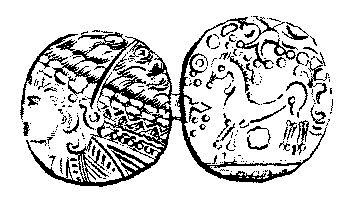
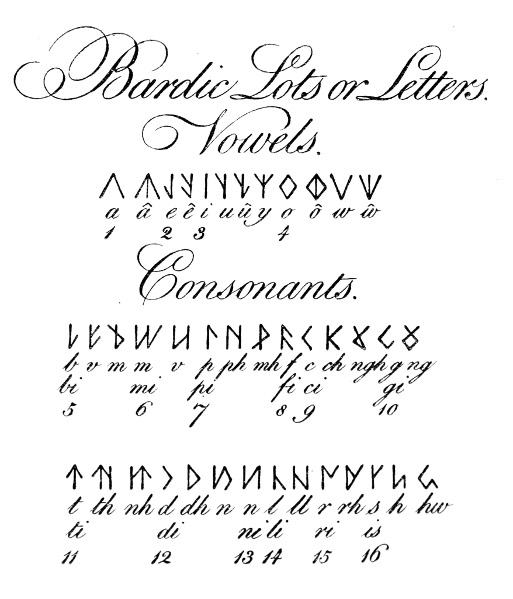
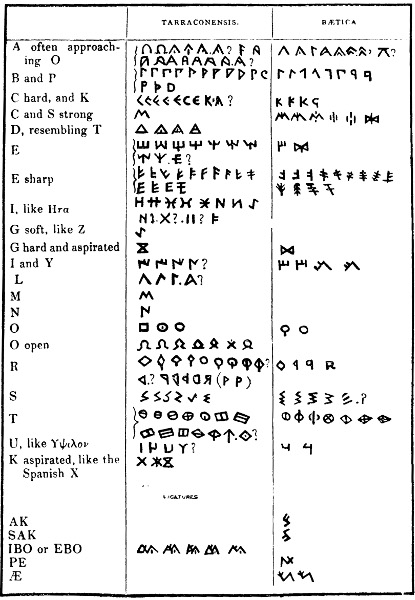
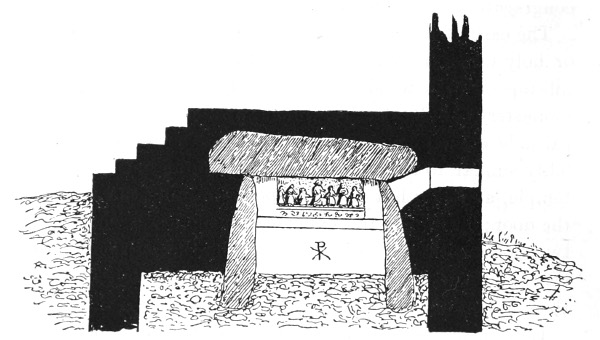
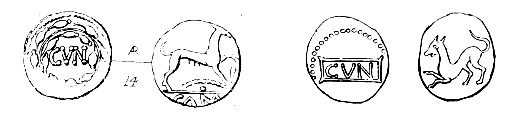
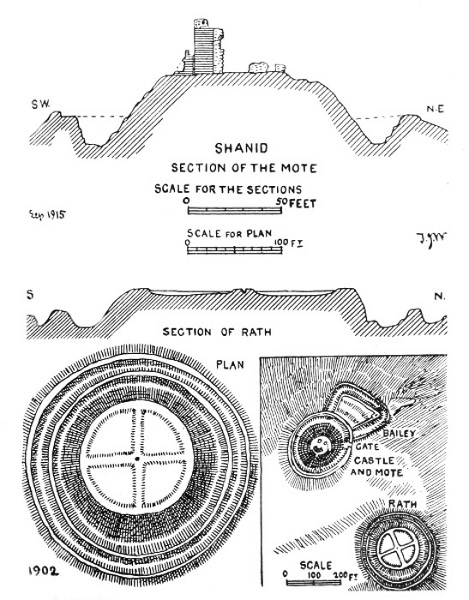
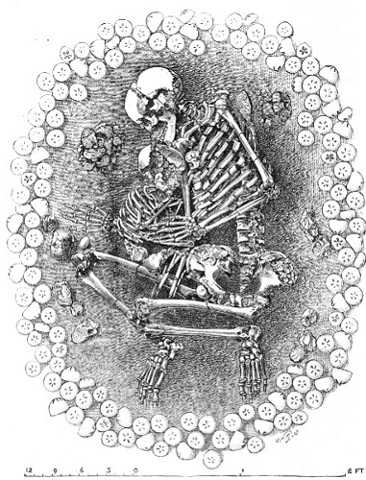
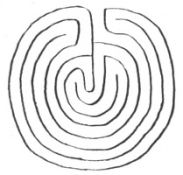
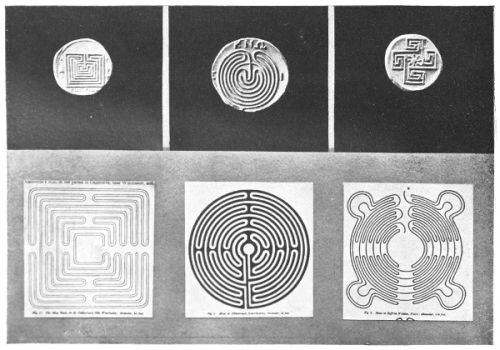
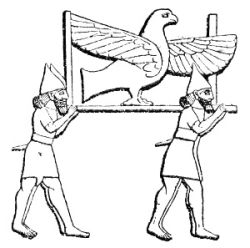
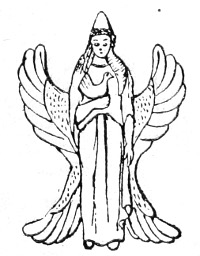
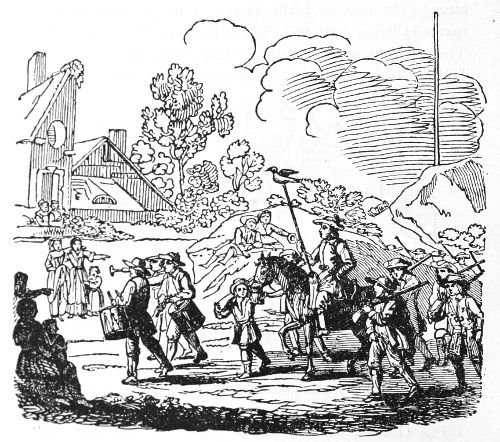
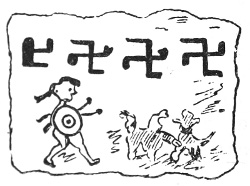
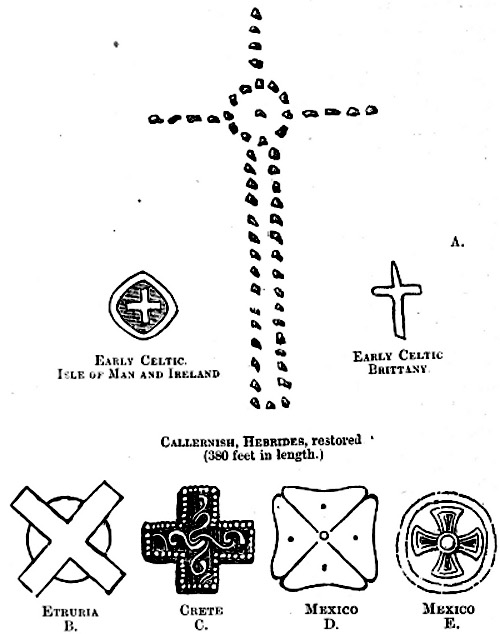
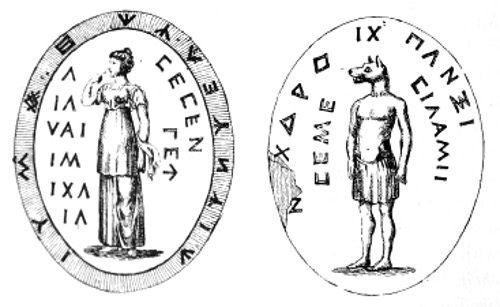
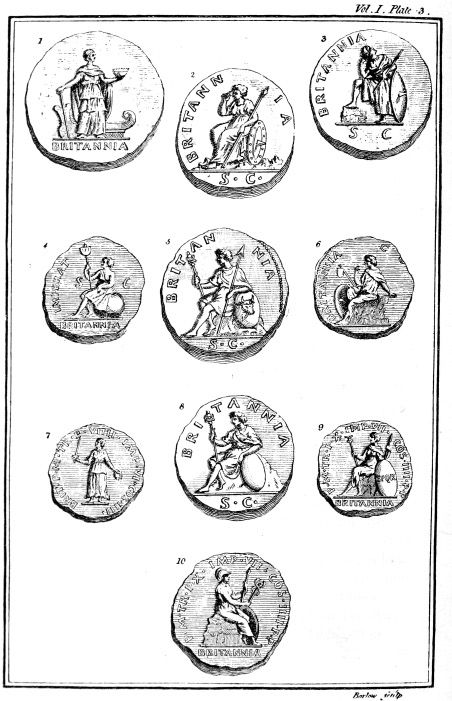
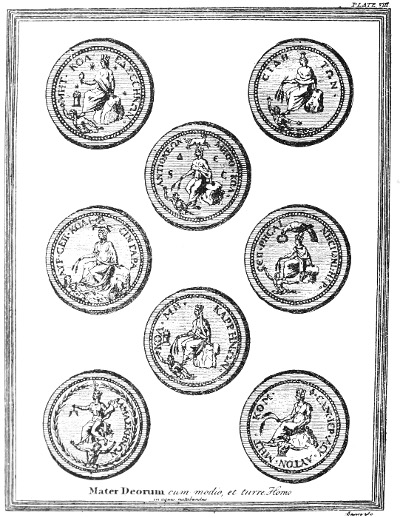
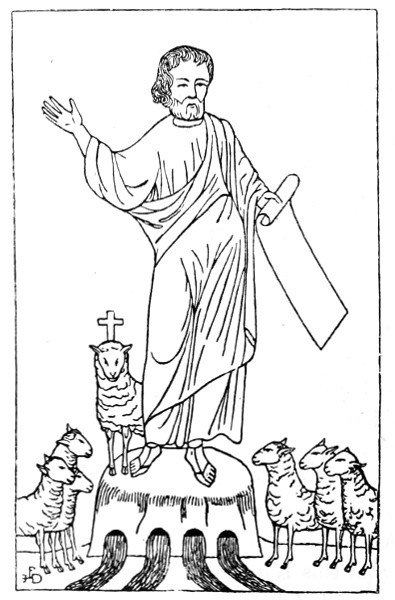
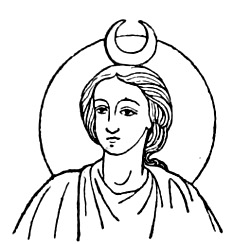
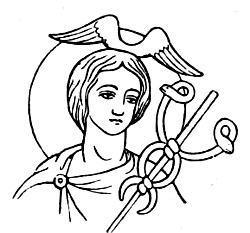
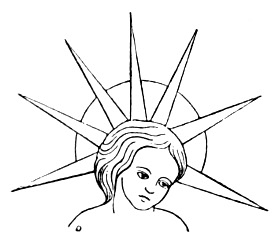
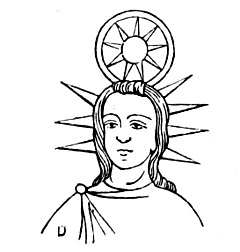
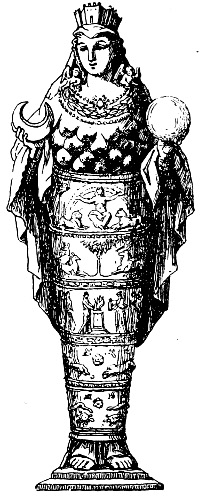
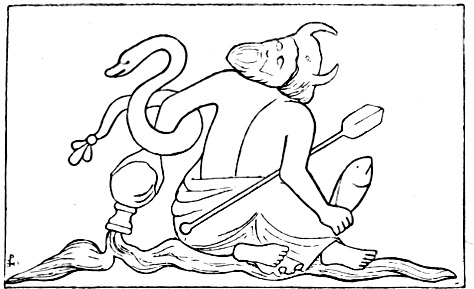
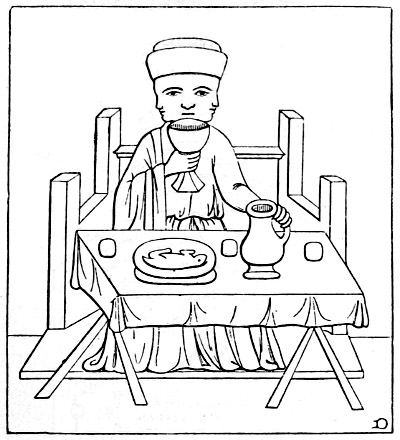
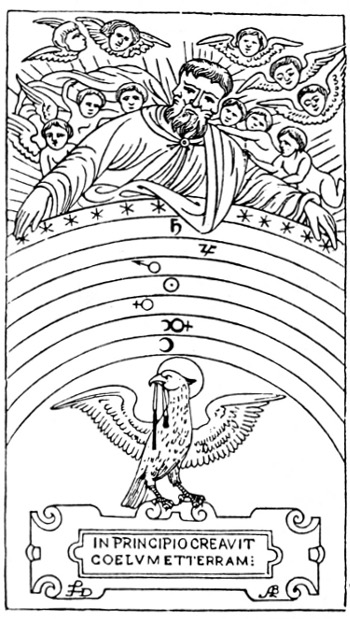
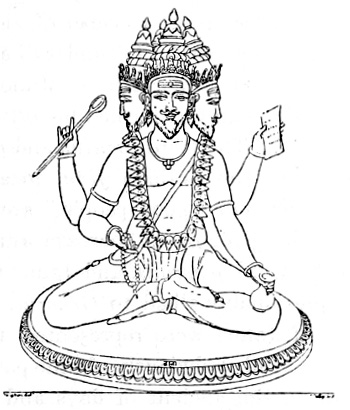
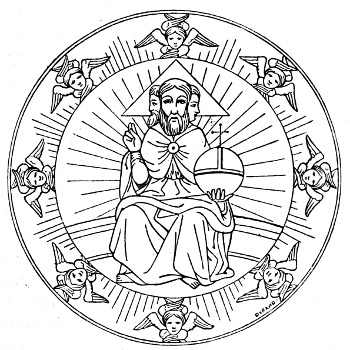
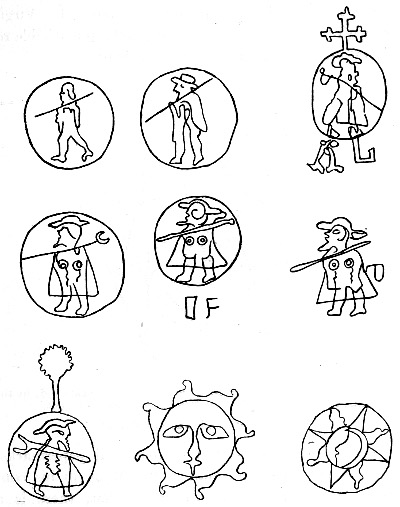
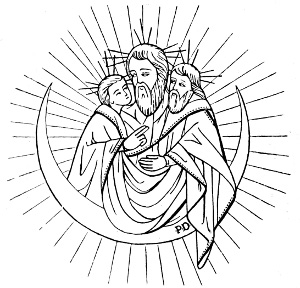
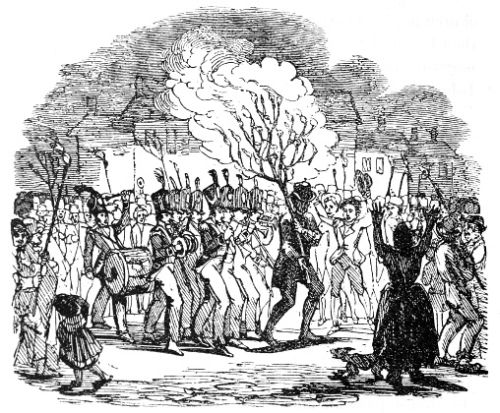
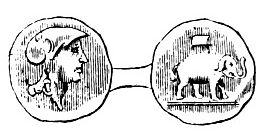
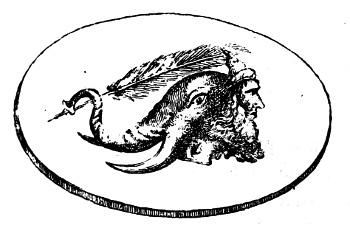
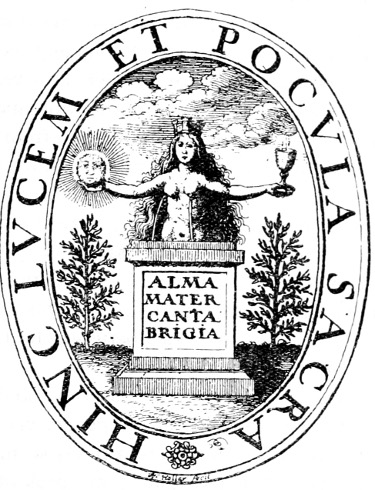
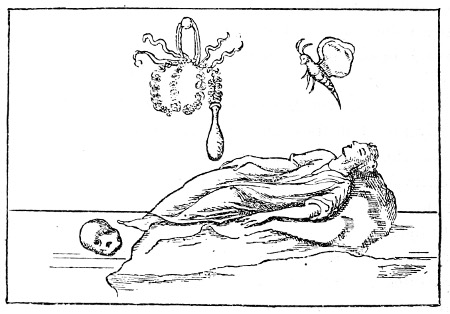
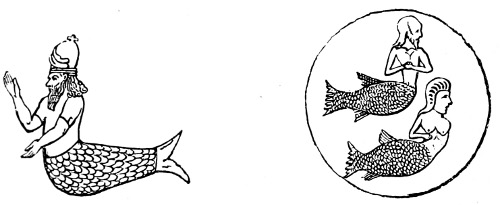
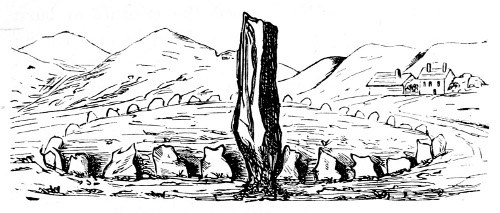
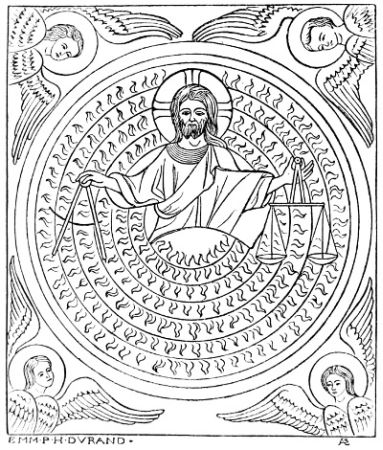
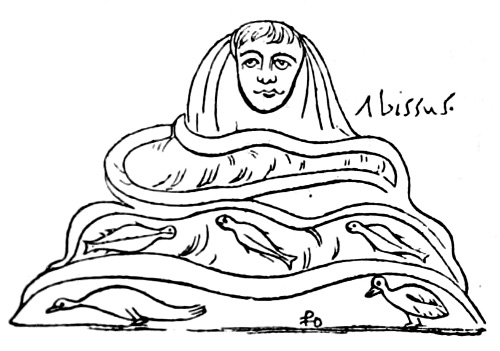
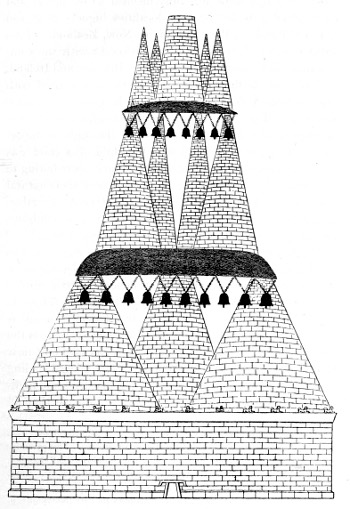
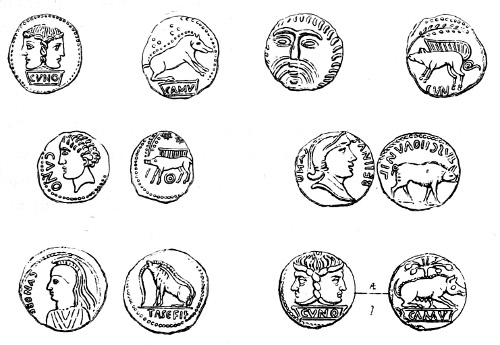
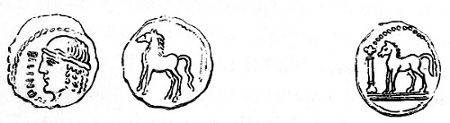
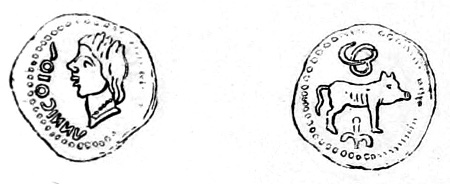
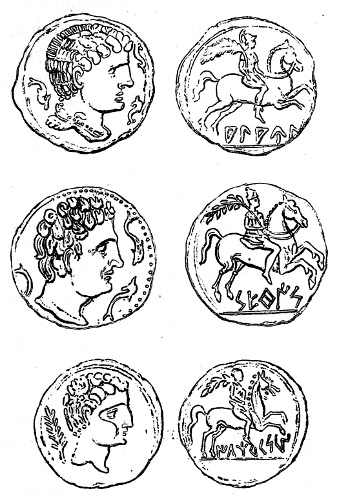
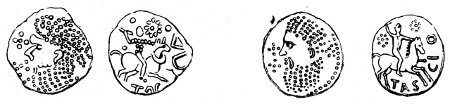
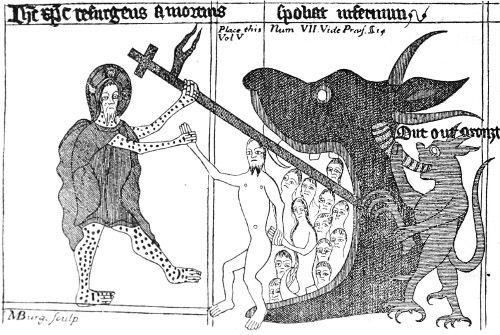
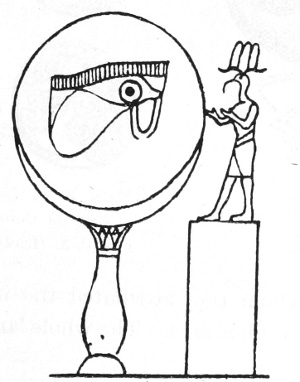
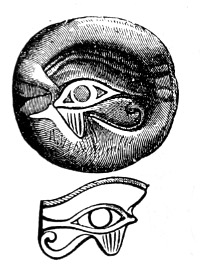
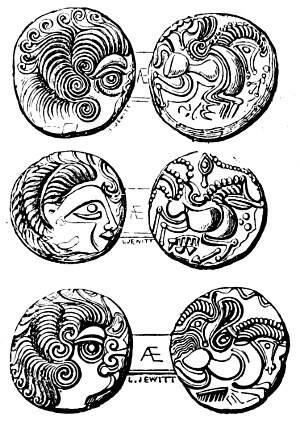
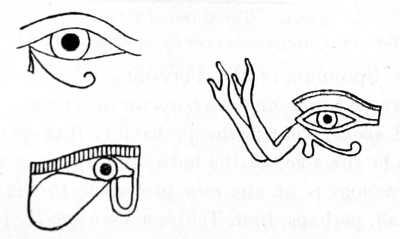
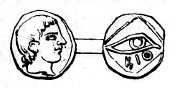
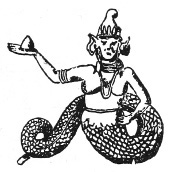
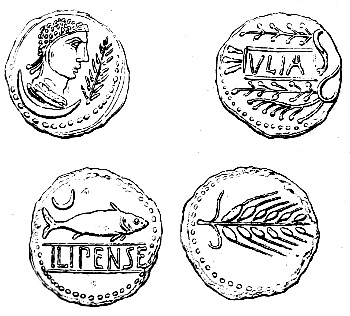
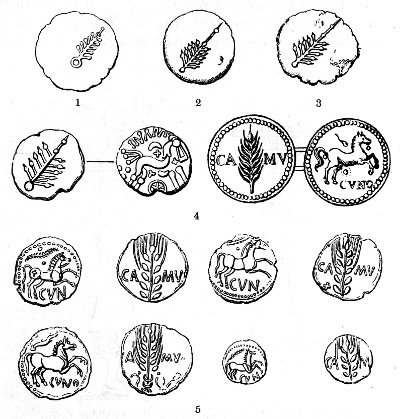
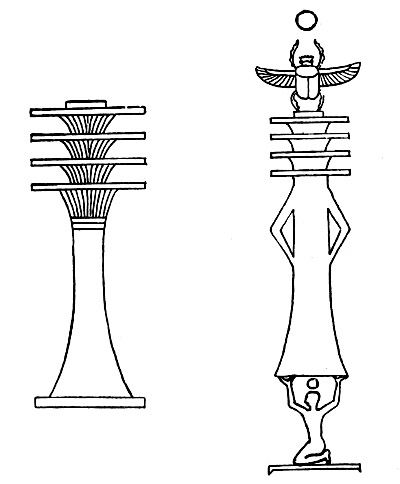
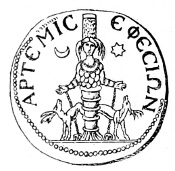
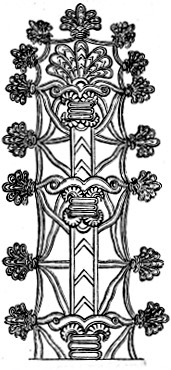
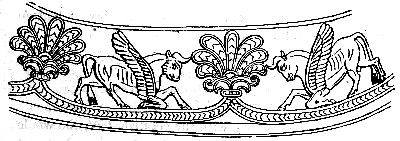
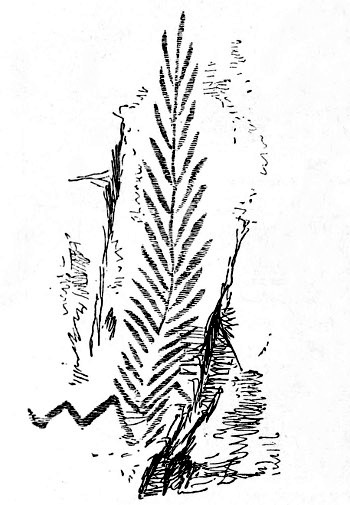
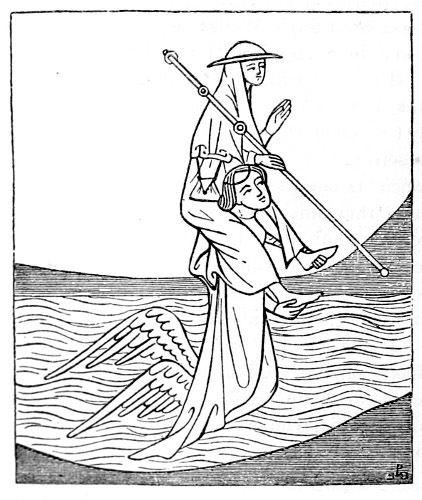
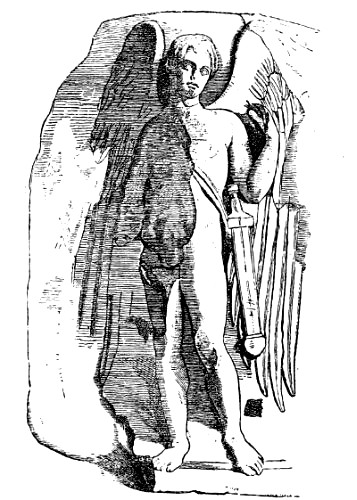
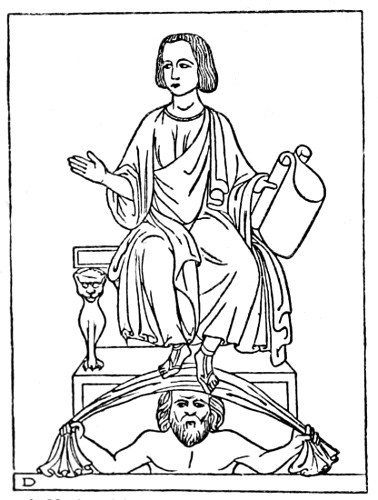
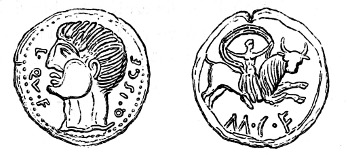
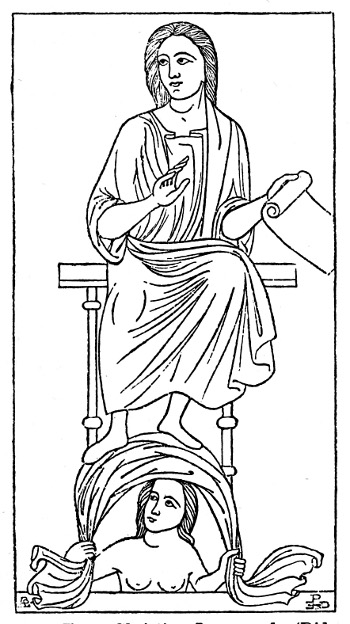
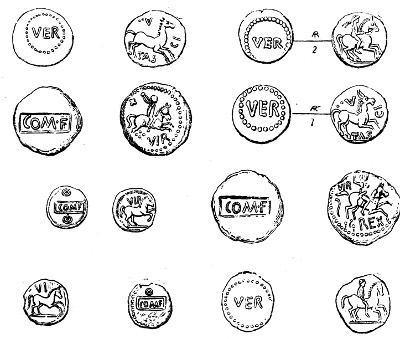
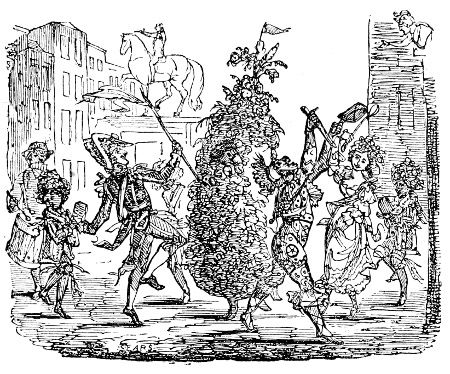
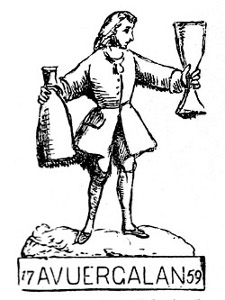
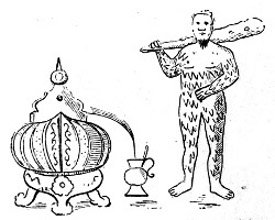
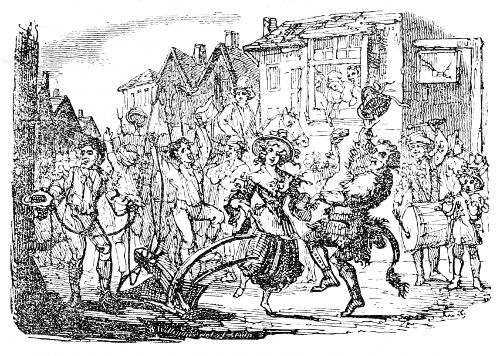
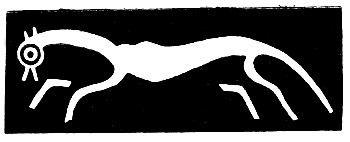
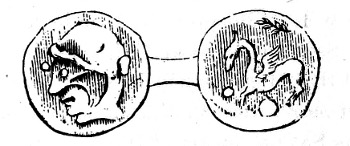
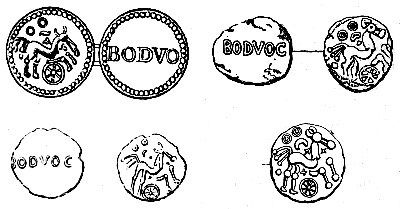
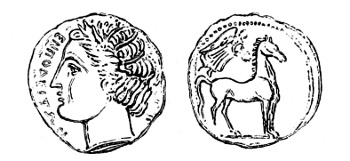
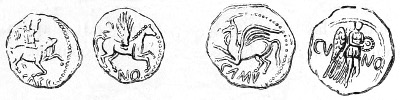
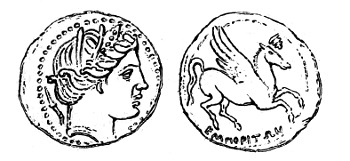
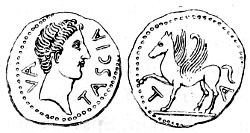
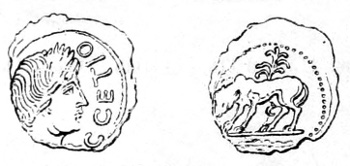
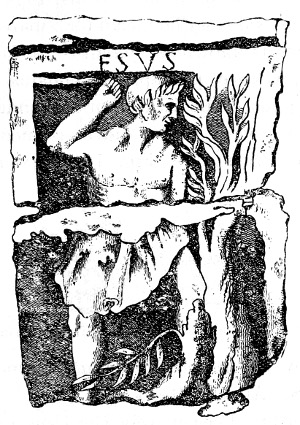
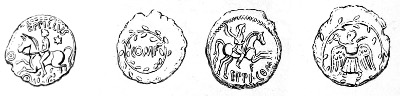
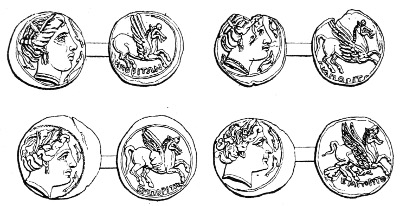
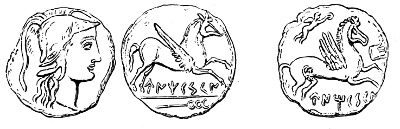
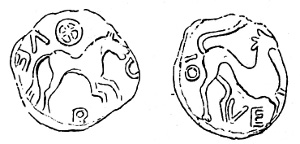
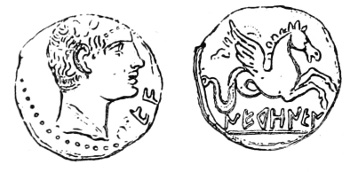
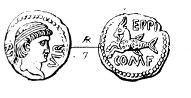
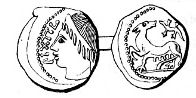
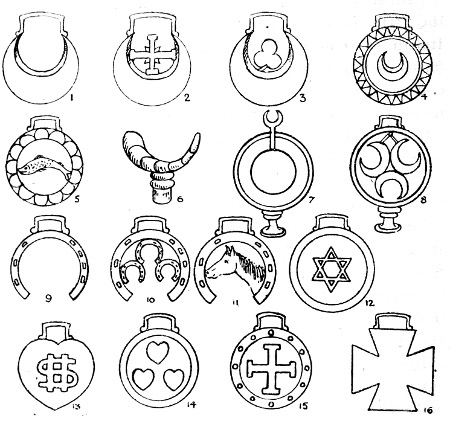
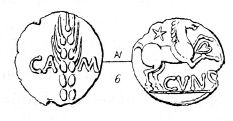
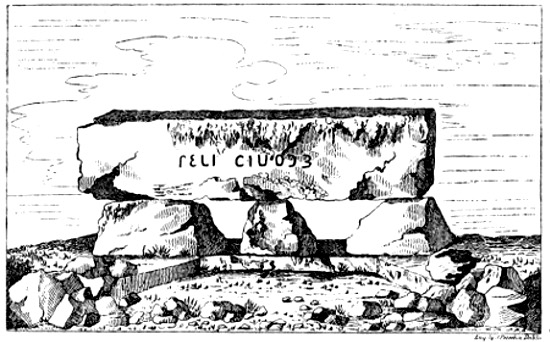
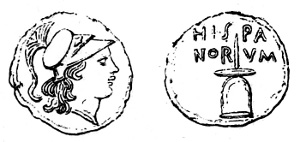
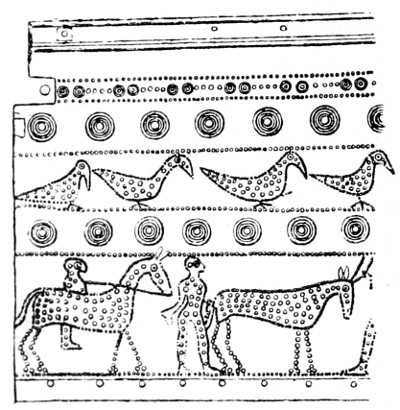
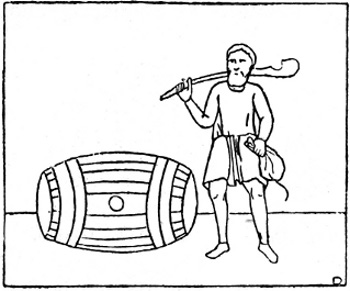
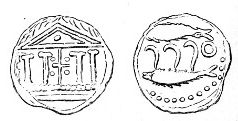
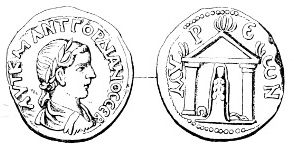
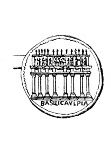
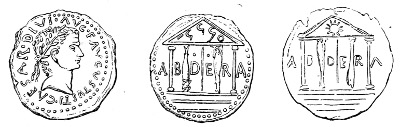
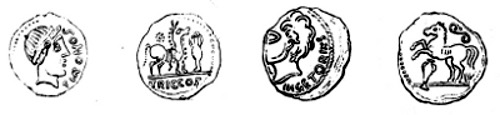
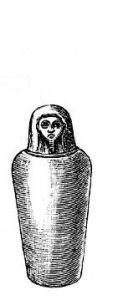
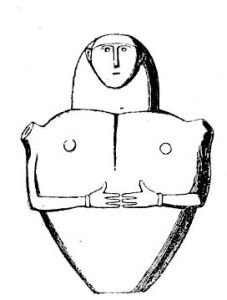
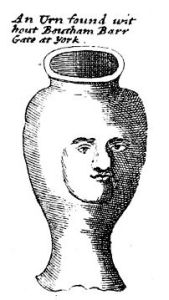
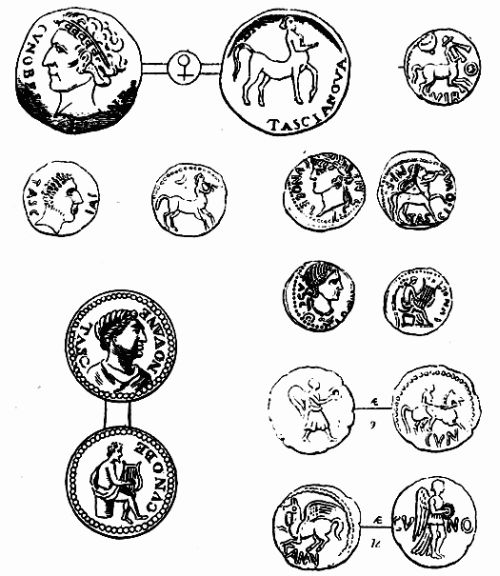
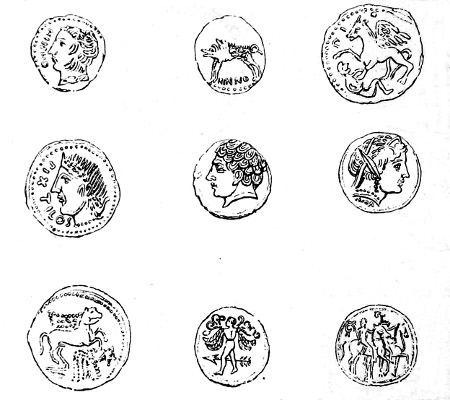
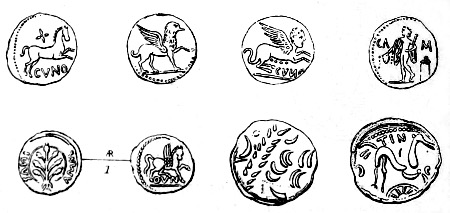
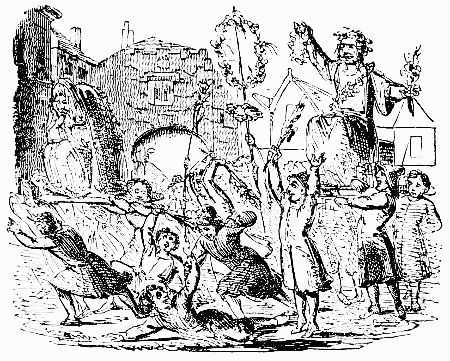
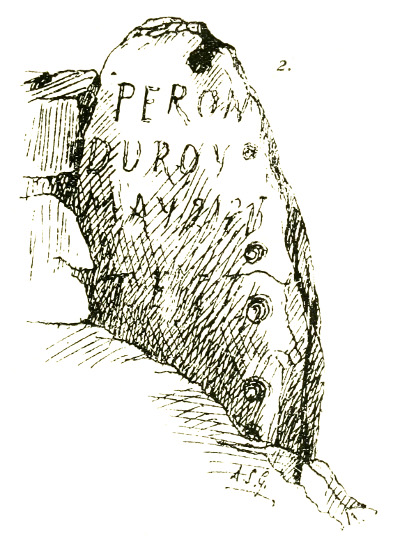
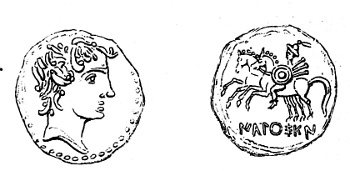
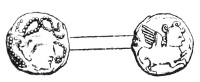
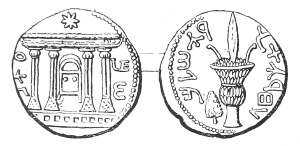
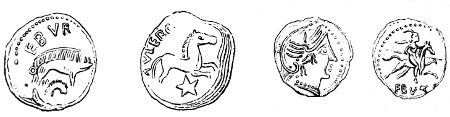
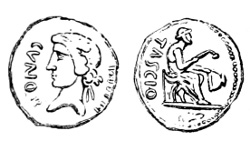
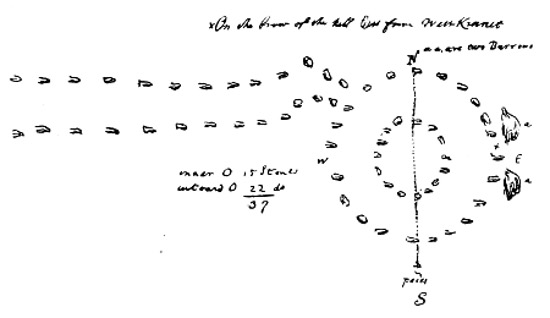
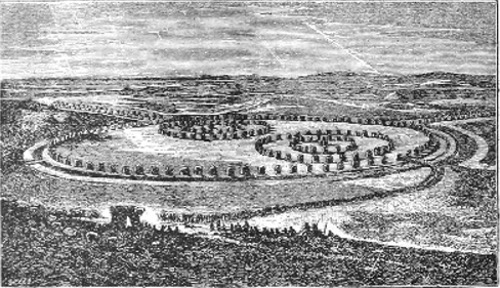
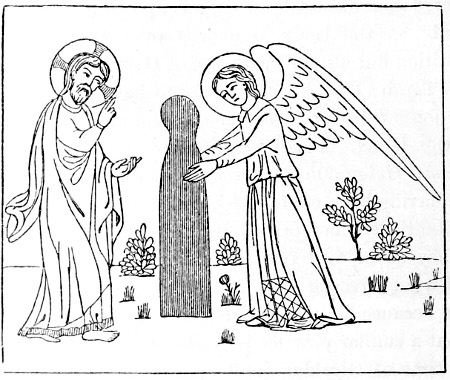
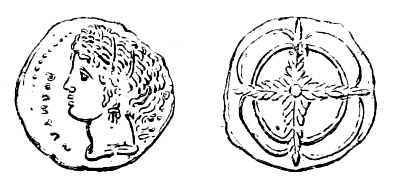
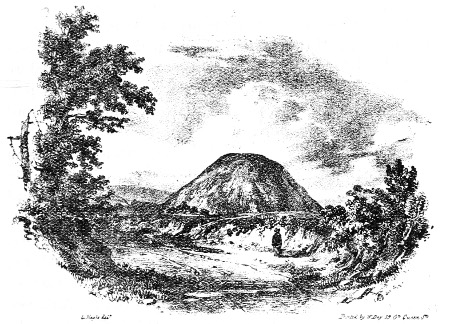
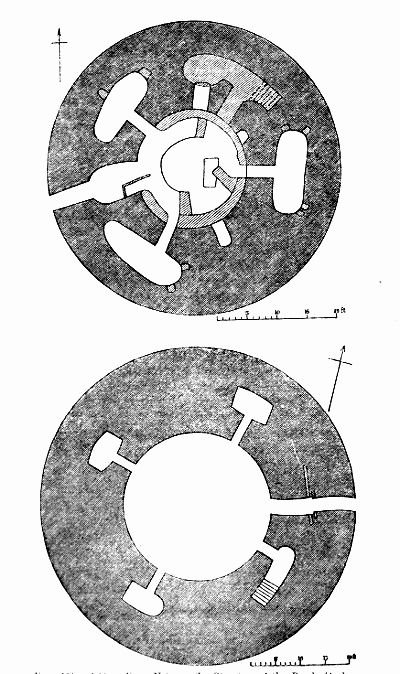
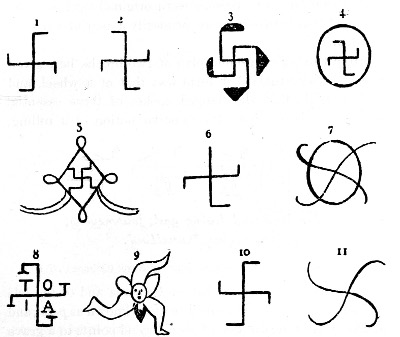
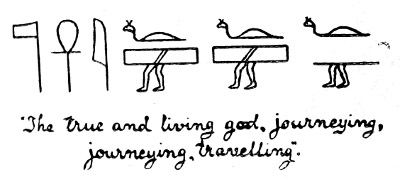
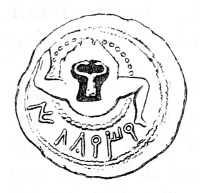
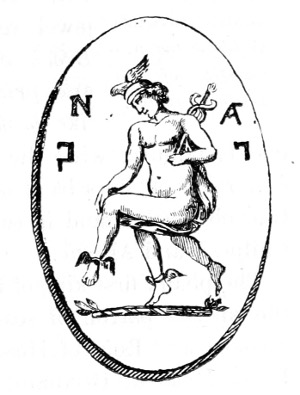
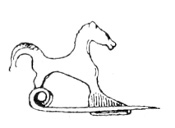
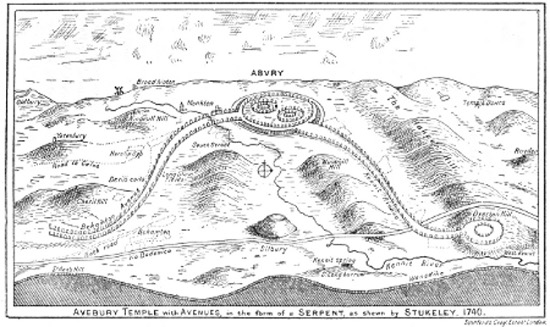
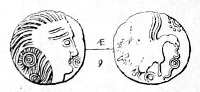
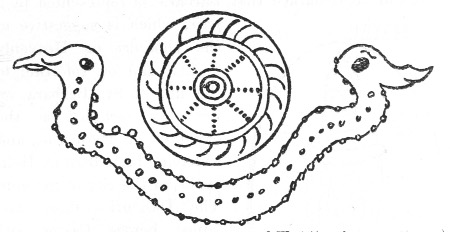
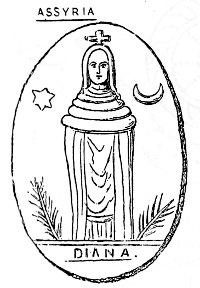
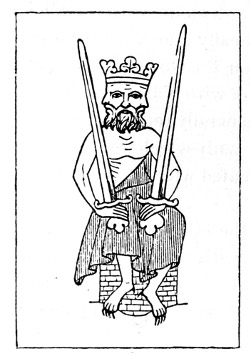
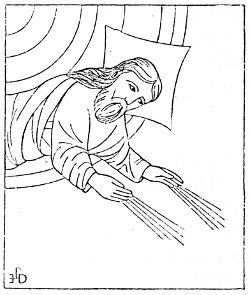
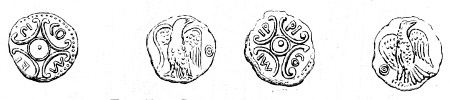
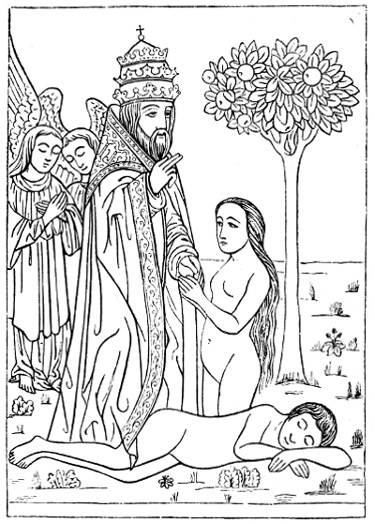
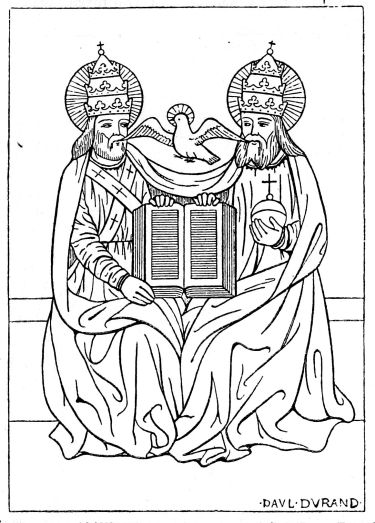
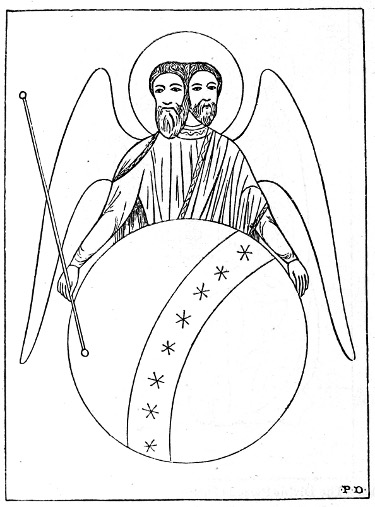
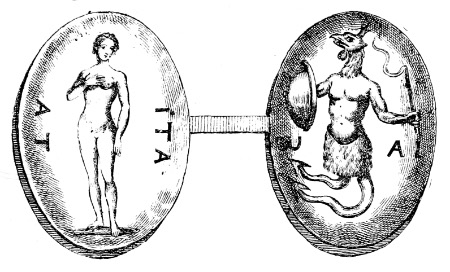
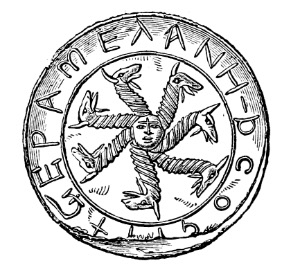
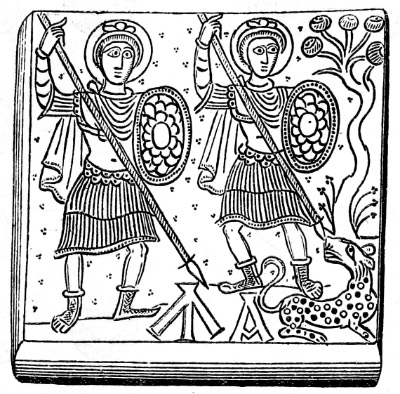
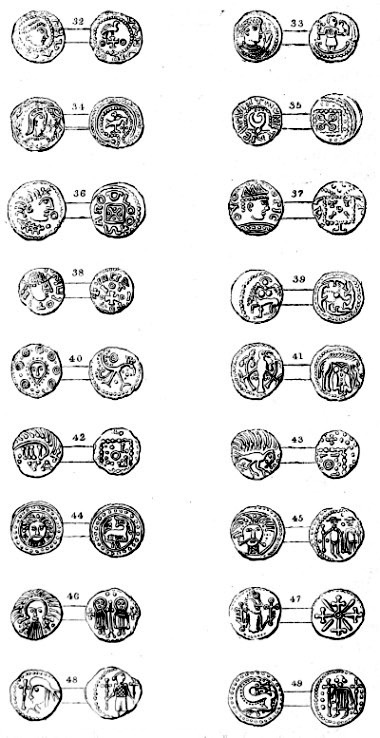
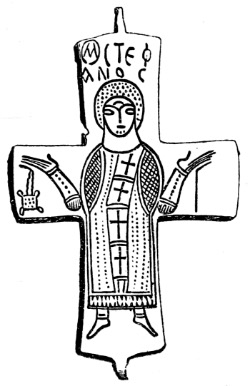
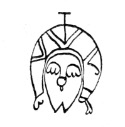
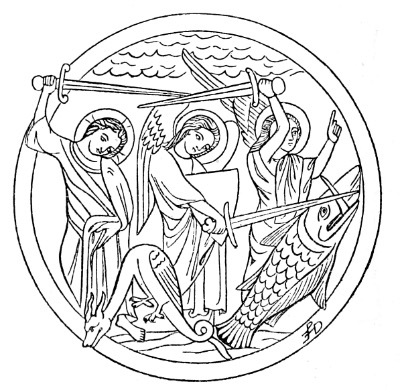
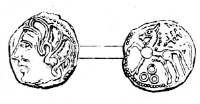
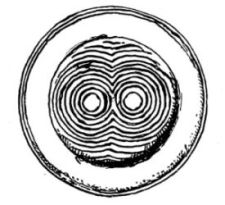
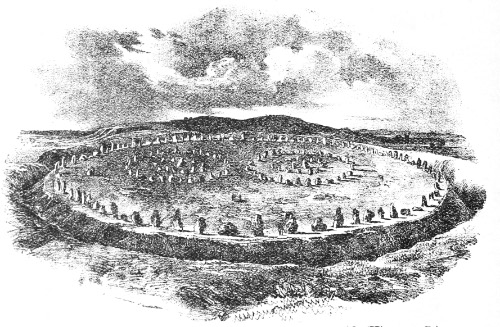
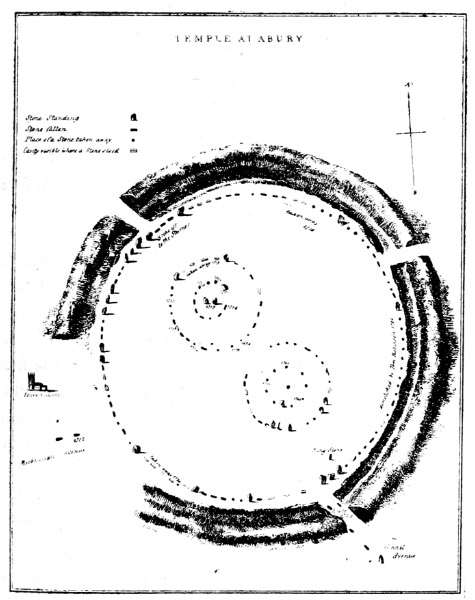
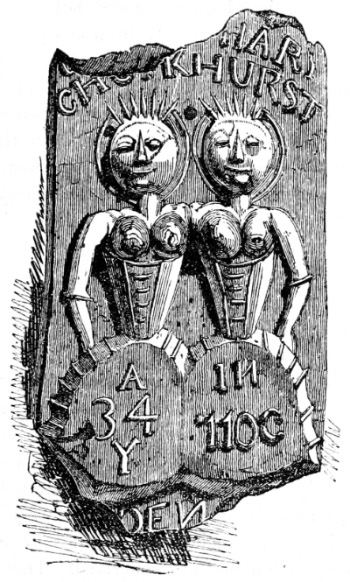
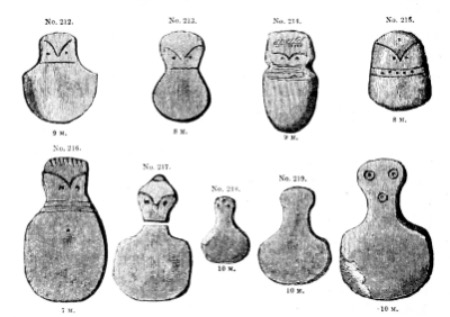
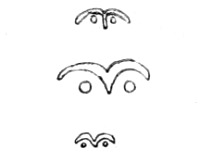
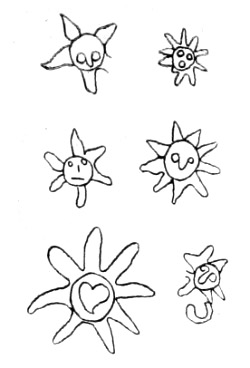
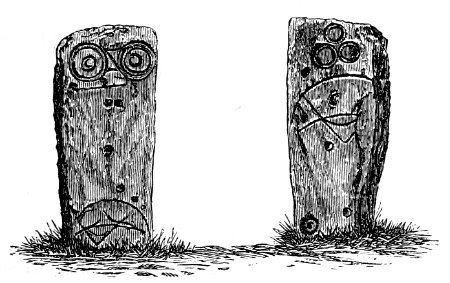
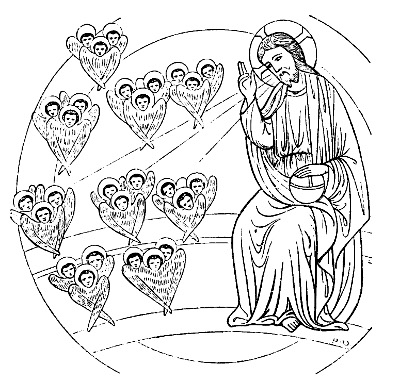
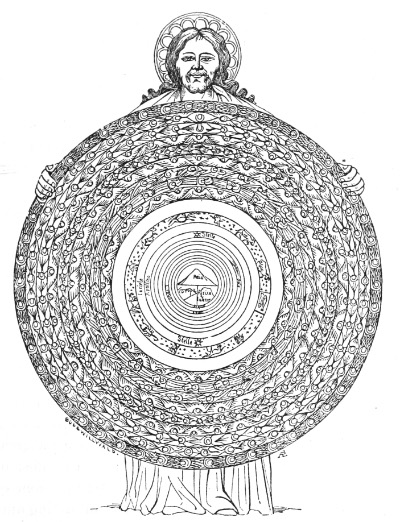
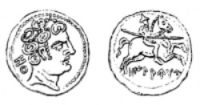
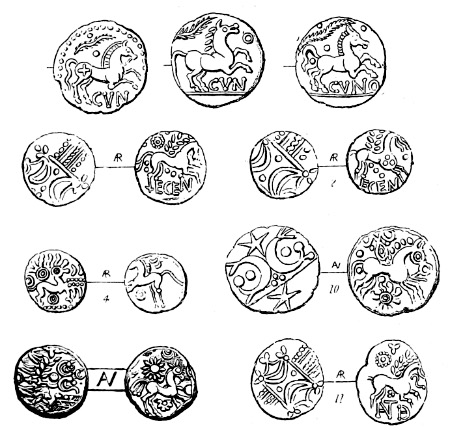
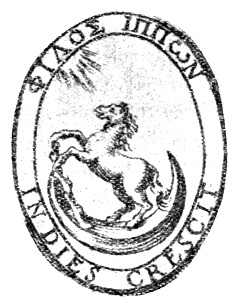
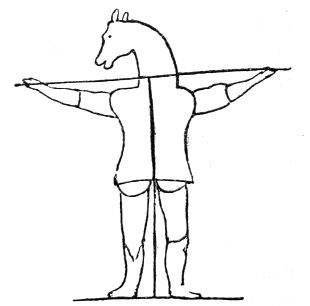
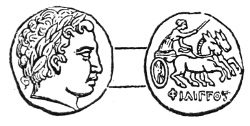
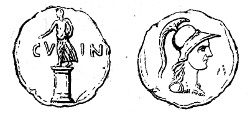
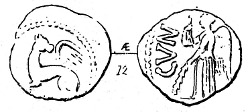
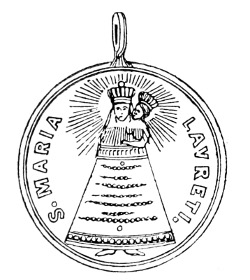
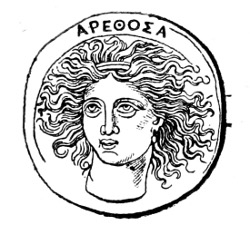
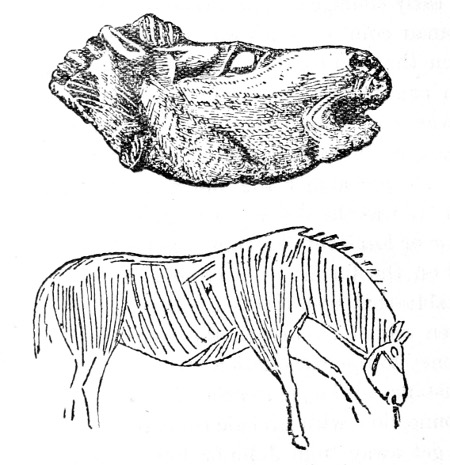
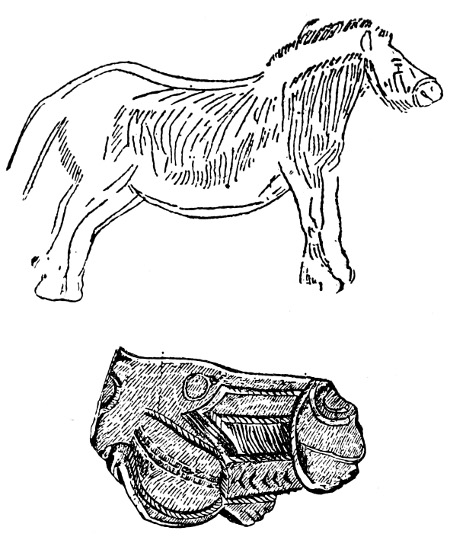
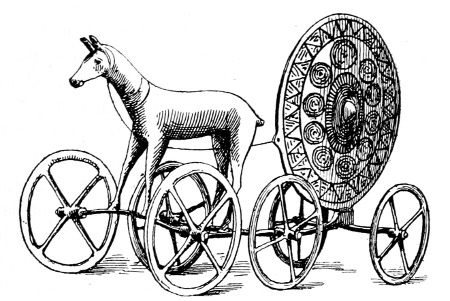
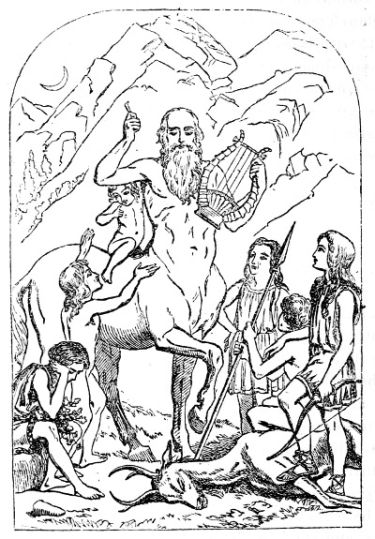
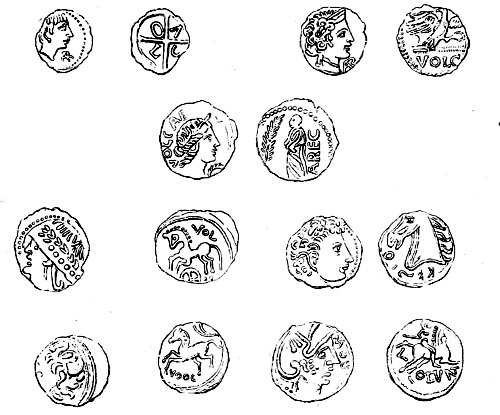

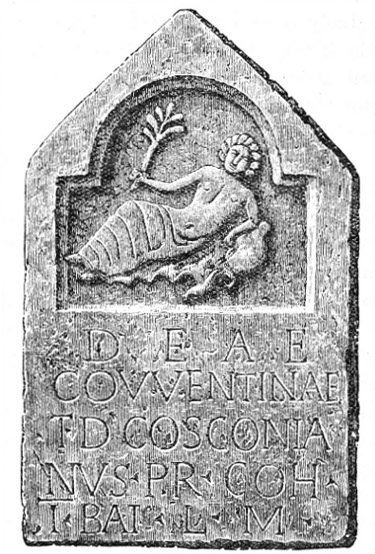
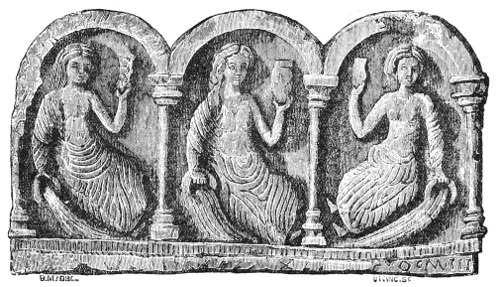
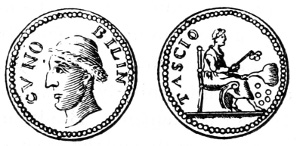
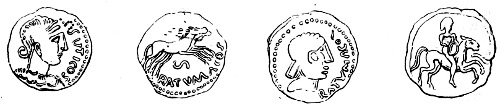
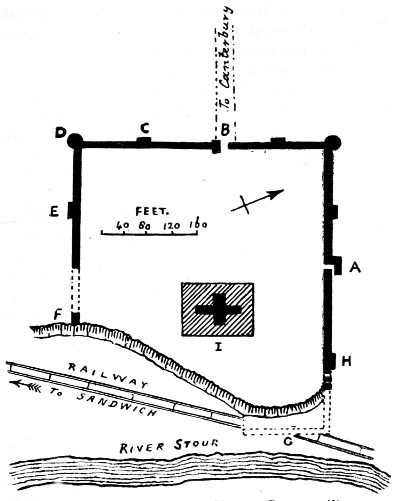
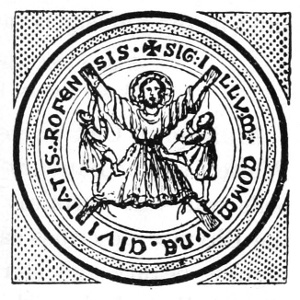
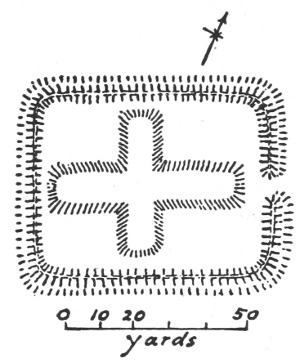
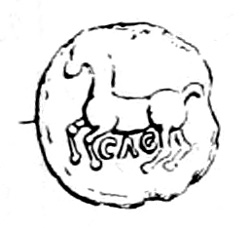
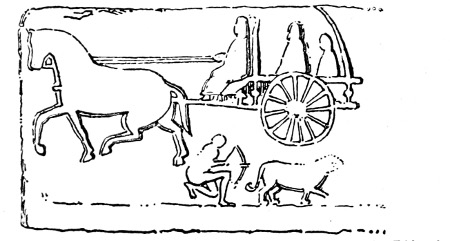
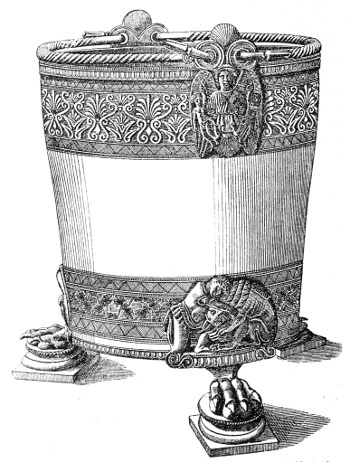
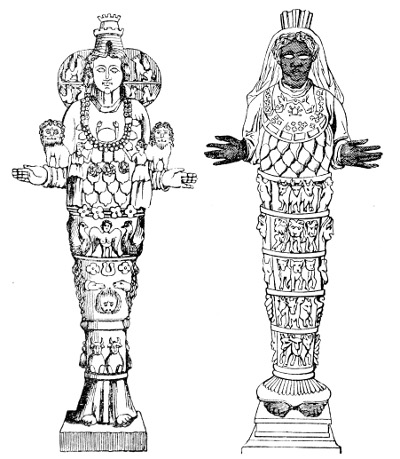
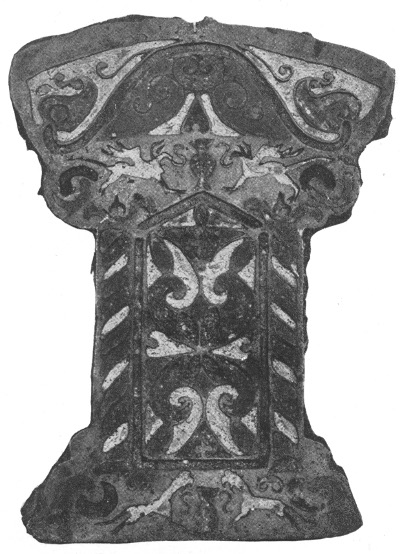
 , are detached from the
vase, but are emerging flame-like from the supporters’ heads. The fact
of these steeds appearing upon an “altar” is evidence of their sacred
character, and one finds apparently the same two beasts delineated on a
bucket, vide Fig. 270. This so termed “barbaric production,”
discovered in an Aylesford gravel pit belonging to a gentleman curiously
named Wagon, is attributed to the first century
, are detached from the
vase, but are emerging flame-like from the supporters’ heads. The fact
of these steeds appearing upon an “altar” is evidence of their sacred
character, and one finds apparently the same two beasts delineated on a
bucket, vide Fig. 270. This so termed “barbaric production,”
discovered in an Aylesford gravel pit belonging to a gentleman curiously
named Wagon, is attributed to the first century 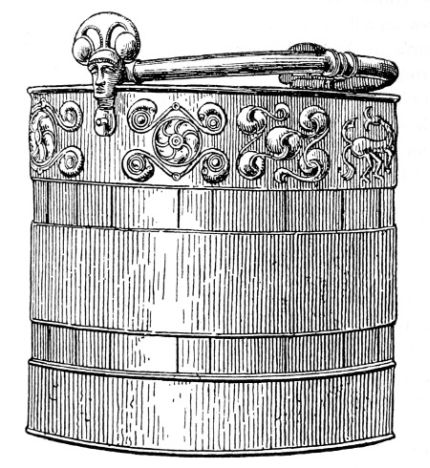

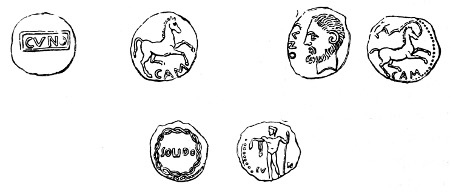
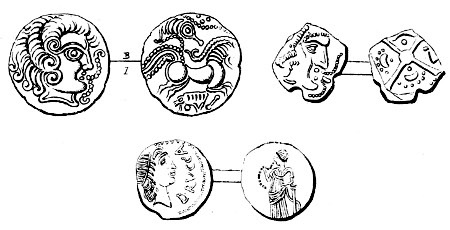
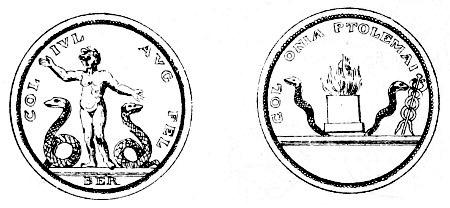
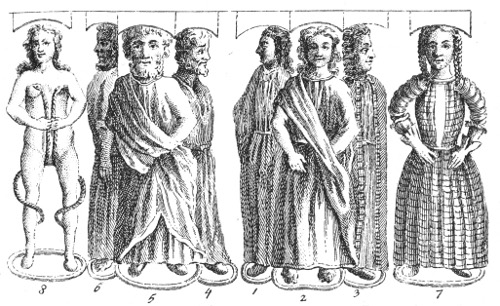
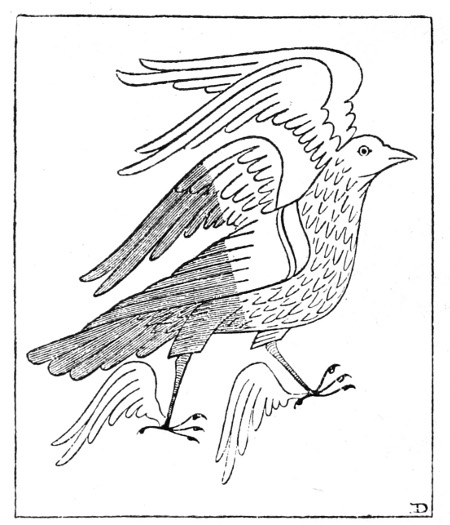
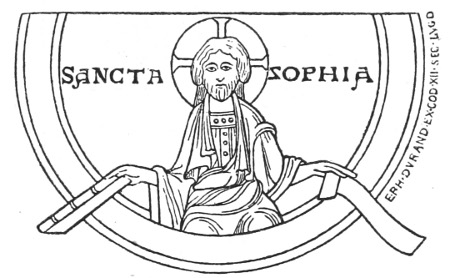
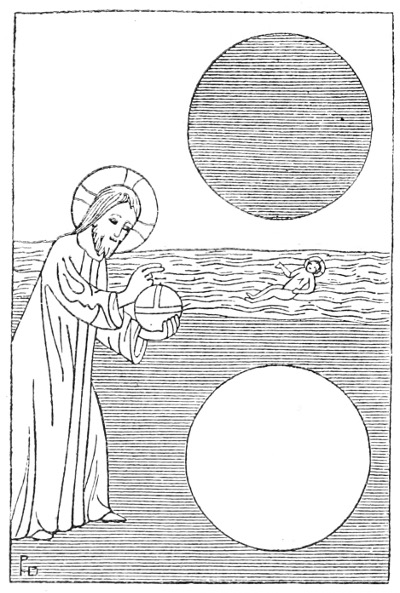
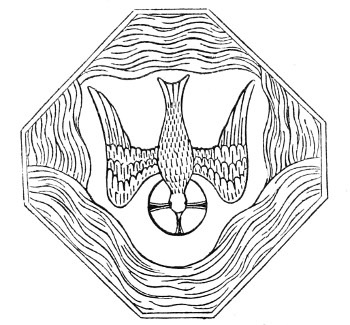
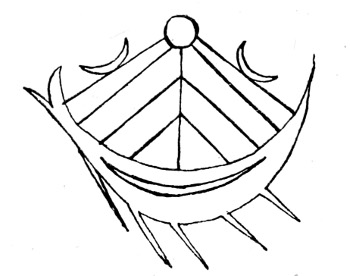
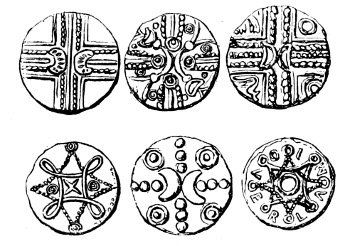
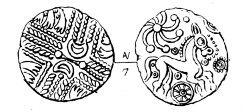
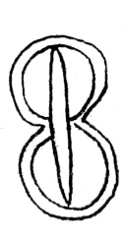
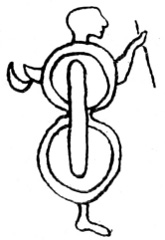
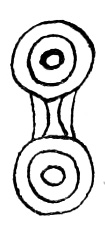
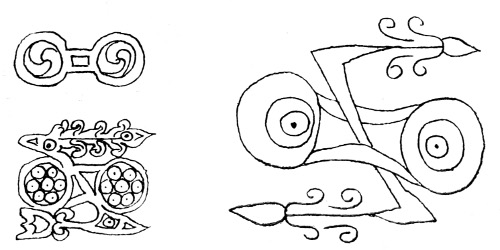
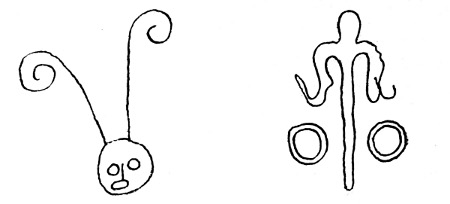
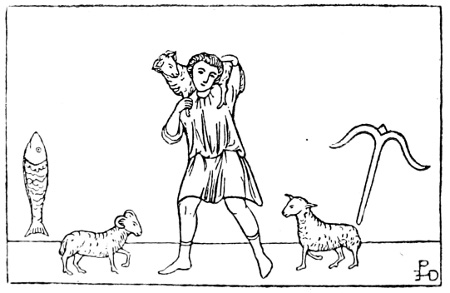
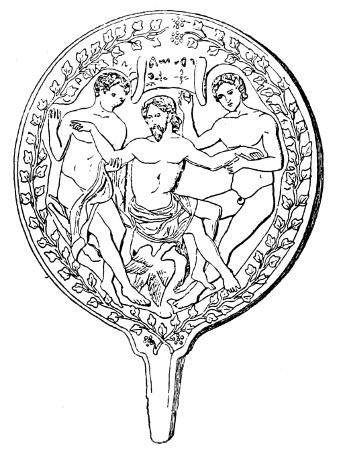
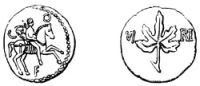
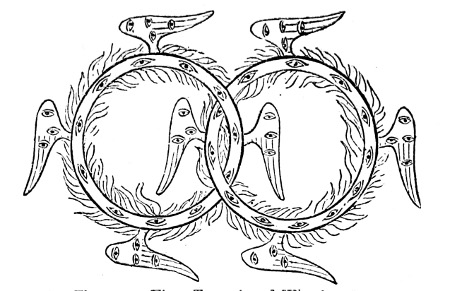
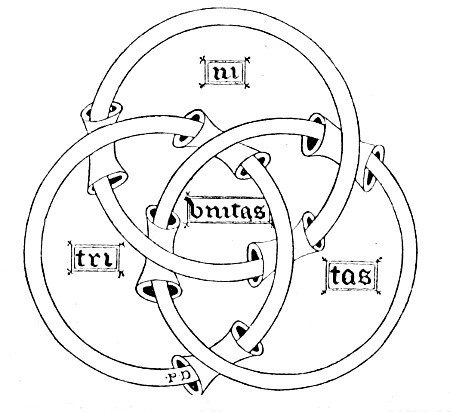
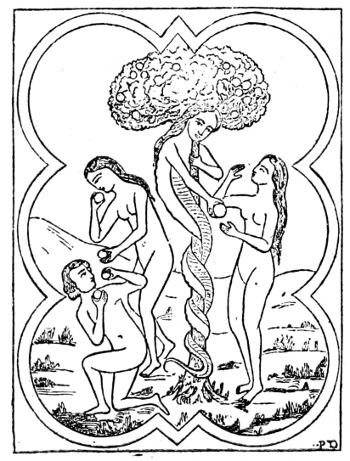
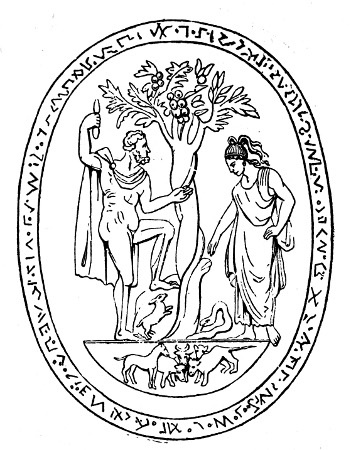
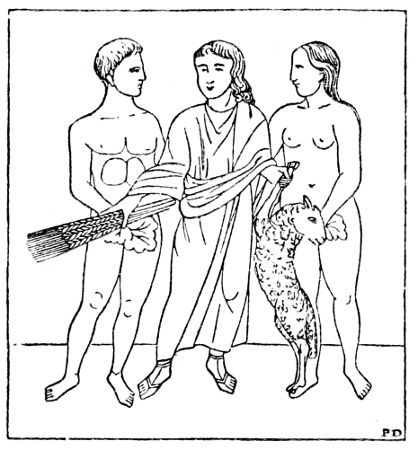
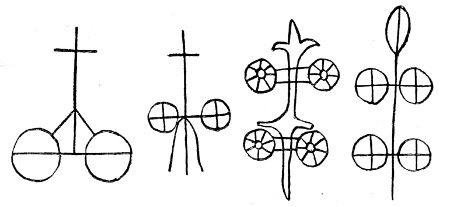
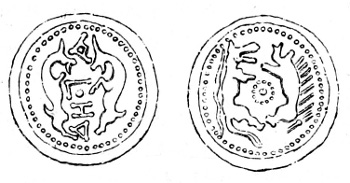
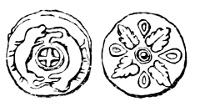
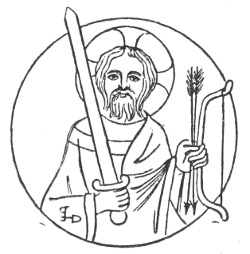
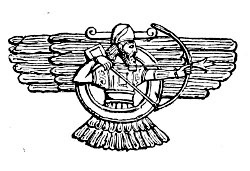
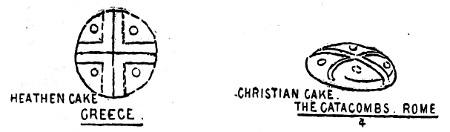
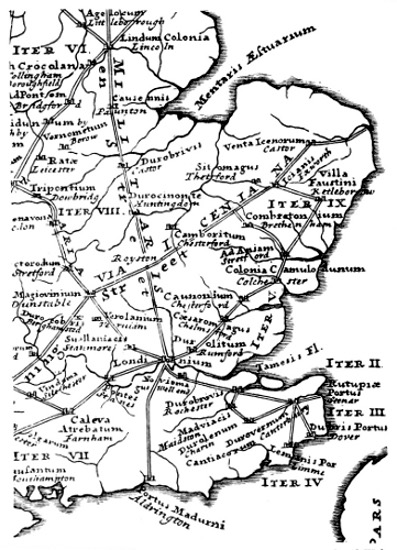
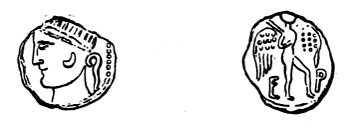
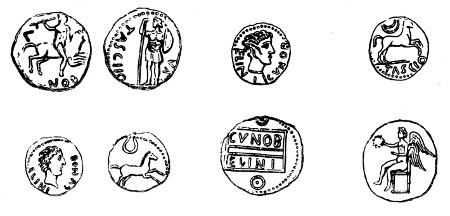
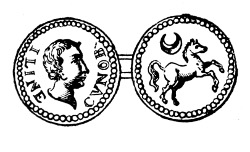
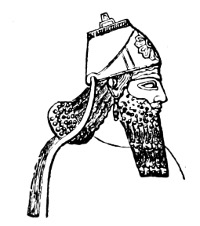
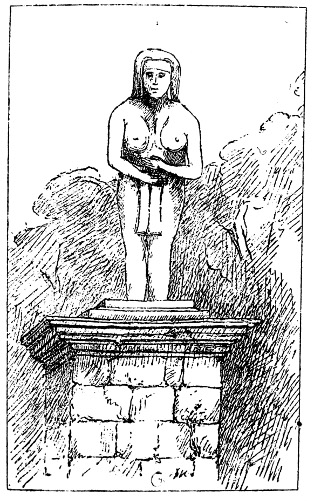
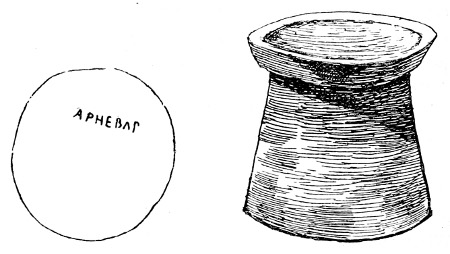
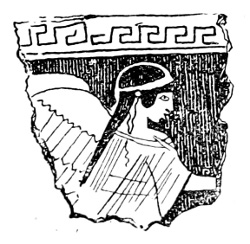
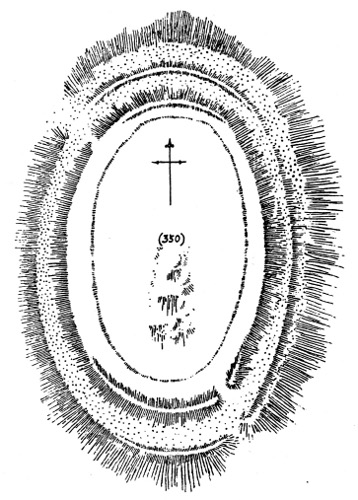
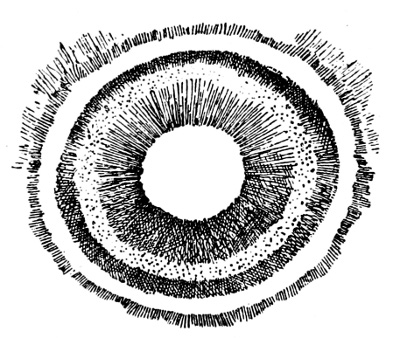
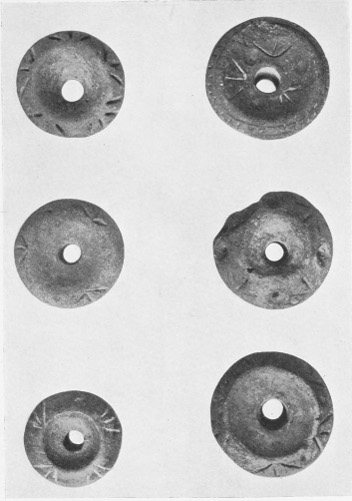
 reading in these characters
respectively 0 1 0, and thus spelling the mystic
reading in these characters
respectively 0 1 0, and thus spelling the mystic