Obvious typographical errors have been silently corrected. Variations
in hyphenation and accents have been standardised but all other
spelling and punctuation remains unchanged.
The structure of some tables has been modified to improve legibility
within page width.
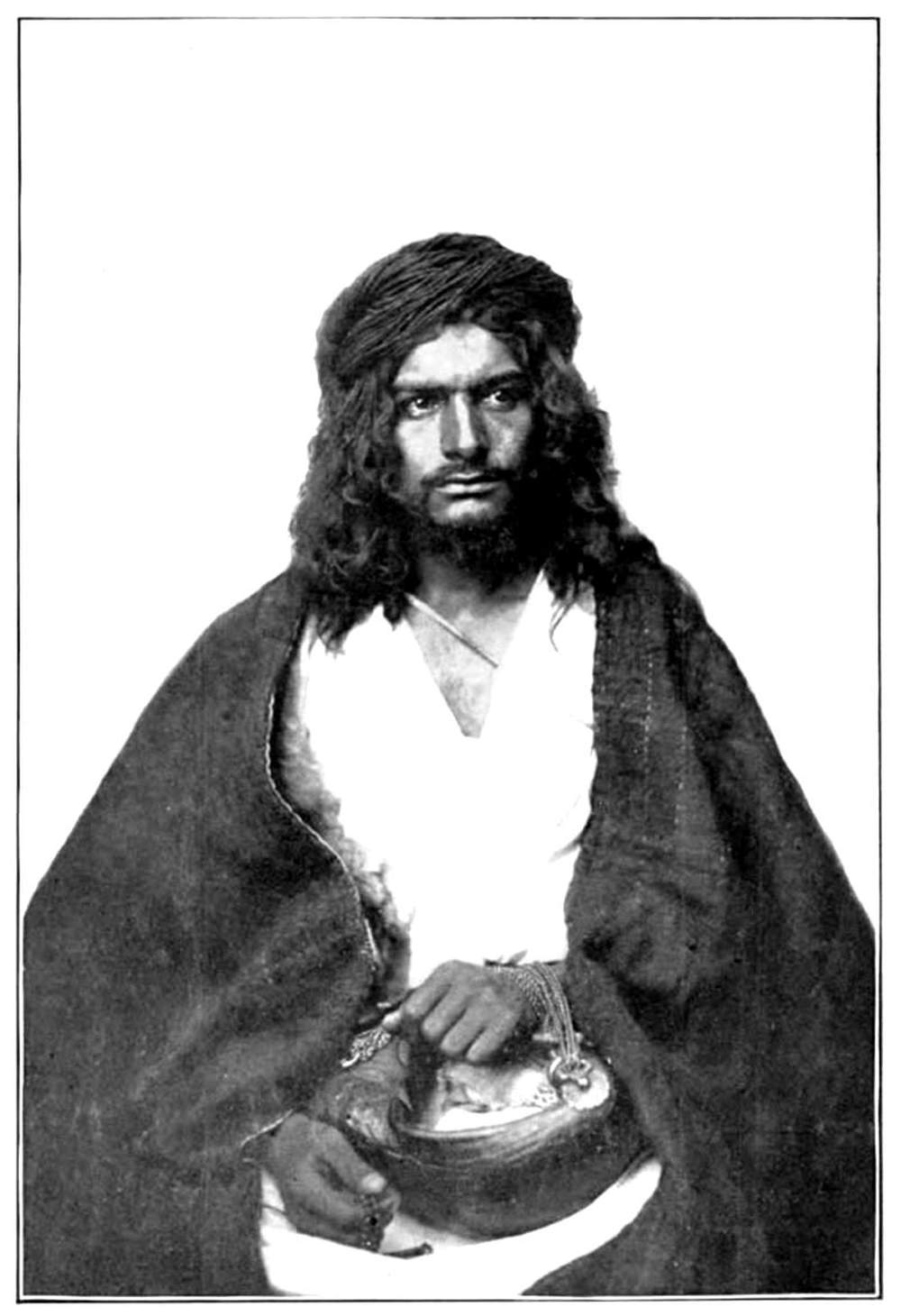
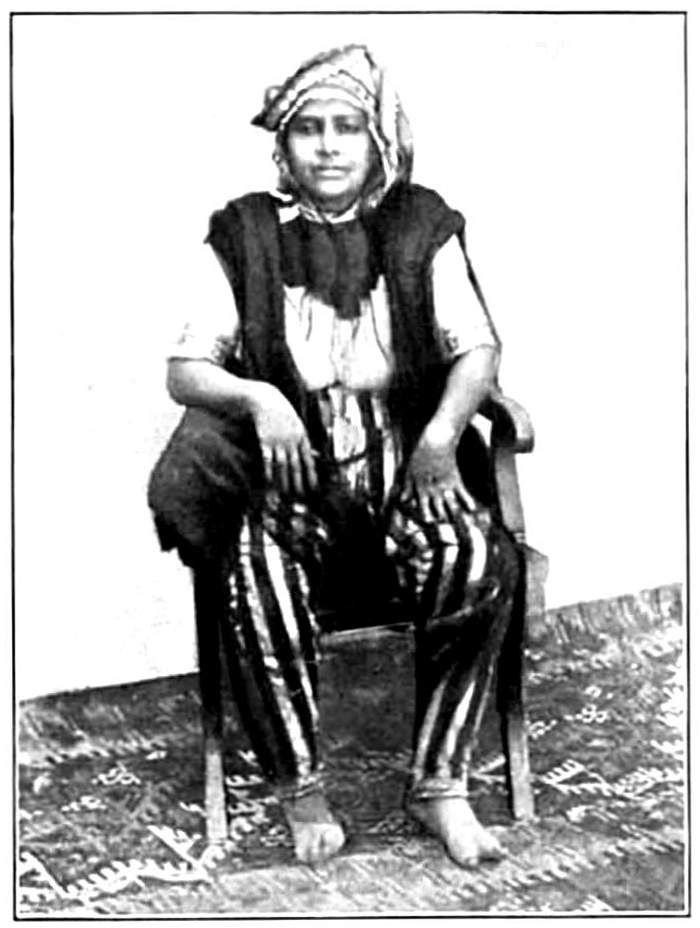
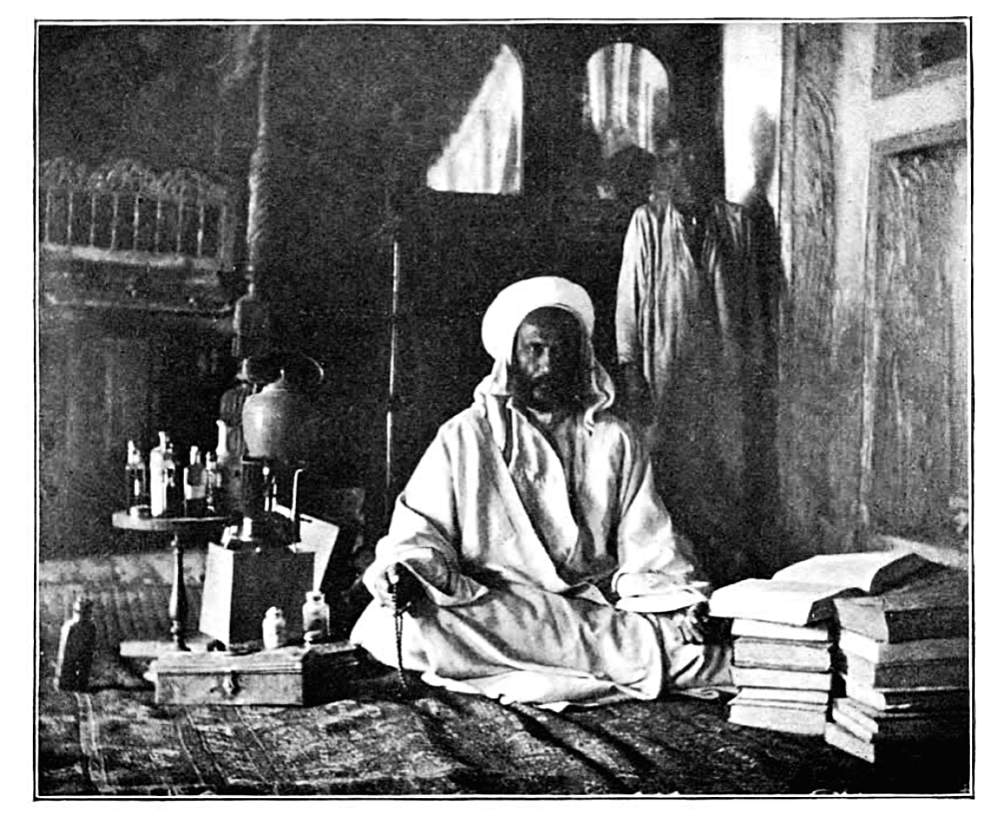
A TYPICAL ARAB OF YEMEN
Arabia: The Cradle of Islam
Studies in the Geography, People and
Politics of the Peninsula with an
account of Islam and Mission-work.
REV. S. M. ZWEMER, F.R.G.S.
INTRODUCTION BY
REV. JAMES S. DENNIS, D.D.
EDINBURGH AND LONDON Oliphant Anderson and Ferrier
1900
Printed by
THE CAXTON PRESS
171-173 Macdougal St.
New York, U.S.A.
DEDICATED
DEDICATED
TO
_The “Student Volunteers” of America_
IN MEMORY OF
THE TWO AMERICAN VOLUNTEERS WHO LAID DOWN THEIR LIVES FOR ARABIA
PETER J. ZWEMER
AND GEORGE E. STONE
And Jesus said unto him: This day is salvation come to this house, forasmuch
as he also is a son of Abraham. For the Son of Man is come to
seek and to save that which was lost.—Luke xix. 9, 10.
Introductory Note
The author of this instructive volume is in the direct line
of missionary pioneers to the Moslem world. He follows
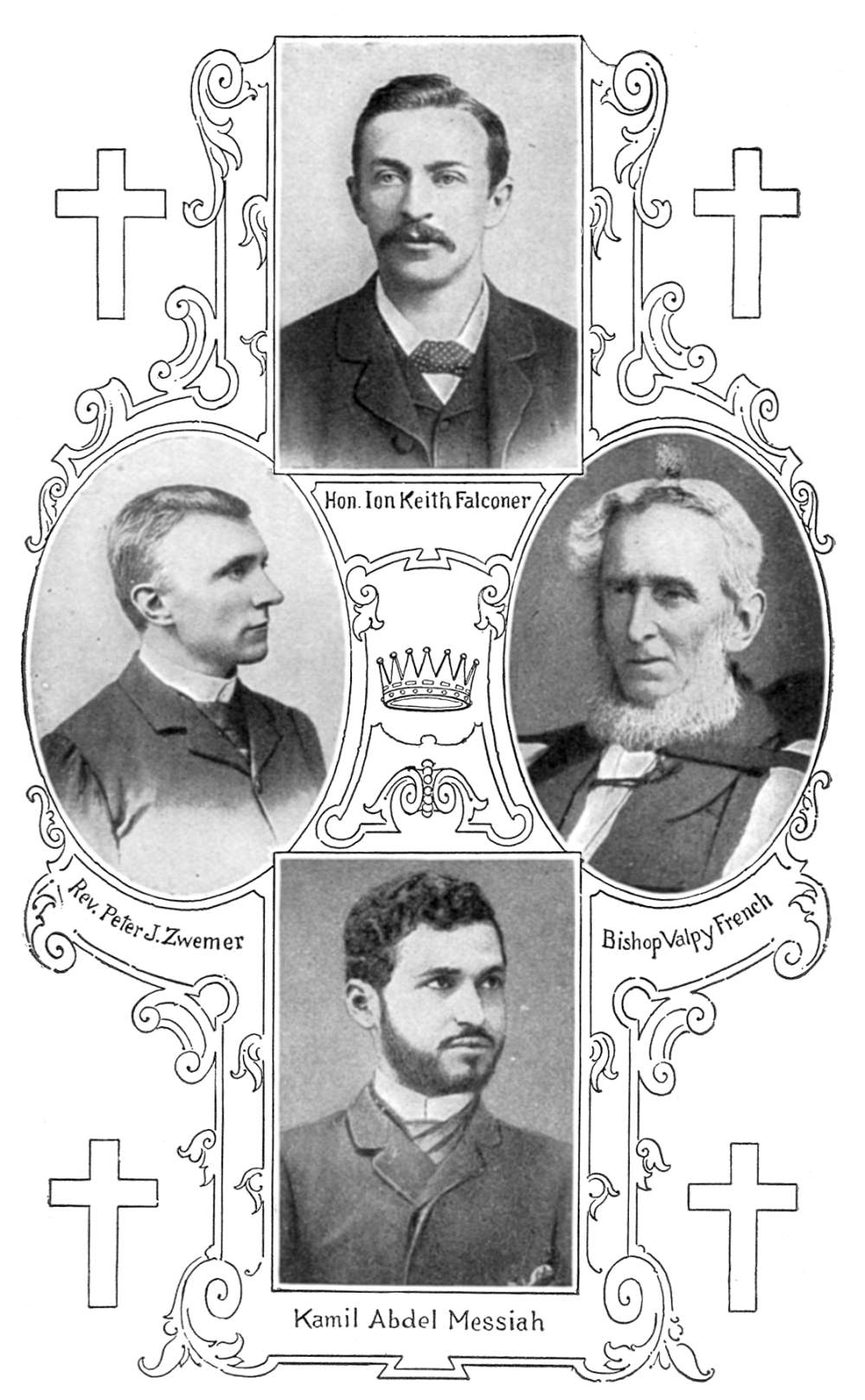
Raymond Lull, Henry Martyn, Ion Keith-Falconer, and
Bishop French, and, with his friend and comrade the Rev.
James Cantine, now stands in the shining line of succession at
the close of a decade of patient and brave service at that
lonely outpost on the shores of the Persian Gulf. Others have
followed in their footsteps, until the Arabian Mission, the
adopted child of the Reformed Church in America, is at
present a compact and resolute group of men and women at
the gates of Arabia, waiting on God’s will, and intent first of
all upon fulfilling in the spirit of obedience to the Master the
duty assigned them.
These ten years of quiet, unflinching service have been full
of prayer, observation, study, and wistful survey of the great
task, while at the same time every opportunity has been improved
to gain a foothold, to plant a standard, to overcome a
prejudice, to sow a seed, and to win a soul. The fruits of this
intelligent and conscientious effort to grasp the situation and
plan the campaign are given to us in this valuable study of
“Arabia, the Cradle of Islam.” It is a missionary contribution
to our knowledge of the world. The author is entirely
familiar with the literature of his subject. English, German,
French, and Dutch authorities are at his command. The less
accessible Arabic authors are easily within his reach, and he
brings from those mysterious gardens of spices into his clear,
straightforward narrative, the local coloring and fragrance, as
well as the indisputable witness of original medieval sources.
The ethnological, geographical, archaeological, commercial, and
political information of the descriptive chapters brings to our
hands a valuable and readable summary of facts, in a form
which is highly useful, and will be sure to quicken an intelligent
interest in one of the great religious and international problems
of our times.
His study of Islam is from the missionary standpoint, but
this does not necessarily mean that it is unfair, or unhistorical,
or lacking in scholarly acumen. Purely scientific and academic
study of an ethnic religion is one method of approaching
it. It can thus be classified, labelled, and put upon the shelf in
the historical museum of the world’s religions, and the result
has a value which none will dispute. This, however, is not the
only, or indeed the most serviceable, way of examining, estimating
and passing a final judgment upon a religious system.
Such study must be comparative, it must have some standard
of value; it must not discard acknowledged tests of excellence;
it must make use of certain measurements of capacity and
power; it must be pursued in the light of practical ethics, and
be in harmony with the great fundamental laws of religious experience
and spiritual progress which have controlled thus far
the regenerative processes of human development.
The missionary in forming his final judgment inevitably compares
the religion he studies with the religion he teaches. He
need not do this in any unkind, or bitter, or abusive spirit.
On the contrary, he may do it with a supreme desire to uncover
delusion, and make clear the truth as it has been given
to him by the Great Teacher. He may make a generous and
sympathetic allowance for the influence of local environment,
he may trace in an historic spirit the natural evolution of a
religious system, he may give all due credit to every worthy
element and every pleasing characteristic therein, he may regard
its symbols with respect, and also with all charity and consideration
the leaders and guides whom the people reverence;
yet his own judgment may still be inflexible, his own allegiance
unfaltering, and he may feel it to be his duty to put into plain,
direct, and vigorous prose his irreversible verdict that Christianity
being true, Islam is not, Buddhism is not, Hinduism is
not.
There he stands; he is not afraid of the issue. His Master
is the one supreme and infallible judge, who can pronounce an
unerring verdict concerning the truth of any religion. He has
ventured to bear witness to the truth which his Master has
taught him. Let no one lightly question the value of the contribution
he makes to the comparative study of religion.
The spirit in which our author has written of Islam is marked
by fairness, sobriety, and discrimination, and yet there is no
mistaking the verdict of one who speaks with an authority
which is based upon exceptional opportunities of observation,
close study of literary sources and moral results, and undoubted
honesty of purpose.
It may not be out of place to note the hearty, outspoken
satisfaction with which the author regards the extension of
British authority over the long sweep of the Arabian coast line.
His admiration and delight can only be fully understood by
one who has been a resident in the East, and has felt the blight
of Moslem rule, and its utter hopelessness as an instrument of
progress.
Let this book have its hour of quiet opportunity, and it will
broaden our vision, enlarge our knowledge, and deepen our interest
in themes which will never lose their hold upon the attention
of thoughtful men.
James S. Dennis.
Preface
There are indications that Arabia will not always remain
in its long patriarchal sleep and that there is a future in
store for the Arab. Politics, civilization and missions have all
begun to touch the hem of the peninsula and it seems that soon
there will be one more land—or at least portions of it—to add
to “the white man’s burden.” History is making in the Persian
Gulf, and Yemen will not forever remain, a tempting prize,—untouched.
The spiritual burden of Arabia is the Mohammedan
religion and it is in its cradle we can best see the fruits
of Islam. We have sought to trace the spiritual as well as the
physical geography of Arabia by showing how Islam grew out
of the earlier Judaism, Sabeanism and Christianity.
The purpose of this book is especially to call attention to
Arabia and the need of missionary work for the Arabs. There
is no dearth of literature on Arabia, the Arabs and Islam, but
most of the books on Arabia are antiquated or inaccessible to
the ordinary reader; some of the best are out of print. The
only modern work in English, which gives a general idea of
the whole peninsula is Bayard Taylor’s somewhat juvenile
“Travels in Arabia.” In German there is the scholarly compilation
of Albrecht Zehm, “Arabie und die Araber, seit
hundert jahren,” which is generally accurate, but is rather dull
reading and has neither illustrations nor maps. From the
missionary standpoint there are no books on Arabia save the
biographies of Keith-Falconer, Bishop French and Kamil Abdul-Messiah.
This fact together with the friends of the author urged their
united plea for a book on this “Neglected Peninsula,” its people,
religion and missions. We have written from a missionary
viewpoint, so that the book has certain features which are intended
specially for those who are interested in the missionary
enterprise. But that enterprise has now so large a place in
modern thought that no student of secular history can afford
to remain in ignorance of its movements.
Some of the chapters are necessarily based largely on the
books by other travellers, but if any object to quotation marks,
we would remind them that Emerson’s writings are said to
contain three thousand three hundred and ninety three quotations
from eight hundred and sixty-eight individuals! The
material for the book was collected during nine years of residence
in Arabia. It was for the most part put into its present
form at Bahrein during the summer of 1899, in the midst of
many outside duties and distractions.
I wish especially to acknowledge my indebtedness to W. A.
Buchanan, Esq., of London, who gave the initiative for the
preparation of this volume and to my friend Mr. D. L. Pierson
who has generously undertaken the entire oversight of its publication.
The system for the spelling of Arabic names in the text follows
in general that of the Royal Geographical Society. This
system consists, in brief, in three rules: (1) words made familiar
by long usage remain unchanged; (2) vowels are pronounced
as in Italian and consonants as in English; (3) no redundant
letters are written and all those written are pronounced.
We send these chapters on their errand, and hope that especially
the later ones may reach the hearts of the Student Volunteers
for foreign missions to whom they are dedicated; we
pray also that the number of those who love the Arabs and
labor for their enlightenment and redemption may increase.
Its boundaries—Sacredness—European travellers—Jiddah—Its
bombardment—The pilgrimage—Mecca—Its location—Water-supply—Governor—The
Kaaba—The Black Stone—Zemzem—Duty
of pilgrimage—The pilgrims—The day of sacrifice—The
certificate—Character of Meccans—Temporary marriages—Superstitions—Mishkash—Schools
of Mecca—Course of
study.
Boundaries—Population—Government—Muscat—Heat—The
forts—The town—The gardens—Trade—The coast of Oman—The
pirate-coast—The Batina—Sib, Barka, Sohar—From
Muscat to Ras-el-Had—Sur—Carter’s exploration—The Mahrah
and Gharah tribes—Frankincense.
“The mother of the camel”—Importance of the camel to Arabia—Tradition
as to creation—Species—The dromedary—An illustration
of design—Products of the camel—Characteristics—The
interior of Oman—Chief authorities—Fertility—Caravan-routes—Peter
Zwemer’s journey—Jebel Achdar.
Ancient history of Bahrein—Origin of name—Population—Menamah—The
fresh-water springs—The pearl-fisheries—Superstitions
about pearls—Value and export—Method of diving—Boats—Apparatus—Dangers
to the divers—Mother-of-pearl—Other
manufactures—Ruins at Ali—The climate—Political
history—English protection.
The province of Hassa—Katar—The Route inland—Ojeir—Journey
to Hofhoof—The two curses of agriculture—The
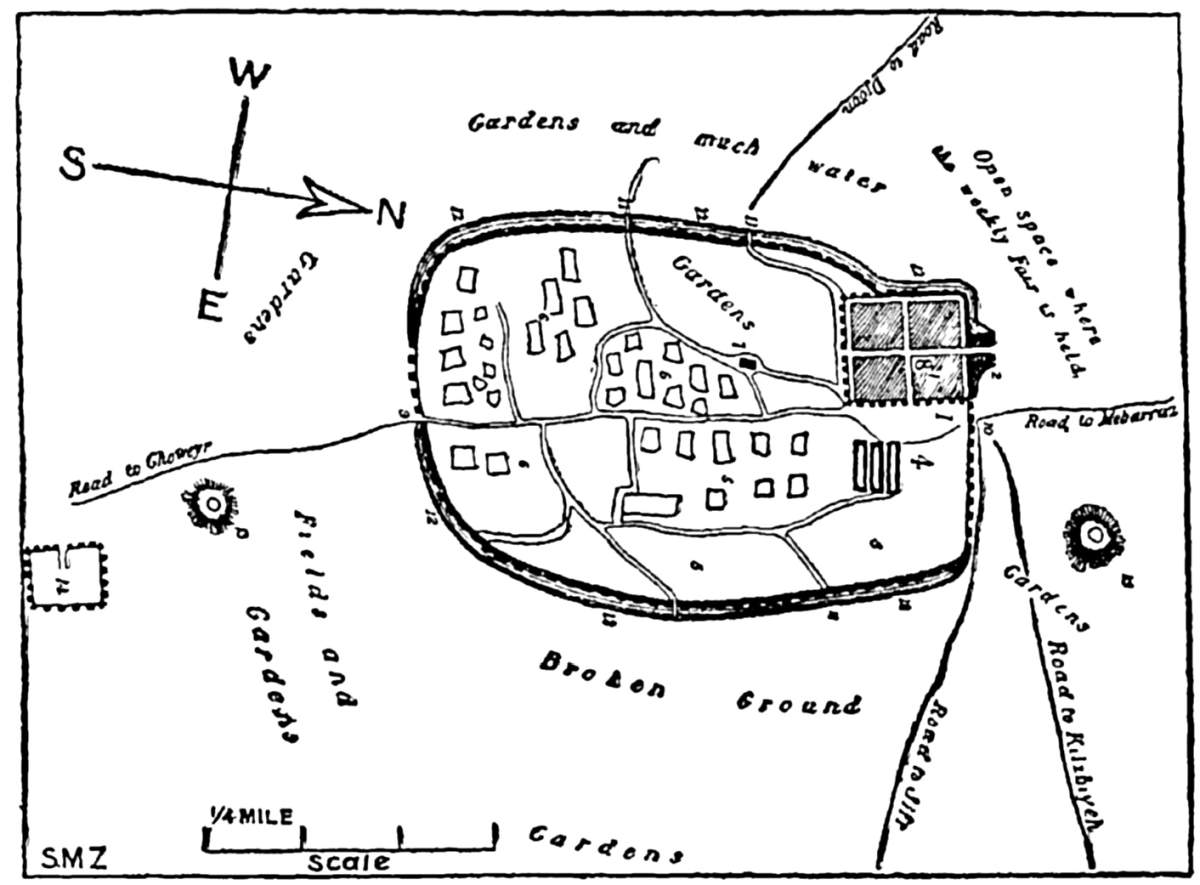
capital of Hassa—Plan of the town—Its manufactures—Curious
coinage—The government of Hassa—Katif—Its unhealthfulness.
The cradle of the race—Boundaries of Mesopotamia—The
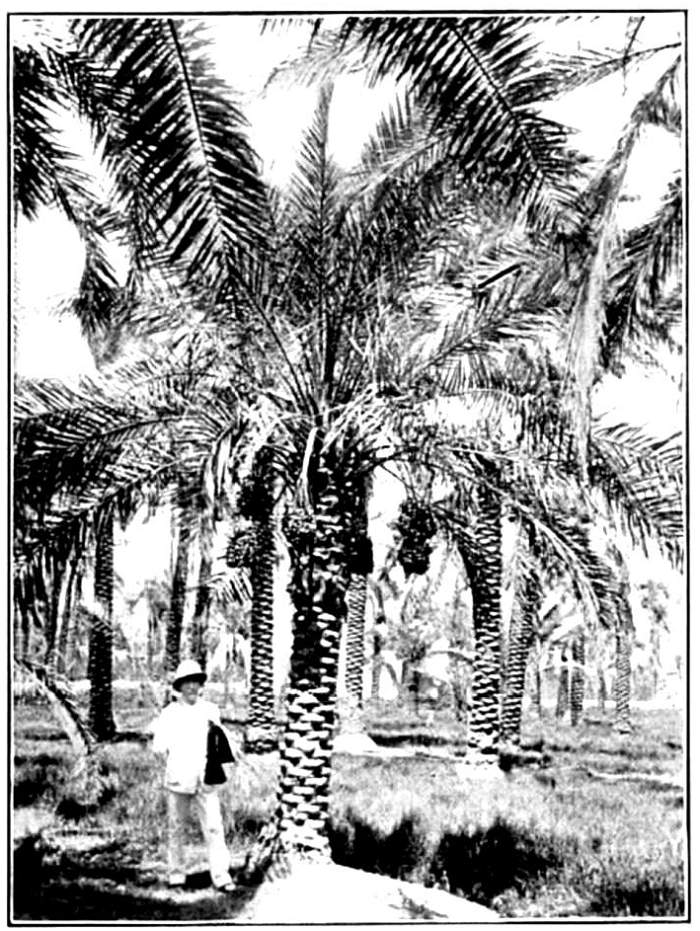
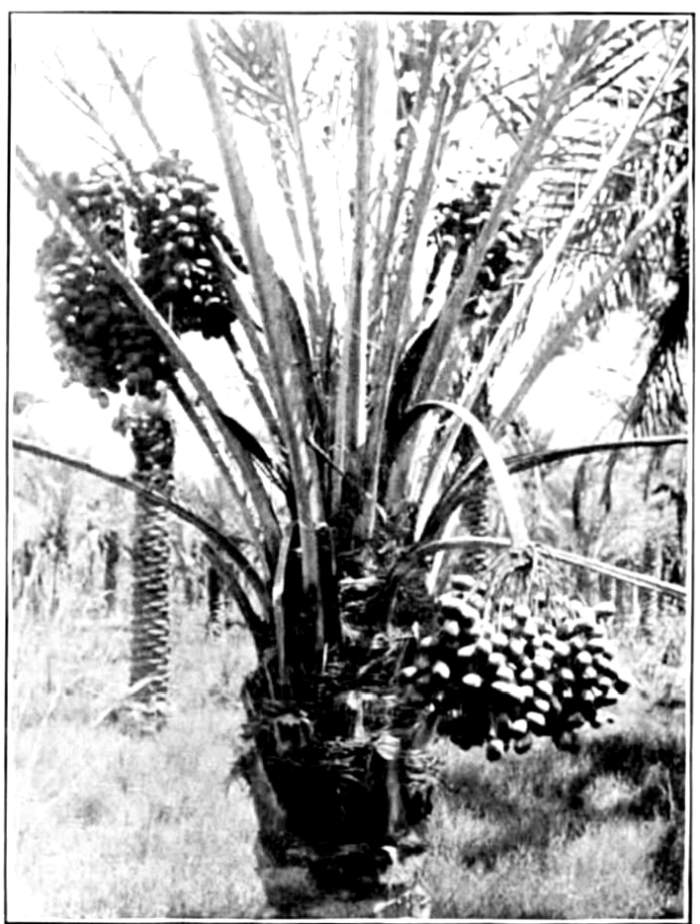
Tigris-Euphrates—Meadow lands—The palms—Their beauty—Fruitfulness—Usefulness—Varieties
of dates—Value—Other
products—Population—Provinces and districts—The
government.
Kuweit—Fao—Aboo Hassib—Busrah—The river navigation—A
journey—Kurna—Ezra’s tomb—Amara—The tomb of the
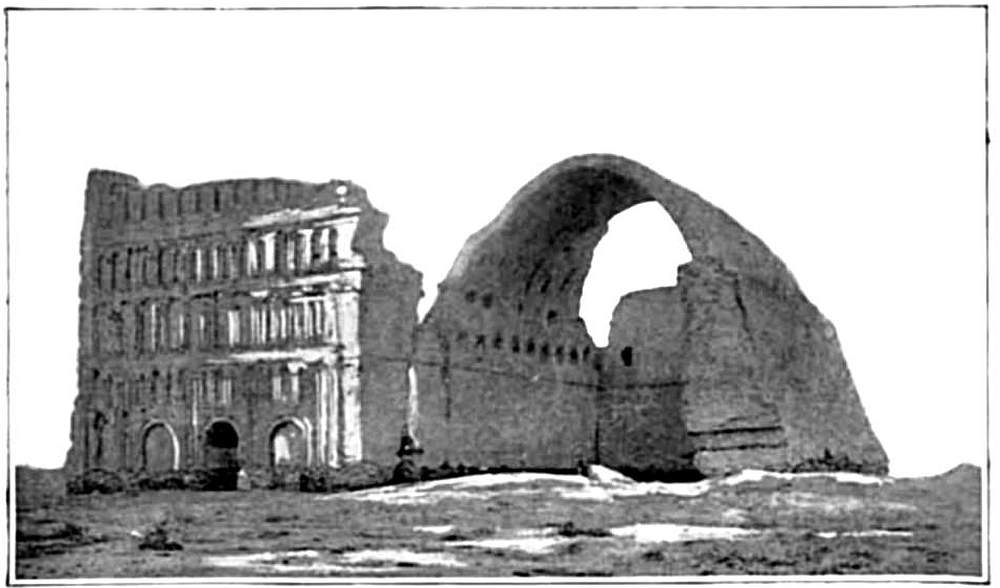
barber—The arch of Ctesiphon—Bagdad, past and present—Population—Trade—Kelleks.
Journey to Hillah—-The route—Kerbela—Down the Euphrates—Diwaniyeh—The
soldier-guard—Amphibious Arabs—Samawa—Ya
Ali, Ya Hassan!—Nasariya—Ur—The end of our
journey—The future of Mesopotamia.
What it includes—Its four divisions—(1) “The empty quarter”—Ignorance
of this part of Arabia—(2) Nejran—The Dauasir-valley
and other wadys—Halévy’s travels—Aflaj—The Roman
expedition to Nejran—(3) Nejd—Its proper limits—The
zephyrs of Nejd—Soil—Vegetation—Animals—The ostrich—The
horse—The chief authorities on this part of Arabia—The
population of Nejd—The character of government—Intercourse
with Mesopotamia—Chief cities—Hail—Riad—(4)Jebel Shammar—The Bedouin-tribes—Division—Character
and customs—Robbery—Universal poverty.
Why so-called—The golden age of literature—The influence of
Christianity and Judaism—Tribal constitution of society—Commerce—Incense—Foreign
invasions—Political commotion—The
condition of women—Female infanticide—The veil—Rights
of women—Marriage choice—Polygamy and Polyandry—Two
kinds of marriage—Did Islam elevate woman?—Writing
in “the days of ignorance”—Poetry—Mohammed’s
opinion of poets—The religions—Sabeanism—The Pantheon
at Mecca—Jinn—Totemism—Tattooing—Names of idols—Allah—Decay
of idolatry—The Hanifs.
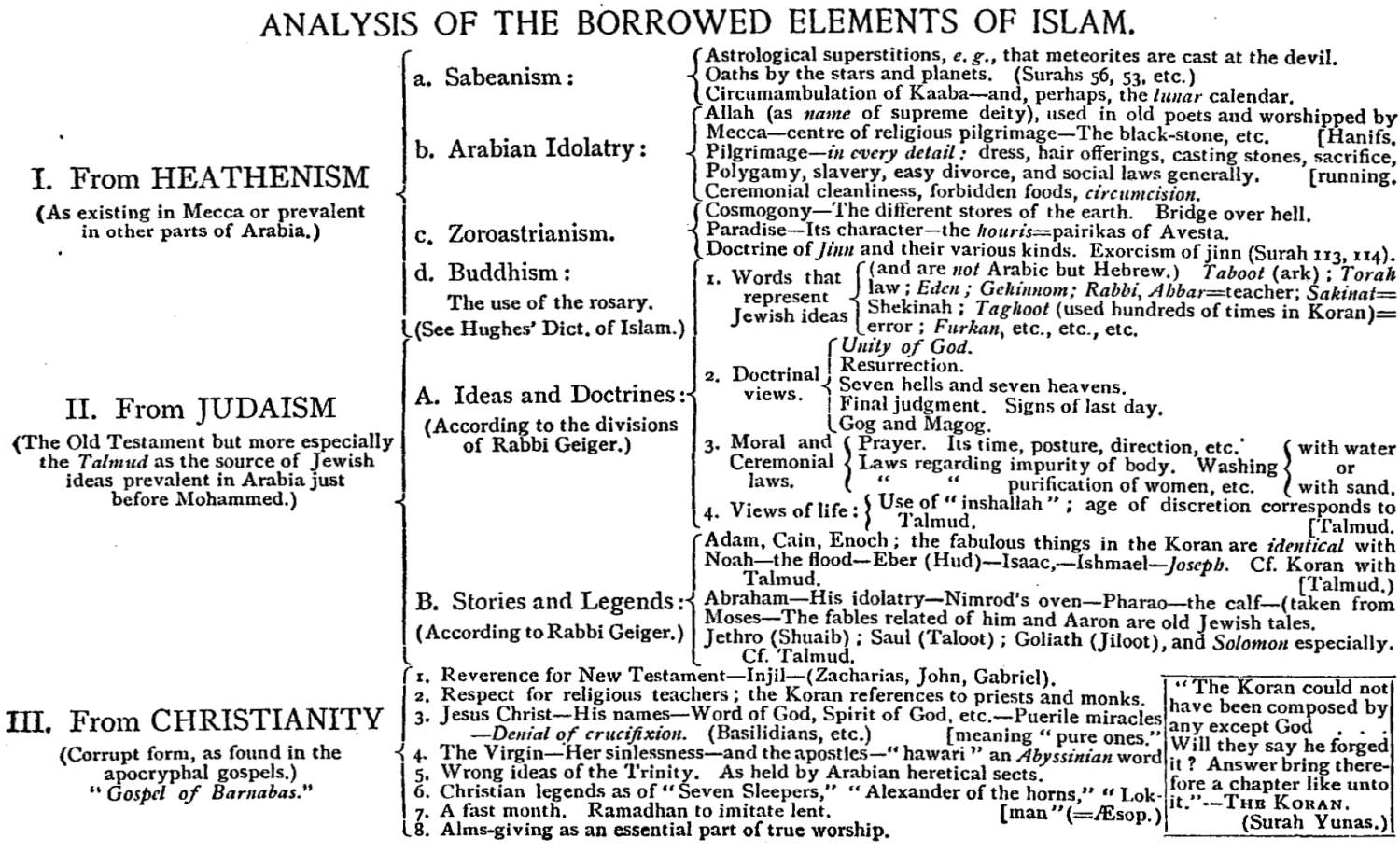
Different views—Carlyle—Hugh Broughton—Borrowed elements
of Islam—The God of Islam—Palgrave’s portrait—Attributes
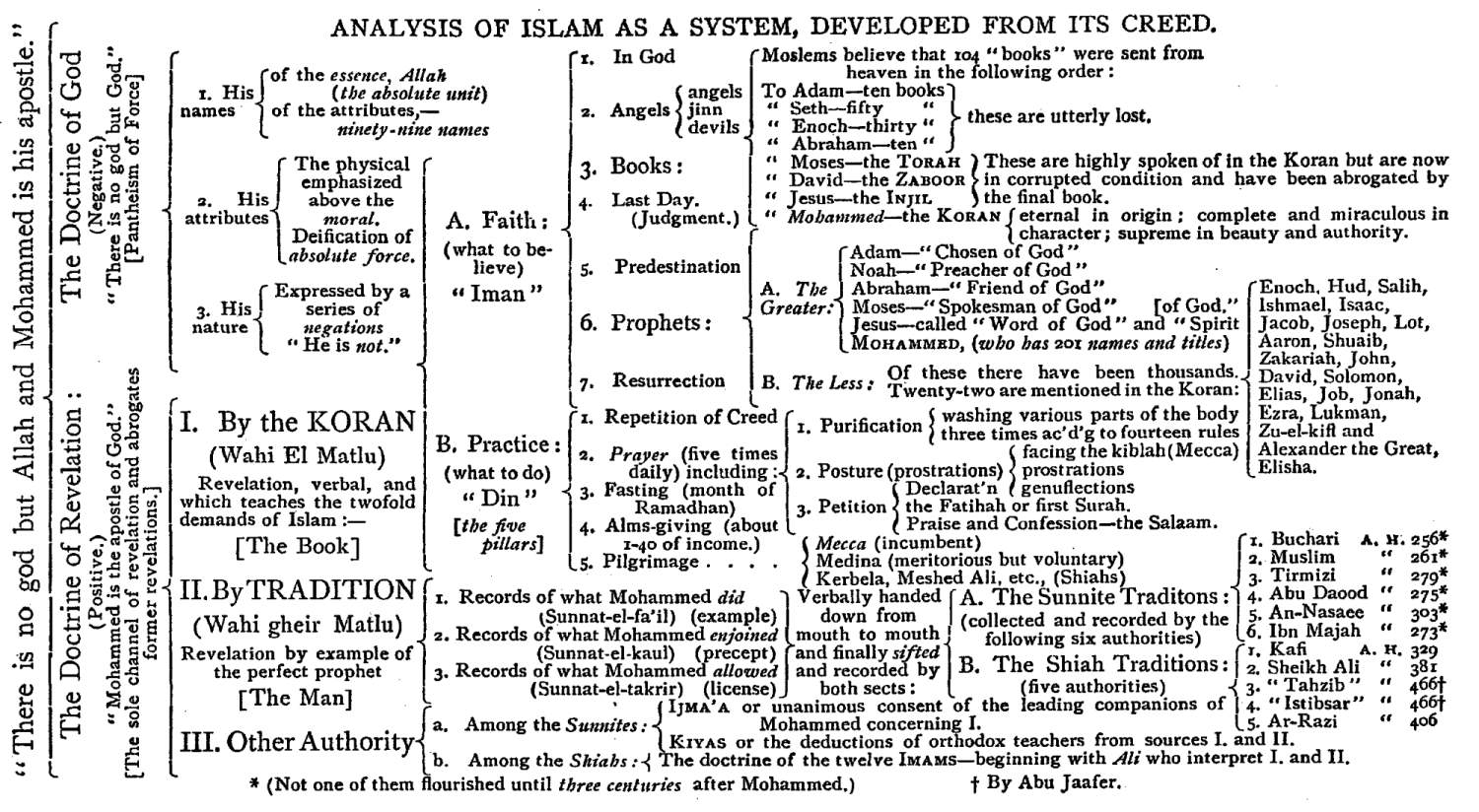
of God—What God is not—Analysis of Islam—Borrowed
elements of Islam.
The prophet of Islam—Birth of Mohammed—His environment—Factors
that helped to make the man—Political, religious and
family factor—Khadijah—Mohammed’s appearance, mind and
character—His transgression of law—His sensuality—His
murders—Expeditions—Mohammed, as he became through
tradition—His glories, favor and power as an intercessor—How
Moslems regard the Koran—Its character according to
Dr. Post, Goethe and Nöldeke—Its names—Contents—Origin—Recension—Its
beauties—Its defects—Its omissions.
The story of past century—The Wahabis—Character of teaching—The
preacher and the sword—Taking of Mecca and Medina—Kerbela—Mohammed
Ali—The Hejaz campaign—Ghalye—Turkish
cruelty—English expedition—Peace—The
Wahabi dynasty—Abdullah bin Rashid—Rise of Nejd kingdom—Character
of rule—Hail conquers Riad.
XX
The Rulers of Oman
202
Oman rulers—Seyid Said—Feysul bin Turki—The rebels take
Muscat—Arab warfare—European diplomacy.
Hejaz—The Sherifs of Mecca—Othman Pasha—Threats to
assassinate him—Turkish troops in Asir—Losses—The conquest
of Yemen—Turkish rule—Rebellions—The rebellion of
1892—Bagdad, Busrah and Hassa—Taxes—The Turks and
Bedouins—The army—Character of rule.
British possessions—Aden—Socotra—Perim—Kuria Muria islands—Bahrein—Her
naval supremacy—In the Gulf—German
testimony—Survey of coasts—Telegraph and posts—Slave-trade—Commerce—British
India S. N. Co.—Gulf trade—The
rupee—Trade of Aden—Overland railway—Treaties with
tribes—The Trucial League—England in Oman—Aden—Makalla—Method
of “protection”—British consuls and
agents.
Wide extent—Its character—Renan’s opinion—The Semitic
family—Their original home—The two theories—Table of the
group—The influence of the Koran on the Arabic language—Koran
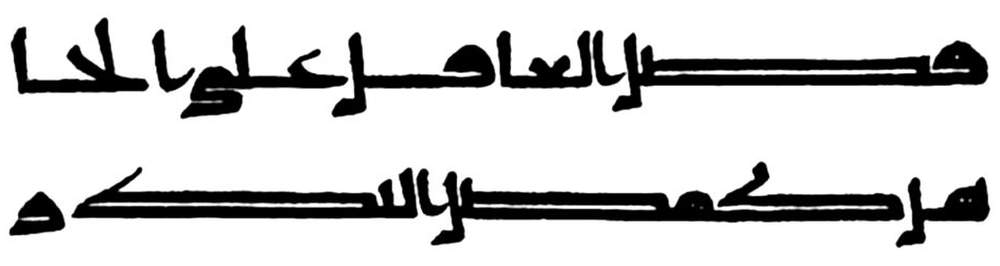
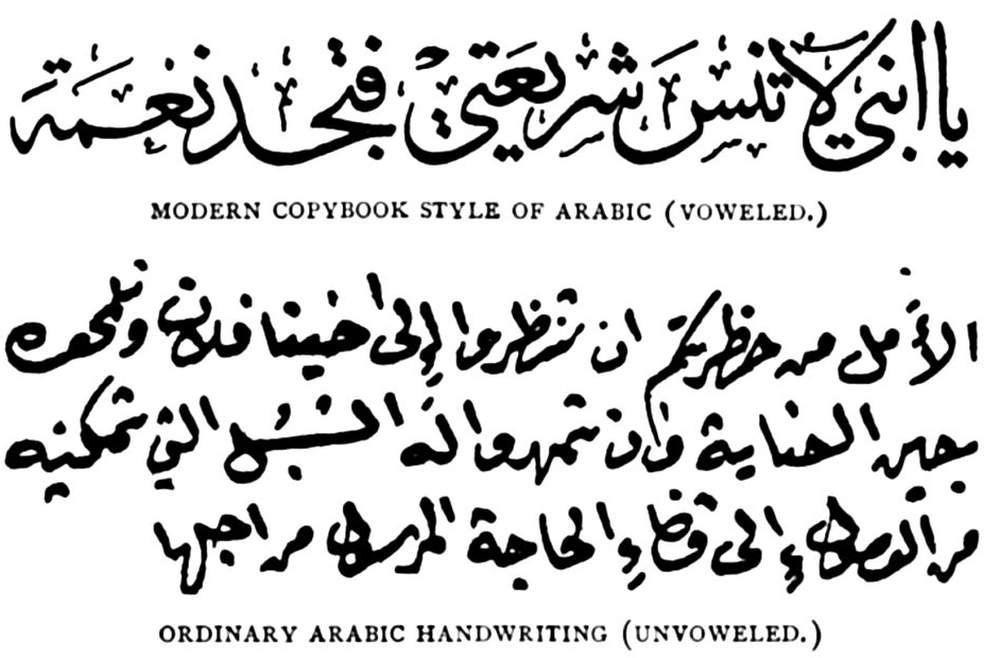
Arabic not pure—Origin of alphabet—Cufic—Caligraphy
as an art—Difficulty and beauty of Arabic speech—Its
purity—Literature—Difficulty of pronunciation—Of its grammar—Keith
Falconer’s testimony.
XXV
The Literature of the Arabs
251
Division of its literature—The seven poems—The Koran—Al
Hariri—Its beauty and variety—Arabic poetry in general—Influence
of Arabic and other languages—English influence
on the Arabic—The Arabic Bible and a Christian literature.
Origin of tribes—Two theories—Yemenite and Maädite—The
caravan routes—Bedouins and townsmen—Clark’s classification—Genealogies—Tribal
names—Character of Arabs—Influence
of neighbors—Their physique—Their aristocracy—Intolerance—Speech—Oaths—Robbery—Privilege
of sanctuary—Generosity—Blood-revenge—Childhood—Fireside
talk—Marriage
among Bedouins—Position of women—Four witnesses—Doughty—Burckhardt—Lady
Ann Blunt—Hurgronje—Woman
despised—The kinds of dwelling—Tents and houses—Dress—The
staple foods—Coffee, tobacco and locusts.
Music of the Arabs—War chants—Instruments of music—Songs—Kaseedahs
in Yemen—Mecca chants—Science of Athar and
Wasm—Tracking camels—Tribal marks—Medical knowledge
of the Arabs—Diseases—Remedies—A prescription—The
Koran’s panacea—A Mecca M. D.—Amulets—Superstitions.
Where they live—Their peculiar religion—Their language—Literature—A
prayer-meeting of the Star Worshippers—Strange
ceremonies—The dogmas—Gnostic ideas—Priesthood—Baptisms—Babylonian
origin.
Pentecost—Paul’s journey—The Arabs and the Romans—Christian
tribes of the North—Mavia—Naaman’s edict—Christianity
in Yemen—Character of Oriental Christianity—The
Collyridians—Theophilus—Nejran converts—Martyrs—Abraha,
king of Yemen—Marching to Mecca—The defeat—End
of early Christianity—The record of the rocks.
Raymond Lull—Henry Martyn—Why the Moslem world was
neglected—Claudius Buchanan’s sermon—The Syrian missions—Doctor
Van Dyck—His Bible translation—Henry
Martyn, the pioneer—His Arabian assistant—Visit to Muscat—His
Arabic version—Anthony N. Groves—Dr. John Wilson of
Bombay—The Bible Society—Opening of doors—Major-General
Haig’s journeys—Arabia open—Dr. and Mrs. Harpur and
the C. M. S.—A call to prayer—Bagdad occupied—The present
work—Missionary journeys to the Jews—William Lethaby
at Kerak—The North Africa mission among the nomads—Samuel
Van Tassel—The Christian Missionary Alliance—Mackay’s
appeal from Uganda—The response.
Keith Falconer’s character—Education—At Cambridge—Mission
work—His “eccentricity”—Leipzig and Assiut—How he
came to go to Arabia—His first visit—Plans for the interior—His
second voyage to Aden—Dwelling—Illness—Death—The
influence of his life—The mission at Sheikh Othman.
“The most distinguished of all C. M. S. missionaries”—Responds
to Mackay’s appeal—His character—His letters from
Muscat—His plans for the interior—Death—The grave.
Its origin—The student band—The first plan—Laid before the
church—Organization—The Missionary Hymn—James Cantine—Syria—Cairo—Aden—Kamil—Journeys
of exploration
to the Gulf and Sana—Busrah—Dr. C. E. Riggs—Death of
Kamil—Opposition from government—Home administration—Bahrein
occupied—Lines of work—Muscat—Journey through
Yemen—The mission transferred to the Reformed Church—Troubles
at Muscat and Busrah—Dr. Worrall—Journeys in
Oman—Scripture-sales—First-fruits—Reinforcements.
The general problem of missions to Moslems—The Arabian
problem—What part of Arabia is accessible—Turkish Arabia—Its
accessibility—Limitations—The accessibility of independent
Arabia—Climate—Moslem fanaticism—English influence—Illiteracy—The
Bedouins—The present missionary
force—Its utter inadequacy—Methods of work—Medical
missions—Schools—Work for women—Colportage—Preaching—Controversy—What
should be its character—The attitude
of the Moslem mind—Fate of converts—Thoughtless and
thoughtful Moslems—The Bible as dynamite—The right men
for the work.
Two views of work for Moslems—Christian fatalism—Results in
Moslem lands—India—Persia—Constantinople—Sumatra and
Java—Other signs of progress—The significance of persecution—Character
of converts—Promise of God for victory over
Islam—Christ or Mohammed—Missionary promises of the
Old Testament—The Rock of Jesus’ Sonship—Special promises
for Arabia—Hagar and Ishmael—The prayer of Abraham—The
sign of the covenant with Ishmael—The third revelation
of God’s love—The sons of Ishmael—Kedar and Nebaioth—The
promises—Seba and Sheba—The spiritual boundaries of
Arabia—Da Costa’s poem—Faith like Abraham—O that Ishmael
might live before thee.
“Intersected by sandy deserts and vast ranges of mountains it presents
on one side nothing but desolation in its most frightful form, while the
other is adorned with all the beauties of the most fertile regions. Such is
its position that it enjoys at once all the advantages of hot and of temperate
climates. The peculiar productions of regions the most distant from one
another are produced here in equal perfection. What Greek and Latin
authors mention concerning Arabia proves by its obscurity their ignorance
of almost everything respecting the Arabs. Prejudices relative to the inconveniences
and dangers of travelling in Arabia have hitherto kept the
moderns in equal ignorance.”—M. Niebuhr (1792).
What Jerusalem and Palestine are to Christendom this,
and vastly more, Mecca and Arabia are to the Mohammedan
world. Not only is this land the cradle of their religion
and the birthplace of their prophet, the shrine toward which,
for centuries, prayers and pilgrimage have gravitated; but
Arabia is also, according to universal Moslem tradition, the
original home of Adam after the fall and the home of all the
older patriarchs. The story runs that when the primal pair
fell from their estate of bliss in the heavenly paradise, Adam
landed on a mountain in Ceylon and Eve fell at Jiddah, on the
western coast of Arabia. After a hundred years of wandering
they met near Mecca, and here Allah constructed for them a
tabernacle, on the site of the present Kaaba. He put in its
foundation the famous stone once whiter than snow, but since
turned black by the sins of pilgrims! In proof of these statements
travellers are shown the Black stone at Mecca and the
tomb of Eve near Jiddah. Another accepted tradition says that
Mecca stands on a spot exactly beneath God’s throne in heaven.
Without reference to these wild traditions, which are soberly
set down as facts by Moslem historians, Arabia is a land of
perpetual interest to the geographer, and the historian.
Since Niebuhr’s day many intrepid travellers have surveyed
the coasts and penetrated into the interior, but his charge that
we are ignorant of the real character of the vast peninsula is
still true as far as it relates to the southern and southeastern
districts. No traveller has yet crossed the northern boundary
of Hadramaut and explored the Dahna desert, also called the
Roba-el-Khali, or “empty abode.” The vast territory between
the peninsula of Katar and the mountains of Oman is also
practically a blank on the best maps. Indeed the only noteworthy
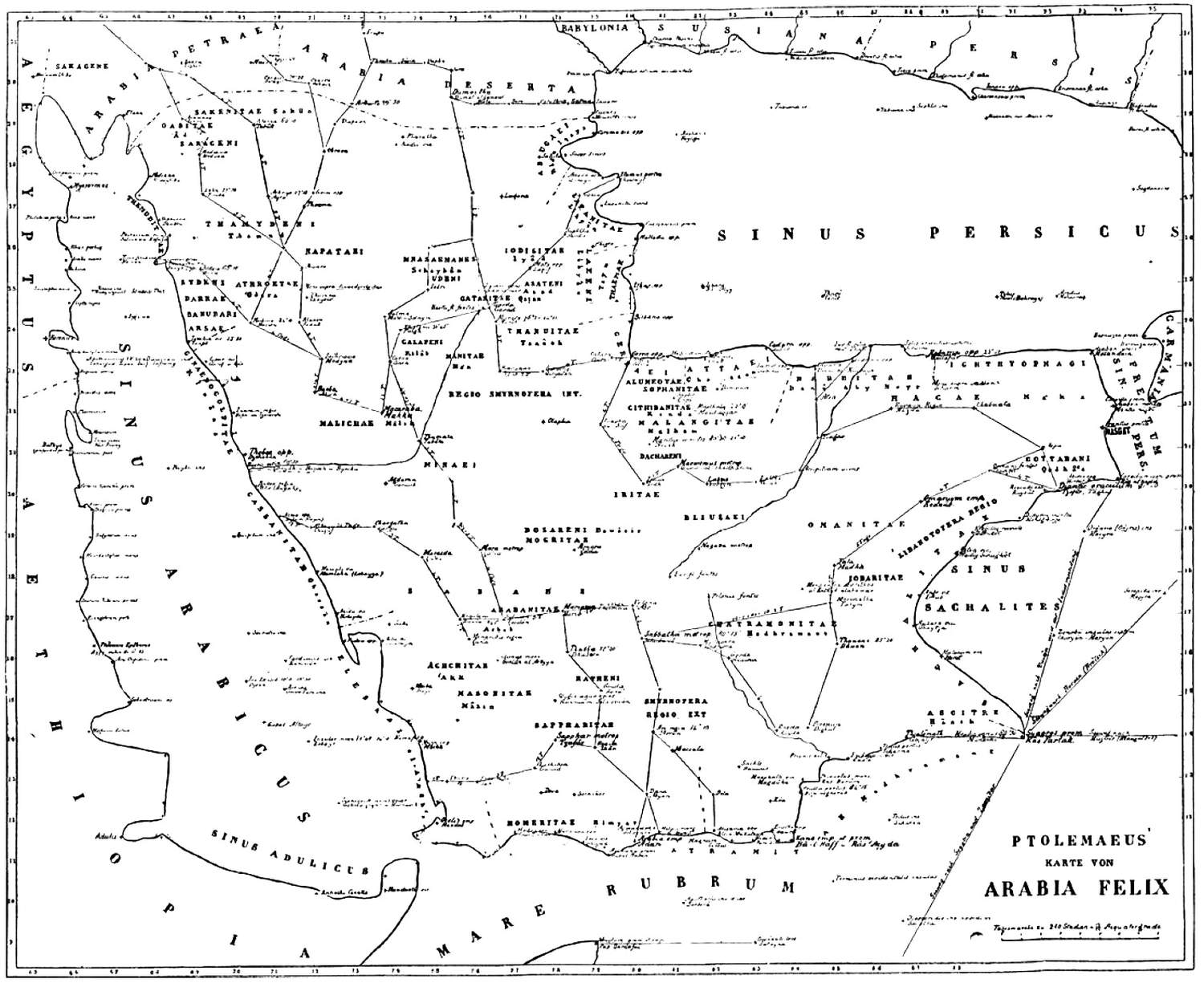
map of that portion of the peninsula is that of Ptolemy
reproduced by Sprenger in his “Alte Geographie Arabiens.”
Arabia has well-defined boundaries everywhere except on the
north. Eastward are the waters of the Persian Gulf, the Strait
of Ormuz and the Gulf of Oman. The entire southern coast is
washed by the Indian Ocean which reaches to Bab-el-Mandeb
“The Gate-of-tears,” from which point the Red Sea and the
Gulf of Akaba form the western boundary. The undefined
northern desert, in some places a sea of sand, completes the
isolation which has led the Arabs themselves to call the
peninsula their “Island” (Jezirat-el-Arab). In fact the northern
boundary will probably never be defined accurately. The
so-called “Syrian desert,” reaching to about the thirty-fifth
parallel might better be regarded as the Arabian desert, for in
physical and ethnical features it bears much greater resemblance
to the southern peninsula than to the surrounding regions of
Syria and Mesopotamia. Bagdad is properly an Arabian city
and to the Arabs of the north is as much a part of the peninsula
as is Aden to those of the southwest. The true, though shifting,
northern boundary of Arabia would be the limit of Nomad
encampments, but for convenience and practical purposes a
boundary line may be drawn from the Mediterranean along the
thirty-third parallel to Busrah.
Thus the shores of Arabia stretch from Suez to the Euphrates
delta for a total length of nearly 4,000 miles. This coast-line
has comparatively few islands or inlets, except in the
Persian Gulf. The Red Sea coast is fringed by extensive coral
reefs, dangerous to navigation, but from Aden to Muscat the
coast is elevated and rocky, and contains several good harbors.
Eastern Arabia has a low, flat coast-line made of coral-rock
with here and there volcanic headlands. Farsan, off the
Tehamah coast, famous as the centre for Arab slave-dhows;
Perim, where English batteries command the gate of the Red
Sea; the Kuria-Muria group in the Indian Ocean; and the
Bahrein archipelago in the Persian Gulf, are the only important
islands. Socotra, although occupied by an Arab population
and historically Arabian, is by geographers generally attached
to Africa. This island is however under the Indian
government, and, once Christian, is now wholly Mohammedan.
The greatest length of the peninsula is about 1,000 miles,
its average breadth 600, and its area somewhat over 1,000,000
square miles. It is thus over four times the size of France or
larger than the United States east of the Mississippi River.
Arabia, until quite recently, has generally been regarded as
a vast expanse of sandy desert. Recent explorations have
proved this idea quite incorrect, and a large part of the region
still considered desert is as yet unexplored. Palgrave, in his
“Central Arabia” gives an excellent summary of the physical
characteristics of the whole peninsula as he saw it. Since his
time Hadramaut has been partially explored and the result confirms
his statements: “The general type of Arabia is that of
a central table-land surrounded by a desert ring sandy to the
south, west and east, stony to the north. This outlying circle
is in its turn girt by a line of mountains low and sterile for the
most, but attaining in Yemen and Oman considerable height,
breadth and fertility; while beyond these a narrow rim of
coast is bordered by the sea. The surface of the midmost
table-land equals somewhat less than one-half of the entire
peninsula; and its special demarkations are much affected,
nay often absolutely fixed, by the windings and inrunnings of the
Nefud (sandy desert). If to these central highlands or Nejd,
taking that word in its wider sense, we add whatever spots of
fertility belong to the outer circles, we shall find that Arabia
contains about two-thirds of cultivated or at least of cultivatable
land, with a remaining third of irreclaimable desert, chiefly
on the south.”
From this description it is evident that the least attractive
part of the country is the coast. This may be the reason that
Arabia has been so harshly judged, as to climate and soil and
so much neglected by those who only knew of it from the captains
who had touched its coast in the Red Sea and the Persian
Gulf. Nothing is more surprising, than to pass through
the barren cinder gateway of Aden up the mountain passes
into the marvellous fertility and delightful climate of Yemen.
Arabia like the Arab, has a rough, frowning exterior but a
warm, hospitable heart.
From the table-land of Nejd, which has an average elevation
of about 3,000 feet above the sea, there is a gradual ascent
southward to the highlands of Yemen and Oman where there
are mountain peaks as high as 8,000 and 10,000 feet. This
diversity of surface causes an equal diversity of climate. The
prevailing conditions are intense heat and dryness, and the
world-zone of maximum heat in July embraces nearly the entire
peninsula. On the coast the heat is more trying because
of the moisture from the enormous evaporation of the land-locked
basins. During part of the summer there is scarcely
any difference in the register of the wet and dry-bulb thermometer.
In the months of June, July and August, 1897, the
averages of maximum temperature at Busrah were 100°, 103-1/2°
and 102° F.; and the minimum 84°, 86-1/2° and 84° F. Nejd
has a salubrious climate, while in Yemen and Oman on the
highlands the mercury even in July seldom rises above 85°.
In July, 1892, I passed in one day’s journey from a shade temperature
of 110° F. on the coast at Hodeidah to one of 55° at
Menakha on the mountains. At Sanaa there is frost for three
months in the year, and Jebel Tobeyk in northwest Arabia is
covered with snow all winter. In fact, all northern Arabia
has a winter season with cold rains and occasional frosts.
The geology of the peninsula is of true Arabian simplicity.
According to Doughty it consists of a foundation stock of plutonic
(igneous) rock whereon lie sandstone, and above that
limestone. Going from Moab to Sinai we cross the strata in
the reverse order, while in the depression of the gulf of Akaba
the three strata are in regular order although again overtopped
by the granite of the mountains. Fossils are very rare, but
coral formation is common all along the coast. Volcanic formations
and lava (called by the Arabs, harrat) crop out frequently,
as in the region of Medina and Khaibar. In going
by direct route from the Red Sea (Jiddah) to Busrah, we meet
first granite and trap-rock, overtopped in the Harrat el-Kisshub
by lavas, and further on at Wady Gerir and Jebel Shear by
basalts; at the Nefud el Kasim (Boreyda) sandstones begin
until we reach the limestone region of Jebel Toweyk. Thence
all is gravel and sand to the Euphrates.
Arabia has no rivers and none of its mountain streams (some
of which are perennial) reach the seacoast. At least they do
not arrive there by the overland route, for it is a well-established
fact that the many fresh water springs found in the
Bahrein archipelago have their origin in the uplands of Arabia.
At Muscat, too, water is always flowing toward the sea in
abundance at the depth of ten to thirty feet below the wady-bed;
this supplies excellent well-water. In fact the entire
region of Hasa is full of underground watercourses and perennial
springs. Coast-streams are frequent in Yemen during
the rain-season and often become suddenly full to overflowing
dashing everything before them. They are called sayl, and
well illustrate Christ’s parable of the flood which demolished
the house built upon the sand.
The great wadys of Arabia are its characteristic feature,
celebrated since the days of Job, the Arab. These wadys,
often full to the brim in winter and black by reason of frost
but entirely dried up during the heat of summer, would never
be suspected of giving nourishment to even a blade of grass.
They are generally dry for nine and ten months in the year,
during which time water is obtained from wells sunk in the
wady-bed. Wady Sirhan runs in a southeasterly direction
from the Hauran highlands to the Jauf district on the edge of
the great Nefud; it is fed by the smaller Wady er-Rajel.
Wady Dauasir which receives the Nejran streams drains all
of the Asir and southern Hejaz highlands northward to Bahr
Salumeh, a small lake, the only one known in the whole peninsula.
The Aftan is another important wady running from
the borders of Nejd into the Persian Gulf. This wady-bed is
marked on some maps as a river, flowing into the Persian Gulf
apparently by two mouths. It does not exist to-day. The
most important water-bed in Arabia is the celebrated Wady er-Ruma,
only partly explored, which flows from Hejaz across
the peninsula for nearly 800 miles in a northwesterly direction
toward the Euphrates. Were there a more abundant rainfall
this wady would reach the Shat-el-Arab and give unity to the
now disjointed water-system of Mesopotamia and north Arabia.[1]
For obvious reasons the caravan routes of Arabia
generally follow the course of the wadys.
Arabia is also a land of mountains and highlands. The
most clearly developed system is the extensive range skirting
the Red Sea at a distance of from one to three days’ journey
from the coast. South of Mecca there are peaks of over 8,000
feet; and beyond, the range broadens out to form the Yemen
highlands, a corner of the peninsula worthy of its old name
“Arabia Felix.” The mountains along the south coast are
more irregular and disconnected until they broaden out a second
time between Ras el Had and Ras Mussendum to form the
highlands of Oman. Along the gulf coast there are no mountains
except an occasional volcanic hill like Jebel Dokhan in
Bahrein and Jebel Sanam near Zobeir.
The Nejd is crossed by several ridges of which the best
known is Jebel Shammar running nearly east and west at an
altitude of about 6,000 feet. Jebel Menakib, Jebel Aared,
Jebel Toweyk and Jebel Athal are other ranges south of Jebel
Shammar and also running in a similar direction toward the
southwest and northeast. The Sinai peninsula is a rocky limestone
plateau intersected by rugged gorges and highest toward
the south in the region of Sinai proper.
Next to its wadys and mountains Arabia is characterized
chiefly by the so-called Harrat or volcanic tracks already
mentioned. These black, gloomy, barren regions occupy a
much wider extent of north Arabia than is generally supposed.
The largest is Harrat Khaibar, north of Medina, the old centre
of the Jews in the days of Mohammed. It is over 100
miles in length and in some parts thirty miles wide. A wilderness
of lava and lava-stones with many extinct crater heads,
craggy, and strewn with rough blocks of basalt and other igneous
rocks. In some places the lava beds are 600 feet deep.
Signs of volcanic action are still seen at Khaibar, smoke issuing
from crevices and steam from the summit of Jebel Ethnan.
A volcanic eruption was seen at Medina as late as 1256 A.D.[2]
and the hot and sulphur springs of Hasa and Hadramaut seem
to indicate present volcanic action.
The sandy-tracts of the so-called Arabian deserts are termed
by the Arabs themselves nefud (drained, exhausted, spent),
the name given on most maps. The general physical features
of this “desert” are those of a plain clothed with stunted,
aromatic shrubs of many varieties, but their value as pasture is
very unequal, some being excellent for camels and sheep, others
absolutely worthless. Some nefuds abound in grasses and
flowering plants after the early rains, and then the desert
“blossoms like the rose.” Others are without rain and
barren all year; they are covered with long stretches of drift-sand,
carried about by the wind and tossed in billows on the
weather side of the rocks and bushes.[3] Palgrave asserts that
some of the nefud sands are 600 feet deep. They prevail in
the vast unexplored region south of Nejd and north of Hadramaut
including the so-called “Great Arabian Desert.” Absolute
sterility is the dominant feature here, whereas the northern
nefuds are the pasture lands for thousands of horses and sheep.
PTOLEMAEUS KARTE VON ARABIA FELI
II THE GEOGRAPHICAL DIVISIONS OF ARABIA
The division of Arabia into provinces has always been
rather according to physical geography than political
boundaries. The earliest division of the peninsula, and in
some respects the most correct, was that of the Greek and Roman
writers into Arabia Deserta and Arabia Felix. The latter
epithet was perhaps only a mistaken translation of El-Yemen—the
land on “the right hand,” that is south of Mecca, for
the Orientals face east. This is contrasted with Syria which
in Arabic is called “Es-Sham” or the land “to the left” of
Mecca. The third division, Arabia Petræa, or “Stony Arabia,”
first appears in Ptolemy and is applied to the Sinai district.
He limits Arabia Deserta to the extreme northern desert
and so his map of the entire peninsula bears the title of Arabia
Felix. The great geographer anticipated all modern maps of
Arabia by naming the regions according to the tribes that inhabit
them; a much more intelligent method than the drawing
of artificial lines around natural features and dubbing them
with a name to suit the cartographer.
The Arab geographers know nothing of this threefold division
into sandy, stony, and happy-land. They divide the
Island-of-the-Arabs (Jezirat-el-Arab) into five provinces.[4] The
first is called El-Yemen and includes Hadramaut, Mehrah,
Oman, Shehr, and Nejran. The second El-Hejaz, on the
west coast, so called because it is the barrier between Tehama
and Nejd; it nearly corresponds to our Hejaz, excluding its
southern portion. The third is Tehama, along the coast,
between Yemen and Hejaz. The fourth is Nejd, a term
loosely applied to all the interior table-lands. The fifth is
called Yemama or ’Arudh because it extends all the “wide”
way between Yemen (Oman) and Nejd. It is important to
distinguish between this Arabian division and that now nearly
everywhere adopted on the maps of the occident; much confusion
has arisen when this distinction was not made.
The modern division of the peninsula into seven provinces:
Hejaz, Yemen, Hadramaut, Oman, Hasa, Irak and Nejd, is
according to political geography and serves all practical purposes,
although it is not strictly accurate. Hejaz, the Holyland
of Arabia, includes the sacred cities of Mecca and Medina.
Yemen is bounded by the line of fertility on the north
and east so as to include the important region of Asir. Hadramaut
has no clearly defined boundaries and stretches northward
to the unknown region of the Dahna. Oman is the
peninsula between the southern shore of the Gulf and the
Indian Ocean, while Hasa covers the entire coast district
north of El-Katar peninsula (on some maps called El-Bahrein).
Irak-Arabi or Irak is the northern river-country politically corresponding
to what is called “Turkish-Arabia.”
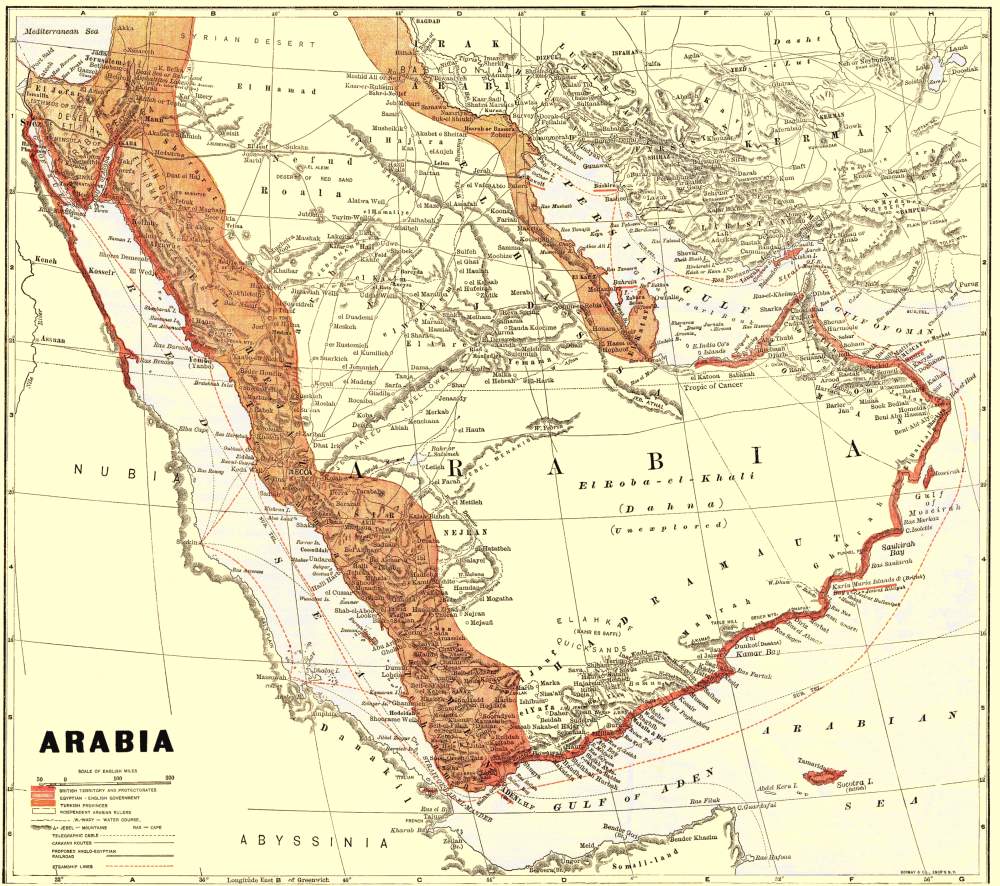
As to the present division of political power in Arabia, it is
sufficient here to note that the Sinai peninsula and 200 miles
of coast south of the Gulf of Akaba is Egyptian; Hejaz,
Yemen and Hasa are nominally Turkish provinces, but their
political boundaries are shifting and uncertain. The present
Shereef of Mecca at times dictates to the Sublime Porte while
the Bedouin tribes even in Hejaz acknowledge neither Sultan
nor Shereef and waylay the pilgrim caravans that come to the
holy cities unless they receive large blackmail. In Yemen the
Arabs have never ceased to fret under the galling yoke of the
Turk since it was put on their shoulders by the capture of
Sana in 1873. The insurrection in 1892 was nearly a revolution
and again this year (1899) all Yemen is in arms. It is
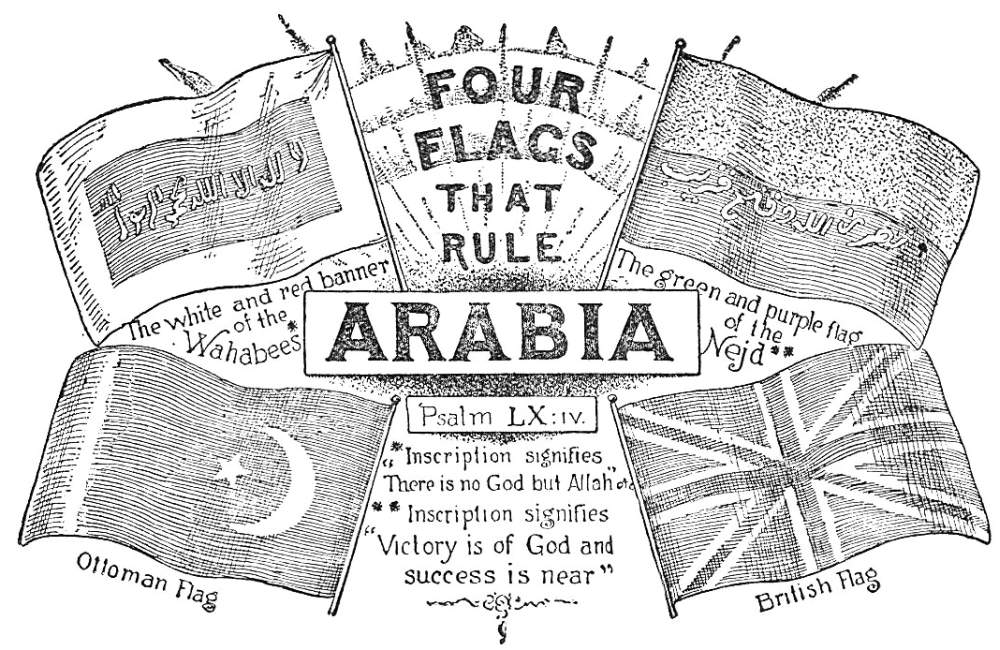
very suggestive that in the present revolt some of the Arabs
made use of the English flag to secure sympathy.
In Hasa, the real sovereignty of Turkey only exists in three
or four towns while all the Bedouin and many of the villagers
yield to the Dowla, neither tribute, obedience nor love. Irak
alone is actually Turkish and yields large revenue. But even
here Arab-uprisings are frequent. Nominally, however, Turkey
holds the fairest province on the south, the religious
centres on the west and the fertile northeast of Arabia,—one-fifth
of the total area of the peninsula.
The remainder of Arabia is independent of Turkey. Petty
rulers calling themselves Sultans, Ameers or Imams have for
centuries divided the land between them. The Sultanate of
Oman and the great Nejd-kingdom are the only important
governments, but the former lost its glory when its seat of
power and influence was transferred to Zanzibar. Nejd in its
widest sense is governed to-day by Abd-el-Aziz bin Mitaab the
nephew of the late Mohammed bin Rashid, King Richard of
Arabia, who gained his throne by the massacre of seventeen
possible pretenders. The territory of this potentate is bordered
southward by Riad and the Wahabi country. Northward
his influence extends beyond the Nefud, right away to
the Oases of Kaf and Ittery in the Wady Sirhan (38° E.
Long., 31° N. Lat.) east of the Dead Sea. The inhabitants of
these oases acknowledge Abd-el-Aziz as their suzerain paying
him a yearly tribute of four pounds ($20.00) for each village.
The people of the intervening district of Jauf also acknowledge
his rule which reaches westward to Teima. He also
commands the new pilgrim-route from the northeast which
formerly passed through Riad but now touches Hail, the capital
of Nejd. The Wahabi movement has collapsed and their
political power is broken, although their influence has extended
to the furthest confines of Arabia.
The only foreign power dominant in Arabia, beside Turkey,
is England. Aden became a British possession in 1838 and
since then British influence has extended until it now embraces
a district 200 miles long by forty broad and a population of
130,000. The Island of Perim in the Strait of Bab-el-Mandeb,
the Kuria-Muria Islands on the south coast, and Socotra are
also English. All the independent tribes on the coast from
Aden to Muscat and from Muscat to Bahrein have made exclusive
treaties with Great Britain, are subsidized by annual
payments or presents and are “protected.” Muscat and
Bahrein are in a special sense protected states since England’s
settled policy is to have sole dominion in the Persian Gulf.
She has agencies or consulates everywhere; the postal system
of the Persian Gulf is British; the rupee has driven the piastre
out of the market and as ninety-eight per cent. of the commerce
is in English hands the Persian Gulf may yet become an
English lake.
Arabia has no railroads, but regular caravan routes take their
place in every direction. Turkish telegraph service exists between
Mecca and Jiddah in Hejaz; between Sanaa, Hodeidah
and Taiz in Yemen; and along the Tigris-Euphrates between
Bagdad and Busrah connecting at Fao (at the delta) with the
submarine cable to Bushire and India.
Of the fauna and flora of Arabia we will not here speak at
length. The most characteristic plants are the date-palm of
which over 100 varieties are catalogued by the Arab peasantry,
and which yields a staple food. Coffee, aromatic and
medicinal plants, gums and balsams, have for ages supplied
the markets of the world. Yemen is characterized by tropical
luxuriance, and in Nejd is the ghatha tree which grows to a
height of fifteen feet, and yields the purest charcoal in the
world.
Among the wild animals were formerly the lion and the
panther, but they are now exceedingly rare. The wolf, wild
boar, jackal, gazelle, fox, monkey, wild cow (or white antelope)
ibex, horned viper, cobra, bustard, buzzard and hawk are
also found. The ostrich still exists in southwest Arabia but is
not common The chief domestic animals are the ass, mule,
sheep, goats, but above all and superior to all, the camel and
the horse.
The exact population of a land where there is no census, and
where women and girls are never counted is of course unknown.
The Ottoman government gives exaggerated estimates for its
Arabian provinces, and travellers have made various guesses.
Some recent authorities, omitting Irak, put the total population
of Arabia as low as 5,000,000. A.H. Keane, F.R.G.S.,
gives the following estimate:[5]
Turkish Arabia
Hejaz,
3,500,000
Yemen,
2,500,000
Independent Arabia
Oman,
1,500,000
Shammar, Bahrein, etc.,
3,500,000
11,000,000
Albrecht Zehm in his book “Arabien seit hundert Jahren,”
arrives at nearly the same result:
Yemen and Asir,
2,252,000
Hadramaut,
1,550,000
Oman and Muscat,
1,350,000
Bahrein Katif, Nejd,
2,350,000
Hejaz, Anaeze, Kasim, and Jebel Shammar,
3,250,000
10,752,000
But undoubtedly both of these estimates, following Turkish
authorities, are too high, especially for Hejaz and Yemen. A
conservative estimate would be 8,000,000 for the entire peninsula
in its widest extent. The true number of inhabitants will
remain unknown until further explorations disclose the real
character of southeastern Arabia, and until northern Hadramaut
yields up its secrets. In this, as in other respects, the
words of Livingstone are true: “The end of the geographical
feat is the beginning of the missionary enterprise.”
III THE HOLY LAND OF ARABIA—MECCA
“The Eastern world moves slowly—eppur si muove. Half a generation
ago steamers were first started to Jiddah: now we hear of a projected railway
from that port to Mecca, the shareholders being all Moslems. And
the example of Jerusalem encourages us to hope that long before the end
of the century a visit to Mecca will not be more difficult than a trip to
Hebron.”—Burton (1855).
“Our train of camels drew slowly by them: but when the smooth
Mecca merchant heard that the stranger riding with the camel men was a
Nasrany, he cried ‘Akhs! A Nasrany in these parts!’ and with the horrid
inurbanity of their jealous religion he added, ‘Ullah curse his father!’
and stared on me with a face worthy of the Koran.”—Doughty (1888)
It is a rule laid down in the Koran and confirmed by many
traditions that the sacred territory enclosing the birthplace
and the tomb of the prophet shall not be polluted by the
visits of infidels. “O believers! only those are unclean who
join other gods with God! Let them not therefore after this
their year come near the Sacred Mosque.” (Surah ix. 27.)
Mohammed is reported to have said of Mecca, “What a
splendid city thou art, if I had not been driven out of thee by
my tribe I would dwell in no other place but in thee. It is not
man but God who has made Mecca sacred. My people will be
always safe in this world and the next as long as they respect
Mecca.” (Mishkat book XL., ch. xv.)
The sacred boundaries of Mecca and Medina not only shut
out all unbelievers, but they make special demands of “purity
and holiness” (in the Moslem sense) on the part of the true
believers. According to tradition it is not lawful to carry
weapons or to fight within the limits of the Haramein. Its
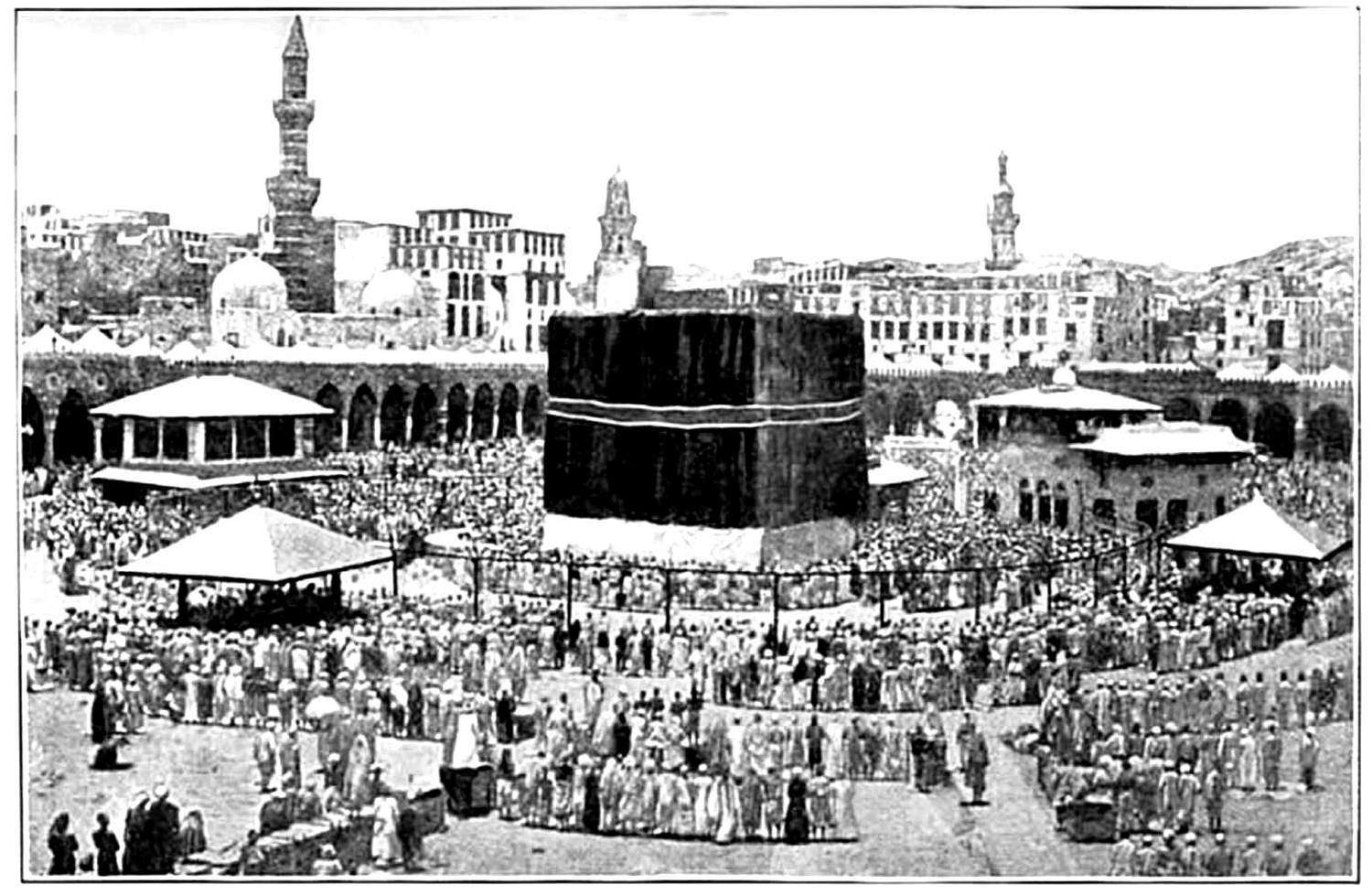
MOHAMMEDAN PILGRIMS AT MECCA
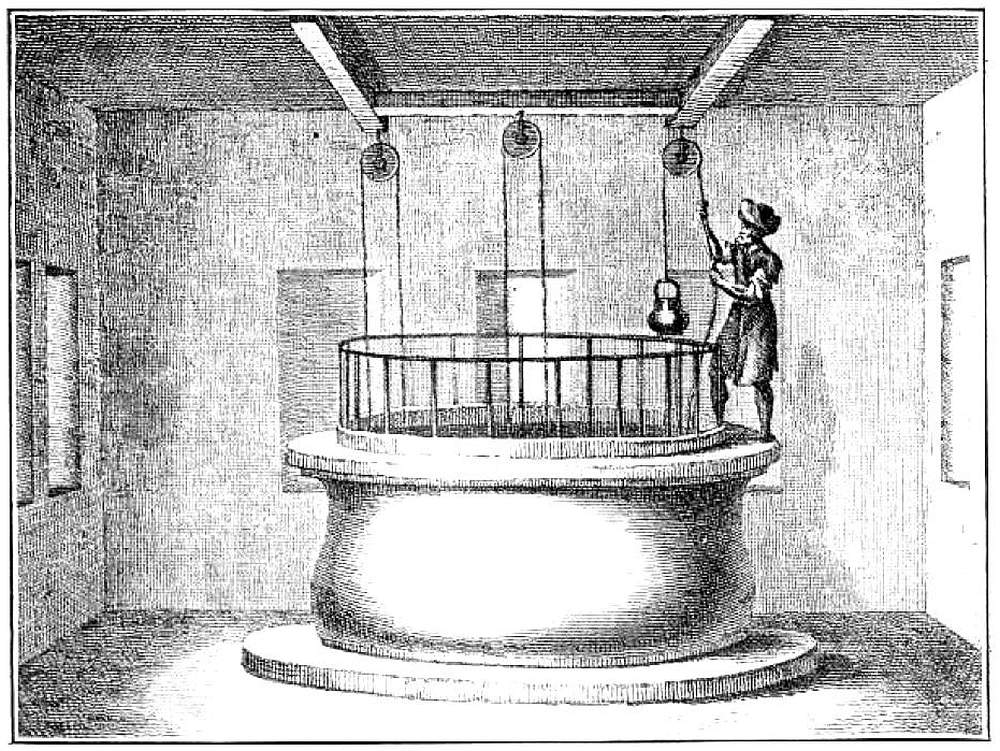
THE SACRED WELL OF ZEMZEM AT MECCA
grass and thorns must not be cut nor must its game be molested.
Some doctors of law hold that these regulations do not apply to
Medina, but others make the burial-place of the prophet equally
sacred with the place of his birth. The boundaries of this
sacred territory are rather uncertain. Abd ul Hak says that
when, at the time of the rebuilding of the Kaaba, Abraham, the
friend of God, placed the black stone, its east, west, north and
south sides became luminous, and wherever the light extended,
became the boundaries of the sacred city! These
limits are now marked by pillars of masonry, except on the
Jiddah and Jairanah road where there is some dispute as to
the exact boundary.
The sacred territory of Medina is ten or twelve miles in
diameter, from Jebel ’Air to Saoor. Outside of these two
centres all of the province of Hejaz is legally accessible to infidels,
but the fanaticism of centuries has practically made the
whole region round Mecca and Medina forbidden territory to
any but Moslems. In Jiddah Christians are tolerated because
of necessity, but were the Mullahs of Mecca to have their way
not a Frankish merchant or consul would reside there for a
single day.
Despite these regulations to shut out “infidels” from witnessing
the annual pilgrimage and seeing the sacred shrines of
the Moslem world, more than a score of travellers have braved
the dangers of the transgression and escaped the pursuit of
fanatics to tell the tale of their adventures.[6] Others have lost
their life in the attempt even in recent years. Doughty[7] tells
of a Christian who was foully murdered by Turkish soldiers
when found in the limits of Medina in the summer of 1878.
Burton at one time barely escaped being murdered because
they suspected him of being an unbeliever.
Jiddah, the harbor of Mecca, is distant from the sacred city
about sixty-five miles, and is in consequence the chief port of
debarkation and embarkation for pilgrims. It has a rather
pretty and imposing appearance from the sea, the houses being
white and three or four stories high, surrounded by a wall and
flanked by a half dozen lazy windmills of Dutch pattern! Its
streets are narrow, however, and indescribably dirty, so that
the illusion of an Oriental picture is dispelled as soon as you
set foot on shore. The sanitary condition of this port is the
worst possible; evil odors abound, the water supply is precarious
and bad, and a shower of rain is always followed by
an outbreak of fever. The population is not over 20,000 of
every Moslem nation under heaven, Galilee of “the believers.”
Its commercial importance, which once was considerable, has
altogether declined. The opening of the Suez canal and the
direct carrying of trade by ocean steamers dealt the deathblow
to the extensive coast-trade of both Jiddah and the other Red
Sea ports. The people of Jiddah, like those of Mecca, live
by fleecing pilgrims, and when the traffic is brisk and pilgrims
affluent they grow rich enough to go to Mecca and set up a
larger establishment of the same sort. There are hotel-keepers,
drummers, guides, money-changers, money-lenders, slave-dealers
and even worse characters connected with the annual transfer
of the caravans of hajees (pilgrims) from the coast inland.
The number of pilgrims arriving at Jiddah by sea in 1893 was
92,625. In 1880 Mr. Blunt collected some interesting statistics
of the total numbers attending the pilgrimage at Mecca,[8] and
his investigations prove that the overland caravans are steadily
becoming smaller.
Before any pilgrims are allowed to enter Jiddah harbor they
are compelled to undergo ten days’ quarantine at Kamaran, an
island on the west coast of Arabia; this is the first woe. At
Jiddah they remain only a few days and then having secured
their Mutawwaf or official guide they proceed to Mecca. The
road is barren and uninteresting in the extreme. Halfway to
Mecca is El Had where the road divides; one branch leads
to Taif, the only fertile spot in this wilderness province, and
the other proceeds to Mecca, the ancient name of which was
Bakkah.
Were we to believe one half of what is said by Moslem
writers in praise of Mecca it would prove the Holy City to be
a very paradise of delights, a centre of learning and the paragon
of earthly habitations. But the facts show it to be far
otherwise. The location of the city is unfortunate. It lies in
a hot sandy valley absolutely without verdure and surrounded
by rocky barren hills, destitute of trees or even shrubs. The
valley is about 300 feet wide and 4,000 feet long, and slopes
toward the south. The Kaaba or Beit Allah is located in the
bed of the valley and all the streets slope toward it, so that it
is almost closed in on every side by houses and walls, and
stands as it were in the pit of the theatre. The houses are
built of dark stone and are generally lofty in order to accommodate
as many pilgrims as possible in the limited space. The
streets are nearly all unpaved and in summer the sand and
dust are as disagreeable as is the black mud in the rainy season.
Strangely enough, although the city itself and even the
Kaaba have more than once suffered from destructive floods
that have poured down the narrow valley, Mecca is poorly
provided with water. There are few cisterns to catch the
rains and the well water is brackish. The famous well of
Zemzem has an abundance of water but it is not fit to drink.[9]
The best water is brought by an aqueduct from the vicinity of
Arafat six or seven miles distant and sold for a high price by a
water-trust which annually fills the coffers of the Shereef of
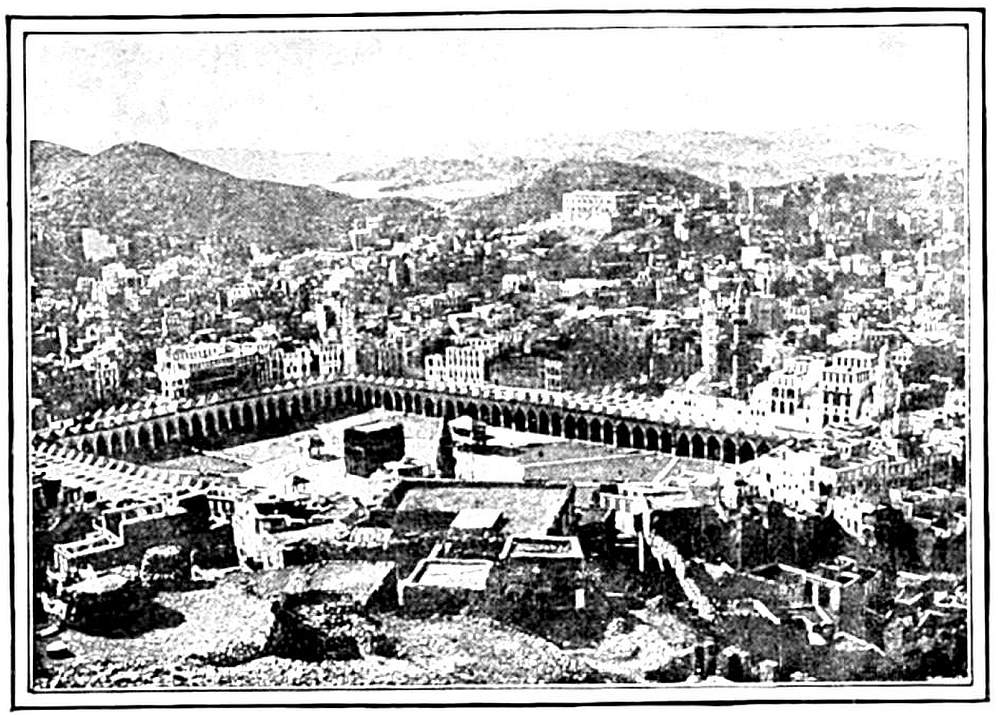
PILGRIMS AROUND THE KAABA IN THE SACRED MOSQUE AT MECCA
Mecca. This official is the nominal and often the real governor
of the city. He is chosen from the Sayyids or descendants
of Mohammed living in Hejaz or secures the high office by
force. His tenure of office is subject to the approval and authority
of the Turkish Sultan, whose garrisons occupy the fort
near the town.
The Sacred Mosque, (Mesjid el Haram) containing the
Kaaba or Beit Allah is the prayer-centre of the Mohammedan
world and the objective point of thousands of pilgrims every
year. According to Moslem writers it was first constructed in
heaven, 2,000 years before the creation of the world. Adam,
the first man, built the Kaaba on earth exactly under the spot
occupied by its perfect model in heaven. The 10,000 angels
appointed to guard this house of God seem to have been very
remiss in their duty for it has often suffered at the hands of
men and from the elements. It was destroyed by the flood and
rebuilt by Ishmael and Abraham. The legends connected with
its construction and history fill many pages of the Moslem traditions
and commentaries. The name Kaaba means a cube;
but the building is not built true to line and is in fact an unequal
trapezium.[10] Because of its location in a hollow and its
black-cloth covering these inequalities are not apparent to the
eye.
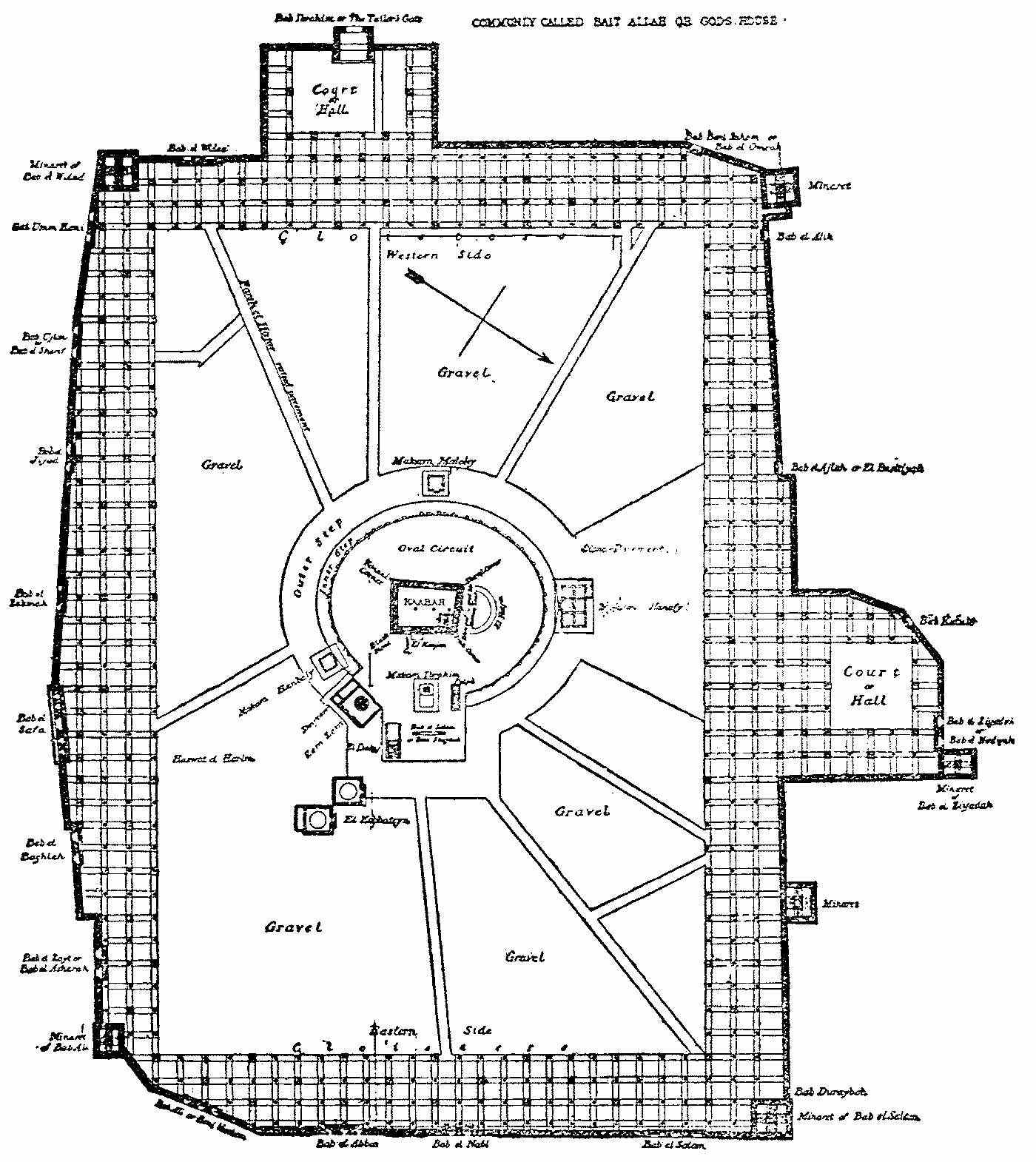
The Kaaba proper stands in an oblong space 250 paces long
by 200 broad. This open space is surrounded by colonnades
used for schools and as the general rendezvous of pilgrims. It
is in turn surrounded by the outer temple wall with its nineteen
gates and six minarets. The Mosque is of much more recent
date than the Kaaba which was well known as an idolatrous
Arabian shrine long before the time of Mohammed. The
Sacred Mosque and its Kaaba contain the following treasures:
the Black-Stone, the well of Zemzem, the great pulpit, the
staircase, and the Kubattein or two small mosques of Saab and
Abbas. The remainder of the space is occupied by pavements
and gravel arranged to accommodate and distinguish the four
orthodox sects in their devotions.
The Black-Stone is undoubtedly the oldest treasure of Mecca.
Stone-worship was an Arabian form of idolatry in very ancient
times and relics of it remain in many parts of the peninsula.
Maximus Tyrius wrote in the second century, “the Arabians
pay homage to I know not what god which they represent by a
quadrangular stone.” The Guebars or ancient Persians assert
that the black stone was an emblem of Saturn and was left in
the Kaaba by Mahabad. We have the Moslem tradition that
it came down snow-white from heaven and was blackened by the
touch of sin—according to one tradition, that of an impure
woman, and according to another by the kisses of thousands of
believers. It is probably an aerolite and owes its reputation to
its fall from the sky. Moslem historians do not deny that it
was an object of worship before Islam, but they escape the
moral difficulty and justify their prophet by idle tales concerning
the stone and its relation to all the patriarchs beginning
with Adam.
The stone is a fragment of what appears like black volcanic
rock sprinkled with irregular reddish crystals worn smooth by
the touch of centuries. It is held together by a broad band of
metal, said to be silver, and is imbedded in the southeast corner
of the Kaaba five feet from the ground. It is not generally
known that there is a second sacred stone at the corner facing
the south. It is called Rakn el Yemeni or Yemen pillar and is
frequently kissed by pilgrims although according to the correct
ritual it should only be saluted by a touch of the right hand.
The well of Zemzem is located near the Makam Hanbali, the
place of prayer of this sect. The building which encloses the
well was erected in A. H. 1072 (A. D. 1661) and its interior is
of white marble. Mecca perchance owes its origin as an old
Arabian centre to this medicinal spring with its abundant supply
of purgative waters for the nomads to-day go long distances
ALI BEY’S PLAN OF THE PROPHET’S MOSQUE AT MECCA
Commonly called Bait Allah or Gods House
to visit sulphur and other springs in various parts of Arabia.
The well of Zemzem is one of the great sources of income to
the Meccans. The water is carried about for sale on the streets
and in the mosques in curious pitchers made of unglazed earthenware.
They are slightly porous so as to cool the water,
which is naturally always of a lukewarm temperature, and are
all marked with certain mystical characters in black wax.
Crowds assemble around the well during the pilgrimage and
many coppers fall to the share of the lucky Meccans who have
the privilege of drawing the water for the faithful.
The pilgrimage to Mecca should be performed in the twelfth
lunar month of the calendar called Dhu el Haj. It is incumbent
on every believer except for lawful hindrance because of
poverty or illness. Mohammed made it the fifth pillar of religion
and more than anything else it has tended to unify the
Moslem world. The Koran teaching regarding the duties of
pilgrims at the Sacred Mosque, is as follows: “Proclaim to
the peoples a Pilgrimage. Let them come to thee on foot and
on every fleet camel arriving by every deep defile.” (Surah
xxii. 28.) “Verily As Safa and Al Marwa are among the signs
of God: whoever then maketh a pilgrimage to the temple or
visiteth it shall not be to blame if he go round about them
both.” (ii. 153.) “Let the pilgrimage be made in the months
already known and who so undertaketh the pilgrimage therein
let him not know a woman, nor transgress nor wrangle in the
pilgrimage.... It shall be no crime in you if ye seek an
increase from your Lord (by trade); and when ye pass swiftly
on from Arafat then remember God near the holy Mosque....
Bear God in mind during the stated days; but if any
haste away in two days it shall be no fault to him, and if any
tarry it shall be no fault in him.” (Surah ii. passim.)
From the Koran alone no definite idea of the pilgrim’s
duties can be gleaned; but fortunately for all true believers
the Prophet’s perfect example handed down by tradition leaves
nothing in doubt and prescribes every detail of conduct with
ridiculous minuteness. The orthodox way is as follows: arrived
within a short distance of Mecca the pilgrims, male and
female, put off their ordinary clothing and assume the garb of a
hajee. It consists of two pieces of white cloth one of which is
tied around the loins and the other thrown over the back;
sandals may be worn but not shoes and the head must be left
uncovered. (In idolatrous days the Arabs did not wear any
clothing in making the circuit of the Kaaba). On facing
Mecca the pilgrim pronounces the niyah or “intention”:
“Here I am, O Allah, here I am;
No partner hast Thou, here I am;
Verily praise and riches and the kingdom are to Thee;
No partner hast Thou, here am I.”
After certain legal ablutions the pilgrim enters the Mosque by
the Bab-el-salam and kisses the Black-Stone making the circuit,
running, around the Kaaba seven times (In idolatrous days
the Arabs did this in imitation of the motions of the planets; a
remnant of their Sabean worship.) Another special prayer is
said and then the pilgrim proceeds to Makam Ibrahim, where
Abraham is said to have stood when he rebuilt the Kaaba.
There the hajee goes through the regular genuflections and
prayers. He drinks next from the holy well and once more
kisses the Black-Stone. Then follows the running between
Mounts Safa and Merwa. Proceeding outward from the
Mosque by the gate of Safa he ascends the hill reciting the
153d verse of the Surah of the Cow. “Verily Safa and Merwa
are the signs of God.” Having arrived at the summit of the
mount he turns to the Kaaba and three times recites the words:
“There is no god but God!
God is great!
There is no god save God alone!
He hath performed His promise and hath aided His servant and put to flight the hosts of infidels by Himself alone!”
He then runs from the top of Safa through the valley to the
summit of Merwa seven times repeating the aforesaid prayers
each time on both hills. This is the sixth day, on the evening
of which the pilgrim again encompasses the Kaaba. On the
next day there is a sermon from the grand pulpit. On the
eighth day the pilgrim goes three miles distant to Mina, where
Adam longed for his lost paradise (!) and there spends the
night. The next morning he leaves for Arafat, another hill
about eleven miles from Mecca, hears a second sermon, returning
before nightfall to Muzdalifa, a place halfway between
Mina and Arafat.
The following day is the great day of the pilgrimage. It is
called the day of Sacrifice and is simultaneously celebrated all
over the Moslem world.[11] Early in the morning the pilgrim
proceeds to Mina where there are three pillars called, the
“Great Devil,” the “Middle Pillar” and the “First One.”
At these dumb idols the “monotheist” flings seven pebbles
and as he throws them says: “In the name of Allah and
Allah is mighty, in hatred of the devil and his shame, I do
this.” He then performs the sacrifice, a sheep, goat, cow or
camel according to the means of the pilgrim. The victim is
placed facing the Kaaba and a knife plunged into the animal’s
throat with the cry, Allahu Akbar. This ceremony concludes
the pilgrimage proper; the hair and nails are then cut and the
ihram or pilgrims’ garb is doffed for ordinary clothing. Three
days more are sometimes counted as belonging to the pilgrimage,
the eleventh, twelfth and thirteenth days, called Eyyam-u-tashrik,
or days of drying flesh, because during them the flesh
of the sacrifices is cut into slices and dried in the sun to be
eaten on the return journey.
After the Meccan pilgrimage most Moslems go to Medina to
visit the tomb of Mohammed; the Wahabees however consider
this “infidelity” and honor of the creature more than of the
Creator. Other Moslems base their conduct on the saying of
the prophet himself, Man yuhajja wa lam ye-zurni fakad
jefani, “who goes on Haj and does not visit me has insulted
me!” The Meccans call themselves “neighbors of God” and
the people of Medina “neighbors of the prophet.” For long
ages a hot rivalry has existed between the two cities, a rivalry
which, beginning in the taunt or jest, often ends in bloodshed.
The pilgrim, having completed all legal requirements, is
sure to visit the proper authorities and secure a certificate to
prove to his countrymen that he is a real Hajee and to substantiate
his religious boasting in days to come. The certificate
is also required when one goes on pilgrimage for a
deceased Moslem or a wealthy Moslem who is bedridden. In
such a case the substitute has all the pleasures (!) of the journey
at the expense of his principal but the merit goes to the
man who pays the bills and who naturally craves the receipt.
The certificate is of various forms and contains crude pictures
of the holy places and verses from Koran.
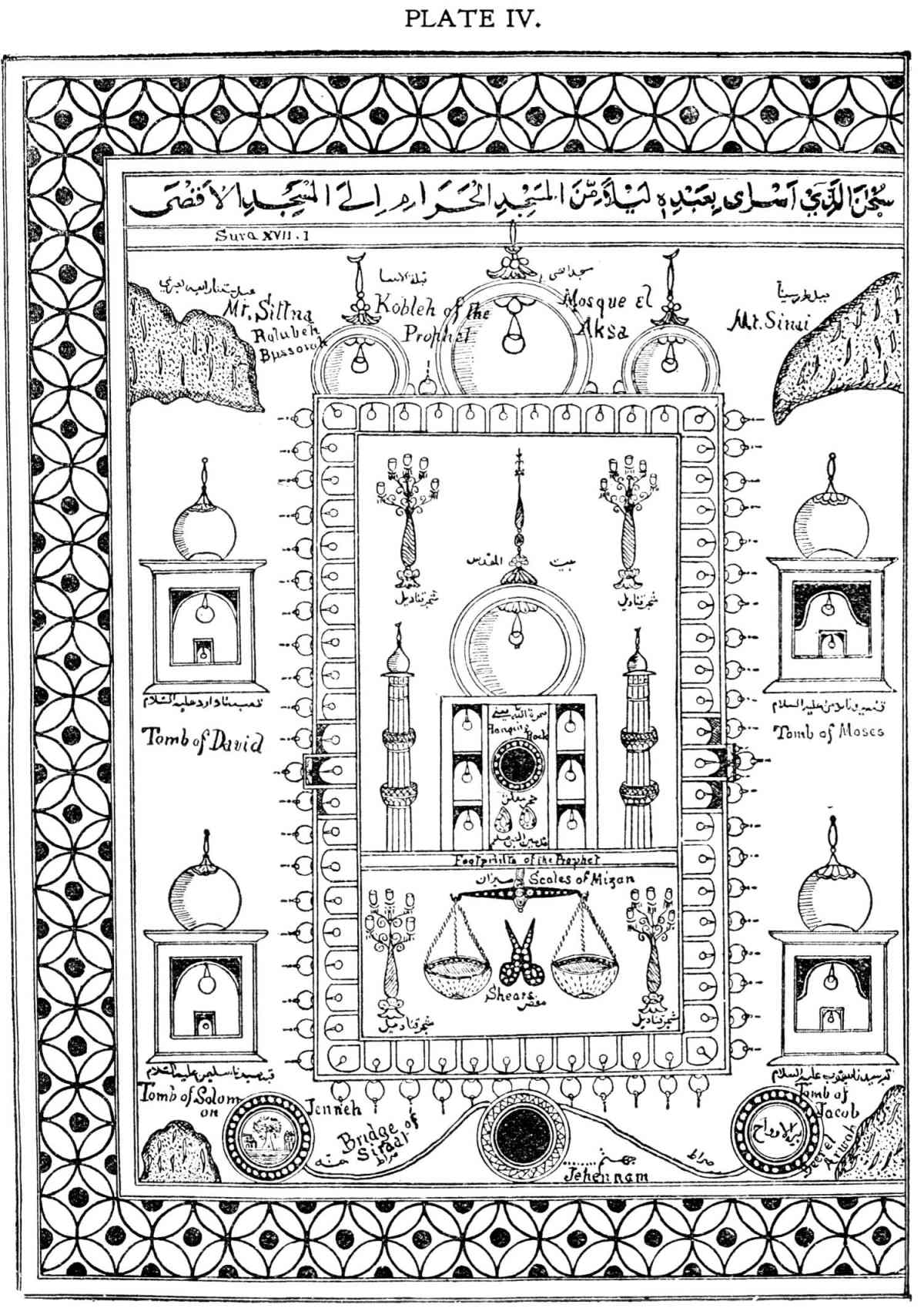
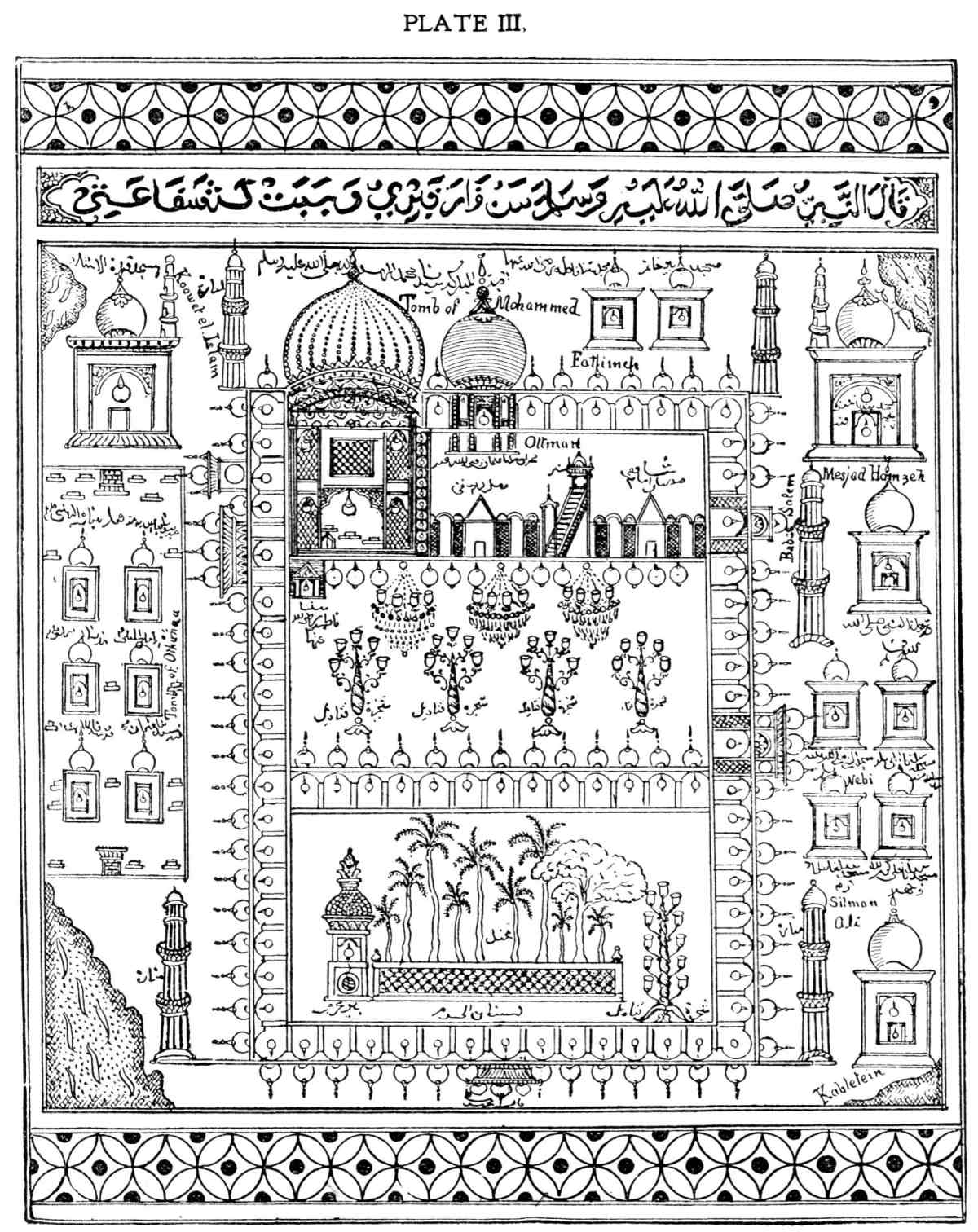
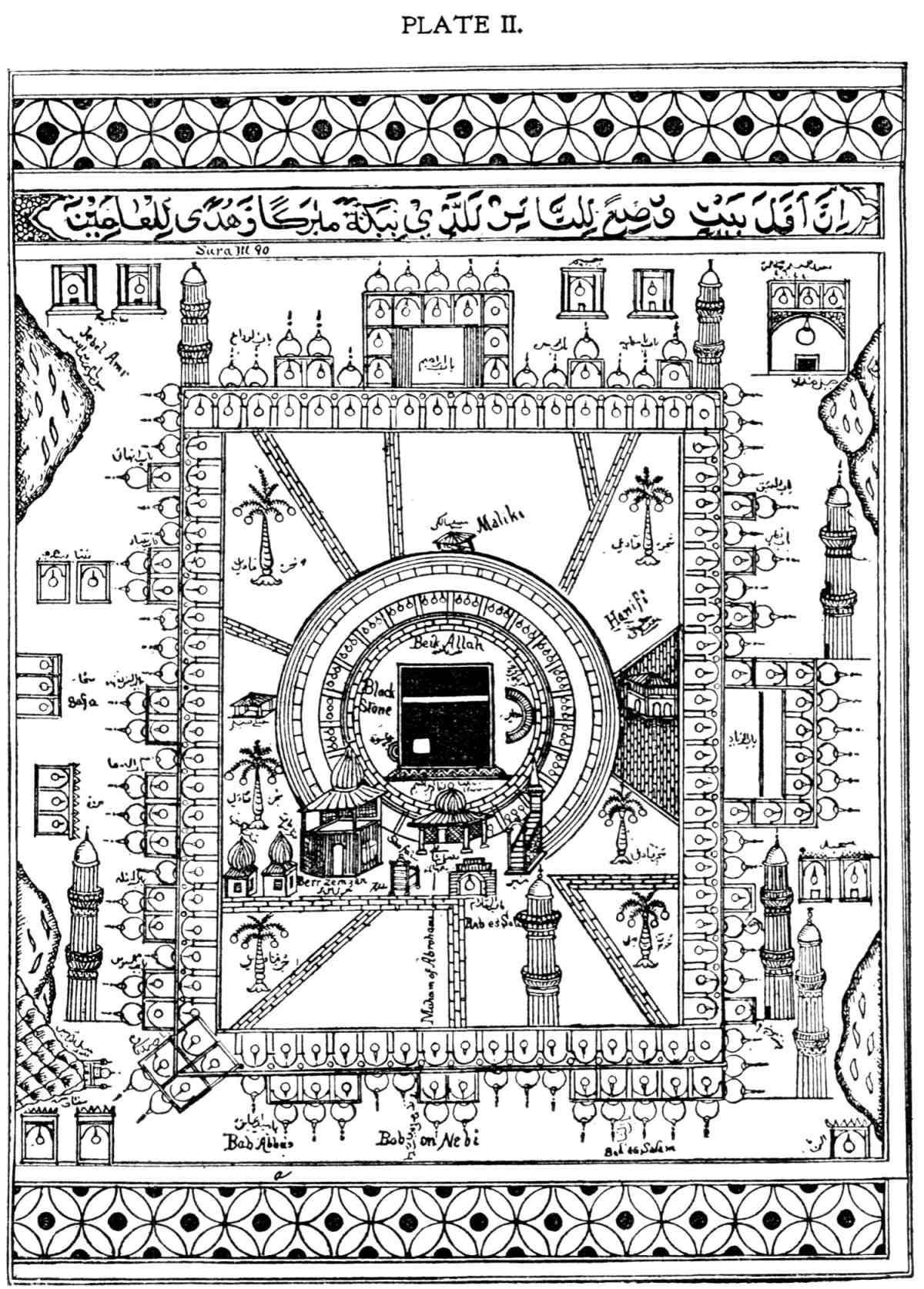
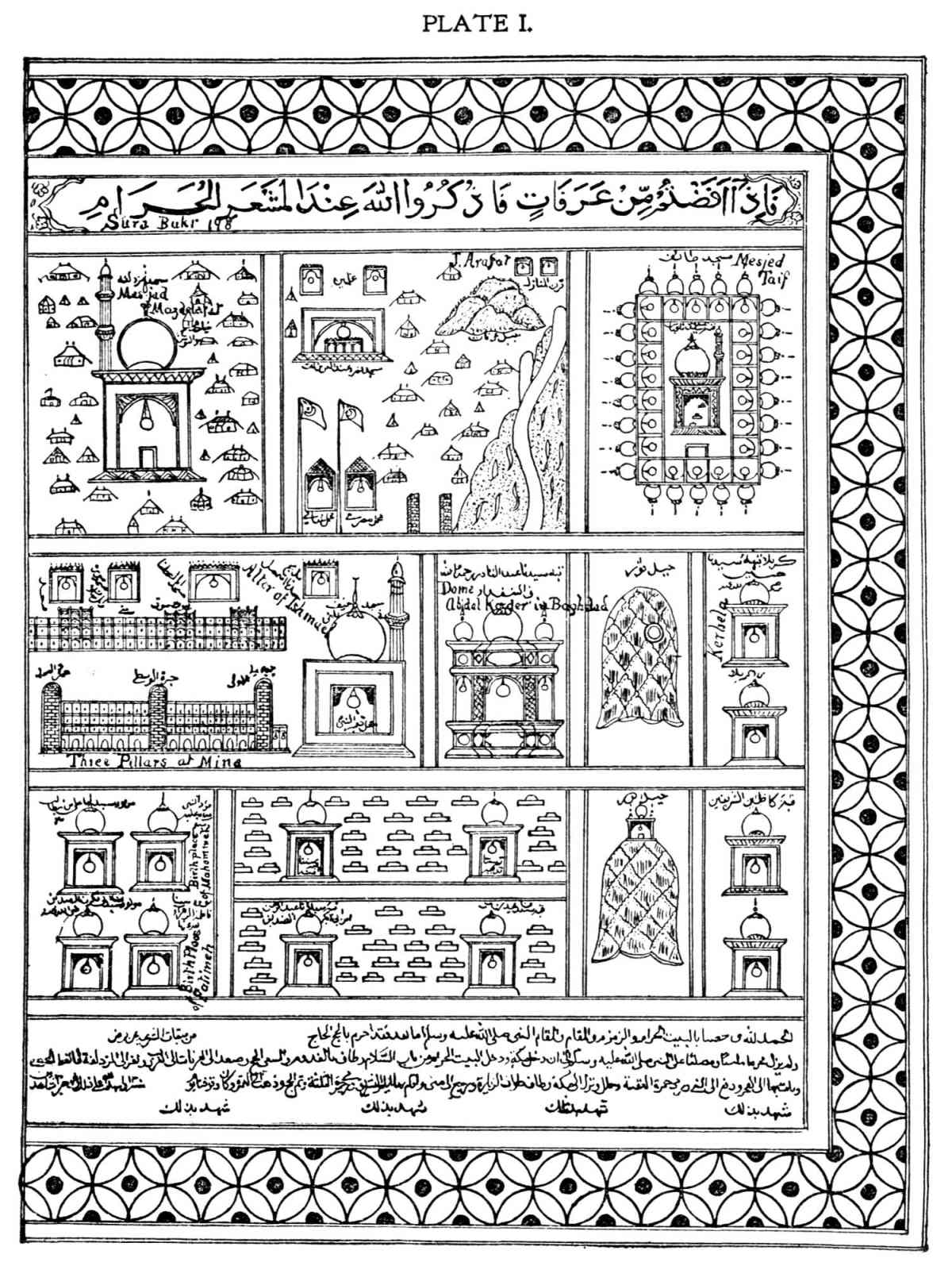
THE MECCA CERTIFICATE, which is given to pilgrims to the sacred city, is
looked upon by Moslems as practically a passport to heaven. It is
especially interesting because of the inside view which it gives of the
Mohammedan religion. At the top of each page are quotations from the
Koran.
PLATE I. has, at the right-hand upper corner, the representation of the
Mosque of Muzdalifa and tents of the Pilgrims; to the left of this, the
Mosque of Nimr, near Mount Arafat, and below it, the Mahmals of Syria
and Egypt, i.e., palanquins carried on camels, surmounted by flags. To
the right is Mount Arafat, a sacred mountain about 12 miles northeast of
Mecca, which, in Moslem tradition, is said to be the place where Adam
and Eve met after the fall. The three pillars of Miná represented below,
are ancient pagan shrines, at each of which every pilgrim must hurl
seven stones at the devil. Near this is pictured the Mesjed, or Mosque
of Taif, the altar of Ishmael, the Dome of Abd-el Kader in Bagdad, and
at the extreme right the Dome of “Our Lord” Hassein al Kerbela, where
thousands of corpses of deceased Persians are brought yearly to be
buried. It is northwest of Bagdad, and lies in Turkish territory. There
are also pictured the birthplaces of Mohammed, Ali Ibu Abi Talib, Abu
Bekr, and Fatimeh, and the Tomb of Amina and Khadijah; also two
bell-shaped hills, Jebel Thaur and Jebel Nur.
PLATE II. pictures the quadrangular court of the Mecca Haram, within
which is the circular colonnade, enclosing the Kaaba or Beit Allah, the
House of God. Below the representation of the Kaaba is depicted the
famous station of Abraham, a stone 20 inches long by 15 inches wide. It
is in the shape of a basin, and is buried in the earth. The name of
Abraham is connected with it from the tradition that he first built the
Kaaba. Below this may be noticed the famous “Beer Zemzem,” or Well of
Zemzem, which is claimed to be the water which Hager saw, when Ishmael
was dying of thirst. Around the circle are the praying places of the
Malikis, the Hanafys, the Hanbalys and the Shafi-is, the four great
sects of Islam. Around the quadrangle are 20 gates, such as Bab-su-Nebi,
Gate of the Prophet, Gate of Abraham, of Peace, of Abbas, of the Mare,
the Mule, Safa, of Farewell, of Wisdom, etc., etc.,—besides various
shrines.
PLATE III. shows representations of the Holy Places of El Medina, the
tomb of Mohammed. The large dome in the upper left-hand corner is the
tomb of Mohammed. Around the page are drawn the mosque of Fatimeh,
mosque of the Strength of Islam, the mosques of Hamzeh, Abu Bekr, Ali
and Silman, the tomb of Othman, and various other shrines.
PLATE IV. contains the Holy Shrines of Jerusalem. The Haram-es-Sherif,
or the quadrangular area once occupied by the temple of Solomon,
occupies the centre of the page. The Mosque commonly known as the Mosque
of Omar, is here styled “Beit el Mukdas” or the Holy House. Under the
dome in the black circle is the “Rock of God,” or the “Suspended Stone,”
which the prophet kicked back when it tried to follow him to heaven. The
two footprints of the prophet are pictured below the rock. Below this
are the Scales of “Mizan,” in which all men’s deeds are to be weighed at
the last day, together with the shears which cut off the life of men. At
the bottom is the great Bridge of Sirat, of vast length, the width of a
hair, and sharp as a razor, over which every mortal must walk
barefooted. At the right of it is the pit of Jehennam or hell, and to
the left Jenneh or Paradise. A hazardous feat it is to make the journey,
since on it depends one’s eternal destiny. Around this area are pictured
the tombs of David, Solomon, Moses and Jacob, and in the right-hand
upper corner is seen Jebel, Toor Sina, or Mount Sinai.
Needless to relate these certificates cost money, as does
everything at Mecca save the air you breathe. No honest
Moslem ever spoke with praise of the citizens of Mecca; many
are their proverbs to prove why wickedness flourishes in the
courts of Allah. And European travellers agree that of all
Orientals the Meccans take the palm for thoroughgoing rascality.
Ali Bey dilates on the lewdness of the men and the looseness
of the women of Mecca. Hurgronje unblushingly lifts the
veil that hides the corruption of the sacred temple service with
its army of eunuch police, and pictures the slave-market in full
swing within a stone’s throw of the Kaaba. Burton thus characterizes
the men who live on their religion and grow fat
(figuratively) by unveiling its mysteries to others:
“The Meccan is a covetous spendthrift. His wealth, lightly
won, is lightly prized. Pay, pensions, stipends, presents, and
the ‘Ikram’ here, as at Medina, supply the citizen with the
means of idleness. With him everything is on the most expensive
scale, his marriage, his religious ceremonies, and his household
expenses. His house is luxuriously furnished, entertainments
are frequent, and the junketings of the women make up
a heavy bill at the end of the year. It is a common practice
for the citizen to anticipate the pilgrimage season by falling
into the hands of the usurer. The most unpleasant peculiarities
of the Meccans are their pride and coarseness of language.
They look upon themselves as the cream of earth’s sons, and
resent with extreme asperity the least slighting word concerning
the Holy City and its denizens. They plume themselves
upon their holy descent, their exclusion of infidels, their strict
fastings, their learned men, and their purity of language. In
fact, their pride shows itself at every moment; but it is not the
pride which makes a man too proud to do a dirty action. The
Meccans appeared to me distinguished, even in this foul-mouthed
East, by the superior licentiousness of their language.
Abuse was bad enough in the streets, but in the house it became
intolerable.”[12]
Temporary marriages which are a mere cloak for open prostitution
are common in Mecca and are indeed one of the chief
means of livelihood to the natives[13]. Concubinage and divorce
are more universal than in any other part of the Moslem
world;[14] sodomy is practiced in the Sacred Mosque itself[15] and
the suburbs of the city are the scene of nightly carnivals of
iniquity, especially after the pilgrims have left and the natives
are rich with the fresh spoils of the traffic.[16] As might be
expected, superstition grows rife in such a soil and under such
circumstances. All sorts of holy-places, legends, sacred rocks,
trees and houses abound. Every Moslem saint who tarried in
the city or died there has left something to be remembered and
honored.
Gross ignorance coupled with equal conceit seems to be the
universal characteristic of the people of Mecca. Modern
science is laughed at and everything turns, on the Ptolemaic
system, around the little world of the Koran. Jinn are exorcised;
witches and the evil-eye are avoided by amulets; in
short all the superstitious practices of the Moslem world are
cultivated in this centre of world-wide pilgrimage. Astrology
still usurps the place of astronomy and it is considered blasphemy
to profess to know the hour of an eclipse or the day of
the new moon before it is revealed from heaven. Alchemy is
the science that attracts the Meccan physician more than the
marvels of surgery; potions of holy-writ or talismans are still
in use for sprains and dislocations. Their ignorance of geography
and history beyond the confines of the pilgrim-world is
pathetic. One of the chief Mullahs asked Hurgronje “how
many days was the caravan journey from Moskop (Russia) to
Andalusia (Spain)?” A government printing-press has been
opened at Mecca in recent years and an official gazette is published;
but even Turkish civilization and learning are considered
far from orthodox for their ways partake too much of those
of the “infidels” of the rest of Europe. Photography is a
forbidden art and money with “images” of queens and emperors
is only used with the prayer istagfir allah, “I ask pardon
of God.” On the other hand many old European coins
no longer current are looked upon as being doubly valuable as
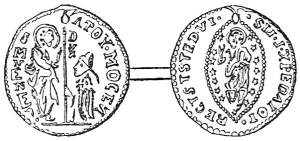
amulets and charms. One of these, the Mishkash is supposed
to have special virtues for newly-married women.
“The irony of history,” as Hurgronje remarks, “was not
satisfied that at Medina the grave of Mohammed who cursed
saint-worship should become a centre of pilgrimage, but added
the circumstance that at Mecca, Moslem women, who reject
images and Christ-worship, should prize as an amulet the
image of Jesus and an Evangelist.” Of course, the women
themselves are in total ignorance of the inscription and character
of the coin.
A CHRISTIAN COIN USED AS AN AMULET BY MECCAN
WOMEN.[17]]
There is a great abundance of schools at Mecca but no
education. Everything is on the old lines, beginning and ending
with the Koran, that Procrustean bed for the human intellect.
“The letter killeth.” And it is the letter first, foremost
and always that is the topic of study. The youth learn to
read the Koran not to understand its meaning, but to drone it
out professionally at funerals and feasts, so many chapters for
so many shekels. Modern science or history are not even
mentioned, much less taught, at even the high-schools of
Mecca. Grammar, prosody, caligraphy, Arabian history, and
the first elements of arithmetic, but chiefly the Koran commentaries
and traditions, traditions, traditions, form the curriculum
of the Mohammedan college. Those who desire a postgraduate
course devote themselves to Mysticism (Tassawaf)
or join an order of the Derwishes who all have their representative
sheikhs at Mecca.
The method of teaching in the schools of Mecca, which can
be taken as an example of the best that Arabia affords, is as
follows. The child of intellectual promise is first taught his
alphabet from a small wooden board on which they are written
by the teacher; slates are unknown. Then he learns the
Abjad or numerical value of each letter—a useless proceeding
at present as the Arabic notation, originally from India, is
everywhere in use. After this he learns to write down the
ninety-nine names of Allah and to read the first chapter of the
Koran; then he attacks the last two chapters, because they are
short. The teacher next urges him through the book, making
the pupil read at the top of his voice. The greatest strictness
is observed as to pronunciation and pauses but nothing whatever
is said to explain the meaning of the words. Having
thus finished the Koran, that is, read it through once, the pupil
takes up the elements of grammar, learning rules by rote both
of sarf (inflection) and nahw (syntax). Then follow the liberal
sciences, al-mantik (logic), al-hisab (arithmetic), al-jabr
(algebra), al-ma’ana wa’l beyan (rhetoric and versification),
al-fikh (jurisprudence), al-akäid (scholastic theology), at-tafsir
(exegetics), ilm ul-usul (science of sources of interpretation)
and lastly, the capstone of education, al-ahadith (traditions).
Instruction is given by lectures; text-books are
seldom used; lessons begin in the morning and continue for a
few hours; in the afternoon they are interrupted by prayer-time.
Even at Mecca the favorite place for teaching is in the
Mosque-court where constant interruptions and distractions
must make it pleasant for a lazy pupil.
A WOMAN OF MECCA
A MECCAN WOMAN IN HER BRIDAL COSTUME
IV THE HOLY LAND OF ARABIA—MEDINA
“Within the sanctuary or bounds of the city all sins are forbidden; but
the several schools advocate different degrees of strictness. The Imam
Malik, for instance, allows no latrinæ nearer to El Medina than Jebel Ayr,
a distance of about three miles. He also forbids slaying wild animals,
but at the same time he specifies no punishment for the offence. All
authors strenuously forbid, within the boundaries, slaying man, (except
invaders, infidels and the sacrilegious) drinking spirits and leading an
immoral life. In regard to the dignity of the sanctuary there is but one
opinion; a number of traditions testify to its honor, praise its people and
threaten dreadful things to those who injure it or them.”—Burton.
About seventy miles southeast of Mecca is the small but
pleasant town of Taif, to which the pashas condemned
for the murder of Abdul Aziz Sultan were banished. It is one
of the most interesting and attractive towns of all Arabia, being
surrounded by gardens and vineyards from which Mecca has
been supplied for ages. The tropical rains last from four to
six weeks at Taif, and good wells abound to water the gardens
when the rains cease, so that the place is famous for its garden-produce.
In close proximity to the barren Mecca district
Taif is a paradise for the pilgrim and a health resort for the
jaundiced, fever-emaciated Meccan. At Taif Doughty saw
three old stone idols of “the days of ignorance”; El Uzza,
a block of granite some twenty feet long; another called
Hubbal, with a cleft in the middle, “by our Lord Aly’s sword-stroke”;
and El Lat, an unshapely crag of grey granite.
These were earlier stone-gods of the Arab, and now lie forsaken
in the dirt, while their brother-god, the famous Black-Stone,
receives the reverence of millions!
The road from Mecca to El Medina—“the city”—so
called because the prophet chose it as his home in time of persecution—leads
nearly due north. It is an uninteresting, and
for the most part, a forsaken country that separates the rival
cities. Burton writes that it reminded him of the lines,
“Full many a waste I’ve wandered o’er,
Clomb many a crag, crossed, many a shore,
But, by my halidome
A scene so rude, so wild as this,
Yet so sublime in barrenness,
Ne’er did my wandering footsteps press,
Where’er I chanced to roam.”
There are two caravan-routes, both of which are used by the
pilgrims, but the eastern road is used most frequently.[18]
The region between Mecca and Medina is the home of the
ancient poets of Arabia and is classic ground. The seven
Moallakat or suspended poems find their scene in this region.
Lebid wrote:
“Deserted is the village—waste the halting place and home,
At Mina, o’er Rijam and Ghul wild beasts unheeded roam,
On Rayyan hill the channel lines have left their naked trace,
Time-worn as primal writ that dints the mountain face.”
El Medina, formerly called Yathrib, is now also called El
Munowera, the “illuminated,” and devout Moslems commonly
claim to see, on approaching the city, a luminous haze
hanging over its mosques and houses. The legends and
superstitions that cluster around the last resting-place of the
Prophet are not less in number nor less credible than those that
glorify the place of his birth, although the town is only about
half the size and contains 16,000 inhabitants. It consists of
three principal divisions: the town proper, the fort and the
suburbs. It is surrounded by a wall forty feet high; the streets
are narrow and unpaved; the houses are flat-roofed and double-stoned.
The current dispute, however, for many centuries has been
regarding the relative sanctity and importance of the two cities,
Mecca and Medina. A visit to Medina is called Ziyarat, as
that to Mecca is called Haj; the latter is obligatory by order
of the Koran, while the former is meritorious on the authority
of tradition. The orthodox further stipulate, that circumambulation
around the prophet’s tomb at Medina is not allowed as
around the Kaaba at Mecca nor should men wear the ihram, nor
kiss the tomb. On the other hand, to spit upon it or treat it
with contempt, as the Wahabees did, is held to be the act of
an infidel. To quote again from Burton: “The general consensus
of Islam admits the superiority of the Beit Allah at
Mecca to the whole world; and declares Medina to be more
venerable than every part of Mecca, and consequently all the
earth, except only the Beit Allah. This last is a juste milieu
view by no means in favor with the inhabitants of either
place.”
The one thing that gives Medina claim to sanctity is the
prophet’s tomb, and yet there is some doubt as to whether he
is really buried in the mosque raised to his honor; of course
every Moslem, learned or ignorant, believes it, but there are
many arguments against the supposition.[19] One of these arguments
alone would have little value against so old a tradition
and practice, but their cumulative force cannot be denied, and
throws serious doubt on the question whether the present
mosque of the prophet contains any trace of his remains. On
the other hand pious Moslems affirm that the prophet is not
really dead, but “eats and drinks in the tomb until the day of
resurrection,” and is as much alive as he ever was.
REPORTED ARRANGEMENT OF THE INTERIOR OF THE HUJRAH.
The Mesjid-el-Nebi or prophet’s mosque at Medina is about
420 feet long by 340 broad. It is built nearly north and south
and has a large interior courtyard, surrounded by porticoes.
From the western side we enter the Rauzah or prophet’s garden.
On the north and west it is not divided from the rest of the portico;
on the south side runs a dwarf wall and on the east it is
bounded by the lattice-work of the Hujrah. This is an irregular
square of about fifty feet separated on all sides from the walls
of the Mosque by a broad passage. Inside there are said to be
three tombs carefully concealed inside the iron railing by a heavy
curtain arranged like a four-post bed. The Hujrah has four
gates, all kept locked except the fourth which admits only the
officers in charge of the treasure, the eunuchs who sweep the
floor, light the lamps and carry away the presents thrown into
the enclosure by devotees. It is commonly asserted that many
early Moslem saints and warriors desired the remaining space
for their grave, but that by Mohammed’s wish it is reserved
for ’Isa on his second coming and death. The story of a
coffin suspended by magnets has of course no foundation in
fact and may have arisen from the crude drawings of the
tombs.
The ziyarah at the Mosque consists in prayers and alms-giving
with silent contemplation on the sacred character of Mohammed.
The following sample “prayer” offered at the
shrine of Fatima, gives some idea of what is to Christian ears
a blasphemous service: “Peace be upon thee, O daughter of
the apostle of Allah! Thou mother of the excellent seed.
Peace be upon thee thou Lady amongst women. Peace be upon
thee, O Fifth of the people of the Prophet’s garment! A pure
one, O virgin! Peace be on thee, O spouse of our Lord, Ali
el Murtaza, O mother of Hasan and Hussein, the two Moons,
the two Lights, the two Pearls, the two princes of the youth of
Heaven, the Coolness of the eyes of true believers! etc., etc.”
The prayers offered at the prophet’s grave are more fulsome in
their praise and of much greater length. What would the
camel-driver of Mecca say if he heard them?
As at Mecca so at Medina the townspeople, one and all,
live on the pilgrims. The keeper of the Mosque is a Turkish
Pasha with a large salary and many perquisites; there are
treasurers and professors and clerks and sheikhs of these eunuchs
kept on salary. Sweepers and porters, all eunuchs, and guides
as at Mecca who live by backsheesh or extortion. Water-carriers
here too peddle about the brackish fluid by the cupful to
thirsty pilgrims. Those who are not in the service of the
Mosque usually keep boarding-houses, or sell prayers which
are to be made once a year at the prophet’s tomb, for the absent
pilgrim. Most of the officials receive their salaries from Constantinople
and Cairo.
The population of Medina is not less a mixed multitude
than that of Mecca; here also the observation of Zehm holds
true, “every pilgrimage brings new fathers.” Burton testifies,
“It is not to be believed that in a town garrisoned by Turkish
troops, full of travelled traders, and which supports itself by
plundering Hajis the primitive virtues of the Arab could exist.
The Meccans, a dark people, say of the Madani, that their
hearts are as black as their skins are white. This is of course
exaggerated; but it is not too much to assert that pride, pugnacity,
a peculiar point of honor, and a vindictiveness of wonderful
force and patience, are the only characteristic traits of
Arab character which the citizens of El Medina habitually display.”
Intoxicating liquors are made at Medina and sold, although
not openly.
There are two colleges with “libraries” at Medina and many
mosque-schools. In Burckhardt’s day he charged the town
with utter ignorance and illiteracy, but now they devote themselves
apparently to literature, at least in a measure.
The climate of Medina is better than that of Mecca and the
winters are cold and rigorous. Mohammed is reputed to have
said, “he who patiently endures the cold of El Medina and
the heat of Mecca, merits a reward in paradise.”
Returning from the lesser pilgrimage to Medina the traveller
can retrace his steps to Mecca, and thence to Jiddah, or go to
the nearer port of Yanbo (Yembo) and thence return home by
steamer or sailing-vessel. The distance by camels’ route, between
Medina and the port is 132 miles, six stages, although a
good dromedary can make it in two days. At Yanbo the
sultan’s dominions in Arabia begin, for the coast northward
pertains to Egypt. The town resembles Jiddah in outward
appearance, has 400 or 500 houses built of white coral rock,
dirty streets and a precarious water supply. Sadlier, (1820)
after his journey across the peninsula, visited Yanbo, and describes
it as “a miserable Arab seaport surrounded by a wall”;
Yanbo has, however, a good harbor, and was in earlier days, a
large and important place; it has been identified with Iambia
village on Ptolemy’s map a harbor of the old Nabateans.
Thus ends our pilgrimage through the Holy Land of Arabia.
Let us in conclusion ponder the words of Stanley Lane Poole
as to the place which Mecca and the pilgrimage holds in the
Mohammedan religion. “It is asked how the destroyer of
idols could have reconciled his conscience to the circuits of the
Kaaba and the veneration of the Black-Stone covered with
adoring kisses. The rites of the pilgrimage cannot certainly
be defended against the charge of superstition; but it is easy
to see why Mohammed enjoined them.... He well
knew the consolidating effect of forming a centre to which his
followers should gather, and hence he reasserted the sanctity
of the Black-Stone that ‘came down from heaven’; he ordained
that everywhere throughout the world the Moslem
should pray looking toward the Kaaba, and enjoined him to
make the pilgrimage thither. Mecca is to the Moslem what
Jerusalem is to the Jew. It bears with it all the influence of
centuries of associations. It carries the Moslem back to the
cradle of his faith and the childhood of his prophet....
And, most of all, it bids him remember that all his brother
Moslems are worshipping toward the same sacred spot; that
he is one of a great company of believers united by one faith,
filled with the same hopes, reverencing the same thing, worshipping
the same God.”
V ADEN AND AN INLAND JOURNEY
“Aden is a valley surrounded by the sea; its climate is so bad that it
turns wine into vinegar in the space of ten days. The water is derived
from cisterns and is also brought in by an aqueduct two farsongs long.”
—Ibn-el-Mojawir. (A.D. 1200)
Arabia is unfortunate because, like a chestnut-burr, its
exterior is rough and uninviting. In scenery and climate,
Yemen fares worst of all the provinces. The two gateways to
Arabia Felix are very infelix. What could be more dreary
and dull and depressing than the “gloomy hills of darkness”
that form the background to Aden as seen from the harbor?
There is no verdure, no vegetation visible; everywhere there
is the same appearance of a cinder heap. And where can one
find a more filthy, hot, sweltering, odorous native town than
Hodeidah? Yet these two places are the gateways to the most
beautiful, fertile, populous and healthful region of all Arabia.
Yemen is best known of all the provinces, and has been
quite thoroughly explored by a score of intrepid travellers.[20]
Most people, however, travelling in a P. and O. Steamer, calling
at Aden for coal, remain in total ignorance of the fair
highlands just beyond the dark hills that hide the horizon
Yemen extends from Aden to Asir on the north and eastward
into Hadramaut for an indefinite distance. On the earlier
maps Arabia Felix stretched as far as Oman—a great mountainous
region with a temperate climate. An Arabian author,
describing Yemen as it was before the time of Mohammed,
wrote: “Its inhabitants are all hale and strong, sickness is
unknown, nor are there poisonous plants or animals; nor fools,
nor blind people, and the women are ever young; the climate
is like paradise and one wears the same garment summer and
winter.”
The massive rock promontory of volcanic basalt called Aden,
has from time immemorial been the gateway and the stronghold
for all Yemen. It is generally agreed that Ezekiel, the
prophet, referred to Aden when he wrote. “Haran and
Canneh and Eden, the merchants of Sheba, Asshur and Chilmad,
were thy merchants.” The place was fortified and its
wonderful rock cisterns were probably first constructed by
the early Himyarites. A Christian church was erected at
Aden by the embassy of the Emperor Constantius, A.D. 342,
and Aden was for a long time in the hands of the Christian
kings of Yemen. Then it fell a prey to the Abyssinians and
next to the Persians, about the time when Mohammed was born.
Albuquerque in 1513 with his Portuguese warriors laid siege to
Aden for four days, but in spite of scaling-ladders and gunpowder
could not take the town. The Mameluke Sultans of
Egypt also failed to capture this fortress. In 1838 the English
took it by storm and have held the place ever since.
Aden is now a British settlement, a commercial-centre, a
coaling-station and a fortress; the last most emphatically. All
the latest improvements in engineering and artillery have been
put to use in fortifying the place. The ride from Steamer-Point
to “the crater” or from the telegraph-station to the
“Crescent” gives one some idea of the vast amount of money
and labor expended to shape this Gibraltar and make it impregnable
from land and sea. The isthmus is guarded by
massive lines of defence, strengthened by a broad ditch cut
out of the solid rock; bastions, casements and tunnels all serve
one purpose; batteries, towers, arsenals, magazines, barracks;
mole-batteries toward the sea, mines in the harbor, obstruction
piers and subservient works;—everything tells of military
strength, and the town has always a warlike aspect in perfect
accord with its forbidding physical geography.
The inhabited peninsula is an irregular oval about fifteen
miles in circumference; it is in reality a large extinct crater
formed of lofty precipitous hills the highest peak of which,
Shem Shem, has an altitude of nearly 1,800 feet. The
varieties of rock are numerous, and vary in color from
light brown to dark green. Pumice and tufas are very common,
the former is an article of export. Water is very scarce,
and there is almost no rainfall during some years. When
there is a shower, the nature of the soil and the immense watershed
for so small an area cause heavy torrents to pour down
the valleys. These rare occasions are utilized to fill the huge
tanks near Aden camp. The tanks were built as early as 600
A.D. by the Yemenites who built besides the celebrated dam at
Marib, and the many similar structures in various parts of
Yemen. Water is also brought by an aqueduct from Sheikh
Othman, seven miles distant, but the majority of the population
is supplied from the government condensers. In spite of
the desert character of the soil and the aridity of the climate
Aden is not entirely without natural vegetation. Thomas
Anderson of the Bengal Medical Service enumerates ninety-four
species of plants found on the Aden peninsula, some of
which are entirely unique. Most of the plants, however, are
desert-dwellers with sharp thorns, an aromatic odor, and yield
gums and resins.
The Aden settlement has four centres of population; Steamer-Point,
the Crescent, the town of Maala and the “Camp” or
Aden proper. A road, the only road in fact, extends from
Steamer-Point on the west to Aden proper on the east, and no
one can boast of having seen Aden who has not taken the ride
in a geri from the landing-pier to the tanks. The Aden horses
are of all creatures most miserable for the geri-drivers whip their
horses much, but feed them little. The Crescent is a semi-circular
range of houses and shops crowded against the mountain
side; with a Hotel de l’Univers and a Hotel de l’Europe
(both equally “Grand”); cafés, shops, banks, and offices. The
post office, hospital, churches and barracks are further west
toward the telegraph-station. A drive of about two miles
brings us to the native town of Maala. Here the road forks,
the lower one leading to the barrier-gate and Sheikh Othman,
and the upper ascending the mountain through the gate of the
fortifications and by a sharp declivity leading down to the town
of Aden. It is not an Oriental town in its administration, but
it has all the motley character of Port Said on its streets.
Europeans, Americans, Africans, Asiatics and mixed races are
all represented in the crowd of the market or the loungers in
the streets. The total population is 30,000, including Chinese,
Persians, Turks, Egyptians, Somalis, Hindus, Parsees, Jews
and Arabs from every part of the peninsula. Aden is a great
centre for native shipping, and the dhows and buggalows that
sail every year from the Persian Gulf to Yemen and Jiddah
alway call at Aden en route. Also from Oman and Hadramaut
the modern Sinbads run their craft into Aden to exchange
produce or to lay in supplies for their voyages to the coast of
Africa.
The distance from Aden to Yemen’s old capital, Sana is
nearly 200 miles in a direct line, but on my second journey
thither, in 1894, I was obliged to take a roundabout journey
to Taiz, because of an Arab uprising. This and the mountainous
character of the country made the distance over 250
miles. This route passes through, or near, all the important
towns of Yemen south of Sana.
TRAVELLING IN SOUTHERN ARABIA
THE KEITH FALCONER MEMORIAL CHURCH IN ADEN
With my Bedouin companion, Nasir, I left Sheikh Othman
early on the second morning of July. We reached a small
village, Wahat, at noon, the thermometer registering 96° in the
shade. After a short rest we mounted the camels at seven
o’clock in the evening for an all-night journey. Our course
was through a barren region, and at daylight we entered Wady
Mergia, with scanty vegetation, resting at a village of the same
name under a huge acacia tree. The next day we entered the
mountains, where rich vegetation showed a cooler climate. We
passed several villages, Dar El Kadim, Khoteibah, Suk-el-Juma
and others. As this was said to be a dangerous part of the road
all the caravan, which we joined at Wahat, was on the lookout,
with lighted rope-wicks for their flint-locks swinging from
their shoulders and looking in the dark like so many fireflies. At
three A.M. we had ascended to the head of the wady and rested
for the day at Mabek. All the houses here are of stone, the
booths of date-mats and twigs being only found on the maritime
plain of Yemen. During the night there had been talk among
the wild Arabs of the village of holding me as a hostage to
obtain money from the English at Aden! But Nasir quieted
them with a threefold Bedouin oath that I was not a government
official nor an Englishman, but an American traveller.
The day after leaving Mabek brought us to the beginning of
the happy valleys of Yemen, very different from the torrid
coast. A country where the orange, lemon, quince, grape,
mango, plum, apricot, peach, apple, pomegranate, fig, date,
plantain and mulberry, each yield their fruit in season; where
wheat, barley, maize, millet and coffee are staple products and
where there is a glorious profusion of wild flowers—called
“grass” by the unpoetic camel-drivers. A land whose mountains
lift up their heads over 9,000 feet, terraced from
chilly top to warm valley with agricultural amphitheatres,
irrigated by a thousand rills and rivulets, some of them perennial,
flowing along artificial channels or leaping down the rocks
in miniature falls. A land where the oriole hangs her nest on
the dark acacia, the wild doves hide in clefts of the rock and
the chameleon sports his colors by the wayside under the tall
flowering cactus. Such is Yemen. The vegetation of Arabia
Felix begins just before reaching Mufallis, on this route, where
a Turkish castle and custom-house proclaim the boundary of
Ottoman aggression.
Beautiful was the air and scenery on our march. Arab
peasants were at work in the fields, plowing[21] with oxen, repairing
the walls of the terraces and opening the watercourses.
The women were all unveiled and had the picturesque costume
universal in southern Yemen; their narrow trousers were
fastened at the waist and ankles, while over their shoulders
hung long mantle-like garments, low in the neck, girded, and
fringed at the bottom with embroidered cloth of green or red.
Here they wear a kind of light turban, but on the Hodeidah
coast broad-brimmed straw hats cover the heads of the Yemen
belles as they urge their donkeys to market.
At sunrise we were in sight of the highest peaks to the left of
the wady-bed. One of them is crowned by a walli or saint’s
tomb of Saled bin Taka. These tombs are common in Yemen
and thousands of people visit them annually to ask intercession,
each saint having a special day in the Moslem calendar. At
Mocha the grave of the Arab sheikh Abu-el-Hassan Shadeli,
who first discovered the use of coffee, is highly honored by distant
pilgrims.
At eight o’clock on the morning of July fourth we reached
the burj called Mufallis and had our first experience of Turkish
rule in Yemen. Unexpectedly we here stumbled upon a
Turkish custom-house, which I had thought was located at
Taiz, as the boundary of Turkish Yemen on my maps did not
extend further south. An unmannerly negro, calling himself
Mudeer of Customs, looked out of a port-hole and demanded
my ascent. Through dirt and up darkness I reached his little
room and stated my errand and purpose. No kind words or
offered backsheesh would avail; “all the baggage must be
opened and all books were forbidden entrance into Yemen by
a recent order,” so he affirmed. First, therefore, I unscrewed
the covers of the two boxes with an old bowie-knife. The
books, after having been critically examined by eyes that could
not read, were seized; next my saddle-bags were searched, and
every book and map was also confiscated. I was refused even
a receipt for the books taken, and to every plea or question the
only reply was, to go on to Taiz and appeal to the Governor.
Despoiled of our goods, we left the “custom-house” at
eleven A.M., taking an old man on a donkey armed with a
spear, as guide and defence, because Nasir heard that there was
disturbance in this quarter. At two o’clock we rested for half
an hour under the shade of a huge rock in the bed of the
wady, and then warned by peals of thunder, we hastened on,
hoping to reach Hirwa before dark. In less than an hour, however,
the sky was black, rain fell in torrents, and we found it
hopeless to attempt to urge the slow camels on through the
wady. There was no shelter in sight, so we crouched under a
small tree halfway up the mud bank. The rain turned to hail—large
stones that frightened the camels so that they stampeded—and
we became thoroughly chilled.
When the storm ceased, our donkey man came with looks of
horror to tell us that his poor beast had fallen down the slope
and was being swept away by the torrent! What had been a
dry river bed half an hour before, was now a rushing rapids.
We decided to climb up the terraces to a house which we saw
on the mountain side. The camels had preceded us, and after
a vigorous climb over mud-fields and up the rocks we reached
the house and hospitality of Sheikh Ali. Over the charcoal
fire, after drinking plenty of kishr, (made from the shell of the
coffee bean,) we had to listen to a long discussion concerning
the lost donkey. Finally, matters were smoothed over by my
offering to pay one-half the price of the animal on condition
that our guide should proceed with us to Hirwa.
The next day we were off early. Because of the steep ascents
I was obliged to walk most of the way, and I sprained my ankle
severely. It did not pain me until night, when it was swollen
and kept me “on crutches” for several days. Hirwa is a
small Arab village with a weekly market, and we found shelter
in the usual coffee-shop characteristic of Yemen. The following
day we reached Sept Ez zeilah, where we found cleaner
quarters than the night before. At about midnight a war party
of Bedouins came and frightened the peaceful villagers with demands
for food, etc. They had just returned from setting fire
to a small castle, and, numbering sixty hungry men, were not
to be intimidated. They were about to force their way into
our quarters when Nasir and the women promised to give them
food. Within, I kept quiet and listened to the noise of grinding
and baking and coffee-pounding. Without, some of the
Arabs seized a cow belonging to a poor woman and butchered
it for their feast. At this there was a crying of women and
barking of dogs and swearing of oaths by the Great Allah, such
as I hope never to hear again. Finally, the Arabs went away
with full stomachs, and we slept a broken sleep for fear they
might return. The next day we proceeded to Taiz, and arrived
at noon, one week after leaving Aden.
The Mutasarrif Pasha, or Governor, was satisfied with my
passports, and expressed his regrets that the books had been
seized at Mufallis, but such was the law. He would, however,
allow me to send for them for inspection. What is written
here in four lines was the work and patience of four weary
days! A soldier was sent to Mufallis; I was obliged to entrust
him with money to pay the custom dues; to hire a camel to
carry the books; finally to pay for two sticks of sealing wax
(price in Taiz one rupee) with which to seal the books and
maps lest they be tampered with—all this at the order of the
enlightened government of the Sublime Porte! The first messenger
never reached Mufallis; on the road he was attacked by
Arabs, stabbed in the neck, robbed of his rifle, and carried
back to the military hospital at Taiz. Then there was more
delay to find and send a second soldier with the same camel
and money and sealing wax, but with a new rifle. He returned
with the books safely after five days! No Turk could set a
value on a book, and so the law is that books are taxed by
weight, boxes included. The customs receipt was attached for
“200 kilograms Jewish books (at twenty piastres a kilo),
value, 4,000 piastres, and custom dues amounting to 288
piastres.” In the same document I was spoken of as “the
Jew, Ishmail, Dhaif Ullah,”—a rather curious combination of
names. I was called a “Jew” because of the case of Hebrew
New Testaments; Ishmail was the equivalent for Samuel; and
Dhaif Ullah, my Arabic cognomen.
VI YEMEN: THE SWITZERLAND OF ARABIA
“If the Turks would clear out of Yemen, a wonderful field for commerce
would be thrown open, for the Turkish government is vile and all
cultivators are taxed to an iniquitous extent.”—Ion Keith Falconer.
While waiting at Taiz I had an opportunity to study
Yemen town life and the system of government, as
well as to learn a little about the cultivation of coffee and kaat,
the two chief products of this part of Yemen.
Taiz has not often been visited by travellers from the occident,
and is a most interesting place. It is a large fortified
village of perhaps 5,000 inhabitants, the residence of a Mutasarrif
whose authority extends from the province of Hodeidah
to the Aden frontier including Mocha and Sheikh Seyyid on
the coast, recently abandoned by France. The place has five
gates, one of which has been walled up, and five large mosques
in Byzantine style. The largest Mosque is called El Muzafer,
and has two large minarets and twelve beautiful domes. Taiz
was once a centre of learning and its libraries were celebrated
all over Arabia. Firozabadi, the Noah Webster of the Arabic
language, taught in Taiz and edited his “Ocean” dictionary
there. He died at the neighboring town of Zebid, in 1414 A.D.,
and his grave is honored by the learned of Yemen.
The bazaar is not large, but the four European shops kept by
Greek merchants are well supplied with all ordinary articles of
civilization. One public bath, in splendid condition, and a
military hospital show Ottoman occupation. The fort holds
perhaps 1,300 soldiers and the residence of the Mutasarrif is
in a beautiful and comfortable little building outside of the town.
The mosques were once grand but are now ruined and a home
for bats; the famous libraries have disappeared and the subterannean
vaults of the largest Mosque formerly used as porticoes
for pupils are now Turkish horse-stables. There is a post
office and telegraph; the post goes once a week to Hodeidah
via Zebid and Beit el Fakih, and the telegraph in the same direction
a little more rapidly when the wires are in order.
Taiz is girt around by Jebel Sobr, the highest range of
mountains in southern Yemen. Hisn Aroos peak, near the
town, has an elevation of over 7,000 feet. According to
Niebuhr and Defler, on a clear day one can look from the summit
of this peak across the lowlands and the Red Sea into
Africa. I was unable to reach the summit as my Arab guide
failed me and the days were misty and frequent rains fell.
Taiz is the centre of kaat-culture for all Yemen, and coffee
comes here on its way to Hodeidah or Aden. Amid all the
wealth of vegetation and fruitage every plant seems familiar to
the tourist save kaat. It is a shrub whose very name is unknown
outside of Yemen, while there it is known and used by
every mother’s son, as well as by the mothers and daughters
themselves. Driving from Aden to Sheikh Othman, one first
learns the name. Why are those red flags hoisted near the
police stations, at intervals on the road, and why are they
hauled down as soon as those camels pass? Oh, they are taking
loads of kaat for the Aden market, and the flags are to
prevent cheating of the customs. Over 2,000 camel loads come
into Aden every year, and each load passes through English
territory by “block-signal” system, for it is highly taxed. As
to its use, step into a kahwah in any part of Yemen shortly before
sunset, and you will see Arabs each with a bundle of
green twigs in his lap, chewing at the leaves of kaat.
At Taiz I first had an opportunity to meet the Jews of the
interior of Yemen. Altogether they number perhaps 60,000 in
the whole province. They live mostly in the large towns and very
few are agriculturists. They are a despised and down-trodden
race, but they say at Sana, that their condition is not so bad
under the Turks as it was under the Arab rulers before 1871.
The accounts of their origin are discrepant. Some say they
are descended from the Jews of the Dispersion, but others
hold that they were immigrants from the North over 900
years ago. They are more cleanly, more intelligent and more
trustworthy than the Arabs; and although they are out of all
communication with the rest of the world and in ignorance of
their European countrymen they are not ignorant of Hebrew
and rabbinic learning. Their synagogue near Taiz is a low
stone building, twenty-five by fifteen feet. For furniture it has
only a few curtains of embroidered texts, a printed diagram of
the ancient candlestick, with the names of the twelve tribes,
and a high reading-desk. Such are all the synagogues of
Yemen.
At Taiz the Jews seemed to have grown content under long
centuries of oppression and taxation. Many of the old
Moslem laws against infidels, such as those forbidding them to
ride, to carry weapons or wear fine clothes in public, are still
rigorously enforced by custom if not by the government. The
Jew is universally despised, yet he cannot be spared, for nearly
all artisan work is in Jewish hands. The Moslem Arab has
learned nothing from the Jew outside of the Koran; but, alas!
the Jew has imbibed many foolish customs and superstitions
foreign to his creed from Islam.
When the Hebrew Scriptures reached Taiz I was again disappointed,
for the Governor would not permit the boxes to be
opened, but they were to be sent sealed and under guard to
Sana. I afterward learned that the “guard” was for me as
well as the books, and that the soldier carried a letter with this
accusation written: “This is a converted Jew, who is corrupting
the religion of Islam, and sells books to Moslems and
Jews.” I had no alternative but to proceed to Sana; taking
a Damar Arab as servant, having dismissed the Aden camels.
I left Taiz on a mule July 26th, and arrived at Seyanee the
same day. The following night we reached Ibb. Here I was
forced to lodge outside of the town, as the guard had instructions
not to let me “see things.” I endured this impatiently,
until I learned that our servant had been imprisoned
on our arrival because he told me the names of the villages on
the route! I then appealed to the Mayor, and on virtue of my
passports demanded the right of going about the town and the
release of my servant. After some delay, both requests were
granted. The incident is one of many to show the suspicion
with which a stranger is regarded by the authorities in Yemen.
On Saturday the soldier and I hastened on to reach the large
town of Yerim before Sunday, and rest there, waiting for the
baggage camel. It was a long ride of twelve hours, but
through a delightful country everywhere fertile and terraced
with coffee plantations and groves of kaat.
Yerim, with perhaps 300 houses, lies in a hollow of the
Sumara range of mountains. It has a fortress and some houses
of imposing appearance, but the general aspect of the town is
miserable. A neighboring marsh breeds malaria, and the place
is proverbially unhealthy in this otherwise salubrious region.
Niebuhr’s botanist, Forskal, died here on their journey in 1763.
The road from Ibb to Yerim has perhaps the finest scenery of
any part of Yemen; never have I seen more picturesque
mountains and valleys, green with verdure and bright with
blossoms. Scabiosa, bluebells, forget-me-nots, golden-rod,
four-o’clocks and large oleander-trees—
“All earth was full of heaven
And every bush afire with God.”
The cacti-plants were in full bloom, and measured twenty
feet against the mountain passes. Two thousand feet below
one could hear the sound of the water rushing along the wady-bed
or disappearing under the bridges that span the valleys.
While high above, the clouds were half concealing the summit
of the “Gazelle Neck” (Unk el-Gazel).
Sunday, July 29th, was a cold day at Yerim; early in the
morning the temperature went down to 52°, and at night two
blankets were needed. Not until nine o’clock was it warm
enough for the Yerim merchants to open their shops.
A Jewish family, en route for Taiz, were stopping with us at
the caravansari, and at night I spoke for over two hours with
them and the Arabs about Christ. There was no interruption,
and I was impressed to see the interest of a Jew and Arab
alike in what I told them from Isaiah liii., reading it in Arabic
by the dim candle light, amidst all the baggage and beasts of
an Oriental inn. At the little village of Khader, eight miles
from Waalan, angry words arose from the “guard” because
I tried to speak to a Jew. When I spoke in protest
they began to strike the Jew with the butt end of their rifles,[22]
and when the poor fellow fled, my best defence was silence.
On my return journey, I inadvertently raised trouble again, by
mentioning that Jesus Christ and Moses were Jews—which the
Arabs considered an insult to the prophets of God.
On the road beyond Yerim we passed a large boulder with
an irregular impression on one side. This is called Ali’s footprint,
and the Arabs who pass always anoint it with oil. The
steep ascents and descents of the journey were now behind
us. From Yerim on to Sana the plateau is more level. Wide
fields of lentils, barley and wheat take the place of the groves
of kaat and coffee; camels were used for ploughing, and
with their long necks and curious harness, were an odd sight.
The next halt we made was at Damar, 8,000 feet above sea-level.
It is a large town, with three minaret-mosques and a
large bazaar; the houses are of native rock, three and four-stories
high, remarkably clean and well-built. Inside they are
whitewashed, and have the Yemen translucent slabs of gypsum
for window-panes. From Damar the road leads northeast
over Maaber and the Kariet en-Nekil pass to Waalan; thence,
nearly due north, to Sana. From Damar to Waalan is thirty-five
miles, and thence to the capital, eighteen miles more.
The roads near the city of Sana are kept in good repair,
although there are no wheeled vehicles, for the sake of the
Turkish artillery.
On Thursday, August 2d, we entered Sana by the Yemen
gate. Three years before I had entered the city from the other
side, coming from Hodeidah; then in the time of the Arab
rebellion and now myself a prisoner. I was taken to the
Dowla and handed over to the care of a policeman until the
Wali heard my case. After finding an old Greek friend from
Aden, who offered to go bail for me, I was allowed liberty, and
for nineteen days was busy seeing the city and visiting the
Jews.[23]
Sana, anciently called Uzal, and since many centuries the
chief city of Yemen, contains some 50,000 inhabitants and lies
stretched out in a wide, level valley between Jebel Nokoom
and the neighboring ranges. It is 7,648 feet above sea-level.
The town is in the form of a triangle, the eastern point consisting
of a large fortress, dominating the town, and built upon the
lowest spur of Nokoom. The town is divided into three walled
quarters, the whole being surrounded by one continuous wall
of stone and brick. They are respectively the city proper, in
which are the government buildings, the huge bazaars, and the
residences of the Arabs and Turks; the Jews’ quarter; and
Bir-el-azib, which lies between the two, and contains gardens
and villas belonging to the richer Turks and Arabs. The city
had once great wealth and prosperity, and to-day remains,
next to Bagdad, the most flourishing city in all Arabia. The
shops are well supplied with European goods, and a large
manufacture of silk, jewelry and arms is carried on. The government
quarter, with its cafés, billiard-rooms, large Greek shops,
carriages, bootblacks, and brass-band reminds one of Cairo.
Sana has forty-eight mosques, thirty-nine synagogues, twelve
large public-baths, a military hospital with 200 beds, and is the
centre of trade for all northern Yemen and northwestern
Hadramaut, as well as for the distant villages of Nejran and
fertile Wady Dauasir. Arabs from every district crowd the
bazaars, and long strings of camels leave every day for the
Hodeidah coast.
On August 14th I took an early morning walk to Rhoda, a
village about eight miles north of Sana, and in the midst of
beautiful gardens. From Roda the direct caravan route leads
to Nejran, and from the outskirts of the village, looking north,
an inviting picture met the eye. A fertile plateau stretched out
to the horizon, and only two days’ journey would bring one into
the free desert beyond Turkish rule. But this time the way
across the peninsula was closed by my bankruptcy; robbed at
Yerim in the coffee-shop, and already in debt at Sana, it would
have been impossible to proceed, except as a dishonest dervish.
On the 21st of August I left Sana for Hodeidah, receiving
a loan of twenty dollars from the Ottoman government, to be
paid back at the American consulate. We followed the regular
postal route, the same which I had travelled on my first journey.
The plateau or table-land between Sana’a and Banàn is a
pasture country. The Bedouins live in the stone-built villages
and herd their immense flocks on the plain; camels, cows and
sheep were grazing by the hundreds and thousands. After
Banàn begins the difficult descent to the coast down breakneck
mountain stairways rather than roadways, over broken
bridges, and through natural arches. Fertile, cultivated mountain
slopes were on every side, reminding one of the valleys of
Switzerland. In one district near Suk-el-Khamis the whole
mountain-side for a height of 6,000 feet was terraced from top
to bottom. General Haig wrote of these terraces: “One can
hardly realize the enormous amount of labor, toil and perseverance
which these represent. The terraced walls are usually
from five to eight feet in height, but toward the top of the
mountain they are sometimes as much as fifteen or eighteen
feet. They are built entirely of rough stone, laid without
mortar. I reckon on an average that each wall retains a terrace
not more than twice its own height in width, and I do not
think I saw a single breach in one of them unrepaired.”[24]
In Yemen there are two rainy seasons, in spring and in autumn,
so that there is generally an abundance of water in the
numerous reservoirs stored for irrigation. Yet, despite the extraordinary
fertility of the soil and the surprising industry of
the inhabitants, the bulk of the people are miserably poor, ill-fed
and rudely clothed, because they are crushed down by a
heartless system of taxation. Every agricultural product, implement
and process is under the heavy hand of an oppressive
administration and a military occupation that knows no law.
The peasantry are robbed by the soldiers on their way to
market, by the custom-collector at the gate of each city, and
by the tax-gatherer in addition. On the way to Sana my
soldier-companion stopped a poor peasant who was urging on
a little donkey loaded with two large baskets of grapes; he
emptied the best of the grapes into his saddle-bags, and then
beat the man and cursed him because some of the grapes were
unripe! No wonder we read of rebellions in Yemen, and no
wonder that intense hatred lives in every Arab against the very
name of Turk.
From Suk-el-Khamis, a dirty mountain village,[25] with an elevation
of over 9,500 feet, the road leads by Mefak and Wady
Zaun to the peculiarly located village of Menakha. At an
altitude of 7,600 feet above sea-level, it is perched on a narrow
ridge between two mountain ranges. On either side of the one
street that forms the backbone of the summit are precipices
2,000 feet deep. So narrow is the town that there are places
where one can stand and gaze down both sides of the abyss at
the same time. To reach it from the west there is only one
path zigzagging up the mountain-side, and from the east it can
only be approached by a narrow track cut in the face of the
precipice and winding up for an ascent of 2,500 feet. Menakha
is the centre of the coffee trade; it has a population of
10,000 or more, one-third of which are Jews. There are four
Greek merchants, the Turks had 2,000 troops garrisoned in the
town, and the bazaars were equal to those of Taiz. Its exact
elevation is given by Defler, after eighteen observations, as
7,616 feet above sea-level.
From Menakha to the coast is only two long days’ journey;
three by camel. The first stage is to Hejjeila, at the
foot of the high ranges, thence to Bajil, a village of 2,000 people,
and along the barren, hot plain to Hodeidah. At Bajil
the people are nearly all shepherds, and the main industry is
dyeing cloth and weaving straw. Here one sees the curious
Yemen straw hats worn by the women, and here also the peasant-maidens
wear no veils. Yet they are of purer heart and
life than the black-clouted and covered women of the Turkish
towns.
Hodeidah by the sea is very like Jiddah in its general appearance.
The streets are narrow, crooked and indescribably
filthy. The “Casino” is a sort of Greek hotel for strangers,
and the finest house in the city is that of Sidi Aaron, near the
sea, with its fine front and marble courtyard. The population
is of a very mixed character; east of the city in a separate
quarter live the Akhdam Arabs, whose origin is uncertain, but
who are considered outcasts by all the other Arabs. They are
not allowed to carry arms and no Arab tribe intermarries with
them.
From Hodeidah there is a regular line of small steamers to
Aden, and the Egyptian Red Sea coasting steamers also call
here fortnightly. The trade of Hodeidah was once flourishing,
but here too Turkish misrule has brought deadness and dullness
into business, and taxation has crushed industrial enterprise.
AN ARABIAN COMPASS.
VII THE UNEXPLORED REGIONS OF HADRAMAUT
“As when to them who sail
Beyond the Cape of Hope, and now are past
Mozambic, off at sea northeast winds blow
Sabean odors from the spicy shore
Of Araby the blest.”—Milton.
We must take at least a glimpse of the almost unknown
region called Hadramaut.[26] This is a strip of territory
stretching between the great desert and the sea from Aden eastward
to Oman. Our knowledge of the interior of this region
was almost a perfect blank until some light was thrown on it
by the enterprising traveller A. Von Wrede in 1843. The
coast is comparatively well known, at least as far as Makalla
and Shehr. The land rises from the coast in a series of terraces
to Jebel Hamra (5,284 feet), which is connected on the
northeast with Jebel Dahura, over 8,000 feet high.
Adolph Von Wrede sailed from Aden to Makalla and
thence penetrated inland as far as Wady Doan the most fertile
spot of all South Arabia. This wady flows northward through
the land of the Bni Yssa and the district is bordered on the
west by Belad-el-Hasan and on the east by Belad-el-Hamum.
But how far this region extends northward and whether the
sandy desert of El Ahkaf (quicksands) really begins with the
Wady Rakhia, a branch of the Doan are points on which Von
Wrede throws no light and which are still uncertain. In 1870
the French Jew, Joseph Halévy, made a bold attempt to penetrate
into Hadramaut from Yemen. Since then little was
added to our knowledge of Hadramaut until 1893 when Shibam,
the residence of the most powerful Sultan of Hadramaut was
visited by Theodore Bent and his wife. In 1897 they made a
second journey into the same region which cost Mr. Bent his
health and afterward his life. From the account of these journeys
we quote a few paragraphs which set forth clearly the interesting
character of this almost unknown country.[27]
“Immediately behind Makalla rise grim arid mountains of a
reddish hue, and the town is plastered against this rich-tinged
background. By the shore, like a lighthouse, stands the white
minaret of the Mosque, the walls and pinnacles of which are
covered with dense masses of seabirds and pigeons; not far
from this the huge palace where the Sultan dwells reminds one
of a whitewashed mill with a lace-like parapet; white, red and
brown are the dominant colors of the town, and in the harbor
the Arab dhows with fantastic sterns rock to and fro in the
unsteady sea, forming altogether a picturesque and unusual
scene.
“Nominally Makalla is ruled over by a Sultan of the Al
Kaiti family, whose connection with India has made them very
English in their sympathies, and his Majesty’s general appearance,
with his velvet coat and jewelled daggers, is far more
Indian than Arabian. Really the most influential people in the
town are the money-grubbing Parsees from Bombay, and it is
essentially one of those commercial centres where Hindustani
is spoken nearly as much as Arabian. We were lodged in a
so-called palace hard by the bazaar, which reeked with mysterious
smells and was alive with flies; so we worked hard to
get our preparations made and to make our sojourn in this uncongenial
burning spot as short as possible....
“Leaving these villages behind us, we climbed rapidly higher
and higher, until, at an elevation of over 5,000 feet, we found
ourselves at last on a broad level plateau, stretching as far as
the eye could reach in every direction, and shutting off the
Hadramaut from the coast. This is the ‘mons excelsus’ of
Pliny; here we have the vast area where once flourished the
frankincense and the myrrh. Of the latter shrub there is
plenty left, and it is still tapped for its odoriferous sap; but of
the former we only saw one specimen on the plateau, for in the
lapse of ages the wealth of this country has steadily disappeared;
further east, however, in the Mahra country, there is,
I understand, a considerable quantity left.
“Near Hajarein are many traces of the olden days when the
frankincense trade flourished, and when the town of Doani,
which name is still retained in the Wady Doan, was a great
emporium for this trade. Acres and acres of ruins, dating
from the centuries immediately before our era, lie stretched
along the valley here, just showing their heads above the
weight of superincumbent sand which has invaded and overwhelmed
the past glories of this district. The ground lies
strewn with fragments of Himyaritic inscriptions, pottery, and
other indications of a rich harvest for the excavator, but the
hostility of the Nahad tribe prevented us from paying these
ruins more than a cursory visit, and even to secure this we had
to pay the Sheikh of the place nineteen dollars; and his greeting
was ominous as he angrily muttered, ‘Salaam to all who
believe Mohammed is the true prophet.’
“At Assab they would not allow us to dip our vessels in
their well, nor take our repast under the shadow of their
Mosque: even the women of this village ventured to insult us,
peeping into our tent at night, and tumbling over the guys in a
manner most aggravating to the weary occupants.
“Our troubles on this score were happily terminated at
Haura, where a huge castle belonging to the Al Kaiti family
dominates a humble village surrounded by palm groves. Without
photographs to bear out my statement, I should hardly dare
to describe the magnificence of these castles in the Hadramaut.
That at Haura is seven stories high, and covers fully an acre
of ground beneath the beetling cliff, with battlements, towers,
and machicolations bearing a striking likeness to Holyrood.
But Holyrood is built of stone, and Haura, save for the first
story, is built of sun-dried bricks; and if Haura stood where
Holyrood does, or in any other country save dry, arid Arabia,
it would long ago have melted away....
“One of the most striking features of these Arabian palaces
is the wood-carving. The doors are exquisitely decorated with
intricate patterns, and with a text out of the Koran carved on
the lintel; the locks and keys are all of wood, and form a study
for the carver’s art, as do the cupboards, the niches, the supporting
beams and the windows, which are adorned with fretwork
instead of glass. The dwelling-rooms are above, the
ground floor being exclusively used for merchandise, and the
first floor for the domestics.”
Concerning the chief town of the interior of Hadramaut Mr.
Bent writes as follows:
“Then he sent us to reside for five more days in his capital
of Shibam, which is twelve miles distant from Al Katan, and
is one of the principal towns in the Hadramaut valley. It is
built on rising ground in the centre of the narrowest point of
the valley, so that no one can pass between it and the cliffs of
the valley out of gunshot of the walls. This rising ground has
doubtless been produced by many generations of towns built of
sun-dried bricks, for it is the best strategical point in the neighborhood.
Early Arab writers tell us that the Himyarite population
of this district came here when they abandoned their
capital at Sabota, or Shabwa, further up the valley, early in our
era, but we found evident traces of an earlier occupation than
this—an inscription and a seal with the name ‘Shibam’ engraved
on it, which cannot be later than the third century,
B.C. And as a point for making up the caravans which started
from the frankincense-growing district, Shibam must always
have been very important.
“The town of Shibam offers a curious appearance as you
approach; above its mud-brick walls with bastions and watch
towers appear the tall whitewashed houses of the wealthy,
which make it look like a large round cake with sugar on it.
Outside the walls several industries are carried on, the chief of
which is the manufacture of indigo dye. The small leaves are
dried in the sun and powdered and then put into huge jars—which
reminded us of the Forty Thieves—filled with water.
Next morning these are stirred with long poles, producing a
dark blue frothy mixture; this is left to settle, and then the indigo
is taken from the bottom and spread out on cloths to
drain; the substance thus procured is taken home and mixed
with dates and saltpetre. Four pounds of this indigo to a
gallon of water makes the requisite and universally used dye
for garments, the better class of which are calendered by beating
them with wooden hammers on stones.”
Of the coast town of Shehr and its ruler Mr. Bent says:
“Shehr is a detestable place by the sea, set in a wilderness
of sand. Once it was the chief commercial port of the Hadramaut
valley, but now Makalla has quite superseded it, for
Shehr is nothing but an open roadstead and its buildings are
now falling into ruins. Ghalib, the eldest son and heir of the
chief of the Al Kaiti family, rules here as the viceregent of his
father, who is in India as jemadar or general of the Arab
troops, chiefly all Hadrami, in the service of the Nizam of
Hyderabad. Ghalib is quite an Oriental dandy, who lived a
life of some rapidity when in India, so that his father thought
it as well to send him to rule in Shehr, where the capabilities
for mischief are not so many as at Bombay. He dresses very
well in various damask silk coats and faultless trousers; his
swords and daggers sparkle with jewels; in his hand he flourishes
a golden-headed cane; and, as the water is hard at Shehr,
he sends his dirty linen in dhows to Bombay to be washed.”
The Arabs of Hadramaut have been still more in contact
with Java than with India. Large colonies of Hadramis emigrated
to the Dutch Archipelago more than a century ago;
intermarriage between the Javanese and the Arabs is very common;
and the Mohammedanism of the Dutch East Indies is
entirely of the Hadramaut type. These interesting facts were
first bought to light by Van den Berg, a Dutch scholar in his
elaborate work on this province of Arabia and the Arab colonies
in Java.[28] His account of Hadramaut is a compilation
from the lips of the Arab immigrants, but the description of
the manners and customs of the people and their religious
peculiarities is from personal observation. Altogether, in spite
of minor geographical inaccuracies, the book is the best single
volume on Southern Arabia and tells the story of Islam in the
Dutch Archipelago as it is to-day. The Arabs have always
been a strong race at colonizing but it is well to note that the
influence of Hadramaut on Java and Sumatra to-day is not
less than that of Oman on Zanzibar and East Africa in the last
century. Even Hadramaut will not always remain undiscovered
and unremembered. The incense-country of antiquity
has a future before it even as it has had a glorious past.
A CASTLE IN HADRAMAUT
VIII MUSCAT AND THE COASTLANDS OF OMAN
“Oman is separated from the rest of Arabia by a sandy desert. It is,
in fact, as far as communication with the rest of the world is concerned,
an island with the sea on one side and the desert on the other. Hence
its people are even more primitive, simple and unchanged in their habits
than the Arabs generally. Along the coast, however, especially at Muscat
they are more in contact with the outer world.”—General Haig.
In Arab nomenclature Oman applies only to a small district
in the vicinity of Muscat, but the name is generally given
to the entire southeastern section of the Arabian peninsula, including
everything east of a line drawn from the Kuria-Muria
islands to the peninsula of Katar, anciently called Bahrein.
Thus defined it is the largest province of Arabia and in some
respects the most interesting. Historically, politically and
geographically Oman has always been isolated from the other
provinces. Turkish rule never extended this far nor did the
later caliphs long exercise their authority here. The whole
country has for centuries been under independent rulers called
Imams or Seyyids. The population, which is wholly Arab
and Mohammedan, (save in the coast towns) was derived
originally from two different stocks known to the Arabs as
Kahtani and Adnani or the Yemeni and Muadi. These names
have changed since the beginning of the eighteenth century to
Hinani and Ghaffiri. The Yemen tribes came first and are
most numerous. The two rival races have been in open and
continuous feud and antagonism and have kept the country in
perpetual turmoil. They even inhabit separate quarters in
some of the towns, according to Colonel Miles. In Somail,
about fifty miles inland from Muscat a broad road marks the
division between the two clans. These two parent stocks are
subdivided into some 200 different tribes and these again into
sub-tribes or “houses.” Each family-group has its own
Sheikh, a hereditary position assumed by the eldest male in
the family.
Very few of the tribes of Oman are nomadic; the greater
part live in towns and villages along the wady-beds. With
the exception of fruits of which there is a great variety and
abundance, dates are the sole food product and the chief export
of the province. Rice is imported from India. The total
population of Oman is estimated by Colonel Miles not to exceed
1,500,000. There are numerous towns of 5,000 to 10,000
inhabitants; Muscat and Mattra are the chief towns on the
coast, and are practically united as they are only two miles
apart. The climate of Oman on the coast is excessively hot
and moist during a large part of the year, although the rainfall
here is only six to ten inches annually; in the interior the heat
is greatly tempered by the elevation, the rainfall is much
greater and the climate as pleasant as in the highlands of
Yemen.
The Omanese state was at its greatest height of power at the
beginning of the present century. Then the Sultans of Muscat
exercised rule as far as Bahrein to the northwest, had possession
of Bunder Abbas and Linga in Persia, and called Socotra
and Zanzibar their own. At this time the Oman Arabs began
their extensive journeys in Africa and, urged by the enormous
profits of the slave-trade, explored every corner of the great interior
of the Dark Continent. At present the authority of the
Sultan at Muscat, Seyyid Feysul bin Turki, does not extend
far beyond the capital and its suburbs.
In the early years of the Oman Sultanate, Nizwa was the
capital, afterward Rastak became the seat of government, but
since 1779, Muscat has been at once the capital and the key,
the gateway and the citadel of the whole country. On approaching
Muscat in a British India steamer, the land is first
sighted, looming up in one mass of dark mountain ranges;
closer, one portion of this mass directly over the town of Muscat
is seen to be of a dark brown color, crag on crag, serrated
and torn in a fantastic manner and giving the harbor a most
picturesque appearance. The town itself shows white against
the dark massive rocks, on the summits of which are perched
numerous castles and towers. But, though presenting a pleasing
prospect from a distance, a nearer view reveals the usual
features of large Oriental towns,—narrow, dirty streets, unattractive
buildings, and masses of crumbling walls under the
torrid heat of a burning sun and amid all the sweltering surroundings
of a damp climate.
The heat of Muscat is proverbial. John Struys, the Dutchman,
who visited this town in 1672, wrote that it was “so incredibly
hot and scorching that strangers are as if they were in
boiling cauldrons or sweating tubs.” A Persian, named Abder-Razak,
being a Persian, was able to surpass all others in exaggerated
description and wrote of Muscat in 1442, “The
heat was so intense that it burned the marrow in the bones, the
sword in its scabbard melted like wax, and the gems that
adorned the handle of the dagger were reduced to coal. In
the plains the chase became a matter of perfect ease, for the
desert was filled with roasted gazelles!” It is said that a
black bulb thermometer has registered 189° F. in the sun at Muscat
and 107° even at night, is not unusual during the hottest
part of the year. The bare rocks form a parabolic mirror to
the sun’s rays from the south and west; add to this the facts
that the hills shut off the breezes and that Muscat lies on the
Tropic of Cancer in the zone of greatest heat. According to
the witness of a resident, “the climate of Muscat is bad beyond
all description. For about three months in the year,
from December to March, it is tolerably cool at night but after
the latter month the heat becomes intense and makes Muscat
rank but little after the Infernal Regions. There is a short
break in the hot weather about the middle of July which generally
lasts a month.”
THE HARBOR AND CASTLE AT MUSCAT
READY FOR A CAMEL RIDE IN THE DESERT
The most conspicuous buildings of Muscat are the two forts,
the relics of the Portuguese dominion, which stand out boldly
on each side of the town about 100 feet above the sea. They
command not only the sea-approach, but the town itself and
are only accessible by a fine stairway cut out of the natural
rock. The guns that bristle from the forts are nearly all old
and comparatively harmless. Several of them are of brass and
bear the royal arms of Spain; one is dated 1606. In the fort
to the right of the harbor, one can still see the ruins of a
Portuguese chapel. When Pelly visited it in 1865 the following
inscription was legible.
AVE MAR. GRASA P._EA ☐s TECUM Etc....
Its translation given by him reads: “Hail Mary full of
grace, the Lord is with thee. Don Phillip III., King of Spain,
Don Juan de Acuna of his council of war and his captain-general
of the artillery in the year 1605, in the eighth year of
his reign in the crown of Portugal, ordered through Don
Quarte Menezes, his commissioner of India, that this fortress
should be built.”
The Sultan has also a town residence in half decay like all
the other stone-built but mud-cemented houses of the natives.
The only residences well-built and durable are those of the
British resident and the American consul. The former occupies
the choice location, in a rock cleft, where breezes blow
from two directions. The bazaar of Muscat has little to boast
of; one of the chief industries is the manufacture of Hilawi
or Muscat candy-paste, which to the acquired taste is delicious,
but to the stranger smells of rancid butter and tastes like sweet
wagon-grease.
The town is cut off from the plain behind by a substantially
built wall which stretches from hill to hill. This wall is
pierced with two gates which are always guarded and closed a
couple of hours after sunset. The moat outside the wall is
dry. Beyond it are houses and hundreds of mat huts principally
inhabited by Beluchis and Negroes. The American mission
house is also outside of the wall, in this quarter. About
a third of a mile beyond are the gardens of Muscat and the
wells, protected by a tower and guard. “The gardens” are
always visited at sunset by the strollers for exercise, but they
are hardly large enough “to supply a week’s food for 100 self-respecting
locusts of normal appetite.”
The population of Muscat is of very mixed character, Arabs,
Beluchis, Banian-Traders, Negroes, Persians, and every other
nation that frequents this port of transit. The Arabic spoken
in all Oman is a dialect quite different from that of Nejd or
Yemen but the Arabic of Muscat is full of pigeon-English and
pigeon-Hindustani. The extensive and long intercourse with
Zanzibar and East Africa has also had its influence on the
speech and habits of the Muscat Arab trader. The present
trade is still very considerable, although less than a century
ago. It is mostly with India, there being little direct trade
with England. The chief exports are dates, fruit, shark-fins,
fish, and salt; the imports, rice, sugar, piece-goods, coffee,
silk, petroleum and arms. The largest export is of dates
which nearly all go to the American Market. Besides the
large number of steamers which call at this port, the native
merchants own several old British sailing vessels, some of them
noted clippers in their day, which make one or two voyages a
year and bring profit to their owners. Native boats also transport
cargoes landed at Muscat, to the less frequented ports.
This adds to the importance of Muscat as an entrepôt for
Oman. Mattra is the terminus of the caravan-routes from the
interior and is in communication with Muscat by a narrow
mountain path and by sea.
The so-called Pirate coast stretches along the northern
boundary of Oman on the Persian Gulf from El Katar to
Ras Musendum and was, even as early as Ptolemy’s day, inhabited
by wild, lawless Arabs. On his map of Arabia they
are named Ichthiophagoi, or fish-eaters. Niebuhr wrote of this
part of Oman, “Fishes are so plentiful upon the coast and so
easily caught, as to be used not only for feeding cows, asses,
and other domestic animals, but even as manure for the fields.”
Sir John Malcolm, in his quaint sketches of Persia wrote forty
years ago: “I asked who were the inhabitants of the barren
shore of Arabia that we saw. He answered with apparent
alarm, ‘they are of the sect of Wahabees and are called
Jowasimee. But God preserve us from them, for they are
monsters. Their occupation is piracy, and their delight murder,
and to make it worse they give you the most pious reasons
for every villainy they commit. They abide by the letter of
the sacred volume, rejecting all commentaries and traditions.
If you are their captive and offer all to save your life they say,
No! It is written in the Koran that it is not lawful to plunder
the living; but we are not prohibited from stripping the dead—so
saying they knock you on the head.’”
Thanks to English commerce and gunboats these fanatic
Wahabis have become more tame, and most of them have long
given up piracy and turned to pearl-diving for a livelihood.
Hindu traders have settled among them, foreign commerce
reaches their bazaars, and the black tent is making room for
the three or four important towns of Dabai, Sharka, Abu
Thubi and Ras-el-Kheima, with growing population and increasing
wealth.
The cape of Musendum and the land back of it, called
Ras-el-Jebel is very mountainous, but beyond Ras-el-Kheima,
the coast is low and flat all the way up the gulf. The
villages are all built near the entrance of salt-water creeks
or marshes, which serve as harbors at high-tide. For the most
part the coast is unfertile, but near Sharka there are palm-groves,
and further inland are oases. The islands off this coast
are most of them uninhabited.
The Batina coast is the exception to all the maritime plains
that surround so large a part of the peninsula; in western and
eastern Arabia these low sandy plains are nearly barren of all
vegetation, but here extensive date plantations and gardens extend
almost to the very ocean beach. Back of the rising plain are
the lofty ranges of Jebel Akhdar. This fertile coast begins at
Sib, about twenty-five miles from Muscat, and extends for 150
miles to the neighborhood of Khor Kalba with an average
width of about twelve miles. It has many towns and villages;
the principal ones are the following. Sib is a scattered town
chiefly built of mat-huts with two small detached forts. It has
a very small bazaar, but extensive date-groves and gardens.
Back of Sib on the way up the coast one sees the great bluff of
Jebel Akhdar, 9,900 feet high, and visible over 100 miles out
at sea. Barka has a lofty Arab fortress, but for the rest mat-huts
among date-plantations characterize its general appearance.
Large quantities of shell fish are collected and sent
inland; the bazaar is good and some Banian traders are
settled here. Passing several islands the next town is Suaik.
After it the larger town of Sohar, with perhaps 4,000 people.
This town is walled with a high fort in the middle, the residence
of the Sheikh. A high conical peak, of light color,
rises conspicuously about twelve miles west of the town, and
with the surrounding date gardens and other trees makes a
pretty picture, altogether more green than one would expect
on Arabian coasts. Beyond Sohar the chief villages are, in
order, Shinas, Al Fujaira, Dibba. The two latter are already
beyond the Batina and are between the high cliffs and the deep
sea.
Going from southeast Muscat down the coast toward Ras-el-Had
we first pass the little village of Sudab and Bunder
Jissa. The latter is of interest as the place the French were
trying to acquire for a coaling-station from the Sultan of Muscat
last year. It has a good anchorage, is only five miles from
Muscat, and an island precipice, 140 feet high, guards the entrance.
After this, Karyat, Taiwa, Kalhat and smaller villages
passed, we reach Sur. This large, double town is situated on a
khor or backwater, with two forts to the westward. The inhabitants,
numbering perhaps 8,000, consist of two clans of
the Bni Bu Ali and the Bni Janaba, often at feud with each
other. The country inland is partly cultivated and date
groves abound. Sur has always been a place of trade and
enterprise and its buggalows visit India, Zanzibar and the
Persian Gulf. The people are all bold sailors since many
generations. But Sur also has the unenviable reputation of
being even now the centre of illicit slave-trading. Beyond
Sur is the headland of Jebel Saffan and Ras-el-Had, the easternmost
point of Arabia, almost reaching the sixtieth degree
of longitude.
For a knowledge of the coast beyond Ras-el-Had we are indebted
to the papers of Assistant Surgeon H.J. Carter in the
journal of the Bombay branch of the Royal Asiatic Society.[29]
The two great Arab tribes that dwell on this coast are the
Mahrah and the Gharah; the former really belong to Hadramaut,
but the boundaries drawn on the maps are purely artificial
and have no significance. Neither tribe is dependent on
the Oman Sultan or acknowledges any allegiance to him. The
Mahrah are descended from the ancient Himyarites and occupy
a coast-line of nearly 140 miles from Saihut to Ras Morbat;
their chief town is Damkut (Dunkot) on Kamar bay. In
stature the Mahrahs are smaller than most Arabs, and by no
means handsome; in their peculiar mode of Bedouin salutation
they put their noses side by side and breathe softly!
They subsist by fishing and are miserably poor; their plains,
mountains and valleys, except close to Damkut, are sandy and
barren. Religion they have scarcely any, and Carter says that
they do not even know the Moslem prayers, and are utterly
ignorant of the teachings of Mohammed. Their dialect is soft
and sweet, and they themselves compare it to the language of
the birds; it is evidently a corrupted form of the ancient
Himyaric and therefore of great importance in the study of
philology.[30]
The Gharah tribe inhabit the coast between Moseirah island
and the Kuria-Muria islands. Their country is mountainous
and cavernous and consists of a white stratified limestone formation
4,000 or 5,000 feet above the sea-level. The upper
part of the mountains are covered with good pasturage and
their slopes with a dense thicket of small trees among which
frankincense and other gum trees are plentiful. The whole
tribe are troglodytes, “cave-dwellers,” since nature gives them
better dwellings than the best mud-hut, and cooler than the
largest tent of Kedar. They are largely nomadic, however,
and shift from cave to cave in their wanderings. Their wardrobe
is not an incumbrance as it consists of a single piece of
coarse blue cotton wrapped around the loins like a short kilt.
The women wear a loose frock of the same texture and color
with wide sleeves, reaching a little below the knee in front and
trailing on the ground behind; the veil is unknown. Children
go about entirely naked. Both men and women tattoo their
cheeks. For weapons they have swords, spears, daggers, and
matchlocks. Their food consists of milk, flesh and honey with
the wild fruits of the mountains.
This entire region has been justly celebrated for honey since
the days of the Greek geographers who enumerate honey and
frankincense as its chief products. The wild honey of South
Arabia collected from the rocks and packed in large dry gourds,
is fit for an epicure. On Ptolemy’s map of Arabia the region
inland from this coast is called Libanotopheros Regio, the place
of incense; and by Pliny is termed regio thurifera, the region
of frankincense. From the earliest times this has been the
country that produces real frankincense in abundance. Once
its export was a source of wealth to the inhabitants, for incense
was used in the temples of Egypt and India as well as by the
Jews, and by all the nations of antiquity. So important was this
commerce in the early history of the world that Sprenger devotes
several pages in his Ancient Geography of Arabia to describing
the origin, extent, and influence of frankincense on
civilization. The Arabs were then the general transport agents
between the east and the west, i.e., India and Egypt. The
Queen of Sheba’s empire grew rich in frankincense-trade; she
brought to Solomon “spices in abundance,” nor was there
“any such spice” or brought in “such abundance” as that
which Queen Sheba gave to Solomon. (B.C. cir. 992.)
The rise of Islam, the overthrow of the old Himyarite kingdom,
the discovery of the passage round the Cape of Good
Hope, all these coöperated to destroy the ancient importance
and prosperity of Southern Arabia. At present, frankincense
is still exported, but not in large quantities. The gum is procured
by making incisions in the bark of the shrub in May and
December. On its first appearance it comes forth white as
milk, but soon hardens and discolors. It is then collected by
men and boys, employed to look after the trees by the different
families who own the land on which they grow.
A BRANCH OF THE INCENSE TREE.
IX THE LAND OF THE CAMEL
“To see real live dromedaries my readers must, I fear, come to Arabia,
for these animals are not often to be met with elsewhere, not even in
Syria; and whoever wishes to contemplate the species in all its beauty,
must prolong his journey to Oman, which is for dromedaries, what Nejd
is for horses, Cashmere for sheep, and Tibet for bulldogs.”—Palgrave.
All Oman, but especially the region just described, is called
among the Arabs Um-el-ibl, “mother of the camel.”
Palgrave, Doughty and other Arabian travellers agree that the
Oman dromedary is the prince of all camel-breeds, and
Doughty says they are so highly esteemed at Mecca as to fetch
three times the price of other camels.
Unless one knows something about the camel one can neither
understand the Arab nor his language; without the camel, life
in a large part of Arabia would at present be impossible; without
the camel the Arabic language would be vastly different.
According to Hammer Purgstall, the Arabic dictionaries give
this animal 5,744 different names; there is not a page in the
lexicon but has some reference to the camel.
The Arabs highly value the camel, but do not admire its
form and shape. There is an Arab tradition, cited in Burton’s
“Gold Mines of Midian,” to the effect that when Allah determined
to create the horse, He called the South Wind and said,
“I desire to draw from thee a new being, condense thyself by
parting with thy fluidity.” The Creator then took a handful
of this element, blew upon it the breath of life, and the noble
quadruped appeared. But the horse complained against his
Maker. His neck was too short to reach the distant grass
blades on the march; his back had no hump to steady a saddle;
his hoofs were sharp and sank deep into the sand; and
he added many similar grievances. Whereupon Allah created
the camel to prove the foolishness of his complaint. The horse
shuddered at the sight of what he wanted to become, and this
is the reason every horse starts when meeting its caricature for
the first time. The camel may not be beautiful, (although the
Arabic lexicon shows that the words for “pretty” and “camel”
are related) but he is surpassingly useful.
This animal is found in Persia, Asia Minor, Afghanistan,
Beluchistan, Mongolia, Western China, Northern India, Syria,
Turkey, North Africa and parts of Spain, but nowhere so generally
or so finely developed as in Arabia. The two main
species, not to speak of varieties, are the Southern, Arabian
one-humped camel and the Northern, Bactrian two-humped
camel. Each is specially adapted to its locality. The Bactrian
camel is long-haired, tolerant of the intense cold of the
steppes and is said to eat snow when thirsty. The Arabian
species is short-haired, intolerant of cold, but able to endure
thirst and extreme heat. It is incredible to Arabs that any
camel-kind should have a double hump. A camel differs from
a dromedary in nothing save blood and breed. The camel is
a pack-horse; the dromedary a race-horse. The camel is
thick-built, heavy-footed, ungainly, jolting; the dromedary
has finer hair, lighter step, is easy of pace and more enduring
of thirst. A caravan of camels is a freight-train; a company
of Oman thelul-riders is a limited express. The ordinary caravan
travels six hours a day and three miles an hour, but a
good dromedary can run seventy miles a day on the stretch.
A tradesman from Aneyza told Doughty that he had ridden
from El Kasim to Taif and back, a distance of over 700 miles,
in fifteen days! Mehsan Allayda once mounted his dromedary
after the Friday midday prayer at El-Aly and prayed the next
Friday in the great Mosque at Damascus about 440 miles distant.
The Haj-road post-rider at Ma’an can deliver a message
at Damascus, it is said, at the end of three days; the distance
is over 200 miles.
The Arabs have a saying that “the camel is the greatest of
all blessings given by Allah to mankind.” One is not surprised
that the meditative youth of Mecca who led the camels
of Khadiyah, to Syria and back by the desert way, should
appeal to the unbelievers in Allah and His prophet in the
words, “And do ye not look then at the camel how she is
created?” (Surah lxxxviii. 17 of the Koran.)
To describe the camel is to describe God’s goodness to the
desert-dwellers. Everything about the animal shows evident
design. His long neck, gives wide range of vision in desert
marches and enables him to reach far to the meagre desert
shrubs on either side of his pathway. The cartilaginous texture
of his mouth, enables him to eat hard and thorny plants—the
pasture of the desert. His ears are very small, and his nostrils
large for breathing, but are specially capable of closure by
valve-like folds against the fearful Simoon. His eyes are
prominent, but protected by a heavy overhanging upper-lid,
limiting vision upward thus guarding from the direct rays of
the noon sun. His cushioned feet are peculiarly adapted for
ease of the rider and the animal alike. Five horny pads are
given him to rest on when kneeling to receive a burden or for
repose on the hot sand. His hump is not a fictional but a real
and acknowledged reserve store of nutriment as well as nature’s
packsaddle for the commerce of ages. His water reservoirs in
connection with the stomach, enable him when in good condition
to travel for five days without water. Again, the camel
alone of all ruminants has incisor-teeth in the upper jaw, which,
with the peculiar structure of his other teeth, make his bite,
the animal’s first and main defence, most formidable. The
skeleton of the camel is full of proofs of design. Notice, for
example, the arched backbone constructed in such a way as
to sustain the greatest weight in proportion to the span of
the supports; a strong camel can bear 1,000 pounds’ weight,
although the usual load in Oman is not more than 600 pounds.
The camel is a domestic animal in the full sense of the word,
for the Arabian domicile is indebted to the camel for nearly all
it holds. All that can be obtained from the animal is of value.
Fuel, milk, excellent hair for tents, ropes, shawls and coarser
fabrics are obtained from the living animal; and flesh-food,
leather, bones and other useful substances from the dead.
Even the footprints of the camel though soon obliterated, are
of special value in the desert. A lighter or smaller foot would
leave no tracks, but the camel’s foot leaves data for the Bedouin
science of Athar—the art of navigation for the ship of the
desert. Camel tracks are gossip and science, history and
philosophy to the Arab caravan. A camel-march is the standard
measure of distance in all Arabia; and the price of a milch-camel
the standard of value in the interior. When they have
little or no water the miserable nomads rinse their hands in
camel’s water and the nomad women wash their babes in it.
Camel’s-milk is the staple diet of thousands in Arabia even
though it be bitter because of wormwood pasturage.
As to the character of the camel and its good or evil nature
authorities differ. Lady Ann Blunt considers the camel the
most abused and yet the most patient animal in existence.
Palgrave, on the other hand, thus describes the stupidity and
ugly temper of the beast: “I have, while in England, heard
and read more than once of the docile camel. If docile means
stupid, well and good; in such a case the camel is the very
model of docility. But if the epithet is intended to designate
an animal that takes an interest in its rider so far as a beast can,
that obeys from a sort of submissive or half fellow-feeling with
its master, like the horse and elephant, then I say that the
camel is by no means docile, very much the contrary. He
will never attempt to throw you off his back, such a trick being
far beyond his limited comprehension; but if you fall off,
he will never dream of stopping for you; and if turned loose
it is a thousand to one he will never find his way back to his
accustomed home or pasture. One only symptom will he give
that he is aware of his rider, and that is when the latter is
about to mount him, for on such an occasion, instead of addressing
him in the style of Balaam’s more intelligent beast,
‘Am not I thy camel upon which thou hast ridden ever since
I was thine unto this day?’ he will bend back his long snaky
neck toward his master, open his enormous jaws to bite, if he
dared, and roar out a tremendous sort of groan, as if to complain
of some entirely new and unparalleled injustice about to be
done him. In a word he is from first to last an undomesticated
and savage animal rendered serviceable by stupidity alone.
Neither attachment nor even habit can impress him; never
tame, though not wide-awake enough to be exactly wild.”
We can bear witness that the camels we have ridden in
Hassa and Yemen were altogether more kindly than the ugly
creature of Palgrave.
The chief authorities on the interior of Oman were, until
recent date, Niebuhr, Wellsted (1835), Whitelock (1838),
Eloy (1843) and Palgrave, (1863). Palgrave, however, only
visited the coast and his account of the interior and its history
is pure romance. Later travellers have visited the chief cities
of Jebel Achdar and corroborated the accuracy of Lieutenant
Wellsted in his “Travels in Arabia.” Unfortunately Wellsted’s
acquaintance even with colloquial Arabic was very
limited and he frankly avows that he encountered serious difficulties
in understanding the people. “Wellsted’s map,” says
Badger, “is the only one of the province which we possess
drawn up from personal observation and ... it affords little
or no certain indication of the numerous towns and villages
beyond the restricted routes of the travellers. It is remarkable
and by no means creditable to the British Government in India,
that, notwithstanding our intimate political and commercial
relations with Oman, for the last century, we know actually
less of that country beyond the coast than we do of the Lake
districts of Africa.”[31] Badger wrote in 1860, but although
Colonel Miles and others have visited the region of Jebel
Achdar, all the country beyond is still largely terra incognita.
No one has ever made the journey beyond the range of mountains
or solved the mystery of Western Oman, which is still a
blank on the best maps; nor do we know anything of the land
100 miles southwest of Muscat, save by Arab hearsay.
The highlands of Oman may be divided into three districts;
Ja’alan from Jebel Saffan to Jebel Fatlah on the east. Oman
proper on the Jebel Achdar, and Ez-Zahirah on the eastern
slopes of Jebel Okdat. The most populous and fertile district
is that of Jebel Achdar which is also the best known. The fertility
of the whole region is wonderful and in striking contrast
with the barren rocks of so large a part of the coast. With a
semi-tropical climate, an elevation of 3,000 to 5,000 feet and
abundant springs the wadys and oases of Oman have awakened
the delight and amazement of every traveller who has ventured
to explore them. Water, the one priceless treasure in all
Arabia, here issues in perennial streams from many rocky clefts
and is most carefully husbanded by the ingenuity of the people,
for wide irrigation, by means of canals or watercourses called
faluj. Wellsted thus describes these underground aqueducts:
“They are as far as I know peculiar to this country, and are
made at an expense of labor and skill more Chinese than
Arabian. The greater part of the surface of the land being
destitute of running streams on the surface, the Arabs have
sought in elevated places for springs or fountains beneath it.
A channel from this fountain-head is then, with a very slight
descent, bored in the direction in which it is to be conveyed,
leaving apertures at regular distances to afford light and air to
those who are occasionally sent to keep it clean. In this
way the water is frequently conducted for a distance of six
or eight miles, and an unlimited supply is thus obtained.
These channels are about four feet broad and two feet deep
and contain a clear, rapid stream. Most of the large towns or
oases have four or five of these rivulets or falj (plural faluj)
running into them. The isolated spots to which water is thus
conveyed, possess a soil so fertile that nearly every grain, fruit
or vegetable, common to India, Arab or Persia, is produced almost
spontaneously; and the tales of the oases will be no longer
regarded as an exaggeration, since a single step conveys the
traveller from the glare and sand of the desert into a fertile
tract, watered by a hundred rills, teeming with the most
luxurious vegetation.”
The chief caravan routes inland start from the coast, at
Sohar through Wady-el-Jazy, at Suaik through Wady Thala,
at Barka or Sib through Wady Mithaal and Wady Zailah
(alternative routes) at Matra, by the same, and at Sur through
Wady Falj. On the eastern side of the mountain range the
chief towns are Rastak, Nakhl and Someil. On the farther
side we have Tenoof, Behilah and Nezwa, all large towns well-watered.
“Between these fertile oases one travels[32] sometimes
an entire day through stony wady, or over volcanic rock,
climbing a difficult mountain pass, or crossing a wide sea-like
desert, without seeing a habitation or meeting a fellow-creature
except an occasional caravan. Their rifles are swung over the
shoulders of the riders, and their wild song keeps time with the
slow tread of the camels....
“From Nakhl it is a long day’s journey to Lihiga at the
foot of Jebel Achdar. Two other beautifully situated mountain
villages, Owkan and Koia are in close proximity. Here,
as well as on the mountains, dwells a tribe of hardy mountaineers,
the Bni Ryam. In features and habits this tribe is
quite distinct from the other Oman tribes. All over these
mountains the people lead a peaceful life, and the absence of
fire-arms was noticeable in comparison with the valley tribes,
where each man carries his rifle, often of the best English or
German pattern.
“From Lihiga we began the ascent, and after a half-a-day
of most difficult climbing, reached the top of the pass at noonday,
my barometer registering 7,050 feet. Here on a level
projecting rock, which afforded a splendid extended view of
the Wady Mestel, where dwell the Bni Ruweihah, we had our
lunch, and were glad to slake our thirst out of the goatskin
the guide carried on his shoulder. From the top of the pass
we descended to the level table-land at a height of 6,200 feet,
and at sunset reached the ideally beautiful village of Sheraegah.
It is in a circular ravine several hundred feet in depth, and like
a huge amphitheatre where grow in terraces, apples, peaches,
pomegranates, grapes and other temperate products in rich
profusion. Ice and snow are frequently seen here during the
winter, and in summer the temperature registers no higher than
80°F. In March we had a temperature of 40°, and enjoyed
a huge fire in the guest-room where a hundred Arabs came to
visit us, and entertained us with the recitation of Arabic
poetry. Such an opportunity was not to be neglected, and
they, as an agricultural people, were interested in the parable of
the Sower and the explanation....
TENOOF FROM THE EAST.
From a pencil sketch by Peter J. Zwemer.
“We pressed on over the most difficult mountain roads to
Tenoof, at the foot of the mountains on the further side.
Nizwa, the old capital of Oman, is but three hours’ journey
from Tenoof. It has a large circular fort about 200 feet in
diameter, built of rough hewn stone and cement. We intended
to return to Muscat along the valley road via Someil, but the
state of affairs at Nezwa made roads through hostile territory
unsafe, and we decided to recross the mountains, enjoying
again their cool climate and the friendliness of the people. By
riding long camel-stages and taking short rests, we were able to
reach Muscat from the top of the mountains in four days, having
been absent on the journey twenty-one days.”
X THE PEARL ISLANDS OF THE GULF
“‘We are all from the highest to the lowest slaves of one master—Pearl,’
said Mohammed bin Thanee to me one evening; nor was the expression
out of place. All thought, all conversation, all employment,
turns on that one subject, everything else is mere by-game, and below
even secondary consideration.”—Palgrave.
Half way down the Persian Gulf, off the east Arabian
coast, between the peninsula of El Katar and the Turkish
province of El Hassa, are the islands of Bahrein.[33] This name
was formerly applied to the entire triangular projection on the
coast between the salt-sea of the gulf and the fresh water flood
of the Euphrates; hence its name Bahr-ein “the two seas.”
But since the days of Burckhardt’s map the name is restricted
to the archipelago. The larger island is itself often called
Bahrein, while the next in size is named Moharrek—“place of
burning.” The Arabs say that this was so named because the
Hindu traders used it for cremating their dead.
MAP OF THE ISLANDS OF BAHREIN.
The main island is about twenty-seven miles in length from
north to south, and ten miles in breadth. Toward the centre
there is a slightly elevated table-land, mostly barren. Twelve
miles from the northern end is a clump of dark volcanic hills,
400 feet high, called Jebel Dokhan, “Mountain of Smoke.”
The northern half of the island is well watered by abundant
fresh-water springs, always lukewarm in temperature. This
part of the island is covered with beautiful gardens of date-palms,
pomegranate, and other trees. The coast is everywhere
low, and the water shallow for a long distance. There is no
pier or jetty anywhere, so that, except at high water, boats
anchor nearly a quarter of a mile from the shore.
The total population of the islands is estimated at nearly
60,000, all of them Moslems with the exception of about 100
Banian traders from Sindh, India. Menamah, the large town
on the northeast point of the island, with perhaps 10,000 inhabitants,
is built along the shore for about a mile; the houses
are mostly poor, many being mere mat-huts. This town is the
market-place and commercial centre for the whole group.
Here is the post office and custom-house and here the bulk of
the trade is carried on for the whole island. A short distance
from Menamah is the old town of Belad le Kadim, with ruins
of better buildings and a fine mosque with two minarets. The
mosque is of very early date, for the older Cufic character is on
all its inscriptions, covered over in some places by more recent
carving and inscriptions in later Arabic.
The largest spring on the islands is called El Adhari, “the
virgins.” It issues from a reservoir thirty yards across, and at
least thirty feet deep, flowing in a stream six or eight feet wide
and two feet deep. This is remarkable for Arabia, and gives
some idea of the abundant supply of water. Under the sea,
near the island of Moharrek, are fresh-water springs always
covered with a fathom of salt water. The natives lower a hollow,
weighted bamboo through which the fresh water gushes out
a few inches above sea-level. The source of these fresh-water
springs of Bahrein must be on the mainland of Arabia, as all
the opposite coast shows a similar phenomena. Apparently
the River Aftan marked on old maps of the peninsula as
emptying into the Persian Gulf near Bahrein was an underground
river, known to the older geographers.
If Egypt is the gift of the Nile, Bahrein may well be called
the gift of the pearl-oyster. Nothing else gave the islands
their ancient history, and nothing so much gives them their
present importance. The pearl-fisheries are the one great industry
of Bahrein. They are carried on every year from June
until October, and even for a longer period, if hot weather sets
in earlier. Nearly all the island population are engaged in the
work in some way, and during the season there is only one
topic of conversation in the coffee-shops and the evening-mejlis,—PEARLS.
The pearl has this distinction above all
other precious stones, that it requires no human hand to bring
out its beauties. By modern scientists, pearls are believed to
be the result of an abnormal secretion, caused by the irritation
of the mollusk’s shell by some foreign substance—in short, a
disease of the pearl-oyster. But it is not surprising that the
Arabs have many curious superstitions as to the cause of pearl-formation.
Their poets tell of how the monsoon rains falling
on the banks of Ceylon and Bahrein find chance lodgment in
the opened mouth of the pearl-oyster. Each drop distills a
gem, and the size of the raindrop determines the luck of the
future diver. Heaven-born and cradled in the deep blue sea,
it is the purest of gems and, in their eyes, the most precious.
THE VILLAGE OF MENAMAH, BAHREIN ISLANDS.
Not only in its creation, but in its liberation from its prison-house
under ten fathoms of water the pearl costs pain and sacrifice.
So far as this can be measured in pounds, shillings and
pence, this cost is easy of computation. The total value of
pearls exported from Bahrein in 1896 was £303,941 sterling
($1,500,000). The number of boats from Bahrein engaged
in the fisheries is about nine hundred and the cost of bringing
one boat’s share to the surface is 4,810 rupees (about $1,600).[34]
Hundreds of craft also come to the oyster-banks from other
ports on the gulf. It is scarcely necessary to say that the
pearl divers do not receive the amount fairly due them for their
toil. They are one and all victims of the “truck-system” in
its worst form, being obliged to purchase all supplies, etc.,
from their masters. They are consequently so much in debt
to him as often to make them practically his slaves. The boats
are generally owned by the merchants, and the crew are paid
at a low rate for a whole year’s work, only receiving a small
extra allowance when they bring up pearls of special size or
brilliancy. In the winter season these divers are out of work,
and consequently incur large debts which are charged to the
next season’s account. By force of circumstances and age-long
practice the islanders are also much given to the vice of
gambling on the market. Even the poorest fisherman will lay
his wager—and lose it. It is not the thirty thousand fishermen
of the gulf with their more than five thousand boats who grow
rich in the pearl-fishing business; the real profit falls to those
who remain on shore—the Arab and Hindu brokers of Bombay
who deal direct with Berlin, London and Paris. A pearl often
trebles in value by changing hands, even before it reaches the
Bombay market.
A BAHREIN HARBOR BOAT.
The divers follow the most primitive method in their work.
Their boats are such as their ancestors used before the Portuguese
were expelled from Bahrein in 1622. Even Sinbad the
sailor might recognize every rope and the odd spoon-shaped
oars. These boats are of three kinds, very similar in general
appearance, but differing in size, called Bakāret, Shua´ee and
Bateel.[35] All of the boats have good lines and are well-built
by the natives from Indian timber. For the rest, all is of
Bahrein manufacture except their pulley-blocks, which come
from Bombay. Sailcloth is woven at Menamah and ropes are
twisted of date-fibre in rude rope-walks which have no machinery
worth mentioning. Even the long, soft iron nails that
hold the boats together are hammered out on the anvil one by
one by Bahrein blacksmiths.
Each boat has a sort of figure-head, called the kubait, generally
covered with the skin of a sheep or goat which was
sacrificed when the boat was first launched. This is one of the
Semitic traits which appear in various forms all over Arabia—blood-sacrifice—and
which has Islam never uprooted. All the
fishermen prefer to go out in a boat which has cut a covenant
of blood with Neptune. The larger boats used in diving hold
from twenty to forty men, less than half of whom are divers,
while the others are rope-holders and oarsmen. One man in
each boat is called El Mŭsŭlly, i.e., the one-who-prays, because
his sole daily duty is to take charge of the rope of any
one who stops to pray or eat. He has no regular work, and
when not otherwise engaged vicariously mends ropes and sails
or cooks the rice and fish over charcoal embers. He is therefore
also called El Gillās, “the sitter,” very suggestive of his
sinecure office.
The divers wear no elaborate diving-suit, but descend
clothed only in their fitaam and khabaat. The first is a true
pince-nez or clothespin-like clasp for their nostrils. It is
made of two thin slices of horn fastened together with a rivet
or cut out whole in a quarter circle so as to fit the lower
part of the nose and keep out the water. It has a perforated
head through which a string passes and which suspends it from
the divers neck when not in use. Khabaat are “finger-hats”
made of leather and thrice the length of an ordinary thimble.
They are worn to protect the fingers in gathering the pearl-shells
from the sea-bottom; at the height of the pearl season
large baskets full of all sizes of these finger-caps are exposed
for sale in the bazaar. Each diver uses two sets (twenty) in a
season. A basket, called dajeen, and a stone-weight complete
the diver’s outfit. This stone, on which the diver stands when
he plunges down feet-first, is fastened to a rope passing between
his toes and is immediately raised; another rope is attached
to the diver and his basket by which he gives the signal
and is drawn up. The best divers remain below only two or
three minutes at most, and when they come up are nine-tenths
suffocated. Many of them are brought up unconscious and
often cannot be brought to life. Deafness, and suppuration of
the ear, due to carelessness or perforated ear-drums, caused by
the enormous pressure of the water at such depths, are common
among divers. Rheumatism and neuralgia are universal
and the pearl-fishers are the great exception among the Arabs
in not possessing beautiful teeth.
Sharks are plentiful and it is not a rare thing for them to attack
divers. But the Bahrein divers are more fearful of a
small species of devil-fish which lays hold of any part of the
body and draws blood rapidly. Against this monster of the
sea they guard themselves by wearing an “overall” of white
cloth during the early part of the season when it frequents the
banks. Their tales of horror regarding the devil-fish equal
those of Victor Hugo in his “Toilers of the Sea.”
The divers remain out in their boats as long as their supply
of fresh water lasts, often three weeks or even more. Sir
Edwin Arnold’s lines are thus not as correct as they are beautiful:
“Dear as the wet diver to the eyes
Of his pale wife who waits and weeps on shore
By sands of Bahrein in the Persian Gulf;
Plunging all day in the blue waves; at night,
Having made up his tale of precious pearls,
Rejoins her in their hut upon the shore.”
When the pearl-oysters are brought up they are left on deck
over night and the next morning are opened by means of a
curved knife, six inches long, called miflaket. Before the days
of English commerce the mother-of-pearl was thrown away as
worthless. Now it has a good market-value and (after being
scraped free of the small parasites that infest the outer shell) is
packed in wooden crates and exported in large quantities. The
total value of this export in 1897 was £5,694 ($28,000).
The Arabs have asked me in amazement what in the world the
“Franks” do with empty sea-shells; and some tell idle tales of
how they are ground up into pearl dust and pressed into artificial
gems, or are used as a veneer to cover brick houses.
On shore the pearls are classified by the merchants, according
to weight, size, shape, color and brilliancy. There are
button-pearls, pendants, roundish, oval, flat, and perfect
pearls; pearls, white, yellow, golden, pink, blue, azure, green,
grey, dull and black; seed-pearls the size of grains of sand
and pearls as large as an Arab’s report, emphasized with frequent
wallahs, can make them. I have seen a pendant pearl
the size of a hazelnut worth a few thousand rupees but there
are Arabs who will swear by the prophet’s beard (each hair of
which is sacred!) that they have brought up pearls as large as
a pigeon’s egg. The pearl brokers carry their wares about tied
in bags of turkey-red calico; they weigh them in tiny brass
scales and learn their exact size by an ingenious device consisting
of a nest of brass sieves, called taoos, six in number,
with apertures slightly differing in size. The pearls are put
into the largest sieve first; those that do not fall through its
pea-sized holes are called, Ras, “chief”; such are generally
pearls of great price, although their value depends most on
weight and perfection of form. The second size is called
Batu, “belly,” and the third Dhail, “tail.” Color has only a
fashion-value; Europe prefers white and the Orient the golden-yellow;
black pearls are not highly esteemed by Orientals.
Before they are shipped the large pearls are cleaned in reeta
a kind of native soap-powder, and the smaller ones in soft
brown sugar; then they are tied up in calico and sold in lots
by weight, each bundle being supposed to contain pearls of
average equal value. How it is possible to collect custom dues
on pearls among a people whose consciences rival their wide
breast-pockets in concealing capacity, surpasses comprehension.
But the thing is done, for the farmer of the custom dues grows
rich and the statistics of export are not pure guess-work.
The Bahrein islands also produce quantities of dates, and there
is an export trade in a remarkably fine breed of asses, celebrated
all over the Persian Gulf. A good Bahrein donkey is easy to
ride and almost as good a roadster as an average horse. The
only manufactures, beside sail-sheeting, are coarse cloth for
turbans, and reed-mats of very fine texture. The chief imports
are rice, timber and piece-goods for which Bahrein is the
depot for all eastern Arabia. Three sights are shown to the
stranger-tourist to the islands of Bahrein: the pearl-fisheries,
the fresh-water springs, and the ancient ruins of an early civilization
at the village of Ali. These ruins are the “bayoot el
owalin” the dwellings of the first inhabitants, who are believed
to have been destroyed by Allah because of their wickedness.
An hour’s ride through the date gardens and past the minarets
brings us to the village of Ali. It can generally be seen from
a good distance because of the smoke which rises from the
huge ovens where pottery is baked. The potter turns his
wheel to-day and fashions the native water-jars with deft hand
utterly ignorant and careless of the curious sepulchral tumuli
which cast their shade at his feet. South and west of the
village the whole plain is studded with mounds, at least three
hundred of them, the largest being about forty feet in height.
Only two or three have ever been opened or explored. Theodore
Bent in company with his wife explored these in 1889,
with meagre results, but no further investigations have been
made though it is a field that may yet yield large results.
M. Jules Oppert, the French Assyriologist, and others regard the
island as an extremely old centre of civilization and it is now
well known that the first settlements from ancient Babylonia
were in the Persian Gulf which then extended as far north as
Mugheir, near Suk-es Shiukh. But those first settlers probably
went to the coasts of Africa and to the kingdoms of Southern
Arabia, in which case Bahrein was on their line of travel. It
must always have been a depot for shipping because of its
abundant water-supply in a region where fresh-water is generally
scarce. The mounds at Ali probably date from this
very early period; although no corroboration in the shape of
cylinders or bricks bearing inscriptions has yet been found, the
character of the structures found in the mounds is undoubted
proof of their great antiquity.
The larger mound opened by Bent, now consists of two
rock-built chambers of very large stones, square masonry, and
no trace of an arch or a pillar. The lower chamber is twenty-eight
feet in length, five feet in width, and eight feet high; it
has four niches or recesses about three feet deep, two at the end
of the passage and two near its entrance. The upper chamber
is of the same length as the lower, but its width is six
inches less, and its height only four feet eight inches. The
lower passage is hand plastered as an impression of the mason’s
hand on the side wall still proves. If diggings were
made below the mounds or other mounds were opened better
results might follow, and perhaps inscriptions or cylinders
would be discovered. A year or two ago a jar containing a
large number of gold coins was found near Ali by some native
workmen; these however were Cufic and of a much later
period than the mounds. Near Yau and Zillag, on the other
side of the island there are also ruins and very deep wells cut
through solid rock with deep rope-marks on the curbing; perhaps
these also are of early date. On the island of Moharrek
there is a place called Ed Dair, “the monastery” with ruins
of what the Arabs call a church; whether this is of Portuguese
date like the castle or goes back to a much earlier period
before Mohammed, we cannot tell.
The climate of Bahrein is not as bad as it is often described
by casual visitors. No part of the Persian Gulf can be called
a health resort, but neither is the climate unhealthful at all
seasons of the year. In March and April, October, November
and December the weather is delightful, indoor temperatures
seldom rising above 85° F., or falling below 60° F. When
north winds blow in January and February it is often cold
enough for a fire; these are the rainy months of the year and
least healthful, especially to the natives in their badly-built
mat-huts. From May to September inclusive is the hot season,
although the nights remain cool and the heat is tempered by
sea-breezes (called, El Barih), until the middle of June.
Heavy dews at night are common and make the atmosphere
murky and oppressive when there is no sea-breeze. Land-breezes
from the west and south continue irregularly throughout
the entire summer. When they fail the thermometer leaps
to over one hundred and remains there day and night until the
ripples on the stagnant, placid sea proclaim a respite from the
torture of sweltering heat. A record of temperature, kept at
Menamah village in the summer of 1893, shows a minimum
indoor temperature of 85° and a maximum of 107°F., in the
shade. The prevailing wind at Bahrein, and in fact all over
the Gulf, is the shemmāl or Northwester changing its direction
slightly with the trend of the coast. The air during a shemmāl
is generally very dry and the sky cloudless, but in winter
they are sometimes at first accompanied by rain-squalls. In
winter they are very severe and endanger the shipping. The
only other strong wind is called kaus; it is a southeaster and
blows irregularly from December to April. It is generally accompanied
by thick, gloomy weather, with severe squalls and
falling barometer. The saying among sailors that “there is always
too much wind in the Gulf or none at all,” is very true
of Bahrein.
This saying holds true also of the political history of the
Gulf. Bahrein, because of its pearl-trade has ever been worth
contending for and it has been a bone of contention among the
neighboring rulers ever since the naval battle fought by the
early inhabitants against the Romans. After Mohammed’s
day the Carmathians overran the islands. Portuguese, Arabs
from Oman, Persians, Turks and lastly the English have each
in turn claimed rule or protection over the archipelago. It is
sufficient to note here that in 1867, ’Isa bin Ali (called Esau in
Curzon’s “Persia,” as if the name came from Jacob’s brother
instead of the Arab form of Jesus!) was appointed ruling
Sheikh by the British who deposed his father Mohammed bin
Khalifa for plotting piracy.
The present Sheikh is a typical Arab and spends most of his
time in hawking and the chase; the religious rule, which in a
Moslem land means the judicial and executive department,
rests with the Kadi or Judge. There is no legislature as the
law was laid down once for all in the Koran and the traditions.
The administration of justice is rare. Oppression, blackmail
and bribery are universal; and, except in commerce and the
slave-trade, English protection has brought about no reforms
on the island. To be “protected” means here strict neutrality
as to the internal affairs and absolute dictation as to affairs
with other governments. To “protect” means to keep
matters in status quo until the hour is ripe for annexation.
Sometimes the process from the one to the other is so gradual
as to resemble growth; in such a case it would be correct to
speak of the growth of the British Empire.
Contact with Europeans and western civilization has, however,
done much for Bahrein in the matter of disarming prejudice
and awakening the sluggish mind of the Arab to look
beyond his own “Island of the Arabs.” Even as early as
1867, Palgrave could write: “From the maritime and in a
manner central position of Bahreyn my readers may of themselves
conjecture that the profound ignorance of Nejd regarding
Europeans and their various classifications is here exchanged
for a partial acquaintance with those topics; thus,
English and French, disfigured into the local Ingleez and
Francees are familiar words at Menamah, though Germans and
Italians, whose vessels seldom or never visit these seas, have as
yet no place in the Bahreyn vocabulary; while Dutch and
Portuguese seem to have fallen into total oblivion. But Russians
or Moskop, that is Muscovites, are alike known and
feared, thanks to Persian intercourse and the instinct of nations.
Beside the policy of Constantinople and Teheran are
freely and at times sensibly discussed in these coffee-houses no
less than the stormy diplomacy of Nejd and her dangerous encroachments.”
To the Bahrein Arabs Bombay is the centre of the world of
civilization, and he who has seen that city is distinguished as
knowing all about the ways of foreigners. So anxious are the
boys for a trip on the British India steamer to this Eldorado of
science and mystery that they sometimes run from home and
go as stowaways or beg their passage. This close contact
with India has had its effect on the Arabic spoken on the
island which, although not a dialect, is full of Hindustani
words. Of late years there has been a considerable Persian
immigration into Bahrein from the coast between Lingah and
Bushire, and next to Arabic, Persian is the language most in
use.
XI THE EASTERN THRESHOLD OF ARABIA
Beyond Bahrein the mainland stretches westward for
eight hundred miles across the province of Hassa and
lower Nejd and Hejaz to the Red Sea. As Jiddah is the western
port, Bahrein is the eastern port for all Arabia. It is the gateway
to the interior, the threshold of which is Hassa. Draw a
line from Menamah to Katif, then on to Hofhoof (or El Hassa)
and thence back to Menamah, and the triangle formed will include
every important town or village of Eastern Arabia.
North of that triangle on the coast is the inhospitable barren,
thinly populated, country of the Bni Hajar; south of it is the
peninsula of El Katar; westward stretches the sandy desert
for five days’ marches to Riad and the old Wahabi country.
The region thus bounded is really the whole of Hassa, although
on maps that name is given to the whole coast as far as Busrah.
But neither the authority of the Turkish government nor the
significance of the word Hassa (low, moist ground) can be
said to extend outside of the triangle.
The peninsula of El Katar, about 100 miles long and fifty
broad, is unattractive in every way and barren enough to be
called a desert. Palgrave’s pen-picture cannot be improved
upon: “To have an idea of Katar my readers must figure to
themselves miles on miles of low barren hills, bleak and sun-scorched,
with hardly a single tree to vary the dry monotonous
outline; below these a muddy beach extends for a quarter
of a mile seaward in slimy quicksands, bordered by a rim of
sludge and seaweed. If we look landwards beyond the hills
we see what by extreme courtesy may be called pasture land,
dreary downs with twenty pebbles for every blade of grass;
and over this melancholy ground scene, but few and far between,
little clusters of wretched, most wretched earth cottages
and palm-leaf huts, narrow, ugly and low; these are the
villages, or ‘towns’ (for so the inhabitants style them) of
Katar. Yet poor and naked as is the land it has evidently
something still poorer and nakeder behind it, something in
short even more devoid of resources than the coast itself, and
the inhabitants of which seek here by violence what they cannot
find at home. For the villages of Katar are each and all
carefully walled in, while the downs beyond are lined with
towers and here and there a castle, huge and square with its
little windows and narrow portals.”
NEIBUHR’S MAP OF THE PERSIAN GULF.
The population of Katar is not large; its principal town is
Bedaa’. All the inhabitants live from the sea by pearl-diving
and fishing, and in the season send out two hundred boats.
The whole peninsula with its wild Bedouin population is
claimed by Turkey and is the dread of the miserable soldiers
who are sent there to preserve peace and draw precarious pay
while they shake with malaria and grow homesick for Bagdad.
The Arabs are always at feud with the government and it is
very unsafe outside the walls after sunset.
The usual route from Bahrein to the interior of Hassa is to
cross over by boat to Ojeir on the mainland, and thence to
travel by caravan to Hofhoof. In October, 1893, I took this
route, returning from the capital to Katif and thence back to
Menamah. Embarking at sunset we landed at Ojeir before
dawn the next day and I found my way to a Turkish custom-house
officer to whom I had a friendly letter from a Bahrein
merchant. Ojeir, although it has neither a bazaar nor any
settled population, has a mud-fort, a dwarf flagstaff and an imposing
custom-house. The harbor although not deep is protected
against north and south winds and is therefore a good
landing-place for the immense quantity of rice and piece-goods
shipped from Bahrein into the interior. A caravan of from
two to three hundred camels leaves Ojeir every week. For
although the Jebel Shammar country is probably supplied overland
from Busrah and Bagdad, the whole of Southern Nejd receives
piece-goods, coffee, rice, sugar and Birmingham wares
by way of Bahrein and Ojeir.
The whole plain in and about the custom-house was piled
with bales and boxes and the air filled with the noise of loading
seven hundred camels. I struck a bargain with Salih, a
Nejdi, to travel in his party and before noon-prayers we were
off. The country for many hours was bare desert, here and
there a picturesque ridge of sand, and in one place a vein of
greenish limestone. When night came we all stretched a
blanket on the clean sand and slept in the open air; those who
had neglected their water-skins on starting now satisfied thirst
by scooping a well with their hands three or four feet deep and
found a supply of water. During the day the sun was hot and
the breeze died away; but at night, under the sparkling stars
and with a north wind it seemed, by contrast, bitterly cold.
On the second day at noon we sighted the palm-forests that
surround Hofhoof and give it, Palgrave says, “the general
aspect of a white and yellow onyx chased in an emerald rim”
As we did not reach the “emerald rim” until afternoon I
concluded to remain at Jifr, one of the many suburb villages.
Here Salih had friends, and a delicious dinner of bread, butter,
milk and dates, all fresh, was one of many tokens of hospitality.
At sunset we went on to the next village, Menazeleh,
a distance of about three miles through gardens and rushing
streams of tepid water. The next morning early we again rode
through gardens and date-orchards half visible in the morning
mist. At seven o’clock the mosques and walls of Hofhoof appeared
right before us as the sun lifted the veil; it was a beautiful
sight.
El Hofhoof can claim a considerable age. Under the
name of Hajar, it was next to Mobarrez, the citadel town of the
celebrated Bni Kindi and Abd El Kais (570 A.D.) Both of
these towns, and in fact every village of Hassa, owe their
existence to the underground watercourses, which are the
chief characteristic of the province; everywhere there is the
same abundance of this great blessing. A land of streams and
fountains,—welling up in the midst of the salt sea, as at
Bahrein; flowing unknown and unsought under the dry desert
at Ojeir; bubbling up in perennial fountains as at Katif; or
bursting out in seven hot springs that flow, cooling, to bless
wide fields of rice and wheat at Mobarrez. The entire region
is capable of rich cultivation, and yet now more than half of it
is desert. There is not a man to till the ground, and paradise
lies waste except near the villages. Elsewhere Bedouin robbers
and Turkish taxes prevent cultivation. These two are the
curse of agriculture all over the Ottoman provinces of Arabia.
PALGRAVE’S PLAN OF HOFHOOF.
Hofhoof itself is surrounded by gardens, and its plan gives
a good idea of the general character of the towns of Arabia.
A castle or ruler’s house; a bazaar with surrounding dwellings
and a mud-wall built around to protect the whole. The moat
is now dry and half filled in with the débris of the walls, which
are not in good repair. The town is nearly a mile and a-half
across at its greater diameter, but the houses are not built as
close together as is the custom in most Oriental towns; here is
the pleasant feature of gardens inside the walls. The date-palm
predominates, and indeed comes to wonderful perfection,
but the nabak, the papay, the fig and the pomegranate are also
in evidence. Indigo is cultivated, and also cotton, while all the
region round about is green with fields of rice and sugar-cane
and vegetables,—onions, radishes, beans, vetches, and maize.
The population of the city is entirely Moslem, except one
Roman Catholic Christian, who is the Turkish doctor, and
a half dozen Jews. The three Europeans who have previously
visited and described Hofhoof are, Captain Sadlier (1819),
Palgrave (1863), and Colonel Pelly (1865). The first gives the
population at 15,000 and Palgrave speaks of 20,000 to 30,000.
In 1871 when the Turkish expedition against Nejd took the
city, they reported it to have 15,000 houses and 200 suburb
villages(!) This shows the absolute uncertainty of most statistics
in regard to Arabia.
El Hassa (Hofhoof) is the first stage on the direct caravan
route from east Arabia to Mecca and Jiddah. Abd Er Rahman
bin Salama, the Arab Sheikh, under the Turkish governor
of the Rifa’a quarter of the town gave me the following information
regarding this route. From Hassa to Riad is six days
by camel, from Riad to Jebel Shammar nine days; to Wady
Dauasir seven; and from Riad to Mecca eighteen days.
That would be twenty-eight days to cross the peninsula, not
including stops on the road and travelling at the rate of an
ordinary caravan, i. e., three miles an hour
The Kaisariyeh or bazaar of Hofhoof is well supplied with
all the usual requirements and luxuries of the Levant; weapons,
cloth, gold embroidery, dates, vegetables, dried fish, wood,
salted locusts, fruit, sandals, tobacco, copper-ware and piece-goods—in
irregular confusion as enumerated. Public auctions
are held frequently in the square or on the plain outside the
walls. Here, too, the barbers ply their trade, and blacksmiths
beat at their anvils under the shade of a date-hut. The Rifa’a
quarter has the best houses, while the Na’athal has the largest
number; the “East-end” in Hofhoof being for the rich and
the “West-end” for the poor, as is proper in a land of paradoxes.
Hassa is celebrated for two sorts of manufacture; cloaks or
abbas, with rich embroidery in gold and colored thread,
delicately wrought and of elegant pattern, the gayest and
costliest garments of Arabia; and brass coffee-pots of curious
shape and pretty form, which, with the cloaks, are exported all
over Eastern Arabia, even as far as Busrah and Muscat. Once
trade flourished and the merchants grew rich in this land of
easy agriculture and fertile soil. But intestine wars, Wahabi
fanaticism and Turkish indolence, extortion and taxation have
taken away prosperity, and Hassa’s capital is not what it was in
the days of old, when the Carmathians held the town.
One remnant of its former glory remains; a unique and
entirely local coinage called the Toweelah or “long-bit.” It
consists of a small copper-bar, mixed with a small proportion of
silver, about an inch in length, split at one end and with a
fissure slightly opened. Along one or both of its flattened sides
run a few Cufic characters, nearly illegible in most specimens,
but said to read: Mohammed-al-Saood, i.e., “Mohammed
of the Saood family.” The coin has neither date nor motto,
but was undoubtedly made by one of the Carmathian Princes
about the year 920 A. D. This Moslem sect owed its origin to
a fanatic and enthusiast born at Cufa, called Carmath, who
first had a following about the year 277 of the Hejira. He
assumed the lofty titles, Guide, Director, the Word, the Holy
Ghost, the Herald of the Messiah, etc. His interpretation of
the Koran was very lax in the matters of ablution, fasting, and
pilgrimage, but he increased the number of prayers to fifty
daily. He had twelve apostles among the Bedouins, and his
sect grew so rapidly that they could muster in the field 107,000
fanatical warriors. Cufa and Busrah were pillaged and
Bagdad taken. In 929 Abu Taher stormed the Holy City of
Mecca and the Carmathians took away the black stone in
triumph to Katif. The centre of their power remained at
Hassa for some years. Here the coin was struck, which is the
only remnant of their power and fanaticism. And while the
Carmathian doctrines are held in abhorrence, their little bars
of copper still buy rice and dates and stick to the hands of the
money-changer in the bazaar.
In former days there were gold and silver coins of similar
shape. Some in silver can yet be found occasionally inscribed
with the noble motto in Arabic: “Honor to the sober man,
dishonor to the ambitious.” When I was in Hofhoof that
strange, two-tailed copper-bar was worth half an anna and disputed
its birthright in the market with rupees and Indian paper
and Maria Theresa dollars and Turkish coppers. But how
changed the bazaar itself would appear to the ghost of some
Carmathian warrior of the ninth century who first handled a
“long-bit.” Even the Wahabis have disappeared and
tobacco, silk, music and wine are no longer deadly sins. Of
these Moslem Puritans many have left for Riad, and the few
that remain stroke their long white beards in horror at Turkish
Effendis in infidel breeches smoking cigarettes, while they sigh
for the golden days of the Arabian Reformer.
There is a military hospital at Hofhoof with a surgeon and
doctor, but at the time of my visit there was a dearth of medicines
and an abominable lack of sanitation. Few soldiers submit
to hospital treatment, preferring to desert or seek furlough
elsewhere, and nothing is done for the Arab population.
Before my coming cholera raged here as well as on the coast,
and during my short visit smallpox was epidemic and carried
off many, many children. Thrice awful are such diseases in
a land where a practical fanaticism, under the pious cloak of
religion, scorns medicine or preventive measures.
The government of the province of Hassa is as follows.
The Sandjak (Turkish for administrative division) is divided
into three cazas, Nejd, Katar and Katif and a small garrison
holds each of these cazas; 600 men at Hofhoof, and 300 at
Katar and Katif. The governor, called Mutaserrif Pasha,
resides at the capital and kaimakams or sub-governors at the
other two centres. There are the usual Turkish tribunals and
each Arab tribe has a representative or go-between to arrange
its affairs with the governor. The principal tribes which at
present acknowledge Turkish occupation and submit to their
rule are: El Ajeman, El Morah, Bni Hajar, Bni Khaled, Bni
Hassam, El Motter, El Harb, and El Ja’afer. The Turkish
government has opened three schools in the province; the
total number of pupils according to the Turkish official report
is 3,540. The same report puts the entire population of the
province at 250,000; this gives a fair idea of the backwardness
of education even in this province which has always been remarkable
for book-learning. The large mosque with its
twenty-four arches and porticoes, smooth-plastered and with a
mat-spread floor is always full of mischievous youth learning
the mysteries of grammar and the commonplaces of Moslem
theology; but the days of poetry and writing of commentaries
on the Koran are in the past; even the Wahabi merchants
talk of Bombay and are glad to get hold of an English primer
or an atlas of the new world which is knocking at their door
for admittance.
After four days spent in the city I accepted an opportunity
to return northward with a caravan; I was not allowed to go,
however, until after I had signed a paper, which, because of the
unsafety of the road disclaimed all responsibility on the part of the
Government should I come to lose life, limb or luggage. A copy
of this document is in my possession, but the only foe I met in
the desert was—fever. On Tuesday noon our small party set
out, not going through the large town of Mobarrez as I had
hoped, but turning east and reaching Kilabeejeh at two o’clock.
We passed fountains and streams and fields of rice and
swamps,—everything very unlike Arabia of the school-geography.
In four hours, however, we were again in the midst of
desert where the sun proved too hot for me and I was taken
with a fever which did not leave me until I returned to Bahrein.
The road continued desert all the way to Katif. On Wednesday
we rode all night under the stars (because of a false alarm
of robbers) until nine o’clock next morning. Then we rested
at a place called, with bitter irony, Um El Hammam; there
are no baths, no trees, no grass, only a shallow pit of dirty
water and small shrubbery of dates. Here we spent a hot day.
On Friday morning we came to the borders of Katif,—palm-groves,
wells, and ancient aqueducts with curious towers and
air-holes at intervals. Through gardens and around by the
large square fort we came to the sea. At the custom-house,
again, I found rest and refreshment.
Katif has no good name among Hassa Arabs; its location
is low and marshy; “its inhabitants are mostly weak in frame,
sallow in complexion, and suffer continually from malaria.
The town itself is badly built, woefully filthy, damp and ill-favored
in climate. Yet it has a good population and brisk
trade. The inhabitants are mostly Shiahs of Persian origin
and are held in abhorrence by the Wahabis and the Turks
alike as little better than infidels. The present location of
Katif corresponds to the very ancient settlement of the Gerrha
of the Greek geographers but no exploration for ruins has ever
been made. A Portuguese castle marks their occupation of
this coast also during their supremacy in the gulf. Katif was
taken by the Turks in 1871 and has been occupied by them
ever since.
The Arabian coast north of Katif, all the way to Kuweit
is without a single large settlement. Mostly barren and in the
hands of the predatory and warlike tribe of Bni Hajar, it is
very uninteresting and entirely unproductive.
XII THE RIVER-COUNTRY AND THE DATE-PALM
“The rich plains of Mesopotamia and Assyria which were once cultivated
by a populous nation and watered by surprising efforts of human
industry, are now inhabited, or rather ravaged by wandering Arabs. So
long as these fertile provinces shall remain under the government, or
rather anarchy of the Turks they must continue deserts in which nature
dies for want of the fostering care of man”—Niebuhr (1792).
What changes of history have left their records in ruins
and names and legends on the great alluvial plains
of Northeastern Arabia! The two rivers still bear their
Bible names, the Euphrates and Dijleh, or Hiddekel, but
nothing else is left which could be called paradise. What
impresses the traveller first and most is that so large an extent
of this fertile region lies waste and unproductive under an
effete rule. The splendor of the past can scarcely be believed
because of the ruin of the present. Everywhere are traces of
ancient empires and yet it seems incredible as we watch the
half-naked Arabs ploughing through the mud-banks with their
wild cattle and primitive implements.
Was this the cradle of the human race? Babylon and Nineveh
are here for the archaeologist; Ctesiphon, Kufa and Zobeir
for the historian; Bagdad and Busrah (or Bassorah) for old
Arabian romance; and Ur of the Chaldees for the Bible student.
Since Haroun Rashid went about in disguise how many
yet stranger Arabian nights has Bagdad seen! How surprised
Sinbad the sailor would be to see the decay of Busrah, yet
with a dozen “smoke-ships” in its harbor!
Mesopotamia, called by the Arabs El Jezira, was formerly
limited to the land lying between the two rivers and south of
the old wall by which they were connected above Bagdad.
From this point to the Persian Gulf the district was and is
still known as Irak-Arabi, to distinguish it from the Irak of
Persia. Commonly, however, the name of Mesopotamia
(Mid-River-Country) is given to the whole northeastern part
of Arabia. It has a total area of 180,000 square miles and
presents great uniformity in its physical as well as its ethnical
characteristics. Arabs live and Arabic is spoken for three
hundred miles beyond Bagdad as far as Diarbekr and Mardin;
but we limit our description to the region between Busrah and
Bagdad including the delta at the mouth of the rivers.
Near Bagdad the two giant rivers, after draining Eastern
Asia Minor, Armenia and Kurdistan, approach quite near
together; from thence the main streams are connected by
several channels and intermittent watercourses, the chief of
which is the Shatt-el Hai. At Kurna the two rivers unite to
form the Shatt-el-Arab which traverses a flat, fertile plain
dotted with villages and covered with artificially irrigated
meadow-lands and extensive date groves. As far up as Bagdad
the river is navigable throughout the year for steamers of considerable
size. It is entirely owing to the enterprise of English
commerce and the Bagdad-Busrah steamship line that the
country, so gloomily described by Niebuhr, in 1792, and even
by Chesney in 1840, has been developed into new life and
prosperity. Even Turkish misrule and oppression cannot do
away utterly with natural fertility and productiveness; and if
ever a good government should hold this region it would regain
its ancient importance and double its present population.
Two features are prominent in the physical geography of this
region. First the flat almost level stretches of meadow without
any rise or fall except the artificial ancient mounds[36]. The
second is the date-palm. The whole length of the country
from Fao and Mohammerah to the country of the Montefik
Arabs above Kurna is one large date plantation, on both sides
of the wide river. Everywhere the tall shapely trees line the
horizon and near the lower estuary of the Shatt-el-Arab they
are especially luxuriant and plentiful. Formerly every palm-tree
on the Nile, was registered and taxed; but to count every
such tree on the Shatt-el-Arab would be an unending task.
The proper coat-of-arms for all lower Mesopotamia would be
a date-palm. It is the “banner of the climate” and the wealth
of the country. There may be monotony in these long groves
and rows of well-proportioned columns with their tops hidden
in foliage, but there certainly is nothing wearisome. A date
garden is a scene of exceeding beauty, varying greatly according
to the time of the day and the state of the weather. At
sunrise or sunset the gorgeous colors fall on the gracefully pendant
fronds or steal gently through the lighter foliage and reflect
a vivid green so beautiful that once seen, it can never be
forgotten. At high-noon the dark shadows and deep colors of
the date-forests refresh and rest the eye aching from the brazen
glare of sand and sky. But the forest is at its best, when on
a dewy night the full moon rises and makes a pearl glisten on
every spiked leaf and the shadows show black as night in contrast
with the sheen of the upper foliage.
It was an Arab poet who first sang the song of the date-palm
so beautifully interpreted by Bayard Taylor:
“Next to thee, O fair Gazelle!
O Bedowee girl, beloved so well,—
Next to the fearless Nejidee
Whose fleetness shall bear me again to thee—
Next to ye both I love the palm
With his leaves of beauty and fruit of balm.
Next to ye both, I love the tree
Whose fluttering shadows wrap us three
In love and silence and mystery.
Our tribe is many, our poets vie
With any under the Arab sky
Yet none can sing of the palm but I.
The noble minarets that begem
Cairo’s citadel diadem
Are not so light as his slender stem.
He lifts his leaves in the sunbeam glance
As the Almehs lift their arms in dance;
A slumberous motion, a passionate sigh
That works in the cells of the blood like wine.
O tree of love, by that love of thine
Teach me how I shall soften mine.”
Mark Twain compared the palm-tree to “a liberty-pole with
a haycock” on top of it. The truth lies between the poet
and the “Innocent” traveller, for the date-tree is both a poem
and a commercial product; to the Arab mind it is the perfection
of beauty and utility.
The date palm-tree is found in Syria, Asia Minor, nearly all
parts of Arabia and the southern islands of the Mediterranean,
but it attains to its greatest perfection in upper Egypt and
Mesopotamia.[37] Some idea of the immense importance of this
one crop in the wealth of Mesopotamia may be gained from
the statement of an old English merchant at Busrah, that “the
entire annual date-harvest of the River-country might conservatively
be put at 150,000 tons.”
The date-tree consists of a single stem or trunk about fifty to
eighty feet high, without a branch, and crowned at the summit
by a cluster of leaves or “palms” that drop somewhat in the
shape of a huge umbrella. Each of these palms has long lanceolate
leaves spreading out like a fan from the centre stem
which often attains a length of ten or even twelve feet. In a
wild state the successive rows of palms, which mark the annual
growth of the tree, wither and contract but remain upon the
trunk, producing with every breath of wind the creaking sound
so often heard in the silence of the desert-night. But where
the palms are cultivated the old stems are cut away as fast as
they dry and are put to many different uses. The trunk of
the palm-tree therefore presents the appearance of scales which
enable a man, whose body is held to the tree by a rope noose,
to climb to the top with ease and gather the fruit. At a distance,
these annual rings of the date-palm appear as a series of
diagonal lines dividing the trunk. Palm-trees often reach the
age of a hundred years. The date-palm is diœcious; but in
Mesopotamia the pistilate-palms far exceed in number the
staminate. Marriage of the palms takes place every spring and
is a busy time for the husbandman as it is no small task to
climb all the trees and sprinkle the pollen.
A DATE ORCHARD NEAR BUSRAH.
DATES GROWING ON A DATE-PALM.
Arabs have written books and Europeans have composed
fables on the thousand different uses of the palm-tree. Every
part of this wonderful tree is useful to the Arabs in unexpected
ways. To begin at the top:—The pistils of the date-blossom
contain a fine curly fibre which is beaten out and used in all
Eastern baths as a sponge for soaping the body. At the extremity
of the trunk is a terminal bud containing a whitish substance
resembling an almond in consistency and taste, but a
hundred times as large. This is a great table delicacy. There
are said to be over one hundred varieties of date-palm all distinguished
by their fruit and the Arabs say that “a good
housewife may furnish her husband every day for a month with
a dish of dates differently prepared.” Dates form the staple
food of the Arabs in a large part of Arabia and are always
served in some form at every meal. Syrup and vinegar is made
from old dates, and by those who disregard the Koran, even
a kind of brandy. The date-pit is ground up and fed to cows
and sheep so that nothing of the precious fruit may be lost.
Whole pits are used as beads and counters for the Arab children
in their games on the desert-sand. The branches or
palms are stripped of their leaves and used like rattan, to make
beds, tables, chairs, cradles, bird-cages, reading-stands, boats,
crates, etc., etc. The leaves are made into baskets, fans and
string and the bast of the outer trunk forms excellent fibre for
rope of many sizes and qualities. The wood of the trunk,
though light and porous, is much used in bridge-building and
architecture and is quite durable. In short, when a date-palm
is cut down there is not a particle of it that is wasted.
This tree is the “poor-house” and asylum for all Arabia;
without it millions would have neither food nor shelter.
For one half of the population of Mesopotamia lives in date-mat
dwellings.
Although everywhere the date-culture is an important industry,
Busrah is the centre of the trade, for here is the principal
depot for export. The three best varieties of dates known
at Busrah are the Hallawi, Khadrawi and Sayer. These are
the only kinds that will stand shipping to the European markets.
They are packed in layers in wooden boxes, or in smaller carton
boxes. The average export to London and New York
from Busrah for the past five years has been about 20,000 tons,
nearly one half of which was for the American market. Other
important varieties are Zehdi, Bérem, Dery and Shukri. These
are packed more roughly in matting or baskets, and are sent
along the whole Arabian coast, to India, the Red Sea littoral
and Zanzibar. There are over thirty other varieties cultivated
near Busrah for local consumption. Some of them have curious
names such as: “Mother of Perfume,” “Sealed-up,”
“Red Sugar,” “Daughter of Seven,” “Bride’s-finger,”
“Little Star,” “Pure Daughter”; others have names which
it is better not to translate.
Palgrave and others, with whose verdict I agree, pronounced
the Khalasi date of El Hassa superior to all other kinds. It
has recently been introduced into Mesopotamia. Palgrave
says, “the literal and not inappropriate translation of the name
is ‘quintessence’—a species peculiar to Hassa and easily the
first of its kind.” The fruit itself is rather smaller than
the usual Hallawi date, but it is not so dry and far more
luscious. It is of a rich dark amber color, almost ruddy, and
translucent; the kernel is small and easily detached, the date
tastes sweet as sugar and is as far superior to the date bought
in the American market as a ripe Pippin is to dried apple-rings.
At Busrah the date season opens in September and keeps
every one busy until the vast harvest is gathered and shipped.
The dates for export to Europe and America are of prime
quality, a box of half a hundred-weight on board the steamer
is worth about three or four shillings wholesale. All poor,
wet, and small dates are packed separately in mats or bags,
and are sent to India as second-quality. The poorest lot are
sent in mass to the distilleries in England. Thus nothing is
lost. Date-packers, who put the fruit in layers, receive three
or four kameris for packing a box. The best packers can only
pack four boxes a day, so that their wages are about a kran
(about ten cents) per day. They live cheaply on the fruit,
and bring all their family, babes and greybeards with them to
lodge for the season in the date-gardens. The date season in
Busrah begins in the early or middle part of September and
lasts for six or eight weeks. The price of the date-crop varies.
It is usually fixed at a meeting held in some date-garden where
the growers and buyers play the bull and the bear until an
agreement is reached. The prices in 1897 were, in the language
of the trade: “340 Shamis for Hallawis, 280 Shamis for
Khadrawis, and 180 Shamis for Sayer.” Seventeen Shamis
are equal to about one pound sterling, and the prices quoted
are for a kara, about fifty hundred-weights.
The culture of the date has steadily increased for the past
fifteen years. In 1896 the greater part of the country was inundated
by heavy floods and over a million date-trees are said
to have been destroyed; new gardens are being planted continually.
The Arabs of Mesopotamia display great skill and
unusual care in manuring, irrigating and improving their date-plantations,
for they realize more and more that this is no
mean source of wealth. One recent use to which export dates
are put is in the manufacture of vinegar, it would seem, since
the beet-sugar industry has proved so profitable, that there
must be some method by which good sugar could be manufactured
from date-syrup.
Mesopotamia is rich not only in date-groves but in cereals,
wool, gums, licorice root and other products. The export
of wool alone in 1897 was valued at £288,700. And the
total exports the same year, for the two provinces of Bagdad
and Busrah, were put at £522,960. Busrah is the shipping
place for all the region round about, and ocean steamers
of considerable size are always in Busrah harbor, during 1897
four hundred and twenty-one sailing vessels and ninety-five
steamships cleared the port, with a total tonnage of 131,846;
ninety-one of the steamships were British.
The population of the two vilayets is given by Cuinet, who
follows Turkish authorities, as follows:
Moslems.
Christians.
Jews.
Total.
Bagdad Vilayet,
789,500
7,000
53,500
850,000
Busrah Vilayet,
939,650
5,850
4,500
950,000
In Bagdad vilayet nearly four-fifths of the Moslem population
belongs to the Sunnite sect, while in Busrah vilayet
three-fourths of them are Shiahs. The Sabeans are generally
reckoned among the Christians, although these are already
sufficiently divided into Latin, Greek Orthodox, Greek, Syrian,
Chaldean Catholic, Armenian Gregorian, Armenian Catholic
and Protestants—the last in the smallest minority possible and
the others chiefly distinguished by mutual distrust and united
hatred of Protestantism.
The vilayet of Bagdad is divided again into three Sandjaks
or districts of Bagdad, Hillah and Kerbela, and that of Busrah
likewise into those of Busrah, Amara Muntefik and Nejd[38]. Of
these six districts that of Bagdad is the largest in area and importance
and is the centre of military power for both vilayets.
The boundaries of Bagdad Sandjak go as far as Anah on the
Euphrates toward the north and include Kut-el-Amara on the
south with both banks of the Tigris. Hillah and Kerbela are
along the Euphrates with irregular boundaries while the Muntefik
Sandjak with its provincial town of Nasariya separates
them from that of Busrah. The Sandjak of Amara begins a
few miles north of the junction of the two rivers, and the whole
frontier toward Persia is entirely undefined or at least “in litigation,”
as the Turkish official maps have it.
The two Turkish provinces have all the involved machinery
of Turkish civil and military administration. There are plenty
of offices and office-holders and constant changes in both.
Each province has a governor-general or Wali and (outside
of the governor’s sandjak) each district has its mutaserrif-pasha
either of the first or second class—those one has to deal with
generally prove to be of the latter. Then there are Kaimakams
for smaller districts or cities, and finally mudirs for villages.
At the seat of government, called the Serai, there is an administrative
council, including the Näib or kadi, corresponding
to chief-justice; the defterdar or secretary of finance; the
mufti or public interpreter of Moslem law; the nakib, etc., etc.,
etc. There are several courts of justice of different rank; the
custom-house administration is on the e pluribus unum plan
and ne plus ultra system. Besides these there are the “Regie
des tabacs” or the tobacco-monopoly, the post and telegraph
administration, the sanitary offices, the salt-inspectors, and, at
Kerbela, the Tarif of corpses levied on imported pilgrims. To
describe all these satisfactorily would require a volume.
XIII THE CITIES AND VILLAGES OF TURKISH-ARABIA
Kuweit,[39] on the gulf a little south of the river delta, will
in all probability—before long, rise in importance and be
as well known as Suez or Port Said. It has the finest harbor in
all Eastern Arabia, and is an important town of from 10,000
to 12,000 inhabitants. Here will probably be the terminus
of the proposed railroads to bind India and the gulf to Europe
by the shortest route. The whole country round about being
practically desert, the place is entirely dependent on its trade
for support. It possesses more bagalows (sailing-vessels) than
any port in the gulf; is remarkably cleanly; has some very
well-built houses and an extensive dockyard for boat building.
The town and tribe are nominally under Turkish subjection,
although protection is the better word, and it is rumored that
Kuweit will soon be as much in the hands of the English as is
Bahrein.
The Bedouin tribes of Northern Hassa, and even from Nejd,
bring horses, cattle and sheep to this place to barter for dates,
clothing and fire-arms. There is nearly always a large encampment
of Bedouins near the town. The route overland from
Kuweit to Busrah is across the desert until we come to an old
artificial canal; leaving Jebel Sinam to the left the second
march brings us to Zobeir, a small village on the site of ancient
Busrah, and only a few hours to the present site. At Zobeir is
the tomb of the Moslem leader for whom the town is named.
The village contains about 400 houses, and the population is
rich and fanatical. In the vicinity are gardens where a kind
of melon is raised, which is celebrated in all the region round
about for sweetness and delicacy of flavor. The journey from
Kuweit to Busrah is generally made, even by natives, in bugalows;
while the Persian Gulf steamers, not calling at Kuweit,
proceed direct from Bushire to Fao, at the mouth of the Shatt-el-Arab.
A great hindrance to commerce is the bar formed by
the alluvial deposit of the immense river as it reaches the gulf.
At low tide there is only ten feet of water in the deepest part
of the channel, and even at flood tide large steamers must plow
their way through the mud to reach Busrah.
Fao is of no importance except as the terminus of the cable
from Bushire. A British telegraph station was established here
in 1864. The Turkish telegraph system from up the rivers
terminates at Fao, and here too they have a representative to
govern the place and enforce stringent quarantine. The
Shatt-el-Arab winds motononously between the vast date-orchards
or desert banks for about forty miles, until we reach
the Karun river and the Persian town of Mohammerah.
Busrah is sixty-seven miles from the bar and between it and
Fao there are many important villages on each bank of the
river. Aboo Hassib is perhaps the most important and is a
great centre for date-culture and packing.
Busrah consists of the native city—containing the principal
bazaars, the government house, and the bulk of the population—and
the new town on the river. The native town is about two
miles from the river on a narrow creek, called Ashar; a good
road runs along the bank, and this road really unites the two
parts of the city into one as it is lined with dwelling-houses for
a large part of the way. Busrah has seen better days, but also
worse. In the middle of the eighteenth century it numbered
upward of 150,000 inhabitants. In 1825, it had diminished
to 60,000; the plague of 1831 reduced it further by nearly
one-half, and after the plague of 1838, scarcely 12,000 inhabitants
remained. In 1854, it is said to have had only
5,000 inhabitants. At present the place is growing yearly in
population and importance in spite of misgovernment and
ruinous taxation. It has every natural advantage over Bagdad,
except climate, and will yet outstrip the city of the old
caliphs, if Turkey’s rule mends or ends. The present population
of the city proper is given by Ottoman authorities at 18,000.
Many ruins all over the plains and in the surrounding gardens tell
of its former extent and splendor. At present the native town
looks sadly dilapidated, and tells the story of neglect and decay.
The unexampled filthiness of the streets and the undrained
marshes in the environs make the place proverbially
unhealthy. This unhygienic condition is not improved by the
Ashar Creek being at the same time the common sewer and the
common water supply for over one-half of the population. The
wealthy classes send out boats to bring water from the river,
but all the poorer people use the creek. Such are the results of
an imbecile government which could easily drain the marshes
and supply every one with great abundance of pure water.
Ancient Busrah, near the present site of Zobeir, was founded
in 636 A. D., by the second Caliph Omar as a key to the
Euphrates and Tigris. It reached great prosperity, and was
the home of poetry and grammatical learning, as Bagdad was
the centre of science and philosophy. After the twelfth century
the city began to decay, and at the conquest of Bagdad
by Murad IV., in 1638, this entire stretch of country fell into
the hands of the Turks. Then the present city took the name
of Busrah. Later it was in the hands of the Arabs and Persians,
and from 1832 to 1840, Mohammed Ali was in possession.
Under the rule of Midhat Pasha, governor-general of Bagdad,
the city of Busrah arose in importance partly because of the
Turkish Steam Navigation Company which he promoted. But
it was a dream-life. English commerce and enterprise aroused
the place thoroughly, and the whistle of steamships has kept it
awake ever since the Suez canal opened trade with Europe by
way of the gulf.[40]
In making the journey from Busrah to Bagdad the traveller
has choice of two lines of river-steamers: the Ottoman service
has six steamers and the English company three, but the latter
are only allowed to use two by the Turkish government. For
romance, discomfort and tediousness, choose the former; for
all other reasons select the latter. I have tried both. The
English steamers carry the mails to Bagdad and make weekly
trips; four or five days being required for the journey up
stream, and three days down, although when the water is low
the journey may be long delayed. In bad or shallow places
the steamers often discharge a part of their cargo, heave over
the shallow part and load up again. Of course trade suffers
and vast quantities of merchandise often lie for weeks at Busrah
awaiting shipment. No steps are ever taken by the Ottoman
government to counteract the great waste of water which
flows into the marshes. In course of time, unless prevented,
this waste will lead to the closing up of the main channel of the
Tigris even as the Euphrates below Suk-es-Shiukh has become
a marsh for lack of use.
The good Steamship Mejidieh with its kindly Captain Cowley,
or the sister ship Khalifah lies at anchor just off the English
Consulate, the blue-peter flies overhead and the decks are overcrowded
with all sorts and conditions of men—Persians, Turks,
Indians, Arabs, Armenians, Greeks;—baggage, bales, boxes,
water-bottles—chickens, geese, sheep, horses, not to speak of
the insect-population on which it is impossible to collect freight-charges.
The steamers are somewhat after the type of the
American river-steamers on the Mississippi; but no Mark
Twain has yet arisen to immortalize them, although they afford
an even more fertile theme. With a double deck and broad
of beam they carry hundreds of passengers and an astonishing
amount of cargo for their size. The accommodation during
cool weather is excellent, and during the hot days no one
travels for the sake of luxury.
The first place at which the steamer calls is Kurna at the
junction of the rivers, and from whence the course is up the
Tigris to Bagdad. The Tomb of Ezra, about nine hours from
Busrah, is a great place for pilgrimages by the Jews. It is a
pretty spot on the river bank and picturesque with its crowd of
embarking and disembarking Jews and Jewesses. The tomb
is a domed cloister enclosing a square mausoleum, and paved
with blue tiles. Over the doorway are two tablets of black
marble with Hebrew inscriptions attesting to the authenticity
of the tomb. It is not improbable that Ezra is buried here,
for the Talmud states that he died at Zamzuma, a town on the
Tigris. He is said to have died here on his way from Jerusalem
to Susa to plead the cause of the captive Jews. Josephus says
that he was buried at Jerusalem, but no Jew of Bagdad doubts
that Ezra’s remains rest on the Tigris.
Ten hours beyond, we pass also on the west bank, Abu
Sadra, a tomb of an Arab saint marked only by a reed-hut and
a grove of poplars. Next is Amara, a large and growing
village with a coaling-depot and an enterprising population.
This place was founded in 1861, and promises to become a
centre of trade. After passing Ali Shergi, Ali Gherbi, and
Sheikh Saad, small villages, without stopping, the steamer calls
at Kut-el-Amara, a larger place even than Amara, on the east
bank, with over 4,000 inhabitants.
THE REPUTED TOMB OF EZRA ON THE TIGRIS RIVER.
All the way from Busrah to Bagdad, but especially along this
part of the river, we pass Bedouin tribes, encamped in the
black tents of Kedar, engaged in the most primitive agriculture
or irrigation of their land, or rushing along the banks to
hail the passing steamer. A hungry, impudent, noisy, cheerful
lot they are; filling the merciful with pity and moving the
thoughtless to laughter, as they scramble up and down the
banks into the water to catch a piece of bread or a few dates
thrown to them.
RUINS OF THE ARCH OF CTESIPHON NEAR BAGDAD.
Meanwhile we steam along passing Bughela, Azizieh, Bagdadieh
and reach Bustani Kesra, or the arch of Ctesiphon.
The little village of Soleiman-Pak is named for the pious man
who was the private barber of Mohammed the prophet. After
various wanderings, poor pious Pak was buried here, only a
short distance from the great arch. A village sprang up near
the tomb, pilgrims come from everywhere and miracles are
claimed to be wrought by him who when alive only handled
the razor. The whole region of Mesopotamia is more rich in
saints, tombs and pilgrim-shrines than any other part of Arabia.
The arch of Ctesiphon is not a shrine but it is well worth a
visit. It is the only prominent object that remains of the vast
ruins of Ctesiphon on the east bank of the Tigris, and Seleucia
on the west. The arch is now almost in ruins but must once
have been the façade of a magnificent building. Its length is
275 feet, and its height is given variously as eighty-six or one
hundred feet; the walls are over twelve feet thick and the
span of the magnificent arch is nearly eighty feet. What
Ctesiphon was in the days of the Sassanian kings we read in
Gibbon. Now its glory has departed and the tomb of the
Barber has more visitors than the ancient throne of the Chosroes.
Eight hours after leaving Ctesiphon’s ruins, our steamer
is in full sight of the city of Haroun Rashid.
Bagdad is a familiar name even to the boy who reads the
Arabian tales rather than his geography. It is one of the chief
cities of the Turkish empire and has a history much older than
the empire itself. Founded by the Caliph Mansur about the
year 765 A. D., it was the capital of the Mohammedan world
for five hundred years, until it was destroyed by Halakn,
grandson of Jengiz Khan. Situated in the midst of what was
once the richest and most productive region of the old world
it is now no longer queen of the land but rather reminds us of
decay and dissolution. Its present beauties are only the ruins
of former glory. The untidy soldiers slouching about the
streets, the evil-smelling bazaars and ruined mosques, the rotten
bridge of boats that spans the river, the faces of the poor
and the miserable who go begging through the streets, indicate
the curse of Turkish inanition and oppression.
On the west bank of the river is the old town enclosed by
extensive orange and date-groves. On the east bank is New-Bagdad,
which also looks old enough. Here are the government
offices, consulates, and the chief commercial buildings as
well as the custom-offices. Bagdad is still an important city
on many accounts. No other city of the Turkish empire is
influenced so much by the desert and Arabia as is Bagdad;
and no other stands in such direct contact with the towns in
the interior of the peninsula. The Arabic spoken is comparatively
pure, and Bedouin manners still prevail in many ways in
the social life of the people. The city has a very motley
population, because of commerce on the one hand and the
number of pilgrim-shrines on the other. The tombs of Abd-ul-Kadir,
and Abu Hanifah and the gilded domes and minarets
which mark the resting-places of two of the Shiah Imams—all
draw their annual concourse of visitors from many lands and
peoples. All the languages of the Levant are spoken on its
streets although Arabic prevails over all. Dr. H.M. Sutton
remarks, “I have been at the bedside of a patient where in a
company of half-a-dozen people we had occasion to use five
languages, and on another occasion we were in a company of
about forty people in a room where no less than fourteen languages
were represented. The land of Shinar is thus still the
place of the confusion of tongues.” Bagdad like Busrah has
suffered greatly by ravages of the plague at various times, but
especially in 1830 when the plague was followed by a fearful
inundation. In one night, when the river burst its banks
7,000 houses fell and 15,000 people perished.
The population of Bagdad is at present variously estimated
at from 120,000 to 180,000. Nearly one-third are Jews while
the Oriental Christians number about 5,000. The trade of
Bagdad is large not only with the region southwards and toward
Busrah but with Nejd and Northern Mesopotamia. The
import trade from India and Europe to Bagdad is over £1,000,000
every year, and the export trade to Europe alone is
placed at £522,960 for 1897. The river north of Bagdad is
not navigable for steamers but an immense number of kelleks
daily arrive from the north loaded with lumber from Kurdistan
and with other products. These kelleks are a craft made of
inflated goatskins boarded over with reeds and matting. The
boatmen return with the empty skins overland with the caravan
companies. Still more characteristic of Bagdad is the
small river-boat called a kuffe or coracle. It consists of a perfectly
circular hull, six to eight feet in diameter, with sides
curving inward like a huge basket, and covered with pitch.
This type of boat is as old as Nineveh and they are pictured
quite accurately on the old monuments.
Bagdad has more than sixty-eight mosques, six churches and
twenty-two synagogues. Of the mosques some, like that of
Daood Pasha, are in fine condition; others are almost in ruins,
and remind one of the remark of Lady Ann Blunt: “A city
long past its prime, its hose a world too wide for its shrunk
shanks.” The feature of Bagdad is of course the river Tigris,
with its swift-flowing tide ever washing the mud banks and
watering the gardens for miles around. The houses come
down close to the water’s edge and some of them have pretty
gardens almost overhanging the stream and terraces and verandas—oriental
and picturesque. The British Residency is
perhaps most beautiful in its location and its frontage on the
river; but the other consulates vie with it in displaying to the
traveller the strength and hospitality of European States. The
European community is larger than at Busrah.
XIV A JOURNEY DOWN THE EUPHRATES
Through the kind assistance of Colonel Mockler, at
that time the Bagdad Consul General and Resident, in
the autumn of 1892, I was able to make the journey from Bagdad
across to Hillah and down the Euphrates—a route not
often taken by the traveller. After making necessary preparations
and finding a suitable servant we hired two mules and
left the city of the old Caliphs with a caravan for Kerbela. It
was in July and we made our first halt four hours from Bagdad,
sleeping on a blanket under the stars. An hour after
midnight the pack-saddles were lifted in place and we were off
again. It was a mixed company; Arabs, Persians, and Turks;
merchants for Hillah and pilgrims to the sacred shrines;
women in those curtained, cage-like structures called taht-i-vans,—two
portable zenanas hanging from each beast; dervishes
on foot with green turbans, heavy canes and awful visages:
and to complete the picture a number of rude coffins
strapped cross-wise on pack-mules and holding the remains of
some “true believers,” long since ready for the holy ground at
Nejf (Nedjef).
The caravan travelled along the desert road mostly at night
to escape the fearful heat of midday when we sought shelter in
public khan. Nothing could be more uninteresting than the
country between Bagdad and Babylon at this season of the
year. The maps mark six khans on the route, but three of
these are in ruins and the others are merely stages of a caravan
rather than villages or centres of cultivation. The soil appears
excellent, but there are no irrigation canals, and everything
has a deserted appearance. A few low shrubs between the
mounds and moles of an ancient civilization; mud-houses
near the khans and some Arab encampments; camel skeletons
shining white by the wayside, under a burning sun; and a
troop or two of gazelle making for the river-banks—that is all
you see until you reach the palm-banked Euphrates at Hillah.
The khans consist of a large enclosure with heavy walls of
sun-dried or Babylonian brick. In the interior are numerous
alcoves or niches, ten by six feet and four feet above ground;
you seek out an empty niche and find a resting-place until the
caravan starts at midnight. In the centre of the enclosure is a
well and a large platform for prayer—utilized for sleeping and
cooking by late arrivals who find no niche reserved as in our
case. The rest of the court is for animals and baggage. Usual
Arab supplies were obtainable at these resting-places, but every
comfort is scarce and the innkeepers are too busy to be hospitable.
Khan el Haswa where we arrived the second day is the
centre of a small village of perhaps 300 people. At three in
the morning we left Haswa but it was nearly noon when we
reached the river, because of a delay on the road. The bazaar
and business of Hillah were formerly on the Babylonian side
of the stream, but are now principally on the further side of
the rickety bridge of boats four miles below the ruins of Babylon.
After paying toll we crossed over and found a room in
the Khan Pasha—a close, dirty place, but in the midst of the
town and near the river. Hillah is the largest town on the
Euphrates north of Busrah. Splendid groves of date-trees surround
it and stretch along the river as far as the eye can reach.
The principal merchandise of the town is wheat, barley and
dates. Of the Moslem population two-thirds are Shiah, and
the remaining Sunni are mostly Turks. There are one or two
native Christians and many Jews, but it is difficult to estimate
correctly the population of Hillah or of any of the towns on
the Euphrates. At Hillah the river is less than 200 yards
wide and has a much more gentle flow than the Tigris at
Bagdad. A short distance northwest of the town is Kerbela.
It is only a village but the spot is visited by thousands of faithful
Moslems every year who venerate the twelve Imams of the
Shiah sect. Here is the tomb of Hosein the grandson of the
prophet and the son of Ali whom they believe the true successor
in the Caliphate. By living or dying here the Shiah devotee
has nought to fear for the next world. So strong is this
belief that many leave directions in their wills to be buried in
this hallowed spot. Thousands of corpses are imported some
even from India—after proper drying and salting—and are
laid to rest in the sacred ground. Nejf, south of Hillah, is the
place of Ali’s martyrdom and is no less sacred for the living
and the dead.
At Kerbela the manufacture of torbat is about the only
industry. A torbat is a small piece of baked clay about two
inches in length, generally round or oblong, with the names of
Ali and Fatima rudely engraved on it. Made out of holy-ground,
these are carried home by all pilgrims and are used by
nearly every Shiah as a resting-place for the forehead in their
prayer prostrations. According to all reports Kerbela is similar
to Mecca in its loose morals and the character of its permanent
population.
On July 31st we left Hillah and sailed down the river in a
native boat similar to the “bellum” of Busrah, but without
awning. The Euphrates is more muddy than the Tigris, and
its course, though less sinuous, is broken here and there by
shallow rapids.[41] We sailed all night and did not stop until we
arrived at Diwaniyeh the following afternoon. Many of the
villages on the way appeared to have a considerable population;
date-groves were plentiful, and we passed two or three Mathhab
or tombs of Arab Sheikhs, including that reputed to be Job’s,
“the greatest of all the sons of the East.”
At Diwaniyeh I was directed to the Serai, or government-house,
where the Muttaserif Pasha of Hillah was forcing taxes
from the unwilling Arabs. I was kindly received, and, probably
because of my passport, was entertained at the Pasha’s
table. Diwaniyeh has only a small population, and its
importance is due to its wealth of palms and the wheat trade,
which gives another opportunity for the government to establish
a toll-bridge and custom-house.
The Arabs of this region are notorious for their piracy on
native craft, and in 1836 they even attacked the English surveying
expedition. So I left the place with a guard of two
soldiers—Saadeh and Salim, who were as happy as their names.
Patching their uniforms, asleep in the bottom of the boat, eating
of our bread and dates, or polishing their rifles marked
“U. S. Springfield, Snider’s Pat. 1863,” we reached Samawa
safely. During the day we passed the hamlets Um Nejis,
Abu Juwareeb, Rumeitha, and Sheweit. But the general
scene was that of narrow morass channels branching out from
the river, where forests of reeds half hid mat-huts and naked
Arabs. These river tribes are not true nomads,[42] but live in
one place, on fish and the products of the river buffalo. It is
a strange sight to see a herd of large black cattle swimming
across stream, pursued by shouting, swimming and swearing
herdsmen. And this was once the home of Abraham, the
friend of God.
Near Rumeitha there was a large menzil of the Lamlum
tribe. Here we fastened the boat for the night, as our company
was afraid to cross certain rapids by starlight. Some of
the Arabs came to our boat, armed with flint-locks and the
Mikwar—a heavy stick knobbed with sandstone or hard bitumen—in
Arab hands a formidable weapon. Most of the people
were asleep, and we could get no supplies of any kind except
two roast fowl from the Turkish garrison in a mud brick fort
opposite. Even one of these fell to the share of a hungry
jackal during the night. We left early in the morning, and
after some difficulty in crossing the shallow rapids, reached
Samawa in four hours. Dismissing the zaptiehs, we found a
room in the Khan of Haj Nasir on the second floor and overlooking
the bazaar.
It was the day before Ashera, the great day of Moharram,
and the whole town was in funereal excitement. All shops
were closed. Shiah were preparing for the great mourning,
and Sunni sought a safe place away from the street. As soon
as I came the local governor sent word that I must not leave
the khan under any circumstances, nor venture in the street,
as he would not be responsible for Shiah violence. I remained
indoors, therefore, until the following day, and saw from the
window the confusion of the night of Ashera, the tramp of a
mob, the beating of breasts, the wailing of women, the bloody
banners, and mock-martyr scenes, the rhythmic howling and
cries of “Ya Ali! ya Hassan! ya Hussein!” until throats
were hoarse and hands hung heavy for a moment, only to go at
it again. A pandemonium, as of Baal’s prophets on Carmel,
before the deaf and dumb God of Islam,—monotheistic only in
its book. “There is no god but God,” and yet to the Shiah
devotees of Moharram, “He is not in all their thoughts.”
The martyr caliphs of Nejf are their salvation and their hope,
the Houris’ lap.
A PUBLIC KHAN IN TURKISH-ARABIA.
Between Samawa and Nasariya, the next important town,
we passed the villages: Zahara, El Kidr, Derj Kalat, (where
there is a Turkish Mudir and a telegraph station on the Hillah-Busrah
wire) Luptika, El Ain, Abu Tabr and El Assaniyeh.
The river begins to broaden below Samawa, and its banks are
beautiful with palms and willows. We were again delayed at
a toll-bridge; there must be taxes everywhere in Turkey, on
ships and on fishermen, on boats and on bridges, on tobacco
and on salt; but this taxing of the same cargo at every river
port is peculiar.
ARAB PILGRIMS ON BOARD A RIVER STEAMER.
Nasariya is a comparatively modern town and better built
than any on the Euphrates river. Its bazaar is large and wide,
and the government-houses are imposing for Arabdom. A
small gunboat lies near the landing, and this floating tub, with
its soldier guard and bugle-call, represents the only civilization
that has yet come to the Euphrates valley, and is a thing of
wonder to the Arabs. Opposite Nasariya are two large
walled enclosures, wheat granaries protected from Arab robbers.
Three hours west are the ruins of Mugheir—Ur of the
Chaldees.
Our meheleh sailed down the river before daylight and five
hours later came to Suk el Shiukh, “the bazaar of old men.”
Abd el Fattah, in whose Persian kahwah we found a place, is
a cosmopolitan. He had seen “Franjees” before, had been to
Bombay, Aden and Jiddah, knew something of books, a little
less of the gospel, and spoke two English words, of which he
was very proud, “Stop her” and “Send a geri.” He was a
model innkeeper, and had it not been for his tea and talk, the
three days of stifling heat under a mat-roof would have been
less tolerable.
South of Suk el Shiukh the river widens into marshes, where
the channel is so shallow that part of the cargo of all river boats
is transferred to smaller craft. On account of this delay, we
ran short of provisions before reaching Kurna, and our boatmen
were such prejudiced sectarians that it required argument
and much backsheesh to bargain for some rice and the use of
their cooking-pot. We were “nejis,” “kafir,” and what not,
and the captain vowed he would have to wash the whole boat
clean at Busrah from the footprints of the unbelievers. Between
Suk and the junction of the two rivers to form the Shatt-el-Arab
at Kurna, there are many wide, waste marshes, growing
reeds and pasture for the buffalo—a breeding place for insect
life and the terror of the boatmen because of the Me’dan
pirates. We were three days on this part of the river, and
often all of us were in the water to lift and tug the boat over
some mud-bank. El Kheit is the only village of any size the
whole distance, but the Bedouin of the swamp, who live half
the time in the water and have not arrived at even the loincloth
stage of civilization, are a great multitude. At length
we reached Kurna and thence, by the broad, lordly, Shatt-el-Arab
to the mission-house at Busrah.
What is to be the future of this great and wealthy valley,
which once supported myriads and was the centre of culture
and ancient civilization? Will it evermore rest under the
blight of the fez and the crescent? The one curse of the land
is the inane government and its ruthless taxation. The goose
with the golden egg is killed every day in Turkey—at least
robbed to its last nest-egg. The shepherd-tribes, the villagers,
the nomads, the agricultural communities, all suffer alike from
the same cause. When and whence will deliverance come?
Perhaps a partial reply to these two questions will be found if
we read between the lines in our chapter on the recent politics
of Arabia. A Turkish railroad in the Euphrates valley would
rust; but a railroad under any other government would develop
a region capable of magnificent improvement.
XV THE INTERIOR—KNOWN AND UNKNOWN
“The central provinces of Nejd, the genuine Wahabi country, is to the
rest of Arabia a sort of a lion’s den on which few venture and yet fewer
return.”—Palgrave.
“A desert world of new and dreadful aspect! black camels, and uncouth
hostile mountains; and a vast sand wilderness shelving toward the
dire impostor’s city.”—Doughty.
The region which, for want of a more definite name, we
may call the Interior includes four large districts.
Three of these have been comparatively well explored and
mapped, but the fourth is utterly unknown. These districts
are: Roba’-el-Khali, Nejran with Wady Dauasir, Nejd proper,
and Jebel Shammar.
It is surprising that at the close of the nineteenth century
there should remain so many portions of our globe still unexplored.
We have better maps of the north pole and of the
moon than we have of Southeastern Arabia and parts of Central
Asia. A triangle formed by lines drawn from Harrara in Oman
to El Harik in Southern Nejd, thence to Marib in Yemen and
back to Harrara will measure very nearly 500 miles on each
of its upper sides and 800 on the base. This triangle, with an
area of 120,000 square miles is as utterly unknown to the
world at large as if it were an undiscovered continent in some
polar sea. Never has it been crossed by any European traveller
or entered by an explorer. It includes all the hinterland of
the Mahrah and Gharah tribes, all western Oman and the so-called
Roba’-el-Khali (literally, “empty abode”) of the Dahna
desert, as well as that mysterious region of El Ahkaf to which
the Koran refers and which is said by the Arabs to be a sea
of quicksands, able to swallow whole caravans.
On most maps the region in question is left blank; others
designate it as an uninterrupted desert from Mecca to Oman;
while Ptolemy’s map describes the region as producing myrrh
and abounding in Arab tribes and caravan-routes. Whatever
we know of the country at present must be the result of Arab
hearsay booked by travellers in the coast-provinces. The few
names of places given in the Roba’-el-Khali would not lead
one to suppose that “uninterrupted desert” was its only characteristic
feature. In the north are Jebel Athal (the Tamarisk
Mountains), and Wady Yebrin. Wady Shibwan and Wady
Habuna seem to extend at least some distance into the triangle
from the west, while, in the very centre we have the very unusual
names for a desert region Belad-ez-Zohur (Flower-country)
and El-Joz (the nut-trees). There is no doubt that a
large part of the region is now desert and uninhabited; but it
may not always have been so and may hold its own secrets,
archæological and geographical.
An Arab of Wady Fatima told Doughty, what the divine
partition of the world was in the following words: “Two
quarters Allah divided to the children of Adam, the third part
He gave to Gog and Magog, a manikin people, parted from us
by a wall, which they shall overskip in the latter days; and
then will they overrun the world. Of their kindred be the
gross Turks and the misbelieving Persians; but you, the Engleys
are of the good kind with us. The fourth part of the
world is called Roba’-el-Khali, the empty quarter.” Doughty
adds, “I never found any Arabian who had aught to tell,
even by hearsay, of that dreadful country. Haply it is Nefud,
with quicksands, which might be entered into and even passed
with milch dromedaries in the spring weeks. Now my health
failed me; otherwise I had sought to unriddle that enigma.”
It still awaits solution. In Oman they say it is only twenty-seven
days’ caravan march overland to Mecca right through
the desert; perhaps from the Oman highlands one could more
easily penetrate into the unknown and get safely to Riad if not
to Yemen.
Nejran, celebrated as an ancient Christian province of Arabia
and sacred by the blood of martyrs, lies north of Yemen and
east of the Asir country. Together with the Dauasir-Wady
region it forms a strip of territory about 300 miles long and
100 broad, well-watered and even more fertile than the best
parts of Yemen[43]. The intrepid traveller, Halévy (1870) first
visited this region from Yemen and found a large Jewish population
in the southern part. He visited the towns Mahlaf,
Rijlah and Karyet-el-Kabil, penetrated Wady Habuna but
could not succeed in reaching Wady Dauasir. He describes
the fertility of the Wadys and the extensive date-plantations
of this part of Arabia in terms of greatest admiration. Ruins
and inscriptions are plentiful. In Wady Dauasir the Arabs say
that the palm-groves extend three dromedary-journeys. The
people are all agricultural Arabs but, as in Oman, they live in
continual feud and turmoil because of tribal jealousies and old
quarrels.
The region east of Wady Dauasir is called Aflaj or Felej-el-Aflaj,
two days’ journey distant, here there are also palm-oases.
It is six days’ journey thence to Riad, but the way is
rugged, without villages.[44] It was along Wady Dauasir that I
had hoped to make the overland journey from Sana to Bahrein
in 1894, once beyond Turkish espionage the way would have
been open. According to the testimony of Halévy the inhabitants
of Nejran and Wady Dauasir are not fanatical. Nowhere
in Yemen are the Jews treated so kindly as by the Arabs
of Nejran. This entire region must also be classed with the
fertile districts of Arabia. Water is everywhere abundant
coming down from the Jebel Rian, fifteen days’ journey from
Toweyk and from the southern ranges of Jebel Ban and Jebel
Tumra. The inhabitants of Nejran and of Southern Dauasir
are heretical Moslems. They belong to the Bayadhi sect like
the people of Oman,[45] and are supposed to be followers of Abd-Allah-bin-Abad
(746 A. D.).
Historically, Nejran is of special interest because here it was
that the Roman army of 11,000 men sent by Augustus Cæsar
under Ælius Gallus to make a prey of the chimerical riches of
Arabia Felix came to grief. The warriors did not fall in battle
but, purposely misled by the Nabateans, their allies, they
marched painfully over the waterless wastes in Central Arabia
six months; the most perished in misery and only a remnant
returned. Strabo, writing from the mouth of Gallus himself,
who was his friend and prefect of Egypt, gives a description of
the Arabian desert that cannot be improved: “It is a sandy
waste with only a few palms and pits of water; the acacia
thorn and the tamarisk grow there; the wandering Arabs lodge
in tents and are camel graziers.”
Nejd—the heart of Arabia, the genuine Arabia, the Arabia
of the poets—is properly bounded,—on the east, by the Turkish
province of Hasa; on the south by the border of the desert
near Yemama; on the west by Hejaz in its widest extent to
Khaibar; and on the north by Jebel Shammar. Thus defined
it includes the regions of El-Kasim, El-Woshem, El-Aared,
and Yemama. The “Zephyrs of Nejd” are the pregnant
theme of many an Arab poet and in these highlands, the
air is crisp and dry and invigorating, especially to the visitors
from the hot and moist coast provinces. It was such a poet
who wrote in raptures of the Nejd climate:
“Then said I to my companion while the camels were hastening
To bear us down the pass between Menifah and Demar.
‘Enjoy while thou canst the sweets of the meadows of Nejd;
With no such meadows and sweets shalt thou meet after this evening.’
Ah! heaven’s blessing on the scented gales of Nejd,
And its greensward and groves glittering from the spring showers;
And thy dear friends when thy lot was cast in Nejd—
Months flew past, they passed and we knew not,
Nor when their moons were new nor when they waned.”
As to the real and prosaic features of the country, Nejd is a
plateau of which Jebel Toweyk is the centre and backbone.
Its general height above the sea is about 4,000 feet, but there
are more lofty ledges and peaks, some as high as 5,500 feet.
These highlands are for the most clothed with fine pasture;
trees are common, solitary or in little groups; and the entire
plateau is intersected by a maze of valleys cut out of the sandstone
and limestone. In these countless hollows is concentrated
the fertility and the population of Nejd. The soil of the
valleys is light, mixed with marl sand and pebbles washed
down from the cliffs. Water is found everywhere in wells at a
depth of not much over fifteen feet and often less; in Kasim it
has a brackish taste, and the soil is salty, but in other parts of
Nejd there are traces of iron in it. The climate of all Nejd,
according to Palgrave, is perhaps one of the healthiest in the
world. The air is dry, clear and free from all the malarial
poison of the coast; the summers are warm but not sultry, and
the winter air is biting cold. The usual monotony of an
Arabian landscape is not only enlivened by the presence of the
date-palm near the villages, but by groups of Talh, Nebaa’ and
Sidr, the Ithl and Ghada Euphorbia—all of them good-sized
shrubs or trees.[46]
Nejd is pasture land, so that its breed of sheep are known all
over Arabia; their wool is remarkably fine, almost equal to
Cashmire in softness and delicacy. Camels abound; according
to Palgrave, Nejd is “a wilderness of camels.” The color
is generally brownish white or grey; black camels are found
westward and southward in the inhospitable Harra-country toward
Mecca. Oxen and cows are not uncommon. Game is
plenty, both feathered and quadruped. Partridges, quail, a
kind of bustard; gazelle, hares, jerboa, wild-goat, wild-boars,
porcupine, antelope, and a kind of wild-ox (wathyhi) with
beautiful horns. Snakes are not common, but lizards, centipedes
and scorpions abound. The ostrich is also found in
western Nejd as well as in Wady Dauasir. The Bedouin hunt
them to sell the skins to the Damascus feather merchants who
come down with the Haj every year to Mecca; forty reals
(dollars) was the price paid in Doughty’s time for a single skin—a
small fortune to the poor nomad. Mounted on their
dromedaries they watch for the bird and then waylay it, matchlock
ready to hand. The Arabs esteem the breast of the ostrich
good food; the fat is a sovereign remedy with them and half a
finjan (the measure of an Arab coffee-cup), is worth half a
Turkish mejidie. The ostrich is no longer as common in
Arabia as formerly, and in many parts of the peninsula the bird
is unknown even by name.
Nejd is a land of camels and horses. But although a fine
breed of the latter exist it is a common mistake to suppose that
horses are plentiful in Central Arabia and that every Arab owns
his steed. Doughty says “there is no breeding or sale of
horses at Boreyda or Aneyza nor any town in Nejd.” Most of
the horses shipped from Busrah or Kuweit to Bombay are not
from Nejd, although originally of Nejd-breed, but come from
Jebel Shammar and the Mesopotamian valley. He who would
know all about the beauty of the Nejd horse must visit the
Hail stables with Palgrave who “goes raving mad” about the
animals; or he can read Lady Ann Blunt’s “Pilgrimage to
Nejd” in search of horses; better still let him buy that remarkable
book by Colonel Tweedie: The Arabian Horse,
His country and His people. In this volume the horse is the
hero and Arabs are grooms and stable-boys. The Arab is more
kind to his horse than to any other animal. No Arab dreams
of tying up a horse by the neck, a tether replaces the halter,
one of the animal’s hind-legs being encircled about the pastern
by a light iron ring or leather strap, and connected with a chain
or rope to an iron peg. Nejdi horses are specially valuable for
great speed and endurance. They are all built for riding and
not for draught, to the unprofessional eye they do not seem at
all superior to the best horses seen in London or New York
City, but I leave the matter to the authorities mentioned.[47]
The government of Nejd indicates what the independent
rulers of Arabia are like. Doughty testifies that the sum of
all he could learn from the mouth of the Arabs themselves of
Ibn Rashid’s government (now in the hands of Abd-el-Aziz
bin Mitaab, his nephew) was this: “He makes sure of them
that may be won by gifts, he draws the sword against his adversaries,
he treads down them that fear him and he were no
right ruler, hewed he no heads off!” Some of the nomads
consider the prince of Nejd a tyrant, but the villagers generally
are well content. Forsooth it is better for them to have
one tyrant than many, as in the days before the political upheaval
that unified central Arabia. Other of the more religious
folk of Nejd cannot forget the bloody path by which Ibn
Rashid gained his seat of power and call him “Nejis, (polluted),
a cutter-off of his kinsfolk with the sword.”
Lavish sums in the eyes of the starved Bedouin are spent on
hospitality but all guests are pleased and depart from the pile
of rice to praise God and the Amir of Nejd. Daily, in the
guest-room, according to Doughty, one hundred and eighty
messes of barley-bread with rice and butter are served to the
men freely; a camel or smaller animal is killed for the first-class
guests and the total expense of his famous hospitality is
not over £1,500 annually. The revenues are immense and
Ibn Rashid’s private fortune had grown large even when
Doughty visited him in 1877. He has cattle innumerable and
“40,000 camels”; some 300 blooded mares and 100 horses;
over 100 negro slaves; besides private riches laid up in
silver metal, land at Hail and plantations in Jauf.
Contrasted with the Turkish provinces of Arabia the subjects
of the Amir of Nejd enjoy light taxation and even the Bedouin
warriors who are in the service of the Nejd ruler receive better
wages than the regular troops of the Sultan. From the descrip-
tion of Mr. and Mrs. Blunt and Doughty at Hail, one cannot but
feel that the government of Nejd is much more liberal and less
fanatical than it was in the old days of the Wahabis as described
by Palgrave. The old Wahabi power is now broken
forever and Nejd is getting into touch with the world through
commerce. Kasim already resembles the border-lands and the
inhabitants are worldly-wise with the wisdom of the Bombay
horse-dealers. Many of the youth of Nejd visit Bagdad, Busrah
and Bahrein in their commercial ventures. Says Doughty,
“all Nejd Arabia, east of Teyma, appertains to the Persian
Gulf traffic and not to Syria [as does western Nejd]: and
therefore the foreign color of Nejd is Mesopotamian.” He
marvelled at the erudition of the Nejd Arabs in spite of their
isolation until he found that even here newspapers had found
their way in recent years. English patent medicines are sold
in the bazaar of Aneyza and the Arabs are somewhat acquainted
with the wonders of Bombay and Calcutta. Palgrave
found the inhabitants of Kasim and southern Nejd far
more intelligent than those of the north. Except for the four
large towns of Hail, Riad, Boreyda and Aneyza, Nejd has
no large centres of population. Bedouin tribes are found
everywhere and villagers cultivate the fertile oases even in the
desert; but the population is not as dense as in Oman or
Yemen nor even as in Nejran and Wady Dauasir.
Hail, the present capital of Nejd, may have a population of
ten thousand within its walls. It lies east of Jebel Aja, a
granite range 6,000 feet high ending abruptly at this point.
The city is on a table-land 3,500 feet above the sea. The
Amir’s castle is a formidable stronghold occupying a position
of immense natural strength in the Jebel Aja. Blunt visited
this place in 1878, but does not give its exact site, “lest the
information might be utilized by the Turks under possible future
contingencies.” We have three pen-pictures of Hail:
that of Palgrave who drew a plan of the city; the description
of Doughty with his plan of the Amir’s residence and
guest-house; and the sketches of Lady Ann Blunt on her pilgrimage.
It is a walled town with several gates, a large market-place,
the palaces overtopping all and mosques sufficient
for the worshippers. It is a clean, well-built town, according
to Doughty and pleasant to live in save for the awe of the
tyrant-ruler. Its circuit may be nearly an hour, in the centre
of the walled enclosure stands the palace; near it the great
mosque and directly opposite the principal bazaar. The great
coffee-hall where the Amir gives his audiences is eighty feet
long with lofty walls and of noble proportions. It has long
rows of pillars “upholding the flat roof of ethel timbers and
palm-stalk mat-work, goodly stained and varnished with the
smoke of the daily hospitality. Under the walls are benches
of clay overspread with Bagdad carpets. By the entry stands
a mighty copper-tinned basin or ‘sea’ of fresh water with a
chained cup, from thence the coffee-server draws and he may
drink who thirsts. In the upper end of this princely kahwa
(coffee-house) are two fire-pits, like shallow graves, where
desert bushes are burned in colder weather; they lack good
fuel, and fire is blown commonly under the giant coffee-pots in
a clay hearth like a smith’s furnace.”
The palace castles are built in Nejd with battled towers of clay-brick
and whitened on the outside with jiss or plaster; this in
contrast with the palm-gardens in the walled-enclosure give the
town a bright, fresh aspect. Outside the walls, the contrast of
the Bedouin squalor and the rusty black basalt rocks lying in
rough confusion is intense. Hail lies in the midst of a barren
country and is an oasis not by nature but by the pluck and perseverance
of its founders. The Shammar Arabs settled here from
antiquity and the place is mentioned in the ancient poem of Antar.
Er-Riadh or Riad (the “gardens-in-the-desert”) was the
Wahabi metropolis of Eastern Nejd and of all the Wahabi
empire. The city lies in the heart of the Aared country, enclosed
north and south by Jebel Toweyk and about 280 miles
southeast of Hail. It is a large place (according to Palgrave of
30,000 population!), but nothing is known of its present state,
as no European traveller has visited it since Palgrave. The general
appearance of Riad, according to our guide is like that of
Damascus. “Before us stretched a wide open valley, and in
its foreground, immediately below the pebbly slope on whose
summit we stood, lay the capital, large and square, crowned
by high towers and strong walls of defence, a mass of roofs
and terraces, where, overtopping all, frowned the huge but
irregular pile of Feysul’s royal castle, and hard by it rose the
scarce less conspicuous palace, built and inhabited by his
eldest son, Abdallah. All around for full three miles over the
surrounding plain, but more especially to the west and south,
waved a sea of palm-trees above green fields and well-watered
gardens; while the singing, droning sound of the water-wheels
reached us even where we had halted at a quarter of a mile or
more from the nearest town-walls. On the opposite side southward,
the valley opened out into the great and even more fertile
plains of Yemama, thickly dotted with groves and villages,
among which the large town Manhufah, hardly inferior in size
to Riad itself, might be clearly distinguished.... In all
the countries which I have visited, and they are many, seldom
has it been mine to survey a landscape equal to this in beauty,
and in historical meaning, rich and full alike to the eye and
the mind. The mixture of tropical aridity and luxuriant verdure,
of crowded population and desert tracts, is one that
Arabia alone can present, and in comparison with which Syria
seems tame and Italy monotonous.”[48]
Undoubtedly the population of Riad has diminished since
the seat of government was transferred to Hail; at present it
has even less trade and importance than Hofhoof (Hassa) since
the Turkish occupation.
Jebel Shammar and the northwestern desert, remain to be
considered. The chief characteristics of this region are the
extensive Nefuds or sandy-deserts and the nomad population.
Jebel Shammar more than any part of Arabia is the tenting
ground for the sons of Kedar. Everywhere are the black-worsted
booths—the houses of goat-hair, so celebrated in
Arabic poetry and song. Place-names on the map of this
country are not villages or cities but watering-places for cattle
and encampments of the tribes from year to year. From the
Gulf of Akaba to the Euphrates, and as far north as their
flocks can find pasture, the nomads call the land their own.
Many of them are subject to the government of Nejd and pay
a small annual tribute; some are nominally under Turkish rule
and others know no ruler save their Sheikh and have no law
save that of immemorial Bedouin custom.
Burckhardt discourses of these people like one who has dwelt
among them, tasting the sweet and bitter of their hungry,
homely life. He describes their tents and their simple furniture,
arms, utensils, diet, arts, industry, sciences, diseases, religion,
matrimony, government, and warfare. He tells of their
hospitality to the stranger; their robbery of the traveller; their
blood-revenge and blood-covenants; their slaves and servants;
their feasts and rejoicings; their domestic relations and public
functions; their salutations and language; and how at last
they bury their dead in a single garment, scraping out a shallow
grave in hard-burned soil and heaping on a few rough
stones to keep away the foul hyenas.
Burckhardt devotes a considerable portion of his book to an
enumeration of the Bedouin-tribes and their numerous subdivisions.
These will prove of great service to those who visit
or cross the northern part of the Peninsula. The most important
tribe is that of the Anaeze. They are nomads in the
strictest acceptation of the word, for they continue during the
whole year in almost constant motion. Their summer quarters
are near the Syrian frontiers and in winter they retire into the
heart of the desert or toward the Euphrates. When the tents
are few they are pitched in a circle and called dowar, in
greater numbers, they encamp in rows, one behind the other,
especially along a rivulet or wady-bed; such encampments are
called Nezel. The Sheikh’s or chief’s tent has the principal
place generally toward the direction whence guests or foes may
be expected. The Anaeze tents are always of black goat’s-hair;
some other tribes have stuff striped white and black.
Even the richest among them never have more than one tent
unless he happen to have a second wife who cannot live on
good terms with the first; he then pitches a smaller tent near
his own. But polygamy is very unusual among the Bedouin
Arabs, although divorce is common. The tent furniture is
simplicity itself; camel-saddles and cooking utensils with
carpets and provision skins, are all the Arab housewife has to
look after.
Since the days of Job the Bedouin have been a nation of
robbers. “The oxen were plowing and the asses feeding beside
them; and the Sabeans fell upon them and took them away,
yea they have slain the servants with the edge of the sword.”
(Job i. 14.) The Bedouin’s hand is against every man in all
Jebel Shammar to this day. The tribes are in a state of almost
perpetual war against each other; it seldom happens, according
to Burckhardt, that a tribe enjoys a moment of general
peace with all its neighbors, yet the war between two tribes is
not of long duration. Peace is easily made and easily broken.
In Bedouin parlance a salt covenant is only binding while the
salt is in their stomachs. General battles are rarely fought,
and few lives are lost; to surprise an enemy by sudden attack,
or to plunder a camp, are the chief objects of both parties.
The dreadful effects of “blood-revenge” (by which law the
kindred of the slain are in duty bound to slay the murderer or
his kin) prevent many sanguinary conflicts. Whatever the
Arabs take in their predatory excursions is shared according to
previous agreement. Sometimes the whole spoil is equally
divided by the Sheikh among his followers; at other times each
one plunders for himself. A Bedouin raid is called a ghazu,
and it is worthy of remark that the earliest biographer of
Mohammed, Ibn Ishak, so designates the wars of the prophet
of God with the Koreish. The Anaeze Bedouin never attack
by night, for during the confusion of a nocturnal assault the
women’s apartments might be entered, and this they regard as
treachery. The female sex is respected even among the most
inveterate enemies whenever a camp is plundered, and neither
men, women nor slaves are ever taken prisoners. It is war
only for booty. The Arabs are robbers, seldom murderers; to
ask protection or dakheil is sure quarter, even when the spear
is lifted. Peace is concluded generally by arbitration in the
tent of the Sheikh of a third tribe friendly to both combating
tribes. The most frequent cause of war is quarrels over wells
or watering-places and pasture grounds, just as in the days of
the patriarchs.
“The Bedouins have reduced robbery,” says Burckhardt,
“in all its branches to a complete and regular system, which
offers many interesting details.” These details are very numerous,
and the stories of robbery and escape given by the Arabian
chroniclers, or told at the camp-fires, would fill a volume.
One example will suffice us. Three robbers plan an attack on
an encampment. One of them stations himself behind the
tent that is to be robbed, and endeavors to excite the attention
of the nearest watch-dogs. These immediately attack him;
he flies, and they pursue him to a great distance from the
camp, which is thus cleared of those dangerous guardians.
The second robber goes to the camels, cuts the strings that confine
their legs and makes as many rise as he wishes. He then
leads one of the she-camels out of the camp, the others following
as usual, while the third robber has all this time been
standing with lifted club before the tent-door to strike down
any one who might awake and venture forth. If the robbers
succeed they then join their companion, each seizes the tail of
a strong leading-camel and pulls it with all his might; the
camels set up a gallop into the desert and the men are dragged
along by their booty until safe distance separates them from the
scene of robbery. They then mount their prey and make haste
to their own encampment.
Before we lightly condemn the robber we must realize his
sore need. According to Doughty and other travellers three-fourths
of the Bedouin of Northwestern Arabia suffer continual
famine and seldom have enough to eat. In the long summer
drought when pastures fail and the gaunt camel-herds give no
milk they are in a sorry plight; then it is that the housewife
cooks her slender mess of rice secretly, lest some would-be
guest should smell the pot. The hungry gnawing of the
Arab’s stomach is lessened by the coffee-cup and the ceaseless
“tobacco-drinking” from the nomad’s precious pipe. The
women suffer most and children languish away. When one of
these sons-of-desert heard from Doughty’s lips of a land where
“we had an abundance of the blessings of Allah, bread and
clothing and peace, and, how, if any wanted, the law succored
him—he began to be full of melancholy, and to lament the
everlasting infelicity of the Arabs, whose lack of clothing is a
cause to them of many diseases, who have not daily food nor
water enough, and wandering in the empty wilderness, are
never at any stay—and these miseries to last as long as their
lives. And when his heart was full, he cried up to heaven,
‘Have mercy, ah Lord God, upon Thy creature which Thou
createdst—pity the sighing of the poor, the hungry, the naked—have
mercy—have mercy upon them, O Allah!’”
As we bid farewell to the tents of Kedar and the deserts of
North Arabia let us say amen to the nomad’s prayer and judge
them not harshly in their misery lest we be judged.
XVI “THE TIME OF IGNORANCE”
“The religious decay in Arabia shortly before Islam may well be taken
in a negative sense, in the sense of the tribes losing the feeling of kinship
with the tribal gods. We may express this more concretely by saying
that the gods had become gradually more and more nebulous through the
destructive influence exercised, for about two hundred years, by Jewish
and Christian ideas, upon Arabian heathenism “—H. Hirschfeld, in
the “Journal of the Royal Asiatic Society.”
In order to understand the genesis of Islam we must know
something of the condition of Arabia before the advent of
Mohammed. We shall then be able to discover the factors
that influenced the hero-prophet and made it possible for him
so powerfully to sway the destinies of his own generation and
those that were to follow.
Mohammedan writers call the centuries before the birth of
their Prophet wakt-el-jahiliyeh—“the time of ignorance”—since
the Arabs were then ignorant of the true religion. These
writers naturally chose to paint the picture of heathen Arabia
as dark as possible, in order that the “Light of God,” as the
prophet is called, might appear more bright in contrast.
Following these authorities Sale and others have left an altogether
wrong impression of the state of Arabia when Mohammed
first appeared. The commonly accepted idea that he preached
entirely new truth and uplifted the Arabs to a higher plane of
civilization is only half true.[49]
No part of Arabia has ever reached the high stage of civilization
under the rule of Islam which Yemen enjoyed under its
Christian or even its Jewish dynasties of the Himyarites.
Early Christianity in Arabia, with all its weakness, had been a
power for good. The Jews had penetrated to nearly every
portion of the peninsula long before Mohammed came on the
scene.[50]
In the “Time of Ignorance” the Arabs throughout the peninsula
were divided into numerous local tribes or clans which were
bound together by no political organization but only by a traditional
sentiment of unity which they believed, or feigned to believe,
a unity of blood. Each group was a unit and opposed to
all the other clans. Some were pastoral and some nomadic;
others like those at Mecca and Taif were traders. For many
centuries Yemen had been enriched by the incense-trade and
by its position as the emporium of Eastern commerce. Sprenger
in his ancient geography of the peninsula says that: “The history
of the earliest commerce is the history of incense and the land
of incense was Arabia.” The immense caravan trade which
brought all the wealth of Ormuz and Ind to the West, must
have been a means of civilization to the desert. The tanks of
Marib spread fertility around and the region north of Sana was
intersected by busy caravan-routes. W. Robertson Smith goes
so far as to say that “In this period the name of Arab was
associated to Western writers with ideas of effeminate indolence
and peaceful opulence ... the golden age of Yemen.”
The Arabs had enjoyed for several thousand years, an almost
absolute freedom from foreign dominion or occupation.
Neither the Egyptians, the Assyrians, the Babylonians, the
ancient Persians nor the Macedonians in their march of conquest
ever subjugated or held any part of Arabia. But before
the coming of the Prophet the proud freemen of the desert were
compelled to bend their necks repeatedly to the yoke of Roman,
Abyssinian and Persian rulers. In A. D. 105, Trajan sent his
general, Cornelius Palma, and subdued the Nabathean kingdom
of North Arabia. Mesopotamia was conquered and the eastern
coast of the peninsula was completely devastated by the Romans
in A. D. 116. Hira yielded to the monarchs of Persia
as Ghassan did to the generals of Rome. Sir William Muir
writes, “It is remarked even by a Mohammedan writer that the
decadence of the race of Ghassan was preparing the way for the
glories of the Arabian prophet.” In other words Arabia was
being invaded by foreign powers and the Arabs were ready for
a political leader to break these yokes and restore the old-time
independence. Roman domination invaded even Mecca itself
not long before the Hegira. “For shortly after his accession to
the throne, A. D. 610, the Emperor Heraclius nominated Othman,
then a convert to Christianity, ... as governor of
Mecca, recommending him to the Koreishites in an authoritative
letter.”[51] The Abyssinian wars and invasions of Arabia
during the century preceding Mohammed are better known.
Their dominion in Yemen, says Ibn Ishak, lasted seventy-two
years, and they were finally driven out by the Persians, at the
request of the Arabs.
Arabia was thus the centre of political schemes and plots
just at the time when Mohammed came to manhood, the
whole peninsula was awake to the touch of the Romans,
Abyssinians and Persians, and ready to rally around any
banner that led to a national deliverance.
As to the position of women in this “Time of Ignorance”
the cruel custom of female infanticide prevailed in many parts
of heathen Arabia. This was probably due, in the first instance,
to poverty or famine, and afterward became a social
custom to limit population. Professor Wilken suggests as a
further reason that wars had tended to an excess of females over
males. An Arab poet tells of a niece who refused to leave the
husband to whom she had been assigned after capture. Her
uncle was so enraged that he buried all his daughters alive and
never allowed another one to live. Even one beautiful girl
who had been saved alive by her mother was ruthlessly placed
in a grave by the father and her cries stifled with earth. This
horrible custom however was not usual. We are told of one
distinguished Arab, named Saa-Saa, who tried to put down
the practice of “digging a grave by the side of the bed on
which daughters were born.”
Mohammed improved on the barbaric method and discovered
a way by which not some but all females could be
buried alive without being murdered—namely, the veil. Its
origin was one of the marriage affairs of the prophet with its
appropriate revelation from Allah. The veil was unknown in
Arabia before that time. It was Islam that forever withdrew
from Oriental society the bright, refining, elevating influence
of women. Keene says that the veil “lies at the root of all
the most important features that differentiate progress from
stagnation.” The harem-system did not prevail in the days
of idolatry. Women had rights and were respected. In two
instances, beside that of Zenobia, we read of Arabian queens
ruling over their tribes. Freytag in his Arabian Proverbs gives
a list of female judges who exercised their office in the “time
of ignorance.” According to Nöldeke, the Nabathean inscriptions
and coins prove that women held an independent and
honorable position in North Arabia long before Islam; they
constructed expensive family graves, owned large estates, and
were independent traders. The heathen Arabs jealously
watched over their women as their most valued possession and
defended them with their lives. A woman was never given
away by her father in an unequal match nor against her consent.
“If you cannot find an equal match,” said Ibn Zohair
to the Namir, “the best marriage for them is the grave.”
Professor G. A. Wilken[52] adduces many proofs to show that
women had a right in every case to choose their own husbands
and cites the case of Khadijah who offered her hand to Mohammed.
Even captive women were not kept in slavery, as is
evident from the verses of Hatim:
“They did not give us Taites, their daughters in marriage;
But we wooed them against their will with our swords.
And with us captivity brought no abasement.
They neither toiled making bread nor made the pot boil;
But we mingled them with our women, the noblest,
And bare us fair sons, white of face.”
Polyandry and polygamy were both practiced; the right of
divorce belonged to the wife as well as to the husband; temporary
marriages were also common. As was natural among a
nomad race, the marriage bond was quickly made and easily
dissolved. But this was not the case among the Jews and
Christians of Yemen and Nejran. Two kinds of marriage
were in vogue. The mota’a was a purely personal contract
between a man and woman; no witnesses were necessary and
the woman did not leave her home or come under the authority
of her husband; even the children belonged to the wife. This
marriage, so frequently described in Arabic poetry, was not
considered illicit but was openly celebrated in verse and
brought no disgrace on the woman. In the other kind of
marriage, called nikah, the woman became subject to her
husband by capture or purchase. In the latter case the purchase-money
was paid to the bride’s kin.
The position of women before Islam is thus described in
Smith’s “Kinship and Marriage in Early Arabia.” “It is very
remarkable that in spite of Mohammed’s humane ordinances
the place of woman in the family and in society has steadily
declined under his law. In ancient Arabia we find ...
many proofs that women moved more freely and asserted
themselves more strongly than in the modern East....
The Arabs themselves recognized that the position of woman
had fallen ... and it continued still to fall under Islam,
because the effect of Mohammed’s legislation in favor of women
was more than outweighed by the establishment of marriages
of dominion as the one legitimate type, and by the gradual
loosening of the principle that married women could count on
their own kin to stand by them against their husbands.”[53]
In “the time of ignorance” writing was well known and
poetry flourished. Three accomplishments were coveted—eloquence,
horsemanship and liberal hospitality. Orators were in
demand, and to maintain the standard and reward excellence
there were large assemblies as at Okatz. These lasted a whole
month and the tribes came long journeys to hear the orators
and poets as well as to engage in trade. The learning of the
Arabs was chiefly confined to tribal history, astrology and the
interpretation of dreams; in these they made considerable
progress.
According to Moslem tradition the science of writing was
not known in Mecca until introduced by Harb, Father of Abu
Scofian, the great opponent of Mohammed, about A.D. 560.
But this is evidently an error, for close intercourse existed long
before this between Mecca and Sana the capital of Yemen
where writing was well known; and in another tradition Abd el
Muttalib is said to have written to Medina for help in his younger
days, i.e., about 520 A. D. Both Jews and Christians also
dwelt in the vicinity of Mecca for two hundred years before
the Hegira and used some form of writing. For writing materials
they had abundance of reeds and palm-leaves as well as
the flat, smooth shoulder-bones of sheep. The seven poems
are said to have been written in gold on Egyptian silk and
suspended in the Kaaba.
In the earlier part of his mission Mohammed despised the
poets for the good reason that some, among them a poetess,
wrote satirical verses about him. The Koran says “those who
go astray follow the poets” (Surah 26: 224) and a more
vigorous though less elegant denouncement is recorded in the
traditions (Mishkat Bk. 22, ch. 10): “A belly full of purulent
matter is better than a belly full of poetry.” When two
of the heathen poets, Labid and Hassan embraced Islam, the
prophet became more lenient, and is reported to have said
“poetry is a kind of composition which if it is good, it is good,
and if it is bad, it is bad!”
Concerning the religion of the heathen Arabs the Mohammedan
writer Ash-Shahristani says: “The Arabs of pre-islamic
times may, with reference to religion be divided into various
classes. Some of them denied the Creator, the resurrection
and men’s return to God, and asserted that Nature possesses in
itself the power of bestowing life, but that Time destroys.
Others believed in a Creator and a creation produced by Him
out of nothing but yet denied the resurrection. Others believed
in a Creator and a creation but denied God’s prophets
and worshipped false gods concerning whom they believed that
in the next world they would become mediators between themselves
and God. For these deities they undertook pilgrimages,
they brought offerings to them, offered them sacrifices and approached
them with rites and ceremonies. Some things they
held to be Divinely permitted, others to be prohibited. This
was the religion of the majority of the Arabs.” This is remarkable
evidence for a Mohammedan who would naturally be
inclined to take an unfavorable view. But his absolute silence
regarding the Jews and Christians of Arabia is suggestive.
When the Arabian tribes lost their earliest monotheism (the
religion of Job and their patriarchs) they first of all adopted
Sabeanism or the worship of the hosts of heaven. A proof of
this is their ancient practice of making circuits around the
shrines of their gods as well as their skill in astrology. Very
soon however the star-worship became greatly corrupted and
other deities, superstitions and practices were introduced. Ancient
Arabia was a refuge for all sorts of religious-fugitives, and
each band added something to the national stock of religious
ideas. The Zoroastrians came to East Arabia; the Jews settled
at Kheibar, Medina, and in Yemen; Christians of many
sects lived in the north and in the highlands of Yemen. For
all pagan Arabia Mecca was the centre many centuries before
Mohammed. Here stood the Kaaba, the Arabian Pantheon,
with its three hundred and sixty idols, one for each day in the
year. Here the tribes of Hejaz met in annual pilgrimage to
rub themselves on the Black Stone, to circumambulate the Beit
Allah or Bethel of their creed and to hang portions of their
garments on the sacred trees. At Nejran a sacred date-palm
was the centre of pilgrimage. Everywhere in Arabia there
were sacred stones or stone-heaps where the Arab devotees
congregated to obtain special blessings. The belief in jinn or
genii was well-nigh universal, but there was a distinction between
them and gods. The gods have individuality while the
jinn have not; the gods are worshipped, the jinn are only
feared; the god has one form; the jinn appear in many. All
that the Moslem world believes in regard to jinn is wholly borrowed
from Arabian heathenism and those who have read the
Arabian Nights know what a large place they hold in the everyday
life of Moslems.
The Arabs were always superstitious, and legends of all sorts
cluster around every weird desert rock, gnarled tree or intermittent
fountain in Arabia. The early Arabs therefore marked
off such sacred territory by pillars or cairns and considered
many things such as shedding of blood, cutting of trees, killing
game, etc, forbidden within the enclosure. This is the origin
of the Haramain or sacred territory around Mecca and Medina.
Sacrifices were common, but not by fire. The blood of the
offering was smeared over the rude stone altars and the flesh
was eaten by the worshipper. First fruits were given to the
gods and libations were poured out; a hair-offering formed a
part of the ancient pilgrimage; this also is imitated to-day.
W. Robertson Smith tries to prove that totemism was the
earliest form of Arabian idolatry and that each tribe had its
sacred animal. The strongest argument for this is the undoubted
fact that many of the tribal names were taken from
animals and that certain animals were regarded as sacred in
parts of Arabia. The theory is too far-reaching to be adopted
at haphazard and the author’s ideas of the significance of
animal sacrifice are not in accord with the teaching of Scripture.
It is however interesting to know that the same authority
thinks the Arabian tribal marks or wasms were originally
totem-marks and must have been tattooed on the body even as
they are now used to mark property. The washm of the idolatrous
Arabs seems related to their wasms and was a kind of
tattooing of the hands, arms and gums. It was forbidden by
Mohammed but is still widely prevalent in North Arabia among
the Bedouin women.
Covenants of blood and of salt are also very ancient Semitic
institutions and prevailed all over Arabia. The form of the
oath was various. At Mecca the parties dipped their hands in
a pan of blood and tasted the contents; in other places they
opened a vein and mixed their fresh blood; again they would
each draw the others’ blood and smear it on seven stones set up
in the midst. The later Arabs substituted the blood of a sheep
or of a camel for human blood.
The principal idols of Arabia were the following; ten of
them are mentioned by name in the Koran.
Hubal was in the form of a man and came from Syria; he was the god
of rain and had a high place of honor.
Wadd was the god of the firmament.
Suwah, in the form of a woman, was said to be from antediluvian times.
Yaghuth had the shape of a lion.
Ya’ook was in the form of a horse, and was worshipped in Yemen.
Bronze images of this idol are found in ancient tombs.
Nasr was the eagle-god.
El Uzza, identified by some scholars with Venus, was worshipped at
times under the form of an acacia tree.
Allat was the chief idol of the tribe of Thakif at Taif who tried to
compromise with Mohammed to accept Islam if he would not destroy
their god for three years. The name appears to be the feminine of Allah.
Manat was a huge stone worshipped as an altar by several tribes.
Duwar was the virgin’s idol and young women used to go around it in
procession; hence its name.
Isaf and Naila stood near Mecca on the hills of Safa and Mirwa; the
visitation of these popular shrines is now a part of the Moslem pilgrimage.
Habhab was a large stone on which camels were slaughtered.
Beside these there were numerous other gods whose names
have been utterly lost and yet who each had a place in the
Pantheon at Mecca. Above all these was the supreme deity
whom they called ὁ θεὸς, the God, or Allah. This name
occurs several times in the ancient pre-islamic poems and proves
that the Arabs knew the one true God by name even in the
“time of ignorance.” To Him they also made offerings
though not of the first and best; in His name covenants were
sealed and the holiest oaths were sworn. Enemy of Allah was
the strongest term of opprobrium among the Arabs then as it is
to-day. Wellhausen says, “In worship Allah had the last place,
those gods being preferred who represented the interests of a
particular circle and fulfilled the private desires of their worshippers.
Neither the fear of Allah nor their reverence for the
gods had much influence. The chief practical consequence of
the great feasts was the observance of a truce in the holy
months; and this in time had become mainly an affair of pure
practical convenience. In general the disposition of the heathen
Arabs, if it is at all truly reflected in their poetry, was profane
in an unusual degree. The ancient inhabitants of Mecca practiced
piety essentially as a trade, just as they do now; their
trade depended on the feast and its fair on the inviolability of
the Haram and on the truce of the holy months.”
There is no doubt that at the time of Mohammed’s appearance
the old national idolatry had degenerated. Many of the
idols had no believers or worshippers. Sabeanism had also
disappeared except in the north of Arabia; although it always
left its influence which is evident not only in the Koran but in
the superstitious practices of the modern Bedouins. Gross
fetishism was the creed of many. One of Mohammed’s contemporaries
said, “When they found a fine stone they adored
it, or, failing that, milked a camel over a heap of sand and
worshipped that.” The better classes at Mecca and Medina
had ceased to believe anything at all. The forms of religion
“were kept up rather for political and commercial reasons than
as a matter of faith or conviction.”[54]
Add to all this the silent but strong influence of the Jews
and Christians who were in constant contact with these idolaters
and we have the explanation of the Hanifs. These Hanifs
were a small number of Arabs who worshipped only Allah, rejected
polytheism, sought freedom from sin and resignation to
God’s will. There were Hanifs at Taif, Mecca and Medina.
They were in fact seekers of truth, weary of the old idolatry
and the prevalent hollow hypocrisy of the Arabs. The earliest
Hanifs of whom we hear, were Waraka, the cousin of the
prophet Mohammed, and Zeid bin Amr, surnamed the Inquirer.
Mohammed at first also adopted this title of Hanif to express
the faith of Abraham but soon after changed it to Moslem.
It is only a step from Hanifism to Islam. Primary monotheism,
Sabeanism, idolatry, fetishism, Hanifism, and then the
prophet with the sword to bring everything back to monotheism—monotheism,
as modified by his own needs and character and
compromises. The time of ignorance was a time of chaos.
Everything was ready for one who could take in the whole situation,
social, political and religious and form a cosmos. That
man was Mohammed.
XVII ISLAM IN ITS CRADLE—THE MOSLEM’S GOD [55] — ANALYSIS OF ISLAM AS A SYSTEM, DEVELOPED FROM ITS CREED. “There is no god but Allah and Mohammed is his apostle.” — ANALYSIS OF THE BORROWED ELEMENTS OF ISLAM.
“Islam was born in the desert, with Arab Sabeanism for its mother and
Judaism for its father; its foster-nurse was Eastern Christianity.”—Edwin
Arnold.
“A Prophet without miracles; a faith without mysteries; and a morality
without love; which has encouraged a thirst for blood, and which began
and ended in the most unbounded sensuality.”—Schlegel’s Philosophy
of History.
“As we conceive God, we conceive the universe; a being incapable of
loving is incapable of being loved.”—Principal Fairbairn.
Libraries have been written, not only in Arabic and
Persian, but in all the languages of Europe, on the origin,
character and history of Islam, the Koran and Mohammed.
Views differ “as far as the east is from the west” and as far
as Bosworth Smith is from Prideaux. The earlier European
writers did not hesitate to call Mohammed a false prophet and
his system a clever imposture; some went further and attributed
even satanic agency to the success of Islam and to the
words of the prophet. Carlyle, in his “Heroes and Hero-worship,”
set the pendulum swinging to the other side so far
that his chapter on the Hero-prophet is published as a leaflet
by the Mohammedan Missionary Society of Lahore. So little
did Carlyle understand the true nature of Islam that he calls it
“a kind of Christianity.” What Carlyle said was only the
beginning of a series of apologies and panegyrics which appeared
soon after and placed Mohammed not only on the pedestal
of a great reformer but “a very prophet of God,” making
Islam almost the ideal religion. Syeed Ameer Ali succeeds in
his biography in eliminating every sensual, harsh and ignorant
trait from the character of the noted Meccan; and the recent
valuable book of T. W. Arnold, professor in Aligarh College,
India, attempts to prove most elaborately that Mohammedanism
was propagated without the sword.
In contrast to this read what Hugh Broughton quaintly wrote
in 1662: “Now consider this Moamed or Machumed, whom
God gave up to a blind mind, an Ishmaelite, being a poor man
till he married a widow; wealthy then and of high countenance,
having the falling sickness and being tormented by the
devil, whereby the widow was sorry that she matched with
him. He persuaded her by himself and others that his fits
were but a trance wherein he talked with the angel Gabriel. So
in time the impostor was reputed a prophet of God and from
Judaism, Arius, Nestorius and his own brain he frameth a
doctrine.” In our day, the critical labors of scholars like
Sprenger, Weil, Muir, Koelle and others have given us a
more correct idea of Mohammed’s life and character. The
pendulum is still swinging but will come to rest between the
two extremes.
We have not space to give the story of Mohammed’s life or
of the religion which he founded. An analysis of the religion
has been attempted by means of two tables, one showing
its development from its creed and the other the philosophy of
its origin from outside sources.[56] The result of a century of
critical study by European and American scholars of every
school of thought has certainly established the fact that Islam
is a composite religion. It is not an invention but a concoction;
there is nothing novel about it except the genius of Mohammed
in mixing old ingredients into a new panacea for
human ills and forcing it down by means of the sword. These
heterogeneous elements of Islam were gathered in Arabia at a
time when many religions had penetrated the peninsula, and
the Kaaba was a Pantheon. Unless one has a knowledge of these
elements of “the time of ignorance,” Islam is a problem.
Knowing, however, these heathen, Christian and Jewish factors,
Islam is seen to be a perfectly natural and understandable development.
Its heathen elements remain, to this day, perfectly
recognizable in spite of thirteen centuries of explanation by the
Moslem authorities. It is to the Jewish Rabbi Geiger that we
owe our first knowledge of the extent to which Islam is indebted
to the Jews and the Talmud. Rev. W. St. Clair Tisdall has
recently shown how Mohammed borrowed even from the
Zoroastrians and Sabeans, while as to the amount of Christian
teaching in Islam, the Koran and its commentators are evidence.
There is a remarkable verse in the twenty-second chapter of
the Koran, in which Mohammed seems to enumerate all the
sources that were accessible to him in forming his new religion;
and at that time he seems to have been in doubt as to which
was the most trustworthy source. The verse reads as follows:
“They who believe and the Jews and the Sabeans and the
Christians and the Magians (Zoroastrians) and those who join
other gods to God, verily God shall decide between them on the
day of Resurrection.”
The God of Islam. Gibbon characterizes the first part of
the Moslem’s creed as “an eternal truth “—(“there is no god
but God”); but very much depends on the character of the
God, who is affirmed to displace all other gods. If Allah’s attributes
are unworthy of deity then even the first clause of the
briefest of all creeds, is false. There has been a strange neglect
to study the Moslem idea of God and nearly all writers take for
granted that the God of the Koran is the same being and has
like attributes as Jehovah or the Godhead of the New Testament.
Nothing could be further from the truth.
First of all the Mohammedan conception of Allah is purely
negative. God is unique and has no relations to any creature
that partake of resemblance. He cannot be defined in terms
other than negative. As the popular song has it,
Absolute sovereignty and ruthless omnipotence are his chief
attributes while his character is impersonal—that of a monad.
Among the ninety-nine beautiful names of God, which Edwin
Arnold has used in his poem “Pearls of the Faith,” the ideas
of fatherhood, love, impartial justice and unselfishness are absent.
The Christian truth “God is love” is to the learned,
blasphemy and to the ignorant an enigma. Palgrave, who certainly
was not biased against the religion of Arabia and who
lived with the Arabs for long months, calls the theology of Islam
“the pantheism of force.” No one has ever given a better account
of Allah, a more faithful portrait of Mohammed’s conception
of deity than Palgrave. Every word of his description
tallies with statements which one can hear daily from pious
Moslems. Yet no one who reads what we quote in all its fullness
will recognize here the God whom David addresses in the
Psalms or who became incarnate at Bethlehem and suffered on
Calvary. This is Palgrave’s statement:
“There is no god but God—are words simply tantamount in
English to the negation of any deity save one alone; and thus
much they certainly mean in Arabic, but they imply much
more also. Their full sense is, not only to deny absolutely and
unreservedly all plurality, whether of nature or of person, in
the Supreme Being, not only to establish the unity of the Unbegetting
and Unbegot, in all its simple and uncommunicable
Oneness, but besides this the words, in Arabic and among
Arabs, imply that this one Supreme Being is also the only
Agent, the only Force, the only Act existing throughout the
universe, and leave to all beings else, matter or spirit, instinct
or intelligence, physical or moral, nothing but pure, unconditional
passiveness, alike in movement or in quiescence, in action
or in capacity. The sole power, the sole motor, movement,
energy, and deed is God; the rest is downright inertia
and mere instrumentality, from the highest archangel down to
the simplest atom of creation. Hence, in this one sentence,
‘La Ilāh illa Allāh,’ is summed up a system which, for want
of a better name, I may be permitted to call the Pantheism of
Force, or of Act, thus exclusively assigned to God, who absorbs
it all, exercises it all, and to whom alone it can be ascribed,
whether for preserving or for destroying, for relative evil or for
equally relative good. I say ‘relative,’ because it is clear that
in such a theology no place is left for absolute good or evil,
reason or extravagance; all is abridged in the autocratic will
of the one great Agent: ‘sic volo, sic jubeo, stet pro ratione
voluntas’; or, more significantly still, in Arabic, ‘Kemā
yesha’o,’ ‘as he wills it,’ to quote the constantly recurring expression
of the Koran.
“Thus immeasurably and eternally exalted above, and dissimilar
from, all creatures, which lie levelled before him on one
common plane of instrumentality and inertness, God is one in
the totality of omnipotent and omnipresent action, which
acknowledges no rule, standard, or limit save his own sole and
absolute will. He communicates nothing to his creatures, for
their seeming power and act ever remain his alone, and in return
he receives nothing from them; for whatever they may be, that
they are in him, by him, and from him only. And secondly,
no superiority, no distinction, no preëminence, can be lawfully
claimed by one creature over its fellow, in the utter equalization
of their unexceptional servitude and abasement; all are alike
tools of the one solitary Force which employs them to crush or to
benefit, to truth or to error, to honor or shame, to happiness, or
misery, quite independently of their individual fitness, deserts, or
advantage, and simply because he wills it, and as he wills it.
“One might at first think that this tremendous autocrat, this
uncontrolled and unsympathizing power, would be far above
anything like passions, desires or inclinations. Yet such is not
the case, for he has with respect to his creatures one main feeling
and source of action, namely, jealousy of them lest they
should perchance attribute to themselves something of what is
his alone, and thus encroach on his all-engrossing kingdom.
Hence he is ever more prone to punish than to reward, to inflict
than to bestow pleasure, to ruin than to build.
“It is his singular satisfaction to let created beings continually
feel that they are nothing else than his slaves, his tools,
and contemptible tools also, that thus they may the better acknowledge
his superiority, and know his power to be above
their power, his cunning above their cunning, his will above
their will, his pride above their pride; or rather, that there is
no power, cunning, will, or pride save his own.
“But he himself, sterile in his inaccessible height, neither
loving nor enjoying aught save his own and self-measured decree,
without son, companion, or counsellor, is no less barren for
himself than for his creatures, and his own barrenness and
lone egoism in himself as the cause and rule of his indifferent
and unregarding despotism around. The first note is the key
of the whole tune, and the primal idea of God runs through
and modifies the whole system and creed that centres in him.
“That the notion here given of the Deity, monstrous and
blasphemous as it may appear, is exactly and literally that
which the Koran conveys, or intends to convey, I at present
take for granted. But that it indeed is so, no one who has
attentively perused and thought over the Arabic text (for mere
cursory reading, especially in a translation, will not suffice) can
hesitate to allow. In fact, every phrase of the preceding sentences,
every touch in this odious portrait has been taken, to
the best of my ability, word for word, or at least meaning for
meaning from the “Book” the truest mirror of the mind and
scope of its writer. And that such was in reality Mahomet’s
mind and idea is fully confirmed by the witness-tongue of contemporary
tradition.”
The Koran shows that Mohammed had in a measure a correct
knowledge of the physical attributes of God but an absolutely
false conception of his moral attributes. This was
perfectly natural because Mohammed had no idea of the nature
of sin—moral evil—or of holiness—moral perfection.
The Imam El Ghazzali a famous scholastic divine of the
Moslems says of God: “He is not a body endued with form
nor a substance circumscribed with limits or determined by
measure. Neither does He resemble bodies, as they are capable
of being measured or divided. Neither is He a substance
nor do substances exist in Him; neither is He an accident nor
do accidents exist in Him. Neither is He like to anything
that exists; neither is anything like to Him; nor is He determinate
in quantity nor comprehended by bounds nor circumscribed
by the differences of situation nor contained in the
heavens.... His nearness is not like the nearness of
bodies nor is His essence like the essence of bodies. Neither
doth He exist in anything; neither does anything exist in Him.”
God’s will is absolute and alone; the predestination of everything
and everybody to good or ill according to the caprice of
sovereignty. For there is no Fatherhood and no purpose of
redemption to soften the doctrine of the decrees. Hell must
be filled and so Allah creates infidels. The statements of the
Koran on this doctrine are coarse and of tradition, blasphemous.
Islam reduces God to the category of the will; He is
a despot, an Oriental despot, and as the moral-law is not emphasized
He is not bound by any standard of justice. Worship
of the creature is heinous to the Moslem mind, and yet
Allah punished Satan for not being willing to worship Adam.
(Koran ii. 28-31.) Allah is merciful in winking at the sins of
the prophet but is the avenger of all unbelievers in him.
A God-machine, a unit-cause
Vast, inaccessible
Who doles out mercy, breaks His laws
And compromises ill.
A God whose law is changeless fate,—
Who grants each prophet-wish—
For prayer and fasting opes heaven’s gate,
And pardons for backsheesh.
This is not “the only True God” whom we know through
Jesus Christ and so knowing have life-eternal. “No man
knoweth the Father but the Son and he to whom the Son
revealeth Him. He who denies the incarnation remains
ignorant of God’s true character. As Fairbairn says, “the
love which the Godhead makes immanent and essential to
God, gives God an altogether new meaning and actuality for
religion; while thought is not forced to conceive Monotheism
as the apotheosis of an Almighty will or an impersonal ideal of
the pure reason.” Islam knows no Godhead, and Allah is not
love.
Transcribers Note: To fit within page and layout constraints the
Chart above has been converted into the linked tabular format.
The section beginning with A; Faith and B:Practice Appears to derrive
equally from “The Doctrine of God” and “The Doctrine of Revelation”
so has been abstracted and linked from the position the author seems
to have intended. General notes have been abstracted and displayed as
footnotes.
(Corrupt form, as found in the apocryphal gospels.)
“Gospel of Barnabas.”
1. Reverence for New Testament—Injil—(Zacharias, John, Gabriel).
2. Respect for religious teachers; the Koran references to priests and monks.
3. Jesus Christ—His names—Word of God, Spirit of God, etc.—Puerile miracles—Denialof crucifixion. (Basilidians, etc.)
4. The Virgin—Her sinlessness—and the apostles—“hawari” an Abyssinian word meaning “pure ones.”
5. Wrong ideas of the Trinity. As held by Arabian heretical sects.
6. Christian legends as of “Seven Sleepers,” “Alexander of the horns,” “Lokman” (=Æsop.)
7. A fast month. Ramadhan to imitate lent.
8. Alms-giving as an essential part of true worship.
“The Koran could not
have been composed by
any except God....
Will they say he forged
it? Answer bring therefore
a chapter like unto
it.”—The Koran. (Surah Yunas.)
XVIII THE PROPHET AND HIS BOOK
In 570 A. D. Abdullah the son of Abd el Muttalib a Mecca
merchant went on a trading trip from Mecca to Medina
and died there; the same year his wife, Amina, gave birth to a
boy, named Mohammed, at Mecca. One hundred years later
the name of this Arab lad, joined to that of the Almighty, was
called out from ten thousand mosques five times daily, from
Muscat to Morocco, and his new religion was sweeping everything
before it in three continents.
What is the explanation of this marvel of history? Many
theories have been laid down and the true explanation is probably
the sum of all of them. The weakness of Oriental Christianity
and the corrupt state of the church; the condition of
the Roman and Persian empires; the character of the new religion;
the power of the sword and fanaticism; the genius of
Mohammed; the partial truth of his teaching; the genius of
Mohammed’s successors; the hope of plunder and love of conquest;—such
are some of the causes given for the early and
rapid success of Islam.
Mohammed was a prophet without miracles but not without
genius. Whatever we may deny him we can never deny that
he was a great man with great talents. But he was not a self-made
man. His environment accounts in a large measure for
his might and for his method in becoming a religious leader.
There was first of all the political factor. “The year of the
elephant” had seen the defeat of the Christian hosts of Yemen
who came to attack the Kaaba. This victory was to the young
and ardent mind of Mohammed prophetic of the political
future of Mecca and no doubt his ambition assigned himself
the chief place in the coming conflict of Arabia against the
Roman and Persian oppressors.
Next came the religious factor. The times were ripe for religious
leadership and Mecca was already the centre of a new
movement. The Hanifs had rejected the old idolatry and entertained
the hope that a prophet would arise from among
them.[60] There was material of all sorts at hand to furnish the
platform of a new faith; it only required the builder’s eye to
call cosmos out of chaos. To succeed in doing this it would be
necessary to reject material also; a comprehensive religion and
a compromising religion, so as to suit Jew and Christian and
idolater alike.
Then there was the family factor, or, in other words, the
aristocratic standing of Mohammed. He was not a mere
“camel-driver.” The Koreish were the ruling clan of Mecca;
Mecca was even then the centre for all Arabia; and Mohammed’s
grandfather, Abd el Muttalib, was the most influential
and powerful man of that aristocratic city. The pet-child of
Abd el Muttalib was the orphan boy Mohammed. Until his
eighth year he was under the shelter and favor of this chief
man of the Koreish. He learned what it was to be lordly and
to exercise power, and never forgot it. The man, his wife and
his training were the determinative factors in the character of
Mohammed. The ruling factor was the mind and genius of
the man himself. Of attractive personal qualities, beautiful
countenance, and accomplished in business, he first won the
attention and then the heart of a very wealthy widow, Khadijah.
Koelle tells us that she was “evidently an Arab lady of
a strong mind and mature experience who maintained a decided
ascendency over her husband, and managed him with
great wisdom and firmness. This appears from nothing more
strikingly, than from the very remarkable fact that she succeeded
in keeping him from marrying any other wife as long
as she lived, though at her death, when he had long ceased to
be a young man he indulged without restraint in the multiplication
of wives. But as Khadijah herself was favorably disposed
toward Hanifism, it is highly probable that she exercised
her commanding influence over her husband in such a manner
as to promote and strengthen his own attachment to the reformatory
sect of monotheists.”
Mohammed married this woman when he had reached his
twenty-fifth year. At the age of forty he began to have his
revelations and to preach his new religion. His first convert,
naturally perhaps, was his wife, then Ali and Zeid his two
adopted children; then his friend, the prosperous merchant,
Abu-Bekr. Such was the nucleus for the new faith.
Mohammed is described in tradition as a man above middle
height, of spare figure, commanding presence, massive head,
noble brow, and jet-black hair. His eyes were piercing. He
had a long bushy beard. Decision marked his every movement
and he always walked rapidly. Writers seem to agree
that he had the genius to command and expected obedience
from equals as well as inferiors. James Freeman Clarke says
that to him more than to any other of whom history makes
mention was given:
“The monarch mind, the mystery of commanding,
The birth-hour gift, the art Napoleon
Of wielding, moulding, gathering, welding, banding
The hearts of thousands till they moved as one.”
As to the moral character of Mohammed there is great diversity
of opinion and the conclusions of different scholars cannot
be easily reconciled. Muir, Dods, Badger, and others
claim that he was at first sincere and upright, himself believing
in his so-called revelations, but that afterward, intoxicated by
success, he used the dignity of his prophetship for personal
ends and was conscious of deceiving the people in some of his
later revelations. Bosworth Smith and his like, maintain that
he was “a very Prophet of God” all through his life and that
the sins and faults of his later years are only specks on the sun
of his glory. Older writers, with whom I agree, saw in Mohammed
only the skill of a clever impostor from the day of his
first message to the day of his death. Koelle, whose book is a
mine of accurate scholarship and whose experience of many
years mission-work in Moslem lands qualifies him for a sober
judgment, sees no striking contrast between the earlier and
later part of Mohammed’s life that cannot be easily explained
by the influence of Khadijah. He was semper idem, an ambitious
enthusiast choosing different means for the same end
and never very particular as to the character of the means used.
Aside from the question of Mohammed’s sincerity no one
can apologize for his moral character if judged according to
the law of his time, the law himself professed to reveal or
the law of the New Testament. By the New Testament law
of Jesus Christ, who was the last prophet before Mohammed
and whom Mohammed acknowledged as the Word of God, the
Arabian prophet stands self-condemned. The most cursory
examination of his biography proves that he broke repeatedly
every sacred precept of the Sermon on the Mount. And the
Koran itself proves that the Spirit of Jesus was entirely absent
from the mind of Mohammed. The Arabs among whom Mohammed
was born and grew to manhood also had a law,
although they were idolaters, slave-holders and polygamists.
Even the robbers of the desert who, like Mohammed, laid in
wait for caravans, had a code of honor. Three flagrant
breaches of this code stain the character of Mohammed.[61] It
was quite lawful to marry a captive woman whose relatives had
been slain in battle, but not until three months after their death.
Mohammed only waited three days in the case of the Jewess
Safia. It was lawful to rob merchants but not pilgrims on their
way to Mecca. Mohammed broke this old law and “revealed
a verse” to justify his conduct. Even in the “Time of Ignorance”
it was incest to marry the wife of an adopted son
even after his decease. The prophet Mohammed fell in love
with the lawful wife of his adopted son Zeid, prevailed on him
to divorce her and then married her immediately; for this also
he had a “special revelation.” But Mohammed was not only
guilty of breaking the old Arab laws and coming infinitely
short of the law of Christ, he never even kept the laws of
which he claimed to be the divinely appointed medium and
custodian. When Khadijah died he found his own law, lax as
it was, insufficient to restrain his lusts. His followers were to
be content with four lawful wives; he indulged in ten and entered
into negotiations for matrimony with thirty others.
It is impossible to form a just estimate of the character of
Mohammed unless we know somewhat of his relations with
women. This subject however is of necessity shrouded from
a decent contemplation by the superabounding brutality and
filthiness of its character. A recent writer in a missionary
magazine touching on this subject says, “We must pass the
matter over, simply noting that there are depths of filth in the
Prophet’s character which may assort well enough with the depraved
sensuality of the bulk of his followers ... but
which are simply loathsome in the eyes of all over whom
Christianity in any measure or degree has influence.” We
have no inclination to lift the veil that in most English biographies
covers the family-life of the prophet of Arabia. But it
is only fair to remark that these love-adventures and the disgusting
details of his married life form a large part of the
“lives of the prophet of God” which are the fireside literature
of educated Moslems.
Concerning the career of Mohammed after the Hegira, or
flight from Mecca (622 A. D.) a brief summary suffices to show
of what spirit he was. Under his orders and direction the
Moslems lay in wait for caravans and plundered them, the
first victories of Islam were the victories of highwaymen and
robbers. Asma, the poetess who assailed the character of Mohammed,
was foully murdered in her sleep by Omeir, and Mohammed
praised him for the deed. Similarly Abu Afik, the
Jew, was killed at the request of Mohammed. The story of
the massacre of the Jewish captives is a dark stain also on the
character of the prophet whose mouth ever spoke of “the
Merciful and Compassionate.” After the victory, trenches were
dug across the market-place and one by one the male-captives
were beheaded on the brink of the trench and cast in it. The
butchery lasted all day and it needed torch-light to finish it.
After dark Mohammed solaced himself with Rihana a Jewish
captive girl, who refused marriage and Islam, but became his
bond-slave. It is no wonder that shortly after, Zeinab, who
had lost her father and brother in battle, tried to avenge her
race by attempting to poison Mohammed.
In the seventh year of the Hegira Mohammed went to
Mecca and instituted for all time the Moslem pilgrimage. The
following year he again set out for Mecca at the head of an
army of 10,000 men and took the city without a battle.
Other expeditions followed and up to the day, almost the hour,
of his death the prophet was planning conquests by the sword.
It is a bloody story from the year of the Hegira until the close
of the Caliphates. He who reads it in Muir’s volumes cannot
but feel the sad contrast between the early days of Islam and
the early days of Christianity. The germ of all sword-conquest
must be sought in the life and book of Mohammed.
Both consecrate butchery in the service of Allah. The successors
of Mohammed were not less unmerciful than was the
prophet himself.
Thus far we have considered Mohammed from a critical
standpoint and have written facts. But the Mohammed of history
and the Mohammed of the present day Moslem biographers
are two different persons. Even in the Koran, Mohammed
is human and liable to error. Tradition has changed all that.
He is now sinless and almost divine. The two hundred and
one names given him by pious believers proclaim his apotheosis.
He is called Light of God, Peace of the World, Glory of the
Ages, First of all Creatures and names yet more lofty and
blasphemous. He is at once the sealer and concealor of all
former prophets and revelations. They have not only been
succeeded but also supplanted by Mohammed. No Moslem
prays to him, but every Moslem daily prays for him in endless
repetition. He is the only powerful intercessor on the day of
judgment. Every detail of his early life is surrounded with
fantastical miracles and marvels to prove his divine commission.
Even the evil in his life is attributed to divine permission or
command and so the very signs of his character are his endless
glory and his sign of superiority. God favored him
above all creatures. He dwells in the highest heaven and is
several degrees above Jesus in honor and station. His name
is never uttered or written without the addition of a prayer.
“Ya Mohammed” is the open sesame to every door of difficulty,
temporal or spiritual. One hears that name in the bazaar
and in the street, in the mosque and from the minaret. Sailors
sing it while raising their sails; hammals groan it to raise a
burden; the beggar howls it to obtain alms; it is the Bedouin’s
cry in attacking a caravan; it hushes babies to sleep as a cradle
song; it is the pillow of the sick and the last word of the
dying, it is written on the door-posts and in their hearts as
well as since eternity on the throne of God, it is to the devout
Moslem the name above every name; grammarians can
tell you how its four letters are representative of all the sciences
and mysteries by their wonderful combination. The name of
Mohammed is the best to give a child and the best to swear by
for an end of all dispute in a close bargain. The exceeding
honor given to Mohammed’s name by his followers is only one
indication of the place their prophet occupies in their system
and holds in their hearts. From the fullness of the heart the
mouth speaketh. Mohammed holds the keys of heaven and
hell. No Moslem, however bad his character, will perish
finally; no unbeliever, however good his life, can be saved except
through Mohammed. One has only to question the
Moslem masses or read a single volume of the traditions to
prove these statements.
Islam denies a mediator and an incarnation but the “Story
of the Jew” and similar tales put Mohammed in the place of
a mediator without an incarnation, without an atonement,
without holiness. Our Analysis of the Moslem creed shows
how all the later teaching which so exalted Mohammed was
present in the germ. “La ilaha illa Allah” is the theology,
“Mohammed er rasool Allah,” the complete Soteriology of
Islam. The logical necessity of a perfect mediator was at the
basis of the doctrine of Tradition. Islam has, it claims, a
perfect revelation in the letter of the Koran; and a perfect example
in the life of Mohammed. The stream has not risen
higher than its sources.
The Book of Islam. When Mohammed Webb the latest
American champion of Islam spoke at the Chicago Parliament
of religions in praise of the Koran and its teaching,
Rev. George E. Post, M. D., of Beirut deemed it a sufficient reply
to let the book speak for itself. He said: “I hold in my
hand a book which is never touched by 200,000,000 of the
human race with unwashen hands, a book which is never carried
below the waist, a book which is never laid upon the floor,
a book every word of which to these 200,000,000 of the human
race is considered the direct word of God which came
down from heaven. I propose without note or comment to
read to you a few words from the sacred book and you may
make your own comments upon them afterward.” After
quoting several verses to show that Mohammed preached a religion
of the sword and of polygamy, he added: “There is
one chapter which I dare not stand before you, my sisters,
mothers and daughters, and read to you. I have not the face
to read it; nor would I like to read it even in a congregation
of men. It is the sixty-fourth chapter of the Koran.”
What sort of a book is this revelation of Mohammed of which
parts are unfit to read before a Christian audience and which
yet is too holy to be touched by other than Moslem hands?
A book which the orthodox Moslem believes to be uncreated
and eternal, all-embracing and all-surpassing, miraculous in its
origin and contents. A book concerning which Mohammed
himself has said, “If the Koran were wrapped in a skin and
thrown into the fire it would not burn.” Goethe described it
thus: “However often we turn to it, at first disgusting us each
time afresh it soon attracts, astounds, and in the end enforces
our reverence. Its style in accordance with its contents and
aim is stern, grand, terrible—and ever and anon truly sublime.
Thus this book will go on exercising through all ages a most
potent influence.” And Nöldeke writes, “if it were not for
the exquisite flexibility and vigor of the Arabic language itself,
which, however is to be attributed more to the age in
which the author lived than to his individuality, it would
scarcely be bearable to read the later portions of the Koran a
second time.” Goethe read only the translation; and Nöldeke
was master of the original. It is as hopeless to arrive at a unanimous
verdict regarding the Koran as it is to reach an agreement
regarding Mohammed.
The book has fifty-five noble titles on the lips of its people
but is generally called the Koran or “The Reading.” It has
one hundred and fourteen chapters, some of which are as long
as the book of Genesis and others consisting of two or three
sentences only. The whole book is smaller than the New Testament,
has no chronological order whatever and is without
logical sequence or climax. What strikes the reader first of all
is its jumbled character; every sort of fact and fancy, law and
legend is thrown together piecemeal. The four proposed
chronological arrangements, by Jorlal-ud-Din, Muir, Rodwell
and Nöldeke are in utter disagreement. Only two of Mohammed’s
contemporaries are mentioned in the entire book and his
own name occurs only five times. The book is unintelligible
to the average Moslem without a commentary, and I defy any
one else to lead it through, without the aid of notes, and
understand a single chapter or even section.
We will not stop to consider the fabulous account which
Moslems give of the origin of the Koran and how the various
chapters were revealed. Although Moslems claim that the
book was eternally perfect in form and preserved in heaven,
they are compelled to admit that it was revealed piecemeal
and at various times and places by Mohammed to his followers.
It was recorded in writing, after the rude Arab fashion, “on
palm-leaves and sheep-bones and white stones” to some extent;
but for the most part was preserved orally by constant repetition.
Omar suggested to Abu-Bekr after the battle of Yemama
that since many of the Koran reciters were slain, it would be
the part of wisdom to put the book of God in permanent form.
The task was committed to Zaid, the chief amanuensis of Mohammed
and the resulting volume was entrusted to the care of
Hafsa, one of the widows of the prophet. Ten years later a
recension of the Koran was ordered by the Caliph Othman and
all previous copies were called in and burned. This recension
of Othman, sent to all the chief cities of the Moslem world,
has been faithfully handed down to the present. “No other
book in the world has remained twelve centuries with so pure a
text.” (Hughes.) The present variations in editions of the
Arabic Koran are numerous but none of them are, in any sense
important. The present Koran is the same book that Mohammed
professed to have received from God. Out of its own
mouth will we judge the book; and we cannot judge the book
without judging the prophet.
We will speak later of the poetical beauties of the Koran
and of its literary character. We do not deny also that
there are in the Koran certain moral beauties, such as its
deep and fervent trust in the one God, its lofty descriptions
of His Almighty power and omnipresence, and its sententious
wisdom. The first chapter and the verse of the throne are
examples.
“In the name of God, the Compassionate, the Merciful.
Praise be to God, Lord of all the worlds!
The Compassionate, the Merciful!
King on the Day of Judgment!
Thee do we worship, and to Thee do we cry for help!
Guide Thou us on the right path!
The path of those to whom Thou art gracious!
Not of those with whom Thou art angered, nor of those who go astray.”
“God! there is no God but He; the living, the Eternal
Slumber doth not overtake Him, neither sleep.
To Him belongeth whatsoever is in heaven and on the earth.
The preservation of both is no weariness unto Him.
He is the high, the mighty.”
The great bulk of the Koran is either legislative or legendary;
the book consists of laws and stories. The former
relate entirely to subjects which engrossed the Arabs of Mohammed’s
day—the laws of inheritance, the relation of the
sexes, the law of retaliation, etc—and this part of the book
has a local character. The stories on the other hand go back
to Adam and the patriarchs, take in several unknown Arabian
prophets or leaders, centre around Jesus Christ, Moses and
Solomon and do not venture beyond Jewish territory except to
mention Alexander the Great and Lukman (Æsop).
From the analytical tables it is not very difficult to see
whence the material for the Koran was selected. Rabbi
Geiger’s book, recently translated into English, will satisfy any
reader that Hughes is nearly right when he says, “Mohammedanism
is simply Talmudic Judaism adapted to Arabia plus
the apostleship of Jesus and Mohammed.” But it is Talmudic
Judaism and not the Judaism of the Old Testament. For the
Koran is remarkable most of all not because of its contents but
because of its omissions. Not because of what it reveals but
for what it conceals of “former revelations.” The defects of
its teaching are many. It is full of historical errors and
blunders. It has monstrous fables. It teaches a false cosmogony.
It is full of superstitions. It perpetuates slavery,
polygamy, religious intolerance, the seclusion and degradation
of woman and petrifies social life. But all this is of minor
importance compared with the fact that the Koran professing
to be a revelation from God does not teach the way to reconciliation
with God and seems to ignore the first and great barrier
to such reconciliation, viz: SIN. Of this the Old and New
Testaments are always speaking. Sin and salvation are the
subject of which the Torah and the Zaboor and the Injil (Law
Prophets and Psalms) are full. The Koran is silent or if not
absolutely silent, keeps this great question ever in the background.[62]
It is a commonplace of theology that “to form erroneous
conceptions of sin is to fall into still graver errors regarding the
way of salvation.” Mohammed, as is evident from his whole
life, had no deep conviction of sin in himself; he was full of
self-righteousness. His ideas, too, of God, were physical, not
moral; he saw God’s power, but never had a glimpse of His
holiness. And so we find that there is an inward unity binding
together the prophet and his book as to their real character in
the light of the gospel. With such ideas of God, such a
prophet and such a book, it is easy to understand why the Mohammedan
world became what it is to-day. These bare outlines
of the system of Islam are all that are necessary to indicate
its nature and genus. Allah’s character as the revealer,
Mohammed’s character as the channel of the revelation, and
the revelation itself, show us Islam in its cradle.
XIX THE WAHABI RULERS AND REFORMERS
“Nothing is so easy to appreciate as true Christian commerce. It is a
speaking argument, even to the lowest savage, for a gospel of truth and
love, and yet more to the races sophisticated by a false civilization.”—Principal
Cairns.
The history of the Arabian Peninsula has never yet been
written. Many books describe certain periods of its
history from the time of the earlier Arabian rulers, but there
is no volume that tells the story from the beginning in a way
worthy of the subject. It would be interesting to search out
the earliest records and trace the Himyarite dynasties to their
origin; to learn the story of the Jewish immigrants who settled
in Medina, Mecca and Yemen even before the Christian Era;
to follow the Arabs in their conquests under the banner of the
prophet; to watch the sudden rise of the Carmathians and follow
them in their career of destruction; to search the old libraries
and rediscover the romantic story of the Portuguese,
the Dutch and the English in Arabian waters;—but our space
limits us to the story of the past century.[63]
To understand the present political conditions and recent
history of Arabia, we must go back to the year 1765, which
marks the rise of the remarkable Wahabi movement, which was
at the bottom of all the political changes that the Peninsula has
seen since that time. This movement was the renaissance of
Islam, even though it ended in apparent disaster, and was politically
a splendid fiasco. The Wahabi reform attracted the attention
of Turkey to Arabia; its influence was felt in India to
the extent of declaring a jihad or religious war against the government,
and compelled England to study the situation and
send representatives to the very heart of Arabia.
Beginning with the Wahabi dynasty, the history of the past
century in Arabia centres in the rulers of Nejd and Oman, the
Turkish conquests and the English influence and occupation.
The strong independent government of Nejd under Ibn Rashid
and his successor, Abd-ul-Aziz, would have been an impossibility
except for the result of the Wahabi movement, in demonstrating
the weakness of Turkish rule. And it was for fear of
the Wahabi aggressions that Turkey strengthened her Arabian
possessions and invaded Hassa.
Mohammed bin Abd-ul-Wahab was born at Ayinah in Nejd,
in 1691. Carefully instructed by his father in the tenets of Islam
according to the school of Hambali, the strictest of the
four great sects.[64] Abd-ul-Wahab visited the schools of Mecca,
Busrah and Bagdad, to increase his learning. At Medina,
too, he absorbed the deepest learning of the Moslem divines
and soaked himself in the “six correct books” of traditions.
In his travels he had observed the laxity of faith and practice
which had crept in, especially among the Turks and the Arabs
of the large cities. He tried to distinguish between the essential
elements of Islam and its later additions, some of which
seemed to him to savor of gross idolatry and worldliness.
What most offended the rigid monotheism of his philosophy
was the almost universal visitation of shrines, invocation of
saints and honor paid to the tomb of Mohammed. The use of
the rosary, of jewels, silk, gold, silver, wine and tobacco, were
all abominations to be eschewed. These were indications of
the great need for reform. The earlier teaching of the companions
of the prophet had been set aside or overlaid by later
teaching. Even the four orthodox schools had departed from
the pure faith by allowing pilgrimage to Medina, by multiplying
festivals and philosophizing about the nature of Allah.
Therefore it was that Abd-ul-Wahab preached reform not only,
but proclaimed himself the leader of a new sect. His teaching
was based on the Koran and the early traditions.
This movement is chiefly distinguished from the orthodox
system in the following particulars:
1. The Wahabis reject Ijma or the agreement of later interpreters.
2. They offer no prayers to prophet, wali, or saint, nor visit their
tombs for that purpose.
3. They say Mohammed is not yet an intercessor; although at the last
day he will be.
4. They forbid women to visit the graves of the dead.
5. They allow only four festivals, Fitr, Azha, ’Ashura and Lailat El
Mobarek.
6. They do not celebrate Mohammed’s birth.
7. They use their knuckles for prayer-counting, and not rosaries.
8. They strictly forbid the use of silk, gold, silver ornaments, tobacco,
music, opium, and every luxury of the Orient, except perfume and
women.
9. They have anthropomorphic ideas of God by strictly literal interpretation
of the Koran texts about “His hand,” “sitting,” etc.
10. They believe jihad or religious war, is not out of date, but incumbent
on the believer.
11. They condemn minarets, tombstones, and everything that was not
in use during the first years of Islam.
There is no doubt that Abd-ul-Wahab honestly tried to bring
about a reform and that in many of the points enumerated his
reform was strictly a return to primitive Islam. But it was too
radical to last. It took no count of modern civilization and
the ten centuries that had modified the very character of the
Arabs of the towns not to speak of those outside of Arabia.
Yet the preaching of the Reformer found willing ears in the
isolation of the desert. As in the days of Omar, the promise
of reform in religion was made attractive by the promise of
rich booty to those who fought in the path of God and destroyed
creature-worshippers. Mohammed Abd-ul-Wahab was
the preacher, but to propagate his doctrine he needed a sword.
Mohammed bin Saud, of Deraiyah, supplied the latter factor
and the two Mohammeds, allied by marriage and a common
ambition, began to make converts and conquests. The son
of Bin Saud, Abd-ul-Aziz, was the Omar of the new movement,
and his son Saud even surpassed the father in military prowess
and successful conquest. Abd-ul-Aziz was murdered by a
Persian fanatic while prostrate in prayer in the mosque at
Deraiyah, in 1803. Saud at this very time was pushing the
Wahabi conquest to the very gates of Mecca. On the 27th
of April, 1803, he carried his banner into the court of the
Kaaba and began to cleanse the holy place. Piles of pipes,
tobacco, silks, rosaries and amulets were collected into one
great heap and set on fire by the infuriated enthusiasts. No
excesses were committed against the people except that religion
was forced upon them. The mosques were filled by
public “whips” who used their leather thongs without mercy
on all the lazy or negligent. Everybody, for a marvel, prayed
five times a day. The result of his victory at Mecca was
communicated by the dauntless Saud in the following naïve
letter addressed to the Sultan of Turkey:
“Saud To Salim—I entered Mecca on the fourth day of Moharram
in the 1218th year of the Hegira. I kept peace toward the inhabitants.
I destroyed all things that were idolatrously worshipped. I abolished all
taxes except those that were required by the law. I confirmed the Kadhi
whom you had appointed agreeably to the commands of the prophet of
God. I desire that you will give orders to the rulers of Damascus and
Cairo not to come up to the sacred city with the Mahmal[65] and with
trumpets and drums. Religion is not profited by these things. May the
peace and blessing of God be with you.”
The absence of long salutations and the usual phrases of
honor is characteristic of all Wahabi correspondence. In this
respect it is a great improvement on the excessive lavishment
of titles and honors so usual among Moslems, especially among
the Persians and the Turks.
Before the close of the year Saud avenged his father’s death
by attacking Medina and destroying the gilded dome that
covered the prophet’s tomb. As early as 1801 parties of
plundering Wahabis had sacked the tomb of Hussein and
carried off rich booty from the sacred city of Kerbela. According
to the official inventory this booty consisted of vases,
carpets, jewels, weapons innumerable; also, 500 gilded copper-plates
from the dome, 4,000 cashmire shawls, 6,000 Spanish
doubloons, 350,000 Venetian coins of silver, 400,000 Dutch
ducats, 250,000 Spanish dollars and a large number of Abyssinian
slaves belonging to the mosque.[66] Their raids and conquests
extended in every direction so that in a few years the
Wahabi power was supreme in the greater part of Arabia.
A single illustration will show the great Saud’s[67] prudence
and celerity in action. When he invaded the Hauran plains,
in 1810, although it was thirty-five days’ journey from his
capital, yet the news of his approach only preceded his arrival
by two days, nor was it known what part of Syria he planned
to attack, and thirty-five villages of Hauran were sacked before
the Pasha of Damascus could make any demonstrations for
defence!
Meanwhile the Sublime Porte remained inactive and nothing
was done to regain the sacred territories. It was deemed impossible
to reach Mecca from Damascus with any large body
of soldiers through hostile territory where supplies were scarce.
Salvation was expected from Egypt; and it was hoped that an
expedition by sea might succeed in taking Jiddah and thence
advance upon Mecca. Mohammed Ali began preparations in
1810, and in the summer of 1811 an expedition under his son
Touson Pasha was sent out from Suez. In October the fleet
arrived at Yenbo and the troops took the town. Ghaleb the
Sherif of Mecca proved false to the Wahabis and made negotiations
with the Turkish commander to hand over the town.
In January the army occupied Medina but at Bedr the troops
were attacked by Wahabis and utterly routed.
All through this first campaign the cruelty and treachery of
the Turks was shocking even to the mind of their Bedouin
allies. None of their promises were kept; the skulls of the
enemy slain were constructed into a sort of tower near Medina;
Ghalib, the Sherif, was betrayed and in violation of the most
sacred promises he was taken prisoner and deported; wholesale
butchery of the wounded and mutilation of the slain were
common.
A second army under Mustafa Bey advanced toward Mecca
and also took possession of Taif. Although the five cities of the
Hejaz were now in the hands of the Turks the Wahabi power
was not yet broken. Mohammed Ali Pasha himself proceeded
from Egypt with another army; he had great difficulty in
securing transportation and provisions. Finally he landed his
troops at Jiddah and went on to Mecca, planning to attack
Taraba the great Wahabi centre of the south, as Deraiyah was
the capital of the north. Here the enemy had gathered in
great numbers under an Amazon leader, a widow named
Ghalye who ruled the Begoum Arabs. She was reported to be
a sorceress among the Turks and stories of her skill and courage
inspired them with fear. When the attack was made the
Wahabis came off victorious and so harassed the army of occupation
that during 1813 and the beginning of 1814 they remained
perfectly inactive. Later the Turks made a sea attack
on Gunfida, the port south of Jiddah, and captured it.
The Wahabis however captured the wells that supplied the
town, made a sortie and the Turkish troops fled panic-stricken,
to their ships. Discontentment arose among the Turkish
troops. Supplies failed and wages were in arrears. Mohammed
Ali changed now his tactics and tried to bribe the
Bedouin chiefs to desert the Wahabi leaders. At this time the
Turkish army consisted of nearly 20,000 men and yet the
campaign dragged on without a definite victory.[68]
The greatest battle was fought at Bissel near Taif where Mohammed
Ali defeated the Wahabis with great slaughter. Six
dollars were offered for every Wahabi head and before the day
ended 5,000 bloody heads were piled up before the Pasha.
About 300 prisoners were taken and offered quarter. But on
reaching Mecca the cruel commander impaled fifty of them
before the gates of the city; twelve suffered a like horrible
death at every one of the ten coffee-houses, halting places between
Mecca and Jiddah; the remainder were killed at Jiddah
and their carcasses left to dogs and vultures.
But the battle went against the Turks when they met the
desert and its terrors. Hunger, thirst, fevers and the Bedouin
robbers attacked the camp. In one day a hundred horses
died; the soldiers were dissatisfied and deserted. At length
Mohammed Ali made proposals of peace to Abdullah bin Saud
the Wahabi chief, and when Saud entered Kasim with an army
the negotiations were concluded and peace was declared. But
peace was not kept, and Ibrahim Pasha, the son of Mohammed
Pasha was despatched with a large expedition against the
Wahabis in August, 1816.
While Egypt was attacking the Wahabi strongholds from the
west, with infinite trouble and dubious results, the greatest loss
the Wahabi government had yet suffered, was from a blow
dealt by the British. In 1809 an English expedition went
from Bombay against the piratical inhabitants of their chief
castle and harbor, Ras-el-Kheimah. The place was bombarded
and laid in ashes.
Ibrahim Pasha accomplished by intrigue and bribery what
his father failed to do by force of arms. After a series of advances
one tribe after another was detached from the Wahabi
government. At last without a battle the capital Deraiyah
was taken, Abdullah captured, sent to Constantinople and
there publicly executed on December 18th, 1818.
The Turks were naturally jubilant over their success and
thought they had made an end of the hated Wahabis. They
soon learned their mistake. No sooner was the army of
Ibrahim Pasha withdrawn than the old spirit rehabilitated the
fallen empire with the old time strength of fanaticism. The
army of the Pashas could not govern or even occupy the
vast territories they had overrun. Within a few years Turki
the son of the late Amir was proclaimed Sultan of Nejd,
recovered all and more than his father’s territories, and
by the judicious payment of a small tribute and yet smaller
honor to the Egyptian Khedive retained the throne until
he was murdered in 1831. His son and successor,
Feysul, took the reins of government and was rash enough to
repudiate the Egyptian Suzerainty. Nejd was again invaded.
Hofhoof and Katif were temporarily occupied by Egyptian
and Turkish troops and Feysul was banished to Egypt.[69]
Feysul died in 1865, having returned from his banishment
in 1843 and ruling alone and supreme for all those years. His
son Abdullah, who had acted as regent during the later years
of Feysul, succeeded to the throne. But there was a rival in
his brother Saud. Intrigues, treasons and violence were hatching
in the palace courts even before the death of Feysul.
The dagger and the coffee-cup of poisoned beverage have always
been favorite weapons in seating and unseating the rulers
of Arabia. A prolonged fight ensued between the two brothers.
Saud was at first successful but Abdullah flying to Turkey invited
the aid of that power with the result that an expedition
from Bagdad ended in formally and permanently occupying El
Hassa as a Turkish province.
At the time of Saud’s death, in 1874, the conflict was renewed,
but Abdullah ultimately regained the supremacy and
was ruler at Riad until 1886, when events occurred that heralded
the rise of another power in Nejd, based on political intrigue
and the sword rather than on religion and fanaticism.
When Turki the Amir was murdered by his own cousin,
Meshari, and Feysul succeeded to the throne, there was present
at Riad in the army an obscure youth from Hail, Abdullah
bin Rashid. He it was who entered the palace by stealth,
stabbed Meshari, and helped to restore Feysul to his father’s
seat as ruler. His valor and loyalty were rewarded by bestowing
upon him the governorship of his own native province
Shammar; he was also granted a small army to strengthen the
Wahabi rule in that region. He soon became almost as strong
as his master and showed himself an expert in all the intrigue
and skill possible to the Arabs. He extended his personal influence
on all sides, built a massive palace at Hail and defeated
all who plotted his destruction. Hired assassins dogged him on
the streets, but Abdullah escaped every danger and his star remained
in the ascendant. In 1844 he died suddenly, leaving
unaccomplished ambitions and three sons, Telal, Mitaab, and
Mohammed. Telal, the eldest son, was proclaimed ruler and
was ever more popular than his father had been, and no less
successful as a ruler. He strengthened his capital, invited
merchants from Busrah and Bagdad to reside there, and gradually
but surely established his entire independence of the Wahabi
ruler at Riad. Tormented, however, by an internal
malady he shot himself in 1867. His younger brother, Mitaab,
who succeeded, ruled very briefly and was murdered by his
nephews, the sons of Telal, within a year. Meanwhile, the
third son of Abdullah bin Rashid, Mohammed, had been a
refugee at the Riad capital. But his ambitions now found
their opportunity and his true character was revealed. By permission
of the Amir Abdullah bin Feysul he went back to Hail.
He commenced by stabbing his nephew Bander who had
usurped the throne; he then killed the five remaining children
of his brother Telal and became undisputed Amir at Hail in
1868. During the next eighteen years he consolidated his
authority. His rule was after the Arab heart—with a rod of
iron and lavish hospitality; continual executions and continual
feasting.
The Arabs at Bahrein tell many almost incredible tales of
Mohammed bin Rashid’s stern justice and speedy method of
executing it, as well of his cruelty to those who resisted his
will. In those days the public executioner’s sword was always
wet with blood; men were tied to camels and torn asunder;
but the desert-roads were everywhere safe and robbers
met with no mercy. As an indication of his wealth and
hospitality it is related that he constructed in the courtyard
of his palace a stone-cistern of great size always kept filled
with that best of Bedouin dainties, clarified butter (dihn). A
bucket and rope were at hand and oil was dealt out as freely as
water to the honored guests of the great ruler.
In the year 1886 the long-looked for opportunity came for
Mohammed bin Rashid to complete the work of Telal. He
not only aspired to be independent of the Riad rulers but to
make Riad, the Saud dynasty and all the Wahabi state a dependency
of his Nejd kingdom. In that year Amir Abdullah
bin Feysul was seized and imprisoned by two of his nephews,
one of whom usurped the throne. Mohammed, as a loyal subject,
marched to the rescue, deposed the pretender, but carried
the Amir himself to Hail, leaving a younger brother as his
deputy governor. The great empire of the Sauds was virtually
ended; henceforth it was the green and purple banner of
Rashid and not the red and white standard of the Wahabis
that ruled all central Arabia.
Mohammed bin Rashid had shown supreme diplomatic ability
in all his dealings with the Turks from the day of his
power until his death. He humored their vanity by professing
himself an ally of the Porte; he paid a small annual tribute to
the Sherif of Mecca in recognition of the Sultan. But for the
rest he never loved the Turk except at a good distance. None
of the Arabs of the interior have forgotten the perfidy, treachery
and more than Arab cruelty of the Egyptian Pashas in
their campaigns.
In 1890 a final attempt was made by the partisans of the old
dynasty to rebel against the Amir and secure the independence
of Riad. It was fruitless; and the severe defeat of the rebels
proved it final. In the year 1897 Mohammed bin Rashid died
and his successor Abd-el-Aziz bin Mitaab now rules his vast
dominions. He is less stern but not less able than his illustrious
predecessor.
XX THE RULERS OF OMAN
Before we turn to the history of the Turks in Arabia a word
is necessary regarding the rulers of Oman—that province
unique in Arabia for its isolation from all the other provinces in
the matter of politics. Prior to the appearance of the Portuguese
in the Persian Gulf (1506) Oman had been governed for
nine hundred successive years by independent rulers called
Imams; elected by popular choice and not according to family
descent. From that time until 1650 the Portuguese remained in
power at Muscat. In 1741 Ahmed bin Said, a man of humble
origin, a camel-driver, rose by his bravery to be governor of
Sohar, drove the Persians who had succeeded the Portuguese,
out of Muscat and founded the dynasty that has ever since
ruled Oman. As early as 1798 the East India Company made
a treaty with the Sultan of Muscat to exclude the French from
Oman. This fact is important to show the character of the
recent incident at Muscat.
Seyid Said, who ruled from 1804 to 1856, had constant struggles
against the Wahabi power who threatened his territory.
With England he joined the war against the Wahabi pirates;
and made treaties in 1822, 1840 and 1845 to suppress the
slave-trade. On the death of Said the Sultanate of Oman and
Zanzibar was divided. Seyid Thowani reigned at Muscat
while a younger brother reigned at Zanzibar. Thowani was
assassinated at Sohar in 1866. Salim, his son, succeeded him,
although he was suspected of patricide. Then there was an
interregnum under a usurper until Seyid Turki another son of
Said took the throne in 1871. Continual rebellion marked his
period of rule. But he was friendly to the English and in return
for the abolition of free traffic of slaves between Africa and
Zanzibar the English government allowed him an annual subsidy
of a little over £6,000 a year. In 1888 the Sultan died
and his son, Feysul bin Turki, succeeded him. His rule was
mild, from the palace at Muscat his influence was not far-reaching;
rebellions, inter-tribal wars and plots of one mountain-chief
against another mark all the years of his reign up to
date. In February, 1895, there was a serious Bedouin uprising
in which the Arabs took the town and looted it. The Sultan
himself barely escaped and was for a time a prisoner in his fort
while the town was in the hands of the enemy. The cause of
the trouble was a difference as to the amount of yearly tribute
a certain Sheikh Saleh of Samed should pay the Muscat ruler.
From November, 1894, the rebels collected arms and strengthened
their numbers until on February 12th of the following
year they were ready to strike the desired blow. As this
episode was characteristic of all Arab warfare we quote a brief
account of it sent at the time by a resident at Muscat to the
Bombay press:
“On February 12th Abdullah, the leader of his father’s
(Sheikh Saleh’s) troops, with a retinue of perhaps 200 armed
Bedouins arrived at Muscat in a scattered and peaceable manner,
and obtained an audience with the Sultan. A musket
salute was fired, and no attack was thought of. The Sultan
presented the leader with a purse of $400 and a liberal allowance
of rice, dates, coffee, and the famous Muscat “halwa”
for the men. The Bedouins although armed were allowed to
go and come as they choose and no attack was feared. Sheikh
Abdullah himself sat for a time in the bazaar and received the
salaams of the people who kissed his hand in respect. When
evening came the Sultan requested the men to encamp outside
of the gates, the only means of entrance and exit through the
old Portuguese walls. Although failing to comply with the request
the Bedouins claimed none but peaceful intentions. At
8 P. M. when according to custom the gates were closed, perhaps
one-half of the Bedouins were within the walls. This was
their Trojan horse. Shortly after midnight the gates were attacked,
the few customary guards being easily overcome, and
thrown open to the large numbers of Bedouins who up to this
time had been hiding in a neighboring mosque. Both the
small gate leading to the bazaar and the larger one to the west
of the town were easily taken, and the Bedouins then advanced
to the Sultan’s palace, effected an entrance and rudely
awoke the Sultan and his family from their sleep. Seyyidi
Esel after a courageous struggle of a few minutes, (in which he
shot two of the attacking party,) escaped by a small door opening
to the sea and fled to one of the two forts which command
the city as well as the harbor. His brother escaped to the
other. Each of these forts is manned by a force of perhaps
fifty men and has several old twelve pounder Portuguese guns.
“The forts opened fire at once upon the palace which the
Bedouins now occupied. The Bedouins took possession of the
town closing the gates and stationing armed men through the
bazaar and streets in the early hours of the 13th of February.
“A few shops containing muskets and ammunition were
opened, and the contents robbed. The Sultan’s palace was
completely looted and all his personal property either destroyed
or sold at any price. On account of the suddenness of the
attack there was but a small number of the Sultan’s soldiers in
readiness. These repaired to the forts and opened fire upon
the Bedouin invaders with both the guns of the foils and muskets.
For three days we were the witnesses of the extraordinary
spectacle of a Sultan bombarding his own palace; no attempt
was made to meet the rebels on the streets. By order
of the invading captain the portion of the town inhabited by
British subjects was not entered. Until Sunday evening things
remained about the same. The attack from the forts was continued
day and night. The Bedouins did not answer the fire
but remained in the palace and streets holding possessions but
making no attack on the forts. Within the town, although it is
in possession of the enemy, all was orderly and quiet. Unarmed
people were allowed to pass to and fro and guards were
stationed in the bazaar to prevent plunder. Reinforcements
were expected by both parties. On Monday morning a body
of about 1,000 arrived from the coast towns in aid of the Sultan.
They encamped beneath the fort in command of the Sultan,
and at about 8 A. M. made an attack on the invaders,
which became so serious a danger to the British subjects that
the Political Agent Major J. H. Sadler ordered a cessation of
hostilities at 1 P. M. until 8 P. M. giving the British subjects an
opportunity to sojourn to the sheltered village of Makalla.
More reinforcements to the Sultan’s troops arrived at 6 P. M.
and encamped beneath the fort throwing temporary barricades
across the streets at several advantageous points. The main
body of the Bedouins were waiting to reinforce just outside
Matral which village was however still in the hands of the Sultan.
At 8 A. M. on Monday H. M. S. Sphina arrived from
Bushire and at 2 P. M. the R. I. M. S. Lawrence.”
The British gunboats, contrary to the expectations and fond
hopes of the population of Muscat, did not interfere in the
matter. For reasons of diplomacy they left the Sultan to fight
his own battles and when the rebels were finally persuaded to
leave saddled the poor Sultan with a large bill for the damage
incurred by British subjects during the attack.
In 1894 a French consulate was established at Muscat; as
the French have no commerce to speak of in this part of the
world the object of the consulate was evidently political. Of
the intrigues that resulted, the alleged sale of a coaling-station
to France and the British attitude toward the matter we will
speak later.
XXI THE STORY OF THE TURKS IN ARABIA
“No one travels in Turkey with his eyes open without seeing that her
government is a curse on mankind. Fears, feuds and fightings make
miserable the councils of her rulers. They are bloodsuckers fastened on
the people throughout her dominions drawing from each and all the last
drop of blood that can be extracted. Turkey skillfully and systematically
represses what Christian nations make it their business to nurture in all
mankind as manhood. In her cities there are magnificent palaces for her
sultans and her favorites. But one looks in vain through her realm for
statues of public benefactors. There are no halls where her citizens could
gather to discuss policies of government or mutual obligations. Their
few newspapers are emasculated by government censors. Not a book in
any language can cross her borders without permission of public officers,
most of whom are incapable of any intelligent judgment of its contents.
Art is scorned. Education is bound. Freedom is a crime. The tax
gatherer is omnipotent. Law is a farce. Turkey has prisons instead of
public halls for the education of her people. Instruments of torture are
the stimulus to their industries.”—The Congregationalist, April 8, 1897.
In reviewing the story of the Turks in Arabia, we will
begin with Hejaz, the most important province of Turkey
in Arabia, continue with Yemen, the most populous, and end
with the Mesopotamian vilayets which were her richest possessions.
It is not generally understood how highly the Sultan values
his Arabian provinces. It is on them and on them alone that
he can base his claim to the title of caliph. The possession of
the Holy Cities in the hands of the Sultan makes him the
chief Mohammedan ruler; there his name is blessed daily in
the great mosques; in the eyes of all the pilgrims from every
part of the Moslem world Turkey is the guardian of the Kaaba.
How many thousands of Mohammedans daily in the mosques
of India and Java call for blessings on the head of Abd-ul-Hamid
the Caliph who would never pray for Abd-ul-Hamid
the Sultan.
Mecca, and Hejaz generally, was governed by the early Caliphs
until 980 A. D., when it passed under the rule of the first Sherif,
Jaafar.[70] Under Suleiman the magnificent (1520-1566) the Ottoman
Empire reached the zenith of its power and greatness; at
that time Arabia too was reckoned a Turkish possession, and the
entire peninsula was included on the maps of Turkish Asia.
But, as we have seen, at the beginning of the present century
the Wahabis and not the Turks were the real rulers of Arabia.
The Arabs have never taken kindly to the rule of the Turk,
but the province of Hejaz, once snatched from the hand of the
Wahabis, has ever since been held by the Sublime Porte. Plots
of rebellion have been thick and Sherifs have succeeded Sherifs
but the fort that frowns over Mecca has always a strong Turkish
garrison and the Pashas eat the fat of the land at the expense
of the people.
Actual Turkish rule was declared over the whole of Hejaz
in 1840. At that time Abd-el-Mutalib was made Great Sherif
of Mecca, but there was continual trouble between the Sherif
and the Pasha. The religious head of the holy city would not
bow to the political head; the anti-slave trade regulations although
only very slightly enforced caused riots. The Sherif
was deposed and Mohammed bin ’Aun declared ruler in his
place. On June 15th, 1858, the murder of certain Christians
at Jiddah brought England into collision with the rulers of
Hejaz. Jiddah was bombarded and the gate to the holy
city was held by the Christian powers until the required
indemnity was paid and the murderers punished. The
next Sherif appointed was Abdullah. During his time the
opening of the Suez Canal brought Turkey much nearer to
Mecca and inspired the religious zealots with the fear that
now the Christian fleets would attack the whole coast of
Hejaz! For had not the vizier of Haroun el Rashid dissuaded
that monarch from his plan to dig the canal lest the
gateway to the Holy Cities would then be too accessible to the
infidels?
The Ottoman government introduced other horrors into the
quiet seclusion of the ancient city of Mecca; Jiddah was connected
with the Red Sea cable; a wire carried the world to
Mecca and put the Pasha in daily touch with the Sublime
Porte; afterward it was extended to Taif, and the Turks were
masters of their own army corps, so that the Sherifs could not
act in secret. It was even attempted to raise a Meccan regiment
for the Russian war.
In 1869 the whole complicated bureaucratic system was
introduced at Medina, Jiddah, Mecca and Taif. Abdullah was a
great favorite as Sherif, both to the Arabs and the Turks; he was
mild and given to all sorts of compromise so that he managed
to please both parties which are always at war in Mecca. His
brother Husein succeeded as Sherif but was murdered in 1880.
In the same year the aged Abd-el-Mutalib for the third time
became Sherif and although at first very popular he soon won
the hatred of the conservative Meccans by his cruelty and of
the Turks by his double-dealing. On request of the people
of Mecca for his deposition, Othman Pasha came to Hejaz and
although he did not depose the aged Sherif, managed to outwit
him in governing the city. In 1882 Aun-er-Rafik, a brother
of Husein, became Sherif. Troubles between the dual powers
of government became thick and the Bedouin tribes took the
occasion for a general uprising. Rafik fled to Medina and
could not return until Othman Pasha was deposed. Since
then the old struggle continues.
The Arabs in Hejaz have no love for the Turks or for any
Turkish ruler; the Bedouin tribes hate the very sight of a red
fez and the town-dweller is ground down with taxation. Aside
from militarism there have been no public improvements in
either of the Holy Cities since the Star and Crescent waved
from their forts. The “pantaloon-wearing” Turks are considered
little better than “Christian dogs” by the pious folk
of Mecca. Have they not introduced the abomination of
quarantine instead of the old time simple trust in Allah?
Have they not acquiesced to the residence of Christian consuls
at Jiddah? And what is worse, have they not interfered with
the free importation of slaves and the manufacture of eunuchs
for the residents of Mecca?
The following literal translation of a placard posted everywhere
in Mecca, at the end of the year 1885, may give the
best insight into the relations that exist between the Turk and
the Arab in the cradle of Islam:
“‘And who does not rule according to the revelation of Allah he is an
infidel.’—Koran v. 48.
“Be it known to you, ye people of Mecca, that this accursed Wali intends
to introduce Turkish laws into the holy city of Allah, therefore
beware of sloth and awake from sleep. Do not suffer the laws to be executed
for they are only the opening of the door to further legislation.
Our proof is that the Wali Othman Pasha proposed his plan to divide
Mecca into four quarters and to appoint three officers for each quarter.
This plan he laid before the city council and when they declared it was
impossible to do this in Mecca the accursed replied, Is Mecca better
than Constantinople? We will carry the plan through by force. For
this reason, O Meccans, an association has been formed called the Moslem
Club and whoever desires to enter it let him make inquiries. The
object of the association is to assassinate this cursed Wali and his chief of
police. He who cannot join us let him utter his complaint before Allah
in the holy house that the public safety is endangered while the present
ruler lives. And this cursed Wali also attempts to secure the administration
of the annual corn-shipment from Egypt. And remember also
how the accursed butchered the sons of the Sherif and his slaves and exposed
their heads at Mecca. What sort of deeds are these? More
atrocious than those at Zeer. So that whoever kills this man will
enter paradise without rendering an account. The purpose of dividing
the city appointing Sheikhs for each quarter is nothing else than a pretext
for new taxations as the Cursed himself let out before the council.
“In the name of the
“Jemiat-el-Islamiyeh.”
The same people who promised paradise to the murderer of
Othman Pasha rebelled against his successor Safwet Pasha and
will rebel as long as the character of the Meccan remains what
it is. Those who dream that the Turk will make Mecca the
centre of their power when Constantinople falls, know not the
condition of affairs among the proud fanatics of Hejaz who
will never allow Mecca to become anything but the city of the
Sherifs. And as for the Bedouin tribes, they blackmail every
pilgrim caravan and draw heavy subsidies from Constantinople
to keep the peace. Jiddah is in decay and the pilgrim-traffic
is not as flourishing as it was a decade ago. Even in Hejaz
the days of Ottoman rule are numbered.
Between Hejaz and Yemen is the region of Asir. Its population
has been celebrated from the earliest times for personal
bravery and courage. Mountain-dwellers they love freedom;
belonging to the Zaidee sect they hate the Sunnites. And these
two reasons united made them abominate the Turks. In order
to extend Ottoman power southward and reconquer Yemen for
the Sublime Porte it was necessary to pass through the territory
of the Asir Arabs. From 1824 to 1827 the Turkish troops
carried six successive campaigns against the brave highlanders
but were in every case repulsed with great loss. In 1833 and
1834 the attempt was again made; a desperate battle was
fought on August 21st of the latter year, the Turkish troops
were victorious. But the Arabs rallied, made sorties on the
garrisons, famine reigned, fever killed off many and in September
the Turks again withdrew, defeated. In 1836 a final attempt
was made to conquer Asir; this was with greater loss than ever
before. To this day the entire region between Taiz and Roda
(a few miles north of Sana) is really independent, although
marked as Turkish on the maps. The Ottoman troops are bold
to fight the Yemen Arabs to the very gate of Sana but they grow
pale when they hear of an expedition against the dare-devil
Bedouins of Asir who fight with the ferocity of the American
Indian and the boldness of a Scotch Highlander.
The story of the Turks in Yemen is very modern. In 1630
they were compelled to evacuate Yemen by the Arabs and they
did not set foot in the capital again until 1873. In 1871 the
Imam of Yemen lived his life in peace, secluded and sensual
like an oriental despot in the palace at Sana. Looked upon by
the Arabs as a spiritual Sultan he was great, but also powerless
to hold in check the depredations and robberies of the many
tribes under his nominal sway. Things went from bad to worse.
Trade almost ceased on account of the attacks on the caravans
that left for the coast. The Sana merchants, quiet and respectable
Arabs, saw nothing but ruin before them, and considering
solely the benefits that would accrue to themselves by such a
step invited the Turks to take the place. They did not consult
the large agricultural population or the effect of Turkish rule on
the peasantry, otherwise there would have been an equally cordial
invitation to the Turks to stay out of Yemen.
The Turks needed no urging at this time, when they were
strengthening their hold on Mesopotamia, extending their conquests
in Hassa and trying to obtain the mastery of the Hejaz
Bedouins. It fell in most admirably with their plans, and an
expedition set out at once. In March, 1872, an army under
command of Ahmed Mukhtar Pasha reached Hodeidah. On
April 25th the army entered Sana twenty thousand strong and
the city opened its gates without a battle. The conquest of the
country now proceeded; a force was sent to the region of
Kaukeban, north of Sana, another to the southern district of
Anes and still another to Taiz and Mocha. The conquest toward
the south was limited by the presence of England at Aden.
For when the Turkish army advanced to the domain of the
independent Sultan of Lahaj who had a treaty with England,
the British Resident at Aden sent a small force of artillery and
cavalry to occupy the Lahaj territory. In consequence of representations
made at the same time by the English government
to the Sublime Porte, the Turkish army withdrew in December,
1873. In 1875 the tribes bordering the southern boundary
of Yemen rebelled against Turkey but the rebellion was
crushed.
When the army took Sana the Imam was deposed, but on account
of his religious influence over the Arabs was permitted to
reside in the city, receiving a pension on condition that he
would exert himself in behalf of Ottoman rule. This he fulfilled
until his death when the birthright as Imam passed to his
relative Ahmed-ed-Din who also was nothing loth to receive the
honor of the Arabs and the money of the Turks.
Sana received a certain amount of civilization, more prestige
and still more commercial prosperity than in the older days.
As for the country in general it was divided and subdivided into
provincial districts and sub-districts; the peasantry were taxed
and taxed again; military roads were constructed by forced
labor. The hill-tribes, who in the times of the Imam had been
left undisturbed in their agriculture and who boasted an independence
of centuries, were now little better than slaves. Extortion
ruined them, they hated the personality of the Turks
whose religion was not as their own; discontent smouldered
everywhere and was ready to burst into a flame. And this discontent
was increased from year to year as the caravan-drivers
returned from their long journeys to Aden and told of the greatest
marvel ever heard of—a righteous government and a place
where justice could not be bought, but belonged to every one—even
the black skinned ignorant Somali. When we remember
that over 300,000 camels with their drivers enter Aden from the
north every year we can realize how widespread was this news.
I can testify to the world-wide difference between the municipal
government of Aden cantonment and that of the capital of
Yemen under the Turks as I saw it in 1891. When the Turks
accused England of fomenting the recent rebellions in Yemen
they were right to the extent that if the Yemen peasantry had
not seen the blessed union of liberty and law at Aden they would
not seek to rise against the Turks.
In the summer of 1892 a body of 400 Turkish troops were
sent to collect by force the taxes due from the Bni Meruan who
inhabit the coast north of Hodeidah. The Turks were surprised
by a large body of Arabs and nearly annihilated.
Wherever the news travelled the people rose in arms. Tribal
banners long laid away were unfurled and the cry “long live
the Imam” rang through mountain and valley. A new Jehad
was proclaimed and Ahmed-ed-Din was unwillingly forced to
take the leadership against the Turks. When the rebellion
broke out the Turks had only about 15,000 men in the whole
of Yemen; and cholera had wrought havoc among these. Ill-fed,
ill-clothed, and unpaid; badly housed in the rainy and
cold mountain villages, they could nevertheless fight like devils
when led by their commanders. The Imam escaped from Sana,
and a few days later the capital was besieged by an enormous
force of Arabs. All the unwalled cities fell an easy prey to
the rebels, Menakha was taken after a short struggle; Ibb,
Jibleh, Taiz, and Yerim all declared themselves for the Imam.
The Arabs treated their foes with respect after their victory;[71]
they were feeding Turkish prisoners at the Imam’s expense and
in many cases money was given the soldiers to enable them to
escape to Aden.
Meanwhile telegrams were sent to Constantinople from Sana
and Hodeidah beseeching assistance. The whole of Yemen,
with the exception of the capital and two smaller towns in the
north with Hodeidah on the coast, was in the hands of the
rebels. An expedition reached Hodeidah, under command of
Ahmed Feizi Pasha, formerly governor of Mecca, which after
bombarding the villages on the coast north of Hodeidah,
marched to the relief of Sana. Without opposition the army
reached Menakha and took the town by storm; matchlocks
and fuse-guns could not hold out against field-guns and trained
troops. About thirty miles beyond a desperate attempt was
made to stop the army of relief; in a narrow defile the rebels
under Seyid es-Sherai took up their position and for twelve
days withstood cavalry, infantry and artillery assaults; then
they were driven back and retired into the mountains. By
hurried marches the troops reached Sana and took the city.
Military law was proclaimed and a universal massacre of
prisoners took place. A reward was offered for the head of
every rebel. Camel-loads of heads were brought into Sana
every day. The troops were turned loose to plunder the villages.
There is no nation in the world that can put down a
rebellion as rapidly as the Turks when they have a good-sized
army, but they have great objection to any one seeing the
process.
By the end of January, 1893, all the cities of Yemen were
reconquered and the main roads were again open. But the
spirit of rebellion lived on and the brave mountaineers withdrew
to the inaccessible defiles and peaks only to plot further
mischief. Telegraph-wires were cut; soldiers were shot on the
road; and once and again bold attempts were made to blow
up the Pasha’s house in Sana with gunpowder. In 1895 there
was rebellion in the north. In 1897-98 all Yemen was again
in arms and the uncertain and conflicting reports that reach
the coast only emphasize the serious character of the uprising.
On the map and in Turkish official reports the boundaries
of Yemen join those of Hejaz and extend many miles east of
Sana. This has never been and is not now correct. Twenty-five
miles north and east of Sana there is no one who cares for
a Turkish passport or dares to collect Turkish taxes.
As to the future of Turkey in Yemen it is difficult to surmise.
Rather than risk further rebellions the Sultan may
adopt a conciliatory policy. But Yemen is too far from Constantinople
to be governed from there. Extortion is the only
way open to a Pasha to enrich himself and for soldiers to get
daily bread where wages are not paid on time. When the
Pasha has filled his pocket his successor will try it a second
time and come to grief. Rebellion will be the chronic state
of Yemen as long as Turkey rules at Sana. The leopard cannot
change his spots.
We now turn to notice the rule of the Turks in Northeastern
Arabia, and in their newly-acquired province of Hassa.
Bagdad was taken by the Turks in 1638 and that city
has ever since been the capital of a Turkish Province. It
is unnecessary to enter here into the succession of Pashas
and rulers and the attempts to subjugate the Bedouin Arabs.
In 1830 the great plague visited all Mesopotamia and when
epidemic was at its height the river burst its banks and in one
night 15,000 people perished. In 1884 the vilayet of Busrah
was separated from that of Bagdad and has since remained
under its own governor. The two provinces have all the
machinery of Ottoman rule in working order. Except for an
occasional outbreak among the Montefik Arabs, Turkey has
no trouble to hold Mesopotamia in her grasp. Nor is she at
all willing that this rich province should even dream of passing
under other rulers. In the year 1891 the Turkish Official
Bulletin gave the total revenue from taxation in the Bagdad
vilayet alone at 246,304 Turkish pounds.
It may be interesting to note in passing the various sources
of taxation-money. They are in brief: tax on Arab tents, exemption
from military service, tax on sheep, buffaloes, camels,
tax on mines (salt), tax on special privileges, tax on forests and
timber, tax on fishing, custom dues, tax on shipping, on irrigation,
on farming improvements; “receipts from tribunals”
(£3,000 tax on justice!) and beside all this “taxes diverses”
and “revenues diverses” to make up the budget. All this is
legal, ordinary taxation. But the actual conditions of Turkish
misrule made it impossible to exercise the inalienable rights of
“life, liberty and the pursuit of happiness” without continual
backsheesh to every official.
The population of Mesopotamia, Moslem and Jew and
Christian are thoroughly weary of Turkish misrule, but no one
dares to lift up a voice in protest. They have become accustomed
to it; and there is nothing else but to bear it patiently.
As for the nomads they have either, like the Montefik,
settled down along the rivers to cultivate the soil and eke out
a miserable existence, or, like the Aneyza and Shammar
tribes, they are as thoroughly independent of the Sultan as
when they first appeared in his borders.
Turkish Arabia on the north is represented on most maps by
a regular curved line starting from the Persian Gulf and ending
at the Gulf of Akaba; but the line is purely imaginary.
Turkish rule does not extend far south of the banks of the
Euphrates, and the whole desert region from Kerbela to the
Dead Sea and the Hauran is practically independent.[72] Outside
of Bagdad and Busrah even the river towns are frequently
threatened by the nomads, and Turkish soldiers have often to
guard the river steamers against pirates. Military rule is in
vogue two hundred years after the occupation of the country,
and the nomads are nomads still. The commander-in-chief of
the Sixth Ottoman army corps resides at Bagdad, and a good
number of soldiers occupy the barracks in the city of the old
caliphs.
In Turkey all Moslems over twenty years of age are liable to
military conscription, and this liability continues for over
twenty years. Non-Moslems pay an annual exemption tax of
about six shillings per head. The army consists of Nizam or
regulars, Redif or reserves, and Mustahfuz or national guard.
The infantry are supposed to be all armed with Martini-Peabody
rifles, but in Mesopotamia older patterns are still in use.
The life of a Turkish soldier is not enviable; and none of them
would be volunteers for government service. The Turkish
navy is represented in the Persian Gulf and on the rivers by
one or two third-rate cruisers and a small river gunboat.
The result of the calling of Turkey into the Wahabi quarrel
between the two sons of Feysul, was the occupation of Katif
and Hassa by the Ottoman government. Since that time (1872)
Hassa has been a part of the Busrah vilayet, and the Pasha,
who resides at Hofhoof, has the title Mutaserif Pasha of Nejd.
Continual troubles with the Arabs mark the history of the occupation
of Hassa; the caravan routes are not as safe as in the
dominions of the Amir of Nejd; the whole country shows decay
and lack of government; taxation of the pearl fishers has
driven many of them to Bahrein; the peninsula of Katar is
occupied by a garrison, but that does not prevent continual
blood feuds and battles between the Arab tribes. The Ottoman
government has established an overland post-service between
Hofhoof and Busrah as between Bagdad and Damascus,
but both routes are unsafe and slow. Most of the Hofhoof
merchants use the British Post Office at Bahrein; and so do the
government officials.
The Four Flags of Arabia.
XXII BRITISH INFLUENCE IN ARABIA
“The English, said the old Arab Sheikh in reply, are like ants; if one
finds a bit of meat, a hundred follow.”—Ainsworth.
“Oman may, indeed, be justifiably regarded as a British dependency.
We subsidize its ruler; we dictate its policy; we should tolerate no alien
interference. I have little doubt myself that the time will come ...
when the Union Jack will be seen flying from the castles of Muscat.”
“I should regard the concession of a port upon the Persian Gulf to Russia
by any power as a deliberate insult to Great Britain, as a wanton rupture
of the status quo and as an international provocation to war; and I
should impeach the British minister, who was guilty of acquiescing in
such surrender, as a traitor to his country.”
—Lord Curzon, Viceroy of India.
In sketching the relations of England to the peninsula, we
will consider: Her Arabian possessions and protectorates;
her supremacy in Arabian waters, her commerce with Arabia;
her treaties with Arab tribes; and her consulates and agencies
in Arabia.
Of all British possessions in Arabia, Aden is by far the most
important, on account of its strategic position as the key not
only of all Yemen, but of the Red Sea and all Western Arabia.
Aden was visited as early as 1609 by Captain Sharkey of the
East India Company’s ship “Ascension.” He was at first well
received, but afterward imprisoned until the inhabitants had
secured a large ransom. Two of the Englishmen on board refusing
to pay were sent to the Pasha at Sana. In 1610 an
English ship again visited Aden and the crew were treacherously
treated. In 1820, Captain Haines of the Indian navy
visited Aden, and in 1829 the Court of Directors entertained
the idea of making Aden a coaling-station, but the idea was
abandoned. In consequence of an outrage committed on the
passengers and crew of a buggalow wrecked near Aden, an expedition
was despatched against the place by the Bombay government
in 1838. It was arranged that the peninsula of Aden
should be ceded to the British. But the negotiations were anything
but friendly, and in January, 1839, a force of 300 Europeans
and 400 native troops in the “Volage” and “Cruizer”
bombarded and took the place by storm.
This was the first new accession of territory in the reign of
Queen Victoria. Immense sums of money have been spent in
fortifying this natural Gibraltar and in improving its harbor.
Four times the Arabs have attempted to take Aden by land,
each time with fearful loss and without success. By sea Aden
is impregnable; only the initiated know the strength of its mole-batteries,
mines, forts and other defences; and every year new
defences are constructed and old ones strengthened. Aden has
become a great centre for trade, and is one of the chief coaling
depots in the world. It bars the further advance of Turkey
into South Arabia, guarantees independence and good government
to all the neighboring petty states, and is an example of
good government to all Arabia and the African coast. The settlement
is politically subject to the Bombay Presidency and is
administered by a Resident with two assistants. Since the
opening of the Suez canal, trade has steadily increased and
Turkish custom extortions at Hodeidah direct the caravan trade
more and more to Aden from every part of Yemen.
The island of Socotra and the Kuria Muria islands are also
attached to Aden, together with the Somali Coast in Africa.
Socotra has an area of 1,382 square miles and about 10,000
inhabitants. It came under British protection in 1886 by treaty
with its Sultan. The Kuria Muria group was ceded to the
British by the Sultan of Muscat, for the purpose of landing the
Red Sea cable; the islands are five in number and have rich
guano deposits. The island of Kamaran is also classed as belonging
to the British Empire.[73] It is a small island in the Red
Sea, some miles north of Hodeidah; it is only fifteen miles
long and five wide, and has seven small fishing-villages. But
it has a good sheltered anchorage and is the quarantine Station
for all Moslem pilgrims from the south to Mecca.
The Bahrein Islands are also included in the British Empire,
although Turkey still claims them as her own and the native
ruler imagines that he is independent. “The present chief
Sheikh Isa owes the possession of his throne entirely to British
protection which was instituted in 1867. Sheikh Isa was again
formerly placed under British protection in 1870 when his rivals
were deported to India.” The Political Resident at Bushire
superintends the government of the islands to as great an extent
as is deemed diplomatic.
Perim at the southern end of the Red Sea was taken possession
of in 1799 by the East India Company and a force was
sent from Bombay to garrison the island. But it was found
untenable at that time as a military position and the troops
were withdrawn. Perim was reoccupied in the beginning of
1857. The lighthouse was completed in 1861, and quarters
were built for a permanent garrison.[74]
We may also consider the possessions of Egypt in Arabia as
practically under English protection. Since the British occupation,
the peninsula of Sinai and the Red Sea litoral on the
Arabian side, nearly as far as Yembo is under the Governor-General
of the Suez canal.
England not only possesses the key positions on the coasts of
Arabia, but has for many years held the naval supremacy in all
Arabian waters. As the Dutch succeeded the Portuguese and
established trading-stations in the Persian Gulf and in the Red
Sea, so England followed the Dutch. The East India Company
was at Aden and Mocha in the beginning of the seventeenth
century, and in 1754 the English East India Company
established itself at Bunder Rig, north of Bushire, and later at
Bushire itself, supplanting the Dutch. The island of Karak
in the north of the Gulf was twice occupied by the British, in
1838 and in 1853. After the bombardment of Bushire in 1857
and of Mohammerah in the same year, hostilities ceased and
Karak was again evacuated. The island of Kishm, in the
southern part of the Gulf, was during the greater part of the
present century, a British military or naval station. The Indian
naval squadron had its headquarters first at El Kishm, then at
Deristan and finally for many years at Bassadore. In 1879
because of the insalubrity of the climate the last company of
Sepoys was withdrawn to India. But the island is still in a
sense considered British. As early as 1622 the Persians and
the British expelled the Portuguese from Ormuz and shortly
after, in common with the Dutch and French set up trading
factories at Gombrun, (now Bunder Abbas). In 1738 the English
Company established an agency at Busrah and much of
their Gulf business was shifted to that port. Since 1869 there
has been a telegraph station at Jask with a staff of six English
officials; here the land and marine wires of the Indo-European
telegraph meet and join India to the Gulf.
The Sultanate of Oman, since 1822, has been in the closest
relations possible with British naval power. At several critical
periods in Oman history, it was Great Britain that helped to
settle the affairs of state. In 1861 a British commissioner arbitrated
between two claimants for the rule of Muscat and
Zanzibar, then one kingdom, and divided the Sultanate. Since
1873 the Sultan of Muscat has received an annual subsidy
from the British government. Near Cape Musendum, on the
Arabian side of the Gulf, the British once occupied a place
called Malcolm’s Inlet when they were laying the telegraph
cable from Kerachi to the Gulf in 1864. Five years later it
was transferred to Jask. From 1805 to 1821 there were British
naval encounters with the pirates of the Gulf, and since that date
all piracy in these waters has ceased.[75] British naval supremacy
established peace at Bahrein and has protected its native government
since 1847. When in 1867 the native ruler, “a crafty old
fox” as Curzon calls him, broke the treaty, the bombardment
of Menamah brought further proof of British naval supremacy.
Kuweit was for a time (1821-22) the headquarters of the
British Resident at Busrah; and, semi-independent of Turkey,
is now becoming wholly dependent on England—another indication
of British naval supremacy. Even at Fao, Busrah
and Bagdad British gunboats often keep the peace or at least
emphasize authority. In a word Great Britain holds the scales
of justice for all the Persian Gulf litoral. She guarantees
a pax Brittanica for commerce, she taught the Arab tribes
that rapine and robbery are not a safe religion; where they
once swept the sea with slave-dhows and pirate-craft they have
now settled down to drying fish and diving for pearls. For the
accomplishment of this subject England has spent much both
in treasure and in lifeblood. Witness the graves of British
soldiers and marines in so many Gulf ports. The testimony of
an outsider, is given in a recent article in the Cologne Gazette,
which thus describes the political and naval supremacy of
England in Eastern Arabia and the Persian Gulf:
“A disguised protectorate over Oman and control over the
actions of the Sultan of Muscat; actual protectorate over Bahrein;
coaling station on the island of Kishm, in the Straits of
Ormuz; presence of a political Resident at Bushire who, with
the help of an association called the Trucial League, decides
all disputes between Turkish, Arab, and Persian chiefs in the
Persian Gulf.... This league gives the English a constant
pretext for intervention; the object of keeping peace and
policing the gulf is only a pretence.... All events on
the Persian Gulf, however disconnected apparently, are really
dependent on each other through the Trucial League. It is a
confused tangle of hatreds and jealousies whose threads are
united in the hands of the Resident at Bushire.... Russia
shows an indifference which is quite incomprehensible considering
the interest she has and must have in these affairs.
One could recount numerous instances where English agents
have injured Russian interests without meeting with any opposition.
The Russian Consul in Bagdad is thrust into the
background by the activity of his British colleague. Southern
Persia, the gulf, Eastern Arabia, and the Land of Oman have
fallen completely within the English sphere of influence. This
state of affairs has not been officially ratified, but exists as a
fact. That will last till some movement comes about to restore
the proper balance. Meanwhile, the English are the masters.
They are so accustomed to manage the whole Persian Gulf that
if the least thing occurs that they have not foreseen or themselves
arranged they completely lose all self-control.”
But the supremacy of England in the Gulf and on the other
coasts of Arabia is hers not only because of gunboats and gunpowder.
It is most of all by the arts of peace that she has
established and glorified her power on the Arabian litoral. It
must never be forgotten, for example, that the magnificent
surveys of the entire 4,000 miles of Arabian coast were the
work of British and Indian naval officers; by means of this
survey, completed at great cost, commerce has been aided and
navigation of the dangerous waters east and west of Arabia has
been made safe. England too is the only power that has
established lighthouses; e. g., at Aden, Perim, in the Red Sea
and lately on Socotra. England laid the cables that circle
Arabia; from India to Bushire and Fao connecting with the
Turkish overland telegraph system; from Aden to Bombay
and from Aden to Suez through the Red Sea. These cables
were not the work of a day but were laid with great expense
and opposed by the very governments they were intended to
benefit.
Again, Arabia has two postal systems and two only. In the
Turkish province of Yemen there is a weekly post between the
capital and the chief towns to the coast; in Hejaz there is a
post to Mecca; and in Mesopotamia and Hasa there is another
Turkish postal system notorious for its slowness and insecurity.
For the rest all of Eastern and Southern Arabia are dependent
on the Indian Postal system; the whole interior is ignorant
of a post office or of a postman. The government of India
has post offices at Muscat, Bahrein, Fao, Busrah and Bagdad
with regular mail service, and the best administration in the
world. The English post carries the bulk of the mail between
Busrah and Bagdad while Bahrein is really the post office for
all Eastern Arabia; pearl-merchants at Katar and in Hasa
mail their letters at Bahrein and even the Turkish government
needs the English post to communicate with Busrah from
Hasa.
England has also earned her supremacy in Arabian waters
by honest attempts to put a stop to the slave-trade, in accord
with the Anti-slave Trade treaties between the powers. She is
the only power whose navy has acted in seizing slave-dhows,
liberating slaves and patrolling the coast. The work has not
always been done thoroughly or vigorously, but that it has
been done at all, places England first among the powers that
sail in Arabian waters.
Where the Union Jack proclaims naval supremacy, there the
red mercantile flag of England follows the blue and carries
commerce; the two go together, and although of different
color are the same flag to Englishmen. The world-wide commercial
activity of Great Britain has touched every part of the
Arabian coast and British wares from Manchester and Birmingham
have penetrated to every secluded village of Nejd, and are
found in every valley of Yemen.
The mercantile navigation of the Gulf as it now exists is
the creation of the last thirty years, and is largely to be attributed
to the statesmanship of Sir Bartle Frere. It was he who,
when at Calcutta as a member of Lord Canning’s Supreme
Council, befriended the young Scotchman, William Mackinnon,
who was planning a new shipping business beyond his
slender means; and a subsidy was granted to Mackinnon’s
new line of Steamers. Thus it was that the British India Steam
Navigation Company was launched which first opened trade
not only with Zanzibar but in the Persian Gulf. In 1862 not
a single mercantile steamer ploughed the Persian Gulf. A
six-weekly service was then started, followed by a monthly, a
fortnightly and finally by a weekly steamer. From Busrah
there are two lines of English steamers direct for London. The
British India was the pioneer line and still holds the first position,
although there are other lines that do coasting trade with
India.
Thus English commerce controls not only the markets of both
sides of the Gulf, but of all Northwestern Arabia and as far beyond
Bagdad as piece-goods and iron-ware can be carried on
camels. There is not a spool of thread in Nejd or a jack-knife
in Jebel-Shammar that did not come up the Persian Gulf in an
English ship. All of Hassa eats rice from Rangoon and thousands
of bags are carried in British ships to Bahrein to be transported
inland by caravan. Not only is the steamshipping mostly
in English hands, but many of the native buggalows fly the
British flag and the chief merchants are Englishmen or British
subjects from India. The Rupee is the standard of value along
the whole Arabian coast from Aden to Busrah. In the interior
the Maria Theresa dollar has long held sway, but even that is
becoming scarce among the Bedouins and they have little preference
between the “abu bint” (the Rupee with a girl’s head)
and the “abu tair” (“the father of a bird”—the eagle on
the Austrian dollar). For a time a French line of steamers ran
in the Gulf but the project was abandoned, though there is now
a rumour of its revival.[76]
Aden is the commercial centre for all Southern Arabia and
the enormous increase of its trade since 1839 is proof of what
English commerce has done for Yemen. Mocha is dead, and
Hodeidah is long since bedridden, but Aden is alive and only
requires a railroad to Sana to become the commercial capital of
all Western and Southern Arabia. That railroad will be built
as soon as the Turk leaves Yemen’s capital; God hasten the
day. After the occupation of Aden in 1839 until the year
1850 customs dues were levied as in India but at that time
it was declared a free port. During the first seven years the
total value of imports and exports averaged per year about
1,900,000 Rupees, in the next seven years the annual
average rose to 6,000,000 Rupees, and it has been on the
increase ever since, until it now is over 30,000,000 Rupees;
nor did this annual average include the trade by land which is
also large.
The Suez canal is another indication of the prestige which
English commerce has in the Red Sea and along the routes of
traffic that circle Arabia. In 1893 the gross tonnage that passed
through the canal was 10,753,798; of this 7,977,728 tons passed
under the English flag which means that nearly four-fifths of
the trade is English. In the same year the number of vessels
passing through the canal was 3,341 of which 2,405 belonged
to Great Britain.
The proposed Anglo-Egyptian railway across the north of
Arabia will join the Persian Gulf to the Mediterranean. To
shorten the time of communication between England and her
Eastern Empire is evidently a matter of the highest importance,
not only for commerce and post, but in the event of war, mutiny
or other great emergency. The first surveys for this overland
railway were made as early as 1850, by the Euphrates Expedition
under General Chesney. The scheme was warmly advocated
in England by Sir W. P. Andrew, the Duke of Sutherland and
others, but although it still awaits execution the plan comes up
again every few years with new advocates and new improvements.
Once it was to be the Euphrates Valley railway coming
down to Bagdad and Busrah or to Kuweit (Grane) by way of
Mosul. Now the plan proposed is to open a railway from Port
Said due eastward across the Peninsula along the thirtieth parallel
of latitude to Busrah. A branch would deviate a little to the
south to the port of Kuweit which was also the proposed terminus
of the Euphrates Valley line on which a select committee
of the House of Commons sat twenty-five years ago. From
Busrah the main line would cross the Shatt-el-Arab and the
Karun by swing-bridges and follow the coast-line of the Persian
Gulf and Makran to Kerachi. Such a line would reduce the
time occupied in transit between London and Kerachi to
eight days.[77] Whether this route or any other is followed is
a matter of minor importance. The fact that since 1874
England has been to the front in the matter of the overland
railroad puts it beyond a doubt, that when the railway is
built its terminus at least will be under English control and
most probably the whole road will represent English capital
and enterprise.
Meanwhile there is intelligence that Turkey has made a concession
to German capitalists for the extension of the Anatolian
railways to Bagdad. The line which runs from the Asiatic
shores of the Bosphorus to Angora is in the hands of a German
syndicate and the terms of the concession contain compulsory
clauses under which, in certain eventualities, the Turkish
government can compel the syndicate to extend the road to
Sivas and ultimately to Bagdad.[78] But politically Great Britain
has little to fear from the spread of German influence in the
Levant and Mesopotamia. The editor of an influential English
paper says, “Every mark expended by the Germans upon
public works in the Asiatic dominions of the Sultan helps to
build up the bulwark against the menace of Russia. And
the creation of a German railway in Asia Minor will, in a
limited degree tend to identify the interests of Germany and
Great Britain.” Nevertheless England would never grant a
terminus or harbor to a German railroad syndicate on the
Persian Gulf.
Great Britain has treaties or agreements of some sort with
every tribe and settlement of Arabs from Aden to Muscat and
thence to Bahrein. England has two kings for Arabia; the
first lives at Bushire and is called the British Resident and
Consul General, the other with a similar title lives at Aden.
Of the Bushire Resident Lord Curzon wrote, “One or more
gunboats are at the disposal of the British Resident at Bushire
who has also a despatch boat for his own immediate use in the
event of any emergency. Not a week passes but, by Persians
and Arabs alike, disputes are referred to his arbitration, and
he may with greater truth than the phrase sometimes conveys
be entitled the Uncrowned King of the Persian Gulf.” To
the energy and political capacity of Colonel Ross and his
capable predecessor, Sir Lewis Pelly, this royal throne owes its
foundation. All the treaties made by England with the Arab
tribes on the Eastern coast of Arabia are here interpreted and
enforced.
The treaties made with the chiefs of Bahrein and with the
tribes on the so-called Pirate coast embraces clauses to enforce
the maritime peace of the Gulf, to exclude foreign powers
from the possession of territory, to regulate or abolish the slave-traffic
and to put down piracy. Since 1820 various treaties
of truce have been concluded with the warlike Arabs on the
coast south of Katar and have been frequently renewed or
strengthened. In 1853 a Treaty of Perpetual Peace was made
with other tribes[79] which provided that there should be a complete
cessation of hostilities at sea and that all disputes should
be referred to the British Resident. The contracting parties
were called Trucial Chiefs and the treaty is known as the
Trucial Arrangement or League. Beside these treaties the
English have an exclusive treaty with the Sheikh of Bahrein to
such a degree, that the islands are practically a British protectorate.
Although there are no formal treaties with the tribes along
the Hassa coast and Katar, these being under Turkish rule, that
region is not disregarded by Great Britain, nay Nejd itself finds
a place in the administration reports of the Persian Gulf, Political
agency whenever the horizon in that part of the peninsula
shows a storm cloud though it be no bigger than a man’s
hand. The claims of the Porte to sovereignty over El Katar
are not admitted by the British government[80] and are the cause
not only of diplomatic controversy but of actual interference on
the part of the British when necessary.
The great benefits that have followed the treaties of peace
with the Arab tribes are manifest most of all by a comparison
of that part of the Arabian coast under English supervision
and the long stretch from Katif to Busrah which is Turkish.
The former enjoys peace and the tribes have settled down to
commerce and fishing, there is safety for the traveller and the
stranger everywhere; the latter is in continual state of warfare,
there is neither commerce nor agriculture and the entire coast
is utterly unsafe because of the laissez faire policy of Turkey.
Turning to Oman we find, in the words of Lord Curzon,
that, treaty succeeding treaty, “it may be justifiably regarded
as a British dependency.” The recent history of Muscat has
only hastened the day when “the Union Jack will be seen flying
from the castles of Muscat.” The Bedouin revolt and
their occupation of the town resulted in saddling the unhappy
Sultan with a large bill for damages sustained by British subjects.
The episode of the French coaling-station cost the
Sultan his annual subsidy. Thus from the side of finance he
is doubly dependent on English clemency.
The second British king of Arabia resides at Aden. There
he is at once Political Resident and commander of the troops.
His authority extends not only to the settlement of Aden
proper but includes supervision of a territory 200 miles long by
forty broad with a population of 130,000. Many of the
neighboring tribes are subsidized and all of them are bound by
treaty to Great Britain. What the Bushire Resident is for the
Gulf that the Aden Resident is for the Southern litoral of the
Peninsula. Moreover the Island of Socotra is also under the
Resident at Aden and the Island of Perim. The ruler of
Makalla in Hadramaut is under special treaty with England;
although the newspaper report, that Great Britain had declared
a protectorate over all Southern Arabia, has no foundation.[81]
In the tribes which are bound by treaty with Britain a patriarchal
system of supervision seems to prevail. Good children
are rewarded and bad ones are punished. Nothing escapes the
eye of the political parent; one has only to read the yearly
Administration reports to find many striking and sometimes
amusing examples. We quote from the Residency Report of
Muscat for 1893-94 verbatim: “One case of breach of the
maritime peace of the Gulf occurred in which the Sultan was
advised to inflict a fine of Rs. 50 (about sixteen dollars) on Mehdibin-Ali,
the Sheikh of the Kamazarah tribe of Khassab, for
proceeding with a party of armed men by sea to Shaam with
the object of prosecuting a certain claim his wife had against
the estate of her deceased father. After some months’ delay
the attendance of the Sheikh was enforced at Muscat and the
fine was recovered.” The same report tells how the government
of India acknowledged the kindness shown to the shipwrecked
crew of the S. S. Khiva in April, 1893, by the Sultan
of Muscat, “by presentation to His Highness of a handsome
telescope and watch.” Every year all the tribal chiefs who
have proved “good boys” receive some yards of bright flannel,
a new rifle or a pair of army pistols. But the patriarchal
system works well; and there are few Arabs who would like
English power in the Gulf or near Aden to grow less; all express
admiration for English rule, if not for English politics.
In Arabia too the old promise of Noah is finding its fulfillment
to-day. “God shall enlarge Japhet and he shall dwell in the
tents of Shem.” Shem never took a better guest into his tent
than when he signed a treaty of perpetual peace with England
on his coasts.
England has consulates and consular agents at more places
in Arabia than has any other power and her consuls exercise
more authority and have greater prestige. In nearly every
case they were first appointed and have therefore had longer
time to extend their influence. At Jiddah, Hodeidah, and on
the island of Kamaran there are British consulates or vice-consulates;
and there are reports of a consulate at Sana. At
Makalla there is a British agent. Muscat, Bagdad, Busrah,
Bushire and Mohammerah all have consulates, with different
degrees of authority and position, all exercising power of
some sort in Arabia. Bahrein, Lingah, Sharka, Bunder
Abbas, and other points in the Gulf have British agents.
At Jiddah, Hodeidah and Aden there are several consulates
beside the English. Muscat has for some years had an
American consul and in 1894 the French established a consulate
there. Russia has no representative in the Gulf save at
Bagdad; nor has Germany. None of the European powers,
save England, have agents at any of the Arabian ports in the
Gulf nor do the ships of their navies often visit this part of the
world. In fact so little do the Arabs know of other consuls
than English, that their words for agent, wakil, and for consul,
baljoz, always signify to them British officers or appointees.
XXIII PRESENT POLITICS IN ARABIA
“The signs of the times show plainly enough what is going to happen.
All the savage lands in the world are going to be brought under subjection
to the Christian Governments of Europe. The sooner the seizure is
consummated, the better for the savages.”—Mark Twain.
While Turkey continues in power the western coast of
Arabia will see no change and everything will be quiet
in Hejaz. If however the trouble between the Sherifs of
Mecca and the Sublime Porte should reach a crisis or Moslem
fanaticism at Jiddah should endanger the lives of Christians, we
may expect England, and perhaps France and Holland to interfere
as did England in 1858.[82] Regarding Yemen there is
more probability of a great political change in the near future.
Aden is a cinder-heap, but Sana has a fine, cold climate and is
the capital of a rich mountain region capable of extraordinary
development. There are those who desire to see England assume
a protectorate over all Yemen, and if ever the Arabs
should turn out the Turks, England would be almost compelled
to step in and preserve peace for her allied tribes near Aden.
Long since the army at Aden has felt the need of a hill-station
and only the Crescent keeps the English troops penned up in
an extinct crater where life at best is misery.
The southern part of Arabia is of such a character geographically
and the coast so barren that it offers no attractions to the
most ambitious land-grabber. Oman, like Yemen, is fertile
and has in addition certain mining possibilities. Until recent
years England was the only foreign power that claimed an interest
in the heritage of the Sultan of Muscat. Now France is
on the scene and is apparently unwilling that British power
should increase in Oman or the Gulf. The alleged lease of a
coaling-station to France by the Sultan of Muscat in February,
1899, was only the beginning of French opposition made manifest.
Her establishment of a consulate at Muscat, her relations
to the slave-trade, her attempt to subsidize a line of French
steamers in the Gulf, her secret agents recently travelling in the
Gulf—all these were only ripples that show which way the current
flows. So far England has had free play in Oman; now
another power has appeared. The coaling-station incident
was soon settled to the satisfaction of all Englishmen, and in a
thoroughly English way. Under threat of bombardment the
Sultan repudiated his agreement with the French and by way
of punishment for his misconduct his annual stipend was
stopped. Whether France will continue to seek to increase her
influence in the Gulf remains to be seen. It is certain that
English policy is strenuously opposed to allowing one square
foot of Oman territory to pass into the hands of France or any
other foreign power.
In April, 1899, it was announced that Russia had entered the
Persian Gulf as a political power and acquired the harbor of
Bunder Abbas in Persia as a terminus for her proposed railway.
Since that time this has been officially denied both at
Teheran and St. Petersburg and also stoutly reasserted with
new proofs by the English press and the press of India. It is
undoubtedly news of a sensational character if it be true.
The presence of Russia in the Persian Gulf would probably
change the future history of all its litoral and help to decide
the future partition of Arabia and Mesopotamia. All things
seem to be moving toward a crisis in this region of the east.
And if the battle for empire and for possession of the keys to
the gateway of India should be fought in the Persian Gulf
the possible consequences are too vast to be surmised. What
England’s policy would be in case there is truth in the alleged
Russian aggression, is summarized in a recent article in the
Times of India:
“It remains to consider what steps should be taken by Great
Britain in view of the new development in Gulf politics. It
may be taken for granted that Russia will not attempt to take
possession of Bunder Abbas for a considerable time to come.
She will make every effort to deny the existence of the advantage
she has gained until a convenient opportunity arises
for putting her plan into execution. In the meantime, Great
Britain can be well content to remain quiet, and to imitate
her adversary by playing a waiting game. It will possibly be
suggested that by again occupying Kishm, and by seizing
Ormuz, the value of Bunder Abbas to Russia could at once be
neutralized to a large extent. That is doubtless true; but it is
material to point out that little is to be gained by precipitate
action, that these points of vantage can be occupied with
facility at any time, and that the true policy of Great Britain is
to endeavor to preserve the status quo for as long a period as
possible.
“Meanwhile, there are many methods by which British
power and influence in the Gulf can be safeguarded. We understand
that the Admiralty has already decided to strengthen
the naval force maintained in Persian waters, and that the Admiral
commanding the East Indies squadron will in future give
the Gulf a larger share of his personal supervision. But this is
not enough. The staff of political officers in the Gulf needs
to be enlarged.... Then, too, more telegraph cables
are needed. Muscat is now shut off from communication
with the rest of the world, although the port was once linked
up with Aden by cable. A line should be laid from Muscat to
Jask forthwith, and another branch should connect Jask with
Bunder Abbas and Lingah. More political agents should be
stationed in the hinterland between Bunder Abbas and Seistan,
with roving commissions, if necessary. One other matter
needs urgent attention. Russia now possesses the sole right to
construct railways in Persia, under an agreement which, after
being in existence ten years, expires this year. Is anything
being done to prevent the renewal of this objectionable concession,
which is deeply opposed to British interests in the Shah’s
dominions? It is in the highest degree important that Great
Britain should secure a share in the concessions for roads and
railways which will certainly be granted by the Persian government
in the near future. Unfortunately, the gaze of the
British public is so steadily concentrated upon China that it is
unable to perceive dangers which threaten the empire in a far
more vital place. There must soon be a rude awakening. It
is not in China, but in Persia and the Persian Gulf, that the
centre of political strife and international rivalry in Asia will
soon be fixed.”
With the event of Russia in the Gulf and her Persian policy,
with France envious of England’s growing prestige in this
Orient, with Germany at work building railways and Turkey’s
days numbered, what is to be the future of the fertile provinces
of Busrah and Bagdad? Will England continue to hold the
upper hand in every part of Arabia and will some future Lord
Cromer develop the Euphrates-Tigris valley into a second
Egypt? The battle of diplomacy is on. European cabinets,
backed by immense armies and navies are playing a game involving
tremendous issues—issues not only tremendous to
themselves and to the populations of Arabia and Persia, but
involving the interest of another King and the greatest Kingdom.
The event toward which history and recent politics in
Arabia have so far been moving is “the one far off Divine
event” of the Son of God. Not only to the missionary but
to every Christian the study of the politics of Arabia makes
evident the great Providential hand of God in the history of
the Peninsula during the past century. Jesus Christ holds the
key to the situation. All the kings of the earth are in His
hand and to whomsoever He gives power or privilege, the end
will be the glory of His own name and the coming of His own
kingdom; also in Arabia.
XXIV THE ARABIC LANGUAGE
“Arabic grammars should be strongly bound, because learners are so
often found to dash them frantically on the ground.”—Keith Falconer.
“It is a language more extended over the face of the earth and which
has had more to do with the destiny of mankind than any other, except
English.”—Rev. Geo. E. Post, M. D., Beirut.
“Wisdom hath alighted upon three things—the brain of the Franks,
the hands of the Chinese and the tongue of the Arabs.”—Mohammed ed-Damiri.
Two religions contend for the mastery of the world;
Christianity and Islam. Two races strive for the possession
of the dark continent, the Anglo-Saxon and the Arab.
Two languages have for ages past contested for world-wide extension
on the basis of colonization and propagandism—the
English and the Arabic. To-day about seventy millions of
people speak some form of the Arabic language, as their
vernacular; and nearly as many more know something of its
literature in the Koran because they are Mohammedans. In
the Philippine islands the first chapter of the Koran is repeated
before dawn paints the sky red. The refrain is taken up in
Moslem prayers at Pekin and is repeated across the whole of
China. It is heard in the valleys of the Himalayas and on
“the roof of the world.” A few hours later the Persians pronounce
these Arabic words and then across the Peninsula the
muezzins call the “faithful” to prayer. At the waters of the
Nile, the cry “Allahu akbar” is again sounded forth ever
carrying the Arab speech westward across the Sudan, the
Sahara and the Barbary States until it is last heard in the
mosques of Morocco.
The Arabic Koran is a text-book in the day-schools of
Turkey, Afghanistan, Java, Sumatra, New Guinea, and
Southern Russia. Arabic is the spoken language not only of
Arabia proper but forces the linguistic boundary of that peninsula
300 miles north of Bagdad to Diarbekr and Mardin, and
is used all over Syria and Palestine and the whole of northern
Africa. Even at Cape Colony there are daily readers of the
language of Mohammed. As early as 1315 Arabic began to
be taught at the universities of Europe through the missionary
influence of Raymund Lull and to-day the language is
more accurately known and its literature more critically investigated
at Leiden than at Cairo and at Cambridge than in
Damascus.
A missionary in Syria who is a master of the Arab tongue
thus characterizes it, “A pure and original speech of the greatest
flexibility, with an enormous vocabulary, with great grammatical
possibility, fitted to convey theological and philosophical
and scientific thought in a manner not to be excelled by
any language except the English, and the little group of languages
which have been cultivated so happily by Christianity
in Central Europe.” Ernest Renan, the French Semitic
scholar, after expressing his surprise that such a language as
Arabic should spring from the desert-regions of Arabia and
reach perfection in nomadic camps, says that the Arabic surpasses
all its sister Semitic languages in its rich vocabulary,
delicacy of expression, and the logic of its grammatical construction.[83]
The Semitic family of languages is large and ancient, although
not as extensive geographically nor so diverse as those
of Indo-European family. Some maintain[84] that the Semites
were ancient immigrants from the region northeast of Arabia.
They hold that before the formation of the different Semitic
dialects the Semites everywhere used a name for the camel
(jemel) which still appears in all of the dialects. They have
however no names in common for the date-palm, the fruit of the
the palm nor for the ostrich, therefore, in their first home, the
Semites knew the camel but did not know the palm. Now the
region where there is neither date-palm nor ostrich and yet
where the camel has lived from the remotest antiquity is the
central table-land of Asia near the Oxus. Von Kremer holds
that from this region the Semites migrated to Babylon even
before the Aryan emigration; the Mesopotamian valley is the
oldest seat of Semitic culture.
Others[85] hold that the original home of the Semites was in
the south of Arabia whence they gradually overspread the
peninsula, so that, as Sprenger expresses it, “All Semite are
successive layers of Arabs.” The arguments for this theory
are briefly given by Sayce:[86] “The Semitic traditions all point
to Arabia as the original home of the race. It is the only part
of the world which has remained exclusively Semites. The
racial characteristics—intensity of faith, ferocity, exclusiveness,
imagination—can best be explained by a desert origin.” De
Goeje lays stress on the fine climate of Central Arabia and the
splendid physical development of the Arab as additional proof
together with the indisputable fact that “of all Semitic languages
the Arabic approaches nearest to the original mother-tongue
as was conclusively demonstrated by Professor Schrader
of Berlin.”
The following table will show at a glance the position of
Arabic in the Semitic family group, dead languages being put
in italics. Arabic, ancient and modern belongs to the South
Semitic group and at an early period supplanted the Himyaritic
in Yemen, although the Mahri and Ehkeli dialects are
still used in the mountains of Hadramaut.[87] It was practically
the only conquering language on the list and is the only one
that is growing in use.
TABLE OF SEMITIC LANGUAGES.
NORTHERN: EASTERN Babylonian. Assyrian. WESTERN (Aramaic) Eastern Syriac. Mandean. Nabathean. Western Samaritan. Jewish Aramaic (as Targums and Talmud). Palmyrene. Egyptian Aramaic.
CENTRAL: Phœnician. Hebrew. Moabite and Canaanitish dialects.
SOUTHERN: ARABIC (Ishmaelite) One written language but Modern Dialects in speech. Maltese [?]. Morocco. Algerian, etc. Egyptian. Syrian. Yemen. Bagdadi. Omanese, etc. Himyaritic Mahri. Ehkeli. Ethiopic (Joktanite) Old Geez. Tigre. Tigrina. Amharic. Harari.
There are to-day over one hundred Arabic newspapers and
magazines regularly published and which together have an immense
circulation in all parts of the Arabic-speaking world.
While the Arabic language has now acknowledged supremacy
above all its sisters, in its historical and literary development
it was last of them all. Not until the seventh century of our era
did Arabic become, in any sense, important. The language received
its literary birthright and its inspiration through the
illiterate prophet who could not read but who set all the Eastern
world to studying his book. The Arabic literature of the
days before Mohammed has a high literary character, but with
all its beauty it was only the morning star that ushered in the
sunrise. When once the Koran was promulgated, literature
and grammar and the sciences all spoke Arabic. It was the
renaissance of the dead and dying East. Whatever effect
the Koran may have had on the social life and morals of a people,
no one denies that it was the Koran and that alone which
rescued Arabic from becoming a local idiom. Again this
Koran was the unifying factor of the new religion, sweeping
everything down before it; not only did it unify the hostile
tribes of Arabia but melted all their dialects into one and
established an ever-abiding classical standard for the remotest
student of the language of revelation. We do not of course
hold, as do the Arabs, that the Arabic of the Koran is absolutely
without a parallel in grammatical purity and diction.
The contrary has been proved by Nöldeke and Dozy. The
latter states that the Koran is “full of bastard-Arabic and has
many grammatical blunders, which are at present unnoticed,
since the grammarians have kindly constructed rules or exceptions
to include even these in the list of unapproachable style
and perfection.”
The origin and history of the Arabic alphabet is exceedingly
interesting. All writing was originally pictorial, the next stage
being that of the ideogram. Perhaps a trace of this earliest
writing still remains in the wasms or tribal marks of the Bedouin.
Scholars maintain that the earliest Semitic writing we
possess of certain date is that on the Moabite Stone, discovered
by the missionary Klein in 1868. Almost of equal age is the
Cyprus and Sidon alphabet, and that of the Phœnicians, found
on ancient coins and monuments. The date of this writing is
put at 890 B. C. On these monuments and coins the system of
orthography is already so carefully developed as to prove that
the Semites understood the art centuries before that date. The
oldest forms of these Semitic alphabets are in turn derived
(Halévy, Nöldeke) from the Egyptian hieratic characters.
The oldest inscriptions found in North Arabia by Doughty and
Enting, in the Nabatean character, and in South Arabia by
Halévy and others in Himyaritic character, are both written,
like modern Arabic, from right to left. Although the characters
do not resemble each other, this would seem to indicate a
common origin. The intimate connection of the present Arabic
alphabet with the Hebrew or Phœnician, is shown not only by
the forms of the letters, but by their more ancient numerical
arrangement called by the Arabs Abjad, and which corresponds
with the Hebrew order.
CUFIC CHARACTERS.
Accounts differ even among the Arabs as to who adapted or
invented the present Arabic alphabet from the older Cufic
forms. Some even hold that they both developed simultaneously
out of the Himyaritic. The Cufic, it is true, is found on old
monuments and coins from the Persian Gulf to Spain, and is a
square, apparently more crude kind of writing. But the cursive
script (now called Naskhi) seems to have been in use also
long before Mohammed’s time, the Arab historians to the contrary
notwithstanding, for the exigencies of daily life. That
writing was known at Mecca before the era of Mohammed is
acknowledged by Moslem tradition and the close intercourse
with Yemen long before that time would certainly indicate
some knowledge of Himyaritic. Syriac and Hebrew were also
known in Mecca and Medina because of the Jewish population,
and it is not improbable that this may have had influence
on the present form of the Arabic alphabet.
MODERN COPYBOOK STYLE OF ARABIC (VOWELED.)
ORDINARY ARABIC HANDWRITING (UNVOWELED.)
It is not without reason that Mohammed’s cognomen for Jew
and Christian alike was, “the people of the Book.” At first,
like the Hebrew, Arabic had no vowel-points or diacritical
marks. In the earliest Cufic Koran manuscripts these have the
form of accents, horizontal lines or even triangles. The Arabs
tell many interesting stories about the cause and occasion of
their invention by Abu Aswad ad Duili or by Nasr bin ’Asim.
In each case the awful sin of mispronouncing a word in the
Koran leads to the device of vowel-points as a future preventative.
According to another tradition it was Hasan-el-Basri
(who died A. H. 110) that first pointed the Koran text with the
assistance of Yahya bin Yámar. The vowel-points, so called,
were in reality the abbreviated weak-consonants and were
placed, in accordance with the sound of these letters, when so
pronounced. The vowel-points and diacritical marks are always
found in copies of the Koran, but seldom in other books
and never in epistolary writing. They are considered by the
Arabs themselves as at best a necessary evil, except for grammarians
and purists. The story is told that an elaborate piece
of Arabic penmanship was once presented to the governor of
Khorasan under the Caliph al Mamun, and that he exclaimed,
“How beautiful this would be if there were not so much coriander
seed scattered over it!”
MOGREBI ARABIC OF NORTH AFRICA (UNVOWELED.)
The demand for perfect accuracy in copying the Koran in
every detail of point and accent, led the Arabs to glorify the
art of caligraphy, and, as they followed neither painting nor
sculpture because of their creed, they naturally put all their
artistic taste into their manuscripts. Brilliantly colored and
adorned with gold on delicately tinted parchment, or paper, the
fanciful chapter-headings and the elegant tracery of each letter
in the book make such an old manuscript Koran a real work
of art. Three names are recorded of those who in the early
days of Islam were the Raphaels and Michael Angelos of the
reed-pen; Wazir Muhammed bin Ali, Ali bin Hilal al Bauwab,
and Abu-’d-Dur bin Yakut al Musta’sami. As time went by
there arose various schools of this art; chiefly distinguished as
the Magrib-Berber or Western, and the Turko-Arab or Eastern
style. In the decorations of the Alhambra the western school
shows some of its most finished art, while Damascus and Cairo
mosques show the delicate “Arabesque” traceries of the
lighter oriental school. It is in manuscripts, however, that the
best work is found; some of these are of priceless value and
exceeding beauty. Even to-day there are Arab penmen whose
work commands a good price as art and gives them a position
in society as it did the monkey, described in the Arabian
Nights, who improvised poetry in five styles of caligraphy for
the astonished king.
PERSIAN STYLE EXTENSIVELY USED IN EASTERN ARABIA.
The Arabic language is distinguished among those that know
it for its beauty, and among those who are learning it for its
difficulty. To the Arabs their language is not only the language
of revelation, but of the Revealer himself. Allah speaks
Arabic in heaven, and on the day of judgment will judge the
world in this “language of the angels.” All other tongues are
vastly inferior in grammatical construction, and what else could
they be since the Koran with its classical perfection has existed
before all words, uncreated, written on the preserved tablet in
heaven, the daily delight of the innumerable company of angels!
As Renan says, “among a people so preoccupied with language
as the Arabs, the language of the Koran became as it were a
second religion, a sort of dogma inseparable from Islam.” But
the innate beauty of the language is acknowledged by all who
have made it a study, whether born on the soil of Arabia or
educated in the universities of Europe. From the days of the
Dutch scholars, De Dieu, Schultens, Schroeder and Scheid,
and the Swiss Hottinger to the times of Nöldeke, Gesenius and
Renan, the praises of Arabic have been proclaimed in Europe,
and its study pursued with a devotion that almost amounted to
a passion.
The elements of beauty in this language are many. There
is first its logical structure, which, we are told, surpasses that of
any other language. Even the order of the alphabet is more
logical as regards form than the Hebrew; its grammar is altogether
logical; the exceptions to its rules can be formed, so to
say, into a syllogism. Palmer’s and Lansing’s grammars show
how this logical structure can be discovered in the minutest detail,
so that, e. g., the three short vowels control the forms not
only, but the significance of roots, and are the key to the interpretation
of all grammatical mysteries.
A second element of beauty is found in the lexical richness
of the Arabic. Its boundless vocabulary and wealth of synonyms
are universally acknowledged and admired. A dictionary
is called a Kamoos or “Deep Ocean” where “full many
a gem of purest ray serene, the dark unfathomed caves” conceal
for the diligent student. Renan tells of an Arab linguist
who wrote a book on the 500 names given to the lion in literature;
another gives 200 words for serpent. Firozabadi, the
Arabian Webster, is said to have written a sort of supplement
on the words for honey and to have left it incomplete at the
eightieth word; the same authority asserts that there are over
1,000 different terms in Arabic for sword and, judging from
its use by the Arabs, this appears credible. De Hammer
Purgstall, a German scholar, wrote a book on the words relating
to the camel and finds them, in Arabic literature, to the
number of 5,744. But this remarkable exhibition loses some
of its grandeur when truth compels us to state that many of
the so-called synonyms are epithets changed into substantives
or tropes accidentally employed by some poet to conform to
his rhyme. It is also true that the wealth of synonym is
limited in Arabic to a certain class of words; in other departments
of thought, ethics for example, the language is wofully
poor, not even having a distinctive word for conscience.
A third point of beauty in the Arabic language is its purity
as compared with other Semitic languages or even all other
languages. This was partly due to the geographical location
of the Arabs and is still due to their early literature together
with the Koran which has put a classical standard into the
hands of every schoolboy and has prevented, by the law of
religion, both development and deterioration. “While other
languages of the same family became dead and while many of
their forms and meanings changed or disappeared, the Arabic
remained comparatively pure and intact excepting perhaps the
temporary corruption which necessarily occurred during the
Moslem conquests and foreign applications of the first four
Caliphs.”[88]
The Arabic race occupied at first a circumscribed territory
and came little into contact with the surrounding nations so
that the forces which produce linguistic decay were absent.
The only thing that will preserve a language pure next to isolation
is a classical literature. English has changed less since
Shakespeare’s time than it did in the interval between him and
Chaucer. So too with Arabic. Had it not been for the
Koran and its cognate literature, by this time the people of
Syria, Egypt, Morocco and Oman would perhaps scarcely
understand each other, and their written language would differ
vastly; but the existence of this literature has kept the written
language a unit and put a constant check on the vagaries of
dialect.
The last, and chief element of beauty in the Arabic tongue
is undoubtedly its wonderful literature. In poetry alone, the
Arabians can challenge the world; in grammar, logic and
rhetoric the number of their works is legion; while both at
Bagdad and Cordova Arab historians and biographers filled
whole libraries with their learning; in Cordova the royal library
contained 400,000 volumes. Algebra and Astronomy
are specially indebted to the Arabs; all the sciences received
attention and some of them addition from the Arabian mind.
The Arabic tongue is not only beautiful but it is difficult,
exceedingly difficult, to every one who attempts to really
master it. One of the veteran missionaries of Egypt wrote, in
1864, “I would rather traverse Africa from Alexandria to the
Cape of Good Hope, than undertake a second time to master
the Arabic language.” The first difficulty is its correct pronunciation.
Some Arabic letters cannot be transliterated into
English, although certain grammars take infinite pains to accomplish
the impossible. The gutturals belong to the desert
and were doubtless borrowed from the camel when she complained
of overloading. There are also one or two other
letters which sorely try the patience of the beginner and in
some cases remain obstinate to the end. Then the student soon
learns, and the sooner the better, that Arabic is totally different
in construction from European tongues and that “as far as the
East is from the West” so far he must modify his ideas as to
the correct way of expressing thought; and this means to disregard
all notions of Indo-European grammar when in touch
with the sons of Shem. Every word in the Arabic language is
referred to a root of three letters. These roots are modified by
prefixes, infixes and suffixes, according to definite models, so
that from one root a host of words can be constructed and
vice versa, from a compounded word all the servile letters and
syllables must be eliminated to find the original root. This
digging for roots and building up of roots is not a pastime at
the outset because of the extent of the root-garden. Dozy’s
supplement to Lane’s Monumental Arabic Lexicon has 1,714
pages. So large in fact is the vocabulary of Arabic writers
that the classics require copious explanatory notes for the
Arabs themselves and some of them have written notes on the
notes, to explain the difficult words used in explaining others
more difficult. Moreover Arabic literature is so vast in its
extent that acquaintance with the vocabulary of a dozen
authors in one line of literature does not yet enable the student
to appreciate the language of other works. You may be able
to read the Koran tolerably well and understand its diction
and yet when you turn to the Arabian Shakespeare or Milton
find yourself literally at sea, in the Kamoos, and unable to
understand a single line.
The regular verb in Arabic has fifteen conjugations, two
voices, two tenses, and several moods; the irregular verbs are
many and mysterious to the beginner although grammarians
try to make them appear easier by demonstrating that all their
irregularities are strictly logical, not the result of linguistic perversity
but foreseen calculation and providential wisdom. Is it
not “the language of the angels”?—even the broken-plurals?
As a final testimony to the difficulties of the Arabic language
listen to Ion Keith Falconer. After passing the Semitic
Languages Tripos at Cambridge under Dr. Wright, and taking
a special course in Arabic at Leipzig, he writes from Assiut
in Egypt: “I am getting on in Arabic, but it is most appallingly
hard.... I have learned a good deal and can
make myself intelligible to servants and porters. I have a
teacher every day for two hours and translate from a child’s
reading book.” After five years of further study he writes
once more from Aden (Jan. 17, 1886), “I am learning to
speak Arabic quite nicely but it will be long before I can deliver
real discourses.” And this man was an all-around
scholar with a passion for languages. Without any doubt
Arabic is one of the most difficult languages in the world to
acquire with any degree of fluency, and progress in its attainment
means ceaseless plodding and endless diligence.
XXV THE LITERATURE OF THE ARABS
The literature of the Arabs is either pre-Islamic or post-Islamic;
the former has as its chief classics the Muallakāt
or seven suspended poems, the latter finds its centre and apex as
well as its origin and inspiration in the Koran. The seven ancient
poems, still extant, are also called Muthahabat or the
“golden poems,” and it is generally admitted by Arabic scholars
that this was indeed the golden age of Arab literature. Zuhair,
Zarafah, Imru-l-Kais, Amru-ibn-Kulsum, Al Harith, ’Antar
and Labid were the authors of these poems and all but the last
were idolaters, and belong to what the conceit of Islam calls
“the Time of Ignorance.” These poems furnished the model
ever afterward for later writers and, according to Baron de
Slane, are remarkable for their perfection of form and exhibit a
high degree of linguistic culture.
But the Koran has eclipsed all that ever went before it or came
after it in the eyes of the Arabs. It is the paragon of literary
perfection as well as of moral beauty. Its style is inimitable
because it is Divine in the highest sense of the word. To criticise
its diction is to be guilty of blasphemy and to compare it with
other literature is to commit sacrilege. There is no doubt that
the chief charm of the Koran from a literary standpoint is its
musical jingle and cadence. It is such as the Arabs, the earliest
masters of rhyme, love, and servilely imitate in all their later
prose works. Our English translations of the Koran, although
accurate, (and even idiomatic, as Palmer’s) cannot reproduce
this; in consequence the book appears vapid, monotonous and
to the last degree wearisome and uninteresting. Attempts have
been made by Burton and others to acquaint English readers
with this element of beauty in Mohammed’s revelation. The
following[89] is almost equal to the Arabic itself, and, to say the
least, sounds more interesting than Sale’s prose version of the
same passage:
“I swear by the splendor of light
And by the silence of night
That the Lord shall never forsake thee
Nor in His hatred take thee;
Truly for thee shall be winning
Better than all beginning
Soon shall the Lord console thee, grief no longer control thee,
And fear no longer cajole thee.
Thou wert an orphan-boy, yet the Lord found room for thy head.
When thy feet went astray, were they not to the right path led?
Did He not find thee poor, yet riches around thee spread?
Then on the orphan-boy, let thy proud foot never tread,
And never turn away the beggar who asks for bread,
But of the Lord’s bounty ever let praise be sung and said.”
It is not to be expected that all the transcendant excellencies
and miraculous beauties which Moslem commentators find in
the Koran should unveil themselves to cold, unsympathizing
western gaze, but that the book has a certain literary beauty no
one can deny who has read it in the original. As Penrice says
in his preface to his Dictionary of the Koran, “Beauties there
are many and great; ideas highly poetical are clothed in rich
and appropriate language, which not unfrequently rises to a
sublimity far beyond the reach of any translation; but it is unfortunately
the case that many of those graces which present
themselves to the admiration of the finished scholar are but so
many stumbling-blocks in the way of the beginner; the marvellous
conciseness which adds so greatly to the force and energy
of its expressions cannot fail to perplex him while the frequent
use of the ellipse leaves in his mind a feeling of vagueness not
altogether out of character in a work of its oracular and soi-disant
prophetic nature.”
The greatest literary treasure of the Arabs next to the Koran
is the Makāmat of Al Hariri. No one of polite scholarship
would dare profess ignorance of this great classic, and the reader
of these “Assemblies” is introduced to every branch of Mohammedan
learning—poetry, history, antiquities, theology and law.
Recently Hariri has been translated into English by Chenery
and an earlier translation by Preston has also been printed.
Stanley Lane-Poole reviewing these translations thus characterizes
this Shakespeare of the Arabic world:
“It is difficult, no doubt, for most Westerns to appreciate the
beauties of this celebrated classic. There is no cohesion, no
connecting idea, between the fifty separate ‘Assemblies,’ beyond
the regular reappearance of an egregious Tartufe, called Abu-Zeyd,
a Bohemian of brilliant parts and absolutely no conscience,
who consistently extracts alms from assemblies of people
in various cities, by preaching eloquent discourses of the highest
piety and morality, and then goes off with his spoils to indulge
secretly in triumphant and unhallowed revels. Even in this
framework there is no attempt at originality; it is borrowed
from Hamadâni, the ‘Wonder of the Age.’ The excellence
lies in the perfect finish: the matter is nothing; the charm
consists in the form alone. Yet this form is, to English readers,
exotic and artificial. Among its special merits, in the eyes
of Easterns, is the perpetual employment of rimed prose. To
us this is apt to seem at once monotonous and strained, with
its antithetic balance in sense, and jingle of sound; but to the
Arabs, as to many primitive peoples, either riming or assonant
prose was from early times a natural mode of impassioned and
impressive speech. It is the mode adopted constantly and without
strain in the Koran, and it is the mode into which an historian,
such as Ibn-el-Athîr, falls naturally when he waxes eloquent
over a great victory or a famous deed....
“But if we do not care for rimed prose, there is plenty besides
in Hariri to minister to varied tastes. In these wonderful
‘Assemblies,’ we shall find every kind of literary form, except
the shambling and the vulgar. Pagan rhetoric, Moslem exhortation,
simple verse, elaborate ode, everything that the immeasurable
flexibility of the Arabic tongue and the curious art
of a fastidious scholar could achieve—all is here, and we may
take our choice.”
What is said by this scholarly critic of Hariri holds true of
most Arabic poetry, it lacks unity of idea and sobriety of expression.
All is intense. Every beautiful eye is a narcissus; tears
are pearls; teeth are pearls or hail-stones; lips are rubies; the
gums, pomegranate blossoms; piercing eyes are swords, and
the eyelids, scabbards; a mole is an ant creeping to suck the
honey from the lips; a handsome face is a full-moon; an erect
form is the letter alif as penned by Wazir Muhammed; black
hair is night; the waist is a willow-branch or a lance, and love
is always passion. Far-fetched allusions abound and the sense
at every turn must do homage to the sound. In the judgment
of Baron de Slane the two notable exceptions to the rule are Al
Mutanabbi and Ibn El Farid who exhibit a daring and surprising
originality often approaching the sublime and, in the case
of the latter, mystic reveries and spiritual beauties of no mean
order.
The influence of the Arabic language on other tongues and
peoples has also been great, ever since the rise of Islam. The
Persian language adopted the Arabic alphabet and a large
number of Arabic words and phrases; so that, as Renan remarks,
in some Persian books all the words are Arabic and
only the grammar remains in the vernacular. As for Hindustani,
three-fourths of its vocabulary consists of Arabic words
or Arabic words derived through the Persian. The Turkish
language also is indebted for many words taken from the
Arabic and uses the Arabic alphabet. The Malay language,
with the Moslem conquest, was also touched by Arabic influence
and likewise adopted its alphabet. In Africa its influence
was yet more strongly felt. The language extended over all
the northern half of the continent and is still growing in use
to-day. The geographical nomenclature of the interior is
Arabic and Arabs preceded Livingstone, Stanley and Speke in
all their journeys. The languages of the southern Sudan, the
Hausa, and even those of Guinea borrowed largely from the
Arabic. Europe itself did not escape the influence of the
conquering Semitic tongue. Spanish and Portuguese betray a
vast number of Arabic words and idioms. French and English
are also indebted to Arabic in no small degree for many
scientific and technical words introduced at the time of the
crusades and even earlier. Here is a partial list of those which
we received directly or indirectly from the Arab tongue, as
given in Skeat’s Etymological Dictionary and arranged into
sentences; every word in italics is of Arabic origin.
“The Nabob Mohammedan Magazine relates, that years after
the Hegira, a saracen caliph or Mameluke sultan, sat with
his mussulman emir, admiral, vizier, moslem mufti and
Koran-munshee, (who knew alchemy and algebra and could
cipher the azimuth and nadir to zero), sheikh of the hareem,
muezzin and tariff-dragoman of the arsenal, under a carob-tree,
on sofas of mohair-mattress covered with jerboa- and
gazelle-skins, drinking coffee, saffron-elixer, arrack, alcohol
and syrup of senna, carraway and sumach. For tonic
they also had rose-attar, artichokes, alkaline-nitre in myrrh,
taraxacum, otto-sherbet, and naphtha in amber cups. The
Sultan’s infant daughter wore a carmine cotton and-muslin
chemise or diaper with a civet talisman and jasper amulet;
she played a Tartar lute. Suddenly a giaour Bedouin
assassin with an assagai and hookah-masque came down on
them from behind an alcove of the neighboring arabesque
mosque minaret like a sirocco-simoon or monsoon and killed
them all.”
Most of these words came from the Arabic through other languages
such as French and Spanish; others were directly
transferred from the Arabic to English; and still others have
passed the long journey from Arabic to Greek, to Latin, to
Italian, to French and thence to English. The word magazine
is perhaps the best example of how an Arabic-root found
shelter in the soil of all the European languages and grew into
manifold significations from its original meaning with the
Arabs, ghazana = to collect or store.
In modern days, especially since the opening of the Suez
canal, the English language is beginning to exert its influence
on Arabic. In Egypt, Syria and the Persian Gulf many English
commercial terms are being adopted into the language and
the newspapers spread their use everywhere.
Last, but not least, there is the immense, incalculable influence
on the Arabic-tongue for all time exerted by the toil and
sacrifice of the early missionaries to Syria through their college
and press in giving to the world a modern Christian and
scientific literature and that crowning work of Drs. Eli Smith
and C. V. A. Van Dyck—the Arabic Bible. The mission
press at Beirut has four hundred and eighty three volumes on
its catalogue and prints about twenty-five million pages annually.[90]
The Arabic Bible “one of the noblest literally monuments
of the age” will yet prove a mighty influence in purifying
and ennobling the language and preserving its classical diction
to the utmost bounds of the Arab-world. There was only
one Koran and there will be only one Arabic Bible—the
finished product of American scholarship and her best gift to
the Mohammedan world.
TITLE PAGE OF A CHRISTIAN PAPER PRINTED IN ARABIC.
XXVI THE ARAB
“Children of Shem! Firstborn of Noah’s race
And still forever children; at the door
Of Eden found, unconscious of disgrace,
And loitering on while all are gone before;
Too proud to dig, too careless to be poor
Taking the gifts of God in thanklessness,
Not rendering aught, nor supplicating more,
Nor arguing with Him if He hide His face.
Yours is the rain and sunshine, and the way
Of an old wisdom, by our world forgot,
The courage of a day which knew not death;
Well may we sons of Japhet, in dismay,
Pause in our vain mad fight for life and breath,
Beholding you—I bow and reason not”—Anon.
Concerning the origin of the tribes and people that
now inhabit the Arabian peninsula there is disagreement
among the learned. It is generally held that the original
tribes of Northern Arabia are descendants of Ishmael. This
is also the tradition of all Arab historians. As to the South
Arabians, who occupied their highlands with the Hadramaut
coast for centuries before the Ishmaelites appeared on the scene
there are two opinions. Some believe them to be descendants
of Joktan (Arabic Kahtan) the son of Heber and therefore,
like the Northern Arabs, true Semites. Others think that the
earliest inhabitants of South Arabia were Cushites or Hamitic;
while some German scholars hold that in the earlier Arabs the
children of Joktan and of Cush were blended into one race.
Among the Ishmaelites are included not only Ishmael’s direct
descendants through the twelve princes,[91] but the Edomites, Moabites,
Ammonites, Midianites and probably other cognate tribes.
The names of the sons of Ishmael in relation to their settlements
and the traces of these names in modern Arabia is a subject
which has been taken up by Bible dictionaries but which
still offers an interesting field for further study. The Arabs
themselves have always claimed Abrahamic descent for the
tribes of the north. The age-long, racial animosity between
the Yemenites and Māadites seems to confirm the theory of two
distinct races inhabiting the peninsula from very early times;
and they remain distinct until to-day in spite of a common
language and a common religion. “The animosity of these
two races to each other is unaccountable but invincible. Like
two chemical products which instantly explode when placed
in contact, so has it always been found impossible for Yemenite
and Māadite to live quietly together. At the present day the
Yemenite in the vicinity of Jerusalem detests the Māadite of
Hebron, and when questioned as to the reason of their eternal
enmity has no other reply but that it has been so from time immemorial.
In the time of the Caliphs the territory of Damascus
was desolated by a murderous war for two years, because a
Māadite had taken a lemon from the garden of a Yemenite.
The province of Murcia in Spain was deluged with blood for
seven years because a Māadite inadvertently plucked a Yemenite
vine-leaf. It was a passion which surmounted every tie of
affection or interest. ‘You have prayed for your father: why
do you not pray for your mother?’ a Yemenite was asked near
the Kaaba. ‘For my mother!’ said the Yemenite, ‘How could
I? She was of the race of Māad.’”[92]
The Yemenites at a very early period founded the strong
and opulent Himyarite Kingdom. The Himyarites were the
navigators of the East and they were celebrated for their skill
in manufacture as well as for enterprise in commerce; they had
a written language, inscriptions in which were discovered all
over south Arabia during the present century. The Māadite or
Ishmaelite Arabs on the contrary were more nomad in their
habits and were masters of the caravans which carried the
enormous overland trade by the two great trunk-lines of antiquity,
from the East to the West. One of these lines extended
from Aden, (Arabia Emporium of Ptolemy) along the western
part of the peninsula and through Yemen to Egypt; the other
extended from Babylon to Tadmor and Damascus. A third
route, nearly as important, was also in the hands of the Ishmaelite
Arabs, by Wady Rumma and Nejd to the old capital
of the Himyarites, Mareb.[93] These caravans unified the Arabian
peninsula and fused into one its two peoples; the northern
Arabs receiving somewhat of the southern civilization and the
southern Arabs adopting the language of the north. But the
decline in the caravan trade brought disaster to Arabia; the
ship of the desert found a competitor in the ships of the sea.
Old settlements were broken up, great cities, which flourished
because of overland trade, were abandoned and whole tribes
were reduced from opulence to poverty. In this time of transition,
long before the birth of Mohammed, the Arabic nation
as it is known to modern history seems to have been formed.
The modern Arabs classify themselves into Bedouins and
town-dwellers; or, in their own poetic way, ahl el beit and ahl
el h’eit, “the people of the tent,” and “the people of the wall.”
But this classification is hardly sufficient, although it has been
generally adopted by writers on Arabia. Edson L. Clark, in
his book, The Arabs and the Turks, gives five classes: “Beginning
at the lowest round of the ladder we have first the sedentary
or settled Arabs. .. who though still many of
them dwelling in tents have become cultivators of the soil. By
their nomadic brethren these settled Arabs are thoroughly despised
as degraded and denationalized by the change in their
mode of life. Secondly, the wandering tribes in the neighborhood
of the settled districts, and in constant intercourse with
their inhabitants. Both these classes, but more especially the latter,
are thoroughly demoralized.... The third class consists
of the Arabs of the Turkish towns and villages; but they too
are a degenerate class both in language and character....
The fourth class consists of the inhabitants of the towns and
villages of Arabia proper, who by their peculiar situation have
remained more secluded from the rest of the world than even
the wandering tribes.... Finally the great nomadic
tribes of the interior, still preserving unchanged the primitive
character, habits and customs of their race.” This last class
and this alone are the real Bedouins.
In addition to this classification according to civilization
there is the universal genealogical classification; and no people
in the world are fonder of genealogies than the Arabs. The
names of tribes and families go back, in many cases to pre-islamic
days. The earliest tribal-names, therefore, are either
taken from animals or totem-names, like Panthers, Dogs, Lizards,
e. g., Anmar Kilab, Dibab, etc.; place-names transformed
afterward by the genealogists into ancestors, e. g.,
Hadramaut, Hauāb; or from idols and idol-worship, e. g.,
Abd el Kais, Abd al Lat, etc. But the later system of genealogies
as given by the Arabs are utterly unreliable because they
are so evidently artificial. The backbone of the system was
the pedigree of Mohammed and this is notoriously untrustworthy.
“Dummy ancestors” were inserted in order to connect
a particular but unimportant tribe with a distinguished one,
and Hamdani himself tells us that he found it a common practice
of obscure desert groups to call themselves by the name of
some more famous tribe.[94]
Character is difficult to define. To depict the moral physiognomy
of a nation and their physical traits in such a way
that nothing important is omitted and no single characteristic
exaggerated at the cost of others. This difficulty is increased
in the case of the Arabs, by their twofold origin and their
present twofold civilization. That which is true of the town-dweller,
is not always true of the Bedouin and vice versa.
Moreover the influence of the neighboring countries must be
taken into account. Eastern Arabia has taken color by long contact
with Persia; this is seen in speech, architecture, food and
dress. Southern Arabia, especially Hadramaut, has absorbed
East Indian ideas. While Western Arabia, especially Hejaz,
shows in many ways its proximity to Egypt. Not losing sight
of these distinctions, which will account for many exceptions
to the general statements made, what is the character of the
Arabs?
Physically, they are undoubtedly one of the strongest and
noblest races of the world. Baron de Larrey, surgeon-general
of the first Napoleon, in his expeditions to Egypt and Syria,
says: “Their physical structure is in all respects more perfect
than that of Europeans; their organs of sense exquisitely acute,
their size above the average of men in general, their figure robust
and elegant, the color brown; their intelligence proportionate
to their physical perfection, and without doubt superior,
other things being equal, to that of other nations.”
The typical Arab face is round-oval, but the general leanness
of the features detracts from its regularity; the bones are
prominent; the eyebrows long and bushy; the eye small, deep-set,
fiery black or a dark, deep brown. The face expresses
half dignity, half cunning, and is not unkindly, although never
smiling or benignant. The teeth are white, even, short and
broad. The Arabs have very scanty beards as a rule, but those
of the towns often cultivate a patriarchal beard like the traditional
beard of the prophet. The figure is well-knit, muscular,
long-limbed, never fat. The arms and legs are thin, almost
shrunken, but with muscles like whip-cords. As young
men the Bedouins are often good-looking, with bright eyes and
dark hair, but the constant habit of frowning to protect the eyes
from the glare of the sun, soon gives the face a fierce aspect; at
forty their beards turn grey and at fifty they appear old men.
It is a common mistake to consider the Arabs democratic in
their ideas of society. The genuine Arab was and is always
an aristocrat. Feuds originate about the precedence of one
family or tribe over another; marriage is only allowed between
tribes or clans of equal standing; the whole system of sheikh-government
is an aristocratic idea; and as final proof there
still exists a species of caste in South Arabia, while in North
Arabia the Ma’adan Arabs of Mesopotamia and the Suleyb of
the desert are little better than Pariahs as regards their neighbors.
It is with a heavy heart that any Arab sees set over him
a man of less noble extraction than himself. The religion of
Arabia has made its people fanatics, although according to
Nöldeke, “fanaticism is characteristic of all Semitic religions.”
But he forgets the real distinction between intolerance of another
religion on ethical grounds as in the case of Judaism, and the
infinitely hard, one-sided, crude exclusiveness of Islam.
The Arabs rarely have the power of taking in complex unities
at a glance; the talent for arrangement is absent. An Arab carpenter
cannot draw a right angle, nor can an Arab servant lay
a tablecloth square on the table. The old Arab temple called
a cube (Kaaba) has none of its sides or angles equal; their
houses show the same lack of the “carpenter’s eye” to-day.
Streets are seldom parallel, even the street, so-called, was not
straight in Damascus. The Arab mind loves units, not unity;
they are good soldiers, but poor generals; there is no partnership
in business; and no public spirit; each man lives for
himself. That is the reason why Yemen cannot shake off the
yoke of the Turk, and this explains why the smallest towns in
Arabia have a great many little mosques. The Arab has a
keen eye for particulars, great subjectivity, nervous restlessness,
deep passion and inward feeling, and yet joined with strong
conservatism and love of the past. In everything he follows
old models and traditions; witness their poetry and their tent-life—in
Arab phrase, termed their “houses of hair” and their
“houses of poetry.” As a result of their language-structure,
the Arabs have naturally a strong tendency to a pointed, sharp
speech of epigrammatic brevity, but also go to the other extreme
of ornate tautology. The former is characteristic of the
desert; the latter of the towns. Eloquence and poetry are
still worshipped. The only fine art which Arabs admire is that
of caligraphy; and those who have seen finished specimens of
an Arab master-penman, must acknowledge that in them are all
the elements of painting and sculpture.
The Arabs are polite, good-natured, lively, manly, patient,
courageous and hospitable to a fault. They are also contentious,
untruthful, sensuous, distrustful, covetous, proud and
superstitious. One must always keep in mind this paradox in
dealing with an Arab. As Clark expresses it, “an Arab will
lie and cheat, and swear any number of false oaths, in a
pecuniary transaction; but when once his faith is pledged he
can be implicitly trusted, even to the last extremity.” There
are Arab oaths such as wallah, which are intended to confirm
falsehoods and signify nothing. There are others, such as the
threefold oath, with wa, bi and ti as particles of swearing,
which not even the vilest robber among them dare break.
Grammatically, the two oaths are nearly the same.
Robbery is a fine art among the nomads; but the high-minded
Arab robs lawfully, honestly and honorably. He will
not attack his victims in the night; he tries to avoid all bloodshed
by coming with overwhelming force; and if his enterprise
miscarries, he boldly enters the first tent possible, proclaims his
true character and asks protection. The Dakheil, or privilege
of sanctuary, the salt covenant, the blood covenant and the
sacredness of the guest, all prove that the Arabs are trustworthy.
And yet, in the ordinary affairs of life, lying and deception
are the rule and seldom the exception. The true Arab
is niggardly when he buys, and will haggle for hours to reduce
a price; and yet he is prodigal and lavish in giving away his
goods to prove his hospitality.
According to Burckhardt, the Arab is the only real lover of
the Orient; if he limits this to the Bedouin-Arab he is correct.
In matters of love and marriage the Arab of the towns is what
Mohammed, the Meccan merchant was, after the death of the
old lady Khadijah. But Arabic poetry of the times of ignorance
does occasionally breathe the true tale of love and chivalry;
and the desert Arabs as a rule are not polygamists nor
given to divorce.
It was a law among the ancient Arabs that whoever sheds the
blood of a man owes blood on that account to the family of the
slain. This law of blood-revenge was confirmed by the Koran
and is a sacred right everywhere in Arabia. An Arab is considered
degenerate who accepts a fine or any consideration save
blood for blood. This law is both the cause of continual
feuds, and tends to terminate them without much bloodshed.
Arabs of the town and of the desert will quarrel for hours
without coming to blows; it is not cowardice that prevents an
open encounter, but the fear of shedding blood and blood-revenge.
Family life among the Arabs is best studied by looking at
child-life in the desert and at the position of women among the
Bedouin and the town-dwellers. In no part of the world does
the newborn child meet less preparation for its reception than
among the Bedouin. A land bare of many blessings, general
poverty and the law of the survival of the fittest, has made the
Arab mother stern of heart. In the open desert under the
shade of an acacia bush or behind a camel, the Arab baby first
sees the daylight. As soon as it is born the mother herself rubs
and cleans the child with sand, places it in her handkerchief
and carries it home. She suckles the child for a short period,
and at the age of four months it already drinks profusely of
camels’ milk. A name is given to the infant immediately;
generally from some trifling incident connected with its birth,
or from some object which attracts the mother’s fancy. Moslem
names such as Hassan Ali or Fatimah, are extremely uncommon
among the true Bedouins; although Mohammed is
sometimes given. Beside his own peculiar name every Bedouin
boy is called by the name of his father and tribe. And what
is more remarkable, boys are often called after their sisters,
e. g., Akhoo Noorah, the brother of Noorah. Girls’ names
are taken from the constellations, birds, or desert animals like
Gazelle.
In education the Arab is a true child of nature. His parents
leave him to his own sweet will; they seldom chastise and
seldom praise. Trained from birth in the hard school of
nomad life, fatigue and danger do contribute much to his education.
Burckhardt says, “I have seen parties of naked boys
playing at noonday upon the burning sand in the middle of
summer, running until they had fatigued themselves, and when
they returned to their fathers’ tents they were scolded for not
continuing the exercise. Instead of teaching the boy civil
manners, the father desires him to beat and pelt the strangers
who come to the tent; to steal or secrete some trifling article
belonging to them. The more saucy and impudent children
are the more they are praised since this is taken as an indication
of future enterprise and warlike disposition. Bedouin
children, male and female, go unclad and play together until
their sixth year. The first child’s festival is that of circumcision.
At the age of seven years the day is fixed, sheep are
killed and a large dish of food is cooked. Women accompany
the operation with a loud song and afterward there is dancing
and horseback riding and encounters with lances. The girls
adorn themselves with cheap jewelry and tent-poles are decorated
with ostrich feathers. Altogether it is a gala-day.
CHURNING BUTTER IN A BEDOUIN CAMP.
The Bedouin children have few toys but they manage to
amuse themselves with many games. I have seen a group of
happy children, each with a pet locust on a bit of string,
watching whose steed should win the race. The boys make
music out of desert-grass winding it in curious fashion to resemble
a horn, and calling it Masoor. In Yemen and Nejd a
sling, like David’s, with pebbles from the brook is a lad’s first
weapon. Afterward he acquires a lance and perhaps an old
discarded bowie-knife. The children of the desert have no
books.[95] But, of paper, they have the Book of Nature. This
magnificent picture book is never more diligently studied than
by those little dark eyes which watch the sheep at pasture or
count the stars in the blue abyss from their perch on a lofty
camel’s saddle in the midnight journeyings.
When the Bedouin lad grows up, and begins to swear by the
few straggling hairs on his chin, he cannot read a letter, but
he knows men and he knows the desert. The talk heard at
night around the Sheikh’s tent or the acacia-brush fireside is
much like the wisdom of the book of Job. A philosophy of
submission to the world as it is; a deification of stoicism or
patience; a profound trust that all will end well at last. Sad
to say even the little nomads, with their ignorance of all religion,
share in the fanatical antagonism of their elders toward
the Christian religion and Christians. One of their games, in
Nejd, is to draw a cross on the desert sand and then defile it;
they learn that all outside the pale of Mohammed’s creed are
kafirs and to please Allah are glad to throw stones at any wayfaring
Nasrani. Little do the Bedouins and still less do their
children, however, know of the religion of Islam. The Koran
is not a book for children’s minds and of such is not the kingdom
of Mohammed.
The Bedouin child early puts away childish things. To
western eyes the children of Arabia appear like little old men
and women; and the grown-up people have minds like children.
This is another paradox of the Arab-character. At ten
years the boy is sent to drive camels and the girl to herd
sheep; at fifteen they are both on the way to matrimony. He
wears the garb of a man and boasts a matchlock; she takes to
spinning camel hair and sings the songs of the past. Their
brief childhood is over. In the towns marriage takes place
even earlier; and there are boys of eighteen who have already
divorced two wives.
Among the Bedouins polygamy is not common nor is it
among the poorer Arabs of the towns. The marriage ceremony
among the Bedouins is as simple as it is long and complex
among the townsmen. After the negotiations which precede
the marriage contract, the bridegroom comes with a lamb
in his arms to the tent of the girl’s father and there cuts the
lamb’s throat before witnesses. As soon as the blood falls on
the ground the contract is sealed; feasting and dancing follow,
and at night the bride is conducted to the bridegroom’s tent
where he is awaiting her arrival. Dowrys are paid more generally
and more largely in the towns than in the desert.
Among certain Arab tribes a demand of money for the hand
of a bride would be deemed scandalous. From a western
standpoint the women of the Bedouin stand on a higher platform
of liberty and justice than those of the towns where the
Koran has done its work on one half of society to repress intellect
and degrade affection, and sensualize the sexual relation
to the last degree. On the other hand divorce is perhaps more
common among the Bedouins,[96] than among the city Arabs.
Burckhardt met Arabs not yet forty-five years of age who were
known to have had above fifty wives. Concerning the marriage-contract
in the towns, the ceremony, the divorce proceedings,
and the methods by which that is made legal which even
the lax law of Islam condemns, the less said the better.
On the position of women in Arabia we quote four unimpeachable
witnesses who have nothing in common save their
knowledge of the subject; there is truth on both sides where
they differ; where they agree there is no question of certainty
as to the fact.
Doughty, the Christian explorer, whose volumes are a mine
of information says:[97] “The female is of all animals the better,
say the Arabians, save only in mankind. Upon the human
female the Semites cast all their blame. Hers is, they think, a
maleficent nature, and the Arabs complain that ‘she has seven
lives.’ The Arabs are contrary to womankind, upon whom
they would have God’s curse; some, they say, are poisoners
of husbands and there are many adulteresses.... The
horma [i. e., woman] they would have under subjection; admitted
to an equality, the ineptitude of her evil nature will
break forth. They check her all day at home and let her
never be enfranchised from servitude. The veil and the jealous
lattice are rather of the obscene Mohammedan austerity in
the towns; among the mild tent-dwellers in the open wilderness
the housewives have a liberty as where all are kindred;
yet their hareem are now seen in the most Arabian tribes half-veiled.”
Burckhardt, the time-honored authority on things Arabian,
writes: “The Bedouins are jealous of their women, but do not
prevent them from laughing and talking with strangers. It
seldom happens that a Bedouin strikes his wife; if he does so
she calls loudly on her wasy or protector who pacifies the husband
and makes him listen to reason.... The wife and
daughters perform all the domestic business. They grind the
wheat in the handmill or pound it in the mortar; they prepare
the breakfast and dinner; knead and bake the bread; make
butter, fetch water, work at the loom, mend the tent-covering
and are, it must be owned, indefatigable. While the husband
or brother sits before the tent smoking his pipe.”
Lady Ann Blunt, who travelled among the tribes of the
Euphrates valley with her husband, speaks thus from a
woman’s standpoint. “Of the Bedouin women a shorter description
will be enough. As girls they are pretty in a wild
picturesque way and almost always have cheerful, good-natured
faces. They are hard-working and hard-worked, doing all the
labor of the camp.... They live apart from the men
but are in no way shut up or put under restraint. In the
morning they all go out to gather wood for the day, and
whenever we have met them so employed they have seemed
in the highest possible spirits.... In mental qualities
the women of the desert are far below the men, their range
of ideas being extremely limited. Some few of them, however,
get real influence over their husbands and even, through
them, over their tribes. In more than one Sheikh’s tent it
is in the woman’s half of it that the politics of the tribe are
settled.”
Snouck Hurgronje, the Dutch traveller who spent an entire
year (1884-85) in Mecca thus characterizes the position
of women in Arabian towns:[98]
“What avail to the young maiden the songs of eulogy which
once in her life resound for her from the mouth of the singing-woman,
but which introduce her into a companionship by
which she, with her whole sex, is despised? Moslem literature,
it is true, exhibits isolated glimpses of a worthier estimation of
woman, but the later view, which comes more and more into
prevalence, is the only one which finds its expression in the
sacred traditions, which represent hell as full of women, and
refuse to acknowledge in the woman, apart from rare exceptions,
either reason or religion, in poems, which refer all the
evil in the world to the woman as its root; in proverbs, which
represent a careful education of girls as mere wastefulness.
Ultimately, therefore, there is only conceded to the woman the
fascinating charm with which Allah has endowed her, in order
to afford the man, now and then in his earthly existence, the
prelibation of the pleasures of Paradise, and to bear him children.”
The poems which revile womankind, and of which the
Dutch traveller speaks, are legion. Here are two examples in
English translation from Burton:
“They said, marry!—I replied,—
Far be it from me
To take to my bosom a sackful of snakes.
I am free why then become a slave?
May Allah never bless womankind.”
“They declare woman to be heaven to man;
I say, Allah, give me Jehannum, not this heaven.”
Three kinds of dwellings are found in Arabia. There is the
tent, the date-palm hut, and the house built with mortar of
stone or mud-brick. The tent is distinctive, in a general sense,
of the interior and of Northern Arabia; the palm-hut of the
coast and of South Arabia; while houses of brick and mortar
exist in all the towns and cities. The evolution of the house
is from goats’-hair to matting, and from matting to mud-roof.
Each of these dwellings is called beit, “the place where one
spends the night.”
The Bedouin tent[99] consists of nine poles, arranged in sets
of three and a wide, black goats’-hair covering so as to form
two parts; the men’s apartment being to the left of the entrance
and the women’s to the right, separated by a white
woollen carpet hanging from the ridge-pole. The posts are
about five to seven feet in height; the length of the tent is between
twenty and thirty feet, its depth at the most is ten feet.
The only furniture consists of cooking utensils, pack-saddles,
carpets, water-skins, wheat-bags and millstones.
The date-palm hut is of different shapes. In Hejaz and
Yemen it is built like a huge beehive, circular and with a
pointed roof. In Eastern Arabia it consists of a square enclosure
with hip-roof generally steep and covered with matting
or thatch-work. At Bahrein the Arabs are very skillful in so
weaving the date-fronds together and tightening every crevice
that the huts keep out wind and rain-storms most successfully.
The average size date-hut can be built for twenty or thirty
Rupees (seven to ten dollars) and will last for several years.
The stone-dwellings of Arabia are as different in architecture
and material as circumstance and taste can make them. In
Yemen large castle-like dwellings crown every mountain and
frown on every valley; stone is plentiful and the plan of architecture
inherits grace and strength from the older civilization
of the Himyarites. In Bagdad, Busrah and East Arabia Persian
architecture prevails, with arches, wind-towers, tracery
and the veranda-windows. While the architecture of Mecca
and Medina takes on its own peculiar type from the needs of
the pilgrimage. Generally speaking the Arabs build their
houses without windows to the street, and with an open court;
the harem-system dictates to the builder, even putting a high
parapet on the flat-roof against jealous eyes. Bleak walls without
ornament or pictures are also demanded by their surly religion.
All furniture is simple and commonplace; except
where the touch of western civilization has awakened a taste
for mirrors, marble-top tables and music-boxes.
In dress there is also much variety in Arabia. Turkish influence
is seen in the Ottoman provinces and Indian-Persian in
Oman, Hassa and Bahrein. The Turkish fez and the turban
(which are not Arabian) are examples. The common dress of
the Bedouin is the type that underlies all varieties. It consists
of a coarse cotton shirt over which is worn the abba or wide
square mantle. The headdress is made with a square cloth,
folded across and fastened on the crown of the head by a
circlet of woollen-rope called an ‘akal. The color of the garment
and its ornamentation depends on the locality; likewise
the belt and the weapons of the wearer. Sandals of all shapes
are used; shoes and boots on the coast indicate foreign influence.
The dress of the Bedouin woman is a wide cotton gown,
with open sides, generally of a dark blue color, and a cloth for
the head. The veil is of various shapes; in Oman it has the
typical Egyptian nose-piece with only the middle part of the
face concealed; in the Turkish provinces of East Arabia, thin
black cloth conceals all the features. Nose and earrings are
common. All Arab women also tattoo their hands and faces
as well as other parts of their bodies, dye with henna and use
antimony on their eyelashes for ornament.
The staple foods of Arabia are bread, rice, ghee (or clarified
butter, which the Arabs call semu) milk, mutton and dates.
These are found everywhere and coffee is the universal beverage.
Other foods and fruits we have considered in our study
of the provinces. Tea is now widely used but was known
scarcely anywhere less than twenty years ago. Tobacco is
smoked in every village and the Bedouins also are passionately
fond of the weed; even the Wahabi religious prohibition did
not drive out desire for the universal narcotic. There is one
article of food we have left unmentioned, locusts. These are
quite a staple in the grocers’ shops of all the interior towns of
Arabia. They are prepared for eating by boiling in salt and
water, after which they are dried in the sun. They taste like
stale shrimps or dried herring. The coast-dwellers still live
largely on fish and in the days of Ptolemy they were called
Ichthiophagoi.
XXVII ARABIAN ARTS AND SCIENCES
Even Islam could not suppress the Arab’s love for music
nor diminish his regard for the great poets of “the days
of ignorance.” For be it known that, although one can buy
Austrian mouth-organs in the bazaar at Jiddah, and harmonicas
from Germany in the toy-shop at Hofhoof, music is generally
held by Moslems, even to-day, to be contrary to the teaching
of the prophet. Mafia relates that when he was walking with
Ibn Omar, and they heard the music of a pipe the latter put
his fingers into his ears and went another road. Asked why,
he said: “I was with the prophet, and when he heard the
noise of a musical pipe, he put his fingers into his ears; and
this happened when I was a child.” Thus it comes to pass
that by the iron law of tradition, more binding to the pious
Moslem ofttimes than the Koran itself, the Mohammedan world
considers music at least among the doubtful amusements for
true believers. And yet both before and after the advent of
the morose legislator, Arabia has had its music and song. But
music in Mohammedan lands is ever in spite of their religion,
and is never, as is the case with Christianity, fostered by it.
Among the ancient Arabs poetry and song were closely related.
The poet recited or chanted his own compositions in
the evening mejlis, or more frequently at the public fairs and
festivals, especially the national one held annually at Okatz.
Here it was that the seven noble fragments still extant of their
earliest literature were first read and applauded, and accounted
worthy (if this part of the story be not fabulous) to be suspended,
written in gold, in the Kaaba.
It is unfortunate that the Arabs, with all their wealth of language
and literature, have no musical notation, so that we can
only surmise what their ancient tunes may have been. Were
the early war songs of Omar and Khalid sung in the same key
as this modern war chant of the Gomussa tribe, as interpreted
by Lady Ann Blunt?
And did Sinbad the sailor sing the same tune on his voyages
down the Persian Gulf to India which now the Lingah boatmen
lustily chant as they land the cargo from a British India
steamer? Or was it like this sailors’ song on the Red Sea?
To both of these questions the only answer is the unchangeableness
of the Orient; and this puts the probability, at least,
so far that the sailors of to-day could easily join in Sinbad’s
chorus.
The people of Jauf, in Northern Arabia, are most famous
for music at the present day, according to Burckhardt. They
are especially adept at playing the Rebaba. This may well be
considered the national instrument of music. It is all but
universal in every part of the peninsula, and as well-known to
all Arabs as the bag pipe is to the Scotch. I have heard the
highland shepherd boys of Yemen play on a set of reed-pipes
rudely fastened together with bits of leather thong. The drum
tabl, is common among the town Arabs, and is used at their
marriage and circumcision feasts; but all over the desert one
only hears the rebaba. It is simplicity itself in its construction,
when made by the Bedouins; the finer ornamental ones
are from the cities. A box frame is made ready, a stick is
thrust through, and in this they pierce an eye-hole for a single
peg; a kidskin is then stretched upon the hollow box; the
string is plucked from a mare’s tail, and setting under it a bent
twig for the bridge, their music is ready.
Time and measure are often very peculiar and hard to catch,
but they are kept most accurately, and Ali Bey gives an example
which he says, “exhibits the singularity of a bar divided
into five equal portions, a thing which J.J. Rousseau
conceived to be practicable, but was never able to accomplish.”
Here it is as he gives it; it strikingly resembles the boatmen’s
song at Bahrein:
The singing one commonly hears, however, is much more
monotonous than this, and the tune nearly always depends on
the whim of the performer or singer, sometimes, alas, on his
inability to give more than a certain number of variations!
Antar, one of their own poets, has said that the song of the
Arabs is like the hum of flies. A not inapt comparison to
those who have seen the “fly bazaar” in Hodeidah or Menamah
during the date season, and heard their myriad-mouthed
buzzing. Antar, however, lived in the “times of ignorance,”
and most probably referred to the chanting of the camel
drivers, which is bad enough. Imagine the following sung in
a high monotonous key with endless repetition.
“Ya Rub sallimhum min el tahdeed
Wa ija’ad kawaihum ’amd hadeed.”
That is to say, being freely interpreted:
“Oh Lord, keep them from all dangers that pass
And make their long legs pillars of brass.”
To a stranger that which seems most peculiar in Arab song
is their long drawn-out tones at the close of a bar or refrain,
sometimes equivalent to three whole notes or any number of
beats. Doughty did not appreciate it, apparently, for he
writes “Some, to make the stranger cheer, chanted to the
hoarse chord of the Arab viol, making to themselves music
like David, and drawing out the voice in the nose to a demensurate
length, which must move our yawning or laughter.”
There are, however, singers and singers. I remember a ruddy
Yemen lad who sang us kasidahs during a heavy rain-storm
in an old Arab café near Ibb. The singer was master of his
well-worn rebaba, and its music seemed to overmaster him.
Now his hand touched the strings gently, and then again swept
over them with a strong nervous motion, awakening music
indeed. His voice, too, was clear and sweet, although I was
not enough versed in Arabic poetry to catch the full meaning
of his words. It may have been the surroundings or the
jovial companionship of friendly Arabs after my Taiz seclusion
and a weary journey up the mountain passes, but I have never
heard sweeter music in Arabia, and have often heard worse
elsewhere. God bless that travelling troubadour of Yemen!
Here is a Mecca song for female voices, as given by Ali
Bey in his travels (1815), and a second sung by the women of
Hejaz in a more monotonous strain:
Such songs are called asamer; love-songs are called
hodjeiny, and the war song is known as hadou. Arabic prosody
and the science of metres is exceedingly extensive and
seemingly difficult. What we call rhyme is scarcely known,
and yet every verse ends with the same syllable in a stanza of
poetry.
In Mecca as well as in other “religious” centres there is a
sort of sacred-music of which Hurgronje gives several specimens.
They are chants in honor of the prophet or prayers for
him which are sung at the Moleeds or festivals in memory of
Mohammed. Here are two of them.
{Sal la ’llah a la Mu-hammad
{Pray for mo-ham-med, O God,
Sal-la ’llah ’a-laih-wa-sal-lam
Pray, O God, for him and peace.
Mar-ha-ba-ya, nur-el ain-ni mar-ha-ba
mar-ha-ba jid el Hu-sain-i mar-ha-ba
mar-ha-ba ya mar-ha-ba-ya, mar-ha-ba-a-a-a-a.
Most generally, however, music is looked upon as decidedly
secular, especially all instrumental music. The desert Arabs
know no religious song and only sing of love and war in their
old wild way. It is only at a distance from the mosque and
away with the caravan, that Ghanim clears his throat and sings
in a voice that can be heard for a mile as we leave him behind:
The Arabs of the desert have a reading-book all their own
called Athar; and a writing all their own called wasm. No
Bedouin so ignorant but he can read Athar and none so dull
but he can write his wasm.
Athr or ilm el athar is the science of footsteps; and like
the free Indians of America, the Arab is keen to study and
quick to judge from sand tracks of both men and animals.
The genuine Arab who has made athar a study can tell the
track of a friend from that of a foe, and can distinguish the
tribe or even the clan; he knows from the depth of the footprint
whether the camel was loaded or lame; whether the man
passed yesterday or a week before; from the regularity or irregularity
he judges of fatigue or of pursuit. If the camel’s forefeet
dig deeper than the hind he concludes the animal had a
weak breast; from the offal he knows whence the camels came
and the character of their pasture. Burckhardt writes of instances
where camels were traced six days’ journeys after being
stolen, and identified.
TRIBAL MARKS or WASMs of the ARABS.
To identify property it must be marked, therefore, the kindred
science of wasm has its place. A wasm is a Bedouin
trade-mark or ideograph to label his property, real and personal.
Their origin is unknown, although Doughty says that they
ofttimes resemble Himyaritic letters and may therefore come
from Yemen. Each family or tribe has its own cattle-brand or
token. Not only is personal property such as cattle marked
with the wasm but the Bedouin put their mark on rocks near
favorite wells or pastures. These signs are the only certain
records of former occupation of tribes. Many of the tribes
have two or three different wasms; these belong to family
groups.
The medical knowledge and medical treatment of the Arabs
deserve some notice. The Arabs think themselves always ailing
and never fail to consult a hakim or doctor when there is opportunity.
The hakeem is supposed to know both their malady
and its cure by simple observation; to tell the physician for
what cause they seek him would be an insult to his wisdom and
for him to ask them settles the matter that he is not a true
hakeem. The common diseases of Arabia are the following,
according to Arab nomenclature:—El Kibd, i. e., the liver, or
all visceral infirmities; er rihh, literally, “the wind,” or
rheumatics and neuralgia; humma, fevers; tahāl or ague-cake;
el-hasa or stone; ophthalmia; “fascination” or hysterics, (as
when they say a man has a jinn or a child has been looked at
by the evil-eye); leprosy, phthisis, dropsy, stranguria, ulcers
and senile itch. For any and all of these ailments, beside
others not so common, yet sometimes epidemic like smallpox
and cholera, the Arabs seek a hakeem. All medicine, save
amulets, charms and exorcisms, is called dawa. Their pharmacopia
is not large but quite remarkable; in addition to such
simple herbs of the desert as their hareem collect and dry they
use in grave emergencies that which is harām (forbidden) and
unclean. Patients have come to me for a small piece of swine’s
flesh (which they suppose all Christians eat) to cure one in
desperate straits. Doughty tells how among the Bedouins they
give the sick to eat of the carrion-eagle and even seethe asses’
dung for a potion.
Kei or actual cautery is a favorite cure for all sorts of diseases;
so also is khelal or perforating the skin surface with a
red-hot iron and then passing a thread through the hole to
facilitate suppuration. Scarcely one Arab in a hundred who
has not some kei-marks on his body; even infants are burned
most cruelly in this way to relieve diseases of childhood.
Where kei fails they have resource to words written on paper
either from the Koran, or, by law of contraries, words of evil,
sinister import. These the patient “takes” either by swallowing
them, paper and all, or by drinking the ink-water in
which the writing is washed off. Blood-letting is also a sovereign
remedy for many troubles. The Arab barber is at once
a phlebotomist, cauterizer, and dentist. His implements—one
can hardly call them instruments—are very crude and
he uses them with some skill but without any mercy. Going
to the proper place in any large Arab town you may always see
a row of men squatting down with bent back to be bled;
cupping and scarifying are the two methods most in vogue,
although some are quite clever in opening a vein. The science
of medicine in the towns is not much in advance of that of the
desert—more book-talk but even less natural intelligence. A
disease to be at all respectable must be connected with one of
the four temperaments or “humors of Hippocrates.”
Medicines are hot and cold, wet and dry; and the same
fourfold classification distinguishes all ailments. There are
four elements only, and the stars must be favorable to induce
a rapid cure. Whatever is prescribed must be solid and material;
if it is bitter and painful so much the better. Rough
measures act more strongly on the imagination and faith-cure is
a reality in such cases. Burton gives this sample of a correct
prescription:
“In the name of Allah, the compassionate, the merciful, and
blessings and peace be upon our Lord the apostle and his
family and his companions one and all. But afterward let
him take bees-honey and cinnamon and album græcum of
each half a part and of ginger a whole part, which let him
pound and mix with the honey and form boluses, each bolus
the weight of a Mithkal, and of it let him use every day a
Mithkal, on the saliva, (that is to say, fasting, the first thing
in the morning). Verily its effects are wonderful. And let
him abstain from flesh, fish, vegetables, sweetmeats, flatulent
food, acids of all descriptions, as well as the major ablution and
live in perfect quiet. So shall he be cured by the help of the
King the healer, i. e., the Almighty. And the peace.”
Honey has always been a panacea in Arabia on authority of
the Koran and tradition. The only reference to medicine in
the revelation of Mohammed is this ignorant statement:
“From the bee’s belly comes forth a fluid of variant hue
which yieldeth medicine to man.” (Surah xvi. 71.) This being
the only remedy prescribed by Allah, it is no wonder that
tradition affirms its efficacy as follows: “A man once came
to Mohammed and told him that his brother was afflicted with
a violent pain in his belly; upon which the prophet bade him
give him some honey. The fellow took his advice but soon
came again and said that the medicine had done no good.
Mohammed answered: ‘Go and give him more honey, for
God speaks truth and thy brother’s belly lies,’ and the dose being
repeated the man was cured.”[101] Coriander-seeds, peppermint,
cinnamon, senna, iris-root, saffron, aloes, nitrates, arsenious-earth,
pomegranate-rind, date-syrup and vinegar—such
are some of the common household remedies of Arabia. All
Arab women profess a knowledge of herbs and the art of healing
so that the “hakeem” can scarcely make a living if he
clings solely to his profession. A Mecca “M.D.,” says Hurgronje,
was also watch-maker, gun-smith and distiller of perfume;
to fill up his idle hours he did a little silver-plating and
dealt in old coins! Yet this man was at the head of the profession
in Mecca and was able, so they said, to transmute the
base metals and write very powerful charms.
The following are used as amulets in Arabia: a small Koran
suspended from the shoulder; a chapter written on paper and
folded in a leather case; some names of God or their numerical
values; the names of the prophet and his companions; greenstones
without inscriptions; beads, old coins, teeth, holy earth
in small bags. Amulets are not only worn by the Arabs themselves
and to protect their children from the evil-eye but are
put on camels, donkeys, horses, fishing-boats and sometimes
over the doors of their dwellings. The Arabs are very superstitious
in every way. In Hejaz if a child is very ill the mother
takes seven flat loaves of bread and puts them under its pillow;
in the morning the loaves are given to the dogs—and the child
is not always cured. Rings are worn against the influence of
evil-spirits; incense or even-smelling compounds are burned in
the sick-room to drive away the devil; mystic symbols are
written on the walls for a similar purpose. Love-philtres are
everywhere used and in demand; and nameless absurdities are
committed to insure successful child-birth. The child-witch,
called Um-el subyan, is feared by all mothers; narcotics are
used freely to quiet unruly infants and, naturally, mortality is
very large. Of surgery and midwifery the Arabs as a rule are
totally ignorant and if their medical-treatment is purely ridiculous
their surgery is piteously cruel, although never intentionally
so. In all eastern Arabia blind women are preferred as midwives,
and rock-salt is used by them against puerpural hemmorrhage.
Gunshot-wounds are treated in Bahrein by a poultice
of dates, onions and tamarind; and the accident is guarded
against in the future by wearing a “lead-amulet.”
There are many other superstitions in no way connected with
the treatment of the sick. Tree-worship and stone-worship still
exist in many parts of Arabia in spite of the so-called “pure
monotheism” of Islam. Both of these forms of worship date
back to the time of idolatry and remain as they were partly by
the sanction of Mohammed himself, for did he not make a
black-pebble in the Kaaba, the centre of his system of prayer?
Sacred trees are called Manahil, places where angels or jinn
descend; no leaf of such trees may be plucked and they are
honored with sacrifices of shreds of flesh, while they look gay
with bits of calico and beads which every worshipper hangs on
the shrine. Just outside of the Mecca gate at Jiddah stands
one of these rag-trees with its crowd of pilgrims; in Yemen they
are found by every wayside.[102]
XXVIII THE STAR-WORSHIPPERS OF MESOPOTAMIA [103]
“In a remote period of antiquity Sabeanism was diffused over Asia by
the science of the Chaldeans and the arms of the Assyrians. They adored
the seven gods or angels who directed the course of the seven planets and
shed their irresistible influence on the earth.... They prayed thrice
each day, and the temple of the moon at Haran was the term of their
pilgrimage.”—Gibbon.
In the towns along the lower Euphrates and Tigris, especially
at Amara, Suk es Shiukh, Busrah and Mohammerah, there
dwell an interesting people, variously known as Sabeans, Nasorians,
or St. John Christians. They call themselves Mandæans,
and though numbering only four or five thousand, they are
and have always been entirely distinct from the Jews, Moslems
and Christians among whom they have dwelt for centuries.
Their origin is lost in obscurity although the few scholars who
have studied the subject trace their history through the maze of
their religion to ancient Babylonia and Chaldea. In this remnant
of a race and religion we seem to have an example of the
oldest form of idolatry, Star-worship, and many of their mysterious
customs may throw a side-light upon the cult of ancient
Babylonia. Mandæism is not only of deep interest as “the
only existing religion compounded of Christian, heathen and
Jewish elements,”[104] but it affords another proof of the early
spread of religious ideas in the East, and the Babylonian origin
of much that is supposed to be Alexandrian Gnosticism in a
semi-Christian, semi-pagan garb.
In the English Bible the name Sabeans is perplexing, and
although used of three different tribes or peoples, none of these
are any way related to the present Mandæans unless those
mentioned in Job. Sabean is also the term used in the Koran,
where it undoubtedly applies to the people and proves that
when Islam arose their numbers and settlements were far from
unimportant. The Koran recognizes them as distinct from
idolaters, and places them with Jews and Christians as people
of the book.[105] From this it is evident that the Sabeans could
not have been, as some allege, a minor Christian sect or identical
with the Hemero-Baptists. Although giving special
honor to John the Baptist, they can in no sense be called Christians.
Isolated by a creed, cult and language of their own, the
Sabeans[106] love their isolation and do not intermarry with strangers
nor accept a proselyte to their faith. Nearly all of them
follow one of three trades. They raise the finest dairy produce
of Mesopotamia; they build a peculiar kind of light canoe,
called Mashhoof, and all others are silver-smiths. No traveller
should visit their villages without carrying away specimens of
their beautiful inlaid-work, black metal on silver and gold. A
peaceful people they are, industrious, though mostly poor and
seldom affording trouble to their Turkish rulers. Both men
and women have a remarkably fine physique; tall, of dark
complexion, good features, and with long black beards, some
of the men are typical patriarchs, even as we imagine Abraham
who left their present country for Haran. On ordinary days
their dress does not distinguish them from Moslems or Jews,
but on feast days they wear only white. Their women go about
unveiled; they are rather taller and have a more masculine cast
of features than Moslem women.
Specimens ofMandâitic Cursive-Scriptwith transliteration
and translation.
Àssooda hāvilak = peace be to you.
kethkŭm skawee = how much is it?
ana libba kabeelak = I love you much.
kasbah we dahwah = silver and gold.
hofshaba rabba = great day (Sunday)
atran hofshaba = Monday.
aklatha = Tuesday.
arba = Wednesday
hamsha = Thursday.
shitta = Friday.
shuvah = Saturday.
The two great things that distinguish the Sabeans are their
language and their religion. Both are remarkable. The former
because of its long preservation among a dying people, and
the latter as the most remarkable example of religious syncretism.
Naturally the bazaar-talk of all the river-country is Arabic;
all Sabeans speak it and a goodly proportion read and write it;
but beside this they have a household language of their own,
the language of their sacred books, which is called Mandâitic.
It is so closely related to Syriac that it might almost be called a
dialect, yet it has an alphabet and grammar of its own, and
their writing and speech is not fully intelligible to the Syriac-speaking
Christians from Mosul. Wright says that their alphabet
characters most resemble the Nabathean and their language
that of the Babylonian Talmud.[107] One peculiarity is the
naming of the letters with the ā vowel and not as in other
Semitic languages by special names. The oldest manuscripts
of the Mandâitic date from the sixteenth century, and are in
European Libraries (Paris and Oxford). But according to
Nöldeke the golden period of their literature, when their religious
books received their final and present form, was 650-900
A. D. At present few can read or write their language,
although all can speak it, and from religious motives they refuse
to teach those outside of their faith even the first lesson, except
secretly.
Although meeting Sabeans for years and being their guest on
frequent journeys up and down the rivers, I could find no satisfactory
answer to the question what their real faith and cult
were. The popular story that they turn to the North Star when
they pray and “baptise” every Sunday was all that Moslems
or Christians could tell. Books of travel gave fragmentary,
conflicting and often grossly erroneous statements. According
to some accounts they were idolaters, others classed them with
Christians. An anonymous article in the London Standard,
Oct. 19, 1894, entitled, “A prayer meeting of the Star-worshippers,”
curiously gave me the key to open the lock of their
silence. Whoever wrote it must have been perfectly acquainted
with their religious ceremonies, for when I translated it to a
company of Sabeans at Amara they were dumbfounded.
Knowing that I knew something made it easy for them to tell
me more. The article referred to was in part as follows:
“It happens to be the festival of the Star-worshippers celebrated
on the last day of the year and known as the Kanshio
Zahlo, or day of renunciation. This is the eve of the new
year, the great watch-night of the sect, when the annual prayer-meeting
is held and a solemn sacrifice made to Avather Ramo,
the Judge of the under world, and Ptahiel, his colleague; and
the white-robed figures we observe down by the riverside are
those of members of the sect making the needful preparations
for the prayer-meeting and its attendant ceremonies.
“First, they have to erect their Mishkna, their tabernacle or
outdoor temple; for the sect has, strange to say, no permanent
house of worship or meeting-place, but raise one previous to
their festival and only just in time for the celebration. And
this is what they are now busy doing within a few yards of the
water, as we ride into the place. The elders, in charge of a
shkando, or deacon, who directs them, are gathering bundles
of long reeds and wattles, which they weave quickly and deftly
into a sort of basket work. An oblong space is marked out
about sixteen feet long and twelve broad by stouter reeds, which
are driven firmly into the ground close together, and then tied
with strong cord. To these the squares of woven reeds and
wattles are securely attached, forming the outer containing
walls of the tabernacle. The side walls run from north to
south, and are not more than seven feet high. Two windows,
or rather openings for windows, are left east and west, and
space for a door is made on the southern side, so that the priest
when entering the edifice has the North Star, the great object
of their adoration, immediately facing him. An altar of beaten
earth is raised in the centre of the reed-encircled enclosure,
and the interstices of the walls well daubed with clay and soft
earth, which speedily hardens. On one side of the altar is
placed a little furnace of dark earthenware, and on the other a
little handmill, such as is generally used in the East for grinding
meal, together with a small quantity of charcoal. Close
to the southern wall, a circular basin is now excavated in the
ground, about eight feet across, and from the river a short
canal or channel is dug leading to it. Into this the water flows
from the stream, and soon fills the little reservoir to the brim.
Two tiny cabins or huts, made also of reeds and wickerwork,
each just large enough to hold a single person, are then roughly
put together, one by the side of the basin of water, the other
at the further extremity of the southern wall, beyond the entrance.
The second of these cabins or huts is sacred to the
Ganzivro or high priest of the Star-worshippers, and no layman
is ever allowed to even so much as touch the walls with
his hands after it is built and placed in position. The doorway
and window openings of the edifice are now hung with
white curtains; and long before midnight, the hour at which
the prayer-meeting commences, the little Mishkna, or tabernacle
open to the sky, is finished and ready for the solemnity.
“Toward midnight the Star-worshippers, men and women,
come slowly down to the Mishkna by the riverside. Each,
as he or she arrives, enters the tiny wattled hut by the southern
wall, disrobes, and bathes in the little circular reservoir, the
tarmido, or priest, standing by and pronouncing over each the
formula, ‘Eshmo d’haï, Eshmo d’manda haï madhkar elakh’
(‘The name of the living one, the name of the living word,
be remembered upon thee’). On emerging from the water,
each one robes him or herself in the rasta, the ceremonial
white garments peculiar to the Star-worshippers, consisting of
a sadro, a long white shirt reaching to the ground; a nassifo,
or stole round the neck falling to the knees; a hiniamo, or
girdle of woollen material; a gabooa, square headpiece, reaching
to the eyebrows; a shalooal, or white over-mantle; and
a kanzolo, or turban, wound round the gabooa headpiece, of
which one end is left hanging down over the shoulder. Peculiar
sanctity attaches to the rasta, for the garments composing
it are those in which every Star-worshipper is buried,
and in which he believes he will appear for judgment before
Avather in the nether world Materotho. Each one, as soon
as he is thus attired, crosses to the open space in front of
the door of the tabernacle, and seats himself upon the ground
there, saluting those present with the customary Sood Havilakh,
‘Blessing be with thee,’ and receiving in return the usual
reply, Assootah d’haï havilakh, ‘Blessing of the living one
be with thee.’
“The numbers increase as the hour of the ceremonial comes
nearer, and by midnight there are some twenty rows of these
white-robed figures, men and women, ranked in orderly array
facing the Mishkna, and awaiting in silent expectation the
coming of the priests. A couple of tarmidos, lamp in hand,
guard the entry to the tabernacle, and keep their eyes fixed
upon the pointers of the Great Bear in the sky above. As
soon as these attain the position indicating midnight, the priests
give a signal by waving the lamps they hold, and in a few moments
the clergy of the sect march down in procession. In
front are four of the shkandos, young deacons, attired in the
rasta, with the addition of a silk cap, or tagha, under the
turban, to indicate their rank. Following these come four
tarmidos, ordained priests who have undergone the baptism of
the dead. Each wears a gold ring on the little finger of the
right hand, and carries a tau-shaped cross of olive wood to
show his standing. Behind the tarmidos comes the spiritual
head of the sect, the Ganzivro, a priest elected by his colleagues
who has made complete renunciation of the world and
is regarded as one dead and in the realms of the blessed. He
is escorted by four other deacons. One holds aloft the large
wooden tau-cross, known as derashvod zivo, that symbolizes his
religious office; a second bears the sacred scriptures of the
Star-worshippers, the Sidra Rabba, “the great Order,” two-thirds
of which form the liturgy of the living and one-third the
ritual of the dead. The third of the deacons carries two live
pigeons in a cage, and the last a measure of barley and of
sesame seeds.
“The procession marches through the ranks of the seated
worshippers, who bend and kiss the garments of the Ganzivro as
he passes near them. The tarmidos guarding the entrance to
the tabernacle draw back the hanging over the doorway and
the priests file in, the deacons and tarmidos to right and left,
leaving the Ganzivro standing alone in the centre, in front of
the earthen altar facing the North Star, Polaris. The sacred
book Sidra Rabba is laid upon the altar folded back where the
liturgy of the living is divided from the ritual of the dead.
The high priest takes one of the live pigeons handed to him
by a shkando, extends his hands toward the Polar Star upon
which he fixes his eyes, and lets the bird fly, calling aloud,
‘Bshmo d’haï rabba mshabbah zivo kadmaya Elaha Edmen
Nafshi Eprah,’ ‘In the name of the living one, blessed be
the primitive light, the ancient light, the Divinity self-created.’
The words, clearly enunciated within, are distinctly heard by
the worshippers without, and with one accord the white-robed
figures rise from their places and prostrate themselves upon the
ground toward the North Star, on which they have silently
been gazing.
“Noiselessly the worshippers resume their seated position on
the ground outside. Within the Mishkna, or tabernacle, the
Ganzivro steps on one side, and his place is immediately taken
by the senior priest, a tarmido, who opens the Sidra Rabba
before him on the altar and begins to read the Shomhotto,
‘confession’ of the sect, in a modulated chant, his voice
rising and falling as he reads, and ever and anon terminating
in a loud and swelling Mshobbo havi eshmakhyo Manda d’haï,
‘Blessed be thy name, O source of life,’ which the congregants
without take up and repeat with bowed heads, their
hands covering their eyes.
“While the reading is in progress two other priests turn, and
prepare the Peto elayat, or high mystery, as they term their
Communion. One kindles a charcoal fire in the earthenware
stove by the side of the altar, and the other grinds small some of
the barley brought by the deacon. He then expresses some oil
from the sesame seed, and, mixing the barley meal and oil,
prepares a mass of dough which he kneads and separates into
small cakes the size of a two-shilling piece. These are quickly
thrust into or on the oven and baked, the chanting of the
liturgy of the Shomhotto still proceeding with its steady sing-song
and response, Mshobbo havi eshmakhyo, from outside.
The fourth of the tarmidos now takes the pigeon left in the
cage from the shkando, or deacon, standing near him, and cuts
its throat quickly with a very sharp knife, taking care that no
blood is lost. The little cakes are then brought to him by his
colleague, and, still holding the dying pigeon, he strains its
neck over them in such a way that four drops fall on each one
so as to form the sacred tau, or cross. Amid the continued
reading of the liturgy, the cakes are carried round to the worshippers
outside by the two principal priests who prepared
them, who themselves pop them direct into the mouths of the
members, with the words ‘Rshimot bereshm d’haï,’ ‘Marked
be thou with the mark of the living one.’ The four deacons
inside the Mishkna walk round to the rear of the altar and
dig a little hole, in which the body of the dead pigeon is then
buried.
“The chanting of the confession is now closed by the officiating
tarmido, and the high priest, the Ganzivro, resuming his
former place in front of the Sacred Book, begins the recitation
of the Massakhto, or ‘renunciation’ of the dead, ever directing
his prayers toward the North Star, on which the gaze of
the worshippers outside continues fixed throughout the whole
of the ceremonial observances and prayers. This star is the
Olma d’noora, literally ‘the world of light,’ the primitive
sun of the Star-worshippers’ theogony, the paradise of the elect,
and the abode of the pious hereafter. For three hours the
reading of the ‘renunciation’ by the high priest continues,
interrupted only, ever and anon, by the Mshobbo havi eshmakhyo,
‘Blessed be thy name,’ of the participants seated outside,
until, toward dawn, a loud and ringing Ano asborlakh ano
asborli ya Avather, ‘I mind me of thee, mind thou of me O
Avather,’ comes from the mouth of the priest, and signalizes
the termination of the prayers.
“Before the North Star fades in the pale ashen grey of approaching
dawn, a sheep, penned over night near the river, is
led into the tabernacle by one of the four shkandos for sacrifice
to Avather and his companion deity, Ptahiel. It is a
wether, for the Star-worshippers never kill ewes, or eat their
flesh when killed. The animal is laid upon some reeds, its
head west and its tail east, the Ganzivro behind it facing the
Star. He first pours water over his hands, then over his feet,
the water being brought to him by a deacon. One of the tarmidos
takes up a position at his elbow and places his hand on
the Ganzivro’s shoulder, saying Ana shaddakh, ‘I bear witness.’
The high priest bends toward the North Star, draws a
sharp knife from his left side, and, reciting the formula, ‘In
the name of Alaha, Ptahiel created thee, Hibel Sivo permitted
thee, and it is I who slay thee,’ cuts the sheep’s throat from
ear to ear, and allows the blood to escape on to the matted
reeds upon which the animal is stretched out. The four deacons
go outside, wash their hands and feet, then flay the sheep,
and cut it into as many portions as there are communicants
outside. The pieces are now distributed among the worshippers,
the priests leave the tabernacle in the same order as they
came, and with a parting benediction from the Ganzivro, Assootad
d’hai havilakh, ‘The benison of the living one attend
thee,’ the prayer-meeting terminates, and the Star-worshippers
quietly return to their homes before the crimson sun has time
to peep above the horizon.”
What a mosaic of ceremonies and what a mixed cult in this
river-bank prayer-meeting! The Sabeans of Amara tell me that
every minute particular is correctly described, and yet themselves
do not furnish the clew to the maze. Here one sees
Judaism, Islam and Christianity, as it were engrafted on one
old Chaldean trunk. Gnosticism, star-worship, baptisms, love-feast,
sacrifice, ornithomancy and what not in one confusion.
The pigeon sacrifice closely corresponds outwardly to that of
the Mosaic law concerning the cleansing of a leper and his
belongings and is perhaps borrowed from that source.[108] But
how Anti-Jewish is the partaking of blood and the star-worship.[109]
The cross of blood seems a Christian element, as does also the
communion of bread, but from a New Testament standpoint
this is in discord with all that precedes.
Nevertheless a complete system of dogma lies behind this
curious cult and one can never understand the latter without
the former. Sabeanism is a book religion; and it has such a
mass of sacred literature that few have ever had the patience to
examine even a part of it. The Sidra Rabba, or Great Book,
holds the first place. The copy I examined contains over five
hundred large quarto pages of text divided into two parts, a
“right” and a “left hand” testament; they begin at different
ends of the book and they are bound together so that when
one reads the “right,” the “left” testament is upside-down.
The other name for the Great Book is Ginza, Treasure. It is
from this treasure-house that we chiefly gather the elements of
their cosmogony and mythology.[110]
First of all things was Pera Rabba the great Abyss. With
him “Shining ether” and the Spirit of Glory (Mana Rabba)
form a primal triad, similar to the Gnostic and ancient Accadian
triads. Kessler goes so far as to say that it is the same.
From Mana Raba who is the king of light, emanates Yardana
Rabba, the great Jordan. (This is an element of Gnosticism)
Mana Rabba called into being the first of the æons, Primal Life,
or Hayye kadema. This is really the chief deity of the Sabeans,
and all their prayers begin by invoking him. From him again
proceed secondary emanations, Yushamim (i.e., Jah of heaven)
and Manda Hayye, messenger of life. This latter is the mediator
of their system, and from him all those that accept his mediation
are called Mandäee. Yushamim was punished for attempting
to raise himself above Primal Light, and now rules the world
of inferior light. Manda still “rests in the bosom of Primal
light” (cf. John i. 18), and had a series of incarnations beginning
with Abel (Hibil) and ending with John the Baptist!
Besides all these there is yet a third life called ’Ateeka, who
created the bodies of Adam and Eve, but could not give them
spirit or make them stand upright. If the Babylonian trinity
or triad has its counterpart in the Mandäen Pera, Ayar and
Mana Rabba, then Manda Hayye is clearly nothing but the
old Babylonian Marduk (Merodach), firstborn, mediator and
redeemer. Hibil, the first incarnation of Manda, also has a
contest with darkness in the underworld even as Marduk with
the dragon Tiamat.
The Sabean underworld has its score of rulers, among others
these rank first: Zartay, Zartanay, Hag, Mag, Gaf, Gafan,
Anatan and Kin, with hells and vestibules in plenteous confusion.
Hibil descends here, and from the fourth vestibule
carries away the female devil Ruha the daughter of Kin. This
Ruha, Kessler affirms, is really an anti-Christian parody of
the Holy Spirit, but from conversation with the Sabeans
I cannot believe this to be true. By her own son Ur
Ruha becomes the mother of all the planets and signs of the
zodiac. These are the source and controllers of all evil in the
world and must therefore be propitiated. But the sky and
fixed stars are pure and clear, the abode of Light. The
central sun is the Polar Star, with jewelled crown standing before
the door of Abathūr, or “father of the splendors.”
These “splendors,” æons, or primary manifestations of deity,
are said to number three hundred and sixty, (a Semitic way of
expressing many), with names borrowed from the Parsee
angelology (Zoroastrianism). The Mandæans consider all the
Old Testament saints except Abel and Seth false prophets
(Gnosticism).[111] True religion was professed by the ancient
Egyptians, who, they say, were their ancestors. Another false
prophet was Yishu Mashiha (Jesus Christ), who was in fact
an incarnation of the planet Mercury. John the Baptist,
Yahya, appeared forty-two years before Christ and was
really an incarnation of Manda as was Hibil. He baptized
at Jordan, and, by mistake also administered the rite to
Jesus.
About 200 A. D., they say, there came into the world 60,000
saints from Pharaoh’s host and took the place of the Mandæans
who had been extirpated. Is not this a possible allusion
to the spread of the Gnostic heresy and the coalescence
of certain Gnostics with the then Sabean community? They
say that their high priest then had his residence at Damascus;
that is, their centre of religion was between Alexandria and
Antioch, the two schools of Gnosticism.
Mohammed, according to their system, was the last false
prophet, but he was divinely kept from harming them, and
they flourished to such an extent that at the time of the Abbasides
they had four hundred centres of worship in Babylonia.
The Mandæan priesthood has three grades; tarmida or
ta’amida (“disciple” or “baptism”), shkanda (“deacons”),
and the Ganzivra (“high priest,” literally the keeper of the
Ginza or Great Book). The late Ganzivra was Sheikh Yahya,
a man of parts and well-versed in their literature, who long
lived at Suk-es-Shiukh. Their present high priest is called
Sheikh Sahn and was at one time imprisoned at Busrah on
charge of fomenting a rebellion of the Arab tribes near Kurna
at the junction of the Tigris and Euphrates.
The Sabeans observe six great feasts beside their weekly
sabbath (Sunday). One of the feasts celebrates the victory of
Abel in the world of darkness, another the drowning of
Pharaoh’s army, but the chief feast, Pantsha, is one of Baptism.
It is observed in summer, and all Sabeans are obliged
to be baptized by sprinkling three times a day for five days.
The regular Sunday baptisms by immersion in running water
are largely voluntary and meritorious: these latter correspond
to the Moslem laws of purifications and take place after touching
a dead body, the birth of a child, marriage, etc.
The moral code of the Sabeans is that of the Old Testament
in nearly every particular. Polygamy is allowed to the extent
of five wives, and is even recommended in the Sidra Rabba
but is seldom indulged in. They do not circumcise; this is
important, proving that they are not of Arab origin. They
have no holy places or churches except those we have described
which are built for a single night on the riverside.
The story that they go on pilgrimage to Haran[112] and visit
the Pyramids as the tomb of Seth[113] is apparently a myth. They
are friendly to Christians of all sects and love to give the impression
that because they honor the Baptist they are more
closely related to us than are the Jews and Moslems. Of
course they deny that they do not accept Jesus as a true
Prophet, as they do all those other articles of their belief,
which they deem wisest or safest to keep concealed.
All our investigations end as we began, by finding that the
Sabeans “worship that which they know not,” and profess a
creed whose origin is hidden from them and whose elements,
gathered from the four corners of the earth, are as diverse as
they are incongruous. Who is able to classify these elements
or among so much heterogeneous débris dig down to the original
foundations of the structure? If we could, would we not,
as in so many other cases, come back to Babylonia and the
monuments?
XXIX EARLY CHRISTIANITY IN ARABIA
“And some fell among thorns.”—Matthew xiii. 7.
“But while men slept, his enemy came and sowed tares among the
wheat and went his way. But when the blade was sprung up and brought
forth fruit then appeared the tares also. So the servants of the house-holder
came and said unto him, Sir, didst not thou sow good seed in thy
field? from whence then hath it tares? He said unto them, An enemy
hath done this.”—Matthew xiii. 25-28.
It is recorded in the Acts of the apostles that Arabians,
or Arabian proselytes, were present at the Jewish feast of
Pentecost. We must therefore go back to Apostolic times to
find the beginnings of Christianity in Arabia. Whether these
Arabians were from the northern part of the peninsula bordering
on Syria, from the dominions of the Arabian king Hareth
(Aretas), or came as Jewish proselytes from distant Jewish colonies
of Yemen, must ever remain uncertain. In any case
they doubtless carried back to their homes something of the
Pentecostal message or blessing. The New Testament references
to Arabia are not disconnected and unique, but stand in
closest relation to the whole Old Testament revelation of God’s
dealings with Ishmael and his descendants.
In Paul’s letter to the Galatians,[114] he writes, “Neither went
I up to Jerusalem to them which were apostles before me; but
I went to Arabia, and returned again unto Damascus.” What
did the great apostle to the Gentiles do in Arabia? A consideration
of this question will give us a better standpoint to
review the later rise of Christianity not only in North Arabia,
but in Nejran and Yemen. “A veil of thick darkness,” says
Lightfoot, “hangs over St. Paul’s visit to Arabia.” The particular
part of Arabia visited, the length of his stay, the motive
of his going, the route taken and what he did there,—all is left
untold. We can draw the map and tell the story of all but the
first great journey of the apostle. Certainly the first journey
of the new Saul of Tarsus cannot have been without some great
purpose. The probable length of his stay, which is by some
put at only six months, but which may have been two years,[115]
would also indicate some importance in the event.
Visions and revelations to this Elijah and Moses of the new
dispensation there may have been while he tarried in the desert,
but it is scarcely probable to suppose that at this critical
juncture in early church history so long a time should have
been occupied with these only. Therefore, we find the earliest
commentators of the opinion that Paul’s visit to Arabia was his
first missionary journey, and that he “conferred not with flesh
and blood,” but went into Arabia to preach the gospel.[116] “See
how fervent was his soul,” says Chrysostom, “he was eager to
occupy lands yet untilled, he forthwith attacked a barbarous
and savage people, choosing a life of conflict and much toil.”
The idea that Paul went to preach immediately after his conversion
is natural; and that he should, as the Gentile apostle,
seek first that race which was also a son of Abraham and heir
of many Old Testament promises and whose representatives
were present at Pentecost, is not improbable.
But if Paul went to Arabia and preached the gospel, where
and to whom did he go? A certain reply to these questions is
unattainable since revelation is silent, but (1) The place was
most probably the Sinaitic peninsula, or the region east of Sinai
(Rawlinson). (2) There is more than one reason to hold
with Jerome and later writers that he went to a tribe where his
mission was unsuccessful as regards visible results. (3) The
only people of the desert then, as now, were Arab Bedouin,
and of the probability that Paul also knew their life and customs,
Robertson Smith gives a curious illustration in an allusion
to Galations vi. 17, when speaking of tattoo marks in religion.[117]
Now was there an Arab tribe in the days of Paul, in the region
southwest of Damascus, to whom a missionary came with
a new and strange message which was not favorably received,
and yet whom and whose message those Arabs could not forget?
We find a curious legend taken up with other nomad débris
into the maelstrom of Mohammed’s mutterings that may help
to answer the question. It is about the Nebi Salih or “good
prophet,” who came to the people of Thamud,[118] and whose
person and mission is as much a mystery to Moslem commentators
as Paul’s visit to Arabia is to us. European critics suggest
his identity with Shelah of Genesis xi. 13! but etymology
and chronology both afford the most meagre basis. Palmer offers
a theory that Nebi Salih is none other than the “righteous
prophet” Moses;[119] but the difficulty is that this puts the
legend too far back in history. It is not probable that the
people of Thamud “hewed out mountains into houses,” such
as are found to-day as early as in the days of Moses. Nor does
Old Testament indicate a time when Moses went to Arabs with
a Divine message. Moreover, the legend is evidently a local
one that came to the knowledge of Mohammed, or it would
have been better known to him who borrowed so largely from
the former prophets; and if it is a local legend, it is not a
legend of Moses, for he is mentioned more than seventy-seven
times in the Koran, and his story was well known in Arabia,
at least as far as Yemen.
The pith of the legend underlies the bark; what says the
Koran? Nebi Salih came as a “brother,”[120] and said, “O,
my people, worship God. Ye have no God but Him.[121] There
has come to you an evident sign from your Lord.[122] ...
And remember how He made you vice-regents after ’Ad, and
stablished you in the earth ... and remember the benefits
of God.[123] Said the chiefs of those who were big with pride
from amongst his people (Pharisees or Jews from Damascus?)
to those who believed amongst them: Do ye know that Salih
is sent from his Lord? (i. e., his Lord is not your true God).
They said, We do believe in that with which He is sent,
(gospel?) “Said those who were big with pride, Verily, in
what ye do believe we disbelieve.” The passage is again
significant: “And he turned away from them (back to Damascus?)
and said, O, my people, I did preach unto you the message
of my Lord,[124] and I gave you good advice, but ye love not
sincere advisers.” Does not this story have points of contact
with what might have been the experiences of a man like Paul
among such a people?
The fact that there is a so-called tomb of Nebi Salih at El
Watiyeh (Palmer) does not weigh much for or against any
theory as to the identity of the prophet. Arabia has tombs of
Job on the Upper Euphrates, of Eve at Jiddah, of Cain at
Aden, and of other “prophets” where there is a demand for
it. But it is interesting to learn from the learned author of
The Desert of the Exodus: “The origin and history of Nebi
Salih is quite unknown to the present Bedouin inhabitants, but
they nevertheless regard him with more national veneration
than even Moses himself.” If revered more than Moses,
why not was he later than Moses—greater than Moses—even
Saul of Tarsus? Whether this theory be only far-fetched or
whether it has confirmation in the early spread of Christianity
in North Arabia the sequel may show.
Historical Christianity in Arabia had two centres, so that the
study of its early rise and progress takes us first to the tribes
furthest north, in the kingdoms of Hirah and Ghassan and then
to fertile Yemen and Nejran.
Despite the growth of the Roman Empire eastward in the
days of Pompey, the Arabs of Syria and Palmyra retained their
independence and resisted all encroachment. Under Odenathus
the Palmyrene kingdom flourished, and reached the zenith of
its power under his wife and successor, the celebrated Zenobia.
She was defeated by Aurelian, and Palmyra and its dependencies
became a province of the Roman Empire. It is natural therefore
to expect that Christianity was introduced into this region
at an early period. Such was the case. Agbarus, so celebrated
in the annals of the early church, was a prince of the
territory of Edessa and Christianity had made some progress in
the desert in the time of Arnobius.[125] Bishops of Bostra, in
Northwest Arabia (not to be confounded with Busrah), are
mentioned as having been present at the Nicene council (325
A. D.) with five other Arabian bishops.[126] The Arabian historians
speak of the tribe of Ghassan as attached to the Christian faith
centuries before the Hegira. It was of this tribe that the
proverb became current: “They were lords in the days of ignorance
and stars of Islam.” They held sway over the desert
east of Palestine and of Southern Syria. The name of Mavia
or Muaviah is mentioned by ecclesiastical writers as an Arab
queen who was converted to the faith and in consequence
formed an alliance with the emperor and accepted a Christian
Bishop, named Moses, ordained by the primate of Alexandria.
Her conversion took place about A. D. 372. Thus we find
that the progress of Christianity increased in proportion as the
Arabs became more intimately connected with the Romans.
An unfortunate circumstance for the progress of Christianity
in North Arabia was its location between the rival powers of
Rome and Persia. It was a sort of buffer-state and suffered
from both sides. The Persian monarchs persecuted the
Christian Arabs and one of their Arab allies, a pagan, called
Naaman, forbade all intercourse with Christians, on the part
of his subjects. This edict we are told[127] was occasioned by
the success of the example and preaching of Simeon Stylites,
the pillar saint, celebrated in Tennyson’s picture-poem. This
desert-friar who was himself an Arab by birth, was a preacher
after the heart of the stern, austere, half-starved Bedouin. His
fame spread even into far-off Arabia Felix.[128] The stern edict
of Naaman was withdrawn, however, and he himself was only
prevented from embracing the faith by his fear of the Persian
king.
Among the first monks to preach to the nomad tribes was
Euthymius who seems to have been a medical missionary working
miracles of healing among the ignorant Bedouins. One of
the converted Arabs, Aspebetus, took the name of Peter, was
“consecrated” by Juvenal, patriarch of Jerusalem, and became
the first bishop of the tribes in the neighborhood of
Southern Palestine.
The progress or even the existence of Christianity in the
kingdom of Hirah seems to have been always uncertain as it
was dependent on the favor of the Khosroes of Persia. Some
of the Arabs at Hirah and Kufa were Christian as early as 380
A. D. One of the early converts, Noman abu Kamus, proved
the sincerity of his faith by melting down a golden statue of
the Arabian Venus, worshipped by his tribe, and by distributing
the proceeds among the poor. Many of the tribe followed
his example and were baptized.[129] To understand the importance
of this spread of Christianity in North Arabia we
must remember that this was the age of caravans and not of
navigation. Palmyra, the centre of the trade from the Persian
Gulf, owed its importance and power to the trans-Arabian traffic
with Persia and the East. Irak and Mesopotamia were then
a part of Arabia and were ruled by Arabian dynasties.
It was in Southwestern Arabia, however, that Christianity exerted
even greater power and made still larger conquests. We
cannot but wish that the story of its success, trials and extinction
had been given us in some purer form with more of the gospel
and less of ecclesiasticism. Had that early Christianity been
gold instead of glitter it would not have perished so easily in the
furnace of persecution or disappeared so utterly before the
tornado-blast of Islam.
The picture of the Christian church of this period (323-692
A. D.) as drawn by faithful historians is dark indeed. “More
and more the church became assimilated and conformed to the
world, church discipline grew lax, and moral decay made rapid
progress. Passionate contentions, quarrels and schisms among
bishops and clergy filled also public life with party-strife, animosity
and bitterness. The immorality of the court poisoned
the capital and the provinces. Savagery and licentiousness
grew rampant.... Hypocrisy and bigotry took the place
of piety among those who strove after something higher, while
the masses consoled themselves with the reflection that every
man could not be a monk.... The shady side of this
period is dark enough but a bright side and noble personages
of deep piety, moral earnestness, resolute denial of self and the
world are certainly not wanting.”[130] Not only was religious life
at a low level in all parts of christendom but heresies were
continually springing up to disturb the peace or to introduce
gigantic errors. Arabia was at one time called “the mother
of heresies.” The most flagrant example was that of the Collyridians,
in the fourth century, which consisted in a heathenish
distortion of mariolatry. Cakes were offered to the Holy
Virgin, as in heathen times to Ceres.
At what time Christianity was first introduced into Arabia
Felix is uncertain. This part of Arabia was in a measure shut
off from the world of the Romans until the expedition of Ælius
Gallus. Before the coming of Christianity the Yemenites were
either idolaters or Sabeans. The large numbers of Jews in
Yemen was an additional obstacle to the early spread of the
faith as they were always bitterly hostile to the missionaries.
The legend that St. Bartholomew preached in Yemen on his
way to India need not be considered; nor the more probable
one of Frumentius and his success as first bishop to Himyar.
In the reign of Constantius, Theophilus, the deacon of Nicomedia,
a zealous Arian, was sent by the emperor to attend a
magnificent embassy to the court of Himyar and is said to have
prevailed on the Arabian king to embrace Christianity. He
built three churches in different parts of Yemen, at Zaphar,
Aden and Sana, as well as at Hormuz in the Persian Gulf. No
less than four bishoprics were established and the tribes of Rabia
Ghassan, and Kodaa were won to the faith. Ibn Khalikan, the
Arabian historian, enumerates as Christian tribes, the Bahrah,
Tanoukh and Taglab. In Nejran, north of Sana, and Yathrib
there were also Christians.
Arabian idolatry was very tolerant and afforded throughout
the third and fourth centuries an equally safe asylum to the
persecuted Zoroastrians, Jews and Christians who settled in
various parts of the Peninsula. The kings of Himyar were
themselves idolaters but allowed every other sect great freedom,
including the Christians. But no sooner did the followers of
Judaism gain power than persecution began. About the year
560, Dzu Nowass, ruler of Himyar, revolted against his lord
the Abyssinian king, Elesbaan, and, instigated by the Jews,
began to persecute the Christians. All who refused to renounce
their faith were put to death without respect of age or sex, and
the villages of Nejran were given over to plunder. Large pits
were dug, filled with fuel, and many thousands of monks and
virgins were committed to the flames.
Speedy punishment, however, overtook Dzu Nowass when
the Abyssinian hosts invaded Yemen. The Christian conquerors
avenged the massacre on its perpetrators, the Jews,
with heathen fury. The whole fertile tract was once more a
scene of bloodshed and devastation. The churches built before
the days of Dzu Nowass were again rebuilt on the site of their
ruins and new bishops were appointed in place of the martyrs.
A short, though desperate, civil war, resulting in the proclamation
of Abraha as king of Yemen, did not disturb the steady
growth of Christianity. Paying tribute only to the Abyssinian
crown, and at peace with all the Arab tribes, Abraha was loved
for his justice and moderation by all his subjects and idolized
by the Christians for his burning zeal in their religion. Large
numbers of Jews, convinced by a public dispute and a miracle
at Dhafar, were baptized. Many idolaters were added to the
church; new schemes of benevolence were inaugurated; the
foundations were being laid for a magnificent cathedral at
Sana; in short Christian Yemen seemed at the dawn of its
Golden Age in the year 567 A. D.
What delayed its coming and how did the power of Abraha
lose its prestige? The story is gleaned from Moslem and
Christian writers; it is the last sad chapter in the short history
of early Christianity in Arabia and the preface to the chronicles
of Islam. So important is it considered that the synopsis of it
is embodied in the Koran for the perpetual delight of Moslems.
(Surah of the Elephant.)
In the early fall of the year 568, the caravans of Arabs, which
came along the level road leading from Rhoda, bordered with
rich vineyards and fig-orchards, stopped, on entering Sana, because
of a crowd that stood gazing at a large piece of parchment
nailed on the side wall of the entrance to the city. It was a royal
proclamation written in large Himyaritic letters. A townsman
in the long dress of a public teacher stood before it and read
aloud to the motley crowd that paused as they came to morning
market from the neighboring villages. Stately camels, bearing
huge loads of dates, were urged by their drivers, who good-humoredly
exchanged greetings with their Christian brethren;
donkeys, nearly hidden between baskets of luscious grapes,
jostled a group of Jewish money-changers sitting in the gate;
a score of women, dark-eyed and in picturesque peasant dress,
were carrying their empty gerbies to the wells—but one and all
moved with curiosity, stood for a moment to listen.
The presbyter, for such he was, read as follows:
“I, Ibraha, by the grace of God and Jesus Christ our Saviour,
king of Yemen, taking counsel and advice of the good
Gregentius, bishop of Dhafar, and having completed the building
of the cathedral to the glory of God and in memory of our
victory over the idolaters, do now and hereby proclaim that all
the Arab tribes who annually visit the heathen shrine at
Mecca, are expected to cease going thither and to come with
their caravans of merchandise to worship the true God, on a
shorter and more convenient journey to our magnificent church
at Sana, the capital, on penalty of a levy to be put by me on
all caravans of tribes that refuse to obey this proclamation.
And be it furthermore known to all the tribes of Koreish....”
The reader was rudely interrupted by a party of
Bedouin who drove their dromedaries right through the gate
and up the street with such fury that some of the crowd barely
escaped being run over.
“It is a troop of those accursed Kenanehs,” said Ibn Choza
to his companion. “They were born without manners—wild
asses of the desert.” “Yes,” answered the other; “and who
insult our good king with their nickname of El Ashram,—the
split nosed,—because of the scar that remains since his encounter
with the heathen Aryat.” “If such as these, Abood,
do not obey this latest order from our Christian king, we’ll try
the spears of my Modarites, and then woe betide their caravans
of semn and their fertile palms. Not all the three hundred
gods of the Kaabeh could save them from the righteous wrath
of Abraha.”
The new cathedral, whose ruined foundations yet testify as
to its size and solidity, had been completed for some months,
and on the morrow the good bishop was expected from Dhafar
to preach to the crowds that thronged Yemen’s capital at the
feast. This year more strangers than ever before crowded the
markets; many were come, in obedience to the proclamation,
even from distant Yathrib and from beyond Nejran, to engage
in commerce and religion at once,—the universal custom of
the Arabs. The autumn rains were over and a fresh breeze
from Jebel Nokum increased the cold, felt by such strangers
especially, as came for the first time from the hot coast to an
elevation of 9,000 feet.
Night fell on the towers and palaces of Sana, and there was
no light in the streets except that of stars shining with northern
brilliancy from between drifting clouds. Just before midnight,
a solitary Arab hurried along one of the narrow paths, too narrow
to be called a street, which led from the caravanseri to the
church. His face and form were wrapped in a long sheepskin
cloak, but his erect bearing, vigorous step, and the carved
silver handle of the curved dagger, half hidden in his belt, betrayed
one of the Kenaneh tribe. Stealthily looking around,
he stopped before one of the windows of the cathedral; lifted
himself to the granite ledge, dextrously used his dagger to remove
one of the large panes of talc-stone (still used in all Sana),
and jumped inside. He lingered only a few moments, came out
as he went in, and hurried off toward the way of the North gate.
On the morrow a cry arose from the early worshippers, carried
on the lips of every Christian in Sana, till it echoed
through market and street: “Abraha’s church has been defiled!
Dung is on the altar, and the holy cross is smeared with ordure!
’Tis the work of the accursed Kenaneh—the signal of revolt
for the idolaters of the North!” There was tumult in Sana.
In vain Gregentius endeavored to quiet the populace by his
eloquence. Adding fuel to the flame, came the news on the
same day of the defeat of the Modarites and the death of Ibn
Choza, whom the king had sent on an expedition to a rebellious
tribe in Wady Dauasir. Abraha’s wrath was doubly inflamed
by the profanation of his church and the death of his
captain. He publicly vowed to annihilate the idolatrous
Koreish, as well as the Kenaneh, and to demolish their temple
at Mecca. Before nightfall that vow was the rallying-cry in the
soldiers’ quarter and the toast in every Jewish wine shop of Sana.
The expedition was soon on its way. Abraha rode foremost,
seated on his milk-white elephant, caparisoned with plates of
gold. On his head was a linen cap covered with gold embroidery,
and from which descended four chains. He wore a
loose tunic covered with pearls and Yemen akeek stone, over
his usual dress; while his muscular arms and short neck were
almost hidden with bracelets and chains of gold in the Abyssinian
pattern; for arms he had a shield and spears. After him
came a band of musicians, and then the nobles and warriors,
under command of the valiant Kais. Than him no better
leader could have been chosen. Mourning the untimely death
of his brother, Ibn Choza, slain by the treacherous arrow of
Orwa, he sought a personal revenge even more than the honor
of his religion and his king, and was prepared to risk all in
fulfillment of the expedition. The army, increased by volunteers
at every village on their route, by forced marches over
two hundred miles of mountain road, reached Jebel Orra, weary
and footsore. What is only a usual journey to the Bedouin of
the North, was a succession of hardships to the Yemen troops,
accustomed as they were to mountain air, plenty of water and
the rich fertility of their native valleys. No less did the herd
of elephants suffer from the fatigue of distance and the scarcity
of pasturage and water. Every day the advance was made
with increasing difficulty.
Meanwhile the Koreish had not been idle. Rumor never
runs faster than in the desert. All those who loved Mecca,
that oldest historic centre of all Western Arabia, rallied to the
standard of the Koreish. It was the Kaaba, with its three
hundred and sixty idols, against the Cross. No sooner was
Abraha’s approach known, than Dzu Neffer, Ibn Habib and
other chiefs at the head of the tribes of Hamedan and Chethamah
gathered to oppose the advance. A desperate conflict
followed, but the camels were frightened at the sight of the
elephants, nor could the desert Arabs withstand an assault of
such large numbers.
The news of defeat struck the Koreish with the greatest consternation,
and Abd-ul-Mutalib, grandfather of the future
prophet, who was guardian of the Kaaba, took council with all
the chiefs of the allies. A swift messenger was sent to Abraha
offering a third part of the wealth of all Hejaz as a ransom for
the sacred Beit Ullah. The king, however, was inflexible, and
his followers cried: “Vengeance for the desecrated Cross in
our sanctuary! No ransom from the idolaters! Down with
the Kaaba!” Finally Abd-ul-Mutalib himself came to seek
audience. He was admitted to Abraha’s presence and honored
with a seat by his side; but Arab tradition says he came only
to ask about the loss of some camels, and told Abraha that the
Lord of the Kaaba would defend it himself! (Such sublime
faith does Moslem tradition put into the mouth of the prophet’s
ancestors, even though the anachronism proves its falsehood.)
On the following day Kais led the advance through the narrow
valley that leads into the city. Here a grievous surprise
awaited the host of The Elephant. To supplement the faith
of Abd-ul-Mutalib, the Arabs laid in ambush, and before day-dawn
every one of the Koreish had occupied his place on the
heights on either side of the pass, hidden behind the rough
masses of boulder and trap that to this day make the whole
hillside a natural battery. No sooner had the elephants and
their riders entered the defile, than a shower of rocks and
stones was incessantly poured upon them by their assailants.
The unwieldly animals, mad with fright and pain, trampled
the wounded to death, and confusion was followed by headlong
flight, although the unequal contest lasted until sunset. It was
the Thermopylæ of Arabian idolatry, forever after celebrated
in the Koran chapter of The Elephant. The battle affords a
miracle, however, to the Moslem commentator by the easy
change of a vowel, which makes “miraculous birds” with
hell-stones in their beaks God’s avengers, instead of the
“camel-troops” of the Koreish. Two months after the victory
that prophet was born whose character and career sealed the fate
of early Christianity in Arabia, already decided on the fatal day
when Abraha mounted his elephant and left Sana for revenge.
The division of the Northern tribes between the Persians
and Romans, followed by the defeat of the Yemen hosts,
brought anarchy to all central Arabia. The idolaters of Hirah
and Ghassan overran the south, and the weak reign of Yeksoum,
son of Abraha, could not stay the decay of the Christian
state. Even the Persian protectorate only delayed its
final fall. The sudden rise of Islam, with its political and social
preponderance, consummated the blow. “With the death
of Mohammed,” says Wright, “the last sparks of Christianity
in Arabia were extinguished, and it may be reasonably doubted
whether any Christians were then left in the whole peninsula.”[131]
In 1888, Edward Glaser, the explorer, visited nearly every
part of Yemen and among his discoveries were many ancient
inscriptions. From Mareb, the old Sabean capital, he brought
back over three hundred, one of which dates from 542 A. D.,
and is considered by Professor Fritz Hommel the latest Sabean
inscription. It consists of one hundred and thirty-six lines
telling of the suppressed revolt against the Ethiopic rule then
established in Yemen. The inscription opens with the words:
“In the power of the All-merciful, and His Messiah
and the Holy Ghost.” This and the scarcely recognizable
ruins of the cathedral at Sana are the only remnants of Christianity
that remain in Arabia Felix.
XXX THE DAWN OF MODERN ARABIAN MISSIONS
“It surely is not without a purpose that this widespread and powerful
race [the Arabs] has been kept these four thousand years, unsubdued and
undegenerate, preserving still the vigor and simplicity of its character. It
is certainly capable of a great future; and as certainly a great future lies
before it. In may be among the last peoples of Southwestern Asia to
yield to the transforming influences of Christianity and a Christian civilization.
But to those influences it will assuredly yield in the fullness of
time.”—Edson L. Clark.
“Every nation has its appointed time, and when their appointed time
comes they cannot keep it back an hour nor can they bring it on.”—The
Koran.
Islam dates from 622 A. D., but the first Christian missionary
to Mohammedans was Raymund Lull, who was
stoned to death outside the town of Bugia, North Africa, on
June 30, 1315. He was also the first and only Christian of
his day who felt the extent and urgency of the call to evangelize
the Mohammedan world. His constant argument with
Moslem teachers was: Islam is false and must die. His devotion
and his pure character coupled with such intense moral
earnestness won some converts, but his great central purpose
was to overthrow the power of Islam as a system by logical
demonstration of its error; in this he failed. His two spiritual
treatises are interesting, but his Ars Major would not convince
a Moslem to-day any more than it did in the fourteenth century.
His life is of romantic interest and his indefatigable
zeal will always be a model and an inspiration to missionaries
among Moslems.[132] But he lived before his time and his age
was unworthy of him.
Nothing was done to give the gospel to Arabia or the Mohammedans
from the time of Raymund Lull to that of Henry
Martyn, the first modern missionary to the Mohammedans.
The histories of these two men contain all that there is to be
written about missionary work for the Mohammedan world
from 622 until 1812, so little did the Church of God feel its
responsibility toward the millions walking in darkness after the
false prophet.
To the Protestant Church of the eighteenth century Arabia
and the Levant presented no attractions or appeal. The Turks,
as representing the Mohammedan world, were remembered as
early as 1549, it is true, by the English Book of Common
Prayer, in the collect for Good Friday,[133] (which dates from the
Sarum Missal). No effort was made, however, to carry the
gospel to them or to any part of their empire, until long after
other far more distant regions had been reached. Even Carey
did not have the Moslem world on his large program. It was
Claudius Buchanan who first aroused an interest in the needs
of the Moslem world. On his return from India he told, on
February 25, 1809, in his sermon at Bristol, the story of two
Moslem converts, one of whom had died a martyr to Christ.
In his Christian Researches he propounds a comprehensive
scheme for the evangelization of the Levant. The Church
Missionary Society sent out missionaries, and in 1819 the
American Board began work for Moslems by sending Pliny
Fisk and Levi Parsons to Syria.
This modern beginning of the gospel in Asia Minor had an
indirect bearing on the future evangelization of Arabia and
was a part of the Divine preparation. The journeys of Eli
Smith and H. G. O. Dwight brought the American churches
face to face with the whole problem of missions in that region.
The Syrian Mission through its press at Malta (1822) began
the assault on the citadel of Islam’s learning. In 1833 the
press was removed to Beirut; and from that day until now it
has been scattering leaves of healing throughout all the Arabic-speaking
world. When in 1865 Dr. Van Dyck wrote the last
sheet of “copy” of the Arabic Bible translation and handed
it to the compositor, he marked an era of importance not only
to Syria and Asia Minor, but to the whole of Arabia, greater
than any accession or deposition of sultans. That Bible made
modern missions to Arabia possible; it was the result of seventeen
years of labor; “and herein is that saying true, One soweth,
and another reapeth ... other men labored and ye are
entered into their labors.” Whatever special difficulties and
obstacles missionaries to Arabia have met or will meet, the
great work of preparing the Word of God in the language of
the people and a complete Christian literature for every department
of work, has already been accomplished by others; and
accomplished in such a way that the Arabic Bible of Beirut
will always be the Bible for Oman and Nejd and the most inland
villages of Yemen and Hadramaut.
The history of direct effort to reach the great Arabian peninsula
begins with Henry Martyn. It is deeply interesting to
follow the gradual unfoldings of the Divine Providence in the
reintroduction of the gospel into Arabia thirteen centuries after
Christianity had been blotted out in that land by the sword of
Mohammed and his successors. In more than one sense Henry
Martyn was the pioneer missionary to Arabia. He first came
into contact with the Arabs through his study of their language
and his employment of that remarkable character, Sabat, as
his munshee and co-worker. Sabat and his friend Abdullah
were two Arabs of notable pedigree, who, after visiting Mecca,
resolved to see the world. They first went to Cabul, where
Abdullah entered the service of the famous Ameer Zeman Shah.
Through the efforts of an Armenian Christian he abjured Islam
and had to flee for his life to Bokhara. “Sabat had preceded
him there and at once recognized him on the street. ‘I had
no pity,’ said Sabat afterward, ‘I delivered him up to Morad
Shah, the king.’ He was offered his life if he would abjure
Christ. He refused. Then one of his hands was cut off and
again he was pressed to recant. ‘He made no answer, but looked
up steadfastly toward heaven, like Stephen, the first martyr,
his eyes streaming with tears. He looked at me, but it was
with the countenance of forgiveness. His other hand was then
cut off. But he never changed, and when he bowed his head
to receive the blow of death all Bokhara seemed to say, What
new thing is this?’ Remorse drove Sabat to long wanderings,
in which he came to Madras, where the government gave him
the office of mufti or expounder of the law of Islam in the civil
courts. At Vizagapatam he fell in with a copy of the Arabic
New Testament as revised by Solomon Negri and sent out to
India in the middle of last century by the Society for Promoting
Christian Knowledge. He compared it with the Koran
and the truth fell on him like a flood of light. He
sought baptism in Madras at the hands of the Rev. Dr. Kerr
and was named Nathaniel. He was then twenty-seven years
of age. When the news reached his family in Arabia, his
brother set out to destroy him, and, disguised as an Asiatic,
wounded him with a dagger as he sat in his house at Vizagapatam.
He sent him home with letters and gifts to his mother,
and then gave himself up to propagate the truth he had once
in his friend Abdullah’s person, persecuted to the death.”[134]
These two were doubtless the first fruits of modern Arabia to
Christ.
It was doubtless in a great degree Sabat who directed
Martyn’s thoughts and plans toward Arabia and the Arabs.
On the last day of the year 1810 he wrote in his diary: “I
now pass from India to Arabia, not knowing what things shall
befall me there.” His purpose in leaving India was partly his
broken health but more his intense longing to give the Mohammedans
of Arabia and Persia the word of God in their own
tongues. On his voyage from Calcutta to Bombay he composed
tracts in Arabic, spoke with the Arab sailors and studied
the Koran and Niebuhr’s travels in Arabia. From Bombay he
sailed for Arabia and Persia in one of the ships of the old
Indian navy going on a cruise in the Persian Gulf. He reached
Muscat on April 20, 1811, and writes his first impressions in a
letter to Lydia Grenfell: “I am now in Arabia Felix; to judge
from the aspect of the country it has little pretensions to the
name, unless burning, barren rocks convey an idea of felicity;
but as there is a promise in reserve for the sons of Joktan, their
land may one day be blessed indeed.” He attempted to go
inland for a short distance, but was forbidden by the soldiers of
the Sultan of Muscat.
Every word of Henry Martyn’s journal regarding Arabia is
precious, but we can quote only one more passage: “April 24.
Went with one English party and two Armenians and an
Arab who served as guard and guide to see a remarkable pass
about a mile from the town and a garden planted by a Hindu
in a little village beyond. There was nothing to see, only the
little bit of green in this wilderness seemed to the Arab a great
curiosity. I conversed a good deal with him, but particularly
with his African slave, who was very intelligent about religion.
The latter knew as much about his religion as most mountaineers,
and withal was so interested that he would not cease from his
argument till I left the shore.”
Martyn did not tarry long at Muscat but his visit was “a
little bit of green in this wilderness” and the prayers he there
offered found answer in God’s Providence long afterward. On
all his voyage to Bushire he was continually busy with his
Arabic translation; the people of Arabia were still first in his
heart for he expresses himself as desirous finally “to go to
Arabia circuitously by way of Persia.” His longing to give
the Arabs the Scripture began in India and intensified his devotion
to the study of Hebrew. Had Martyn’s chief assistant
in the Arabic translating, Sabat, been a better scholar their
New Testament version would have proved abidingly useful.
As Sabat’s knowledge of the language proved very faulty their
Arabic Testament did not remain in use. It was first printed
at Calcutta in 1816, and although it accomplished a good work
in common with other old translations, all have been superseded
by the wonderfully perfect version of Eli Smith and Van Dyck.
It was not due to Martyn, however, that the Arabic language
had no worthy version of the Bible until 1860. In his diaries
for September 8 and 9, 1810, we read these remarkable entries:
“If my life is spared, there is no reason why the Arabic should
not be done in Arabia, and the Persian in Persia as well as the
Indian in India.” ... “Arabia shall hide me till I come
forth with an approved New Testament in Arabic.” ...
“Will government let me go away for three years before the
time of my furlough arrives? If not I must quit the service,
and I cannot devote my life to a more important work than that
of preparing the Arabic Bible.”
These facts about Martyn’s life show at how many points it
touched Arabia; his purposes, his prayers, his studies, his
translations, his fellow-worker, and his visit to Muscat. But
more than all these was the result for Arabia of Martyn’s influence
and the power of his spirit to inspire others.
In 1829 Anthony N. Groves, a dentist of Exeter, taking the
commands of Christ literally, sold all he had and, in the spirit
of Martyn, began his remarkable attempt at mission work in
Bagdad. His work was stopped twice, by the plague and by
persecution, and the story of his life reveals how great were the
obstacles which he vainly tried to surmount.[135] From that day
until long years after Northern and Eastern Arabia were waiting
once more for the light. The only effort made in the Gulf
was by Dr. John Wilson of Bombay who, before 1843, sent
Bible colporteurs once and again by Aden and up the Persian
Gulf; “he summoned the Church of Scotland to despatch a
mission to the Jews of Arabia, Busrah and Bombay. A missionary
was ready in the person of William Burns who afterward
went to China, the support of a missionary at Aden was
guaranteed by a friend and Wilson had found a volunteer ‘for
the purpose of exploring Arabia’ when the disruption of the
Church of Scotland arrested the movement.”[136] It was Henry
Martyn’s life that inspired John Wilson in 1824. It was the
Free Church of Scotland that afterward took up the work of
Ion Keith Falconer the pioneer of Yemen. So God’s plans
find fulfillment.[137] Even Muscat was not left without a witness
in those years of waiting. It appears that the captain of an
American ship which called at Muscat every year for a cargo
of dates was a godly man and used to distribute Arabic Bibles
and Testaments, even before the Bible Society extended its
work to this place.
As early as 1878 the British and Foreign Bible Society sent
Anton Gibrail from Bombay to Bagdad on a colporteur-journey.
And about the same time the South Russia agent of the Society,
Mr. James Watt, visited Persia and Bagdad and pressed
the needs of this field on the committee of the Bible Society.
He was seconded in his efforts by Rev. Robert (now Canon)
Bruce, a Church Missionary Society Missionary in India. Arrangements
were made between the two societies by which Bible
work was opened in Bagdad under the supervision of Mr. Bruce.
In December, 1880, a Bible depot was opened. Since then the
work has gone on continuously and extended, through the
Arabian Mission, to the entire east coast of Arabia.
The first reference to the needs and opportunities for work
in Western Arabia appears in the Annual Report of the British
Bible Society for 1886, where the opening of a Bible depot at
Aden is announced with the hope that it would lead to “the
circulation of the Holy Bible on a larger scale and in a variety
of languages.” Ibrahim Abd el Masih was the first in charge
of this depot, and his name was attached to the call for prayer
from South Arabia issued after the death of Keith Falconer.
Colporteurs from Egypt and from Aden of the British and
Foreign Bible Society have once and again visited the Arabian
Red Sea ports and penetrated to Sana, the capital of Yemen.
Between the years 1880 and 1890 more than one appeal went
forth for Arabia’s need. Old Doctor Lansing of the American
U. P. Mission in Egypt who for over thirty years had labored
there waiting for the dawn of a brighter day, when he heard of
one of these appeals, was all on fire, to start for Yemen. “For
some years,” wrote an American minister in the far West, “I
and my people have been praying for Arabia.”
The Wahabi reformation in its time attracted the interest
of those who studied the political horizon. The bombardment
of Jiddah in 1858 compelled attention to Mecca and the pilgrimage,
while from 1838, when England became mistress of
Aden, until 1880 commerce and exploration was specially active
on all the Arabian coast. It was during this period that
the Anglo-Indian naval officers Morêsby, Haines, Elwon,
Saunders, Carless, Wellsted and Cruttenden carefully surveyed
the entire Arabian coast. What they did for commerce,
Major-General F. T. Haig did for missions in Arabia. He it
was who first made the extensive journey all around the coast
of Arabia and into the interior of Yemen. His articles pleading
for the occupation of the Peninsula reached Keith Falconer
and finally decided his choice of a particular field, in the wide
Mohammedan world, to which his thoughts were already turned.
It was also the experience and counsel of this man of God that
helped to determine the final location as well as the preliminary
explorations of the American missionaries of the Arabian mission
in 1890-92. The reports of General Haig are even to-day
the best condensed statement of the needs and opportunities in
the long neglected Peninsula while his account of the problems
to be met and the right sort of men to meet them will always
remain invaluable until the evangelization of Arabia is an accomplished
fact.
In 1886 General Haig was asked by the committee of the
Church Missionary Society to undertake an exploration of the
Red Sea coast of Arabia and Somaliland with a view to ascertaining
the openings for missionary effort. He set out from
London on October 12th, 1886, reaching Alexandria on the
19th, and proceeded by way of the Red Sea coast in an Egyptian
steamer to Aden, calling at Tor, Yanbo, Jiddah, Suakin,
Massawa and Hodeidah. Dr. and Mrs. Harpur of the Church
Missionary Society were already at Aden seeking an opening
for mission work; the former accompanied General Haig back
to Hodeidah and occupied that place for a time as the first
medical missionary in Arabia. General Haig then took the
journey inland by the direct route to Sana with Ibrahim, the
British and Foreign Bible Society colporteur and from Sana
they went straight across Yemen to Aden. Shortly afterward
General Haig proceeded to Muscat and up the Persian Gulf
calling at all the ports. From Busrah he journeyed along the
river to Bagdad and thence across the Syrian desert by the overland
post route to Damascus. It was this long and difficult
journey which formed the basis of two papers[138] entitled: “On
both sides of the Red Sea,” and “Arabia as a Mission Field.”[139]
A few brief extracts from these papers will interest the
reader and show the character of this first appeal to evangelize
the land of the Arabs. Writing of Yemen he says;
“We have in this southwestern part of Arabia a great mountainous
country with a temperate climate, and a hardy laborious
race. This hill-country and its races extend northward
into Asir, eastward into Hadramaut for an indefinite distance,
while to the northeast they extend inland as far as the borders
of the great desert. The finest and most warlike races are
those to be found to the north and northeast of Sana. These
have never yet submitted to the Turkish yoke; in fact the
limits of the Turkish territory to the east of Sana are only a
few miles distant from that place. Is it not of extreme importance
in connection with the evangelization of all Southern
Arabia that the gospel should be preached and the Word of
God brought to these hardy mountaineers? They are mostly
Zeidiyeh, a sect akin to the Shiahs in doctrine, but I saw no
trace of fanaticism among them, rather they seemed everywhere
willing to listen to the truth. For the most part I suspect
they are but poor observers of the prescribed religious
practices of Islam. During the whole of my travels in Yemen
I never once saw a man at prayer, and in only a few of the
larger villages is there a mosque. The women are particularly
accessible; in the villages they wear no covering to the face,
and those that we met at the khans, or inns, were always ready
to come forward and talk. The little girls used frequently to
run into our room, and, if invited, would come and sit down by
our side. Ignorance is, I should say, the predominant characteristic
of the whole population—ignorance of their own religion,
ignorance of the simplest elements of truth. I believe that
an evangelist, thoroughly master of the language, Arabic,
might go from village to village all over Yemen preaching, or
quietly speaking the gospel.”
This testimony is true. But the challenge has never yet
been accepted and all the highlands are still waiting for the
first news of the gospel. Speaking of the capital of Yemen the
report goes on: “Sana is a most important point. It is impossible
to exaggerate its importance from a missionary point
of view. It is in the centre of the finest races of Southern
Arabia, and if a mission could be established there, its influence
would extend on all sides to a multitude of tribes otherwise
shut out from the gospel.”
After reviewing in detail the open doors in every part of
Arabia, and speaking of the special obstacles at each point together
with the best methods of inaugurating work, he writes
toward the end of his report: “In one degree or another then,
all Arabia is, I consider, open to the gospel. It is as much
open to it as the world generally was in apostolic times, that is
to say, it is accessible to the evangelist at many different points,
at all of which he would find men and women needing salvation,
some of whom would receive his message, while others
would reject it and persecute him. In some parts of the country
he would not be molested or interfered with by the ruling
powers; in others, as in Turkish Arabia, he might be arrested
and even deported. Dangerous fanatics are, I believe, seldom
met with but occasionally the missionary might come across
such, and then the consequences might be more serious. But
what if his lot were even worse than this, if he were hunted
from village to village, and persecuted from city to city? Our
Lord contemplated no other reception for His disciples when
He sent them forth. This was in fact His ideal of the missionary
life.... ‘When they persecute you in this city,
(abandon the country? No.) flee ye into another.’ The
evangelist in Arabia need expect nothing worse than this and
even this would probably be of rare occurrence....
There is no difficulty then about preaching the gospel in
Arabia if men can be found to face the consequences. The
real difficulty would be the protection of the converts. Most
probably they would be exposed to violence and death. The
infant church might be a martyr church at first like that of
Uganda, but that would not prevent the spread of the truth or
its ultimate triumph.” The most remarkable thing about this
report, which occupies only forty pages, is its prophetic character,
its permanent value and the fact that it touches every
phase of the problem still before us.
The immediate result of General Haig’s report was the determination
of the Church Missionary Society to leave Aden
and Sheikh Othman to Keith Falconer and the Free Church
of Scotland, while Dr. and Mrs. Harpur went to Hodeidah to
try the possibilities of work in that city. There the skill of a
Christian physician would have more of strategic power than
in Aden itself which had two hospitals under government
service. Everything was hopeful at the outset and the people
flocked in large numbers to the dispensary. Evangelistic
work was carried on, and Dr. Harpur wrote: “I try to read of
the birth, death and resurrection of Christ including Isaiah liii.,
and the simplest parables.” One or two of the Arabs became
specially interested and read the Bible very eagerly. But the
Turkish governor found objection and required a Turkish
diploma from the missionary, or to have his diploma acknowledged
at Constantinople. Work was at a standstill. Dr.
Harpur was compelled to return to England on account of
severe illness and Hodeidah was not again entered. In his
letter to the Church Missionary Intelligencer, dated April 12th,
1887, we read:
“Should the way be closed now, we trust that God will
open it in His own time, and whenever that time may be, I
want now to say that since I came here my great desire has
been, and will continue to be, that I might be allowed to live
and work among the people of Yemen. God knows best,
wherever our work may be. Owing to the uncertainty that
exists about my diplomas being ratified, and being in the
meantime effectually stopped from any work, it seems advisable
for us to go back to Aden, there to wait until we get directions
from the Committee, using the time there for the study of the language.
There is a door here, as far as the people themselves
are concerned, and I trust we may not have to leave these poor
people who have not rejected the gospel. What a cause there
is for prayer for them to Him who is King of Kings and Lord
of Lords.”
About the same time, a remarkable call to prayer was sent
out by the little band of workers in South Arabia, who were
left to mourn the sudden death of their spiritual leader, Ion
Keith Falconer. It was the first call to prayer issued for
Arabia and it did not remain unheeded:
Prayer for the Spread of the Gospel in South Arabia.
“We earnestly invite united intercession to Almighty God for
the people of this land, that He will open doors for the preaching
of the gospel, and prepare the hearts of all to receive it.
We trust that many will respond to this request, and unite
with us in setting apart a special time every Tuesday for prayer
for the above object. We are, yours faithfully,
(Signed.)
F. I. Harpur, M. B.,
Church Missionary Society.
Alex. Paterson, M. B. C. M.,
Free Church Mission.
Matthew Lochhead,
Free Church Mission.
Ibrahim Abd El Messiah,
Yemen, S. Arabia.
B. and F. Bible Society.”
While the Church Missionary Society did not continue work
at Hodeidah, they were already occupying the extreme northeast
corner of Arabia and had begun work in Bagdad, the old
city of the caliphs, with its commanding situation on the Tigris,
and its large, Arab population. In 1882 Bagdad was occupied
as an outpost of their Persia Mission on recommendation
of Dr. Bruce. Rev. T. R. Hodgson was the first missionary
there, but he afterward went into the service of the British and
Foreign Bible Society and greatly extended its work in the Persian
Gulf. He was succeeded by Dr. Henry Martyn Sutton
and others. The mission has had hard struggles with the
Turkish officials and its converts were compelled to flee. The
medical work has had a vast and extensive influence in all the
region round about, and at present the mission-staff is larger
than ever before and the school recently opened is flourishing.
Mosul has been taken over from the American Presbyterian
Board by the Church Missionary Society, and in the words of
one of their missionaries, “we are watching for an opportunity
of carrying the gospel into the very heart of Central
Arabia, where the independent Prince of Nejd holds rule,
across whose territory runs one of the principal routes for
pilgrims to Mecca.”
As early as 1856 Rev. A. Stern made missionary journeys to
Sana, Bagdad and other parts of Arabia to visit the Jews with
the gospel. That remarkable missionary to the Jews, Joseph
Wolff, the son of a Bavarian Rabbi and who was baptized by
a Benedictine monk in 1812, also visited the Jews of Yemen
and Bagdad in his wanderings.[140]
In 1884, Mr. William Lethaby, a Methodist lay-preacher
from England, with his faithful wife, began a mission among
the wild Arabs at Kerak in the mountains of Moab; so populous
and important is this mountain fortress in the eyes of the
nomads that they call it El Medina, “the city.” This pioneer
effort, after some years of struggle, was taken up by the Church
Missionary Society in connection with their Palestine mission.
Mr. Lethaby, after journeying in East Arabia, and attempting
in vain to cross the Peninsula from Bahrein westward (1892),
is now in charge of the Bible Society’s depot at Aden.
As early as 1886 the North Africa Mission attempted to reach
the Bedouin tribes of Northern Arabia in the vicinity of Homs.
Mr. Samuel Van Tassel, a young Hollander, of New York,
trained at Grattan Guinness’ Institute, went out under their
direction and accompanied a Bedouin chief on his annual migration
into the desert in 1890. He found good opportunities
among the nomads for gospel-work, so that the door to him
seemed “wide-open,” but Turkish official jealousy of all foreigners
who have dealings with the Bedouin tribes, put an end
to his work and compelled its abandonment. His experiences,
however, as the first one who lived and worked for Christ
among the nomads in the black tents of Kedar is valuable for
the future. The door of access was not closed by the Bedouins
themselves, but by the Turks. Mr. Van Tassel found the
Arabs very friendly, and willing to hear the Bible read, especially
the Old Testament. He found none of the fanaticism of
the towns, and even persuaded the sheikhs to rest their caravans
on the Sabbath day. It is interesting to note that the
North Africa Mission was led to enter North Arabia through
the representations of General Haig, then one of their council.
At present they have no workers in Arabia, although that name
still finds a place in their reports every month with the pathetic
rehearsal:[141] “Northern Arabia is peopled by the Bedouin descendants
of Ishmael; they are not bigoted Moslems, like the
Syrians, but willing to be enlightened. This portion of the
field is sadly in need of laborers.”
In 1898 the Christian and Missionary Alliance of New York
again called attention to the needs of Northern Arabia through
Mr. Forder, formerly of the Kerak mission. He attempted to
enter into the interior, by way of Damascus, but met with an
accident, which prevented the undertaking.
Before sketching the lives of the two great pioneer missionaries
to Arabia, we must chronicle the appeal for the dark
peninsula that came from the heart of the Dark Continent.
Not only because this appeal belongs to the early dawn of
Arabian missions, but because of its remarkable character and
its author. Henry Martyn in 1811 wrote at Muscat, “there
is a promise in reserve for the sons of Joktan”; Alexander
Mackay, from Uganda in 1888, took up the strain, and, in
closing his long plea for a mission to the Arabs of Muscat,
wrote: “May it soon be said, ‘This day is salvation come to
this house forasmuch as he also is a son of Abraham.’”
This plea, written only two years before Mackay’s death, and
dated, August, 1888, Usambiro, Central Africa, is a great missionary
document for two reasons; it breathes the spirit of
Christianity in showing love to one’s enemies and it points out
the real remedy against the slave-trade. And yet Mackay accompanied
his carefully written article with this modest letter:
“I enclose a few lines on a subject which has been weighing
on my mind for some time. I shall not be disappointed if you
consign them to the waste-paper basket, and shall only be too
glad if, on a better representation on the part of others, the
subject be taken up and something definite be done for these
poor Arabs, whom I respect, but who have given me much
trouble in years past. The best way by which we can turn the
edge of their opposition and convert their blasphemy into blessing
is to do our utmost for their salvation.”[142]
In this article Mackay pleads for Arabia for Africa’s sake and
asks that “Muscat, which is in more senses than one the key
to Central Africa,” be occupied by a strong mission. “I do
not deny,” he writes, “that the task is difficult; and the men
selected for work in Muscat must be endowed with no small
measure of the Spirit of Jesus, besides possessing such linguistic
ability as to be able to reach not only the ears, but the
very hearts of men.” He pleads for half a dozen men, the
pick of the English universities, to make the venture in faith.
His continual reason for the crying need of such a mission is
the strong influence it would exert in Africa because of the
Arab traders. “It is almost needless to say that the outlook
in Africa will be considerably brightened by the establishment
of a mission to the Arabs in Muscat.” “The Arabs have
helped us often and have hindered us likewise. We owe them
therefore a double debt, which, I can see no more affective
way of paying than by at once establishing a strong mission at
their very headquarters—Muscat itself.”
Mackay was not unaware of the great difficulties of work
among Mohammedans and in Arabia; he calls it “a gigantic
project” and terms Arabia “the cradle of Islam.” But his
faith is so strong, that at the very beginning of his article he
quotes the remarkable resolution of the Church Missionary
Society passed on May 1st, 1888, regarding work for Mohammedans.[143]
The effect of Mackay’s pleading was that the veteran Bishop
French took up the challenge and laid down his life at Muscat.
That life has “such linguistic capacity as to be able,” evermore
“to reach not only the ears but the very hearts of men”
in a way even far above the thought of Alexander Mackay of
Uganda.
XXXI ION KEITH FALCONER AND THE ADEN MISSION
“My sword I give to him that shall succeed me in my pilgrimage, and
my courage and skill to him that can get it. My marks and scars I carry
with me to be a witness for me, that I have fought His battles, who now
will be my rewarder.... So he passed over and all the trumpets
sounded for him on the other side.”—Bunyan’s Pilgrim’s Progress.
(Death of Valiant for Truth.)
Ion Keith Falconer and Thomas Valpy French, both
laid down their lives for Christ after a brief period of
labor in the land they so dearly loved. Keith Falconer died
at the age of thirty after having spent only ten months, all-told,
on Arabian soil; Bishop French was sixty-six years old when
he came to Muscat and lived only ninety-five days after his
arrival. But both gave
“One crowded hour of glorious life,”
to the cause of Christ in Arabia and left behind them an influence,
power and inspiration which
“Is worth an age without a name.”
Ion Grant Neville Keith Falconer,[144] the third son of the late
Earl of Kintore, was born at Edinburgh, Scotland, on the 5th
of July, 1856. At thirteen years of age he went to Harrow to
compete for an entrance scholarship and was successful. He
was not a commonplace boy either in his ways of study or
thoughts on religion. With a healthy ambition to excel and
yet with a kindly modesty he made friends of those whom he
surpassed and loved those who were his inferiors. Manliness,
magnanimity, piety and unselfishness, rare traits in a lad, were
in him conspicuous. He loved outdoor sports and excelled in
athletics as well as in his studies. At twenty he was President
of the London Bicycle Club and at twenty-two the champion
racer in Great Britain.
One paragraph taken from the close of one of his letters
gives us a glimpse of the boy at school and throws light on his
future choice of a profession. It is dated July 16th, 1873:
“ ... Charrington sent me a book yesterday which I
have read. It is called Following Fully ... about a
man who works among the cholera people in London so hard
that he at last succumbs and dies. But every page is full of
Jesus Christ, so that I liked it. And I like Charrington because
he is quite devoted to Him, and has really given up all for His
glory. I must go and do the same soon: how I don’t know.”
This same year he left Harrow, and, after spending a year with
a tutor exclusively in mathematics, entered Cambridge. His
intentions were at first to compete for honors in mathematics
but after careful thought he changed his plans and began to
read for honors in the Theological Tripos.
During his college days he also distinguished himself as a
master in his two favorite pursuits, bicycling and shorthand.
On the later subject he wrote the article in the Encyclopedia
Britannica. He had a fine intellect, tremendous power of application
and a genius for plodding. His knowledge of
Hebrew was extraordinary; he wrote post-cards in that language
to his professor on every conceivable subject, and translated
the hymn, “Lead Kindly Light” as a pastime. No
wonder that he received the highest honor in that language that
Cambridge can give and passed with ease the Semitic languages
examination at the close of his course.
But in all his studies and pastimes he did not cease to show
that he was first of all a Christian and had the missionary
spirit. By evangelistic work at Barnwell and Mile-End, alone
and with his friend, Mr. F. N. Charrington, he labored to
reach the poor and down-trodden. For the work in London
he became at once treasurer and contributor of $10,000 and his
work at Mile-End Road is held in loving remembrance by the
present workers. Here doubtless it was that his thoughts first
turned to the regions beyond. For in a letter dated June 12th,
1881, from Stepney Green, he writes: “It is overwhelming to
think of the vastness of the harvest-field when compared with
the indolence, indifference and unwillingness on the part of
most so-called Christians, to become, even in a moderate
degree, laborers in the same. I take the rebuke to myself.
... To enjoy the blessings and happiness God gives,
and never to stretch out a helping hand to the poor and the
wicked, is a most horrible thing. When we come to die, it
will be awful for us, if we have to look back on a life spent
purely on self, but, believe me, if we are to spend our life
otherwise, we must make up our minds to be thought ‘odd’
and ‘eccentric’ and ‘unsocial,’ and to be sneered at and
avoided.... The usual centre is Self, the proper centre
is God. If, therefore, one lives for God, one is out of centre
or eccentric, with regard to the people who do not.”
After his final examination at Cambridge, he turned his
whole attention to Arabic; why, he himself knew not, except
that he loved the language; it was God’s plan in his life. To
secure special advantages he went first to Leipzig in October,
1880, and afterward to Assiut, Egypt. The Semitic scholar
was becoming an Arab and fell in love with the desert even
then. He wrote from Assiut, after some months of study:
“I am meditating a camel-ride in the desert. I mean to go
from here to Luxor on a donkey, camping out every night, and
from Luxor to Kossair, on the Red Sea, on a dromedary.
... I shall learn two things by doing this journey,
Arabic and cooking.” An attack of fever prevented the
journey, and Falconer returned to England. Even there his
engrossing study was Arabic, in which he was now reading
such difficult books as the Mo’allakat and Al Hariri; as he
expressed it, “I expect to peg away at the Arabic dictionary
till my last day.”
In March, 1884, he married Miss Gwendolen Bevan; they
took a journey to Italy, and then settled at Cambridge, where
Keith Falconer lectured and studied. In the spring of 1885
he published his Kalilah and Dimnah, translated from the
Syriac, with notes; a lasting monument to his Semitic scholarship
and an example of his wide general learning.[145]
Toward the end of the year 1884 his thoughts first began to be
definitely drawn to the foreign mission field, but as yet without
any special choice of field. A summary of the papers written
on Arabia, by General Haig, for the Church Missionary
Intelligencer was published in The Christian, in February,
1885, and fell under the eyes of Keith Falconer. The idea of
evangelizing Arabia took hold of him with Divine power. His
whole soul answered, “Here am I, send me.” The immediate
outcome was a request for an interview with General
Haig, whom he accordingly met in London on February 21st,
1885, “to talk about Aden and Arabia.” He determined to
go to Aden and see the field for himself. Only two questions
did he stop to consider: First, as to the healthfulness of the
place, and then whether he should go out as a free lance or
should associate himself more or less closely with some existing
society. Warmly attached to the Free Church of Scotland
from his childhood, he met the Foreign Mission Committee of
that church and his project was recognized by them. On
October 7th he left, with his young wife, for Aden, and arrived
there on October 28th. They remained until March 6th of the
following spring.
The first missionary report of this pioneer in South Arabia
indicates what he thought of the field; and why he decided to
make Sheikh Othman, and not Aden, the centre of future
work; it also sets forth the methods which Keith Falconer proposed
to adopt for the evangelization of Arabia. The following
extracts are of especial interest:
“The population of Aden is made up of (1) Arabs, all
Moslems, mostly Sunnis of the Shafii sect; (2) Africans,
mostly Somalis who are all Shafii Moslems; (3) Jews; (4)
Natives of India, mostly Moslems, the rest being Hindus, a few
Parsis, and a few Portuguese from Goa. In 1872, for every
five Arabs there were less than three Somalis; but I am told
that now they are numerically equal. The Arabs and Somalis
together make up the great bulk—about four-fifths—of the
whole. In 1872 the Jews numbered 1,435; they are now
reckoned at more than 2,000. The Europeans, the garrison,
and camp-followers number about 3,500. The climate of Aden
is, for the tropics, unusually healthy. The port-surgeon, who
has been here five years, assures me that a missionary need
have no fear on the score of health. This is due to the scarcity
of rain and vegetation, and to the constant sea-breezes. The
summer heat is severe and depressing, but not unhealthy.
There can be little doubt that Aden, from the fact of its being
a British possession, from its geographical position, its political
relations with the interior, its commerce with Yemen, its
healthy climate, and its mixed Arab-Somali population, is,
humanly speaking a good centre for Christian work among the
Moslems of Arabia and Africa.
“The next question is, how and where precisely to begin?
My own notion is to establish a school, industrial orphanage, and
medical mission at Sheikh Othman. The children are far
more hopeful than the adults, and the power to give medical
aid would be not only very useful in Sheikh Othman, but
invaluable in pushing into the interior. There are numbers of
castaway Somali children in Aden whose parents are only too
willing that they should be fed and cared for by others. These,
as well as orphans, might be gathered and brought up in the
faith of Christ, nemine contradicente. It would be necessary to
teach the children to work with their hands, and I think that a
carpenter or craftsman of some kind from home or from India
should be on the mission staff. But the chief object of the
institution would be to train native evangelists and teachers;
and a part of their training should be medical. With a slight,
rough-and-ready knowledge of medicine and surgery, they
would find many doors open to them. In the school, reading
by means of the Arabic Bible and Christian books, writing, and
arithmetic would be taught to all; and English, historical
geography, Euclid, algebra, and natural science to the cleverer
children. A native teacher, procurable from Syria or Egypt,
would be very valuable, and I think a necessity at first. If it
were known in the interior that a competent medical man and
surgeon resided in Sheikh Othman, the Arabs who now come
to Aden for advice would stop short at our mission-house; and
the surgeon would have considerable scope both in Sheikh
Othman, El-Hautah, and the little country villages, not to
speak of the opposite African country. Of course the treatment
of surgical cases would involve the keeping of a few
beds. The medical missionary should be a thoroughly qualified
man, as natives often delay to come for advice until disease has
become serious and complicated. The port-surgeon has impressed
this upon me several times. It should be mentioned
that the native assistant at the Sheikh Othman dispensary often
finds that Arabs come to Sheikh Othman to be treated, and,
deriving no benefit, refuse to go on to Aden, and return home.
The institution should stand in a cultivated plot or garden.
This would render it far more attractive, and would greatly
benefit the children. It would be possible to arrange for this
in Sheikh Othman, where there is plenty of water, and the soil
is good; but not in Aden, where almost utter barrenness is
everywhere found.
“My reasons, then, for perferring Sheikh Othman are:
“1. We should not be seriously competing with government
institutions. In fact, I am told that the government
would be glad to be relieved of the necessity of keeping up a
dispensary at Sheikh Othman.
“2. The climate is fresher and less enervating than that of
Aden. From its position it has the benefit of any sea-breeze
which may blow, and the soil absorbs heat without giving it
out again. On the other hand, in Aden, the high, black,
cinder-like rocks often obstruct the breeze, store heat in the
day, and give it out at night. Thus the nights in Sheikh
Othman are markedly cooler than in Aden.
“3. There is abundance of water, and the soil is capable
of cultivation—a fact proved by the two fine private gardens
there, not to speak of the government garden. But at Aden
the soil is utterly barren, and all water must be paid for. It is
either condensed, or procured by an aqueduct, or from a well
sunk 120 feet in the solid rock. The water from the latter is
quite sweet, and sometimes handed round after dinner in wineglasses!
“4. I am told on the best authority that it would be very
difficult to get a suitable site in Aden, whereas there are plenty
in Sheikh Othman. Besides any number of building sites, two
very large garden sites are vacant. The latter I have inspected,
and the one I am recommended to take as having the best soil
is admirably situated between the old village and the new settlement.
It occupies the space between them. I can have the
whole or the half of it granted to me at a nominal quit-rent.
“5. Sheikh Othman is eight miles on the road to the interior,
and so in closer contact with the tribes, and removed
from the influence of the bad and unchristian example set by
so many Europeans.
“On the other hand, it must be borne in mind that the
population of Sheikh Othman—about 6,500—is comparatively
small, though likely to increase somewhat; and that it is very
shifting, not more than some 1,500 being permanently resident.
The last objection, however, applies to Aden as well.”
In another portion of the same report, after telling of the importance
of Aden as a missionary centre, he emphasizes the
fact that “More than a quarter of a million camels, with their
drivers, enter and leave Aden yearly with produce from all
parts of Yemen. The great majority of these pass through
Sheikh Othman, where they make a halt of several hours on
the journey to Aden.” No one acquainted with Aden and its
vicinity and reading Keith Falconer’s letters can fail to be
struck with the fact that from the outset he had his plans made
for the interior, and that Sheikh Othman was only the first
stage which he intended to use as a base of operations. He
wrote to General Haig about the same time as the date of his
report: “I have made up my mind that the right place for
me to settle at is Sheikh Othman, not Aden. This will leave
Aden and Steamer Point open to the Church Missionary Society.
Though I do not think that a medical missionary would
have much scope in Aden, I think that a Bible and tract-room
and preaching-hall might be started there.... I hope to
visit Lahej soon, but fear I shall be unable to go to Sana. I
should not know where to leave my wife. When I have a colleague
at Sheikh Othman with a wife, the two ladies can be
together while the husbands go to Sana and elsewhere. If the
Church Missionary Society missionaries come here I trust we
shall find ways and means of coöperating and helping one another.”
In February, 1886, Keith Falconer went with a Scotch military
doctor to Lahej, the first large village beyond Sheikh
Othman, in the middle of an oasis, and then governed by an
independent “Sultan.” In March, having completed his preliminary
survey of the field and decided on choice of a location,
he sailed for England, not to tarry there, but to prepare
for the final exodus to Arabia. “For,” says his biographer,
“the soldier of the Cross had counted the cost, had weighed
with the utmost care every risk and had taken his final resolve.
The manner in which he told his friends this was very characteristic
of the man ... who goes forth to the fight ready
to spend and be spent in the cause of Christ.” In May he met
the General Assembly of the Free Church and made his
famous address on Mohammedanism and missions to Mohammedans.
In order to begin the work at Aden, a second missionary,
a medical man, was desired. Although the man was
not yet found, Keith Falconer made the generous proposal to
pay the sum of £300 ($1,500) annually to the Free Church
for the new missionary’s salary. He had already offered to
pay the expenses of himself and his wife, and had agreed to
take upon himself the whole cost of the building of the mission-house.
He laid on the missionary altar not only his talent of
learning but that of money, and was in truth “an honorary
missionary.”
The time between Keith Falconer’s arrival in England and
his return to Arabia was crowded full of life and activity, but
only the most important events can be narrated. He received
the gratifying but altogether unexpected offer of the post of
Lord Almoner’s professor of Arabic at Cambridge, which he
accepted, becoming the successor of Edward H. Palmer and
Robertson Smith. He prepared the lectures required, choosing
for his subject “The Pilgrimage to Mecca.” He read all the
books on the subject in many languages, even learning the
Dutch grammar in order to understand a work in that language.
He visited hospitals in search of an associate for Arabia. He
selected his library and furniture to take to Aden and disposed
of his house-lease. He acted as judge at the Young Men’s
Christian Association Cycling Club races in Cambridge. He
went to Glasgow to meet Dr. Stewart Cowen who was appointed
his co-worker to Arabia. He tried to insure his life in favor
of the mission-work at Mile-End; but while the insurance
office declared him “First-Class,” they refused to grant the
policy when they heard of his proposed place of residence.
He gave several farewell addresses in Scotland and delivered
his Cambridge lectures just on the eve of leaving for Arabia.
All this work was crowded into six months’ time by the man
who, like Napoleon, did not have the word impossible in his
vocabulary. How well the work was done is proved by his lectures,
the article in the Encyclopedia and his farewell addresses.
What could be finer and stronger than these last sentences
from his farewell address at Glasgow which still ring with
power:
“We have a great and imposing war-office, but a very small
army ... while vast continents are shrouded in almost
utter darkness, and hundreds of millions suffer the horrors of
heathenism or of Islam, the burden of proof lies upon you to
show that the circumstances in which God has placed you
were meant by Him to keep out of the foreign mission field.”
Dr. Cowen arrived at Aden on December 7th, 1886, and Keith
Falconer a day later, by the Austrian steamship “Berenice.”
He wrote, “We stopped at Jiddah, but to my great disappointment
quarantine prevented me from going on shore. I
gazed long at the hills which hid Mecca from us.”
Mrs. Keith Falconer arrived a fortnight later. But the new
missionaries were unfortunate at the outset in obtaining a suitable
dwelling. The stone bungalow, which they expected to
occupy at Sheikh Othman until a mission-house was built,
could not be rented; after considerable difficulty they managed
to secure a large native hut, about forty feet square,
which, with certain changes, appeared suitable for the emergency.
A shed, erected by Keith Falconer, served them as a
dispensary, and on January 11th, he wrote, “Our temporary
quarters are very comfortable and the books look very nice.”
Everything went well for a time and arrangements were made
to begin building the mission-house. A tour was taken to Bir
Achmed and the gospel was preached every day by word and
work, although some of the party were down with fever nearly
all the time.
Early in February, 1887, they were cheered by the visit of
General Haig, returning from his Yemen journey; but very
soon after things began for the first time to be clouded over.
On February 10th, returning from a tour inland, Keith Falconer
was seized with a high fever which continued for three
days and then began to abate, but did not leave him entirely.
Mrs. Keith Falconer also had a severe attack of fever, and
both went for a change to Steamer Point for three weeks, after
which they returned to their “hut” at Sheikh Othman. On
May 1st, Keith Falconer wrote to his mother, “You will be
sorry to hear that I have been down with yet another attack
... this makes my seventh attack. This rather miserable
shanty, in which we are compelled to live, is largely the cause
of our fevers ... we expect to begin living in the new
house about June 1st, though it will not be finished then.”
But this letter did not reach her until after the telegram had
told the news that God had called His servant to Himself.
On Tuesday, May 10th, after continued fevers and two restless
nights, he went to sleep, and in the morning ...
“one glance told all. He was lying on his back with eyes
half open. The whole attitude and expression indicated a
sudden and painless end, as if it had taken place during sleep,
there being no indication whatever of his having tried to move
or speak.” On the evening of the next day he was laid to
rest, “In the cemetery at Aden by British officers and soldiers—fitting
burial for a soldier of Christ, who, with armor on
and courage undaunted, fell with face to the foe. The martyr
of Aden had entered God’s Eden. And so Great Britain made
her first offering—a costly sacrifice—to Arabia’s evangelization.”
Keith Falconer did not live long, but he lived long enough
to do what he had purposed, (and to do it after God’s plan not
his own) “to call attention to Arabia.” The workman fell but
the work did not cease. The Free Church asked for one volunteer
to step into his place, and thirteen of the graduating
class of New College responded. By the story of Keith Falconer’s
life ten thousand lives have been spiritually quickened
to think of the foreign field and its claims. He, “being dead,
yet speaketh,” and will continue to speak until Arabia is evangelized.
Every future missionary to Arabia and every friend
of missions who reads Falconer’s life will approve the appropriateness
of the simple inscription on his grave at Aden:
TO
THE DEAR MEMORY OF
THE HON. ION KEITH FALCONER,
THIRD SON OF
THE EARL AND COUNTESS OF KINTORE,
WHO ENTERED INTO REST
AT SHEIKH OTHMAN, MAY 11, 1887,
AGED 30 YEARS.
“If any man serve Me, let him follow Me; and, where I am, there
shall also My servant be: if any man serve Me, him will My Father
honor.”
The influence of Keith Falconer’s consecration was widely
felt at the time of his death and has been felt ever since. His
biography has become a missionary classic, and has passed
through six editions. The Presbytery of the Scotch Church in
Kafraria, South Africa, resolved in October, 1887, that “steps
be taken to prepare a memoir of the late Hon. Ion Keith Falconer,
to be printed in Kafir as a tract for circulation among
the native congregations with a view to impress them with an
example of self-sacrifice.”
The mission at Sheikh Othman was continued. Through
the generosity of Keith Falconer’s mother and widow stipends
for two missionaries were guaranteed. Dr. Cowen returned to
England, but Rev. W. R. W. Gardner and Dr. Alexander
Patterson came to the field. For a time Mr. Matthew Lochhead,
from the mission among the Kabyles in Morocco, also
joined them. A school for rescued slaves was started, but the
children’s health failing they were transferred to Lovedale in
Africa. In 1893, Rev. J. C. Young, M. D., was sent out as a
medical missionary to enforce the Rev. Mr. Gardner who with
Mrs. Gardner was then alone; Dr. Paterson and Mr. Lochhead
having left for reasons of health. Rev. and Mrs. Gardner
went to Cairo in 1895, and the following year Dr. Young
was joined by Dr. and Mrs. W. D. Miller. In 1898 Mrs.
Miller died, and Dr. Miller returned home. At present the
mission staff consists of Rev. Dr. Young and Dr. Morris, who
joined the mission in 1898.
Despite these frequent changes and short periods of service,
the Keith Falconer mission has not been at a standstill. Each
of the faithful band used their special talent and individuality
in removing somewhat from the vast mountain of Moslem
prejudice and opposition “to make straight in the desert a
highway for our God.” The immediate interior around Aden
has been frequently visited; the mission dispensary is known
for hundreds of miles beyond Sheikh Othman. We record
with regret that Keith Falconer’s wish to go to Sana remains
unfulfilled on the part of the mission. A school for boys has
been started, and the small “shanty” for the sick has grown
into a fully equipped mission dispensary, which treated over
17,800 out-patients in 1898. A much needed and most hopeful
work among the soldiers is carried on in Steamer Point
(Aden) and the Keith Falconer Memorial Church is filled
every Sabbath with those who love to hear the old gospel.
XXXII BISHOP FRENCH THE VETERAN MISSIONARY TO MUSCAT
If it was Keith Falconer’s life and death that sealed the missionary
love of the church to Aden, it was the death of
Thomas Valpy French[146] that turned many eyes to Muscat.
Bishop French it was who signalized the completion of his
fortieth year of missionary service by attacking, single handed,
the seemingly impregnable fortress of Islam in Oman. He is
called by Eugene Stock, “the most distinguished of all Church
Missionary Society missionaries.”
We are tempted to describe this man’s early mission work in
founding the Agra college and protecting the native Christians
in the mutiny; his pioneer work in Derajat; his founding of
the St. John Divinity School at Lahore; his controversies with
the Mohammedans; and his manifold labors as the first
Bishop of Lahore, but we can only chronicle here the closing
years of his useful life. After forty years of “labors abundant”
and “journeyings oft” he resigned his bishopric to
travel among Arabic-speaking people and learn more of their
language. He visited the Holy Land, Armenia, Bagdad and
Tunis, everywhere diligently seeking to learn Arabic, and persuade
the Moslems of the truth of Christianity. He became,
as some one expressed it, a “Christian fakir” for the sake of
the gospel and desired to end his life as he began it, in pioneer
missionary-work.
As we have said it was Mackay of Uganda who riveted the
bishop’s attention to Muscat. Such a plea from such lips
could not but touch the heart of such a veteran. No one else
came forward, so how could he refuse? He knew that age
and infirmities were coming upon him, but he wanted to die a
missionary to Mohammedans. He had, to use his own words,
“an inexpressible desire” to preach to the Arabs. He was
willing to begin the work on his own account with the hope
that the Church Missionary Society would take it up.
What was the character of this lion-heart who dared to lift
his grey head high and respond alone, to Mackay’s call for
“half a dozen men, the pick of the English Universities to
make the venture in faith”? One who was his friend and
fellow-missionary for many years wrote: “To live with him
was to drink in an atmosphere that was spiritually bracing. As
the air of the Engadine is to the body, so was his intimacy to
the soul. It was an education to be with him. To acquire
anything approaching his sense of duty was alone worth a visit
to India. He demanded implicit obedience from those whom
he directed, and often the cost was considerable. If any were
unwilling to face a risk, he fell grievously in the bishop’s estimation.
There was nothing that he thought a man should not
yield—home, or wife, or health—if God’s call was apparent.
But then every one knew that he only asked of them what he
himself had done, and was always doing. How shall I speak
of his unworldliness? India is full of tales of this; of acts
that often led to somewhat humorous results. There was no in
season or out of season with him. He was always on his Master’s
business. No biography, it is said, will be complete that
does not show this side of his character. To outsiders frequently
it seemed to lead him into inconsistencies. It did not
seem incongruous for him to turn to the lady next to him, at a
large luncheon party, and begin to discuss the heavenly Bride
of Christ; neither was it strange when hymn-books were distributed
at a large reception he held at Government House
(kindly lent for the bishop’s sojourn there), and the evening
party was closed with hymns and prayer.”
Rev. Robert Clark of the Punjab, Church Missionary Society,
testifies: “When he first began his work in Agra, he
studied about sixteen hours a day. He taught in his school,
he preached in the bazaars, he instructed inquirers for baptism,
he prepared catechists for ordination, he was engaged in writing
books, at the same time that he was learning Arabic, Persian,
Urdu, Sanscrit, and Hindi with munshis. Such excellence
few can attain to, because few can safely follow in his
steps in this respect. But all can copy his example of prayerful
labor. When he spent his holidays in travels and in preaching
excursions far and near, he showed us how to spend every
hour of relaxation in the most profitable way. When he refused
to possess even a very ordinary conveyance, because he
thought that a missionary should go on foot, and declined to use
anything but the most common furniture for his house, he set
us an example of self-abnegation, and showed us what, in his
opinion, should be the attitude of the missionary before the
world. When he spent his earliest mornings with God, with
his Hebrew Bible and Greek Testament before him, he often
invited some friend to sit by him to share with him the rich
thoughts which the Word of God suggested to his mind.”
This was the man who in solitary loneliness, without one
friend to stand at his side, planted and upheld till death the
banner of the cross where it had never been planted before.
In the hottest season of the year, with a little tent and two
servants he was preparing to push inland when death interposed
and gave rest to the veteran of sixty-six years. “We fools
accounted his life madness, but he is numbered among the
children of God and his lot is among the saints.” (Wisdom
of Solomon v. 4, 5.) Only Judas can “have indignation
saying to what purpose is this waste?” This broken box of
exceeding precious ointment has given fragrance to the whole
world.
We will let Bishop French tell his own brief story of the
work at Muscat, beginning with the time when we travelled together
down the Red Sea both in quest of God’s plan for us in
Arabia.[147]
Near Aden, Jan. 22d, 1891.
“Boisterous winds and turbulent seas have racked my brain
sorely, and I have seldom had such torture in this line. But
we are close to the Straits of Bab-el-Mandeb, and hope to reach
Aden some twelve hours hence. I should have been sorry to
miss Hodeidah, where I had a long day (spite of difficulty of
reaching it by sambuca or small boat of broad and heavy
build), returning to ship in the evening. I left my friends,
Maitland and a young American missionary, and made my
way straight out through a gate of one of the stout city walls,
into the country beyond, where are palm-groves and some fairly
imposing stuccoed country-houses of merchants and men of
rank. Under an arcade (as the sun was to be feared) I got a
little congregation together, some learned, others unlearned,
and addressed them for over an hour, eliciting the opposition
of one or two of the ulumā, or educated men. For the first
time in this part of my journey, my mouth seemed a little
opened and heart enlarged to witness for Christ, and a few
seemed really struck and interested. I tried to get entrance
into a mosque or two, as of old time into Afghan mosques with
Gordon and others, but failed to find the proper Imams
within. I secured the lower steps of a flight of steps leading
up to the private residence of a high Turkish officer, in rich
uniform, a general of army here, not knowing whose steps I
was occupying. However, the old gentleman came down (as
a Roman centurion in old time might have done) and took his
seat, with a few others, on his own doorstep, and listened
with singular docility and thankfulness, and begged my blessing
on his office, and his fulfillment of its arduous duties.
After first leave-taking, he sent down to me a beautiful walking-stick
of lemon-wood, so I had to mount the steps to express
my gratitude and acknowledgment of his singular courtesy
and friendship. Then came a still more enthusiastic and
affectionate leave-taking still, and warm kissing of hands, to
Maitland’s astonishment. I certainly never experienced such
kindness and friendship from any Turkish official before in any
quarter. I trust the message may have struck his heart.
Anyhow, he gladly accepted a copy of the whole Bible—this
is one of the most bigoted of Arab cities.
“There was an excellent colporteur here this week, of the
Bible Society, Stephanos, a Jewish convert, I believe, and excellent
Arabic scholar. The Wali, or viceroy of the city, has
forbidden his carrying Arabic Bibles into the interior, though
the Hebrew ones for the Jews at Sennaa are passed, some six
days, into the mountains. In Jidda itself, I had some small
measure of encouragement, but not nearly so much as in
Hodeidah, which has now outstripped Mocha as a thriving
trade centre in those parts.”
Muscat, Gulf of Oman,
February 13th, 1891.
“I arrived here on Sunday last with Mr. Maitland, of the
Cambridge Delhi Mission, whom I met in Egypt, and who
spends a few weeks for his health’s sake with me, perhaps until
Easter. We did not like throwing ourselves on the British
Consul here, as we thought it might embarrass him to entertain
Christian missionaries on their first arrival here; and we had
very great difficulty in finding even the meanest quarters for
the first day or two, but are now in quarters in an adjoining
village, more tolerable as regards necessary comforts, belonging
to the American Consul, who is agent for a New York
house of business. I have written to India for a Swiss-cottage
tent, as a resource in case of no possible residence being
available here, or anything approaching even the English village
public-house, or Persian caravanserai. In the adjoining
hills such a tent might give shelter during the hot weather, if
the Arabs will tolerate the presence of a Christian missionary.
“Of possibilities of entrance of a mission, I feel it would be
premature to speak yet. We are pushing on our Arabic
studies, and I am glad to find how much more intelligible my
Arab teaching is than in Tunis and Egypt. I hope soon to
find a Sheikh of some learning, to carry on translations in
Arabic under his guidance, if life and health be spared. I feel
most thankful to feel myself again in a definite temporary
centre, at least of missionary effort. ‘Patience and long-suffering
with joyfulness’ I would humbly and heartily desire to
cultivate, as most appropriate to my present condition and circumstances.
The British Consul, a very polite and courteous
and high principled man, is hopeless as to any effect being
produced on the Oman Arabs, and feels his position precludes
him from making common cause with any effort for making
proselytes among them. So when Maitland goes I shall be
pretty lonely here, not for the first time, however, and I only
pray that the loneliness may help me to realize more fully the
blessed Presence which fills, strengthens, animates, and supports.”
His last letter written from Muscat to the Church Missionary
Society is dated April 24th, 1891. A portion of it is as follows:
“Patience here, as elsewhere (and more than in most scenes
I have visited), is a great prerequisite. I still live alone in a
borrowed house, a spare one belonging to the American Consul
here, and, rough as it is, it is amply sufficient for a missionary,
and is in the heart of the town. I cannot get many—very
few, indeed—to come to my house and read, which is naturally
one of my great objects. They ask me into their shops and
houses sometimes, to sit and discuss on the great question at
issue between us and them, some Beluchees, mostly Arabs; and
the latter I vastly prefer, and consider more hopeful. There
are some Hindus in the crowded bazaars, but I see little of
them—partly because of the noise of narrow streets and traffic,
and partly because I do not wish to be tempted away from the
Arabic. Most of the few Hindu traffickers living here understand
Arabic.
“There is much outward observance of religious forms; there
are crowds of mosques; rather a large proportion of educated
men and women too; the latter take special interest in religious
questions, and sometimes lead the opposition to the gospel.
They have large girls’ schools and female teachers. There is a
lepers’ village nigh at hand to the town. I occupied for the
second time this morning a shed they have allotted me, well
roofed over; and those poor lepers, men and women, gathered
in fair numbers to listen. Chiefly, however, I reach the educated
men by the roadside or in a house-portico, sometimes
even in a mosque, which is to me a new experience. Still
there is considerable shyness, occasionally bitter opposition;
yet bright faces of welcome sometimes cheer me and help me
on, and I am only surprised that so much is borne with. I
have made special efforts to get into the mosques, but most
often this is refused. The Moolahs and Muallims seem afraid
of coming to help me on in my translations, or in encountering
with me more difficult passages in the best classics. This has
surprised and disconcerted me rather; but I have been saved
in the main from anything like depression, and have had happy
and comfortable proofs of the Saviour’s gracious Presence with
me. The Psalms, as usual, seem most appropriate and answerable
to the needs of such a pioneer and lonely work....
“If I can get no faithful servant and guide for the journey
into the interior, well versed in dealing with Arabs and getting
needful common supplies (I want but little), I may try Bahrein,
or Hodeidah and Sennaa, and if that fails, the North of Africa
again, in some highland; for without a house of our own the
climate would be insufferable for me—at least, during the very
hot months—and one’s work would be at a standstill. But I
shall not give up, please God, even temporarily, my plans for
the interior, unless, all avenues being closed, it would be sheer
madness to attempt to carry them out.”
He never reached the interior, for he received a sunstroke on
his way from Muscat to the neighboring village, Mattra, in an
open boat. He was removed to the Consulate but scarcely regained
consciousness except to utter a “God bless you” to the
Consul, Colonel Mockler. He died on May 14th, 1891. The
very manner of his death fulfilled, more than he ever thought,
his own words in one of his letters from Muscat: “In memory
of Henry Martyn’s pleadings for Arabia, Arabs and the Arabic,
I seem almost trying at least to follow more directly in his footsteps
and under his guidance, than even in Persia or India,
however incalculable the distance at which the guided one follows
the leader!”
The grave of Bishop French is in the bottom of a narrow
ravine circled by black rocks and reached by boat, by rounding
the rocky point to the south of Muscat. Here are many
graves of sailors of the Royal marine and others who died on
this burning and inhospitable coast. Here also rests the body
of Rev. George E. Stone, the American Missionary, who was
called home in the summer of 1899, after a short period of
service.
In Memory of Thomas Valpy French, Bishop Missionary.
Where Muscat fronts the Orient sun
’Twixt heaving sea and rocky steep,
His work of mercy scarce begun,
A saintly soul has fallen asleep:
Who comes to lift the Cross instead?
Who takes the standard from the dead?
Where, under India’s glowing sky,
Agra the proud, and strong Lahore,
Lift roof and gleaming dome on high,
His “seven-toned tongue” is heard no more:
Who comes to sound alarm instead?
Who takes the clarion from the dead?
Where white camps mark the Afghan’s bound,
From Indus to Suleiman’s range,
Through many a gorge and upland—sound
Tidings of joy divinely strange:
But there they miss his eager tread;
Who comes to toil then for the dead?
Where smile Cheltonian hills and dales,
Where stretches Erith down the shore
Of Thames, wood-fringed and fleck’d with sails,
His holy voice is heard no more
Is it for nothing he is dead?
Send forth your children in his stead!
Far from fair Oxford’s groves and towers,
Her scholar Bishop dies apart;
He blames the ease of cultured hours
In death’s still voice that shakes the heart.
Brave saint! for dark Arabia dead!
I go to fight the fight instead!
O Eastern-lover from the West!
Thou hast out-soared these prisoning bars;
Thy memory, on thy Master’s breast,
Uplifts us like the beckoning stars.
We follow now as thou hast led;
Baptize us, Saviour, for the dead!
—Archdeacon A. E. Moule.
XXXIII THE AMERICAN ARABIAN MISSION
“Our ultimate object is to occupy the interior of Arabia.”—Plan of the
Arabian Mission.
“To such an appeal there can be but one reply. The Dutch Reformed
Church when it took up the mission originally commenced on an independent
basis as the Arabian Mission, did so with full knowledge of the
plans and purposes of its founders, which, as the very title of the mission
shows, embraced nothing less than such a comprehensive scheme of evangelization
as that above described.”—Major-General F. T. Haig.
“It is not keeping expenses down, but keeping faith and enthusiasm
up, that gives a clear balance sheet. Give the Church heroic leadership,
place before it high ideals, keep it on the march for larger conquests, and
the financial problem will take care of itself. If the Church sees that we
are not going to trust God enough to venture upon any work for Him till
we have the money in sight, it will probably adopt the same prudence in
making contributions, and our good financiering will be with heavy loss
of income.”—The Christian Advocate.
“The Arabian Mission was organized August 1st, 1889, and
its first missionary, Rev. James Cantine, sailed for the
field October 16th of the same year. In order to trace the
steps that led to the organization of this first American Mission
to Arabia, we must go back a year earlier.
In the Theological Seminary of the Reformed (Dutch)
Church at New Brunswick, New Jersey, the missionary spirit
was especially active during the year 1888. This was fostered
by members of the faculty who had a warm love for that work,
by a missionary lectureship recently inaugurated, by the missionary
alumni of the seminary, and by some of the students themselves
who brought missions to the front. Among these students
were James Cantine and Philip T. Phelps of the senior
class, and Samuel M. Zwemer of the middle class, who had
individually decided to work abroad, God willing, and who
used to meet for prayer and consultation regarding the choice
of a field of labor. The first meeting of this band was held
on October 31st, 1888, and the topic discussed was, “what
constitutes a call to the Foreign field?” After that they met
almost every week, and gradually the idea took shape of banding
themselves together to begin pioneer work in some one of
the unoccupied fields. Tibet and Central Africa were mentioned;
but their thoughts generally seemed to unite on some
Arabic-speaking country especially Nubia or the upper Nile.
The Seminary library was ransacked for information on these
fields, without definite results. At the end of November the
band decided to consult with their Hebrew and Arabic professor,
Rev. J. G. Lansing, D. D., who, being of missionary
parentage and full of the missionary passion, warmly welcomed
their confidence and from that time became associated with
them in their plans. After some time it was mutually agreed
that God called them to pioneer work in some portion of the
Mohammedan world in or adjacent to Arabia.
Over against this Divine call there appeared a great human
difficulty: the fact that the church to which they belonged
and owed allegiance conducted no missions in the Mohammedan
world. The Mission Board of that church was already
burdened with a debt of $35,000, and therefore it was improbable
that they would establish such a work in addition
to their other mission work. In spite of these obstacles, however,
it was decided, February 11, 1899, to make formal application
to the Board, and on May 23d the following plan was
drawn up, and presented to the Board of Foreign Missions:
“We the undersigned desiring to engage in pioneer mission work in
some Arabic-speaking country, and especially in behalf of Moslems and
slaves, do at the outset recognize the following facts:
1. The great need and encouragement for this work at the present
time.
2. The non-existence of such mission work under the supervision of
our Board of Foreign Missions at the present time.
3. The fact that hitherto little has been done in the channels indicated.
4. The inability of our Board to inaugurate this work under its present
status.
Therefore, that the object desired may be realized, we respectfully
submit to the Board, and with their endorsement to the church at large,
the following propositions:
1. The inauguration of this work at as early a time as possible.
2. The field to be Arabia, the upper Nile or any other field, subject to
the statement of the preamble, that shall be deemed most advantageous,
after due consideration.
3. The expenses of said mission to be met (a) by yearly subscriptions
in amounts of from five to two hundred dollars; the subscribers of like
amounts to constitute a syndicate with such organization as shall be
deemed desirable; (b) by syndicates of such individuals, churches and
organizations as shall undertake the support of individual missionaries, or
contribute to such specific objects as shall be required by the mission.
4. These syndicates shall be formed and the financial pledges made
payable for a term of five years.
5. At the expiration of this period of five years the mission shall pass
under the direct supervision of our Board as in the case of our other missions.
Should the Board still be financially unable, syndicates shall be
re-formed and pledges re-taken.
6. In the meantime the mission shall be generally under the care of
the Board ... through whose hands its funds shall pass.
7. The undersigned request the approval of the Board to this undertaking
in general, and particularly in the matter of soliciting subscriptions.
(Signed.)J. G. Lansing, Jas. Cantine, P. T. Phelps, S. M. Zwemer.”
This plan was first presented to the Board on June 3d, when
it was provisionally accepted to be referred to the General
Synod. On June 11th, the Synod, after a long and ardent
discussion, referred the whole matter back to the Board, asking
them “carefully to consider the whole question and, should
the Board see their way clear, that they be authorized to
inaugurate the mission proposed.” On June 26th the Board
met and passed the following resolution:
“Resolved, That, while the Board is greatly interested in the proposition
to engage in mission work among the Arabic speaking peoples, the
work in which the Board is already engaged is so great and so constantly
growing, and the financial condition of the Board is such (its debt at that
time being $35,000), that the Board feels constrained to decline to assume
any responsibility in the matter.
“If, however, during the next four months, such a degree of interest in
Foreign Missions should be developed in the churches as to reduce the
amount to which the treasury is now overdrawn to a small fraction, then
the Board would feel inclined to favor that important enterprise.”
Meanwhile the plan had been fully discussed in the church
papers, and although there were warm friends of the enterprise
who earnestly plead by pen and purse for its inauguration, the
current generally ran dead against the proposal, and much cold
water was thrown on the enterprise.[148]
How those felt who were most concerned in the decision was
expressed by Professor Lansing, on their behalf, in the following
words: “The writer and the individuals named are
deeply grateful to General Synod for its hearty reception and
advocacy of the proposed mission. And, on the other hand,
they not only have no word of complaint to utter in regard to
the action of the Board, but are grateful to the Board for the
careful consideration they have given the matter, and deeply
sympathize with them in the sorrow which they and all must
feel in connection with the adverse action taken. But this does
not discharge the responsibility. A responsibility Divinely
imposed is not discharged by any admission of existing human
difficulty.... When God calls we must obey, not object.
And also when God calls to some specific work, then He must
have some way by which that work can be done.”
After much thought and prayer a plan was adopted for conducting
this work. The motto of the new mission appeared at
the head: “Oh that Ishmael might live before Thee.” After
the preamble, similar to the original plan, there are the following
sections:
“1. This missionary movement shall be known as The Arabian Mission.
2. The field, so far as at present it is possible to be determined, shall
be Arabia and the adjacent coast of Africa.
3. Selected by and associated with the undersigned shall be a Committee
of Advice, composed of four contributors, to assist in advancing the
interests of this mission.
4. In view of the fact that this mission is of necessity undenominational
in its personnel and working, contributions are solicited from any
and all to whom this may come, without reference to denominational adherence.
5. The amount required to carry on the work of this mission will be
the sum necessary to meet the equipment and working expenses of the
individuals approved of and sent to engage in the work of this mission.
No debt shall be incurred and no salaries be paid to other than missionaries.
6. It is desired that the amount subscribed shall not interfere with
the individual’s regular denominational contributions to foreign missions....
7. Of the undersigned the first party shall be Treasurer, and have general
oversight of the interests of the mission at home and as such shall
render an annual statement, while the missionaries in the field shall have
the direction of those interests abroad....”
The rough draft of this plan was drawn up at Pine Hill Cottage,
in the Catskills, on August 1st. A few days later, while
the band was at the old Cantine homestead, Stone Ridge,
New York, Dr. Lansing composed the Arabian Mission hymn,
which will always be an inspiration to those who love Arabia;
but it will never be sung with deeper feeling than it was for the
first time, in an upper room, by three voices.
THE ARABIAN MISSIONARY HYMN.
Facsimile of the original copy composed by Prof. J. G. Lansing in 1889,
at Stone Ridge, N. Y.
When the plan was published, the Rubicon was crossed,
although not without the loss of one name from among the
signers. Contributions began to come in, the Committee of
Advice was selected, and the mission was incorporated. Among
other tokens of favor the mission received at this juncture from
Catherine Crane Halstead, a legacy, of nearly five thousand
dollars—the largest gift, and the only legacy received by the
Arabian Mission in the past decade. This unexpected and
providential donation was encouraging and enabled the mission
to begin work immediately.
On October 1st James Cantine was ordained by the Classis
of Kingston in the Fair Street Reformed Church and he sailed
for Syria on October 16th, stopping at Edinburgh to consult
with the Free Church of Scotland Committee regarding cooperation
with their mission at Aden. The proposition was
cordially welcomed but was not acted upon since at Sheikh
Othman, it was afterwards mutually agreed that more would
probably be accomplished if the missions worked separately.
The second member of the band to leave for the field was
ordained by the Classis of Iowa, at Orange City, and sailed
on June 28th, 1890.
The two pioneers left Syria for Cairo at the end of November
to meet Professor Lansing who was in Egypt for his health.
On December 18th Mr. Cantine left by direct steamer for Aden,
and on January 8th, 1891, the writer followed in an Egyptian
coasting steamer, desiring to call at Jiddah and Hodeidah, and
to meet General Haig, who was then at Suakin in charge of
rescue work for orphans after the war.[149] My journey down the
Red Sea was made in company with the aged Bishop French,
though neither of us ever heard of the other before we met on
the train to take the same ship at Suez. We then learned for
the first time that both were bound for the same point with the
same object, to preach Christ to the Arabs.
From Aden the two American missionaries made it their
first task to explore the points suggested by General Haig for
missionary occupation. One, Mr. Cantine, journeyed northward
to the country of the Sultan of Lahaj, while the other
sailed along the southern coast in company with Kamil, the
Syrian convert from Islam. This earnest young disciple had
become acquainted with Mr. Cantine in Syria, and early expressed
a desire to join in the work for Arabia. He loved the
Scriptures and never shrank from obstacles which stood in the
way of faith or service. His biography, by Dr. Henry Jessup,
shows what he surrendered for Christ; only the day of days
will show how much he accomplished for Arabia. On May
26th, 1891, Mr. Cantine sailed to visit Muscat and the Persian
Gulf, with the understanding that his co-laborer should meanwhile
attempt the journey to Sana and study the possible openings
for work in Yemen. The news of Bishop French’s death
had already reached Aden. Mr. Cantine tarried at Muscat a
fortnight, after which he visited Bahrein and other ports of the
Gulf, going on finally to Busrah and Bagdad. The importance
of Busrah as a mission centre was evident. In population,
accessibility and strategic location it was superior to other
places in Eastern Arabia. Here seemed to be the place to
drive the opening wedge.
Meanwhile a twenty-days’ journey to Sana and the villages
of Yemen on the Hodeidah route, had shown the importance
of Sana as a centre of operations, as is shown from the following
written at that time: “It has advantages of large population,
central location, importance of position and healthfulness
of climate. Mail comes weekly and a telegraph connects with
the outside world. Its disadvantages are, a Turkish government
and the consequent difficulties of open and aggressive
work. Like the road from Hodeidah to Sana, it will be uphill
work, through mountains and strong places, but in both cases
you reach Arabia Felix.” On meeting Mr. Cantine at Busrah,
however, the arguments for Yemen were set aside, and it was
agreed that it was best to make Busrah the first headquarters.
It was never thought at the time that Yemen’s highlands would,
after ten years, still be without a missionary.
THE OLD MISSION HOUSE AT BUSRAH.
THE KITCHEN OF THE OLD MISSION HOUSE, BUSRAH.
Dr. M. Eustace was then at Busrah, doing dispensary-work
for the poor and acting as physician to the European community.
He welcomed the missionaries and worked with them
heartily until he was transferred to the Church Missionary Society
hospital at Quetta. His departure emphasized the power
of a medical missionary among Moslems, and the missionaries
made a strong plea for a physician to join them. In January,
1892, the Board of Trustees sent out Dr. C. E. Riggs, a man
with testimonials of his standing as a physician and a member
of an Evangelical church, but who, shortly after reaching the
field, avowed his disbelief in the divinity of Christ. His
commission was revoked and he soon returned to America.
After several strange adventures this singular yet lovable man
reached Chicago, was converted under the preaching of D. L.
Moody at the World’s Fair, and died at his home in New
Orleans about a year later. It was a long way to the Father’s
house but proves the power of prayer, and that God never
forgets His own.
On June 24th of the same year faithful Kamil, rightly named
Abd El Messiah (servant of Christ), was called to his reward.
His illness was so sudden and the circumstances that attended
his death so suspicious that we cannot but believe that he died
a martyr by poison. He was the strongest man of the mission
in controversy with Moslems, and a most lovable character,
so that the report of that year truthfully states, “our loss in
his death is unmeasured.”
These two successive blows were very serious and now two
other losses followed. Yakoob, another Moslem convert, who
had been in mission employ, and whose wife received baptism
at Busrah, was arrested and prevented from returning to our
field. Also one of the two efficient colporteurs employed by
the mission, left to seek his fortune in America. The continued
illness of Dr. Lansing in the home land and a decrease
in contributions likewise cast a shadow on the work. But faith
grew stronger by trial. In the quarterly letter, near the close
of this year, we read: “The experience of the missionaries
ever since arriving at Aden, their tours along the coast and inland,
the opportunities for work along the Euphrates, the Tigris
and the Gulf, and the deep consciousness that our mission is
called of God to carry the gospel into the interior of Arabia—all
prompt us to make a special plea at this time for additional
workers. There are several points near Busrah where permanent
work should be inaugurated without delay, and places
like Bahrein, Muscat or Sana are equally, perhaps more, open
to the gospel than Busrah itself.... If the Arabian
mission is to be true to its name and purpose, it must occupy
Arabia.” This was followed by an appeal for five new men
and the request that, should means be lacking to send them
out, salaries be reduced, “confident that the best way to increase
contributions is by extending our work and trusting that
God will provide for the future.”
The mission was at this time passing through a period of determined
opposition and open hostility on the part of the Turkish
local government. Colporteurs were arrested; the Bible
shop sealed up; books confiscated; and a guard placed at the
door of the house occupied by the missionaries. A petition
was sent to the Sublime Porte to expel the mission. But the
opposition was short-lived and the petition never accomplished
its purpose. In December Rev. Peter J. Zwemer joined the
mission in Busrah. The difficulties in the way of securing
a residence were at first very great and frequent change of
abode was detrimental to the work. Arrangements were likewise
made during this year to carry on all the Bible work for
the British and Foreign Bible Society in the region occupied
by the mission.
The chief event of the next year was the occupation of
Bahrein as a second station. Although the first attempt to open
a Bible shop and to secure a residence on the islands was
fraught with exceeding difficulty and much opposition, the attempt
was successful, and at the close of the first year over two
hundred portions of Scripture had been sold. A journey was
made into the province of Hassa and the eastern threshold of
Arabia was thus crossed for the first time by a missionary. At
Busrah the evangelistic work and Bible circulation made progress,
but medical work was at a standstill. Cholera visited
both stations and greatly interfered with the work; many people
fled from Busrah, and at Bahrein the total number of
deaths was over five thousand. Peter Zwemer kept lonely
watch on the islands at that time; his only servant died of
cholera and he himself could not get away as no ship would
take passengers.
Early in 1894 the good news came that Dr. James T.
Wyckoff had been appointed to join the mission. Sailing on
January 6th, and going via Constantinople to secure his Turkish
diploma he arrived at Busrah in March. But the joy of
welcoming a medical missionary was short-lived, for after a
brief stay at Busrah he went to Bahrein where a severe attack
of chronic dysentery soon compelled him to return to Busrah
and subsequently to Kerachi and America. Thus the mission
lost its third medical missionary, and his successor did not
come out until the following year.
Muscat was visited by Peter Zwemer as early as December,
1893, and his reports of this port as a prospective centre for
work in Oman were so encouraging after several exploration
journeys, that it was decided to allow him to occupy the
station.
During the summer of 1894, the writer, at the request and
expense of the Mildmay Mission to the Jews, made a journey
to Sana, to distribute Hebrew New Testaments. It was also
hoped that it would be possible for him to cross from Sana to
Bahrein, by way of Wady Dauasir. But the theft of all his
money even before reaching Sana and his arrest by the Turks,
prevented the attempt.
After many trials incident to the economical administration
of the mission at home, negotiations were concluded in June,
1894, by which it was transferred to the management and care
of the Board of Foreign Missions of the Reformed Church.
The distinct existence of the corporation is still preserved, but
the trustees are chosen from among the members of the Foreign
Mission Board. No other departures from former methods
were made, save that the administration was now in experienced
hands and at less expense than formerly. The change
was cordially accepted by nearly all the missionaries and the
contributors; now no one questions its wisdom and benefit.
The year 1895 was another trying year to the mission, but
there were also blessings. The departure of Rev. James Cantine
to America on furlough, after nearly seven years in Arabia,
necessitated the transferral of the writer to Busrah and so left
Bahrein practically uncared for. The missionaries and native
helpers suffered more than usual from the enervating climate,
and touring from both Muscat and Bahrein was made impossible
for a large part of the year by tribal wars and troubles.
In February the Bedouins attacked Muscat and captured the
town; the place was given over to pillage and over two hundred
lives were lost; the mission-house and shop were looted and
Peter Zwemer took refuge at the British consulate. At Bahrein
a similar trouble threatened for months and terror reigned,
but the disturbance never reached the islands and the unruly
Arabs were punished by English gunboats. At Busrah the
Bible work was stopped by the Turkish authorities; the shop
closed and colporteurs arrested. The arrival of Dr. H. R.
Lankford Worrall at Busrah, on April 21st, with a Turkish
diploma, once more gave the mission the golden key to the
hearts of the people. Dr. Worrall has used it faithfully, although
his severe illness the first summer almost made the mission
despair of the health of doctors.
Mr. Cantine visited the churches in America and greatly
stimulated interest, prayer and offerings, although no new missionaries
were found willing and suitable for the field.
At the end of the year Amara was opened as an out-station
in the midst of much opposition but greater blessing. Even
during this year earnest inquirers in this fanatical river village
gladdened the hearts of the workers.
Work for the women of Eastern Arabia was begun in 1896
by Amy Elizabeth Wilkes Zwemer, who left the Church Mission
Society mission at Bagdad to be married to Rev. S. M.
Zwemer. First at Busrah, then at Bahrein and Kateef she inaugurated
the work which only a woman can do in Moslem
lands. Extensive tours were made by the colporteurs and by
Peter Zwemer. The entire region north of Muscat as far as
Someil and Rastak, even to Jebel Achdar, was penetrated by
the missionary and colporteurs. One of the latter visited the
so-called “pirate coast” south of Katar and sold over a hundred
portions of Scripture. The following table shows the increase
of Scripture sales by the mission at all of its stations.
More than five-sixths of these copies were sold to Moslems:
1892
1893
1894
1895
1896
1897
1898
1899
1900
620
825
1,760
2,313
2,805
1,779
2,010
2,464
over 3,700
At Busrah first fruits were gathered after these years of sowing
in two remarkable cases. A soldier at Amara accepted
Christ and came to Busrah for instruction; this man has since
“suffered the loss of all things” and “witnessed a good confession”
wherever he has been dragged as an exile or driven
as an apostate. Another convert was a middle-aged Persian
who was deeply convicted of sin by reading a copy of Luke’s
gospel in the dispensary at Busrah. He was a consumptive,
and after finding peace in Christ, left Busrah for Shiraz.
In the autumn Mr. Cantine returned to the field, but the
following February Mr. and Mrs. S. M. Zwemer departed on
furlough, so that, with no reinforcements, the mission-staff remained
insufficient. The work at Bahrein not only stood still,
but, because of the unfaithfulness of a native helper, retrograded.
Muscat was, on the contrary, increasing in importance.
A school was begun by Mr. P. J. Zwemer, when
eighteen helpless African boys, rescued from a slave-dhow,
were handed over to his care. The little hand press in the
mission-house sent forth its first message; a tract comparing
Christ and Mohammed, which stirred thought as well as opposition.
It was the first Christian writing ever printed in Arabia
and its simple message is prophetic: “Mohammed or
Christ, on whom do you rely?”
About this time the American Bible Society took over the
work of Bible distribution at Bahrein and Muscat by an annual
appropriation to the mission which enabled it to extend this
department of work.
At Busrah the medical work drew many within hearing of
the gospel and Dr. Worrall was able to open work at Nasariyeh.
At Amara the seed once more fell on good soil, and a
small band of inquirers came together for prayer, but the harvest
is not yet.
At the close of 1897, Rev. F. J. Barny, supported by the
young people of the Marble Collegiate Church, New York
City, came to the field, and began language study.
The year 1898 is fresh in the memory of all those who are
interested in the Arabian Mission. During it Peter Zwemer,
after having gone to America, was called to his reward and
four new missionaries sent out into the harvest field to sow the
seed of the kingdom. Two of them, Miss Margaret Rice (now
Mrs. Barny) and Rev. George E. Stone, sailed with Mr. and
Mrs. S. M. Zwemer on their return in August. The other two,
Dr. Sharon J. Thoms and Dr. Marion Wells Thoms, of the
University of Michigan, came to the field in December, 1898.
Mr. Stone has now also gone to his reward—the third of the
Arabian Mission to lay down his life for Arabia.
XXXIV IN MEMORIAM—PETER J. ZWEMER AND GEO. E. STONE
A skillful and loving hand has laid a wreath of immortelles
on the unknown grave of Kamil; his biography
will live. We can only briefly record our love and admiration
for those other two of the Arabian Mission, who “loved
not their lives unto the death,” but “hazarded their lives for
the name of our Lord Jesus Christ.”
Peter John Zwemer was born at South Holland, Illinois,
near Chicago, on September 2d, 1868. His childhood was
spent in a loving Christian home surrounded by gracious influences
and the prayers of godly parents. In 1880 he entered
the preparatory department of Hope College, Holland, Michigan,
and was finally graduated from the college in 1888. He was
the only one of his class to choose the foreign field, and for it
he sought special preparation after graduation, by work as
Bible colporteur in Western Pennsylvania and New York, and
a year of teaching in Iowa. In 1892 he was graduated from
the New Brunswick Theological Seminary, and on September
14th, of the same year, was ordained at Grand Rapids, Michigan,
and sailed for Arabia on October 19th. From the day
of his arrival on the field to the day of his death his first
thought was gospel work for the Arabs. He was of a practical
turn of mind, and had no visionary ideas nor desire for martyrdom,
but a sturdy, steady purpose to make his life tell. He
was eager to meet men, keen to grasp opportunities, a cosmopolitan
in spirit always and everywhere. A student of character
rather than of books, he preferred to make two difficult
journeys rather than report one. He loved to teach and knew
how to do it. Sympathy for the weak and suffering and a
hatred for all shams were prominent traits. He endeared himself
even to those from whom he differed in opinion or conduct
by his whole-hearted sincerity and earnest advocacy of
his views. Arabia was to him a school of faith; his Christian
character ripened into full fruitage through much suffering.
Mr. Cantine wrote of him:
“Our personal relations were perhaps more intimate than
those usually known by the missionaries of our scattered stations.
I was at Busrah to welcome him when in 1892 he responded
to our first call for volunteers, and was also the one
to say good-bye a few months ago as he left behind him the
rocks and hills of Muscat and Oman, among which the precious
cruse of his strength had been broken for the Master’s
service. His course was more trying than that of the others
of our company, as he came among us when the impulse and
enthusiasm which attach to the opening of a new work were
beginning to fail, and before our experience had enabled us to
lessen some of the trials and discomforts of a pioneer effort.
A thorough American, appreciating and treasuring the memory
of the civilization left behind, he yet readily adapted himself
to the conditions here found. Of a sensitive nature, he keenly
felt any roughness from friend or foe, but I never knew him on
that account to show any bitterness or to shirk the performance
of any recognized duty.
“Of those qualities which make for success in our field he
had not a few. His social instincts led him at once to make
friends among the Arabs, and while his vocabulary was still
very limited, he would spend hours in the coffee-shops and in
the gathering-places of the town. His exceptional musical
talents also attracted and made for him many acquaintances
among those he was seeking to reach, besides proving a constant
pleasure to his associates and a most important aid in all
our public services. And many a difficulty was surmounted
by his hopefulness and buoyancy of disposition, which even
pain and sickness could not destroy.”
FOUR MISSIONARY MARTYRS OF ARABIA.
Hon. Ion Keith Falconer
Rev. Peter J. Zwemer
Bishop Valpy French
Kamil Abdel Messiah
His short period of service in Arabia was longer than that
of either Keith Falconer or Bishop French and although their
lives have perhaps exerted a much wider influence, his has left
larger fruitage on Arabian soil. Of his sickness and death the
Rev. H. N. Cobb, D. D., Secretary of the mission wrote:
“When the station at Muscat was opened in 1893 it was assigned
to him. From that time until May of the present year
Muscat was his home. There he remained alone most of the
time. Frequent attacks of fever prostrated him, unsanitary
and unpleasant conditions surrounded him, the heat, constant
and intense, often overwhelmed him; still he clung
heroically to his post, uttering no word of complaint, and
quitting it only when mission business made it necessary, or
tours were to be undertaken along the coast or in the interior,
or when prolonged attacks of fever and the preservation of life
made a limited absence imperative. When one considers all
that he endured, the wonder is not that he died, but that he
lived as long as he did. No higher heroism fought, suffered
and at last succumbed at Santiago. He had become so much
reduced by repeated attacks of fever and rheumatism that it
was thought wise last year that he should leave Arabia and
come home. His desire was to remain until next year, 1899,
but in the early part of this year it became evident that he
must not remain. When in the latter part of May he left
Arabia, his weakness was so great that he was carried on board
the steamer. On the homeward way, though writing back
cheerfully concerning his improvement to those whom he had
left behind, he grew gradually worse, and when he arrived in
this country on the evening of July 12, was taken immediately
to the Presbyterian Hospital through the kind assistance of a
student for orders in the Roman Catholic Church. Those who
have visited him there, and they have been many, have been
struck by his cheerfulness, his hopeful courage, his anxious desire
to recover, that he might return to his field and work, and
yet his willing submission to his Father’s will.”
He clung to life with a grip of steel and laughed at the idea
the doctors had of his approaching death because he could not
believe that his work was done. “I have done nothing yet
and when I go back this time I will be ready to begin work,”
were his words. Yet he had no fear of death. His eye never
turned away from Arabia; he longed to plant the plough once
more in the stony soil of Oman and to teach the most ignorant
the way of life. From his dying bed he sent to the committee
a report regarding changes necessary in the house at Muscat.
His hand, almost too weak to hold a pen, wrote on October
7th: “Dear father—I am slowly but surely improving and
may be home soon. Now the board has authorized me to
complete the building-fund. I have just secured $100 for a
Muscat touring boat. Dr. and Mrs. Thoms sailed this morning for
Arabia, laus Deo! I felt sorry I could not divide myself
and go with them ... patiently longing I wait His
time.”
Even later than this, when he could no longer write, he
dictated letters regarding the work at home and in the field.
On the evening of Tuesday, October 18th, 1898, six weeks
after his thirtieth birthday he quietly fell asleep. “His time”
had come. After a brief service, the body was taken by loving
hands to Holland, Michigan, and laid to rest in the sure
and certain hope of a glorious resurrection. But his heart
rests in Arabia and his memory will remain longest where he
suffered most and where his fellowship was so blessed.
“O blest communion! fellowship divine!
We feebly struggle, they in glory shine
Yet all are one in Thee for all are Thine.
Hallelujah!
“And when the strife is fierce, the warfare long,—
Steals on the ear the distant triumph-song
And hearts are brave again and arms are strong.
Hallelujah!”
George E. Stone.
On the twenty-sixth of June, 1899, George E. Stone died of
heat apoplexy at the coast town of Birka a few miles east of
Muscat. On Thursday the twenty-second of that month, in
company with a colporteur, he left Muscat, for a few days
change. He was in fairly good health, although suffering from
boils. Monday morning he had a little fever; in the afternoon
it came again and in a few hours he had departed. His
body was taken to Muscat by the colporteur and there buried
near the grave of Bishop French.
Rev. George E. Stone was born on September 1st, 1873, at
Mexico, Oswego County, New York. He was graduated from
Hamilton College in 1895, and from the Auburn Theological
Seminary in 1898. Toward the close of his studies his thoughts
were drawn to the foreign field and he became a “student volunteer.”
The reason for his decision was characteristic of the
man. As he himself expressed it in his inimitable five-minute
speech at the General Synod: “I tried in every possible way
to avoid going to the foreign field but I had no peace. I go
from a sense of obedience.” He first heard of the special
needs of Arabia through a former classmate who represented
Union Seminary at the New Brunswick Inter-Seminary Conference
in November, 1897. Shortly after he wrote for information
about the field, and without further hesitancy he applied
and was accepted. Ordained by the Presbytery of Cayuga at
Syracuse, he sailed with the mission party in August, 1898.
George Stone was a man of much promise; altogether a
character of one piece without seam or rent. Sturdy, manly,
straightforward, humble and honest to the core. He was
entirely unconventional and did not know what it was to try
to make a good impression. He was simply natural. With
native tact and Yankee wit was joined a keen sense of duty
and a willingness to plod. Confessing that he was never intended
for a linguist he yet, by sheer application, made remarkably
rapid progress in Arabic. He made friends readily and
was faithful to sow beside all waters. No one could travel
with him and not know that he was a fisher of men; yet he
was never obtrusive in his method. He had a splendid constitution,
and looked forward to a long life in Arabia, but God
willed otherwise.
He was at Bahrein from October 9th until February 14th,
when he left for Muscat to take the place of Rev. F. J. Barny,
who had been ill with typhoid and was going on sick-leave to
India. He was the only person available at the time, although
it was not a pleasant task for a novice to be suddenly called to
take care of a station of which he knew little more than the
name. Without a word of demur he left Bahrein at three
hours’ notice and sailed for Muscat. There he remained alone,
but faithful unto death, until June, when Rev. James Cantine
arrived to take charge of the work. His letters were always
cheerful; he seemed to grasp the situation, and with all its
difficulties to see light above the clouds. The following sentences
from a few of his letters show what sort of man he was.
They were written in ordinary correspondence and with no idea
that the words would ever be treasured:
“I was pretty certain that I should be sent to Muscat later
on, but had no idea of going so soon. However, it is all right.
Anything that has been prayed over as much as your decisions
at Busrah, must have been directed of God, and I have been
under His orders for some time.... I have had two or
three fevers, but they are small affairs, sick one day and well
the next. No further news. I can only add my thankfulness
to God for the way He has led me through the last two months
and for giving me a share from the beginning in actual mission-work....
Many thanks for the report. I can learn a
great deal from it to help out my ignorance. I do feel like a
baby before this great work but, as the darkies used to sing
the Lord is ‘inching me along.’ ...
“Pray for me that I may have wisdom and grace to carry
this business through. I want it settled right.”
To his Auburn friends he wrote this in a characteristic letter:
“You ask what I think of it now that I am on the spot.
First: that the need has not been exaggerated, and that Mohammedanism
is as bad as it is painted. Second: that we
have a splendid fighting chance here in Arabia, and the land
is open enough so that we can enter if we will. If a man
never got beyond the Bahrein Islands he would have a parish
of 50,000 souls. Third: that on account of the ignorance of
the people they must be taught by word of mouth and therefore
if we are to reach them all, we must have many helpers.
Fourth: that I am glad I came to Arabia, and that to me has
been given a part in this struggle. I do firmly believe that the
strength of Islam has been overestimated, and that if ever the
Church can be induced to throw her full weight against it, it
will be found an easier conquest than we imagine—not but
what it will cost lives, it has always been so, but I do believe
that Islam is doomed.”
Little did he think, perhaps, whose life it would first cost.
Will his call be heeded and will the Church, will you, help to
throw the whole weight of your prayers against Islam? “Except
a corn of wheat fall into the ground and die it abideth
alone, but if it die it bringeth forth much fruit.”
“The seed must die before the corn appears
Out of the ground in blade and fruitful ears.
Low have those ears before the sickle lain,
Ere thou canst treasure up the golden grain.
The grain is crushed before the bread is made;
And the bread broke ere life to man conveyed.
Oh, be content to die, to be laid low,
And to be crushed, and to be broken so,
If thou upon God’s table may be bread,
Life-giving food for souls an hungered.”
XXXV PROBLEMS OF THE ARABIAN FIELD
“A word as to the task your mission attempts. It is to me the hardest
in the whole mission-field. To conquer Mohammedanism is to capture
Satan’s throne and I think it involves the greatest conflict Christianity has
ever known. In attacking Arabia you aim at the citadel of supreme error
occupied by the last enemy that shall bow to the kingship of Christ.”—Rev.
W. A. Essery, Hon. Secretary of the Turkish Mission Aid Society.
“While the difficulties in the way of missionary work in lands under
Mohammedan rule may well appear to the eye of sense most formidable,
this meeting is firmly persuaded, that, so long as the door of access to individual
Mohammedans is open, so long it is the clear and bounden
duty of the Church of Christ to make use of its opportunities for delivering
the gospel message to them, in full expectation that the power of the
Holy Spirit will, in God’s good time, have a signal manifestation in the
triumph of Christianity in those lands.”—Resolution of the Church Missionary
Society, May 1st, 1888.
The problem of missionary work in Arabia is twofold: (1)
the general problem of Mohammedanism as a political-religious
system which Arabia has in common with all Moslem
lands; and (2) the special problems or difficulties which pertain
to Arabia in particular.
The general problem of missions to Moslems is too vast and
important to be treated here. Dr. George Smith says that “the
great work to which the providence of God summons the church
in the second century of modern missions is that of evangelizing
the Mohammedans.” It is the missionary problem of the
future. Dr. H. H. Jessup, who speaks of it as “a work of surpassing
difficulty, which will require a new baptism of apostolic
wisdom and energy, faith and love” gives the elements of the
problem in his book.[150] As unfavorable features he enumerates,
(1) the union of the temporal and spiritual power, (2) the
divorce between morality and religion, (3) Ishmaelitic intolerance,
(4) destruction of true family life, (5) the degradation
of woman, (6) gross immorality, (7) untruthfulness, (8) misrepresentation
of Christian doctrine, and (9) the aggressive
spirit of Islam. Among the favorable features he names: (1)
belief in the unity of God, (2) reverence for the Old and New
Testament, (3) and for Christ, (4) hatred of idolatry, (5)
abstinence from intoxicating drink, (6) the growing influence
of Christian nations, (7) the universal belief of the Moslems
that in the latter days there will be a universal apostasy from
Islam. In some respects the problem has changed since Dr.
Jessup’s book was written but in its main outlines it remains the
same.
The problem of Arabia as a mission-field can best be studied
by considering in order: the land itself as regards its accessibility;
the climate and other special difficulties; the present
missionary force; the methods suited to the field; and the
right men for the work. The chapters on the geography of
the peninsula show how different are the various provinces and
what are the strategic centres in each. It is generally considered
both a good missionary policy and a true apostolic
principle to work out from the cities as centres of population
and influence. This is especially necessary in Arabia where
the population is scattered and largely nomadic. All nomads
come to some city or village for their supplies at frequent intervals
or, if they are independent of a foreign market, they bring
their produce to the cities. This by way of preface.
First, what parts of Arabia are really accessible to missionary
operations? (1) The Sinaitic peninsula with the adjoining
coast of Hejaz nearly as far as Yanbo; the population is mostly
Bedouin but a good centre for work would be the Egyptian
quarantine station of Tor in the Gulf of Suez. (2) Aden and
the surrounding region under British protection, with a population
of perhaps 200,000 souls. (3) The entire south coast
from Aden to Makalla and Shehr with its hinterland; this
region has been freely visited by explorers and travellers, men
and women; the people are quite friendly and the natural base
of operations would be the town of Makalla. (4) Oman with
its coast-towns and hill-country, everywhere accessible; wherever
missionaries have tried to enter they have met with a welcome
above all expectations. (5) The so-called “pirate-coast” in
East Arabia between Ras el Kheima and Abu Thubi; many
villages, all under British subsidy and with resident native
agents. (6) The islands of Bahrein.
All of these regions are outside of Turkish Arabia and are
more or less under the influence of Great Britain so that every
kind of missionary work is possible. No passports are required
for travelling; no special diplomas for the right to practice
medicine; no censorship of books; no official espionage or
prohibition of residence.
In Turkish Arabia the case is different, but it would be very
incorrect to say that Turkish Arabia is inaccessible. “The
Turks are no doubt,” as General Haig remarks, “a great obstacle,
but we must give them their due, and admit that they
are not nearly so intolerant as some European States, including
Russia.” Only one portion of Turkish Arabia seems, at present,
to be wholly inaccessible, namely, the two sacred cities
Mecca and Medina. At present, we say, for it does not seem
possible that these twin-cities would long remain closed if the
church had faith to approach their doors and were ready to enter.
Other portions of Turkish Arabia are accessible, at least to
some extent. (1) The entire coast of Hejaz is accessible; two
cities, Jiddah, and Hodeidah, are specially suited for medical
mission work; while it is not at all improbable that with proper
faith and kindly tact, the lovely town of Taif, that garden of
Mecca, would harbor a medical missionary. Doughty’s experiences
seem to indicate that Taif is not considered holy
ground.[151] (2) Yemen, the Arabia Felix indeed; with a
splendid climate, a superior Arab population, numerous villages
and cities, and with marvellous fertility of soil. Surely these
highlands will not remain forever under the rod of oppression;
when the hour of deliverance comes, every village should have
a mission-school and every city a mission-station. Even now
under the Turks work is possible for the large Jewish population.
(3) Hassa with its capital Hofhoof and Katif on the
coast. (4) The vilayets of Busrah and Bagdad. These four
regions in Turkish Arabia are accessible, with three limitations
to missionary-work:—Every missionary must have proper passports;
no medical missionary can practice without a Constantinople
diploma; and no books or Bibles can be sold unless
they have been examined by a censor of the press and bear the
seal of the government. The passport matter is awkward at
times but is not an insurmountable barrier; where the government
considers travelling safe, passports are always given. The
medical diploma requirement is not different from the law of
France and other countries; once in possession of such a diploma,
the leverage power of the Christian physician is increased
rather than limited. The third restriction prevents the
distribution of all controversial literature but admits the Bible
and many other Christian books; it is rather burdensome and
irritating to one’s patience but does not shut the door to real
missionary work. Every copy of the Arabic Scriptures printed
at Beirut bears the imprimatur of the Ottoman Government—the
sign and seal of the “Caliph” that the Word of God shall
have free course in his tottering empire.
Finally there is the vast interior—Asir, Nejran, Yemama,
Nejd, Jebel Shammar—is that too accessible? The whole
region is free from Ottoman rule and, for the greater part, under
one independent prince, Abd-ul-Aziz, the successor of Ibn
Rashid. But for the rest the question must remain unanswered
until a missionary has attempted to enter these regions and
has brought back a report. For travellers the whole of the interior
has proved accessible since the days of Palgrave; and
the presumptive evidence is that a missionary could also penetrate
everywhere even if he were not at first allowed to settle in
any of the towns. I have not the least doubt that a properly
qualified medical missionary with a thorough knowledge of the
language would find not only an open door but a warm welcome
in the capital of Nejd or even at Riad.
Regarding the general accessibility of Arabia, General Haig
wrote in his report as follows: “There is no difficulty then
about preaching the gospel in Arabia if men can be found to
face the consequences. The real difficulty would be the protection
of the converts. Most probably they would be exposed
to violence and death. The infant church might be a martyr
church at first, like that of Uganda, but that would not prevent
the spread of the truth or its ultimate triumph.”
The climate of Arabia is, at present, an obstacle to missionary
work, but in the mountain ranges of Oman and Yemen as
well as in all the interior plateau of Nejd a healthful, bracing
climate prevails. Now, alas, while all work is still confined to
the coast, we have perhaps one of the most trying climates in
the world. The intense heat of summer (often 110° Fahrenheit
in the shade) is aggravated by the humidity of the atmosphere,
and the dust raised by every wind. In the winter, from December
to March, the winds in the northern part of the gulf
and the Red Sea, are often cold and cutting and although the
temperature is more suited at that time to Europeans and
Americans, it appears to be less healthy for natives. The so-called
gulf-fever of the remittent type is very dangerous and
convalescence is at times only possible by leaving the gulf.
Cholera and smallpox are not uncommon. Ophthalmia is rife.
Prickly heat in aggravated form, boils, and all the insect
plagues of Egypt are a cause of suffering in their season.
Moslem fanaticism is not peculiar to Arabia nor is it more
intense or universal here than in any other purely Mohammedan
land. The fanaticism of the Arabs has been grossly exaggerated.
The Wahabis represent the extreme of exclusiveness
and prejudice, but even among them it is possible for a missionary
to preach Christ and read the Bible. Personal violence
to the messenger of the gospel has proved in ten years experience,
almost unknown in any part of Arabia visited by missionaries.
Sometimes Bibles and books are collected by a
fanatical Mullah and consigned to the flames or the oblivion of
an upper shelf in his house. The fellows of the baser sort
perpetrate insults and annoyances at times in village-work or
refuse hospitality. But we, in Arabia, have never met with
the strong anti-foreign feeling such as seems to be prevalent,
for example, in China. The prejudice is seldom against the
dress or manner or speech of the foreigner; even his food is
considered clean and no Arab would refuse to share his meal
with a Christian traveller. But there is often a strong prejudice
against certain aspects of Christian doctrine, especially if
crudely or unwisely put. In an Arab coffee-shop it would be
unsafe as well as unwise to use the words “Son of God,”
“death of Christ,” “Trinity” etc., without a previous explanation.
Yet on the whole the Arabs are friendly to any stranger
or guest and this friendliness is especially strong toward
Englishmen and on the coast, because of the clear contrast between
English and Ottoman or Arab rule. Commerce too with
its general integrity and “the word of an Englishman” has in
a sense been the handmaid of missions by disarming prejudice
and opening Arab eyes to the superiority of western civilization.
From a missionary standpoint the population of Arabia can
best be divided into the illiterate and those who can read.
The former class are in the vast majority and include all the
Bedouins with exceedingly few exceptions. Taking the population
at eight million, to say that one half a million could read
would be a large estimate. On this account work for those
who are able to read, by means of colportage and bookshops,
may be too highly rated as to its extensive result; its
intensive value no one will question.
The problem of reaching the nomad population is a very serious
one. The data for a correct theory of work among them are
yet to be collected. Experience of work among them has been
very limited; indeed the only work of importance was that of
Samuel Van Tassel in North Arabia. As a class they are less
religious than the town or agricultural Arabs. One who has
studied the subject writes: “The Arabs [Bedouins] remain Mohammedans
simply because they know of nothing better; the
Bedouins are Moslems only in name observing the prescribed
forms in the neighborhood of the towns, but speedily casting
them aside on regaining the desert. Yet there are men among
them not without reverent thoughts of the Creator, derived
from the contemplation of His works, thoughts which, according
to Palmer, take sometimes the form of solemn but simple
prayer.” The character of missionary work among this nomad
population (perhaps one-fourth or fifth of the population of the
peninsula) will be very similar to that of James Gilmour among
the Mongols; and it will require men of his stamp to carry it
on successfully.
Population Touched by Mission Effort.
Aden, etc.,
100,000.
Muscat,
20,000
Bahrein,
60,000.
Busrah and Bagdad,
520,000
The present missionary force in Arabia is utterly inadequate
to supply the needs even of that small portion of the field they
have occupied. There are only four points on a coast of four
thousand miles where there are missionaries. There is not a single
missionary over ten miles inland from this coast. No missionary
has ever crossed the peninsula in either direction. The
total number of foreign missionaries in Arabia, is less than a
dozen—twelve workers, men and women, let us say, for a population
of 8,000,000 souls.
Area Visited by Missionaries.
(square miles.)
Aden, etc.,
8,000
Muscat,
600
Bahrein,
400
Busrah and Bagdad,
71,000
The Keith Falconer Mission is not as strong in its numbers
as when Keith Falconer died. The Arabian Mission has only
recently received enough reinforcement to man its three stations
permanently. There has been too much of the spirit of experiment
instead of the spirit of enterprise; a corporal’s guard
went out to attack the chief citadel of the enemy. Bishop
French was alone when he died at Muscat. The Arabian
Mission waited years before they received reinforcements.
What is the spiritual need of Arabia to-day? Of the total area
of the peninsula only about one-twelfth is in any way touched
by missionary effort. This does not mean that one-twelfth of the
area is covered by mission-stations and touring, but that in
some way or other about one-twelfth of the peninsula is “occupied”
by organized mission-work in its plan and purpose,
day by day. As to the proportion of missionaries to the population
ten men out of eleven have no opportunity in this neglected
country to hear the gospel even if they would.
The only part of Arabia that is fairly well occupied is the
River-country—that is the two vilayets of Bagdad and Busrah.
Here there are two stations and two out-stations on the rivers;
colporteurs and missionaries regularly visit the larger villages;
several native workers are in regular employ and the Bible
Society is active. Yet in these two vilayets nothing has ever
yet been done for the large Bedouin population, and there are
only six foreign missionaries, men and women, to a population
(Turkish census) of 1,050,000 souls.
Looking at Arabia by provinces: Hejaz has no missionary;
Yemen (with the exception of Sheikh Othman and Aden) has
no missionary; Hadramaut has no missionary; Nejd has no
missionary; Hassa has no missionary; Jebel Shammar and all
the northern desert have no missionary; Oman has one missionary.
Again, the following towns and cities are accessible, but
have not one witness for Christ: Sana, Hodeidah, Menakha,
Zebid, Damar, Taiz, Ibb, with forty smaller towns in Yemen;
Makallah, Shehr, and Shibam in Hadramaut; Rastak, Someil,
Sohar, Sur, Abu Thubi, Dabai, Sharka and other important
towns in Oman; not to speak of the important towns of Nejd
and in Mesopotamia, still without any missionaries and never
visited by an evangelist.
Arabia is in truth a neglected field, even now. Thus far the
work has been only preliminary; the evangelization of Arabia
must yet begin; not until every province is entered and every
one of the strategic points specified is occupied can we truly
speak of Arabia as a mission-field. Nor is the project visionary.
Given the men and the means there is not the slightest
reason why the next decade should not see the entire peninsula
the field for some sort of missionary effort. The doors are
open, or they will open to the knock of faith. God still lives
and works.
Regarding the best methods of mission-work in Arabia the
experience of missionaries in other Moslem lands is of the
greatest value. The story of the Church Missionary Society
in the Punjab, that of the North Africa Mission, and above all
the work of the Rhenish Society in Sumatra should be thoroughly
familiar to every Arabian missionary. Medical missions
have their special place and power, but also their special difficulties
in pioneer work like that in Arabia. Surgery is worth
infinitely more than medicine among a people like the Arabs,
where fatalism and neglect of the sick make the science of
medicine of doubtful result in so many cases. “Kill or cure”
rather than prolonged treatment, suits the Moslem palate. But
a skillful surgeon with a Turkish diploma holds the key to
every door in the entire peninsula. There is not one mission-hospital
in Arabia! Surely such centres as Bagdad, Busrah,
Bahrein, Sana, Jiddah, Hodeidah and Hofhoof should have
these acknowledged powerful methods of evangelization. At
Aden and Muscat there are Indian Government hospitals.
Educational work is still absent or in its infancy as regards
the Moslem population, so that there are no data from which to
formulate theories as to its success. In some parts of Arabia
schools might not be permitted by the government; everywhere
they would necessarily at the outset be very elementary.
Christian women, as experience has proved both in Yemen
and East Arabia, are welcomed everywhere. With or without
medical qualifications, but with hearts of love and sympathy
for the poor, the suffering and the miserable, they can enter
every house or hut. Even in the black tents of Kedar there
are aching hearts and wretched homes to which the gospel of
peace and love can alone bring relief. Lady Ann Blunt and
Mrs. Theodore Bent have proved what women can do in Arabia
for the sake of science; will there be no Christian women who
will penetrate as far inland for the sake of their Saviour?
Colportage is an approved mission-method especially in
Arabia, since the Bible and a full line of educational and religious
literature is ready to our hand from the Syrian and
Egyptian missions. In Yemen this work would be especially
useful and practicable, but there it has scarcely been attempted
systematically. The problem is to find men of the right stamp
for the work. Men who are “willing to endure hardness as
good soldiers of Jesus Christ,” with tact and good temper and
the ability to talk with the simple-minded. Love is worth
more than learning in a colporteur. Good health and a clean
Turkish passport are two other requisites. Even this method
of work is in its infancy; there are many open doors for the
Word of God that have never yet been entered.
Under evangelistic work come the problems of street-preaching,
touring, and the use or abuse of controversy. The best
place for preaching at stations is the mission-house itself, after
the example of Paul (Acts xxviii. 30, 31). On tours or in
village-work the mejlis of the sheikh or the public coffee-shop
makes a capital pulpit. In a small hand-book for missionaries
to Moslems by Rev. Arthur Brinckman, now out of print,[152] I
find the following admirable hints on public preaching to Moslems
which apply to Arabia also:
“If possible always address your audience from above. Sitting
down is sometimes better than standing; you are not so
likely to get excited, the attitude is less war-like in appearance.
Be with your back to a wall if possible; there are many reasons
for this.
“When drawn into argument, keep on praying that you may
speak slowly, and with effect. When asked a question do not
answer quickly—if you do, you will be looked on as a sharp
controversialist only; think over your answer first, and give it
most kindly and slowly. If possible always quote a passage
near the beginning or end of a Koran chapter and there will
be less delay in finding it.”
THE BIBLE SHOP AT BUSRAH.
INTERIOR OF A NATIVE SHOP.
The question of the right place of controversy or whether it
should have a place at all in mission-work among Moslems is of
the highest importance. Opinions differ decidedly among those
who are pillars of the truth. The best and briefest argument
against the use of controversy is that given by Spurgeon in one
of his early sermons at New Park Street Chapel.[153] He argues in
brief that a missionary is a witness, not a debater, and is only
responsible for proclaiming the gospel by his lips and by his life.
There is truth in this, but on the other hand even the apostles
“disputed” in the synagogues with the Jews, and from
the days of saintly Martyn (not to say Raymond Lull), until
now, the Christian missionary has been compelled by the very
force of circumstances to vindicate the honor of Christ and
establish the evidences of Christianity by means of controversy.
When, in July, 1864, the Turkish government persuaded Sir
Henry Bulwer to sign the death-warrant to all missionary work
among Moslems in the Turkish empire by the memorandum
that made controversy a crime, the fact was immediately recognized.
Rev. J. Ridgeway, then the editorial secretary of the
Church Missionary Society, wrote an able paper in the Church
Missionary Intelligencer on the theme: “Missionary work as
regards Mohammedans impossible if controversy be interdicted.”
“By controversy,” he wrote, “we understand not acrimonious
and irritating recriminations, which, well aware how unbecoming
and injurious they are, the missionaries have always
eschewed, but that calm investigation of conflicting religious
systems that is indispensable to the decision of the important
question—which is true and which is false?”[154]
It is only in this sense that controversy is justifiable; and
this kind of controversy, whether by the printed page or word
of mouth, has not proved unfruitful of good results. Sir
William Muir gives a complete synopsis of all Mohammedan
attacks on the Christian faith and the replies made in defence
of Christianity; his criticisms of the books in question are also
of great interest.[155] Since that date there have been new attacks
and new apologies both from the Moslem side and from that of
the missionary. As a plough breaks up the soil before the
seed is sown so this kind of literature and argument will often
break up the fallow ground of Moslem hearts for the seed of
God’s Word. Even awakened fanaticism or active opposition
is more hopeful than absolute stagnation of thought and petrifaction
of feeling. How to awaken the Moslem conscience is
the real problem.
It is less important to consider the attitude of the Turkish
rulers toward Christians than the attitude of the Moslem mind
toward Christianity, as regards Arabia’s evangelization. The
prevailing attitude of the Moslem mind, in any particular part
of Arabia, toward Christianity practically decides the fate of a
convert. Were Moslems all strictly adherent to their traditions
and the law regarding renegades from Islam, every convert
would be a martyr and every inquirer would disappear. The
Ottoman code of Moslem law gives specific directions for the
trial and execution of the renegade from the faith. “He is to
have three distinct offers of life if he will return to the faith
and time for reflection, after each offer, is to be given him.
If he remains obdurate he is to be executed by strangulation
and then his head is to be cut off and placed under his arm.
His body is thus to be exposed three days in the most public
place.”[156] But, thank God, Moslems do not strictly adhere to
this law. In this, as in other respects, many are better than
their religion and superior to their prophet. Converts in that
part of Arabia which is under English rule or protection are as
safe as they are in India; which does not mean that they are
entirely free from persecution. In Turkish Arabia the law is
carried out by secret murder, or by banishment; yet not in
every case, for even there inquirers and converts, if not active
or prominent, have remained for a time unmolested. What
the result would be in the independent Moslem states of Arabia
we do not know yet.
The Berlin Treaty was intended to be the Magna Charta of
Christian liberty in the Turkish empire, but the Turk has not
kept the compact. Its provisions were too galling for Moslem
pride and prestige; reforms never got beyond the paper stage.
The massacres of 1894 to 1896 proved that the Sultan is still
the Pope of a religious fraternity and king of a political empire
based on the forty-seventh chapter of the Koran: “When ye
encounter the unbelievers strike off their heads until you have
made a great slaughter of them.” And the inaction of all the
Christian powers at that time proved that it is vain to put confidence
in princes. But in spite of all possible government opposition
or even the martyrdom of every individual convert
“so long as the door of access to individual Mohammedans is
open, so long it is the clear and bounden duty of the church
of Christ to make use of its opportunities for delivering the
gospel message to them.”
The attitude of the Arab mind is not universally hostile to
Christianity. The vast majority are indifferent to religion in
any form. “What shall we eat and what shall we drink and
wherewithal shall we be clothed,”—is the sum of all their
thoughts. The Arab merchant serves Mammon with all his
heart seven days a week. Religion is an ornament and a conventionality;
he wears it like his flowing overgarment and it
fits him just as loosely. He thinks it scarcely worth while to
discuss questions of belief. Every one has their own religion,
is a remark one often hears in Arabia. It is a faint echo of the
all-embracing tolerance of the days of ignorance when three
hundred and sixty idols, including an image of Christ and the
virgin, filled the Kaaba!
Then there are some thoughtful men who know better,—seekers
after truth,—and who feel that there are strong points
in Christianity and weak points in Islam which have not been
duly considered. One meets examples of this class everywhere
in all stations of life and in most unexpected quarters.
In the heart of Yemen I met a Mullah who had a wonderful
knowledge of the Arabic Bible; and the copy he showed me
was an imperfect translation by Richard Watson dated 1825!
Another prominent Mohammedan in Eastern Arabia recently
expressed his opinion that the Christ of the New Testament
never intended to found a new religion, but to introduce
everywhere spiritual worship of the God of Abraham; he said
that a long and independent study of the Bible had led him
to this opinion.
The steady increase of the circulation of Scriptures in Arabia
is also an indication which way the current is drifting. Rev.
George E. Stone, a few weeks before his death, writing of the
Bible circulation at Muscat said, “I don’t know when the explosion
is coming but we are getting the dynamite under this
rock of Islam and some day God will touch it off.” The
Bible in Arabia will indeed prove its power in changing the entire
attitude of the Moslem mind. “Is not my word like as
a fire? saith the Lord; and like a hammer that breaketh the
rock in pieces?——”
Finally there is the problem of securing the right men for
the work. So hard is the field in many ways and so hard are
Moslem hearts that the description of Aaron Matthews’ ideal
missionary for the Jews would apply to the Arabs as well, (the
last clause omitted). He wrote: “A Jewish missionary requires
Abraham’s faith, Job’s patience, the meekness of Moses,
the strength of Samson, the wisdom of Solomon, the love of
John, the zeal of Paul, the knowledge of the Scripture of Timothy,
and a little bit of Baron Rothschild’s pocket.” The financial
part of the equipment is not essential on the part of the
missionary; he should be content with food and raiment. The
less display of Baron Rothschild’s pocket the better, in a land
where people go to bed hungry and where all live in the greatest
simplicity.
The candidate for missionary work in Arabia should have a
strong and sound constitution. He should know how to
“rough it” when necessary; the more of the Bohemian there
is in his nature the better. He should have both ability and
dogged determination enough to acquire the Arabic language.
Other scholarship is useful but not necessary. To get
along well with the Arabs he should have patience. And
to avoid wearing himself out, a good temper; a man with a
very hot temper could never stand three seasons in the Persian
Gulf. Regarding spiritual qualifications I cannot do better than
quote the solemn words at the close of General Haig’s paper on
“Arabia as a mission-field.” I believe they deserve to be repeated
not only for the sake of those who send missionaries to
Arabia, but for the sake of those who are missionaries to
Arabia. It is a high ideal.
“Given the right men, and Arabia may be won for Christ;
start with the wrong men, and little will be accomplished.
But what qualifications are needed! what enthusiasm, what
fire of love, what dogged resolution, what uttermost self-sacrificing
zeal for the salvation of men and the glory of Christ!
But upon this point I prefer to quote here the words of a man
who is preëminently qualified to speak upon the subject.
Three years ago he wrote to me:
“‘Unless you have missionaries so full of the spirit of Christ
that they count not their own lives dear to them, you will probably
look in vain for converts who will be prepared to lose
their lives in the Master’s service. In a relaxing tropical climate,
like that of Aden, circumstances are very unfavorable
for the development of self-denying character, or of energetic
service. No small amount of grace would be needed to sustain
it; for we are compound beings, and there is a wonderful reaction
of the body upon the soul, as well as of the soul upon
the body. It is supremely important, then, in an enterprise
like yours, to have the right stamp of men—men who have
made some sacrifices, and who do not count sacrifice to be
sacrifice, but privilege and honor—men who do not know
what discouragement means, and men who expect great things
from God. Such alone will prove really successful workers in
a field so replete with difficulty. Unless Eternity bulks very
largely in the estimation of a man, how can he encourage a
native convert to take a step that will at once destroy all his
hopes and prospects of an earthly character, and possibly result
in imprisonment, and torture, and death itself? and unless
you have men who are prepared, should God seem to call for it, to
lead their converts into circumstances of such danger and trial,
it is not very likely that they will find converts who will go
very much in advance of themselves. Men of this stamp are
not to be manufactured; they are God-made. They are not
to be found; they must be God-sought and God-given. But
the Master who has need of them is able to provide them.
Nothing is too hard for the Lord.’”
”Pray ye therefore the Lord of the harvest that He would
thrust forth laborers into His harvest.”
XXXVI OUTLOOK FOR MISSIONS TO MOSLEMS IN ARABIA
“Take it at its very worst. They are dead lands and dead souls,
blind and cold and stiff in death as no heathen are; but we who love
them see the possibilities of sacrifice, of endurance of enthusiasm of life,
not yet effaced. Does not the Son of God who died for them see these
possibilities too? Do you think He says of the Mohammedan, ‘There is
no help for him in his God’? Has He not a challenge too for your faith, the
challenge that rolled away the stone from the grave where Lazarus lay?
‘Said I not unto thee, that, if thou wouldst believe thou shouldst see the
glory of God? Then they took away the stone from the place where the
dead was laid.’”—I. Lilias Trotter, (missionary to Algiers).
Two views are widely prevalent regarding the hopelessness
of missionary work among Moslems generally, and although
these views are diametrically opposite they are agreed
that it is waste of time and effort to go to Mohammedan lands,
that it is a forlorn hope at best. The first view is that of those
who are themselves outside of the kingdom, and who shut its
doors against the Moslem, saying: Experience has proved
it to be not only useless but dangerous to meddle with the
Moslem and his religion. Their faith is good enough for
them; it is suited to their ways. They do not worship idols
and have a code of morality suitable to the Orient. Mohammed
was a prophet of God and did all that could be done for
these kind of people. Every attempt to convert them ends in
failure. Let them alone. Islam will work out its own reformation.
Some, like Canon Taylor and Doctor Blyden, who
profess to be Christians, even consider Islam the handmaid of
Christianity and specially fitted for the whole Negro race.[157]
The opposite view is that Mohammedanism is not too hopeful
to be meddled with but too hopeless! They who hold it
profess to believe in the Holy Ghost as the Lord and Life-Giver
for the heathen world, but hesitate when it comes to Islam.
The Moslem is, they say, wrapped up in self-righteousness and
conceit; even those whose fanaticism is overcome dare not accept
Christ. It is better to go to the heathen who will hear.
Missions to the Moslem world are hopeless, fruitless, useless.
It is impossible to Christianize them and there have been few,
if any, converts.
That both of these views cannot be correct is evident, since they
are contradictory. That the first is false the whole history of
Islam demonstrates. “By their fruits ye shall know them.”
But what of the other view, held by so many, that we need not
expect large results where there is so little promise?
Professor J. G. Lansing, one of the founders of the Arabian
mission, wrote in 1890: “If the smallness of the number of
converts from Islam to Christianity be pointed out, this argues
not so much the unapproachability of Moslems as the indifference
and inactivity of Christians. The doctrine of fatalism
commonly accredited to Islam, is not one-half so fatalistic in
its spirit and operation as that which for thirteen centuries has
been practically held by the Christian Church as to the hope
of bringing the hosts of Islam into the following of Jesus Christ.”
Is it possible that the lack of results complained of has been
really a lack of faith? Hudson Taylor remarked a few years
ago, “I expect to see some of the most marvellous results
within a few years in the missions to Islam, because of this
work especially the enemy has said: It is without result. God
is not mocked.” Has the apostle to China read the signs of
the times aright?
Neither God’s Providence nor His Word are silent in answer
to that question. First we have the exceeding hopefulness
of results of recent missionary work in many Moslem lands; then
the sure promises of God to give His Church the victory over
Islam; and lastly the many exceeding great and precious
promises for Arabia the cradle of Islam in particular.
1. It is not true that there have been no conversions among
Moslems. In India alone there are hundreds who have publicly
abjured Islam and been received into the Christian Church.
The very first native clergyman of the Northwest Provinces
was a converted Mohammedan. Sayad Wilayat Ali of Agra
suffered martyrdom at Delhi for Christ. Mirza Ghulam Masih
of the royal house of Delhi became a Christian and Abdullah
Athim, the valiant-hearted of Amballa embraced the faith.
At the Chicago Parliament of Religions Dr. Imad-ud-Din, himself
a convert from Islam and a voluminous controversial
writer, read a paper on Christian efforts among Indian Mohammedans;
this paper gives the names of one hundred and
seventeen prominent converts from Islam, mostly from the
Punjab. Beside these, the author says, “there are all sorts
and conditions of men, rich and poor, high and low men and
women, children, learned and unlearned, tradesmen, servants,
all kinds and classes of Mohammedans whom the Lord our
God hath called into His Church.” It is officially stated that
quite one-half of the converts from among the higher classes
in the Punjab are from amongst Moslems.
In Persia there have been martyrs for the faith in recent
years and several have been baptized. In the Turkish empire
there have been scores of converts who have been obliged to
flee for their lives or remain believers in secret. At Constantinople
a congregation of converted Moslems was gathered by
Dr. Koelle, but man after man disappeared—no doubt murdered
for his faith. In Egypt there have been scores of baptisms
and among others a student of Al Azhar University and
a Bey’s son confessed Christ. One has only to turn over the
leaves of the Church Missionary Society annual reports to read
of Mohammedans being baptized in Kerachi, and Bombay,
Peshawar, Delhi, Agra, and on the borders of Afghanistan.
In North Africa where the work is very recent there have been
conversions and in one locality a remarkable spiritual movement
is in progress among the Moslems.
In Java and Sumatra the Dutch and Rhenish missionary
societies have labored with remarkable success among the
Mohammedan population. At four stations of the Rhenish
Mission is Sumatra where the work is practically altogether
among Moslems, (namely, Sipirok-Simangumban, Bungabonder,
Sipiongot, and Simanasor) the total number of church members
according to the Bombay Guardian, is three thousand five
hundred and ten. The total number of baptisms from Islam
in these stations was during 1897 sixty-nine, and during the
first half of 1898 already ninety-seven baptisms were reported.
In some of the villages where formerly Islam was predominant
it has been expelled altogether. The total number of Battak
Christians amount to thirty-one thousand, the largest part of
whom were formerly Moslems.[158] In some parts of Java still
larger results are claimed.
In most Moslem fields it is absolutely impossible to obtain
accurate statistics of the number of conversions for obvious
reasons. The threatened death-penalty demands great caution
in exposing a convert by freely publishing the fact of his conversion.
Everywhere there are multitudes of secret believers
whose names are sometimes not known even to the missionaries.
Any one who has read the lives of Moslem converts
such as that of Kamil or Imad-ud-Din or who knows from
books like “Sweet First Fruits” what it means for a Moslem to
forsake the faith of his fathers, knows that work in Moslem
lands must not be judged by baptismal statistics.
There are other indications of spiritual life entering the
Moslem world. There are thousands of Mohammedan youth
receiving instruction in Christian mission schools; in Egypt,
one mission has twenty-four hundred and sixty-four Moslem
pupils enrolled. The permeating power of spiritual Christianity
is again at work in the Levant as when Paul and Silas made
their missionary journeys. The old churches of the East by
their unfaithfulness were the occasion of the great apostasy of
Islam; their revival is the pledge of its downfall. There is
now an Evangelical Church in Persia, Egypt, Palestine, Syria
and Asia Minor. Bodies of living Christians in the midst of
Islam; no wonder that their power is beginning to be felt.
The devil takes no antiseptic precautions against a non-contagious
Christianity. But Evangelical Christianity is contagious,
and the whole lurid horizon proclaims in persecutions
and massacres and raging oppositions everywhere that Islam
feels the power of Christian missions, even although they have
only begun to attack in a miserly and puny way this stronghold
of Satan.
Regarding the character of Moslem converts Bishop Thoburn
says: “I believe that when truly converted the Mohammedan
makes not only a devoted Christian but in some respects
will make a superior leader. Leadership is a great want
in every mission-field and the Mohammedans of India have the
material, if it can only be won for Christ and sanctified to His
service, out of which splendid workers can be made in the
Master’s vineyard.” Doctor Jessup voices the same opinion,
“It is not easy for a Mohammedan to embrace Christianity but
history shows that when he is converted the Moslem becomes a
strong and vigorous Christian.”
2. In the work of missions among Mohammedans as well
as in that among the heathen we have the assurance of final
victory in the abundant testimony of God’s Word. God’s
promises never fail of fulfillment; and those world-wide promises
never are put in such a form as to exclude the Mohammedans.
The Bible tells us that many false prophets shall
arise and deceive many; but it does not for a moment allow
that the empire of Christ shall divide rule with any of them.
“It pleased the Father that in Him [Jesus not Mohammed]
should all fullness dwell.” “The Father loveth the Son and
hath given all things into His hands”—not into the hands of
Mohammed. “God hath exalted Him and given Him a
name which is above every name ... far above all
principality and power and might and dominion and every
name that is named not only in this world but also in that
which is to come.” “That at the name of Jesus every” Mohammedan
“knee should bow and every” Moslem “tongue
confess that Jesus Christ is Lord to the glory of God the
Father.” The present may see Islam triumphant, but the
future belongs to Christ. Over against the lying truth “there
is no God but God and Mohammed is His prophet,” Christianity
lifts the standard, “Who is he that overcometh the
world but he that believeth that Jesus Christ is the Son of
God?” The Divinity of Christ, which Moslems deny, decides
the destiny of all world-kingdoms. Witness the present
governments of the Moslem world. “Be wise now therefore O
ye kings, be instructed ye judges of the earth ... kiss
the Son lest He be angry and ye perish from the way when His
wrath is kindled but a little.”
There is a failure among Christians to realize the number and
importance of the missionary promises in the Old Testament.[159]
The Great Commission was based on these exceeding great
promises. The nations were in God’s plan before they were on
Christ’s program. And is it not remarkable that nearly all of
these Old Testament promises are grouped around the names
of countries which now are the centre and strength of the Moslem
world? “Known unto God are all His works from the beginning
of the world.” Or will these promises of world-wide
import only stretch beyond Egypt, Mesopotamia, Syria and
Arabia, not including those lands in God’s plan of redemption
and dominion? Is there not a special blessing in store for the
lands that border Palestine, when the Lord shall comfort Zion
and restore all her waste places? “In that day shall Israel be
the third with Egypt and with Assyria even a blessing in the
midst of the earth. Whom the Lord of hosts shall bless, saying,
Blessed be Egypt My people and Assyria the work of My
hands and Israel My inheritance.”
The Moslem world is in no better condition and in no worse
condition than the heathen world as portrayed in the New
Testament. The need of both is the same; and the same
duty to evangelize them; and the same promise of God’s
blessing on our work of witness. The Mohammedan world is
also without excuse (Rom. i. 20, 32), without hope (John
iii. 36; Eph. ii. 12), without peace (Isaiah xlviii. 22), without
feeling (Eph. iv. 19), without Christ (Rom. xiii. 13, 14)
as is the heathen world. But no less is our responsibility toward
them nor the power of God’s love to win them.
It is the rock of Christ’s Sonship which is the stone of
stumbling and the rock of offence to the Moslem mind. But
it is this very rock on which Christ builds His church; and
the foundation of God standeth sure. Writing on this subject
Mr. Edward Glenny, the Secretary of the North Africa Mission,
well says:
“Blessed be God, we are not left to carry on this warfare at
our own charges! ‘He that sent Me is with Me,’ said the
Master; and He who sends His servants now is surely with
them also, for the promise stands, ‘Lo! I am with you alway,
even unto the end of the age.’ In all our efforts for the salvation
of men, we are dependent upon the power of the Spirit of
God; for no man can say that Jesus is the Lord, but by the
Holy Ghost. But if those of us who work at home are conscious
of this, those who labor in Mohammedan countries
realize it most intensely. Amongst the masses at home, what
we have to contend against mostly is indifference; but there it
is deeply-rooted prejudice, aye, even in many cases, hatred to
Jesus as the Son of God. But the battle is the Lord’s, not
ours; we are but instruments to carry out His purposes. The
Spirit has been sent forth from the Father to ‘convict THE
WORLD of sin,’ and we are not justified in making any reservation
in the case of Mohammedans—yea, may we not expect
that if there be a nation or race on the earth more inaccessible
than another, more averse to the gospel, more hardened
against its teachings, that there the Lord will show ‘the exceeding
greatness of His power’ by calling out some from
their midst whom He may make ‘chosen vessels’ to bear His
name to others? Has not that been His mode of working in
time past?”
3. There is no land in the world and no people (with the
exception of Palestine and the Jews) which bear such close
relation to the Theocratic covenants and Old Testament
promises as Arabia and the Arabs. The promises for the
final victory of the Kingdom of God in Arabia are many,
definite and glorious. These promises group themselves
around seven names which have from time immemorial been
identified with the peninsula of Arabia: Ishmael, Kedar,
Nebaioth, Sheba, Seba, Midian and Ephah. We select these
names only, omitting others which have an indirect reference
to Arabia or the Arabs, as well as those promises, so numerous
and glorious, concerning the wilderness and desert-lands.
The latter would surely, for the dwellers of Palestine, have
primary reference to Northern Arabia; but our argument is
strong enough without these general promises.[160]
In order to understand the promises given to the sons of
Ishmael, Kedar and Nebaioth, we need first to know the relation
which Ishmael bears to the Abrahamic covenant and the
place he occupies in God’s plan for the nations as outlined in
the book of Genesis.
Hagar, the mother of the Arabian patriarch, seems to have
occupied a prominent place in Abraham’s household and appears
to have brought to that position not only mental gifts but
also an inward participation in the faith of the God of Abraham.
She was probably added to the family of faith during
Abraham’s sojourn in Egypt and occupied the same position
toward the female servants that Eliezer of Damascus did to the
male servants. It is when she was driven forth into the wilderness
by the jealous harshness of Sarah that we have the first
revelation of God regarding her seed. “The angel of the
Lord found her by a fountain of water in the wilderness,
by the fountain in the way to Shur.”[161] And He said,
Whence camest thou? and whither wilt thou go? And she
said, I flee from the face of my mistress Sarai. And the
angel of the Lord said unto her, Return to thy mistress and
submit thyself under her hands. And the angel of the Lord
said unto her, ... “I will multiply thy seed exceedingly
that it shall not be numbered for multitude. And the angel
of the Lord said unto her, Behold thou art with child, and
shall bear a son and shalt call his name Ishmael [God will
hear]; because the Lord hath heard thy affliction. And he
will be a wild man, his hand will be against every man, and
every man’s hand against him; and he shall dwell in the
presence of all his brethren. And she called the name of the
Lord that spake unto her, Thou God seest me: for she said,
Have I also here looked after Him that seeth me.”
It is plain from the context that the angel of the Lord and
the Lord Himself are here identified; it was the angel of
Jehovah, the angel of the covenant or the Christ of the Old
Testament. Why should this “angel” first appear to the
Egyptian bondwoman? Is it according to the law that the
Lord always reveals Himself first to the poorest, most distressed
and receptive hearts or was it the special office of the covenant
angel to seek “that which was lost” from the patriarchal
church at its very beginning? Lange suggests in his commentary
that the “Angel of Jehovah, as the Christ who was
to come through Isaac had a peculiar reason for assisting
Hagar, since she for the sake of the future Christ is involved
in this sorrow.” In any case the special revelation and the
special promise was given to Hagar not only but to her seed.
Christ, if we may so express it, outlines the future history and
character of the Ishmaelites as well as their strength and glory;
but He also gives them a spiritual promise in the God-given
name, Ishmael, Elohim will hear. Without this the theophany
loses it true character. Ishmael as the child of Abraham
could not be left undistinguishable among the heathen. It
was for Abraham’s sake that the revelation included the unborn
child in its promises.
The fulfillment of the promise that Ishmael’s seed should
multiply exceedingly has never been more clearly stated than
by the geographer Ritter: “Arabia, whose population consists
to a large extent of Ishmaelites, is a living fountain of men
whose streams for thousands of years have poured themselves
far and wide to the east and west. Before Mohammed its
tribes were found in all border-Asia, in the East Indies as early
as the middle ages; and in all North Africa it is the cradle of
all the wandering hordes. Along the whole Indian ocean down
to Molucca they had their settlements in the middle ages; they
spread along the coast to Mozambique; their caravans crossed
India to China, and in Europe they peopled Southern Spain
and ruled it for seven hundred years.” Where there has been
such clear fulfillment of the promise of natural increase, is
there no ground that God will hear and give spiritual blessing
also and that Ishmael “shall dwell in the presence of all his
brethren” in the new covenant of grace?
THE RESCUED SLAVE BOYS AT MUSCAT.
Thirteen years after the first promise to Ishmael we hear the
promise renewed just after the institution of circumcision, the
sign of the covenant of faith. “And Abraham said unto God,
O that Ishmael might [even yet] live before Thee. And God
said, Sarah thy wife shall bear thee a son indeed; and thou
shall call his name Isaac: and I will establish my covenant
with him for an everlasting covenant, and with his seed after
him. And as for Ishmael, I have heard thee....”
What is the significance of Abraham’s prayer for Ishmael?
Is it probable that he merely asks for temporal prosperity and
for length of life? This is the idea of some commentators but
none of them explain why the prayer asks that Ishmael may
live “before God.” Keil and others, more correctly we think,
regard the prayer of Abraham as arising out of his anxiety lest
Ishmael should not have any part in the blessings of the covenant.
The fact that the answer of God contains no denial of
the prayer of Abraham is in favor of this interpretation.
THE ARABIAN MISSION HOUSE AT MUSCAT.
In the prayer Abraham expresses his anticipation of an indefinite
neglect of Ishmael which was painful to his parental
heart. He asks for him, therefore, a life from God in the
highest sense. Else what does the circumcision of Ishmael
mean? The sealing or ratifying of the covenant of God with
Abraham through Isaac’s seed, embraces not only the seed of
Isaac, but all those who in a wider sense are sharers of the covenant,
Ishmael and his descendants. And however much the
Arabs may have departed from the faith of Abraham they have
for all these centuries remained faithful to the sign of the old
covenant by the rite of circumcision. This is one of the most
remarkable facts of history. Circumcision is not once alluded
to in the Koran, and Moslem writers offer no explanation for
the omission. Yet the custom is universal in Arabia, and from
them it passed over with other traditions to all the Moslem
world. The Moslems date circumcision from Abraham and
circumcise at a late period. The Arabs in “the time of ignorance”
also practiced the rite; an uncircumcised person is
unknown even among those Bedouins who know nothing of
Islam save the name of the prophet.[162]
“As for Ishmael I have heard thee.” For the third time we
read of a special revelation to prove God’s love for the son of
the bondmaid. In the pathetic story of Hagar’s expulsion,
Ishmael is the centre figure.[163] His mocking was its cause; for
his sake it was grievous in Abraham’s sight to expel them. To
Ishmael again is there a special promise, “because he is thy
seed.” When the water is spent in the bottle and Hagar turns
away from seeing the death of the child, it was not her weeping
but the lad’s prayer that brought deliverance from heaven.
“And the angel of God called to Hagar out of heaven and said
unto her, What aileth thee, Hagar? fear not; for God hath
heard the voice of the lad where he is. Arise, lift up the lad
and hold him by thine hand; for I will make of him a great
nation. And God opened her eyes, and she saw a well of
water; and she went and filled the bottle with water and gave
the lad drink. And God was with the lad.”
No less does this history show the moral beauty of Hagar’s
character, her tender mother love and all the beautiful traits of
a maternal solicitude than the repentance of Ishmael. God
heard his voice; God forgave his sinful mocking; God confirmed
his promise; God saved his life; God was with the lad.
The Providence of God watched over Ishmael. Long years
after he seems to have visited his father Abraham, for we read
that when the patriarch died in a good old age “his sons Isaac
and Ishmael buried him in the cave of Machpelah.” No mention
is made here of the sons of Keturah. And twice in the
Bible the generations of Ishmael are recorded in full[164] in order
to bind together the prophecies of Genesis with the Messianic
promises of Isaiah for the seed of Ishmael.
The twelve princes, sons of Ishmael, whose names are recorded
“by their towns and their castles” were undoubtedly
the patriarchs of so many Arab tribes. Some of the names
can be distinctly traced through history and others are easily
identified with modern clans in Arabia. Mibsam, e. g., seems
to correspond with the Nejd clan of Bessam some of whom
are merchants at Busrah; Mishma is surely the same as the
Arabic Bni Misma; while nearly all commentators agree that
Duma is Dumat el Jendal in North Arabia, one of the oldest
Arabic settlements. Aside from conjecture two names stand
prominent and well-known in profane history; Nebajoth and
Kedar. Pliny in his natural history mentions them together
as the Nabatœi et Cedrei and the Arab historians are familiar
with the names. Undoubtedly the Nabatans are related to
Nebajoth; although this is denied by Quartremere it is affirmed
by M. Chwolson and is the universal opinion of the Arabs
themselves.
Now it is these very two names, whose identity no one
questions, that are the centre of glorious promises. It is generally
known that the sixtieth chapter of Isaiah is the gem of
missionary prophecy in the Old Testament; but it does not
occur to every one that a large portion of it consists of special
promises for Arabia. “The multitude of camels shall cover
thee, the dromedaries of Midian and Ephah, (Sons of Keturah,
Gen. xxv. 1-5); all they from Sheba (South Arabia or
Yemen) shall come; they shall bring gold and incense; and
they shall show forth the praises of the Lord. All the flocks
of Kedar shall be gathered together unto thee; the rams of
Nebaioth shall minister unto thee: they shall come up with
acceptance upon mine altar and I will glorify the house of my
glory. Who are these that fly as a cloud and as doves to their
windows?”
These verses read in connection with the grand array of
promises that precede them leave no room for doubt that the
sons of Ishmael have a large place in this coming glory of the
Lord and the brightness of His rising. It has only been delayed
by our neglect to evangelize Northern Arabia but God
will keep His promise yet and Christ shall see of the travail
of His soul, among the camel-drivers and shepherds of Arabia.
And then shall be fulfilled that other promise significantly put
in Isaiah xlii. for this part of the peninsula: “Sing unto the
Lord a new song and His praise from the end of the earth
... let the wilderness and the cities thereof lift up their
voice, the villages that Kedar doth inhabit: let the inhabitants
of the rock sing, let them shout from the top of the mountains.”
It is all there, with geographical accuracy and up-to-date;
“cities in the wilderness” that is Nejd under its present
government; Kedar forsaking the nomad tent and becoming
villagers; and the rock-dwellers of Medain Salih! “And I
will bring the blind by a way they knew not; I will lead them
in paths that they have not known: I will make darkness light
before them and crooked things straight.” The only proper
name, the only geographical centre of the entire chapter is
Kedar. In two other prophecies,[165] which have no Messianic
character, Kedar is referred to as synonymous with Arabia.
Another group of missionary promises for Arabia cluster
round the names Seba and Sheba. “All they from Sheba shall
come; they shall bring gold and incense and they shall show
forth the praises of the Lord.” (Is. lx. 6.) “The kings of
Sheba and Seba shall offer gifts. Yea all kings shall fall down
before Him, all nations shall serve Him.... He shall
live and to Him shall be given of the gold of Sheba; prayer also
shall be made for Him continually and daily shall He be
praised.” The Messianic character of this psalm is generally
acknowledged.
Where are Seba and Sheba? Who are they? Three
Shebas are referred to in genealogy and prophecy. 1. A son
of Raamah, son of Cush; 2. A son of Joktan; 3. A son
of Jokshan son of Keturah. But all of these find their dwelling-place
in what is now Southern Arabia. The Joktanite
Sheba is the kingdom of the Himyarites in Yemen.[166] The
kingdom of Sheba embraced the greater part of Yemen; its
chief cities and probably its successive capitals were Seba,
Sana (Uzal), and Zaphar (Sephar). Seba, the oldest capital, is
identical with the present Marib, northeast of Sana; for EzZejjaj
in the Taj El Aroos dictionary says, “Seba was the city
of Marib or the country in the Yemen of which the city was
Marib.” Ptolemy’s map makes plain what the Romans and
Greeks understood by Seba and Sheba. The Cushite Sheba
settled somewhere on the shores of the Persian Gulf. In the
Marasid Stanley-Poole says he found “an identification
which appears to be satisfactory—that on the island of Awāl,
one of the Bahrein islands are the ruins of an ancient city
called Seba.”
The same authority holds that the Keturahite Sheba formed
one tribe with the Cushite Sheba and also dwelt in Eastern
Arabia. Sheba has always been a land of gold and incense
and we are only beginning to know a little of the opulence and
glory of the ancient Himyarite kingdom in Yemen from the
lately discovered inscriptions and ruins.
In the same psalm that gives these promises to Southern and
Eastern Arabia we have this remarkable verse: “He shall have
dominion also from sea to sea and from the river unto the ends
of the earth. They that dwell in the wilderness shall bow before
Him and His enemies shall lick the dust.” The river referred
to is undoubtedly the Euphrates[167] and the boundaries
given are intended to include the ideal extent of the promised
land. Now it is, to say the least, remarkable that modern
Jewish commentators interpret this passage together with the
forty-eighth chapter of Ezekiel so as to include the whole
peninsula of Arabia in the land of promise. I have seen a
curious map, printed by Jews in London, on which the twelve
restored tribes had each their strip of territory right across
Arabia from the Red Sea to the Gulf and including Palestine
and Syria.
Isaac Da Costa, the great Dutch poet, who was of Jewish descent
gathers together in his epic, “Hagar,” some of these
Bible promises for the sons of Ishmael.[168]
“Mother of Ishmael! The word that God hath spoken
Never hath failed the least, nor was His promise broken.
Whether in judgment threatened or as blessing given;
Whether for time and earth or for eternal heaven,
To Esau or to Jacob....
The patriarch prayed to God, while bowing in the dust:
’Oh that before thee Ishmael might live!’—His prayer, his trust.
Nor was that prayer despised, that promise left alone
Without fulfillment. For the days shall come
When Ishmael shall bow his haughty chieftain head
Before that Greatest Chief of Isaac’s royal seed.
Thou, favored Solomon, hast first fulfillment seen
Of Hagar’s promise, when came suppliant Sheba’s queen.
Next Araby the blest brought Bethlehem’s newborn King,
Her myrrh and spices, gold and offering.
Again at Pentecost they came, first-fruits of harvest vast;
When, to adore the name of Jesus, at the last
To Zion’s glorious hill the nation’s joy to share
The scattered flocks of Kedar all are gathered there,
Nebajoth, Hefa, Midian....
Then Israel shall know Whose heart their hardness broke,
Whose side they pierced, Whose curse they dared invoke.
And then, while at His feet they mourn His bitter death,
Receive His pardon....
Before Whose same white throne Gentile and Jew shall meet
With Parthian, Roman, Greek, the far North and the South,
From Mississippi’s source to Ganges’ giant mouth,
And every tongue and tribe shall join in one new song,
Redemption! Peace on earth and good-will unto men;
The purpose of all ages unto all ages sure. Amen.
Glory unto the Father! Glory the Lamb, once slain,
Spotless for human guilt, exalted now to reign!
And to the Holy Ghost, life-giver, whose refreshing
Makes all earth’s deserts bloom with living showers of blessing!”
“Mother of Ishmael! I see thee yet once more,
Thee, under burning skies and on a waveless shore!
Thou, too, didst find at last God’s glory all thy stay!
He came. He spake to thee. He made thy night His day.
As then, so now. Return to Sarah’s tent
And Abraham’s God, and better covenant,
And sing with Mary, through her Saviour free,
‘God of my life, Thou hast looked down on me.’”
But Arabia, although it has all this wealth of promise, is not
a field for feeble faith. Yet we can learn to look at this
barren land because of these promises with the same reckless,
uncalculating, defiant confidence in which Abraham “without
being weakened in faith, considered his own body now as
good as dead” (R. V.) “but waxed strong through faith giving
glory to God.” The promises are great because the obstacles
are great; that the glory of the plan as well as the glory of
the work may be to God alone. Arabia needs men who will
believe as seeing the Invisible. Six hundred years ago Raymond
Lull wrote: “It seems to me that the Holy Land cannot
be won in any other way than that whereby Thou, O Lord
Jesus Christ, and Thy Holy Apostles won it, by love and
prayer, and the shedding of tears and blood.”
A lonely worker among Moslems in North Africa recently
wrote: “Yes it is lives poured out that these people need—a
sowing in tears—in a measure that perhaps no heathen land
requires; they need a Calvary before they get their Pentecost.
Thanks be unto God for a field like this: in the light of eternity
we could ask no higher blessedness than the chance it gives of
fellowship with His Son.”
The dumb spirit of Islam has possessed Arabia from its
childhood for thirteen hundred years; “he teareth and he
foameth and gnasheth with his teeth and pineth away.” “And
He said unto them this kind can come forth by nothing but by
prayer and fasting.” “If thou canst believe, all things are possible
to him that believeth.” (Mark ix. 14-29.)
Life for Arabia must come from the Life-Giver. “I believe
in the Holy Ghost,” therefore mission-work in Arabia will
prove the promise of God true in every particular and to its
fullest extent. “O that Ishmael might live ... as for
Ishmael I have heard thee.”
“Speed on, ye heralds, bringing
Life to the desert slain;
Till in its mighty winging,
God’s spirit comes to reign
From death to new-begetting,
God shall the power give,
Shall choose them for crown-setting
And Ishmael shall live.
“So speaks the promise, bringing
The age of Jubilee
To every home and tenting,
From Tadmor to the sea.
The dead to life are risen,
The glory spreads abroad,
The desert answers heaven,
Hosannas to the Lord!”
Appendix I A CHRONOLOGICAL TABLE
Circa
1892 B. C.—Birth of Ishmael.
”
1773 ” —Death of Ishmael.
”
992 ” —Bilkis, queen of Yemen (Sheba) visits Solomon.
”
700 ” —Amalgamation of Cushite and Sabean clans in Yemen.
”
754 ” —All Yemen and Oman under rule of Yaarŭb.
”
588 ” —First Jewish settlements in Arabia.
A. D.
33—Arabians present at Pentecost.
”
37—The Apostle Paul goes to Arabia.
”
60—Second Jewish immigration into Arabia.
”
105—Roman Emperor Trajan under his general Palma subdues Northwestern Arabia.
”
120—Destruction of great dam at Marib and the beginning of Arab migrations northward.
”
297—Famine in Western Arabia. Migrations eastward.
”
326—Nearchus, admiral of Alexander, surveys the Persian Gulf.
”
325—Nicene Council—Arabians present.
”
342—Christianity already extending in Northern Arabia. Churches built in Yemen.
”
372—Mavia, queen of North Arabia, converted to Christianity.
”
525—Abyssinian invasion of Yemen.
”
561—Mohammed born at Mecca.
”
575—Persians under Anosharwan expel the Abyssinians from Yemen.
”
595—Mohammed marries Khadijah.
”
595—Yemen passes under Persian Rule.
”
610—Mohammed begins his prophetic career.
”
622—(A.H. 1)—Mohammed flees from Mecca to Medina. The era of the Hegira. (See end of Table.)
”
623—Battle of Bedr.
”
624—Battle of Ohod.
”
630—Mecca overcome. Embassy to Oman, etc.
”
632—Death of Mohammed. Abubekr caliph. All Arabia subjugated by force of arms.
”
634—Omar caliph. Expulsion of Jews and Christians from Arabia.
”
638—Kufa and Busrah founded.
”
644—Othman caliph.
”
655—Dissensions regarding caliphate. Medina attacked. Ali chosen caliph.
”
656—Battle of the Camel. Capital transferred to Kufa.
”
661—Ali assassinated. Hassan becomes caliph.
”
750—Beginning of Abbaside Caliphate (Bagdad).
”
754—Mansur.
”
786—Haroun el Rashid.
”
809—Amin.
”
813—Mamun.
”
833—Motasim.
”
847—Motawakkel.
”
889—Arise of Carmathian sect.
”
905—Yemen comes under Karamite caliphs.
”
932—Rebellion in Yemen. It becomes independent under Imams of Sana as rulers.
”
930—Carmathians take Mecca and carry away the black-stone to Katif.
”
1055—Togrul Beg at Bagdad.
”
1096-1272—The Crusades. Arabia in touch with European civilization through its bands of warriors.
”
1173—Yemen subdued by sultans of Egypt.
”
1240—Rise of Ottoman Turks.
”
1258—Fall of Bagdad.
”
1325—Yemen again independent.
”
1454—Imams of Yemen take Aden and fortify it.
”
1503—Portuguese under Ludovico Barthema, make voyages on Arabian coast and visit Aden and Muscat.
”
1507—Portuguese take Muscat.
”
1513—Portuguese under Abulquerque are repulsed at Aden. Visit Mokha and the Persian Gulf.
”
1516—Suleiman by order of Mameluke Sultan attacks Aden and is repulsed.
”
1538—Suleiman the Magnificent sends a fleet and takes Aden by treachery. Arab garrison butchered.
”
1540—Beginning of Turkish rule in Yemen.
”
1550—Arabs hand over Aden to the Portuguese.
”
1551—Aden recaptured by Peri Pasha.
”
1624-1741—Imams established rule over all Oman with capital at Rastak; then at Muscat.
”
1609—First visit to Aden by English captains.
”
1618—English establish factories at Mokha.
”
1622—Portuguese expelled from Bahrein and Arab coast by the Persians.
”
1630—Arabs drive out Turks from Yemen and Imams take the throne at Sana.
”
1740-65—Dutch East India Company in Persian Gulf and Red Sea ports.
”
1765—English East India Company in Persian Gulf and Red Sea ports.
”
1735—Abdali Sultan of Lahaj takes Aden.
”
1741—Ahmed bin Said drives out Portuguese from Muscat and founds Dynasty of Imams, anew.
”
1765—Mohammed bin Abdul Wahab dies and his political associate Mohammed bin Saud propagates Wahabiism in Arabia.
”
1780—Spread of Wahabi doctrine over all of Central Arabia.
”
1801—Wahabis conquer Bahrein and hold it for nine years.
”
1803—Abd-ul-Aziz the Wahabi chief assassinated by a Persian fanatic.
”
1803—Wahabis take Mecca and lay seige to Jiddah.
”
1804—Wahabis take Medina.
”
1804—Said bin Sultan ruler of Oman and Zanzibar.
”
1809—Aden visited by Captain Haines of British Navy.
”
1818—Ibrahim Pasha captures Wahabi capital and sends Amir in chains to Constantinople where he is beheaded.
”
1805-1820—British suppress piracy in Persian Gulf.
”
1820—Son of Amir, Turki, proclaimed Sultan of Nejd and Oman coast.
”
1821—British make treaty with tribes on Oman coast called the “Trucial League.”
”
1820-1847—British treaties with Bahrein chiefs to suppress slave-trade and piracy.
”
1831—Turki, ruler of Nejd, murdered.
”
1832—Feysul bin Turki, succeeds him.
”
l835—Abdullah bin Rashid becomes a powerful chief in Jebel Shammar.
”
1835—Aden again visited by British to avenge cruelty to sailors shipwrecked off its coast.
”
1839—Aden bombarded by British fleet and taken. Treaties made with surrounding tribes.
”
1840-1847—Aden attacked by Arabs.
”
1846—Tilal bin Abdullah bin Rashid succeeds to rulership of Jebel Shammar and becomes independent of Wahabi power.
”
1851-1856—Abdullah bin Mutalib Sherif of Mecca.
”
1854—Sultan of Oman makes treaty with England and cedes Kuria Muria Islands.
”
1856—Thuwani bin Said ruler of Oman.
”
1857—Perim occupied by British.
”
1858-1877—Abdullah bin Mohammed Sherif of Mecca.
”
1858—Cable laid in Red Sea from Suez to Aden, but proved defective (cost £800,000).
”
1858—Bombardment of Jiddah by British.
”
1865-1886—Abdullah bin Feysul ruler of Nejd with capital at Riad.
”
1867—Mitaab bin Abdullah succeeds Tilal.
”
1867—Menamah (Bahrein) bombarded by British because of broken treaty. Isa bin Ali made ruler.
”
1866—Sultan bin Thuwani ruler of Oman.
”
1868—Mohammed bin Rashid assumes power and rule at Hail as Amir of Nejd.
”
1869—Cable laid from Bombay to Aden and Suez.
”
1870—Turkish invasion of Yemen.
”
1871—Turkish invasion of Hassa and occupation of Katif.
”
1871—Seyyid Turki ruler of Oman (Muscat).
”
1875—Busrah made a separate vilayet.
”
1877—Beginning of Turkish bureaucracy at Mecca.
”
1878—Treaty of Berlin. Reforms promised in Turkish Provinces.
”
1880—Hasein, Sherif of Mecca, is murdered.
”
1881-82—Abd el Mutalib again Sherif of Mecca.
”
1882—Aun er Rafik made Sherif of Mecca.
”
1886—Mohammed Ibn Rashid takes Riad overturning Saud government and becomes ruler of all Central Arabia.
[Note.—To find the equivalent date A. H. of any year A. D.:—From
the year A. D. deduct 621.54 and to the remainder add 3 per cent.
A. H. 1 = July 16th, 622 A. D., and the Moslem year consists of 12 lunar
months. To find the equivalent date A. D. of a year A. H. multiply it by
.970225 and to the remainder add 621.54. The sum gives the date A. D.
of the end of the year A. H.]
Appendix II TABLE OF THE ARAB TRIBES OF NORTHERN ARABIA
I. The Anaeze:
Walid Ali
El Meshadaka.
El Meshatta.
El Hammamede.
El Jedaleme.
El Toluh.
El-Hessene
El Hessene (proper).
Messalih.
Er-Ruwalla(or Jilas)
El Ruwalla (proper).
Um Halif.
El-Beshr
Tana Majid
Fedan.
Sebaa.
Selga
Medeyan.
Metarafe.
Aulad Sulei.
II. Ahl Es-Shemmal:(Northern tribes)
El Mowaly.
El Howeytat.
El Hadedin.
Es-Soleyb.
(also)
Arabs of the Hauran
El Feheily.
Es-Serdye.
Bni Sokhr.
Bni Heteym.
III. Ahl el-Kibly: (Southernly tribes)
Arabs of Kerak.
Esh-Sherarat.
Bni-Shammar
El Temeyat.
El Menjat.
Ibn Ghazy.
Bayr.
El-Fesyani.
El-Jerba.
El Jofeir.
El Akeydat
Bni Sayd.
El-Wouled.
El-Bakara.
Appendix III KAAT AND COFFEE CULTURE IN ARABIA
Kaat (Celastrus eatha edulis) is a shrub or small tree which grows at
an altitude of about five thousand feet in the lower mountains of Yemen,
especially on the slopes of Jebel Sohr near Taiz. It is uncertain whether
the plant is indigenous, but if introduced into Yemen from Africa, it came
very early, with coffee, when the Abyssinian conquest caused the fall of
the Himyarite empire.
Kaat is planted from shoots which are left to grow for three years, then
all the leaves and buds are pulled off except on a few twigs; these develop
the following year into juicy shoots which are cut off, tied in
bundles, wrapped in grass to preserve their moisture, and sold under the
name of moubarreh. The second crop is of better quality, and is called
mouthanee. A small bundle, kilwet, sells at Taiz for about five cents,
and a larger quantity, yet scarcely a handful, called zirbet, for ten cents.
Only the leaves and young twigs are masticated, but I have seen the poor
glad to pick up even the castaway dry leaves and branches to get what
comfort they could out of them.
The taste of the leaves is slightly bitter and astringent, very like that of
the peach leaf. It has stimulative properties, produces wakefulness, and
in large quantities hallucination; it is said to preserve the teeth, and some
use it as an aphrodisac. All Arabs claim that it gives wonderful power
of endurance, and that with their kaat and tobacco they can do without
food on long journeys. Every one, young and old, Arab, Jew or Turk,
uses it, and many use it in incredible quantities. One soldier told me
that he spent a rupee (33 cents) a day for his kaat, and the Cadi of Taiz
pays twenty dollars a day for this luxury,—his household, however, is as
large as the koran and divorce can make it.
The Ottoman government receives twenty-five per cent customs on the
market price of the plant in addition to the land tax on kaat culture. The
total revenue from this source is considerable as can be judged from the
fact that at Taiz, a town of perhaps five thousand population, all the other
taxes are farmed for ten thousand dollars per annum, while the daily sale
of kaat amounts to over three hundred dollars!
The kaat market is open from early morning, when the fresh bundles
came on donkeys and camels, but the busiest time is in the afternoon;
for the proper thing is to eat kaat just before sunset, and to invite guests
to chew leaves an hour or two before dinner. The sellers sit in the open
air, and are mostly women. In their rather picturesque costumes, unveiled,
they sit the long day, with a basket of the green luxury before
them; sprinkling their ware from time to time to keep it moist; untying
a score of bundles to satisfy some proud epicure who tastes before he takes;
haggling over the price of a damaged bundle with some soldier; and
again swearing, as only Arabs can, to the genuineness of the kind in
question—for kaat has six distinct flavors and varieties, each with a special
name, and alas for the slave who was sent for one and returns with another.
Sometimes there is close dealing, or on a rainy day “a corner”
in the market, or some wicked urchin runs off with a stolen bundle, and
at such times all the women talk at once, and their uproar is only rivalled
in Yemen by the Jews’ synagogue service. The kaat market at 4 P. M. is
indeed a picture, full of color and pose and motion worthy the brush of an
artist; its like can only be seen in the villages of lower Yemen, and
among the many surprises to the traveller in this Switzerland of Arabia
nothing is at first sight stranger and more ludicrous than to see sober
Arabs sit down in groups at the close of day and, as Nebuchadnezzar of
old, “eat grass like oxen.”
According to an Arab history kaat was used by the Arabs before the
coffee-plant became naturalized in the highlands of Yemen. At present
coffee and kaat grow together. Both are considered lawful to Moslems,
and Yemen’s chief source of wealth is its coffee export. The principal
districts for coffee-culture stretch north of Taiz to Lohaia and Kankaban
and Sana, and the variety of the product depends mostly on the elevation
of the plantation. There are three distinct stages in its culture. First
the seed is prepared by removing the shell or pericarp; it is then mingled
with wood ashes and dried in the shade. Then the seed is planted in
prepared beds of rich soil, mingled with manure; the beds are covered
with branches of trees to protect the young plants from the heat of the sun
and they are watered every six or seven days. Lastly after six weeks
the plants are carefully removed from the ground and planted in rows at
a distance of two or three feet from each other. After two or three years
the coffee-tree begins to yield.
The gardens in Yemen are all constructed in terraces along the mountain-side
and are exceedingly beautiful when the plant is in full bloom.
When the berries are ripe they are plucked from the tree and dried in the
sun; afterwards packed in gunnybags they are sent to the coast. The
Arabs of Yemen seldom use the bean in making coffee but utilize the
shell or husk; the beverage is less strong, more sweet and of course
cheaper. Coffee is sown in March, budding begins in May, and the crop
is gathered in September. A great deal of Yemen coffee finds its way
overland to the interior of Arabia in addition to the export to Aden and
Hodeida; Mokha was once the great emporium but has utterly decayed
and now consists of only a few houses in ruined condition and a dilapidated
Mosque.
Appendix IV AN ARABIAN BIBLIOGRAPHY — B. Manners and Customs [169] — D. Islam
A. The Geography of Arabia
Andrew, (Sir W. P.)—The Euphrates Valley Route (London, 1882).
Barthema, (Ludovico.)—Travels in Arabia translated by R. Eden (1576).
Begum of Bhopal—Pilgrimage to Mecca (London, 1870).
Bent, (Theodore and Mrs.)—South Arabia (London, 1899).
Blunt, (Lady Ann.)—A pilgrimage to Nedj, 2 vols. (London, 1883).
” —The Bedouins of the Euphrates (London, 1879).
Buist, (Dr.)—Physical Geography of the Red Sea (no date).
Burckhardt, (John Lewis.)—Notes on the Bedouins and Wahabis, 2 vols. (London, 1830; in German, Weimar, 1831).
Burckhardt, (John Lewis.)—Travels in Arabia, 2 vols. (London, 1830).
Burton, (Richard.)—Personal Narrative of a Pilgrimage to El Medina and Mecca (London, 1857).
Chesney—Survey of the Euphrates and Tigris, 4 vols. (London, 1850).
Cloupet—Nouveau Voyage dans l’Arabie Heureuse en 1788 (Paris, 1810).
Constable, (Capt. C. G., and Lieut. A. W. Stiffe.)—The Persian Gulf Pilot (London, 1870, 1893).
Cruttenden, (C. J.)—Journal of an excursion to Sana’a the capital of Yemen (Bombay, 1838).
Sachau—Am Euphrat und Tigris. Reisenotizen, 1897-98 (Leipzig, 1900).
Schapira—Travels in Yemen (1877).
Seetzen—Travels in Yemen (1810).
Sprenger, (A.)—Die alte Geographie Arabiens als Grundlage der Entwicklungsgeschichte des Semitismus (Berne, 1875).
Sprenger, (A.)—Die Post und Reiserouten des Orients (1864).
Stanley, (Dean.)—Sinai and Palestine.
Stern, (Rev. A.)—A journey to Sana’a in 1856 (Jewish Intelligencer, vol. xxiii., pp. 101 seq.).
Stevens—Yemen (1873).
Taylor, (Bayard.)—Travels in Arabia (New York). Various editions.
Tuck—Essay on Sinaitic Inscriptions in the Journal of German Oriental Society, vol. xiv., pp. 129 seq.
Van den Berg, (L. W. C.)—Hadramaut and the Arabian colonies in the Indian Archipelago. Translated from the Dutch by Major Seeley (Bombay Govt. Records No. 212 new series).
Van Maltzen, (H. I.)—Reisen in Arabien (Braunschweig, 1873).
Vincent’s—Periplus of the Erythrean Sea.
Von Wrede, (Adolph.)—Reise in Hadramaut.
Wellstead, (Lieutenant.)—Travels in Arabia (London, 1838).
” ” —Narrative of a journey to the ruins of Nakeb el Hajar (Journal Roy. Geo. Soc. vii. 20).
Whish—Memoir on Bahrein (1859).
Wüstenfeld (F.)—Baherein und Jemameh.
Zehm (Albrecht.)—Arabie seit Hundert Jahren (Halle, 1875).
Arabian Nights—(Various editions).
Baillie, (N. B. E.)—The Mohammedan law of sale (London, 1850).
—Mohammedan Law Hanifi code (London, 1865).
—Mohammedan Law Imamia code (London, 1869).
Boyle, (J. B. S.)—Manual of Mohammedan Laws (Lahore, 1873).
Burckhardt’s—Arabic Proverbs (London).
—Notes on the Bedouins and Wahabis, (London, 1831).
Grady, (S. G.)—The Mohammedan Law of inheritance (London, 1869).
Hamilton, (Charles.)—Hedaya or Guide; a commentary on the Mussulman Laws (London, 1886).
Jessup, (H. H.)—Women of the Arabs (New York, 1874).
Kremer, (Alfred Von.)—Kultur Geschichte des Orients, 2 vols. (Wien, 1875-77).
Lane’s—Manners and Customs of Modern Egyptians, 2 vols. (London).
—Arabian Nights, with Notes, 4 vols. (London).
Meer, (Mrs. Hassan Ali.)—Observations on the Mussulmans (London, 1832).
Rumsey, (Almaric.)—Mohammedan law of Inheritance (London, 1886).
Smith, (Robertson.)—The Religion of the Semites (New York, 1889).
—Kinship and Marriage in early Arabia (Cambridge).
Syeed, (Ameer Ali.)—Personal law of Mohammedans (London, 1880).
Doughty, (C.)—Documents epigraphiques recueillis dans le nord de l’Arabie (avec préface et traduction des inscriptions nabatéennes de Medain-Salih par E. Renan). With 57 plates 4to. (Paris, 1884.)
Dozy, R.—De Israeliten te Mekka (Leyden, 1864).
—Essai sur l’Histoire del’ Islamisme (Paris, 1879).
Translations exist also in the other European languages; and in
Persian, Urdu, Pushto, Turkish, Javan, and Malayan made by Moslems.
Koran Commentaries:—(“There are no less than 20,000 in the library at Tripolis alone”—Arnold’s
Islam and Christianity, p. 81). The most important are,—(Sunni)—
Al Baghawi, A. H. 515.
Al Baidhawi, A. H. 685.
Al Jalalain, A. H. 864 and 911.
Al Mazhari, A. H. 1225.
Al Mudarik, A. H. 701.
Ar-Razi (30 vols.), A. H. 606.
As-Safi, A. H. 668.
As-sirru’l wajiz, A. H. 715.
At-Tafsir ’l Kebir, A. H. 606.
Azizi, A. H. 1239, (and Shiah).
Az-Zamakhshari, A. H. 604.
Hussain, A. H. 900.
Ibn u’l Arabi, A. H. 628.
Mir Bakir, A. H. 1041.
Saiyid Hasham, A. H. 1160.
Sheikh Saduk, A. H. 381.
Krehl, C. L. E.—Das leben des Moham. (Leipzig, 1884).
Kremer, Von Alfred—Geschichte der Herrschende Ideen des Islams: Der Gottsbegriff, die Prophetie und Staatsidee (Leipzig, 1868).
La Chatelier, A.—L’Islam an XIXe siècle (Paris, 1888).
Lake, J. J.—Islam, its origin, genius and mission (London, 1878).
Lamairesse, E., (et G. Dujarric.)—Vie de Mahomet d’apres la tradition, vol. i. (Paris, 1898).
Lane-Poole, Stanley—Studies in a Mosque (London, 1883).
—Table-talk of Mohammed (London, 1882).
Lane—Selections from the Koran (London, 1879).
MacBride, J. D.—The Mohammedan Religion Explained (London, 1859).
Maitland, E.—England and Islam (London, 1877).
Marracio, L.—Refutatio Al Coran (Batavii, 1698).
Martyn, Henry—Controversial Tracts on Christianity and Islam, by the Rev. S. Lee (edited Cambridge, 1824).
Birks, Herbert—Life and Correspondence of Bishop T. V. French (London, 1895).
Jessup, H. H.—The Setting of the Crescent and the Rising of the Cross or Kamil Abdul Messiah (Philadelphia, 1898).
—The Mohammedan Missionary Problem (Phila., 1879).
Sinker, Robert—Memoir of Ion Keith Falconer (Cambridge, 1886).
The Arabian Mission. Quarterly Letters, Annual Reports, and special papers on missionary journeys from 1890-1899 (New York).
Wright, Thomas—Early Christianity in Arabia; a historical essay (London, 1855). This book gives a complete account of the early spread of Christianity and cites authorities, which, being mostly in Latin, are omitted here.
Perowne, J. J. S.—Adjrumiah, translated with Arabic voweled text (Cambridge, 1852).
Richardson—Arab. Persian English Dictionary (London, 1852).
Richardson, J. A.—Gram. of Arabic Language (London, 1811).
Rosenmüller, E. F. C.—Grammar (Leipzig, 1818).
Sacy, A. J. Sylvestre de—An Arabic Grammar.
—Arabic Chrestomathy, 4 vols. (Paris, 1829).
Salmone, H. A.—Arabic-English Dictionary on a new system. Vol. I. contains the Arabic-English part, xviii. and 1254 pp. Vol. II. contains an English-Arabic key, referring every word to the Arabic equivalent in the first volume, 2 vols. (London, 1890).
Socin, A.—Arabische Grammatik (Berlin, 1889).
Steingass, F.—Arab.-Eng. and Eng.-Arab. Dict. (London, 1890).
Tien, A.—Handbook of Arabic (London, 1890).
—Manual of Colloquial Arab. (London, 1890).
Trumpp, E.—Einleitung in das Studium der Arabischen Grammatiker (Münich, 1876).
Tychsen, O. G.—Elementale Arabicum (1792).
Van Dyck, C. C. A.—Suggestions to beginners in the study of Arabic (Beirut, 1892).
Winckler, J. L. W.—Arab. Sprachlehre nebst Wörterbuch (Leipzig, 1862).
Wright, W.—Arabic Reading Book (London, 1870).
[Note.—For other Arabic Lexicons, Grammars and Manuals consult Oriental catalogues
of: Kegan Paul, Trench, Trübner & Co., London; F. A. Brockhaus, Leipzig;
and E. J. Brill, Bibliothéque Orientale, Leyden.]
[1] May not this wady have been once a noble stream perhaps, as Glaser
conjectures, the fourth of the Paradise rivers? (Gen ii. 10-14) Upon the
question as to where the ancient Semites located Paradise Glaser says that
it was in the neighborhood of the confluence of the Euphrates and Tigris,
on the Arabian side. There the sacred palm of the city of Eridu grew; there
according to the view of the ancient Arabs the two larger wadys of Central
Arabia opened. The one is the Wady er-Ruma or the Gaihan; and
the other is the Wady ed-Dauasir, a side wady of which in the neighborhood
of Hamdani still bears the name of Faishan (Pishon).—See “Recent
Research in Bible Lands,” by H.V. Hilprecht, (Philadelphia, 1897).
See also The Sunday-School Times, Vol. XXXIII, No 49.
[2] Samhudi’s History of Medina. (Arabic text p. 40, sqq.)
[3] These wastes are also termed Dakhna, Ahkaf, and Hamad according
to the greater or less depth or shifting nature of the sands or the more
or less compact character of the soil.
[4] “Kitab Sinajet-el-Tarb” by Nofel Effendi (Beirut 1890). The author
follows the older Arabic authorities.
[6] The first account of a European visiting Mecca is that of Ludovico
Bartema, a gentleman of Rome, who visited the city in 1503; his narrative
was published in 1555. The first Englishman was Joseph Pitts, the
sailor from Exeter, in 1678; then followed the great Arabian traveller,
John Lewis Burckhardt, 1814; Burton in 1853 visited both Mecca and
Medina; H. Bicknell made the pilgrimage in 1862 and T.F. Keane in
1880. The narratives of each of these pilgrims have been published, and
from them, and the travels of Ali Bey, and others, we know something of
the Holy Land of Arabia. Ali Bey was in reality a Spaniard, called
Juan Badia y Seblich, who visited Mecca and Medina in 1807 and left
a long account of his travels in two volumes illustrated by many beautiful
engravings. Burton’s account of his pilgrimage is best known, but Burckhardt’s
is more accurate and scholarly. Of modern books, that of the
Dutch scholar, Snouck Hurgronje, who resided in Mecca for a long time,
is by far the best. His Mekka, in two volumes, is accompanied by an
atlas of photographs and gives a complete history of the city as well as a
full account of its inhabitants and of the Java pilgrimage.
[9] Professor Hankin in the British Medical Journal for June, 1894,
published the result of his analysis of Zemzem water as follows: “Total
solid in a gallon, 259; Chlorine, 51.24; Free ammonia, parts per million,
0.93; Albuminoid ammonia, .45. It contains an amount of solids
greater than that in any well water used for potable purposes.”
[10] Its measurements, according to Ali Bey, are 37 ft. 2 in., 31 ft. 7 in.,
38 ft 4 in., 29 ft. and its height is 34 ft. 4 in.
[11] This religion which denies an atonement and teaches that Christ was
not crucified yet has for its great festival a feast of sacrifice to commemorate
the obedience of Abraham and the substitute provided by God!
[12] This is the testimony of Captain Burton, the man who translated an
unexpurgated text of the Arabian nights and left behind a book in manuscript
which his wife had the good sense to destroy and so prevent its
publication.
[17] This coin is called Mishkash and is a Venetian coin of Duke Aloys
Mocenigo I. (1570-77 A.D.). On one side the Duke is kneeling before
St. Mark the patron saint of Venice and on the other is the image of
Christ surrounded by stars.
[18] The western or coast route goes by Koleis, Rabek, Mastura, and near
Jebel Eyub (Job’s Mountain) over Jebel Subh, then to Suk-es-Safra and
Suk el Jedid to Medina. The eastern road was the one taken by Burton,
and goes by way of El Zaribah, El Sufena, El Suerkish, etc., a distance
248 miles.
[19] These arguments may be stated briefly as follows:
1. A tumult followed the announcement of the prophet’s death, and
Omar threatened destruction to any one who asserted it. Is it probable
that a quiet interment took place?
2. Immediately after Mohammed’s death a dispute about the succession
arose, in the ardor of which, according to the Shiahs, the house
of Ali and Fatima, near the present tomb, were threatened by fire.
3. The early Moslems would not be apt to reverence the grave of the
prophet, as do those of later date, when tradition has exalted him above
the common humanity. The early Moslems were indifferent as to the
exact spot.
4. The shape of the prophet’s tomb was not known in early times, nor
is it given in the traditions, so that we find convex graves in some lands
and flat in others.
5. The accounts of the learned among the Moslems are discrepant as
to the burial of Mohammed.
6. Shiah schismatics had charge of the sepulchre for centuries, and
because of its proximity to the graves of Abubekr and Omar, it was in
their interest to remove the body.
7. Even the present position of the grave, with relation to other graves,
is in dispute, because the tomb-chamber (Hujrah) is closely guarded by
eunuchs, who do not allow any one to enter.
8. The tale of the blinding light which surrounds the prophet’s tomb
seems a plausible story to conceal a defect.
9. Mohammed el Halebi, the Sheikh-el Ulema of Damascus, assured
Burton that he was permitted to pass the door leading into the tomb-chamber,
and that he saw no trace of a sepulchre.
10. Moslem historians admit that an attempt was made in A.H. 412
to steal the bodies of Mohammed and the two companions by the third
Fatimite Caliph of Egypt; they relate marvels connected with the failure
of the attempt, and assert that a trench was dug deep all around the
graves and filled with molten lead to prevent the theft of the body.
11. In A. H. 654 the mosque was destroyed by a volcanic eruption,
according to the Moslem historians, but the tomb-chamber escaped all
damage! Again in A. H. 887 it was struck by lightning. “On this
occasion,” says El Samanhudi (quoted by Burckhardt) “the interior of the
Hujrah (tomb-chamber) was cleared and three deep graves were found in
the inside full of rubbish, but the author of this history, who himself
entered it, saw no trace of tombs.” The same author declared that the
coffin containing the dust of Mohammed was cased with silver.
12. Lastly the Shiah and Sunni accounts of the prophet’s death and
burial are contradictory as to the exact place of burial.
[20] Niebuhr, 1763; Seetzen, 1810; Cruttenden, 1836; Dr. Wolff, 1836;
Owen, 1857; Botta, 1837; Passama, 1842; Arnaud, 1843; Van Maltzan,
1871; Halvéy, 1870; Millingen, 1874; Renzo Manzoni, 1879; Glaser,
1880; Defler, 1888; Haig, 1889; Harris, 1892; and later travellers.
Defler is the authority on the flora, Glaser on the antiquities, Manzoni on
the Turks and their government, Haig on the agricultural population,
and Harris tells of the recent rebellions. Niebuhr’s magnificent volumes
are still good authority on the geography and natural history of Yemen.
[21] The Yemen plow is shaped like an English plow in many respects;
although it has only one handle its coulter is broad and made of iron, a
great improvement over the crooked stick of Mesopotamia.
[22] It was not pleasant for an American to notice that nearly all the
Turkish rifles in Yemen were “Springfield 1861.” The same weapons
that were employed to break the chains of slavery in the southern states,
are now used to oppress the peaceful Yemenites.
[23] Of the work among the latter, and my experiences in distributing the
New Testament, a report was published by the Mildmay Mission; we
therefore omit reference to it here.
[25] Defler says in his diary that this place has “une odeur atroce et des
legions de puces et de punaises.” I also had an all-night’s battle.
[26] Hadramaut is a very ancient name for this region. Not only does
Ptolemy place here the Adramitæ in his geography, but there seems little
doubt that Hadramaut is identical with Hazarmaveth, mentioned in the
tenth chapter of Genesis.
[27] “The Hadramaut: a Journey” by Theodore Bent. Nineteenth
Century, September, 1894. Also Mrs. Bent’s “Yafei and Fadhli
countries.” Geographical Journal, July, 1898.
[28] Le Hadramont et les Colonies Arabes dans le Archipel Indien par L.W.C.
Van den Berg. Batavia, 1886. By order of the Government.
[29] Notes on the Mahrah Tribe with vocabulary of their language; notes
on the Gharah tribe; geography of the southeast coast of Arabia;—July,
1845, July, 1847; and January, 1851, in the journal of the Society.
[30] The most characteristic difference between Mahri and Arabic is the
substitution of Shin (sh) for Kaf (k) in many words.
[32] The remainder of the chapter is quoted from the letters of my brother,
Rev. P. J. Zwemer, and the sketch of Tenoof was drawn by him on one
of his journeys.
[33] These islands are identified by Sprenger and others with Dedan of the
Scriptures, (Ezekiel xxvii. 15), and were known to the Romans by the
name of Tylos. Pliny writes of the cotton-trees, “arbores vocant gossympinos
fertiliore etiam Tylo minore.”—(xii. 10). Strabo describes the
Phœnician temples that existed on the islands, and Ptolemy speaks of the
pearl-fisheries which from time immemorial flourished along these coasts.
The geographer, Juba, also tells of a battle fought off the islands between
the Romans and the Arabs. Ptolemy’s ancient map shows how little was
known as to the size or location of the group. Even Niebuhr’s map,
which is wonderfully correct in the main, makes a great error in the position
of the islands; in his day the two principal islands were called Owal
and Arad, names which still linger.
[34] This cost is divided as follows: Fishing smack r. 400, wages of 10
divers r. 2,000; wages of 12 rope-holders r. 2,400; apparatus r. 40.
Total rupees 4,810.
[35] The Mashooah is a much smaller boat, like the English jolly-boat, and
is used in the harbor and for short journeys around the islands.
[36] The only remarkable exception is the Jebel Sinam—a rough hill of
basaltic rock that crops out in the midst of the alluvial delta near Zobeir;
a peculiar phenomenon, but proving Doughty’s general scheme for the
Arabian geology correct even here.
[37] The dates of Hassa and Oman may equal those of Busrah but the gardens
are inferior and the quantity produced is not so large.
[38] The last named is outside of our present subject and is a misnomer
given by Turkish audacity to the region of Hassa.
[39] Kuweit is the Arabic diminutive of Kut a walled-village; the place is
called Grane on some maps—evidently a corruption of Kurein or “little
horn,” a name given to an island in the harbor.
[40] For the interesting history of the cities that occupied the site of Busrah
before the days of Islam, and as far back as Nebuchadnezzar, see
Ainsworth’s “Personal narrative of the Euphrates expedition.”
[41] The following are the villages and encampments between Hillah and
Diwaniyeh: El Ataj, Doulab, Dobleh, Kwaha, Saadeh, Tenhara, Bir
Amaneh, Allaj, Anameh, Hosein, Khegaan Sageer and Khegaan Kebir.
[42] The distinction between true Arabs of the nomad tribes and the
Me’dan was made as early as 1792 by Niebuhr in his travels, and the
river boatmen still answer your question with contemptuous accent:
“Those are not Arabs, they are Me’dan.”
[43] It contains the following Wadys: Nejran, Habuna, Wanan, Moyazet,
Bedr and the extensive Wady Dauasir.
[44] Aflaj has six villages: Siah, Leyta, Khurfa, Ei-Rautha, El-Bedia. Wady
Dauasir has these towns: El-Hammam, Es-Shotibba, Es-Soleil, Tamera,
Ed-Dam, El-Loghf, El-Ferrà, Es Showeik, and El-Ayathat. (Doughty.)
Most of these towns are not given on the maps, but as some of them are,
it is interesting to mention the route from Hassa to this Wady, given by
Capt. Miles in a letter to Sprenger (dated Muscat, March, 1873) and
quoted in his “Alte Geog. Arabiens,” page 240. “Route from El Hasa
to Solail: Hassa, Khaiaj, Howta, Hilwa, Leilah, Kharfa, Rondha, El
Sih, Bidia, Shitba, Solail. From Solail to Runniya it is three days’
journey. It is a town larger than Solail. The Dosiri tribes are as
follows El-Woodaieen at Solail; El Misahireh possess most camels, etc.;
Al Hassan at Wasit; Beni Goweit; El-Khutran in Shitba; El Sherafa;
El-’Umoor, east end of Wady; Al Saad, west of Wady; El-Showaiej;
El-Khamaseen; El Kahtan; Hamid; Al Amar; El Farjan in Kharfa.”
[45] A full account of their peculiar beliefs and their disputed origin is
given in the Appendix to Badger’s “History of Oman.”
[46] The Talh is a large tree of roundish, scanty, leafage, with a little dry
berry for fruit, its branches are wide-spreading and thorny. The Nebaa’
is much smaller though of considerable height; it has very small ovate
bright green leaves. The Sidi is a little acacia tree.
[47] For our present knowledge of the government, population, cities and
villages of Nejd we are chiefly indebted to the following travellers: Captain
G. F. Sadlier, of the English army, who was the first European to
cross the Arabian Peninsula. (1819) George Wallin, a learned young
Swedish Arabist, travelling in 1845 and 1848 as a Mohammedan doctor of
law, passed through the northern desert from Jauf to Hail and visited
Medina. William Gifford Palgrave, a Jesuit Roman Catholic, of English
birth and scholarly tastes made his celebrated journey across Arabia from
west to east in 1862-63. In 1864 the bold Italian traveller Guarmani
went from Jerusalem straight to Jebel Shammar and Aneyza. In 1865
Colonel Pelly, the British Resident at Bushire made an important journey,
in company with Dr. Colville and Lieutenant Dawes, from Kuweit through
southeastern Nejd to Riadh, returning by Hassa to Ojeir and Bahrein. Then
Charles M. Doughty (facile princeps among all authorities and travellers
Arabian) made his long, arduous, zigzag journeys through northwestern
and northern Arabia from November, 1876, to August, 1878. Our other
authority for Nejd is Lady Ann Blunt who with her husband visited the
capital of Ibn Rashid’s country from Bagdad in 1883.
[48] If we remember that Palgrave compares Feysul’s mud brick palace to
the Tuileries of Paris, states that the great mosque of Riad can accommodate
2,000 worshippers, and gives the Wahabi ruler a standing army of 50,000,
we deduct a little from the poetical description to have a balance of net facts.
[49] In our chapter on the Arabic language we shall see that the golden
age of Arabic literature was just before the birth of Mohammed.
[50] “Mohammedanism had owed much to the Jewish kingdom of Sâba.
The rule of the Sabean kings had extended over Mecca, and Jewish ideas
and beliefs had thus made their way into the future birthplace of
Mohammed. The fact is full of interest for students of the history of
Islam. The epigraphic evidence which Dr. Glaser has presented to us
shows that the rise of Mohammedanism was not the strange and unique
phenomenon it has hitherto been thought to be. It had been prepared
for centuries previously. Arabia had for ages been the home of culture
and the art of writing, and for about two hundred years before the birth
of Mohammed his countrymen had been brought into close contact with
the Jewish faith. Future research will doubtless explain fully how great
was his debt to the Jewish masters of Mecca and the Sabean kingdom of
Southern Arabia.”—Prof. A. H. Sayce in the Independent.
[55] In the order of time, and to fully grasp the extent of Christian ideas
prevalent in Arabia the chapter on Early Christianity in Arabia should
precede this chapter on Islam; but logically that chapter belongs with the
other chapters on mission-work. The same is true, in a measure, of the
chapter on the Sabeans.
[56] See pp. 177, 178, for tables showing the Elements in Islam and the
sources from which they were derived.
[57] Whatever idea your mind can conceive, God is the reverse of it.
[61] See an article on “Mohammedanism and Christianity.”—Dr. Robert
Bruce, The Christian Intelligencer (New York) April, 1894.
[62] Even the sacred books of India and China and Ancient Egypt compare
more favorably with the Bible in this respect than does the Koran.
They teach the heinous character of sin, as sin, and do not deny the need
of a mediator or of propitiatory sacrifice but are full of both ideas.
[63] For a Chronological table of Arabian history, from the earliest times
to the present, see Appendix.
[64] The four orthodox sects are called: Hanafis, Shafis, Malakis, and
Hambalis. The last was founded by Ibn Hambal at Bagdad, 780 A. D.
it is the least popular sect.
[65] The Mahmal is a covered litter, an emblem of royalty and of superstitious
honor sent from Cairo and Damascus to Mecca, to this day.
[67] Saud died at the age of forty-five, in April, 1814, from fever, at
Deraiyah. He was a strong-willed ruler but administered justice with
rigor; he was wise in council and skillful in settling disputes and healing
factions. Of his eight children, Abdullah, the eldest, succeeded him
as ruler.
[68] The history of its tedious prosecution and all its cruelty on the side of
the Turks is told by Burckhardt, the traveller, who was himself living in
Mecca at this time.
[69] Palgrave visited the Wahabi capital during the reign of Feysul and
gives his usual picturesque descriptions of the court and family life of the
genial tyrant. But it is necessary to take his accounts of Riad cum
grano salis; a Jesuit Roman Catholic would not describe the strict
Puritanism of the Wahabis with any degree of admiration. Palgrave’s
statistics of the strength of Feysul’s army and of the population of his
dominions are utterly unreliable and greatly exaggerated. However one
must read Palgrave to know what was the condition of the Wahabi empire
in 1860-63, for he is our only authority for that period.
[70] The history of Mecca under these Sherifs is given by Snouck Hurgronje
at length in his “Mekka.”
[71] This is according to the testimony of Walter B. Harris who was in
Yemen shortly after the rebellion.
[72] See Lady Ann Blunt’s “Bedouins of the Euphrates.”
[74] For a complete account of Perim, see “The Description and History
of Perim,” by J. S. King, Bombay, 1877.
[75] Treaties were made with the Arabs of the pirate coast in 1835, 1838,
1839, 1847, 1853, and 1856; of these we shall speak later.
[76] The British India steamer, carry the mails and leave Bombay and
Busrah once a week, touching at the intermediate ports in the Gulf, after
Kerachi, as follows: Gwadur, Muscat, Jask, Bunder Abbas, Lingah, Bahrein,
Bushire, Fao and Mohammerah; the journey lasts a fortnight and the
distance, zigzag, is about one thousand nine hundred miles.
[77] In a recent paper read before the Society of Arts in London Mr. C. E.
D. Black of the Geographical Department of the India office urges other
reasons for the practicability of this route.—(London Times, May 7th,
1898.)
[81] The following tribes in the vicinity of Aden receive (or received)
annual subsidies from the British Government:
Tribe.
Estimated Population.
Abdali
15,000
Fadhli
25,000
Akrabi
800
Subaihi
20,000
Haushabi
6,000
Alawi
1,500
Amir
30,000
Yaffai
35,000
Thus the total estimated population of these tribes is 133,300 and the
total amount of the annual stipend paid them in 1877, was 12,000
German crowns. (Hunter’s “Aden,” p. 155.)
[82] In a remarkable article, the Novoe Vremya makes known the Russian
discovery of “a new British intrigue.” It appears that Great Britain,
not content with the virtual annexation of Egypt and the Sudan, is even,
while carrying out her plans for the absorption of the Transvaal and the
advancement of her interests in Persia, busily engaged in setting up a
Mohammedan Power which is to rival that of the Sultan, and is ultimately
to be used as a means of menacing, if not destroying, Russian authority
in Central Asia. The puppet Prince selected for this purpose is the Sherif
of Mecca. According to the Novoe Vremya, the Sherif has recently received
from England a letter stating that the British government, having
decided to invest a certain worthy but impecunious Mohammedan Sheikh
with the Caliphate of Zeila, on the borders of Somaliland, and recognizing
the Sherif as a descendant of the Prophet and great protector of Islam,
considers it desirable for the Sherif on the day of the appointment of the
new Caliph to issue a manifesto expressing his approval. In return for
this service, Great Britain will proclaim Mecca and Medina the private
property of the Sherif, will assure to him the greater part of the revenues
of the new Caliphate, and will defend him by diplomatic means, or even
by force of arms, against the interference of the Sultan or any other Foreign
Power. It is perhaps needless to say that the author of this intrigue
is said to be Mr. Chamberlain, who is described as a man “without faith,
without truth, capable of trampling under foot every commandment,
whether of God or man, in order to accomplish his purpose of placing
Great Britain at the head of the Powers of the world.”—Times of India,
1899.
[83] He speaks of it as follows in his Histoire des Langues Semitques, p.
342 “Cette langue, auparavant inconnue, se montre à nous soudainement
dans toute sa perfection, avec sa flexibilite, sa richesse infinie, tellemen-complete,
en un mot, que depnis ce temps jusqu’a nos jours elle n’a subi
ancune modification importante. Il n’y a pour elle ni enfance, ni
vieillesse; une fois qu’on a signalé son apparition et ses prodijieuses cont
quêtes, tout est dit sur son compte. Je ne sais si l’on trouverait un autre
exemple d’un idiome entrant dans le monde comme celui-ci, sans état
archaïque, sans degrés intermediaires ni tatonnements.”
[89] Found in the Edinburgh Review for July, 1866, article “Mohammed.”
[90] “It would take a long list to exhaust the religious, literary and
scientific contributions to the Arabic language from the missionaries in
Syria. They include the translation of the Scriptures and the stereotyping
of the same in numerous styles; the preparation of a Scripture guide,
commentaries, a concordance, and a complete hymn and tune book;
text-books in history, algebra, geometry, trigonometry, logarithms, astronomy,
meteorology, botany, zoölogy, physics, chemistry, anatomy,
physiology, hygiene, materia medica, practice of physic, surgery, and a
periodical literature which has proved the stimulus to a very extensive
native journalism. The Protestant converts of the mission, educated by
the missionaries, have written elaborate works on history, poetry, grammar,
arithmetic, natural science, and the standard dictionary of the language,
and a cyclopædia which will make a library by itself, consisting of
about twenty volumes of from six hundred to eight hundred pages each.”—Dr.
G. E. Post, in New York Evangelist.
[102] For on account of these ancient superstitions and idolatries still practiced,
see W. Robertson Smith’s “Religion of the Semites” and his “Kinship
and marriage in Early Arabia.” The mass of purely Mohammedan
superstition can be studied in books like the Arabian Nights and Lane’s
“Modern Egyptians.”
[103] This chapter is an enlargement of a paper on “The Star-Worshippers
of Mesopotamia” read before the Victoria Institute, Adelphi Terrace,
London, 1897.
[106] According to Gesenius, Sabeans should be Tsabians from tsabaoth, the
“host of heaven.” Nöldeke and others say it comes from a root subba to
wash, baptise, and refers to the manner of their worship. Gibbon is perhaps
correct when, on the authority of Pocock, Hettinger, and D’Herbelot,
he states the origin of their other name thus: “A slight infusion of the
gospel had transformed the last remnant of the Chaldean polytheists into
the Christians of St. John at Bussora.”
In regard to their name Sabeans, Lane’s Arabic dictionary says that
it comes from a root meaning “one who has departed from one religion to
another religion.” The Arabs used to call the prophet as-Sabi, because
he departed from the religion of the Koreish to El-Islam. Nasoreans
is the name given them by some authors. According to Petermann they
themselves give this title only to those of their number who are distinguished
for character or knowledge. It doubtless comes from [Greek: Nazôrãioi],
the early half-Christian sect of Syria.
[107] The only grammar of the language is the elaborate Mandäische Grammatik
of the indefatigable scholar Nöldeke. One great drawback of the
book however is that the Hebrew character is used throughout and not the
Mandâitic.
[110] The first printed and translated edition of the Sidra Rabba was by
Math. Norberg (Copenhagen, 1815-16), but it is said to be so defective
that it is quite useless critically; Petermann reproduced the Paris MSS. in
two volumes at Leipsic, 1867. Besides the Sidra Rabba there are:
Sidra d’Yaheya or Book of St. John, also called Drasche d’Malek (discourse
of the King); The Diwan; The Sidra Neshmata, or book of souls;
and last, but not least, the books of the zodiac called Asfar Malwashee.
Except for the small portion of the Sidra Rabba found in Brandt’s recently
published Mandäische Schriften (1895) all of the above still await
critical study and editing.
[111] See the history of Gnostic teaching, especially that of the Ophites and
Sethians. All the evil characters in the Old Testament, with Cain at
their head, were set forth as spiritual heroes. Judas Iscariot was represented
as alone knowing the truth. I find no large account of the serpent
in the Sabean system; this may be otherwise accounted for.
[116] Many others, including Hilary, Jerome, Theodoret and the Occumenian
commentators are stated by Rawlinson (St. Paul in Damascus and
Arabia, p. 128), to hold the same opinion. Porter, not alone of modern
writers, puts forth the same view in his “Five Years in Damascus,” and
supposes that Paul’s success was great enough to provoke the hostility of
Aretas and make him join the later persecution.
[117] “Kinship and Marriage in Early Arabia,” p. 214.
[131] See however, Christianity in China, Tartary and Tibet, by Abbe Huc,
Vol. I., p. 88 (New York, 1857). He speaks of Christians in Nejran as
late as the tenth century.
[132] See Smith’s “Short History of Missions.” Peroquet, Vie de Raymund
Lull (1667). Low de Vita Ray. Lull (Halle, 1830). Helfferich Raymund
Lull (Berlin, 1858). Dublin Univ. Mag., Vol. LXXVIII., p. 43,
“His Life and Work.”
[133] O merciful God, who hast made all men, and hatest nothing that Thou
hast made, nor wouldest the death of a sinner, but rather that he should
be converted and live: have mercy upon all Jews, Turks, Infidels, and
Heretics, and take from them all ignorance, hardness of heart, and contempt
of Thy Word, and so fetch them home, blessed Lord, to Thy flock,
that they may be saved among the remnant of the true Israelites, and be
made one fold under one Shepherd, Jesus Christ our Lord, who liveth and
reigneth with Thee and the Holy Spirit, one God, world without end.
Amen.
[134] “Life of Henry Martyn,” by George Smith, C. I. E., LL. D., (1892)
p. 226.
[135] Journal of Mr. Anthony N. Groves, Missionary to and at Bagdad.
(London, 1831.)
[137] In 1876, after the death of Dr. Wilson, Mr. and Mrs. Stothert of the
Free Church Mission arranged to take a trip up the Persian Gulf as far as
Bagdad. They were deeply impressed by the spiritual needs of the whole
of Eastern Arabia. On the way they sold Scriptures and on their return
called attention to the needs of Bagdad. For twenty-five years special
prayer was offered for Eastern Arabia every Monday by these two missionaries!
[138]Church Missionary Intelligencer for May and June, 1887.
[139] The General also published an account of his journey in Yemen from
a geographical standpoint in the Geographical Journal, Vol. IX., p. 479.
See also The Missionary Review of the World, October, 1895.
[140] “The Missionary Expansion since the Reformation.”—Graham, p. 19.
“Life and Letters of Rev. A. Stern.”
[141] On Van Tassel’s work and experiences see “North Africa” (21 Linton
Road, Barking, London), Vol. for 1890, pp. 4, 21, 43, 59, 78; Vol
for 1891, pp. 2, 14, 27, 31 and 50.
[142] Mackay of Uganda, by his sister, (New York, 1897) pp. 417-430
gives the article in full.
[143] The text of this resolution is quoted at the head of chapter thirty-five.
[144] See “Memorials of the Hon. Ion Keith Falconer.”—Robert Sinker
(6th Edition Cambridge 1890) and Ion Keith Falconer, Pioneer in Arabia
by Rev. A. T. Pierson, D. D. (Oct. 1897, Missionary Review of the World).
[145] Kalilah and Dimnah, or The Fables of Bidpai, by I. G. N. Keith
Falconer, Cambridge, 1885.
[146] Life and Correspondence of T. V. French, First Bishop of Lahore, by
Rev. Robert Birks, (Murray, London, 1895). 2 vols.
[147] The letters appeared in the Church Missionary Intelligencer, for May
and July, 1891.
[148] An able plea for the acceptance of the Mission by the Church was
made by Rev. J. A. Davis, in the Christian Intelligencer, N. Y., September
18, 1889.
[149] This meeting with General Haig was described by him in an account
in the London Christian (June, 1891).
[150] The Mohammedan Missionary Problem.—H. H. Jessup, D.D., 1879.
[152] Notes on Islam: A Hand-book for Missionaries.—Rev. Arthur Brinckman.
London, 1868.
[153] Reprinted in “North Africa” (April, 1892), under the title: Preaching,
not Controversy.
[154] History of the Church Missionary Society, Vol. II., p. 155.
[155] The Mohammedan Controversy and other articles—Sir Wm. Muir,
Edinburgh, 1897.
[156]Missionary Review, October, 1893, p. 727, in article by “C. H.”
[157] Christianity, Islam and the Negro Race, by E. W. Blyden, London,
1888.
[158] Missions in Sumatra, Dr. A. Schreiber, “North Africa,” May, 1896.
[159] Gen. xii. 3, xviii. 8, xxii. 18, xxvi. 4, xxviii. 14; Num. xiv. 21;
Forty-three of the Psalms; Isaiah ii. 2, 18, etc., etc.; Jeremiah iii. 17;
Dan. vii. 13, 14; Joel ii. 28; Jonah, iii., iv.; Micah v. 4; Hab. ii. 14;
Zeph. ii. 11; Hag. ii. 6, 7; Zech. ix. 10, xiv. 9; Mal. i. 11.
[160] See Isaiah xxxv. 1-3, xl. 3, xli. 19, xliii. 19, li. 3; Ezekiel xxxiv. 25,
xlvii. 8; Ps. lxxii. 9, etc.
[161] According to Gesenius this is Suez, while Keil identifies it with Jifar,
a site in the northwestern part of Arabia near Egypt.
[171] Consult British and Foreign Bible Society Reports for account of Scripture circulation;
the Free Church of Scotland Monthly for reports of Keith Falconer Mission;
the Church Missionary Intelligencer, 1887, vol. xii., pp. 215, 273, 346, 408; Missionary
Review of the World, 1892-1899, October numbers, and Record of the American
Bible Society, 1898-1900.