Applied Psychology: Making Your Own World, by Warren Hilton, A.B., L.L.B
Whole book · 7 sections
Applied Psychology MAKING YOUR OWN WORLD
Being the Second of a Series of Twelve Volumes on the Applications
of Psychology to the Problems of Personal and Business Efficiency
BY
WARREN HILTON, A.B., L.L.B.
FOUNDER OF THE SOCIETY OF APPLIED PSYCHOLOGYISSUED UNDER THE AUSPICES OF THE LITERARY DIGEST FOR The Society of Applied Psychology NEW YORK AND LONDON
1920
COPYRIGHT 1914
BY THE APPLIED PSYCHOLOGY PRESS
SAN FRANCISCO
In the preceding book, "Psychology and Achievement," we established
the truth of two propositions:
I. All human achievement comes about through bodily activity.
II. All bodily activity is caused, controlled and directed by the
mind.
To these two fundamental propositions we now append a third, which
needs no proof, but follows as a natural and logical conclusion from
the other two:
III. The Mind is the instrument you must employ for the
accomplishment of any purpose.
Three Postulates for this Course
With these three fundamental propositions as postulates, it will be
the end and aim of this Course of Reading to develop plain, simple
and specific methods and directions for the most efficient use of
the mind in the attainment of practical ends.
To comprehend these mental methods and to make use of them in
business affairs you must thoroughly understand the two fundamental
processes of the mind.
These two fundamental processes are the Sense-Perceptive Process and
the Judicial Process.
The Sense-Perceptive Process is the process
by which knowledge is
acquired through the senses. Knowledge is the result of experience
and all human experience is made up of sense-perceptions.
Experience and Abstractions
The Judicial Process is the reasoning and reflective process. It is
the purely "intellectual" type of mental operation. It deals wholly
in abstractions. Abstractions are constructed out of past
experiences.
Consequently, the Sense-Perceptive Process furnishes the raw
material, sense-perceptions or experience, for the machinery of the
Judicial Process to work with.
Primary Mental Operations
In this book we shall give you a clear idea of the Sense-Perceptive
Process and show you some of the ways in which an
understanding of
this process will be useful to you in everyday affairs. The
succeeding book will explain the Judicial Process.
Whatever you know or think you know, of the external world comes to
you through some one of your five primary senses, sight, hearing,
touch, taste and smell, or some one of the secondary senses, such as
the muscular sense and the sense of heat and cold.
The impressions you receive in this way may be true or they may be
false. They may constitute absolute knowledge
or they may be merely
mistaken impressions. Yet, such as they are, they constitute all the
information you have or can have concerning the world about you.
Does Matter Exist?
Philosophers have been wrangling for some thousands of years as to
whether we have any real and absolute knowledge, as to whether
matter actually does or does not exist, as to the reliability or
unreliability of the impressions we receive through the senses. But
there is one thing that all scientific men are agreed upon, and that
is that such knowledge as we do possess comes to us by way of
perception through the organs of sense.
If you have never given much thought to this subject, you have
naturally
assumed that you have direct knowledge of all the
material things that you seem to perceive about you. It has never
occurred to you that there are intervening physical agencies that
you ought to take into account.
First-Hand Knowledge
When you look up at the clock, you instinctively feel that there is
nothing interposed between it and your mind that is conscious of it.
You seem to feel that your mind reaches out and envelops it.
As a matter of fact, your sense impression of that bit of furniture
must filter through a great number of intervening physical agencies
before you can become conscious of it.
Direct perception of an outside reality is impossible.
Second-Hand Knowledge
Before you can become aware of any object there must first arise
between it and your mind a chain of countless distinct physical
events.
Modern science tells us that light is due to undulations or
wave-like vibrations of the ether, sound to those of the air, etc.
These vibrations are transmitted from one particle of ether or air
to another, and so from the thing perceived to the body of man.
Think, then, what crisscross of air currents and confusion of ether
vibrations, what myriad of physical events, must intervene between
any distant object and your own body before sensations come and
bring a consciousness of that object's existence!
Nor can you be sure, even after any particular
vibration has
reached the surface of your body, that it will reach your mind
unaltered and intact!
Etheric Vibrations as Causing Sensations
What goes on in the body itself is made clear by your knowledge of
the cellular structure of man.
You know that you have a system of nerves centering in the brain and
with countless ramifications throughout the structural tissues of
the body.
You know that part of these nerves are sensory nerves and part of
them are motor nerves. You know that the sensory nerves convey to
the brain the impressions received from the outer world and that the
motor nerves relay this information to the rest of the body coupled
with commands for appropriate muscular action.
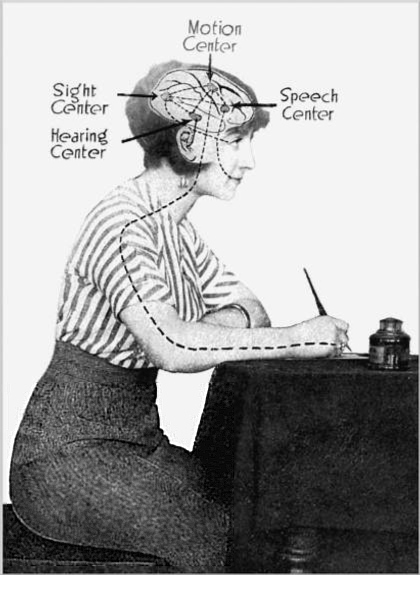
DIAGRAM SHOWING THE FOUR CHIEF ASSOCIATION CENTERS OF
THE HUMAN BRAIN
The Road to Perception
The outer end of every sensory nerve exposes a sensitive bit of gray
matter. These sensitive, impression-receiving ends constitute
together what is called the "sensorium" of the body.
When vibrations of light or sound impinge upon the sensorium, they
are relayed from nerve cell to nerve cell until they reach the
central brain. Then it is, and not until then, that sensations and
perceptions occur.
Consider, now, the infinitesimal size of a nerve cell and you will
have some conception of the number of hands through which the
message must pass before it is received by the central office.
Many of our sensations, especially those of touch, seem to occur on
the periphery
of the body—that is to say, at that part of the
exposed surface of the body which is apparently affected. If your
finger is crushed in a door, the sensation of the blow and the pain
all seem to occur in the finger itself.
The Place Where Sensation Occurs
As a matter of fact, this is not the case, for if one of your arms
should be amputated, you would still feel a tingling in the fingers
of the amputated arm. Thus has arisen a superstition that leads many
people to bury any part of the body lost in this way, thinking that
they will never be entirely relieved of pain until the absent member
is finally at rest.
Of course, the fact is that you would only seem to have feeling in
the amputated arm. The sensation would really occur
in the central
brain tissue as the organ of the governing intelligence, the organ
of consciousness.
Laboratory Proof of Sense-Perceptive Process
And you may set it down as an established principle that all states
of consciousness, whether seemingly localized on the surface of the
body or not, are connected with the brain as the dominant center.
The facts we have been recounting have been established by the
experiments of physiological psychology. Thus, the work of the
laboratory has shown that between the moment when a sense vibration
reaches the body and the moment when sensation occurs a measurable
interval of time intervenes.
If your eyes were to be blindfolded and your hand unexpectedly
pricked with
a white-hot needle, the time that would elapse before
you could jerk your hand away could be readily measured in fractions
of a second with appropriate instruments.
Reaction Time
This interval is known as reaction-time. It varies greatly with
different persons. During this reaction-time, the cell or cells
attacked upon the surface of the hand have conveyed news of the
assault through numberless intermediate sensory nerve cells to the
brain. The brain in turn has sent out its mandate through the
appropriate motor nerve cells to all the muscle and other cells
surrounding the injured cell, commanding them to remove it from the
point of danger.
The work of the nervous system in dealing
with the ether vibrations
that are constantly impinging upon the surface of the body has been
likened to that of the transmitter, connecting wire and receiver of
a telephone. Air-waves striking against the transmitter of the
telephone awaken a similar vibratory movement in the transmitter
itself. This movement is passed along the wire to the receiver,
which vibrates responsively and imparts a corresponding wave-like
motion to the air.
The Human Telephone
These air-waves when heard are what we call sound.
In the same way, air-waves striking the ear are communicated by the
auditory nerve to the brain, where they awaken a corresponding
sensation of sound. But these waves must be vibrating
at between 30
and 20,000 times a second. If they are vibrating so slowly or so
rapidly as not to come within this range, we cannot hear them.
The Living Telegraph
This process is by no means a mechanical affair. On the contrary, it
is a series of mental acts. Every cell in the living telegraph
must receive the message and transmit it. Every cell must exercise
a form of intelligence, from the auditory cell reporting a
sound-wave or the skin cell reporting an injury to the muscle cells
that ultimately receive and understand a message directing them to
remove the part from danger.
Reaction-time, so called, is thus occupied by cellular action in the
form of mental processes intervening between the
nerve-ends and
the brain center, in much the same way that light and sound
vibrations intervene between the object perceived and the surface of
the body.
The Six Steps to Reaction
For even the simplest of sense-perceptions we have, then, this
sequence of events: first, the object perceived; second, the series
of vibrations of ether particles intervening between the object and
the body; third, the impression upon the surface of the body;
fourth, the series of mental processes, cell after cell, in the
nerve filaments leading to the brain; fifth, when these impressions
or messages have reached the brain, a determination of what is to be
done; and, sixth, a transmission by cellular action of a new message
that will awaken some response in the muscular tissues.
Unopened Mental Mail
This process is completely carried out, however, in only
comparatively few instances. The vast majority of sense-impressions
awaken no reaction. They are registered in the mind, but they are
not perceived. We are not conscious of them. They form a part, not
of consciousness, but of subconsciousness. They are messages that
reach the mind but are laid aside like unopened mail because they
possess no present interest.
Wherever and however you may be placed, you are always and
everywhere immersed in a flood of etheric vibrations. Light, sound
and tactual vibrations press upon you from every side. At a busy
corner of a city street these vibrations rise to a tumultuous
fortissimo;
in the hush of a night upon the plains they sink to
pianissimo. Yet at every moment of your day or night they are there
in greater or less degree, titillating the unsleeping nerve-ends of
the sensorium.
Selective Process that Determines Conduct
Your mind cannot take time to make all these sense-impressions the
subject of conscious thought. It can trouble itself only with those
that bear in some way upon your interests in life.
Your mind is like the receiving apparatus of the wireless telegraph
which picks from the air those particular vibrations to which it is
attuned. Your mind is selective. It is discriminating. It seizes
upon those few sensory images that are related to your interests in
life and thrusts them forward to be consciously
perceived and acted
upon. All others it diverts into a subconscious reservoir of
temporary oblivion.
In Tune with Life-Interest
You will have a clearer understanding of the sense-perceptive
processes and a more vital realization of the practical significance
of these facts when you consider how they affect your knowledge of
material things and your conception of the external world.
This subject possesses two distinct aspects.
One aspect has to do with the inability of the sense-organs to
record the facts of the outer world with perfect precision. These
organs are the result of untold ages of evolution, and, generally
speaking, have become wonderfully efficient, but they display
surprising inaccuracies.
These inaccuracies are called Sensory
Illusions.
Practical Aspects of Perception Process
The other aspect of the Sense-Perceptive Process has to do with the
mental interpretation of environment.
Both these aspects are distinctly practical.
You should know something of the weaknesses and deficiencies of the
sense-perceptive organs, because all your efforts at influencing
other men are directed at their organs of sense.
You should understand the relationship between your mind and your
environment, since they are the two principal factors in your
working life.
Figure 1 shows two lines of equal length, yet the vertical line will
to most persons seem longer than the horizontal one.
Fig. 1.
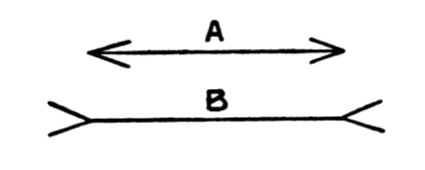
In Figure 2 the lines A and B are of the same length, yet the lower
seems much longer.
Fig. 2.
Those things look smallest over which the eye moves with least
resistance.
In Figure 3, the distance from A to B looks longer than the distance
from B to C because of the time we involuntarily take to notice each
dot, yet the distances are equal.
Fig. 3.
Being and Seeming
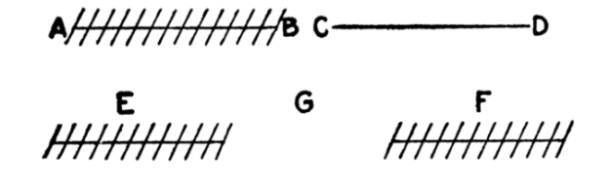
For the same reason, the hatchet line (A–B) appears longer than the
unbroken line (C–D) in Figure 4, and the lines E and F appear
longer than the space (G) between them, although all are of equal
length.
Fig. 4.
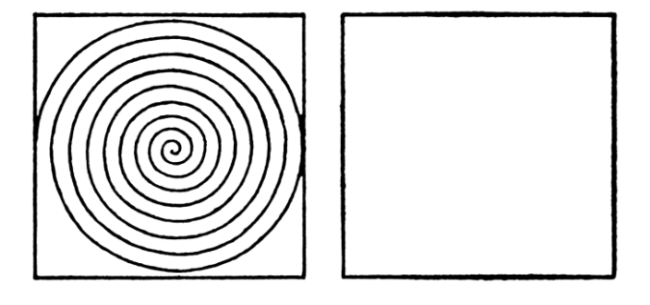
Filled spaces look larger than empty ones because the eye
unconsciously stops to look over the different parts of the filled
area, and we base our estimate upon the extent of the eye movements
necessary to take in the whole field. Thus
the filled square in
Figure 5 looks larger than the empty one, though they are of equal
size.
Fig. 5.
White objects appear much larger than black ones. A white square
looks larger than a black one. It is said that cattle buyers who are
sometimes compelled to guess at the weight of animals have learned
to discount their estimate on white animals and increase it on black
ones to make allowances for the optical illusion.
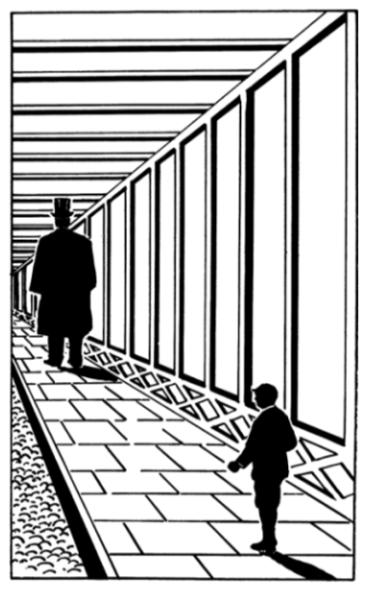
THIS MAN AND THIS BOY ARE OF EQUAL HEIGHT, BUT
ASSOCIATION OF IDEAS MAKES THE MAN LOOK MUCH THE LARGER
Use of Illusions in Business
The dressmaker and tailor are careful not to array stout persons in
checks and plaids, but try to convey an impression of sylph-like
slenderness through the use of vertical lines. On the other hand,
you have doubtless noticed in recent years the checkerboard and
plaid-covered boxes used by certain manufacturers of food products
and others to make their packages look larger than they really are.
The advertiser who understands sensory illusions gives an impression
of bigness to the picture of an article by the artful use of lines
and contrasting figures. If his advertisement shows a picture of a
building to which he wishes to
give the impression of bigness, he
adds contrasting figures such as those of tiny men and women so that
the unknown may be measured by the known. If he shows a picture of a
cigar, he places the cigar vertically, because he knows that it will
look longer that way than if placed horizontally.
Making an Article Look Big
A subtle method of conveying an idea of bigness is by placing
numbers on odd-shaped cards or blocks, or on any blank white space.
The object or space containing the figures always appears larger
than the corresponding space without the figures.
This fact has been made the basis of a psychological experiment to
determine the extent to which a subject's judgment is influenced by
suggestion. To perform
this experiment cut bits of pasteboard into
pairs of squares, circles, stars and octagons and write numbers of
two figures each, say 25, 50, 34, 87, etc., upon the different
pieces. Tell the subject to be tested to pick out the forms that are
largest. The susceptible person who is not trained to discriminate
closely will pick out of each pair the card that has the largest
number upon it.
Testing the Confidential Man
This test can be made one of a series used in examining applicants
for commercial positions. It can also be used to discover the
weakness of certain employees, such as buyers, secretaries and
others who are entrusted with secrets and commissions requiring
discretion, and who must be proof against the
deceptions practiced
by salesmen, promoters and others with seductive propositions.
Tests for Credulity
This examination can be carried still further to test the subject's
credulity or power of discrimination. What is known as the "force
card" test was originally devised by a magician, but has been
adopted in experimental psychology. Take a pack of cards and shuffle
them loosely in the two hands, making some one card, say the ace of
spades, especially prominent. The subject is told to "take a card."
The suggestive influence of the proffered card will cause nine
persons out of ten to pick out that particular card.
Turning from illusions of suggestion, shape and size, another field
of peculiar sensory
illusions is found in color aberration. Some
colors look closer than others. For instance, paint an object red
and it seems nearer than it would if painted green.
What Colors Look Nearest
Aside from the obvious uses to which these sense-illusions can be
put, they form the basis for a number of psychological experiments
to test the abilities of persons in many ways. Here is a test which
deals with the range of attention. If you desire to discover the
capacity of any person to pay attention to unfamiliar questions or
subjects which might at some future time have great importance, try
this test. Have a piece of pasteboard cut into squares, circles,
triangles, halfmoons, stars and other forms. Then write upon each
piece some
such word as hat, coat, ball or bat. The objects are
then placed under a cloth cover and the subject to be examined is
told to concentrate his attention on the shapes alone, paying no
attention to the words. The cloth is lifted for five seconds and
then replaced. The subject is then told to draw with a pencil the
different shapes and such words as he may chance to remember. The
experiment should then be repeated, with the injunction to pay no
attention to the shapes but to remember as many words as possible,
and write them down on such forms as he may happen to recall.
Testing the Range of Attention
Of course, the real object is to determine whether the subject will
see more than he is told, or whether he is a mere automaton. The
result will tell whether his
attention is of the narrow or broad
type. If it be narrow, he will see only the forms in the first case
and no words, and in the second case he will remember the words but
be unable to recall the shape of the pieces of cardboard.
A Guide to Occupational Selection
His breadth of attention will be shown by the number of correct
forms and words combined which he is able to remember in both cases.
In other words, this will measure his ability to pay attention to
more than one thing at a time.
Other things being equal, the narrow type of attention belongs to a
man fitted for work as a bookkeeper or mechanic, while the broad
type of attention fits one for work as a foreman or superintendent
or, lacking executive ability, for
work requiring the supervision
of mechanical operations widely separated in space.
Test for Attention to Details
The ordinary man sees but one thing at a time, while the exceptional
man sees many things at every glance and is prepared to remember and
act upon them in emergency.
Having determined a person's scope of attention, you may want to
test his accuracy in details as compared with other men. To conduct
such an experiment dictate a statement which will form one
typewritten letterhead sheet. This statement should comprise facts
and figures about your business of which the subjects to be tested
are supposed to have accurate knowledge. After this original page is
written, have your
typist write out another set of sheets in which
there are a large number of errors both in spelling and figures.
Then have each of the persons to be examined go through one of these
sheets and cross out all the wrong letters or figures. Time this
operation. The man who does it in the quickest time and overlooks
the fewest errors, naturally ranks highest in speed and accuracy of
work.
Other Business Applications
Look into your own business and you will undoubtedly find some
department, whether it be store decoration, office furnishing,
window dressing, advertising, landscape work or architecture, in
which a systematic application of a knowledge of sensory illusions
will produce good results.
The aspect of the sense-perceptive process that deals with the
relation of mind to environment is of greatest practical value.
Look at this subject for a moment and you will see that the world in
which you live and work is a world of your own making. All the
factors of success or failure are factors of your own choosing and
creation.
If there is anything in the world you feel sure of, it is that you
can depend upon
the "evidence of your own senses," eyes, ears,
nose, etc. You rest serene in the conviction that your senses
picture the world to you exactly as it is. It is a common saying
that "Seeing is believing."
Should Seeing Be Believing?
Yet how can you be sure that any object in the external world is
actually what your sense-perceptions report it to be?
You have learned that a countless number of physical agencies must
intervene before your mind can receive an impression or message
through any of the senses.
Under these conditions you cannot be sure that your impression of a
green lamp-shade, for instance, comes through the same sort of
etheric and cellular activities
that convey a picture of the same
lamp-shade to the brain of another. If the physical agencies through
which your sense-impressions of the lamp-shade filter are not
identical with the agencies through which they pass to the other
person's brain, then your mental picture and his mental picture
cannot be the same. You can never be sure that what both you and
another may describe as green may not create an entirely different
impression in your mind from the impression it creates in his.
Other facts add to your uncertainty. Thus, the same stimulus
acting on different organs of sense will produce different
sensations. A blow upon the eye will cause you to "see stars"; a
similar blow
upon the ear will cause you to hear an explosive
sound. In other words, the vibratory effect of a touch on eye or
ear is the same as that of light or sound vibrations.
Hearing the Lightning
The notion you may form of any object in the outer world depends
solely upon what part of your brain happens to be connected with
that particular nerve-end that receives an impression from the
object.
You see the sun without being able to hear it because the only
nerve-ends tuned to vibrate in harmony with the ether-waves set in
action by the sun are nerve-ends that are connected with the brain
center devoted to sight. "If," says Professor James, "we could
splice the outer extremities of our optic nerves to
our ears, and
those of our auditory nerves to our eyes, we should hear the
lightning and see the thunder, see the symphony and hear the
conductor's movements."
Importance of the Mental Make-Up
In other words, the kind of impressions we receive from the world
about us, the sort of mental pictures we form concerning it, in fact
the character of the outer world, the nature of the environment in
which our lives are cast—all these things depend for each one of
us simply upon how he happens to be put together, simply upon his
individual mental make-up.
There is another way of examining into the intervening agencies that
influence our mental conception of the material world about us.
Unreality of "The Real"
Look at the table or any other familiar object in the room in which
you are sitting. Has it ever occurred to you that this object may
have no existence apart from your mental impression of it? Have you
ever realized that no object ever has been or ever could be known to
exist unless there was an individual mind present to note its
existence?
If you have never given much thought to questions of this kind, you
will be tempted to answer boldly that the table is obviously a
reality, that you have a direct intuitive knowledge of it, and that
you can at once assure yourself of its existence by looking at it or
touching it. You will conceive your perception of the table as a
sort of projection
of your mind comfortably enfolding the table
within itself.
"Things" and their Mental Duplicates
But perception is obviously only a state of mind. Can it, then, go
outside of the mind to meet the table or even "hover in midair like
a bridge between the two"? If you perceive the table, must not your
perception of it exist wholly within your own mind? If, then, the
table has any existence outside of and apart from your perception of
it, then the table and your mental image of the table are two
separate and distinct things.
In other words, you are on the horns of a dilemma. If you insist
that the table exists outside of your mind, you must admit that
your knowledge of it is not direct, immediate and intuitive, but
indirect
and representative, because of intervening physical
agencies, and that the only thing directly known is the mental
impression of the table. On the other hand, if you insist that your
knowledge of the table is direct, immediate and intuitive you must
admit that the table is only a mental image, a mental reality, if it
is any sort of reality at all, and that it has no existence outside
of the mind.
Effect of Closing One's Eyes
You may easily convince yourself that the table you directly
perceive can be nothing other than a mental picture. How? Simply
close your eyes. It has now ceased to exist. What has ceased to
exist? The external table of wood and glue and bolts? By no means.
Simply its mental duplicate. And by alternately
opening and closing
your eyes, you can successively create and destroy this mental
duplicate.
If Matter Were Annihilated
Clearly, then, the table of which you are directly and immediately
conscious when your eyes are open is always this mental duplicate,
this aggregate of color, form, size and touch impressions; while
the real table, the physical table, may be something other than the
one of which you are directly aware. This other thing, this physical
table, whatever it is, can never be directly known, if indeed it has
any existence, a fact that many distinguished philosophers have had
the courage to deny.
Imagine, then, for a moment that everything except mind should
suddenly cease to exist, but that your sense-perceptions—that
is to say, your perception of sensory impressions—were to continue to
follow one another as before. Would not the physical world be for
you just exactly what it is today, and would you not have the same
reasons for believing in its existence that you now have?
If Mind Were Annihilated
And, conversely, if the world of matter were to go on, but all
mental images, all perception of sense-impressions, were to come to
an end, would not all matter be annihilated for you when your
perceptions ceased?
It is obvious that the world is not the same for all of us; but
that it is for each one of us simply the world of his individual
perceptions.
As Many Worlds as Minds
The whole subject of sense-impressions,
sensation and perception
may, therefore, be looked at from the standpoint of the mind as an
active influence, as well as from the standpoint of outside objects
as the exciting causes of sense-impressions.
External objects excite sensory impressions, but the perception of
them is purely at the option of the mind.
This is of the greatest practical importance. Consider its
consequences. It means that sense-impressions and your perception of
them are two very different things. It means that sense-impressions
may throng in upon you as they will. They are the work of external
stimuli impressing themselves upon
the sensorium as upon a
mechanical register. You are helpless to discriminate among them.
You cannot accept some and exclude others. You are a perambulating
dry plate upon which outside objects produce their images.
Prearranging Your Consciousness
But, and this is a vital distinction, perception is an act of the
mind. It is initiated from within. It permits you to discriminate
among sensations in the sense that you may dwell upon some and
ignore others. It enables you to definitely select, if you will, the
elements that shall make up the content of your consciousness.
Perception as an independent mental process thus enables you to
predetermine what elements of passing sensory experience may be made
the basis of your
conscious judgments and of your feelings and
emotions.
How to Definitely Selects its Elements
Bear this in mind when you think of your environment and its
supposed influence upon your life. Remember that your environment is
no hard-and-fast thing, an aggregate of physical realities. Your
environment, so far as it affects your judgment and your conduct, is
made up, not of physical realities, but of mental pictures.
Your environment is within you. Get this conclusion clearly in
your mind.
Hold fast to the point of view that, Environment, the environment
that influences your conduct and your life, is not a chance massing
of outward circumstances, but is the product of your own mind.
An Infallible Recipe for Self-Possession
Think what this means to you. It means that by deliberately
selecting for attention only those sense-impressions, those elements
of consciousness, that can serve your purpose, you can free yourself
from all distractions and make peaceful progress in the midst of
turmoil.
Using "Unseen Ear Protectors"
"In the busiest part of New York, a broker occupied a desk in a room
with six other men who had many visitors constantly moving about and
talking. The gentleman was at first so sensitive to disturbances
that he accomplished almost nothing during business hours, and
returned home every evening with a severe headache. One day a man of
impressive personality and extremely calm demeanor entered the
office, and noticing
the agitated broker, smilingly said: 'I see
that you are disturbed by the noise made by your neighbors in the
conduct of their affairs; pardon me if I leave with you an
infallible recipe for peace in the midst of commotion: Hear only
what you will to hear.' With this terse counsel he quietly bade the
astonished listener adieu. After his visitor had departed, the
nervous man felt unaccountably calm, and was constrained to meditate
upon his friend's advice, and no sooner did he seek to put it into
practical use than he learned for the first time that it was his
rightful prerogative to use unseen ear protectors as well as to
employ his ears. Six or seven weeks elapsed before he saw his
mysterious visitor again, and by that time
he had so successfully
practiced the simple though forceful injunction, that he had reached
a point in self-control where the Babel of tongues about him no
longer reached his consciousness."
How to Avoid Worry, Melancholy
Herein lies a remedy for worry, with its sleepless nights and
kindred torments; for melancholy and despair, with their train of
physical and financial disaster.
How? Simply by shutting off the flow of disagreeable thoughts and
substituting others that are pleasant and refreshing.
You are master. You can change the setting of your mental stage from
portentous gloom to sun-lit assurance. You can concentrate your
thought upon the useful,
the helpful and the cheerful, ignore the
useless and annoying, and make your life a life of hope and joy, of
promise and fulfilment.
Putting Circumstances Under Foot
You will not question the statement that what you do with your life
is the combined result of heredity and environment. At the same time
you doubtless possess a more or less hazy belief in the freedom of
your own will.
The chances are that in any previous reflections on this subject you
have magnified the influence of outside agencies and wondered just
how a man could make himself the master rather than the victim of
circumstances.
You now realize that your environment is an environment of thought,
that your material universe is a thing your own
making, and that
you can mold it as you will simply by the intelligent control of
your own thinking.
Running Your Mental Factory
In Book I. you learned that—
I. All human achievement comes about through bodily activity.
II. All bodily activity is caused, controlled and directed by the
mind.
In this volume you have added to these propositions a third, namely:
III. The mind is the instrument you must employ for the
accomplishment of any purpose.
Acting on this third postulate, you have begun the consideration of
primary mental operations with a view to evolving methods and
devices for the scientific
and systematic employment of the mind in
the attainment of success. You have concluded your study of the
first of the two fundamental processes of the mind, the
Sense-Perceptive Process, and have learned to distinguish between
seeing or hearing or feeling on the one hand and perceiving on the
other.
Acquiring Mental Balance
Realizing this distinction and applying it to your daily life, you
can at once set to work to acquire mental poise and practical
self-mastery, the essence of personal efficiency.
There never has been a moment in all your life when
sense-impressions were not pouring in upon you from every side,
tending to disturb and annoy you and interfere with your
concentration and
progress. Heretofore you have struggled blindly
with these distracting influences, not knowing the elements with
which you had to deal nor how to deal with them.
Dissipating Mental Specters
But the mask has been torn from the specter of distraction, and
hereafter when irrelevant sights, sounds and other sensations
threaten to interrupt your work, just stop a moment and consider. So
far as you and your actual knowledge are concerned, nothing exists
in substance and reality outside your mental picture of it. So far
as you and your actual knowledge are concerned, all matter is simply
thought, and you have never doubted your ability to dismiss a
thought. It is for you, then, here and now, to decide whether you
will harbor
sensory pictures that impede your progress and allow
them to harass and dominate you and interfere with the achievement
of your ambition, or whether you will ignore these intruders and
thereby annihilate them.
How to Control Your Destiny
Success is a variable term. In the last analysis, it means simply
getting the thing that you want to have.
Whether you succeed or fail depends altogether upon your own
attitude toward the external facts of life.
You have within you a living Force against which all the world is
powerless. You have only to know it and to learn how to use it.
Learn the lesson of your own powers, the secret of controlling the
selective and creative energy within you, and you can
bring any
project to the goal of accomplishment.
In the closing volumes of this Course we shall instruct you in
practical methods by which the selection of those elements of
experience that are helpful may be made absolutely automatic.
Some illustrations have been moved from their original positions,
so as to be nearer to their corresponding text, or for ease of navigation
around paragraphs.
Duplicate chapter headers have been removed from the text version
of this ebook and hidden in the HTML version.
The word 'prearranging' appears both with and without a hyphen.
This variance matches the original text.