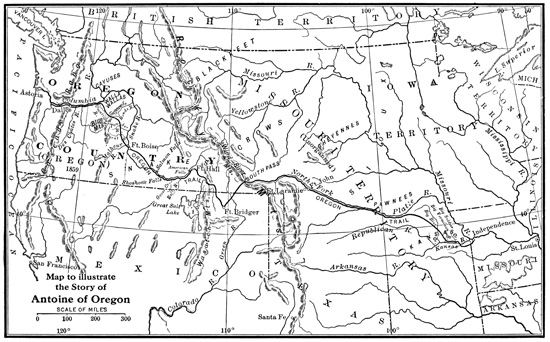
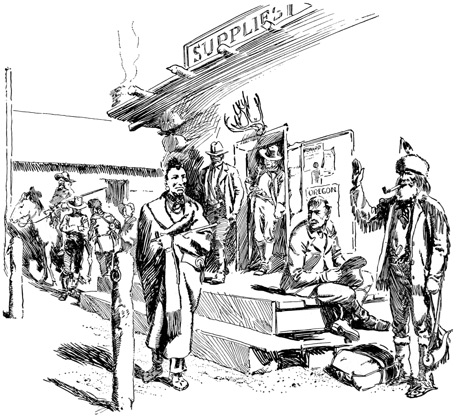
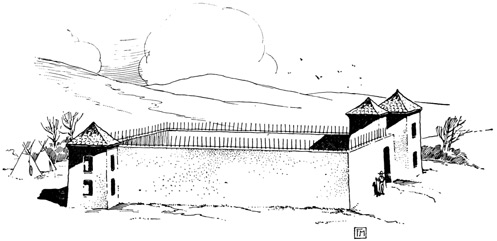
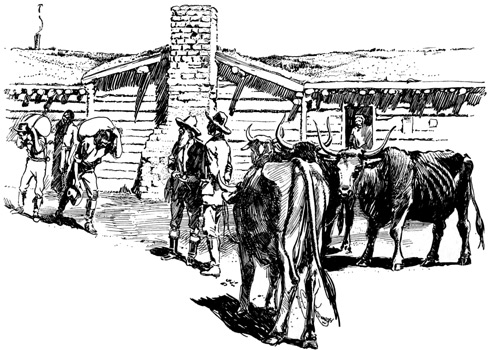
This fort, like many another, is little more than a
trading post, and was built two years before we started
for the Oregon country, by two old trappers who had
turned fur traders. The largest building is made of
adobes and serves as storehouse, while the others
are flimsy shelters built from time to time to serve
the needs of visitors.
I remember having heard in St. Louis why James
Bridger forsook his calling of trapper to engage as
trader, and have even seen the letter he wrote Pierre
Chouteau when he settled in the valley of Black's
Fork of the Green River, asking that goods for trading
with the Indians be sent to him.
In it he wrote: "I have established a small fort
with a blacksmith shop and a supply of iron, on the
road of the emigrants, which promises fairly. People
coming from the East are generally well supplied with
money, but by the time they get here are in want of
all kinds of supplies. Horses, provisions, and smith
work bring ready cash from them, and should I receive
the goods hereby ordered will do a considerable
business with them. The same establishment trades
with the Indians in the neighborhood, who have mostly
a good number of beaver among them."
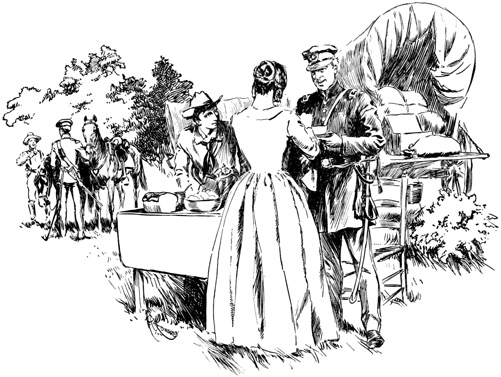
John Mitchell had a very good idea of how great a
profit the owners of the fort hoped to make, when he
was forced to pay five cents a pound for flour, and three
dollars a pound for
powder, with other
supplies in like
proportion.
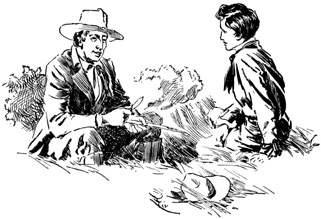
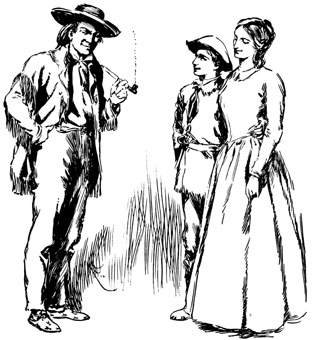
James Bridger
was exceedingly
kind to mother and
me when he learned
who we were, for he
had often trapped
in company with
my father, and I
believe he would
have given us outright anything we might have needed
from his stores, had we told him we lacked money with
which to pay for what was wanted; but I would not
have taken a dollar's worth from any man, unless
my mother had been in sore distress.
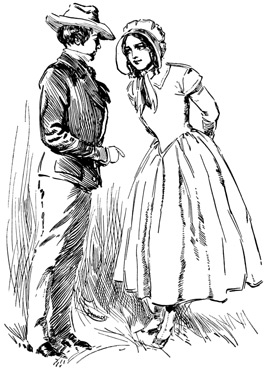
Susan Mitchell was greatly interested in the trapper
who had turned trader, when she heard from my
mother that James Bridger had been grievously
wounded in a battle with the Blackfeet Indians,
had received two arrows through his back, and yet
after so severe an injury he, with his friend, Bascus,
and two other comrades, held the savages at bay for
two days, until a company of white hunters came to
his relief.
One of the arrows was taken from Bridger's body
during the fight, but the other held firm in the wound,
and Bascus cut off the wooden portion close to the
flesh, letting the iron head remain. This piece of
metal he carried in his body three years, until Dr.
Marcus Whitman, who was on his way to the Oregon
country, cut it out after long and painful work. The
arrowhead was three inches long, and the barbs had
become hooked around one of the man's bones, which
held it until it was cut out by Dr. Whitman.
We were at our nearest point to the Great Salt
Lake, and at this place a trail branched off, leading
to what is known as Ogden's Hole, close by that vast
inland sea. If we had desired to go to the California
country, it would only have been necessary to continue
on around the Wasatch Mountains, and then
strike off again to the westward, unless we were inclined
to climb the hills, going by the way of that salt
lake.
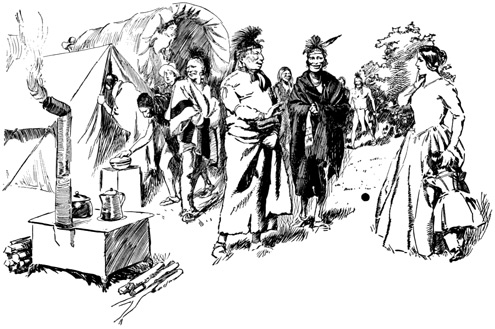
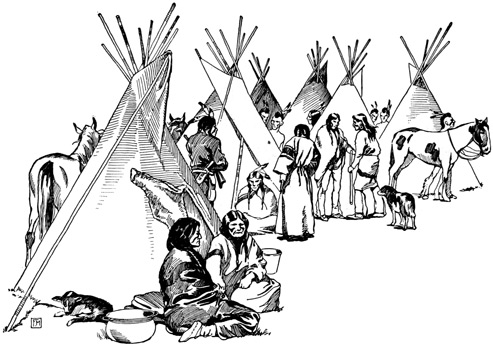
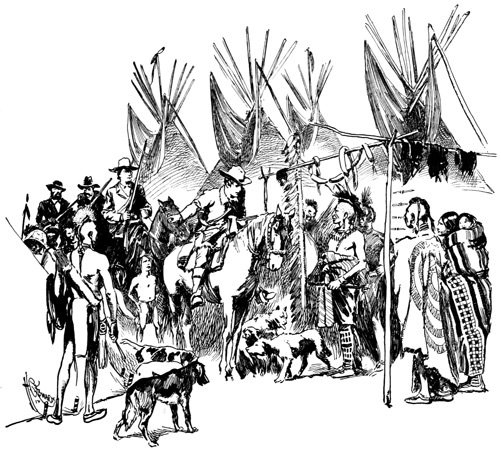
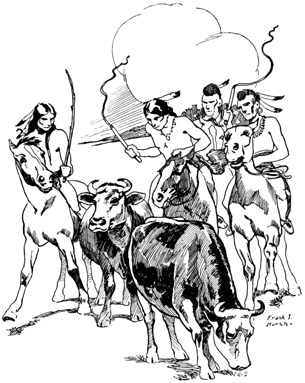
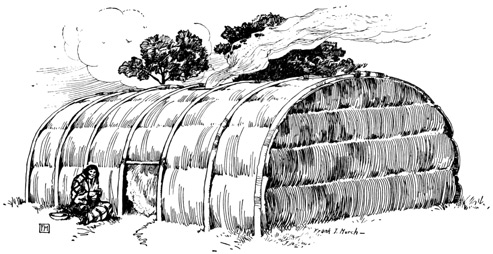
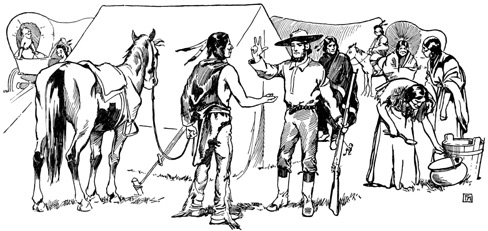
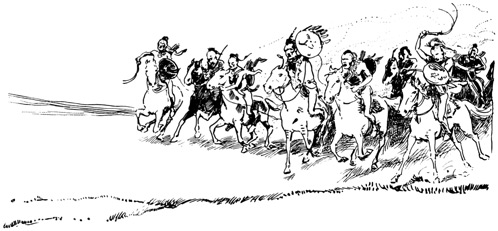
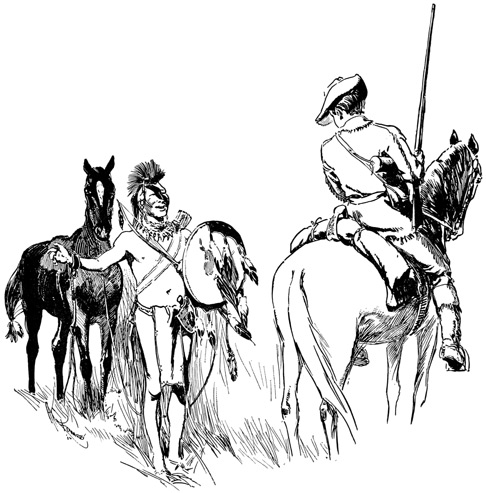
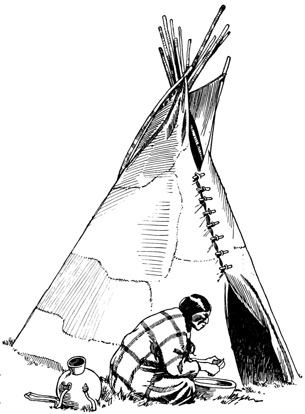
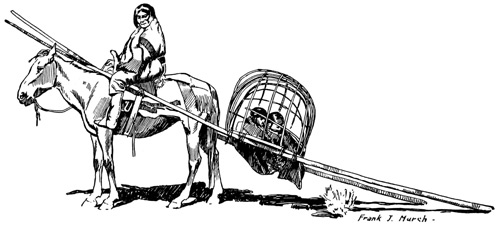
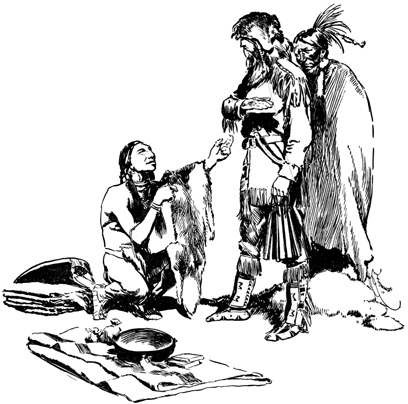
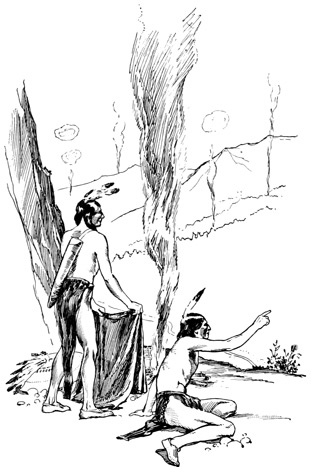
There were twenty-five lodges of Indians near Fort
Bridger, some of the savages having come to trade, and
not a few of them being employed as trappers by the
fur buyers. They were mostly of the Snake tribe
and had with them quite a large herd of cattle.
Already Susan Mitchell and Mary Parker had seen
enough of the Indians to satisfy their curiosity, and
whether they wore moccasins of a little different
pattern from other Indians, or
fashioned their bows and arrows
after another manner, was not
sufficient inducement to persuade
them to encounter such
conditions as were
to be found in the
lodges.
In order to give
our cattle
a rest we
remained
at Fort
Bridger two
days, after which
we went on again with the hope of soon coming upon
the Columbia River.
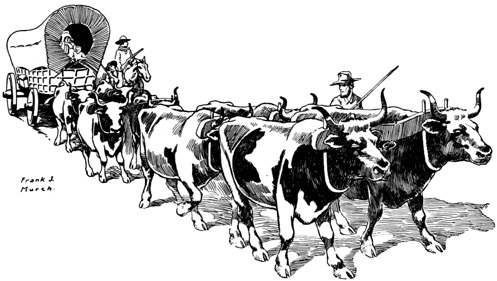
Our men had been told by the fur buyers that
it was of the greatest importance we push forward
at all speed, lest we be caught among the hills by
the snow, and during the four or five days following
our departure from the post, we traveled more
rapidly than at any other time since leaving Independence.
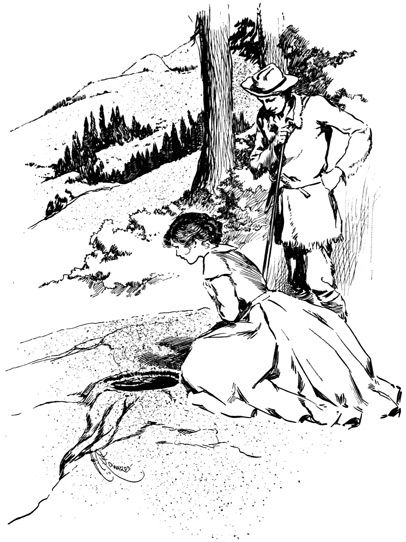
The month of August had well set in when we came
to Soda Springs, and there it was I had counted upon
surprising Susan Mitchell; nor was I disappointed.
These springs are small hills or mounds standing
at the right of the trail near a grove of cedars and
pines, while the water that has oozed out of them in
the past has formed a solid crust of soda for miles
around, so hard that one may walk upon it.
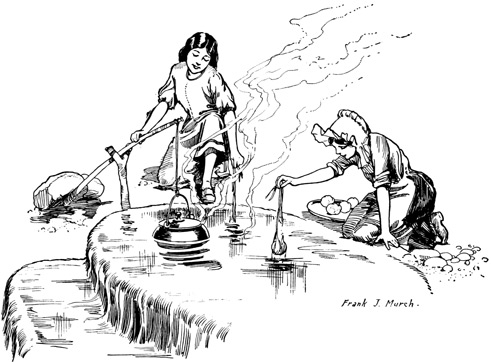
The liquid soda is warm and sparkling as it comes
to the surface, and when it has been led some distance
away where it may be cooled, is as pleasing a drink
as one can find in any of the shops in the East, for it
is the true soda water as made by God Himself.