BY
LEO WIENER
ASSISTANT PROFESSOR OF SLAVIC LANGUAGES AT HARVARD UNIVERSITY
In Two Parts
8o with Photogravure Frontispieces
Part I.—From the Tenth Century to the Close of the
Eighteenth Century
Part II.—From the Close of the Eighteenth Century to
the Present Time
G. P. PUTNAM’S SONS
NEW YORK LONDON
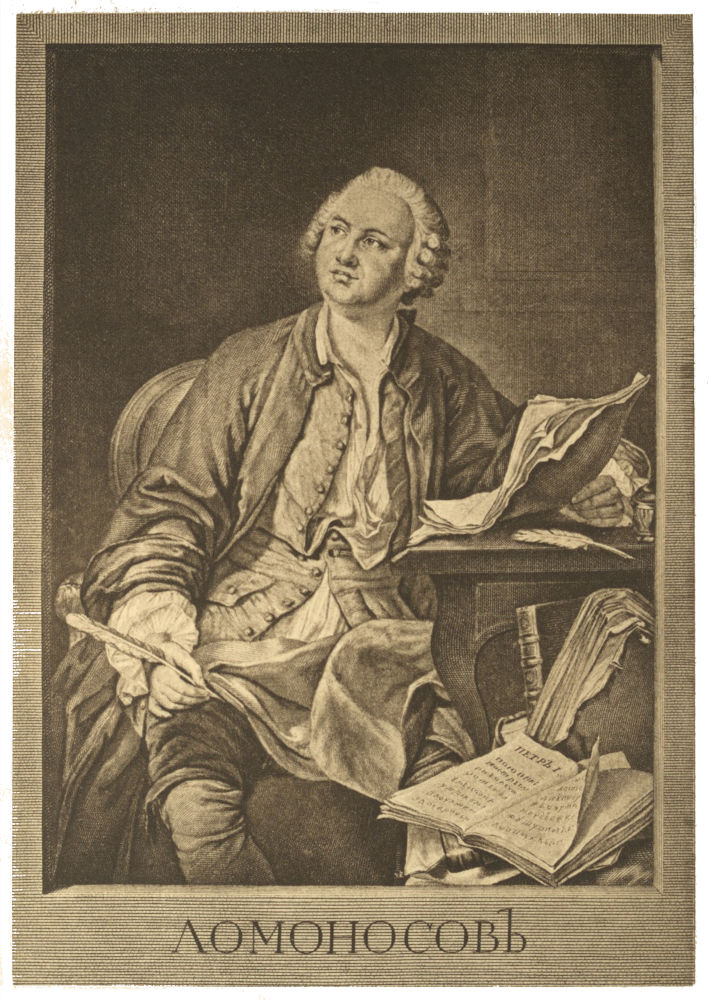
Lomonosow
Anthology of Russian Literature From the Earliest Period to the Present Time
By
Leo Wiener
Assistant Professor of Slavic Languages at Harvard University
IN TWO PARTS
From the Tenth Century to the Close of the Eighteenth Century
G. P. Putnam’s Sons
New York and London
The Knickerbocker Press
1902
Copyright, 1902
BY
LEO WIENER
Published, June, 1902
The Knickerbocker Press, New York
TO MY FRIEND AND COLLEAGUE
ARCHIBALD CARY COOLIDGE
THIS WORK IS
GRATEFULLY DEDICATED
PREFACE
The time is not far off when the Russian language will
occupy the same place in the curriculum of American
universities that it now does in those of Germany,
France and Sweden. A tongue that is spoken by more
than one hundred million people and that encompasses one-half
of the northern hemisphere in itself invites the attention
of the curious and the scholar. But the points of contact
between the Anglo-Saxon and Slavic races are so many, both
in politics and literature, that it is a matter of interest, if not
yet of necessity, for every cultured person of either nationality
to become well acquainted with the intellectual and social
life of the other. In Russia, the English language is steadily
gaining in importance, and not only the universities, but the
gymnasiums as well, offer courses in English. In England
and America there are many signs of a similar interest in
their Russian neighbour, though at present it expresses itself
mainly in the perusal of Russian novels in translations that
rarely rise above mediocrity. There is also a growing demand
for a fuller treatment of Russian Literature as a whole,
which even Prince Wolkonsky’s work cannot satisfy, for the
reason that only a small fraction of the nineteenth-century
writers, and hardly anything of the preceding periods, is
accessible to the reader for verification. It is the purpose
of this Anthology to render a concise, yet sufficient, account
of Russian Literature in its totality, to give to the English
reader who is not acquainted with any other language than
his own a biographical, critical and bibliographical sketch
of every important author, to offer representative extracts of
what there is best in the language in such a manner as to
give a correct idea of the evolution of Russian Literature
from its remotest time. The selections have been chosen so
as to illustrate certain important historical events, and will
be found of use also to the historical student.
In the preparation of this work, I have availed myself of
many native sources, to which I shall express my indebtedness
by a general declaration that I have with profit perused
the monumental works of Pýpin and the authors on whom he
has drawn in the preparation of his history of Russian Literature.
To give variety, I have reproduced such of the existing
translations as are less objectionable. In my own translations,
for which alone I am responsible, I have attempted
to render minutely the originals, with their different styles,
not excepting their very imperfections, such as characterise
particularly the writers of the eighteenth century. Only
where the diction is inexpressibly crude, as in Pososhkóv’s
writings, or the text corrupt, as in the Word of Ígor’s Armament,
have I made slight deviations for the sake of clearness.
Russian words are transliterated differently by every translator:
some attempt to give English equivalents, which, even
if they were correctly chosen (they seldom are), cannot possibly
give an idea of the phonetic values in Russian; others
follow the simpler method of an etymological transliteration
of letter by letter, but needlessly encumber the words with
diacritical marks and difficult consonant combinations. The
method pursued here, though far from ideal, recommends
itself for its simplicity. Where the Russian and English
alphabets are practically identical, the corresponding letters
are used; in the other cases, the combinations are made with
h, for which there is no corresponding sound in Russian; for
the guttural vowel y is used, which does also the duty of the
English y in yes. There can be no confusion between the
two, as the guttural y before or after a vowel is extremely
rare. It is useless for anyone without oral instruction to try
to pronounce Russian words as the natives do. The nearest
approach will be attained if the consonants be pronounced
as in English (g always hard, zh as z in azure, r always
rolled, kh, guttural like German ch in ach), and the vowels
always open as in Italian (a as a in far, e as e in set, o as o in
obey, or a little longer when accented, u as oo in foot, or a little
longer when accented, y between consonants is guttural,
which it is useless to attempt and had better be pronounced
like i: i. e., like i in machine or bit, according to the accent).
The accents are indicated throughout the work. Accented
é is frequently pronounced as yó, but it would be useless to
indicate all such cases. It has not been found practicable
to spell Russian names uniformly when their English forms
are universally accepted.
It will not be uninteresting to summarise all that Englishmen
and Americans have done to acquaint their countrymen
with the language and literature of Russia.
When Russia was rediscovered by England in the middle
of the sixteenth century and the Muscovy Company established
itself at Moscow, there was naturally a demand for
Englishmen who could speak Russian. There are frequent
references in native reports to Englishmen who spoke and
wrote Russian fluently and who were even used as ambassadors
to the Muscovite Tsars. It was also an Englishman,
Richard James, who, in 1619, made the first collection of
Russian popular songs. In 1696, the first Russian grammar
was published by the Oxford University Press, though its
author, Ludolf, was not an Englishman by birth. In the
eighteenth century, there seems to have been in England no
interest in Russia except as to its religion, which received
consideration from certain divines. An exception must be
made in the case of W. Coxe, who in his Travels in Poland,
Russia, Sweden and Denmark, 1st edition, London, 1784, gave
an excellent account of Russian Literature from German and
French sources. In 1821, Sir John Bowring startled his
countrymen with his Specimens of the Russian Poets, which
for the first time revealed to them the existence of a promising
literature. Though his knowledge of Russian was quite
faulty, as his translations prove, yet he put the poems into
such pleasing verses that they became deservedly popular.
A second edition followed the same year, and a second part
two years later.
The impulse given by Sir John Bowring found a ready
response in the periodic press of that time. In 1824 the
Westminster Review brought out an article on Politics and
Literature of Russia, which gave a short review of eighteenth-century
literature. In 1827, R. P. Gillies gave a good sketch
of Russian Literature in vol. i of the Foreign Quarterly Review,
based on the Russian work of Grech. The same year,
the Foreign Review brought out a short account, and the
next year an elaborate article on Russian Literature and
Poetry, also after Grech, which for some decades formed the
basis of all the articles and chapters dealing with the same
subject in the English language. The Foreign Quarterly
Review brought out similar matter in vol. viii, xxi, xxiii,
xxix, xxx. But more interesting than these, which are
nearly all fashioned after some Russian articles, are the
excellent literary notes in every number, that kept the
readers informed on the latest productions that appeared in
Russia. There seems hardly to have been a public for
these notes in England, and indeed they get weaker with
the twenty-fourth volume, and die of inanity in the thirtieth.
This early period of magazine articles is brought to an end
by Russian Literary Biography, in vol. xxxvi (1841) of the
Westminster Review.
The example set by Sir John Bowring found several imitators.
We have several anthologies, generally grouping
themselves around Púshkin, for the first half of the century:
W. H. Saunders, Poetical Translations from the Russian Language,
London, 1826; [George Borrow], The Talisman, with
Other Pieces, St. Petersburg, 1835; W. D. Lewis, The Bakchesarian
Fountain, and Other Poems, Philadelphia, 1849.
The Foreign Quarterly Review brought out in 1832 translations
from Bátyushkov, Púshkin, and Rylyéev, and in Blackwood’s
Edinburgh Magazine for 1845 T. B. Shaw gave some
excellent translations of Púshkin’s poems. Other articles,
treating individual authors, will be mentioned in their
respective places.
While these meagre accounts of Russian Literature, at
second hand, and the scanty anthologies were appearing,
there was published in the Biblical Repository of Andover,
Mass., in 1834, the remarkable work by Talvi, the wife of
Dr. Edward Robinson, entitled: Historical View of the Languages
and Literatures of the Slavic Nations, and this was
republished in book-form, and enlarged, in New York, in
1850. Though there existed some special works by Slavic
scholars, Talvi’s was the first to encompass the whole field
in a scholarly and yet popular manner. It is authoritative
even now in many departments that have not been overthrown
by later investigations, and it is a matter of surprise
that none of the later English writers should have based
their Russian Literatures on this important work, or should
have proceeded in the path of Slavic studies which she had
so beautifully inaugurated. There is no excuse for G.
Cox’s translation of F. Otto’s History of Russian Literature,
with a Lexicon of Russian Authors, which appeared at Oxford
in 1839, and adds a number of its own inaccuracies to the
blunders of the German original. Nor is there any notice
taken of Talvi in [C. F. Henningsen’s] Eastern Europe and
the Emperor Nicholas, London, 1846, which gives a chapter
on Russian Literature, mainly on Púshkin.
In the sixties W. R. Morfill began to translate some
poems from the Russian, and towards the end of that decade,
but especially in the next, Ralston published his excellent
studies on the Folksongs and Folktales and Krylóv, and in
the Contemporary Review, vols. xxiii and xxvii, two articles
on the Russian Idylls. The magazines that in the seventies
reviewed Russian Literature got everything at second hand,
and are of little value: National Quarterly Review, vol. xxiv
(1872); Catholic World, vol. xxi (1875); Harper’s Magazine,
1878. Of books there were issued: Sutherland Edwards’s
The Russians at Home, London, 1861, a very useful work for
contemporary literature, and F. R. Grahame’s The Progress
of Science, Art and Literature in Russia, London [1865],
which contains a great deal of interesting material badly
arranged and ill-digested. The chapter on Literature in O.
W. Wahl’s The Land of the Czar, London, 1875, is unimportant.
Since the eighties there have appeared a number of
translations from good foreign authors bearing on Russian
Literature: Ernest Dupuy, The Great Masters of Russian
Literature in the Nineteenth Century, translated by N. H.
Dole, New York [1886]; E. M. de Vogüé, The Russian
Novelists, translated by J. L. Edmands, Boston [1887]; Dr.
George Brandes, Impressions of Russia, translated by S. C.
Eastman, New York, 1889; E. P. Bazán, Russia: Its People
and its Literature, translated by F. H. Gardiner, Chicago,
1890.
The following more or less original works will be found
useful: W. R. Morfill, Slavonic Literature, London, 1883,
and The Story of Russia, New York and London, 1890; also
his The Peasant Poets of Russia (Reprint from Westminster
Review), London, 1880; C. E. Turner, Studies in Russian
Literature, London, 1882, and before, in Fraser’s Magazine
for 1877; Ivan Panin, Lectures in Russian Literature, New
York and London, 1889; Memorials of a Short Life: A
Biographical Sketch of W. F. A. Gaussen (chapter on The
Russian People and their Literature), London, 1895; Prince
Serge Wolkonsky, Pictures of Russian History and Russian
Literature (Lowell Lectures), Boston, New York and London,
1897; K. Waliszewski, A History of Russian Literature,
New York, 1900, but this work must be used with extreme
caution, on account of the many inaccuracies it contains.
W. M. Griswold’s Tales Dealing with Life in Russia, Cambridge,
1892, is a fair bibliography of all the prose translations
that have appeared in the English language before 1892.
But few anthologies have of late seen daylight: C. T. Wilson,
Russian Lyrics in English Verse, London, 1887; John
Pollen, Rhymes from the Russian, London, 1891 (a good
little book); E. L. Voynich, The Humour of Russia, London
and New York, 1895. The periodical “Free Russia,” published
in London since 1890, contains some good translations
from various writers and occasionally some literary essay;
but the most useful periodic publication is “The Anglo-Russian
Literary Society,” published in London since 1892,
and containing valuable information on literary subjects,
especially modern, and a series of good translations from
contemporary poets. Nor must one overlook the articles in
the encyclopedias, of which those in Johnson’s Cyclopedia
are especially good.
Very exhaustive statements of the modern literary movement
in Russia appear from year to year in the Athenæum.
More or less good articles on modern literature, mainly the
novel, have appeared since 1880 in the following volumes of
the periodical press: Academy, xxi and xxiii; Bookman,
viii; Chautauquan, viii and xxii; Critic, iii; Current Literature,
xxii; Dial, xx; Eclectic Magazine, cxv; Forum,
xxviii; Leisure Hours, ccccxxv; Lippincott’s, lviii; Literature,
i; Living Age, clxxxv; Nation, lxv; Public Opinion,
xx; Publisher’s Weekly, liv; Temple Bar, lxxxix.
In conclusion, I desire to express my gratitude to my
friends and colleagues who have aided me in this work: to
Prof. A. C. Coolidge, for leaving at my disposal his collection
of translations from the Russian, and for many valuable
hints; to Dr. F. N. Robinson, for reading a number of my
translations; to Prof. G. L. Kittredge, to whom is largely
due whatever literary merit there may be in the introductory
chapters and in the biographical sketches. I also take
this occasion to thank all the publishers and authors from
whose copyrighted works extracts have been quoted with
their permission.
A SKETCH OF RUSSIAN LITERATURE — I.—THE OLDEST PERIOD
Of the many Slavic nations and tribes that at one time
occupied the east of Europe from the Elbe and the
headwaters of the Danube to Siberia, and from the Ionic Sea
to the Baltic and White Seas, some have entirely disappeared
in the ruthless struggle with a superior German civilisation;
others, like the Bulgarians and Servians, have paled into
insignificance under the lethargic influence of the Crescent,
to be fanned to life again within the memory of the present
generation by a breath of national consciousness, which is
the result of the Romantic Movement in European literature;
others again like the Bohemians and Poles, rent asunder by
fraternal discord and anarchy, have forfeited their national
existence and are engaged in an unequal battle to regain it.
Of all the Slavs, Russia alone has steadily gathered in the
lands of the feudal lords, to shine at last as a power of the
first magnitude among the sisterhood of states, and to scintillate
hope to its racial brothers as the “Northern Star.”
The unity of the Russian land was ever present to the
minds of the writers in the earliest days of the appanages.
The bard of the Word of Ígor’s Armament and Daniel the
Palmer made appeals to the whole country and prayed for
all the princes in the twelfth century, and for upwards of
four centuries Moscow has been the centre towards which
the outlying districts have been gravitating. Yet, in spite
of so continuous and well-defined a political tendency, Russia
is the last of the Slavic nations to have evolved a literature
worthy of the name. Bohemia had a brilliant literature
of the Western stamp as early as the thirteenth century;
Bulgaria had made a splendid start three centuries before,
under the impulse of the newly introduced religion; the
Servian city of Ragusa, receiving its intellectual leaven from
its Italian vicinage, invested Petrarch and Dante with Servian
citizenship in the fifteenth century, and, shortly after,
gloried in an epic of a Gundulić, and in a whole galaxy of
writers; Poland borrowed its theology from Bohemia, took
an active part in the medieval Latin literature, and boasted
a golden age for its native language in the sixteenth century.
Russia produced an accessible literature only in the second
half of the eighteenth century, became known to Western
Europe not earlier than the second quarter of the next, and
had not gained universal recognition until within the last
twenty-five years.
In the case of the Western and Southern Slavs, a community
of interests, whether religious or social, has led to an
intellectual intercourse with their neighbours, from whom
they have received their models for imitation or adaptation.
Without a favourable geographical position, or some common
bond with the external world, no nation can have a
healthy development, especially in the incipient stage of its
political existence. Blatant Slavophiles of fifty years ago
heaped reproach on the reforms of Peter the Great, on the
ground that they were fashioned upon Western ideals, and
that he had retarded the evolution of Russia according to
its inherent Slavic idea. There still survive men of that
persuasion, though a comparative study of Russian literature
long ago demonstrated that every step in advance has been
made by conscious or unconscious borrowings from abroad.
If there was a Russian literature previous to the introduction
of Christianity, it certainly stood in some kind of relation to
the literatures of the neighbours. The few extant treaties
with the Greeks for that period show unmistakable Byzantine
influences, and the Russian Code of Yarosláv, with its
purely Norse laws, dates from a time when the Varyágs had
not yet disappeared in the mass of the Slavic majority.
With the introduction of Christianity, Russia, instead of
entering into closer communion with the rest of the world,
was separated from it even more securely than before, and
soon after, an intellectual stagnation began that lasted very
nearly to the end of the seventeenth century. Various
causes combined to produce this singular effect. Chief of
these was its geographical position. Living in the vast
eastern plain of Europe, which in itself would have been
productive of a larger life, the Russian tribes had civilised
neighbours on one side only. On the north they were
separated from the Swedes by rude Finnish tribes; on the
south, they had for centuries to contend against all the
nomads, Pechenyégs, Cumanians, Khazars, who slowly proceeded
from Asia to central Europe to become lost in the
nations to the south of the Carpathians and in the Balkan
peninsula; in the east the Finns of the north met the Tartars
of the south, and behind them lay unprofitable Asia.
On the north-west, it is true, was the civilised Teutonic
Order, but the inveterate hatred between these Germans
and the Slavs prevented any intercommunication from that
quarter. There was left Poland, through which Russia
might issue into Europe; but savage Lithuania was wedged
in between the two, so as to reduce still more the line of
contact with the West. When Lithuania became civilised,
and a part of Poland, the latter had grown suspicious of the
youthful Ilyá of Múrom who “had sat thirty years upon
the oven,” and enunciated a political maxim that either
Russia would have to become Polish, or else Poland Russian.
Knowing that there was no other exit for Russia,
Poland permitted no light to reach it from the West. When
England began to communicate with Russia in the sixteenth
century, King Sigismund made an earnest appeal to Queen
Elizabeth to stop sending skilled mechanics, lest the Colossus
should awaken and become a danger to Europe.
These external causes of Russia’s aloofness were still more
intensified by a systematic determination of Russia to keep
out the Catholic contamination that would come from intercourse
with Europe. This was a direct outgrowth of its
adoption of Christianity from Byzantium, instead of Rome.
Cyril and Methodius, the apostles to the Slavs, were themselves
Bulgarians from Macedonia. When they first carried
the new religion to Moravia and later to Bulgaria, they, no
doubt, preached and wrote in the dialect with which they
were most familiar. This innovation of preaching the gospel
in another than one of the three sacred languages was a
necessary departure, in order to win over the troublesome
Slavs to the north of Byzantium. Though at the end of the
ninth century the various dialects were already sufficiently
dissimilar to constitute separate languages, yet they were
not so distant from each other as to be a hindrance to a free
intercommunication. When, a century later, Christianity
was introduced into Russia from Constantinople, Bulgarian
priests and bookmen were the natural intermediaries, and
the Bulgarian language at once became the literary medium,
to the exclusion of the native tongue. Soon after, the
Eastern Church separated from Rome, and the Greek-Catholic
clergy inculcated upon their neophytes an undying
hatred of the Latins, as the Romanists were called. In
Moscow, the slightest deviation from the orthodox faith
was sufficient cause for suspecting a Romanist heresy, and
anathemas against Roman-Catholics were frequent, but at
Kíev, where the contact with Poland was inevitable, the
disputes with the Latins form a prominent part of ecclesiastical
literature. To guard the country against any possible
contagion, the punishment of Russians who crossed the border,
in order to visit foreign parts, was so severe, that few
ever ventured out of the country. The seclusion of Russia
was complete.
Even under these difficulties, literature and the arts might
have flourished, if Constantinople had been able to give to
the new converts even its degraded Byzantine culture, or if
there had not been other powerful causes that militated
against a development from within. In the west of Europe
the Latin language of the Church did not interfere with
an early national literature. Latin was the language of
the learned, whether clerical or lay, and mediated an intellectual
intercourse between the most distant members of the
universal faith. At the same time, the native dialects had
received an impulse before the introduction of Christianity,
often under the influence of Rome, and they were left to
shift for themselves and to find their votaries. The case
was quite different in Russia. The Bulgarian language,
which was brought in with the gospel, at once usurped on
the native Russian to the great disadvantage of the latter.
Being closely related to the spoken Russian, Bulgarian was
easily acquired by the clergy, but it was not close enough to
become the literary language of the people. On the one
hand, this new gospel language could at best connect Russia
with Byzantium by way of Bulgaria; on the other, Russian
was looked down upon as a rude dialect and was discouraged,
together with every symptom of the popular creation which
was looked upon as intimately connected with ancient
paganism.
This Bulgarian language was not long preserved in its
purity. Detached from its native home, it was immediately
transformed in pronunciation, so as to conform to the spoken
Russian; thus, for example, it at once lost its nasals, which
were not familiar to the Russian ear. In the course of time,
words and constructions of the people’s language found their
way into the Church-Slavic, as the Bulgarian was then more
properly called. Naturally, many words, referring to abstract
ideas and the Church, passed from the Bulgarian into
the spoken tongue. Thus, the two dialects, one the arbitrary
literary language, the other, the language of every-day life,
approached each other more and more. At the present time,
the Russian of literature contains a large proportion of these
Church-Slavic words; the language of the Bible and the
liturgy is the Church-Slavic of the sixteenth century, which
differs so much from the original Bulgarian that, though a
Russian reads with comparative ease this Church-Slavic, he
has to study Bulgarian as a German would study Old German.
This Church-Slavic of the Russian redaction has also
been, and still is, in part, the ecclesiastical language of the
other Greek-Catholic countries of the Slavs.
Some time passed before Russia could furnish its own
clergy. All the leading places in the Church were at first
filled with Bulgarians and Greeks who were steeped in
Byzantine religious lore. The Church at Constantinople
stood in direct opposition to the classical traditions of
Greece. These were not separated from the old heathenism,
and to the luxury and voluptuousness of medieval Greece,
which was ascribed to classical influences, the Church
opposed asceticism and self-abnegation. Monasticism was
preached as the ideal of the religious life, and arts and
sciences had no place in the scheme of the Church. Theology
and rhetoric were the only sciences which the hermit
practised in his cell, in the moments that were free from
prayer and self-castigation. And it is only the Church’s
sciences that ancient Russia inherited from Byzantium.
The civil intercourse between the two countries was very
slight, and the few Russian ecclesiastics who visited Mount
Athos and the Holy Land brought back with them at best a
few legends and apocryphal writings. The Byzantine influence
at home showed itself in a verbal adherence to the Bible
and the Church Fathers, and an occasional attempt at pulpit
oratory in the bombastic diction of contemporary Greece.
Not a science penetrated into ancient Russia. Historically
the rest of the world did not exist for it, and geographically
it was only of interest in so far as it came into contact with
Russia: Russia knew more of Tartars and Cumanians than
of Germany or France. Arithmetic, not to speak of mathematics,
and physics, medicine and engineering, were unknown
before the sixteenth century, and then only when a
few foreigners practised these arts in the capital and at the
Court. The only literature that reached Russia was the
legendary lore of the South and West, through Bulgaria and
Poland, generally at a time when it had long been forgotten
elsewhere: thus, the Lucidarius and Physiologus were accepted
as genuine bits of zoölogical and botanical science,
long after sober knowledge had taken possession of the universities
of the world. The literature of Russia before Peter
the Great is by no means meagre or uninteresting, but it
lacks an important element of historical continuity; in fact,
it is devoid of every trace of chronology. What was written
in the twelfth century might with equal propriety be the
product of the sixteenth, and vice versa, and the productions
of the earliest time were copied out as late as the seventeenth
century, and relished as if they had just been written.
Where a certain literary document has come down to us in
a later copy, it is not possible to date it back, unless it contains
some accidental indication of antiquity. In short,
there was no progress in Russia for a period of six or seven
centuries, from the tenth century to the seventeenth.
In this achronism of literary history, there may, however,
be discerned two periods that are separated from each other
by the first invasion of the Tartars. Previous to that momentous
event, Kíev formed the chief intellectual and political
centre of the Russian principalities. Here the Norse
traditions, which had been brought by the Varyág warriors,
had not entirely faded away in the century following the
introduction of Christianity, and the Court maintained certain
relations with the rest of the world, as in the case of
Yarosláv, who was related, by the marriage of his children,
to the Courts of Norway, France, Germany and Hungary.
On the other hand, Vladímir’s heroes were celebrated abroad,
and Ilyá of Múrom is not unknown to German tradition and
the Northern saga. Not only its favourable geographical
position, but its climate as well, inspired the inhabitants of
Kíev with a greater alacrity, even as the Little-Russians of
to-day have developed less sombre characteristics than the
Great-Russians of the sterner north. It is sufficient to compare
the laconic instructions of Luká Zhidyáta in the commercial
Nóvgorod with the flowery style of Serapión’s sermon,
or the dry narrative of the northern chronicles with the elaborate
adornment of the stories in the chronicles of Néstor
and Sylvester, to become aware of the fundamental difference
between the two sections of Russia. The twelfth century,
rich in many aspects of literature, including that beautiful
prose poem of popular origin, the Word of Ígor’s Armament,
gave ample promise of better things to come. Similarly, the
bylínas of the Vladímir cycle, the best and most numerous
of all that are preserved, point to an old poetic tradition that
proceeded from Kíev.
The fact that these bylínas have been lately discovered in
the extreme north-east, in the Government of Olónetsk,
while not a trace of them has been found in their original
home, has divided the scholars of Russia into two camps.
Some assert that all the Russians of Kíev belonged to the
Great-Russian division, and that the Tartar invasion destroyed
most of them, and caused the rest to migrate to the
north, whither they carried their poetry. The Little-Russians
that now occupy the south of Russia are supposed by
these scholars to have come from Galicia to repeople the
abandoned places. The Little-Russians themselves claim,
with pardonable pride, to be the direct descendants of the
race that gave Russia its Néstor and the bard of the Word
of Ígor’s Armament. There are weighty arguments on both
sides, and both the Great-Russians, with whom we are at
present concerned, and the Little-Russians, or Ruthenians,
who have developed a literature in their own dialect, claim
that old literature as their own.
The terrible affliction of the Mongol invasion marks, on
the one hand, the beginning of the concentration of Russia
around Moscow, and, on the other, accentuates more strongly
the barren activities of the Russian mind for the next few
centuries. Historians have been wont to dwell on the Tartar
domination as the chief cause of Russian stagnation, but the
calmer judgment of unbiassed science must reject that verdict.
It is true, the Tartars carried ruin to all the Russian
land, but after every successful raid, they withdrew to their
distant camps, ruling the conquered land merely by exacting
tribute and homage from its princes. The Tartars in no
way interfered with the intellectual and religious life of the
people; on the contrary, they mingled freely with the subject
nation, and intermarriages were common. It has already
been pointed out that the germ of unprogressiveness
was older than the invasion, that the Byzantine religious
culture was the real cause of it. That Moscow was even
less progressive than Kíev is only natural. All its energies
were bent on political aggrandisement, on throwing off the
hated Tartar yoke, and it was farther removed from Europe
than the more fortunate southern metropolis. All these
conditions were unfavourable to the practice of the gentler
arts.
The religious lore of ancient Russia was derived from the
gospel, which was hardly ever accessible in continuous form,
but only as an aprakos, i. e., as a manual in which it was
arranged according to the weekly readings. This was supplemented
by two peculiar versions of the Old Testament,
the palæas, in which passages of the Bible were intermingled
with much apocryphal matter, and which originally had
served as controversial literature against the Jews, and to
prove the coming of Christ; there was no translation of the
whole Old Testament, and as late as the eighteenth century
a priest referred to the palæa as to Holy Writ. Prayers to
saints, lives and legends of saints, with moral instructions,
complete the list of the religious equipment that Russia received
from Byzantium. One of the oldest Russian manuscripts,
the Collection of Svyatosláv, made for Svyatosláv of
Chernígov in 1073, is a copy of a similar production, translated
from the Greek for Simeón of Bulgaria. It is an
encyclopedia of ecclesiastic and moral themes, culled from
the Church Fathers, among whom John Chrysostom is most
prominent. Later, there were many similar collections,
known under the names of The Golden Beam, Emerald,
Golden Chain, and so forth.
By the aid of this literature and such Greek models as
were accessible to the priests, were produced the sermons
that have come down to us in a large number, and a few of
which, like those of Cyril of Túrov and Serapión, do not lack
literary polish, and are not inferior to Western pulpit oratory
of the same period. Whenever the preachers turned to
praise the princes, as in the case of Ilarión who eulogised
Vladímir, they had in mind only their orthodox Christianity,
for religion was the all-absorbing question. Similarly,
when Vladímir Monomákh wrote his Instruction to his children,
he composed it according to the model given in Svyatosláv’s
Collection. Sermons and Instructions, from the
introduction of Christianity to the middle of the eighteenth
century, form one of the most important ingredients of Collections,
and served as models for Spiritual Testaments even
in the eighteenth century. Sylvester’s Domostróy belongs
to the same type, though what in Vladímir was the enthusiasm
and earnestness of the new faith, has in this later
document become a series of external observances. Formalism
and adherence to the dead letter characterise the whole
period of Russian unprogressiveness, and remained the
characteristic of the Church at a much later time, in spite
of the enlightened labours of a Feofán or Platón; and it was
the same formalism that caused the schism of the raskólniks,
who saw in Nikón’s orthographical corrections of the corrupt
Bible text an assault upon the orthodox religion.
Only a small proportion of the literature of ancient Russia
was produced outside the ranks of the clergy. There were
few literate persons who were not priests or monks; for
there hardly existed any schools during this whole period,
and even princes could not sign their names. The influence
of the lettered priest was paramount, and if he was at all
equal to the task of composing readable sermons, these were
eagerly sought for by all who could read them. When, in
the sixteenth, and still more in the seventeenth century, rays
of light began to penetrate into Moscow, the chief and most
dangerous task of instruction fell to the share of those
preachers who had come in contact with Polish learning at
Kíev; in the days of Peter the Great, Feofán Prokopóvich
was an important factor in the civilisation of Russia, and in
the beginning of the nineteenth century the sermons of
Platón still form an integral part of literature.
To the student of comparative literature the semi-religious
lore, which finds its expression in the apocrypha, is of vastly
greater interest. The poetical creative activity of the people,
combining with the knowledge of religious lore, has ever
been active in producing spurious legendary accounts of
matters biblical. The book of Enoch and the Talmud disseminated
such legends in regard to the Old Testament long
before the birth of Christianity. The Russian apocryphal
literature is rich in legendary accounts of the creation of the
world, the confession of Eve, the lives of Adam, Melchisedec,
Abraham, Lot, Moses, Balaam, the twelve patriarchs, David,
and particularly Solomon. Much more extensive is the
store of legends from the New Testament. The birth of
the Holy Virgin is dilated upon in the gospel of Jacob, the
childhood of Christ is told in the gospel of Thomas, while a
fuller story of Pilate’s judgment of Christ and of Christ’s
descent into Hell is given in the old gospel of Nicodemus.
Lazarus, Judas, and the twelve apostles have all their group
of legends, but the Assumption of the Virgin Mary and the
Judgment-day were the most popular. The list is far from
being exhausted, and only a small part of the material has
been scientifically investigated and located. Most of these
stories travelled by the customary road over Bulgaria from
Byzantium. As they have also reached the west of Europe,
the investigator of their Western forms has to look into
Byzantine sources; but as many of the legends have been
preserved in the Slavic form, and when they have disappeared
from the Greek, or as fuller redactions are to be
met with in the North, he cannot well afford to overlook
the Slavic sources. The index librorum prohibitorum of
Russia, fashioned after the Greek, includes all such apocrypha
as were current at the time of the composition of the
first index. The clergy were continually preaching against
them, yet their efforts were useless, especially since they
themselves were at the same time drawing extensively on
the apocryphal accounts of the palæas, lives of saints, etc.
There is this vast difference in the literature of this kind
as it was current in Russia and in the West. Elsewhere the
legends were early seized upon by the fancy of the poets,
were clothed in the conventional garb of verse, remodelled,
combined, beautified, until they became the stock in trade of
literature, while the memory of the unadorned story had
entirely faded from the popular consciousness. Dante’s
Divine Comedy is an illustration of how transformed the
legends had become at a very early date. In Russia nothing
of the kind has taken place. With the usual achronism of
its literature, legends of the eleventh and eighteenth centuries
live side by side, or mingle in the same version, and
they have undergone no other change than corruption of
misunderstood passages, transposition of motives, modernisation
of language. The religious songs that a mendicant
may be heard singing at the present time in front of a
church are nothing but these old legends, almost in their
primitive form.
Nearly allied to the apocryphal stories are the profane
legends that form the subject-matter of so much of European
medieval literature. The stories of Alexander the Great,
the Trojan War, Digenis Akritas, Barlaam and Josaphat,
Calilah-wa-Dimnah, are as common in Russian literature as in
that of France or Germany. Byzantium is the immediate
source of most of these legends both for the East and the
West, but there are also many motives in the Russian stories
that were derived from the West through Servia and Bulgaria.
It is not yet quite clear how these stories came to
travel in a direction opposite to the customary route of popular
tales; no doubt the crusades did much to bring about an
interchange of the oral literature of the nations. In the
West, these stories have furnished the most beautiful subjects
for medieval poetry, but as before, the Russian stories have
not found their way into polite literature. They have either
remained unchanged in their original form, or, being of a
more popular character than the religious legends, have
adapted themselves to the style of folktales, as which they
have been preserved.
It is not unlikely that many of these tales were brought
back from Palestine, the common camping-ground of the
Christian nations during the crusades. Pilgrimages to the
Holy Land began soon after the introduction of Christianity
into Russia, and in the twelfth century we have the first account
of such a journey, from the pen of the abbot Daniel.
None of the later accounts of Palestine and Constantinople
compare in interest with the simple narrative of Daniel the
Palmer, after whose Pilgrimage they are fashioned and whose
very words they often incorporated in their Travels. The
purpose of all these was to serve as incitements to religious
contemplation. There is but one account of a journey to
the west of Europe. It was undertaken by the metropolitan
Isidor who, in 1437, attended the Council of Florence. A
few years later Afanási Nikítin described his journey to
India, which was one of the earliest undertaken by Westerners
in the same century; but while Vasco de Gama and
Columbus were revolutionising the knowledge of geography,
and were making the discovery of a route to India the object
of mercantile development, Nikítin’s report, important
though it was, had absolutely no effect upon dormant Russia.
As there existed no external geography, so there was no
external history. But fortunately for Russia, a long series
of chronicles have saved historical events from oblivion.
The earliest chronicle, that of Néstor, was the model for all
that followed. Excepting the history of Kúrbski, who had
come into contact with Western science through the Polish,
and Krizhánich, who was not a Russian, there was no progress
made in the chronological arrangement of historical
facts from Néstor to Tatíshchev, while in style and dramatic
diction there is a decided retrogression. The promise held
out by the historian of the twelfth century was not made
good for six hundred years. Néstor and Sylvester, the continuator,
were of the clerical profession, and naturally the
religious element, richly decked out with legend, folktale
and reports of eye-witnesses, is the prevailing tone throughout
the whole production. The Bible and the Byzantines,
Hamartolos and John Malalas, serve as models for the fluent
style of this production, but the vivid, dramatic narrative
bears witness to considerable talent in the author. At first
only the cities of Kíev, Nóvgorod and Súzdal, and Volhynia
seem to have possessed such chronicles; but those that are
preserved show traces of being composed of shorter accounts
of other individual places. In the following centuries, most
of the larger cities and monasteries kept chronological
records of important events, and with the centralisation of
Russia about Moscow there also appeared a species of Court
chroniclers whose dry narration is often coloured in favour
of the tsarate.
All this mass of literature is essentially ecclesiastic, and
hardly any other could raise its head against the constant
anathemas of the Church. No prohibition of the priests was
strong enough to obliterate the craving for a popular literature,
for no school, no science, was opposed to the superstition
of the people, which therefore had full sway. The best
the Church was able to do for the masses was to foster a
“double faith,” in which Christianity and paganism lived
side by side. We shall see later how this state of affairs has
been favourable to the preservation of an oral tradition up to
the present time. Yet, but for the Word of Ígor’s Armament,
and its imitation, the Zadónshchina, no one could have suspected
that the elements of a natural, unecclesiastic literature
were present in ancient Russia.
This Word of Ígor’s Armament is unique. It was composed
at a time when Russia was already well Christianised,
yet the references to Christianity are only sporadic, whereas
the ancient pagan divinities and popular conceptions come in
for a goodly share of attention. There are some who are
inclined to see in this production a forgery, such as Hanka
concocted for Bohemian literature, or Macpherson for Celtic,
for the absence of any later works of the kind seems to be
inexplicable. But this absence need not surprise us, for no
such work could have been written at a later time outside
the Church, which alone was in possession of a modicum of
learning. It must be assumed that the bard of the Word
represents the last of a bygone civilisation that had its firm
footing in the people, but stood in a literary relation to the
singers of the Norsemen; for there is much in the Word that
reminds one of the Northern sagas. The tradition of the
bard came to an end with this last production, but his manner,
corrupted and twisted by a wrongly understood Christianity,
lived on in the folksong of the people; hence the
remarkable resemblance between the two.
But for the inertia of the Russian Church and people, it
would not have been necessary to wait until a Peter the
Great violently shook the country into activity, for long before
his time glimpses of European civilisation reached Moscow.
In the fifteenth century, we have found metropolitan
Isidor travelling to the Council of Florence, to cast his vote
in favour of a union of the Churches under Rome. In the
same century foreigners began to arrive in Moscow to practise
medicine or architecture, or to serve in the Russian
army; in the time of Iván the Terrible there was already a
considerable foreign colony in Moscow, and its influences
upon individual Russians were not rare. Iván the Terrible
himself made several attempts to get skilled mechanics from
the West, but his efforts were generally frustrated by Poland
and the Germans of the Baltic provinces.
The most important points of contact with the West were
in the Church itself, through Kíev and Western Russia.
These outlying parts of Russia had early come into relation
with Poland, and their unyielding orthodoxy had been mellowed
by the prevailing scholasticism of the Polish theology.
In the academy of Kíev, Greek and Latin grammar, theology
and rhetoric were taught, while these sciences—especially
grammar, even though it were Slavic grammar—were
looked upon at Moscow as certain expressions of heresy.
The correction of the corrupt church books, which in itself
was advocated by priests who had imbibed the Kíev culture,
made the presence of learned men—that is, of such as knew
grammar enough to discover orthographical mistakes—an
absolute necessity. In the reign of Alexis Mikháylovich,
Kíev monks were called out for the purpose of establishing
a school, and only in 1649 was the first of the kind opened.
This innovation divided the churchmen into two camps,—those
who advocated the Greek grammar, and those who
advocated the Latin,—that is, those who would hear of
nothing that distantly might remind them of the Latins,
and those who were for a Western culture, even though it
was to be only the scholastic learning already abandoned in
the rest of Europe. The battle between the two was fought
to the death. Those who were in favour of the Latin were
generally worsted, and some of the most promising of them
were imprisoned and even capitally punished; but men like
Medvyédev, and later Simeón Pólotski, laid the foundation
for an advancement, however gradual, which culminated in
the reforms of Peter the Great.
Where a few individuals gained some semblance of Western
culture, they could not write freely at home, and had to
develop their activities abroad. Kúrbski, who for a long
time stands alone as an historian, wrote his History in Poland,
and it remained without any influence whatsoever at
home; its very existence was not known before our own
times. The same thing happened with Kotoshíkhin, whose
description of Russia was known to the learned of Sweden,
but the original of which was unknown until its accidental
discovery by a Russian scholar of the nineteenth century.
So, while the ferment of reform began much earlier than the
eighteenth century, it would have been indefinitely delayed,
causing many a bloody battle, if the Gordian knot had not
been cut by Peter the Great in favour of the West.
II.—THE FOLKLORE
In the Russian terminology, the people includes all the
elements of society that are not covered by the term intelligence.
This latter is a comprehensive designation of all the
classes that have some education and can give intelligent
opinions on social, political and cultural themes. The vast
majority of the nation are the people in the narrower sense,
and it is essentially the characteristic of the democratic nineteenth
century to regard the intellectual life of this people as
worthy of consideration. This is true of the world at large,
but, in Russia, preoccupation with the people, down to the
lowest strata of society, has become a dominating note in
literature. Whatever other causes may have been active in
creating this strong sentiment,—and they will be discussed
in a later chapter,—the strongest impulse to such a people—worship
was received from the unexpected and undreamt-of
wealth of that popular literature which has been unearthed
by the diligent labours of a few investigators.
In the eighteenth century, the term people had a wider
significance. All those who did not belong to polite society,
that is, all those who were not dignitaries or functionaries of
a higher order, were the people, and at first the literati were
included in that general appellation. Literature was entirely
in the service of the higher classes, whom it was intended to
amuse and eulogise; there was no other audience, and writers
had to direct their attention to filling the demand, as hirelings
of princes, and as pamperers of the pseudo-classic taste
and Voltairism which held sway in refined society. Though
frequently originating from the people, these writers dissevered
all connection with it, for they had no longer any
interests in common. With a few occasional exceptions, the
people had no place in literature, and the inflated style that
prevailed in prose and poetry was so far removed from the
language of the people that the written literature could exert
little influence upon the popular mind, and if there existed
anything of a traditional nature among the lower classes, it
was little, if at all, contaminated by literary influences.
Whatever it had received from bygone ages was transmitted
to the nineteenth century and collected just in time, before
its certain disintegration.
This disregard for the enormous majority of the people
was an inheritance of ancient Russia, before the reforms of
Peter the Great. We have already seen with what unintelligent
severity the Church persecuted every creation of a
popular nature. As the nation consisted of the Church and
the people, so, also, everything that was not directly of a
Christian tendency was un-Christian and therefore tabooed.
True Christianity could never take possession of the people
that was not intelligent enough to discern what was religion
and what not, and the result was that “double faith” in
which, in spite of the persistent endeavours of the clergy,
the old heathenism showed through the varnish of the new
faith. The anathemas of the Church against “pagan rites,”
which included the singing of harmless songs, continue down
to the eighteenth century.
In the general unprogressiveness of the whole country,
the agricultural classes, that constituted the bulk of the
people, have remained unchanged for centuries. Russia was
as much a country of raw products in the eighteenth century
as in the twelfth, and barter and tribute in kind were common
until a very late time. The life of the peasant has
always moved in the same primitive conditions. Nothing
whatsoever has been added to his physical and intellectual
existence since the introduction of Christianity, and the
latter itself did not much affect his spiritual life. He has
remained essentially the same through the ages. The love
of singing and story-telling that characterises him to-day
has, no doubt, been his characteristic for centuries, and as
the memory of the untutored man is much better than that
of the lettered, he has been able to transmit orally to our own
day the stock of his ancient songs and tales. The folklore
of Russia, more than that of any Western nation, bridges
over the chasm between the most distant antiquity and the
present. It is an inheritance of the past, the more precious
because it has been transmitted by an unsophisticated class,
whereas in the West the people has come to a great extent
under the influence of the literary caste.
When the folklore of Russia first became accessible to
scholars, the adherents of the mythological theory of the
origin of popular tales and songs, which had been enunciated
by Grimm, set out at once to expound the epic songs and
fairy tales as purely mythical symbols of a pre-Christian era.
It was assumed that the songs and stories had come down to
us in an almost unchanged text from the most remote antiquity,
and that they were the representatives of a distinctly
Russian conception. In the meantime, Benfey and his followers
have pointed out that the fairy tales of Europe are
traceable to their Indian home, whence they have wandered
to the most remote regions, crossing and recrossing each
other, and mingling in a variety of ways. Even the casual
song that bears every appearance of native origin is frequently
identical with similar songs in distant quarters; so,
for example, Professor Child has brought together a vast
number of similar motives from the whole world in his
monumental work on the English and Scotch Ballads.
Under the stress of these discoveries, the greater part of the
mythological ballast had to be thrown overboard, and Russian
folklore was brought into direct relations with the rest
of the world.
It has been a rude disappointment to those who believed
in an autochthonous development of the bylínas, to discover
that they are often variations of similar accounts in foreign
literatures; that, for example, the story of Sadkó the Merchant
has been found to be identical with a French story;
similarly, the ceremonial songs are not all of native growth.
The study of comparative literature is of recent development,
at least so far as Russian sources are concerned, and only a
small part of the material has been properly located; but this
much can even now be asserted,—that the folklore of Russia
is much more intimately connected with that of Europe and
Asia than is the written literature of the old period. Much
of the apocryphal matter came through the South Slavic
countries; many stories and songs must have wandered by
way of Poland to White-Russia, and hence farther into the
interior. Anciently there could have been an interchange
of motives between Germany and Russia in the cities of
Nóvgorod and Pskov, which stood in commercial relations
with the towns of the Hansa, while earlier the Northern
saga may have left some traces during the domination of the
Norse. But one of the investigators, Stásov, and after him
Potánin, have stoutly maintained that most of the stories of
the Russian epic cycle came with the Tartars directly from
Asia.
If we admit all possible borrowings from the West and the
East, Russian folklore is still of unique interest to the student
of literature on account of the evident traces of great
antiquity which it has preserved. The same cause that kept
the written literature of Russia at a low level and destroyed
all appreciable chronology has been active in the traditional
literature, and has saved it from violent transformations. It
cannot be asserted that any one song has come down to us
in its original shape. The change of the spoken language
naturally affected the stories and songs, and many a word
that has become obsolete has been superseded, or preserved
in an unrecognisable form. Contemporary facts of history
have been introduced in the place of older ones, as when the
heroes of the cycle of Vladímir are made to fight the Tartars.
Motives have become mingled by superposition of related
stories, or by accretion of foreign material. But never has
the people wilfully transformed, corrupted, added or taken
away. Though individuals continually produced new songs
and stories, yet they moved in narrowly prescribed traditional
limits, and the moment these passed to the people and
became its common possession, they suffered only the accidental
changes just spoken of. The task of separating later
and adventitious elements from the bulk of this literature
has only begun, and when that is accomplished, the past of
Russia will be reproduced much more clearly than that of
other countries of Europe, because an achronous period
separates the last two centuries from the tenth.
Only one epic, the Word of Ígor’s Armament, has survived
from antiquity. That others existed, the bard assures us
when he tells of princes, for a period of a whole century,
whom Boyán, an older singer, had celebrated. This precious
relic is not only interesting for its intrinsic poetical merit,
permitting us to guess the possibilities of the Russian untutored
mind before the introduction of the repressive Byzantinism,
but it serves as a guide in redating much of the oral
literature of the present day. In the bylínas, the ceremonial
songs, the fairy tales, we continually come upon passages
that are constructed in the same manner as in the Word, and
the popular poetry of to-day and the writings of the whole
old period contain many identical phrases and illustrations.
The epic songs, or bylínas, have been discovered in out-of-the-way
places in the swampy region of the Government
of Olónetsk. It has puzzled all the investigators to explain
why the memory of Vladímir and his heroes should have
lived so long in these distant regions when every recollection
of them has entirely disappeared in Kíev, the scene of all
their deeds. Throughout these epic songs there is evidence
of their southern origin, yet nothing whatsoever is known of
them in the south of Russia. Various explanations have
been attempted, but the most wide-spread is that the Great-Russians
of the south had been exterminated by the Tartars,
and that the few who survived had taken refuge in the
north, while the present inhabitants of the south have come
from the south-east and represent a different tribe. There
seems, however, to be a more plausible explanation. Considering
that the Word of Ígor’s Armament has not survived
except in writing, and that there are no old epics living in
the mouths of the people, except in inaccessible regions, it
is natural to assume that no longer poem, nor a cycle of
poems, which demanded a great amount of mental exertion
and a special class of singers, could outlive the persecution
of the Church, and that only where the people were separated
from the rest of the world by impassable swamps and
forests, and where, therefore, the influence of the Church
was of necessity weakest, was it possible for the class of
traditional bards to maintain itself.
There is ample evidence that these epics were based on
historical events, and that they belong to the same category
as the historical songs, of which a number have been recorded
from the seventeenth century and later. The oldest are
those that Richard James had written down in 1619; they
were composed by some popular bard immediately after the
incidents which they relate. Later historical songs deal
with Peter the Great, while the song collections contain
many others that range in time from Iván the Terrible to
the nineteenth century. The manner of all these is identical,
and strongly reminds us of the epic songs. From this
it may be inferred that the bylínas were separate songs,
composed by contemporary bards, and that their present
condition is merely due to that series of corruptions to which
all orally transmitted literature is subject.
In the Word, Germans, Venetians, Greeks and Moravians
are made to sing the glory of Svyatosláv. This is certainly
not a mere adornment of speech, but rests on the actual fact
of a lively intercommunication between the East and the
West before the introduction of Christianity and in the first
century following it. Thus, the chief hero of the Vladímir
cycle, Ilyá of Múrom, was known to German song and the
Northern saga, where he is often mentioned. It has also
been found that many of the heroes are real personages
whose names are recorded in chronicles. Yet, though Vladímir
is made the centre of the Kíev cycle, his heroes seem to
range over two or three centuries; from this we may conclude
that poetical activity continued for a long time, and that it
is only a later tradition that has grouped all the interesting
events around the famous Vladímir. Originally, there must
have been a number of cities of prominence around which
separate epics centred, but in time they were transferred to
the three great cities, Kíev, Nóvgorod and Moscow, where
the national life had its fullest development.
In the ceremonial songs, antiquity is even better preserved
than in the epics, and quite naturally. The epics arose on
special occasions, were adapted to transitory historical incidents,
and only the most favourable conditions of seclusion
could save them from entire oblivion. Not so the ceremonial
songs. These belonged to a heathen religion, contained
a mythological element, and were part and parcel of
the people’s belief and customs. The chief labour of the
Church consisted in battling against the survivals from
heathenism; but all it accomplished was to ensure an existence
for the Christian tenets by the side of the traditional
customs. The pagan festivities were merged in the corresponding
holidays of the Church, but the old games, rites
and songs went on as before. In time, the meaning of all
the customs connected with the seasons, marriage, death, was
forgotten, but the simple ditties were easily remembered,
though frequently transferred to other occasions. Had
there existed in the Russian Middle Ages any incitement to
the introduction of new songs, the old ones would have been
abandoned long ago; but city life was weakly represented
in the country, most of the towns hardly differing from
agricultural settlements, and the city song, which always
plays havoc with the country tunes, had little chance to
spread. City life is of quite recent growth in Russia, and
industrialism, which is only now developing under our very
eyes, draws many forces away from the plough; when these
return to the village, they bring with them the refrains of
the modern opera, and degraded street ballads. The same
lowering of the popular poetry has been caused in the nineteenth
century by the soldiers who have come in contact
with the city. The result of this is the complete disappearance
of popular song from some districts, and its gradual
dying out in others. Should this tendency continue with
any regularity, a new kind of folksong will result, but in
the meanwhile there is produced an uninteresting chaos.
The freer form of the prose story and the fairy tale, which
are bound by neither verse nor tune, makes them more subject
to change than the ceremonial song. Whatever their
original meaning may have been, they have been preserved
as mere stories to amuse. Though they frequently deal
with mythical beings who had some special meaning, they
have all an equal value, and one tale is as good as another;
consequently they easily combined with each other, and
new elements were continually added to them. The prose
story is, therefore, less local and even less national: it travels
far and wide, and may turn up in any corner of the globe.
The Russian peasant is a good story-teller, witty and
dramatic; hence he has added much local colouring to all
the flotsam of fairyland, and the folktales of Russia have a
distinct flavour of their own, and are relished even more
than the popular tales of the West. The absence of a book
influence on these stories shows itself in simplicity of narration
and lack of moral; the latter is particularly the case
in the animal tales, which, contrary to the usual stories of
the kind, contain no explicit instruction.
In the nineteenth century, the popular element enters
more and more into the literary productions, but a proper
beginning has hardly been made in utilising the extremely
rich store of Russian folklore. When the Romantic spirit
held sway over the West, Russia had not yet collected its
songs and popular stories, and a Zhukóvski had to imitate
Western models, in order to make Romanticism accessible.
Púshkin divined more correctly the value of the native
stories, and made excellent use of the tales of his nurse.
Otherwise, only sporadic use has been made of the folktale
in literature. One of the best literary rifacimentos is the
collection of all the stories told about the Fox, which Mozharóvski
has brought together in one long, connected series.
III.—THE EIGHTEENTH CENTURY
The Court at Moscow had come into contact with foreign
ideas ever since the days of Iván the Terrible. The “German
Suburb,” as the foreign colony was called, was itself a
piece of the West, transplanted into the semi-barbarous
capital, and foreigners of necessity occupied various posts in
the Government. Germans, Greeks, and especially Englishmen
were employed as ambassadors and foreign agents, and
in the seventeenth century it was not rare to find Westerners
as teachers of Russian youths. At the same time, clergymen
from Kíev carried ever more and more the Polish scholasticism
and rhetoric to the most orthodox city, and with it came
the weak reflection of Western culture. Alexis Mikháylovich
became fascinated by the theatre, and a German troupe
and even English comedians played before the Tsar; among
these early plays was a crude rifacimento of Marlowe’s
Tamerlane. Sophia went one step further, and had a Russian
translation of Molière’s Médecin malgré lui performed in her
apartments. Even poetry of an European type had made its
appearance before Kantemír, though only in the mediocre
syllabic versification of a Karión Istómin and a Simeón
Pólotski. Yet the progress was very slow, and the historian
of Peter’s time, Tatíshchev, had figured out that at the rate
at which it was proceeding, it would take Russia seven
generations, or more than two hundred years, to be equal
in civilisation to the rest of Europe.
Then Peter appeared. He found around him weak tendencies
to reform, but hardly any men to help him carry
them out, and no institutions of any kind on which to
engraft the new knowledge he had brought with him from
Holland and Germany. There was no native scientific
literature whatsoever; there were no terms in which to express
the truths which he and his disciples had learned;
there was no established language even for educated people.
Peter united in his person the extreme of practical sense with
the idealism of youth; while bent on introducing mechanical
sciences for the advancement of his country, he at the same
time carried on a correspondence with the philosopher Leibniz,
and favoured the introduction of every branch of literature.
With an indomitable will he wanted to merge savage
Russia into the liberal West, and he frequently used savage
means to attain his end.
Peter’s idea of conviviality consisted in getting drunk in
a room filled with tobacco smoke, as he had known it in the
taverns of Holland, and the whole aspect of literature of his
period is that of a crude democracy, such as he advocated in
his own circle. In whatever he or his followers wrote there
is a tone of rough simplicity, practical liberalism, and the
ardour of manful youth. Everything that could be useful
to the State and nation received his equal attention. He
familiarised his people with the German and Dutch jurists,
who were translated under his care, and with text-books on
the most necessary sciences and arts; he corresponded with
German, French and English scholars on the subject of
establishing universities and academies; he invited actors
from Slavic Austria to play in his theatre; and superintended
the translation of Ovid, of encyclopedias, and of
romances. In this burning activity there could be no such
a thing as a literary school; everything was welcome, provided
it advanced his cherished reforms.
There was no time to waste on the mere externals of
language. The authors of the day had to grope their way
as best they could. Some interlarded their style with hybrid
words from all the tongues of Europe; others wavered between
a purely Slavic and a more or less Russianised language,
and Peter the Great, though he was fond of a display
of Dutch words, could use a very idiomatic style. While
Stefán Yavórski and Feofán Prokopóvich charmed their
congregations with elegant sermons in which Byzantine
rhetoric and Western eloquence had the fullest sway, Tatíshchev
laboured to find the proper expressions for the
historical truths which he had well learned in the West,
and the peasant Pososhkóv dimly guessed the economic
problems that presented themselves to the country, vainly
trying to clothe them in an intelligible language.
Peter did not live to see the fruition of his endeavours in
literature. The time was too short to produce any good
writers, and though belles-lettres were encouraged, the whole
attention of the best minds was absorbed in the acquisition
of the most-needed information. Knowledge was the watchword
of Peter’s time, and the desire for knowledge was so
great that even later Lomonósov and Tredyakóvski thought
no hardships too great, to gain the coveted instruction. It
is characteristic of the times, that these two poets in the new
style walked to Moscow to enter school, one from the extreme
north, the other from the extreme south. A mighty task
fell to the lot of the generation that had been born in the
days of the great Tsar. They had to transfer the whole
European culture to Russian soil and to discover a means
of expressing it. Kantemír, whose education was of an
European type, chose the ready model of French verse in
which to write his satires, wrestling to say in Russian what
he thought out in French. Tredyakóvski discovered the
proper versification for his native tongue, but his diligence
and good sense did not make up for his barren poetical
talent. Sumarókov, single-handed, created the drama,
while Lomonósov fostered the ode, settled grammar and
created Russian science.
The intermediate period between the death of Peter the
Great and the accession of Catherine II. was not one that
would in itself have encouraged people to take to literature,
which was looked down upon as the handmaid of the mighty,
if the writers had not inherited an insatiable love of knowledge.
The rough and sincere manner of the Tsar had given
way to a flimsy imitation of the Court at Versailles. With
the introduction of Western civilisation, the Empresses
Anna and Elizabeth took over only the mere external appearance,
the love of pleasure, a luxury that was incompatible
with their rude surroundings. Literary men had no
public to write for, except the degraded courtiers who might
flatter themselves that they were the Mæcenases of that
literature for which, in their hearts, they cared very little.
Odes by which one might gain a favour, solemn addresses
written to order, tragedies to be furnished by such and such
a date, epigrams of a flippant turn,—these were the verses
that the courtiers wanted, and they were furnished in sufficient
quantity. Though Lomonósov was more intimately
acquainted with Günther than with Boileau, yet he, like
his contemporaries, found himself compelled to favour the
introduction of the French pseudo-classic style, which was
the only one that high society knew anything about. From
chaos and no literature at all, Russia was of necessity forced
to cultivate the unnatural imitation of what was supposed to
be classic antiquity, before it knew anything about that
antiquity, and before it had tried itself in simpler fields.
The literature of that period was consequently unreal,
stilted, distant.
This pseudo-classicism continued to flourish to the end of
the century, though a new spirit had taken possession of
men’s minds in the reign of Catherine. This Empress had
educated herself in the school of the great philosophers who,
in the second half of the eighteenth century, were the
dominating spirits in European literature. She corresponded
with Voltaire, had not only studied Montesquieu,
but embodied his Esprit des Lois in her famous instruction
for a new code of laws, invited d’Alembert to be her son’s
tutor,—in short, she was in sympathy with the humanitarian
movements of the encyclopedists. She planned reforms on
a magnificent scale,—though but few of them were executed,
as her theories were only academic and had little reference
to existing conditions. Though she planned, with the help
of Diderot, a complicated educational system, yet there were
no more schools at the end of her reign than at the beginning,
and the freedom of the press was curtailed much more
in the second half of her rule than in the first. So long as
there were no disturbing elements at home, and things went
to her liking, she was pleased to favour the liberalism which
had spread over Europe, and had found its advocates at
other Courts. Her idealism was of a purely intellectual
character, and her humanitarian views as she had expressed
them in her Instruction were good and harmless so long as
they remained on paper. The moment she was disturbed in
her philanthropy by the rebellion of Pugachév at home, and
when, later, she was still more startled by the events of the
French Revolution, which it became the fashion to ascribe
to the philosophy of Voltaire, she recanted her liberalism,
and tried to crush all intellectual progress that had grown
strong in the earlier part of her reign. The best authors
were ruthlessly persecuted: Radíshchev was banished to
Siberia for his advocating the very theories which she had
propounded in her Instruction; Nóvikov’s philanthropic
activity was sufficient cause for his imprisonment, and it
was fortunate for Knyazhnín that he was dead when his
Vadím of Nóvgorod made its appearance.
Yet, Russian literature owes much to Catherine, who, at
least in the first part of her enlightened absolutism, encouraged
a healthy development of Letters, often through her
own example. Her own writings familiarised her people
with the best thought of Europe, and as before her Racine
and Boileau, so now Voltaire, Beccaria, Montesquieu, were
upon the lips of all. Literature had begun in imitations of
foreign models, and hardly a trace of anything original is to
be found in the eighteenth century; but even a superficial
Voltairism was preferable to the more distant pseudo-classicism
of the preceding reigns, for, though most of its humanitarianism
was spurious and its culture skin-deep, it led a
few more gifted individuals to a clearer perception of actualities,
to a fuller interest in that which was immediate and
around them, and, in the end, to true culture.
The most promising influence on Russian literature was
the one which Addison and the English satirical journals
began to exert on Catherine and on nearly all the writers of
the day. The Spectator, the Guardian, and the Tatler had
found a host of imitators in continental Europe, and satirical
journals sprang up in astonishing abundance. It is not
likely that Catherine became acquainted with the English
originals. Her knowledge came rather through German and
French translations; and the many passages from these English
journals that found their way into Russia after the fifties
were likewise generally derived at second hand. In any
case, Addison and the satirical journals took deep root in
Russian soil, and a long series of similar productions, from
1769 to 1774, had a very salutary effect on the drama and on
those writings in which contemporary manners are held up
to the scorn and ridicule of the people. Catherine herself,
the founder of the first of these journals, had only the intention
of practising this kind of literature for purposes of good-natured
banter, and she was rather shocked when she
discovered that her example had given Nóvikov and his
adherents a weapon for attacking all the negative sides of
contemporary civilisation. Without having wished it,
Catherine gave into the hands of the disaffected a means of
concentrating themselves around a name, a standard,—and
public opinion became a factor in literature.
Patronage of the mighty was as much a goal towards which
authors aimed in the days of Catherine as in the previous
half-century, and the Empress regarded it as her privilege
and duty to draw literary talent to the Court, by giving
them government positions and lavish gifts. Derzhávin,
Fon-Vízin, Bogdanóvich, Kostróv, Petróv, all were attracted
to her as the central luminary. Felítsa was the keynote of
what Derzhávin purported to be a new departure in the
writing of odes, but it was in reality an old laudatory theme
with an application of fashionable liberalism, and Felítsa remained
the watchword of a generation of poets that gyrated
around the throne. At the same time, Catherine made a
seeming appeal to public opinion by her comedies and satires.
If Nóvikov took her in earnest, and responded to her invitation
by making a stand against her lukewarm satire by a
systematic arraignment of vice in every form, he soon found
it necessary in his next literary venture, the Painter, to appease
her suspicion and anger by a fulsome praise of the
Empress. Underneath this outward dependence upon the
Court’s opinion, literary coteries were, however, beginning
to come into existence, and the dramas of the day received
their impulse from their writings, and in their turn
were beginning to look to others than the Court for their
approval.
These coteries were concentrated around the Masonic
lodges, where, under the pledge of secrecy, an exchange of
ideas could take place, and which, consequently, Catherine
hated more and more. This Freemasonry was in itself under
English influence, whence were taken the ceremonial and the
organisation. It is said that Freemasonry first made its appearance
in Russia under Peter the Great; later it came also
under German influence, had its wide-spread connections in
Europe, and, under the guise of mysterious practices, discussed
the means of spreading popular education, doing unstinted
charity, and ensuring freedom of thought. In the
uncertain and superficial state of culture which then prevailed
in Russia, much that these men did was unreal and irrelevant:
they lost themselves in the mystical speculations of
the Martinists and the Rosicrucians, and wasted their time
in an unprofitable symbolism. But it is sufficient to read
the biography of a Nóvikov to perceive that their efforts for
the advancement of science and useful knowledge were more
real than those of the cultivated and more materialistic
Catherine. If Catherine had made the press free, she also
persecuted those who had availed themselves of the privilege
against her pleasure; if her mouth spoke fine sentiments,
her heart was closed against their realisation. But Nóvikov,
in the silence of his mysticism, made Russia’s past accessible
to the scholar, founded the book trade, and took a practical
interest in the common people by giving them useful books
to read. This Nóvikov, and the unfortunate Radíshchev,
whose book is even now prohibited in Russia, and Shcherbátov,
who preferred the rough old times to the flighty
manners of the day,—that is, the writers who were at outs
with existing conditions,—were the carriers of a new spirit
which, though not characteristically Russian, was akin to it
in that it devoted itself with ardour to the treatment of
burning questions from a native standpoint. Two of these
writers, Shcherbátov and Nóvikov, were Slavophiles in the
best sense of the word.
We shall now make the balance-sheet of the eighteenth-century
literature in the separate departments, and see what
residuum it bequeathed to the nineteenth century.
In the scholastic style of the Middle Ages it became a
settled practice to dedicate books to powerful persons, and
to address them with eulogies on all solemn occasions. Polish
influence had made this kind of poetry popular at Kíev,
and Simeón Pólotski introduced it in Moscow in time to sing
the glory of the new-born Peter. Lomonósov’s activity
began with an ode, and Tredyakóvski, Sumarókov, Petróv
and a host of minor poets, if that name can be applied to
writers of soulless rhymed adulation, proceeded in the beaten
track of “ecstatic” poetry, until Dmítriev gave it the death-blow
by his What Others Say. The only positive value lay
in the odes of Lomonósov in which he described phenomena
of nature, and those of Derzhávin, who, following his example,
made similar use of them as, for example, in his Ode
to the Deity. His Felítsa, which marked the disintegration
of the “ecstatic ode,” left its effect in the lighter epistolary
poetry of his contemporaries, like Kostróv, and may even be
traced in the playful productions of the next generation.
The epic is akin to the ode, in that it is a kind of rapturous
eulogy on some momentous event in history. In the mad
intoxication with foreign pseudo-classic ideals there could be
no place for a proper understanding of native history; hence
the flatulent epics of Kheráskov, admired though they were,
could be of no lasting merit. The other epics dealt with
foreign subjects. Tredyakóvski’s Telemachiad could only
amuse as a piece of poetical ineptitude, and a pleasure-loving
public of the times of Catherine II. was more inclined to go
into raptures over Apuleius’s Golden Ass which, having
passed through a French transformation, appeared as a
species of mock-heroic in Bogdanóvich’s Psyche. Púshkin
still took delight in it, and his earlier productions of this
kind have something of Bogdanóvich’s manner. Máykov’s
Eliséy, which is really superior to the Psyche, was not so well
received because he introduced too freely the popular element,
for which at that time there could be no appreciation.
Lyrics (in the narrower sense of poems expressing the individual
emotion of the writer) can have a place only where
the conditions are favourable to the formation of individual
feelings, where well-defined conceptions of nature and man
are common to a certain class of society or to the whole
nation. Nothing of the kind could exist in Russia throughout
the greater part of the eighteenth century, when everything
was only external veneer, and no lyrics made their
appearance until the last quarter, when, under the influence
of a thorough acquaintance with Horace and the French
lyricists, some fine verses were produced by Bogdanóvich,
Kapníst, Derzhávin, Dmítriev, Neledínski-Melétski. Most
of these poems only appeared in the nineteenth century, and
all belong to that intermediate stage of literature which was
represented by Karamzín and Dmítriev and which, in spirit,
no longer continues the tradition of the days of Catherine.
Krylóv’s fables are justly celebrated as among the best
literature that Russia evolved in the last century; but they
are only the culmination of a series of fables, most of them
adaptations from La Fontaine and Gellert, in which nearly
all the poets tried their skill. By 1700, there had been current
in Russia three translations of Esop’s Fables, and
Pólotski had imitated a number of such as he knew. Here
again we see the utter inability of the writers of the eighteenth
century to make use of a popular motive. Nothing
is more common in the oral literature of the people than
fables, especially animal fables, yet they had to borrow their
themes from abroad. Sumarókov’s fables make, with rare
exceptions, unprofitable reading; Máykov struck a few times
a proper note, and Khémnitser alone, though he followed
Gellert closely, is still read with pleasure on account of the
simplicity of his tales. Dmítriev, as before, belongs to
another period.
Modern Russian poetry practically begins with the satires
of Kantemír, and satires, with their adjunct, comedy, have
remained down to our day the most prominent part of belles-lettres;
only, whereas their usual purpose is to provoke
laughter, in Russia tears are their more appropriate due.
Under the systematic, though arbitrary and capricious, persecution
of the censorship, writers have evolved the art of
telling a bitter truth by means of satire which by its outward
appearance generally escapes the scrutinising attention
of the usually dull censor, but the esoteric meaning of which
is quite comprehensible to the whole class of readers. In
the days of Peter the Great, with his violent reforms, direct
command was more effective than a satire which but few
could unravel, and Kantemír’s Satires, in spite of their
literary value, are mere exotics. Catherine thought this
species of essays a good medium for a gentle reproof, but
Nóvikov more correctly divined their office, and much later
Gógol and Shchedrín brought them to great perfection along
the path indicated by him.
The same causes which prevented the formation of a Russian
epic and of lyric poetry throughout the greater part of
the eighteenth century militated against the evolution of a
native tragedy. Theatrical performances had been given
ever since the days of Alexis, but these were mainly Mysteries
and Moralities that had long been forgotten in the
West, or crude plays and harlequinades by German, Italian
and English travelling comedians. Thus, a taste had been
formed for the drama when Sumarókov was ordered to
organise the first Russian theatre, though there did not exist
the elements for a native stage. Sumarókov furnished
pseudo-classic tragedies as readily as he manufactured any
other kind of poetry, and his conceit of being the Russian
Racine indicates whence he took his models. Neither Knyazhnín’s
nor Ózerov’s borrowing of incidents from Russian
history could make their tragedies real: they were accessible
only to those who were steeped in French culture. Not so
comedy. Comedy stands in direct relation to satire, and it
has taken firm root in Russian soil. Catherine herself wrote
a number of dramatised satires, and Fon-Vízin’s Brigadier
made its appearance just as satire began to occupy an important
place in the public eye. Fon-Vízin, Griboyédov and
Gógol are only the greatest of the long series of dramatists,
who in the eighteenth and nineteenth centuries used comedy
as a weapon for attacking the corruption of officials, superficiality
in education and the brutality of the serf-owners.
Here was an opportunity to introduce a native element,
which becomes for the first time prominent in Ablesímov’s
comic opera.
Though Western novels reached Russia in indifferent
translations long before the end of Catherine’s reign, yet
there was no proper soil for them until Radíshchev came
under the influence of the English writers, especially of
Sterne, and Karamzín, on the verge of the century, introduced
sentimentalism into literature. Throughout the
whole eighteenth century, little earnestness was shown in
literary pursuits. Prose suffered more than poetry, for
prose demands a more assiduous and constant attention than
verse. It was left for the nineteenth century to settle the
prose diction appropriate to the Russian language. In this
neglect of cultivating an elegant prose style is to be found
the main reason for a very extensive literature of memoirs
which were not originally meant for publication, but were
intended as mere records for the use of posterity. The
restriction of free speech was another powerful factor in
encouraging this species of historical revelation. In these
memoirs, the student of manners and history and literature
will find much better material for a correct appreciation of
the eighteenth century than in the exotic literature of the
upper classes. The emptiness of the superficial French culture,
which was prevalent in Russia, became apparent only
to those who, like Tatíshchev, Shcherbátov, and Nóvikov,
busied themselves with the study of native history. The
progress which history made from Tatíshchev to Karamzín
is the most prominent feature in the evolution of the native
literature. By the historians was laid the real foundation
for a native science and interest in the people. It was quite
natural for these men to turn away from the disheartening
corruption of manners which was introduced from abroad,
and to find inspiration in their own past. They, consequently,
were the first Slavophiles, though as yet in the
gentler sense of the word. They did not preach a turning
away from European culture, as did their later spiritual
descendants, but a more organic welding of the new life with
the Russian reality.
THE OLDEST PERIOD — Treaty with the Greeks (911)
Néstor’s Chronicle contains three treaties made with the Greeks in
the tenth century. It is evident, from the manner of their composition,
that the chronicler quoted some extant documents which were
probably translated by some Bulgarian from the original Greek.
These treaties are interesting as being the earliest specimens of
writing in Russia and as having been composed before the introduction
of Christianity.
We of the Russian nation, Karly, Inegeld, Farlof, Veremud,
Rulav, Gudy, Ruald, Karn, Frelav, Ryuar,
Aktevu, Truan, Lidulfost, Stemid, who were sent by Olég,
the Russian Grand Prince, and the illustrious boyárs who
are under his rule, to you, Leo and Alexander and Constantine,
the Greek Emperors and great autocrats by the grace
of God, to confirm and proclaim the amity which has existed
for many years between the Christians and Russians, by the
will of our princes and by the order of all those in Russia
who are under his rule. Our illustrious Prince has often
thought, more persistently than the others who have desired
to maintain and proclaim the amity in God which has
been between Christians and Russia, that not only with mere
words, but also in writing and with a solemn oath made over
our armour, ought such amity be proclaimed and confirmed,
according to our faith and law. The following are the
articles that we wish to establish in the faith of God and in
love:
In the first place, we will make an agreement with you
Greeks to love each other with our souls and as much as is
in our power, and we will not permit, as far as is in our
power, that harm or damage be done to any of you by those
who are under the rule of our illustrious princes, but we
will try, according to our ability, to preserve for ever and
ever, unbroken and undisturbed, the amity which we profess
both in words and in writing under oath. Likewise you
Greeks shall preserve the same love to our illustrious Russian
princes and to all who are under the rule of our illustrious
Prince unpolluted and unchanged for ever and all time.
Under the head which is called damages we will agree as
follows: Whatever may be made manifest in regard to a
grievance, let the information of such grievance be accurate,
and let not him be believed who begins the action; and let
not that party take an oath if he deserve no belief; but if
one swear according to his religion, let there be a punishment
if perjury be found.
If a Russian kill a Christian, or a Christian a Russian, let
him die where the murder has been committed. If he who
has committed murder run away, then if he be possessed of
property, let the nearest in kin to the murdered person receive
that part which is his by law, and let the wife of the
murderer have as much as belongs to her by law. If he who
has committed the murder be destitute and have run away,
let the case stand against him until he be found, and then
he shall die.
If anyone strike another with a sword or beat him with a
drinking vessel, let him for such striking or beating pay five
litras of silver according to the Russian law. If the offender
be destitute, let him pay as much as he can, and let him
take off his upper garment which he wears, and besides let
him swear according to his religion that there is no one to
help him, and let the case against him forthwith be dropped.
If a Russian steal something from a Christian, or a
Christian from a Russian, and the thief at the time when he
commits the theft be caught by him who has lost the article,
and the thief struggle and be killed, let not his death be
avenged by either Christians or Russians, but let him who
has lost take back what belongs to him. If a Russian despoil
a Christian, or a Christian a Russian, by torture or by
a show of force, or if he take anything away from a member
of the druzhína, let him pay back threefold.
If a boat be cast by a great wind upon a strange shore,
where there be any of our Russians, and someone come to
furnish the boat with its belongings, we will take the boat
through all dangerous places until it has smooth sailing.
If such a boat cannot be returned to its place, on account of
storm or impassable places, we Russians shall see the oarsmen
off safe with their goods, if the accident happens near
Greek land. But if the same happen near Russian land, we
will take the boat to Russian territory, and let them sell the
belongings of the boat and what else of the boat they can
sell, and when we Russians shall go to Greece, with merchandise
or with an embassy to your Emperor, the proceeds
from the sale of the belongings of the boat shall be forwarded
without hindrance. Should any man of the boat be killed,
or beaten, by us Russians, or should anything be taken
away, the wrongdoers shall be punished as above.
Should a Russian slave be stolen, or run away, or be sold
by force, and a Russian make complaint of it, and the fact
be ascertained in regard to the slave, then let him be returned
to Russia. And if the merchants should lose a slave
and make complaint thereof, let them search for him and let
him be returned; should anyone prevent making such a
search, then the local magistrate shall be responsible for
him.
If a criminal should return to Greece from Russia, let
Russia institute a complaint to the Christian Empire, and
let the same be returned to Russia, even against his will.
All these things the Russians are to do to the Greeks,
wherever such things may happen. To make the peace
established between the Christians and Russians firm and
lasting, we ordered this document to be written by John
upon two charts and to be signed by the Emperor’s and our
own hand before the blessed cross and in the name of the
holy Trinity and our one, true God, and to be proclaimed
and to be delivered to our ambassadors. And we have
sworn to your Emperor according to the law and custom of
our nation, as being God’s own creatures, not to depart, or
let anyone else of our land depart, from the established treaty
of peace and amity. This document we gave to your Empire
in order to confirm the treaty on both sides and to confirm
and proclaim the peace in your country, September the
second, the fifteenth week, in the year from the creation of
the world 6024 (911).
Luká Zhidyáta. (First half of XI. century.) — INSTRUCTION TO HIS CONGREGATION
Luká Zhidyáta or Zhiryáta, was bishop of Nóvgorod from 1036-1060.
All we have from him is his Instruction, which is written in a
coarse, unadorned style, and is nothing more than a sententious
statement of gospel teachings. The Nóvgorod style, as it appears in
its chronicles, is always laconic and businesslike. Zhidyáta was evidently
instructing a congregation that had not long been converted
and that was not yet firm in the fundamental teachings of Christianity.
Above all, brothers, we Christians must keep the command
to believe in one God who is worshipped in the Trinity, in
the Father, the Son, and the Holy Ghost, as the holy
apostles have taught, and the holy fathers have confirmed.
I believe in one God, and so forth. Believe also in the
resurrection, and the eternal life, and the everlasting torment
of the sinful. Be not slow in going to church, and to
the morning, noon and evening masses. When you are
about to lie down in your room, make your obeisance to
God. Stand in church in the fear of the Lord, speak not,
nor think of worldly matters, but pray to God with all your
thought that He may forgive you your sins. Live in friendship
with all men, but particularly with your brothers, and
let there not be one thing in your hearts, and another upon
your lips. Dig not a grave under your brother, lest God
throw you into a worse one. Be righteous, and flinch not
from laying down your head for the sake of truth and God’s
Law, that God may count you among the saints. Be patient
with your brothers and with other men, and do not repay
evil for evil; praise each other that God may praise you.
Cause no strife that you may not be called a son of the
devil, but make peace that you may be a son of God. Judge
your brother neither in speech, nor in thought, but think of
your own sins, that God may not judge you. Be thoughtful
and merciful to strangers, to the poor and to prisoners,
and be merciful to your servants. It is not proper for you,
O brothers, to have devilish games, nor to speak unseemly
words. Be not angry, and rail not at anyone; in danger be
patient and rely upon God. Rave not, be not haughty; remember
that to-morrow we shall be stench and worms. Be
humble and gentle, and obediently do the commands of God,
for in the heart of the proud sits the devil, and the word of
God will not stick to him. Honour old people and your
parents. Swear not in the name of God, nor curse anyone
else, nor swear by him. Judge rightly, receive no reward,
give not in usury. Fear God, honour the Prince; first serve
the Lord, then your master. With all your heart honour
the priest of God, and honour the servants of the Church.
Kill not, steal not, lie not, bear not false witness, hate not,
envy not, calumniate not ..., drink not out of season
to intoxication, but in measure. Be not angry, nor harsh.
Rejoice with those who rejoice, and be sad with the sad.
Do not eat abominations; celebrate the holy days. The
peace of the Lord be with you. Amen!
The Russian Code. (XI. century.) — FOOTNOTES:
The first draught of the Russian Code, or the Rússkaya Právda, as it
is called in Russian, is ascribed to Yarosláv the Wise, the son of
Vladímir, Grand Prince of Kíev. He is supposed to have given it to
the Nóvgorodians, whose Prince he had been, for their active participation
in the war that he waged against Svyatopólk in order to maintain
himself on the Kíev throne. This Code is the oldest extant
among all the Slavs. It was evidently borrowed from the laws of the
Scandinavians, and in most points almost coincides with the old
English laws of the same period. This is not surprising, for the
druzhína was originally composed of Norsemen; besides, Yarosláv
stood in direct communication with the west of Europe: thus, one
of his daughters was married to Harald of Norway; another was the
wife of Andrew, King of Hungary; a third was married to Henry of
France; and two of his sons had taken German princesses for wives.
If a man[1] kill a man, let him be avenged by his brother,
or father, or son, or nephew. If there is no one to avenge
him, let the price on his head be 70 grívnas,[2] if he be a
prince’s man, or a prince’s thane’s[3] man. If he be a Russ,[4]
or henchman, or merchant, or a boyár’s thane, or swordsman,[5]
or hapless man,[6] or Slovene,[7] let the price on his head
be 40 grívnas. After Yarosláv, his sons Izyasláv, Svyatosláv,
Vsévolod, and their men Kusnyáchko, Perenyég, and Nikifór,
came together and did away with the blood revenge, but
substituted weregild for it, but in everything else his sons
left as Yarosláv had decreed.
If one strike another with the unsheathed sword, or with
the haft, the prince’s fine[8] for the offence is 12 grívnas. If
one strike another with a rod, or cup, or horn, or the blunt
edge of a sword, also 12 grívnas; but if the offence be committed
in warding off a sword blow, he shall not be fined.
If one strike a man’s hand, and the hand fall off, or dry up,
or if he cut off a foot, or eye, or nose, the fine is 20 grívnas,
and 10 grívnas to the maimed man. If one cut off another
man’s finger, 3 grívnas fine, and to the maimed man one
grívna of kúnas.
If a bloodstained or bruised man comes to the court, he
need not bring any witnesses, but the fine shall be 4 grívnas;
but if he have no marks upon him, let him bring a witness.
If both parties complain, let him who has begun pay 6 kúnas.
If the bloodstained man be he who has begun the quarrel,
and there are witnesses to the quarrel, let his bruises be his
reward.[9] If one strike another with the sword, but kill him
not, the fine is 3 grívnas, and to the sufferer a grívna for his
wound for medicaments; if he kill him, there is the usual
weregild. If a man pushes another, either to him, or from
him, or strikes him in his face, or beats him with a rod, and
there are two witnesses, the fine is 3 grívnas.
If one mounts another man’s horse, without having asked
permission, the fine is 3 grívnas. If one loses his horse, or
arms, or wearing apparel, and announces his loss in the
market-place, and later recognises his property in his town,
he may take it back, and the fine of 3 grívnas is paid to him.
If one recognises what he has lost, or has been stolen from
him, either a horse, or apparel, or cattle, let him not say:
“This is mine!” but let him go before the judge who will
ask: “Where did you get that?” and the fine will be on
him who is guilty; and then he will take that which belongs
to him, and the fine shall be likewise paid to him. If it be
a horse-thief, let him be turned over to the prince for banishment;
if it be a shop-thief, his fine shall be 3 grívnas.
If one gives money on interest, or money as a loan, or
grain, let him have witnesses, and then receive as has been
agreed.
If a hired servant runs away from his master, he becomes
a slave; but if he goes to collect his money, and does so
openly, or runs to the prince or the judges on account of
injury done him by his master, he is not enslaved, but gets
his right.
If a master has a farm servant, and his war horse be lost,
the servant shall not pay for it; but if his master gives him,
who receives his measure of grain, a plough and harrow, he
shall pay for any damage to them. But if the master sends
him on his own business, and they be damaged while he is
away, he shall not pay for them.
If a free peasant assault another without the prince’s permission,
the fine is 3 grívnas to the prince, and one grívna
of kúnas for the wounds. If he assault a prince’s or boyár’s
man, the fine is 12 grívnas, and a grívna for the wounds. If
one steal a boat, the fine is 6 kúnas, and the boat is to be returned;
for a seafaring boat, 3 grívnas, and for a warboat, 2
grívnas; for a smack, 8 kúnas, and for a barge, a grívna.
If ropes be cut in somebody’s hunting-ground, the fine
shall be 3 grívnas, and a grívna of kúnas for the ropes. If
one steal in the hunting-ground a falcon, or hawk, the fine
is 3 grívnas, and to the owner one grívna; for a dove—9
kúnas, for a chicken—9 kúnas, for a duck—20 kúnas, for a
goose—20 kúnas, for a swan—20 kúnas, and for a crane—20
kúnas. And if hay or timber be stolen—9 kúnas, and the
owner receives 2 nogátas for each waggonload stolen.
In one puts fire to a barn, he is to be banished and his
house confiscated; first the damage is to be made good, and
then the prince shall banish him. The same, if he put fire
to a house. And who maliciously injures a horse or beast,
the fine is 12 grívnas, and for the damage one grívna.
[1] That is, an older member of the prince’s druzhína, also called
boyárs; the younger members were called hrid, i. e., Norse “hirđr,”
henchman, or youth, or simply druzhína.
[2] A grívna was originally a unit of weight, about a pound, then
only half a pound, and less. About seven grívnas of kúnas were
equal to one grívna of silver; a kúna means “marten’s skin,” which
formed the smaller denomination of money; one grívna was equal to
twenty nogátas.
[3] The Russian is tiún, which is the Norse tjonn; the Old English
thane is of the same origin and has almost the same significance.
[4] A Russ was a Scandinavian who did not bear arms; a Scandinavian
who bore arms was a Varyág.
[5] The prince’s guardsman and inspector of the sword trial.
[6] A “hapless man” was more particularly applied to a son of a
priest who could not read, a freedman, an indebted merchant, all
Russians at the death of a prince.
[9] That is, if the bruised man make complaint, and it be found that
he had started the quarrel, he receives no monetary reward for his
bruises, but has justly been punished by his wounds.
Ilarión, Metropolitan of Kíev. (XI. century.) — EULOGY ON ST. VLADÍMIR
Hilarion (in Russian Ilarión) was made metropolitan of Kíev in
1050. An extant sermon, to which is added the Eulogy on St. Vladímir
and Exposition of Faith, witnesses to his acquaintance with
classical Greek, and is one of the best examples of ancient Russian
pulpit eloquence.
Rome sings the praises of Peter and Paul, through whom
it believes in Jesus Christ, the Son of God; Asia, Ephesus
and Patmos praise John the Theologue; India, Thomas;
Egypt, Mark. All countries and cities and men honour
and glorify their teacher who has taught them the orthodox
faith. Let us also, according to our power, praise with
humble praises our teacher and instructor, who has done
great and wondrous things, the great Khan of our land,
Vladímir, the grandson of old Ígor, the son of the glorious
Svyatosláv, who ruling their days in courage and valour
have become famous in many lands, and are remembered
and honoured even now for their victories and power, for
they did not rule in a poor and unknown country, but in
Russia, which is known and celebrated in all the corners of
the earth.
A good testimony to your piety, O blissful one, is that holy
church of St. Mary, the Mother of God, which you have
builded on an orthodox foundation, and where your valiant
body now resteth, awaiting the archangel’s trumpets. A
very good and fine testimony is also your son George whom
God has made an heir to your power, who does not destroy
your institutions, but confirms them; who does not diminish
the benefactions of your piety, but increases them; who does
not spoil but mend, who finishes what you have left unfinished,
as Solomon has completed the works of David;
who has builded a large and holy God’s temple to His All-wisdom,
to sanctify your city; who has embellished it with
all beautiful things, with gold and silver and precious stones
and sacred vessels, so that the church is a wonder to all surrounding
lands, and so that no like can be found in all the
north, from east to west; who has surrounded your famous
city of Kíev with grandeur as with a crown; who has turned
over your people and city to the holy, all-glorious Mother of
God; who is ever ready to succour Christians, and for whom
he has builded a church with golden doors in the name of the
first holiday of the Lord of the Holy Annunciation, so that
the kiss which the archangel will give to the Virgin may
also be on this city. To Her he says: “Rejoice, blissful
one, the Lord is with you!” but to the city: “Rejoice,
faithful city, the Lord is with you!”
Arise, honoured dead, from your grave! Arise, shake
off your sleep, for you are not dead, but sleep to the day of
the common resurrection. Arise! You are not dead, for it
is not right for you to die, who have believed in Christ who
is the life of the whole world. Shake off your sleep, lift your
eyes, that you may see with what honours the Lord has
showered you above, and how you live unforgotten upon
earth through your son! Arise! Look at your son George,
see your entrails, your beloved one, see him whom God has
brought out of your loins, see him adorning the throne of
your land, and rejoice, and be glad! Then also see your
pious daughter-in-law Iréna, see your grandchildren, and
great-grandchildren, how they live and are cared for by God,
how they keep your piety according to your tradition, how
they partake of the sacrament of the holy church, how they
praise Christ, how they bow before His name! See also your
city beaming in its grandeur! See your blossoming churches,
see the growing Christianity, see the city gleaming in its
adornment of saintly images, and fragrant with thyme, and
re-echoing with hymns and divine, sacred songs! And seeing
all this, rejoice and be glad, and praise the good God,
the creator of all this.
Vladímir Monomákh (Monomachos). (1053-1125.) — HIS INSTRUCTION TO HIS CHILDREN — FOOTNOTES:
Vladímir was Grand Prince of Kíev from 1113-1125. As his Instruction
to his Children shows, and as the chronicles witness, he was
a very learned man for his time. From the letters of the metropolitan
Nikifór to the Prince we also learn that he strictly carried out the
rules which he brought to the attention of his posterity: he often
slept on the ground, discarded sumptuous garments, and only on rare
occasions wore the insignia of his office. He was well versed in
Byzantine literature, for his Instruction is not only after the fashion
of older Byzantine Testaments, but many passages are taken directly
from the writings of Basil the Great. This Instruction is one of the
most remarkable productions of early Russian literature, especially
on account of the liberal spirit that pervades it, as compared, for example,
with a similar, somewhat earlier document by St. Stephen of
Hungary. This latter fact has served the Slavophiles as an important
argument for the superiority of the Slavic spirit over that of the
west of Europe. The Instruction is included in Néstor’s Chronicle
under the year 1096, but it has been conclusively proved that it is the
work of Vladímir. Parts of the Instruction are translated in A. P.
Stanley’s Lectures on the History of the Eastern Church, London,
1861 (and often afterwards), and in N. H. Dole’s Young Folks’ History
of Russia, Chicago, 1895.
Being ill and about to seat myself in the sleigh,[10] I have
considered in my soul and have praised God for having preserved
me, sinful man, to this day. Do not make light of
this instruction, my children, or anyone else who may hear
it, but if it please any of you children, take it to heart, and
give up indolence, and begin to work.
Above all, for the sake of the Lord and your own souls,
have the fear of the Lord in your hearts by doing unstinted
charity, for that is the beginning of all good. If this instruction
should not please any of you, be not angry but say
thus: “Starting out on a distant journey and about to seat
himself in the sleigh, he spoke this insipidity.”
My brothers’ messengers met me on the Vólga and said:
“Hasten to us that we may drive out the sons of Rostisláv,[11]
and take away their patrimony, and if you go not with us,
we shall stand alone, and you will be alone.” And I said:
“Even though you may be angry, I cannot go with you
and transgress the cross.” And having sent them away, I
picked up a psalter in my sorrow, opened it, and these words
were before me: “Why are you sad, my soul? Why are you
grieved?” and so forth. And then I picked out words here
and there, and put them in order, and I wrote: “If the latter
things do not please you, accept the former....”
Forsooth, my children, consider how kind and overkind
God, the lover of men, is. We men, who are sinful and
mortal, wish to avenge ourselves and immediately to spill
the blood of him who has done us any wrong; but our Lord,
who rules over life and death, suffers our transgressions
above our heads, nay to the very end of our lives, like a
father, now loving, now chastising his child, and again
fondling it. Our Lord has likewise shown us how to be
victorious over our foe, how to assuage and conquer him
with three good acts: with repentance, tears and charity.
It is not hard, my children, to keep this command of the
Lord, and you can rid yourselves of your sins by those three
acts, and you will not forfeit the kingdom of heaven. And,
I beg you, be not slack in the performance of the Lord’s
commands, and do not forget those three acts, for neither
solitude, nor monkhood, nor hunger, such as many good
people suffer, is hard to bear, but with a small act you may
gain the favour of the Lord. What is man that Thou
shouldst remember him?
Thou art great, O Lord, and Thy works are wonderful,
and human understanding cannot grasp all Thy miracles!
And again we say: Thou art great, O Lord, and Thy works
are wonderful, and Thy name be blessed and praised for
ever and through all the earth! For who would not praise
and glorify Thy power and Thy great miracles and goodness
that are evident in this world: how by Thy wisdom the
heaven is builded, how the sun, the moon, the stars, darkness
and light, and the earth is placed on the waters, O
Lord! How the various animals, birds and fishes are
adorned by Thy foresight, O Lord! And we also wonder at
the miracle, how that He has created man from the dust,
how different the forms of human faces are, how if you look
at the whole world, you will not find all made in one image,
but the face of each according to God’s wisdom. And we
wonder also how the birds of the sky come from the south,
and do not remain in one country, but both the weak and the
strong fly to all lands, by the will of God, in order to fill the
woods and fields. All these God has given for the use of
man, for food and enjoyment.
Listen to me, and if you will not accept all, heed at least
half. If God should mollify your hearts, shed tears over
your sins and say: “As Thou hast shown mercy to the
harlot, the murderer and the publican, even thus show mercy
to us sinners.” Do this in church and when you lie down to
sleep. Fail not to do so a single night. If you can, make
your obeisance to the ground; if your strength gives out, do
it thrice; in any case, be not slack in it, for with this nightly
obeisance and singing man conquers the devil and frees himself
from the sins he has committed during the day.
When you are riding and have no engagement with anyone,
and you know no other prayer, keep on repeating
secretly: “Lord, have mercy upon me!” for it is better to
say this prayer than to think idle things. Above all, forget
not the destitute, but feed them according to your means,
and give to the orphan, and protect the widow, and allow
not the strong to oppress the people. Slay neither the
righteous, nor the wrongdoer, nor order him to be slain
who is guilty of death, and do not ruin a Christian
soul.
Whenever you speak, whether it be a bad or a good word,
swear not by the Lord, nor make the sign of the cross, for
there is no need. If you have occasion to kiss the cross with
your brothers or with anyone else, first inquire your heart
whether you will keep the promise, then kiss it; and having
kissed it, see to it that you do not transgress, and your soul
perish. As for the bishops, priests and abbots, receive their
benediction in love, and do not keep away from them, but
love them with all your might, and provide for them, that
you may receive their prayers to God. Above all, have no
pride in your hearts and minds, but say: “We are mortal,
alive to-day, and to-morrow in the grave. All that Thou
hast given us, is not ours, but Thine, and Thou hast entrusted
it to us for but a few days.” Put away no treasure
in the earth, for that is a great sin.
Honour the elders as your father, and the younger ones as
your brothers. Be not slack in your houses, but watch
everything: Do not rely upon your thane, nor your servant,
lest those who come to see you should make light of your
house and of your dinner. If you start out to a war, be not
slack, depend not upon your generals, nor abandon yourselves
to drinking and eating and sleeping. Put out the
guards yourselves, and lie down to sleep only after you have
placed the guards all around the army, and rise early. Do
not take off your armour in haste, without examination, for
man perishes suddenly through his negligence. Avoid
lying and drunkenness and debauchery, for body and soul
perish from them.
Whenever you travel over your lands, permit not the servants,
neither your own, nor a stranger’s, to do any damage
in the villages, or in the fields, that they may not curse you.
Wheresoever you go, and wherever you stay, give the destitute
to eat and to drink. Above all honour the stranger,
whencesoever he may come, whether he be a commoner, a
nobleman or an ambassador; if you are not able to honour
him with gifts, give him food and drink, for these travellers
will proclaim a man to all the lands, whether he be good or
bad. Call on the sick, go to funerals, for we are all mortal,
and pass not by a man without greeting him with kind
words. Love your wives, but let them not rule you.
But the main thing is that you should keep the fear of the
Lord higher than anything else. If you should forget this,
read this often; then shall I have no shame, and all will be
well with you. Whatever good you know, do not forget it,
and what you do not know, learn it; just as my father had
learned, staying at home, five languages,[12] for this makes one
honoured in other lands. Indolence is the mother of all
vices: what one knows, one forgets, and what one does not
know, one does not learn. While doing good, be not negligent
in any good act, first of all in regard to the Church.
Let not the sun find you in bed. Thus my father of blessed
memory did, and thus do all good, perfect men. Having
prayed to God at daybreak, he, noticing the rising sun,
praised God in joy and said: “Thou hast made me see,
Christ, O Lord, and Thou hast given me this beautiful
light!” and again: “Lord, add years to my years that I
may repent my sins and, improving my life, may praise
God.” And thus he did when he seated himself to take
counsel with the druzhína, or to judge people, or when he
went on the chase, or out riding, or laid himself down to
sleep: but sleep has been intended by the Lord for the afternoon,
when both beasts and birds and men rest themselves.
And now I shall tell you, my children, of my labours
which I have performed either in my expeditions or on the
chase these thirteen years. First I went to Rostóv[13] through
the country of the Vyátiches,[14] whither my father sent me
when he himself went to Kursk; next I went to Smolénsk
[follows an account of his expeditions].... Altogether
I have made eighty-three long journeys and I cannot recall
how many shorter ones. I have made peace with the
Pólovtses twenty times lacking one, both with my father
and without him, giving away much of my cattle and garments.
I have liberated from their shackles royal princes
of the Pólovtses as follows....
I have undergone many hardships in the chase. Near
Chernígov I have with my own hand caught ten or twenty
wild horses in the forests, and I have besides caught elsewhere
many wild horses with my hands, as I used to travel
through Russia. Two aurochses threw me and my horse
with their horns; a stag butted me with his horns; an elk
trampled me under his feet, and another butted me with his
horns. A boar took away the sword at my side; a bear bit
me into my knee covering; a grim animal [wolf] leaped at
my loins and threw me with my horse; and yet God has
preserved me. I have often fallen from my horse, I twice
injured my head and frequently hurt my hands and feet in
my youth, being reckless of my life and not sparing my
head. Whatever there was to be done by my servants, I
did myself, in war and in the chase, in daytime and at night,
in the summer heat and in winter, without taking any rest.
I depended neither on the posádniks[15] nor the heralds, but
did all myself, and looked after my house. In the chase I
looked myself after the hunting outfit, the horses, the
falcons and the sparrow-hawks. Also have I not permitted
the mighty to offend the poor peasants and the destitute
widows, and I have myself looked after the church property
and the divine service.
Think not ill of me, my children, nor anyone else who
may read this, for I do not boast of my daring, but praise
God and proclaim His goodness for having preserved me, sinful
and miserable man, for so many years from the hour of
death, for having made me, miserable one, active in the performance
of all humane acts. Having read this instruction,
may you hasten to do all good acts and praise the Lord with
His saints. Fear neither death, my children, nor war, nor
beast, but do what behooves men to do, whatever God may
send you. Just as I have come out hale from war, from encounters
with animals, from the water, and from my falls,
even so none of you can be injured or killed, if it be not
so ordained by God. And if death come from the Lord,
neither father, nor mother, nor brothers can save you.
Though it is good to take care of oneself, yet God’s protection
is better than man’s.
[10] Karamzín remarks that the dead were always taken away in
sleighs, whether in winter or summer.
[11] Volodár; Prince of Peremýshl, and Vasílko, Prince of Terebóvl.
[12] Karamzín surmises that he knew Greek, Norse, Pólovts (Cumanian)
and Hungarian, besides Russian.
Abbot Daniel, the Palmer. (Beginning of XII. century.) — OF THE HOLY LIGHT, HOW IT DESCENDS FROM HEAVEN UPON THE HOLY SEPULCHRE — EPILOGUE
Pilgrimages to the Holy Land began in Russia soon after the introduction
of Christianity, but Daniel the abbot is the first who has
left an account of his wanderings. Nothing is known of the life of
this traveller, but from internal evidence it may be assumed that he
visited Palestine soon after the first crusade, from 1106-1108. From
his mention of none but princes of the south of Russia it is quite certain
that he himself belonged there. In a simple, unadorned language,
Daniel tells of his wanderings from Constantinople to the
Holy Land and back again. Characteristic is his patriotic affection
for the whole Russian land and his mention of all the Russian princes
in his prayers,—a rather surprising sentiment for the period when
Russia was nothing but a heterogeneous mass of appanages. None
of the Western accounts of pilgrimages to Palestine surpass in interest
that of the Russian palmer of that period, if they at all equal it.
Here is what God has shown to me, His humble and unworthy
servant, Daniel the monk, for I have in truth seen
with my own sinful eyes how the holy light descends on the
life-giving grave of the Lord our Saviour, Jesus Christ.
Many pilgrims do not tell rightly about the descent of the
holy light: for some say that the Holy Ghost descends to
the Sepulchre of the Lord in the shape of a dove, and others
say that a lightning comes down and lights the lamps over
the Sepulchre of the Lord. But that is not true, for nothing
is to be seen, neither dove, nor lightning, but the divine
Grace descends invisibly, and the lamps over the Sepulchre
of the Lord are lit by themselves. I shall tell about it just
as I have seen it.
On Good-Friday after vespers they rub the Sepulchre of
the Lord clean, and wash the lamps that are above it, and
fill them with pure oil without water, and put in the wicks
which are not lit, and the Sepulchre is sealed at the second
hour of night. And not only these lights, but those in all
the other churches in Jerusalem are extinguished.
On that very Good-Friday I, humble servant, went in the
first hour of the morning to Prince Baldwin and made a low
obeisance to him. When he saw me making the obeisance,
he called me kindly to him and said to me: “What do you
wish, Russian abbot?” for he had known me before and
loved me much, being a good and simple man, and not in
the least proud. And I said to him: “Sir Prince, I beg you
for the sake of the Lord and the Russian princes, let me also
place my lamp over the Holy Sepulchre for all our princes
and for all the Russian land, for all the Christians of the
Russian land!”
The Prince gave me permission to place my lamp there
and readily sent his best man with me to the œkonomos of
the Holy Resurrection and to him who has charge of the
Sepulchre. Both the œkonomos and the keeper of the keys
to the Holy Sepulchre ordered me to bring my lamp with
the oil. I bowed to them with great joy, and went to the
market-place and bought a large glass lamp which I filled
with pure oil without water, and carried it to the Sepulchre.
It was evening when I asked for the keeper of the keys and
announced myself to him. He unlocked the door of the
Sepulchre, told me to take off my shoes, and led me bare-footed
to the Sepulchre with the lamp which I carried with
my sinful hands. He told me to place the lamp on the
Sepulchre, and I put it with my sinful hands there where are
the illustrious feet of our Lord Jesus Christ. At his head
stood a Greek lamp, on his breast was placed a lamp of St.
Sabbas and of all the monasteries, for it is a custom to place
every year a Greek lamp and one for St. Sabbas. By the
grace of God the lower lamps lighted themselves, but not a
single one of the lamps of the Franks, which are hung up,
was lighted up. Having placed my lamp upon the Sepulchre
of our Lord Jesus Christ, I bowed before the worshipful
grave, and with love and tears kissed the holy and glorious
place where lay the illustrious body of our Lord Jesus Christ.
We came out of the Holy Sepulchre with great joy, and went
each to his cell.
Next day, on the Holy Saturday, in the sixth hour of the
day, people gather before the church of the Resurrection of
Christ; there is an endless number of people from all countries,
from Babylon and Egypt and Antioch, and all the
places about the church and about the crucifixion of the Lord
are filled. There is then such a crowd inside and outside
the church that many are crushed while waiting with unlit
candles for the church doors to be opened. Within, the
priests and people wait until Prince Baldwin’s arrival with
his suite, and when the doors are opened all the people
crowd in, and fill the church, and there is a large gathering
in the church and near Golgotha and near Calvary and there
where the Lord’s cross had been found. All the people say
nothing else, but keep repeating: “Lord, have mercy upon
us!” and weep aloud so that the whole place reverberates
and thunders with the cries of these people. The faithful
shed rivers of tears, and if a man’s heart were of stone, he
could not keep from weeping, for then everybody looks
within himself, remembers his sins, and says: “Perchance
on account of my sins the Holy Ghost will not descend!”
And thus all the faithful stand with tearful countenances
and contrite hearts. Prince Baldwin himself stands there in
great fear and humility, and a torrent of tears issues from
his eyes; and his suite stand around him, opposite the
grave and near the great altar.
In the seventh hour of the Saturday Prince Baldwin
started with his suite from home for the Sepulchre, and
they all walked barefooted. The Prince sent to the abbey
of St. Sabbas for the abbot and his monks. And I went
with the abbot and the monks to the Prince, and we all
bowed before him. He returned the abbot’s greeting. The
Prince ordered the abbot of St. Sabbas and me, humble
servant, to come near him, and the others to walk before
him, but the suite behind him. We arrived at the western
doors of the church of the Lord’s Resurrection, but such a
mass of people barred the way that I could not enter. Then
Prince Baldwin ordered his soldiers to drive the crowd away
by force, and they opened a way through the mass of the
people up to the very Sepulchre, and so we were able to
pass by.
We arrived at the eastern doors of the Sepulchre. The
Prince came after us, and placed himself at the right side,
near the partition of the great altar, opposite the eastern
doors, where there was a special elevated place for the Prince.
He ordered the abbot of St. Sabbas and his monks and orthodox
priests to stand around the Sepulchre, but me, humble
servant, he ordered to stand high above the doors of the
Sepulchre, opposite the great altar, so that I could look into
the doors of the Sepulchre: there are three of these doors
and they are locked and sealed with the royal seal. The
Latin priests stood at the great altar. At about the eighth
hour of the day the orthodox priests above the Sepulchre,
and many monks and hermits who had come, began to sing
their vesper service, and the Latins at the great altar chanted
in their own way. I stood all the time they were singing
and watched diligently the doors of the Sepulchre. When
they began to read the prayers of the Holy Saturday, the
bishop walked down with his deacon from the altar and
went to the doors of the Sepulchre and looked through the
chinks, but as he did not see any light, he returned to the
altar. When they had read the sixth prayer, the bishop
went again with his deacon to the door of the Sepulchre, but
he did not see anything within. Then all the people sang
in tears: “Kyrie, eleison!”
When it was the ninth hour of the day, and they had begun
to sing, “To the Lord we sing,” a small cloud suddenly came
from the east and stopping over the uncovered middle of the
church, came down in a rain over the Holy Sepulchre and
gave us who were standing around the tomb a good drenching.
And then suddenly the holy light glimmered in the
Sepulchre, and then a mighty, bright brilliancy burst forth
from it. Then the bishop came with four deacons and
opened the doors of the Sepulchre and, taking a candle from
the Prince, went inside the tomb and lighted it. After
coming out again, he handed the candle to the Prince. The
Prince remained standing in his place, and held the candle
with great joy. From that candle we lighted all our candles,
and from ours all the other candles were lighted.
This holy light is not like any earthly fire, but quite different:
it burns with a bright flame like cinnabar. And all
the people stood with their burning candles and wept for
great joy all the time they saw the divine light. He who
has not seen the great joy of that day cannot believe one
who is telling about it, although good and faithful men believe
it all and with pleasure listen to the account of this
divine light and of the holy places, for the faithful believe
the great and small things alike, but to an evil man truth is
crooked. But to me, humble servant, God, and the Holy
Sepulchre, and my whole suite, Russian men from Nóvgorod
and Kíev, are my witnesses: Syedesláv Ivánkovich, Gorodisláv
Mikhálkovich, the two Kashkíchs and many others
know me and my narration.
But let us return to our story. When the light shone up
in the Sepulchre, the singing stopped, and all cried aloud:
“Kyrie, eleison!” Then they all went out of the church
in great joy and with burning candles, watching them carefully
against gusts of wind, and going home they all lighted
the candles in their churches with that holy light, and finished
the singing in their own churches. But in the large
church of the Sepulchre the priests end the singing without
the people. We went with the abbot and the monks to our
monastery, carrying the burning candles, and after finishing
our vesper singing, we went to our cells praising the Lord
who had shown us His grace....
After three days I went to the keeper of the keys of the
Holy Sepulchre and said to him: “I should like to take
away my lamp!” He received me with much kindness,
took me alone into the Sepulchre, and walking in, I found
my lamp still burning with the holy light. I bowed before
the Holy Sepulchre and kissed the glorious place where once
lay the illustrious body of our Lord Jesus Christ. Then I
measured the length, the width and the height of the Sepulchre,
for one is not allowed to measure it in presence of
others. After having honoured the Lord’s Sepulchre as
much as I could, I gave the keeper a little something and a
blessing. He, seeing my love for the Holy Sepulchre and
kindness to himself, removed a little the boards at the head
of the Sepulchre and broke off a small piece of rock from it
which he gave to me after I had solemnly sworn to him that
I would not tell anyone in Jerusalem about it. I bowed to
the Sepulchre and to the keeper, took my lamp which was
still burning, and went away with great joy, having been
enriched by the grace of God, carrying in my hand a gift
from the holy place and a token from the Holy Sepulchre.
And thus rejoicing at the treasures which I had acquired, I
went back to my cell.
I made my pilgrimage in the reign of Grand Prince
Svyatopólk Izyaslávich, the grandson of Yarosláv Vladímirovich
of Kíev. God is my witness, and the Holy Sepulchre,
that in all those holy places I did not forget the Russian
princes and their wives and children, nor the bishops, abbots,
boyárs, nor my spiritual children, nor all the Christians, but
that I remembered them everywhere. And I also thank
God that He has enabled me, humble servant, to inscribe the
names of the Russian princes in the monastery of St. Sabbas,
where they are mentioned even now in their services....
May the benediction of the Lord, of the Holy Sepulchre
and of all the holy places be on all who read this message
with faith and love! For they will receive their reward from
God equally with those who have made pilgrimages to the
holy places. Blessed are those who have not seen and yet
believe! Abraham came into the promised land through
faith, for indeed faith is equal to good deeds. For the
Lord’s sake, brothers and fathers, do not accuse my simplicity
and rudeness, and do not make light of this writing; not
on my account, but on account of the holy places, honour it
in love, that you may receive your reward from the Lord
our God, and our Saviour Jesus Christ, and may the God of
peace be with all of you unto eternity. Amen!
Cyril, Bishop of Túrov. (XII. century.) — FROM A SERMON ON THE FIRST SUNDAY AFTER EASTER
Little is known of the life of this remarkable preacher. He was
born at Túrov, Government of Minsk, about the year 1130, where
his parents were wealthy people. Having become a monk, he distinguished
himself by his austere asceticism and great piety. At the
request of the Prince of Túrov he was made bishop. Eight or nine
of his sermons and some prayers have come down to us in manuscript.
His eloquence stands alone in the whole ancient period of Russian
literature. Though other preachers followed Byzantine models in
their sermons, yet none carried the flowery Greek symbolism so far,
or wrote in so fluent a language.
The Church needs a great teacher and a wise orator to
properly celebrate the holiday, but we are poor in words and
dim in mind, not having the fire of the Holy Ghost,—the
enjoyment of words useful to the soul; yet for the love of
my brethren who are with me, we shall say something about
the renewal of the Lord’s resurrection. In the past week of
the Easter there was joy in heaven, and terror in the nethermost
regions, a renewal of life and liberation of the world, a
destruction of hell and victory over death, a resurrection of
the dead, and annihilation of the enticing power of the
devil; a salvation of the human race by the resurrection
of Christ; an impoverishment of the Old Testament and
enslavement of the Sabbath; an enrichment of the Church
of Christ, and enthronement of the Sunday.
Last week there was a change of all things, for the earth
was opened up by heaven, having been purified from its
satanic impurities, and the angels with their wives humbly
served at the resurrection. All creation was renewed, for
no longer are the air, the sun, the fire, the springs, the trees,
thought to be gods; no longer does hell receive its due of
infants sacrificed by their fathers, nor death its honours,
for idolatry has come to an end, and the satanic power
has been vanquished by the mystery of the cross. The
Old Testament has become impoverished by the rejection
of the blood of calves and sacrifices of goats, for Christ has
given Himself to the Lord as a sacrifice for all. And
with this, Sunday ceased to be a holiday, but the Sunday
was sanctified on account of the resurrection, and
Sunday is now supreme, for Christ arose from the dead on
that day....
To-day the heavens have been cleared from the dark
clouds that enshrouded them as with a heavy veil, and they
proclaim the glory of God with a clear atmosphere....
To-day the sun rises and beams on high, and rejoicing
warms the earth, for there has arisen for us from the grave
the real sun, Christ, and He saves all who believe in Him.
To-day the moon descends from its high place, and gives
honour to the greater lights. The Old Testament, as had
been prophesied, has stopped with its Sabbath, and with its
prophets gives honour to the Testament of Christ with its
Sunday. To-day the winter of sin has stopped in repentance,
and the ice of unbelief is melted by wisdom. To-day spring
appears spruce, and enlivens all earthly existence; the stormy
winds blow gently and generate fruits, and the earth, giving
nurture to the seed, brings forth green grass. For spring is
the beautiful faith in Christ which, through baptism, produces
a regeneration of man, and the stormy winds are the
evil, sinful thoughts that, being changed to virtue through
repentance, generate soul-saving fruits; but the earth of
our being, having received the Word of God like a seed, and,
passing through an ecstatic labour, through the fear of Him,
brings forth a spirit of salvation.
To-day the new-born lambs and calves frisk and leap about
joyfully and returning to their mothers gambol about, so
that the shepherds, playing on their reeds, praise Christ in
joy. The lambs, I say, are the gentle people from among
the pagans, and the calves—the idolaters of the unbelieving
countries who, having accepted the Law through Christ’s
incarnation and the teachings of the apostles and miracles,
and having returned to the holy Church, suck the milk of
its teachings; and the teachers of Christ’s flock, praying for
all, praise Christ, the Lord, who had collected all the wolves
and sheep into one herd.
To-day the trees send forth buds and the fragrant flowers
bloom, and behold, the gardens already emit a sweet odour,
and the workers labouring in hope acclaim Christ the giver
of fruits. We were before like the trees of the forest that
bear no fruit, but to-day the faith of Christ has been grafted
on our unbelief, and those who already held to the roots of
Jesse have burgeoned with the flowers of virtue and expect
through Christ a regeneration in heaven, and the saints who
labour for the Church expect a reward from Christ. To-day
the ploughman of the Word leads the oxen of the Word to the
spiritual yoke, sinks the plough of baptism into the furrows of
thought and deepening them to furrows of repentance plants
in them the spiritual seed and rejoices in the hope of future
returns. To-day everything old has taken an end, and all
is new for the sake of the resurrection. To-day the apostolic
rivers are full, and the pagan fish let out their broods, and
the fishermen, having examined the depth of the divine incarnation,
drag in full nets into the Church.... To-day
the industrious bees of the monastic order show their
wisdom and set all to wonder, for living in the wilderness
and providing for themselves, they astonish both angels and
men, just as the bee flies upon the flowers and forms combs
of honey in order to furnish sweetness to man and what is
needed in the church....
To-day there is a feast of regeneration for the people who
are made new by the resurrection of Christ, and all new
things are brought to God: from heathens, faith; from good
Christians, offerings; from the clergy, holy sacrifices; from
the civil authorities, God-pleasing charity; from the noble,
care for the Church; from the righteous, humility; from the
sinners, true repentance; from the unhallowed, a turning to
God; from the hating, spiritual love.
Néstor’s Chronicle. (XII. century.) — THE BAPTISM OF VLADÍMIR AND OF ALL RUSSIA — FOOTNOTES:
Néstor was born about 1056, and at the age of seventeen entered
the monastery of the Grottoes at Kíev. In 1091 he was commissioned
to find in the Grottoes the mortal relics of Theodosius, the founder
of the monastery. Having performed this task he wrote a life of the
founder. He died about 1146. To this Néstor has been ascribed
the authorship of the chronicle which in one of the manuscripts of
the fourteenth century bears the title: The stories of bygone years,
whence the Russian land began, who first reigned at Kíev, and how
the Russian land was formed. It has, however, been proved that
only a small part of the chronicle belongs to him, and that the last
editor of the whole was the abbot Sylvester, the continuator of
Néstor’s Chronicle for the twelfth century.
The chronicle contains the reports of important facts in the life of
the princes, arranged in chronological order. The author, or authors,
being of the clerical profession, the influence of Christianity shows
itself throughout in the use of a biblical diction. This is especially
the case where Byzantine chronographers, whose influence on all the
early Russian chronicles is unmistakable, and church and monastery
notes are the source of the historical narrative. But popular stories,
legends and accounts of eye-witnesses also play an important part in
the composition of the work, and in these the diction is more
dramatic and natural. The chronicle covers the period from 862 to
1110, and is exceedingly valuable as the chief source for the history
of Russia for the time described. It has not come down to us in the
original, but has reached us in copies of the fourteenth century, of
which the Laurentian manuscript, copied by the monk Laurentius for
Dimítri Konstantínovich, Prince of Súzdal, is the most important.
In the year 6495 (987), Vladímir called together his
boyárs and city elders, and said to them: “There have
come to me Bulgarians who said: ‘Accept our religion!’
Then came the Germans, and they praised their religion;
after them came the Jews.[16] But after them came the Greeks,
who spoke slightingly of all the other religions, but praised
their own. They spoke much about the beginning of the
universe and the existence of the whole world. They are
cunning of speech, and talk so pleasantly that it is a pleasure
to hear them. They say that there is another world, and
that if anyone enters into their faith, he would live after his
death, and would not die for eternity; but that if he accepts
any other faith, he would burn in the other world. Now,
what counsel do you give me? What is your answer?”
And the boyárs and elders said: “You know, O Prince,
that nobody detracts his own, but praises it. If you are
anxious to find out the truth, you have men whom you can
send out to see how they all serve God.”
And the speech pleased the Prince and all people. They
selected good and clever men, to the number of ten, and
said to them: “Go first to the Bulgarians and inquire into
their religion!” And they went, and saw their abominable
deeds and worshipping in shrines, and returned to their
land. Vladímir said to them: “Go now to the Germans,
find out there also, and thence go to Greece!”
And they went to Germany and, having seen their divine
service, they came to Constantinople, and went to the Emperor.
The Emperor asked them what they had come for,
and they told him all as it was. Having heard this, the
Emperor was glad, and gave them a banquet on that very
day. Next morning he sent to the Patriarch saying: “Some
Russians have come to find out about our faith; so have the
church and clergy in order, and yourself don the holy garments,
that they may see the glory of our God.”
Having heard this, the Patriarch called together the clergy
to celebrate the day according to the custom, and he had the
censers lighted, and arranged the singing and the choir.
The Emperor went with them to church, and they were
placed in a prominent place where they could see the beauty
of the church, hear the singing and archiepiscopal ministration,
and watch the attendance of the deacons in the divine
service. They were surprised, and marvelled, and praised
their service. And the Emperors Basil and Constantine
called them and said to them: “Go to your land!” and they
sent them away with many gifts and honours.
They came back to their country, and their Prince called
together his boyárs and old men. Said Valdímir: “The
men we have sent away have come back. Let us hear what
has happened!” And he said: “Speak before the druzhína!”
and they spoke: “When we were in Bulgaria, we
saw them worshipping in the temple, where they talk in the
shrine and stand without their girdles. Having made their
obeisance, they sit down and look around hither and thither
like madmen, and there is no joy among them, only sadness
and a great stench: their religion is not good. And we
came to Germany, and we saw many ceremonies in their
temples, but of beauty we saw none. We went to Greece,
and they took us where they worship their God, and we do
not know whether we were in heaven or upon earth, for
there is not upon earth such sight or beauty. We were perplexed,
but this much we know that there God lives among
men, and their service is better than in any other country.
We cannot forget that beauty, for every man that has partaken
of sweetness will not afterwards accept bitterness, and
thus we can no longer remain in our former condition.”
And the boyárs answered and said: “If the Greek religion
were bad, your grandmother Ólga, who was the wisest of
all men, would not have accepted it.” And Vladímir answered
and said: “Where shall we receive our baptism?”
But they answered: “Wheresoever it may please you!”
Next year, the year 6496, Vladímir went with his warriors
against Korsún,[17] a Greek city, and the Korsúnians shut
themselves up in the city. Vladímir was encamped at the
side of the city nearest the harbour, at one shot’s distance
from it, and they fought valiantly in the city, and Vladímir
beleaguered it. The townspeople were weakening, and
Vladímir said to them: “If you do not surrender, I shall
stay here, if need be, three years.” They paid no attention
to it, and Vladímir drew up his soldiers, and ordered them
to build a rampart to the city. While they were asleep, the
Korsúnians undermined the city wall, and, stealing the dirt
which they had thrown up, carried it into the city, and deposited
it there. The soldiers again filled up the rampart,
and Vladímir remained there.
A Korsún man, by the name of Nastás, shot an arrow
upon which was written as follows: “It is by the wells that
are behind you in the east, that the water is led by pipes into
the city; dig them up, and stop the supply!” Hearing this,
Vladímir looked to the heavens and said: “If it shall come
to pass, I will be baptised,” and immediately he ordered
the pipes to be dug up, and the water was intercepted. The
people were exhausted with thirst, and they surrendered
themselves. Vladímir entered the city with his druzhína,
and he sent word to the Emperors Basil and Constantine:
“I have taken your famous city. I hear you have a sister
who is still a maiden. If you will not give her to me
for a wife, I shall do unto your city as I have done unto
this.”
And they heard the tsar, and were sad, and gave the following
answer: “It does not behoove Christians to give in
marriage to a pagan. If you will receive the baptism, you
shall get her, and you will receive the kingdom of heaven,
and will be of one faith with us. If you do not wish to do
so, we cannot give you our sister.”
Hearing this, Vladímir said to the messengers of the Emperors:
“Tell your Emperors that I will be baptised, that I
have inquired before these days into your faith, and am
pleased with your belief and divine service, from what the
men that had been sent by us have told me.”
Which when the Emperors heard, they were glad and
persuaded their sister, by the name of Anna, and sent to
Vladímir saying: “Receive the baptism, and then we will
send our sister to you.”
But Vladímir answered: “Let them come with your sister
to baptise me!”
The Emperors obeyed, and sent their sister and a few high
officers and presbyters. She did not want to go: “It is as if
I were going into captivity,” she said. “It were better if I
died here.” And her brothers said to her: “Perchance God
will through you turn the Russian land to repentance, and
free Greece from a dire war. Do you not see how much evil
the Russians have caused to the Greeks? If you will not
go, they will do even thus to us.” They persuaded her
with difficulty. She boarded a boat, kissed her relatives
under tears and went across the sea. She arrived at Korsún,
and the Korsúnians met her with honours, and led her
into the city and seated her in the palace.
By God’s will, Vladímir was at that time ailing with his
eyes, and he could not see, and was much worried. The
empress sent to him saying: “If you want to be rid of your
disease, be baptised at once. If not, you will not be rid
of it.”
Hearing this, Vladímir said: “If it will be so in truth,
then indeed your Christian God is great.” And he ordered to
baptise him. The bishop of Korsún with the priests of the
empress received Vladímir as a catechumen and baptised
him, and the moment he laid his hands upon him, he regained
his eyesight. When Vladímir saw this sudden cure,
he praised God and said: “Now have I for the first time
found the real God!” When his druzhína perceived this,
many were baptised. He was baptised in the church of St.
Basil, and that church is situated in Korsún, there where
the Korsúnians have their market-place. Vladímir’s palace
by the church is standing up to the present day. The palace
of the empress is beyond the altar. After the baptism he
led the empress to the betrothal. Those who do not know
right say that he was baptised in Kíev; others say in Vasilév;
others again say otherwise.
After that, Vladímir took the empress and Nastás, and the
Korsún priests with the holy relics of Clement and Phœbus,
his disciple, and church vessels, and images, for his own use.
He built a church in Korsún on the hill which they had
thrown up in the middle of the city from the dirt they had
carried away, and that church is still standing there. Going
away, he took along with him two brass statues and four
brass horses which stand to-day behind the church of the
Holy Virgin, and which the ignorant think to be of marble.
He gave as a marriage price Korsún back to the Greeks, for
the sake of the empress, and went back to Kíev.
Upon his return, he ordered the idols to be cast down, and
some to be cut to pieces, and others to be consumed by fire;
but Perún he had tied to the tail of a horse, and dragged
down the hill over the Boríchev[18] to the brook, and placed
twelve men to strike him with rods, not as if the wood had
any feeling, but as a scorn to the devil who had in that way
seduced people, that he might receive his due punishment
from men. As he was dragged along the brook to the
Dnieper, the unbelievers wept over him, for they had not yet
received the holy baptism, and he was cast into the Dnieper.
Vladímir stood by, and said: “Should he be carried anywhere
to the banks, push him off, until he has passed the
rapids, when you may leave him!” They did as they were
told. When he passed the rapids, and was let loose, the
wind carried him on a sandbank, which is named from this
“Perún’s Bank,” and is called so to this day.
After that Vladímir proclaimed throughout the whole city:
“Whosoever will not appear to-morrow at the river, whether
he be rich or poor, or a beggar, or a workingman, will be in
my disfavour.” Hearing this, people came gladly and with
joy, and said: “If this were not good, the Prince and boyárs
would not have accepted it.” Next morning Vladímir went
out with the priests of the empress and of Korsún to the
Dnieper, and there came together people without number.
They went into the water, and stood there up to their necks,
and some up to their breasts, but the younger nearer the
shore, and others held the younger ones, while the grown
people waded into the water. And the priests stood there
and said the prayers; and there was a joy in heaven and
upon earth at the sight of so many saved souls, but the devil
groaned, and said: “Woe to me! I am driven away from
here. Here I had intended to have my habitation, for
here are no apostolic teachings, and they do not know God,
and I rejoiced in the worship with which they served
me. And now I am conquered by ignorant people and not
by apostles and martyrs. I shall no longer reign in these
lands.”
Having been baptised, the people went to their houses.
Vladímir was happy for having, himself and his people,
found God, and looking up to heaven he said: “God, Thou
hast created heaven and earth! Guard these Thy new
people, and let them, O Lord, find out the real God, such as
the Christian people know Him. Strengthen the true and
constant faith in them, and help me, O Lord, against my foe,
that relying upon Thee and Thy power, I may escape his
ambush!”
The people having been baptised, they all went to their
homes, and Vladímir ordered churches to be built, and to
place them there where formerly stood the idols. He built
the church of St. Basil on the hill where stood the idol Perún
and the others, to whom the Prince and others used to bring
sacrifices. And he began to locate churches and priests over
the towns, and to lead people to baptism in all towns and
villages. He sent out men to take the children of noblemen,
and to put them out for book instruction; but the
mothers of those children wept for them, for they were not
yet firm in their faith, and they wept for them as for the
dead.
[16] The Khazars, a Tartar tribe that professed the Mosaic Law.
[17] The ancient Tauric Chersonese; this later city was not built on
the ancient site, but near Sebastopol.
The Kíev Chronicle. (XII. century.) — THE EXPEDITION OF ÍGOR SVYATOSLÁVICH AGAINST THE PÓLOVTSES [19] — FOOTNOTES:
The Kíev Chronicle is a continuation of Néstor’s Chronicle, from
1111-1201, and describes mainly the acts of the principality of Kíev.
The best manuscript of this chronicle is from the monastery of St.
Ipáti, near Kostromá, and dates from the end of the fourteenth, or
the beginning of the fifteenth, century. The passage given below is
selected to illustrate the historical account of the same incident contained
in the Word of Ígor’s Armament.
In the year 6693 (1185). At that time Ígor, the son of
Svyatosláv, the grandson of Olég, rode out of Nóvgorod on
the 23rd of April, which was on a Tuesday, having taken
with him his brother Vsévolod from Trubétsk, and Svyatosláv
Ólgovich, his nephew, from Rylsk, and Vladímir, his
son, from Putívl, and Yarosláv had sent him, at his request,
Olstín Oléksich, the grandson of Prokhór, with Kovúans[20]
from Chernígov. They proceeded slowly, collecting their
druzhína, for their horses were very fat. As they were
going towards the river Donéts, Ígor looked one evening at
the sky, and he saw the sun standing there like a moon, and
he said to his boyárs and druzhína: “Do you see this
omen?”
They looked up, and having noticed it, hung their heads,
and said: “Prince, this is not a good omen!”
But Ígor said: “Brothers and druzhína! Nobody knows
God’s mystery, and God is the creator of mystery, as well as
of all His world; but we shall find out in time whether God
means our good or our evil.”
Having said this, he forded the Donéts and came to the
river Oskól, where he waited for two days for his brother
Vsévolod who was marching by another road from Kursk;
thence they proceeded to Sálnitsa. There came to them the
guards whom they had sent out to reconnoitre; they said:
“We have seen the army of the enemy; they were riding
rapidly: either you ride fast, or we had better return home,
for the time is not propitious.”
But Ígor consulted his brothers and said: “If we return
without fighting, our shame will be greater than death. Let
us proceed with God’s aid!”
Having said this, they travelled through the night, and
the next day, which was a Friday, they met the army of the
Pólovtses at noontime. When they saw them, they were
without their tents, for they had left them behind them, but
the old and young were all standing on the other side of the
river Syuurlí. The Russians arranged their six troops as
follows: Ígor’s troop was in the middle, to his right was the
troop of his brother Vsévolod, and to the left that of his
nephew Svyatosláv; in front of him was placed his son Vladímir,
and Yarosláv’s Kovúans, and a third troop of archers
was in front of them, and they were selected from the troops
of all the princes; that was the position of their troops.
And Ígor spoke to his brothers: “Brothers! We have
found what we have been looking for, so let us move on
them!” And they advanced, placing their faith in God.
When they came to the river Syuurlí, the archers galloped
out from the troops of the Pólovtses, sent each an arrow
against the Russians, and galloped back again, before the
Russians had crossed the river Syuurlí; equally the Pólovtses
who stood farther away from the river galloped away. Svyatosláv
Ólgovich, and Vladímir Ígorevich, and Olstín with
his Kovúans, and the archers ran after them, while Ígor
and Vsévolod went slowly ahead, and did not send forward
their troops; but the Russians ahead of them struck down
the Pólovtses. The Pólovtses ran beyond their tents, and
the Russians, having come as far as the tents, plundered
them, and some returned in the night with their booty to
the army.
When the Pólovtses had come together, Ígor said to his
brothers and men: “God has given us the power to vanquish
our enemy, and honour and glory to us! We have seen the
army of the Pólovtses that it is large, and I wonder whether
they have all been collected. If we now shall ride through
the night, what surety is there that all will follow us next
morning? And our best horsemen will be in the meantime
cut down, and we will have to shift as best we can.”
And Svyatosláv Ólgovich spoke to his uncles: “I have
driven the Pólovtses a long distance, and my horses are
played out; if I am to travel on to-day, I shall have to fall
behind on the road,” and Vsévolod agreed with him that it
was best to rest.
Ígor spoke: “Knowing this, it is not proper to expose
ourselves to death,” and they rested there.
When the day broke on the Saturday, the troops of the
Pólovtses began to appear like a forest. The Russian princes
were perplexed, and did not know whom to attack first, for
there was a numberless host of them. And Ígor said: “See,
I have collected against me the whole land: Konchák, Kozá,
Burnovích, Toksobích, Kolobích, Etebích, and Tertrobích.”
And seeing them, they dismounted from their horses, for
they wished to reach the river Donéts by fighting, and they
said: “If we remain on horseback, and run away, and leave
our soldiers behind, we will have sinned before God; but let
us die or live together!” And having said this, they all dismounted
and fought on foot.
By the will of God, Ígor was wounded, and his left arm
was disabled, and there was a great sorrow in his troop; and
they captured his general, having wounded him in front.
And they fought that day until evening, and many were the
wounded and killed in the Russian army. They fought till
late into the night, and when the Sunday began to break, the
Kovúans became confused and ran away. Ígor was at that
time on horseback, for he was wounded, and he followed
them up, trying to bring them back to the army. Seeing
that he had gone far away from his people, he took off his
helmet so that they might recognise him and might return
to the army, and he rode back to his troop. But no one returned,
except Mikhálko Gyúrgevich who had recognised
the Prince. The trouble was, no one, except a few of the
rank and file and boyárs’ youths, had thoroughly mingled
with the Kovúans, for they were all busy fighting on foot;
among these, Vsévolod excelled in bravery. As Ígor was
approaching his troop, the Pólovtses crossed his path and
made him prisoner within an arrow’s shot from his troop.
While Ígor was held captive, he saw his brother fighting
mightily, and in his heart he implored for his own death that
he might not see his brother fall dead; but Vsévolod was
fighting until he had no weapons left in his hands, and they
were fighting around a lake.
It was on the day of the holy Sunday that the Lord
brought down His anger upon them, and changed joy into
weeping, and instead of pleasure gave them sorrow, on the
river Kayála. And Ígor spoke: “I now recall my sins before
the Lord my God, for I have caused much slaughter and
bloodshed in the Christian land, and did not spare the
Christians, but took by storm the town of Glyébov near
Pereyáslavl. Then innocent Christians suffered no small
measure of evil, for fathers were separated from their children,
brother from brother, friend from friend, wives from
husbands, and daughters from their mothers, and all was
confused in captivity and sorrow. The living envied the
dead, and the dying rejoiced because they had like holy
martyrs received their trial by fire in this life; old men were
killed, young men received fierce and inhuman wounds, men
were cut to pieces. All this I have done, and I am not
worthy to live; to-day the revenge of the Lord has reached
me. Where is now my beloved brother? Where is now
the son of my brother? Where is the child of my loins?
Where are the counselling boyárs, where are the brave men,
the ranks of the soldiers? Where are the horses and costly
weapons? Am I not separated from all that, and has not
the Lord given me fettered into the hands of the pagans?
The Lord has repaid me for my lawlessness and my meanness,
and my sins have this day come down upon my head.
The Lord is just, and His judgments are right, and I have
nothing in common with the living. I see to-day others receiving
the crown of martyrdom, but why can I not, guilty
one, suffer for all of them? But Lord my God! Do not reject
me to the end, but as Thy will, O Lord, is done, so also
is Thy mercy to us, Thy slaves!”
The battle being over, the Pólovtses scattered, and went
to their tents. Ígor was captured by the Targólans, by a
man named Chilbúk; his brother Vsévolod was taken by
Román Kzich, Svyatosláv Ólgovich by Eldechyúk of the
Boburchéviches, and Vladímir by Kópti of the Ulashéviches.
Then Konchák took care of Ígor on the battlefield, for he
was wounded. Of the many prisoners taken but few could
run away, God being willing, for it was not possible for anyone
to escape, being surrounded on all sides by the Pólovts
army as with mighty walls; and yet there escaped about
fifteen of us Russians, and fewer Kovúans, but the rest were
drowned in the sea.
At that time Grand Prince Vsévolod’s son Svyatosláv had
gone to Koráchev[21] to collect warriors in the upper lands,
wishing in the summer to go to the Don against the Pólovtses.
When Svyatosláv returned and was at Nóvgorod
Syéverski, he heard that his brothers had gone against the
Pólovtses, without his knowledge, and he was displeased.
Svyatosláv was travelling in boats, and when he arrived in
Chernígov, Byelovolód Prosóvich came to him and told him
what had happened with the Pólovtses. When Svyatosláv
heard that, he sighed much and, wiping off his tears, he
said: “O beloved brothers and sons and men of the Russian
land! Oh, that God would grant me to crush the pagans!
But they, impulsive in their youth, have opened the gates
into the Russian land. The will of the Lord be on everything!
However sorry I was for Ígor, I am more sorry for
Ígor, my brother!”
After that Svyatosláv sent his son Olég and Vladímir into
the Posémie,[22] for when the cities of the Posémie heard of the
disaster, they were disturbed, and there was a sorrow and
heavy anguish upon them, such as had never before been in
the whole Posémie, in Nóvgorod Syéverski and in the whole
district of Chernígov. They had heard that their princes
had been taken prisoners, and the druzhína had been captured,
and killed; and they became restless, as if in turbid
water, and the cities revolted, and many had no care for
their relatives, but they renounced their souls, weeping
for their princes. After that Svyatosláv sent to David of
Smolénsk, saying: “We had intended to go against the
Pólovtses, and pass the summer on the Don; but now the
Pólovtses have vanquished Ígor, and his brother with his
son; now come, brother, to protect the Russian land!” And
David came to the Dnieper, and there arrived also other
help, and they stopped at Trepól, but Yarosláv collected his
troops at Chernígov.
The pagan Pólovtses, having conquered Ígor and his
brothers, were filled with great conceit, and they gathered
all their tribes against the Russian land. And there was a
strife among them, for Konchák said: “Let us march
against Kíev, where our brothers and our Grand Prince
Bonyák were cut down!” But Kza said: “Let us go
against the Sem, where their wives and children are left, an
easy booty for us; we shall sack their cities without danger!”
And thus they divided into two parts. Konchák
went against Pereyáslavl. He besieged the city, and they
fought the whole day. At that time Vladímir Glyébovich
was the Prince of Pereyáslavl. He being bold and a mighty
warrior, rode out of the city and rushed against the enemy,
and then a few men of his druzhína were emboldened, and
they fought valiantly. Many Pólovtses surrounded them.
Then the others, seeing their Prince hard pressed, rushed
out of the city, and saved their Prince, who was wounded
with three spear thrusts. This good Vladímir rode back
into the city heavily wounded, and he wiped the sweat from
his brave face, having fought doughtily for his country.
Vladímir sent word to Svyatosláv, and to Rúrik, and to
David: “The Pólovtses are at my gates, help me!” Svyatosláv
sent word to David, who stood at Trepól with his
Smolénsk troop. The men of Smolénsk held a council, and
said: “We have marched to Kíev to fight in case there is
a war there; but we cannot look for another war, for we are
worn out.” Svyatosláv hurried to the Dnieper with Rúrik
and other troops, against the Pólovtses, and David went
away with his Smolénsk men. When the Pólovtses heard
this, they went away from Pereyáslavl, but on their way they
attacked Rímov. The Rímovans shut themselves up in the
city; having climbed the rampart, two wicker structures
gave way with all their men, God having so willed, and
broke in the direction of the enemy. Terror fell upon the
city people. Some of them sallied from the city and kept up
a running fight into the Rímov swamps, and thus escaped
capture; but those who remained in the city were all taken
prisoners. Vladímir sent again to Svyatosláv Vsévolodich
and Rúrik Rostislávich, imploring them to come to his aid.
But they were tardy in coming, having waited for David with
his Smolénsk troop, and thus they did not get there in time
to meet the Pólovtses. Having taken the city of Rímov,
the Pólovtses returned to their homes, loaded down with
booty. The princes went back to their homes, and they
were very sad, and they were sorry for Vladímir Glyébovich,
for he was struck down with mortal wounds, and they were
sorry for the Christians that had been taken prisoners by the
pagans....
The other Pólovtses were going by another road to Putívl.
Kza had a large host with him; they laid waste the country,
burnt the villages, and also burnt the castle near Putívl,
and returned home again.
Ígor Svyatoslávich was that year with the Pólovtses, and
he said: “According to my deserts have I received defeat at
Thy hands, my Lord, and not the daring of the pagans has
broken the might of Thy servants. I do not complain of
my suffering, for I have been punished for my misdeeds.”
The Pólovtses, respecting his leadership, did not do him any
harm, but placed over him fifteen guards of their sons, and
five lords’ sons, in all twenty. They gave him permission
to go where he wanted, and he went a-hunting with the
hawk, and there were with him five or six of his servants.
His guards obeyed him and honoured him, and whithersoever
he sent them, they did his command without grumbling.
He had brought with him a priest from Russia, with all the
divine service, for he did not know the divine will, and he
thought he would have to stay there for a long time. But
the Lord delivered him for the many prayers of the Christians
which they sent up to heaven, and the many tears which
they shed for him. While he was among the Pólovtses,
there was a man there, himself a Pólovts, by the name of
Lavór; he having a blessed thought said: “I will go with
you to Russia!” At first Ígor had no confidence in him,
but had a high opinion of his own manliness, for he did not
intend to take the man and run with him into Russia; he
said: “For glory’s sake I did not then run away from my
druzhína, and even now will I not walk upon an inglorious
road.”
But there were with him the son of the thousand-man and
his equerry, and they pressed him and said: “Go, O Prince,
back to Russia, if the Lord will deliver you!” But the time
was not propitious. As we said before, the Pólovtses returned
from Pereyáslavl, and Ígor’s advisers said to him:
“You harbour a proud thought and one that is not pleasing
to God; you do not intend to take the man and run with
him, but why do you not consider that the Pólovtses will
return from the war, and we have heard that they will slay
all the princes and all the Russians, and there will be no
glory for you, and you will lose your life.” Prince Ígor
took their advice to heart, being afraid of the return of the
Pólovtses, and bethought himself of flight. He was not
able to run away either in daytime or at night, for the
guards watched him, but he found an opportune time at the
setting of the sun. And Ígor sent his equerry to Lavór,
saying: “Cross on the other side of the Tor with a led
horse,” for he intended to fly to Russia with Lavór. At
that time the Pólovtses were drunk with kumys; and it was
towards evening when his equerry came back and told him
that Lavór was waiting for him. Ígor arose frightened and
trembling, and bowed before the image of the Lord and the
honourable cross, and said: “Lord, knower of hearts! If
Thou, Master, wilt save me, unworthy one,”—and he took
the cross and the image, lifted the tent’s side, and crawled
out. His guards were gambling and feasting, for they
thought that the Prince was asleep. He arrived at the river,
waded across, and mounted the horse; thus they both rode
by the tents.
This deliverance the Lord granted on a Friday, in the
evening. He then walked eleven days to the town of
Donéts, and thence he went to his Nóvgorod, and they were
much rejoiced. From Nóvgorod he went to his brother
Yarosláv in Chernígov, to ask for help in the Posémie.
Yarosláv was glad to see him, and promised him aid. Ígor
travelled thence to Kíev to Grand Prince Svyatosláv, and
Svyatosláv was glad to see him, as was also Rúrik.
[19] For notes consult the Word of Ígor’s Armament (p. 80 et sqq.).
The Word of Ígor’s Armament. (End of XII. century.) — I — II — III — IV — V — VI — VII — VIII — IX — X — XI — XII — XIII — XIV — FOOTNOTES:
No other production of Russian antiquity has roused so much interest
in Russia and abroad as this version of Ígor’s expedition by an
unknown poet of the end of the twelfth century. Thirty-five translations
into modern Russian, numerous translations into Little-Russian,
Polish, Bohemian, Servian, Bulgarian, Hungarian, German,
French, witness to the enormous popularity this production has attained.
The historical background of the poem is found in the recital
from the Kíev Chronicle, which is given on pp. 71-80. The
disasters which befell Ígor and his army are probably told with
better effect in that prosaic version; but the superior value of the
Word lies in its being a precious relic of the popular poetry of the
end of the twelfth century, such as no other nation can boast of.
The Nibelungenlied and the Chanson de Roland are chiefly productions
of a literary character, while the Word bears every evidence of
representing the untutored labour of a popular bard.
Who the author was, when he lived, for whom he sang, are all
unanswered questions, but from internal evidence we glean that he
sang for his contemporaries while Ígor was still alive. From his
apostrophe to Yarosláv Osmomýsl, who died in 1187, we may infer
that the poem was written before that year, and it is not unlikely,
from his vivid description of the battle at the Kayála, that he was an
eye-witness of the expedition which took place in 1185. From the
absence of biblical references it is generally assumed that the author
was not a member of the clerical profession. Here, however, various
difficulties arise. It is quite incomprehensible why there should be
so many references to pagan divinities at a time when Christianity
had been deep-rooted in Russia for fully two centuries; why, except
for the evident imitation of many passages in the Zadónshchina,
there should be no reference to the poem by any medieval writer,
and why only one copy of so remarkable a work should have been
preserved. If this poem came so very near being lost to posterity,
how many other remarkable productions of that early period have
disappeared? It is not at all impossible that there existed an extensive
popular poetry, of which only the barest traces have come
down to us. This suspicion is strengthened by the emphatic mention
by the author of the Word of a poet Boyán who had lived before his
days.
A copy of the poem was discovered by Count A. I. Músin-Púshkin,
Procurator-General of the Holy Synod, in 1795. He it was who in
rummaging St. Petersburg bookstalls had discovered the manuscript
of Néstor’s Chronicle. From a monk he procured a collection of
eight pieces, the fifth of which was this poem. He published the
Word, as this poem is called in the manuscript, in 1800, with a
modern Russian translation. The manuscript itself was burnt in the
Moscow conflagration of 1812. The poem has since been edited a
countless number of times, and equally large is the mass of critical
essays to explain the many dark and corrupt places of what now must
pass for the original. When we consider that there are not less than
six versions of the Word in French, it seems strange that it is now
first rendered into English in its entirety. There is an imperfect
translation of a small part of it in H. H. Munro’s The Rise of the
Russian Empire, Boston and London, 1900.
Were it not well for us, O brothers, to commence in the
ancient strain the sad story of the armament of Ígor,[23] Ígor
son of Svyatosláv? And let the song be told according to
the accounts of the time, and not according to the cunning
of Boyán[24] the Wise, for Boyán the Wise, when he wished
to make a song, soared with his thoughts in the tree, ran as
a grey wolf over the earth, flew as a steel-grey eagle below
the clouds. When he recalled the strife of former time, he
let loose ten falcons o’er a flock of swans, and every swan
each touched sang first a song: to old Yarosláv,[25] to brave
Mstisláv[26] who slew Redédya before the Kasóg army, to fair
Román Svyatoslávich.[27] But Boyán, O brothers, did not let
loose ten falcons on a flock of swans, but laid his inspired
fingers on the living strings, and they themselves sounded
the glory to the princes.
Let us begin, O brothers, this tale from Vladímir[28] of old
to the late Ígor who strengthened his soul by his valour,
and sharpened it by the courage of his heart, and having
filled himself with a manly spirit, led his valiant army for
the land of Russia into the country of the Pólovtses.[29]
Then Ígor looked up to the bright sun, and saw that he
had covered in darkness[30] all his warriors. And Ígor spoke
to his druzhína: “O brothers and druzhína! It is better to
be cut to pieces than to be made a captive! Let us, O
brothers, mount our swift horses that we may behold the
beautiful Don!”
A strong desire filled the Prince’s soul to drink from the
great Don, and his eagerness blinded him to the evil omen.
“For I wish,” he said, “to break the spear on the border
of the Pólovts land together with you, sons of Russia! I
want to lay down my head, and drink with my helmet from
the Don!”
O Boyán, nightingale of ancient time! It were for you
to spell this army, soaring like a nightingale over the tree
of thought, flying like an eagle below the clouds, stringing
together words for the deeds of that time, racing over
Troyán’s[31] footsteps over fields to the mountains. You
ought to have sung a song to Ígor, his grandson: “Not a
storm has driven the falcons over the broad fields: flocks of
crows hasten to the great Don.”... Or you might
have sung thus, inspired Boyán, grandson of Velés[32]:
“The horses neigh beyond the Sulá[33]; glory resounds in
Kíev; trumpets blare in Nóvgorod[34]; the standards are at
Putívl[35]; Ígor waits for his beloved brother Vsévolod. And
Vsévolod, the Grim Aurochs, spoke to him: “My only
brother, my only light, glorious Ígor, we are both sons of
Svyatosláv! Saddle, O brother, your swift steeds, for mine
are ready for you, having been saddled in advance at Kursk!
My Kurians are tried warriors, nurtured by the sound of
trumpets, rocked in helmets, fed at the point of the spear.
The roads are known to them; the ravines are familiar to
them; their bows are drawn; their quivers open, their
swords—whetted. They race over the fields like grey
wolves, seeking honour for themselves, and glory for their
Prince.”
Then Prince Ígor stepped into the golden stirrup and
galloped over the clear field. The sun barred his way in
darkness; night groaning with the cries of birds awoke him;
beasts howled, and Div[36] called in the top of a tree, sending
the news to the unknown land, to the Vólga, the Sea border,[37]
the Sulá country, Surózh[38] and Korsún,[39] and to you, idol of
Tmútorokan![40] But the Pólovtses hastened by untrodden
roads to the great Don; the carts creaked at midnight, like
swans let loose.
Ígor leads his soldiers to the Don: the birds in the thicket
forbode his misfortune; the wolves bristle up and howl a
storm in the mountain clefts; the eagles screech and call the
beasts to a feast of bones; the foxes bark for the crimson
shields. O Russian land, you are already beyond the
mound![41] Night is long and murky; the dawn withholds
the light; mist covers the fields; the nightingale’s song is
silent; the cawing of the crows is heard. The Russians bar
the long fields with their crimson shields, seeking honour
for themselves and glory for the Prince.
Early in the morning, on the Friday, they crushed the
pagan Pólovts host, and, spreading like arrows over the
field, seized fair Pólovts maidens, and with them gold and
gold-worked stuffs and costly velvet; with cloaks and coats
and Pólovts lace they bridged their way over bogs and
muddy places. A red flag, white pennon, red panache,
silver cross-beam, for the brave son of Svyatosláv!...[42]
Olég’s valiant brood has flown afar and dreams in the field!
They thought not to offend the falcon, gerfalcon, nor you,
black raven, pagan Pólovts! But Gza ran like a grey wolf,
with Konchák[43] in his track, to the great Don.
Very early the next morning a bloody dawn announces
the day. Black clouds come from the sea and try to veil four
suns,[44] while blue lightnings quiver through them. There
is to be a mighty thunder, and the rain is to go down in
arrows by the great Don! There spears will be broken;
there swords will be blunted against Pólovts helmets on the
Kayála,[45] by the great Don. O Russian land, you are already
beyond the mound!
Behold the winds, Stribóg’s[46] grandchildren, blow arrows
from the sea on Ígor’s valiant army. The earth groans, the
rivers flow turbid; dust covers the fields; the banners whisper.
The Pólovtses come from the Don, and from the sea,
and from all sides: the Russian army recedes. The devil’s
children fill the field with their cries, but the brave Russians
line it with their crimson bucklers.
Grim Aurochs Vsévolod! You stand in the van; you
pour arrows on the warriors; you thunder with steel swords
against their helmets. Wherever you, Aurochs, lead, gleaming
with your golden helmet, there fall the heads of the pagan
Pólovtses, their Avar[47] helmets cloven by your tempered
swords, Grim Aurochs Vsévolod! What wound does he
brook, O brothers, having forgotten his honours and manner
of life, and Chernígov town, his paternal golden throne, and
the caresses of his sweetheart, Glyeb’s fair daughter,[48] and
the habits and customs of his home?
Troyán’s age is past, gone are the years of Yarosláv; past
are the expeditions of Olég,[49] the son of Svyatosláv. That
Olég had fostered discord with his sword, and had sowed
arrows over the land. In Tmútorokan city he stepped into
the golden stirrup. Great Yarosláv, that was, heard the
tocsin,[50] and Vsévolod’s son Vladímir closed his ears all the
days at Chernígov.[51] But Glory brought Borís,[52] the son of
Vyachesláv, before the judgment seat and bedded him,
brave young prince, on the green feather grass of the steppe,
through Olég’s offence....
Then, in the days of Olég Gorislávich,[53] feuds were sown
and grew, and Dazhbóg’s[54] grandchildren perished, and the
years of men were shortened by the discord of the princes.
In those days the warriors rarely walked behind the plough
in the Russian land, but the ravens croaked as they divided
the dead bodies, and crows chattered, flying to the banquet.
Such were the wars and expeditions then, but the like of
this war was never known.
From early morning until evening, from evening until
daylight fly tempered arrows, thunder the swords against
the helmets, resound the steel spears in a strange field,
within the country of the Pólovtses. The black earth beneath
the hoofs was sown with bones, and watered with
blood, and a harvest of sorrow went up in the Russian land.
What noise is that, what din, so early in the morning before
dawn? Ígor leads his army; he is sorry for his beloved
brother Vsévolod. They fought a day, they fought another[55];
upon the third at noon fell the standards of Ígor. The
brothers separated on the bank of the swift Kayála. Here
there was not enough of bloody wine; here the brave Russians
ended the feast: they gave their host their fill to drink,
and themselves fell for the Russian land. The grass withered
from sorrow, and the trees in anguish bent down to the
earth.[56]
There befell a hapless hour, O brothers! Already had the
wilderness covered Russia’s hosts, when Mischief arose in
the hosts of Dazhbóg’s grandchildren: she walked as a
maiden in Troyán’s land,[57] splashed her swan pinions in the
blue sea,[58] and splashing them in the Don, recalled heavy
times.
Through the feuds of the princes ruin came from the
pagans, for brother spoke to brother: “This is mine and
that is mine also,” and the princes said of trifling matters,
“They are important,” and created discord among themselves;
and the pagans came from all sides victorious into
the Russian land.
Oh, far has the falcon[59] flown, driving the birds by the sea,
but Ígor’s brave army will rise no more! Konchák called,
and Gza raced over the Russian land, hurling fire from
a flaming horn.[60] Russian women wept, saying: “No
longer will our thoughts reach our dear ones, nor shall we
ever see them with our eyes, nor be adorned with tinkling
gold and silver!”
And Kíev groaned under its sorrow, and Chernígov on
account of its misfortunes. Sadness spread over the Russian
land, and a heavy gloom. The princes fostered discord
among themselves, and the pagans victoriously overran the
country, receiving tribute, a squirrel[61] from each house.
It is Ígor and Vsévolod, Svyatosláv’s brave sons, who
through their discord had wakened dishonour which their
father, Svyatosláv[62] of Kíev, the great, the mighty, had put
to sleep: he had invaded the Pólovts land and had carried
terror to them, with his mighty armies and tempered swords;
had levelled their hills and ravines, ruffled their rivers and
lakes, dried up their streams and swamps; and, like a whirlwind,
had snatched pagan Kobyák[63] away from his mighty,
steel-clad Pólovts army by the Ázov Sea, until Kobyák fell
in Kíev city, in the council-room of Svyatosláv. Germans,
Venetians, Greeks and Moravians sing the glory of Svyatosláv,
but blame Prince Ígor who had merged his wealth in
the Kayála, the Pólovts river, and had filled it with Russian
gold. Here Ígor was unseated from his golden saddle and
placed upon the saddle of a slave.
The city walls were silent, and merriment was dead.
Svyatosláv saw a troubled dream: “In Kíev on the mount
you enveloped me last night,” he said, “in a black shroud
on a bed of yew; they poured out to me blue wine mixed
with bitterness; from empty quivers they showered large
gems upon my lap, and tried to comfort me. Already are
there boards without a cross beam in my hall of gold, and all
night have the devilish crows been cawing.”[64] ...
The boyárs spoke to the Prince: “Prince, sorrow has
enthralled your mind. Two falcons flew from their paternal
throne of gold to find the city of Tmútorokan, and anxious
to drink from the Don with their helmets. The falcons’
wings have been clipped by the pagan swords, and they
have been enmeshed in iron fetters. On the third day it
was dark: two suns were dimmed,[65] two red torches went
out, and with them two young moons, Olég[66] and Svyatosláv,
were shrouded in darkness. On Kayála river darkness
veiled the day: the Pólovtses had invaded the Russian land,
like a litter of lynxes.... Fair Gothic[67] maidens sing
upon the shore of the blue sea, tinkling with the Russian
gold: they sing the times of Bus, recall Sharokán’s[68] revenge.
But we, your druzhína, are anxious for the feast.”
Then great Svyatosláv uttered golden words, mingled with
tears: “Oh, my nephews, Ígor and Vsévolod! Too early
did you begin to strike the land of the Pólovtses with your
swords, and to seek glory for yourselves. You were vanquished
ingloriously, for ingloriously have you spilled the
blood of the pagans! Your brave hearts are forged with
hard steel and tempered in daring exploits. See what you
have done with my silvery hair! I no longer see with me
my mighty, warlike brother Izyasláv with his Chernígov
druzhína.... They overwhelmed their enemies with
dirks, not bearing bucklers, but raising a warcry and resounding
the glory of their forefathers. But you spoke:
‘We alone will vanquish! Let us ourselves gain the future
glory, and share the glory of our fathers!’ Why should
not an old man feel young again? When the falcon is
moulting, he drives the birds far away, and allows not his
nest to be hurt. But alas, the princes will not aid me! My
years have turned to nothing. At Rim[69] they cry under the
swords of the Pólovtses, and Vladímir[70] groans under his
wounds. Bitterness and sorrow has befallen the son of
Glyeb!”
Grand Prince Vsévolod![71] Fly from afar not only in
thought, but come to protect your paternal throne: for you
could dry up the Vólga[72] with your oars, and empty the Don
with your helmets. If you were here, a Pólovts slave-girl
would be worth a dime, and a man-slave—half a rouble.[73]
And you know, together with the brave sons of Glyeb, how
to hurl the Greek fire on land.
You, Grim Aurochs Rúrik and David![74] Did not your
golden helmets swim in blood? Did not your valiant druzhína
bellow like aurochses, when they were wounded by
tempered swords in a strange field? Put your feet, O lords,
into your golden stirrups to avenge the insult to the Russian
land, the wounds of Ígor, the valiant son of Svyatosláv!
Yarosláv Osmomýsl of Gálich![75] You sit high upon your
throne wrought of gold, propping with your iron-clad army
the Carpathian mountains, barring the king’s path, closing
the gates of the Danube, hurling missiles higher than the
clouds, sitting in judgment as far as the Danube. Your
thunders pass over the land, and you hold the key to the
gates of Kíev; sitting on your paternal throne, you slay
the sultans in their lands. Slay, O lord, Konchák, the
pagan villain, to avenge the Russian land, the wounds
of Ígor, the valiant son of Svyatosláv!
And you, valiant Román[76] and Mstisláv! A brave
thought carries you into action.[77] You fly high in your onslaught,
like a falcon circling in the air, about to swoop
down upon the birds. You wear iron hauberks under Latin
helmets, and the earth has trembled from you in many a
pagan land: the Lithuanians, Yatvyágans, Deremélans and
Pólovtses threw down their warclubs and bent their heads
under those tempered swords. But now, O Prince, Ígor’s
sun is dimmed,—the tree, alas, has shed its leaves. Along
the Ros[78] and the Sulá the Pólovtses have sacked the towns,
but Ígor’s brave army will rise no more. The Don calls you,
O Prince, and the other princes to victory!
Olég’s sons have hastened to the war. Íngvar and
Vsévolod,[79] and the three sons of Mstisláv,[80] a mighty winged
brood! Not by the lot of war have you acquired power. Of
what good are your golden helmets, and Polish warclubs and
shields? Bar the enemy’s way with your sharp arrows, to
avenge the Russian land, the wounds of Ígor, the valiant son
of Svyatosláv!
The Sulá no longer flows with a silvery stream by Pereyáslavl
town,[81] and the Dviná flows turbid by mighty Pólotsk,
agitated by the pagans. Izyasláv,[82] Vasílko’s son, alone
made his sharp swords ring against the Lithuanian helmets,
outstripping the glory of his grandfather Vsesláv, but himself
was worsted by Lithuanian swords, and fell under crimson
shields, upon the bloodstained grass. Lying on his
death-bed, he spoke[83]: “O Prince, the birds have covered
your druzhína with their wings, and the beasts have lapped
their blood.” There was not present the brother Bryachisláv,
nor the other, Vsévolod; alone he lost the pearl soul
out of his valiant body through the golden necklace. The
voices were subdued, merriment died away. The trumpets
blare at Goródno.
Yarosláv and all grandchildren of Vsesláv![84] Furl your
standards, sheath your blunted swords, for you have leaped
away from your grandfather’s glory! You have with your
discords invited the pagan hosts against the Russian land,
against the life of Vsesláv, for through your strife has come
the enslavement by the Pólovts land.
In the seventh age of Troyán,[85] Vsesláv cast his lot for his
beloved maiden.[86] He bestrode his horse, and galloped to
the city of Kíev, and with the thrust of the spear possessed
himself of golden-throned Kíev. He galloped hence as a
grim beast to the south of Byélgorod,[87] and disappeared in
the blue mist; next morning he clanked with the battering-ram,
and opened the gates of Nóvgorod; he shattered the
glory of Yarosláv,[88] and raced as a wolf to the Nemíga from
Dudútki.[89]
On the Nemíga, ricks are stacked with heads, and they
flail with tempered chains; the body is placed on the threshing-floor,
and the soul is winnowed from the body. Not
with grain were sown the bloody banks of the Nemíga, but
with the bones of Russian sons.
Prince Vsesláv sat in judgment over his people, apportioned
cities to the princes, but himself raced a wolf[90] in the
night, and by cockcrow reached from Kíev to Tmútorokan,
and as a wolf crossed the path of great Khors.[91] When they
rang the bell in the church of St. Sophia for matins, early in
the morning at Pólotsk, he heard the ringing in Kíev.
Though his cunning soul could pass into another body, yet
he often suffered woe. Thus wise Boyán of old has justly
said: “Neither the cunning, nor the agile, nor the swift
bird can escape the judgment of the Lord!”
Oh, the Russian land must groan as it recalls the former
days and the ancient princes! It was not possible to nail
Vladímir to the hills of Kíev[92]: now there are standards of
Rúrik, and others of David....[93]
Yaroslávna’s[94] voice is heard; like a cuckoo in a lonely
spot she calls plaintively in the morning: “I will fly,” she
says, “like a cuckoo along the Danube,[95] will wet my beaver
sleeve in the river Kayála, will wipe off the Prince’s bloody
wounds on his manly body!”
Yaroslávna weeps in the morning at Putívl town on the
wall, saying: “O wind, mighty wind! Why, master, do
you blow so strong? Why do you on your light wings carry
the Khan’s arrows against the warriors of my beloved one?
Is it not enough for you to blow on high below the clouds,
rocking the ships on the blue sea? Why, master, have you
dispersed my happiness over the grass of the steppe?”
Yaroslávna weeps in the morning at Putívl town on the
wall, saying: “O famous Dnieper, you have pierced the
rocky mountains across the country of the Pólovtses! You
have rocked on your waves the boats of Svyatosláv as far as
the army of Kobák.[96] Fondly bring to me, master, my sweetheart,
that I may not in the morning send tears after him
out to sea.”
Yaroslávna weeps in the morning at Putívl town on the
wall, saying: “Bright, three times bright sun, you give
warmth and joy to all! Why, master, have you thrust your
burning beams on the warriors of my beloved one? Why
have you in the waterless plain dried up their bows, and
sealed their quivers in sorrow?”
The sea is agitated at midnight: mists are borne in the
darkness. God shows to Ígor a way out of the land of the
Pólovtses into the country of Russia to his father’s golden
throne. The evening twilight has gone out. Ígor sleeps;
Ígor is awake: Ígor in his thought measures the plains from
the great Don to the small Donéts. His steed is ready at
midnight. Ovlúr whistles beyond the river, gives a sign to
the Prince,—Prince Ígor will be no more!
The earth resounded, the grass rustled, the Pólovts’ tents
trembled. But Ígor raced like an ermine in the reeds, like
a white duck over the water; he jumped on a swift steed,
dismounted as a light-footed wolf, and hastened to the plain
of the Donéts; and as a falcon flew through the mist, killing
geese and swans for his breakfast and dinner and supper.
When Ígor flew as a falcon, Ovlúr raced as a wolf, shaking
off the cold dew, for they had worn out their swift steeds.
The Donéts spoke: “Prince Ígor, great is your honour,
and the grief to Konchák, and joy to the Russian land!”
Ígor spoke: “O Donéts, great is your honour, having
rocked the Prince on your wave, having spread out for him
the green grass on your silver banks, having cloaked him
with warm mists under green trees. You have guarded
him as a duck on the water, as a gull on the waves, as a
mallard in the air. Not thus the river Stúgna[97]: though
having a scanty stream, it has swallowed other brooks, and
has spread the floods over the bushes. To the young Prince
Rostisláv the Dnieper has closed its dark banks. Rostisláv’s
mother weeps for the young Prince. The flowers faded in
their sorrow, and the trees bent in anguish to the ground.”
It is not magpies that are in a flutter: Gza and Konchák
ride in Ígor’s track. Then the raven did not croak, the
jackdaws were silent, the magpies did not chatter, only
leaped from branch to branch. The woodpeckers indicated
the road to the river by their pecking; the nightingales announced
the day by their merry song.
Said Gza to Konchák: “Since the falcon is flying to his
nest, let us shoot the fledgling[98] with our golden darts.”
Said Konchák to Gza: “Since the falcon is flying to his
nest, let us enmesh the fledgling with a fair maiden!”
And Gza spoke to Konchák: “If we enmesh him with a
fair maiden, we shall have neither the young falcon, nor the
fair maiden, and the birds will attack us in the Pólovts
plain.”
Boyán has said: “Hard it is for you, O head, to be without
your shoulders; ill it is for you, O body, to be without a
head.” Even so is the Russian land without Ígor.
The sun shines in the heaven,—Prince Ígor in the land of
Russia! Maidens sing at the Danube: their voices are carried
over the sea to Kíev. Ígor rides over the Boríchev,[99] to
the church of the Holy Virgin of Pirogóshch. The country
is happy, the towns rejoice; they sing songs to the elder
princes, and then to the younger. Let us sing the glory of
Ígor Svyatoslávich, of Grim Aurochs Vsévolod, Vladímir
Ígorevich! Hail, princes and druzhína, who battle for the
Christians against the pagan host! Glory to the princes
and the druzhína! Amen!
[23] Ígor was the son of Svyatosláv Ólgovich of Nóvgorod Syéverski,
and grandson of Olég of Tmútorokan.
[24] From the references to the princes whose praise he sang, it is evident
that he lived at the end of the eleventh and the beginning of the
twelfth centuries. Nothing else is known of this famous poet.
[25] Yarosláv, the son of Vladímir, lived from 1019-1054: he was the
author of the Russian Code (see p. 45).
[26] Mstisláv, Prince of Tmútorokan, was the brother of Yarosláv
(† 1036). In 1022 he killed in duel the giant Redédya, chief of the
Kasógs who dwelt between the Black and Caspian seas, and conquered
their country.
[27] Román was a brother of Ígor’s grandfather Olég; he was killed
by the Pólovtses in 1079.
[29] A Turkish tribe, related to the Pechenyégs, who called themselves
Cumanians. They occupied the south of Russia as far as Hungary.
[30] See account of the eclipse in the Chronicle (p. 72).
[31] Troyán is counted among the ancient Russian divinities in The
Holy Virgin’s Descent into Hell (p. 97); but evidently he is also a
reminiscence of the Roman Emperor Trajan, whose ramparts and
roads are still to be traced along the Danube.
[32] The god of the flocks, i. e., of wealth and abundance. It is not
quite clear why the poet is called his grandson.
[39] The ancient Tauric Chersonese, near the modern Sebastopol.
[40] An ancient city of the Khazars, on the eastern shore of the Ázov
Sea, on the peninsula of Tamán. It became a Russian possession in
the tenth century.
[41] A frequently recurring sentence, the meaning of which seems to
be: You are lost beyond redemption!
[49] Olég is the grandfather of Ígor. The poet here recalls former encounters
with the Pólovtses. Not having been able to agree with his
uncles, Izyasláv who had occupied the throne in Kíev, and Vsévolod
who had his appanage of Chernígov, Olég escaped to Román the Fair
of Tmútorokan, and decided to get his rights by means of arms. He
led three times the Pólovtses into Russia (in 1078, 1079 and 1094).
[51] Vladímir Monomákh hastened to his father’s aid. See his Instruction,
p. 55.
[52] Olég and his cousin, Borís, were at that time absent from Chernígov.
When they arrived and opposed themselves to the superior
force of Izyasláv, Olég advised Borís to surrender; but he would not
listen and made an attack upon his uncle’s army and was killed.
[53] Olég is called the son of “Góre,” i. e., woe.
[54] The Russians are sons of Dazhbóg, the god of the sun, while the
enemy are the “devil’s children.”
[55] The first day the Russians defeated the Pólovtses; the next, the
Pólovtses defeated the Russians; on the third day, which was a
Sunday, the Kovúans ran away, and at noon Ígor was made prisoner.
See the Chronicle, p. 74.
[62] This Svyatosláv, the son of Vsévolod Ólgovich, had been the
Prince of Chernígov. He was Grand Prince of Kíev from 1174-1194.
He had to give up his throne twice, but in 1181 ascended it for the
third time. He is called Ígor’s and Vsévolod’s father by seniority,
though he was only their uncle by relationship.
[63] The Russians obtained a famous victory over the Pólovtses, of
whom 7000 were taken prisoners, in 1184.
[66] Probably the son of Ígor; but he was only eleven years old during
the expedition.
[67] Descendants of the Goths who had settled along the Black Sea
had been found and described as late as the sixteenth and even
seventeenth centuries in the Crimea and in the Tamán peninsula.
[68] These Gothic girls evidently sang the exploits of Pólovts princes.
Sharokán had made an incursion into Russia in 1107, but he was defeated
and had to flee. In 1111 Sharokán returned with an immense
army to avenge his defeat.
[70] Vladímir of Pereyáslavl. See the Chronicle, p. 78.
[71] Vsévolod Yúrevich, Prince of Súzdal, whose father, Yúri Dolgorúki,
had been Grand Prince at Kíev.
[72] In 1183 Vsévolod made an expedition against the Bulgarians of the
Vólga; he went down the Vólga as far as Kazán, and then proceeded
on foot.
[73] That is, if Vsévolod were there, he would be so victorious against
the Pólovtses as to lower the price of Pólovts slaves.
[74] The sons of Rostisláv Mstislávich, and great-grandchildren of
Vladímir Monomákh.
[75] Yarosláv Osmomýsl († 1187) was the Prince of Gálich, which in
his days extended as far as the Prut and the Danube and included
part of Moldavia. His daughter was Ígor’s wife.
[76] Román Mstislávich († 1205), Prince of Volhynia, twice occupied
the throne in Gálich. He fought successfully against the Lithuanians and Yatvyágans, and when he was Prince of Gálich he saved Constantinople
from the impending danger of a Pólovts and Pechenyég
invasion. The Chronicle says of him: “He rushed against the
pagans like a lion, raged like a lynx, and destroyed them like a
crocodile, and crossed their lands like an eagle, for he was as brave
as an aurochs,” and “The Pólovtses used to frighten their children
with his name.”
[77] Mstisláv was probably the brother of Íngvar and Vsévolod, mentioned
below.
[84] These are opposed to the brave Izyasláv, who is also a descendant
of Vsesláv. Vsesláv Bryachislávich, Prince of Pólotsk, was, in 1064,
defeated by Izyasláv and his brothers on the Nemíga; later he was
enticed by Izyasláv to Kíev, where he was imprisoned. In 1067
Izyasláv was driven out by the Kíevans, and Vsesláv was made Grand
Prince. Izyasláv attacked Vsesláv at Byélgorod, but the latter fled
to Pólotsk.
[85] The exact meaning of the “seventh age of Troyán” is not known;
some distant time is designated.
[97] A swampy river in the Government of Kíev. Rostisláv Vsévolodovich,
the son of Vsévolod and Anna, the daughter of a Pólovts Khan,
and the brother of Vladímir Monomákh. After an unsuccessful attack
upon the Pólovtses, he escaped from captivity by jumping into
the Stúgna, but being in heavy armour he was drowned.
[98] Vladímir, the son of Ígor, who was also taken captive. He really
married Konchák’s daughter and returned with her to Kíev in 1187.
The Holy Virgin’s Descent into Hell. (XII. century.) — FOOTNOTES:
In spite of the prohibition of the Church, apocryphal literature
reached Russia from Byzantium by way of Bulgaria, and not only
spread all over Russia as a possession of the people, but even crept
into ecclesiastical literature, serving frequently the same purpose as
the writings of the Church Fathers. These apocryphal productions,
of which there is a very large number, held sway over the people
from the twelfth to the seventeenth century, and even now form the
background of many popular tales and songs, especially of those of
the “wandering people” and beggars. One of the most beautiful
stories of this kind is The Holy Virgin’s Descent into Hell, the
Russian manuscript of which goes back to the twelfth century.
Similar stories were also current in Italy, where there were colonies
of Bulgarian Manicheans, who were most active in disseminating
them. Dante was, no doubt, acquainted with them when he wrote
his Divine Comedy.
The Holy Virgin wished to see the torments of the souls,
and She spoke to Michael, the archistrategos: “Tell me all
things that are upon earth!” And Michael said to Her: “As
you say, Blessed One: I shall tell you all things.” And
the Holy Virgin said to him: “How many torments are there,
that the Christian race is suffering?” And the archistrategos
said to Her: “Uncountable are the torments!” And the
Blessed One spoke to him: “Show me, in heaven and upon
earth!”
Then the archistrategos ordered the angels to come from
the south, and Hell was opened. And She saw those that
were suffering in Hell, and there was a great number of men
and women, and there was much weeping. And the Blessed
One asked the archistrategos: “Who are these?” And the
archistrategos said: “These are they who did not believe in
the Father and the Son and the Holy Ghost, but forgot God
and believed in things which God has created for our sakes;
they called everything God: the sun and the moon, the
earth and water, beasts and reptiles. They changed Troyán,
Khors, Velés, Perún[100] to gods, and believed in evil spirits.
They are even now held in evil darkness, therefore they
suffer such torments.”
And She saw in another place a great darkness. Said the
Holy Lady: “What is this darkness, and who are those
who dwell therein?” Spoke the archistrategos: “Many
souls dwell in this place.” Spoke the Holy Virgin: “Let
the darkness be dispersed that I may see the torment.” And
the angels who watched over the torment answered: “We
have been enjoined not to let them see light until the coming
of your blessed Son who is brighter than seven suns.” And
the Holy Virgin was saddened, and She raised Her eyes to
the angels and looked at the invisible throne of Her Father
and spoke: “In the name of the Father and the Son and the
Holy Ghost! Let the darkness be taken off that I may see
this torment.”
And the darkness was lifted, and seven heavens were seen,
and there dwelt there a great multitude of men and women,
and there was loud weeping and a mighty noise. When the
Holy Virgin saw them, She spoke to them, weeping tears:
“What have you done, wretched and unworthy people, and
what has brought you here?” There was no voice, nor
an answer from them. And the watching angels spoke:
“Wherefore do you not speak?” And the tormented said:
“Blessed One! We have not seen light for a long time, and
we cannot look up.” The Holy Virgin looking at them
wept bitterly. And the tormented, seeing Her, said: “How
is it, Holy Virgin, you have visited us? Your blessed Son
came upon earth and did not ask for us, nor Abraham the
patriarch, nor Moses the prophet, nor John the Baptist, nor
Paul the apostle, the Lord’s favourite. But you, Holy Virgin
and intercessor, you are a protection for the Christian
people.”... Then spoke the Holy Virgin to Michael
the archistrategos: “What is their sin?” And Michael
said: “These are they who did not believe in the Father
and the Son and the Holy Ghost, nor in you, Holy Virgin!
They did not want to proclaim your name, nor that from
you was born our Lord Jesus Christ who, having come in the
flesh, has sanctified the earth through baptism: it is for this
that they are tormented here.” Weeping again, the Holy
Virgin spoke to them: “Wherefore do you live in error?
Do you not know that all creation honours my name?”
When the Holy Virgin said this, darkness fell again upon
them.
The archistrategos spoke to Her: “Whither, Blessed One,
do you want to go now? To the south, or to the north?”
The Blessed One spoke: “Let us go out to the south!” And
there came the cherubim and the seraphim and four hundred
angels, and took the Holy Virgin to the south where there
was a river of fire. There was a multitude of men and
women there, and they stood in the river, some to their
waists, some to their shoulders, some to their necks and some
above their heads. Seeing this, the Holy Virgin wept aloud
and asked the archistrategos: “Who are they that are immerged
up to their waists in the fire?” And the archistrategos
said to Her: “They are those who have been cursed by
their fathers and mothers,—for this the cursed ones suffer
torment here.” And the Holy Virgin said: “And those
who are in the fiery flame up to their necks, who are they?”
The angel said to Her: “They are those who have eaten
human flesh,—for this they are tormented here.” And the
Holy One said: “Those who are immerged in the fiery flame
above their heads, who are they?” And the archistrategos
spoke: “Those are they, Lady, who holding the cross have
sworn falsely.”... The Holy One spoke to the archistrategos:
“I beg you this one thing, let me also enter, that
I may suffer together with the Christians, for they have
called themselves the children of my Son.” And the archistrategos
said: “Rest yourself in paradise!” And the Holy
One said: “I beg you, move the hosts of the seven heavens
and all the host of the angels that we may pray for the sinners,
and God may accept our prayer and have mercy upon
them. I beg you, order the angelic host to carry me to the
heavenly height and to take me before the invisible Father!”
The archistrategos so ordered, and there appeared the
cherubim and seraphim and carried the Blessed One to the
heavenly height, and put Her down at the throne of the invisible
Father. She raised Her hands to Her blessed Son and
said: “Have mercy, O Master, upon the sinners, for I have
seen them, and I could not endure: let me be tormented together
with the Christians!” And there came a voice to
Her and said: “How can I have mercy upon them? I see the
nails in my Son’s hands.” And She said: “Master! I do
not pray for the infidel Jews, but for the Christians I ask
Thy forgiveness!” And a voice came to Her: “I see how
they have had no mercy upon my children, so I can have no
mercy upon them.”
Spoke again the Holy One: “Have mercy, O Master,
upon the sinners,—the creation of Thine own hands, who
proclaim Thy name over the whole earth and even in their
torments, and who in all places say: “Most Holy Lady,
Mother of God, aid us!” Then the Lord spoke to Her:
“Hear, Holy Mother of God! There is not a man who does
not praise Thy name. I will not abandon them, neither in
heaven, nor upon earth.” And the Holy Virgin said:
“Where is Moses, the prophet? Where are all the prophets?
And you, fathers, who have never committed a sin? Where
is Paul, God’s favourite? Where is the Sunday, the pride of
the Christian? And where is the power of the worshipful
cross through which Adam and Eve were delivered from
their curse?” Then Michael the archistrategos and all the
angels spoke: “Have mercy, O Master, upon the sinners!”
And Moses wept loud and said: “Have mercy upon them,
O Lord! For I have given them Thy Law!” And John
wept and said: “Have mercy, O Master! I preached Thy
gospel to them.” And Paul wept and said: “Have mercy,
O Master! For I carried Thine epistles to the churches.”
And those that were in the darkness heard of this, and
they all wept with one voice and said: “Have mercy
upon us, Son of God! Have mercy upon us, King of all
eternity!” And the Master said: “Hear all! I have
planted paradise, and created man according to my image,
and made him lord over paradise, and gave him eternal life.
But they have disobeyed me and sinned in their selfishness
and delivered themselves to death.... You became
Christians only in words, and did not keep my commands; for
this you find yourselves now in the fire everlasting, and I
ought not to have mercy upon you! But to-day, through the
goodness of my Father who sent me to you, and through the
intercession of my Mother who wept much for you, and
through Michael, the archistrategos of the gospel, and
through the multitude of my martyrs who have laboured
much in your behalf, I give you from Good Thursday to the
holy Pentecost, day and night, for a rest, and you praise the
Father and the Son and the Holy Ghost!” And they all
answered: “Glory be to Thy goodness! Glory to the Father
and the Son and the Holy Ghost, now and for ever!”
[99] The slope of the mountain near Kíev, where to-day is the suburb
of Podól.
[100] Pagan divinities. For Troyán, see note on p. 82; Khors, the god
of the sun (cf. note on p. 93); Velés, the god of abundance (cf. note
on p. 83); Perún, the god of thunder (see p. 70).
Daniel the Prisoner. (XIII. century.) — LETTER TO PRINCE YAROSLÁV VSÉVOLODOVICH
For some unknown reason Daniel had been imprisoned in an
island in the Lake of Lach, in the Government of Olónetsk. He
seems to have belonged to the druzhína of Yarosláv Vsévolodovich
of Pereyáslavl, who died in 1247 as Grand Prince of Vladímir. That
is all that is known about the life of this layman, one of the few in
the old period whose writing has come down to our times. The begging
letter which he addressed to the Prince is composed of incorrectly
quoted biblical passages and popular saws and proverbs; many
of these he drew from an ancient collection, The Bee, in which moral
subjects are arranged in chapters. In their turn, Daniel’s saws have
largely entered into the composition of a very popular collection of the
same kind, The Emerald.
We will blare forth, O brothers, on the reasoning of our
mind, as on a trumpet forged of gold. We will strike the
silver organs, and will proclaim our wisdom, and will strike
the thoughts of our mind, playing on the God-inspired reeds,
that our soul-saving thoughts might weep loud. Arise, my
glory! Arise, psalter and cymbals, that I may unfold my
meaning in proverbs, and that I may announce my glory in
words.... Knowing, O lord, your good disposition,
I take refuge in your customary kindness, for the Holy Writ
says: Ask and you shall receive. David has said: There is
no speech nor language, where their voice is not heard.
Neither will we be silent, but will speak out to our master,
the most gracious Yarosláv Vsévolodovich.
Prince my lord! Remember me in your reign, for I, your
slave, and son of your slave, see all men warmed by your
mercy as by the sun; only I alone walk in darkness, deprived
of the light from your eyes, like the grass growing
behind a wall, upon which neither the sun shineth nor the
rain falleth. So, my lord, incline your ears to the words of
my lips, and deliver me from all my sorrow.
Prince my lord! All get their fill from the abundance of
your house; but I alone thirst for your mercy, like a stag
for a spring of water. I was like a tree that stands in the
road and that all passers-by strike;—even thus I am insulted
by all, for I am not protected by the terror of your wrath, as
by a firm palisade.
Prince my lord! The rich man is known everywhere,
even in a strange city, while the poor man walketh unseen
in his own. The rich man speaketh and all are silent, and
his words are elated to the clouds; but let the poor man
speak out, and all will call out to him, for the discourse of
those is honoured whose garments are bright. But you, my
lord, look not at my outer garb, but consider my inner
thoughts, for my apparel is scanty, and I am young in years,
but old in mind, and I have soared in thought like an eagle
in the air.
Prince my lord! Let me behold your fair face and form.
Your lips drop honey; your utterances are like paradise
with its fruit; your hands are filled with gold of Tharsos;
your cheeks are a vessel of spices; your throat is like a lily
dropping myrrh—your mercy; your look is as the choice
Lebanon; your eyes are like a well of living water; your
belly is like an heap of wheat, feeding many; your head
riseth above my head....
Prince my lord! Look not at me as a wolf at a lamb; but
look at me as a mother at her babe. Look, O lord, at the
birds of the air, that neither plough, nor sow, nor gather into
granaries, but rely upon God’s kindness. Let not your hand
be closed against giving alms to the needy. For it is written:
Give to him who asketh of you, open to him who
knocketh, that you may not forfeit the kingdom of heaven.
For it is also written: Confide your sorrow to the Lord, and
He will nurture you until eternity. Deprive not the needy
wise man of his bread, but extol him to the clouds, like pure
gold in a dirty vessel; but the silly rich man is like a silken
pillow-case stuffed full of straw.
Prince my lord! Though I am not a valiant man in war,
yet am I strong in words, and I cull the sweetness of words,
mixing them, as sea-water in a leather bottle, and wind
them and adorn them with cunning parables, and I am glib
of speech and ... my lips are pleasing, like a stream
of the river rapids.
Prince my lord! As an oak is strong by the multitude of
its roots, thus is our city under your domination. The
helmsman is the head of the vessel, and you, Prince, are the
head of your people. I have seen an army without a prince;—you
might say: a big beast without its head. Men are the
heads of women, and princes—of men, and God—of the
prince. As the pillow-case that is adorned with silk makes
a pleasant appearance, even thus you, our Prince, are glorified
and honoured in many lands through the multitude of
your men. As the net does not hold the water, but keeps a
multitude of fish, even thus you, our Prince, keep not the
wealth, but distribute it among the strong, making them
brave, for you will gain gold and cities through them.
Hezekiah, the King of the Jews, boasted before the messengers
of the King of Babylon, when he showed them the treasure
of his gold. But they answered: “Our kings are richer
than you, not with the treasure of gold, but with a multitude
of brave and wise men.” (For men will gain gold, but gold
will not gain men.) Water is the mother of the fish, and
you are Prince of your people. Spring adorns the earth
with flowers, and you, Prince, adorn us with your mercy.
The sun alone warms with its rays, and you, Prince, adorn
and revive with your mercy.
Prince my lord! I have been in great distress, and have
suffered under the yoke of work: I have experienced all that
is evil. Rather would I see my foot in bast shoes in your
house than in crimson boots in the court of a boyár. Rather
would I serve you in homespun than in purple in the court
of a boyár. Improper is a golden ring in the nose of a swine,
and a good garment upon a peasant. Even if a kettle were
to have golden rings in its handles, its bottom would not
escape blackness and burning. Even thus a peasant: let
him be ever so haughty and insolent, he will not escape his
blemish, the name of a peasant. Rather would I drink water
in your house, than mead in the court of a boyár; rather
would I receive a roasted sparrow from your hand than a
shoulder of mutton from the hand of a bad master.
Often has my bread, earned by work, tasted as wormwood
in my mouth, and my drink I have mingled with tears.
Serving a good master, you gain your liberty in the end, but
serving a bad master, you only gain an increase of your
labour. Solomon has said: Better is one wise man than ten
brave men without understanding; better is one clever man
than ten rulers of cities. Daniel has said: A brave man, O
Prince, you will easily acquire, but a wise man is dear; for
the counsel of the wise is good, and their armies are strong,
and their cities safe. The armies of others are strong,
but without understanding, and they suffer defeat. Many,
arming themselves against large cities, start out from smaller
towns; as Svyatosláv, the son of Ólga, said on his way to
Constantinople to his small druzhína: “We do not know, O
brothers, whether the city is to be taken by us, or whether
we are to perish from the city: for if God is with us, who is
against us?”...
Not the sea draweth the ships, but the winds; even thus
you, O Prince, fall not yourself into grieving, but counsellors
lead you into it. Not the fire causeth the iron to be
heated, but the blowing of the bellows. A wise man is not
generally valiant in war, but strong in counsel; so it is good
to gather wise men around you. It is good to pasture horses
in a fertile field (and to fight for a good prince). Often
armies perish through lack of order. If the armies are
strongly placed, they will, though they be defeated, make a
good running fight; thus Svyatopólk, who was guilty of killing
his brothers, was so fortified, that Yarosláv barely overcame
him at night. Similarly Bonyák the Scurfy through
cunning routed the Hungarians at Gálich: when the latter
fortified themselves behind ramparts, the first scattered like
hunting men over the land; thus they routed the Hungarians,
and badly defeated them.
Prince my lord! I have not been brought up in Athens,
nor have I studied with the philosophers, but I have pored
over books, like a bee over all kinds of flowers: from them
have I gathered sweetness of speech, mingling wisdom with
it, as sea-water in a leather bottle....
Serapión, Bishop of Vladímir. (XIII. century.) — A SERMON ON OMENS — FOOTNOTES:
Serapión had been abbot of the monastery of the Grottoes in Kíev,
and in 1274 he was made bishop of Vladímir and Súzdal. He died in
1275. We have five of his sermons, which are distinguished for a
certain simple, stern eloquence. The thirteenth century produced
very few writers, and Serapión’s sermons have an additional interest
because they contain references to the Tartar invasion.
The Lord’s blessing be with you!
You have heard, brothers, what the Lord Himself has said
in the gospel: in the last years there will be signs in the
sun, in the moon, and in the stars, and earthquakes in many
places, and famine. What had been foretold by the Lord
then, is now fulfilled in our days.[101] We have seen many
times the sun perished, the moon darkened, and the stars
disturbed, and lately we have seen with our own eyes the
quaking of the earth. The earth, firm and immovable from
the beginning by the order of God, is in motion to-day,
trembling on account of our sins, being unable to bear our
lawlessness. We did not obey the gospel, did not obey the
apostles, nor the prophets, nor the great luminaries, I mean
Basil and Gregory the theologues, John Chrysostom, and
the other holy fathers, by whom the faith was confirmed,
the heretics repelled, and God made known to all the nations.
They have taught us without interruption, but we
are living in lawlessness.
It is for this that God is punishing us with signs and
earthquakes. He does not speak with His lips, but chastises
with deeds. God has punished us with everything, but has
not dispelled our evil habits: now He shakes the earth and
makes it tremble: He wants to shake off our lawlessness and
sins from the earth like leaves from a tree. If any should
say that there have been earthquakes before, I shall not
deny it. But what happened to us afterwards? Did we not
have famine, and plague, and many wars? But we did not
repent, until finally there came upon us a ruthless nation, at
the instigation of God, and laid waste our land, and took
into captivity whole cities, destroyed our holy churches, slew
our fathers and brothers, violated our mothers and sisters.
Now, my brothers, having experienced that, let us pray to
our Lord, and make confession, lest we incur a greater wrath
of the Lord, and bring down upon us a greater punishment
than the first.
Much is still waiting for our repentance and for our conversion.
If we turn away from corrupt and ruthless judgments,
if we do away with bloody usury and all rapacity,
thefts, robbery, blasphemy, lies, calumny, oaths, and denunciations,
and other satanic deeds,—if we do away with all
that, I know well that good things will come to us in this
life and in the future life. For He Himself hath said: Turn
to me, and I will turn to you. Keep away from everything,
and I will withhold your punishment. When will
we, at last, turn away from our sins? Let us spare ourselves
and our children! At what time have we seen so many sudden
deaths? Many were taken away before they could care
for their houses; many lay down well in the evening and
never arose again. Have fear, I pray you, of this sudden
parting! If we wander in the will of the Lord, God will
comfort us with many a comfort, will cherish us as His sons,
will take away from us earthly sorrow, will give us a peaceful
exit into the future life, where we shall enjoy gladness, and
endless happiness with those who do the will of the Lord.
I have told you much, my brothers and children, but I
see our punishments will not be diminished, nor changed.
Many take no heed, as if they weened themselves to be immortal.
I am afraid that the word of God will come to pass
with them: If I had not spoken to them, they would not
have sinned; but now they have no excuse for their sin.
And I repeat to you, if we do not change, we shall have no
excuse before the Lord. I, your sinful pastor, have done
the command of God in transmitting His word to you.
[101] These disturbances of nature are mentioned in the Chronicle under
the year 1230.
The Zadónshchina. (XIV. century.) — THE ZADÓNSHCHINA — FOOTNOTES:
The Zadónshchina, i. e., The Exploits beyond the Don, has come
down in two versions, and is an interesting poetical account of the
battle at Kulikóvo (1380). The Word of Ígor’s Armament had
taken a strong hold on the author, who seems to have been a certain
Sofóniya of Ryazán. Not only are there many parallels in the two
poems, but whole passages are bodily taken from the older text, with
corruption of some phrases, the meaning of which was not clear to
the author of the Zadónshchina.
Let us go, O brothers, into the midnight country, the lot
of Japheth,[102] the son of Noah, from whom has risen the most
glorious Russia; let us there ascend the Kíev mountains,
and look by the smooth Dnieper over the whole Russian
land, and hence to the Eastern land, the lot of Shem, the
son of Noah, from whom were born the Chinese,[103] the pagan
Tartars, the Mussulmans. They had defeated the race of
Japheth on the river Kayála.[104] And ever since, the Russian
land has been unhappy, and from the battle of the Kálka[105]
up to Mamáy’s defeat it has been covered with grief and
sorrow, weeping and lamenting its children. The Prince
and the boyárs, and all the brave men who had left all their
homes, and wealth, and wives, children, and cattle, having
received honour and glory of this world, have laid down
their heads for the Russian land and the Christian faith.
Let us come together, brothers and friends, sons of Russia!
Let us join word to word! Let us make the Russian land
merry, and cast sorrow on the eastern regions that are to the
lot of Shem! Let us sing about the victory over the heathen
Mamáy, and an eulogy to the Grand Prince Dmítri Ivánovich
and his brother,[106] Prince Vladímir Andréevich!... We
shall sing as things have happened, and will not race in
thought, but will mention the times of the first years; we
will praise the wise Boyán,[107] the famous musician in Kíev
town. That wise Boyán put his golden fingers on the living
strings, sang the glory of the Russian princes, to the first
Prince Rúrik, Ígor Rúrikovich and Svyatosláv, Yaropólk,
Vladímir Svyatoslávich, Yarosláv Vladímirovich, praising
them with songs and melodious musical words.—But I
shall mention Sofóniya of Ryazán, and shall praise in songs
and musical words the Prince Dmítri Ivánovich and his
brother, Prince Vladímir Andréevich, for their bravery and
zeal was for the Russian land and the Christian faith. For
this, Grand Prince Dmítri Ivánovich and his brother, Prince
Vladímir Andréevich, sharpened their hearts in bravery,
arose in their strength, and remembered their ancestor,
Prince Vladímir of Kíev, the tsar of Russia.
O lark, joy of beautiful days! Fly to the blue clouds, look
towards the strong city of Moscow, sing the glory of Grand
Prince Dmítri Andréevich! They have risen like falcons
from the Russian land against the fields of the Pólovtses.
The horses neigh at the Moskvá; the drums are beaten at
the Kolómna; the trumpets blare at Serpukhóv; the glory
resounds over the whole Russian land. Wonderfully the
standards stand at the great Don; the embroidered flags
flutter in the wind; the gilded coats of mail glisten. The
bells are tolled in the vyéche[108] of Nóvgorod the Great. The
men of Nóvgorod stand in front of St. Sophia, and speak as
follows: “We shall not get in time to the aid of Grand
Prince Dmítri Ivánovich.” Then they flew together like
eagles from the whole midnight country. They were not
eagles that flew together, but posádniks[109] that went out with
7000 men from Nóvgorod the Great to Grand Prince Dmítri
Ivánovich and to his brother Vladímir Andréevich.
All the Russian princes came to the aid of Grand Prince
Dmítri Ivánovich, and they spoke as follows: “Lord Grand
Prince! Already do the pagan Tartars encroach upon our
fields, and take away our patrimony. They stand between
the Don and Dnieper, on the river Mechá.[110] But we, lord,
will go beyond the swift river Don, will gain glory in all the
lands, will be an object of conversation for the old men, and
a memory for the young.”
Thus spoke Grand Prince Dmítri Ivánovich to his
brothers, the Russian princes: “My dear brothers, Russian
princes! We are of the same descent, from Grand Prince
Iván Danílovich.[111] So far we brothers have not been insulted
either by falcon, or vulture, or white gerfalcon, or
this dog, pagan Mamáy.”
Nightingale! If you could only sing the glory of these
two brothers, Ólgerd’s sons,[112] Andréy of Pólotsk and Dmítri
of Bryansk, for they were born in Lithuania on a shield of
the vanguard, swaddled under trumpets, raised under helmets,
fed at the point of the spear, and given drink with the
sharp sword. Spoke Andréy to his brother Dmítri: “We
are two brothers, sons of Ólgerd, grandchildren of Gedemín,
great-grandchildren of Skoldimér. Let us mount our
swift steeds, let us drink, O brother, with our helmets
the water from the swift Don, let us try our tempered
swords.”
And Dmítri spoke to him: “Brother Andréy! We will
not spare our lives for the Russian land and Christian faith,
and to avenge the insult to Grand Prince Dmítri Ivánovich.
Already, O brother, there is a din and thunder in the famous
city of Moscow. But, brother, it is not a din or thunder: it
is the noise made by the mighty army of Grand Prince
Dmítri Ivánovich and his brother Prince Vladímir Andréevich;
the brave fellows thunder with their gilded helmets
and crimson shields. Saddle, brother Andréy, your good
swift steeds, for mine are ready, having been saddled before.
We will ride out, brother, into the clear field, and will review
our armies, as many brave men of Lithuania as there
are with us, but there are with us of the brave men of Lithuania
seven thousand mailed soldiers.”
Already there have arisen strong winds from the sea; they
have wafted a great cloud to the mouth of the Dnieper,
against the Russian land; bloody clouds have issued from it,
and blue lightnings flash through them. There will be a
mighty din and thunder between the Don and the Dnieper,
and bodies of men will fall on the field of Kulikóvo, and
blood will flow on the river Nepryádva, for the carts have
already creaked between the Don and Dnieper, and the
pagan Tartars march against the Russian land. Grey wolves
howl: they wish at the river Mechá to invade the Russian
land. Those are not grey wolves: the infidel Tartars have
come; they wish to cross the country in war, and to conquer
the Russian land. The geese have cackled and the swans
have flapped their wings,—pagan Mamáy has come against
the Russian land and has brought his generals....
What is that din and thunder so early before daybreak?
Prince Vladímir Andréevich has reviewed his army and is
leading it to the great Don. And he says to his brother,
Grand Prince Dmítri Ivánovich: “Slacken not, brother,
against the pagan Tartars, for the infidels are already in the
Russian land, and are taking away our patrimony!”...
The falcons and gerfalcons have swiftly flown across the
Don, and have swooped down on the many flocks of swans:
the Russian princes have attacked the Tartar might, and
they strike with their steel lances against the Tartar armour;
the tempered swords thunder against the Tartar helmets on
the field of Kulikóvo, on the river Nepryádva. Black is the
earth under the hoofs, but they had sowed the field with
Tartar bones, and the earth was watered with their blood,
and mighty armies passed by and trampled down hills and
fields, and the rivers, springs and lakes were turbid. They
uttered mighty cries in the Russian land ... and they
vanquished the Tartar horde on the field of Kulikóvo, on
the river Nepryádva.
On that field mighty clouds encountered, and in them
lightnings frequently flashed, and terrible thunders clapped:
it is the Russian brave warriors who were engaging the
pagan Tartars for the great insult, and their mighty gilded
armour glistened, and the Russian princes thundered with
their tempered swords against the Tartar helmets....
At that time neither soldiers nor shepherds called in the
field near the Don, in the land of Ryazán, but only ravens
croaked for the sake of the bodies of the dead, so that it was
a terror and a pity to hear: for the grass was watered with
blood, and the trees were bent to the ground with sorrow,
and the birds sang pitiful songs. All princesses and wives of
the boyárs and generals wept for the slain. Fedósya, the wife
of Mikúla Vasílevich,[113] and Mary, the wife of Dmítri, wept
early in the morning at Moscow, standing on the city wall,
and spoke as follows: “Don, Don, you are a swift river, and
have cut through stone walls, and flow through the land of
the Pólovtses! Bring back my beloved one to me!”...
All over the Russian land there spread joy and merriment:
the Russian glory was borne through the land, but shame
and destruction came on the pagan Tartars, evil Mussulmans....
The Grand Prince by his own bravery and
with his druzhína vanquished pagan Mamáy for the sake of
the Russian land and the Christian faith. The pagans deposited
their own arms under the Russian swords, and the
trumpets were not sounded, their voices were silent. Mamáy
galloped away from his druzhína, howled like a grey wolf,
and ran away to the city of Khafest....[114]
[102] The Byzantine chronographers generally begin their accounts
with Noah; so does Néstor, who follows those sources.
[103] The original has a word derived from Khin, which seems to be
identical with “China,” and is used in general for Asiatics.
[105] The battle with the Tartars at the river Kálka took place in 1224.
[106] Vladímir Andréevich was the cousin of Dmítri Donskóy, the son
of Iván II.
[107] In the text the word is boyarin, i. e., “boyár,” evidently a corruption
of Boyán, which is one of the proofs of the Zadónshchina
being a later imitation of the Word of Ígor’s Armament.
[112] These Lithuanian Princes had acknowledged the sovereignty of
Moscow.
Afanási Nikítin. (XV. century.) — TRAVEL TO INDIA — FOOTNOTES:
Nikítin set out about 1468 for India, whence he returned in 1474.
He wrote out an account of his many adventures, which is interesting
for its sober though rather one-sided narration. It stands alone
in the old Russian literature as the writing of a layman bent on a
commercial enterprise. His Travel to India has been translated by
Count Wielhorsky for the Hakluyt Society.
I, poor sinner, brought a stallion to the land of India;
with God’s help I reached Junir all well, but it cost me a
hundred roubles.
The winter began from Trinity day, and we wintered at
Junir and lived there two months; but day and night for
four months there is but rain and dirt. At this time of the
year the people till the ground, sow wheat, tuturegan (?),
peas, and all sorts of vegetables. Wine is kept in large
skins (?) of Indian goats....
Horses are fed on peas; also on kichiris, boiled with sugar
and oil; early in the morning they get shishenivo. Horses
are not born in that country, but oxen and buffaloes; and
these are used for riding, conveying goods, and every other
purpose.
Junir stands on a stony island; no human hand built it—God
made the town. A narrow road, which it takes a day
to ascend, admitting of only one man at a time, leads up a
hill to it.
In the winter, the people put on the fata, and wear it
around the waist, on the shoulders, and on their head; but
the princes and nobles put trowsers on, a shirt and a caftan,
wearing a fata on the shoulders, another as a belt round the
waist, and a third round their head.
O God, true God, merciful God, gracious God!
At Junir the Khan took away my horse, and having heard
that I was no Mahommedan, but a Russian, he said: “I
will give thee the horse and a thousand pieces of gold, if thou
wilt embrace our faith, the Mahommedan faith; and if thou
wilt not embrace our Mahommedan faith, I shall keep the
horse and take a thousand pieces of gold upon thy head.”
He gave me four days to consider, and all this occurred during
the fast of the Assumption of our Lady, on the eve of
our Saviour’s day (18th of August).
And the Lord took pity upon me because of His holy festival,
and did not withdraw His mercy from me, His simple
servant, and allowed me not to perish at Junir among the infidels.
On the eve of our Saviour’s day there came a man
from Khorassan, Khozaiocha Mahmet, and I implored him
to pity me. He repaired to the Khan into the town, and
praying him delivered me from being converted, and took
from him my horse. Such was the Lord’s wonderful mercy
on the Saviour’s day.
Now, Christian brethren of Russia, whoever of you wishes
to go to the Indian country may leave his faith in Russia,
confess Mahomet, and then proceed to the land of Hindostan.
Those Mussulman dogs have lied to me, saying I should
find plenty of our goods; but there is nothing for our country.
All goods for the land of Mussulmans, as pepper and
colours, and these are cheap.
The rulers and the nobles in the land of India are all
Khorassanians. The Hindoos walk all on foot and walk
fast. They are all naked and bare-footed, and carry a shield
in one hand and a sword in the other. Some of the servants
are armed with straight bows and arrows.
Elephants are greatly used in battle. The men on foot
are sent first, the Khorassanians being mounted in full armour,
man as well as horse. Large scythes are attached to
the trunks and tusks of the elephants, and the animals are
clad in ornamental plates of steel. They carry a citadel, and
in the citadel twelve men in armour with guns and arrows.
There is a place Shikhbaludin Peratyr, a bazaar Aladinand,
and a fair once a year, where people from all parts of
India assemble and trade for ten days. As many as 20,000
horses are brought there for sale from Beder, which is 20
kors distant, and besides every description of goods; and
that fair is the best throughout the land of Hindostan.
Everything is sold or bought in memory of Shikhbaludin,
whose fête falls on the Russian festival of the Protection of
the Holy Virgin (1st October).
In that Aland (Aladinand?) there is a bird, gukuk, that
flies at night and cries gukuk, and any roof it lights upon,
there the man will die; and whoever attempts to kill it will
see fire flashing from its beak. Wild cats rove at night and
catch fowls; they live in the hills and among stones. As to
monkeys, they live in the woods and have their monkey
knyaz, who is attended by a host of armed followers. When
any of them is caught they complain to their knyaz, and an
army is sent after the missing; and when they come to a
town they pull down the houses and beat the people; and
their armies, it is said, are many. They speak their own
tongues and bring forth a great many children; and when a
child is unlike its father or its mother, it is thrown out on
the highroad. Thus they are often caught by the Hindoos,
who teach them every sort of handicraft, or sell them at
night, that they might not find their way home, or teach
them dancing.—From India in the Fifteenth Century, in the
Hakluyt Society Publications, London, 1857.
Apocryphal Legends about King Solomon. (XV. century.) — THE STORY OF KITOVRÁS
Among the many apocryphal stories of the Old Testament that
were current in Russia the largest number centre about King Solomon.
They are mostly derived from Byzantine sources which, in
their turn, are often based on Jewish apocryphal accounts; thus the
Story of Kitovrás (evidently transformed from Centaurus) is also
given in the Talmud. Kitovrás is mentioned in Russian literature
in the fourteenth century, but the following passage is from a manuscript
of the fifteenth.
Then came Solomon’s turn to learn about Kitovrás. He
found out that his habitation was in a distant wilderness.
Solomon, in his wisdom, prepared a steel rope and a steel
hoop, and on this he wrote an incantation in the name of
God. And he sent his best boyár with his men, and ordered
them to take with them wine and mead, and the fleece of
sheep. And they came to the appointed place, and behold,
there were three wells, but he was not there. By the instruction
of Solomon, they emptied the three wells, and
closed the springs with the fleeces of the sheep, and filled two
of the wells with wine, and the third one with mead, but
they themselves hid themselves nearby, for they knew that
he would come to the wells to drink water. And he came,
for he was very thirsty, and he lay down to drink, but seeing
the wine, he said: “Nobody becomes wise from drinking
wine.” But as he was very thirsty, he said again: “You are
the wine that gladdens the hearts of men,” and he emptied all
three wells, and lay himself down to sleep. The wine heated
him up, and he fell into a deep sleep. Then the boyár approached
him, put the hoop upon his neck, and tied the steel
rope to him. When Kitovrás awoke, he wanted to tear himself
loose. But Solomon’s boyár said to him: “The name of
the Lord is upon you with a prohibition”; and he, seeing
the name of the Lord upon him, went meekly along.
His habit was not to go by the crooked road, but by the
straight road; and when he arrived in Jerusalem, they
levelled the road for him, and palaces were destroyed, for he
would not go by the crooked road. They came to the house
of a widow. She wept loud, and she begged Kitovrás with the
following words: “I am a poor widow.” He turned around
the corner, without leaving the street, and he broke a rib,
and said: “A gentle word breaks bones, but a harsh word
rouses anger.” As he was led through the market-place, he
heard a man say: “Is there not a shoe that will wear seven
years?” and Kitovrás laughed out loud. And he saw another
man who was telling fortunes, and he laughed; and
he saw a wedding ceremony, and he wept....
Solomon asked Kitovrás: “Wherefore did you laugh at
the man that asked for a shoe that would last seven years?”
And Kitovrás answered: “As I looked at him, I saw that he
would not live seven days.” And Solomon said: “Wherefore
did you laugh at the fortune-teller?” And Kitovrás
said: “He was telling people hidden things, and he did not
himself know that a gold treasure was right under him.”
And the King said: “Go and find out!” They went, and
they found that it was so. And the King said: “Wherefore
did you weep when you saw the wedding?” And he said:
“I felt sorry for the groom, for I knew he would not live
another thirty days.” And the King had the matter investigated,
and he found that it was so.
Andréy Mikháylovich Kúrbski. (1528-1583.) — THE STORMING OF KAZÁN — LETTER TO IVÁN THE TERRIBLE — FOOTNOTES:
Kúrbski was a descendant of the Yarosláv princes who, as he was
proud of mentioning, derived their origin from the great Vladímir.
At twenty years of age he took part in an expedition against Kazán,
and a few years later he distinguished himself at the storming of that
Tartar city. Iván the Terrible personally decorated him for his valour
in these and other expeditions against the Tartars, and sent him with
an army to Livonia to operate against the Livonian order. In 1563
Kúrbski lost an important battle against Poland. Fearing a terrible
vengeance from the cruel Tsar, not only for this defeat, but also for
having belonged to the party of Sylvester and Adáshev, he fled to
Poland, where he was received with open arms by King Sigismund.
As soon as he had reached the city of Volmar, then in the hands of
the Lithuanians, he sent his faithful servant Váska Shibánov with an
epistle (here given) to the Tsar. Iván, upon learning from Shibánov
that the letter he brought him was from the traitor Kúrbski, struck
the sharp point of his staff through the messenger’s foot and ordered
him to read its contents. Shibánov did so, without expressing any
pain, though he was bleeding profusely.
Kúrbski had belonged in Moscow to the circle of the enlightened
churchman Maksím the Greek, who believed in the importance of
profane studies. Kúrbski had acquired some knowledge of Latin
and Greek, which he perfected in his exile. In Poland he devoted
himself to literary studies, translating Chrysostom and Eusebius,
and writing a series of four epistles to Iván the Terrible, and others
to other prominent personages in Poland. His greatest merit consists
in his having written a History of Iván the Terrible, which is
the first work in the Russian language to deserve the name of history;
for, while the older chronicles gave accounts of events, Kúrbski
subordinated them to a general idea which runs through the whole
work.
If I wrote everything that took place around the city,
there would be a whole book of it. But it is worth mentioning
that they used charms against the Christian army by
which they caused a great rainstorm. From the beginning
of the siege, and when the sun just began to rise, there
walked out upon the walls of the city, in our sight, now
their old men, now their women, and they began to howl
satanic words, all the time waving their garments to our
army and turning around in an improper manner. Then
there arose a wind, clouds were formed, however clear the
day may have begun, and there came such a downpour of
rain that all the dry places were changed into bogs and filled
with water. And this happened only over our army, and not
elsewhere, so that it did not proceed from the condition of
the atmosphere.
Seeing this, the Tsar was advised to send to Moscow for
the wood from the Saviour’s cross, which is worked into the
rood that always lies near the crown of the Tsar. With
God’s aid, they reached Moscow in a very short time, travelling
by water to Nízhni Nóvgorod in swift Vyátka boats,
making the journey in three or four days, and from Nóvgorod
to Moscow by fast relays. When the rood was brought,
into which is worked the wood from the Saviour’s cross on
which our Lord Jesus Christ suffered in the flesh for men, the
presbyters made a procession with Christian ceremonies
and blessed the water according to church use; through the
vivifying power of the cross, the pagan charms disappeared
from that very hour completely....
At the end of the seventh week[115] of the city’s investment,
we were ordered to prepare the next day before daybreak for
a general assault. This was to be the signal: when the powder
would explode and would demolish the wall, which had
previously been undermined and under which forty-eight
barrels of powder had been placed. More than half of the
infantry was ordered to the assault, a third of the army, or a
little more, remaining in the field to guard the Tsar. We
were ready early in the morning, as we were ordered, about
two hours before daybreak. I was sent to make the assault
at the lower gate, above the river Kazán, and I had with me
twelve thousand soldiers. At the four sides of the city were
placed strong and brave men, some of them with large detachments....
The Tsar of Kazán and his senators
had been informed about all this, and they were prepared
against us, as we against them....
Then God helped us! My brother was the first to mount
upon the city wall by a ladder, and other brave soldiers were
with him. Hacking and spearing the Mussulmans about
them, they climbed through the windows of the great tower,
and from the tower they rushed down to the large city gate.
The Mussulmans turned their backs on the gate and ran up
the high hill to the Tsar’s court, which was strongly fortified
with a high fence, between palaces and stone mosques. We
after them to the Tsar’s palace, even though we were burdened
with our armour and many brave men had wounds on
their bodies, and very few were left to fight against them.
Our army which was left outside of the city, seeing that we
were within and that the Tartars had run away from the
walls, rushed into the city,—and the wounded that were
lying on the ground jumped up, and the dead were resurrected.
And not only they, but those in the camp, the cooks
and those that had been left to watch the horses, and others
who follow with merchandise, all ran into the city, not to
fight, but to plunder: that place was indeed full of the richest
booty, gold and silver and precious stones, and it teemed
with sable furs and other costly things.
To the Tsar, glorified by God, who had once been illustrious
in orthodoxy, but who now, through our sins, has become
the adversary of both. Those who have sense will
understand how that your conscience is corrupt even beyond
what is found among the infidels.... I have not allowed
before my tongue to utter any of these things, but
having suffered the bitterest persecution from you, and from
the bitterness of my heart I shall speak to you a little.
Why, O Tsar, have you struck down the mighty in Israel?
Why have you delivered to various deaths the generals given
to you by God, and why have you spilled their victorious,
saintly blood in the temples of the Lord, at your royal banquets?
Why have you stained the thresholds of the churches
with the blood of the martyrs, and why have you contrived
persecutions and death against those who have served you
willingly and have laid down their lives for you, accusing
good Christians of treason and magic and other unseemly
things, and zealously endeavouring to change light into
darkness and to call bitter what is sweet?
Of what crime have they been guilty, O Tsar, and with
what have they angered you, O Christian vicar? Had they
not, through their bravery, destroyed haughty kingdoms,
and made those subservient to you by whom our forefathers
had been once enslaved? Have not the strong German cities
been given to you by God, through their wise foresight? Is
that the way you have rewarded us, poor men, by destroying
us altogether? Do you, O Tsar, deem yourself to be immortal?
Or are you carried away by an unheard-of heresy
and imagine that you will not have to appear before the
Supreme Judge, the godlike Jesus, who will judge the whole
world, but especially cruel tormentors? He, my Christ, who
sits on the throne of the cherubim, at the right of the Supreme
Power upon high,—will be the judge between you
and me.
What evils and persecutions have I not suffered from you!
And what misery and torment have you not caused me!
And what mean calumnies have you not brought down on
me! So many various miseries have befallen me that I cannot
count them all to-day: my heart is still oppressed with
sorrow on account of them. But I shall say this much: I
have been deprived of everything, and through you I am
exiled from God’s own country. I did not implore with
gentle words, did not entreat you with tearful sobs, did not,
through the clergy, beg for any favour from you, and you
have repaid me good with evil, and my love with an irreconcilable
hatred.
My blood, which has been spilled for you like water, cries
to my Lord against you! God sees our hearts: I have diligently
searched my mind, have invoked the testimony of my
conscience, have looked inwardly, have rummaged, and have
not found myself guilty before you in anything. I have all
the time led your army, and have brought no dishonour upon
you: by the aid of the Lord’s angel, I have obtained brilliant
victories to your glory, and never have your armies
turned their backs to the enemy, but he has always been
gloriously vanquished to your honour. And this I did not in
one year, nor in two, but through a long series of years, and
with much toil and patience. I always defended my country,
and little saw of my parents, nor was I with my wife. I
was continually out on expeditions, in distant cities, against
your enemies, and suffered much want and sickness, to which
my Lord Jesus Christ is a witness. I have frequently been
covered with wounds from the hands of the barbarians, in
many battles, and all my body is covered with sores. But
all this, O Tsar, is as if it had not been, and you have shown
me your relentless fury and bitter hatred which is more fiery
than a furnace.
I wanted to tell you in order all my warlike exploits that
I had performed to your honour, my Christ aiding me, but I
did not do so, as God knows them better than man can, for
He gives rewards for all this, nay even for a glass of cold
water; besides, I know that you know all that as well.
Know also this, O Tsar, that you will not behold my face
again in this world before the glorious coming of Christ.
Nor imagine that I will forgive you what has happened: up
to my death will I continually cry out against you in tears
to the uncreated Trinity in which I believe, and I call to my
aid the Mother of the Prince of the Cherubim, my hope and
intercessor, the Virgin Mary, and all the saints, God’s elect,
and my forefather, Prince Feódor Rostislávich, whose body
is incorrupt, having been preserved for many years, and
emits an aromatic odour from his grave and, by the grace of
the Holy Ghost, causes miraculous cures, as you, O Tsar,
well know.
Do not imagine, O Tsar, in your vanity that those who
have been innocently struck down by you, and who are imprisoned
and unjustly banished by you, have all perished;
do not rejoice and boast your vain victory. Those who have
been slain by you stand before the throne of God and ask for
vengeance against you; and those of us who are imprisoned
or unjustly banished from our country cry day and night to
God! Though in your pride you may boast of your evil
power in this temporal, transitory world, and invent instruments
of torture against the race of Christians, and insult
and tread under foot the image of the angel, with the approbation
of your flatterers and companions of your table
and with the approbation of your boyárs who make your
body and soul to perish ... yet this my letter, which
is wet with tears, I shall order to be placed in my tomb, in
order to go with you before the judgment seat of my Lord
Jesus Christ. Amen.
Written in Volmir, a city of my lord, King August Sigismund,
from whom I hope favours and comfort for all my sorrows,
through his royal kindness, the Lord aiding me.
[115] The siege of Kazán began on August 23, and the city was taken
October 2, 1552.
Iván the Terrible. (1530-1584.) — LETTER TO PRINCE KÚRBSKI
Iván the Terrible united the qualities of a great ruler with those of
a most cruel tyrant. In his long epistles to Kúrbski he develops a
strong sarcastic vein and defends himself with specious arguments,
quoting copiously from the Bible and the Church Fathers. He denies
his cruelty, but admits the execution of traitors, who, in his case,
form an enormous category.
Our God, the Trinity, who has existed since eternity but
now as Father, Son, and Holy Ghost, has neither beginning
nor end; through Him we live and move about, through Him
kings rule and the mighty write laws. By our Lord Jesus
Christ the victorious standard of God’s only Word and the
blessed Cross which has never been vanquished have been
given to Emperor Constantine, first in piety, and to all the
orthodox tsars and protectors of orthodoxy and, in so far as
the Word of God has been fulfillen, they, in eagle’s flight,
have reached all the godly servants of God’s Word, until a
spark of piety has fallen upon the Russian realm. The
autocracy, by God’s will, had its origin in Grand Prince
Vladímir, who had enlightened all Russia through the holy
baptism, and the great Tsar Vladímir Monomákh, who had
received memorable honours from the Greeks, and the valiant
great Tsar Alexander Névski, who had obtained a great victory
over the godless Germans, and the praiseworthy great
Tsar Dmítri, who had obtained a great victory over the Hagarites
beyond the Don, then it passed to the avenger of
wrongs, our ancestor, the great Tsar Iván, the gatherer of
the Russian land from among the ancestral possessions, and
to our father of blessed memory, the great Tsar Vasíli, until
it reached us, the humble sceptre-bearer of the Russian empire.
But we praise God for the great favour He has shown me
in not permitting my right hand to become stained by the
blood of my race: for we have not snatched the realm from
anyone, but by the will of God and the blessing of our ancestors
and parents, were we born in the realm, were brought
up there and enthroned, taking, by the will of God and the
blessing of our ancestors and parents, what belonged to us,
and not seizing that which was not ours. Here follows the
command of the orthodox, truly Christian autocrat, the possessor
of many kingdoms,—our humble, Christian answer
to him who was an orthodox, true Christian and a boyár
of our realm, a councillor and a general, but now is a criminal
before the blessed, vivifying cross of the Lord, a destroyer
of Christians, a servant of the enemies of Christianity, who
has departed from the divine worship of the images and has
trodden under foot all sacred commands, destroyed the holy
edifices, vilified and trampled the holy vessels and images,
who unites in one person Leo the Isaurian, Constantine
Kopronymos and Leo of Armenia,—to Prince Andréy
Mikháylovich Kúrbski, who through treachery wanted to become
a ruler of Yarosláv.
Wherefore, O Prince, if you regard yourself to have piety,
have you lost your soul? What will you give in its place
on the day of the terrible judgment? Even if you should
acquire the whole world, death will reach you in the end!
Why have you sold your soul for your body’s sake? Is it
because you were afraid of death at the false instigation of
your demons and influential friends and counsellors?...
Are you not ashamed before your slave Váska Shibánov,
who preserved his piety and, having attached himself to you
with a kiss of the cross, did not reject you before the Tsar and
the whole people, though standing at the gate of death, but
praised you and was all too ready to die for you? But you
did not emulate his devotion: on account of a single angry
word of mine, have you lost not only your own soul, but the
souls of all your ancestors: for, by God’s will, had they been
given as servants to our grandfather, the great Tsar, and
they gave their souls to him and served him up to their
death, and ordered you, their children, to serve the children
and grandchildren of our grandfather. But you have forgotten
everything and traitorously, like a dog, have you
transgressed the oath and have gone over to the enemies of
Christianity, and, not considering your wrath, you utter
stupid words, hurling, as it were, stones at the sky....
We have never spilled blood in the churches. As for the
victorious, saintly blood,—there has none appeared in our
land, as far as we know. The thresholds of the churches: as
far as our means and intelligence permit and our subjects
are eager to serve us, the churches of the Lord are resplendent
with all kinds of adornments, and through the gifts
which we have offered since your satanic domination, not
only the thresholds and pavements, but even the antechambers
shine with ornaments, so that all the strangers may see
them. We do not stain the thresholds of the churches with
any blood, and there are no martyrs of faith with us now-a-days....
Tortures and persecutions and deaths in
many forms we have devised against no one. As to treasons
and magic, it is true, such dogs everywhere suffer capital
punishment....
It had pleased God to take away our mother, the pious
Tsarítsa Helen, from the earthly kingdom to the kingdom of
heaven. My brother George, who now rests in heaven, and
I were left orphans and, as we received no care from any
one, we laid our trust in the Holy Virgin, and in the prayers
of all the saints, and in the blessing of our parents. When
I was in my eighth year, our subjects acted according to
their will, for they found the empire without a ruler, and
did not deign to bestow their voluntary attention upon us,
their master, but were bent on acquiring wealth and glory,
and were quarrelling with each other. And what have they
not done! How many boyárs, how many friends of our
father and generals they have killed! And they seized the
farms and villages and possessions of our uncles, and established
themselves therein. The treasure of our mother they
trod under foot and pierced with sharp sticks, and transferred
it to the great treasure, but some of it they grabbed
themselves; and that was done by your grandfather Mikháylo
Tuchkóv. The Princes Vasíli and Iván Shúyski took it
upon themselves to have me in their keeping, and those
who had been the chief traitors of our father and mother
they let out of prison, and they made friends with them.
Prince Vasíli Shúyski with a Judas crowd fell in the court
belonging to our uncle upon our father confessor Fedór
Mishúrin, and insulted him, and killed him; and they imprisoned
Prince Iván Fedórovich Byélski and many others
in various places, and armed themselves against the realm;
they ousted metropolitan Daniel from the metropolitan see
and banished him: and thus they improved their opportunity,
and began to rule themselves.
Me and my brother George, of blessed memory, they
brought up like vagrants and children of the poorest. What
have I not suffered for want of garments and food! And all
that against my will and as did not become my extreme
youth. I shall mention just one thing: once in my childhood
we were playing, and Prince Iván Vasílevich Shúyski
was sitting on a bench, leaning with his elbow against our
father’s bed, and even putting his foot upon it; he treated
us not as a parent, but as a master ... who could
bear such presumption? How can I recount all the miseries
which I have suffered in my youth? Often did I dine late,
against my will. What had become of the treasure left me
by my father? They had carried everything away, under
the cunning pretext that they had to pay the boyár children
from it, but, in reality, they had kept it back from them, to
their own advantage, and had not paid them off according
to their deserts; and they had also held back an immense
treasure of my grandfather and father, and made it into gold
and silver vessels, inscribing thereupon the names of their
parents, as if they had been their inheritance.... It is
hardly necessary to mention what became of the treasure of
our uncles: they appropriated it all to themselves! Then
they attacked towns and villages, tortured the people most
cruelly, brought much misery upon them, and mercilessly
pillaged the possessions of the inhabitants....
When we reached the age of fifteen, we, inspired by God,
undertook to rule our own realm and, with the aid of almighty
God, we ruled our realm in peace and undisturbed,
according to our will. But it happened then that, on account
of our sins, a fire having spread, by God’s will, the
royal city of Moscow was consumed. Our boyárs, the
traitors whom you call martyrs, whose names I shall purposely
pass over in silence, made use of the favourable
opportunity for their mean treachery, whispered into the
ears of a stupid crowd that the mother of my mother, Princess
Anna Glínski, with all her children and household,
was in the habit of extracting men’s hearts, and that by a
similar sorcery she had put Moscow on fire, and that we
knew of her doings. By the instigation of these our traitors,
a mass of insensate people, crying in the manner of the Jews,
came to the apostolic cathedral of the holy martyr Dimítri
of Selún, dragged out of it our boyár Yúri Vasílevich Glínski,
pulled him inhumanly into the cathedral of the Assumption,
and killed the innocent man in the church, opposite the
metropolitan’s place; they stained the floor of the church
with his blood, dragged his body through the front door, and
exposed him on the market-place as a criminal,—everybody
knows about this murder in the church. We were then
living in the village of Vorobévo; the same traitors instigated
the populace to kill us under the pretext (and you, dog, repeat
the lie) that we were keeping from them Prince Yúri’s
mother, Princess Anna, and his brother, Prince Mikhaíl.
How is one not to laugh at such stupidity? Why should
we be incendiaries in our own empire?...
You say that your blood has been spilled in wars with
foreigners, and you add, in your foolishness, that it cries to
God against us. That is ridiculous! It has been spilled by
one, and it cries out against another. If it is true that
your blood has been spilled by the enemy, then you have
done your duty to your country; if you had not done so,
you would not have been a Christian but a barbarian:—but
that is not our affair. How much more ours, that has been
spilled by you, cries out to the Lord against you! Not with
wounds, nor drops of blood, but with much sweating and
toiling have I been burdened by you unnecessarily and
above my strength! Your many meannesses and persecutions
have caused me, instead of blood, to shed many tears,
and to utter sobs and have anguish of my soul....
You say you want to put your letter in your grave: that
shows that you have completely renounced your Christianity!
For God has ordered not to resist evil, but you renounce
the final pardon which is granted to the ignorant;
therefore it is not even proper that any mass shall be sung
after you. In our patrimony, in the country of Lifland, you
name the city of Volmir as belonging to our enemy, King
Sigismund: by this you only complete the treachery of a
vicious dog!...
Written in our great Russia, in the famous, royal capital
city of Moscow, on the steps of our imperial threshold, in
the year from the creation of the world 7072, the fifth day
of July.
The Domostróy. (XVI. century.) — HOW TO EDUCATE CHILDREN AND BRING THEM UP IN THE FEAR OF GOD — HOW TO TEACH CHILDREN AND SAVE THEM THROUGH FEAR — HOW CHRISTIANS ARE TO CURE DISEASES AND ALL KINDS OF AILMENTS — THE WIFE IS ALWAYS AND IN ALL THINGS TO TAKE COUNSEL WITH HER HUSBAND — HOW TO INSTRUCT SERVANTS
The Domostróy, i. e., House-government, is an important document
of the sixteenth century, as it throws a light on the inner life of the
Russians in the time of Iván the Terrible. Its authorship is ascribed
in the extant manuscripts to Sylvester, the adviser of Iván the Terrible,
but it is assumed that he was only the last compiler of various
codes of conduct that were known in Russia before his day. At least,
the whole production bears the stamp of being a composite work.
Two distinct groups are discerned in it: the first has continual references
to the Tsar and the honours due him; the other deals with a
society whose chief interest is purely commercial, and appeals to the
judgment of the people, instead of to that of the Tsar. From this
the inference is drawn that the first had its origin in Moscow, the
second in Nóvgorod. The morality of the Domostróy is one of external
formalism. To preserve appearances before God and men is,
according to this code, the chief aim in life.
If God send children, sons or daughters, father and mother
must take care of these their children. Provide for them
and bring them up in good instruction. Teach them the
fear of God and politeness and propriety, and teach them
some handicraft, according to the time and age of the children:
the mother instructing her daughters, and the father
his sons, as best he knows and God counsels him. Love
them and watch them and save them through fear. Teaching
and instructing them and reasoning with them, punish
them. Teach your children in their youth, and you will
have a quiet old age. Look after their bodily cleanliness,
and keep them from all sin, like the apple of your eye and
your own souls. If the children transgress through the
neglect of their parents, the parents will answer for these
sins on the day of the terrible judgment. If the children are
not taken care of and transgress through lack of the parents’
instruction, or do some evil, there will be both to the parents
and children a sin before God, scorn and ridicule before men,
a loss to the house, grief to oneself, and cost and shame from
the judges. If by God-fearing, wise and sensible people
the children be brought up in the fear of God, and in good
instruction and sensible teaching, in wisdom and politeness
and work and handicraft, such children and their parents are
loved by God, blessed by the clerical vocation, and praised
by good people; and when they are of the proper age, good
people will gladly and thankfully marry off their sons, according
to their possessions and the will of God, and will
give their daughters in marriage to their sons. And if God
take away one of their children, after the confession and
extreme unction, the parents bring a pure offering to God,
to take up an abode in the eternal mansion; and the child is
bold to beg for God’s mercy and forgiveness of his parents’
sins.
Punish your son in his youth, and he will give you a quiet
old age, and restfulness to your soul. Weaken not beating
the boy, for he will not die from your striking him with the
rod, but will be in better health: for while you strike his
body, you save his soul from death. If you love your son,
punish him frequently, that you may rejoice later. Chide
your son in his childhood, and you will be glad in his manhood,
and you will boast among evil persons, and your
enemies will be envious. Bring up your child with much
prohibition, and you will have peace and blessing from him.
Do not smile at him, or play with him, for though that will
diminish your grief while he is a child, it will increase it
when he is older, and you will cause much bitterness to
your soul. Give him no power in his youth, but crush his
ribs while he is growing and does not in his wilfulness obey
you, lest there be an aggravation and suffering to your soul,
a loss to your house, destruction to your property, scorn
from your neighbours and ridicule from your enemies, and
cost and worriment from the authorities.
If God send any disease or ailment down upon a person,
let him cure himself through the grace of God, through
tears, prayer, fasting, charity to the poor, and true repentance.
Let him thank the Lord and beg His forgiveness, and
show mercy and undisguised charity to everybody. Have
the clergy pray to the Lord for you, and sing the mass.
Sanctify the water with the holy crosses and holy relics
and miracle-working images, and be anointed with the holy
oil. Frequent the miracle-working and holy places, and
pray there with a pure conscience. In that way you will
receive from God a cure for all your ailments. But you
must henceforth abstain from sin, and in the future do no
wrong, and keep the commands of the spiritual fathers, and
do penance. Thus you will be purified from sin, and your
spiritual and bodily ailment will be cured, and God will be
gracious to you.
In all affairs of every-day life, the wife is to take counsel
with her husband, and to ask him, if she needs anything.
Let her be sure that her husband wants her to keep company
with the guests she invites, or the people she calls
upon. Let her put on the best garment, if she receives a
guest, or herself is invited somewhere to dinner. By all
means let her abstain from drinking liquor, for a drunk man
is bad enough, but a drunk woman has no place in the world.
A woman ought to talk with her lady-friends of handwork
and housekeeping. She must pay attention to any good
word that is said in her own house, or in that of her friend:
how good women live, how they keep house, manage their
household, instruct their children and servants, obey their
husbands, and ask their advice in everything, and submit to
them. And if there be aught she does not know, let her
politely inquire about it.... It is good to meet such
good women, not for the sake of eating and drinking with
them, but for the sake of good converse and information, for
it is profitable to listen to them. Let not a woman rail at
anyone, or gossip about others. If she should be asked
something about a person, let her answer: “I know nothing
about it, and have heard nothing of it; I do not inquire
about things that do not concern me; nor do I sit in judgment
over the wives of princes, boyárs, or my neighbours.”
Enjoin your servants not to talk about other people. If
they have been among strangers, and have noticed anything
bad there, let them not repeat it at home; nor should they
bruit about what is going on at home. A servant must remember
what he has been sent for, and he must not know,
nor answer any other questions that are put to him. The
moment he has carried out his commission, he should return
home and report to his master in regard to the matter he
has been sent for; let him not gossip of things he has not
been ordered to report, lest he cause quarrel and coldness
between the masters.
If you send your servant, or son, to tell, or do something,
or buy a thing, ask him twice: “What have I ordered you
to do? What are you to say, or do, or buy?” If he repeats
to you as you have ordered him, all is well....
If you send anywhere some eatables or liquids, send full
measures, so that they cannot lie about them. Send your
wares after having measured or weighed them, and count
the money, before you send it out. Best of all, dispatch
under seal. Carefully instruct the servant whether he is to
leave the things at the house, if the master be absent, or if
he is to bring them back home....
When a servant is sent to genteel people, let him knock
at the door softly. If anyone should ask him, as he passes
through the courtyard: “What business brings you here?”
let him not give him any satisfaction, but say: “I have not
been sent to you; I shall tell to him to whom I have been
sent.” Let him clean his dirty feet before the ante-chamber,
or house, or cell, wipe his nose, clear his throat, and correctly
say his prayer; and if he does not receive an “amen” in
response, he should repeat the prayer in a louder voice, twice
or three times. If he still receives no answer, he must
softly knock at the door. When he is admitted, he should
bow before the holy images, give his master’s respects, and
tell his message. While doing so, let him not put his finger
in his nose, nor cough, nor clean his nose, nor clear his
throat, nor spit. If he absolutely must do so, let him step
aside. He must stand straight and not look to either side
when reporting the message; nor should he relate any
matter not relevant to the message. Having done his duty,
he should forthwith return home, to report to his master.
Songs Collected by Richard James. (1619-1620.) — INCURSION OF THE CRIMEAN TARTARS [116] — THE SONG OF THE PRINCESS KSÉNIYA BORÍSOVNA [118] — THE RETURN OF PATRIARCH FILARÉT TO MOSCOW [120] — FOOTNOTES:
Richard James, a graduate of Oxford, had been sent to Russia to
look after the spiritual welfare of the young Englishmen who were
connected with the Merchant Company. He arrived in Moscow on
January 19, 1619, and started back by the way of Arkhángelsk on
August 20 of the same year. Having been shipwrecked, he was
compelled to pass the winter in Kholmogóry, from which place he
left for England the next spring. He took with him a copy of six
songs that some Russian had written out for him: they are now deposited
in the Bodleian Library. These songs are interesting as being
the oldest folksongs collected in Russia, and as having been
composed immediately after the events which they describe.
The Song of the Princess Kséniya Borísovna is given in W. R.
Morfill’s Story of Russia, New York and London, 1890.
He had brought back with him many princes and boyárs,
He had also brought the boyár of the Tsar,
Prince Mikhaíl Borísovich Sheyn.
There had come together many princes, boyárs, and dignitaries,
In the mighty tsarate of Muscovy:
They wished to meet Filarét Nikítich
Outside the famous stone-built Moscow.
’Tis not the red sun in its course,—
’Tis the orthodox Tsar that has gone out,
To meet his father dear,
Lord Filarét Nikítich.
With the Tsar went his uncle,
Iván Nikítich the boyár.—
“The Lord grant my father be well,
My father, lord Filarét Nikítich.”
They went not into the palace of the Tsar,
They went into the cathedral of the Most Holy Virgin,
To sing an honourable mass.
And he blessed his beloved child:
“God grant the orthodox Tsar be well,
Grand Duke Mikhaíl Fedórovich!
And for him to rule the tsarate of Muscovy
And the holy Russian land.
[116] Having destroyed almost the whole of Moscow by fire in 1572,
Devlét-Giréy made again an incursion the next year. He was so sure
of an easy victory, that the streets of Moscow, so Kúrbski tells, were
alotted in advance to the Murzas. He came with an army of 120,000
men, and left on the field of battle 100,000.
[117] Either churches or images of the apostles; a similar interpretation
holds for the next line.
[118] She was shorn a nun by order of the False Demetrius, and was
sent to a distant monastery.
[119]Rozstríga means “he who has abandoned his tonsure.”
[120] Filarét Nikítich, the father of Mikhaíl Fedórovich, returned
from his Lithuanian captivity in 1619 and was at once proclaimed
Patriarch.
Yúri Krizhánich. (1617-about 1677.) — POLITICAL REASONS FOR THE UNION OF THE CHURCHES — ON KNOWLEDGE — ON FOREIGNERS
Krizhánich was a Croatian who had studied at the Croatian Seminary
at Vienna, at the university of Bologna, and at the Greek College
of St. Athanasius at Rome, where he came in contact with
some Russians. He early dreamed of a union of all the Slavic nations
under the rule of Russia, and in 1657 he went to Southern
Russia, where he began a propaganda among the Cossacks in favour
of a union with that country. Two years later he appeared in
Moscow, where his Catholic religion and his efforts at introducing a
Western culture brought him into disrepute, and he was at once
banished to Siberia, where he lived until the year 1676. He composed
a large number of works on an Universal Slavic language, on
the Russian empire in the seventeenth century, and on the union
of the Churches, writing not in Russian, but in a strange mixture of
several Slavic languages, of his own invention. In these he developed
a strong Panslavism, full of hatred of everything foreign,
except foreign culture, and expressed high hopes for Russia’s future
greatness. His works are said to have been used by Peter the Great,
but they were not published until 1860.
The sixth reason for my contention is of a political nature,
and refers to the nation’s weal. For this discord of the
Churches is even now the cause of Doroshénko’s rebellion
and the Turkish invasion, and continuation of the present
war, and has from the beginning been the cause of much
evil. The Poles have an ancient adage: Aut Moscovia
Polonizat, aut Polonia Moscovizat, i. e., Either Moscow
shall become Polish, or Poland shall be a part of the Russian
empire. It is written in the histories of other nations,
and the advisers of the Tsar know it, that in the days of
Feódor Ivánovich and later there have been many congresses
held and embassies sent for the purpose of securing a Russian
ruler for Poland and Lithuania. There is no doubt but
that Poland and Lithuania would have become possessions of
the Russian Tsars, if it were not for the division of the
Churches. And there would not have been many old and
new wars, nor bloodshed, in which so many hundreds of
thousands of innocent people have perished by the sword,
and have been led into Mussulman captivity. And the
Russian nation would have long ago been far advanced in
profane and political sciences that are so necessary for all
well-educated persons, and would not be scorned and ridiculed
and hated by the European nations for its barbarism.
Nor would it suffer such unbearable disgrace and losses in
war and commerce from the Germans and Crimeans, as it is
suffering now. Book knowledge and political wisdom is a
leaven of the mind, and a fast friendship with the Poles and
Lithuanians would have made the Russian nation more renowned
and more feared by the surrounding peoples, and
richer in all earthly possessions.
Kings must instruct their subjects, parents their children,
how to obtain knowledge. The time has come for our nation
to be instructed in various branches, for God has in His
mercy and kindness uplifted through Russia a Slavic kingdom
to glory, power and majesty, such as for splendour has
never existed before among us. We observe with other
nations that as soon as a kingdom rises to higher importance,
the sciences and arts at once begin to flourish among
them. We, too, must learn, for under the honoured rule of
the Righteous Tsar and Great King Alexis Mikháylovich
we have an opportunity to wipe off the mould of our ancient
barbarism, to acquire various sciences, to adopt a better
organisation of society, and to reach a higher well-being.
We are not possessed of an innate vivacity, nor praiseworthy
national characteristics, nor sincerity of heart. For
people who have such pride do not allow foreigners to command
them, except by force, whereas our nation of its own
free will invites foreigners to come to its country. Not
one people under the sun has since the beginning of the
world been so abused and disgraced by foreigners as we
Slavs have been by the Germans. Our whole Slavic nation
has been subject to this kind of treatment; everywhere we
have upon our shoulders Germans, Jews, Scotchmen, Gypsies,
Armenians, Greeks and merchants of other nationalities,
who suck our blood. In Russia you will see nowhere
any wealth, except in the Tsar’s treasury; everywhere there
is dire, bare poverty.
Grigóri Kotoshíkhin. (1630-1667.) — THE EDUCATION OF THE PRINCES — FOOTNOTES:
Grigóri Kotoshíkhin was a clerk, and later a scribe (podyáchi) in
the Department of Legations, a kind of Foreign Office. He had been
frequently employed as an ambassador in connection with various
treaties between Russia and Sweden and Poland. While at Moscow,
he had been guilty of some dishonesty to his own country by giving
certain secrets of State to the Swedish ambassador; but that was an
offence not uncommon at Moscow, where patriotism was seldom of a
disinterested character. In 1664 he was sent out with the Russian
army that was then operating against Poland. Shortly after, its two
generals, Cherkásski and Prozoróvski, were recalled, and Dolgorúki
was sent in their place. The latter tried to get Kotoshíkhin’s aid in
denouncing his two predecessors for traitorous actions, but Kotoshíkhin
refused. Fearing the wrath of Dolgorúki, he fled, first to
Poland, and then, through Prussia and Lubeck, to Sweden. He
settled in Stockholm, where he was employed in a semi-official capacity
in the Foreign Office. In a fit of intoxication he killed his
host, who was the official Russian translator of Sweden, and for this
crime he was beheaded.
Kotoshíkhin had evidently formed the plan of writing about
Russian customs before his arrival in Stockholm, but he was also
encouraged by distinguished Swedish statesmen, who hoped to find
important information about Russia in his work. In his capacity of
Legation scribe Kotoshíkhin had an excellent opportunity to become
intimately acquainted with the immediate surroundings of the Tsar;
but he supplemented his knowledge by a clear insight, which he had
gained in his intercourse with other nations. There is no other work
of Old Russia that gives so detailed an account of contemporary
society. Kotoshíkhin’s work was first discovered in 1840, though
several manuscript translations in Swedish were known to be extant
in various libraries.
FROM CHAP. 1.
For the bringing up of the Tsarévich or Tsarévna they
select from among the women of all ranks a good, pure,
sweet-tempered and healthy woman, and that woman resides
for a year in the Upper Palace, in the apartments of the
Tsarítsa. At the expiration of the year, the husband of
that woman, if she be of noble origin, is made governor of
a city, or receives some lands in perpetuity; if she be a
scribe’s, or some other serving-man’s wife, he is promoted
and granted a goodly salary; if he be a countryman, he is
given a good sum, and both are freed from the taxes and
other imposts of the Tsar during their whole lives. The
Tsarévich and Tsarévna have also a chief-nurse to look after
them, a distinguished boyár’s wife,—an old widow, and a
nurse and other servants. When the Tsarévich reaches the
age of five, he is put in the keeping of a renowned boyár, a
quiet and wise man, and the latter has for a companion
a man from the lower ranks; they also choose from among
the children of the boyárs a few of the same age as the
Tsarévich, to be his servants and butlers. When the time
arrives to teach the Tsarévich to read and write, they select
teachers from the instructed people, who are of a quiet disposition
and not given to drinking; the teacher of writing is
chosen from among the Legation scribes; they receive instruction
in Russia in no other language, neither Latin,
Greek, German nor any other, except Russian.
The Tsaréviches and Tsarévnas have each separate apartments
and servants to look after them. No one is permitted
to see the Tsarévich before his fifteenth year, except those
people who serve him, and the boyárs and Near People[121];
but after fifteen years he is shown to all people, as his father
goes with him to church or to entertainments. When the
people find out that he has been presented, they come on
purpose from many cities to get a look at him. As the
Tsaréviches, when they are young, and the elder and
younger Tsarévnas go to church, there are borne cloth
screens all around them, so that they cannot be seen; likewise,
they cannot be seen when they stand in church, except
by the clergy, for they are surrounded in church with
taffeta, and there are few people in church during that time
but boyárs and Near People. Similarly, when they travel
to the monasteries to pray, their carriages are covered with
taffeta. For their winter rides, the Tsarítsa and Tsarévnas
use kaptánas, that is, sleighs in the shape of small huts that
are covered with velvet or red cloth, with doors at both
sides, with mica windows and taffeta curtains; for their summer
rides they use kolymágas that are also covered with
cloth; these are entered by steps and are made like simple
carts on wheels, and not like carriages that hang down on
leather straps. These kolymágas and kaptánas have two
shafts, and are without an axle; only one horse is hitched
in them, with other horses in tandem.
PRIVATE LIFE OF THE BOYÁRS AND OF
OTHER RANKS (CHAP. 13)
Boyárs and Near People live in their houses, both of stone
and wood, that are not well arranged; their wives and
children live all in separate rooms. Only a few of the
greater boyárs have their own churches in their courts; and
those of the high and middle boyárs who have no churches
of their own, but who are permitted to have priests at their
houses, have the matins and vespers and other prayers said
in their own apartments, but they attend mass in any church
they may choose; they never have the mass in their own
houses. The boyárs and Near People pay their priests a
yearly salary, according to agreement; if the priests are
married people, they receive a monthly allowance of food
and drink, but the widowed priests eat at the same table
with their boyárs.
On church holidays, and on other celebrations, such as
name days, birthdays and christenings, they frequently
celebrate together.
It is their custom to prepare simple dishes, without seasoning,
without berries, or sugar, without pepper, ginger or
other spices, and they are little salted and without vinegar.
They place on the table one dish at a time; the other dishes
are brought from the kitchen and are held in the hands by
the servants. The dishes that have little vinegar, salt and
pepper are seasoned at the table; there are in all fifty to
one hundred such dishes.
The table manners are as follows: before dinner the hosts
order their wives to come out and greet their guests. When
the women come, they place themselves in the hall, or room,
where the guests are dining, at the place of honour,[122] and the
guests stand at the door; the women greet the guests with
the small salute,[123] but the guests bow to the ground. Then
the host makes a low obeisance to his guests and bids them
kiss his wife. At the request of his guests, the host kisses
his wife first; then the guests make individual bows and,
stepping forward, kiss his wife and, walking back again,
bow to her once more; she makes the small salute each time
she kisses a guest. Then the hostess brings each guest a
glass of double-or treble-spiced brandy, the size of the glass
being a fourth, or a little more, of a quart. The host makes
as many low obeisances as there are guests, asking each one
in particular to partake of the brandy which his wife is
offering them. By the request of the guests, the host bids
his wife to drink first, then he drinks himself, and then the
guests are served; the guests make a low obeisance before
drinking, and also after they have drunk and as they return
the glass. To those that do not drink brandy, a cup of
Rumney or Rhine wine, or some other liquor, is offered.
After this drinking the hostess makes a bow to the guests
and retires to her apartments to meet her guests, the wives
of the boyárs. The hostess and the wives of the guests never
dine with the men, except at weddings; an exception is also
made when the guests are near relatives and there are no
outsiders present at the dinner. During the dinner, the host
and guests drink after every course a cup of brandy, or
Rumney or Rhine wine, and spiced and pure beer, and various
kinds of meads. When they bring the round cakes to
the table, the host’s daughters-in-law, or married daughters,
or the wives of near relatives come into the room, and the
guests rise and, leaving the table, go to the door and salute
the women; then the husbands of the women salute them,
and beg the guests to kiss their wives and drink the wine
they offer. The guests comply with their request and return
to the table, while the women go back to their apartments.
After dinner the host and guests drink more freely
each other’s healths, and drive home again. The boyárs’
wives dine and drink in the same manner in their own apartments,
where there are no men present.
When a boyár or Near Man is about to marry off his son,
or himself, or a brother, or nephew, or daughter, or sister, or
niece, he, having found out where there is a marriageable
girl, sends his friends, men or women, to the father of that
girl, to say that such and such a one had sent them to inquire
whether he would be willing to give his daughter or
relative to him or his relative, and what the girl’s dowry
would be in the trousseau, money, patrimony and serfs. If
the person addressed is willing to give him his daughter, or
relative, he replies to the inquiry that he intends to marry
off the girl, only he has to consider the matter with his wife
and family, and that he will give a definite answer on a certain
day; but if he does not wish to give him the girl, knowing
that he is a drunkard, or fast, or has some other bad
habit, he will say at once that he will not give him the girl,
or he will find some excuse for refusing the request.
Having taken counsel with his wife and family, and having
decided to give him the girl, he makes a detailed list of
her dowry, in money, silver and other ware, dresses, patrimony
and serfs, and sends it to the people who had come to
him from the prospective bridegroom, and they, in their turn,
take it to the bridegroom. Nothing is told of the matter to
the prospective bride, who remains in ignorance thereof.
The dowry of the bride appearing satisfactory, the groom
sends his people to the bride’s parents, to ask them to
present the girl. The bride’s parents reply that they are
willing to show their daughter, only not to the prospective
groom, but to his father, mother, sister or near female relative,
in whom the groom may have special confidence. On
the appointed day the groom sends his mother or sister to
inspect the bride; the bride’s parents make preparations for
that day, attire their daughter in a fine garment, invite their
relatives to dinner, and seat their daughter at the table.
When the inspectress arrives, she is met with the honour
due her, and is placed at the table near the bride. Sitting at
the table, the inspectress converses with the girl on all kinds
of subjects, in order to try her mind and manner of speech,
and closely watches her face, eyes and special marks, in
order to bring a correct report to the bridegroom; having
stayed a short time, she returns to the bridegroom. If the
inspectress takes no liking to the bride, having discovered
that she is silly, or homely, or has imperfect eyes, or is lame,
or a poor talker, and so reports to the groom, he gives her
up, and that is the last of it. But if the bride has found favour
in the inspectress’s eyes, and she tells the groom that
the girl is good and clever, and perfect in speech and all
things, the groom sends his former friends again to the girl’s
parents, telling them that he likes their daughter, and that
he wishes to come to a parley to write the marriage contract,
in order to marry her on a certain date. The bride’s parents
send word to the groom through his trusted people that he
should come to the parley with a few of his friends in whom
he has most confidence on a certain day, in the forenoon or
afternoon.
On the appointed day the groom puts on his best clothes,
and drives with his father, or near relatives, or friends
whom he loves best to the bride’s parents. Upon arrival, the
bride’s parents and her near relatives meet them with due
honour, after which they go into the house and seat themselves
according to rank. Having sat a while, the groom’s
father or other relative remarks that they have come for
the good work, as he has bid them; the host answers that he
is glad to see them, and that he is ready to take up the matter.
Then both sides begin to discuss all kinds of marriage
articles and to set the day for the wedding according to how
soon they can get ready for it, in a week, a month, half a
year, a year, or even more. Then they enter their names and
the bride’s name and the names of witnesses in the marriage
contract, and it is agreed that he is to take the girl on a certain
date, without fail, and that the girl is to be turned over
to him on that date, without fail; and it is provided in that
contract that if the groom does not take the girl on the appointed
day, or the father will not give him his daughter on
that day, the offending party has to pay 1000, or 5000, or
10,000 roubles, as the agreement may be. Having stayed a
while, and having eaten and drunk, they return home, without
having seen the bride, and without the bride having seen
the groom; but the mother, or married sister, or wife of some
relative comes out to present the groom with some embroidery
from the bride.
If after that parley the groom finds out something prejudicial
to the bride, or someone interested in the groom tells
him that she is deaf, or mute, or maimed, or has some other
bad characteristic, and the groom does not want to take her,—and
the parents of the bride complain about it to the Patriarch
that he has not taken the girl according to the marriage
articles, and does not want to take her, and thus has
dishonoured her; or the bride’s parents, having found out
about the groom that he is a drunkard, or diceplayer, or
maimed, or has done something bad, will not give him their
daughter, and the groom complains to the Patriarch,—the
Patriarch institutes an inquiry, and the fine is collected from
the guilty party according to the contract, and is given to
the groom or bride, as the case may be; and then both may
marry whom they please.
But if both parties carry out their agreement, and get
ready for the wedding on the appointed day, then the groom
invites to the wedding his relatives and such other people as
he likes, to be his ceremonial guests, in the same manner
as I described before about the Tsar’s wedding[124]; on the part
of the bride the guests are invited in the same way. On the
day of the wedding tables are set at the houses of the groom
and bride, and the word being given the groom that it is
time to fetch the bride, they all set out according to the
ceremonial rank: First the bread-men carry bread on a tray,
then, if it be summer, the priest with the cross rides on
horseback, but in winter in a sleigh; then follow the boyárs,
the thousand-man, and the groom.
Having reached the court of the bride’s house, they enter
the hall in ceremonial order, and the bride’s father and his
guests meet them with due honour, and the order of the
wedding is the same as described in the Tsar’s wedding.
When the time arrives to drive to church to perform the
marriage, the bride’smaids ask her parents to give the
groom and bride their blessing for the marriage. They bless
them with words, but before leaving bless them with a holy
image, and, taking their daughter’s hand, give her to the
groom.
Then the ceremonial guests, the priest, and the groom
with his bride, whose hand he is holding, go out of the hall,
and her parents and their guests accompany them to the
court; the groom places the bride in a kolymága or kaptána,
mounts a horse, or seats himself in a sleigh; the ceremonial
guests do likewise, and all drive to the church where they
are to be married. The bride’s parents and their guests return
to the hall, where they eat and drink until news is
brought from the groom; the bride is accompanied only by
her own and the bridegroom’s go-betweens. The two having
been united, the whole troop drives to the groom’s house,
and news is sent to the bride’s father that they have been
propitiously married. When they arrive at the groom’s
court, the groom’s parents and their guests meet them, and
the parents, or those who are in their stead, bless them with
the images, and offer them bread and salt, and then all seat
themselves at the table and begin to eat, according to the
ceremony; and then the bride is unveiled.
The next morning the groom drives out with the bride’s-maid
to call the guests, those of his and the bride’s, to dinner.
When he comes to the bride’s parents, he thanks them for
their having well brought up their daughter, and for having
given her to him in perfect health; after having made the
round to all the guests, he returns home. When all the
guests have arrived, the bride offers gifts to all the ceremonial
guests. Before dinner the groom goes with all the
company to the palace to make his obeisance to the Tsar.
Having arrived in the presence of the Tsar, all make a low
obeisance, and the Tsar, without taking off his cap, asks the
married couple’s health. The groom bows to the ground,
and then the Tsar congratulates those who are united in
legitimate wedlock, and blesses the married pair with images,
and he presents them with forty sables, and for their garments
a bolt of velvet, and atlas, and gold-coloured silk, and
calamanco, and simple taffeta, and a silver vessel, a pound
and a half to two pounds in weight, to each of them; but the
bride is not present at the audience. Then the Tsar offers
the thousand-man, and bridegroom, and the ceremonial
guests a cup of Rumney wine, and then a pitcher of cherry
wine, and after they have emptied their wine the Tsar
dismisses them.
After arriving home, they begin to eat and drink, and
after the dinner the parents and guests bless the married
couple with images and make them all kinds of presents, and
after dinner the guests drive home. On the third day, the
bride and groom and the guests go to dinner to the bride’s
parents, with all their guests, and after the dinner the
bride’s parents and their guests make presents to the married
couple, and they drive home; and that is the end of the
festivity.
During the time that the groom is in the presence of the
Tsar, the bride sends in her name presents to the Tsarítsa
and Tsarévnas, tidies of taffeta, worked with gold and silver
and pearls; the Tsarítsa and Tsarévnas accept these gifts,
and send to inquire about the bride’s health.
During all the wedding festivities, no women are present,
and there is no music, except blowing of horns and beating
of drums.
The proceeding is the same when a widowed daughter, or
sister, or niece is married off: the ceremonial and the festivity
are the same.
In the beginning of the festivity, the priest who is to
marry the pair receives from the Patriarch and the authorities
a permit, with the seal attached to it, to marry them,
having first ascertained that the bride and groom are not related
by sponsorship, nor by the ties of consanguinity in the
sixth and seventh generation, nor that he is the husband of
a fourth wife, nor she the wife of a fourth husband; but if
he discover that they are related by sponsorship, and so
forth, he is not allowed to marry them. Should the priest
permit such an unlawful marriage to take place, with his
knowledge or without his knowledge, he would be discharged
from his priesthood and, if he was knowingly
guilty, he has to pay a big fine, and the authorities lock
him up for a year; but the married pair is divorced, without
being fined, except the sin which they have incurred, and if
they have not been previously married three times, they
may marry again.
If a widower wants to marry a maiden, the ceremonial at the
wedding is the same, but during the wreathing in church
the wreath is placed on the groom’s right shoulder, whereas
the bride wears her wreath upon her head; if a widower
for the third time marries a maiden, the ceremonial is the
same, but the wreath is placed on the groom’s left shoulder,
and the bride wears hers upon her head. The same is done
when a widow marries for the second or third time. But
when a widower marries for the second or third time a
widow, then there is no wreathing, and only a prayer is said
instead of the wreathing, and the wedding ceremonial is
different from the one mentioned above.
The manner of the parley, marriage and ceremonial wedding
is the same with the lower orders of the nobility as described
above, and the wedding is as sumptuous as they can
afford to make it, but they do not call upon the Tsar, except
those of his retinue.
Among the merchants and peasants the parley and the
ceremonial are exactly the same, but they differ in their
acts and dresses from the nobility, each according to his
means.
It sometimes happens that a father or mother has two or
three daughters, where the eldest daughter is maimed, being
blind, or lame, or deaf, or mute, while the other sisters are
perfect in shape and beauty and speech. When a man begins
to sue for their daughter, and he sends his mother, or
sister, or someone else in whom he has confidence to inspect
her, the parents sometimes substitute the second or third
daughter for their maimed sister, giving her the name of the
latter, so that the inspectress, not knowing the deceit, takes
a liking to the girl and reports to the groom that she is a
proper person to marry. Then the groom, depending upon
her words, has a parley with the girl’s parents, that he is to
marry her upon an appointed day, and that the parents are
to give her to him upon the appointed day, and the fine is
set so high that the guilty party is not able to pay it.
When the wedding takes place, the parents turn over to
him the maimed daughter, whose name is given in the articles
of marriage, but who is not the one the inspectresses
had seen. But the groom cannot discover on the wedding
day that she is blind, or disfigured, or has some other defect,
or that she is deaf or mute, for at the wedding she is
veiled and does not say a word, nor can he know whether
she is lame, because her bride’smaids lead her under her
arms.
But in that case the man who has been deceived complains
to the Patriarch and authorities, and these take the articles
of marriage and institute an inquiry among the neighbours
and housefolk, each one individually, whether the person he
had married is the one indicated by name in the marriage articles.
If so, the articles are valid, and no faith is to be put
in his contention, on the ground that it was his business to
be sure whom he was going to marry. But if the neighbours
and housefolk depose that the bride is not the same as
mentioned by name in the articles, the married pair is divorced,
and the parents have to pay a large fine and damages
to the groom, and besides the father is beaten with the
knout, or his punishment is even more severe, according to
the Tsar’s will.
The same punishment is meted out to the man who presents
his serving maid or a widow in place of his unmarried
daughter, by giving her another name and dressing her up
so as to look like his daughter, or when his daughter is of
short stature and they place her on a high chair in such a
way that her defect is not noticeable.
When parents have maimed or old daughters, and no one
wants to marry them, they are sent to a monastery to be
shorn nuns.
When a man wants to inspect the bride himself, and the
parents grant the request, knowing that she is fair and that
they need not be ashamed of her, but the groom, having
taken no liking to her, decries her with damaging and injurious
words, and thus keeps other suitors away from her,—and
the bride’s parents complain to the Patriarch or authorities:
these institute an inquiry, and having found the
man guilty, marry him to the girl by force; but if he has
married another girl before the complaint has been entered,
the girl’s disgrace is taken from her by an ukase.
When a man marries off his daughter or sister, and gives
her a large dowry in serfs and patrimony, and that daughter
or sister, having borne no children, or having borne some
who have all died, dies herself,—the dowry is all taken from
her husband and is turned over to those who had married
her off. But if she leaves a son or daughter, the dowry is,
for the sake of her child, not taken from her husband.
Gentle reader! Wonder not, it is nothing but the truth
when I say that nowhere in the whole world is there such
deception practised with marriageable girls as in the kingdom
of Muscovy; there does not exist there the custom, as in
other countries, for the suitor to see and sue for the bride
himself.
The boyárs and Near People have in their houses 100,
or 200, or 300, or 500, or 1000 servants, male and female, according
to their dignity and possessions. These servants
receive a yearly salary, if they are married, 2, 3, 5 or 10
roubles, according to their services, and their wearing apparel,
and a monthly allowance of bread and victuals; they
live in their own rooms in the court of the boyár’s house.
The best of these married servants are sent out by the boyárs
every year, by rotation, to their estates and villages, with
the order to collect from their peasants the taxes and rents.
The unmarried older servants receive some small wages, but
the younger ones receive nothing; all the unmarried servants
get their wearing apparel, hats, shirts and boots; the older
of these servants live in the farther lower apartments, and
receive their food and drink from the kitchen; on holidays
they receive two cups of brandy each. The female servants
who are widows remain living in the houses of their husbands,
and they receive a yearly wage and a monthly allowance
of food; other widows and girls stay in the rooms of the
boyárs’ wives and daughters, and they receive their wearing
apparel, and their food from the boyár’s kitchen.
When these girls are grown up, the boyárs marry them,
and also the widows, to some one of their servants to whom
they have taken a liking, but sometimes by force. The
wedding takes place in the boyár’s hall, according to the
rank of the marrying parties; the food and festive dresses
are furnished by the boyár. The girls are never married to
any person outside the boyár’s court, because both male and
female servants are his perpetual serfs. In the boyár’s house
there is an office for all domestic affairs, where an account is
kept of income and expenses, and all the affairs of the servants
and peasants are investigated and settled.
[124] “The wedding ceremony is as follows: on the Tsar’s side the first
order is the father and mother, or those who are in place of his parents;
the second order, the travellers,—the chief priest with the cross,
the thousand-man, who is a great personage in that procession, and
then the Tsar: eight boyárs. The duties of the travellers are as follows:
they stay with the Tsar and Tsarítsa at the crowning in
church, and at the table occupy higher places than the others; the
friends (drúzhka), whose duty it is to call the guests to the wedding,
to make speeches at the wedding in the name of the thousand-man
and Tsar, and to carry presents; the bride’s maids (svákha) whose
duty it is to watch the Tsarítsa, to dress her and undress her; the
candleholder, who holds the candle when they get the Tsarítsa ready
for the crowning; the breadholders, who carry the bread on litters to
and from church (these litters are covered with gold velvet and embroidered
cloth and sable furs); the equerry with his suite. The third
order is the sitting boyárs, twelve men and twelve women, who sit as
guests at the tables, with the Tsar’s parents, but do not go to church
with the Tsar. The fourth order is of the court, who attend to the
food and drink.”
Simeón Pólotski. (1629-1680.) — ON THE BIRTH OF PETER THE GREAT — AN EVIL THOUGHT — THE MAGNET — FOOTNOTES: — The Story of Misery Luckless-Plight, How That Misery Luckless-Plight Caused a Youth to Turn Monk. (XVII. or XVIII. century.)
Simeón, whose father’s name was Emelyán Petróvski-Sitniánovich,
studied at Kíev, where the Western scholasticism had found entrance
through the Polish, and where the Orthodox Church stood in less
violent opposition to the Catholic and Protestant Churches and the
sacred and profane learning which they disseminated. Simeón took
the tonsure as a monk in Pólotsk, and developed there his early
pedagogical activity,—hence his name Pólotski. When Pólotsk was
occupied by the Poles, Simeón went to Moscow, where he attracted
the attention of Alexis Mikháylovich by his verses upon the birth
of the Tsarévich Feódor. He became the first Court poet, was
employed as instructor of Alexis, Feódor, and, later, Peter himself,
and had great influence on the education of their sister Sophia. He
was also appointed a teacher of Latin in the School of the Redeemer,
where his first pupils were scribes of the Secret Department, and
where later a new generation of men, among them Lomonósov, received
their earliest instruction in Western culture. Simeón developed
an untiring activity in literature, standing alone in his efforts to
engraft an antiquated scholasticism on the Russian orthodoxy. He
was a very learned man, but, like his spiritual peer Tredyakóvski of
the next century, devoid of poetic genius. His poetry, collected in
two large works, The Flowery Pleasaunce and the Rhythmologion, is
merely a paraphrase of foreign models in forced rhymes and a syllabic
versification which is entirely unsuited to the Russian language.
He wrote two plays, in the manner of the old Mysteries, which were
among the first to be given at the newly established Court theatre.
He translated much from the Latin, and composed more than two
hundred sermons. In spite of the mediocrity of his literary efforts,
his influence on the next generation was great; Lomonósov received
his first impulse for writing verses from a perusal of Pólotski’s works.
A great gladness the month of May has brought us, for
the Tsarévich Peter was born in it. But yesterday the
famous Constantinople was captured by the Turks;—to-day
the most glorious salvation has appeared. The conqueror
has come, and he will avenge the insult, and will free the
ruling city. O Constantine’s city, mightily rejoice! And
you, holy church of Sophia, rejoice! An orthodox Tsarévich
was born to us to-day, a Grand Prince of Moscow,
Peter Aleksyéevich: he will endeavour to adorn you in
honour, and to subdue the Moslem abomination. And you,
ruling city of Moscow, rejoice! For a great joy has taken
up its abode within you. He strengthened your stone-walls
that surround you, porphyrogenite, God-sent son of the
Tsar! Peter is his name,—a firm rock,[125] and being born to
strengthen the gates he will be brave and terrible to the
enemy that opposes him. By a wondrous name a rock of
faith, an adornment and joy to the Tsar is born, and an
eternal glory to his parents.
The younger Joseph was beloved by his father, and thus
is the younger Tsarévich beloved by his father. The
youngest Benjamin was loved by his brothers; even thus the
youngest Peter is beloved by his two brothers. Peter is a
rock of fortune and a precious stone, endowed by God for the
confirmation of the Church. You, planet Ares and Zeus, rejoice,
for the Tsarévich was born under your lustre! The
Tsarévich was born in the quadrant aspect, and he has come
to rule in his house. He announces the four-cornered token,
as if to rule the four corners of the earth. From God this
being was given to this planet, for this planet was found to
be the best for his achievements: bravery, wealth and
glory reside upon it, to place a wreath upon the head of the
Tsar.
Rejoice to-day, orthodox Tsar! A glorious son has been
born to you! May your years and the years of the Tsarítsa
be many, and may you and your children prosper, and the
new-born Tsarévich, Peter Aleksyéevich, even now glorious!
May you vanquish all foreign mights, and unite all lands
and kingdoms under your rule! May God grant you to see
the third and fourth generation, and your throne for ever
unshaken!
A man found a snake stiff with cold and cast upon the
path into the snow; he took pity on it, and placed it in his
bosom. When it was revived, it began to creep, then bit
the senseless man that had warmed it. Even thus it happens
to him who harbours evil thoughts: they soon come to life,
and give mortal stings to the thinker.
Iron with a magnet rubbed assumes the power of a magnet:
it then attracts needles, one after another, as long as its
power lasts, which God has placed in the ore. Even so the
righteous do in this world: the wisdom which is given
them they give to others, that having been made wise they
may turn from the world, and may turn their hearts to the
living God, and may lead each other into the heavenly region
prepared by God for those who serve Him faithfully.
[125] That is, deriving Peter from Greek πέτρα, rock.
This beautiful story was found in a manuscript collection of the
seventeenth and eighteenth centuries. It consists of two parts: the
first is an apocryphal account of the fall of man, with the customary
substitution of the grapevine for the apple-tree, in order to inculcate
abstinence from the bowl; the second part, relating the pursuit of
the young man by the demon Misery Luckless-Plight, bears every
evidence of popular origin. The dramatic element of the story, the
symbolic account of the pursuit in the shape of animals, the parallelism
of phrases, are all devices which recur in the popular tales, from
the Word of Ígor’s Armament to the present time.
By the will of the Lord our God and Saviour, Jesus Christ,
who encompasses all, from the beginning of the human race.
In the beginning of this perishable world, God created
heaven and earth, God created Adam and Eve. He ordered
them to live in holy paradise, and gave them this divine
command: He told them not to eat the fruit of the grapevine,
from the great tree of Eden. But the human heart is unthinking
and irresistible, and Adam and Eve were tempted.
They forgot God’s command, ate of the fruit of the grapevine,
from the great and wonderful tree, and for that great
transgression of theirs God was wroth with Adam and Eve
and drove them out of the holy Edenic paradise. He settled
them upon the low earth, blessed them to grow and multiply,
and told them to appease their hunger through their own
labour from the fruits upon earth.... God gave them
this commandment: there should be marriages, for the
propagation of the race of men and for beloved children.
But the human race was evil: from the very start it was
not submissive, looked with disdain at the father’s instruction,
did not obey the mother, was untrue to the advice of
friends. Then there came a weak and wretched race that
turned to reckless deeds, and began to live in turmoil and
wrong, and discarded humility of spirit. And God grew
wroth with them, and sent great calamities down upon them,
and great misery, and immeasurable shame, evil plight,
fiendish visitations, a wretched nakedness, and endless poverty
and extreme want, in order to humble us, to punish us,
to lead us on the path of salvation. Such is the race of man
from its father and mother.
The youth had reached the age of discretion and absence
of wantonness. His father and mother loved him much, and
they began to teach and instruct him, to prepare him for
good deeds:
“Dear child of ours, listen to your parents’ words of instruction,
listen to their saws, the good and cunning and
wise, and you will not be in want, you will not be in great
poverty. Go not, child, to feasts and celebrations; do not
seat yourself on a high place; drink not two beakers at
once; be not tempted by good, fair maidens, fathers’ daughters.
Lie not down in the wilderness. Fear not the wise
man, fear the fool, lest the fools lay hands on you and take
off your costly garments, and cause you great shame and
aggravation, and expose you to the scorn and empty prattle
of men. Go not, my child, to the dice-players and innkeepers,
and keep no company with the frequenters of the tavern.
Make no friends with the foolish and simple. Steal not,
rob not, nor deceive, nor tell a lie, nor do wrong. Be not
tempted by gold and silver; collect not unrighteous wealth.
Be not a witness to false swearing, and think no evil of
father and mother, or any other man,—that God may protect
you from all evil. Dishonour not, child, the rich and the
poor, but regard them all alike. Keep company with the
wise and sensible, and make friends with friends you may
rely upon, who will not deliver you to evil.”
The youth was then young and foolish, not in his full
senses and imperfect in mind: he was ashamed to submit to
his father and bow before his mother, but wanted to live as
he listed. If the youth earned fifty roubles, he found easily
fifty friends, and his honour flowed like a river: the youth
gained many friends for himself, and they accounted themselves
of his race.
And the youth had a trusted friend: he named himself his
plighted brother, and he tempted him with tempting words;
he called him to the tavern yard, led him into the hall of the
inn, brought him a cup of green wine, handed him a beaker
of heady beer, and spoke to him the following words:
“Drink, plighted brother of mine, to your joy, and happiness,
and health. Empty the cup of green wine, and follow
it by a glass of sweet mead. And if you drink, brother,
until you be drunk, lie down to sleep where you have drunk,—depend
upon me, your plighted brother. I shall sit down
and keep watch over you: at your head, dear friend, I shall
place a beaker of sweet Ishem wine, by your side I shall
place green wine, and near you I shall place heady beer.
I shall watch well over you, dear friend, and shall take you
back to your father and mother.”
At that time the youth depended on his plighted brother;
he did not wish to disobey him. He settled himself near the
heady drinks, and emptied a cup of green wine, followed
it by a glass of sweet mead, and he drank also the heady
beer. He drank until he lost his senses, and where he had
drunk, there he fell asleep: he depended upon his plighted
brother.
The day was inclining towards night, and the sun was in
the west, when the youth awoke from his sleep. The youth
looked all around him: all the costly garments had been
taken away from him, his shoes and stockings were all gone,
his shirt even was taken from him, and all his property was
stolen. A brick was lying under his unruly head; he was
covered with a tavern sackcloth, and at his feet lay ragged
sandals; at his head his dear friend was no more. And the
youth stood up on his bare feet, and began to clothe himself:
he put on the ragged sandals, covered himself with the
tavern sackcloth, covered his white body, and washed his
white face. Sorrow entered the youth’s heart, and he spoke
the following words:
“Though God has granted me a good life, I have now nothing
to eat or drink! Since my money is gone, even the
last half-farthing, I have not a friend, not even half a friend.
They no longer account themselves of my race, all my friends
have disappeared!”
The youth felt ashamed to show himself before father and
mother, and his race and family, and to his former friends.
He went into a strange, distant, unknown land. He found a
court, a town in size, and a house in that court, a palace in
height. In that house was given a splendid feast: the
guests drank, ate and made merry. The youth came to the
splendid feast, made the sign of the cross over his white
face, bowed before the wonderful images, made his obeisance
to the good people on all four sides. And when the good
people saw the youth, how well he made the sign of the
cross, how he acted according to the written rule, they took
him by the hands, seated him at the oaken table, not in a
great place, nor in a small, they seated him in a middle
place, where the younger guests are seated. And the feast
was a merry one, and all the guests at the feast were drunk
and merry and boastful; but the youth sat, not merry at
all, gloomy, sorrowful, joyless, and neither ate, nor drank,
nor made merry, nor boasted of anything at the feast. Said
the good people to the youth:
“Wherefore, O good youth, do you sit, not merry at the
feast, gloomy, sorrowful, joyless; you neither drink, nor
make merry, nor boast of anything at the feast? Or has the
cup of green wine not reached you, or is not your seat according
to your father’s worth? Or have small children insulted
you? Or foolish and unwise people made light of
you, youth? Or are our children not kind to you?”
But the good youth remained sitting and said:
“Gentlemen and good people! I will tell you of my
great misfortune, of my disobedience to my parents, of my
drinking at the inn the cup of mead, the tempting drinking of
heady wine. When I took to drinking the heady wine, I disobeyed
both father and mother: their blessing departed from
me; the Lord grew wroth with me, and to my poverty were
added many great and incurable sorrows and sadness without
comfort, want, and misery, and extreme wretchedness.
Want has tamed my flowery speech; sadness has dried up
my white body. For this my heart is not merry, and my
white face is sad, and my eyes dim. I have lost my paternal
honour, and my youthful valour has left me. Gentlemen
and good people! Tell me and teach me how to live in a
strange land, among strange people, and how to find dear
friends!”
Said the good people to the youth:
“You are a sensible youth! Be not haughty in a strange
land: submit to friend and foe, bow to old and young, tell
not of the affairs of others, neither what you hear, nor see.
Flatter not friends nor enemies; have no tortuous fits, nor
bend as a cunning snake; be humble before all, but withal
keep to truth and right,—and you will have great honour and
glory. When people will find you out, they will respect and
honour you for your great truth, your humility and wisdom;—and
you will have dear friends, who will call themselves
your plighted brothers.”
And the youth went hence into a strange land, and began
to live wisely, and through his great wisdom acquired greater
wealth than before. He looked out for a bride according to
custom, for he wished to marry. The youth prepared a
splendid feast, according to his father’s worth and as best he
knew, and invited the honoured guests and friends. But
through his own sin, by God’s will and the devil’s temptation,
he boasted before his honoured guests and friends and
plighted brothers. A boastful word is always rotten, and
self-praise brings the destruction of man: “I, the youth,
have gained more possessions than ever!”
Misery Luckless-Plight heard the young man’s boasting,
and spoke the following words:
“Young man, boast not of your fortune, praise not your
wealth! I, Misery, have known people who were wiser and
richer than you, but I, Misery, have outwitted them. When
a great misfortune befell them, they struggled with me unto
their death; they were worsted by their luckless plight,—could
not get away from me, Misery, until they took their abode in
the grave, and I covered them for ever with the earth. Only
then they were rid of nakedness, and I, Misery, left them,
though luckless plight remained upon their grave!” And
again it cawed ominously: “I, Misery, attached myself to
others, for I, Misery Luckless-Plight, cannot live empty-handed:
I, Misery, wish to live among people, from whom
I cannot be driven away with a whip; but my chief seat and
paternal home is among the carousers!”
Spoke grey Misery the miserable:
“How am I to get at the youth?” and evil Misery devised
cunningly to appear to the youth in his dream:
“Young man, renounce your beloved bride, for you
will be poisoned by your bride; you will be strangled by
that woman; you will be killed for your gold and silver!
Go, young man, to the Tsar’s tavern: save nothing, but
spend all your wealth in drink; doff your costly dress, put
on the tavern sackcloth. In the tavern Misery will remain,
and evil Luckless-Plight will stay,—for Misery will not
gallop after a naked one, nor will anyone annoy a naked
man, nor has assault any terrors for a bare-footed man.”
The young man did not believe his dream, but evil Misery
again devised a plan, and stuck once more to the youth for
a new luckless plight:
“Are you not, youth, acquainted with immeasurable
nakedness, and its great lightness and inexpensiveness?
What you buy for yourself is money spent, but you are a
brave fellow, and can live without expense! They do not
beat, nor torture naked people, nor drive them out of paradise,
nor drag them down from the other world; nor will
anyone annoy a naked man, nor has assault any terrors for
a naked man!”
The young man believed that dream: he went and spent
all his wealth in drink; he doffed his costly dress, put on
the tavern sackcloth, covered his white body. The youth
felt ashamed to show himself to his dear friends. He went
into a strange, distant, unknown land. On his way he came
to a swift river. On the other side were the ferrymen, and
they asked for money to ferry him across; but the youth had
none to give, and without money they would not take him
across. The youth sat a whole day, until evening, and all
that day the youth had nothing to eat, not even half a piece
of bread. The young man arose on his swift feet, and standing
he fell to grieving, and he spoke the following words:
“Woe to me, miserable Luckless-Plight! It has overtaken
me, young man, has starved me, young man, with a
hungry death. Three unlucky days have I passed, for I,
young man, have not eaten half a piece of bread! I, young
man, will jump into the swift river: swallow my body, swift
river! And eat, O fish, my white body! And that will be
better than my shameful life, for I have fallen into the hands
of Misery Luckless-Plight.”
At that hour Misery leaped from behind a rock near the
swift river: Misery was bare-footed and naked, and there was
not a thread upon it, and it was girded with a bast thong,
and it called out with a mighty voice:
“Wait, young man, you will not escape from me, Misery!
Jump not into the swift river, nor be in your misery doleful!
Though you live in misery, you need not be doleful, but let
your dolefulness die in misery! Remember, young man,
your former life: how your father spoke to you, and your
mother instructed you! Why did you not then obey them?
You would not submit to them, and were ashamed to bow
to them, but wanted to live as you listed! But he who will
not listen to the good teaching of his parents will learn
from me, Misery Luckless-Plight!”
Luckless-Plight spoke the following words:
“Submit to me, impure Misery; bow before me, Misery,
to the damp earth, for there is no one wiser in the whole
world than I, Misery; and you will be ferried across the
swift river, and the good people will give you to eat and
drink.”
The young man saw his inevitable calamity, and he submitted
to impure Misery, bowed before Misery to the damp
earth!
The good fellow went ahead with a light step over the
beautiful fair bank, over the yellow sand. He went happy,
not at all doleful, for he had appeased Misery Luckless-Plight.
And as he went, he thought a thought: Since I
have nothing, I need not worry about anything! And as
the youth was not sorrowful, he started a fair song, a
mighty, sensible song it was:
“Sorrowless mother has borne me; with a comb she
combed my little locks, dressed me in costly garments, and
stepping aside shaded her eyes and looked at me: ‘Does
my child look well in costly garments? In costly garments
my child is a priceless child!’ Thus my mother always
spoke of me! And then I learned and know it well that a
scarlet gown cannot be made without a master, nor a child
be comforted without a mother, nor a drunkard ever become
rich, nor a dice-player be in good renown; and I was taught
by my parents to be a well-dressed boy, who was born devoid
of everything.”
The ferrymen heard the good fellow’s song, took the
young man across the swift river, and took nothing from
him for the ferrying. The good people gave him to drink
and to eat, took off his tavern sackcloth, gave him peasant’s
clothes, and spoke to him:
“You are a good fellow, so go to your home, to your beloved,
respected parents, to your father and mother dear,
greet your parents, father and mother, and receive from them
the parental blessing!”
From there the youth went to his home. When he was
in the open field, evil Misery had gone before him; it met
the youth in the open field, and began to caw above the
youth, like an ill-omened crow above a falcon. Misery
spoke the following words:
“Wait! you have not gone away from me, good fellow!
Not merely for a time have I, Misery Luckless-Plight, attached
myself to you; I shall labour with you to your very
death! And not I, Misery, alone, but all my family, and
there is a goodly race of them: we are all gentle and insinuating,
and he who joins our family will end his days
among us! Such is the fate that awaits you with us. Even
if you were to be a bird of the air, or if you went into the
blue sea as a fish, I would follow you at your right hand.”
The youth flew as a clear falcon, and Misery after him as
a white gerfalcon; the youth flew as a steel-blue dove, and
Misery after him as a grey hawk; the youth went into the
field as a grey wolf, and Misery after him with hounds; the
youth became the steppe-grass in the field, and Misery came
with a sharp scythe, and Luckless-Plight railed at him:
“You, little grass, will be cut down; you, little grass, will
lie on the ground, and the boisterous winds will scatter
you!”
The youth went as a fish into the sea, and Misery after
him with close-meshed nets, and Misery Luckless-Plight
railed at him:
“You, little fish, will be caught at the shore, and you will
be eaten up and die a useless death!”
The youth went on foot along the road, and Misery at his
right hand. It taught the youth to live as a rich man, by
killing and robbing, so that they might hang the young
man for it, or might put him with a stone in the water.
The youth bethought himself of the road of salvation, and
at once the youth went to a monastery to be shorn a monk,
and Misery stopped at the holy gates,—no longer clung to
the youth.
And this is the end of the story: Lord, preserve us from
eternal torment, and give us, O Lord, the light of paradise!
For ever and ever, amen!
THE FOLKLORE
Epic Songs. — VOLKH VSESLÁVEVICH — ILYÁ OF MÚROM AND NIGHTINGALE THE ROBBER
The first collection of epic songs was published in 1804, based on
the collection made some years before by the Siberian Cossack
Kirshá Danílov. Since the fifties of the eighteenth century large
numbers of these songs have been gathered in the extreme north-east,
by Kiryéevski, Rýbnikov, Gílferding, and others. They are generally
divided into the cycle of Kíev, with Vladímir and his druzhína,
who defend the country against external enemies, and the cycle of
Nóvgorod, in which is described the wealth and luxury of the once
famous commercial emporium. There is also a division into the
older heroes, of which Volkh Vseslávevich is one, and the younger
heroes, of which Ilyá of Múrom is the most noted.
Good accounts of the epic songs may be found in most of the general
works on Russian literature mentioned in the Preface. The
only work which gives a large number of these epics, with notes, is
The Epic Songs of Russia, by Isabel Florence Hapgood, with an
introductory note by Prof. Francis J. Child, New York, 1886.
In the heavens the bright moon did shine,
But in Kíev a mighty hero was born,
The young hero Volkh Vseslávevich:
The damp earth trembled,
Trembled the famous Indian realm,
And the blue sea also trembled
On account of the birth of the hero,
The young Volkh Vseslávevich:
The fish went into the depth of the sea,
The birds flew high into the clouds,
The aurochses and stags went beyond the mountains,
The hares and foxes into the woods,
The wolves and bears into the pine-forests,
The sables and martens upon the isles.
Volkh was old an hour and a half,
And Volkh spoke, like peals of thunder:
“Hail to thee, lady mother,
Young Márfa Vseslávevna!
Swathe me not in swaddling-clothes of bast,
Gird me not with bands of silk,—
Swathe me, my dear mother,
In strong mail of tempered steel;
On my grim head place a helmet of gold,
Into my right hand put a club,
A heavy club of lead,
In weight that club of thirty puds.”
Volkh was seven years old:
His mother gave him to be instructed;
As soon as he had learned to read,
She put him down to write with pen,
And he learned swiftly how to write.
When Volkh was ten years old:
Then Volkh learned all cunning arts:
The first of these cunning arts was
To change himself into a falcon clear;
The second cunning art that Volkh had learned
Was to change himself into a grey wolf;
The third cunning art that Volkh had learned
Was to change himself into a dun aurochs with horns of gold.
When Volkh was twelve years old,
He began to collect a druzhína for himself.
He got together a druzhína within three years,
His druzhína was seven thousand strong.
Volkh himself was fifteen years old,
And all his druzhína were fifteen years old.
All that famous host started out
For the capital, for Kíev town:
The Tsar of India was arming himself,
He was boasting and bragging to all
That he would take Kíev town by assault,
Would let God’s churches go up in smoke,
Would destroy the worshipful monasteries.
As soon as Volkh had found that out,
He started out with his druzhína brave
For the famous kingdom of India,
With his druzhína he at once started out.
The druzhína sleeps, but Volkh sleeps not:
He turns himself into a grey wolf,
Runs, races over dark forests and wolds,
And strikes down the antlered beasts;
Nor does he give quarter to wolf or bear,
And sables and panthers are his favourite morsel,
Nor does he disdain hares and foxes.
Volkh gave his brave druzhína to eat and drink,
Gave apparel and footwear to his valiant men:
His men all wore black sable furs,
And other coats of panthers.
The druzhína sleeps, but Volkh sleeps not:
He turns himself into a clear falcon,
And flies far away, beyond the blue sea,
And strikes down the geese, the white swans,
Nor does he give quarter to the grey-white ducks;
And he gave his druzhína to eat and drink:
And his viands were of many a kind,
Of many a kind, and sweetmeats too.
Young Ilyá of Múrom, Iván’s son, went to matins on
Easter morn. And as he stood there in the church, he
vowed a great vow: “To sing a high mass that same Easter
day in Kíev town, and go thither by the straight way.”
And yet another vow he took: “As he fared to that royal
town by the straight way, not to stain his hand with blood,
nor yet his sharp sword with the blood of the accursed
Tartars.”
His third vow he swore upon his mace of steel: “That
though he should go the straight way, he would not shoot
his fiery darts.”
Then he departed from the cathedral church, entered the
spacious courtyard and began to saddle good Cloudfall, his
shaggy bay steed, to arm himself and prepare for his journey
to the famous town of Kíev, to the worshipful feast and
the Fair Sun Prince Vladímir of royal Kíev. Good Cloudfall’s
mane was three ells in length, his tail three fathoms,
and his hair of three colours. Ilyá put on him first the
plaited bridle, next twelve saddle-cloths, twelve felts, and
upon them a metal-bound Circassian saddle. The silken
girths were twelve in number—not for youthful vanity but
for heroic strength; the stirrups were of damascened steel
from beyond the seas, the buckles of bronze which rusteth
not, weareth not, the silk from Samarcand which chafeth
not, teareth not.
They saw the good youth as he mounted,—as he rode they
saw him not; so swift was his flight there seemed but a
smoke-wreath on the open plain, as when wild winds of
winter whirl about the snow. Good Cloudfall skimmed
over the grass and above the waters; high over the standing
trees he soared, the primeval oaks, yet lower than the drifting
clouds. From mountain to mountain he sprang, from
hill to hill he galloped; little rivers and lakes dropped between
his feet; where his hoofs fell, founts of water gushed
forth; in the open plain smoke eddied and rose aloft in a
pillar. At each leap Cloudfall compassed a verst and a half.
In the open steppe young Ilyá hewed down a forest, and
raised a godly cross, and wrote thereon:
“Ilyá of Múrom, the Old Cossack, rideth to royal Kíev
town on his first heroic quest.”
When he drew near to Chernígov, there stood a great host
of Tartars,—three Tsaréviches, each with forty thousand
men. The cloud of steam from the horses was so great that
the fair red sun was not yet seen by day, nor the bright
moon by night. The grey hare could not course, nor the
clear falcon fly about that host, so vast was it.
When Ilyá saw that, he dismounted; flying down before
good Cloudfall’s right foot, he entreated him:
“Help me, my shaggy bay!” So Cloudfall soared like a
falcon clear, and Ilyá plucked up a damp, ringbarked oak
from the damp earth, from amid the stones and roots, and
bound it to his left stirrup, grasped another in his right
hand, and began to brandish it: “Every man may take a
vow,” quoth he, “but not every man can fulfill it.”
Where he waved the damp oak a street appeared; where
he drew it back, a lane. Great as was the number that he
slew, yet twice that number did his good steed trample
under foot. Not one was spared to continue their race.
The gates of Chernígov were strongly barred, a great
watch was kept, and the stout and mighty hero stood in
counsel. Therefore Ilyá flew on his good steed over the
city wall (the height of the wall was twelve fathoms) and
entered the church where all the people were assembled,
praying God, repenting and receiving the sacrament against
sure and approaching death. Ilyá crossed himself as prescribed,
did reverence as enjoined, and cried:
“Hail, ye merchants of Chernígov, warrior maidens, and
mighty heroes all! Why repent ye now and receive the
sacrament? Why do ye bid farewell thus to the white
world?”
Then they told him how they were deceived by the accursed
Tartars, and Ilyá said: “Go ye upon the famous
wall of your city, and look towards the open plain.”
They did as he commanded, and lo! where had stood the
many, very many foreign standards, like a dark, dry forest,
the accursed Tartars were now cut down and heaped up like
a field of grain which hath been reaped.
Then the men of Chernígov did slowly reverence to the
good youth, and besought him that he would reveal his
name and abide in Chernígov to serve them as their Tsar,
King, Voevóda,—what he would; and that he would likewise
accept at their hand a bowl of pure red gold, a bowl of
fair silver and one of fine seed pearls.
“These I will not take,” Ilyá made answer, “though I
have earned them: neither will I dwell with you either as
Tsar or peasant. Live ye as of old, my brothers, and show
me the straight road to Kíev town.”
Then they told him: “By the straight road it is five hundred
versts, and by the way about, a thousand. Yet take
not the straight road, for therein lie three great barriers: the
grey wolf trotteth not that way, the black raven flieth not
overhead. The first barrier is a lofty mountain; the second
is the Smoródina River, six versts in width, and the Black
Morass; and beside that river, the third barrier is Nightingale
the Robber.
“He hath built his nest on seven oaks, that magic bird.
When he whistleth like a nightingale, the dark forest boweth
to the earth, the green leaves wither, horse and rider fall as
dead. For that cause the road is lost, and no man hath
travelled it for thirty years.”
When Ilyá, the Old Cossack, heard that, he mounted his
good steed, and rode forthwith that way. When he came to
the lofty mountain, his good steed rose from the damp earth,
and soared as a bright falcon over them and the tall, dreaming
forest. When he came to the Black Morass, he plucked
the great oaks with one hand, and flung them across the
shaking bog for thirty versts, while he led good Cloudfall
with the other. When he came to Mother Smoródina, he
beat his steed’s fat sides, so that the horse cleared the river
at a bound.
There sat Nightingale the Robber (surnamed the Magic
Bird), and thrust his turbulent head out from his nest upon
the seven oaks; sparks and flame poured from his mouth
and nostrils. Then he began to pipe like a nightingale, to
roar like an aurochs, and to hiss like a dragon. Thereat
good Cloudfall, that heroic steed, fell upon his knees, and
Ilyá began to beat him upon his flanks and between his ears.
“Thou wolf’s food!” cried Ilyá, “thou grass bag! Hast
never been in the gloomy forest, nor heard the song of the
nightingale, the roar of wild beast, nor serpent’s hiss?”
Then Ilyá brake a twig from a willow that grew nearby,
that he might keep his vow not to stain his weapons with
blood, fitted it to his stout bow, and conjured it: “Fly, little
dart! Enter the Nightingale’s left eye; come out at his
right ear!”
The good heroic steed rose to his feet, and the Robber
Nightingale fell to the damp earth like a rick of grain.
Then the Old Cossack raised up that mighty Robber,
bound him to his stirrup by his yellow curls, and went his
way. Ere long they came to the Nightingale’s house, built
upon seven pillars over seven versts of ground. About the
courtyard there was an iron paling, upon each stake thereof
a spike, and on each spike the head of a hero. In the centre
was the strangers’ court, and there stood three towers with
golden crests, spire joined to spire, beam merged in beam,
roof wedded to roof. Green gardens were planted round
about, all blossoming and blooming with azure flowers, and
the fair orchards encircled all.
When the Magic Bird’s children looked from the latticed
casements and beheld the hero riding with one at his stirrup,
they cried: “Ay, lady mother! Our father cometh,
and leadeth a man at his stirrup for us to eat.”
But Eléna, the One-Eyed, Nightingale’s witch daughter,
looked forth and said: “Nay, it is the Old Cossack, Ilyá of
Múrom, who rideth and leadeth our father in bond.”
Then spoke Nightingale’s nine sons: “We will transform
ourselves into ravens, and rend that peasant with our iron
beaks, and scatter his white body over the plains.” But
their father shouted to them that they should not harm the
hero.
Nevertheless Eléna the witch ran into the wide courtyard,
tore a steel beam of a hundred and fifty puds’ weight
from the threshold, and hurled it at Ilyá. The good youth
wavered in his saddle, yet, being nimble, he escaped the full
force of the blow. Then he leaped from his horse, took the
witch on his foot: higher flew the witch then than God’s
temple, higher than the life-giving cross thereon, and fell
against the rear wall of the court, where her skin burst.
“Foolish are ye, my children!” cried the Nightingale.
“Fetch from the vaults a cartload of fair gold, another of
pure silver, and a third of fine seed pearls, and give to the
Old Cossack, Ilyá of Múrom, that he may set me free.”
Quoth Ilyá: “If I should plant my sharp spear in the
earth, and thou shouldst heap treasures about it until it was
covered, yet would I not release thee, Nightingale, lest thou
shouldst resume thy thieving. But follow me now to glorious
Kíev town, that thou mayest receive forgiveness there.”
Then his good steed Cloudfall began to prance, and the
Magic Bird at his stirrup to dance, and in this wise came
the good youth, the Old Cossack to Kíev, to glorious Prince
Vladímir.
Now, fair Prince Vladímir of royal Kíev was not at home;
he had gone to God’s temple. Therefore Ilyá entered the
court without leave or announcement, bound his horse to
the golden ring in the carven pillars, and laid his commands
upon that good heroic steed: “Guard thou the Nightingale,
my charger, that he depart not from stirrup of steel!”
And to Nightingale he said: “Look to it, Nightingale,
that thou depart not from my good steed, for there is no
place in all the white world where thou mayest securely hide
thyself from me!”
Then he betook himself to Easter mass. There he crossed
himself and did reverence, as prescribed, on all four sides, and
to the Fair Sun, Prince Vladímir, in particular. And after
the mass was over, Prince Vladímir sent to bid the strange
hero to the feast, and there inquired of him from what horde
and land he came, and what was his parentage. So Ilyá
told him that he was the only son of honourable parents. “I
stood at my home in Múrom, at matins,” quoth he, “and
mass was but just ended when I came hither by the straight
way.”
When the heroes that sat at the Prince’s table heard that,
they looked askance at him.
“Nay, good youth, liest thou not? boastest thou not?”
said Fair Sun Vladímir. “That way hath been lost these
thirty years, for there stand great barriers therein; accursed
Tartars in the fields, black morasses; and beside the famed
Smoródina, amid the bending birches, is the nest of the
Nightingale on seven oaks; and that Magic Bird hath nine
sons and eight daughters, and one is a witch. He hath
permitted neither horse nor man to pass him these many
years.”
“Nay, thou Fair Sun Prince Vladímir,” Ilyá answered:
“I did come the straight way, and the Nightingale Robber
now sitteth bound within thy court.”
Then all left the tables of white oak, and each outran the
other to view the Nightingale, as he sat bound to the steel
stirrup, with one eye fixed on Kíev town and the other on
Chernígov from force of habit. And Princess Apráksiya
came forth upon the railed balcony to look.
Prince Vladímir spoke: “Whistle, thou Nightingale, roar
like an aurochs, hiss like a dragon.”
But the Nightingale replied: “Not thy captive am I,
Vladímir. ’Tis not thy bread I eat. But give me wine.”
“Give him a cup of green wine,” spake Ilyá, “a cup of a
bucket and a half, in weight a pud and a half, and a cake of
fine wheat flour, for his mouth is now filled with blood from
my dart.”
Vladímir fetched a cup of green wine, and one of the
liquor of drunkenness, and yet a third of sweet mead; and
the Nightingale drained each at a draught. Then the Old
Cossack commanded the Magic Bird to whistle, roar and
hiss, but under his breath, lest harm might come to any.
But the Nightingale, out of malice, did all with his full
strength. And at that cry, all the ancient palaces in Kíev
fell in ruins, the new castles rocked, the roofs through all
the city fell to the ground, damp mother earth quivered, the
heroic steed fled from the court, the young damsels hid themselves,
the good youths dispersed through the streets, and
as many as remained to listen died. Ilyá caught up Prince
Vladímir under one arm, and his Princess under the other,
to shield them; yet was Vladímir as though dead for the
space of three hours.
“For this deed of thine thou shalt die,” spake Ilyá in his
wrath, and Vladímir prayed that at least a remnant of his
people might be spared.
The Nightingale began to entreat forgiveness, and that he
might be allowed to build a great monastery with his ill-gotten
gold. “Nay,” said Ilyá, “this kind buildeth never,
but destroyeth alway.”
With that he took Nightingale the Robber by his white
hands, led him far out upon the open plain, fitted a burning
arrow to his stout bow and shot it into the black breast of
that Magic Bird. Then he struck off his turbulent head,
and scattered his bones to the winds, and, mounting his good
Cloudfall, came again to good Vladímir.
Again they sat at the oaken board, eating savoury viands
and white swans, and quaffing sweet mead. Great gifts and
much worship did Ilyá receive, and Vladímir gave command
that he should be called evermore Ilyá of Múrom, the Old
Cossack, after his native town.—From I. F. Hapgood’s The
Epic Songs of Russia.
Historical Songs. — YERMÁK — THE BOYÁR’S EXECUTION — THE STORMING OF ÁZOV
The historical songs are composed in the same manner as the epic
songs, of which they are an organic continuation. The oldest historical
songs treat of the Tartar invasion. A large number are centred
about Iván the Terrible, and those that describe Yermák’s
exploits and conquests in Siberia are probably the most interesting
of that period. Some of those referring to the time of the Borís
Godunóv have been given on pp. 130-4, having been collected by Richard
James, the English divine. There are also songs dealing with
Sténka Rázin, the robber, who was executed in 1671, and Peter the
Great, of which that on the taking of Ázov in 1696 is given below.
There are few collections of these songs in English: W. R. Morfill’s
Slavonic Literature and Talvi’s Historical View are the only
ones that give extracts of any consequence. Accounts of these songs
may be found in most of the Histories of Russian Literature mentioned
in the Preface.
On the glorious steppes of Sarátov,
Below the city of Sarátov,
And above the city of Kamýshin,
The Cossacks, the free people, assembled;
They collected, the brothers, in a ring;
The Cossacks of the Don, the Grebén, and the Yaík,
Their Hetman was Yermák, the son of Timoféy;
Their captain was Asbáshka, the son of Lavrénti.
They planned a little plan.
“The summer, the warm summer is going,
And the cold winter approaches, my brothers.
Where, brothers, shall we spend the winter?
If we go to the Yaík, it is a terrible passage;
If we go to the Vólga, we shall be considered robbers;
If we go to the city of Kazán, there is the Tsar—
The Tsar Iván Vasílevich, the Terrible.
There he has great forces.”
“There, Yermák, thou wilt be hanged,
And we Cossacks shall be captured
And shut up in strong prisons.”
Yermák, the son of Timoféy, takes up his speech:—
“Pay attention, brothers, pay attention,
And listen to me—Yermák!
Let us spend the winter in Astrakhán;
And when the fair Spring reveals herself,
Then, brothers, let us go on a foray;
Let us earn our wine before the terrible Tsar!”
“Ha, brothers, my brave Hetmans!
Make for yourselves boats,
Make the rowlocks of fir,
Make the oars of pine!
By the help of God we will go, brothers;
Let us pass the steep mountains,
Let us reach the infidel kingdom,
Let us conquer the Siberian kingdom,—
That will please our Tsar, our master.
I will myself go to the White Tsar,
I shall put on a sable cloak,
I shall make my submission to the White Tsar.”
“Oh! thou art our hope, orthodox Tsar;
Do not order me to be executed, but bid me say my say,
Since I am Yermák, the son of Timoféy!
I am the robber Hetman of the Don;
’Twas I went over the blue sea,
Over the blue sea, the Caspian;
And I it was who destroyed the ships;
And now, our hope, our orthodox Tsar,
I bring you my traitorous head,
And with it I bring the empire of Siberia.”
And the orthodox Tsar spoke;
He spoke—the terrible Iván Vasílevich:
“Ha! thou art Yermák, the son of Timoféy,
Thou art the Hetman of the warriors of the Don.
I pardon you and your band,
I pardon you for your trusty service,
And I give you the glorious gentle Don as an inheritance.”
—From W. R. Morfill’s Slavonic Literature.
“Thou, my head, alas! my head,
Long hast served me, and well, my head;
Full three-and-thirty summers long;
Ever astride of my gallant steed,
Never my foot from its stirrup drawn.
But alas! thou hast gained, my head,
Nothing of joy or other good;
Nothing of honours or even thanks.”
Yonder along the Butcher’s street,
Out to the field through the Butcher’s gate,
They are leading a prince and peer.
Priests and deacons are walking before,
In their hands a great book open;
Then there follows a soldier troop,
With their drawn sabres flashing bright.
At his right the headsman goes,
Holds in his hand the keen-edged sword;
At his left goes his sister dear,
And she weeps as the torrent pours,
And she sobs as the fountains gush.
Comforting speaks her brother to her:
“Weep not, weep not, my sister dear!
Weep not away thy eyes so clear,
Dim not, O dim not thy face so fair,
Make not heavy thy joyous heart!
Say, for what is it thou weepest so?
Is ’t for my goods, my inheritance?
Is ’t for my lands, so rich and wide?
Is ’t for my silver, or is ’t for my gold,
Or dost thou weep for my life alone?”
“Ah, thou, my light, my brother dear!
Not for thy goods or inheritance,
Not for thy lands, so rich and wide,
Is ’t that my eyes are weeping so;
Not for thy silver and not for thy gold,
’Tis for thy life I am weeping so.”
“Ah, thou, my light, my sister sweet!
Thou mayest weep, but it won’t avail;
Thou mayest beg, but ’tis all in vain;
Pray to the Tsar, but he will not yield.
Merciful truly was God to me,
Truly gracious to me the Tsar,
So he commanded my traitor head
Off should be hewn from my shoulders strong.”
Now the scaffold the prince ascends,
Calmly mounts to the place of death;
Prays to his Great Redeemer there,
Humbly salutes the crowd around:
“Farewell, world, and thou people of God!
Pray for my sins that burden me sore!”
Scarce had the people ventured then
On him to look, when his traitor head
Off was hewn from his shoulders strong.
—From Talvi’s Historical View.
The poor soldiers have no rest,
Neither night nor day!
Late at evening the word was given
To the soldiers gay;
All night long their weapons cleaning,
Were the soldiers good;
Ready in the morning dawn,
All in ranks they stood.
Not a golden trumpet is it,
That now sounds so clear;
Nor the silver flute’s tone is it,
That thou now dost hear.
’Tis the great White Tsar who speaketh,
’Tis our father dear.
“Come, my princes, my boyárs,
Nobles, great and small!
Now consider and invent
Good advice, ye all,
How the soonest, how the quickest,
Fort Ázov may fall!”
The boyárs, they stood in silence,—
And our father dear,
He again began to speak,
In his eye a tear:
“Come, my children, good dragoons,
And my soldiers all,
Now consider and invent
Brave advice, ye all,
How the soonest, how the quickest,
Fort Ázov may fall!”
Like a humming swarm of bees,
So the soldiers spake,
With one voice at once they spake:
“Father dear, great Tsar!
Fall it must! and all our lives
Thereon we gladly stake.”
Set already was the moon,
Nearly past the night;
To the storming on they marched,
With the morning light;
To the fort with bulwarked towers
And walls so strong and white.
Not great rocks they were, which rolled
From the mountains steep;
From the high, high walls there rolled
Foes into the deep.
No white snow shines on the fields,
All so white and bright;
But the corpses of our foes
Shine so bright and white.
Not upswollen by heavy rains
Left the sea its bed;
No! In rills and rivers streams
Turkish blood so red!
—From Talvi’s Historical View.
Folksongs. — KOLYÁDKA — BOWL-SONG — A PARTING SCENE — THE DOVE — THE FAITHLESS LOVER — ELEGY — THE FAREWELL — WEDDING GEAR — THE SALE OF THE BRAID — MARRIAGE SONG — BEGGARS’ SONG — AN ORPHAN’S WAILING — CONJURATION OF A MOTHER SEPARATED FROM HER CHILD
Pagan Russia was rich in ceremonies in honour of the various divinities
representing the powers of nature. Christianity has not entirely
obliterated the memory of these ancient rites: they are preserved in
the ceremonial songs that are recited, now of course without a knowledge
of their meaning, upon all church holidays, to which the old
festivities have been adapted. Thus, the feast of the winter solstice
now coincides with Christmas, while the old holiday of the summer
solstice has been transferred to St. John’s Day, on June 24th.
The kolyádas are sung at Christmas, and seem to have been originally
in honour of the sun. The name appears to be related to the
Latin “calenda,” but it is generally supposed that this is only accidental,
and that Kolyáda was one of the appellations of the sun.
Young boys and girls march through the village or town and exact
contributions of eatables by reciting the kolyádas. In other places
they sing, instead, songs to a mythical being, Ovsén, on the eve of the
New Year. This Ovsén is some other representation of the sun.
During the Christmas festivity fortunes are told over a bowl of
water which is placed on the table, while in it are put rings, earrings,
salt, bread, pieces of coal. During the fortune-telling they sing the
bowl-songs, after each of which a ring, or the like, is removed.
After the fortune-telling follow the games and the songs connected
with these.
Spring songs are recited in the week after Easter. Soon after, and
lasting until the end of June, the round dance, the khorovód, is
danced upon some eminence, and the khorovód songs, referring to
love and marriage, are sung. There are still other reminiscences of
heathen festivals, of which the most important is that to Kupála, on
the night from the 23rd to the 24th of June, when the peasants jump
over fires and bathe in the river.
The wedding-songs, of which there is a large number in the long
ceremony of the wedding (cf. Kotoshíkhin’s account of the seventeenth
century wedding, p. 143 et seq.) contain reminiscences of the
ancient custom of the stealing of the bride, and, later, of the purchase
of the bride. Most of the love songs that are not part of the khorovód
are detached songs of the wedding ceremonial.
The beggar-songs are more properly apocryphal songs of book
origin, handed down from great antiquity, but not preceding the introduction
of Christianity. There are also lamentations, charms, and
other similar incantations, in which both pagan and Christian ideas
are mingled.
An account of the folksong will be found in Talvi’s Historical View
of the Languages and Literatures of the Slavic Nations, New York,
1850; W. R. S. Ralston’s The Songs of the Russian People, London,
1872; Russian Folk-Songs as Sung by the People, and Peasant Wedding
Ceremonies, translated by E. Lineff, with preface by H. E.
Krehbiel, Chicago, 1893. Also in the following periodical articles:
The Popular Songs of Russia, in Hogg’s Instructor, 1855, and the
same article, in Eclectic Magazine, vol. xxxvi; Russian Songs and
Folktales, in Quarterly Review, 1874 (vol. cxxxvi). A number of
popular songs have been translated by Sir John Bowring in his Specimens
of the Russian Poets, both parts.
Beyond the river, the swift river,
Oy Kolyádka!
There stand dense forests:
In those forests fires are burning,
Great fires are burning.
Around the fires stand benches,
Stand oaken benches,
On these benches the good youths,
The good youths, the fair maidens,
Sing Kolyáda songs,
Kolyáda, Kolyáda!
In their midst sits an old man;
He sharpens his steel knife.
A cauldron boils hotly.
Near the cauldron stands a goat.
They are going to kill the goat.
“Brother Ivánushko,
Come forth, spring out!”
“Gladly would I have sprung out,
But the bright stone
Drags me down to the cauldron:
The yellow sands
Have sucked dry my heart.”
Oy Kolyádka! Oy Kolyádka!
—From W. R. S. Ralston’s The Songs of the Russian People.
A grain adown the velvet strolled—Glory!
No purer pearl could be—Glory!
The pearl against a ruby rolled—Glory!
Most beautiful to see—Glory!
Big is the pearl by ruby’s side—Glory!
Well for the bridegroom with his bride—Glory!
—From John Pollen’s Rhymes from the Russian.
“Sit not up, my love, late at evening hour,
Burn the light no more, light of virgin wax,
Wake no more for me till the midnight hour;
Ah, gone by, gone by is the happy time!
Ah, the wind has blown all our joys away,
And has scattered them o’er the empty field.
For my father dear, he will have it so,
And my mother dear has commanded it,
That I now must wed with another wife,
With another wife, with an unloved one!
But on heaven high two suns never burn,
Two moons never shine in the stilly night,
And an honest lad never loveth twice!
But my father shall be obeyed by me,
And my mother dear I will now obey;
To another wife I’ll be wedded soon,
To another wife, to an early death,
To an early death, to a forcèd one.”
Wept the lovely maid many bitter tears,
Many bitter tears, and did speak these words:
“O belovèd one, never seen enough,
Longer will I not live in this white world,
Never without thee, thou my star of hope!
Never has the dove more than one fond mate,
And the female swan ne’er two husbands has,
Neither can I have two belovèd friends.”
No more sits she now late at evening hour,
But the light still burns, light of virgin wax;
On the table stands the coffin newly made;
In the coffin new lies the lovely maid.
—From Talvi’s Historical View.
On an oak-tree sat,
Sat a pair of doves;
And they billed and cooed
And they, heart to heart,
Tenderly embraced
With their little wings;
On them, suddenly,
Darted down a hawk.
One he seized and tore,
Tore the little dove,
With his feathered feet,
Soft blue little dove;
And he poured his blood
Streaming down the tree.
Feathers, too, were strewed
Widely o’er the field;
High away the down
Floated in the air.
Ah! how wept and wept,—
Ah! how sobbed and sobbed
The poor doveling then
For her little dove.
“Weep not, weep not so,
Tender little bird!”
Spake the light young hawk
To the little dove.
“O’er the sea away,
O’er the far blue sea,
I will drive to thee
Flocks of other doves.
From them choose thee then,
Choose a soft and blue,
With his feathered feet,
Better little dove.”
“Fly, thou villain, not
O’er the far blue sea!
Drive not here to me
Flocks of other doves.
Ah! of all thy doves
None can comfort me;
Only he, the father
Of my little ones.”
—From Talvi’s Historical View.
Nightingale, O nightingale,
Nightingale so full of song!
Tell me, tell me, where thou fliest,
Where to sing now in the night?
Will another maiden hear thee,
Like to me, poor me, all night
Sleepless, restless, comfortless,
Ever full of tears her eyes?
Fly, O fly, dear nightingale,
Over hundred countries fly,
Over the blue sea so far!
Spy the distant countries through,
Town and village, hill and dell,
Whether thou find’st anyone,
Who so sad is as I am?
Oh, I bore a necklace once,
All of pearls like morning dew;
And I bore a finger-ring,
With a precious stone thereon;
And I bore deep in my heart
Love, a love so warm and true.
When the sad, sad autumn came,
Were the pearls no longer clear;
And in winter burst my ring,
On my finger, of itself!
Ah! and when the spring came on,
Had forgotten me my love.
—From Talvi’s Historical View.
O thou field! thou clean and level field!
O thou plain, so far and wide around!
Level field, dressed up with everything,
Everything; with sky-blue flowerets small,
Fresh green grass, and bushes thick with leaves;
But defaced by one thing, but by one!
For in thy very middle stands a broom,
On the broom a young grey eagle sits,
And he butchers wild a raven black,
Sucks the raven’s heart-blood glowing hot,
Drenches with it, too, the moistened earth.
Ah, black raven, youth so good and brave!
Thy destroyer is the eagle grey.
Not a swallow ’tis, that hovering clings,
Hovering clings to her warm little nest;
To the murdered son the mother clings.
And her tears fall like the rushing stream,
And his sister’s like the flowing rill;
Like the dew her tears fall of his love:
When the sun shines, it dries up the dew.
—From Talvi’s Historical View.
Brightly shining sank the waning moon,
And the sun all beautiful arose;
Not a falcon floated through the air,
Strayed a youth along the river’s brim.
Slowly strayed he on and dreamingly,
Sighing looked unto the garden green,
Heart all filled with sorrow mused he so:
“All the little birds are now awake,
All, embracing with their little wings,
Greeting, all have sung their morning songs.
But, alas! that sweetest doveling mine,
She who was my youth’s first dawning love,
In her chamber slumbers fast and deep.
Ah, not even her friend is in her dreams,
Ah! no thought of me bedims her soul,
While my heart is torn with wildest grief,
That she comes to meet me here no more.”
Stepped the maiden from her chamber then;
Wet, oh, wet with tears her lovely face!
All with sadness dimmed her eyes so clear,
Feebly drooping hung her snowy arms.
’Twas no arrow that had pierced her heart,
’Twas no adder that had stung her so;
Weeping, thus the lovely maid began:
“Fare thee well, belovèd, fare thee well,
Dearest soul, thy father’s dearest son!
I have been betrothed since yesterday;
Come, to-morrow, troops of wedding guests;
To the altar I, perforce, must go!
I shall be another’s then; and yet
Thine, thine only, thine alone till death.”
—From Talvi’s Historical View.
Sing, O sing again, lovely lark of mine,
Sitting there alone amidst the green of May!
In the prison-tower the lad sits mournfully;
To his father writes, to his mother writes:
Thus he wrote, and these, these were the very words:
“O good father mine, thou belovèd sir!
O good mother mine, thou belovèd dame!
Ransom me, I pray, ransom the good lad,—
He is your beloved, is your only son!”
Father, mother,—both,—both refused to hear,
Cursed their hapless race, cursed their hapless seed:
“Never did a thief our honest name disgrace,—
Highwayman or thief never stained the name!”
Sing, O sing again, lovely lark of mine,
Sitting there alone in the green of May!
From the prison-tower thus the prisoner wrote,
Thus the prisoner wrote to his belovèd maid:
“O thou soul of mine! O thou lovely maid!
Truest love of mine, sweetest love of mine!
Save, O save, I pray, save the prisoned lad!”
Swiftly then exclaimed that belovèd maid:
“Come, attendant! Come! Come, my faithful nurse!
Servant faithful, you that long have faithful been,
Bring the golden key, bring the key with speed!
Ope the treasure chests, open them in haste;
Golden treasures bring, bring them straight to me:
Ransom him, I say, ransom the good lad,
He is my beloved, of my heart beloved.”
Sing, O sing again, lovely lark of mine,
Sitting there alone amidst the green of May!
—From Sir John Bowring’s Specimens of the Russian Poets, Part II.
The blacksmith from the forge comes he—Glory!
And carries with him hammers three—Glory!
O blacksmith, blacksmith, forge for me—Glory!
A wedding crown of gold, bran-new!—Glory!
A golden ring, oh, make me, do!—Glory!
With what is left a gold pin too!—Glory!
The crown on wedding day I’ll wear—Glory!
On golden ring my troth I’ll swear—Glory!
The pin will bind my veil to hair—Glory!
—From John Pollen’s Rhymes from the Russian.
It was not a horn that in the early morning sounded;
It was a maiden her ruddy braid lamenting:
“Last night they twined my braid together,
And interweaved my braid with pearls.
Luká Ivánovich—Heaven requite him!—
Has sent a pitiless svákha hither.
My braid has she begun to rend.
Tearing out the gold from my braid,
Shaking my pearls from my ruddy braids.”
—From W. R. S. Ralston’s The Songs of the Russian People.
Her mother has counselled Máryushka,
Has given counsel to her dear Efímovna.
“Go not, my child,
Go not, my darling,
Into thy father’s garden for apples,
Nor catch the mottled butterflies,
Nor frighten the little birds,
Nor interrupt the clear-voiced nightingale.
For shouldst thou pluck the apples
The tree will wither away;
Or seize the mottled butterfly,
The butterfly will die.
And shouldst thou frighten a little bird,
That bird will fly away;
Or interrupt the clear-voiced nightingale,
The nightingale will be mute:
But catch, my child,
My dear one, catch
The falcon bright in the open field,
The green, the open field.”
Máryushka has caught,
Caught has the dear Efímovna,
The falcon bright in the open field,
The green, the open field.
She has perched him on her hand,
She has brought him to her mother.
“Mother mine, Gosudárynya,
I have caught the falcon bright.”
—From W. R. S. Ralston’s The Songs of the Russian People.
“Whither art Thou fleeing?” they spoke in tears to
Christ. “For whom art Thou leaving us? Who will
without Thee give us to drink and eat, will clothe us and
protect us against dark night?”
“Weep not, poor people,” replied Christ: “Weep not,
mendicants and homeless and small orphans! I will leave
you a golden mountain, will give you a honeyed river, will
give you vineyards, will give you heavenly manna. Only
know how to manage that golden mountain, and to divide it
among yourselves: and you will be fed and given drink; you
will be clothed and covered up in dark nights.”
Then John the Theologue retorted: “Hail to Thee, real
Christ, King of heaven! Permit me to tell Thee a few words,
and take not ill my words! Give them not a golden mountain,
nor a honeyed river and vineyards, give them not
heavenly manna! They will not know how to manage that
mountain; it will be beyond their strength, and they will
not be able to divide up: they will not harvest the grapes,
will not taste the manna. Princes and noblemen, pastors,
officials and merchants will hear of that mountain, and they
will take away from them the golden mountain and honeyed
river, the vineyards and heavenly manna: they will divide
up the golden mountain among themselves according to
their ranks, but the poor people will not be admitted, and
there will be much murder, and much spilling of blood.
The poor will have nothing to live on, nothing to wear,
and nothing to protect themselves with against dark night:
the poor will die of starvation, will freeze to death in cold
winter. Give them rather Thy holy name and Word of
Christ; and the poor will go all over the earth, will glorify
Thee, and the orthodox will give them alms; the poor will
be fed and given drink, will be clothed and protected against
cold night.”
“Thank you, John the Theologue!” replied Christ the
heavenly King. “You have said a sensible word, and have
discussed well,—you have taken good care of the poor.”
O mother dear that bare me, O with sadness longed-for
one! To whom hast thou left us, on whom are we orphans
to rest our hopes? From no quarter do warm breezes breathe
on us, we hear no words of kindness. Great folks turn away
from us, our kinsfolk renounce us; rust eats into our
orphaned hearts. The red sun burns in the midst of a hot
summer, but us it keeps not: scarcely does it warm us, O
green mother-grave! Have a care for us, mother dear, give
us a word of kindness! No, thou hast hardened thy heart
harder than stone, and hast folded thy uncaressing hand
over thy heart.
O white cygnet! For what journey hast thou prepared
and equipped thyself; from which side may we expect thee?
Arise, O ye wild winds, from all sides! Be borne, O winds,
into the Church of God! Sweep open the moist earth!
Strike, O wild winds, on the great bell! Will not its sounds
and mine awaken words of kindness?—From Ralston’s The
Songs of the Russian People.
I, poor mother, weep in the high chamber of my house;
from the dawn I look afar over the fields, even until the sun
goes to rest. There I sit until night, till the damp dew falls;
there I sit in grief, until, weary of this torment, I resolve to
conjure my cruel sorrow. I go into the field; I have taken
the nuptial cup, the taper of betrothal and the handkerchief
of marriage. I have drawn water from the mountain spring,
I have gone into the dark forest, and tracing around me
a magic circle, I have said aloud these words:—
“I conjure my dearest child by that nuptial cup, by that
fresh water and by that marriage handkerchief. With that
water I lave his fair face, with that handkerchief I wipe his
honeyed lips, his sparkling eyes, his rosy cheeks, his thoughtful
brow; with that waxen taper I light up his splendid
garments, his sable bonnet, his belt of divers colours,
his embroidered boots, his chestnut locks, his noble figure
and manly limbs, that thou mayest be, my child, more
brilliant than the brightest sunbeams, sweeter to look upon
than a sweet spring day, fresher than water from the fountain,
whiter than the wax, stronger than the magic stone.
Far be from thee the demon of sorrow, the impetuous hurricane,
the one-eyed spirit of the woods, the domestic demon
of strange houses, the spirit of the waters, the sorcery of
Kíev, the woman of the twinkling billows, the cursed Babayagá,
the winged and fiery serpent, the crow of evil omen.
I put myself between thee and the ogre, the false magician,
the sorcerer, the evil magic, the seeing blind and the old of
double sight. By my words of power, may thou be, my
child, by night and by day, from hour to moment, in the
market-place, and asleep or in watching, safe against the
power of the evil spirits, against death, grief and calamity;
upon the water, against shipwreck; in fire, against burning.
“When thy last hour shall come, recall, my child, our
tender love, our bread and salt. Turn thyself towards thy
glorious country, salute it seven times—seven times with
thy face to the earth, bid farewell to thy family, throw thyself
upon the damp ground and lull thyself to a calm sleep.
“May my word be stronger than water, higher than the
mountain, weightier than gold, harder than rock, stronger
than an armed horseman, and if any dare to bewitch my
child, may he be swallowed by Mount Ararat, in bottomless
precipices, in burning tar and crackling fire; that sorceries
and magic may for ever be powerless against thee.”—From
The Popular Songs of Russia, in Hogg’s Instructor, 1855.
Fairy Tales. — FROST — THE CAT, THE GOAT AND THE RAM — THE FOX AND THE PEASANT
For an account of the fairy tales see the chapter on Folklore. The
following works, of which Ralston’s is still the best, give a large
number of such stories: Russian Popular Tales, from the German
version of Anton Dietrich, London, 1857; W. R. S. Ralston, Russian
Folk-Tales, London, 1873; J. T. Naake, Slavonic Fairy Tales, London,
1874; E. M. S. Hodgetts, Tales and Legends from the Land of
the Tzar, London, 1890; Jeremiah Curtin, Myths and Folk Tales of
the Russians, Western Slavs and Magyars, Boston, 1890; A. Gerber,
Great Russian Animal Tales (vol. vi, No. 2 of the Publications of
the Modern Language Association), Baltimore, 1891; R. Nisbet Bain,
Russian Fairy Tales from the Skazki of Polevoi, Chicago, 1895.
There are also some articles in periodicals: Household Tales of the
Sclavonians and Hungarians, and The Household Fictions of Esthonia
and Russia, in Dublin University Magazine, 1867 (vol. lxx);
Russian Popular Legends (by Ralston), in Fortnightly Review, 1869;
Russian Songs and Folktales, in Quarterly Review, 1874 (vol. cxxxvi).
There was once an old man who had a wife and three
daughters. The wife had no love for the eldest of the three,
who was a step-daughter, but was always scolding her.
Moreover, she used to make her get up ever so early in the
morning, and gave her all the work of the house to do. Before
daybreak the girl would feed the cattle and give them
to drink, fetch wood and water indoors, light the fire in the
stove, give the room a wash, mend the dress and set everything
in order. Even then her step-mother was never satisfied,
but grumbled away at Márfa, exclaiming:
“What a lazybones! What a slut! Why, here is a brush
not in its place, and there is something put wrong, and she
has left the muck inside the house!”
The girl held her peace, and wept; she tried in every way
to accommodate herself to her step-mother, and to be of service
to her step-sisters. But they, taking pattern by their
mother, were always insulting Márfa, quarrelling with her,
and making her cry: that was even a pleasure to them! As
for them, they lay in bed late, washed themselves in water
got ready for them, dried themselves with a clean towel
and did not sit down to work till after dinner.
Well, our girls grew and grew, until they grew up and
were old enough to be married. The old man felt sorry for
his eldest daughter, whom he loved because she was industrious
and obedient, never was obstinate, always did as she
was bid and never uttered a word of contradiction. But he
did not know how to help her in her trouble. He was feeble,
his wife was a scold and his daughters were as obstinate as
they were indolent.
Well, the old folks set to work to consider—the husband
how he could get his daughter settled, the wife how she
could get rid of the eldest one. One day she says to him:
“I say, old man! Let’s get Márfa married.”
“Gladly,” says he, slinking off (to the sleeping-place)
above the stove. But his wife called after him:
“Get up early to-morrow, old man, harness the mare to
the sledge and drive away with Márfa. And, Márfa, get
your things together in a basket, and put on a clean shift;
you are going away to-morrow on a visit.”
Poor Márfa was delighted to hear of such a piece of good
luck as being invited on a visit, and she slept comfortably
all night. Early next morning she got up, washed herself,
prayed to God, got all her things together, packed them
away in proper order, dressed herself (in her best things)
and looked something like a lass! a bride fit for any place
whatsoever!
Now it was winter-time, and out of doors there was a
rattling frost. Early in the morning, between daybreak and
sunrise, the old man harnessed the mare to the sledge, and
led it up to the steps, then he went indoors, sat down in the
window-sill, and said:
“Now then! I have got everything ready.”
“Sit down to table and swallow your victuals!” replied
the old woman.
The old man sat down to table, and made his daughter sit
by his side. On the table stood a pannier; he took out a
loaf, and cut bread for himself and his daughter. Meantime
his wife served up a dish of old cabbage soup and said:
“There, my pigeon, eat and be off; I have looked at you
quite enough! Drive Márfa to her bridegroom, old man.
And look here, old greybeard! drive straight along the road
at first, and then turn off from the road to the right, you
know, into the forest—right up to the big pine that stands
on the hill, and there hand Márfa to Morózko (Frost).”
The old man opened his eyes wide, also his mouth, and
stopped eating, and the girl began lamenting.
“Now then, what are you hanging your chaps and squealing
about?” said her step-mother. “Surely your bridegroom
is a beauty, and he is that rich! Why, just see what
a lot of things belong to him: the firs, the pine-tops and the
birches, all in their robes of down—ways and means anyone
might envy; and he himself a bogatýr!”
The old man silently placed the things on the sledge,
made his daughter put on her warm pelisse and set off on
the journey. After a time, he reached the forest, turned off
the road and drove across the frozen snow. When he got
into the depths of the forest, he stopped, made his daughter
get out, laid her basket under the tall pine and said:
“Sit here, and await the bridegroom. And mind you
receive him as pleasantly as you can!”
Then he turned his horse round and drove off homewards.
The girl sat and shivered. The cold pierced her through.
She would fain have cried aloud, but she had not strength
enough; only her teeth chattered. Suddenly she heard a
sound. Not far off, Frost was cracking away on a fir.
From fir to fir was he leaping and snapping his fingers.
Presently he appeared on that very pine under which the
maiden was sitting, and from above her head he cried:
“Art thou warm, maiden?”
“Warm, warm am I, dear father Frost,” she replied.
Frost began to descend lower, all the more cracking and
snapping his fingers. To the maiden said Frost:
“Art thou warm, maiden? Art thou warm, fair one?”
The girl could scarcely draw her breath, but still she
replied:
“Warm am I, Frost dear; warm am I, father dear!”
Frost began cracking more than ever, and more loudly did
he snap his fingers, and to the maiden he said:
“Art thou warm, maiden? Art thou warm, pretty one?
Art thou warm, my darling?”
The girl was by this time numbed with cold, and she
could scarcely make herself heard as she replied:
“Oh! Quite warm, Frost dearest!”
Then Frost took pity on the girl, wrapped her up in furs
and warmed her with blankets.
Next morning the old woman said to her husband:
“Drive out, old greybeard, and wake the young people!”
The old man harnessed his horse and drove off. When
he came to where his daughter was, he found she was alive
and had got a good pelisse, a costly bridal veil and a pannier
with rich gifts. He stowed everything away on the sledge
without saying a word, took a seat on it with his daughter,
and drove back. They reached home, and the daughter fell
at her step-mother’s feet. The old woman was thunderstruck
when she saw the girl alive, and the new pelisse and the
basket of linen.
“Ah, you wretch!” she cries, “But you sha’n’t trick me!”
Well, a little later the old woman says to her husband:
“Take my daughters, too, to their bridegroom. The
presents he’s made are nothing to what he’ll give them.”
Well, early next morning the old woman gave her girls
their breakfast, dressed them as befitted brides and sent
them off on their journey. In the same way as before the
old man left the girls under the pine.
There the girls sat, and kept laughing and saying:
“Whatever is mother thinking of? All of a sudden to
marry both of us off! As if there were no lads in our village,
forsooth! Some rubbishy fellow may come, and goodness
knows who he may be!”
The girls were wrapped up in pelisses, but for all that they
felt the cold.
“I say, Praskóvya! The Frost’s skinning me alive.
Well, if our bridegroom doesn’t come quick, we shall be
frozen to death here!”
“Don’t go talking nonsense, Máshka; as if suitors turned
up in the forenoon! Why, it’s hardly dinner-time yet!”
“But I say, Praskóvya! If only one comes, which of us
will he take?”
“Not you, you stupid goose!”
“Then it will be you, I suppose!”
“Of course, it will be me!”
“You, indeed! There now, have done talking stuff and
treating people like fools!”
Meanwhile, Frost had numbed the girls’ hands, so our
damsels folded them under their dresses, and then went on
quarrelling as before.
“What, you fright! You sleepy face! You abominable
shrew! Why, you don’t know so much as how to begin
weaving; and as to going on with it, you haven’t an idea!”
“Aha, boaster! And what is it you know? Why, nothing
at all except to go out merrymaking and lick your lips there.
We’ll soon see which he’ll take first!”
While the girls went on scolding like that, they began to
freeze in downright earnest. Suddenly they both cried out
at once:
“Whyever is he so long coming? You know, you have
turned quite blue!”
Now, a good way off, Frost had begun cracking, snapping
his fingers and leaping from fir to fir. To the girls it
sounded as if someone were coming.
“Listen, Praskóvya! He’s coming at last, with bells,
too!”
“Get along with you! I won’t listen; my skin is pealing
with cold.”
“And yet you’re still expecting to get married!”
Then they began blowing their fingers.
Nearer and nearer came Frost. At length he appeared on
the pine, above the heads of the girls, and said to them:
“Are ye warm, maidens? Are ye warm, pretty ones?
Are ye warm, my darlings?”
“Oh, Frost, it’s awfully cold! We are utterly perished!
We’re expecting a bridegroom, but the confounded fellow
has disappeared.”
Frost slid lower down the tree, cracked away more,
snapped his fingers oftener than before.
“Are ye warm, maidens? Are ye warm, pretty ones?”
“Get along with you! Are you blind, that you can’t see
our hands and feet are quite dead?”
Still lower descended Frost, still more put forth his might
and said:
“Are ye warm, maidens?”
“Into the bottomless pit with you! Out of my sight, accursed
one!” cried the girls—and became lifeless forms.
Next morning the old woman said to her husband:
“Old man, go and get the sledge harnessed; put an armful
of hay in it, and take some sheepskin wraps. I dare say
the girls are half dead with cold. There is a terrible frost
outside! And, mind you, old greybeard, do it quickly!”
Before the old man could manage to get a bite, he was out
of doors and on his way. When he came to where his
daughters were, he found them dead. So he lifted the girls
on the sledge, wrapped a blanket round them and covered
them up with a bark mat. The old woman saw him from
afar, ran out to meet him and called out ever so loud:
“Where are my girls?”
“In the sledge.”
The old woman lifted the mat, undid the blanket and
found the girls both dead.
Then, like a thunder-storm, she broke out against her
husband, abusing him and saying:
“What have you done, you old wretch? You have destroyed
my daughters, the children of my own flesh, my
never-to-be-gazed-on seedlings, my beautiful berries! I will
thrash you with the tongs; I will give it you with the stove-rake.”
“That’s enough, you old goose! You flattered yourself
you were going to get riches, but your daughters were too
stiff-necked. How was I to blame? It was you yourself
would have it.”
The old woman was in a rage at first, and used bad language;
but afterwards she made it up with her step-daughter,
and they all lived together peaceably, and thrived, and bore
no malice. A neighbour made an offer of marriage, the
wedding was celebrated and Márfa is now living happily.
The old man frightens his grandchildren with (stories about)
Frost, and does not let them have their own way.—From W.
R. S. Ralston’s Russian Folk-Tales.
Once upon a time there lived in a yard a Goat and a Ram,
and they lived in great friendship with each other: say there
was but a bunch of hay—even that they divided in two
equal halves. If there was anyone to be punched in his
sides, it was only Tom-Cat Váska; he was such a thief and
robber,—always on the lookout for prey, and let there be
anything not under lock, his stomach immediately growled
for it.
The Goat and the Ram were once lying quietly and
having a friendly chat, when who should turn up but grey-browed,
Purring Váska, and he was whining pitifully. So
the Goat and Ram asked him:
“Kitty-Cat, grey-browed Cat, why are you whining so,
and why do you hop about on three legs?”
“How can I help crying? The old woman has beaten
me; she struck me hard, almost pulled my ears out, nearly
broke my legs, and came very near choking my life out of
me.”
“What have you been guilty of, to deserve such a fate?”
“All the trouble was, I was hungry, and lapped up the
cream.” And the Purring Cat once more began to whine.
“Kitty-Cat, grey-browed Cat! What are you whining
about?”
“How can I help crying? As the old woman was beating
me, she kept on saying: ‘Where shall I get the cream
when my son-in-law will come to-morrow? I’ll have to
butcher the Goat and the Ram!’”
The Goat and the Ram howled loud: “O you grey Cat,
senseless head! Why have you ruined us? We’ll butt
you to death!”
Then Purring Váska humbly confessed his guilt and
begged forgiveness. They forgave him, and the three held
a council of how matters stood and what was to be done.
“Well, middle brother Ram,” asked Purring Cat, “have
you a tough head? Just try it against the gate!”
The Ram took a run and hit the gate with his head: the
gate shook, but did not open. Then rose the elder brother
Billy-Goat, took a run, hit the gate and it flew open.
The dust rose in a cloud, the grass bent to the ground,
while the Goat and Ram were running, and the grey-browed
Cat was hopping after them on three legs. He grew tired,
and he begged his plighted brothers: “Elder brother and
middle brother! Don’t abandon your younger brother a
prey to the wild beasts!”
So the Goat stopped and took him on his back, and again
they raced over hills, and vales, and drifting sands. And
they came to a steep hill and a standstill. Under that
steep hill was a mowed meadow, and on that meadow there
was a whole town of haystacks. The Goat, and Ram, and
Cat stopped to take a rest; it was a cold autumn night.
Where were they to get some fire? The Goat and the Ram
were still thinking about it, when the Purring Cat got some
twigs with which he tied the Goat’s horns, and he told the
Goat and the Ram to strike each other’s heads. They hit
each other with such a might that sparks flew from their
eyes: the twigs crackled.
“That’ll do,” said the grey Cat. “Now we will warm
ourselves.” No sooner said than he put a haystack on fire.
They had not yet gotten warm, when lo! there was an uncalled
guest, a Peasant-in-gabardine, Mikháylo Ivánovich.
“Let me,” he said, “warm myself and take a rest; I don’t
feel well.”
“You are welcome, Peasant-in-gabardine, Ant-eater!
Good fellow, where do you come from?”
“I went to the beehives and had a fight with the peasants;
so I am sick now, and I am on my way to the Fox to get
cured.”
They passed the dark night together: the Bear under a
haystack, Purring Váska on the haystack, and the Goat and
the Ram by the fire.
“Ugh, ugh!” said the White Wolf, “it is not Russian
flesh I smell. What manner of people may they be? I
must find out!”
The Goat and the Ram bleated with fright, and Purring
Váska held such discourse: “Listen, White Wolf, Prince
of all the wolves! Don’t anger our eldest one, for if he
should get at you, it will be your end. Don’t you see his
beard? that’s where his strength lies. With his beard he
strikes down the animals, but with his horns he only flays
them. You had better ask him with due respect to let you
have your fun with your younger brother that is lying under
the haystack.”
So the wolves bowed to the Goat, and surrounded Míshka,
and began to tease him. He got up, waxed angry and just
grabbed a wolf with each paw; they howled their “Lazarus,”
but somehow managed to get away with drooping
tails, and they raced as fast as their feet would carry them.
In the meanwhile the Goat and the Ram seized the Cat, and
ran into the woods, where they once more met some grey
wolves. The Cat crawled up to the top of a pine-tree, and
the Goat and the Ram got hold of a branch of the pine-tree
with their fore legs, and hung down from it. The wolves
stood under the tree, grinned and howled, watching the
Goat and the Ram. The grey-browed Cat saw that things
were very bad, so he began to throw down pine cones upon
the wolves, and kept saying: “One wolf! Two wolves!
Three wolves! Just a wolf apiece. It is not so long ago I,
Purring Váska, ate up two wolves with all their bones, so I
am not hungry yet; but you, big brother, have been out
a-hunting bears, and you did not get any, so you may have
my share!”
Just as he said that, the Goat could not hold on any
longer, and dropped with his horns straight down on a wolf.
But Purring Váska yelled out: “Hold him, catch him!”
The wolves were so frightened that they started on a run,
and did not dare look back. That was the last of them.
Once upon an evening the Fox, feeling grieved, took a
walk to divert herself and breathe the fresh air. Though
she had not expected it, there presented itself an opportunity
to have her revenge, for whom should she see but Vúkol in
his cart! As she scented some fish, she decided to steal them.
The question now was how to steal them out of Vúkol’s cart.
Of course, it was too risky to crawl in, for Vúkol would lay
on his whip, or, catching her by her tail, would kill her altogether.
So Lísa Patrikyéevna softly ran all around the
Peasant, who was hastening home, lay down on the ground
and barely breathed. The rogue lay there as if she really
were dead: her mouth open, her teeth grinning, her snout
turned upwards, her nose flabby; she neither moved, nor
heaved, nor wagged her tail.
Vúkol was travelling at a slow pace, when suddenly his
nag neighed. “What’s the matter?” spoke Vúkol, rose
and looked down the road. “Oh, I see! God has sent me
a nice gift. I’ll pick it up; it will be a fine thing for my
wife, for its fur is as soft as a shawl.” Having very wisely
discussed thus, Vúkol took the Fox by the tail and put her
on the fish, and went over the bridge. But Lísa Patrikyéevna
was very happy and, to carry out the first part of her
program, quietly devoured a good-sized tench; then she
started dropping one fish after another on the road, until
she had emptied the whole cart. Then she stealthily
dropped down from the cart herself and started on a run
without turning back, so that the dust flew up.
It grew dark, and murky night was near; Vúkol Sílych
pulled his reins, and the horse raced faster. He reached his
house, without discovering the theft, and, smiling to his wife,
he said with a merry voice to her: “Woman, just look into
the cart and see what I have brought you! I found it in
the road, near the bridge, by the pines and birches.”
His wife Dárya rummaged in the hay, tossed it to and fro,
hoping to find her present. “Where is it? What a shame!”
She turned everything upside down, shook the fish bag, but
she only got her hands dirty,—the present she did not find.
Put out about such a deception, she said to her husband,
Vúkol: “What a stupid you are!”
In the meantime Patrikyéevna carried all the fish to her
lair, and she had an easy time of it all autumn, and even
winter. But this revenge is insignificant: her greater revenge
is still ahead. Things are bad for you, Vúkol Sílych!
Be prepared for the worst.
Proverbs.
The first collection of Russian proverbs was made by the poet
Bogdanóvich, at Catherine’s command. The most extensive collection
of the present time is the one by Dal. In the English language
there are but two small accounts of these proverbs: one, in R.
Pinkerton’s Russia; or, Miscellaneous Observations on the Past and
Present of the Country and its Inhabitants, London, 1833, and Russian
Proverbs, in Quarterly Review, vol. cxxxix.
The heart has ears.
Home is a full cup.
A maiden’s heart is a dark forest.
Calumny is like a coal: if it does not burn it will soil.
Good luck disappears like our curls; bad luck lasts like our nails.
Sorrow kills not, but it blights.
The pine stands afar, but whispers to its own forest.
Blame not my bast shoes, my boots are in the sledge.
The poor man has a sheepskin coat, but a human soul too.
Behind the orphan God Himself bears a purse.
Poverty is not a sin, but twice as bad.
Seven nurses cost the child an eye.
May God make me fleshy: rosiness I can get for myself.
A dog is wiser than a woman: it does not bark at its master.
Seven axes will lie together, but two spindles asunder.
Let a woman into Paradise, she’ll be for bringing her cow with her.
The Holy Russian land is large, but everywhere the dear sun shines.
Our stove is our own mother.
Not corners but pies make a room fair.
Even bad kvas is better than water.
By that which wounded may your wound be cured.
Black may be toil, but white is its price.
God waits long, but hits hard.
Terrible are dreams, but God is merciful.
God is high, and the Tsar far off.
Pray to God, but row to shore.
The wolf catches the destined sheep.
Be born neither wise nor fair, but lucky.
Moustaches for honour, but even a goat has a beard.
An old crow croaks not for nothing.
Love your wife like your soul, and beat her like your fur coat.
Not long hurt the bumps from a loved one’s thumps.
A wife is not a guitar; when your playing is done, you can’t hang her up on the wall.
It’s a bore to go alone, even to get drowned.
A parent’s blessing can neither be drowned in water nor consumed in fire.
A visible girl is of copper, but an invisible one of silver.
Hold out, Cossack; thou wilt become Hetman.
He who sweats afield, and prays to God at home, will never starve.
Boldness drinks mead and chafes fetters.
A bad peace is better than a good quarrel.
If the thunder rolls not, the muzhík will not cross himself.
Don’t beat the muzhík with a cudgel, but beat him with a rouble.
To rotten wares the seller is blind.
A snipe is small, but, for all that, a bird.
Fear not the threats of the rich but the tears of the poor.
Drink at table, not behind a pillar.
Who can withstand God and Nóvgorod the Great?
Where there is an oath, there is also a crime.
God’s will and the Tsar’s decree.
The Tsar’s wrath is the messenger of death.
God loves the just, but judges love the pettifogger.
I bailed him out: he taught me a lesson.
The knout is not the devil, but it will seek out the truth.
Wide is the gateway leading into a boyár’s court, but narrow—out of it.
Slavery drinks mead, and freedom water.
—From Quarterly Review, vol. cxxxix.
THE EIGHTEENTH CENTURY
Iván Tikhónovich Pososhkóv. (1670-1726.) — “THE BOOK ON POVERTY AND WEALTH”
An interesting figure that belongs both to the old and the new
régime is Pososhkóv. He was the son of a peasant and had received
no other education than what he could pick up from the reading of
church books. He also acquired a knowledge of arithmetic, a rare
science for the men of the older generation, and of grammar, and
much practical experience in his wanderings through Russia. Being
a good business man and a close observer of current events, he became
very rich, owned several factories, and carried on commerce on a large
scale. He had brought from his peasant home the religious piety of
the old order of things, but at the same time was shrewd enough to
see the advantages of reform, which he favoured to the best of his
ability. His son was among the first Russians who were sent abroad
to be instructed. He provided him with ample means and a written
Father’s Testament to his Son, with a Moral, in Confirmation of
Holy Writ. This Testament belongs in the same category as the
Domostróy (see p. 126), but the spirit of reform has softened many
of the ancient crudities. Of his other works the most interesting is
his The Book on Poverty and Wealth, That is, An Exposition of
what Causes Dire Poverty and Abundantly Increases Wealth, which
is characteristic of the transitional stage of Russia. In this work,
Pososhkóv combines shrewd guesses on economic problems with
crude conceptions of their solution.
FROM THE CHAPTER “ON MERCHANTS”
The merchant guild must not be disregarded, for without
merchants no country, neither large nor small, can
exist. The merchant is the companion of the military: the
soldier fights, and the merchant aids him by furnishing him
with all the necessaries. For this reason an unstinted care
should be bestowed upon them, for as the soul cannot exist
without a body, even so the soldier cannot get along without
the merchant; nor can the merchant get along without the
soldier. A country expands through the profession of war,
and is beautified through commerce. Consequently the
merchants must be protected against offenders, so that they
receive not the least insult from government officials. Many
unthinking people disdain the merchants, loathe them and
offend them without provocation, and yet there is no condition
of life which can get along without the merchant.
But the merchants must be guarded not only against outside
offenders: they must not interfere with each other
as well, and men from other ranks must not enter the merchant
guild and thus cause them no end of disturbance.
Commerce should be free, so that they themselves may be
benefited and the interests of his Imperial Highness be
guarded.
If commerce were free for the Russian merchants, and
neither men from other ranks nor foreigners would in the
least impair the commerce of Russians, the revenue would
be increased. I am of the opinion that without changing
the duties, the revenue would be doubled or trebled, whereas
now the greater half is lost through the traders from the
other ranks.
If a person belonging to some other rank, whether he be
senator, or officer, or nobleman, or government official, or
clerical, or peasant, should wish to carry on commerce, let
him leave his former rank and join the merchant guild, and
trade in a straightforward manner, and not by stealth, and
pay his duties and other merchant taxes, and let him never
again do anything by stealth, as before, without consent of
the Merchant Commander, and escape the paying of imposts.
Every rank must behave in such a manner as not to sin
before God and do wrong before the Tsar; and they should
live as is their profession: if one be a soldier, let him be a
soldier, and if he have another vocation, let him devote himself
entirely to that vocation.
Our Lord Himself has said: No man can serve two masters.
So let the soldier, or man of another rank, stay in his
profession, and let him not enter into another rank, for if he
devote himself to commerce, he will curtail his military
duties. The Lord Himself has said: Where your treasure
is, there will be your heart also. And St. Paul the apostle
has said that no soldier can find favour with his captain who
meddles with commerce. There is a popular saw which
says, Choose one or the other, war or commerce.
For these reasons it does not behoove the soldier or man
of another rank to trade. If, however, he have a desire to
become a merchant, let him join the guild.
If there be no prohibition for external merchants, from
the ranks of the nobles, officers or peasants, the merchants
will not be able to become enriched, and it will not be possible
for the revenue to be increased.
... At the present time boyárs, noblemen and their
people, soldiers and peasants carry on commerce, without
paying any tax, and many merchants carry on trade in their
names, and pay no tax. Not half the revenue is collected,
nor ever can be collected, if commerce is not to be made free
from the nobles and officials, since many mighty people have
taken to trade, and some who are not themselves powerful
but are not subject to the magistrate.
I know, for example, one case in a Nóvgorod county where
there are a hundred or two of merchant-peasants, and who do
not pay a farthing’s worth of taxes. And if a collector, seeing
them, tries to collect the revenue, the gentry take the
peasant’s part and send the collector away more dead than
alive, and the government officers look on, and dare not interfere.
And there are some wealthy men, who have some
five or six hundred peasants carrying on such illicit trade,
and pay not a farthing to the Great Tsar. If all be arranged
as I have proposed, commerce will awaken as if from a
dream.
It is a very bad custom the merchant people have, to do
each other wrong by cheating each other. Both foreigners
and Russians are in the habit of showing good-looking wares
that are badly made within or filled up with bad stuff; or bad
wares are mixed with wares of a good quality and are sold
as if of good quality, taking for them an unfair price, and
greatly deceiving inexperienced people. They give wrong
weights and measures, deceive in price, and do not think all
that to be a sin, although they cause so much injustice to
the inexperienced. Yet those who deceive are in the end
ruined through their own iniquity, and become impoverished.
... In order to establish justice in the Merchant Rows,
let there be appointed hundred-men and fifty-men and ten-men,
and over the shop where there is an hundred-man let
there be nailed a round board, painted white, so that it
can be easily seen, and on that board let there be written
“hundred-man.” Do the same with the shop of the fifty-man
and ten-man, so that those who purchase any goods
may know where to show their wares, if they should want
to find out whether they have received the right weight, or
measure, or whether the wares are good or bad, and whether
they have paid the correct price for them.
If a merchant have received more than the worth of the
wares, let him be fined a dime or two for every unfair
kopek, and let him be beaten with rods or a whip, that he
may not do so again in the future; and if he repeat his
offence, let the fine and punishment be increased.
But if one give wrong measure and weight, or sell different
goods from what the buyer demanded, and give him inferior
goods, let his punishment be much more severe, and
the fine be ten times the price of the goods.
And if an hundred-man, or fifty-man, or ten-man be guilty
of such a transgression, let the fine for the ten-man be tenfold,
for the fifty-man fiftyfold, and for the hundred-man
hundredfold, and let the punishment be with the knout, as
many strokes as may be decided upon. The hundred-men
and fifty-men should receive very stringent instructions to
watch without relenting the ten-men and not to be indulgent
to them, but to fear the law like fire, lest their transgressions
reach the ears of high personages. And the ten-men
should watch all the shops under their charge, and see to it
that no inferior wares are adulterated by the admixture of
better material, but that they are sold such as they are, the
good wares as good wares, the mediocre as mediocre, and
the poor as poor, and that right weights and measures be
given, and that the prices be not raised on the goods, and
that there be no adulterations. Let only the right price be
asked, and let them measure foreign stuffs, brocade, calamanco
and silks from the first end, and not from the last.
And no matter what buyer there come, whether rich or poor,
whether experienced or inexperienced, let them all be treated
in the same fair manner, and let there not a kopek be
added to the price of one rouble or ten roubles.
Whatever fine is to be collected should be collected by
the hundred-men, without delay, on the day the offence has
been committed. All the fines ought to be entered in a
ledger which should be reported every month in the proper
office. No transaction, neither great nor small, should take
place with the foreigners who frequent the fairs, without the
permission of the Chief Commander of the Merchant Guild.
Whoever dares to sell even a rouble’s worth of goods to
these foreigners without the permission of the Chief Commander
shall be fined a hundredfold, a hundred roubles for
every rouble sold, and the punishment shall be administered
with the knout, as many strokes as may be decreed, that
they should remember them and never do so again.
FROM THE CHAPTER “ON THE PEASANTRY”
Much might be added to the protection of the peasantry if
their houses were rebuilt so that they could live more freely
and peacefully; for much damage is done to them through
overcrowding: if one man’s house take fire, the whole village
is threatened, and frequently not a single house is
left. This leads to endless poverty. If they had not been
so much crowded in their settlements, they would not be so
easily ruined. It is against this ruin that they ought to be
protected. Let them build their houses farther from each
other, nor join yard to yard, but with intervals, a few houses
in a lot; the streets ought to be wide, where there is sufficient
space, not less than two hundred feet in width; where
the space is crowded, not less than one hundred feet in
width. In this way, if there should be a fire, all the neighbours
would run to put it out: there being intervals between
the houses, it would be easy to reach them from all sides,
and as there would be little danger for the neighbouring
houses, the peasants would not rush, as before, to save their
own possessions, but would aid their unfortunate neighbour.
As the settlements are now arranged, it is utterly impossible
for the neighbours to bring aid; they rush for their own,
which they cannot all save, but generally lose everything
they have. Thus they are ruined and become impoverished.
Not a small degree of annoyance is caused the peasants
from not having literate people among them. There are
many villages of twenty or thirty houses that have not a
single man that can read; if any come to them with an
ukase, or without an ukase, pretending to have one, they
believe him, and suffer damages; for they are all blind,—they
see nothing and understand nothing. They are not
able to dispute with the people that pretend having ukases,
and they frequently pay unwarranted taxes to them. To
guard the peasants from such losses, it seems to me, they
ought to be compelled to send their children of ten years and
less to some subdeacon to be instructed how to read and
write. I think it would not be a bad thing if the smallest
village were not without a literate man, so there ought to
be a strict law compelling the peasants to have their children
instructed for three or four years. And there ought to be a
severe punishment for those who do not have their children
taught anything for four years, or who do not have them
instructed at all as they grow up.
Having learned to read and write, they will not only conduct
more intelligently the affairs of their masters, but they
will be also useful in the Government, being eligible as
hundred-men and fifty-men, and no one would abuse them
and mulct them for nothing.
Feofán (in private life Eleázar) Prokopóvich. (1681-1763.) — FROM “THE SPIRITUAL REGLEMENT” OF INSTRUCTION — FUNERAL SERMON ON PETER THE GREAT — FOOTNOTES:
Peter the Great’s reforms were not so much the beginning of a new
movement, as the accomplishment of a mental ferment which was
taking place in Russia towards the end of the seventeenth century,
and they were successful and permanent in the degree that he made
use of persons who were already in sympathy with Western culture.
The most important of these was Feofán Prokopóvich. Prokopóvich
studied in the schools of Kíev, then became a Uniat and continued
his studies in Poland, then went to Rome and entered the College of
St. Athanasius, which had been established for the purpose of a
Catholic propaganda among the Greeks and Slavs of the Eastern
Church. There he distinguished himself for his brilliant learning,
which included a thorough knowledge of the classics. He returned
to Russia in 1702, renounced his Uniat affiliations and became a
teacher in the Kíev Academy. Here he composed a text-book on the
art of poetry and a tragi-comedy, Vladímir, which was played by the
students of the Academy. Peter I. met Feofán in 1709, after the victory
at Poltáva, when the latter received him in Kíev with a panegyric.
In 1716 he was called to St. Petersburg, where, during the absence of
Peter, he employed his oratorical powers to advocate the Emperor’s
reforms. The following year he was made bishop of Nóvgorod. The
following year he was entrusted with reforming the government of
the Church, which he did by his famous Spiritual Reglement, a work
that breathes the most enlightened liberalism. One of the chief
changes introduced by this Reglement was the abandonment of the
all-powerful Patriarchate, and the substitution for it of the Holy
Synod, of which he became the ruling spirit. After the death of
Peter the Great, his enemies swooped down upon him, but, having
passed the school of the Jesuits, he was an adept at diplomacy and
intrigue, and paid them back in their own coin. However, Prokopóvich
is remembered for the enormous good he did, for his prodigious
learning, to which many foreigners who visited Russia are
witnesses, but especially for encouraging scholarship and literature.
Tatíshchev and Kantemír were his friends, and upon the appearance
of Kantemír’s first satire (see p. 223), he was the first to hail his
promising talent.
There is a translation of Prokopóvich’s Catechism under the title,
The Russian Catechism, composed and published by order of the
Czar [Peter I. Translated from the Russian by J. T. Philipps], London
[1723], second edition 1725.
It is known to the whole world how weak and impotent
the Russian army was when it had no regular instruction,
and how incomparably its strength was increased and became
great and terrible when our august monarch, his Imperial
Highness Peter the First, instructed it in a proper
manner. The same is true of architecture, medicine, political
government, and all other affairs.
But, most of all, that is true of the government of the
Church: when there is not the light of instruction, the
Church cannot have any good conduct, and impossibly can
there be avoided disorder and superstitions that deserve a
great deal of ridicule, as well as strife, and most foolish
heresies.
Many foolishly assert that instruction is the cause of
heresy. But the heretics of ancient days, the Valentinians,
Manichæans, Catharists, Euchites, Donatists and others,
whose stupid acts are described by Irenæus, Epiphanius,
Augustine, Theodoret and others, raved, not through instruction,
but through arrogant foolishness. And did not
our own dissenters rave so deliriously through their lack of
culture, and ignorance? Though there are some heresiarchs,
such as were Arius, Nestorius and a few others, yet
their heresies arose not through instruction, but from an imperfect
understanding of the Holy Writ, and they grew and
were strengthened through malice and false pride which did
not permit them to change their wrong opinion after they
had discovered the truth, and against their conscience.
And though their instruction gave them the power to use
sophisms, that is, cunning proofs of their elucubrations,
yet he who would want to ascribe this evil simply to instruction
would be compelled to say that where a physician
poisons a patient, his knowledge of medicine was the cause
thereof, and where a soldier valiantly and cunningly strikes
down the enemy, military art is the cause of killing. And
when we look through history, as through a telescope, at
the past ages, we shall discover more evil in the Dark Ages
than in those that were enlightened through culture. The
bishops were not so arrogant before the fifth century as
they were afterwards, especially the bishops of Rome and
Constantinople, because before there was learning, and afterwards
it grew less. If learning were dangerous to the
Church and State, the best Christians would not study themselves,
and would forbid others to study; but we see that
all our ancient teachers studied not only the Holy Writ,
but also profane philosophy. Besides many others, the
most famous pillars of the Church have advocated profane
learning, namely: Basil the Great in his instruction to the
studying youths, Chrysostom in his books on monastic
life, Gregory the Theologue in his sermon on Julian the
Apostate. I should have a great deal to say, if I were to
dwell on this alone.
Good and thorough instruction is the root and seed and
foundation of all usefulness, both for the fatherland and the
Church. There is, however, a kind of instruction which
does not deserve that name, though it is deemed by certain
clever but not well-informed men to be the real instruction.
Many are in the habit of asking in what schools such and
such an one has been educated? When they hear that he has
been in rhetoric, philosophy and theology, they are prone
to place him very high, for the sake of those names, but in
that they frequently err, for not all get good instruction
from good teachers, one on account of his dulness, another
on account of his laziness; how much is that the case when
the teacher is little, or not at all, proficient in his subject!
It is important to know that from the sixth to the fifteenth
century, that is, for nine hundred years, all learning in
Europe was of a very meagre and imperfect character, so that
we see in the authors who wrote at that time great sharpness
of wit, but small enlightenment. With the fifteenth
century there began to appear better-informed and more
skilful teachers, and by degrees many academies acquired a
greater importance than in those ancient Augustan times;
many other schools, on the contrary, stuck fast in their
ancient slime, preserving, indeed, the names of rhetoric,
philosophy and other sciences, but in reality having none
of them. Different causes have led to this, but space does
not permit their mention here.
People who have received, so to say, an empty and fantastic
education in these institutions are generally more
stupid than those who have received none at all. Being
themselves in the dark, they deem themselves to be perfect,
and imagining that they have learned all that there is to be
learned, neither have the desire, nor think it worth while to
read books and study more. On the other hand, a man who
has received the proper schooling is never satisfied with his
knowledge, and never stops learning, even though he has
passed the age of Methuselah.
But this is the greatest misfortune: the above-mentioned
imperfectly instructed people are not only useless, but also
very harmful to society, State and Church. They humble
themselves beyond necessity before the authorities, attempting
through cunning to appropriate to themselves favours,
and crawl into higher places. They hate people of the
same standing as themselves, and if anyone is praised for his
learning, they use their utmost endeavour to depreciate and
denounce him before the people and authorities. They are
prone to take part in rebellions, hoping to gain advantages
for themselves through them. When they take to theological
discussions, they cannot help falling into heresies, for,
being ignorant, they easily fall into error, after which they
will not change the opinion they have uttered, for fear of
appearing not to have known all. But wise men have this
proverb: “It is the property of a wise man to change his
opinion.”
What is this, and what have we lived to see, O Russians?
What are we doing now? We are burying Peter the Great!
Is it not a dream? Not a vision of the night? Oh, what a
real sorrow! Oh, what certain bitter reality! Contrary to
all expectations and hopes he has ended his life who has
been the cause of our innumerable benefactions and joys,
who has resuscitated Russia as if from the dead, and has
raised it to great power and glory, nay, has begot it and
brought it up, he the true father of his country, whom for
his deserts all the good sons of Russia wished to be immortal,
and whom, on account of his youth and bodily strength,
they had hoped to see many years alive. O dire calamity!
He has ended his life just as he was beginning to live after
his labours, unrest, sorrows, calamities, after so many and
varied deaths.
We see well how we have angered Thee, O Lord, and
how long we have tempted Thy long-suffering! O we unfortunate
and unworthy people! O the infinitude of our
sins! He who does not see that is blind. He who sees it
and does not confess is turned to stone in his heartlessness.
But why should we increase our woes and heart-pain, which
we ought rather attempt to allay? But if we are to mention
his great talents, acts and works we shall only be stung
more severely by the loss of our good man, and we shall sob
aloud. Only in a lethargy, or some deathlike sleep, could
we at all forget our so sad loss. What a great and what a
good man we have lost!
O Russia, this Samson of yours came to you when no one
in the world had expected him, and when he appeared the
whole world marvelled. He found you weak in power, and
to conform with his name he made you of stone and adamant.
He found an army dangerous at home, weak in the
field and scorned by the foe, and he gave his country a
useful army that is terrible to the enemy, and everywhere
renowned and glorious. He defended his country, and at
the same time returned to it the lands that had been taken
away from it, and increased it by the acquisition of new
provinces. When he crushed those who rose against us, he
at the same time broke the strength of our ill-wishers and
subdued their spirits, and, closing up the lips of envy, compelled
the whole world to proclaim glorious things of himself.
O Russia, he was your first Japheth, who had accomplished
a deed unheard of in your annals, having introduced the
building and sailing of ships. He gave you a new fleet that,
to the wonderment of the world and surpassing all expectation,
was in no way inferior to much older fleets, and he
opened for you a path to all the ends of the earth, and spread
your power and glory to the extreme corners of the ocean,
to the limits of your usefulness, to the limits which justice
had placed; and the might of your dominion, which heretofore
was firm on land, he has now made strong and permanent
upon the sea.
O Russia, he is your Moses! Are not his laws like a firm
protection of truth, and like unbreakable fetters of wrong-doing?
And are not his statutes clear, a light upon your
path? And are not the high ruling Senate and the many
special institutions of his so many lights in the search of
advantage, the warding off of harm, the safety of the peaceful,
and the unmasking of the wrongdoers? He has verily
left us in doubt whether he is more to be praised for being
loved and cherished by the good and simple-hearted, or for
being hated by unrepenting flatterers and rascals.
O Russia, he is your Solomon, who has received from the
Lord his very great reason and wisdom. Have we not sufficient
testimony thereof in the many philosophic arts, which
he himself practised and many subjects introduced under his
supervision, and in the many cunning industrial arts which
have never before been heard of among us? And he also
introduced the chins[126] and degrees, and civil order, and decent
manners in daily intercourse, and the rules of acceptable
habits and customs, and now we see and admire the
external appearance and internal worth of our country, which
from within and without is far superior to what it was in
former years.
He is also, O Russian Church, your David and Constantine.
The synodal government is his creation, and its written
and oral instructions were his care. Oh, how often
his heart was heavy when he saw the ignorance in the path
of salvation! How great his zeal was against superstition
and deceptive simulations, and the senseless, hostile and
destructive heresy amongst us! How great was his desire
and endeavour to see more learning among the clergy, and
a greater godliness and more decent worship in the people!
But, O renowned man! Can we in a short sermon mention
all his glory? The present sorrow and grief which compels
us to shed tears and sigh does not allow of an extended
speech. Perhaps in time this thorn that stings our hearts
will be dulled, and then we will speak at greater length of
his deeds and virtues, though we shall never be able sufficiently
to praise him according to his worth. To-day,
though we are only making a short mention of him and, as
it were, are only touching the hems of his garments, we,
poor unfortunate people, see, O hearers, who has left us and
whom we have lost.
Let us not, O Russians, faint with sorrow and grief, for
the great monarch and our father has not left us in a bad
plight. He has left us, but not poor and necessitous: the
immeasurable wealth of his power and glory, which has
been realised by his above-mentioned deeds, is with us.
Russia will be such as he has made it; he has made it
an object of love to the good, and it will be loved; he has
made it terrible to the enemy, and terrible it will remain; he
has made it glorious throughout the whole world, and it will
not cease to be glorious. He has left us religious, civil and
military institutions. He has left us, and his body will
decay, but his spirit will stay.
Above all, in leaving this temporal world, he has not left
us orphaned. How could we, indeed, call ourselves orphaned
when we see his legacy to the throne, his real helpmate in
life, a ruler like him after his demise, you, most gracious
and autocrat Empress, great heroine and monarch, and
mother of all the Russias? The whole world is a witness
that your sex does not prevent your being like Peter the
Great. Who does not know your wisdom as a ruler, and
your motherly womanliness, and your natural God-given
talents? And all this took place and was confirmed in you
not merely through your association with so great a monarch,
but also in your communion with his wisdom, labours
and various calamities. He, having tried you during a series
of years, like gold in the crucible, deemed it insufficient to
have you as a cohabiter of his bed, but made you also the
heir to his crown, and power, and throne. How can we
help hoping that you will confirm what he has done, will
create anew what he has left undone and will keep all in
good condition? Only, O valiant soul, try to overcome this
unendurable calamity which has been intensified by the loss
of your most beloved daughter, and which, like a severe
wound, has been torn beyond measure by this new sting.
And as you have been seen by all ever present with Peter
of glorious deeds, an incessant companion in all his labours
and troubles, so try even now to be such in this your very
bitter loss.
And you, noble assembly, of all ranks and degrees, sons
of Russia, with your faithfulness and obedience console your
Empress and mother. Console yourselves also, seeing the
undoubted signs of Peter’s spirit in your Empress, and that
not all of Peter has passed away. Then let us bow before
our Lord who has thus visited us, praying Him, the God of
mercy and father of all consolation, to wipe the unrestrained
tears of her Highness, our most autocratic Empress, and her
precious blood, her daughters, grandchildren, nieces and
all the high family, and to soothe the grief of their hearts
with His gracious care, and to console us all in His mercy.
O Russia, seeing what a great man has left you, see also
how great he has left you. Amen!
[126] There are fourteen rank distinctions, called “chins,” in Russia;
they are acquired through service only, independently of birth.
Vasíli Nikítich Tatíshchev. (1686-1750.) — FROM THE “RUSSIAN HISTORY”
Tatíshchev was one of the most distinguished and intelligent
friends of the reforms of Peter the Great. Having studied first at
Moscow and then in Germany, he was attached to the Berg-und-Manufaktur-Kolleg
(Department of Mining and Manufactures). The
president of the institution pointed out to Peter the Great the necessity
for a geography of the empire, and this task was entrusted to
Tatíshchev. In the course of his work, the latter was induced to
make a thorough study of old historical documents, of which he
discovered a large number. Several of the chronicles he mentions and
had access to have not been preserved, and later historians have to
rely on the statements made by Tatíshchev for some important historical
information. In 1720 he was sent to Siberia for the purpose
of prospecting for copper and silver and establishing various plants.
Then began a laborious career, in a large variety of capacities, among
them that of Governor of Astrakhán. The years 1724-26 he passed
in Sweden, where he cultivated the acquaintance of Swedish scholars
and made a study of foreign sources of Russian history. Thus
Tatíshchev had ample opportunities for becoming the first historiographer
of Russia. His History of Russia, which was published in
the reign of Catherine the Great, shows an intimate knowledge of the
philosophical systems of Descartes and Tomasius, and the political
systems of Christian Wolff, Puffendorf and Hugo Grotius, as well as
Machiavelli and Locke. He was opposed to a political supremacy of
the Church even more decidedly than Prokopóvich, the author of the
Spiritual Reglement (see p. 211). It is an interesting fact that when
Tatíshchev found no sympathy for his History in St. Petersburg, he
corresponded with a friend in England for the purpose of having it
published in English by the Royal Society at London, but there
could not be found an Englishman who was competent to undertake
the translation. Of his other works, his Spiritual Testament and Instruction
to my Son Evgráf, though replete with liberal views, is the
last in the long chain of Instructions in which the older period
abounds, such as the Instruction of Vladímir Monomákh (p. 50), and
the Domostróy of Sylvester (p. 126). It has been translated into
English: The Testament of B. Tatischef, translated from the Russian
manuscript by J. Martinof, Paris, 1860.
One ought not to discuss the usefulness of history, for
everybody can see and feel it; but as some are not accustomed
to see things clearly and discuss them in detail, and
often through their perverted understanding make the useful
to appear as harmful and the harmful as useful, and consequently
transgress in their acts and deeds (as indeed I have
heard such people, to my disgust, talk loud of the uselessness
of history), I deemed it proper to give a short review of it.
To begin with, history is nothing else than the recounting
of past acts and occurrences, good and bad; for all that we
have experienced in recent or long-passed days through
our senses of hearing, seeing and feeling, or that we reproduce
by our memory, is really history, and it teaches us,
whether through our acts or those of others, to emulate the
good and beware of the evil. For example, when I recollect
that I saw yesterday a fisherman who had been catching fish
and had had a certain success in it, I naturally receive in
my mind an impulse to do likewise; or if I saw yesterday a
thief or some other criminal, who had been sentenced to
a severe punishment or death, terror will naturally keep me
from committing such an act as would cause my utter ruin.
All the histories we read act upon us in the same manner:
the deeds of ancient days are represented to us so vividly that
we seem to have seen and felt them ourselves.
For this reason we may say that no man, no condition
of life, no profession, science, nor government, much less a
single individual, can be perfect, wise and useful without
a knowledge of the same. For example, let us take the
sciences. The first and greatest of them all is theology,
that is, the science of God, His all-wisdom, almightiness,
which alone leads us to future bliss, and so forth. Now, no
theologian can be called wise who does not know the ancient
divine acts which have been revealed to us in the Holy
Scriptures, and when, with whom and why there have been
disputes about certain dogmas and articles of faith, or when
and why this has been established and that discarded; why
certain statutes and orders of the ancient Church have been
changed, discontinued, and new ones introduced; consequently
he must know divine and church history, as well as
civil history, as Huet, the famous French theologian, has
sufficiently pointed out.
The second science is jurisprudence, which teaches proper
conduct and our duties to God, ourselves and our neighbours,
in order to acquire peace of body and soul. No jurist
can be called wise who does not know former interpretations
and discussions of natural and civil laws. And how can a
judge pass right judgment if he does not know the origin
and application of old and new laws? Indeed, he must
know the history of the laws.
The third is medicine, or leechcraft, which science consists
in the art of preserving health, and bringing back the
lost health, or in preventing the disease from spreading.
All this depends on history, for the physician must gain his
knowledge from the ancients, must know what is the cause
of diseases, what medicine and treatment to give, what the
property and strength of each medicine is, all of which no
man could find out in a hundred years through his own
experience and investigation. But to experiment on the
sick is a dangerous matter, from which they could easily be
ruined, though this is not infrequently the case with certain
ignoramuses. I shall not mention many other parts of philosophy,
but I may summarise by saying that all philosophy
is based on history and supported by it, for all the right and
wrong and faulty opinions which we find with the ancients
are history as regards our knowledge, and form the basis for
our corrections.
Statesmanship is composed of three different parts: of the
internal government, or economy, external relations, and
military affairs. All three demand not less history than
the other sciences, and without it cannot be perfect. Thus,
in political economy it is necessary to know what has caused
ruin in former days: how it has been warded off or minimised;
what have been the favourable influences; how obtained and
preserved, so that the present and future may be wisely
judged in the light of that knowledge. On account of this
wisdom, the ancient Romans represented their god Janus
with two faces, for he knew perfectly the past, and from its
examples wisely judged the future.
For the administration of foreign affairs it is necessary to
know not only one’s own country, but also other governments:
what conditions they have formerly been in; what
has brought about changes in them; what states they are in
now; with whom they have had disputes and wars, and for
what; what treaties have been made and confirmed with
them, in order to proceed intelligently in the acts at hand.
For military leaders it is very important to know by what
device and cunning great forces of the enemy have been
vanquished, or kept from victory, and so forth, as we see
Alexander the Great having held Homer’s books on the
Trojan war in great respect, and having been instructed by
them. For this reason many great generals have described
their own acts and those of others. Of these the most
illustrious example is Julius Cæsar, who has described his
wars, that future generals might after him use his acts for
their own examples, and many famous generals on land and
on the sea have followed in his footsteps by writing of their
exploits. Many great rulers have either themselves written
of their acts, or have ordered expert people to write of them,
not only that their memory should live in glory, but that
their descendants should have examples to follow.
As regards the usefulness of Russian history it must be
remarked, that, as is the case with all other histories, the
knowledge of one’s own history and geography is more important
for any nation or region than that of foreign histories;
at the same time it must be kept in mind that without
the knowledge of foreign histories, one’s own is not clear and
sufficient: 1. That the writer of contemporary history cannot
know all the external influences for good and bad;
2. That the writers are frequently compelled, out of fear,
to suppress, or change, or modify some very important circumstances
of contemporary history; 3. That from passion,
love, or hatred, they describe quite differently from what
were the actual occurrences, and that the facts are frequently
related more correctly and in detail by outsiders. Thus, in
my present work, the first part, dealing with the Russian
antiquity, has mainly been drawn from foreign sources for
lack of native writers, and in the other parts many errors and
lacunæ have been corrected and filled out from foreign
sources. European historians accuse us of having no old
history, and of knowing nothing of our antiquity, simply
because they do not know what historians we possess, and
though some have made a few extracts, or have translated
from them a passage here and there, others, thinking that
we have no better ones than those quoted, despise them.
Some of our own ignorant writers agree with them, while
those who do not wish to trouble themselves by looking into
the ancient sources or who do not understand the text, have,
ostensibly to give a better explanation, but in reality to hide
the truth, invented fables of their own and thus have obscured
the real facts as told by the ancients, as, for example, in the
case of the foundation of Kíev, and that of Nóvgorod by
Slavén, and so forth.
I wish to say here emphatically that all the famous European
historians will not be able to know or tell anything
correctly of many of our antiquities, no matter what their
efforts in Russian history may be, if they do not read our
sources,—for example, of the many nations who have existed
here in ancient days, as the Amazons, Alans, Huns, Avars,
Cimbrians and Cimmerians; nor do they know anything of
the Scythians, Sarmatians and Slavs, their tribes, origin,
habitations and migrations, or of the anciently famous large
cities of the Essedonians, Archipeans, Cumanians, etc.,
where they have lived, and what their present names are;
but all this they could find out through a study of Russian
history. This history is not only of use to us Russians, but
also to the whole learned world, in order that by it the fables
and lies invented by our enemies, the Poles and others, for
the sake of disparaging our ancestors, may be laid bare and
contradicted.
Such is the usefulness of history. But everybody ought
to know, and this is easily perceived, that history describes
not only customs, deeds and occurrences, but also the consequences
resulting from them, namely, that the wise, just,
kind, brave, constant and faithful are rewarded with honour,
glory and well-being, while the vicious, foolish, evildoers,
avaricious, cowardly, perverse and faithless will gain eternal
dishonour, shame and insult: from which all may learn how
desirable it is to obtain the first and avoid the second.
Prince Antiókh (Antiochus) Kantemír. (1708-1744.) — TO MY MIND — FOOTNOTES:
Antiókh Kantemír was not a Russian by birth. His father,
Demetrius, had for a number of years been hospodar of Moldavia.
Harassed by the intrigues of a rival at Constantinople, he emigrated
with four thousand of his Moldavians to Russia, where he arrived
after the unfortunate Prut expedition, in 1711. Himself one of the
most accomplished scholars and linguists of Europe, he with the aid
of his cultivated Greek wife bestowed the minutest care on the education
of his six children.
Having arrived in Russia in his third year, Antiókh acquired
Russian as his mother tongue, though he also spoke fluently six or
seven other languages, and was well versed in Latin and ancient
Greek. By education, however, he was anything but a Russian, and
his sympathies were naturally directed towards the most extreme reformatory
tendencies which Peter the Great advocated for the State
and Feofán Prokopóvich for the Church; both of them were not slow
in recognising his unusual talents. In 1732 Empress Anna appointed
him ambassador to the Court of St. James, and in 1738 he was transferred
to Paris, where he passed his short life in communion with
Maupertuis, Montesquieu, Abbé Guasco, and others. Besides a few
shorter poems and imitations and translations of Anacreon, and an
unfinished ode on the death of Peter the Great, Kantemír composed
ten satires, of which the one below is the first. It is on these satires
that his reputation mainly rests. In style, they are imitations of
Boileau and Horace, though never slavish. His language is not
always free from Gallicisms, but otherwise it represents the first
successful attempt to introduce colloquial Russian into poetry. The
chief value of the satires, independently of their literary perfection,
lay in their powerful attack on all the contemporary elements of
Russian society that were antagonistic to the Western reform.
Specimens from several of Kantemír’s satires are given in C. E.
Turner’s Studies in Russian Literature, London, 1882, and the same
article, in Fraser’s Magazine, 1877.
Parts of the First Satire, in article on Russian Literature, in
Foreign Quarterly Review, vol. i.
Immature Mind, fruit of recent study! Be quiet, urge not
the pen into my hands: even without writing one may pass
the fleeting days of life and gain honours, though one be
not a poet. Many easy paths lead in our days to honours,
and bold feet need not stumble upon them: the least acceptable
is the one the nine barefooted sisters have laid out.
Many a man has lost his strength thereon, without reaching
a goal. You have to toil and moil there, and while you
labour, people avoid you like the plague, rail at you, loathe
you. He who bends over the table, fixing his eyes upon
books, will gain no magnificent palaces, nor gardens adorned
with marbles; will add no sheep to his paternal flock.
’Tis true, in our young monarch[127] a mighty hope has
risen for the Muses, and the ignorant flee in shame from
him. Apollo has found in him a strong defender of his
glory, and has seen him honouring his suite and steadily
intent upon increasing the dwellers on Parnassus.[128] The
trouble is, many loudly praise in the Tsar what in the subject
they haughtily condemn.
“Schisms and heresies are begot by science.[129] He lies
most who knows most; who pores over books becomes an
atheist.” Thus Crito grumbles, his rosary in his hands,
and sighs, and with bitter tears the saintly soul bids us see
how dangerous is the seed of learning that is cast among us:
our children, who heretofore gently and meekly walked in
the path of their forefathers, eagerly attending divine service
and listening in fear to what they did not understand, now,
to the horror of the Church, have begun to read the Bible;
they discuss all, want to know the cause of all, and put little
faith in the clerical profession; they have lost their good
habits, have forgotten how to drink kvas, and will not be
driven with a stick to partake of salt meat. They place no
candles before the images, observe no feasts. They regard
the worldly power misplaced in clerical hands, and whisper
that worldly possessions ill become those who have renounced
a worldly life.
Sylvan finds another fault with science: “Education,”
he says, “brings famine in its track. We managed to get
along before this without knowing Latin much better than
we live now. We used to harvest more grain in our ignorance,
but now that we have learned a foreign language, we
lose our corn. What of it if my argument be weak and
without sense and connection,—what matters that to a nobleman?
Proof, order of words, is the affair of low-born men;
for aristocrats it suffices boldly to assent, or contradict.
Insane is he who examines the force and limitations of his
soul; who toils whole days in his sweat, in order to learn
the structure of the world and the change or cause of things:
’tis like making pease to stick to the wall. Will all that
add one day to my life, or one penny to my coffers? Can I
by means of it find out how much my clerk and superintendent
steal a year or how to add water to my pond, or to increase
the number of barrels in my still?
“Nor is he wise who, full of unrest, dims his eyes over a
smoking fire, in order to learn the properties of ores. We
have passed our A B C, and we can tell without all that the
difference between gold, silver and copper. The science of
herbs and diseases is idle talk. You have a headache, and
the physician looks for signs of it in your hand! The blood
is the cause of all, if we are to put faith in them. When we
feel weak, it is because our blood flows too slowly; if it
moves fast, there is a fever, he says boldly, though no one
has ever seen the inside of a living body. And while he
passes his time in such fables, the contents of our money-bags
go into his. Of what use is it to calculate the course of the
stars, and without rhyme or reason pass sleepless nights,
gazing at one spot: for mere curiosity’s sake to lose your
rest, trying to ascertain whether the sun moves, or we with
the earth? We can read in the almanac, for every day in
the year, the date of the month and the hour of sunrise.
We can manage to divide the land in quarters without
Euclid, and we know without algebra how many kopeks
there are in a rouble.” Sylvan praises but one science to
the skies,—the one that teaches how to increase his income
and to save expenses. To labour in that from which your
pocket does not swell at once, he deems a very dangerous
occupation for a citizen.
Red-faced Lucas, belching thrice, speaks in a chanting
voice: “Study kills the companionship of men. We have
been created by God as social beings, and we have been
given intelligence not for our own sakes alone. What good
does it do anybody, if I shut myself up in my cabinet, and
for my dead friends lose the living—when all my comradeship,
all my good fellows, will be ink, pen, sand and paper?
In merriment, in banquets we must pass our lives. Life is
short, why should we curtail it further, worry over books,
and harm our eyes? Is it not better to pass your days and
nights over the winecup? Wine is a divine gift, there is
much good in it: it befriends people, gives cause for conversation,
makes glad, dispels heavy thoughts, eases misery,
gives courage to the weak, mollifies the cruel, checks sullenness,
and leads the lover more readily to his goal. When
they will begin to make furrows in the sky, and the stars
will shine through the surface of the earth; when swift
rivers will run to their sources, and past ages will return;
when at Lent the monk will eat nothing but dried sturgeon,
then will I abandon my cup and take to books.”
Medor is worried because too much paper is used for letters
and for printed books, and because he will soon be left without
paper to curl his locks with. He would not change for
Seneca a pound of good face-powder; in comparison with
Egór,[130] Vergil is not worth two farthings to him, and he
showers his praises on Rex,[131] not Cicero.
This is a part of the speeches that daily ring in my ears,
and for this, O Mind, I advise you to be dumber than a
dumpling. Where there is no profit, praise encourages to
work, and without it the heart grows faint. But it is much
worse, when instead of praises you earn insults! It is harder
than for a tippler not to get his wine, or for a priest not to
celebrate on Holy Week, or for a merchant to forego heady
liquor.
I know, O Mind, that you will boldly answer me that it is
not easy for an evil-minded man to praise virtue; that the
dandy, miser, hypocrite, and the like, must perforce scorn
science, and that their malevolent discourse concerns no men
of culture.
Your judgment is excellent, correct; and thus it ought to
be, but in our days the words of the ill-disposed control the
wise. Besides, the sciences have other ill-wishers than those
whom, for shortness’ sake, I merely mentioned or, to tell
the truth, dared to mention. There are many more. The
holy keepers of the keys of heaven and those to whom Themis
has entrusted the golden scales little love, nearly all of
them, the true adornment of the mind.
You want to be an archbishop? Don a surplice, above it
let a gorgeous chasuble adorn your body, put a golden
chain[132] around your neck, cover your head with a high hat,
your belly with a beard, order the crosier to be carried in
pomp before you; place yourself comfortably in your carriage
and, as your heart bursts with anger, cast your benedictions
to the right and left. By these signs you will easily
be recognised as the archpriest, and they will reverently call
you “Father.” But science? What has the Church to
gain from it? Some priest might forget a part, if he wrote
out his sermon, and thus there would be a loss of the Church’s
revenues, and these are the Church’s main privileges and
greatest glory.
Do you wish to become a judge? Don a wig full of locks,
scold him who comes with a complaint but with empty hands,
let your heart firmly ignore the tears of the poor, and sleep
in your arm-chair when the clerk reads the brief. When
someone mentions to you the civil code, or the law of nature,
or the people’s rights, spit in his face; say that he lies at
random and tries to impose an intolerable burden on the
judges; that it is the clerk’s business to rummage through
mountains of documents, but that it suffices for a judge to
announce his sentence.
The time has not come down to us when Wisdom presided
over everything and distributed wreaths, and was the only
means for advancement. The golden age has not come
down to our generation. Pride, indolence, wealth, have
vanquished wisdom; ignorance has taken the place of wisdom:
it glorifies itself under the mitre, walks in embroidered
gowns, sits in judgment behind the red cloth, boldly leads
armies. Science trudges along in rags and patches, and is
driven from nearly all houses with contumely; they do not
want to know her and evade her friendship, just as those
who have suffered upon the sea avoid service on a ship. All
cry: “We see no good in science; the heads of learned men
are full, but their hands are empty.”
If one knows how to shuffle cards, to tell the flavours of
various wines, can dance, plays three pieces on the flute,
cleverly matches the colours in his apparel, for him, even in
his tender years, all high honours are but a small reward,
and he regards himself to be the equal of the Seven
Sages.
“There is no justice in the world!” cries the brainless
subdeacon. “They have not yet made me a bishop, though
I read fluently the Book of the Hours,[133] the Psalter and the
Epistles, and even Chrysostom without stumbling, although
I do not understand him.”
The warrior grumbles because he has not yet charge of his
regiment, though he knows how to sign his name. The
scribe is angry because he is not yet seated behind the red
cloth, though he is able to make a copy in a clear hand.
He thinks it an insult to grow old in obscurity, though he
counts seven boyárs in his family and is possessed of two
thousand village houses, even though he can neither read
nor write.
Hearing such words, and seeing such examples, be silent,
Mind, complain not of your obscurity. His life has no terrors,
though he may deem it hard, who silently retires to his
quiet nook. If gracious Wisdom has taught you anything,
rejoice in secret, meditating by yourself over the advantages
of learning. Explain it not to others, lest, instead of
praises which you expect, you be roundly scolded.
[127] Peter II., born 1715; ascended the throne in 1729, the year the
satire was written in.
[128] Immediately upon arriving in Moscow, Peter II. confirmed the
privileges of the Academy of Sciences.
[129] Compare Feofán Prokopóvich’s Spiritual Reglement, p. 212.
[132] With the image of the Holy Virgin or the Saviour,—the so-called
panagia.
[133] Prayer-book containing the prayers for every hour; it was commonly
used as a text-book for reading.
Vasíli Kiríllovich Tredyakóvski. (1703-1769.) — ODE ON THE SURRENDER OF DANTZIG
Like Lomonósov, Tredyakóvski was of humble origin, his father
having been a priest in the city of Astrakhán; also, like his more
illustrious colleague a few years later, he walked to Moscow and there
entered the School of the Redeemer. He later passed a few years
abroad, where he became acquainted with French literature. Upon
his return to St. Petersburg in 1730, he translated a French book; in
this translation the spoken Russian is for the first time used, free from
Slavic influence. Even before this, Tredyakóvski had written verses
in the syllabic versification, but in 1735 he discovered that the tonic
versification was the only one adapted to the Russian language, and
at once set out to write in that measure. His chief deserts do not lie
in poetry, for his verses show an absolute absence of talent, and he
later became a byword for insipidity. He was the first man to point
out the necessity of using the Russian language for literary purposes,
and to indicate the line in which Russian poetry must develop. By
his enormous industry in translating from foreign languages he became
an important factor in the dissemination of learning. The following
ode is really an imitation of Boileau’s Sur la prise de Namur.
What strange intoxication emboldens my voice to singing?
Muses, dwellers of Parnassus, does not my mind perceive
you? I hear your sweet-sounding strings, your beautiful
measure and moods, and a fire arises in my thoughts. O
nations, listen all! Stormy winds, do not blow: my verse
sings of Anna.
Pindar, and after him Flaccus, have in high-flowing diction
risen from the mist to the bright stars, like swift eagles.
But if my song to-day were to equal my sincere and eternal
zeal for Anna, Orpheus of Thrace and Amphion of Thebes
would be in ecstasy from it.
Now I strike the dulcet lyre to celebrate the magnificent
victory to the greater downfall of the enemy. Oh, what
victorious might has adorned our joy, for the might of the
adversary was equal to ours. There is no limit to our pure
joy that surpasses all example, that has given balm to our
hearts.
Has Neptune himself built the walls, those that stand by
the sea? Do they not resemble the Trojan walls, for they
would not let in the innumerable Russian army, mightily
opposing it? Do not all call the Vistula Skamander? Do
they not all regard Stoltzenberg as Mount Ida?
That is not Troy, the mother of fables: there is not one
Achilles here; everyone of the rank and file is in bravery
a Hercules. What might is that that hurls lightning? Is
it not Minerva gleaming in her helmet? ’Tis evident from
her looks, from her whole appearance, that she is a goddess:
without her ægis she is terrible,—’tis Anna, chief of all empresses.
That also is a Russian army that has closely invested
Dantzig, the city of the foe. Each warrior, hastening to the
battle, it behooves to call a Mars. Each is ready boldly to
shed his blood, or to crown the undertaking for Anna’s sake.
Each one is strong with Anna’s fortune: Anna is their
strong hope; and, knowing that Anna is gracious to them,
they are faithful and not undecided.
Golden beam of the European and Asian Sun! O Russian
monarch, the key to your happiness is the kindness to your
subjects and your benign rule! The whole world honours
your name, and the universe will not hold your glory seeing
that, O beautiful flower of virtues!
What do I see? Does not my eye deceive me? A youth
has opposed himself to Hercules, lifting high his brows
behind ramparts, beyond the river! ’Tis Dantzig, having
taken foolish counsel, as if drunk with heady wine, that
dares to oppose the great autocrat! In its blindness it does
not see the abysses, nor all death-bearing valleys.
It receives Stanislaus in its midst, who seeks twice a crown,
and hopes to be defended to the end through nearby Neptune:
fearing the Russian thunder it invokes the aid of a
distant people from the banks of the Seine: but they beat
the drums at the waters of Wechselmünde for a retreat.
Dantzig is proud of its fire and steel, and its regiments of
soldiers, and directs its engines of war against the Russians
on the hills. Being rich in stores it calls to Stanislaus; it in
vain implores its soldiers that have no brave hearts, but
think only of this, how to save their lives, and run.
O Dantzig, oh! What are you daring! Come to your
senses, collect yourself, for you are hurling yourself to destruction.
Why have you stopped? You are hesitating!
Surrender! Wherefore have you such boldness and do not
tremble before Anna? Many tribes of their own free will
and without strife submit to her: China bows down before
her twice, in order not to pay her tribute.
Nowhere has there been the like of Anna in kindness, nor
is there anywhere in the world one so able to wage war with
the unyielding. Her sword wound with the olive branch is
only ominous in war. Abandon, Dantzig, your evil purpose:
you see, the Alcidæ are ready with cruel miseries for
your inhabitants. You hear Anna’s angry voice: save yourself!
You are closely pressed by thousands of athletes; you are
mightily struck by the flash of angry lightnings. You cannot
withstand: the thunder is ready not in jest. Your ramparts
are without defence; the earth opens up abysses; roofs
fly into the air; your walls are emptied of men.
If all the powers combined were to aid you, O Dantzig; if
the elements defended you; if from all the ends of the world
soldiers came to spill their blood for you,—yet nothing would
be able to save you from suffering and to stop your misery,
and wring you out of Anna’s hands.
Your adversaries see to-day the bravery of Russian soldiers:
neither fire nor water harms them, and they advance with
open breasts. How readily they advance! How forgetful
they are of their lives! The cannon’s thunder frightens
them not! They make the assault, as if going to a wedding
feast! Only through smoky darkness one may see that
their brows are facing the forts.
Within the walls of the wretched city all are struck down
with fear: everything falls and flies to dust,—the besiegers
are on the walls! The last magistrates, seeing from their
tower their vain hope in the distant armies and Stanislaus
who had taken refuge within their walls, besides themselves,
exclaim: “We are fated to fall!”
What I have prophesied is about to happen,—Dantzig
begins to tremble: all think of surrendering, as before they
all decided to fight, and of saving themselves from the engines
of war, from flying bombs and from all the pests the
city is oppressed by. All cry, for the burden was too heavy
to carry, “It is time now to open the gates to Anna’s
army.”
So it is done: the sign for surrender is given, and Dantzig
is at our feet! Our soldiers are happy in their success; the
fires have gone out; there is an end to misery. Immediately
Glory took its flight and announced with its thundering
trumpet: “Anna is fortunate! Anna is unconquerable;
Anna, exalted by all, is their common glory and honour.”
Lyre! abate your song: it is not possible for me properly
to praise diadem-bearing Anna and her great goodness, any
more than I can fly. It is Anna’s good fortune that she is
loved by God. He always watches over her, and through
Him she is victorious. Who would dare to oppose her?
May Anna live many years!
Princess Natálya Borísovna Dolgorúki. (1714-1771.) — FROM HER “MEMOIRS”
The Princess Dolgorúki was the daughter of Count Sheremétev,
who was intimately connected with the reforms of Peter the Great.
In 1729 she was betrothed to Prince Iván Aleksyéevich Dolgorúki,
the favourite of Peter II.; Feofán Prokopóvich performed the ceremony
of the betrothal, and the whole Imperial family and the most
distinguished people of the capital were present. A few days later
Peter II. died, and Anna Ioánnovna ascended the throne. Dolgorúki
was banished to Siberia, and she married him in order to follow him
into exile. They passed eight years in the Government of Tobólsk,
when her husband was taken to Nóvgorod and executed. For three
years she remained in ignorance of his fate, when the Empress Elizabeth
permitted her to return to St. Petersburg. In 1758 Princess
Dolgorúki entered a monastery at Kíev, and ten years later she wrote
her Memoirs, at the request of her son Michael. In 1810 her grandson,
the poet Dolgorúki (see p. 422), had these Memoirs printed. The
Princess Dolgorúki has become a synonym for a devoted Russian
woman, and she has frequently been celebrated in poetry, especially
by Rylyéev, Kozlóv and Nekrásov. There is also an English book
treating of her life: The Life and Times of Nathalia Borissovna,
Princess Dolgorookov, by J. A. Heard, London, 1857.
My mind totters when I recall all that has befallen me
after my happiness which at that time appeared to me to be
eternal. I did not have a friend to teach me that I ought
to walk more warily on the slippery road of pleasure. My
Lord! What a threatening storm arose against me, and
what calamities from the whole world befell me! Lord!
Give me strength to tell of my sufferings, that I may describe
them for the information of the curious and the consolation
of the afflicted who, thinking of me, might be consoled.
I have passed all the days of my life in misery, and have
experienced all: persecution, exile, want, separation from
my beloved one,—everything that one can think of. I do
not boast of my endurance, but will boast of the mercy of the
Lord who has given me so much strength to bear all that I
have borne up to now. It would be impossible for a man to
endure such strokes, if the power of the Lord did not
strengthen him from on high. Consider my bringing up,
and my present state!
Here is the beginning of my misery that I had never expected.
Our Emperor had departed from this life, and before
I had expected it, there was a change of the crown.
It evidently had pleased God to chastise the people for their
sins: a merciful Tsar was taken away from them, and great
was the weeping in the nation. All my relatives came together,
were sorrowing and weeping, and wondering how
to announce to me the calamity. I generally slept late,
until nine o’clock; as soon as I awoke, I noticed that the
eyes of all were in tears; though they were careful to hide
it, yet it was quite obvious they had been weeping. I knew
that the Tsar was sick, and even very sick, but I had great
hope the Lord would not abandon His orphans. They were
of necessity compelled to tell me the truth. As soon as this
news reached my ears, I lost my consciousness; when I regained
it, I kept on repeating: “I am lost, lost!” No other
words left my lips but “lost.” However they tried to console
me, they could not stop my weeping, nor keep me
quiet. I knew too well the custom of my country, that all
the favourites perish with the death of their Emperors:
what could I, then, expect? Yet, I did not think that the
end would be as bad as it actually was, for though my fiancé
was beloved by the Tsar, and had many distinctions, and
all kinds of affairs of State had been entrusted to him, yet I
placed some hope in his honest acts. Knowing his innocence,
and that he had not been tainted by any improper
conduct, it appeared to me that a man would not be accused
without a proper judicial trial, or be subject to disfavour,
and be deprived of his honours and possessions; I learned
only later that truth is not helpful in misfortune.
So I wept unconsolably. My relatives, in their search for
means of consoling me, pointed out to me that I was yet a
young person, and had no reason to grieve so senselessly;
that I could reject my fiancé if things went badly with him,
and that there were other suitors who were not of less worth
than he, even if they had not his high honours. And indeed
there was a suitor who was very anxious to have me,
but I did not like him, though all my relatives wanted me
to marry him. That proposition weighed so heavily upon
me, that I was not able to answer them. Consider yourself,
what kind of a consolation that could be to me, and how dishonourable
such an act would have been,—to be ready to
marry him when he was great, but to refuse him the moment
he was cast into misfortune. I could not agree to any
such unscrupulous advice; I resolved at once to live and die
together with him to whom I had given my heart, and not
to allow anyone else to share my love. It was not my habit
to love one to-day and another to-morrow; such is the
fashion in the world, but I proved to the world that I was
faithful in love. I have been a companion to my husband
in all his troubles, and I am telling the truth when I assert
that in all my misery I never repented having married
him, and did not murmur against the Lord for it. He is my
witness: I bore everything while loving him, and as much
as was in my power, I kept up his courage. My relatives
were evidently of a different opinion, and therefore advised
me otherwise, or maybe they simply pitied me.
Towards evening my fiancé came to my house, and complained
to me of his misfortune. He told me of the pitiable
death of the Emperor, who did not lose consciousness to
the last, and bid him good-bye. While he told me all
this, we both wept, and swore to each other that nothing
should separate us but death; I was ready to go with him
through all the terrestrial misfortunes. Thus it grew worse
from hour to hour. Where were those who formerly had
sought our protection and friendship? They had all hid
themselves, and my relatives stood aloof from me; they all
left me for the new favourites, and all were afraid to meet
me, lest they should suffer through the suspicion under
which I was. It were better for a person not to be born in
this world, if he is to be great for a while, and then will fall
into disgrace: all will soon despise him, and no one will
speak to him.
Here we remained about a week, while a vessel was being
fitted out to take us down the river. All that was terrible
to me, and I ought to pass it in silence. My governess, to
whose care I had been entrusted by my mother, did not wish
to leave me, and had come with me to the village. She
thought that we would pass all the days of our misfortune
there; but things turned out differently, and she was compelled
to leave me. She was a foreigner, and could not
endure all the hardships; yet, as much as she could she did
for me in those days: went on the ill-starred vessel that was
to take us away, fixed everything there, hung the walls with
tapestry to keep out the dampness, that I might not catch
a cold; she placed a pavilion on board, partitioned off a
room, in which we were to live, and wept for me all the time.
At last there arrived the bitter day when we must depart.
We were given ten people to attend on us, and a
woman for each person, in all, five. I had intended to take
my maid with me, but my sisters-in-law dissuaded me: they
gave me theirs to take her place, and gave me another maid for
an assistant to the laundresses, who could do nothing else but
wash clothes; I was compelled to agree to their arrangement.
My maid wept, and did not want to part from me. I asked
her not to importune me with her tears, and to take things
as fate had decreed. Such was my equipment: I had not
even my own serf, and not a penny of money. My governess
gave me every kopek she had; it was not a great sum,
only sixty roubles, and with that I departed. I do not remember
whether we went on foot to the vessel, or whether
we drove to it in a carriage. The river was not far from
our house; there I bid good-bye to my family, for they had
been permitted to see us off.
I stepped into the cabin, and saw how it was fixed up:
my governess had done all she could to help me in my evil
plight. I had to thank her here for the love she had shown
to me, and for the education she had given me; I also bid
her farewell, not expecting ever to see her again: we
grasped each other’s necks, and my hands grew stiff with
cold, and I do not remember how we were torn from each
other. I regained consciousness in the place that served as
a cabin. I was lying in the bed, and my husband was
standing over me, holding me by my hand, and making me
smell some salts. I jumped down from my bed, ran upstairs,
thinking that I would still catch a glimpse of it all,
but those were all unfamiliar scenes,—we had sailed away a
long distance. Then I noticed that I had lost a pearl that I
wore on my finger; I evidently dropped it in the water as
I bade my family farewell; I was not even sorry for it,—other
thoughts were occupying me: life was lost, and I was
left alone, had lost all for the sake of one man. And thus
we sailed all night long.
The next day there was a stiff breeze; there was a storm
on the river, and the thunder sounded more terrible on the
water than on land, and I am naturally very much afraid of
thunder. The vessel rolled from side to side, and every
time it thundered people fell down. My younger sister-in-law
was very much frightened, and wept and cried aloud.
I thought the world had come to an end; we were compelled
to make for the shore, where we passed a sleepless night in
terror. As soon as it dawned, the storm subsided; we
continued our voyage, which lasted three weeks. Whenever
the weather was quiet, I sat near the window in the cabin;
I wept or washed my kerchiefs, while the water was nearby.
At times I bought a sturgeon, and, tying him to a rope, let
him swim by my side, so that I was not the only captive,
but the sturgeon with me. Whenever the wind began to
rock the boat, my head began to ache, and I felt nauseated;
then they took me out on deck, where I lay unconscious
until the wind subsided, being covered with a fur coat: on
the water the winds are piercing. Often he sat by my side,
to keep me company. When the storm was over, I rested;
but I could not eat much from nausea.
Here is what once happened to us: There was a frightful
storm, and there was not a person on board who knew where
there were the deep places and the shallows, or where we
could land. The sailors were merely peasants that had been
taken from the plough, and who were sailing where the wind
bore them. It was getting dark, the night was near, and
the wind did not permit us to make a landing. They threw
out an anchor in the middle of the stream, where it was
deepest, and the anchor was carried away. The companion
of my misfortunes would not let me go on deck, for he was
afraid that I would be crushed in the turmoil. The people
were running all about the boat: some were pumping out
the water, others were tying up the anchor; all were at
work. While nothing was being done successfully, the boat
was suddenly drawn into an eddy. I heard a terrible noise,
and did not know what had happened. I arose to look out:
our boat was standing as if in a box, between two shores. I
asked where we were, but nobody could tell me, for they
did not know themselves. On one shore there was nothing
but a birch wood, but it was not a very thick forest. The
earth on that shore began to settle, and the forest slid several
fathoms into the river, or eddy, where we were standing.
The forest rustled terribly under our very boat, and then
we were lifted up, and again drawn into the eddy. Thus it
lasted for a long time. All thought that we would perish,
and the sailors were ready to save their lives in boats, and
to leave us to death. Finally, so much of the land was torn
loose that only a small strip was left, and beyond it we could
see some water, supposedly a lake. If that strip were carried
away, we would be in that lake. The wind was awful,
and our end would certainly have come, if God’s mercy had
not saved us. The wind calmed down, and no more land was
being carried away, and we were saved; at daylight we rode
out of the eddy into the river, and continued our voyage.
That eddy had carried part of my life away; yet I endured
it all, all the terrors, for the end of my sufferings was not
yet to be: I was preparing myself for greater woes, and God
gave me strength for them.
We reached the provincial town of the island where we
were to reside. We were told that the way to that island
was by water, and that a change would be made here: the
officer of the guard was to return, and we were to be turned
over to an officer of the local garrison, with a detachment of
twenty-four soldiers. We stayed here a week, while they
were fixing the boat that was to take us there, and we were
transferred from hand to hand, like prisoners. It was such
a pitiable sight that even a heart of stone would be softened.
At this departure, the officer wept, and said: “Now you will
suffer all kinds of insult. These are not ordinary men: they
will treat you like common people, and will show you no
indulgence.” We all wept, as if we were parting from a
relative. We had at least gotten used to him. However
badly we were off, yet he had known us in our fortune, and
he felt ashamed to treat us harshly.
When they had fixed the boat, a new commander took us
to it. It was quite a procession. A crowd of soldiers followed
us, as if we were robbers. I walked with downcast
eyes, and did not look around: there was a great number
of curious people along the road on which they led us. We
arrived at the boat. I was frightened when I saw it, for it
was quite different from the former one: out of disrespect to
us, they gave us a worthless one. The boat was in accordance
with the designation which we bore, and they did not
care, if we were to perish the next day: we were simply
prisoners,—there was no other name for us. Oh, what can
there be worse than that appellation? The honour we received
was in conformity with it! The boards on the boat
were all warped, and you could see daylight through them;
the moment a breeze began to blow, it creaked. It was
black with age and soot: labourers had been making fires in
it, and no one would have thought to travel in it. It had
been abandoned, and was intended for kindling wood. As
they were in a hurry with us, they did not dare keep us back
long, and gave us the first boat they could find. But maybe
they had express orders to drown us. God having willed
otherwise, we arrived safely at the appointed place.
We were compelled to obey a new commander. We tried
all means to gain his favour, but in vain. How could we
have found any means? God grant us to suffer with a
clever man! But he was a stupid officer. He had risen
from a common peasant to be a captain. He thought he
was a great man, and that we must be kept as severely as
possible, since we were criminals. He regarded it below his
dignity to speak to us; yet in spite of all his arrogance, he
came to dine with us. Consider for yourself whether the
man had any sense from the way he was dressed: he wore
his uniform right over his shirt, and slippers on his bare
feet; and thus he sat down to dinner with us! I was younger
than the rest, and uncontrollable: I could not help laughing
as I looked at his ridiculous get-up. He noticed that I was
laughing at him, and said, himself smiling: “Lucky for
you that my books have burnt, or I should have a talk with
you!” However bitter I felt, I tried to get him to talk
more; but he never uttered another word. Just think what
a commander we were given to watch us in all we did!
What were they afraid of? That we would run away?
Not their watch kept us back, but our innocence: we were
sure that in time they would see their error, and would
return us to our former possessions. Besides, we were restrained
by the fact that we had a large family. And thus
we sailed with the stupid commander a whole month until
we arrived at the town where we were to reside.
Mikhaíl Vasílevich Lomonósov. (1711-1765.) — LETTERS TO I. I. SHUVÁLOV [134] — MORNING MEDITATIONS — EVENING MEDITATIONS ON SEEING THE AURORA BOREALIS — FOOTNOTES:
Lomonósov was born in the village of Denísovka, in the Government
of Arkhángelsk, not far from the spot where, one hundred and
fifty years before, the English had rediscovered Russia. In his letters
to Shuválov, Lomonósov tells us of the difficulties with which he had
to contend at home and at the School of the Redeemer at Moscow.
His brilliant progress caused him to be chosen among the first men to
be sent abroad at Government expense to study mining, and to get
acquainted with mining methods in Holland, England and France.
In spite of insufficient support from the Government and a roving life
at German universities, Lomonósov made excellent progress in philosophy,
under Christian Wolff at Marburg, and in the sciences at
Freiburg. After marrying a German woman, wandering about and
starving, Lomonósov returned to St. Petersburg. Before reaching
home, he had sent to St. Petersburg his Ode on the Occasion of the
Capture of Khotín. It was the first time the tonic versification was
successfully applied to the language, and though the diction of the
ode is turgid and the enthusiasm forced, yet it became the model for a
vast family of odes and eulogies, generally written to order, until
Derzhávin introduced a new style with his Felítsa.
Upon his return, Lomonósov became attached to the University,
which was mainly filled with German professors. His own unamiable
temper, combined with the not more amiable characters of German
colleagues, was the cause of endless quarrels and exasperations.
Under the most depressing difficulties, Lomonósov, the first learned
Russian, developed a prodigious activity. He perfected the Russian
literary language, lectured on rhetoric and the sciences and wrote
text-books, odes and dramas. For a century he passed in Russia as a
great poet, and his deserts in other directions were disregarded. But
a more sober criticism sees now in Lomonósov a great scientist who
has increased knowledge by several discoveries, and only a second-rate
poet. Only where he described phenomena of nature or scientific
facts, did he become really inspired, and write poems that have survived
him. His services to the Russian language and literature are
many. He did for them what Peter the Great did for the State: by
his own mighty personality and example be put them on the road
which they have never abandoned, and though lacking originality,
the school of Lomonósov itself survived in Russian literature to the
end of the eighteenth century.
But few of Lomonósov’s poems have been translated into English.
Ode from Job, Morning Meditations, Evening Meditations, are given
in Sir John Bowring’s Specimens of the Russian Poets, Part II.; the
Evening Meditations, in another version, is also given by him in
Part I.
Ode in Honour of the Empress Anna, in F. R. Grahame’s The
Progress of Science, Art and Literature in Russia.
Morning Meditation, and part of the Ode on the Accession of
Catherine II., in C. E. Turner’s Studies in Russian Literature, and,
the same article, in Fraser’s Magazine, 1877.
A Chronological Abridgement of Russian History; translated
from the original Russian ... and continued to the present by
the translator (J. G. A. F.), London, 1767.
I
Dear Sir, Iván Ivánovich:—Your Excellency’s kind consideration
in honouring me with a letter assures me, to my
great joy, of your unchanged feelings to me, and this I have
for many years regarded as one of my great fortunes. How
could the august generosity of our incomparable Empress,
which I enjoy through your fatherly intercession, divert me
from my love and zeal to the sciences, when extreme poverty,
which I have endured voluntarily for the sake of science, has
not been able to distract me from it? Let not your Excellency
think it self-praise in me, if I am bold to present to
you my defence.
When I was studying in the School of the Redeemer, I
was surrounded on all sides with powerful obstacles that
made against science, and in those years the influence of
these tendencies was almost insurmountable. On the one
hand, my father, who had never had any other children but
me, said that in leaving him I, being his only son, had left
all his possessions (such as they were in those parts), which
he had acquired for me in the sweat of his brow, and which
strangers would carry away after his death. On the other
hand, I was confronted with unspeakable poverty: as I received
but three kopeks a day, all I dared spend a day
for food was half a kopek for bread and half a kopek for
kvas, while the rest went for paper, shoes and other necessities.
In this way I passed five years, and did not abandon
study. On the one hand, they wrote to me that, knowing the
well-being of my father, well-to-do people of my village
would give me their daughters in marriage, and in fact they
proposed them to me, when I was there; on the other hand,
the small schoolboys pointed their fingers at me, and cried:
“Look at the clodhopper who has come to study Latin at
the age of twenty!” Soon after that I was taken to St.
Petersburg, and was sent abroad, receiving an allowance
forty times as large as before. But that did not divert my
attention from study, but proportionately increased my
eagerness, though there is a limit to my strength. I most
humbly beg your Excellency to feel sure that I will do all
in my power to cause all those who ask me to be wary in my
zeal to have no anxiety about me, and that those who judge
me with malicious envy should be put to shame in their unjust
opinion, and should learn that they must not measure
others with their yardstick, and should also remember that
the Muses love whom they list.
If there is anyone who persists in the opinion that a
learned man must be poor, I shall quote on his side Diogenes,
who lived in a barrel with dogs, and left his countrymen a
few witticisms for the increase of their pride; on the other
side I shall mention Newton, the rich Lord Boyle, who had
acquired all his glory in the sciences through the use of a
large sum of money; Wolff, who with his lectures and presents
had accumulated more than five hundred thousand,
and had earned, besides, a baronetcy; Sloane, in England,
who had left such a library that no private individual was
able to purchase it, and for which Parliament gave twenty
thousand pounds. I shall not fail to carry out your commands,
and remain with deep respect your Excellency’s
most humble servant, Mikháylo Lomonósov. St. Petersburg,
May 10, 1753.
II
Dear Sir, Iván Ivánovich:—I received yesterday your
Excellency’s letter of May 24th, in which I see an unchangeable
token of your distinguished favour to me, and which
has greatly pleased me, especially because you have deigned
to express your assurance that I would never abandon the
sciences. I do not at all wonder at the judgment of the
others, for they really have had the example in certain
people who, having barely opened for themselves the road to
fortune, have at once set out on other paths and have sought
out other means for their farther advancement than the
sciences, which they have entirely abandoned; their patrons
ask little or nothing of them, and are satisfied with their
mere names, not like your Excellency who ask for my works
in order to judge me. In these above-mentioned men, who
in their fortune have abandoned science, all can easily perceive
that all they know is what they have acquired in their
infancy under the rod, and that they have added no new
knowledge since they have had control of themselves. But
it has been quite different with me (permit me, dear sir, to
proclaim the truth not for the sake of vainglory, but in order
to justify myself): my father was a good-hearted man, but
he was brought up in extreme ignorance; my step-mother
was an evil and envious woman, and she tried with all her
might and main to rouse my father’s anger by representing
to him that I eternally wasted my time with books; so I
was frequently compelled to read and study anything that
fell into my hands, in lonely and deserted places, and to
suffer cold and hunger, until I went to the School of the
Redeemer.
Now that I have, through your fatherly intercession, a
complete sufficiency from her august Imperial Highness,
and your approbation of my labours, and that of other experts
and lovers of the sciences, and almost their universal
delight in them, and finally no longer a childish reasoning
of an imperfect age,—how could I in my manhood disgrace
my early life? But I shall stop troubling your patience with
these considerations, knowing your just opinion of me. So
I shall report to your Excellency that which your praiseworthy
zeal wishes to know of the sciences.
First, as to electricity: There have lately been made here
two important experiments, one by Mr. Richmann by means
of the apparatus, the other by me in the clouds. By the
first it was proved that Musschenbroek’s experiment with a
strong discharge can be transferred from place to place,
separating it from the apparatus for a considerable distance,
even as much as half a mile. The second experiment was
made on my lightning apparatus, when, without any perceptible
thunder or lightning, on the 25th of April, the thread
was repelled from the iron rod and followed my hand; and
on the 28th of the same month, during the passage of a rain-cloud
without any perceptible thunder or lightning, there
were loud discharges from the lightning apparatus, with
bright sparks and a crackling that could be heard from a
great distance. This has never been noticed before, and it
agrees completely with my former theory of heat and my
present one of the electric power, and this will serve me well
at the next public lecture. This lecture I shall deliver in
conjunction with Professor Richmann: he will present his
experiments, and I shall illustrate the theory and usefulness
arising from them; I am now preparing for this lecture.
As to the second part of the text-book on eloquence, it is
well on its way, and I hope to have it printed by the end of
October. I shall use all my endeavour to have it out soon;
I do not send your Excellency any manuscript of it, as you
have asked for printed sheets. As I have promised, I am
also using all my endeavour in regard to the first volume of
the Russian History, so as to have it ready in manuscript
by the new year. From him who delivers lectures in his
subject, who makes new experiments, delivers public lectures
and dissertations, and besides composes all kinds of verses
and projects for solemn expressions of joy; who writes out
the rules of eloquence for his native language and a history
of his country, which, at that, he has to furnish for a certain
date,—I cannot demand anything more, and I am ready to
be patient with him, provided something sensible will result
in the end.
Having again and again convinced myself that your Excellency
likes to converse about science, I eagerly await a
pleasant meeting with you, in order to satisfy you with my
latest endeavours, for it is not possible to communicate them
all to you at a distance. I cannot see when I shall be able
to arrange, as I had promised, the optical apparatus in your
Excellency’s house, for there are no floors, nor ceilings, nor
staircases in it yet, and I lately walked around in it with no
small degree of danger to myself. The electric balls I shall
send you, as you wish, without delay, as soon as possible.
I must inform your Excellency that there is here a great
scarcity in mechanics, so that I have not been able to get
anywhere, not even at your estate, a joiner for any money,
to build me an electric apparatus, so that up to the present
I have been making use, instead of a terrestrial machine, of
the clouds, to which I have had a pole erected from the roof.
Whatever instruments your Excellency may need, I beg you
to permit me to report in the office of the Academy in your
name that the orders for them should be given to the
mechanics, or else the business will be endlessly prolonged.
In fine, I remain, with the expression of deep respect, your
most humble and faithful servant, Mikháylo Lomonósov.
St. Petersburg, May 31, 1753.
ODE IN HONOUR OF THE EMPRESS ANNA, ON
THE OCCASION OF THE CAPTURE OF KHOTÍN
FROM THE TURKS, BY THE RUSSIAN
ARMIES, IN 1739
A sudden ecstasy has seized my soul; it transports me to
the summit of a lofty mountain, where the wind has ceased
to howl, and all is hushed in the deep valleys below. Silent
are the listening streams, to which it is natural to murmur,
or with loud rush to roll down the mountains; crowns of
laurel are weaving; thither rumour is seen to hasten; afar
off the blue smoke rises in the fields.
Is not Pindus beneath my feet? I hear the sweet music
of the pure sisters. Parnassian fire burns within me. I
hasten to the sacred band. They offer me to taste of the
healing stream. “Drink, and forget thy troubles; bathe
thine eyes in Castilian dew; stretch them forth over the
deserts and hills, and fix them on the spot where the bright
light of day is seen rising out of the dark shadows of
night.”
As a ship, amidst the angry waves which seek to overwhelm
her, sails on triumphantly, and appears to threaten
should they dare to impede her course; grey froth foams
around her, her track is imprinted in the deep; thus crowds
of Tartars rush towards and surround the Russian forces,
but in vain; powerless and breathless they fall.
The love of their country nerves the souls and arms of
Russia’s sons; eager are all to shed their blood; the raging
tumult but inspires them with fresh courage; as the lion,
by the fearful glare of his eyes, drives before him whole
herds of wolves, their sharp teeth vainly showing; the
woods and shores tremble at his roar; with his tail he lashes
the sand and dust; with his strength he beats down every
opposing force.
Hear I not the deafening din of Ætna’s forges? Roars
not the brass within, bubbling with boiling sulphur? Is not
Hell striving to burst its chains, and ope its jaws? The
posterity of the rejected deity have filled the mountain track
with fire, and hurl down flame and liquid metal; but neither
foe nor nature can withstand the burning ardour of our
people.
Send away thy hordes, Stamboul, beyond these mountains,
where the fiery elements vomit forth smoke, ashes,
flame and death; beyond the Tigris, whose strong waves
drag after them the huge stones from the shores, but the
world holds no impediment to arrest the eagle in his flight.
To him the waters, the woods, the mountains, the precipices
and the silent deserts are but as level paths; wherever
the wind can blow, thither he can wing his way.
Let the earth be all motion like the sea; let myriads
oppose; let thickest smoke darken the universe; let the Moldavian
mountains swim in blood; such cannot harm you, O
Russians! whose safety Fate itself has decreed for the sake
of the blessed Anna. Already in her course your zeal has
led you in triumph against the Tartars, and wide is the
prospect before you.
The parting ray of daylight falls gently into the waters,
and leaves the fight to the night fires; Murza has fallen on
his long shadow; in him the light and soul of the infidels
pass from them. A wolf issues from the thick forest and
rushes on the pale carcass, even in the Turkish camp. A
dying Tartar, raising his eyes towards the evening star for
the last time, “Hide,” he feebly cries, “thy purple light,
and with it the shame of Mahomet; descend quickly with
the sun into the sea.”
Why is my soul thus oppressed with terror? My veins
grow stiff, my heart aches. Strange tones meet mine ear; a
howling noise seems passing through the desert, the woods
and the air. The wild beast has taken refuge in its cavern;
the gates of heaven are opened; a cloud has spread itself
over the army; suddenly a countenance of fire shines forth:
a hero appears chasing his enemies before him, his sword all
red with blood.
Is it not he who, near the rapid waters of the Don, destroyed
the walls raised to check the Russians’ progress?
And the Persians in their arid deserts, was it not by his
arms they fell? Thus looked he on his foes when he approached
the Gothic shores; thus lifted he his powerful arm;
thus swiftly his proud horse galloped over those fields where
we see the morning star arise.
Loud thunder rattles around him; the plains and the
forests tremble at the approach of Peter, who by his side so
sternly looks towards the south, girt round with dreadful
thunder! Is it not the conqueror of Kazán? It is he, ye
Caspian waters, who humbled the proud Selim, and strewed
the desert with the dead bodies of his enemies.
Thus the heroes addressed each other: “Not in vain we
toiled; not fruitless our united efforts, that the whole world
should stand in awe of Russia. By the aid of our arms, our
boundaries have been widened on the north, on the west,
and on the east. Anna now triumphs in the south; she has
crowned her troops with victory.” The cloud has passed,
and the heroes within it: the eye no longer sees, the ear no
longer hears them.
The blood of the Tartar has purpled the river; he dares
not again venture to the fight; he seeks refuge in the desert;
and, forgetful alike of the sword, the camp, his own shame,
he pictures to himself his friends weltering in their blood;
the waving of the light leaf startles him like whizzing balls
as they fly through the air.
The shouts of the victors echo through the woods and valleys;
but the wretch who abandons the fight dreads his
own shadow. The moon, a witness to her children’s flight,
shares in their shame, and, deeply reddening, hides her face
in darkness. Fame flies through the gloom of the night;
her trumpet proclaims to the universe the terrible might of
Russia.
The Danube rushes into the sea, and, roaring in echo to
the acclamations of the conquerors, dashes its furious waves
against the Turk, who seeks to hide his shame behind its
waters. To and fro he runs like a wild beast wounded, and,
despairing, he thinks that for the last time he moves his
steps; the earth disdains to support the wretch who could
not guard her; darkness and fear confuse his path.
Where is now the boasting Stamboul?—thy courage, thy
obstinacy in the fight, thy malice against the nations of the
North, thy contempt of our strength? No sooner hadst
thou commanded thy hordes to advance than thou thoughtest
to conquer; cruelly thy janissary vented his rage; like a
tiger he rushed upon the Muscovite troop. Soon the boaster
fell; he weltered in his own blood.
Water with your tears, children of Hagar, the foot which
has trampled you down! Kiss ye that hand whose bloody
sword brought fear before your eyes. Anna’s stern glance
is quick to grant relief to those who seek it; it shines forth,
for the storm has passed away. She sees you prostrate
before her; fervent in affection towards her own subjects, to
her enemies she proffers punishment or pardon.
Already has the golden finger of the morning star withdrawn
the starry curtain of night; a horse fleet as the wind,
his rider Phœbus in the full blaze of his glory, issues from
the east, his nostrils breathing sparks of radiant light.
Phœbus shakes his fiery head, dwells in wonder on the
glorious work and exclaims: “Few such victories have I
witnessed, long as I have continued to give light to the
world, long as the circle of ages has revolved.”
Like as the serpent rolls itself up, hissing and hiding its
sting under a rock, when the eagle, soaring into those regions
where the winds blow not, above lightnings, snow and
tempests, looks down upon the beasts, the fishes and the
reptiles beneath him, thus Khotín trembles before the eagle
of Russia; thus its inhabitants crouch within its walls.
What led your Tartar race, Kalchák,[135] to bend so promptly
beneath the Russian power? to deliver up the keys of
your town in token of submission, evading thus disgrace
more deep? The clemency of Anna, of her who is ever
ready to raise the suppliant. Where flows the Vistula, and
where the glorious Rhine, even there her olive-trees have
flourished; there have the proud hearts of her defeated foes
yielded up their lives.
Joyful are the lands which have thrown off the cruel yoke;
the burden the Turks had laid on them is thrown back upon
themselves! The barbarian hands which held them in restraint
now wear their chains in captivity; and the feet are
shackled which trampled down the field of the stranger, and
drove away his flocks.
Not thus alone must thou be humbled; not all thy punishment
this, O Turkey! A far greater hast thou merited, for
thou didst refuse to let us live in peace. Still does the rage
of your haughty souls forbid you to bend before Anna?
Where would ye hide yourselves from her? Damascus,
Cairo, Aleppo, shall flame! Crete shall be surrounded
with her fleets; Euphrates shall be dyed with your blood.
A sudden and universal change! A dazzling vision passes
before my eyes, and with heaven’s purest beams outshines
the brightness of the day! The voices of heroes strike upon
my ear. Anna’s joyous band, in glory clad, bear up eternity
beyond the starry orbs, and Truth with her golden pen traces
her glorious deeds in that book which is not reached by corruption.
Russia thrives like a young lily under Anna’s care; within
China’s distant walls she is honoured, and every corner of
the earth is filled with her subjects’ glory. Happy art thou,
O my country, under the rule of thy Empress! Bright the
laurels thou hast gained by this triumph. Fear not the ills
of war; they fly from the land where Anna is glorified by
her people. Malicious envy may pour forth her poison, she
may gnaw her tongue in rage. Our joy heeds it not.
The robbers who, from beyond the Dniester, came to
plunder the fields of the Cossacks, are driven back, scattered
like dust; no longer dare they venture on that soil where
the fruits of the earth and the blessings of peace together
flourish. In safety the merchant pursues his traffic, and the
mariner sees a boundary to the waves; no obstacles impede
his course. The old and the young are happy; he who
wished for the hour of death now prays for lengthened life;
his heart is gladdened by his country’s triumphs.
The shepherd drives his flocks into the meadow, and enters
the forest without fear; there, with his friend who tends his
sheep, he sings the song of joy, his theme the bravery of the
soldier; he blesses the passing moments of his life, and implores
endless peace on the spot where he sleeps in quiet.
Thus, in the simple sincerity of his heart, he glorifies her
who shields him from his enemies.
O thou great Empress! The love of Russia, the dread of
thy foes, the heroine of the northern world, the hope, the
joy, the goddess of the shores of seven wide seas, thou shinest
in the cloudless lights of goodness and beneficence. Forgive
thy slave that he has chosen thy glory for his lay, and that
his rugged verse, in token of submission to thy rule, has
thus dared to attempt to magnify thy power.—Given in F.
R. Grahame’s The Progress of Science, Art and Literature
in Russia.
O’er the wide earth yon torch of heavenly light
Its splendour spreads and God’s proud works unveils;
My soul, enraptured at the marvellous sight,
Unwonted peace, and joy, and wonder feels,
And with uplifted thoughts of ecstasy
Exclaims, “How great must their Creator be!”
Or, if a mortal’s power could stretch so high—
If mortal sight could reach that glorious sun,
And look undazzled at its majesty,
’T would seem a fiery ocean burning on
From time’s first birth, whose ever-flaming ray
Could ne’er extinguished be by time’s decay.
There waves of fire ’gainst waves of fire are dashing,
And know no bounds; there hurricanes of flame,
As if in everlasting combat flashing,
Roar with a fury which no time can tame:
There molten mountains boil like ocean-waves,
And rain in burning streams the welkin laves.
But in Thy presence all is but a spark,
A little spark: that wondrous orb was lighted
By Thy own hand, the dreary and the dark
Pathway of man to cheer—of man benighted;
To guide the march of seasons in their way,
And place us in a paradise of day.
Dull Night her sceptre sways o’er plains and hills,
O’er the dark forest and the foaming sea;
Thy wondrous energy all nature fills,
And leads our thoughts, and leads our hopes to Thee.
“How great is God!” a million tongues repeat,
And million tongues re-echo, “God, how great!”
But now again the day star bursts the gloom,
Scattering its sunshine o’er the opening sky;
Thy eye, that pierces even through the tomb,
Has chased the clouds, has bid the vapours fly;
And smiles of light, descending from above,
Bathe all the universe with joy and love.
From Sir John Bowring’s Specimens of the Russian Poets.
The day retires, the mists of night are spread
Slowly o’er nature, darkening as they rise;
The gloomy clouds are gathering round our heads,
And twilight’s latest glimmering gently dies:
The stars awake in heaven’s abyss of blue;
Say, who can count them?—Who can sound it?—Who?
Even as a sand in the majestic sea,
A diamond-atom on a hill of snow,
A spark amidst a Hecla’s majesty,
An unseen mote where maddened whirlwinds blow,
And I midst scenes like these—the mighty thought
O’erwhelms me—I am nought, or less than nought.
And science tells me that each twinkling star
That smiles above us is a peopled sphere,
Or central sun, diffusing light afar;
A link of nature’s chain:—and there, even there,
The Godhead shines displayed—in love and light,
Creating wisdom—all-directing might.
Where are thy secret laws, O Nature, where?
In wintry realms thy dazzling torches blaze,
And from thy icebergs streams of glory there
Are poured, while other suns their splendent race
In glory run: from frozen seas what ray
Of brightness?—From yon realms of night what day?
Philosopher, whose penetrating eye
Reads nature’s deepest secrets, open now
This all-inexplicable mystery:
Why do earth’s darkest, coldest regions glow
With lights like these?—Oh, tell us, knowing one,
For thou dost count the stars, and weigh the sun!
Whence are these varied lamps all lighted round?—
Whence all the horizon’s glowing fire?—The heaven
Is splendent as with lightning—but no sound
Of thunder—all as calm as gentlest even;
And winter’s midnight is as bright, as gay,
As the fair noontide of a summer’s day.
What stores of fire are these, what magazine,
Whence God from grossest darkness light supplies?
What wondrous fabric which the mountains screen,
Whose bursting flames above those mountains rise;
Where rattling winds disturb the mighty ocean,
And the proud waves roll with eternal motion?
Vain is the inquiry—all is darkness, doubt:
This earth is one vast mystery to man.
First find the secrets of this planet out,
Then other planets, other systems scan!
Nature is veiled from thee, presuming clod!
And what canst thou conceive of Nature’s God?
—From Sir John Bowring’s Specimens of the Russian Poets.
[134] To his patron, upon his having expressed his fear that Lomonósov
would lose his zeal for the sciences when he received the gift of an
estate from the Empress.
Alexander Petróvich Sumarókov. (1718-1777.) — THE FALSE DEMETRIUS — INSTRUCTION TO A SON — TO THE CORRUPTERS OF LANGUAGE — THE HELPFUL GNAT — FOUR ANSWERS
Sumarókov is the first litterateur of Russia, that is, the first man to
regard literature as a profession, independently of an official position.
After graduating from the military school, in 1740, he served for a
while under some military commanders, but devoted all his leisure
time to writing poetry according to the rules laid down by Tredyakóvski.
There was no species of poetical literature in which he did not
try himself and did not produce prolifically. He has left odes,
eulogies, fables, satires and dramas. In many of these he broke
virgin soil in Russia, and in his unexampled conceit he was not slow
to proclaim his highest deserts: “What Athens has seen and Paris
now sees, after a long period of transition, that you, O Russia, have
perceived at once by my efforts.” In spite of his mediocrity and acquaintance
with only the pseudo-classic French style (for he disdained
all serious study of antiquity), Sumarókov was highly valued in his
day, and his example has done much to advance Russian literature.
In 1756 the Russian Theatre was created by a decree of the Senate,
and Sumarókov was chosen as its first director. To fill his repertoire,
he was compelled to write plays himself, and he produced them with
astounding facility. His best drama is probably The False Demetrius,
though there is little historical truth in it. In 1761 he issued the
first independent journal, The Industrious Bee, which, however, was
filled mainly with his own writings. Sumarókov’s influence on Russian
letters lasted up to the time of Púshkin, though Karamzín was
the first to doubt his greatness.
Sumarókov’s The False Demetrius has been translated into English:
Demetrius the Impostor; a tragedy [in five acts and in prose],
translated from the Russian, London, 1806.
Act II., Scene 7, is also given in C. E. Turner’s Studies in Russian
Literature, and, the same, in Fraser’s Magazine, 1877.
ACT II., SCENE 1. GEORGE AND XENIA
Xenia. Blessed in the world is that purple-bearing man
who does not suppress the freedom of our souls, who elevates
himself for society’s good, and with leniency adorns his royal
dignity, who gives his subjects auspicious days, and whom
evildoers alone have cause to fear.
George. O thou sad Kremlin! Thou art this day a witness
how that virtue was cast down from the throne. Languishing
Moscow trembles in despair; happiness flees its walls in
sorrow; the bright days seem darker than dense night; the
fair groves about Moscow are clad in sombreness. When
the solemn bell rings in the city, it seems to us that it repeats
the city’s general groan and that it proclaims our Church’s
fall through the machinations of the pope. O Lord, remove
that terror from the Russians! Already the report flies
through the square that Clement has promised reward in
heaven to the rebels, the foes of our country’s city, and that
he in advance forgives them all their sins. Moscow will
suffer as suffers the New World! There the papists have
stained with blood the earth, have slaughtered its inhabitants,
have plundered the surviving, have burnt the innocent
in their own land, holding the cross in one hand, in the other—the
bloody sword. What has happened to them in their
dire fate will now, O Russia, be done to you!
Xenia. All powers of evil,—Demetrius, Clement, Hell,—will
not efface you from my heart! O Heaven, remove the
fury of the papal power, and with it Xenia’s unbearable
distress, that Russia might raise its head, and I might be
my sweetheart’s wife! Grant us to see the monarch on the
throne, subject to truth, not arbitrary will! All truth has
withered; the tyrant’s law is only what he wants; but on the
happiness of their subjects are based the laws of righteous
kings, for their immortal glory. God’s vicar is to be the
Tsar. Strike me, destroy me, merciless Tsar! Megæra has
swept you from Tartarus, the Caucasus has borne you, Hyrcania
has nurtured you. The heretic, with his crowd of
slaves, will, cursing, oust the bodies of saintly men from their
graves. Their names will in Russia for ever perish, and the
houses of God will in Moscow be deserted. Nation, tear the
crown from the creator of dire torments; hasten, wrest
the sceptre from the barbarian’s hands!
SCENE 7
Demetrius (alone). My crown lies not firmly upon my head,
and the end of my greatness is at hand. Each moment I
expect a sudden change. O Kremlin’s walls that frighten
me! Meseems each hour you announce to me: “Villain,
you are a foe, a foe to us and the whole land!” The citizens
proclaim: “You have ruined us!” And the temples weep:
“We are stained with blood!” The fair places about Moscow
are deserted, and Hell from its abyss has oped its jaws
at me; I see the sombre steps that lead to the infernal regions,
and the tormented shades of Tartarus: I am already
in Gehenna, and burn in the flame; I cast my glance to
heaven, and see the celestial regions: there are good kings
in all the beauty of their natures, and angels besprinkle them
with dew of paradise; but what hope have I to-day in my
despair? I shall be tormented in eternity even as I suffer
now. I am not a crowned potentate in a magnificent city,
but an evil malefactor, in hell tormented. I perish, dragging
a multitude of the people to destruction. Flee, tyrant,
flee! From whom?—From myself, for I see no one else before
me. Run! But whither? Your hell is ever with you!
The assassin is here, run! But I am that assassin! I
tremble before myself, and before my shade. I shall avenge
myself! On whom? Myself. Do I hate myself? I love
myself! For what? I see it not. All cry against me:
rapine, unfair justice, all terrible things,—they cry together
against me. I live to the misfortune, shall die to the fortune
of my nearest. The fate of men, the lowliest, I envy: even
the mendicant is sometimes happy in his poverty. But I
rule here,—and am always tormented. Endure and perish,
having ascended the throne by deceit! Drive, and be driven!
Live and die a tyrant!
Perceiving his tearful end near at hand, a father thus instructed
his beloved, only begotten son:
“My son, beloved son! I am old to-day; my mind grows
dull, my fervour is all gone; I am preparing to go before the
Judge, and shall soon pass to eternity, the immeasurable
abode of mortals. So I wish to tell you how you may live,
and to show you the road to happiness. You will travel
over a slippery path: though all in the world is vanity, yet
why should one disdain happiness in life? Our whole mind
ought to be bent upon obtaining it, and our endeavour should
be to get all we need.
“Give up that chimera which men call honour; of what
good is it when you have nothing to eat? It is impossible
to get along in commerce without cheating, and in poverty
without dishonesty and theft. By hook and by crook I have
scraped together a fortune for you; now, if you should
squander it all, I shall have sold my soul in vain. Whenever
I think of that, my rest is gone.
“Increase your income, keep indolence from your heart,
and keep your money against an evil day. Steal, if you can
steal, but do it secretly,—by all means increase your income
every year! The eye is not satisfied with mere looking on.
If you can cheat, cheat artfully, for ’tis a shame to be
caught in the act, and it often leads to the gallows. Make
no acquaintances for the mere sake of knowing them, but
put your spoon there where the jam is thickest! Revere the
rich, to get your tribute from them. Never tire praising
them with condescension; but if they be distinguished
people, subdue them by creeping!
“Be humble with all men, and simulate! If a mighty
person chides anyone, together with the mighty chide him!
Praise those whom the powerful praise, and belittle those
they belittle! Keep your eyes wide open and watch whom
great boyárs are angry with.
“If you walk upon the straight road, you will find no
fortune. Swim there where favourable winds carry you!
Against men whom the people honour speak not a word;
and let your soul be ever ready to thank them, though you
receive nothing from them! Endeavour to speak like
them. Whatever the puissant man says are sacred words;
never contradict him, for you are a small man! If he say
red of that which is black, say too: ‘’Tis rather red!’ Before
low-born men rave like a devil; for if you do not, they
will forget who you are, and will not respect you: the common
people honour those who are haughty. But before the
high-born leap like a frog, and remember that a farthing is
as nothing in comparison with a rouble. Big souls have
they, but we, my beloved son, have only little souls! Be
profuse in thanks, if you expect some favour from your
benefactor; spare your thanks where you have nothing to
gain, for your grateful spirit will be lost.
“Do yourself no injury, and remain honest to yourself,
loving yourself most sincerely! Do no injury to yourself,
but for others have only appearances, and remember how
little wisdom there is in the world, and how many fools.
Satisfy them with empty words: honour yourself with your
heart, but others with your lips, for you will have to pay no
toll for fondling them. Let others think that you place
yourself much lower than them, and that you have little regard
for yourself; but do not forget that your shirt is nearer
to your body than your caftan!
“I will allow you to play cards, provided you know how
to handle them. A game without cunning has no interest,
and playing you must not sacrifice yourself to others.
Whatever game you play, my son, remember not to be
always honest!—Have contempt for peasants, seeing them
below your feet, but let your lips proclaim the puissant as
gods, and speak no surly word to them. But love none of
them, no matter what their worth, though their deeds be
trumpeted through the subsolar world! Give bribes, and
yourself accept them! When there are no witnesses, steal
and cheat as much as you please, but be wary with your
misdoings in presence of witnesses! Change the good that
there is in people into evil, and never say a good word of
another! For what are you to gain from praising them?
Indeed, their virtues put you only in a bad light. Go not
out of the way to serve another, where there is no gain for
you.
“Hate the learned, and despise the ignorant, and ever
keep your thoughts fresh for your own advantage! Above
all, beware of getting into the satire of impudent scribblers!
Disturb and break the ties of families, friendship and
marriage, for ’tis more convenient to fish in muddy waters.
Know no love, family nor friends, for ever holding yourself
alone in mind! Deceive your friends, and let them suffer
through you sorrow and misfortune, if you are the winner
thereby! Garner your fruits wherever you can! There
are some who foolishly call it dishonest to bring woes to
your friends, but they do not see that duty teaches me only
to love myself, and that it is not at all dishonourable when
necessity demands that others perish: it is contrary to nature
not to love yourself best. Let misfortune befall my country,
let it go to the nethermost regions; let everything that is not
mine be ruined,—provided I have peace.
“Forget not my rules! I have left you my fortune and
my wisdom. Live, my son, live as your father has lived!”
He had barely uttered these words, when he was struck
by lightning, and he departed from his child and home; and
the soul that had for so long been disseminating poison flew
out of the body and took its flight to hell.
In a strange land there lived a dog in a thick forest. He
deemed his citizens to be uncultured, so passed his days in
the country of the wolves and bears. The dog no longer
barked, but growled like a bear, and sang the songs of
wolves. When he returned to the dogs, he out of reason
adorned his native tongue. He mixed the growl of bears
and howl of wolves into his bark, and began to speak unintelligibly
to dogs. The dogs said: “We need not your new-fangled
music—you only spoil our language with it”; and
they began to bite him, until they killed him.
I have read the tombstone of that dog: “Never disdain
your native speech, and introduce into it nothing foreign,
but adorn yourself with your own beauty.”
Six fine horses were pulling an immense carriage. The
carriage would have been a heavy one without any people in
it; but this enormous carriage was filled with people, and
was in size a haystack. It slowly moved along, travelling
not over boards, but carrying the master and his wife
through heavy sand, in which it finally stuck fast. The
horses’ strength gave out; the lackeys on the footboard, to
save the horses and wheels, stepped down; but yet the rick
did not move. The driver called to the horses: “Get up,
get up!” and struck them with the whip, as if it was their
guilt. He struck them hard and yelled and yelled, until he
grew hoarse, while the horses were covered with foam, and
steam rose from them.
A gnat flew by, perceived the plight of the carriage, and
was anxious to do it a good turn, and help it out. So it
began to goad the horses and the driver, to make the driver
on his box more agile, and that the horses might draw with
more vim. Now it stung the driver, now the horses; it
perspired, worked with might and main, but all in vain; it
buzzed and buzzed, but all its songs were useless; there was
not the slightest sign that the carriage would move; so after
having laboured hard, it flew away. In the meanwhile, the
horses had rested themselves, and dragged the huge mass
out of the sand. The gnat saw the carriage from afar, and
said: “How foolish it all was of me to abandon the carriage
just as it was to move! ’Tis true I have worked hard in the
sand, but at least I have moved the carriage.”
You ask me, my friend, what I would do: (1) if I were a
small man and a small gentleman; (2) if I were a great man
and a small gentleman; (3) if I were a great man and a great
gentleman; (4) if I were a small man and a great gentleman.
To the first question I answer: I should use all my endeavour
to become acquainted in the houses of distinguished people
and men of power; I would not allow a single holiday to pass,
without making the round of the city, in order to give the
compliments of the season; I would walk on tiptoes in the
antechambers of the mighty, and would treat their valets to
tobacco; I would learn to play all kinds of games, for when
you play cards you can sit down shoulder to shoulder with
the most distinguished people, and then bend over to them
and say in a low tone: “I have the honour to report to your
Excellency such and such an affair,” or again become bolder
and exclaim: “You have thirteen and I fourteen.” I would
not dispute anything, but would only say: “Just so; certainly
so; most certainly so; absolutely so.” I would tell
the whole world that such and such a distinguished gentleman
had condescended to speak to me, and if I could not say
so truthfully, I would lie about it, for nothing so adorns
speech as a lie, to which poets are witnesses.
Finally, I would obtain by humility and flattery a profitable
place, but above all I would strive to become a governor,
for that place is profitable, honourable and easy. It is
profitable, because everybody brings gifts; it is honourable,
because everybody bows before a governor; it is easy, because
there is very little work to do, and that is done by a
secretary or scribe, and, they being sworn people, one may
entirely rely upon them. A scribe has been created by God
by whom man has been created, and that opinion is foolish
which assumes that a scribe’s soul is devoid of virtue. I
believe there is little difference between a man and a scribe,
much less difference than between a scribe and any other
creature.
If I were a great man and a small gentleman, I would, in
my constant attempt to be useful to my country and the
world at large, never become burdensome to anyone, and
would put all my reliance upon my worth and my deserts to
my country; and if I should find myself deceived in this, I
should become insane from so much patience, and should
be a man who not only does nothing, but even thinks
nothing.
If I were a great man and a great gentleman, I would
without cessation think of the welfare of my country, of incitements
to virtue and dignity, the reward of merit, the
suppression of vice and lawlessness, the increase of learning,
the cheapening of the necessaries of life, the preservation of
justice, the punishment for taking bribes, for grasping,
robbery and theft, the diminution of lying, flattery, hypocrisy
and drunkenness, the expulsion of superstition, the
abatement of unnecessary luxury, the limitation of games at
cards which rob people of their valuable time, the education,
the founding and maintenance of schools, the maintenance
of a well-organised army, the scorn of rudeness, and the
eradication of parasitism.
But if I were a small man and a great gentleman, I would
live in great magnificence, for such magnificence is rarely to
be found in a great soul; but I will not say what else I
would do.
Vasíli Ivánovich Máykov. (1728-1778.) — THE BATTLE OF THE ZIMOGÓRANS AND VALDÁYANS — THE COOK AND THE TAILOR
Máykov was the son of a landed proprietor. He entered military
service, in 1766 was made Associate Governor of Moscow, and occupied
other high offices. He began to write early and, being an admirer
of Sumarókov,—like all the other writers of his day,—he wrote
odes, eulogies, fables, tragedies, all of them in the pseudo-classic
style. He knew no foreign languages, and his imitations are at second
hand. This, however, gave him a great advantage over his contemporaries,
in that he was better acquainted with Russian reality than with
foreign models. His mock-heroic poem Eliséy, or Excited Bacchus,
from which “The Battle of the Zimogórans and Valdáyans,” given
below, is an extract, is far superior for real humour, Russian environment
and good popular diction to anything else produced by the
Russian writers of the eighteenth century; and the undisputed popularity
of the Eliséy, which was not dimmed even by Bogdanóvich’s
Psyche, was well merited.
The field was all ploughed and sowed in oats, and after
these labours all the cattle and we were resting. Already
had the grain sprouted a quarter of an inch, and our time
had come to cut the hay. Our meadow, as all know well,
bordered on the meadow of the Valdáyans; no one could tell
where the line between them was but a surveyor, so the
strongest hand mowed the grass there, and the meadows
were always a cause of quarrels; even then they were the
cause of our terrible battle.
The day had come, and we went into the meadow, taking
with us milk, eggs and whey-cheese, loading ourselves with
kvas, beets, dumplings, brandy and buckwheat cakes. No
sooner had we appeared with our provender in the meadow,
than we espied the host before us: the proud Valdáyans were
standing there with arms of war. We became frightened and
ran away like rabbits, and running we looked for weapons
resembling theirs: withes, pales, poles, cudgels and clubs.
We vied with each other to arm ourselves with sticks and
to prepare ourselves for the fray. The chief of our village,
foreseeing a terrible calamity, seated himself on his horse
and gathered us all together; having gotten us together, he
took a pen and began to scribble. Though he was not a
Frenchman nor a Greek, but a Russian, yet he was a government
official and wore a crimson uniform. God forfend
that a scribe should be a military commander! He took out
his pen, and began to write down the names, while our
backs were already smarting from the descent of a hail of
stones upon them. Is it possible Pallas was with the scribe?
For he was still writing down names, while the Valdáyans
were drubbing us. Old women in the huts were lamenting
to heaven; small children, all the girls and women, and
chickens hid behind the stove and underneath it.
Seeing that there was to be no end to his writing, we no
longer listened to the scribe, but like a whirlwind swept
down from all sides and, pressing forward in a mass, hastened
to the fight. Neither fences nor water could keep us back,
and the only salvation for the Valdáyans was in flight; but
they stood out stubbornly against us, and with agility swung
their wooden arms at us. We could not break asunder the
order of their ranks, and from both sides there flew upon us
stones and mud, the implements of war of furious men. We
were bespattering and striking each other down without
mercy, but ours stood like a firm wall.
Forgive me for mentioning names which it would not be
otherwise proper to utter here, except that without them we
would not have been victorious. Even if our scribe had been
much wiser, he would not have broken that wall with his
skull, which we barely smashed with our clubs. We had for
some time been striking each other mightily with stones,
when our Stépka the intrepid (he was not very clever, but a
powerful man) rushed with grim rage into the thickest fight
among the Valdáyans: he struck them down with a cudgel,
and they raised a cry, but Stépka hacked among them like a
butcher. Then his nephew, too, took a club, flew at them,
but lost courage and showed them his back, whereupon a
frisky Valdáyan jumped upon it and was on top of our hero.
In the very midst of the sanguinary fray he had jumped upon
the hero’s shoulder, and boasted before his whole horde that
he had begun with a battle and had ended with leapfrog.
But the jest ended badly for him, for the Valdáyan had not
yet thanked us for the ride, when Stépka’s nephew grabbed
the Valdáyan by the girdle and so hurled him to the ground
that he broke his nose and so flattened it that he now has to
wear a plaster upon it.
Then, lo, we all suddenly noticed in the distance a rider
all covered with dust: that was the proud leader of the Valdáyans;
that beast was a worthy likeness of our own manager.
Raging with an internal fire against us, he galloped
upon his steed towards our hero. All thought that they
would end the terrible battle by a duel; we all stood in quiet
expectancy, and terror seized us all. Already the heroes
approached each other on their horses, but suddenly, it
seemed, they changed their minds: they did not fight, they
only cursed each other, leaving us alone to finish the battle,
while their horses took them back to their homes.
In the meantime, if you wish to know it, the sun shone
so that it was time for us to dine; if the accursed battle had
not taken place, I, no doubt, would have swallowed two or
three bites by that time; but, under the circumstances, I
thought neither of beet soup nor buckwheat mush.
When the horses had taken away the commanders, we carried
on a real war: all order was suddenly gone, and at the
same time all distinction of great and small disappeared; we
were all mixed up, and all were equal. Suddenly my brother
swooped down like a hawk, to aid us, and he mixed up the
battle, like wheat mush in a vat. Accuse me not of lying in
what I am going to tell of my brother: holding a heavy club
in his hand, he carried terror to all our enemies: wherever
he passed there was a street, and where he turned about,
there was a square. He had been vanquishing the Valdáyans
for an hour, and they had all been running away from
him, when all at once there appeared his adversary. My
brother’s exploit was stopped, for that Valdáyan hung upon
his neck, and bit off my brother’s right ear. And thus my
beloved brother Ilyúkha, who had come to the battle with
ears, went away with but one. He dragged himself
along, bleeding like a pig, maimed, torn, but above all,
disgraced.
Think of my loss! He lost an ear, and I a brother! Since
then I no longer recognise him as my brother. Do not imagine
that I have spoken this in vain: when he was possessed
of both ears, he was easily moved by the words of the unfortunate;
but now that door is entirely locked, and he hears
only when one says: “Here, take this!” but he no longer
hears the word “give,” and with his left ear accepts nobody’s
prayers. In an empty well it is not likely you will find a
treasure, and without it I do not care even for my brother.
Having lost such a hero, we were bereft of all means of
victory; the Valdáyans henceforth got the better of us,
struck us down, pressed hard upon us and drove us from the
field. We should have been that day entirely undone, had
not Stépka saved us from our dire distress: like a bolt of
lightning he suddenly rushed upon us from behind, and
stopped us, who were then in full flight. “Stand still, good
fellows!” he yelled, “stand still! Come together in close
array, and begin anew the battle!” All was changed. O
most happy hour! At Stépka’s voice crowds of men came
together, came, bore down the adversary, defeated them, and
wrung the victory they held from their hands. They rushed
together, correcting their disorder, and hotter than before
the battle was renewed.
Already we were driving our enemy back to their village,
and depriving them of their cudgels and sticks, and our
battle would have been at an end, if a monk had not appeared
to their aid. This new Balaam was urging on his
beast and beating it with a stick for its sluggishness; but all
his beating of his dobbin moved her not a step ahead. He
somehow managed to reach the top of the hill, and there his
holy lips uttered curses against us. But neither these, nor
the wooden arms, kept us back, and we flew against our
enemy, and did our work among them. That worthy man,
seeing our stubbornness, leaped from his horse, and showed
the swiftness of his feet, which was greater than when he
first had come, and, showing us his back, fled to his house.
Dark night had already put out its veil, when all were
worn out with fighting. The Valdáyans being vanquished,
we all went from the field, and reached home, though hungry,
yet alive.
’Tis easier for a cook to roast and stew than for a tailor to
talk of cookery. It was, I know not where, in Lithuania or
Poland,—he knows of it who knows more than I; all I know
is that a lord was travelling, and as he was returning from a
visit he was, naturally, drunk. A man came from the opposite
direction, and he met the lord, phiz to phiz. The lord
was blown up with conceit and liquor, and two servants led
his horse for him. The horse strutted proudly along, and
the lord was steeped in arrogance like a cock. The man that
met him was poorly clad. The lord interrogated him, like
a man of sense:
“What handicraft have you?”
“A cook, my lord, stands before you.”
“If so, then answer me, before I spit into your face: you
are a cook, so you know what dainties are; what then is the
greatest dainty?”
“A roast pig’s hide,” the cook answered without hesitation.
“You, cook, are not a fool,” the lord said to him, “and
gave me readily an answer, from which I conclude that you
know your business.”
With these words, the lord gave him a generous reward,
just like a father, though he had begot no children. My
cook, for joy, tripped lightly along and was soon out of sight.
Whom should he meet but a tailor, an old acquaintance,
nay, a friend,—not to the grave, yet a friend.
“Whither do you hurry so fast, friend Ilyá?”
The other replied: “Now, my friend, I can boldly assure
you that the cook’s profession is better than yours.
You, drunken Petrúshka, do not even guess that Ilyá is
going to have a big celebration! Look at my pocket. I
and my wife will be satisfied with what we now have; we
cannot unto our deaths spend all the lord, who just passed
me drunk upon the road, has given me.”
And he pulled out his purse that was filled with gold coins:
“That’s what I got for a pig!”
And he showed his money in his bag, and told his friend
all that had happened. The tailor was melting with envy,
as he tried to count the money, and he thought: “Of course
the lord is a fool for having given a bag full of money for a
pig; I will run after him, and overtake him, and if all the
wisdom is only in a pig’s hide, I’ll shave him clean, like a
scribe.”
Having said this, the senseless man started on the road.
The lord was riding leisurely along, and as the tailor was
running fast, he soon overtook him. He cried to him:
“Wait, lord! I am not a Tartar, and I will not cut you
down; I have no sword, and I will not injure you. I am all
worn out with running; I am a cook, and not a thief.”
The lord heard the words and, looking back, saw that it
was not a robber with a club, so he reined in his horse. The
tailor ran up to him, panting like a dog, and barely breathing,
having lost his strength in running. The lord asked
him:
“Why, beast, have you been running so senselessly after
me? You have only frightened me: I thought it was a
robber with a club that was after me.”
The tailor said: “I am not a thief, my lord!”
To which the lord: “What manner of creature are you,
then?”
“I am a cook by trade, and know how to stew and roast
well.”
The lord asked him at once: “What is the sweetest part
of the ox?”
The rash man said: “The hide.”
No sooner said than the cook’s sides and face, and belly
and back were swollen, being struck with a whip. The
tailor walked slowly off, weeping disconsolately, and cursing
the lord and the trade of a cook.
Mikhaíl Vasílevich Danílov. (1722-1790.) — FROM HIS “MEMOIRS”
The Memoirs of Danílov are interesting for the reason that they indicate
the sources from real life from which Catherine II., Fon-Vízin
and others drew the characters for their comedies. Thus, Matréna
Petróvna of Danílov’s Memoirs is the prototype of Mávra’s mistress
in O Tempora (p. 272) and of Mrs. Uncouth in The Minor, p. 342.
I was my father’s favourite son. When I was about seven
years old, or more, I was turned over, in the village of Kharín
where my father lived, to the sexton Philip, named Brudásty,
for instruction. The sexton was of low stature, broad
in his shoulders; a large round beard covered his chest, his
head of thick hair came down to his shoulders, and gave the
appearance of having no neck. There studied with him
at the same time two of my cousins, Eliséy and Borís. Our
teacher Brudásty lived alone with his wife in a very small
hut; I used to come to Brudásty for my lessons early in the
morning, and I never dared to open his door, until I had
said aloud my prayer, and he answered “Amen.” I remember
to the present day the instruction I received from Brudásty,
probably for the reason that he often whipped me with
a switch. I cannot in all faithfulness say that I was then
guilty of indolence or stubbornness; on the contrary I studied
very well for my years, and my teacher gave me lessons of
moderate length and not above my strength, so that I
readily memorised them. But we were not allowed to leave
Brudásty for a moment, except for dinner; we had to sit uninterruptedly
on the bench, and during the long summer
days I suffered greatly from this continuous sitting, and
grew so faint that my memory left me, and when it came to
reciting my lesson in the evening, I had forgotten all I
knew, and could not read half of it, for which the final
resolve was that I was to be whipped for my stupidity.
I grew to believe that punishment was an indispensable accompaniment
of study. Brudásty’s wife kept on inciting
us, during the absence of her husband, that we should yell
louder, even if it was not our lesson. We felt some relief in
our tedious sitting when Brudásty was away in the field
working. Whenever Brudásty returned I recited my lessons
correctly and without breaking down, just as I did in
the morning when my thoughts were not yet tired out.
From this I conclude that compulsory study is useless to the
child, because the mental powers weaken from bodily labour
and become languid. This truth becomes apparent when
we compel a child to play beyond its pleasure: both the game
and toys become wearisome to the child from mere ennui,
and it will rarely play with them, if not altogether hate
them.... Such is the fruit of senseless and worthless
teachers, like Brudásty: from mere weary sitting, I got into
the habit of inventing all kinds of accidents and diseases,
which, in reality, I never had.
Having learned the A B C from Brudásty, my father took
me near the city of Túla to a widow, Matréna Petróvna, who
had married a relative of ours, Afanási Denísovich Danílov.
Matréna Petróvna had at her house a nephew of hers and
heir to her property, Epishkóv. It was for his sake that she
had asked my father to bring me to her house to study, that
her nephew might have a companion. As the widow loved
her nephew very much and fondled him, we were never compelled
to study; but being left to my choice in the matter,
and fearing no punishment, I soon finished my oral instruction,
which consisted only of the two books: the Book of the
Hours and the Psalter.
The widow was a very pious woman: hardly a day passed
without having divine services in her house, either with a
priest, or sometimes a servant acted in his capacity. I was
employed to read the prayers during these services, and as
the widow’s favourite cousin had not yet learned to read, he,
from great envy and anger, used to come to the table where
I was reading the psalms, and kick me so painfully with his
boots that I could not repress my tears. Though the widow
saw her nephew’s naughtiness, she never said anything
more than in a drawling voice, as if against her will: “Ványa,
you have had enough fun!” as though she did not see
that Ványa’s fun had caused tears to flow from my eyes.
She could not read; but she used to open every day a large
book on her table, and pretended to read loudly the prayer
of the Holy Virgin to her people. The widow was very fond
of cabbage soup with mutton at dinner, and I must confess
that as long as I lived at her house I do not remember a
single day that passed without a drubbing. The moment
she seated herself at the table to eat her favourite soup,
some of the servants dragged the cook that had cooked the
soup into the dining-room, put her on the floor and mercilessly
beat her with rods, and the widow never stopped
eating as long as they beat the cook and she cried with
pain; that had become a regular custom and evidently
served to heighten her appetite. The widow was so stout
that her width was only a trifle less than her height.
One day her nephew and I took a walk, and there was with
us a young servant of hers who taught us to read and was at
the same time studying himself. Her nephew and prospective
heir led us to an apple-tree that grew outside the enclosure,
and he began to knock down some apples, without
having first asked his aunt’s permission. This crime was
reported to his aunt. She ordered all three of us to be
brought into her presence for a just punishment. She
ordered in great anger to take up at once our innocent servant
and teacher and to place him on a wooden horse, and
he was unmercifully whipped for a long time, while they
kept on repeating: “Don’t knock the apples off the tree!”
Then came my turn: the widow ordered to have me put on
the horse, and I received three blows on my back, though I,
like the teacher, had not knocked down any apples. Her
nephew was frightened, and he thought that his turn would
now come to be punished, but his fear was groundless; all
the widow did was to reprimand him as follows: “It is
wrong, it is not proper, sir, to knock down apples without
having received my permission,” and then she kissed him
and said: “I suppose, Ványa, you were frightened as they
whipped your companions; don’t be afraid, my darling!
I’ll not have you whipped.”
Catherine the Great. (1729-1796.) — O TEMPORA — PRINCE KHLOR — FOOTNOTES:
The French culture, which had held sway in Russia before Catherine
II., became even more pronounced when she ascended the throne.
She corresponded with Voltaire, offered d’Alembert the place of tutor
to her son, paid Diderot a salary as keeper of his own library, which
she had purchased from him, and, in the first part of her reign,
laboured, at least platonically, for the introduction of new laws in the
spirit of Rousseau and Montesquieu. She planned to build schools and
academies, encouraged the establishment of printing presses, by making
them free from government control, and by her own example did
much to foster literature. One of her earliest ventures is her famous
Instruction for the commission that had been called to present a project
for a new code of laws. She composed a large number of comedies,
tragedies and operas, wrote a work on Russian proverbs and a
number of fairy tales. Of the latter her Prince Khlor gave Derzhávin
an occasion to immortalise her as Felítsa, and to inaugurate a new
style of ode. Catherine was the first to found a satirical journal, the
All Kinds of Things (see p. 326), the prototype of a number of similar
periodical publications. The latter part of her reign is characterised
by a reactionary tendency, due to her general distrust of the Masons,
who had taken a firm foothold in Russia and whom she suspected of
favouring the French Revolution. She then put literature under a ban,
and caused much annoyance to men like Nóvikov and Radíshchev.
Her Prince Khlor has been translated into English under the title:
Ivan Czarovitz; or, The Rose Without Prickles That Stings Not, A
Tale, written by her Imperial Majesty, translated from the Russian
Language, London, 1793. It had previously appeared in a periodical
paper, The Bee, published at Edinburgh. It is reproduced here.
Act I., Scene 4, of Mrs. Grumble’s Birthday, in C. E. Turner’s
Studies in Russian Literature, and the same, in Fraser’s Magazine,
1877.
There is also a translation of Catherine’s Memoirs, originally written
by her in French, under the title: Memoirs of the Empress
Catherine II., Written by Herself, with a Preface by A. Herzen,
translated from the French, London and New York, 1859.
ACT I., SCENE 1. MR. SENSIBLE, MÁVRA
Mávra. Believe me, I am telling you the truth. You
cannot see her. She is praying now, and I dare not go into
her room myself.
Sensible. Does she really pray all day long? No matter
at what time I come, I am told I cannot see her: she was
this morning at matins, and now she is praying again.
Mávra. That is the way our time is passed.
Sensible. It is good to pray. But there are also duties in
our life, which we are obliged to carry out. Do you mean
to tell me that she prays day and night?
Mávra. No. Our exercises are often changed, yet all
goes in a certain order. Sometimes we have simple services;
at others they read the Monthly Readings; at others
again the reading is omitted, and our lady gives us a sermon
on prayer, abstinence and fasting.
Sensible. I have heard it said that your lady is very sanctimonious,
but I have not heard much about her virtues.
Mávra. To tell the truth, I cannot say much about that
either. She very often speaks to her servants on abstinence
and fasting, especially when she distributes the monthly
allowances. She never shows so much earnestness in praying
as when creditors come and ask to be paid for goods
taken on credit. She once hurled the prayer-book so violently
at my head that she hurt me and I was compelled to lie in
bed for nearly a week. And why? Because I came during
vesper service to report that the merchant had come to ask
for his money which he had loaned to her at six per cent.,
and which she had loaned out again at sixteen. “Accursed
one,” she cried to me, “is this a time to disturb me? You
have come, like Satan, to tempt me with worldly affairs at a
time when all my thoughts are given to repentance and are
removed from all cares of this world.” After having uttered
this in great anger, she hurled her prayer-book at my temple.
Look, there is still a mark there, but I have covered it with a
beauty-spot. It is very hard to please her, for she is a very
strange person: sometimes she does not want to be spoken
to; and then again she prattles in church without stopping.
She says that it is sinful to judge your neighbour, and yet she
herself passes judgment on all, and talks about everybody.
She especially cannot bear young ladies, and she is always
of the opinion that they never do as they ought to do.
Sensible. I am glad to find out about her habits. This
knowledge will help me a great deal in the matter of Mr.
Milksop’s marriage. But, to tell the truth, it will be a hard
thing for him to get along with such a woman: she will
either drive him out of the house or into his grave. She
demanded herself that I should come to Moscow to talk
over her grandchild’s marriage. So I took a leave of
absence for twenty-nine days, and came down here from St.
Petersburg. It is now three weeks that I have been here,
and that I have attempted to see her, and she is all the time
finding new excuses. My time will soon be up, and I shall
have to return. What is it going to be to-day? She has
promised to give a decisive answer, though I do not yet see
the beginning of it.
Mávra. Have a little patience, sir. Maybe you will be
able to see her after vespers; before that time she does not
like to receive guests.
Sensible. But I have a great deal to talk to her about, so
please tell her that I am here. Maybe she will let me in
this time.
Mávra. No, sir, for nothing in the world will I report to
her, for I shall be beaten, or at least roundly scolded. She
grumbles at me as it is and calls me a heathen because I
sometimes read the Monthly Essays, or Cleveland.
Sensible. But you may tell her that I am very anxious to
see her.
Mávra. As soon as vespers are over, I shall go to her, but
not sooner. Yet, I do not advise you to stay longer than
six o’clock. At that time she receives the visits of ladies
like her who amuse her with bits of news that they have
gathered in all the corners of the city. They talk about all
their acquaintances, and malign them, and in their Christian
love pass them over in review. They inform her of all the news
of St. Petersburg, adding to them their own lying inventions:
some say less, others more. No one in that assembly
is responsible for the truth,—that we do not care for,—provided
all they have heard and have invented has been told.
Sensible. Will she at least invite me to supper? What
do you think about that?
Mávra. I doubt it. What suppers do you expect of
fasters?
Sensible. What? Do you fast out of stinginess? To-day
is not a fast-day.
Mávra. I did not mean exactly that, only,—only—we do
not like extra guests.
Sensible. Speak more openly with me, Mávra, for you
certainly must know your mistress. Tell me the truth. It
seems to me that she is full of superstitions and hypocrisy,
and that she is at that a mean woman.
Mávra. He who looks for virtues in long prayers and in
external forms and observances will not leave my lady without
praise. She strictly observes all holidays; goes every
day to mass; always places a taper before the images on a
holiday; never eats meat on a fast-day; wears woollen
dresses,—do not imagine that she does so from niggardliness,—and
despises all who do not follow her example. She
cannot bear the customs of the day and luxury, but likes to
boast of the past and of those days when she was fifteen years
old, since when, the Lord be blessed! there have passed fifty
years or more.
Sensible. As regards external luxury, I myself do not like
it, and I gladly agree with her in that, just as I respect the
sincerity of ancient days. Praiseworthy, most praiseworthy
is the ancient faithfulness of friendship, and the stern observance
of a promise, for fear that the non-observance of the same
might redound to one’s dishonour. In all that I am of the
same opinion with her. It is a pity, a real pity, that now-a-days
people are ashamed of nothing, and many young people
no longer blush when they utter a lie or cheat their creditors,
nor young women when they deceive their husbands.
Mávra. Let us leave that alone. In her dress and head-gear,
you will find the representation of the fashion of her
ancestors, and in this she discovers a certain virtue and
purity of morals.
Sensible. But why ancestral morals? Those are nothing
else but meaningless customs which she does not distinguish
or cannot distinguish from morals.
Mávra. Yet, according to the opinion of my lady, the
older a dress, the more venerable it is.
Sensible. Tell me, then, what she does during the whole
day.
Mávra. But how can I remember it all? And then, I can
hardly tell it all, for you will only laugh. Well, I do not
care; I’ll tell you a little about it. She rises in the morning
at six o’clock and, following a good old custom, gets out of
bed bare-footed; then she fixes the lamp before the images;
then reads her morning prayers and the Book of the Saints;
then she combs her cat and picks the fleas off of her, and
sings the verse: “Blessed is he who is kind to the beasts!”
During this singing she does not forget to think of us also:
she favours one with a box on her ears, another with a beating,
and another with scolding and cursing. Then begins
the morning mass, during which she alternately scolds the
servant and mumbles prayers; she now sends the people
that had been guilty of some transgression on the previous
day to the stable to be beaten with rods, and now again she
hands the censer to the priest; now she scolds her grandchild
for being so young, and now again she makes her obeisances
as she counts the beads on the rosary; now she passes in review
the young men into whose hands she could rid herself
of her grandchild without a dowry, and now ... ah!
wait a minute, sir, I hear a noise, and it is time for me to
get away from here. It is, no doubt, my lady, and I am
afraid she might find us together: there is no telling what
she might think of it. (Exit.)
Before the times of Ki, Knyaz of Kíev, a Tsar lived in
Russia, a good man who loved truth, and wished well to
everybody. He often travelled through his dominions, that
he might know how the people lived, and everywhere informed
himself if they acted fairly.
The Tsar had a Tsarítsa. The Tsar and the Tsarítsa
lived harmoniously. The Tsarítsa travelled with the Tsar,
and did not like to be absent from him.
The Tsar and Tsarítsa arrived at a certain town built on a
high hill in the middle of a wood, where a son was born to
the Tsar; and they gave him the name Khlor. But in the
midst of this joy, and of a three-days’ festivity, the Tsar received
the disagreeable intelligence that his neighbours do
not live quietly,—make inroads into his territories, and do
many injuries to the inhabitants of the borders. The Tsar
took the armies that were encamped in the neighbourhood,
and went with his troops to protect the borders. The Tsarítsa
went with the Tsar; the Tsarévich remained in the same
town and house in which he was born. The Tsar appointed
to him seven prudent matrons, well experienced in the
education of children. The Tsar ordered the town to be
fortified with a stone wall, having towers at the corners; but
they placed no cannon on the towers, because in those days
they had no cannon. The house in which the Tsarévich
remained was built of Siberian marble and porphyry, and
was very neat and conveniently laid out. Behind the palace
were planted gardens with fruit trees, near which fish-ponds
beautified the situation; summer-houses made in the taste
of various nations, from which the view extended to the
neighbouring fields and plains, added agreeableness to the
dwelling.
As the Tsarévich grew up, his female guardians began to
remark that he was no less prudent and sprightly than
handsome. The fame of the beauty, wisdom and fine accomplishments
of the Tsarévich was spread abroad on all
sides. A certain Khan of the Kirgíz Tartars, wandering in
the deserts with his kibítkas,[136] heard of this and was anxious
to see so extraordinary an infant; and having seen him, he
formed a wish to carry him away into the desert. He began
by endeavouring to persuade the guardians to travel with
the Tsarévich and him into the desert. The matrons told
him with all politeness that it was impossible to do this without
the Tsar’s permission; that they had not the honour of
knowing my lord Khan, and that they never pay any visits
with the Tsarévich to strangers. The Khan was not contented
with this polite answer, and stuck to them closer than
formerly, just like a hungry person to a piece of paste, and
insisted that the nurses should go with the child into the
desert. Having at last received a flat denial, he was convinced
he could not succeed in his intentions by entreaties,
and sent them a present. They returned him thanks,—sent
his present back, and ordered to tell him that they were in
want of nothing.
The Khan, obstinate and fixed in his resolution, considered
what was to be done. It came into his head to
dress himself in tattered clothes; and he sat down at the
gate of the garden, as if he were a sick old man; and he
begged alms of the passengers. The Tsarévich happened to
take that day a walk in the garden; and, observing that a
certain old man sat at the gate, sent to ask who the old man
was. They returned with answer that he was a sick beggar;
Khlor, like a boy possessed of much curiosity, asked leave
to look at the sick beggar. The matrons, to pacify Khlor,
told him that there was nothing to be seen; and that he
might send the beggar alms. Khlor wished to give the
money himself, and ran off. The attendants ran after him;
but the faster they ran, the faster the child set out, and got
without the gate. Having run up to the faint beggar, his foot
catched a stone, and he fell upon his face. The beggar sprang
up, took the child under his arm, and set a-running down the
hill. A gilded rospúski (a kind of cart with four wheels)
trimmed with velvet, stood there: he got on the rospúski,
and galloped away with the Tsarévich into the desert.
When the guardians had run up to the gate, they found
neither beggar nor child; nor did they see any traces of
them. Indeed there was no road at the place where the
Khan went down the hill. Sitting on the rospúski, he held
the Tsarévich before him with one hand, like a chicken by
the wing; and with the other he waved his cap round his
head, and cried three times, “Hurrah!” On hearing his
voice, the guardians ran to the slope of the hill, but it was too
late: they could not overtake them.
The Khan carried Khlor in safety to his camp, and went
into his kibítka, where the grandees met the Khan. The
Khan appointed to Khlor his best starshiná.[137] This starshiná
took him in his arms, and carried him into a richly ornamented
kibítka, covered with Chinese stuffs and Persian
carpets. He set the child on a cushion of cloth, and tried
to pacify him; but Khlor cried and repented he had run
away from his guardians. He was continually asking
whither they were carrying him, for what reason, to what
purpose, and where he was. The starshiná and the Kirgíz
that were with him told him many stories. One said that
it was so ordained by the course of the stars; another that it
was better living than at home. They told him all but the
truth. Seeing that nothing could pacify him, they tried to
frighten him with nonsense; they told him they would turn
him into a bat or a hawk,—that they would give him to the
wolf or frog to be eaten. The Tsarévich was not fearful,
and amid his tears laughed at such nonsense. The starshiná,
seeing that the child had left off crying, ordered the table to
be covered. They covered the table and served the supper.
The Tsarévich ate a little: they then presented preserves
and such fruit as they had. After supper they undressed
him and put him to sleep.
Next morning before daybreak, the Khan gathered his
grandees, and spoke to them as follows: “Let it be known
unto you that I yesterday carried off the Tsarévich Khlor, a
child of uncommon beauty and prudence. I wish to know
perfectly whether all is true that is said of him; and I am
determined to employ every means of trying his qualifications.”
The grandees having heard the Khan’s words
bowed themselves to the girdle. The flatterers among them
praised the Khan’s conduct, that he had carried off a child,
nay, the child of a neighbouring Tsar. The mean-spirited
approved, saying: “Right lord Khan, our hope, whatever
you do must be right.” A few of them who really loved the
Khan shook their heads, and when the Khan asked why
they held their tongues, they told him frankly: “You have
done wrong in carrying off the son of a neighbouring Tsar;
and you cannot escape misfortune, unless you compensate
for this step.” The Khan answered: “Just so,—you are
always discontented!” and passed by them. He ordered
the Tsarévich to be brought to him as soon as he should
awake. The child, seeing that they wished to carry him,
said: “Do not trouble yourselves, I can walk. I will go
myself.” Having come into the Khan’s kibítka, he bowed
to them all, first to the Khan, and then to the rest on the
right and left. He then placed himself before the Khan
with such a respectful, polite and prudent mien, that he
filled all the Kirgíz and the Khan himself with wonder.
The Khan, however, recollecting himself, spoke as follows:
“Tsarévich Khlor! They say of you that you are a wise
child, pray seek me a flower,—a rose without prickles that
stings not. Your tutor will show you a wide field. I give
you a term of three days.” The child bowing again to the
Khan said: “I hear,” and went out of the kibítka to his
home.
In the way he met the Khan’s daughter, who was married
to the Sultan Bryúzga.[138] This man never laughed himself,
and could not bear that another should smile. The Sultana,
on the contrary, was of a sprightly temper and very agreeable.
She, seeing Khlor, said to him: “Welcome, Khlor,
how do you do? Where are you going?” The Tsarévich
answered: “By order of your father the Khan, I am going
to seek the rose without prickles that stings not.” The Sultana
Felítsa (that was her name) wondered that they should
send a child to seek such a rarity, and, taking a sincere liking
to the boy, she said to him: “Tsarévich, stay a little, I will
go with you to seek the rose without prickles that stings not,
if my father will give me leave.” Khlor went into his
kibítka to dine, for it was dinner-time, and the Sultana went
to the Khan to ask leave to go with the Tsarévich to seek
the rose without prickles that stings not. He did not only
not give her leave, but strictly forbade her to go with the
child to seek the rose without prickles that stings not.
Felítsa, having left the Khan, persuaded her husband,
Sultan Bryúzga, to stay with her father the Khan, and went
herself to the Tsarévich. He was very happy to see her,
and begged her to sit down beside him, which she did, and
said: “The Khan has forbid me to go with you, Tsarévich,
to seek the rose without prickles that stings not; but I will
give you good advice: pray do not forget,—do you hear—do
not forget what I tell you.” The Tsarévich promised to
remember. “At some distance from hence,” continued she,
“as you go to seek the rose without prickles that stings not,
you will meet with people of very agreeable manners who
will endeavour to persuade you to go with them. They will
tell you a great many entertainments, and that they spend
their time in innumerable pleasures. Do not believe them:
they lie. Their pleasures are false, and attended with much
weariness. After them you will see others who will still
more earnestly press you on the same subject. Refuse them
with firmness, and they will leave you. You will then get
into a wood. There you will find flatterers who by agreeable
conversation, and every other means, will endeavour to
draw you out of your proper way. But do not forget that
you have nothing to do but to seek one flower, a rose without
prickles that stings not. I love you, and will send my
son to meet you, who will help you to find the rose without
prickles that stings not.” Khlor, having heard the words of
Felítsa, asked her: “Is it so difficult to find the rose without
prickles that stings not?” “No,” answered the Sultana,
“it is not so very difficult to an upright person who perseveres
firmly in his intention.” Khlor asked if ever anybody
had found that flower. “I have seen,” said Felítsa, “peasants
and tradesmen who have as happily succeeded in this
pursuit as nobles, kings or queens.” The Sultana having
said this, took leave of the Tsarévich. The starshiná, his
tutor, led him to seek the rose without prickles that stings
not; and for this purpose let him out at a wicket into a large
game park.
On entering the park, Khlor saw a vast number of roads.
Some were straight, some crooked, and some full of intricate
windings. The child did not know which way to go, but on
seeing a youth coming towards him, he made haste to meet
him and ask who he was. The youth answered: “I am
Razsúdok (Reason), the son of Felítsa. My mother sent
me to accompany you in your search for the rose without
prickles that stings not.”
The Tsarévich thanked Felítsa with heart and lips and,
having taken the youth by the hand, informed himself of
the way he should go. Razsúdok said with a cheerful and
assured look: “Fear naught, Tsarévich, let us go on the
straight road, where few walk though it is more agreeable
than the others.” “Why do not all keep the straight
road?” said the Tsarévich. “Because,” replied the youth,
“they lose themselves and get bewildered in the others.”
In going along, the youth showed Khlor a very beautiful
little path, and said: “Look, Tsarévich! This is called the
Path of the Nonage of Well-Disposed Souls. It is very
pretty but very short.”
They pursued their way through a wood into an agreeable
plain, through which ran a rivulet of clear water. On the
banks they saw troops of young people. Some were sitting
on the grass, and others were lying under the trees. As
soon as they saw the Tsarévich, they got up and came to
him. One of them with great politeness and insinuation of
manner addressed him. “Give me leave,” said he, “to ask
you, sir, where you are going? Did you come here by
chance? Can we have the pleasure of serving you in anything?
Your appearance fills us with respect and friendship,
and we are ravished with the number of your brilliant
accomplishments.” The Tsarévich, recollecting the words
of Felítsa, replied: “I have not the honour to know you,
and you also are unacquainted with me. I therefore attribute
your compliments to your politeness, and not to my own
merits. I am going to seek the rose without prickles that
stings not.” Another of the company joined the conversation,
and said: “Your intention is a proof of your talents.
But oblige us so far as to favour us with your company a few
days, and to take a share in the inimitable pleasures which
we enjoy.” Khlor told him that he was restricted to a time,
and that he could not delay lest he should incur the Khan’s
displeasure. They endeavoured to persuade him that rest
was necessary for his health, and that he could not find a
place for this purpose more convenient, nor people more
inclined to serve him. It is impossible to conceive how they
begged and persuaded him. At length the men and women
took each other by the hand, and formed a ring about Khlor
and his conductor, and began to leap and dance, and hinder
them from going farther; but while they were whirling
themselves about, Razsúdok snatched Khlor under his arm
and ran out of the ring with such speed that the dancers
could not catch hold of them.
Having proceeded farther, they came to Lentyág[139] Murza
(the sluggard chief), the chief governor of the place, who was
taking a walk with his household. He received Khlor and
his conductor very civilly, and asked them into his lodging.
As they were a little tired, they went in with him. He desired
them to sit down on the divan, and laid himself by
them on down pillows covered with old-fashioned cloth of
gold. His domestic friends sat down round the walls of the
chamber. Lentyág Murza then ordered pipes, tobacco and
coffee to be served. Having understood that they did not
smoke nor drink coffee, he ordered the carpets to be sprinkled
with perfumes, and asked Khlor the reason for his excursion
into the game park. The Tsarévich answered that by the
order of the Khan he was in quest of the rose without prickles
that stings not. Lentyág Murza was amazed that he could
undertake such an arduous attempt at so early an age. Addressing
himself to Khlor: “Older than you,” said he, “are
scarce equal to such a business. Rest a little, don’t proceed
farther. I have many people here who have endeavoured
to find out this flower, but have all got tired and have deserted
the pursuit.” One of them that were present then got
up and said: “I myself more than once tried to find it, but I
tired of it, and instead of it I have found my benefactor
Lentyág Murza, who supplies me with meat and drink.”
In the midst of this conversation Lentyág Murza’s head
sunk into a pillow, and he fell asleep. As soon as those that
were seated about the walls of the room heard that Lentyág
Murza began to snore, they got up softly. Some of them
went to dress themselves, some to sleep. Some took to idle
conversation, and some to cards and dice. During these
employments some flew into a passion, others were well
pleased, and upon the faces of all were marked the various
situations of their souls. When Lentyág Murza awoke,
they again gathered around them, and a table covered with
fruit was brought into the room. Lentyág Murza remained
among his pillows, and from thence asked the Tsarévich,
who very earnestly observed all that passed, to eat. Khlor
was just going to taste what was offered by Lentyág Murza,
when his conductor pulled him gently by the sleeve, and a
bunch of fine grapes which he had laid hold of fell out of his
hand and was scattered upon the pavement. Recollecting
himself immediately he got up, and they left Lentyág Murza.
Not far from this they spied the house of a peasant, surrounded
by several acres of well-cultivated ground, on which
were growing several kinds of corn, as rye, oats, barley,
buckwheat, etc. Some of this corn was ripening, and some
only springing up. A little farther they saw a meadow on
which horses, cows and sheep were grazing. They found
the landlord with a watering-pan in his hand, with which
he was watering the cucumbers and cabbage set by his wife.
The children were employed in clearing away the useless
weeds from among the garden stuffs. Razsúdok addressed
them: “God be with you, good people!” They answered:
“Thank you, young gentlemen,” and they made a distant
bow to the Tsarévich as to a stranger; but in a friendly manner
they addressed Razsúdok: “Be so kind as to go into our
dwelling: your mother the Sultana loves us, visits us and
does not neglect us.” Razsúdok consented and with Khlor
went into the yard. In the middle of the yard there stood
an old and lofty oak, under which was a broad and clean-scraped
bench, with a table before it. The landlady and her
daughter-in-law spread a table-cloth, and placed on the table
a bowl of buttermilk, and another with poached eggs. They
set down also a dish of hot pancakes, soft-boiled eggs, and in
the middle a good bacon ham. They brought brown bread,
and set down to everyone a can of sweet milk, and by way
of dessert presented fresh cucumbers and cranberries with
honey.
The landlord pressed them to eat. The travellers, who
were hungry, found everything excellent, and during supper
talked with the landlord and landlady, who told them how
healthily, happily and quietly they lived, and in all abundance
suitable to their condition, passing their time in country
work, and overcoming every want and difficulty by industry.
After supper they spread on the same bench mats, and
Razsúdok and Khlor put their cloaks on the mats. The
landlady gave to each a pillow with a clean pillow-slip; so
they lay down, and being tired they soon fell asleep.
In the morning they got up at daybreak, and having
thanked their landlord, who would have nothing for their
lodging, they pursued their journey. Having got about
half a mile, they heard the sound of the bagpipe. Khlor
wanted to go nearer, but Razsúdok hinted that the bagpipe
would lead them out of their way. Curiosity got the better
of Khlor, and he went up to the bagpipe, but when he saw
the mad pranks of disfigured drunkards staggering about the
piper, he was terrified, and threw himself into the arms of
Razsúdok, who carried him back to the road.
Having passed through a grove, they saw a steep hill.
Razsúdok told Khlor that the rose without prickles that
stings not grew there. Khlor, oppressed with the heat of
the sun, grew tired. He began to fret, said there was no
end to that road, how far it is, and asked if they could not
find a nearer way. Razsúdok answered that he was carrying
him the nearest way, and that difficulties are only to be
overcome by patience. The Tsarévich in ill-humour cried
out, “Perhaps I shall find the way myself!” waved his hand,
doubled his pace, and separated himself from his guide.
Razsúdok remained behind and followed slowly in silence.
The child entered a market town where there were few who
took notice of him, for it was a market-day, and everybody
was engaged in business in the market-place. The Tsarévich,
wandering among carts and traders, began to cry. One person
who did not know him passed by, and seeing him crying
said to him: “Have done crying, you little whelp; without
you we have noise enough here.” At that very moment
Razsúdok had overtaken him. The Tsarévich complained
that they had called him whelp. Razsúdok said not a word,
but conducted him out of the crowd. When Khlor asked
him why he did not talk with him as formerly, Razsúdok
answered: “You did not ask my advice, but went to an improper
place, and so don’t be offended if you did not find the
people to your mind.” Razsúdok wished to prolong his
speech when they met a man, not overyoung, but of an
agreeable appearance, surrounded with a great many boys.
As Khlor was curious to know everything, he called one of
the boys, and asked who the man was. “This man is our
master,” said the boy; “we have got our lesson and are
going to take a walk,—but pray where are you going?”
The Tsarévich told him that they were seeking the rose
without prickles that stings not. “I have heard,” said the
boy, “from our master an explanation of the rose without
prickles that stings not. This flower signifies nothing more
than virtue. Some people think to find it by going byways,
but nobody can get it unless he follows the straight road;
and happy is he that by an honest firmness can overcome all
the difficulties of that road. You see before you that hill on
which grows the rose without prickles that stings not; but
the road is steep and full of rocks.” Having said this, he
took his leave and went after his master.
Khlor and his guide went straight to the hill, and found a
narrow and rocky track on which they walked with difficulty.
They there met an old man and woman in white,
both of a respectable appearance, who stretched out their
staffs to them and said: “Support yourselves on our staffs
and you will not stumble.” The people thereabouts told
them that the name of the first was Honesty, and of the
other Truth.
Having got to the foot of the hill, leaning on the staffs,
they were obliged to scramble from the track by the branches,
and so from branch to branch they got at length to the top
of the hill, where they found the rose without prickles that
stings not. He made haste to the Khan with the flower,
and the Khan dismissed him to the Tsar. The Tsar was so
well pleased with the arrival of the Tsarévich and his success
that he forgot all his anxiety and grief. The Tsar, the
Tsarítsa and all the people became daily more fond of the
Tsarévich, because he daily advanced in virtue. Here
the tale ends, and who knows better, let him tell another.
[136] A sort of tents made of mats; also a kind of covered waggon used
for travelling in Russia.
Prince Mikháylo Mikháylovich Shcherbátov. (1733-1790.) — ON THE CORRUPTION OF MANNERS IN RUSSIA
Prince Shcherbátov derived his origin from St. Vladímir, and united
in his person a love of the ancient order of things and the prerogatives
of the nobility with a refined liberalism, the result of an education
according to Western ideas. In the sixties, Catherine II. entrusted
Prince Shcherbátov with the arrangement of the archives of Peter the
Great, and the result of his labours in this direction was the publication
of a number of chronicles and documents referring to various
periods of Russian history. Then he wrote a History of Russia from
the most ancient times to the election of Mikhaíl Fedórovich, in
seven volumes. Though not distinguished for elegance of style, it
deserves especial mention as the first native history in which not
only native sources were thoroughly ransacked, but the facts were
properly co-ordinated in a philosophical system. His sympathies for
the old régime led him to emphasise the dark side of the period
following the reform of Peter the Great, and he elaborated his theory
in a work On the Corruption of Manners in Russia, which was so bold
in laying bare the immorality of the Court at his time that he did not
dare to publish it. It first saw the light in London in 1858, where it
was issued by Herzen. In another work, Journey to the Land of
Ophir, by Mr. S., a Swedish Nobleman, he developed his ideas of
what a monarchy ought to be, in the manner of Sir Thomas More’s
Utopia. This work was first published a few years ago.
Ancient families were no longer respected, but “chins”
and deserts and long service. Everybody was anxious to
get some “chin,” and as it is not given to everybody to distinguish
himself through some meritorious act, many tried
through flattery and subserviency to the Emperor and the
dignitaries to gain that which merit gave to others. By the
regulations of the military service, which Peter the Great
had newly introduced, the peasants began with their masters
at the same stage as soldiers of the rank and file: it was not
uncommon for the peasants, by the law of seniority, to reach
the grade of officer long before their masters, whom, as their
inferiors, they frequently beat with sticks. Noble families
were so scattered in the service that often one did not come
again in contact with his relatives during his whole lifetime.
How could there remain any manliness and firmness in
those who in their youth trembled before the rod of their
superiors; who could not obtain any honours except by servility;
and who, being left without the active support of their
relatives, without union and protection, were left alone, at
any time liable to fall into the hands of the mighty?
I must praise Peter the Great for his attempts to eradicate
superstition in the observances of the divine Law, for indeed
superstition is not a worship of God and the Law, but rather
a desecration; to ascribe to God improper acts is nothing
but blasphemy.
In Russia they regarded the beard as a physical attribute
of God, for which reason they thought it a sin to shave it
off, thus falling into the heresy of anthropomorphism. They
proclaimed everywhere miracles, needlessly performed, and
holy images, whose properties were rarely attested; they encouraged
superstitious worship, and increased the revenues
of corrupt servants of the Lord. All that Peter the Great
endeavoured to abolish: he promulgated ukases for the
shaving off of beards, and by means of the Spiritual Reglement
put a stop to false miracles and visions, as well as improper
gatherings near the holy images on the crossroads.
Being convinced that the divine Law demands the preservation
of the human race, and not its uncalled-for destruction,
he by a decision of the Synod and all the Patriarchs granted
a dispensation to eat meat during the fast, in case of necessity,
particularly in the service on the seas, where people are
subject to scurvy; he ordered that those who, by such abstinence,
of their own free will sacrificed their lives and became
subject to diseases resulting therefrom, should be cast into
the water. All that is very good, only the latter thing is a
little too severe.
But when did he enact that? When the people were not
yet enlightened, and by thus abating the superstition of the
unenlightened, he at the same time deprived them of their
faith in the divine Law. This act of Peter the Great is to be
likened to the act of the unskilled gardener who lops the
watery branches of a weak tree, that absorb its sap. If the
tree were well rooted, this lopping would cause it to bring
forth good and fruitful branches; but, being weak and sickly,
the cutting off of the branches that imbibed the external
moisture through its leaves and fed the weak tree causes no
healthy and abundant growth of new branches, nor does the
wound heal up, but there are formed cavities that threaten
the destruction of the tree. Similarly the lopping off of the
superstitions has been injurious to the fundamental parts of
faith itself: superstition has decreased, but so has also faith;
there has disappeared the slavish terror of hell, but also the
love of God and His divine Law; and the manners that were
formerly corrected by faith have lost this corrective and,
lacking any other enlightenment, soon began to be corrupted.
With all the reverence that I have in my heart for this
great monarch and great man, with all my conviction that
the weal of the Empire demanded that he should have other
legitimate children than Alexis Petróvich as heirs of his
throne,—I cannot but censure his divorce from his first wife,
née Lopúkhin, and his second marriage to the captive
Catherine Aleksyéevna, after his first wife had been sent to
a monastery. This example of the debasement of the sacred
mystery of marriage has shown that these bonds may be
broken without fear of punishment. Granted that the
monarch had sufficient cause for his action, though I do no
see it, except her leaning for the Monses, and opposition to
his new regulations; but what reasons of State led his imitators
to do likewise? Did Paul Ivánovich Eguzínski, who
sent his first wife into a monastery and married another,
née Galóvkin, have any reasons of State for getting heirs
by breaking the divine Laws? Not only many high dignitaries,
but those of lower ranks, like Prince Borís Sóntsev-Zasyékin,
have also imitated him.
Although Russia, through the labours and care of this
Emperor, has become known to Europe and has now weight
in affairs, and her armies are properly organised, and her
fleets have covered the White and Baltic seas, so that she
has been able to conquer her old enemies and former victors,
the Poles and Swedes, and has gained fine districts and good
harbours; although the sciences, arts and industries began
to flourish in Russia, and commerce to enrich her, and the
Russians were transformed from bearded men into clean-shaven
ones, and exchanged their long cloaks for short coats,
and became more sociable and accustomed to refinement;
yet at the same time the true attachment to the faith began
to disappear, the mysteries fell into disrepute, firmness was
weakened and gave way to impudent, insinuating flattery;
luxury and voluptuousness laid the foundation for their
domination, and with it selfishness began to penetrate the
high judicial places, to the destruction of the laws and the
detriment of the citizens. Such is the condition of morals in
which Russia was left after the death of the great Emperor,
in spite of all his attempts, in his own person and through
his example, to ward off the encroachment of vice.
Now let us see what progress vice has made during the
reign of Catherine I. and Peter II., and how it has established
itself in Russia.
The feminine sex is generally more prone to luxury than
the male, and so we see the Empress Catherine I. having
her own court even during the life of her husband, Peter the
Great. Her chamberlain was Mons, whose unbounded luxury
was his first quality that brought him to a shameful
death; her pages were Peter and Jacob Fedórovich Balkóv,
his nephews, who during his misfortune were driven from
the Court. She was exceedingly fond of ornaments, and
carried her vanity to such an excess that other women were
not permitted to wear similar ornaments, as, for example, to
wear diamonds on both sides of the head, but only on the
left side; no one was allowed to wear ermine furs with the
tails, which she wore, and this custom, which was confirmed
by no ukase or statute, became almost a law; this adornment
was appropriated to the Imperial family, though in Germany
it is also worn by the wives of burghers. Does not this
vanity seem to indicate that when her age began to impair
her beauty, she was trying to enhance it by distinctive
adornments? I do not know whether this opinion was just,
and whether it was proper for the Emperor to appear every
hour of the day before his subjects in a masquerade dress, as
if he lacked other distinguishing adornments.
Vasíli Petróvich Petróv. (1736-1799.) — ON THE VICTORY OF THE RUSSIAN OVER THE TURKISH FLEET [140] — FOOTNOTES:
Petróv was the son of a poor clergyman. He studied in the Theological
Academy at Moscow, where he was made a teacher in 1760.
Through Potémkin, his friend, he was presented to the Empress, who,
in 1768, appointed him her private translator and reader. In 1772 he
was sent to England, where he soon acquired the language. In London
he translated Milton’s Paradise Lost and made a careful study of
Addison, especially of his Cato. Petróv wrote a large number of
adulatory odes, now long forgotten; he showed more talent in his
satires, which he wrote in England, and in which the influence of the
English writers whom he studied may be perceived. The following
ode, probably his best, is from Sir John Bowring’s Specimens of the
Russian Poets, Part II.
O triumph! O delight! O time so rich in fame
Unclouded, bright and pure as the sun’s midday flame!
Ruthenia’s strength goes forth—see from the sea emerge
The Typhons of the north!—The lightning, in its might,
Flashes in dazzling light,—
And subject is the surge.
They wander o’er the waves,—their eye impatiently
Seeks where the Moslem’s flag flaunts proudly o’er the sea:—
“’Tis there! ’Tis there!” exclaim the brave, impatient crowd,—
The sails unfurled,—each soul with rage and courage burns,—
Each to the combat turns:
They meet,—it thunders loud!
I see from Ætna’s rocks a floating army throng:
A hero,[141] yet unsung, wafts the proud choir along,—
The masts, a fir-tree wood,—the sails, like outspread wings.
List to the shoutings! See the flash! They thunder near.
Earthquakes and night are there,—
With storm the welkin rings.
There January speeds,—there Svyatosláv moves on,
And waves and smoke alike are in the tempest thrown;
And there the ship that bears the three-times hallowed[142] name,
And Rostisláv and Europe, there triumphant ride;
While the agitated tide
Is startled with the flame.
Evstáf, in fire concealed, scatters the deathlike brand,
And earth and heaven are moved, and tremble sea and land;
And there, a mountain pile, sends round the deeds of death,
As if Vesuvius’ self in combat were engaged,—
While other mountains raged,
And poured their flaming breath.
The roar, the whiz, the hum, in one commingling sound,
The clouds of smoke that rise, and spread and roll around;
The waves attack the sky in wild and frenzied dance;
The sails are white as snow; and now the sun looks on,
Now shrouds him on his throne,
And the swift lightnings glance.
Hard proof of valour this,—the spirit’s fiery test:
Fierce combat, grown more fierce,—bear high the burning breast!
See on the waves there ride two mountains, fiery-bound,
Ætna and Hecla, loose on ocean’s heaving bed,—
The burning torches spread,
And ruin stalks around.
Ocean, and shore, and air, rush backward at the sight,
The Greek and Turk stand still, and groan in wild affright;
Calm as a rock the Russ is welcoming death with death;
But ah! destruction now blazes its fiery links,
And even victory sinks
Its heavy weight beneath.
O frightful tragedy! A furnace is the sea,—
The triumph ours,—the flames have reached the enemy:
He burns, he dies in smoke, beneath the struggle rude
The Northern heroes sink, with weariness oppressed,
And ask a moment’s rest,
As if they were subdued.
And whence that threatening cloud that hangs upon their head?
That threatens now to burst? What? Is their leader dead?
And is he borne away, who all our bosoms warmed?
He fell,—there lies his sword,—there lie his shield and helm.
What sorrows overwhelm
The conqueror disarmed!
Oh, no! He wakes again from night,—he waves his hand,
Beckoning to the brave ranks that mourning round him stand:
“My brother!” cried he—“Heaven! And is my brother gone?
Their sails unfurl! My friends, oh, see! oh, see! They fly,—
On,—‘Death or vengeance!’ cry,
On, on to Stamboul’s throne!”
He fled. O hero! Peace! There is no cause for grief,—
He lives,—thy brother lives, and Spiridóv, his chief!
No dolphin saved them there,—it was the Almighty God,
The God who sees thy deed, thy valour who approves,
And tries the men He loves
With His afflictive rod.
The dreadful dream is passed,—passed like a mist away,
And dawns, serene and bright, a cloudless victory day:
The trump of shadeless joy,—the trump of triumph speaks;
The hero and his friend are met, and fled their fears;
They kiss each other’s cheeks,
They water them with tears.
They cried, “And is our fame, and is our glory stained?
God is our shield,—revenge and victory shall be gained!
We live,—and Mahmud’s might a hundred times shall fall;
We live,—the astonished world our hero-deeds shall see,
And every victory
A burning fleet recall.”
Whence this unusual glare o’er midnight’s ocean spread?
At what unwonted hour has Phœbus left his bed?
No, they are Russian crowds who struggle with the foe,
’Tis their accordant torch that flashes through the night.
Sequana, see the might
Of Stamboul sink below!
The harbour teems with life, an amphitheatre
Of sulphurous pitch and smoke, and awful noises there.
The fiends of hell are loose, the sea has oped its caves,
Fate rides upon the deep, and laughs amidst the fray,
Which feeds with human prey
The monsters of the waves.
See, like a furnace boils and steams the burning flood,
’Tis filled with mortal flesh, ’tis red with mortal blood;
Devoured by raging flames, drunk by the thirsty wave,
The clouds seem palpable,—a thick and solid mass,—
They sink like stone or brass
Into their water-grave.
Thou ruler of the tomb! Dread hour of suffering,
When all the elements,—drop, Muse, thy feeble wing!—
Hell, with its fiends, and all the fiends that man e’er drew
There mingled,—Silence, veil that awful memory o’er!
I see the hero pour
The tears of pity too!
O Peter! Great in song, as great in glory once,
Look from thy throne sublime upon thy Russia’s sons!
See, how thy fleets have won the palm of victory,
And hear the triumph sound, even to the gate of heaven,—
The Turkish strength is riven
Even in the Turkish sea.
Thee Copenhagen saw, the Neptune of the Belt;
Now Chesma’s humbled sons before thy flag have knelt.
The helpless Greeks have fled,—thy banner sees their shore,
Trembling they look around, while thy dread thunder swells,
And shakes the Dardanelles,
And Smyrna hears its roar.
Ye Frenchmen![143] Fear ye not the now advancing flame,
Recording, as it flies, your own, your country’s shame?
In the dark days of old, your valiant fathers trod
In the brave steps of Rome, towards lands of Southern glow;
Ye fight with Russians now,
Beneath the Moslems’ rod.
Where innocence is found, there, there protection wakes;
Where Catherine’s voice is heard,—there truth, there justice speaks:
A ruler’s virtues are the strength and pride of states,
And surely ours shall bloom where Catherine’s virtues stand.
O enviable land!
Glory is at our gates.
Soar, eagle, soar again, spring upward to the flight!
For yet the Turkish flag is flaunting in the light:
In Chesma’s port it still erects its insolent head,
And thou must pour again thy foes’ blood o’er the sea,
And crush their treachery,
And wide destruction spread!
But fame now summons thee from death to life again,
The people’s comfort now, their glory to maintain;
The hero’s palm is won.—Now turn thee and enhance
The hero’s triumphs with the patriot’s milder fame.
O Romans! Without shame
On Duil’s spoils we glance.
We’ll consecrate to thee a towering marble dome!
From yonder Southern sea, oh, bring thy trophies home,
Bring Scio’s trophies home,—those trophies still shall be
Thy glory, Orlóv! Thine the records of thy deeds,
When future valour reads
Astrea’s victory!
Oh, could my wakened Muse a worthy offering bring!
Oh, could my grateful lyre a song of glory sing!
Oh, could I steal from thee the high and towering thought,
With thy proud name the world, the listening world I’d fill!
And Camoens’ harp be still,
And Gama be forgot!
Thine was a nobler far than Jason’s enterprise,
Whose name shines like a star in history’s glorious skies:
He bore in triumph home the rich, the golden fleece;
But with thy valour thou, and with thy conquering band,
Hast saved thy fatherland,
And given to Hellas peace.
But oh! My tongue is weak to celebrate thy glory,
Thy valiant deeds shall live in everlasting story,
For public gratitude thy name will e’er enshrine,—
Who loves his country, who his Empress loves, will throw
His garland on thy brow,
And watch that fame of thine.
But when thou humbledst low the Moslem’s pride and scorn,
And bad’st her crescent sink, her vain and feeble horn,
And pass’dst the Belt again, with songs and hymns of joy,
Who that perceived thy flag, in all its mightiness,—
What Russian could repress
The tears that dimmed his eye?
I see the people rush to welcome thee again,
Thy ships, with trophies deep, upon the swelling main;
I see the maidens haste, the aged and the young;
The children wave their hands, and to their father turn,
And thousand questions burn
On their inquiring tongue.
“Is this the eagle proud of whom we have been told,
Who led against the Turks the Russian heroes bold,
And with their warriors’ blood the azure ocean dyed?
Is this our Orlóv,—this with eagle’s heart and name,
His foe’s reproach and shame,
And Russia’s strength and pride?”
Oh, yes! Oh, yes, ’tis he! The eagle there appears,
And ocean bears him on, as proud of him she bears:
And see his brother too, who led to victory, there—
And Spirídov, whose praise all ages shall renew,
And Greyg and Ilín too,—
The heroes, without fear.
But wherefore do I rest,—what fancies led me on?
The glorious eagle now to Asia’s coast is flown,
O’er streams, and hills, and vales, he takes his course sublime,
My eye in vain pursues his all-subduing flight.
O vision of delight!
O victory-girded time!
And heaven, and earth, and sea have seen our victories won,
And echo with the deeds that Catherine has done;
The Baltic coasts in vain oppose the march of Paul,
Not the vast North alone, but all th’ Ægean Sea
Shall own his sovereignty,
And the whole earthly ball!
[140] At Chesma, where, on July 26, 1770, the Turkish fleet was destroyed.
[143] An agent of the French Government had fortified the Dardanelles.
Mikhaíl Matvyéevich Kheráskov. (1733-1807.) — FROM THE “ROSSIAD”
The son of a Wallachian emigrant, Kheráskov served in succession
in the army, the Kommerz-Kolleg (Ministry of Finances) and the
Moscow University, where he was first Director and later Curator.
He began to write early, and for half a century produced a very large
number of poems in every imaginable field of the pseudo-classic
school. They now appall us with their inane voluminousness, but in
his day he was regarded as a great poet, a veritable Russian Homer.
His best heroic epics are his Rossiad and Vladímir Regenerated.
The first, containing some ten thousand verses, celebrates the conquest
of Kazán by Iván the Terrible; the second, of even more imposing
length, tells of the introduction of Christianity into Russia.
Though containing some fine passages, these epics reveal too much
the influence of Vergil and Tasso, and make rather dreary reading.
I sing Russia delivered from the barbarians, the trampled
power of the Tartars, and their pride subdued, the stir of
ancient mights, their labours, bloody strife, Russia’s victory,
Kazán destroyed! How from the circle of those times, the
beginning of peaceful years, a bright dawn has shone forth
in Russia!
Oh, thou gleamest above the radiant stars, spirit of poetry!
Come from thy heights, and shed over my weak and dim
creation thy light, thy art and illumination! Open, O
eternity, to me the gates of those habitations where all
earthly care is cast away, where the souls of the righteous
receive their rewards, where fame and crowns are deemed a
vanity, where before the star-sprinkled altar the lowest
slave stands in a row with a king, where the poor man forgets
his misery, the unfortunate his grief, where every man
will be equal to every other. Eternity, reveal thyself to me,
that with my lyre I may attract the attention of the nations
and their kings!
In the grottoes within the Caucasian icy mountains, which
the bold glance of mortal has never spied, where the frost
creates an eternal translucent vault and dulls the fall of the
sun’s rays, where lightning is dead, where thunder is fettered,
there stands, cut into ice, a mighty mansion. There
are the storms, there are the cold, blizzards, tempests; there
Winter reigns, devouring years. This austere sister of other
days, though hoary, is swift and agile. Rival of Spring,
Autumn and Summer, she is clad in the purple woven of
snow; stark-frozen steam serves her as veil. Her throne
has the form of a diamond mountain. Great pillars, of ice
constructed, cast a silvery sheen, illumined by the sun; over
the heavenly vault glides the solar splendour, and then it
seems a mass of ice is on fire.
The elements have no motion: the air dares not move, nor
the fire glow. There are no coloured fields; among the
fields of ice gleam only frozen flowery vapours; the waters in
the heavens, melted by the rays, hang, petrified, in wavy
layers; there in the air you may discern the words of
prophecy, but all is stark, and nature dead. Only tremor,
chill and frost have life; hoar frosts move about, while
zephyrs grow dumb; snowstorms whirl about in flight,
frosts reign in the place of summer luxury. There the ice
represents the ruins of cities, one look at which congeals
your blood. Pressed by the frosts, the snows there form
silvery mounds and fields of diamonds. From there Winter
spreads her dominion over us, devouring the grass in the
fields, the flowers in the vales, and sucking up the living
sap of trees, and on cold pinions bears frosts to us, driving
day away, prolonging gloomy nights, and compelling the
sun to turn aside his beaming eyes: with trembling, forests
and rivers await her, and chills weave her shrouds from the
white billows.
Platón (in civil life Peter Geórgevich) Levshín. (1737-1812.) — WHAT ARE IDOLATERS? — FROM THE ADDRESS UPON THE ACCESSION OF ALEXANDER I.
What Feofán Prokopóvich had been to the reign of Peter the Great,
Platón was to Catherine II. After having studied in the Moscow
Theological Academy, where he became a teacher even before ending
his course, he took the tonsure at twenty-two; at twenty-five he was
made rector of the Seminary. In the same year he attracted Catherine’s
attention by an eloquent speech On the Usefulness of Piety, and
he was at once called to St. Petersburg to be her son’s spiritual
teacher (see p. 326). Platón rose rapidly, and in 1787 he was made
metropolitan of Moscow. His liberal and enlightened views on
theology were valued not only at home, but his Brief Theology,
originally published in 1755, has been translated into most European
languages, and three times into English. A Russian source informs
us that his book on theology was made a text-book at Oxford and
Cambridge. Several Englishmen who had visited him, and Dr. Stanley,
spoke in the highest terms of this Russian divine.
The translation of his Brief Theology in English bears the following
titles: The Present State of the Greek Church in Russia; or, A
Summary of Christian Divinity, by Platón, Late Metropolitan of
Moscow, translated from the Slavonian ... by Robert Pinkerton,
Edinburgh, 1814, and New York, 1815; The Orthodox Doctrine of the
Apostolic Eastern Church; or, A Compendium of Christian Theology,
translated from the Greek ... to which is appended a Treatise
on Melchisedec, London, Manchester [printed], 1857; Κατηχησις—The
Great Catechism of the Holy Catholic Apostolic and Orthodox
Church, translated from the Greek by J. T. S., London, 1867. A Sermon
preached by order of Her Imperial Majesty, on the Tomb of
Peter the Great, in the Cathedral Church of St. Petersburg, London,
1770.
The second commandment forbiddeth idolatry, and every
unlawful mode of worshipping God.
At one time, almost all nations were in such a state of
error (and even now there are many in the same situation),
that they worshipped the creatures as gods, such as the sun,
the moon, fire, also the lower animals, as bulls, cats, crocodiles;
and some even worshipped herbs, such as onion and
garlic; and to all these they offered sacrifices, and paid other
divine honours, or they made statues in the likeness of
men and other animals, and bowed down before them as if
they were divinities. But from these shocking and awful
errors, the grace of Jesus Christ has delivered us (I Peter
iv. 3).
Such persons also resemble those idolaters as labour for
Mammon and their belly; that is, whose thoughts are all
taken up about amassing riches, which they either do not
make use of, or only sacrifice to their fleshly lusts. With
such people, Mammon and the belly are the idols, to whom
they devote all their services; and on this account the Holy
Scriptures call the love of riches, idolatry (Col. iii. 5); and
those also idolaters who make their belly their God (Phil.
iii. 19).
This commandment also forbids the use of all unlawful
means in the worship of God; that is, when anyone thinks
of pleasing God by that which is not acceptable to Him, and
which is not commanded in His Word. Such, for instance,
were those Israelites who presented to God costly sacrifices
while they led ungodly lives. And therefore God, through
His prophet Isaiah, declared sacrifices presented from such
hands to be hateful in His eyes; that is, their oblations were
vain, their incense was an abomination and their fatted
calves like dogs in His sight (chap. i. II). Those persons
consequently transgress against this commandment:
1. Who offer hypocritical worship.—Who utter long prayers,
which of itself is pious, but suppose that they shall be
heard for their much speaking, though at the same time they
feel no contrition of spirit. Of a similar character, also, are
those hypocrites who on every occasion show themselves
zealous for the name of God, zealous for the faith, the glory
and the interests of the Church, and who introduce all their
speeches with spiritual observations (which in themselves
are praiseworthy), but who with all this have nothing in
view but the indulgence of a spirit of ostentation, or promoting
their own interest in all that they do, and whose zeal
consists only in words with which their conduct does not in
the least agree.
2. Hypocritical observances of the fasts.—Who fast, that
is, abstain from certain kind of food, and on that account
hope for divine acceptance, though at the same time they
live in every kind of iniquity. By them the real fast, which
does not consist merely in abstinence from food, but in restraining
the corrupt passions, is evil spoken of. Such,
also, are those who adorn the churches, or cover the pictures
of the saints with gold and silver, yet at the same time
oppress the innocent, who are the Church of the living God,
or leave the poor without food. It is in vain, however, for
them to declare that they have done all that they should
have done in order to be saved; for, according to the words
of Christ “these ought they to have done, and not to leave
the other undone” (Matt. xxiii. 23).
3. The superstitious.—Who invent certain miraculous
kinds of appearances, for the sake of filthy lucre, or from
some sort of extravagant ideas about the salvation of their
souls, or who attach an unknown kind of sanctity to some
particular places, believing that God will hear prayers
sooner in one place than in another. In a word, all those
who transgress against this commandment, who, according
to the testimony of Christ, place their hope of salvation in
externals, and “omit the weightier matters of law, judgment,
mercy and faith.” Therefore, respecting such characters,
divine truth declares “This people draweth nigh unto
me with their mouth, and honoureth me with their lips; but
their heart is far from me. But in vain they do worship me,
teaching for doctrines the commandments of men” (Matt.
xv. 8, 9).
Reverencing the pictures is not contrary to this commandment.
We do not act contrary to this commandment, when, according
to the ancient custom of Christians, we adorn our
temples with the holy pictures. For, in the first place, we
do not attempt to draw upon the canvas a representation of
the unseen and incomprehensible God, whom we never can
represent; but we represent our Saviour in the fashion of a
man which He took upon Himself, or His favourites. Secondly,
the pictures are made and placed in our churches, not for
deification, but to commemorate the acts of God and of His
chosen servants, that we, in beholding them (as, for instance,
in looking on the picture of our crucified Saviour),
may stir up our soul to piety and to the imitation of them in
many acts of their lives. Thirdly, the obeisance which we
make before the pictures we do not render to the pictures
themselves, that is, to the boards, colours, ornaments or
skill of the artist, but we render this to the person whom
they represent, and to the pictures only an affectionate
salutation. Thus, for example, I bow before the picture of
my Saviour, but the devotion of my spirit, my faith, supplication
and hope, and the obeisance which I pay, are all
rendered to my Saviour alone, who is in heaven, and everywhere
present, and the picture is only a kind of sensible
incitement of my devotion. Moreover, it is necessary to be
known that the obeisance performed before the picture of
our Saviour, and that before the picture of any of the saints,
though to appearances the same, yet in reality are very different
indeed. For the worship which I perform before the
picture of the Saviour consists in the deepest humility of
soul before Him as Lord and Creator of all; but that which I
perform before the pictures of the saints is a reverence which
I render to them out of a loving heart as His favourites, and
as of the same nature, and of the same Church, and members
of the same body with myself.
Of such as err in reverencing the pictures.
But notwithstanding all that has been said, this lawful
and holy reverencing of the pictures may be turned into the
most abominable sin of idolatry. This is the case when anyone
hopes in, or attaches all his respect to the holy pictures,
and trusts in their material substance; when, for instance,
anyone finds greater sanctity in one picture than in another,
or places in them any hope of salvation. They, too, are
chargeable with this guilt who bring their own particular
picture into the church along with them, and only worship
before it, or who respect those pictures more which are
adorned than the unadorned, the old more than the new,
or decline praying at all when they have not a picture before
them. All these, and such like, are great transgressors,
and prove a great disgrace to the real profession of the
Christian faith.
In order to avoid the above-named errors, it is necessary
to remember, 1st, That the worship of God can never be
sincere, unless it proceed from a contrite and unfeigned spirit.
For all external rites of worship are only marks testifying
our internal piety and sincerity towards God, without which
they signify nothing. And therefore the gospel requires
that the worshippers of God should worship Him in spirit
(not externally alone), and in truth, or not in hypocrisy.
2d, We must hold to the divine Word alone, and rest assured
that it only contains the true rules by which we ought to
please God. And therefore Christ said concerning the Holy
Scriptures that in them is contained eternal life.—From
The Present State of the Greek Church in Russia, translated
by R. Pinkerton.
Thus has the Lord granted to us the privilege of seeing
our Emperor crowned and exalted above men. But we, sons
of Russia, what is our part in this solemnity? Do not our
thanksgivings resound in gratitude to the King of kings for
the grace He has bestowed on our monarch and upon us?
Yes, they resound with heartfelt fervour, warmed with hopes
of a future reign of national glory and happiness!...
This crown, Sire, on your head, is a pledge to us of honour,
fame and renown, but imposes upon you duties and labours
which can only cease with your life; this sceptre in your
right hand, a guarantee to us of repose, demands of you incessant
vigilance for our protection; this emblem of empire
in your left hand, a promise to us of security, exacts of you
little but anxiety and care; this purple, for us a shield and
defence from our enemies, challenges you to war and contests;
finally, this whole Imperial attire, to us a source of
consolation and confidence, is for you a burden wrought
with danger and toil—yes, a burden and a labour. For see,
to your eyes there will appear an empire the largest upon
which the sun has ever shone; from your wisdom it looks for
the harmonious connection of its parts, the regulation of the
whole. You will see flocking to your feet widows, orphans,
the most destitute, the victims of the abuse of power, of
favour, of corruption and of crime....
But, alas! that near the angels of light the eye should discover
the fiendish spirits of darkness. Flattery, calumny
and cunning, with all their wretched brood, will surround
your throne, and foolishly imagine that their hypocrisy will
beguile you. Bribery and partiality will raise their glossy
heads and labour to lower the scale of justice. Luxury,
adorned with every voluptuous charm, presents the intoxicating
draughts of perilous joys to lead astray from the path
of virtue the pure spirit, and engulf it in the slough of indolence
and sensuality. Besieged by this riotous band, you
will undoubtedly turn to truth, justice, wisdom and religion,
and, united with you, they will raise their voice to God that
He may rise again in you, and scatter your enemies.
Monarch of Russia! This struggle awaits you. For this
contest gird on your sword! Draw it with valour, young
hero! Fight, conquer and govern! The omnipotent arm
of the Almighty will wonderfully protect you. We say
rightly “wonderfully”; for here not to fall, here to conquer,
here to maintain order and peace, truly! for this is more
than human strength required; and, though the decree of
the Eternal Being has appointed for you an exalted rank
among men, you are nevertheless a man like any of us.—Given
in Grahame’s The Progress of Science, Art and Literature
in Russia.
Iván Ivánovich Khémnitser. (1745-1784.) — THE LION’S COUNCIL OF STATE — THE METAPHYSICIAN
Khémnitser was the son of a German physician who had emigrated
to Russia. At thirteen years of age he left his home and entered
military service, which he left in 1769 as a lieutenant; he then served
in the Department of Mines, and died in Smyrna, where he was
Russian consul. Khémnitser translated La Fontaine’s and Gellert’s
fables, but two-thirds of all the fables he wrote are his own. He
forms the transitional stage between Sumarókov and Krylóv, and is
distinguished for extreme simplicity of language and a certain elegiac
tone.
Sir John Bowring has translated his The House-Builder, The Rich
and the Poor Man, The Lion’s Council of State, and The Waggons.
Sutherland Edwards, in his The Russians at Home, gives a version
of The Metaphysician, which is also reprinted in F. R. Grahame’s
The Progress of Science, Art and Literature in Russia.
A lion held a court for state affairs:
Why? That is not your business, sir, ’twas theirs!
He called the elephants for counsellors—still
The council-board was incomplete;
And the king deemed it fit
With asses all the vacancies to fill.
Heaven help the state—for lo! the bench of asses
The bench of elephants by far surpasses.
He was a fool, the foresaid king, you’ll say:
Better have kept those places vacant surely,
Than fill them up so poorly.
O no! that’s not the royal way;
Things have been done for ages thus,—and we
Have a deep reverence for antiquity:
Naught worse, sir, than to be, or to appear
Wiser and better than our fathers were.
The list must be complete, even though you make it
Complete with asses; for the lion saw
Such had for ages been the law,—
He was no radical to break it!
“Besides,” he said, “my elephants’ good sense
Will soon my asses’ ignorance diminish,
For wisdom has a mighty influence.”
They made a pretty finish!
The asses’ folly soon obtained the sway:
The elephants became as dull as they!
—From Sir John Bowring’s Specimens of the Russian Poets, Part I.
A father had heard that children were sent beyond the sea
to study, and that those who had been abroad are invariably
preferred to those who had never been there, and that such
people are respected as being possessed of wisdom. Seeing
this, he decided to send his son also beyond the sea, for he
was rich and did not wish to fall behind the others.
His son learned something, but, being stupid, returned
more stupid yet. He had fallen into the hands of scholastic
prevaricators who more than once have deprived people of
their senses by giving explanations of inexplicable things;
they taught him no whit, and sent him home a fool for ever.
Formerly he used to utter simply stupid things, but now he
gave them a scientific turn. Formerly fools only could not
understand him, but now even wise men could not grasp
him: his home, the city, the whole world, was tired of his
chattering.
Once, raving in a metaphysical meditation over an old
proposition to find the first cause of all things,—while he
was soaring in the clouds in thought,—he walked off the road
and fell into a ditch. His father, who happened to be with
him, hastened to bring a rope, in order to save the precious
wisdom of his house. In the meantime his wise offspring
sat in the ditch and meditated: “What can be the cause of
my fall? The cause of my stumbling,” the wiseacre concluded,
“is an earthquake. And the precipitous tendency
towards the ditch may have been produced by an aërial
pressure, and a coactive interrelation of the seven planets
and the earth and ditch.”...
His father arrived with the rope: “Here,” he said, “is a
rope for you! Take hold of it, and I will pull you out.
Hold on to it and do not let it slip!” “No, don’t pull yet:
tell me first what kind of a thing is a rope?”
His father was not a learned man, but he had his wits
about him, so, leaving his foolish question alone, he said:
“A rope is a thing with which to pull people out of ditches
into which they have fallen.” “Why have they not invented
a machine for that? A rope is too simple a thing.”
“’T would take time for that,” his father replied, “whereas
your salvation is now at hand.” “Time? What kind of a
thing is time?” “Time is a thing that I am not going to
waste with a fool. Stay there,” his father said, “until I
shall return!”
How would it be if all the other verbose talkers were collected
and put in the ditch to serve him as companions?
Well, it would take a much larger ditch for that.
Yákov Borísovich Knyazhnín. (1742-1791.) — VADÍM OF NÓVGOROD — ODD PEOPLE
Knyazhnín was born in Pskov, where he received his early education;
in St. Petersburg he acquired German, French and Italian, and
began to write verses. He served in civil and military government
offices. In 1769 he wrote his first tragedy, Dido, which attracted
Catherine’s attention to him. He then married Sumarókov’s daughter
and devoted himself more especially to literature. Knyazhnín
wrote a number of tragedies and comedies: the subject of all of these
is taken from Italian and French, thus his Vadím of Nóvgorod is
based on Metastasio’s Clemenza di Tito, and the original of Odd
People is Destouches’s L’homme singulier. The Vadím of Nóvgorod
had a peculiar history. Knyazhnín had great admiration for Catherine
and her autocratic rule. In his Vadím he tried to depict the
struggle between republican Nóvgorod and the monarchic Rúrik, in
which the latter comes out victorious, to the advantage of unruly
Nóvgorod. He had written it in 1789, but did not stage it on account
of the disturbed condition of Europe under the incipient French
Revolution. Two years after his death, in 1793, Princess Dáshkov,
the President of the Academy, inadvertently ordered it to be published.
The book appeared most inopportunely, at the very time the
Revolution had broken forth. The tendency of the tragedy was overlooked,
and only the republican utterances of Vadím were taken
notice of. The book was ordered to be burnt by the executioner, but
as only a few copies could be found in the storeroom of the Academy,
the rest having been sold in the meanwhile, they were privately
destroyed.
ACT I., SCENE 2. VADÍM, PRENÉST AND VÍGOR
Vadím. Could Rúrik so transform your spirit that you
only weep where your duty is to strike?
Prenést. We burn to follow you, to be glorified for ever, to
crush the haughty throne, to resuscitate our land; but
though the zeal already burns within our hearts, it sees as
yet no means of its fulfilment. Disdaining harsh and laborious
days, if needs we must die, we are ready; but that our
death be not in vain and could save our beloved land from
evil, and that, intent to break the fetters, we tighten them
not more in servitude,—we must expect the aid of the immortals,
for the gods can give us a favourable opportunity.
Vadím. So we must depend alone upon the gods and ingloriously
remain the slaves we are? The gods have given
us the opportunity to wrest back freedom, and hearts to dare,
and hands to strike! Their aid is within us: what else do
you wish? Go, creep, await in vain their thunder, but I
alone, boiling with anger, will move to die for you, for I can
brook no master! O fate! For three years absent from my
country, enticed by victory for its glory I left liberty and
happiness within these walls against us erected, and have
been hurling pride into the dust. I bear the fruit of my
exploits a gift to my nation: but what do I see? Lords who
have lost their liberty bent in loathsome slavery before the
king, and kissing their yoke under the sceptre. Tell me,
how could you, seeing your country’s fall, for a moment
prolong your life in shame? And if you could not preserve
your liberty,—how could you bear the light and want to live?
Vígor. As before, we burn with love for our fatherland!
Vadím. Prove it not with words, but with your blood!
From your speech reject that sacred word. Or can slaves
have a fatherland?
Vígor. Your spirit justly is with grief embittered, but in
vain you, bedimmed by anger, accuse us, who are innocent,
of such an evil crime. No sooner did you before the army
bid our land good-bye, than many lords, seeing a means
for evildoing, they, the mighty, let into the city, for the
country’s doom, arrogance, envy, hatred, riot. The home
of peace was transformed into a hell; the holy truth henceforth
passed away; liberty, flurried, tottered to its fall; civil
strife with brazen brow erected a house of death upon the
bodies of its citizens. The people seeing itself a prey of
hungry ravens fought with madness for the election of a
tyrant. The whole Vólkhov boiled with reeking blood.
Pitiful Nóvgorod, you saw no salvation! The venerable
Gostomýsl, with grey hair adorned, had lost all his sons
under these our walls, and, weeping not for them but the
calamity of the citizens, was alone given to us a consolation
by the immortals. He invited Rúrik to our aid, and with
his sword returned happiness to us. Just then, worn out
from years and woes, Gostomýsl ended his days, beaming
with joy for having brought back peace to his country; but
departing to the gods and honouring Rúrik’s heroism, he
enjoined the nation to leave to him the power which had put
a stop to its groans and sorrows. Our people, touched by
so great deserts, placed the saviour over itself as ruler.
Vadím. Ruler! Rúrik! What nation has he saved?
Having come to our aid, what has he done for us? He has
paid a debt! However his benefactions may have seemed to
you to deserve repayment, were you compelled to pay with
your liberty, and make your enslavement a gift to merit?
O low souls that fall down before fate and are inveigled by
the stream of chance,—oh, if you had known how to respect
yourselves! Blessed would Rúrik be, if he had been able,
though clad in porphyry, to become equal to our citizens.
Renowned by his high title among all kings, he would have
been sufficiently rewarded by this distinction. Tell me: did
Gostomýsl, aware of his heroic deeds, enjoin fetters to you,
to end your woes, or was his will the freedom of the citizens?
Or did he turn you over to him, like those beasts whom
anyone who lists may bridle?
ACT II., SCENE 2. MRS. INDOLENT, ÚLINKA,
WEATHERVANE
Weathervane. Ma charmante Úlinka! Oh, how beautiful
you are! Tous ces gens, how stupid, how dishonest, and
they will not see in your eyes what I see.
Úlinka. And what do you see?
Weathervane. Friponne! As if you did not know yourself
that it is not possible to hate you, that you are fairer
than heaven! (Úlinka courtesies.) You courtesy! How
elegant! What a consolation to have such a daughter!
(To Mrs. Indolent.) Is it not so, Maman?
Mrs. Indolent. I must confess that her education is what
her birth demands, and as she has all liberty in her
movements, as behooves a daughter born of me, she is, sir,
removed from all coarseness; and keeping herself aloof from
everything, as our dignity demands, she knows neither how
to sew nor weave, leaving such occupations to common
people; she dances like a peacock, sings like a nightingale,
and, knowing French like a Frenchwoman, she would like
to forget her Russian; she retires at three o’clock, rises at
twelve, and passes two hours at her toilet.
Weathervane. Bravo, madam! That’s the way it ought
to be before the world and men,—ah, how do you call it?
pour les gens du haut ton. You must pardon me a little,
madam, if I too, duly cautious of my honour, regard our
language to be nothing but a jargon, in which it is not possible
properly to express your thoughts, and where you have
to wear yourself out mercilessly in the attempt of finding
your ideas. Only out of compulsion do I speak that language
to my lackey, coachman and with all common people,
where there is no need to exert yourself in thinking. But
with our distinguished people it would be to appear a fool,
not to speak French to them. Pray tell me, how could I
fall in love? Je brûle, je languis! How could I express
that in Russian to charming Úlinka: I faint, I burn,—fi
donc! I must assume that you speak French, and so does
your époux....
Mrs. Indolent (perplexed). Of course, of course! Comment
vous portez-vous?
Weathervane. Bravo, madam!
Mrs. Indolent. I am now a little out of practice, but
formerly I never prattled in Russian.
Weathervane. You will hardly believe how poor I am in
Russian! In Russian my intelligence is so narrow, so small!
But in French: o, que le diable m’emporte! My intelligence
at once walks in by the grande porte. I’ll tell you what
once happened to me. I was once sitting with a young
lady who did not know two words of French, and that
caused ma tête horriblement to ache, so that I had to pass a
whole day at home in undress.
Mrs. Indolent. I should not think the harm could be so
great. The pain, no doubt, was caused through nagimation.
Weathervane. Imagination you meant to say?
Mrs. Indolent. That’s it. You see, though I am a little
out of practice, I am still able to adorn our coarse tongue,
which I despise, with French morsels. My époux has
always seemed such an odd fellow to me because, though he
knows French like a Frenchman, he does not care to amuse
himself with that charming language.
Weathervane. That, madam, I cannot understand. A
nobleman....
Mrs. Indolent. Oh! His race is as distinguished as the
ace of trumps, and nobody can compare with him in antiquity
of origin: he can recount his ancestors a thousand years
back.
Weathervane. And so there is not the least obstacle, ma
charmante Úlinka, for regarding you as my own! (Úlinka
makes a courtesy.) Everything is equal in us: the graces,
and pleasures, and intelligence, je m’en flatte, and even our
families. (Úlinka courtesies.) How delicate your courtesying
at the mention of family! Courtesying takes the place
of redundant language, de discours frivoles, superfluous
babbling. She knows how to say everything in a charming
manner, and with modesty to express an immodest wish,
who knows how to courtesy like Úlinka. (Noticing Mrs.
Indolent’s husband.) Please tell me who is that bear that
is walking towards us?
Mrs. Indolent. My husband.
Weathervane. You are joking! Is it not rather his ancestor
who a thousand years ago began his race?
Mrs. Indolent. The exterior, you know, does not tell
much. In this world, sir, it is not rare for hidden nobility
to deceive the eye: though the diamond does not shine in
the dark, yet it is a diamond. He is, I assure you, a nobleman
of ancient race, and, forgive me, a bit of a philosopher.
Weathervane. Is it not a shame to rank yourself with
asses? Is it an occupation for a nobleman to philosophise?
Mrs. Indolent (to Úlinka). Now, Úlinka, you cannot stay
here; we have to talk with father about you. (Úlinka
courtesies. Exit.)
SCENE 3. INDOLENT, MRS. INDOLENT, WEATHERVANE
Mrs. Indolent (aside). O Heaven! Help me to end all successfully.
I tremble, I am afraid my husband will give me
away, for he cannot speak a word of French, and it is but
recently that he was made a nobleman. How unfortunate I
am! How am I to bear it all? (To her husband.) You see
here that distinguished cavalier who is doing us the extreme
honour.
Weathervane (bending, greets him foppishly). I wish to be
a son-in-law....
Indolent (seating himself). He who wants to sit down, let
him sit down. I have no use for your manners, according
to which one has to be urged to sit down. Well, distinguished
cavalier ... (Weathervane bows again foppishly)
please quit your monograms which you are making
with your feet. By bowing in flourishes, between us be it
said, you will find little favour with me. With all these
goatlike leaps a person appears to me to be full of wind and
without a soul. Sir, make a mental note of it, if you wish to
be my son-in-law.
Weathervane. If I wish? O ciel! Those are tous mes
vœux! Agnes Sorel was not so loved by the French king,
as your daughter by me. Je jurerai toujours, I may say
without making any court to her, she is a divinité!
Indolent (to his wife in amazement). From where, dear wife,
has God sent you such a cavalier?
Weathervane. Beaucoup d’honneur, monsieur! So I have
found favour in your eyes? I knew I would. You will not
find another one like me, monsieur!
Indolent. Mosyo, give me a chance to regain my senses!
I beg you....
Weathervane. But you put me to shame: you flatter me
by saying that you are stunned by me.
Indolent. Proceed, tormentor!
Weathervane. ’Tis true I have merite; without boasting,
j’ose vous dire that; but I do not know whether it will cause
any delire,—only the world says that it would take a pretty
good man to beat me for talent; qu’un homme tel que
moi....
Indolent. Don’t believe it, the world often rants.
Weathervane. Comment?
Indolent. Tell me, are you a Russian or a Frenchman?
Weathervane. Hélas! I am not a Frenchman!
Indolent. What makes you groan so?
Weathervane (sorrowfully). I am a Russian, and that is a
burden on my heart.
Indolent. And so you regard it an insult to be a Russian?
A fine distinguished nobleman!
Weathervane. I am very, very glad, on ne peut plus, that
I have pleased you, monsieur; que vous avez the same
thoughts as I. How can we best prove our nobility? By
not knowing Russian, despising all that is ours,—those are
the veritable signs of our descent.
Indolent. Though I cannot understand everything you
say, since I do not know any foreign words, yet by the
marks....
Weathervane. Vous vous moquez, monsieur. You do
know French.
Indolent (angrily). No, no, no!
Weathervane. At your age, monsieur, it is not proper for
you to deceive me. You speak French like a Frenchman,
or like myself.
Indolent (impatiently). Wife, assure him of it, and put a
stop to this nonsense.
Weathervane (angrily). Je ne le croirai point! How stubborn
you are!
Indolent (excitedly). The devil....
Mrs. Indolent (rapidly). My darling, please do not get
angry.
Indolent (excitedly). Both of you go to! I have not seen
the like of him in all my life.
Mrs. Indolent. You are a philosopher, and does Seneca,
sir, teach you that?
Indolent (coolly). I am ready to constrain myself, if only
he will talk Russian with me.
Weathervane. What! you are of a very noble origin,
and you are piqued?
Indolent (beside himself). Who told you so? I am of
burgher origin, but of a good family.
Weathervane. You, monsieur, have been a nobleman these
thousand years.
Indolent. Believe me, I am a new-baked dumpling; but I
am more juicy than those that have grown tough.
Mrs. Indolent. Stop that....
Indolent. That we may understand each other, I shall tell
you plainly: my father, all remember that, was an honest
smith.
Weathervane. Qu’entends-je! (He walks away, singing a
French song.)
Indolent. Good-bye!
Mrs. Indolent (fainting away). I am undone! Oh, I am
sick!
Indolent. What nonsense! To feel sick because I cannot
speak French, and because my father is a smith! You
ought not to have treated me that way, by lying about me.
No, my Úlinka shall not marry him.
Princess Ekaterína Románovna Dáshkov. (1743-1810.) — THE ESTABLISHMENT OF A RUSSIAN ACADEMY
Princess Dáshkov was educated in the house of her uncle, Vice-Chancellor
Vorontsóv. She knew a number of foreign languages and
took an interest in politics, rummaging through the documents in her
uncle’s archives. She travelled much abroad, where she cultivated
the acquaintance of Diderot and Voltaire; during a visit in England,
when her son was graduating from the Edinburgh University, she
met also Robertson and Adam Smith. Upon her return to Russia,
Catherine II., partly from a sincere respect for her talents, and partly
to reward her for her efforts in obtaining the throne for the Empress,
made her the President of the Russian Academy which Princess
Dáshkov had herself founded. Her labours for the Academy were
both thorough and far-reaching. She encouraged young writers,
sent men abroad to be educated, published the first dictionary
of the Russian language, caused others to translate from foreign
tongues, and herself translated, especially from English; she established
several periodicals and did much for the advancement of science.
In 1795, Princess Dáshkov incurred the Empress’s disfavour for permitting
Knyazhnín’s drama, Vadím of Nóvgorod, to be published in
the Russian Theatre (see p. 308). Paul, who ascended the throne the
next year, removed her from her post, but at the accession of Alexander
I., the Academy unanimously voted to reinstate her as its President,
but she declined the offer.
Her Memoirs were originally written in French, but they first saw
the light in English, under the title: Memoirs of Princess Dashkaw,
Written by Herself, edited by Mrs. W. Bradford, London, 1840,
2 vols.
One day, whilst I was walking with the Empress in the
gardens of Tsárskoe Seló, our conversation turned on the
beauty and richness of the Russian language, which led me
to express a sort of surprise that her Majesty, who could well
appreciate its value, and was herself an author, had never
thought of establishing a Russian Academy.
I observed that nothing was wanting but rules, and a good
dictionary, to render our language wholly independent of
those foreign terms and phrases, so very inferior to our own
in expression and energy, which had been so absurdly
introduced into it.
“I really know not,” replied her Majesty, “how it happens
that such an idea has not been already carried into
effect; the usefulness of an establishment for the improvement
of our own language has often occupied my thoughts,
and I have even given directions about it.”
“That is very surprising, madam,” said I, “for surely
nothing can well be easier than the execution of such a project.
There is a great variety of models to be found, and
you have only to make choice of the best.”
“Do you, Princess, I beg,” returned her Majesty, “give
me a sketch of one.”
“It would be better, madam,” replied I, “were you to
order one of your secretaries to present you with a plan of
the French Academy, the Academy at Berlin, and a few
others, with remarks on such particulars as might be better
adapted to the genius and habits of your own people.”
“I entreat of you, I must beg to repeat it,” said the Empress,
“that you will take upon yourself this trouble, for
then I can confidently look forward, through your zeal and
activity, to the accomplishment of an object which, with
shame I confess it, has been too long delayed.”
“The trouble, madam,” I said, “will be very trifling, and
I will obey you as expeditiously as possible; but I have not
the books I wish to refer to at hand, and I must be allowed
the liberty of again assuring your Majesty that any of the
secretaries in the ante-chamber would execute the commission
better than myself.”
Her Majesty, however, continuing to express herself of a
different opinion, I found it useless to offer objections.
When I returned home in the evening, I set myself, therefore,
to consider how I might best execute her orders, and
before I went to bed I drew up a sort of plan, which I
thought might furnish some ideas for the formation of the
establishment in view, and sent it off to the Empress, more,
indeed, for the purpose of complying with her wishes than
from any serious thought of furnishing a design worthy of
her choice and adoption. My astonishment may therefore
be imagined, when I received back, from the hands of her
Majesty, this imperfect outline of a scheme hastily conceived
and informally drawn up, with all the ceremonial
of an official instrument, confirmed by the sanction of her
Imperial signature, and accompanied with an ukase which
conferred on me the presidentship of the embryo academy.
A copy of this ukase, I at the same time learned, had been
transmitted to the Senate.
Though this had the air of the Empress’s being in earnest,
and resolute in her intentions with regard to me, I nevertheless
went to Tsárskoe Seló two days afterwards, still hoping
to prevail on her Majesty to make choice of some other president.
Finding my efforts unavailing, I told her Majesty that
as Director of the Academy of Arts and Sciences I had already
at my disposal sufficient funds for the maintenance of the
new establishment, and that she need be at no other expense,
at present, than the purchase of a house for it.
These funds, I observed, in explanation, would arise out of
the five thousand roubles which she gave annually, from her
private purse, for translations of the classics. The Empress
evinced her surprise and satisfaction, but expressed her
hopes that the translations should be continued.
“Most assuredly, madam,” said I, “the translations shall
be carried on, and I trust more extensively than hitherto, by
the students of the Academy of Sciences, subject to the revision
and correction of the professors; and thus the five
thousand roubles, of which the directors have never rendered
any account, and which, to judge from the very few
translations that have appeared, they seem to have put into
their own pockets, may now be turned to a very useful purpose.
I will have the honour, madam,” added I, “of presenting
you soon with an estimate of all the necessary
expenses of the proposed establishment; and considering
the sum I have stated as the extent of its means, we shall
then see if anything remains for the less absolute requisites,
such as medals and casts,—a few of which may be deemed,
indeed, almost indispensable, in order to reward and distinguish
the most deserving of its students.”
In the estimate, which I accordingly made, I fixed the
salary of two secretaries at 900 roubles, and of two translators
at 450 roubles each. It was necessary, also, to have a
treasurer, and four persons, invalid soldiers, to heat the
stove and take care of the house. These appointments
together I estimated at 3300 roubles, which left the 1700 for
fuel, paper and the occasional purchase of books, but no
surplus whatever for casts and medals.
Her Majesty, who had been accustomed to a very different
scale of expenditure, was, I think, more surprised than
pleased at this estimate; but signified her desire to add
whatever was wanted for the purposes not provided for in it,
and this I fixed at 1250 roubles. The salary of the president,
and contingent perquisites of office, were not usually forgotten
in estimates of this nature, but in the present I had not
assigned myself a single rouble; and thus was a most useful
establishment, answering every object of its institution,
founded and supported at no greater expense to her Majesty
than the price of a few honorary badges.
To sum up all that may be said on the subject of the Russian
Academy, I may be allowed to state the following particulars:
viz., in the first place, that with three years’ arrears
of her Majesty’s bounty, originally granted for the translation
of the classics, which had not been paid to Mr. Domáshnev,—that
is to say, with 15,000 roubles, in addition to what sums
I could spare from the economic fund,—I built two houses in
the court of the house given by the Empress for the Academy,
which added a rent of 1950 roubles to its revenue; I furnished
the house of the Academy, and by degrees purchased
a very considerable library, having, in the meantime, lent
my own for its use; I left 4900 roubles as a fund, placed in
the Foundling Hospital; I began, finished and published a
dictionary; and all this I had accomplished at the end of
eleven years. I say nothing of the new building for the
Academy, the elevation of which has been so much admired,
executed, indeed, under my directions, but at the expense of
the Crown, and therefore not to be enumerated among those
labours which were more especially my own. Besides, had
it been, strictly speaking, a work of mine, I could never
have considered it as one of my labours; for with so decided
a taste, or rather passion, as I had for architecture, such a
work would have formed one of my highest gratifications.
I ought to observe, before I dismiss the subject, that many
things occurred at Court relative to the concerns of my office
both to vex and disgust me. The enlightened part of the
public, indeed, rendered me more than justice in the tribute
of praise they bestowed on my zeal and public-spiritedness, to
which they were pleased to refer all the merit of the institution
of a Russian Academy, as well as the astonishing
rapidity with which the first dictionary of our native language
was completed.
This latter work was the subject of a very clamorous
criticism, particularly as to the method of its verbal arrangement,
which was not according to an alphabetical, but an
etymological order. This was objected to, as rendering the
dictionary confused, and ill adapted for popular use; an
objection very loudly echoed by the courtiers as soon as it
was known to have been made by the Empress, who asked
me more than once why we had adopted so inconvenient an
arrangement. It was, I informed her Majesty, no unusual
one in the first dictionary of any language, on account of the
greater facility it afforded in showing and even discovering
the roots of words; but that the Academy would publish, in
about three years, a second edition, arranged alphabetically,
and much more perfect in every respect.
I know not how it was that the Empress, whose perception
could embrace every object, even those the most profound,
appeared not to comprehend me, but this I know, that I experienced
in consequence much annoyance, and notwithstanding
my repugnance to declare the opinion which her
Majesty had pronounced against our dictionary, at a sitting
of the Academy, I determined to bring forward the question
again at our first meeting, without entering into some other
matters connected with it for which I had often been made
accountable.
All the members, as I expected, gave their judgment that
it was impossible to arrange otherwise the first dictionary of
our language, but that the second would be more complete,
and disposed in alphabetical order.
I repeated to the Empress, the next time I saw her, the
unanimous opinion of the academicians, and the reason for
it. Her Majesty, however, continued to retain her own, and
was, in fact, at that time much interested in a work dignified
by the name of a dictionary, of which Mr. Pallas was the
compiler. It was a sort of vocabulary, in nearly a hundred
languages, some of which presented the reader with about a
score of words only, such as earth, air, water, father, mother
and so forth. Its learned author, celebrated for the publication
of his travels in Russia, and for his attainments in
natural history, had dared to run up the expense of printing
this work, called a dictionary, to flatter a little prejudice of
her Majesty, to a sum exceeding 20,000 roubles, not to mention
the very considerable cost it brought on the Cabinet in
dispatching couriers into Siberia, Kamchatka and so forth,
to pick up a few words in different languages, meagre and of
little utility.
Paltry and imperfect as was this singular performance, it
was extolled as an admirable dictionary, and was to me at
that time an occasion of much disgust and vexation.
Semén Andréevich Poroshín. (1741-1769.) — FROM HIS “DIARY”
Poroshín studied in the military school, where he distinguished
himself for his knowledge of foreign languages and mathematics.
Even as a student, he became a contributor to literary magazines.
After leaving school, he was attached as adjutant to Peter III. From
1762 he was teacher of mathematics to Paul, whom he tried to impress
with a sense of duty and love of country. In 1764 and 1765 he kept a
diary of his relations to the young Grand Duke, hoping some day to
use it as material for a history of his reign. In 1769 he died during
an expedition against Turkey, being then commander of a regiment
of infantry.
October 29, 1764.—Having dressed himself, his Highness
sat down to study. Then he went incognito to his drawing-room
to get a look at the Turkish ambassador, who was
having an audience with his Excellency Nikíta Ivánovich.
He was received in the same manner as the first time. But
when I arrived, his Highness did not receive me so kindly
as to make me satisfied with him. I do not wish now to
enter into any especial discussion of the cause of it, but will
only remark that his Highness is frequently greatly influenced
by the remarks made in regard to absent persons
which he happens to overhear. I have repeatedly noticed
that if anything favourable or laudatory is said in his hearing
of someone, his Highness later shows himself kindly
disposed to him; if, on the contrary, something unfavourable
and deprecatory is said of anyone, especially when the remark
is not made directly to his Highness, but as if by accident,
he, seeing him, appears to be cold to him.
We seated ourselves at the table. His Excellency Nikíta
Ivánovich did not dine with us. Of outsiders there was only
Count Alexander Sergyéich Stroganóv. I have suffered
terrible anguish to-day at table. How could one help suffering,
considering what had taken place? We were talking
about Peter the Great. Someone, passing in silence all the
great qualities of that monarch, deemed it proper to dwell
only on the fact that the Tsar used often to get drunk, and
that he beat his ministers with his cane. Another person,
incautiously emulating this conversation, which ought in no
way be tolerated in the presence of his Highness, added that
when the Tsar was at one time beating with his cane one of
his generals who was a German, the latter later repeated
from the Bible: “The hand of the Lord was upon me, etc.”
The first person continued, saying that history knew only
of two royal wallopers, Peter I. and the late King of Prussia,
the father of the present King. Later he began to praise
Charles XII., the King of Sweden; I told him that Voltaire
had written that Charles XII. deserved to be the first soldier
in Peter the Great’s army. Upon this his Highness asked
whether it was really so. The speaker answered his Highness
that it was very likely written that way, but that it was
nothing but mere flattery.
When I later spoke of the Emperor’s letters, which he had
written from abroad to his ministers, and remarked that for
the correct understanding of his time it was necessary to
have these letters, and that I possessed many of them, and
so forth, the first speaker did not deign to make any other
remarks thereupon except that these letters were very funny
because the Emperor often addressed them to “Min Her Admiral,”
and signed them “Piter.” I found it difficult to dissemble
my dissatisfaction, and to subdue my excitement.
I leave it to the whole intelligent and unbiassed world
whether it is proper to let his Imperial Highness, the heir
apparent of the Russian throne, and a great-grandchild of
Emperor Peter the Great, to be a witness to such malicious
remarks. Xenophon has represented in his Cyrus a perfect
king, and his rule a beneficent rule, and an example for the
emulation of the monarchs of future generations. Senseless
historians in many points contradict Xenophon’s history,
and try to point out the weaknesses of his hero. But clever
and far-sighted men care very little whether Cyrus was
really such as Xenophon has painted him, or otherwise,
and extol the historian for having given us a perfect model
for kings, and they adduce his wise rule as an example for
them to follow. Thus, too, many other monarchs, whose
great deeds history has preserved to our own days, are
adduced as an example. Is it not necessary to present to
his Highness the praiseworthy deeds of famous heroes, in
order to rouse in him the desire and noble impulse of emulating
them? That seems to be evident and incontrovertible.
Now, whose deeds will awaken in him a greater attention,
will produce a stronger effect upon him, and are more important
for his knowledge, than the deeds of Emperor Peter
the Great of blessed memory? They are esteemed great and
glorious in the whole subsolar world, and are proclaimed
with ecstasy by the lips of the sons of Russia. The Grand
Duke, his Highness’s own grandchild, was born in the same
nation, and by the decree of God will in time be the ruler of
the same nation.
If there had never been on the Russian throne such an
incomparable man as was his Highness’s great ancestor, it
would be useful to invent him, for his Highness’s emulation.
But we have such a famous hero,—and what happens? I do
not mean to say that the Emperor Peter the Great was free
from imperfections. Who of mortals is? As many great
men as history knows have all been subject to certain weaknesses.
But when they are used as examples, we must not
sermonise about their vices, but about their virtues. Vices
may either entirely be passed over in silence, or they may
be mentioned, but only incidentally, with the remark that
the ruler who is taken as a model tried his best to free himself
from them and that he overcame them. And the very
opposite has happened....
At table Prince Baryatínski remarked that during his stay
in Sweden he had heard that all the wearing apparel, sword,
boots and everything else that had belonged to King Charles
XII. was preserved in the arsenal. I retorted that in our
Museum are preserved the wearing apparel and other belongings
of Peter the Great, but that we naturally had more
reason to keep these things than the Swedes, because the
one defended his country and brought it to a nourishing
condition, while the other had brought his to such ruin
that even to the present day it has not been resuscitated,
and that, of course, not one intelligent Swede could mention
the name of Charles XII. without disgust. Prince Sergyéich
assented to this. Then the conversation turned to Keissler’s
travels, and then to the academic translators Teplóv, Golubtsóv
and Lébedev. I said that they knew and translated
Russian well. The first speaker remarked to that: “And
yet they all died the same death, namely, from drinking.”
Thereupon the Grand Duke turned to me and said: “Now,
you hear that yourself. I suppose that is not a lie?” I
answered that I did not know them intimately, that I was
not acquainted with the manner of their demise, and that
equally I did not know where that gentleman got his information.
February 28, 1765.—His Highness arose at eight o’clock.
After having dressed himself, he sat down to his customary
studies. After his lesson he looked with me carefully at the
road map to Moscow, and recollected where and how we
passed the time on our last journey thither. I read to his
Highness Vertot’s History of the Order of Maltese Knights.
Then he amused himself with his toys, and, attaching to his
cavalry the flag of the admiralty, imagined himself a Maltese
Knight. At ten o’clock we sat down to breakfast. We
spoke of Moscow and dramatic performances. We were
about to rise from table, when someone, I do not remember
who, asked for butter and cheese. The Grand Duke became
angry at the butler and said: “Why did you not put it on
the table before?” and then turning to us: “They simply
steal the things for themselves!” We all armed ourselves
against the Grand Duke and told him in French how bad it
was to insult in this way a man of whom he could not know
whether he was guilty or not.
When we left the table, this sermon was continued. Mr.
Osterwald and I told his Highness in strong terms how bad
his action was, and how easily he could cause those people
to hate him. Then our conversation turned to the labours
that an Emperor must undertake. His Highness remarked
among other things: “But an Emperor cannot work all the
time! He needs also some rest, and his amusements.” To
this I retorted to the Grand Duke: “No one demands that
an Emperor should never have any rest, for that is above
human strength, and an Emperor is just such a man as
anybody else; only he has been exalted to his position by
God for his nation, and not for himself; that, consequently,
he must use all his endeavour in the welfare and advancement
of his nation; that his amusements and pleasures ought
to consist in his knowledge and vivid representation of the
great mass of his subjects who through his labours and cares
enjoy well-being and numberless advantages, and of the
flourishing condition of his country as the result of his work,
and how his name will in just glory redound to the future
generations.” These are the exact words which I spoke to
his Highness. He listened to them very attentively.
September 20, 1765.—The birthday of his Imperial Highness;
he is eleven years old. His Highness arose a little
after seven.... I was not yet all dressed, when he appeared
in my room, took me by my hand and began to walk
around with me. I congratulated the Tsarévich upon his
birthday, and explained to him my wishes in regard to him,
which were similar to those of all the faithful sons of the
country. Having dressed himself, he went into the yellow
room. His Reverence, Father Platón, addressed to the
Tsarévich a short congratulation, in which he presented very
strongly and wittily our wishes and hopes in the progress of
his Highness’s studies. Then his Highness went into the
interior apartments to the Empress, and from there with
her Highness to church. At the end of the liturgy, Father
Platón spoke a sermon on the theme: “Settle it therefore
in your hearts, not to meditate before what ye shall answer”
(Luke xxi. 14). The whole sermon was beautiful. But
especially the final address to her Highness and the Grand
Duke visibly moved the hearts of all. Many eyes were seen
in tears.... The Empress went from church to her
inner apartments, and his Highness followed her. As we
were there admitted to kiss her hand, she said among other
things: “Father Platón does with us what he wants. If he
wants us to weep, we weep; if he wants us to laugh, we
laugh.”
The Satirical Journals (1769-1774), and Nikoláy Ivánovich Nóvikov. (1744-1818.) — FROM “ALL KINDS OF THINGS” — SOUND REASONING ADORNS A MAN — FROM THE “DRONE” — FROM “HELL’S POST” — FROM THE “PAINTER” — FOOTNOTES:
The first attempt at a periodical was made as early as the year 1728,
when literary essays were regularly added to the news of the day in
the St. Petersburg Gazette, but the first literary journal was established
in 1759 by Sumarókov under the name of The Industrious Bee.
The example of Russia’s first littérateur was at once imitated by a
number of private individuals, and magazines became common,
though their life was nearly always very short. In 1769 there was
issued by Grigóri Kozítski, under Catherine’s supervision, the first
satirical journal, under the name of All Kinds of Things. During the
time of reforms, satire appears as a natural weapon of attack against
the old order of things, and there was, therefore, nothing unusual
in the popularity which this and the following satirical journals
attained. There is, however, also another reason for their appearance.
The English Spectator, Tatler and Rambler were at that time well
known in Russia, and the literary part of the St. Petersburg Gazette
brought out a large number of translations from these English journals.
All Kinds of Things shows plainly the influence of Addison in
the tone of playful censure which was to Catherine’s liking and which
it cultivated.
Of the several satirical periodicals that followed, the Hell’s Post; or,
Correspondence between the Lame and the Halt Devils, by F. Émin,
and the famous Drone, by N. I. Nóvikov, may be mentioned. The
name of the latter is evidently chosen in contradistinction to Sumarókov’s
Industrious Bee, and its editor, of whose imposing personality
we shall speak later, belonged to that enlightened class of men who
were in sympathy with the most advanced reforms, but had no love
for the flimsy Voltairism which pervaded Russian society, and, like
the Slavophile Shcherbátov (see p. 287), thought he discerned some
stern virtues in the generations preceding the reforms of Peter the
Great. He therefore set out to scourge vice wherever he found it.
The satirical journals were divided into two camps: some clung to the
mild and harmless satire of All Kinds of Things, the others took the
Drone for their model. When the collaboration of Catherine in
the first became known, Nóvikov found it necessary to desist from
his attacks, to avoid the displeasure of the Empress, and soon his
journal stopped entirely. He later edited for a short time the Painter
and the Purse, but in 1774 all satirical journals ceased to exist. The
most important of these journals has been the Painter, from which a
generation of writers drew subjects for their satire or comedy.
Nóvikov’s early education was received at the Gymnasium connected
with the Moscow University; he was excluded from it in 1760
for laziness and insufficient progress. He soon drifted into literature,
and directed his attention to the dissemination of useful knowledge
among the people. He developed a prodigious activity from 1772 to
1778, publishing a large number of chronicles and documents dealing
with Russian antiquity. In 1779 he rented the University press for
ten years, published in three years more books than had been issued
by that institution in the preceding twenty-four years of its existence,
opened bookstores all over Russia and encouraged and protected a
whole generation of young writers. He was a zealous Mason, and in
that capacity practised a most generous philanthropy by using the
very great income from his venture for the establishment of charities
and schools. Catherine was never favourable to the Masons and other
mystics who had got a firm foothold in St. Petersburg and Moscow,
and when the French Revolution had broken out, she suspected such
men as Radíshchev (see p. 361) and Nóvikov of belonging to a secret
society whose object was the overturning of the existing order of
things. At first she ordered the metropolitan Platón to examine into
the soundness of Nóvikov’s religious views, but the enlightened prelate
reported: “I implore the all-merciful God that not only in the
flock which has been entrusted by God and you to me, but in the
whole world there should be such good Christians as Nóvikov.”
Nevertheless, Catherine later found an excuse for seizing Nóvikov
and imprisoning him in the fortress of Schlüsselburg, from which he
was released by Emperor Paul, who is said with tears in his eyes and
upon his knees to have begged Nóvikov’s forgiveness for his mother’s
cruelty to him. He passed the rest of his days in his estate of Tikhvín.
I lately went to dine in a Moscow suburb with a friend of
mine. To my great displeasure I found the house in great
sorrow because his wife had had a bad dream which threatened
some danger to him, her and their children. We
seated ourselves at the table. Their youngest boy, who was
sitting at the end of the table, began to cry: “Mamma, I
shall begin my problems on Monday.” “On Monday!” exclaimed
his mother: “The Lord preserve us! Nobody
begins anything new on Monday. Tell the deacon to begin
on Tuesday.” The lady of the house asked me to pass her
the salt. I hastened to do her the favour, but, being timid
and overzealous, I dropped the salt-cellar in passing it. She
trembled when she saw the mishap, and immediately remarked
that the salt was spilled in her direction. Collecting
herself again, she sighed and said to her husband: “My
darling, misfortune never comes single. You will remember
that the dove-cot broke down the same day our servant girl
spilled the salt on the table.” “Yes, I remember,” said her
husband, “and next day we received the news of the battle
of Zorndorf.” I managed to finish my dinner, though with
a heavy heart. The dinner being over, I accidentally placed
my knife and fork crosswise on my plate. The hostess asked
me to put them together. I soon learned from the lady’s
behaviour that she looked upon me as an odd fellow and
foreboder of misfortunes.
Gentlemen:—He who writes All Kinds of Things ought
not to disdain anything. In this hope I, though a common
labourer, take up the pen without hesitation, thinking that
you might find something of interest in what I write. I
have no intricate style, but write simply, just as I think.
I am a silversmith. Though I was not born here, I love
Russia. I am not the only German whom it supports. The
Lord may grant all to feel as gratefully to Russia, but people
feel differently about that. I work for many people, among
them for a French teacher. You know there are bushels
of them in Moscow. The one I am telling you about came
to his profession in a strange manner. He was originally a
shoemaker. Suddenly he was seized by the spirit of heroism,
or, to tell the truth, indolence and starvation compelled him
to enlist as a soldier. After the battle of Rossbach, he fled
in company with many others. He worked in many capacities,
wandering about from place to place, and finally reached
Russia, where he developed the proper qualifications for a
coachman. But he soon grew tired of sitting on the coachman’s
seat, and had a strong desire of getting inside the
carriage. He found no easier way of accomplishing his
ambition than by becoming a teacher, emulating in this the
example of many of his countrymen who, some from the
box, like him, others from the footman’s stand, have found
their way into the carriage. And he succeeded. Thus a
lazy shoemaker, runaway soldier and bad coachman was
turned into a first-class teacher. At least he appears to me
to be good because he pays promptly for my work and does
not feed me, as other gentlemen do, with to-morrows.
My teacher made me once a present of a doll on my name-day,
accompanying it with the following noteworthy words:
“Every brainless man is a doll.” I asked him whom he
meant by the word “brainless,” and he answered: “Him
who obeys more his will than established rules.” I wanted
to know why. He said: “Will without rule is licence, and
licence is injurious to oneself and his neighbour, whereas
rules have been established in life in order to curb harmful
lusts.” I sighed and said: “Oh, I see, then our neighbour
committed an act of licence, and did not obey the established
rules, when he took away our meadows so that our cattle are
starving.” “Our neighbour,” he answered with a smile,
“has his own rules. He belongs to the class of people who
say every morning: ‘Lord, I am in need of everything, but
my neighbour is in need of nothing.’”
We paid such a high salary to this teacher that my step-mother
found it necessary to dismiss him, in order to add one
hundred roubles to the cook’s wages, and another cheaper
teacher was hired for me. He belonged to the class of
people who write in their will that they are to be buried
without being washed. His affection for his ungrateful
country was so strong that he always had the name of Paris
in his mouth, in spite of the fact that he had been driven out
of his country with the coat of arms of a full-blown lily imprinted
on his back.[144] He knew by heart the names of all
the streets of Paris, and the external walls of all the prominent
buildings of that city were familiar to him, but he had
never had the courage to enter them. He was so adorned
with wisdom that he knew everything without having
studied anything. He had an absolute contempt for everything
that did not transpire in France. For other things he
had no mind, for frequently, in a fit of abstraction, he put
other people’s property into his pockets, the result of which
was a certain misunderstanding, as he called it, between him
and the police. The police proved that he had stolen, but he
affirmed the word “steal” was the invention of crass ignorance,
and that an honest man must defend his honour from
the police by means of the rapier. So he invited the commissary
of police to fight a duel with him. The latter not
being as good a talker as he was wont to stick to incontrovertible
proofs, ordered my mentor to be cast into prison.
My mother was quite put out about him, for she said she
did not know where to get another cheap teacher like him.
However, there arrived at that time some guests at our house
who assured her that that very day there had arrived in Moscow
the coachman of the French ambassador, with his scullion,
hair-dresser, courier and lackey, who did not wish to
return with him, and that for the common good of the people
of Moscow they had the intention of imparting their arts to
those who wanted to be instructed for a reasonable consideration,
though somewhat higher than the price they had
received in the stable, kitchen, kennel, or for blackening
shoes and making wigs.
I once went to see my friend and, as he was not at home,
went to his wife’s apartments. She had stepped down into
the nursery. As I am quite at home there, I went down
into the nursery myself and found her surrounded by her
four children. The smallest boy started crying; to pacify
him, his mother made him beat the nurse with a handkerchief.
She pretended she was crying, while the mother kept
on repeating: “Beat her, my darling, beat well the stupid
nurse! She had no business annoying baby.” The child
was trying to strike the nurse hard; and the harder he struck
her, she feigned weeping harder, whereat the child smiled.
A little while later, another child fell down. The mother
told it to spit on the floor and to kick the place where it had
stumbled. When I remarked that it was not good education
to allow the child to do that, she answered me: “My friend,
you are always philosophising. As if we had not been brought
up in the same way! Why should it be different with these
babies?” Then I heard the whining of a dog. I looked
around and saw a third child pinching a pup, while another
child was frightening a canary bird by striking with his
hands against the cage: the poor little bird flitted about
distressed from one corner to another. I lost my patience,
and told their mother: “You are making tyrants of these
children, if you do not teach them to respect man and beast.
I’ll tell your husband so!” and I slammed the door as I
went out.
RECIPE FOR HIS EXCELLENCY, MR. LACKSENSE
This nobleman suffers from a quotidian fever of boasting
of his family. He traces his family tree to the beginning
of the universe, and hates all those who cannot prove their
aristocratic blood at least five hundred years back, and
loathes to speak with those whose nobility is only a hundred
years old or less. He shakes with fever the moment somebody
mentions burghers or peasants in his presence. In
opposition to the modern current appellation, he does not
even honour them with the name “low-born,” but in the fifty
years of his fruitless life he has not yet been able to find a
proper term for them. He does not travel to church nor in
the streets, for fear of a dead faint which would unavoidably
fall upon him the moment he met an ignoble man.
Our patient complains hourly against fate for having destined
him to share the same air, sun and moon with the
common people. He wishes there were no other beings
on the whole globe but aristocrats, and that the common
people should all be annihilated. He had repeatedly handed
in projects to that effect, and they had been highly praised
for the good and novel ideas contained therein, though many
rejected them, because the inventor demanded three million
roubles in advance in order to execute his plans.
Our aristocrat hates and loathes all the sciences and arts,
and regards them as a disgrace for any noble gentleman. In
his opinion a blueblood can know everything without having
learned it; but philosophy, mathematics, physics and all
the other sciences are trifles that are below a nobleman’s
attention. Books of heraldry and letters patent that have
just escaped the dust-pile and mould are the only books which
he continually reads by spelling out. Alexandrian sheets,
on which the names of his ancestors are written in circles,
are the only pictures with which his house is adorned. But
to be short; the trees by which he illustrates the descent of
his family have many a dry limb, but there is no more rotten
twig upon them than he himself is, and in all his family
coats of arms there is not such a beast as is his Excellency.
However, Mr. Lacksense thinks differently of himself, and
worships himself as a great man in mind, and as a small god
in his nobility. To make the whole world believe the same
way, he tries to differ from all others, not by useful and
glorious deeds, but by magnificent houses, carriages and
liveries, though he spends on his foolishness all his income
that ought to support him ten years hence.
Recipe, to cure Mr. Lacksense of his fever.—It is necessary
to inoculate the sick man with a good dose of common sense
and philanthropy, in order to kill in him his empty superciliousness
and the lofty contempt for other people. Noble
descent is, indeed, a great privilege, but it will always be
dishonoured if it is not fortified by personal worth and noble
services to your country. Meseems it is more laudable to
be a poor yeoman or burgher and a useful member of society
than a distinguished drone who is known only for his stupidity,
his house, carriages and liveries.
THE LAUGHING DEMOCRITOS
Bah! There is the miser in his rags and tags, who has all
his life been hoarding money and squandering his conscience;
who is dying from hunger and cold; who teaches his servants
to eat to live, that is, not more than is necessary to
keep body and soul together; who is known far and wide for
his unlawful usury; who has imposed upon himself and all
his slave cattle a whole year’s fast; who in winter heats his
miserable hut only once a week; who is ready to sell himself
for a dime, and who has forty thousand roubles, in order to
leave them after his death to his stupid nephew, that seventeen-year-old
wretch who in miserliness and unscrupulous
usury has surpassed his uncle of sixty years; who steals
money from himself and takes a fine from himself for this
theft; and who does not want to get married all his life, only
not to spend his income on his wife and children. Oh, they
deserve being laughed at. Ha, ha, ha!
Meseems I see his opposite. Of course, it is Spendthrift?
Certainly. Oh, that young man has not the vices of his
father, but he is infested by other vices, not less objectionable.
His father hoarded money by unlawful exactions, and
he spends it recklessly. His miserly father consumed in one
month what he ought to have eaten in one day; Spendthrift,
on the contrary, devours in a day what he ought to eat up in
a year. The other walked in order not to spend money for
the feeding of the horses; this one keeps six carriages and
six tandems, not counting the saddle and sleigh horses, only
that he may not get tired of travelling all the time in one and
the same carriage. The other wore for twenty years the same
miserable caftan; while to Spendthrift twenty pairs a year
seem too little. In short, his father collected a great treasure
through all illegal means, usury, maltreatment of his kin,
and ruin of the helpless; but Spendthrift ruins himself and
lavishes on others: they are both fools, and I laugh at both.
Ha, ha, ha, ha!
Who is galloping there so swiftly? Bah! it is Simple.
He is hurrying to some aristocratic house, to show there
his stupidity. Simple glories in visiting distinguished
people. He goes to see them as often as possible and, to
please them, makes a fool of himself, then boasts to others of
the influence he has there. He takes part in their conversations
and, though he knows nothing, thinks he is posing as
a wise man; he reads books, but he does not understand
them; goes to the theatre, criticises the actors and, repeating
what he has heard elsewhere, speaks authoritatively: this
actor is good, that one is bad. He tells distinguished people
all kinds of jokes, and wants to be cutting in his remarks,
though he never adapts them to the occasion; in short,
Simple tries to convince himself that his acts are intelligent,
but others think that they are silly. Ha, ha, ha!
Hypocrite steps humbly out of church and distributes to
the poor that surround him a farthing each, and counts
them off on his rosary. As he walks along, he mumbles his
prayers. He turns his eyes away from women, and shades
them with his hands, for he avers he would take them out if
they tempted him. Hypocrite sins every minute, but he
appears as a righteous man that walks over a path strewn
with thorns. His simulated prayers, piety and fasts in no
way keep him from ruining and oppressing his like.
Hypocrite has stolen thousands, and he gives them away by
farthings. By such appearances he deceives many. He
hourly preaches the nine virtues to young people, but in the
sixty years of his life he has never carried out one himself.
Hypocrite always walks humbly and never turns his looks
to heaven, for he cannot hope to deceive those that abide
there; but he looks upon the earth whose inhabitants he
cheats. Ha, ha, ha!
LETTER FROM HALT TO LAME
Last evening I took a walk in the park where nearly the
whole town disports itself twice a week. I seated myself
with a friend on a bench: four men, all acquaintances of my
friend, passed by us; one of them was an ex-officer who had
left the service, in order that he may not serve the Tsar,
that he may cheat the world and become rich through illegal
means. All the pettifoggers and the minor officials at the
court of justice, and all the large litigators are known to
him. He hardly ever goes out of the Land Office, and even
in other places there appears almost every day a complaint
of his. All the doubtful villages are his, and he frequently
makes application for them, proving that they once belonged
to his ancestors. He has no end of genealogies in his pocket,
and upon request can prove his descent from any family he
pleases. He buys promissory notes at a great discount, and
gets the money from the creditor with all the interest due
thereupon. If anybody borrows money from him, he never
asks more than five kopeks from the rouble a month, and
he deducts the interest in advance.
FROM LAME TO HALT
A certain secretary of a government office in this town
got himself into trouble by taking bribes, but he very soon
freed himself through his cunning. Although many orders
explicitly demand that no bribes should be received by officers,
yet they insist that it is superhuman to receive nothing
from complainants. Many people of that class, however, do
not submit to the common weakness of the office, and live
on their incomes and salaries, but they have always empty
pockets. Scribe S. is much richer than Secretary V. because
the one sells every step of his, while the other attends to the
affairs under his charge for nothing. Now many of these
gentlemen have discovered a secret of stealing in a diplomatic
way, that is, they no longer take bribes themselves, but
send the complainant to their wives, who receive them very
graciously. If he is a merchant, she asks for some stuffs or
velvet for a dress. When the goods have been brought to
her house, she says to the merchant: “My friend, come again
in a few days, and I will pay you!” The merchant knows
what that means and, being in need of her husband, goes
home and for ever bids good-bye to the goods he has furnished.
If the complainant is a nobleman, the officer’s wife
tells him that she has no servant-girl, or boy, and that she is
compelled to do all the work herself; and the complainant,
having of necessity learned this conventional language, answers
her as she wants to be answered. Thus, in the taking
of bribes there has been produced this change: formerly the
husband was dishonest, now his wife helps him. But there
are some officials who are even more cunning and who steal
in an honourable manner. They invite the complainant
who has any dealing with them to dinner, after which they
sit down and play cards with him. When they lose, they
assume a very angry look, but when they win, they look
exceedingly satisfied: this language the complainants have
soon learned to understand. To please the host, they throw
off trumps and, losing to the host, say two hundred roubles
or as much as the host expects for the case in hand, receive
the next day a favourable decision for it. Even the merchants
have become refined and frequent the houses of officials
to play cards with them.
To My Son Falaléy:—
Is that the way you respect your father, an honourably
discharged captain of dragoons? Did I educate you, accursed
one, that I should in my old age be made through you a
laughing-stock of the whole town? I wrote you, wretch, in
order to instruct you, and you had my letter published.
You fiend, you have ruined me, and it is enough to make me
insane! Has such a thing ever been heard, that children
should ridicule their parents? Do you know that I will
order you to be whipped with the knout, in strength of
ukases, for disrespect to your parents! God and the Tsar
have given me this right, and I have power over your life,
which you seem to have forgotten. I think I have told you
more than once that if a father or mother kills a son, they
are guilty only of an offence against the church.[145] My son,
stop in time! Don’t play a bad trick upon yourself: it is not
far to the Great Lent, and I don’t mind fasting then. St.
Petersburg is not beyond the hills, and I can reach you by
going there myself.
Well, my son, I forgive you for the last time, at your
mother’s request. If it were not for her, you would have
heard of me ere this, nor would I have paid attention to her
now, if she were not sick unto death. Only I tell you, look
out: if you will be guilty once more of disrespect to me,
you need not expect any quarter from me. I am not of
Sidórovna’s[146] kind: let me get at you, and you will groan for
more than a month.
Now listen, my son: if you wish to come into my graces
again, ask for your resignation, and come to live with me in
the country. There are other people besides you to serve
in the army. If there were no war now, I should not mind
your serving, but it is now wartime, and you might be sent
into the field, which might be the end of you. There is a
proverb: “Pray to God, but look out for yourself”; so you
had better get out of the way, which will do you more good.
Ask for your discharge and come home to eat and sleep as
much as you want, and you will have no work to do. What
more do you want? My dear, it is a hard chase you have
to give after honour. Honour! Honour! It is not much
of an honour, if you have nothing to eat. Suppose you will
get no decoration of St. George, but you will be in better
health than all the cavaliers of the order of St. George.
There are many young people who groan in spite of their
St. George, and many older ones who scarcely live: one has
his hands all shot to pieces, another his legs, another his
head: is it a pleasure for parents to see their sons so disfigured?
And not one girl will want you for a husband.
By the way, I have found a wife for you. She is pretty
well off, knows how to read and write, but, above all, is a
good housekeeper: not a blessed thing is lost with her.
That’s the kind of a wife I have found for you. May God
grant you both good counsel and love, and that they should
give you your dismissal! Come back, my dear: you will
have enough to live on outside of the wife’s dowry, for I
have laid by a nice little sum. I forgot to tell you that
your fiancée is a cousin of our Governor. That, my friend,
is no small matter, for all our cases at law will be decided in
our favour, and we will swipe the lands of our neighbours
up to their very barns. I tell you it will be a joy, and they
won’t have enough land left to let their chickens out. And
then we will travel to the city, and I tell you, my dear
Falaléy, we are going to have a fine time, and people will
have to look out for us. But why should I instruct you?
You are not a baby now, it is time for you to use your
senses.
You see I am not your ill-wisher and teach you nothing
but that is good for you and that will make you live in greater
comfort. Your uncle Ermoláy gives you the same advice;
he had intended to write to you by the same messenger.
We have discussed these matters quite often, while sitting
under your favourite oak where you used to pass your time
as a child, hanging dogs on the branches, if they did not
hunt well for the rabbits, and whipping the hunters, if their
dogs outran yours. What a joker you used to be when you
were younger! We used to split with laughter looking at
you. Pray to God, my friend! You have enough sense to
get along nicely in this world.
Don’t get frightened, dear Falaléy, all is not well in
our house: your mother, Akulína Sidórovna, is lying on her
death-bed. Father Iván has confessed her and given her the
extreme unction. It is one of your dogs that was the cause
of her ailment. Somebody hit your Nalétka with a stick of
wood and broke her back. When she, my little dove, heard
that, she fainted away, and fell down like dead. When she
came to again, she started an inquiry into the matter, which
so exhausted her that she came back scarcely alive, and
had to lie in bed. Besides, she emptied a whole pitcher of
cold water, which gave her a fever. Your mother is ill, my
friend, very ill! I am waiting every minute for God to take
her soul away. So I shall have to part, dear Falaléy, from
my wife, and you from your mother and Nalétka. It will
be easier for you to bear the loss than for me: Nalétka’s pups,
thank the Lord! are all alive. Maybe one of them will take
after his mother, but I shall never have such a wife again.
Alas, I am all undone! How can I ever manage to look
after all things myself? Cause me no more sorrow, but
come home and get married, then I shall at least be happy
to have a daughter-in-law. It is hard, my dear Falaléy, to
part from my wife, for I have got used to her, having lived
with her for thirty years. I am guilty before her for having
beaten her so often in her lifetime; but how could it be otherwise?
Two pots staying a long time together will get
knocked a great deal against each other. Indeed it could
not be otherwise: I am rather violent, and she is not yielding;
and thus, the least thing gave occasion for fights.
Thank the Lord! she was at least forgiving. Learn, my
son, to live well with your wife; though we have had many
a quarrel, yet we are living together, and now I am sorry
for her. It’s too bad, my friend, the fortune-tellers cannot
do your mother any good: there have been a lot of them here,
but there is no sense in it, only money thrown away. And
now I, your father, Trifón, greet you and send you my blessing.
My Darling Falaléy Trifónovich:—
What kind of tricks have you been playing there, darling
of my heart? You are only ruining yourself. You have
known Pankrátevich ere this, so why don’t you take care of
yourself? If you, poor wretch, got into his hands, he would
maim you beyond mercy. There is no use denying it,
Falaléy, he has a diabolical character, the Lord forgive me
for saying so! When he gets into a temper, all my trying to
soothe him does no good. When he begins to yell, it’s a
shame to leave the holy images in the room. And you, my
friend, just think what you have done! You have given his
letter to be published! All his neighbours are now making
fun of him: “A fine son you have! He is ridiculing his
father.” They say a great deal more, but who can know
all that the evil-minded people say? God help them, they
have their own children to look to, and God will pay them
their due. They always find fault with somebody else’s
children, and think that theirs are faultless: well, they had
better take a closer look at their own children!
Take good care of yourself, my friend, and don’t anger
your father, for the devil could not get along with him.
Write him a kind letter, and lie yourself out of the affair:
that would not be a great sin, for you would not be deceiving
a stranger. All children are guilty of some misbehaviour,
and how can they get along without telling their fathers some
lie? Fathers and mothers do not get very angry with
children for that, for they are of necessity their friends.
God grant you, darling of my heart, good health!
I am on my death-bed; so do not kill me before my time,
but come to us at once, that I may have my last look at you.
My friend, I am feeling bad, quite bad. Cheer me up, my
shining light, for you are my only one, the apple of my eye,—how
can I help loving you? If I had many children, it
would not be so bad. Try to find me alive, my dear one:
I will bless you with your angel, and will give you all my
money which I have hoarded up in secret from Pankrátevich,
and which is for you, my shining light.
Your father gives you but little money, and you are yet
a young boy, and you ought to have dainty bits and a
good time. You, my friend, are yet of an age to enjoy
yourself, just as we did when we were young. Have a
good time, my friend, have a good time, for there will later
come a time when you will not think of enjoyment. My
dear Falaléy, I send you one hundred roubles, but don’t
write father about it. I send it to you without his knowledge,
and if he found it out, he would give me no rest.
Fathers are always that way: they only know how to be
surly with their children, and they never think of comforting
them. But I, my child, have the heart not of a father, but
of a mother: I would gladly part with my last kopek, if
that would add to your pleasure and health.
My dear Falaléy Trifónovich, my beloved child, my shining
light, my clever son, I am not feeling well! It will be hard
for me to go away from you. To whose care shall I leave
you? That fiend will ruin you; that old brute will maim
you some day. Take good care of yourself, my shining
light, take the best care you can of yourself! Leave him
alone, for you can’t do anything with that devil, the Lord
forgive me for saying so! Come to our estate, my dear one,
as soon as you can. Let me get a look at you, for my heart
has the presentiment that my end has come. Good-bye, my
dear one, good-bye, my shining light: I, your mother
Akulína Sidórovna, send you my blessing and my humblest
greeting, my shining light. Good-bye, my dove: do not
forget me!
[144] French criminals had the lily burnt upon their backs, hence they
wanted to be buried unwashed, that their disgrace should not become
apparent.
[145] For which the punishment would be a penance of fasting.
Denís Ivánovich Fon-Vízin. (1744-1792.) — THE MINOR — AN OPEN-HEARTED CONFESSION OF MY ACTS AND THOUGHTS — LETTERS TO COUNT P. I. PÁNIN, DURING HIS FIRST JOURNEY ABROAD
Denís Fon-Vízin tells us in his Confession (given below) what his
early education was. Even the Moscow University was filled with
ignorant, corrupt teachers, and in the country the conditions were
naturally much worse. Nor could it have been different in the early
part of Catherine’s reign. The older generation was steeped in ignorance
and superstition, and the upper classes, who carried Voltaire
and liberalism on their lips, ranted of a culture of the heart, which
was nothing else than an excuse for extreme superficiality, as something
superior to culture of the mind. Such a period is naturally
productive of characters for comedy and satire. Fon-Vízin, who had
the talent for satirical observation, was himself a product of the
superficiality of his time. In his letters from abroad he assumed a
haughty air of Russian superiority over matters French, German and
European in general, aiding in the evolution of a sickly Slavophilism
which a Russian critic has characterised as “subacid patriotism.”
Unfortunately for their originality, most of these attacks on the
French and Germans are taken from French and German sources.
Fon-Vízin wrote two comedies, The Brigadier and The Minor,
both of which are regarded as classical. Neither the subjects nor the
plots are original. They follow French plays; but Fon-Vízin has so
excellently adapted them to the conditions of his time, and has so
well portrayed the negative characters of contemporary society, that
the comedies serve as an historical document of the time of Catherine
II. How true to nature his Ciphers, Beastlys, Uncouths and Brigadiers
are may be seen from a perusal of contemporary memoirs and
the satirical journals. These give an abundance of such material,
and indeed Fon-Vízin has made ample use of them. As there were no
positive characters in society, so the characters of his plays that
stand for right and justice are nothing more than wordy shadows.
In The Minor, of which the first act is here translated, the author
gives a picture of the lower nobility, who had not yet outgrown the
barbarism of the days preceding Peter’s reforms, though anxious to
comply, at least outwardly, with the imperative demands of the
Government. Peter the Great had promulgated a law that all the
children of the nobility must immediately appear to inscribe themselves
for service. These “minors” had to present a proof or certificate
that they had received instruction in certain prescribed subjects.
Without that certificate they could not enter any service, or get
married. Up to the time of Catherine II. there were issued laws
dealing with such “minors.” Mitrofán, the “minor” of the play,
has become the nickname for every grown-up illiterate son of the
nobility.
ACT I., SCENE 1. MRS. UNCOUTH, MITROFÁN, EREMYÉEVNA
Mrs. Uncouth (examining Mitrofán’s caftan). The caftan
is all ruined. Eremyéevna, bring here that thief Tríshka!
(Exit Eremyéevna.) That rascal has made it too tight all
around. Mitrofán, my sweet darling, you must feel dreadfully
uncomfortable in your caftan! Go call father. (Exit
Mitrofán.)
SCENE 2. MRS. UNCOUTH, EREMYÉEVNA, TRÍSHKA
Mrs. Uncouth (to Tríshka). You beast, come here. Didn’t
I tell you, you thief’s snout, to make the caftan wide enough?
In the first place, the child is growing; in the second place,
the child is delicate enough, without wearing a tight caftan.
Tell me, you clod, what is your excuse?
Tríshka. You know, madam, I never learned tailoring.
I begged you then to give it to a tailor.
Mrs. Uncouth. So you have got to be a tailor to be able to
make a decent caftan! What beastly reasoning!
Tríshka. But a tailor has learned how to do it, madam,
and I haven’t.
Mrs. Uncouth. How dare you contradict me! One tailor
has learned it from another; that one from a third, and so
on. But from whom did the first tailor learn? Talk, stupid!
Tríshka. I guess the first tailor made a worse caftan
than I.
Mitrofán (running in). I called dad. He sent word
he’ll be here in a minute.
Mrs. Uncouth. Go fetch him by force, if you can’t by
kindness.
Mitrofán. Here is dad.
SCENE 3. THE SAME AND UNCOUTH
Mrs. Uncouth. You have been hiding from me! Now see
yourself, sir, what I have come to through your indulgence!
What do you think of our son’s new dress for his uncle’s
betrothal? What do you think of the caftan that Tríshka
has gotten up?
Uncouth (timidly stammering). A li-ittle baggy.
Mrs. Uncouth. You are baggy yourself, you wiseacre!
Uncouth. I thought, wifey, that you thought that way.
Mrs. Uncouth. Are you blind yourself?
Uncouth. My eyes see nothing by the side of yours.
Mrs. Uncouth. A fine husband the Lord has blessed me
with! He can’t even make out what is loose and what
tight.
Uncouth. I have always relied upon you in such matters,
and rely even now.
Mrs. Uncouth. You may rely also upon this, that I will not
let the churls do as they please. Go right away, sir, and tell
them to flog——
SCENE 4. THE SAME AND BEASTLY
Beastly. Whom? For what? On the day of my betrothal!
I beg you, sister, for the sake of the celebration, put off the
flogging until to-morrow, and to-morrow, if you wish, I’ll
gladly take a hand in it myself. My name is not Tarás
Beastly, if I don’t make every offence a serious matter. In
such things my custom is the same as yours, sister. But
what has made you so angry?
Mrs. Uncouth. Here, brother, I’ll leave it to you. Mitrofán,
just come here! Is this caftan baggy?
Beastly. No.
Uncouth. I see now myself, wifey, that it is too tight.
Beastly. But I don’t see that. My good fellow, the caftan
is just right.
Mrs. Uncouth (to Tríshka). Get out, you beast! (To
Eremyéevna.) Go, Eremyéevna, and give the child his breakfast.
I am afraid the teachers will soon be here.
Eremyéevna. My lady, he has deigned to eat five rolls ere
this.
Mrs. Uncouth. So you are too stingy to give him the
sixth, you beast? What zeal! I declare!
Eremyéevna. I meant it for his health, my lady. I am
looking out for Mitrofán Teréntevich: he has been ill all
night.
Mrs. Uncouth. Oh, Holy Virgin! What was the matter
with you, darling Mitrofán?
Mitrofán. I don’t know what, mamma. I was bent with
pain ever since last night’s supper.
Beastly. My good fellow, I guess you have had too solid
a supper.
Mitrofán. Why, uncle! I have eaten hardly anything.
Uncouth. If I remember rightly, my dear, you did have
something.
Mitrofán. Not much of anything: some three slices of
salt bacon, and five or six pies, I do not remember which.
Eremyéevna. He kept on begging for something to drink
all night long. He deigned to empty a pitcher of kvas.
Mitrofán. And even now I am walking around distracted.
All kinds of stuff passed before my eyes all night long.
Mrs. Uncouth. What kind of stuff, darling Mitrofán?
Mitrofán. At times you, mamma, at others—dad.
Mrs. Uncouth. How so?
Mitrofán. No sooner did I close my eyes, than I saw you,
mamma, drubbing dad.
Uncouth (aside). It is my misfortune, the dream has come
to pass!
Mitrofán (tenderly). And I felt so sorry.
Mrs. Uncouth (angrily). For whom, Mitrofán?
Mitrofán. For you, mamma: you got so tired drubbing
dad.
Mrs. Uncouth. Embrace me, darling of my heart! Son,
you are my comfort.
Beastly. I see, Mitrofán, you are mother’s son and not
father’s.
Uncouth. I love him anyway as becomes a father: he is
such a clever child, such a joker! I am often beside myself
with joy when I look at him, and I can’t believe that he is
my own son.
Beastly. Only now our joker looks a little gloomy.
Mrs. Uncouth. Had I not better send to town for the
doctor?
Mitrofán. No, no, mamma. I’ll get well myself. I’ll
run now to the dove-cot, maybe——
Mrs. Uncouth. Maybe God will be merciful. Go, have a
good time, darling Mitrofán. (Exeunt Mitrofán and Eremyéevna.)
SCENE 5. MRS. UNCOUTH, UNCOUTH, BEASTLY
Beastly. Why do I not see my fiancée? Where is she?
The betrothal is to be this evening, so it is about time to let
her know that she is to be married soon.
Mrs. Uncouth. There is time for that, brother. If we were
to tell her that ahead of time, she might get it into her head
that we are reporting to her as to a superior person. Although
I am related to her through my husband, yet I love
even strangers to obey me.
Uncouth (to Beastly). To tell the truth, we have treated
Sophia like a real orphan. She was but a baby when her
father died. It is now half a year since her mother, who
is related to me by marriage, had an apoplectic fit——
Mrs. Uncouth (as if making the sign of the cross). The
Lord be with us!
Uncouth.—which took her to the other world. Her uncle,
Mr. Conservative, has gone to Siberia, and as there has
been no news from him for some years we regard him as
dead. Seeing that she was left alone, we took her to our
village, and we watch her property like our own.
Mrs. Uncouth. What makes you talk so much to-day,
husband? My brother might think that we took her to our
house for our own interest.
Uncouth. How could he think so? We can’t move up
Sophia’s property to ours.
Beastly. Even if her movable property has been removed,
I won’t go to law for that. I don’t like the law courts, and
I am afraid of them. No matter how much my neighbours
have insulted me, no matter how much damage they have
done me, I have never had any litigations with them.
Rather than have trouble with them, I make my peasants
suffer for the damages my neighbours do me, and that’s the
end of it.
Uncouth. That is so, brother. The whole district says that
you are a great hand at getting work out of your peasants.
Mrs. Uncouth. I wish, brother, you would teach us to do
likewise, for since we have taken everything away from the
peasants that they had, there is nothing left with them which
we can carry off. It’s a real misfortune!
Beastly. I don’t mind, sister, giving you a lesson, only
first marry me to Sophia.
Mrs. Uncouth. Have you really taken a liking to the girl?
Beastly. No, it is not the girl I like.
Uncouth. Then it is her adjoining villages?
Beastly. Not even her villages; but that which is to be
found in her villages, and for which I have a great passion.
Mrs. Uncouth. What is it, brother?
Beastly. I like the pigs, sister. Down our way there are
some very big pigs: why, there is not one among them that
if it stood up on its hind legs would not be a head taller than
any of us.
Uncouth. Now, brother, this is a wonderful family resemblance.
Our dear Mitrofán is just like his uncle: he has
had the same passion for pigs ever since babyhood. He was
only three years old when he would tremble with joy every
time he saw a pig.
Beastly. Truly wonderful! All right: Mitrofán loves pigs
because he is my nephew. There is some resemblance there.
But why have I such a passion for pigs?
Uncouth. There must be some resemblance there too,
that’s what I think.
SCENE 6. THE SAME AND SOPHIA
(Sophia enters holding a letter in her hand and looking
cheerful.)
Mrs. Uncouth (to Sophia). Why so merry, dear? What
has made you so happy?
Sophia. I have just received some joyful news. My uncle,
of whom we have not heard for a long time, whom I love and
honour like my father, arrived in Moscow a few days ago.
This is the letter I have just received from him.
Mrs. Uncouth (frightened, angrily). What, Conservative,
your uncle, is alive? And you think it right to jest about
his resurrection? A fine story you have invented!
Sophia. Why, he never was dead.
Mrs. Uncouth. He did not die! Why could he not have
died? No, madam, that is your invention. You are trying
to frighten us with your uncle, that we might give you your
liberty. You judge like this: “My uncle is a clever man;
he seeing me in other people’s hands, will find a way of
rescuing me.” That’s what you are happy about, madam.
But your joy is all in vain: of course, your uncle has never
thought of rising from the dead.
Beastly. Sister, but if he never died?
Uncouth. God be merciful to us, if he did not die.
Mrs. Uncouth (to her husband). How not dead? You are
talking nonsense. Don’t you know that I have had people
remember him in their prayers for the rest of his soul? Is
it possible my humble prayers have never reached heaven?
(To Sophia.) You let me have that letter! (Almost tears it
out of her hand.) I will wager anything that it is some love
letter, and I can guess from whom. It’s from that officer
that was trying to marry you, and whom you were ready to
marry yourself. Who is that rascal that dares hand you
letters without telling me first about them? I’ll get at
him! That’s what we have come to: they write letters to
girls! And girls know how to read!
Sophia. Read it yourself, madam: you will see that there
can be nothing more harmless than that letter.
Mrs. Uncouth. “Read it yourself!” No, madam! Thank
the Lord, I have not been educated that way! I may receive
letters, but I order others to read them to me. (To her husband.)
Read it!
Uncouth (looking at it for sometime). It’s more than I can
read.
Mrs. Uncouth. I see, they have educated you like a fair
maiden. Brother, be so kind as to read it.
Beastly. I? I have never read a line since I was born!
God has saved me that annoyance.
Sophia. Let me read it to you.
Mrs. Uncouth. I know you will read it, but I don’t trust
you. There! Mitrofán’s teacher will soon be here, so I’ll
tell him——
Beastly. So you have begun to teach your son reading?
Mrs. Uncouth. Oh, my brother! He has been studying
these four years. It shall not be laid to our door that we are
not giving Mitrofán an education: we pay three teachers for
it. The deacon from Pokróv, Carouse, comes to him for
reading and writing. Arikmethick he studies with an ex-sergeant,
Cipher. They both come from town, which is only
two miles from us. French and all the sciences he takes
from a German, Adam Adámych Bluster. He gets three
hundred roubles a year. We let him eat at table with us;
our peasant women wash his linen; if he has to travel anywhere,
he gets our horses; at the table he always has a glass
of wine, and at night a tallow candle, and Fomká fixes his
wig for nothing. To tell the truth, we are satisfied with
him, for he does not drive our child. I don’t see, anyway,
why we should not fondle Mitrofán as long as he is a minor.
He will have to suffer enough some ten years hence, when
serving the Government. You know, brother, some people
have luck from their birth. Take our family of Uncouths:
they get all kinds of advancements while lying softly on their
sides. With what is our Mitrofán worse than they? Ah,
there is our dear guest.
SCENE 7. THE SAME AND TRUTHFUL
Mrs. Uncouth. Brother, I recommend to you our dear
guest, Mr. Truthful; and to you, sir, I recommend my
brother.
Truthful. Am glad to make your acquaintance.
Beastly. Very well, sir. What is your name? I did not
quite hear it.
Truthful. My name is Truthful, so that you may hear it.
Beastly. Where born, sir? Where are your villages?
Truthful. I was born in Moscow, if you must know that,
and my villages are in this province.
Beastly. And may I ask you,—I do not know your name
and patronymic,—are there any pigs in your villages?
Mrs. Uncouth. Now, stop, brother, asking about your pigs.
We had better talk about our trouble. (To Truthful.)
Listen, sir! By God’s command we have taken this maiden
upon our hands. She deigns to receive letters from her
uncles: you see, her uncles write to her from heaven. Do
us the kindness, sir, and read us this letter aloud.
Truthful. Excuse me, madam, I never read letters without
the permission of those to whom they have been addressed.
Sophia. On the contrary, I beg you to do me the favour.
Truthful. If you so order. (He reads.)
“Dear niece! My affairs have compelled me to live for
some years away from my relatives, and the great distance
has deprived me of the pleasure of hearing any news from
you. I am now living in Moscow after having been for some
years in Siberia. I am a living example that it is possible by
work and honesty to gain some wealth. By these means,
fortune smiling upon me, I have saved up enough to have
ten thousand roubles yearly income——”
Beastly and the Uncouths. Ten thousand!
Truthful (reads). “Of which I make you, dear niece, my
sole heiress——”
(All together.)
Mrs. Uncouth. You an heiress!
Uncouth. Sophia an heiress!
Beastly. Her an heiress!
Mrs. Uncouth (hastening to embrace Sophia). I congratulate
you, Sophia! I congratulate you, my darling! I am
beside myself with joy! Now you need a husband. I, I
could not wish a better bride for my Mitrofán. That’s what
I call a fine uncle! A real father! I always thought that
God was taking care of him, that he was still alive.
Beastly (stretching out his hand). Well, sister, let us settle
it right away.
Mrs. Uncouth (whispering to Beastly). Wait, brother, first
we have to ask her whether she wants you.
Beastly. What a question! Or do you really want to report
to her as to a superior person?
Truthful. Do you want me to finish the letter?
Beastly. What for? Even if you were to keep on reading
for five years you could not read out of it anything better
than ten thousand.
Mrs. Uncouth (to Sophia). Sophia, my darling! Come
with me to my sleeping-room. I have some important matter
to talk to you about (leading Sophia out).
Beastly. Pshaw! I see there is not much chance for a
betrothal to-day!
SCENE 8. TRUTHFUL, UNCOUTH, BEASTLY, A SERVANT
Servant (to Uncouth, out of breath). Sir, sir! Soldiers have
come; they have stopped in our village.
Uncouth. There is a misfortune! They will ruin us completely.
Truthful. What frightens you so?
Uncouth. Oh, I have seen terrible things, and I am afraid
to show up before them.
Truthful. Don’t be afraid. Of course, an officer is leading
them, and he will not permit any insolence. Come, let us
go to him. I am confident you are unnecessarily frightened.
(Truthful, Uncouth and Servant exeunt.)
Beastly. They have all left me alone. I think I’ll take a
walk in the cattle yard.
End of Act I.
My parents were pious people, but as in our childhood
they did not wake us for the morning service, there was a
night service held in our house every church holiday, as also
in the first and last weeks of Lent. As soon as I learned to
read, my father made me read at the divine services. To
this I owe whatever knowledge of Russian I possess, for,
reading the church books, I became acquainted with the
Slavic language, without which it is impossible to know Russian.
I am thankful to my father for having watched carefully
my reading: whenever I began to read indistinctly,
he would say to me: “Stop mumbling! or do you imagine
God is pleased with your muttering?” But more than that:
whenever my father noticed that I did not understand the
passage that I had just read, he undertook the labour of explaining
it to me,—in short, he showed endless care in my
instruction. As he was not able to hire teachers of foreign
languages for me, he did not delay, I may say, a day to
place me and my brother in the University as soon as it was
founded.
Now I shall say something of the manner of instruction at
our University. Justice demands that I should state at the
start that the University of to-day is quite a different thing
from what it was in my days. Both the teachers and
students are of a different calibre, and however much the
school was then subject to severe criticism, it now deserves
nothing but praise. I shall relate, as an example, how the
examination was conducted in the lower Latin class. The
day before the examination we were being prepared. Here
is what was done: our teacher came in a caftan that had five
buttons, while his vest had only four. This peculiarity surprised
me much, and I asked the teacher for the cause of it.
“My buttons seem to amuse you,” he said, “but they are
the guardians of your honour and of mine: those on the
caftan stand for the five declensions, and on the vest for the
four conjugations. And now,” he proceeded, as he beat
the table with his hand, “be all attentive to what I have
to say! When they shall ask you for the declension of
some noun, watch what button I am touching: if you see
me holding the second button, answer boldly ‘The second
declension.’ Do similarly in regard to the conjugations,
being guided by the buttons on my vest, and you will never
make a mistake.” That is the kind of an examination we
had!
O you parents who take pleasure in the reading of gazettes,
when you find the names of your children mentioned in them
as having received prizes for diligence, listen what I got a
medal for! Our inspector had a German friend who was
made a professor of geography. He had only three students.
As this teacher was more stupid than our Latin teacher, he
arrived at the examination in a full complement of buttons,
and we were consequently examined without preparation.
My companion was asked: “Where does the Vólga flow
to?” “Into the Black Sea,” was his answer. The same
question was put to my other schoolmate. “Into the White
Sea,” was his answer. Then they asked me the same question.
“I don’t know,” I said with such an expression of
simplicity, that the examiners unanimously voted to give
me a medal. Now, I did not in the least earn this medal
for any geographical knowledge, though I deserved it for
an illustration of practical morals.
However it may be, I owe the University a grateful recognition:
I learned there Latin, and thus laid the foundation
for some of my sciences. I also learned there some German,
and especially acquired a taste for literary studies. A love
for writing was developed in me very early in my childhood,
and I practised for many years translating into Russian.
At that time our director had taken it into his head to
journey to St. Petersburg with a few of his students, in order
to show the founder of the University the fruits of his school.
I do not know how, but my brother and I were among the
number of the chosen pupils. The director started for St.
Petersburg in the winter with his wife and ten of us youngsters.
This was the first, and consequently a difficult, journey
for me and my companions, but I must make a grateful
acknowledgment of the kind attention we received from our
director and which alleviated our hardships. He and his
wife looked after us as after their children. When we
arrived in St. Petersburg, my brother and myself stopped at
the house of an uncle of ours. A few days later, our director
presented us to the curator. This esteemed gentleman,
whose deserts Russia must not forget, received us very
kindly. He took hold of my hand and led me to a man
whose appearance had attracted my respectful attention.
That was the immortal Lomonósov. He asked me what I
had learned. “Latin,” said I. Then he began to speak
with great eloquence of the importance of the Latin language.
After dinner of the same day we were at Court, it being a
reception day, but the Empress did not appear. I was wonder-struck
by the magnificence of the Empress’s palace. All
around us was sparkling gold, a gathering of men in blue
and red ribbons, a mass of beautiful women, an enormous
orchestra,—all that bewildered and blinded me, and the
palace appeared to me to be the dwelling-place of a superhuman
being. Indeed, it could not have been otherwise,
for I was then only fourteen years old, had never seen anything,
and everything appeared to me new and charming.
Having returned to the house, I asked my uncle whether
they had often receptions at Court, to which he answered:
“Almost every Sunday.” I decided to stay in St. Petersburg
as long as possible, in order to see more of the Court.
This desire was the result of curiosity and impulse: I
wanted to enjoy the magnificence of the Court and hear
agreeable music. This desire soon subsided, and I began to
pine for my parents, whom I became impatient to see. The
day I received letters from them was for me the pleasantest
of all, and I went often to the post to ask for them.
Nothing delighted me in St. Petersburg so much as the
theatre, which I saw for the first time in my life. They were
playing a Russian comedy, Henry and Pernilla, and I remember
it as if it happened to-day. I saw there Shúmski,
who so amused me with his jokes that I lost all sense of
propriety and laughed as loud as I could. It is almost impossible
to describe the feelings which the theatre aroused in
me. The comedy which I saw was quite stupid, but I looked
upon it as the production of the greatest mind, and upon the
actors as great people, whose acquaintance I regarded as the
greatest happiness. I almost went insane when I found out
that these actors frequented the house of my uncle, where I
was living. After a little while I there became acquainted
with our famous actor, Iván Afanásevich Dmitrévski, an
honourable, clever and cultured gentleman, whose friendship
I am enjoying even now.
Standing once in the pit, I struck up an acquaintanceship
with the son of a distinguished gentleman, who had taken a
fancy to my face. As soon as he received a negative answer
to his question whether I knew French, he suddenly changed
and became cold to me. He looked upon me as an ignoramus
and badly educated man, and began to make fun of
me. When I noticed from his manner of speech that he did
not know anything else but French, which he spoke badly,
I made such a biting repartee, that he stopped his raillery,
and invited me to his house; I answered politely, and we
parted as friends. But I learned from this how necessary it
was for a young man to know French; so I began to study
the language in earnest, continuing at the same time the study
of Latin, in which language I heard the lectures on logic
by Professor Sháden, who was then rector. This learned
man has the rare gift of lecturing and expounding so clearly
that we all made palpable progress, and my brother and I
were soon admitted as real students. All that time I did not
stop practising translations from German into Russian;
among other things I translated Seth, the Egyptian King,
but not very successfully. My knowledge of Latin was exceedingly
useful to me in my study of French. In two years
I could understand Voltaire, and I began translating in verse
his Alzire. That translation was nothing more than a
youthful error, nevertheless there are some good verses in it.
Montpellier, November 22 (December 3), 1777.
... I found this city (Leipsic) full of learned men.
Some of these regard it as their chief desert that they are
able to talk in Latin, which, by the way, five-year-old children
were able to do in the days of Cicero. Others soar in
thoughts in the sky, and are ignorant of what goes on upon
earth. Others again are strong in artificial logic, having an
extreme absence of natural logic. In short, Leipsic proves
beyond controversy that learning does not beget common
sense. I left these pedants, and went to Frankfurt-on-the-Main.
This city is celebrated for its antiquities, and is noteworthy
from the fact that the Roman Emperor is chosen
here. I was in the election room from which he issues to
the people. But its antiquity consists merely in being old:
all I saw there were four empty walls in an old building.
They showed me also the famous so-called La Bulle d’Or of
Emperor Charles IV., which was written in the year 1356,
and I was also in the Imperial Archives. But it was hardly
worth my while to climb up garrets and down cellars, in
order to see the relics of a rude age. From Frankfurt I
travelled through German principalities: every step a new
principality. I saw Hanau, Mainz, Fulda, Sachsen-Gotha,
Eisenach and a few other principalities of minor princes. I
found the roads frequently not paved, but I had nevertheless
to pay dearly for the pavement. When they pulled me out
of a bog and asked pavement money of me, I had the courage
to ask them: “Where is it?” To which they answered
me that his Majesty, the reigning prince, had the intention of
having the roads paved, but that at the present he was only
collecting toll. Such justice in regard to strangers has led
me to make my own conclusions in regard to their relations
with their subjects, and I did not at all wonder when from
every hut there came out a crowd of beggars and followed
my carriage....
From here I went into France, and reached the famous
city of Lyons. In this country the roads are very good;
but in the cities the streets are so narrow and are so badly
kept that I cannot understand how people with their five
senses manage to live in such dirt. It is evident that the
police does not interfere with it. To prove this I shall take
the liberty of telling your Highness an occurrence. I was
walking in the finest and largest street in Lyons (which,
however, cannot compare with our by-streets), and saw in
bright daylight burning torches and a crowd of people in
the middle of the street. Being near-sighted, I naturally
thought it was some elegant funeral. Upon approaching
nearer out of curiosity, I saw how great my mistake was:
Messrs. Frenchmen had simply stuck a pig and were singeing
it in the middle of the street! The stench, dirt and a
crowd of leisure people who were watching the operation
compelled me to take another street. I have not yet seen
Paris, so I do not know whether my olfactories will suffer
there less; in any case, all the French cities which I have so
far seen are badly off as to their cleanliness.
Paris, March 20 (31), 1778.
... Voltaire’s arrival in Paris produced the same
effect on the people here as if a divinity had come down
upon earth. The respect shown to him in no way differs
from worship. I am confident that if his deep old age and
ailments did not oppress him, and he wished to preach now
some new sect, the whole nation would at once turn to him.
Your Excellency will form your own opinion from what follows
whether one can come to any other conclusion from
the reception the public gave him.
When he arrived here, the poets who are devoted to him
began to write poems in his honour, while those who hate
him sent him anonymous satires. The first are printed, but
not the other, for the Government has by a special rescript
forbidden to print anything that might be prejudicial to
Voltaire. This consideration is shown him as much for his
great talents as for his advanced age. This man of eighty-five
years has composed a new tragedy, Irene and Alexis
Comnenus, which has been performed. Although it can by
no means be compared to his former plays, yet the public
received it with rapture. The author being ill, he was not
present at the first presentation. It is only the first time
yesterday that he has driven out: he was in the Academy,
then in the theatre, where they purposely gave his new
tragedy.
As he drove out from his house, the carriage was accompanied
as far as the Academy by an endless throng of people
who kept up applauding. All the academicians came out to
meet him. He was seated in the president’s chair and,
waiving the customary voting, was elected by acclamation
to be president for the April quarter. As he walked down
the staircase and took his seat in the carriage, the populace
demanded vociferously to take off hats. From the Academy
to the theatre he was accompanied by the people’s cheering.
When he entered his box, the audience applauded repeatedly
with indescribable rapture, and a few minutes later the oldest
actor, Brisard, stepped into his box with a wreath which he
placed on Voltaire’s head. Voltaire immediately took the
wreath off and with tears of joy spoke aloud to Brisard: “Ah,
Dieu! vous voulez donc me faire mourir!” The tragedy was
played with much greater perfection than at any previous
performance. At its conclusion there was a new spectacle.
All the actors and actresses surrounded Voltaire’s bust and
adorned it with laurel wreaths. This homage was followed
by the people’s applause, which lasted nearly fifteen minutes.
Then Madame Vestrice, who had played Irene, turned towards
Voltaire and read some laudatory verses. To show
their appreciation, the public demanded that the verses be
read again, and they applauded wildly. As soon as Voltaire
seated himself in his carriage, the people stopped the coachman
and cried: “Des flambeaux, des flambeaux!” When
the torches were brought, they ordered the coachman to
drive at a slow pace, and an endless crowd accompanied him
to his very house with torches, crying all the time: “Vive
Voltaire!” Voltaire has received many an ovation in his
lifetime, but yesterday was, no doubt, the best day of his
life, which, however, will soon come to an end. Your Excellency
will see how he now looks from his portrait which I
here enclose and which is a very good likeness of him.
Ermíl Ivánovich Kostróv. (1750-1796.) — LETTER TO THE CREATOR OF THE ODE IN PRAISE OF “FELÍTSA, THE KIRGÍZ-KAYSÁK PRINCESS”
Kostróv was the son of a peasant. He studied in a seminary and
began to write verses early, first under the influence of Lomonósov,
in the pseudo-classic style,—later, under the influence of Derzhávin,
he cultivated a simpler and better language. His chief services to
Russian literature are his translations of Apuleius, Ossian, and the
Iliad. The ode which is given here marks the turning-point in his
manner of writing, and at the same time indicates how great was the
change brought about by Derzhávin’s Felítsa (see p. 378) in Russian
poetry.
Singer, to whom with a gentle smile the Muse has lately
brought from the Parnassian heights a wreath, I hanker for
your friendship and union with you. Moscow is my habitation,
you sing the Neva stream. But not the distant roads,
nor mounts, nor hills, nor forests, nor rivers shall impede
my zeal to you, which to Petropolis shall be borne, to issue
in your breast and ears: not impossible to Muses is what the
Muses will.
Tell me, I pray, how without a lyre, nor violin, not even
having saddled the Parnassian steed, you have sung so
sweetly Felítsa’s acts, and her crown’s life-giving beams?
You evidently have walked all streets and byways on Pindus’
heights and in the grassy vale of the pure Muses, and to
glorify, console, make happy, amuse the Princess, you have
discovered a new, untrodden path. Having discovered it,
you ran it at will, and neither stump nor stone e’er tripped
you, but all appeared to you a grassy mead, and your caftan
was nowhere rent by thorns. Proclaiming the praises of
the Princess, recounting the pleasures of the bashaws, you
played the bagpipe, yet sang enticingly withal.
Disdaining the evil conscience of the envious, you onward
bore, which boldness seeing, Parnassus wound a wreath for
you. Their flowing hair descending on their arms, disporting
on their pink-white breasts and cheeks, the forms of
fairy nymphs from the Neva rose; gently waving on the
crests, they listened intent to you, and praised the beautiful
innovation of your verse. In token of their heartfelt tribute,
they clapped their hands in ecstasy, then disappeared into
the crystal depths.
By easy post Felítsa’s praise was borne to Moscow, to the
delight of all the hearts, and all who read have sung your
praise, and arbiters of taste have wound a wreath for you.
They have read it a hundred times, yet listen gladly,
with attention, when someone in their presence reads it
again, and cannot assuage their spirits, nor satisfy their
captive ears, while listening to its sportive jests. Just so a
garden, with charming shrubs and shade of trees, planted
on a hill above a stream of limpid waters, though it be well
known to us, though known the taste of every fruit therein,
though familiar to us its every path, yet drawn by a mysterious
feeling, we hasten to walk in it once more, and turn
our glances all about us, to discover something new, though
we have seen it all before.
Our ears are almost deaf from the vociferous lyric tones,
and, meseems, ’tis time to come down from the clouds, lest,
forgetful of the law of equilibrium, and flying from the
heights, one break his arms and legs: no matter what our
endeavour be to rise on high, Felítsa’s deeds will still be
higher. She likes simplicity of style, so ’t were better,
treading that road in modesty, to raise our voice to her.
Dwelling on Parnassus in union with the nymphs, I have
thrummed the sonorous harp, while praising the Kirgíz-Kaysák
Princess, and have only earned cold praises. All
lauded there my verses, flattered me, though themselves
were but amused; and now they have the honour in oblivion
to lie: ’tis evident high-soaring odes are out of fashion.
Above us you have risen through your simplicity! Write,
as formerly, again a letter to your neighbour; you have well
depicted his luxurious mind, how he invites a hungry mob
to dinner, games and luxuries on the tables; or, loving
Nature’s beauties, sing of the crystal waters, as once you
sang the Spring of Grébenev. This spring, flowing through
the valley, even now is pleasing to me: whenever I slaked
my thirst, a ray of joy shone to me.
But to you, who preside most wisely, leader of the Muses,
their labours’ judge, listening to their sweet thunderous
music, to you this honour and praise is due, because, burning
with zeal and inventive of new paths, you labour to
advance our native tongue. It is majestic, sweet and rich,
thunderous, elate, liquid and strong, and great is your work
of its perfection. Encouraged by you, the lovers of the sciences
have with heartfelt zeal walked on the glorious path:
we see the fair Russian diction in their labours, and its progress
in him who has extolled you.
I shall say it without hesitation: you emulate Minerva,
and bring your rest as a sacrifice to the Muses, and the glory
of your country is your pleasure and consolation. Your exploits
are enviable to men. With Felítsa’s beloved, precious
name, with Felítsa’s praise and the laudation of her wise
acts the beginning of these labours has been adorned, and
has brought joy and rapture to its readers. Blessed is that
beginning where her resplendent name appears, and the
end is crowned with success. To him who thus has glorified
Felítsa, and has given a new flavour to his verses,
honour and glory from the depth of our hearts!
Alexander Nikoláevich Radíshchev. (1749-1802.) — JOURNEY FROM ST. PETERSBURG TO MOSCOW
In 1765 Catherine II. sent twelve young men to Leipsic to be educated
in the University; among the number was Radíshchev. He
studied philosophy under Platner, and for his own amusement took a
full course in medicine. Upon his return he was attached to the
Kommerz-Kolleg, a kind of Department of Finance, where he distinguished
himself for his unexampled honesty and gained the love
of its President, Count Vorontsóv, whom he had the courage to oppose
in a decision at law, in order to save some innocent men from
transportation to Siberia. When he was later put in charge of the
Customs House of St. Petersburg, he discovered that the considerable
traffic with England demanded a knowledge of English, if he
wished to dispense with a translator; accordingly at the age of thirty
he acquired the English language and began to read its literature,
which exerted a great influence upon him.
In 1790 he wrote his Journey from St. Petersburg to Moscow, which
he distributed among his friends, though it had not been approved
by the censor. This work, written in the style of Sterne’s Sentimental
Journey, is not only remarkable as a piece of literature, but
also as a political pamphlet. It attacks the institution of Russia in
the light of the most advanced liberalism of France and North
America. Radíshchev advocated in no unmistakable terms the
liberation of the serfs, almost half a century before Turgénev. When
Catherine II. read the book, she exclaimed: “He is a Martinist.
He is worse than Pugachév, he praises Franklin.” Radíshchev was
banished to Siberia. There he devoted himself to literature, wrote
his Ode to Liberty, which is the forerunner of all the poems of liberty
by Rylyéev, Ogarév, Odoévski, and a few longer poems in a lighter
vein. Emperor Paul pardoned him, and Emperor Alexander advanced
him to higher honours. When an acquaintance of his accused
him of returning to his youthful ideals and warned him of subjecting
himself to the danger of another banishment, he committed suicide
in a moment of despondency.
DEPARTURE
After having taken supper with my friends, I took my seat
in the kibítka. The driver drove the horses at full gallop,
as was his wont, and in a few minutes we were outside the
city. It is hard to part, even for a short time, from those
who have become necessary to us at every moment of our
existence. It is hard to part,—but happy is he who can
part without smiling, for love or friendship is his consolation.
You weep as you say “good-bye”; but think of your
return,—and let your tears dry up at this thought, as dries
up the dew before the face of the sun. Happy is he who
weeps, hoping to be consoled! Happy is he who sometimes
lives in the future! Happy is he who lives in meditation!
His existence is enriched; his joy is multiplied, and calm
assuages the gloom of his pining, generating images of
happiness in the mirrors of his contemplation.
I lay in the kibítka. The tinkling of the post bell was
monotonous to my ears, and finally brought to me beneficent
Morpheus. The grief of my parting persecuted me in my
deathlike state, and painted me to my imagination as forlorn.
I saw myself in a spacious vale which had lost all its
amenity and greenness of leafage through the hot rays of
the sun. There was not a spring to offer coolness, nor tree-shade
to protect from the heat. I was a hermit, left in the
midst of Nature! I shuddered. “Miserable man!” I
sighed, “where are you? What has become of all that has
enticed you? Where is all that has made your life agreeable?
Is it possible that the pleasures which you have
tasted are only an idle dream?”
Luckily there was a deep rut in the road, and my kibítka,
getting into it, jostled me and woke me up. The kibítka
stopped. I raised my head and saw three habitations in a
barren spot.
“What is that?” I asked my driver.
“A post station.”
“Where are we?”
“In Sofíya,” and he unhitched the horses.
SOFÍYA
All around me was silence. I was absorbed in contemplation
and did not notice that the kibítka had been standing
quite a while without the horses. My driver broke my
meditation:
“Master, father, some money for a drink!”
This tax is illegal, but no one objects to paying it, in order
that he may be able to travel at his ease; the twenty kopeks
I gave him were a good investment. Who has travelled by
post knows that a passport is a precaution without which any
purse, unless it be a general’s, will have to suffer. I took
it out of my pocket and went with it, as people sometimes
go with the cross for their defence.
I found the Post Commissary snoring. I touched his
shoulder.
“Whom does the devil drive so? What a miserable habit
to depart from the city at night? There are no horses here,—it’s
too early yet. Go into the inn and drink tea, or go
to sleep!”
Having said that, the Commissary turned to the wall,
and went to snoring again. What was I to do? I once
more shook the Commissary by his shoulder.
“What is the matter with you? I told you there are no
horses!” and, covering himself with the blanket, the Commissary
turned away from me.
If the horses are all engaged, I thought to myself, then it
is not right for me to disturb the Commissary’s sleep. But
if there are any horses in the stable ... I made up my
mind I would find out whether the Commissary told the
truth. I went into the yard, hunted up the stable and
found some twenty horses in it. It is true, one could count
the bones on them, yet they would have taken me to the
next station. From the stable I returned to the Commissary,
and shook him harder than before, for I felt I had a
right to do so, having discovered that he had told a lie.
He jumped up from his bed and without opening his eyes
asked who had arrived. “I ...” But coming to his
senses, and noticing me, he said:
“Young man, you are evidently in the habit of commanding
drivers of olden days, when they used to beat them with
sticks. Well, that won’t work now-a-days.” The Commissary
lay down angrily in his bed again. I had really a
desire to treat him like one of those drivers when they were
discovered cheating; but my generosity to the city driver
caused the Sofíya drivers to hurry up and hitch the horses
to the kibítka. Just as I was getting ready to commit a
crime on the back of the Commissary, the bells were heard
in the yard. I remained a good citizen, and thus twenty
kopeks saved a peaceable man from an inquest, my children
from an example of incontinence in anger, and I discovered
that reason is a slave to impatience.
The horses carried me away. The driver started a song
which, as usual, was a doleful one. He who knows the
tunes of Russian popular songs will admit that there is
something in them that speaks of sadness of spirit. Nearly
all the tunes of such songs are in the minor key. In this
musical inclination of the popular ear one may find a solution
of the trend of his actions. In it one may discover the
condition of the nation’s soul. Look at a Russian! You
will always find him lost in meditation. If he wants to drive
away ennui, or, as he calls it, have a good time, he goes to
the inn. In his intoxication he is impulsive, bold, quarrelsome.
If anything takes place not to his liking, he at once
starts a brawl or fight. A churl who goes into the inn with
a downcast look and returns from it covered with blood from
having had his ears boxed may throw a light on many an
enigmatic point in Russian history.
My driver was singing. It was three o’clock in the morning.
As before the bell, so now his song put me to sleep:
“O Nature! Having swathed man at his birth in the winding-sheets
of sorrow, dragging him all his life over the forbidding
crags of fear, ennui and sadness, you have given
him sleep as a consolation. You fall asleep, and all is at an
end! Unbearable is the awakening to the unfortunate man.
Oh, how acceptable death is to him! And if it is the end
of sorrow.... All-kind Father! Wilt Thou turn away
Thy look from him who ends his life in a manly way? To
Thee, the source of all goodness, this sacrifice is brought.
Thou alone givest strength when creation trembles and is
convulsed. It is the voice of the Father, calling His child
unto Himself! Thou hast given me life, to Thee I return it:
upon earth it has become useless.”
TOSNÁ
When I left St. Petersburg I thought I would find a very
good road. All those who have travelled upon it after the
Emperor have thought so. It had been such, indeed, but
only for a short time. The dirt which had been put upon
the road in dry weather in order to make it even had been
washed by the rains, forming a swamp in the summer, and
made it impassable. Fearing bad weather, I got out of the
kibítka and went into the post station, intending to take a
rest. In the room I found a traveller who was sitting behind
a long, common peasant table in the nearer corner and was
turning over some papers. He asked the Post Commissary
to give him horses as soon as possible. To my question who
he was, I learned that he was a pettifogger of the old style,
and that he was going to St. Petersburg with a stack of
torn papers which he was then examining. I immediately
entered into a conversation with him, and here is what he
said:
“Dear sir,—I, your humble servant, have been a Registrar
in the Archives of the Estates, where I had an opportunity
to make good use of my position: by assiduous labour
I have collected a genealogy, based on clear documentary
proof, of many Russian families, and I can trace their
princely or noble origin several centuries back. I can reinstate
many a man in his princely dignity, by showing his
origin from Vladímir Monomákh, or even from Rúrik.
Dear sir,” he continued, as he pointed to his papers, “all
Great-Russian nobles ought to purchase my work, paying
for it more than for any other wares. But with the leave of
your High Birth, Noble Birth, or High and Noble Birth,
for I do not know how to honour you, they do not know
what they need. You know how the orthodox Tsar Feódor
Aleksyéevich of blessed memory has injured the Russian
nobility by doing away with the prefecture. That severe
legislation placed many honourable princely and royal
families on a level with the Nóvgorod nobility. But the
orthodox Emperor Peter the Great has entirely put them in
the shade by his Table of Ranks. He opened the way to all
for obtaining the title of nobility through military and civil
service, and he, so to say, has trampled the old nobility in
the dirt. Our Most Gracious Mother, now reigning, has
confirmed the former decrees by her august Law of the
Nobility, which has very much disquieted all our higher
nobles, for the old families are placed in the Book of the
Nobility lower than the rest. There is, however, a rumour
that there will soon be issued a supplementary decree by
which those families that can trace their noble origin two
or three hundred years back will be granted the title of
Marquis or something like it, so that they will have some
distinguishing feature from the other families. For this
reason, dear sir, my work must be acceptable to all the old
nobility. But there are rascals everywhere. In Moscow I
fell in with a company of young gentlemen to whom I proposed
my work, in order to be repaid through their kindness
at least for the paper and ink wasted upon it. But instead
of kindness they heaped raillery upon me; so I left that
capital from grief, and am on my way to St. Petersburg,
where there is more culture.”
Saying this, he made a deep bow, and straightening himself
up, stood before me with the greatest respect. I understood
his thought, took something out of my purse and,
giving it to him, advised him to sell his paper by weight to
peddlers for wrapping paper, for the prospective marquisates
would only turn people’s heads, and he would be the cause
of a recrudescence of an evil, now passed in Russia, of boasting
of old genealogies.
LYUBÁNI
I suppose it is all the same to you, whether I travelled in
summer or winter, especially since it is not uncommon for
travellers to travel both summer and winter, starting out in
a sleigh and returning in a wheel carriage. The corduroy
road wore out my sides. I crawled out of the kibítka, and
started on foot. While I was lying in the kibítka, my
thoughts were directed to the immeasurableness of the world,
and while my soul flitted away from the earth, it seemed
easier to bear the jostling of the carriage. But spiritual
exercises do not always distract our corporeality, and it was
in order to save my sides that I went on foot.
A few steps from the road I noticed a peasant who was
ploughing his field. It was warm; I looked at my watch: it
was twenty minutes to one. I left the city on Saturday, so
it was Sunday then. The peasant that was ploughing evidently
belonged to a landowner that did not receive any tax
from him. The peasant was ploughing with great care;
evidently the field did not belong to the master. He was
turning the plough with remarkable ease.
“God aid you!” I said as I approached the ploughman,
who did not stop but finished the furrow he had begun.
“God aid you!” I repeated.
“Thank you, sir!” said the ploughman as he cleaned the
ploughshare and transferred the plough to a new furrow.
“You are, of course, a dissenter, since you work on Sunday.”
“No, sir, I make the correct sign of the cross,” he said,
and showed me his three fingers put together; “but God is
merciful and does not want a person to starve, as long as he
has a family and sufficient strength.”
“Have you not any time to work during the week, that
you work on a Sunday, and at that in a great heat?”
“In the week, sir, there are six days, and we have to work
for the manor six times a week, and in the evening we haul
the hay from the meadows, if the weather is good; and on
holidays the women and girls go to the woods to gather
mushrooms and berries. God grant a rain this evening,”
he added as he made the sign of the cross. “Sir, if you
have any peasants, they are praying for the same.”
“I have no peasants, my friend; and so nobody curses
me. Have you a large family?”
“Three sons and three daughters. My eldest is ten years
old.”
“How do you manage to get enough grain, if you have
only the Sundays to yourself?”
“Not only the Sundays,—the nights are ours too. We
need not starve, if we are not lazy. You see, one horse is
resting; and when this one gets tired, I’ll take the other,
and that’s the way I make my work count.”
“Do you work the same way for your master?”
“No, sir! It would be sinful to work the same way; he
has in his fields one hundred hands for one mouth, and I
have but two hands for seven mouths, if you count it up.
If you were to work yourself to death at your master’s work,
he would not thank you for it. The master will not pay
the capitation tax; he will let you have no mutton, no
hempen cloth, no chicken, no butter. Our people are fortunate
in those places where the master receives a rent from
the peasant, particularly without a superintendent! It is
true, some good masters ask more than three roubles for
each soul, yet that is better than tenant labour. They are
now getting in the habit of letting farms out to renters who,
being poor, flay us alive. They do not give us our own
time, and do not let us go out in the winter to work for
ourselves, because they pay our capitation tax. It is a
devilish idea to let one’s peasants do work for somebody
else! There is at least a chance of complaining against a
superintendent, but to whom is one to complain against a
tenant?”
“My friend! You are mistaken: the laws do not permit
to torture people.”
“Torture, yes! But, sir, you would not want to be in
my hide!” In the meantime the ploughman hitched
another horse to his plough and, bidding me good-bye,
began a new furrow.
The conversation with this agriculturist awakened a
multitude of thoughts in me. Above all, I thought of the
inequality of the peasant’s condition. I compared the crown
peasants with those of the proprietors. Both live in villages,
but while the first pay a stated tax, the others have to be
ready to pay whatever the master wishes. The first are
judged by their peers; the others are dead to the laws, except
in criminal matters. A member of society only then is
taken cognisance of by the Government that protects him
when he violates the social bond, when he becomes a criminal!
That thought made all my blood boil. Beware, cruel
proprietor! On the brow of every one of your peasants I see
your condemnation!
Absorbed in these thoughts I accidentally turned my eyes
to my servant, who was sitting in front of me in the kibítka
and was shaking from side to side. I felt a sudden darkness
come over me, which passed through all my blood and drove
a burning feeling upwards and made it spread over my face.
I felt so heartily ashamed of myself, that I wanted to cry.
“In your anger,” I said to myself, “you attack the cruel
master who maltreats his peasants in the field; and are you
not doing the same, or even worse? What crime did your
poor Petrúshka commit that you do not allow him to enjoy
the comfort of our misfortunes, the greatest gift of Nature
to the unfortunate man,—sleep? ‘He receives his pay, his
food and dress; I never have him whipped with a scourge
or sticks.’ O you kind man! You think that a piece of
bread and a rag give you the right to treat a being that resembles
you as a top? You are merely boasting that you
do not very often whip it as it is whirling about. Do you
know what is written in the first law of each man’s heart?
‘If I strike anyone, he has the right to strike me also.’ Remember
the day when Petrúshka was drunk and did not
dress you fast enough! Remember how you boxed his ears!
Oh, if he had then, drunk as he was, come to his senses, and
had answered your question in a befitting manner! Who
has given you the right over him? The law! Law! And
you dare besmirch that sacred name! Wretch!...”
Tears flowed from my eyes, and in this condition the post
horses brought me to the next station.
Alexander Onisímovich Ablesímov. (1742-1783.) — THE MILLER
Ablesímov was a frequent contributor to several periodical publications;
his contributions present no special interest, but he gained a
great reputation by his comic opera The Miller, which, though it is
an imitation of a foreign original, was the first play to introduce a
popular element, taken directly from the life of the people. The
public hailed this comedy as a new departure; it was given to
crowded houses twenty-seven times in succession, and a number of
imitations appeared with the same element of sorcery and country
life for their background.
ACT I
The stage represents on one side a forest, with small villages
in the distant hills, and on the other a mill, and nearby a
waggon with sacks. In front of it is a tree.
SCENE 1
Miller (alone. He is planing a board and sings, only the
song is without words and music. Then he says): What
song is that?... Oh, yes: “How our night from
midnight” ... that’s it ... (he begins to sing
that tune, continuing his work).
How our night from midnight,
From midnight to white day ...
What a downpour it has been, and now it has stopped!
(He sings again, and continues his song.)
’Twas at the dawn, the early one,
At the fall of the shining moon....
How it did blow! I declare, it did blow; why, it almost
tore my mill down. I would have been left with nothing.
It has done some damage,—thanks to the Lord, not much
damage. Did I say not much damage? Well, I have enough
to do to fix it up. (Putting the level to the board.) It’ll
come out all right, and all will go well again. (Advancing
towards the orchestra.) I have to laugh every time I
think of it; they say that a mill cannot exist without a
wizard, and that a miller isn’t just a man like anybody else:
he is on speaking terms with the house-spirit, and the house-spirits
live in their mills like devils ... ha, ha, ha, ha!
What bosh! Am I not a miller through and through? I
was born, brought up, and have grown old in the mill, and
yet I have never laid my eyes on a house-spirit. Now, to
tell the gospel truth, it’s just this: if you are a shrewd fellow
and a good hand at cheating, that sorcery business is a
good thing.... Let them prattle what they please,
but we earn our bread by our profession.
Who by cheating makes a living,
Him at once all call a gipsy,
And you gain through gipsy dealings
The reputation of a wizard.
Even in that way the witches
Make a living by deception.
There’s a big lot of these rascals:
Some of them bespeak the water,
Others turn the sieve for people,
And through such tricks make a living!
Just like me, sinful man!...
SCENE 2. FILIMÓN AND THE FORMER
Miller (noticing him). Ah! I am getting a guest. I’ll earn
a penny this day. (To Filimón.) Godspeed, young man!
Filimón. My respects, old man.
Miller. Whence come you, whither tend you?
Filimón. Not farther than my business takes me.
Miller. Of your own will, or by compulsion?
Filimón. I am looking for horses: my roan and grey
have gotten away from me; they are fine horses, such fine
horses. (Aside.) He is a fortune-teller: I’ll try my fortune
with him. (To the Miller.) Say, old man, I want to ask
you——
Miller. What is it you want? As you please, I am at
your service.
Filimón. That’s good! And I’ll pay you for it. Tell
me my fortune: shall I find my horses?
Miller. Shall you find your horses?
Filimón. That’s it, old man. I am very anxious to find
out about them.
Miller. Now, how about that; is there going to be anything?
(Stretches out his hand to him.)
Filimón. First tell me, old man, and then we’ll see.
Miller (turns away from him, and angrily begins a song):
Tell the fortune:
As the guess is,
So is the pay.
Filimón. But, old man, I expect to pay you.
Miller.
’Tis with a promise
As with a chair:
If you sit and do not eat,
Then your belly is not full.
Filimón. Believe me, I am not lying to you.
Miller.
If it’s so,
All this talking is in vain;
Take out your purse,
Don’t talk uselessly,
Count out the money.
(Puts out his hand, and looks in his eyes.)
Filimón. Well, I don’t care: I’ll give you some money in
advance.
Miller. Only this?
Filimón. It will do for the present; what more do you
want?
Miller (aside). You won’t get off with less than half a
rouble.
Filimón. What are you going to tell me now?
Miller. What is it now, early in the morning?
Filimón. Not very late yet, the sun has not yet set behind
the woods.
Miller. Turn three times around, towards the sun.
Filimón. What for?
Miller. That’s what I need in my sorcery. Do as you are
told!
Filimón. To please you, I’ll turn around. (Turns around
once.)
Miller. Once more, towards the sun.
Filimón (turning around). Here it is, and towards the
sun.
Miller. Now stand against this tree. (Filimón is about to
start for the tree, but the Miller says): No, no, stop! Have
you a kerchief?
Filimón (taking out his handkerchief). Here it is.
Miller. Close your eyes tight, and tie your kerchief over
them. That’s all right! Now listen: you must stand quiet,
and don’t move from the spot, nor speak a word to anyone,
while I go and see the elder.
Filimón (does all the Miller commands him to do). But suppose
someone should come and ask me why I am standing
there, and why my eyes are tied up?
Miller. Not a word to anybody; but you may grumble to
yourself.
Ippolít Bogdanóvich, the son of a minor official, entered the
mathematical school connected with the Senate; at fourteen years of
age he began to study at the University and to write verses under the
guidance of Kheráskov. He then served as secretary of legation in
Saxony, and later was connected with the Government Archives.
His reputation rests only on his Psyche, which is a paraphrase in
verse of La Fontaine’s Les amours de Psyché et de Cupidon, itself an
imitation of an episode in Apuleius’s Golden Ass. It is a mock-heroic
in the style of Máykov’s Eliséy (see p. 263), and was immensely
popular at the end of the eighteenth century, and even
Dmítriev, Púshkin and Byelínski found pleasure in reading it. There
are traces in his poems of an intimate acquaintance with the Russian
popular literature, from which are introduced many characters. The
poem found so many admirers because it was an expression of the reverse
side of the philosophy, of the eighteenth century, with its
frivolity and superficiality.
FROM BOOK I
The goddess donned her ancient gala dress, and seated in
the shell, as they paint in pictures, glided over the waters on
two large dolphins.
Cupid, bestowing his imperious look, bestirred all Neptune’s
court. The frisky waves, perceiving Venus, swam
after her, replete with merriment. The watery tribe of
Tritons issues to her from the abysses of the waters: one
dives all about her and pacifies the wanton waves; another,
whirling in the depths, gathers pearls at the bottom and
drags forth all the secrets of the sea to place before her feet.
One, struggling with the monsters, forbids them to disport
nearby; another, briskly leaping into the coachman’s seat,
scolds loudly those he meets and orders them to stand aside;
he proudly holds the lines, and steers his path away from
rocks, and crushes impudent monsters. One, with trident,
precedes her on a whale and drives all far out of the way;
he casts about him his angry looks and, that all may know
his will, loudly blows a coral horn; another, having come to
the goddess from distant regions, bears before her a bit from
a crystal mountain instead of a mirror. This sight refreshes
her pleasure and the joy upon her brow.
“Oh, if this sight,” proclaims he, “for ever remained in
this crystal!” But the Triton’s wish is vain: that vision will
disappear like a dream, and nothing will remain but the
stone, and in the heart a fatal flame which will consume
him. Another has joined the retinue of the goddess, and
protects her from the sun and cools the sultry beam by
sending upwards a stream of water. Meanwhile sirens,
sweet singers, sing verses in her honour, and mingle fiction
with truth in their attempt to extol her: some dance before
her; others, anticipating her wishes, are present to serve
her, and with fans waft coolness to the goddess; others,
borne on the crests, breathe heavily in travelling post from
fields, beloved by Flora, and bring her flowery wreaths.
Thetis herself has sent them for small and great services,
and wishes only that her husband stay at home. The
weather being most favourable, the storms dare not annoy
her, and only the Zephyrs are free to fondle Venus.
FROM BOOK II
Psyche awoke from her sleep not sooner than midday past,
nay, one hour after midday. All serving-maids came to dress
the princess, and brought with them forty garments and all
that with them went. For that day Psyche designated the
simplest of all gowns, for she hastened as soon as possible to
inspect the marvels of the palace. I shall follow in the
princess’s track and shall present the mansion to you, and
describe all in detail that could amuse her.
At first Psyche visited the rooms, nor left a corner in
them where she did not pass a while; thence to the conservatory
and to the balcony; thence on the veranda, and
down, and out, to inspect the house from all sides. A bevy
of girls were slow in following her; only the Zephyrs were
fast enough, and they guarded her, lest running she should
fall. Two or three times she inspected the house from
within and from without. Meanwhile the Zephyrs and
Cupids pointed out the architecture to her and all the marvels
of nature, which Psyche was anxious to inspect. She
wished to see all, but knew not where to begin, for her eyes
were distracted now by one thing, now by another. Psyche
would fain have looked at everything, but running around
so much, she soon became fatigued.
While resting herself, she looked at the statues of famous
masters: those were likenesses of inimitable beauties, whose
names, in prose and verse, in various tales, both short and
long, reign immortally among all the nations and through
all the ages: Calisto, Daphne, Armene, Niobe, Helen, the
Graces, Angelica, Phryne, and a multitude of other goddesses
and mortal women appeared before her eyes in lifelike
form, in all their beauty arrayed along the wall. But in the
middle, and right in front of them, Psyche’s image stood on
an elevated pedestal and surpassed them all in beauty.
Looking at it, she herself fell to wondering, and, beside herself
with wonderment, stopped: then you might have perceived
another statue in her, such as the world had never
seen.
Psyche would have stayed there a long time, looking at
her image that held sway over her, if her servants who were
with her had not pointed out in other places, for the pleasure
of her eyes, other likenesses of her beauty and glory: up to
her waist, her feet, her lifelike form, of gold, of silver, of
bronze, of steel, her heads, and busts, and medals; and elsewhere
mosaic, or marble, or agate represented in these forms
a new splendour. In other places Apelles, or the god of
artists who with his hand had moved Apelles’s brush, had
pictured Psyche in all her beauty, such as no man could
have imagined before.
But does she wish to see herself in pictures? Here,
Zephyrs bring her Pomona’s horn and, strewing flowers before
her, disport with her in vales; in another, she with
mighty buckler in her hands, dressed as Pallas, threatens
from her steed, with her fair looks more than with her spear,
and vanquishes the hearts through a pleasant plague.
There stands Saturn before her: toothless, baldheaded and
grey, with new wrinkles on his old face, he tries to appear
young: he curls his sparse tufts of hair, and, to see Psyche,
puts on his glasses. There, again, she is seen like a queen,
with Cupids all around her, in an aërial chariot: to celebrate
fair Psyche’s honour and beauty, the Cupids in their flight
shoot hearts; they fly in a large company, all carrying
quivers over their shoulders, and, taking pride in her beautiful
eyes, raise their crossbows and proclaim war to the whole
world. There, again, fierce Mars, the destroyer of the law of
peace, perceiving Psyche, becomes gentle of manner: he no
longer stains the fields with blood, and finally, forgetting
his rules of war, lies humbled at her feet and glows with love
to her. There, again, she is pictured among the Pleasures
that precede her everywhere and by the invention of varied
games call forth a pleasant smile upon her face. In another
place the Graces surround the princess and adorn her with
various flowers, while Zephyr, gently wafting about her,
paints her picture to adorn the world with; but, jealous of
licentious glances, he curbs the minds of the lovers of licentiousness,
or, perchance, shunning rebellious critics, hides
in the painting the greater part of her beauties, though, as
is well known, before Psyche those beauties of themselves
appear in the pictures.
In order that various objects, meeting her eyes, should
not weary her, her portraits alone were placed upon the
wall, in simple and in festive gowns, or in masquerade attire.
Psyche, you are beautiful in any attire: whether you be
dressed as a queen, or whether you be seated by the tent as
a shepherdess. In all garments you are the wonder of the
world, in all you appear as a goddess, and but you alone are
more beautiful than your portrait.
Gavriíl Románovich Derzhávin. (1743-1816.) — ODE TO THE DEITY — MONODY ON PRINCE MESHCHÉRSKI [147] — FELÍTSA [148] — FROM “THE WATERFALL” — THE STORM — THE STREAM OF TIME [165] — FOOTNOTES:
Derzhávin was born near Kazán, deriving his descent from a Tartar
Murza, and passed his childhood in the east, in the Government of
Orenbúrg. His early education was very scanty. In his fourteenth
year his mother hastened with him to Moscow to enter him for
future service as the son of a nobleman; but, her means being exhausted,
she returned with him to Kazán, where she placed him in
the newly opened Gymnasium. Even here the lack of good teachers
precluded his getting any thorough instruction; his only positive
gain was a smattering of German, which was to help him later in acquainting
himself with the productions of the German Muse. In
1762 he entered the regiment of the Transfiguration (Preobrazhénski)
as a common soldier. Whatever time he could call his own in the
crowded and dingy barracks in which he passed eight years of his
life he devoted to reading and to imitations of Russian and German
verse. In 1772 he was made a commissioned officer, and was employed
to quell the Pugachév rebellion.
It was only in 1779 that Derzhávin began to write in a more independent
strain; one of the best odes of this new period is his Monody
on the Death of Prince Meshchérski. But the one that gave him his
greatest reputation was his Felítsa, with which began a new epoch in
Russian poetry. Lomonósov, Sumarókov, Tredyakóvski, and a number
of minor poets had flooded Russian literature with lifeless odes in
the French pseudo-classic style, written for all possible occasions, and
generally to order. Just as a reaction was setting in against them in
the minds of the best people, Derzhávin proved by his Felítsa that an
ode could possess other characteristics than those sanctioned by the
French school. In 1782 he occupied a position in the Senate under
the Procurator-General Vyázemski. He had an exalted opinion of
Catherine, whom he had not yet met, and he spoke with full sincerity
of her in his ode. The name Felítsa was suggested to him by the
princess in her moral fable (see p. 276 et seq.). The chief interest in
the ode for contemporary society lay in the bold attacks that Derzhávin
made on the foibles of the dignitaries. Its literary value consists
in the fact that it was the first attempt at a purely colloquial
tone of playful banter, in a kind of poetic composition formerly
characterised by a stilted language, replete with Church-Slavic words
and biblical allusions. Numerous are the references made by the
poets of the day to the Singer of Felítsa (see p. 358 et seq.); they all
felt that Derzhávin had inaugurated a new era, that the period which
had begun with Lomonósov’s Capture of Khotín was virtually over.
Catherine made Derzhávin Governor of Olónetsk, and later of
Tambóv; but neither in these high offices, nor later, when Paul appointed
him Chief of the Chancery of the Imperial Council, and
Alexander I. made him Minister of Justice, was he successful. His
excitable temperament, combined with a stern love of truth which
brooked no compromise, made him everywhere impossible. Of the
many productions which he wrote after Felítsa, none gained such
wide popularity as his Ode to God. Though parts of it bear strong
resemblance to similar odes by Klopstock, Haller, Brockes, and to
passages in Young’s Night Thoughts, yet the whole is so far superior
to any of them that it soon was translated into all European languages,
and also into Japanese; there are not less than fifteen versions
of it in French. Derzhávin lived to hear Púshkin recite one of
his poems and to proclaim him his spiritual successor. The following
translations of Derzhávin’s poems in English are known to me:
God, On the Death of Meshcherski, The Waterfall, The Lord and
the Judge, On the Death of Count Orlov, Song (The Little Bee), in
Sir John Bowring’s Specimens of the Russian Poets, Part I.; To a
Neighbour, The Shipwreck, Fragment, ib., Part II.; To God, The
Storm, in William D. Lewis’s The Bakchesarian Fountain, Philadelphia,
1849; The Stream of Time, in J. Pollen’s Rhymes from the
Russian; Drowning, by N. H. Dole; Ode to the Deity, by J. K.
Stallybrass, in The Leisure Hour, London, 1870, May 2; Ode to
God, by N. H. Dole, in The Chautauquan, vol. x; On the Death of
Meshcherski, in C. E. Turner’s Studies in Russian Literature, and
the same in Fraser’s Magazine, 1877.
O Thou infinite in being;
Living ’midst the change of all;
Thou eternal through time’s fleeing;
Formless—Three-in-one withal!
Spirit filling all creation,
Who hast neither source nor station;
Whom none reach, howe’er they plod;
Who with Thine existence fillest,
Claspest, mouldest as Thou willest,
Keepest all; whom we call—God!
Though the lofty mind could measure
Deepest seas, and count the sand,
Of the starry rays the treasure,
Thou no number hast, no strand!
Highest souls by Thee created,
To Thy service consecrated,
Ne’er could trace Thy counsels high;
Soon as thought to Thee aspireth,
In Thy greatness it expireth,
Moment in eternity.
Thou didst call the ancient chaos
From eternity’s vast sea:
On Thyself, ere time did ray us,
Thou didst found eternity.
By Thyself Thyself sustaining,
From Thyself unaided shining,
Thou art Light—light flows from Thee;
By Thy words all things creating,
Thy creation permeating,
Thou wast, art and aye shalt be.
All existence Thou containest
In Thee, quick’nest with Thy breath;
End to the beginning chainest;
And Thou givest life through death.
Life as sparks spring from the fire,
Suns are born from Thee, great sire:
As, in cold clear wintry day,
Spangles of the frost shine, sparkling,
Turning, wavering, glittering, darkling,
Shine the stars beneath Thy ray.
All the million lights, that wander
Silent through immensity,
Thy behests fulfil, and squander
Living rays throughout the sky.
But those lamps of living fire,
Crystals soaring ever higher,
Golden waves in rich array,
Wondrous orbs of burning ether,
Or bright worlds that cling together,
Are to Thee as night to day.
Like a drop in sea before Thee
Is the firmament on high:
What’s the universe of glory,
And before Thee what am I?
In yon vast aërial ocean
Could I count those worlds in motion,
Adding millions to them—aught
I could fancy or decipher,
By Thy side is but a cipher;
And before Thee I am—naught!
Naught! And yet in me Thou rayest,
By Thy gift and through Thy Son:
In me Thou Thyself portrayest,
As in one small drop the sun.
Naught! Yet life I feel throughout me,
And, content with naught about me,
Upward fly with eager heart.
That Thou art, my soul supposes,
Tries, and with this reas’ning closes:
“Sure I am, hence Thou too art.”
Yes, Thou art—all nature tells me;
Whispers back my heart the thought;
Reason now to this impels me:
Since Thou art, I am not naught!
Part of Thine entire creation,
Set in nature’s middle station
By Thine order I abide;
Where Thou endest forms terrestrial
And beginnest souls celestial,
Chains of beings by me tied.
I’m the link of worlds existing,
Last high grade of matter I,
Centre of all life subsisting,
First touch of divinity.
Death to dust my body sunders:
In my mind I wield the thunders.
I’m a king, a slave to Thee:
I’m a worm, a god! Whence hither
Came I, wonderful? Oh, whither?
By myself I could not be.
Thine am I, Thou great Creator,
Outcome of Thy wisdom sole;
Fount of life, blest conservator;
Of my soul the king and soul!
Needful to Thy just decreeing
Was it that my deathless being
Pass to Thee through death’s abyss:
That my soul, in body vested,
Wend, by death refined and tested,
Father, to Thy deathlessness.
Traceless One, unfathomable!
Now I cannot see Thy face:
My imagining’s too feeble
E’en Thy shadow here to trace;
But, if we must sing Thy glory,
Feeble mortals, to adore Thee
In a worthy attitude,
We must rise to Thee to wreathe Thee,
Lost in distance far beneath Thee,
And—shed tears of gratitude.
—Translated by J. K. Stallybrass, in The Leisure Hour, London, 1870, May 2.
O iron tongue of Time, with thy sharp metallic tone,
Thy terrible voice affrights me:
Each beat of the clock summons me,
Calls me and hurries me to the grave.
Scarcely have I opened my eyes upon the world,
Ere Death grinds his teeth,
And with his scythe, that gleams like lightning,
Cuts off my days, which are but grass.
Not one of the horned beasts of the field,
Not a single blade of grass escapes,
Monarch and beggar alike are food for the worm.
The noxious elements feed the grave,
And Time effaces all human glory;
As the swift waters rush towards the sea,
So our days and years flow into Eternity,
And empires are swallowed up by greedy Death.
We crawl along the edge of the treacherous abyss,
Into which we quickly fall headlong:
With our first breath of life we inhale death,
And are only born that we may die.
Stars are shivered by him,
And suns are momentarily quenched,
Each world trembles at his menace,
And Death unpityingly levels all.
The mortal scarcely thinks that he can die,
And idly dreams himself immortal,
When Death comes to him as a thief,
And in an instant robs him of his life.
Alas! where fondly we fear the least,
There will Death the sooner come;
Nor does the lightning-bolt with swifter blast
Topple down the towering pinnacle.
Child of luxury, child of freshness and delight,
Meshchérski, where hast thou hidden thyself?
Thou hast left the realms of light,
And withdrawn to the shores of the dead;
Thy dust is here, but thy soul is no more with us.
Where is it? It is there. Where is there? We know not.
We can only weep and sob forth,
Woe to us that we were ever born into the world!
They who are radiant with health,
Love and joy and peace,
Feel their blood run cold
And their souls to be fretted with woe.
Where but now was spread a banquet, there stands a coffin:
Where but now rose mad cries of revelry,
There resounds the bitter wailing of mourners;
And over all keeps Death his watch,—
Watches us one and all,—the mighty Tsar
Within whose hands are lodged the destinies of a world;
Watches the sumptuous Dives,
Who makes of gold and silver his idol-gods;
Watches the fair beauty rejoicing in her charms;
Watches the sage, proud of his intellect;
Watches the strong man, confident in his strength;
And, even as he watches, sharpens the blade of his scythe.
O Death, thou essence of fear and trembling!
O Man, thou strange mixture of grandeur and of nothingness!
To-day a god, and to-morrow a patch of earth:
To-day buoyed up with cheating hope,
And to-morrow, where art thou, Man?
Scarce an hour of triumph allowed thee
Ere thou hast taken thy flight to the realms of Chaos,
And thy whole course of life, a dream, is run.
Like a dream, like some sweet vision,
Already my youth has vanished quite.
Beauty no longer enjoys her potent sway,
Gladness no more, as once, entrances me,
My mind is no longer free and fanciful,
And all my happiness is changed.
I am troubled with a longing for fame;
I listen; the voice of fame now calls me.
But even so will manhood pass away,
And together with fame all my aspirations.
The love of wealth will tarnish all,
And each passion in its turn
Will sway the soul and pass.
Avaunt, happiness, that boasts to be within our grasp!
All happiness is but evanescent and a lie:
I stand at the gate of Eternity.
To-day or to-morrow we must die,
Perfílev, and all is ended.
Why, then, lament or be afflicted
That thy friend did not live for ever?
Life is but a momentary loan from Heaven:
Spend it then in resignation and in peace,
And with a pure soul
Learn to kiss the chastening rod.
—From C. E. Turner’s Studies in Russian Literature, and the same in Fraser’s Magazine, 1877.
Godlike queen of the Kirgíz-Kaysák horde,[149] whose incomparable
wisdom discovered the true path for the young Tsarévich
Khlor, by which to climb the high mountain where
grows the rose without prickles, where virtue dwells that captivates
my soul and my mind! Oh, teach me how to find it!
Instruct me, Felítsa, how to live voluptuously, yet justly;
how to tame the storm of passions, and be happy in the world.
Your voice enthuses me, your son guides me, but I am weak
to follow them. Disturbed by worldly cares, I control myself
to-day, to-morrow am a slave of my caprices.
You do not emulate your Murzas,[150] and frequently go on
foot; the simplest food is served at your table. You disdain
your rest, and read and write by the tallow dip, and from
your pen flows bliss to all the mortals.[151] Nor do you play
cards, like me, from morning until morning.[152]
You do not care overmuch for masquerades, and do not
set your foot into a club. You keep old customs and habits,
and make no Don Quixote of yourself. You do not saddle
the steed of Parnassus,[153] do not attend the séances, to see
spirits,[154] do not go to the East[155] from your throne; but, walking
on the path of humility, your gracious soul passes an
even tenor of useful days.
But I sleep until noon, smoke tobacco and drink coffee.
I change the work-days into holidays, and live in a whirl of
chimerical thoughts: I now take booty from the Persians,
now direct my arrows to the Turks; now, imagining myself
to be the Sultan, I make the world tremble with my looks;
or, suddenly attracted by a sumptuous garment, I hasten to
the tailor for a new caftan.[156]
Or I am at a sumptuous feast, where they celebrate in my
honour, where the table sparkles with its silver and gold,
where there are a thousand different courses,—here the
famous Westphalian bacon, there slices of Astrakhán fish,
there stand the pilau and the cakes,—I drink champagne
after my waffles and forget everything in the world ’midst
wine, sweetmeats and perfumes.
Or, ’midst a beautiful grove, in an arbour, where the
fountain plashes, by the sound of a sweet-voiced harp, where
the zephyr scarcely breathes, where everything inclines to
luxury, and entices the mind to joy, and the blood becomes
now languid, now flows warm, inclining upon a velvet
divan, I rouse the tender feelings of a young maiden, and
inspire her heart with love.
Or, in a magnificent tandem, in a gilded English carriage,
I drive with a dog, a fool, or friend, or fair maiden to the
Swings, or stop at the taverns to drink mead; or, when I
get tired of that, for I am inclined to change, fly, with my
cap posed jauntily, on a mettled steed.
Or I delight my soul with music and singers, the organ
and flute, or boxing and the dance.[157] Or, dropping all care
of business, go on the chase, and take pleasure in the barking
of the hounds[158]; or, on the banks of the Nevá, enjoy at
night the sound of horns and the rowing of agile oarsmen.[159]
Or, staying at home, pass my time playing “Old Maid”
with my wife; or we climb together into the dove-cot, or, at
times, play Blindman’s Buff with her, or sváyka,[160] or have
her examine my head; or I love to pore over books, to enlighten
my mind and heart, that is, I read Pulicane and
Bovo,[161] or yawn and fall asleep over the Bible.
Such are my debauches, Felítsa! But the whole world
resembles me, no matter if one passes for a sage: every man
is a living lie. We travel not by the paths of light, we run
after the whims of pleasure. ’Twixt the Indolent and the
Choleric,[162] ’twixt vanity and vice, one seldom finds the
straight road to virtue.
Suppose we have found it! How are we weak mortals
not to blunder, where even Reason stumbles and follows
after passions, where learned ignoramuses bedim our heads
as the mist bedims the wanderers? Temptation and flattery
dwell everywhere, and luxury oppresses all the pashas.
Where, then, dwells virtue? Where grows the rose without
prickles?
It becomes you alone, O Empress, to create light from
darkness, dividing chaos harmoniously in spheres, to firmly
unite them by a common bond; you alone can bring forth
concord out of discord, and happiness out of violent passions:
thus the sailor, crossing the sea, catches the gale in his
sails and safely guides his ship.
You alone hurt not, nor injure anyone; though you may
connive at stupidity, you tolerate no mean act; you treat
peccadillos with condescension. You do not choke people,
as the wolf chokes the sheep, but you know their worth:
they are subject to the will of kings, but more to righteous
God who lives in their laws.
You judge soundly of merits, and mete out honour to the
deserving: you deem him not a prophet who merely makes
rhymes. And as for that entertainment of the mind,—the
honour and glory of good caliphs, the lyric strain to which
you condescend,—poetry is pleasing to you, acceptable,
soothing, useful,—like a refreshing lemonade in summer.
Rumour tells of you that you are not in the least haughty,
that you are pleasant in business and in jest, agreeable in
friendship and firm; that you are indifferent to misfortune,
and so magnanimous in glory that you refused to be called
“Wise.”[163] Again, they justly say that one may always tell
you the truth.
This, too, is an unheard-of thing and worthy of you alone:
you permit the people boldly to know and think all,[164] openly
or in secret; nor do you forbid them to say of you what is
true or false; and you are always prone to forgive those
crocodiles, the Zoiluses of all your benefactions.
Rivers of joyful tears stream from the depth of my heart.
Oh, how happy the people must be there with their fate,
where a meek, peaceful angel, clad in porphyry splendour,
wields the heaven-sent sceptre! There one may whisper
conversations and, without fearing punishment, at dinners
not drink the health of kings.
There one may erase Felítsa’s name in the line, or carelessly
drop her portrait on the ground. There they do not
celebrate preposterous weddings, and steam people in ice
baths, and pull the mustaches of dignitaries; princes do not
cackle like sitting hens, nor favourites laugh loud at them
and smear their faces with soot.
You know, O Felítsa, the rights of men and kings. While
you enlighten the manners, you do not turn men into fools.
In your moments of rest you write fables for instruction and
teach the alphabet to Khlor: “Do no wrong, and you will
cause the bitterest satirist to become a hated prevaricator.”
You are ashamed to be called great, lest you be feared and
hated: it becomes only a wild she-bear to tear animals and
suck their blood. Need one have recourse to the lancet,
unless in extreme fever, when one can get along without it?
And is it glorious to be a tyrant, a great Tamerlane in
cruelty, where one is great in goodness, like God?
Felítsa’s glory is the glory of a god who has calmed strife,
who has covered, dressed and fed the orphaned and the
poor; whose radiant eye emits its light to fools, cowards,
ungrateful people and the just, and enlightens alike all mortals,
soothes, cures the sick,—does good for good’s sake;
Who has given the liberty to travel to other lands, has
permitted his people to seek gold and silver; who makes the
waters free, and does not prohibit cutting down the woods;
who orders to weave, and spin, and sew; who, freeing the
mind and the hands, orders to love commerce and the
sciences, and to find happiness at home;
Whose law and hand distribute favours and justice. Announce,
wise Felítsa, where is the villain separated from the
honest man? Where does old age not go a-begging, and
merit find its bread? Where does revenge not drive anyone?
Where dwells conscience with truth? Where shine
virtues?—if not at your throne?
But where does your throne shine in the world? Where
do you flourish, celestial branch? In Bagdad, Smyrna,
Cashmir? Listen: wherever you may live and my praises
reach you, think not that I wish a hat or caftan for them.
To feel the charm of goodness is for the soul a wealth such
as even Crœsus did not possess.
I pray the great prophet that I may touch the dust of
your feet, that I may enjoy the sweet stream of your words
and your look. I entreat the heavenly powers that they
extend their sapphire wings and invisibly guard you from
all diseases, evils and ennui, that the renown of your deeds
may shine in posterity like stars in the heavens.
Lo! like a glorious pile of diamonds bright,
Built on the steadfast cliffs, the waterfall
Pours forth its gems of pearl and silver light:
They sink, they rise, and sparkling cover all
With infinite refulgence; while its song,
Sublime as thunder, rolls the woods along,—
Rolls through the woods,—they send its accents back,
Whose last vibration in the desert dies:
Its radiance glances o’er the watery track,
Till the soft wave, as wrapt in slumber, lies
Beneath the forest shade; then sweetly flows
A milky stream, all silent, as it goes.
Its foam is scattered on the margent bound,
Skirting the darksome grove. But list! the hum
Of industry, the rattling hammer’s sound,
Files whizzing, creaking sluices, echoed come
On the fast-travelling breeze! Oh no, no voice
Is heard around but thy majestic noise!
When the mad storm-wind tears the oak asunder,
In thee its shivered fragments find their tomb;
When rocks are riven by the bolt of thunder,
As sands they sink into thy mighty womb:
The ice that would imprison thy proud tide
Like bits of broken glass is scattered wide.
The fierce wolf prowls around thee—there it stands
Listening,—not fearful, for he nothing fears:
His red eyes burn like fury-kindled brands,
Like bristles o’er him his coarse fur he rears;
Howling, thy dreadful roar he oft repeats,
And, more ferocious, hastes to bloodier feats.
The wild stag hears thy falling waters’ sound,
And tremblingly flies forward,—o’er her back
She bends her stately horns, the noiseless ground
Her hurried feet impress not, and her track
Is lost among the tumult of the breeze,
And the leaves falling from the rustling trees.
The wild horse thee approaches in his turn:
He changes not his proudly rapid stride;
His mane stands up erect, his nostrils burn,
He snorts, he pricks his ears, and starts aside;
Then rushing madly forward to thy steep,
He dashes down into thy torrents deep.
—From Sir John Bowring’s Specimens of the Russian Poets, Part I.
As my bark in the restless ocean
Mounts its rough and foaming hills,
Whilst its waves in dark commotion
Pass me, hope my bosom fills.
Who, when warring clouds are gleaming,
Quenches the destructive spark?
Say what hand, what safety’s beaming,
Guides through rocks my little bark?
Thou, Creator, all o’erseeing,
In this scene preserv’st me dread!
Thou, without whose word decreeing
Not a hair falls from my head!
Thou in life hast doubly blest me,
All my soul to Thee’s revealed,—
Thou amongst the great hast placed me,—
Be ’midst them my guide and shield!
—From W. D. Lewis’s The Bakchesarian Fountain.
The stream of time, with onward sweep,
Bears off men’s works, all human things,
And plunges o’er Oblivion’s steep
Peoples and kingdoms with their kings.
If for a space amidst the swirl
The lyre of trumpet some sustain,
They’re swept at last in ceaseless whirl,
And none escape Fate’s common main.
—From John Pollen’s Rhymes from the Russian.
[147] Alexander Ivánovich Meshchérski was the president of the St.
Petersburg magistracy, and later served in the Chief Customs
Chancery. Both he and his friend Perfílev, mentioned at the end of
the monody, led a life of luxury.
[149] Catherine had some villages in the Government of Orenbúrg, near
the settlements of the Kirgíz-Kaysák horde,—hence the name given
her by Derzhávin.
[150] Tartar chiefs, but courtiers are meant here.
[159] Allusion to S. K. Narýshkin, who had introduced wind instruments,
where each player played but one note.
[160] A game which consists of throwing a large nail into a ring.
[161] Famous popular novels much in vogue in all Europe; the latter
is the English Bevys of Hamptoun; the allusion is here to the rude
manners of Prince Vyázemski.
[162] Lentyág and Bryúzga of Catherine’s Prince Khlor, by whom she
meant Potémkin and Vyázemski.
[163] In 1767 the Senate and deputies, who had been invited to present
a project for a new code of laws, proposed a title for the Empress
“Great, Most Wise, and Mother of the Country,” but she declined it.
[164] This and the following lines refer to the reign of Empress Anna,
when the least inattention to the minutest details of Imperial prerogatives
brought about the severest persecution: it was sufficient
not to empty a beaker which was drunk to her health, or to scratch
out or correct her name in a document, or to drop a coin with her
picture upon it, in order to be immediately denounced to the secret
police. Then follows the reference to the ice palace in which the
marriage of the Court fool, Prince Golítsyn, was celebrated; the other
Court fools of the day were the Princes Volkónski and Apráksin.
Yúri Aleksándrovich Neledínski-Melétski. (1752-1829.) — SONG — STANZAS — FOOTNOTES:
After finishing his education in the University of Strassburg,
Neledínski occupied various posts in the army and with legations.
In 1800 he was made a Senator. He distinguished himself in literature
by his simple, deep-felt songs, two of which, given below, have
become enormously popular. His other poems and translations from
French authors are now forgotten.
Sir John Bowring has translated his “Under the oak-tree, near the
rill,” “To the streamlet I’ll repair,” and “He whom misery, dark
and dreary”; the latter is the same as Lewis’s “He whose soul from
sorrow dreary.”
To the streamlet I’ll repair,
Look upon its flight and say:
“Bear, O fleeting streamlet, bear
All my griefs with thine away!”
Ah, I breathe the wish in vain!
In this silent solitude
Counted is each throb of pain:—
Rest is melancholy’s food.
Waves with waves unceasing blend,
Hurrying to their destiny:
E’en so thoughts with thoughts, and tend
All alike to misery.
And what grief so dark, so deep
As the grief interred within,
By the friend, for whom I weep,
All unnoticed, all unseen?
Yet, could I subdue my pain,
Soothe affection’s rankling smart,
Ne’er would I resume again
The lost empire of my heart.
Thou, my love, art sovereign there!
There thou hast a living shrine:
Let my portion be despair,
If the light of bliss be thine.
Loved by thee, oh, might I live,
’Neath the darkest, stormiest sky:
’Twere a blest alternative!
Grief is joy, if thou be nigh.
Every wish and every pray’r
Is a tribute paid to thee:
Every heart-beat—there, oh there,
Thou hast mightiest sovereignty.
To thee, nameless one! to thee
Still my thoughts, my passions turn;
’Tis through thee alone I see,
Think, and feel, and breathe, and burn.
If the woe in which I live
Ever reach thy generous ear,
Pity not, but oh, forgive
Thy devoted worshipper!
In some hour of careless bliss
Deign my bosom’s fire to prove;
Prove it with an icy kiss,—
Thou shalt know how much I love!
—From Sir John Bowring’s Specimens of the Russian Poets, Part I.
Mikhaíl Nikítich Muravév. (1757-1807.) — TO THE GODDESS OF THE NEVÁ
Muravév was an alumnus of the Moscow University, and early distinguished
himself for his intimate knowledge of the ancient and
many modern languages. In 1785 he became the instructor of Alexander
and Constantine, and when the first ascended the throne,
Muravév was made Senator, and later Curator of the Moscow University.
He not only did much for the cause of education in Russia,
but himself educated a new generation of writers, among them
Bátyushkov; through his efforts Karamzín was made historiographer,
and the Archives were opened to him. In his prose and poetry,
Muravév was himself a follower of the pseudo-classic school, with an
addition of sentimentalism, through Karamzín’s influence. In his
classicism, however, he differs from all his contemporaries in that
he drew directly from the ancient sources, with which he was intimately
acquainted.
Sir John Bowring translated Muravév’s To the Goddess of the
Neva, Boleslav, and “She bent her head, and her tears that fell.”
Glide, majestic Neva! Glide thee,
Decked with bright and peaceful smiles;
Palaces are raised beside thee,
’Midst the shadows of the isles.
Stormy Russian seas thou bindest
With the ocean—by the grave
Of our glorious Tsar thou windest,
Which thy graceful waters lave.
And the middle-ocean’s surges
All thy smiling naiads court;
While thy stream to Paros urges,
And to Lemnos’ classic port.
Hellas’ streams, their glory shaded,
See the brightest memories fade;
Glassy mirrors—how degraded!
Dimmed by Kislar Aga’s shade.
While thy happier face is bearing
Ever-smiling images,
On thy busy banks appearing
Crowds in gaiety and peace.
Thames’ and Tagus’ gathering prizes,
Spread their riches o’er thy breast,
While thy well-known banner rises,
Rises proudly o’er the rest.
In thy baths what beauties bathe them,
Goddesses of love and light;
There Erota loves to swathe them
In the brightest robes of night.
Cool thy smiling banks at even,
Cool thy grottoes and thy cells,
Where, by gentle breezes driven,
Oft the dancing billow swells.
Then thou gatherest vapours round thee,
Veil’st thee in thy twilight dress;
Love and mirth have now unbound thee—
Yield thee to thy waywardness.
Thou dost bear the dying over,
Weary of this earthly dream;
And with awful mists dost cover
All the bosom of the stream.
With thy car thou troublest never
The calm silence of the deep;
Sirens dance around thee ever,
Laughing o’er thy quiet sleep.
Peaceful goddess! Oft the singer
Sees thee in his ecstasy,
On the rock he loves to linger,
Sleepless,—then he meets with thee.
—From Sir John Bowring’s Specimens of the Russian Poets, Part II.
Vasíli Vasílevich Kapníst. (1757-1824.) — FROM “THE PETTIFOGGERY” — OBÚKHOVKA — ON JULIA’S DEATH
Kapníst, the son of a brigadier, entered the army as a corporal in
1771, and was made a commissioned officer in 1775, but he soon retired
to his native village of Obúkhovka in the Government of Kíev,
which he later described in the manner of Horace. He was elected
a Representative of the Nobility of his district, later (upon his return
to St. Petersburg), became a member of the Academy, and rose to
many other honours. He early distinguished himself by translations
and imitations of Horace, in which he devoted a closer attention to
perfect form than any of his contemporaries, so that, but for a somewhat
antiquated language, he is read with pleasure even at the
present time. His chief reputation with his contemporaries was
earned by the comedy The Pettifoggery, which had a phenomenal
success, and was only superseded by Griboyédov’s Intelligence Comes
to Grief and Gógol’s The Revizór. Like all the great comedies of
Russia, The Pettifoggery deals with the negative sides of social life,
and lays bare the corruption of officialdom. The plot of the play is
as follows: Pettifog devises a plan by which he is to get hold of the
property of Squareman. The latter is named in his certificate of
birth Theodotos; his father left his estate to this Theodotos, but he
naming himself Deodatus (Bogdán), Pettifog argues before the judges
that Deodatus is another unlawful holder of that estate, and that it
ought to revert to himself, as a distant relative of the deceased man.
To make his case sure he bribes the judges, Gurgle, Snare, Gladly
and Wordy, and the Procurator Grab and Secretary Talon, and sues
for the hand of Sophia, the daughter of the Presiding Judge Casetwister.
All, however, ends well, for Pettifog is denounced to the
Senate and put in gaol, and the judges are turned over to the
criminal court, while Squareman marries Sophia, his old sweetheart.
The verses at the end of Act III., Scene 6, “Take, you’ll learn the
art with ease,” went like wild-fire through all Russia, and became the
byword for the large host of bribers.
Sir John Bowring has translated his On Julia’s Death, also reprinted
in F. R. Grahame’s The Progress of Science, Art and Literature in
Russia.
ACT III., SCENE 6. FÉKLA, SOPHIA, ANNA, CASETWISTER,
PETTIFOG, GURGLE, SNARE, GLADLY, WORDY, GRAB,
TALON AND SLY (tipsy, playing cards)
Talon. They have picked me clean.
Gurgle. Well! We are not picking your own feathers.
Pettifog. My dear friend, always grab the jack-pot!
Talon. A well-born man grabs all in splendid style.
Wordy (to Pettifog). Your intimate has been flaying us.
Pettifog. That’s proper. (To Sly.) You had better rise.
(To Casetwister.) Will you not let him mix a punch for us?
He is a great hand at it.
Casetwister. Very well.
Gurgle. That’s right, for the young beauty has been
watering us as from a trough....
Sly (walking up to Anna). There is some brandy in the
basket.
Fékla. His goose is cooked.
Pettifog. That’s so.
Casetwister. Whose?
Pettifog. Mine.
Gurgle. That accursed Theodotos has done it all.
Gladly (to Grab, who has been looking into his cards). Leave
my ca-ca-ca——
Grab (putting his hand on his mouth). Stop your cawing.
Wordy. Say, Sly, stop courting her.
Casetwister. Anna, why have you run away from us?
You had better serve us the new punch; we will be obliged
to you.
Fékla (to Anna). Hurry up.
(Anna serves to the guests punch and wine, while Fékla gives
her privately some signs: the guests are getting drunk.)
Snare. Oh, oh, we are getting there!
Pettifog. Eh?
Wordy (pointing to Sly). Ask him.
Sly. Sir, the trouble is, it’s all gone.
Pettifog. Keep it up; here is the wherewithal (throws a
purse to him).
Gurgle. The trouble is all with Theodotos.
Pettifog. It is easy for you to have your fun with Theodotos;
but it’s I who am having the trouble with
him.
Casetwister. What of it? If it is true that through conspiracy
Deodatus has gotten away with Theodotos’s property,
there is a law for such a case.
Talon. I have already given the order to find the laws that
cover the case.
Casetwister. I suppose there are some statutes?
Talon. Lots of them, sir.
Wordy. And also some decrees?
Talon. There are.
Gurgle. And, of course, there must be a special ukase.
Talon. There are several.
Grab. But clearest of all it is in the Institutes; you will
find it in the chapter where ... about it——
Snare. Rather dark.
Wordy. It’s an ace and a jack.
Casetwister. And then we may apply the law of false pretences?
Talon. Of course, we may, sir! It fits the case.
Gurgle. And we bring the Reglement in accord with the
Institutes....
Talon. Then all will agree with the above-mentioned
ukase.
Gurgle. That’s it. You see, you can easily pass sentence.
Casetwister. Theodotos is out of the question. Deodatus
is certainly a villain; so we will take Theodotos’s property
and give it where it belongs. That’s my opinion.
Gurgle. Mine too.
Snare. And mine.
Wordy. And mine.
Gladly. A-a-and mine.
Grab. I agree with that unanimous opinion.
Pettifog. Thank you all.
Casetwister. ’Tis not hard to pick the laws.
Anna (aside, as she picks up the cards on the ground). And
I will pick the cards.
Casetwister. Where is the punch?
Fékla. Anna! Be quick about it, and serve them often all
around, and ask their favour.
Gurgle. Oh, we will soon ask hers.
Casetwister. Let’s have a song.
Wordy. Let’s throw away the cards: the queen has forsaken
me.
Snare. You deal with a heavy hand.
Casetwister (to Grab). Dear Procurator! You have a good
voice: give us a song!
Grab. Most gladly, but I have no voice.
Casetwister. The best way you can.
Gurgle. We will sing the refrain.
Grab (sings).
Take, you’ll learn the art with ease!
Take whatever you can seize!
God for this your hands did make,
That you may take!
(All repeat: Take, take, take!)
(Sophia shuts her ears and goes away.)
ACT IV., SCENE 6. CASETWISTER, FÉKLA AND TALON
Casetwister (to Talon). But hear, my dear. The rumour
must be false that some meddler has denounced us to the
Senate for taking bribes and for deciding wrongly cases at
law.
Talon. I declare! What bad luck is that?
Casetwister. I could not find out all. But you, my friend,
tell me in truth what case it was we decided so wrongly that
we did not cover our tracks? I can’t think of any.
Talon (scratching his spine). Even if I were to go to confession,
I could not think of any.
Fékla. But that’s impossible.
Casetwister. I beg you, wife, leave us alone! We know
affairs better than you.
Fékla. Indeed, I know as well as you. Is it not my business
to receive things and look after them? But may the
wrath of the Lord strike me on the spot, if my right hand
knows what my left hand takes.
Casetwister (to Talon). Say: it just occurs to me that there
was quite a disturbance about the note whose endorsement I
ordered to have scratched.
Talon. O sir, there is no cause for your worry there. I
myself did the scratching. The defendant suspected the
plaintiff of changing the endorsement. You decided the case
properly according to the laws, and ordered the note to be
destroyed.
Fékla (to Casetwister). Well, you have done no more wrong
there than I.
Talon. Besides, you did not scratch the note, but only
clean paper.
Fékla. Then where is your guilt? What sin is there in
scratching mere paper? None at all.
Casetwister. So much the better.
Talon. There is something else that occurs to me. Do
you remember the lawsuit for Simple’s estate? Pettifog,
who had really nothing to do with the case and had forgotten
the name of Simple in the lawsuit, contrived cunningly
to sue Trickster, who had also not the slightest right to the
estate. We did not bother about finding out whose the village
in question was, and without further investigation, in
the absence of Simple, disposed of the lawsuit by adjudging
another’s property to the contending parties, which they
proceeded at once to divide among themselves. I can’t imagine
what Simple is going to say about it.
Casetwister. Let him say whatever he pleases, since he has
paid so little attention to it. Why should we worry about
him now? We are the judges. ’Tis our duty to know
only that which is presented for our consideration on paper.
What right have we to know that the estate under contention
does not belong to the contending parties, but to someone
else? We should have to have some written proof of
that; in absence of the same, we simply must decide a
lawsuit between two parties strictly according to the laws.
We cannot help it if both were contending for something
that did not belong to them.
At peace with my neighbours and relatives, at peace with
my conscience, in love with my beloved family, I here with
my joys alone measure the stream of quiet days.
My cosey house with straw-thatched roof is all I want,
neither too low, nor too high; there is a nook in it for friendship,
and indolence has forgot to put a lock on the door, to
notabilities unknown.
By a mount from the north protected, it stands upon a
grassy hill, and looks into groves and distant meadows,
while Psel, winding like a serpent, babbles as it tends towards
the mills.
Nearby, the favourite child of nature, a vast shadowy
forest, surrounds it on all sides with its thick tree-tops, without
encroachment on the free expanse.
Before it, and on a small eminence, art, to please our eyes,
having given a gentle slope to abrupt mounds, has on a
modest elevation raised a modest temple to moderation.
Moderation, O heavenly friend, be ever my companion!
You lead men to happiness; but your altar, not known to
all, is hidden from the boastful rich.
You have taught me from earliest youth not to seek
honour nor gold, without pinions not to fly upwards, and in
the glowworm not to show the light to the wonderment of
the world.
With you, the dearest one to me in the world, I treasure
my fate; whithersoever I glance with you, in every object
I discover a new charm.
As I walk down the hill, the arbour covered by the dense
shade of trees calls the tired one, through the forest that
bends into a vault, to rest, and mirrors itself in the crystal
stream below.
Coolness reigns here for ever and refreshes the feelings and
the mind, while the gentle, incessant murmur of the impetuous
waterfall induces sleep amidst sweet thoughts.
There suddenly twenty wheels begin to turn, and circle
hastens after circle; diamonds, opals, hyacinths, rain down
from gleaming bows, while pearls beat underneath in clouds.
Thus the vision of happiness moves the passions, and with
them the whole world is in motion. Fortunate he who gets
away from them, for they crush all, tear all in pieces that
passes under their millstone.
Let us go, before it grows dark, to rest upon the nearby
island; a covered way leads to it, where the rays of the sun
dare not glide through the dark foliage.
There I shall sit down under a mossy elm, leaning against
a mighty trunk. Alas, not long, upon a hot day, will its
leafy top carpet for me a hospitable shade!
Already it has inclined its brow upon the water that has
undermined the steep bank; already it looks into the gloomy
depth,—and soon, in stormy weather, it will fall with upturned
roots into the water.
Thus in the world all is carried away by the stream of time
amidst an eternal strife; thus ancient altars have fallen; thus
kingdoms and kings have fallen, with the pillars of their
thrones.
But to disperse painful thoughts, let us walk the path to
the forest-covered hill where Phœbus with brilliant beam
reflects from the zenith a mighty shade.
I see a modest plain with a hedge of crimson bushes: there
Flora, the tender mother of the gardens, has scattered her
basket full of fragrant flowers.
Farther off, in the realm of Pomona, fruit burdens the
trees; beyond is the vineyard of Bacchus, where, filled with
nectar juice, gleam amber clusters.
Is it possible to picture all the beauties of nature, and all
its charm? To weld there the distance with the horizon, to
adorn here the vales with flocks, and nap it with the golden
harvest?
No, no! Abandon the vain endeavour! Already the sun
has disappeared behind the mountain; already above the
ethereal azure, ’twixt clouds, twinkle bright stars and glisten
on the waves of the river.
I ascend the hill. The golden moon has swum out on a
gentle cloud, and, glinting through the bluish cirrus, leaves
behind it a gleaming path above the liquid glass.
Oh, how dear that place is to me when the satellite of the
night comes, in all her beauty, to weld with the dream of a
pining soul the remembrance of bright days!
The evening darkness shrouds
The slumbering world in peace,
And from her throne of clouds
Shines Luna through the trees.
My thoughts in silence blend,
But gathered all to thee:
Thou moon! the mourner’s friend,
Oh, come and mourn with me!
Upon her grave I bow,
The green grave where she lies:
Oh, hear my sorrows now,
And consecrate my sighs!
This is her ashes’ bed,—
Here her cold relics sleep,—
Where I my tears shall shed,
While this torn heart can weep.
O Julia! Never rose
Had half the charms of thee!
My comfort, my repose,—
Oh, thou wert all to me!
But thou art gone, and I
Must bear life’s load of clay,—
And pray, and long to die,
Though dying day by day.
But I must cease to sing,
My lyre all mute appears.
Alas! Its plaintive string
Is wetted with my tears.
Oh! Misery’s song must end,—
My thoughts all fly to thee:—
Thou moon! The mourner’s friend,
Oh, come and mourn with me!
—From Sir John Bowring’s Specimens of the Russian Poets, Part II.
Adrián Moyséevich Gribóvski. (1766-1833.) — FROM HIS “MEMOIRS”
Gribóvski was a Little-Russian by birth. In 1784 he was secretary
to Derzhávin, the poet, who was then Governor of Olónetsk. Then
he served under Potémkin, and after his death in 1791 he entered the
service of Count Zúbov, Catherine’s favourite. In 1795 he was
Catherine’s Secretary of State. Like so many Russian Memoirs of
the eighteenth century, Gribóvski’s Memoirs not only throw light on
contemporary events, but are of great importance for a correct appreciation
of the literature of the time. What Gribóvski reports of
the simplicity of Catherine’s private life forms the subject of Derzhávin’s
Felítsa (see p. 385 et seq.).
The Empress’s [Catherine II.] manner of life was of late
years the same: In the winter she resided in the large Winter
Palace, in the middle story, above the right, smaller
entrance. Her own rooms were few. Upon ascending a
small staircase, one entered into a room where, for the immediate
dispatch of the Empress’s orders, there stood behind
a screen a writing table with writing material for the secretaries
of state and other officers. This room faced a small
court, and from it you passed into the boudoir, with its
windows on the Palace Square. Here stood a toilet table.
Of the two doors in this room, the one to the right led into
the diamond room, the other, to the left, into the sleeping-room,
where the Empress generally received her reports.
From the sleeping-room one passed straight into the interior
boudoir, and to the left—into the study and mirror room,
from which one way led into the lower apartments, and the
other, over a gallery, into the so-called Neighbouring House.
In these apartments the Empress lived until spring, but
sometimes she removed earlier to the Tauric Palace, which
had been built by Prince Potémkin on the bank of the Nevá.
The main building of this latter palace was only one story
high, on purpose, it seems, that the Empress should not be
annoyed by staircases. Here her rooms were larger than in
the Winter Palace, especially the study in which she received
the reports. In the first days of May she always went incognito
to Tsárskoe Seló, and from there she returned, also
incognito, in September to the Winter Palace. Her apartments
in Tsárskoe Seló were quite large and tastefully furnished.
All know the magnificent gallery in which the
Empress frequently took a walk, particularly on Sundays
when the park was filled with a large crowd of people that
used to come down from St. Petersburg. She received the
reports in the cabinet, or in the sleeping-room.
The Empress’s time and occupations were arranged in the
following manner: She rose at seven, and was busy writing
in her cabinet until nine (her last work was on the Senate
Regulations). She once remarked in her conversation that
she could not live a day without writing something. During
that time she drank one cup of coffee, without cream. At
nine o’clock she passed into the sleeping-room, where almost
in the entrance from the boudoir she seated herself in a chair
near the wall. Before her stood a table that slanted towards
her and also to the opposite direction, where there was also a
chair. She then generally wore a sleeping-gown, or capote,
of white gros de Tours, and on her head a white crêpe bonnet
which was poised a little towards the left. In spite of
her sixty-five years, the Empress’s face was still fresh, her
hands beautiful, her teeth all well preserved, so that she
spoke distinctly, without lisping, only a little masculinely.
She read with eyeglasses and a magnifying glass. Having
once been called in with my reports, I found her reading in
this way. She smiled and said to me: “You, no doubt, do
not need this apparatus! How old are you?” And when
I said: “Twenty-six,” she added: “But we have, in our
long service to the Empire, dulled our vision, and now we
are of necessity compelled to use glasses.” It appeared to
me that “we” was used by her not as an expression of
majesty, but in the ordinary sense.
Upon another occasion she handed me an autograph note
which contained some references for her Senate Regulations
for verification, and said: “Laugh not at my Russian orthography.
I will tell you why I have not succeeded in mastering
it. When I came here, I applied myself diligently to
the study of Russian. When my aunt, Elizabeth Petróvna,
heard of this, she told my Court mistress that I ought not to
be taught any more,—that I was clever enough anyway.
Thus, I could learn Russian only from books, without a
teacher, and that is the cause of my insufficient knowledge
of orthography.” However, the Empress spoke quite correct
Russian, and was fond of using simple native words, of
which she knew a great number. “I am very happy,” she
said to me, “that you know the order of the Chancery. You
will be the first executor of my Regulations before the Senate.
But I caution you that the Chancery of the Senate has
overpowered the Senate, and that I wish to free it from the
Chancery. For any unjust decisions, my punishment for the
Senate shall be: let them be ashamed!” I remarked that
not only the Senate, but also other bureaus that are guided
by the General Reglement, are hampered in the transaction
of their business by great inconveniences and difficulties that
demand correction. “I should like very much to see those
inconveniences and difficulties of which you speak to me in
such strong terms. The General Reglement is one of the
best institutions of Peter the Great.” Later on, I presented
to her Highness my notes upon the General Reglement,
which I read to her almost every afternoon of her residence
in Tsárskoe Seló in 1796, and which were honoured by her
undivided august approval. (These notes must be deposited
with other affairs in the Archives of the Foreign College.)
After occupying her seat, of which I spoke above, the
Empress rang a bell, and the valet of the day, who uninterruptedly
remained outside the door, entered and, having received
his order, called in the persons. At that time of the
day, the Chief Master of Police and the Secretary of State
waited daily in the boudoir; at eleven o’clock there arrived
Count Bezboródko; for the other officers certain days in the
week were set apart: for the Vice-Chancellor, Governor,
Government Procurator of the Government of St. Petersburg,
Saturday; for the Procurator-General, Monday and
Thursday; Wednesday for the Superior Procurator of the
Synod and Master General of Requests; Thursday for the
Commander-in-Chief of St. Petersburg. But in important
and urgent cases, all these officers could come any other
time to report.
The first one to be called in to the Empress was the Chief
Master of Police, Brigadier Glázov. He made a verbal report
on the safety of the capital and other occurrences, and
presented a note, written at the office irregularly and badly
on a sheet of paper, containing the names of arrivals and
departures on the previous day of people of all conditions
who had taken the trouble to announce their names at the
toll-house, for the sentinels stopped no one at the toll-house,
nor inquired anything of them,—in fact there existed then
no toll-gates; anybody received a passport from the Governor
at any time he asked for it, and without any pay, and could
leave the city whenever he wished: for this reason the list
of arrivals and departures never could be very long. After
the Chief Master of Police left, the Secretaries of State who
had any business had themselves announced by the valet,
and were let in one by one. I was one of them. Upon
entering the sleeping-room, I observed the following ceremony:
I made a low obeisance to the Empress, to which she
responded with a nod of her head, and smilingly gave me
her hand, which I took and kissed, and I felt the pressure
of my own hand; then she commanded me to take a seat.
Having seated myself on the chair opposite, I placed my
papers on the slanting table, and began to read. I suppose
the other reporting officers acted in the same way, when they
entered the room of the Empress, and that they met with
the same reception.
About eleven o’clock the other officers arrived with their
reports, as mentioned above, and sometimes there came
Field-Marshal Count Suvórov Rýmnikski, who then, after
the conquest of Poland, resided at St. Petersburg. When
he entered, he first prostrated himself three times before the
image of the Holy Virgin of Kazán, which stood in the
corner, to the right of the door, and before which there
burned an undying lamp; then he turned to the Empress,
prostrated himself once before her, though she tried to keep
him from it, and, taking him by the hand, lifted him and said:
“Mercy! Alexander Vasílevich, are you not ashamed to act
like that?” But the hero worshipped her and regarded it
as his sacred duty to express his devotion to her in that
manner. The Empress gave him her hand, which he kissed
as a relic, and asked him to seat himself on the chair opposite
her; two minutes later she dismissed him. They used
to tell that Count Bezboródko and a few others prostrated
themselves in the same way before her, but not before the
Holy Virgin.
At these audiences in the Winter and Tauric Palaces, the
military officers wore uniforms, with their swords and shoes,
but boots on holidays; civil officers wore during week-days
simple French coats, but on holidays gala dresses; but at
Tsárskoe Seló, both the military and civilians wore dress-coats
on week-days, and only on holidays the former put on
uniforms, and the latter French coats with their swords.
The Empress was busy until noon, after which her old
hair-dresser, Kozlóv, dressed her hair in her interior boudoir.
She wore her hair low and very simple; it was done up in
the old fashion, with small locks behind her ears. Then she
went into the boudoir, where we all waited for her; our society
was then increased by four spinsters who came to serve
the Empress at her toilet. One of them, M. S. Aleksyéev,
passed some ice to the Empress, who rubbed her face with it,
probably in order to show that she did not like any other
washes; another, A. A. Polokúchi, pinned a crêpe ornament
to her hair, and the two sisters Zvyerév handed her the pins.
This toilet lasted not more than ten minutes, and during
that time the Empress conversed with some one of the persons
present, among whom there was often the Chief Equerry,
Lev Sergyéevich Narýshkin, and sometimes Count Strogonóv,
who were her favourite society. Having bid the company
good-bye, the Empress returned with her maids into
the sleeping-room, where she dressed herself for dinner,
with their aid and with the aid of Márya Sávishna, while we
all went home. On week-days the Empress wore simple
silk dresses, which were all made almost according to the
same pattern, and which were known as Moldavian; the
upper garment was usually of lilac or greyish colour, and
without her decorations,—her lower garment white; on
holidays she wore a brocade gown, with three decorations—the
crosses of St. Andrew, St. George and St. Vladímir,
and sometimes she put on all the sashes that belong to these
decorations, and a small crown; she wore not very high-heeled
shoes.
Her dinner was set for two o’clock. During the week
there were generally invited to dinner, of ladies, the Maid
of Honour Protásov and Countess Branítski; of gentlemen,
Adjutant-General P. V. Pássek, A. A. Narýshkin, Count
Strogonóv, the two French emigrants, the good Count Esterházy
and the black Marquis de Lambert, at times Vice-Admiral
Ribas, Governor-General of the Polish provinces
Tutolmín, and finally the Marshal of the Court, Prince
Baryatínski. On holidays there were invited also other
military and civil officers who lived in St. Petersburg,
down to the fourth class, and, on special celebrations,
down to the sixth class. The ordinary dinner of the Empress
did not last more than an hour. She was very
abstemious in her food: she never breakfasted, and at dinner
she tasted with moderation of not more than three or four
courses; she drank only a glass of Rhine or Hungarian
wine; she never ate supper. For this reason she was, in
spite of her sixty-five years and industrious habits, quite
well and lively. At times, indeed, her legs swelled and
sores were opened up, but that only served to purify her
humours, consequently was advantageous for her health.
It is asserted that her death took place solely through the
closing up of these sores.
After dinner all the guests immediately departed. The
Empress was left alone: in summer she sometimes took a
nap, but in winter never. She sometimes listened, until the
evening assembly, to the foreign mail which arrived twice a
week; sometimes she read a book, or made cameo imprints
on paper; this she did also during the reading of her mail by
P. A., or Count Markóv, or Popóv; but the latter was rarely
invited to read, on account of his poor pronunciation of
French, though he was nearly always present in the secretary’s
room. At six o’clock there assembled the aforementioned
persons, and others of the Empress’s acquaintance
whom she specially designated, in order to pass the evening
hours. On Hermitage days, which were generally on Thursdays,
there was a performance, to which many ladies and
gentlemen were invited; after the performance they all went
home. On other days the reception was in the Empress’s
apartments. She played rocambole or whist, generally with
P. A., E. V. Chertkóv and Count Strogonóv; there were also
card-tables for the other guests. At ten o’clock the Empress
retired to her inner apartments; at eleven she was in bed,
and in all the rooms reigned a deep silence.
Gavrílo Petróvich Kámenev. (1772-1803.) — GROMVÁL
Kámenev wrote very few poems, and his reputation rests on his
ballad Gromvál, which is remarkable for its flowing verse, the first
two lines being in dactylic measure, and the last two lines of each
stanza in anapests. Its main importance, however, lies in the fact
that it was the first successful attempt at Romantic verse in the
Russian language. Púshkin said of him: “Kámenev was the first
in Russia who had the courage to abandon the classic school, and we
Russian Romantic poets must bring a fitting tribute to his memory.”
In my mind’s eye I rapidly fly, rapidly piercing the dimness
of time; I lift the veil of hoary antiquity, and I see
Gromvál on his good horse.
The plumes wave upon his helmet, the tempered arrows
clang in his quiver; he is borne over the clear field like a
whirlwind, in burnished armour with his sharp spear.
The sun is setting behind the mountains of flint, the evening
is descending from the aërial heights. The hero arrives
in the murky forest, and only through its tops he sees the
sky.
The storm, shrouded in sullen night, hastens to the west
on sable pinions; the waters groan, the oak woods rustle,
and centennial oaks creak and crack.
There is no place to protect oneself against the storm and
rain; there is no cave, no house is seen; only through the
dense darkness now glistens, now goes out, through the
branches of the trees, a little fire in the distance.
With hope in his heart, with daring in his soul, slowly
travelling through the forest towards the fire, the hero
arrives at the bank of a brook, and suddenly he sees nearby
and in front of him a castle.
A blue flame gleams within and reflects the light in the
flowing stream; shadows pass to and fro in the windows,
and howls and groans issue dully from them.
The knight swiftly dismounts from his horse and goes to
the grass-covered gate; he strikes mightily against it with
his steel spear, but only echoes in the forest respond to the
knocking.
Immediately the fire within the castle goes out, and the
light dies in the embrace of darkness; the howls and
groans grow silent, too; the storm increases, the rain is
doubled.
At the powerful stroke of his mighty hand the firmness
of the iron gates gives way: the latches are broken, the
hinges creak, and fearless Gromvál goes in.
He unsheathes his sword, ready to strike, and, groping,
goes into the castle. Quiet and gloom lie over all, only
through the windows and chinks the whirlwind whistles.
The knight cries out in anger and in grief: “Ferocious
wizard, greedy Zlomár! You have compelled Gromvál to
wander over the world, you have stolen Rognyéda, his
companion!
“Many a kingdom and land have I passed, have struck
down mighty knights and monsters, have vanquished giants
with my mighty hand, but have not yet found my beloved
Rognyéda!
“Where do you dwell, evil Zlomár? In wild mountain
fastnesses, in caves, in forests, in murky underground passages,
in the depth of the sea do you hide her from my view?
“If I find your habitation, wicked magician, evil sorcerer,
I will drag Rognyéda out of her captivity, I will pull out
your black heart from your breast.”
The knight grows silent, and sleep comes over him.
Fatigue and night make him a bed. Without taking off his
armour, in the breastplate and helmet, he kneels down and
falls into a deep sleep.
The clouds hurry away, and the storm dies down, the
stars grow dim, the east grows light; the morning star
awakes, Zimtsérla blooms like a crimson rose, but Gromvál
is still asleep.
The sun rolls over the vault of heaven, at noon glows with
its heated rays, and the pitch of the pines waters through
the bark, but sleep still keeps Gromvál in its embrace.
The forerunner of the night with olive brow glances from
the east upon the forest and fields, and from an urn sprinkles
dew upon the sward; but sleep still keeps Gromvál in its
embrace.
Night, with cypress crown upon its head, in a garment
woven of darkness and stars, walks frowning, over stairs, to
its throne; but sleep still keeps Gromvál in its embrace.
Clouds congest in the vault of heaven, darkness grows
thick, midnight comes on; the hero, awakening from his
deep sleep, wonders when he sees not the crimson dawn.
Suddenly peals roar in the castle like thunder; the walls
shake, the windows rattle, and, as lightnings rapidly flash in
the darkness, the hall is made bright with a terrible fire.
All the doors bang loud as they open: in white shrouds,
with candles in their hands, shadows appear; behind them
skeletons carry in their bony hands an iron coffin.
They place the coffin in the vast hall; immediately the
lid flies off, and the wizard Zlomár, O horrible sight! lies
breathless within, with open eyes.
The floor opens wide, and a hellish fire rises up in a howling
whirlwind and thunder, and, embracing the iron coffin,
heats it to a white glow; Zlomár sighs the heavy sigh of
Gehenna.
In his wild, fierce, bloodshot eyes terror is painted, despair
and grief; from his mouth black foam boils in a cloud,
but the magician lies motionless, like a corpse.
The ghosts and skeletons, taking each other’s hands, yell,
howl, laugh, whistle; raving in rapturous orgy, they dance
a hellish dance around his coffin.
Midnight passes in a terrible entertainment, and their
groans and howls thunder ever more horrible. But scarcely
has the herald of morning crowed three times, when ghosts,
skeletons and coffin suddenly disappear.
There is darkness as in the grave, and quiet all around;
in the forest nearby is silence and gloom. Gromvál perplexed,
marvels at the appearance, and wondering does not
believe himself.
Suddenly a magic flute is heard, and the sound of the harp
strikes his ears: the vault of the hall bursts open, and a
rose-coloured beam, with its soft light, dispels dense night.
In a light cloud of fragrant vapours, as if a fresh breeze
were blowing and a swan gently gliding high up in the air,
a sorceress softly descends into the hall.
Purer than the lily is her garment; her girdle shines on
her waist like hyacinth; like the twinkle of the gold-gleaming
eastern star, merriment beams in her eyes.
With a pleasant voice Dobráda speaks: “Sad knight,
submit to your fate! Zlomár is no longer; fate has for ever
cleared the world from that wrongdoer.
“Into the abyss of hell he has been hurled for ever; the
jaws of Gehenna have swallowed him; with the gurgling of
the lava and the roar of the fire, the abyss alone will hear
his howl and groan.
“Death, transgressing the law of nature, has not deprived
the magician’s body of feeling: the shades of persons by him
destroyed nightly torment him here in the castle.
“Knight, hasten to your Rognyéda! To the south of the
forest, in a sandy plain, in a steel prison of Zlomár’s castle,
two winged Zilants watch her.
“Accept this magic horn from me; it has the power to
close the jaws of monsters. But listen! You cannot save
Rognyéda without shedding her blood,—thus the fates have
decreed.”
The magic strings sound again; the cloud is wafted upwards
with Dobráda. Struck dumb by this speech, and
beside himself, Gromvál, like a statue of stone, follows her
with his glances.
Holding the emerald horn in his hand, in bitter resentment,
the hero exclaims: “Ill-starred gift of the faithless
sorceress, you promise happiness to me by the death of
Rognyéda!
“No! I tremble at the very thought, and my heart flies
a sacrifice to her. But, Gromvál, obey the dictum of fate,
and hasten to destroy Zlomár’s sorcery.
“If you cannot save Rognyéda, lay the castle in ruins,
vanquish the Zilants,—shed your heroic blood for her, and
crown your love with an heroic death!”
A beautiful morning with radiant beam gilds the tops of
century oaks. Turning his horse to the midday sun, our
knight leaves both the castle and forest.
Ravines, cliffs, rapids, crags, groan under the heavy
beats of the hoofs; dense dust like a cloud and whirling in
a pillar flies upwards where Gromvál races.
Through the gloomy pass of a rocky mount the knight
rides into a vast steppe: an ocean of sand spreads before his
view, and in the distance, it seems mingled with the sky.
No wind stirs the sandy waves; heat breathes there its
pestiferous breath; no shrubs rustle there, nor brooks babble:
all is quiet and still as in the cemetery at midnight.
Through that wilderness, those terrible fields, no road
leads, no tracks are seen; only in the east one can discern a
steep mountain, and upon it a mighty castle stands out black
in the distance.
Struggling three days with thirst and heat, the hero passes
the barrier of death; on his worn-out steed, and in a bloody
perspiration, he slowly reaches the foot of the mountain.
Over slippery paths on overhanging cliffs that threaten to
crash down into the valley, slowly ascending the narrow
footpath above an abyss, Gromvál reaches the top and castle.
Zlomár has built this castle with the power of Gehenna and
the spirits of Hell. The turrets that tower above black cliffs
announce destruction and evil death.
With Rognyéda in his heart, with bravery in his soul,
Gromvál, like a fierce storm, breaks the hinges of the cast-iron
doors, and with his tempered spear enters the terrible
castle.
Furious he advances,—under his mighty heel dead bones
and skulls crack; ravens, birds of the night and bats are
awakened in the mossy crevices of the walls.
They hover like a cloud above the castle, and their terrible
cries shake the air; the Zilants, hearing Gromvál’s arrival,
begin to howl and whistle, and flap their wings.
Opening their jaws, they fly against him; their stings
issue from their mouths like spears; they rattle their scales,
bending their tails, and stretch out their destructive claws
from their feet.
The hero blows his emerald horn,—the sound deafens
them, and they fall like rocks; their wings are clipt, their
jaws are closed; falling into a sleep of death, they lie in
mounds.
In rapture the knight flies to the dungeon to embrace
Rognyéda with flaming heart; but instead, an enormous
door is opened, and a giant, mailed in armour, comes to meet
him.
His furious glances are comets in the dark; brass is his
corselet, lead his warclub; grey moss of the bog is his
beard, a black forest after the storm the hair on his head.
Swinging his club with a terrible might, the giant lets it
fall on Gromvál and strikes his valiant head: the echo
shakes, reverberating through the castle.
The helmet clangs and is shattered to pieces; sparks issue
from his dark eyes. From the stroke the club is bent as a
bow, but Gromvál, like a rock, does not move from the spot.
The sword flashes in his heroic hand, and strikes the
wretch like a thunderbolt; his strong brass would have
broken to splinters, but the blade glides down his magic coat
of mail.
The giant roars in evil madness, breathes flames, trembles
with anger; he swells the muscles of his powerful shoulders,
and threatens to crush Gromvál in his claws.
Death is unavoidable, destruction near; his terrible hands
touch his corselet; but Gromvál, seizing his leg like an oak,
makes him totter, and brings him to his fall.
The giant falls like a crumbling tower, and shakes all the
castle with his terrible cry; the walls recede, the battlements
fall; he is prostrate on the ground, and has dug a grave in
the damp earth.
Grasping his throat with his mighty hand, Gromvál
thrusts his sword into his jaws; the giant’s teeth gnash
against the steel; he roars and groans, and writhes in convulsions.
Black foam and crimson blood lash and gush from his
mouth; furious with suffering, battling with death, he digs
the earth with his feet, trembles, lies in the agony of death.
Mingling in a boiling stream the giant’s blood wells up;
a gentle vapour, rising from it in a cloud, forms the outline
of fair Rognyéda.
The roses in her cheeks, the charm in her eyes, the crimson
lips beckon for a kiss; her hair, falling like velvet over her
shoulders, veils her swan’s breast.
Gromvál marvels at this miracle: does he see a vision or a
real being? Approaching her with hope and hesitation, he
presses not a dream, but Rognyéda to his breast.
Filled with passionate rapture, Gromvál addresses his love
with tender words: “Long, oh, long have I sought you,
Rognyéda, and have, like a shadow, wandered over the wide
world!”
Drawing a deep breath, she says: “The evil magician, the
cunning Zlomár, impelled by his despicable passion, brought
me to this enchanted castle.
“Here he touched me with his magic wand, and deprived
me of memory and feelings. Falling immediately into a
mysterious trance, I have ever since been shrouded in deepest
darkness.”
Taking Rognyéda by her hand, Gromvál softly descends
to the foot of the mountain. He seats her behind him on
his steed, and like an arrow flies back on the road.
Deep darkness covers the castle; thunders roar furiously
in the night; stormy whirlwinds, tearing themselves away
from their chains, howl, and the flinty ribs of the rock
tremble.
With a terrible roar the earth bursts open, and the towers
fall into the bottomless abyss; the Zilants, dungeon, giants
are overthrown: Gromvál has vanquished the magic of
Zlomár.
Ózerov entered the military school when a child, left it as a lieutenant
in 1788, and then was made adjutant to the director of the
school, Count Anhalt, who died in 1794. His first literary venture
was an In Memoriam to the director, written in French. He then
tried himself in odes and shorter songs, of which only the Hymn to
the God of Love rises above mediocrity. He scored his first great
success in his tragedy Œdipus at Athens, which produced a stirring
effect upon the audience. This was followed by Fingal, the subject
being from Ossian. But the drama that most affected his generation
was Dimítri Donskóy, which appeared opportunely on the eve of
Napoleon’s invasion, in 1807. The element of tearfulness, or “sentimentality,”
as Karamzín called it, which Ózerov was the first to introduce
into the Russian tragedy, and the patriotic subject which he
developed in his Dimítri Donskóy combined to make his plays very
popular, though his verse is rather heavy and artificial.
ACT I., SCENE I. DIMÍTRI AND THE OTHER PRINCES,
BOYÁRS AND GENERALS
Dimítri. Russian princes, boyárs, generals, you who have
crossed the Don to find liberty and, at last, to cast off the
yokes that have been forced upon us! How long were we
to endure the dominion of the Tartars in our land, and, content
with an humble fate, sit as slaves on our princely
throne? Two centuries had nearly passed when Heaven in
its anger sent that scourge against us; for almost two centuries
the foes, now openly, now hidden, like hungry ravens,
like insatiable wolves, have been destroying, burning, plundering
us. I have called you here to avenge us: the time
has now come to repay the foe for our calamities. The
Kipchák horde has, like a gigantic burden, been lying on
Russian shoulders, spreading desolation and terror all
around, but now, heavy by its own weight, it has fallen to
pieces. Civil strife, dissension and all the ills which heretofore
had brought the Russian land to utter weakness,
have now penetrated the horde. New khans have arisen
who have torn themselves loose from it; but the insatiable
tyrants, having barely risen, threaten our land. The most
insatiable of them and most cunning, Mamáy, the accursed
ruler of the Trans-Don horde, has risen against us in an unjust
war. He is hurrying against us, and perhaps with to-morrow’s
dawn will appear before our camp. But seeing
the sudden union of the Russian forces, his heart was disturbed,
and his mind misgave him, so he decided to send
first an embassy to us. Friends of Dimítri, do you advise
to receive them? Or, remaining firm in our heroic intention,
shall we answer Mamáy in front of our army, when the first
bold onslaught of the Russians would resound upon the
earth and would frighten the Tartars?
Tverskóy. Let us give the answer before the army in the
field of battle! None of us, O princes, can be more anxious
than I to avenge ourselves on the inhuman foe. Whose
family can compare with the Tverskóys in misfortunes they
have borne? My grandfather and his sire, after endless
tortures, lay their heads in the graves through the treachery
of the infidel, and their ashes groan under the power of
the horde. Grand Prince of Russia, you have called us
hither not to enter into parley with Mamáy, but to decide
in battle and end all discord with him....
Byelózerski. Oh, how happy am I to have lived to see this
day, to contemplate here the concord and love among the
princes, and the unanimous zeal in your hearts against the
enemy! I, about to bear my age into the yawning grave,
will be able to bring hope to the departed fathers, that the
honour of the Russian land is to be reinstated, that her
power and glory is to return. O shades of Vladímir, and
you, shades of Yarosláv, ancestral heads of princely houses!
In the lap of the angels you will rejoice, as you foresee the
blessed time when the disunited nation of Russian tribes,
uniting with one soul into one whole, will triumphantly appear
a threatening giant, and united Russia will give laws
to the world! Dimítri, your victory is certain! No, never
before has such an army been gathered in so far-reaching a
camp, either by your grandfather Iván, or Simeón the Terrible,
or your meek father! I, the old leader of the forces
of Byelózersk, have never seen Russia lead out such numbers
of bold warriors. Of all the Russian princes, Olég alone
has remained in idleness at Ryazán, and without interest in
the expedition; his ear alone is deaf to the common groan.
May the memory of those perish whose spirit can with quiet
eye see the country’s woes, or rather, let their name with
disgrace and endless shame pass to late posterity! Yet, my
lord, however flattering your success may be, my advice is
to receive the Tartar embassy, and if we can establish peace
by paying a tribute to Mamáy.... (All the princes
express dissatisfaction.)
Dimítri. O Prince of Byelózersk, what do you propose?
Fearing strife, to acknowledge the Tartar’s power by paying
a shameful tribute?
Byelózerski. To spare the priceless Christian blood. If
we conquer Mamáy, look out, the hordes will once more
unite for our common woe; beware, this temporarily successful
exploit will again rouse their ambitious spirit, and
they will perceive at last how injurious for their ambition
their strife is, which separates their khans. The murders,
fire, slaughter of wives and children which the Tartars have
perpetrated against us, in their opinion, give the hordes a
right over us. They deem Russia to be their patrimony.
Seeing our bravery, they will stop their disorders, and will
soon, united, bring misery on the Russians. Rather give
them a chance to weaken in their destructive discord;
let us gather strength in the peaceful quiet and, warding
off the chances of war, choose peace instead of useless
victory.
Dimítri. Oh, better death in battle than dishonourable
peace! Thus our ancestors thought, thus we, too, will
think. Those times are past when timid minds saw in the
Tartars a tool of Heaven, which it is senseless and improper
to oppose. In our days honour and the very voice of faith
arm us against the tormentors. That voice, that prophetic
voice of faith, proclaims to us that an immortal crown awaits
the fallen in battle, that through the grave they pass to
eternal joy. O Sérgi, pastor of souls, whom the groans of fellow-citizens
have so often disturbed in your hermit prayers,
and whose tears have so abundantly flowed lamenting the
fate of the innocent, O you who with sacred hand blessed us
for the impending battle! In your hermit cell, where you
pass your humble days, listen to my words: inspired by you,
they will inflame the Russian hearts to seek here liberty or
the heavenly crown! ’Tis better to cease living, or not to be
born at all, than to submit to the yoke of a foreign tribe,
than with the name of payers of tribute to flatter their greed.
Can we with such slavery avert our misfortunes? He who
pays a tribute is weak; he who evinces a weak spirit invites
arrogant lust to insult. But I am ready to receive the
Khan’s messenger and to bring him before the assembly of
the princes, not to listen to the shameless propositions of
Tartar arrogance, but to announce to him the resolve for
war, that he may read valour in our brows, and, shuddering,
bear terror into Mamáy’s camp.
Smolénski. The whole assembly announces assent to your
advice.
Dimítri. The messenger awaits the decision near the tent.
You, Brénski, bring in the Tartars that have come to us!
Prince Iván Mikháylovich Dolgorúki. (1764-1823.) — THE LEGACY — MY MOSCOW FIREPLACE
Iván Mikháylovich Dolgorúki was the grandson of Prince Iván
Aleksyéevich, the favourite of Peter II. (see p. 233). In 1791 he left
the army with the rank of brigadier. He was then made Vice-Governor
of Pénza, where he sought relief from the humdrum life of
a provincial town in reading and in writing poetry. One of the first
of his poems to attract attention was the envoi To my Lackey; he
became universally known through his My Penza Fireplace. In
1802 he was appointed Governor of Vladímir. Not long after his return
to Moscow he was forced to retire before the advancing Frenchmen.
During his retreat he wrote his Lament of Moscow. His best
poem is probably his Legacy. While not a poet of the first order,
Dolgorúki displayed great originality and much depth of feeling.
This is what he himself said of his poems: “In my poems I wished
to preserve all the shades of my feelings, to see in them, as in a picture,
the whole history of my heart, its agitation, the change in my
manner of thinking, the progress of my thoughts in the different
ages of my life, and the gradual development of my small talents.
Every verse reminds me of some occurrence, or thought, or mood
that influenced me at such and such a moment.... That is the
key to the originality which many are so kind as to ascribe to my
productions.” The Legacy was translated by Sir John Bowring.
When time’s vicissitudes are ended,
Be this, be this my place of rest;
Here let my bones with earth be blended,
Till sounds the trumpet of the blest.
For here, in common home, are mingled
Their dust, whom fame or fortune singled;
And those whom fortune, fame passed by,
All mingled, and all mouldering;—folly
And wisdom, mirth and melancholy,
Slaves, tyrants,—all mixt carelessly.
List! ’Tis the voice of time,—Creation’s
Unmeasured arch repeats the tone;
Look! E’en like shadows, mighty nations
Are born, flit by us, and are gone!
See! Children of a common father,
See stranger-crowds, like vapours gather;
Sires, sons, descendants, come and go.
Sad history! Yet e’en there the spirit
Some joys may build, some hopes inherit,
And wisdom gather flowers from woe.
There, like a bee-swarm, round the token
Of unveiled truth shall sects appear,
And evil’s poisonous sting be broken
In the bright glance of virtue’s spear.
And none shall ask, what dormitory
Was this man’s doom, what robes of glory
Wore he, what garlands crowned his brow,—
Was pomp his slave?—Come now, discover
The heart, the soul,—Delusion’s over,—
What was his conduct?—Answer now!
Where stands yon hill-supported tower,
By Fili, shall I wake again,
Summoned to meet Almighty Power
In judgment, like my fellow-men.
I shall be there, and friends and brothers,
Sisters and children, fathers, mothers,—
With joy that never shall decay;
The soul, substantial blessing beaming
(All here is shadowy and seeming),
Drinks bliss no time can sweep away.
Friends, on my brow that rests when weary
Erect no proud and pompous pile:
Your monuments are vain and dreary,
Their splendour cannot deck the vile.
A green grave, by no glare attended,
With other dust and ashes blended,
Oh, let my dust and ashes lie!
There, as I sleep, Time, never sleeping,
Shall gather ages to his keeping,
For such is nature’s destiny.
My wife, my children shall inherit
All I possessed,—’twas mine, ’tis theirs;
For death, that steals the living spirit,
Gives all earth’s fragments to its heirs.
Send round no circling-briefs of sorrow,
No garments of the raven borrow;
’Tis idle charge, ’tis costly pride.
Be gay, through rain and frosty weather,
Nor gather idle priests together
To chant my humble grave beside.
Cry, orphans! Cry, ye poor! imploring
The everlasting God, that He
May save me when I sink, adoring,
Amidst His boundless mercy-sea.
My blessing to my foes be given,
Their curses far from me be driven,
Nor break upon my hallowed bliss;
God needs no studied words from mortals,
A sigh may enter Heaven’s wide portals,—
He could not err, He taught us this.
No songs, no elegy,—death hearkens
To music ne’er though sweet it be:
When o’er you night’s oblivion darkens,
Then let oblivion shadow me.
No verse will soften Hades’ sadness,
No verse can break on Eden’s gladness,
’Tis all parade and shifting glare:—
A stream, where scattered trees are growing,
A secret tear, in silence flowing,
No monument as these so fair.
Such slumber here, their memory flashes
Across my thoughts.—Hail, sister, hail!
I kiss thy sacred bed of ashes,
And soon shall share thy mournful tale.
Thou hast paid thy earthly debts,—’tis ended,
Thy cradle and thy tomb are blended,
The circle of thy being run;
And now in peace thy history closes,
And thy stilled, crumbling frame reposes
Where life’s short, feverish play is done.
I live and toil,—my thoughts still follow
The idle world:—my care pursue
Dreams and delusions, baseless, hollow,
And vanities still false, though new.
Then fly I earthly joys, I find them
Leave terror-working stings behind them:
“Beware, beware!” experience cries;
Yet ah! how faint the voice of duty,
One smile of yonder flattering beauty
Would make me waste even centuries.
—From Sir John Bowring’s Specimens of the Russian Poets, Part II.
Scarcely have we seen summer, behold, winter is here!
The frosts drive us into our rooms, and will for a long time
keep us within. Nature’s beauty is changed, and dimmed
by the veil of night. Oh, what shall I do? What begin?
I will move up to my dear fireplace, and will share with it,
as before, my melancholy.
Whatever countries I have been in, whether my house
was large or small, whether I paraded in high palace halls,
or retired to my apartments,—the fireplace, my winter benefactor,
was everywhere the witness of my acts: whole days
I passed with it alone; pining, sorrows and annoyances, consolation,
pleasure, joy,—my fireplace has experienced them
all.
Whenever I mentally survey all human lots in this world,
and by the fireplace in my study judge of humanity, I with
difficulty can harmonise in my imagination the opinions of
happiness that are common to all. The whole world lives
in a noise and din; but what does it find in place of happiness?
New causes for worriment.
Kings, of their own free will, leave the throne and hasten
to arms; in their elevated place they not seldom curse their
lives. No matter how boyárs grow stout, they also pale in
their good fortune, like their lowest slave. He in his unbounded
sphere, the other in his earth hut, or cave,—both
are weak against the attack.
Everywhere they have written of happiness, and will always
prate about it, but they have nowhere found it. Yes,
’tis difficult to attain! And I, though a simple man, can
also like a philosopher aver it is within me; but where,
and how to find it?—I do not know! In sorrow I suffer
openly; whenever I am merry, ’tis as if in a dream.
Protesting against the evil of the passions, knitting his
brow, like Cato, when all is quiet in his soul, the philosopher
proclaims his law: “Why be enslaved by passions? We must
submit to reason. All our desires are an empty dream; all
upon earth, O men, is transitory: seek eternal happiness in
Heaven, for the world is vanity of vanities.
“If one dish satisfies your hunger, why have three? If
you have a caftan, what is the use of five? What need is
there of a pile of money? When you die, you will not take
it with you. Contract the limits of your necessities, flee
from the city into the country, live quietly your allotted
time, with equanimity bear insults, magnanimously suffer
sorrow, be more than man!”
What are you yourself, my teacher? Are you a god, or
an angel in the flesh? Guardian of deep wisdom, permit me
to look within you! Reveal to us not your mind alone, but
your feelings, announce to us without ambiguity: are you
yourself? I see, you are a vain hypocrite: you do not believe
your own sermon, you are an empty-sounding cymbal.
Oh, if people all lived as reason bids them! If feelings
were more gentle, if the fount of blood did not boil,—how
nice life would be! All would be peace and security, and
love the tie of all the lands; people would not devour
each other; and a Frenchman, an Arab, a Mussulman would
live in harmony together.
Oh, if ... I need but place this word at the head,
and my pen creates at once a new earth, nay, heaven. All
kingdoms will flow with abundance, all men will be equally
strong, nowhere there shall be snow, nor winter, but flowers
will grow the year around, and we will not run to the fireplace,—we
shall be regenerated.
Oh no! I am sorry for the fireplace! Let us leave all as
it is: we cannot reproduce what my reason has evoked. Let
the sphere circle around, and let each various chimera disport
with every mind! The Creator will turn all for the
best: to-day the chill disturbs us, but the thunder of the
summer does not terrify us.
I hear at all times of the good qualities of countrymen,
what beautiful lives they lead, and how the law of nature is
not trampled upon by them. “Their manners,” they assert,
“are coarser, but their amusements are incomparably
simpler than ours: they live in freedom with each other, do
not drink nor eat according to the fashion.” ’Tis not true!
When we listen to serenades on a beautiful summer day,
while limpid waterfalls make a rippling noise, and the shade
of cedars protects us from the heat, the peasant hitches his
horse to the plough and tears up the earth, or hauls a log, or,
if it be winter, looks through dim windows, through which
nothing can be seen, at the blizzard without.
Fireplace, I will not exchange you for all the treasures of
the lords! You are often my consolation, and always pleasant
and agreeable to me. Let sorrows be inevitable: joy is
coextensive with them. You are the throne of my amusements;
but I am satisfied with my books; I feel with them
neither pain, nor think my room small, and I read them as
my spirit prompts me.
But when I leave my book, and fix my eyes upon the fireplace,
with what pleasure I recall the host of various incidents!
I at once reproduce in my mind the picture of my
youth, and the progress and cause of my cares; I even now,
as it were, glance to the north, and south, and the capital,
and the Finland border.
I accuse myself before thee, my Lord! I have in vain
killed my youth; carried on the wave of habit, I have given
my days and nights to dreaming. I, tossed now hither, now
thither, hastened to make new acquaintances, and thought:
“This is all a loan I make; some day the debt, I am sure,
will be duly returned to me.”
’Tis time to adapt myself to the custom! I shall soon be
forty years old: it is time to learn from experience that to
judge people rightly, to know this world, to seek friends is
a self-deception and vain endeavour of the heart. The
measure of human indifference is in our days full to overflowing;
ask for no examples: alas! there are too many of
them.
In your presence all will praise you, but let there be an
occasion for helping you, and your worth will be depreciated,
or without saying a word they will walk away. If one be
cunning, he will so oppress you that he will compel you to
think all your life of him in tears; if he be foolish, he will,
wherever he may meet you, cast a heap of stones before you
and bar your way.
From all such evils my consolation art Thou, only God,
God of all creation! I need nothing more, for I expect no
happiness from men. A hundredfold more pleasant it is,
staying at home, and not perceiving in it the temptations of
the world, to live simply with your family and, modestly
passing your time and vigorously communing with reason,
to stir the wood in the fireplace.
Iván Ivánovich Dmítriev. (1760-1837.) — THE LITTLE DOVE — DURING A THUNDER-STORM — ERMÁK — WHAT OTHERS SAY — FOOTNOTES:
Dmítriev was born in the Government of Simbírsk, where his
friend and colleague Karamzín was also born. He entered the army
in 1775 as a common soldier, and did not advance to the grade of
commissioned officer until 1787. During his military service he
privately studied foreign languages and wrote poetry. His first collection
of poems, containing Ermák, What Others Say and The
Little Dove, appeared in 1795. These are the best of his productions.
He also wrote a number of fables that do not suffer by comparison
with those of Krylóv. His shorter songs, like The Little Dove, have
become very popular, and are part of every song-book, together with
Neledínski’s “To the streamlet I’ll repair” and other similar songs.
Dmítriev did for poetry what Karamzín was doing for prose,—he
purified Russian from the dross of the Church-Slavic language, an
inheritance from the days of Lomonósov, and he popularised the
Romantic spirit in Russian literature. He also encouraged younger
men of talent, such as Krylóv. Dmítriev rapidly rose in honours,
until he was made Minister of Justice in 1810. He retired a few
years later to his estates near Moscow, where he passed his days surrounded
by a coterie of literary men.
The following English versions of his poems have appeared: During
a Thunder-Storm, The Tsar and the Two Shepherds, The Broken
Fiddle, Over the Grave of Bogdanóvich, Love and Friendship, in Sir
John Bowring’s Specimens of the Russian Poets, Part I.; Yermak,
Moskva Rescued, To the Volga, Enjoyment, “O had I but known before,”
The Little Dove, To Chloe, ib., Part II.; Counsel, The Little
Dove, in W. D. Lewis’s The Bakchesarian Fountain; Yermak, The
Siskin and the Chaffinch, The Doctor, Sympathy, in C. T. Wilson’s
Russian Lyrics; The Moon, in Fraser’s Magazine, 1842 (article,
Russian Fabulists).
The little dove, with heart of sadness,
In silent pain sighs night and day;
What now can wake that heart to gladness?
His mate beloved is far away.
He coos no more with soft caresses,
No more is millet sought by him,
The dove his lonesome state distresses,
And tears his swimming eyeballs dim.
From twig to twig now skips the lover,
Filling the grove with accents kind,
On all sides roams the harmless rover,
Hoping his little friend to find.
Ah! vain that hope his grief is tasting,
Fate seems to scorn his faithful love,
And imperceptibly is wasting,
Wasting away, the little dove!
At length upon the grass he threw him,
Hid in his wing his beak and wept;
There ceased his sorrows to pursue him,
The little dove for ever slept.
His mate, now sad abroad and grieving,
Flies from a distant home again,
Sits by her friend, with bosom heaving,
And bids him wake with sorrowing pain.
She sighs, she weeps, her spirits languish,
Around and round the spot she goes;
Ah! charming Chloe’s lost in anguish,
Her friend wakes not from his repose!
—From W. D. Lewis’s The Bakchesarian Fountain.
It thunders! Sons of dust, in reverence bow!
Ancient of days! Thou speakest from above;
Thy right hand wields the bolt of terror now;
That hand which scatters peace and joy and love.
Almighty! Trembling like a child,
I hear Thy awful voice, alarmed, afraid,
I see the flashes of Thy lightning wild,
And in the very grave would hide my head.
Lord! What is man? Up to the sun he flies,
Or feebly wanders through earth’s vale of dust:
There is he lost ’midst heaven’s high mysteries,
And here in error and in darkness lost.
Beneath the stormclouds, on life’s raging sea,
Like a poor sailor, by the tempest tossed
In a frail bark, the sport of destiny,
He sleeps, and dashes on the rocky coast.
Thou breathest, and the obedient storm is still.
Thou speakest,—silent the submissive wave;
Man’s shattered ship the rushing waters fill,
And the hushed billows roll across his grave.
Sourceless and endless God! Compared with Thee,
Life is a shadowy, momentary dream,
And Time, when viewed through Thy eternity,
Less than the mote of morning’s golden beam.
—From Sir John Bowring’s Specimens of the Russian Poets, Part I.
“How strange! More than twenty years have passed
since we, with mind intent and furrowed brow, have assiduously
been writing odes, yet we nowhere hear praises
sung to them or us! May it be that Phœbus has sent forth
his stern decree that none of us should ever aspire to equal
Flaccus, Ramler[170] and all their brotherhood, or ever be renowned
as they in song? What do you think? I took
yesterday the pains to compare their song and ours: in
theirs, there is not much to read! a page; if much, three
pages, and yet what joy to read! You feel—how shall I say
it?—as if you flew on wings! Judging by their briefness, you
are sure they wrote them playfully, and not labouring four
days: then why should we not be more fortunate than they,
since we are a hundred times more diligent and patient?
When one of us begins to write, he leaves all play aside,
pores a whole night over a couple of verses, sweats, thinks,
draws and burns his paper; and sometimes he rises to such
daring that he passes a whole year over one ode! And, of
course, he uses up all his intelligence upon it! And there
you have a most solemn ode! I cannot say to what species
it belongs, but it is very full,—some two hundred strophes!
Judge for yourself how many fine verses there are in it!
Besides, it is written according to the rules: at first you
read the introduction, then the argument, and finally the
conclusion,—precisely as the learned speak in the church!
And yet, I must confess, there is no pleasure in reading it.
“Let me take, for example, the odes on victories, how that
they conquered the Crimea, how the Swedes were drowned
at sea: I find there all the details of a battle, where it happened,
how, when,—in short, a report in verse! Very well!...
I yawn! I throw it away, and open another, one
written for a holiday, or something like it: here you discover
things that a less clever mind would not have thought out
within a lifetime: ‘Dawn’s rosy fingers,’ and ‘lily of paradise,’
and ‘Phœbus,’ and ‘heaven cleft open’! So vociferous,
so loud! No, it does not please, nor move our hearts
in the least.”
Thus an old man of our grandfathers’ times spoke yesterday
to me in gentle simplicity. I, being myself a companion
of those singers, the action of whose verse he so marvelled
at, was much disturbed, nor knew how to answer him. But
luckily, if at all that may be called luck to hear your own
terrible sentence, a certain Aristarch began to speak to him.
“For this,” said he, “there are many causes; I will not
promise to unveil one-half of them, but some I will gladly
expound to you. I myself love the language of the gods,
poetry, and just as you, am little edified with ours. In
former days I have much conversed in Moscow with our
Pindars, and have watched them well: the greater part of
them are corporals of the body-guard, assessors, officers,
scribes, or dust-covered guardians of monsters in the Museum
of Antiquities,—all of them busy government officials; I
have often noticed that they barely have time in two days
or three to make a proper rhyme, their mind being all taken
up with their affairs. No sooner has a lucky thought struck
them, when, lo, the clock strikes six! The carriage is waiting:
’tis time for the theatre, and then to the ball, or to
Lion,[171] and then ’tis night.... When are they to call
on Apollo? In the morning, no sooner has he opened his
eyes, than there is a note: ‘Rehearsal at five o’clock’....
Where? In fashionable society, where our lyric poet is to
play the part of the harlequin. Is there any time left for
odes? You have to learn our parts, then to Kroll,[172] then
home again, to primp yourself and get dressed, then to the
theatre, and good-bye another day. Besides, the ancients
had one purpose, we another: Horace, for example, who
nurtured his breast with ecstasy, what did he want? Not
very much: in the æons immortality, and in Rome but a
wreath of laurels or of myrtle, that Delia might say: ‘He is
famous; through him I, too, am immortal!’ But the aim of
many of us is a present of a ring, at times a hundred roubles,
or friendship with a princelet who all his life has never read
anything except now and then the Court almanac, or praises
from their friends to whom each printed sheet appears to be
sacred.
“Considering how different their views and ours are, it may
safely be asserted, without offending those mettlesome gentlemen,
the alumni of the Russian Muses, that they must have
some especial taste, and different means, and a special manner
in the composition of a lyrical poem; what they are I
cannot tell you, but I shall announce to you—and, truly, I
will not lie about it—what a certain poet thought of verses,
of whose works the Mercury and the Observer[173] and the book
stores and the stalls are full. ‘We are born into this
world,’ he thought, ‘with rhymes; is it then not ridiculous
for us poets to waste our time, like Demosthenes, at the sea-shore
in a cabin, in doing nothing but reading and thinking,
and relating what we have thought out only to the noisy
waves? Nature makes the poet, and not study: he is without
study learned when he becomes enthused, but science
will always remain science, and not a gift; the only necessary
equipments are boldness, rhymes and ardour.’
“And this is the way the natural poet wrote an ode: barely
has the thunder of the cannon given the nation the pleasant
news that the Rýmnikski Alcides[174] has vanquished the Poles,
or that Férzen has taken their chief, Kosciuszko, captive, he
immediately grabs the pen, and, behold, the word ‘ode’ is
already on the paper.” Then follows in one strain: “‘On
such a day and year!’ How now? ‘I sing!’ Oh no,
that’s old! Were it not better: ‘Grant me, O Phœbus?’
Or, better still: ‘Not you alone are trod under heel, O
turban-wearing horde!’ But what shall I rhyme with it
but ‘snored,’ or ‘bored’? No, no! it will not do! I had
better take a walk, and refresh myself with a whiff of air.”
He went, and thus he meditated on his walk: “The beginning
never daunts the singers: you simply say what first
occurs to you. The trouble only begins when you have to
praise the hero. I know not with whom to compare him;
with Rumyántsev, with Greyg or with Orlóv? What a
pity I have not read the ancients! For it does not seem
proper to compare to the moderns. Well, I’ll simply write:
‘Rejoice, hero, rejoice, O thou!’ That’s good! But what
now? Ah, now comes the ecstasy! I’ll say: ‘Who has
rent the veil of eternity for me! I see the gleam of lightning!
From the upper world I hear, and so on.’ And
then? Of course: ‘Many a year!’ Most excellent! I
have caught the plan, and thoughts, and all! Hail to the
poet! All I have to do now, is to sit down and write, and
boldly print!” He hurries to his garret, scribbles, and the
deed is done! And his ode is printed, and already they
wrap shoeblacking in his ode. Thus has he Pindarised,
and all his ilk who are scarcely capable to write a proper
shop sign! “I wish Phœbus would tell them in their dream:
‘He who in Catherine’s loud age of glory cannot by his
eulogy move the hearts of others, nor water his sweet lyre
with tears, let him throw it away, break it and know he is
not a poet!’”
[166] Yermák defeated Kuchúm Khan in 1579; Kuchúm Khan fell into
the hands of Calmucks, who killed him.
[167] The translator misunderstood the passage. Mehmed-Kul was the
King’s brother, whom Ermák made prisoner and sent to John the
Terrible.
WORKS IN LITERATURE — THE LITERARY HISTORY OF THE AMERICAN REVOLUTION. — A HISTORY OF AMERICAN LITERATURE DURING THE COLONIAL TIME. — THE LITERARY MOVEMENT IN FRANCE DURING THE NINETEENTH CENTURY. — PHILOSOPHY OF ENGLISH LITERATURE. — STUDIES IN GERMAN LITERATURE. — THE HISTORY OF FRENCH LITERATURE. — AMERICAN LITERATURE, 1607-1885. — THE LITERARY MOVEMENT IN FRANCE DURING THE NINETEENTH CENTURY. — AMERICAN LITERATURE, 1607-1885. — PHILOSOPHY OF ENGLISH LITERATURE. — STUDIES IN GERMAN LITERATURE. — THE HISTORY OF FRENCH LITERATURE. — A LITERARY HISTORY OF THE ENGLISH PEOPLE. — Transcriber’s Notes
By Moses Coit Tyler, Professor of American History, Cornell University.
Two volumes, sold separately. 8o, each, $3.00
Volume I., 1763-1776; Volume II., 1776-1783.
“Professor Tyler’s newest work is rich, stimulating, informing, and delightful. And it is
not only fascinating, itself, but it is a luminous guide into the whole abundant, varied, and
alluring field of our revolutionary literature: poetry, belles-lettres, biography, history, travel
and crackling controversy.”—George W. Cable in Current Literature.
By Moses Coit Tyler, New edition, revised. Two volumes, sold separately.
8o, each, $2.50
Volume I., 1607-1676; Volume II., 1676-1765.
Agawam edition, 2 vols. in one, 8o, half leather $3.00
By Georges Pellissier. Authorized English version by Anne G. Brinton,
together with a General Introduction. 8o
The eminent French critic M. Ferdinand Brunetière says of this: “M. Pellissier’s work is
no less the picture than the history of contemporary literature. In addition, it is also the
philosophy of, or rather describes, the evolution of the literary movement of our country.”
A course of lectures delivered in the Lowell Institute, Boston. By John
Bascom, author of “Problems of Philosophy,” etc. 8o, pp. xii. + 318, $1.50
Edited by Marie Taylor. 8o, pp. viii. + 421 $2.00
“The work of a painstaking scholar, who can select with rare discernment what should come
to the foreground of attention, and who has the power of expressing his own views with exceptional
grace.”—Literary World.
I. From its Origin to the Renaissance.
II. From the Renaissance to the Close of the Reign of Louis XIV.
III. From the Reign of Louis XIV. to that of Napoleon III.
By Henry Van Laun. Three vols. in one. Half leather, cloth sides, 8o,
pp. 342, 392, 467 $3.50
“It is full of keenest interest for every person who knows or wishes to learn any thing of
French literature, or of French literary history and biography—scarcely any book of recent
origin, indeed, is better fitted than this to win general favor with all classes of persons.”—N.
Y. Evening Post.
By Prof. Charles F. Richardson, of Dartmouth College. Two vols., 8o,
pp. xx. + 535, 456 $6.00
Popular edition. Two vols. in one, half bound, 8o, pp. xx. + 992, $3.50
Part I.—The Development of American Thought.
Part II.—American Poetry and Fiction.
“It is acute, intelligent, and original, showing true critical instinct and a high order of
literary culture.”—Indianapolis Journal.
By Georges Pellissier. Authorized English version by Anne G. Brinton,
together with a General Introduction. 8o, pp. 479 $3.50
The eminent French critic, M. Ferdinand Brunetiere says of this: “M. Pellissier’s work is
no less the picture than the history of contemporary French literature. In addition, it is also
the philosophy of, or rather describes, the evolution of the literary movement of our country.”
By Prof. Charles F. Richardson, of Dartmouth College. Two vols., 8o,
pp. xx. + 535, 456 $6 00
Popular edition. Two vols. in one, half bound, 8o, pp. xx. + 992 $3 50
Part I.—The Development of American Thought.
Part II.—American Poetry and Fiction.
“It is acute, intelligent, and original, showing true critical instinct and a high order of
literary culture.”—Indianapolis Journal.
A course of lectures delivered in the Lowell Institute, Boston. By John
Bascom, author of “Problems of Philosophy,” etc. 8o, pp. xii. + 318, $1.50
“A knowledge of forces, as well as of facts, is essential to our comprehension of any
phenomena.... It is this which Mr. Bascom helps us to gain.”—Chicago Tribune.
Edited by Marie Taylor. Crown 8o, pp. viii. + 421 $2 00
“The work of a painstaking scholar, who can select with rare discernment what should come
to the foreground of attention, and who has the power of expressing his own views with exceptional
grace.”—Literary World.
I. From its Origin to the Renaissance.
II. From the Renaissance to the Close of the Reign of Louis XIV.
III. From the Reign of Louis XIV. to that of Napoleon III.
By Henry van Laun. Three vols. in one. Half leather, cloth sides, 8o,
pp. 342, 392, 467 $3 50
“It is full of keenest interest for every person who knows or wishes to learn anything of
French literature, or of French literary history and biography—scarcely any book of recent
origin, indeed, is better fitted than this to win general favor with all classes of persons.”—N.
Y. Evening Post.
From the Earliest Times to the Present Day. By J. J. Jusserand, author of
“The English Novel in the Time of Shakespeare,” etc. To be completed
in three parts, each part forming one volume. Sold separately.
Part I.—From the Origins to the Renaissance. With frontispiece.
8o, gilt top, pp. xii. + 544 $3 50
In Preparation:
Part II.—From the Renaissance to Pope.
Part III.—From Pope to the Present Day.
“The book bears witness on every page to having been written by one whose mind was
overflowing with information, and whose heart was in abounding sympathy with his work.
Mr. Jusserand possesses pre-eminently the modern spirit of inquiry, which has for its objects
the attainment of truth and a comprehension of the beginnings of things and of the causes that
have brought about effects.”—New York Times.
G. P. PUTNAM’S SONS, New York and London.
Obvious errors in punctuation and inconsistencies in proper names have been silently corrected.
Page 17: “he rest of Europe” changed to “the rest of Europe”
Page 263: “Bogdanóvich’s Pysche” changed to “Bogdanóvich’s Psyche”
Page 313: “shine in the bark” changed to “shine in the dark”