Laying and incubation of the eggs : The Adélies'
habits in the water : Their games : Care of the young :
The later development of their social system.
On November 3 several eggs were found, and on
the 4th these were beginning to be plentiful in
places, though many of the colonies had not yet
started to lay.
Let me here call attention to the fact that up to
now not a single bird out of all those thousands
had left the rookery once it had entered it. Consequently
not a single bird had taken food of any
description during all the most strenuous part of
the breeding season, and as they did not start to
feed till November 8 thousands had to my knowledge
fasted for no fewer than twenty-seven days.
Now of all the days of the year these twenty-seven
are certainly the most trying during the life of the
Adélie.
With the exception, in some cases, of a few
hours immediately after arrival (and I believe the
later arrivals could not afford themselves even this
short respite) constant vigilance had been maintained;
battle after battle had been fought; some
had been nearly killed in savage encounters, recovered,
fought again and again with varying
fortune. They had mated at last, built their nests,
procreated their species, and, in short, met the
severest trials that Nature can inflict upon mind
and body, and at the end of it, though in many
cases blood-stained and in all caked and bedraggled
with mire, they were as active and as brave as ever.
When one egg had been laid the hen still sat on
the nest. The egg had to be continually warmed,
and as the temperature was well below freezing-point,
exposure would mean the death of the
embryo.
In order to determine the period between the
laying of the two eggs, I numbered seven nests
with wooden pegs, writing on the pegs the date on
which each egg was laid. The result obtained is
shown on page 53.
The average interval in the four cases where two
eggs were laid being 3·5 days.
No. 7 nest was that of the hen which I mentioned
as having waited for so long for a mate,
and the lateness of the date on which the first
egg appeared may have resulted in there being
no other.
| |
Date of appearance of first egg |
Date of appearance of second egg |
Interval |
| No. 1 nest |
Nov. 14 |
— |
Only 1 laid |
| No. 2 nest |
Nov. 13 |
Nov. 16 |
3 days |
| No. 3 nest |
Nov. 14 |
Nov. 17 |
3 days |
| No. 4 nest |
|
|
|
| No. 5 nest |
Nov. 12 |
Nov. 16 |
4 days |
| No. 6 nest |
Nov. 8 |
Nov. 12 |
4 days |
| No. 7 nest |
Nov. 24 |
— |
Only 1 laid |
The only notes I have on the incubation period
are that the first chick appeared in No. 5 nest on
December 19 (incubation period thirty-seven days)
and in No. 7 nest on December 28 (incubation
period thirty-four days).
The skuas had increased considerably in numbers
by November 4, and frequently came to the scrap-heap
outside our hut. Here were many frozen
carcasses of penguins which we had thrown there
after the breasts had been removed for food during
the past winter. The skuas picked the bones quite
clean of flesh, so that the skeletons lay white under
the skins, and it was remarkable to what distances
they sometimes carried the carcasses, which weighed
considerably more than the skuas themselves. I
found some of these bodies over five hundred yards
away.
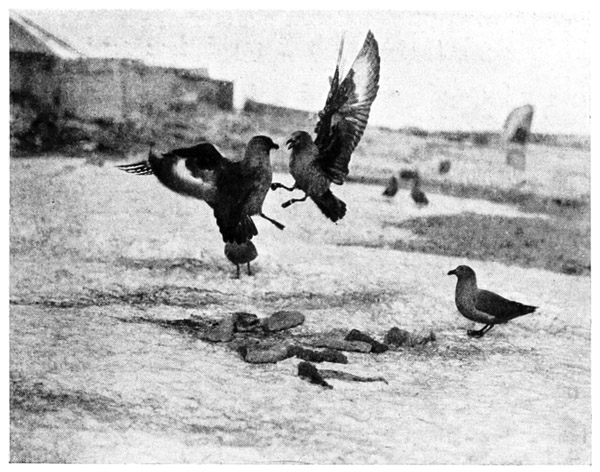
A perpetual feud was carried on between the
penguins and the skuas. The latter birds come to
the south in the summer, and make their nests
close to, and in some cases actually among, those of
the penguins, and during the breeding time live
almost entirely on the eggs, and later, on the chicks.
They never attack the adult penguins, who run at
them and drive them away when they light within
reach, but as the skuas can take to the wing and
the penguins cannot, no pursuit is possible.
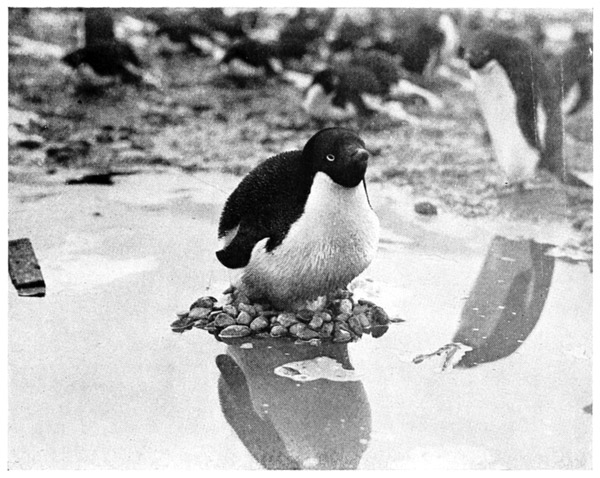
Fig. 34. Flooded
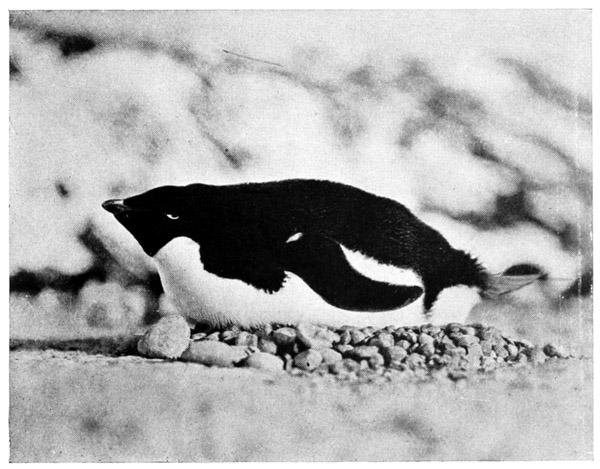
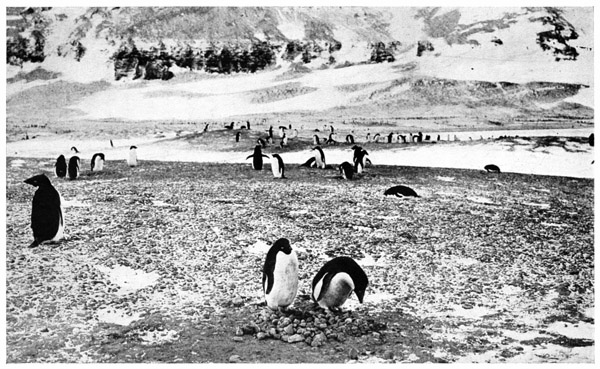
Fig. 35. A Nest with Stones of Mixed Sizes
The skuas fly about over the rookery, keeping only
a few yards from the ground, and should one of them
see a nest vacated and the eggs exposed, if only for
a few seconds, it swoops at this, and with scarcely
a pause in its flight, picks up an egg in its beak
and carries it to an open space on the ground, there
to devour the contents. Here then was another
need for constant vigilance, and so daring did the
skuas become, that often when a penguin sat on
a nest carelessly, so as to leave one of the eggs
protruding from under it, a lightning dash from a
skua would result in the egg being borne triumphantly
away.
The bitterness of the penguins' hatred of the skuas
was well shown in the neighbourhood of our scrap-heap.
None of the food thrown out on to this heap
was of the least use to the penguins, but we noticed
after a time that almost always there were one or
more penguins there, keeping guard against the
skuas, and doing their utmost to prevent them from
getting the food, and never allowing them to light
on the heap for more than a few seconds at a time.
In fact, a constant feature of this heap was the
sentry penguin, darting hither and thither, aiming
savage pecks at the skuas, which would then rise a
yard or two into the air out of reach, the penguin
squalling in its anger at being unable to follow its
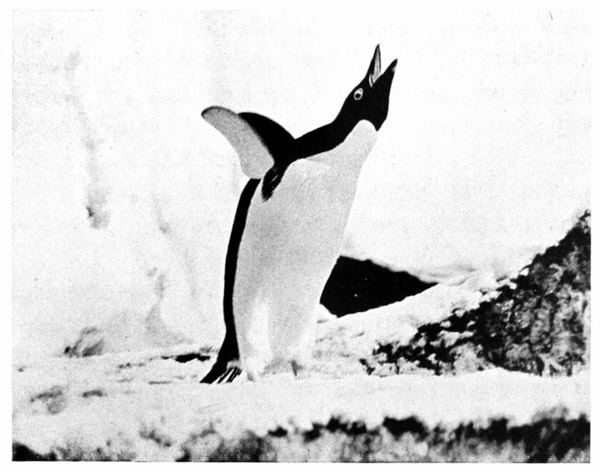
enemy. At this juncture the penguin would imitate
the flying motion with its flappers, seeming instinctively
to attempt to mount into the air, as its
remote ancestors doubtlessly did, before their wings
had adapted themselves solely to swimming.
Close to the scrap-heap there was a large knoll
crowded with penguins' nests, and it was this knoll
that provided the sentries. Very rarely did one of
these leave the heap until another came to relieve
it as long as there were skuas about, but when the
skuas went the penguins left it too. When the
skuas returned, however, and without the lapse of
a few seconds, a penguin would be seen to detach itself
from the knoll and run to guard the heap. That
some primitive understanding on this matter existed
among the penguins seems to me probable, because
whilst there were generally one or two guarding
the heap, there was never a crowd, the rest of the
knoll seeming quite satisfied as long as one of
their number remained on guard.
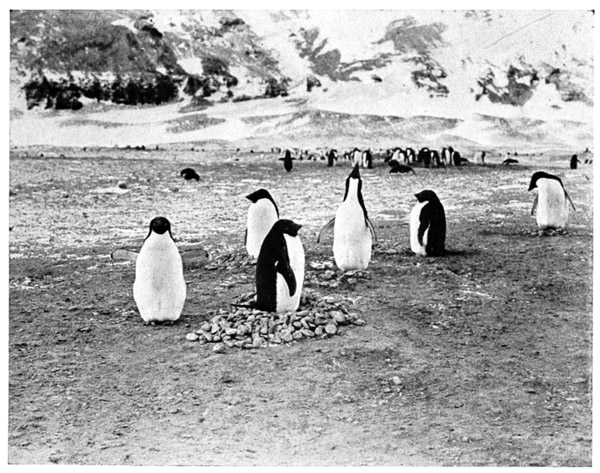
In describing the Cape Adare rookery I mentioned
the fact that the pebbles entering into the
formation of the beach are basaltic, and therefore of
a dead black shade. The result of this is that as
the sun's altitude increases, heat is absorbed readily
by the black rock, through that clear atmosphere,
and the snow upon it rapidly melts.
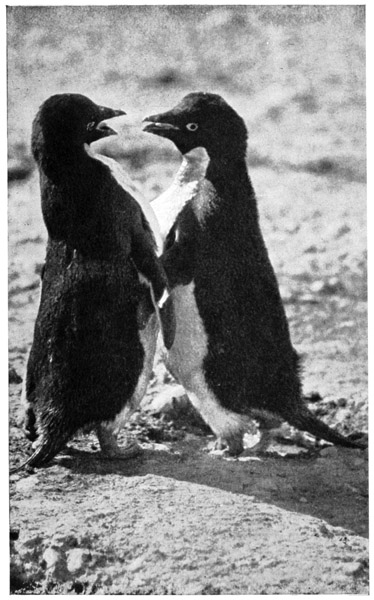
Fig. 36. “HOUR AFTER HOUR, DURING THE WHOLE DAY, THEY FOUGHT AGAIN AND AGAIN”
(Page 68)
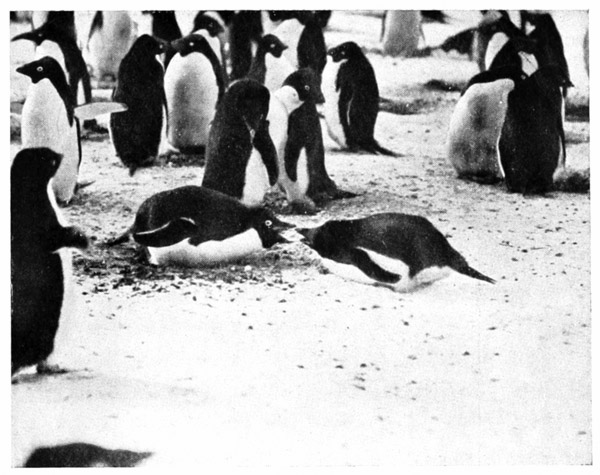
For a long time the penguins at their nests had
satisfied their thirst by eating the snow near them,
but as this disappeared, they suffered greatly, as
was made evident by the way they lay with beaks
open and tongues exposed between them. (Fig. 30.)
As time went on the cocks started to make
short journeys to the drifts which still remained in
order to quench their thirst, but the hens stuck
manfully, or rather “henfully” to their posts,
though some of them seemed much distressed.
Later, those cocks which had nested in the centre
of the rookery had quite long journeys to make in
order to find drifts, a very popular resort being that
which had formed in the lee of our hut, and all day
streams of them came here to gobble snow. Once
a cock was seen to take a lump of snow in his beak
and carry it to his mate on the nest, who ate it.
Mr. Priestley tells me that when he was at Cape
Royds in 1908 he saw cocks taking snow to hens
on their nests. This procedure would seem to be
different to the parental instinct which governs the
feeding of the young, and it seemed to show that
the cock realized that the hen must be thirsty and
in need of the snow, and kept this fact in mind
when he was away from her. Another point to
note is that the occurrence was a very rare and, in
fact, exceptional one.
When conditions arose which were new to their
experience the penguins seemed utterly unable to
grasp them.
As an example of this, we had rigged a guide
rope from our hut to the meteorological screen,
about fifty yards away, to guide us during blizzards.
This rope, which was supported by poles driven
into the ground, sagged in one place till it nearly
touched the ground. At frequent intervals, penguins
on their way past the hut were brought to a
standstill by running their breasts into this sagged
rope, and each bird as it was caught invariably
went through the same ridiculous procedure. First
it would push hard against the rope, then finding
this of no avail, back a few steps, walk up to it
again and have another push, repeating the process
several times. After this, instead of going a few
feet further along where it could easily walk under
the rope, in ninety per cent. of cases it would turn,
and by a wide detour walk right round the hut the
other way, evidently convinced that some unknown
obstacle completely barred its passage on that side.
This spectacle was a continual source of amusement
to us as it went on all day and every day for
some time.
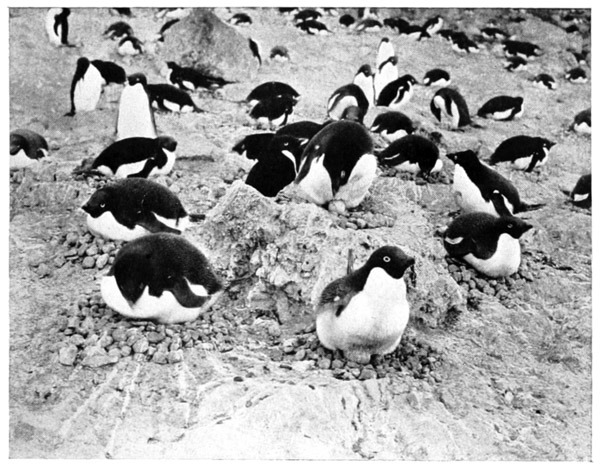
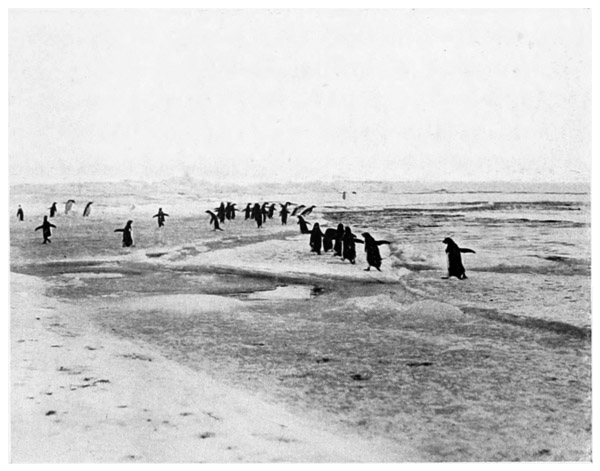
Fig. 38. “One after another, the rest of the Party followed him”
(Page 75)
As penguins' eggs are very good to eat and a
great luxury, as well as being beneficial to men
living under Antarctic conditions, we collected a
large number, which we stowed away to freeze.
To collect these eggs we used to set off, carrying
a bucket, and walk through the knolls. As we
picked our way, carefully placing our feet in the
narrow spaces between the nests, we were savagely
pecked about the legs, as in most positions at
least, these birds could reach us without even leaving
the nest, whilst very often the mates standing near
them would sail in at us, raining in blows with
their flippers with the rapidity of a maxim gun.
To search for eggs it was necessary to lift up the
occupant of each nest and look beneath her. If
she were tackled from front or flank this was a
painful and difficult business, as she drove at the
intruder's hands with powerful strokes of her sharp
beak, but we found that the best way to set about
the matter was to dangle a fur mit in front of
her with one hand, and when she seized this
quickly slip the other behind her, lifting her nether
regions from the nest, and at the same time pushing
her gently forward. Immediately she would
drop the fur mit, and sticking her beak into the
ground push herself backward with a determined
effort to stay on the nest. So long as the pressure
from behind was kept up she would keep her beak
firmly fixed in the ground, and could be robbed at
will.
The egg abstracted, she was then left in peace,
on which she would rise to her feet, look under her
for the egg and, finding that it was gone, ruffle her
feathers, and, trembling with indignation, look
round for the robber, seemingly quite unable to
realize that we were the guilty ones. This is
typical of the Adélie's attitude towards us. We
are beyond their comprehension, and fear of us,
anger at us, curiosity over us, although frequently
shown, are displayed only for a fleeting moment.
In a few minutes she might forget about the
incident altogether and quietly resume her position
on the empty nest, but very often she would
violently attack any other bird who might happen
to be standing near, and thus as we filled our
buckets we left a line of altercation in our wake.
This, however, was not long lived, and affairs soon
settled down to their normal state, and I believe
that in about one minute the affair was completely
forgotten. The penguin, indeed, is in its nature
the embodiment of all that man should be when he
explores the Antarctic regions, ever acting on the
principle that it is of no use to worry over spilt
milk.
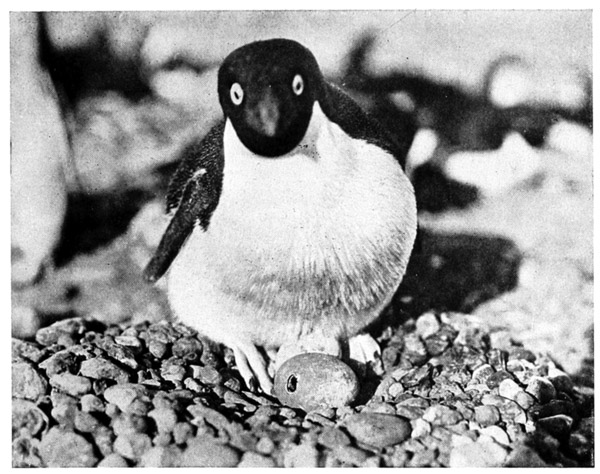
The comparative size of the penguin's egg is
shown in some of my photographs. Ninety-six
eggs averaged 4·56 ounces apiece. They vary in
size from about 6·45 cm. to 7·2 cm. in length, and
from 5·0 cm. to 5·5 cm. in breadth, on an average.
Both ends are nearly equally rounded, and of a white
chalky texture without, and green within. This
green colour is plainly shown by transmitted light.
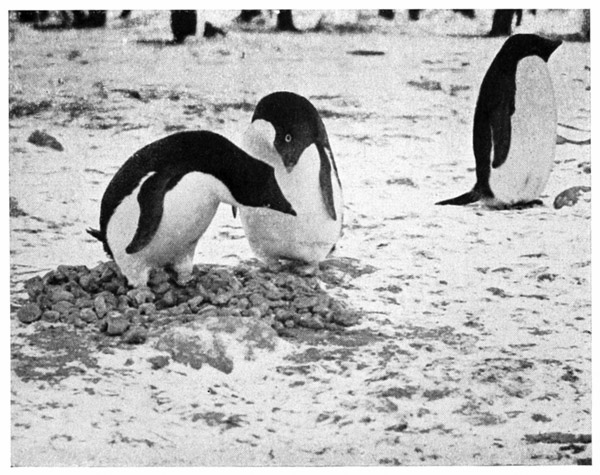
When the two have been laid the sitting bird
places them one in front of the other. The rearmost
egg is tucked up on the outspread feet, the
foremost lies on the ground, and is covered by the
belly of the bird as it lies forward upon it. (Fig. 31.)
By many of the birds a strong inclination to
burrow was displayed, and they seemed very fond
of delving in the soft shingle ledges that were to be
found on some parts of the beach. They did this
ostensibly to get small stones for their nests, but
certainly burrowed deeper than they need have
done, and occasionally squatted for some time in
little caves that they made in this way. I noticed
the same thing in the drifts when they went to eat
snow, and thought at times that they were going
to make underground nests, but they never did so,
though some of the little shingle caves would have
made ideal nesting sites.
By November 7, though many nests were still
without eggs, a large number now contained two,
and their owners started, turn and turn about, to
go to the open water leads about a third of a mile
distant to feed, and as a result of this a change
began gradually to come over the face of the
rookery. Hitherto the whole ground in the neighbourhood
of the nests had been stained a bright
green. This was due to the fasting birds continually
dropping their watery, bile-stained excreta upon it.
(The gall of penguins is bright green.) These
excreta practically contained no solid matter excepting
epithelial cells and salts.
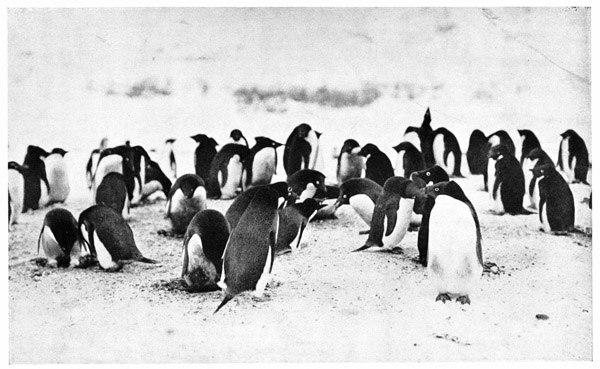
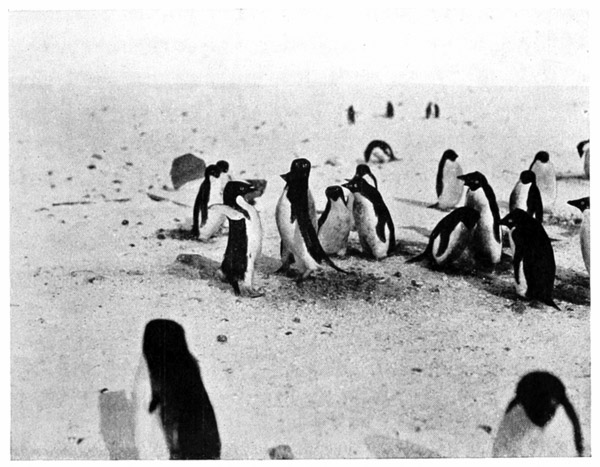
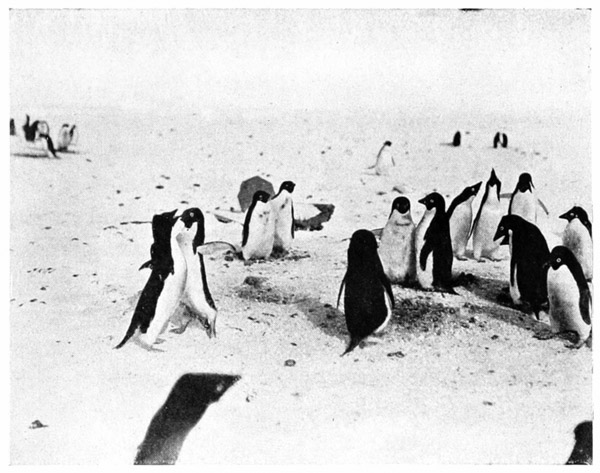
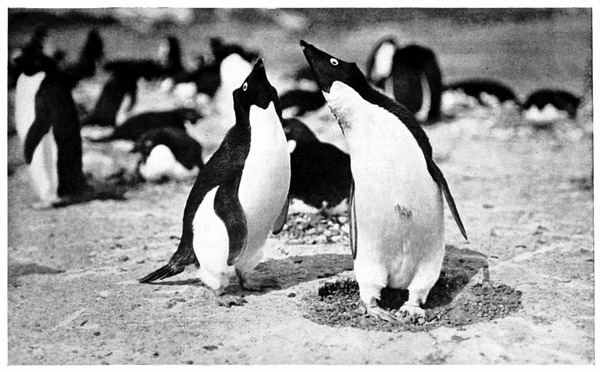
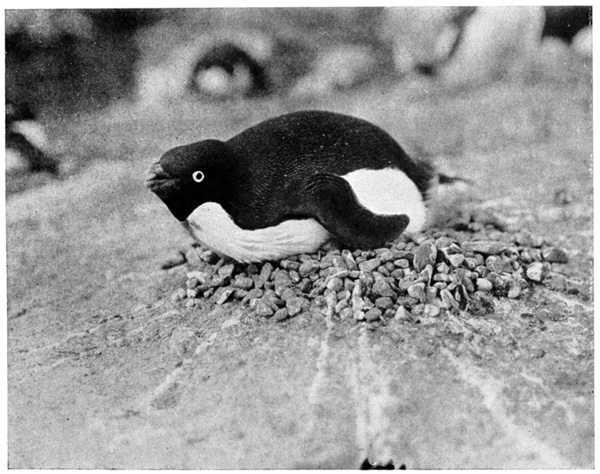
The nests themselves are never fouled, the
excreta being squirted clear of them for a distance
of a foot or more, so that each nest has the appearance
of a flower with bright green petals radiating
from its centre. Some of the photographs show
this well, especially Fig. 30. Even when the
chicks have come and are being sat upon by the
parents, this still holds good, because they lie with
their heads under the old bird's belly and their
hindquarters just presenting themselves, so that
they may add their little decorative offerings, petal
by petal! Now that the birds were going to feed,
the watery-green stains upon the ground gave
place to the characteristic bright brick-red guano,
resulting from their feeding on the shrimp-like
euphausia in the sea; and the colour of the whole
rookery was changed in a few days, though this
was first noticeable, of course, in the region of
those knolls which had been occupied first, and
which were now settled down to the peaceable and
regular family life which was to last until the chicks
had grown.
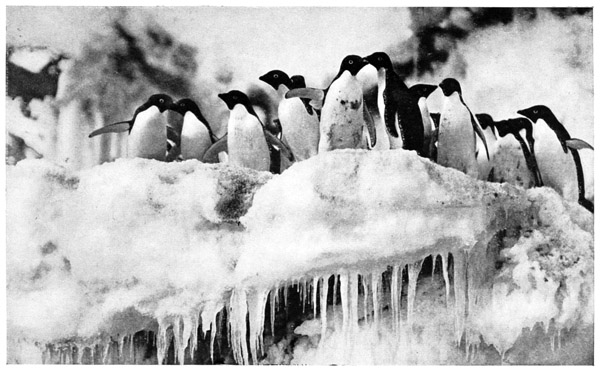
Fig. 40. A KNOT OF PENGUINS ON THE ICE-FOOT
(Page 77)
As this family life became established, law and
order reigned to some extent, and there was a
distinct tendency to preserve it, noticeably on those
knolls which had so settled down, and I think the
following most surprising incident bears evidence
of what I have said. I quote word for word from
my notes on November 24, 1911:
“This afternoon I saw two cocks (probably)
engaged in a very fierce fight, which lasted a good
three minutes. They were fighting with flippers
and bills, one of them being particularly clever with
the latter, frequently seizing and holding his opponent
just behind the right eye whilst he battered
him with his flippers.
“After a couple of minutes, during which each
had the other down on the ground several times,
three or four other penguins ran up and apparently
tried to stop the fight. This is the only construction
I can put on their behaviour, as time after time
they kept running in when the two combatants
clinched, pushing their breasts in between them,
but making no attempt to fight themselves, whilst
their more collected appearance and smooth feathers
were in marked contrast to the angry attitudes of
the combatants.
“The fight, which had started on the outskirts
of a knoll crowded with nests, soon edged away to
the space outside, and it was here that I (and
Campbell, who was with me) saw the other penguins
try to stop it. The last minute was a very
fierce and vindictive ‘mill,’ both fighting with all
their might, and ended in one of them trying to
toboggan away from his opponent; but he was too
exhausted to get any pace on, so that just as he
got into the crowd again he was caught, and both
fought for a few seconds more, when the apparent
victor suddenly stopped and ran away. The other
picked himself up and made his way rapidly among
the nests, evidently searching for one in particular.
“Following him, I saw him run up to a nest
near the place where the fight had begun. There
was a solitary penguin waiting by this nest, which
was evidently new and not yet completed, and
without eggs. The cock I had followed, ruffled
and battered with battle, ran up to the waiting bird,
and the usual side-to-side chatter in the ecstatic
attitude began and continued for half a minute, after
which each became calmer, and I left them apparently
reconciled and arranging stones in the nest.
“This incident was after the usual nature of a
dispute between two mates for a hen, but the pacific
interference of the other birds was quite new to
my experience. That it was pacific I am quite
convinced, and Campbell agreed with me that there
was no doubt of it. All the nests round about
had eggs under incubation, and the pair in question
must have been newcomers.”
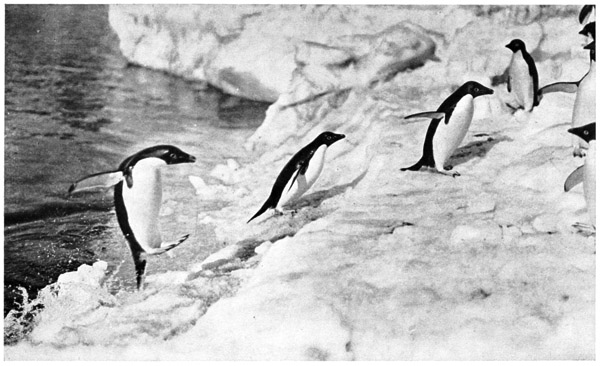
Fig. 41. AN ADÉLIE LEAPING FROM THE WATER
(Page 82)
On returning home I was glad to find that Mr.
Bernacchi, who landed at Cape Adare with the
“Southern Cross” expedition, says in his account
(p. 131) that he also saw penguins interfering and
trying to stop others from fighting.
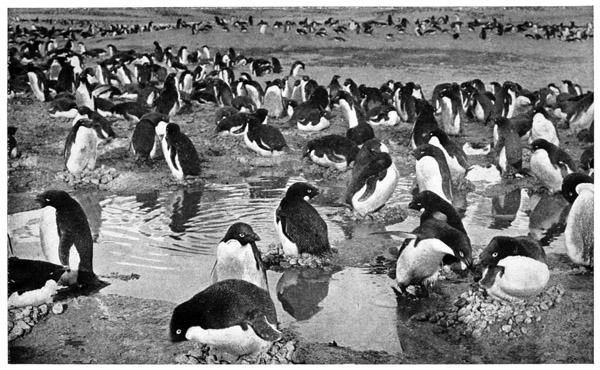
Owing to our having several snowfalls without
wind, and to the action of the sun on the black
rock, which I have mentioned already, the rookery
became a mass of slush in many places, and in some
of the lower-lying parts actually flooded. In some
of these low-lying situations penguins had unwarily
made their nests, and there was one particular little
colony near our hut which was threatened with total
extinction from the accumulation of thaw water.
As this trickled down from the higher ground
around them, the occupants of the flooded ground
exerted all their energies to avert this calamity, and
from each nest one of its tenants could be seen
making journey after journey for pebbles, which it
brought to the one sitting on the nest, who placed
stone after stone in position, so that as the water
rose the little castle grew higher and higher and
kept the eggs dry. One nest in particular I noticed
which was as yet a foot or so clear of the water and
on dry ground; but whilst the hen sat on this,
the cock was working most energetically in anticipation
of what was going to happen, and for hours
journeyed to and from the nest, each time wading
across the little lake to the other side, where he was
getting the stones.
This scene, which I photographed, is depicted
on Fig. 33. In the right-hand corner of the
picture the cock is seen in the act of delivering
another stone to the hen who is waiting to receive
it, whilst some of the nests are actually surrounded
by water. Fig. 34 shows another nest, rising like
a little island from a thaw pool, the eggs being
only just above water.
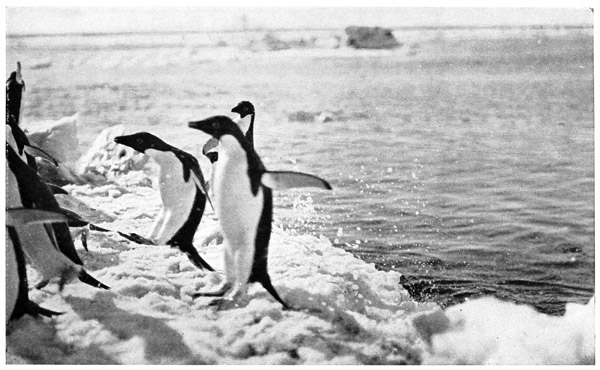
Fig. 42. ADÉLIE LEAPING FROM THE WATER (THIS BIRD JUMPED 4 FEET HIGH AND 10 FEET LONG)
(Page 82)
Some time ago I mentioned that there were
penguins of weak individuality who allowed others
to rob them of their stones, and this was in some
cases very noticeable on the flooded ground, and
there were one or two nests here which had been
almost entirely removed by thieving neighbours.
To quote again from my notes.
“November 10. This evening I saw a hen
penguin trying to sit on a nest with two eggs.
The nest had no stones, and was scooped deeply
in the ground in a slush of melting snow, so that
the eggs were nearly covered with water. The
poor hen stood in the water and kept trying to
squat down on the eggs, but each time she did so,
sat in the water and had to get up again. She
was shivering with cold and all bedraggled.
“I took the two eggs out of the nest, and
Browning and I collected a heap of stones (partly
from her richer neighbours!) and built the nest
well up above the water. Then I replaced the
eggs, and the hen at once gladly sat on them,
put them in position, and was busily engaged in
arranging the new stones round her when we left.”
One day, when the season was well advanced, I
saw a violent altercation taking place between two
penguins, one of which was in possession of a nest
in a somewhat isolated position. The other
evidently was doing his utmost to capture the
nest, as whenever he got the other off, he stood
on it. There were scarcely any stones in the nest,
which contained one egg. I think from the way
they fought that both were cocks.
For two reasons I make special mention of the
occurrence, first, because of all the fights I ever
saw this was the longest and most relentless, and,
secondly, because the nest being in such an isolated
position it seemed curious that there could be any
mistake about its ownership. Such, however,
seemed to be the case, and hour after hour, during
the whole day, they fought again and again.
After each bout of a few minutes both birds
became so exhausted that they sank panting to
the ground, evidently suffering from thirst and at
the limit of their endurance. Sometimes one
captured the nest, sometimes the other, but after
several hours of this, one of them began to show
signs of outlasting the other, and kept possession.
For long after this, however, the other returned
repeatedly to the attack.
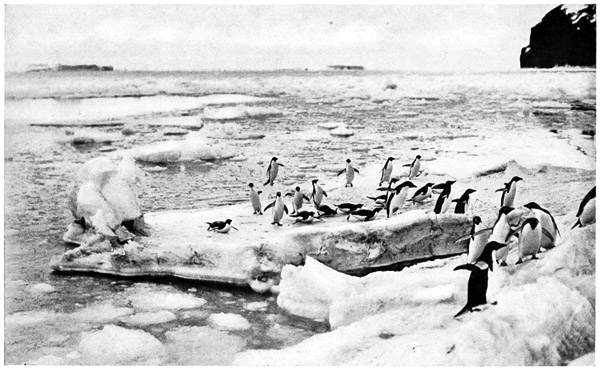
Fig. 43. JUMPING FROM THE WATER ON TO SLIPPERY ICE
(Page 82)
I fetched my camera and photographed the birds
as they fought (Fig. 36). As time went on, the
weaker bird took longer and longer intervals to
recover between his attacks, lying on his breast,
with his head on the snow and eyes half closed, so
that I thought he was going to die. Each time
he got to his feet and staggered at his enemy, the
latter rose from the nest and met him, only to
drive him back again. When I saw them at about
10 P.M. (it was perpetual daylight now) both were
lying down, the victor on the nest, the vanquished
about five yards off. The next day one bird remained
on the nest and the other had gone, and I
do not know what happened to him.
In the course of a walk through the rookery
considerable diversity in the choice of nesting sites
was to be noticed. The general tendency is for
the penguins to build their nests close together
(within a foot or two of one another) on the tops
of the rounded knolls, the lower levels being left
untenanted.
The most thickly populated districts were to be
found on the screes immediately below the cliffs.
These screes having been formed in the first instance
by the falling of fragments due to weathering
of the cliff, their substance is still added to,
little by little, as time goes on, and therefore many
are killed annually by falling rocks, as is mentioned
elsewhere, but weighing against this danger is the
advantage the cliff offers as a shelter from the
E.S.E. gales. The same applies to the nesting
sites up the cliff, but I am convinced that only the
love of climbing can account for the extraordinary
positions chosen by some of the birds. Some of
the nests are so difficult of access that their
occupants, on their way to them, may be seen
sliding backwards down the little glazed snow-slopes
several times before they accomplish the
ascent, whilst in other places they have to jump
from one foothold to another along the almost
perpendicular cliff.
Even up these heights a tendency to grouping is
seen, though there are a fair number of individuals
who, seeming to seek seclusion, make their nests
at some distance from the others. I noticed this
in some places along the shore, too, where solitary
nests were to be seen on isolated patches of
shingle.
When I visited Cape Royds in 1911 I found
a couple nesting alone in a cove known as “Black
Sand Beach,” some half mile from the rookery
there. Such isolation as this, however, is very
unusual, and was quite a departure from the
regular custom of the species.
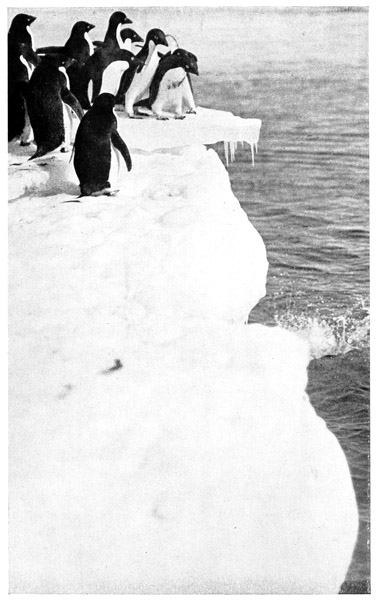
Fig. 44. “WHEN THEY SUCCEEDED IN PUSHING ONE OF THEIR NUMBER OVER, ALL WOULD CRANE THEIR NECKS OVER THE EDGE”
(Page 83)
In some places at Cape Adare, large rocks some
two or three feet in height stood about the rookery.
Whenever the summit of one of these was accessible,
a pair built their nest upon it,(4) though how
they managed to keep up there during the gales
was a matter for wonder, but the proud possessors
of the castle evidently had a delight in their lofty
position. One nest had been made on an old
packing-case left by the expedition which wintered
there in 1894, and several nested among the weathering
bones of the seals that had died on the beach.
Although the greatest care had been taken
by nearly all in the choice of sites that would be on
dry ground when the thaw came later in the
season, yet a few hens had gone to the other
extreme, and with greatest stupidity chosen their
site right down in the hollows where they were
absolutely certain to be flooded later on. These
stupid ones are thus prevented from rearing their
young, and so selection keeps the wiser for future
generations, and eliminates the less intelligent from
the community, though perhaps some of these learn
by experience, and next year use more discrimination
in choosing their nesting place.
Some of the colonies—in fact, most of them—were
orderly and well arranged, and later in the
season distinctly peaceful. Others, however, presented
a less respectable appearance. There was
one in particular, close to our hut, which could
only be described as a slum of the meanest description.
All through the season there was more
fighting in this colony than anywhere else, and
so remarkable was this, that we christened the
locality “Casey's Court” and the name stuck
for the rest of the year.
The nests had fewer stones than elsewhere,
and were more untidily made, and when the eggs
came, owing to the constant fighting that went on,
most of them got spilt from the nests or broken,
and very few chicks were hatched in consequence,
the mortality among them also being so great that
of the whole colony of some hundred nests, I
do not think more than forty or fifty chicks at
most reached maturity. The explanation of this
state of things lay, I believe, in the fact that
our hut and its curtilage deflected the stream
of penguins on their way past the spot from the
water to the back of the rookery, so that a constant
stream of them passed through “Casey's Court,”
upsetting the tempers of the inhabitants so that
they became disorderly. In addition to this, there
was a fairly big thaw pool and much miry ground
near by, so that the inhabitants were generally
covered with mud and very disreputable to look at.
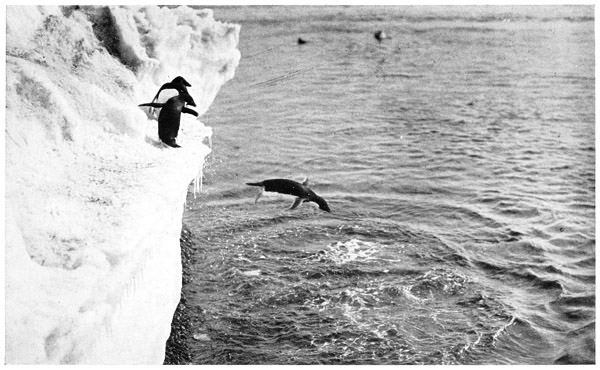
Fig. 45. DIVING FLAT INTO SHALLOW WATER
(Page 83)
During the fasting season, as none of the penguins
had entered the water, they all became very dirty
and disreputable in appearance, as well may be
imagined considering the life they led, but now
that they went regularly to swim, they immediately
got back their sleek and spotless state.
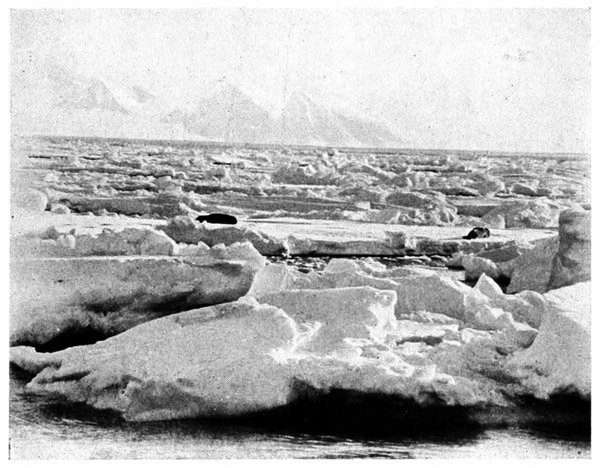
From the ice-foot to the open water, the half
mile or so of sea-ice presented a lively scene as
the thousands of birds passed to and fro over
it, outward bound parties of dirty birds from the
rookery passing the spruce bathers, homeward
bound after their banquet and frolic in the sea. So
interesting and instructive was it to watch the
bathing parties, that we spent whole days in this
way.
As I have said before, the couples took turn and
turn about on the nest, one remaining to guard and
incubate while the other went off to the water.
On leaving their nests, the birds made their way
down the ice-foot on to the sea-ice. Here they
would generally wait about and join up with others
until enough had gathered together to make up
a decent little party, which would then set off
gaily for the water. They were now in the greatest
possible spirits, chattering loudly and frolicking
with one another, and playfully chasing each other
about, occasionally indulging in a little friendly
sparring with their flippers.
Arrived at length at the water's edge, almost
always the same procedure was gone through. The
object of every bird in the party seemed to be
to get one of the others to enter the water first.
They would crowd up to the very edge of the ice,
dodging about and trying to push one another
in. Sometimes those behind nearly would succeed
in pushing the front rank in, who then would
just recover themselves in time, and rushing round
to the rear, endeavour to turn the tables on the
others. Occasionally one actually would get pushed
in, only to turn quickly under water and bound out
again on to the ice like a cork shot out of a bottle.
Then for some time they would chase one another
about, seemingly bent on having a good game, each
bird intent on finding any excuse from being
the first in. Sometimes this would last a few
minutes, sometimes for the better part of an hour,
until suddenly the whole band would change its
tactics, and one of the number start to run at
full tilt along the edge of the ice, the rest following
closely on his heels, until at last he would take
a clean header into the water. One after another
the rest of the party followed him (Fig. 38),
all taking off exactly from the spot where he
had entered, and following one another so quickly
as to have the appearance of a lot of shot poured
out of a bottle into the water. The accompanying
photograph presents this last scene.
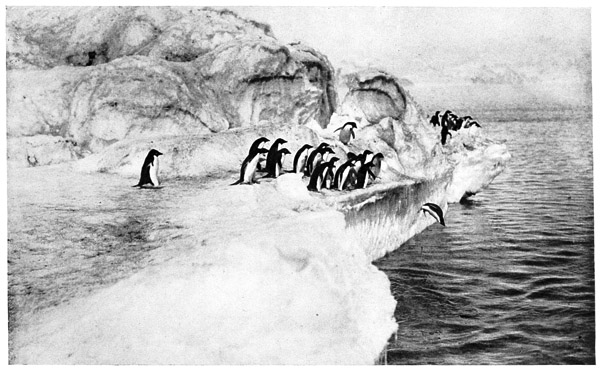
Fig. 46. DIVING FLAT INTO SHALLOW WATER
(Page 83)
A dead silence would ensue till a few seconds
later, when they would all come to the surface
some twenty or thirty yards out, and start rolling
about and splashing in the water, cleaning themselves
and making sounds exactly like a lot of boys
calling out and chaffing one another.
So extraordinary was this whole scene, that on
first witnessing it we were overcome with astonishment,
and it seemed to us almost impossible that
the little creatures, whose antics we were watching,
were actually birds and not human beings. Seemingly
reluctant as they had been to enter the water,
when once there they evinced every sign of enjoyment,
and would stay in for hours at a time.
As may be imagined, the penguins spent a great
deal of time on their way to and from the water,
especially during the earlier period before the sea-ice
had broken away from the ice-foot, as they had
so far to walk before arriving at the open leads.
As a band of spotless bathers returning to the
rookery, their white breasts and black backs
glistening with a fine metallic lustre in the sunlight,
met a dirty and bedraggled party on its way
out from the nesting ground, frequently both
would stop, and the clean and dirty mingle
together and chatter with one another for some
minutes. If they were not speaking words in
some language of their own, their whole appearance
belied them, and as they stood, some in pairs,
some in groups of three or more, chattering amicably
together, it became evident that they were
sociable animals, glad to meet one another, and,
like many men, pleased with the excuse to forget
for a while their duties at home, where their mates
were waiting to be relieved for their own spell off
the nests.
After a variable period of this intercourse, the
two parties would separate and continue on their
respective ways, a clean stream issuing from the
crowd in the direction of the rookery, a dirty one
heading off towards the open water, but here it
was seen that a few who had bathed and fed,
and were already perhaps half-way home, had been
persuaded to turn and accompany the others, and
so back they would go again over the way they
had come, to spend a few more hours in skylarking
and splashing about in the sea.
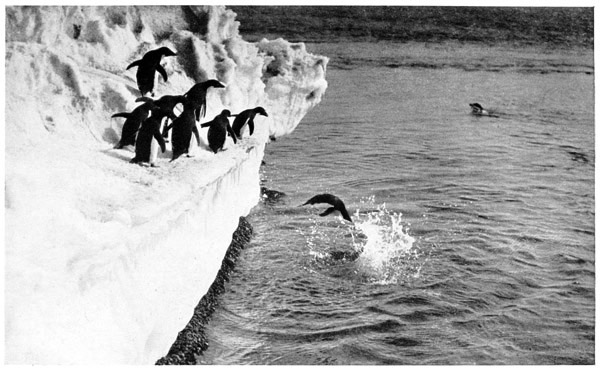
Fig. 47. DIVING FLAT INTO SHALLOW WATER
(Page 83)
In speaking of these games of the penguins, I
wish to lay emphasis on the fact that these hours
of relaxation play a large part in their lives during
the advanced part of the breeding period. They
would spend hours in playing at a sort of “touch
last” on the sea-ice near the water's edge. They
never played on the ground of the rookery itself,
but only on the sea-ice and the ice-foot and in the
water, and I may here mention another favourite
pastime of theirs. I have said that the tide
flowed past the rookery at the rate of some five or
six knots. Small ice-floes are continually drifting
past in the water, and as one of these arrived at
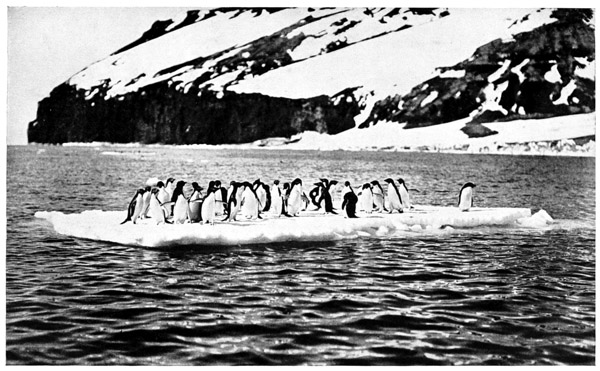
the top of the ice-foot, it would be boarded by a
crowd of penguins, sometimes until it could hold
no more. (Fig. 39.) This “excursion boat,” as
we used to call it, would float its many occupants
down the whole length of the ice-foot, and if
it passed close to the edge, those that rode on
the floes would shout at the knots of penguins
gathered along the ice-foot (Fig. 40) who would
shout at them in reply, so that a gay bantering
seemed to accompany their passage past the
rookery.
Arrived at the farther end, some half a mile
lower down, those on the “excursion boat” had
perforce to leave it, all plunging into the tide and
swimming against this until they came to the top
again, then boarded a fresh floe for another ride
down. All day these floes, often crowded to their
utmost capacity, would float past the rookery.
Often a knot of hesitating penguins on the ice-foot,
on being hailed by a babel of voices from a
floe, would suddenly make the plunge, and all
swim off to join their friends for the rest of the
journey, and I have seen a floe so crowded that as
a fresh party boarded it on one side, many were
pushed off the other side into the water by the
crush.
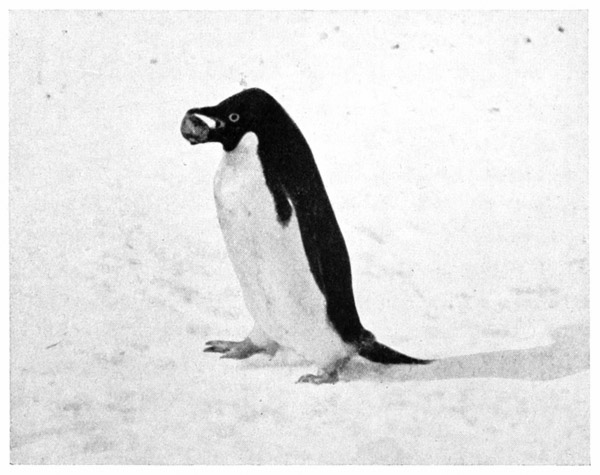
Once, as we stood watching the penguins bathing,
one of them popped out of the water on to the
ice with a large pebble in its mouth, which it had
evidently fetched from the bottom. This surprised
me, as the depth of the sea here was some ten
fathoms at least. The bird simply dropped the
stone on the ice and then dived in again, so that
evidently he had gone to all the trouble of diving
for the stone simply for the pleasure of doing it.
Mr. J. H. Gurney, in his book on the gannet, says
they (gannets) are said to have got themselves
entangled in fishing-nets at a depth of 180 ft. and
that their descent to a depth of 90 ft. is quite
authentic, so that perhaps the depth of this penguin's
dive was not an unusual one.
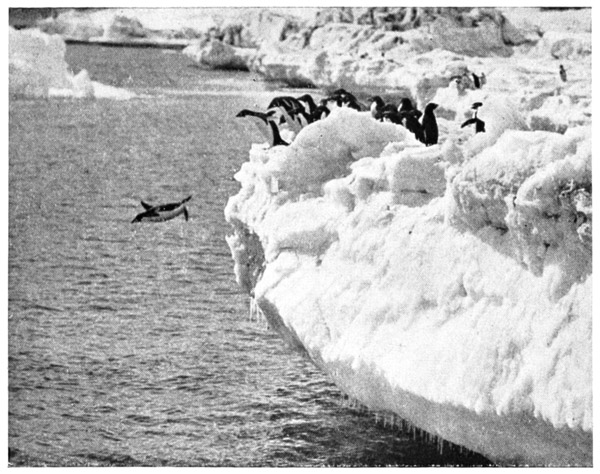
Fig. 48. Diving Flat
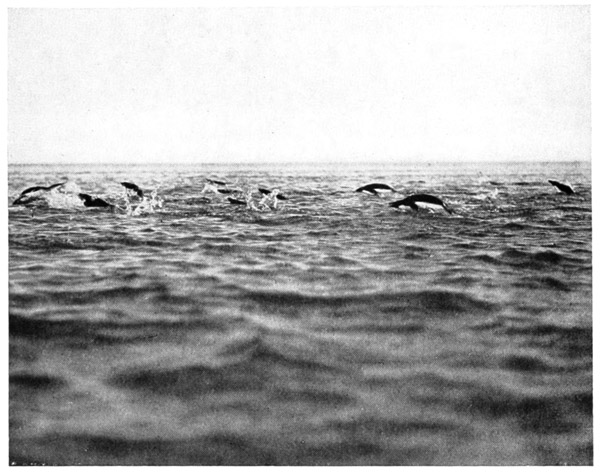
Fig. 49. Adélies “Porpoising”
(Page 80)
The tide at the open water leads where they
bathed ran a good six knots, but the Adélies swam
quite easily against this without leaving the surface.
In the water, as on the land, they have two means
of progression. The first is by swimming as a duck
swims, excepting that they lie much lower in the
water than a duck does, the top of the back being
submerged, so that the neck sticks up out of the
water. As their feet are very slightly webbed, they
have not the advantages that a duck or gull has
when swimming in this way, but supplement their
foot-work by short quick strokes of their flippers.
This they are easily able to do, owing to the depth
to which the breast sinks in the water.
The second method is by “porpoising.”
This consists in swimming under water, using
the wings or “flippers” for propulsion, the action of
these limbs being practically the same as they would
be in flying. As their wings are beautifully shaped
for swimming, and their pectoral muscles extraordinarily
powerful, they attain great speed, besides
which they are as nimble as fish, being able completely
to double in their tracks in the flash of a
moment. In porpoising, after travelling thirty feet
or so under water, they rise from it, shooting clean
out with an impetus that carries them a couple of
yards in the air, then with an arch of the back they
are head first into the water again, swimming a few
more strokes, then out again, and so on.
I show a photograph of them doing this (Fig. 49).
Perhaps the most surprising feat of which the
Adélie is capable is seen when it leaps from the
water on to the ice. We saw this best later in the
year when the sea-ice had broken away from the ice-foot,
so that open water washed against the ice cliff
bounding the land. This little cliff rose sheer from
the water at first, but later, by the action of the
waves, was under-cut for some six feet or more in
places, so that the ledge of ice at the top hung forwards
over the water. The height of most of this
upper ledge varied from three to six feet.
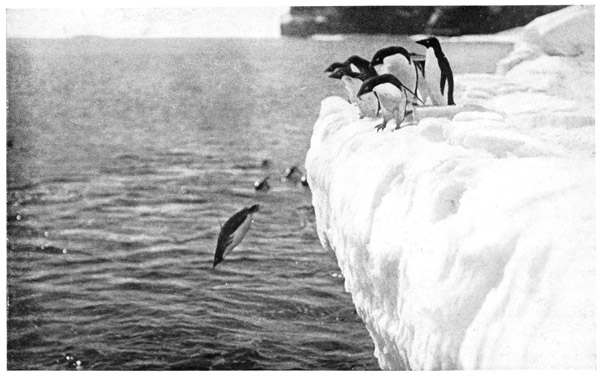
Fig. 50. A PERFECT DIVE INTO DEEP WATER
(Page 83)
Whilst in the water the penguins usually hunted
and played in parties, just as they had entered it,
though a fair number of solitary individuals were
also to be seen. When a party had satisfied their
appetites and their desire for play, they would swim
to a distance of some thirty to forty yards from the
ice-foot, when they might be seen all to stretch
their necks up and take a good look at the proposed
landing-place. Having done this, every bird would
suddenly disappear beneath the surface, not a
ripple showing which direction they had taken, till
suddenly, sometimes in a bunch, sometimes in a
stream, one after the other they would all shoot
out of the water, clean up on to the top of the ice-foot.
(Figs. 41 and 42.) Several times I measured
the distance from the surface of the water to the
ledge on which they landed, and the highest leap
I recorded was exactly five feet. The “take off”
was about four feet out from the edge, the whole
of the necessary impetus being gained as the bird
approached beneath the water.
The most important thing to note about this
jumping from the water was the accuracy with
which they invariably rose at precisely the right
moment, the exact distance being judged during
their momentary survey of a spot from a distance,
before they dived beneath the water, and carried in
their minds as they approached the ice. I am sure
that this impression was all they had to guide them,
as with a ripple on the water, and at the pace they
were going, they could not possibly have seen their
landing-place at all clearly as they approached it,
besides which, in many cases, the ledge of ice on
which they landed projected many feet forwards
from the surface, yet I never saw them misjudge
their distance so as to come up under the overhanging
ledge.
During their approach they swam at an even
distance of about three or four feet beneath the
surface, projecting themselves upwards by a sudden
upward bend of the body, at the same time using
their tail as a helm, in the manner well shown in
one of my photographs, in which one of the
birds is seen in the air at the moment it left the
water, the tail being bent sharply up towards the
back.
Their quickness of perception is shown very well
as they land on the ice. If the surface is composed
of snow, and so affords them a good foothold, they
throw their legs well forward and land on their
feet, as shown in Figs. 41 and 42, but should they
find themselves landing on a slippery ice-surface,
they throw themselves forward, landing on their
breasts in the tobogganing position as shown in
Fig. 43.
The Adélies dive very beautifully. We did not
see this at first, before the sea-ice had gone out,
because to enter the water they had only to drop
a few inches, but later, when entering from the ice
terraces, we constantly saw them making the most
graceful dives.
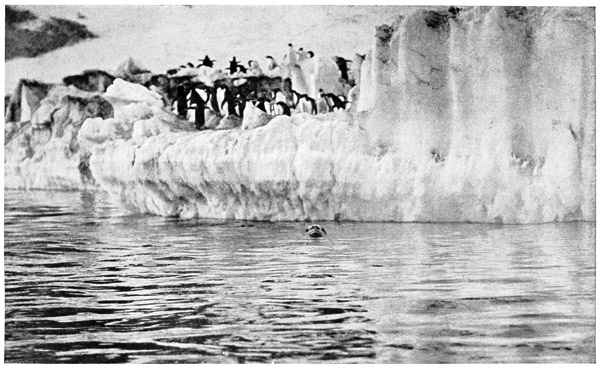
Fig. 51. SEA-LEOPARDS “LURK BENEATH THE OVERHANGING LEDGES OF THE ICE-FOOT, OUT OF SIGHT OF THE BIRDS OVERHEAD”
(Page 84)
At the place where they most often went in, a
long terrace of ice about six feet in height ran for
some hundreds of yards along the edge of the water,
and here, just as on the sea-ice, crowds would stand
near the brink. When they had succeeded in
pushing one of their number over, all would crane
their necks over the edge (Fig. 44), and when
they saw the pioneer safe in the water, the rest
followed.
When diving into shallow water they fall flat
(Figs. 45, 46, and 47), but into deep water, and from
any considerable height, they assume the most perfect
positions (Fig. 50) and make very little splash.
Occasionally we saw them stand hesitating to dive
at a height of some twenty feet, but generally they
descended to some lower spot, and did not often
dive from such a height, but twelve feet was no
uncommon dive for them.
The reluctance shown by each individual of a
party of intending bathers to be the first to enter
the water may partly have been explained when,
later on, we discovered that a large number of
sea-leopards were gathered in the sea in the neighbourhood
of the rookery to prey on the penguins.
These formidable animals, of which I show some
photographs, used to lurk beneath the overhanging
ledges of the ice-foot, out of sight of the birds
on the ice overhead. (Fig. 51.) They lay quite
still in the water, only their heads protruding, until
a party of Adélies would descend into the water
almost on top of them, when with a sudden dash
and snap of their great formidable jaws, they would
secure one of the birds.
It seemed to me then, that all the chivvying
and preliminaries which they went through before
entering the water, arose mainly from a desire on
the part of each penguin to get one of its neighbours
to go in first in order to prove whether the coast
was clear or not, though all this manœuvring was
certainly taken very lightly, and quite in the nature
of a game. This indeed was not surprising, for of
all the animals of which I have had any experience,
I think the Adélie penguin is the very bravest.
The more we saw of them the fonder we became
of them and the more we admired their indomitable
courage. The appearance of a sea-leopard in their
midst was the one thing that caused them any panic.
With dozens of these enemies about they would
gambol in the sea in the most light-hearted manner,
but the appearance of one among them was the
signal for a stampede, but even this was invariably
gone through in an orderly manner with some show
of reason, for, porpoising off in a clump, they at
once spread themselves out, scattering in a fan-shaped
formation as they sped away, instead of
all following the same direction.
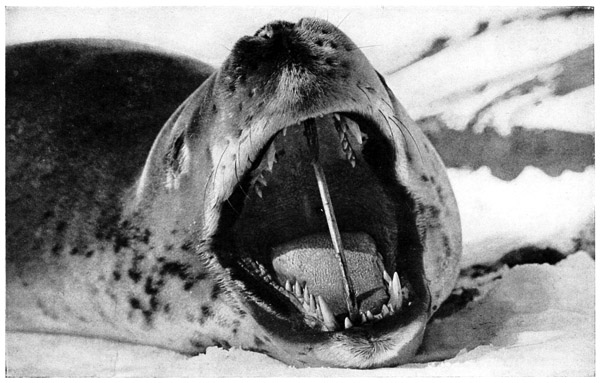
Fig. 52. A SEA-LEOPARD'S HEAD
(Page 87)
As far as I could judge, however, the sea-leopards
are a trifle faster in the water than the Adélies, as
one of them occasionally would catch up with one
of the fugitives, who then, realizing that speed alone
would not avail him, started dodging from side to
side, and sometimes swam rapidly round and round
in a circle of about twelve feet diameter for a full
minute or more, doubtless knowing that he was
quicker in turning than his great heavy pursuer, but
exhaustion would overtake him in the end, and we
could see the head and jaws of the great sea-leopard
rise to the surface as he grabbed his victim. The
sight of a panic-stricken little Adélie tearing round
and round in this manner was a sadly common
sight late in the season.
Sea-leopards are no mean customers and should
be treated with caution. Commander Campbell
and I used to hunt them from a little Norwegian
pram (a species of dinghy) which we rowed quietly
up and down close under the ice-foot, shooting at
the sea-leopards with a rifle when we saw their
heads above water.
One day we had an interesting little adventure.
We had shot and killed one, a fine bull about ten feet
long, which had sunk to the bottom in some five
fathoms. Having just pulled away from him, we
were about ten yards from the ice-foot, when another
very large sea-leopard overtook us, swimming from
the direction of the dead bull. It passed under the
pram, bumping against the keel in doing so.
When about ten yards ahead of us it turned
and made straight back for us, but as we were
bows-on to it, it came right alongside the boat,
churning up the water and wetting us. At this
moment it turned on its side, its right fore-flipper
beating the surface and its belly towards us, and
was just starting to rear its head up when we both
lunged at it with our paddles, and so pushed the
little boat away from it. This brought us alongside
the ice-foot, from which Campbell got a shot at it
half a minute later, and wounded it in the neck.
The moment after we lunged at it with our paddles
it dived, then reappeared ten or fifteen yards off,
rearing its head out of the water, and it was at this
moment that Campbell shot it. After this it
reappeared several times at the surface, but drifted
away with the tide and we lost it.
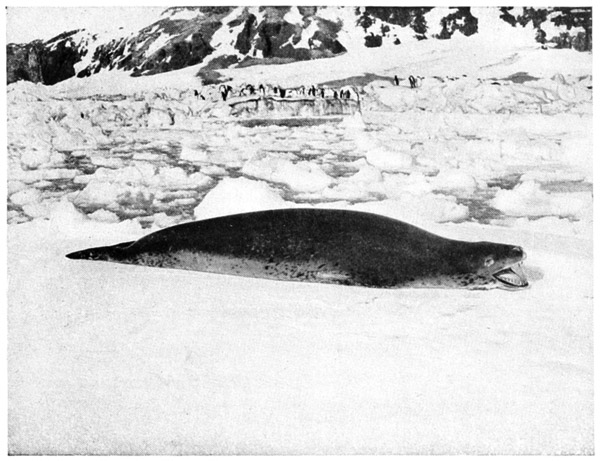
Fig. 53. A Sea-Leopard 10 ft. 6½ ins. long
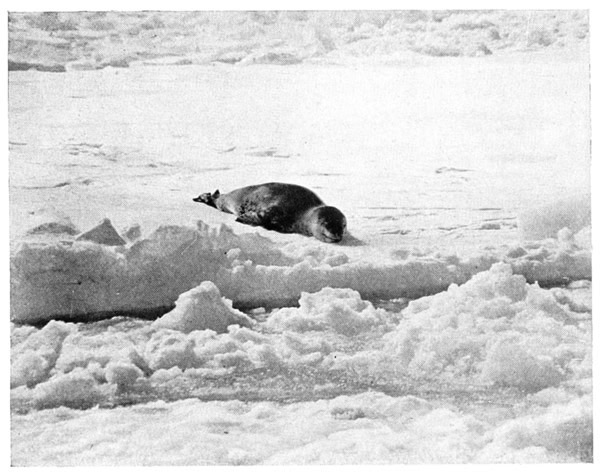
Fig. 54. A Young Sea-Leopard on Sea-Ice
(Page 87)
The sea-leopard has not a reputation for attacking
men in boats, and this one may have been actuated
by curiosity merely, but in favour of its meaning to
attack us were, first, that it came to us straight
from the direction of the dead bull we had shot,
and secondly, that it seems hardly likely that after
bumping against our keel, mere curiosity could
have tempted it to come back and try to look over
the gunwale! As a rule we had to drift very
quietly along when hunting sea-leopards, as the
slightest sound frightened them away.
All that we could do to protect our friends was
to shoot as many of these sea-leopards as possible
but though we may have made some difference,
there were always many about.
Some idea of the depredations committed by
these animals may be gathered from the fact that
in the stomach of one which we shot I found the
bodies of eighteen penguins, in various stages of
digestion, the beast's intestines being literally
stuffed with the feathers remaining from the disintegration
of many more. Photographs of these
animals are seen in Figs. 52, 53, and 54.
Though the actual presence of a sea-leopard
put the Adélies to confusion, causing them to
“porpoise” madly away for a few hundred yards,
yet once away from the immediate neighbourhood
of the arch enemy, they appeared to think no more
of him, and behaved as though there were no
further need for anxiety, though probably they
kept a sharp look-out nevertheless. Evidence
goes to show that the sea-leopard is the only living
enemy, excepting man, that threatens the life of
the adult Adélie penguin.
One day, as I watched some hundreds of Adélies
bathing in an open lead, suddenly the back of an
enormous killer-whale (Orca gladiator) rose above
the surface as it crossed the lead from side to side,
appearing from beneath the ice on one side and
disappearing beneath it on the other. To my
surprise, not the slightest fear was shown by the
birds in the water. Had this beast been a sea-leopard,
there would have been a stampede, and
every bird have leapt from the water on to the sea-ice.
On this evidence I formed the opinion that in
all probability killer-whales do no harm to Adélie
penguins; later I saw it confirmed, when a school
of killers shaved close past several floes that were
crowded with Adélies, and made not the least
attempt to get at them, as they might so easily
have done by upsetting the floes. Very probably
this is because the agile bird can escape with such
ease from the ponderous whale, and fears it no more
than a terrier fears a cow, though he thinks twice
before coming within reach of its jaws.
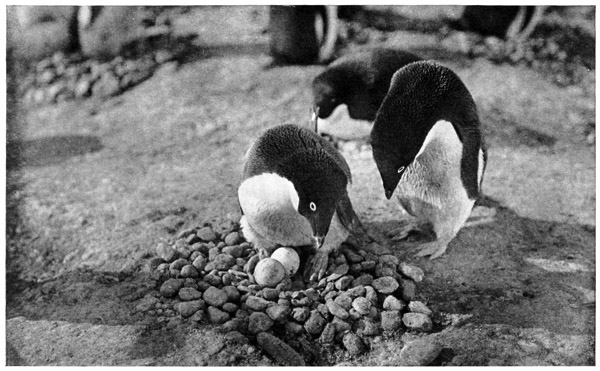
Fig. 55. “WITH GRACEFUL ARCHING OF HIS NECK, APPEARED TO ASSURE HER OF HIS READINESS TO TAKE CHARGE”
(Page 90)
When the sea-ice had gone out, leaving open
water right up to the ice-foot, a ledge of ice was
left along the western side of the rookery, forming
a sort of terrace or “front,” with its sides composed
of blue ice, rising sheer out of the water to a height
of some six feet or more in places. From this point
of vantage it was possible to stand and watch the
penguins as they swam in the clear water below,
and some idea was formed of their wonderful
agility when swimming beneath the surface. As
they propelled themselves along with powerful
strokes of their wings, they swerved from side to
side to secure the little prawn-like euphausia which
literally swarm everywhere in the Antarctic seas,
affording them ample food at all times. Their
gluttonous habits here became very evident. They
would gobble euphausia until they could hold no
more, only to vomit the whole meal into the water
as they swam, and so enlightened start to feast
again. As they winged their way along, several
feet beneath the surface, a milky cloud would
suddenly issue from their mouths and drift slowly
away down stream, as, without the slightest pause
in their career, they dashed eagerly along in the
hunt for more.
When a penguin returned to his mate on the
nest, after his jaunt in the sea, much formality had
to be gone through before he was allowed to take
charge of the eggs. This ceremony of “relieving
guard” almost invariably was observed.
Going up to his mate, with much graceful arching
of his neck, he appeared to assure her in guttural
tones of his readiness to take charge (Fig. 55).
At this she would become very agitated, replying
with raucous staccato notes, and refusing to budge
from her position on the eggs. Then both would
become angry for a while, arguing in a very heated
manner, until at last she would rise, and, standing
by the side of the nest, allow him to walk on to
it, which he immediately did, and after carefully
placing the eggs in position, sink down upon them,
afterwards thrusting his bill beneath his breast to
push them gently into a comfortable position.
After staying by him for a little while, the other
at length would go off to bathe and feed.
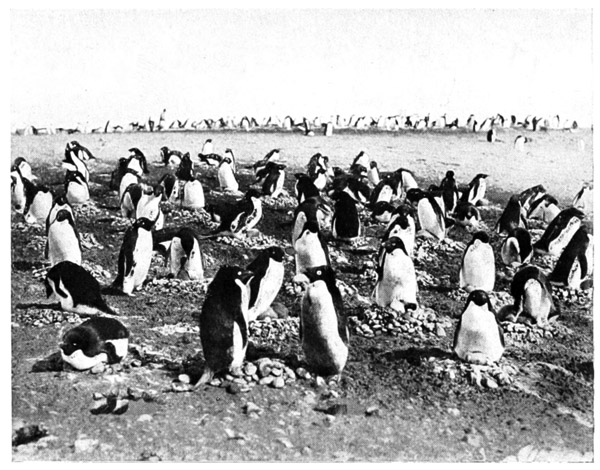
Fig. 56. “The Chicks began to appear”
(A Typical Group of Nests)
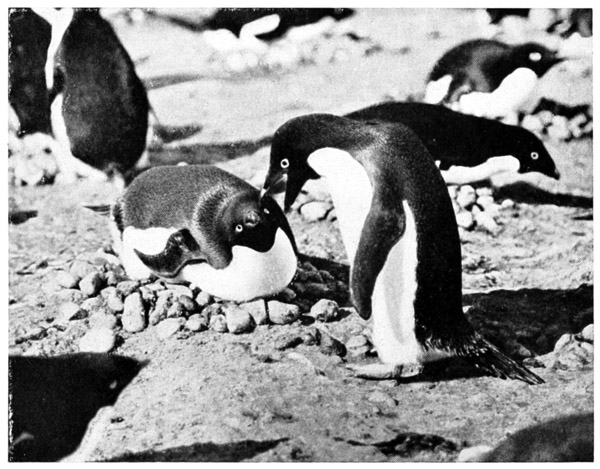
Fig. 57. An Adélie being Sick
(Page 94)
The length of time during which each bird was
away varied considerably, but a “watch bill” was
kept of one particular pair with the following
result:(5)
Nov. 14. Egg laid. Hen sitting.
Nov. 27. A cock seen to join the hen for the
first time since the 14th. He took
her place on the nest. This was the
first day on which any red guano
was seen about the nest.
Dec. 10. The hen returned between 8 P.M. and
10 P.M., having been absent since
November 27. Fresh red guano:
the first for many days.
Dec. 14. The cock relieved the hen between
8 A.M. and 10 A.M.
Dec. 15. The hen relieved the cock between
8 A.M. and 10 A.M. Between 6 P.M.
and 8 P.M. the chick was hatched, the
hen remaining on the nest.
Dec. 17. At 8 A.M. the cock was found to have
relieved the hen.
Dec. 18. Hen mounted guard between 6 P.M.
and 8 P.M.
Dec. 20. Cock relieved guard about 8 A.M. At
8 P.M. both cock and hen were at
the nest, the hen standing by it, the
cock on it.
Dec. 21. The hen relieved guard at 8 P.M.
Dec. 23. Cock came back at noon and relieved
guard.
Dec. 24. The cock remained on guard all day.
The hen was gone from 1 P.M. till 6
P.M., when she returned and relieved
guard.
Dec. 25. 8 A.M. Both at nest, hen still on.
10 A.M. changed guard. Hen gone.
Dec. 26. Hen on nest. Cock standing near.
Dec. 27. 8 A.M. Cock on nest.
Dec. 28. 8 A.M. Hen on nest.
Dec. 29. Cock relieved guard.
Dec. 30. Hen arrived 3 P.M. and relieved guard.
Dec. 31. 10 P.M. to midnight, changed, cock on.
Both there at 10 P.M.
Jan. 1. 10 A.M. Both at nest.
12 noon. Both at nest. The youngster
complicating matters by running
away every time he was passed by
the observer, thus getting himself
and his parents embroiled with the
neighbours.
Jan. 1. 2 P.M. Hen on nest. Cock gone.
Jan. 2. 10 A.M. Hen on nest.
12 noon. Chick disappeared.
2 P.M. Nest deserted.
4 P.M. Cock on nest. No chick.
8 P.M. Cock on nest. No chick.
Jan. 3. Cock on the nest with the chick.
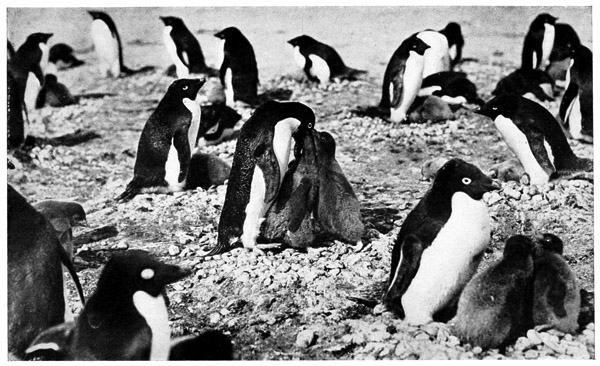
Fig. 58. METHOD OF FEEDING THE YOUNG
(Page 94)
From the above Table it will be seen that the
hen was not relieved by the cock until a fortnight
after she had laid her egg (in this case there was
only one) so that probably she had been without
food for a month. Then she left, and only returned
to relieve the cock after the lapse of another fortnight,
it being worth remarking that each was
absent for the same length of time. When the
chick was hatched, a different régime began, as of
course the chick had to be fed and journeys to the
sea made at regular intervals for the purpose of
getting food.
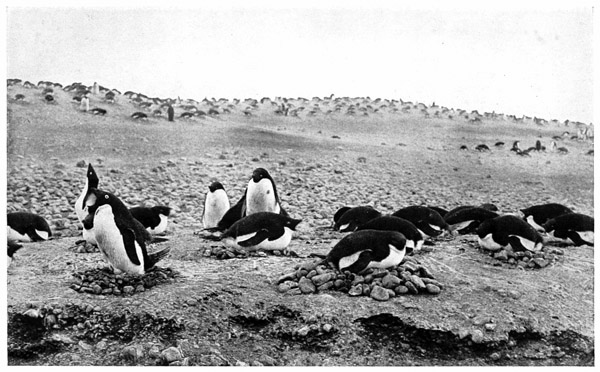
When the chicks began to appear all over the
rookery (Fig. 56), a marked change was noticed in
the appearance of the parents as they made their
way on foot from the water's edge to the nests.
Hitherto they had been merely remarkable for
their spotless and glistening plumage, but now they
were bringing with them food for the young, and
so distended were their stomachs with this, that
they had to lean backward as they walked, to
counterbalance their bulging bellies, and in consequence
frequently tripped over the inequalities of
the ground which were thus hidden from their gaze.
What with the exertion of tramping with their
burden across the rookery, and perhaps on rare
occasions one or two little disputes with other
penguins by the way, frequently they were in some
distress before they reached their destination, and
quite commonly they would be sick and bring up
the whole offering before they got there. Consequently,
little red heaps of mashed up and half
digested euphausia were to be seen about the
rookery. Once I saw a penguin, after he had
actually reached the nest, quite unable to wait for
the chick to help itself in the usual manner, deposit
the lot upon the ground in front of his mate. I saw
what was coming and secured the accompanying
photograph of the incident. (Fig. 57.) When
this happens the food is wasted, as neither chick
nor adult will touch it however hungry they may
be, the former only feeding by the natural method
of pushing his head down the throat of a parent, and
so helping himself direct from the gullet. (Fig. 58.)
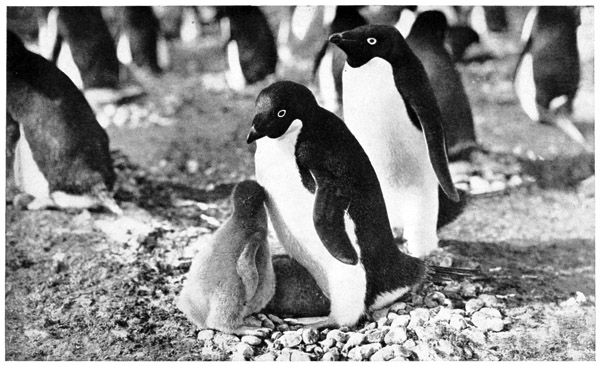
Fig. 59. PROFILE OF AN ADÉLIE CHICK
(Page 95)
When the chicks are small they are kept completely
covered by the parent who sits on the nest.
They grow, however, at an enormous rate, gobbling
vast quantities of food as it is brought to them,
their elastic bellies seeming to have no limit to their
capacity (Fig. 59); indeed, when standing, they
rest on a sort of tripod, formed by the protuberant
belly in front and the two feet behind.
I weighed a chick at intervals for some time, and
this was the astonishing result:
| Ounces |
| The egg |
4·56 |
| The chick when hatched |
3·00 |
| Five days old |
13·00 |
| Six days old |
15·75 |
| Eight days old |
24·75 |
| Nine days old |
28·50 |
| Eleven days old |
37·75 |
| Twelve days old |
42·50 |
To see an Adélie chick of a fortnight's growth
trying to get itself covered by its mother is a most
ludicrous sight. The most it can hope for is to get
its head under cover, the rest of its body being
exposed to the air; but the downy coat of the chick
is close and warm, and suffices in all weathers to
protect it from the cold. Fig. 60 illustrates what
I have said very well, whilst Fig. 61 shows a mother
with a chick twelve days old.
Whilst the chicks are small the two parents
manage to keep them fed without much difficulty;(6)
but as one of them has always to remain at the
nest to keep the chicks warm, guard them from
skuas and hooligan cocks, and prevent them from
straying, only one is free to go for food. Later on,
however, two other factors introduce themselves.
The first of these is that the chick's downy coats
become thick enough to protect them from cold
without the warmth of the parent; and the second
that as the chicks grow they require an ever-increasing
quantity of food, and at the age of about
a fortnight this demand becomes too great for one
bird to cope with. At this time it is still necessary
to prevent the chicks from straying and to protect
them from the skuas and “hooligans,” and so to
meet these two demands a most interesting social
system is developed. The individual care of the
chicks by their parents is abandoned, and in place
of this, colonies start to “pool” their offspring,
which are herded together into clumps or “crèches,”
each of which is guarded by a few old birds, the
rest being free to go and forage.
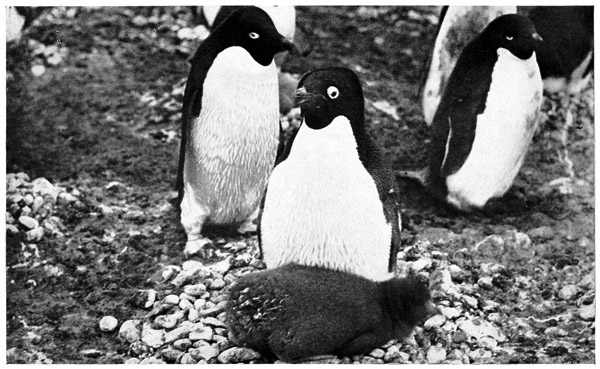
Fig. 60. A TASK BECOMING IMPOSSIBLE
(Page 95)
It is quite likely that if a chick which has escaped
from its own crèche joins another crèche it will get
fed there, as it seems hardly possible for the adults
to recognize the individuals of so large a gathering
and to detect a stranger should one turn up, but
there is good reason to believe that the old birds
work for their own crèches only, and remain faithful
to them for the rest of the season, because, as
they make their way across the rookery, laden with
the food they are bringing from the sea, it is sadly
common to see them pursued by strayed and
starving youngsters, plaintively piping their prayers
for a meal; and these appeals are always made in
vain, the old birds turning a deaf ear to the
youngsters, who at last, weary and weak, give up
the pursuit, and in the end fall a prey to the ever-watchful
skuas. Further evidence is found in the fact
that the chicks at the very back of the rookery and
up at the top of the Cape are just as well nourished
as those nearer the water, who are constantly passed
by a stream of food-laden parents.
Twice already I have mentioned that strayed
chicks fall a prey to “hooligan” cocks. These
hang about the rookery often in little bands. At
the beginning of the season there are very few of
them, but later they increase greatly, do much
damage, and cause a great deal of annoyance to the
peaceful inhabitants. The few to be found at first
probably are cocks who have not succeeded in
finding mates, and consequently are “at a loose
end.” Later on, as their numbers are so greatly
increased, they must be widowers, whose mates
have lost their lives in one way or another.
Many of the colonies, especially those nearer the
water, are plagued by little knots of “hooligans,”
who hang about their outskirts, and should a chick
go astray it stands a good chance of losing its life at
their hands. The crimes which they commit are
such as to find no place in this book, but it is
interesting indeed to note that, when nature intends
them to find employment, these birds, like men
degenerate in idleness.
Some way back I made some allusion to the way
in which many of the penguins were choosing sites
up the precipitous sides of the Cape at the back of
the rookery. Later I came to the conclusion that
this was purely the result of their love of climbing.
There was one colony at the very summit of the
Cape,(7) whose inhabitants could only reach their
nests by a long and trying climb to the top and
then a walk of some hundred yards across a steep
snow slope hanging over the very brink of a sheer
drop of seven hundred feet on to the sea-ice.
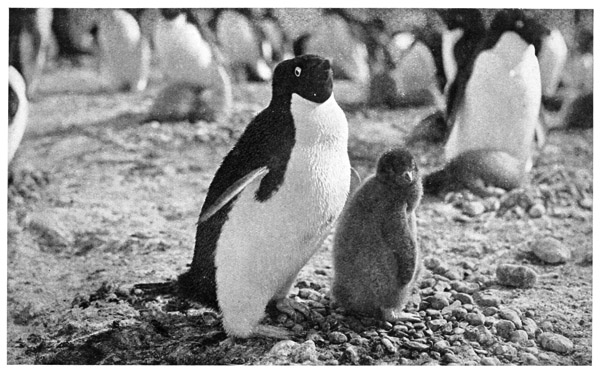
Fig. 61. ADÉLIE WITH CHICK TWELVE DAYS OLD
(Page 96)
During the whole of the time when they were
rearing their young, these mountaineers had to make
several journeys during each twenty-four hours to
carry their enormous bellyfuls of euphausia all the
way from the sea to their young on the nests—a
weary climb for their little legs and bulky bodies.
The greater number who had undertaken this did
so at a time when there were ample spaces unoccupied
in the most eligible parts of the rookery.
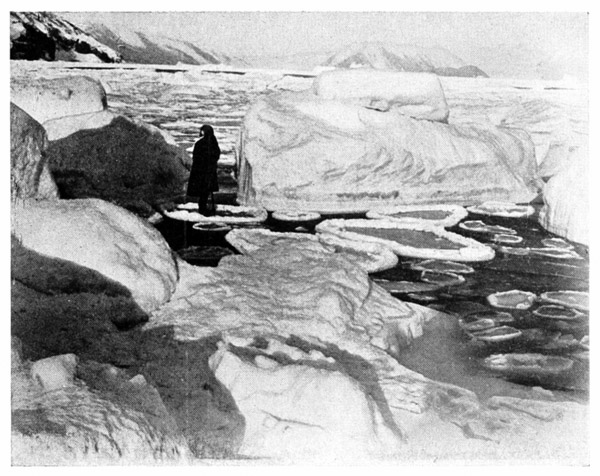
I have mentioned that large masses of ice were
stranded by the sea along the shores of the rookery.
These fragments of bergs, some of them fifteen
to twenty feet in height, formed a miniature
mountain range along the shore. All day parties of
penguins were to be seen assiduously climbing the
steep sides of this little range. Time after time,
when half way up, they would descend to try
another route, and often when with much pains
one had scaled a slippery incline, he would come
sliding to the bottom, only to pick himself up and
have another try. (Fig. 63.)
Generally, this climbing was done by small
parties who had clubbed together, as they generally
do, from social inclination. It was not unusual for
a little band of climbers to take as much as an
hour or more over climbing to the summit.
Arrived at the top they would spend a variable
period there, sometimes descending at once, sometimes
spending a considerable time there, gazing
contentedly about them, or peering over the edge
to chatter with other parties below.
Again, about half a mile from the beach, a large
berg some one hundred feet in height was grounded
in fairly deep water, accessible at first over the sea-ice,
but later, when this had gone, surrounded by
open water. Its sides were sheer except on one side,
which sloped steeply from the water's edge to the top.
From the time when they first went to the sea to
feed until the end of the season, there was a continual
stream of penguins ascending and descending
the berg. As I watched them through glasses I
saw that they had worn deep paths in the snow from
base to summit. They had absolutely nothing to
gain by going to all this trouble but the pleasure
they seemed to derive from the climb, and when
at the top, merely had a good look round and came
down again.
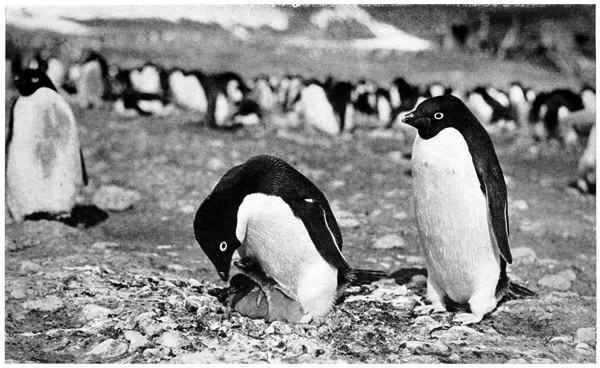
Fig. 62. A COUPLE WITH THEIR CHICKS
(Page 96)
When the birds were arriving at the rookery I
watched for those who were to nest up the cliff, and
several times saw birds on arriving at the rookery
make for the heights without any hesitation, threading
their way almost in a straight line through the
nests to the screes at the bottom of the cliff, and
up these to one or other of the paths leading up its
side. Probably these had been hatched there, or
had nested there before, and were making their
way to their old haunts, but my notes on their
nesting habits go to show that the cocks, at any
rate, cannot keep to the same spot during successive
years. It is the hen who chooses the site, and
stays on it, as I have shown, until a mate comes to
her, and wins her, very often only after defeating
many other competitors.
The waste of life in an Adélie rookery is very
great, and is due to the following causes:
- The eggs.
- Skuas.
- Cocks fighting among the nests.
- Floods from thaw water.
- Death of parents.
- Snow-drifts.
- Landslides.
- The young chicks.
- Skuas.
- Landslides.
- “Hooligan” cocks.
- Getting lost.
- Death of parents.
- Adults.
- Sea-leopards.
- Landslides.
- Snow-drifts.
In the above lists I have made no mention of
the wanton depredations committed—owing to the
licence given to ignorant seamen—by expeditions
which visit the Antarctic from time to time, but as
these visits are made at rare intervals, they cannot
greatly affect the population.
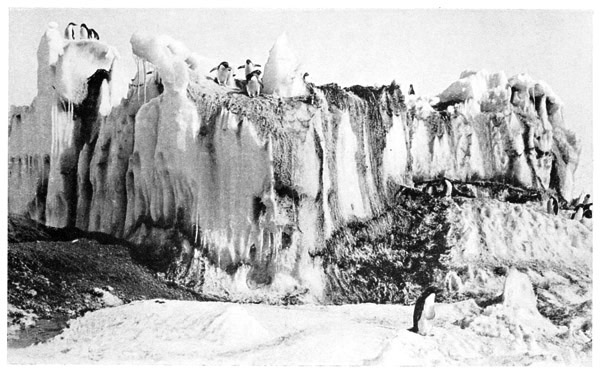
Fig. 63. ADÉLIE PENGUINS HAVE A STRONG LOVE OF CLIMBING FOR ITS OWN SAKE
(Page 99)
Some of the items in my list require explanation.
The screes at the foot of the cliff at Cape Adare
are perhaps the most thickly populated part of
the rookery. As the thaw proceeds, boulders of
different sizes are continually falling down the
cliff, some of them for many hundreds of feet
before they finally plunge in among the nests on
the screes, doing terrible damage, and often rolling
some distance out into the rookery. At other
times, owing to the bursting out of thaw water
which has been dammed up at the top of the cliff,
large landslides are caused which bury many
hundreds of nests beneath them. In fact, these
screes on which the nests are built have been
formed by these landslides taking place from year
to year, and no doubt form the graves of thousands
upon thousands of former generations. One of
these slides took place whilst we were at the
rookery, doing terrible damage. A crowded
colony of Adélies were nesting just below, and the
avalanche passed right through and over them,
causing the most sad havoc. We found hundreds
of injured and dying, some of them in a pitiable
condition. Several were completely disembowelled,
others had the whole skin of their backs torn down
and hanging behind them in a flap, exposing the
bare flesh. Dozens had broken or dislocated legs
and flippers.
The worst feature was that many were buried
alive beneath the snow, or pinned down to the ground
by masses of basalt. Twice I saw one flipper sticking
out of the snow, moving dismally, and dug out in
each case a badly injured bird which would have
lingered perhaps for days, because loose snow does
not always suffocate, owing to the amount of air
contained in its interstices, and to the fact that
diffusion takes place through it very readily. Several
of us spent a long time in killing with ice-axes those
that seemed too badly injured to recover.
It was remarkable to see the way in which all the
nests which had escaped the avalanche, however
narrowly, were still sat upon by their occupants, as
if nothing had happened. Also I saw several badly
injured birds sitting on their eggs, some of them
soaked in blood, so that they looked like crimson
parrots. The amount of bloodshed must have been
great, as the snow was dyed with blood in all directions.
As a cascade of water followed the avalanche,
and continued for some hours, spreading out into
little rivers among the nests, many were being
deluged, and some of the penguins actually were
sitting in the running water, in a vain attempt to
keep warm their drowned chicks and spoiled eggs.
Sometimes, digging at hazard in the drifted snow,
I came on birds that had been deeply buried, and
though they were held down and kept motionless by
the weight of the snow covering them, most of
them were alive, and I have no doubt many dozens
died a lingering death in this way. Such as had
merely suffered broken flippers or legs, I spared,
and the next day nearly all of these seemed to be
doing well. One bird I found sitting on two eggs
which were in the middle of a rivulet of water, so I
lifted them out and put them on dry ground close
by, but the parent would have nothing to do with
them after this.
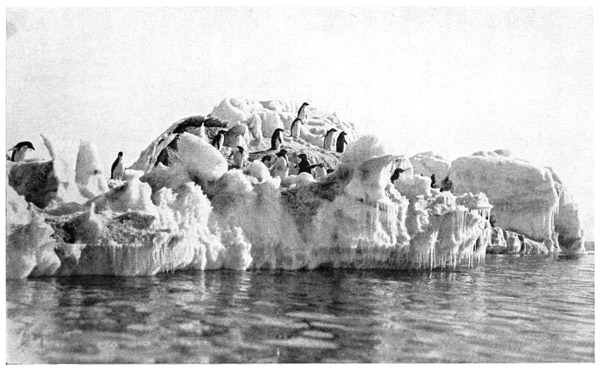
Fig. 64. ADÉLIES ON THE ICE-FOOT
A feature of the above scene, which one could not
help noticing, was that however badly a penguin
was injured it was never molested by the others, as
is almost invariably the rule among other birds,
including their near neighbours the skuas. I have
seen a sick skua hunted continuously for over an
hour by a mob of its own kind who would not
allow it to settle on the ice for a moment's rest.
Another item of my list requiring explanation is
“snow-drifts.”
During both spring and summer there are occasional
snowstorms, and during these the birds sit
tight on their nests, sometimes being covered up by
drift. As a rule the bird on the nest keeps a space
open by poking its head upwards through the snow,
but sometimes it becomes completely buried. Air
diffuses so rapidly through snow that death does
not take place by suffocation, and the bird can live
for weeks beneath a drift, sitting on its nest in the
little chamber which it has thawed out by its own
warmth. Generally after a few hours the snow
abates and settles down sufficiently to expose the
nest once more, but sometimes a breeze springs up
which is not strong enough to blow the snow away,
but simply hardens the surface of the drift into a
crust which lasts for several weeks, and the birds
are imprisoned in consequence. Then little black
dots are seen about the surface of the drift, which
are the heads of penguins thrust through their
breathing holes.
On one such occasion I witnessed an interesting
little incident. An imprisoned hen was poking
her neck up through her breathing hole when her
mate spied her and came up. He appeared to be
very angry with her for remaining so long on the
nest, being unable to grasp the reason, and after
swearing at her for some time he started to peck
at her head, she retaliating as far as her cramped
position would allow. When she withdrew her
head, he thrust his down the hole till she drove it
out again, and as this state of things seemed to be
going on indefinitely, I came up and loosened the
crust of snow which imprisoned her, on which she
burst out, and seemed glad to do so. She was
covered with mire, having for many days been
sitting in a pool of thaw water which had swamped
her nest and evidently spoilt the eggs. When
I put her back on the nest, she sat there for
some time, but eventually they both deserted. I
should say that some hundreds of nests were spoilt
in this way.
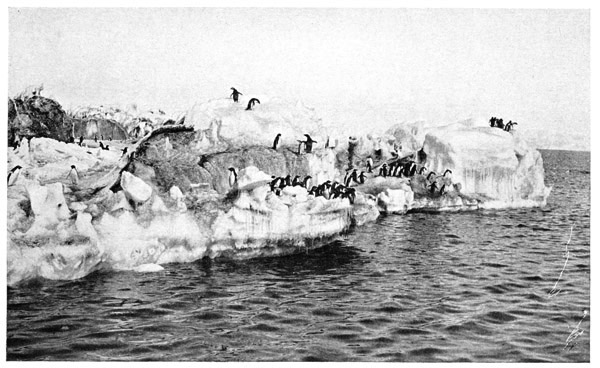
Fig. 65. ADÉLIES ON THE ICE-FOOT
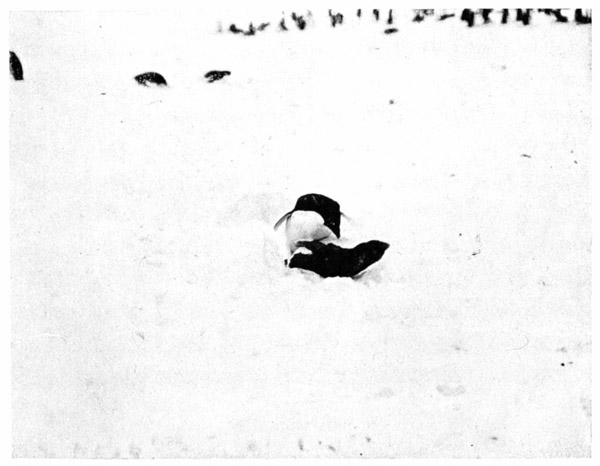
As I photographed the above incident at intervals,
different stages are seen on Figs. 67 to 69.
I have mentioned that eggs got lost owing to
cocks fighting among the nests. When hens are
incubating the eggs they never leave the nest
under any circumstances until relieved by their
mates, being most reliable and faithful to their
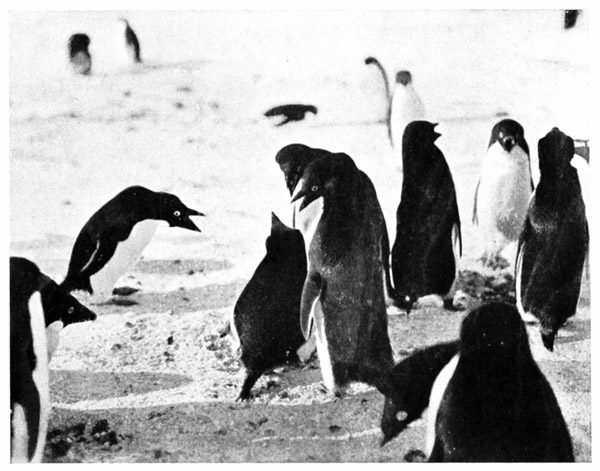
charge. They squabble continually with their
nearest neighbours, whom they seem to hate, but
only retaliate on those within reach, using their
bills only to peck at each other's heads without
shifting their position.
The cocks, however, are less dependable. Starting
a quarrel in the same way as the hens do, their
militant instincts soon became aroused, on which
they are apt to jump up and start a furious fight
with flippers, staggering to and fro over their
nests, and very often spilling the eggs, which are
lost in consequence. On certain occasions I was
able to interfere between the combatants, and replace
the eggs, on which they would return to
their domestic duties and seem to forget the
incident. A good many eggs must have been
lost in this way during the season.
Late in the season an occurrence took place for
which I have never been able to find any explanation.
Occasionally I had noticed that the
penguins had crowded together more than usual
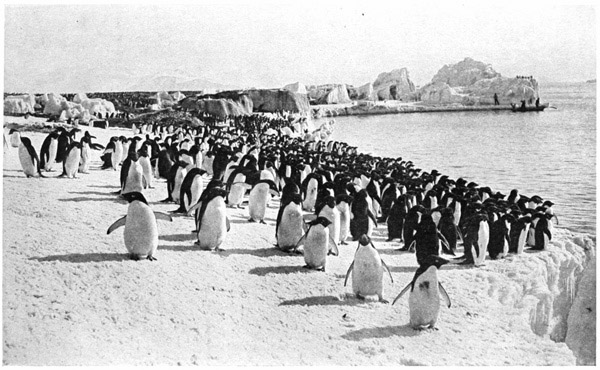
on the ice-foot, multitudes of them standing for
hours without any apparent purpose. A good
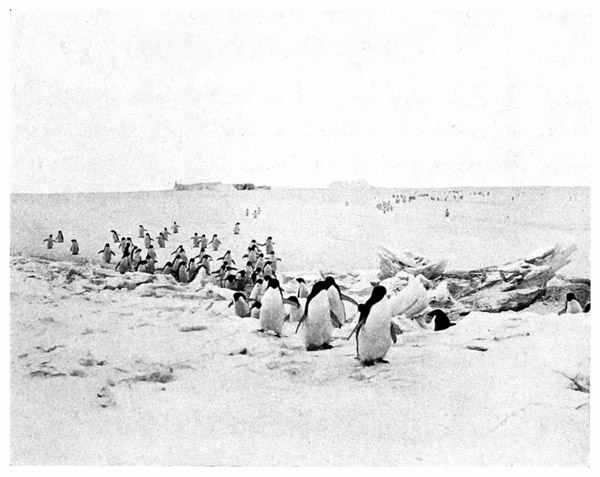
idea of this scene may be got from the frontispiece.
One morning Mr. Priestley came into the hut
and told me that “the penguins were drilling on
the sea-ice,” and that I had better come and look
at them. I went with him to the ice-foot, and
this is what we saw.
Many thousands of Adélies were on the sea-ice
between the ice-foot and the open water leads,
then some quarter of a mile distant. Near the
ice-foot they were congregating in little bands of
a few dozen, whilst farther out near the water,
massed bands some thousands strong stood silent
and motionless. Both the small and the large
bands kept an almost rectangular formation, whilst
in each band all the birds faced the same way,
though different bands faced in different directions.
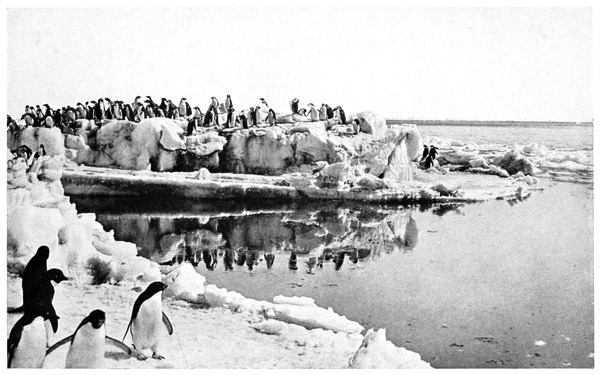
Fig. 66. ADÉLIES ON THE ICE-FOOT
As we watched it became evident that something
very unusual was going on. First, from one
of the small bands, a single bird suddenly appeared,
ran a few yards in the direction of another small
band, and stopped. In the flash of a moment the
entire band from which he came executed the
movement “left turn,” this bringing them all into
a position facing him. So well ordered was the
movement that we could scarcely believe our eyes.
Then from the small band our single bird had
approached, another single bird ran out, upon
which his own party did exactly as the first had
done, so that the two bands now stood facing
one another, some fifteen yards apart.

ARROW SHOWS DIRECTION IN WHICH ALL THE BIRDS FACED
Then
spontaneously, the two bands marched straight
toward one another, and joined to form one body.
After this we saw the same procedure being enacted
in many other places, the penguins coming down
from the rookery and forming small bands which
joined together. Then the augmented bodies
would join other augmented bodies, to form
still larger ones, which then joined together, and
so on until a great mass of birds stood together
in rows all facing in one direction like a regiment
of soldiers. One of these masses stood not far
from us, a compact rectangular gathering, as shown
on page 109.
They stood thus for a long time, quite motionless
and silent, when suddenly as before, a single
bird darted out from among the crowd and ran
a few yards toward the open water, when, as if
it had received a word of command, every bird
faced left as in the diagram below.
ARROW SHOWS DIRECTION IN WHICH ALL THE BIRDS FACED
After this the whole crowd marched for the
water, keeping its formation almost unchanged till
it arrived at the edge of the ice, when it halted, and
subsequently entered the water in batches.
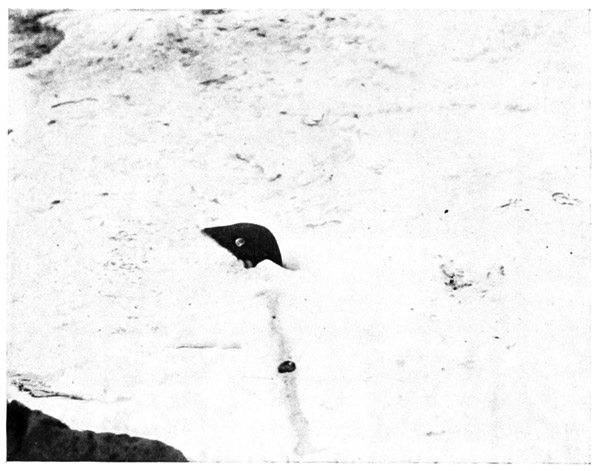
Fig. 67. “An Imprisoned Hen was Poking her Head up through her Breathing Hole”
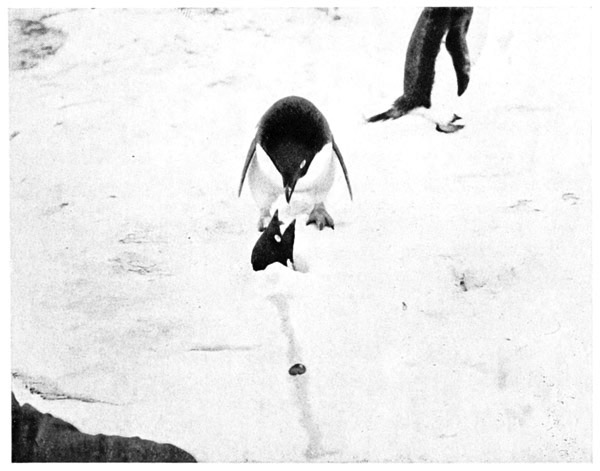
Fig. 68. “Her mate appeared to be very angry with her, being unable to grasp the reason why she could not come off the nest”
(Page 106)
This procedure continued for many hours, the
penguins that day observing this extraordinary
behaviour, the most astonishing part of which
lay in the accuracy of their drill-like movements, so
that we might have been watching a lot of soldiers
on parade. Perhaps the sudden motions of these
bodies of birds were brought about by a sound
uttered by the single bird which acted as leader,
though we did not hear this. The actual reason
for this departure from their usual customs is
beyond my knowledge. There was nothing to
be seen to account for it, but the penguins evidently
obeyed some instinct which affected them all on
this and two subsequent occasions, when the same
thing took place.
My own idea is that in former times the penguins
used to mass together as other birds do, before
their annual migration, perhaps as far back as
the day when their wings were adapted for flight,
and that the phenomenon described above was
a relic of their bygone instincts.
When the chicks' down has been moulted
and their plumage acquired, they proceed to the
water's edge and here they learn to swim.
In the autumn of 1912, at a small rookery which
I came upon on Inexpressible Island, I had an
opportunity of watching their first attempts in this
direction. Crowds of young Adélies were to be
seen on the pebbly beach below their rookery,
much of the ice having disappeared at this late
season, leaving bare patches of shingle which were
very suitable for the first swimming lesson.
Many old birds paddled in for a short distance,
and crouching in a few inches of water, splashed
about with their flippers to give the youngsters
a lead. Some of the latter needed little encouragement,
and took readily to the strange element, very
soon swimming about in deep water, but others
seemed more timid, and these latter were urged in
every possible way by the old birds, some of whom
could be seen walking in and out of the water, and
so doing what they could to give their charges
confidence.
In this duty one or two old birds might be seen
with a little crowd of youngsters, so that evidently
the social instincts which gave rise to the crèche
system in the first place were extended to the
tuition of the young and thus to their preparation
for the journey north.
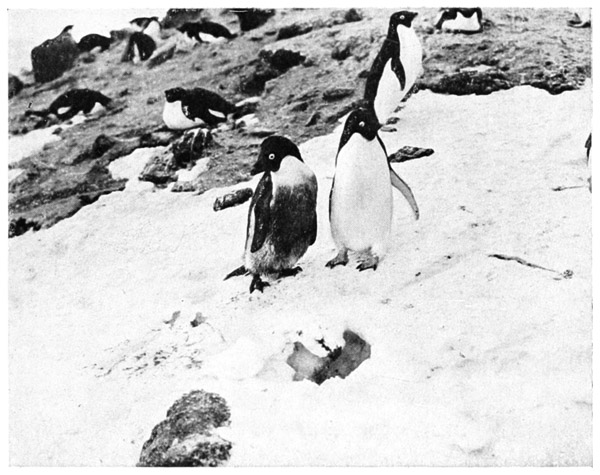
Fig. 69. “When she broke out, they became reconciled”
(Page 106)
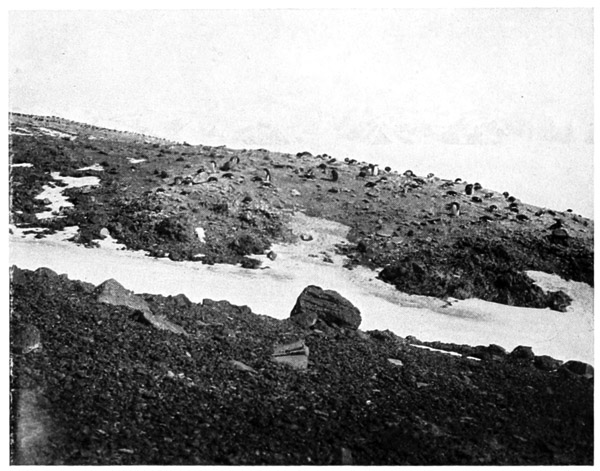
Fig. 70. Adélie's Nests on Top of Cape Adare, to reach which they must make a Precipitous Climb of 1000 feet
(Page 98)
Up in the rookery, fully fledged youngsters could
be seen clamouring in vain for food, the old birds
resolutely refusing to feed them now that they
were able to forage for themselves. The adults
who instructed the young in the water had finished
their moult, and were themselves ready to depart.
Many others, however, still wandered disconsolately
about the land, some of them only half fledged, and
moping under boulders or any sort of shelter from
the chilly breezes, and long after all the youngsters
had departed, solitary moulting birds were to
be found, emaciated and miserable, patches of
loose feathers still clinging to the new coat which
was making such a tardy growth. In some places
we found these old birds in holes under the rocks,
the old moulted feathers making some sort of a bed
which helped to protect their late wearers from the
cold.
Both at Cape Adare in 1910 and at Inexpressible
Island in 1911, I found that though young and old
left the rookery simultaneously at first, yet after all
the young had departed many adults still remained
behind owing to the lateness of their moult, and
this is directly at variance with the remarks of Mr.
Borchgravink on the subject, because he says that
the old birds all leave the rookery first, abandoning
the young, who are driven by necessity to take
to the water and learn to swim.
Well indeed was it for my companions and
me that this was so, for in the autumn of 1912
we were in sore straits for food, and had it not
been that at a very late date we collected some
ninety old moulting birds on Inexpressible Island,
I doubt if we would have seen the sun rise in the
next spring.
At Cape Adare in 1911, half the rookery had
departed when we arrived in the autumn. The
rest took to the sea in batches some hundreds
strong. These parties wandered about the beach
and ice-foot in company for some time, then entering
the water and swimming northward they were
seen no more.
Those that moulted sometimes remained solitary
whilst in the acuter stages, but nevertheless moulting
parties often were seen looking very miserable,
doubtless feeling in their unprotected state the
effects of winds which were getting keener and
more severe now that the sun was departing.
When all the youngsters had gone, some thousands
of old birds still remained, and waited for
many days after they had acquired their full
plumage before they left. Then these in time
disappeared, leaving the rookery empty and desolate.
On March 12 I photographed the last party: all
black-throated adults. Two days later a couple
appeared on the beach, apparently having come
back for a last look at us. Then these, too, disappeared,
and as we looked at the empty silent
beach we could not help contrasting it with the
noise and bustle of a short time ago.
The last penguin had gone, and the sun disappearing
below the horizon, left us alone with the
Antarctic night.
APPENDIX
The following description of the plumage and
soft parts of Pygoscelis Adeliæ, which is perfectly
correct, is taken from the zoological report of the
Discovery Expedition.
Soft Parts.
“Bill, when first hatched, blackish. A week
old, black terminally, deep red at the gape and
along the cutting edges. Immature of the first
year, blackish. Adult, brick-red, the upper bill
black terminally, and the mandible black along the
cutting edge.
“Iris, brown; varying between reddish brown
and greenish brown.
“Eyelids, black throughout the first year; pure
white in the adult at fourteen months and onwards.
“Feet, flesh red; dusky when first hatched,
brightening in the first week or two. Immature
and adult, pale flesh pink above, black beneath (in
some cases piebald beneath).
“Claws, brown.”
In the majority of the chicks the down is
uniformly dark and sooty, but here and there, in
progeny of quite normal parents, one may find
nestlings of so pale a grey as to be almost silvery
white, with blackish heads, possibly a reversion to
an earlier type, and, at any rate, suggestive of the
young of the Emperor penguin, which perhaps
represents the oldest stock of all. According to
Dr. Bowdler Sharp, the colour of the head is in all
cases blacker in the earlier stages than the rest of
the body.(8)
As the chick ages the colour of its down
changes, and all of it takes on a dull rusty brown
colour. As it moults the abdomen and thighs
change first, and white feathers appear in place of
the down. Then come changes on the head, round
the bill, and at the tail; the upper breast, neck, and
back being the last parts to moult.
The feet, which in the young nestling have been
almost black, change in colour to a brick-red that
shows up very markedly against the rusty brown
down, looking as if the legs were raw and inflamed.
Later the permanent flesh colour is acquired, with
black plantar surfaces. The nails are black at first,
and later change to brown.
When the nestling down is shed, the resulting
plumage is that of the adult, except that the throat
is white instead of black. The upper part of the
head and neck are bluish black, the throat, fore-neck,
breast, and abdomen being a pure dazzling
metallic white, a sharp line separating the white
from the black areas. The flippers are the same
bluish “tar” black on the back and white beneath.
In addition to the distinctive pure white plumage
of the throat, the immature bird differs from the
adult in one very marked particular, which is that
the eyelids are black, as in the chick, and do not
acquire the staring whiteness which is so distinctive
of the adult Adélie penguin, increasing, as it does,
the white area of the sclerotic so that the bird has
the appearance of being perpetually surprised or
very angry.
The iris is a rich reddish brown in the adults, but
variable in the young.
At Cape Adare the light grey “silvery” coloured
chicks mentioned by Dr. Wilson were by no means
uncommon; in fact, quite a large proportion of
the chicks had very light-coloured down. This is
shown in some of the specimens I brought back
to the British Museum.
Variations occasionally are met with in the
plumage and soft parts of Adélies. The least rare
of these consist of tufts of white feathers amongst
the black plumage of the head. Several specimens
so marked were seen at Cape Adare during the
summer of 1911–12.
When these white tufts were present the feathers
comprising them were usually longer than the black
feathers among which they appeared, so that they
stuck out in an untidy manner, and were very conspicuous.
In marked distinction to the slight variations
above described were the three “Isabelline”
varieties that I preserved, and are now to be seen
in the British Museum collection. As these variations
are very startling, and of the greatest interest,
I give below a full description of their plumage and
soft parts.
First specimen captured on the Cape Adare
rookery on November 4, 1911.
Iris, light brown. Eyelids, white. Bill, light
brown. Feet, white. Claws, light brown.
The whole of the area covered by black feathers
in the normal bird was covered by those of a very
light fawn, somewhat darker on the neck and
shoulders than elsewhere. Sex, male.
Second specimen captured on November 14, 1911.
Iris, light brown. Eyelids, white. Bill, light
brown; mandible, blackish on dorsum; maxilla,
blackish on cutting edges. Feet, white on both
surfaces. Claws, light brown.
In place of the black feathers of the normal bird,
there was a fawn-coloured plumage, darkest on
head and neck; lightest at bottom of back, back of
flippers, and on shoulders.
Sex, female.
Third specimen captured on December 23, 1911.
Iris, light brown. Feet, browny white. Claws,
brown. Bill, brown; very dark on dorsum of
mandible. Eyelids, white with a pink tinge.
In place of the black feathers of the normal bird,
this specimen had those of a very light cream
colour: in fact very slightly darker than the white
area but deepening in shade to light fawn on the
head, neck, and shoulders.
Sex, male.
The second specimen had mated with a normal
cock. In each case the Isabelline birds were very
much more docile than the normal forms. For
instance, they did not struggle when picked up, as
the others would have done, and the third specimen,
when brought into our hut, gazed around with
curiosity and apparent contentment, and showed
not the least resentment at its captivity. A normal
bird would have struggled and fought to the last
extremity. Each bird was killed with chloroform.
So carefully did we keep the entire rookery under
observation that I do not think it likely there were
any more Isabelline forms. Thus we can conclude
3/750000 roughly represents the proportion of
Isabelline forms among the species.